Transcriber’s Note: Sidenotes have been treated
as footnotes, with anchors inserted in the text at the appropriate
point. The reader may (or may not!) want to install ‘Old English Text MT’
or a similar font from the ‘Old English’ family to get a more authentic
experience of reading Wyclyffe’s original.
The Last Age of the Church.
By JOHN WYCLYFFE.
Now first Printed From a Manuscript In the
UNIVERSITY LIBRARY, DUBLIN.
EDITED WITH NOTES,
By
JAMES HENTHORN TODD, D.D., Fellow of Trinity College, and Treasurer of St. Patrick’s Cathedral.
Dublin:
AT THE UNIVERSITY PRESS.
M.DCCC.XL.
¶ The Preface.
A well known popular Writer
on the History of the Christian
Church has given it as
his Opinion, that whoever
will carefully examine the original Records,
will soon be convinced that the Merits of
Wyclyffe, as a Reformer, have been considerably
exaggerated.[1] How far this is
true or not, the Writer of these Pages will
not attempt to determine; but certain it is,
that to “examine the original Records,”
with a View to discover the real Doctrines
and Opinions of Wyclyffe, is much more
easily said than done; and the Reader
who seeks for Satisfaction from the Biographers
of the Reformer, or from the Historians
of the Period, will soon be convinced
that the original Records, and above all,
the still remaining Writings of Wyclyffe
and his Followers, have never been examined
with the Care and Attention necessary
for the Purpose of forming a just
Estimate of his Opinions, and of the Merit
of his Efforts at a Reformation of the
Church.
The List of Wyclyffe’s Writings published
by Bishop Bale, in his Work, Scriptorum
Majoris Brytanniæ Catalogus[2], has
been necessarily made the Basis of all that
subsequent Writers have collected. It
has been reprinted, with many useful additions,
by the learned and indefatigable
John Lewis[3], of whose Labours every
Student must speak with Gratitude. Mr.
Baber[4] also has done much towards assisting
future Inquirers, by the very valuable
List of the Reformer’s Writings that he
has compiled. Here, however, we must
stop; Mr. Vaughan’s Compilation[5] has
not added much to our Knowledge of
the Subject, nor can it be commended
either for Accuracy or Learning; and
Mr. Le Bas[6] does not profess to do more
than follow his Predecessors. His humbler
Task, however, has been executed
with great Elegance and Judgment.
The Truth, therefore, is, that until the
Works of Wyclyffe, real and supposititious,
be collected and published, it is vain to
talk of determining his Opinions, or fixing
his real Merits as a Reformer; and it is
with the Hope of directing Attention to
this Subject that the following Tract
is now printed. The learned Henry
Wharton[7] was willing to believe that all
the Writings of Wyclyffe might in his
Time have been recovered: “omnia Wiclefi
scripta,” he says, “in Anglia adhuc delitescere,
et ex Bibliothecis nostris qua publicis
qua privatis in lucem erui posse,
lubenter crederem.” Perhaps we have
still all the MSS. that existed in Wharton’s
Time, and it may be still within our
Power to rescue them from the Oblivion
in which they have so long been suffered
to remain. But the Chances of their Destruction
are every Day becoming greater,
and Delay in such an Enterprize is highly
dangerous. It is true that many of these
Documents will be found dry, and to the
popular Reader uninteresting; buried in
the barbarous Latinity of the Schools, or
concealed under the perhaps still more obsolete
English of the fourteenth Century.
But they who would engage in such a
Labour as the Publication of the Works
of Wyclyffe, must be above the narrow
Influences of modern Utilitarianism. They
must keep in View a higher Field of Learning
than comes within the Sphere of Mercantile
Speculators in Literature, or Useful
Knowledge Societies. They must feel
that the Value of these Documents as
Compositions, is but a secondary Object
in their Publication; the great End must
be the Discovery of Truth, and the Preservation
of the Remains of an illustrious
Character in our History. What nobler,
what more imperishable Monument could
the Gratitude of England raise to her first
Reformer, than a complete and uniform
Edition of his extant Writings?
The Editor is fully sensible that the
Tract which is now for the first Time given
to the public, is very far from being a
favorable Specimen of the Works of Wyclyffe.
But it commended itself for Publication
on many Grounds: First, its Shortness.
Secondly, its early Date; for it bears
internal Evidence of having been composed
in the Year 1356[8], and must, therefore, (if
really by Wyclyffe,) have been the earliest
of his Writings. Another Motive for publishing
this Production is furnished by the
Consideration, that, if it be genuine, it
reveals to us a Fact not dwelt upon, so far
as the Editor knows, by any of the Reformer’s
Biographers; namely, the Connexion
which existed between the earlier
Doctrines of Wyclyffe, and the prophetical
Speculations of the Beguins, circulated
under the Name of the famous Abbot
Joachim.
It remains, however, to be proved, that
the Tract now printed is really Wyclyffe’s;
and this, the Editor admits, seemed to
him an additional Reason for selecting it
for Publication; inasmuch as it served at
once to raise the Question, How far we
have certain Grounds for attributing to
Wyclyffe the Writings that exist under
his Name; nor is it perhaps too much
to say, that this is a Subject which the
learned World has never been in a Condition
to consider fully. Yet there is no
preliminary Question more deserving of
Attention, if we would form a just Estimate
of our Reformer’s Merits; for
it must be evident to every reflecting
Reader, that if we are in any Degree uncertain
of the Genuineness of such Writings
as are quoted under the Name of
Wyclyffe, the Conclusions drawn from
them, as to the Nature and Character of
his Doctrines, must be in the same Degree
uncertain, and destitute of Authority.
In the present Case, the Grounds upon
which the following Treatise has been assigned
to Wyclyffe, are no more than
these:—First, that it is found in a MS.
Volume of the fourteenth Century, which
contains several other Tracts, that are believed
to be Wyclyffe’s. Secondly, that
it has been ascribed to Wyclyffe, by Bishop
Bale, Mr. Lewis, and, after them, by his
more modern Biographers.
These Remarks are not made with a
Design to cast any Doubt on the Genuineness
of the following Treatise. It is
very probably by Wyclyffe, although we
have no better Reason than the Authority
of Bale for thinking so. But if any
Reader should entertain a Doubt on this
Subject, deeming the Tract unworthy of
our Reformer, (as many will doubtless feel
it to be very different from what they
would have expected from the Pen of
Wyclyffe,) the Editor must confess himself
unable to satisfy such Scruples; nor is
he aware of any Argument by which the
Authority of Bale and Lewis can be supported.
The Conclusion, however, to
which he desires to bring the Reader, and
for the Sake of which he has hazarded
these Remarks, is simply this, that until
the various Treatises attributed to Wyclyffe
are collected, and rendered accessible to
the Learned, it is vain to think of deciding
the Question how far any given Tract is
worthy or unworthy of his Pen.
One other Particular, concerning the
following Work, remains to be considered.
Mr. Vaughan[9] tells us that “this is one
of the Reformer’s Pieces that is to be
found only in the Library of Trinity
College, Dublin;” and this may, for
aught we know, be true, although perhaps
it only means that no other Copy of
the Tract was elsewhere found by Mr.
Vaughan. Certain, however, it is, that
Bishop Bale has entered the Treatise in
two different Places of his Catalogue, and
under two different Titles; from which
we may infer, that in his Time, or in the
Times of those from whom he copied, the
Tract was found in two different Collections.
In one place he enters it thus[10]:—(See
No. 84 of Lewis’s Catalogue.[11])
“De simonia sacerdotum, lib. 1. Heu magni
sacerdotes in tenebris.”
In another place[12] he gives it the Title
under which it is now published, and describes
it thus[13]:—
It is by no means improbable, therefore,
that a second Copy of the Tract may still
exist, under some Disguise, in our public
or private Libraries.
The Volume from which the Treatise
is now printed, is preserved among the
MSS. of Archbishop Ussher, in the Library
of the University of Dublin. It
appears to have been once the Property of
Sir Robert Cotton, whose Autograph is
found on the lower Margin of the first
Page, in his usual Form of Signature[14]:
“Robert Cotton Bruceus.”
On the upper Margin of the same Page,
in a Hand of the early Part of the sixteenth
Century, now nearly obliterated,
may be traced the Words,
“Wiclefe roas a thousand thre hūderyd thre
schorr and uiij.”
Over which Sir Robert Cotton has written,
“Anno 1368. Wicklif workes to the Duk of
Lancaster.”
Nothing appears in the Volume to indicate
the exact Year in which it was
transcribed, but the Hand-writing would
lead us to assign it to the latter End of
the fourteenth or Beginning of the fifteenth
Century. It is imperfect in some
places, but contains a very valuable Collection
of the Tracts of Wyclyffe, for a
complete List of which the Reader is referred
to some Papers that were published
in the Year 1835, in the British Magazine[15];
where he will also find an Account
of the Treatise, now for the first
time printed, “On the last Age of the
Chirche,” with an Exposure of certain
Mistakes that have been committed
respecting it. Several of the Remarks
contained in those Papers have been
transferred to the Notes, which
will be found at the End
of the present
Volume.
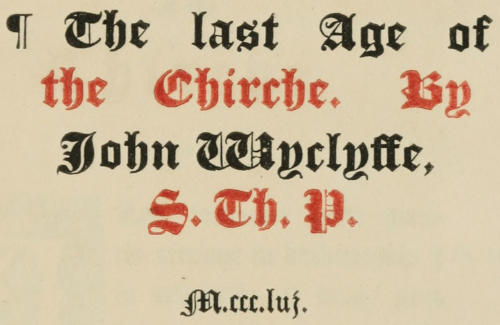
¶ The last Age of the Chirche. By John Wyclyffe, S. Th. P.
M.ccc.luj.
The last age of the Chirche.
Alas forsorwe grete prestis
sittinge in derkenessis[16] &
in schadewe of deeþ/ noȝt
hauynge him þat openly
crieþ/ al þis I wille ȝeue ȝif
þou auaunce me. Þei make reseruaciouns/
þe whiche ben clepid dymes/ ffirst fruytis/
oþer penciouns/ aftir þe opynioun of
hem þat trete þis matir. For no more
schulde fatte beneficis be reserued þāne
smale/ ȝif no pryuy cause of symonye
were tretide/ þe whiche I seie noȝt at
þis tyme. But Joachur[17]/ in his book of
þe seedis of profetis & of þe seyingis of
popes & of þe chargis of profetis/ tretynge
þis matir/ & spekynge of þe rente of dymes/
seiþ þus[18]/ foure tribulaciouns Dauiþ þe
profete haþ bifore seid/ þe seuynty & nyne
chapitre/ to entre into þe Chirche of God/
& Bernard[19] acordiþ þere wiþ/ vpon cantica/
þe þre & pritty sermon/ þat ben/ a
nyȝtly drede/ an arwe fleynge in day/
chaffare walkynge in derkenessis/ & myddais
deuylrie/ þat is to seye/ antecrist.
Nyȝtly drede was whanne alle þat slowen
seyntis demyd hem silf do seruyse to
God/ & þis was þe firste tribulacioun þat
ontrede þe Chirche of God. Þe arwe fleynge
in day was desceyt of heretikis/ & þat
was þe secunde tribulacioun þat entred þe
Chirche of Crist. Þat is put of bi wisdom
of seyntis/ as þe firste was cast out bi
stedfastenesse of martiris. Chaffare walkynge
in derkenessis is þe pryui heresie of
symonyans/ bi resoun of whiche þe þridde
tribulacioun schal entre into Cristis
Chirche/ þe whiche tribulacioun or angusch
schal entre þe Chirche of Crist in
þe tyme of þe hundrid ȝeer of .x. lettre/ whos
ende we ben/ as I wele preue/ & þis myscheif
schal be so heuy þat wel schal be
to þat man of holy Chirche þat þāne schal
noȝt be on lyue. And þat I preue þus
bi Joachrin[20] in his book of þe deedis of
profetis. Men of ebreu tunge haueþ xxii
lettris/ and byngȳn̄ge fro þe first of ebrew
lettris/ & ȝeuynge to euery lettre an hundrid
ȝeer/ þe oolde Testament was endid
whāne þe noumbre ȝeuen to þe lettris was
fulfillid. So fro þe bygynnynge of ebrew
lettris in to Crist/ in þe whiche þe oolde
Testament was endid/ weren two and
twenty hundriddis of ȝeeris. Þis also
schewiþ openly bi discripcioun of tyme/ of
Eusebi[21]/ Bede[22]/ & Haymound[23]/ most
preued of acounteris/ or talkeris. So
Cristen men hauen xxi lettris/ & bygynnynge
fro þe first of Latyn lettris/ &
ȝeuynge to eche .c./ þe newe Testament
was endid whanne þe noumbre of þes assingned
lettris was fulfillid. And þis is as
soþ as in þe bigynnynge God made
heuene & erþe/ for þe oolde Testament is
figur of þe newe. But aftir Joachim[24] &
Bede[25]/ fro þe bygynnynge of Latyn lettris
to þe comynge of Crist weren seuene hundrid
ȝeere/ so þat Crist cam in þe hondrid
of .h’. lettre/ Crist steye to heuene/ and
aftir þat/ undir .k’. lettre/ Crist delyuered
his Chirche fro nyȝtly drede/ þe whiche was
þe firste drede þat Goddis Chirche was inne.
Aftir þat/ vndir .m. lettir/ Crist delyuered
his Chirche fro þe arwe fleynge in day/
þat was þe secunde tribulacioun of þe
Chirche/ & þat was demynge by Joachim[26]
& oþere þat vndir .m. lettre schewede þe
multitude of heretikis contraryinge þe
birþe of Crist his pascioun & his assencioun/
in þat þat .m. lettre most figured
Crist. Euery lettre in þe abece may be
sounded wiþ opyn mouþ saue .m. lettre one/
þe whiche may noȝt be souned but wiþ
clos mouþ. So Crist myȝte noȝt come out
of þe maydenes wombe/ but sche hadde be
clos. And þes ben uerse of .m. lettre/
College claustris exire solent patefactis/
Una sed ex istis nō egreditur nisi clausis.
Aftir þat/ vnder .x. lettre/ was þe
þridde tribulacioun in Goddis Chirche/
þe whiche .x. lettre is last of Latyn lettris/
& þe þridde tribulacioun schal be schewid
in þe hondrid ȝeere of .x. lettre. I preue
it bi two resouns/ þe firste is þis. Petir
þe Apostle þe whiche was in þe tyme
of .I. lettre/ myȝte not vttirly distrie
Symoun Magus/ but bi helpe of Poul[27]/
þe whiche was þe þritteneþ Apostil. So/
ȝif .x. lettre be þe þritteneþe fro .I. lettre/
in þe tyme of .x. lettre Crist schal clanse
his Chirche fro marchaundise walkygnge
in derkenessis. Þe secunde resoun is suche.
Ȝit cam noȝt þat tribulacioun þat schal be
in Goddis Chirche bi cause of chaffare
walkynge in derkenesses/ & þat þat is prophesied
schal come. Siþþe þanne þat we
ben in .x. lettre/ as it is schewid/ þis tribulacioun
schal come in .x. lettre oþere
aftir/ but aftir .x. lettre/ þat is þe last of
Latyn lettris/ schal be no tribulacioun
in Goddis Chirche bote þe fourþe & þe
laste/ þe whiche schal be bi þe deuel of
mydday/ þat is Antecrist[28]/ þe whiche tribulacioun
bi no Latyn lettre may be certefied/
as þes þre bifore. Ffor his comynge
oonly to God is knowen/ & knowleche of
him to God oonly reserued. Whefore it
folwiþ þat vndir .x. lettre schal be schewid
þilke tribulacioun þat schal be in Goddis
Chirche/ by resoun of chaffare walkynge
in derkenessis.
Þat we ben vndir þe hundrid ȝeere of
.x. lettre/ I schewe schortly by Bede[29] vpon
þe profetis of Sibille/ and by Joachim[30] in
þe book of þe seedis of profetis/ & oþere
writeris of stories. Ffro þe bygynnynge
of Latyn lettris to Crist Ihū/ were seuene
hundrid ȝeer/ and fro Crist til now/
þrittene hundrid ȝeer and sixe & fyfty[31]/ so
þat þere ben to come of our abece but foure
& fourty ȝeer/ & bi þis of þe hundrid ȝeere
of .x. beþ passid sixe & fifty ȝeere. Þe
synnes bi cause of whiche suche persecucioun
schal be in Goddis Chirche our
tyme ben þes/ for Goddis Chirche is
foundid in kynrade of prelatis. Þis same
rekened Joachim[32] in þe bookis bifore. Also
for goodis of holy Chirche þat prelatis
wiþ holdeþ to hem/ as pensiouns/ firste
frutis/ fermes/ prouendris/ þe whiche may
wel be clepid collibiste/ þes synnes and
oþere suche ben marchaundise walkynge
in derkenessis. Þe manere of tribulacioun
schal be such as Joachim[33] seiþ in þe book
of þe charge of profetis. Men of holy
Chirche schal be seyd in a manere of careyne/
þei schal be cast out as dogge in
myddis placis. Her wiþ acordiþ Carnosencis/
in a book þat he clepiþ pollicraticon[34]/
þe seuenþe book/ þe tenþe chapitre/ &
he aleyeþ Gregor seiynge þus/ pestilencis/
smyttingis to gidere of folkis/ & hurtlynge
to gidere of rewmes/ & oþir harmes schal
come to þe erþe/ for þat worschipis of
holy Chirche beþ ȝeue to vnworþi men.
And in þe eiȝteþe book[35]/ defaute of prestis
among Goddis folk bryngiþ in tirnauntis.
Þat þis tribulacioun is nyȝe/ and whanne
it schal come/ bi hem þat tretiþ þis matir
is/ whanne men schulle wante teeþ/ and
comynly alle children/ boren siþþen þe
first pestylence/ ben such þat wanten eiȝte
grete teeþ. Herwiþ acordiþ Merlyn Ambrose[36]/
þat such angusche is nyȝe/ for as
by hem/ in þe tyme of þe myscheif of þe
kok/ þat we clepe fraunce/ þat schal be
distroyed by þe sixte of irlond/ þe witt is
our kyng wiþ his children. Sibille[37] acordiþ
herto/ þat suche tribulacioun is nyȝe/
in þes verse:
Gallus succuutus aquile victricia signa/
Mundus adorabit/ est vrbs vix presule digna/
Papa cito moritur/ Sesar regnabit vbique/
Sub quo tunc vana cessabit gloria cleri.
Þei þat treten þes verse of Sibille/ alle þat
I haue seen/ acorden in þis/ þat seculer
power of þe Hooly Goost elispirid/ & þat
deþ/ veniaunce of swerd/ myscheifs vnknowe
bifore/ bi whiche men þes daies
schule be ponyschid/ schulen falle for synne
of prestis. Men schal falle on hem/ &
caste hem out of her fatte beneficis/ and þei
schule seye/ he cam in to his benefice by
his kynrede/ þes bi couenant maad bifore/
he for his seruyse/ & þes for moneye/
cam into Goddis Chirche. Þanne
schal eche suche prest crye/ Alas/ Alas/
þat no good spiryt dwellid wiþ me at my
comynge into Goddis Chirche. Þe
wordis of Josue 2. cᵒ. þe þridde. I seide
þat Crist entrede into hooly þingis/ þat
is holy Chirche/ by holy lyuynge & holy
techinge/ preynge þe Fadir for vs. Þe
Mayster of Scholys[38] rehersiþ/ þe þridde
book of Kyngis/ þe v. cᵒ./ aftir þe talis
of iewis of Salamon/ þere was a stork
hadde a berd/ & his berd was sperid vndir
a vessel of glas/ and whanne þis stork sau
his brid/ &. þat he myȝte noȝt come to
hym/ he brouȝt a litil reed worme out of
wildirnesse/ & wiþ his blood he anoyntide
þe glas. Þe glass to barst/ & þe brid
fleye his wey. So oure Lord þe Fadir
of heuene hadde mankynde in helle/ þat
was glasyne/ þat is to seye britil as glas.
To breke it be brouȝt suche a litil reed
worme/ þat was our Lord Ihū Crist/
as Dauiþ seiþ/ þe on & twenty Salme. 2i.[39]
Ego sum vermis/ & non homo/ I am a
worme & no man/ & wiþ his blood he
delyuered mannes kynde. Zacarie[40] writiþ/
þe nynþe chapitre/ þou forsoþe wiþ blood
of witnesse/ or þi testament/ hast ledde
out hem þat were bounde in þe pyt. So
whanne we weren synful/ & children of
wraþþe/ Goddis sone cam out of heuene/
& preyying his fadir for his enemyes/ &
he deyed for vs þanne/ myche raþere now
we ben maad riȝtful bi his blood schule be
saued. Poul writiþ to þe romayns.
v. cᵒ.[41] He schal preye for vs. Ihūs
wente into heuene to apere to þe semlant
of God for vs. Poul to þe hebrees.[42] Þe
whiche semlant he graunte vs
to see/ þat lyueþ & regneþ
wiþout eende/
Amen.
NOTES.
Notes. — Page xxiii. line 3. — Ibid. line 6. — Page xxiv. line 2. — Ibid. line 4. — Ibid. — Ibid. line 9. — Ibid. line 11. — Page 25. line 7. — Ibid. last line. — Page xxvi. line 2. — Ibid. line 9. — Ibid. line 12. — Page xxvii. line 5. — Ibid. line 15. — Page xxviii. line 8. — Page xxix. line 3. — Ibid. line 6. — Page xxx. line 1. — Ibid. line 6. — Ibid. line 10. — Ibid. line 12. — Page xxxi. line 8. — Ibid. line 13. — Page xxxii. line 1. — Ibid. line 3. — Ibid. line 10. — Ibid. line 16. — Page xxxiii. line 1. — Ibid. line 3. — Ibid. line 5. — Ibid. — Ibid. line 9. — Ibid. last line. — Page xxxiv. line 13. — Ibid. line 17. — Page xxxv. line 1. — Ibid. line 8. — Ibid. line 14. — Page xxxvi. line 15.
How far the foregoing Tract
has suffered from the Carelessness
or Ignorance of the
Transcriber, it will not be
possible to determine, until
another Copy shall be discovered. It is the
Object of the following Notes to correct some
of the more obvious Mistakes, as well as to
trace the Historical Origin of the Tract, and
to explain its References and Allusions. The
Editor has not thought it necessary to preserve
in every Instance the Contractions of
the original Manuscript; but he has carefully
retained the Spelling, even in some Cases
where an Error of the Transcriber is evident.
The Anglo-Saxon Letters, þ and ȝ, are used
throughout the MS., and are preserved, as being
characteristic of the Orthography of the Period.
Noȝt hauynge him þat openly crieþ.
There seems some Error or Omission of the
Transcriber here; but the Allusion is probably
to St. Matt. iv. 9. A learned Friend has
ingeniously suggested to the Editor, that
“nought-having” may mean disregarding,
pro nihilo habentes, not fearing, abhorring,
or thinking any Harm of him that openly
crieth, “all these Things will I give thee, if
thou wilt fall down and worship me;” i. e. not
fearing the Demon of Simony. “Avaunce” is
perhaps substituted for adoraveris, in order
to render the Passage more applicable to
Clerical Simony, or Purchase of Preferment.
Þei make reseruaciouns.
The Exactions of the Court of Rome had
been made the Subject of Legislation in England,
from the 35 of Edw. I., in which Year
(A.D. 1306-7) Petitions were presented to the
King from the Nobility and Commonalty of
the Realm against the intolerable Exactions of
the Pope[43]; (Super variis novis et intollerabilibus
gravaminibus, oppressionibus, injuriis,
et extorsionibus ... auctoritate et mandato
Domini Papæ;) and these Petitions were the
Occasion of a Statute[44], passed at a Parliament
held at Carlisle in that Year, whereby the
Papal Taxation of Abbeys and Religious
Houses was restrained, and in certain Cases
prohibited. In the Year 1350-1, however,
(25 Edw. III.) only Six Years before the Date
of the Tract before us, the Statute against
Papal Provisions of Benefices was passed[45],
in which the Pope’s Power of presenting to
Benefices in England, in Violation of the Rights
of the natural Patrons, was restrained, and the
Provisors attached. The Word Reservation
seems to be used in the Text to denote the
Provisions prohibited by these Acts of Parliament;—it
is thus defined by Du Cange[46]:
“Rescriptum seu mandatum summi Pontificis,
quo certorum beneficiorum, cum vacaverint,
collationem sibi reservat faciendam
cui voluerit, aliis legitimis collatoribus exclusis.”
This is exactly what the Statutes
referred to term Provision. The Word Reservation,
however, is used by our modern Law-Authorities[47]
in a more general Sense, to denote
a Rent or Profit reserved by the Owner of an
Estate or Tenement for his own Use: and in
this Sense the First Fruits or Annates, Tenths,
and Pensions, claimed by the Court of Rome
are rightly termed Reservations, and in their
Origin are clearly Simoniacal: such Pensions,
First Fruits, and Tenths being in fact the
Price paid to the Court of Rome for Collation,
as appears from the Statute 13 Ric. II.[48]Stat. 2, c. 2, (A.D. 1389-90,) where after reciting
the Statutes 25 Edw. III. and 35
Edw. I. the Act goes on to complain: Et ja
monstre soit a n̄r. sʳ. le Roi &c. “And now
it is shewed to our Lord the King, in this present
Parliament holden at Westminster, at
the Utas of the Purification of our Lady, ...
by the grievous Complaints of all the Commons
of his Realm, that the Grievances and
Mischiefs aforesaid do daily abound, to the
great Damage and Destruction of all this
Realm, more than ever were before, viz. that
now of late our Holy Father the Pope, by
Procurement of Clerks and otherwise, hath
reserved, and doth daily reserve to his Collation,
generally and especially, as well Archbishopricks,
Bishopricks, Abbeys, and Priories,
as all other Dignities, and other Benefices
of England, which be of the Advowry of People
of Holy Church, and doth give the same
as well to Aliens as to Denizens, and taketh of
all such Benefices, the First Fruits, and many
other Profits, and a great Part of the Treasure
of the said Realm is carried away and dispended
out of the said Realm by the Purchasers
of such Graces; and also by such privy
Reservations many Clerks advanced in this
Realm by their true Patrons, which have
peaceably holden their Advancements by long
Time, be suddenly put out: Whereupon, the
said Commons have prayed our said Lord the
King, &c.” And again, in Statute 6 Hen. IV.[49]
(A.D. 1404) cap. 1. Sur la grevouse compleint,
&c. “For the grievous Complaints
made to our Sovereign Lord the King by his
Commons of this Parliament, holden at Coventry,
the vj. Day of October, the vj. Year of
his Reign, of the horrible Mischiefs and damnable
Custom which is introduct of new in the
Court of Rome, that no Parson, Abbot, nor
other, should have Provision of any Archbishoprick
or Bishoprick, which shall be void,
till he hath compounded with the Pope’s
Chamber, to pay great and excessive Sums of
Money, as well for the First Fruits of the
same Archbishoprick or Bishoprick, as for
other less Services in the same Court, and
that the same Sums, or the greater part thereof,
be paid beforehand, &c.”
Thus it appears that the Exactions of the
Papal Court were attracting great Attention
in England, at the Period when this Tract
was written. The Parliament, viewing the
Matter as Politicians, denounced the Papal
Claims on the Grounds that large Sums of
Money were annually sent out of England,
and Aliens advanced to spiritual Livings in
the Church; Wyclyffe taking up the Question
as a Theologian, censures these Exactions
as Simoniacal, and refers to them as symptomatic
of the Approach of Antichrist.
The Dismes mentioned in the Text are the
Decimæ Decimarum, or Tenths of all Livings,
which, with the First Fruits, were originally
claimed by the Pope, although subsequently
annexed to the Crown; and which now
form the Foundation of the Fund called Queen
Anne’s Bounty.[50]
The Pensions exacted by the Court of
Rome were still more directly Simoniacal:
they are thus alluded to in the Preamble of
an Act[51] passed in the Reign of King Henry
VIII., where the Commons, addressing the
King, say: “That where your Subjects of
this your Realm, and of other Countries and
Dominions being under your Obeysance, by
many Years past have been, and yet be greatly
decayed and impoverished by such intolerable
Exactions of great Sums of Money as have
been claimed and taken, and yet continually
be claimed to be taken out of this your Realm,
and other your said Countries and Dominions,
by the Bishop of Rome, called the Pope, and
the See of Rome, as well in Pensions, Censes,
Peter-pence, Procurations, Fruits, Suits for
Provisions, and Expeditions of Bulls for Archbishopricks
and Bishopricks, &c....
It may, therefore, please your most
noble Majesty, for the Honor of Almighty
God, &c.... That no Person or Persons
of this your Realm, or of any other your Dominions,
shall from henceforth pay any Pensions,
Censes, Portions, Peter-pence, or any
other Impositions to the Use of the said Bishop,
or of the See of Rome.”
smale.
This Word in the MS. is written apparently
“samle,” which must be an Error. The Editor
has ventured to adopt a conjectural Emendation,
and print it “smale,” i. e. small.
This, at least, will make Sense; for, the Author’s
Argument is, that if there were nothing
of a Simoniacal Nature in the Reservation of
Benefices, the small Benefices would be as
often made the Subjects of the Papal Provisions
and Reservations, as the “fatte” or more
valuable Livings; but the contrary being the
Case, it follows that the Income of the Benefice
is the real Object, and, therefore, that all
these Exactions of the Court of Rome are Simoniacal
in their Origin.
Joachur.
An evident mistake of the Scribe for Joachim.
In another Place, by a different Error,
we find the Abbot called Joachrin. See
p. xxvi.
In his book of þe seedis of profetis, &c.
Whether one Book or more be here referred
to seems doubtful. The Editor is disposed to
think that three different Works are intended;—the
first, Of the Seedis of Profetis; the
second, Of the Seyingis of Popes; and the
third, Of the Chargis of Profetis. In another
Place (p. xxvi) we find Joachim quoted
“in his Book of the Deedis of Profetis;”
and (p. xxix) “Joachim in the Book of the
Seedis of Prophetis.” Again (p. xxx) “the
Bookis” of Joachim are spoken of in the plural
Number, and “the Book Of the Charge
of Prophetis” is quoted, as distinct from the
rest.
It is probable that the Book of the Seedis
of Profetis, and the Book of the Deedis of
Profetis, may be the same; the Word Deedis
or Seedis being one or other of them a Mistake
of the Transcriber. If the Word Seedis
be correct, the Title of the Work was probably
De seminibus prophetarum; unless we
take Seedis, as derived from the Verb to say,
for dicta; for which there seems no Authority,
especially as we find Seyingis used to
express dicta, in the very Passage before us.
From the other Reading, the Title of the Book
would be De gestis prophetarum. The Book
Of the Seyingis of Popes may, perhaps, be
meant for the Liber de Flore of the Abbot
Joachim, which the Author of his Life[52] tells
us was also called De summis pontificibus.
It is quite obvious, however, that if these
Books contained the Doctrine for which they
are quoted by Wycliffe, (viz. that the Year
1400 was to be the Date of the Revelation of
Antichrist,) they could not have been genuine
Productions of the Abbot Joachim. The
Opinion of Joachim was, that the Year 1256
would be the Era of the total Extinction of
the Christian Church, and that the Triumph
of Antichrist was then to commence, and to
continue for three Years and a half, counting
from the Middle of the Year 1256, to the End
of the year 1260. As in the Lines:—
This Theory was derived from the famous
1260 Days of Prophecy[54], taking Days for
Years, and computing from the Commencement
of the common Christian Era. But
when the Year 1260 passed away and the
Prophecy was not fulfilled, the Followers of
Joachim attempted to correct the Hypothesis
of their Master, and many of them (as for Example
the Beguins[55], who adopted the Speculations
of Peter John de Oliva,) took hold of
the 1335 Days of Daniel, and from them fixed
upon the Year 1335, as the Date of Antichrist’s
Destruction. The Editor has not had
Access to any of the Remains of Peter John’s
Writings, but he is informed by a learned
Friend, in whose Accuracy he has the fullest
Confidence, that Peter John, in his Tractatus
de Antichristo[56], has fixed upon the Year
1356, as the Year of the Revelation, not the
Destruction, of Antichrist, by adding 96, the
supposed Date of the Apocalypse, to 1260.
Joachim, however, in greater Conformity with
Scripture, made the Termination of the 1260
Days, (or Years, as he considered them,) the
Period of the End, not of the Beginning of
Antichrist. Our Author’s Theory[57], supported
by a Cabbalistic Computation from the Letters
of the Alphabet, which the Editor has not
been able to discover elsewhere, makes the
Year 1400 the Era of the Revelation of Antichrist;
and Walter Brute[58], in 1390, appears
to have put forward a Conclusion not very
dissimilar, although maintained on different
Grounds. His Argument was drawn from the
Joachitic Theory of the prophetic Days taken
for Years, and from the Supposition that the
1335 Days of Daniel commenced at the Desolation
of the Temple under Adrian.
On the whole then it is unquestionable, that
Wycliffe had before him some spurious Productions
of Beguinism, circulated under the
Name of the Abbot Joachim, but which could
not possibly have been derived from the genuine
Writings of that Enthusiast. None of
these spurious Books, so far as the Editor’s limited
Means of Research have enabled him to
ascertain, have been preserved in our Libraries,
or are noticed by the Authors who treat of
the Doctrines of Joachim and his Successors.
It is evident from p. xxxi, that the Tract
before us was composed in or after the Year
1356, the fatal Year of the Revelation of Antichrist,
according to the Followers of Peter
John.
þe seuynty & nyne chapitre.
The Passage quoted is taken from the ninetieth
Psalm, as it is numbered in the Latin
Vulgate, (ninety-first in our English Version.)
The Editor is not aware of any Reason why
this Psalm should be referred to as “the seventy
and ninth Chapter,” and he is, therefore,
constrained to assume, that there is here a Mistake
of the Transcriber, who, perhaps, had
before him numeral Letters or Figures, which
he read erroneously. The Words referred to
are to be found in Verses 5 and 6. Non timebis
a timore nocturno. A sagitta volante
in die, a negotio perambulante in tenebris:
ab incursu, et dæmonio meridiano.
And Bernard acordiþ þere wiþ.
The Passage here referred to will be found
in St. Bernard’s Works[59], Serm. xxxiii. in Cantica,
num. 14, et seq. Adhuc nisi tædio
fuerit longitudo sermonis, has quatuor tentationes
tentabo suo ordine assignare ipsi corpori
Christi, quod est Ecclesia. Et ecce quam
brevius possum percurro. Videte primitivam
Ecclesiam, si non primo pervasa est acriter
nimis a timore nocturno. Erat enim nox,
quando omnis qui interficeret sanctos, arbitrabatur
obsequium se præstare Deo. Hac
autem tentatione devicta, et sedata tempestate,
inclyta facta est, et juxta promissionem
ad se factam, in brevi posita in superbiam
sæculorum. Et dolens inimicus quod frustratus
esset, a timore nocturno convertit se callide
ad sagittam volantem in die, et vulneravit
in ea quosdam de ecclesia. Et surrexerunt
homines vani, cupidi gloriæ, et voluerunt sibi
facere nomen: et exeuntes de ecclesia, diu
eamdem matrem suam afflixerunt in diversis
et perversis dogmatibus. Sed hæc quoque
pestis depulsa est in sapientia sanctorum, sicut
et prima in patientia martyrum.
chaffare walkynge in derkenessis is þe
pryui heresie of symonyans.
Here our Author abandons St. Bernard’s Interpretation,
which expounds negotium perambulans
in tenebris, not of Simony, but of Hypocrisy,
and Avarice. Serpit hodie putida tabes
per omne corpus Ecclesiæ, et quo latius, eo
desperatius: eoque periculosius, quo interius
... omnes quæ sua sunt quærunt. Ministri
Christi sunt, et serviunt Antichristo.
Honorati incedunt de bonis Domini, qui Domino
honorem non deferunt. Inde is quem
quotidie vides meretricius nitor, histrionicus
habitus, regius apparatus.... Inde
dolia pigmentaria, inde referta marsupia.
Pro hujusmodi volunt esse et sunt ecclesiarum
præpositi, decani, archidiaconi, episcopi,
archiepiscopi. Nec enim hæc merito cedunt,
sed negotio illi, quod perambulat in tenebris.[60]
On live is now contracted or corrupted into
alive. Thus we say, a-coming, a-saying, a-board,
a-purpose, a-sleep, a-way, &c., for
on coming, on saying, on board, on purpose,
&c. By which it appears that Dr. Wallis[62] is
mistaken in supposing this Class of Words to
be compounded with the Preposition at.
John Hopkins, in his Version of Psalm
lxxvii. 16, has retained the old Form, on
trembling, for a-trembling;
“The Waters, Lord, perceived thee,
The Waters saw thee well,
And they for Feare away did flee
The Depths on trembling fell.”
Numerous instances will be found in Chaucer[63],
as,
This Word should probably be haven; but
it is haveth in the MS. In the next Line,
“byngȳn̄ge,” for “bygynnynge,” is an obvious
Mistake of the MS.
weren two and twenty hundriddis of ȝeeris.
By this Date the Writer probably intended
the Interval from the Birth of Heber, to the
Birth of Christ: which by the Computation
of Bede in his Chronicon sive de sex ætatibus
mundi, wanted but five Years of 2200,
a mere Trifle with such Expounders of Prophecy
as our Author.
Eusebi, Bede, & Haymound.
The Works here referred to are, probably,
the Chronicon of Eusebius, translated
and preserved by St. Jerome[65]; the venerable
Bede’s Chronicon, sive de sex ætatibus mundi;
and the Historiæ Ecclesiasticæ Breviarium,
sive de Christianarum rerum memoria,
Libb. X. of Haymo, Bishop of Halberstadt,
who died A.D. 853.
fro þe bygynnynge of Latyn lettris.
That is to say, from the Foundation of
Rome. The Writer speaks in round Numbers.
demynge.
This Word is perhaps a Mistake of the
Transcriber for demed, i. e. deemed, considered.
and þes ben uerse of .m. lettre.
The Editor has not been able to find these
Verses elsewhere. The Letters of the Alphabet
are represented as Collegæ, or Members of
a College, all the rest of whom go forth
when the Gates are open; one only, viz. m,
when they are shut. College is for Collegæ.
but bi helpe of Poul.
This alludes to the well-known Story, told
by a great Number of the Antients, of the
Destruction of Simon Magus, by the Prayers
of Saints Peter and Paul. Sulpitius Severus[66]
relates this Event in the following Words:
Etenim tum illustris illa adversus Simonem,
Petri ac Pauli congressio fuit. Qui
cum magicis artibus, ut se Deum probaret,
duobus suffultus dæmoniis evolasset, orationibus
Apostolorum fugatis dæmonibus, delapsus
in terram, populo inspectante disruptus
est. The same Account is given by
St. Cyrill of Jerusalem[67]; after stating that
Simon had so far succeeded in deceiving the
Romans, that the Emperor Claudius had
erected a Statue to him with the Inscription
ΣΙΜΩΝΙ ΘΕΩ ἉΓΙΩ, he adds[68]: “The Error
spreading, that goodly Pair, Peter and Paul,
the Rulers of the Church, being present, set
Matters right again; and on Simon, the supposed
God, attempting a Display, they straightway
laid him dead. Simon, that is, promised
that he should be raised aloft towards Heaven,
and accordingly was borne through the Air
on a Chariot of Dæmons; on which, the
Servants of God falling on their Knees, gave
an Instance of that Agreement, of which
Jesus said[69], If two of you shall agree as
touching any Thing that they shall ask, it
shall be done for them: and reaching the
Sorcerer with this Unanimity of their Prayer,
they precipitated him to the Earth.”
For other Authorities, see the Note of the
Benedictine Editor of St. Cyrill, on this Passage,[70]
and Tillemont, Memoires pour servir a
l’Histoire Ecclesiastique; Saint Pierre,
Art. 34.[71]
Crist schal clanse his Chirche.
In the Original this is, “Chirche schal
clanse his Chirche;” the Editor has not hesitated
to correct so obvious a Mistake.
þe deuel of mydday.
Demonium meridianum, alluding to Ps.
xc. 6, in the Vulgate.
whefore.
A Mistake of the MS. for Wherefore.
in derkenessis.
The Word in was omitted by the Original
Scribe; but is added in the MS. by a more
recent Hand.
Bede vpon þe profetis of Sibille.
This Reference is to some spurious Work
attributed to Bede, and which is probably not
the same as the Tract De Sybillis[72], published
among Bede’s Works, and also by Joh. Opsopæus
Brettanus, at the End of his Edition
of the Sybilline Oracles; for that Tract does
not contain any thing like the Computation
from the Latin Letters, for which Bede is
here referred to by our Author.
Goddis Chirche is foundid in kynrade of
prelatis.
This Expression is illustrated by the Preamble
of the Statute of Provisors, (25 Edw.
III.)[73]: “Whereas late in the Parliament of
good Memory of Edward King of England,
Grandfather to our Lord the King that now
is, the xxv. [leg. xxxv.] Year of his Reign,
holden at Carlisle, the Petition heard, put before
the said Grandfather and his Council, in
his said Parliament, by the Communalty of
the said Realm, containing: That whereas
the Holy Church of England was founden in
the Estate of Prelacy, within the Realm of
England, &c.”[74]
þe whiche may wel be clepid collibiste.
Collybiste, from the Greek Word κολλύβιστης,
which is used St. Matt. xxi. 12, where St. Jerome
remarks: Sed quia erat lege præceptum,
ut nemo usuras acciperet, et prodesse non poterat
pecunia fœnerata, quæ commodi nihil haberet,
et interdum sortem perderet, excogitaverunt
et aliam technam, ut pro nummulariis,
Collybistas facerent, cujus verbi proprietatem
Latina lingua non exprimit. Collyba dicuntur
apud eos, quæ nos appellamus tragemata,
vel vilia munuscula. Verbi gratia, frixi
ciceris, uvarumque passarum, et poma diversi
generis.[75]
See also Du Cange, Glossarium, vv. Collibium,
Collybista.
schal be seyd in a manere of careyne.
Careyne, from the old French, carogne,
carrion; “seyd in a manere of careyne,”
perhaps may mean, “they shall be spoken of
as a Sort of Carrion,” unless there be here
some Mistake of the Transcriber, which is not
improbable. The next Clause, “thei schal
be cast out as dogge in myddis places,” is
possibly an Allusion to Is. v. 25. Et facta
sunt morticinia eorum, quasi stercus in medio
platearum; the Word dogge being a
Mistake for donge; and, “in myddis places”
the Author’s Version of in medio platearum;
although it is highly probable that myddis is
corrupt.
her wiþ acordiþ Carnosencis.
John of Salisbury, called Carnotensis, because
he was Bishop of Chartres. The Passage
referred to occurs in his Polycraticus,
sive De Nugis Curialium, Lib. vii. cap. 20.[76]Si dicas quia ignis per septuaginta annos
Babylonicæ captivitatis sub aqua vixerat,
demum extinctus est, Antiocho vendente Jasoni
sacerdotium; aut quod Beatus Gregorius
testatur, quia pestilentia et fames, concussiones
gentium, collisiones regnorum, et quamplurima
adversa terris proveniunt, ex eo quod
honores ecclesiastici ad pretium vel humanam
gratiam conferuntur personis non meritis.
The other Reference (Line 11) is to Lib. viii.
cap. 18.[77]Nam et peccata populi faciunt regnare
hypocritam, et sicut Regum testatur historia,
defectus sacerdotum, in populo Dei, tyrannos
induxit.
beþ ȝeue.
A Mistake probably for ben geve, i. e. been
given.
alle children boren siþþen þe first
pestylence, &c.
The Year 1348 and two following Years
are recorded in all our Chronicles, as remarkable
for a most formidable Pestilence which
devastated Europe[78], and is said to have been
attended with this singular Circumstance,
that the Children born after the Pestilence
had begun, were found to be deficient in the
usual Number of Teeth. It may be enough
to quote from our English Annalists, the
Chronicle of Caxton. Speaking of the 23rd
Year of King Edward the Third, the Historian
says[79]: Ҧ And in the xxiij Yere of his
Regne, in yᵉ East Partyes of the Worlde,
there began a Pestylence and Deth of Sarasyns
and Paynyms, that so grete a Deth was
never herde of afore, and that wasted away
the People, so that unneth the tenth Persone
was left alive. ¶ And in the same Yere,
about yᵉ South Countrees there fell so moche
Rayne, and so grete Waters, that from Chrystmasse
unto Mydsomer there was unnethes no
Daye nor Nyght but that rayned somewhat,
through which Waters yᵉ Pestilence was so
enfected, and so haboundant in all Countrees,
and namely, about yᵉ Court of Rome, and
other Places, and See Costes, that unneth
there were lefte lyuyng Folke for to bury them
honestly yᵗ were deed. But made grete Diches
and Pyttes yᵗ were wonders brode and depe,
and therin buryed them, and made a Renge of
deed Bodyes, and cast a lytell Erth to couer
them aboue, and than cast in another Renge of
deed Bodyes, and another Renge aboue them.
And thus were they buryed, and none other
wyse, but yf it were so yᵗ they were Men of
grete Estate, so that they were buryed as honestly
as they myght.” And again[80], “And in
this same Yere,” [24 Edw. III.] “and in the
Yere afore, and in the Yere nexte folowynge,
was so grete a Pestylence of Men from the
Eest in to the West, and namely through
Botches, yᵗ they that sekened, as on this Daye,
dyed on the thyrde Daye after, to yᵉ whiche
Men yᵗ so dyed in this Pestylence had but
lytell Respyte of theyr Lyggynge. Than
Pope Clement of his Goodnes and Grace,
gave them full Remyssyon and Forgyuenes
of all theyr Synnes that they were shryuen of,
and this Pestylence lasted in London fro Mighelmasse
vnto August nexte followynge, almost
an hole Yere. And in these Dayes was
Deth without Sorowe, Weddynges without
Frendshyp, wylful Penaunce, and Derth without
Scarsete, and Fleynge wᵗout Refute or
Sucour, for many fledde from Place to Place
bycause of the Pestylence, but they were infected,
and might not escape yᵉ Deth, after yᵗ
yᵉ Prophete Isaie sayth, Who that fleeth fro
the Face of Drede, he shall fall into the
Dyche. And he yᵗ wyndeth him out of yᵉ
Dyche, he shall be holden and tyed with a
Grenne. But whan this Pestylence was cesed,
as God wolde, unnethes yᵉ tenth Parte of
the People was left on lyue. ¶ And in
yᵉ same Yere began a wonders thynge, that
all yᵗ were borne after yᵉ Pestylence had two
Cheketethe in ther Heed lesse than they had
afore.”
Hollinshed records[81] in like Manner the
Fact of the Pestilence, and the Desolation
caused by it throughout Europe. Of London
he says that the Death “had bin so great and
vehement within that Citie, that over and beside
the Bodies buried in other accustomed
burieng Places, (which for their infinit Number
cannot be reduced into Account), there
were buried that Yeare” [viz. 1350] “dailie,
from Candlemasse till Easter, in the Charterhouse
Yard of London, more than two hundred
dead Corpses.” He also notices the Fact
of the Children wanting Teeth, but he makes
the Defect to be four, not two “cheke Teeth,”
as Caxton’s Chronicle stated[82]: “¶ This Yeare
in August died Philip de Valois the French
King. Here is to be noted, that all those
that were borne after the Beginning of that
great Mortalitie whereof ye have heard, wanted
foure cheke Teeth (when they came to the
time of Growth) of those 32 which the People
before that Time commonlie vsed to have, so
that they had but 28.”
Our Author, it will be observed, differs from
Hollinshed in making the Defect “eight grete
Teeth,” and in this he has the Authority of
the second Continuator of the Chronicle of
William de Nangis, published by D’Achery
in his Spicilegium[83]; a Narrative which apparently
has been the Source from which many
of our English Chroniclers have borrowed.
It contains a very minute History of this memorable
Pestilence, with several curious Particulars
not mentioned by other Writers. The
Author endeavours to account for the Plague
by supposing the Explosion of a Comet, whose
sudden Evaporation, he suggests, may have
disseminated in the Atmosphere pestilential
Vapours. He tells us also that the Jews were
suspected of having poisoned the Fountains,
and that many of them were in consequence put
to Death, and burnt, in various Places. The
circumstance of the Children born with a
smaller Number of Teeth is thus recorded[84]:—
Cessante autem dictâ epidemiâ, pestilentiâ,
et mortalitate, nupserunt viri qui remanserunt
et mulieres ad invicem, conceperunt uxores
residuæ per mundum ultrà modum, nulla sterilis
efficiebatur, sed prægnantes hinc inde
videbantur, et plures geminos pariebant, et
aliquæ tres infantes insimul vivos emittebant;
sed quod ultra modum admirationem
facit, est quod dicti pueri nati post tempus
illud mortalitatis supradictæ, et deinceps,
dum ad ætatem dentium devenerunt, non nisi
viginti dentes vel viginti duos in ore communiter
habuerunt, cum ante dicta tempora homines
de communi cursu triginta duos dentes,
sub et supra, simul in mandibulis habuissent.
Quid autem numerus iste dentium in post
natis significet, multum miror, nisi dicatur,
quod per talem et tantam mortalitatem hominum
infinitorum et successionem aliorum et
reliquorum qui remanserant, mundus est quodammodo
renovatus et seculum, ut sic sit
quædam nova ætas; sed proh dolor! ex
hujus renovatione seculi non est mundus propter
hoc in melius commutatus. Nam homines
fuerunt postea magis avari et tenaces, cum
multo plura bona quam antea possiderent;
magis etiam cupidi, et per lites brigas et rixas
atque per placita seipsos conturbantes, nec
per hujusmodi terribilem mortis pestem a Deo
inflictam fuit pax inter Reges et dominos reformata,
quinimo inimici Regis Franciæ ac
etiam guerræ Ecclesiæ fortiores et pejores
quam ante per mare et per terram suscitaverunt,
et mala ampliora ubique pullularunt.
Et quod iterum mirabile fuit; nam cum omnis
abundantia omnium bonorum esset, cuncta
tamen cariora in duplo fuerunt, tam de rebus
utensilibus, quam de victualibus, ac etiam de
mercimoniis et mercenariis et agricolis et
servis, exceptis aliquibus hereditatibus et domibus
quæ superflue remanserant his diebus.
Charitas etiam ab illo tempore refrigescere
cœpit valde, et iniquitas abundavit cum ignorantiis
et peccatis: nam pauci inveniebantur
qui scirent aut vellent in domibus, villis, et
castris, informare pueros in grammaticalibus
rudimentis.
The Allusion contained in the Tract before
us to the Circumstance of the Children wanting
Teeth, may possibly be urged as an Objection
to the early Date of 1350, which it
claims for itself. For if this Circumstance of
the Want of Teeth be a Fable, it is not probable
that it could so soon have become current;
and if on the other hand it be true, it seems
hardly possible that the Fact could have been
ascertained in 1350, respecting all Children
born since the first Pestilence, i. e. since
1348. However, it is possible that by the
first Pestilence our Author may have alluded,
not to that of 1348, but to that of 1340, which
is thus described by Knighton[85], under that
Year: “In æstate scilicet anno gratiæ M.CCC.XL.,
accidit quædam execrabilis et enormis infirmitas
in Anglia quasi communis, et præcipue in
comitatu Leicestriæ, adeo quod durante passione
homines emiserunt vocem latrabilem ac si
esset latratus canum; et fuit quasi intolerabilis
pœna durante passione. Exinde fuit magna
pestilentia hominum.”
It is no Doubt a Difficulty that the Continuator
of William de Nangis and other Chroniclers,
represent the Phenomenon of the Want
of Teeth as the Consequence of the Pestilence
of 1348, but the Story may have originated at
the former Period, although later Writers recorded
it in Connexion with the more recent
and more formidable Pestilence.
The Editor, however, leaves this Question
to be decided by future Research, and by
Judges more competent than himself. It is
not impossible that the whole Passage[86] in which
the Date of “thrittene hundrid yere and sixe
and fifty” has been given, may prove to be a
Quotation from the Book referred to under
the Title of “Joachim in the Book of the
Seedis of Profetis,” and if so, the Tract before
us must of course be the Production of a
later Period.
Merlyn Ambrose.
For the History of Merlyn, see Geoffrey of
Monmouth’sHistoria Regum Britanniæ, Lib.
vi. c. 17, 18. The famous Prophecy of Merlyn
will be found in Lib. vii. c. 3, 4. It has also
been repeatedly published in a separate Form,
with the Commentaries in seven Books of
Alanus de Insulis.
of þe myscheif.
In the original MS. these Words are repeated,
“in the tyme of the myscheif of the
myscheif of the Kok;” the Editor did not
deem it necessary to retain so obvious a Mistake
of the Transcriber.
þe sixte of irlond.
This Personage is mentioned in numerous
Prophecies circulated under the Names of
Merlyn, Gildas, Robert of Bridlington, Sybill,
and others, in the fourteenth and fifteenth
Centuries, many of which appear to have had
their Origin in the Prophecy of Merlyn, preserved
by Geoffrey of Monmouth, already referred
to, where we find “the sixte of Irlond”
thus noticed:—
Sextus Hiberniæ mœnia subvertet, et nemora
in planitiem mutabit: Diversas portiones in
unum reducet, et capite leonis coronabitur.[87]
The following Collection of Prophecies relating
to Sextus of Ireland, is from a MS.
written about the Middle of the Fourteenth
Century, and preserved in the Library of
Trinity College, Dublin.
Iste sunt prophetie diuerse a diuersis prophetate
de Sexto Hibernie[88], qui vocatur Dominus
[here there is an erasure in the MS.] Rex Anglie
et Francie et Sextus Dominus Hibernie, de
quo Prophetie sunt notate. Hermerus Dominus
sapientum. Anno a Creatione mundi sex
M.CCC et IIII.ˣˣ[89]Lilium regnans in nobiliore
mundi mouebit se contra senem leonem, et veniet
in terram eius inter spinas regni sui, et circumdabit
filium leonis illo anno ferens feras in
brachio suo. Cuius regnum erit in terra lune
timendus per vniuersum mundum potestate
agentis principalis, cum magno exercitu suo
transiet aquas et gradietur in terram leonis
carentis auxilio, quia bestie regionis sue iam
dentibus suis eius pellem dilaceraverint. Illo
anno veniet Aquila a parte orientali, alis extensis
super solem, cum multitudine pullorum
suorum, in adiutorium Filii hominis. Illo anno
Aquila destruetur. Amor magnus erit in
mundo. Una die in quadam parte leonis erit
bellum inter plures reges crudeles, quod usque
ad diem illum non viderunt homines; illa die
erit sanguinis diluvium, et perdet Lilium coronam
solis, quam accepit Aquila, de qua Filius
hominis postmodum coronabitur. Per quatuor
annos sequentes fient multa in mundo prelia
inter omnes homines fidem tenentes, quia illo
tempore credenda sunt. Omnia tunc erint
communia. Maior pars mundi destruetur,
caput mundi erit ad terram declinatum. Filius
hominis et Aquila relevabunt ille [sic], et tunc
erit pax in toto orbe terrarum, et copia fructuum,
et filius hominis mare transiet, et portabit
signum mirabile ad terram promissionis, sed
prima causa sibi permissa remanebit.
Item versus illius sompniatoris viri religiosi, per
quos versus cognoscitur Sextus Hiberniæ.
Illius imperium gens barbara senciet illum,
Roma volet tanto principe digna dici,
Conferet hic Rome plus laudis quam sibi Roma,
Plus dabit hic orbi quam dabit orbis ei.
Versus vaticinales de Normannia, de eodem Sexto.
Anglia transmittet Leopardum lilia Galli,
Qui pede calcabit Cancrum cum fratre superbo,
Ungues diripient Leopardi Gallica regna,
Circulus inuictus circumdabit unde peribunt.
Anglia regnabit, Vasconia porta redibit
Ad iuga consueta Leopardi Flandria magna
Flumina concipient que confundent genetricem.
Lilia marcescent, Leopardi posse vigebit,
Ecclesie sub quo libertas prima redibit.
Huic Babilon veniet truces aras non teret omnes,
Acon Ierusalem Leopardi posse redempte,
Ad cultum fidei gaudebunt se redituras,
Imperium mundi sub quo dabit hic heremita.
Versus cuiusdem nomine Gildas, per quantum tempus
regnabit idem Sextus.
Ter tria lustra tenent cum semi tempora Sexti,
En vagus in prima perdet, sub fine resumet,
Multa rapit medio volitans sub fine secundi,
Orbem submittet reliquo, clerumque reducet
Ad statum primum, post hoc renouat loca sancta
Hinc terram spernens secundo ethere scandit.
In another MS.[90] in the Library of Trinity
College, Dublin, there is preserved a Prophecy
in which Sextus of Ireland is also
mentioned, and which, as the Editor is informed
by his learned Friend John Holmes,
Esq., of the British Museum, occurs also in
the Arundel MS. 57, fol. 4, b., where it is
entitled, “Versus Gylde de Prophetia Aquile.”
It will suffice to quote from this Prophecy
the Lines where Sextus is mentioned.
Sextus Hybernensis milleno milite cinctus,
Hostibus expulsis castra relicta petet,
Menia subversa vix antrix apta ferarum
Pinget et eiectus bubo necabit apem.
þe witt is our kyng wiþ his children.
“The witt,” i. e. the Meaning; alluding
probably to the Interpretation given of this part
of the Prophecy by Alanus de Insulis, who
supposes the then reigning King Henry II. and
his Sons to be intended; his Words are[91]:—
Henricus qui nunc in Anglia regnat, quinque
filios suscepit ex Regina conjuge sua, quorum
unus mortuus est, quatuor vero supersunt.
Habuit et sextum ex concubina, qui clericus
est, magnæ, ut aiunt, juxta ætatem, probitatis.
Hic itaque vel sextus dicetur Henrici Regis
filius, si mortuus ille quem habuit ex Regina
inter alios computetur, vel quintus, si soli
superstites a propheta numerantur, et alius
adhuc expectandus, quem hic Sextum appellat.
Possumus tamen sextum istum intelligere,
qui in Anglia regnaturus sit post quatuor istos,
et alium quintum quicunque ille sit, hoc est
sive istorum frater, sive non, de quo dicitur
quod Hyberniæ sit mænia subversurus, excisurus
nemora, et in planitiem mutaturus
diversas portiones, id est regna diversa, non
est enim unum regnum, sed plura, ad unum
regnum reducturus, ejusque coronam, assumpta
feritate et fortitudine leonina, suo capite impositurus.
Sibille acordiþ herto.
The Verses of “Sibille” here quoted are to be
found in a large Collection of other Prophecies of
the same character, in a Manuscript[92] of the fourteenth
Century, preserved in the Library of Trinity
College, Dublin. The Editor is also enabled,
through the Kindness of Mr. Holmes, to give
here a complete Copy of them from the Cotton
MS. Claud. B. vii., collated with the Arundel
MS. 57, fol. In this latter MS. which is
written, as Mr. Holmes conjectures, in a Hand
of about the Year 1350, and also in the Dublin
MS. the Line Terræ motus, &c. comes immediately
before the Line Millenis ducentenis.
The other various Readings are given in the
Margin; A. denoting the Arundel, and D. the
Dublin Manuscript.
“Sybilla de eventibus regnorum et eorum Regum
ante finem mundi.”[93]
The last four Verses occur only in the Dublin
MS., and seem to contain an Allusion to the
Prophetical Doctrines of Peter John, or rather
of his Followers. The Date intended is probably
1325, taking “C.ter” for CCC; and that
this Year was one of the Eras fixed by the
Beguins for the Revelation of Antichrist, appears
from the Liber Sententiarum Inquisitionis
Tholosanæ, published by Limborch[102];
for Example Petrus Moresii, a Beguin, receptus
ad tercium ordinem Sancti Francisci conjugatus,
was examined by the Inquisitors on the
8th of April, 1322, and declares, Credidit et
credebat firmiter, tempore quo captus fuit,
quod Antichristus esset venturus, et consumpmaturus
cursum suum, infra annum quo computabitur
incarnacio Domini M.CCC.XXV.
The Verses, as quoted by our Author, are
very corrupt in the Original MS. The Editor
has therefore ventured to alter “viccus” into
“victricia;” “urbis” into “urbs,” and
“tessabit” into “cessabit.”
elispirid.
This Word is very probably corrupt, although
Lewis, who appears to have received from Dublin
a Transcript of this Tract, or copious Extracts,
does not seem to have considered it so,
for he has inserted the Word in his Glossary,
and quotes for it only the Authority of the
Passage before us; he says[103],
“Elispired, perhaps for expired. Secular
power of the Hooly Goost expired, alluding to
the secular Power the Popes have. For having
quoted four Verses of Sibille, one of which is:
Papa cito moritur, Cæsar regnabit ubique,
Wiclif adds, thei that treten this Verse of
Sibille, alle that I have seen, accorden in this,
that secular power of the Hooly Goost elispired.”
þe wordis of Josue 2. cᵒ. þe þridde.
The Editor is unable to explain this Reference.
þe Mayster of Scholys rehersiþ.
Peter Comestor, Chancellor of the Cathedral
of Paris in 1164, and Author of the Historia
Scholastica, is the Person here called Master
of Schools. The Passage referred to occurs in
the Hist. Schol. on the third Book of Kings,
cap. viii. (not cap. v. as quoted by our Author),
and is as follows[104]:—
Fabulantur Iudei ad eruderandos lapidei
celerius habuisse Salomonem sanguinem vermiculi
qui Tamir dicitur: quo aspersa marmora
facile secabantur, quem invenit hoc
modo. ¶ Erat Salomoni strutio habens pullum,
et inclusus est pullus sub vase vitreo.
Quem cum videret strutio, sed habere nequiret:
de deserto tulit vermiculum: cuius sanguine
liniuit vitrum, et fractum est.
The same Story with the very same mystical
Application of it which is made by our Author,
is given by Peter Berchorius in his Reductorium
morale, who quotes from Gervase of
Tilbury. This latter Writer, as we learn from
Berchorius, took the Story from Peter Comestor,
and being an Englishman, was most probably
the immediate Source from which the Author
of the Tract before us derived it, especially
as Gervase wrote upwards of a Century before
Berchorius, who died in 1362. The Editor has
not had an Opportunity of consulting the Work
of Gervase of Tilbury, but it is probable that
Berchorius has done little more than extract
his Words.[105]
De struthione mirabile quid ponit Geruasius,
et videtur accipere de Historia Scholastica.
Dicunt Iudæi (ut ait) quod cum Salomon
templum ædificaret, ut lapides citius sculperentur,
inclusit pullum struthionis in vase
vitreo, quem cum struthio habere nequiret,
ad desertum iuit, et exinde vermem qui Thamus
dicitur, apportauit, cuius sanguine vitrum
liniuit; fractoque statim vitro, pullum
recuperauit. Quo agnito Salomon de sanguine
illorum vermium lapides templi fecit
liniri, et sic faciliter potuerunt imprimi vel
sculpi. Idem verò Geruasius dicit Romæ in
quodam antiquo palatio fialam liquore lacteo
plenam, esse inuentam, quo liniti lapides
facillimè sculpebantur. Talis vermis videtur
fuisse Christus. Pullus enim Struthionis, i.
homo (qui erat per creationem pullus, et
filius Dei Patris) fuerat incarceratus, et
carceri culpæ et pœnæ, a mundi principio
destinatus. Struthio ergo, i. Deus Pater, a
deserto paradisi, vermem, i. Christum hominem
factum, adduxit, et ipsum per passionem
occidit, vel occidi permisit, et sic cum
isto sanguine portas carceris infernalis fregit,
et pullum suum hominem liberavit. Zac. 9.
Tu autem in sanguine testamenti tui eduxisti
vinctos tuos de lacu. Igitur quicunque voluerit
lapidem, quicunque cor suum durum et
lapideum, per contritionem scindere, et per
conversationem sculpere decreuerit, adhibeat
sanguinem huius vermis, i. dominicæ passionis
memoriam, et liquorem lacteum memoriæ suæ
benedictæ, et sic nunquam erit ita durum aut
obstinatum, quin recipiat contritionis scissuram,
et correctionis sculpturam. Ezech. 36.
Auferam cor lapideum de carne vestra, et dabo
vobis cor carneum.
The same Story occurs in some Copies of
the Gesta Romanorum[106], where the Artifice by
which the Worm “thumare,” (as it is there
called,) was detected, is ascribed to the Emperor
Diocletian of Rome. See Swan’s Translation
of the Gesta Romanorum, vol. 1. Introd.
p. lxiv.
The Name of the Worm, to which the marvellous
Property of breaking Stones is ascribed,
is corruptly given by the foregoing Authorities.
It is called by the Jews, not tamir, or
thamus, but schamir (שמיר), and frequent Allusions
to it occur in the Rabbinical Writers.
The original Story is to be found in the Talmud,
and seems intended to explain what we
read 1 Kings, vi. 7, that neither Hammer nor
Axe nor any Tool of Iron was heard in the
Temple of Solomon while it was in building.
The following[107] is an abridged Account of the
original Legend: Solomon, when about to
build the Temple, perceived by his Wisdom,
that it would be more acceptable to God, if
built of Stones upon which no Tool of Iron
had ever been raised. Whereupon he inquired
of the Rabbis how this was to be effected.—They
told him that he must procure the Worm
Schamir, by the Help of which Moses had cut
the Stones of the High Priest’s Breastplate.
Solomon then inquired where this Worm was
to be found. The Rabbis confessed their Ignorance,
but advised him to summon certain
Devils, and compel them, by Torments, to
make the Discovery; this was done, and the
Devils answered, that Aschmedai, the King of
the Devils, alone, could tell where the Worm
Schamir was to be found. Accordingly, Benaiah,
Son of Jehoiada, was sent with a Chain
on which the Name of God was inscribed, to
bind Aschmedai, and bring him before Solomon.
It took some Time to capture Aschmedai, and
a long Account is given of the Difficulties of
the Undertaking. At Length, on the third
Day, he is brought to Solomon, who asks him
for the Schamir. Aschmedai answers, It is
not in my Keeping; but Sara-Dima (the Angel
that presides over the Sea) has it, and he will
entrust it only to the Wild-Hen (תרנגולא),
from whom he exacts an Oath for its safe Return.
Solomon asked what the Wild-Hen did
with the Schamir; the Dæmon answered, She
brings the Worm to the Rocky Mountains,
destitute of Grass and Verdure, and by its
means she breaks down their Rocks; she then
carries up the Seeds of Trees, and thus the
Mountains, once Barren, become covered with
Woods. Having obtained this Information,
Solomon sought out the Nest of the Wild-Hen,
and enclosed it, with her Young Ones, in a
Covering of transparent Crystal. The Wild-Hen,
on her Return, seeing her Nest and Young
Ones, but finding herself unable to enter it,
flew away, and soon after returned with the
Worm Schamir; whereupon Solomon’s Servants,
who had been lying in Wait for her, set
up a great Shout, which so terrified her, that
she dropped the Worm, and thus Solomon obtained
Possession of it. The Wild-Hen, however,
flew away, and hanged herself, for having
lost the Worm, and broken her Oath. See
Eisenmenger, Entdecktes Judenthum Theil,
I. p. 350. Johan. Christoph. Wagenseilii Sota,
p. 1072, and Buxtorfii Lexicon Chald. et
Talmud.in voce שמיר.
aftir þe talis of iewis of Salamon.
That is, “reherseth, after, or according to,
the Tales or Legends of the Jews, concerning
Solomon.”
Þe glass to barst.
To, perhaps for “al to,” statim, penitus.
Thus in our English Version of the
Bible, (Judg. ix. 53.) “And a certain Woman
cast a Piece of a Millstone upon Abimelech’s
Head, and al to brake his Skull.”
þe on & twenty Salme. 2i.
The Editor is not sure that he has rightly
deciphered the Letters represented by “2i;”
he once thought they were “xi,” but this
seemed inexplicable, and he now believes them
to be an Attempt of a very ignorant Transcriber
to represent in Arabic Numerals the Number
of the Psalm referred to.
Poul writiþ to þe romayns.
This Reference belongs to what goes before,
not to what follows. Mr. Vaughan, in his Life
of Wycliffe[108], not perceiving this, has altered
the Text to make the Sense perfect, and quotes
the Passage thus: “So, when we were sinful,
and the Children of Wrath, God’s Son came
out of Heaven, and praying His Father for
His Enemies, He died for us. Then much
rather shall we be saved, now we are made
righteous through His Blood. St. Paul
writeth to the Romans, that Jesus should
pray for us, and that He went into Heaven to
appear in the Presence of God for us. The
same also he writeth to the Hebrews, the
which Presence may He grant us to behold,
who liveth and reigneth without End.—Amen.”
Mr. Vaughan, however, does not tell his
Readers what Passage of the Epistle to the
Romans, occurring, also, in the Epistle to the
Hebrews, he supposes our Author to have
quoted. There exists, in Fact, no such Passage;
nor does the Text stand in Need of any
Emendation. The References, in both Cases,
come after the Passages quoted; and this removes
all the Difficulty which Mr. Vaughan
appears to have found in the Reading of the
original Manuscript.
FINIS.
FOOTNOTES
[1] Milner, Hist. of the Church, vol. iv. p. 121. Lond. 1819.