By the
REV. A. D. CRAKE, B.A.,
Fellow of the Royal Historical Society; Vicar of
Havenstreet, I.W.;
Author of
Fairleigh Hall, The Chronicles of Æscendune, The Camp on the
Severn, etc., etc.
Oxford and London:
A. R. MOWBRAY & CO.
HISTORICAL PREFACE. — FOOTNOTES
The Author humbly ventures to offer the ninth of his
series of original tales, illustrating Church History,
to the public; encouraged by the favourable reception
the previous volumes have found.
In the tales, “Æmilius,” “Evanus,” and “The Camp on
the Severn,” he has endeavoured to describe the epoch of
the Pagan persecutions, under the Roman Empire; in the
“Three Chronicles of Æscendune,” successive epochs of
Early English history; in the “Andredsweald,” the Norman
Conquest; in “Fairleigh Hall,” the Great Rebellion; and
in the present volume, one of the earliest of the series of
events ordinarily grouped under the general phrase “The
Reformation,” the destruction of the Monasteries.
It is many years since the writer was first attracted and
yet saddened by the tragical story of the fate of the last
Abbot of Glastonbury, and amongst the tales by which he
was wont to enliven the Sunday evenings in a large School,
this narrative found a foremost place, and excited very
general interest.
A generation ago, few English Churchmen cared to say a
good word for the unhappy monks, who suffered so cruel a
persecution at the hands of Henry the Eighth and his vicar-general,
Thomas Cromwell. Many, indeed, confessed a
sentimental regret when they visited the ruins of such
glorious fanes as Tintern, Reading, or Furness, and reflected
that but for the vandalism of the period, such buildings
might yet vie with the cathedrals, with which they were
coeval, and if not retained for their original uses, might yet
be devoted to the service of religion and humanity, in
various ways; but the fear of being supposed to betray a
leaning to the doctrines once taught within these ruined
walls, has prevented many a writer from doing justice to the
sufferers under atrocious tyranny.
Yet did an act of parliament now pass the legislature
giving the various episcopal palaces, deaneries, rectories,
and vicarages in England, with all their furniture, to the
Crown, and were the present occupants ruthlessly ejected,
and hung, drawn, and quartered in case of resistance, active
or passive, the injustice would not be greater, the outrage
on the rights of property more flagrant, than in the case of
the monasteries.
The late Rev. W. Gresley, in his tale, “The Forest of
Arden,” was (so far as the writer remembers) the first
writer of historical fiction, amongst modern Churchmen,
who attempted to render justice to our forefathers, who,
born and bred under the papal supremacy, could not
disguise their convictions, or transfer their allegiance to
a lustful tyrant.
But even he spake with “bated breath” when compared
with Dean Hook, who, later on, thus writes in his lives of
the Archbishops of Canterbury:—
“To an Englishman, taught to regard his house as his
castle, these acts of invasion on property appear to be
monstrous; our blood boils within us when we learn that by
blending the Acts of Supremacy with the Treason Acts the
Protestant enthusiasts under Cromwell condemned to death
not fewer than 59 persons, who, however mistaken they were
in their opinions, were as honest as Latimer, and more firm
than Cranmer.
“Of the murders of Bishop Fisher and Sir Thomas Moore,
the former the greatest patron of learning, the latter ranking
with the most learned men the age produced, both of them
men of undoubted piety, the reader must not expect in these
pages a justification or even an attempt at palliation; we
should be as ready to accord the crown of martyrdom to the
Abbots of Reading and Glastonbury and to the Prior of
S. John’s, Colchester, when rather than betray their trust
they died, as we are to place it on the heads of Cranmer,
Ridley, and Latimer. Although the latter had the better
cause, yet we must all admit that atrocious as were the proceedings
under Mary and Bonner, the persecutions under
Henry and Cromwell fill the mind with greater horror.”
But it may be asked, were not the atrocious crimes laid to
the charge of the monks in the celebrated “Black Book,”
the “Compendium compertorum,” a sufficient justification?
Did not the very parliament at the recital cry “Down with
them.”
The opinion of such parliaments as those which passed
the absurd and bloody treason acts dictated by Henry, or
which condemned so many innocent victims by Acts of
Attainder, or passed those most atrocious acts, “the
Vagrant Acts,” by which a cruel form of slavery was established
in England, only England would not put it in
practice,—the professed opinion of such parliaments will
weigh little with modern Englishmen.
But it appears that the very accusers themselves, or at
least the Government who employed them, could not have
believed in the accusations; for no less than eleven of the
Abbots were made Bishops to save the Government their
pensions, and some of them men against whom the worst
charges had been made; others became deans, and others
were put into positions of trust, as parochial priests, under
Cranmer himself.
And who were the witnesses? Their leader, Dr. London,
was put to penance for the most grievous incontinency, and
afterwards thrown into prison for perjury, where he died
miserably. Another, Layton, who figures in the tale, becoming
dean of York, pawned the cathedral plate. Upon
the testimony of such witnesses one would not hang a dog.
But this is not the place for an investigation of the subject,
nor is it one to be commended to the pure-minded reader,
such garbage did these venal and foul-mouthed spies invent
to justify the rapacity of their employers. Not that we would
maintain the absolute purity of the monasteries, or that there
was no foundation whatsoever upon which such a superstructure
was reared: many of the brotherhoods had fallen
far below the high ideal of their profession, or even the
spiritual attainments of their brethren in earlier and better
days; but there is absolute proof that in many instances the
reports of the visitors were pure inventions. No just Lots
were they, “vexed with the filthy conversation of the
wicked,” but men of evil imaginations, who were paid to
invent scandal if they could not find it.[1]
I have not, therefore, hesitated to make the sufferings of
the last Abbot of Glastonbury the theme of a story, but
while I have adhered to the main facts of the tragedy, I have
availed myself somewhat of the usual license accorded to all
writers of historical fiction, justified by the example of the
great and revered founder of the school, Sir Walter Scott.
In particular, the words put into the mouth of the Abbot,
both in his last sermon at Glastonbury and in the trial at
Wells, were actually used by his fellow-sufferer, the Prior of
the Charterhouse, John Houghton, under precisely similar
circumstances: the reader will find the whole of the touching
story in the second volume of Froude’s “History of
England;” it is well worth perusal.
It may be objected that one so young as the hero of the
latter portion of the story, “Cuthbert the foundling,” could
scarcely have been exposed to the operation of the Treason
Acts, or required to take the oath of supremacy, in his
twenty-first year; but there are examples of sufferers under
this régime at a more tender age: a month or two, more or
less, made small difference in the Tudor period, especially
when the interests of the Crown were concerned, or the will
of the despot expressed. The concealment of the Abbey
treasure, and the sympathy of the Abbot with the Pilgrimage
of Grace (how could he be otherwise disposed) are matters
of history.
An attempt has been made, within our memory, by a
modern historian, to whitewash the memory of the royal
“Blue Beard,” under whom such fearful atrocities were
committed; we are asked to believe that the Carthusians,
dying dismembered and mutilated in so horrible a manner,
or in the filth of the fetid dungeons in which they were
thrown, that the aged Countess of Salisbury flying about the
scaffold with her gray hairs dabbled in blood, that the Protestants
who were burnt, and Catholics who were drawn and
quartered, sometimes on the same day and at the same
place, that such victims as Fisher, More, and Surrey, were
all unwilling sacrifices to a high sense of duty on the part of
the king who slew them, who also was a right honourable
husband, plagued by unworthy wives, and hence deserving
of the pity of married men.
But to the writer, the following paragraph from a
deservedly popular history, appears more nearly to represent
the truth:—
“The temper of such a legislator as Henry the Eighth,
and the thorough subservience, the otherwise incredible
cowardice and baseness of his parliaments, can only be fully
exhibited by an enumeration of their penal laws, which for
number, variety, severity, and inconsistency are perhaps
unequalled in the annals of jurisprudence.
“Instead of the calmness, the foresight, and the wisdom
which are looked for in a legislator, we find the wild fantasies
and ever-changing, though ever selfish caprices of a
spoiled child, joined to the blind fierce malignant passions
of a brutal and cruel savage. It would seem as if the disembodied
demon of a Caligula or a Nero, the evil spirit that
once bore their human form, had again become incarnate
upon earth, let loose for some wise (though to dull mortal
eyes, dimly discerned) end, to repeat in a distant age, and
another clime that same strange, wild, extravagant medley
of buffoonery and horror, which is fitted to move at once
the laughter and execration of mankind.” (Knight’s Pictorial
History).
This is strong language, but when one rises from a perusal
of the deeds committed during this reign of terror, it seems
justified.
The destruction also of the monastic libraries, and the
decay of solid learning (Latimer being witness), must ever
be regretted by the scholar. Fuller tells us that “the
English monks were bookish of themselves, and much inclined
to hoard up monuments of learning.” But all these
treasures were ruthlessly destroyed or scattered, including
books and valuable MS., which would now be worth their
weight in gold. John Ball, by no means a laudator temporis
acti, wrote to Edward VI.:—
“A number of them which purchased these superstitious
mansions (the monasteries) reserved of their library books,
some to serve their jakes, some to scour their candlesticks,
and some to rub their boots, some they sold to the grocers
and soap sellers; and some they sent over sea to the bookbinders—not
in small number, but at times whole ships full.
... I know a merchant man, which shall at this time be
nameless, that bought the contents of two noble libraries for
forty shillings a piece. A shame it is to be spoken. This
stuff hath he occupied instead of grey paper by the space of
more than these ten years, and yet he hath store enough for
as many years to come.”
It is true the monks were accused of leading idle lives;
but to the unlearned, especially those who get their bread by
physical labour, the student poring over his books is always
“a drone.”
It may be most true that the monastic system, so serviceable
in the middle ages, the only shelter for peaceful men in
the midst of bloodshed and strife, the only refuge for learning
amongst the densely ignorant, had had its day; that
the hospitals, the almshouses, the workhouses, the schools
and colleges, do all the work they once did, and do it better,
that in the ages, then to come, they could have filled no
useful purpose had they survived.
Well! supposing this granted, does it in any way justify
the cruelty of the suppression? The judicious Hallam well
observes, that “it is impossible to feel too much indignation
at the spirit in which these proceedings were conducted.”
Had vested and life interests been respected, had the admission
of further novices been prohibited, and the buildings
themselves, when no longer needed, utilized as hospitals and
colleges, and the like; whatever men might think of the
change, they would at least admit the moderation of the
government; but what consideration can justify the intolerable
barbarity of the persecutions.
Two questions may be asked, first, what became of the
monks, nearly a hundred thousand, in a population of some
three millions, who were thus, with the most meagre of
pensions, cruelly turned out of house and home.
It must be replied that a large number, in fact all who
could by any contrivance be brought under the scope of
either of the numerous laws involving capital punishment,
perished by the hand of the executioner. For example,
begging in the first instance was punished by whipping, in
the second by mutilation, and in the third the beggar was
doomed “to suffer pains and execution of death as a felon,
and enemy of the commonwealth.”[2] This cruel law, which
was probably drawn up by Henry himself, was doubtless
aimed especially at the unfortunate monks, who unfitted
for labour by their sedentary lives, and unable to obtain
work, would often be forced to the dreadful alternative of
starvation or hanging. How many starving monks must
have fallen into this dreadful trap, for their pensions even
if regularly paid were miserably insufficient, and preferred
to hang than to starve; doubtless they formed a large
proportion of the eighty thousand criminals, who are said
to have perished, by the hands of the executioner, in this
dreadful reign.
Secondly: what became of the monastic property amounting,
it has been said, to a sum equivalent to fifty millions
sterling of our present money, which was to have almost
superseded taxation, and accomplished other wonderful
ends? It disappeared under Henry’s incomprehensible extravagance,
and at the hands of his greedy courtiers; and
not only was he forced in his latter days to debase the
currency, but moreover in the last November of his life,
his venal parliament conferred upon him the absolute
disposal of all colleges, charities, and hospitals in the
kingdom, with all their manors, lands, and hereditaments,
receiving only in return his gracious promise that they
should all be applied for the public good. Had God not
summoned the tyrant to give an account of his stewardship,
within two months of the act, we might not have had
a college, school, almshouse, or hospital left in England,
any more than a monastery; “had he survived a little
while longer,” says the impartial writer I have before
quoted, “he would not have left an hospital for the care
of the sick, or a school for the instruction of youth.”
But I have already taxed the patience of my readers;
I have promised them a tale and instead I am writing an
essay.
A. D. C.
December, 1883.
[1] The reader will find this subject fully and fairly treated in the sixth
chapter of the Rev. J. H. Blunt’s “History of the Reformation” and the
first introductory chapter of the first volume of the new series of Dean
Hook’s “Lives of the Archbishops of Canterbury,” from which I have
already quoted.
[2] 22 Henry VIII. Cap. 12, and 27 Henry VIII. Cap. 25.
PART I. — THE Last Abbot of Glastonbury , A TALE OF THE DAYS OF HENRY VIII .
The Last Abbot.
They built in marble; built as they
Who hoped these stones should see the day
When Christ should come; and that these walls
Might stand o’er them till judgment calls.
Prologue. — FOOTNOTES — CHAPTER I. ALL-HALLOW EVEN. — FOOTNOTES — CHAPTER II. RETROSPECT. — FOOTNOTES — CHAPTER III. THE SECRET CHAMBER. — FOOTNOTES — CHAPTER IV. THE ARREST. — FOOTNOTES — CHAPTER V. THE ROAD-SIDE INN. — FOOTNOTES — CHAPTER VI. THE TRIAL. — FOOTNOTES — CHAPTER VII. GLASTONBURY TOR. — FOOTNOTES — CHAPTER VIII. ON THE TRACK. — FOOTNOTES — CHAPTER IX. IN THE RUINS OF THE ABBEY. — FOOTNOTES
It is a cold wintry night in the year
1524, the fifteenth of the high and
mighty Lord, Henry, Eighth of
that name, “by the grace of God
King of Great Britain, France,
and Ireland,” as the heralds vainly style him.
All day long the clouds have been hanging over
the forest of Avalon, heavy and dull as lead, and
now towards eventide they descend in snow, an
east wind arises, which blows the flakes before it,
with such frantic violence, that their direction
seems almost parallel to the earth, penetrating
every nook of the forest, filling each hollow.
Darkness descends upon the earth, as the storm
increases; it is dark everywhere, but darkest in
the depths of the sombre wood, amidst the
tangled copse, beneath the bare branches of the
huge oaks, which wave wildly as if in torture, and
anon fall with a crash which startles the boldest
beasts of the forest.
A road leads through the heart of this mighty
wood, leads towards the famous Abbey-town of
Glastonbury, where as folks say Joseph of Arimathæa
arrived long ago, and planting his staff,
which grew like Aaron’s rod, and put forth buds,
determined the site of the future Benedictine
Monastery. Do they not yet show the strange
foreign thorn tree which grew from that holy
staff?[3]
But we are in the wood, and happy were it for
us, if we could but rest before the huge fire which
imagination pictures in that far off great chamber
of the Abbey.
Through the darkness comes a step softly
falling on the snow; it draws nearer, and dim
outlines become distinct. It is a woman and she
carries an infant.
A woman and her child out to-night! the
Saints preserve them, especially S. Joseph of
Glastonbury; with what a timid glance too she
looks behind her from time to time. Does she
fear pursuit?
See how she clasps the child to her breast, how
she wraps her robe around it, regardless of the
exposure of her own person: poor mother, what
has brought her out in this wild night? Alas, her
strength seems failing: see she stumbles, almost
falls, the wind blows so fiercely that she can hardly
stand against it,—she stumbles again.
We, as invisible spectators, stand beneath the
shade, or what would be in summer the shade of
a spreading beech; around its base there is a
mossy bank, gently rising, or rather would be were
it not covered with snow.
She approaches the tree and falls on the slope
as one who can do no more, who gives up the
struggle.
Still she shelters the poor babe.
An hour passes away, she lies as if dead, only
there is a ceaseless cry from the child, and from
time to time a faint moan from the mother.
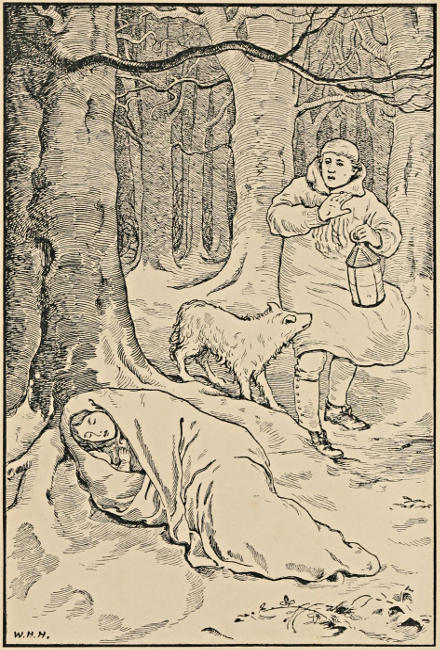
Look, there is a light in the wood; it is moving,
and now a heavy step, crushing the frozen snow;
it is a countryman, and he carries a horn
lantern.
A dog, a shepherd’s dog, runs by his side.
Will the man pass the tree?—yes he may but the
dog will not; see he is “pointing,” and now he
runs to his master, and takes hold of the skirts of
his smock.
“What have we here? S. Joseph help us! a
woman! Why mistress what doest thou here?
Get up, or thou wilt be frozen stiff and stark
before morning.”
Only a moan in answer: he stoops down and
gently, for a rustic, looks at her face; he does not
know her, but he sees by the dress and by something
indescribable in the face, that she is one of
“gentle blood.”
“Canst thou not move?”
Another moan.
He strives to raise her, and the dog looks
wistfully on, as if in full sympathy. Thy canine
heart, poor Tray, is softer than that of the men
who drove her forth to-night.
Ah, that is right; she takes courage, strives to
rise,—no, she is down again.
“I cannot,” she says, “my limbs are frozen;
take the child, save my Cuthbert.”
“I would fain save you both,” says the man, but
he strives in vain to do so, it is beyond his power
to carry them, and she can move no further; she
but rises to sink again on the bank, her limbs
have lost their power.
“Take my child,” she says once more, “and
leave me to die; heaven is kinder than man, and
the good angels are very near.”
The yeoman, for such he is, hesitates, “No one
shall say that Giles Hodge forsook thee in thy
strait, yet, there is the keeper’s cottage within a
mile, if I run and take the babe, I may come back
and save thee.”
“Go, go, for heaven’s sake, my boy must live,
his precious life must be saved, then come back for
me; he is the heir of”—
Here her voice failed her.
“She speaks the words of wisdom,” says Giles,
and he takes the babe, leaving the shawl wrapped
round the mother.
“Nay, the shawl, take the shawl for the
babe.”
“I can carry it ’neath my smock, and ’twill
come to no harm, thou wouldst die without it.”
She starts up, imprints one fervent kiss upon
the babe ere it leaves her; alas, it is the last feeble
outcome of strength.
Giles runs along the road, as fast as the ground,
heavy with snow, and the wind, will permit him;
he reaches the house of Stephen Ringwood, the
deputy keeper; it is now Curfew time, and the
honest woodman is just putting out his fire to go
to bed.
“Stephen, Stephen,” shouts Giles, as he knocks
at the door.
A loud and heavy barking from the throats of
deep-chested dogs.
“Who is there?”
“Thy old crony, Giles Hodge; open to me at
once.”
The door opens. “What Saint has sent thee
here! and a babe too?”
“Oh, Stephen, come directly, and help me
bring the mother in; she is out in the snow, spent
with toil, and if we arrive not soon she will be
dead.”
“I have some warm milk on the fire; here,
Susan, give some to the babe and give me the
rest,” and putting it into a horn, the two started
back, leaving the infant with the keeper’s wife.
They reach the tree again.
How still she is.
Giles trembles, bless his tender heart. It is no
discredit to thy manhood, Giles.
“Yes, she is dead, she has given her last kiss to
the babe.”
They put together some short poles and cord
they have brought, which make a sort of litter.
“Carry her gently, Stephen,” says Giles as he
wipes his eyes with the sleeves of his smock,
“carry her gently, she said the good angels were
near her, and I believe they are watching us now,
if they are not on the road to paradise with her
soul.”
It was the All-Hallow Even of the
year 1538, and the first Evensong
of the festival of All Saints had
been sung, in the noble Abbey
Church of Glastonbury, with all
those solemn accessories, which gave such dignity,
yet such mystery, to the services of the mediæval
Church of England.
The air was yet redolent with the breath of
incense, the solemn notes of the Gregorian
psalmody yet seemed to echo through the lofty
aisles, as the long procession of the Benedictine
brethren left the choir, and passed in procession
down the church, the Abbot in his gorgeous robes
closing the procession.
A noble looking old man was he, that Richard
Whiting,—last and not least of the hundred
mitred Abbots who had filled that seat of honour
and dignity since the first conversion of England.
A face full of sweet benignity—one which inspired
reverence while it commanded love. His life had
been distinguished throughout by the virtues
which had ever found congenial home at Glastonbury—piety
towards God, and love towards man.
And now the lay congregation who filled the
noble nave and aisles, beyond the transept, were
leaving the church; the lights were slowly
extinguished, and the gloom of the wintry evening
was filling the church, save where the one solitary
light burnt all night before the high altar.
In the porch, after the doors were closed, stood
the sacristan and a young acolyte—one of the
choristers, for since a large school was attached
to the monastery, they had the assistance of a
youthful choir. It was a bright happy face, that
of the boy, upon which the moon shone brightly,
as he bade “good night” to the sacristan—saying
that he had leave to spend the evening at home,
and should not return till morning—then passed
with light footsteps through the Abbey precincts,
and then across a green, to some distant cottages
which skirted the common land. Let us describe
him more fully. He was somewhat sunburnt in
complexion, with brown hair, and had those
blue eyes, beneath long dark eye-brows, which
give a sort of dreamy expression to the face,
but the features were redeemed from the charge
of effeminacy by the bold open brow, the firm
thin lips, and by the nose which was slightly
aquiline.
His dress was studiously simple, yet very
unlike that of modern days, but if my youthful
readers have ever met a “blue coat boy” they
will have no difficulty in picturing the attire of the
period. To sum up, he was a lad whose appearance
inspired interest, as we hope his fortunes, to
be herein depicted, will do, for they were passing
strange.
It was a picturesque house before which he
stopped—a cottage overgrown with ivy, not
unlike those cottages, now alas fast vanishing,
which may be met in many an Oxfordshire
village—and which strolling artists delight to
paint, lovely to look at, but not so comfortable,
it may be, as the new style of brick and slate
tenements, which painters would disdain to
transfer to canvas.
The fire within shone brightly through the
windows, and the flickering light made the heart
of Cuthbert, for such was his name, leap with the
anticipation of the joys of the ingle-nook,—the
endearments of home.
He lifted the latch without knocking, and
entered; an aged man and woman sat by the
fire, a comely old couple, who were eager, in spite
of their infirmities, to greet the darling of their
old age.
And was not there a meal spread on the table
near the fire? It was not “tea,” that beverage was
yet unknown, but there was plenty to tempt a
boy’s appetite, and the frosty air had sharpened
Cuthbert’s.
And when it was over, and the old man sat in
his high-backed arm-chair, the grandmother went
out and the lad went into the “chimney corner” to
his favourite seat.
“Chimney corner!” what a nook of delight on
the winter’s evening, when the snow-flakes steal
gently down the chimney and hiss as they meet
the blazing logs! Well does the writer remember
filling such a seat many winters ago.
“Grandfather, do you remember that this
night is Hallow-e’en, when all the ghosts are
abroad? I want you to tell me something about
them—the old tales which used to make my flesh
creep when I was younger.”
“Why, boy, it is thought to be a night when
the dead can’t rest quiet in their graves, though
why they should not rest on a holy night like this
I can hardly tell.”
“Did you ever see a ghost? Oh, here is
grandmother with nuts, apples, and ale! Why
do we always eat nuts and apples on Hallow-e’en?”
“They always have been eaten to-night, that is
all I know; sometimes they tie up an apple with a
string to the beam, and when they have tied the
hands, set the young ones to eat it with the help of
their teeth only—catch who catch can.”
“And about the nuts?”
“Oh, lads and maidens who are in love with
each other will take two nuts, and call them lad
and lass: if they burn quietly together they
conclude that they will have a happy wedded life,
but if lad or lass bounce out of the fire, that there
will be strife and quarrels between them, in which
case, dear boy, I think they had better not go
together to the altar; better live apart than have
nought but strife and quarrels.”[4]
“But I wanted to ask you about something more
wonderful than this; the boys were saying, when
we were talking about Hallow-e’en in the
cloisters, that if you went into the church porch
at midnight, you would see the fetches[5] of all the
folk who are to die this year come and choose the
place for their graves.”
“I have heard the tale, and don’t believe it; it
is all nonsense, my boy.”
“Anyhow I promised that I would go and see to-night.”
“Nay, my child, you must be in bed and asleep
at midnight, and I do not think you would dare to
try.”
“That is what they said, the other boys I mean,
and they dared me to go.”
“I don’t think you would catch a ghost, but I
think you would catch your death of cold, it is
freezing sharply to-night.”
Cuthbert thought it best to drop the subject,
lest he should be forbidden to make the adventure,
upon which he had set his heart, not without
some trepidation, but still with the longing to be
the hero of the occasion, who should test the
truth of the legend—for he had bound himself to
his schoolfellows to make the experiment, and
there was much speculation as to the probable
results.
After a very pleasant evening the hour of bed-time
approached. Our ancestors thought Curfew
(8 p.m.) the proper time for retiring, and nine was
looked upon as a very late hour.
So, soon after Curfew had rung from the tower
of the Abbey, the embers of the fire were “raked
out,” and the old couple retired to their rooms,
after seeing Cuthbert safe in his little chamber,
which opened upon the roof.
The rudeness of the furniture in those days has
been somewhat exaggerated by modern writers;
indeed we are apt to conclude, because in this
nineteenth century such progress has been made
in the arts of civilization as puts us quite upon a
different footing from our grandfathers, that a
similar difference existed between those grandfathers
themselves and their ancestors. But it was
not so, there was scant difference between the
sixteenth and eighteenth centuries in this
respect.
So in Cuthbert’s room there was a comfortable
bed, on a carved wooden bedstead, a chair, a table,
a chest for clothes, and the like, much as in the
present day.[6]
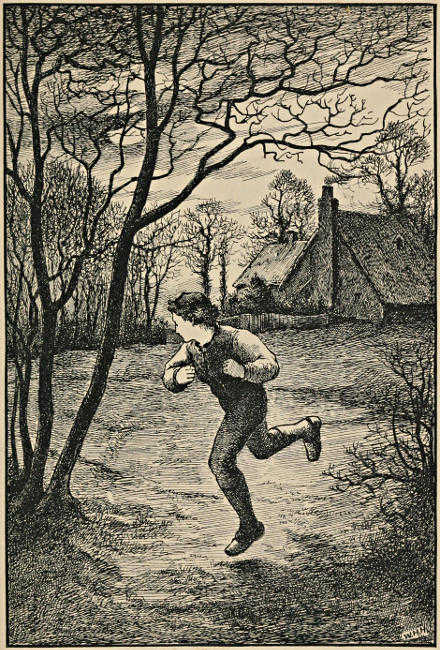
The lad did not undress, but, after he had said
his prayers, lay down on the bed in his clothes,
and did what he could to keep himself awake, till
the time came for his adventure.
He counted the hours as the Abbey clock struck,
until eleven boomed forth, when he rose, put on
his doublet, opened the door, and went very
softly down stairs.
He listened at his grandfather’s room as he
went by—they were fast asleep, he heard their
breathing. He descended to the “living” room,
opened the outer door carefully, and stole forth.
Once on the green, the freshness of the air and
the bright moonlight revived him; he felt his
spirits rise in spite of the involuntary chill which
now and then crept over him.
He reached the grave-yard of the parish church,
for this had been selected as the scene of the
experiment, since the monks would be singing
the night office in the Abbey.
And as he went through the church-yard to the
porch, he could not help looking timorously from
side to side, it seemed so strange to be alone with
the dead, when the living were asleep; he was
glad to get inside, the shadows of the yew trees
looked so ghastly on the cold graves, and the chill
moon looked upon the last low resting places
with such a ghostly light.
He tried the door of the church; it was locked,
as usual at that hour.
There was a broad bench on each side the
porch; he sat and waited.
And I think he fell asleep and dreamt, but this
was the story he told.
When the clock tolled the hour of midnight the
last sound of the bell was prolonged, as if the
organ in its softest tones had taken up the note;
the music grew louder, until the introit of the
Mass for the dead pealed out distinctly.
“Requiem æternam dona eis Domine, et lux
perpetua luceat eis.”
Then as he started up in amazement, the door
swung open, and the “fetches or doubles” of those
who were to die that year, that is, their ghostly
likenesses, came out to seek their graves.
And there were many whom the boy knew, but
last of all came out from the church the form of
his benefactor, Richard Whiting, Lord Abbot of
Glastonbury.
And around his neck there hung a ghastly cord,
and close by his side followed Prior and Sub-Prior,
and cords were about their necks too.
Then the boy grew faint, and knew no more till
he awoke, or recovered from his faint, whichever
it was, and returning home, undressed, shivering
as he did so, and went to bed.
When he afterwards told this tale, there were
many who refused to believe that he had ever left
his bed, and always insisted that he had dreamt
the scene in the porch.
But if it was a dream, it was not without
inspiration.
[6] An ancient inventory of the furniture of such a house lies
before the writer as he pens these lines.
Three centuries and more have
rolled away since the dissolution
of the monasteries, which once
rose in architectural beauty in
each district of mediæval England,
gladdening the eye of the wayfarer with the
assurance of hospitality, and of the poor with
that of help and protection.
Their pious founders built in marble—
“Built as they
Who hoped those stones should see the day
When Christ should come; and that those walls
Might stand o’er them till judgment calls.”
Alas! for such hopes; the tyrant Tudor, taking
advantage of the palpable declension of the
inmates from their first love, levelled them with
the ground, and left the country shorn of such
glorious fanes as arose over the conquerors at
Battle, or the tombs of the mighty dead at
Glastonbury. Yet still they had welcomed the
wayfarer and the stranger, tended the sick, taught
the young, found labour for the poor, were good
masters to their tenants, built bridges, made
roads, and were the centres of civilization in their
several districts.
Two rebellions ruthlessly extinguished in blood—the
pilgrimage of grace, and the later rising in
Devon and Cornwall—testified to the popular
sense of loss when the servile courtier, ever the
tyrant at home, had succeeded to the gentle old
monks.
For all that is now done for the poor, and too
often in a wooden kind of way by workhouses,
hospitals, and the like, was then done by the
monasteries, and their suppression was a cruel
wrong to the poor.
Reformed, they needed to be, or they had never
fallen, but that the treasures given by their
founders in trust for God and His poor should
pass into the hands of Henry’s fawning courtiers
was too monstrous an iniquity.
The legendary history of Glastonbury has been
told by the author before,[7] its supposed foundation
by S. Joseph of Arimathæa, devoutly believed
in in that credulous age, and the holy thorn-tree
which blossomed from the staff which he there
struck into the ground; there King Arthur was
buried, and his body found after the lapse of
ages; there, like a city set on a hill, the lamp of
faith had been kept burning for forty generations,
if alas, tarnished (which we sadly own) by superstition
and credulity.
Amongst other good works, they educated the
young of Christ’s flock, for at Glastonbury there
was a school of two or three hundred boys, who
were taught by the learned Benedictines of the
Abbey; for the Benedictines were the scholars of
the day.
The discipline was somewhat severe, and the
life hard, as modern boys would think it.
The hour of rising, summer or winter, was four;
they breakfasted at five, after the service of Lauds
in the chapel, upon beef and beer on ordinary
days, and on a dish of sprats or herrings instead
of meat on fast days.
Then to their lessons, and we shall grieve our
younger readers when we tell that Solomon was
held in much respect, and therefore the rod was
freely used in case of idleness or insubordination;
but of the latter there was very little under
monastic discipline.
There was a short space for recreation before
the chapter Mass at nine o’clock, which all
attended, after which work was resumed until
Sext, which was followed by a simple but hearty
dinner.
There was again another period of work in the
afternoon, after Nones, but as it was necessary
that the boys should not be behind the world in
physical prowess, ample leisure was afforded for
exercise and rough sports.
Modern schoolboys complain of compulsory
football; their remote ancestors had little choice
in such matters, whether schoolboys or rustic lads
on the village green. By Act of Parliament,
tutors in the one case, or magistrates in the other,
were bound to see that the lads under their jurisdiction,
omitting idle sports, did exercise themselves
in archery, the broad-sword exercise, the
tilt yard, and such-like martial pastimes.
Fighting, or mock-fighting—and the imitation
was not altogether unlike the reality—was alike
the amusement and the chief accomplishment of
life, especially in England, which had then, not
without cause, the reputation of being the
“fiercest nation in Europe.” “English wild
beasts,” an Italian writer calls them, yet who
would not prefer the manly and honest Englishman
to the Italian of the day, with his poisoners
and bravoes?
And our readers must imagine how the
Glastonbury boys were excited by such stories
as that of the four hundred London apprentices,
who went out as volunteers to the garrison of
Calais, and kept all the neighbouring districts of
France in terror, until they were overwhelmed by
six times their number, and died fighting with
careless desperation to the last.
So, even in the calm atmosphere of a monastery
school, the world intruded.
As for their book-lore, they learned Latin
practically, for they were forced to use it during
a great part of the day in conversation, while they
read daily in the Fathers and classical authors.
Fabyan’s Chronicles and other old English historians
supplied their history, and they were
fairly instructed in the rudiments of mathematics.
Altogether it was a sound education which the
monastic school supplied.
We will now proceed with our story, after a
digression which may be easily omitted by those
who dislike to understand what they read.
The reader has, we doubt not, already identified
the hero of the midnight adventure in the church
porch, with the babe of our prologue.
Honest old Giles Hodge had told the whole
story to the Abbot, within whose jurisdiction the
babe was found, and with whom he sought an
early interview. Strict search had been made
after the surviving parent, if perchance there was
one upon whom that epithet could be bestowed.
But no trace was found; only the delicate
apparel of the lady, and the fine linen in which
the child was wrapped, led to the conclusion that
they were members of some “gentle house.”
Upon the linen there were marks: a crest which
had been picked out, and two initials yet remaining,
“C. R.”
“The poor little foundling shall be our care,”
said the good Abbot, “but here alack, we have no
nursery, and your good wife, who has so recently
lost her own babe, must be his foster mother if
she be willing. I will provide for his maintenance
hereafter, whether in the cloister or the world,
unless his friends claim him.”
“And what name shall we give him, your
reverence?”
“Let me see, C must be his Christian name; let
us call him Cuthbert, better patron than S. Cuthbert
he could not have; the R must yet be a
mystery—he will not need two names yet.”
So the years rolled by; Cuthbert grew up
strong and hearty, but no one ever came to claim
him. And he was still known only by one name, a
peculiarity little commented upon where his story
was so well known.
He grew up a general favourite, especially, it
was supposed, with the Abbot; and yet the self-restrained
austere old man showed little traces of
such weakness, save to very observant eyes.
He loved the young, one and all, and often
visited the school. He knew every face there,
and it was a great delight to him to watch them
at their sports, perhaps recalling his own younger
days, when Henry the Seventh was King.
In time little Cuthbert was chosen to be a
chorister, and soon afterwards, by the Abbot’s desire,
he was made an “acolyte,”—one who served
at the altar,—and there his reverent and unassuming
demeanour won him yet further regard.
But my readers must not think him the least bit
of a milksop; they know, I trust, that the bravest
lad is he who fears God, and fears nought besides.
Cuthbert was not one of those lads who talked
much about religion, if there were such then, nor
again one who courted notice by obtrusive acts of
devotion—his religion was of a manlier type.
And meanwhile, as we shall show, he gained
the respect of his companions by his proficiency
in manly sports and exercises; he was one of the
best archers, one of the best at fencing and sword
play; in the tilt yard he was always up to the
mark. In the same way some of the best boys I
remember at a certain school were conspicuous at
football and cricket, the modern equivalents.
It was a fine evening in May, and all the lads of
Glastonbury School were in the archery ground.
A silver arrow had to be contended for as a prize—the
prize of the year—and there were many
competitors.
All Glastonbury looked on at the sport; many
were there who had been great archers themselves
in their youth, and who, like Nestor of old, were
never tired of talking of the great things that had
been done when they were young.
For full two hundred years had gunpowder been
in common use, yet all that time the bow held its
own; an arrow would fly much farther than the
bullets of that day, nay of much later days, for it
was actually ordered by Act of Parliament, in the
directions to the villages, for the maintenance of
“buttes,” that no person of full age should shoot
with the light-flight arrow at a less distance than
two hundred and twenty yards, that is a whole
furlong: under that distance the heavy war arrow
had to be used in all trials of skill.[8]
And now four lads of fourteen stand forth to
contend for the prize; the target is a furlong off,
the arrows, light ones, in regard to the age of the
competitors.
We will introduce them to our readers in proper
order.
There stands Gregory Bell, son of the squire of
a neighbouring village, tall and slim, but tough
in muscle, and very sound in wind and limb; his
round face and laughing black eyes will be remembered
many a day. His long-bow is long
indeed,—three fingers thick, and six feet long, well
got up, polished, and without knots; few English
boys could bend it now, it came of practice.
He draws the bow—the light arrow cleaves the
air—he has struck the first circle of blue, not the
bull’s-eye itself—a cheer from his schoolfellows.
“Well done, Gregory, well done, old fellow.”
“The lad will do well enough,” said an old
bowman, “yet not like his father; but where be
the bowmen of Crecy now? At the last bout we
had with them, the French turned their backs
upon us at long range, and bid us shoot, whereas
had we been the men our sires were, they would
have paid dearly for their fool-hardy challenge.”
Then stood up Adam Banister, a round thick-set
youth, with brown hair and rosy face.
“Good luck to thee, Banister,” was the cry.
How easily he drew his ponderous bow: the
arrow whizzed—alas, only the second circle was
attained.
And now the third champion.
It is Nicholas Grabber. Let our readers mark
him, he will often figure in these pages.
A lad of average height, with a head of very
bright red hair, which seems positively to shine;
his face is deeply freckled, but his appearance not
altogether unprepossessing, save for a certain
expression of slyness which would indicate a mixture
of the fox in his character; those who
believed in the transmigration of souls might
recognize the retriever in Gregory, the bull in
Banister, the fox in Grabber, and—well we will
leave them to designate the fourth after reading
his history, for it was Cuthbert.
One after the other they discharge their arrows;
the first shaft strikes the bull’s-eye, but amid
shouts of admiration, the second, that of Cuthbert,
pierces as near the centre.
“Hurrah!” “Grabber!” “Cuthbert!” and
the names were repeated again and again by the
crowd.
“Move the target fifty yards further, and let
them shoot yet again.”
They were rivals, these two boys, and not such
good friends as they should have been. Grabber
envied Cuthbert his place in the Abbot’s favour,
which he had utterly failed to attain; for had he
not run away, and had not his father sent him
back to school, coupled between two foxhounds,
under the charge of the huntsman, a story never
forgotten by his schoolfellows.[9] However, he was
a good shot, a ringleader in boyish mischief, and
not without his friends.
Again the arrows flew, but at this distance
Grabber failed the bull’s-eye, just alighting on the
rim.
A few moments of breathless anticipation, and
Cuthbert’s shaft, soaring through the air, attains
the very centre, amidst shouts of wonder and
admiration.[10]
Grabber turned away disgusted, as Cuthbert
advanced to receive the silver arrow from the
chief forester, who superintended the “buttes.”
Then rang out the Abbey bell for Compline, and
the field was deserted to the townsfolk, who kept
up the pastimes of archery, cudgel playing, bowls,
and the like, till darkness set in.
[7] See “Edwy the Fair,” and “Alfgar the Dane,” by the
same author.
[8] Froude, vol. I, p. 67. He well observes that he could
hardly believe the figures from his experience of modern
archery, but such was the Act 33, Henry VIII., cap. 9.
[10] A far more remarkable instance of English archery is given
in Scott’s “Anne of Geirstein.”
The Compline service was over,
and the lads, many of whom slept
in the abbey, while others lodged
in the town, were retiring to their
beds, when a lay brother arrested
Cuthbert’s progress, and said in a low voice,
“The Abbot requires thy presence.”
Somewhat startled,—for the summons was an
unusual one at that hour, although he often acted
in turn with other lads as a page-in-waiting on
the Abbot, an office none would then despise,—Cuthbert
followed the laic.
Threading various passages, they reached the
Abbot’s lodgings, and there the messenger knocked
and retired, leaving Cuthbert to obey the summons,
“Enter.”
Richard Whiting, the last of that long line of
mitred Abbots, sat near the window of his study,
which was a plainly furnished room, simple as
the personal tastes of the Abbot.
He was now but a weak and infirm old man,
yet of many good brethren the best;—“small in
stature, in figure venerable, in countenance dignified,
in manner most modest, in eloquence most
sweet, in chastity without stain; not without that
austerity of expression which we often notice in
the portraits of these great mediæval ecclesiastics.”
“My son,” he said, “I have somewhat to say
to thee ere perchance I be taken from thee.”
“Taken from me, Father?”
“Yes, the clouds are gathering thick around
our devoted house, and the shelter thou hast long
received may fail thee and all others here, ere
long.”
Cuthbert looked amazed.
“Tidings have reached me, my child, that
I must be taken to London, there to answer to
certain treasons of which they falsely accuse me;
the bolt may fall at any moment, and I have to
discharge two duties, the first towards thee.”
The Abbot took up a little chest from the
sideboard.
“Thou hast long been my son, and hast not
needed thy natural parents, but dost thou not
oftentimes wonder who they were?”
“They come to me in dreams.”
“And as yet only in dreams, my child; perchance
thou art an orphan, but in that chest are
the few relics of thy poor mother, which we
possess; these are the little clothes which swathed
thee when thou wast found in Avalon forest—there
a ring which encircled thy mother’s finger,
and a full description of the circumstances of
thy arrival here.”
“But what use would they be to me didst thou
leave me alone in the world, Father?”
“Thou wilt never be alone, God will be ever
with thee, He is the Father of the fatherless;
should aught happen to drive thee hence, thee
and others, take refuge with thy foster-parents
until one seek thee, bearing this ring which thou
seest on my finger, to him thou mayest safely
commit thyself, and the secrets I am about to
entrust thee for him.”
Here the tapestry moved in the wind, and
a knock was heard at the door, which stood ajar;
a fact the Abbot had not noticed.
To Cuthbert’s surprise there stood Nicholas
Grabber.
“Quid vis fili?” was the Abbot’s interrogation.
“The lay brother Francis said that thou
wantedst me.”
“It was an error, I sent for Cuthbert, and he
is here. Pax tecum, go to rest.”
“My son,” said the Abbot, when Grabber was
gone, “I am about to reveal to thee a mystery
which thou alone mayest share, until the friend
I have mentioned seeks thee, and presents thee
with this ring, which thou now seest on my finger;
it will not be till I am gone.”
Cuthbert felt his spirits sink within him at the
sad words of his protector, but he restrained
himself, and listened reverently as to the words
of a saint.
“Shut the door carefully, and draw the bolt.”
Cuthbert did so.
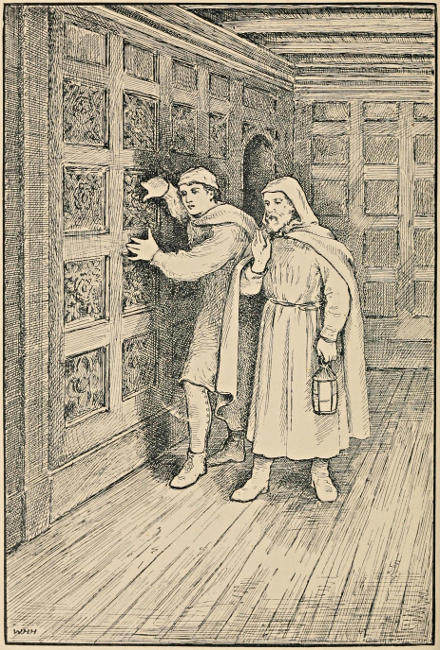
“Now touch the rose which thou seest in the
carving of the cornice there, the fourth rose in
order from the door, and the third from the floor.”
The wainscotting of the room was divided into
small squares; in each one a rose—S. Joseph’s
rose—formed the centre.
“The third and the fourth, canst thou remember?”
“Third from the floor, fourth from the door.”
“Now press the centre of the bud sharply with
thy thumb.”
Cuthbert did so, and a bookcase, which seemed
a fixture in the wall, and which none could have
suspected to have been aught but a fixture, flew
open in the manner of a door, and revealed a
flight of circular steps, such steps as we see in old
towers to this day.
“Follow me,” said the Abbot, as he took a lamp
and descended the steps.
Thirty steps down, and as the Abbot’s room
was on the ground-floor, they must have been
below the foundations of the Abbey when they
came upon a solid iron door; the Abbot touched
a spring, bidding Cuthbert observe the manner
in which it worked, and entered.
“Fasten the door carefully back by this stay,”
said the Abbot, “for should it sway to, we are
dead men; the lock is a spring lock, and opens
only from the outside, nor is there other exit save
into the vaults of the dead. Dost thou see this
chest? Here is the key, open it.”
Cuthbert turned the lock, raised the ponderous
lid, and let it rest against the wall behind, then
gazed upon the contents.
There were the most precious jewels of the
Abbey, gemmed reliquaries, golden and jewelled
pixes, chalices of solid gold, coined money, and
the like, but beyond all this enormous wealth
were rolls of parchment, and bundles of letters.
“My son, I have marked in thee from childhood
a nature free from guile, and incapable of
treachery, therefore do I place this confidence
in thee. Those golden and jewelled treasures are
not the most important things in the chest, but
the parchments, the letters. They contain secrets,
which, if made known, might cost many lives—lives
of some of the truest patriots and most
faithful sons of Holy Church.[11] I need not detail
their nature to thee, nor why I may not destroy
them now. The secret thou hast learned is not
for thee, thou wilt keep it until the arrival of the
hour and the man.”
“His name?”
“I will but tell thee this much, he will be
known to thee as the Father Ambrose.”
“Have I never yet met him?”
“Never, he has lived abroad; and now, my
child, I will tell thee why I have chosen thee
for the repository of this secret. He, who will
be thy guardian and guide, when I am no more,
who has undertaken the care of thy future, will
also share alone with thee this knowledge.
Ordinarily it has been confined to the Abbot,
Prior, and Sub-Prior of this Abbey, and by
them handed down to their successors. They
share my danger, and may not survive me;
otherwise they may be taken when inquisition is
made for these papers, and put to torture to
make them declare the hiding-place, and the
like danger would hang over all high in office,
but not, I trust, over one so young as thou art.
Therefore thou must live quietly at thy stepfather’s
home, until the day come when thy
future guardian shall arrive, and may He, Who
is the Father of the orphan, ever guard thee, my
Cuthbert. But let us hasten to leave these
vaults; I am old, and the damp air affects my
aged breath.”
No event of importance followed immediately
upon the disclosure of
the secret chamber;—the summer
passed swiftly and pleasantly
away, the orchards were already
laden with the golden riches of autumn, ere the
bolt, so long foreseen, fell.
We can hardly, ourselves, enter into the difficulties
and trials which beset the Abbot of
Glastonbury. We are accustomed to the spectacle
of a Church, divided, at least externally, but
to men who had grown up with the belief, that
outward unity was essential to the preservation of
Christianity, the absolute command to abjure
the Papal Supremacy, to break off all relations
with Rome, and acknowledge the King as the
“Head of the Church of England,” was a matter
of life or death.
So Sir Thomas More and Bishop Fisher, not to
mention hosts of others, died sooner than comply,
while the more timid, shocked at the scandal, for
such it was to them, gave outward obedience, and
in their hearts prayed fervently that “this tyranny
might be over past.”
Let it not, however, be inferred that therefore
they were right in contending for the
supremacy of Rome, only in the right, inasmuch
as it is far nobler to die, than to deny one’s belief,
or to swear falsely to what one does not believe in
one’s heart.
And so while we reject their teaching on this
point, we can feel the deepest sympathy with the
sufferings of these noble, yet mistaken souls.
On the first visitation of his monastery, three
years previously, the Abbot had taken the Oath
of Supremacy, feeling that it was not a cause for
which a man was bound to die, but he had never
been a happy man since, he was too old to change
his convictions. Therefore he absented himself
from the place in Parliament, which was his as a
mitred Abbot, who was ranked as the equal of
a Bishop, and strove to hide his sorrows in
obscurity. No fault was then alleged against
him, the earlier visitors reported that his house
was, and had long been, “full honourable.”
But the eye of the “Malleus Monachorum,”
the arch enemy of the monks, Thomas Cromwell,
was upon him, and at last this vigilant enemy,
equally cruel and unscrupulous, found the pretext
he desired, for sending the Abbot of Glastonbury,
as also the Abbots of Reading and Colchester to
the gibbet and the quartering block. Most of
the Abbots had been led to save themselves by a
voluntary surrender of their house and estates;
those who did not thus bend to the storm, had to
be destroyed on one pretence or another.
It was the sixteenth Sunday after Trinity, in
the year of grace 1539.
The day was a bright day of early autumn, one
of those sweet balmy days, when summer seems
to put out all her parting beauties ere she yields
her dominion to winter,—the air was laden with
fragrance, and there was a dreamy haze upon
the scenery around, which seemed typical of
heavenly peace.
But there was a sad despondent feeling, which
weighed like lead, upon the hearts of all the
elders present at the High Mass on that day,
in the great Abbey Church, whose majestic ruins
yet strike the beholder with awe.
After the Creed, the Abbot ascended the pulpit
and gazed round upon the congregation, as upon
those to whom he was about to preach for the
last time; he took for his text the parting words
of S. Paul at Miletus,—“And now behold, I
know that ye all, among whom I have gone
preaching the kingdom of God, shall see my face
no more.”
As he uttered the words there was an audible
expression of feeling on the part of the monks in
the choir, the boys in the transepts, and the
citizens in the spacious nave: was the text prophetical?
One or two sobs might be heard.
Danger was at hand, and he knew it, and after
a brief exordium he told it out plainly: the Royal
Commissioners, with charge to bring him before
the Council, were already on their way.
“Very sorry am I,” said he, “for you, my
brethren, and especially my younger friends, of
whom I see so many around. They will destroy
this House of God, as they have so many others,
they will spare you in the flesh, but if you are
taken hence, and sent into a cold-hearted and
wicked world, for which you are unfitted, having
begun in the spirit, ye may be consumed in the
flesh, and what shall I say, or what shall I do, if I
cannot save those whom God has entrusted to
my charge?”
Here a common utterance broke forth from the
brethren which could not be suppressed.
“Let us die together in our integrity, and
heaven and earth shall witness for us how
unjustly we be cut off.”
“Would that it might be even so,” continued
the preacher, “that so dying we might pass in a
body to our Father’s home above, but they will
not do us so great a kindness. Me and the elder
brethren they may indeed kill, but you who are
younger will be sent back into the world ye have
once forsaken, where divers temptations assail
you. Alas, who is sufficient for these things?”
Here he paused, and then continued, “This
may be the last time we meet within these sacred
walls: the last time that they re-echo the tone of
thanksgiving, which has arisen for nigh fifteen
centuries on this spot.[12] But it is meet that we
prepare for the stroke, and that we may do
so the better, let us ask pardon for all the faults
we may have committed against each other, and
let each forgive, that so we may say the divine
prayer, ‘Forgive us our trespasses, as we forgive
them that trespass against us.’”
A solemn pause followed, during which there
came a strange interruption, a sweet soft sound
as of angels’ voices singing in harmony: not
from the organ came that strange music, nor from
any visible orchestra, but all felt it as it thrilled
into their hearts. The venerable preacher was so
moved that he sank down in tears, and for a long
time could not resume his discourse, while all in
the choir sat as if astonished, yet rejoicing in the
token, as they believed it was, of God’s presence
amongst them.
And the burden of the song seemed, “O rest in
the Lord, wait patiently on Him.”
That sermon ended in broken words of faith,
love, and hope—words of deep emotion never
forgotten by any present—and then the Celebration
proceeded, with its stores of rich comfort and
celestial joy.[13]
The following day the Abbot left early in the
morning for a small country house belonging to
the Abbey about a mile-and-a-half away. This
he did that the scandal of an open arrest, and a
probable conflict, might be averted, for he felt
that his people might not peacefully bear the
spectacle of their venerated Father led away like a
criminal.
But he made no concealment of his retreat, so
when the Commissioners arrived, later in the
morning, they had no difficulty in learning the
place, and they followed him to the country house.
In an old oak-panelled apartment sat the once
powerful Abbot, writing calmly a few parting
directions, chiefly concerning the disposal of such
personal property as might serve as mementoes to
those who loved him, when they should see his
face no more.
He was calm and resigned, although once, as
he wrote, tears issued from fountains which had
been long dry, and rolled down his aged and
worn cheek,—he was but human.
In the window seat, his eyes fixed upon the
road which led from the Abbey, sat Cuthbert.
Suddenly he rose hastily.
“Father,” he said, “they are coming; a number
of mounted men are in sight, wilt thou not fly?
We may yet hide thee, they will be ten minutes
ere they arrive; fly for our sakes, for my sake—thy
adopted child.”
“My son, I cannot; life has little yet to tempt
me, and far better for me that I should bear
witness to my faith with my blood, and receive
the martyr’s palm which God hath already
granted to many of my brethren, than live a
few more miserable years, and see the wild boar
rooting up the vineyard of the Lord, and the
beasts of the field devouring it.”
After a pause he continued,—
“Dost thou see them plainly? Who is their
guide?”
“Shame upon him, it is Nicholas Grabber;
rather should they have cut my feet off than have
forced me to do the like.”
“Nay, my child, I left word where I was, and
strict directions that no concealment should be
attempted.”
“Yet some other guide were more fitting than
one of thine own children, shame upon him. Oh,
my more than father, do fly; they will drag thee to
a shameful death, like thy brethren of Reading and
Abingdon. Is it not written, ‘When they persecute
you in one city flee ye into another?’”
“Too late, my son, they are at the gate.”
“We will hide thee; there must be some place
to hide in here, some secret chamber.”
“They are on the stairs, my son; do not let
them see thee weep, be manly.”
Cuthbert strove to repress his emotion and to
maintain outward composure, when the door
opened and three men entered, rude of aspect.
“My name is Layton,” said the foremost,
“and these two worthy men be Masters Pollard
and Moyle; we be pursuivants of the King, and in
his name, and by virtue of his warrant, we have
charge to arrest thee, unless thou clear thyself by
thy answers to certain questions.”
“What are they?” said the Abbot, calmly.
“Hast thou taken the Oath of Supremacy?”
“I have, to my great sorrow.”
“To his great sorrow, mark that, Master
Pollard; and why to thy great sorrow?”
“Because it was a treason to the Church.”
“Then thou wilt not renew it?”
“Never.”
“That is enough to hang thee, proud Abbot,
but thy talk interests me, and I would fain hear a
little more from thee; what dost thou think of the
King’s divorce?”
“I am not fain to answer thee on that matter.”
“But the law enables us to compel an answer
from every man, and construes silence as treason;
loyal men need not conceal their thoughts, and
there is no room in England for disloyalty.”[14]
“Construe my silence as treason if thou wilt, I
have naught to say on the matter.”
“There is something more for me to say. Dost
thou love life, Master Abbot? For if so, in spite
of thy treasons just uttered, thou mayst save it;
we know full well that the names of the men who
supplied money and arms for the late most unnatural
and parricidal rebellion in the north,
which men call the Pilgrimage of Grace, are
known to thee, only reveal the secret, and thou
art safe.”
“Get thee behind me, Satan; dost thou think I
would save my life at the expense of others, and
take reward to slay the innocent?”
The Abbot’s manner was so firm and decided,
the answer so bravely given, that the villain
started. “I will patter with thee no more, thou
hoary sinner,” he said at last; “thou hast the
papers concerning this rebellion concealed somewhere,
and we know it; we will pull thy Abbey
down, stone by stone, if we find them not: thy
answers are cankered and traitorous, and to the
Tower thou shalt go, the Tower of London. Ah,
who is that boy?”
“Thou mayst take me too,” said Cuthbert, as
he stood before them, emerging from the curtained
recess of the window with flashing eyes
and burning cheeks, “for all that the Lord
Abbot hath said, I say also.”
“Ah, thou young cockatrice, we see well what
a dam hath hatched thee—another treason to the
account of the wily priest here.”
“Cuthbert,” said the Abbot, “thou art running
into needless danger—God calls thee not to
suffer.”
“What is good for thee, Father, must be good
for me also.”
“We may as well take him up to town too,”
said Master Pollard.
“Nay, it is not our business,” said Layton; “if
we arrested every young fool this traitor hath
taught, we should go up to town with three
hundred boys behind us, and should need their
nurses to take care of them; the ground-ash were
fitter for this young master’s back, but we have
no time to waste on his folly, let us be moving, we
have to search the chambers at the Abbey, perchance
we may come across these papers.”
Need we say they searched in vain.
[12] The Abbot’s history is wrong, but he is under the belief
that Joseph of Arimathæa founded Glastonbury Abbey, or at
least first preached the Gospel on that spot.
[14] This was actually the case. Henry would not allow his
subjects the privilege of concealing their thoughts. It is
scarcely possible now, to believe the fact that the treason
statute touched the life and enacted the fearful penalties of
high treason against all who would not admit and assent in
words to the royal supremacy; it made it treason not
only to speak against the king’s prerogatives, but even to
“imagine” anything against them. “Malicious silence,”
which was assumed to imply such evil imaginations, was to be
interpreted as treason and punished by death. See Perry’s
History of English Church, p. 112-3.
The evening of Tuesday, the
twelfth of November, in the year
of grace fifteen hundred and
thirty-nine, was closing in.
The day had been very fine,
such a day as we sometimes enjoy, even in
November; the golden sunbeams had brightened
the foliage which yet hung upon many of the
trees of the forest, and turned the russet plumage
into gold. Now and then, in the calm atmosphere,
a leaf would flutter down, and break the
oppressive silence of the forest of Avalon.
It is broken more seriously; hark, that is the
tread of many feet, and those voices are the
voices of lads out for a day in the woods. See
here they come into this lonely haunt, where
no road or path exists, startling yon raven from
his perch; see how sulkily he flies away, as if to
say, “What right have these intruders here?”
A large chestnut-tree has dropped its fruit on
the ground, and amidst the dead leaves the lads
are searching, and loading their pockets with
the spoil; there are about twenty of them,
evidently a band of the Glastonbury boys, and
amidst them we recognise two old acquaintances,
Cuthbert and Nicholas Grabber.
“It is time to be moving,” says Cuthbert;
“we promised the Prior to be home in time
to sing vespers.”
“Sing vespers! how pious we are!” said
Nicholas, and the irreverent fellow clasped his
hands together affectedly, and began to chant in a
ridiculous voice the Psalm “Dixit Dominus.”
“Stop that,” said several voices at once, and
Nicholas obeyed, finding the general feeling was
against such mockery, as it ought to be with
sensible and manly boys.
“Well, thank God, there will not be many
more services in the Abbey; I am for freedom,
for shaking off the yoke of bondage under which
the old monks have kept us: those visitors
who have been taking an inventory of the goods
and chattels at the place, are only a token that
the end is near; and it can’t come too soon
for me.”[15]
“More shame for you to say so, after you
have been educated at the cost of the Abbey,
and eaten and drunk its fare for many years,”
said Cuthbert.
“And poor fare I have found it: I daresay
the Abbot’s favourites get better,” replied
Nicholas.
“‘Abbot’s favourites,’ what do you mean?”
said Cuthbert, colouring.
“Let those who find the cap fit, put it on.”
“He means it for you, Cuthbert,” said two
or three voices at once.
“I suppose one can’t help being liked,” said
Gregory Bell.
“Nay, but one should not curry favour at the
expense of others.”
“That isn’t fair,” cried Adam Banister; “no
one can say Cuthbert is a sneak.”
“Sneak! who guided the commissioners to
find the Abbot? that was the part of a sneak,”
said Cuthbert; “but I know one way in which
I could avoid favour; by running away from school
and being brought back tied between two foxhounds,
on all fours.”
A general burst of laughter, and then Nicholas
lost all self-control, and struck Cuthbert in the
face.
“A blow!” “A fair blow!” “A fight!”
“A fight!”
Yes, a fight was inevitable under the circumstances;
according to the moral (or immoral)
code of the fifteenth century, no one could
receive a blow from an equal without returning
it, unless he wished to be exiled from the society,
whether of boys or men. Nothing was clearer
to their eyes than that the duty of all good
Christians was to fight each other.
So the blow was returned, straight between the
eyes. But a fight was too good a thing to be
lost in that irregular manner: a ring was formed,
two seconds selected, Gregory Bell for Cuthbert,
and a cousin, like-minded with himself, for
Grabber.
Now we are not going to enter into the details
of the fight—those who like a scene of the kind
will find one well described in “Tom Brown’s
School Days,”—suffice it to say in this instance,
that the contest was long and desperate, not to
say bloody, and that in spite of Grabber’s greater
physical strength and weight, the skill and
endurance of Cuthbert gave him the advantage,
as indeed I think he deserved to have it.
So intent were the twenty lads upon the scene,
that they did not notice how the sun went down
amidst rising clouds, how the wind began to
sigh through the forest; darkness was gathering
over the spectators and combatants, who had
now fought many rounds, lasting nearly an hour,
when at last, to the great joy of many present,
Grabber, at the conclusion of a round, in which
he had exhausted all his strength, got a knock-down
blow, and was unable to “come up to
time,” so amidst deafening cheers, Cuthbert was
hailed as the victor.
He advanced to Grabber who was supported
on the knee of his second.
“Give me your hand, Nicholas, and let us
forgive and forget. I hope you are not much
hurt.”
Grabber sullenly refused.
“That shows a bad heart; a fellow should
never bear malice for a fair thrashing, one can
only do his best after all,” said Gregory.
And the majority shared his opinion.
“We must make haste out of the woods, or
we shall lose our way and be here all night.”
Three or four boys remained with Grabber,
for he was not without his sympathizers,—we are
sorry to say there are black sheep even in
the best schools,—and these would not leave
the spot with the rest, but said they could find
their own way home.
The others struck boldly towards the west,
which was easily distinguished, owing to the
reddened and angry clouds, which showed where
the monarch of the day had gone down.
But soon these also disappeared, and the road
was not yet attained; darkness fell upon the scene,
and the lads who were with Cuthbert wandered
about lost, utterly lost, until a distant light
gladdened their eager sight, and with a joyous
cry they bent their course towards it.
In a few minutes they emerged from the woods
on the high-road from London, where a well-known
inn, “The Cross Keys,” hung out a lamp
as a guide to travellers.
They all knew their way now, and would fain
have started home at once, only Cuthbert was
faint after his late exertions, and a cup of
“Malmsey” seemed the right thing.
“You had better let him have a good wash;
cold water will revive him, and remove the blood
from his face too,” said the landlord, who saw the
lad had been fighting, and a fight was too
common a thing, we are sorry to say, to excite
any further comment or enquiries, on his part.
So they adjourned to the pump, where, with
the help of a rough towel, Cuthbert soon made
himself presentable, although he still bore very
evident traces of the conflict.
This necessary task accomplished, the boys
entered the inn, ordinarily a forbidden place to
them, and the landlord brought a cup of wine
for Cuthbert.
But while they were there a body of armed men
entered the house.
They wore the uniform of the King’s guard:
there was no regular army in those days, every
man was a soldier in time of need, but there was
a small body of men kept about the King’s person,
who were sent from time to time on special
services, and were called the King’s “beef-eaters.”
And these were some of them.
“Landlord, bring us some mulled sack,” said
one who appeared to be their leader, “and tell us,
have you seen that fox the Abbot of Glastonbury
pass this way to-day on his road home?”
“He has not yet returned from London?”
“Nay, but he is on his way,—we have no
listening ears have we?” The boys were separated
by a partition. “Are you for Abbot or King?”
“I am a friend to the King.”
“Well said, so should every good Englishman
be; and we have charge to arrest this wily Abbot
on his return, as a foe to King Harry, and take
him to Wells to be tried for his life.”
“Has he not been tried and acquitted?”
“He has been solemnly condemned in a Court
where Thomas Cromwell sat as prosecutor, jury and
judge: but that is not quite the law, so he has been
dismissed home, and we have been sent by an after
thought to take him to Wells for a regular trial.”[16]
“On what charge?”
“Robbing the Abbey Church.”
“Good heavens!”
“Why, I thought thee a friend of the King.”
“So I am, but what can all this mean?”
“That he hid the Abbey plate, so that the
King’s visitors could not find it, when they wanted
to make an inventory, and confiscate patens and
chalices for the King’s use.”
“But it was his own.”
“Only in trust, you see.”
“Still he might hide it in trust for the Abbey,
that would not be robbery.”
“Friend, I should advise thee to consider it
robbery in these days; it is better for all men who
do not want their necks stretched to think as the
King and his minister, Thomas Cromwell, think;
don’t fear but we shall find men to bring him in
guilty.”
The poor inn-keeper was silent; perhaps he
remembered that one of his predecessors had been
hanged for saying he would make his son heir to
the “Crown,” meaning the “Crown Inn.”
The boys stole out unobserved.
“What shall we do?”
“Go and meet the Abbot and warn him, he will
pass Headly Cross.”
“But then we may but share his fate,” said
several.
“I shall go if I go alone,” said Cuthbert.
“And so shall I,” said Gregory Bell.
“Well, two are as good as the lot of us, and
better; more likely to pass unobserved,” said
Adam Banister; “the rest of us had better get
home, and tell the monks all we have heard and
seen.”
It was a wild place, Headly Cross, where two
woodland roads crossed each other. Report said
that a cruel murder had been committed there
years agone, and that the place was haunted;
every one believed in haunted places then.
But as there was a choice of routes, and the
Abbot might come either way, it was the right
thing to await him where the roads converged.
And there Cuthbert and Gregory waited all
alone, as the dark hours rolled away, until they
heard the “Angelus” ring from a distant tower,
and knew it was nine o’clock, when decent people,
in those days, went to bed.
The chime had hardly died away, when they
heard the tread of horses, and soon three riders
came in view in the dim light of the stars; and
the boys recognised the Abbot, with two attendants,
one his faithful serving man, the other a
stranger.
Cuthbert dashed forward. “My Lord Abbot,”
he said, “one moment, it is I, Cuthbert, and here
is Gregory Bell.”
“Cuthbert and Gregory Bell; why are you
here, boys?”
“We have heard a plot against you: men are
waiting at the ‘Cross Keys’ to arrest you, and
take you for trial at Wells; they say it will cost
your life.”
“On what charge?”
“Concealing the Abbey plate.”
The Abbot smiled sadly.
“My children,” he said, “this can hardly be
true, yet if it be as you say, I will not fly a jury of
my countrymen.”
“Neither could he,” said the stranger on his
left hand, “if he would; my duty is to see him safe
to Glastonbury, unless relieved beforehand by
royal authority.”
“You see, my Cuthbert and Gregory, that your
devotion is all in vain; neither would I avail
myself of it if I could. Mount on the pillion behind
me, Cuthbert; my good Ballard here will take
Gregory behind him, and you may return with us
to Glastonbury, if such return be permitted.”
“It never will be, never will be,” said Cuthbert,
with sinking heart.
And how that young heart beat, as they
approached the “Cross Keys,” and as a line of men,
forming across the road, stopped the cavalcade.
“My Lord Abbot, we arrest you in the King’s
name.”
“On what charge?”
“Robbery of the Abbey Church.”
“This is a base pretence, to deprive me of the
credit of martyrdom for my convictions: but
there was One who suffered more for me.”
And the Abbot yielded himself peacefully to
those who sought his life.
[15] Advantage was taken of the Abbot’s compulsory absence
to take the necessary steps for the dissolution of the
monastery. (Froude.)
[16] In some private memoranda of Thomas Cromwell, which
still exist in his own hand-writing, occur the words,—“Item.
The Abbot of Glaston to be tried at Glaston, and also to be
executed there with his accomplices.” The trial, however,
took place at Wells, the execution (a foregone conclusion) at
Glastonbury, as related in the story.
The period of English history of
which we are now writing has
been aptly called “The Reign of
Terror.” England under Thomas
Cromwell, and France under Robespierre,
were alike examples of the utter prostration
which may befall a mighty nation beneath
the sway of one ruthless intellect.
To make the King absolute, and himself to
rule through the King, was the one aim of the
man whom Fox, the Martyrologist, grotesquely
calls “The valiant soldier of Christ:”—for this
end he smote down the Church and the nobility:
Bishop Fisher and the Carthusians represented
the ecclesiastical world, the Courtenays and
the Poles the aristocracy, Sir Thomas More
the new-born culture of the time; and Cromwell
chose his victims from the noblest and the best.
The piety of Fisher, once the King’s tutor, to
whom his mother had committed her royal boy
on her death-bed, could not save him; nor his
learning, Sir Thomas More; nor her grey hairs,
the Countess of Salisbury. Spies were scattered
through the land; it was dangerous to speak
one’s mind in one’s own house; nay, the new
inquisition claimed empire over men’s thoughts;
we have seen that the concealment of one’s
sentiments was treason.
Will my more youthful readers wonder then that
men could be found to convict upon such charges
as those preferred against the aged Abbot of
Glastonbury? They need wonder at nothing
that occurred while Bloody Harry was King,
and Thomas Cromwell Prime Minister.
The juries themselves sat with a rope around
their necks; when the Prior and the chief
brethren of the Charter-house waited upon
Cromwell to explain their conscientious objections
to the Oath of Supremacy, loyally and faithfully,
he sent them from his house to the tower; when
the juries would not convict the ecclesiastics, he
detained them in court a second day, and threatened
them with the punishment reserved for the
prisoners, unless they found a verdict for the
crown; finally, he visited the jurymen in person,
and by individual intimidation forced the reluctant
men to find a verdict of guilty, whereupon the
unfortunate monks were hanged, drawn, and
quartered, with every circumstance of barbarity,
suspended, cut down alive, disembowelled, and
finally dismembered.[17]
Thursday, the fourteenth of November, 1539,
was a gloomy day: black leaden clouds floated
above, the ground was sodden with moisture,
the leaves, fallen leaves, no inapt emblem, rotted
in the slime, a heavy damp air oppressed the
breath; the day suited the deed, for on that day
the aged Abbot of Glastonbury was formally
arraigned at Wells, together with his brethren
the Prior and Sub-Prior, on the charge of felony,—“Robbery
of the Abbey Church with intent
to defraud the King.”
They might well have proceeded against him
under the Act of Supremacy, but variety has
charms, and this new idea of felony commended
itself to the mind of Cromwell, as a good device
for humbling the clergy.
Lord Russell, one of Henry’s new nobility who
supplied the places left vacant by so many ruthless
executions, whose own fortunes were built
on the plunder of the Church, sat as judge, and
there were empannelled, we are told, “as worshipful
a jury as was ever charged in Wells.”
The indictment set forth that the prisoners had
feloniously hidden the treasures of the Abbey,
to wit, sundry chalices, patens, reliquaries, parcels
of plate, gold and silver in vessels, ornaments,
and money, with the intent of depriving our
sovereign lord the King of his rightful property,
conferred upon him by Act of Parliament.
“What say you, Richard Whiting, guilty or
not guilty?”
The aged prisoner looked around him with
wondering eyes; he scanned the crowded array
of spectators, then the jury, who looked half
ashamed of their work, and finally rested his
eyes upon his judge.
“How can I plead guilty where there can be
no guilt? These treasures were committed to
my care to keep for God and Holy Church; it
is not meet to cast them to swine; no earthly
power may lawfully take to itself the houses of
God for a possession, or break down the carved
work thereof with axes and hammers. Am I
tried before an assembly of Christian men, or
before heathen, Turks, infidels, and heretics?”
“It is not meet for a prisoner to revile his
judges,” said Russell; “as an Englishman you
are bound by the Acts of Parliament.”
“Talk not to me of Parliament; you have on
your side but the Parliament of this sinful generation,
and against you are all the Parliaments
who have sat from the Witan-agemot downwards,
who have granted and confirmed to us of Glastonbury,
those possessions which you would
snatch from a house which has been the light
of this country for a thousand years; to resist
such oppression and sacrilege is not guilt, and
I plead in that sense, ‘Not Guilty.’”
“Thou showest but little wisdom in pressing
thine own opinion against the consent of the
realm.”
“I would fain hold my peace; but that I may
satisfy my conscience, I will tell thee that while
thou hast on thy side but a minority in a single
kingdom, the whole of the Christian world, save
that kingdom, is dead against you, and even the
majority here condemn your proceedings, although
the fear of a barbarous death silences their tongues.”
“Of whom art thou speaking?”
“Of all the good men present.”
“Why hast thou persuaded so many people
to disobey the King and Parliament?”
“Nay, I have sinned in dissembling my
opinions, but now I will speak. I disallow these
changes as impious and damnable (general
sensation); I neither look for mercy nor desire it;
my cause I commit to God, I am aweary of this
wicked world, and long for peace.”
He sank upon the bench behind him, as did his
fellow prisoners, and none of them took any
further obvious interest in the proceedings.
Formal evidence was brought to prove the
discovery of treasure hidden in secret places,
but all this fell very flat upon the audience, the
fact was tacitly admitted on both sides, the
difference of opinion only existed as to the guilt
thereof.
There was no room for doubt in Lord Russell’s
mind; he summed up the evidence against the
prisoners, and reminded the jurymen that their
own loyalty was on trial, a very forcible hint in
those days, and one which few men dared disregard.
They retired; returned with downcast looks,
and gave a verdict in accordance with the
evidence: theirs not to argue the point of law,
the fact was sufficient.
“Prisoners at the bar,” said the judge, “you
have been convicted on the clearest evidence of
an act of felony—of seeking to deprive the King
of the property willed to him by the high estates
of the realm, in trust for the nation. Into your
motives I need not enquire, but no man can be
a law unto himself; born within these realms
you are subject to the authorities thereof, and
for your disobedience to them you must now die.
The only duty remaining to me is to pronounce
upon you the awful sentence the law provides
against your particular crime—that you be taken
hence to the prison whence you came, and from
thence be drawn on the morrow, upon a
hurdle, to the summit of Glastonbury Tor, that
all men far and wide may witness the royal
justice, where you are to be hanged by the neck,
but not until you are dead, for while you are still
living, your bodies are to be taken down, your
bowels torn out and burnt before your faces;
your heads are then to be cut off, and your bodies
divided, each into four quarters, to be at the
King’s disposal, and may God have mercy upon
your souls.”[18]
A dead silence followed, broken at last by the
Abbot’s voice.
“We appeal from this judgment of guilty and
time-serving men to the judgment of God, before
Whose bar we shall at length meet again.”
It was late in the same evening, the curfew
had already rung, the rain was still falling at
intervals in the streets of Glastonbury, as if
nature wept at the approaching dissolution of
the venerable fane which had been the ornament
of western England so long.
In spite of the weather, many groups formed
from time to time outside the gatehouse of the
Abbey, for there the three prisoners had been
brought from Wells, and there, in the chamber
over the gateway, in strict ward, they were
passing the last night the royal mercy permitted
them to live.
A youth, repulsed from the door which gives
admittance to the upper chambers, retired with
despairing gesture; his face bore marks of intense
emotion, the tears had worn furrows therein,
and from time to time a sob escaped him.
A companion pressed up to his side.
“Will they not let you in?”
“No, Gregory, I have begged in vain these
three times.”
“Why not try the sheriff, he is said to be
merciful?”
“I can but try, I will go to his house at once.”
As due to his office, the high sheriff of the
county was charged with the details of the
morrow’s tragedy; he liked the task but little,
still he viewed it as a simple matter of duty,
and could not flinch from it.
He was resting after the fatigues of the day,
and in truth, thinking very uneasily over the
events of the trial.
“What if, after all, he is in the right—that
appeal to the judgment bar above was very
solemn—when that great assize takes place, in
whose shoes would it be best to stand, in the
place of the judge or the felon of to-day?”
A domestic entered—“A lad craves a moment’s
speech.”
“Who is he?”
“I know him not, but he has been weeping
bitterly, as one may see by his face.”
The sheriff hesitated, but he was in a merciful
mood; he suspected the object of the visitor,
and it was a good sign for the success of the
suppliant that he permitted the visit.
“Well, my lad,” said he, as Cuthbert entered,
“what is the matter now?”
“I have a boon to crave, your worship; you
will not refuse it me?”
“Let me first hear what it is.”
“The Abbot has been my adopted father,
my best friend from childhood; let me see him
once more, let me receive his parting blessing,
ere wicked hands slay him.”
“Wicked hands, my lad, you forget yourself,
and where you are.”
“Pardon me, I meant no offence; I know it
is no fault of your worship.”
“It is but a slight boon, after all,” said the
sheriff, “and one which may be conceded;” and
as he spoke he wrote a few lines on a slip of
parchment. “They will give you admission for
half-an-hour, if you show them this at the
gateway.”
“May I not stay longer?”
“It would not be kind to those who are to die;
they need their time to make their peace with God.”
“That is already made, your worship.”
“I trust so,” said the sheriff, with a sad
faint smile at the boy’s earnestness.
“Who art thou, my lad?” he said.
“The Abbot’s adopted son.”
“But who were your real parents?”
“I know not.”
“What name do they call you?”
“Cuthbert, I have none other.”
“Poor lad,” said the sheriff, as the boy departed,
“it seems almost like a familiar face,
yet I have never met him before; some accidental
likeness, I suppose.”
[18] This terrible sentence is copied from the form in actual
use until the present century.
A dead silence reigned around the
precincts of the once mighty
Abbey, many of the monks had
fled, fearing lest they should
share the fate which had befallen
their superiors, and having no decided predilection
for martyrdom; but many still shuddered in their
cells, or wandered aimlessly about the doomed
cloisters, so soon to be a refuge for bats and
owls.
Only a few lights burned here and there in the
darkness of that November night, but one shone
steadily from the window of the strong room over
the gatehouse, where the three fated monks
awaited their doom.
Scantily furnished was that chamber; three
wooden chairs with high backs grotesquely
carved, a massive table in the centre, a huge
hearth decorated with the Abbey arms, upon
which smouldered two or three logs, for fuel was
cheap, and the night was cold and damp. Against
the wall hung a crucifix, and there, with their
faces towards the memorial of the martyrdom
which redeemed a world, knelt the three.
We cannot follow their mental struggles, which
found relief in prayer—in intense prayer, in burning
words of supplication, which wafted their
spirits on high, and gave them strength to say
“not my will but Thine be done.”
A step on the stairs, but they rose not from
their knees; they felt that one had entered and
was kneeling behind them, and at length they
heard sobs escape from their visitor, which he
could not repress.
They rose slowly from their devotions, and the
Abbot grasped Cuthbert’s hands and raised him
from the floor.
“My child,” he said, “dost thou grieve for me?”
A sob was the only answer.
“Listen, my child, which is best, heaven or
earth, Paradise or Glastonbury?”
Still no answer.
“And they but rob us of a few brief years,
which to aged men like us must be years of suffering;
they separate us from the ranks of the
Church Militant, but not from those of the
Church Triumphant, that is beyond their power;
they may kill the body, but after that they have
no more that they can do.”
“But the shame, the disgrace!”
“Is it greater than the Son of God bore on
Calvary? Nay, my son, let us not grieve that it
has pleased Him, of Whom are all things, to
ordain this painful road, which He Himself has
trodden before us; nay, sob not, nor sorrow as
those without hope, but live so that thou mayest
rejoin us in the regions of Paradise.”
Cuthbert gazed upon the calm majestic face of
the old man, and it seemed to him irradiated by a
light from above. He repressed his grief, and
listened to the last words of his friend.
“It is written that in the last days perilous
times shall come, and we have fallen upon them;
happy then that God removes us to His secret
chambers, where He shall hide us until the
iniquity of a world be overpast, and His redeemed
come with triumph to Zion. Before us now is the
via Dolorosa of a brief hour, but from the gibbet we
shall scale the skies. For thee, my son, is the life-time
of trial and temptation, wherefore I pray for
thee, and will pray for thee when thou shall see
my face no more. Remember, dear child, he that
endureth to the end, the same shall be saved, and
let neither men nor devils rob thee of thy crown.”
“By God’s help I will endure.”
“I believe that thou wilt strive, yea, and prevail.
But one more thought to earthly things, and
I resign the world for ever. Thou rememberest
the secret chamber?”
“I do, Father.”
“And the ring which is now on the finger of
him who shall claim thy promise?”
“Well, my Father.”
“Await him, my son, in Glastonbury, not in
the Abbey, that will be destroyed by wicked
hands, but in the house of thy foster father, Giles
Hodge, whose name thou must take, and be content
to pass as his foster son till the time comes,
and thy services are claimed. He who bears the
ring will provide for thy future.”
“Oh, think not of that.”
“I have thought of it, and now, my child, thou
mayest again join us in prayer.”
“The half-hour has passed,” said a rough voice
at the door.
“Thy blessing, Father.”
“It is thine, my child: Benedicat et custodiat
te Deus omnipotens, Pater, Filius, et Spiritus
Sanctus, nunc et in sæcula sæculorum.”
Upon the summit of the hill men are working
all through the storms of the night, erecting a
huge gibbet, from the cross-beam of which three
ropes are now dependent; beneath is a huge block,
like a butcher’s block, and a ghastly cleaver and
saw rest upon it; hard by stands a caldron of
pitch, which but awaits the kindling match to
boil and bubble.
Through the dark shadows of the clouds, or in
the bright light of the moon when the winds open
a path for her rays, ghostly figures flit about. It
is well that they should work in darkness,—it
were better that such work were not done at all.
Thus they execute the will of the ruthless Tudor,
the Nero of English history; well, he and his
victims have long since met before a more awful
bar.
The winds blow ceaselessly all through the
night, but in the morn the clouds are breaking;
in the east a faint roseate light appears, and soon
brighter streaks of crimson fringe the clouds,
which hang over the dawn; anon the monarch of
day arises in his strength, the shadows flee away,
and from the summit of the hill a vast extent of
sea and land is beheld, rejoicing in his beams.
A crowd gathers around the gatehouse, some
few royal parasites to jeer, men at arms to guard
the prisoners, and prevent any attempt at rescue,
more sad and tearful faces of women, or sternly
indignant visages of bearded men.
“Here they come.”
The trampling of horse, a train of strong
wooden hurdles, each drawn by a single horse,
appears; hard carriages these on which to take
the ride to eternity, but many an innocent victim
has fared no better.
The doors are opened, and the Abbot appears
first: a blush overspreads his aged cheeks, as the
indignity thus palpably presents itself, but uttering,
“And this, too, I offer to Thee,” he lies down
upon the hurdle, and they bind his hands and feet
to the crossbars, carefully, that they may not
touch the ground, for those in charge of the
execution would not willingly offer additional
pain—some of them are sick at heart as they fulfil
the will of the tyrant Tudor.
The Prior and Sub-Prior submit to the same
painful restraint, and the via Dolorosa is entered.
All through the streets of the town, where the
Abbot has often ridden in triumphant processions,
the highest in dignity of all far and wide, the
hurdles jolt along: the aged frames of the sufferers
are fearfully shaken by the rude joltings, but they
remember that via Dolorosa which led to Calvary,
and accept the pain for the sake of the
Divine Sufferer, in Whom our sufferings are
sanctified.
There are those present who are paid to raise
hisses and hootings, and to revile the passing
victims, but they are awed by the attitude
of the spectators in general, and forfeit their
wages.
Up the hill with labouring steps the horses
tread: at length the rounded summit appears, and
the gibbet looms in sight.
The sufferers see it not, owing to their prostrate
condition, until they are beneath it. “It is easier
to bear than the cross, brethren,” says Abbot
Richard.
The victims are unbound from the hurdles, and
one after the other resigns himself to the rude
hands of the executioners; for now, under this
reign of terror and bloodshed, ecclesiastics are led
forth in their habits to die without being first
stripped of their robes, and degraded. There is a
meaning in this, it is not of mercy.[19]
The Abbot yields himself first, calmly reciting
the words of the 31st Psalm, “In manus tuas,
Domine, commendo Spiritum meum.” The two
pray for him until their own turn comes.
“Go forth, O Christian soul, from this world, in
the Name of God the Father Who created thee,
of God the Son, Who redeemed thee, of God the
Holy Ghost Who hath sanctified thee; may thy
place be this day in peace, and thine abode in
Mount Sion.”
Their faces did not grow pale, neither did
their voices tremble—they declared as they died
that they were true subjects of the king in all
things lawful, and obedient children of Holy
Church.
So one after the other they suffered—we spare
the reader the sickening details, which Englishmen
could look on in those days, and which innocent
men were called upon to suffer, but which we
shudder even to read.
But we will conclude with a letter written
by Lord Russell to Cromwell on the 16th of
November, being the day following the tragedy.
“My Lorde—thies shal be to asserteyne, that on Thursday
the xiii. daye of this present moneth, the Abbot was arrayned,
and the next daye putt to execution, with ii. other of his
monkes, for the robbyng of Glastonburye Churche; on the
Torre Hill, the seyde Abbottes body beyng devyded in fower
partes, and his heedd stryken off, whereof oone quarter
stondyth at Welles, another at Bathe, and at Ylchester and
Brigewater the rest, and his hedd upon the abbey gate at
Glaston.”[20]
As the traveller, in modern times, passes swiftly
along the Great Western line between Weston
and Bridgewater, he may see, on his left, a round
conical hill, rising abruptly from the flat plain, a
plain which was once a sea, a hill which was once
an island. This is Glastonbury Tor.
Fair and beautiful it looks in the summer sunlight,
but it was once the scene of the foul
judicial murder which we have endeavoured to
describe.[21]
[19] “While he was waiting for the hangman, he was questioned
again by Pollard as to the concealment of plate, but
he had nothing more to say, and would accuse neither
himself nor others, but thereupon took his death very
patiently.”—Blunt.
“We grieve not o’er our abbey lands, e’en pass they as they may,
But we grieve because the tyrant found a richer spoil than they;
He cast aside, as a thing defiled, the remembrance of the just,
And the bones of saints and martyrs he scattered to the dust.”
Neale.
It was in vain that Bishop Latimer
besought the tyrant, mad after the
spoils which a venal parliament
had given him, to let at least some
of the monasteries remain as the
houses of learning. Few countries could boast of
such shrines as those which adorned like jewels
the shires of England—but all were ruthlessly
sacrificed, from the fane which rose over the
mighty dead at Battle, to the humblest cell which
but sheltered half-a-dozen poor brethren or
sisters.
Such was the value of the noble library at
Glastonbury that Leland, an old English antiquarian,
tells us, when first he beheld it, “The
sight of its vast treasures of antiquity so struck
me with awe, that I hesitated to enter.”
Yet we learn from Bale, that such noble collections
were sold to grocers for waste paper, and
that he knew a man who had bought for that
purpose two large monastic libraries at the dissolution,
and added that he had been using their
contents for ten years, and had hardly got through
half his store.
So strongly built were many of the Abbeys, that
they had to be blown up with gunpowder, after
they were stripped of all that could be sold; the
lands were given to greedy favourites, Cromwell
himself is said to have secured thirty Abbeys, and
the ready money was spent at court in gambling
and dissolute living.
So, in a few years, all the wealth which flowed
into the hands of the crown was dissipated, and
instead of the remission of taxation, by the hope
of which many had been bribed to assent to the
fall of the monasteries, the burdens laid upon the
people were heavier than before.
Four months had passed away since the
tragical events recorded in our last chapter, and
the blustering month of March was in mid-career;
the winds swept over the ruined Abbey,
now in great part roofless, and dismantled, the
abode of bats and owls; they swept over the bare
and rounded summit of Glastonbury Tor, stained
so lately by a foul deed of blood. Many a violent
storm of rain had beaten upon that blood-stained
summit, and the traces of the butchery had long
since vanished; but the peasants yet gazed up to
the hill top with awe and wonder.
But the storm which had desolated the proud
Abbey had left the humble cottage of Giles Hodge
untouched: there the old man and his wife lived
in peace, like their neighbours, and went through
their daily round, their trivial task—
Each morning saw some work begun
Each evening saw its close.
Their foster son was often present to their
remembrances, but he had not been with them in
person since the martyrdom. They had wisely
judged it best to remove him from the immediate
neighbourhood of such harrowing recollections,
and as old Giles had a brother who lived at
Lyme Regis, a seafaring man, thither he had
sent Cuthbert to spend the winter.
The change of scene had wrought good. The
poor boy had gone there broken-hearted, and
suffering from the nervous excitement which he
had passed through; the shock had been very
great, but youth is elastic, and soon recovers from
such a strain. The sea and its wonders, the
romantic scenery around, all contributed to the
beneficial change. Sometimes Cuthbert would
go out fishing with his uncle, as he had learned
to call the brother of his foster father; the fishing
awakened all his interest: on the deep all the
night, watching the moonbeams on the waves,
the gradual breaking of the dawn, the “many
dimpled smile of ocean:” all this was new to the
land-bred youth, and exercised a most happy
effect upon his health and spirits.
But it must not be supposed that he forgot the
Abbot, or that he was unmindful of the secret entrusted
to him; he had told his foster father that
he expected some communication from the friends
of the late Abbot, and old Hodge had promised
that if anyone arrived, and presented the ring
which was to serve as a token, he would send for
Cuthbert without any delay.
And at last the message came, just when Cuthbert
returned home with his “uncle,” after a
most successful night at sea, bringing the scaly
spoils of the deep in their boats. A rustic
messenger had ridden across the country from
Glastonbury, through Langport, Ilminster,
Chard, and Axminster, a distance of from
thirty to forty miles.
Old Giles could not write, he only sent word by
his envoy, “Come home, I have seen the ring,
he expects thee to-morrow.”
We have not hitherto explained fully the
social position of Giles Hodge. Well, he was
a yeoman, having no lands of his own; only he
had a farm of three or four pounds a year,[22]
and hereupon he tilled as much as kept five or
six men. He had walk for a hundred sheep, and
his wife milked thirty kine. He was able and
bound to provide one man and horse, with
“harness” for both, when the king had need of
him; for this species of feudal tenure yet lingered,
and supplied the want of a standing army. In
short, he was an English yeoman, “all of the
olden time.”
The fire was burning brightly on the hearth in
old Giles’ cottage, which looked as pleasant as in
days of yore; he and his old dame occupied their
chairs on either side, for the day’s work was over,
and they were resting after its fatigues, whilst
they anxiously awaited the arrival of their foster
son, their Cuthbert.
It was only just dark, not yet seven o’clock;
the evening meal was already prepared, and set
forth with many a tempting dish upon a comely
white cloth, to tempt the appetite of the darling
of their old age.
A knock at the door—the hearts of the old
couple beat with anticipation—yet the knock!
Would Cuthbert stop to knock? “Come in,”
they cried.
The latch lifted, and their parish priest entered,
Doctor Adam Tonstal.
“Good even to you, my worthy friends; I have
come for a chat with you about a matter of
importance.”
“Nothing amiss about Cuthbert, I hope,” said
the old dame, anxiously.
“No, there is naught amiss, yet still my errand
is about him. Are you not expecting him
home?”
“Yes, thank God, this very night; we thought
when you knocked that it was he.”
“Well, I know you will be glad to see him
again, for he is a worthy lad, and there are few
who have not a good word for him, but it will be
just as well not to let anyone know of his arrival,
and to get him away again as soon as possible.
My object was to warn you against allowing him
to return, and also to advise you not to tell anyone
where he may be found.”
“But why,” inquired Giles, aghast, as soon as
he could get a word in; “what harm hath the
poor lad done?”
“Harm, forsooth!” then lowering his voice,
“what harm had Richard Whiting done?”
“But Cuthbert is too young to be answerable
for such weighty matters.”
“I know that, but not too young to be an object
of interest just now. You see it is reported that
he was deep in the Abbot’s secrets.”
“They would indeed be weighty secrets, which
the Abbot would entrust to a mere boy.”
“Ordinarily your remarks would be just, but
the case is peculiar. The Abbot was suspected
to be in possession of lists of names, of papers,
nay of treasure, in connection with the rising in
the north, which had been entrusted to him after
the disastrous collapse of the Pilgrimage of
Grace: we are all friends here,” added the priest,
fearing lest he might have committed himself, for
had such an expression as “disastrous,” applied
to the royal triumph, been reported to Cromwell,
it might have been his death-warrant.[23]
“We are alone, my wife and I, and we be no
tale-bearers.”
“Well then, it is said that there must be a
secret chamber, somewhere in the Abbey, not yet
discovered, in spite of all the search made for it
by Sir John Redfyrne, the administrator of the
property of the Abbey for the king; who is
also an ally of Cromwell, that arch-heretic,
and oppressor of the Church. You are sure
there is no one in the house save yourselves?”
“Quite sure, don’t fear; but what has this to do
with Cuthbert?”
“Only that a lad named Nicholas Grabber
offers to make oath that he heard the Abbot
reveal the secret to Cuthbert, when the two were
in his private chamber, and bid him await the
arrival of some mysterious person, with a ring:
Grabber’s account is very defective, but he says
the Abbot discovered his presence, and ordered
him roughly away.”
“As I live,”—said Giles.
“Of course you know nothing,” said the priest,
interrupting, “but I have learned through friends
that a warrant is about to be issued against the
lad: now if he is taken——”
“But they can lay no crime to his charge, to
know a secret is no crime.”
“But they may, and probably will consider that
secret of sufficient importance to the State to
insist upon its disclosure, and if the poor boy, as
will very likely be the case, refuse to tell, they will
see what the thumb-screw, or failing that, even
the rack, may effect.”
“Good heavens! Saint Joseph forbid.”
“Amen; but the best way is to keep Cuthbert
out of the way.”
“Too late; for here he is!”
The door opened and our hero entered, all
flushed with travel, and with the delight of meeting
his old friends, whom he embraced warmly;
after which he saluted the priest with a lowly
reverence.
“How well he is looking, poor lad,” said the
dame: for his face was flushed with pleasure, or
she might still have seen some traces of his recent
trial. A more thoughtful expression sat on his
features, such a period as he had gone through
had done the work of years in sobering his boyish
spirits, and bringing on, prematurely, the thoughts
and cares of manhood.
“Now, Cuthbert,” said the good priest, “I will
take a turn on the green, while you tell all your news
to your kind friends, and satisfy your hunger, and
after that I will return for a little talk with you;”
and he went out, but only to pace up and down
the green, keeping the cottage still in sight.
And we too will leave the good souls within to
their endearments for the same space of time;
they will soon know the extent of the danger in
which their foster boy is placed.
But the priest knows it, and he walks up and
down, peering sometimes into the darkness beyond
the green, in the direction of the town,
scrutinizing the faces of the passers-by, until
curfew rings from the tower of his own church.
Then he re-enters the cottage.
Cuthbert, hunger satisfied, is seated in the
chimney-corner; the logs sparkle in the draughts
of wind, which find their entrance through
every cranny; the aged couple are seated as
before.
“Father, we have told Cuthbert that you think
he ought not to stay here, but he says he is bound
to remain over the morrow; that will not hurt,
will it?”
“Not if he is unseen, and the news of his
coming has not got abroad.”
“Did anyone see thee, child, as thou enteredst
the town?”
“Alas, I fear one did; Nicholas Grabber was
hanging about the gate on the common.”
“Nicholas Grabber; then, my boy, thou must
not tarry an hour; it is he who hast already
betrayed thee.”
“Betrayed me! how?” said Cuthbert, alarmed.
Then the priest told Cuthbert all that our
readers have already learned from his lips, and
the lad at once recognized his danger, for he
remembered how Nicholas had lurked about the
Abbot’s chamber that eventful night, when the
secret was revealed to him.
“You are right, Father,” he said, “I must go.”
“Too late!” said the priest, “too late!”
For at that moment the tramp of many feet
was heard without, followed by a violent knocking
at the door, which the priest fortunately had
barred when he entered.
“Hide him,” said the good man; “I will keep
them at bay for a few minutes.”
And the old people hurried Cuthbert out of the
room.
“The back door,” said the boy.
“Nay, that is watched too; I hear them
whispering without.”
“Then I am lost.”
“No! no! my boy,” said the old woman,
“come up stairs, and get into the loft.”
They went hastily up the stairs, into the old
people’s bedroom.
There was no ceiling, but that which plain
boards overhead, separating them from the attic
beneath the roof, afforded; knocking one of these
aside with his staff, the old man bade Cuthbert
mount on his shoulders, and get into the loft.
The lad did so easily, for the roof of the room was
low, and then replaced the boards, so that no one
could see that there had been any disturbance
thereof.
The loft was often used for the storage of fruit,
corn, flax, and the like, and there was a quantity
of the latter material stored therein; on this
Cuthbert lay.
Meanwhile the priest below fulfilled his task.
“Who are ye, disturbing an honest family after
curfew?”
“Officers of the law, constables; open, in the
name of the law.”
“There be many who avail themselves of that
name, with very little title; robbers be about,
and I must have surer warrant ere I admit you.”
“Open, or we will break down the door.”
“Nay, and thou come to that game, there be
those within, good at the game of quarter staff;
meanwhile we will blow the horn and rouse the
watch.”
“Thou old fool, we will break thy bones, as
well as the door; we tell thee we are the constables—the
watch.”
“’Tisn’t old Hodge’s voice,” said another; “ask
the fellow who he is.”
“Who art thou, fool?”
“That is for wise men like thee to find out.”
“Well, then, here are Roger Hancock, John
Sprygs, James Griggs, Denis Howlet, the four
constables, and Laurence Craveall, a body servant
of Sir John Redfyrne.”
“I fear me, friend, thou art taking the names
of better men in vain; more to the token, thou
showest thyself a liar: for well do I know that
neither Jack Sprygs nor Jim Griggs ever leave
the ale-tap after curfew, until it is time to tumble,
drunk, into their sinful beds.”
“Break open the doors,” cried the two impugned
worthies, in a rage.
“I will loose the mastiff upon you.”
But in spite of this direful threat, which it
would have been difficult to fulfil, as no mastiff
was in the house, the men commenced breaking
down the door.
At that instant old Hodge appeared, and signifying
by a sign all was right, cried aloud—
“What are you doing at my door?”
“Breaking it down, with a search warrant for
our justification.”
“Thou mayst save thyself the trouble; I have
nought here to hide;” and the old man withdrew
the bars.
Four ill-looking men, Jacks in office, entered,
and behind them two faces appeared, whose
owners preferred to stay without; the one was
the valet of Sir John Redfyrne, the other
Nicholas Grabber.
The two constables whom he had so grievously
aspersed fixed their eyes upon the priest.
“So it was thou, was it, who kept us
waiting?”
“Your pardon, if I mistook you; doubtless you
have good cause for your untimely errand.”
“We have pulled down monks, and your turn
may come next,” said the surly John Sprygs,
“and then you may not have the chance of
taking sober folks’ reputation away; but enough
of this, where is that young rascal, Cuthbert
Hodge, if that is his name, we have a warrant
for his apprehension?”
“Why, he has been away ever since November.”
“But came home to-night; here is the witness.
Nick Grabber, when didst thou last see Cuthbert
Hodge?”
“This evening, riding with another lad through
the common gate, on the Langport Road.”
“And does thy worshipful father permit thee,
now thy school days are over, to spend thy
time in Glastonbury as a spy?” said old
Hodge.
“My worshipful father has given me to the
care of Sir John Redfyrne, as a page, old man, so
thou hadst better keep a civil tongue in thine
head, and it will be better for thy young bastard’s
bones; he shall pay for it.”
“I think, my son,” said the priest very quietly,
“that when thou wast coupled between two
hounds, as a truant, thou must have learnt from
them to bite and snarl.”
“We have no time for all this nonsense,”
said the head constable, “where is this
youngster?”
“Since you say he is here, you had better find
him.”
“He has not gone out by the back door,” said
Grabber.
“Or you would have grabbed him.”
“Even so, with right good will.”
They proceeded to search the house, but all in
vain, and they were at length about to conclude
that the boy had left the place before their
entrance, when Grabber remarked to one of the
constables, that he might be above the boards of
the bedroom. “When we were schoolfellows,”
he said, “I have often heard him say that very
good apples were kept there.”
“The boy has got the right sow by the ear,”
says James Griggs, and followed by the others, he
went upstairs again, whereupon the old lady
began to cry.
“Ah,” said Nicholas, “the scent is hot, the old
lady gives tongue.”
A board was withdrawn, chests piled beneath,
and John Sprygs cried out, “Now, young Nick,
you go and grab him.”
“After you,” said Nicholas, who remembered
the weight of his young opponent’s fist that night
in the woods.
John Sprygs mounted, and was no sooner in
the loft than he cried,—
“The place is as dark as pitch, pass me up the
torch.”
“Nay! nay!” cried Giles Hodge, “the place
is full of flax.”
“We will take care of that; thou dost not
want thy precious brat found.”
Up went the torch which the men had brought
with them, a flaring pine torch, to assist in the
operations; in very wantonness Nick Grabber
tossed it into the fellow’s hand, crying “Catch.”
He missed it, and it fell into a heap of flax. The
man started back to avoid the blaze which instantly
sprang up, and so put the fire between
him and the moveable planks—the only moveable
ones—which served as a trap-door.
“Come down, come down,” called out the
appalled voices below.
But the wretch could not face that sea of flame,
until, maddened by desperation, he took a header
as boys might say, at the opening through the
fire, and falling head foremost on the bedroom
floor, split his skull and died on the spot. The
others could do nothing for him, the loft was one
mass of flame, and shouting “Fire! Fire!” they
ran to get water, in a vain attempt to save the
cottage. But of this there was little hope; the
roof was of thatch, and the building mainly of
timber, so they saw in a few minutes that there
was nothing for it but to help the aged couple to
save their furniture.
But what of Cuthbert? they had forgotten
him, for the time, then they said,—
“The boy couldn’t have been there, nor in the
house, or he would be driven from his hiding-place
now. See how unconcerned the old man
looks; he wouldn’t look so if his precious boy
were in danger.”
[22] Multiply by twelve for the modern equivalent. See Note H.
[23] A priest of Chichester, named Christopherson, suffered
death for saying that the king would be damned for the
destruction of the monasteries.
No, Cuthbert was not burnt, as the
reader has already conjectured, or
our tale would come to an untimely
close, untimely as the
death of our hero, and we will
now explain the manner of his escape.
Once in the loft, he remembered that in the
innocent confidence of his boyhood, he had prated
of its treasures to Grabber, who he doubted not
was with his pursuers, and he felt that there was
scant safety in his hiding place.
But there was yet an avenue of escape: a little
opening at the end of the loft, which the ill-fated
constable had overlooked, like a dormer window,
admitted light and air to the loft; if he could
force himself through that, and it was only a very
small opening, he would emerge on the roof, and
in the darkness might descend and escape unseen.
He tried and succeeded, and sliding down the
long sloping roof, as he had often done when a
small boy, alighted at the back of the house, while
all the officers were within, those who had kept
guard without, having joined the rest, when they
judged by the uproar, that the lad was found.
But one yet watched there,—the priest who
rejoiced to see him. He had left the house when
Grabber told the secret, from reluctance to
witness the capture of the harmless boy.
“Thank God, my boy,” he said, “thou hast
outwitted them; go and hide in the Abbey ruins,
I shall be there at midnight, I have business
there, in the desecrated church; I will tell thy
friends thou art safe; go at once.”
The boy darted away for the Abbey, but soon
he heard loud shouts of “Fire!” “Fire!” and
saw the reflection of the flames in objects around.
Full of anxiety for his foster parents, he could
not help turning back, and would again have run
into danger, for the officers, anticipating such a
result, were looking everywhere amongst the
crowd, and would surely have seen him, had not
his wise friend, the good parish priest, also
anticipated the same, and met him.
“Nay, nay, my lad, thou canst do no good, and
wilt only add to their troubles; go into the Abbey
church and wait there till midnight; thou art not
afraid?”
“No,” said Cuthbert, “only take care of them,”
and he retraced his steps to the Abbey.
The moon had arisen, and illuminated the
scene, when through a gap in the boundary wall
Cuthbert entered the once sacred precincts; his
heart was very heavy as he gazed upon the
mutilated cloisters, doors torn from their hinges,
windows dashed out, roofless chambers from
which the lead had been torn,—gazed as well as a
moon struggling amidst clouds would allow him
to gaze, gazed and wept.
The same ruins seen now, after the mellowing
influences of time have toned down the painful features,
excite interest unmingled, in the case of most
visitors, with regret, and they say, “What a beautiful
ruin;” but it was different then: a visit to Glastonbury,
Tintern, or Furness, must have rent the heart
of any one who could feel for the victims of injustice,
or grieve over the wanton mutilation of all that
was beautiful in architecture, or sacred in religion.[24]
When our hero entered the once beautiful
Abbey church, when he saw the ashes of the holy
dead scattered abroad, their tombs defaced; above
all, when he saw the altar which had been
stripped and rent from its place, and this by a
people who had not yet renounced their faith in
the sacramental presence, by a king who at the
same time sent men and women to the stake
because they disbelieved in Transubstantiation,[25]
he fell upon his face and sobbed, while the words
escaped his lips, “How long, O Lord, how long?”
All his early teaching had led him to revere what
he saw thus desecrated, and he was shocked to
the very core of his heart.
He saw the moonbeams fall through broken
windows and chequer the mutilated floor with
light; he sought in vain a place of rest, until it
occurred to him that the organ loft which was
over the entrance to the monk’s choir, and which
was reached by a winding staircase, would be the
best place of refuge, in case he should be sought,
which he deemed unlikely; there were but few
who would harm him, and they were off the
scent.
I do not attempt to analyse his feelings towards
Grabber, neither would it have been well for the
latter to have met Cuthbert just then; warm-hearted
and loving to his friends, nay, Christian
in heart as Cuthbert was, it would have been
hard at that time to put in action the spirit of
forgiveness as one ought.
Up the spiral staircase he crept into the loft;
there some cushions were left by chance amongst
the remains of the organ; he contrived to make
a couch out of two or three of them and slept.
How long he knew not, but at length he
seemed to hear the bells ring out the midnight
hour, and he began to dream that he was assisting
at a solemn office for the dead. He awoke and
raised himself up; the same sounds he had heard
in his dream were actually ascending from
below.
“Requiem æternam dona eis Domine et lux
perpetua luceat eis.”
Then followed the words of the psalm:—
“Te decet hymnus Deus in Syon, et tibi
reddetur votum in Jerusalem.”[26]
He gazed around him in amazement. He
discovered the familiar odour of incense, he
perceived the glimmer of many tapers. He dared
at last, not knowing whether he beheld ghosts or
living men, to look over the edge of the gallery,
and saw a company of monks in the familiar
Benedictine habit, standing around an open
grave, while beyond them the desecrated altar
was set up, and furnished with its accustomed
ornaments, and the Celebrant with his assistant
ministers, stood before it.
Then he was convinced that he beheld living
men and no phantoms, and that he saw before
him those who survived of his former preceptors
and teachers, the monks of Glastonbury.
Whom then were they burying? for whom did
they chant the requiem Mass?
And now the epistle was read, and afterwards
the solemn sounds of the sequence arose:—
As he sang Cuthbert saw he stood by the good
parochus.
The gospel followed, telling of Him Who is the
Resurrection and the Life; after which one of the
brethren, a man with the aspect of one in
authority, stood forth, and began a short
address:—
“We are met to-night, brethren, like the faithful
of old, to render the last rites of the Church
to the mutilated remains of our beloved brethren;
gathered, at what risk ye know, from the places
wherein the tyrant had exposed the sacred relics,
which were once the home of the Holy Spirit,
wherein Christ lived and dwelt; yea, and which
shall rise again from the dust of death, when
body shall unite with the redeemed regenerate
soul, and soar from death’s cold house to life and
light.”
He was interrupted by a sob (it was from
Cuthbert), but he went on.
“And now we bury them in peace, we place the
bones of the last Abbot,—and one more worthy
has never presided over Glastonbury,—with those
of his sainted predecessors: together they sleep
after life’s fitful penance, together they shall arise,
when the last trump shall echo over the vale of
Avalon. Nor do we forget his faithful brethren,
once the Prior and Sub-Prior of this holy house;
they were with him in his hour of trial, they rest
with him now, their mortal bodies, all that was
mortal, here, but their souls, purified by suffering
have, we doubt not, entered Paradise, where they
hear those rapturous strains, that endless Alleluia
which no mortal ear could hear and live. In
peace; but secure as we feel for them, we have yet
to implore God’s mercy for ourselves, and His
suffering Church, upon which blows so cruel have
fallen. In these holy mysteries, while we
commend our dear brethren to His mercy, our
supplications are turned (as saith Augustine) to
thanksgivings; but for ourselves, oh, what need of
prayer that we may breast the waves, as they did,
and when the Eternal Shore is gained, who will
count the billows which roar behind?”
The service proceeded, and when all was over,
the stone was replaced over the grave, which was
made to appear as though nought had disturbed
its rest in its bed, the tapers were extinguished,
and but one solitary torch left alight.
He who appeared the leader of the party, now
approached Cuthbert.
“My son,” he said, “dost thou know this
ring?”
“I do,” and Cuthbert bent the head.
“Thou meetest me fitly here; and here, over
his grave who loved thee, I take thee to be my
adopted child; thou hast found another father in
the place of him thou hast lost; fear not thy foes,
I know thy danger, ere the dawn break thou shalt
be in safety.”
PART II. — CHAPTER I. THE OLD MANOR HOUSE. — FOOTNOTES — CHAPTER II. AN EVENTFUL RAMBLE. — FOOTNOTES — CHAPTER III. AN ACT OF GRATITUDE. — FOOTNOTES — CHAPTER IV. EXETER GAOL. — FOOTNOTES — CHAPTER V. PUT TO THE QUESTION. — FOOTNOTES — CHAPTER VI. AN UNEXPECTED DISCLOSURE. — FOOTNOTES — CHAPTER VII. CASTLE REDFYRNE. — FOOTNOTES — CHAPTER VIII. LED FORTH TO DIE. — FOOTNOTES — CHAPTER IX. BREATHING TIME. — FOOTNOTES — CHAPTER X. THE SHADOWS DARKEN. — FOOTNOTES — CHAPTER XI. AN ANCIENT INN. — FOOTNOTES — CHAPTER XII. THE HAND OF GOD. — FOOTNOTES — CHAPTER XIII. THE TRUST FULFILLED. — FOOTNOTES — CHAPTER XIV. SUUM CUIQUE TRIBUITUR. — FOOTNOTES
Cuthbert the Foundling.
O fair Devonia!
Land of the brave and leal, how bright thy skies!
How fresh do show thy rich and verdant meads!
How clear the streams! which from thy hills do run:
How grim the tors! which granite rocks do crown:
How sweet the glens! whose depths the forest hides:
How blue the seas! which ruddy rocks do bound:
Fain would I seek amidst such beauty—rest:
And bid the world—Adieu.
There are few districts in England
more picturesque than the southern
slopes of Dartmoor; the deeply
wooded glens, the brawling mountain
torrents, the huge tors with
their rock-crowned summits and the mists curling
around them, the fertile plains beneath with their
deep red soil, the blue ocean girdling all with its
azure belt; all these unite to form a picture, which
once seen, recurs again and again to the memory,
while life lingers.
A few years after the scenes recorded in the
first part of this tragical history, a young traveller
left the inn of the “Rose and Crown,” Bovey
Tracey, late one September evening, bound for the
moorland. The sun was sinking towards the
western heights which bounded the plain, the
giant bulwarks of the moorland—Hey Tor, with
its fantastic crown of gigantic rocks, Rippon Tor,
with its cairn of stones,—were already tinged with
the glorious hues of sunset, and the purple
heather which covered their slopes, looked its
best in the tints of the departing luminary.
Our traveller was a youth who had perhaps
seen some twenty summers, but whose smooth
face was yet undignified by the beard of manhood;
his attire was of the picturesque style made
familiar to us by the pencil of Holbein: over a
close-fitting doublet and nether garments hung a
mantle, flowing open and sumptuously embroidered;
his velvet cap was bound round with
a golden band, and adorned with a bright feather
and a jewelled clasp, a silver-hilted sword hung
by his side.
“You must ride quickly, Master Trevannion,
or you will hardly climb the pass before dark,
and it is a bad road by the side of the Becky,
especially opposite the fall,” said the landlord,
kindly.
“I know every foot of it, my Boniface, and so
does my steed; never fear for us.”
“It will be dark early, and perhaps wet; look
at that cap of mist upon Hey Tor.”
The youth glanced at the little cloud. “I
shall be home before it descends,” he said;
“Good night, landlord,” and he rode quickly away.
“Who is yonder stripling?” said a dark-browed
stranger, as the landlord re-entered the inn.
“The son and heir of Sir Walter Trevannion,”
replied the landlord respectfully, for the stranger
had announced himself as “travelling on the
King’s business,” and was evidently a “man of
worship.”
“And how do you name him?”
“Cuthbert Trevannion, some day to be Sir
Cuthbert, when Sir Walter, now past his fiftieth
year, is gathered to his fathers.”
“And this Sir Walter, what was he doing in
his father’s life-time?”
“That is hardly known—some say that he was
a monk before bluff King Hal pulled down the
rookeries, and that he keeps up the old cloister
life with a few brethren in the old hall, which he
seldom leaves; but that can hardly have been the
case, for then how could he have been married
and become possessed of so goodly a son?”
“And the son—does he confine himself much
to the hall?”
“Oh, he hunts and hawks like other young
men, only he keeps somewhat to the home preserves,
and seldom shows abroad.”
“Are there any other children?”
“No, this is the only child.”
“And the mother?”
“Died before Sir Walter came home.”
“What year was that?”
“I cannot remember—but——”
“Go to, refresh thy memory with a cup of
thine own best sack at my expense, it is before
thee on the table.”
“Well, I think it was in forty.”
“And this youngster seems about twenty years
old; he would have been a boy of fourteen then.”
“Your worship has some interest in him?”
“Nay, only a passing recollection.”
We will leave the worthies to their talk, and
follow the traveller.
He had now ridden about three miles from
Bovey, when he entered a long pass between two
ridges of hills; by his side a trout stream, called
the Becky, tumbled along, larch trees grew on the
banks, and the heights above were crowded with
dwarf oaks, beeches, and other forest trees.
Whistling to himself he rode along, hastening
to get home ere it was quite dark, for the roads
were both difficult and dangerous, save to those
who knew them well.
Soon the valley contracted, and there was only
room for the torrent and the road, while the
craggy wooded heights rose yet more lofty above:
sometimes, over their summits could be seen the
rounded heights of the moorland.
The tumbling of a cascade to the left, was heard
as the road parted from the river, and began to
ascend a dark pass, where the faint decaying light
was almost excluded by the foliage.
In devious zig-zags the road ascended to the
upper plateau, and our rider, the summit attained,
looked back at the valley. It was a mass of
foliage, which hid the depth; the upper branches
glimmered in the rays of the departing sun which
was just disappearing behind a wild-looking hill,
whereon appeared a mass of rocks, so closely
resembling the ruins of a castle, that it needed a
keen eye to discover the deception at a glance.
But the rocks of Hound Tor were too familiar
to our youthful friend to detain him a moment,
and riding through a few meadows, he drew up at
the gate of an ancient manor house, beneath the
slope of a rock-clad hill, which was crowned by a
mass of granite resembling the human form, and
from the protuberance of what represented the
nasal organ, called “Bowerman’s Nose.”
The reader will search in vain for that manor
house now; the park in which it stood has been
disafforested, and subdivided into numerous farm
holdings; the stones which formed that mighty
wall which encircled the pleasaunce or garden, or
which composed the stately pile within, may yet
exist amidst the materials of many cottages,
where beside poverty and squalor one beholds a
carved architrave, or shattered column; but we
are writing of days long gone by.
Cuthbert Trevannion, to give him the name by
which mine host of the “Rose and Crown” distinguished
him, rode up an avenue, and throwing
the bridle of his horse to a groom who stood
ready to receive it, asked—
“Is my father at leisure?”
“The supper bell has just sounded.”
Retiring for one moment to wipe off the
sweat and dust of the road, our youth entered
the “refectory,” as they called it at that
house.
It was indeed to all appearance a monastic
house—within a room, wainscotted with dark oak,
nine or ten grave old men sat on each side of the
board, and at the head sat Sir Walter Trevannion;
all present wore the dress of the
Benedictine order, which, banished from the
stately abbeys founded for the exercise of its
splendid worship, lingered on by the charity of a
few worthy knights or nobles in many a similar
asylum, where, until death the poor brethren still
kept up the exercise of their self-discipline.
To this, Henry had no objection, now that he
had their money; for had not the statute of the
six articles just declared that vows of celibacy
were binding until death; a piece of cruel
sarcasm, when everything which could render
them tolerable, had been taken away, so far as the
power of the crown extended.
During the supper, all were silent, while one
of the brethren read a homily of S. Augustine;
but the meal ended, Sir Walter beckoned to his
son to follow him into the study.
But it is time that we drop the mask, and
explain ourselves.
Cuthbert Trevannion, now so called, was our
Cuthbert; Sir Walter was that Ambrose, the
bearer of the ring, who had received him into his
care, as related at the conclusion of the former
part of this tale; where he had passed six eventful
years: years which had witnessed the dastardly
end of the life of the “malleus monachorum,”
Cromwell;[28] the divorce of one queen, the execution
of another, and had seen the tyrant pass into
the last stage of his sanguinary reign—burning
the Reformers, and butchering the Romanists
who would not acknowledge his supremacy; the
only tyrant upon record, who had the privilege of
persecuting both sides at once.
The inn-keeper’s account of Sir Walter was
true so far as it went; we will supply the necessary
details.
He was the second son of Sir Arthur Trevannion,
the head of an old Devonian family, but
against the will of his father he had assumed the
Benedictine habit, and become the Prior of the
famous Abbey of Furness, in the far north, under
the name of Ambrose, so that his father and he
did not meet for many many years.
Under that name he became implicated in the
rising called the Pilgrimage of Grace, and when
his Abbey was dissolved found refuge abroad,
where the news of his elder brother’s death
reached him. It was then thought expedient
that he should return home in the guise of a
layman, where owing to the fact that he had
taken the monastic vows under an assumed name,
his identity with the Father Ambrose of Furness,
proscribed by the government, was not suspected,
and he was received by his father as a returned
prodigal, fresh from abroad.
The old knight only survived his return a few
months, and for the sake of offering a home to the
poor houseless Benedictines whom he gathered
round him, Father Ambrose accepted the facts of
his position, and became, without question, Sir
Walter Trevannion of Becky Hall, and the protector
of Cuthbert, to whom he had conceived so
great an attachment (which the lad well deserved)
that he adopted him as his son, whereas his first
intention had been to place him in a more subordinate
position until he should shew himself
worthy of higher promotion.
Thus to the outward world he was the country
knight, but when the gates were shut and he
was alone with his brethren, he was Prior
Ambrose.
Thus six uneventful years—uneventful, that
is, to them—had passed away, in the quietude
of their moorland home, beneath the shade of
the mighty hills, far from the scenes of political
strife.
And there Cuthbert’s education had been
completed; when we reintroduced him to our
readers he was already in the bloom of early
manhood.
“Happy the people, who have no history,”
says an old well-worn proverb; for history is only
interesting when it deals with those days of war
and excitement which were miserable to contemporaries,
but lend a charm to tradition:
“nothing in the papers to-day,” say we moderns,
almost vexed that no train has run off the lines,
no steam-boat exploded, no murderer exercised
his art, to fill the columns.
Similarly those six years of Cuthbert’s past life
would have no interest for the reader, but they
had been happy ones to him—
“The torrent’s smoothness ere it dash below.”
And often in later years did he recall them with
regret.
And although he and his adopted father knew
it not, another period of deep excitement and great
trial lay before them, upon the eve of which we
draw up our curtain and arrange our dramatis
personæ.
[28] “Dastardly,” for he who had with such cruel indifference
sent others to the stake, the quartering block, or the
axe, lost all his own courage when a like doom impended
over himself—when, without a trial, he was sentenced, by the
process of a “bill of attainder,” which he had first invented.
In the most abject manner he fawned on the tyrant, and
besought mercy in terms which were a disgrace to his manhood.
Innocent of intentional treason against Henry no
doubt he was; but was he more so than many of his own
victims, whom on the fifth of July, 1540, he went to meet
before the bar of God?
“Cuthbert, my son,” said Sir
Walter, “thou hast brought
letters from the town.”
“Here they are, father,” said
Cuthbert, producing a packet
which bore the traces of a long journey, “letters
from across the sea.”
The good knight, or father, whichever we may
call him, perused them eagerly, and Cuthbert sat
patiently gazing at a black letter martyrology
to wile away the time.
“My news concerns thee, dear son,” said his
adopted father. “Cuthbert, thou hast now attained
years of discretion, and thy education has
not been neglected; thou art a fair master of
English, French, and Latin, with some knowledge
of German; thy mathematics are tolerable
as things go; meanwhile thou hast not neglected
the divinest of studies—theology.”
“Nor, father, have I forgotten that in this
world we must learn to fence, wrestle, shoot,
and if need be, fight.”
“Nor hunting and hawking, alack-a-day;
‘vanitas vanitatum,’ all is vanity; but, my son,
we must seriously consider now what thy future
life shall be. Here I have letters from two
quarters, amongst others, which concern thee;
my good brother, the Abbot of Monte Casino,
in far off Italy, would gladly receive thee as
a neophyte, and fit thee to make thy profession
in that holiest and most learned of houses, where
as yet the wild boar rooteth not, neither doth the
beast of the field devour.”
The old man looked eagerly on the youth,
but no answering response met his gaze.
“And again,” continued he, “my friend the
Baron de Courcy, descendant of an old and
famous Norman house, distinguished even in the
days of the Conquest,[29] offers to receive thee
as an esquire and candidate for the future honour
of knighthood, in the service of France, now
happily at peace with England.”
Cuthbert’s face brightened now—this was the
lot which he desired.
“Ah, my son, I see the world hath hold of
thee; would thou could’st feel the noble ambition
to die for the Church, like thy once revered
preceptor.”
“Father, dear father, believe me no ingrate;
for the Church I would willingly die; but let
it be as a warrior, sword in hand, fighting for her
rights, she needs such,—the warrior’s death if
need be, but not the stake or quartering block,
unless God call me to it,—and then thy child
may not disobey.”
“I have ever foreboded this decision, yet it
ruins my fondest hopes—but if God has not given
the vocation man can do nought—and therefore
I have sought the double opening for thee; thou
choosest, then, the soldier’s life, under my old
friend of Courcy, whom I know to be as valiant
and devout a warrior as one could find, yet withal
one who will not spare correction, and who can
be stern at need.”
“I do choose it, since you leave it to me, yet
I grieve to cross thy will.”
“Take till to-morrow to consider of it; a ship,
under a captain whom I know, will leave Dartmouth
shortly for France, and thou mayest go
under his care. But first there is a duty to
discharge; we must both go to Glastonbury,
where the lapse of time will have obliterated
thy remembrance from the towns folk, and
destroy those papers; there is no longer any
occasion for their existence.”
“When shall we travel?”
“I have engagements which detain me here
for another week, then we shall set out; and
now, my son, commend thyself to God, and seek
His grace to guide thee at this solemn turning-point
in thy life. Benedicat te Deus, et custodiat
te semper, noctem quietam concedat Dominus.”
It was not till the midnight hour had passed
that Cuthbert could sleep; he realised that he
had come to a point in the road of life, where
two ways branched off to right and left, either
of which, fraught with diverse issues, he might
follow, but which?
And the same figure continually haunted him
in his dreams, even the two roads; sometimes
the strife of battle and death in the forlorn hope,
or in the deadly breach, seemed the goal of the
one, and then the other appeared to lead to a
desert of racks, stakes, and other appliances, too
familiar to the proselytizing zeal of that era.
There were other visions, but visions of peace—of
a home of rest beyond some fearful toil,
some deadly peril which had preceded it in the
dream.
Wakeful, but not refreshed, Cuthbert rose with
the sun; the words of Sir Walter, “Take a day
to consider,” rang in his mind; it should be a
day of solitude.
He took a slight breakfast, and then ascended
the hill above the house, crowned with the
Druidical idol of a long vanished day; through
furze and crag he scrambled to the summit;
before him lay a land of desolation; moor after
moor, swelling into hills, subsiding into valleys,
tinged with light or shade as the shadows
of the clouds drove over the wastes before the
wind; like the restless ocean, it had a strange
charm in its very boundlessness; its vastness
seemed to calm one, as if an image of the illimitable
eternity.
And above rose the mis-shapen token of a faith
and worship long extinct; a few huge blocks of
granite composed the figure, so arranged, whether
by nature or art, that they looked human in
outline; and before, on that flat slab of stone,
many victims must have bled—human victims
perhaps, in honour of the Baal-God.
That distant ridge of serrated teeth-like mountains,
perpetuates the name Bel Tor; perchance
Phœnicians of old, brought over the worship dear
to Jezebel, and in these latter days, the name
still speaks of that dread idolatry.
So man passes away like the shadows of the
clouds over the moor, and yet these bare hills
and rocky tors remain the same, as when the
smoke from the idol sacrifice ascended.
Then Cuthbert descended; he reached the valley,
climbed the opposite ridge—that strange pile so
like a ruined castle which men call Hound Tor;
onward again up a deep valley, then a scramble
amidst rocks and heather, and the huge granite
blocks which form the summit of Hey Tor, are
gained.
Oh, what a variegated view of land and sea—the
wild hills over the Dart, nay, over the Tavy;
the huge bulk of Cawsand in the north; the
estuaries of the Dart and Teign; nay, across the
sea, a cloud-like vision of Portland Isle, full sixty
miles away.
But our young mountaineer has seen enough,
and his thoughts are ever busy; he descends
the hill and enters the forests which then fringed
their bases. Has he an object in view? Yes,
there is one he would fain see near Ashburton,
pure and fair Isabel Grey, daughter of a neighbouring
squire, whose beauty had revealed to him
the secrets of his own heart, and steeled him
against entering the ranks of a celibate priesthood.
This is not a love story, and we shall not follow
him to listen to his vows, to hear him implore
his charmer to tarry till he can return crowned
(he doubts not) with glory gained in the wars,
and offer her the heart of a would-be bridegroom.
He returns at length by the lower road, strikes
the pass he ascended, last night, at about the same
hour, but the long ramble has fatigued him; he
rests for one moment at the summit of the ridge.
It wants an hour to sunset, he will go to the
point of Hound Tor Coombe; it is but a few
steps, and is a projecting spur of the range which
separates the two wooded, rock-strewn valleys,
Lustleigh and Becky, just before they unite in
one beautiful vale, above Bovey Tracey.
There he lies listening to the streams which
babble on each side far below, and anon—shall
we tell it to his shame—falls asleep.
He is awoke by the murmur of voices.
“I tell thee the old fellow is worth a mint of
money, and Jack Cantfull, who is the ostler at
the ‘Rose and Crown,’ says he rides all alone
to Moreton, and goes through this pass, but why
he takes this road instead of the other I know
not, only Jack is to be his guide.”
“He will pay for knocking on the head!”
“Jack will expect his share when the deed
is done.”
“Nay,” said another voice, “no throat cutting
or head splitting, if it can be done without.”
“Thou hast become scrupulous, Tony; hast
thou forgotten the colour of blood?”
“Nay, as I am a true Gubbing,[30] I mind it no
more than ale, when called upon to shed it,
but we need not make the country too hot to
hold us.”
“Dead men tell no tales.”
“Well, we must be moving, he was to start
at six.” And soon Cuthbert heard them climb
down the slope from a cave (well known to him,
but which happily he had not entered) below
the summit on which he had been reposing.
They had gone to beset the pass higher up.
So soon as the sound of their footsteps had
ceased, Cuthbert descended or rather slid down
the hill into the road beneath, behind the men,
and in spite of his fatigue, walked rapidly back
towards Bovey.
Soon he came to the junction of two roads—the
one, the upper way, leading through the pass
and so to Chagford, and by a circuitous route
to Moreton; the other a branch road which led
more directly to the latter town, which the
traveller had abandoned: to take, for his own
reasons, a more circuitous and difficult route
under a treacherous guide.
At the point where the ways met Cuthbert
waited, and shortly heard the sound of horses;
he then beheld the riders—the one a tall dark
looking man, evidently of rank and importance,
the other a sort of stable helper from the inn at
Bovey.
“Stand,” cried Cuthbert, “I would fain speak
with you, sir.”
“Who is this, who cries ‘stand’ upon the
King’s highway?”
“A friend, one who would save you, Sir John,
if you be Sir John; danger lurks ahead; three
cut-throats, ‘Gubbings,’ they call them about
here, a half-gipsy brood, lie in wait at the pass,
and lurk for your life.”
“How sayest thou, my lad? Look, sirrah,
what sayest thou to this?”
But the treacherous groom had heard all, and
rode on at full gallop, barely escaping a pistol-shot
his indignant employer sent after him.
“He will bring them back in no time: take
the lower road.”
“And thou, my poor lad, they will avenge
themselves on thee.”
“Nay, I know every turn in the woods; I can
run home.”
“Sore uneasy should I be for thee. Ah, see,
the rogues appear, they heard the shot.”
About half-a-mile along the road, moving forms
rapidly running towards them might be obscurely
discerned as they turned a crest of the hill.
“Jump behind, thou canst ride ‘pillion.’”
Cuthbert complied, and Sir John spurred his
horse and galloped along the lower road; even
then, by cutting across a shoulder of the hill,
the Gubbings, as Cuthbert called them, gained
upon them and shot two or three useless arrows,
and then they could do no more, for the road
lay straight forward, and they had no further
advantage.
After a little while Sir John said—
“I think we may now take our ease; thou hast
saved my life, lad, and I shall not forget it. What
is thy name?”
“Cuthbert Trevannion; and thine, sir?”
The rider started perceptibly as he heard the
name, and Cuthbert noticed it. After a moment
he said, with emphasis—
“Sir John Redfyrne, a poor knight of his
sacred majesty’s household.”
Cuthbert remembered the name too well, and
his earnest desire was to get away without any
further revelations.
“I have lately come from Glastonbury,” said
Sir John; “dost thou know the place?”
Cuthbert could not lie. “I have been there,”
he said.
“There was some talk of a lad of thy name
when I first knew the town, who was educated
at the Abbey.”
“It may be, sir; but see, that road will take
me home, and there is no danger now; may I
dismount?”
“Not just yet; here is a roadside inn, thou
must at least grace me with thy presence over
a cup of sack.”
“But my father will be uneasy.”
“I will answer for him.”
Not to increase Sir John’s suspicions, Cuthbert
dismounted at the inn, and allowed himself
to be led into a private chamber. Sir John
waited for a moment, and descended the stairs.
“Dost thou know that youth?” he asked of
the landlord.
“The son of Sir Walter Trevannion.”
“He lives near here?”
“Yes, at Trevannion Hall.”
He returned to Cuthbert.
“My lad,” he said, “I owe thee many thanks,
and grieve that I may not stay longer to repay
them than suffices to discuss this sack; my road
now lies to Moreton, and I shall soon have
quitted these parts; perhaps I may call some
future day upon thy father, who, I hear, lives
near, to thank thee in his presence.”
“I may go then, sir?”
“With my best thanks; nay, wear this chain
as a memento of the giver and the Gubbings;
fare thee well.”
And Cuthbert hastened home.
But Sir John remained yet a little while, seated
in the saddle, as he made several innocent enquiries
of the landlord.
And they were all about Trevannion Hall.
[29] Read “The Andredsweald,” by the same Author.
(Parker’s Oxford.)
Sir Thomas Stukely of Chagford,
gentleman, was a type of the old
English justice of his day; a
hundred pounds a year, equivalent
to a thousand now, represented
the condition of the squire of the parish,
and heavy duties had he to perform; to wit, it
was his duty to know everything and everybody;
did any parent bring up his child in idleness, it
was his place to interfere and see that the child
was taught an honest trade; did any vagrants go
about begging, it was his duty to see them tied
to a cart’s tail and flogged, or even in extreme
cases of persistence to see them hanged out of
the way, for the days were stern days.
It was his to bridle all masterless men, and,
if they would not work, to send them to gaol;
and to see that all youths, forsaking idle dicing
and gaming, or the frequenting of taverns, gave
themselves to manly exercises, archery, cudgel
playing, and the like; that each might be a
soldier in time of need.
His hour of rising, in summer, was four o’clock,
with breakfast at five, after which his labourers
went to work, and he to his business; in winter,
perhaps an hour later was allowed to all. Every
unknown face, met in the country roads, was
challenged by the constables, and if the stranger
gave not a good account of his wayfaring, he was
brought before the justice; did the grocer give
short weight, or the cobbler make shoes which
let water, it must all come before Sir Thomas,
as he was called in courtesy, for he was only
“a squire.”[31]
At twelve he dined in company with his household:
good beef, mutton, ale, and for the upper
board wine—Canary, Malmsey, or the like;
bread was plentiful, both white and brown,
vegetables, before the advent of potatoes, scarce;[32]
the ladies made the pastry with their own fair
hands.
The doors stood open to all comers at the
hours of dinner and supper; they of gentle degree
fared at the squire’s table, of simple at the lower
board with the servants, which formed with the
upper one the letter T.
Free board and free lodging to all honest comers;
it might be rough but it was ready; as the squire
and his household fared, so did the guests, both
in bed and board.
Early after his dinner, the squire went hunting,
or rode about the farms and looked after his
tenants; saw that the fences were in good repair,
the roads well kept; and returned at sunset to
supper.
In his old wainscotted hall, panelled with
black oak, its ceiling decorated with the arms of
the Stukelys between the interlacing beams, a
fire of logs in the huge hearth, and two favourite
hounds lying before it, sat Justice Stukely and
his wife at supper.
A ring at the bell, and the porter ushered in
a stranger.
“My name is Redfyrne, Sir John Redfyrne,
travelling upon the King’s business, and craving
your hospitality.”
“It is thine, man,” said the host, “sit down
there,” as he pointed to the vacant seat of honour
by his side; “beef and bread are by thee, and
here is good October, or there fair Malmsey, to
wash it down.”
Sir John ate heartily; and his host did not ply
him with many questions until he had finished
a huge platter of meat, and discussed a jorum
of ale.
“Hast ridden far, Sir John?”
“From Bovey only.”
“Which way, round Moreton or by the Becky?”
“By the Becky, where I narrowly escaped
the Gubbings.”
“The Gubbings!” and the squire with difficulty
repressed a malediction, which rose to his lips.
“They are like wasps, kill one, a hundred come
to his funeral. Only last month we caught a
party of them red-handed, and hung them up on
the spot, for they are not Christians or Englishmen,
and we thought it wasn’t worth while to
trouble judge or jury over them. There we
strung them up from the beeches of Holme Chase,
the prettiest beech-nuts honest eyes could rest
upon—five men, two women, and three boys;
yet they are not frightened away from these
parts yet.”
“Nor ever will be unless you hunt them from
the moor with bloodhounds.”
“It may come to that; they are a plague-spot
in the Commonwealth, and especially upon our
fair country of Devon. But what news from
court, Sir John?”
“The King’s Majesty’s health is better, but
he hath been sorely tried by the humour of one
Dr. Crome, who preached in a sermon, that no
one could approve of the dissolution of the monasteries,
and at the same time admit the usefulness
of prayers for the souls in purgatory; his majesty
thought the speech levelled against himself, and
Dr. Crome being examined before the Council,
criminated ex-Bishop Latimer and many others.
Crome and Latimer saved themselves by recantation,
but Anne Askew, a maid of honour
about the court; Adlam, a tailor; Otterden,
shame to say, a priest; and Lascelles, a gentleman
in waiting, have all been burnt alive at
Smithfield. Shaxton, late Bishop of Worcester,
smelt strongly of the faggot, but he recanted just
in time, and preached the funeral sermon over
his late allies as they smouldered.”
“That reminds me of the old song,” said the
Justice, “which they sang in France when I made
my first essay in arms there, the King was young
then.
“Well, for the witch and for the heretic a
faggot is the best cure. What else is going on?”
“They say that an ingenious mechanist has
invented a machine to move the King upstairs
and down in his chair without difficulty; he is
so corpulent that little trace is left of the princely
gallant of the Cloth of Gold.”
“Queen Catharine has a hard time of it?”
“She is a good nurse, but she is careful not
to cross the royal temper.”
“There are five good examples set before her
in her predecessors.”
And so the talk went on, over the recent peace
concluded with France in the previous summer;
over the disputes in court between the party of
Cranmer and the Seymours on the one hand,
and that of the Duke of Norfolk, and Gardiner,
Bishop of Winchester, on the other. But we will
not weary the reader with any more of the
chit-chat of the latter days of Henry VIII., now
drawing near his end, furious as a wild beast
at the slightest contradiction, worshipped by his
courtiers on bended knee, and putting to the
death Catholic and Protestant alike, if they varied
from the doctrines stated in the “King’s Boke.”
The supper over and the servants dismissed,
the real purpose of Sir John’s visit came out, and
the Justice learned with deep surprise mingled with
disgust, that he sought a warrant for the arrest
of Sir Walter Trevannion and his reputed son
Cuthbert, and men to execute the same.
“Sir Walter Trevannion! why, what has he
done?”
“Nought as Sir Walter, but much as Father
Ambrose of Furness Abbey.”
“Pooh! pooh! if the old man has been a monk
it was lawful to be so once; and if they still play
at monkery, why the King has their money, let
them play.”
“It is, I fear, a more serious business than you
imagine, Sir Thomas; this Father Ambrose was
art and part in the northern insurrection, which
they call the ‘Pilgrimage of Grace,’ and moreover,
attainted for that very crime.”
“But how dost thou identify him with Sir
Walter, who seems a harmless country gentleman?”
“I have been on his track for many years; it was
I who detected that traitor, the some-time Abbot
of Glastonbury, in correspondence with him, and
I am well assured that buried somewhere beneath
the foundations of the ruined pile of that Abbey
lies a secret chamber containing papers and
documents, which would reveal the names and
machinations of many traitors to his royal highness;
but there is only one who knows the secret
of its whereabouts, and that one is the adopted
son of Sir Walter.”
“The adopted son, young Cuthbert, is he not
the real son?”
“No, Sir Walter was a monk till the dissolution;
this young Cuthbert was a foundling,
brought up at Glastonbury, who disappeared
when we were on the point of seizing him, and
has never been heard of since, till, being on the
trail of Father Ambrose, I unearthed him as Sir
Walter Trevannion, and at the same time, killing
two birds with one stone, found my master Cuthbert.
It is a glorious stroke of luck, and will
make my fortune at court.”
“And the poor Trevannions,—for there is no
doubt Sir Walter is Sir Walter?”
“None at all, his father denounced him for
becoming a monk against the paternal will.”
“Well, the poor Trevannions, what of them?
what will be their fate?”
“If, Sir Thomas, you are a friend to King
Harry, as holding his commission you must be,
you will accompany me with the dawn of day
to the manor house, with a guard of constables
in case of resistance, and so enable me to seize
the couple of traitors, and lodge them safely in
Exeter gaol.”
“It must be done, since you yourself, who
are the accredited agent of the King, answer for
it, and since you say your evidence is sure; but
I would sooner you had some other errand than
to put me on this job. It is hard upon a man
to seize his own neighbours and equals in this
way. Can you prove the identity? there is the
question.”
“A monk, an apostate if you care to call him
one, is at my beck and call, who was at Furness
with Prior Ambrose, and knows every hair on
his head.”
“And the lad?”
“An old schoolfellow at the Abbey is with me,
who saw him, himself unseen, at Bovey yesterday,
and can swear to him.”
“Then we had better go to bed, for we must
rise betimes.”
“Only write out the warrants to-night. You
can lodge me?”
“As I would the devil if he came on the King’s
service. Nay, be not offended, I love not this
butchering work, chopping up men into quarters;
but still the King is the King, and justice must
be done. I have had my bark and will not fail
you when the time comes to bite.”
When Cuthbert reached home that night, he
lost no time in telling Father Ambrose, or Sir
Walter, by whichever name the reader likes to
call him, the story of his meeting with Sir
John Redfyrne.
Sir Walter looked very serious as he heard it;
he did not like the look of the affair.
“It might have been well for thee, poor lad,
hadst thou let the Gubbings finish their work.”
“But would it have been right, father?”
“No, that it would not, and as thou hast done
thy duty, so I doubt not thou may’st look for
divine protection and the guardianship of saints
and angels; but one thing is certain, we must
anticipate danger by doing at once what we
should have deferred for a week—to-morrow we
ride for Glastonbury.”
“To-morrow; and must I leave this place,
perhaps for ever, so soon, no good-bye said?”
“Thou may’st never leave it at all otherwise,
save as a captive; yes, to-morrow, as soon after
dawn as arrangements can be made for my
absence.”
The sun had just risen on the following morning
when two powerful horses, saddled and
bridled, furnished with saddle-bags, and a third
with a servant already mounted, were in the
court-yard. The aged monks clustered about
the door, their Lauds said, to bid their benefactor
a short farewell; his favourite servants awaited
his parting commands, when all at once a man
came hurriedly forward to say that Sir Thomas
Stukely, with a strange gentleman and a band
of constables, was coming up the avenue.
“Cuthbert, mount,” cried Sir Walter, and the
two cutting short their good-byes, jumped upon
their steeds, surprised out of their calmer senses,
by this sudden and unlooked for announcement.
“This way, my son,” cried the old knight, and
led the way across a paddock behind the house;
disappearing in a copse beyond, just as the
pursuers reached the court-yard, and found the
old men and servants trying to look as if nothing
had happened.
“My life upon it, they are but just gone,” cried
Sir John Redfyrne, as he gazed around.
The two fugitives rode through the copse by
a narrow path, and then emerged on the road
just at the brink of the pass described before;
here the way descended to the level of the Becky
by several zig-zags: and they were forced to ride
very cautiously.
Not so cautiously, however, but a trivial accident
happened, involving most tragical consequences.
Sir Walter’s horse trod on a mole hill, just
thrown up, and his foot sank in the loose earth;
causing him to stumble and throw his master to
the ground; Cuthbert was down in a moment,
and at his foster father’s side, and, to his joy,
he saw his benefactor arise and sit up as if unhurt,
but when he tried to get on his legs, he
groaned and said—
“My son, I fear my poor leg is broken, the
stirrup held and twisted it.”
“Nay, nay, my father, let me help you.”
Sir Walter almost swooned with pain as he
made a desperate effort to arise; then said,
“Cuthbert, ride on, it is you they seek, remember
all that depends on you, ride on to Glastonbury,
and wait for news of me; if I come not, you know
what to do, ride on: ah! here they come, gallop
forward ere you be too late.”
“Do you think I can leave you now, father?”
said the poor youth. “Oh, try once more. Nay,
it is useless, here they are.”
“Put the best face you can on the matter; do
not let them see we were flying from them.”
“Help, help, Sir Walter Trevannion has fallen
from his horse, and broken his leg.”
“What,” cried Sir Thomas Stukely as he rode
up; “how is this, Sir Walter, not much hurt
I hope; we must help you home,—come, men,
bear a hand.”
“No more of this trifling,” cried Sir John
Redfyrne, sternly; “while it goes on, that lad
may escape, and he is worth his weight in gold;
do your duty, constables, and you, Sir Thomas.”
“By zounds, I want no man to teach me my
duty, least of all a cockney knight: look here,
Trevannion, tell me the truth and I will act no
knave’s part to spite an old friend whose father
was my crony, and so serve some one else’s
grudge; art thou, or art thou not, the man they
seek as Father Ambrose, Prior of Furness? say
no, and we will help thee home, and leave thee in
peace; now man, why dost thou not speak?”
Sir Walter looked upon his friend, such a sad
look, in which gratitude struggled with pain.
“Stukely,” he said, “do thy duty, thou art
ever a true man.”
Stukely groaned aloud, but he offered no further
opposition, and the party, escorted by the constables,
took the road for Bovey, en route for
Exeter gaol.
[31] The title “Sir” did not in these days necessarily imply
knighthood; it was commonly given to Justices of the Peace,
scions of noble family, and even to Parish Priests, although
we have not used it in that connexion for fear of creating
confusion in the mind of the modern reader.
[32] Until late in this reign no edible roots were grown as
food in England.
[33] These cruel lines are authentic; the martyrdoms related
really occurred on July the sixteenth, 1546, but perhaps the
news had not reached Devon, and was not “stale news”
there.
One of the foulest disgraces resting
upon mediæval England, but not
upon her alone, was the state of
her prisons. In such filth were
the prisoners kept, that a peculiar
fever, called the “gaol fever,” broke out from
time to time amongst them, and swept off the
poor wretches by hundreds.
But often this malady, the source of which was
neglect and cruelty, avenged itself upon the
gaolers, and not upon them only, but upon judges,
jury, and officers alike; thus at Oxford the assizes
known as the Black Assize, in the reign of
Elizabeth, became historical.[34] It was convened
for the trial of some Catholic recusants, when the
foul miasama spread from the wretched prisoners,
and judges, jury, sheriff, and officers alike sickened
and died.
Thus at the time of which we are writing,
rosemary, rue,[35] and sweet smelling herbs were
scattered about the court house at Exeter, where
“as worshipful a jury as ever was seen,” was
convened for the trial of the Trevannions, “father
and son,” for the crime of high treason.
Their condition evoked great sympathy, and
the county town, or rather cathedral city, was
crowded upon the day of trial by sympathizers
with the accused. It took place in the ancient
citadel called Rougemont, which for five centuries
offered defiance to the English—when held
by the early British or Welsh—until the days
of Athelstan; and only a century and a-half
later, in the hands of the English, it bade a brief
defiance to the Norman conqueror.
Tradition, falsely enough, assigned its origin to
Julius Cæsar, and derived its name more truly
from the red sandstone which forms the substratum
of the castle hill; but whoever founded
it, it shared the usual fate of our edifices, both
secular and ecclesiastical, in being rebuilt by the
Normans, who were rarely contented with aught
their old English predecessors had done.
Here, during the brief period of Anglo-Saxon
domination, many of the royal race of Cerdic
held their court, when they visited their western
conquests.
Here also the conquering Norman took up his
abode, and to secure the castle to his interests,
following therein his usual crafty policy, gave it
to be held, in feudal tenure, by one of his chief
nobles, Baldwin de Biron, who had married his
niece, Albreda.
Here was the county gaol, and here the
governor occupied the tenantable rooms in the
ancient castle, two of which were assigned to
the prisoners, in consequence of their position
amongst the Devonian aristocracy—few expected
aught for them but a triumphant acquittal; but all
the time Sir John Redfyrne felt sure of his prey.
They were thus allowed the consolation of each
other’s society; their food was supplied from the
governor’s own table, but before them lay the
blankness of despair, so far as this world was
concerned.
For supposing they escaped the heavier
accusation of “misprison of treason” hanging
over both,—the elder for his voluntary share in
the northern insurrection, the younger for his
concealment of a secret involving the King’s
peace,—there was another weapon to which their
foe might have immediate recourse.
This weapon was the Act of Supremacy.
Would they take the oath? If not the cruel fate
assigned to traitors lay before them.
Cuthbert’s own theories were not very defined
on the point, but he would strive to follow such
guides as Richard Whiting and Walter Trevannion.
But what was the object of Sir John Redfyrne
in thus precipitating matters? It was simply
that he wished to get Cuthbert into his power.
He cared less for the elder prisoner, he might
die or live, but were it once placed clearly before
the youth that he might save his life by
betraying the secret he was supposed to
possess, there could be, to Sir John’s mind, no
doubt that he would give the clue, and all
would be well.
Then as it would no longer interfere with
weightier interests, he would show his gratitude
for such a trifling favour as the preservation of his
own life; and should Cuthbert, as was likely in
such a case, lack other friends, even provide decently
for his future in some subordinate position.
But first of all the danger must become real, or
the youth’s obstinacy would never be subdued,—the
jury must condemn.
It was the day of trial, and all the approaches
to the court were crowded. We will not appear
on the scene in person, we have seen a very
similar trial at Glastonbury; but we will just
read a number of depositions, as they were
written down in the county archives, in old books
not generally accessible.
Laurence Tooler, known as Father Paul in
religion, deposeth that he was one of the brethren
at Furness Abbey, and being an apt scribe was
employed by the Prior Ambrose as his secretary,
copied lists for him of the leaders in the “Pilgrimage
of Grace,” their contributions, in money,
men, and arms. Sent copies of the same by the
hands of a sure messenger to Abbot Whiting, of
Glastonbury; also, at later period, consigned
sums of money by ship to the Bristol Channel
and thence to Glastonbury: supposed it to be
for safe keeping on behalf of the dispossessed
brethren. Identifieth the elder prisoner as
Prior Ambrose. Admitteth he was once
chastised by the Prior for breach of his
monastic vows.
Jacques Le Fuyard, an English subject, son of
an English mother and French father, speaketh
both languages fluently: was employed by the
English Government under Cromwell, to track
the political refugees in Flanders and elsewhere;
knew Prior Ambrose of Furness, at Antwerp; that
he, the Prior, often corresponded with Reginald
Pole, “the King’s chief enemy across the seas;”
that he was more than once with the Papal Nuncio,
and often closeted with the Spanish Ambassador;
understood that he had given up politics; lost
sight of him at Brussels, knew him again in
Sir Walter Trevannion; and recognized him,
recently, when tarrying about the neighbourhood
of the manor house at Becky Hall, near Bovey.
Gregory Grigges, deposeth that he was groom
to old Sir Arthur Trevannion; is very old now,
nearly eighty years; knew the present Sir Walter
as a boy, remembers his running away, and
becoming a monk, as he heard; the old knight
would have nought to say to him afterwards;
the elder brother, Sir Roger, died of decline, and
the old man longed for his only surviving son,
sent abroad and spent much money in enquiries;
at length Sir Walter returned. Doth not like
Sir Walter so well as his father: hath been
put in the stocks by him for having a very
little drop too much. That is he present, the
prisoner.
Nicholas Grabber deposeth that he was a
schoolboy at Glastonbury Abbey, where they got
plenty to fill their heads, but little to put into
their stomachs; has felt it ever since in a
tendency to boils and blains: the meat was so
rotten it dropped from your fork as you held it,
and the fish stank; hated the Abbot because he
was, he thought, an enemy to the King. Watched
him narrowly. One day the Abbot sent for the
prisoner at the bar; he (Nicholas) would fain
know why, suspecting treason, and crept after;
heard the Abbot talk to prisoner about papers
and a secret chamber, which was to be disclosed
to someone who should present a ring which
prisoner would recognize: prisoner always
making up to my Lord Abbot.
Questioned whether he had any motives for
dislike to prisoner: said only that he hated
favourites; once he fought with him and was
thrashed; was once sent back as a truant to the
Abbey, coupled between two hounds, but bore no
malice for it, oh no!—only actuated by loyalty
to the King; Sir John Redfyrne had shown him
his duty. Here the magistrates told him they
wanted to hear no more.
To sum up the story, the jury were of opinion
that the identity of Sir Walter Trevannion with
Prior Ambrose of Furness was clearly proved,
that under that name he had been guilty of
high treason, but they recommended him to
mercy in consideration of his evident reformation
in later years.
They found that there was not sufficient
evidence to convict the younger prisoner of
“misprison of treason.”
Thereupon Sir John Redfyrne desired that the
Oath of Supremacy be tendered to the younger.
The judges declared that the demand could not
be refused, although they thought it vexatious,
and evidently expecting that the young man
would at once show his loyalty, were astonished
by a blank refusal.
Thereupon Sir John Redfyrne observed they
might recognize the true pupil of Richard
Whiting.
The judges besought the youth, who was only
a little more than twenty years of age, to consider
the consequences of his refusal.
He still remained obstinate, with the evident
approval of the elder prisoner, his reputed
father.
Thereupon sentence of death, after the usual
fashion, was pronounced upon both prisoners: to
be drawn upon hurdles to the cathedral yard, and
there to be hanged, but not till they were dead,
cut down alive, and dismembered.
The prisoners thanked God for calling them
to die in what they called “so good a cause,”
and thanked the jury for the patience with which
they had heard them, and the desire they had
shown to save their lives, with a simplicity which
brought tears to all eyes.
Sir John Redfyrne, on behalf of the Crown,
asked and obtained a week’s respite, such
sentences being usually executed on the morrow.
The prisoners were removed; a dangerous
tendency was visible amongst the mob, many of
whom cried, “God bless them.”
By desire of Sir John Redfyrne they were
separated and placed in solitary confinement.
So far we have made extracts from the
registers of Rougemont.
What was Sir John’s object in all this? why
did he persist in securing the condemnation of
Cuthbert? and then insist upon the delay of a
week in its execution?
Because he trusted to the weakness of human
nature, and thought that the fear of death would
extract the secret he craved.
And if the fear of death did not extract it, he
meant to obtain it by torture; he was provided
with a warrant to that effect from the council.
Torture was not, even then, lawful in England,
but could be applied by special warrant of the
Privy Council, in cases where the safety of the
commonwealth was concerned; and this was
considered to be one, as the royal Blue-Beard
himself was ravenously eager for such wholesale
detection of his enemies, as would be attained by
the discovery of the records of Furness transmitted
to Glastonbury.
On the day following the trial and condemnation,
Sir John Redfyrne visited Cuthbert in his
cell.
The poor lad gave him one indignant look, then
turned his head aside and would regard him no
further.
“Cuthbert Trevannion, thou regardest me as
thy foe, yet I am not; thou didst save my life
from robbers, and I own it, and own that I must
appear ungrateful beyond conception, yet I have
one excuse, I love my young benefactor, but love
my King and country better.”
No answer.
“Thou knowest the existence of a secret
chamber at Glastonbury.”
Still no reply.
“Reveal that secret, and I pledge myself to
provide for thy future fortunes, to restore thee to
liberty and honour, nay to gratify the most extravagant
desires of thy young heart.”
He paused in vain.
“Or, failing this, if thou wilt not be led by
kindness and mercy, there remain the sharp arguments
of thumb-screw and rack.”
The answer came at length.
“Do thy worst, and God judge between me and
thee.”
Low, hidden in the very foundations
of the Castle of Rougemont, was
an arched dungeon of considerable
dimensions, which only the
initiated knew.
You descended into it by a winding staircase,
excavated in the very thickness of the wall, and
entered, after a descent of thirty steps, on opening
a huge door of stone, which shut again with a
resonant clang, and struck horror into the heart.
It had no communication with other cells,
neither had it any species of window; so that
those who were within, when the door was shut,
were cut off from all sight and sound of the
external world.
Summer or winter, night or day, storm or calm,
might reign above, all was alike down there.
At one end was a platform of wood raised about
a foot from the stone floor; upon this stood an
oaken table with writing materials, and behind it
a grand mediæval chair with the insignia of
justice, the sword and scales, carved thereon;
and at the opposite end was an arched recess
concealed by a curtain, which hid both the executioners
and the implements of torture until they
were needed, when some unhappy wretch had to
be “put to the question.”
But even in their most ruthless days, the dread
ministers of English justice only used torture as a
last resource, to wring guilty secrets from the
criminal, when the welfare of the State appeared
to sanction the cruelty—they never descended to
the fearful refinements of the German dwellers on
the Rhine in their robber castles, where fiendish
ingenuity was displayed in pushing agony to its
utmost limits without violating the sanctuary
of life.[36]
On the third day solitude and silence having
failed of their effect, Cuthbert was brought down
into this den.
At the table sat the governor of Rougemont, in
his chair of state, and by his side Sir John
Redfyrne; a physician, clothed in a long dark
cloak, a clerk with pen and parchment, ready to
take down the answers of the prisoner, were the
only other persons present, at least in sight, when
the two gaolers brought down the unfortunate
youth.
“Thy name?” said the governor.
“Cuthbert Trevannion.”
“Hast thou always borne that name?”
“No, only a few years.”
“What other hast thou borne?”
“Cuthbert, only.”
“What then is thy real name?”
“I know not.”
“Who was thy father? What was he called?”
“I was a foundling, and cannot tell.”
“What is thy age?”
“I was found an infant in the wood of Avalon,
on the 28th day of December, in the year
1525.”
Sir John started at this announcement, and
looked earnestly at the speaker.
“At whose charge wast thou brought up?”
“That of the Abbot of Glastonbury.”
Sir John and the governor looked at each other
as if this information corresponded with their
expectations.
“Wast thou not sometimes called ‘Hodge?’”
“After the yeoman who found me, and became
my foster father.”
“How didst thou pass under the care of Sir
Walter Trevannion?—men of rank do not usually
give the honour of their name to obscure
striplings.”
“I was commended to him by my benefactor,
the late Abbot.”
“Thou wert, then, particularly dear to that
trait——, I would say Abbot?” said the governor,
who throughout showed a desire to spare the
prisoner’s feelings, and was evidently discharging
a painful task from a sense of duty.[37]
“I was dear to him,” said Cuthbert, “but so
were all his children.”
“But he trusted not all as he trusted thee?”
“I am not a fair judge of that.”
“He revealed his secrets to thee, I am told.”
“He would hardly make a mere boy the depository
of many secrets; I was hardly fourteen at
his martyrdom.”
The officials all looked at each other as the last
word was pronounced, and the governor said
mildly—
“‘Execution,’ thou would’st say, but we will
not dispute the subject,—dost thou remember the
day when thou didst gain a silver arrow at an
archery contest?”
“I gained more prizes than one.”
“This was in the May of 1539, and Nicholas
Grabber was thy competitor?”
“Yes, I remember it.”
“Well, in that same night the Abbot, as we
are informed, gave thee the honour of a private
interview?”
“He often did.”
“But on this occasion, had he not a special
object?”
“He would not be likely otherwise to send for
me—his time was valuable.”
“Thou evadest the question.”
“I do not comprehend it.”
“What was the special object on this occasion?”
Cuthbert felt that the point was reached at last.
“I am not at liberty to disclose.”
“That is the matter at issue between us, but we
hope thou wilt not drive us to extremities, as we
would fain spare thee, compassionating thy youth.
In plain words, did he not disclose to thee the
mystery of a secret chamber, where many documents
of importance to the King be concealed,
and much treasure of the Abbey hidden from the
royal owner, to whom the nation hath given the
property of the monasteries.”
“That is the very question I must decline to
answer. If I know anything it is not my secret, but
one committed to me by the dead, under awful
sanctions.”
“A good citizen knows no higher sanction than
the welfare of his country, and our religion bids
us honour and obey the King.”
“In all things lawful, but this is not lawful to
me.”
“I grieve over thee, poor youth,” said the
governor, “and over the measures I must take;
but the orders of council are explicit, are they
not, Sir John?”
“They are, there is no alternative.”
“Gaoler, draw back the curtains.”
The curtains separated in the middle, and were
drawn back to the wall—the mystery of the
arched recess was laid bare.
There stood two brawny men, beside a brazier
of glowing coals, wherein were two pincers
heated to a red heat; hard by was the rack, with
its cords and pulleys, ready for working; manacles
and chains hung on the wall; scourges and
thumb-screws; there was the huge iron band,
with a hinge in the middle and a padlock in front,
which was placed around the bodies of wretches
condemned to the stake; all the implements
known to the English torture chamber, happily so
seldom used, were there; seldom, we say, but comparatively
often in this reign of terror.
This coup d’oeil was intended to frighten, there
was no intention to bring the full resources of the
chamber into very active use; the thumb-screw
alone they thought would be sufficient for a
young beginner.
“Thou seest thy fate—be wise in time. Believe
me, my poor youth, thou wilt not be able to
endure what is in store for thee if thou continuest
in obstinacy; be wise, therefore, and yield with
grace what thou canst not retain, and our best
efforts shall be used for thy free pardon for all
laid to thy charge, only remember we cannot
allow a divided allegiance in this realm—it were
death to us; thou must obey the King, or die the
death; thou hast read the ancients:—
“‘Cuncta prius tentanda, sed immedicabile vulnus
Ense recidendum est, ne pars sincera trahatur.’”[38]
“My lord,” said the poor lad, “I know I am
weak, but I must do my best. You will do your
duty, and I will try to bear, which is mine.”
“Apply the thumb-screw.”
Cuthbert was told to place his thumbs together;
resistance would have been useless and unseemly,
therefore he quietly complied, and the horrid little
instrument of torture was made to take them both
at once; the turning of a screw brought a sharp
little bar across the bones which compressed
them until it seemed to burn the flesh like fire,
causing exquisite agony; the screw was secured
by a lock, and a chain attached to it might, if
there were need, be used to attach the prisoner to
a staple in the wall, where he might be left until
the agony broke his spirit.[39]
Huge drops of sweat stood on the sufferer’s
brow.
“Thou feelest a portion of what is due to thee
if thou confessest not.”
“In te Domine speravi,” breathed the poor
prisoner.
Minute after minute passed by, during which
the struggle between bodily pain and will continued.
At last, Sir John looked at the governor and
whispered.
“Another turn!” said the latter, reluctantly.
Another turn was given to the screw, and the
prisoner fainted, his sensitive frame could bear no
more.
They poured cold water over him, but it was
long before he showed signs of consciousness, and
when he did so, the governor said to Sir John—
“It is useless, we can go no further to-day.”
“But you will succeed to-morrow, the dread will
be greater now he knows what pain is, and he will
yield, I predict, when brought down once more;
we shall not need a fresh application of the
torture.”
“God grant it, for it is a pitiful sight, and I
would sooner stand on the field of battle; one
feels a man there, and not a brute.”
“Let the poor lad be taken to his cell and all
kindness shewn him,” added the governor.
So the pleasant party broke up.
[36] Witness their Oubliettes, which the writer has seen,
shaped like a bottle, the only opening the neck, wherein,
when torture had done its worst and no more revelations
were to be hoped of the criminal, he was dropped, to perish
of his injuries in unseen agony, in cold, hunger, and filth.
Witness, too, the recent discoveries at Baden Baden—the
statue of the Virgin, which the victim was told to kiss,
whereupon a concealed trap-door, on which he stood, fell,
and dropped him upon wheels set with revolving knives.
Such refinements appal the imagination, and constrain us to
ask what manner of men invented such atrocities?
[37] Unless the reader can comprehend the intense way in
which obedience and loyalty to the King, right or wrong,
swayed the people of England in that day, he cannot comprehend
the history of Bloody Harry, and why he was
permitted to work his will. The anarchy of the preceding
century, when the Wars of the Roses had drenched the
country in blood, and helped to foster the sentiment, and to
make the throne the central pillar of the edifice, the supposed
bulwark of the nation.
All things should first be tried, but an incurable wound
Must with the sword be cut out, lest the sound part be affected.
[39] In John Knox’s house at Edinburgh the writer examined
a similar implement, as also at Sir Walter Scott’s house at
Abbotsford.
“Art thou Sir John Redfyrne?” enquired
a man, who by his dress
appeared to be a parochial or
parish priest, as that worthy
knight left Rougemont.
“I am, what dost thou seek of me? I have
little to do with cattle of thy breed.”
“An aged woman,” replied the priest, not
noticing the taunt, “is dying in a suburb of the
city, and cannot pass in peace till she hath seen
thee.”
“What does it matter to me whether the old
crone dies in peace or not?”
“Verily thou art a hard-hearted man, but wilt
thou look upon this signet?—she had confidence
in its power to bring thee to her bed-side.”
It was only his own crest upon a sapphire that
he gazed upon, yet his heart gave a leap, and in
spite of his self-command his blood flushed up, his
face was crimson, and he evidently had to strive
hard for mastery over himself.
“Sir priest,” he said, “I am not well, and am
subject to spasms of the heart, which will account
for my seeming discomposure; lead me to her, I
recognise the token.”
The priest led on, and Sir John followed.
Traversing Fore Street they approached the West
Gate, which opened upon the bridge over the
Exe. But here the priest turned to the left down
a steep descent, into the purlieus of St. Mary of
the Steppes.[40]
The district was crowded then, as now, by the
habitations of the lower classes, and was probably
even more unsavoury than it is at present, for
there was no drainage save that effected by the
showers, which flushed the gutters.
Such a shower had even now fallen when the
priest entered a court between ricketty houses,
once of some pretensions, but now tottering in
ruin; it was crowded with squalid children,
stopping up the gutters as they carried down the
filth and refuse, and sailing little boats, or
making mud pies.
Amidst rags and wretchedness, the worthy guide
led on; he was amidst his own flock; they were
not a decent set, but they all respected him, and
perhaps without his protection, the gay gentleman
would not have gone on his way so unmolested.
“Where art thou taking me to? I knew not
such dens existed,” said the knight.
“There are many worse; known perhaps only
to the physician and the priest, now that ye have
suppressed the sisterhoods; least of all to the
constables, who dare not come hither save in
troops; here the plague lies hidden in the winter,
to burst out again each summer; here want,
crime, disease, and vice fester together; here
the fruit for the gallows is nourished; these be
the orchards of the Father of Evil, where he
grows of his own will many such apples as
tempted Eve.”
“And is she here?” He did not mean Eve.
“Even so.”
“What brought her so low? she has long
hidden from me.”
“A guilty secret, perchance.”
Sir John asked no more, and they entered the
gateway of a house at the end of the court, which
had once been a fair dwelling, but now the door
hung by one hinge, and the windows were
battered out. They entered the hall; tattered
hangings drooped in fragments from the walls,
beetles and spiders had their home amidst the
rotten wainscotting, woodlice swarmed in the
bannisters of the ancient staircase, the balustrade
was partly broken away, the stairs were rotten.
“And is she here?” said Sir John again.
“Even so,” was the reply; “tread carefully,
the staircase will bear thee in places only.”
The ceiling, which had been moulded in patterns,
had fallen away, and hideous joists and
beams were disclosed as they ascended.
Then they heard a faint moan of pain, and a
voice said, “Dying, dying, left all alone to die;
Mother of Mercy, aid a sinful child of Eve.”
“Peace, daughter, I bring him thou seekest.”
The being whom he called “daughter” was an
aged crone who had seen some seventy summers,
and was now fast dying of decay; pains in all her
joints, weakness in all her senses, toothless,
wrinkled, blear-eyed, yet with the remains of a
beauty long past, in the high outlines of her
features.
Sir John gazed upon her.
“Art thou Madge of Luckland?” he said.
“Thou knowest me by the signet; it has more
power to convince thee than this face; go, good
Father Christopher, go,” she said to the priest,
“and when I have said that which must be said
to this good knight, ha! ha! I will finish my
shrift to thee.”
“Shall I bid any of the neighbours come to
thee when he is gone?”
“He will summon them; I would not be long
alone in this haunted house; there be ghosts I tell
thee; there be awful figures with faces that wither
the eyeballs and blanch the hair, which troop
about these halls of the forgotten dead; but it is
daylight now, and I fear them not.”
“Madge,” said the priest, “thou wilt soon be
as one of those ghosts thyself: thy poor tabernacle
of clay is falling fast into ruins like a child’s
house of cards, which a touch overturns; soon
they will carry thee to the charnel house, and
direly will thy poor soul burn in its purgatory, or
haunt, if permitted, these scenes of forgotten
crime, unless thou dost repent and make atonement.”
“Father, I will; am I not on the point of doing
so? go, leave me with this good knight: why, he
was once my foster son.”
“And has he left thee to want, like this? My
son, God deal with thee as thou dost deal justly
by her; she has little time yet wherein thou
mayst make amends for the past to one, who, if
she speaks truth, suckled thee at her breast.”
The priest departed, and Sir John sank into a
crazy chair by the couch of the old woman.
A faded coverlet was upon it, whereon was
wrought the history of Cain and Abel; there
were four posts supporting a canopy, but one post
drooped, and the whole threatened to come down
together.
“Speak, mother, why hast thou sent for me at
last? or why didst thou not send before?”
“I would not have sent for thee now, but if I
did not, a damning crime would stain thy soul
and mine; mine, because I alone can reveal to
thee its nature; thine, because thy sin led the way
to it.”
“My sin, woman! gain is righteousness, loss
is sin, I know no other description for either:
I believe not as priestlings prate, nor didst thou
once, although, like other unbelievers, we held our
tongue for fear of Mother Church with her discipline
of fire and faggot, for if we had said that
we believed not in hell hereafter, she would have
created one for us here.”
“Enough, hadst thou seen what I have seen,
thou wouldst know there is a God and a terrible
one, and that the worst flames Churchmen kindle
here for heretics are no more in comparison with
those which await the unforgiven sinner, than
painted flames compare with those which wither
up the unbeliever or witch in Smithfield.”
“I came not here to hear a sermon, Madge;
what further crime hast thou to warn me against?
I would not commit useless ones.”
“Dost thou remember when thy brother’s
widow bare a poor babe, who never saw its
father’s face?”
“I do, as thou knowest, too well; it was a
great disappointment to me.”
“And while the mother slept in insensibility,
thou didst bid me stifle the child, and say it was
still-born, because thou wast as thy brother’s
heir in possession of the property?”
“Why repeat this idle tale, it is all over and
gone? Art thou alone? art thou sure there is
none here?”
“Sure, yes, quite sure; none at least clothed in
flesh and blood like ourselves, but how many
unseen beings hover around us I know not.”
Sir John could not help trembling, there was
such a ghastly realism in her words, and the
fast decaying light made him long to leave the
place.
“Well, thou didst it for love of thy foster son,
and thou hast been fool enough to confess it to
this meddling priest?”
“Not yet, I waited to see thee first, and tell
thee what I really did.”
“Really did? didst thou not murder the babe?”
“Nay, I substituted a beggar’s dead brat from
a gipsy camp, hard by, for thy brother’s heir, and
showed thee its body, and thou didst blanch, but
yet nerve thy coward soul to say ‘well done;’
meanwhile I hid the young heir, and when thou
wert gone to court I restored the babe to the
mother, bidding her flee the castle with it ere
thou didst return.”
“Can this be true? How wilt thou prove it
now?”
“Listen; a month later, when the poor dame
was well again, came a letter to bid us prepare
for that return; I did not dare to let thee find
the child alive, and bade the mother flee. It
was the third day after Christmas, the Holy
Innocents’ day: to whose intercession she commended
her babe.”
“And she fled?”
“All alone she sought the sanctuary of S.
Joseph at Glastonbury; there she purposed to
remain, dreading thy power, until she could appeal
to justice, for all in the castle, like me, were
thy minions; she fled: a wild night of wind and
snow followed, and she died on the road.”
“With the child?” said Sir John.
“No, I learned all about its fate. The child
was rescued by a yeoman named Hodge, and
nurtured by the good Abbot of Glastonbury, and
if the priest, Christopher, tells me truth, thou art
about to compass his death now. Oh repent, Sir
John, repent while there is yet time, for the sake
of thy soul and mine; for I have sinfully concealed
this secret, dreading thy anger, thine, my
foster son, and I have hidden it from thee: yet
my hands are pure from blood, although my
guilty complicity exposed the mother to death in
the snow, and the babe to the chances of the
night; although I have aided thee to grasp an
inheritance which is not thine, and which is
dragging thee and me alike into hell: repent at
once, and my poor soul may depart in peace; save
the boy, thy nephew.”
“Art thou sure none can overhear us? Art
thou alone in this house?”
“Alone with the dead.”
“And that thou hast confessed the truth to
none?”
“Not as yet.”
“And never shall. Die then the death thou
didst spare the brat.”
Hard by stood a ewer filled with water, and
over it a towel; he dipped this towel in the water,
and suddenly clapped it upon her mouth, then he
thrust a pillow upon her face, towel and all, and
threw himself upon it, keeping it down until the
poor suffering body ceased to throb, when he
removed the pillow, and composed the features
as well as he could, smoothed the coverlet, and
left the room.
It was growing dark.
A shudder passed over him all at once, as he
descended the stairs.
At the foot of the stairs stood revealed to his
sight—or to his guilty imagination—a misty
form surmounted by a face which expressed such
unutterable anguish, that even the iron nerves
of the murderer threatened to give way.
He made a violent effort, composed himself,
and rushed through the apparition; he gained the
outer air, and felt a dead faint gain upon him, he
sank upon the step, and knew nought till he was
aroused by a voice.
“How is the old girl upstairs?”
“She passed away in a fit whilst I was with
her.”
[40] As I write an ancient map of Exeter is before me confirming
this description.
It is necessary, for the fuller elucidation
of our veracious narrative,
that the reader should here be made
acquainted with the earlier history
of the Redfyrne family.
About twenty miles, or a little more, to the
south-east of Glastonbury, over the Dorsetshire
border, and not far from Sturminster, stood, three
centuries ago, an old and mouldering castle, built
in the days of the Barons’ wars.
It was surrounded by a wide moat, fed from
the river Stour, which rolled its deep and sluggish
flood in mazy windings through the ancient park,
which, rich with hoary oak and mossy beech,
surrounded the castle.
A part of the massive buildings had been
adapted to the ideas of the sixteenth century,
and fashioned so as to form a convenient dwelling
for the family, while the Keep and other portions
were left to decay. It formed a picturesque group,
the modern dwelling, with its airy windows and
open aspect, contrasting the venerable towers,
which suggested dungeons, as deep as the walls
were high; wherein the captives of past generations
once wept, and “appealed from tyranny
to God.”
Here, in the early days of “Bluff King Hal,”
dwelt the good knight Sir Geoffrey Redfyrne,
with his lady and their four children.
The eldest boy, Geoffrey, was the darling of his
father’s heart, frank and generous, full of chivalrous
courage, affectionate, and gifted with the
power of winning affection. The younger boy,
John, differed greatly—he was morose and selfish
in disposition, vindictive and passionate; his
only good quality the courage which was
hereditary in his family.
As a natural consequence, the father’s preference
for Geoffrey was almost too manifest, for it
increased the secret hatred the younger brother,
younger by a year only, bore to his elder, whom
he continually crossed in a variety of ways—maiming
his pet animals, leading him into
scrapes and then betraying him, yet cunningly
keeping his hand concealed when he was
able.
They had of course many quarrels, but the
elder was always as ready to forgive, as the
younger to resent.
Of the sisters we shall not speak, further than
to say that they were often peace-makers between
their brothers, and that John was many a time
forgiven at their intercession.
It was on the whole a happy family, and had
the parents lived, the faults of the younger son
might, under their judicious training, have been
corrected. But into this unfortunate household
came a deadly visitor—the plague.
It was conveyed into the village by a bale of
cloth, consigned to a tailor, from abroad—the
tailor’s family sickened, and all died; then those
who out of Christian charity had attended them
to render good offices in their last distress,
sickened also, and infected their own households;
from house to house the dreadful malady spread;
the parish priest died, the physicians (leeches
they called them) died; and, at last, the awful
scourge reached the hall—for Sir Geoffrey could
not keep away from his sick tenantry.
Death knocks with equal foot at the palaces of
kings and the huts of the poor, the plague was no
respecter of persons; the good and charitable
knight carried the infection home, and ere three
days had passed both he and his faithful wife
were gone; she watched by him and nursed him
till he died, and then falling sick at once, followed
him to a better world.
Geoffrey and the two daughters were taken ill
next; the boy recovered, the sisters died; the only
member of the family who escaped altogether was
John, owing perhaps to some physical peculiarity
in his constitution, which enabled him to withstand
the infection.
Not far from the castle, down the stream, stood
Luckland Mill; a father, mother, six children,
and an aged grandam, all lived there; but death
came, and all died. The water splashed and
foamed down the mill-course, the merry wheel
ran on, while there were eight corpses in that house
which none dared to bury. But the difficulty was
solved,—the mill having ground out its corn, ran
on, and as there was no one to stop it, caught fire
at last from friction of the machinery, and was
burnt to the ground, so the dead were “cremated”
not buried.
We said eight bodies, for one child, the eldest
daughter, named Madge, escaped the fate of her
family, being on a visit to some distant relations,
when the plague broke out.[41]
At length the pestilence abated, and the sorrow-stricken
survivors, but a third of the former population,
might estimate their losses, and gaze upon
the vacant chairs in their dwellings, wishing often,
in the desolation of their hearts, that they had
been taken too.
A distant relation became guardian to the two
boys at the castle; both of whom were sent to
Glastonbury for their education, where John was
always in trouble, and Geoffrey in favour.
Richard Whiting was then one of the younger
brethren, and one of the tutors of the boys, and
it befel more than once that John fell under his
just correction, and tasted the rod, an infliction
he never forgave. It is needless to say that
Geoffrey was a general favourite.
They left school in due time, and arrived at
manhood. Geoffrey made one campaign in the
French wars, which had a singular result: he was
taken captive, and captivated the daughter of his
captor; so that on the conclusion of peace, she
returned with him to England as Lady Redfyrne.
John remained at home to attend to the estate
in his brother’s absence—he did not care for the
military life, being too idle; and he was fast
sinking into the bachelor brother, who keeps the
accounts, looks after the hounds, and makes himself
useful in a hundred odd ways, but who feels
his own position less comfortable as time moves
on and a young family arises, not his own, superseding
him.
But all the time, his darker disposition was
only suppressed; it was his intention to be lord
of the manor, if by any means (and he was not
scrupulous as to what means) he might grasp
his brother’s inheritance; a younger brother’s
portion he despised or gambled away.
“Sui profusus, alieni appietens,”[42] as Sallust
wrote of Catiline.
The occasion came; just before his wife’s confinement,
poor Geoffrey, to the grief of all who
knew him, died after a brief illness. He came
home from hunting, wet through, and confiding
in the strength of his constitution, omitted,
as he often had before, to change his garments;
he caught a severe cold, pleurisy set in, and, for
the want of such remedies as in the hands of
modern science might have saved him, he died.
We are now coming to that portion of our narrative
already revealed by Madge of Luckland,
for that aged crone was indeed the survivor
of the family at the mill.
After his brother’s death, Sir John claimed the
estate, as of right, and imagined himself the
lawful lord of the manor, when he was informed
that, as he had already dreaded, there were
hopes of a direct heir.
For a brief time he wrestled with the devil;
hard as he was he could not forget the pleading
tone of his dying brother,—
“John, dear John, take care of Catharine, and
should there be a boy, be a father to him for my
sake; when we meet again in another world, thou
shalt tell me thou hast discharged the trust:
God deal with thee, as thou dealest with her.”
When it became certain that the widow was
near her confinement, Sir John had an interview
with Madge of Luckland, over whom he had
acquired an evil influence: the reader is aware
how he used it, and what crime he urged her to
commit. But unfortunately for his fell purpose,
Madge, in her capacity of nurse, had conceived
a strong affection for the sweet helpless lady, with
her broken English, and pretty ways. In short,
she was true to her better nature, and false to
her patron.
After Sir John had gazed for one brief moment
at the dead babe, whose identity he doubted not,
he departed from the castle on urgent business;
the deed was done, and he was glad to go, for he
trembled while he repented not.
He was absent a whole month, during which
he was busily engaged in pushing his fortune at
court, where he had been previously presented:
it was at this period he made the acquaintance
of Thomas Cromwell, then Secretary to
Wolsey.
At length the time arrived for his return for
the first time as lord of the manor, and an avant
courier arrived at Castle Redfyrne to announce
his approaching arrival.
It was then that Madge, fearful of the consequences,
should she be unable to conceal the
existence of the babe,—who was meanwhile
nursed by a gipsy mother,—advised Catharine
Redfyrne to fly to the shrine of S. Joseph at
Glastonbury, assuring her that the good old
Abbot would recollect her husband and protect
his child.
It was arranged that she should leave the
castle in the darkest hour, before the dawn of
the winter’s day; for the new servants were
devoted to their lord’s interests, and might not
allow her to depart. Madge enquired whether
the lady could ride, as she would undertake
herself to procure a steed.
Catharine asserted that she was a good horse-woman,
and had no fear of the journey; also that
she knew the country, having been to Glastonbury
with her lord. The weather was frosty, and
there was no sign of any change for the worse;
the weather prophets, as upon a later occasion,[43]
gave no intimation of an approaching storm.
Before dawn on Holy Innocents’ Day, Madge
awoke the young widow; together they left the
castle while the whole household was asleep.
They crossed the star-lit park to the Luckland
Mill, now rebuilt, where Madge had procured
the horse. They found it awaiting them, and
the gipsy was there, by appointment, with the
babe. One other person alone was in the secret,
the miller.
They parted with many tears, and never met in
this world again. Poor Madge, her life had been
stained by sin; let this act of Christian charity
plead her forgiveness.
On her way back to the castle, Madge was
struck by the wondrous but ominous beauty of
the dawn, first a streak of pale blue, which then
seemed upheaved by sheets of crimson fire; the
eye was almost dazzled by the brilliancy of the
deepening blaze, as if the eastern heavens were in
conflagration.
“A red sky at night is the shepherds’ delight,
but a red sky in the morning is the shepherds’
warning,” muttered Madge, fearing there would
be bad weather.
It was one of those lovely winter days when
the blue sky and fleecy clouds and the brilliant
atmosphere are more delightful than in summer,
but towards evening the wind set in steadily from
the east, the heavens assumed a dull leaden hue,
and just before sunset, down came the first flakes
of snow.
Thicker flakes! thicker! thicker! the night
darker; the snow deeper, each hour.
The reader knows the rest, if he has read the
prologue to our tale. The horse must have
refused to proceed, nor was he ever found, he
must have perished in the snow; but the miller
did not dare to make enquiries for fear of exciting
suspicion. It was lucky that the same snow procured
a brief respite for Madge, for Sir John could
not get home for more than a week, and when he
came was met by the intelligence that the mother
had fled, as it was supposed, in a fit of mental
derangement, caused by grief over the loss of
her infant; and that she had perished, as they
thought, in the snow.
But how she had perished, and where, was never
known to Sir John; Madge persuaded him that
she had strayed into the river, but no body was
ever found when the thaw, after some weeks of
intense frost, permitted a search; the miller kept
his secret, and Sir John was content to leave the
matter in mystery, and to reap the benefit.
But he never afterwards liked the presence of
Madge, his supposed confederate, and he sent her
from the neighbourhood, so that he lost sight of
her for twenty years.
How they met at last the reader has learned.
Sir John, hardened as he was, could not for a
time shake off the remembrance of his brother’s
last words; often in sleep that brother seemed to
stand by him. “I bade thee guard my poor wife
and child, how hast thou kept thy trust?” He
remembered the mournful way in which Geoffrey,
when they were little children, had reproached
him for the death of a pet which he had
maliciously caused, and the boy and man were
mingled in his dreams.
Should he ever have to bear the reproach in
another world!
He shook the thought off—parried it with the
shield of unbelief.
How like the poor ostrich, who hides his head
in the sand, and thinks, because it cannot see its
pursuers, it is itself unseen!
But still he frequented Church, went regularly
each Sunday to Mass, and each year to Confession;
indeed it would have been dangerous to do otherwise,
or to confess his unbelief, as he avowed
to Madge on her death-bed.
By-and-bye Cromwell began to organize that
terrible system of espionage, which filled the
scaffolds with victims. Dorset was unrepresented
in the prying brotherhood; he thought of his old
friend, Sir John, in whom he had discovered a
kindred spirit when both served Wolsey, and
offered him the post. Sir John eagerly accepted
the confidence, and began at once to exercise his
office, to watch his neighbours, to entrap them in
unguarded conversations, and so to denounce
them if he found the opportunity, and all the
time he was unsuspected, or even Cromwell
could hardly have saved him from the just fury
of his countrymen.
And in this capacity he had no small share in
the tragedy at Glastonbury; he hated the Abbot
as we have seen, and willingly employed all his
craft in bringing his old tutor to the gibbet and
quartering block, and when the victim suffered he
was there, on the Tor Hill, and revelled in the
ghastly butchery of the man who had once striven
to check his opening vices.
When the fall of his patron, Cromwell, took
place, Sir John was for the time in imminent danger,
but he extricated himself by a master stroke: he
attended in his place, as knight of the shire, and
voted for cutting off his friend’s head without a
trial, by process of Bill of Attainder; thus by this
skilful trimming of his sails he escaped the storm;
but the idea was not original, Archbishop Cranmer
did the same.[44]
He had for a near neighbour Squire Grabber,
and had often admired the evil qualities of young
Nicholas, from whom, in the exercise of his vocation,
he had gained many valuable pieces of information,
which he had duly conveyed to Cromwell.
When the Martyrdom on the Tor Hill was
accomplished, and the Abbey suppressed, Sir John
proposed to his neighbour to let young Nick begin
the business of life (as was then customary even
amongst the sons of gentlefolk) as his page, not, be
it understood, in any menial sense of the word.
The squire consented, and the reader knows the
consequences, so far as we have yet had space to
unfold them.
[41] These details were gathered from some melancholy pages
in an old parish register, which the writer once perused,
when staying in the neighbourhood. Under this terrible
visitation the proportion of deaths was sometimes far larger
than that given in the text.
[43] The great snow storm of January, 1881, was entirely
“unforecasted,” if the writer remembers aright.
[44] The process of Bill of Attainder was invented by Cromwell
himself, and he was, by a wondrous nemesis the first
to fall by it. Cranmer voted on the second and third
readings for the death of his friend—his presence is noted in
the journal of the house, and the Bill was carried “nemine
discrepante.”
The dusky shades of night fell upon
the ancient Castle of Rougemont,
the feudal pile of the proud Norman,
and deepened the gloom of
its dungeons; and in particular
of that one, wherein poor Cuthbert was pining in
silence and solitude.
For his spirit seemed broken; those three days
of absolute silence, followed by the torture, the
anticipation of further suffering in that dismal
chamber underground, and of the shame of a
traitor’s death beyond; all these combined to
crush his soul in the dust; poor youth, bred up by
kind and loving hearts; spared hardships and
sorrow for so many bright years, how had the
scene changed before him!
And again, he could not help feeling some little
doubt concerning the cause for which he bore all
this suffering; his faith in it had been the transplanted
faith of others; he knew that the majority
of his countrymen held with the King, while they
were yet staunch Catholics in every other point;
papal supremacy had never been a matter of faith
with the bulk of the English people, and might
not the majority be right after all? in which case
he was madly throwing away all the joys of his
opening manhood, for a cause which had not the
approbation of heaven.
Against these thoughts fought the remembrance
of the last Abbot of Glastonbury, and the present
strong feeling of allegiance, which he felt to his
protector, Sir Walter Trevannion; but there was
a struggle, which he felt ashamed to acknowledge
even to himself.
Sometimes the sounds of the revelry of the
youth of the city, engaged in their sports, found
their way in through the grated window, and
mocked the poor heart-sick captive; he strove to
find refuge in prayer, but prayer fled him, his
mind wandered. “No, I cannot pray,” he said,
“the very saints forsake me now.”
Who knows what might have been the consequence
of those hours of pain and loneliness, had
they been prolonged? but suddenly the door
opened.
Cuthbert scarcely looked up, thinking it was
but the gaoler bringing him food, when he heard
a voice, a well-known one.
“My son, my dear son.”
It was Father Ambrose, alias Sir Walter, and
Cuthbert jumped up, and threw himself into his
arms with a self-abandonment which shewed how
far his feelings had been strained by their separation.
“My father, my more than father,” he cried.
“We are to be together till the end,” said
Sir Walter, after a few moments of silence, during
which they had grasped each other’s hands.
“To whom do we owe this mercy; to the
governor? he seemed to feel for us.”
“No, he could not have ventured to oppose
Sir John Redfyrne, who was armed with the
authority of the Privy Council.”
Cuthbert flushed up at the sound of the hated
name.
“He has no hand in this indulgence.”
“Indeed he has, my dear son, whatever his
motives may be; he may repent of his ingratitude.”
Cuthbert shook his head.
“Let us not think of him; he comes between
us and our God, if we would be forgiven we
must needs forgive; God has forgiven us the
ten thousand talents for His dear Son’s sake,
shall we not forgive the hundred pence?”
“My father, I am so glad, so glad you are
here, my faith was failing me.”
“In what?”
“In the justice of our cause; why do we stand
almost alone, against the great majority of our
countrymen?”
“Would’st thou have been with the majority
or minority at the Flood? at Sodom? in guilty
Jerusalem? Dear boy, majorities are nothing;
indeed too often they but mark the broad way
which leadeth to destruction; nor have they even
the majority on their side, miserable as the support
drawn from thence would be; for England stands
alone amongst the Christian commonwealths in
her present schism.[45]
“Then, again, my dear boy, remember the
words of your beloved benefactor, when he stood
before his judges at Wells; and again in that
hour when he parted from you with words of
blessing, in the gatehouse chamber at Glastonbury;
methinks it would pain his blessed spirit,
even in Paradise, to hear that his adopted son,
whom he loved so well, doubted.”
The good father was using the very best means
which could be used to keep his protegé firm in
the path, which he believed the only road to
heaven; argument might have failed to convince
where faith was shaken, but the love of one who
had died so nobly and patiently for the impugned
tenet, carrying his mute appeal to the judgment
seat on high, lit again the expiring embers of faith—“I
will be true to him till death,” he said;
“as he died so will I die; and will stake soul
and body on the creed which trained so noble
a martyr, ‘sit anima mea cum illo.’”
“Methinks,” said the good Prior, “I see him
looking down upon thee now; see through these
thick walls, and this murky autumnal sky, to the
heaven beyond where he sits waiting, near the
gate, for his adopted son, whom he committed
to my care! Well! when I see him, I shall say
‘Behold father, here am I, and the lad whom
thou gavest me.’”
Cuthbert wept upon the shoulder of the good
Prior.
“He shall not be deceived in me; I will tread
the path he trod.”
“By God’s grace, which alone can strengthen
us weak ones; and what is the worst we have to
bear—the gibbet and quartering block? Well,
they cannot protract it more than half-an-hour;
half-an-hour! why had it begun when I entered
this cell, it had been over now, and we safe on
the other side.”
“Would it had.”
“Yes, and then heaven had already been revealed
to our enraptured sight, our eyes would
have seen the King in His beauty and the land
which is very far off.”
“Where is that land, that glory land?”
“Eye hath not seen, nor ear drunk in its sweet
songs of joy; words cannot picture it, nor can
the heart of man conceive its bliss, but it lies
beyond the gibbet and quartering block, my son;
let them do their worst, they know not what they
do, and we will pray for them till the last, yes
and for King Harry too; God turn his heart, and
shew him his sin, and all will be well in dear old
England again.”
But the reader is doubtless eager to learn what
had taken place to frustrate, as it would seem at
first sight, the plans of Sir John Redfyrne.
Perhaps they had not been frustrated, but
changed.
That same evening he had informed the governor
that he had received a messenger from
court to inform him, that the secret chamber was
already discovered, and that there was therefore
no further occasion, either to put Cuthbert to the
torture again, or delay the execution. “Let the
criminals have the consolation of each other’s
society to-night, and die to-morrow,” he added.
Much surprised, the governor pleaded hard for
time to lay the whole case again before the
Crown, and to implore mercy for the prisoners,
whose execution he said “would shock all
Devon.”
But Sir John was armed with full authority
from the Crown, and hinting to the governor,
that the King would not be best pleased to hear
of his backwardness in the royal cause, and his
love for traitors, so frightened that worthy functionary
on his own account, that no further
opposition was made, and orders were given to
erect the scaffold.
Meanwhile every indulgence was given to the
prisoners, whose fate many pitied—even in that
stony-hearted gaol, the Castle of Rougemont.
A priest was admitted to their cells, that very
priest who had so nearly stumbled upon the
secret of Cuthbert’s birth, and early in the
morning he provided all that was necessary for
the celebration of Mass, whereat Father Ambrose,
for the last time as he supposed, with tears of
devotion, officiated; and the three received the
Holy Communion together.
Fortified by this heavenly food, they scarcely
noticed the heavy boom of the cathedral bell,
which told the city and the country around that
two souls were about to be forcibly divorced from
their bodies, and sent to appear before the judgment
seat on High.
Boom! boom! The deep solemn sound
penetrated each court and alley of the ancient
city, and struck awe to the hearts even of the
most hardened; boom! boom! the swelling tones
startled the boatmen on the Exe, awoke the
echoes of the hills around the fair city of the west,
nay reached the rich purple moorland, and
startled the children who played amongst the
heather or gathered whortle-berries.
And beneath the two grand old towers in front
of the great west door of the historical fane, was
erected that disgrace to the civilization of our
forefathers, the scaffold with its gibbet and
quartering block, its hideous butchering apparatus,
in the very cathedral yard.
What a multitude had now assembled! men,
women, boys, girls; the noble and the simple,
the burgher and the vagrant; there were many
stalwart country men too from Dartmoor, each
wearing a sprig of heather in his hat, that his
companions might recognise him.
“Here they come!”
The bell booms out faster and faster, the multitude
stretch their necks to gaze and catch the
first glimpse of the sufferers. Oh, what a strange,
morbid interest clings to those about to die; the
very fact that that body framed by God as His
noblest work, and sanctified by being limb for
limb the same as the Incarnate Son took as His
own, the very fact that that body is to be so
ruthlessly desecrated, causes this awful excitement,
this panting, breathless interest, in the
poor victims.
Forward they come, between two lines of
halberdiers; how calm and resigned they look as
they approach the scaffold. The litany of the
dying with its perpetual response—Ora pro eis
(pray for them)—addressed in turn to each saint
and angel of the calendar, is now audible. The
multitude catch up the strain and join in the
response; now it is Miserere Domine, now again
Ora pro eis; but it is no longer one feeble voice,
but the breath of a multitude which bears the
sweet sad refrain to heaven.
They are close to the fatal spot, and first the
youth, then the old man ascends the steps, clad in
white, for such was their choice, in testimony of
their innocence of all crime before men. The
fair attractive face of the younger sufferer, so sad,
yet resigned, that it seems of itself a petition for
pity, the reverend face of the senior, like to that
of some holy patriarch or prophet, so soon too
to be dabbled in blood and stuck up on rusty
nails over the Guild hall in the High Street;
truly this is piteous, and the gentler portion of
the spectators can hardly forbear weeping as they
still cry Miserere or Ora pro eis, while the cannibals
who are there smack their lips at the dainty sight
prepared for them.
They are on the scaffold, and the bell still
booms as it shall boom until the victims swing
between heaven and earth—a mockery of God
and man. The priest of S. Mary Steppes has given
his parting Benediction. The younger, to whom
is given the privilege of dying first, has already
meekly turned to the executioner—a brute with
a masked face, clad in light leather, with two
similarly dressed assistants, when——
A tremendous shout—
“Dartmoor to the rescue!”
And the whole body of men with the sprigs
of heather in their hats, clear all the incumbrances,
carrying off their feet the few halberdiers
at a rush, and are on the scaffold: they kick the
executioners off their own boards, upset the
governor and the sheriff, but do not hurt them,
cut the prisoners’ bonds, pass them from hand
to hand, and before anyone can prevent, they,
the two, are lost to sight in the vast and
sympathizing crowd.
Then the multitude spy Sir John Redfyrne
sitting upon a horse in the cathedral yard, ready
to start to town when all is over; the story of
his ingratitude is known, and they manifest a
playful desire to duck him in the Exe; and it is
only with the greatest difficulty that setting spurs
to his steed, and riding over one unlucky old
dame in his path, he escapes their pressing attentions,
and rides away with the cry ringing in his
ears, the unwelcome cry, “Dartmoor to the
rescue!” “Saved, saved!”
[45] The reader will perceive that there is something contradictory
in these pious expressions; first he seems to think it dangerous
to be with the majority, then he claims it as on his side.
When our youthful hero, so suddenly
rescued from a bloody death,
regained the full consciousness, of
which the shock seemed to have
deprived him for a time, he felt
like one in a dream, such a dream as enables a
prisoner to escape from the slime and darkness of
a subterranean dungeon, to the happiness and joy
of the domestic hearth, or of boundless liberty in
verdant woods, breezy groves, or sun-lit hill-tops.
Was he in Paradise? The words he had often
sung in choir came into his mind,—
Had the gibbet and quartering block been
endured and left behind, was he in the spirit
while the mutilated and desecrated members
of his mortal body rotted on the gates of
Exeter?
But as he regained fuller consciousness, he
became aware of circumstances not resembling
those which are commonly supposed to be the
portion of the Blessed in Paradise—such as a
comfortable down bed, richly embroidered
curtains around him, Flemish tapestry on the
walls of his chamber, and a bright autumnal sun
pouring in between the window curtains.
He strove to rise, although he felt very weak;
still curiosity overcame weakness, and he
staggered, like one giddy, to the casement, and
parting the curtains looked out.
It was early morn; a glorious bracing October
morning,—such October mornings as they have in
Devon,—and a scene of wondrous beauty lay
before him, but all of this earth.
Immediately below lay a well-tended garden,
with winding paths, terraces, flowers of varied
hue, shrubs, and ornamental trees cut in strange
fashions, and beyond lay a ruinous wall, through
gaps in which he could see a deep hollow, which
once had been a dyke or moat, in days when it
was not safe to dwell beyond the shelter of such
defences. But with all the bloody tyranny of the
latter time it must be said that the strong hand of
the government had given a sense of security, unknown
before, from all violence save legalized
wrong,[47] and that no defence of moat or wall could
avert.
Beyond the garden the ground sloped down
to the valley of the Exe; far away, on the left
hand, lay the mighty ocean, in its deep repose,
blue as the azure vault above it, the whole coast
from the mouth of the Exe to Berry Head, beyond
Torbay, was visible; with the line of ruddy cliffs,
stretching out into headlands, and receding into
bays: while, here and there, a rocky island remained,
to show where a promontory had once
extended ere the waters broke the connection
with the mainland.
But straight across the lovely valley, rich in its
autumnal livery of purple and gold, arose first the
range of Halden, and glistening under the
glorious sun and in the clear blue of heaven
beyond, looking almost ethereal in the hues of
distance, the rocks of Hey Tor and the cairn of
Rippon Tor surmounted the nearer heights.
Beneath those mountains lay the happy home
of the last six years; Hey Tor looked over Ashburton,
and perhaps Isabel Grey was even now
gazing at those same rocks. Oh, how the freed
spirit laughed at distance: the sluggish body
might be chained but the mind had flown across
the valley of the Exe, over the ridge of Halden,
and was there in the old familiar scenes hearing
the sweet youthful voice, beholding the beloved
features, wandering with the loved one around the
enchanted borders of the moorland.
The reader who is versed in the topography of
Devon will see that the home in which Cuthbert
has found refuge, is situated on that lovely ridge
of the heath, which rises about three miles from
the eastern bank of the estuary of the Exe, of
which Woodbury Castle is the most prominent
point.
But he will wonder how he came there.
Listen! a step approaches, the door opens, and
a familiar form enters the room.
“What, Cuthbert at the window! God bless
thee, my boy, thou art better then—, this is a
sight for sore eyes.”
“Have I been ill, father?”
“Thy nurse has but now left the chamber to
get her breakfast, and I came in to take her place,
in case thou shouldst awake with recovered consciousness
and wonder where thou art.”
“And where am I?”
“Not in Rougemont.”
“I see that, but where?”
“Amongst true friends; this is the mansion of
Sir Robert Tremayne, an old friend of our house,
to whom we are much indebted.”
“But have I been dreaming? I thought we
were led to the scaffold together, that I heard the
cathedral bell, the death bell toll for us, and the
litany for the dying yet sounds in my ears; then
came a scene of tumult and fury, cries of “rescue,”
and we seemed to be passed from hand to hand,
until at last we passed through a gate or low door
into some house on the cathedral yard.”
“It was no dream, my son, our period was
indeed near its accomplishment, and, but for the
efforts, heroic, but perhaps mistaken, we had
been two days (did they number there by days) in
Paradise; but it is plain God has work for thee to
do on earth; for me I care not how soon I awake
to a fairer scene than this; I had hoped the
martyr’s death had been our purgatory, and that
we had gained the shore.”
“But this scene is very fair,” said the youth,
“bright sun, beautiful vale, lovely sea, grand
moorland hills; loth should I be to leave it too
soon, for this is God’s world too, is it not,
father?”
“Thou art young, dear son.”
“Tell me all, have I been ill long?”
“This is the third day since the rescue.”
“How came it about?”
“Public opinion made it possible for a few score
of men to do the work of hundreds; the mob
alone, if hostile, might have hindered, nay prevented
our escape, but many who dared not assist
actively, did so passively, and closing together
covered our retreat, until we found temporary
concealment in the house of a friend to the cause,
who had a passage leading from his shop in High
Street into the cathedral yard. But ere we had
been there long, thou didst faint, and we had much
ado to restore thee to life.”
“How weak I must be!”
“Nay, my child, consider the torture chamber
of which thy poor hands bear sufficient evidence,
and the terrible strain of the approaching cruel
death, of which we bore all the anticipation.
Well, at midnight we smuggled thee through the
west gate, in a litter, by the connivance of a
sentinel, and so down stream to Topsham,
dragging the boat with difficulty over the
Countess’s Weir; thereby we escaped the
pursuers on the road, and favoured by the night,
reached this secluded hall unobserved.”
“And when shall we go to Glastonbury and
complete our task?”
“Not at present, for they will be looking out
for us there, I doubt not; we have a bitter
enemy in Sir John Redfyrne; but when a month
or so has passed away, we may venture, well
disguised.”
“And shall we never dare to return home
again?”
“Nay, not while Henry reigns; it would not be
worth the risk; there is no sufficient object.”
“And our poor brethren there?”
“They will, I trust, be undisturbed; before our
trial I made a gift of the estate to Brother Cyril,
late of Glastonbury, under his worldly name:
after conviction our property would have become
that of the state.”
“Then we are very poor, father?”
“Do’st thou love me less?”
“Nay, thou shalt see how true thine adopted
son will be, God helping him.”
“I know it, dear boy, but it is not so bad as it
appears at first sight, for foreseeing an evil day, I
had forwarded considerable funds, for thy use
and mine, to my old friend the Baron de Courcy,
to whose care I purpose committing thee should
we ever win our way to France, as now I trust we
shall.”
“And we shall be exiles?”
“‘Omne solum forti patria,’ said the heathen
poet: how much more true to the Christian!
And now, my son, thou must yet repose a while,
and ere noon-tide I will bring our kind host
and hostess to see thee; they lost their son, an
only child, in the Pilgrimage of Grace, where he
fought as a volunteer under Robert Aske. I
knew the poor boy; they were strangely moved
when thou didst arrive; the mother cried, ‘He is
so like our Robin.’”
A few days of calm repose varied by walks,
cautiously taken on the breezy moor behind the
hall, soon restored the hues of health to Cuthbert’s
cheeks, and renewed his earlier vigour.
Oh, how sweet the boundless freedom of that
wilderness, how invigorating the scent of the
pine groves, how bright the glimpses of sea down
the valleys. Not far off, scarce two miles, was a
large farm house on the road to Budleigh Salterton,
where a family of the name of Raleigh lived; but
their politics were hostile to those of Sir Robin
Tremayne and Sir Walter Trevannion; they, the
Raleighs, were men who worshipped the rising
sun, and who a few years later were eager in the
suppression of the Catholic Rebellion in Devon
and Cornwall. In that house which our Cuthbert
often saw from a distance, was born a bright star
to adorn Elizabeth’s Court but a few years later.[48]
So nearly a month passed away, an interlude
between two periods of excitement, and at length
came All Hallows Eve, with its memory of the
past, and a bright All Saints’ Day, a day when
the words of our sweet modern singer might
be realized:—
“Why blowest thou not thou wintry wind?
When every leaf is brown and sere,
And idly hangs, to thee resigned,
The fading foliage of the year.”
A chapel was attached to the hall wherein
Father Ambrose, for so we shall call him in this
connection, celebrated the Holy Mysteries, and
they thought of Richard Whiting, as amongst the
great multitude which no man could number.
Their plans were now matured; they were to
assume the disguise of a farmer and his son,
travelling on agricultural business, to stop, one
night only, at an inn on the borders of Somerset,
and to reach Glastonbury the second day, then to
find shelter with old Hodge, and rising at midnight
to seek the ruins, and do their appointed work.
After this they planned to take horse for Lyme
Regis, where they doubted not Cuthbert’s reputed
uncle, mentioned before in this story, would get
them off to sea; of their reception in France,
they were well assured.
A tried and trusted messenger was despatched
to Glastonbury by Sir Robin, who knew the
people and the country well; he brought back word
that old Hodge and his wife were yet living and
well, and that they were more than willing to
take their own share of the risk, for it was death
to shelter attainted men; and that, so far as he
could learn, Sir John Redfyrne was living in his
own manor house—the reader knows how he had
made it “his own”—and was expected daily to
return to court.
“Better wait till we are sure he has returned
thither,” said Sir Robert.
“Nay, Redfyrne Hall is many miles from
Glaston; there is little danger: besides we shall
be well disguised; and we must remember every
week makes the weather worse for crossing the
Channel in an open boat.”
So the day came, a bright calm day within the
octave of All Saints’, very mild and balmy for the
season, the day for departure from their little
Zoar, on their perilous errand.
They sat at breakfast for the last time. Do not
let the word conjure up tea and coffee before the
mind of the reader, it was a most substantial
meal, composed of joints and pastry, washed
down by ale and wine; but they ate little.
It was over, there was not much talk, the hearts
of all were too full, and what there was ran in a
subdued strain; the dear old lady was in tears,
for Cuthbert had become a second Robin, and it
was like losing her son again.
Before they parted, Sir Robert brought a sword
from the armoury.
“It was my poor Robin’s; wear it, my son,
for his sake, for thou art worthy of it.”
Their disguises were at hand, and they assumed
them and departed, after a warm farewell and
many deep expressions of gratitude.
Cuthbert felt a little sad at first, but the invigorating
air, and the restoration to life and
action soon revived his spirits, and the love
of adventure, never wanting in the young, shed its
glamour over him, as they rode over Woodbury
Common on their way to Glastonbury.
And thence from that breezy height, looking
back, he caught his last view of Dartmoor.
[46] “He shall feed me in a green pasture, and lead me forth
beside the waters of comfort.”—Psalm xxiii. 2.
[47] Witness, for instance, the case of Lord Dacre, of Hurstmonceux,
executed for an offence which, a few generations
earlier, would hardly have been considered an offence at all.
Like Percy of Chevy Chase he had gone hunting in his
neighbour’s grounds; a fray took place and he slew a gamekeeper.
Henry would hear of no excuse, and the noble paid
for the peasant’s blood on the scaffold at Tyburn, June 29th,
1541.
[48] Sir Walter Raleigh, born six years later, in 1552.
In the library of Castle Redfyrne sat
Sir John, the present lord of that
ancient manor, at a writing table
placed in the embrasure of a
gothic window, whence he could
look over the broad acres he had made his own.
In the shelves were ranged many printed books
and curious manuscripts, in part the plunder of
Glastonbury Abbey; and in truth never was
typography clearer, or more beautiful than in the
first century of its existence; nor on the other
hand was caligraphy, as exemplified in ancient
missals and breviaries, ever more a work of art
than when about to be superseded by the printing
press.
But Sir John was not thinking of these things,
his evil heart was full of bitterness.
There is an old Spanish proverb,—“The man
who has injured thee, will never forgive thee.”
Sir John had injured his brother’s child, deeply,
cruelly, and he could not forgive him.
He rose from the table and paced the room;
his brow was knit; oft times he gnashed his teeth.
So we are told that his namesake, king John,
would roll on the floor and bite the straw which
served in his royal palace as carpet, in his
maniacal fits of passion. With his name, a double
portion of his spirit had fallen upon the hapless
Redfyrne of our tale.
The whole of that scene at Exeter was before
his mind as he strode to and fro, painted by the
vivid pencil of a too faithful memory.
At length he rang a bell which stood on the
table, and soon Nicholas appeared in the door
way.
He was now a tall youth; his hair was brighter
than ever,—that hair had betrayed him more than
once: when he was young, playing truant, he had
hidden in a field of long grass, the schoolmaster
was abroad, and after him, and by chance, gazing
over the field, saw a head, bright as a poppy,
peep up and disappear; it was enough, he was
caught; thanks to the lively hues with which
nature had ornamented him.
And the sly expression of his features was not
altered; that sharp nose which had once won
him the nick-name “Pointer,” gave him as fox-like
an expression as ever.
The tie between him and Sir John was one of
evil, yet Sir John loved him as much as it was in
his cold and selfish nature to love any one; he
liked him for his very vices, in forming which
he had taken no slight share; like those of whom
the Apostle writes:—
“Who knowing the judgment of God, that
they who do such things are worthy of death, not
only do them, but take pleasure in them that
do them.”
Nicholas was now rather the companion than
the page, and on very familiar terms with Sir
John.
“Didst thou lie awake long last night, Nick?”
“I was somewhat restless, sir.”
“Didst thou hear aught unusual?”
“No,” said Nicholas, after pausing to reflect.
“Think again; any loud noise?”
“I cannot remember any.”
Sir John again paced up and down as if communing
with himself.
“Was there aught unusual, sir?”
“Yes, I distinctly heard a door shut with a
loud clang.”
“May have been the wind.”
“Nay, that would not have startled me; the
fact is, the sound was not that of any door about
this place; it shut with a clang as of a dungeon
door falling into a framework of stone.”
“There is no such door, save in the old
oubliettes below the towers; I wish we had
Cuthbert in one, and his reverend father in
another.”
“No there is none; the fact startled me, and
a strange thrill, which I cannot account for, went
through me as I heard it.”
Sir John paused, and a visible tremor passed
over him, which was strange in a man of his
iron constitution.
“But I have not sent for you to talk about
this; hast thou gleaned any tidings of Cuthbert
at Glastonbury?”
“Yes; that a stranger called upon those old
dolts, the foster father and mother of my friend
Cuthbert; he came from the west, for his horse
cast a shoe, and the smith remarked that the
beast had been shod in Devon, from the make
of his shoes. This happened in the hearing of
a cunning fellow, Luke Sharp, who is in our pay,
and he managed to entice the fellow to an ale
house, and tried to make him drunk. Well, the
messenger was, after all, a little too cute for that;
but Luke told me that both from what the fellow
did say, and from what he did not say, he was
sure that he came from our old acquaintances;
and I fancy they may both be expected to pay
a visit to Glastonbury on particular business ere
long.”
“Thou hatest this Cuthbert?”
“Ever since I have known him.”
“Because he once gave you a thrashing, hey,
Nick?”
“No; I am not ashamed of that, for I fought
as long as I could stand or see; but I only wish
this, that I could try chances again with him;
with the sword, not the fist. I would sooner have
him face to face with me, on the sward, with
nothing but our shirts between sword point and
breast, than see him on the scaffold again: I
believe I could master him, the reverend brethren
are poor masters of fence, and scant mercy should
he get were he down.”
Sir John laughed merrily; the cheerful sentiment
delighted him.
“Nick,” he said, “mayst thou have thy desire,
and may I be there to see; I should laugh heartily
to see thee pink him; but I want thee to ride
with me now; saddle our horses and be ready in
ten minutes.”
In a dismal dell or hollow glen, which had been
worn from the side of a hill, in the course of ages
by a streamlet, filled with brambles, nettles, and
the slime of rotting vegetation, was a squalid
hut, and therein dwelt an old blear-eyed, toothless
hag, named Gammer Gatch.
By common repute she was a witch, and would
long since have tasted of a lighted tar-barrel, and
a few faggots to help, but for the protection extended
to her by her landlord, Sir John.
Years of persecution had made her a lonely
misanthrope, believing absolutely in her communion
with Satan, and her power for evil; poor
wretch, whatever may have been her degree of
Satanic inspiration she was guilty in intention;
and when, after her temporary protector was
gone, she was at last brought to trial, she gloried
in her supposed alliance with Satan, and so made
it easy for the judge and jury to send her with
clear consciences to the stake.
Those who read the terrible literature which
exists on this subject will be puzzled about many
things, but will not doubt that several who
suffered for impossible crimes, lacked but the
power, not the will to have performed them.
It has often been noticed that men who have
renounced their belief in Christianity, or even
in a God, have become willing captives to the
grossest forms of superstition, a truth not lacking
examples in our own days; and thus it came to
pass that Sir John, denying the existence of God,
believed, instead, in Gammer Gatch; and thither
he was bound now.
Leaving Nicholas on the brink of the glen in
charge of the horses, he descended into the dell,
and entered the hut which was avoided by all
Christian people, save a few, who despite of their
creed, came to consult the “wise woman” in
divers difficulties.
Lying, littered about, were human bones, a few
grinning skulls, unclean reptiles, uncouth wax
figures; the wall was blackened by cabalistic
signs. The hut was built against the rocky side
of the glen, and a ragged curtain concealed an
aperture in the natural wall.
“Mother,” said Sir John, “I have business to
talk over; there are foes who hide from me, foes
of mine, and of the king, whom I would fain
crush; canst thou help me to discover their
whereabouts?”
“The blackamoor may help us, if thou hast
courage to face him.”
Sir John winced;—“I would rather not see
him if it can be done without.”
“Couldst thou bear to hear his voice?”
“I could, methinks.”
“Come, then, follow me, and we will do our
best; thou shalt ask one question, and if he be
in the mood he will answer.”
She took up a torch of pine, and lit it at the
fire. “Follow,” she said, and drew aside the
curtain; a dark passage seemed to lead into the
very bowels of the earth.
It was one of those celebrated limestone caves
of which so remarkable an example exists in the
Cheddar valley; the water which oozed through
the rifts had a strange petrifying power, and
objects upon which it fell were in due time either
incrusted with stone or actually petrified.
From the roof descended long spars of stone
in shape like icicles; fantastic resemblances of
various objects met the gaze; here were shrouds
and winding sheets, there delicate tracery like
lace; here hung graceful curtains, and there were
grotesque caricatures of animal life, but all in
cold stone. The height of the passage varied;
once Sir John had to follow his haggard guide
on hands and knees, but onward they crawled or
walked, deeper and deeper beneath the bowels of
the earth, until they reached a dark cave, which
seemed to be hung round with funereal trappings
of black stone; in the centre was a sombre pool,
into which heavy drops of water from above kept
falling with a monotonous splash.[49]
The hag renewed some half obliterated marks
with chalk, which represented a circle inscribed
in a pentagon, and motioned Sir John to stand
beside her within its protection,—“Not a foot
or hand outside,” she said earnestly; then she
repeated some mystic words in an unknown
tongue; a mephytic vapour arose, the pool
boiled like a geyser, the cave appeared to tremble,
and a deep voice said—
“Why hast thou brought me up?”
“Ask thy question at once,” whispered the
witch.
“Where may I meet my foes?” said Sir John.
“In the Abbot’s lodging, within the ruined
Abbey, at the third midnight from hence.”
All was still, the pool became quiet, the atmosphere
cleared, and the hag seizing the hand
of Sir John began to retrace her steps. To him
the whole seemed like a dream.
But is it not possible that He, Who sent an
evil spirit into the mouths of the false prophets of
Ahab, to lure him to his doom at Ramoth Gilead,
and permitted the witch of Endor, not by any
power of her own, to raise up the spirit of Samuel,
that he might foretell to the unhappy Saul his
coming fate; that He allowed the instrumentality
of this wretched victim of a terrible delusion, to
accomplish his end—that end which the progress
of our tale will reveal as the direct consequence
of this episode.
With difficulty Sir John dragged his failing
limbs back to the hut, and for a time he and the
hag sat by the fire, all in a tremor. She seemed as
shaken as he: perhaps she, too, had been taken
aback by the phenomenon, when simply preparing
some jugglery.
At length Sir John rose, like one from stupor.
“Mother, here is money for thee; keep the
secret.”
“Or it would cost me my life; but, Sir John,
beware of the Abbey at midnight, I fear he means
thee harm.”
“Thou carest for me, then?”
“What would become of me wert thou gone?”
He shook his head and returned to Nicholas.
“Good heavens, how pale thou art, sir!”
“So wouldst thou be hadst thou been with us.”
“She ought to be burnt.”
“She is useful just now, and ministers to our
designs.”
Not one word did Sir John speak all the ride
homeward; perhaps he hesitated in his purpose,
but at length his mind was made up.
They supped together, Nicholas waiting on his
lord, but yet enjoying the privilege of supping at
the same table.
After supper, as they discussed some hot sack,
the patron said—
“Nicholas, I wish thee to go out on the western
road which leads from Glastonbury to Exeter,
and thou mayst pass the night at the ‘Robin
Hood;’ I have a strange impression our mutual
friends will stop there to-morrow night. If thou
meetest them stick to them like a leech, and
follow them, thyself unseen, if possible, to Glastonbury;
then join me in the Abbey, and we will
await them there; it is their purpose, I am sure,
to enter that secret chamber and destroy the
papers, and I would fain seize them in the
act, and so learn the great secret.”
“There is much gold hidden there,” said
Nicholas.
“There is, and it may be advisable for us to
anticipate the work of the executioner on the
spot, in which case”—
“I will answer for Cuthbert,” said Nicholas,
even eagerly. “No one living knows the amount
of gold and jewels; and we may deal with the
papers as shall seem advisable; make our market
of them, either with the parties compromised or
with the government.”
They said no more, for up to this moment no
idea of acting otherwise than the law would
sanction had crossed the mind of Sir John: to
minister to the vindictive feelings of the king, and
to gratify the royal cupidity, thereby securing his
own advancement, had been the original motives
which had actuated him, but now—
He looked at Nicholas, but neither spoke again
on the subject that night.
Sir John retired to rest a little before midnight;
his page slept in the adjoining room. He was soon
asleep, but with sleep came a strange dream,—his
dead brother again stood by the bed side, and
held an hour-glass, in which the sand was fast
running out, but a few particles left. “What does
it mean?” The dead one shook his head mournfully,
and Sir John awoke—
Awoke to hear an awful sound; he felt it coming
before it came, something seemed moving through
space; then came a sudden clang as when the
iron door of an oubliette shuts for ever upon the
captive of a living tomb.
“Nicholas! Nicholas!”
“What is the matter, sir?”
“Didst thou not hear?”
“Nay, I was awake, and all was still; thou
wert dreaming, Sir John.”
[49] The reader who has penetrated the Cheddar caves will
recognize the description.
A month had passed away since
the scaffold had lost its victims at
Exeter, and although the agents
of government had made every
enquiry, searched every suspicious
nook, and each house supposed to belong to malcontents,
no trace of those who had been
snatched from the hungry jaws of tyranny when
about to crush them, had rewarded the zealous
and obsequious spies.
Neither did the common people care to disguise
their satisfaction, although it must be owned
there were those whom we have already called
“cannibals,” who grieved that so goodly a show
had been spoilt at the very crisis. The frequent
executions, and sanguinary spectacles which this
paternal government had provided, like the shows
of the amphitheatre at an earlier age, had created
a craving for the excitement of witnessing bloodshed
amongst certain morbid spirits, to the
destruction of all better feelings and human
sympathies.
A month, and our scene is changed.
Upon the hilly ground which separates the
counties of Devon and Somerset, not many miles
from Honiton, stood a lonely inn called the
“Robin Hood;” the traveller will search in vain
for it now, but there it stood in the days of which
we write, on the main road, near the summit of a
long ascent. Many plantations of fir and pine
were thereabouts, and yielded that sweet scent, so
favourable as we are told to the health of the consumptive,
and in front of the rambling house the
eye roamed down a rich valley, until, over the old
tower of Colyton Church, appeared a glimpse of
the blue sea, set in a frame of delicious purple
and green, the green of woodland and the purple
of heather.
In these days invalids would go to live in such
a place, and tourists would linger there for days,
drinking in its sweet pine-scented atmosphere, or
gazing upon the dreamy scenery: but in those
times men had but a faint appreciation of the
beauties of nature, and the inn knew only such
guests as tarried but a day, save when snowed in,
or otherwise weather-bound.
It was a lovely evening during the week after
All Saints’ Day—for there are sometimes lovely
days in November, when the last gleams of
autumn seem to shine upon the scene, when the
golden foliage looks richer than the duller tints of
summer, and the leaves hail the rough blasts
which are close at hand, dressed in their richest
garb of gold and purple, ere they are blown away
to die, like good vain people, who would fain
dress in their best for the closing scene of all.
The sun had gone down over the western ridge,
in a flood of fiery light, and the full moon poured
her silvery beams over the scene, when two riders
came slowly up the long ascent, and drew bridle
before the porch.
“Canst give us a room to ourselves, landlord,
to-night—both to sup and sleep?”
“Thee must sit with thy neighbours and sup
with them, but mayst have a bed room all to
your two selves.”
“Won’t money do it?”
“There isn’t time for Crooks the mason to
build for you, if you laid the money down for
bricks and mortar: you should give us a month’s
notice.”
“Needs must then,” said the elder; “take the
horses, my son. Is the ostler at hand?”
“He will be here in a minute or two, if you
are above looking to your own beasts.”
“We should be poor farmers if we were,” said
the elder. “Come, John, my son, the stable is
over this side, I see. What hour is your supper?”
“Curfew,” said the Boniface, “and you will
find good company: a priest, a lawyer, a leech,
a youth who looks like a page, and my worthy
self, who have filled that chair for twenty years,
to carve for you.”
“Could not be better, the very idea appetizes
me; come, John, in with the horses.”
Soon father and son joined the motley company
in the great common room of the inn, with its
huge settles, its capacious hearth, and blazing
fire; the priest sat in a corner of the room
conning his book of hours: the leech (or doctor,
as folk now call him,) talked to a rheumatic
countryman who shook with his ailments: the
lawyer discussed some recent statutes with a
client who travelled with him to the approaching
assize at Exeter: and the page—
Well, he was a good-looking stalwart fellow,
who bore his burden of twenty years or so
jauntily,—good-looking, but not prepossessing; he
had that particularly sharp and bright appearance
a hair of reddish hue often gives, and which
was once esteemed an ornament, and sign of
high blood,[50] although silly people like to poke
jokes at the wearer now-a-days. Moreover,
there was a sly expression about his face which
provoked mistrust; whether deservedly or not,
the reader must judge by his deeds.
This page, then, when the farmer and son
entered the room, started, then looked again, and
an expression of surprise, not unmingled with
satisfaction, crossed his flexible features.
Gradually the talk lost its technical character,
and became general; once or twice it approached
politics, but the great danger which then attended
political or religious discussions, wherein one
incautious word, as it had often done in fact,
might cost a man his life, made men very shy
of expressing their opinions. The bluff hearty way
in which Englishmen of the Plantagenet period
(in which time we include the houses of York and
Lancaster) expressed their honest opinions, was
gradually losing itself in a reserved and distrustful
manner, which did not improve the national
character, once so frank and open.
And moreover, the political system, inaugurated
by Cromwell, had filled the country, as we have
seen, with spies; so that men were chary of
expressing their opinions before strangers. Still
they discussed, with bated breath, the king’s
failing health: the question whether the Conservative
party, under the Duke of Norfolk and
Bishop Gardiner, with its Catholic sympathies,
or the Reforming party, with the Archbishop at
its head, would win the royal sympathy and hold
the reins of power. It was not then a question
which held a majority in parliament, but which
party pleased the king.
The lawyer here made a diversion.
“Has any one heard aught of the fugitives who
escaped rope and quartering knife at Exeter?”
The red-haired page on hearing this gazed
intently, with a very malicious smile, upon the
face of the farmer’s son.
“Why, no,” said the leech, who was travelling
from Exeter to Wells; “and yet they have made
diligent search; but who can explore the wilds
of Dartmoor, where they are doubtless hidden?”
“Has no one been hung for that affair?”
inquired the merchant. “Hemp is going down
in the market!”
“No one as yet,” said the page, with a slight
laugh, which sat unamiably on one so young.
“Well, then,” said the lawyer, “some one will
have to be.”
Again the page looked at the young farmer,
who returned a broad stare with the greatest
apparent unconcern, and observed, in a broad
Devonian dialect, that “Dartmoor was a cranky
place to hide in.”
The page looked puzzled.
Here “mine host” announced supper, and it
soon smoked on the board: a sucking-pig stewed
in its own gravy, a saddle of mutton, a chine of
pork, a loin of beef, all well cooked and savoury;
bread in plenty, but no vegetables; salt, but
no pepper or mustard; wooden platters, rude
abundance, but no luxury.
“Give me the roast beef of old England,” said
our farmer, and stuck to the joint.
The supper over, for we will not pursue the
desultory conversation which enlivened it, the
guests betook themselves to their several bed-chambers,
which lay immediately beneath the
high slanting roof, the long garret being divided
into chambers by partitions of board, each with
its dormer window.
Two truckle beds, in one of those chambers,
which was central in its position, accommodated
the father and son, who were no sooner alone
than they became once more our old friends Sir
Walter Trevannion and Cuthbert, as the reader
has doubtless long since surmised, on their way
to Glastonbury to fulfil the dying wishes of the
last Abbot, ere leaving England for ever, and
travelling under assumed characters, for reasons
needless to mention.
“Cuthbert,” said his adopted parent, “we must
follow different roads to-morrow for the sake
of greater security; you must travel through
Ilminster and Langport, I must take the southern
road through Crewkerne and Ilchester; those
who look out for two travellers, corresponding
to the descriptions already advertized of our
persons, will be less likely to recognize either.”
Cuthbert looked very sad at this.
“Must we really separate, father?” he said;
“there is danger, and I would fain be nigh thee.
I am young and vigorous, and might bear the
brunt. Listen, I recognized an old Glastonbury
boy, a former Abbey scholar, who was my
especial enemy at school, and far worse than
that, he guided the men who took the sainted
Abbot,—’twas that red-haired page, his name is
Nicholas Grabber, I think he knew and suspected
me, although I tried hard to stare him
out of countenance.”
“All the more reason, my dear son, that we
should separate, one at least may arrive safely,
and each has now the secret. Our lives are as
nothing in comparison with this duty; one day’s
riding will suffice, if we start about day-break,
and at midnight we will meet in the Abbot’s
chamber; the moon will be full, and there will
be none to disturb us in the roofless desecrated
pile; we can destroy those papers, and then
seek Lyme Regis, and your uncle’s bark—you
feel sure we may trust him?”
“Quite sure; at least he loves me for his
brother’s sake, my foster father, Giles Hodge.”
“And we need not tell him any more than is
necessary; it will be safer for him. And now
let me ask once more about the secret chamber,
to make quite sure I can master the door.”
“The rose, fourth in order from the door and
the third from the ground.”
The good father took out his tablets, and made
a note thereof.
“Now, dear Cuthbert, our Compline office, and
then to rest. We must be waking early.”
The sun rose brightly upon the old inn; it
was a fresh, invigorating morning, with a keen
frosty air, just such as would invite one to ride,
walk, or run.
Cuthbert came out, his valise strapped on by
a belt, and was ready to mount; his reputed
father had already gone, for he had the longer
journey, and Cuthbert was about to depart in
turn.
He slipped a rose-noble into the hand of the
ostler, whose face brightened as he received this
unexpected donation, which was hardly a consistent
or prudent one on Cuthbert’s part, at least
in his assumed character.
“Thee beest a gentleman, and dang’d if I don’t
tell thee all: I knows thee, I was in Exeter t’other
day, when two folks were to have been strapped
and cut up.”
“You will not betray me, then?”
“Not I; ’twor a mortal shame to think of
cutting such a likely lad, like a pig to be stowed
away in flitches; but I have a word more to say,
thee hast an enemy here, or at least he was here.”
“Indeed, who was he?”
“Red-haired chap—foxey like. Was you two
talking much after you went to bed? if so, I hope
you did not tell each other any secrets.”
“Why? pray tell me.”
“Because in next chamber slept red-haired
chap—‘foxey’ I calls him,—and as I was going
by to my bed at the end of the passage, I seed
him through his door, which he had left ajar, with
his ear as fast, as if he were glued to the partition,
where I knowed there was a little hole.”
Cuthbert looked serious as he said, “And were
we talking just then?”
“Yes, I heard summut about Ilminster and
Langport, and some other places; you were
talking too loudly, and I don’t doubt ‘foxey’
heard it all, too; beest thee going that way?”
“Yes, I must.”
“Can’t ye take another? He’s gone that ere
way before thee, I saw him start; he had a sword
by his side, and may lurk in ambush for thee.”
“No, no,” thought Cuthbert, “it means worse
than that; he knows about our meeting at midnight,
and his plan will be to surprise both of us,
and the secret: Sir John may be at Glastonbury,
and he would go to him at once.”
“Good bye, and many thanks,” he said, aloud,
“he has more need to fear me than I him. I must
catch him, he must never reach Glastonbury
before me, it would be utter hopeless ruin.
Good bye, keep our secret to yourself, and God
bless you.”
And setting spurs to his horse, he rode off at
a brisk trot.
[50] At another time, persons so favoured were unfortunately
looked upon as special favourites of Satan, and suffered
accordingly in the judicial holocausts for supposed witchcraft
and sorcery.
Cuthbert rode at a brisk trot
through the woods, sometimes
breaking into a gallop; but he
was too good a horseman to
“take it all out of his steed” at
starting, for he felt that the chase might last
the entire day. The woods were beautiful in
their calm decay, that November morning, but
he had no heart to observe them, his whole soul
was wrapped up in one consideration—should
he overtake Nicholas and prevent his betraying
the secret he had so meanly gained?
At any cost the spy must be hindered from
reaching Glastonbury that night; if force were
necessary, and to fight became the only alternative,
the fight must be fought; they were both
armed. The ostler had mentioned that Nicholas
had a sword by his side, as became a smart
young page; but then Cuthbert wore one also,
concealed beneath his cloak, as more befitting
his present disguise. It will be remembered as
the parting gift of Sir Robert Tremayne.
Not only did the life of his patron, Sir Walter,
to say nothing of his own, depend upon the
non-arrival of Nicholas at Glastonbury, but perchance
the lives of many adherents of the old
faith, whose names were inscribed upon those
documents, which Cuthbert knew were yet hidden
in the chest which lay within the undiscovered
muniment chamber of the Abbey.
Nor can we pretend to deny that the persistent
animosity, the deadly hatred, but above all the
underhand way in which Nicholas had now twice
penetrated into the secrets intrusted to his care,
exasperated our hero to the utmost.
Filled with these thoughts, Cuthbert reached
Ilminster, a small country town, where he arrived
about ten in the morning; he could not obtain
a change of steeds at the inn, so was forced to
wait for his horse to bait.
He enquired whether any traveller had been
before him on the road, and learned that a youth,
dressed as a page, had preceded him by one
entire hour.
So as yet he had not gained upon him.
The grey-headed ostler observed his uneasiness.
“Dost thou wish to catch that page?”
“I have most important business with him.”
“Humph! I hope it is friendly, but that is not
my affair; if thou canst make it worth my while,
I will compound a draught for thy horse, which
will make him go as if he had wings, instead of
legs, for a few hours——”
“And then?”
“Why, then, he will be very tired; but his
work will be done, and if the beast rests for a day
or two afterwards he will not suffer.”
“A noble for thee, if thou canst get the draught.”
The ostler went away a brief space, and returned
with a mixture which he poured into a
bucket with a little water; the steed drank it
greedily.
“Now let him rest another half-hour, and he
will be ready.”
“Half-an-hour, now—”
“Thou hast but just arrived; get thine own
breakfast, and thou needest not tarry again till
thou catchest Master Redpate. He could not
get a change of horses here either, although he
tried hard; there was a hunt in the neighbourhood,
and every steed was in the field; thou wilt
hear of him before thou reachest Glastonbury.”
Cuthbert was forced to make a merit of necessity
and wait as patiently as he could.
“If thou canst not take it easy, take it as easy
as thou canst,” said this old philosopher of an
ostler.
At the end of the half-hour he brought the
horse to the door. Cuthbert mounted eagerly,
gave the man his promised douceur, and was off.
“Let him go gently for a mile, then thou wilt
need neither whip nor spur,” cried the old man.
Cuthbert obeyed; but soon found the horse
eager to canter, then to gallop; joyfully he gave
it its head, holding it up carefully in stony places:
for did not life, and more than life, depend upon
the poor beast?
Mile after mile flew by; and now Langport
was in sight; it was the hour of noon.
Cuthbert inquired at the inn again; there was
but one, frequented by wayfarers.
“Yes, a young page who seemed anxious to
reach Glastonbury, had left but half-an-hour; he
had taken a fresh steed, and left his own, much
exhausted, behind.”
Cuthbert delayed not a moment; his horse
did not seem a wit inclined to tarry either.
But now he entered a district of bad roads,
and progress was slow, for a fall would ruin
everything; the comfort was that Nicholas must
be equally delayed.
Hour after hour of sickening disappointment;
every turn of the road, our hero looked for his
young foe, but in vain; and now the sun, which
sets soon after four in November, was sinking
down to the horizon; the ground was becoming
hard again with the frost: it had thawed in the
noon-tide.
At length, the distant Tor arose upon the
horizon, a solitary hill arising like a beacon
from the wide plain of Avalon, but still no
Nicholas.
Now he entered the precincts of the forest,
which had once extended for miles around
Glastonbury, that same forest introduced to our
readers in the prologue to our tale, wherein the
youthful Cuthbert was found in the snow by
Giles Hodge.
Suddenly his eyes were attracted by an object
still some distance in front of him, lying against
the trunk of a huge beech tree.
It looked like a human figure.
Nearer, nearer; yes, it is a youth lying on the
road, he is in the dress of a page, he has red hair;
it is Nicholas.
Cuthbert leapt from his steed, and as he did so
saw the solution of the thing: the red-haired
page’s horse had stumbled upon some sharp
flints, and thrown his rider with great violence;
and there he lay, as if dead, in the road, a low
moaning alone testifying that life yet lingered.
“God has interposed in defence of the right,”
thought Cuthbert, with awe, not unmingled with
pity in spite of his recent hostile intentions; for
the sight of the suffering of his foe subdued his
animosity.
The wounded youth muttered feebly, “Water!
Water!”
There was a spring close by; Cuthbert brought
clear sparkling water in a flask which he carried;
the poor wretch drank eagerly, and then suddenly
recognized Cuthbert.
“What, Cuthbert! can it be thou! dost thou
forgive me then? since I am dying, and can
harm thee no more.”
“I am trying to do so.”
“Cuthbert! canst thou forgive one who sought
thy life with such animosity, spied upon thee,
obtained thy secrets, and was even now on his
road to betray thee? if thou canst, God may
forgive me too, for He will not be less merciful
than man.”
“Yes, I do forgive,” said Cuthbert, touched
by this appeal, “as I hope to be forgiven.”
“Thou art better far than I: I should have
passed by thee, too glad to get to Glastonbury
first, and do the devil’s work. Cuthbert, I am
dying, I cannot move my legs or body, only my
head, and can hardly breathe.”
He spoke with short gasps.
“I was riding so fast—I came upon my hands—but
pitched over again on my back—my spine
came upon that sharp stone there—put there to
punish me for my sins;—oh! for a priest—am
I to die unhouselled,—unanointed,—unabsolved?”
“God can forgive without sacraments when
they cannot be had, I have heard the Abbot say
so in old times.”
“Ah! the Abbot, had I but followed his holy
precepts; but I betrayed him to his enemies and
followed Sir John, and he has led me into all
kinds of sin—debauchery, riot, uncleanness, as if
he loved to corrupt me.”
A change passed over the face of the dying
youth.
“A strange numbness creeps over me,—only
my head seems alive—my breathing is—so
difficult—I choke—raise my head.”
A painful struggle succeeded. Cuthbert had
been taught the rudiments of surgery and he
knew the truth; the spine was broken just below
the neck, and he saw that suffocation would be
the end, from inability to inflate the lungs, or to
inhale the air.
“Pray! ask the saints to intercede for thee!
call upon the Blessed Mother! nay upon the
Incarnate Son Himself!” said Cuthbert after
the teaching of his day.
“Sancte Nicolæ ora pro me—Cuthbert hasten
to Glastonbury—Sir John—the secret chamber—midnight—beware—omnes
sancti—orate pro me
peccatore.”
And so he died.
“I thank God his blood is not upon my head,
that He Who has said ‘Vengeance is Mine, I will
repay,’ has Himself decided the question between
us: poor Nicholas! yes, I can forgive thee freely,
and the best proof of forgiveness is to pray for
thy soul.”
He first laid the body decently on the turf,
beneath the spreading beech, closed the eyes,
composed the features, then spread the ill-fated
youth’s cloak over his corpse, and knelt down
to pray.
When he arose, the setting sun was casting
his rays on all that was mortal of Nicholas
Grabber. Cuthbert re-mounted his steed, cast
a lingering look behind, then rode on slowly,
for he could give his horse rest now, towards
Glastonbury.
He entered that old monastic town by moonlight,
ere the curfew rang; he felt strangely
moved by all that had happened, yet he could but
be sensible of great relief that such a danger was
averted, much as he now pitied his late foe.
He passed the butts where he had once contended
with Nicholas for the silver arrow, and
entered the town; every street and almost every
house awakened a flood of boyish recollections;
but he turned not aside, until he reached the
outskirts on the opposite side of the place, where
his old foster father and mother yet, as he knew,
lived, in a new cottage on the site of the former
one, destroyed by fire.
Yes, there stood the new house; built after
the pattern of the old one, and Cuthbert tied up
his horse and knocked at the door with beating
heart.
“Come in,” says a dear familiar voice; he
enters, is recognized. Yes, they are both there;
the old man stands amazed, but the poor old lady
throws her arms around him crying out “My boy,
my boy.”
During all these long years they had but once
or twice heard of him, until the messenger, of
whom we have spoken, reached them from Sir
Robert Tremayne; they could not read, and
if they could, it would have been dangerous for
Cuthbert to have written to them; they knew
nought of his recent dangers, of the trial at
Exeter; let my readers then imagine how much
Cuthbert had to tell.
And when hunger was appeased, he began his
long story, and they listened with deep interest to
the narrative of his recent captivity and marvellous
escape; but when he told them of the fate
of Nicholas, and how he lay dead in the woods,
they seemed awe-struck.
They had not seen Sir John Redfyrne, and
knew not if he was in the neighbourhood.
“The ways of God are beyond our thoughts,”
said the old man, “but He is manifestly on thy
side, my boy, so fear not, all will be well.”
Then some words he had often sung in choir,
came into Cuthbert’s mind; I shall give them
as he once sang them—
“Nisi quia Dominus erat in nobis, dicat nunc Israel: nisi quia Dominus erat in nobis;
Cum exsurgerent homines in nos: forte vivos deglutissent nos.”[51]
But it was drawing near midnight, and Cuthbert
told them he had to meet Father Ambrose
at that hour in the ruins of the Abbey.
“God preserve us,” said the old people together,
“O mihi beate Martine;[52] men do say they are
haunted.”
“Though as many ghosts were there as stones
in the ruined pile, thither must I go.”
“Thou wilt see us once more, dear boy?”
“If possible; I will knock at the door when
our work is done—that is if permitted to tarry;
but of one thing be assured, that while I live my
heart will ever beat true to its first love—the
love of my foster parents.”
They embraced in silence amidst tears.
“The saints preserve him,” said the aged
couple.
They did not retire to bed that night, it would
have been a mere mockery of rest; they sat
up and watched.
[51] If the Lord Himself had not been on our side, now may
Israel say: if the Lord Himself had not been on our side,
when men rose up against us; &c. (Psalm cxxiv.)
[52] In those days this was a common invocation. S. Martin
was a favourite saint in England: it shews the tendency of
language to become the vehicle of lower ideas, that this
invocation of S. Martin was corrupted into “O my eye and
Betty Martin” in Protestant days.
Once more at the midnight hour
Cuthbert sought the Abbey precincts;
the night was bright—it
was almost as light as day, the
moon was at the full.
But all the town was buried in sleep; not a
watch dog barked—not a watchman stirred—alone,
unobserved, Cuthbert walked along the
streets.
The chief entrance into the Abbey was from
S. Mary Magdalene Street, which lay on the
west of the ruined pile; it led to the Chapel of
S. Joseph, and through that chapel, eastward,
one passed into the nave of the great church.
When Cuthbert approached, he saw the entrance
yawning wide, like a cavern, for the gates
had been sold for the value of the wood;[53] and
he entered into the desecrated chapel, which so
many generations had revered as the very sanctuary
of Avalon, the holy place, as men said,
trodden of old, by the saintly feet of him of
Arimathæa.
On the right was the porter’s cell, but where,
alas, was the porter? he had been driven to
beggary, and in accordance with the vagrant
laws drawn up by Henry himself, had been
stripped naked from the waist upward, tied to the
end of a cart, and beaten with whips through the
town, “till his body was bloody by reason of such
whipping.”[54]
He had not dared to beg again so he simply
starved, and made his moan to the God of
Heaven, died and received a pauper’s funeral, let
us hope to be carried like a beggar of old, “by
angels into Abraham’s bosom.”
His fate was perhaps milder than the fate of
many of his brethren, who unable to find work,
and unwilling to starve, had repeated their offence,
had been brutally mutilated on the second occasion,
and, on the third, hung, as felons and
enemies of the commonwealth.
Cuthbert drank sadly of the holy well and
plucked a sprig of the thorn, ere he entered the
nave of the church. What a sight then met his
view!
The defaced tomb stones, broken altars, empty
niches, all stood out in brilliant relief as the chill
moon looked down upon them, that November
night; “Ichabod—the glory is departed” might
well have been inscribed on that ruined fane.
It was as large as most of our cathedrals, for
the extreme length of the building, from S.
Joseph’s Chapel at the west, to the Ladye Chapel
at the east, was no less than five hundred and
eighty feet, and there were two deep transepts,
on the east of each of which, were also two
chapels.
The thronging multitudes, the incense laden air,
the swelling chants, the imposing processions, the
pealing anthem, all came to the remembrance of
this solitary youth, as he knelt before the ruined
altar, where as an acolyte he had so often knelt,
and wept.
Rising, for it was near midnight, to fulfil his
tryst, he traversed the south transept where the
famous clock had once stood which told not only
day and hour, but the changes of sun and moon,[55]
and made for a door in the south aisle of the
nave. Here he paused as his eye fell upon the
epitaph to the memory of Richard Beere, the
predecessor of the last Abbot of Glastonbury, who
elected in the year 1493, had died in peace, in the
thirty-first year of his rule, the year before the
birth of Cuthbert; happy was he in the time
of his life, happy too in his death, for he was
taken from the evil to come; although there
was no visible cloud in the horizon, to make
him say with Louis Quinze, “Après moi le déluge.”
Glastonbury Abbey had then attained the summit
of its prosperity, being one of the richest and
most renowned of all the abbeys of England.
Cuthbert passed through the doorway in the
south aisle, and entered the cloisters, which stood
at the south side of the great church, forming a
square of two hundred and twenty feet, surrounded
by an arcade in which the poor monks
had once been accustomed to take the air in
winter, and to seek the shade in summer, while
they held colloquy in their recreation hour.
Leaving the chapter house on the east, he
turned the angle of the cloister, and passed along
the front of the refectory on his road to the
Abbot’s lodgings, which lay to the south-west of
the pile.
But here he paused, and recalled the past as he
gazed around the cloisters: on the east lay the
chapter house, which he had once regarded with
such reverent awe, where had been the Lord
Abbot’s throne, so worthily filled by its last
occupant; behind him the refectory occupied the
whole south side of the square, where Cuthbert
remembered seven long tables whereat the monks
had taken their sober repasts,[56] while one of their
number read from the pulpit the Holy Scriptures
or some godly tome of the fathers: to the west
lay the fratery or apartments of the novices,
and to the north was the great south front of
the church.
Over the cloisters was a gallery, from which
had opened the library, wherein had been many
valuable MSS., including one of Livy, which
perhaps contained the lost decades: it had been
sold to wrap up groceries; the scriptorium, where
the ill-fated brethren had made copies of the Holy
Scriptures and the Office books of the Church;
the common room, wherein around the great hearth
the brethren assembled in hours of leisure; the
wardrobe, and the treasury.
All lay alike in sad ruin: all that would sell had
been sold: the mere shell of the building remained.
Over these rooms, on what we may call the
second floor, lay the dormitories, where each monk
had had his little cell containing a bed, a table, a
crucifix and a drawer for papers and books.
Hard by was the schoolroom, and the apartments
of the choristers and other boys, who had lived
in the house.
While in the cloister, calling back the past to
mind, he heard a step,—was it that of Father
Ambrose? Cuthbert called in a subdued voice,
but no answer was returned; he hurried up to the
end of the cloister, his hand on his sword, but
saw no one.
Well might the ruined desecrated pile suggest
awe in this midnight hour.
“O’er all there hung the shadow of a fear,
A sense of mystery the spirit daunted,
And said, as plain as whisper in the ear,
The place is haunted.”
Then he remembered that the unhappy Nicholas
in his dying gasps had cried—
“Sir John; the secret chamber; midnight;
beware!” and had died before he could offer
the reparation of explanation.
And now he had reached the Abbot’s former
dwelling, a detached building, connected by a
covered way with the cloisters. It stood west of
the refectory and great hall; it had suffered less
from violence than the rest of the building, being
probably designed for use as a private dwelling.
Ascending the short flight of steps which led
to the porch, he entered the chamber on the right,
which had been the Abbot’s especial retreat; it
was in that room, with its old oak wainscotting
and carved ceiling, that he had received the
momentous communication which had changed
the whole course of his then future life, and
accepted the trust about to be fulfilled.
And, as he waited, old familiar shapes seemed
to gather around him, and for one instant, he
thought he saw the Abbot seated in his chair,
gazing benignantly upon him.
He strove to pray, as the best way of driving
away imaginary visions, when he heard the clock
of the town church begin to strike the midnight
hour.
But before it had struck six times, a firm step
was heard on the stairs; it mounted higher and
higher, Cuthbert knew the tread and his heart
beat lighter; another moment and Father Ambrose
stood before him in the doorway.
“Father!”
“Thou wert here first, then, Cuthbert my son,
and hast met with no accident by the way.”
“How long hast thou been in the ruins,
father?”
“But just arrived from the inn where I have
left my horse,—why?”
“Because I heard a footfall.”
“Nay, it was fancy; we will soon do our errand
and depart. Has thy journey been, like mine,
uneventful?”
“He pressed the centre of the bud sharply with his thumb.”
“Not uneventful, father; Nicholas Grabber,
the red-haired page at the inn, is no more. He
had played the spy over night, learnt all our
arrangements, and even the fatal secret of the
chamber: had he lived we had been lost.”
“Didst thou slay him, then?”
“Nay, it was the hand of God; and I am
free from blood-guiltiness:” and Cuthbert told
the whole story, which we need not say Sir
Walter heard with intense interest.
“Poor lad! we will pray for his soul as he
desired; Sir John has a heavy reckoning before
him;—I wonder where he is now! But, my son,
to our task; the night wears on.”
Cuthbert well remembered the directions which
the Abbot had given him; he had written them
and conned them again and again during the
intervening years. Amongst the cunning carving
which yet ornamented the wainscotting of the
ruined chamber, he felt for the rose which was
fourth in order from the outer door, and third
from the floor; he pressed the centre of the bud
sharply with his thumb, and the old broken bookcase,
which had been left as a fixture, not worth
removing, but broken in mere wantonness, suddenly
flew open in the manner of a door.
How near the enemy must have been to the
secret, yet the door, which was the back of the
bookcase, was ponderous, and the bolt only
yielded to the spring, which was released by
the pressure upon the carved rose many feet
away.
Thirty steps they descended, after fastening
the upper door behind them, and below the very
foundations, came upon the iron one. Cuthbert
touched the spring and it slowly opened.
“We must fasten it carefully back,” said the
youth as they stood without, “by this bolt at the
bottom, which falls into the pavement close to
the adjacent wall; for did it swing to when we
were within, we should never get out till the day
of doom; it shuts with a spring, and can only
be opened from without.”
As he spoke he set the heavy door carefully
back, as yet unsecured, against the wall; they
watched it with curiosity; at first it appeared
to stand still, then began slowly to move, increased
speed in going, and shut with a loud
resonant clang.
“So it was doubtless contrived in order to
catch any unauthorized intruder upon the secrets
of the Abbey, who had not observed the bolt and
its purpose,” said Father Ambrose. “Secure it
carefully, my son.”
Cuthbert did so, and they entered the vault;
and now the youth drew the key, which he had
kept all these long years, from the pocket in his
vest; he inserted it in the lock, the rusty wards
turned with difficulty, but with a little force
yielded, and they raised the ponderous lid until
it fell back and rested against the wall.
There, as when the Abbot shewed them years
before to Cuthbert, lay the missing treasures of
the Abbey: the gemmed reliquaries, the golden
and jewelled pyxes, the chalices of solid gold,
the heaps of coined money, which a parliament,
liberal in disposing of the property of others had
given to the king, only he could not get them.
All this enormous wealth had thus been saved
from the tyrant’s clutch; but it will be remembered
that his disappointed avarice had aroused
that animosity against the late Abbot, which was
only satiated by the life-blood of the victim.
And beside it all, lay the yet more precious
documents, rolls of parchments, bundles of letters,
deeds of gift, and the violated charters of the
Abbey.
“We must burn all the letters,” said Father Ambrose;
“such were the Abbot’s last instructions.”
One by one they burnt them all by the flames
of their lanthorn, until nought was left which
could possibly serve as matter of accusation
against any person.
“We may now depart, our duty done; we may
borrow sufficient of this coined gold for our
present needs, incurred in its preservation; the
rest must be left until a sovereign, in communion
with the Holy See, sits again upon the throne,
when it will help to restore the Abbey, and refurnish
it with sacred vessels; how long, O God,
until this tyranny be overpast?”
They closed the lid, locked it, and left the
vault, shutting the iron door; glad were they to
exchange its chilling grave-like atmosphere for the
fresh air above.
They tarried not, but left the Abbey immediately;
and at Cuthbert’s request sought the
shelter of his foster father’s cottage, where they
found the old couple awaiting them, and received
the warmest welcome; the curtains were drawn,
to hide the light from the neighbours, should any
prying eyes be abroad in the darkness; fresh wood
was heaped upon the fire, a jug of mulled sack
was prepared, and so they drove the cold out of
their bodies, and banished the remembrance of
the icy vault.
And afterwards they sought their warm beds
and slept soundly, under the thatched roof of
the humble cot, grateful for the comfort which
providence afforded them, and happy beyond
description to feel that the difficult and dangerous
task committed to them, was successfully accomplished.
[55] It was purchased for Wells Cathedral where it may
still be seen.
[56] People talk of bloated monks, and imagine them revelling
in luxuries. The expression is as just, neither more
nor less, as that of “a bloated aristocrat,” used of a
gentleman by a Socialist.
Let us leave the snug cot and
return to the desolate ruins of the
Abbey.
Scarcely have the sounds of the
footsteps of our two friends died
away, when another step comes along the cloisters
from the opposite direction, and after the pause
of a moment it ascends the stair leading to the
Abbot’s chamber.
Hush! the new-comer is talking to himself,
soliloquizing aloud.
“Methought I heard steps and voices, and saw
from the opposite cloister the gleam of a
light in this very chamber. Nicholas has
played me false—the young hound; I shall
have a rod in pickle for his back. He should
have been here to-night, to share my watch;
he sent word he was on their track, and
that they were en route for Glastonbury Abbey;
no doubt to visit the secret chamber, and he
knew that I meant to await him here alone,
where I have had but a cold time of it, and,
I fear, a useless watch, for how can one person
guard so large a place?
“Still the secret might be worth keeping to
ourselves, for I am assured there is much gold,
and if we could but surprise and slay them after
they have betrayed their secret, we might enrich
ourselves and no man the wiser, and then make
our market of the parchments afterwards. ’Tis
but an old man and a mere boy; Nicholas might
grapple with the young one, and willingly would,
for he hates him, while I disposed of the monk-knight,
which would but cost me a thrust or two;
and then if my page were sore pressed, I might
lend him a moment’s assistance, although it would
be rare sport to see him finish my precious
nephew himself, and I think he could, for he must
be the stronger, since he has had no confinement
or torture to weaken his nerves or sap his health,
and should be the better swordsman of the two.
Ah! what is this?”
He was trembling with excitement, not unmingled
with a sensation like fear, as he turned
a dark lantern, and caused the hidden light to
reveal the entrance, which Cuthbert had unwittingly
left ajar, for the spring, rusty with damp,
had failed to act.
Down the thirty steps; down to the iron door
at the bottom, first closing the upper door.
“I shall have the secret all to myself, not even
Nicholas shall know more than I choose to reveal;
a man is his own best confidant, thanks to the
saint, or may be the devil, who has helped me.
Ha! ha!”
Suddenly he started, and a chill of terror
caused the cold sweat to stand on his brow; was
that a peal of distant laughter mocking his words?
Satanic laughter?
“I am becoming fanciful. Ah! here is the
spring; no more mystery, the door opens, I will
press it back against the wall; yes it is safe, it
stands quite still.”
He enters the vault, and passes from mortal
sight for ever.
Let us stand outside and watch that door.
It is certainly moving, almost imperceptibly;
oh, how terrible that slight motion. It increases
in speed, vires acquirit eundo; oh! will no one
warn the guilty wretch within of his danger.
Clang! In that sound is the awful doom of
one who is lost soul and body,—the warning
portent is explained, its fore-boding fulfilled.
Again that low but awful peal of laughter
breaks the echoes. Ah! who shall paint the
agony of the few hopeless days of darkness,
which remain to him in his icy tomb—the
pangs of hunger and thirst, delirium, and
madness?
We draw a veil over them, and bid Sir John
Redfyrne a last farewell.
Upon the following morning the sun rose
brightly upon the earth; so soundly slept Sir
Walter and his adopted son, that old Hodge had
to knock once or twice ere he could arouse them.
“Look, Cuthbert,” cried Sir Walter; “the
rising sun dispersing the darkness of the night,
a harbinger of better days to us; dress quickly,
commend thyself to God, and let us be stirring:
for although we have heard nought of Sir John,
it may be as well to put the sea between us and
him, now our work is accomplished.”
They occupied adjacent couches in the same
room, and both had slept, without once awaking,
from the time they lay their heads on their pillows;
a sense of delicious rest, of labour achieved, had
been theirs.
And now after their thanksgivings to God, they
came down to breakfast with hot spiced wine,
before a warm fire; and although the reverence
always accorded to rank in those days, made the
old yeoman hesitate to set “cheek by jowl” with
a knight and Prior rolled into one, yet Sir Walter
soon put him at his ease, and the four made the
last breakfast which they were ever to share
together.
Cuthbert’s heart was too full for speech; he
had cause to entertain the warmest feelings of
affection for his kind foster-parents, and now
he was leaving them perhaps for ever, for he
could not hope to re-visit England, unless a total
change took place in the government and its
policy; and meanwhile the sands of life were
running out for the aged couple.
But the last farewells had to be said; the
honest yeoman brought the two horses round to
the back door; the few necessaries they had were
packed in their saddle-bags, and bidding a longing
lingering last farewell, they turned their backs
upon Glastonbury, and took the road for Lyme
Regis.
They rode leisurely, for they knew no need for
special haste, and enjoyed the invigorating and
bracing air; oft-times from some eminence they
turned back, and looked over the plain of Avalon
upon the lofty Tor, with mingled feelings; it was
the land-mark of home, but it was the place where
foul injustice had been wreaked upon one they
had both loved.
Late in the evening they beheld the sea in the
far distance, and soon after nightfall entered
Lyme Regis, where Cuthbert sought his uncle,
while he left Sir Walter at the inn.
Such a journey as they had accomplished
would have been difficult in France without
passports, or in any continental land until a
much later day; but in England well-dressed
and respectable travellers might travel unquestioned,
in the absence of any cause to the
contrary, and take up their quarters without
exciting suspicion, even in the last days of
bloody Harry.
Cuthbert sought his “uncle,” with whom it
will be remembered he had spent the ten months
after the martyrdom of the Abbot, and found
him just returned from a fishing expedition. At
first the old fisherman could not recognize the lad
who had once won his affections in the young
man who stood before him, but when he did so,
the warmth of the reception was all that could be
desired; he almost dragged Cuthbert to his
“aunt,” and no persuasion would induce them
to let the youth return to spend the night at the
inn with Sir Walter.
What a story had Cuthbert to tell them!
“Uncle,” “aunt,” and two or three “cousins,”
stalwart young fishermen: they stood aghast with
open mouths and erected ears at his narration of
the scenes at Exeter, which were quite fresh to
them, for news travelled very slowly in those
days, and even otherwise they might not have
recognized Cuthbert under the altered name.
And when he asked their help to convey him
and his adopted father across sea, he was met by
an enthusiastic reply, “Wind and tide both serve,
why not to-morrow morning, my boy; loath are
we to part with thee so soon, but thy safety is the
first consideration.”
So the following morning Sir Walter and Cuthbert,
both clad in fishers’ garb, joined the fisherman
and his stalwart sons on the beach. The
largest boat, or rather sloop, was got under
weigh, the wind blew directly off shore, and
soon they saw the white cliffs of Dorset, and
the red ones of Devon, which meet near Lyme
Regis, receding on the right and left.
As they drew out to sea, and the whole coast
line became visible, Hey Tor and the moorland
hills loomed in the far distance on the left, and
until they sank beneath the sea Cuthbert never
took his eyes from them.
Now all was sea and sky for many hours, until
the coasts of Normandy, about the mouth of the
Seine, came into sight. And they ran the boat
up the river to the nearest point to the great
Abbey of Bec, founded by the famous Herlwin in
1034, and which had furnished two successive
Archbishops to Canterbury in the persons of
Lanfranc and Anselm.
The present Abbot had been a personal friend
of Father Ambrose, and so soon as they had
bidden a kind and grateful farewell to their
English friends, the honest fishermen, who absolutely
refused the offer of gold for their
services, they directed their steps to the famous
Abbey.
After a journey of some hours, they arrived
safely at Bec.
“Behold an Abbey, which God has yet preserved
from the spoilers,” said Father Ambrose,
as he looked upon the glorious pile—grand as
that they had lost—and then added with a sigh,
“Alas, poor Glastonbury.”
There they met unbounded hospitality, and
Father Ambrose only waited to bestow his
adopted son in the care of the Baron de Courcy,
whose castle was hard by, ere he resumed that
life he had never willingly abandoned.
The Baron de Courcy was a descendant of an
old and famous Norman house, distinguished in
the days of the Conquest, when Aymer de
Courcy, refusing to share in the sports of
England, retired to his Norman estate, although
he had fought at Hastings, and enjoyed the
favour of the Conqueror.
His good qualities, well known to those who
have read of them in the “Andredsweald,” a
chronicle of the house of Michelham in Sussex,[57]
had not suffered in transmission through so many
generations: and our Cuthbert found a warm
reception in the Norman household.
And so they both gained a home, each after his
own heart, and the recent trials seemed only to
enhance the sweet sense of security they now
enjoyed.
“When the shore is gained, at last,
Who will count the billows past?”
But they had not been three months in their
new homes, when tidings arrived from England
of the death of their oppressor. Henry VIII. had
passed to his last account on the early morn of
the twenty-eighth of January, fifteen-hundred and
forty-seven; passed from his earthly flatterers
and parasites, who had treated him as if he were
a demi-god, to the awful judgment bar whither he
had sent before him by the hands of the executioner
some seventy thousand of those subjects
who had been committed by the King of kings to
his care.
There, where prince and peasant, lord and slave,
king and monk, are all equal, where there is no
respect of persons, we leave him and close our
tragical story.
[57] The “Andredsweald,” a tale of the Norman Conquest,
by the same author.
Epilogue. — FOOTNOTES
Here, when I first told this story to
a generation of schoolboys, long
since dispersed over the face of
this busy world, I concluded my
tale, and returned to my study,
but I was followed thither by some young and
eager story-devourers, who, like Oliver Twist,
“asked for more.”
“Please, sir, we want to know what became of
the treasure?”
“Oh,” said I, “I forgot to mention that in
Queen Mary’s reign, Cuthbert paid a visit to
England in the train of the French Ambassador,
Monsieur de Noailles, and found an opportunity
of revealing the secret to the Queen. He was
sent with some others to Glastonbury, and there
they found the mouldering skeleton of Sir John
Redfyrne, keeping watch over the chest.”
“But how did they know who he was?”
“The name was engraved on his sword, ‘John
Redfyrne, Knight.’”
“Did Cuthbert know that it was his uncle?”
“Not at the time, nor for years afterwards.”
“I fancy,” said a youngster, “Cuthbert would
still have preferred the name ‘Trevannion’ to ‘Redfyrne,’
even if he had known.”
“But what did they do with the treasure?
Was the Abbey ever rebuilt?”
“No, for one of the conditions which the
nobles, who held the Abbey lands, exacted when
Mary restored the Papal Supremacy, was, that
they should be left undisturbed in all their ill-gotten
possessions: you may be sure that the
gold was applied to such uses as the last Abbot
himself would have approved.”
“But were old Giles and his wife alive then?
did they ever see Cuthbert again?” enquired a
chubby little fellow.
“He yet lived, but the dear old dame had gone
to her rest. Cuthbert’s visit was the last gleam
of joy in the good old yeoman’s well-spent life:
his foster son closed his eyes, and laid him to rest
by the side of his beloved wife.”
“And did Cuthbert ever get the lands of Redfyrne?”
“No, for he never claimed them, and they
passed to the next of kin.”
“But did Cuthbert have plenty of money?”
cried a little fellow, anxiously.
“Yes, the King of France, Henry the Second,
bestowed a valuable estate upon him, close by the
Abbey of Bec, with the rank of Baron, in reward
for his extraordinary valour, displayed when he
led the forlorn hope at the taking of Metz, in
1552; which city remained a French fortress
until the late Franco-German war.”
“And did he marry that Isabel Grey of Ashburton?”
“No, she married a fat and well-liking Devonshire
squire.”
“Poor Cuthbert; what a shame!”
“Oh, you need not pity him; few people marry
their first love; he found ample consolation in
Eveline de Courcy, daughter of the baron, had
many bright-eyed sons and daughters, and lived
happy, as the story-books say, ‘ever afterwards.’”
“But how was it ever known who were his
true parents: for it must have been found out, or
we should never have had this tale,” said an older
boy.
“You remember the good old priest of S. Mary
of the Steppes in Exeter?”
“Yes,” cried several, “he was sent to fetch
that Sir John Redfyrne to old Madge.”
“Well, after the death of the poor old woman,
he found a sealed packet in her chamber, directed
to himself, with the words, ‘To be opened in
case of my sudden death,’ which revealed the
truth, but he dared not act upon it at once, in
favour of an attainted person, and against a court
favourite: he waited his time. Meanwhile, in the
early years of Edward the Sixth, the Devonshire
rebellion broke out, and suspected of being implicated
therein, he fled across the seas, and
eventually, after many years, became a monk in
the Abbey of Bec. There he discovered the
identity of Cuthbert, then resident at the castle
of Courcy, hard by, with the youth who so
narrowly escaped the scaffold at Exeter. Then
he revealed the secret to Father Ambrose, and he
to Cuthbert.”
“Then why did not Cuthbert claim his own?”
said many at once.
“Because he had already attained all he
desired in France, and the England of Elizabeth,
much as it is lauded by many, had no attractions
for him: besides there would have been the old
question of the Supremacy to have fought out
again; I am not in a position to say that his
opinions had undergone any change on that
point, and otherwise he could not have lived in
peace in his native land.”
“But he was wrong in contending for the
supremacy of the Pope, was he not?” said an
incipient theologian.
“Undoubtedly; but as a modern historian,
not usually credited with Catholic sympathies,
says of the Carthusian martyrs who died for the
same belief, ‘We will not regret their cause; there
is no cause for which any man can more nobly
suffer, than to witness that it is better for him to
die than to speak words which, he does not
mean?’”[58]
“What a wicked monster Henry the Eighth
must have been!”
“Yet he had, perhaps, the majority of the
nation with him; and doubtless his heart was
hardened by continued prosperity and the flattery
which he breathed as his vital air. I shall never
forget the solemn thoughts which came upon me
when I once stood over the plain stone which
marks his grave at Windsor: the remembrance of
his many victims, the devout Catharine, the stately
Wolsey, the learned More, the pious Fisher, the
faithful monks of the Charterhouse, the Protestant
martyrs, the gallant Surrey, and a host of others.
Then came the thought, he has long since met his
victims at the judgment-seat, and he and they
have been judged by One ‘too wise to err, too
good to be unkind;’ let us leave him to that
judgment, which also awaits us all. But hark,
there is the Chapel bell.”
Notes. — Note A, P. 2 . — Antiquities of Glastonbury. — Note B, P. 11 . — Lad and Lass. — Note C, P. 11 . — Fetches. — Note D, P. 25 . — Coupled between two Foxhounds. — Note E, P. 31 . — The Parchments. — Note F, P. 38 . — The Last Celebration. — Note G, P. 73 . — Death of Abbott Whiting. — Note H, P. 78 . — English Farmers. — Note I, P. 93 . — The Abbey Church. — Note J, P. 117 . — The Gubbings. — Note K, P. 135 . — The Black Assize. — Note L, P. 232 . — Demolition of Abbeys. — FOOTNOTES
The town of Glastonbury is a place, whose
historical traditions stretch back to a very
remote antiquity. It was known to the early
Britons as “Inis Avalon,” or the Isle of Apples,
for that fruit was said to grow spontaneously
on the rich soil. Thus Camden writes, or rather
translates an ancient ode:—
“O Isle of Apples; truly fortunate,
Where unforced fruit, and willing comforts meet;
For there the fields require no rustic hand,
But Nature only cultivates the land:
The fertile plains with corn and herds are proud,
And golden apples smile in every wood.”
The cluster of hills was (as the name “Inis
Avalon,” or “Insula Avalonia,” implies) once an
island, surrounded by water from the inlet, we
now call the Bristol Channel.
It was not conquered by the English or West
Saxons, until the year 658, when Kenwalk
[Cenwealh] of Wessex, defeated the Britons
after a hard fight, and drove them across the
Parret, but it was Christian long before it was
English, for it is certain that it was a centre
of Welsh Christianity from the earliest times.
Ancient legends relate that S. Philip the
Apostle, anxious both to spread the knowledge
of the Gospel, and to provide for the safety of
his friend Joseph of Arimathæa, exposed to
danger from the hatred of the Jews, combined
these ends by sending him to Britain with eleven
brethren, and some add that S. Mary Magdalene
accompanied him.
They were greatly tossed by the waves, and
buffeted out of their course, so that they landed
on the Isle of Avalon, where Arviragus, the
king, received them kindly; and gave them permission
to build a Church, which they did,
dedicating it to the Blessed Virgin, a dedication
afterwards forgotten, for it was finally
dedicated to S. Joseph himself, and under the
name “Vetusta Ecclesia,” most carefully encased
with stone and preserved by subsequent
architects, until the great fire in 1184.
It is also recorded that the landing of the Saint
and his companions took place at the northern
side of Wirral Hill, at a place called in old maps,
“The Sea Wall;” the exact spot was anciently
identified by a hawthorn tree, which sprang from
the staff S. Joseph struck into the ground when
he landed. Many trees propagated by grafts
from this wonderful tree still exist; they flower
at Christmas in honour of the Nativity.
The legend adds, that S. Joseph brought with
him a most priceless treasure, “The Holy Grail,”
the very chalice in which the Saviour administered
the Sacrament of His Blood.
The Cup, the Cup itself, from which our Lord
Drank at the last sad Supper with His own;
This, from the Blessed Land of Aromat—
After the day of darkness, when the dead
Went wandering over Moriah—the good Saint,
Arimathæan Joseph, journeying brought
To Glastonbury, where the winter thorn
Blossoms at Christmas, mindful of our Lord.
Tennyson.—The Holy Grail.
The original Chapel, built, according to tradition,
by S. Joseph and his companions, stood
at the west end of the great Abbey Church.
It was 60 feet long by 20 broad, and, whatever
we may think of the tradition, was doubtless one
of the oldest churches in Britain; under its altar
S. Joseph was said to lie buried.
Furthermore we are informed that the Ambassador,
sent by Pope Eleutherius in answer to the
petition of King Lucius, landed here, and revived
the faith, when it was becoming decayed; but the
whole legend of King Lucius is rejected by
modern historians.
Here also it is said that S. Patrick, after the
conversion of Ireland, retired in his seventy-second
year, and ruled as Abbot for thirty-nine
years, dying in the year 472, in the one hundred
and eleventh year of his age. He was buried in
S. Joseph’s Chapel.
Here also S. David, the patron Saint of Wales,
is said to have ended his days; he wished to
reconsecrate the Vetusta Ecclesia, or Chapel of
S. Joseph; but our Lord appeared to him in
a vision, and informed him that He had consecrated
it Himself.
Here King Arthur, the hero of a hundred
fights, and a thousand myths, was said to be
buried with his Queen Guinevra. His heroic
deeds, in the defence of his country, against our
pagan forefathers, have been sung by many Bards
of old, but by none more sweetly than by our
greatest living poet. Thus he describes the
parting scene with the brave knight, Sir Bedivere,
after the hero’s last great battle with his
treacherous nephew, Mordred, at Camlen in
Cornwall:—
“But now farewell, I am going a long way,
With these thou seest, if indeed I go,
(For all my mind is clouded with a doubt,)
To the island valley of Avilion,
Where falls not hail, or rain, or any snow,
Nor ever wind blows loudly, but it lies
Deep meadowed, happy, fair with orchard lawns,
And bowery meadows, crowned with summer sea,
Where I will heal me of my grievous wound.”
But the hope was vain; he went to Avalon to
die.
This story was sung by the Welsh Bards to
King Henry II. on his journey to Ireland in 1177,
and interested him so deeply, that he recommended
a search for the remains, and that they
should be (if found) exhumed and re-interred in
the Church, as a more fitting resting place. This
wish was carried out after that king’s death by
his nephew, Henry de Soliaco, then Abbot, in
1191, and in the spot indicated by the Bards, the
remains were found both of Arthur and his queen.
Geraldus Cambrensis, who was present, relates
the scene, and says that a stone was found with
a leaden cross bearing the inscription,—“Hic
pace sepultus rex Arthurus, in insula Avalonia,”—and
beneath it the remains of the hero king, which
were of giant proportions, and of his queen,
mingled in the same coffin. In the large skull
were three wounds, and in the cavity occupied by
the queen’s remains a tress of fair yellow hair,
which being touched fell to pieces. The remains
were duly honoured by a black marble mausoleum
in the Church.
When more than eighty years had passed away,
the greatest of the Plantagenets, Edward the first,
and his Queen Eleanor kept the festival of Easter
at Glastonbury, and the tomb was opened for
their inspection; when the king commanded the
hallowed relics to be exposed before the high
altar, for the veneration of the people, ere they
were recommitted to their resting place; there
to rest, until the tyrant—
“Cast away like a thing defiled
The remembrance of the just.”
We have dwelt upon these old legends, not
without pleasure, as recorded chiefly by William
of Malmesbury, on the authority of a “Charter of
S. Patrick,” and an ancient British historian
whose writings were then extant, but whose name
he does not hand down to posterity.
But the Charter is pronounced by Archbishop
Usher to be the forgery of a Saxon monk, and
historians in general, consider the truth of the
legends, hitherto recorded, as doubtful as those
of the kings of Rome, or of the Trojan war.
Still, there can be little doubt in a candid mind,
that these ancient myths enshrine many facts,
that in the early British times, nay in the very
infancy of Christianity, Glastonbury was a centre
of light under its earlier name, “the Isle of
Avalon,” and that the site of S. Joseph’s Chapel,
or the “Vetusta Ecclesia,” is that of one of the
oldest, or perhaps the oldest Christian Church in
Britain.
We have already seen that the English Conquest
had advanced as far as Glastonbury by
the year 658. Sixty years afterwards, Ina, King
of Wessex, after building the first Church in
Wells, by the advice of Adhelm, Bishop of
Sherborne, (in which diocese the new conquests
were incorporated until the foundation of the
See of Wells by Edward the Elder in 909,)
rebuilt the monastery on the Isle of Avalon,
which by that time, owing to the subsidence
of the sea, had either ceased, or was fast
ceasing to be an island; save, so far as it was
encircled by the waters of the river Brue and its
tributary streams, with the marshes they formed.
So long as the English had remained heathen
they had destroyed all the Churches and monasteries
they found; now that they, the West
Saxons, had become Christian they respected the
Churches and monks, and thus they became great
benefactors of Avalonia, or as the English called
it, “Glæstingabyrig,” or “Glastonbury.”
Ina died at Rome, whither he had gone, after
resigning his crown, in all the “odour of sanctity.”
The monastery was burnt by the Danes in the
following century, and restored by the great Saint
Dunstan, as described in the author’s earlier tale,
“Edwy the Fair, or the First Chronicle of
Æscendune.” Here King Edgar died, and was
buried; here, as recorded in a later tale of the
writer, “Alfgar the Dane, or the Second Chronicle
of Æscendune,” the murdered Edmund Ironside
was solemnly interred.
The first Norman Bishop, was one Turstinus,
or Tustain, and a testy Abbot was he; he had a
dislike to the ancient Gregorian music, and bade
his English monks sing Parisian tones; but they
clung to their old melodies; they had obeyed
their foreign tyrant in other things, but would not
give up their Gregorians; so the Abbot called in
Norman soldiers to coerce the unwilling songsters,
and there was a terrible riot in the Church, for the
Normans did not respect the sanctity of the
place, and slew many monks therein, so that after
the conflict ended many arrows were found
sticking in the Crucifix over the high altar.
The plain Saxon edifice of Ina looked mean
to men accustomed to the Norman abbeys, and
therefore Tustain rebuilt the greater portion.
The well known fighting Bishop, Henry of
Blois, brother of King Stephen, was appointed
Abbot of Glastonbury in 1126, and Bishop of
Winchester in 1134, retaining the earlier appointment
also till his death in 1171. He rebuilt the
monastery from the very foundations, (says an old
chronicler) as well as a large palace for himself.
But in the year 1184, on the 25th of May, a
terrible fire destroyed the whole monastery, save
the bell tower, and a chapel and chamber, built
by Abbot Robert (A.D. 1172). Henry the Second,
then king, immediately issued a charter, beginning
with the words, “Whatsoever a man soweth that
shall he reap,” and announced, that in order to
lay up treasure in heaven, he and his heirs would
restore and raise it to greater glory than before.
He built the Church of S. Mary, commonly
called S. Joseph’s Chapel, on the site of the
Vetusta Ecclesia, with “squared stones of the
most perfect workmanship, profusely ornamented,”
and it was consecrated by Reginald the Bishop,
on S. Barnabas’ Day, 1186.
The great king only lived three more years, and
after his death the further restoration went on but
slowly, so that it was not until one hundred and
nineteen years had passed away, that the great
Abbey Church of S. Peter and S. Paul, which
figures in our story, was completed and dedicated,
in the year 1303, in the days of Abbot Fromont,
and the reign of Edward the First.
The Abbey is said to have suffered grievously
in the earthquake which shook the country in
the third year of Edward the first, 1274.
The eight Abbots who succeeded in order,
carried on the work of beautifying and enlarging
until Richard Beere, 1493-1524, the last Abbot
but one, finished by erecting the king’s lodgings
for secular clergy.
Then when all was “as perfect as perfect could
be,” so far as the outward structure, came the
terrible fall our story records.
“The old good wife’s well hoarded nuts
Are round and round divided,
And many lads’ and lasses’ fates
Are there that night decided;
Some kindle quickly, side by side,
And burn together trimly,
Some start away with saucy pride
And jump out o’er the chimney.”
Burning the nuts is a famous charm. They name
the lad and lass to each particular nut, as they
lay them on the fire, and accordingly as they
burn quietly together, or start from beside one
another, the course and issue of the courtship will
be.—Brand’s Popular Antiquities.
These are the exact figures and resemblances of
persons then living; often seen not only by their
friends at a distance, but many times by themselves;
of which there are several instances in
Aubrey’s Miscellanies. These apparitions are
called “Fetches,” and in Cumberland “Swarths;”
they most commonly appear to distant friends
and relations at the very instant preceding the
death of a person whose figure they put on; but
sometimes there is a greater interval between the
appearance and death.—Grose apud Brand.
“Sir Peter Carew, being a boy at about the
date of the tale, and giving trouble at the High
School at Exeter, was led home to his father’s
house at Ottery, coupled between two foxhounds.”—Hooker’s
Life of Sir Peter Carew.
The Abbot’s connection with “The Pilgrimage of
Grace” has never been proved, but it is scarcely
unjust to assume, as is done in the text, his
general sympathy with the movement. Froude
says it was discovered that he and the Abbot of
Reading had supplied the northern insurgents
with money.
“Treason doth never prosper, for this reason
That if it prosper, none dare call it treason.”
Thus, had the northern movement succeeded, it
might generally be acknowledged to be as justifiable
as the similar popular risings of 1642 and
1688; it failed, and the story has been written by
the victors.
The account of this last celebration is taken from
the touching and affecting narrative of Maurice
Channey, a survivor of the Carthusian monks,
who suffered in 1535, mutatis mutandis. Locality
and names being changed, the story in the text is
a narrative of facts. It will be found in the
ninth chapter of Froude’s Henry VIII.
For the purposes of the story the writer has taken
some little liberties with the traditional account of
the martyrdom, which here he supplies, beginning
with the trial at Wells:—
“When he arrived at Wells, the old man was
informed that there was an assembly of the gentry
and nobility, and that he was summoned to it, on
which he proceeded to take his seat among them,
the habits of a long and honourable life clinging
to him even after his imprisonment. Upon this
the crier of the court called him to the bar to
answer a charge of high treason. “What does it
all mean?” he asked of his attendant, his memory
and probably his sight and hearing having failed.
His servant replied that they were only trying to
alarm him into submission, and probably this was
the opinion of most who attended the court, as
well as the jurors. “As worshipful a jury,”
writes Lord Russell to Cromwell, “as was
charged here these many years.” And there was
never seen in these parts so great an appearance
as were at this present time, and never better
willing to serve the king. He was soon condemned,
though he appears not to have understood
what had happened, and the next day,
Nov. 15th, 1539, he was taken to Glastonbury in
his horse-litter.
“It was only when a priest came to receive his
confession as he lay, that he comprehended the
state of things; then he begged that he might be
allowed to take leave of his monks before going
to execution, and also to have a few hours to
prepare for his death.
“But no delay was permitted, and the old man
was thrust out of the litter on to a hurdle,
upon which he was rudely dragged through the
town to the top of the hill which overlooks the
monastery, where he took his death very patiently,
in the manner described in the text.”—Rev. J. H.
Blunt’s Reformation of the Church of England, p. 349-350.
(From original authorities.)
“My father was a yeoman and had no lands of
his own, only he had a farm of three or four
pounds by the year at the uttermost, and hereupon
he tilled as much as kept half-a-dozen men.
He had walk for a hundred sheep, and my mother
milked thirty kine. He was able, and did find
the king a harness with himself and his horse. I
remember that I buckled on his harness when he
went to Blackheath field. He kept me to school
or else I had not been able to have preached
before the king’s majesty now. He married my
sisters with five pounds or twenty nobles each,
having brought them up in godliness and fear of
God. He kept hospitality for his poor neighbours
and some alms he gave to the poor, and all this
he did of the said farm.”—Latimer’s Sermons, p. 101.
Add this sentence accidentally omitted from the
text:—
“There, in that desecrated spot, reposed the
ashes of the mighty dead; there, if tradition may
be believed, rested the hero king Arthur, the
defender of the land against the English invasion,
the hero of a hundred fights, the subject of a
thousand myths; there rested the holy bones of
him who had afforded his Saviour the shelter of a
tomb, but whose own resting place was thus
defiled; there lay S. Patrick, the Apostle of
Ireland; there, S. David, the patron Saint of
Wales; there, S. Dunstan, whose bones were said
to have been brought hither, after the sack of
Canterbury by the Danes in 1012.[59] So highly
had this spot been reverenced, that Kings,
Queens, Archbishops and Bishops, had given
large donations to the Abbey, that they might
secure a resting place amongst the hallowed
dead. Here lay the mournful historian, Gildas;
here the venerated remains of the Venerable
Bede; here lay King Edmund, the victim of the
assassination at Pucklechurch; here King Edgar,
the magnificent; hither, amidst a nation’s tears,
they bore the heroic Ironside to his rest—and
now! ’twas enough to make an angel weep—and
a mortal wonder whether the nation had ceased
to reverence its ancient greatness; or indeed to
believe in Him Who is the God to Whom all live,
whether men call them dead or not; and Who has
taught us to reverence the sleeping dust, wherein
His Spirit once moved and energized.”
The Gubbings were a kind of gipsy race who
infested Dartmoor, and who were united in a
confederation under one whom the people called
the “King of the Gubbings.” Old Fuller (p. 398)
writes:—
“They are a peculiar of their own making,
exempt from Bishop, Archdeacon, and all
authority, either ecclesiastical or civil. They live
in cotes (rather holes than houses) like swine,
having all in common, multiplied, without
marriage, into many hundreds. During our civil
wars no soldiers were quartered upon them,
for fear of being quartered amongst them. Their
wealth consisteth in other men’s goods; they
live by stealing the sheep on the moors, and vain
it is for any to search their houses, being a work
beneath the pains of any sheriff, and above the
power of any constable. Such is their fleetness,
they will outrun many horses; vivaciousness, they
outlive most men, living in ignorance of luxury,
the extinguisher of life. They hold together like
bees; offend one, and all will avenge his quarrel.”
“Among the memorable events of these times, in
which innocent Catholics were everywhere made
to suffer, is that which took place in the city and
university of Oxford. One Rowland Jenks (a
bookseller), was arraigned as a Catholic (for the
publication of some unlicensed books against
the changes in religion), found guilty, and being
but one of the common people, was condemned
to lose both his ears. But the judge had hardly
delivered the sentence, when a deadly disease
suddenly attacked the whole court; no other part
of the city, and no persons, not in the court, were
touched. The disease laid hold, in a moment, of
all the judges, the high sheriff, and the twelve
men of the jury. The jurymen died immediately,
the judges, the lawyers, and the high sheriff died,
some of them within a few hours, others of them
within a few days, but all of them died. Not less
than five hundred persons who caught the same
disease at the same time and place, died soon
after, in different places outside the city.”—Rushton’s
Continuation of Sanders, Book iv., Cap ix.
The reader may wonder that men should have
been found, so ready to plunder the house of God;
so greedy, as the country people everywhere
showed themselves, to share in the plunder of the
Church.
The following extract from “Ellis’ Original
Letters,” is much to the point, and will at least
enlighten us as to their motives, which were of
the earth, earthy:—
“I demanded of my father thirty years after
the suppression, (that would be in the time of
Elizabeth) which had bought part of the timber
of the Church, and all the timber in the steeple,
with the bell frame, with others his partners
therein (in the which steeple hung eight or nine
bells, whereof the least but one could not be
bought at this day for twenty pounds, which
bells I did see hang there myself, more than a
year after the suppression), whether he thought
well of the religious persons, and of the religion
then used, and he told me ‘yea,’ for he said, ‘I
did see no cause to the contrary.’ ‘Well,’ said I
then, ‘how came it to pass, you were so ready to
destroy and spoil the thing that you thought
well of?’ ‘What should I do,’ said he, ‘might I
not, as well as others, have some profit of the
spoil of the abbey? for I did see all moved away,
and therefore I did as others did.’ Thus you
may see, as well as they who thought well of the
religion then used, as they which thought otherwise,
could agree well enough, and too well, to
spoil them. Such an evil is covetousness and
mammon, and such is the providence of God to
punish sinners in making themselves instruments
to punish themselves and all their posterity, from
generation to generation. For no doubt there
have been millions that have repented the thing
since, but all too late.”
[59] The Canterbury folk denied this and said they had still
got them; nay, in the days of King Henry VII. the Archbishop
of Canterbury threatened to excommunicate those
who venerated the “pretended relics” at Glastonbury.
BY THE SAME AUTHOR.
Fairleigh Hall. A Tale of the Neighbourhood
of Oxford during the Civil Wars.
Cloth, 3/6.
Æmilius. A Story of the Decian and
Valerian Persecution. Cloth, 3/6.
Evanus. A Tale of the Days of Constantine
the Great. Cloth, 3/6.
The Camp on the Severn. A Tale
of the Tenth Persecution in Great Britain.
Cloth, 2/0.
The Victor’s Laurel. A Tale of the
Tenth Persecution in Italy. Cloth, 2/0.