AN ACCOUNT OF RECENT EXPLORATIONS AND
DISCOVERIES IN ASIA MINOR, WITH DESCRIPTIONS
OF THE HITTITE MONUMENTS
With Maps and Plans
Ninety-nine Photographs and a Bibliography
BY JOHN GARSTANG D.Sc. B.Litt. M.A. RANKIN PROFESSOR OF THE METHODS AND PRACTICE OF
ARCHÆOLOGY IN THE UNIVERSITY OF LIVERPOOL; FELLOW
OF THE SOCIETY OF ANTIQUARIES OF LONDON
HON. MEMBER OF THE SOCIETY OF NORTHERN
ANTIQUARIES, COPENHAGEN
LONDON
CONSTABLE AND COMPANY, LTD. 10 ORANGE STREET, LEICESTER SQUARE, W.C.
1910
University of Liverpool
Institute of Archæology
TO MY WIFE
INTRODUCTORY NOTE
By the Rev. Professor A. H. Sayce,
D.D., D.Litt., M.A.
The history of ancient Oriental civilisation is slowly
revealing itself to the excavator and archæologist.
Scientific excavations have been carried on in Egypt,
Assyria, Babylonia, and Palestine; it is now the turn
of Asia Minor, both north and south of the Taurus;
and there are indications that the revelation which
Asia Minor and the neighbouring lands of Syria have
in store for us will be even more startling than that
which has come from Egypt and Babylonia. There
we already knew that great empires and wide-reaching
cultures had once flourished; the earlier history
of Asia Minor, on the other hand, was a blank. But
the blank is beginning to be filled up, and we are
learning that there too an empire once existed, which
contended on equal terms with those of the Nile and
the Euphrates, and possessed a culture that formed a
link between the east and the west. What I once
called the forgotten empire of the Hittites is at last
emerging into the light of day, and before long much
that is still mysterious in the art and religion of
Greece and Europe will be explained.
This much has already been ascertained by the
excavations made by the German expedition under
Professor Winckler at Boghaz-Keui, north of the
Halys, the site of the Hittite capital. But there are
many other sites in Asia Minor and northern Syria
where Hittite culture once flourished, and where,
therefore, discoveries similar to those which have
startled the scientific world at Boghaz-Keui may be
expected to be made. Some of these sites were
examined by Professor Garstang in his preliminary
journeys of exploration; at another he has begun the
work of excavation and brought to light important
remains of art and antiquity.
Sakje-Geuzi lies at a short distance from Sinjerli,
where German excavators have discovered monuments
which form the chief attraction of the Hittite section
in the Museum of Berlin. The mound of Sakje-Geuzi
represents a continuous history of unnumbered centuries.
The earlier strata are the accumulation of
a neolithic people; above them come the ruins of
Hittite and Aramæan builders. The temple disinterred
by Professor Garstang shows us what Hittite
art was like in the Syria of the tenth and following
centuries before our era, and enables us to guess
at the character of the cult that was carried on
in it.
In the following pages he has given an account of
his work and the conclusions that may be drawn from
it. This, however, occupies but a small portion of
his book. Its main purpose is to review our present
knowledge of Hittite history, art, and archæology;
to describe the Hittite monuments now known to
exist, and to trace the story of the Hittite empire
as it has been revealed to us by recent discoveries.
Among the great political forces of the ancient
Oriental world we now know that none exercised a
more profound influence than the Hittites of Asia
Minor. It was they who overthrew the Amorite
dynasty of Babylonia to which the Amraphel of
Genesis belonged; to them was due the fall of the
Egyptian empire in Asia, and it was they who checked
for centuries the desolating advance of the Assyrians.
In Palestine their influence was supreme, and it is
with good reason that in the tenth chapter of Genesis
Heth is named second among the sons of Canaan.
They were the founders of the Heraklid dynasty in
Lydia, and Babylonian art as modified in Asia Minor
was carried by them to the Greek seas. Greek religion
and mythology owed much to them; even the Amazons
of Greek legend prove to have been the warrior-priestesses
of the great Hittite goddess. Above all,
it was the Hittites who controlled the mines of Asia
Minor which supplied the ancient world with silver,
copper, lead, and perhaps also tin. Before the age of
Abraham traders carried the bronze of Asia Minor to
Assyria and Palestine, and thus transformed the whole
culture of western Asia. The story of the forgotten
people is a fascinating one, and the reader cannot do
better than study it under the guidance of Professor
Garstang, whose work will be the standard authority
on the subject for a long while to come.
A. H. Sayce.
Nubia, December 1, 1909.
AUTHOR’S PREFACE
Since Professor Sayce and Dr. Wright first called attention,
more than thirty years ago, to the forgotten empire
and civilisation of the Hittites, no book has appeared to
keep the English reader abreast of the further information
which has since come to light upon that subject. In
the meantime researches made by British and German
explorers in northern Syria and Asia Minor, and the
studies of numerous scholars who have applied themselves
to this problem, have advanced the position so
far that the Hittites are nebulous no longer, but stand
revealed in the clear light of history, claiming the
attention of all those interested in the story of the
Bible Lands, of Asia Minor, and of early Greece. The
position and character of Asia Minor lend a wide
interest and charm to its past no less than its present.
The present volume aims at filling the gap which has
already grown too wide. It starts ab initio with a
rapid survey of the Hittite lands, and an outline of
their history. The Hittite monuments are then passed
in review, each described separately and independently,
in such a way as to be useful to any one visiting them
in situ or in the museums of Constantinople and Berlin,
where there are departments devoted specially to this
branch of archæology. The bibliography and numerous
cross-references in the footnotes will, it is hoped, make
the work handy to the archæologist as a book of
reference. The author’s own theories are mostly confined
to the last chapter, and an effort has been made
to distinguish between facts proved or generally accepted
and matters of personal opinion. The attempt
to reconstruct the history of the fourteenth and
thirteenth centuries B.C. from the archives recently discovered
by Dr. Winckler at Boghaz-Keui is put forward
tentatively, and would doubtless have been better done
by a philologist. It has been found impossible to treat
the subject of Hittite art and religious symbolism in
general within the limited scope of this volume and
its title.
Some other points are best noted at the outset. One
aim of the book being to interest the English reader in
a fascinating but neglected subject, the bibliographical
references are given in English wherever translations
of foreign authors are available. Unhappily some of
the masterpieces of modern scholarship, like Meyer’s
Geschichte des Alterthums, are not yet rendered into
English. The geographical names employed, even at
the risk of inconsistency, are those most familiar or in
common use. Thus Hamath instead of Hama, Aleppo
for Haleb, Carchemish for Jerablus, Tyana for Kilisse
Hissar. In regard to the term ‘Hittite,’ also, the word
is primarily used in reference to that class of monuments
generally known as Hittite, and hence to the
ancient people whose handiwork these were. The
word Hatti is used in a more restricted sense, to imply
the central and at one time dominant Hittite state or
states whose seat and centre of organisation was at
Boghaz-Keui. But it should not be forgotten that
actually the words Hittite and Hatti are interchangeable.
There are many friends who have helped forward
the completion of the work at various stages. Among
them are the writer’s colleagues during two of his
journeys of exploration in Asia Minor. The Rev. W.
M. Linton Smith has corrected several chapters in
proof, and has provided several photographs of the
Phrygian monuments. Mr. Arthur Wilkin has kindly
supplied the photographs of Ephesus, Sardis, and the
goddess on Mount Sipylus. The bulk of the illustrations,
however, are the handiwork of Mr. Horst Schliephack,
and they speak for themselves. Any one who
has attempted photography under the conditions of
travel in Asia Minor will realise the skill with which
these results have been obtained. In Constantinople our
work has received the constant help of Sir Edwin Pears
and Mr. G. H. Fitzmaurice; while H.E. the late Hamdi
Bey greatly facilitated our expeditions by his good-will
as Director of the Imperial Ottoman Museum. In
this connection we cannot omit to mention those
patrons of science whose generosity provided the
means of carrying out these expeditions, namely, the
Right Hon. Sir John T. Brunner, Bart., M.P., the late
Dr. Ludwig Mond, Mr. Ralph Brocklebank, Mr. Martyn
Kennard, and Mr. Robert Mond. These gentlemen
have earned the gratitude of all those interested in
the advance of knowledge; and the writer trusts
sincerely that they will find within these pages something
that will reward their interest in these undertakings.
Mr. Hogarth and Dr. Messerschmidt are also
to be thanked for the loan of several photographs,
and for the facilities granted in the museums at Oxford
and Berlin respectively under their control.
The brunt of the proof-reading has again been borne
by the Rev. W. Macgregor, and Mrs. R. Gurney has also
helped again in the revision of a considerable portion
of the manuscript previous to printing; in this connection
the help and kindly criticism of colleagues at
Liverpool is not forgotten. Finally to Professor Sayce
the writer’s warmest gratitude is due, both for his first
lessons in Hittite lore, and for the constant stimulus
of suggestion and correction given unstintingly from
the funds of his knowledge. The pleasant labour of
the best part of two years devoted to the preparation
of this volume has been amply rewarded by many
delightful days spent with him amid the Past in
Oxford and Edinburgh and on the Nile.
J. G.
Meroë, February 7, 1910.
CONTENTS
CHAP.
PAGE
INTRODUCTORY NOTE: By the Rev. Professor A. H.
Sayce, LL.D., D.D., D.Litt.
Boundaries and physical features (pp. 2-4); eastern
Taurus and Anti-Taurus (p. 5); northernmost Syria:
the plains, the valleys of the Afrîn and Kara Su
(pp. 6-13); Passes of the Amanus (pp. 14-15); Valley of
the Orontes (p. 16).
Plateau of Asia Minor, boundaries and features (pp. 17-19);
five regions (pp. 20-21); position of Cæsarea, the
roads (pp. 22-25); the Halys River (pp. 26-28), its basin
(pp. 29-31); position of Boghaz-Keui and Eyuk (pp. 32-33);
northern roads and rivers (pp. 34-35); western
regions, Angora, Phrygia, Konia (pp. 36-40); south-eastern
region, Kara Dagh, Ivrîz, Tyana (pp. 41-42);
Taurus: the Bulghar Dagh (pp. 43, 44), the Cilician
Gates (pp. 45-47); Cilicia (pp. 48-50).
Outline of Hittite period: the empire, revival and final
submergence (pp. 52-55); survival of customs (p. 56).
The Phrygians, in Assyrian and Greek history
(pp. 57-58), their civilisation and monuments (pp. 59-61);
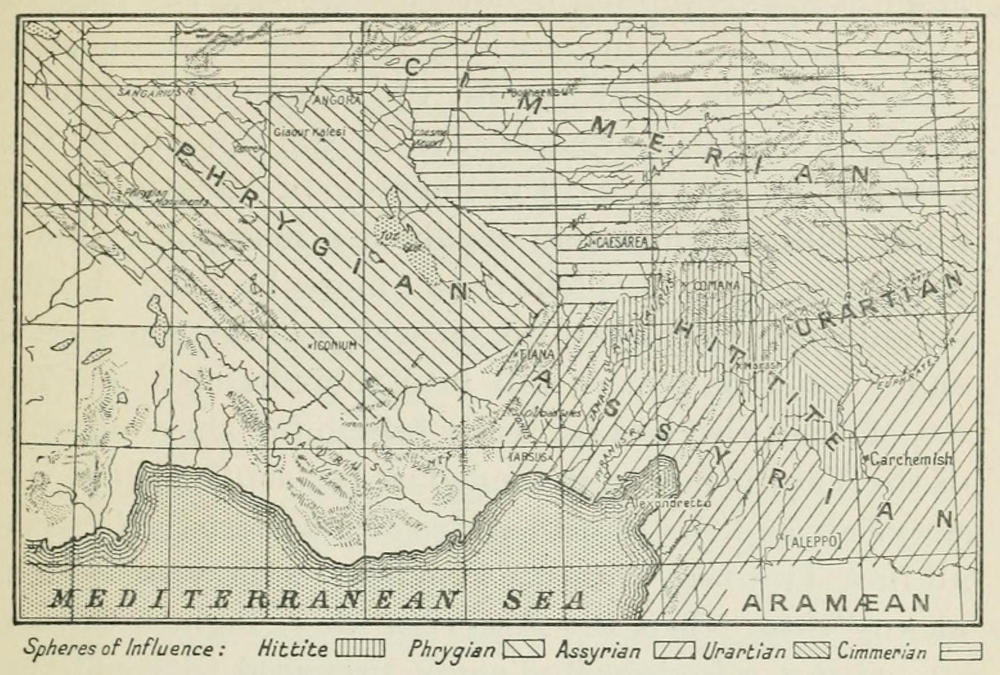
the Urartians and Cimmerians (p. 62). Lydia (pp. 63-64);
Greek colonies (pp. 65, 66). Persian rule (p. 67).
Alexander and Hellenising influences (pp. 67, 68).
Roman period: Seleucids, kings of Pontus, Cilicians;
organisation (pp. 69-70); monuments (p. 71). The
Saracen (Arab) conquests (p. 72); the Seljûk Turks
(p. 73).
Part i.—Identity with Pteria (p. 197);
history, economy, and
situation (pp. 198-200); the acropolis ramparts, gateways
and defences (pp. 201-205), Nishan Tash and
other monuments (p. 206); the Lower Palace (pp. 207, 208);
chronological evidences (pp. 209-211).
Part ii.—The Rock-sculptures called Iasily Kaya:
Situation, description of sanctuary and decorative
scheme (pp. 211, 213); leading figures of gods (pp. 214-216);
a priest-figure (p. 217); procession of male
figures (pp. 218-220); plan and schedule (p. 221); the
leading goddesses, etc. (pp. 222, 223), procession of
females (p. 224), the Priest-king (p. 225); ceremonial
feast and monsters (p. 226). The Inner Gallery: the
moving figures (p. 227); Dirk-deity (p. 228). General
survey (pp. 230-232); historical considerations (pp. 233-234);
the divine triad (pp. 235-241).
Part i.—The Palace and Sculptures of Eyuk (pp. 242-269).
Researches (pp. 242, 243): the site (pp. 244-245);
the Sphinx-gate (pp. 246-248); buildings and masonry
(pp. 249-252). The Sculptures: sphinxes, bull-god,
priest and priestess, masons, musicians (pp. 253-262);
the mother-goddess, lion corner-stone, groups (pp. 263-266);
oblation scene, double eagle (pp. 267-270).
Part ii.—The Town and Sculptures of Sinjerli
(pp. 270-298). Excavations, summary of results (pp. 270-273);
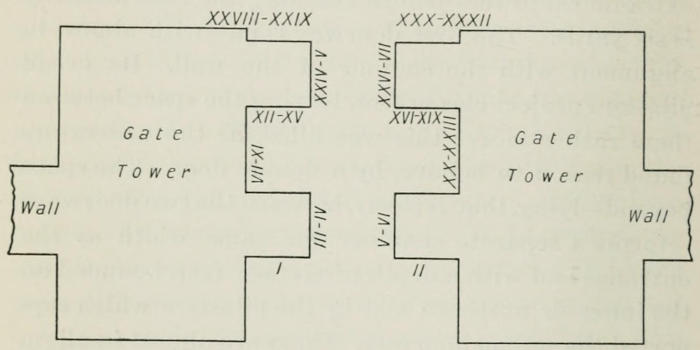
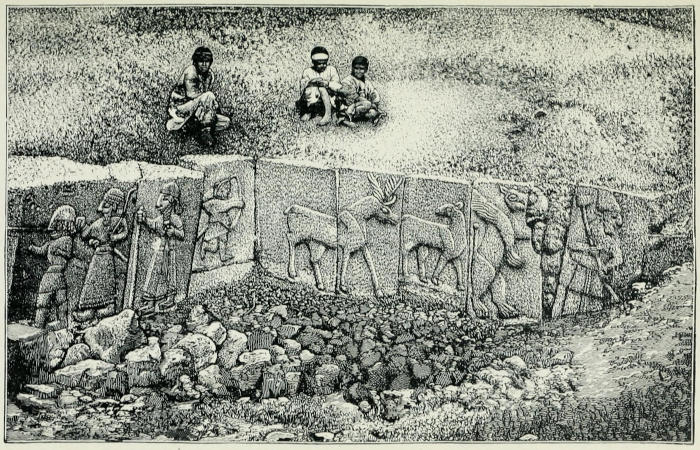
reliefs from city gate, eagle-headed deities, horse-riders,
winged monsters, male figures, bowman, hare
and stag (pp. 274-276); citadel gate (pp. 277-278);
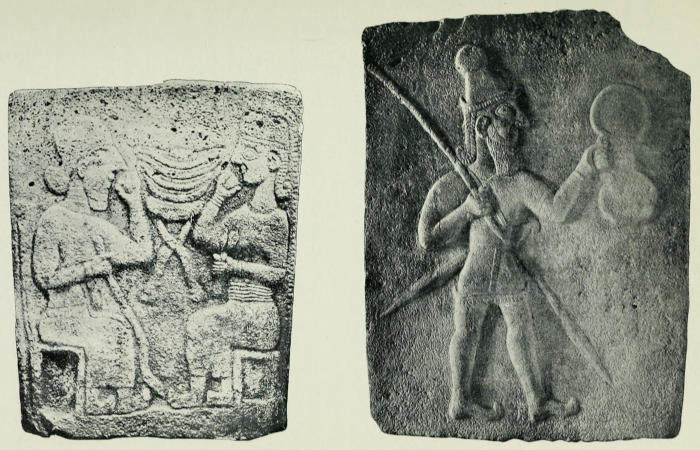
reliefs—(i) charioteer and victim, (ii) warrior, (iii) lion,
(iv) God of Chase, (v, vi) lion and monster (pp. 279-283);
(vii) man bearing kid, (viii) Ceremonial Feast,
(ix, x) three male figures, (xi) archer, (xii-xiii) stag
and kid, (xiv) winged lion rampant, (xv-xvi) figures
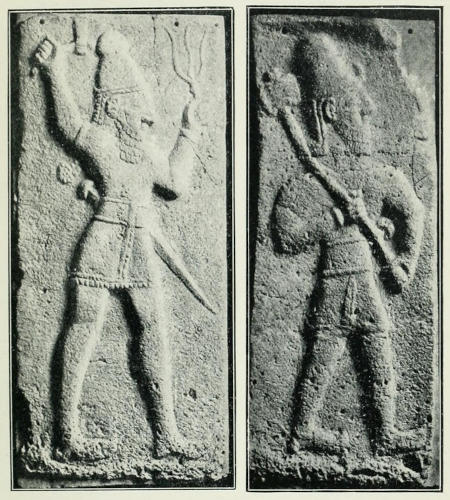
with double hammer (pp. 284-288); (xvii) warrior and
sphinx, (xviii) monster, (xix) figure of woman (pp. 289-291);
(xxiv, xxv) bull and horse-rider, (xxvi-xxvii) bull
and man with clubs (pp. 292-294); (xxviii-xxix) pair
of deer, (xxx) winged lion, (xxxi) warrior, (xxxii)
hunter, (xxxiii) dog, (xxxiv) musician, (xxxv) male
figure, (xxxv, xxxvii) pair of goats (pp. 295-296); reconstruction
of gateway, lion corner-stones, two peculiar
busts, the sphinx-bases (pp. 297-298).
Part iii.—The Mounds and
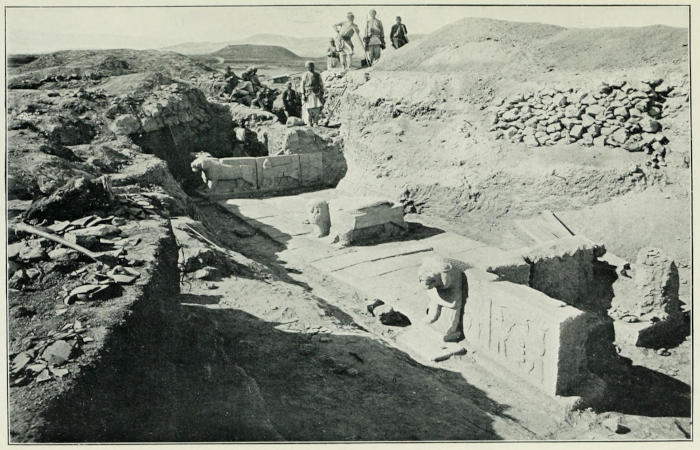
Palace-portico of Sakje-Geuzi (pp. 298-314). Local history and
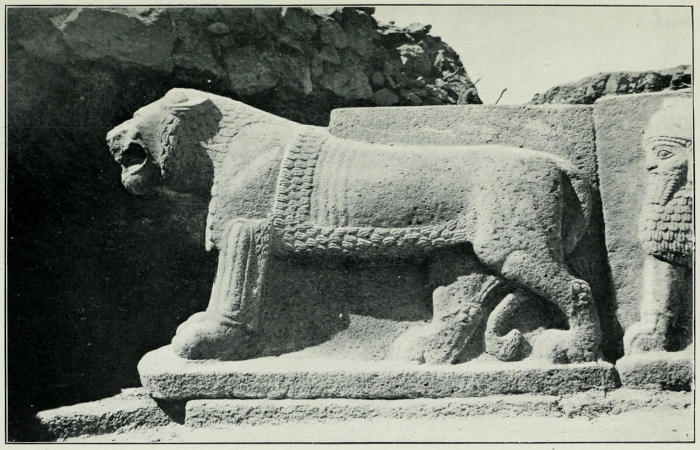
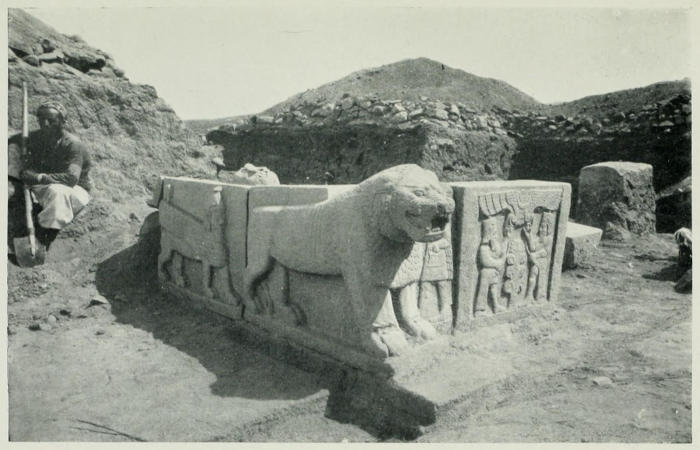
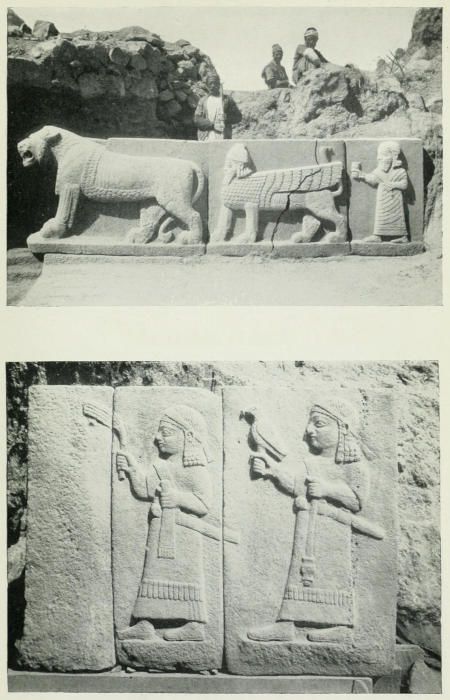
research, walled citadel (pp. 298-300); palace entrance, decorations,
lion corner-stones (pp. 301-302); reliefs, eagle-headed deity,
fertilising tree, sphinx, king-priest, attendants (pp. 303-308);
sphinx-base (pp. 309-311); historical results,
stratification, pottery, foreign relations (pp. 312-314).
The Authorities (pp. 315-316). The Hittites, their coming
and settlement, early culture, earliest historical
allusions (pp. 317-325). The Hatti rulers; conquests of
Subbi-luliuma, treaties with Mitanni, the Amorites,
and with Egypt (pp. 326-336). Empire of Subbi-luliuma,
reign of Mursil; Mutallu and the battle of Kadesh
(pp. 337-343); Hattusil, the Egyptian treaty and foreign
politics; his successors (pp. 346-352). Survey of Hittite
civilisation under the Hatti; the position of women,
religion, organisation, the army, roads and cities,
sculptures, and architecture (pp. 353-367). The European
migrations, disruption of the Hittite empire, the
Muski, the Assyrians, Carchemish (pp. 368-371). The
great revival, the ‘Cilician’ empire, disposition of the
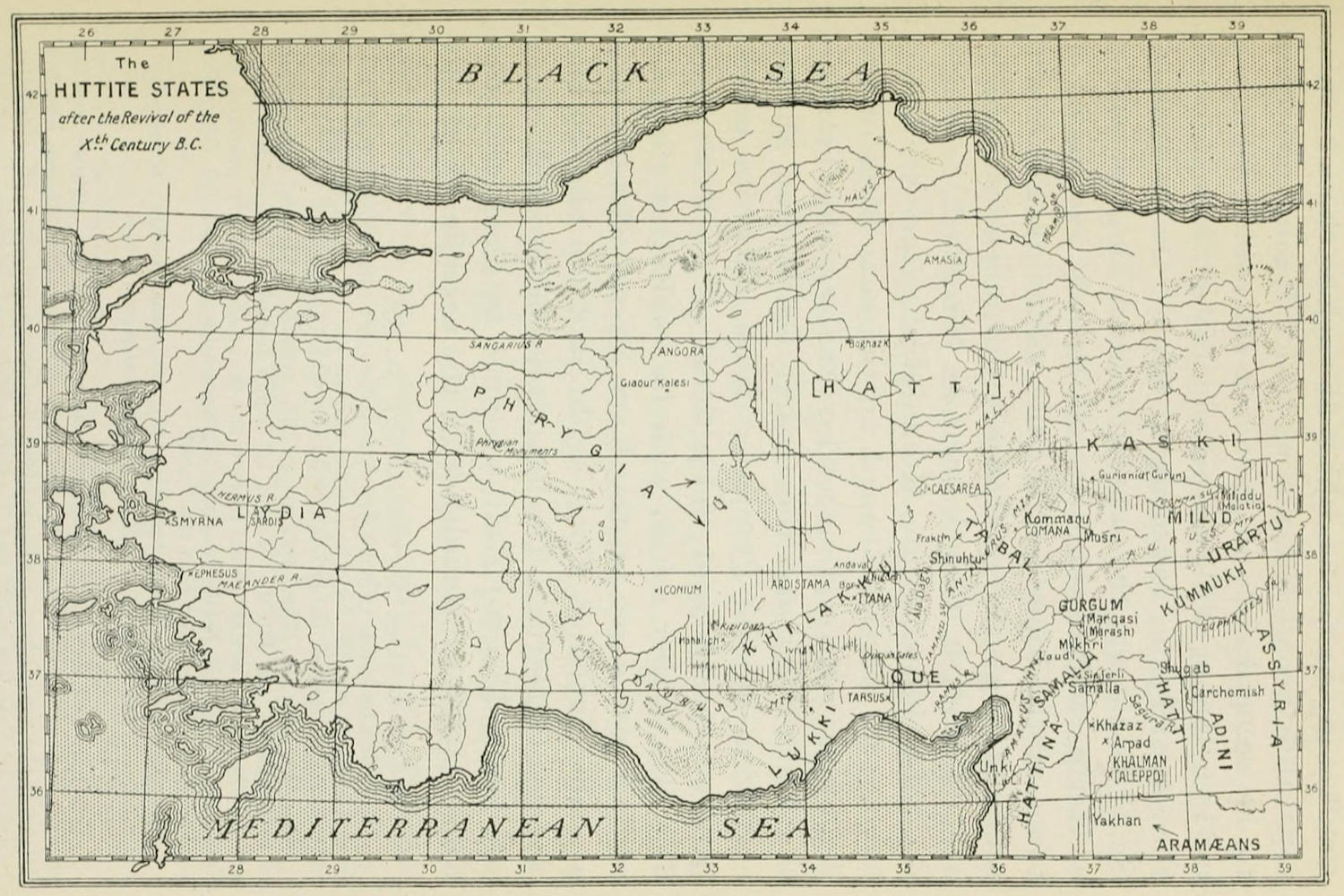
Hittite kingdoms, with map, the balance of power
(pp. 372-377). Changes in decorative and religious art;
Semitic influence in Syria (pp. 377-380). Oncoming of
Assyria, coalitions of Hittite states, battle of the
Qarqar, fall of Tarsus (pp. 381-384). The Vannic kings,
conquests in Syria, decisive battle with Assyria;
supremacy of Assyria in Syria; fall of Carchemish,
Marash and the Tabal (pp. 385-390). Epochs in Hittite
history (pp. 390-391).
At the outset of our undertaking we are faced by a
considerable perplexity, in that the land we are setting
forth to examine is practically undefined. We are
guided indeed by vague and scanty historical references
towards the north of Syria and the east of Asia Minor,
but for a wider and surer delimitation, however incomplete,
we must rely on the evidence afforded by the disposition
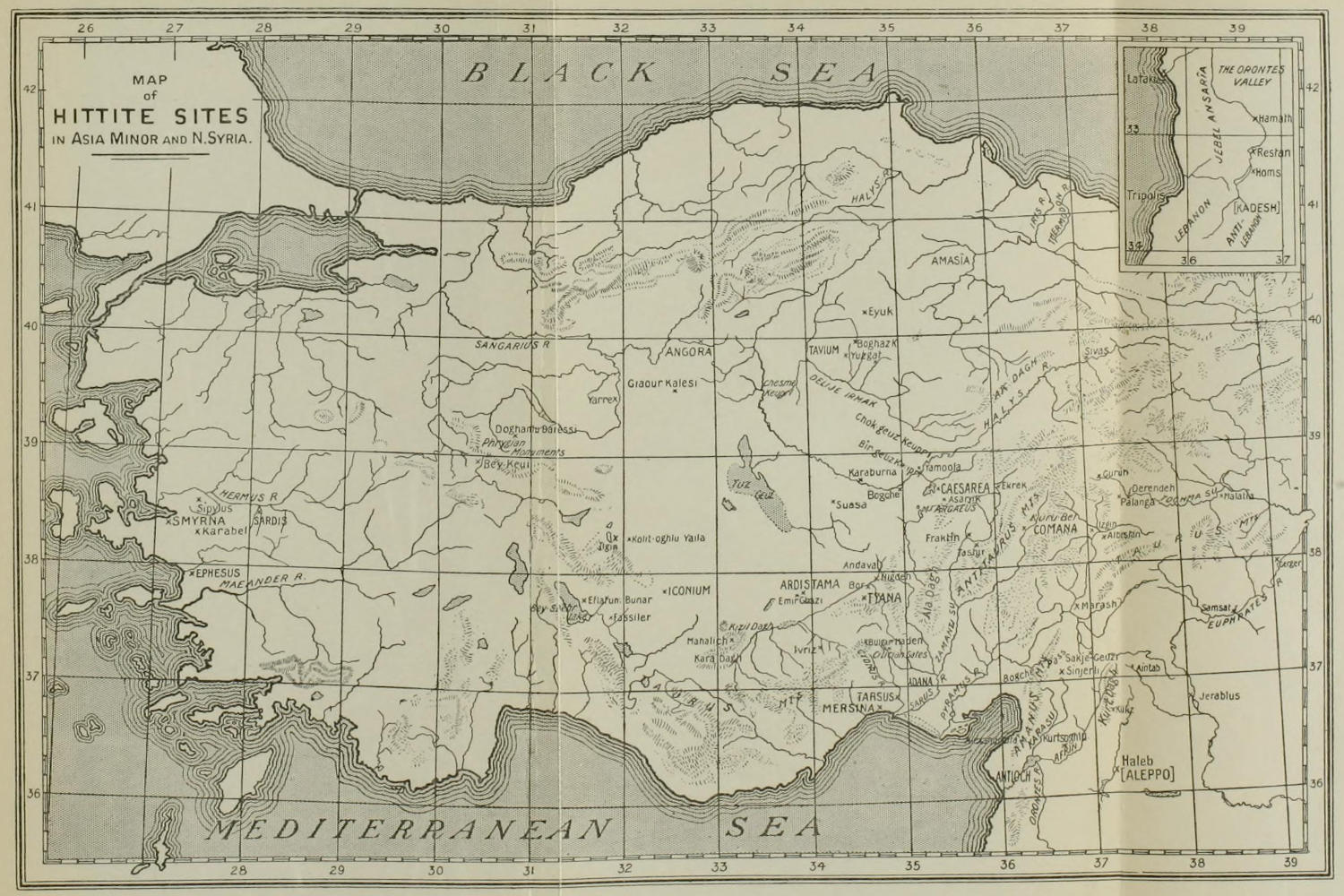
of the Hittite monuments themselves. These
cannot fix for us any certain boundaries, nor does the
area throughout which they have as yet been found
coincide with any great natural landmarks such as
are wont to form the frontiers of nations. On the
other hand, their curious disposition, and the very
disunity of the tract they indicate, awaken our interest
by a suggestion of unusual circumstances that could
weld together, in political unity, peoples whose conditions
of life so differed. And though mostly in the
heart of a peninsula washed by the blue waves of two
great inland seas, no part of the long coast-line can be included,
upon present evidence, in our territory. Maybe
the cause is only that the conditions there are not
favourable to the preservation or recovery of monuments;
but none the less it is to be noted that no trace
of Hittite handiwork has yet been found around the
coast, whether along the wooded shores of the Black
Sea in the north, on the fertile inlets of the west,[1] or on
the rocky passes of the Syrian seaboard; nor has any
clear connection yet been shown between the Hittite
confederated peoples and those sea-rovers who, from
their harbours under the southern shelter of the
Taurus, made piratical descents upon the Egyptian
Delta in the thirteenth century B.C.[2]
Thus we see the Hittites as a purely inland people,
not taking to the sea more kindly at any rate than do
the Turkish peoples of to-day. The centre of their
monuments is the mountainous region of the Taurus
and Anti-Taurus systems, whence on the one hand they
lead us down to the hot plains that lie between the
right bank of the Euphrates and Mount Amanus (the
Giaour Dagh), with a continuation to the south by the
valley of the Orontes as far as its sources in the
Lebanon; and on the other hand widen out to embrace
not only the northern fringe of the Taurus Mountains,
and the basin of the Halys River, but practically the
whole broad tableland of Central Asia Minor, with one
finger pointing down the Hermus valley past Sardis to
the west. The inference to be derived from these
preliminary considerations will receive confirmation as
we proceed with our inquiry, when we shall find reason
to believe that the peoples whose land we are trying
to map out were of mountain origin. The problem of
their settlement, however, remains obscure; we must
await the results of further investigations to determine
whether it was a combined movement of peoples,
bringing with them the elements of their civilisation,
like the Turks in modern history, or whether for ages
they endured the rigours of mountain life before they
became strong enough to descend upon the hospitable
plains below.
The wilder mountains of Greater Armenia, east of
the head-waters of the Euphrates, show no definite
sign of Hittite settlement;[3] but they form a distinctive
boundary to our region, being the culmination of the
system of which the Taurus are a part. Here too is
the centre of mountain-ranges which, like the rivers
rising in their heights, descend in several directions.
To the north the towering peak of Ararat, seventeen
thousand feet in height, looks down upon the green
upland valleys of the Caucasus. Towards the east, the
range which skirts the Caspian Sea connects beyond
with the systems of Central Asia. Towards the south,
another chain holds up as it were the highlands of Asia,
on the one hand, giving way on the other to the basins
of the Euphrates and the Tigris, and touching eventually
the eastern waters of the Persian Gulf.
The Taurus system is another such chain trending
westward, dividing Asia Minor from the rest of Asia,
skirting the southern coast-line, then breaking and
scattering as the level falls towards the west until
it descends below the sea, where its hilltops, still projecting,
form the Ægean archipelago, until drawn
together it rises to dry land on the soil of Greece. In
the heart of these mountains, the two main sources of
the river Euphrates flow in a westerly direction until
they unite above Malatia;[4] thence twisting and turning
ever, in its search for a passage through the rocky
ramparts that oppose it, the great river makes an
easterly contour until nearing the plains. Before
reaching Gerger, however, its direction is changed once
more, turning westward in a long curve past Samsat
towards Aintab, and southward to the latitude of
Aleppo: from here its course becomes more tranquil
and direct towards the Persian Gulf.
The bend of the Euphrates below Malatia marks for
the present the boundary of the Hittite country on the
east. The whole mountainous region lying to the
west of this landmark is divided by the gorges of the
Pyramus, comprising the bleak easterly heights of
the main Taurus range on the one hand, and the more
broken but less barren regions of the Anti-Taurus
which lie within. From the Taurus numerous torrents
fall southward to join the bend of the Euphrates, while
the northern slopes of the same range look down on
the deep valley of the Tochma Su. This river, flowing
eastward, is another main tributary of the Euphrates,
which it joins not far from Malatia, and it forms our
present boundary to the north in that direction.[5] Its
sources are found high up past Gurun in the main
watershed, from which some rivers flow southward to
the Cilician plain, others north-west to feed the Halys.
The routes connecting the north of Syria with Asia
Minor make use of these natural channels of approach.
Thus the main road from Aintab northwards, after
reaching the Pyramus near Marash, follows that river
closely to Albistan, whence the bed of a stream leads
up to the divide that gives way to the valley of the
Tochma Su beyond. Derendeh is thus gained; and up
this new valley the road passes by Gurun northward,
and so over the watershed to Sivas in the valley of the
Halys. From Albistan another route leads eastward
to Malatia; and westward a path passing by Izgîn rises
over the mountains to the interior.[6] A more direct
route, however, from Aintab and Marash leads by
the side of streams that feed the Pyramus north-westward
up to Shahr (the classical Komana), on the sources
of the Cilician Sarus; thence, by one of several passes,
among which is the Kuru-Bel, the head-waters of the
Zamanti Su are reached, so leading down to Cæsarea
at the foot of Mount Argæus. The last-named river is
tributary to the Sarus, passing by Ekrek, Tashji, and
Fraktin on its course.
It may be judged that a region so broken up by
mountain-streams is not altogether barren or inclement.
Its very altitude, averaging six thousand feet above
the sea, gives respite from the summer heats that make
life burdensome upon the Syrian plains. Green patches
nestle under the shelter of its heights, protected thereby
from the severity of winter blizzards when the
mountain-passes may be filled with snow. And in its
deeper valleys, though the actual banks are mostly
rocky, yet the broad slopes on either side are generally
favourable to the cultivation of cereals and other
necessaries. The numerous fair towns that have
sprung up in favoured spots, mostly upon Hittite sites,
with their gardens and vineyards, fruit and olive
plantations, their industries in weaving and embroideries,
reveal to us something of its attractions
and the possibilities of ancient settlement.
Just as the roadways of this region converge upon
Marash, so from this centre other lines of communication
spread out into the regions of the south. On the
one hand the valley of the Pyramus leads down to the
Cilician plain; on the other the road to Aintab, which
we now follow, brings us to the northernmost parts
of Syria, historically the scene of the struggles of the
Hittites with the Pharaohs and with Assyria. The
whole tract before us as far southward as Aleppo is of
twofold character: on the east are the great plains
that lie away to the Euphrates, while on the west two
mountain-ranges intervene between these and the sea,
lying parallel with one another and with the coast.
The plains are really an apex to the Syrian desert,
themselves watered sparsely by winter streams flowing
to the Euphrates, with some independent rivers which,
failing to find an exit, resolve themselves into small
salt lakes and swamps. There are no trees or other
protection against the withering sun, and the surface
is broken only here and there by low ridges and the
mounds which mark the sites of ancient settlements.[7]
The people are mostly Kurds, mingled with the settled
descendants of northern Bedouins, using a primitive
Arab speech. Their life is arduous: their crops are
parched before they can be reaped; but none the less
out of generations of experience they find the means
to live and feed their flocks. Except for local routes,
the only roads which cross this desolate tract lead
from Aleppo and from Aintab to the crossing of the
Euphrates now found at Birejik, not far from the site
of ancient Carchemish at Jerablus.[8]
PLATE III
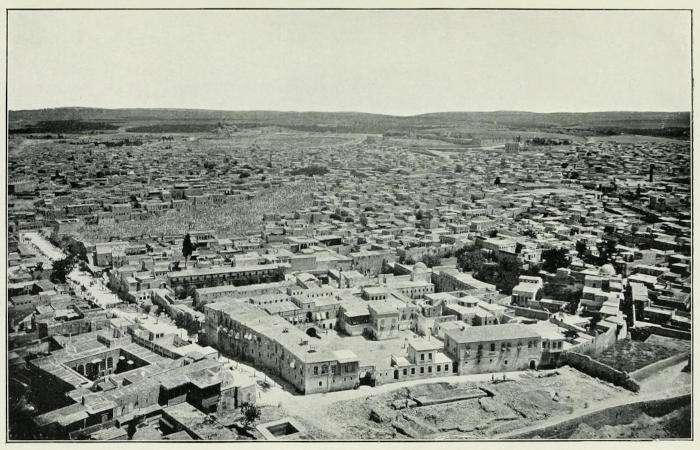
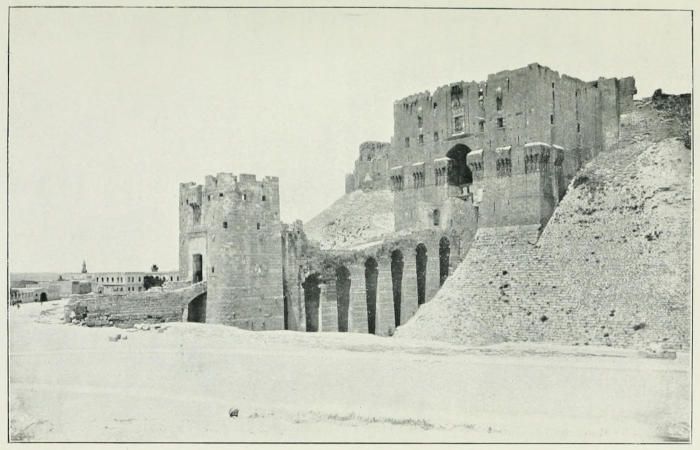
ALEPPO: VIEW OF THE CITY FROM THE CITADEL: THE KONAK IN THE FOREGROUND (See p. 7 and Plate xxxviii.)
Aleppo itself must be classed as a city of the plain,
though its economy is different. Here is the natural
centre of commerce for the north of Syria and a great
part of Western Asia. So, instead of being a peasant
village upon a nameless stream, Aleppo has grown to
be one of the fairest cities of the East. Local industries
have developed, adding to its resources. Its stone-built
houses and public places, its groves and fruit-gardens,
as well as the hearty spirit of its people, are
the tokens of its prosperity. Another town of considerable
interest and importance is Killiz, on the
border of the plain, midway between Aleppo and Aintab.
In approaching this place the road passes
through miles of olive-groves, which form long lines of
dark green upon the red loamy soil.
From Killiz as we turn westward the character of
the landscape is immediately changed; the plains are
left behind, and the mountain country is entered that
lies between them and the sea. Of the two ranges
mentioned previously, the Qurt Dagh, which is first
encountered, is less bold than its western neighbour,
and also less continuous, giving way gradually towards
the south. It is wild and varied enough, however, to
provide a series of memorable panoramas of mountain
scenery. Northward the head-waters of the Afrîn[9] River
have scoured deep gorges in its wooded heights; and
the main stream, flowing southward in a wild and
sparsely cultivated valley, has hewn for itself a rocky
bed through which it swirls until the hills are left
behind, when turning westward it flows on to join the
Orontes near to Antioch. In such a country it is not
surprising that no Hittite monuments have been placed
on record. It is in contact, nevertheless, on either hand,
with places where some of the most instructive Hittite
works have been discovered; and we are tempted
therefore to linger somewhat in this unfamiliar region,
seeking in the life and features of its people for living
witness of the ancient civilisations in which it must
have shared.
The population is naturally scanty, and varies racially
according to its disposition. On the basalt plateau
which forms the eastern boundary to the valley, leading
down to Killiz and Aintab beyond, several villages
of Kurdish families are found. Here communication
with the towns is frequent, and mingling is not uncommon
accordingly with other elements of the Turkish
people. The houses are often well constructed of
masonry, for stone is plentiful; indeed, the whole
plateau is so thickly strewn that even the pathways
are difficult and narrow, while before the plough can
be put to the land a space must first be cleared at considerable
labour. Consequently the amount of cultivation
is small, and even the sparse grain that grows
wild over thousands of acres remains unreaped. In
addition to the settled villages, and the tumbled ruins
of many deserted hamlets, this high ground is freely
sprinkled in the summer-time with the tents of nomads,
either seeking refuge temporarily from the eastern
plains, in accordance with a common practice, or halting
for a brief season on their endless journey.
PLATE IV
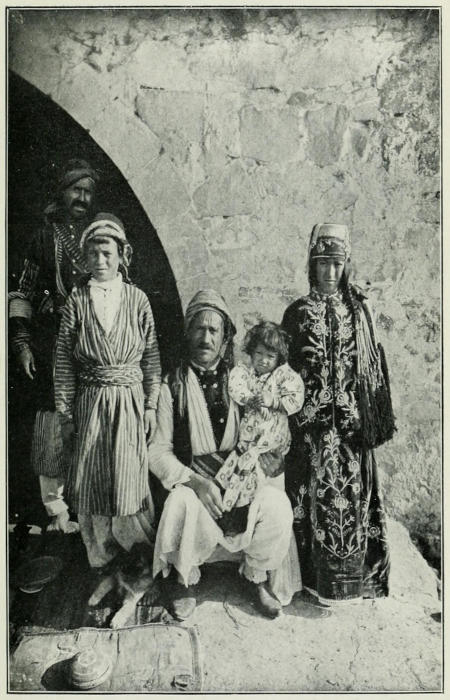
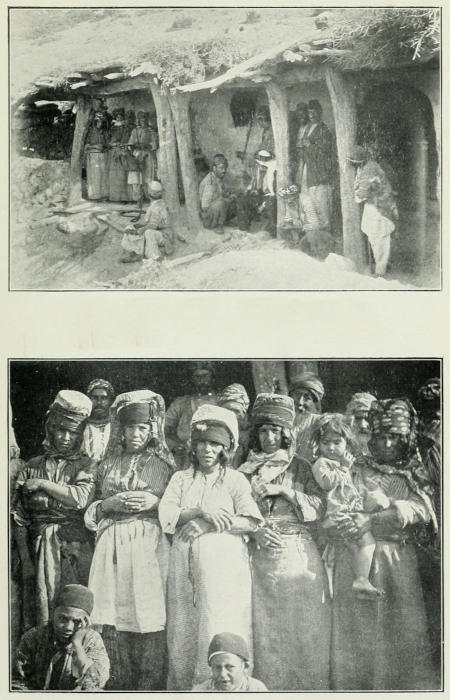
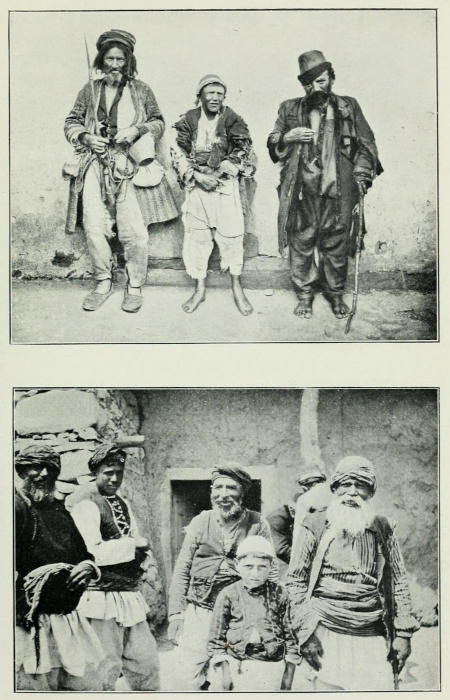
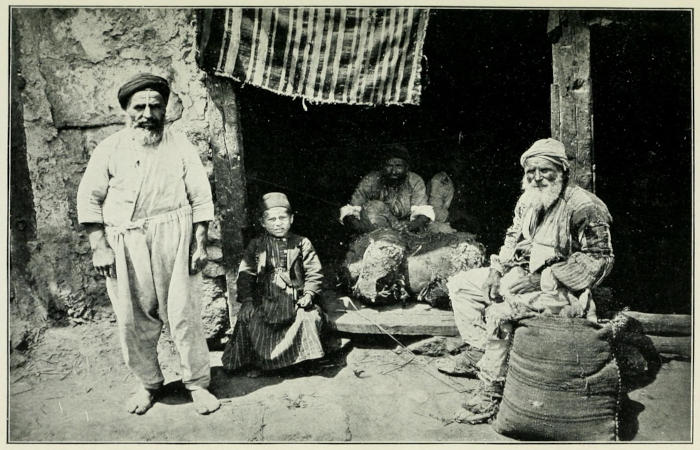
KARAKUL: A KURD FAMILY AT HOME
Husband, wife, child of an elder wife; two brothers, left.
The rocky edges to this plateau on the western side
are broken ever and again by rifts, down which a more
copious supply of water tumbles from above, opening
out into little nooks under the shelter of the heights
before joining the main valley of the river below. In
such places a village may be found amid a patch of
comparatively luxurious cultivation, well illustrated by
the vines and mulberries of Rowanduz. This pleasant
spot lies at the foot of the steep descent from Karakul
upon the plateau, and is marked by the ruins of a fine
mediæval castle crowning a prominent cone-like hill.[10]
The groves and gardens are watered by a primitive
system of irrigation. The rich soil readily repays the
labour bestowed upon it in however simple fashion.
Lower down, in the main valley and nearer the
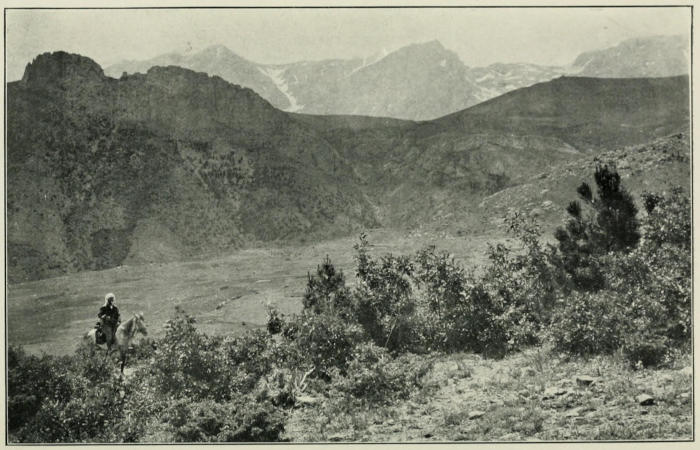
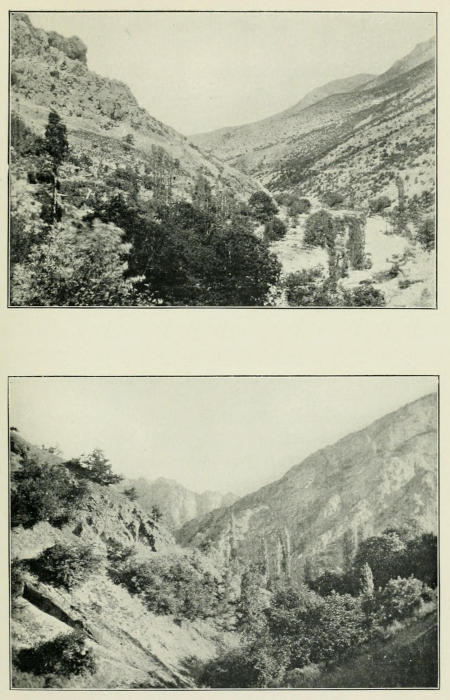
river’s bed, the aspect of the country is generally savage
and neglected. A short withered scrub speckles the
surface of the ground, which is reft in every direction
by the dry gullies of winter torrents. The main routes,
here as elsewhere, keep consistently along the higher
levels, crossing the rifts near their beginnings, before
they have become too rough and too steep to scale.
Other tracks are found naturally along the river’s bed,
which they cross and recross, scaling the cliffs where
the water has laid bare the rocks, and at other times
passing through more open spaces cheered by narrow
strips of corn-land and the rich bloom of a myriad
oleanders, wherever the steep banks recede a little way
on one side or the other. These lower tracks, however,
are never easy to follow, even under favourable conditions,
on account alike of the numerous scrambles
over cliffs often shaly and precipitous, where a false
step of horse or man might lead to disaster, and also of
the numerous crossings of the river, often deceptive to
any one unfamiliar with the fords. The latter obstacle
becomes a grave danger after mountain storms which
may have passed almost unnoticed in the valley. Even
in summer-time thunder-clouds from time to time
collect above the heights, and amid a gorgeous display
of lightning and reverberating thunder a torrential
rain transforms in a few minutes the rocky basin of
the river. The dried-up gullies are now alive with
splashing streams, and the slumbering rivulets become
foaming torrents, the sudden uproar of scurrying
streams and newly born cascades striking the ear with
curious strangeness and foreboding.[11] In an hour or
two the streams are once more tranquil and the sun
has reappeared; but the river below has received nearly
all the water that has fallen, and swirls on deep and
dangerous. Fords that have little changed their appearance
are now impassable, and none but the stranger
will attempt to cross them.
Even without such temporary dangers, the unwary
traveller in such a country, trying maybe to force a
march when unacquainted with the village tracks and
local landmarks, will surely come to grief; and though
within an hour or two of some village where loyal, if
frugal, hospitality awaits him, will find himself lost,
with little means of knowing how to direct his footsteps.
For the village which he would gain lies hidden
out of sight in some sheltered nook, or behind a bend
in the river, or beyond a rise of ground. Yet even
though he reach the village by night, whether as an
armed party or as a benighted wanderer, his welcome
is secure, and his life is sacred. No questions will be
asked him, nor will any demand the reason of his
coming. Warm milk and home-made bread-cakes, and
sometimes honey, will be offered him as refreshment;
and after a few simple courtesies the best room will be
put at his disposal. In the morning the ‘swash-swish’
of the churn, an inflated goatskin, will tell him that the
housewife is busied with his breakfast: soon the door
is opened and he recognises in his attendant, who lays
the round tray before him, none other than his host,
the headman of the village. His horse is fed and
saddled, and the chief’s son is his guide.
In the main valley, however, we have not found that
which we seek. Pushing on then up one of the sources
of the river we reach Kartal, in a green dell begirt
with wooded hills. Though off the beaten track this
place is only one day’s journey by mountain-path from
Aintab. Perhaps on this account the people here are
freer. Their simplicity of life is the same, but their
curiosity is greater and their restraint is less. Here
we are soon friends; and have opportunity to study
their manners and their features. Their houses are
partly hollowed in the hillside as in many parts of
Asia Minor, alike for economy in construction, and for
better protection against rain and cold. The roofs are
built of timber, and so covered with earth that it is
difficult in descending from above to distinguish them
from the surface of the ground with which they are
continuous. The chief industry of the villagers, in
addition to the tending of their fields and flocks, is the
making of butter and dairy produce, which is sent to
the market at Aintab. They are said to be Turkomans,
descendants of wanderers from the East who settled
here many generations back, and now an element of the
Turkish people. But there is something in their faces
reminiscent of Hittite portraits, suggested generally
in the women, and marked strongly in some of the
men, though in others not at all. This glimmer seems
to be due to mixture in past times with a pre-existing
population; for in the hills above there are settlements
of woodmen whom even these villagers regard
as a somewhat strange and different people. Here, at
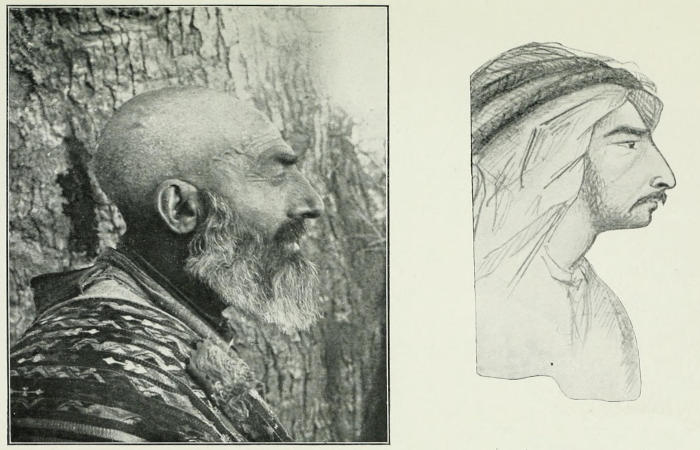
last, we come face to face with that remarkable type
portrayed so clearly on Egyptian sculptures, and suggested
also in the Hittite monuments themselves, characterised
by the strong nose in line with the receding
forehead, the round protrusion of the head behind,
the heavy lips and beard, and the stolid look. The
figure is short and thickset, betokening stamina and
strength. Our photograph[12] was obtained at Kuchuk
Kizil-Hissar, nearer to Aintab, but it is clear that
the home of this type is now the mountainous
country, where it has persevered in seclusion and
still survives.
Our wanderings in this district have not then been
fruitless. The traveller may be rewarded also by a
picture of wonderful beauty to be seen at sunset from
the wooded heights near the sources of the Afrîn River
and the Kara Su. Pen cannot describe the delicacy
and harmony of the colours in the trees, with the
effects of light and shade among their leaves and in the
shadows of the foreground; nor could brush compose
the majesty and depth imparted by Nature to the
distance of this scene. Ridge beyond ridge, of varied
forms and softening colours, leads back to where
beneath the reddening glow the bold ranges of the
Amanus chain are seen purple, even while the snow-clad
peaks of far-distant Taurus in the north still
gleam in the last lingering rays of light.
PLATE V
KARTAL: VERANDAH OF A HOUSE
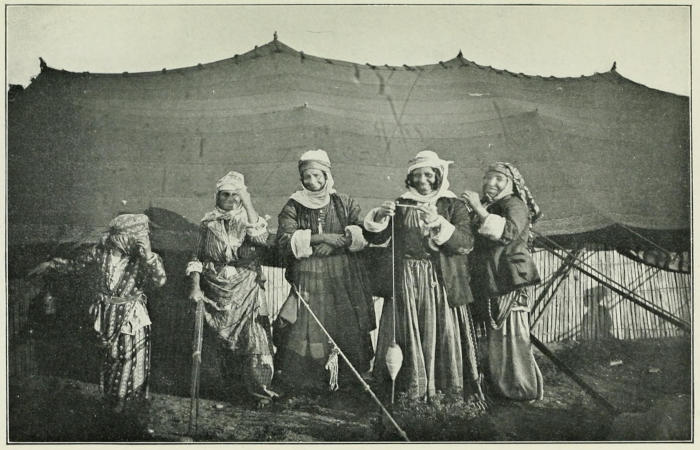
Churning, left; crushing grain with a wooden mallet, right back.
KARTAL: GROUP OF TURKOMAN WOMEN
(Note the cylindrical hat and cover).
From here the western edge of the Qurt Dagh range
descends abruptly to a broad and marshy valley, shut
in, on the other side, by the Giaour Dagh. The land
is flat, and the streams, after descending from the
mountains, mostly stagnate in marshes overgrown with
reeds and scrub. From the middle tract egress is
almost wholly shut off, by ridges and outliers from
the hills. Such water as escapes either flows northward
to join the Pyramus or southward to form the
Kara Su. Though now pestilential with malaria and
sparsely inhabited, this valley is naturally very fertile;
and numerous mounds which dot the surface are indicative
of extensive ancient settlement.[13] Among
these are the sites of Sinjerli and Sakje-Geuzi, which
provide us with our most complete architectural
monuments of the Hittites on this side of the Taurus.
Here there seem to have been a series of petty states
or principalities,[14] consisting of groups of towns clustering
round the palace of the local king, fortified strongly
with stone walls and towers. We do not yet know
what may have been the precise relations of these
elements of the population to one another; but it is
clear that in the days of Hittite supremacy they must
have been amongst those tribes who shared in the
confederacy.[15] It is also obvious that no people could
hope to defend themselves in this valley who did not
hold the passes of the mountain-ranges on either side.
PLATE VI
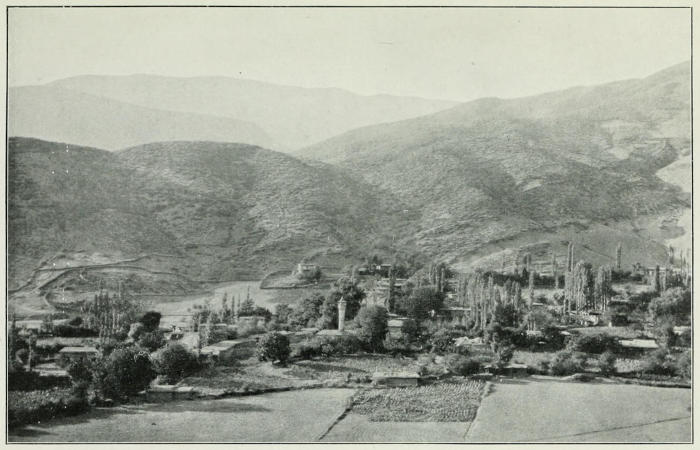
BOGCHE: THE VILLAGE WHICH GIVES ITS NAME TO A CHIEF PASS OVER THE AMANUS MOUNTAINS
The westerly chain of the Giaour Dagh, indeed, was
readily defensible. Except for a few local tracks available
only in the summer, there are but few passes over
its unbroken mass, and these are well defined. This
splendid range of mountains, better known as Mount
Amanus, forms a main branch of the Taurus system,
from which it is divided only by the valley of the
Pyramus. It separates Syria from Cilicia on the west,
and touching the sea near Alexandretta follows the
coast south-westward, until arrested by the broad valley
of the Orontes. The average height of the chain is
from four to six thousand feet, while some of its peaks
reach almost to the snow-line.[16] Of the several passes
that traverse it, that which leads transversely from
Marash into Cilicia presents the easiest gradient, and
is much used by caravans, though impassable by carts.
The central pass above Bogche, however, is better
known, being the direct line of communication between
Cilicia and the East. Bogche itself is reached from
Osmaniyeh on the eastern borders of the Cilician plain
by a path which, while generally following the valley
of the Bogche Su, traverses also some outlying ridges.
The village is thus found picturesquely situated in an
open and fertile spot among the hills. The long ascent
thence continues up to one of the main sources of the
same stream until the watershed is crossed, whence
the descent is steep and rugged to the valley. The
track then heads directly by Sakje Geuzi over the Qurt
Dagh to Aintab, and so eastward to the crossing of the
Euphrates. Though direct and not very difficult, this
route is not yet made passable by carts, and perhaps
for this reason the mail from Adana and the West
takes the coast route, on mule pack, round to Alexandretta,[17]
whence rises the main road to the interior.
The Beilan Pass, as it is called, above Alexandretta, is by
far the easiest, and the steep gradient on either side is
so nicely engineered that it is hardly realised in passing
where the watershed is crossed. Leading down directly
to the fair seaport on the Mediterranean, this route
for centuries has been a main channel of commerce
between Europe and Asia; and until the railway connecting
Aleppo with Beyrout diverted a large part of
the traffic, caravans consisting of hundreds of laden
camels in long procession could be seen daily, bringing
out the merchandise of the East, and taking back the
manufactured products of the West.
The mountain-chain now turns south-west, and
terminates abruptly in the rocky point called in Arabic
Ras El Khanzîr, ‘The Pig’s Head,’ while its southern
slopes descend steeply to the estuary of the Orontes.
Beyond, the mountainous character of the coast is
continued south in the Jebel Ansarîa (or Bargylus
Mountains), which hold on until broken by the broad rift
which divides them from the Lebanon. Hugging the
eastern side of this range the Orontes River comes
northward, and turning sharply where the mountains
break, it flows past Antioch south-westward to the
sea. At the bend it is joined by the Afrîn River
and the Kara Su in a broad and swampy hollow
almost shut in by the mountain-ranges and the eastern
plains.
The sources of the Orontes are found in the northern
region of the Anti-Lebanon, and here the southern
limit of the Hittite monuments is reached.[18] In this
vicinity was Kadesh, the frontier fortress of the
Hittites that figures so prominently in the battle-scenes
of Egypt. Here, too, is Homs, now a remarkable Arab
city, at the junction of the main routes from Damascus
to Aleppo, and from Palmyra to Tripolis on the sea.
Further north is Restan, strongly placed at a bend
of the river on a steep and naturally defended knoll.
Further again is Hamath, where the main road and
the river separate, the latter turning westward to seek
its green bed below the mountains, and the former
holding on directly towards Aleppo across the plains.
Here, at Hamath, were found the hieroglyphic inscriptions
which first gave rise to systematic Hittite studies.
Here, too, types of people are found strongly reminiscent
of the past, like living models of the ancient sculptures.[19]
PLATE VII
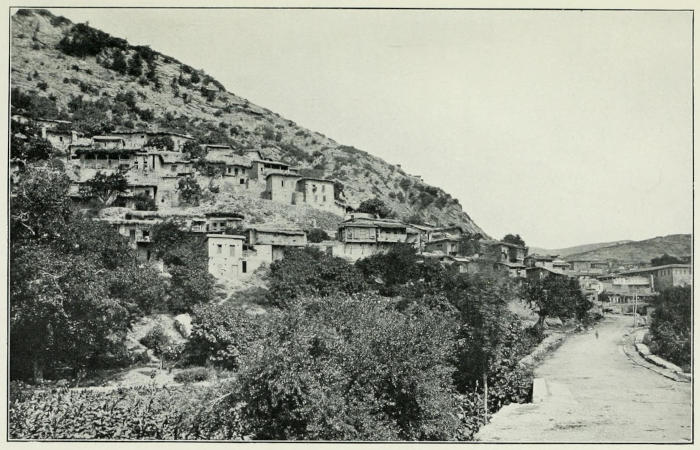
BEILAN: VIEW OF THE VILLAGE AT THE SUMMIT OF THE PASS (See p. 15.)
This district, in the head-waters of the Orontes, was
not only the Hittite frontier, but was such as the
Hittites in the period of their settlement seem to have
delighted in. Here their walled towns and citadels
sprang up, in the midst of a land well watered and
reasonably fertile, under the shadow of mountains
which cut them off from the sea and from their enemy
of the South; while behind the road was open to call
up in necessity the assistance of the northern branches
of their people.
From the Taurus we descended firstly to the north
of Syria, because in the development of Hittite studies
this region first attracted attention through the
references to it in Egyptian and Assyrian history. But
modern research has added to our knowledge of the
Hittite lands a wider and different territory on the
other side. There the descent to the interior of
Asia Minor from the mountains is not so marked,
for even around the foot of snow-capped Argæus, the
most advanced pinnacle of the system, the plateau is
still four thousand feet above the sea. The level falls
gradually towards the west, but rarely much below
three thousand feet; while on the other hand the
numerous minor ranges that break the surface of the
interior attain a considerably greater height. This
tableland is almost enclosed by ridges of mountains:
on the north and south these descend directly to the
coast; on the west they are more broken and less bold,
but they constitute none the less a great obstacle
between the plateau and the green valleys of the
Ægean coast.[20] On the east, as we have already seen,
are the Anti-Taurus ranges, backed by the Armenian
hills beyond. The upland area thus enclosed is from
two to three hundred miles across according to the
direction taken, for its form is irregular. Only to the
south is the boundary sharply defined, where the range
of Taurus forms a mighty wall, which in the middle
turns almost a right angle in direction, running north-eastward
and north-west. The whole plateau may be
regarded as irregularly five-sided.
The interior varies greatly in its features, the chief
agent being the peculiarities of its river systems. Shut
in as it is, many rivers fail to find an outlet to the sea:
this is especially the case in the plain which lies at the
foot of the western ranges of the Taurus, where the
waters stagnate, forming salt lakes or marshes. This
plain is green around Konia, but its extensions to the
north and east are practically desert, being parched
and barren in the summer months. On its north-east,
in the centre of the peninsula, its boundary is the
largest salt lake of the interior, which is fed likewise
by several minor inland streams. There are some
rivers, however, which find an outlet even through the
Taurus ranges, but such are more common towards the
west and north-west. The districts which these water
are consequently among the most attractive of Asia
Minor, with areas of natural woodland and green
pastures, as well as fertile soil for cultivation.
But the greatest river and most important landmark
of the interior is the Halys, which describes a broad
circuit through the heart of the plateau, enclosing
towards the north-east a tract about a hundred and
fifty miles across which mostly lies in the basin of the
river, well watered by its many tributaries. This region
is one of the most important in our subject. Though
not extensively cultivated, for the stable population
even here is relatively small, it is none the less highly
fertile. Its hills and slopes are mostly green with
pastures, and in the flat valleys are long reaches suitable
for the plough. Another favoured district lies
southward from the Halys, passing by Mount Argæus,
skirting the eastern edges of the plain, and watered by
streamlets from the Anti-Taurus. Here in the vicinity
of Tyana are wide acres of corn-land, gardens are
plentiful, and even trees abound.
PLATE VIII
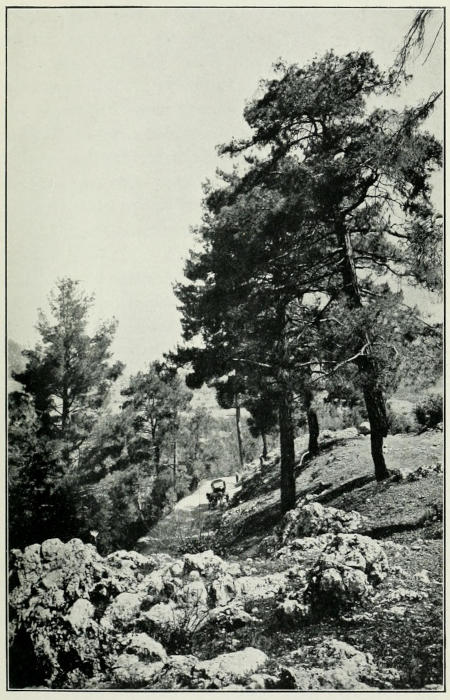
WOODLAND ON THE SOUTH SLOPES OF TAURUS (See pp. 19, 47.)
Woodland is rare in the interior, but highland trees
grow in profusion on the mountain-sides. The middle
heights of the Taurus are covered with virgin forest,
especially on the southern aspect, where every variety
of European tree is found; and the pine-woods of
Phrygia in the west have been a feature of the country
throughout its history.[21] The slopes overlooking the
Black Sea, however, catch the chief share of the
northern rains, and here consequently forest-land is
plentiful,[22] and nearly continuous along the coast. The
interior is almost rainless in the summer-time,[23] and
relies chiefly for its water supply on the winter storms,
and later melting of the mountain snows. Owing to
its high elevation above the sea the cold season is
severe and persistent: the bleak winds from southern
Russia sweep across its plains and open spaces, driving
the population of the exposed areas for shelter into
houses either sunk below the surface of the ground or
hollowed in the banks of streams. The compensation
for this inclement season is ample in the summer
weather, when the warm sun shining down from blue
skies is tempered by refreshing breezes which the
altitude produces—features of climate that distinguish
this tableland from the southern coasts, and from the
plains of Syria.
Such in brief are the striking features of this portion
of the Hittites’ land. On these breezy highlands the
ancient people found all the elements of contentment:
hunter, woodman, shepherd, and peasant found each
his home, in which Nature provided him with all the
ordinary requirements of his life. Nor was the development
of his civilisation to be arrested by his settlement:
the resources of his country were inexhaustible;
mines of useful and precious minerals are not uncommon;[24]
and the means of providing other commodities
was at hand, for the walls of the plateau were not
without openings to foster some relations with the
coast and so with other lands. But, on the whole, the
uplands which he had occupied were economically
self-contained; and for the stimulus to his civilisation
we look naturally to the East, and especially to the
old-established culture on the Euphrates, the communications
with which, by the nature of his settlement,
were open and in his power.[25]
In the foregoing general view of Central Asia
Minor we have seen that the interior tableland may
be divided conveniently for description into five main
regions, not for the most part separated from one
another by any definite boundary, but each characterised
by some special feature. These are, in the
south, the plains that lie northward and eastward
from Iconium; in the west, the pine-clad hills and
verdant pastures of Phrygia, where several great
rivers rise that descend in different directions; in the
north, the upland but not highland country around
Angora, in which also is the divide between some
tributaries of the Sangarius and of the Halys; in the
north-east, the broad tract enclosed by the convex
curve of the Halys River, to which we shall presently
return; and, in the south-east, the tract of which
Tyana is the centre, with which we shall include the
eastern portion of the plain of Konia and the range of
Taurus that bounds it on the south. Of these regions,
the two latter may be regarded as an eastern or inner
group as opposed to the three former lying to their
west, from which they are physically separated, more
clearly, at any rate, than the components of either
group from one another, by the broad expanse of
desert, the great central lake, and especially by the
middle course of the Halys. This distinction between
eastern and western will be found to have a real
significance as our story develops: it is clear from the
outset, however, that the former group would first
receive and longest retain contact with Eastern civilisation,
whether by the natural approaches over the
watershed between the Euphrates and the Halys, or
by the several crossings of the Anti-Taurus which
converge upon Cæsarea, or by what is now the chief
channel of communication through the Taurus Mountains
by way of Cilicia. This distinction will be found
further emphasised by the comparative plenty of
Hittite monuments on the one side, and their paucity
in the west. On the southern plains, indeed, skirting
the main range of Taurus, westward progress was less
restrained;[26] but that the Halys in the north presented
a real barrier[27] is borne out by the fact that when the
Lydian Crœsus crossed the Halys in the sixth century
B.C. he found a strange and presumably non-Aryan
people surviving upon the eastern side, who were
indeed, according to Herodotus,[28] called Syrians by
the Greeks, and by that historian spoken of as Syro-Cappadocians.
With our two eastern divisions we must include the
plain and district westward of Cæsarea, a tract which
on the north lies partly in the basin of the Halys, and
on the south is practically continuous with the plains
of Tyana, from which it is separated only by a low
ridge of hills. Towards the west are the remarkable
troglodyte villages,[29] where, probably from remote
antiquity, the inhabitants have hewn out their dwellings
in the soft surface rock and conical mounds which
are the peculiar feature of the locality. There is little
evidence as yet, however, to make this region of
importance in our subject, and it is only recently that
Cæsarea has yielded trace of Hittite handiwork.[30] None
the less the continuation of exploration will certainly
bring to light new monuments, for the district lies in
the heart of the Hittite country; and Old Cæsarea
(Mazaca) was the residence of Cappadocian kings.
PLATE IX
CÆSAREA: CLOISTER OF A SCHOOL, WITH THE CITADEL BEYOND
The position of Cæsarea is geographically of great
importance, and from Roman times at any rate has
marked the focus of the trade and traffic, and consequently
of the road-systems, of the interior. The soil
locally is of great fertility, owing to its volcanic
nature. Vines and fruit-trees grow and thrive
luxuriantly. The middle heights of slumbering
Argæus are covered thickly with pine-woods. The
snow-capped peak of this mountain towers in the
heavens, the conspicuous feature of the horizon and
the landmark for two days’ journey on every side.
Its form is conical: to the west and south, where it
rises directly from the plain, its base is washed by
great lakes and marshes of variable extent. Towards
the east it is connected up by broken ridges with the
Anti-Taurus system. On its northern slope is Asarjik,
overlooking Cæsarea, which lies at the foot of the
mountain on that side. The site of the ancient city
(Mazaca) is probably that marked by the ruins of
Græco-Roman times, to be found in the vineyards on a
low spur of the mountain about a mile south of the
modern town.[31] Here is a spot that will one day reward
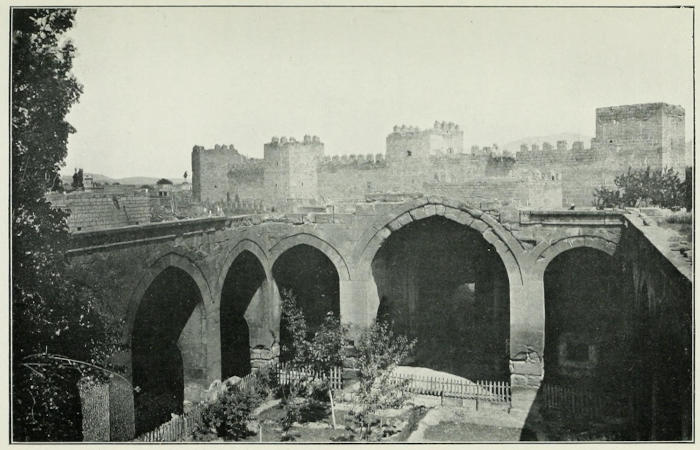
excavation by a volume of unsuspected history. In
the modern town, apart from its bazaars and industries
and its splendid mediæval remains,[32] one of the most
interesting sights is the ever-changing stream of
human faces to be seen in its streets, for its traffic and
position bring to it daily caravans from every side. In
its resident population there are considerable Greek
and Armenian elements; but there may be noticed
as specially of interest to our subject the Jewish
families,[33] in which the dominant features of face and
stature recall again the type previously noticed at
Kartal in Northern Syria. Main roads radiate from
Cæsarea in all directions: towards the north-east to
Sivas by the valley of the Halys; to the north by
Yuzgat, crossing the river, which is five hours distant
from Cæsarea, by a remarkable bridge of many spans
(hence called Chok-Geuz Keupru); to the north-west by
way of a lower bridge (called in contrast Bir-Geuz, or
One-span Bridge), heading thence directly for Angora
by the bridge at Cheshme Keupru; to the west across
the plains to Konia by Sultan Han, skirting the
southern border of the salt lake (Tuz Geul); to the
south by Injesu and Tyana, and so to the Cilician
Gates, or by a western branch to Eregli. An alternative
route from Cæsarea to the Cilician Gates, shorter
but impassable by carts, leads through defiles of wild
beauty through the outlying ridges of the Anti-Taurus.
South-east there are several well-established mountain
tracks, like those to Fraktin and Ekrek, but there is
one of special interest and antiquity, to which we have
already alluded, heading directly for Marash by way of
the high pass of Kuru-Bel,[34] and passing hence by
Komana. Of the other routes enumerated there is one
which was already of importance on general grounds
before a recent discovery gave to it a special historical
interest. This is the main road north and south, passing
through Yuzgat, which in antiquity connected Boghaz-Keui
with the east by way of Tyana and the Cilician
Gates. This is clearly a southerly stage of the Royal Road
of the Persian period, but whether it is the main route
is not determinable from the description of Herodotus.[35]
It has, however, now been traced for several miles between
Injesu and a ford of the river near Bogche,[36] by the
ruts scored deeply and over a broad track on the surface
rock, exactly like the section previously traced through
Phrygia by Sir William Ramsay.[37] It is significant that
this route did not touch Cæsarea, to reach which a
considerable détour must be made around the foot of
Argæus, so much so that even now an optional route is
in use from Injesu to Chok-Geuz Keupru. The old route
was, if anything, even more direct, for from Injesu, near
which it is traceable, it headed for the river in due line
for Boghaz-Keui. The Hittite inscription overlooking
the river at Bogche, the continuous signs of the road
approaching Injesu from this direction, the Phrygian
inscription found on the site of Tyana,[38] and the
Hittite inscriptions from the same vicinity,[39] are
evidences of the antiquity of this road analogous in
every way to those which have been accepted as
identifying it in the Phrygian country, from Bey-Keui
to Doghanlu. Incidentally we find light in this discovery
on the historical antiquity of the Cilician Gates
as the main channel of communication with the east.
Later in these pages[40] we shall find reason to believe
that the western part of the great Royal Road, which
led the Persian posts in crossing Asia Minor to make
the wide détour by way of Pteria (even though the
city was in ruins),[41] had been made and established by
the Hittites in the thirteenth century B.C., when the
stone walls of their capital crowned the hilltops of
Boghaz-Keui. Possibly the earliest communication
with the East was by way of the valley of the Tochma
Su,[42] or by Marash; but the development of this
southern branch of the main chariot-way cannot well
be later than the tenth century B.C., when the second
kingdom of the Hittites grew prominent with Tyana
(or maybe Cæsarea) as its centre.
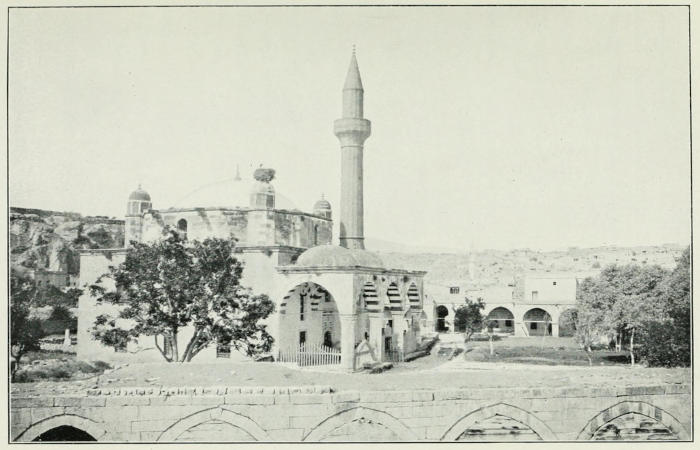
PLATE X
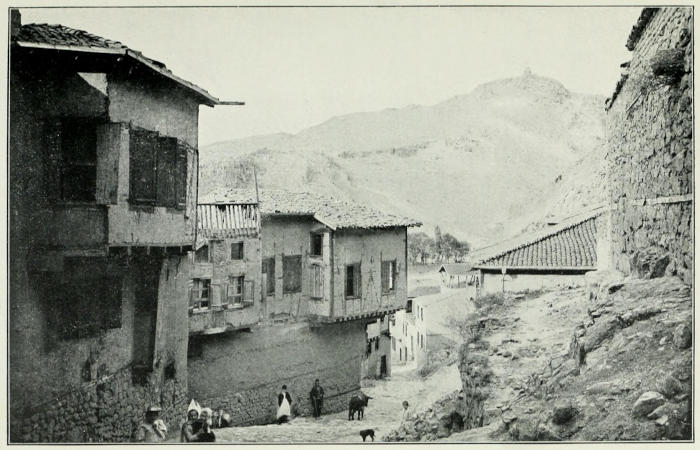
INJESU: VIEW OF THE MOSQUE AND TOWN
In passing now to a closer examination of the
geography of those portions of the tableland with
which we shall be most concerned in later chapters, we
cannot begin more appropriately than by a description
of the Halys River itself, as one of the definite landmarks
of the interior, and as including in its circuit
some of the most instructive Hittite works. This
splendid river, known in the Turkish language as the
Kizil Irmak, has a total length of five hundred miles,
without counting its minor windings. Its sources must
be sought in the map beyond Sivas, far up the northern
slope of the lower Armenian hills,[43] where at one point
but a few miles divide it from several tributaries of
the Euphrates. For nearly two hundred miles it holds
on in a south-westerly direction through hilly country,
fed by numerous short streams on either hand, which
scour for themselves deep channels in their swift
descent. Its waters are deeply stained red-brown in
colour by the rich sediment which it carries. Its banks
are rugged, and like most main rivers of western Asia
it flows deep below the general level of the basin which
it drains. The bridge opposite Cæsarea (Chok-Geuz) is
only gained by a steep climb on either side. Between
this and the other bridge some fifteen miles lower down,
the river flows characteristically through a steep-sided
valley, with only narrow strips of verdure along its
banks. These strips are precious, and, though liable
to be washed out by flood,[44] are cultivated with great
care by individual peasants, who are rewarded with
fruits and even flowers, as well as the vegetables which
are their chief concern.[45] Sometimes these strips, which
are never more than a few feet in width, give way
entirely where the rocks protruding from the bank
present an obstacle around which the deep waters
swirl. Ever and again, however, the steep banks
recede, leaving a green oasis wherein a village lies
among its crops. Yamoola is such a place, where the
right bank lies back as the lower bridge is approached.
But for the most part the edges of the plateau in which
the river’s bed is sunk are so rugged and so strewn
with stone that they remain uncultivated. Here and
there villages are found even in the river’s banks; in
some cases the entire houses are excavated therein, so
that their windows look out on the water through
walls of solid stone, as at Chok-Geuz Keupru; in other
cases the excavation is more partial, leaving most of
the frontage and part of the roof to be built—the one
with mud, the other with timber and mud, as may be
seen by following the left bank below the lower bridge.
The traveller will also be rewarded here in summer-time
with wildflowers in varieties of colour surpassing
imagination, possible only in a highly fertile and
neglected soil. Patches of pink, blue, orange, white
and yellow meet the eye in quick succession. Roses
grow in profusion, while here and there are whole
fields of purple iris, shining and changing hue as they
bend in the sunlight to the winds that play upon
them.
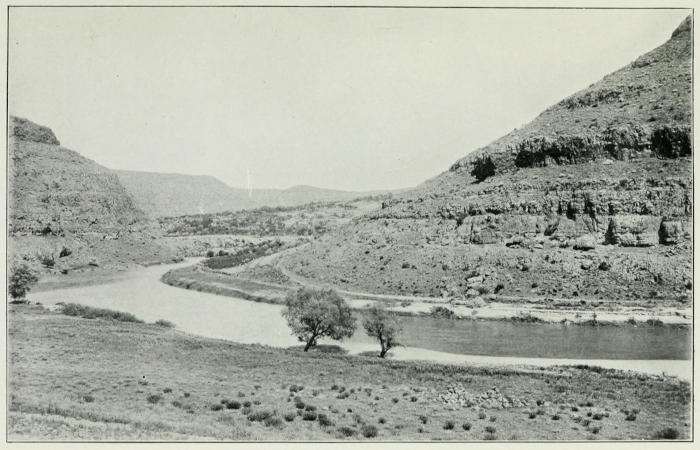
PLATE XI
THE HALYS RIVER, BETWEEN CHOK GEUZ AND BIR GEUZ
The volume of the river has now become so great
that fords are few and generally difficult. That near
Bogche[46] is no longer passable in the winter and spring-time.
The village itself lies back from the river-brink
about fifteen miles below the Bir-Geuz bridge. Karaburna
lies near the opposite bank, another day’s
journey lower down. Hereabouts the hilly ground
which lies eastward of the great lake Tuz Geul
arrests the southerly progress of the river, which,
thrown back, turns in a great sweep north-westwards
for nearly a hundred miles, then northwards to
latitude of Angora, so dividing the heart of the
peninsula. The chief bridge in the latter portion of
its course is now at Cheshme Keupru, where amongst
other main communications the road from Cæsarea
to Angora recrosses the river. Hereabouts it would
seem there was a bridge and fort or guardhouse in
Persian times,[47] where the royal road from the Phrygian
country and the west passed over towards Boghaz-Keui.
Above this bridge the immediate banks are
green and on the left side open; but below the waters
pass at once into a rocky defile, changes which are
typical of the varying nature of the river’s bed.
Opposite Angora (which is distant about thirty miles
at the nearest point) Nature opposes further obstacles
to the northerly progress of the river in the broken
ranges of the northern coast, so that it now turns
completely upon its original direction, and henceforth
flows north-easterly with one main détour. As it
winds around the foot of the Kush Dagh it descends
from the plateau, and in a widening valley with fertile
banks finds its way into the Black Sea, northwards
from Samsun, at the point of a promontory which it
has itself deposited.
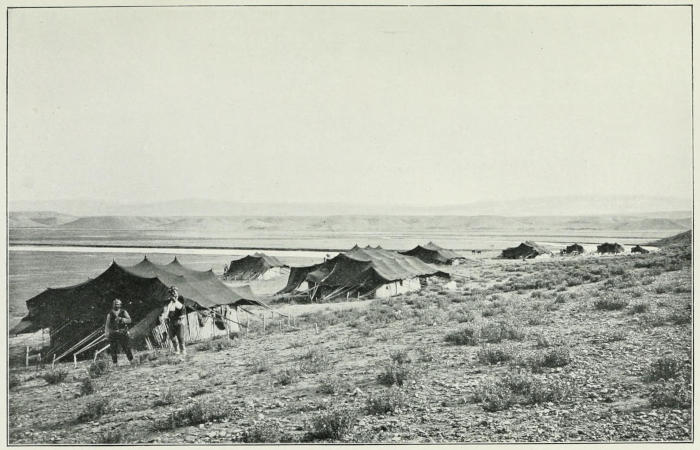
PLATE XII
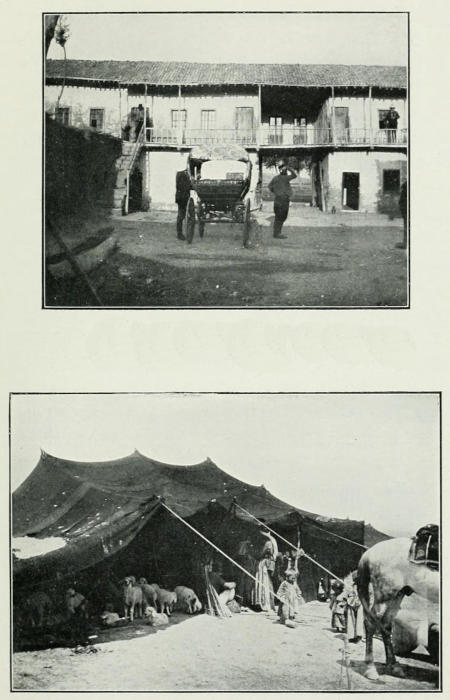
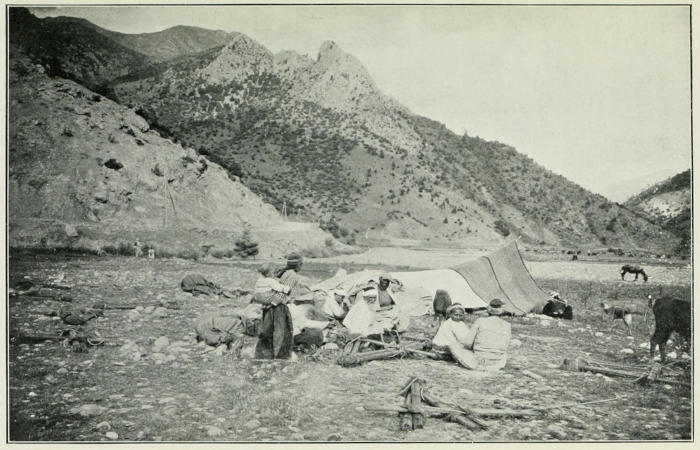
YENI-HAN, NEAR SEKKELI: NOMAD ENCAMPMENT ON THE DELIJE IRMAK (See p. 29.)
The great circuit of the Halys encloses a tract of
country a hundred and fifty miles across, watered
chiefly by tributaries of the same river. Of these the
Delije Irmak is chief, and it is perhaps more directly
concerned with the fertility of the country than its
parent river. It rises in the watershed of the Ak Dagh
Mountains, under the southern slopes of which the
Halys itself flows down the long reach between Sivas
and the bridges near Cæsarea. Thence in its course
it makes a similar circuit within that of the Halys,
which it only joins in the middle of the north-westerly
reach. This river is more gentle in its flow, and its
banks are mostly flat alluvial tracts of great fertility;
indeed, the land would support a population many
times more numerous than its settled inhabitants.
Long green pastures and arable spots remain unneeded
and neglected. It is small wonder that the wandering
Turkoman and other nomad peoples have found out
this favoured region so suitable to their habits and the
feeding of their flocks. Their tents in little groups are
found quite frequently in places off the beaten tracks;
indeed their encampments remaining through several
years sometimes mark the foundation of villages and
settled life. The tent of the nomad is generally made
of lengths of rough hand-made cloth, woven from home-spun
goats’ wool. These are sewn together to give a
considerable expanse of cover, which is spread over
vertical poles and brought down to earth on the windward
side. In such a tent the owner and his family
share a common shelter with their flocks and any other
animals they may possess.[48] In some cases the development
of the house from tent may be watched growing
proportionately with the duration of their stay. For
the ashes and rubbish are regularly thrown out around
the back of the tent for mere convenience. This refuse
gradually accumulates, and may be increased by earth
cleared gradually from within, and by stones collected
from the land in use around, so that in a year or two a
wall or mound three or four feet high already encloses
the tent on three sides. The worn-out cloth cover is
now replaced by a roof of rafters and twigs covered
with earth, and perhaps without realising it the nomad
has settled and built a house. The solution is not
always so simple or purely economical. In some cases
walls of reed are built, over which the cover will be
stretched as before and held down all around with
pegs. In due course, with a prolonged stay, the worn-out
cloth will be replaced by thatch, and rough stone
walls supplant the decaying reeds; and so, as he loses
the habit of wandering, the nomad loses also the necessaries
of his journeys.
The Delije Irmak is replenished in its turn by
numerous smaller streams; on one of these is Yuzgat,
which had its origin in a settlement of Turkomans,
and has now grown to be one of the most important
towns of the district. It is pleasantly situated in the
cup-like hollow of a green hillside, and with its well-ordered
streets, its stone-built bazaars and public
buildings, has an appearance of considerable attraction.
Here horses are to be procured of useful kind
and at reasonable prices, and a great horse fair is held
annually in the summer months. The masoned stone
used in its construction was largely brought from the
ruins of ancient Tavium, which is found at Nefez-Keui,
a short journey to the west. The latter is one of the
most typical and instructive villages of the interior.
It is placed near the sources of another tributary of
the same river, well up the southern slopes of a
considerable secondary watershed. In typical fashion
the backs of the houses are partly excavated in the hillside,
so that the mud-covered roofs are continuous
with the ground behind, while the fronts of the houses
and the village streets are banked up in terraces.
Nearly all the houses have some form of verandah
sheltering their entrances; and numerous Greek inscriptions
may be found built into the walls of many
buildings. The ancient acropolis may be recognised by
a few sculptured fragments in a steep knoll some
minutes westward, and on the way the modern cemetery
is passed in which also several stones bearing Greek
inscriptions or sculptures have been re-used and in
some cases re-inscribed. The main industry of the
villagers here, as everywhere in Asia Minor, is naturally
agriculture. The fields in the dales below, though
somewhat marshy in places, are very green with
luxurious pastures and some quantity of trees; while
nearer the village gardens of vegetables are plentiful
with orchards of fruit-trees and a considerable expanse
of vineyards. Other national industries are
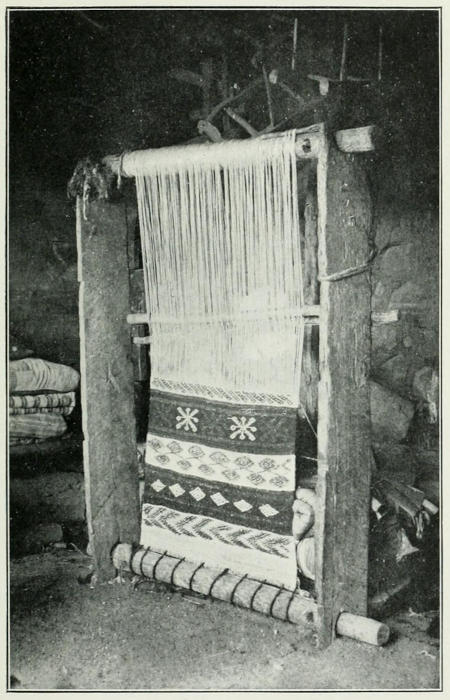
carried on in the houses unnoticed, such as the hand-weaving
of small carpets,[49] done chiefly by the women.
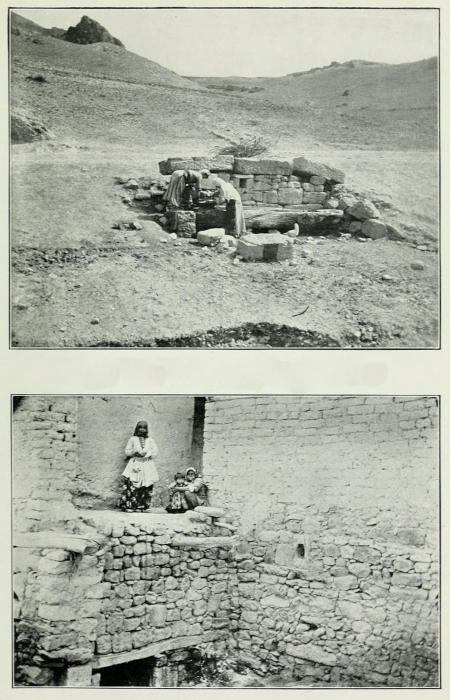
The water supply of the village is found in several
springs, which have been built up and prepared for
the watering of cattle and flocks, as well as for
domestic purposes. The scene of women washing
their garments or their children at the trough, or
drawing water at the source is here, as throughout
the East, one of the most characteristic of daily life.
The prevailing type of face among the inhabitants of
this place is Turkoman, but a certain clean-cut Greek
or proto-Greek type of face may be found suggested
in some few of the men, recalling distantly a special
type of Hittite warriors as portrayed in Egyptian
sculpture. Some of the women are noticeably
beautiful.[50]
Northwards from Nefez-Keui the route continues to
rise to the crest of this secondary watershed, which
reaches a height of over seven thousand feet. From
the eastern edge several streams fall away to join the
Chekerek. As soon as the northern slopes are reached,
a remarkable change of landscape presents itself; bare
patches are replaced by continuous pastures, and the
stream which descends towards Boghaz-Keui passes
through meadows and wooded glades of peculiar
beauty. As the river[51] gathers strength it works its
way into a deep continuous vale of increasing
splendour, the slopes of which are thickly covered
with trees and shrubbery of considerable variety,
except where here and there a bare patch of rock or
red-brown soil adds to the contrast of colours. At
the mouth of this valley, on the right at the foot of
the hill, the little village of Boghaz-Keui is disclosed,
with its white minaret and houses and large konak, on
a low outcrop of rock, made pleasant by a few trees and
splashing streams. The ridge is left behind, and the
landscape immediately opens out into wide pastures
bounded by dark green uplands, and broken freely by
white limestone rocks. The name of this place, the
‘Village of the Gorge,’ has arisen possibly on account
of its general situation, or more probably in reference
to the deep ravine of another river[52] which bounds the
eastern edge of the historic hill, on which are the palaces
and acropolis of ancient Pteria, that marks the one-time
capital and centre of the land. It is difficult for
us now to realise, with the changed political and
economic conditions, what special feature there was
peculiar to this site, unless that were its climate and
defensible position, that should have marked it out for
such a destiny. Its ancient city is now a deserted ruin,
without meaning to modern life. Its roadways have
no longer any significance, and even in the faces of its
people there can be seen no reflection of its former
population. It would seem that the Lydian conqueror
of the sixth century B.C. had thoroughly and effectively
destroyed it.[53]
PLATE XIV
NEFEZ-KEUI: TWO WOMEN DRAWING AT THE SPRING
TYANA: TURKISH WOMEN AND CHILD
Another Hittite site, marked by a low mound now
covered by the village of Eyuk, lies some twenty miles
farther to the north. The route thither winds around
somewhat barren uplands, among which a few arable
spots have been chosen as the sites of villages. In
some of these, particularly in the remoter places
upon the hills, an ancient type survives in striking
and rugged contrast to the familiar though varying
Turkish features.[54] Our photograph, taken at Kulakly
(a hamlet on the way from Boghaz-Keui to Eyuk), discloses
the same prominent facial details and sturdy
figures as we have previously seen in the woodlands
above Kartal in the north of Syria. It is
a type preserved to some extent in the Jewish
families found in some of the towns of Asia Minor,
as we have seen to be the case at Cæsarea.[55] It is
strikingly reminiscent of the Amorite element among
the Hittite allies on the Egyptian battle scenes.
The main roadways of this region, as indeed throughout
the tableland in general, are curiously independent
of the river systems. Local tracks follow naturally
the valleys of streams so far as these serve for the
required direction, but in general the high roads are
independently devised. Of these the two which cross
at Yuzgat are the chief: the one leads from Cæsarea
northwards either to Chorum, the administrative headquarters
of this district,[56] or to Amasîa somewhat eastward,
and so on to Samsun on the coast of the Black
Sea; while the other connects Sivas with Angora and
the west. The latter route as it approaches the Halys
passes by Denek Maden, where are considerable mines
of lead and silver, the ore of which contains also antimony
and gold. The descent to the Halys bed lies
through a well-timbered country, and the river is
crossed by this route at Cheshme Keupru. There are
also other routes of considerable importance, one of
which has been mentioned as connecting Cæsarea
with Angora directly, crossing the Halys twice; while
another from Angora eastward, much used in summer-time,
passes over the river considerably north of
Cheshme Keupru, heading for Sungurlu, whence the
way is open to Chorum by way of Eyuk, or to Yuzgat,
passing in this case by Boghaz-Keui.
There are some few rivers of this region which do
not enter the basin of the Halys. The chief of these is
the Chekerek, which rises likewise in the Ak Dagh
Mountains, and pursues a circuitous course northwards,
in avoiding the slopes of minor ranges, until it
joins the river Iris at Amasîa. The last-named river,
called in Turkish the Yeshil Irmak, with its main
branch the Lycus, belongs entirely to the coastal
system, and so does not enter into our account of the
interior plateau. Another stream just eastward of
the Iris is the Thermodon, made famous in Greek
literature[57] by its association with the Amazons. This
is one of a series of similar rivers which flow almost
directly northwards to the Black Sea from the lower
Armenian hills. There are other short rivers of like
kind westward of the Halys, some of which help to
feed that river, while others flow directly to the sea.
These do not need to be mentioned by their names,
as they all fall away from the northern slopes of the
broken and irregular chain of mountains that forms
the northern boundary to the tableland.
PLATE XV
YUZGAT: DERVISH AND VAGABONDS
KULAKLY KEUI: TYPES OF INHABITANTS
The most westerly main river flowing to the Black
Sea is the Sangarius or Sakaria, which rises in the
interior, and avoids the northern ranges by a long
westerly détour. Numerous early tributaries of this
great river rise indeed in the slopes of those northern
mountains, while others fall from the western side
of the divide, which on the east overlooks the Halys.
These meander southward and westward, seeking for
an opening through the upland region of which Angora
is the economic centre. The country which they water
resembles in general characteristics many portions
in the basin of the Halys; and though large tracts
equally remain barren and neglected through lack of
population, it is on the whole better cultivated, and
hence more productive. Angora itself is strikingly
placed upon a hill, crowned by an old fortress which
overlooks a ravine with precipitous sides.[58] Here are
extensive gardens and cultivation in sheltered spots,
and in the immediate neighbourhood are numerous
orchards and vineyards. The place is famous for its
fruits, especially pears and apples, and for its honey.
The Angora goat is historic, and there is still a considerable
trade in the mohair which this animal produces,
and to some extent in special woven fabrics. It
is the administrative headquarters of a large province,
the seat, that is to say, of a Wali; and is an important
trade centre for the interior. Several main roads converge
upon it, notably the high road connecting Constantinople
with the East, by way of Yuzgat and Sivas,
which crosses the Halys at Cheshme Keupru. A route
no longer of first importance, but dating probably from
Phrygian times[59] at least, connects Angora with Giaour-Kalesi,
some thirty miles south-west, and another place
in this vicinity with which we are concerned is Yarre,
placed just above a bridge across the Sangarius called
Karanje Keupru.
PLATE XVI
ANGORA: OLD HOUSES ON THE OUTSKIRTS OF THE CITY
In the time of Herodotus the country around Angora
was obviously regarded as a part of Phrygia, the
eastern boundary of which was the Halys, dividing
it from Cappadocia,[60] yet we have preferred to look
upon this as a northern region apart, and to assign
to the Phrygian country its later and more familiar
boundaries. As such Phrygia forms the geographical
centre of the western portion of the peninsula. Here
is the main watershed, in which are found the head-waters
of three river systems. On the one side are the
sources of the Hermus and the Mæander flowing down
to the Ægean in the west; on another rises the Cayster
(the Akkar-tchai), and several smaller rivers which
follow a southerly or south-easterly course, emptying
into inland lakes; while from the northern slopes, as
we have previously noticed, other waters feed the Sangarius,
and are rolled with the flood of that river into
the Black Sea eastward from the Bosphorus. These
uplands are among the most attractive parts of Asia
Minor; the bracing air is filled with the delicious scent
of pine-woods, the verdant pastures are well watered
by numerous clear streams, and the meadows ripen
under a glowing sun, the rays of which are tempered
by the altitude. Here, too, are numerous monuments
of the Phrygian kingdom; while north-east from
these, at Doghanlu Daresi, on one of many minor
tributaries of the Sangarius, and south-west at Bey-Keui,
at one of the sources of the same river, near the
summit of the watershed, there have been found
traces of Hittite handiwork. Through the heart of
this region, too, there passed the royal road of Persian
times,[61] visible as a series of parallel scars in the surface
rock. This was the main highway linking West
with East, and that it developed largely during Hittite
times also is seen by the disposition of Hittite monuments
along its track. Near the coast, it passed near
where the sculptures of Sipylus and Kara-Bel looked
down on the approaches to Smyrna and to Ephesus.
From Sardis its precise route eastward is not determined,
but it must have entered the Phrygian country
near Bey-Keui, whence it is traceable past Bakshish
and the monument of the Phrygian Midas, near which
is also the Hittite sculpture at Doghanlu Daresi. Still
leading north-westward past Giaour-Kalesi, it would
seem to have crossed the Sangarius near to Yarre, and
the Halys either at or just northwards from Cheshme
Keupru,[62] heading in all this otherwise unexplained
détour for Boghaz-Keui, the chief centre of the Hittites
in the north. This road had already lost its main objective
even in Persian times, for Pteria seems never to
have recovered from its overthrow by Crœsus, but it
continued to be used, probably because it was ready
made; and its traces remain, like the isolated monuments
of the Hittites in the west, striking witnesses to
a vast system of government and economic organisation
unlike anything in later times. For our immediate
purpose it is sufficient to notice that all the clearly
Hittite monuments westward of the Halys are found
along this single line of road, a fact which is as significant
as it is remarkable.
We do not include in the foregoing considerations
the region of which Iconium (Konia) is the centre,
which fills the southern corner of the tableland.
Several main roads radiate naturally from this place,
which is the chief town of the province; there are,
however, only two or three with which we are even indirectly
concerned. Of these one leads north-westward,
passing Ilgîn at a distance of about fifty miles, and so
into Phrygia, which it approaches up the valley of the
inland Cayster. The second is that which leads eastward
across the plains by Sultan Han and Akserai for
Cæsarea; and a third, bending southward to avoid
the desert plains, communicates by Eregli with the
Cilician Gates and with Tyana (Kilisse Hissar). In
ancient times there must have been a more direct road
connecting Iconium with Tyana, passing by Ardistama,
the site of which is still marked in what is now desert
by the name of Arissama, with the neighbouring
mounds of Emir-Ghazi.[63]
Around and northward from Iconium there are extensive
grass plains, the natural grazing ground of
horses which are sent in great droves annually to the
fairs and markets of the country, even as far as Baghdad.
The breeds are not remarkable for quality, and
cannot compare with those rare and beautiful animals
reared in the plains that border the middle course of
the Euphrates; but they are for the most part a hardy
species standing little higher than a European pony,
useful for transport, and trained for the saddle to the
fast walking pace in which long journeys are always
made.[64] The rivers of this region are short and local,
ending for the most part upon the plains in salt lakes
and marshes, which, after the snows have ceased to
melt, become almost dry, leaving the ground covered
with white incrustation. Some of these lakes are of
such volume as to be permanent; the largest of the
kind, as has already been mentioned, is Tuz Geul; its
waters are more dense even than those of the Dead
Sea, and as they recede with the approach of summer
they leave behind thick deposits of salt, collected regularly
by the natives, who come many days’ journey for
the purpose.
There is another great lake a long day’s journey
westward from Iconium; its situation, however, is
quite different from the foregoing, as it is well up in
the western mountains, nearly four thousand feet
above the sea. The town of Beyshehr, which gives its
name to the lake, is found on its south-eastern corner;
and the road thereto from Iconium passes by Fassiler,
a place remarkable for its ancient monuments and the
peculiar facial type of its inhabitants. Further to the
north, and near the eastern border of the lake, is
Eflatoun-Bunar, the site of a famous ‘Lycaonian’
structure called ‘Plato’s spring.’ With the tract westward
of Konia, however, we have at present little concern,[65]
and when we turn eastward we are inclined to
regard the Hittite sites, whether along the edge of
Taurus like Mahalich and Ivrîz, or isolated in the desert
like Emir-Ghazi, as pertaining not to Konia, from
which they are separated by desert, but to the same
group as Tyana, with which they are to some extent
geographically connected.
PLATE XVIII
NEFEZ KEUI: MINARET OF THE VILLAGE MOSQUE
Built of the drum of a fluted column, an altar and moulded base,
of the Roman period. (See p. 31.)
ANATOLIAN HORSES: THE HALT AT NOONDAY (See p. 39.)
This eastern group of sites, indeed, is remarkably
linked together by a common river system. The centre
is the ‘White Lake’ Ak Geul, at the foot of the Taurus,
westward from Eregli, and southward from the desert
ridge called Karaja Dagh, on the northern slopes of
which is Emir-Ghazi.[66] This lake is of variable size.
When overfull its surplus waters disappear in a
hole that passes under the mountain; during the
dry season, however, it becomes a marshy pond of
stagnant water. Into this come three chief rivers.
From the south-east the Ak Su, which rises in the
main chain of Taurus, drains also the outlying spur
known as the Kara Dagh, on the crest of which is
Mahalich. Here also is Bin Bir Kilisse, ‘The Thousand
and One Churches,’ an ancient site; while just to the
north the isolated hill called Kizil Dagh rises from the
plain. From the south-east there comes the Kodja Su
from high in the Bulghar Dagh, flowing past Eregli, before
which it is joined by a stream that with wonderful
noise gushes forth in many points from the rock near
the hamlet of Ivrîz, six or seven miles above the town.
This source is called by the natives Huda Verdi, ‘God-has-given,’
in appreciation of a divine gift that transforms
an arid corner of the desert into a garden-valley
rich in fruit-trees and vines. Into the same lake from
the north-east comes the Kizilja Su, after a sluggish
journey across the eastern plains, fed in its course by
many streams descending from the inner ranges of the
Taurus. The head-waters of this river give life to a
whole district of peculiar interest. The main stream
rises just northward at Andaval, flowing past that
village to Nigdeh and thence to Bor; just below here
it is joined by another branch on which is Kilisse
Hissar, the site of old-time Tyana. Here are abundant
and picturesque ruins of antiquity, and though nothing
has yet been found earlier than the time of the
Phrygian Midas,[67] there seems to be no doubt from the
accounts of Strabo and other sources that it was from
earliest times the political centre of this region. It is
even probable that the Hittite inscriptions found in
each of the neighbouring towns just mentioned have
been transported from here in past times.[68] This
district is mostly level, being actually the eastern
border of the plain, though lying at the foot of the Ala
Dagh Mountains that from here trend north-east
towards Argæus. Owing doubtless to the various fertilising
properties of the numerous streams that come
down from the hills the whole country is unusually fruitful
and productive; indeed, the region around Bor was
in olden times selected as a part of the Roman Imperial
Estate. Everywhere are wide acres of corn-land; while
in the vicinity of the town are gardens, groves, and
vineyards, adding to the attraction which the numerous
monuments of antiquity already impart to it. The
same features prevail all along the route from Cæsarea
by Injesu, passing by the extensive groves and gardens
of Develi Karahissar and the miles of arable land, dry
but productive, between Arabli and Andaval. The
approach to Tyana, as we proceed, runs for miles
alongside an ancient but ruined aqueduct, picturesquely
placed among gardens and trees.[69] Continuing south,
the rolling plains give way gradually to the outlying
spurs of the Taurus, and the main route crossing the
watershed leads on towards the Cilician Gates, down
the main valley of the Chakia Su.[70]
PLATE XIX
BOR: BRIDGE OVER THE KIZILJA-SU
A mountain-track, leaving the road at Bayal, leads
southward over a series of parallel ridges of increasing
height and grandeur[71] directly for Bulghar-Madên. The
silver mines, to which the place owes its name and
probably its being, seem to have been considerably
worked in ancient times. The village is found deep in
a valley under the Bulghar Dagh, a chief range of
Taurus, nearly nine thousand feet in height. The
stream rises far up the ridge, from the opposite side of
which a branch of the Kodja Su flows down towards
Ivrîz and Eregli. Its course is eastward, and as it
dashes down its rocky bed it is already, when passing
Bulghar-Madên, nearly three thousand feet below the
snow-splashed crags along the base of which it flows.
From there the valley, though narrow and steep-sided,
assumes the verdant and enchanting beauty that ever
dwells by mountain-streams, lending character to a
large portion of the Hittites’ country. But to the
traveller following in summer-time the track that
winds down the left bank of the river, this beauty and
enchantment is intensified here by the vast setting of
the picture, by its fulness and variety of detail and
rich contrasts of colours, combined with the movement
and variegated costumes of the people that
mingle in the scene. The banks are fruit-gardens, and
wildflowers of varied sorts carpet the ground with
splendour. Vines and mulberries are in profusion; and
ripe cherries may be plucked even from the saddle,
their bright clusters mottling everywhere the dark
green foliage. Below, the swirling waters, seen at
intervals, contribute also their harmonious changes,
being white and gleaming where played on by the
bright sunlight, and again clear green in the deeper
pools and shaded places. From among the trees, the
bright colours prevailing in Turkish costumes, reds and
blues, yellow and white, add to the effect; for the
whole population of the scattered hamlets, men and
women, boys and girls, are in the gardens or beneath
the trees. At one place may be seen an aged couple
bending side by side at their work upon their tiny
plot of land. Below, under a spreading tree, against
the stem of which he leans, a bare-legged boy is
piping his reed flutes, as Marsyas did, while boys
and girls stand near in groups talking and at play.
Beyond, out of sight of these, upon a sand-and-pebble
beach two little boys, quite naked, are dancing merrily
by themselves to the distant music. In the background
rises the immense wall of mountain: its lower slopes
are thickly wooded with larch and pines, giving way in
the middle heights to scrub oak, which continues to
struggle upward until the bleak rock appears. Overhead
a curious phenomenon tempers the heat of noon-day
in this happy valley, especially on windless days
when its beneficence is most appreciated. Towards mid-day
a mist, arising probably from the melting of the
snows upon the ridge, spreads over the valley like a
canopy, and so it remains until as the afternoon wears
on the vapour re-condenses, and the bright sun reappears
to cheer the evening. Except for this peculiarity
the valley resembles in general many of those innumerable
sheltered rifts among the Taurus and Anti-Taurus
Mountains, wherein the rigour of winter is
recompensed by the bounteous summer, and the scattered
population pursues its life, isolated from and
almost independent of the moving world.
PLATE XX
APPROACHING THE CILICIAN GATES FROM THE NORTH (See p. 46.)
Where this mountain-stream unites with the Chakia
Su a bridge carries the track across to the other bank
to join equally the main road to the South. This is the
historic route leading through the Cilician Gates, the
only pass available for traffic through the unbroken rock
wall of Taurus. Peoples have passed through it that
have formed nations; the armies of conquerors have
traversed it in the struggle of continents; religions
from the East have made it their channel of approach
towards the unthinking West; Paul of Tarsus travelled
through it bringing the Cross of Peace; and through
it the Crusaders took back in due time the Cross of
War. Makers of history—Persian, Greek, and Macedonian;
Christian, Jew, and Moslem, all have passed
this way. The nicely engineered road, however, with
its bridges and embankments, its rock-cuttings and
eased gradients, is a work of modern times. At the
opening of our story we must look back to the beginnings
of the pass in a rough track alongside the rushing
stream. Even in early Hittite times, if we pay regard
to the disposition of their monuments, it seems probable
that the longer but more open route that follows
the Tochma Su, and the shorter but rocky track that
descends by Kuru-Bel, continued to be the chief lines
of communication between the two main branches of
their empire.[72] Previous, however, to Persian times the
road through the Cilician Gates must have been
sufficiently arranged to enable a wheeled cart or
chariot to pass that way.[73]
The route may be divided into main sections, the first
reaching as far as Bozanti Han. In this portion, which
may be regarded as the northern approach to the
Cilician Gates, the scenery gradually attains all the
beauties of a deep mountain-pass. The steep slopes of
the valley are clad with the dense growth of pines,
mixed freely with oak and cypress, and other trees of
varying foliage. In places the bare rock protrudes
and towers aloft precipitously, with sharp peaks
reaching to the snow-line. Ever and again a more
open glade, or the widening of the wooded valley where
the river is joined by other waters, adds pleasing
variety to the journey, and brings into greater prominence
the boldness and beauty of the views. At one
place, visible by a short détour, there burst out of the
rock the clear dark waters called appropriately Kara
Su, changing the colour of the entire river. Several
‘Hans’[74] are passed and bridges crossed before nearing
Bozanti; and hereabouts the river, with which the
road has descended thus far, enters a rocky and precipitous
defile through which it rushes to the plain.
Avoiding this, the route crosses a low divide, and
descends upon an arm of another river, the Cydnus,
which leads down eventually to Tarsus and the sea.
For a short way in this second section of the route the
country is more open, but the enchantment of it is
maintained in the wooded highland landscapes, with
views of the dark green slopes of rugged Taurus and
the snowy crest and crevices of Bulghar Dagh. Two
well-placed ornamental forts[75] are passed, and the
winding road, when seemingly faced by an impenetrable
ridge of mountain, enters suddenly a deep rocky gorge.
The spot is marked by an inscription of Marcus Aurelius
on a rock in the river’s bed. This is the veritable Gate
of Cilicia. A double door would close it and defy an
army.
PLATE XXI
ENTRANCE OF THE CILICIAN GATES
In keeping with its momentous history, the scenery
as the descent continues at once assumes a wild and
impressive grandeur, unparalleled in beauty, passing
description, to which all that has passed before served
but as introduction. Now the keynote is changed, and
Nature’s full orchestra breaks forth into a theme of
violent and majestic discords, ever changing yet sustained,
leaving for ever the impression of its grand
harmonies. Here the crags tower up a thousand feet
on either side. A myriad trees, their varied tones
intensified by the glowing sunlight, clothe with soft
colours the heights that hem in the horizon save where
it is broken by fantastic peaks. Now the valley is torn
by great rifts of red and grey rock, and warning precipices
of prodigious character overhang the pathway.
Below, on a verdant bed bedecked with flowers
and creepers, peaceful glades and vistas disclose the
chequered waters of the stream. Another turn, and a
broad sweep of virgin forest lines the slopes in an
unbroken curve; and ever and again Nature’s panorama
changes, attracting the eye to some fresh beauty
or surprise.
Though seemingly inaccessible, yet up in the wooded
heights here and there a small village may be found,
its houses nestling among fruit-trees and luxurious
wildflowers. The people are very poor, for on these
broken hilltops arable spots are scarce and difficult to
work. They are also reticent and unsophisticated, and
it is impossible to obtain from them any consistent
reason as to their choice of dwelling-place while so
many miles of corn-land in the interior await man’s
labour. And since the bracing mountain air amid the
pines, and the unique views all round, which extend
beyond Tarsus to the sea, are to them considerations of
last importance, we are left to conjecture in this case
also that their ancestors found refuge here from the
political storms of an unknown date. We are inclined
to believe that this was the reason, and that the date
was remote, because of the survival amongst them in
striking purity of a type of the old Hittite races which,
though peculiar, is familiar on the Egyptian monuments.
It may indeed have been that of the Cilicians
in general: it is strongly mongoloid in appearance except
for the nose, which is strong and straight, but
fine. The chin is beardless, but there is a thin dark
cynical moustache; the cheek-bones are high and
the eyes oblique. In the Egyptian sculptures a
pigtail usually completes the striking features of the
portrait, but this seems not to have survived the
Moslem tonsure.
Once through the pass the whole character of the
country changes as by a magician’s wand and another
land unfolds itself. The bracing dry uplands are left
behind with their peculiar fascination and unrealised
possibilities, and in their place there appear the palm-trees
and fruit-gardens of a southern clime, with physical
peculiarities, economy, and population entirely
different. The western plain of Cilicia is entirely
alluvial soil, and is well called the fruit-garden of
Western Asia. Towards the east there are some hilly
places, but to the north-east the plain stretches out
again, following an inland bay of the mountains. These
plains seem to be wholly the gift of the numerous
rivers which water them. These, descending from the
mountainous region above, wherein the nature of the
stone is various and to a large extent volcanic, bring
down with them the rich alluvium which is deposited
in their sluggish course below. Their names have been
already mentioned. Some further streams to the west
have a swifter course from the mountains which in
that direction gradually approach the sea. Mersina,
the modern port, marks almost the western extremity
of the plain.
PLATE XXII
GOING SOUTH THROUGH THE CILICIAN GATES
TARSUS: THE GARDENS AND THE TOWN
The green tract of Cilicia is so shut in to the
north by the Taurus ranges, and to the east by the
Amanus mountains, and so exposed to the sea, that it
seems as if Nature had designed this unique corner of
Asia Minor for a history of its own. Its remarkable
fertility, however, and the important passes which lead
down to it in several directions, make it impossible
that it could have been overlooked by any power in
possession of its frontiers. For this reason, and in this
instance, the absence of any clearly Hittite remains[76]
must be attributed to accident and to the nature of the
country. But it is indeed remarkable that in none of
the defiles that connect it with the several portions of
the Hittite land has a single Hittite monument been
discovered. When we consider how suitable many
spots would seem to be for Hittite monuments, whether
in the Cilician Gates, or in the valley of the Pyramus,
or in the pass leading by Bogche over the Amanus
mountains eastward, or on the wave-washed rocks
which must be crossed by the coast route to Alexandretta,
this absence of any Hittite trace becomes the
more conspicuous and significant. It establishes the
probability towards which we have been already drawn,
that the main channel of communication between the
lands of the Hittites in the north of Syria and in Asia
Minor was by way of the mountain passes of the
Taurus and Anti-Taurus where their monuments are
found in comparative plenty.
PLATE XXIII
TARSUS: THE CONCRETE WALLS OF DUNUK TASH
TARSUS: SACRED STONE IN A COFFIN, IN THE COURT OF AN ARAB SHRINE
II SOME PAGES OF HISTORY
In this chapter we take a passing glance at the
history of the Hittite lands after the Hittite power
had passed, down to the establishment of the Seljûk
Turks in the twelfth and thirteenth centuries A.D. It
is not a connected story, for with the disappearance
of the Hittites the political horizon changed: thereafter
the balance of power in the Near East was
several times distributed anew. We must therefore be
content to sketch an outline of the general course of
eventful history in which the lands subsequently
shared, and to note in what manner, but not to what
extent, the local records and monuments are evidence
of the parts they severally played.
We are compelled to make these limitations, for no
land on earth can claim a history so momentous as the
drama that was worked out in Asia Minor during the
centuries that followed the Hittite domination. Here
was the scene of a long struggle for supremacy both
among its own peoples and between the adjoining
portions of the two continents which it connects; a
thousand Iliads would do scant justice to the deeds of
arms alone. And the struggle of the continents was
not merely for the possession of a land itself rich in
minerals and for the most part highly fertile, but for a
passage-way for great migrations, civilisations, and
religions. To this story we have nothing to contribute,
no new evidence to bring forward, no new opinions to
maintain; the history of Asia Minor has been written
by pens more able and more competent to deal with
it.[77] In introducing these few pages our object is to
subserve our main inquiry: to enable us to distinguish
between the works of the various phases of history
that we meet with in our wanderings, and especially
to appreciate by contrast the peculiarities of the
Hittite monuments which we shall next consider.
Though we defer writing the story of the Hittites
until we have seen what their own works can tell us,
we find ourselves obliged to trace its outline[78] in
order to decide at what point that story ends. The
Hittites first appear in history about 2000 B.C., when it
would appear that they were already powerful enough
to overturn the first dynasty of Babylon and sack that
city, and that they had settlements in southern Syria
on the frontiers of Egypt. Certain Hittite tablets
from Central Asia Minor are said to belong to the same
age. Nothing is known, however, of the constitution
of the Hittites in these early times; but it may be inferred
that they subsequently retired from the south
or were there submerged. It is not until the fifteenth
century B.C. that the name of the Hittites definitely reappears,
when successive expeditions of the Pharaohs
encountered them in the north of Syria. Then in the
fourteenth century their capital is found at Boghaz-Keui,
in the ruins of which their archives of this period
have been recently unearthed. These, supplemented by
the Tell-el-Amarna letters, tell how the King of the
‘Hatti’—the local and at that time dominant element—became
Great King of the Hittite confederated peoples
and vassal states, whose chief towns included most of
the sites identified with Hittite remains, like Hamath,
Aleppo, Carchemish, Marash, Malatia, and many city-states
as yet unidentified. This was the period of their
greatest empire, and it is probable that the regions
of Cilicia, Lycaonia, Phrygia, and even Lydia at this
time acknowledged the suzerainty of the all-powerful
soldier-king. For five or six generations of the Hatti
rulers the position of the Hittites as a dominant power
in Western Asia was recognised by the Pharaohs and
the Kings of Babylon, both in their letters and treaties
and by the exchange of ambassadors. During the
great migrations of the twelfth century B.C., however,
it would seem that the Hatti dynasty was overthrown
and the Hittite empire dismembered. This may be
inferred from the cessation of their own archives and
from the appearance of the Muski, identified in later
times with the Phrygians,[79] upon the north-west frontier
of Assyria,[80] having thus fought their way across the
heart of Asia Minor. These were repulsed,[81] but this
incursion was contemporaneous with a shifting of the
chief Hittite power to Carchemish, while Hamath on the
Orontes and other southern centres come into increased
prominence.
In trying to work out the story of the decline and
fall of the Hittite power, we are faced with the same
difficulty that enshrouded the whole problem of the
Hittites until recent discoveries shed the light of
internal documentary evidence upon the period of their
empire—namely, that for the most part only the events
connected with certain of their frontier lands came at
all within the horizon of the Assyrian and the Greek
historians, and these are seen by us with relative
disproportion. To take a single illustration, we fail
to find in the Egyptian and Assyrian records any
suggestion as to the position of the Hittite capital of
the fourteenth century at Boghaz-Keui; and for more
than seven hundred years we are without any direct
evidence as to its fortunes, until a chance reference by
Herodotus in describing the affairs of Lydia tells us of
its final overthrow.
In the tenth century, however, during the temporary
decline of Assyria and the withdrawal of the Phrygians,
the Hittite states may be inferred to have largely
recovered their power and independence. But though
there were frequent alliances between neighbouring
states, there does not seem to have been any over-lord,
as of old, powerful enough to unite them all under his
leadership and to maintain a consistent policy. Malatia
and Marash appear as the chief cities of kingdoms in
Taurus, while in the Anti-Taurus the kingdom of
Tabal (or Tubal) probably included the districts of
Komana, Ekrek, Mazaca, and Fraktin. On the plateau
the kingdom of the Khilakku, which we may call
Greater Cilicia (embracing the region from Tyana to
the Kara Dagh, and from Karaburna to Bulghar-Madên),
replaced the original state of Hatti within the
Halys as chief representative of Hittite power and
tradition. But it was not for long: if the Muski had
retreated it was only to gather strength; while in the
east a new rival, of force and character similar to the
Hittites, had appeared in the region of Lake Van, pressing
down to the Euphrates and even into Syria, where
also the steady infiltration of Aramæan peoples was
already challenging the dominance of the old Hittite
stock.
From the middle of the ninth century also the
struggles of the weakening Hittite tribes against the
reviving power of Assyria were renewed; and this
time they were doomed. Their lands of Syria and in
the Taurus were thereafter the objective of many
punitive expeditions on the part of successive Assyrian
kings, who claim always to have conquered and exacted
tribute. For over a century, however, though many
times defeated and severely punished, these states as
often found opportunity for casting off the yoke. But
Sargon, late in the eighth century, adopted with stern
determination the policy which his predecessors had
initiated, of transporting large numbers of the rebellious
population and replacing them by Assyrian
colonists. One by one the greater Hittite centres on
his frontiers were absorbed, and when the Assyrian
forces passed into Asia Minor to challenge the supremacy
of the Phrygian Midas, about 718 B.C., it is clear
that these two powers had divided the Hittite territory
between them. The appearance, too, in the north, of
the Cimmerians, in wellnigh irresistible strength, had
changed the political horizon.[82]
From one point of view, however, it would be natural
to point to the destruction of Pteria by Crœsus, in the
middle of the sixth century B.C., as the last event of
Hittite history, and so begin our post-Hittite story from
that time. The conquest by Cyrus and the reunification
of all the Hittite lands under Persian rule a few
years later, in 546, would provide a suitable starting-point;
yet, in fact, from the age of Sargon, a century
and a half before, there can be traced no real semblance
of surviving Hittite power nor any of the old Hittite
individuality in the local arts. Their very name then
almost disappeared from Oriental history, and was retained
but as a memory; while in Asia Minor the power
of the Phrygian kings was then at its zenith, and in the
presence of Phrygian inscriptions at Eyuk,[83] near the old
Hittite capital, and at Tyana,[84] which seems to have replaced
Pteria in importance in the revival of the tenth
century, there is indication that the Hittite day was
already ended. But though the Hittite power was
broken and disintegrated, their civilisation faded only
gradually from view. Long after the sun had set upon
its pride it lingered on, felt rather than seen, in the
twilight that obscures our vision of the tableland in the
early part of the first millennium B.C., surviving long
enough here and there, as we shall see, in the form of
institutions and religious customs, to have left a trace
in the pages of Greek history. Thereafter we have
several clear phases to review, interrupted by others
of considerable disturbance and obscurity. Following
the overthrow of Assyria on the one hand, and the
decline of Phrygia on the other, two new powers
appeared in the sixth century in the Medes and the
Lydians, who similarly divided Asia Minor, with the
Halys as their mutual boundary. By 546, however,
Cyrus had annexed the whole country to the Persian
Empire, in the continuous history of which it shared
until the advent, in B.C. 324, of Alexander, who once
more established the supremacy of the West. With
his death the tribal struggles of antiquity reappear in
new guise, and history is occupied chiefly with the
varying fortunes of the kingdoms of Pergamum, of
Pontus, and of the Seleucids, until in the first century
B.C. Roman organisation gathered together the
loose threads of independence and retied the knot in
a manner that remained firm, in fine, for several hundred
years. The next great landmark is not till 668 A.D.,
when, forty-six years after the flight of Mohammed,
the Saracen army laid siege to Constantinople. In 1067
the Seljûks appeared from the east, followed two
centuries later by the Osmanli-Turks, though these
were not finally re-established in power, after the
Mongol invasions, until 1413 A.D.
PLATE XXIV
MONUMENTS OF PHRYGIA
BEY-KEUI: THE ROYAL ROAD TRACED BY RUTS IN THE
SURFACE ROCK (See pp. 24, 38.)
Of the monarchies that arose as the Hittite power
declined, and in their turn passed away, that of the
Phrygians first attracts our attention by its proximity
in time and place. When the Muski first appeared in
the twelfth century B.C. upon the north-west frontier
of Assyria,[85] they gave warning of a tide of Aryan
immigration setting in from the north-west. This first
wave, after beating vainly against the ramparts of the
Assyrian Empire, seems to have retreated; but it left
its traces behind in a group of people, whether colonists
or prisoners settled on the soil in the Assyrian manner,
who by the same name reappear some centuries later[86]
as a small state on the east of the Euphrates opposite
Malatia. We know nothing of the early history of
this movement, but, so far as can be seen, the rolling
of this wave across Asia Minor was coeval with the
submergence of the Hatti seated at Boghaz-Keui as
the dominant power among the Hittite states. Nor is
it clear to what cause we must attribute the retiring
of this vanguard. Probably, as in Syria with the
Hittites,[87] and in Asia Minor with the Cimmerians, the
migratory movement was intermittent; and historically
we may see in the repulse by the Assyrians on the
one hand, and in the development of the rival state of
Lydia and the Greek colonies on the other, coupled with
a certain recuperative vitality latent in the Hittite
states of the centre, various active causes tending to
the consolidation of the Phrygians at the focus of least
resistance, in the fertile tracts to which they gave their
name. However that may be, at the dawn of Greek
history we find them already a fading power, but one
which had left an indelible impression in Greek tradition
and romance, obscuring entirely the old-time
Hatti power of which no memory remained.
Though the settlement of the Phrygians is just
beyond historical vision, the leading features of the
movement can be inferred from Greek literature,
and a certain amount of detail gathered from the
monuments which they have left behind.[88] The chief
migration of the Phrygians—the ninth wave of our
simile—may be judged, from certain facts which Professor
Ramsay has pointed out, to have taken place
about the beginning of the ninth century B.C. They
came in irresistible bands of mail-clad warriors from
Macedonia and Thrace, crossing into Asia Minor by the
Hellespont, and eventually establishing their monarchy
and state on the sources of the Sangarius.[89] Being all
men and conquerors, their coming introduced new
ideas of the dominance of the male element in religion
and in society.[90] The pre-existing central ideal of the
people of Asia Minor had been based on the importance
of motherhood, reflected in religion by the worship of
the Mother-goddess, and in society by a matriarchal
system and absence of true marriage. Now the Phrygians
introduced a new Father-god and a god of thunder,
and a reminiscence of the struggle between the old and
new ideals may be traced in the pages of Homer; but
ultimately they were amalgamated in various ways in
different parts of the country.[91]
Profound as were the changes in religious and social
ideals which the Phrygians introduced, these influences
could hardly stir the popular imagination so deeply or
so rapidly as their deeds of arms. Defended from
all harm by their impenetrable armour, they carried
all before them, so that they appeared in Greek
tradition as a race of heroes, whose kings were the
associates of the gods, whose language was before all,[92]
and the speech of the goddess herself.[93] ‘Their country
was the land of great fortified cities.’[94] In this popular
acclaim we suspect that the Phrygians received credit
for works and to some extent for the prestige of the
Hatti whose realm they had inherited.[95] Their kingdom
without doubt held chief sway over the north-west
and centre of Asia Minor during the ninth and
eighth centuries B.C. In the west, indeed, it was only
at the end of that period challenged by the independence
and growing strength of Lydia; and on the
other hand it must have embraced, as we have shown,
the regions both of Pteria[96] and of Tyana, where it
touched the Assyrian frontier in the age of Sargon;
but on the whole we fail to find any wide range of
Phrygian works, of walled cities or of vast monuments,
that could entitle the Phrygians to the whole
credit of these memories.
None the less, some Phrygian monuments, like the
‘tomb of Midas’ near Doghanlu, are striking, peculiar,
and impressive. So, too, are others further south,
of which we reproduce some illustrations,[97] because of
the added interest of the influence of Hittite art and
technique which can be traced in them. The ‘lion
tomb,’ near Dimerli, illustrates a motive dominant in
their decorative reliefs, reflected in the later sepulchres
of Ayazîn. Here are seen two lions, guarding as it
were the entrance to the tomb, arranged facing one
another on either side of the door. In the tomb of
Dimerli the lions are rampant, and a column or altar is
seen between them. The symbolism of this design
may be purely Phrygian, but the decorative conception
of the twin guardian lions is too freely found in
Hittite art[98] for us to doubt that it had been borrowed
from the older population. So, too, in the method of
carving the reliefs, as well as in detail of treatment,
as, for instance, in the outline of the shoulder muscles
of the fallen lion,[99] there is abundant indication to us now
of an influence not visible to the historians of antiquity.
Though the monuments and legends together help
us to reconstruct the base and framework of Phrygian
history, there are very few authenticated data with
which to fill in the details. There is no long list of
royal names, for the rulers are supposed to have been
named Midas and Gordius alternately; and a few other
names preserved in Greek tradition are merely legendary.
It is not until the age of Sargon[100] at the close of
the eighth century B.C., that a few facts come to light
among the Assyrian archives. Then it would appear
that the Phrygian sphere of influence had penetrated
far into south-eastern Cappadocia and was expanding,
until challenged by the Assyrian forces in a series of
campaigns beginning in 718 B.C. But Midas the Phrygian
was not easily restrained, and in the next year
prevailed on Pisiris of Carchemish to revolt against
the Assyrian supremacy, while several minor states
of Cappadocia, forming part of the region called Tabal,
followed this example, prompted, doubtless, from the
same source of inspiration. The rebels were promptly
punished, and one of these expeditions sent against
them penetrated, it would seem, to Tyana, at this time
an important centre for the Phrygians[101] in the conduct
of their wars. In 709, however, following a further
expedition sent against Midas from Cilicia, the Phrygians
capitulated, sending ambassadors and tribute.
The reason for this sudden change of front is also
made apparent. About the middle of the eighth
century B.C. there had appeared the first wave of an
overwhelming movement of peoples from Southern
Europe,[102] including seemingly both Cimmerians and
Scythians, coming by way of the Caucasus, spreading
terror and devastation as it passed. The Vannic power
of Urartu in Southern Armenia about 720 B.C. received
the first onslaught, and then the frontiers of Sargon,
who had to call up all the resources of his armies to
protect his kingdom. Recoiling, the tide set westward
through Asia Minor, meeting about 710 another
similar stream[103] that had crossed the Bosphorus; and
the united barbarians for half a century established a
reign of terror in the north of Asia Minor. The details of
the story are wanting, so far as it directly affects the
Phrygians during this fateful period. About 675
however, the royal Midas (presumably the grandson
of Mita who had begged Assyria through his ambassadors
for help), defeated on every hand, in despair
committed suicide. The Cimmerians overran his
country, and the kingdom of Phrygia henceforth
ceased to be. We do not follow the movements of
these hordes further; for they have left no trace or
handiwork upon the Hittite lands which they had
overrun, although it was not until the close of
the seventh century that they disappeared. Their
inroads, however, and the violent deflections which
they gave to the course of history, are probably
responsible for the final disappearance of all
trace and memory of the Hittite power in Greek
history.
The Lydian state in the west, that fought the final
struggle for civilisation against these restless and untiring
foes, next claims our notice from the way in which
certain of its institutions and ancient customs reflect
the influence of the Hittite civilisation, from which, indeed,
they may have been inherited.[104] Unlike the rulers
and customs of Phrygia, the leading elements of the
Lydian society had been matured on the soil from dim
antiquity. Tradition speaks of a dynasty of Heraclidae
who ruled from the twelfth century for five hundred
years,[105] and whose ancestor, Agron,[106] was descended
from Hercules himself. Even before that date there is
memory of a royal family of Atyadae, whose rule, if
there be anything in this memory, must have passed
back to the days of direct Hittite domination that saw
the carving of the warrior-gods of Kara-Bel and maybe
the Mother-goddess of Sipylus.
However that may be, we see the Lydians already an
organised state, even while the Phrygian power was
still at its height, before the Cimmerian storm had
burst. As with the Hittites in past time, their constitution
was partly that of confederate or vassal states
governed by hereditary chiefs owning allegiance to the
ruling power at Sardis, and partly feudal,[107] the chieftains
owing their military service and their tribal
forces to the king, while the common people appear
as serfs. In this society the king was both head of
the priesthood and chief commander of the vassal
chiefs in war.[108] The emblem of sovereignty was a
double axe, which the Greeks said was derived from
Hercules himself.[109] From among the mass of legend
which characterise the earliest efforts of Greek history,
it might be possible to trace many suggestions of the
influence of the Hittite civilisation; but the lack of
local monuments (a fact due doubtless to physical conditions),
to reveal to us the dominant features of Lydian
art, restrains us from this aspect of inquiry. One
point at any rate is established, that not merely was
the district of Lydia at one time embraced within the
Hittite empire,[110] but that it became imbued then with
many features of social organisation which it carried
down from the old world to the new. Our main
inquiry being based on the monuments of the Hittite
lands, we cannot dwell upon the stories of the Lydian
kings, of their desperate struggles with the Cimmerians
following the downfall of Phrygia, nor of their warfare
with the Medes, with whom, after the fall of Nineveh
in 607 B.C., they ultimately divided Asia Minor, with
the Halys as the boundary between them. The names
of two kings are worthy of mention as historical landmarks;
the one is Gyges, first of the Mermnad dynasty
in the middle of the seventh century B.C., contemporary
of Assurbanipal, the Assyrian, and of Psamtek, Pharaoh
of Egypt, with both of whom he held relations of
diplomatic character. The other is Crœsus, the last
and greatest of them all, who, having established his
power eastward to the Halys, turned his attention to
those rich Greek cities which had sprung up in the
West.
PLATE XXVI
VIEW NEAR SARDIS, THE ANCIENT CAPITAL OF LYDIA
The valley of the Pactolus, a tributary of the Hermus, which rising on Mt. Tmolus
flowed past the temple of Kybele at Sardis.
These colonies, founded in selected spots along the
coast several centuries before, had indeed in many
cases already passed their zenith. Cities like Smyrna,
Ephesus, and Colophon were in the pride of their
prosperity before the fall of Phrygia and the rise of
Lydia. How old they were in their origin is not
determinable, but they had received, and retained in
historic times, the impress of the Hittite civilisation, so
much so that Mr. Hogarth, writing of Ionia, concludes
that ‘this coast was long dominated by an inland,
continental power, that of the Cappadocian Hatti, who
imposed their own distinct civilisation, and admitted
the Ægean culture only as a faint influence ascending
along the trade routes.’[111] ‘The Goddess of the Phrygian
mountains became at Smyrna the Sipylene Mother,
and at Ephesus Artemis of the Many Breasts was
worshipped with rites more Oriental than Greek.’
Recently also Sir Cecil Smith, in discussing certain
ivory statuettes found by Mr. Hogarth in the foundations
of the temple of Artemis, has pointed out
further analogies with the old cult of the goddess, as
revealed by the sculptures of Boghaz-Keui.[112] However
that may be, the fact that the Hittite armies of the
fourteenth or thirteenth century B.C. had penetrated to
the coast at Smyrna and Ephesus, is made clear by the
sculptures of Sipylus and of Kara-Bel, to which we have
alluded.[113] Now these fair cities of Ionia fell one by one
to Crœsus, who seemed likely to establish an empire
even over the islands, when suddenly Cyrus the Persian
appeared from the East, reuniting all the sundered
parts of the old empires of Assyria and of Babylon as
he passed. Crœsus marched immediately out to resist
his oncoming, and as a preliminary step crossed the
Halys and ‘ravaged the lands of the “Syrians,” and
took the city of the Pterians and enslaved the
inhabitants. He also took all the adjacent places and
expelled the population, who had given him no cause
for blame.’[114] Possibly we may see in these acts, which
appeared wanton to the historian, an effort on the part
of Crœsus to delay or prevent the passing of the Persian
army, which would naturally follow the old royal
road in preference to the undeveloped route across the
desert. However that may be, the effort was vain:
about 546 B.C. the Lydian capital and its king fell into
the hands of Cyrus.
The old Hittite realms were now reunited under
Persian rule, and continued to share in the common
history of the Empire of the Great King for more than
two hundred years. For the purpose of administration
Asia Minor was divided into provinces, governed by
Satraps, of which the old kingdom of Lydia formed
one, and the regions of Konia, Angora, Pteria, and
Sivas were included in another, the largest of all,
which reached from Lydia to Armenia, and included the
whole plateau from the Taurus northwards to the sea.
The tract of Cilicia with part of the province of Aleppo
formed another, while the former Hittite states in the
north of Syria were similarly grouped together. But
the hold of the Great King ruling in Susa over his
distant provinces was weak, and the spirit of Persian
civilisation did not penetrate, or could not, into these
historic lands. No monument remains to tell us of
this phase, during which the old local institutions
were maintained and even developed unrestrained.
The Greek cities of the coast retained their Greek
characters under Greek governors; while the tribes of
the interior restored the rule of their local princes or
priest-dynasts amid a condition of security and freedom
which they had not known for many generations. All
that the central power demanded was tribute and
tranquillity. Local feuds between the Satraps might
smoulder, and the symptoms of rebellion here and
there remain almost unheeded, so long as these conditions
were fulfilled. Under these circumstances the
western people gradually recovered the spirit of independence,
while from across the sea the Greek states
even aspired to empire. The march of the Ten Thousand
in 402, under Cyrus the younger, made famous
by Xenophon in his Anabasis, showed how lax was the
organisation and how weak the control of the central
government. It also opened up incidentally the southern
route by the Mæander, Ilgîn, and Iconium to the
Cilician gates, in preference to the longer royal road
by way of Boghaz-Keui, by which hitherto the posts
from Susa had travelled west to Sardis.
In B.C. 334 Alexander the Great crossed the Hellespont,
and within a year, by his energy and ability to
use the new army-machine which he had inherited, had
conquered western Asia Minor as far as the Halys, and
passed on leaving it his own. This date marks an issue
more changeful to Asia Minor than the conquest of
Cyrus. For though no monuments throw light on the
story of the next two centuries, the system of government
was now initiated which in due time was to
result in the Hellenising of the interior. Cities were
founded with Greek names, and the Greek speech
gradually made its way, through Greek-speaking
princes and governors, as the official language. The
change worked very slowly, but it was profound in the
issue, as we shall see. At first the states maintained
their old customs and native dialects without appreciable
difference, except in the vigour of the new
government, but in the course of two or three centuries
Greek language and Greek culture, even to some
extent Greek thought and religious ideas, had permeated
widely among the upper-class natives of the interior.
The struggles of Alexander’s successors, who had inherited
from him the empire, are matters of common
history. The Seleucids reunited, though in futile
manner, the formerly Hittite regions in the north of
Syria and Cilicia, and for a time gained some ascendency
in Asia Minor, until defeated in 191 B.C. and driven
back beyond the Taurus, where for another century
they retained a sphere of influence. But of greater
interest to us is the survival of local power in Cappadocia,
under the dynasty of Ariarthes, which had come
to the fore in the last century of Persian domination.
This state, at first with incessant warfare, and then by
means of tribute to the Seleucids, maintained in effect
a form of local independence which survived even down
to the Roman occupation and beyond. Another state
that retained its freedom and local princes throughout
this time was Bithynia, on the tract opposite Constantinople,
but this is a region outside the boundaries of
our story.
PLATE XXVII
CILICIA: ROMAN AQUEDUCTS OVER THE EASTERN PLAIN (See p. 70.)
The Romans dallied long in following up the defeat
of the Seleucids at Magnesia, when the way lay open
to the annexation of Asia Minor, for which its people,
torn by their internal wars, would have been even
grateful. But it was not until late in the second century
b.c. that the west was united as a Roman province.
Even then the east remained under the direct government
of the local princes, to whom the Roman Senate
entrusted their frontier. At the beginning of the first
century B.C. the disaffection of Mithridates, king of
Pontus, a state bordering the Black Sea, and his efforts
to win for himself a kingdom in Cappadocia and
Bithynia, was one of the last fitful traces of the old
native power, and called up more serious efforts on the
part of Rome. The Cilician pirates, who from their
base under the southern slopes of Taurus had become
a leading naval power, were also suppressed, and during
the century that followed the whole country as far
as the Euphrates was gradually brought under direct
control, and the provincial system was established.
The province of Cilicia had been founded in B.C. 103,
and after various successive modifications, during which
the western district, Cilicia Trachæa, continued to be
ruled by the priest-dynasts of Olba, the whole was
united with Lycaonia under a consular legate about
137 A.D.Bithynia-Pontus, the scene of the late rebellions,
came into the power of Rome by the will of
its last king in B.C. 74, and the double province was put
under the administration of a prætorian proconsul in
B.C. 27. Galatia was constituted in B.C. 25, and Pontus
was added to it in 63 A.D. Finally, the occupation of
Cappadocia, dating from A.D. 17, completed the division
of the administrative districts; for the sixth province
Asia, in the west, had been the earliest founded, as we
have noted, in B.C. 133.
PLATE XXVIII
KYRRHUS: ROMAN TOMB AND RUINED BRIDGE (See p. 71.)
The system of Roman organisation at first modified
and finally broke up the old tribal communities. For
some time, many old-world institutions were maintained,
notably the priest-dynasts of Comana, Olba,
and Venasa; but gradually the native communal
temple-district organisation of society gave way, to be
replaced by the Greek political system, the seeds of
which had been planted two or three centuries before,
and had now taken root. In this system the city became
the administrative centre, and the villages around
were its branches. Greek became more and more the
language of the people.[115] The formal records of military
works, the milestones and imperial monuments, are
inscribed in Latin, but the inscriptions in the old graveyards
are carved in Greek letters. We cannot dwell
upon the history of these times, of the reorganisation
under Diocletian, at the close of the third century,
marking the commencement of the Byzantine period,
nor of the spread of Christianity, with the great social
changes that involved. We reproduce, however, some
illustrations of Roman works, such as are met with in
plenty throughout the length and breadth of Hittite
lands, from Malatia to Iconium and beyond, from
Tarsus to the Black Sea coast. The great aqueducts
like those of Tyana,[116] and those which stretch for miles
across the Cilician plain,[117] are an indication of the vast
scheme of development that was instituted under the
new well-ordered system of government. Great cities
both in Syria and in Asia Minor were the product of
these times. Many of these were the foundations of
places that still remain centres of administration; while
some have lost their importance, and are falling gradually
to ruin in silence and desolation. The remains of
Kyrrhus upon the Afrîn,[118] a site now marked only by
the small village of Huru-Pegamber some distance
away, are among the wonderful memorials of antiquity.
The imposts are falling from their pilasters, and the
keystones to its arches are working loose, but it retains
its silent streets of impressive stone buildings, its arches
and colonnades, its amphitheatre, as though its people
had quitted hardly a generation ago. Numerous Greek
inscriptions may still be found amongst the ruins,[119] and
just southward of the Acropolis several sarcophagi
of marble, with Greek names upon them, indicate the
position of the old-time burying place. In the extreme
south of the site, with its sanctity still maintained in a
modern Mohammedan shrine and well adjoining, there
stands perfect a tomb-structure[120] in the Roman style of
the second century A.D. We give a photograph of this,
which is one of the best-preserved examples of its
kind. Our other photographs[121] taken at Ephesus and
at Ba’albec,[122] at the two ends of the Hittite lands, will
sufficiently illustrate the art and civilisation of their
time and place.
The very prosperity of the country during the Roman
occupation was one cause of its danger, presenting it
as an alluring prize to the forces gradually arising along
its frontiers. The extreme centralisation of the Byzantine
system weakened, if it did not altogether exterminate, the
power of local resistance and administration.
So long as the central government remained powerful
all was well, but the danger of the system was manifested
by the ease with which the Arab forces in 668
passed through the land from end to end, pausing only
before the walls of Constantinople. The hold of the
Saracen power, however, was not firm, and the Roman
system was possessed of great latent vitality which in
the end was equal to the emergency, so that in a series
of campaigns extending from 920 to 965, the Saracens
were driven back from point to point, until first Tarsus[123]
was recovered and then Antioch, which had for more
than three hundred years been in their possession.
PLATE XXIX
BAALBEK: SCULPTURE AND TEMPLE RUINS OF ROMAN PERIOD
The Seljûk Turks, who next appeared on the scene,
were a more formidable and resistless enemy. Having
at one time been the servants of the Arab sultans, they
had now become the masters, and in 1067 they entered
Asia Minor, conquering Cilicia and Cappadocia. Four
years later the Emperor Romanus Diogenes himself
was their prisoner, and by 1081 the whole centre and
east of the tableland was recognised as their realm.
Adopting a policy of depopulation and devastation, in
which the whole of Phrygia was laid waste, the Turks
rapidly set up an almost impassable frontier between
themselves and the Byzantine power which still held
sway in the West. Notwithstanding spasmodic efforts
of the old rulers to regain their dominion, the country
gradually relapsed into Orientalism, and with the rise
of the Osmanli Turks from 1289 the Empire of the
West rapidly disintegrated. Under the Seljûk rule, a
new aspect of decorative art and architecture appeared
in Asia Minor, a phase much neglected yet most worthy,
as Professor Ramsay has pointed out, of special study.
Under certain of their lines a brilliant series of monuments
arose, among which the Hans[124] or roadside rest-houses
are specially noteworthy, contributing also as
they did to public security and pacification. In addition
to these, other public works like their bridges and fortifications,
as well as their mosques and colleges with
cloisters and sculptures, are all evidence of one of the
brightest phases of Moslem art. Some of the beautiful
monuments which are shown in our illustrations, like
the sculptured portal of the old school (or Midresseh) at
Nigdeh, and the ‘tomb of Havanda,’ at the same place,[125]
with its delicate tracery and design, belong to the best
phases of this memorable period.
With the enthronement of the Seljûks the old world
faded rapidly from view. No conquest in all the
history of the Hittite lands had been so thorough and
so enduring. Previously we had seen old institutions
surviving under a new system that grew up around
them; but now a new language and new forms of
government, with new administrative districts, were
imposed by the conquerors; while the devastation of
the earlier stages of the conquest, followed by the
repeated incursions of nomad peoples, profoundly
modified the racial stock of the population. With
them the modern Turkey-in-Asia was born.
III MONUMENTS OF THE HITTITES — Preliminary: Chronology—Classification—Disposition — Section A.—Monuments of the North of Syria. — Section B.—Monuments in the Taurus and Anti-Taurus. — Section C.—Monuments of the Halys Basin. — Section D.—Monuments of the West. — Section E.—Monuments in the South-East of the Tableland.
With this outline of the chief historical phases of Asia
Minor before us, we pass from the remains of mediæval
and classical antiquity to a consideration of those more
ancient monuments which bear witness to Hittite handiwork.
Notwithstanding the progress of historical research,
these remain the surest basis for the study of our
subject, giving us an insight into the Hittite civilisation,
which is rendered more valuable and more intelligible
by the light thrown upon Hittite chronology by
recent excavation. Their nature and intrinsic details
are material evidence of Hittite arts, which, in the lack
of internal literary documents, no other sources can
satisfactorily supply; while their disposition defines
for us the Hittite lands in a manner more reliable
and more substantial than theories based on vague
and difficult references in oriental history. A reasonable
consideration of the environment of these monuments,
also, may help us to appreciate something of
that which is most difficult to realise but all-important,
namely the circumstances of the life of those whose
hands produced them.[126]
PLATE XXX
EPHESUS: REMAINS OF THE ‘LIBRARY OF CELSUS,’ RECENTLY UNCOVERED (See p. 71.)
Obedient to a now accepted principle of psychology,
we follow in the development of our inquiry the
sequence of evidences by which this subject has been
established during the past generation. Postponing
for the present any detailed account of the walled
towns and groups of sculptures which have been
the scene of recent investigation, we shall consider
firstly those monuments which are found isolated and
scattered throughout the regions indicated in the
opening chapter. If, in so doing, we can yet be guided
by the light of modern discoveries, we may hope to
avoid some of the difficulties which beset the path
of these pioneers whose work introduced to us this
new material. Our method of study, like theirs,
must be comparative; but we shall be content to
confine ourselves almost entirely to the monuments
identified as Hittite by the presence of the peculiar
hieroglyphic signs or inscriptions carved upon them.
It was indeed upon this line of evidence that Professor
A. H. Sayce was enabled, thirty years ago, to establish
the relationship of the unexplained inscriptions of
Hamath with the sculptures of Kara-Bel in the far
west of Asia Minor, and thence to make his brilliant
inference of a forgotten empire.[127]
We use the test of Hittite hieroglyphs, not only
because it has become in this way fundamental to our
subject, but because it is no longer open to doubt
whether these peculiar signs are of Hittite origin or
not. Formerly there may have been room for reasonable
criticism so long as this conclusion was based
only on the fact that these symbols were found
chiefly on unexplained monuments from Hamath and
neighbouring places in Northern Syria associated in
history with the Hittites. But now the increasing
accumulation of this kind of circumstantial evidence
has been crowned by the discovery that the chief site
of such monuments in Asia Minor, namely Boghaz-Keui,
was for two centuries the capital of the Hittites,
whose name (Hatti) appears freely on the literary
documents that have been unearthed[128] there in recent
excavations. Being secured then against fundamental
error, a comparison of the Hittite monuments identified
on this basis readily reveals peculiarities of art which
may be regarded as typical, so that we might reasonably
include in our category other monuments of like
kind which lack only the ultimate criterion which we
have set before us. We do not wish, however, nor do
we need, in the scope of this volume, to press the
argument by analogy, being warned against the pitfalls
of such a method by several general considerations,
and especially by the noticeable survival of
Hittite influence in the local sculptures, like those of
Phrygia[129] and western Lycaonia.[130]
Though we continue to employ the old materials,
however, we see them now in a clearer light. Just as
the time has passed by when the word ‘Hittite’ must be
written in inverted commas, or qualified with the adjective
‘so-called,’ so now we are not content any longer to
regard the older monuments of the interior together
in general as pre-Hellenic, much less pre-historic, without
distinction as to period or locality. The references
to the Hittites in Babylonian, Egyptian, and Assyrian
history alone, it is true, would not be sufficient to
establish an historical basis for this phase of our inquiry,
though giving us a range of dates that covers broadly
the whole of the second millennium down to the eighth
century B.C.,[131] but these allusions are now supplemented,
and in great measure made intelligible, by the evidence
of the Hittite archives recently discovered at Boghaz-Keui,
which establish chronological relationships of the
thirteenth and fourteenth centuries B.C.,[132] together with a
series of contemporary Hittite works. This date now becomes
the basis for all inquiry, bringing into line several
points previously problematical and much disputed,
just as the intrinsic evidence of these archives throws
a new flood of light over the disposition and constitution
of the Hittites at the very period when they
figure most prominently in the pages of Egyptian
history.
PLATE XXXI
ANGORA: REMAINS OF THE TEMPLE OF ROME AND AUGUSTUS
Other researches have contributed towards broadening
this basis of investigation. At Sakje-Geuzi recent
excavations[133] have established the fact previously in
doubt, that the settlements of Hittite peoples had
begun there at any rate many centuries, possibly
several thousand years, previous to the age marked
by the oncoming and ultimately overwhelming tide
of Assyrian influence early in the first millennium B.C.
The relation of the later phase of local arts to Assyrian
chronology is given by the results of excavations made
on the great mound at Sinjerli, distant about a day’s
journey in the same valley towards the south.[134]
Here certain palace buildings and sculptures, some
of which betray Assyrian feeling, may be dated, by
help of inscribed monuments that were unearthed,
to the eighth century B.C., when this principality
became tributary to Tiglath Pileser III. The reign
of Esarhaddon, the conqueror of Egypt, brought
even this nominal independence to an end about
680 B.C.
PLATE XXXII
NIGDEH: PORTAL OR THE ‘WHITE MIDRESSEH’
Built by Ala-ed-din the Great, circa 1223 A.D. An early example of Seljûk art. (See p. 73.)
To these revelations by the spade there should be
added various contributions of the pen, which, together
with the old materials, make possible the study of
Hittite remains upon an historical rather than a purely
archæological basis. We might indeed make some
general inferences from the results of these researches,
but it will be wise to keep ever in view the geographical
conditions, and never to assume collateral development
among the various branches of the Hittite peoples
whose lands were physically so disunited. Evidence
affecting one state in the north of Syria may be
applied with some surety to its neighbours; but it may
not be applicable beyond the Taurus. No published
accounts enable us to test the antiquity of Hittite
settlements upon the tableland of Asia Minor, and it
is doubtful if even the necessary soundings have been
made. For the middle period, however, the difficulty
is less, where history shows that the influence of the
Hatti administered from Boghaz-Keui must have
predominated in the north of Syria, and contemporaneity
of development may therefore be inferred.
But when we come to the inferior limit of date the
same difficulty (the possibility of independent development)
is reopened, for, in the absence of positive
material evidence to the contrary, the Assyrian arms
seem never to have passed the Halys even while
Assyrian influences were dominant in Syria. On the
other hand, as we have seen in the previous chapters,
we have to take into account the possible influence of
the new civilisations, like that of the Phrygians, which
had meanwhile been developing upon the tableland.
One thing at any rate seems clear, that no Hittite
monuments of Asia Minor can well be later than the
period of Phrygian domination in the eighth century
B.C.,[135] so that in the end a general parallel is
suggested with the closing dates afforded from Assyrian
history.
Having now considered in general terms the method
and the new chronological basis of our inquiry, we come
first to an account of those isolated monuments which
illustrate to us the diversity of Hittite art and the wide
range of its influence. The most striking of these are
perhaps those carved on the living rock, which may
take the form of single figures, some gigantic, others
less than life-size, or groups representing deities and
their ministers, accompanied in each case by Hittite
hieroglyphs, or long inscriptions without any sculptures
to give a suggestion of their meaning.[136] Of the moveable
monuments only one is found clearly in situ,[137] and
this from its position and nature may be thought, like
some of the rock-inscriptions, to have been a boundary
stone. There are others, however, of such weight[138] or
peculiar character[139] that they may be judged to have
been set up not far from the sites where they have
been found. The provenance of monuments found on
or in the vicinity of ancient sites is also reliable as
evidence.[140] Sculptures are rarely executed in the round,
except for architectural purposes,[141] though in one or
two instances there have been found fragments of
statues.[142] Reliefs however, are plentiful, mostly representing
mythological creatures or persons; while a
distinct class, which represents a ceremonial feast or
communion, seems to include some specimens of
funerary character.[143] Among inscribed monuments
the most interesting are those stelæ which show a
human figure, accompanied, it would seem, by a formal
biography of good works.[144]
PLATE XXXIII
NIGDEH: TOMB OF SELJÛK PERIOD
Traditionally the tomb of Havanda, wife of Ala-ed-din, but dated 1344 A.D.
Note the design, tracery, and stalactite ornamentation. (See p. 73.)
Unfortunately a considerable proportion of the
inscribed blocks of stone that have been found are
imperfect, so that little can be hoped from the inscriptions
themselves. There are also a few small objects
so portable, and reported from regions so exceptional,
that they cannot be used as topographical evidence.
Lastly, there are naturally a number of monuments
simulating Hittite work which we hesitate to include
without further evidence. It will be useful at this
stage to give a classified list of the places where the
chief Hittite monuments have been found.[145] Towns
and palaces are included though not discussed in
this chapter; further, classifications which are based
on inference, or doubtful in any way, are denoted
by square brackets, while an asterisk signifies that
the Hittite origin of the monument to which it refers
is problematical and unconfirmed. Other special
features are pointed out in the footnotes.
The first thing that strikes us in considering this list
is that these monuments are all of stone. We might
possibly be able to include, with suitable caution, some
number of small objects of bronze or pottery, mostly
in animal form, and also a number of peculiar ceramic
types, including painted vases and neolithic pottery
decorated in a primitive manner by incisions. But,
except in the latter instances,[158] these do not advance
the main subject of our inquiry; for while their
identification with the Hittites is chiefly a matter of
general inference, their provenance is nearly always
doubtful. The same thing might be said unhappily of
the definitely Hittite seals and kindred objects, of which
several excellent specimens are on record,[159] whether
made of silver,[160] stone,[161] or ivory.[162] While all of these are
worthy of closest study from the point of view of
Hittite art and motif, yet nearly all have been found in
the hands of peasants who were loath to tell the exact
site of their discovery, or of town-dealers who did not
know.
PLATE XXXIV
EPHESUS: MEDIEVAL FORTRESS WITH SELJÛK REMAINS AT AYASOLÛK
KONIA: ZAZADÎN HAN, OF SELJÛK WORK AND STYLE (See p. 73.)
Hence to define our Hittite land by the disposition
of the monuments, we fall back largely on the works
in stone, the original position of which is known or
can be inferred. Doubtless at one time the surface of the
ground was covered with other indications, with ruins of
villages and houses where now the grass grows over
indistinguishable mounds; and doubtless also many
exposed monuments must hitherto have escaped scientific
record. Hence our argument from the disposition
of the monuments should be guarded; it is positive,
indeed, so far as we have evidence, but the negative
case should not be urged. The durability of stone has
perpetuated these monuments to us, but it is not
thereby demonstrated that the Hittites had any exclusive
preference for this material. And being of
stone, they are most plentiful in stony regions, and
rarely found upon grassy plains. We cannot expect,
for instance, upon the broad pastures of Iconium anything
analogous to the sculptures which are found in
rocky Taurus, where the opportunity was all-tempting
which in the former case was lacking. It has been
well said that ‘if the plateau presented throughout
the same character, there would be no need to seek on
its surface monuments of the past. Hunters and woodmen
build no cities, and arts are unknown to them.’[163]
Consequently, in finding a concentration of Hittite sites
upon the hilly regions of the map, this fact should not
be allowed to weigh disproportionately, although there
is independent evidence tending to the conclusion that
several branches of the Hittite peoples, particularly
those of Asia Minor, were of mountain origin.[164]
With these considerations in mind, a study of the
disposition of these Hittite sites upon the map[165] can teach
us much, notwithstanding our self-imposed restrictions.
Our southerly frontier reaches to Hamath on the
Orontes. Eastward our boundary is the Euphrates,
flowing past Malatia, Samsat, and Jerablus. Westward
the monuments follow the inner edge of Taurus
as far as the Kara Dagh, with not a single site under
the southern slope of these mountains. In the north
we have no clear boundary. Eyuk and Boghaz-Keui
are found in the middle of the circuit of the Halys,
with no places nearer than those which lie in the valley
of that river. Across the river a single line of monuments,
including Giaour-Kalesi, Yarre, Doghanlu, and
Bey-Keui, seems to lead on towards the Lydian coast,
to where Sipylus and Kara-Bel are found between Sardis
and Smyrna.
PLATE XXXV
ROWANDUZ KALEH: MEDIEVAL FORTRESS ON A STEEP CONICAL HILL OVERLOOKING THE AFRÎN
Supposed to have been built under Genoese architects during the 14th century A.D. (See p. 9.)
A brief consideration of the classified list of monuments
above will reveal the fact that for description
no grouping of these places is so convenient as that
formed naturally by geographical divisions. The first
main group (A) will include all the monuments of the
north of Syria, in which we may recognise three
separate districts. The most southerly is the Orontes
valley, with which we can include Aleppo, though the
latter historically would seem to have been the centre
of an independent state.[166] The monuments from Hamath
consist of a series of stones inscribed in relief, partly belonging
to the same inscription; while at Aleppo there is
one small stone of similar character. The places Restan
and Homs indicated upon the map are positions of importance
further up the Orontes, though unidentified
by local remains.[167] The site of Kadesh, the historical
frontier fortress of the Hittites in their warfare with
Egypt, is similarly now unrecognisable, but a consensus
of opinion among students of the Egyptian records
places it not far southward of the present lake of Homs.[168]
Eastward we have the monuments on the Euphrates,
including numerous inscriptions, a stela, and fragments
of sculpture, from the irregular mounds which
mark the site of ancient Carchemish at Jerablus.
Several carved and inscribed monuments are recently
reported from Kellekli and Tell-Ahmar,[169] which are in
the same vicinity, while further up the river there are
found an inscribed and sculptured block from Samsat,
and a doubtful carving on the rocks near Gerger Kalesi.
The remaining monuments of the north of Syria lie
towards the west, mostly in the valley of the Kara Su.
The mounds of Sinjerli and Sakje-Geuzi are included,
wherein excavations have disclosed the ruins of sculptured
palaces and other monuments that will be described
with more detail in a later chapter. A relief
with inscription comes from Kara-burshlu in the same
vicinity; while a sculptured and inscribed corner-stone
of peculiar character has been found at Aintab, a
little to the east. To the south of this town is Killiz,
a place not marked by any peculiar remains, but the
centre where numbers of bronze figures,[170] seals, and
other small objects of Hittite character, are commonly
found in the bazaars. Lower down on the Afrîn, and
hence geographically contiguous, is Kurts-oghlu,
whence comes a portion of a small statue carved in the
round, upon which still remain two lines of incised
inscription. We include Marash also in this group,
though it is on higher ground at the ascent of the
Taurus mountains. Here there must have been a
city of importance, suggested alike in the strategic
position and in the number and character of the monuments
found upon the site. Among these are two
sculptured lions (one inscribed with hieroglyphs in
relief), slabs carved with reliefs depicting interesting
scenes, and the lower part of an inscribed statue, as
well as several blocks and fragments also inscribed.
Passing northwards the monuments found in the
mountain regions of Taurus and Anti-Taurus constitute
our second main group (B). This embraces the district
marked by the four sites in the valley of the Tochma
Su, with which there may be included two others
in the head-waters of the Pyramus. At Malatia there
have been found several architectural blocks sculptured
in relief with religious representations and hunting
scenes, most of them bearing also groups of Hittite
hieroglyphs upon them. There can be no doubt that,
situated like Marash in a position of great strategic
importance,[171] at one time on the Mitannian and later on
the Assyrian frontier, this place is equally one of the
more noteworthy Hittite sites. From Derendeh come
an inscribed fragment of a statue and a small basaltic
lion; and from a spot called appropriately Arslan Tash,
one hour distant to the south, two other lions, which
are presumably architectural. At Palanga an inscribed
cylindrical columnar figure has been found; while
Gurun, further up the valley, is the site of two inscriptions,
one on the living rock and the other on an
isolated block. On the southern side of the watershed
an inscribed stone has been found in a cemetery at
Kirchuk Yapalak, two hours distant from Albistan;
while the column or obelisk from Izgîn, inscribed
on four sides with hieroglyphs in relief, is an object
almost as remarkable as the round column from
Palanga.
This group includes, as a second district, five sites in
the Anti-Taurus. The most easterly is Kuru-Bel, a
pass near old-time Comana: here is one of the most
striking Hittite works, resembling a great altar with
lions crouching upon the top on either hand. Three
places are on the main stream of the Zamanti Su: from
an Armenian cemetery at Ekrek there has come a stone
inscribed in incised hieroglyphs, which has been re-dressed
with Christian emblems; at Tashji are two
figures and an inscription incised upon the rock; while
Fraktin is famous as the site of rock-sculptures that
make important additions to Hittite religious symbolism.
Lastly, at Asarjik, on the northern slope of
Mount Argæus, overlooking Cæsarea, an inscription is
incised upon a broken rock, accompanied by interesting
markings like graffiti.
In our third main group (C) we include those few
monuments found in or near the valley of the Halys,
north-westward of Cæsarea. These are a great sculptured
eagle on a lion-base, an object not demonstrably
of Hittite workmanship, on the river-bank near
Yamoola; a perfect inscription covering four sides of
a round-topped stone, standing on a pedestal, overlooking
the river valley on the south bank near Bogche;
thirdly, an inscription in three lines on a stone found
at Karaburna, which is on the opposite bank considerably
lower down; and lastly, two incised inscriptions
found recently at Suasa, which lies back considerably
from the river, almost opposite the place last named.
With the same group we class the district inside the
circuit of the Halys, the monuments of which are
almost confined to the famous ruins of Boghaz-Keui,
with the neighbouring sculptured sanctuary of Iasily
Kaya, and the walled mound and palace of Eyuk, both
of which are described in later chapters. There are,
however, one or two features which may be appropriately
singled out for comparison in this chapter,
notably the inscription in relief on the rock called
Nishan Tash, on the high ground of the citadel at
Boghaz-Keui, and a couple of building blocks sculptured
like those of Sinjerli, Malatia, and Eyuk, recently
found at the foot of the acropolis. If we may mention
also two objects of doubtful provenance, these introduce
a place called Eski-Yapân, on the road from Sungurlu
to Chorum, where an architectural lion is built into a
modern wall,[172] and Denek-Madên, near to Cheshme-Keupru,
where an interesting round ivory object engraved
with Hittite characters and signs has been
rescued.[173]
PLATE XXXVI
CÆSAREA: TURKISH CEMETERY, NOW DISUSED (See p. 23.)
We are inclined to group together all the monuments
westward of the Halys (D), including with them the
two famous sculptures near the Lydian coast. We
thus bring together for comparison the rock carvings
of Giaour-Kalesi and of Kara-Bel, which are analogous,
and the dethroned Niobe seated on Mount Sipylus. In
the Phrygian country there are on record an inscribed
stone at Bey-Keui, and a sculpture with uncertain
hieroglyphs at Doghanlu Daresi. A relief found at
Yarre, representing a ceremonial feast, conforms with
a definite class of Hittite sculptures found elsewhere on
the several sites mentioned in the list above. The same
may be said, though with less confidence, of carved slabs
found in the vicinity of Angora, representing lions, but
we exclude the sculptured lion to be seen near the bridge
at Cheshme Keupru. The remarkable thing about the
disposition of these monuments, excluding the reliefs at
Angora, is that they seem to mark out the line of a
single road, namely the Royal Road from Boghaz-Keui
to Sardis and the west.[174] The only reasonable doubt
seems to be as to the route from Giaour-Kalesi to
Boghaz-Keui, about which there is no evidence. Some
students of the local topography think it must have
gone by way of Angora, in spite of the tradition (which
in the absence of evidence becomes of interest) that
Angora was a comparatively late Phrygian foundation.[175]
Others urge[176] that it was improbable that the road
‘swerved southwards to Giaour-Kalesi,’ an opinion
seemingly forgetful of the road’s objective.[177]
The district westward of Iconium, in which are found
the Lycaonian-Hittite monuments of Eflatoun-Bunar
and Fassiler, stands by itself. But as there is only one
clearly Hittite object from this region, namely a stone
inscribed with hieroglyphs in relief, from near Kolitoghlu
Yaila, near Ilgîn, we include this with the main
western group.
We now come to the fifth and last group (E) of these
arbitrary divisions, which includes nine sites and several
of the most important monuments.[178] It embraces the
whole of the south-western range of Taurus from the
Kara Dagh to Bulghar Dagh, as well as the districts at
its foot, of which in classical times Eregli (Cybistra)
Arissama (Ardistama) and Kilisse Hissar (Tyana) were
the more important centres. The monuments recently
discovered on the Kara Dagh might indeed have been
regarded as a group apart; but as this district shares
in the geographical economy of the others, and is a
spur of the main Taurus range, we prefer to class them
with the rest. They are found in two places, firstly,
near Mahalich, on the summit of the Kara Dagh, where
there are two inscriptions in relief and a passage in
the rock; and secondly, on the outlying knoll called
Kizil Dagh, on which are the remains of a ‘high place,’
including a rock-throne and an incised seated figure
with three inscriptions; while on the very summit
there are the ruins of a fortress, and an inscription
in relief upon the rock. The monument of Ivrîz,
above Eregli, is well known; it is a gigantic and imposing
sculpture of the god of fertility (by whatever
name he may be known) with the local priest-king in
adoration; three short inscriptions accompany the
scene. The traces of a second sculpture of similar
character are to be found not far above.[179] At Bulghar-Madên,
on the other side of a lofty ridge, an incised
inscription of five lines is graved upon the living rock.
These two monuments seem to have been connected
in some way with Tyana, in the vicinity of which
several inscribed stelæ and sculptures have been found.
That from Bor, discovered in two portions which were
rescued at different times, is the best of these; and an
interesting fragment remains at Eski Andaval, where
jealousies and suspicions prevent it from being seen.
Nigdeh contributes an incised altar of round shape.
From Tyana itself nothing is reported, but the antiquity
of the site is unquestioned, and its known monuments
reach back to the time of a Phrygian Midas.[180]
In this district, particularly at Bor, numerous small
objects of great interest have been secured, and there
is little reason to doubt but that they were found
originally not far away.[181] Further west, in the desert
tract of the eastern extremity of the great salt plains,
there are the ruins of Ardistama; and in the vicinity,
near Emir Ghazi, there have been found in late years
an inscription in relief, and three others on round altars.
These are included in the same group on account of
their geographical proximity.
Now that we have completed this preliminary survey
of the disposition of such Hittite monuments as by
their character or the circumstances of their discovery
may be accepted by us as evidence in our inquiry, we
realise more clearly the reason for the distinction we
made in an earlier chapter between the eastern and
western portions of Asia Minor. In the West we can
speak of only nine monuments, of which four are not
of Hittite origin. Six of these seem to lie along the line
of a single road; and of the others, only one is inscribed
with Hittite characters, and even that is moveable and
not found in its original position. If only by contrast
with this paucity, the comparative frequency of monuments
towards the East, and their definite character,
naturally inclines us to assign some tentative boundaries
to the Hittite country. In the North this is not
difficult; the Halys River remained in the time of
Crœsus a division between peoples of different race,[182]
and Sir William Ramsay has pointed out[183] differences
in important racial customs between the peoples of
the two banks in ancient times.
But to the south there is no such boundary; even
the great plains, which form so prominent a landmark
in the map, seem to be more barren now than in the
days when Ardistama flourished.[184] This change is illustrated
by the western extension of the monuments
along the foot of the Taurus and in the desert. We
must not forget, also, that whole tracts are eliminated
from our purview from absence of stone; nor should
we allow ourselves to be prepossessed with the idea
of divisions on the tableland, which is, after all,
continuous and coterminous. If it is true that nearly
all the evidences of Hittite occupation in the west resolve
themselves into monuments erected along a single
road, it is also true that if we exclude from our view
the group of remarkable monuments at Boghaz-Keui
and Eyuk, there remains little sign that the country
within the circuit of the Halys was indeed at any time
Hittite territory, much less that it enclosed their
northern capital. In face of such considerations the
great sculptures and fortress of Giaour-Kalesi, the
carvings of Doghanlu, the inscription and tumulus of
Bey-Keui, and most striking of all, the sculptures of
the west on Mount Sipylus and in the pass of Kara-Bel,
as well as those monuments in Phrygia and Western
Lycaonia which at least reflect the influence of
Hittite art, become imbued with a relative importance
not to be overlooked in our inquiry. The land of the
Hittites is for us as broad as the extent of their works:
it is for another phase of our subject to inquire whether
there is evidence to tell us how and when their territory
was acquired, and for how long it remained in their
power.
HAMATH, RESTAN, ALEPPO; KURTS-OGHLU (ALEXANDRETTA),
SINJERLI, KARA-BURSHLU, SAKJE-GEUZI;
AINTAB (KILLIZ), MARASH; JERABLUS, KELLEKLI,
TELL-AHMAR, SAMSAT, RUM KALI (GERGER).
The town of Hamath has grown up where the main
road from the north enters the Orontes valley. This
river, in characteristic fashion, flows for the most part
deep below the level of the surrounding plains; and
Hamath is found at a spot where the banks widen out,
so that the town is in a hollow, almost surrounded by
escarpments formed of the steep banks and the broken
edges of the plain. Though picturesque, the position
in general can have had little strategic importance,
even in antiquity, being overlooked and exposed. Hence
it probably came into being in Hittite times as an important
halting-place upon the main road through
Syria, and as a natural centre for the surrounding
agricultural districts. The original Hittite stronghold
would seem to have been more strongly placed; this
probably covered the broad-topped mound[185] which
marks, in the manner so familiar in old Syrian towns,
the beginnings of the site. Doubtless this would be
surrounded at a certain stage with a wall, as was
the fashion of those days; and later, on the analogy of
Sinjerli, the population overspread the limits of the
enclosure, and so settled in times of quiet on the tempting
ground at the foot of the acropolis. In this development,
and in the nature of its situation, Hamath
shares largely the general features of many Syrian
sites. Being (even now) somewhat out of the way of
European travellers, it is curious that numerous inscriptions
should have been noticed here, while a famous
historical site like Kadesh remains unidentified, and a
strong natural position like Restan was until recently
without record of Hittite occupation.[186]
PLATE XXXVII
HAMATH: INSCRIPTION IN THREE LINES OF HITTITE
HIEROGLYPHS CARVED IN RELIEF, ONE OF THE
SO-CALLED ‘HAMATHIC’ INSCRIPTIONS (See p. 95.)
The photograph is taken from a paper impression.
Whatever may be the explanation, as early as 1812
a black basaltic block built into the corner of one of
the houses in a bazaar attracted the eye of a famous
traveller[187] by reason of the strange-looking hieroglyphic
signs upon it. Sixty years later other stones came to
light;[188] some were built into the modern walls, others
lay loose. All were regarded with veneration by the
inhabitants,[189] and it was with great difficulty that they
were removed, in 1872, to a place of safety by the
Turkish Governor through the energetic initiation of
Dr. Wright, supported by the British Consul.
The inscriptions are five in number,[190] whereof two
are on adjacent sides of the same block of stone. The
first was found in the wall of a house; it measures
nearly 15 inches in height and 13 inches in length.[191] The
inscription is in three lines; and it begins at the
top right-hand side, with the symbol of the human
arm and head, with finger touching the lips, a sign
which indicates the beginning of a first personal declaration.
Other hieroglyphics may be readily recognised
in the photograph. The yoke which has the
phonetic value of our letter S is thrice repeated in the
lower part of the line; while towards the end there is
seen the hand and forearm, marked off by the smaller
word-dividing signs above and below, which in this
grouping seems to express some attribute of lordship,[192]
as ‘mighty’ or ‘powerful.’ On the analogy of other
hieroglyphic systems, the signs face always towards
the commencement of the inscription. In this way the
character of Hittite inscriptions may be recognised as
boustrophedon, turning alternately in direction with
the successive rows, like oxen ploughing in a field.
The second row in this case must be read then towards
the right. The most noticeable sign is the royal head-dress,
which is conical and drawn always with a midrib.[193]
This symbol is an ideograph meaning king.
Below the first example of this sign there occurs the
freely used determinative of a locality; it is oval in
shape, and is to be distinguished by details from a
similar symbol indicating sanctity or divinity, which
is seen commonly at the top of the groups of signs
which seem to name individuals in the sculptures.[194]
There seems to be little variation between the texts
of this inscription and two others from the same place.[195]
Of these, No. 2 is an inscription likewise in three lines,
lacking only a few signs at the end. The stone
measures nearly 20 inches in length by 15 inches in
height; it was found built into the wall of a garden.
The inscribed end of the third stone (that which was
looked on as possessed with virtue for the rheumatic),
is only just 11 inches in height, with a width the same
as in the former instance. There are two lines of inscription
preserved. The largest stone of all was found
built into the corner of a small shop; its height is just
over 2 feet, and its length 3 feet in front. It is cubical,
with a thickness or depth of at least 15 inches. It was
probably a corner-stone in antiquity also, for it is inscribed
on the front and on the left-hand side.[196] The
signs, as in the other cases, are in relief. The inscription
is not continuous around the corner, for in front
are five rows, which begin to read from the right,
while by the side are four rows only, beginning from
the left. The depth of the rows is the same in each
case. The face inscription is considerably rubbed and
damaged, and a portion of the last line missing; while
the edges of the side-inscription are also rubbed away.[197]
The one monument of Aleppo[198] is a single panel of inscription
carved in relief upon a block of basalt, nearly
2 feet 6 inches long, and 1 foot 6 inches high. When seen
originally it was built into the south wall of an old
mosque, and was regarded with special superstition by
the native people, who ascribed to it powers of curing
ophthalmia. The smooth-rubbed nature of the surface
of the stone may be partly ascribed to the devotions of
the afflicted, who were wont to rub their affected eyes
upon it. When attention was drawn to the character
and archæological importance of this monument, it was
hastily removed, and reported as broken. Rather
more than twenty years later, however, it was refound,[199]
built again into the wall of a mosque, and a new photograph
was obtained. The signs are too worn to transcribe
with certainty, and the inscription is too incomplete
to be of much present use for comparative
study. It is remarkable that no other Hittite monuments
from Aleppo have been recorded. Possibly the
reason is that the fine mediæval Turkish castle now
completely covers the bold acropolis which was probably
the position of the stronghold in Hittite times.[200] There
is rumour of other inscriptions in the masonry of the
keep, and in the town, but nothing has yet come to light.
We pass now westward towards the ancient lands of
Wan. From here only one monument is recorded,[201] but
that is of peculiar interest, being part of a sculpture in
the round. This was found in a large rubbish-mound
at Amk near Kurts-oghlu, a village not far from the
Gindarus of Roman times upon the Afrîn. It is now
in the Berlin Museum.[202] It consists of the lower part
of a statue, which must have represented a somewhat
stolid person standing, clad in long skirt, below which
the toes protrude. The inscription is incised in two
rows around the front and sides of the skirt at the
bottom, beginning from behind the right-hand side.
The space not inscribed behind is filled with four
vertical folds, descending from the waist, which seems
to be encircled with a belt. The upper part of the body
is broken away, but it seems to have been clad in a
garment which reached down, in front and behind, to
the waist and descended lower over the thighs; but the
upper part is all broken away, leaving only the position
of one elbow, which was bent. The height of the
preserved portion of the statue is 16 inches, and width
at the bottom 10½ inches. Dr. Messerschmidt notes
with regard to the inscription that an attempt seems
to have been made to add a third line, which was abandoned
possibly owing to lack of room, and the signs
added were then effaced with cross-lines. It remains
probable, none the less, that these extra words were
essential to complete the sense of the inscription.[203]
PLATE XXXVIII
ALEPPO: ENTRANCE TO THE MEDIEVAL FORTRESS UPON THE ACROPOLIS
Northward lies Sinjerli, the centre of old-time Shamal,
in the valley of the Kara Su, under the eastern slopes
of Mount Amanus. Here one of the numerous mounds
in this locality has been excavated, and disclosed the site
of a walled town surrounding an acropolis which was
separately enclosed. Within were palaces, or Hilâni,
of different building periods, and decorated like the
gates of the citadel and town with sculptures of varying
character. Several inscriptions, from the dated
evidence upon them and their relative positions, added
to the archæological value of these discoveries, which
will be found described in greater detail in Chapter v.
An hour northward from Sinjerli is the village of
Kara-burshlu, at the foot of Mount Amanus, and on
the way from one of the chief local descents from the
mountains called significantly Arslan Boghaz (Lion
Gorge). Above this village there towers a steep knoll,
on the summit of which an interesting carved monument
was found by members of the first Berlin
expedition to Sinjerli.[204] The subject of the relief is a
Ceremonial Feast, similar in its general features to
others observed in the locality at Sinjerli,[205] Sakje-Geuzi,
Marash, and Malatia, and in Asia Minor at Boghaz-Keui
(Iasily Kaya) and at Yarre, but rendered important
through certain variations. For it seems to
have been inscribed on both sides and on the top;
while, below, part of a pedestal remains, on which it
must have been designed to stand.[206] Thus it could not
have been intended for a building stone, nor is there
any suggestion that it was an old stone re-used. Its
height is 3 feet 7 inches, its width 3 feet; and the
pedestal is preserved to a length of about 5 inches
with a width of 18 inches. Unfortunately the stone
was found in a poor state of preservation, and could
not be moved, so that we have to rely chiefly on
sketches and impressions taken on the spot by the
discoverers. These, however, were executed with great
skill, and it is the fault rather of the condition of the
monument, and of our unfamiliarity with the writing,
that more of the inscription cannot be made out. As
it is, only part of four rows from the right-hand side
have been published; but there seem to have been
originally six rows on each side and at least one row
on the top. The letters are all incised. The sculpture
is in relief, and represents two figures seated on either
side of a low table, similar to one another and vis-à-vis.
The hair of the one seems to be short, and of the other
curled. Their shoes turn upwards at the toe. Their
robes are long and fringed, reaching to the ankles, and
there is a belt (partly at least) around the waist. Each
raises the further hand with something in it to the
level of the mouth. The nearer elbow is drawn back
in a natural position, and a staff is suggested in the
hand. The chairs are square cornered and straight
legged, twice as high as broad, with spindles to match,
and low backs, the upper bars of which are thicker and
rounded behind. The table is of familiar shape, rather
squeezed in the drawing. The top seems to be round,
and the curved legs (which are probably three in
number) cross about two-thirds of their height, forming
a tripod. The feet of the legs are ornamented, probably
but not clearly, as animals’ feet. Upon the table are
five flat circular objects (if we interpret the perspective
of the drawing rightly) like native loaves of bread, and
upon them are two small pear-shaped objects more
difficult to define.
The class of sculpture to which this monument
belongs is to be distinguished in our opinion from
that in which one of the personages represented is
clearly more exalted than the other,[207] hence presumably
the lord or master to whom a servant ministers;
whereas in these, the persons seem to be on an
equality, and both share in the feast. The suggestion
of a ‘funerary feast’[208] as an explanation of these
sculptures seems most natural, but the difficulty in
accepting this arises from the fact that at Sinjerli the
stone in question forms part of a mural decoration,
and others of those mentioned seem to be clearly
architectural blocks. This difficulty might be explained
away by the compromise that the scenes were originally
commemorative of some religious institution of a
funerary character, though not actually tombstones.[209]
One of the most interesting monuments of this kind
is found at Sakje-Geuzi, which lies in the same valley as
Sinjerli, about a day’s journey to the north-east. The
route passes through a gap in a low ridge which divides
the valley transversely and forms a natural boundary
between the two districts. Recent excavations[210] have
unearthed in one of the mounds at Sakje-Geuzi the
outline of a walled citadel and the foundations of a
palace with portico sculptured in characteristic fashion.
These buildings we describe with those of Sinjerli and
Eyuk in a later chapter; but there are one or two
surface monuments of this site that may appropriately
be mentioned now. One of these is the relief in
question.[211] The stone was found in the marshy ground
at the foot of the mound called Jobba Eyuk. The stone
is preserved to a height of 27 inches, and is probably a
decorative building slab, brought down in modern
times from the mound. The carving is very weathered,
but its main features may be readily made out. The
figure on the left is seated, with hands stretched out
towards the table; while that on the opposite side stands
facing the other, with hands forward as though in
the act of serving.[212] The dresses seem to be long robes;
that of the standing figure may be bordered or fringed.
The hair of the seated figure ends in a bunched curl.[213]
The chair is straight-legged as before, only the back is
higher, and while curving very slightly backwards
does not thicken but rather tends to taper. The table
is better drawn than in the last instance; the curve
and crossing of the legs is more clear; but the third
leg is shown in each case stopping short at the junction,
possibly because the artist thought the curve took it
out of the plane of the sculptures. The objects upon
the table cannot be identified: the one which seems to
be proffered by the left hand of the standing figure is
round and set upright; the other is small and T-shaped.
Another monument not found in situ, and no longer
at Sakje-Geuzi, was removed to Berlin[214] some years
ago from the walls of the Konak, or chiefs house, in
the village. It consists of three sculptured stones,
obviously part of a mural decoration, but forming in
themselves a complete group. The subject depicted
is a royal lion hunt.[215] The king or priest dynast is
marked out by a winged disk near to his head; he
rides in a two-horsed chariot, which is driven by a
companion. The horses, like the men, are clad in mail;
jaunty tassels hang from their sides and shoulders.
The car is small and seemingly open at the back; a
quiver for arrows is hung up on each side, as well as
an implement which seems like a javelin. The tires
of the wheels are thick, and there are eight spokes.
The two figures standing within the chariot are clad
exactly alike, in long mail robes with short sleeves
that do not reach the elbow. Both are without other
headgear than their copious hair or wig, which is
arranged in long parallel curls over the head; their
beards also are dressed in pendent curls in the Assyrian
style. The face of the warrior is partly hidden by that
of him who drives, but the visible characteristics are
the same. The eye is rendered in full, while the somewhat
aquiline nose and prominent lips are in profile.
The similarity of these two figures is somewhat striking;
possibly, on the Egyptian analogy, it is the king’s
son who drives. He holds the reins in his two hands,
a pair in each, while in his right he seems to grasp also
a short-stocked whip. The figure seen partly behind,
which we take for the monarch, is portrayed in the act
of shooting. The short bow is drawn to the back of
the neck, and the middle part of the weapon, held by
the outstretched left hand, together with the long
point of the arrow, is seen protruding from before the
face of the nearer figure. His quarry is a noble lion
which is seen immediately in front of the chariot
horses. A third figure in the background here intervenes,
being partly hidden by the forelegs of the horses
and the hind parts of the lion. He is clad only in a
short tunic from the waist; the garment has apparently
a seam vertically down the front, and the fold, which
is fringed or bordered, falls transversely over the right
thigh. His feet are shod in sandals.[216] The face of this
person is not well preserved, but his hair is short and
very curly. In his right hand an implement resembling
a double axe is poised aloft, while with his left he
still grasps a spear, the point of which protrudes from
the near flank of the lion. The beast itself is shown
also in profile; the tail with bushy tip is down; the
mane and ruffle are depicted, and the hair is shown full
behind the shoulder and under the belly.[217] The mouth
is open, with the teeth all bared, and the left paw is
upraised with the claws turned outwards, both actions
threatening a fourth person who with face turned
towards the group completes the scene. With both
hands this man drives home a spear into the skull or
left shoulder of the animal. He is clad like the riders
in the chariot in a long suit of mail, with short sleeves.
In this case the lower part of the garment may be
seen, which in the others is hidden by the side of the
chariot: it is cut away from above the knees, though
falling behind nearly to the ankles. There is a belt
around the waist as before; the sandals have flat soles,
while toe-piece and ankle-strap are clearly delineated.
The head-dress of this person is peculiarly interesting.
While perpetuating the form of the conical hat it
seems to look more clearly like a helmet. This may,
however, be an illusion, as there is a border around the
brow, and the appearance of a turnover fold which
reaches down the side from the peak. Over the back
of the animal, between the spears of the two standing
figures, there appear four rosettes of twelve petals
each; while the upper and lower borders of the stones
are decorated also with a pattern composed of contiguous
concentric circles. The height of these slabs is
nearly four feet, which accords with the measure of other
stones of similar character and decoration found upon
one of the mounds of this site.[218] Together these form a
series of pronounced Assyrian feeling, and obviously of
later date[219] than the palace-portico recently unearthed.
PLATE XXXIX
SAKJE-GEUZI: ROYAL HUNTING SCENE
Date probably 8th century B.C.
From Sakje-Geuzi a difficult mountain track leads
over the Qurt Dagh to Kartal, crossing the head-waters
of the Afrîn, and, following the wild upper
valley of that river to Karadinek, passes thence under
the curve of the basalt plateau to Killiz. The distance
in time is much the same as the better road by way
of Aintab, being two days’ journey in either case, but
the scenery and interests of the former route are
unparalleled in Northern Syria. At Killiz various
small objects have been from time to time bought
in the bazaars, such as stone seals and small bronze
figures. Two of the latter we illustrate here,[220] but it
is not certain that they are of Hittite origin. Their
archaic appearance, however, the range of country
and localities in which this class of objects are found,
and several other considerations, render the suspicion
a probability.[221]
Aintab, one day’s march eastward from Sakje-Geuzi,
lies at the juncture of two main routes, the one
from Cilicia eastward across the Euphrates, the other
from Marash southward by Killiz to Aleppo. It is
somewhat surprising therefore that there is no further
evidence of Hittite handiwork forthcoming than a
single granite corner-stone. This is a cubical block,[222]
about twenty inches in height, inscribed on the one
face and sculptured on the adjoining side to the right.
It is clearly an architectural piece, for neither sculpture
nor inscription is completed on the single stone; yet it
should be mentioned that in the palace buildings of
Sakje-Geuzi, Sinjerli, and Eyuk in no case has an
inscription been found built into the walls which are
decorated with sculptures. Recently at Malatia, and
at Boghaz-Keui, sculptured blocks have been found on
the face of which are hieroglyphic signs, as may be
seen in situ at Eyuk; but in no case is an inscription
found built into a wall. We feel inclined to regard
this stone therefore as part of another class of
structure, like a built-up hero-monument or shrine.[223]
The inscription is in three panels, of which the middle
one is complete and enclosed by a border; the lowest
is lacking only in the left-hand corner at the bottom,
while the uppermost is suggested only by traces of
the lowest signs within it. A religious character is
suggested in the reading of the middle panel tentatively
offered by Professor Sayce: ‘This (monument) erecting
to the god of my country.’ The sculptured side is
equally problematical. That which remains shows the
right leg of a man from thigh to knee. The dress
seems to be a short tunic, the lowest edge of which
seems to be curled up behind. The position of the leg
and dress suggest several points of interest in attempting
a restoration of the attitude. The figure must
have been about life-size, and posed for action with
left leg forward; not running but rather walking
quickly, or possibly hurling a spear, with the muscles
of the leg strung up to give the final impetus to the
throw.
Marash lies one day’s journey northwards of Aintab:
it is a considerable town placed at the descent
from the Taurus on sloping ground well above the plain
and 2500 feet above the sea. We have seen that it
has played a considerable part in local history, as
follows from its important position at the junction
of several main routes; and to judge from the remains
that have been found there, it must have been in
earlier times one of the more important centres of
the Hittites. As in the parallel cases of Aleppo and
Hamath, probably the conical knoll to the west of
the town, crowned by the remains of the mediæval
and earlier fortifications, marks the original village
‘tell,’ which, like the mounds of Sakje-Geuzi, began to
grow with the first settlements of Hittites upon the
spot. Into an arched stone gateway on this acropolis
there had been built two sculptured lions of Hittite
workmanship, one of them, indeed, freely inscribed
with Hittite characters. Originally the two lions
had unquestionably guarded the entrance to a palatial
building, forming the corner-pieces of the lowest
course;[224] but in later times they had been poised aloft
in the masonry as mere ornaments.[225] Though these
are perhaps the most striking objects from this place,
several other monuments are on record, the interest
of which is enhanced by their variety of character
and detail.[226] These include a slab sculptured with the
representation of a Ceremonial Feast, similar to those
of Kara-burshlu and Sinjerli, but with the addition
of Hittite hieroglyphs upon the sculptured face.
There is also the body of a small statue with a considerable
part of the sculpture preserved, and a stela
with carved figure and long incised inscription.
Several other sculptures may be unhesitatingly included
in the list, though without Hittite hieroglyphs
upon them. One of these is a fragment showing a
woman seated with a child on her knee, holding in
her left hand a lyre upon which is perched a bird.
Another is also broken, but the figure of a man serving
at a table is preserved, and there is clear suggestion
of a greater figure on the opposite side. Below,
in an ill-drawn scene, a man holding a spear is represented
leading a horse.[227] Recently a fine monumental
piece has been added to the list, consisting of a cubical
block of stone carved on the four sides, with inscription
in this case as well as a human figure in relief.
There are also various fragmentary inscriptions which
have been longer known. There can be no doubt but
that Marash was a royal seat of even greater importance
than those at Sinjerli and Sakje-Geuzi.
PLATE XLI
AINTAB: INSCRIPTION UPON SCULPTURED GRANITE CORNER-STONE (See p. 107.)
The first object of this list, the inscribed lion, is well
known, and has several times been published in illustration.
We reproduce a photograph of its profile,[228]
which is the most typical and interesting point of
view. Its architectural nature is evident, and is entirely
accordant with that of the lions found in situ at Sakje-Geuzi.[229]
It must have stood at the left hand as the
decorative corner-stone of a palatial portico, with its
fellow lion in the corner opposite. The place on the
back prepared for the reception of an upper course of
masonry may be seen, and the relative alignment of
both walls may be inferred. The forequarters and
head of the lion stood out from the wall, and these are
sculptured in the round; the rest of the body is in
relief. The treatment obeys the now familiar canon,
though not carried out in detail: the ruffle of the neck
and hairy belly are suggested; the tail curls under,
and is seen between the two hindlegs. Only one foreleg
is seen in profile, in contradistinction to the familiar
Assyrian representations. In this case, however, detail
of execution is sacrificed to the long inscription, which
uniquely covers the body and even the legs of the
animal as well as the spaces between them. The
hieroglyphs are deliberate and well cut; the basaltic
nature of the rock probably accounts for their superficial
roughness, especially in view of the great number
of signs carved on a really small surface; for the
object is much less than life-size, being only 17
inches high, 35 inches long, and just over 10 inches
thick.[230] From the rendering of the inscription by
Professor Sayce,[231] it would appear to have been carved
by the Hittite king of the district, who united the
priestly dignities with his office, as we should expect
from the accounts of Strabo in parallel cases.[232] There
are several striking points developed by this translation,
which though unconfirmed commands our interest
and respect. The king claims for himself amongst
other attributes to be ‘the dirk-bearer[233] powerful,’
‘citizen of Merash,’ ‘priest of Merash,’ ‘royal lord of
these lands, king of the lands of the god,’ ‘who provides
food for the sanctuary,’ ‘of the men of the corn
land the chief,’ ‘seated on the throne of Kas.’ He also
claims to ‘have nourished the sanctuary of the Hittite ...
the god’s high place,’ and to ‘have made a high
place for the dancers’ for the celebration of religious
rites. The Assyrian name of Marash was Markhasi,
which seems to take the form Ma(a)rghasi in the
Hittite. There is a clear suggestion of a theocratic
ideal in state affairs, beginning with the high priesthood
of the sovereign, and borne further by naming
the subjects of the Marash king ‘children of the gods,’
for which there is analogy in the Vannic inscriptions.
Sandes seems to be chief god.
PLATE XLII
MARASH: ARCHITECTURAL LION CORNER-STONE INSCRIBED WITH HITTITE HIEROGLYPHS IN RELIEF
The stone sculptured with the representation of a
Ceremonial Feast is reported to have been found,
together with ‘lance heads and potsherds,’ in a vineyard
of Marash.[234] This is another of that class of
monument of which we noted the wide distribution
and varying features in connection with that found at
Kara-burshlu. In this case both figures are seated.
They are presumably but not necessarily female. They
are clad in long robes; details of the bust are not
visible, and it is only the relative smallness of the
feet and hands, and certain fulness in the treatment of
the bodies, that offer a suggestion of their sex. They
are seated on high square chairs with backs that curl
away at the top, and their feet rest upon low square
footstools. A table between them has straight legs, of
which only two are shown, ornamented in some way
at the feet. On the table are three round bread-cakes
and a cup. The figures are vis-à-vis: each one stretches
out the further hand, the left one holding a cup, the
other a round mirror of familiar Egyptian shape.
Their other hands are drawn back and only just protrude
from their cloaks; each seems to hold the same
sort of object, ‘perhaps a vase or pomegranate.’[235]
The garment is curious, being continuous over the
head-dress, and descending to the ankles, with a fringe
or border all along the edge and round the bottom.
There is a waistband to each figure, which is seemingly
composed of separate strands, but it is difficult to understand
its attachment.[236] The head-dress is singular, being
cylindrical in shape, recalling most nearly that of the
Turkoman women.[237] The faces of the persons are ill-drawn
and unnatural, but prominence is given to the
straightness of nose in line with the receding forehead[238]
and to the fulness of the lips. Above and between the
heads there are traces of a considerable inscription in
relief, of which the signs towards the sides can be
made out with some certainty; but the middle portion
is too worn to enable one to study the sequence of
the characters, or even to decide whether they form
two groups, one referring to each person. The whereabouts
of this stone is uncertain, but casts are in the
Berlin Museum. Its height is 49 inches and width
35 inches; it is just over 15 inches thick. The material
is basaltic stone or dolerite.
The portion of a statue from Marash[239] is of importance
as numbering, together with a large hand from the same
place and the broken figure from Kurts-oghlu, among
the very few recorded Hittite sculptures in the round.
Unfortunately this one is too broken and too small to
tell us much in detail of this feature of Hittite art.
With the exception of the right shoulder, however, the
whole body is preserved, and only the head and feet
are lacking; but the style of the object is formal, and
in place of artistic detail there are merely four or five
irregular bands of inscription in relief, with other
signs upon the preserved shoulder. The right hand
remains, but it is worn and lacks detail; in the left
there seems to be held a sort of loop with pendent
tassel. The material of the statuette is basalt. The
height preserved is under 9 inches, its width 6 inches.
This torso seems to have belonged to a figure quite
distinct from another of similar material which seems
to have come from the same vicinity.[240] Of this only
two broad bands of the inscription remain, but they
seem to mark the beginning of a long inscription;
the symbols are boldly cut in relief, and are similar
in every way to those of Jerabis. The fragment is
rounded and apparently formed part of a hollow figure:
it was copied by the discoverers amid much difficulty
and subsequently disappeared. The existence of a third
statue at Marash, but in this case of gigantic size, is
indicated by a large hand, fully twice life-size, and
carved in the round.[241] It is, of course, impossible to
say from this fragment whether it is really of Hittite
origin.
Another important monument of Marash has the
appearance of a royal stela with a long inscription
accompanied by an image of the king. This belongs to
a class of monument of which we shall find further
examples at Carchemish and in the neighbourhood
of Tyana. In this case the figure occupies the central
part of the stone, reaching almost to its full length; and
the inscription is incised in six rows across the whole,
the face and feet and forearms of the man alone
excepted. The face of the kingly personage is turned
to his right, and the whole figure is in profile with the
exception of the shoulders, which are square to the
observer—in conformity with the common Oriental
principles of drawing. The right hand holds a staff
which touches the ground in front of the right foot, and
rises vertically as high as the shoulders; both elbows
are bent at right angles, the left fist being closed and
shown about the middle of the body. The robe is a
single garment reaching to the ankles, the bottom
being fringed or bordered. The toes of the boots are
upturned, and, being represented clumsily, look like
sabots. The face of the man is too worn to show
much character; there is a long curled beard, a band
around the forehead, and the hair or wig ends in a
prominent curled bunch behind the neck. This stone
seems to have been found outside Marash in a burying-place
on the road to Adana.[242] Its height is nearly 3 feet
8 inches, and its breadth just over 1 foot 10 inches.[243]
This monument must yield place to another, which is
of unique character and interest, more recently discovered[244]
on the citadel. This is a block of granite
more nearly cubical in shape, but with the top and
bottom broken away, so that its original height remains
problematical. The preserved portion measures
about 2 feet 3 inches in height, and the combined
length of three sides, which are approximately equal,
is about 5 feet 2 inches. On three sides the inscription
is continuous; the hieroglyphs are in relief and are
arranged in five bands, of which four are seemingly
complete. A sixth band at the bottom is partly traceable,
and there may have been others below; at the
top, however, the limit is clearly marked, so that the
beginning of the inscription is preserved. The opening
groups of signs resemble closely those on the lion
previously described, though variations of single signs
are noticeable, and may possibly supply philologists
with alternative readings. It is not, however, the inscription,
though unusually legible and complete, that
attracts our interest, so much as the sculptures and
composition of the whole. The inscription is preceded
by a king-like figure in relief, who occupies the right-hand
portion of the side on which he is carved and
faces away from the inscription, to the right, looking
that is to the corner. The inscription follows: the
height of the figure is equal to four bands of the hieroglyphs,
and the lower bands project under his feet.
The second side is entirely filled with the continuation
of the inscription, which comes to an end at the left
hand of the third side (which is opposite the figure)
with the upper part of the picture of a dagger and
part of an attachment for it. On the fourth side there
is no inscription; the corners are cut away, but there is
seen in the middle a sort of tassel, on a large scale
accordant with that of the dagger-hilt. It must be
noted that the king is turned towards this object in
the extended drawing: he is portrayed much as on
the stela described above, but the drawing is not
good or well preserved. He wears a long robe
bound around the waist; the short sleeves are ornamented
at the ends, whether with a plain band or
otherwise; and the bottom of the plain skirt, which
reaches to the ankles, is also fringed or bordered in
some way. The toes are shown upturned. The head-dress
seems to be a close-fitting skull-cap, behind which
the hair descends in the familiar bunching curl. The
beard hangs in curls. The face is crudely represented,
the mouth being no longer distinguishable. The left
hand, which is very disproportioned, is held up before
the face with fingers towards the mouth, in the position
which in the hieroglyphs is read to indicate the
beginning of a personal declaration. The right hand
is drawn up breast high, but no staff is shown, possibly
because it would have traversed the body.
This stone is thought by Dr. Messerschmidt, who has
studied it closely,[245] to have been re-dressed and re-used
in Hittite times; he thinks that a large god-figure,
wearing a dagger suspended from the shoulder,
must have been originally the chief subject of the
sculpture; and that this was partly effaced in Hittite
times by the king, who had the stone re-dressed and
his own figure carved thereon. The inscription he
regards as pertaining to the larger figure; and he
looks upon the mutilation of the figure of a god as
the sign of a period of decline and degradation.
This monument is unique in character, and every
respect must be paid to the conclusions of one who,
being familiar with Hittite works, has studied this one
carefully. Having only the photograph and drawings
which he published as guide, we naturally hesitate to
put forward any alternative view; yet it must be
said that there are several fundamental objections
to the explanation which has been offered. The most
obvious and irremovable is that there is direct evidence
on the face of the stone that the carving is all contemporary;
for it is all in relief, and in accordance
with precedent the background not sculptured must
have been cut away, so that it would have been impossible
subsequently to carve thereon a figure with the
same relief as the rest. Added to this, it is clear that the
inscription is arranged with due regard to the small
figure, not the reverse. Also the ends of the inscribed
bands are coterminous with the dagger, stamping the
whole composition as contemporary. It must next be
noted that no trace of a great figure is to be seen, nor can
its form be conjectured, seeing that the dagger hangs
on one side and the tassel on the next, unless indeed the
stone formed the lower portion of a somewhat angular
statue,[246] about four times its present height. A figure in
relief would have occupied part of two sides of the stone
including the corner—an unprecedented complication
in Hittite sculpture. The analogy quoted by Dr. Messerschmidt
of the god-figure discovered in the last excavations
at Sinjerli breaks down at this point. That object
was carved in the round, representing a deity standing in
Hittite fashion upon a base composed of two standing
lions, as on the monuments of Carchemish and Boghaz-Keui.
He wears a dagger stuck into a belt, and with
the trappings there is a large tassel of the kind seen
on the fourth side in this instance. From these details
Dr. Messerschmidt thinks that the Marash monument
only differed in that the dagger must have been worn
suspended from the shoulder, on account of the pendent
position of the belt. On all analogy, however,
the priest-king in this case must be facing the deity he
is worshipping. If then no other form of deity can be
suggested, we must take the only evidence before us as
to its nature, which would lead us to infer that it
is here represented by the dagger and tassel. We
venture no hypothesis in explanation; the Sacred
Dirk[247] as a cult object is known in Hittite symbolism
and familiar in the hieroglyphs; and it would be
equally accordant with precedent to imagine that the
dirk was really emblematic of the deity with whom it
was usually associated. Alternatively the object of
worship may have been a great divine statue upon the
skirt of which these representations were carved.
Among the minor inscribed objects from Marash
there should be mentioned one, which is a fragment of
basalt 10½ inches high and 8 inches wide, inscribed
with characters in high relief on two adjacent sides.[248]
There are also several uninscribed sculptures from
Marash of peculiar interest. The first is a slab of
basalt 21 inches high, carved in relief.[249] The subject is
that of a female seated at a table facing to the left;
on her left knee[250] is a child, whose face is towards the
mother. In the right hand of the woman is a
decorated mirror, or something of that form; and in
her left, which is extended over the table, she holds a
primitive five-stringed lyre, square in shape.[251] Over
the lyre is a bird often taken for a dove, but more
nearly resembling a vulture.[252] The counterpart to the
figure, if such existed, is broken away; the carving
is crude and the surface worn. Such details as are
distinguishable, the robe, the hat, the chair and table,
seem to be similar respectively to those upon the sculpture
of the Ceremonial Feast from this place previously
described. There is a second uninscribed stone on
which appears the emblem of a bird similar to the other
in outline and appearance.[253] In this case the subject
shows two figures, one on either side of a small two-legged
table. That on the right, which is seated, wears
the same cylindrical hat as in the cases just described.
That on the left, which is standing, is clad in a long
robe, which, from such details as are visible, suggests
the toga-like garment which distinguishes the priestly
class on certain monuments of Asia Minor. The
further hand of each is outstretched as usual, the one
holding a mirror and the other the bird; the latter
feature, however, is not carved with the same detail as
in the case just quoted. Over the right shoulder of the
standing figure there seems to hang a bow of the
peculiar triangular form often depicted in ancient
drawing.[254] The cord, however, is not seen; and the
stone is in general worn so smooth that little detail
can be discerned. The bow reappears on a third uninscribed
fragment, which probably resembled the
former in subject somewhat closely. On this a figure
is shown standing before a two-legged table, over which
he holds aloft a curving bow with his extended left
hand. In his right hand, which is kept low, there may
be seen two arrows, while a quiver hangs at his waist.
This stone is also very smooth-worn, but some details
of dress may still be recognised, notably the skull-cap
long robe with fringe, and turned-up shoes. The Hittite
character of the theme is sustained by the arrangement
of the hair, which falls away in a single thick
cluster or curl behind the neck. A tassel is attached to
the waistbelt.[255]
A fourth stone of somewhat larger size, being
35 inches high, is decorated with a subject of unusual
character, but unfortunately the most important
figure of the scene is largely broken away.[256] This
must have been a picture of a god, represented in
long fringed robe, and sandals with upturned toes.
Poised aloft in front of him, but how supported
is not seen, there is the end of an implement or
weapon, the attachment to which forms a loop, and
then hangs down. A low table, with two curving legs,
is placed opposite the middle height of this figure;
upon it is a bird, seemingly a goose, with bread-cakes
and other eatables. On the opposite side, and facing
the major being, a small male figure stands at the
same level as the table. He is clad in a short fringed
tunic, with oblique fold, and a vest with short sleeves.
On his feet are sandals, with the points very prominently
returned, and above these are anklets, unless
these be long laces wrapped around the ankles to bind
the sandals. His hair is curly on the head and bound
by a fillet, while lower down it hangs more straightly
as far as the shoulders. An earring is suggested, and
thick bracelets are clearly shown. He holds an object
in his left hand which may be taken for a palm leaf,
while with the right he partly proffers towards the
greater person a small cup which seems to be bound
around with two small bands, as though made of wood.
Below, in such space as remains available, the sculptor
has added a horse led by a man. Both are on a small
scale, but disproportionate, as the man stands higher
than the horse’s head; this arises from the fact that a
greater height is available under the feet of the small
figure than under the greater one, where the horse’s
body is seen. The animal is a stallion, represented
with a vague suggestion of spirited movement in the
forelegs; and his shoulder-muscles are shown in the
same conventional outline as is seen sometimes on the
representations of lions in this style of art.[257] The man
holds the bridle with his right hand; and, with his back
to the horse, and indeed to the greater figure, he holds
a spear upright with his left hand, the end of the shaft
resting on the ground. He seems to wear a skull-cap,
and his hair falls behind in the characteristic bunch or
knot. In this case, as in nearly all the figures considered,
the outline of the face shows the nose and
forehead as practically continuous.
There are two further sculptured fragments of stones
from Marash worthy also of special mention. On the
one there is preserved the front part of a chariot
and the hind part of a horse;[258] the carving is rough,
and the drawing neither clear nor good. A small
animal under the horse may be a dog. The wheel of
the chariot seems to have had eight spokes. The
driver is hardly seen, except for the forearm and the
hand that grasps the reins. We may conclude none
the less that the fragment formed part of a scene of
the royal hunt.[259]
The other fragment is better known, showing the
head of a musician playing the double pipes.[260] From
the treatment of the hair and general character of the
carving of this piece we suspect that it is of post-Hittite
art, corresponding to the Aramaic period at
Sinjerli. There is also in the Berlin Museum a new
piece in Hittite style which may very well come from
the same place. It is about two feet high, and rather
wider. The sculpture is fragmentary, but of striking
interest, for the central figure, a man, seems to be
riding on horseback. He grasps the bridle with his
left hand, and holds a curving nameless object in
the right. His legs and the body of the horse are not
visible. In the background to the left there is the
smaller figure of a female seated on a chair. She
holds a pomegranate in her right hand, and raises a
drinking-cup with the left. To the right of the man’s
head a tiny figure seems to represent the whisk-bearer,
turning towards his lord, and waving a palm
leaf.
This brings to an end the list of major monuments
from Marash. When it is considered that the site
has never been excavated for its antiquities, and that
these discoveries are mostly accidental, it must be
admitted that there is evidence here of a Hittite city
of exceptional importance. The date to which it can
be assigned as a seat of power will be considered
when all the data for comparison are before us.[261]
PLATE XLIII
ROWANDUZ, ON THE AFRÎN: DISCUSSION OF ROUTES, AN INCIDENT OF TRAVEL IN THE QURT DAGH MOUNTAINS
Note the varied facial types of the natives. (See pp. 9, 33, 106.)
We now pass to a third group of Syrian monuments:
those which are found at places on the
Euphrates, which we accept as the eastern frontier.
We begin naturally with Jerablus, the site of Carchemish,
as being the nearest, the furthest south and
the most famous. Here was the strategic frontier in
the struggle of the oriental nations, and here a
Hittite fortress was so strongly placed that it defied
the assaults of the Pharaohs, and resisted with a great
measure of success the efforts of the Assyrians to
reduce it several centuries after the Hittite power had
passed its zenith.[262] Some amount of excavation has
been made upon the site, and though not thorough and
inadequately reported, we gain thereby an indication
of a walled city upon the river’s brink, protected on the
land side by ditches in addition to the ramparts,[263] and
enclosing as usual a high knoll which marks at once
the acropolis and the site of the original settlement in
a remoter age. Here there have been found several
lengthy inscriptions in Hittite characters, numerous
fragments of the same kind, two stelæ and the upper
portion of a third, as well as a stone sculptured upon
its flat side with the full-face portrait of an exalted
being. In some of the sculptures the motive, and in
others the details, of treatment tell of the proximity
to a dominant extraneous artistic influence. This is
particularly to be noticed in the emblems of winged
deities, and in some of the monuments on which
no Hittite hieroglyphs are found. One of the
latter category is a striking monument representing
two figures standing upon the back of a crouching
lion. The mane of the lion is represented, but
no hair is shown underneath the belly. The attitude
of the beast is uncommon in Hittite art, as may
be seen by comparing the lions of Sinjerli, Sakje-Geuzi,
Marash, Derendeh, and elsewhere. The animals
carved on the rock walls of the sanctuary of Iasily Kaya,
which also support exalted persons, are represented
as standing; whereas in this case the chin, belly, and
tail of the animal almost touch the ground. The
nearest analogy is perhaps one of the less known
sculptures of Eyuk,[264] but there is no real parallel for
this treatment of the subject. Of the personages, one
is winged and clearly divine, while the other, though
dressed in the same way, stands behind over the quarters
of the animal, with one hand raised in an attitude of
reverence or supplication. Otherwise the figures are of
equal height, and their costumes also are alike. The
head-dress[265] is a conical hat with prominent upturning
brim; the toes of the shoes are likewise turned up in
an exaggerated manner. The robe in each case is
long, with a broad fringe around the bottom; around
the waist there is a belt or girdle, and a fold of the
skirt falls sideways from the middle towards the right.
The wings of the leading figure rise sharply upwards
from behind the shoulders, as on one of the deities of
Iasily Kaya. He stands upon the shoulders of the
beast, whose head cowers in abjection. In the photograph
before us there is a suggestion of hieroglyphs
upon the face of the stone, a feature which is not,
however, confirmed by the observations of others.
We thus have in this sculpture a recognisable mingling
of the Hittite and Assyrian motives; and the sculptor’s
art, at any rate, has not suffered in the combination.
Both in treatment and in drawing this monument,
though weathered and exposed, reveals an evidence of
artistic skill which in some of the purely Hittite
monuments elsewhere is not even suggested.
Turning now to the monuments of Jerablus that
bear Hittite inscriptions upon them, another deity is
found on a fragment of basalt, 31 inches high, upon
which the lower part of the body and the ends of four
bands of hieroglyphs are preserved.[266] In this case the
wings are depressed, folding by the sides, and reaching
to the knees, otherwise they would hardly be visible
on the broken stone. The feet of the figure and the
left hand are missing; in the right hand, which is in
front of the body, is a small seed-basket—a symbolism
derived from the other side of the Euphrates.[267] The
long robe of this deity is similarly strange to early
Hittite art, being bordered with a long fringe, and
divided by several parallel bands of embroidery.[268] This
seems to be an outer cloak, for one may see on the
original traces of the familiar short tunic. The
carving of this monument is unsurpassed on any
inscribed Hittite relief. The delicate indications of the
knee muscles may be noted as an illustration, especially
when the gritty nature of the stone is taken into consideration.
In making this comparison it should be
borne in mind that most of the known Hittite reliefs
are worn through exposure to the weather; and that
objects unearthed for the first time, as at Sakje-Geuzi,
give a different impression as regards the sculptor’s
craft. Another noteworthy instance is at Iasily Kaya,
where a row of figures which had been partly covered,
at least for long centuries, has been cleared during the
last few decades, giving evidence of a detailed treatment
of the whole series which would not have otherwise
been suggested.
Another sculptured object belongs to the category
of stelæ, resembling in general that of Marash.
It is partly chipped away, but sufficient remains
for us to make out its original character and
dimensions.[269] It is 47 inches high and 26 inches
wide. It is crossed horizontally with eight bands of
hieroglyphic inscriptions in relief, with raised lines
between them, except where the outline of the central
figure intervenes. This represents a man, in higher
relief than the rest of the carving,[270] who stands in the
middle portion of the stone, his feet descending below
the inscription, and his head just entering the topmost
band. The figure is nearly all chipped away, but the
outline remains by that very process well defined.
The person, undoubtedly a king, faces to his left, and
in his extended left arm he holds aloft a short staff
or rod which is marked as though divided down the
middle. His right arm is not seen. His robe was crossed
obliquely by folds, and it descended to the ankles. His
feet were shod, and the toes of the shoes turned sharply
upwards. His hair seems to have been dressed[271] in a
single bunched curl behind the neck, but the point is
obscure. The upper portion of a second similar monument
is on record,[272] but the object is destroyed. It
shows a central figure turned likewise to the left; with
the left hand up, and forward, and the right hand before
the chest. The head-dress seems to be a skull-cap, with
band across the forehead. The sleeves of the dress are
short; and around the waist there is another instance
of the broad girdle of cords, ending, it would seem,
in a curling knot or loop.[273] There are four rows of
hieroglyphs, of which we have only an imperfect
copy. A fragment of a third monument of like kind is
preserved,[274] but it is uninstructive.
There are two notable inscriptions from Jerablus
among many which are fragmentary. The one is a
corner-stone of special shape,[275] being recessed in the
very angle for eight inches on each side. The raised
inscription upon it, however, seems to be continuous
even through the recessed angle to the broken end of
the block. The stone is basalt, and the whole measures
39½ inches in height. The widths of the various stages,
beginning from the right side, which is unbroken, are
7 inches, 8½ inches, 8¾ inches, and 22 inches to the fractured
edge. In further explanation of the form of the
stone, it may be said that the first and third of these
measures are in the same parallel direction, and combine
to give that side of the whole stone a width of 15¾
inches. Similarly the next side was at least 30½ inches
wide. The inscription is in relief, and is arranged in
five bands, divided by lines of equal projection. The
signs are clear, and the tenor of the inscription,
according to Professor Sayce’s reading, is religious and
monumental, giving the king-priest’s account of his
setting up a bull shrine on a high place at Carchemish.
Another considerable inscription is found on a portion
of a round column, 5 feet 6 inches high.[276] Four bands
of the inscription are perfect so far as they continue,
namely, for 41 inches, but the beginning and ending of
the lines are not preserved. There is another band
partly visible above. The back of this object has been
dressed, subsequently to the breaking of the stone, for
the purpose of carving thereon a figure seemingly divine
and in full face. It is not in Hittite style, but Hittite
influence may be found surviving in certain features.
We cannot dwell longer with profit upon the details
of these broken remains, nor of the numerous inscribed
fragments, of which copies of nearly twenty are before
us. But if we may cull from a somewhat unusual
source, namely the columns of a daily newspaper, an
account of excavations made for the British Museum
on the site, it would seem that the foundations of at
least one palatial building were come upon. ‘Facing
the entrance,’ we are told, ‘there were found two
imperfect tablets, which formed part of an adoration
scene. On the one was the image of a goddess, the
Hittite Kybele, naked, winged, and with hands offering
her breasts.’ Her hair descends in a double plait on each
side, curling away at the bottom around the shoulders.[277]
The hat is of conical shape, the brim upturned, and
bulging at the top. The priestess represented on the
adjoining slab was thought by those who saw the
sculptures to have been clad in a cloak, but the stone
was broken away above the knees of the figure. A
little further along were three figures in procession.
This stone was likewise broken about the middle of the
figures;[278] but the central figure may be seen to have
been clad in a long fringed cloak, with a long under
garment which is belted, while the outer figures have
only the short tunic familiar in Hittite sculptures.
Only the outer figures wear the turned-up shoe, an
interesting distinction if correctly represented. M.
Perrot sees in the sculptures a priest between two
warriors. The border to the stone is the pattern
of continuous concentric circles such as we have seen
at Sakje-Geuzi on sculptures of late Hittite art.
A short distance up the Euphrates from Jerablus is
Birejik, which has now supplanted the former as the
place for the passage of the river. From here there
comes a curious monument of indefinite origin, now
in the British Museum under the title ‘Monolith of a
King.’ As there is no clear evidence upon it or in the
circumstances of its discovery that it is of Hittite
handiwork, we do not dwell upon it. It has, however,
several suggestive features, not the least interesting of
which is the winged disk with horse-shoe ornament
above the figure, as in the emblems which designate
the priest-king at Boghaz-Keui.[279] At Tell-Ahmar, where
there is another crossing of the Euphrates about the
same distance southward from Jerablus, Mr. Hogarth
has recently made discoveries which contribute important
evidences to our subject. Awaiting a full description
of these newly-found monuments,[280] we may take
note that the site of the finds was on the eastern bank of
the river, revealing the Hittites of that day as masters
of this crossing; and that among the objects discovered,
here or in the neighbourhood, are a lion of somewhat
Hittite character, inscribed in cuneiform but not in
hieroglyphs, and a stela or sculptured monument of
sorts, with eight lines of inscription in relief around
three sides, and on the fourth side the lower part of a
male figure standing upon a bull. Further up the river,
above Birejik, is Rum-Kale, whence comes another
fragment equally doubtful and even more curious. It
is certainly one of the worst serious efforts to draw a
human figure that sculptor or mason ever worked
upon. M. Perrot[281] apparently includes this in his list
of Hittite works, though he describes it as ‘uncouth.’
There is in this case no indication of Hittite or of any
other style, so that nothing can be gained by considering
it further.
When we reach Samsat, however, a definitely Hittite
monument presents itself.[282] This is an object which in
form recalls the funerary stela of Kara-burshlu; but
as in this case a pedestal of diminishing thickness is
preserved, and the inscription is likewise found upon
the two sides of the stone, there is further evidence in
favour of its having stood alone. The subject of the
sculpture carved upon the face is quite different, however,
being only a single figure. So far as this can be
seen (for a deep groove has been cut at some time down
the length of the stone through the middle of the body),
it seems to be that of a man turned to his right. He is
clad in a long robe fringed at the bottom, and wearing
shoes with the toes turned extravagantly upwards.
He seems to be holding (with the right hand possibly)
a staff, and more doubtfully a reversed lituus with the
left, after the manner of the priests of Boghaz-Keui
and Eyuk. The inscription is incised, but it is hardly
sufficiently well preserved to be copied with any certitude.
Nine rows of hieroglyphs are traceable at the
one side and six upon the other, but nearly half of
the stone is missing. It was found in the open, partly
buried, between the town and the hill of the acropolis.
Its height is just over five feet, without including the
pedestal, so that the figure which stands clear of the
bottom was about life size. The face of the stone is
25 inches wide, and the depth of the inscribed sides
seventeen inches.
At Gerger Kalesi, almost at the main turn of the
river, there is a monument on the rocks, about which
further details would be full of interest. From the
published drawings[283] it resembles the Hittite reliefs of
Giaour-Kalesi and Kara-Bel in the west of the Hittite
lands; and we await some further careful examination
with expectation of finding Hittite hieroglyphs upon it.
The figure is apparently gigantic, of three times human
height. It is that of a warrior clad in short tunic (the
details of which are doubtful). He wears a collar of
some kind and a conical hat. There is a bow over the
left shoulder; the right hand is down and forward. It
simulates a Hittite monument very closely, and its
presence on the brink of the Eastern frontier of that
people is the more full of interest.
From the north of Syria we pass to the mountainous
region of the Taurus and Anti-Taurus. Here is the
centre, if not the focus, of the Hittite lands, and
isolated monuments are found in considerable numbers
and variety. When one takes into account the difficulty
of exploration, it must be conceded to be a remarkable
and suggestive fact that no fewer than
eleven Hittite sites in the Taurus country are clearly
indicated, as compared with the same number in the
north of Syria, and about twenty scattered throughout
the whole tableland and west of Asia Minor.
One of the most important of these sites is located
at Old Malatia, which lies near the confluence of the
Tochma Su with the Euphrates. Here there must
have been a fortified city, comparable to Marash, for
the defence of the frontier. Though no systematic
excavation of the site has yet been made, yet the
nature of the several sculptures found there speaks
for itself. The mound which marks the old-time acropolis
is probably that now called Arslan Tepe, near the
village of Ordasu, about two or three miles north-eastward
from the modern town: the attention of
scholars was called to this spot by the visit of Mr.
Hogarth’s expedition in 1894. The explorer describes
the mound[284] as about fifty feet in height, of irregular
shape, longest from north to south, like the accumulation
above a building, but without any visible masonry
upon it. West of it rise two smaller mounds, and to
the south one. The Euphrates is about two hours distant.
The sculptured stones are seven in number, and
they seem to form part of a series decorating a façade.
Three of these are facing-slabs merely, while four others
(found independently) are more solid, and may have
been building-blocks. The most perfect slab[285] is just
under four feet in length, with a height of two feet,
and thickness one foot. Along the top is an incomplete
row of hieroglyphs in relief,[286] reading from the left.
Below is the main theme of decoration, representing a
lion hunt, carved in strong relief. The picture is composed
of a horse chariot with two riders, a dog below
the horse, and a wounded lion in front. Several hieroglyphic
signs are found above the horse’s back, and
also between his head and that of the lion; but as
these signs read now from right to left, it may be concluded
that they continue the inscription above. The
sculpture is formal and lacking in vitality, but several
details may be noticed. The chariot is small. The
charioteer and the warrior stand within, side by side;
the latter occupies a front place in the picture, which is
drawn in profile with the usual conventions. Both
men are clad in short tunics with waist-belts, and both
wear close-fitting skull-caps, and the hair of the warrior
curls in characteristic fashion behind the neck. His
weapons are the bow and the spear. The bow is short
and curved, and the arrow is strongly barbed; two
quivers are depicted cross-ways upon the side panel of
the chariot. The spear is shown point upward, ready
at hand in the back of the chariot. The driver holds
two pairs of reins, from which it may be inferred that
two horses are being driven, though being side by side
the outline of only one is visible. The shoulder muscles
of the horse are outlined conventionally, and it is
noticeable that his mane is tightly bound and ends in
a curl. The trappings are not distinguishable. The
figure of the dog is seen between the horse’s front and
back legs; it is crude and uninteresting. The pose of
the lion is unconventional. He is represented as half
rampant, turning round his head with open mouth
towards his tormentors, and clawing the air with the
pain of his wound. The shaft of an arrow is seen
below the shoulder. The tail is short and thin, and
curls upwards; that of the horse is long, and falls so as
almost to touch the ground. The mane of the lion is
represented fully by short curls; but the belly and
shoulders are hairless.[287] The claws are exaggerated;
the nose is out of drawing, and the execution of the
sculpture in general is poor.
The second block[288] is smaller, but broken in two
pieces; it seems to lack also the upper band of inscription.
On the right hand it is clearly defective,
showing towards that side the back part of a chariot,
with six-spoked wheels, quivers, spear, and bowman,
exactly as in the previous instance. The more perfect
scene, though broken through the middle, shows two
figures seated at a ceremonial feast of the kind
previously described.[289] Though both persons are
seated, they are not represented exactly alike. That
on the left seems to be a male; he is distinguished by
a close round skull-cap with upturned peak or ornament
upon the brow. His long, straight nose is very
prominent. His hair turns backward in a single full curl
behind the neck. His robe is long, and fringed around
the bottom. The toes of his shoes are prominently upturned,
and his feet rest on a square-framed stool.
The chair on which he sits has curving legs, forming a
figure-of-eight cross, and ending in a small outward
curve, similar to those supporting the table in other
sculptures. The back of the chair is high and turns
outward. In his right hand the man holds a crooked
staff reversed, and in his left he holds up a small cup.
The objects on the table cannot well be identified, as
the stone thereabouts is rubbed smooth; but the table
may be seen to be supported by two straight legs
which cross. The figure on the right of the table,
which faces towards the other, is less clearly seen upon
the stone, but sufficient may be made out to show that
it differs considerably in some details. The head-dress
is a hat which is not close-fitting, but rises squarely in
front. From behind, a long veil or shawl seems to
descend to the waist, where it can no longer be traced
owing to the weathering of the stone. The suggestion
of the face and clothing is that the figure represents
a woman. She is seated, as in the other cases of
women,[290] on a square-framed seat with spindle, the
back of which must have been low. It is suggested,
but not certain, that her feet rest on a footstool. A
few hieroglyphic signs between the heads of the
figures, and a longer row over all, complete the whole.
Though poorly preserved and poorly carved, the
general theme of these sculptures is not without
special interest. The right-hand portion with the
chariot and archer is of the same nature as the lion-hunt
seen on the stone previously described, and
possibly formed part of the same scheme. The left
side, with its two seated figures, belongs to the class
of ceremonial feast, of which we have already described
various examples. The association of this
subject with others of entirely different import has a
parallel in the wall sculptures of Sinjerli, where, however,
the different subjects are not found on the same
stone as in this instance. Here also the persons represented
seem to be man and woman. Neither serves
the other; both seem to share equally in the rite.
In them we are inclined to see the local king and
queen, inasmuch as they are personages of sufficient
importance to be represented, even though no
special attributes of rank denote them. The chieftain
and his consort feasting would constitute a theme
readily comprehensible in oriental art; but if the
subject have really a religious significance, which
is more probable, we see them in their capacity
of chief priest and priestess,[291] an association for
which the sculptures of Eyuk provide us with sufficient
analogy.[292] This alternative we regard as the real
explanation in this instance.
A third sculpture from Malatia[293] is of smaller size,
measuring only thirty-two inches in length and
eighteen in height. It is, however, in beautiful condition,
and though the edges are broken, the scene
depicted upon it is complete in itself. The carving is
in relief. As in previous cases a line of inscription[294]
runs along the top from left to right. The subject
reproduces a striking resemblance to most of the
features on the stone first described, except that a
fleeing stag takes the place of the wounded lion.
Otherwise the horse, chariot, bowman and driver, even
the dog below the horse’s feet, are reproduced almost
in exact facsimile. Only in this case the better preservation
of the stone enables us to trace some details
more clearly, while the drawing and carving are
executed with greater skill and care. The short
sleeves of the men’s dress are distinguishable; the
‘two quivers’ suspended crosswise on the side panel of
the chariot seem almost like stout diagonal supports
to an open framework. As in the former case only
one horse is represented, but the trappings are clearly
designed for two, and there is a raised band above
his back which may be taken for the back of the
further horse, or possibly the pole of the chariot.
The horse is entire. The muscles of the shoulder
and thigh on all the animals are outlined with deliberation,
and behind the horse’s shoulder are certain
further markings, intended probably to represent the
ribs or muscles more fully, recalling the similar convention
seen on certain sculptures of Eyuk[295] and of Sakje-Geuzi.[296]
The stag is represented with branching horns;
and his head is well drawn. He is in full flight before
his pursuers, his hind legs being shown in the picture
as overlapping the forelegs of the horse.
PLATE XLIV
MALATIA.
i. King-priest making oblations at the shrine of the God of the skies, who stands on
a bull with lightning in his hand. (See pp. 138, 359.)
ii. Queen-priestess making oblations to a tutelary winged deity. (See p. 139.)
The other stones from Malatia[297] are four in number,
each decorated on one face. Unfortunately no information
is forthcoming in regard to them except
the published photographs, which again are not satisfactory.
The subjects carved upon the stones are of
striking interest. In the first of the series a deity,
wearing a conical head-dress decorated with rings,[298]
stands upon the back of a horned bull.[299] His left leg is
forward (as he faces to the right), and on his feet are
tip-tilted shoes. In his right hand, which is drawn
back, there is a triangular bow,[300] and in his outstretched
left hand he seems to hold up a forked
emblem, like the lightning trident,[301] and to grasp at the
same time a cord which is attached to the nose of
the bull. His dress is a short bordered tunic. Facing
him is a long-robed personage, in whom we
recognise the king-priest, distinguished by his close-fitting
cap and the characteristic large curl of hair
behind the neck. In his left hand he holds a reversed
lituus; his right is partly extended and seems to be
pouring out some fluid which falls in a wavy stream.
He is followed by a small person who leads up
(with some difficulty it would seem) a goat clearly
intended for an offering. Some hieroglyphs complete
the picture. It is instructive to compare the
whole theme with that which decorated the left
hand of the façade to the palace at Eyuk,[302] especially
as the blocks of stone seem to be in this instance
also cubical building stones. The second sculpture of
this series shows a different deity, who is winged,[303]
though wearing the same conical hat with rings and
upturning peak. His dress is curious; the lower part
seems like a many-pleated continuous flowing garment
which winds around his body and one leg, and passes
behind the other leg. His two hands are held near his
body, and in the left he grasps some object which is
obscured, but may be seen to have reached to the left
shoulder. He is approached by the queen-priestess,
who is recognised (as in former cases) by the low
cylindrical hat and the long cloak or veil descending
therefrom behind the shoulders to the ground. Her
left hand is raised as in reverence, and her right one,
extended but low, seems to hold a narrow jug, with
side handle and long neck, from which she is clearly
pouring an oblation into a two-handled vase which
seems to rest on the ground before the feet of the god.[304]
Behind her there follows a small attendant leading an
animal which may be presumed to be a goat as in the
previous case. The few hieroglyphs accompanying these
figures are illegible. The third block of the series seems
to have been decorated with a row of male figures,
unaccompanied by any hieroglyphs. Two of these
remain. Each is clad in a short bordered tunic reaching
to the knees, a conical helmet with rings between the
ribs, and shoes with turned-up toes. The second man,
who brings the series to an end, is bearded; his nose is
mongoloid rather than aquiline or semitic, and he wears
a conspicuous curling pigtail. In his advanced left
hand he holds in a vertical position a long spear (or
similar object), the shaft of which rests on the ground.
In his right hand, which is held to his side, he clasps
the handle of a mace, the head of which is made up of
a ring-like device similar to that seen in the helmets.
At his waistbelt there hangs a dagger with curling
blade and crescental handle. The man whom he
follows seems to be beardless, and he wears a short
mantle, one end of which is thrown loosely over the
right shoulder. His knife is like his neighbour’s; but
an object with long shaft that he carried obliquely,
grasped in both hands, is difficult to recognise; from
the upper end there seems to hang a short tassel or
object attached by a cord. Both figures face to the
right, and in obedience to convention, their faces and
bodies are in profile, the shoulders in full view, while
the left foot and left arm are advanced. The last of
this series is fragmentary, and seems to be the decorated
upper border of a larger subject. In what remains it is
possible to see hypothetically a pair of hands held aloft
amid flames. Over all is the pattern of a twisted coil
of rope.
Looking back for a moment at the nature of these
sculptured monuments, we may with some certainty
attribute them to two different building periods. The
earliest are those four just described, which, from the
point of view of construction and of symbolism, resemble,
as we have seen, the palace works and sculptures of
Eyuk.[305] The other sculptured slabs, which we described
first, correspond more nearly from both points of view
with the remains of Sinjerli and Sakje-Geuzi,[306] which
we shall find reason to believe in later chapters belong
probably to a later phase than the foregoing. The one
group may be dated in general terms to the later
half of the second millennium B.C., and the other to
the early centuries of the first.
Passing up the valley of the Tochma Su, a small group
of monuments is met with just after passing Derendeh.
There was a rumour, when the English explorers,
Hogarth and Munro, passed that way in 1891,[307] of a sculptured
lion at a place called Haüz, not far from Derendeh
towards the north. But the monuments on record
were found in the neighbourhood of Palanga (Chiftlik),
which lies on the higher ground after leaving the gorge
of the river, some three hours’ journey westward from
Derendeh. Here a small lion carved in basaltic stone
was seen built into the main gateway; while lying in a
puddle near a well hard by, and used as a stepping-stone,
was a fragment of a unique columnar figure made also
of basalt. The lion was similar to those found in the
neighbouring wayside cemetery, hence called Arslan
Tash, which we shall presently describe; the columnar
figure,[308] however, is unique and instructive. The fragment
preserved is fifty-two inches high and about fifty-five
inches in circumference towards the top: it swells
a little lower down. It ‘represents the lower portion
of a draped figure; it is a mere shapeless column without
feet, but a double protuberance of the stone at the
end of the first line of the inscription is evidently
intended to represent the buttocks. The drapery
consists of an underskirt, plain except for a short series
of perpendicular pleats down the middle of the back,
and an upper garment thrown round the left side, the
folded edges almost meeting under the right arm.[309]
This mantle or cloak reaches down below the level of
the knees; its vertical edges are fringed with a border
of narrow lappets or tags very similar to those represented
on a terra-cotta statuette from Cyprus.’[310] The
inscription on this monument extends from the front
of the figure around the left side to the back, covering
two-thirds of the circumference. The signs are incised,
and arranged in four bands, whereof the lowest is
broader but less carefully cut than the others. Mr.
Hogarth, in his description, points out other interesting
analogies. The columnar form, the flat treatment of
the drapery, and the ribbed pleats of the underskirt,
recall to him the Hera of Samos in the Louvre; while
for the rendering of the zigzag folds at the edges of
the cloak and the buttocks, a parallel might readily be
found in early Greek art, as, for example, among the
archaic statues in the Acropolis Museum at Athens.
In particular, the large terra-cotta figures from Salamis
present an interesting comparison as regards both form
and the general disposition of the draperies.
It is difficult to point to any nearer analogies than
those which Mr. Hogarth indicated at the time of his
discovery. Though belonging to a different place and
later period, the statue of Hadad, found near Sinjerli,
seems to us to be a product of the same tradition in art.[311]
There is another statue of later date from the latter
place, the discovery of which was recently announced.[312]
This is also of columnar form, though the bottom of
the skirt and feet are shown. The arms also are in
relief, while the head and face, the latter wofully ill-drawn,
are in the round. It is a survival and development
from the older motive.
PLATE XLV
PALANGA: INSCRIBED COLUMNAR STATUE
The string of monuments from Palanga to Albistan
indicates a southern bifurcation of the route, linking in
Hittite times with the valley of the Pyramus. The
suggestion of an important Hittite road leading continuously
up the valley of the Tochma Su, and so over
the watershed to the Halys and possibly towards
Pteria, seems to be substantiated by two further inscriptions
found on the rocks at Gurun, which is some
way further up the river on the edge of the divide.
This place (the Gauraina of Ptolemy and Guriania of
the Assyrian texts) lies in a defile on both banks of the
river. Just above the village the waters race through
a narrow rocky gorge, at the foot of which the two
inscriptions were found.[313] The one is incised on the
face of an overhanging crag, near a small spring.
It fills a space about four feet wide and three feet high,
and is placed about twelve feet or more above the
ground. The other is somewhat higher on the declivity,
and further from the stream: the hieroglyphs
are larger than in the former case, and less carefully
incised. The inscriptions are very weathered, so that
it is hardly possible to make much of them, but they
seem to be partly in duplicate. The emblems which
distinguish the two chief male deities in the divine
triad at Boghaz-Keui[314] may be recognised; and Professor
Sayce has also detected a variant of the place-name
frequently recurring on the inscriptions of
Carchemish (Gar-ga-me-i-si-ya), which makes it appear
that there was some political relation between the two
places.
Turning from Derendeh southward up towards the
divide, ‘Arslan Tash’ is reached, about three miles
after passing Palanga. The place lies about one mile
east of the Kurdish village of Yeni Keui. The spot is
marked by a series of hummocks near a small wayside
graveyard, and receives its name[315] from two great
monumental lions of hard limestone,[316] one erect, and
the other fallen on its left side. They form a pair each
about eight feet in length, and nearly six feet in
height. These monuments, though large and impressive,
are of crude appearance. They recall most nearly
two massive early lions found at Sinjerli,[317] but though
obeying certain early canons they are less thoroughly
worked, as well as more roughly drawn. Their mouths
are open, but exaggerated in size. The rough of the
mane is strongly but not finely marked; the legs are
not at all disengaged from the stone; the forepaws
are almost shapeless, but the hind ones are fully
outlined, with the muscle of the thigh suggested. Only
one forepaw and one hindpaw appear in the profile
view (a purely Hittite convention) while the tail comes
down between the legs forward, ending in a curl.[318]
Mr. Hogarth thinks that as they lay when found these
lions may have marked the position of the entrance to
a building.
Just over the watershed, at a place called (Ashagha)
Yapalak, a badly defaced Hittite inscription has been
seen,[319] but not published, and it seems to have been
removed. The record, however, marks the continuity
of the track, and the next discovery brings us well into
the valley of the Pyramus at Izgîn. The monument
itself was seen and photographed amid considerable
excitement at Albistan,[320] whither it had been transported,
and it is now in safe keeping in the museum at
Constantinople.
The object is an obelisk, a unique example among
Hittite works. Its Hittite origin is attested by the
inscription which covers its four sides. Its material is
coarse limestone; in height it measures eight feet two
inches; in form it narrows slightly towards the top from
one point of view, maintaining its width (twenty-one
inches) in the other. The tapering faces are narrower at
the bottom than the others, being only ten inches wide.
The apex is slightly rounded. The hieroglyphs are in
strong relief, arranged in rows. There are about nineteen
of these rows on the broad faces, and sixteen
only on the narrow ones, so that the signs are less
crowded on these sides. Unfortunately the monument
is very worn around the middle, and a considerable
portion of the inscription cannot be recovered. It was
originally seen standing as a headstone in a graveyard
at Izgîn, which is a Turkoman village, some six miles
north-east from Albistan, near the confluence of the
Kurman Su with the Pyramus.
We have seen that the monuments which we have
examined thus far in the Taurus region mark out the
track of two main highways, the one following the
valley of the Tochma Su, the other branching from
that route southward to gain the valley of the
Pyramus. A monument recently discovered now
suggests one way at least by which in ancient times
the Anti-Taurus might be traversed. This is found in
the high pass of Kuru-Bel, a route which has now
fallen considerably into disfavour, though not without
its advantages. The distance is not more than ten
miles to Comana (identified with the modern village
of Shahr), which lies to the south-east. By this route,
the tracks from the east, whether by way of Marash
or by Albistan, converging on Comana, might lead
down directly to Cæsarea and the interior; or they
might, without serious difficulty, connect with Ekrek
farther to the north, or Tashji and Fraktin farther
south, all of them sites of Hittite works. In this case
the monument seems like a great altar of stone, square
cut, with a lion crouching on the top on either hand.
The material is grey trachyte, which is only found
fifteen or twenty miles nearer to Mount Argæus;[321] and
as the object weighs just over a ton, it is a matter of
considerable perplexity how it was transported in
ancient times over the rugged path to the spot where
it now lies. There is little doubt but that it remains
in its ancient position. It is found on a limestone
rock which rises from a small grassy plateau overshadowed
by the lofty peaks of the Soghan Dagh,
being itself about 7500 feet above the sea. The base of
the object is solid and rectangular in form, with a
length of four feet; its width is just under three feet,
and its height seventeen inches. The two crouching
lions are carved in the same piece of stone, one on
either side, like the decorative arms to a throne. The
stone is considerably weathered, so that it is not
possible to recover much impression of the original
finish or detail of the work. The limbs of the animals
are outlined, and shown in full relief; the carving is
all in the round. The lions are nearly as long as the
stone is broad, while they are ten inches high and
about eleven inches broad. The clear space between
them on the top of the altar is about two feet. In
front there may be made out several incised Hittite
hieroglyphs, which seem to have formed part of a
considerable inscription in three lines. We accept the
term altar as an explanation of this monument on the
mere general suggestion of its shape; it is, however,
unique, and there is no material for forming a definite
opinion. The modern shepherds of the vicinity make
use of it for pounding up the roots from which they
extract a dye for marking their sheep. This usage
has considerably damaged the lions, and affords us no
clue as to the original purpose of the monument. It
may, however, have very well been an altar to the God
of the Mountain or of the Pass. The sculptures of
the Kara Dagh,[322] and even those of Boghaz-Keui,[323]
prepare us for local cults of this character.
From Kuru-Bel, as we have mentioned, several
different routes lead on to the plateau of the interior.
One of these (but not the easiest or most direct) follows
the stream called Kuru Chai down till it joins the
Zamanti Su. A little way above the junction on the
opposite side there flows in another stream which comes
past Ekrek. This is a small Armenian village, eight
hours’ easy journey eastward from Cæsarea. It boasts
three Christian churches, and from one of the graveyards
there has come to light a stone[324] of special interest.
This was originally a Hittite monument with a panel of
hieroglyphs incised along the bottom, bordered by a
double line. A few signs appear below, but they are not
continued. The stone has been re-dressed, it would appear,
in Christian times, and five crosses have been carved
upon it, being left in false-relief by cutting away the
surface of the stone. There is a feather and zigzag
border around the edge, which may possibly be original.
The two rosettes might equally well be a Hittite device,
but their relief corresponds with that of the crosses.
The latter are symmetrically arranged, two small ones
on each side under the arms of the larger central cross,
which stands on a bar upon a roughly incised ‘calvary.’
PLATE XLVI
EKREK: HITTITE INSCRIPTION REDRESSED WITH CHRISTIAN EMBLEMS
Farther down the Zamanti Su we come to the village
of Tashji, placed in a narrow glen on the bank of a
small tributary. Here, upon a rock, there are visible
the incised outlines of two figures and a considerable
number of hieroglyphs.[325] The carvings are so weathered,
and the record of them so insufficient, that little
can be made out of the inscription. The two figures,
however, may be judged to have been clad in priestly
dress, with close-fitting skull-cap. The sharply-cut
features of one of them remain conspicuous. They are
to the right hand of the scene as published, and facing
to the observer’s right; hence it is probable that they
are facing some deity or deified object which has
escaped observation. The position of this monument
is of special interest, as it is only eight miles eastward
from Fraktin, which is found on the next main bend
of the river.
Here, at Fraktin (otherwise Ferak-Din),[326] is one of
the most famous of Hittite sculptures, which makes
most important contributions to Hittite religious
symbolism.[327] From its position on the river, Professor
Ramsay has, with reason, identified this place with the
Dastarkon on the river Karmalas mentioned by Strabo,[328]
and has shown how the omission of the name of the
place from the list of Hiera, though at one time the
most important, and the head over all others in Cappadocia,
argues for its extreme antiquity as a religious
centre, the importance of which was already passing
when the list was made. Its sanctity was preserved,
however, even in Christian times, by the Bishopric of
Kiskissos, situated at Kiskeui, the nearest village to the
site.
The sculptures[329] of Fraktin are found about half a
mile north-north-east of the village, carved upon a
convex rock facing to the west, where a cliff about
fifteen or twenty feet high rises above a sluggish stream,
the Kara Su, which flows past at the foot. They are
about four feet from the ground, and the figures are
from three feet to three feet four inches in height. The
group fills a space nine feet eight inches wide, or, including
an outer group of hieroglyphs, thirteen feet
ten inches over all. The carving is executed in relief
about two inches high. There are two scenes, in each
of them two personages. The group on the left consists
of two male figures, facing one another, and
separated by an altar. They are both clad in Hittite
fashion, with short tunic, conical hat, and shoes with
upturned toes,[330] while each has seemingly a dagger at
the waist. The figure to the left holds out some object
in his extended left hand above the altar. In his right
hand there is grasped a curving staff, which rests upon
the shoulder.[331] With this figure there is associated the
divided oval, the emblem of sanctity; so that we cannot
doubt that if either of these two is a divine figure
to whom the other is ministering, then it is the one in
question. The figure upon the other side of the altar is
more defaced; he seems to hold under the left arm a
triangular bow,[332] while with his right hand he grasps
an object which is continued by a wavy outline to the
ground before his feet.[333] The altar between the two is
very curious, and the object upon it unintelligible.
The pedestal seems to be draped almost like a human
figure with a narrow folded garment ending in a fringe.
The narrowing at the top, representing the waist, and
the horizontal belt around it, are evident.
PLATE XLVII
FRAKTIN: THE ROCK-SCULPTURES
Oblation scenes to the Mother-Goddess (right) and to the Son-consort (left).
The group to the right is not completely carved, the
outlines only being shown, though the background is
cut away. On the left of the altar in this case, the figure
is seated on a square-shaped stool, and notwithstanding
the conical hat (generally a part of the male attire),
the only parallel cases of a seated deity suggest the
figure of Ma, the Mother-goddess.[334] Whoever or whatever
it may be, the hands are held out towards the altar.
On the opposite side there is a similar long-robed
figure standing, and the garment in this case shows a
considerable train behind, while in front the turned-up
toe of one foot protrudes. The right hand seems to lean
on a long staff,[335] while the left, contrary to the usual
convention, is extended, and grasps a long pendent
object which reaches the floor,[336] as in the counterpart.
The object perched upon the altar is unexplained, but
most resembles the crudely drawn outline of a falcon
or other large bird[337] facing the goddess.
Much has been written, and much might still be
argued, as to the meaning of these sculptures. All that
is certain is the insufficiency of evidence by which to
identify them. We seem to have, however, two acts of
worship, probably oblation scenes, represented; and on
the analogy of the sculptures of Boghaz-Keui,[338] we may
feel drawn to see in these sculptures two shrines, the
one of the Mother-goddess, later known as Cybele, the
other of her companion, likewise familiar in later
times as Attis. At Boghaz-Keui the same divine pair
appear in other guise. But being ignorant of the
local religion, we learn little or nothing from these
identifications. It is however of interest to notice how
deeply permeated and how widely spread throughout
the Hittite lands was the cult of the Nature-goddess
in early times.
With this group of monuments there are two or three
outside the convex curve of the Halys, though none
the less in the basin which that river drains. The first
of these, on the slopes of Mount Argæus, might perhaps
more appropriately have been classed with the
monuments of Anti-Taurus, of which system Argæus
is really the most advanced and most prominent peak.
We have no doubt that near the summit of this magnificent
slumbering volcanic cone there might be found
traces of Hittite high-places, but for the present our
only evidence of Hittite presence in this locality is to
be found a comparatively short way up the ascent, at
a place called Tope Nefezi, near to Asarjik.[339] Here,
among a number of small rocks, there is found
one, enclosed with a growth of low scrub, upon the
southern face of which a Hittite inscription is incised.
The spot is near one of the main ascents of the cone,
commanding a view of the plain below, while in front
the snowy peak emerges in vivid, gleaming contrast
out of the dense growth of pine and fir trees that clothe
the middle heights of the mountain. A stream coming
from high up the mountain passes near the spot, and
descends just eastward of Cæsarea to join the Deli
Su. This river, flowing west through the marshes,
shortly afterwards enters the Kara Su, which empties
into the Halys just above Bir Geuz bridge.[340]
The rock itself is cracked vertically and weathered
at the edges, so that some of the inscription on the left
hand is missing, and some of it is illegible. It covers
a space nearly four feet wide and nearly two feet high.
It consists of two bands, of which the lower one, about
eight inches in height, is marked only faintly with
half-obliterated signs which suggest graffiti. The
upper band is covered with incised hieroglyphs and a
group of short upright strokes probably representing
numerals. In the left part of the inscription, three or
more signs are superposed in each column, while the
whole is to be read clearly from right to left. For the
moment the presence and position of this monument
are its chief features of importance.
The other site, about equally distant from the
Halys, but considerably to the west, is Suasa, on the
head-waters of the stream which enters the Halys just
above Karaburna. Here, on a cubical block of stone,
similar to many hundreds fallen from the cliff, there
has been found[341] an inscription, incised on the front
and back. The exposed part of the stone is rather more
than three feet wide. The record of the monument
is insufficient to let us assign much importance to its
apparent intrinsic details, such as the possible appearance
of a winged animal and a fish among the hieroglyphs.
That which concerns us most, as in the former
case, is the unquestionably Hittite nature of the monument,
and the place where it is found. If we are to
regard these isolated monuments as general evidence
of Hittite routes, we may see in this one the suggestion
of a road from Akserai (Archelais) direct to Karaburna,
connecting on the one hand with Ardistama or with
Konia, and on the other with Boghaz-Keui by a
southern branch of the royal road.[342]
Karaburna lies on the north bank of the Halys
river.[343] Just behind the village a steep hill rises about
four hundred feet, and is crowned with an ancient
fortress. On two sides the wall of rock forms a
sufficient defence, but on the west, and particularly
on the north, this is more broken, and is supplemented
by an artificial wall of rough stone work.[344] In
the east side there is a sort of gateway, and below
there is an underground passage leading probably to
a well.[345] On a shelf of rock to the left of this entrance
there is a lengthy Hittite inscription.[346] The surface of
the rock is not very smooth, and it was found both
worn and covered with lichen. None the less the discoverer
brought back good copies of the inscription,
which is important both intrinsically and topographically.
The hieroglyphs are incised, and are arranged
in three rows with border and dividing lines. They
seem to have filled a space rather more than five feet
long and just less than two feet wide. The inscription,
as translated by Professor Sayce, refers chiefly to the
building of the fortification and the towers thereof;
there is also a remarkable suggestion that the district
was subject to or part of Tyana. If we may make an
inference therefrom, it is that the inscription belongs
to a time when Tyana had superseded Pteria as the
Hittite capital, and when Greater Cilicia had taken
the place of northern Cappadocia as the most important
Hittite state.
PLATE XLVIII
BOGCHE: HITTITE INSCRIPTION INCISED ON FOUR SIDES OF A ROUND-TOPPED STONE (See p. 155.)
At Bogche, higher up the river, and on the opposite
bank, there is a unique Hittite monument, which, so
far as can be judged, stands now precisely where it did
in antiquity. It is a flat round-topped granitic stone,
inscribed on both sides and ends, and standing upon a
suitable plinth or pedestal. The width of the stone is
almost exactly four feet, and its height three feet. At
the side it is twenty-one inches wide at the bottom,
narrowing to eleven and a half inches at the top.[347] The
position of the monument is a slope of high ground
overlooking the valley of the river, and isolated amid
pastures to the west of the village. Its nature and
situation alike suggest a tribal or village boundary
stone, such as we suspect at Gurun and Bulghar-Madên.
The inscription is arranged in four lines, and seems
to commence at the top right hand of the northern
face (which is towards the river). The hieroglyphs are
incised, and include several new and uncommon signs.
Though difficult the inscription is one of the most perfect
pieces available for the decipherer or philologist.
Passing the Bir Geuz bridge, Yamoola is found some
little way farther up the river, upon the northern bank.
The village is in open ground, but just above the valley
narrows to a gorge, which is practically continuous as
far as Chok Geuz Keupru.[348] A pathway follows the
river-side for the most part, winding along the narrow
strip of soil between the water and the heights which
overlook it. Other tracks take the higher ground, but
they are rendered difficult by the loose stones that
thickly cover the surface, imparting a desolate and
wild character to the region. About forty minutes’
journey above Yamoola, or two and a half hours
below Chok Geuz Keupru, the monument is found upon
gently-sloping ground near the brink of a steep knoll
about five hundred feet in height. The spot does not
command an extensive view of the river, though only
a hundred yards away, because the ground rises slightly
in between; but a little way up stream the banks are
more gentle, and the water comes into view at a bend.
The monument is a gigantic eagle of stone,[349] sculptured
in the round, standing upon a solid base carved in bold
relief with the design of a seated lion within each of
three panels at the front and sides. The height over
all is seven feet. It now lies upon one side, but it
would appear that it was originally set up some four
or five yards distant on a platform of stones, the front
edge of which is slightly raised like a ridge to prevent
slipping.[350]
The head of this great eagle is unfortunately broken
away, and has not been found. Around the neck the
feather pattern which covers the body gives way to a
hair-like representation, seen as two clusters of hair
curling finally towards one another. This may, indeed,
be only a method of reproducing the down upon the
neck, parallel with the treatment of the legs; on the
other hand, hair may be intended, and it is thus possible
that the bird was human-headed. After due consideration
of the details and probabilities, however, we are
disposed to accept the simpler solution: that the emblem
was a simple though gigantic eagle, set upon a
lion-base. Upon the breast of the bird, the plumage
is represented by a leaf-like pattern with a boldness
accordant with the great size of the subject. Upon
the back this detail is repeated to some extent, but for
the most part the work is more conventional, consisting
of bands of herring-bone pattern running down the
full length of the body, diverging upon the shoulders,
and then converging gradually so as to cross towards
the tail. The legs are shown covered with down, and
the talons are forcefully executed.
PLATE XLIX
YAMOOLA: GIANT HEADLESS EAGLE STANDING ON A SOLID PEDESTAL
SUPPORTED BY LIONS
The background has been removed.
The base of this monument is also of special interest.
In each of the two visible panels (hence presumably
upon the third) a lion is shown in an attitude not
exactly crouching, but as though supporting the weight
upon his shoulders and back. His forequarters are
too much raised for an ordinary recumbent position,
though otherwise the attitude of these animals is reposeful.
The left leg in each case crosses over the
right, and the tail curls up from between the legs backward
over the thigh. The right side is presented in
each case, and the face looks outwards. The width of
the base, excluding the tail, which projects about five
inches, is three feet nine inches. Framing the panels
in which the lions are shown, and separating the
pedestal from the rest of the monument, there is a
curious wavy ridge of stone upon which the eagle is
perched. It may possibly be intended as a branch of
a tree, but it is made almost to resemble a writhing
serpent, with its alternate narrowing and widening.
We have departed from the strict lines laid down at
the outset of our inquiry in including this object, which
is uninscribed, and bears no direct evidence of date
upon it. We do so because we claim it with some confidence
as Hittite work. Eagles, in relief and in the
round, and lions, are familiar emblems in Hittite
religious art, and they are found in association at
Boghaz-Keui;[351] indeed, at this place, which we may
believe to have been the religious centre for the whole
Halys basin, a cult of the eagle seems to have been
perpetuated in Hittite times.[352] Hence, though the
character and composition of the monument are
unique, the emblems which it comprises are familiar
subjects in Hittite art, and appropriate to the locality.
As to its meaning, however, we can hazard no opinion;
its position near the valley of the river suggests a
possible relationship, and we know[353] that rivers were
sacred to some Hittite tribes.
Leaving now the valley of the Halys, it is a singular
fact that there is no permanent trace of Hittite
presence on record within the broad circuit which
that river encloses, except the ruins of the capital at
Boghaz-Keui and of the neighbouring palace at Eyuk.
At the former place there is one monument called
Nishan Tash, which claims mention independently of
the buildings and sculptures to which we devote a
special chapter, inasmuch as it is a rock-carving unlike
anything else on the acropolis where it is found.
It lies between the two fortresses of Beuyuk and
Yenije Kaleh, where the surface of a rock facing
to the south has been smoothed for a space about
twenty feet by ten, and carved with a design or inscription
arranged in ten separate lines. It is generally
thought that this is an inscription in Hittite hieroglyphs,
and probably that is correct; but owing to its
extremely weathered state, we do not believe it
possible now to recognise the signs with any certainty,
though one traveller claims to have deciphered four
lines in comparatively recent years. The rock lies
back at a considerable angle, and is thus entirely
exposed to rain and frost. At the present time the
carving simulates a series of animal forms, arranged
in pairs facing one another, and (in the second row)
of winged creatures placed singly and separated by
dividing lines from one another. In the ninth row
there is a suggestion of bulls facing one another in
pairs, with lowered heads. Doubtless this is illusion,[354]
but it shows the unfortunate impossibility of recovering
the original inscription with any reliability.
Two further monuments, recently discovered,[355] may
be appropriately mentioned, inasmuch as they have
no clear relation to any other buildings of the site.
They are cubical building blocks of granite (similar to
those from Malatia and elsewhere), and the face of
each is decorated with a relief. In the upper part of
the stone there is a socket-hole, from which fact
the discoverers argue that they were the bases for
statues, though from the analogy which their other
discoveries afford, it would appear more probable that
they supported a building carried up in timber. The
subject of the relief is clearly religious, and it includes
some striking and important features, which appear
on each stone. Indeed, the only difference between
the two is found in three out of five hieroglyphic
signs that occur in each case. Otherwise the subject
represented is the same. This shows a priest, clad in
toga-like robe standing in an attitude of prayer before
an altar. He wears a skull-cap, shoes with turned-up
toes, and earring. The toga is worn (in one case
plainly) over a short tunic and vest. His left hand is
raised towards the altar, and his left foot is advanced.
The altar is of square shape, and without parallel in
Hittite representations.[356] It is decorated with squares
divided by diagonal lines and crosses. There is a little
difference discernible in the arrangement of these
decorative details, the chief point being that on the
one they are arrayed in rows (in which case there are
no crosses) and in the other in columns (in which case
the crosses form a partial middle column between two
of diagonals). Most curious of all, upon the altar,
seemingly one on the right hand and one on the left,
are two tall loop-like or round-topped objects standing
vertically. Behind the altar there seems to be the
cult object, which at first glance looks very like a
harpoon, though the head is bent somewhat backward.
It may, however, be thought to represent some
pointed object (like the Hittite hat) on a pole.
(There is a small ivory object recently obtained at
Denek Maden, near Chesme Keupru, which we may
appropriately mention here,[357] as it is characteristic of
a certain class of Hittite objects, though not of direct
use to our present subject. Its form makes it improbable
that it was a seal in the ordinary sense. On
the obverse there is the figure of a god clad in a short
tunic; from the hieroglyphs alongside he is to be
recognised perhaps as Sandan, or Sandes. On the
reverse there is the robed figure of a priest holding
apparently a long staff in his hand, and wearing a
skull-cap. Certain hieroglyphs accompany this figure
also. The character of the object and treatment of
detail have several features of special interest.)
It has already been indicated that the Hittite works
in the west are few in number and of somewhat special
character, and that they are disposed for the most part
seemingly along a single line of road.[358] They betoken a
line of conquest rather than a period of settlement.
Nevertheless, if we may permit ourselves to take into
consideration certain sculptures which, though uninscribed,
are of strongly Hittite character, we shall find
reason to feel the presence of Hittite influence, or close
contact with Hittite artistic feeling, in Galatia north-east
from Phrygia. In view of the fact which has been
established[359] that the Halys River formed a boundary
between peoples of different racial customs, this
evidence, if it may be accepted, assumes definite importance,
inasmuch as such influence was less likely, under
the circumstances, to be the result of neighbourly
assimilation. It would argue, in short, for a definite
occupation or suzerainty.
Of such uninscribed works we may single out three
in the immediate vicinity of Angora, the one at Kalaba,[360]
which is just eastward of the town, the others at
Amaksiz and Yalanjak,[361] which lie to the west and
south-west respectively. These are uniform slabs of
stone, suitable for the façade of a building, decorated
with reliefs of lions.[362] It is not merely the analogy of
motive and of subject, but certain details of treatment,
which give them a Hittite character. The beasts are
in each case represented as advancing, with wide open
mouths. The farther legs are advanced and the tail
curls over the back. On the lion from Kalaba the body
is seemingly hairy below the belly and the collar is
suggested. Most characteristic of all is the treatment
of the shoulder muscles, which are drawn in conventional
outline, as at Eyuk, Sinjerli, and elsewhere. (At
Chesme Keupru, also, exposed to the weather on the
western side of the bridge, there is a lion sculptured
completely in the round. This is in itself a fashion
unknown to Hittite art, and added to that there must
be noticed the seated posture of the animal and uncouth
treatment of the subject. We cannot see in this any
semblance of Hittite influence.)
The sculptures of Giaour-Kalesi, however, are of
unmistakably Hittite origin, even though no inscription
seems to have been noticed with them. Here the
subjects are godlike figures, in familiar Hittite guise.[363]
They are carved in relief upon the living rock, and
their situation is particularly noteworthy. A rocky
knoll overlooks, indeed partly overhangs, a narrow
pass: upon the summit is a fortress, rectangular in
shape, about eighteen yards by thirty-seven, and
supported by an outer and lower wall at a distance of
twelve to thirty yards. The masonry of the inner wall
is rough dry-walling, while the outer is built in the
style of the fortress on Beuyuk Kaleh at Boghaz-Keui,[364]
of stones roughly pentagonal in shape, irregular in size,
fitted to one another, and laid without mortar. In its
shape this fortress corresponds to that of Yenije Kaleh
at Boghaz-Keui;[365] in its double wall and rough inner
masonry to that on Kizil Dagh;[366] and in the position of
the monuments near its entrance to that on Kizil Dagh
just mentioned, and to another at Karaburna.[367]
The sculptures represent two male figures: the one
bearded, the other beardless. Both are clad in the short
tunic, tip-tilted shoes, and conical hat familiar in the
god-figures at Boghaz-Keui.[368] A dagger with crescental
hilt is stuck into the belt of each. They are of gigantic
size, seemingly about ten or twelve feet high, and both
are posed in the same way facing in the same direction.
They turn to the observer’s left; their right hands are
advanced, as though pointing down the pass, while
their left arms are drawn back. Obedient to convention,
the right legs are advanced, and the shoulders are
seen almost in full view. Something hangs down from
the hat of each, falling behind the neck;[369] and upon the
front of the hat worn by the bearded figure there may
be traced a curving object, but whether the upturned
brim familiar on the sculptures at Sinjerli and Boghaz-Keui,[370]
or some other emblem, is not determinable.
There can be little doubt as to the identification of
these two figures, as they are portrayed, with the father-god
and the son-god (the two forms of Attis of later
times), seen in exact correspondence on the sculptured
walls of the sanctuary at Boghaz-Keui.[371] Is it merely a
coincidence that, while being a link in the great westerly
route from Boghaz-Keui towards Kara-Bel and Sipylus,
they are pointing down the pass which is thought by
many to have led also directly to Pessinus or Pessinous,
the chief sanctuary of the Mother-goddess[372] in this
part of Asia Minor?
Whatever may have been the direction of the Royal
Road eastward of Giaour-Kalesi, it would seem to have
passed west by way of Yarre, which is found near a
bridge over the Sangarius called Karanji Keupru. Here
a sculptured slab has been found[373] decorated with a
relief representing a ceremonial feast. This is an important
link, for this class of subject has a wide distribution,
as we have seen,[374] throughout Hittite lands on both
sides of the Taurus. Its appearance west of the Halys
betrays the influence not only of Hittite art but of
a common religious institution.
PLATE LI
AYAZÎN: ROCK-HEWN TOMBS AND EARLY CHRISTIAN CHURCH. Cf. p. 60.
The church may be recognised on the right by its rounded exterior, corresponding to the apse.
The slab is almost exactly thirty inches square and
twelve inches thick. The back is rough, and on the
upper side is carved a tongue or ‘joggle,’ for attaching
another slab: clearly it formed part of the façade of a
building like the slabs of Angora, Sinjerli, and Sakje-Geuzi.
The drawing of the scene is more angular and
less free than is seen on most Hittite works, but there
are several intrinsic Hittite peculiarities. Two figures
are seated, their feet on footstools, at opposite sides of
a narrow table or altar. The head and back of the
left-hand figure are missing. The shoes of both turn
upwards at the toes, and their garments seem to be
long, reaching to their ankles. The end of a toga-like
garment is conspicuous on the right-hand figure, falling
over the right shoulder and reaching almost to the
seat. The head-dress of this figure resembles a skull-cap
with expanding front, and a short hood or veil falls
behind the neck. The features are sharp, the nose and
chin being particularly prominent. The figure is seated
on a stool with two straight legs which cross. In the
left hand (which, as at Sinjerli and elsewhere, is inaccurately
represented with the palm instead of the
knuckles towards the observer) there is grasped a
small round-topped object; and in the right hand,
which is partly raised, there seems to be a cup. The
opposite figure is clad alike, so far as it can be seen,
and similarly raises a cup towards the lips. The
object between them resembles in form the narrow
tapering altars seen on the sculptures of Fraktin.
Upon it there seem to be a bird, and possibly some
other offerings not clearly defined. In the background
between the two heads, and above the ‘altar,’ there
appear certain marks, in relief, which may be the
remains of hieroglyphic signs. It is unfortunate that
the whole of this sculpture is not preserved, a circumstance
which makes us hesitate to attempt to explain
its meaning. It is probable, however, that the persons,
being both seated, are in this case on an equality, and
both share in the feast, as at Marash,[375] Boghaz-Keui,[376] and
Sinjerli.[377] We infer that they are man and woman, but
that is not clear. The figure on the right, clad in the
toga and long robe, wears also an earring. The seat
on the left is not a stool of the same kind as that on
the right, but rather a square-shaped chair, though,
being broken in two, we have only a portion remaining
from which to judge.
In the Phrygian country the rock sculptures of non-Phrygian
character near the Midas-tomb at Doghanlu[378]
may be thought to carry on the line of Hittite highway
to the west. These are found on a plateau above the
valley in which are the Phrygian monuments, and
they seem to have been anciently reached by means of
a road ascending in a gentle curve, now partly hidden
at the bottom by accumulated earth. There are
several figures of gigantic size carved in relief upon
the rocks, but that which has attracted most attention
is a small one in the series, two feet four inches high,
described by the discoverer as a figure of ‘Hermes.’
The person stands, facing left, his left foot and arm
advanced. His hair is dressed close, or it may be covered
by a skull-cap, and a curl is visible behind the neck. In
the left hand a caduceus is held upright, the head of
which is seen like a small disk with horn-like objects
projecting from the top and turned towards one
another. Beyond the staff are certain picture-signs,
amidst which a bird[379] may be recognised, with a small
triangular sign below. These signs, in the opinion of
the discoverer, are not the same as the Hittite hieroglyphs.
None the less, the monument is accepted as
Hittite by Dr. Messerschmidt[380] and M. Perrot.[381] We
consider their interpretation of the origin of the
sculpture to be extremely doubtful. We do not feel so
strongly as Professor Ramsay that the Phrygians
obviously learned this type from the Hittites of Pteria,
as may be seen from a comparison with the youthful
god in the sanctuary of that place. On the other hand,
the caduceus, the picture-signs, and the short robe of
the figure, are not really those familiar in Hittite art.
We are told, however, that other sculptures of the
series with which the ‘Hermes’ is associated have
more in common. The theory of Hittite influence,
though not of Hittite origin, is perhaps easiest reconciled
with history, and we may accept it tentatively
as a working hypothesis explaining their presence, but
not as independent evidence.
PLATE LII
AYAZÎN: ROCK-HEWN ROOF OF THE CHRISTIAN CHURCH
Notice the dome and capitals. (See Pl. LI. and p. 60.)
The same doubt does not exist, however, in regard
to an inscription from Bey-Keui, which is a definite
trace of the Hittites in the west. The monument is a
dressed block of limestone, dug by Professor Ramsay[382]
out of a mound at the entrance to a glen. The hieroglyphs
are in relief, and on the portion of the stone
preserved were arranged in rows, of which two partly
remain. The whole was surrounded by a plain border.[383]
From the published copy two or three of the signs
may be readily recognised as distinctively Hittite.
The position of the monument has thus a great interest
amid the paucity of evidence in the west.
Those monuments which tell of the Hittite influence
in the extreme west are found on the mountains of
Sipylus and Tmolus, not far in either case from Smyrna.
The river Hermus before entering the sea flows about
a mile distant on the northern side of Mount Sipylus.
On the other bank there stretches out a considerable
expanse of highly fertile plain. The road and railway
pass between the river and the mountain, and from
them the famous sculpture may be plainly seen. It
is several hundred feet up the slope, involving a sharp
climb up the accumulated débris and soil at the foot
of the cliff. Above, the cliffs rise sheer and almost
precipitous.[384]
The monument occupies a recess specially prepared,
about forty feet in height, while the figure itself is over
thirty feet high. This gigantic sculpture, perhaps on
account of its accessibility, has been more noticed in
writings, ancient and modern, than any other. Its
present condition,[385] however, leaves us no chance of
forming any new opinion as to its original meaning
and character. Fortunately on both points there remains
little doubt, in spite of a considerable controversy,
which is, however, now no longer of interest. As to its
meaning, we are guided by the studied words of Pausanias,[386]
read in the light of modern information, to
believe that it was a rock image of the Mother-goddess;
and as to its character, we may see in its present
weathered state the indications of a sculpture in very
high relief, almost indeed in the round, though not
disengaged from the rock, which once represented a
female seated, with her feet presumably upon a stool.
The head of the figure is seemingly inclined forward,
and the form of the female bust may still be recognised.
Those who previously may have thought the
carving to represent a bust upon a pedestal were
deceived by its present appearance, for certain
hieroglyphs[387] in the recess near the head attest its Hittite
origin: the motive of bust and pedestal finds no place
in the category of Hittite art, while the seated
figure of the Mother-goddess has its counterpart in
the Hittite sculptures at Eyuk[388] and Fraktin.[389] The
inscription in question is very fragmentary, though
certain characteristic symbols can be recognised,
notably the tip-tilted shoe and the horned (ram’s)
head. ‘It contains,’ writes Professor Sayce, ‘the name
of the Mother-goddess, with her title “Queen of the
Rock,” all of which signs recur in an inscription from
Emir-Ghazi.’[390]
PLATE LIII
MT. SIPYLUS: GIANT IMAGE OF THE MOTHER-GODDESS
It would seem that classical writers, following generally
in the footsteps of Homer, confounded this image
with another object, a natural rock on the same mountain,
which tradition associated with Niobe, and would
seem indeed to have conveyed a suggestion of her
weeping form. Thus Homer[391] sings that ‘Niobe, turned
to stone, upon arid Sipylus broods o’er her sorrows’;
and so again Ovid:[392] ‘Fastened to the rock she weeps,
and the marble sheds tears.’ Fortunately Pausanias,
himself probably a native of this country, ascertained
the facts and showed how the confusion had arisen.
‘This Niobe,’ he says,[393] ‘I myself saw when I ascended
Mount Sipylus; close at hand it is merely a rock and a
cliff, with no resemblance to a woman, mourning or
otherwise; but if you stand farther off, you will think
you see a weeping woman bowed with grief.’ This is
clearly the Niobe of Homer, Ovid, and Sophocles, and
clearly also the smoothed appearance of the rock above
the image of the Mother-goddess (which is not, it seems,
due at all to the action of the water), was one of
the reasons accounting for the confusion. As to the
identity of the image, Pausanias leaves us in no doubt
where he says,[394] ‘Here (at Aeriae) there is a temple of
the Mother of the Gods, with a stone image of her:
both are worth seeing. The people of Aeriae say that
it is the most ancient sanctuary of this goddess in the
Peloponnese. The oldest of all her images,[395] however,
is on the rock of Coddinus at Magnesia, to the north of
Sipylus: the Magnesians say it was made by Broteas,
son of Tantalus.’ Finally the same writer makes his
distinction apparent by showing that he was aware of
the passage in Homer referring to the story of Niobe.[396]
As in other cases, we do not dwell upon the religious
symbolism of the monument. That the Mother-goddess
(Ma) was the prototype of Kybele remains undisputed,
and all that is of interest in the cult of the great
Phrygian goddess has been pointed out by Sir William
Ramsay[397] and others. But the attributes of the goddess
in the minds of the Hittites remain indefinite, and
are to be inferred from the rites represented with
her at Boghaz-Keui, Eyuk, and Fraktin, from the ritual
described by Strabo and Herodotus, as surviving at
Comana, Tyana, Pessinus, and elsewhere, and from the
inherited attributes of Kybele herself.[398]
The other Hittite monuments of the west on the
pass of Kara-Bel are comparatively near at hand. A
stream which feeds the Hermus, flowing around the
foot of Mount Sipylus on the east, comes down from
the valley which separates that mountain on the south
from the opposite slopes of Olympus. The bed of
another small tributary leads up these southern slopes
to a narrow wooded glen upon the ridge, in which are
the sources of the Kara Su. Through this glen there
passes a track, now not much used, connecting Ephesus
to the south with Sardis or Smyrna by the northern
valley. About seventy feet above this track, in the
perpendicular face of the cliff, a niche of rock encloses
a sculpture in relief. The niche is about six feet wide
at the base and nine feet high, being considerably
narrower at the top.[399] The figure within is that of a
warrior, similar to those of Giaour-Kalesi, and resembling
the god-figures at Boghaz-Keui. He stands
facing to his left, his left leg and arm advanced, and
his shoulders squared to the observer. He wears a
short tunic and short-sleeved vest and high boots, which
in some early drawings are shown as turning up at the
toes.[400] The conical Hittite hat completes his costume.
A triangular-shaped bow is carried over his right
shoulder, and his extended left hand seems to grasp a
long staff or spear.[401] The sculpture, being on the east
side of the ravine, is turned towards Ephesus. There
is another similar sculpture on a detached block of
stone some two hundred and fifty yards farther up the
pass. This stone seems to have fallen from the rocks
above, and it now lies on the west side near the stream,
about twelve yards below the level of the path. As it
lies the sculptured face is towards the east, and the
figure being turned as in the former case, towards the
left, looks to the north. It is probable, however, from
the similarity of the two subjects, that they originally
looked in the same direction.
It is curious that there is no mention of these
sculptures by Pausanias. Herodotus, however, describes
them as images of Sesostris,[402] ‘the one on the way from
Ephesus to Phocaea, the other from Sardis to Smyrna.
In both places a man is carved, four and a half cubits
high, bearing a spear in his right hand, and in his left
a bow; and the rest of his equipment is in unison, for
it is partly Egyptian and partly Ethiopian. From one
shoulder to the other there extend across the breast
sacred Egyptian characters, incised, which read as
follows: “I acquired this region by my own shoulders.”
Who or whence he is he does not here show.’ It is
clear that Herodotus was writing from hearsay: there
is just enough general accuracy in his account to
identify the monuments, and enough discrepancy to
make it apparent that he had not visited them himself.
The details as to position we have already noticed; and
Professor Sayce has shown[403] that the inscription, so far
from being across the breast of the figure and in
Egyptian characters, is found in the characteristic place,
between the spear and the head of the figure, and
consists of a group of Hittite hieroglyphs, in which
certain symbols can be recognised. On the fallen block
no trace of inscription remains, as the sculpture has
suffered mutilation; in fact, a Yuruk’s tent was at one
time pitched against it, and the niche used as a fireplace.
But sufficient remains to make it demonstrable
that no Egyptian inscription ran across the breast.
We can hardly hesitate to identify this figure with one
of the two forms of the Hittite national deity, and if
the suggested absence of beard be a guide, he will be
in this case the son-god of Boghaz-Keui, the Sandon of
Tarsus, the prototype of Attis the consort of Kybele.
We are inclined to see him here, as at Giaour-Kalesi,
in the aspect of a God of Arms. We may notice once
more, and ask, as in a previous case, whether it can be
mere coincidence that the only Hittite monuments
surviving in the extreme west are representations of
the Mother-goddess and of the chief male deity of the
Hittite peoples.
PLATE LIV
KARA-BEL: THE HITTITE GOD OF ARMS
With these monuments of the west we classify also
one definitely Hittite inscription from near Iconium,
and two instructive monuments reflecting Hittite influence,
found near the Lake Beyshehr. The inscription
was found near Ilgîn, at a place called Kölit-oghlu
Yaila,[404] about three miles from the latter and eight miles
eastward from the former, and about three hundred
yards off the road from Ilgîn to Kadyn Khan. Actually
the spot is about fifty miles north-westward from
Iconium. Here there are traces of an ancient site in a
slight eminence upon the plain, and the ruins of a wall
running in a curve for a long distance. It is possible,
Professor Ramsay thinks, that these indications may
mark the site of pre-Hellenic Tyriaion,[405] which was one
of the three chief cities of the Phrygio-Lycaonian
frontier lands. In Roman times, however, Tyriaion
was placed without doubt at Ilgîn. It is more probable
that the mound indicates a site of antiquity that fell
for some reason into neglect as Tyriaion came into
prominence. Out of the top of this there was dug up
a block of limestone, about two feet eight inches high
and six feet long. It is not quite complete; but upon
it there may be made out with some certainty three
rows of Hittite hieroglyphs in relief, the inscription
commencing with the right-hand side at the top.
The position of the monument is of special importance,
for it seems clearly to have been found near
to its original position, and is the sole witness
of Hittite handiwork in this part of the tableland.
And though it stands alone, it does not seem to be
of that class, the isolation of which may be accounted
for and is in itself instructive, like the sculptures of
Sipylus and Kara-Bel. It seems, on the other hand, to
be the product of settled conditions, and its presence
implies a whole field and period of Hittite influence
which would otherwise have remained in obscurity.
There are two monuments south-west of Konia which,
though not inscribed nor demonstrably of Hittite
handiwork, reflect clearly Hittite influence and feeling
in art. One of them is ‘Plato’s Spring’ at Eflatoun-Bunar,[406]
nine miles northwards from Beyshehr. This
consists of two walls of an unexplained structure, of
which about two-thirds has been destroyed. The
façade, which is decorated with sculptures, is about
twelve feet in height and twenty feet in length. It is
washed by a stream which has been partly dammed by
stones taken from the building. The stones are large,
almost gigantic, and dressed with care: they are
decorated with human figures in relief, which vary in
size with the stones, though forming a symmetrical
group, and each posed with hands raised, in full view;
several of them wear the conical Hittite hat. Two
pairs of wings, enclosing disks, are carved upon a single
stone which spans all but the corner-stones, while a
great slab which covers the whole retains the decoration
of a single pair of wings and part of a central
disc. In the side view some of the stones are dressed
with a panel; other stones are lying about, and
Professor Ramsay has detected one on which a lion
seemed to have been carved.
There is another remarkable but equally problematical
monument at Fassiler,[407] near the route from Beyshehr
to Iconium. It is a gigantic stela, about eight
yards in height, and nearly a yard thick. At the
bottom its width is nearly three yards, narrowing at
the top to nearly two yards. The subject represented
upon it is carved in very high relief. It shows two
lions side by side separated only by a figure, clad in
a long robe, with hands folded before the breast.
Upon the shoulders[408] there is posed a greater figure,
wearing the short tunic and conical hat of peculiar
form. The right hand is raised, while the left arm is
bent, and some indistinct object is grasped by the
hand. Meagre as is our information about this monument,
we do not hesitate to see in it a reflection of an
idea which we see carried out in the Hittite sanctuary
of Boghaz-Keui. The theme seems to us to represent
the statue of the god borne upon the shoulders of his
priest; and the lions, as emblems or guardians of the
god, suggest a derived form of the son-god or Attis,
which we discuss in a later chapter.[409] The character
of the lions flanking the monument, with their heads
projecting boldly in front, is also in keeping with
Hittite tradition;[410] and the position of the sculpture
between the lions has its counterpart in a monument,
equally of post-Hittite times, which has been brought
to light at Sinjerli.[411] Finally the whole appearance of
the monument suggests a columnar figure upon a lion-base,[412]
of which this is a clumsy and ill-carved substitute.
A wonderful gulf separates the drawing and execution
of this monument from the sculptures of Boghaz-Keui.
KARA DAGH, EMIR-GHAZI, TYANA (BOR, NIGDEH,
ANDAVAL), BULGHAR-MADÊN, IVRÎZ.
We turn in fine to the south-eastern corner of the
tableland, now a desert tract fringed by the northern
slopes and outlying ridges of the Taurus mountains.
Our comparatively intimate knowledge of the monuments
and historical geography of this region is due
almost entirely to the consistent researches of Professor
Sir Wm. Ramsay and his school.
We come firstly to the Kara Dagh (Black Mountain),
an outlying ridge of Taurus,[413] which rises three or four
thousand feet above the plain, to a height of seven
thousand feet above the sea. At the foot of the
mountain, on the north, the little village of Maden-Shehr
marks the classical site of Barata, better known,
perhaps, as Bin Bir Kilisse, ‘the thousand and one
churches.’ Professor Ramsay tells[414] of the great changes
that time has wrought in this locality. Here there
‘must have been in ancient time the summer sanatorium
of the Lycaonian plain. The soil is very fertile,
and being volcanic, is specially suitable for vines.
Many kinds of fruit trees also were cultivated. Water
is not plentiful, but there are several springs of remarkably
good water. The needs of agriculture and
viticulture were met by a wonderfully elaborate system
of storing the rain and the melted snows of winter.’
But now ‘the site of this ancient city is the most
inhospitable in the whole of Lycaonia. There is no
water except filthy half-poisonous puddles stored in
the ancient cisterns. The vines have almost entirely
disappeared, the orchards remain only in a few trees
run wild. There is hardly any cultivation. The water
runs rapidly off the steep slopes of the mountain, and
is of no benefit to agriculture except in the lowest
parts of the little sheltered valley where the city was
built.’
That the life, and possibly the sanctity, of the place
dates back to remote antiquity is shown by the discovery[415]
of two Hittite inscriptions on the summit of the
mountain. The spot called Mahalich is marked by a
Byzantine Church, which seems to preserve the ancient
sanctity of a high place of older times.[416] The church
is supported on the north side by rocks in which a
passage can now be traced, though it would seem to
have been partly hidden at least by the Byzantine
walls. This passage was to some extent artificial, and
on its rock-walls are two inscriptions, a short one in
relief upon the north, and a longer one incised on the
south. The shorter inscription consists of four groups
of signs only, translated by Professor Sayce[417] to mean
‘Tarkyanas, the supreme king.’ The other inscription
is longer, comprising twelve groups of signs in a row,
in addition to the same royal name, which in the
middle recurs with little variation in its hieroglyphic
form, though surmounted in this case by a winged
emblem. There appears in this inscription[418] a hieroglyphic
sign otherwise unknown, resembling a horned
altar.
In the same neighbourhood, about eight miles to the
north-west, there is an outlying rocky hill called Kizil
Dagh, which rises sharply from the plain to a height
of nearly four hundred feet. The summit of this knoll
is crowned with a fortress, the early character of which
is betokened, says the discoverer,[419] by its style and by
three hieroglyphic inscriptions found near by. We are
not yet told the precise nature of the ramparts, but
the position of the fortress recalls those of Giaour-Kalesi,
Boghaz-Keui, and Karaburna. Near a gate in
the western wall, on the right-hand side, the longest
inscription of the series is to be seen upon a sort of
rock altar. The hieroglyphs are carved in relief, and
arranged in two rows. As with the inscription on the
Kizil-Dagh, the same royal name appears in the middle
of the group of signs, surmounted, it would seem, by a
winged disk. Lower down on the hill, but still upon
the shoulder, there rises a sharp rock, roughly hewn
into the form of a high-backed seat or throne, and on
the back of this a bearded figure has been engraved.
The personage is represented as seated on a square-shaped
throne, his feet upon a stool; but the details
of the design are unlike anything else that has been
recorded.[420] Much of its peculiarity may be attributed
to the unskilled hand that carved it, but there are
certain features rendered with deliberation that are
worthy of note. The left arm is outstretched, and the
hand grasps towards the top a staff with crescental
knob, which is held vertically. The lower end of the
staff stops short above the stool, possibly in obedience
to the general convention of perspective in Hittite art.
Were the drawing completed, indeed, in our own convention,
with the vanishing point suitably chosen, it
would be found that the staff seemed to rest upon the
stool. In the right hand, which is just in front of the
body, there seems to be a cup of some kind.[421] The dress
is not clearly drawn, but there is the suggestion, by a
simple oblique line, of a loose fold or possibly the loose
end of a toga across the body. The hem of the skirt is
fringed. No footgear is apparent, and the head-dress
is apparently a degradation of the familiar conical hat,
reduced in this case to an inverted V-shape by unskilled
drawing. The hair falls straight and backwards upon
the shoulders. The seat is curious, and plainly simulates
a substantial chair of wood. The back is a solid
upright piece, square cut, and the side-pieces which
form the arms are lateral strips, connecting the front
legs with the back. The footstool is similar in style.
Without other evidence it would have been difficult to
support an argument of Hittite origins for this carving;
but that question does not arise, owing to the
presence of a group of hieroglyphs appearing characteristically
between the top of the staff and the face,
and these signs are at once recognisable as forming
the same group which we have met with three times
previously in the same vicinity, namely, the royal name
read by Professor Sayce Tarkyanas.[422] The same name
appears in two other places on the same rock. In the
one case it is followed by two short lines of inscription,
incised like the rest, and the spelling of the name seems
to illustrate an interchangeability of two hieroglyphic
signs. Surmounting the whole there is a winged
emblem, in which the central portion seems to be
composed of two crescents underneath a disk (which
is also divided like a crescent). Above the emblem
there appear the symbol of sanctity (the divided oval)
and the hieroglyph which Professor Sayce interprets
as the name of the god Sandes.[423] The same arrangement,
with slight variations, is repeated with the other
occurrence of the name, which in this case, however,
is spelt as in the earlier instances. The centre of the
winged emblem may be seen to be a rosette, with a
curious spreading object below. Above, two dots follow
the name of Sandes, and the picture-sign of a human
arm bent ‘in adoration’ is by the side.
These two groups of inscriptions, and the carving
which accompanies them, awaken several interesting
thoughts. The most important point is one which
might be easiest lost sight of, namely, that these sacred
places are sought on rocky points or hilltops, bearing
out the suggestion of the sculptures near Boghaz-Keui,[424]
in which there may be reasonably suspected the surviving
traces of mountain-cults, or cults of mountain
deities, underlying the newer religious symbolism.
There the idea is conveyed in the drawings, here in
fact. Who this deity was, in his local guise at any
rate, we do not learn. It would seem, however, that
he was identified at some time or other with Sandes,
just as at Boghaz-Keui most of the various local deities
seem to be identified with the chief national god of
the age. The monuments before us, then, probably
belong to the time when the cult of this god was
dominant, as under the Hatti rulers, or during the
ascendency of Greater Cilicia (possibly Kas in the inscriptions)
as head-state of the Hittite confederacy. As
for the name repeated in each inscription, the fact that
the winged rosette, or winged emblem of sorts, overspreads
it in four instances, leads us to infer from
the analogy of similar Hittite monuments,[425] that the
name is that of the king-priest of the locality. We
recognise then in our Tarkyanas (by whatever name he
may have been called) the local dynast of the period
of the sculptures, who was the chief minister and
representative of the local god.
Who, then, is the seated figure? It may be naturally
thought that the group of hieroglyphs repeating the
same name decide that fact, but we are led on further
consideration to incline to another conclusion. For
there is no single example in Hittite art where the
king is represented seated or enthroned. On the other
hand, it is the god who is found to be enthroned, and
the king appears in such scenes by virtue of his
priestly office. In this case the winged emblem does
not accompany the writing of the name between the
figure and his staff; hence it is conceivable that we
have here a representation of the deity called by a
name which was that used also by the priest; if this
be so, then it may be assumed that the priest has really
adopted to himself a name similar to, or compounded
of, that by which the god was known in the locality.[426]
There is one further point of importance which
these inscriptions illuminate. It is hardly to be
doubted but that they are all contemporary, especially
as we have reason to believe that they each contain
the name of the same living person. Yet the different
styles in which they are carved—some in relief, others
incised, some badly drawn, others outlined with more
care—would have otherwise given scope for argument
as to different periods of origin. We may dismiss, at
any rate for the future, the arguments as to period
based merely upon the difference between relief-work
and incision, irrespective of style and details.[427]
The plain is broken between Iconium and Tyana by
a low ridge called the Karaja Dagh. On the northern
side of this, an isolated mass of rocks rises from the
plain, and is known as the Arissama Dagh. On one of
its highest peaks an ancient fortress, called naturally
Arissama Kaleh, commands a track which skirts the
northern shoulder of the ridge and looks down on the
remains of a village called Eski Kishla (Old Winter
Quarters), about four miles distant to the west. The
place is now hardly inhabited, save for a few half-starving
nomads; but there are considerable traces of
an ancient site in the squared stones to be found
among the débris. Here there has been found[428] a remarkable
stone altar of mushroom shape, and inscribed
in the Hittite hieroglyphs. Some three miles south-east
is the village of Emir-Ghazi, placed upon the slope
of a considerable mound, where also old worked stones
are excavated in quantity. Here Professor and Lady
Ramsay discovered two further monuments, also
inscribed; the one was a fragment of a second altar of
the same form, but the original character of the other
object remains uncertain, as it had been converted
into a water-trough and so considerably damaged.
These three monuments[429] are an important contribution
to Hittite archæology, and their position throws
considerable light upon the changed conditions and
economy of the past. The altar is unique and perfect.
It is forty-two inches high, cylindrical in shape, with
an expanding top, the diameter of which is twenty-four
and a half inches. The material is black basalt.
The pedestal tapers somewhat from the base upwards,
and the top spreads out sharply like a table. The
Hittite hieroglyphs upon it are in relief, and form a
seemingly continuous inscription, arranged around the
top edge and around the shaft in six parallel rows. A
conspicuous feature of the inscription[430] is the Ædicula
(so called), being the grouping of the royal or priestly
emblems in the form of a shrine (or naiskos) under the
outspread wings attached to a rosette, and recalling
closely the emblems of the priest-king at Boghaz-Keui.[431]
From the second altar, the tray and bottom of which
are broken away, one line of inscription is entirely
missing, while the ends of the other lines (of which
there were five originally) are also wanting. As in
the former case the hieroglyphs are carved in relief.
This form of altar, though not found elsewhere in the
round, is suggested by the rock carving of Fraktin,[432]
and is clearly and elaborately represented on the
dromos-decorations at Eyuk.[433] In the latter case the
altar is placed before the enthroned bull, and towards
it the priests and priestess lead up rams to the
sacrifice.
The remaining monument is so imperfect that but
little can be made out as to its original nature. That
it was a corner-stone is certain from the arrangement
of the inscription, and we may compare it with the
monuments from Aintab[434] and from Marash.[435] Dr.
Messerschmidt is inclined to give it the same form as
a corner-stone with recessed angle from Carchemish.[436]
However that may be, five lines of hieroglyphs in
relief are partly preserved upon the two inscribed
faces, the rest being cut or broken away; the height
is about twenty-five inches, and the width of the sides
seventeen and fifteen inches respectively.
PLATE LV
TYANA: THE RUINED AQUEDUCTS OF ROMAN PERIOD (See pp. 42, 70.)
At the eastern limits of the great plains we reach
Kilisse Hissar, the site of the old-time Tyana.[437] It is
shut in on three sides by ridges and low outlying hills,
but is open to the plain, and accessible from Eregli and
from Bulghar-Madên. It can hardly be doubted that
this was the chief city for the region we are considering,
even in Hittite times, to judge from its importance
in the minds of classical writers and from the
extensive nature of its mounds and ruins. Strabo[438]
describes it as ‘built upon the mound of Semiramis’
which was ‘fortified with good walls.’ Here, curiously
enough, no Hittite monument has been brought to
light, probably because haphazard excavation in the
mound is hardly possible, owing to the fact that it is
almost covered by the modern houses. None the less,
a Phrygian inscription of Midas[439] attests the antiquity
of the site; and three separate Hittite inscriptions
seen in the neighbouring places of Bor, Nigdeh, and
Andaval may be reasonably believed, as is supposed,
to have come from the same source.
The most instructive and interesting of these monuments
is that from Bor, which is a monumental stela,
recovered in two main portions at different times at
an interval of twelve years or more.[440] Even now the
stone is not complete; as may be seen from our illustration
the fitted edges do not quite correspond, so
that a small portion is missing from the height, while
the left-hand edge is entirely broken away. The upper
part measures thirty inches by sixteen, with a thickness
of eight inches. The lower part is five inches
taller, so that the whole must have been six feet or
more in height. Fortunately, on the fragments that
have survived, there is to be seen nearly the whole
figure and face of a man, clearly the priest-king, as
well as an indication of the nature and arrangement
of the inscription. The figure is carved in high relief,
with a projection amounting in places to three inches,
while the hieroglyphs are incised upon the background.
The figure occupied a height equivalent to
eleven bands of the hieroglyphs, of which fourteen
are indicated. We have no means of judging how
wide the stone was originally, as the bottom is
fractured and the top has plainly been re-dressed since
it was broken, to correspond with the narrower width.
We are inclined to think that the larger and more
important portion of the stone is still lacking. For
the attitude of the figure is that of adoration or of a
suppliant. The man is depicted with his back near the
edge of the stone, and his hands raised before his
chin, exactly as on the rock monument of Ivrîz.[441]
Now on the stelæ in which one figure alone appears,
like those of Carchemish and Marash,[442] the personage,
be he priest or king, occupies the central position on
the stone, and almost its whole height. He stands in
those cases with one arm outstretched grasping his
staff, while the other arm is close to his side; on the
one he faces to the left, on the other to the right, but
the pose is the same. In this case the details are
all changed. To judge by certain faint indications on
the stone, and by comparison with the monument of
Ivrîz described below, it may be inferred that the
hands are clasped in front of the face; it is at any
rate clear in the photograph that one hand at least is
raised before the mouth. He does not occupy the
centre of the stone but the side of it, as may be judged
from the short lines of inscription beginning just
opposite the face. He does not fill the whole monument
in accordance with the idea of ‘exclusive majesty’
so common and so dominant in Oriental art; on the
other hand there are three lines of inscription above
his head, and at least one below. We are inclined
from these considerations to regard these fragments
as forming part of a much larger whole, on which the
theme was one of adoration, not much unlike that
carved on the rocks at Ivrîz.[443] The resemblance may
well be extended, for on comparing the two priestly
or kingly figures many striking features will be found
in common. The most apparent difference is the
arrangement of the cloak, which on the Bor stone is
fastened below the throat, while on the Ivrîz sculpture
it is shown to hang more loosely, so that the front
edge of the fringed border trails on the ground.
Otherwise the details correspond closely; in each case
the cloak is embroidered in three bands, and bordered
with a fringe. Even the patterns are similar, the
svastika appearing on the stone before us in the middle
band between two bands decorated with diamond
pattern (or ‘continuous squares’). The skirt below is
even more sumptuously embroidered; in each case
the svastika fills the lowest band, and from this hangs
a fringe. On the Bor fragment other elaborate
devices are introduced, including the double or quadruple
Ionic curve, and the rosette; an embroidered
waistbelt, collar, and shoes complete the treatment.
Other features, less exceptional, conform to the old
conventions: the turning-up points to the shoes, the
bunched curl of hair behind the neck, the skull-cap,
and the straightness of the nose. The beard is full
and curly.
PLATE LVI
BOR: HITTITE INSCRIPTION AND RELIEF
The subject is the King-Priest in adoration of a deity whose
figure is missing. Cf. Pl. LVII.
The inscription commences with two groups of
hieroglyphs which may be read Ay-mi-ny-a-s of the
land of Tyana.[444] An earlier reading[445] by the same
decipherer suggested Ai-m-gal-a-s, corresponding to
the royal name Αινγαλος occurring in Greek inscriptions
of Cilicia. However that may be, and whatever
may be the precise values to be assigned to these
hieroglyphs, the initial group which contains the royal
name[446] will be found to recur on the two famous
monuments of Bulghar-Madên and Ivrîz. On the latter,
the name appears in one place written exactly in this
instance, and in another place, as at Bulghar-Madên,
with a slight and evidently grammatical variation.
This fact throws a welcome light upon the local history
of the period.
Of the other monuments of the locality, the fragment
from Andaval—now hidden in the Greek church of that
place—seems from the description given of it to have
been part of a similar monument, or at any rate of a
stone decorated with human figure and inscription.[447]
The stone is broken and rounded, measuring about
thirteen inches across. It shows only the top and back
of the head of the figure, with two lines of incised
hieroglyphs above and the beginnings of two lines
behind. The hair on the head is shown by small curls,
while behind the neck it falls in the characteristic
bunch. The eye is seen as usual in full upon the profile
of the figure, which is turned to the observer’s right.
The third monument has been found[448] in late years
at Nigdeh, where it was dug out of the foundations of
a house. It is round and moulded, and in all probability
formed part of the base of a column or of a
built-up pedestal of some kind. At the bottom there
is a protrusion of stone for attachment, and in the top
there is a square-cut socket hole, of a width equal to
about a third of the whole diameter. The mouldings,
which run around the upper edge only, look almost
Roman in style. The inscription[449] upon it is short,
occupying a space only twelve inches by four, and the
letters are incised.
The monument of Bulghar-Madên is an inscription in
five lines of incised hieroglyphs.[450] It may be reached
by crossing the outlying ridges of Taurus between
Tyana and Bulghar-Madên (a distance of thirty miles),
or by turning from the main road up the valley of the
stream which flows at the foot of the Bulghar Dagh.[451]
In either case the monument is found near the small
village of Ali Hodje, two miles below Bulghar-Madên,
on the left (or north) bank of the stream; and it is to
be reached only by a sharp climb up the steep side of
the valley, a little way above the village. A guide is
necessary, for the inscription is inconspicuous, and it
is carved on an outcrop of brown rock similar to many
others in the locality. The rock overhangs slightly,
and is fairly smooth, though its rough granitic nature
renders it difficult to work with ease. The inscription
is in fair preservation, but it has probably never been
deeply or clearly incised. It occupies a space about four
feet high and rather more than six feet wide, and it is
divided off from the rock around by a border-line incised
to about the same depth as those which separate the
rows of hieroglyphs. These rows are not all of the same
length, for the two uppermost are shorter on the left
hand than the others, probably on account of a considerable
flaw in the stone which they thus avoid. The top
of the inscription is about ten feet from the ground, so
a ladder is desirable in order to study it closely.
It is generally thought that the vicinity of the silver-mines
explains the presence of this inscription. Yet the
mines are some four miles distant, and a more appropriate
spot near the entrance to them could have been
readily found. It seems much more probable that this
monument, like the stone upon a pedestal near to
Bogche, marks the boundary to a territory or state,
which in this case, for the reason we have indicated,
would be that ruled from Tyana. The general tendency
of the reading given by Professor Sayce,[452] which is
remarkably instructive, seems to confirm this opinion.
Thus ‘A prince am I who has fixed the boundaries,’ and
again, ‘This is the prince-god’s sacred stone for the
land, set up here, belonging to the boundary.’ It is
only fair to say that Professor Sayce regards his
reading in this case as tentative; he also reads the
name of the prince in this case as a ‘son of Ayminyas’
of Tyana; and there is another compound form of the
word which may be taken for ‘the land of Ayminyas.’
We come, in conclusion, to the monument of Ivrîz,[453]
which is best approached from Tyana or Iconium by
way of Eregli,[454] but is also accessible to the adventurous
traveller from Bulghar-Madên by traversing the rocky
snow-flecked ridge that lies between. From Eregli
following up the bed of the Kodja Su the dreary barren
plains are left behind, and a verdant though neglected
valley is unfolded. The pathway lies through old
gardens and vineyards and reaches of corn-land; willows
line the waterside, and the country is cheered by a
profusion of trees in which the hazel and chestnut
abound, with here and there a great walnut or a row
of poplars. The valley with its singular fertility and
beauty is in marked contrast to the arid tracts beyond,
and the change is only intensified where, leaving the
main stream, the pathway follows up, on the left bank, a
richly wooded vale that trends towards the south. This
new valley leads into the mountain, and after a distance
of nearly three miles it comes to an abrupt end where
the wall of Taurus is met, rising almost precipitously,
and encircling the head of the glen where the hamlet
of Ivrîz is found. At the foot of the rock a stream of
water, clear and cool, bursts out in tremendous volume,
and, supplemented by other similar sources, becomes
in a hundred yards a raging and impassable torrent,
roaring with a wonderful noise as it foams and leaps
over the rocks in its course. Before joining the main
stream of the valley it washes at a bend the foot of a
bare rock, upon which from the opposite side there may
be seen the famous sculptures,[455] the most striking of
all known Hittite works, and one of the most imposing
monuments of the ancient East.
The treatment of these sculptures is all in relief. In
composition there are two persons represented: the
Peasant-god, a gigantic figure fourteen feet in height,
distinguished by the bunches of grapes and bearded
wheat which he holds, and the King-priest, an heroic
figure eight feet in height, facing towards the god, with
clasped hands raised in adoration or thanksgiving for
his bounty.
The god is clad in the short tunic, short-sleeved vest,
pointed cap, and shoes with turned-up toes, characteristic
of the godlike figures on all Hittite sculptures.
But here the sculptor has elaborated his theme, and
has worked into it ideas or conceptions which we may
reasonably suspect were derived ultimately from the
East through the intermediary of Cilicia.[456] The figure
is squat and stolid, and the face almost Semitic. The
nose, while straight and prominent, is treated with
unusual fulness. The hair is arranged in ringlets, so
too the beard, except upon the face where it is represented
by curls.[457] The left hand is advanced, holding
up the ears of corn; while the right one is by the
body, grasping the vine-branch with pendent clusters.
The drawing of the body obeys the ordinary convention;
the left leg is advanced, the head is seen in
profile to the left, while the shoulders are squared to
the observer. There are bracelets on the wrists, and
the suggestion of something undetermined upon the
right forearm. The belt is decorated as if of worked
leather, and ends in a curl before the body, possibly
suggesting an attachment on the further side. The
boots are high, with a front flap bound to the
ankle by a lace wrapped around, like the boots of the
peasantry of the district and of Cilicia in modern
times. Perhaps the most peculiar and Oriental detail
is to be found in the horns which decorate the helmet,
of which four pairs are visible. In front of the right
foot is the suggestion of a bolted implement, possibly
a plough.
PLATE LVII
IVRÎZ: GIANT SCULPTURES ON THE ROCK
The subject is the King-Priest in adoration of the Hittite god of cultivation.
From a plaster cast in the Berlin Museum.
Facing the god, and posed at a higher level (possibly,
as in other examples of eastern art, so that the relative
smallness of the figure would be less apparent), is the
figure of the priest-king, who, if we mistake not the
group of hieroglyphs that denote him, is the same
that we have previously met with near Tyana.[458]
In general style and in some details, the treatment
of this figure is similar; but the dress differs in several
ways. The priestly skull-cap is surrounded by three
decorated fillets with a knotted ornament of jewels
upon the brow. The long skirt is a richly woven
garment, on which the pattern is chiefly a series of
punctuated squares in parallel rows, with a svastika
border edged with a fringe. Over the shoulders there
is thrown an embroidered mantle, with ample collar,
attached in front with a jewelled clasp or brooch. It
falls behind to below the knees, while in front the
tasselled or fringed ends trail on the ground. The
pattern is arranged in three bands of continuous
squares or double zigzags. There is a substantial necklace
and bracelet. The boots and features and hair are
treated as in the god-figure opposite; perhaps the hair
is bunched in this case a little more thickly behind the
neck. The right leg is advanced, and the two raised
hands are clearly clasped before the face, the fingers
and nails of the further hand being carefully represented.
There are three short inscriptions accompanying
these figures. In that which is carved before the
face of the god, Professors Sayce[459] and Jensen both find
the name of Sandes in the first line (the W-like sign
below the divided oval that signifies divinity). In the
next line, as in the overlap of the first and second lines
of inscription behind the king, we find the same name
(read Ayminyas)[460] as we have previously seen in the
inscriptions of Bor and of Bulghar-Madên. This point
is of importance in considering the history of the
Hittite peoples when, as it seems, the central authority
was no longer at Boghaz-Keui. For the date of these
sculptures, if only from their close analogy in treatment
to those of Sakje-Geuzi, may be put down to the
tenth or ninth century B.C. It would seem indeed
that we are here drawn into relation with the kingdom
of (Greater) Cilicia, which, with Tyana probably as
capital, took the place of the Hatti-state within the
Halys, as the dominant Hittite state at the beginning
of the first millennium B.C.[461]
This point becomes more probable as we dwell upon
the religious symbolism of the monument. As Professor
Ramsay has shown, in the muscular toiling
peasant-god who by his hoe and plough reclaims an arid
waste and makes it bounteous, we have a conception
of Hercules, and that he was the recognised chief deity
of the district is evident from the name Herakleia
given by the Greeks to Eregli. Professor Frazer also
has put it beyond doubt that the attributes of this
Hercules are to be found in Sandon of Tarsus. Now
the prototype of Sandon we shall find in the national
Son-god (later Attis) portrayed in the sculpture gallery
of Boghaz-Keui,[462] and in this way we are linked at once
with the older Hittite mythology through the intermediary
of the Cilician.
IV THE NORTHERN CAPITAL A Description of Pteria, the Ancient City at Boghaz-Keui, and the Sculptures called Iasily Kaya. — Part I. — Part II.—The Rock Sculptures called Iasily Kaya.
Fundamental though they are to our inquiry, the
isolated monuments which have been reviewed in the
preceding chapter illustrate only certain aspects of
Hittite art, and disclose only incidentally a few details
of features, dress, and armour, with some suggestion
of religious observances and customs. Their disposition,
it is true, helps us to determine the confines of
the land we have set forth to examine; but their
provenance tells us little or nothing of where and how
the people lived who fashioned them. Nevertheless,
just as these were the first materials from which
scholars have little by little created a science of Hittite
studies, so we may employ them most fittingly as the
criteria for our further investigation; that we may
examine, with minds prepared, the more coherent
evidences of the Hittite civilisation, as disclosed by the
ruins of their cities and fortifications, their sanctuaries,
and their palaces adorned with mystic sculptures.
Such places are few indeed; but our knowledge of
them is chiefly the result of recent scientific expeditions,
and is therefore the surer and more precise.[463]
The published accounts enable us to select four sites,
which happily afford material for a comparative study.
Two of these, Eyuk and Boghaz-Keui, are towards the
north of Asia Minor,[464] within the wide circuit of the
Halys; while the other two are found below the
Taurus at Sinjerli and Sakje-Geuzi in the north of
Syria.[465] Three of these, moreover, are sites superficially
similar, being small walled towns placed on considerable
mounds, which contain also the remains of palace
buildings decorated with peculiar sculptures. The
fourth, which covers the hilltop above the village of
Boghaz-Keui, is of vastly greater extent, and includes
in its remains many peculiarities not represented by
the others. It has with some certainty been identified[466]
with the Pteria (or Ptara) across the Halys which,
according to Herodotus,[467] fell about 550 B.C. before
Crœsus of Lydia, who found it in possession of a
‘Syro-Cappadocian’ population whom he reduced to servitude.[468]
It has also for some time been linked with the
Hittites in the minds of scholars, both by the nature
of the art its ruins illustrate, and by the doubtful hieroglyphic
inscription on the rock called Nishan Tash,[469] and
more particularly by the clear hieroglyphs associated
with the neighbouring sculptures of Iasily Kaya.
Recently Dr. Winckler has added to these links two
building-stones decorated with sculptures and with
hieroglyphs[470] in the familiar Hittite style; and has
finally riveted the chain of evidence by the discovery
in the ruins of an early palace of numerous inscribed
tablets of brick inscribed in cuneiform characters,
which prove to be from the archives of Hatti kings,
including fragments of diplomatic correspondence
with the Pharaohs of Egypt and other Oriental
potentates in the thirteenth and fourteenth centuries
B.C. It seems clear, then, that for several centuries
at least the ancient city of this place was the
centre of Hittite power and civilisation. In an
earlier chapter[471] we have shown reason to believe that
the decline of this power is traceable to an early
movement of a people akin to the Phrygians, in the
twelfth century B.C. We do not know as yet to what
extent the city suffered at their hands, if at all, or
indeed during the later struggles with Assyria. The
palace of the fourteenth century B.C., however, would
seem to have been in ruins some two or three hundred
years later when it was rebuilt.[472] The visible remains of
the city, some of which possibly belong to this period
of revival, present no evidence of any striking changes
in the art they typify, and we may assume that they
represent to us the Hittite handiwork, or at least the
direct survival of Hittite art, down to the period of
Phrygian domination in the eighth century B.C., if not
to the final overthrow and depopulation of the city at
the hands of Crœsus. These ruins thus claim our first
consideration.
Fortunately for the preservation of these remains
the village of Boghaz-Keui lies just below the boundaries
of the ancient site, and is also a day’s journey
from the nearest modern towns of any importance,
namely, Yuzghat and Sungurlu. In ancient times,
however, the place seems to have been connected by
a system of engineered roads with other portions of
the country. The royal road which traversed Phrygia,[473]
linking, it is supposed, by the Hermus valley with
Sardis and the west, held on towards the Halys[474] without
other apparent objective than to approach this
city. To the south also a similar royal road has been
traced for miles,[475] scouring the surface rocks northwards
from Injesu (near Cæsarea), leading towards
a ford of the Halys near to Bogche. The Persian
posts from east to west are credited with having
followed this northern route, although the direct
road from Carchemish to Ephesus or Smyrna, whether
by way of the Cilician Gates or by one of the passes
leading down on Cæsarea, did not need to approach,
much less to cross, the Halys river at all. It is indeed
possible that the earliest continuation of the route
passed eastward by the valley of the Tochma Su,[476] while
a northern objective may be found in the old-time
importance of Sinope as seaport. These considerations
however, only increase the importance of Boghaz-Keui
as the focus of the system. Nowadays, as we
have seen,[477] the main routes run differently, adapting
themselves to changed conditions, and the place which
was once the apparent centre of all activities in the
interior is now without economic interest, a wonderful
memorial of the past.
The position chosen for this city was one of considerable
natural strength. Its walls surround the
broad top of an outlying hill which is connected
with the watershed lying to the south only by the
high ground in that direction. On either side it is
cut off by the steep valleys of two mountain-streams
flowing northward, which meet just below the modern
village. These in turn are fed by small tributaries
from just behind the hill, which is thus almost enclosed.
From the point where these rise the fall is
about a thousand feet to the confluence of the main
streams two miles away; and though the descent of
the latter is necessarily more gradual, they are still
very rapid, and in the winter are foaming torrents.
That on the eastern side in particular, the Beuyuk
Kayanin, has by its force worn down its rocky bed so
deeply that where it passes by the eastern knoll of
the citadel, called Beuyuk Kaleh, its banks have become
precipitous cliffs requiring little or no artificial
defence.[478] The Yazîr Daresi, on the western side,
flows through more alluvial ground, and has there
scooped for itself a gorge, in the steep bank of which
the harder rocks are left protruding, thus rendering
an assault uninviting on that side also. The engineers
who planned the defence utilised the natural advantages
of the position, banking up the slopes, and
bringing their wall wherever practicable to the edges
of the rocks, in which all possible footholds were filled
up with masonry.
PLATE LVIII
BOGHAZ-KEUI: SITE OF PTERIA, THE NORTHERN CAPITAL OF THE HITTITES
Beuyuk Kaleh. Sary Kaleh. Yenije Kaleh.
The Maiden’s Rock.
B. Kayanin Daresi. The Lower Palace.
The Acropolis covered the whole hill; the line of ancient ramparts forms the horizon on the right. (See pp. 32, 200.)
On the north side, where the line of defence is less
clear, the ground is broken by a third small stream,
the Kizlar Kaya Daresi, which rises within the circuit
of the wall in the high ground of the acropolis, and
now joins the Yazîr in the modern village at its foot.
On the level ground, near this junction, there are the
traces of an ancient rampart; but the line of natural
defence being somewhat higher, it may reasonably
be suspected that the enclosure was at some time
extended in this direction, possibly in order to include
the Lower Palace. However that may be, the really
vulnerable point would seem to have been by way of
the higher ground to the south, and here the artificial
protection was stronger in proportion. The wall seems
to have been built on this side upon a rampart
revetted with stone, which in its turn followed the
line of a natural ridge in the ground, giving an almost
impregnable appearance to the enormous mass of the
defensive works. So high is this mound that a narrow
subterranean way was constructed through it, giving
access to the interior.
The ground within, which we call the acropolis, is
the flat top of the hill, around which the wall forms
approximately three sides of a hexagon (omitting the
northern portion which descends, as we have seen, to a
lower level). The length of the wall upon the acropolis
is about one and a half miles, and the greatest
width across from east to west is about three-quarters
of a mile. The whole circuit of the defences, including
the lower portion, is about three miles and a half;
while the greatest length from north to south upon
the plan is about one mile and a quarter, of which
about half lies on the upper level.
The city wall, though built without mortar, was
constructed in such a way that it is still traceable
continuously around the acropolis, and is preserved in
many places to a height of twelve feet or more. It
has an average thickness of about fourteen feet, made
up of an inner and outer facing each about four feet
thick, padded with a core of stone between. The
outer face was especially strong, consisting of large
stones sometimes as much as five feet in length (but
averaging from two feet six inches at the bottom to
one foot towards the top), dressed so as to fit cleanly
together, with a preference for an approximately rectangular
or five-sided form. The masonry was laid in
courses as far as practicable with such material, but was
liable to be interrupted by a stone larger than usual, or
from other cause. Indeed, in some of the inner walls,
where the masonry is less massive though similar in
character, large stones have been inserted at intervals
as a bond and to give general stability. The contour
of the wall was further strengthened by buttresses or
extra-mural towers, placed at intervals which varied
according to the situation, averaging about a hundred
feet apart. These do not seem to have been designed
from principles of defence, but solely as architectural
supports.[479]
Some of the original doorways leading through the
wall seem to have been extremely small, not more than
three feet in width. The subway under the southern
rampart is also very narrow, but this was possibly a
later addition. Its exit is a plain doorway, four feet
wide, built of three granite blocks arranged as jambs
and lintel; inside, the passage has a width of about
five feet at the bottom, and is lined with stones in
triangular arrangement, with the apex six feet from
the floor. It is of interest to compare the principle of
vaulting under pressure illustrated by its construction
with the system of counterpoise employed in the arches
of the larger gateways. These again may have been
added since the original inception of the wall. In the
vicinity of the Lion-gate, at any rate, the regular
courses of the outer masonry give way at the corners,
and in their place an arrangement of fitted stones,
shaped to receive the corners and eccentricities of their
neighbours, recalls the bonding of the palace walls in
the lower portion of the interior. This may of course
have been a deliberate original variation designed to
strengthen the corners where the recess for the gate
intervenes; and it is also obvious that some gateway
wide enough to admit a cart or chariot must have
been necessary at the beginning. Such, however, we
are inclined to see in the unsculptured entrance, of
similar character but smaller size, called Eshuk Tash,
on the south-east of the town. The architectural
principle, however, is in each case much the same, and
maybe studied in the photograph of the Lion-gate itself.[480]
This entrance is set back thirteen feet from the road,
with an approach twenty feet across, narrowing to a
clear space of thirteen feet between the jambs of the
gateway. These main supports are of great size and
weight; and while tending towards one another in
a gentle curve as they rise, are so shaped and bonded
to the wall that they stand in solid equilibrium. The
height of these single stones is about twelve feet, and
in the other gate mentioned about eleven feet. The
latter illustrates more clearly the upper structure, in
which the pointed arch was brought to its completion
by repetition of the same principle of counterpoise.
Each of the upper stones projected towards the other,
while overhanging sufficiently in the opposite direction
to retain its balance singly. Further details are not
preserved, but the faces of these also must have been
dressed to the curve of the arch, and if they did
not approach one another close enough to touch,
then the arch must have been completed by a
fifth stone placed over all, as is indeed suggested in
the case of the Eshuk Tash. In this way we gain a
minimum height for the gateway, without superficial
structure, of fifteen or sixteen feet. As the arch was
repeated within at a distance of twenty-five feet, it is
probable that the two spans supported a chamber or
sentry-walk continuous with the parapet. Probably
the mass of masonry to left and right indicates a guard-chamber
flanking the approach on either side, in the
well-known style later adopted by Roman engineers
and finally transmitted to mediæval architecture.
We have dealt somewhat lengthily with the elementary
details of this stronghold, but none the less
deliberately; for the contemplation of this mass of
masonry and the details of its execution is rewarded by
an insight, which perhaps no other monument discloses,
into the solidarity, power, skill and resource of
the people whom it has so long survived. The famous
Lions which guard this entrance are further witness to
the standard of their civilisation, and are among the
brightest products of their art. That on the right hand,
which is almost perfectly preserved, illustrates a
wealth of detail which the somewhat distant photograph
does not show. The appropriate boldness and
realism of the design, however, are manifest. This
fashion of adorning the gateways, particularly with
lions, as also at Sinjerli, Marash, and Sakje-Geuzi, is
further paralleled by the sphinxes of Eyuk, and to
some extent by the monstrous emblems in relief warding
off trespassers from the inner gallery at Iasily
Kaya.[481] In another gateway of the same character on
this acropolis, Professor Winckler’s excavations have
disclosed a high relief of a being clad in the Hittite tunic,
shoes and hat, supposed at the time to represent a king,[482]
but since recognised as a female warrior or Amazon.
PLATE LX
BOGHAZ-KEUI: THE LION GATE
The outer wall was not the only defensive work
which the advantages of the site afforded. Across the
enclosure are a series of prominent crags overlooking
the lower ground to the north, and marking by their
alignment the edge of the acropolis which gives access
to them.[483] One may be tempted to presuppose, as indeed
we have already suggested, that these indicate a line
of earlier defences and the natural limits of an earlier
city situated entirely upon the hill. They were crowned
with rectangular forts, built of square blocks of
masonry arranged in courses, and constituted in any
case a formidable second line of defence against attack
from below. That which is called Yenije Kaleh is
illustrated by our photograph:[484] its position is not
naturally so strong, however, as that of the middle of
the three forts of this series, which presents a precipitous
face to the northern side. The largest of these
knolls—hence called Beuyuk Kaleh—is to the east, and
overlooks the gorge of the river on that side.[485] To the
north, however, where the slope descends to the lower
part of the enclosure on which lie the famous palace
ruins, it is less abrupt, and it has been fronted
accordingly with a stout buttressed wall, built of large
stones roughly pentagonal or squared, the lowest
courses of which are from two to three feet in height.
Hereabouts, in the dip between the two forts last
described, is the weathered rock inscription known as
Nishan Tash.[486] Descending thence to the lower ground,
following the course of the stream which flows through
the middle of the enclosure, two further rocks arrest
attention by the fact that they have been worked by
hand. The first of these is called the Maiden’s Rock,
and has given its Turkish name of Kizlar Kaya to the
stream which passes just below it. Though of considerable
dimensions, this rock, besides being dressed
around the sides and worked down squarely in two
places in the body, has been cleanly cut across the top
with the exception of a small table-like protuberance
remaining towards one end. The other, which lies still
further down and nearer to the Lower Palace, has
been cleft in two, to form as it were a passage through
it from side to side. It would be unsafe without
evidence to suggest any definite use for these rocks in
ancient times, and it is possible that their peculiarities
may have resulted only from the quarrying of the
stone blocks used for the Lower Palace or other buildings
of the site.
PLATE LXI
BOGHAZ-KEUI: THE FORTRESS CALLED YENIJE-KALEH (See p. 205.)
BOGHAZ-KEUI: REMAINS OF THE LOWER PALACE
We use the term Lower Palace to designate the
foundations made famous by the visit of Texier,[487] and
the later descriptions of Professor Perrot,[488] in distinction
to those more recently discovered by Dr. Winckler
on the Upper Acropolis, where the ruins of four such
buildings were found, of which three were probably
palaces and the fourth a temple.[489] The lower courses
of the first-mentioned palace, however, are visible
above the ground, so that its plan may be readily traced
out; and whether to be identified as palace or as a
temple, it presents an interesting study, and a peculiar
link between the architecture of the East and West.[490]
As may be seen in our photograph,[491] that which remains
of it is built in large single blocks of stone about four
feet in thickness and averaging twice that measure in
length. Its form is rectangular, with a length just
over two hundred and ten feet down the main axis,
and a width of one hundred and twenty-eight feet. Its
chief entrance is in the middle of the southern side,
and, passing small guard-rooms on either hand, it leads
into a large central court, around which are chambers,
a double series at the ends and a single series at the
sides. To the north and to the west a passage or
corridor intervenes between the court and the rooms:
that on the north seems to have been entered by an
opening opposite the main entrance, and one chamber
(across the passage and to the left) is filled by a large
tank or bath of stone. These portions of the building
may be judged to have been residential, while the
front and east wings were devoted to offices of the
palace. There are few further features of the interior
obvious to the eye except the size and arrangement
of the rooms, on which we do not need to dwell. The
central court is paved with rough stones[492] at a depth
of three feet below the present surface, a depth which
probably accords with the foundations of the walls
and with the ancient level.
The sloping ground to the north was prepared for
this building by a stone revetment mounting in steps;
and special precautions were taken against slipping in
the bonding of the masonry on that side. Not only are
the stones of the upper courses shaped to fit into one
another in a scheme of ‘joggles,’ resembling ‘tongues
and grooves,’ to borrow a term better known, but the
lower course is provided with a ridge rising along its
front edges, which further prevented any general
movement of the whole in that direction. As for the
upper part of this structure, it is for the excavators to
decide whether it was carried up in masonry, of which
there remains no visible trace, or whether it was of
wood and brick, as in the Hittite palaces across the
Taurus. The level nature of the preserved masonry,
and certain features pointed out by Perrot,[493] suggest that
the latter method was employed here also, as is indeed
supported by observations made by Dr. Curtius in one of
the upper buildings recently discovered in the acropolis.[494]
To judge by the foundations disclosed at a greater
depth by Dr. Winckler’s expedition, the palace which
we have just described seems to mark the site of an
earlier and somewhat similar building, in the ruins of
which were found numerous precious tablets inscribed
in the cuneiform script. These are long-lost pages in
the history of monarchs, of empires and principalities
in Western Asia, and as such their relevance lies with
a later chapter of our work. That which is important
for the moment is the fundamental date they give, overlapping
in part the eighteenth and nineteenth dynasties
of Egypt, and coming to an end shortly after the reign
of Rameses II. in the thirteenth century B.C.
PLATE LXII
BOGHAZ-KEUI: BIRD’S-EYE VIEW OF THE LOWER PALACE
With the modern village beyond.
We have no published means of estimating, from this
source or otherwise, the history of the development of
this ancient capital. But some conjectures, as a working
hypothesis, may be made from the probabilities of
the case with this date as a basis, awaiting meanwhile
further illumination from Dr. Winckler and his colleagues.
In the first place, as to the date of the main
fortifications, though the period of empire is not often
the time of building home defences, yet in this case the
deliberate and vast nature of the outer walls conveys
no impression of a stricken people hastening to defend
themselves, nor even of precipitation. The scheme
and details are carried out with dignity, thoroughness,
and elaboration. It was the product of a prosperous
age, dictated by prudence rather than immediate conscious
necessity. Yet the pride of Hittite power soon
passed; even while treating on equal terms with the
courts of Thebes and Babylon, the shadow of the
Assyrian armies already clouded the eastern horizon;
and the menace of barbarian northern hordes was
probably ever present, particularly as their offensive
powers weakened. It may safely be supposed that
their city must have been prepared against assault at
any rate before the inroads of the Phrygian Muski, in
the twelfth century B.C. And secondly, with regard to
the palace just considered, built as it is upon the ruins of
one which flourished in the time of Rameses the Great,
it represents a reconstruction and re-establishment of
royal state at some time subsequent. As to the date of
this revival there is little evidence. From the plan of
the palace it may be conjectured to have preceded any
wide spreading of Assyrian influences; and from
our own observations it was probably contemporary with
a certain class of coloured pottery, which at Sakje-Geuzi[495]
was already passing out of vogue at the beginning of
the first millennium B.C. Upon this point it is interesting
to notice that the difference of axial direction between
this and the buried palace, namely, 2½°, would, if astronomically
dictated, suggest a difference of date amounting
to about two hundred and thirty years,[496] assigning
the period of restoration to the eleventh century B.C.
Doubtless some clear evidence will be forthcoming
with the progress of excavations; for the present we
can only pay due regard to the few items of circumstantial
evidence that are available. The absence of
visible sculptures on the façade of the building, in
contrast with the buildings of Eyuk, Sinjerli, and Sakje-Geuzi,
is curiously significant. That phase of motive
seems to be reflected rather in the two sculptured
stones already mentioned as recently found somewhat
further up the slope of Beuyuk Kaleh, at the foot of
which the palace stands.[497] Two sculptured lions indeed
are found lying in close proximity to the lower palace,
those which were supposed by Texier and Perrot[498] to
be the arms of a throne, but are now shown[499] to be the
end ornaments of a tank, with a similar pair on the
opposite side. These correspond both in style and in
details of art with the lions guarding the palace
entrance at Sakje-Geuzi,[500] which may be dated with
some security to the tenth or ninth century B.C. If
then the lions of Boghaz-Keui can be shown to have
organic relation to the palace in the precincts of which
they lie, then a basis for solution to the problem is
obtained, and the date depends upon the range of time
during which such sculptures were in vogue. But if, on
the other hand, this tank was an addition to the palace,
and of later date, as its partly exposed situation, above
the level of the palace floor, suggests, then the palace
is of earlier date, preceding the period when such sculptured
lions were in fashion, a conclusion which our other
considerations seem to justify. Incidentally we arrive
at a possible date for certain sculptures of like kind, as
the lion of Eyuk, and possibly the Lion Gateway of the
acropolis.
PLATE LXIII
BOGHAZ-KEUI: CAMP AT THE FOOT OF BEUYUK KALEH
BOGHAZ-KEUI: THE SANCTUARY OF IASILY KAYA
View of the sculptures on the left side from within.
In conclusion we tentatively summarise the present
possibilities of local development, which any new item
of evidence may profoundly modify:
1350-1300 B.C.
Period of the earlier lower palace.
1300-1200 ”
Main fortifications built, temp. Hattusil.
1200-1100 ”
First Phrygian invasions.
1100-1000 ”
Lower palace reconstructed.
1000-850 ”
Period of Lion-sculptures.
850-700 ”
Phrygian domination.
700-600 ”
Cimmerians.
Circa 550 ”
Fall before Crœsus.
The far-famed sculptures named by the Turks simply
‘Inscribed Rock’ are at a distance of about two miles
eastward from the village of Boghaz-Keui. They are
not easy to locate. After leaving the village and
crossing the river opposite the lower palace, a footpath
rises steeply to the plateau about six hundred feet
above, meeting the roadway, which skirts the base of
this knoll on its northern side, about a mile further
on, where it turns southwards towards Yuzghat. The
ancient city is no longer visible, and there are few
landmarks of special character. To the north-west a
number of rolling valleys unfold themselves, while the
gently rising ground to the north-east is partly corn-land
and partly green pasture, splashed as it rises to its crest
with dark scrub, and broken here and there with bare
limestone rocks; a typical view of an Asiatic highland.
The sculptures are found in one of these masses of
rock, which is not the largest or most conspicuous of
the series, nor distinguishable in any general way.
Its chief attraction of old was probably the natural
facility which certain irregularities in its formation
afforded to the purpose in view. Towards its west
side there is a recess about thirty yards deep, which
opens towards the south-west on to a broad grassy
terrace. The entrance to this rocky chamber, so far
as it concerns us, may be reckoned about seventeen
yards wide. Its walls are irregular with projections,
especially on the right hand, but on the whole they
draw gradually together until separated by only six or
seven yards at a distance of about six yards from the
end. The farther portion is more regular in shape,
widening slightly, so that the inner face opposite the
entrance is about eight yards in width. This being
the largest plane surface and placed suitably in the
depth of the recess, it was prepared for the central
group of sculptures, which are on a scale proportionate
to the relative dignity of the personages they represent.
For the rest, the sides were dressed in short lengths of
two or three yards, following the windings of the rock,
in a more or less continuous band about three feet
high. Though the stone was prepared, the smooth
surface must have been fashioned in clearing away the
backgrounds of the sculptures, which are throughout
in relief and in the peculiar Hittite style.
PLATE LXIV
BOGHAZ-KEUI: GENERAL VIEW OF THE LARGER RECESS IN THE SANCTUARY OF IASILY KAYA
Notice on the corner of projecting rock to the right the traces of the
representation of a Ceremonial Feast. (See p. 226.)
At the outset it may be noticed that the motive
of these sculptures seems to be commemorative or
emblematic rather than decorative: they are also
extremely weathered, being protected only from the
violence of the wind from certain quarters, and not
at all from the rain; so that little need be said as to
the artistic composition of the whole, or the details of
its execution. The design, in brief, represents two processions
of beings which meet in the middle (on the inner
wall facing the entrance south). On the right the
figures, with two exceptions, are those of robed females.
On the left the persons represented are chiefly male,[501]
but include two females, and are interspersed with
certain winged beings of mythological character, and
a group of two monstrosities which have not been explained.
Hittite hieroglyphs and emblems accompany
many of the figures, which are further identified by
certain recognisable details of dress and weapons.
Our chief interest centres naturally in the significance
or symbolism of the leading figures of these
processions—those which are carved on the short wall
opposite to the opening: the relative importance of
these is made clearer by a preliminary glance at those
which follow in their trains.[502] The main figures on
the left hand are forty-three in number, of which the
first stands upon the shoulders of two others, bringing
the total number on that side to forty-five. The leader
is a godlike figure nearly seven feet high, clad in short
tunic and shoes with turned-up toes. His left leg is
forward and his left arm is advanced; the right arm is
drawn back, and, the face being in profile to the left,
we have here an illustration of the convention familiar
also in Egyptian drawing, whereby the front view of
the upper part of the body is seen, while the head and
limbs are reproduced in profile. Only in the sculptures
before us we see, whether as an illusion caused by the
softening hand of Time, or whether by the deliberate
treatment of the Hittite sculptor, an infinitely greater
freedom, fulness, and suggestion of life imparted to
the figure than we are wont to find in Egyptian
funereal sculptures and temple decorations, notwithstanding
the masterly skill with which the latter may
have been executed. The right hand of this figure
grasps the handle of a large round mace which rests
upon his shoulder, and a dirk with crescent-shaped
handle hangs at his left side, presumably from a girdle.
Upon his head there is the tall conical head-dress of
the Hittite peoples, though differing slightly from the
ordinary representations in that the vertical ribs or
flutings of this hat are connected by rings, in suggestion
of metal work.[503] In the treatment of this feature the
sculptor has realised our own convention of perspective,
never adopted by the Egyptians, in the diminishing
distances between the ribs receding round the sides.
The hair at the back was dressed in a long pigtail, the
curling end of which is seen behind the elbow. The face
seems to have been bearded, and it is suggested, but
not clear, that a large earring hung from the lower lobe
of the ear. The outstretched left hand holds a three-pronged
emblem and sign towards the advancing figure
to which it is opposed, the two figures being balanced in
the composition of the group. Behind each is a small
horned animal, presumably a goat, capped with the
plain conical hat upon its head, and with the forepart
and legs advancing beyond the body of the main
figure. The two beings which support the figure just
described wear long robes, bound by a girdle at the
waist, and seemingly fringed or bordered round the
bottom of the skirt. Their clasped hands are raised
before their bearded chins, and their heads are slightly
bowed in a natural pose of reverence or adoration.
Their hats are similar to that just described, but seem
to be flexible, bending forwards towards the tip in
response to the inclination of the heads; while lower
down there is something projecting, possibly the brim
of the hat upturned, but rather more suggestive of the
royal uraeus as in the crown of ancient Egypt.[504]
PLATE LXV
BOGHAZ-KEUI: THE CENTRAL SCULPTURES IN THE LARGE RECESS AT IASILY KAYA
God with sword. Chief god with lightning-emblem. Mother-goddess. Son-god.
Twin goddesses of the double eagle.
The figure which follows, though somewhat smaller
in stature, would seem to have considerable importance,
being raised on two tall flat-topped pinnacles, so that
his head is on a level with the others of this group.
In details of pose, costume, and armour, this figure
resembles that which precedes it, except that in the
left hand a long sword with flat hilt is held aloft,
and the emblems which denote his rank are placed
between the sword and hat. The girdle also is plain
in this instance, and the left elbow seems to rest upon
a staff. A third figure follows, on this wall, but is not
shown in our photograph. It is in an exposed corner,
and most of the detail is lost, but it may be seen to
resemble the foregoing, though the emblem held in the
left hand seems to differ considerably, being of feather-like
appearance. The right leg also, which is behind
as in all other cases in this scene, may be designedly
hidden by the fold of a cloak descending to the ankle.
Turning now to the left-hand wall, the fourth figure
resembles again the leader of the procession, though on
the smaller scale, being only three feet in height. The
fifth is altogether different in character. The shoes,
pigtail, and earrings are repeated; the hat also is the
common one without the rings; but the long shirt or
cloak has curious oblique curving folds, and it trains
somewhat behind the right leg. The left toe alone is
visible, and the front edge of the robe is seen as far
forward as the elbow, obviously descending from the
shoulder. Most conspicuous of all are a pair of narrow
wings rising from behind the shoulders well above the
top of the head.[505] The objects held by the hands cannot
now be recognised.
Then follow two female figures, clad in long pleated
skirts like the figures in the opposite procession. A
belt encircles the waist of each, but it is not clear
whether the upper part of the body is bare or clad in
a tight-fitting garment; the breasts in any case are
visible. The head-dress is not plain; if a cap is worn
it must fit closely, while the hair or wig ends in large
distinct curls above the shoulder. The left hands are
not visible, but the right hands fall by the side, holding
by their handles in a reversed position a curved object
not very clear, but which in the rear figure forms a
complete disk, suggestive of the Egyptian mirror.[506] The
eighth figure, like the fifth, is winged; and horns, or
a crescent, are conspicuous in the hat, but other details
are obscure. The ninth is clearer and of great interest.
The robe, however, is like a toga, with a tight sleeve
to the right arm, and the loose end flung over the left
shoulder, as on certain figures at Eyuk. A dirk is by
the side as before, but in the right hand there appears
a new object in the long curving lituus held reversed.
Above the outstretched left hand is a group of three
signs, which may be recognised as a crescent, a feather
or star-like object, and above them the divided oval
which accompanies all such devices.[507] The face is beardless,
and the cap is close-fitting to the skull. Above
the head is a composite emblem, in which the main
elements are a rosette surrounded by a horseshoe-shaped
device recalling the shape of the wig on the
Eyuk Sphinx,[508] and reminiscent of the so-called Hathor
head-dress of the Egyptian monuments. The whole
is supported by large outspread wings, bound at intervals,
and turning slightly upwards at the ends.
This figure closely resembles the larger one opposite
to it, the isolated twenty-second figure on the right,[509]
which is described below.
The six figures just described fill the left-hand wall
of the inner part of the enclosure. The rock now breaks
away somewhat sharply, and the next length is decorated
with nine figures on a somewhat smaller scale.
Five of these are similar to one another.[510] Their
costume includes the short-belted tunic, the conical
ribbed hat with rings, and the shoe with upturned toe;
and the pose of figures is as previously detailed. The
pigtail is suggested in some cases, though the chins are
beardless. No weapons are discernible, but each carries
in his right hand an object like a sickle or scimitar,
which is supported by the right shoulder. A group of
emblems or signs precedes each figure, varying in each
case. Two other figures of the nine differ only slightly
from this model; the one[511] in having apparently a long
cloak which partly covers the right leg, in addition to
the tunic; and the other[512] in the appearance of a wing
rising from the left shoulder, a cap of closer fit, and no
object over the right shoulder; but these three distinctions
may be illusions due to the weathering of the
stone. With regard to the remaining pair,[513] however,
there is an utterly different motif. These two are
nearly alike, and together form a group of monstrous
character. The arms and body of each are human, the
legs are those of a quadruped, and the head, with feline
ears, is also that of an animal. To the right-hand figure
a tail is added, while each is represented with a pigtail.
The left-hand figure wears a short plain skirt. The
arms of both are upraised, and bracelets may be
detected on the wrists; they support an object of
crescental form, near the lower edge of which are folds
or ridges. The pair are placed symmetrically upon an
object (possibly a wine-press[514]) oblong in form with two
rod-like handles projecting from each side, equally
difficult to describe as to explain. It is possible that
monkeys are intended by this group, but if so, the
animal was unfamiliar to the artist; it is more probable
that they represent some composite mythological
creature of the imagination.
PLATE LXVI
BOGHAZ-KEUI: GROUP OF TWO MONSTROUS FIGURES STANDING POSSIBLY
ON A WINE-PRESS
In the large recess at Iasily Kaya.
The three figures following this pair have been described,
and with them the second straight length of
wall comes to an end. The next bend is inwards, and
the wall becomes nearly parallel to the axis of the
chamber, containing in this length nine further figures.
The leaders[515] are similar in general appearance to those
which precede them, though the object carried on the
shoulder may be thought to resemble rather the mace
carried by the head of the whole procession. The
same may be said of two others[516] of this series, but the
condition of the stone is too bad to enable much detail
to be gathered. In regard to the pair between these,[517]
no objects are now visible in their hands, while their
costumes also show some difference of detail. The one
seems to have a long cloak, or possibly a staff, hanging
from the arm, while the robe of the other is striped
horizontally over the left leg. The third figure of the
group[518] is peculiar; the arms seem to be thrown forward,
with a cloak or long staff hanging down from below the
shoulder, while the hat also is inclined slightly forward.
A horn or peak to the hat is also traceable. The two
last of this series[519] resemble rather the type of the
figures supporting the leader of the procession, both as
regards costume, position of the hands, and the curving
forward of the hat, even though the heads are not
inclined as in the earlier instance quoted. There next
follow, on a short return of the wall, three figures[520]
which we found too weathered to describe, though two
of them have been represented by earlier visitors as
bearded and wearing embroidered robes. The next
and last turn of the wall, which now resumes its main
parallel direction, is occupied by thirteen figures, of
which the first[521] seems to be a robed and bearded figure
of the kind indicated by those two which precede it.
It stands apart from those which follow; so too do the
next two, though not so far, while the remaining ten
figures[522] are close together. These twelve figures are
all alike, clad in tunics, conical hats, and tip-tilted
shoes. They carry no weapons, and their right feet are
partly raised, touching the ground only with the toes,
as in the act of running, which is suggested also by the
position of the arms, drawn up at the double, and to
some extent by the poise of the bodies. These figures
also, unlike the rest, are not in procession but in line,
for the right elbows and right feet of the more advanced
are hidden by those which are shown behind
them, and the left hands of the latter partly hide the
former—a convention of perspective adopted freely
by Egyptian artists also, and repeated in an inner
gallery which has yet to be described. This completes
the series of sculptures on the left.[523]
BOGHAZ-KEUI: PLAN OF THE ROCK SANCTUARY CALLED IASILY KAYA, WITH
THE POSITIONS OF THE SCULPTURES NUMBERED.
This series of sculptures finds its counterpart in those
upon the opposite side of the recess, which being less
numerous, and for the most part like one another, are
more readily described. The figures are twenty-two
in number, of which only two are male; they are
represented likewise in procession, but approaching
in the opposite direction with their faces turned consequently
to the observer’s left. The leading figure,
which is opposed to the godlike figure just described,
is likewise of majestic stature. She stands upon the
back of a panther, which in turn is poised upon four
low flat-topped pedestals (or ‘mountains’). She is clad
in a long pleated skirt with train and waistbelt; the
upper part of the body seems to be bare or clothed in
a tight-fitting garment, and the female breast is suggested
in the fulness of the bust below the outstretched
arm. Her head-dress is the ‘mural crown,’ an upright
flat-topped bonnet with vertical supports.[524] Her long
plait of hair and turned-up shoes are conspicuous.
Both arms are forward; with her left hand she holds a
long staff on which she partly leans, and with her right
she proffers certain special emblems,[525] which almost
touch those held out by the male figure which meets
her. To complete the balance of composition, the forepart
of a goat with a conical cap upon his head,
protrudes from behind her dress also.
PLATE LXVII
BOGHAZ-KEUI: ONE OF THE FEMALE FIGURES OF THE RIGHT-HAND
SERIES IN THE LARGE RECESS AT IASILY KAYA (See p. 224.)
The figure that follows, though smaller, is none the
less striking and important. It represents a boy or
beardless man, with curling pigtail, in the now familiar
costume, consisting of short tunic, shoes with toes
upturned, and a conical fluted hat. He also stands upon
the back of a panther, which differs only from the
former in the position of its tail, which is held up while
the other is kept low.[526] With his outstretched right
hand he clasps the upper end of a staff, and in his left
he holds an axe with double head,[527] the offensive edges
of which are curved. A short dagger with semicircular
handle hangs by the belt, but worn in this case on the
right side, doubtless at the discretion of the artist, so
as to avoid breaking the contour of the figure. The
symbol which seems to denote his name is the lower
part of the body and legs of a small being clad in the
same fashion as the figure itself, under the usual oval
emblem.
Behind are two female figures, which in all respects
resemble that which heads this series, except that they
are smaller, and the emblems above their right hands
are different. These sculptures are comparatively well
preserved, being in a corner sheltered somewhat from
the weather. Their headgear, staves, long plaits (or
shawls) down their backs, and turned-up shoes, are particularly
clear. They form a pair, standing as though supported
by a double-headed eagle with outspread wings.[528]
The heads of the eagle face in opposite directions, and
the wings, which are turned upwards towards the tips,
are represented, as in a previous case, by lateral lines
bound by vertical bands on each side. An interesting
addition to the design is in the horseshoe-shaped
device,[529] the ends of which only, however, are seen, as
though placed over the back behind the wings: they
descend as a thin line on each side of the body and
curl outwards at the level of the top of the legs. The
legs of the eagle are wide apart, and the talons are in
the position of resting on something flat which is not
represented.[530] This completes the sculptures on the
main frontage. The figures which follow, as far as
the twenty-first, are nearly alike, and closely resemble
the female figures just described. They all stand,
however, on the level; their left hands are upraised
towards the face, and the staff which seems to be held
by their right hands is clearly seen to curve away
towards the top. The eighteenth figure is distinguished
by obliquity of the pleats in the skirt, but it falls none
the less naturally into the series. It may be said also
that in not one of these figures is there clear proof
preserved that earrings were worn, though the suggestion
is present in several cases. Their height
averages two feet eight inches. Two are found in the
recess formed by the return of the wall to the right,
and there is space for a third on the weathered surface
of the rock. Seven others follow in a somewhat
irregular line, which is broken by a small gap in which
one more is found. Two follow on a slight projection,
and seven others along the receding wall bring the
series to an end.
PLATE LXVIII
BOGHAZ-KEUI: THE CHIEF PRIEST, POSSIBLY THE KING
Last sculpture on the right in the large recess at Iasily Kaya.
The twenty-second figure is quite different, and
worthy of special study. It is of much greater size,
being eight feet high, and it stands alone on the inner
face of a projection in the rock, thus facing the
innermost portion of the enclosure where the two
processions meet. In it we see again upon a larger
scale the details of costume, with toga, skull-cap, and
tip-tilted shoes, which we have already noticed in
connection with the ninth figure on the left, only in
this case the figure faces to the observer’s left; the left
arm is thus the one that is sleeved, and the loose end
of the robe hangs over the right shoulder, reaching
almost to the ground and ending possibly in a tassel.
The dirk is by the right side, and the reversed lituus
is grasped in the left hand, which is raised to hold it.
The cap has three bands round the edge; a pigtail is
possible but doubtful. The feet rest on two rounded
pedestals with scale-like surfaces;[531] and the extended
right hand supports a series of emblems.[532] These form
a somewhat complicated group; in the middle of it
there is a small bearded figure wearing a conical ribbed
hat which tilts forward at the top, and clad in a long
robe decorated with scale-like pattern. At the sides
are three protrusions which are difficult to explain.[533]
This little figure rests upon what resembles a Hittite
shoe, the toe of which is prominently upturned. Its
left hand is upraised above the head, and the right arm
is outstretched. The outside elements of this emblem
are tapering columns of three flutes capped by Ionic
volutes; between these and the figure a third device
intervenes on each side, consisting possibly of a
dirk with its point resting in a quiver. The whole
is covered by a device in which two rosettes form
the central features, the lower one encircled by a
horseshoe-shaped object, and borne on a pair of outspread
wings as previously described. This figure, we
shall find, recurs once more in a group in the adjoining
gallery, to which we shall shortly pass.
On the opposite side of the same projection of rock,
and therefore facing to the south, exactly where we
have defined the entrance, there is a group of two
figures[534] which have not been previously described, but
are characteristic and of special interest. These are
very difficult to trace on the weather-beaten rock, and
to make out the details it is necessary to examine them
in various lights, particularly in the early morning and
again in the early afternoon. By this means it is
possible to make out that the group consists of two
females or robed figures seated at opposite sides of
a table in the characteristic attitude seen on the slabs
representing ceremonial feasts, from Marash, Sinjerli,
Yarre, and elsewhere.[535] One of the figures at least has
the appearance of a plait of hair or shawl thrown back;
the chair on which she sits seems to be solid. Certain
emblems accompanied each figure, but these cannot
now be identified, except the oval emblem of sanctity
or divinity which surmounts each group.
On the next bend of the wall, some six yards distant,
and thus really outside the main chamber, there are
two monstrous winged figures just over three feet
high. They face one another on opposite sides of a
narrow rift in the rock, which seems to have been the
ancient approach to an inner sanctuary adorned also
with a series of sculptures. That on the left hand[536]
presents most detail. The body and limbs are human,
but the head is that of a lion, and two short wings are
added behind, of which the right is slightly raised and
the left hangs down. The hands are raised one on
each side of the head, and the fingers are extended like
claws, adding menace to the threatening aspect of the
jaws, as in warning to those who dared to approach
the entrance over which it watched. A short tunic tied
across the waist reaches barely to the knees, and
around the lower edges a broad fringe may be traced.
The upper part of the body seems also to be clad in a
garment fastened down the front. The carving of the
companion figure,[537] on the opposite side, seems hardly
to have been completed in detail, though it reproduces
in general the design and appearance of the former.
PLATE LXIX
BOGHAZ-KEUI: THE SMALL GALLERY AT IASILY KAYA
BOGHAZ-KEUI: HITTITE PORTRAITS
Three figures from the group on the left in the small gallery at Iasily Kaya.
The entrance which these creatures guard is now
closed by fallen stones, and access to the interior is
gained further to the right by climbing over stones
and rubbish at a place which would seem to have been
originally closed. On entering from this end we find
ourselves in a narrow gallery between vertical walls of
rock, which open out slightly as we advance. By the
original entrance, however, the approach would be
from the broader end.[538] On the west side there are
carved twelve male figures[539] side by side, resembling
the similar group in the main chamber already
described.[540] In this case, however, the group is low
down, and until recent times was partly or wholly
covered with earth, so that the sculptures are in
excellent preservation.[541] The action and attitude of
the figures suggests a quick march in line. The
costume and details in each case are the same, and have
already become familiar. Each wears a short tunic
with a fold in front, a belt around the waist, shoes
with upturned toes, conical ribbed hats with brim, and
a horn-like emblem attached to the front. The earring
is plain in several cases. The left arm is forward and
turned up at the elbow, the hand being empty. The
right hand holds a weapon like a sickle, which rests
upon the shoulder, the curved part of the blade being
upwards. The form is very nearly that of the sacred
khopesh of Egypt.[542] The figures are not unnaturally
stolid, but the faces are heavy and the nose and lips
thick, though not protrusive.
On the opposite wall are two important sculptures,
facing in the same sense. The front one[543] is generally
regarded as an heraldic figure. It is very tall, being
about eleven feet in height. The upper part is the
body of a man, face right, wearing the conical hat with
ribs and rings. He is represented as clad in lion-skins,
two of which hang from the shoulders, the heads
facing outwards and replacing the arms, which are not
visible or suggested. The other pair hang downwards
from the waist, each suspended by one foot, their other
hindlegs being drawn under the bodies and approaching
close to one another. The heads of the lions reach
with the forepaws to the approximate level of knees.
The whole design may be alternatively regarded as
composed of lions in this combination, replacing
altogether the body of the man, while reproducing
the same form. Below the knees the legs are replaced
by a device which may be taken for the tapering point
of a great dagger or dirk with midrib. The figure has
no visible frame.
PLATE LXX
BOGHAZ-KEUI: THE DIRK-DEITY, CLAD IN LION-SKINS
In the small gallery at Iasily Kaya.
We come now to the last sculptures of the series,
which form a group of two figures.[544] The one is great
and majestic, resembling on a large scale in all details
the youthful figure that stands upon the lioness in
the main series.[545] Only in this case the rings in the
conical hat are prominent, and seem not to lie wholly
between the ribs, but to be bisected by them. The left
hand also, which in the other figure holds the double-headed
axe, here grasps the upraised right wrist of a
smaller figure, which his left arm enfolds about the
neck. This smaller figure is in all respects similar to
that which we have met with twice previously in the
outer chamber,[546] clad in the toga as before, and carrying
the lituus reversed in the hand which is free. The
curled end of a pigtail is seen behind his shoulder, but
this may be judged to belong to the larger figure, on
account both of its large scale and position, and because
the bare neck of the smaller figure is visible. Both
figures are identified by the emblems which accompany
them: the greater by the device of a small body and
legs, held up as in its counterpart by the outstretched
right hand; the smaller one by the composite group
placed in the bare space above his head to the right.
This is the same as that accompanying the figure
mentioned,[547] except for the small central figure which
is here replaced by a different symbol, thought by
some to be a phallus. The symbols on either side give
the impression of uraei crowned with a disk, seen in
full face, but the real motive is doubtful.
So many and so various are the hypotheses that
have been put forward as to the meaning of these
sculptures,[548] that it will prove less confusing perhaps to
regard them entirely de novo. We are the more constrained
to do so, in that the attention of scholars has
been largely focussed on the identification of the deities
in the central group, without much consideration of
the series as a whole, or its relation to Boghaz-Keui
and the Hittite peoples. It seems to us that the whole
series must from its composition illustrate one central
idea, on which any explanation of individual figures
should throw some light. Looking then broadly at
the sculptures, it is clear that certain of the figures,
notably those with wings, are of divine aspect, representing
gods or minor deities.[549] The exalted figures
which lead the procession must then be those of gods or
of persons held in highest reverence. These are, on the
left, firstly, the great male figure borne on the shoulders
of two ministers, and behind him two other male figures
of like kind but lesser magnitude. On the right are the
leading female figure and the youth borne on the backs
of lionesses or panthers. Behind these is a pair of
female figures, clad like their leader, standing upon
the emblem of the two-headed eagle. These two
groups are parallel; if the leading figures are those
of gods, as we are led to infer, the pair of figures
which follow on each side should equally be gods or
personages of divine rank. Casting our eyes left and
right we find numerous figures clad in like fashion to
their leaders, and we conclude that the gods of the
Hittites at this stage of their art are represented in
their national costumes as they are in human form.[550]
The train which follows the goddess and her youthful
companion and the female divinities of the double
eagle is composed of females, many of whom are
denoted by special symbols.[551] In these we see the
priestesses of the cult or cults, wearing the dress and
simulating the persons of the goddesses.[552] The common
costume on the left, excluding certain special figures,[553]
is the short tunic characteristic of the Hittite soldiery
and people. In these male figures we readily recognise
two classes. First, those who mingle with the main
procession, and are often denoted by special symbols.
These seem to be the priests, though some of the foremost
may be demi-gods. Second, those who form a
group of twelve at the end of the procession. These
may represent the populace[554] taking part in the rites
represented.
Where now is the king under whose direction these
sculptures were made, and whose figure on the analogy
of all the commemorative sculptures of the ancient
East should occupy a place and rank second only to
the gods? On the main façade he finds no place, for
the attendant figures in each case are in pairs, and the
youth who follows the leading goddess to the right
shows no insignia of royalty, but seems to be grouped
naturally with his leader. Looking around, we find
facing this scene the majestic figure clad in a toga,[555]
accompanied by a whole group of emblems which
indicate his rank. He stands alone, exalted and distinguished,
yet following as it were in the train of
the goddess. In the other procession, to the left,[556] he
follows the figures of the lesser gods. In the inner
gallery he is embraced by the godlike figure of the
same youthful deity who, in the outer gallery, accompanies
the goddess; and we are reminded of the Egyptian
text[557] which describes the representation of the god
of the Hittites embracing their king as the design upon
the royal signet which was attached to a treaty.[558] Now
this figure is that which is generally regarded as representing
the high priest, and not without reason; it
reappears without insignia as leading in the act of
sacrifice before the bull-shrine at Eyuk,[559] and on two
sculptured blocks recently discovered at Boghaz-Keui,
we find the same again ministering before the altar.[560]
It mattered little what was the object of the cult; the
costume was evidently that of the priesthood. Now
the same treaty informs us that the great king of the
Hittites was also chief priest of the god. The king-priest
indeed was a feature of Hittite national life,
and in this light we are able to interpret their monuments
across the Taurus also.[561] We are led to conclude
that such is the explanation of these sculptures,
and that in the figures before us we have both chief
priest and king. The problem is now much simplified.
The kingly figure accompanies both processions: that
in which his majesty is most clear is that of the great
goddess and her consort; while on the other side he
seems to embrace or at least to sanction by his
presence the worship of the other deities.
PLATE LXXI
BOGHAZ-KEUI: HITTITE GOD EMBRACING THE PRIEST
In the small gallery at Iasily Kaya
Sutekh of the Hittites embracing the great King. (See also p. 228.)
It is possible, however, that when the minutiæ of
the royal insignia, the winged rosette, shall be more
thoroughly understood, it will be found that these two
kings are not one and the same person. Who then can
they be? Why are they associated here together with
so many different deities? Who are these deities?
What can be the meaning of the whole series of representations?
Before attempting to answer any of these questions,
let us pause to remind ourselves of several fundamental
considerations. Recent discoveries have made
it clear that in the fourteenth century B.C. the
organising centre of the Hatti power—the capital, in
short, of the Hittite peoples—was at Boghaz-Keui. So
far as we can see, this was the greatest period of the
Hittite empire, when their arms were not only contesting
the possession of Syria with the Pharaohs, on the
one hand, but had penetrated through Lydia to the
Ægean on the other. We are prepared to believe that
the great sanctuary of Iasily Kaya was also the product
of this age, if only from the fact that it is the
most imposing monument which has survived. The
intimate correspondence, moreover, in the nature and
treatment of the chief male figures with those which
from their position beyond the Halys must belong to
the period of empire, like the sculptures of Kara-Bel and
Giaour-Kalesi, points also to this period. We are indeed
already prepared in our minds for this suggestion by
the clear correspondence of the seal impressed upon
the treaty between Hattusil and Rameses the Great
with the design of the sculpture in the inner sanctuary
described above. Now the constitution of the Hittite
power at this period was clearly a confederacy, an
alliance of petty states, the traces of which may be
found on both sides of the Taurus. The ‘kings’ of
those states were the ‘allies’ or vassals of the great
king who directed their military operations, and
whose seat at this time was at Boghaz-Keui. The
archives of the site itself confirm the point, which was
already suggested by the Egyptian monuments, and
especially from the intrinsic evidence of the treaty
(which has now, in view of recent discoveries, become
authenticated material for our use).
We have made this digression to establish certain
facts, the appreciation of which seems to us fundamental
to a right consideration of the problem of the sculptures.
Briefly put, these are: that Boghaz-Keui marks the site
of the Hittite capital at the time of the greatest Hittite
extension (in the xivth and xiiith centuries B.C.); that
the constitution of the Hittite power at this time was
a confederacy of states from both sides of the Taurus;
and that the sanctuary of Iasily Kaya was contemporary
with this period. We may expect then to find
the national deities most prominent in the sculptures.
Again, having due regard to the nature of the states,
each ruled by its own king or priest-king, each separated
from its neighbour by the broken nature of the
country, developing its own customs, ritual, and religion,
it is not to be supposed that any common national cult
could supplant or greatly change the local worships.
The definite history of later times leads us to infer the
contrary; and we are again confirmed in this conclusion
by the evidence of the treaty, to the sacredness
of which the numerous gods of states were called as
witness.[562] With some of the states the national deity,
or the national word for a deity (Sutekh), is associated;
others mention their separate deities by name.
Let us return now to the sculptures. The first two
figures on the right hand, the female and the youth
who ride the backs of lionesses, are recognised almost
unanimously by scholars as prototypes of the great
Mother-goddess (MA) of Asia Minor and her Lover-son,
identified on the one hand with Cybele and Attis, as
with Istar and Tammuz on the other. This identification,
while it helps us to conjecture the local attributes
of the deities, enables us also to recognise at once the
national character of the leaders in the procession,
for the cult of the Nature goddess was world-wide.
Her association with the lioness is familiar in her
many guises, as for instance in Phrygia, where she
rides in a lion-drawn car. Doubtless in the Lion-goddess
accompanied by the Lion-son there is a reminiscence
of some primitive worship, the origins of
which perhaps were already lost to view, and which
we must seek somewhere in the hilly borders of the
Euphrates valley. The Lion pair is followed by the
twin deities of the Double Eagle, goddesses both.[563] The
significance of the double-headed eagle is unknown.
But that there was a local worship associated with
the eagle is indicated alike by the discovery at Boghaz-Keui
of a sculptured head of this bird, in black stone,
larger than natural size,[564] and by a newly deciphered
cuneiform fragment from the same site, on which
mention is made in ideographic writing of the house
or temple of the eagle.[565] That such a cult was general
within the circuit of the Halys is suggested by the
great monument which now lies prone in a wild spot
overlooking the river near to Yamoola,[566] and by
various smaller objects. At Eyuk also there is a
conspicuous though partly defaced representation of
a priest of the Double Eagle, on a sphinx-jamb of the
palace gateway,[567] a symbolism which we read to imply
that the occupant of the palace was chief priest of
the cult. This palace, however, at so short a distance
from the capital, probably marks the site of a royal
estate rather than an independent kingdom. Now we
have already come to the conclusion that the sculptures
on the right-hand procession pertain particularly
to the locality of Boghaz-Keui, inasmuch as the chief
representation of the king-priest is associated with
this group. Hence we conclude that, following the
images of the national deities on this side (the Mother-goddess
and her Son, the Lion deities), there come the
images of the local cult of this part of Cappadocia,
namely, the twin goddesses of the Double Eagle. The
other female figures of this side distinguished by
separate symbols represent probably the priestesses
of the cults, which may have been to some extent
allied; while the continued procession of nameless
women recalls to mind the rite of self-dedication
practised in the temples of Istar at Babylon.[568]
The left-hand series of sculptures is more complex, but
open to explanation in general terms on the same line
of argument. The leading figure clearly represents
the Father-God (in contraposition to the Mother-Goddess),
the Zeus of the Greeks, the Baal of Tarsus,
the ‘Sutekh,’ or national deity of the Hittites. This
is shown supported upon the shoulders of two priestly
attendants, who, like the lions opposite, seem to stand
upon the tops of mountains. There is in this detail a
lurking reminiscence or absorption of a mountain-cult,
which becomes clearer in the two figures which follow.
These deities we take to be the local forms of ‘Sutekh’
pertaining to different Hittite states[569] other than
Cappadocian; the first is distinguished by the unsheathed
sword, the second by a detail of his dress,
but both are almost identical with the leader, while
both stand upon mountain-tops. It is significant that
the peoples whom we suspect from their dress to have
descended from the mountains should preserve also
in this way the unconscious memory of their ancestral
deity. Another figure of like kind follows, but it is
the two winged figures that particularly attract our
notice.[570] Here in Hittite art we have clearly deities
from across the Taurus,[571] claiming place in the ceremony
here depicted just as they claim separate
mention in the list of Hittite deities in the Egyptian
treaty.[572] There follows the image of a priest-king; but
whether that of the great king seen on the opposite side,
or of a vassal king from beyond the Taurus similarly
accompanying his deities, is not determined. The
star-like emblem and crescent which he bears must
be a clue, if only it could be interpreted. At this
point we suspect the list of divine beings gives way
to the sacred; but it may be that the gods of minor
states (in all cases identified with the great god) continue
to occur, accompanied in several cases by their
local retinue. Finally there comes the group of
moving beings, which alone tells us that the scene
which we are looking on is the picture of a rite, and
not a mere commemoration of an alliance.
What then is this rite? There is little direct evidence
to answer us. In the central group are the images of
male and female deities, accompanied by a youth,
Nature’s divine Triad. We cannot hope at this stage
of our knowledge to penetrate the mystery of the
symbolism seen in the mountains, the lions, and the
goats. But from what is known of the cult of Cybele
in her various forms, and of Attis, her lover-son,
whose attributes are distinguished yet identified in
the separate cults of Baal and Sandon of Tarsus, there
can be little doubt as to the main object of the ceremony.[573]
The rejuvenescence of Nature, symbolised by
the divine nuptials of the Goddess of Earth with the
God of Fertility, is the central motive; and the fruits
of the earth are the issue. But though we recognise
the nature of the cult, we do not feel justified in presupposing
anything but a general resemblance between
the local worship and the rites practised elsewhere in
later times. That which we do see in this monument is
a national religious ceremony of the Hittites, at which
the local deities of the chief states, or the divine personages
representing them, were present. In this ceremony
the image of the national god was borne upon the
shoulders of his priests[574] to the shrine of the Mother-Goddess,
which was found in the local sanctuary of
the capital. The objective was that the earth should
be fertile and yield her produce, that the fruits should
ripen and the ears of corn grow fat. As to the season
when this ceremony took place, there is little suggestion.
The spring-time is that which seems to us
appropriate; but if the grotesque figures in the left-hand
series[575] really stand upon a wine-press, and if the
group of men[576] on the same side really hold sickles in
their hands, then the harvest-time is indicated. On
the other hand, the ceremony may have been seasonal
or irregular, or adapted to some great date of the
Hittite calendar. Speculation on the point is useless.
As to the further nature of the rites we remain likewise
in ignorance, realising only the dance or march
of the men and the presence of the women, and having
only the knowledge which has been handed to us of
rites practised at the shrine of the goddess in other
places.
If we pass to the inner sanctuary we only find ourselves
face to face with new mysteries. The group of
figures on the left is clearly a counterpart to those
depicted in the outer chamber, suggesting the ceremonies
in the act. But on the opposite side the two
separate sculptures are of new and independent character.
In the one is seen the dirk-deity enfolded in
lion-skins; in the other the youthful god, now assuming
a greater dignity, embraces the king. It has been
suggested, with much apparent reason,[577] that the
symbolism may be interpreted to mean that the priest-king
or his representative is gently guided by the deity
‘through the valley of the shadow of death’ to
sacrifice. But we know of no parallel for such symbolism
in Oriental sculptures, and we prefer to see in
this inner chamber merely a special sanctuary of the
god, with images pertaining to his cult. In the one
the king is received as high priest into the presence
and embrace of the god. We have already seen that
such an action in itself was deemed of so great moment
that it formed the subject of the royal signet. Thereby,
maybe, the king became invested with sanctity of
person; in any case, his privilege of access to the god
is recognised. In the other sculpture, in our opinion,
we see the god once more, but in another guise, and
identified with another cult, which from its widespread
vogue and influence must have been almost national—namely,
that of a sacred dirk.[578] A first attribute of
the kingship, indicating, it would seem, his priestly
office, was the guardianship of the sacred dirk, just as
one might say ‘Defender of the Faith.’ That such a
dirk has some original reference to sacrifice we cannot
doubt. Here we find it forming the lower part of a
composite divine figure. The face of the deity may be
thought to suggest the Son-god: we are tempted to
believe in this identification by a somewhat venturesome
analogy. For this god is clearly to be identified
with the Sandon of Tarsus, Hercules son of Zeus; and
in his early character Hercules is represented clad in
lion-skins, much as we see the deity before us. Hence
it is possible that the sculpture which decorates the
wall of the inner sanctuary commemorates some rite
of investiture of the king with the insignia of his
office as high priest of the god. We see, then, in the
inner chamber a separate shrine of the Son-god, to
which the king had access, by virtue of his office as
high priest. The outer recess we regard as a shrine
of the Mother-goddess, adorned on the one side with
the symbolism of her cult, and on the other with the
representation of the rite we have described. The
further consideration of the historical aspect of these
sculptures belongs to a later chapter.
V WALLED TOWNS AND PALACES — Part I.—The Palace and Sculptures of Eyuk. — Part II.—The Town and Sculptures of Sinjerli. — Part III.—The Mounds and Palace-portico at Sakje-Geuzi.
In the foregoing chapter it has incidentally become
apparent that the northern capital arose to greatness
as the centre of a military organisation rather than as
the geographical or economic focus of a country. The
alliance between the states, though seen to us mainly
as a confederacy in arms, cannot have been without
effect in tending to some extent to unify, if not to
nationalise, the local customs and institutions. On the
other hand, they were separated in many cases by
physical boundaries that must otherwise have fostered
and emphasised their natural differences. In passing
then to examine such of these minor capitals as have
been sufficiently disclosed to us by excavation, it will
be a special and constant interest to note how far a
common or mutual influence in art and architecture
can be traced among their ruins. The result is, on the
whole, surprising. We can only single out for comparison
one site from Asia Minor and two neighbouring
sites in the North of Syria; and though the inquiry is
rendered difficult through insufficient chronological
material, and the result complicated by the intrusion
of other influences more potent on the one side than
the other, nevertheless we shall find a correspondence
in general features and in some detail which is sufficient
at any rate to stamp them as products of the same
civilisation, all dominated by a common motive, even
though separated by some generations or maybe
centuries in point of time.
We begin with the site of Eyuk, a village situated
some twenty miles northwards from Boghaz-Keui,
sufficiently near to have been closely in touch with the
activities and culture-progress of the capital, albeit
sufficiently far to have maintained some local peculiarities.
Here the ruins which we now know to be
Hittite were lighted upon by Hamilton,[579] ‘the prince of
travellers,’ in 1835; subsequently they were visited by
Barth[580] and Van Lennep.[581] The account of them given
by the last-named, who was for thirty years a
missionary in Turkey, was the first attempt to hand
down a reliable and complete description, accompanied
by a rough plan of a building and sketches of the
sculptures which adorned its portico. Then came
Professor Ramsay, in 1881, and in the record[582] of his
visit to these monuments we have the first scholar’s
impression of their meaning and significance. M.
Perrot visited the site and incorporated his notes in
his great work on Exploration Archéologique,[583] and
many inquirers have followed in his wake. The
Liverpool Expedition of 1907 called here and secured a
complete series of photographs and a measured plan;[584]
and subsequently in the same year the Ottoman Government
was enabled to make some useful clearances in
front of the now famous portico of sphinxes, adding
considerable information, and bringing to light two
interesting sculptures which had lain previously
buried.[585] The accounts of these various writers, though
in the main agreed as to the nature of the ruins, differ
to some extent in their description of details, and very
considerably in their interpretation of the meaning of
the sculptures. This being so, we shall use our own
notes and plans as the basis of our description, indicating
so far as possible the places where we differ in our
interpretation from one or other of the more recent
investigators. In the plan, also, we shall omit the
present position of those sculptured blocks no longer
in situ, but whose original position is known, because
they have been considerably moved in recent years,
leading to discrepancies in successive published plans.
We shall also for the same reason use letters instead of
figures to denote the blocks, in order to avoid further
confusion with the various classifications and enumerations
that have been published.
The mound which the little hamlet of Eyuk just
covers is more or less quadrangular in shape with
rounding corners; its length from north to south is
about 250 yards, and its width a little more. It is not
prominent as one approaches from Boghaz-Keui, as it
rises gently from the plain on that side, attaining its
greatest height of forty to forty-five feet towards its
northern limits, whence it gives way again somewhat
steeply to the level ground. The background on this
side is a range of low hills, from which, however, the
mound is quite distinct and separated. Traces of a
wall enclosing the top of the mound may be seen here
and there, and would be readily followed out by
excavation. Near the northern brink the masonry
is visible inside a stable with a low-lying floor; in fact,
the new wall has partly used the old one for a foundation.
It is generally similar in construction to some of
the roughly polygonal masonry seen in some interior
walls at Boghaz-Keui, like that which surrounds
Beuyuk Kaleh. Hereabouts also a postern-way is
reported, constructed entirely like that on the south
slope of the acropolis at Boghaz-Keui, roofed with
corbelled masonry, and sufficiently high for a man to
walk through it upright. It can be followed in a
southerly direction for some fifteen yards, when it
turns abruptly westwards and continues for six or
seven yards further.[586] In the ridge of the roof there
may be noted a flat slab of stone perforated with a
circular hole, as for the admission of light, or the
drainage of water from above. We are not told to
what depth the roof is now buried beneath the surface.
About twenty yards westward from this spot, on the
mound, there are a number of dressed blocks of stone,
one of which at least has a rounded hole in one face,
a feature noticeable in several instances at Boghaz-Keui.
From these general indications of an ancient walled
town[587] we pass to the more famous sculptures, which
are found on the lowest part of the mound towards
the south-east, about twenty yards only from the cultivated
plain. These decorated the lowest course of the
façade of a gateway which in plan resembles closely
that of the Lion-gate on the acropolis at Boghaz-Keui.
This plan is shown to scale on the opposite page, so
that we do not need to give detailed measurements
of the blocks where the arrangement involves no
reconstruction. Fortunately, though exposed for long
ages, the alignment of the stones remains almost
intact, so that the plan of this interesting gateway
may be determined without much difficulty. It remains
also unique hitherto among Hittite works of
Asia Minor.
As in the Lion-gate at Boghaz-Keui this entrance has
an outer and an inner doorway. The nearer one lies
back from the frontage of the main wall a distance of
just over thirteen feet. The width between the corners
of the approach (E, G), making allowance for a slight
displacement of the corner-stones, is almost exactly
twenty feet: this is reduced between the great monoliths
which form the jambs to a few inches over
eleven feet. The interval between the faces of the
outer and inner monoliths on either side is about twenty-six
feet, which must have been approximately the
distance from one door to the other. Between the two
gateways the space widens out to the same width as
the approach outside; but inside the inner gate the
walls return at once on either side (II, KK) without
any approach on that side corresponding to that from
without. Thus the projection of the walls flanking
the approach beyond the gates becomes by comparison
with the Lion-gate at Boghaz-Keui an established
feature of Hittite military architecture, designed to
protect the gateway by enfilading fire from above.[588]
PLAN OF THE SPHINX-GATE AT EYUK.
References—A, B, C, D, sculptured monoliths forming the jambs of the two
gates; E, F, G, H, line of the outer wall; II, KK, line of the inner
return; X, Y, ends of a lower wall; a-g, l-n, sculptured
blocks forming the lowest course of the wall on either side of the
approach; h, i, k, o, p, sculptured
blocks not in situ, of which the place of h and k
is ascertained; q, r, sculptures on the sides of the
sphinx-monoliths A, B; x, y, two sculptured blocks recently
found in excavation.
The recent excavations conducted by Macridy Bey
have thrown light on several important features not
previously determined. From the plan which he
publishes[589] it would seem that the frontage to the
approach, on the left side at any rate (E, F), is really
the outer wall of the gate tower and external to the
main wall. We are thus confirmed in our conclusion
that the entrance was flanked on either side by extra-mural
towers, as later well known in Roman military
forts and mediæval architecture of Europe. Unfortunately
the excavators did not carry on their inquiry
to ascertain (as might have been done with little difficulty)
the line of frontage of the main wall of the whole
building or enclosure. This we suspect would be in
line with the nearer monoliths, though from a suggestion
upon the plan it may have been a little nearer
the interior—a position which from several reasons
would not be probable—and, indeed, such a wall must
have been much stouter than anything marked upon
the plan.
From the foundations preserved it would seem that
each tower was designed with chambers. Two other
strong oblong chambers or vaults may be noted in
the thickness of the wall, and there seems to be indication
in the plan of a continuation to the series. The
excavators were troubled by the fact that no door
openings were found to these rooms.[590] As no section
is given by them to show the relative levels of the
different walls, it is not possible to form an opinion as
to whether they are at all preserved above the lower
courses. It is in any case interesting to observe that
in military Roman forts of later days (in the earlier
system of the first and second centuries) the chambers
on the lower floors of such guard-rooms were often
merely vaults or cellars, gained from the upper floor
(which was nearly level with the sentry-go upon the
wall) by means of an internal ladder.
There is a still more important fact revealed by this
recent excavation, the full significance of which does
not seem to have been noted. This is the discovery, on
the left hand, of a lower frontage wall or foundation
(X, Y), upon which the upper one partly rests. Now
between these upper and lower walls there is, according
to the plan, a clear angle of deviation amounting to
five degrees. The masonry of the lower wall corresponds
with the roughly ‘polygonal’ system of walling
illustrated on Beuyuk Kaleh at Boghaz-Keui and
elsewhere, while that of the upper consists entirely
of large square blocks of granite, nearly
uniform in height and mostly five or six feet in
length, bound together by means of ‘joggles,’ and
backed by a revetment of rough stones, making the
whole about two metres thick. So far as one can
judge from the published evidence, there is clear suggestion
of two different building periods, as we noted
in regard to the lower palace at Boghaz-Keui. The
earlier one is seen in a stout military wall of polygonal
type, the later in the line of sculptured blocks which
was built partly over the remains of the other. The
monoliths and other sculptures, and the visible remains
in general, belong to this later series.
Before passing on to a consideration of the sculptures
there are two or three architectural points to be noted.
In the large cubes for the frontage wall, it is noticeable,
particularly in the interior, that their faces are dressed
only for a width of five or six inches around the edges,
while the rest of the face projects considerably beyond
this dressed line. This seems to have been a regular
mason’s method of treatment, for the same may be
noticed in the smaller stones in the main wall at the
approach to the Lion-gate at Boghaz-Keui (Pl. LX.). It
is clear that in the latter case no sculptures were
contemplated, hence this feature does not necessarily
imply that such stones were left by the mason for the
sculptor, and remained for some reason unfinished,
nor even that the sculptures were wont to be carved
after the stones had been placed in position.[591] If the
latter was true, it must be proved from other evidence;
the contrary conclusion seems to be more probable
prima facie, and to be borne out to some extent by the
general completeness of the group of sculptures upon
each stone individually, and by the care with which the
bottom-most details of the reliefs are executed, features
which would have tended to be neglected had the stone
been already in position on the ground. Another point
is the reconstruction of the doorway, whether as a cantilever
archway, as at Boghaz-Keui, or by a single massive
lintel. The great size of the granite block which marks
the threshold shows that the latter method was possible
to the engineers, and part of the lintel may perhaps
be seen in a huge square-cut mass of granite (i),
with a few hieroglyphs upon it, which lies, unclaimed
for any other purpose, in front of the gateway, where
it might easily have fallen. On the other hand, the
clear space between the jambs is nearly twelve feet in
length, and it may be thought that the jambs are not
designed of sufficient relative proportions to support a
mass and weight so great as would have been required
of a single stone that spanned them. In the preserved
upper part of the left-hand monolith also (B) it may
be seen that the horizontal portion declines a little as
though to form the offspring of an arch, while the
vertical stop is inclined slightly outwards, as though
designed to receive the direct thrust of an arch, whether
of two large stones or of many small ones. The thrust
would be further taken by a backing of masonry behind
the monoliths, which may be seen from the plan to
have been included in the original design. Notwithstanding
these considerations, the material evidence in
this case is in favour of a great stone lintel, of strength
and size proportionate to the width of its span.
A third point is the reconstruction of the upper
courses of the building, and this involves a consideration
of the mutual relation of the upper and lower walls of
the frontage (EF and XY). With regard to the upper
wall (EF), a dressed block of the second course remains
seemingly not much out of its original position.[592] This
prepares us for the restoration of the whole course in
stone, and possibly another fallen block (lying just in
front of that marked f) might be fitted into place to
the left hand of the former. This creates for itself a
precedent, for in other sculptured walls that are known,
as at Sinjerli and Sakje-Geuzi, the wall was carried up
in brick. In those cases, however, the sculptures were
carved on facing slabs merely, not on cubical building
blocks, so that for architectural analogy we must look
rather to the palace at Boghaz-Keui. The latter, however,
furnishes no direct evidence on the point, though
M. Perrot suspected that it was carried up on a
timber frame. We must, then, accept the suggestion
of this single stone in situ; but we must hesitate
to accept without clear proof the theory that there
were sculptures also on the second tier,[593] a feature for
which we have no analogy in Hittite works. The two
sculptured blocks (x, y) recently found at a lower
level, in front of the lower wall (XY), represent subjects
entirely different to those in situ, and seem from
the published photographs[594] to illustrate a phase of
art as different as the early and later reliefs of Sinjerli.
Measurements taken of stones irregular in outline are
apt to be deceptive, and not until these, when tried, are
found to fit accurately into the position suggested,
alongside that which is in situ, on the second course of
the upper wall, can we believe that such was their
original position. It has been noted that these blocks
were found in the excavation which disclosed the lower
wall. Now there is clear suggestion, in plan and photograph,
that the lower wall was antecedent to the upper,
and bearing in mind the later level, which is best seen
in the threshold between the sphinxes, it is highly
improbable that the lower wall remained exposed to
view at the time when the upper one was in use. It
was probably already hidden by débris and ruins. The
analogy of the palaces of Boghaz-Keui is entirely
accordant. We are inclined, therefore, to believe that
the two sculptured blocks in question (x, y), representing
scenes of the chase, belong to the earlier period
coeval with the lower wall. However that may be,
the evidence before us tells of two distinct phases in the
history of the Hittite Eyuk: the first when the site was
surrounded by a town wall, possibly with a decorated
gateway;[595] the second after the earlier works had been
ruined (like the neighbouring palace of the Hatti at
Boghaz-Keui), and in their place a palace was constructed
with its entrance over the remains of the
older gateway. Later in this chapter we shall find
indication in an unplaced corner-stone (p) of still a
third building period, to which alternatively the newly
found blocks (x, y) may possibly be assigned.
PLATE LXXII
EYUK: SCULPTURES DECORATING LEFT FRONTAGE OF PALACE ENTRANCE
The sculptures decorating this palatial entrance are
of two classes: there are the great monoliths forming
the jambs of the gateway, fashioned like sphinxes
(A, B, C, D), and there are the reliefs with which the
walls of the frontage and the approach-way are adorned.
The outer sphinxes (A, B) are almost identical: each is
over seven feet in height, while the blocks of which
they form a part are about ten feet high in all. The
inner sphinxes must have been similar but smaller.[596]
Only the forepart of the sphinx is represented, and that
is in bold relief. The breast and fore legs are those of
a large animal; this is generally supposed to represent
a bull,[597] though that on the left has five toes or claws.
There is a bagginess as of pendent flesh between the
legs. The upper part is a human face, surrounded with
a wig or head-dress of sorts, which has the shape of a
horse-shoe, ending in front of the shoulders in a completed
outward curve within which is an inner concentric
circle. At the sides of the head this feature
comes outwards and forwards like a hood to protect
the ears and neck. It is fitted to the head by a broad
band around the brow; from this there descend in
front of the ears two long attachments to support a
collar which forms a band under the chin. That on the
left is plain; but that on the right is ornamented with
three rosettes, each with six hollow loop-like petals. The
ears are human, but large and too low down. The eye-sockets
are hollowed as for insetting the eyes separately.
The face is too weathered to preserve much character;
it may be judged to have been full and round, especially
in the upper part of the cheeks. The photograph
speaks more clearly than any length of description.[598]
It has been supposed by early writers,[599] and repeated
by many, that these sphinxes are of Egyptian suggestion.
But the sphinx in general is not necessarily
Egyptian: no one has traced any indigenous development
of it as an artistic motive or as a religious symbol.
It is much commoner in the Euphrates valley, where
also it is found in greater variety of form. Its meaning
in those more life-like representations becomes clearer.
There the strength and dominion of the monarch
are symbolised by the movement and force of the noble
beast upon which his features are portrayed. But in
Egypt the Sphinx is, for the most part, conventional
and lifeless, an adaptation to the religious after-death
symbolism which is the dominant motive of surviving
Egyptian art. The familiar posture in early examples is
sitting, and even the face is represented with so much
conventionality and death-like mystery that it has
given rise to an adjective in our language in the word
‘sphinx-like,’ implying an unvarying aspect of potential
and mysterious serenity. Finally, no example of this
class of sphinx, where the body is that of a bull, seems
to have been found in Egypt, which could then hardly
have provided the model for these standing ponderous
bull-sphinxes of Eyuk.
The face carved upon the sphinxes may be that of
the royal and priestly law-giver who dwelt within the
palace which they guarded, or it may be a conventional
type; upon that point there is no evidence. We have
disclaimed any Egyptian motive in these sphinxes on
general grounds, but there are found two curious and
unexplained resemblances when we come to consider
the facial type portrayed and the manner in which it is
adorned. The one is in the portrait-statue[600] of Nefret,
a queen of Egypt in the middle of the twelfth
dynasty (before or about 2000 B.C.) a sculpture which
represents a type exceptional, indeed almost unique,
in Egyptian art. There is something to be borne
in mind, however, in making a comparison, namely,
that this statue may have been carved in the Delta,
and that ancient monuments of Lower Egypt are so
rare that their standard character is little known.
Hence it is not certain whether this peculiar monument
merely reproduces a type of which no other examples
have survived, or whether it was itself worked from a
model strange even to the Delta. In the latter case
the interesting explanation offers itself, that perhaps
as early as the twelfth dynasty the Egyptian kings
intermarried with Mesopotamian or Hittite princesses,
as was done during the eighteenth and nineteenth
dynasties. The other resemblance is found in an Etruscan
monument,[601] which presents a general similarity in
subject and treatment at once striking and noteworthy.
Turning now to the reliefs that adorn the frontage-walls,
it is seen that, as at Iasily Kaya, two main series
are opposed to one another in the composition of the
whole. In both the main themes are religious. On
the left-hand side the shrine of a Bull is represented,
with priest and priestess and attendants bringing up
smaller animals to be sacrificed. On the right-hand
side the centre of worship appears as an enthroned
goddess, twice depicted; and other stones in the row
are decorated with a bull and lion of magnificent
proportions. The cult-deity occupies in each case the
naturally prominent place, namely, the front face of
the corner-stones on either side, facing towards the
worshippers and others who follow in their train.
The bull (a), the object of adoration on the left,
stands on a panelled pedestal with projecting cornice.
His dewlap, hair, full chest, and heavy shoulders are
delineated, and he seems to bear some special marks
upon his flank and quarter. His generative organs are
represented, but not in exaggeration when allowance
is made for the tendency of old-time sculptors to
enlarge on details. He stands the emblem of earthly
strength and virility; and it is reasonable to infer
from his counter-position to the Mother-goddess, that
he here separately embodies the essentially masculine
powers of her divine consort, with whom indeed he
seems to have been originally identified.[602]
In front of the bull, the nearest object, on the next
stone, may be taken for an altar, the precise form of
which, however, is not apparent. It was presumably
round. Its pedestal narrows towards the top, and is
crossed by lateral bands, the alternate ones being decorated
by transverse lines in alternating series.[603] The figure
who leads the worshippers is the priest-king, a type
familiar in the sculptures of Boghaz-Keui and Malatia,
only here he lacks the winged emblem which seems in
the former case to denote his sovereignty. Here, however,
his dignity at the head of the procession is apparent.
He wears the same skull-cap, toga-like robe, earrings,
and shoes with upturned toes. In his right hand
is the reversed lituus, while his left, with the thumb
prominent, is stretched out towards the altar. He is
followed or accompanied by a female, the chief priestess,
his queen. We do not hesitate in this identification,
derived from general considerations, because this office
is associated with the queen in the description of the
seal of the treaty concluded between the Hittite and
Egyptian kings[604] to which we have previously alluded.
Her dress is interesting. She wears a skirt with
oblique curving pleats, and tightly fitting vest. Her
hair seems to descend behind as a pigtail almost to the
ground, though some stray plaits may be seen also
falling over the ear. The earring is plain: so too are
the turned-up points of her shoes. The arms are in a
curious position, and not easy to trace upon the stone:
it seems probable, however, that the left one is folded
under the right, and that it rests near the elbow upon
a staff, which may be seen to be inclined thence
obliquely towards the left foot, which is advanced.
The head of this staff is not visible, and it cannot be
said, therefore, whether it resembles those used similarly
by the priestesses in the right-hand series of sculptures
at Iasily Kaya;[605] it may be seen, however, to be
decorated by a series of short transverse parallel lines
down its whole length. The head-dress is broken away.
The face of this figure also is not well preserved, but it
may be seen to resemble that of the leader in the
straightness of the nose, which is in line with the
receding forehead, a feature repeated too deliberately
and too often to be accounted for merely as a defect
in drawing.[606]
Then here follows a gap from which a smaller stone
is missing; to have escaped from the joggles that fixed
it in position it must have been broken, and has so
disappeared.[607] The third stone (c) is well filled by a
scene representing a ram and three sheep led forward
by a man as to the sacrifice. The latter holds the ram
by the horns, and two of the sheep appear as an upper
register, in the usual convention which was intended
to convey the impression of distance; by this arrangement
it is possible that a flock of sheep is symbolised,
as suggested by M. Perrot, but it is noticeable that the
number of animals is the same as the number of priest-shepherds
(or attendants), of whom three more are
shown following this group on the next stone (d).
These are clad uniformly in similar fashion to their
leader, and the only feature in this respect that distinguishes
them from the chief priest is the fall of
their cloaks, which ends almost in a point behind the
foot. One hand of each is raised before the face, but
the other is employed differently in each case. The
leading attendant, it was noted, grasps the horn of one
of the animals. The first figure of the group that
follows (d) seems to be holding a cord or whip, the
continuation of which cannot, however, be traced on
the stone in front. The second holds up an object
which is worn away at the top, but ends below, level
with his elbow, in an outward curl. The last is represented
similarly with both hands raised, but nothing
can now be seen to have been held by them. The head
of this figure, too, is almost wholly obliterated.
Then follows, on the fourth stone, one of the most
curious representations of the series. This consists of
two small figures of men, one of whom is mounting a
ladder of twenty rungs, which rises obliquely from the
ground-level and ends at two-thirds of the height of
the stone. M. Perrot suggests that these were clowns,
which seems to be an unnecessary complication: it
is more natural to suppose that there is here commemorated
some scene familiar in the rites, or in the
representation of them. The men are clad in short
tunics, and other details noticeable in their dress are
the helmet-like hat[608] of the man upon the ladder, the
skull-cap and earrings of the other, the girdle-knot of
both. The position of their hands is very curious
and interesting, and enables us to divine with some
certainty the real meaning of the group. In the
several photographs before us,[609] taken from different
points of view in different lights, we get (as is commonly
the case) a comparative effect of great assistance
in eliminating the unessential features on the
stone. It may be seen[610] that the man upon the ladder
is not holding the ladder in order to climb up higher.
There is plain to careful scrutiny of the photograph
a small thin implement projecting below the clenched
hand, which is just clear of the ladder near the top.
The right hand is raised aloft and grasps a rounded
implement (more clearly seen in another picture), in a
natural attitude of striking a blow. He is working
with a chisel and mason’s hammer; it must be the
simplicity of the interpretation that has so long deferred
it. Now the courses of this wall are about four
feet in height,[611] so that a ladder of ordinary tread with
twenty rungs would rest approximately against the
fourth course or the fifth. If the man stood about the
middle of the ladder, which was nearly twice his own
height, as is suggested in the picture, he would be
working on the third or fourth course, or at the equivalent
height. In either case it is implied that he is
dressing the wall face, as was commonly done after the
blocks had been fitted, and this being a last stage of
the building, the completion of the palace is commemorated
by the sculpture. The possibility that the
sculptor here represents himself at work, as was not
unknown in Oriental mural decorations, seems to be
excluded by several considerations, the first being the
use of a long ladder, which would have been unnecessary
even for a second course of sculptures, and
the second the absence of any design on that part of
the stone where the chisel is at work. The figure
standing on the ground-level is seen to be at work in
similar fashion upon the lowest courses; he is represented
in the act of striking his blow, the hammer
being in contact with the chisel.[612]
PLATE LXXIII
EYUK: SHRINE OF THE MOTHER-GODDESS
Sculpture decorating right frontage of palace entrance. (See p. 262.)
EYUK: MUSICIANS WITH BAGPIPE AND GUITAR
On the same block there is depicted one of three
musicians, all of whom face in the reverse direction,
towards the left. They are presumably taking part in
another scene, not connected at any rate with the
groups of worshippers. The one in question is a
trumpeter, his instrument being a plain straight
trumpet with expanding end.[613] His dress is the short
tunic, skull-cap, and tip-tilted shoe. He wears an earring,
and the pigtail is thick and conspicuous, ending in
a curl well below the shoulder. The other musicians are
found on the next block (e). The middle one is clad
like the former, but his instrument is different. It is
an inflated skin, into which he is clearly blowing,
but no pipe is represented: we must suspect a drone
effect, the invariable accompaniment of Oriental
music.[614] The third instrument is again different,
being a fine specimen of guitar, twanged, it would
seem, by the fingers. It is attached by a cord to the
waistbelt of the operator, and is decorated by loose
ribbons which flutter from the end.
On the last block (f) an ox is represented in outline
facing the original direction. Two round objects
accompany the scene, the one hollowed in the centre,
the other a plain disk. Upon the back of the animal
there is a load, the top of which projects. It is impossible
to say what the motive of this sculpture was, but
being prepared for a non-religious interpretation by the
scenes which precede it, it may be explained as a beast
of burden, bringing a load towards the building of the
palace. Possibly the round objects represent the wheels
of a wagon which could not be introduced owing to
lack of space upon the wall, which here comes to an end.
The series of sculptures on the right hand, which
corresponds with those we have just described, opens
with the representation of a religious rite. In this case
it is a female deity, enthroned, that is the object of
adoration; but we miss any distinctive features among
those who worship. The goddess is presumably to be
recognised here, again, as the prototype of Kybele,
the same who is similarly enshrined on Mount Sipylus,[615]
and described by Pausanias as the Mother-goddess. We
have been able to identify her in the representations
of Iasily Kaya,[616] and on the rocks at Fraktin;[617] and on
the other side of Taurus she is found in Hittite
mythology at Carchemish. She was plainly a deity
acceptable to all branches of the Hittite peoples, indeed
under other names and guises her worship was almost
general throughout the ancient east. In this case (l)
we find her seated, facing right, upon a low-backed
chair. Her dress is a long robe reaching to the ankles,
and beneath it, upon a low stone, her feet may be seen,
the left advanced, clad in shoes, the toes of which turn
up and back in a completed curve—a unique instance.
She wears a threefold collar, and her hair falls in a
long pigtail reaching to the seat of the chair between
its back and her body. The nose is angular and in line
with the receding forehead, but the head-dress is
broken away. With her right hand she holds something
to her mouth, and with her left she holds aloft a
drinking-cup in the form of a goblet, the stem of which
is partly hidden by the hand, and not drawn straight.
The chair on which she sits has four legs, the feet
of which turn forward: the seat is slightly curved, and
the frame is supported by a spindle.
The worshippers (m) are three in number, and seem
to be all similar to one another; unfortunately their
faces are obliterated. They stand with one foot forward,
which is probably the right, as they are turned to
the left towards the goddess. They seem to be clad in the
toga-like garment, as worn by the priest and his attendants
in the corresponding scene on the opposite side.
The front edge of this garment, however, is bordered in
some way and so prominently displayed that it has misled
many observers. The right arms of these figures
are advanced with hands uplifted.[618] The left elbow is by
the side and bent, and the hand, opposite the middle of
the chest, clasps a straight staff about its middle, with
the upper end resting upon the shoulder in a natural
position. The top end does not curve (as suggested by
M. Guillaume’s drawing), and if there was any embellishment
it was in the addition near the middle of the
crescental object seen better on a sculpture (a²) in
the left hand of the approach, which is described
below. The feature is not clear in this case, however.
This block is followed by a third (n) still in situ, on
which there may be faintly made out the representations
of three other figures similar to those which
precede. The next block (o) is out of place, and somewhat
lower than those of this façade: none the less it
is sufficiently near in position and in size for it to be
probable that it followed next in the series. Upon it
there is depicted with magnificent realism a bull,[619] with
lowered head, as in the act of charging or preparing to
toss. Another stone (p), though at hand, is separated
from its neighbours, and standing now on end, does
duty as the jamb of a doorway into the public wash-house
of the village. This is carved with equally
vigorous realism, the subject being a lion holding
down a ram with his forefeet; the hind legs, too, are
outstretched as though he had not recovered from his
spring. The tail is down and curls outwards. The
lion faces left, and the ram is transverse to the latter’s
profile. This block must have served as corner-stone,
from the analogy of similar monuments at Sakje-Geuzi[620]
and elsewhere, in which the body of the lion is
carved in relief, with the head and forepart in the round.
Upon his back there is to be seen a squared surface for
the reception of the upper corner-stone. In this case
the ram also is in high relief, with head in the round, as
the length of its body corresponds with the thickness
of the stone.[621] The treatment of detail on the flank and
quarters of the ram obeys a definite Hittite convention,
which is further illustrated by the two loose stones
recently discovered. These were found[622] below and in
front of the lower frontage-wall on the left (x, y). Each
is carved in an upper and lower register. On the one,
in the upper part, a man is represented kneeling, taking
aim with bow and arrow against a wild boar which is
charging him. His dress is the short tunic and skull-cap;
the bow is only medium length, but the arrow is
long and barbed. The animal is depicted with considerable
realism, especially the snout and bristles:
the tail ends in a treble point. In the register below,
a stag, facing left, is nibbling at some herbage; the
artist has been short of space in height, and has
squeezed his subject so that the animal seems to
crouch. It is followed in series by another huntsman
figure, who was represented in the same attitude as the
one above, but the stone at this place is very much
worn, and only the arrow point and outline can be distinguished.
The second stone is in sequence to the
left; in the upper row only a tree can be plainly made
out towards the left, but the remainder may be believed
to have been a continuation of the scene of
chase. In the lower register the herbage (remarkably
like gentian) appears to be continued on the right, and
facing it is another standing stag. Two smaller but
similar animals face the other way, and in the distance
(shown high in the scene and small in size) there may be
seen another, running left but with head turned back.
In the treatment of these animals the same peculiar
conventions are observed, particularly in the delineation
of the shoulder muscles, that we have noticed on
the small animal under the lion’s paws (p) described
above: the three sculptures are not, however, necessarily
contemporary.[623] As stated previously, it seems
probable that the newly found reliefs (x, y) belong to
the earlier building period,[624] by reason of the circumstances
of their discovery and the scenes depicted upon
them. Moreover, the lion block (p) is a corner-stone,
and fits no visible position in the palace entrance that
we have been considering; so that there is indication of
still a third building period, which was presumably
the latest.[625]
Two sculptured blocks have been displaced from the
walls that line the approach leading to the sphinx-gate
(EB, GA), but they have been recognised from their
dimensions among those lying loose about the entrance.[626]
There are only two blocks on either side,
whereof the corner-stones remain in situ, with their
ends to the line of frontage (a¹ and l in the plan); so that
the loose stones fall into place between the corner-stone
and the sphinx on each side (h, k in the plan).
On the left hand the faces of both stones are sculptured
(a², h). The nearer one is the corner-stone, on
the end of which there appears, as we have seen, the
image of the bull upon a pedestal. On the short side,
however, the subject is quite different; and we see two
pairs of male figures, the members of each pair facing
towards one another. On the left each member grasps
a staff: the one figure is taller than the other, so that
his hand is found above the other, the staff resting on
the ground and rising vertically between them. Each
figure is clad in a short tunic, but little else can be
made out except the earring and prominent receding
nose of the taller. As in the case of the bull last
described (g), the carving does not seem to have been
executed in anything but outline, though that is fairly
deep, and the background has been cut away. The
smaller figure, which is to the left, has partly disappeared
with the broken corner of the stone, and the
upper part has also been considerably damaged.[627] The
group on the right of the same stone is not quite the
same. The taller figure faces left in this case also, but
he is clad in the long toga-like garment, with skull-cap,
earring, and tip-tilted shoes, and he alone touches the
staff which he holds aloft with both hands, the right
above the left. Projecting from the middle of the
staff, and at the very place where the left hand grasps
it, there is a crescental object, with interior peak,
resembling in the drawing a certain kind of axe-head
found in Egypt, which was affixed at three points to
the staff. It is difficult to form any opinion as to what
this really is intended to represent; an axe-head would
hardly be fixed to the middle of a staff, even though
only for ceremonial purposes; while, on the other hand,
by the old conventions of perspective, the curving
outer edge may really represent some solid object that
was round in the plane perpendicular to the surface of
the stone, as seen for example in the trumpet depicted
on the outer façade (d). The smaller figure in this case
is very indistinct, and is represented as standing some
distance beyond the greater, though facing it (his
feet being shown, that is, on a higher level than the
rest).
The next block (h) shows six figures.[628] These sculptures
are in a poor state, but some details may be gleaned.
The men are in procession or in line, all turned towards
the right, facing, that is, the sphinx and the entrance
to the palace. They seem to be clad in short tunics, and
they wear tip-tilted shoes. Their head-dress is possibly
helmet-like, as worn by the mason on the ladder
described above. The knot of their girdle-rope is seen
in some cases. The left hands seem all to be held up
in symmetry, with their right hands near the middle
of the waist, and their right elbows bent.
The counterpart to this group on the opposite side
(k) is of special interest, but was not published by M.
Perrot. As pointed out by Professor Ramsay,[629] who first
rolled this block over and so found the sculpture,
there is on the right hand of the picture the clear outline
of a seated goddess, resembling in most respects
the goddess adored in the front group (l), which we
have described and identified with Kybele. In this
case the stone is broken, and only the knees and hands
are seen, with part of the stool, but the analogy is
sufficient. Any object that may have been held in her
hand is no longer visible, and a row of points has been
drilled at some time across the stone as though to
sever that end from the block. The next feature of
interest is the reappearance of the chief priest and
priestess, whom we suppose to have been the local
king and queen, and whose figures we have seen
previously, on the left front (b), conducting the rites at
the shrine of the Bull. Only in this case an oblation
scene is represented, such as we have noticed at Malatia
and at Fraktin.[630] In the restored scene the priest pours
out the liquid offering with his left hand into a vase held
by the goddess; while the priestess poises some large
object like a pomegranate aloft. Unfortunately in
this case again the head-dress of the queen cannot be
made out. She is followed by two weathered figures,
who resemble the attendants in the previous instance,
wearing the same toga-like garment with prominent
front edge.
The inner face of the corner-stone (l) on this side
is not sculptured at all; but on the side of the great
sphinxes (A, B) that flank the entrance, there have been
considerable reliefs, among which that which remains
on the right hand (q) is of special interest. Here we
find a repetition of the double eagle which we last met
with in the sculptures of Iasily Kaya.[631] In this case
the talons of the bird are fixed on two hares, the faces
of which turn outwards. There was apparently only
one figure represented upon his back; whether this
was male or female it is difficult to say. The form of
the skirt trailing behind would well agree with those
of Iasily Kaya; but there are no vertical pleats. On
the other hand, a scrutiny of the photograph suggests
that there may be detected traces of the loose end of
a toga and of the curved end of a reversed lituus,
features which suggest a male figure clad like the
priest-king now familiar in these sculptures. One
detail is quite clear, namely the turned-up toe of the
shoe, and this may be seen upon the corresponding
side of the opposite sphinx, together with traces of an
eagle’s head. The inner ends of these monoliths (removed,
that is, from the front of the sphinxes) are too
broken to detect any sculptures upon them, but in the
corresponding places on the inner sphinxes (s, t) there
may be found deep down the feet of a man wearing the
tip-tilted shoe, and turned towards the gateway. There
seems to be an analogy to the warrior figures recently
found adorning a gateway at Boghaz-Keui.[632]
There are no other carvings found in situ: of those
lying about we may mention a large block with a few
hieroglyphic signs[633] upon it, lying near the threshold
(i in Plan); another stone with a border on two sides,
and a figure in high relief upon it, which seems to us
to be possibly the body of a seated goddess, though in
another sense it looks like a crude crouching lion.[634] It
lies in a garden not far from the gateway.[635] There are
also a pair of large stones that seem to have formed
part of the local series, but are now irrecognisable.[636]
They lie a mile away on the rising ground, where they
have been arranged at some forgotten date to serve as
the jambs of an entrance which may be still traced
below the soil.
Excavations conducted during three seasons at Sinjerli
by the German Orient Committee[637] have thrown
a flood of light upon the archæology of Northern Syria.
They have also contributed a great series of monuments
to our list of Hittite works; and the later history
of the city and neighbourhood are further illuminated
by the discovery of several inscribed monuments,
which though not dealing with the period of Hittite
domination, nevertheless establish for us definite
historical landmarks from which to work backwards
in our argument. The monuments and architectural
remains discovered belong to three main periods, which
may be distinguished, terminologically at any rate, as
the Hittite, Aramæan, and Phœnician. With the
monuments of the two later phases[638] we are not concerned,
except so far as they throw light upon the story
of the Hittite occupation of the site: yet even in
them the dominant feeling is derived from the Hittite
prototypes.
PLATE LXXIV
COAST ROUTE ROUND THE GULF OF ISSUS TOWARDS ALEXANDRETTA: THE AMANUS RANGE IN THE
BACKGROUND, BEYOND WHICH ARE SINJERLI AND SAKJE-GEUZI
Many of the buildings, indeed a whole series of sculptures
as well as historical documents, belong to the
so-called Aramæan period. At this time the place was
the seat of a principality identified with Samaal (or
Samalla), which in the eighth century B.C. was ruled at
different times by local kings, named Panammu and
Barrekub, under the suzerainty of Assyria. Formerly it
had possibly formed part of the Hittite feudal state of
Hattina,[639] which included also Iaudi and Unki; and it
was absorbed by the growing power of Assyria under
Tiglath-Pileser III., as would appear from the name of
Panammu, Prince of Samaal, amongst his tribute lists
of B.C. 738 to 735. In the next century, 670 B.C., Esarhaddon
seems to have made the place a temporary
residence during his warfare with Egypt and with
Tyre, and he set up there a stela recording victories
that were probably imaginary, showing the kings of
Egypt and of Tyre held captive by a cord.
The ruins unearthed in the course of these excavations
disclose to us a walled citadel or acropolis,
enclosing several palaces and other buildings, and
surrounded upon the plain below by a double wall
which marks the limits of the township. There was
considerable difference of opinion, it would seem,
amongst the excavators themselves as to the dates to
be assigned to the various features of the site. It is
well then to recognise that the ground for this difference
of opinion existed in the insufficiency of dated
materials. This is no criticism of the excavators themselves,
who admirably conducted their pioneer work
without the aid of established local criteria to help in
solving the various minor problems which arise daily in
the course of an excavation. One criticism which may
be made is that no systematic record of the finding of
the pottery fragments seems to have been kept, such as
might conceivably have helped to establish the relationship
of one part of the site to another, and more
particularly would have been serviceable in future
excavations in the north of Syria, or indeed anywhere
in Hittite lands. Such an investigation, however,
would have been one demanding great foresight, for
the buildings were found to have been destroyed and
reconstructed at various times, and to this cause probably
must be attributed the fact that this investigation
was not made.
The excavators seem to have been in agreement,
however, as to the general growth of the site from
a group of shepherds’ huts into a walled town. They
recognised three different building periods, the first
of which may belong to the latter part of the second
millennium B.C., when the site of the city was wholly
confined to the mound which later became the citadel.
In this village the houses were closely packed together,
and their outer walls, being continuous and without
windows, presented a line of defence around the knoll.
The foundations of several houses were partly traced
under the sites of the palaces of later times, and though
marked as unimportant, these may really be the ruins
of the chieftains’ residences during the early Hittite
period. The entrance to this citadel was to the south,
but the excavators believed it had not yet assumed its
final plan, nor had it yet been decorated with the
sculptures that later rendered it so remarkable.
The next great period is not clearly separated
from the first, from which it may have been derived in
our judgment by natural growth: it is characterised by
the laying out of the whole city and township on much
the same lines as it preserved through the succeeding
centuries. During this phase there sprang up a wall
surrounding the whole township, an outer and inner defensive
wall to the citadel, a cross-wall which seemed to
have marked some period of renovation, as well as the
foundations of an older palace and several other minor
features of rearrangement. The buildings of this time
are characterised by rows of timber with stone layers
between. This phase must be dated in the opinion of the
excavators to twelfth century B.C.; and it is noticeable
that the Assyrian king, Tiglath-Pileser I., is found to
have copied the plan of a Hittite palace (called Hilâni),[640]
which corresponds exactly with the plans of the palaces
built upon the citadel during the next period.
The third phase is assigned to about the eighth century
B.C. The city was now fully established. On its
walls rose eight hundred towers. The south gate of the
citadel was finally built and adorned with sculptures like
the older gateway of the city, but in more elaborate
fashion. The corner-stones of the palaces were architectural
lions, and their porticos were supported by columns
placed upon the backs of sphinxes. Of these palaces
there were three in chief, and they conformed to a
standard type, which is distinguished by wing-towers
on either side of the portico, and was approached by
steps leading beyond to a hall around which were
several chambers.[641] Thereafter, from about 750 B.C., a
date which the documentary evidence supplies, houses
sprang up between the palaces. There was a departure
from the former strict type of the Hilâni, to admit of
greater accommodation, and the purely Hittite character
of the buildings was greatly modified. The city
seems to have been burned about 680 B.C., corresponding
with the date of Esarhaddon’s stela.
In the absence of more precise historical data, our
interest is centred upon the several series of sculptures
which adorned the gateways and palaces. Those
which the excavators believe to be the oldest were
found at the southern gateway of the city. The stones
themselves are weathered, but the subjects upon them
have been carefully studied and reproduced. They are
carved in relief upon blocks of dolerite. The drawing
is for the most part crude, but they illustrate to us the
standard conventions in such Hittite works with some
interesting variations. Being numerous, we shall confine
ourselves to a brief description of the subjects,
noting here and there details which help us in our
comparative study.[642] Firstly, there is an eagle-headed
winged creature with human body and limbs, clad in a
short Hittite tunic, holding up both hands, and standing
with his left foot advanced in the direction towards
which he faces. Though no shoes are visible, the
toes upon the sculpture are upturned in conformity
with the Hittite pattern. A lock of hair descending
by the side of the eagle’s head ends in an outward
curl, which is a mark of the earlier Hittite style. A
tassel also hangs from the middle of the girdle. On
another block the same representation appears with
little modification. A third stone shows, in crude
fashion, a horse-rider; he holds up with his left
hand a mask, the features upon which resemble his
own, being of the usual Hittite character, with
straight nose and large eye seen in profile. He rides
with his heels drawn up as though clutching the
horse’s side, for he has no stirrups. He is clad in a
short tunic and short-sleeved vest, and upon his head
there is the conical hat, though not so high as those
now familiar in the sculptures of Boghaz-Keui, while
the curling lock or pigtail is prominent behind his
neck. By his left side there is suspended a long knife
or dagger, and he holds with his right hand a diminutive
looped object which may be intended for his bow.
The drawing of the horse is even more crude. The
head might be taken for that of a zebra, but in the
treatment of the shoulder muscles and the haunches
there is a certain obedience to the Hittite conventions.
There is another stone on which a horse-rider is portrayed
in a style which is very similar, but the details
are almost obliterated.
We then come to two monstrous mythological creatures,
carved upon a single stone, the one above the
other, to be imagined therefore as side by side. The
lower one has the body of a lion on which the shoulder
muscles are suggested, while the face is that of a
human being, and the curling pigtail is clear behind
the neck. The head-dress is a modification of the
conical hat, with a sort of knob upon the top, and the
brim is upturned in front and behind. One wing only
is shown, being that upon the further side. The tail is
upright, and ends in the head of a bird.[643] The upper
monster is the same in all respects except the head,
which is purely a product of the artist’s imagination,
though from the hooked bill it may be supposed to be
intended for that of a bird. Both creatures are walking
with the left forefoot advanced and in the air. Curiously,
it is the right hind leg of the lower animal that
is advanced, while the corresponding leg of the upper
animal is behind. This monument is perhaps the
crudest of the series.
Upon the sixth block of stone there appear two male
figures facing one another: each is clad in a long robe,
the hem of which is visible; each advances the further
leg towards that of the other; each grasps in his nearer
hand a short staff, and with his further hand approaches
a cup-like object to his lips. They are distinguished
only in that the right-hand figure has a tassel[644] descending
from his girdle. They seem to wear skull-caps,
and the curling pigtail is seen on the left-hand
figure, while the corresponding portion of the stone on
the other side is broken away. The next sculpture is
somewhat broader, and shows a hunting scene in which
a bowman is seen in the act of discharging his arrow.
He is clad in a very short fringed tunic; the toes are
upturned, and a pigtail curls away from his neck. A
knife hangs, point forward, from the girdle on the
further side, but the detail is obscure. Behind him,
poised in the air head downwards, is an animal resembling
a hare, which he may be supposed to have
shot. His aim is probably directed, however, against
a stag seen in the sculpture which precedes. This
again is a drawing so crude as to be almost quaint.
The animal stands with his head turned back towards
his pursuer. An arrow has pierced his neck, and the
barbs are visible beyond, while an ill-drawn dog is
joining in the chase. In front of this again two other
animals, represented upon a single stone, are obviously
intended to suggest further quarry for the sport. The
one is a stag, drawn in this case in full profile (including
his antlers); while in the lower register there is
seen a lion which, though it can be identified, lacks in
the drawing any character that invites comment.
A more interesting, though in part less ancient,
series of sculptures decorated the main door of the
citadel. This was placed at the southern bend of the
wall, and, as it appears in its final form, resembled
closely in general plan the gateways of the palace at
Eyuk and of the citadel of Boghaz-Keui, which we
have previously described.[645] The approach to this
entrance is protected, as in those other cases, with wing-towers
on either hand.[646] The width at this point of the
entrance is about twelve yards, and the depth of these
extra-mural towers before reaching the first doorway
is six yards. The first doorway is met with almost in
alignment with the contour of the wall. Its broad
pilasters project eleven feet, leaving the space between
them rather more; this was filled, as the excavators
found reason to believe, by a double door. The space
beyond—lying, that is to say, between the two doorways—forms
a separate chamber the same width as the
entrance and with a depth of sixteen feet, bounded on
the inner or northern end by the pilasters which supported
the second doorway. These are almost in alignment
with the main inner walls of the entrance-towers,
which thus have a total depth of fifty-five feet; their
breadth is about ten yards. The main wall of the
enclosure, to which they return on either side, has a
thickness estimated at about fifteen feet.
The whole of the face of this entrance, both along
the façade of the towers and around the bases of the
pilasters, was decorated with sculptured slabs. The
carving in all cases is in relief; the subjects represented
are various, including deities, mythological emblems,
and scenes of the chase, the treatment of which in all
cases corresponds to the established Hittite motives and
presents in other details traces of Hittite handiwork.
The date of this gateway is at least as early as, indeed
probably earlier than, the stela which Esarhaddon set up
in the space between the two doors in B.C. 681. Indeed,
the origin of the gateway was traced by the excavators
to the second great building period, though its final
structure and some of its decorations belong to the
later phase. We may assume that its latest sculptures
were the work of the eighth century B.C.
SINJERLI: SKETCH PLAN OF THE GATEWAY, SHOWING BY NUMERALS
THE POSITION OF THE SCULPTURES DESCRIBED IN THE TEXT.
The sculptures in this case are so numerous that we
find it convenient to attach numbers to them for reference.
We begin with the outer approach to the gateway
from the southern end, and describe the sculptures
on each face of the wall east and west, before proceeding
to the next return.[647] At the approach of the doorway
and facing south the series of sculptures begins
on the left hand (to the west) with
No. i. Two slabs upon which the subject of decoration
is a horse and chariot. The general scheme recalls the
chariots which we have previously found among the
sculptures of Malatia and Sakje-Geuzi,[648] but there are
about this one certain details unique in Hittite art,
while other features previously difficult to explain are
now made clear. The chariot is small and mounted upon
a six-spoked wheel.[649] The two objects upon the panel of
the chariot, crossing one another, are clearly in this
case quivers to hold the arrows for the warrior who
stands within. As in the other examples we have
noticed, a spear is placed with point upwards in the
back of the car, and leaning backwards. Outside, on
the back of the chariot, there is seen in profile the
head of a small lion, an emblem probably of the royal
rank of the owner. As before, there are two men
standing inside, and we see their features in this case
more plainly because the driver is represented somewhat
in advance of the other, who occupies the nearer
part of the car, and in characteristic fashion is bending
his bow with the arrow ready for its flight. This
personage, although we must take him for the chief
or prince of the city, wears the national Hittite dress,
a short tunic belted at the waist, and a vest with short
sleeves. His head-dress is more peculiar, but unfortunately
it is too weathered for much detail to be
gathered: there may be seen, however, a curling lock
of hair upon the near side, continuous possibly with
a wig upon his head, and coming to an end behind
the neck. The figure in the background is similarly
clad, but on his head there is a plain cap which fits
tightly to the skull. Both figures are bearded, but in the
latter instance the ringlets of his beard are not trimmed
square. He stands with his arms outstretched, holding
two pairs of reins, which leads us to infer that a pair
of horses is being driven, though, as in previous cases,
only one is represented. This animal bears a jaunty
trapping on his head, and just behind the neck (hence
presumably an ornament upon the collar) there is an
emblem which is taken by the excavators to resemble
the head of a long-necked griffin. The trappings of
the horse are plainly defined and resemble a halter
firmly fixed behind the ears, though possibly from the
position of the reins a bit also is employed. This point,
however, is not certain. The drawing of the animal as
usual is crude; it obeys certain ordinary rules in that
the muscles of the shoulder and the haunch are shown
in outline. Unique, however, in Hittite representations
is the picture of a man prostrate between the
fore and hind legs of the animal and pierced by two
arrows, obviously shot by the warrior in the car.
With one hand the victim tries to pluck an arrow from
his thigh. The picture is almost a counterpart to
those so familiar upon the walls of Egyptian temples,
in which the Pharaoh may be seen slaying with his
arrows his fleeing Hittite enemies. Here, however, it
is not a foreign enemy that is represented. The
prostrate man conforms in general character to the
North Syrian type, such as may be seen even in the
charioteer within the car. He is apparently without
clothing except for his cap, which is close-fitting; the
curl of hair behind his neck is shown in outline, and even
the toes of his shoeless feet are represented by the
habit of the sculptor as being upturned.
No. ii. The corresponding sculpture on the opposite
face of this entrance—that is to say, on the eastern side,
but still facing south, is the upright figure of a warrior
armed with spear and shield as well as the customary
long dagger or sword.[650] Curiously enough, he faces in
the same direction as the chariot, namely, towards his
left, looking therefore in this instance away from the
gateway. The warrior stands with his left foot and
left arm advanced; his body and face shown in profile,
and his shoulders in full view, in obedience to the
ordinary conventions of Oriental art. He is dressed
in the familiar short tunic which is fringed at the
bottom, and the overlap of the garment is seen falling
obliquely in front; the upper part of his body is lightly
covered with a short-sleeved vest. A broad girdle
passes around the waist, and the long dagger hanging
from his left side seems to have a special attachment
which passes over the right shoulder. His head-dress
is the conical hat of the Hittite peoples with the brim
upturned, but with the top expanding like a ball. On
his feet are shoes the points of which are extravagantly
upturned, while around the ankles there is a suggestion
of ornaments or of attachments, for binding on the
shoes.[651] The features of the man, though conventional,
are represented with boldness. The long straight nose
in line with the forehead is drawn with deliberation.
From the chin there falls a square-cut beard, and a
moustache also is represented. The eye is shown in
full profile, and is also too large in proportion. The
conventional lock of hair, like the survival of a pigtail,
falling from the crown of the head, ends in a broad
curl behind the neck. The shield which he holds up
is obviously intended to be of the figure-of-eight shape,[652]
though the perspective of the picture has given the
artist trouble. The spear, which he holds transversely
with the point down, is longer than himself. The shaft
is not drawn straight, possibly suggesting the natural
shape of the branch of a tree. The blade is long and
pointed, with indication of a midrib. His short weapon
is probably a dagger, though represented of such length
that it might also be a sword. The hilt is crescental,[653]
with a notch on either side of the handle,[654] and is doubtless
enclosed in a sheath; the midrib is well defined
along its entire length.
From the outer face we pass to the sculptures which
decorate the flanking walls of the pilasters in the first
doorway.
No. iii. The decoration on the left, facing therefore to
the east, comprises two subjects: the one a large lion,
which occupies two slabs, with its head upon the
corner-stone,[655] and the other a monstrous creature
holding up a rabbit. The lion[656] faces to the left, looking
out therefore from the gateway. The picture is
poorly drawn; there is no vigour and little life in the
animal, and the artist’s conventions are exaggerated so
as to be no longer artistic. The beast’s mouth is open.
His further legs are advanced, and his tail falls
between the two hind legs as in the standard types.
The shoulder muscles are shown by a border line,
which reaches in a broad curve to the back of his
neck, and a collar, whether of hair or what not, is
suggested behind the ears. The claws are curved
and prolonged so as to be ridiculous. The body,
which is found on the second stone, is elongated
and narrow, and hardly seems to fit on to the heavy
forequarters.
No. iv. The monstrous figure which is his companion
faces to the right. It is called by the excavators the
God of the Chase. His body is that of a human being,
clad in a short tunic, vest, and upturning shoes; while
his head is that of a lion, with wide-open mouth and
long exaggerated neck. A slender dagger hangs from
his left side. With his outstretched left arm he holds
up a rabbit by the back legs; while borne upon that
hand there is a bird, which cannot be readily described,
though its hooked beak suggests a vulture or a falcon.
The right arm is held aloft behind the head, wielding
some short curving implement like a throwing-stick,
and behind that there is seen another bird with open
beak.
Nos. v.-vi. The counterpart to these representations, on
the opposite side of the doorway, is practically a repetition
of the subject just described, only that in this
case both creatures face to the right, looking out from
the doorway. The leader is a lion represented even
more crudely than in the last instance, and with no
further instructive detail; while the only variation in
the upright monster that follows is in the position of
the two birds, which in the former instance were seen
upon his hands, and are now perched upon his arms.
No. vii. We now come to the inner wall of the chamber,
which is found between the doorways. We commence
as before on the left-hand side, with the sculptures that
face to the east, continuing subsequently with those
on the return facing south. The first part comprises
five sculptured blocks.[657] The first of these is the
picture of a man facing left, clad in a short tunic and
upturned shoes. He wears a close skull-cap, and behind
this the Hittite curl is represented. His beard is long
and square-cut. His arms are aloft, and he bears a
kid upon his shoulders, the head of which is turned
as though looking backwards.
No. viii. The next block is filled with the scene of a
Ceremonial Feast.[658] Two figures, clearly man and
woman, are seated facing one another on opposite
sides of a low table filled with provisions. The man
is on the left, and his seat is a square-framed chair,
with high back. He wears a close round skull-cap,
and the Hittite lock falls behind his neck. He is
represented with both beard and moustache; his nose
is prominent and straight. His dress is a long robe
reaching to his ankles, and the toes of his shoes are
upturned as usual. His right arm is by his side and
holds a long crooked staff, while with his left he is
raising some object to his mouth. The figure opposite
presents several differences. Her hat is cylindrical,
and is covered with a long slender wavy object reaching
down behind her back almost to the ground; this
may be taken for a veil pushed back from before the
face. Her dress also is a long robe, and her girdle, like
that worn by the man, is broad, and composed of six
or more strands, as of cord. Her hair is dressed in the
usual curling lock or pigtail. Her features are sharp,
but not so prominent as in her counterpart. Like him,
with her right hand she holds up some object towards
her mouth, and in her left hand, which is by her side,
she holds two seemingly edible objects on stalks. She
has bracelets on both her wrists. Her seat is a
low stool, which, in contrast to that of the man,
is seemingly without a back. For want of space
the table between them is set back from the picture.
Only two legs are seen, and these are curved as usual.
The top of the table also is curved downwards, suggesting
that it was round; so too are the provisions piled
upon it, which cannot, however, be identified.[659] We have
previously described several sculptures of like kind,
and to some extent discussed their character. The
closest analogy to the present instance is one from
Malatia,[660] and here as there we take the subject to be a
feast on the part of the royal pair. In spite of the incongruous
scenes around, the religious origin of this
class of sculpture seems to be perpetuated in the
priestly dress in which the male figure is clad.
No. ix. Upon the next stone there are two figures represented,
both facing to the left. The leader is smaller
than the other. He is clad in the usual Hittite fashion,
with short tunic and skull-cap. His long, straight
nose, and the curl of hair, are equally characteristic.
His left arm is by his side, and his right, which is seen
only in outline, is advanced, but no further details
are distinguishable. The figure which follows him,
facing in the same direction, is somewhat taller. He is
clad differently; his dress being a long robe reaching to
his ankles and ending in a fringe. The usual belt, with
upper and lower border-lines, encircles the waist. The
sleeves are short, and the toes of his shoes upturned.
In place of a hat he clearly wears a wig, from which
the Hittite curl descends behind his neck. His beard
is long and conventional, and he is seemingly without
moustache. His nose is straight and exaggerated in
length, and the features are poorly drawn. His right
hand is extended, but the left is drawn back, holding a
long curving object, which rests on and reaches beyond
his left shoulder. He wears also a dagger on the
further side of his belt.
No. x. A third man follows upon the next stone, clad
like the foregoing in a long robe, which however is
not fringed. This is an interesting figure, for in the
place of turning-up shoes he clearly wears sandals,[661] the
straps of which may be traced. His head-dress too is
different: whereas in the sculpture which precedes him
the hair or wig is arranged in conventional concentric
bands and curls, or short plaits, the cap worn by this
man is covered with plain ribs passing over from one
side to the other. The Hittite curl descends, however,
behind the neck, and the beard, though receding, is
conventionally represented. The face of this man is
striking, even though the drawing is ill done. The
long nose in line with the forehead is represented more
deliberately than in any other instance. The chin is
receding, and the lips, though thin, are prominent and
protruding. From his belt there hangs a tassel, which
may be seen to consist of a loop and two loose ends,
like a loop of cord doubled. Among other distinguishing
features, a dagger with crescental hilt is held in
his left hand, while his right hand outstretched holds
an upright staff.[662]
PLATE LXXVI
SINJERLI: SCULPTURED BLOCKS (IX.-XV.) OF GATEWAY in situ PREVIOUS TO EXCAVATION
No. xi. The stone which follows is small, and the figure
upon it faces to the right. It is the representation
of an archer with bent bow. He is shown with all the
common features of male attire—the tunic, turned-up
shoes, skull-cap, curl, girdle, and dagger. He stands
upon his left leg with the right knee bent, in the act
of shooting. This stone is set upon another below it,
in order to bring it up to the required height, and it
brings the inner wall of this recess to an end. The
adjoining wall advances eastward, and consists of five
stones decorated with four subjects.
Nos. xii.-xiii. A stag facing to the right occupies the
first two stones. It is badly drawn. The head and
neck are utterly mis-shaped; the conventions of animal
representations are exaggerated, and a lifeless picture
is the result. It is preceded on the third stone by
a kid looking backwards, the carving of which is
perhaps more successful, though still displaying little
artistic feeling or application. The muscles are outlined
in the usual fashion.
No. xiv. A different picture, better drawn and better
carved, fills the whole height of the block which follows.
The subject here is a winged lion rampant, whose left
paw claws the air, while the right paw is depressed. A
wing rises from his near shoulder and passes behind
the neck. The tail is erect behind the back, ending
in a stiff curl. The muscles of his haunches
are suggested with some vitality, but the claws are
exaggerated.
No. xv. The next stone brings this series to an end,
the corner having been rearranged in antiquity by
the inclusion of a pedestal. Upon the face we are
considering there is the figure of a man carrying over
his right shoulder what seems to be a large double-headed
stone hammer, or a double axe. He is clad in
a short tunic, fringed, shoes with upturned toes, and
a skull-cap so high as to be almost conical. The
Hittite curl is prominent behind his neck; the strong
nose may be traced, and a square-cut beard falls from
his chin. He is armed also with a long dagger shown
with the hilt behind the girdle and the blade or sheath
projecting forwards. His legs are bare as usual, and
his figure is perhaps unusually powerful and muscular.
No. xvi. Passing across now to the eastern side of this
recess, the wall corresponding to that which we have
last described[663] is similarly adorned with four sculptured
blocks, whereof the first is a repetition in detail
of that which we have last described, and needs little
further description. There may be noticed, however,
two slight variations in the treatment of the subject.
Firstly, the dagger is now suspended in the usual
fashion, with the hilt shown in front of the body;
and the headgear seems to be higher, more like the
conical hat of the Hittites, with expanding top.[664] It
may be noted also that the double axe or hammer is
somewhat broader and shorter, and is marked with
four short lateral lines, while the long handle is somewhat
bent as though formed of the branch of a tree.
This handle he grasps with both hands, the left one
holding the end. There is an error of drawing in
the delineation of the left hand; for though the left
elbow is advanced and the hand drawn back towards
the body, the palm of that hand is turned outwards,
while the thumb is uppermost, and the fingers are also
represented in full, pressing into the palm, instead of
which the mere knuckles should be shown in front of
the handle. This is an error of a kind not uncommon
in oriental drawing.
No. xvii. The next block of stone is larger than the
others, bearing two figures upon it, both facing as in
the previous case to the observer’s right. In front
there is a winged sphinx walking, followed by a
warrior with spear and shield in much the same style
as that which we have previously described.[665] In this
case the figure is so small and the surface of the stone
so much decayed that no new details can be added, but
with the exception of the dagger or sword, all the
features of the earlier stone seem to be suggested. The
upturned brim of the hat in front is perhaps more
prominent. The sphinx is an interesting representation.
The body is that of a lion, and the face, which is
somewhat delicate, is that of a human being. A wing
rises from behind the shoulder, sloping backwards.
The muscles of the animal are shown in outline, and
the claws or talons are exaggerated as usual. The tail is
erect in the air and seems to end in the head of a bird,[666]
though possibly this appearance is illusory. The face
is beardless and of clear-cut Hittite type; the head-dress
is a skull-cap with brim, the front peak of which
upturns. A double plait falls from under it behind the
head, turning upwards behind the neck and completely
round, forming a prominent curl. A second double
plait of hair seems to fall from behind the ear, in front
of the breast of the animal, and halfway to the ground,
where it ends in a curl. The delineation of the wing is
unusual, the curving ribs being drawn together in the
middle towards the upper part, as though that were a
new starting-point for a series of feathers.
No. xviii. Another monstrous figure precedes the
sphinx, in this case a griffin, with the body of the lion
and the head of an eagle. A wing rises from the
junction of the long neck and the body; the muscles
are shown in outline; the head is ill drawn, and provided
with ears; the tail hangs down behind the body.
A double plait falling from behind the right ear of the
animal, as in the previous case, ends in a curl to the
left part of the breast. The drawing, on the whole, is
lacking in spirit and vitality.
No. xix. The last sculpture in this length of wall seems
to represent a man, but the carving has not been
carried out in detail, and except that he is facing to his
right, with both arms held backwards, the outline
of his figure conveys little other suggestion than the
ordinary Hittite type. The wall now turns parallel
with the opposite face, running north and south, the
sculptures therefore facing westward. There are four
of these;[667] all face towards the right, as in the previous
section.
No. xx. The first is an upright monstrous figure with
depressed wings; the body is that of a man, the head
that of an eagle. His dress is a short tunic. His arms
are raised aloft as in adoration. Behind the ear, with
which the bird’s head is adorned as in the last instance,
there falls a similar double plait, ending in a curl upon
the throat.[668]
No. xxi. In front there is a worn representation of a
seated figure, in which little detail can be discerned.
The head-dress seems to be cylindrical in form, with
a long veil falling as usual behind. A curling lock of
hair is suggested beside the neck of the figure. The
right arm is held up by the side. The chair is low and
square shaped, and its high back ends in an outward
curl. The general appearance of this stone bears such
a marked contrast to the sharp carving of those on
either side of it, that it seems probable that it was
already old when the doorway was constructed in its
present form, and that it formed at one time the left-hand
part of a Ceremonial Feast similar to that which
we previously described (No. viii.), to which it would
thus form the counterpart.[669]
No. xxii. It is preceded by a splendid sculpture of the
Hittite storm-god Tessup, or by whatever name he
should be called.[670] He wears the characteristic short
tunic and upturned shoes of the Hittite people. His
head-dress is the tall conical hat with expanding top.
His beard is long, square-cut, and depicted as usual in
successive bands of short curls or plaits. The nose is
long and straight, and the eyes are large. A long
curling plait of hair, resembling a pigtail, falls behind
his neck and shoulder, and is seen below the right
elbow, which is held up. A long dagger with crescental
hilt, and the midrib clearly shown, is slung from the
farther side of the belt, the handle backwards. In his
left hand he holds up an emblem, like a three-pronged
trident, representing, it is supposed, forked lightning,
while in his right hand he wields aloft an axe-hammer
with short handle, to which it is bound by threads.
No. xxiii. The next sculpture fills one side of the
corner-stone. It is the representation of a woman,
and though broken at the top several new features
may be discerned in it, while other details are more
plainly seen than in cases previously described. Her
dress is a long robe reaching to the ankles, bound at
the waist with a rope-girdle of six strands. This
garment seems to be wrapped round the body, joining
down the right side, where it is fringed or bordered in
some way. Behind the figure there is the suggestion
of a long veil or cloak, which, from the numerous
serrations in the drawing, may also have been fringed
or embroidered. The top of the hat is not clear, but
the front peak is turned upwards. A double plait and
curl are seen as usual behind the neck, and a necklace
also is shown. In her right hand she seems to grasp
something like a feather, while with her left hand she
holds up a round mirror, with handle similar to those
frequently found in Egyptian tombs.[671] The drawing
of the right hand, which is in front of the body,
exhibits the same fault as we indicated in a recent
instance, where, with thumb upwards, the palm of the
hand is also turned outwards—an impossible position.
We have now reached the return of the wall, on the
inner side of the pilaster to the outer gateway. This,
like the corresponding wall on the opposite side to the
left, was left blank, probably because it did not strike
the eye of any one entering the gateway, and it was
also in comparative darkness to any one going out.
We proceed then to describe the remaining sculptures
decorating the pilasters of the inner doorway, and, in
the first place, those which flank the position of the
doorway on either side: the corresponding walls of the
outer doorway were decorated with representations of
lions facing outwards.
Nos. xxiv.-xxv. In this case bulls form the leading
motive of the decoration: on the left hand two stones
are filled with a representation of this animal.[672] The
drawing, as in the case of the lions, is too much elongated,
and the sculptor has not carried out his work
with realism, obeying only established conventions.
The horns of the animal are both drawn forward; his
shoulder muscles are shown in exaggerated outline,
and just above his hoof on each leg there seems to be a
ring or ornament of some kind. The third block of
stone bears a new design, being that of a rider facing
in the same direction. The horse is small and ill-drawn;
the trappings seem to be somewhat like a
halter, as in the case of the chariot horses, and the
rider holds a pair of reins or ropes, both of which pass
on the near side of the neck. No saddle or stirrup is
visible. The features of the man are not clearly
preserved. His head-dress, however, is plainly the
simple conical helmet or hat, and the Hittite curl may
be seen falling behind. Upon his left arm, and covering
his body from our view, there is borne a large round
shield. Rising from behind his back, at a level with
his shoulder, is an object which may be taken for a
large quiver.
PLATE LXXVII
1. HITTITE GOD OF THE SKIES WITH LIGHTNING AND A
HAMMER IN HIS HANDS (See p. 291.)
2. HITTITE GOD OF THE DOUBLE AXE (CF. THE SCULPTURES
OF BOGHAZ-KEUI, PL. LXIV.)
(See p. 283.)
Nos. xxvi.-xxvii. Corresponding to these sculptures
on the opposite side, the right-hand flanking wall to
the inner doorway is decorated by a similar representation
of a bull, facing outwards, and occupying two
stones, and of a man on the left-hand side who faces
in the opposite direction. The latter representation
(No. xxvii.) is new. The man stands, it is evident, with his
back to the animal, and probably the two subjects are
distinct. He is clad in a long-fringed skirt and vest
with short sleeves. A close-fitting skull-cap and the
Hittite shoes complete his costume. His beard projects
somewhat forward, and the Hittite lock is seen
behind his neck. A long dagger or sword hangs from
behind his girdle, the handle forward. He carries two
objects which seem to be similar to one another,
resembling clubs in outline. In his right hand he
holds out one of these, which he grasps just above the
level of his head; in his left hand, however, he holds
the other at the end of the handle which rests in a
natural way upon his left shoulder.
Nos. xxviii.-xxix. There remain the sculptures which
decorate the inner frontage-wall of this doorway, that
is, the first wall confronting any one passing out from
the citadel. On the right hand, the nearest sculptures
are a pair of deer drawn only in outline, one upon
each of two blocks of stone. The animals are turned
towards one another, but the nearer one is looking
backwards, so that both their faces are looking towards
the entrance. On the opposite side, that is to the
east, there are three sculptures on separate blocks of
stone.
No. xxx. Of these three the first,[673] which is carved
on the same block as the man with clubs (No. xxvii.)
just described, is a complex monstrous figure. The
body is apparently that of a lion, with mouth open
and tail erect. A wing rises from behind the shoulder,
and in the drawing is continuous with the conventional
outline of the shoulder muscles. Upon the neck
there rises the head of a human-being wearing the
close skull-cap, the front brim of which upturns. The
features are those familiar in the preceding sculptures,
and the Hittite curl behind the neck is not omitted. A
broad band, decorated in three rows, is shown around
the neck. It is unfortunate that the stone shows signs
of weathering, and little detail can be made out, for
the representation is unique; and though the drawing
is crude, it is not altogether inelegant.
No. xxxi. The next stone is not decorated, but upon
the second from the corner is the picture of a warrior,
with shield and spear similar to those two previously
described (Nos. iii. and xvii.). The only detail which
may be added is the appearance of a tassel hanging
from the peak of his conical hat.
No. xxxii. After a similar interval there appears the
last sculpture of this wall, in which, though much
weathered and hardly traceable, we seem to see the
picture of a hunter holding up a rabbit with his left
hand and brandishing a long spear in his right. He
seems to wear a tall helmet, but other details are
obscure.
Having now completed a survey of the sculptures
decorating the inner walls of this entrance on either
side of the doorway, we pass outside, where there
were found several interesting carvings which seem
to have decorated the outer flanking walls, and were
seen therefore in approaching the entrance to the
citadel from the south. On the right hand side, that
closest the corner was decorated with an animal figure
now no longer visible, while on a small stone (No.
xxxiii.) placed above it there seems to be the picture
of a dog, which is equally destroyed. The next four,
however, are more plain.
No. xxxiv. The first is the picture of a musician
seated upon a stool. He wears a long skirt with waistband,
but the details of his dress and features call
for no special comment. The instrument which he
plays, however, is of interest, being[674] ‘a Tambur of
pronounced Assyrian type, exactly similar to one of
the time of Assur-nazir-pal,’ cir. 880 B.C.[675] There is a
cord for attachment to the shoulder. It has been
suggested, alternatively, that an instrument like a
harp seen from the side is intended; the position of
the musician’s hands, however, does not support this
view, as with his left he clasps the stem of the instrument
which he plays[676] with his right. On a small
stone placed above this one there is the outline of an
eagle or vulture.[677]
No. xxxv. The sculpture on the next stone shows a
man who seems to be in relation to the musician towards
whom he is turned. His dress is a short skirt,
and he seems to have worn, in addition to the upturned
shoes, some prominent ornament around his ankle.
The hat is close-fitting and ribbed laterally. The beard
and curl are as usual. His left arm is bent, and with
his fingers he seems to touch his beard; the right hand
is obliterated.
Nos. xxxvi.-xxxvii. The last two sculptures of this
side may be taken together, for they represent the
familiar oriental scene of a pair of goats standing
upon their hind legs in order to reach the upper green
shoots of a shrub at which they are nibbling.
The left-hand flanking wall to the approach of this
main gateway seems to have been destroyed previous
to excavation, and no sculptures are on record to form
the counterpart to the group last described. In our
description we have endeavoured to record the actual
find-spot of each stone, but we are convinced, from an
examination of the original monuments, and of the
excavators’ photographs, that very few of them were
found in the positions for which they were originally
intended. Their varying sizes, the medley and lack of
sequence of the subjects they represent, all contribute
to support this point of view. Nor do we share with
the excavators the opinion that all the sculptures of the
outer gate of the town, which we described first, are
necessarily older than those of the gate of the citadel;
the former are more weathered, for they have been
more exposed, and the latter are not, in our opinion,
all contemporary with one another. We can distinguish
three or four groups of subjects, which were
probably ranged together, as at Eyuk and Sakje-Geuzi.
Among these are the procession of mythological
creatures and representations of the deities
(possibly the king himself impersonating the gods[678]),
the scenes of the chase, the musicians, and the
Ceremonial Feast, all of which appear for the most
part to be intermingled haphazard. It seems to us
that the warrior-figure (No. ii.) might be as old as
any sculpture of Boghaz-Keui, while others again
might be as late as history sanctions. We believe them
to be in the main the work of the tenth century B.C.,
and we regard the rearrangement to be due to one of
the later restorations of the site, such as the local
documents show must have been not infrequent, and
possibly to the preparation of the buildings as summer
palace of Esarhaddon in the seventh century B.C.
There are several further sculptures of considerable
interest, including two pairs of massive lions which
must have served as corner-jambs of doorways, like
those of Sakje-Geuzi.[679] In this case, however, the
lions are of enormous size. One pair is carved only
in outline, while the work of the other is carried out
in detail of admirable quality. Most striking of all,
however, are two stone busts in relief, found near to
the lions last mentioned.[680] Here we are face to face
with that remarkable facial type and head-dress which
characterises the sphinxes of Eyuk.[681] The stones are
very weathered, but there can be little doubt, from
the front and profile views which have been published,
that they are each decorated with the bust and head of
a woman. There can be distinguished the roundness of
face, the high cheek-bones, the band across the forehead,
the curving wig over the head, and finally (but
faintly) the outward curl of the ends of the wig on
each side of the throat, which are plain on the
sculptures of Eyuk. The nature of the sphinx-bases,
another series of sculptures of striking character, will
become apparent in the description of the palace-portico
at Sakje-Geuzi which follows.
We have already described the situation of the neighbouring
site of Sakje-Geuzi, and the nature of some of
its surface monuments. There are several prominent
mounds in this locality: the sculptures mentioned and
the palace ruins lately discovered[682] are connected with
the smallest of these. Soundings made in the other
mounds have made it clear that their nature is similar,
and their growth collateral: in all probability they
contain inscribed and sculptured monuments, the careful
uncovering of which would contribute new pages,
if not volumes, to our knowledge of oriental history.
So far as excavation has proceeded on this site, it has
been sufficient to determine the nature of the main
fortifications, and to disclose within the walls the portico
of a palace decorated with a frieze of sculptured
slabs in their original positions and in fresh unweathered
state. It is also demonstrated that here, at
any rate, long ages of local development preceded the
period which these striking monuments have rendered
more conspicuous, though historically not more important.
In the story of the decline and fall of the
Hittite power, however, nothing could be more interesting
than these sculptured monuments, with the
increasing signs of Assyrian influence upon them, and
the study of them becomes endowed with wider
significance by comparison with those elsewhere. Not
only can we measure, by the local differences and
similarities to be seen in the works of Sinjerli and
Sakje-Geuzi, the depth to which Assyrian feeling had
already permeated the Hittite arts in the early centuries
of the first millennium B.C.; but by comparing
these again with those of Eyuk, we may realise how
far certain features of architecture and religious
symbolism were originally Hittite, and though here
modified by close contact with the all-absorbing
Assyrian power, remained on the farther side of the
Taurus free from recognisable intrusion to the end.
In the small mound excavated at Sakje-Geuzi, the
form of the main enclosure was found to be practically
rectangular and four-sided, enclosing an area about
a hundred feet long and eighty feet wide. A slight
modification in form seems to have been made, either
at the time of building the whole wall or later, where
the north-western wall skirts the steep edge of the
mound as it approaches the northern corner. No
gateway was found, the lower side of the mound
opposite the palace being almost denuded even to the
foundations of the wall, which was found, in other
places, six or eight feet below the surface. Nor did any
outer rampart on the lower level correspond to the
wide enclosure at Sinjerli. The wall was built of small
stones revetted together by stouter facing blocks;
these, though laid approximately in courses, were fitted
together without much shaping and without mortar, as
in Beuyuk Kaleh at Boghaz-Keui, and in the fortifications
of Sinjerli. The wall was supported by external
buttresses or mural towers, about thirteen feet wide,
and projecting about three feet; these occur at
intervals which decrease considerably around the
steeper edge of the mound. The corners were similarly
strengthened by rectangular turrets of the same projection.
The wall was nearly twelve feet thick, and
its foundations were proportionately deep and massive,
as though destined to sustain a height of twenty feet
or more, of which some thirteen feet remained preserved
where the soil was deepest. The lowest courses
of the foundations were built of large stones, suggestive
of the masonry on Beuyuk Kaleh at Boghaz-Keui.[683]
Within the enclosure a series of superposed buildings
on the higher ground gave token of successive
ages of occupation, and partially covered the site of a
palace, which was found at a depth of seven or eight
feet below the surface. This has not been completely
uncovered, but the details of the portico and the sculptures
which adorned its façade, show that it was
generally similar to the chief Hittite palace (of Aramaic
times) at Sinjerli, which was still in use in the
eighth century B.C. Probably most of the construction
had been made in unburnt brick, which had largely
been reduced to mud, leaving, as usual, little trace of
original arrangement; but the sculptured slabs which
had adorned the entrance remained standing in position,
and enable the plan of the building to be traced.
The doorway seems to have been divided and supported
in the middle by a round column,[684] and to
have been flanked on either hand by a square wing-tower,
distantly suggestive of the Egyptian pylon. It
was approached by two broad steps reaching from side
to side, leading up to a platform or threshold paved
with large flagstones. This formed the main threshold,
twenty-four feet in width and seven feet in depth.
The pavement was continuous in the wings only far
enough to serve as foundations for the facing slabs of
the corner towers: the ornamental pedestal just mentioned
was also set upon it.
PLATE LXXVIII
SAKJE-GEUZI: ENTRANCE TO A PALACE, WITH SCULPTURES in situ
Turning to the scheme of decoration,[685] the main
feature is found in two life-size and realistic representations
of lions, one on either side, guarding as it
were the entrance to the building of which they formed
the corner-stones. The forequarters and heads of the
animals are carved in the round, and project beyond the
frontage of the wall, while the body and hindquarters
are in high relief, being continuous with the other
sculptures that adorn the flanking walls. In detail of
execution these beasts are fashioned after the models
already familiar from earlier descriptions.[686] The forepaws
are side by side and slightly advanced; the
further hind leg is advanced, and the tail droops down
and forward, ending in a curl between the feet. The
mane is full, with a ruffle round the throat, and the
hair is specially thick upon the shoulders and below
the belly, as in other instances. That which is striking
about these and, indeed, the other sculptures of this
series, is their sharpness and preservation, which
enables us to look upon them with renewed interest
and refreshment, especially after contemplation of the
weathered reliefs from which Hittite art has previously
been almost wholly known and judged. Though ‘provincial’
work, the snarling defiant realism of these
lions has never been surpassed in any specimen of
oriental art. Architecturally, it has been noticed, they
formed the corner-stones of the building, and the line
of the front wall is indicated by the stops across the
dressed horizontal surface of the stone above their
backs, upon which they must have seemed to bear the
chief weight of the towers, if not of the door-jambs
themselves. The blocks out of which they were carved
were proportionately more massive than the other
stones of the series, in order to bear a superimposed
weight as well as to enable the forepart of the animals
to be represented in the round.
PLATE LXXIX
SAKJE-GEUZI: LION CORNER-STONE (LEFT SIDE)
The subjects depicted on the slabs adjoining the
lions, both those by the side along the frontage and
those which immediately follow along the flanking
walls of the portico, were reproduced in duplicate on
either side. The nearest, along the side, shows in each
case an eagle-headed winged deity with human body
(a familiar Assyrian design); he stands erect, with bare
feet, facing towards the lion; he proffers with the
extended further hand a seed, and carries a basket in
the near hand, which is held up with elbow bent. His
dress is a plain skirt reaching hardly to the knees.
The muscles of the legs are shown with some amount
of detail. The wings are four in number, of which one
pair rise up from the shoulders, while the others are
depressed. The head-dress ends upon the shoulder in a
conspicuous curling plait. The next slab is much wider,
but the height remains the same, namely about three
feet. On this two figures, standing and facing towards
one another, are represented in the act of fertilising
the sacred tree. The further hand of each holds a
seed aloft, while the near one grasps a curving knife
with upturning blade. The tree is shown conventionally
with three pairs of curling branches, while the
stem (but not the foliage) suggests the scaly date-palm.[687]
The figures are clad alike, in a short skirt
reaching just to the knee, covered by a sleeveless
cloak cut away in front and falling behind to the
ankles. The lower part is fringed. Their hats are
like the fez of modern times, with a knob in the
middle on the top (in the Assyrian fashion) and a horn
upon the sides. Their feet seem (but not clearly) to
be shod with shoes with upturning toes. The features,
beard and hair, are in a conventional Assyrian style.
Above the figures, and reaching from side to side of
the slab, is the emblem consisting of a winged rosette
and crescent. There are twelve petals to the rosette,
and the crescent is immediately below it: in these two
features we may have a prototype of the star and
crescent of the Turkish peoples.[688] The legs of the
bird[689] survive in the composition of this emblem only
as decorative features, and the talons give place to
outward curves or circles, like those seen on the head-dress
of the sphinxes at Eyuk.[690] From these, slender
pistillate objects, with divided or cup-like ends, hang
down to touch the seeds within the uplifted hands
of the men. Other objects like cords, but undefined,
hang down from the same place, falling behind their
wrists. It is suggested that possibly the fertilisation
of the pistil is the subject of the scene. However
that may be, we notice that, as in the previous case,
the muscles of the arms and legs are strongly shown;
the figures, too, are stolid, and the drawing, treatment,
and subject are alike strongly Assyrian in feeling, with
the exception of the peculiar and distinctive feature of
the rosette and crescent. This representation completes
the series of sculptures decorating the frontage of the
palace, but there are others flanking the entrance on
either side. Of these the lion corner-stones come first,
and the details of these we have already examined.
PLATE LXXX
SAKJE-GEUZI: LION AND ADJOINING SCULPTURES (RIGHT SIDE)
The Lions are followed on each side by representations
of winged sphinxes, the two sculptures, as in the other
cases examined, being practically duplicates of one
another. The creatures may be supposed to have the
body of a lion, though the general pose is stiff, and the
position of the front legs even suggests a bird, corresponding
to the wings above; the further details of
the monster, however, do not bear out this suggestion.
The treatment of the head and details of this sculpture
again fails to suggest anything distinctively Hittite,
but only here and there the survival of Hittite feeling
and tradition. Probably this art corresponds to an
early phase of Semitic influence, such as was illustrated
with more completeness in the excavations of
Sinjerli. The first criterion is to be found in the treatment
of the hair, which falls all around the back of
the head in ringlets, and does not curl backward in a
single bunch, in the fashion characteristic of the Hittite
figures of Marash, Carchemish, and Bor. The beard is
treated in similar fashion, while upon the cheeks it
is represented by little coils or concentric circles. The
features of the man are also much softer and less
pronounced than those with which we are familiar in
Hittite works of Asia Minor. The head-dress is a sort
of helmet, a close-fitting rounded hat with a knob on
the top. The wings of this creature are folded by the
side, extending beyond the tail, and the whole of the
breast is covered as it were with down. The hindquarters
of the animal are strongly delineated, and
the treatment here certainly suggests a lion’s body.
The tail is held aloft and comes to an end in the shape
of a bird’s head, but whether of a swan or goose is
not clear. Though we fail to comprehend the full
meaning of the symbolism involved in this detail, it is
full of interesting suggestions.[691] This feature is found
on each sphinx; and there may also be traced, more
clearly on the right than on the left, the design of a
horn upon the helmet. On the right-hand side the
series of sculptures now terminates, the corner having
been disarranged at some time. Two or three loose
slabs, with traces of sculpture upon them, were found
in the neighbourhood, and obviously had completed
the decoration of the inner corner. The sculptures
seem to represent men, two of them clad in long robes
with fringed border, and a third presumably clad in a
short tunic. On one of the former, the figure is preserved
below the shoulders, and there may be seen the outline
of a long dagger, or knife, in its sheath, with a fringed
tassel[692] probably in attachment with its handle. Owing
to the condition of the stone, it cannot be seen whether
this tassel was attached to a girdle or whether it was
independent; nor indeed is it clear that it hangs
actually from the handle of the dirk. The other stones
of this corner are too much weathered and broken
for further instructive details to be made out with
certainty.
PLATE LXXXI
1. SCULPTURES DECORATING LEFT-HAND FLANKING WALL
2. SCULPTURES ON THE RETURN WALL CONTINUING THE SERIES
Upon the left-hand side, however, the series is complete,
and remains in good condition in its original
position. Following the sphinx there comes the figure
of a man who, from his position, is the most important
human being of the series, and must be deemed therefore
to be the priest-dynast of the locality. The figure
itself faces naturally to our left, following the direction
of the leading sculptures, looking, that is, towards the
outside of the palace. In the treatment of this sculpture
there is revealed an interesting mixture of
original Hittite motive with the change brought about,
as we suppose, by Semitic infusion. The robe in which
he is clad is a survival of the toga so familiar in the
sculptures of Asia Minor.[693] The loose folds pass from
behind over the right shoulder and are clasped by his
left hand. The garment seems to hang quite loosely,
and numerous folds in it are shown, following the
direction in which it is wrapped around him. The
sleeves of the undervest may also be seen, coming to
an end as usual at the elbow. His feet are shod with
sandals, and there are large bracelets upon his wrists.
His hair is dressed in a series of wavy curls, arranged
from side to side across the top of the head, and bound
by a narrow fillet, which is decorated at intervals with
concentric circles. The features of this personage are
crudely represented: the eye is shown in full, and exaggerated
in size; the nose, in contradistinction to
the usual Hittite representations, is small and almost
Mongoloid; the lips are heavy. The beard, both upon
the cheek and where it hangs freely, is in the style illustrated
by the sphinx figure which precedes, but the hair
obeys the older convention to a certain extent, being
bunched together behind the neck and curling backwards.
In his right hand the king-priest holds out something
like a cup with a long stem, the precise nature of
which is not evident. It can hardly be thought that he
is offering to either of the creatures that precede him,
inasmuch as they are facing away from him. It seems
more likely, from the sculptures which follow, that he
is simply refreshing himself with wine. The series is
continued, but not upon the same face of the wall; for
the stone upon which the priest-king is carved proved
to be the corner-stone, marking the return of the
inner wall of the wing-tower on that side. On this
inner wall two further sculptures are found on two
separate slabs. With these the series comes to an end,
though it is not clear that the actual corner of the
tower is indicated by this discontinuity. Both figures
are those of men: both are carved with noticeable
skill, and remarkably preserved. They seem to be
attendants in the palace or personal servants of
the king, for they are clad alike and carry in their
hands objects for the king’s use. Their dress is a long
robe with a fringe-like band some little way above the
hem. Their feet are shod with sandals, the toes of
which are slightly upturned. They wear no ornaments,
and round their heads there is only a plain fillet ending
in a fringed bow. Both stand facing to their right,
following their leader, with their right feet advanced,
their right arms extended, and the left arms held up
by the side of the body. The leader holds up in his
right hand what seems to be a fly-whisk, while with his
left he holds a pendent object like a piece of leather
or ribbon ending in a fringe. This probably explains
the representation on the corresponding stone on the
opposite side, and it is significant that it seems to have
no connection with the dagger, which is suspended
from his waist by an attachment passing over the
right shoulder. It is interesting to note also that this
stone seems to have been carved in situ, for part of the
whisk is found upon the corner-stone which precedes
it, while the end of the dagger is found in like manner
on the stone which follows. The second figure holds
aloft a bird carved like a vulture, but from its size
and the general nature of the subject it must be
taken for a falcon.[694] In his left hand the falconer holds
the ‘lure,’ a sling, to which there was generally attached
a bell or similar object, to be thrown after the bird to
attract it to return. This person also carries a dagger,
suspended in like manner by an attachment which
passes over the right shoulder, and is connected with
the sheath appropriately at two points. The handle of
this dagger is peculiar, suggesting a small notch in the
metal between the hilt and the blade.
There remains to be mentioned one striking sculptured
object, placed as we have mentioned in the
middle of the portico between the wing-towers, and
clearly defined as the base of an architectural column
to support the doorway. The design, in brief, suggests
that the weight of the drum was borne upon the backs
of two sphinxes standing side by side. All round the
top edge the pedestal is decorated with a design of
numerous fingers placed side by side, the nails upwards;
a similar object was found, as we have seen, at
Sinjerli, upon which this detail also was clear. The
rest of the sculpture is more simple, but equally
striking, not merely from the nature of the design,
but from the beautiful quality of its execution. The
body of each sphinx seems to be that of an elongated
lion. Two paws are seen in front, three from the side
and two from behind, so that we have a new convention
illustrated, which seems to be peculiar to
Hittite art. It recalls that of Assyrian art, but
nevertheless differs essentially. In both cases such
animals are represented with five legs, in order to
give a realistic effect to each of the three points
of view. But in Assyrian art the front leg on the
remote side would have been repeated in the side
view; whereas here it is the hind leg which is duplicated.
The human portrait upon this animal is remarkable,
recalling to a striking degree the head of the
sphinx at Eyuk, and to a certain extent the portrait
statue of the Egyptian queen Nefret, to which we
have alluded.[695] It seems without doubt to represent
a female. The face is full, the lips are firm and
somewhat severe, the eyes are hollowed as for the
reception of inlaid precious stones. The hair hangs
in two ringlets on either side, between which the ear
can be seen. Upon the head there is placed a close-fitting
wig, or head-dress of that character, made, as
we may suspect, of plaited hair or of fine ropework,
the strands of which run from front to back. It ends
with the shoulders in a triple border, and is decorated
on either side of the head with horn-like emblems.[696]
As in the case of the sphinx upon the flanking wall,
the breast of this creature is covered with down as
though partaking of the scheme completed by the
wings, which as in the former case are folded by the
side. These cover the upper half of the body only,
below which the belly and hindquarters of the animal
may be seen, strongly though somewhat conventionally
delineated. As in the former cases of lion
sculptures there is copious hair under the belly, which
in this instance recurs also behind the forepaws and
on the hinderquarters. The tail descends between
the hind legs, curling forward towards the ground,
where with a short backward curl its bushy end may
be traced. The two sphinxes are similar in all respects
to one another, but the head of one was found to have
been broken away. The whole composition of this
sculpture is so complex that it may be readily believed
that it was not designed from an architectural point
of view alone, as the mere support for a plain column.
The excavators indeed found reason to believe that in
some secondary use of the site, after the upper walling
of this palace had been destroyed, the flat top of this
pedestal had served as an altar or its equivalent, and
by the side of it they found numerous burnt bones
and cinders. It is clear, however, that in its original
inception the palace doorway must have required a
column to help the broad span between the wing-towers,
which amounted to more than twenty-three
feet. We are inclined to believe that possibly such a
column, in conformity with the general design of the
building, may have been in the form of a great statue,
similar for example to that of Panammu found at
Gerdschein near to Sinjerli,[697] and more particularly
to the round column-figure found at Palanga.[698] This
conclusion is, however, merely hypothetical, based
purely on the elaborate nature of the pedestal, and on
the rounded nature of the statues in question. It
would however, be well accordant with the phase of
oriental art to which the sculptures pertain.
PLATE LXXXII
SAKJE-GEUZI: SPHINX-PEDESTAL TO CENTRAL COLUMN OF PORTICO
Before passing from the subject of this portico, we
must mention also two broad steps which obviously
formed part of the same building. They are decorated
chiefly with rosettes, and seem to have given access to
an inner chamber, the connection of which with the
threshold is not yet clear.
In regard to the art illustrated by these subjects in
general they lead us, after careful comparison with
other Hittite monuments and with the ‘Aramaic’ monuments
of Sinjerli,[699] to the conclusion that they represent
an intermediate stage between the one and the other.[700]
We cannot, from the internal evidence, decide whether
this appearance is due to the influence of Hittite
dominion over an Aramæan population, or to the supersession
of a Hittite stronghold by Semitic rulers.
The excavations which have been made at Sakje-Geuzi
have not as yet been rewarded by any documentary
evidence. An effort was made to obtain some
material basis for chronology by cutting a section of
the mound down to the undisturbed ground upon
which it had grown. It was found that the whole mound
was artificial, being the accumulated rubbish of continuous
or successive settlements. It began in remote
antiquity with the middens and other traces of a
primitive neolithic population, whose flint and obsidian
fragments and black pottery formed a distinct deposit,
in which the excavators thought they detected three
strata. That age was succeeded by two others, during
which the neolithic culture remained predominant.
Towards the end of this phase a new style of painted
pottery began to make its appearance, and thereafter
for two long ages painted motives typify the Ceramic art
of the locality. The main wall of the mound was built
at the close of the last of these periods, and it seems to
have been contemporary with the construction of the
palace within. Subsequently painted pottery appears
only sporadically, and such fragments as were found
are more definitely related to late Ægean art, while the
commoner pottery was the hard burnt brick-like ware
familiar on Assyrian sites.[701]
There can be no doubt that in this record of two
thousand fragments of pottery in their original stratification,
there is valuable material for future comparative
study. For the present, however, that which
prevents the immediate application of this material to
the problem of chronology is the remarkable fact that
nearly all the early painted fabrics,[702] which constitute
by far the larger portion of objects found in the course
of this section, seem to be local, or at any rate unlike
any others upon record. In the course of future
excavations in this and other localities, doubtless relations
will be established which will enable archæologists
to connect the growth of this site with the established
chronology of some civilisation like that of Egypt or
Assyria. For the present the only relations suggested,
and these are not clearly established, are firstly, in
regard to the black pottery, sometimes decorated with
a white incised pattern, which resembles in general
character that found sparsely in the Troad by Schliemann[703]
and by Dr. Arthur Evans in the neolithic and
earliest ‘Minoan’ strata of Crete;[704] secondly, a few
fragments of a peculiar fabric with black pattern on
yellow base, belonging at Sakje-Geuzi to the neolithic
epoch, and corresponding closely to some of the age of
Naram-Sin, found freely by M. de Morgan in his
excavations at Susa;[705] and, thirdly, some general
resemblance between individual fragments of the
painted fabrics and those found by Dr. Pumpelly in
Turkestan,[706] by Professor Petrie in the Royal Tombs of
the First Dynasty at Abydos,[707] and more especially by
Dr. Evans in the early Minoan strata of Crete.[708] The
precise nature of these suggested relations is not yet
made clear, but for our purpose it is of interest to
realise that it is so remote. So far as its Ceramic
art is concerned, the Hittite civilisation for many ages
developed independently. Further, it is established
that the growth of that civilisation may be traced back
in the locality for several thousand years, a fact which
these excavations have for the first time demonstrated.
VI THE STORY OF THE HITTITES — EPOCHS OF HITTITE HISTORY
In this concluding chapter we shall endeavour to
relate the material evidences of Hittite handiwork to
the story of their doings. The monuments have been
described, their disposition noted, and in some cases
the materials for dating them have been defined; but
the outline of Hittite history as sketched in the second
chapter remains to be filled in with such details as can
be gleaned from the literary sources both old and new.
The old sources are well known. They include the
letters found at Tell el Amarna,[709] the decorative scenes
and inscriptions on the walls of Egyptian temples,[710]
and the archives of the Babylonian and Assyrian
kings. In our use of these we must rely on the
published translations and critical discussions of
philologists,[711] which we can do with more reliance in
that this branch of investigation is associated with
such names as Maspero, Meyer, Müller, Sayce, Winckler,
Hommel, Knudtzon, Reinach. The new sources
are the archives of the Hatti kings, the first dynasty
of the Hittites yet visible to history, discovered
recently amid the ruins of their capital at Boghaz-Keui.[712]
These documents are at the beginning contemporary
with the Tell el Amarna letters, which they
supplement and substantiate, and they range in date
practically as far as the Egyptian references, by the
side of which they provide a series of important
synchronisms. These new archives have not yet been
published in full, so that we do not reap the advantage
of others’ criticisms in this case. But Dr. Winckler
has given the world the first fruits of his labours,[713]
which embody the materials for many long-lost pages
of oriental history. These we have endeavoured to
analyse, for they are difficult and obscurely put forward,
and we shall express them in what appears to
us to be their historical sequence and relationship.
As usual, however, in these investigations, the purely
archæological evidences throw light on the settlement
of the Hittites long before the earliest literary
allusions. The mound of Sakje-Geuzi,[714] at the southern
foot of Taurus, illustrates the development of local
culture during a continuous occupation of the site
throughout a period which is not overestimated as
beginning before 3000 B.C. and lasting down to the
time of Assyrian domination. We have already seen
that the earliest settlers shared some features of their
neolithic culture in common with Susa on the one
hand and the Troad and even Crete on the other.[715]
Was all western Asia and the Ægean infused with a
common germ of civilisation in those days, or was this
settlement in remote antiquity an incident in a migration
from one point to the other? Unfortunately we
have no collateral evidence as to the plateau of Asia
Minor to help in answering these questions; yet if
the Hittite culture had taken root in the north of
Syria before the second millennium B.C., it may readily
be believed that it had been planted equally long upon
the tableland, where in historic times its chief power
is found. The high standard of Hittite culture, as
revealed by their own archives and monuments at
the dawn of their history in the fourteenth century B.C.,
argues in itself a long period of settlement and
development under civilised conditions; while a long
contact with the culture of the Euphrates valley is
indicated also by the fact that their earliest international
correspondence was conducted in the Assyro-Babylonian
language, while their scribes had sufficient
intimacy with the cuneiform system of writing to be
able to apply it to their own language, which was
radically different. The great deities of the Hittite
pantheon also have their prototypes in Babylonia.
Of what stock, then, were these early settlers, and
whence did they come? Did they form part of a great
migration from the East, like the Turks in modern
history, according to an old school of thought? were
they Semitic? or did they pass like the Phrygian
conquerors, from Europe into Asia, absorbing and
adopting Eastern thought and habits, a veritable
mirage orientale? That the Hittites were not autochthonous,
if such a term has any meaning, is apparent
already, and will become more clear as we proceed,
from the complexity of their pantheon and the mingled
elements of their peoples. We must from the outset
beware also of the pitfall of inconsistent terminology.
The name Hittite is commonly employed in three
senses which we must distinguish: it may be used in
reference to the whole confederacy of peoples as
depicted in the Egyptian scenes, or to the smaller
and more homogeneous band of Hittite tribes, or to
the dominant tribe of Hatti within the Halys, which
seems to have given its name in antiquity to the
whole. The Egyptian artists indeed recognised the
mixed character of the confederates in their day, and
noted some of their peculiarities, but did not distinguish
between them with sufficient clearness or
consistency for our purpose. Two types which we
reproduce[716] will serve to illustrate the wide difference
of racial character among the Hittite allies obvious to
the Egyptians in the time of Rameses the Great. The
one is Mongoloid, characterised by a definite pigtail,[717]
oblique eyes, high cheek-bones; in short, a recognisable
Tartar type. We are inclined to place it in the vicinity
of Carchemish, if not beyond the Euphrates, upon the
main trade route with the East. The other is a clean-cut
proto-Greek type, with a special form of shield,
which we are tempted to assign to Lydia or some part
of western Asia Minor. The Amorites, an Aramæan
(Semitic) people, are also conspicuous among the
allies of these times, being distinguished by a projecting
beard, receding forehead, and other features.[718]
These vast differences among the peoples united under
the Hatti leadership in the thirteenth century B.C. are
now explained historically, as will become evident later
in this chapter. They reveal to us a population of the
Hittite lands no less mixed than that of Turkey in
Asia to-day. They do not, however, throw any light
upon the question of the original race of the Hittite
tribes. These are commonly identified with another
type with a long head, long nose, and receding forehead,
deep-set eyes somewhat obliquely placed, and
yellow, wrinkled skin. A sharp, firm line runs down
from beside the nostril on either side of the lips.[719]
On the walls of the Ramesseum, where it is best seen,
this type is associated with Aleppo, and we must
recognise in it an element of the Hittite peoples; but
on comparing it with the Hittite sculptures of Sinjerli,
Boghaz-Keui, and elsewhere, we must regard it as
still hypothetical whether even the central Hittite
states were strictly homogeneous in race. The Hatti
themselves, indeed, we look on as a dominant conquering
element, differing again, maybe, considerably from
other Hittite peoples[720] in a manner best explained by
considering the dominance of the Seljûks or the
Osmanlis in later times, or most analogous perhaps to
the position of the Phrygian rulers in antiquity amongst
other peoples of kindred race who had preceded them.
PLATE LXXXIII
TYPES OF HITTITE ALLIES.
i. Mongoloid.
ii. Proto-Greek.
Temple of Rameses II. at Abydos.
Though we fail to identify the Hittite race,[721] there is
some general indication of the direction whence they
came. We have dismissed the direct evidence of the
pigtailed element amongst the Hittite peoples, in spite
of the temptation of the pigtails on the sculptures of
Boghaz-Keui,[722] and the description of a pigtailed leader
as a royal Hittite, lest we should push the argument
there—from further than might be warranted. We may
regard these facts, however, as a general indication
of relationship with the East. The contact with
Babylonia has been already argued, and we must
recall the singular relations between the painted
pottery of Sakje-Geuzi with that of Turkestan, extending
over a long range of post-neolithic culture.[723]
Another link, not previously mentioned, is the early
employment by the Hittites of the horse, dating from
at least the beginning of the second millennium B.C.,[724]
and the antiquity of the remains of horses found
equally in the mounds of Turkestan.[725] Another item
of evidence on this question may be found in the
footgear of the Hittites, which, except in the later
sculptures of North Syria, is always represented, as
we have seen, as a shoe or boot with upturned toe.[726]
This feature is now specially characteristic of the
Tartar peoples, and hence another eastward connection
is suggested. But it is not so exclusively; the Arabs (who
borrowed it in the Middle Ages from the Turks) employ
it in the desert sands, and in the more special form in
question it may be found in many mountain countries,
for example Greece, and it has long been used in Crete.
It is commonly supposed to be the natural form of
snow-shoe for highland regions, though the shepherds
of the Pyrenees, who also use it, believe it to be
specially adapted to walking upon broken and stony
ground. However that may be, most scholars are
agreed that it argues a mountain origin for its Hittite
wearers,[727] and this suggestion is borne out by the
mountain cults found in the Hittite pantheon.[728] The
mountains by which the Hittites reached the plateau
of Asia Minor are not far to seek; they lie eastward,
in Armenia, the Caucasus, and the Taurus.
From a sketch by Mr. Horst Schliephack. (See p. 16, note 2, and cf. p. 48.)
We do not press the argument of these suggestions,
but only regret the paucity of evidence available. For
the present we must be content that we have been
able to find some evidence as to the antiquity of the
Hittite settlement. We cannot suppose that the
mounds of Sakje-Geuzi stand alone: indeed a myriad
others, that remain unexamined,[729] are evidence to the
contrary, and considerable inference may be made
with these as basis from the disposition of the Hittite
tribes as revealed by the first light of history. One
powerful branch must have early seized the position
of Carchemish, while others settled in the plains that
lie westward of the Euphrates. Others again found
their homes in the valleys of the Kara Su and the
Orontes, while some branches passed the Lebanon
and mingled with the aboriginal people of southern
Syria, where they were gradually submerged. If we
are right in our argument, the habitable valleys of the
Taurus and anti-Taurus regions must have been earlier
peopled; and to judge from the relationship we have
indicated, the western extension of these tribes in
Asia Minor must have been considerable even as early
as neolithic times. Whether the Hatti rulers themselves
were part of a later immigration is still open
to consideration; upon that point we await further
evidence. The Hittites would seem to have brought
with them (sooner or later) a new cycle of deities,
with Babylonian prototypes, including their national
Sandes or Sandan, lord of heaven, a god of the skies
with lightning in his hand, in one of his various forms;
and they seem to have absorbed into their pantheon
a number of acceptable nature-cults, like the worship
of mountains and streams and of the mother-goddess
of earth, already practised by an earlier population
whom they overlaid. The sun-god they seem to have
received from contact with the Semite, and to have
identified him with their own chief god. With
regard to other aspects of their primitive culture, we
can argue from the one site of Sakje-Geuzi alone, and
from the reflected witness of later times. There is
only one general assumption, therefore, that we make,
that once settled in a metal-producing country, in
contact with the rich mines of the Caucasus,[730] and the
copper sources in Cyprus and the Taurus, their civilisation
would share to the full in the stimulus of the
copper and bronze ages as these arose. It is at the
latter stage that they emerge into the full light of
history[731] in the fourteenth century B.C.
PLATE LXXXV
THE WESTWARD DRIFT: NOMADS PASSING INTO ASIA MINOR THROUGH THE CILICIAN GATES.
The earliest allusions to the Hittites, however, in
oriental records take us back to the period of the great
movements in western Asia some five or six centuries
before. These references are naturally scanty, but
they occur in the records of three different peoples,
and are in a sense parallel to one another, so that the
main facts bear the stamp of historical accuracy.
From the Babylonian archives it appears that about
1800 B.C., or before, the Hittites were chiefly responsible
for the overthrow of the first dynasty that ruled at
Babylon;[732] while of even earlier date in the same
dynasty are references to the king of the Hittites and
his doings, contained in the great Babylonian work on
astrology,[733] and there is an allusion of possibly much
older date.[734] The mention of the Hittites at the beginning
of the second millennium is almost synchronous
with the earliest dated reference from Egyptian
sources, in an inscription of the twelfth dynasty,[735] from
which it would appear that settlements of the Hittites
had been established in southern Syria, and that these
were among the objectives of a military expedition.
The historical setting of this record is apparent, and it
is confirmed and amplified by the references in Hebrew
history, which claim our consideration no less than the
inscriptions carved by loyal subjects of the Pharaoh.
These passages show us that in local tradition of the
time of the Patriarchs the Hittite settlements were no
matter for special comment.[736] On the other hand, their
name was practically synonymous with that of
Canaanites,[737] and, like the Amorites, they were long
looked upon as one of the settled peoples of the land.[738]
For some centuries, however, we are without dated
records, nor is there any direct evidence as to the
history and doings of the Hittites until the eighteenth
Egyptian dynasty. One thing, however, is clear, that
the ‘Hyksos’ peoples who overran Egypt in the meanwhile
were deeply imbued with the elements of a
culture which, if not purely Hittite nor directly traceable
to them at this date, was still largely shared by
the Hittites in historic times.[739] The people that had
overthrown the dynasty of Babylon was clearly an
established power already organised.
Though the earliest kings[740] and dynasties of the
Hittites remain unknown, the nature of the Hittite
organisation in the thirteenth and fourteenth centuries
B.C. is now made clear by the archives recently discovered
at Boghaz-Keui. These cover the reigns of six
generations of the Hatti dynasty of kings, making
allusion in all to eight of their sovereigns. They
include treaties with internal states in Syria and
elsewhere, with Mitanni, with the Amorites, and with
Egypt, most of them prefaced by historical notes of
events leading up to the conclusion of the treaty in
question. There is also correspondence of a diplomatic
character with the courts of Thebes, of Babylonia and
of Mitanni, and other documents of varied sorts.
These are written in cuneiform, and the language
employed in foreign affairs is the Assyro-Babylonian:
only in some internal matters the Hittite language is
used. Though the documents have not yet disclosed
the full nature of their contents, the archives as a
whole[741] have already thrown as much light upon the
history of the Hittites at this period as did the Tell
el Amarna tablets, with which they are in part contemporary,
on the foreign affairs of Egypt during the
eighteenth dynasty.
The story opens with a bid for empire under the
Hatti leadership in the person of Subbi-luliuma.[742] This
ruler (known in Egyptian records as Sapalulu) had
inherited only the kingship of his city-state of Kû-sar
[or Sû-sar], which was possibly at Boghaz-Keui itself,
from his father, Hattusil I.; but so well were his plans
laid, and so accomplished his military leadership, that
before his death he had won for himself the title of
Great King.[743] We cannot follow the story of his doings
in Asia Minor, for unfortunately the names of the
places mentioned in Hittite in this and the succeeding
reign cannot yet be identified; but it will be clear
from what follows that his western frontiers, if not
already peopled by Hittite tribes and subject to his
authority, must have claimed his first attention. In
other directions his policy and movements are revealed
more clearly. Among his own peoples he seems to
have arranged a series of alliances; other lands which
he overran he parcelled out among his followers,
while to some non-Hittite tribes he granted terms of
vassalage.
Though we have no clear allusion to the kingdoms
in the Taurus regions at this time, we may infer that
the two great Hittite states of Arzawa[744] and
Khali-rabbat,[745] which lay on either side of his pathway, were
already allied with him in one or other of these ways,
before he descended to the north of Syria, and ventured
to enter the political arena of western Asia, where
the older powers were stationed to resist his oncoming.
The whole of Syria as far northward as Aleppo had
indeed for something like a century been within the
sphere of influence of the Pharaohs. It is claimed for
the Egyptian monarch Thothmes I. that before the close
of the sixteenth century B.C. he had set up the boundary
of his empire somewhere near Carchemish on the
Euphrates, in the ‘land of Naharain.’ Three of his
successors by occasional expeditions, beginning with
that of Thothmes III. about 1469 B.C.,[746] had sought to
retain this boundary, and had come into conflict with
the Hittite tribes already settled in these regions.
These seem to have submitted like other northern
states, nominally at any rate, to the Egyptian supremacy,
and to have regularly sent their tribute to the
Pharaoh. But though Amenhetep III. inherited the
full power and dominion of his predecessors, he seems
to have found it necessary to send an expedition at the
beginning of his reign to maintain his suzerainty.
These frontier states indeed occupied at this time a
position of considerable difficulty, where all the diplomacy
of their chieftains was required to maintain the
security of their inheritance. The reins held by the
Pharaoh on his distant throne at Thebes may, it is
true, have been only lightly felt: an occasional present
or diplomatic letter to the court would generally
secure respite from that direction; but their anxieties
were not thereby ended, for in the East a nearer power
claimed their allegiance also, before the arrival of the
Hatti leader added to their perplexities. This power
was the kingdom of Mitanni, which was firmly established
in northern Mesopotamia, from the Euphrates
to the Tigris. Tushratta, who now occupied the throne,
represented the fourth generation of his illustrious
house,[747] the authority of which had been strengthened
through the foresight of his predecessors by intermarriage
with the royal family of Thebes. His
father’s sister had been wife of Thothmes IV., and his
own sister was married to the ruling Pharaoh. He
clearly realised that the continued support of Egypt
would be necessary to him if he was to save his
kingdom from being crushed by the increasing pressure
of Assyria on the one hand and of the Hittite on the
other; so that with some alacrity on his part[748] his
daughter was sent to Egypt to become the wife of the
heir-apparent. Propped up in this manner, the Mitannians
had not only established a formidable barrier
at the Euphrates against Hittite expansion eastward,
but had even extended their own influence westward of
that landmark, so much so that some of the princes of
northern Syria first encountered by the Hittites hardly
knew to whom they owed their allegiance, and were
conquered as vassals of Mitanni while professing in
their letters to be loyal subjects of the Pharaoh.[749]
TABLE SHOWING CONTEMPORARY RULERS AND ROYAL ALLIANCES
Compiled from the Hittite Archives and the Tell el-Amarna Letters.
With these two allied powers arrayed against him,
Subbi-luliuma must have had confidence in the unity
and valour of his forces when he crossed the Taurus to
throw down the challenge. We cannot tell whether
he employed any new method or weapon of war that
encouraged him in his aspirations. As seen by us now,
in unravelling the tangled record of his rapid movements
and effective victories,[750] his successes appear to be
attributable to the hardihood and mobility of his troops
and to his own able generalship. As to his forces,
we may assume from the absence of contrary evidence,
that the whole region behind him, northwards and
westwards from Marash, as well as the states round
Carchemish and in the valley of the Kara Su, already
acknowledged his supremacy, and united with him in
this enterprise.
His first operations were thus directed against Nukhasse,
a region which we suppose to have extended
northwards of Aleppo as far as Killiz, including some
of the ancient cities of the plain. He took all the
lands of the several states[751] that were included in this
district. The king, Sarrupsi, fled, but his relatives were
made prisoners, and a servant of the dethroned king
was set up in his stead, doubtless as a vassal. The conqueror
was turning his attention to the district of
Abîna, being disposed to leave Kinza unmolested, when
the king of the latter district, Sutatarra, and his son
Aitakama, with their war chariots, bore down upon
him and gave battle. Though he had been prepared to
respect these adversaries, Subbi-luliuma was not slow to
respond to and punish this provocation: the king and
his son, together with many of the chiefs, were taken
prisoners and sent in triumph to the capital. The fate
of Sutatarra is unknown, but Aitakama reappeared
later, reinstated in his kingdom, and a faithful ally of
the Hittite, who entrusted him with the command
of the Syrian armies.[752] The land of Kinza is unplaced,
but it seems to have lain westward, possibly on the
lower Orontes, corresponding with the district of
Hamath or the kingdom of the Hattina in later times.
It was probably peopled with a Hittite tribe, to judge
from the nature of these chieftains’ names and the
position subsequently accorded to Aitakama. Realising
in these incidents the constant influence of Mitanni,
and attributing them to the hostile attitude of Tushratta,
Subbi-luliuma now deemed it desirable to establish
his prestige, and so turned eastward, ready, if
necessary, to join issue with Tushratta. In a single year
he added to his territory the whole region of the plains
lying between the mountains and the Euphrates.[753] In
this campaign he seems to have overrun the Aramæan
district of Am (or Amma), and with the aid of his allies
to have captured several cities.[754] But the real objective
of the Hittite leader was the destruction of the
Mitannian supremacy and power. Therefore crossing
the Euphrates[755] he ‘went forth against the might of
the king Tushratta,’ and marched against the lands
of Isuwa, which are supposed to have bordered on the
Tigris, bringing its people into subjection, as it would
appear his father had done in some previous campaign
hitherto unrecorded.[756] This record is difficult to understand,
but we are led to infer that Tushratta did not
actually give battle to him on this expedition, and
even when the conqueror made his way northwards
into the mountainous region of Alshe, the Mitannian
king still hesitated to join issue with him.[757] The newly
acquired territory was handed over to a confederate,
Antaraki, ‘as a present.’
The power of Tushratta would seem, indeed, to have
been crushed by these irresistible exploits;[758] the kingdom
fell into anarchy, and the king himself was shortly afterwards
murdered, giving the Hittite a further occasion
for interference in its affairs, an opportunity which we
shall find he was not slow to seize. Meanwhile, however,
disaffection had shown itself in the North of Syria,
seemingly as a result of the overtures of Pharaoh’s
emissaries.[759] ‘Wheeling about,’ the record says,[760]
Subbi-luliuma recrossed the Euphrates and descended
on Aleppo. His route lay probably from Malatia by
way of Samsat or Marash, and the absence of comment
at this stage confirms our impression that this region
was already subject to him, though there is a suggestion
that a generation previously it had been for a
time in the hands of the Mitannians.[761] The subjection
of Aleppo[762] and the neighbouring lands and cities of
Nî and Katna[763] was swiftly effected, and at first these
districts were placed under the rule of one Akia, king
of Arakhti; but on the disaffection of this chief they
were reduced to direct government by Hittite officials
and became a province of the kingdom. A chieftain
who remained loyal to Egypt made an effort about
this time to recover the land of Am for the Pharaoh,
but he was repulsed by Aitakama with the Hatti.[764]
Aitakama thus reappears on the scene, and from the
same record it is clear that he had been reinstated in his
father’s kingdom. He now appears as the most influential
agent of the Hittite king in the north of Syria,
entrusted with the conduct of missions and command
of troops, even while protesting to the Pharaoh[765] that he
was maligned by those who accused him of infidelity.
His attempts to seduce the frontier states from their old
allegiance had been reported to the Pharaoh by Akizzi,[766]
who wrote from Katna, apparently on the eve of the
events we have just recorded, appealing at the same
time in despair for help against the catastrophe that
threatened. To Aitakama’s proposals Akizzi replied
that though he should die he would not go over to the
king of the Hatti. With him there remained faithful
the kings of Nukhasse, of Nî, of Zinzar, and of Tunanat,
all city-states near Aleppo, while with the Hittite there
were leagued the kings of Rukhizi and Lapana, whose
names were Arzawia and Teuwatti. We have seen
that Akizzi’s appeal and his fidelity were alike in vain.
The Pharaoh was powerless or unwilling to interpose;
resistance unsupported was impossible; and Subbi-luliuma
with his generals easily made good his victories.
Akizzi himself seems to have escaped from Katna
before that city fell,[767] but the king of Nî, by name
Takua,[768] and his brother Aki-tessub were among the
prisoners.
PLATE LXXXVI
CÆSAREA: TYPES OF SEMITIC SETTLERS. (See pp. 12, 23, 33.)
The triumph of the Hittite arms in these, and
doubtless other minor expeditions, had now established
the authority of the Hittite king throughout the
region of northern Syria, and had extended his frontier
until it bordered on that of the Amorites, hitherto
professed allies of the Pharaoh. These early settlers
have recently been recognised as of Aramaic (Semitic)
stock; in records of Babylonia as old as the time of
Hammurabi, from which this inference is made, they
are described as living in the western deserts, and now
appear to have pushed gradually northward, until
they had occupied, like Bedouin, all the habitable
fringe of the tongue of desert lying between Mesopotamia
and the Lebanon. Their patriarch, Ebed-Asherah,
now found himself in the same dilemma as
Aitakama and other northern chieftains had before
him, but the rapid advance of the Hittite power left
him little time for hesitation.[769] He and his sons were
the recognised leaders of the Amorite tribes in peace
and policy and war. They had watched with anxiety
the approach of the Hittite leader on Tunip from
Nukhasse,[770] and the failure of the Pharaoh to send
them support could not but have added to their concern.
Quick by instinct to read the signs of the times,
they covertly came to an understanding with the chief
of Kadesh, a city already under the Hittite suzerainty,
if not actually within the domain of Aitakama. At
the same time Aziru, the most active of the sons of
Ebed-Asherah, making pretence of still serving his
old master, cast his eye upon the city of Sumur as his
nearest prize. The change of attitude and subtle
dealings of the Amorites did not escape the notice
of the Pharaoh’s emissary, who reported Sumur to
be in great danger though not yet fallen, and Ebed-Asherah’s
sons as minions of the new northern power.[771]
The Egyptian sovereign was grieved but inactive. In
a letter addressed to the Amorite chief[772] he charged them
with their duplicity, and ordered the appearance of Aziru
as a hostage at his court. The latter, however, evaded
the command. He would seem to have already brought
about the downfall of Sumur and other cities, and felt
some natural hesitation in accepting his sovereign’s
invitation. He found also a pretext for postponing
the rebuilding of Sumur as commanded,[773] and still
protested his fidelity. In response, however, to a more
peremptory summons, in spite of shifts and subterfuges,
Aziru appeared ultimately at Thebes[774] for the
judgment of his case. But the Amorites had influence
at court, as appears from a letter of their patriarch
to one of the officials asking for his son’s release.[775]
Amon ‘passed sentence’ on Aziru and ‘granted him
his life.’[776] The mercy extended to Aziru, however, was
unavailing; and further allegiance to the Pharaoh
could only have proved fatal to the best interests of
his people. The Hittite cause was clearly triumphing,
indeed the Egyptian made no apparent effort to resist
his oncoming; in any case the Amorite hastened to
take the winning side. Betaking himself to the Hittite,
Aziru ‘cast himself under the feet of Subbi-luliuma,’
who ‘granted him grace.’[777] The price of the Amorite
vassalage appears in another record as three hundred
shekels of gold paid yearly.[778]
With the Amorites on his side it would appear that
the Hittite leader might now have swept onwards to
the frontiers of Egypt, but at this stage the southerly
progress of the Hittite arms seems to have been stayed.
Occupied probably with other campaigns of similar
character for the expansion of his power in Asia
Minor, Subbi-luliuma had been obliged to entrust the
conduct of much of his Syrian wars to Aitagama, and
possibly he found that the region of the Lebanon was
a frontier already distant enough for effective control.
However that may be, he found it desirable to come
to terms with the Pharaoh, and concluded with him
an alliance,[779] which brought their struggle for some
time to an end.
Some of the events which we have described seem to
have happened with a swiftness surprising even in
oriental history, but the Great King probably foresaw
that a sterner task lay before him in the consolidation
of his empire. Here again fortune proved to be on
his side, by removing the two chief sources of inquietude
on his Asiatic frontiers. In Egypt, Amenhetep IV., who
had succeeded to the throne about 1375 B.C., was too
young or too busily occupied with home affairs to take
any active interest in the possession of Syria, and was
only too glad to renew the Hittite treaty in due
course.[780] Babylonia, where the kings of Karduniash
sat upon the throne, was too distant to give occasion
for anxiety, and in addition the broad tract subject
to the Amorite régime was wedged between their
respective spheres of influence. In the East the tragic
development of affairs among the Mitannians,[781] the
murder of Tushratta, the flight of the heir-apparent
from the usurper and patricide, Sutatarra, and the invasion
of the land by the Assyrians and by the
mountaineers of Alshe, were a series of events all
favourable to the Hittite cause. The armies of Subbi-luliuma
crossed the Euphrates to make good his claim
to a portion of the disintegrated kingdom, and when
he realised the distressful condition which the anarchy
of these times had brought about, he even sent his
administrators with cattle, sheep, and horses to re-establish
the population.[782] Finally, when the fugitive
Mattiuaza, after a vain appeal to the court of Babylon,[783]
turned to him for protection, he saw and grasped his
opportunity. The oracle was consulted, and ‘the
Hittite god gave judgment in favour of Mattiuaza,
Tushratta’s son’ (as against Sutatarra, whom he had
previously supported). Taking, therefore, the unhappy
prince by the hand, Subbi-luliuma gave him one of his
daughters to wife, and set him upon the remnants of his
father’s throne. Terms of allegiance were defined, and
the new but reduced kingdom of Mitanni was created a
special Protectorate.[784] The gods of both peoples were
invoked as guardians of the treaty. The frontier of
Subbi-luliuma on the Euphrates was amply secured by
the gratitude of the re-established king.
The empire of the Hittites beyond Taurus had now
reached, under Subbi-luliuma, its furthest historical
extent; and in Asia Minor, though direct evidence is
not yet available, we may infer that his sway had been
extended westward far beyond the confines of the
Halys, even if his arms had not already penetrated to
the Lydian coast.[785] We thus see in Subbi-luliuma the
founder of the Hittite empire under the dynasty of
the Hatti, which for nearly two hundred years continued
to hold its own amid the constant tremblings
of the balance of oriental power throughout this
time. Relieved for the present from their frontier
campaigns, the Great King and his allies seem to have
reaped the reward of their good fortune and prosperity.
In the capital at Boghaz-Keui, ‘the city of the Hatti,’
the royal palace seems to have stood on the northern
crest of Beuyuk Kaleh.[786] At Malatia, the palace of
his vassal or ally, the king of Khali-rabbat (the Milid
of later Assyrian records), was decorated with sculptured
blocks showing the ruler and his consort as
high priest and high priestess, making oblations before
Sandes (the Hittite national deity), and to the winged
deity who seems to have been the guardian of the
tribe.[787] To the same phase of art, though not necessarily
the work of this generation, we must assign the
similar oblation scenes of Eyuk[788] and Fraktin[789]; in the
former case, moreover, the forms of the sacred vessels
are the same as those seen at Malatia. It is true that
such vases may have continued in use for ceremonial
purposes after their common vogue had passed; but in
any case the lower buildings at Eyuk, the existence
of which we have pointed out,[790] must be as old as these
times; while in the rock-sculptures of Fraktin we recognise
a phase of art and motive as early as that of any
recorded Hittite works.
It is a singular fact that notwithstanding the great
deeds of Subbi-luliuma and his successors, no sculpture
of any kind has come down to perpetuate the Hittite
triumphs. The Hittite monuments of Asia Minor are
all of primarily religious signification. The royal palaces
were decorated with religious scenes, while even the
warrior deities of Giaour-Kalesi and Kara-Bel are
identified with forms of the national god Sandes. The
king is always spoken of as The Sun, and this fact
may be reflected in the terms of address to the Pharaoh
by his Syrian subjects at this time,[791] who otherwise is
invariably styled the Horus. At Malatia the local
king and queen are already seen as high priest and
high priestess of the gods.[792] In these early suggestions
we see the first traces of ideals so clear in later history,
namely, priest-kingship and the high status of the
woman,[793] with all the ramifications which the maintenance
of these principles involved.
The nature of the Hittite constitution as a whole
becomes more clear in later reigns, but we have already
seen something of the nature of the kingdom and
confederacy in watching the tying of its bonds. Three
distinct grades of allegiance can be recognised already:[794]
the allies, the vassals under tribute, and the conquered
states administered by the crown. The special protectorate
of Mitanni may be classed with the first of
these. Each subject state would seem to have been
bound to the Great King by special treaty: that with
the Amorites has been already mentioned, while even
the petty kingdom of Nukhasse seems to have its
special firman granted when first conquered, previous
to the disaffection of its chief.[795]
PLATE LXXXVII
YENI HAN, NEAR SEKKELI: GROUP OF NOMAD WOMEN. (See p. 29.)
Subbi-luliuma died,[796] and ‘mounted the hill,’[797] where
on the sacred high place he was gathered to his god.
Thereafter for over a century and a half, notwithstanding
the constant development of new historical
situations, the dynasty of the Hatti sat firmly on the
throne, throughout the greatest visible period of
Hittite power. His son Arandas, who nominally
succeeded after a short interregnum, seems to have
been without effective power, and was shortly replaced
by his brother Mursil, the Maurasar of the Egyptian
texts. During the earlier part of an apparently long
reign, this monarch seems to have had leisure and
tranquillity to enjoy the empire which he had inherited
from his father. During the first ten years at any
rate, the annals of which are preserved, there seems to
have been no incident of foreign affairs more noteworthy
than a series of minor troubles on the frontiers.
His relations with a number of states are mentioned,
but the Hittite names of these are not yet recognisable.[798]
The governorship of various frontier lands was apportioned,
or possibly these were now for the first time
brought under Hittite rule. One Barkhu-izuwa was
appointed to the land of Mira, Manapa-Tessub[799] to
Amaskhe-haku, and Targâs-nâli to Happalama. The
terms of the Amorite vassalage were renewed in a
special treaty with Abbi-Tessub, who now appears as
chieftain of that people.[800] In the period of apparent
calm in the early part of this reign, we may see historically
the opportunity when in the security of his
kingdom the monarch built a new royal palace at
Boghaz-Keui on the lower ground to the north of the
acropolis, outside the main line of the defences.[801]
But inactivity in these empires of the sword was
always fraught with danger. Towards the close of his
reign, if we read the somewhat obscure chronology of
this period rightly, the eastern frontiers of his empire
suffered several shocks. The Assyrian kingdom had
been steadily gathering strength, and soon after
1320 B.C. Shalmaneser I. seems to have dispossessed
the Hittite entirely of his suzerainty eastward of
the Euphrates, ravaging all the kingless country of
Mitanni as far as Carchemish.[802] Further north he even
crossed the Euphrates and entered Khali-rabbat, capturing
Malatia, just as a previous Assyrian monarch
had done a hundred years before. In this campaign
the Hittite forces sent against him seem to have been
definitely defeated, and Shalmaneser penetrated as far
as Muzri,[803] while his successor also invaded the district
of Kummukh, which lay on the Hittite side of the
Euphrates around Samsat. Egypt also, rejoicing in
the re-establishment of a strong line of kings, was not
long in taking advantage of this temporary weakening.
Sety I. had hardly ascended the throne of the Pharaohs
when he initiated a series of campaigns in the south of
Syria, and erelong found himself able to beat back the
Hittite forces, and to penetrate northwards as far as
Tunip and the land of Naharain,[804] reaching possibly to
the Euphrates. The early operations of his successor,
Rameses II., however, seem to have extended only as
far as the Lebanon,[805] where the Hittites were encountered;
hence we may conclude that the latter had been
able to regain their ascendency in northern Syria. In
these critical times, with a great struggle inevitable
and even imminent, Mursil died, and his son Mutallu
succeeded to the Hittite throne.[806]
The new monarch was not slow to realise the critical
state of affairs that had arisen on his eastern frontiers.
Assyria, indeed, seems to have withdrawn temporarily,
through internal reasons, from her efforts to obtain a
footing in the Hittite lands, but the repeated incursions
of the Egyptian armies, and the evident intention
of the Pharaoh to regain his dominion over Syria,
called forth a mighty effort on the part of Mutallu to
retain the empire which his great ancestor, Subbi-luliuma,
had established, if not even to extend its
boundaries. The call to arms was sounded through
the Hittite lands, and the response from every side
showed how deeply and widely the power of the Great
King had been established. Practically all parts of
Asia Minor are represented in this splendid rally round
the Hittite leader. United in this common enterprise,
the states of the centre, like the Hatti (Kheta), Arinna,
Pisidia, were joined by Dardanians and Mysians
from the furthest portions of the peninsula, as
well as by Lycians of the southern coast, and Kataonians
from the anti-Taurus.[807] Northern Syria, from
Carchemish to Kadesh, sent also its contingents, for
the Hittite leader ‘left no people on his road. Their
number was endless, nothing like it had ever been seen
before. They covered the mountains and hills like
grasshoppers for their number.’ The Pharaoh valiantly
went out to meet this formidable enemy before it
entered his own dominions, and the fateful battle was
joined not far from Kadesh. The opening stages were
favourable to the Hittite, who made a strategic and
unforeseen onslaught on the enemy’s flank, and for a
time disorganised the Egyptian forces. The Pharaoh’s
position, indeed, at one moment seems to have been
almost desperate, but in the issue he managed to
recover his formation and claims to have pursued the
Hittites from the field.[808] The Egyptian losses were so
great that they were unable to follow up their advantage:
even Kadesh remained unassailed, though the
Hittite king had taken refuge within its walls; so that
the battle must be regarded as indecisive. The moral
effect, however, on both sides was sufficient. Mutallu
made overtures for a truce, which the Pharaoh readily
accepted,[809] and the Egyptian forces were withdrawn.
PLATE LXXXVIII
BATTLE OF KADESH: HITTITE CHARIOTRY CHARGING A HILL.
Temple of Rameses II. at Abydos.
The result of this battle proved indeed an effective
rebuke to the ambitions of the leaders on both sides.
Thereafter Rameses confined his military operations
to southern Syria. With the Hittites the issue was
more serious, and the consequences more immediate.
Two princes of the royal blood, Sipa-zar (? Subbi-sil) and
Mazarima, several chiefs, soldiers, and charioteers had
been counted among the slain. The Kataonian chief
also perished in the battle, and the king of Aleppo
was drowned while attempting to cross the moat and
marshes that protected Kadesh. The great army had
to be disbanded, dismayed and disappointed, when
victory had been so nearly within their grasp. The
Amorites, whose home lands had suffered perhaps
most of all in this warfare, and who were at all times
watchful of the balance, threw off their allegiance.[810]
Their chief, Put-akhi,[811] was deposed, but escaped the
punishment of his offence. The disaffection spread
among the troops: a mutiny took place, in which the
chief general figures conspicuously, and Mutallu was
assassinated.[812] The zenith of Hittite power was passed;
the Hittite Sun had reached its highest point, and
the shadows at that same moment began to lengthen.
Never again, it would seem, could the Hittite leaders
call up in their special enterprise so many allies drawn
from such varied peoples.
The dynasty of the Hatti none the less retained the
throne; Hattusil, brother of the ill-starred leader, whose
end we have described, now became Great King, and
Putukhipa, Princess of Qizwadna, was his queen. As
daughter of the city of Arinna, the home of the sun-god,
this lady was probably the foremost of the land,
and her union with the Prince of the Hatti was one of
the events that contributed to restore the prestige of
his house. As Khetasar this monarch looms big in the
pages of Egyptian history, and indeed his reign was
one of considerable importance and duration. But, as
with his compeer upon the throne of Egypt, the actual
tendency of events throughout this reign shows signs
of weakening in the Hittite power and the gradual
dismemberment of their empire.[813] As with Egypt also
from this date, this reign was free from serious conflict
or disturbance in Syria. Assyria had fallen temporarily
behind in the bid for empire, the Mitannians
were utterly submerged, and neither of the other two
powers was yet disposed to resume hostilities. One of
Hattusil’s first acts contributed indeed to secure the
tranquillity of his frontier in this direction, by the
reinstatement of Put-akhi as Chief of the Amorites,
under the same terms of vassalage as of old.[814] It was
indeed to Hattusil’s intervention that the Amorite
prince owed his life at the time of his disaffection;
and now, with a Hittite princess (Gashuliawi) for wife,
Put-akhi was united in his allegiance by a double
bond.
Later in his reign, about 1271 B.C., Hattusil succeeded
in bringing about a definite offensive and defensive
alliance, and treaty of extradition, ‘a good treaty for
friendship and concord, which was to assure peace, for
a longer period than beforetime’ with the Pharaoh.
The preliminary negotiations occupied many months,
and were carried out with a full measure of oriental
dignity. The queens on either side took part in the
negotiations, and the chief wife of Rameses wrote to
Putukhipa specially expressing her satisfaction when
the affair was concluded. The first draft of the treaty
was clearly prepared by the Hittite diplomatists; not
only does the name of the Hittite king come first in all
cases where both names occur, but a summary has
been found among their archives which does not
contain all the clauses finally incorporated.[815] It is
prefaced with an historical preamble, after the well-established
precedent found in the Hittite treaties
with the Amorites and the Mitannians, as well as with
minor vassal states. Only in this case, the treaty being
one of equity, no pointed allusion was made to the first
conquest of Subbi-luliuma on the one side, or to the
exploits of Sety on the other: the fact of past wars
and of the previous interim treaties was mentioned,
but now the two kings were to be as allies, friends, and
brothers, with a good understanding between them for
evermore. Neither should henceforth invade the other’s
lands, the boundary between them being the northern
Lebanon; on the other hand, if either was in distress
of war, and appealed to the other for assistance, then
troops should be sent accordingly; their warfare should
be in common.[816] Minor matters, such as the question
of fugitive servants and refugees, were also arranged.
We do not know whether duplicate copies of this
treaty were actually exchanged, but this may be inferred
from the fact that an Egyptian embassy was received
in the Hittite capital.[817] The Egyptian record of this
affair, inscribed on the walls of the temple of Karnak,
only makes it known that two Hittite ambassadors, by
name ‘Tal-tisebu’ and ‘Rameses,’ accompanied by a
goodly retinue, presented the Hittite copy engraved on
a silver tablet to the Pharaoh.
The gods of all the Hittites were separately invoked,
after their time-honoured custom, as guardians to the
inviolability of this treaty. The sun-god, lord of
heaven, takes first place, followed by the sun-god of
Arinna. Then come the various localised forms of
Sandes,[818] called Sutekh by the Egyptians, and associated
here with nine chief states, in which we seem to
recognise three,[819] Arinna, Aleppo (Khilpa), and Sarisu,
possibly the classical Sareisa. A list of the tutelary
deities follows, including seven gods and three
goddesses,[820] but possibly the gaps in the text betoken
others. Finally, the god of the land, the queen of
heaven, the goddess of the soil, the mistress of the
oath, the goddess (Askhir) of the mountains, and the
rivers of the Hittite lands, are appealed to; with a last
reference to the gods of Qizwadna, the home of the
Hittite queen, and to those of Egypt, who are all
covered by one clause. The designs and inscriptions of
the seals are of special interest: upon the tablet itself
these were naturally engraved. On the obverse, we
are told, there was the image of the Hittite national
god embracing the Great King,[821] surrounded by an
inscription rendered, through the medium of the
Egyptian text, ‘The Seal of Sutekh, Prince of Heaven,’
and ‘the seal of the treaty made by Khetasar (Hattusil)
son of Maursar (Mursil), the great and powerful king of
the Hittites.’ This was the seal of the Hittite god of
the skies. The reverse was parallel, only in place of
the figure of Sandes was that of the sun-god of Arinna,
lord of the whole earth, and the Great Queen was
shown in the deity’s embrace. Around was an inscription,
‘The seal of the sun-god of the city of Arinna,
lord of the earth,’ and ‘The seal of Putukhipa, Great
Queen of the Hittites, daughter of the land of Qizwadna
... of the land of Arinna, the mistress of its territory,
the priestess of its goddess.’
The fame of this treaty was noised abroad, and an
inquiry was received from the king of Babylonia as to
its purport. The Hittite king replied[822] with firmness
and obvious exultation: ‘I will inform my brother: the
king of Egypt and I have made an alliance, and made
ourselves brothers. Brothers we are and will [unite
against] a common foe, and with friends in common.’
The letter continues with an explanation of the
previous warfare between the nations that had
rendered this compact desirable, and allusion is made
to the inroads of the Pharaoh on the Hittite lands.
Though relations between Egypt and Babylonia at
this time were well established, it might have been
thought that Babylon was too distant to have been
much concerned with the Hittite seated in the north of
Asia Minor. Yet in fact at this time only the eastward
extension of the Amorite realm divided the two powers,
just as the same people formed the frontier with Egypt
further west. Diplomatic relations had indeed been
opened between them for fully a generation, and
several long letters have been recovered. They refer
chiefly to the brigandage of the Amorites, whom the
Hittite king is asked to keep in order, and punish as
being his vassals. It is interesting to notice also the
influence which Hattusil exerted, through the forceful
language of his ambassador at the Babylonian court,
and his own almost threatening diplomatic letters,
interfering even in the settlement of the succession to
the Babylonian throne. This subject might well be
regarded as outside the sphere of international politics,
and the Babylonian king found reason to object also to
the terms of the communication on this matter, which
would have been addressed more fittingly to a vassal
rather than a compeer. But Hattusil’s reply is worthy
of record: ‘I only wrote this, “If you do not acknowledge
the son of your lord, will it not happen that if an
enemy attack you, I will not come to your aid?” for my
brother was then a child, and he is an evil man who
deals according to evil thoughts.’
Questions of foreign policy also were discussed by
these two powers in several letters. One fragment
from Babylon shows that the increasing power of
Assyria[823] was the problem of the moment, and a reply
of Hattusil[824] shows that they were being drawn together
on this matter, which was of grave concern to
them both. His advice to the younger king, expressed
in flattering terms, to ‘go and plunder the land of the
foe,’ indicates the astute politician’s anxiety to get the
sword that hung menacing over his own head removed.
The situation that now developed is one of considerable
historical interest. Like Tushratta of Mitanni on the
approach of the Hatti, so now the Hittite king at this
crisis took special means to ensure the support of
Egypt, where Rameses the Great still sat upon the
throne of Thebes beside the tranquil Nile. Formerly
Tushratta had granted a daughter in marriage at the
first time of asking, contrary to precedent; but now
not only was the first Hittite princess seemingly offered
to Rameses, to take a place among the other royal
wives, but the Hittite king himself with great state
accompanied her to Egypt, and, escorted up the Nile,
visited the Egyptian monarch in his capital, an
event without parallel in oriental history. Naturally
Rameses made adequate record of this incident,[825] and
the beauties of his new bride received the praises of his
courtiers.
Little is known of the two successors of Hattusil,
Dudkhalia, and his son Arnuanta, under whom the
dynasty of the Hatti kings was prolonged into the
twelfth century, B.C. An edict issued by the former
concerns the organisation of the empire and the position
of the greater vassals.[826] The names of some of the
chieftains transpire among the witnesses to the document:
Eni-Tessub[827] appears at this time as king of
Carchemish, which was probably the second state of
the empire. Another event in the reign of Dudkhalia
is a ‘treaty’ with the king of Aleppo, doubtless a
ratification of the terms of vassalage, but the name of
that chieftain is not revealed.
The name of Arnuanta, his son, who in turn became
Great King, is the last of the dynasty that has come to
light, and circumstances tend to show that the day of
Hatti dominion was really over. He is known only
from two fragments of royal edicts, and a more complete
document (found in the débris of a gateway),
seemingly an elaborate land register or cadastral
survey.[828] This is rendered of special interest by the
seals, which, like the famous boss of Tarkudimme,
were inscribed in Hittite hieroglyphs and in cuneiform.
The Hittite inscription on one seal is defaced, but
the cuneiform can be read in both cases. The first
seal is that of Arnuanta himself, the Great King,
son of Dudkhalia. The second gives the names of
the royal ladies, namely, the Queen-Mother Tawâssi,[829]
and his wife, the Great Queen, Munidan; while a
daughter of Dudkhalia is mentioned, though her name
is lost.
The appearance of these royal women side by side
with the monarch in the transaction of state affairs
reawakens a whole series of interesting allusions which
transpire in the earlier archives of this dynasty, indicating
a clear position of authority held by the female
side, and even suggesting a matriarchal system of
succession to the throne. In the edict of Dudkhalia
the Queen-Mother, Putu-khipa, is mentioned as co-ruler;
and we have seen above that she separately
placed her seal upon the treaty with Egypt, wherein
she is described as Great Queen of the land of the
Hittites, ... of the land of Arinna, the mistress
of its territory.’ Further, the son of this powerful lady
succeeded to the throne upon the death of Mutallu,
even though the latter’s son was still alive (being
mentioned in documents of Hattusil). During the
interregnum[830] she maintained the continuity of the
government, with sole powers in her hands, as appears
from her correspondence at this time with Rameses.
The title of Hattusil himself to the throne can best be
explained in view of these facts, by his marriage with
this lady, a first princess of the land;[831] and that her
son would succeed seems to have been foreseen by
Rameses II. when he wrote to her diplomatically, wishing
him ‘good health.’ The part taken by royal women in
state affairs in the East can be illustrated from modern
events in China, which under its Mongol rulers presents
us with so much interesting comparison, no less than
from the records of the correspondence between Egypt
and Mitanni in the age with which we deal.
This respect of the worshippers of the Mother-Goddess
for the female was inculcated by them among
various branches of their peoples. It will not be
forgotten that the founder of the Hatti dynasty, when
he admitted the fugitive Mitannian prince to his family
and extended to him his protection, laid down the condition
of a monogamous marriage. So, too, Hattusil, in
granting his daughter to the Amorite chieftain, Put-akhi,
whom in like manner he re-established in his
authority, inserted in the document recording the
alliance a clause to the effect that the sovereignty over
the Amorite should belong to the son and descendants
of his daughter for evermore.
These indications all agree with the impression that
Greek tradition and the Hittite monuments have
already left upon our minds. The worship of the
Mother-Goddess, to which we have alluded, would
seem, indeed, to have been paramount throughout
the Hittite lands, from Carchemish to Ephesus, from
Kadesh to the coast of the Black Sea. Originally a
nature cult, derivable from the productivity of the
earth, this had now taken divine form with the quality
of self-reproduction, to develop later into the conception
of a universal mother. Though this worship
was general throughout western Asia, its introduction
into Asia Minor is traceable to the Hittites,
upon whose monuments its symbolism appears earlier
than it is known elsewhere, notably at Boghaz-Keui,[832]
Eyuk,[833] Fraktin,[834] and on Sipylus.[835] We do not
wish to imply a local development of the cult, though
that may be admitted as a possibility when we consider
the simple and general nature of its origins, and the
power of the human mind then as now to attain in a
few years the standpoint reached only by generations
of ancestral experiences, and thereon to build up new
conceptions, to be transmitted in like manner together
with those inherited. Yet on the fertile plains of
Babylonia the seasonal productivity of nature was
more conspicuous and almost spontaneous; there indeed,
as it seems, man was earlier able to give up his
wandering life and settle, noting with satisfaction and
gratitude that earth and sunshine with other elemental
forces provided him with the means of living. Taking
also the evidence as it stands, it would seem that the
embodiment of these conceptions in divine form (under
the name Istar) is earliest attributable to Babylonia;
and from there consequently we are disposed to derive
her when found in Asia Minor, whether by general
contact, as is historically admissible, or introduced, as
seems more probable, by some early migration of
Hittite peoples that had already assimilated her to
themselves.
The worship of a goddess with virtues so natural and
with powers that it was so desirable to propitiate would,
in any case, it may be thought, be readily acceptable to a
peasant people. It became deeply rooted, and in certain
localities took special forms, reflected many centuries
later in rites like those of Ma at Comana, Kybele in
Phrygia, Artemis at Ephesus, and, latest of all, Semiramis
at the post-Hittite city at Carchemish. From the
sculptures of Boghaz-Keui[836] it may be seen that, as in
Babylonia, there was already associated with her a
youth, whose male powers were necessary to complete
her own. With her also there appears a lioness or
panther whose force and character seemed to be emblematic
of hers. Though clearly attributable to an
earlier phase of thought, this association may have
been made before the cult was localised. There are,
however, traces in these sculptures of more primitive
conceptions, attributable to older strains of population.
From the evidence in general, four or five strata, indeed,
may be discerned in the Hittite pantheon. In the lowest
of these there appear the purely elemental forms,
mountains and streams,[837] earth,[838] sun,[839] moon[840] and star.[841]
Passing from the inanimate to the animate, we find
the lion,[842] the bull,[843] the eagle,[844] the falcon or dove,[845]
the goat,[846] the stag, the serpent[847] and other living
creatures, some of them possibly adopted as tribal
totems, and all no doubt representing some special
virtue or power that later became embodied in the
deities associated with them. Upon these substrata
the gods of human form appear to be imposed, and
first among these the Mother-goddess. Already, as we
have noticed in these sculptures,[848] her supreme powers
in life and her unfathomable actions had found expression
in the semblance of a lion, before she was
adopted by the mountain-worshippers; and another
class of monument, possibly of later evolution, seems
to reveal her in another aspect, as a goddess to be propitiated
at death. The two ideas in her case are not
far separated; for just as in the simplest conception of
her powers through her the dead earth revived, while in
her developed cult, her dead son yet lived in her offspring
(through her unnatural union with him), so the
instinctive belief of humanity in the incompleteness of
death found expression in offerings to her for the dead,[849]
and in communion of the dead at her table.[850] The idea
of a future life after death was inseparable from her
worship.
In the sculptures[851] of these times there are associated
with the goddess a number of divine attendants and
priestesses, each holding as it seems a bent staff upon
which she leans. These are not armed, but in them
we may see the prototypes of a class of women devoted
to the goddess, who in later centuries, on the decline
of the Hittite power, at the coming maybe of the
Phrygians, at first for the defence of their religion,
and later separating in independent action, developed
into armed priestesses, and possibly the Amazons of
tradition.[852] But that was not yet; nor do we see in
any of the shrines of the goddess of this age any sign
or suggestion of the orgies and carnal festivals that a
thousand years later were celebrated in her name. On
the other hand, we see the cult at this age in its
simplicity; in some cases the goddess worshipped
alone, in others accompanied by the son-consort, whose
position in legend and at Boghaz-Keui is secondary to
her own. In the latter case, however, she is face to
face with another god who is her equal. We have been
able to trace in these sculptures to some extent the
merging of this religion with the old conceptions, and
now we pass to consider its union with the new.
In this fourth phase the male predominates. The
new divinity was a god omnipotent, with lightning in
his hand. We call him Sandes, from a name surviving
in Greek tradition in Cilicia and Lydia; but his real
name is unknown. Possibly Tarku was one Hittite form
of it; but at this period of his conspicuous individuality
Baal or Zeus would suit him better. Like the goddess,
he was well known in western Asia under various
guises, the Tessub of Mitanni, the Hadad of Syria, the
Rimmon of Babylonia. He came into Asia Minor, it
seems to us, as guardian deity of the conquering Hatti,
clad like their warriors; and in their wake came a
limited number of kindred tribes, among whom also
he was worshipped under various forms,[853] notably as a
God of War with sword in hand.[854] By them he was
transmitted as the national god to the other Hittite
peoples, whose tutelary deities, however, seem to have
been various.[855] In him, the embodiment of manly
strength, the nature worshippers saw the sun, ruling
in the skies,[856] supreme, a fitting husband for their
Mother Earth. It was not hard to reconcile the cults.
Just as the sun’s return in spring-time to shine upon
the earth was necessary to revivify the dead year; so
was the periodic union of the god with the goddess
natural and appropriate, that the earth might bring
forth her fruits in due season. The sculptures[857]
illustrate the rite that arose upon this new ideal, where
we see the statue of the god borne upon the shoulders
of his priests to the open-air sanctuary of the goddess,
and the divine nuptials celebrated with the dancing
and revelry that have accompanied marriage festivals
through all time.
The conception of Fatherhood, hitherto submerged,
now found expression in independent form, wherein
the new god was identified with the Bull, the emblem
of virility. At Malatia[858] the god rides upon the animal’s
back; at Eyuk[859] the animal alone is found, in a
scene where his ministers are the royal high priest
and priestess, the counterpart to the worship of the
goddess herself on the other side of the gateway. In
this character food and music and revelry were his
delight. There were present all the elements which
under other conditions might have led to the development
of a special and exaggerated worship of masculine
powers. But here the circumstances were unfavourable.
So long, indeed, as the warrior kings
maintained the throne, their god also retained his
individuality,[860] amid an environment, however, too
deeply imbued with the older ideals to maintain his
separate worship after their downfall. Already we
see one way in which his cult was liable to be submerged;
for the part he now claimed, as it were, by
force, had been hitherto played in esoteric fashion
by the son. Hence a new identity arose, in which the
attributes of the father-god and the son-god became
confused and merged in one.[861] This fact seems to be
reflected even in the sculptures of Boghaz-Keui, where
the cult of a dirk, which each important male figure
wears, becomes endowed with a separate ritual.[862] Possibly,
however, this may be more particularly an
aspect of the son-god, and associated with the ritual
of the Mother-goddess. It was, moreover, a national
cult, widespread, and revered.[863] In any case the
association of the Father-god with the Son-god in
the cult of the Mother-goddess, nature’s divine triad,
seems to us an essential feature of the religion of these
times.
The part played by the king and his queen in this
worship is clear in the sculptures of Eyuk[864] and Malatia,[865]
and their position as high priest and priestess of the
god is defined in the text of the Egyptian treaty.[866]
Whether the king himself took an official position in
the worship of the goddess is still open to conjecture;
for the pictures of the high priest at Boghaz-Keui,[867]
though accompanied by the royal insignia, are open to
another interpretation,[868] and possibly in her festivals
the king’s place was taken by a eunuch-priest of considerable
authority, in accordance with a ritual long
established and surviving in later times. At Sinjerli
there is an interesting suggestion in a certain series of
sculptures[869] belonging possibly to this era. In comparing
these it seems to us that the king himself is shown
impersonating his gods or god in various characters;
in one he is the warrior with shield and spear, in
another he holds aloft the lightning trident, and in a
third we see him like Thor with a magic hammer. In
the rites of the various deities the king may possibly
have carried these sacred emblems ceremonially.
The position of the Hatti kings in state affairs, the
nature of their kingdom and their empire, has been
already disclosed in watching how their power was
won.[870] The army was the mainstay of their empire, yet
no martial scenes decorate the walls of the palaces and
temples that have been hitherto unearthed. This may
be accounted for by the essentially feudal nature of the
constitution, whereby the bulk of the forces would be
composed of troops under the more direct command of
the vassal kings and chieftains. Within the domain of
his own tribe or tribes, though doubtless a royal bodyguard
was maintained, it would almost seem that the
power of the Hittite king was sustained rather by constitutional
rights such as have been indicated. Some
of the religious sculptures, however, give an indication,
though in somewhat conventional and maybe antiquated
form, of the dress and armour of the Hittite
infantry; while the general character of their chariots
and arms may be gathered from the hunting scenes of
later date in Syrian towns. Where the home sources
fail, the Egyptian carvings supply a wealth of detail
illustrating all branches of the Hittite forces;[871] and these,
though drawn as it were from afar, have none the less
the advantage of being contemporary evidence, recorded,
too, by past-masters in this branch of archivism,
who allowed no characteristic detail to escape them.
The freest drawing of a foot-soldier is that from Sinjerli,[872]
wherein a warrior is seen armed with a spear and
shield; the head of the spear is narrow and ribbed
down the middle, and the shaft is about the length of
the man; the defensive weapon is of the figure-of-eight
shape traditional in Asia Minor, and associated with
some branches of the Hittites in Egyptian sculptures.[873]
The dirk which is worn, an invariable side-arm of the
Hittites, is here shown so long that it looks almost like
a two-edged sword; from other sculptures, however,
like those of Giaour-Kalesi[874] and Boghaz-Keui,[875] we may
be sure that a dirk or dagger is indicated. The
crescental hilt and the midrib are noticeable features.
That the sword was used, however, may be gathered
from other scenes.[876] The dress of the Hittite warrior,
like that of his gods, was uniformly the short tunic,
short-sleeved vest, shoes with turned-up points, and
tall conical hat; the last named is seemingly padded in
this instance at the top. Equestrians and charioteers
seem to have modified or discarded this head-dress[877] as
being unsuitable for rapid motion. In addition to the
spear, the bow was doubtless used by both infantry[878]
and chariotry;[879] but other implements, originally of an
offensive character, like the club, double-axe,[880] mace,
and curved dagger,[881] are found only in religious
symbolism in such connection that it must be considered
doubtful whether they continued to be used in
war. The throw-stick is, however, admissible, though
found only in sporting scenes.[882] As to the Hittite
cavalry the local sources almost fail us. Two stones
from Sinjerli show a rider armed with bow and dagger,
and possibly a shield decorated with a human face;[883]
and a third sculpture from the same site introduces a
large round shield and possibly a quiver.[884] There is also
a fragment, possibly from Marash, showing a horse
rider,[885] though apparently not in that instance a fighting
man. In another case a led horse is shown, with
attendant groom, as though awaiting his royal master’s
pleasure.[886] In Egyptian scenes,[887] however, the Hittite
horse-rider is conspicuous, fleeing before the Pharaoh’s
arrows, himself armed with a lance; and in two literary
passages at least, clear reference is made to the Hittite
cavalry.[888]
The chariotry of the Hittites was, however, their
chief arm of offence. Unfortunately only one war-chariot
is shown in their own sculptures,[889] and this is
apparently of later date and employed in an inter-tribal
struggle. In this case two persons are shown in
the car, the warrior and his driver. The wheel has six
spokes, the car is lightly built, and a pair of horses are
harnessed to it.[890] The warrior’s arms are the bow and
spear. Other chariots appear in hunting scenes, showing
little variation except the eight-spoked wheels;
but it may be thought from the Egyptian representations
that a somewhat heavier car with panelled sides
was employed for war. The magnificent appearance
of the massed Hittite chariots in attack excited the
admiration of their enemies, the Egyptians, who have
handed down vivid pictures of them taken from their
wars: the assault on a hill,[891] an incident in the battle
of Kadesh, shows excellent formation in close order
while advancing at a gallop. The Egyptians were
unanimous in representing three Hittites in each car,
a practice which differed from their own, and so
attracted their attention. The third man was a shield-bearer,
whose absence from the hunting scenes of the
Hittite sculptures is self-explanatory. A square shield,
mostly associated with the Syrian allies, makes its
appearance in the scene before us; but the Egyptian
artists were so much perplexed by the necessity of
crowding and showing three men within the tiny car,
that they forgot or found no room for the offensive
arms of their redoubtable enemy.
For transport in war the Hittites seem to have
employed freely a covered wagon on four wheels, a
characteristic vehicle throughout western Asia to-day,
and drawn then as now either by bullocks or a pair of
horses. In addition, the hardy ass was also requisitioned,
represented as struggling with the weight of
his panniers.[892] Though for the frontier wars with
Egypt, fought out mostly near the Lebanon, the
Hittite doubtless employed a strategic base in northern
Syria, such as Carchemish, yet for his Syrian campaigns,
and for the general control of his Syrian dependencies,
it becomes almost self-evident that there must have
been one route at least available for wheeled traffic
connecting with the interior and the capital. But it is
by no means easy to determine which of the several
passes may have been used for this purpose.[893] The history
of these times leads us to infer a system of communication
throughout the empire, with Boghaz-Keui as its
focus. From this centre, to judge by the disposition of
the earlier monuments and other evidence, roads already
radiated in several directions. To the north was Sinope,[894]
which seems at one time to have been the first port of
the country, but to have fallen into decline with
Boghaz-Keui itself. To the east we must infer a road
connecting the valley of the Halys, whether by way of
Sivas or otherwise, with that of the Tochma Su,[895] and so
leading down to the frontier at Malatia. A southerly
bifurcation of this route led by Albistan down the
passes of the Pyramus to Marash,[896] communicating thence
severally with Carchemish, Aleppo, and the valley of
the Kara Su, wherein lay the cities of Sakje-Geuzi and
Sinjerli. A more direct track over the mountains from
Mazaca (Cæsarea) to Marash passed by Kuru-Bel near
old-time Comana,[897] whence also Dastarkon (near Ferakdin)
might be approached. The line of communication
from Boghaz-Keui to Mazaca is not known, but a direct
road from the former towards Tyana is traceable, and
possibly it sent off a branch corresponding with the
modern route from Injessu to Cæsarea. Whether in
its direct southerly line it continued as a wheel track
thus early through the Cilician gates to Tarsus is open
to question, though it was clearly open some three
centuries later.[898] Westward also there must have been
established now or shortly afterwards an embranchment
connecting Tyana by way of Ardistama with
Iconium; while, as we have already noted,[899] the existence
of a main westerly route from Boghaz-Keui to the
Lydian coast is testified by the contemporary sculptures
of Giaour-Kalesi and Kara-Bel.
Of the cities which these roads connected there remains
little trace. At Boghaz-Keui only the buried remains
of the palace built by Mursil[900] and the sculptured
sanctuary which we have dated to the age of Hattusil[901]
can be assigned with any security to the two centuries
that we have been considering. At Eyuk and Malatia
the cubical building blocks decorated with sculptures
seem to indicate the existence of palaces as early as
the reign of Subbi-luliuma.[902] The site of Sakje-Geuzi
was already occupied by Hittite people, and probably
counted six walled townships and citadels within its
neighbourhood;[903] we suspect it to be the centre of the
state that later becomes known in the Assyrian records
by the name of Iaudi. Sinjerli was also a large and
flourishing city,[904] the capital of the kingdom later called
by the Assyrians Samalla. Carchemish,[905] Aleppo,[906] and
Hamath[907] are also known as Hittite cities from the
history of these times, but no remains of buildings
have been found within their areas that can be assigned
to this period.[908] We may infer, however, from the
evidence of the excavations at Sinjerli, and from contemporary
Egyptian sculptures, as well as from the
designs of late fortifications, that the cities of this age
were already surrounded by masoned walls, supported
by numerous external towers, and entered through
gateways barred by a pair of double doors and guarded
by wing towers on either hand. But most of the visible
architectural remains of Boghaz-Keui, and nearly all
those that have come to light in Syria, including those
of Marash, belong upon our evidence to a later period
after the disintegration of the empire, when for a
while in the development of history the opportunity
occurred for a revival of local arts upon the old models
among the small kingdoms that survived.
The disintegration of the Hittite empire introduces
a new phase of their history. With it was involved
the downfall of the Hatti rulers, indicated by the
failure of the archives of Boghaz-Keui after the reign
of Arnuandas, two generations after the time of
Hattusil, and hence probably about 1200 B.C. In the
great combine of land and sea powers against Egypt,
which Rameses III. resisted and dispersed,[909] the Hittites
again figure among the confederates, but this time no
longer as leaders; and subsequently they appear no
more in Egyptian history. They had held sway over
Asia Minor for about two centuries, a lengthy period
for an oriental dynasty, and now they were submerged
by historical movements, of which the details
are wanting so far as it affected them, though the
development of events may be traced in outline. As
often in the history of Asia Minor, the tide of immigration
that had formerly set westward had now
turned, and, sweeping irresistibly from Europe southward
and eastward over the Greek world and the
Ægean Islands, traversed also the peninsula.[910] The
wave which Rameses III. turned away from the
Egyptian frontier had swept away the Hatti power,
and it may be thought that their part in the movement,
like that of others, was migratory rather than
warlike, pressed onwards by newcomers from beyond.
In the redistribution of power that followed the
dispersal of these peoples, the dominant position in
Asia Minor seems to have been held by the Muski,[911]
whom we presume to be a European people, akin to
the Phrygian conquerors of later times.[912] With these
newcomers at any rate the Assyrian kings were occupied
for half a century. By 1170 B.C., it would appear,
they had traversed Asia Minor and descended upon
Kummukh, the Hittite state lying around Samsat,
between Carchemish and Malatia, upon the Assyrian
frontier; and it was not until 1120 that they were
driven back by the valorous expeditions of Tiglath-Pileser
I. It is possible that the Assyrian king followed
up his victories as far as the Black Sea;[913] but in any
case the power of the Muski would seem to have been
broken and to have gradually declined until reinforced
by the Thracian immigrants of the ninth and eighth
centuries B.C.[914] In the meanwhile the Hittite states
found the opportunity for a remarkable revival.
The readiness of these peoples, though no longer
politically united, to combine against a common
enemy is well shown by the experiences of the
Assyrian king, who had no sooner crossed the frontier
at Malatia, than he was assailed on his right flank by
twenty-three chieftains,[915] while in front lay sixty others
whose domains extended to the Upper Sea. Though
possibly this expedition lay eastward of the boundary
of the Hittite lands, the central Hittite states did not
escape from the ambitious raids of the Assyrian king,
who crossing the Euphrates on rafts of skin, this time
nearer to Carchemish, put Mount Bishri[916] to the sword,
and advancing northwards, devastated the frontier
lands (Muzri), which lay now, as we have seen, beyond
Kummukh, nearer to the kingdom of Malatia. The
Kumani, dwelling probably in the mountainous region
round Comana (Shahr), seem to have gone out to the
assistance of their kinsfolk, harassing the Assyrian probably
on his left flank. But their native fastnesses and
walled cities did not protect them from the vengeance
of the Assyrian. Their advanced troops were overcome
and imprisoned in the fortress of Arinni;
while the remainder of their fighting men, some
20,000 strong, who lay entrenched on Mount Tala,
were driven out and pursued as far as the range
of Kharusa, on the frontiers.[917] Kibshuna, the
capital of the Kumani, surrendered. The states
of Syria were the next to fall to the Assyrian conqueror,
for a fresh expedition passing up the Orontes
seems to have crossed the Lebanon and reached the
Mediterranean coast northward from Beyrout.[918]
Though the expeditions of Tiglath-Pileser I. were
far-reaching, they do not seem to have established
anything like a permanent hold over the Hittite states
of Syria. Carchemish, upon the frontier, does not
seem to have lost any of its independence, and it
may be suspected that after the decline of the Hatti,
this state remained the chief centre of the Hittite
power.[919] There is indeed a suggestion that its kings
were descended from, or early related to, the Hatti
rulers,[920] and that at one time, perhaps in the eleventh
century, they held sway as far as Gurun,[921] in the
valley of the Tochma Su, indicating a kingdom which
embraced all the central Hittite states. However
that may be, some names of the early kings of Carchemish
have been handed down among the archives
of the Hatti,[922] under whom it seems clearly to have
been already a state of major importance; and its independence
was maintained, in name at least, as late
as any of which the history is known.
The apparent independence of Carchemish throughout
the reign of Tiglath-Pileser is not only a testimony
to its own military resources, but an indication that
the Assyrian conquests were not secured. The time
of the great Assyrian empire was not yet, and as the
Assyrian power gradually weakened for a while, so did
that of the Hittite states revive. For something like a
century and a half, until about 950 B.C., some semblance
of Assyrian authority may still be traced on the near
side of the Euphrates,[923] but in view of the history of
these times it may be said that during the tenth
century B.C., until the renewal of Assyrian invasions
(about 850 B.C.), the Hittite states of Syria were free,
and their works illustrate to us their latent vitality
and the revival of their traditions.
It was not only in Syria that this opportunity was
afforded, for a parallel development of circumstances
upon the plateau of Asia Minor seems to have encouraged
the revival of the chief states also by the removal
of their embarrassments. The Assyrian invasions had
broken the strength of the Muski, who had for some
time threatened to overwhelm and submerge the
Hittite peoples; and now the gradual withdrawal of
both enemies was marked by a cycle of Hittite works
which proved how deep-rooted was their civilisation,
and later history shows how radical must be the
changes that would supplant it in their mountain
homes. At Boghaz-Keui a new palace, unadorned,
however, with sculptures, sprang up on the site of that
of the Great Kings, which was now completely ruined.
It is possible that the great walls of the citadel as they
are now seen were the product also of this age.[924] They
would seem to have been furnished, now or within a
few generations, with the great arched gateways decorated
with sculptures[925] which are one of their most
striking features. Incidentally there is disclosed in the
representation of a female warrior upon one of the
great jambs[926] the development of, or union with, the
Amazons,[927] whose fame lived in Greek history and
tradition while the deeds of the old Hatti kings were
already buried in oblivion. At Eyuk we have seen
there is indication of a corresponding phase of local
buildings, involving details of architecture and sculpture
peculiarly Hittite.
It would seem, however, that it was not in the old
centre of administration that the dominant Hittite
spirit most revealed itself. The sculptures of Bor[928] and
Ivrîz,[929] and the related inscriptions of Bulghar-Madên[930]
and Karaburna,[931] with others on the Kara Dagh and at
Bogche, as well as numerous minor works, are all
indications of a considerable area united as a single
kingdom, the centre of which was Tyana. The Assyrian
records of later times tell indeed of a powerful tribe
or people named by them the Khilakku, whose
geographical disposition seems to correspond with this
area. These two facts in association recall the tradition
of a great ‘Cilician’ empire, mentioned by Solinus,[932]
which was said to have embraced within its sway most
of the great states of Asia Minor and of Syria that had
formerly acknowledged the rule or suzerainty of the
Hatti kings.[933]
Though this renaissance of the Hittite kingdoms may
have been short-lived,[934] it was none the less real and
general, as the peculiar features and relationship of the
monuments of this age testify. Practically nothing is
known, however, of the history of this period: their own
inscriptions seem to be mostly theocratic or religious,
while Egypt and Assyria were too much engaged with
home affairs to send expeditions into Hittite-Syria, the
records of whose adventures might otherwise have enabled
us to penetrate into the obscurity which hides this
brilliant epoch from our view. The period falls, however,
within the first pale glimmer of Greek tradition, which
enables us at any rate to interpret more clearly some
aspects of the local monuments of these times. The map
of the Hittite world[935] in the tenth century B.C., deduced
from the disposition of their monuments, and from
the records of the Assyrians when they came again into
contact, is also instructive, and seems to us to indicate
the home-lands or settling-places of the real Hittite
peoples more clearly even than a map of the Hittite
empire, based as that would necessarily be on the
whole range of Hittite works[936] and the uncertain
identification of Egyptian names. Eastward of the
Khilakku,[937] the kingdom known by the Assyrians as
Tabal seems for part of the time to have embraced
most of the cities of the Anti-Taurus from Fraktin
to Comana, extending northwards possibly as far as
Ekrek and Mazaca (Cæsarea). It included numerous
small states,[938] some of which at various times became
separately prominent, among which Kammanu seems
to be recognisable in Komana (identified with the
modern Shahr), while the principality of Shinukhta and
the city of Tynne[939] lay nearer to Tyana. On the Tochma
Su, Guriania was the name of a minor kingdom seated
at Gurun, while lower down old Malatia was the chief
town of the kingdom of Milid (Miliddu), which still
retained its great importance.[940] Gurgum lay seemingly
around Marash, then known as Marghasi, to which
we refer below, while Kummukh[941] extended, as we
have seen, north-eastward up the near bank of the
Euphrates. Several states lay in the valley between
the Kurt Dagh and the Giaour Dagh,[942] like Mikhri,
bordering on the Pyramus; Iaudi, with its centre
(Kullani) possibly at Sakje-Geuzi or at Killiz; and
Samalla, farther south, with its capital at Sinjerli;
while lower down on the Kara Su was Unki,[943] which
probably included Kurts-oghlu and the site of the
classical Gindarus. The boundaries of the small states
and larger kingdoms alike cannot be fixed, and probably
varied continually with the ascendency of this
chief or the other. The region last mentioned, for
example, seems at one time to have been mostly subject
to Samalla,[944] while at other times it was divided between
Gurgum and the Hattina, or subject to one or other of
these powers. The latter, as their name implies, were
a Hittite folk, whose numerous principalities[945] lay in
the valley of the Orontes,[946] with Hamath doubtless as
their capital. Lastly, the Hatti themselves seem to be
represented by the powerful kingdom of Carchemish
on the Euphrates,[947] the boundaries of which were
indefinite, but reached at any rate to the Khabour
River on the south.
THE HITTITE STATES after the Revival of the Xth Century B.C.
On the outskirts of the Hittite kingdoms there were
already present most of the elements of the powers
that later were to submerge them. In the immediate
West we place the Muski-Phrygians, but the mutual
boundary is indefinable and probably varied constantly.[948]
East of the Euphrates, Mitanni was no more, and Assyria
was recruiting; while from the south and south-east
there had already begun the steady infiltration of
Aramæan peoples, who now occupied most of the
tongue of land between the Orontes and the Euphrates.[949]
Damascus was their centre, and within the Hittite-Assyrian
sphere they had already planted strong
settlements in the plains westward of the Euphrates.
Even the kings of Samalla are early found with Semitic
names,[950] a fact which corresponds with the character of
a whole series of its monuments.[951] We may suspect
from the name in like manner the Aramæan extraction
of the dynasty of Bit Adini, which ruled over a broad
and numerously peopled Hittite tract extending from
south of Carchemish even across the Euphrates, including
probably the site of Tell-Ahmar. Shugab lay also
on both banks of the river, somewhat further north.
In the north-east a new and formidable power akin
to the earlier Hittites was gathering strength in the
vicinity of Lake Van, by name Urartu; but the Cimmerian
hordes had not as yet appeared in the north.
Many of the surface monuments of the Hittites seem
to belong to this period of revival: they are linked by
various common features in detail, and illustrate at the
same time the development of new motives in art.
The increasing power of the priest-king is reflected in
the prominence now given to his portrait as a chief
subject for the sculptures.[952] His dress has now assumed
a magnificence of embroidery and tapestry unknown in
earlier times, though clearly derived, as regards the
close cap, long robe, mantle, and shoes, from the
priestly dress of the bygone age. On the rock carving
of Ivrîz he pays his devotions to a god of agriculture,
who presents so many new features that he might at
first sight be taken for an entirely new conception, notwithstanding
that his dress is obviously a direct modification
only of the time-honoured and sacred costume
of the Hatti gods. Yet he is a descendant of the Son-god
of Boghaz-Keui,[953] and his new virtues are a product
of the Hittite lands. Now he has become the peasant’s
god, the patron of agriculture, himself rewarding toil
with fruit and corn. In Babylonia, where the grain
grew wild, and the harvest was a gift of nature varying
only in degree, the function of the consort to the earth-goddess,
as the fertiliser, had been a secondary consideration.
In the prominence of manhood under the
Hatti kings, the god had received his separate local
attributes and sanctuary. Now he appears, alone, in a
third phase clearly developed upon a soil where the
goddess was benign only to those who toiled. Here
the clearing of the ground, irrigation, ploughing, sowing,
and constant tending were necessary before the
harvest could be won; and in this attribution the god
is worshipped. The Greeks, when they arrived upon
the scene, saw in him their own Hercules as the god of
toil. His dress, however, as we have mentioned, betokens
his Hittite origin. The tunic and turned-up
shoes, though more elaborate, remain essentially the
same as of old. The national hat, however, has lost its
height, and is also broader; and the same difference
may be noted in the newly found Amazon figure at
Boghaz-Keui. This change, indeed, may be traced back
to the later years of the Hatti period, if reliance may
be placed on the Egyptian representation[954] of the
Hittite monarch who visited Rameses II. The pigtail,
moreover, has disappeared, and from the source last
quoted and other considerations we are inclined to
believe that even in the Hatti period it was already
antiquated, surviving only in religious representations
as sanctified by time. For civil purposes it may even
then have been replaced by the new style, which at
any rate is characteristic of the monuments of the age
we are considering, in which the hair is gathered in a
thick bunch curling backward behind the neck.[955]
The range of these changes in detail on both sides of
the Taurus is another indication of close bonds between
the various branches of the Hittite peoples. In the
architecture of these times there appears a new and
striking motive, equally wide in its distribution, in the
lion corner-stone.[956] The lion itself we have seen to
have been early introduced into Hittite symbolism,
but the earliest examples in the round seem to
be the product of this age. The carvings of Sakje-Geuzi,
which show the Hittite style just tinged with
Assyrian or Aramaic (Semitic) influence, can be
assigned with some certainty to the period 900-850 B.C.
At Sinjerli the great lions seem to be of earlier date,[957]
but in any case there is a remarkable coherence in
design and method of employment between all the
recorded specimens; as well as a correspondence in
treatment of detail with the lions which decorate the
chief gateway and the tank at Boghaz-Keui.[958]
One of the lions of Marash is covered with an inscription,
the nature of which seems to conform
entirely with the dominant theocratic ideals of the
age.[959] The monuments and ruins of this place are in
themselves evidence of a city of remarkable strength
and of conspicuous importance in the Hittite world,[960]
of which it was one of the last surviving members.
Unhappily for history we must still wait here as elsewhere
for the evidences which the excavator’s spade
alone can satisfactorily bring to light. The bare
references in the Assyrian annals to the capture of
this or that city, or to the various desperate coalitions
of the Hittite states against the power that threatened
their independence, if not their existence, tell us little
but the date and manner of their downfall. If one
could but penetrate the gloom that enshrouds the
story of the Hittites in these stirring times, how many
Iliads could be written to delight their readers!
We pass then to the last phase, which covers the
period 850-700 B.C., during which the Hittite states
were one by one submerged by the various powers
that encircled them, and finally the Cimmerians
blotted out from Asia Minor the memory of the past.
The story is soon told; for we have only the record of
the Assyrian[961] and Vannic[962] inscriptions to help in filling
the outline of the Hittite story of these last
centuries which was sketched in an earlier chapter.
These records also are usually either brief and formal,
or expressed in terms obviously exaggerated and
partial; and the operations of which they tell were
for the most part confined to the eastern Hittite
states. Such as they are, however, they are welcome.
The story opens about 884 or 885 B.C., with the loss
of Tul Barsip, a chief stronghold of the Bit Adini.
This was, as it were, the warning of a long series of
incursions by the Assyrian forces under Assur-nazir-pal
and his successor, Shalmaneser II. The Euphrates
was crossed by them on rafts of skin as aforetime.
Shangara, King of Carchemish, was awed into sending
a handsome tribute to secure the safety of his crown
and life. Among his gifts were a royal chariot, objects
of gold, silver, copper and iron, bulls of bronze, decorated
cups and carvings in ivory. The route of the
Assyrian leader lay by way of the Orontes valley, and
for a brief moment, Lubarna, who at that time was
head of the principalities of the Hattina, seems to
have contemplated resistance. Realising, however,
the inutility of such a course, he followed the
example of Shangara, and paved with presents the way
of the Assyrian king, who, with the route now open,
passed onwards beyond the Lebanon. But the Hittite
leaders were not yet conquered. Somewhere about
860 B.C. nearly all the Hittite states of Syria, including
Carchemish, Bit Adini, Gurgum, Samalla, Quë, and the
Hattina, leagued themselves in a determined effort to
resist, if not to rid themselves of, the Assyrian menace.
Taking advantage of the absence of Shalmaneser’s
army in the north, where he was assailing the fastnesses
of the Urartu, they even crossed the frontier and made
considerable inroads upon the Assyrian lands. The
vengeance of the Assyrian was swift. The towns of
Bit Adini were taken by storm, and the Euphrates was
crossed. Gurgum, one of the states first open to
attack, seceded from the confederates and submitted.
The combined army of Adini, Samalla, and the
Hattina was next defeated, and the Assyrian forces
pressed once more up the valley of the Orontes, this
time in pursuit of the King of the Hattina, Shapalulme,
who had escaped. Seizing the opportunity,
the King of Samalla collected his troops, and being
joined by the King of Carchemish, with reinforcements
also from Quë and further west, he prepared to defend
his country against the invader. The effort, however,
was vain. The fortress of Shapalulme was burnt.
It is even possible that the Assyrian passed over the
Amanus into Cilicia,[963] being only stopped on the
frontiers of the chief Hittite state by ambassadors and
presents.[964] Hittite prisoners graced this triumph of
the Assyrian conqueror, in his capital, being distinguished
by their long robes and cumbrous hats.[965]
Though in the following year Bit Adini once more
rebelled, with the result that two hundred villages and
six fortresses were taken or destroyed, and Tell Barsip
was garrisoned by Assyrian troops, it would seem that
five years later the states of Carchemish, Kummukh,
Milid, Samalla, Hattina and Gurgum[966] still acknowledged,
however unwillingly, the suzerainty of their all-powerful
neighbour, and their respective kings attended a
conference at his bidding. Aleppo alone stood aloof,
and was persuaded accordingly by force of arms.
Satisfied apparently with their submission and attitude,
the Assyrian king determined to try conclusions
with the Aramæan power seated at Damascus. The
Hittites of Hamath, Quë, and the Taurus fought
against him in the great battle which ensued at
Qarqar.[967] The issue was indecisive, but the Assyrian,
as the attacker, lost prestige by his lack of success.
Carchemish and other vassal states promptly refused
to renew their tribute. Shalmaneser was a whole
year suppressing this rebellion, and thereafter found
it desirable to send an expedition to the frontier each
year to maintain his authority.
Thus far, it is clear, the incursions of the Assyrians
into the Hittite territory had been rather of the
nature of raids for booty and the exaction of tribute;
no serious effort had been made as yet to bring the
states within the direct government of Assyria, and
the operations had been confined practically to the
north of Syria. There is a record of 850 B.C. from
which it may be thought that a first blow was now
aimed at the central Hittite states.[968] In the next
year, however, after the Assyrian forces had passed
Carchemish and reached the Amanus, and then
turning southward had held Hattina to ransom, a
league of twelve Hittite kings in the vicinity of
Hamath seems to have barred their further progress.
These kings are no more mentioned, and possibly their
territory was absorbed by Damascus, which had
obviously gained influence after the battle of Qarqar.
The King of Hamath, however, paid homage to the
Assyrian when he once more entered the valley of the
Orontes in 842 B.C.
Turning for a moment from the affairs of Syria, the
kingdom of Tabal was for the first time invaded
in 838 B.C., and the Assyrian claims to have reduced
twenty-four of its chieftains to subjection. In Quë the
king, Kati, was dethroned and replaced by another
named Kirri; while further west Tarsus also fell into
the Assyrian hands. At this stage Shalmaneser gave
up his military command; for a while the Hittite
states had respite, and some of them, like the Hattina,
resumed an attitude of independence.
Submergence of the Hittite States in the Eighth Century B.C.
Meanwhile, however, the Vannic kings had been
steadily gaining strength and now found themselves
powerful enough to more than hold their own. Erelong
they began to cause the Assyrians considerable
inquietude on their northern frontier, and about 804
B.C. Menuas drove back the Assyrians and attacked
the Hittites. Crossing the Euphrates the Urartians
exacted tribute from Malatia.[969] The events of the
next generation are obscure; but in 776 the Hittite
tribes of Syria, notably those under the Amanus, took
advantage of the discomfiture of the Assyrians at the
hands of the new Urartian king, Argistis of Ararat,
to throw off their allegiance; and within a few years
most of them were free of the Assyrian yoke. But their
freedom was transient. Argistis looms in the history
of these times as a great conqueror, and the Hittite
states on his immediate frontier, including not only
Malatia and Kummukh, but possibly a great part of
Tabal, yielded to his authority. After a temporary
withdrawal, it would seem, the whole of northern
Syria was swiftly brought within the domain of the
new power. In 758 B.C. the kingdom of Malatia, which
under Khite-ruadas had regained a momentary independence,
was invaded once more by the hardy
mountaineers: the capital, as well as fourteen castles
and a hundred towns, fell into their hands.[970] By 756
B.C. Marash also had probably fallen, for the conquests
of the Vannic power extended as far south as had the
Assyrian, and the Hittite states of northern Syria were
all forced into allegiance. Previous to the year 744 B.C.
at any rate, when the Assyrian king, Tiglath-Pileser
III., with a reinvigorated army, prepared to repel the
invaders, Carchemish, Gurgum, Kummukh, Unki and
Quë all acknowledged the suzerainty of Sharduris.[971]
The details of the struggle for Syria between two
foreign powers can hardly be regarded as Hittite
history. The Hittite strength was already gone; their
kingdoms in Syria and the Taurus had been broken,
ravaged, and weakened by the scourge of constant
wars; while in Asia Minor a similar but more vital
struggle, all unknown to history, was being waged
between the advancing Phrygians and the chief
Hittite kingdoms of the interior. All hope of general
union was at an end. Yet in the records of the Syrian
side of these affairs, it is wonderful to see how the
spirit of independence lived on in the old Hittite
centres, ready at any time to break out in open
rebellion. No ordinary military punishments seemed
able to crush it. In 743, Tiglath-Pileser met and routed
the great confederate army of Sharduris, with whom
fought the Hittite contingents from Agusi, Gurgum,
Kummukh, and Malatia.[972] The issue was decisive and
momentous. Both kings led their armies in person,
and the Assyrian record[973] states that 73,000 of the
enemy were slain in battle. Yet undismayed, Matîlu
of Agusi, the centre of which was Arpad, seems to
have asserted his freedom and to have resisted the
Assyrian for nearly three years, when he was overcome
and slain in 740 B.C. The downfall of Arpad
and the death of its king were not without a reactive
effect upon the other states, so that the kings
of Kummukh, Gurgum, Carchemish, and Quë came to
the victors to humbly tender their formal submission.
The Hattina still held out, but the Assyrian moved on
their capital, Kinalua, which was carried by assault;
and in order to avoid further disturbance in these
rebellious quarters, both Agusi and Unki were hereafter
administered by Assyrian officers and garrisoned
by Assyrian troops. The policy thus initiated, coupled
with that of deportation of the natives in large
numbers, proved more fateful to the Hittites than
the long series of punitive expeditions sent against
them.
Samalla was next in arms. Profiting by the absence of
the Assyrian forces on their own north-eastern frontiers,
Azriyahu, who appears to have been a native prince,
laid claim to the throne, though it was occupied by
Panammu II.,[974] a Semitic ruler who had been set up by
the Assyrian king. Tiglath-Pileser hastened back to
restore order, laying waste Kullani[975] on his way. He
then passed southwards up the valley of the Orontes,
ravaging as he went. Hamath yielded, and the kings
of Carchemish, Malatia, and Tabal, with others, were
convinced by these exploits that it was their best
policy to tender their complete submission and to
send their tribute. The Assyrian supremacy was now
complete, and it was demonstrated by an arduous
expedition which penetrated to the walls of the
Urartian capital, in the mountains of the north. The
Vannic power was broken, and thereafter its warriors
only appear like those of the Hittites, in a series of
vain struggles against the greater power that was
steadily overwhelming them. In 732 B.C. the fall of
Damascus at last laid open the way to the founding of
the greatest Assyrian empire.
Our tale is nearly told; the inevitable issue is traceable
in a bare statement of the chief events of a dozen
years. A last combine in 720 B.C. of the Hittites of
Tabal and Carchemish, reinforced by the Urartians,
only tended to precipitate the end. In 718 the troops
of Sargon passed northwards through the Cilician
gates,[976] beyond which Tyana no longer represented the
chief Hittite centre, but was now a frontier stronghold
of the Phrygian Midas.[977] This monarch was
obviously perplexed by the Assyrian advance, and
made overtures to Pisiris of Carchemish, who openly
revolted. But Midas failed him: his kingdom became
an Assyrian colony, and the greatest Hittite stronghold
of Syria, that had so long retained a semblance
of real independence amid the submergence of the
states around, was now garrisoned with Assyrian
soldiers.[978] The Tabal were again in arms in 713 B.C.,
though the rebel leader was a protégé of Assyria.[979] He
was duly punished, and his fief was annexed to the
Cilician province. Following an incursion led by
Tarkhunazi of Malatia, the eastern portion of the
Tabal, around Comana, was in 712 B.C. fortified as an
Assyrian frontier state, with five forts on the Urartian
side, two towards the north, and three as protection
against the Phrygians. The kingdom of Malatia itself
was in 710 put under the rule of Mutallu of Kummukh,
and the whole mountain region was renamed Tulgarimme.
Gurgum, with its stout fortress of Marash,
was the last to succumb. For something like thirty
years its last king, Tarkhulara, had retained his throne
by diplomatic presents and submission first to the
Urartian, and then to the Assyrian. Upon the outbreak
of local hostilities, however, in 709, this state
also was created an Assyrian province, and with that
event the last element of Hittite freedom disappeared.
In the mountains of Taurus, in the kingdom of
Tabal, the smouldering fire might still burst from time
to time[980] into a flame. But the Cimmerian hordes put
out that spark, as they had done for the Urartu, and
did in due time for the Muski; and before they could
be driven back the course of history was changed.
The story of the Hittites was ended; ‘Meshech and
Tubal’[981] were destroyed, and ‘the Land of the Hittites’
became a memory of the past.[982]
MAP OF HITTITE SITES IN ASIA MINOR AND N. SYRIA.
2000 B.C.[983] Settlements in southern Syria; overthrow of the 1st
Dynasty of Babylon (p. 323). Horse and chariot used in
Asia Minor (p. 320).
1400 B.C.[983] Hatti kings established at Boghaz-Keui (p. 326).
1380 B.C.[983] Subbi-luliuma annexes N. Syria (p. 330) and invades Mesopotamia
(p. 331).
1370 B.C.[983] Amorite vassalage (p. 336); Treaty with Egypt (p. 337);
Mitanni a protectorate (p. 338).
Empire in Asia Minor and N. Syria.
Palace[984] on Beuyuk-Kaleh at Boghaz-Keui; local palaces
at Eyuk and Malatia; sculptures of Fraktin and
(?) Sipylus (p. 339).
1350 B.C.[983] Reign of Arandas. 1340 B.C.[983] Accession of Mursil (p. 341).
1330 B.C.[984] Lower palace at Boghaz-Keui constructed (p. 342).
1320 B.C.[983] Assyria takes Mesopotamia and Malatia (p. 342).
1310 B.C.[983] Egypt reconquers N. Syria (p. 343).
1271 B.C. Hattusil concludes treaty with Egypt (p. 347).
Diplomatic relations with Babylonia (p. 350).
[984]Sculptures of Iasily Kaya, Giaour-Kalesi, and Kara-Bel (p. 366).
[? Fortifications of Boghaz-Keui constructed] Hittite cities
at Hamath, Aleppo, Carchemish, Sinjerli, Sakje-Geuzi,
Marash, Malatia, Comana; confederate states in western
and southern Asia Minor.
1258 B.C. Hittite king (? Dudkhalia) visits the Pharaoh (p. 351).
1120 B.C.et seqq. Assyrian invasions of N. Syria and Taurus (p. 369).
1000 B.C.[983] to 900 B.C. Revival of the Hittite kingdoms.
[984]Sculptures of Bor, Ivrîz, Eyuk, Malatia, Marash, Sinjerli, Sakje-Geuzi;
inscriptions of Bulghar-Madên and Karaburna (p. 373).
Road opened through Cilician Gates (p. 366).
Palace reconstructed at Boghaz-Keui; Amazon sculpture
(p. 372).
885 B.C. Invasions by Assyria as far as (838) Tabal and Tarsus (p. 384).
750 B.C.[983] N. Syria and Taurus subject to the Vannic kings (p. 386).
[984]Plateau of Asia Minor subject to Phrygia.
718 B.C. Fall of Carchemish; Assyrian troops enter Asia Minor (p. 388).
712 B.C. Tabal (Taurus) conquered; 709, fall of Marash (p. 389).
FOOTNOTES
[1] We regard, however, the sculptures of Mount Sipylus (Pl. LIII.) and of
Kara-Bel (Pl. LIV.) as witnesses to the possession of inland passes leading
to the Lydian coast.
[2] In particular the Lycians (Lukki), who appear among the Hittite allies
in the time of Rameses II., and later with the sea-peoples in the reign of
Merenptah.
[3] There is no evidence to enable us to include the ‘Vannic’ monuments.
Cf. Sayce’s Herodotus (London, 1883), App. iv. p. 424 and below, pp. 54, 385;
we exclude also as capable of other interpretation isolated discoveries of
moveable monuments, like those at Kedabeg (Messerschmidt, Corpus
Inscrip. Hettiticarum, Mitteilungen der Vorderasiatischen Gesellschaft,
1900, Pt. v. No. 1.), at Babylon (op. cit., Nos. 3, 4, 5), and Nineveh (ibid., Pl.
XXXIX. Nos. 2-9), etc. The inscribed stone reported as found near Erzerum,
now in the museum at Constantinople, No. 1193, is of doubtful provenance
(op. cit., 1906, Pt. v. pp. 7, 8).
[5] Mr. Hogarth, writing in the Recueil de Travaux, xvii., records that
during his journeyings up through the valley he never saw nor heard of
any pre-Hellenic monuments on the north side of the river.
[6] For these routes see Hogarth, Recueil de Travaux, XV. p. 29, and in
Macan’s Herodotus (1895), App. XIII. § 9; also Ramsay, Historical
Geography, pp. 35, 46 ff.
[7] For the modern condition and ancient importance of this region, see
further: Layard, Nineveh and Babylon, p. 94; Peters, Nippur, i. p. 81;
Maspero, The Struggle of the Nations (London, 1896), pp. 144 and ff.; and
The Passing of Empires (1900), p. 35, with an illustration.
[8] Here also the Euphrates is still our eastern boundary; for Tell-Ahmar,
the scene of Mr. Hogarth’s recent discoveries (p. 129), though on the further
side, is on the water’s edge; and the few monuments found further east,
like the seal from Urfa (Messerschmidt, op. cit., C.I.H. 1900, Pl. XLI. No. 3),
and the palace sculptures of Tell-Halaf (Von Oppenheim, Der alte Orient,
1908, Heft 1), which owe something to Hittite influence, are not definite
enough to imply Hittite occupation. That the river separated the land of
Mitanni from the Hatti is substantiated by the archives of Boghaz-Keui
(Winckler, Mitteilungen der D. Orient.-Ges. 1907, No. 35). On the relation
of Mitanni to Hittite see below, pp. 58, note 1, 324, note 2.
[11] We noticed this effect especially at Karadinek, August 1907.
[12]Pl. LXXXIV. (i), p. 320. This is clearly the old Amorite-Hittite type as
represented on the Egyptian temple sculptures, temp. Rameses II., then
apparently most prevailing in the Lebanon region. See Petrie, Racial
Types, No. 147, and Maspero, The Struggle of the Nations, p. 147 and fig.;
cf. also W. Max Müller, Asien und Europa, pp. 229, 233, and the Book
of Joshua, x. 6, and xi. 3. The type is now more widely dispersed, as
seen from this example and Pls. XV. (ii), LXXXVI. below.
[13] A local tradition says that 120,000 men were drawn from this region
in the time of Alexander.
[14] Von Luschan, Ausgrabungen in Sendschirli, i.; and Liverpool Annals
of Archæology, i. p. 99.
[15] Including the kingdoms of Unki, Samalla, and Jaudi: see the map,
p. 375.
[17] The coast route to Alexandretta was in course of reconstruction in
1907. Formerly the rocky promontory known as Pylæ Syriæ et Ciliciæ
presented a formidable obstacle, over which carts could pass only with
great difficulty; while for travellers on horseback the easiest passage
was by wading in the sea at the foot of the cliffs. The Bogche route is
that contemplated for the new section of the railway heading for
Baghdad.
[18] A silvered copper seal, cylindrical in shape, is recorded as from Haifa
(C.I.H. 1900, Pl. XLI. 2), but no argument can be based thereon. Other
small objects from this region are a seal and archaic bronze figure
from Latakia (C.I.H.loc. cit. No. 6, and Peiser, Die Bronze-figur von
Schernen, aus Sitzungsber. der Altertumsges. Prussia, Heft 22, p. 428), and
a similar archaic bronze from Homs, said to have been found in the
Orontes (Peiser, op. cit.).
[19] See Plate LXXXIV. (ii), reproduced from a sketch by Mr. Horst Schliephack.
The subject was an Arab-speaking carriage driver, resident in
Hamath, who said that his birthplace was Urfa. Cf. the types Pls. LXXV.,
LXXVII.
[20] Ramsay, Journ. Roy. Asiatic Soc., xv. p. 100.
[21] Cf. Livy, Bk. xxxviii. 18, etc., for the contrast between Phrygia and
the plains.
[22] This feature also is historic. Cf. Strabo XII. viii. 8.
[23] For the general geographical conditions affecting life on the plateau,
cf. Hogarth, The Nearer East (London, 1902), pp. 246 ff.
[24] For mineral and other resources consult inter alia, Hamilton,
Researches in Asia Minor (London, 1842), vol. i. chs. xvi., xx., xxiii.;
likewise Van Lennep, Travels in ... Asia Minor (London, 1870).
[25] It is of interest in this connection to notice that one of the earliest
historical references to the Hittites occurs in the Babylonian chronicles
(King, Chronicles of the Early Babylonian Kings, London, 1907, pp. 72
and 148).
[26] Witness the group of monuments in the Kara Dagh, p. 90.
[27] A barrier, that is, to general migration in ancient times. As a
political boundary its importance is clear from the fact that it divided
the Median and Lydian empires (Herodotus, i. 72).
[28]Loc. cit., Strabo (XII. iii. 9) speaks of ‘the “Leuco-Syrians” whom
we call Cappadocians.’ See also p. 92; and Ramsay, Historical Geography,
pp. 32, 33.
[29] Hamilton, Researches in Asia Minor, vol. ii. ch. xliii.
[30]Liverpool Annals of Archæology, i. (1908), p. 6, Pls. VIII., IX.
[31] It is noteworthy that Strabo (XII. ii. 7), describes Mazaca (then the
capital of the Cilician province) as being in a ruinous state without
walls, while its land remained unfertile and uncultivated.
[34] Professor Ramsay (Historical Geography, p. 35) already argued the
necessary antiquity of such a route before the Hittite monument on the
mountain pass was brought to light.
[35] See below, pp. 45, 366, note 2; and cf. Macan’s Herodotus, App. XIII.
§§ 7, 8, 9.
[45] We noticed in passing an aged pair working together in their small
garden of vegetables. It was summer-time, and their sleeping-place
was a bower of branches and twigs covered entirely with pink roses.
[46] To be distinguished from the Bogche, which gives its name to the
pass over the Giaour Dagh (p. 14).
[47] Herodotus, i. 75, and v. 52; Ramsay, Historical Geography, p. 29;
but see below, p. 38, note 1.
[48] Cf. Pls. XII., XIII. (ii). We are alluding to the poorer classes. There
is a considerable degree of refinement and simple luxury among the more
prosperous Turkomans. See, for example, Davis, Life in Asiatic Turkey,
pp. 223-4.
[53] Herodotus, i. 76, says that Crœsus enslaved the inhabitants, and
took also the adjacent places, expelling the population.
[54] We do not attempt to distinguish any but the types that recall the
various Hittite representations in contemporary sculptures, particularly
those which decorate the walls of Egyptian temples. Such resemblance
may be accidental, but it is of interest. In the deeper inquiry, there is
a wonderful field of material for a trained ethnographist. Probably no
‘nation’ on earth to-day is composed of so many and varying elements
as is that of the Turks. A walk through any market town, where
the people are brought together, or even a glance out of the carriage
window at the people on the platform of a busy railway station, will
bring forth visions of Tartars and Mongols, Greeks and Jews, even
occasionally Hindoos and Arabs, as well as the dominant Turkoman,
Circassian and Armenian types, all of which under Nature’s gentle and
wonderful influence seem to blend quite fittingly together. There is
nothing, moreover, that astonishes the reason; for this country was
not only the battlefield of nations, but the natural pathway between two
continents. Cf. Pls. XV., LXXXV.-LXXXVII.
[55] Cf. Pls. LXXXIV., LXXXVI. (i). On the subject of surviving types,
cf. Wilson (Sir Charles) in the Quart. Statement Pal. Expl. Fd.,
Jan. 1884.
[56] And thence in ancient times to Sinope. Ramsay, Hist. Geog., p. 28;
see also Curtius, Griech. Gesch., ed. 5, i. 408, and Herodotus, i. 76, in
reference to which cf. Perrot and Chipiez, History of Art in Sardinia ...
Syria and Asia Minor (Engl. ed. 1890), ii. p. 103.
[57]E.g. Herodotus, ix. 27; and Strabo, XI. ch. v. 4.
[62] Herodotus, i. 75, quotes a general doubt (in which, however, he does
not share) that the Halys was not yet bridged in the time of Crœsus.
There are, however, suitable fords northward from Cheshme Keupru still
freely used for the summer routes leading from Angora across the river
eastward; and that the bridge was in use in Persian times seems to be
clear (ibid., v. 52).
[63]Vide Ramsay, Studies in the History and Art of the Eastern
Provinces of the Roman Empire (Aberdeen, 1906), pp. 177-180.
[64] The Hittite horses were called by the Egyptians abari, strong or
vigorous (Anastasi Pap., iv., Pl. XVII., ll. 8-9), but we may suspect that
the reference here and elsewhere is to the breeds of Syria (vide Annals
of ThothmesIII.); Maspero (Struggle of the Nations, p. 215, note 4, and
p. 352, note 4) seems divided in his view, referring the passage in one
place to Cappadocia and in the other to Syria. Cf. also his Passing of
Empires (1900), p. 205. There was a special breed in Cilicia, it would
appear, in Persian times, from the reference in Herodotus, iii. 90.
[65] It is, however, full of interests, as any student of Professor Ramsay’s
researches will know.
[66] Professor Ramsay’s Luke the Physician, pp. 129 ff., tells of numberless
neglected irrigation works in the desert and on the slopes of Taurus.
The country must, at one time, have presented quite a different appearance.
[70] Locally called the Bozanti Su or Ak Su, from the names of important
points along the route; it is a main tributary of the Sarus, which it joins
after uniting with the Korkun as it nears the plain.
[72] It is stated, however, by Aucher-Eloy, Relations de Voyages en Orient
de 1830 à 1838, i. p. 160, that a rock sculpture (of uncertain character)
which he had seen in the Cilician Gates was destroyed in 1834.
[73] We may reasonably suspect that this dates from the revival of the
Hittite state with Tyana as its centre, in the tenth century B.C. (See
above, p. 24, and below, p. 373.) On this question see Ramsay, The
Cities of St. Paul (London, 1907), pp. 114 and ff., also Pauline and other
Studies (London, 1906), ch. xi.; cf. also, for a description of the route,
Davis, Life in Asiatic Turkey (London, 1879), ch. viii.
[75] Built or rebuilt it would seem by Ibrahim Pasha.
[76] We cannot accept as Hittite, from the evidence before us, the doorway
and carved lintel from Lamas near Aseli-Keui; Langlois, Voyage
en Cilicie, p. 169; Perrot and Chipiez, Art in ... Asia Minor, ii. p. 57;
Messerschmidt, C.I.H. (1900), Pl. XXXIII. B.
[77] Among works readily accessible, we may refer the reader to Mr.
Hogarth’s summary in the introduction to Murray’s Handbook; to the
articles by Winckler and Brandis in vols. iii. and iv. of The World’s
History, Ed. Helmolt (London, 1902); and for the materials to Ramsay,
Historical Geography of Asia Minor (London, 1890).
[78] For a detailed account, with the sources, see below, Chapter VI.
[79] The identification of Mita of Muski with Midas of Phrygia was first
pointed out by Winckler, Ostorientalische Forschungen, ii. 71 ff. Our
inference is that the Muski of the Assyrian Annals, the Moschoi of
Herodotus (iii. 94), were really akin to the Phrygians of later history.
[81] Fifty years later, in the reign of Tiglath Pileser I.
[82] See the Maps accompanying Chap. VI. pp. 375, 385.
[83] Hamilton, Researches in Asia Minor, i. p. 383; Ramsay, Jour. Roy.
As. Soc., XV. p. 123.
[84] See Pl. XXV. (iii), from Liv. Annals, i. Pl. XIII. The name of Midas in
this inscription was first recognised by Prof. Myres, op. cit., p. 13.
[85] Cf. Maspero, The Struggle of the Nations, pp. 591, 643.
[86] In the reign of Assur-Nazir-Pal; cf. Maspero, The Passing of
Empires, p. 16.
[87] Regarding, that is, the successive appearance of the Mitanni, the
Hittites, and the Urartu (the Vannic power) as analogous movements.
Cf. Winckler, Mitteil. d. Deut. Orient-Ges., December 1907, pp. 47 ff.;
and in The World’s History, vol. iii. p. 113 etc.
[88] See especially Ramsay, ‘A Study of Phrygian Art,’ in the Jour. Hell.
Stud., ix. (1887-8), pp. 350-352, and an earlier article in vol. iii. pp. 1-32;
and Maspero, The Passing of Empires, pp. 328-335.
[90] On this point, see Ramsay, Cities and Bishoprics of Phrygia
(Oxford, 1895), i. p. 7.
[91] Ramsay, loc. cit. Cf. the central group of Hittite sculptures at
Iasily Kaya, Pl. LXV., where, however, the Father-god, the consort of the
Mother-goddess, is seemingly derived from Babylonian origins. So, too,
the Storm-god of the Hittites has clearly a Babylonian prototype in
Hadad. On the subject of the Hittite deities, see below, pp. 356 ff.
[95] In this opinion we may appear to differ from Hogarth, Ionia and
the East (Oxford, 1909), p. 70, but the standpoints are different.
[96] In addition to the Phrygian inscriptions at Eyuk, cited above, the
story of Daskylos, the fugitive Lydian prince (B.C. 720), indicates close
political relation between the two sides of the Halys at this time;
for when fearful of remaining in Phrygia at the accession of Myrsos
to the Lydian throne, for greater security he crossed the Halys and
took refuge with the ‘White Syrians.’ Cf. Nicholas of Damascus,
Fragm. Hist. Grec. (ed. Müller-Didot), No. 49. On the relationship with
Pteria and the Chalybes see also Radet, La Lydie et le Monde Grec,
pp. 63, 111.
[100] Our newest authority for this period is Olmstead, Western Asia in
the Days of Sargon (New York, 1908).
[101] If the Tuna of the Assyrians be really Tyana, there is clear evidence
of Phrygian supremacy there in 714, in the fact that Matti of Tuna disclaimed
his allegiance to Assyria and turned to Midas. If, however,
Tuna is to be located somewhat further east (cf. the Tynna of Ptolemy V.,
6, 22, and Maspero, The Passing of Empires, p. 239, note 2), or south-east
at Faustinopolis (Ramsay, Hist. Geog., p. 68), then the inference is
equally clear that the Phrygian sphere reached at least to Tyana, if
not beyond. This evidence is supplementary to that of the inscription
already mentioned (Pl. XXV.).
[102] Herodotus, iv. 11, 12. We follow the story as worked out by Maspero,
op. cit., p. 345.
[104] Cf. Maspero, op. cit., p. 336; also Sayce, Empires of the East, i. p. 427.
[105] Herodotus, i. 7. On the way in which the date is derived, see
Schubert, Gesch. der Könige von Lydien, p. 8.
[106] For the character of the early names and their relation to the Hittite
see Sayce, loc. cit.; cf. also Hall on Mursil and Myrtillos, Jour. Hell.
Stud., xxix. (1909), pp. 19-22; and on the same point, Winckler in the
Orientalistische Litteratur-Zeitung, Dec. 1906.
[107] Gelzer, Das Zeitalter des Gyges, Rheins. Mus., vol. xxxv. (1880),
pp. 520-524; cf. Radet, La Lydie et le Monde Grec, etc., pp. 90, 91.
[108] Cf. the position of the Hatti kings, pp. 340, 361 ff.; and of the kings of
Comana, of Pontus, and other states (Strabo, Bk. XII. ch. iii. sec. 32). On
this subject see also Ramsay, in Recueil de Travaux, vol. xiv. pp. 78 ff.,
on ‘The Pre-Hellenic Monuments of Cappadocia.’
[109] For the double axe in Hittite symbolism, see Pl. LXV.; and for the
relation of the God-of-the-double-axe to Hercules, see pp. 195, 240.
[110] On this question, and on the whole subject of Hittite influence surviving
in the civilisations of the western coast, see the brilliant survey
by Hogarth, Ionia and the East, especially pp. 74 ff. and 101-2.
[118] This place was visited by Drummond, Travels ... in Parts of Asia
to the Euphrates (London, 1874), who gives a sketch plan (No. 9 to f. p.
201). Theodoret in his Ecclesiastical History mentions three inscriptions
over the gate, as well as a castle, a ‘very superb’ Theatre, a Basilica,
Temple, and other buildings; cf. also Maundrell, A Journey from
Aleppo to Jerusalem (ed. 1799), p. 158.
[119] For these see a paper by the Rev. W. M. Linton Smith, in the Liv.
Annals of Arch., 1910.
[120]Pl. XXVIII. Cf. the Mausolée Pyramidal de Maktar, published by
Gauckler, Les travaux d’Art ... en Tunisie, in Revue Générale des
Sciences (Paris, November 30, 1896), p. 971, fig. 15. Also tombs at Arles
and in Algeria, published by Gsell in Les Monuments Antiques d’Algérie
(Paris, 1901). For these references we are indebted to Professor Bosanquet.
[126] On the importance of this aspect of study, cf. Frazer, Adonis, Attis,
and Osiris, in the Preface; and Hogarth in Authority and Archæology,
2nd ed. (London, 1899), Preface, vii.
[127] Sayce, The Hittites (London, 1888), 3rd ed., 1902, p. 67.
[128] As well as other sculptured and inscribed stones; see Winckler:
Preliminary Report of Excavations at Boghaz Keui, 1907. (Mitteilungen
der Deutschen Orient-Gesellschaft, No. 35, Dec. 1907), figs. 6, 7, pp.
57, 58.
[129] Hist. Relations of Phrygia and Cappadocia (Jour. Roy. Asiatic Soc.,
xv., Pl. I.), p. 124.
[130] Perrot and Chipiez, Art in ... Asia Minor, ii. etc., pp. 214 and ff.;
also Hamilton, Researches, etc., ii., pp. 350, 351; and Revue Arch., 3, v.
pp. 257-264, and Pls. XI., XII.
[131] (a) A Hittite invasion preceded the overthrow of the First Babylonian
Dynasty. The date in the eighteenth century B.C. assigned by
King (Chronicles, etc., i. p. 137) is accepted by Meyer, but thought by
Sayce and others to be too late. (b) The Egyptian annals, diplomatic
letters, mural decorations, etc., make frequent mention of the Kheta
from the 33rd year of Thothmes III. (about B.C. 1471) until the time of
Rameses III., early in the twelfth century B.C. There is an early
appearance of the group of signs reading ‘Kheta’ on a stela of the Twelfth
Dynasty (Louvre, CI.); some philologists are disposed to regard the group
in this instance as forming part of a longer word—a unique instance which
implies at any rate familiarity with the word Kheta in the Twelfth
Dynasty. It is more probable, Mr. Griffith tells us, that the group is really
to be translated ‘Kheta’ though written (under circumstances that can
be explained philologically) with a false determinative. The Babylonian
evidence now prepares us for this early appearance of the name. (c) In
the Assyrian records the earliest reference to the Hatti seems to be in
the reign of Shalmaneser I., about 1320 B.C., but the name is not found
recurring until the time of Tiglath Pileser I., about 1120 B.C.: Sargon
(B.C. 721-704) seems finally to have subjected and disunited their principalities
in N. Syria.
[132] Winckler, Report, cit., especially pp. 27 and ff.
[135] See above, pp. 55, 56; cf. also Xenophon, Anabasis, v. 4-30.
[136] The inscriptions still largely hold their secrets. The cause would
seem to be chiefly the imperfections in our copies, for Professor Sayce’s
system (described in the Proc. Soc. Bibl. Arch., 1904, et seqq.) has consistently
developed geographical and local names corroborated by the
circumstances of discovery. The language seems to be unlike any that is
known, and to vary in localities.
[137] The inscribed round-topped stone on its pedestal, on a rise of ground
near Bogche, overlooking the Halys. See Pl. XLVIII.
[138] Like the massive altar on the pass of Kuru-Bel. See p. 147.
[139]E.g. the lions found near Derendeh; the obelisk of Izgîn, and the
columnar figure from Palanga. See pp. 141, 145.
[140]E.g. the monuments of Jerablus, the site of Carchemish; and of
Marash, the ancient Marghasi; also those found at Emir-Ghazi near
Ardistama; or at Bor, Nigdeh, and Andaval near Tyana.
[141] Like the lions of Sakje-Geuzi, Marash, Eyuk, etc.
[142]E.g. at Kurts-oghlu and Marash. See pp. 98, 113.
[143]E.g. from Kara-burshlu, Sinjerli, Sakje-Geuzi, Marash, Malatia.
[144]E.g. from Jerablus, Marash, etc. See the readings of Professor Sayce,
Proc. S.B.A., 1904, Nov. et seqq.
[145] These are marked upon the map, p. 390. A more detailed place-index
to these monuments, with a bibliography, is given in Appendix B.
[146] Sculptures decorate the three last-named palaces.
[147] May be inferred from analogy of sculptured blocks and locality.
[166] Khalabu in Annals of Thothmes III., 33rd year; Khalman in the
Assyrian records; Khalpa in Hittite, and Haleb in Arabic.
[167] Except a small archaic bronze figure procured from Homs (Ménant:
Revue Arch., 1895, p. 31); another bronze figure and a cylinder seal of
ironstone purchased at Latakia upon the coast. (Longpérier Musée Napol.,
Pls. XXI.-XXII.; and American Jour. Arch., 1898, p. 163, and 1899, p. 18.)
Addendum: an inscription of two lines in relief has recently been found
at Restan by the Rev. Father Ronzevalli of Beyrout.
[168] See, for instance, Perrot and Chipiez, Art in ... Asia Minor, ii.
p. 18; Breasted, The Battle of Kadesh (Chicago, 1903), pp. 13, et ff.
[171] Ramsay (Hist. Geog., p. 35; also Recueil, xv., p. 28) believes in a main
eastern route passing through Malatia, and connecting with the Royal
Road. The place was, of course, the site of a Roman frontier fortress.
[181] This uncertainty, however, forbids us to use their provenance
as evidence, though in themselves objects with special features of
interest.
[182] Herodotus, i. 76, and i. 72; see also above, pp. 21, 22.
[183] Ramsay, Historical Geography of Asia Minor (London, 1890), p. 32.
[184] Professor Ramsay points out the neglected irrigation works, Luke
the Physician, p. 129.
[185] Thought by Miss Gertrude Bell to have been artificially separated
from the ridge, of which it seems like a projecting headland. See The
Desert and the Sown (London, 1905), p. 223. The same work may be consulted
for modern interests of this remarkable Arab town. So also
Tyke, Dar el Islam (London, 1907).
[186] See p. 85, note 2 (addendum); and Sayce in Proc. S.B.A. (1909), p. 259.
[187] Burckhardt, Travels in Syria and the Holy Land, (London 1822),
p. 149.
[188] For the progress and vicissitudes of the attempts to obtain a record
of the Hamath stones, consult Wright, The Empire of the Hittites;
Burton, Unexplored Syria, and the Quarterly Statements of the Palestine
Exploration Fund (1871-2-3); and for a connected account, Sayce, The
Hittites (1905); pp. 60-64.
[189] One in particular, which was long, had virtues for the rheumatic, who
stretched themselves upon it. The Aleppo stone was regarded as effective
for ophthalmia; and some superstition clings to nearly all such remains
when they have long been known to village communities. In Egypt
any monuments of stone, even a stela newly found but of guaranteed
antiquity, is particularly sought out by barren women, who seem to have
a definite formula and ritual to observe—one of these acts is to cross and
recross the stone, if possible, seven times each way without turning the
eyes to right or left.
[190]C.I.H. (Mitteilungen, etc., 1900, 5), Pls. III. B; IV. A, B; V., VI.,
and text (1900, 4), pp. 6-8. Also Wright, op. cit., Pls. I.-IV., pp. 139-141.
[191] Being a characteristic specimen and of historical interest we reproduce
this monument in Pl. XXXVII.
[193] This feature distinguishes this sign from the determinative of a
district, represented as a conical hill.
[194] See for example the groups of symbols accompanying the divine
figures at Boghaz-Keui, Pls. LXV., LXII.
[195] A reading of No. 1 was tentatively put forward by Sayce, Proc.
S.B.A. (1903), p. 354; but this must be revised in the light of the new reading
of No. 2, and the note on one of the signs of No. 1, in Proc. S.B.A.,
1905, Nov., p. 218.
[197] These monuments are now to be seen at Constantinople, in the
Ottoman Museum. (Nos. 831, 832, etc.)
[198]C.I.H., Pl. III. A, Text, p. 4 (Mitteilungen, etc., 1900, 4, 5), and Proc.
S.B.A., v. (1883), p. 146.
[199] By the Liverpool Expedition of 1907. See Liv. Annals of Arch., i.
p. 8, Pl. IX., 3; and cf. Proc. S.B.A., June 1908. For three uninscribed
but presumably Hittite sculptures from Aleppo, see Liv. Annals, ii. p. 184,
and Pl. XLII.
[203]Mitteilungen der Vorderasiatischen Gesellschaft, 1900, pt. 4, p. 8. There
is another inscribed object coming from this region now in the museum
at Alexandretta, but it seems to have come originally from Marash. It
is a small stone inscribed on both sides, of which one is flat and the other
convex. The four rows of hieroglyphs in relief are preserved on either
side, while portions of a fifth are visible, for a part of the object is broken
away. Its width is 9½ inches, and the height of what is preserved 14
inches (ibid., loc. cit.).
[204]C.I.H. (1900, 5), Pl. XXVI. 1, 2, and do. (1900, 4), p. 20.
[205] The illustration of the Sinjerli scene, Pl. LXXV., explains the subject in
general: only at Sakje-Geuzi one of the figures is standing, in the other
cases both are seated.
[206] Compare in shape and subject the ‘gravestone of an Aramaic Queen,’
eighth century B.C., Berlin Museum (Vorderasiatische Abteilung, No.
2995). The shape corresponds also with that of the monument from
Samsat (below, p. 130); and of the stela of Nabonidus from Mujelibeh
now at Constantinople, published by Scheil, Recueil de Travaux,
xviii. 1, 2 (Paris, 1896).
[207] Such as are to be seen at Sakje-Geuzi and in one instance at Marash.
[208] Unfortunately there seem to have been no soundings made for a
much-wanted Hittite necropolis. On the possible evolution of the motive
in general, see below, p. 357.
[209] On this point see p. 357, and cf. Jensen, Hittiter und Armenier
(Strassburg, 1898), p. 166; and Crowfoot, Jour. Hell. Stud., xix., pp. 42, 43.
[211] Publ. in Liv. Annals of Arch., i. Pl. XLV., and pp. 101-2. There is a
cast at the Liverpool Institute of Archæology.
[212] Cf. the monuments of this class from Marash, described below, and
the stela of Nerab, a Phœnician monument of the ninth century B.C. (of
which a good photograph is published by Ball, Light from the East, to
face p. 236). These sculptures should be compared with representations
of shrines, or offerings at the altar, like the reliefs at Fraktin, Pl. XLVII.
(Recueil de Travaux, xiv., Pl. VI., and Chantre, Mission en Cappadoce,
Pl. XXIII.); also a scene at Eyuk, Pl. LXXIII. (i).
[213] Cf. the similar sculpture from Marash, p. 111, and C.I.H. (1900, 5),
Pl. XXII., and from Malatia, below, p. 135.
[215]Pl. XXXIX.; cf. also Humann and Puchstein, in Reisen in Kleinasien und
Nord Syrien (Berlin, 1890): Atlas, Pl. XLVI. Perrot and Chipiez, Art in
... Asia Minor, ii. p. 64, and fig. 279.
[216] Cf. the similar composition of another sculpture from the same site.
Liv. Annals, i. (1908), Pl. XV., fig. 2.
[221] Cf. inter alia Chantre, Mission en Cappadoce, Pl. XXIV.; also (Bezzenberger
und) Peiser, Die bronze Figur von Schernen (Sitzungsber. der
Altertumsges. Prussia, Heft 22), where the distribution of this class of
bronze figure is thoroughly examined. Among the sites of Asia Minor
there appear Yuzgat, Angora, Amasîa, Karashehr, Iconium, and ten
unnamed places of Cappadocia. On the Syrian side, Marash and Homs
and the Lebanon region are noticeable. The distribution thus includes
many Hittite sites, but not exclusively.
[222]Pl. XLI.; cf. Liv. Annals Arch., i. (1908), Pls. X., XI., p. 8, and fig. p. 7.
Several important small objects have been secured at Aintab.
[223] Cf. the monument recently discovered at Marash, described below,
pp. 114 ff.
[232]E.g. at Comana of Pontus, Strabo, XII. iii. 32; ibid., and of Cappadocia,
where the priest was second in rank, ibid., XII. ii. 3; also at Pessinus,
ibid., XII. vi. 3.
[234] Messerschmidt, C.I.H. (1900, pt. 5), Pl. XXII., and ibid., 4, p. 18.
[235] Perrot and Chipiez, Art in ... Asia Minor, ii. p. 64.
[236] Cf. the similar feature in a sculpture from Carchemish, p. 127.
[237] Cf. the photograph Pl. V. (ii) of women at Kartal, which is in the
Kurt Dagh to the south of Marash. A suggestive general resemblance
is to be found on certain Etruscan monuments.
[245]Op. cit., p. 13. The original is at the Constantinople Museum, No. 1625.
[246] After inspection of the object we believe this to be the real explanation.
We are confirmed also in our impression that the inscription and
carving are contemporary with the original monument.—March 1910.
[248]C.I.H. (1900-4), p. 19; and (1900-5), Pl. XXIV.
[249] Humann and Puchstein, Reisen, etc., Atlas, Pl. XLVII., No. 2; Perrot
and Chipiez, Art in ... Asia Minor, ii., fig. 281. Metrop. Mus. of Art,
New York, No. 1906.
[251] Cf. the lyre held by an Asiatic immigrant into Egypt about 2000 B.C.
Newberry, Beni Hasan (London, 1893), Pl. XXXI.
[252] As a cult object this bird provides a wide and interesting range of
study. Cf. for example, an Archaic Greek statue of the sixth century
B.C., from Asia Minor, in the Berlin Museum (Stehende Frau), No. 1597.
[253] Humann and Puchstein, Reisen, etc., Atlas, Pl. XLVII., fig. 4. There
is a cast in the Berlin Museum, No. 61.
[254]E.g. at Kara-Bel, Pl. LIV.; and at Malatia, Pl. XLIV. Cf. also the
scene of the storming of Dapur in the Ramesseum at Thebes.
[255] A cast is in the Berlin Vorderasiatisches Museum, No. 63, V.A.G.
[256] Humann, etc., op. cit., XLVII. 5; Perrot, etc., op. cit., fig. 282. The
original is in the Metropolitan Museum, New York, No. 1905; and there
is a cast in the Berlin Museum.
[262] Cf. below, p. 371, and Maspero, The Struggle of the Nations, pp. 145 ff.
[263] See Perrot and Chipiez, op. cit., ii. p. 281, for summary of a report
printed in the Graphic. Consult also Drummond, Travels ... to the
Banks of the Euphrates (1754), p. 209; and Maundrell (Hy.), A Journey
... to the Banks of the Euphrates (Oxford), 1749.
[264] See p. 263; and cf. Pl. LXV. (Iasily Kaya), Pl. LXXIX. (Sakje-Geuzi), and
Pl. XLII. (Marash). For a discussion of the motive in general, see Ausgrabungen
in Sendschirli, cit., p. 270, note 1.
[265] As represented by Perrot and Chipiez, Art in ... Asia Minor, ii. p. 62,
fig. 276. For the photo from which we write we are indebted to the courtesy
of the Mission at Cæsarea. This object is illustrated by an ill-printed
photograph in Sayce’s The Hittites, to face p. 58, where it is described by
oversight as from Marash.
[266] British Museum, Guide to Babylonian and Assyrian Antiquities,
p. 27, No. 3; Perrot and Chipiez, Art in ... Asia Minor, ii., fig. 277;
Messerschmidt, C.I.H. (1900), Pl. XII. A photograph in Ball, Light
from the East, p. 142.
[267] Cf. also the sculpture found at Sakje-Geuzi, Pl. LXXX.; and Liv.
Annals Arch., 1908 (4), Pl. XLI., No. 2, where the deity has four wings.
[269]C.I.H., 1900, Pl. X.; British Museum Guide, cit., p. 27, No. 8. Rendering
by Sayce in Proc. S.B.A., 1905, Nov., p. 201, beginning ‘the dirk-bearer
of Carchemish.’ The repetition of the geographical word
Kar-ka-me-is (Assyrian Gargamis) is a remarkable corroboration of
Professor Sayce’s system of translation.
[270] Cf. for this feature the Bor sculpture, Pl. LVI.
[271] On the importance of this detail as a criterion, see p. 379.
[272] Boscawen in the Graphic, Dec. 11, 1880; Perrot and Chipiez, op. cit., ii.,
Additions, fig. 390; C.I.H. (1900), Pl. XV. 13, and Text, p. 12.
[273] Cf. Baruch, vi. 43. ‘The women having cords around their body sit;
and one says ... why was I not chosen and my cord broken?’
[274]Brit. Mus. Guide, p. 27, No. 6; C.I.H. (1902), Pl. XIV., No. 7.
[275]British Museum Guide, p. 27, No. 1, where ‘portion of a building’ is
the sum of information available; C.I.H., Pl. IX., and Text, p. 9; Ball,
Light from the East, p. 143; Sayce in S.B.A., 1905, Nov., p. 204.
[276]C.I.H. (1900), Pl. XI., 2, and Text, p. 10; British Museum Guide,
p. 27, No. 2; Sayce in S.B.A., 1905 (Nov.), p. 206.
[277] Perrot and Chipiez, op. cit., fig. 390. Addendum, 1910: our information
about these sculptures is now supplemented by Mr. Hogarth’s
account, Liv. Annals of Arch. (Dec. 1909), ii. pp. 165-172, and Pls. XXXV.,
XXXVI. (i). See also Kellekli in Appendix B.
[278] Perrot and Chipiez, Art in ... Asia Minor, fig. 391.
[279] Perrot and Chipiez, op. cit., ii. p. 62, fig. 278.
[280] Since published, see App. B, and Liv. Annals of Arch., ii. pp. 177-183,
and Pls. XXXVII.-XL.
[281]Op. cit., fig. 283. First published in Gazette Arch., 1883. Pl. XXII.
[282] Humann and Puchstein, Reisen in Kleinasien und Nord Syrien
(Berlin, 1890), Atlas, Pl. XLIX., No. 1-3. Also Messerschmidt, C.I.H.
(1900), Pl. XVII., and Text, p. 14.
[283] Humann and Puchstein, Reisen, etc., p. 355, fig. 50. ‘Felsrelief bei
Gerger.’
[285] Constantinople Museum, No. 846. Hogarth, loc. cit., with Plate, fig. 3.
Hilprecht, Explorations in Bible Lands (Philadelphia, 1897), fig. 159;
Messerschmidt, C.I.H. (1900), Pl. XVI. A., and Text, p. 13.
[286] Discussed by Sayce, S.B.A., 1905, Nov., p. 212. Hand copy, Hogarth,
loc. cit., p. 25.
[293] In the Louvre Museum, Paris. Publ. Heuzy, Les Origines Orientales
de l’Art, Pt. i. (Paris, 1892), Pl. X. Messerschmidt, C.I.H. (1906), Pl.
XLVII., and p. 7.
[294] First published and discussed by Sayce, P.S.B.A. xxvi. (1904, Jan.),
p. 13, with drawing. Prof. Sayce’s rendering is: ‘of this gateway the
carver-out is Lie ... s, the lord of ... the ... ian,’ but Messerschmidt
disputes the reading ‘gateway,’ loc. cit.
[297] See Pl. XLIX. from Liverpool Annals of Archæology, i. (1908), Pls.
IV., V. More recently Mr. Hogarth (ibid., 1909, Pl. XLI.) has secured a
new set of photographs which show the details much clearer.
[298] Cf. the head-dress of the god at Boghaz-Keui, Pls. LXV., LXXI.
[299] He corresponds, Professor Sayce points out, with the Syrian Hadad,
who similarly stands on the back of a bull which he guides with a cord.
Cf. also the statement of Lucian (De Dea Syria), that the chief god of
Hierapolis, which replaced Carchemish, was supported on a bull. On the
position of the god in the Hittite Pantheon, see p. 359.
[303] Cf. the winged deity of Boghaz-Keui (Iasily Kaya), No. 5 L., p. 216.
[304] For the types of vases cf. the Syrian tribute in Maspero, The Struggle of
the Nations, p. 263; and especially the Hittite tribute, temp. Akhenaten,
published by Davies, El Amarna II., Pl. XL., and p. 41; cf. also the
oblation scenes of Eyuk (k., p. 268), and of Fraktin, Pl. XLVII.
[308] Ramsay and Hogarth, Recueil de Travaux, xv. Pl. III., Constantinople
Museum, No. 1215 (630); Messerschmidt, C.I.H. (1900), Pl. XX., and
revised copy, 1906, Pl. XX.
[309] Cf. Journal of Hellenic Studies, vol. xii. Pl. IX.
[311] Vorderasiat. Mus., Berlin, No. 2882, Ausgrabungen in Sendschirli, i.
(Mitt. aus den Orient. Sammlungen, 1893, Berlin, Heft xi.), Pl. VI.
[312] Messerschmidt, C.I.H. (1906), p. 13. The base of the statue appears
to be a survival of the columnar bases of Sinjerli and Sakje-Geuzi
(Pl. LXXXII.), in the design of which two sphinxes support the drum
of the column upon their backs. In this case the design is modified, but
retains striking features surviving from the older prototype. The
sphinxes are replaced by lions, in the style of the corner-stone lions of
Sinjerli (Ausgrabungen in Sendschirli, iii., Pl. XLVII.), and between their
fore-parts there appears the figure of a man carved in relief. He is in a
crouching attitude, dictated probably by the small space at the sculptor’s
disposal; his hands are stretched out to the collars of lions on either side;
his face is shown in full, with square-cut ridged beard, and a curl of hair
prominent on either side of his head, attached clearly to a wig. His dress
is a short fringed tunic and short-sleeved vest; a belt is round his waist,
to which a dagger is attached. His legs are turned towards his left;
upon his feet there seem to be bands or anklets, possibly to bind on his
footgear. Though no shoe is visible, the toes are prominently upturned.
It is a striking object. The rim of the drum is not decorated in any way,
but on the top there is a large square-cut socket, corresponding to the
tongue upon the bottom of the statue. (Orig. Consple. Mus., No. 1519.)
[313] By Sir Charles W. Wilson; Wright, Empire, etc., p. 57. Ramsay and
Hogarth, Recueil, etc., xiv. and Pl. IV.C.I.H., 1900; Pl. XVIII., and
p. 15.
[317] See below, p. 297, and Mitt. a. d. Orient. Samm. Sendschirli, iii.
(Berlin, 1902), Pl. XLVI. Originals in the Berlin Vorderas. Mus., Nos.
2718, 3001.
[318] Cf. the lions of Marash and Sakje-Geuzi, Pls. XLII., LXXIX.
[319] Sterrett, Epigraphical Journey (1884), p. 299.
[320] Ramsay and Hogarth, Recueil, etc., xv. p. 30 and Pls. I.-II.
[321] G. de Jeraphanion, Proc. S.B.A., 1908 (Feb.), p. 42 and Pl. I. For the
two photographs before us as we write we are indebted to the members
of the American Mission at Cæsarea.
[327] Ramsay and Hogarth, Recueil, etc., xiv. p. 81, and Pl. VI.; C.I.H.
(1900), Pl. XXX. and p. 25; Chantre, Mission en Cappadoce (Paris, 1898),
Pl. XXIII and p. 125.
[328]Hist. Geog., pp. 288, 312. The identification probably remains unshaken
by the discovery at Tashji. Cf. Strabo, xii. 2-6. The word seems
to involve the name Tark....
[343] It is described by Anderson, Jour. Hellenic Studies, xxi. (1901), pp.
328-332 as six miles north-north-west of Tuz Keui, hence is probably
the Karapunar of Kiepert’s map, and to be distinguished from Karapurna,
north-west of Arapison.
[344] Cf. the fortress and inscription of Kara Dagh, below, p. 178.
[345] Cf. Jour. Hellenic Studies (1899), p. 55 ff.
[346] Discovered by Anderson, cf. op. cit. and Plate; also Sayce, Proc.
S.B.A., 1905 (Nov.), p. 217; C.I.H. (1902), Pl. XLVI.
[347] See Pl. XLVIII. for our photo of the southern face. Cf. C.I.H. (1906),
Pl. LI. and pp. 11, 12.
[369] It is interesting to compare this head-dress with that of the Scythians
(cf. the designs on the Electron Vase from Kul-Oba, Reinach, etc.,
Antiquities of Southern Russia).
[372] Strabo, XII. v. 3; for the route cf. Perrot and Chipiez, op. cit., p. 202;
Anderson, Jour. Hell. Stud., xix. p. 95; Ramsay, Hist. Geog., p. 31; and
Jour. Roy. Asiat. Soc., xv. (1883), p. 109.
[373] Crowfoot, Jour. Hell. Stud., xix. Pt. 1 (1899), pp. 40-45, and fig. 4.
[378] Ramsay, Jour. Hell. Stud., iii (1883) pp. 6-11 and fig. 2. For the
Phrygian monuments in brief see Murray’s Handbook, p. 142, etc.
[379] Cf. the sculpture from Marash, p. 119, and at Fraktin, p. 151.
[380]C.I.H. (1900), Pl. XXXVI. B, and text, p. 32.
[381]Art in ... Asia Minor, ii. p. 206 and fig. 353.
[382]Mitteilungen der Deutschen Arch. Inst. Athen. Abtlg., xiv. (1889),
p. 181; C.I.H. (1900), Pl. XXXVI. A, and text, p. 32; Murray’s Handbook,
p. 135.
[383] Cf. the original appearance of the inscription from Ekrek, Pl. XLVI.
[384] For a description of the mountain, and a comparative study of the
religion of the famous monument, see a paper by Ramsay, ‘Sipylus and
Cybele,’ in Jour. Hell. Stud., iii. pp. 33-68. Cf. Perrot and Chipiez,
Art in ... Asia Minor, ii. p. 234 and ff., and fig. 365; Weber, Le Sipylus
et ses monuments (Paris, 1880); C.I.H. (1900), Pls. XXXVII., XXXVIII.,
and text, p. 33.
[395] Cf. Perrot and Chipiez, op. cit., ii. p. 236, where this passage is translated:
‘A statue of the Mother of the Gods, the oldest goddess of all.’
The Greek runs: μήτρος θεῶν ἀρχαιότατον ἁπάντων ἄγαλμα. There can be no
doubt, however, as to the identity of the monument.
[403]Trs. S.B.A., vii. pp. 266, 439, and Proc. S.B.A., xxi. p. 222; also in The
Hittites, pp. 67 ff. Cf. C.I.H. (1900), Pl. XXXIX. and p. 38.
[404]Recueil de Travaux, xiv.; C.I.H. (1900), Pl. XXXV. and p. 31; Perrot
and Chipiez, op. cit., ii. p. 213 (where the name is incorrectly given as
Kosli-Tolu). The inscription was first published in Revue Archéologique,
3ᵉ série, 1885, v. p. 262. Revised copy of Sayce in Proc. S.B.A., Jan. 1904,
p. 24, with Plate.
[406] Hamilton, Researches in Asia Minor, ii. pp. 350, 351; Perrot and
Chipiez, op. cit., ii. p. 214 and fig. 356; Revue Archéologique, 3ᵉ série,
vol. V. pp. 257-264, Pls. XI., XII.
[407] Perrot and Chipiez, op. cit., ii. pp. 222, 223; illustration in Ramsay,
The Cities of St. Paul (London, 1907), p. 134, fig. 7.
[408] This is an inference from the omission of the feet; actually the legs
come to an end upon the head of the lower figure.
[421] Professor Sayce does not agree with Professor Ramsay’s interpretation,
which we adopt in lack of an alternative explanation, and especially
in view of the parallels afforded by the sculptures of Eyuk (Pl. LXXIII. (i))
and of Sakje-Geuzi (Pl. LXXXI.).
[422] Professor Ramsay (op. cit., p. 160) reproduces the name as Tarkuattes;
but the form given by Professor Sayce (S.B.A.loc. cit., p. 84) corresponds
closely with the name of a Hittite leader, Targannas, recorded by
Rameses II.
[423] The sign is ideographic, and the reading Sandes (or Sandon) is corroborated
in various ways. The same sign seems to denote the storm-god
(the Babylonian Hadad, and Tessup of the Mitanni) on the Hittite monument
found at Babylon (Sayce, Proc. S.B.A., 1904, p. 306). Dr. Winckler,
however, in discussing the archives of Boghaz-Keui, believes that Tessup
was the name of the national Hittite deity. See also p. 358.
[425] Cf. pp. 129, 232. Among the Hatti, it appears from the archives of
Boghaz-Keui, the King was called the Sun-God. Winckler, Mitteil. der
D. Orient-Ges., No. 35, Dec. 1907.
[426] In this conclusion we differ somewhat from Professor Sayce, and agree
partly with Professor Ramsay. Our argument, however, is only based
on somewhat distant analogies. Cf. also Ramsay in the Recueil, etc.,
xiv. pp. 74 ff. on the priestly office.
[427] Cf. Ramsay and Hogarth, Recueil de Travaux, xv. p. 26.
[428] By Mr. T. Callander, a member of Prof. Ramsay’s expedition of 1904.
[429] Ramsay, Studies in the History and Art of the Eastern Provinces of
the Roman Empire (Aberdeen, 1906), p. 178 and Pls. IX., X., XI.; C.I.H.
(1906), p. 9 and Pls. XLIX., L. Professor Ramsay found still another altar
in 1907.
[430] For an exhaustive comparative study of these inscriptions see a paper
by Sayce, Proc. S.B.A. xxvii. (1905), pp. 21-31 and Pls. I., II., III., and
revised note, ibid., vol. xxviii. (1906), May, p. 134.
[440] Constantinople Museum, No. 857. Hogarth, Wandering Scholar,
p. 16.; Ramsay and Hogarth, Recueil, xiv. Pl. I.; Sayce, Proc. S.B.A.
xxviii. (1906), p. 94 ff. and Pl. III.; Messerschmidt, C.I.H. (1906), Pl.
XXXIII. and p. 3. For our photo, Pl. LVI., we are indebted to the authorities
of the Imperial Ottoman Museum.
[444] Letters from Professor Sayce dated Oct. 2, Oct. 9, 1909.
[445] Sayce, Proc. S.B.A. 1905, p. 200; and 1906, p. 94, with Pl. III.
[446] The first five signs on the right of the first column.
[447]C.I.H. (1900), Pl. XXXI., c. and text, p. 27. Ramsay and Hogarth,
Recueil, xiv., Pl. I. p. 84.
[448] By a botanist, Herr Walter Siehe, C.I.H. (1906), Pl. LIII. p. 15.
[449] Professor Sayce suggests to us the following translation: ‘This stone
was set up by the king, the Prince of Kas.’
[450]C.I.H. (1900), Pl. XXXII. and p. 27; Hogarth and Ramsay, Recueil, xiv.
Pl. II. and p. 85; Sayce, Proc. S.B.A. 1905, p. 229. In the Liverpool Institute
of Archæology there is an enlarged photo of the original, which has
been collated with the cast in the Ashmolean Museum.
[455] There is a plentiful literature on the subject. See inter alia for a
picturesque description of the country, Davis, Life in Asiatic Turkey,
pp. 245-248. For an account of the monument in relation to its environment,
with much beauty of thought and written with charm of expression,
see Ramsay, Luke the Physician, pp. 171-179, and Pl. XXI.; also a
note in Pauline and other Studies, pp. 172, 173. For a comparative study
of the religious symbolism of the monument, Frazer, Adonis, Attis, and
Osiris (1907), pp. 93-97. For our photograph, Pl. LVII., taken from a plaster
cast in the Asia Minor Museum at Berlin, we are indebted to Dr. Messerschmidt,
who describes his visit to the spot, C.I.H. (1906), pp. 5, 6, and Pl.
XXXIV. This photograph shows more of the delicate detail than any of the
originals that have been published, in which the shadows are usually too
violent.
[456] On the development of the route through the Cilician Gates, see
above, p. 45.
[457] Cf. the treatment of the priest-king and other monuments at Sakje-Geuzi.
Pl. LXXXI.
[459] Sayce, Proc. S.B.A., May 1906, pp. 133, 134, and Plate.
[460] In the former instance in a compound or variant, Ay-mi-ny-a-si-s
(? son of Ayminyas); in the latter instance exactly as at Bor, Ay-mi-ny-a-s.
The signs are the two last of the first row, and the three below
them in the second row, of the inscription behind the king. Cf. the first
five signs of the Bor inscription, Pl. LVI.
[461] See what is said on this subject in the previous chapter, p. 54.
[462] Cf. pp. 238, 240. On the origins and development of this conception
of the god, see below, pp. 378, 379.
[463] We may pay special tribute to the pioneer work of the Berlin expedition
at Sinjerli, to the explorations of Sir Wm. Ramsay and his school
in Phrygia and Lycaonia, and to the organised labours of Dr. Winckler
at Boghaz-Keui. We shall incorporate also some of the preliminary
results of the excavations of the Liverpool Institute at Sakje-Geuzi.
[466] See inter alia, Perrot and Chipiez, Art in ... Asia Minor, ii. pp.
103 et seq. The name Ptara is suggested by Ramsay, who accepts the
identification (Luke the Physician, p. 215, note).
[467] Herodotus, i. 76. The situation of Pteria is indicated vaguely as κατὰ
Σινώπην which is read to mean ‘opposite’ or ‘over against Sinope’; the
full context is: ἡ δὲ Πτερίη ἐστὶ τῆς χώρης ταύτης τὸ ἰσχυρότατον κατὰ
Σινώπην πόλιν ... μάλιστά κῃ κειμένη.
[468] We prefer the term ‘Syro-Cappadocian’ to ‘White-Syrian,’ or
‘Leuco-Syrian,’ as a more comprehensive equivalent in our days of the
original name Suri.
[470] Winckler, ‘Preliminary Report on Excavations at Boghaz-Keui, 1907’
(Mitteilungen der Deutschen Orient-Gesellschaft, Berlin, 1907), p. 57-58.
See also above, p. 160. See also an earlier article in Orientalistische
Litteratur-Zeitung, Dec. 1906.
[472] It had probably been destroyed, as the archives were not transferred
to the new building which was placed upon the ruins of the old. The
date is based on a calculation of difference in axial direction kindly
supplied by Sir Norman Lockyer, vide infra, p. 210.
[492] We are indebted to the courtesy of Dr. Winckler and his colleagues
for the facilities which enabled us to study this site during the progress
of the excavations.
[501] Ramsay (Luke the Physician, p. 203, in a chapter largely reprinted
from a paper in the Jour. Roy. Asiatic Soc. 1882) makes the remarkable
suggestion that most of the figures apparently male are those of females in
disguise (e.g. of Amazons); but we have found nothing in our study of
these sculptures to support this view. With all deference to a great
scholar’s first impressions, we believe that if he revisited the monuments,
and viewed them in the light of the new comparative material, he would
find no reason to maintain the point of view which may have seemed
warranted twenty-seven years ago. One of the chief arguments is the
delicacy and femininity of face seen in some of the sculptures; yet on the
same argument several of the Pharaohs of the eighteenth and nineteenth
dynasty would appear to have been female. The refinement is clearly
that of the sculptor. The same point of view is taken in reference to the
Amazon sculptures recently discovered (Expository Times, Nov. 1909),
in an article on The Armed Priestesses of the Hittite Religion; but in
our judgment these belong to a phase of art quite distinct, and several
centuries later in date. On this point, see below, p. 357.
[504] This is a common feature on Hittite sculptures, and on several well-preserved
instances from here [cf. Pl. LXIX. (ii)] and elsewhere, notably
from Sinjerli [cf. Pl. LXVII. (ii), and Berlin V.-A. Mus., Cast No. 199], it
seems to be due to a plain metal or otherwise stiff attachment rising from
or continuous with the brim of the hat.
[514] Resembling a large double bellows. Professor Sayce points out the
analogy with a Hittite hieroglyph in an inscription from Emir-Ghazi.
(See above, p. 183.)
Two similar to first, forming a group on double eagle.
5-21.
Seventeen in procession resembling 1 R.
(Pl. LXVII.).
22 R=65.
One with lituus, toga, and winged rosette, etc., in hand,
standing on two stony mounds (Pl. LXVIII.).
[524] See the photograph, Pl. LXV. The head-dress was commonly employed
by the Phrygian women. Its shape is recalled by the modern hat of the
Turkoman women, which is worn covered by a shawl to serve at times
as a veil.
[525] These emblems are composed in each case of pictorial or hieroglyphic
signs, and in them doubtless lies the clue to the identification of the
figures. A sign like a divided oval (which Professor Sayce believes to
represent a sacred stone) is found at the commencement of each group
accompanying a divine or exalted personage.
[526] A similar detail is noticeable on a familiar Etruscan design.
[548] See particularly Perrot and Chipiez, Art in ... Asia Minor, ii. pp.
149-153; Ramsay, Luke the Physician, chap. vi.; and Journal Royal
Asiatic Society, vol. xv., New Series (1885), pp. 113-120; Hamilton, Researches,
etc. (i.) p. 394; and for an illuminative anthropological point
of view, Frazer, Adonis, Attis, and Osiris (Golden Bough, iv. 2nd ed.),
bk. I. chap. vi., § 4, pp. 105-110.
[549] These, it seems to us, have been too much neglected in attempts
which have been made to elucidate the meaning of the sculptures.
[550] Frazer, Adonis, Attis, and Osiris (The Golden Bough, iv., 2nd ed.),
p. 107, reminds us that the deities associated with animals are probably
derived from a more primitive conception when the god was indistinguishable
from the beast. Doubtless the lioness (or panther) and the eagle
were cult objects, if not totems, before they were humanised. In fact,
in the sphinx and human-headed eagle, there is seen the intermediate
anthropomorphic stage. The human forms were already developed in
Babylonia, whence they may have been derived, being superimposed on
the pristine native beliefs and fetishes. (On the relations with Babylonia
and kindred cults, see pp. 323, 355 ff.) We may assume that the
evolution of the mountain-god was similar, though inanimate. The
‘high place’ on Kizil Dagh, with image of the god carved on the rock,
(p. 181) is an illustration. Probably also the altar on Kuru Bel (p. 147),
may be most naturally explained as dedicated to the spirit of the
mountain or of the pass.
[551] We do not deal with these symbols in detail, as the reading of some of
the signs is doubtful, and being isolated groups, they present special pitfalls
to attempts at translation. It is interesting to note, however, that
such priests and priestesses commonly received a special sacred name as
a mark of their office.
[552] Cf. Ramsay, in Recueil de Travaux, xv. (1890), p. 78, on the priest-classes
of Asia Minor.
[553]E.g. excluding Nos. 29-31 from the whole series, 19-43.
[554] Or servants of the temple. Cf. Strabo on the rites at Comana, bk. XII.
chap, xi., § 3.
[562] Cf. Winckler, Report cit., p. 36 (below, p. 338), where the same custom
is illustrated in a treaty with the Mitanni.
[563] Incidentally it is of interest to note that an eagle was associated with
the rites of Sandon of Tarsus, identified with the Son-god, who here
precedes the eagle-deities. Cf. Frazer, op cit., p. 99.
[564] Berlin Vorderasiatisches Museum (Königl. Mus.), No. 977.
[565] Letter from Professor A. H. Sayce, July 23, 1909.
[569] Independently Professor Sayce informs us that he has recognised in
the symbol accompanying the first of these the emblem of the kingdom
of Kas, the second state of the confederacy.
[571] Compare especially No. 5 with the winged deity of Malatia. Pl. XLIV.
[572] In view of the proposition of Sayce (Proc. S.B.A. 1904) that there were
nine chief Hittite states, it is remarkable to notice that the figures
preceding this priest may be regarded as representing seven different
gods or cults, while two are represented in the opposite series. On this
subject see also below, p. 348.
[573] For a full insight into these cults see Frazer, op cit., pp. 97, 110.
[574] Cf. the rites of Comana (Pontus), Strabo, bk. XI. chap. iii. § 32; and in
the temple of Mabog, Lucian, De Dea Syria.
[578] Cf. Sculpture of Marash, p. 110, also the translations of Professor
Sayce, Proc. S.B.A. 1904-5.
[579]Researches in Asia Minor, etc. (London, 1842), i. pp. 382-3.
[580]Reise von Trapesunt nach Scutari, pp. 42 and 43; also Über die
Ruinen bei Hejuk (Arch. Zeit. 1859, pp. 50, 59).
[581]Travels in Little-known Parts of Asia Minor (London, 1870), pp. 129-148.
[582] Ramsay on The Early Historical Relations of Phrygia and Cappadocia,
Pt. 11 (Journal Royal Asiatic Society, xv., London, 1883), pp. 116.
[583] Also Perrot and Chipiez, Art in ... Asia Minor, vol. ii. pp. 153-158.
[584]Liv. Annals Arch., i. (1908), p. 3, and Pls. II. and III.
[585] Macridy Bey, La porte des sphinx à Euyuk (Mitteilungen der
Vorderasiatischen Gesellschaft, 1908, 3).
[586] First noticed by Macridy Bey, op. cit., p. 2.
[587] A town Teiria, of the ‘Leuco-Syrians,’ is mentioned by Hecatæus of
Miletus (Fragm. Hist. Graec., ed. Müller-Didot, No. 194). M. Maspero
inclines to the identification of this place with Eyuk (The Passing of
Empires, p. 338).
[588] Cf. the citadel gateway of Sinjerli, p. 278.
[595] Cf. the ‘Stadt-thor’ at Sinjerli; Von Luschan, Ausgrabungen in Sendschirli
(Berlin, 1902), Pls. XXIX., XXXIV.; and below, p. 274.
[596] The recent excavators failed to see the remains of these sphinxes, op.
cit., p. 11, but they are quite plain in profile after the earth has been
cleared away; see a photo, Liverpool Annals of Archæology, i. (1908),
Pl. III.
[597] Cf. for example, Murray’s Handbook for Asia Minor, p. 27.
[599] Cf. Maspero, The Struggle of the Nations, p. 648.
[600] See the photograph in Newberry, etc., Short History of Egypt (ed.
1907), frontispiece. The special feature of the horseshoe-like head-dress
occurs on scarabs of the Hyksos period (cf. the same writer’s Scarabs,
London, 1906, Pl. XXV. No. 30), another suggestion of Asiatic origins.
[601] Berlin Mus., Etruscan Rooms, No. 1251. Compare also some
weathered statues from Sinjerli described below, pp. 297, 298.
[611] The stones of the lower course vary from 3 ft. 11 in. to 4 ft. 2 in.
[612] This is more clearly suggested in a second photograph taken in the
afternoon, with the shadows to the right hand.
[613] Traceable easily on the stone, but usually in shadow, owing to the
projection of the stone of the upper course.
[614] ‘The bagpipe consists of the skin of a dog apparently, the insufflation
pipe being at the tail end, while the drone pipe was probably concealed
within the dog’s head, with the vent through its mouth. The same idea
was carried out in the Middle Ages in Europe. Cf. Aristophanes,
Acharnians (i. 866): ‘you flute-players who are here from Thebes blow
the dog’s tail with your bone-pipes’ (Extract from a letter from Miss
K. Schlesinger).
[618] MM. Perrot and Guillaume in particular seem to have fallen before the
pitfalls of perspective in the picture, and their drawing is misleading
(Exploration Archéologique, Cappadoce, Pl. LXIV.; Art in ... Asia
Minor, ii., fig. 338). They have been followed by others.
[619] Perrot and Chipiez, op. cit., p. 174, fig. 339.
[634] Taken by Perrot for part of a sphinx, and by Macridy Bey for the
lower part of a standing upright figure (op. cit., p. 25).
[635] No. 16 in M. Perrot’s Plan, op. cit., fig. 324 (Pl. LV.).
[636] We do not agree with any of the suggested restorations of these
motives. Cf. Macridy Bey, op. cit., pp. 27, 28; Chantre, Mission en
Cappadoce (Paris, 1898), p. 9.
[637] Von Luschan and others: Mitteilungen aus den Orientalistischen
Sammlungen, Hefte xi., xii., and xiii.; Ausgrabungen in Sendschirli, i., ii.,
iii. (Berlin, 1893, 1898, 1907).
[638] Published under the same auspices. Ausgrabungen in Sendschirli,
iv.
[640] Not much can be inferred from this fact, inasmuch as the Hittite
palaces even of the Aramæan phase were probably based upon earlier
models and of much the same plan. There are references to the Hilâni
in the time of Sargon.
[641] Compare the plan of the lower palace at Boghaz-Keui, p. 207.
[642] Cf. Ausgrabungen in Sendschirli, iii. Pl. XXXIV.
[643] Compare with the tail of sphinx of Sakje-Geuzi, Pl. LXXXI.
[644] Cf. a sculpture from Sakje-Geuzi, Pl. LXXXI. (ii), and one from Marash,
p. 115. So also the eagle-headed monster described above.
[646]Ausgrabungen in Sendschirli, ii. p. 122 (Koldewey).
[647] Corresponding in the main with the scheme of publication in Ausgrabungen
in Sendschirli, iii. pp. 208-229, to the illustrations of which we refer
in the footnotes.
[650] See Pl. LXXV. (ii), reproduced by courtesy of Dr. Messerschmidt. Cf.
Ausgrabungen in Sendschirli, iii. Pl. XL.
[651] As the band is in each case doubled, it does not seem probable that
this is merely the detail of an upper part to the shoe. Cf. the monument
of Ivrîz, Pl. LVII.
[652] Compare the shield of the Hittite warrior shown on the north wall of
the temple of Rameses II. at Abydos, Egypt; below, Pl. LXXXIII. (ii).
[655] But not projecting beyond it as with the lions of Eyuk, p. 263, and
Marash, Pl. XLII., Sakje-Geuzi, Pl. LXXIX.: compare the lion reliefs of
Angora, p. 162.
[656]Ausgrabungen in Sendschirli, iii. Pl. XLIV. (ii).
[657] For Nos. vii.-xv. see Ausgrabungen in Sendschirli, iii. Pl. XXXVII.
[662] For a photograph of the sculptures ix.-xv., in situ, see Pl. LXXVI., reproduced
by courtesy of Professor A. H. Sayce and the S.P.C.K., from
The Hittites, p. 70.
[663] This wall, it will be borne in mind, faces to the south, being the inner
wall of the inner pilaster. For the sculptures xvi.-xxxii., see Ausgrabungen
in Sendschirli, iii. Pl. XXXVIII.
[684] Only the base or pedestal of the column was preserved, and the
excavators found reason to believe that, after the destruction of the building,
it had served some other purpose, possibly as an altar.
[691] In the Liverpool Institute of Archæology there is a small stela of
Egyptian work dating from about the twenty-eighth dynasty, on which a
standing sphinx is portrayed; the tail of this creature is made to represent
the head of a cobra. Compare also a sculpture from Sinjerli, p. 275.
[692] Cf. the tassel and dirk upon the stone recently discovered at Marash,
p. 115.
[693] Especially in representations of the priesthood. Cf. Boghaz-Keui,
(Pl. LXVIII.), Eyuk (Pl. LXXII.).
[694] The treatment of this bird is very similar to that on the small monument
from Marash, p. 118, illustrated in Humann and Puchstein, Reisen in
Kleinasien, Pl. XLVII., fig. 2; and Perrot and Chipiez, Art in ... Asia
Minor, ii. p. 68, fig. 2, and p. 181. It is interesting to compare it also with
the bird sculptured on an archaic statue from Asia Minor of the sixth
century B.C., No. 1577, Berlin Museum, Stehende Frau.
[696] Compare the head-dress of the priest-king just described. The horns
are wanting on the similar sphinx-base from Sinjerli (Ausgrabungen in
Sendschirli, ii., Pl. XXXIII.), and in this case an extra short wing is shown
descending behind the shoulder: otherwise the details of treatment correspond.
It is interesting to compare these bases with one of purely Assyrian
style, published by Layard (Monuments of Nineveh, i. Pl. XCV.); in the
latter case there are three pairs of horns, and the rendering of the idea
differs in nearly every detail.
[697] See Ausgrabungen in Sendschirli, i., p. 54, fig. 16; and Berlin Vorderas.
Mus., No. 3012.
[699] In the Berl. Vorderas. Mus., vide Ausgrabungen, etc., iv.
[700] In this opinion we differ somewhat from Dr. Messerschmidt, Orientalistische
Litteraturzeitung, Sept. 1909, pp. 378, 381, where he reviews
the results of the excavations made by us at Sakje-Geuzi.
[701] See Liverpool Annals of Archæology, vol. i., No. 4, Pl. XLIII., and
p. 112, etc.
[702] The later painted fabrics have a clear relation to those of Kara Eyuk
(Chantre, Mission, Pls. III., X.-XIII.), Boghaz-Keui, and the Kara Dagh.
These, however, are not earlier than the first millennium B.C.
[704] Ashmolean Museum, the black, red-black, and red-brown wares, also
the pointillé.
[705]Les Premières Civilisations (Paris, 1909), p. 198, note 5.
[706] R. Pumpelly, Explorations in Turkestan (Washington, 1908), Pls.
XXIX.-XXXIII., specimens to be seen in the Völkerkunde Museum, Berlin.
[707]Royal Tombs, ii. (1901), Pl. LIV., specimens to be seen in the Ashmolean
Mus., Oxford.
[708]E.g. Ashmolean Mus., Class Æ. 757 (various kinds), Æ. 753 (red on buff),
and Æ. 758 (mottled red). After early Minoan II. the resemblance ceases.
[709]Temp. Amenhetep III. and IV., overlapped by Subbi-luliuma of the Hatti
and Tushratta of Mitanni. We use the edition of Winckler (referred to
in the notes as Winckler, T. A. Letters), with some amendments by
Knudtzon.
[710] In particular those of Karnak (temp. Seti I. and Rameses II.), the
Ramesseum at Thebes, Abu Simbel and Abydos (temp. Rameses II.,
overlapping Mutallu and Hattusil of the Hatti), and Medinet Habu (temp.
Rameses III.).
[712] See above, p. 208; also an article in Liv. Annals of Arch., i. pp. 41 ff.
[713]Ausgrabungen in Boghaz-Köi, 1907, by Hugo Winckler; Mitteil. der
Deuts. Orient-Ges., 1907, No. 35. Also an article, Die in Sommer 1906 ...
Ausgr., in Orient. Lit.-Zeitung, ix., No. 12, pp. 621 ff.
[716]Pl. LXXXIII., from the north wall of the temple of Rameses II. at Abydos.
[717] In this case the head is shaved. There is another form of pigtail
which must be distinguished from this, being in fact only the hair so
cut and drawn together behind the head that it ends in the same way.
Cf. De G. Davies, Tell el Amarna II. (temp. Amenhetep IV. Akhenaten),
Pl. XL. (bottom row); also ‘the people of Dapur in the land of the
Amorites,’ S. wall of the great hall in the Ramesseum (T in Murray’s
Handbook for Egypt, 1907, p. 414), where also the square shield and
triangular bow should be noted.
[718] This type may be freely recognised, e.g. in the Ramesseum and at
Abydos, Petrie, Racial Types, pp. 146-148, republished in his History of
Egypt, iii. p. 48, fig. 17. Cf. our ‘living Amorite,’ Pl. LXXXIV. and p. 12, n. 1.
[719] Petrie, Racial Types, pp. 55, 143-145, in his History, iii. p. 48, fig. 17 (i);
Maspero, The Struggle of the Nations, p. 353; Sayce, The Hittites, 1903,
p. 11.
[724] Cf. the addresses of some case tablets from Asia Minor, published by
Pinches, Liv. Annals of Arch. i. pp. 49 ff., assigned by that scholar to 2000
B.C.; also a Cappadocian tablet of the same period, now in the Royal Scottish
Museum of Art and Science. Horses and chariots were employed by
Aitagama in the early fourteenth century; while Hittite cavalry are
mentioned in the treaty with Rameses II., and are depicted on the north
wall of Karnak.
[725] Though we await some revision of Dr. Pumpelly’s chronology, we
cannot doubt the antiquity of the deposits in question. See his
Explorations in Turkestan, i. p. 38.
[730] We suspect tin from this direction. Cf. description by Belck (Verhandl.
der Berl. Ges. für Anthropologie, 1893, pp. 61 ff.), of tombs at
Kala-Kent near Kedabeg. For this reference we are indebted to Mr.
H. Schliephack.
[731] Cf. the bronze figure, Pl. XL.; the bronze axe and trappings of Boghaz-Keui,
Winckler, op. cit., pp. 7 ff. and fig. 1.
[733] Of the date of Khammu-rabi; for this reference we are indebted to
Professor Sayce.
[734] In the Book of Omens (Hommel, Die Semit. Völker und Sprache,
pp. 176 ff.), cited by Maspero, Struggle of the Nations (1896), p. 19. The
extract is supposed to date from the time of Sargon (of Akkad) and
Naram-Sin, but more probably belongs, Professor Sayce tells us, to that
of Khammu-rabi. (Cf. also Winckler, Alttestament. Forsch., p. 162, note 1;
Hommel, Gesch. Bab. und Ass., p. 271, note 6.)
[735] Stela, C. 1, Musée du Louvre. See above, p. 77, note 1 (b). There is,
however, considerable difference of opinion among philologists as to this
reading.
[737] Genesis xxvii. 46, xxviii. 1. (Also xxxvi. 2, but the text is subject
to amendment.) Cf. also Meyer, Gesch. des Alterthums, i. pp. 213, 214.
[738] Ezekiel xvi. 3, 45. Messerschmidt also points to the analogy of the
name of a king of Jerusalem, Abd-khipa (T. A. Letters), with those of
Putu-khipa (wife of Hattusil the Hittite) and Tadu-khipa (wife of Tushratta
of Mitanni). Winckler (Mitteilungen D.O.G. 1907, 35, pp. 47 ff.) attributes
these early references and the appearance of the Hittites in these
times in southern Syria and Babylonia, to the settlement of the Mitannians,
whom he regards as a kindred but earlier stock. Among these he finds
an Indo-Germanic element (op. cit., p. 51); but with the controversy on
this point we are not concerned.
[739] On the relation of Hyksos and Hittites, see Maspero, The Struggle of
the Nations (1898), p. 57. For us, in the recent recognition of the
Amorites as an Aramæan people, coupled with the Semitic names of the
Hyksos leaders, and the vassalage of the Amorite to the Hittite in later
centuries (see below, p. 336), the problem is nearing solution.
[740] On this point Professor Sayce kindly supplies the following note:—‘In
the fourteenth chapter of Genesis we are told that one of the vassal
allies of Chedor-laomer in his campaign against his revolted subjects in
the naphtha-bearing district of southern Canaan was Tidᶜal, king of the
Goyyim or “Nations.” In the fragments of the Babylonian story of
Chedor-laomer published by Dr. Pinches, the name of Tidᶜal is written
Tudkhul, and he is described as king of the Umman Manda or Nations of
the North, of which the Hebrew Goyyim is a literal translation. Now
the name is Hittite. In the account of the campaign of Ramses II.
against the Hittites it appears as Tidᶜal, and one of the Hittite kings of
Boghaz-Keui bears the same name, which is written Dud-khaliya in
cuneiform. The name is evidently a compound of Dud or Tud—with
which we may compare Tadu-Khipa—and the territorial divinity
Khaliya (Greek Halys; cp. the Lydian Alyattes).
‘In the Bogche inscription [p. 155] the king who erected the monument
is called Khaleis “the Khalian,” and we probably have the same
name in Khulli, the father of the Cilician Amris.
‘The important fact which results from this is that the Hittite king
was already serving as an ally or vassal under the king of the Babylonian
empire in the age of Abraham and Khammu-rabi, the Amraphel of the
Old Testament.’—A. H. S., December 1, 1909.
[741] We refer to these archives henceforward for brevity as the B. K.
Tablets, with a reference to the page of Dr. Winckler’s preliminary publication
of them in Mitteilungen der Deut. Orient-Gesellschaft, Dec. 1907,
No. 35, pp. 1-71. The most important documents of which translations
are given are—1. Treaty with Mitanni, temp. Subbi-luliuma, with historical
preamble describing previous relations with Tushratta, Isuwa, Alshe,
Aleppo, and finally the terms of alliance with Mattiuaza. 2. A treaty
fragment of the same reign referring to Nukhasse and Aitagama.
3. Treaty with Amorites, temp. Mursil. 4. Treaty with Amorites,
temp. Hattusil, with historical preamble covering the reigns of Subbi-luliuma,
Mursil and Mutallu. 5. Correspondence of Hattusil with Babylonia
re the succession, the Egyptian treaty, the Amorites and Assyria.
6. Edict of Dudkhalia, relating to internal affairs; and 7. A document of
same king in Hittite relating to an Amorite revolt, temp. Mutallu. 8. Cadastral
survey, temp. Arnuanta, signed by the royal ladies.
[742] Treaty with Mitanni, Winckler, op. cit., pp. 32, 33, 34, 36.
[743] And is once so named, Winckler, op. cit., p. 17.
[744] That Arzawa was a vassal state would appear from the fact that its
archives are found at Boghaz-Keui; but that it retained its own kings is
seen from the letter addressed to Tarkundaraus by Amenhetep III.
(Winckler, op. cit., pp. 40, 41), as well as from the former to the latter
(Proc. S.B.A., xi. p. 336). It seems, according to Sayce, to have been in
N.E. Cilicia, corresponding therefore to the district of Quë in the Assyrian
texts. Its tutelary deity is clearly Tarqu or Tarkhu, found also in the
name of Tarkon-demos, the Tarku-dimme of the well-known silver boss
(C.I.H., 1900; xlii. p. 9). Possibly Tarsus and Dastarkon, the latter identified
by Ramsay with Fraktin (p. 149), embody the stem of this name: in
this case a wider area of influence is indicated: that the state was
wide and comprehensive appears from the fact that another king, Alakshandu,
is mentioned as a vassal of Tarkundaraus; while a third king
sent presents to the Pharaoh through the latter’s ambassadors.
[745] This reading is due to Professor Sayce, being based on an inscription
recently found by De Morgan at Susa. Its position was on the Tochma
Su, for Schrader (Keilinschriften u. Geschichts-forschung., pp. 151 ff., 530)
has shown that it included Malatia. The same writer gives the reading
Khanigalbat; while W. Max Müller (Asien und Europa, p. 320) uses Khani-rabbat,
and points out an analogy between Khani-the-Great and Kheta-the-Great
of the Egyptian texts. Jensen (Zeitschrift für Assyriologie,
v. p. 177, note 1) and Winckler (Gesch. Babs. und Assyrs., pp. 174, 259)
support Schrader. That it was an important state appears from its name,
and from its independent correspondence with Egypt (Winckler, T. A.
Letters, Nos. 1, 15); and that it was allied to the Hatti must be inferred
from the account of the campaigns of Subbi-luliuma which follows.
[750] In what follows we attempt to reconstruct the campaigns of Subbi-luliuma
from the new records read side by side with the Tell el-Amarna
letters, basing the sequence of events, where no clue is provided, on the
gradual movement of the scene from north to south.
[751] Fragment of treaty, Winckler, B. K. Tablets, p. 35.
[752] See below, and cf. Winckler, T. A. Letters, Nos. 132, 139.
[754] Winckler, T. A. Letters, No. 125. The alternative reading Am in place
of the more familiar Amki is proposed by Sayce (cf. The Hittites, p. 164),
and corresponds closely with the Amma or Ammiya of the Tell el-Amarna
texts. He points out that the reading Amki is inadmissible, as ki is
really the ordinary determinative.
[755] Mitanni treaty preamble, Winckler, op. cit., p. 32. Cf. Maspero,
Struggle of the Nations, pp. 358 ff.
[756] Unless it be that which Tushratta claims in a letter to the Pharaoh
to have successfully resisted. Winckler, T. A. Letters, No. 16.
[757] Winckler, B. K. Archives, op. cit., pp. 33, 34.
[758] We may suspect that, as the fashion was, numbers of the conquered
Mitanni people were drafted off to the Hatti-land and settled on the soil,
where they appear in later times as the Matieni (Herodotus, i. 72; v. 49, 52).
Cf. Th. Reinach, Un Peuple oublié, les Matiènes (Rev. des Études Grecques,
’94, pp. 217, 218).
[759] The fact seems to transpire in the T. A. Letters: cf. the story of
Akizzi which follows.
[766] Winckler, T. A. Letters, No. 139; Winckler, B. K. Tablets, p. 34. The
parallelism between the archives of Tell el-Amarna and Boghaz-Keui is
remarkable and instructive.
[767] For he addressed a letter to the Egyptian court in the third year of
the reign of Amenhetep IV., about 1373.
[768] Further information about this chieftain also transpires in the letters
(Winckler, No. 7; Knudtzon, No. 51) in reference to Nukhasse.
[769] That his action followed closely on the events just described is clear
from Letter, Winckler, No. 119, where the defection of his son Aziru and
his destruction of Sumur are reported to the Pharaoh at the same time
as the annexation of Am(ma) by Aitakama.
[783] When he appears under the name of Abu-Tessub, Winckler, op. cit.,
p. 38.
[784] Hittite-Mitanni treaty; Winckler, op. cit., p. 36.
[785] Such evidence as there is on this point (pp. 163, 199) seems to link the
monuments of the west, at Giaour-Kalesi and Kara-Bel, with the reign of
Hattusil II., by analogy with the sculptures of Boghaz-Keui; but
historically the opportunity for westward expansion was now open.
Hattusil, like his Egyptian compeer, seems to have been mostly concerned
with retaining what he had inherited.
[787] See Pl. XLIV., and pp. 138, 139. Our date is based on the resemblance of
the oblation vases (more clearly seen in Miss Bell’s photographs published
by Hogarth in Liv. Annals of Arch., 1909) to those found in the hands
of Hittite prisoners in Egypt, temp. Akhenaten; see De Garis Davies,
El Amarna II. (London, 1905), pp. 41, 42, and Pl. XL. (bottom row). Such
vases were common in Hittite Syria during the fifteenth century B.C.
(cf. Maspero, Struggle of the Nations, fig. on p. 263), and the date of the
sculptures is therefore liable to modification from various considerations,
such as the range of time such types were in use, the probability
of antique forms surviving in religious practices, and the possibility of
special forms being sent as tribute to the Pharaoh.
[788]P. 268. But see Puchstein, Pseudo-hethitische Kunst, who assigns it
to the ninth century B.C.
[796] We infer, from the synchronisms with Egypt and Mitanni, between
1360 and 1340 B.C.; he and his successor overlap by their reigns those of
Amenhetep III. and Sety I. Mutallu and Hattusil were contemporary
with Rameses II.
[797] On this interesting expression, occurring in the preamble to the
Amorite treaty, temp. Hattusil, see Winckler, Ausgrabungen, etc., 1907,
p. 43, note. We have still to learn the nature of the Hittite burial rites,
but this reference is significant.
[798] E.g. Gasga (Assyrian Kaskâ), Tibia, Zikhria; cf. Winckler, op. cit.,
p. 18.
[801] See above, pp. 207, 208; cf. Winckler, op. cit., p. 14.
[802] Maspero, Struggle of the Nations, p. 608; Johns, in Hastings’ Abridged
Dictionary (1909). We adopt the latter’s chronology.
[803] See the map, p. 375. Muzri is a term meaning ‘the frontier lands,’
and hence not fixed, vide Hommel, Gesch. Bab. und Assyr., p. 530,
note 2; Tiele (Bab. Assyrische Gesch., p. 201) regarded this Muzri as
referring to the border-lands of Cilicia, while Winckler (Alttestamentliche
Untersuch., p. 172) thinks it applies at this time to the whole of North
Syria.
[804] The argument of Petrie, History, iii. (1905) p. 17, as to the reliability
of the Egyptian sources in this matter seems to be supported historically
by the new light upon the period.
[805] Though Professor Sayce has detected at Karnak a scene which may
refer to the northern districts.
[806] We place this event about the time of the accession of Rameses II.,
c. 1292 B.C. (following the chronology of Breasted, based on Meyer). The
battle of Kadesh, which is reflected in the Hittite treaty of Rameses II.
(cf. Winckler, op. cit., p. 45), links the two reigns, and would fall under
this system of dates about 1288-1289 B.C. Mutallu’s short reign (Winckler,
op. cit., p. 20) would thus end shortly afterwards: he is the Mautenel or
Mautal of the Egyptian texts.
[807] For a summary of the Egyptian sources, see de Rougé, Revue Égyptologique,
iii. p. 149; vii. p. 182. For discussion of the identity of the peoples,
with the authorities, Maspero, Struggle of the Nations, pp. 390, 398. Time
has brought respect for the latter’s common-sense principle of inquiry,
and for the insight of Professor Sayce (The Hittites, 1903 ed., p. 26) in
this matter. The argument of Professor Petrie, based on the improbability
of troops, ‘three men in a car,’ being able to cross ‘so rough a
country as Asia Minor’ (History, iii. p. 47), breaks down at the first name
on the lists, and we may regard the main subject of this controversy
practically closed. So, too, new evidence makes it unnecessary to discuss
in detail the attitude of Hirschfeld, Die Felsenreliefs in Kleinasien und
das Volk der Hittiter (Berlin, 1881), and O. Puchstein, Pseudo-hethitische
Kunst (Berlin, 1890), though we notice special points of criticism. For a
review of the whole situation down to 1896, see Reinach, Chroniques
d’Orient, especially i. pp. 372 ff. and pp. 772 ff.
[808] For an exhaustive study of the strategy of the Egyptian leader, and
a critical examination of the authorities, see Breasted, The Battle of
Kadesh (Chicago, 1903). Cf. also E. Meyer, Geschichte des Alterthums,
pp. 288 f.; Maspero, Histoire (1875), pp. 220 ff., and Struggle of the Nations,
pp. 392 ff.
[809] Müller (Asien und Europa, p. 216, note 1) thinks this passage in the
poem of Pentaur must refer to the overtures of Hattusil II. sixteen
years afterwards; but the preamble to the treaty with the latter, read in
the light of the new synchronisms, leads us to accept the text as
historical.
[811] Professor Sayce notes that this rendering of the name, which is
written ideographically, must be considered doubtful. The same person
appears as Banti-shinni in other texts.
[812] The facts alone transpire (Winckler, op. cit., p. 19); this sequence is
our interpretation of them.
[813] Cf. Winckler, Ausgrabungen, etc., 1907, p. 27.
[816] See the translation into English by Professor Sayce, The Hittites,
pp. 31-39; also trans. from text of Müller (Der Bündnis-vertrag Ramses II.
und des Chetiterkönigs, Berlin, 1902) in Messerschmidt, The Hittites.
[819] The others are: Zanu-arnda, Pirqa, Khisa-sapa, Rukhasina, Tonisa,
Sakhepaina, all unrecognisable in their Egyptianised forms.
[820] Cf. the arrangement of the seven god-figures and three divine female
figures left and right in the sculpture of Boghaz-Keui, p. 215, Pls.
LXIII. (ii), LXV.
[822] Winckler, B. K. Tablets, op. cit., pp. 23, 24.
[823] Winckler (op. cit., p. 21) identifies Katashman-turgu of the letters
with Katashman-buriash, and hence synchronises these events with the
period of Shalmaneser I., which we have treated as earlier. Possibly we
have here new material for a revision of Assyrian chronology.
[825] The only surviving record is found in the rock-temple of Abusimbel,
high up on the southern side. Unfortunately the name of the Hittite
king could not be made out by Lepsius, who first noticed the scene.
Probably he was Hattusil’s successor, for the princess offered to Rameses
was apparently his eldest daughter, and on all precedent could not well
have been older than fifteen or sixteen years if she was to prove acceptable.
Yet Hattusil was already of mature age when he succeeded to the
throne, for it will be recalled that his father’s reign was a long one, and
his brother’s short reign also intervened. The date of the event was
about B.C. 1258, in the thirty-sixth year of Rameses’ reign, thirteen
years after the treaty with Hattusil, twenty-nine years after the battle
of Kadesh—three events without historical connection.
[827] Alternatively read Eni-Sanda by Prof. Sayce, the last group being
ideographic.
[828] Winckler, B. K. Tablets, op. cit., p. 15 and p. 19.
[829] Winckler (loc. cit.) interprets these relationships otherwise, and sees
in them the traces of family intermarriage.
[830] A similar short interval seems to have occurred before the succession
of Arnuanta, and probably of Mursil previously. (Winckler, op. cit., p. 18.)
[831] Qizwadna seems to have held an autonomous position exceptional
among the Hittite states. Cf. Winckler in Orient. Lit.-Zeit., loc. cit.
[847] The two latter only appear upon small seals, C.I.H. (1900), Pl.
XLI. (i), which, though Hittite, we must regard as beyond the scope of
this volume.
[850] In this way we explain the development of the funerary symbolism
of the Ceremonial Feast (p. 100), which became a stereotyped design
(Pl. LXXV. (i), pp. 111, 135, 164, 226, 284, 290).
[852] As we differ on this question in our interpretation of the sculptures
of Boghaz-Keui from Professor Ramsay (see p. 213), who inter alia ranks
what we regard as male figures [Pl. LXIX. (ii)] among the female bodyguard
of the cult, we feel it due to him to recapitulate our argument.
a (i) In Egyptian art down to 1200 B.C., though there are detailed descriptions
of Hittite allies (cf. Pl. LXXXIII.), and down to 1150 B.C. of Asiatic-Ægean
coalition (p. 368), there is no suspicion of women warriors; (ii) In
Greek tradition there is no memory of the Hatti power, but the Amazons
appear. b (i) These sculptures seem to belong to the great Hatti period,
and in particular to the age of Hattusil (cf. the argument on p. 233), being
somewhat more conventionalised than those of probably earlier phase
(compare the lightning emblem of fig. 1 L, Pl. LXV., with that of the
Malatia god, Pl. XLV., which is freely drawn like that of Sinjerli,
Pl. LXXIII.); (ii) the sculptured gateway, newly recognised as decorated
with an Amazon figure (p. 205), has been independently dated by us (pp. 210,
211, 380) by a series of direct analogies in æsthetic treatment, to a period
probably some centuries later. Thus far we are possibly agreed, but at
the next point we differ. c (i) In the sculptures of Iasily Kaya,
the males and females seem to us to be as distinct as ever man and
woman were in art; the former are characterised by their short tunics,
muscular athletic figures, firm thighs, and masculine chests, not to
speak of their arms; the latter are disclosed by their long robes, their
full breasts, and other ordinary feminine characteristics. (ii) In view of
the emphatically female character of the Amazon figure of the gateway,
stamped by the conspicuous breasts, the feminine thighs, and long hair,
we think it unreasonable to suppose any concealment of sex in the
warrior figures of the earlier sculptures. We conclude then (d) that in
neither the contemporary records nor monuments, so far as known, is
there any trace of female warriors, before 1200 or 1150 B.C.; that the
whole cycle of the Amazon legends belongs historically to a later age,
subsequent to the downfall of the Hatti warrior-kings. On the eunuch-priest,
however, see p. 361, note 2.
[853] Cf. The Sutekh cycle of the nine states in the Egyptian treaty, p. 348.
[855] The second cycle mentioned in the Egyptian treaty; cf. the sculptures
of Malatia, where the chief god and a winged deity are worshipped
with different rites.
[856] Sutekh and the sun-god are both called lord of heaven in the
Egyptian treaty (pp. 348, 349). Cf. the identification of Sandes with the
sun-god (p. 322).
[868] We have given our reasons (p. 231) for preferring to see in them the
person of the king; but if certain emblems in the naiskos are really
phallic, they may be read as indicating the sacrifice of these organs. On
the other hand, like the bull, they may be merely emblematic of the king’s
position as chief representative of the virile god. The evidence seems to
us insufficient to solve this point.
[897]Cappadociæ, later distinguished always from Comana of Pontus.
[898] See pp. 24, 45. As to the problem of the direction followed by the
Persian Posts in later times, we have formed no opinion, and it is beyond
our subject. The suggestion made by Prof. Kiepert that it led over by
Sebasteia to the valley of the Tochma Su, and so past Malatia, seems to
be supported by the fact that no second crossing of the Halys was considered
noteworthy in the record. Mr. Hogarth’s summary (Macan’s
Herodotus, 1895, vol. ii. App. xiii. §§ 8, 9) in favour of a route by
Mazaca and Comana, descending on Samosata (Samsat), satisfies all the
conditions, but seems to us to be improbable owing to its difficulties and
to a lack of internal evidence of its importance. Prof. Ramsay’s original
preference for a route by the Cilician gates is seemingly substantiated by
our new evidence of a visible section northwards from Injessu, which
corresponds so nearly to that portion of the Royal Road which he has
traced on the Phrygian uplands (Pl. XXIV.). We do not think the material
at present sufficient to solve the problem, which we believe must in any
case be attacked upon the lines laid down by Prof. Myres in a paper read
before the Roy. Geog. Soc. 1896, in which he attempted to reconstruct the
Maps of Herodotus.
[913] Ed. Meyer, Gesch. des Alterthums, i. p. 331. See, however, Schrader,
Bab.-Ass. Gesch., pp. 162-3, who identifies the ‘Upper Sea’ of the text
(published by Winckler, Inschriften Tigl.-Pilesers I.) with Lake Van;
he is supported by Sayce and others. Ménant thought that the Caspian
was referred to, and Rawlinson the Mediterranean, but neither of the
latter theories agrees with the geography of the expedition, on which
see Maspero, Struggle of the Nations, pp. 653-4.
[914] See what is said on this subject above, pp. 57-8.
[915] The Annals of the Xth year record the number as 30, Winckler, op. cit.,
p. 28, l. 10.
[916] (?) Tell Bashar, in difficult country between Aintab and Carchemish.
[917] We are inclined to place this range in the Amanus, on the Cilician
frontiers. The treble-walled city of Kibshuna (Maspero, Struggle of the
Nations, pp. 655-6) recalls strongly the defences of Sinjerli (see above,
p. 272); possibly it is to be identified with Kabessus on the Sarus. The
route of the Assyrian army, descending southward by the passes of the
Pyramus, might easily avoid Marash, which is not mentioned in the
record.
[918] Maspero, op. cit., pp. 657-8. The inscription on the rocky sea front at
Nahr-el-Kelb is hardly legible; and our photograph yields no fresh
evidence on this point.
[919] Cf. Schrader, Keilinschriften und Geschichts-forschung, pp. 225-236.
Maspero, Struggle of the Nations, pp. 589, and note 3.
[920] Sayce, translation of a Hittite inscription of Carchemish, above, p. 126.
[922] Biyassili (? Kasyas-sil, suggested by Professor Sayce), temp. Subbi-luliuma;
and Eni-Sanda, temp. Dudkhalia. Other kings of later history
are: Shangara (or Sangar), circa 860 B.C., and Pisiris, the last of all,
circa 740-717 B.C.
[923] Assur-bel-kala seems to have retained possession of Kummukh, and
later Assurirba claims to have penetrated to Mount Amanus and the
sea, circa 950 B.C. Cf. Hommel, Gesch. Bab. und Assyr., p. 540.
[924] The visible lower palace (p. 207) and the main defence of the upper
city (p. 201) are related by the feature of joggles and fitted stones (cf.
p. 208).
[925] Cf. Pl. LX. and p. 203. The treatment of the lion’s face is an important
factor in the date, as it corresponds to the works of this period at
Sinjerli and Sakje-Geuzi (p. 311). The lion tank of Boghaz-Keui
(p. 210) is related in like way, and this from its position helps to give a
date to the lower palace (p. 211). The unplaced lion corner-stone of Eyuk
(‘p’ on the plan, p. 247) belongs to the same class and phase of art,
and is indicative of an upper series of buildings that have seemingly
disappeared.
[926] See above, pp. 205, 357. The importance and nature of this sculpture
were first pointed out by Miss Dodd, having been apparently overlooked
by the members of Dr. Winckler’s expedition, under whom it was brought
to light (Ausgrabungen, etc., 1907, Pl. XII.). At the time of writing
we have only seen Miss Dodd’s sketch and memoranda, for which we are
indebted to the courtesy of Professor Sayce.
[927] A passage from Pindar, quoted by Strabo (XII. iii. 11), seems to imply
that in the old Hatti state within the Halys the Amazons became the
recognised leaders in warfare. There is also a suggestion that these
developments were coeval with the rise of the Iron Age.
[932] Quoting Hecatæus of Miletus (Polyhistor., ed. Mommsen, p. 129, c. 38,
§ 1 and ff.). This tradition formed the basis of many old theories about
the Hittites, notably those advanced by Mordtmann, Lehmann, and
Jensen, upon which we need no longer dwell.
[933] Professor Maspero (Struggle of the Nations, p. 668) seems to us to have
traced the origin of the tradition in a confusion between the memory of
the great kingdom of Khilakku and the fabled dominion of the Hatti
kings.
[934] The inscriptions of Bor, Bulghar-Madên, and Ivrîz are clearly confined
to two generations at most; cf. p. 188.
[935]P. 375. In this map the Assyrian names of the states are used, and
modern names are quoted in some cases where identification is possible.
Capitals denote modern towns not necessarily Hittite but useful as
landmarks.
[937] With Khilakku we incline to include Cilicia with Tarsus; Northeastern
Cilicia seems to have been distinct under the name of Quë; see
above, p. 326, note 3.
[938] ‘Twenty-four kings’ are mentioned, c.B.C. 838.
[939] Identified by Ramsay with Faustinopolis, see above, p. 61, n. 4. The
record is dated B.C. 718, by which time the power of the ‘Cilician’ kings
in Asia Minor had probably been broken by the Phrygians.
[940] See the note on Khali-rabbat, p. 327, note 1; and the description
of monuments, pp. 132 ff. Names of kings found in Assyrian sources
are: c. 800, Lalle (which seems to lack the god-name usually prefixed, cf.
Subbi-luliuma); 758, Khite-ruadas; 717, Tarkhu-nazi; and 672, Mugallu,
who seems to have ruled also the Tabal.
[941] The names of three kings appear in the Assyrian records: Kundashpi,
c. 859 B.C.; Kushtashpi, c. 743 B.C.; and Mutallu, c. 717 B.C.
[943] The name of one king, Tutammu, appears c. 740 B.C., whose capital
was at Kinulua. Earlier, c. 884, Lubarna, King of the Hattina, had his
palace at the same place, which is identified with Gindarus. Cf. Maspero,
Passing of Empires, p. 38, and Tomkins, Bab. and Oriental Record, iii.
p. 6, who points to the name surviving in Tell-Kunana. It was a riverine
country, with woods and mines; cf. Polybius, v. 59.
[944] These local struggles are reflected in one of the monuments described
above, p. 280.
[945] ‘Twelve kings’ are referred to, c. 849 B.C. (Maspero, Passing of
Empires, p. 78). Three names of kings found in Assyrian texts are Lubarna,
c. 880 B.C.; Shapalulme, c. 860 B.C.; and Garparunda, c. 859 B.C.
[946] Cf. Winckler, Altorient. Forsch. i. p. 3; Delattre, L’Asie Occid. dans
les Inscr. Assyr., pp. 44-52.
[947] Cf. Schrader, Keilinschriften und Geschichts-forschung, pp. 221, 236.
[948] See what is said, pp. 83, 84, on the archæological problem of the
plateau.
[949] Cf. Maspero, The Passing of Empires, p. 589.
[950] E.g. Akhuni, c. 860 B.C., and Khaiani, c. 859 B.C.; see also p. 272.
[951] See above, p. 273. Cf. also a sculpture of later date from Sinjerli,
now in the Berlin Vorderasiat. Museum, No. 2996, where a Hittite is seen
placed between two Semites, the former distinguished inter alia by the
typical bunch of hair curled behind his neck, the latter by the equally
characteristic designing of the hair in ringlets. On this interesting
criterion see below, p. 380.
[959] See above, pp. 110, 111, and cf. Strabo, XI. iii. p. 32.
[960] Cf. above, pp. 108-122. Only two kings are known, namely, Garparunda,
c. 859 B.C., and Tarkhulara, c. 740 B.C.
[961] Our work of constant reference at this stage is Maspero, The Passing of
Empires, coupled with various articles by Johns, Winckler, and others
cited in the footnotes.
[962] Published by Sayce, Jour. Roy. Asiatic Soc., xiv.
[963]Tarzi (Tarsus) was among the cities that fell.
[964] We place Muzri in this instance in the Taurus, in the vicinity of the
Cilician gates, partly because of the nature of the presents—claimed in
the Assyrian records as tribute—which included silver (derivable from
Bulghar-Madên and Bereketli Maden) and salt (obtainable from Tuz
Geul and elsewhere in the plain of Konia). Cf., however, the opinions
of Tiele, Babylonisch-Assyrische Gesch., p. 201, note 1; Hommel, Gesch.
Bab. und Ass., p. 609, and Winckler, Alttestament. Forsch., p. 172.
[966] There is probably some confusion in the text at this point where
Garparuda appears as king of both Gurgum and Hattina, since Khaiani
ruled at Samalla, which intervened. Cf. Winckler, Gesch. Bab. und
Ass., p. 193.
[970] Sayce, The Cuneiform Inscr. of Van; op. cit., xiv. p. 642-649, also
xx. pp. 18, 19.
[971] This must be regarded as the minimum extent of the Urartian conquests,
inasmuch as the source of information is Assyrian, being drawn
from Annals of Tiglath-Pileser, p. 743, ll. 59-62.
[974] Cf. p. 271. He was the grandson of the earlier ruler of that name, and
son of Barzar. For a reflection of these local wars, cf. the monument
of Sinjerli described on p. 280. For a full discussion and bibliography of
these incidents, cf. Maspero, op. cit., p. 150.
[975] From local geographical considerations, this place may perhaps be
identical with Killiz. But cf. Tiele, Bab. Ass. Gesch., p. 230; Hommel,
Gesch. Bab. und Ass., p. 660; Winckler, op. cit., p. 225.
[976] The objective of this expedition was the punishment of Kiakku of
Shinukhta, whose principality was given to Matti of Atuna or Tuna. On
the possible identification of this place with the Tynna of Ptolemy (v. vi.
22), see above, p. 61, note 4, and with Faustinopolis, see Ramsay, Hist.
Geog., p. 68. Olmstead (Western Asia in the Days of Sargon, p. 83, note
9) places it at Tyana itself, which opens up interesting possibilities.
[977] On the identification with ‘Mita of Muski’ of the Assyrian texts, see
above, p. 53.
[978] On the organisation of the Assyrian provinces in these times, see
Winckler, Gesch. Bab. und Ass., pp. 210 ff.; Tiele, Bab. Ass. Gesch., pp.
497-499. Cf. also Olmstead, op. cit., pp. 163 ff.
[979] On these events which concern Uassarmi, chief of Tabal in 740 B.C.,
and others, cf. Maspero, op. cit., p. 251.
[980] As in 706 B.C., Pinches, Bab. Chron., col. 2, l. 9; and later in 672 B.C.,
Winckler, Alt. Forsch., ii. pp. 125 ff.
APPENDIX A.—BIBLIOGRAPHY — WORKS ON HITTITE ARCHÆOLOGY QUOTED
For Works of History, Travel, and General Reference, see Author Index.
Anderson, Journal of Hellenic Studies, xxi. (1901), p. 322.
Barth, Reise von Trepesunt nach Scutari. Über die Ruinen bei
Heyuk (Arch. Zeit., 1859).
Belck, Verhandlungen der Berliner Anthropologischen Ges.
(Dec., 1901.)
Callander, See Ramsay.
Chantre, Mission en Cappodoce. (Paris, 1898.)
Crowfoot, J. W., Jour. Hell. Stud., xix. 1 (1899), pp. 34-51,
figs. 4, 5.
Davis, E. J., On a New Hamathic Inscription at Ibreez. (Trs. Soc.
Biblical Arch., vol. iv. 1876.)
—— —— Life in Asiatic Turkey. (London, 1879.)
Davies, de Garis, El Amarna II. (London, 1905.)
Frazer, Prof. J. G., The Golden Bough, iv.; Adonis, Attis, Osiris,
2nd ed. (London, 1907.)
Hamilton, W. J., Researches in Asia Minor. (London, 1842.)
Hilprecht, Research in Bible Lands. (Edinburgh, 1905). Professor
P. Jensen in same: ‘The so-called Hittites and their
Inscriptions’ (755-793).
Hirschfeld, Die Felsenreliefs in Klein-Asien und das Volk der
Hittiter (Abhandlungen der Akademie in Berlin, 1887).
Hogarth, D. G. (i), Recueil de Travaux, ... xvii. [See also
Ramsay.]
—— —— (ii) Appendix xiii., § 9, in Macan’s ed. of Herodotus.
(Oxford, 1895.)
—— —— (iii) Ionia and the East. (Oxford, 1909.)
—— —— (iv) Liv. Annals of Arch., ii. (1909).
Humann and Puchstein, Reisen in Kleinasien und Nord-Syrien
(with Atlas), 1890.
Jensen, P., Hittiter und Armenier (Strassburg, 1898).
Jeraphanion (Gu. de), Two new Hittite Monuments in the
Cappadocian Taurus. Proc. Soc. Bibl. Arch., XXX. (1908, Feb.).
Liverpool Annals of Archæology, vols. i. ii. iii. (Liverpool, 1908
et seqq.) [Abbr. Liv. Annals.]
Lennep, Van, Travels in ... Asia Minor. (London, 1870.)
Luschan, Von, and others, Ausgrabungen in Sendschirli, i. ii. iii.
(Mitteilungen aus den Orientalistischen Sammlungen, K.
Museen zu Berlin.) Berlin, 1893, ’98, 1902.
Macridy Bey, La porte des Sphinx à Euyuk. (Mitteilungen der
Vorderasiatischen Gesellschaft, 1908, 3, Berlin.)
Maspero, The Struggle of the Nations. (London, 1896.)
—— The Passing of Empires. (London, 1900.)
Messerschmidt, (i) Corpus Inscriptionum Hettiticarum. (Mitteilungen
der Vorderasiatischen Gesellschaft.) Berlin, 1900, 4
and 5; 1902, 3; 1906, 5. [Abbr. C.I.H.]
—— (ii) The Hittites. (Ancient East Series VI.) (London, 1903,
being transl. of Die Hittiter, Der alte Orient, Leipzig, 1903.)
Meyer, Ed., Geschichte des Alterthums. (Stuttgart 1884, et seqq.)
Müller, W. Max, (i) Asien und Europa. (Leipzig, 1893.)
—— (ii) Der Bündnis-vertrag Ramses II. und des Chetiter-Königs.
(Berlin, 1902.)
Murray, Handbook for Asia Minor, etc. (London, 1895.)
Myres, Prof. J. L., (i) Midas beyond the Halys. (Liv. Annals,
i, 1908.)
—— (ii) Geography of Herodotus (Roy. Geog. Soc., 1896).
Olmstead, Western Asia in the days of Sargon of Assyria, 722-7
B.C. (New York, 1908.)
Von Oppenheim, Der alte Orient, 1908. Heft. i.
Peiser, Die Bronze-figur von Schernen (Sitzungsber. der Altertumsges.
Prussia. Heft 22.)
Perrot and Chipiez, History of Art in Sardinia ... Syria and
Asia Minor ii. (Engl. ed. London, 1890). [Abbr. Art in ...
Asia Minor.]
—— and Guillaume, Exploration Archéologique (Cappadoce, etc.)
Puchstein, O., (i) Pseudo-hethitische Kunst, ein Vortrag (Berlin,
1890).
Ramsay, Prof. Sir Wm., (i) On the early Historical Relations
between Phrygia and Cappadocia, i. ii. iii. (Jour. Roy.
Asiatic Soc. N. S. XV., 1883.)
—— and Hogarth, Recueil de Travaux relatifs à la Philologie
et à l’archéologie Égyptiennes et Assyriennes, xiv. xv. xvii.
[Abbr. Recueil de Travaux.]
Ramsay (ii) Studies in Asia Minor, i. and ii. Jour. Hellenic
Studies, iii. (London 1883), also ibid., ix. p. 372.
—— (iii) The Historical Geography of Asia Minor. (London, 1890.)
Royal Geog. Soc. Suppl. Papers. Vol. iv. [Abbr. Historical
Geog.]
—— (iv), Studies in the History and Art of the Eastern Provinces
of the Roman Empire (Aberdeen, 1906); V. T. Callander.
Exploration in Lycaonia and Isauria, 1904. [Abbr. Stud.
History and Art].
—— (v) Pauline and other studies. (London, 1906.) Esp. Chs.
VI.XI.
—— (vi) The Cities of St. Paul. (London, 1907.)
—— (vii) Luke the Physician (London, 1908). Esp. Chs. V.VI.
Reinach, Chroniques d’Orient. (Paris 1891, 1896.)
Robinson, W. A., A monument from Tsok-Goz-Kupruköe. Proc.
Soc. Bibl. Arch., XXX. 1. (1908, Jan.)
Rott, Hans, Kleinasiatische Denkmäler (Leipzig, 1908), Messerschmidt
in do., pp. 175-8, figs. 1, 2, 3.
Sayce, the Rev. Prof. A. H.
—— (i) The Hittites. (3rd ed., London, 1903.)
—— (ii) Monuments of the Hittites, Trs. S.B.A., vii.
—— (iii) The Hittites Inscriptions, in the Proceedings of the
Society of Biblical Archæology; 1903, March, May, June,
Nov., Dec.; 1904, Jan., Nov.; 1905, Nov.
—— (iv) Inscriptions from the Kara Dagh. (Ibid., vol. xxxi., 1909,
March.)
Sayce, A Hittite Cuneiform Tablet from Boghaz-Keui. (Publ.
jointly by the Royal Asiatic Society, London, and Liv. Inst.
of Arch., Oct. 1908.)
Van Lennep. See Lennep.
Von Luschan. See Luschan.
Winckler, H., Vorläufige Nachrichten über die Ausgrabungen in
Boghaz-Keui in Sommer 1907. (Mitteilungen der deutschenorient.
Gesellschaft zu Berlin. No. 35, Dec. 1907.) [Abbr.
Ausgrabungen in Boghaz-K., 1907.]
—— Note on Ausgrabungen in Boghaz-K., 1906, Orientalistische
Litteraturzeitung, ix.
Wright, Wm., B.A., D.D., The Empire of the Hittites. (London,
1884.)
APPENDIX B — INDEX OF HITTITE MONUMENTS, WITH BIBLIOGRAPHY
[C.I.H. = Corpus Inscriptionum Hettiticarum (Messerschmidt). For
other abbreviations see Appendix A; and for full titles of the books of
travel and general reference see the footnotes.]
Aintab: Sculptured and Inscribed Corner-stone, pp. 106, 107,
Pl. XLI.
Bibl.: Liv. Annals of Arch., i. (1908), p. 8 and fig. p. 7; Pls. X., XI.
Albistan: Inscribed Obelisk from Izgîn, pp. 145, 146.
Bibl.: C.I.H. (1902), pp. 13 and Pl. XIX.; Recueil de Travaux, xv.
p. 30 and Pls. I., II. Now in the Constantinople Museum.
Bibl.: C.I.H. (1900), p. 4, Pl. III. A; Quart. St. Pal. Expl. Fd., 1873,
p. 73; Wright, Empire, p. 142, Pls. V.-VII.; Proc. S.B.A., v.
(1883), p. 146, and 1908 (June); Liv. Annals of Arch. i. (1908), p. 8
and Pl. IX. (iii).
—— Sculptured Lion and Eagle; relief of Ceremonial Feast,
uninscribed.
Bibl.: Liv. Annals of Arch., ii. p. 184 and Pl. XLII. (i, ii, iii).
Alexandretta: Small Stone, inscribed both sides, possibly from
Marash, p. 99, note 1.
Bibl.: C.I.H. (1900), p. 32 and Pl. XXXVI. A; Mitt. d. Deut. Arch.
Inst. Athen., xiv. (1889), p. 181; Jour. Hell. Stud., ix. p. 372;
Murray’s Handbook for Asia Minor, p. 135.
Bibl.: (i) C.I.H. (1900), p. 22; Perrot, Exploration, ii., Pl. XXXV.;
Mitteil. d. Deutsch. Arch. Inst. Athen. Abtlg. (1889), xiv. p. 170.
(ii) Mitteil. d. Deutsch. Orient. Ges. Berlin (1907), 35, pp. 57, 58,
and figs. 6, 7. (iii) The Name: Herodotus, i. 76; Perrot and
Chipiez, Art in ... Asia Minor, ii. p. 103; Ramsay, Luke the Physician,
p. 215, note. Excavations: Chantre, Mission en Cappadoce,
pp. 13 ff.; Winckler, Mitteil. der Deutsch. Orient. Ges.
(1907), pp. 57, 58; Winckler, Orientalistische Lit. Zeitung (1906),
Dec. (iii and iv) Descriptive: Barth, Reise ... nach Scutari,
pp. 44-52; Humann and Puchstein, Reisen in Kl. A., pp. 54 ff.
and Pls. VII. ff.; Perrot, Exploration Archéol., ii. Pls.
XXXV. ff.; Perrot and Chipiez, op. cit., pp. 108 ff.; Texier,
Description de l’Asie Mineure, i. Pls. LXXX. ff. (iv) Religion:
Perrot and Chipiez, op. cit., pp. 149-153; Ramsay, Luke the
Physician, ch. vi.; Ramsay, Jour. Roy. As. Soc., xv., N.S. (1885),
pp. 113-120; Expository Times, Nov. 1909; Hamilton, Researches
in A.M., i. p. 396; Frazer, Adonis, Attis, and Osiris, i. vi. pp.
105-110. Sculptures and Hieroglyphs: C.I.H. (1900), Pls. XXVII.-XXIX.
Bor: (part of) Inscribed Adoration Scene, pp. 185-188 and Pl. LVI.
Bibl.: C.I.H. (1906), p. 3 and Pl. XXXIII.; Recueil, xiv. Pl. I.;
Proc. S.B.A., xxviii. (1906), p. 94 and Pl. III.; Hogarth, Wandering
Scholar, p. 16. Now in Constantinople Museum, No. 857.
Bibl.: C.I.H. (1900), p. 27 and Pl. XXXII.; Recueil, xiv. p. 85 and Pl.
II.; Proc. S.B.A. (1905), p. 229. Casts at Oxford (Ashmolean Mus.)
and Berlin (Vorderas. Mus.). Large-scale photographs at Liverpool
(Inst. Arch.).
Doghanlu; Hermes and other Rock Sculptures, pp. 166, 167.
Bibl.: C.I.H. (1900), p. 32 and Pl. XXXVI. B; Jour. Hell. Stud., iii.
(1883), pp. 6-11 and fig. 2; Mitteil. d. Deutsch. Arch. Inst. Athen.
Abtlg. (1889), xiv. p. 182, Pl. VI.; Perrot and Chipiez, op. cit.,
ii. p. 206 and fig. 353.
Eflatoun-Bunar: Sculptured ‘Lycaonian’ Monument, pp. 174, 175.
Bibl.: Hamilton, Researches, ii. pp. 350, 351; Revue Arch., 3ᵉ ser.
vol. v. pp. 257-264 and Pls. XI., XII.; Perrot and Chipiez, Art
in ... Asia Minor, ii. p. 224, fig. 356.
Ekrek: Inscribed Stone (re-dressed), p. 148 and Pl. XLVI.
Bibl.: C.I.H. (1900), p. 26, Pl. XXXI., and ibid. (1906), pp. 2, 3,
Pl. XXXI. A. Now in Constantinople Museum, No. 1217.
Emir-Ghazi: Three Inscribed Altars and an Inscribed Corner-stone,
pp. 183, 184.
Bibl.: C.I.H. (1906), p. 9 and Pls. XLIX., L.; Proc. S.B.A., xxvii.
(1905), pp. 21-23, Pls. I.-III., and ibid., xxviii. (1906), p. 134;
Ramsay, History and Art of the Eastern Provs. of Rom. Emp.,
p. 178 and Pls. IX., X., XI.
Bibl.: C.I.H. (1900), pp. 24, 25; Hamilton, Researches, i. pp. 382,
383; Barth, Reise ... nach Scutari, pp. 42, 43; Arch. Zeit.
(1859), pp. 50-59; Van Lennep, Travels in ... Asia Minor, pp.
129-148; Perrot, Exploration, ii. Pls. LIII. ff.; Perrot and Chipiez,
Art in ... Asia Minor, ii. pp. 153-158; Chantre, Mission, p. 1;
Maspero, Passing of Empires, p. 338; Struggle of Nations,
p. 648; Humann and Puchstein, Reisen, p. 82, Pl. VII.; Recueil de
Travaux, xiv. p. 91, fig. 5; Jour. Roy. As. Soc., xv. p. 116; Mitteil.
d. Vorderas. Ges. (1908), 3; Liv. Annals of Arch., i. (1908), p. 3,
Pls. II., III.
Fassiler: Sculptured ‘Lycaonian’ Monument, pp. 175, 176.
Bibl.: Perrot and Chipiez, Art in ... Asia Minor, ii. pp. 222, 223.
Illustr.: Cities of St. Paul, p. 134, fig. 7.
Bibl.: C.I.H. (1900), p. 15 and Pl. XVIII.; Recueil de Travaux, xiv.
p. 86 and Pl. IV.; Wright, Empire, p. 57; Sayce, Trans. S.B.A.,
vii. p. 305; Proc. S.B.A. (1903), p. 148.
Bibl.: C.I.H. (1900), pp. 6-8 and Pls. III. B-VI.; Wright, Empire,
pp. 139-141 and Pls. I.-IV.; Sayce, Hittites, pp. 60-64; Burckhardt,
Travels in Syria ..., p. 146; Burton, Unexplored Syria, p.
335; Palestine Expl. Fund, Q. S., 1871, p. 173; ibid., 1872, pp. 74,
199; ibid., 1873, pp. 35, 61, 74; Amer. Pal. Expl. Soc. (1871), p. 31;
Trs. S.B.A., vii. p. 429; Proc. S.B.A. 1903 (March), ibid., 1905
(Nov.), p. 218. Now in the Constantinople Museum, Nos. 831-834.
Ilgîn. See Kölit-oghlu.
Ivrîz: Rock Sculptures with Inscription, pp. 191-195 and Pl. LVII.
Bibl.: C.I.H. (1900), p. 30 and Pl. XXXIV.; ibid. (1906), p. 5 and
Pl. XXXIV., and pp. 19, 20; Davis, Trs. S.B.A., iv. (1876). pp. 336,
346; Life in Asiatic Turkey (1879), pp. 245-260; Hamilton, Researches,
ii. pp. 304-307; Ramsay and Hogarth, Recueil, xiv. pp.
71-85, Pls. III.-IV.; Ramsay, Luke the Physician, pp. 171, 179, and
Pl. XXI.; Ramsay, Pauline, etc., pp. 172, 173; Sayce, Proc.
S.B.A. (1906), pp. 133, 134, and Pl.; Frazer, Adonis, etc. (1907),
pp. 93-97. Cast in the Berlin Vorderas. Museum.
Jerablus, Site of Carchemish. Inscribed Stela with relief and
fragments of the others. Inscription with Winged Figure.
Inscribed Corner-stone: Inscribed Column. Inscribed Fragments
of Stone. Relief showing Figures on Lion’s Back.
Relief showing ‘Adoration of Kybele.’ Relief showing Priest
between Warriors, pp. 123-129.
Bibl.: C.I.H. (1900), pp. 9-12 and Pls. IX.-XV.; ibid. (1902), pp. 2-12
and Pls. X.-XV.; Wright, Empire, pp. 143, 148, Pls. VIII.-XIII.,
also XIX.-XXII.; Trs. S.B.A., vii. p. 435; Perrot and Chipiez,
Art in ... Asia Minor, ii. p. 62, figs. 276, 277, and p. 281, with figs. 390,
391; Ball, Light from the East, pp. 141-143; Proc. S.B.A. (1905),
pp. 201 ff.; The Graphic, Dec. 11, 1880; Liv. Annals of Arch.
(1909), ii. pp. 165-171, with fig. 1 and Pls. XXXV., XXXVI. (i);
Maspero, Struggle, p. 145; Maundrell, Journey to Euphrates
(1749); Drummond, Travels to ... Euphrates (1754), p. 209. The
Inscriptions now in British Museum (Guide, p. 27).
Bibl.: C.I.H. (1900), p. 37, Pl. XXXIX.; Sayce, Hittites (1903), p. 67,
with Pl.; Texier, Description, ii. Pl. CXXXII.; Perrot and
Chipiez, Art in ... Asia Minor, ii. p. 229 and fig. 362; Wright,
Empire, p. 155 and Pl. XVIII.; Revue Archéol. (1866), xiii. Pl. XII.;
Trs. S.B.A., vii. pp. 266, 439; Proc. S.B.A., XXI. p. 222; Herodotus,
ii. p. 106.
Bibl.: C.I.H. (1902), pp. 17, 24, Pl. XLVI.; Jour. Hell. Stud., xxi.
(1901), pp. 328-332, with Pl.; Proc. S.B.A. (1905), p. 217.
Kara-burshlu: Inscribed Sculpture, Ceremonial Feast, pp. 99-101.
Bibl.: C.I.H. (1900), p. 20 and Pl. XXVI. (1, 2).
Kara-Dagh: Rock Passage, with two Inscriptions. (Kizil-Dagh):
Fortress, with three Inscriptions; Rock Altar, with Inscription:
Rock Throne, with Figure and Inscription, pp. 177-181.
Bibl.: Ramsay, Luke the Physician, pp. 160 ff. and Pls. XIV.-XVI.Proc. S.B.A. (1909), xxxi. p. 86 and Pls. VII. and VIII.
Kellekli: Eight miles north of Jerablus. Recently found: (i) Relief
of Human Figure in long robe. (ii) Stela showing relief of
two Figures facing, inscribed on face and two sides.
Bibl.: Hogarth in Liv. Annals of Arch. (1909), ii. p. 172, figs. 2, 3,
and Pl. XXXVI. (ii, iii).
Kurts-oghlu: Fragment of Statuette inscribed, pp. 98, 99.
Bibl.: C.I.H. (1900), p. 8 and Pl. VII. Now in Berlin Vorderas.
Museum, No. 3009.
Kuru-Bel: Inscribed Altar with Lions, pp. 146-148.
Bibl.: Proc. S.B.A. (1908), xxx., Pt. II., p. 42 and Pl. I. [Remains
in situ.]
Malatia: Three Reliefs of Lion Hunt, Stag Hunt, and Ceremonial
Feast, with Inscriptions. Four Reliefs with Deities and Oblation
Scenes, etc., pp. 135-140 and Pl. XLIV.
Bibl.: C.I.H. (1900), p. 13, Pl. XVI. (A, B); ibid. (1906), p. 7, Pl. XLVII.;
Heuzy, Les Origines Orientales d’Art, i. Pl. X.; Liv. Annals of
Arch., i. (1908), Pls. IV., V.; ibid., 1909, p. 180 and Pl. XLI.;
Hogarth, Recueil, xviii., with Pl., p. 25; Proc. S.B.A. (1905),
p. 212; ibid. (1904), xxvi. p. 13. Lion Hunt and Feast now in
Constantinople Museum, 846, 847; Stag Hunt in the Louvre
Museum, Paris.
Marash: (a, b) Two Lion Corner-stones (one Inscription), pp. 108-111
and Pl. XLII.
Inscribed:—(c) Relief of Ceremonial Feast, pp. 111-112. (d) Portion
of a Statue, p. 113. (e) Fragment of a Statue, p. 113. (f)
Royal Stela, p. 114. (g) Four-sided Monument, pp. 115-117.
(h) Fragment of Basalt, p. 118.
Uninscribed Reliefs:—(i) Woman seated with Child, p. 118. (k)
Ceremonial Feast, p. 119. (l) Warrior before Table, p. 119.
(m) Adoration Scene, p. 120. (n) Chariot and Horse, p. 121.
(o) Musician with Pipes, p. 122. (p) Horse-rider, p. 122.
Bibl.: C.I.H. (1900), pp. 18, 19, and Pls. XXII.-XXV.; (1902), pp. 15,
16, and Pl. XXI.; (1906), p. 2 and Pl. XXII.; Humann and Puchstein,
Reisen, Atlas, Pls. XLVII.-XLIX.; Recueil, xv. p. 32 and
Pl. II. B; Wright, Empire, p. 162 and Pl. XXVI.; Perrot and
Chipiez, Art in ... Asia Minor, ii. fig. 268 and pp. 64 ff.; Proc.
S.B.A. ix. (1887), p. 374; (1905), p. 225.
Now a at Constantinople Museum, No. 840; Cast at British
Museum; d, n, o at Berlin (V.A. Museum, Nos. 973, 974); f, h, l
Metropolitan Museum, New York, Nos. 1904-6-5; l, k, m Casts
at Berlin (V.A.G., 61, 63, 62); g at Constantinople Museum,
No. 1625.
Palanga: Carved Lion. Columnar Figure inscribed, pp. 141, 142, and
Pl. XLV.
Bibl.: C.I.H. (1900), p. 17 and Pl. XX; ibid. (1906), pp. 1, 2, and
Pl. XX.; Recueil, xv. p. 95 and Pl. III.; Proc. S.B.A., xxviii.
pp. 93, 94, and Pl. II. Now in Constantinople Museum, No. 1215.
Restan: Inscribed Stone, p. 85, note 2, and p. 94.
Bibl.: Proc. S.B.A. (1909), p. 259.
Sakje-Geuzi: (a) Reliefs of Lion Hunt, Ceremonial Feast, and
fragments of Lions, etc., pp. 102-105 and Pl. XXXIX. (b) Walled
Mounds, Palace Ruins, and Reliefs, pp. 298-314 and Pls. LXXVIII.-LXXXII.
Bibl.: (a) Humann and Puchstein, Reisen, Atlas, Pl. XLVI.
Perrot and Chipiez, Art in ... Asia Minor, ii. p. 64 and fig. 279;
Liv. Annals of Arch., pp. 101, 102, and Pl. XLV.; (b) ibid., pp. 97-117
and Pls. XXXIII.-XLIX. Now Lion Hunt at Berlin; casts of
a at Liv. Inst. of Arch.
Samsat: Inscribed Stone with Pedestal, pp. 130, 131.
Bibl.: C.I.H. (1900), p. 14 and Pl. XVII.; Humann and Puchstein,
Reisen, Atlas, Pl. XLIX. (1-3).
Sinjerli: Walled Town and Citadel: Gate Sculptures, Ruins of
Palaces, Carvings, pp. 270-297 and Pls. LXXV.-LXXVII.
Bibl.: Luschan and others, Ausgrabungen in Sendschirli. Now
half gate sculptures at Berlin and half at Constantinople.
Sipylus: Rock Sculpture of Mother-goddess, with Inscription, pp.
168-170 and Pl. LIII.
Bibl.: C.I.H. (1900), pp. 33-36 and Pls. XXXVII., XXXVIII.; Perrot
and Chipiez, Art in ... Asia Minor, ii. pp. 234 ff. and fig. 365;
Weber, Le Sipylus, pp. 36 ff.; Jour. Hell. Stud., iii. pp. 33-68;
Proc. S.B.A., iii. p. 49; ibid., vii. Pl. V.; Academy (1879);
Pausanias, III. xxii. 4.
Gerger: Rock Sculpture resembling Hittite, p. 131.
Bibl.: Humann and Puchstein, Reisen, p. 355 and fig. 50.
Bibl.: Rott, Kleinas. Denk., p. 178, fig. 3; Jeraphanion, Proc.
S.B.A., xxx. (1908), pp. 43, 44, and Pl. II.
Tell-Ahmar: Mounds of Hittite Site, East Bank of Euphrates,
south of Jerablus, pp. 129, 130. (i) Stela in Black Basalt, round
topped, upper half; figure wearing polus, and clasping object.
(ii) Six broken Blocks of Basalt, with hieroglyphs, forming a
four-sided monument, with male Hittite deity standing on bull
upon the face, and an inscription in eight lines of hieroglyphs
in relief upon the sides and back. [Measures about 200 × 90 × 90
cms., tapering slightly.] (iii) Broken Slab, two draped figures,
with fringed robe and upturning shoes. (iv) Broken Slab with
two figures in relief, clad in tunics and upturned shoes with
objects in hands. (v) [Gigantic Lion sculptures, inscribed in
cuneiform.] (vi) [Uninscribed large Block, with relief of two
rampant horse-demons.] (vii) [Slab, T-shaped, with relief of a
bull.] (viii) [Broken Block, relief of forearm and hands.]
(ix) [Basalt Block, relief of eagle-headed winged deity in
Assyrian attitude.]
Bibl.: Hogarth, Liv. Annals of Arch. (1909), ii. pp. 177-183 and
Pls. XXXVI.(iv)-XL.