It is true I have been in Shoshone Land,
but before that, long before, I had seen it
through the eyes of Winnenap´ in a rosy
mist of reminiscence, and must always see
it with a sense of intimacy in the light that
never was. Sitting on the golden slope at
the campoodie, looking across the Bitter
Lake to the purple tops of Mutarango, the
medicine-man drew up its happy places
one by one, like little blessed islands in a
sea of talk. For he was born a Shoshone,
was Winnenap´; and though his name, his
wife, his children, and his tribal relations
were of the Paiutes, his thoughts turned
homesickly toward Shoshone Land. Once
a Shoshone always a Shoshone. Winnenap´
lived gingerly among the Paiutes and
in his heart despised them. But he could
speak a tolerable English when he would,
and he always would if it were of Shoshone
Land.
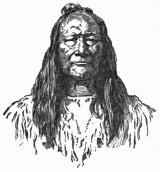
He had come into the keeping of the
Paiutes as a hostage for the long peace
which the authority of the whites made
interminable, and, though there was now
no order in the tribe, nor any power that
could have lawfully restrained him, kept
on in the old usage, to save his honor and
the word of his vanished kin. He had
seen his children’s children in the borders
of the Paiutes, but loved best his own
miles of sand and rainbow-painted hills.
Professedly he had not seen them since
the beginning of his hostage; but every
year about the end of the rains and before
the strength of the sun had come upon us
from the south, the medicine-man went
apart on the mountains to gather herbs,
and when he came again I knew by the
new fortitude of his countenance and the
new color of his reminiscences that he had
been alone and unspied upon in Shoshone
Land.
To reach that country from the campoodie,
one goes south and south, within
hearing of the lip-lip-lapping of the great
tideless lake, and south by east over a
high rolling district, miles and miles of
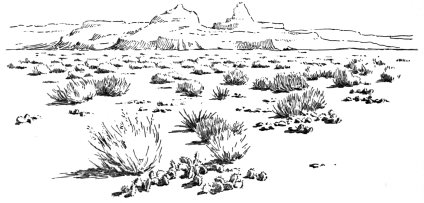
sage and nothing else. So one comes to
the country of the painted hills,—old red
cones of craters, wasteful beds of mineral
earths, hot, acrid springs, and steam jets
issuing from a leprous soil. After the
hills the black rock, after the craters the
spewed lava, ash strewn, of incredible
thickness, and full of sharp, winding rifts.
There are picture writings carved deep in
the face of the cliffs to mark the way for
those who do not know it. On the very
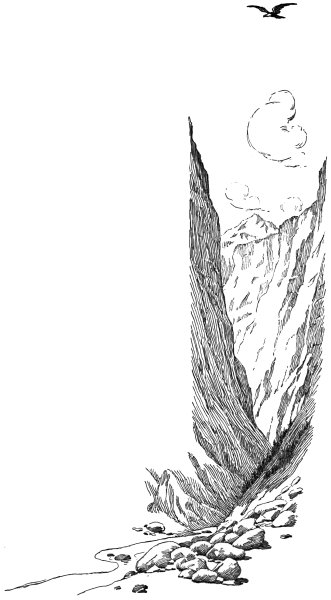
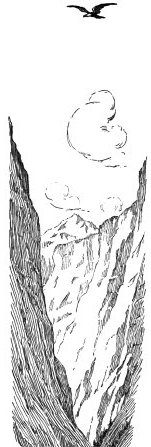
edge of the black rock the earth falls away
in a wide sweeping hollow, which is Shoshone
Land.
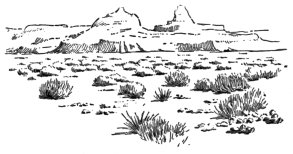
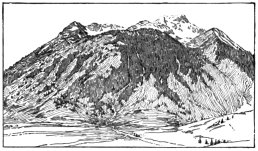
South the land rises in very blue hills,
blue because thickly wooded with ceanothus
and manzanita, the haunt of deer and
the border of the Shoshones. Eastward
the land goes very far by broken ranges,
narrow valleys of pure desertness, and
huge mesas uplifted to the sky-line, east
and east, and no man knows the end of it.
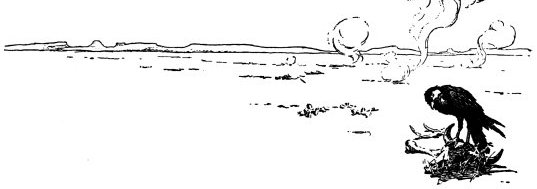
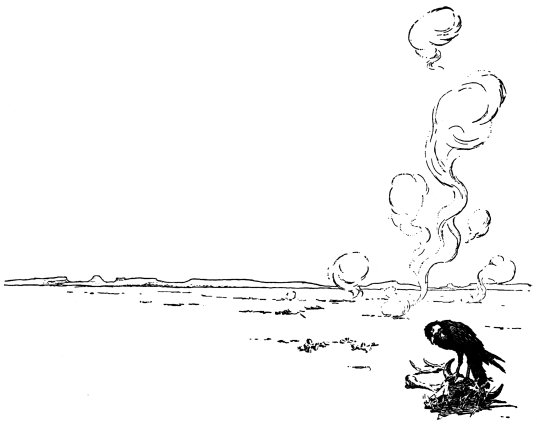
It is the country of the bighorn, the
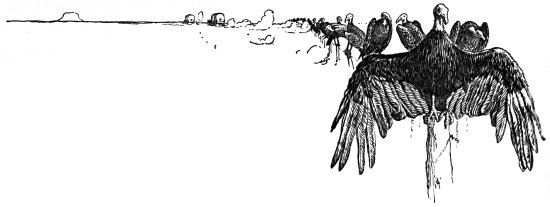
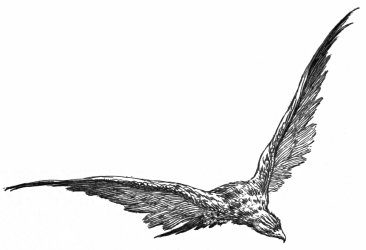
wapiti, and the wolf, nesting place of buzzards,
land of cloud-nourished trees and
wild things that live without drink. Above
all, it is the land of the creosote and the
mesquite. The mesquite is God’s best
thought in all this desertness. It grows
in the open, is thorny, stocky, close grown,
and iron-rooted. Long winds move in the
draughty valleys, blown sand fills and fills
about the lower branches, piling pyramidal
dunes, from the top of which the mesquite
twigs flourish greenly. Fifteen or twenty
feet under the drift, where it seems no rain
could penetrate, the main trunk grows,
attaining often a yard’s thickness, resistant
as oak. In Shoshone Land one digs
for large timber; that is in the southerly,
sandy exposures. Higher on the table-topped
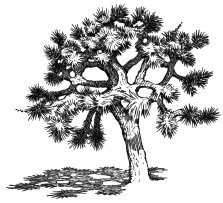
ranges low trees of juniper and
piñon stand each apart, rounded and
spreading heaps of greenness. Between
them, but each to itself in smooth clear
spaces, tufts of tall feathered grass.
This is the sense of the desert hills, that
there is room enough and time enough.
Trees grow to consummate domes; every
plant has its perfect work. Noxious weeds
such as come up thickly in crowded fields
do not flourish in the free spaces. Live
long enough with an Indian, and he or
the wild things will show you a use for
everything that grows in these borders.
The manner of the country makes the
usage of life there, and the land will not
be lived in except in its own fashion. The
Shoshones live like their trees, with great
spaces between, and in pairs and in family
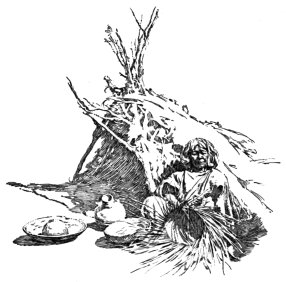
groups they set up wattled huts by the infrequent
springs. More wickiups than two
make a very great number. Their shelters
are lightly built, for they travel much and
far, following where deer feed and seeds
ripen, but they are not more lonely than
other creatures that inhabit there.
The year’s round is somewhat in this
fashion. After the piñon harvest the
clans foregather on a warm southward
slope for the annual adjustment of tribal
difficulties and the medicine dance, for
marriage and mourning and vengeance,
and the exchange of serviceable information;
if, for example, the deer have shifted
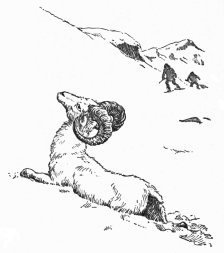
their feeding ground, if the wild sheep
have come back to Waban, or certain
springs run full or dry. Here the Shoshones
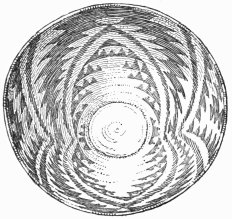
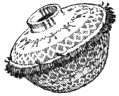
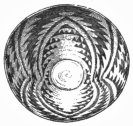
winter flockwise, weaving baskets
and hunting big game driven down from
the country of the deep snow. And this
brief intercourse is all the use they have of
their kind, for now there are no wars, and
many of their ancient crafts have fallen
into disuse. The solitariness of the life
breeds in the men, as in the plants, a certain
well-roundedness and sufficiency to its
own ends. Any Shoshone family has in
itself the man-seed, power to multiply and
replenish, potentialities for food and clothing
and shelter, for healing and beautifying.
When the rain is over and gone they
are stirred by the instinct of those that
journeyed eastward from Eden, and go up
each with his mate and young brood, like
birds to old nesting places. The beginning
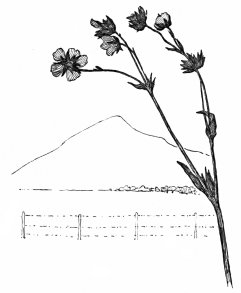
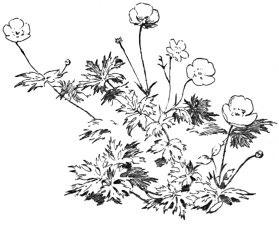
of spring in Shoshone Land—oh
the soft wonder of it!—is a mistiness as
of incense smoke, a veil of greenness over
the whitish stubby shrubs, a web of color
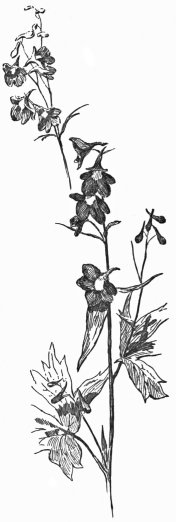
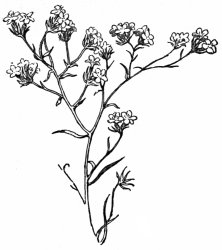
on the silver sanded soil. No counting
covers the multitude of rayed blossoms
that break suddenly underfoot in the brief
season of the winter rains, with silky furred
or prickly viscid foliage, or no foliage at all.
They are morning and evening bloomers
chiefly, and strong seeders. Years of scant
rains they lie shut and safe in the winnowed
sands, so that some species appear
to be extinct. Years of long storms they
break so thickly into bloom that no horse
treads without crushing them. These
years the gullies of the hills are rank with
fern and a great tangle of climbing vines.
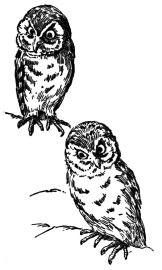
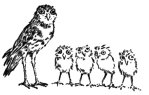
Just as the mesa twilights have their
vocal note in the love call of the burrowing
owl, so the desert spring is voiced by
the mourning doves. Welcome and sweet
they sound in the smoky mornings before
breeding time, and where they frequent in
any great numbers water is confidently
looked for. Still by the springs one finds
the cunning brush shelters from which the
Shoshones shot arrows at them when the
doves came to drink.
Now as to these same Shoshones there
are some who claim that they have no right
to the name, which belongs to a more northerly
tribe; but that is the word they will be
called by, and there is no greater offense
than to call an Indian out of his name.
According to their traditions and all proper
evidence, they were a great people occupying
far north and east of their present
bounds, driven thence by the Paiutes. Between
the two tribes is the residuum of old
hostilities.
Winnenap´, whose memory ran to the
time when the boundary of the Paiute country
was a dead-line to Shoshones, told me
once how himself and another lad, in an
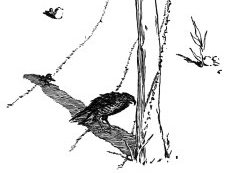
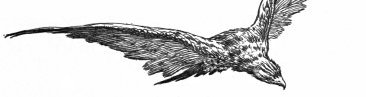
unforgotten spring, discovered a nesting
place of buzzards a bit of a way beyond the
borders. And they two burned to rob those
nests. Oh, for no purpose at all except as
boys rob nests immemorially, for the fun
of it, to have and handle and show to other
lads as an exceeding treasure, and afterwards
discard. So, not quite meaning to,
but breathless with daring, they crept up a
gully, across a sage brush flat and through
a waste of boulders, to the rugged pines
where their sharp eyes had made out the
buzzards settling.
The medicine-man told me, always with
a quaking relish at this point, that while
they, grown bold by success, were still in
the tree, they sighted a Paiute hunting
party crossing between them and their
own land. That was mid-morning, and all
day on into the dark the boys crept and
crawled and slid, from boulder to bush,
and bush to boulder, in cactus scrub and
on naked sand, always in a sweat of fear,
until the dust caked in the nostrils and
the breath sobbed in the body, around
and away many a mile until they came to
their own land again. And all the time
Winnenap´ carried those buzzard’s eggs in
the slack of his single buckskin garment!
Young Shoshones are like young quail,
knowing without teaching about feeding
and hiding, and learning what civilized children
never learn, to be still and to keep on
being still, at the first hint of danger or
strangeness.
As for food, that appears to be chiefly a
matter of being willing. Desert Indians all
eat chuck-wallas, big black and white lizards
that have delicate white flesh savored
like chicken. Both the Shoshones and the
coyotes are fond of the flesh of Gopherus
agassizii, the turtle that by feeding on
buds, going without drink, and burrowing
in the sand through the winter, contrives
to live a known period of twenty-five years.
It seems that most seeds are foodful in the
arid regions, most berries edible, and many
shrubs good for firewood with the sap in
them. The mesquite bean, whether the
screw or straight pod, pounded to a meal,
boiled to a kind of mush, and dried in
cakes, sulphur-colored and needing an axe
to cut it, is an excellent food for long journeys.
Fermented in water with wild honey
and the honeycomb, it makes a pleasant,
mildly intoxicating drink.
Next to spring, the best time to visit
Shoshone Land is when the deer-star hangs
low and white like a torch over the morning
hills. Go up past Winnedumah and
down Saline and up again to the rim of
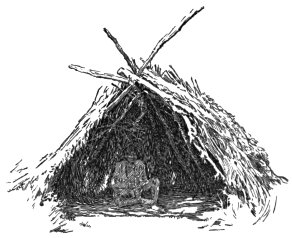
Mesquite Valley. Take no tent, but if you
will, have an Indian build you a wickiup,
willows planted in a circle, drawn over to
an arch, and bound cunningly with withes,
all the leaves on, and chinks to count the
stars through. But there was never any
but Winnenap´ who could tell and make
it worth telling about Shoshone Land.
And Winnenap´ will not any more. He
died, as do most medicine-men of the
Paiutes.
Where the lot falls when the campoodie
chooses a medicine-man there it rests. It
is an honor a man seldom seeks but must
wear, an honor with a condition. When
three patients die under his ministrations,
the medicine-man must yield his life and
his office. Wounds do not count; broken
bones and bullet holes the Indian can
understand, but measles, pneumonia, and
smallpox are witchcraft. Winnenap´ was
medicine-man for fifteen years. Besides
considerable skill in healing herbs, he used
his prerogatives cunningly. It is permitted
the medicine-man to decline the case
when the patient has had treatment from
any other, say the white doctor, whom
many of the younger generation consult.
Or, if before having seen the patient, he
can definitely refer his disorder to some
supernatural cause wholly out of the medicine-man’s
jurisdiction, say to the spite of
an evil spirit going about in the form of
a coyote, and states the case convincingly,
he may avoid the penalty. But this must
not be pushed too far. All else failing, he
can hide. Winnenap´ did this the time of
the measles epidemic. Returning from his
yearly herb gathering, he heard of it at
Black Rock, and turning aside, he was not
to be found, nor did he return to his own
place until the disease had spent itself,
and half the children of the campoodie
were in their shallow graves with beads
sprinkled over them.
It is possible the tale of Winnenap´’s
patients had not been strictly kept. There
had not been a medicine-man killed in
the valley for twelve years, and for that the
perpetrators had been severely punished
by the whites. The winter of the Big
Snow an epidemic of pneumonia carried
off the Indians with scarcely a warning;
from the lake northward to the lava flats
they died in the sweat-houses, and under
the hands of the medicine-men. Even the
drugs of the white physician had no power.
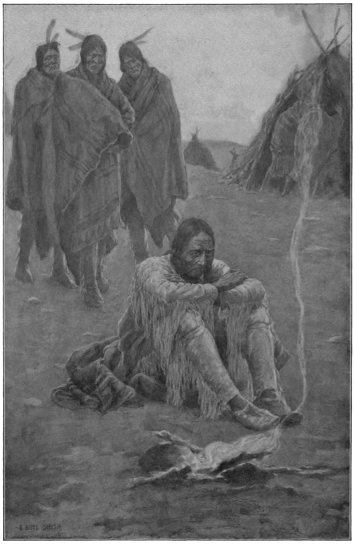
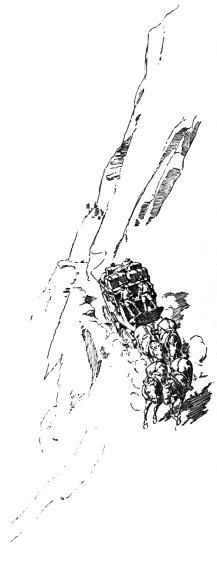
ARRIVAL OF THE EXECUTIONERS
After two weeks of this plague the Paiutes
drew to council to consider the remissness
of their medicine-men. They
were sore with grief and afraid for themselves;
as a result of the council, one in
every campoodie was sentenced to the ancient
penalty. But schooling and native
shrewdness had raised up in the younger
men an unfaith in old usages, so judgment
halted between sentence and execution.
At Three Pines the government teacher
brought out influential whites to threaten
and cajole the stubborn tribes. At Tunawai
the conservatives sent into Nevada for
that pacific old humbug, Johnson Sides,
most notable of Paiute orators, to harangue
his people. Citizens of the towns turned
out with food and comforts, and so after a
season the trouble passed.
But here at Maverick there was no
school, no oratory, and no alleviation.
One third of the campoodie died, and the
rest killed the medicine-men. Winnenap´
expected it, and for days walked and sat a
little apart from his family that he might
meet it as became a Shoshone, no doubt
suffering the agony of dread deferred.
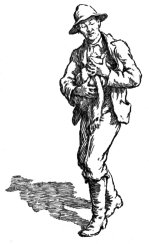
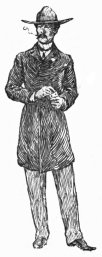
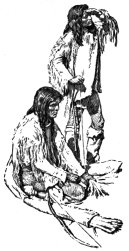
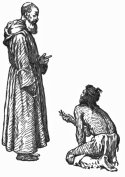
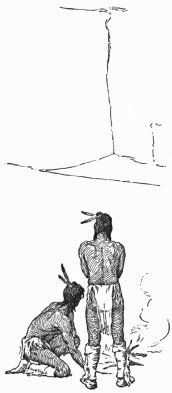
When finally three men came and sat at
his fire without greeting he knew his time.
He turned a little from them, dropped his
chin upon his knees, and looked out over
Shoshone Land, breathing evenly. The
women went into the wickiup and covered
their heads with their blankets.
So much has the Indian lost of savageness
by merely desisting from killing, that
the executioners braved themselves to their
work by drinking and a show of quarrelsomeness.
In the end a sharp hatchet-stroke
discharged the duty of the campoodie.
Afterward his women buried him,
and a warm wind coming out of the south,
the force of the disease was broken, and
even they acquiesced in the wisdom of
the tribe. That summer they told me all
except the names of the Three.
Since it appears that we make our own
heaven here, no doubt we shall have a
hand in the heaven of hereafter; and I
know what Winnenap´’s will be like:
worth going to if one has leave to live in
it according to his liking. It will be tawny
gold underfoot, walled up with jacinth and
jasper, ribbed with chalcedony, and yet no
hymn-book heaven, but the free air and
free spaces of Shoshone Land.