“Sat by some nameless grave, and thought that perhaps in its bosom
He was already at rest; and she longed to slumber beside him.”
Grand-Pré, the home of Evangeline, seldom
fails to impress the stranger, who sees it for
the first time, with a sense of its rich loveliness.
It would be difficult to find a more delightful
setting for the story of the Acadian maiden, separated
from her betrothed lover, Gabriel, and sent into exile
with her people.
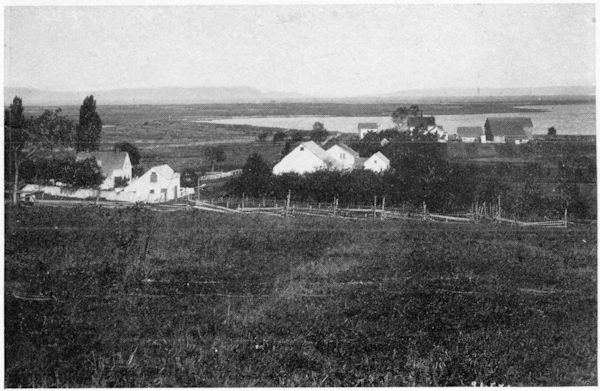
The country fronting the present Grand-Pré is
broadly open to the Basin of Minas. The dyked
marshes extend for miles in blocks of pasture, grain,
and haylands. Great creeks which once the mighty
tides of the Bay of Fundy filled till the meadows were
submerged with the turbid waters; red channels of the
winding rivers beyond; and the great stretch of the
Basin of Minas, purple-fringed by the distant hills, all
combine to make this an idyllic setting.
At the time of the Deportation of the Acadians, in
1755, most of the farm land, flanked by the dyked
meadows, from the Gaspereau River to Kentville, held
the villages and small hamlets of the people. Upon the
descending slopes on both sides of the Gaspereau Valley
that lies south of Grand-Pré, other populous villages,
pastures and farms, clustered as far as the
present village of the name, Gaspereau.
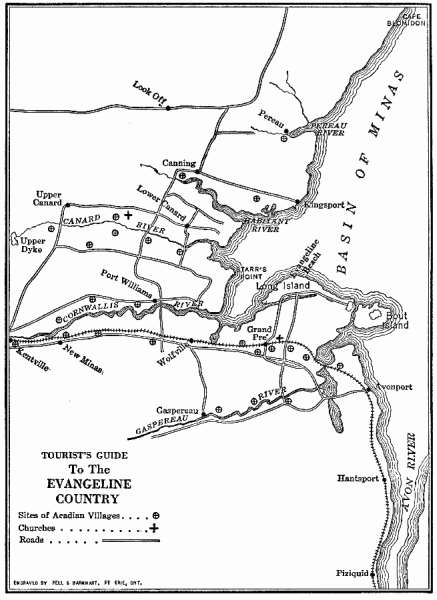
North and west, as far as Pereau, under the North
Mountain, the rich Acadian country of Canard lay upon
the banks of the four rivers, fronting always the meadows
of marsh that spread away from the swift tidal
streams.
This was the Minas country of the Acadian period,
divided into two parishes, Grand-Pré and Canard,
separated by the present Cornwallis River. In 1750,
five years before the removal of the inhabitants, Minas
had a population of four thousand. There were thirty-five
villages, named after the original founders who
came from Port Royal—Gaspereau and Grand-Pré
were the only exceptions.
Upon the Grand-Pré meadows may be seen the
thirteen sections of dykes raised from time to time,
till the whole extent of marsh became enclosed. It
was a laborious work for the people, who numbered
only four hundred in 1700. Most of the marshes were
enclosed during the following forty years as the families
grew to manhood, and new settlers came. Upon
these lands they had their pastures, hay and grain
areas fenced in. Upon the undyked marshes they cut
the coarse salt grass.
As the forest lands were cleared of wood, they were
used as pastures. Beyond these, stretched the primeval
forests on all sides. Orchards of apple and
pear, and garden plots lay near the homes. Fish were
abundant in the sea beyond. By boat the settlers were
able to pass from place to place, for the rivers made
convenient ways for travel.
While the name Grand-Pré was given in general to
the Minas country south and alongside the Cornwallis
River, the village of the name was adjoining the Memorial
Park land. It had twenty-three inhabitants living
upon three farms. The cellars of the three homes
may be seen to-day. The largest was on the west side
of the Park. The other two, upon the gentle slope
south. They were the properties of Pierre Landry,
Jean le Sour, and Jacques Terriot—all prominent and
prosperous men in the little community.
The knoll of land, consisting of fourteen acres, now
called the Grand-Pré Memorial or Historical Park, lies
adjoining the dyked lands. It is enclosed by a rustic
fence, and is separated by the Dominion Atlantic Railway
from the farms on the slope rising to the south.
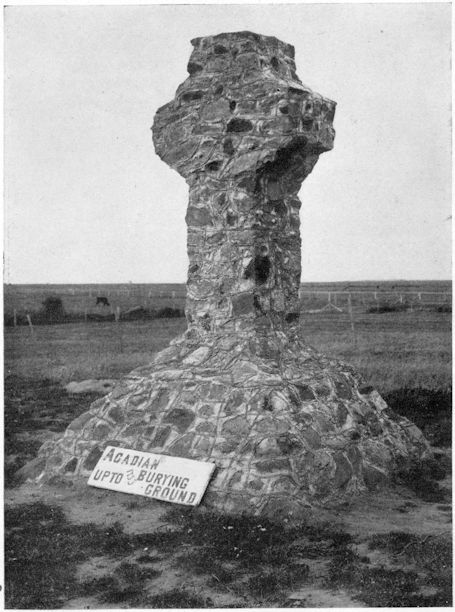
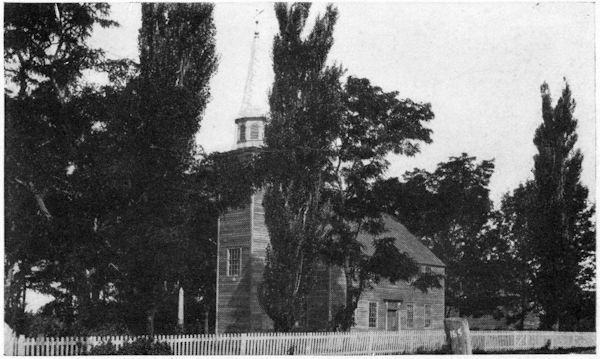
The ground was used for church purposes, and the
chapel stood upon the highest part of the knoll. Where
the stone cross stands was the burying ground of the
Grand-Pré Acadians of the parish of St. Charles.
The church land had been given for the purpose by the
original Landry, and formed part of his farm. About
the year 1687, the first church was built, and enlarged
or rebuilt as the population increased. Few dykes had
been erected at this time, and the tides of the Basin of
Minas came within a few hundred feet of the church
land. In the burying ground were laid the first to die
in Minas. Melansons, Terriots, Le Blancs, Landrys,
and other families mingle their dust there. The cross
without names, built of stone from some of their home
foundations, marks where they lie forgotten.
The Presbytery stood on the foundation west of
the church site. This was occupied by Colonel Winslow
when his troops were encamped about the churchyard,
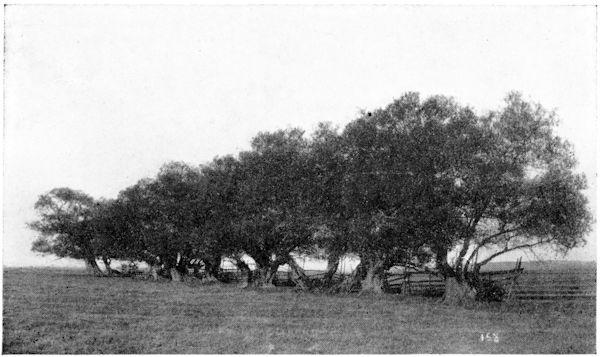
on the eve of the Deportation. The row of willows
on the north side of the Park grounds was set out
to shield the church from the north winds that swept
across the open dyked lands.
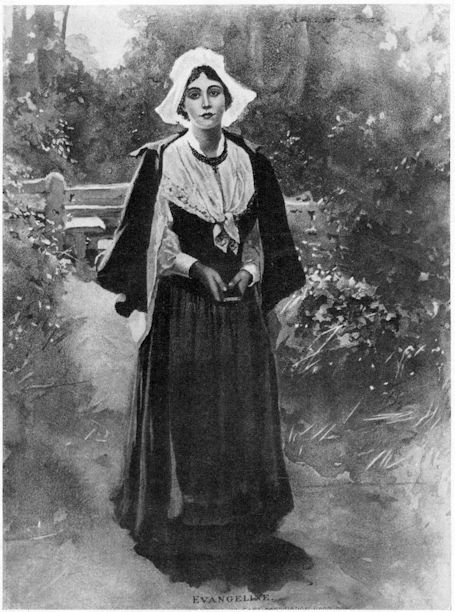
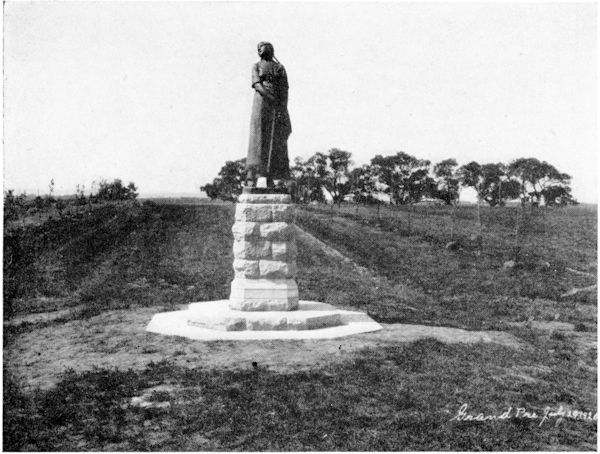
The bronze figure of Evangeline (facing p. 72),
represented as looking back upon the country of her
people as she set out to depart with them from Grand-Pré,
will always typify the Deportation of the Acadians,
the commencement of the period of exile and wandering.
The statue stands upon the old road by which
the people reached the church, and is but the commencement
of restoration work projected for the Historical
Park at Grand-Pré. (At the summit of the
slope south this road joined the main highway running
from the Gaspereau River to the farther villages of
the Acadians.) The statue was modelled by Philippe
Hebert, himself a descendant of the Acadian family of
the name. Etienne Hebert was one of the first colonists
to come to the Minas country from the home
colony of Port Royal, now Annapolis Royal. This
family increased in numbers in Minas, and two villages
bore the name, one in Minas and the other in Canard.
There were fifty Heberts at the time of the dispersion.
We may now review the growth of the Acadian
Minas from the coming of the first settlers in 1681 to
the year 1755, when Colonel John Winslow, with the
New England volunteers, encamped upon the church
ground of St. Charles at Grand-Pré. In December of
that year the houses and barns, churches and mills of
the Acadians were destroyed, and for five years the
country was without an inhabitant. We have the
names of the older parents, of their children, their possessions.
We also have record of the younger married
couples who came to make homes in the new country
of Minas. The villages grew chiefly in clusters about
the establishments of the elders. Dykes were built.
Land was cleared of wood for their gardens and
orchards. Roads were made connecting all the centres
of farm life. Winter roads for their timber, fencing,
and firewood were made. Finally, they cut a way
through the forests from Halifax to Annapolis Royal.
They were increasing in population, and in worldly
goods.
Perhaps before entering directly upon the historical
aspects of the Evangeline country, it would be interesting
to know something of its outstanding families,
members of which figured prominently in the later
history of the place.
The three most picturesque and important persons
in the history of the Minas country are Pierre Melanson,
Pierre Terriot, and René LeBlanc.
In a census of the Port Royal people, made in 1671,
the name Pierre Melanson appears, but with no account
of his family or possessions. He refused to give the
facts asked for. There has been some doubt as to his
antecedents, although he was a man of importance, and
his name appears in several historical documents. Some
think he was the son of the Scotchman, Pierre Melanson,
who remained in Acadia after the colony under
Sir William Alexander was broken up in 1632.
It has been ascertained, however, that Pierre Melanson
was a tailor and farmer of considerable wealth,
when he sold his Port Royal property in 1669. He was
also Captain of militia, and a man of mark among the
oldest inhabitants of that place. His courage and
enterprise are shown by his removal to the unsettled
country of Minas in 1681. His selection of the Gaspereau
Valley for his new home, points to a knowledge
of the country, for he settled in the most beautiful and
favorable situation in the region. It was at the head
of the tide, sheltered, with extensive marshes, and rich
uplands suitable for farming. The forests lay upon
the hills, the stream teemed with gasperot, salmon,
and trout. The Basin of Minas could be easily reached
at high tide by boat. Conditions were most favorable
for the development of the little colony, and those
which soon sprang up in that neighbourhood (Gaspereau)
and at Grand-Pré.
The Gaspereau villages grew in importance, and
were among the richest and most populous in 1755.
The Melansons numbered about eighty souls, and were
connected by kinship and marriage with all the Acadian
families of Minas.
It was one of the daughters of this Pierre Melanson
who married the “Notary Public” of Longfellow’s
Evangeline.
“Bent like a laboring oar, that toils in the surf of the ocean,
Bent, but not broken, by age was the form of the notary public;
Shocks of yellow hair, like the silken floss of the maise, hung
Over his shoulders; his forehead was high; glasses with horn bows
Sat astride his nose, with a look of wisdom supernal.
Father of twenty children was he, and more than a hundred
Children’s children rode on his knee, and heard his great watch tick.”
Another daughter, Anne, married Thomas Jacasse,
and it was their son who later refused to sign the deliberations
for the surrender of Quebec.
The next colonist who came to establish himself in
Minas was Pierre Terriot from Port Royal. He is an
important and interesting figure in the history of the
country. His coming dates but a short time after
Pierre Melanson’s arrival. Terriot selected the fine
situation near Kentville, upon the present Cornwallis
River, with natural conditions similar to the Gaspereau
Valley. Good upland for farms, and extensive areas of
marsh near the head of the tidal stream, afforded
favorable means for the development of his farming
operations. His home on the south side of the river
was ten miles from Melanson’s, and the expansion of
growth was each toward the other. The farm areas
soon extended alongside the marshes into what became
the Grand-Pré district.
Pierre Terriot, like Melanson, came out from Port
Royal, where his father had settled before him. Port
Royal was the parent colony (1632, under Commander
Razilly) from which all the Acadian districts received
their first colonists.
Pierre Terriot was a colonizer, and an interesting
figure in the early days of Minas. Although he had no
children by his wife Cécile Landry, he encouraged
migration from Port Royal to the wilderness, the rich
country of Minas that surrounded him. Young couples
soon came, relatives of the Terriots and Landrys, and
others, who for a time enlarged their holdings more
rapidly than those who came to Grand-Pré and Gaspereau.
The founder, Terriot, who was in good circumstances,
aided the newcomers with grain and stock,
and as has always been the custom of the Acadians, the
settled people cut the timber, built the foundations and
homes, and helped the young couples to start in life.
Pierre Terriot’s home was, moreover, the asylum for
orphans and widows, till the children grew up and were
able to set up for themselves. The settlers married
young, and were encouraged to do so, for they were
a home-loving people, and industrious.
“Their dwellings were open as day, and the hearts of the owners;
Where the richest was poor, and the poorest lived in abundance.”
The Terriots numbered about fifty, and were also
settled in other parts of Nova Scotia. This region
seemed to attract the younger people from the older
and more thickly settled country of Port Royal. It was
favorably situated, more remote from the New England
colonies, and so conditioned that all who came
could acquire land and make homes.
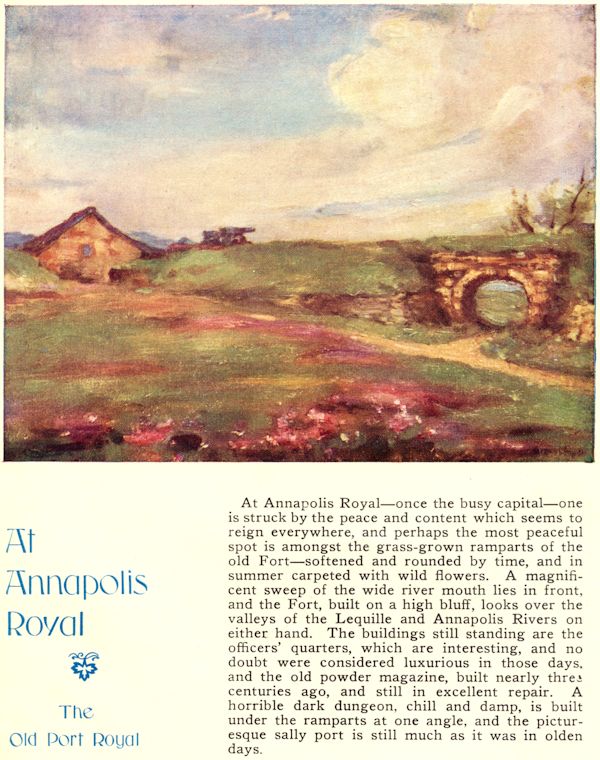
At Annapolis Royal
The Old Port Royal
At Annapolis Royal—once the busy capital—one
is struck by the peace and content which seems to
reign everywhere, and perhaps the most peaceful
spot is amongst the grass-grown ramparts of the
old Fort—softened and rounded by time, and in
summer carpeted with wild flowers. A magnificent
sweep of the wide river mouth lies in front,
and the Fort, built on a high bluff, looks over the
valleys of the Lequille and Annapolis Rivers on
either hand. The buildings still standing are the
officers’ quarters, which are interesting, and no
doubt were considered luxurious in those days,
and the old powder magazine, built nearly three
centuries ago, and still in excellent repair. A
horrible dark dungeon, chill and damp, is built
under the ramparts at one angle, and the picturesque
sally port is still much as it was in olden
days.
Next to the Grand-Pré Park land, the New Minas
relics of the Terriot settlements and the work of their
descendants are the most numerous and interesting.
Many cellar foundations remain as they were left in
1755 after the houses and barns were burned. The
English colonists of 1760 raised their houses farther
away from the marshes, so that the Terriot landmarks
for the greater part still remain undisturbed. Some of
their houses were forty-five feet square, with huge
chimneys built outside ten feet square at the ground,
traces of which still remain.
Among the later arrivals were the Le Blancs, whose
children added considerably to the growth of population,
and whose importance and prosperity make them
outstanding persons in the country.
The first Le Blanc was Daniel, born in France in
1626. Thousands of his descendants are to be found
in America to-day. He arrived in Acadia in 1650, with
his wife, Françoise Gaudet. He settled in Port Royal
about nine miles above the fort. When that place fell
to the English under Phipps, in 1690, Le Blanc was
among those appointed to administer the affairs of the
Province until the arrival of a Governor. His name is
found on the census of 1671, 1686, and 1693. He had
probably died before the next census in 1698, as his
name does not appear then or afterwards. He lived
to be about seventy years old, in spite of the trying
and laborious period through which the people of
Acadia lived.
The four sons of the first Port Royal Le Blanc settled
upon the present Grand-Pré lands very soon after
Melanson had become established on the Gaspereau
and Terriot on the Cornwallis.
The village, Jean Le Blanc, in 1775, had eight
families. Village Pierre Le Blanc had fourteen, and
Grand Le Blanc had thirteen. The Le Blancs appeared
also in other villages.
This family was related to all the older stock of
Acadian families, to be found in 1755 throughout the
whole of settled Nova Scotia.
The history of Grand-Pré, by which is meant, the
annals of the country contiguous to the Memorial Park,
the Grand-Pré of the present day, in a sense, is the
family history of the Le Blancs. One member of the
family, René, was an historical character.
In the census made of Minas in 1618, about five
years after Pierre Melanson’s advent to the Gaspereau,
the families of
| Pierre Melanson |
| Martin Ancoin, |
| Phillippe Pinet, |
| Etienne Hebert | (Forebear of the sculptor mentioned previously author of the Evangeline statue), |
| Noel de la Bove, |
| Francois la Pierre | (or la Roche), |
| Etienne Rivet, |
| Pierre Terriot, |
are mentioned with particulars of their worldly condition
and size of family.
Three of the Minas inhabitants mentioned on the
1686 list, de la Bove, la Pierre, and Rivet, were newcomers
to Acadia, and for some reason failed to make
headway in the country. Their descendants were few,
and the names disappear from the annals.
The Melansons’, Terriots’, and Le Blancs’ holdings
all extended east or west, south of the Cornwallis
River. North of this stream, another section was expanding,
but more slowly, although conditions were
favorable there for colonization.
As the Canard region become populated, crossings
were made to reach the villages at low tide over the
Cornwallis River. A road was made connecting the
up-river settlements with Grand-Pré to the Gaspereau,
where the principal centre of Minas developed, with its
church, its protected landing-place and port for vessels,
its store-house, and the office of the Deputy, where
deeds and important documents were kept.
Thus Canard grew, and finally a beautiful church
was built there. The Cornwallis River divided the
parishes of Canard and Grand-Pré, but the whole
region was rapidly growing in population and wealth,
till it was entering upon the period preceding the Deportation.
A thousand Acadians departed from Minas
about 1750, so that in 1755 there were about three
thousand remaining in the two parishes.
The French colonists of Nova Scotia were constantly
subjected to attacks by British colonial forces.
In 1613, Port Royal, again in 1654, La Have, and in
1700, Minas were razed and completely destroyed by
these armies. The older Acadians and their sons,
accustomed to the conditions of the country, quickly
recovered from these attacks. The later comers, however,
were not so well fitted to cope with the difficulties
of the new life, and the new names died out or did not
increase so quickly as the original stock, the hardy,
thrifty peasantry from the west coast of France.
These repeated expeditions against the French
colonies were the outcome of strong inimical feeling
both at home and abroad. The British colonies of
America greatly outnumbered the French of Canada
and the Province, and the desire to remove the
Acadians from the peninsula, and thus break the backbone
of the French colonial enterprise, had been growing
for several years.
This sorry task finally fell to the lot of Lieutenant-Colonel
Winslow, under the specific orders of Governor
Lawrence of Halifax. In August, 1755, he came with
three hundred men, and in conjunction with Captain
Murray, then in command of Fort Edward, arranged
the details for the capture and removal of the people.
At the time of Winslow’s arrival with his troops in
ships, the priests of Grand-Pré and Canard had been
removed to Halifax as prisoners. All the guns owned
by the Acadians had been seized, yet the coming of the
troops and their use of the church and burying-grounds
as an encampment did not arouse suspicion as to the
purpose of the visit. The people had frequently seen
both French and English soldiers quartered in their
country.
The Acadians were gathering their harvests when
Winslow arrived from Cumberland and marched from
Gaspereau Landing to the church at Grand-Pré. As
we read his own account of that stay, we realize his
repugnance at the harsh duty before him—the task of
using military force to expel a quiet, happy people
from its home-place—particularly in the face of the
total inadequacy of ships provided for the purpose.
As the winter set in, the miseries of the people
bore heavily upon him, and his feeling in the matter is
thinly concealed in the account of the affair as set down
in his Journal.
From this same Journal we learn that he used the
Presbytery as his headquarters, and that in the churchyard
the tents of the soldiers were pitched; that the
camp was protected by a pallisade, and that full military
discipline was enforced.
The poem, Evangeline, tells the story of the 5th of
September, 1755, and what followed.
As the crops were to be gathered early in that dry
year, this date was fixed upon for summoning the men
and boys of the district to the church to receive their
brutal orders—to hear the proclamation declaring
them prisoners of the Crown; their homes, their lands,
their holdings, confiscate. It was a bitter time for both
those who spoke and heard. It is not difficult to imagine
the emotion of Lieutenant-Colonel Winslow, as he delivered
his blighting message of exile to these strong
sunburnt fathers and sons of Minas, anxiously waiting
his words.
When Winslow departed from Grand-Pré in November,
all the outlying villages had been destroyed.
Canard’s church, the mills, houses, and barns were in
ashes. Except for the shelterless animals that wandered
about close upon starvation, nothing remained.
The inhabitants, carrying with them as many of their
household effects as the weather and the cramped
accommodations of the ships would permit, had gone.
A pitiful season followed. The pathetic scenes of the
deportation are almost indescribable. Through military
necessity, perhaps fear of insubordination, parent
was separated from child, lover from lover, brother
from brother. As many as possible were loaded immediately
upon the waiting vessels. Six hundred and
fifty were quartered about the villages of the Le Blancs,
three hundred of whom were embarked in December.
A week later, the remainder were sent off, and the
houses they had occupied destroyed. The church
which the soldiers had used as quarters was probably
the last building to stand.
Two rather interesting incidents in connection with
the Deportation which have come to notice, follow.
Although all records of births, deaths, etc., were
destroyed or in part lost, one of the Piziquid exiles
carried the deed of his grandfather’s property with him
to Philadelphia. The writer saw this document in 1920,
still held by a descendant as a precious relic.
René Le Blanc, mentioned above as figuring in history,
came to notice at this time in the following manner.
Winslow, evidently touched by the man’s age
and gentleness of character, made a special request to
headquarters that Le Blanc be permitted to return to
his home in Marshfield, but the old man was sent to
New York with his wife and two children, out of the
twenty of his family. His grandchildren numbered
over a hundred. Later he found three more of his
children in Philadelphia, where René died.
The Acadians were scattered throughout the British
colonies. A few who escaped, wandered over the
country to be later apprehended and deported. A number
more found their way unharmed into the wilderness
of New Brunswick, but by 1763 there were less
than 1,500 who had escaped the removal.
There is a tradition based upon traces of dwellings
found in the woods south of New Minas, that a few
escaped Acadians lived there through the following
winter. These few either were captured or later joined
those retreating into New Brunswick.
After the expulsion of the French settlers, Great
Britain, to induce settlers to come to the country of
Horton and Cornwallis from the older English colonies,
sent out an invitation with a description of the country:—
“One hundred thousand acres, of which the country
has produced wheat, rye, barley, oats, hemp, flax, etc.,
without failure for the last century; and another
hundred thousand acres are cleared and stocked with
English grass, planted orchards and embellished with
gardens, the whole so intermixed that every individual
farmer might have a proportionate quantity of plowed
land, grassland, and woodland.”
This appeared in 1759. In June, the next year, after
the country was viewed by agents from New England,
the people came to occupy the vacated lands. With
the assistance of the Acadian prisoners remaining at
Fort Edward, the dykes were repaired, and the country
began to thrive with new life upon the grave of the
old.
The last written trace of the Acadians in a body,
appears in an order issued from Halifax in 1762, causing
one hundred and thirty of them to be sent from
Hants and King’s counties, where they were working
for English inhabitants.
For the English settlers, the farm lands were divided
into hundred-acre lots. New roads were laid out, and
the old Acadian landmarks are now gradually disappearing.
A single farm to-day perhaps occupies the
site of a whole village of Acadian times. Willows still
mark roads or the buried foundations of their homes.
Their apple trees yet bear fruit, sometimes found among
the wild, recent growth, or in pastures. Roads and
dykes may be traced, and numerous cellars in out-of-the-way
places where they have not been disturbed.
In the history of the English colonies during the
next twenty years following upon the re-settlement of
the Acadian country of Grand-Pré, affairs went topsy-turvy.
French Canada was lost to France through
the operations and strength of the colonies under English
rule. New England strengthened Nova Scotia for
England by removing the Acadians, and then bringing
her people to the deserted farmlands.
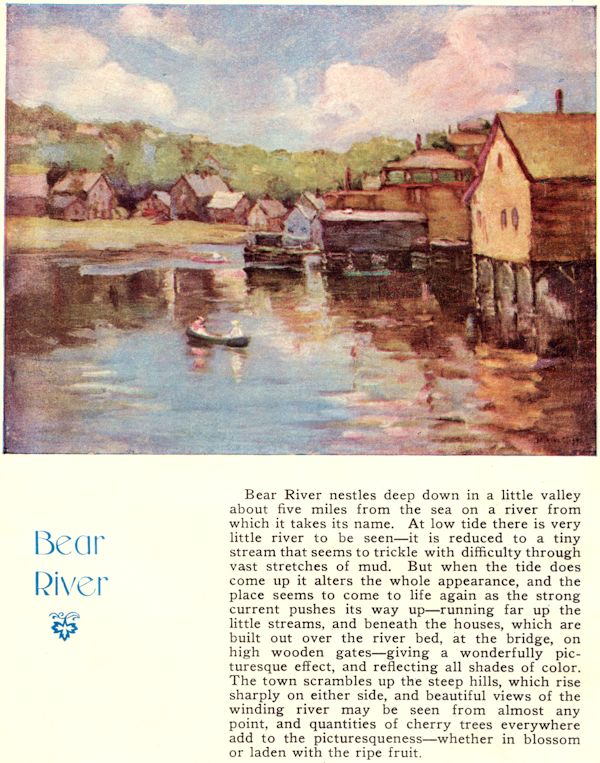
Bear River
Bear River nestles deep down in a little valley
about five miles from the sea on a river from
which it takes its name. At low tide there is very
little river to be seen—it is reduced to a tiny
stream that seems to trickle with difficulty through
vast stretches of mud. But when the tide does
come up it alters the whole appearance, and the
place seems to come to life again as the strong
current pushes its way up—running far up the
little streams, and beneath the houses, which are
built out over the river bed, at the bridge, on
high wooden gates—giving a wonderfully picturesque
effect, and reflecting all shades of color.
The town scrambles up the steep hills, which rise
sharply on either side, and beautiful views of the
winding river may be seen from almost any
point, and quantities of cherry trees everywhere
add to the picturesqueness—whether in blossom
or laden with the ripe fruit.
The memory of the courageous heart-high peasantry
that first peopled and made home of a wilderness,
remains fresh in the present-day Acadia.
The garden-plots cleared upon the uplands near
their homes, their orchards laid out in rugged rows,
still bloom for us who know that country. We still
find the roads leading to the dykes by the rivers, even
traces of the trails originally reaching back to the
wild pastures; the dykes upon which so much time and
labor were expended season after season—an arduous
work when Acadia’s population was yet so small. The
wild luxurious beauty of the place to-day, its blossoms,
its fruit, its vivid dunes, its picturesque water-ways, the
daily romance of the rushing tide for which the little
boats thirst on the sand hour by hour—bring back
afresh the quaint pictures of its early days. The quiet
grazing cattle might still be the hardy kine that lived
through those early winters on the abundant after-feed
of the settler’s dyked lands. Every aspect of the place,
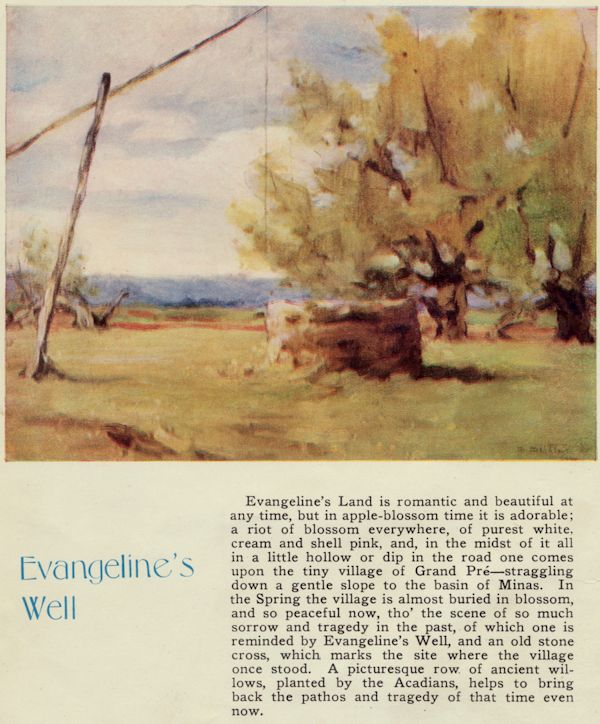
the almost hidden ruins here and there, Evangeline’s
well, the rough stone cross that marks the grave of a
village, the virility of the bronze Evangeline, make real
the pathos of this people now scattered broadcast
through America, in whose souls the love of their
country, Acadia, is as potent now as then. Neither
time nor the Deportation have caused them to lose
their identity as a distinct people, for a quarter of a
million in America are the same Acadians who went
into exile from Nova Scotia from 1755 to 1763.
There is a close connection between the story which
supplied the basis of the poem, Evangeline, and the
Acadian people. In 1838, Hawthorne entered in his
Note-Books the following:
“H. L. C.—Heard from a French-Canadian a story
of a young couple in Acadie. On their marriage day
all the men of the Province were summoned to assemble
in the church to hear a proclamation. When assembled,
they were seized and shipped off to be distributed
through New England, among them the new bridegroom.
His bride set off in search of him, wandered
about New England all her lifetime, and at last found
her bridegroom on his deathbed. The shock was so
great it killed her likewise.”
Longfellow’s final decision to adopt the name
Evangeline for his poem, rather than Gabrielle (which
was the name of the heroine of Mrs. Williams’ story
of “The Acadian Exile”) has given existence to a character
that will live for all time.
Another name to be perpetuated by history is
Acadie, or Acadia as it is known at the present time.
Whether we accept the statement or not that the Italian
navigator, Verrazano, who explored the American
coast as far as New York, called the country “Arcadie”,
because of the magnificence of the trees, there will be
preference for the Micmac Indian origin of the name,
“Acadie.” The country was visited by Breton and
Basque fishermen a hundred years before the settlement
of Port Royal in 1605. From that time the Maritime
countries of Nova Scotia, New Brunswick, and
part of the State of Maine, were named Acadie. Many
places to-day retain their original Micmac names. We
have Benacadie, Katakaddy, Shubenacadie, Shunacadie,
with the meaning, “abundance of,” or “the place
of” certain things. As we know, Nova Scotia is in
truth Acadie.
The Bay of Fundy comes from “au fond du Baie,”
as the Port Royal people designated the head of that
great tidal stream. The discovery of native copper and
coal led to the naming of the headland at the upper
end of the Bay of Fundy, “Les Mines.” This name was
extended to designate the country about the Basin of
Minas connected by Minas Channel with the great Bay.
Grand-Pré and Canard, the original names of the
Acadian period, are still used to distinguish the townships
of Horton and Cornwallis. The Gaspereau River
and Valley, New Minas, Habitant and Pereau, remain
the memories of the Acadian period.