SUMMER WANDERINGS IN COLORADO
"God only knows how Saadi dined;
Roses he ate and drank the wind."
Emerson
Deep in the heart of the Rocky Mountains lies Glenwood
Springs, a fashionable watering place, where a great hotel,
bearing the name of the Centennial State, with every pretty
decorative device imaginable, allures the summer idlers, and
where various kinds of springs and baths furnish excuse for
occupation. All varieties of invalidism, real or fancied,
meet their appropriate cure. One lady declared that the
especial elixir of life was found in a hot cave that yawns
its cavernous and mysterious depths in an adjacent mountain.
Another continued to thrive on (or in) the sparkling
waters of "the pool," which is, for the most part, a
dream of fair women, relay after relay, all day and evening,
swimming about after the fashion of the Rhine sisters;
and those who do not take kindly to the pool or the dark
and "hot" cave fall upon some particular geyser and appropriate
it for their own. Woe to the woman who interferes
with another woman's geyser! The whole region
around Glenwood Springs is phenomenal. A hot sulphur
spring boils up at the rate of twenty thousand gallons a
minute. The "pool"—where the Rhine maidens are forever
floating, morning, noon, and night—covers over an
acre, and is from three to six or seven feet deep. Two
currents of water are constantly pouring into it,—the hot
(at one hundred and twenty-seven degrees) at a rate of ten
thousand gallons a minute, and the cold from a mountain
stream. A stream constantly runs from it, a part of which
is utilized as a waterfall in the centre of the large dining-room
of the hotel. On one bank of this pool is a colossal
stone bathhouse (costing over one hundred thousand dollars),
where every conceivable variety of the bath is administered,
and from which "the pool" is entered. In warm
evenings, when the full midsummer moon peeps over the
mountains, the groups of girls, one after another, begin
mysteriously to disappear, and in reply to a question as
to the destination of this evening pilgrimage one bewitching
creature in floating blue organdie, as she flitted past,
laughingly answered, "Come to the pool and see." There
was no time to be lost. The moon in silver splendor was
climbing over the mountains, and the girls emerged from
their dainty evening gowns to array themselves in bathing
suits. A few minutes later they were to be seen
at this mysterious trysting place at "the pool," the only
difference being that some were outside and some inside.
Surely those inside had the best of it. How can the
scene be pictured? From the broad piazza of the hotel
a terraced walk ran down through the greenest of lawns,
with shade trees and a fountain resplendent in colored
electric lights. The pool lies in an open glade. Not
far away is one of the ranges of the Rocky Mountains,
over which the August moon was climbing. Tall electric
lights mingled with the moonlight, giving the most curious
effects of chiaroscuro through the glade and the defiles
of the mountains. On one side of this immense natatorium
rose the vast stone bathhouse,—a beautiful piece of
architecture. Near by the round sulphur spring boiled and
bubbled in a way to suggest the witches' rhyme:
"Double, double toil and trouble;
Fire, burn; and, cauldron, bubble."
A high toboggan slide in one place descended into the
pool, and was much used by the young athletes,—the men,
not the girls. In the pool a natural fountain of cold water
shot high in the air. The swimmers abounded. Those
who were unable to swim would cling to a floating ladder.
Here in the moonlight the girls—clinging two and three
together—circle around in the water, needing only the
melody of the Rhine sisters to complete the illusion of
one of the most enchanting scenes in the entire Wagner
operas.
Rev. Frederick Campbell wrote of this unique place:
"There is but one word to utter at Glenwood Springs—'Wonderful!'
If one enjoys life at the most luxurious of
hotels, here it is at Hotel Colorado. Built in the Italian
style of peach-blow sandstone and light brick, lighted with
electricity, a searchlight reaching from one of its towers at
night and lighting the train up the valley, a powerful fountain
supplied from the mountain stream up the cañon pouring
the geyser 170 feet straight in the air, and views, views
everywhere."
The hot cave is as wonderful as anything around Sorrento
or Amalfi. In fact, all Colorado reminds the traveller of
Italian scenery. It has been called the Switzerland of
America, but it is far more the Italy. It has the Italian
sky, the Italian coloring, and the mysterious and indefinable
enchantment of that land of romance and dream.
The volcanic phenomena is often startlingly similar to
that of Italy. This hot cave at Glenwood Springs is of
the same order as those on Capri and the adjacent coasts
of Italy. In this cave at Glenwood hot air continually
comes up from some unknown region, and it is utilized for
curative purposes. The two or three caves have been
made into one, a cement floor laid, and marble seats with
marble backs put in (the ancient Romans would have
found this a Paradise). Here come—not the halt or
the blind, but the people who take "the cure." The
process is to sit on the marble seat with a linen bag drawn
completely over the entire form, with a hole for the head
to emerge. Around the neck is placed a towel wrung out
of cold water. To see a cave filled with these modern
mummies, sitting solemnly, done up in their linen cases,
like upholstery covering, is a spectacle. The men go in the
morning, the women in the afternoon. One lady obligingly
gave the data of her "cure." Twice a week she migrated
in negligée to the hot cave, and sat done up in her
linen covering, bathing in the hot air at one hundred and
twenty degrees or so. Other afternoons were devoted to
the hot sulphur water bathing, and what with the various
gradations of temperature and the work of the attendants,
the cup of Turkish coffee and the siesta, the process
consumed the entire afternoon. It is bliss to those who
delight in being rolled up like a mummy and sitting still.
But if it were chasing a star that danced, if it were riding
on a moonbeam, if it were dancing with the daffodils,—if
it were anything in all the world that was motion,—then
it might have some fairer title to charm. The felicity of
lying about in a state of inertia is in the nature of a mystery.
And one questions, too, whether the spring of life
is not, after all, within rather than without. Let one
take care of his mental life and the physical will, very
largely at least, keep in spring and tune without elaborate
and expensive processes of propping it up. To
disport one's self in the pool,—there is a delight. Who
wouldn't be a Rhine maiden under the midsummer moon
in the heart of the Rocky Mountains?
In nearly all the cañons and caves of this surrounding
region are found traces of the prehistoric peoples who
inhabited them. Fragments of pottery, in artistic design
and painted in bright colors, are numerous; relics similar
to those found in the cliff houses are not unfrequently
chanced upon in walks and excursions and the stone implements
abound. The ethnologist finds a great field for
research in all this Glenwood Springs country. There are
carriage roads terraced along the base of the mountains
where drives from five to twenty miles can be enjoyed in
the deep ravines where only a glimpse of blue sky is seen
above, and the saunterer finds a new walk every day. The
mountains branch off in every direction, and the lofty
peaks silhouette themselves against the sky. It is like being
whirled up into the air. The sensation is exhilarating beyond
words. If people could take "cures" getting up into
sublime altitudes like this, where the views are so heavenly
that one does not know where earth ends and Paradise
begins,—that would be a cure worth the name. Really,
it is vitality and exhilaration that one wants, and it is to
be found in the air far more than in any other element.
"'Tis life whereof our nerves are scant;
'Tis life, not death, for which we pant,
More life and fuller that I want."
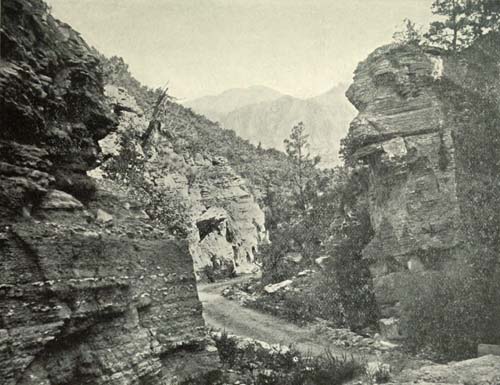
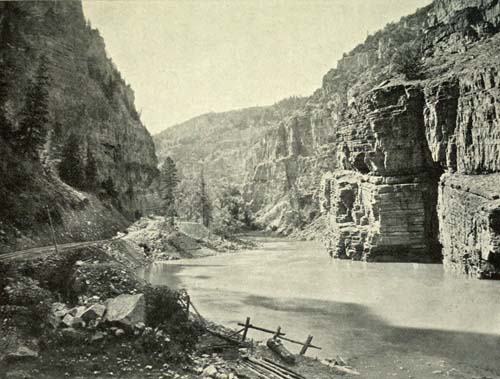
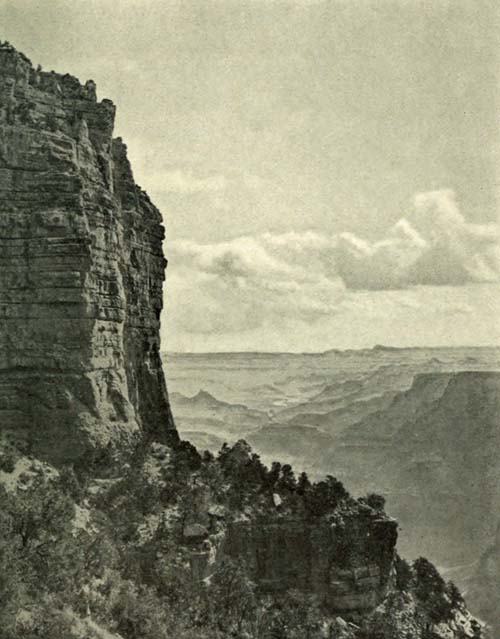
THE WALLS OF THE CAÑON, GRAND RIVER
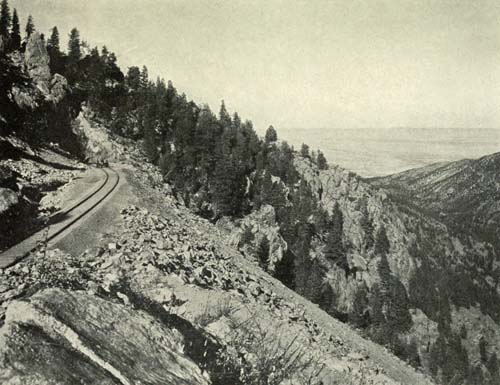
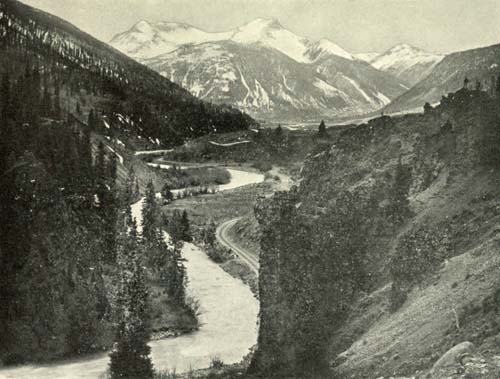
The Denver and Rio Grande Railway is well called
"the scenic line of the world." From Denver to Pueblo
it runs almost due south, across a level valley, with perpetually
enchanting views of the mountains and curious
rock formations, between Denver to the region below
Colorado Springs. From the great smelting city of
Pueblo, "the Pittsburg of the West," the road turns westward,
on an upward grade, till it reaches Cañon City, and
from there to Glenwood Springs this road is a marvel of
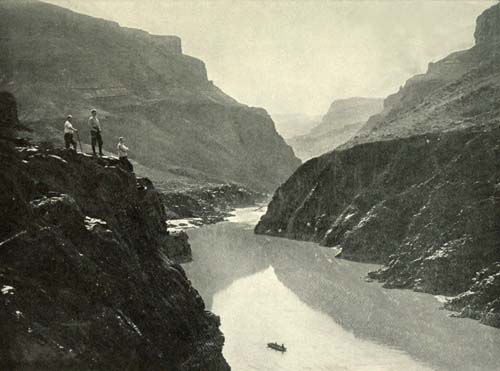
civil engineering. Up the narrow, deep cañons of Grand
River, through the towering granite cliffs, it winds, on and
up, passing Holy Cross Mountain, offering at every turn
new vistas of sublime and wonderful beauty. To take
a day's ride through such scenery, with the luxurious comfort
of the most modern Pullman cars, and a good dining-car
constantly with the train, is to enjoy a day that lives
in memory. Not the least of the attractions of Glenwood
Springs is the enchanting route by means of which one
arrives in this picturesque region. As the train climbs up
to plateau after plateau in the mountains the scenes are
full of changeful enchantment. The formation is interesting,—a
deep cañon, with rock cliffs apparently towering
into the sky, and then the emerging on a great level
plateau. All along this route, too, are those wonderful
sandstone formations that have made the "Garden of the
Gods" so marvellous a place. Between Cañon City and
Glenwood Springs the very dance of the Brocken is seen
in Sandstone sculptures.
Near the summit of Iron Mountain, which is in the
immediate vicinity, the "Fairy Caves" rival the famous
"Blue Grotto" of Capri in attraction. These caves
(less than a mile from the Hotel Colorado) are a most
intricate and wonderful series of subterranean caverns,
grottos, and labyrinths, with translucent stalactites and
stalagmites, and they are all lighted by electricity,—a
great improvement on the sibyls' cave, where the sibylline
leaves were read. The oracles of that time were sadly
lacking in conditions of modern conveniences. The sibyl
had not even a telephone. We do things better now, and
run electric cars up to the Pyramids. Nor did the sibyl of
old have a tunnel two hundred feet long, by which her
votaries could approach the scene of her oracles; but
visitors to the Fairy Caves may pass by means of this
tunnel to one of the grandest and most awful precipices
in the Rocky Mountains, where they step out upon a
balcony of stone into the open air, with a perpendicular
wall of rock one hundred feet high, above, and an almost
perpendicular abyss, down, twelve hundred feet below.
Standing on this balcony, nothing can be seen behind
but sheer perpendicular ascent and descent of rock; but
in front and far below may be seen the Grand River,
appearing as a brook, winding in and out among the
projecting mountains, visible here like burnished silver,
and lost there, only to reappear again at a point far
distant.
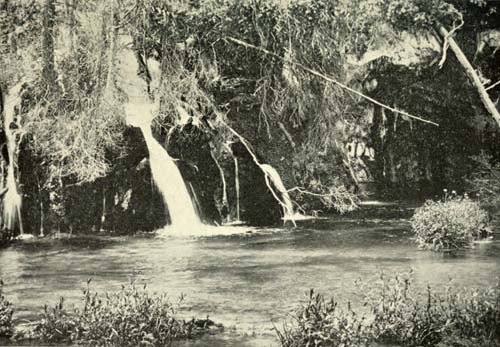
THE "FAIRY CAVES," COLORADO
At this high elevation the opening of the cañon of the
Grand is seen in all of its majesty,—the massive mountains
projecting against each other in their outlines, and
the lofty peaks reaching to the skies. The Denver and
Rio Grande Railway is at the foot of the cañon,—a mere
winding line, as seen from this Titanic height.
The Colorado Midland Road also runs through Glenwood
Springs, whose phenomenal hot caves and luxurious
and elaborate bathhouse have given it European
fame. The twin towers of the hotel remind one of
Notre Dame, and the views from these are beautiful.
The design is after the Villa Medici in Rome,—the
same motive repeated for the central motive of this
superb Hotel Colorado with its towers and Italian
loggias and splendid spacious piazzas, and its searchlight
from one of the towers, illuminating the evening
trains that pass in the deep cañon of Grand River.
Here is a region that might be that of Sorrento and
Capri.
In Glenwood Springs the traveller may meet Mrs.
Emma Homan Thayer, the author of "Wild Flowers
in Colorado," published in both London and New York.
Mrs. Thayer was a New York girl, one of the original
founders of the Art League, and the daughter of an
enterprising and well-known man. She is an artist by
nature and grace,—sketches, paints, and writes, and
in both painting and literature she has made a name that
is recognized, and she has charmingly perpetuated in
her book the unique and wonderful procession of
Colorado wild flowers.
Lookout Mountain, rising some twenty-five hundred
feet above the town, has an easy trail to its summit; the
driving is picturesque and safe on terraced mountain
roads with perpetual vistas of beauty, and many lakes
in the vicinity—Mountain, Big Fish, Trappers' Lake, and
others—offer excellent fishing. The hotel grounds at
night are transformed into a veritable fairyland. The
fountains shoot their jets of water up hundreds of feet
into the air, with a play of color from electric lights
thrown over them until they are all a changeful iridescent
dream of rose and emerald and gold mingled with
blue,—the very rainbows of heaven reproduced in mid-air.
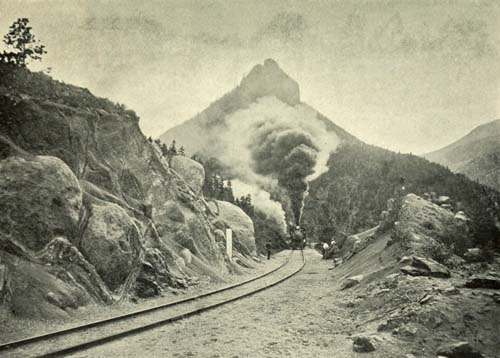
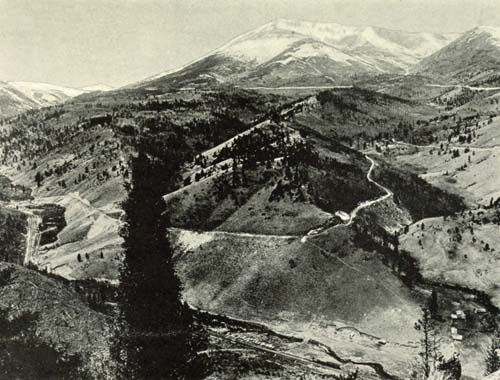
MARSHALL PASS AND MT. OURAY, COLORADO
The journey up the "scenic route" has one point
especially—that at the base of the Holy Cross Mountain
where the train climbs from plateau to plateau—that
enchants the imagination. The vast mysterious
cañons lie far below, steeped in the twilight of the gods.
The air shimmers with faint hints of color. Above, the
towering granite walls seem to cut their way into the sky.
The faint plash of a thousand waterfalls echoes from the
rocky precipices, and the faint call of some lonely bird
hovering over a pinnacle is heard. The mysterious light,
the dim coolness and fragrance, the glimpses of blue
sky seen through the narrow openings of the cañons
above all, combine to produce that enchantment—the
"Encantada,"—that Vasquez de Coronado felt when
he first beheld this marvellous country.
Emerson asserts that life is a search after power,—
"Merlin's blows are strokes of fate."
It is apparently a twentieth-century Merlin who has
dreamed a dream of wresting electricity from the mountain
currents to utilize as power to create a new field for
industrial energy. The electrical engineer, who is the
magician of contemporary life, demonstrates that not the
volume of a stream, but rather its "fall," is the measure of
its possibilities of power, and no country is so rich in water
that comes tumbling down from the heights as is Colorado.
The wild streams that precipitate themselves down
the mountain-sides are as valuable as are the veins of
gold that permeate the mountain. Science has now taken
them in hand, and will not longer permit these torrents
and waterfalls to run to waste or to display themselves exclusively
as decorative features of the mountain landscapes.
The General Electric Company is utilizing these falling
waters, and is already achieving results with their transformation
into power which are beyond the dreams of
imagination. The Silver Cascade, which for ages has had
nothing to do but leap and flash under the shimmering
gold of the Colorado sunshine, suddenly undergoes
"a sea change
Into something new and strange."
It becomes an important factor in the world's work. For
instance, in lovely Manitou,—the little town that dreams
at the foot of Pike's Peak and which seems made only for
stars and sunsets and as the stage setting of idyllic experiences,—in
lovely Manitou an hydro-electric plant has
been for more than a year in successful operation; and an
opportunity is thereby afforded the interested observer to
see the practical working of an enterprise that draws its
energy directly from nature's sources. The power is obtained
from water that is stored in a reservoir situated far
up on the side of the peak. Three and one-half miles of
pipe were used to carry the water from the reservoir to the
plant. The water has a fall of twenty-three hundred feet,
which is much more than is needed to turn the giant
wheels that furnish the power to be distributed to Colorado
Springs, Colorado City, and the surrounding country.
The mills at Colorado City use this power exclusively,
and the cheapness at which it can be furnished is a potent
factor in making for the success of their operation.
At Durango the Animas Power and Water Company
has installed a plant for hydro-electric energy which will
furnish power to the entire San Juan county. The plant
comprises two three-thousand horse-power current generators
and the station appliances that correspond with these;
and from this plant extend fifty-thousand volt circuits to all
the large mines near Ouray, Silverton, and Telluride. The
"Camp Bird," the "Gold King," the "Silver Lake," the
"Gold Prince," and the "Revenue Tunnel" mines all draw
from this plant for their entire milling and mining work.
To harness the cascades, which for ages have known
no sterner duty than to sparkle and frolic in the sunshine,
to force the water sprites and nixies to perform the work
of thousands of horse-power, is the achievement of the
modern Merlin.
The Platte River Power and Irrigation Company are
about to establish two electrical power enterprises most
important to Denver, one of which is to supply all the
power that is necessary to turn every wheel now in motion
in the city, and the second is to secure electric power from
the water that is stored in the Cheesman dam and transmit
it to Denver. Responsible men are working for the success
of the enterprises, and it is anticipated that Denver will
soon enjoy the advantage of power furnished at a minimum
of cost.
The Denver inter-urban service for transportation will
be carried on entirely by electricity within the near future.
All the railroads that centre in this City Beautiful are
preparing estimates and making ready to conduct experiments.
The recent tests in the East of electrically driven
locomotives indicate that Colorado, with Denver as a
centre, will one day be a network of electric lines traversing
productive regions and connecting all the prosperous
towns of the state by this most ideal form of transit.
In Colorado it is one of the unwritten laws—a law
from which there is no appeal—that nothing which is
desirable is impossible. This is one of the spiritual laws,
indeed, and he who holds it as an axiom shall perpetually
realize its force and its eternal truth. The entire physical
world is plastic to the world of spirit. In that realm
alone realities exist. For "the things which are seen are
temporal; but the things which are not seen are eternal."
The faith that stands—not "in the wisdom of man,
but in the power of God"—is that which shall be justified
by the most profound actuality. It is that hidden
wisdom "which God ordained before the world unto our
glory." Science has already discerned the connection between
organic form and super-space; and speculations
already begin to emerge from the dim and vague region of
conjecture into hypothesis and theory out of which are
developed new working laws of the universe which are as
undeniable as is that of the law of gravitation.
In harmonious accordance, then, with that unwritten
law of Colorado that nothing which is desirable is impossible,
it was realized that the Gunnison River, a powerful
stream thirty miles east of the Uncompahgre, afforded an
abundance of water to reclaim these desert wastes to the
traditional blossoming of the rose. The Gunnison River,
however, flows through a box cañon three thousand feet
deep. Were it at the bottom of a gorge three thousand
miles deep, that fact would hardly daunt the Colorado spirit.
Immediately some invention, incomprehensible to the present
mind of man, would be made by which the desirable issue
should be achieved. As has been remarked, failure is a
word not included in the vocabulary of Colorado. That
state has a "revised version" of its own for the resources
of its language, laws, and literature. Its keynote is the
invincible. Ways and means are mere matters of minor
detail. If an achievement is desirable, it is to be accomplished,
of course. It is not even a question for discussion.
There is no margin of debatable land in the realization of
every conceivable opportunity.
A stupendous work in development is that of this Gunnison
Tunnel under the Vernal Mesa to Uncompahgre
Valley,—a desert waste whose area comprises some one
hundred thousand acres of sand, sagebrush, and stones.
Yet even here irrigation worked its spell, and while the
Uncompahgre River held out a water supply, the land
reached proved fertile beyond expectation. But the
Uncompahgre had its far too definite and restricted limits;
no other water supply was available for this region, and
there lay the land—a tract of potential wealth, but
destined to remain, so far as could be seen, an unproductive
and cumbersome desert region unless irrigation
could be achieved.
To the constructing engineer of the reclamation service
there came a telegram from the chief engineer in Washington
asking if it were feasible to divert the waters of
Gunnison River to Uncompahgre Valley by means of
a tunnel under Vernal Mesa? This implied building a
tunnel from a point totally unknown. No one had ever
succeeded in passing through Gunnison Cañon. But the
past tense does "not count," any more than Rip Van
Winkle's last glass, in any estimate of the present in
Colorado. Professor Fellows, an engineer of Denver,
selected his assistant; they prepared their instruments,
their provisions, and their inflated rubber mattress, and
set forth on this expedition in which their lives were in
constant peril; in which hardships beyond description
were endured. The topographic map, for instance, was
made by Mr. Fellows in the delightful position of being
lowered with ropes into the deep cañon where, should the
slightest accident occur, he would never return to the day
and daylight world again. The establishment of precise
levels for both ends of the tunnel, one of which must, of
course, be lower than the other to induce a flow of water,
was another matter requiring a delicacy of adjustment
beyond description. Of their wonderful and even tragic
experiences a local report says: "It all ended by Fellows
and his companion saving two things,—their lives and
their notebooks. Everything else went down with the
flood. When the men emerged at the Devil's Slide, weary,
bruised, and bleeding, friends who had been waiting to pick
up their mangled bodies hailed them as if they had returned
from the dead."
Of all this story there was no hint in the cheerfully
laconic telegram despatched to Washington,—"Complete
surveys for construction." The tunnel will be five or six
miles in length, of which over two miles are already completed.
The work proceeds night and day with the drills
like mighty giants eating their way through the solid granite
of the Vernal Mesa that lies between the two rivers. This
desert region which will thus be reclaimed comprises portions
of three counties,—Ouray, Montrose, and Delta,—the
region being at an altitude of five thousand feet. It easily
produces fruit, alfalfa, and grain, and it is also well adapted
to the culture of potatoes, celery, and the sugar beet. The
land when irrigated is estimated to be worth five hundred
dollars per acre. The tunnel will have a capacity for conveying
thirteen thousand cubic feet of water per second,
and there will be connected with it an elaborate system of
lesser canals and ditches that will carry the water all over
this desert tract. It is estimated that this enterprise will
add thousands of homes to the valley of the Uncompahgre,
and that it will increase by at least ten millions the taxable
property of Colorado. The cost of the Gunnison
Tunnel will be some two and a half millions.
Uncompahgre Valley, lying between the Continental
Divide on the east, and the Utah Desert on the west,
comprises the greatest extent of irrigable land west of
Pueblo in the entire state; but the need for irrigation
and the possibilities of supplying that need were so widely
apart that even Merlin the Enchanter recognized the
difficulty, though by no means defining it as an impossibility.
The Uncompahgre River was soon exhausted, and
only this apparently impracticable scheme, now happily
realized, offered any solution of the problem. Hon. Meade
Hammond of the state legislature of Colorado secured the
appropriation of twenty-five thousand dollars to meet the
expenses of surveying and preliminary work. Hon. John
C. Bell, the representative for that district in Congress,
gave untiring devotion to the project, and to his efforts
was due the zeal with which the reclamation service took
up this vast work; and when Professor Fellows was appointed
as the government district engineer its success
became the object of his supreme interest and unremitting
energy, and its achievement adds another to the
remarkable engineering works of Colorado.
In this Land of Enchantment almost anything is possible,
even to yachting,—a pastime that would not at first
present itself as one to be included among the entertainments
of an arid state which has to set its own legislative
machinery and that of Congress in motion in order to
contrive a water supply for even its agricultural service;
nevertheless, on a lake in the mountains, more than a mile
and a half above sea level and some one hundred miles from
Denver the Beautiful, a yacht club disports itself with all
the airy grace and assurance of its ground—one means of
its water—that distinguishes the delightful Yacht Club
at old Marblehead on the Atlantic Coast. There was,
however, no government appropriation made to create this
lake, as might at first be supposed, nor any experts sent out
commissioned to prepare the way. There are numerous
forms of summer-day entertainments that are more or less
in evidence in the inland states; but yachting has never
been supposed to be among them, as preconceived ideas of
this joy have invariably associated it with oceans and seas.
Still, it must be remembered that Colorado is an exceptional
region in the universe, and creates, not follows,
precedents. It is the state, as has before been remarked, to
which nothing conceivable is impossible.
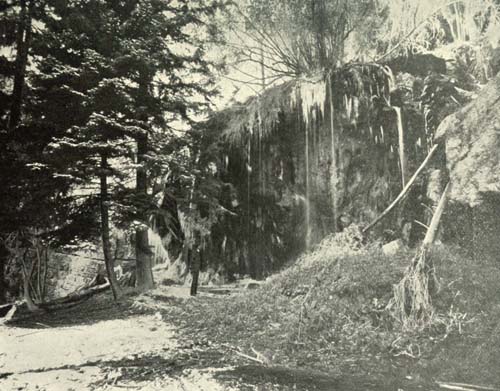
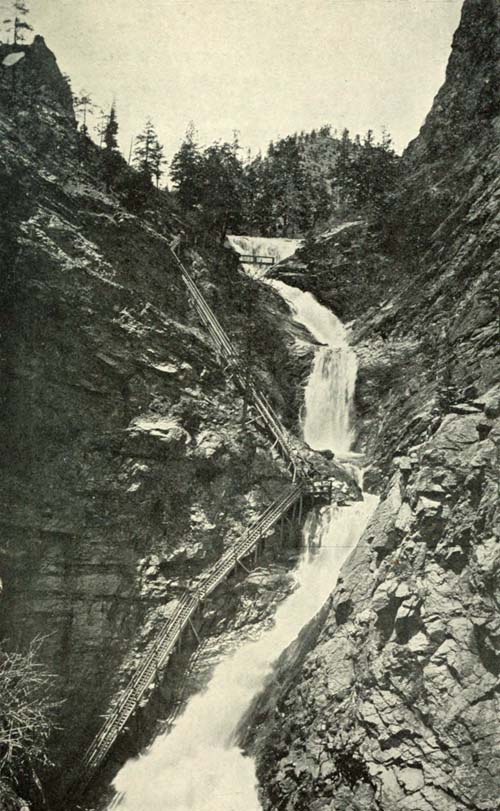
THE WONDERFUL HANGING LAKE, NEAR
GLENWOOD SPRINGS, COLORADO
Grand Lake is in Middle Park, sixty miles from the
nearest railroad station. (With the incredible celerity
with which life progresses in the Centennial State, of
course by the time this description is materialized in
print Grand Lake may have become a railroad centre—who
shall say? It is not safe to limit prophecy in Colorado.)
At present, however, a railroad journey of forty
miles from Denver, supplemented by sixty miles of stage,
brings one to the lake, a beautiful sheet of water two
miles in length and more than a mile in width, whose
water is icy cold. The locality has become something of
a summer resort for many Denver people, and also, to some
extent, to those from Chicago and Kansas City, and a
group of cottages have sprung up. Some seven years ago
the Grand Lake Yacht Club was duly organized, with Mr.
R. C. Campbell, a son-in-law of Senator Patterson of Colorado,
Mr. W. H. Bryant, a prominent citizen of Denver
the Beautiful, Major Lafayette Campbell, and other well-known
men, as its officers. The club has now a fleet of
yachts; it has its regatta week, and altogether holds its
own among nautical associations; it takes itself seriously,
in fact with what Henry James calls the "deadly earnestness
of the Bostonians," which is paralleled by this inland
and arid-land yachting club.
Besides the joys of yachting in an arid state where that
nautical pastime is apparently carried on in mid air, is the
local diversion of climbing mountain peaks that are pronounced
impossible of ascension. This is one of the favorite
entertainments of Colorado young women, who have conquered
Long's, Gray's, Pike's, and Torrey's peaks, Mount
Massive, the "Devil's Causeway," and various lesser heights,
which they scale with the characteristically invincible energy
of their state. The summit of Mount Massive is fourteen
thousand five hundred feet above sea level, and of one of
these expeditions a Denver journal says of this party of
several ladies and gentlemen:
"Camp was struck at Lamb's ranch, where, in the early
morning, the wagon was left with all the outfit not absolutely
necessary. The trail sloped steadily to the boulder field,
where the party stopped for lunch. They were now at an
altitude of twelve thousand feet. A cold wind swept across
the range and chilled them, so that the climb was soon
renewed.
"The boulder field is two miles long and seemed five, for
walking over the great stones is a wearisome business. At the
end of the boulder field, which is much like the terminal
range of an old glacier, is a great snowbank. From a long
distance the mountain climbers saw the keyhole,—a deep
notch of overjutting rock through which goes the only trail
to the summit of Long's. It is a gigantic cornice to a ridge
that extends north from the main cone.
"After passing the keyhole, which had loomed up before
them through weary miles of tramping, a great panorama of
mountains stretched before them.... There was a precipitous
slope of rocks jammed together in a gulch. This rises
for about seven hundred feet, every inch stiff climbing.
"The danger at this point was that some climbers might
dislodge rocks which would come bounding down on the
heads of those in the rear. For this reason the orders of the
leader were urgent that the party should not get separated.
The trail at this point led up the sharply sloping eaves of the
mountain roof, from which the climber might drop a dizzy
distance to the depths below. Clinging to the rocks and
hanging on by hands or feet, the party pushed up to a ledge
from which they looked over an abyss several thousand feet
sheer down."
In Southern Colorado the cliff-dwellers' region offers
some of the most remarkable ruins in America, and their
preservation in a government reservation, to be known as
the Mesa Verde National Park, has been assured by a bill
that has been recently passed by Congress and which is
one of the eminent features of latter-day legislation. It
is Representative Hogg who introduced this bill providing
for the permanent protection of those cliff-dweller ruins
which, with those in New Mexico and Arizona, constitute
some of the most valuable and interesting prehistoric remains
in the United States. Already much of this archæological
treasure of inestimable scientific value has been
carried away by visitors, while, instead of permitting this
region to be thus despoiled, it should be made easily
accessible to tourists and held as one of the grand show
places of the great Southwest. Like the Grand Cañon
and the Petrified Forests of Arizona, like the Pike's Peak
region in Colorado, Mesa Verde would become an objective
point of pilgrimage to thousands of summer tourists. In
the winter of 1904-5 Representative Lacey, of Iowa, the
eminent chairman of the House Committee on Public
Lands, made in behalf of his committee a favorable report
on the Colorado Cliff-dwellers' Bill, presenting, with his
characteristic eloquence of argument, the truth that the
permanent preservation of these wonderful and almost
prehistoric ruins is greatly to be desired by the people of
the Southwest, as well as by those interested in archæology
elsewhere. "The ruins are situated among rocky cliffs,
and may be easily preserved if protected," said Mr. Lacey,
and added:
"With the exception of two or three small, fallen, and
totally uninteresting ones, all the ruins of the Mesa Verde
are in the Southern Ute Indian Reservation. It is an extremely
arid region, and little or no agriculture is practised
by the Utes, although they range sheep, goats, cattle, and
ponies on the mesa and in the cañons. It is a poor range at
best, and the Indians appear to need all they can get. Moreover,
the reclamation service has made some estimates regarding
storage reservoirs in the upper Mancos, and it may
be at some future time a part of this land in the reservation
will be irrigable and greatly increased in value. The Utes
are not going to destroy these ruins or dig in them. They
stand in superstitious awe of them, believing them to be
inhabited by the spirits of the dead, and cannot be induced
to go near them."
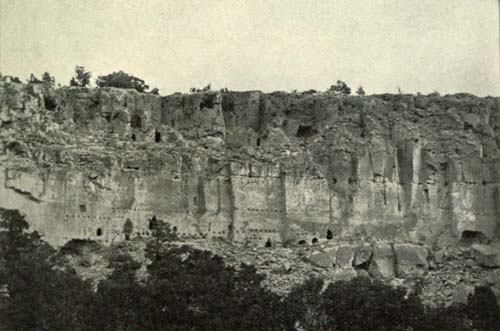
These dwellings are excavated in cliffs from five to nine
hundred feet above the plateaus. Of these, two dwellings
stand out prominently,—the "Spruce Tree House" and
the "Balcony House," the former of which contains a
hundred and thirty rooms, of each of which the average
measurement is about eight by six feet. Much pottery,
weapons, armament, and many skeletons and mummies are
found in these dwellings.
The later conclusions of scientists are that these cliff-houses
were designed as places of refuge and defence rather
than as ordinary habitations. The parallelogram and
circle forms predominate, and they are often forty feet in
diameter. There are sometimes double, or even triple
walls, solidly built of hewn stone, with a circular depression
(council-chamber) in the centre.
Pueblo is the metropolis of Southern Colorado. It is
the second city in the state, ranking next to Denver. It
is an important industrial centre, being the location of
the great steel works of the Colorado Fuel and Iron Company,
and two large smelting plants in constant activity.
It is a town with unusual possibilities of beauty, rambling,
as it does, over the rolling mesas with a series of
enchanting vistas and mountain views of great beauty.
The Spanish Peaks are in full sight from the new residence
region of Pueblo, and here is the home of ex-Governor
and Mrs. Alva Adams, with its spacious, book-lined
rooms; its choice and finely selected souvenirs of foreign
travel; its music and pictures; and far above all, the
gracious sweetness and charm of Mrs. Adams, who has
that most perfect of gifts—that of transforming a household
into a home. Governor Adams, although in his
modesty he would deprecate the distinction, is easily the
first citizen of Colorado. Twice the Governor of the state,
he has impressed the entire people with his flawless integrity
of character, his noble ideals, and his energy of executive
power in securing and enforcing the best measures
for the people and carrying onward into practical life the
highest moral and educational standards.
Governor Adams is always greatly in demand as a
speaker, and in September of 1906 he was again nominated
for Governor of the state.
Colorado, quite irrespective of party, is all aglow
with the name of Alva Adams. Good Republicans have
long been greatly perplexed over the fact that the man
they most desire to vote for, the man to whose guidance
they would most willingly commit the affairs of state,
is a Democrat. The ability, the unquestioned integrity,
the fidelity to lofty ideals, and the great administrative
power of Governor Adams inspire the almost
universal enthusiasm of Colorado irrespective of party
lines.
No son of the Centennial State is more in sympathy
with its individual problems. Born in Wisconsin (some
fifty-five years ago), Governor Adams was about to enter
the Ann Arbor Law School when the illness of a brother
brought him in his earliest youth to Colorado. Its
beauty, its rich possibilities, enchanted him. Here he
married a very cultivated and beautiful young woman,
whose parents came in her early girlhood to Colorado,
and whose sympathetic and perfect companionship has
been the unfailing source of his noblest inspiration.
In an address on "Pathfinders and Pioneers," given
before an irrigation congress at Colorado Springs, we find
Governor Adams saying:
"What a sublime moment when the explorer realizes the
fruition of his dream! What fateful hours upon the dial of
human progress when Columbus saw a new world emerge
from the sea, when Balboa stood 'silent upon a peak in
Darien,' when Lewis and Clark upon the continent's crest
saw the waters of the rivulet run toward the West! Such
events compensate great souls, and their spirits defy hardship,
ingratitude, chains, dungeons, and the axe. The curtain has
been run down upon the careers of those brave men whose
praise we sing. Their race is run. The explorer, priest,
trapper, and pioneer have vanished.
"'Westward the course of empire takes its way;
The four first acts already past,
A fifth shall close the drama with the day;
Time's noblest offspring is the last.'
"Would it be a daring assumption to consider the irrigated
regions of America as the arena in which the fifth act, time's
noblest offspring, is to perfect and complete the drama of
civilization?
"Irrigated lands were the cradle of the race. The first
canals were run from the four rivers of Paradise. May not
the fruition of mankind seek the same conditions amid which
it was born? Providence has kept fallow this new land until
man was fitted to enter and possess it.
"'Hid in the West through centuries,
Till men, through countless tyrannies, could understand
The priceless worth of freedom.'"
"I would not decry culture and refinement," said ex-Governor
Adams in this address; "they are the charm
and beauty of modern life, the music and art of the social
commerce of the age; but in their acquirement I would
not give up the robust, vigorous, daring qualities of the
pioneer."
The Governor proceeded:
"They had blood and iron in their heart, they had the
nerve to dare, the strength to do. I do not believe in battle
for battle's sake; but I never want to see our people when
they are not willing to fight, and able to fight. The only
guarantee of peace and liberty is the ability and willingness
to do battle for your rights. Refinement alone is not
strength, culture alone is not virtue. Absalom, Alcibiades,
and Burr stand in history as the most polished, cultured men
of three ages, yet they were more a menace than a brace to
the liberties of their time. In stress, the world calls upon
the Calvins, the Cromwells, the Jacksons, Browns, and Lincolns.
They were stalwart, strenuous, courageous men; not
cultured and refined, but rich in royalty and daring. It is
the rugged and the strong, and not the gentle and the wise,
who gather in their hands the reins of fate and plough deep
furrows in the fields of human events. It is they who have
driven the car of progress and have woven the deepest colors
in the fabric of human happiness. It is true that some of our
Western torch-bearers were not perfect; none of them were
ever anointed with the oil of consecration; around them
surged the temptations of a wild and boisterous age; through
their hearts and souls there swept the impulses and passions
of the strong; if they sinned, it was against themselves, not
their country. Let their frailties be forgotten, and their
good cherished. Often rough and defiant of the conventionalities,
they were ever true and loyal, and most of these empire
builders can stand before the great white throne with
open hearts. They were the architects, the Hiram Abifs of
these Western empires. They laid the foundations in courage
and liberty."
Let no one fancy that Pueblo is a primitive Western
city devoid of electricity, telephones, motor cars, or even
Marconigrams. Let no one fancy it is too far from Paris
to have the latest French fashions. It is hardly an exaggeration
to say that it demands the best and the most
up-to-date ideas of the Eastern cities to be at all eligible in
these Colorado towns. Pueblo has a most delightful club-house
on the edge of a lake—the lake is artificially created,
and being made to order, is, of course, exactly the kind of
lake that is desired, the water being conducted from the
mountains into a large natural depression—where great
open fires in every room greet the daily visitor; where
there are large reading-rooms, a dining-room, and a ball-room;
no intoxicating beverages of any kind are allowed
to be sold, so that youths and maidens may at any time
enjoy the club with no insidious dangers to their moral
welfare.
There are many centres of social life; and if Pueblo
people have any other conceivable occupation than to give
dinner parties at night and go motoring in the morning,
with endless receptions of the Daughters of the
Revolution and other clubs, organizations, or purely private
card receptions invading the afternoons, the visitor
hardly realizes it. The dinners given are often as elaborate
as in the large Eastern cities, as one, for instance,
given by Mr. and Mrs. Mahlon D. Thatcher at their stately
home "Hillcrest," where the decorations were all in rich
rose red, a most brilliant effect, and the souvenirs were
India ink reproductions of old castles on white satin.
The dinner cards held each a quotation from the poets.
Pueblo is always all sunshine and radiance, and has a
beauty of location that makes it notable, with its encircling
blue mountains and picturesque mesas, and the perpetual
benediction of the Spanish Peaks silhouetted against
the western sky. Its new library is the pride and delight
of every citizen. It is one of the Carnegie chain,—a
large, two-story and basement structure of white Colorado
stone, the interior finished with the richly variegated
Colorado marble which is used for mantels and fireplaces.
The book stacks, the spacious and splendid reading-room,
the children's room, and the smaller ones for reference and
special study, are all planned on the latest and most
perfect models.
The library is in the Royal Park, on the crest of one of
the mesas, very near the home of Governor Adams. It is
a library to delight the heart of the book-lover. Pueblo
offers, indeed, great attractions to all who incline to this
land of sunshine. The climate is even more mild than
that of Denver, from which city it is a little over three
hours distant by the fast trains, or four hours by slower
ones. Colorado Springs lies between—two hours from
Denver and a little over one hour from Pueblo. The location
combines many attractions. With three railroads;
its large industries in smelting and steel; its excellent
schools, both public and private; its churches, its daily
newspapers; its library; and its fine clubhouse, open to
families,—women and children as well as men enjoying it
freely,—Pueblo seems one of the most delightful of places.
It has large wealth and a power of initiating many opportunities.
It is on the most picturesque and delightful
lines of travel to Cañon City, Salida, Leadville, Glenwood
Springs, and through Salt Lake City to the Pacific
Coast; or on the line to Arizona and the Grand Cañon
of the Colorado, and on to Los Angeles and San Francisco;
or eastward to Chicago and the Atlantic Coast; or
southward to Mexico, or St. Louis, or New Orleans.
Pueblo is really in the heart of things, so to speak. The
Chicago papers arrive the next day, the New York papers
the third morning, and the telephonic communication is
simply almost without limit. Governor Adams will step
from his library into another book-lined room where the
telephone is placed, and from there talk with people in
five different states. Once he held a conversation with a
man at the bottom of a mine a few hundred miles away,—a
man whose subterranean sojourn had the alleviation
of a telephone.
The greatest industrial organization west of the Mississippi
River is that of the Colorado Fuel and Iron Company,
whose largest plant is at Pueblo, and is held at a valuation
of fifty-eight million dollars. On its pay-roll are fifteen
thousand employés. There are twenty thousand tons of
steel rail produced each month, and it is said that this
number will soon be largely increased, and that the
Goulds and the Rockefellers are arranging to utilize the
product of these mills for their vast railroad interests.
The company owns such large tracts of land in Colorado,
New Mexico, Utah, and Wyoming; it owns coal mines,
iron mines, lime quarries; it owns parts of two railroads,
besides telegraph and telephone lines galore, so
that by reason of these extensive holdings it is able to
secure at a minimum of cost all the raw materials from
which the finished products are turned out. Upward of
three hundred thousand acres of the richest coal lands in
the West, an empire containing one hundred square miles
more than the coal area of Pennsylvania, constitute the
holdings for coal mine purposes of the company. In
addition there are iron, manganese mines, and limestone
quarries containing the elements which give to the product
of the furnaces and mills qualities that secure the markets
of the Western world. Its plant at Pueblo has become
the centre of a town called Minnequa, composed of its
own employés and their families. The company has
established a model hospital, with a surgeon's department
fitted up with the most elaborate and finest scientific
and nursing facilities; a fine library and large reading-rooms,
and a recreation hall and gymnasium for the workmen.
Nearly one million dollars has been expended on
the tenant houses belonging to the company, which are
rented to their employés on fair and advantageous terms.
In many respects Minnequa, at Pueblo, is one of the most
remarkable manufacturing centres in the world, presenting
aspects that invite study, in its extensive resources,
the vast and colossal character of its purposes, and its
remarkable achievements. All employés are given the
opportunity to acquire homes; and every late ideal in
the way of providing opportunities for their care in
health, in mental and moral development, and in recreations,
is carried out to the fullest possible extent.
The company has recently engaged in an irrigation
enterprise in the purchase of water-right priorities of the
Arkansas River for seventy cubic feet of water per second,
at an expense of one million dollars. These rights, which
date back to 1860-62, are among the oldest existing, and
they insure to the company the uninterrupted and certain
possession of the river flow. A court decree enabled
them to change the point of division, and they have
constructed a new head-gate at Adobe, six miles east of
Florence. A canal fifty-eight miles in length is being
constructed from Florence to the mills owned by the
company. The cost of this canal will be some three
quarters of a million. These mills produce over seventy-five
thousand tons of iron and steel each month. The
manufacturing plant at Minnequa includes blast furnaces,
converting works, blooming mills, a merchant iron mill,
a hoop and cotton tie mill, a spike factory, a bolt factory,
a castings and pipe foundry, with open hearth furnaces, a
reversing mill, and many other appliances.
"It must not be supposed, because we find it necessary
to practise irrigation in Colorado, that we therefore never
have any rains," observed a Coloradoan; "on the contrary,
the rains of spring are usually of such abundance as to
make the ground in fine condition for ploughing and putting
in crops, and we seldom find it necessary to apply
water to germinate any kind of seed; only once, in thirteen
years' experience at Greeley, were we compelled to resort
to irrigation before crops of all kinds were well up and
considerably advanced in growth. About the last of May,
however, as regularly as the natural periods of summer,
autumn, winter, and spring occur in the other states,
never varying more than a week in time, these copious
rains suddenly cease and give place to light and entirely
inadequate local thunder-showers. Now is the accepted
time, and all over cultivated Colorado, within a period of
not more than two days, every flood-gate is opened and
the life-giving current started to flowing on the rapidly
parching grain. Corn will endure until later in the
season, but all sowed crops must get one thorough application
of water within two weeks or become severely
injured for the want of it. Day and night the silent
current flows on and on, among the fields of grain; not a
drop of water nor a moment of time must run to waste
until the first irrigation is completed."
In so exceptional a summer of drought and heat as
was that of 1901 the advantages of irrigation stand out.
Journeying through Kansas, the long day's ride across
the state revealed continued devastation from the lack
of rain. Corn fields looked almost as if a fire had
passed over them, so shrivelled and stunted they were;
but in Colorado on every hand there were greenness and
luxuriance of vegetation and of crops. The result is simply
that, with irrigation, man controls his climate and all
the conditions of prosperity. Without it, he is at the
mercy of the elements.
The Union Colony of Greeley was the first to introduce
upland irrigation in Colorado. Of the method employed,
the "Greeley Tribune" gave this description:
"Almost the first question asked by many persons on their
first arrival in Colorado, when they see the irrigating ditches
running along the sides of the bluffs high above the river, and
back from it five, ten, or twenty miles, is, 'How do you get
the water out of the river, and so high above it? It looks
as if you made the water run uphill.' The answer is very
simple. All the rivers of Colorado are mountain streams, and
consequently have a fall of from ten to thirty feet to the
mile, after they reach the plains. In the mountains, of
course, the fall is often much greater. The plains also have
a gradual slope eastward from the foothills, where the altitude
is generally between six and seven thousand feet above sea
level, while at the eastern boundary of the state it is only
about three thousand feet. Take, for example, the canal
generally known as Number Two, which waters the lands of
the Greeley Colony. This canal is taken out of the Cache
la Poudre River, about seventeen miles west of Greeley, and
where the bed of the river is probably a hundred and sixty
feet higher than it is at Greeley. The bed of the canal only
has a fall of from three to three and a half feet to the mile;
therefore it is easily seen that when that grade is continued
for a number of miles, the line of the canal will run in a
direction further and further from the river, and on much
higher ground, so that the lands lying between the canal and
the river are all 'covered by,' or on a lower level than, the
water in the canal. In the process of irrigation this same
plan must be followed, of bringing the water in on the higher
side of the land to be irrigated, then the water will easily
flow all over the ground."
In Weld County, of which Greeley is the county seat,
irrigation was extended during 1905 to cover from fifteen
thousand to twenty thousand acres of arid land never
before under cultivation, and storage reservoirs increased
in capacity. It is proposed to cut a tunnel through the
Medicine Bow mountain range and to bring a large quantity
of water through from the Western slope to irrigate
an additional fifty thousand acres of prairie.
Within the past year there have been two potato starch
factories started in successful operation in Greeley which
are estimated to pay out annually one hundred thousand
dollars for potatoes that have heretofore been practically
a total loss to the farmers.
The Swift Packing Company of Chicago propose investing
one and a half millions in further irrigation in this
county. The products of the Greeley district alone, for
1905, were five and a half millions,—a fact that suggests
the wise foresight of Hon. Nathan Cook Meeker, the
founder of the town, in selecting this location, in 1869,
for his colony.
Of recent years a remarkable feature of agricultural
progress in Colorado has been developed by the "dry
farming" system, the discovery of which is due to Prof.
H. W. Campbell, who has been experimenting, for some
twenty years past, in Eastern Colorado, in the scientific
culture of the soil without benefit of irrigation. Professor
Campbell says that he had been assured that corn would
not grow at an altitude of three thousand feet, as the
nights would be too cool; but that he can refute this, as,
during the past five years, he has averaged from thirty to
forty-two bushels per acre at an altitude ranging from
five thousand to nearly seven thousand feet. Successful
agriculture is, in Professor Campbell's belief, based on the
fundamental principle of soil culture, and in an interview
he said:
"While the great work now being done by the government
in promoting irrigation enterprises in the more arid portion
of the West and the using of millions upon millions of money
for the building of mammoth reservoirs have value and virtue,
and means the development of many sections that must
remain almost worthless without them, and the spending of
thousands of dollars in traversing foreign countries to secure
what some have pleased to call drought-resisting plants, will
undoubtedly play their part in promoting the welfare and prosperity
of Colorado, ... yet there should also be an understanding
of, first, the necessary physical condition of the soil
for the most liberal growth and development of roots; secondly,
the storing and conserving the entire season rainfall,—not
only the portion that falls during the growing season,
but from the early spring to late in the fall; thirdly, the fact
that air is just as important in the soil as water, and that it is
the combination of the elements of air and water in the soil,
together with heat and light, that is most essential; and that
when these conditions are fulfilled, Eastern Colorado will
come to its rightful own, and little towns and cities will
spring up along all the great trunk lines, while the intervening
country will be dotted with ideal farm homes and shade
trees; orchards and groves will break the monotony of the
now bleak prairie, and present a restful, cheerful, homelike,
and prosperous condition."
While agriculture in Colorado is regarded as in its infancy,
yet the product of Colorado farms alone contributed
almost fifty-one millions to the world's wealth, in 1905,
exclusive of wool, hides, or live stock. Professor Olin of the
State Agricultural College estimates that there are over
two hundred thousand acres in Colorado which produce
crops without irrigation, by the application of Professor
Campbell's "dry-farming" system. The so-called dry
land, consisting of millions of acres in Eastern Colorado,
averages now four dollars per acre, where one year ago
untold quantities could be bought for an average of two
dollars per acre. The speculative value of this land has
gone up wonderfully under the impetus of the Campbell
system of dry farming. If this system comes anywhere
near proving the claims of its advocates, it will vastly
increase the wealth and population of the state. With
a greater understanding of the science of dry culture it
is certain that the farmers of the state and the state
generally will experience immeasurable advantage. In
the eastern plains of Colorado are embraced more than
fifteen million acres of land which are now lying practically
useless, only a small amount being utilized for ranging
cattle. The claims of dry-culture enthusiasts and those
who have been experimenting with seed imported to meet
the dry conditions are, that this empire will be made
to yield harvests which will support many thriving communities.
In proof of their claims they point to so-called
model farms established at various places on the plains
where the hitherto unyielding soil has borne substantial
crops.
One important feature in the agricultural development
of Colorado is the extinction of the bonanza ranch of thousands
of acres. Instead, farms are reduced to manageable
proportions, and are carried on far more largely by intelligent
thought and scientific appliances than by mere
manual labor.
The present day Colorado ranch is an all-the-year-round
enterprise. The ranch owner is a careful business man,
who watches his acres and the products thereof even as the
successful merchant or manufacturer acquires close knowledge
of all the details of his business. He sows his land
with diversified crops, rotating hay, grain, and root crops
scientifically for the double purpose of securing the greatest
yields and preserving the nourishing qualities of the
soil. Keeping in touch with the market conditions of the
world, and with the advancing developments of science, he
is easily the master of the situation, and in no part of the
country is the condition of the farmer better, or perhaps
so good, as in Colorado. The agriculturist of the Centennial
State who is the owner of two quarter sections, or even
of one, is altogether independent. The returns from his
business are absolutely sure, and with the certain knowledge
of substantial gains at the end of the season he plans improvements
to his home, and comforts and even luxuries for
himself and family, which far exceed those usually secured
in the Middle West or by the small farmers of the East.
In Colorado it will be found that almost every young man
and woman of those who are natives of the state are
college graduates. Co-education prevails, just as does the
political enfranchisement of women, and the results of this
larger extension of the opportunities and privileges of life
are very much in evidence in the beauty, the high intelligence,
and the liberal culture that especially characterize
the women of Colorado.
Irrigation enterprises in Colorado are far more widely
recognized than is the Campbell system of dry culture;
but in 1905 these enterprises appealed with increased force
to capitalists outside, as well as within Colorado, as a safe
and profitable means of investment. Land held at ten
dollars per acre is, by irrigation, instantly increased in
value from twenty to fifty dollars; and it was seen that
the most favorable localities within the state in which to
raise funds for further extension of irrigation were among
the farmers in the older irrigated sections who have won
their ranches, improved their places, and made large deposits
in the banks through the use of the productive waters
trained to make the soil blossom with wealth.
Irrigation is developed to its highest excellence in Northern
Colorado and in the valley of the Arkansas River.
These regions have been the longest under irrigated culture,
and their value is increasing rapidly. Each year
sees the agriculturist grow more conservative in his use
of water, and the quantity thus saved has been applied
to new lands. Thus, in an interesting and quite undreamed-of
way, a problem that incited discord and dissension,
that promised only to increase inevitably as larger
territories of land and their correspondingly increased irrigation
should be held, was brought to a peaceful solution.
Continued litigation, and a great pressure to secure legislative
restrictions of the use of water supply, and the constant
irritation and turmoil involved in these disputes,
were all, happily, laid to rest by the discovery of the
farmers themselves that extravagance in the use of water
was not conducive to their own prosperity. In the matter
of flood waters the irrigation experts of the state are
quite generally meeting the condition in their own way.
Storage reservoirs are dotting the irrigation systems at
frequent intervals, and in the dry months the supply piled
up behind the cement dams is drawn off to furnish the
final necessary moisture for the maturing of the crops.
Another possibility of irrigation that is receiving the
attention of engineers is the utilization of the streams for
power purposes. In many cases the power thus generated
will be made to accomplish marvellous feats in the way of
construction, as in the instance at Grand River, already
described.
One of the special journeys in Colorado is that called a
"trip around the circle," affording more than a thousand
miles among the mountains within four days' time; but a
permission for ten days is available, thus affording several
detours by stage, which penetrate into the most sublime
regions. The abysmal depth of five of the great cañons;
many of the noted mountain passes; great mining camps,
with their complicated machinery; cliff dwellings, vast
plateaus, and stupendous peaks; Indian reservations; the
icy crevasses a thousand feet in depth; the picturesque
"Continental Divide," from which one looks down on a
thousand mountain peaks, where the vast Cordilleras in
their rugged grandeur are seen as a wide plain; the beautiful
Sangre de Cristo ("Blood of Christ") range; the
sharp outlines of the Spanish Peaks, rising twelve and
thirteen thousand feet into the air; beautiful meadow
lands where the blue and white columbine, the state flower
of Colorado, blooms in profusion, and the tiger lily, the
primrose, and the "shooting stars" blossom,—all these
are enjoyed within the "circle" trip; and it also includes
Leadville, the "city above the clouds," Durango,
Ouray, Gunnison, and other interesting towns. It offers a
near view of the Mount of the Holy Cross, which strange
spectacle is made by the snow deposits in transverse, gigantic
cañons,—the perpendicular one being fifteen hundred
feet, while the transverse cross is seven hundred and fifty
feet in length; of Lost Cañon, a novelty even in a land
of cañons; and of the Rio de Las Animas Perditas, old
Fort Lewis, the valley of Dolores River, a region of
early Spanish discovery; of Black Cañon and Cimarron
Cañon and Grand River Cañon, whose walls rise to the
height of more than twenty-five hundred feet;—all these
are but the merest outline and hint of the scenic wonders
compassed within the circle trip. Up the cañons the train
climbs; through narrow gorges with overhanging rocks, on
and on, till a plateau is reached; then more cañons, more
climbing, more peaks towering into the skies, and waterfalls
chiming their music. As even an enthusiast in scenery
cannot entirely subsist on stars, sunsets, and silences,
the luxurious comforts of these trains enhance one's enjoyment.
A dining-car is always on, and the excellence of
the food and the moderate prices for all this perfect comfort
and convenience are features the traveller appreciates.
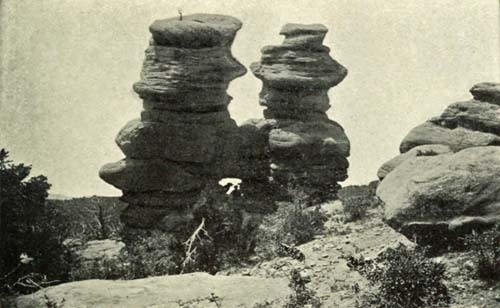
That dance of the Brocken which one fancies he sees in
the fantastic sandstone formations on the mountain's side
on the romantic route to Glenwood Springs is occasionally
duplicated in other cañons, where these strange rocks
resolve themselves, with the aid of the mysterious lights
and shadows, into a dance of witches, and every shape
springs to life. The train rushes on, and one leaves them
dancing, confident that although these figures may be stationary
by day, they dance at night. Another mountain
slope of the sandstone shows a colossal figure of a prophet,—shrouded,
hooded, suggesting that solemn, majestic
figure of death in Daniel French's great work entitled
"Death and the Sculptor." The precipitous walls of the
cañon rise in many places to over a thousand feet in height.
In their sides such a variety of designs and figures have
been sculptured by erosion that the traveller half imagines
himself in the realm of the gods of Hellas. These
innumerable designs and figures incite not only the play
of fancy, but they invite the study of the geologist,
who finds here the primary rock formations exhibited in
the most varied and striking manner. As the train
winds deeper into the heart of the projecting rocks the
crested crags loom up beyond the sight; below, the river
rushes in foaming torrents and only a faint arch of
the sky is seen. There are recesses never penetrated
by the sun.
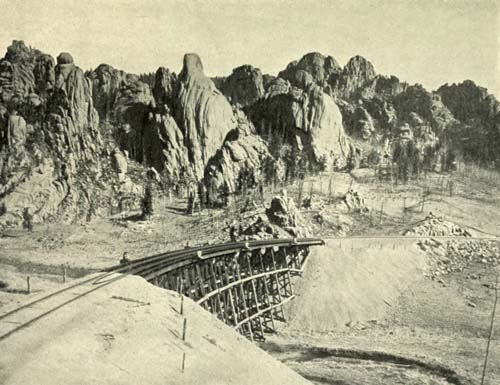
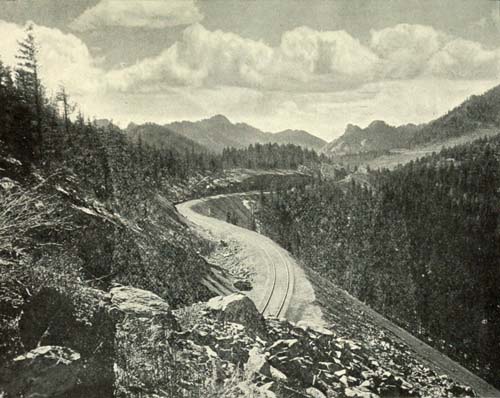
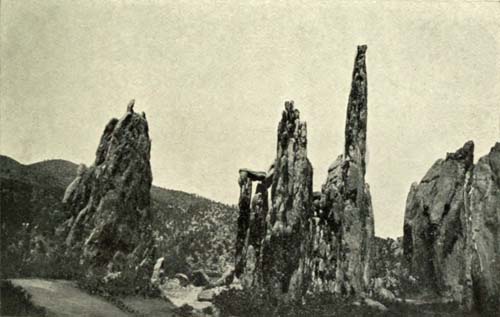
CATHEDRAL ROCKS, CLYDE PARK, CRIPPLE CREEK SHORT LINE
Another group of the sandstone shapes, under the transformation
of moonlight, resolved itself into a band of
angels, and still another mountain-side seems to be the
scene of ballet dancers. The splendid heights of Dolores
Peak and Expectation Mountain, the Lizard Head, the
Cathedral Spires, the Castle Peaks of the Sangre de Cristo—what
points and groups that fairly focus all conceivable
sublimity they form! Here is a state more than
a third larger than all New England; it is the state of
sunsets and of stars; of scenery that is impressive and
uplifting, rather than merely picturesque; a state whose
plains, even, are of the same altitude as the summit of
Mount Washington in the White Mountains, and whose
mountains and peaks ascend to an altitude of over two
miles above this height. Of the total extent of Colorado,
the mountains, inclusive of parks and foothills, occupy
two-thirds of the area. So it is easily realized to what
extent they dominate the scene. But great and impressive
as they are in effect, the mountain features have an
undoubted influence, however unconsciously received, on
the character of the people. The effect of beauty on
character is incalculable. When to beauty is added
sublimity, how much greater must this effect be! It was
not mere rhetoric when the Psalmist exclaimed, "I will lift
up mine eyes unto the hills, from whence cometh my help.
My help cometh from the Lord, which made heaven and
earth.... The Lord shall preserve thee from all evil.
He shall preserve thy soul." It is this train of thought
which is inevitably suggested to the mind in gazing upon
the stately, solemn impressiveness of the mountain scenery.
Nature has predestined Colorado for the theatre of noble
life, and the influence is all-pervading.
Great engineering feats are in evidence all over Colorado.
Miles of railway tunnels pass through the mountains.
No mountain, not even Pike's Peak, is regarded in
Colorado as being in any sense an obstacle to any form of
the extension of travel. The railroad either passes through
it or climbs it. The matter is apparently simple to the
railroad mind, and evidently all the peaks of the Himalayas
piled on Pike's or Long's peaks—"Ossa piled on
Pelion"—would not daunt the Coloradoan enterprise.
In fact, the greater the obstacle, the greater is the enterprise
thereby incited to overcome it. In the most literal
way obstacles in this land of enchantment are miraculously
transformed to stepping-stones. But what would you,—in
an Enchanted Country?
Colorado has four great systems of parks whose elevation
is from seven to nine thousand feet: North Park,
with an area of some twenty-five hundred square miles;
South Park, one thousand; Middle Park, three thousand;
and San Luis, with nine thousand four hundred square
miles,—all sheltered by mountains, watered by perpetual
streams, and so rich in grass lands as to afford perpetual
grazing and farming resources. Colorado has nearly one
thousand inland lakes, and over two hundred and fifty
rivers fed from mountain snows. Its grand features include
mountains, cañons, gorges and deep chasms, crags
and heights; its mountain systems cover more than five
times the area of the Alps, and its luminous, electrically
exhilarating air, its play of color, and the necromancy of
distances that seem near when afar—all linger in the
memory as a dream of ecstatic experiences. Colorado is
all a splendor of color, of vista, and of dream. It is the
most poetic of states.
Now the fact that this country has been importing over
two million tons of sugar a year lends importance to the
beet sugar factories already largely established. Colorado
has a future in beet sugar hardly second to her gold-mining
interests, if her interests receive the national safe-guarding
that is her due.
Colorado and the Philippines were brought into collision
of interests by the attempt to reduce the tariff on sugar
imported from those islands. This would ruin the beet
sugar industry in the Centennial State, which is already beginning
to transform it into one of the richest agricultural
states in the Union.
This industry is absolutely identified with the irrigation
interests of Colorado, as it is the arid land irrigated that
offers the best facilities for the sugar beets.
The beet sugar enterprise means remunerative work for
the farmer, good business for the railroads and merchants,
and an incalculable degree of prosperity for all Colorado.
Thomas F. Walsh, of Ouray, Colorado, and of Washington,
made an earnest protest against this movement.
Mr. Walsh is a great capitalist, but while he has not
one dollar concerned in the beet sugar enterprise of his
state, he is a loyal and devoted son of Colorado. In a
convincing manner he said:
"... It is not a small thing, this robbery of American
farmers and home-makers for the benefit of sugar corporations
and exploiters of Philippine labor. It means the ultimate ruin
of an industry that is full of the brightest promise for thousands
of Americans. It means that the people of the United
States shall pay tribute to a trust forever for one of the necessaries
of life.... The removal of protection to Colorado
sugar growers would simply mean that the sugar trust, or
cormorants in human form like it, would go to the Philippines,
employ the peons at starvation wages, and send millions of
tons of sugar to the United States. Would the consumer
here be benefited? Not at all. Has the consumer benefited
by reciprocity with Cuba? The sugar trust has received a
gift from the treasury of the United States—that is all."
And again Mr. Walsh truly says:
"This proposition is merely a design on the part of enormously
rich, greedy speculators, who are willing to adopt any
means for the accumulation of more money. Money, money,
money! They have already a thousand times more than they
need, and are simply money mad. They propose to exploit
the Philippines for their own selfish ends. Help for the poor
Filipinos, indeed! Imagine the generosity of these get-rich-quick
sharks towards the peons in their employ. Think of
the wages that would be paid, contrasted with the standard
of living in the United States! I'd rather have the people
of this country exterminated than to be brought to such a
level."
Regarding the arid land Mr. Walsh said:
"With the application of water to this land under the
National Irrigation Act—one of the greatest acts of statesmanship
accomplished under our broad-minded and far-sighted
President—the people of Colorado will furnish an outlet for
a great population, and the cultivation of beets for sugar will
enable thousands of American citizens to establish homes of
their own. That is what is now being done in Colorado, and
the industry is in its infancy. The people have gone in there
at the suggestion of the government, planted beets provided
to them by the agricultural department, and started a great
industry. There was an implied, if not expressed, promise
that they were to be protected in this new industry. Yet it
is now proposed to place them in competition with the peons
of the Philippines, at the most critical time in the history of
the industry. The people of the East," continued Mr. Walsh,
"do not seem to be able to grasp the great possibilities of the
arid West under the operation of the national irrigation law.
The West, properly irrigated with water that we know can be
developed by drainage, wells, and underground flow, will
easily support fifty millions of people. Think of what this
means! Fifty millions of American citizens owning their
own homes! It is an incalculable addition to the wealth and
strength of the United States."
One of the very valuable and exceptional resources of
Colorado is in its stone, which equals the world's best product
in its quality. Millions of tons of almost every variety
of building stone lie unclaimed on the hills and plateaus.
There are quarries in Gunnison County that would make
their owners multi-millionnaires, could the stone be made
easy of access or transportation. The difficulty of the
former, and the high freight charges, combine to delay
this field of development. In Pueblo there is a marbleized
sandstone that is very beautiful. Its "crushing" strength,
as the architectural phrase goes, is between eleven and
twelve thousand pounds to the square inch,—a strength
which exceeds the most exacting requirements of any
architect. This stone is found in unlimited quantities.
In the country around Fort Collins there is a red sandstone
which is very popular, and this is also found in large
quantities at Castle Rock, south of Denver. Near Trinidad
is a gray sandstone of great beauty, and the Amago stone,
which is used for the Denver Postoffice, is a favorite.
In stone for decorative purposes also, Colorado is plentifully
supplied. Specimens of marble from the vicinity of
Redstone show characteristics as beautiful as are seen in
the finest Italian marble found at Carrara.
Besides the marble for building there are also vast
beds of the purest white marble, which will soon be
placed on the market for statuary purposes.
Vast deposits of granite are to be found in many different
sections of the state. In Clear Creek County, about
Silver Plume and Georgetown, there are mountains of
granite. In the southern part of the state deposits are
found which are used extensively for monumental purposes,
and great quantities of this granite are shipped
out of the state.
Although only a limited amount of work in the way
of development and seeking markets has been done for
Colorado stone, the value of the sales is already an
appreciable source of revenue.
Statistically, Colorado ranks first in the United States
as to the yield of gold and silver; first in the area of
land under irrigation; first as to the quality of wheat,
potatoes, and melons, and as to the percentage of sugar in
the sugar beet. The state ranks fifth in coal and iron;
sixth in live stock, and eighth in agriculture. It is true,
however, that irrigated agriculture is considered to be the
most important interest in Colorado. The Centennial
State is not, primarily, as has often been supposed, a
mining state; the mines, rich and varied in products as
they are, offer yet a value secondary to that of agriculture.
A mine is always an uncertainty. A rich pocket may be
found that is an isolated one and leads to nothing of a
permanently rich deposit. A vast outlay of time and
expensive mechanism can be made that will not result
in any returns. An apparently rich mine may suddenly
come to an end; the miner may have reason to believe
that if he could go down some thousands of feet he would
again strike the rich vein; he may do this at great cost
of machinery and labor only to find that the vein has
totally disappeared, or does not exist. All these and
many other mischances render mining something very far
from an exact science,—something, indeed, totally incalculable,
even to the specialists and experts,—while agriculture
is an industry whose conditions render it within
reasonable probabilities of control and calculation. The
great problem which continues to confront Colorado, and
to a far greater extent Arizona, is the more complete
understanding of what Prof. Elwood Mead, the government
expert in national irrigation problems, calls "the
duty of water" and the conditions which influence it as
a basis for planning the larger and costlier works which
must be built in the future.
"One of the leading objects of expert irrigation investigation
is to determine the duty of water," says Professor
Mead, and he adds:
"In order to do this it is necessary to deal with a large
range of climatic conditions, and to study the influence of
different methods of application and the requirements of
different crops. Farmers need an approximate knowledge
of the duty of water in order to make intelligent contracts for
their supply. It is needed by the engineer and investors in
order to plan canals and reservoirs properly. Without this
knowledge every important transaction in the construction of
irrigation works, or in the distribution of water therefrom, is
very largely dependent on individual judgment or conjecture....
In constructing reservoirs it is as necessary to
know whether they will be filled in a few years by silt as to
know that the dam rests on a solid foundation; and it is as
desirable to provide some means for the removal of this sedimentary
accumulation as it is to provide an adequate waste
way for floods."
The problems of irrigation are evidently highly complicated
ones. There are large tracts of irrigated land
selling at three hundred dollars an acre which, fifty years
ago, were held as worthless desert regions. The value of
water rights has risen from four to thirty-five dollars an
acre. The Platte River and its tributaries, alone, irrigate
one million nine hundred and twenty-four thousand four
hundred and sixty-five acres. In the South Platte the
average flow of water is two thousand seven hundred and
sixty-five feet a second. The North Platte and its tributaries
irrigate about nine hundred thousand acres. There
are now over two million acres in Colorado under actual
irrigation, with an agricultural population of some one
hundred and fifty thousand, with a total income of over
thirty millions. The agricultural population is increasing
so rapidly that the day cannot be distant when it will
reach a million, with a total production of more than one
hundred and fifty million dollars. It is believed that an
expenditure of forty millions in irrigation at the present
time would immediately result in an increment of from
two hundred to three hundred millions. The irrigation
bill that passed Congress in 1904 proved of the most
beneficial nature to Colorado; not only for its immediate
effects, but for the promise it implied and the confidence
inspired in the immediate future. The encouragement
of irrigation in Colorado is the influence that enlarges and
develops the agricultural efforts, promoting the growing
industry of beet sugar and extending all resources. Beyond
the material results there lie, too, the most important
social conditions of the greater content and industry
of the people and the corresponding decrease of tendencies
toward anarchy and disorder.
In the quarter of a century—with the sixth year now
added—since Colorado became a state there has passed
over twenty million acres of government lands into the
individual ownership of men whose capital, for the most
part, consisted solely of the horses and wagon that they
brought with them. Of this vast area there are some
two and a half million acres under agricultural cultivation,
which are assessed at a valuation of some twenty-five
millions. The Boston and Colorado smelter, established
in 1873, has produced a valuation in gold, silver, and
copper of nearly ninety-six millions. In the year of 1905
the Colorado mines,—gold, silver, lead, copper, and zinc,—all
told, produced nearly ninety million dollars.
The population of Colorado is increasing rapidly, not
only by the stream of immigration that pours in of those
who come con intentione, but to a considerable degree by
those who come only as tourists and visitors, and who
become so fascinated with Colorado's charm, and so impressed
with her rich and varied resources, that they
remain. The development of this state is one of the most
remarkable and thrilling pages in American history. It
is the story of personal sacrifice, personal heroism, personal
devotion to the nobler purposes and ideals of life that no
one can read unmoved.
"There can be no backward movement, not even a
check in the steady tramp of such a conquering army,"
said the "Denver Republican" editorially. "Before it,
mountains melt into bars of gold, of silver, of copper, lead,
zinc, and iron. It passes over virgin soil, and behind it
spring up fields of grain and groves of fruit. It brings coal
from distant fields, rocks from far-away hills, and its artisans
mould and weld and send out tools of trade and articles
of merchandise to all the world.
"It pushes the railroads it needs to where it needs them,
and the world comes to marvel at its audacity. It finds
to-day what yesterday it needed and to-morrow it must
have. It waits only the world's needs or pleasures to find
yet other ways to supply them."
The prosperity of Colorado is a remarkable fact in our
national history. By some untraced law, defects, faults,
misfortunes, or crimes are always made more prominent
than virtue and good fortune. The crime is telegraphed
everywhere, the good deed is passed over in silence—as a
rule. And so the strikes, and the outlawry, and the
discords and troubles of Colorado have been very widely
heralded, while there has been less general recognition of
the firm and just governmental authority that has held
these outbreaks in check, and has almost succeeded in
ending them entirely.
In general aspects and conveniences the towns and cities
are under excellent municipal regulations. Leadville, formerly
one of the most lawless of great mining camps, is
to-day a peaceful and prosperous city on a great trans-continental
highway. The Western towns begin with wide, clean,
beautiful streets. They begin with the most tasteful
architecture. It may not be the most expensive or the
most colossal, but it is beautiful.
Northern Colorado is in many respects a distinctive
region of itself. It offers rich agricultural facilities; the
beet sugar factories at Greeley are making it a commercial
centre; the electric trolley line which will soon connect
Greeley with Denver will multiply the homes and settlements
within this distance of fifty miles, and this part of Colorado
is enriched with great coal fields. The latter promise not
merely their own extension of industries in digging the
coal and putting it on the market, but they also indicate
another and far more important result, which stimulates
the scientific imagination,—that of making Northern
Colorado a power centre whose strength can be applied in
a variety of ways and transmitted over a large area of
country. For more than two years the Government has
been conducting a series of experiments in a very thorough
manner, endeavoring to ascertain the gas values of the
great lignite coal fields between Boulder and Denver. It
has been discovered that the converting of the coal into
gas gives it double the efficiency for use as a motor power
for engine or for fuel than can be gained from the coal in
its natural state. A ton of coal converted into gas will, as
gas, give twice the power that the coal would have yielded,
and give the same power that two tons of coal, that has
not been converted into gas, would afford. In order, however,
to produce this power economically, it must be done
at the point of mining. It is there that the gas producers
must be located; and from these points the gas
can be transported in pipes, or can be converted into
electricity and sent by wires at far less cost than would be
that of sending the coal itself by freight. These discoveries
not only suggest that this region in Colorado is
destined in the near future to become a power centre which
will be tapped from the surrounding country for a great
distance in all directions, and will thus render Boulder
one of the most important of Western cities; but they
also suggest the evident tendency of the age toward intensity
rather than immensity,—toward the concentration
of energy in the most ethereal form rather than its
diffusion through large and clumsy masses of material.
Colorado contains over twenty-five thousand square
miles of coal fields, distributed over the state, with an
average annual product of over seven million tons. No
other corresponding area in the entire world exceeds Colorado
in its great storage of coal, and the state ranks as one
of the first in the production of iron.
There are already fifteen beet sugar factories in operation,
representing investments amounting to over twelve
million dollars, and which are estimated to have produced,
in 1906, an aggregate of some two hundred and twenty thousand
pounds of sugar, the percentage of saccharine matter
being higher than that of the sugar beet of California.
SULTAN MOUNTAIN
Statistically, Colorado ranks first in irrigation, and there
are some eighteen thousand miles of irrigating canals
already in operation, with the system being so rapidly
extended that it almost outruns the pace of calculation.
Three million acres are under cultivation in Colorado, and
two million eight hundred and fifty thousand acres are irrigated;
the storage reservoirs already constructed are sufficient
to place another million of acres under cultivation.
This irrigated land sells from sixty to one hundred dollars
per acre. Colorado has a reputation for being a great potato
state, and in the year 1905 the town of Greeley alone
shipped over three hundred thousand dollars' worth of potatoes,
while tomatoes are a feature often yielding ninety
dollars to the acre, and celery has been estimated to yield
one hundred and fifty dollars an acre. There are tracts
of from two to three thousand acres devoted to peas alone,
producing forty to fifty thousand cans; and asparagus
grows with great success.
Colorado is a fruit country offering the best of conditions.
The peaches of Southern Colorado lead the world
in flavor, beauty, and size; the canteloupe flourishes with
such extraordinary vitality that it often yields a revenue
of fifty dollars an acre; and the watermelon also grows in
unusual perfection. The valley of the Arkansas River is
the great region for producing melons, and Colorado exports
these to New York, Philadelphia, Chicago, and St.
Louis. Apples, plums, and pears grow with equally bounteous
success, and there are fruit farms that with their
orchards and small fruits sometimes realize fifty thousand
dollars a year, when the season is a good one and the
market conditions favorable. The seasons of irrigated
land are largely under control, and surpass those regions
which are at the mercy of excessive rains or of droughts.
So the law of compensation still obtains. The resources
of horticulture, alone, in Colorado are very important,
and they form one of the most alluring features of this
beautiful and richly bountiful state.
In the way of crops, alfalfa takes the lead in Colorado,
as wheat does in Kansas. It requires the very minimum
of care; the land being once planted with alfalfa, there is
need only of turning on the irrigation, and mowing it, at
the right time. Alfalfa produces three crops a year, and
yields from one to two tons per acre. It sells at from
three to ten dollars a ton, and this makes a revenue quite
worth considering. The difficulties encountered everywhere
in Colorado, in every branch of industry, or in
domestic work, are those of securing labor. Wages are
high in every conceivable line of work, but to a large extent
the labor and service, even when procured, is of a very
poor order. In many of the larger hotels employés are
often kept on the pay-roll for two months at a time when
not needed, simply because it is impossible to fill their
places when the need comes. From requirements of the
seamstress, the laundress, the cook, the maid, the farmer's
working-men, or the employés in almost any line of work,
the same difficulty exists. Much is heard regarding
strikes and other forms of the eternal conflict between
labor and capital; and yet the high rates paid, the concessions
constantly made to the demands of employés, the
conditions provided for them, would seem, at a superficial
glance, to be such as to bridge over every difficulty. Domestic
service is something that presents the greatest problem
on the part of the employer. If there is so large a
number of "the unemployed" in the East, why should not
the conditions balance themselves and this superfluous element
find good conditions for living in Colorado? This
question involves the problem of economics, with which
these pages have nothing to do; but no traveller, no sojourner,
can linger in Colorado who is not simply lost in
wonder that the varied work that is waiting, with the
most liberal payments for the worker, and the multitude
of workers in the East who need the liberal payment,
cannot, by some law of elective affinity, be brought
together.
When it is realized that the Rocky Mountains occupy
in Colorado more than five times the entire space of the
Alps in Europe, their importance in climatic influence as
well as in scenic magnificence can be understood. The
forests of Colorado are found on the mountains and foothills.
The heights are covered with a dense growth of
pine woods, while in lower ranges abound the silver spruce
and the cedar. Colorado has a state forestry association
which aims to secure as a reservation all forests above the
altitude of eight thousand five hundred feet, as this preservation
is considered most important to the water supply.
In the Alps there are nine peaks over fourteen thousand
feet in height; in the Rocky Mountains, within the limits
of Colorado alone, there are forty-three peaks, each one of
which exceeds in height the Jungfrau. There are in
Colorado more than thirty towns, each of which is the
theatre of active progress, and each of which lies at an
altitude exceeding that of the pass of St. Bernard. The
sublime cañons and gorges are eloquent of the story of
Titanic forces which rent the mountains apart. The
vast plateaus were once the bed of inland seas. In the
cañon of Grand River towering walls rise to the height
of half a mile, in sheer precipitous rock, for a distance of
some sixteen miles. The strata of these rocks are distinctly
defined, and the play of color is rich and fantastic.
The vast walls are in brilliant hues of red and amber and
green and brown,—the blending of color lending its
enchantment to the marvellous scene. Each cañon has
its own individuality. No one repeats the wild charm of
another. Excursions abound. There is "the loop," an
enchanting mountain ride made from Denver within one
day for the round trip; the "Rainbow" tour, and others,
besides that of the "circle" already described. In each
and all these journeys the route is often on the very
verge of the abyss, and the sublimities, the splendor of
coloring, exceed any power of language to suggest.
In Northwestern Colorado, along the White River and
northward, lies the sportsman's paradise, now reached only
by a stage drive of from forty-five to ninety miles from
the little town of Rifle on the "scenic route" of the Denver
and Rio Grande, beyond Glenwood Springs. Trapper's
Lake and the Marvine lakes are well known, and the
Marvine Hunting Lodge is a favorite resort of English
tourists.
Estes Park, some seventy miles from Denver, a favorite
summer resort, is a long, narrow plateau of two or
three miles in width and fifteen in length, a mile and a
half above sea level, and enclosed in mountain walls that
tower above the park from two to seven thousand feet.
A swift stream, well stocked with trout, runs through the
park. The four great systems of parks divide Colorado
into naturally distinct localities: North Park, with an
area of twenty-five hundred square miles; Middle Park,
with its three thousand; the smaller South Park of one
thousand; and San Luis, with over ninety-four hundred
square miles,—all, in the aggregate, presenting a unique
structural plan. Every journey in Colorado has its vista
of surprise. No artist can paint its panoramas. Every
traveller in this Land of Enchantment must realize that
its exhilaration cannot be decanted in any form. It is a
thing that lies in character, moulding life.
Colorado is the Land of Achievement. It offers resources
totally unsurpassed in the entire world for an
unlimited expanse. These resources await only the recognition
of him who can discern the psychological moment
for their development. That nothing is impossible to
him who wills is one of the eternal verities, and even
the expert census taker, or the supernatural tax collector
whom nothing escapes, might search in vain, within
the limits of the splendid Centennial State, for any
man who fails to will. The resplendence of this state of
stars and sunshine is due to this blaze of human energy.
The Coloradoans are the typical spirits who are among
those elect
"... who shall arrive
Prevailing still;
Spirits with whom the stars connive
To work their will."