At length there came the cry of “Bears! bears!” which had been so
long eagerly desired. With the first alarm the people swarmed up from
below, and the deck was alive in an instant, every body shouting
“Where?” And “Where? where?” rang through the ship loud enough, as
one would think, to have frightened all the bears of Melville Bay
into fits.
But there were the bears, sure enough; and they appeared to be the
very ones we were looking for. Clearly they had seen the Panther
long before we had discovered them; but they did not appear to be
at all frightened, but stood their ground boldly, looking at us
evidently with more curiosity than alarm. There were three of them,
an old mother and two cubs, standing about three or four hundred
yards distant from us, and quite still. The mother was in the middle,
with a cub on either side, in a very cool and composed manner. They
appeared to be an affectionate sort of family, and were a very odd
sight as they stood upon the old ice-field, the only living things
on that desolate waste. It seemed, indeed, a pity to disturb these
denizens of the Polar wilderness.
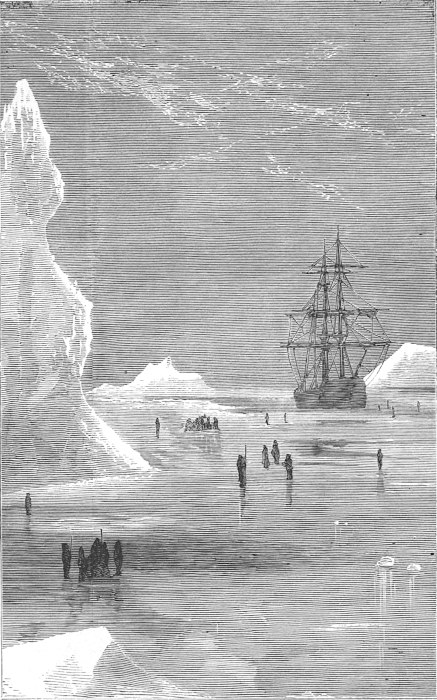
The steamer was stopped as quickly as possible, and we lay there
watching them, and they us, both parties endeavoring to make up their
minds what the other was going to do. The bears probably did not see
us—only the steamer—since we kept our heads as much as possible below
the bulwarks; and whatever wind there was being from the north,
they had not discovered an enemy with their noses. The steamer was
but a black curiosity, and we were well pleased when they manifested
a disposition for a nearer inspection and a closer acquaintance.
The old mother led off, and the two young ones came shuffling along
beside her, very slowly and cautiously, edging away, however, towards
the vessel’s stern, manifestly for the purpose of coming as far as
possible around to the leeward of us. And here the ice favored the
old bear’s design, for a long tongue projected far out from the
general line of the floe. If they should reach the end of it they
would be able to discover us, but then they would be at the same time
in a trap of their own making. In this design we encouraged them by
lying low behind the bulwarks. It did not seem to be in accordance
with the rules of the hunt to allow your game to crawl around where
he could wind you, and this it was, of course, within our power to
prevent but since the captain had the management of his own vessel,
and knew what he could do with her, he became the master hunter by
virtue of his office. “We’ll get the whole lot of them now,” said he,
“if they only crawl along out on that point a little farther.” And he
told the engineer to go ahead at half speed, and told Mick to shove
his helm hard a-port. The action wheeled the Panther around upon
her heel, and she now stood upon the dead waters facing the bears,
who still, slowly and cautiously, were going out on the tongue of the
old floe.
“Why, captain, what are you going to do now? The moment the bears
scent us they will take off!” exclaimed an anxious hunter.
“But before they do,” replied the captain, “I can cut in behind and
head them.”
“But the ice, the ice, man. You will surely not drive her into a floe
like that?”
“That I will,” said the captain, promptly; “drive her into an
iceberg, if necessary.”
So now it was the skill and strength of the Panther against the
skill and fleetness of the bears.
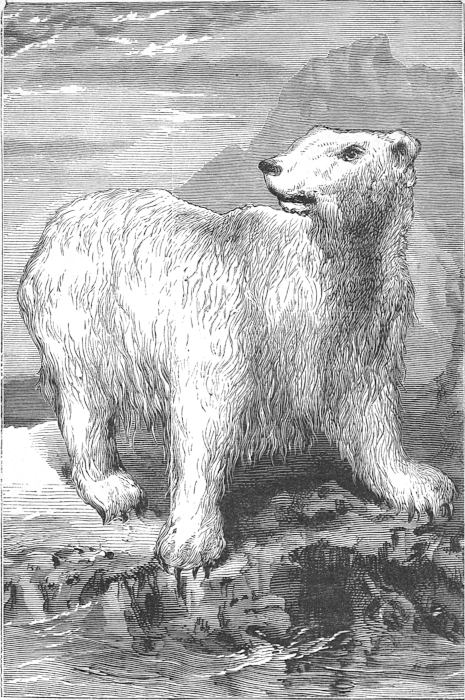
Bears are not graceful animals in their movements. Their enormous
legs are carried along as if they had no joints in them, and their
immense feet are lifted in a manner to suggest their being mounted on
snow-shoes. The long, tapering neck is the only graceful thing about
them.
I was particularly struck with the old mother’s excessive caution.
She would not come near, and yet she would not go away. Had she taken
to her heels when she first discovered us she could, of course, have
defied pursuit, for the ice-field was so extensive that we could
never have overtaken her. But she seemed to be fascinated with the
steamer, and her curiosity got the better of her discretion. It is
not the first time that this same quality, inherent in all living
creatures, has involved its possessor in trouble.
She moved along with great deliberation. She appeared to be a
well-fed bear, and probably had breakfasted recently and felt lazy;
for she did not once attempt to run, nor did she wade through the
pools of water which were on the ice, but deliberately walked around
them, as if indisposed even to wet her feet. Sometimes she would
turn her back towards us, sometimes her front; often she would stop,
stretch out her long neck and sniff the air all round, turning her
head to right and left, throwing her nose as high up as she could
get it, and then dropping it on the ice as if she might discover
something there. Meanwhile, the little ones were cutting all sorts of
antics about her. Seeing that she was not alarmed, they were in great
glee, evidently regarding the Panther as a very wonderful show,
got up by their mother for their special benefit. They chased each
other like a pair of kittens; raced round and round the old bear,
rolled each other over on the ice, using their paws and teeth upon
each other after the usual innocent and playful fashion natural to
dumb animals in their youthful state. They splashed the water right
and left as they ran through the pools; and altogether they appeared
to be a pair of very lively, and highly delighted young bears, who
regarded the present occasion as rather a jolly sort of entertainment.
It took this family party somewhere near half an hour to get around
to where the old one wanted to be, to satisfy herself as to whether
the Panther was a friend or a foe. Once she seemed irresolute, and
turned about as if she would retrace her steps and make off; but
then she turned back again, and for some minutes after seemed to be
dragged by two antagonistic impulses, first one way and then the
other, with a general gain of force, however, on the string which
drew her out to the point of ice.
By-and-by she got where she seemed to be satisfied, for she suddenly
stopped short, threw up her head, gave a tremendous snort, wheeling
around at the same time in a state of alarm, and looking about as
if for some means of escape. After a moment’s reflection she took
the back track. The alarm spread to the little ones, and the lively
creatures ran around their mother as if they would inquire what the
matter was, and if the show was over, and they were to have no more
of it, while she seemed to be encouraging them by assurances that it
was no great affair, but that it was necessary for them to use their
legs as nimbly as possible, for they must get out of that. So their
gambols were ended, and the little things whined piteously, and did
their best. They appeared to be as unhappy as children caught in a
thunder-shower on their way from a country fair. It was now not less
amusing to watch them than before. In the confused state of their
minds they grew utterly careless of what they were about, and they
often sprang upon rotten places in the ice, and broke through, and
by the time they had crawled out again the mother was some distance
ahead, and was obliged to wait, and often to run back, if not
actually to render assistance to her cubs, at least to encourage
them. As for herself; she could readily have escaped; and she
appeared to be quite conscious of the fact; but she would not leave
her young: her devotion to them was indeed touching, and worthy of
all admiration.
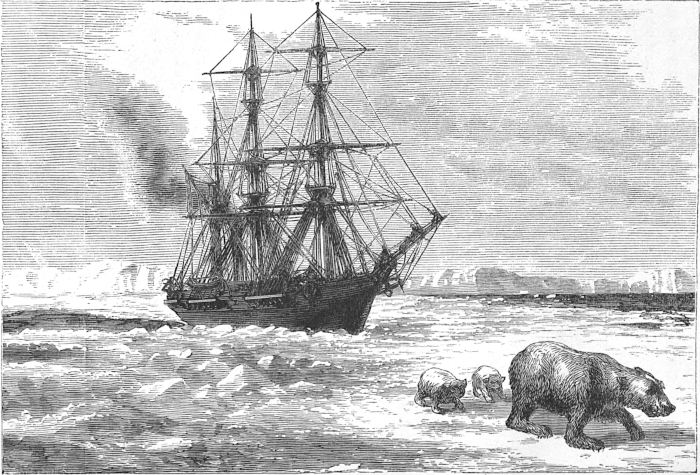
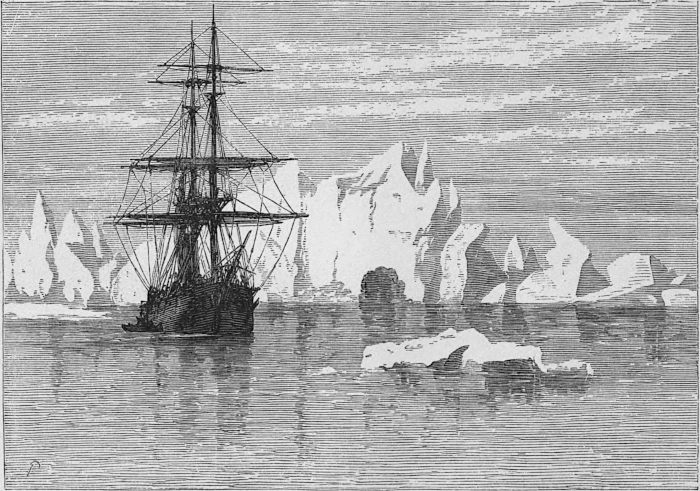
THE PANTHER AFTER THE BEARS.
Meanwhile the Panther had not been idle. The moment the old bear
got the wind of us, and began to show symptoms of alarm, the captain
rang his bell, “Ahead, full speed.” The screw began to revolve, and
at the top of her speed the vessel bore down upon the ice, across the
line of the bears’ retreat.
This was the captain’s plan from the beginning, and it now became a
mere question of time; though on the Panther’s part there was in
the minds of most of us a question of strength and power.
We came upon the ice as before with a grand crash, striking what
appeared to be the weakest spot. The shock was worse than any thing
we had yet felt, the ice being firmer than before; but the solid
iron cut-water opened her way into it as formerly, and she rode up
on it and crushed it down, and rode up again and settled once more;
and in the conflict every body was very uneasy on his legs. The jar
made lively work in the pantry, where the cabin-boy had retired
when he had shouted “bergs” instead of bears, and, quite exhausted
by the effort, had fallen fast asleep there, and was aroused by the
soup-tureen coming down and landing, bottom up, on the crown of his
head, which nearly cracked his skull, but saved the crockery, and in
a measure woke up the young man. “Blob,” who was standing beside
the coamings of the main hatch, making a sketch of the bears, turned
a somerset into the coal-hole, where his picture was turned into a
black bear instead of a white one. Otherwise no damage was done; but
the ruse was altogether successful, as the captain had anticipated;
for the force of the shock started the ice, and a crack opened right
through in front of us to the water on the other side. The point to
which the bears had gone was thus broken from the main body of the
floe, and the game was now on a raft, and at our mercy.
The crack, opening very rapidly before the steady pressure of the
vessel, gave us a free passage through, and seeing themselves
thus headed off, and the steamer bearing down across their line
of retreat, they took the back track, and now, all thoroughly
frightened, ran across to the opposite side, behind us, thus
compelling us to wheel about and return through the crack. At this
moment the photographers came rushing on deck demanding the right of
a “first shot.” Quick as a flash the camera was down and focused,
a slide with a little hole in it was dropped before the lens, and
the family group of polar bears was taken at a distance of about
two hundred yards. To accomplish this feat required the very first
degree of enterprise and skill. The camera was stationed upon the
top-gallant forecastle, and the impression was obtained while
both ship and bears were in motion. The brightness of the light,
of course, greatly favored the success of this altogether novel
experiment in the photographic art. The artists (Mr. John Dunmore, of
Boston, and Mr. George Critchersen, of Worcester) deserve the highest
commendation for their successful accomplishment of so difficult a
feat. The bears now took the water with the manifest intention of
swimming to the solid floe; but here we again anticipated them, and
they wheeled about again, and swam back towards the ice which they
had left but a few moments before. Putting the helm a-starboard, we
now came directly in upon their wake, and when within fifty yards of
them slackened speed.
At this moment they presented a magnificent sight, their beautiful
long hair waving gracefully in the clear blue water, and their round,
buoyant bodies floating along swiftly towards the ice and hoped for
safety. The tender regard of the mother for her offspring was here as
strikingly apparent as when on the ice. She would not abandon them;
but, on the contrary, the nearer we approached the more she stuck
by and encouraged them, still, as before, with one on either side.
Once she invited them to dive, and, imitating her example, the three
went down together and paddled themselves along for some distance
about twenty feet below the surface, where we could easily see them
striking out for dear life. When they came up we gave them a volley
from our rifles, and the old mother and one of the cubs lay lifeless
upon the blood-stained water.
The other cub, by some mischance, escaped with only a slight scratch,
and reached the floe, where, as he rose, another ball entered his
side, and sent him off with a mortal wound, whining piteously. The
captain now jammed his steamer into the ice, and, clambering down
over the bob-stays, gave chase. The bear soon stopped and hid himself
behind a hummock, and when the captain came up with him he was
disposed to make fight. His whine was converted into a defiant growl,
and he charged his pursuer; but a well-aimed shot brought the game
down and completed the hunt.
It only remained now to get the animals aboard, to weigh and measure
them, to award the skins to the rifles which had given them
death-wounds. This last was no easy matter; but finally, after much
discussion and some rather animated assertions, such as usually take
place on like occasions, the award was finally made, and we tied
up to an iceberg that promised us a chance for watering ship, and,
after the excitement and exposure of the night, we were well prepared
to enjoy a good breakfast of the game we had brought from the Duck
Islands.
Casting off from the iceberg next day, we set out to look for further
game, steaming up in a north-easterly direction through a wide lead.
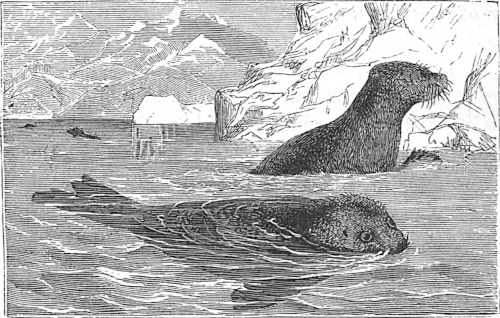
Presently we saw something dark on the edge of the ice, and soon made
it out to be a seal, a very large one, of the barbed species. We
knew from former experience how very wild they were, and, slacking
speed, we approached cautiously. At first he appeared to be asleep,
dozing lazily in the warm sun; but if so, the noise of the steamer
awoke him, and he grew restive and alarmed. Evidently he was not to
be caught as the bears had been, and if we would shoot him we must
exercise great care; so the headway of the steamer was slackened
still further, and we all lay low behind the bulwarks as we glided
slowly along, thus stalking the animal in a somewhat unusual fashion.
But he was too old to be cheated, and when still two rifle-shots away
he threw up head and tail, and floundered into the water. Then he
swam off, and brought his almost human-looking face above the surface
not twenty yards away, then took a deliberate look at us, and before
a rifle could be aimed he had apparently satisfied himself, for he
turned heels over head, and with a terrific splash disappeared to be
seen no more.
This little incident would not be worth naming, since it was an
entirely unsuccessful feat of hunting, had it not been that at the
very moment the seal disappeared from the ice an immense bear sprang
out from behind a ridge of hummocks, along which he had evidently
been crawling, stalking the very same seal that we were after. We
had clearly robbed the beast of his breakfast, and he appeared to be
more disgusted with the circumstance than alarmed by us. Yet he was
not quite so unsuspicious as the bears we had before encountered. He
was the largest bear I had ever seen, and we wanted him badly. He
looked splendid as he stood there upon the floe. The moment he saw
the Panther he came to a dead stand, and made no further movement
than to turn his head first to one side and then to the other, in a
sort of measured oscillation. There was evidently upon his mind a
feeling of irresolution that was constantly increasing; yet it did
not seem as if he was willing to own to himself that he was afraid,
until the steamer coming in contact quite unavoidably with a piece
of ice made a considerable crash, which settled the bear into a
suspicion that the object he was looking at was hardly to be trusted.
He wheeled suddenly round on his hind legs, like a horse wheeling at
play in a pasture, made a most magnificent bound across a pool of
water, and then took himself off quite leisurely, turning his head
back over his shoulder with every step, to have a further look at
us. Occasionally he would give a snort, attended with an extra leap,
and then go waddling on again at the same stiff-legged and snow-shoe
pace as before described in the case of the other bears which we
had hitherto pursued and captured. But for all he had still clearly
some lingering doubts of the Panther’s hostile disposition, and,
allowing this feeling to get the better of him, he came to a dead
stand, and squared himself round to have a better look at us; then he
advanced a few paces, stopped and fixed his gaze upon us steadily.
Meanwhile the Panther lay still upon the waters, and appeared to
have her eye upon him, and the two stood, as if trying to stare each
other out of countenance, for some minutes. The bear seemed at length
to be getting charmed, for he advanced a hundred yards or so with
the greatest coolness and deliberation; and then, as if suddenly
recollecting his previous prudential notions, he wheeled short around
as before, took a huge leap, and went upon the back track again.
To look at the animal now and watch all his antics, one would think
him as mad as a March hare. He turned first to the right and then
to the left, after he had gone a little way, and then he began to
move up and down in front of us, like a sentry on post, acting very
deliberately all the while, poking out his head and drawing it in
again like a turtle, elevating his nose as high as he could, and then
depressing it again close down upon the ice, occasionally stopping
short and looking at the Panther sideways.
All of these manœuvres, it must be understood, were for the
special benefit of the Panther, for we on board of her were closely
hidden behind the bulwarks, with nothing but our eyes exposed. Up to
this time it was clear enough that the bear had not been seriously
frightened. Like the others, he was in some doubt and uncertainty
about the meaning of the dark object, and was filled with curiosity.
We had, therefore, great hopes that he would become reconciled to
the Panther, and be inclined to closer acquaintance. It is not an
uncommon thing for a bear in Melville Bay to leave the ice and swim
off to a vessel. I have known them to come deliberately alongside,
attracted thither, no doubt, by the smell of bones which were burning
in the galley—a whaleman’s device for attracting the bears. But the
sight or smell of a human being, or of a dog, alarms them at once,
and they instantly make off. In the burning bones they find, no
doubt, something savory and suggestive of food.
We felt greatly encouraged when we saw the bear begin to march up
and down in front of us, as if standing guard; but unfortunately the
Panther could not forever hold her breath, and with the first gush
of steam through the escape-pipe old Bruin bounded up in the air
as if possessed, gave a fierce snort, and ran away as fast as his
legs would carry him; and in order that he might make the best time
possible, and show off his points to the best advantage, we fired a
volley from our rifles after him, without the least hope or chance
of doing him any damage, owing to the great distance. He did not now
pause until he was a good quarter of a mile away from us, when he
faced round once more, seemed to bestow upon us an approving nod,
and then, with much deliberation, made for the opposite side of the
floe, where we now busied our minds with devising ways and means
of reaching him. But no way could we see but once more to put the
Panther into the ice—no very difficult matter; but here the ice
was unusually thick, and there did not appear to be much chance of
breaking through it. To go around the floe was to make a circuit of
several miles, and long before we could reach the point towards which
the bear was going he would be far enough away.
Running down a little way near the edge of the floe, we discovered a
narrow isthmus, against which the captain put the vessel, as before,
under full headway, but with less happy results. Only a few fathoms
of the ice were broken away. Owing to this circumstance the shock was
greater than on either of the former occasions; but, nothing daunted,
the captain backed her out and put her in four successive times,
and was rewarded in the end by starting a crack, through which the
steamer was forced.
We were now in the same lead for which the bear was making, and we
could with our glasses still see him upon the ice, though very near
the water, which by this time he could readily have reached had
he done his best. We bore down upon him with all possible haste.
Presently he disappeared. He had taken the water, and was making for
the opposite ice, which was very solid, and was held firm and fast
by a great number of icebergs, which were imbedded in it. If he once
reached this the game was up.
The second mate was sent aloft, and detected him in the water heading
for a point which, instead of being low and flat, as is usual, was
rough and hummocky. The Panther was pointed there also, with the
view of cutting off his retreat. This once accomplished, the bear
was of course ours. Seeing our purpose, the animal, now evidently in
a great state of terror, swam away for dear life, making a splendid
spectacle of himself as he floated along with his nose only above the
surface, and was clearly in much the condition of the soldiers who
swam the river from the battle of Ball’s Bluff—he was not hurt, but
fearfully demoralized.
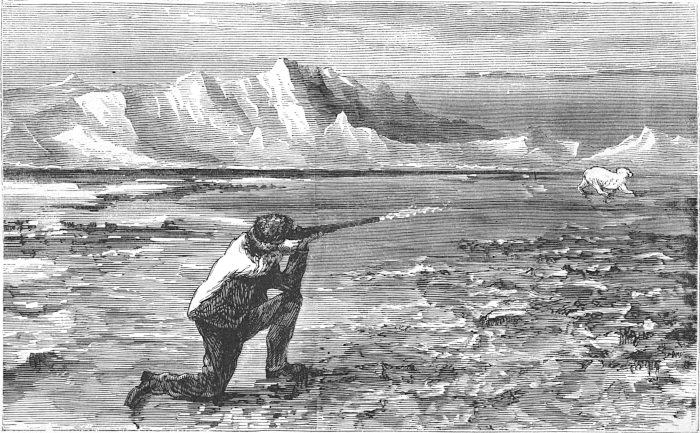
THE CAPTAIN AFTER THE BEAR.
We were only about sixty yards away when he reached the point, and we
now felt sure of him. We had not succeeded in cutting off his line
of retreat, but we had come within easy range; and since the vessel
was forging ahead, we should be almost atop of the animal by the time
he got out of the water. The Panther was going fairly for the ice,
and we were all ready to fire the moment he showed himself. But the
animal was too cunning for us. The rough hummocks of the point hid
from our view a bight on the opposite side, into which the bear swam
for safety; and now, thoroughly sheltered behind the ice for which we
were making, he was getting the
better of us. With that quickness of perception characteristic of
the skillful sailor, the captain grasped the situation, and, seeing
that to round the point was to lose the bear for certain, he shouted
to the man at the wheel to put his helm hard a-port, which caused us
to bring up with a terrific thump a short distance from the point,
where the ice was comparatively thin. The moment the ship struck and
buried herself a little, the captain let himself down by a rope from
the cat-head, and, followed by two other rifles, ran over the floe
towards the bend of the bight for which the bear was making, but not
in time to intercept him. He reached the ice, and drew his enormous
body out of the water a hundred yards from the riflemen, and bounded
away with the speed of the wind, not stopping even long enough to
shake himself of the great quantity of water in his long hair. Every
body fired at him, of course, but none of our balls took effect;
at least none of them produced any impression upon his speed. The
captain thought he saw blood, and kept up the race for half a mile,
hoping to see him drop or halt, as the one he had chased before,
mortally wounded; but the animal was soon out of sight among the
icebergs, and our eagerly coveted game was gone.
We were all much chagrined by this mishap. Every man had regarded him
as his own particular prize, and felt quite sure of him. We had even
taken the measurement and weight of his body. One was going to have
his skin spread out for a mat, with his head stuffed and his paws on.
Another was going to drive four-in-hand in the Park, and have him
for a sleigh-robe; another was going to sell him for two hundred and
fifty dollars currency, and he knew where to place the article; but
all these bright anticipations came to a most lamentable end when the
bear carried off his own skin in his own four-in-hand fashion.
We were soon consoled for this disappointment by another alarm. It
came from the look-out up aloft, and was answered with a universal
“Where away?” which was answered in turn by the most satisfactory
assurance that they were down on the extreme point of a long, narrow
floe, and were apparently easily accessible. They were three in
number. We bore down upon them without delay, the man aloft conning
the ship, until they were seen from the deck, when the captain, as
usual, gave his own orders.
The ice upon which the bears were proved this time to be very thin
and rotten, as was evidenced by the fact that the animals frequently
broke through. They could not, therefore, travel very fast, even if
they should become frightened; and then, besides, as we came nearer
to them we perceived that, no matter how fast they might travel,
there was but little chance of their escaping us, for in whatever
direction they might attempt to go we could follow them; and when in
the water they would be easily overtaken, as they would have at least
a quarter of a mile to swim before reaching another floe.
The Panther tore through the ice this time without difficulty; and
she actually broke the ice up with such facility, and approached the
bears with such rapidity, that they were almost dropped into the
water—at least a crack was forced open ahead of us, almost underneath
the bears’ feet. They took to it immediately, and we almost ran over
them. As we approached we might have shot them very easily; but the
photographers were crazy for a chance at them, and, seeing that there
was no possibility of their escape, we sacrificed our impatience in
the interest of art.
The bears having swum a little while, crawled upon the ice. By
this time we had wheeled round, and the photographers had a fine
chance at them. The hunters were impatient, but they had not long to
wait, for the delighted “colonel” soon thrust his head out of his
photographic box and shouted, “I’m done with them, gentlemen.” At
this moment the bears took the water again.
We made short work of cutting through a tongue of ice which
intervened and, coming upon the animals as they swam, we ceased
playing with them as a cat plays with a mouse before swallowing it,
and at thirty yards gave them a volley, and three more bears were
added to our trophies. The carcasses were soon hoisted on deck, and
we then steered for Wilcox Point, without, however, seeing any bears
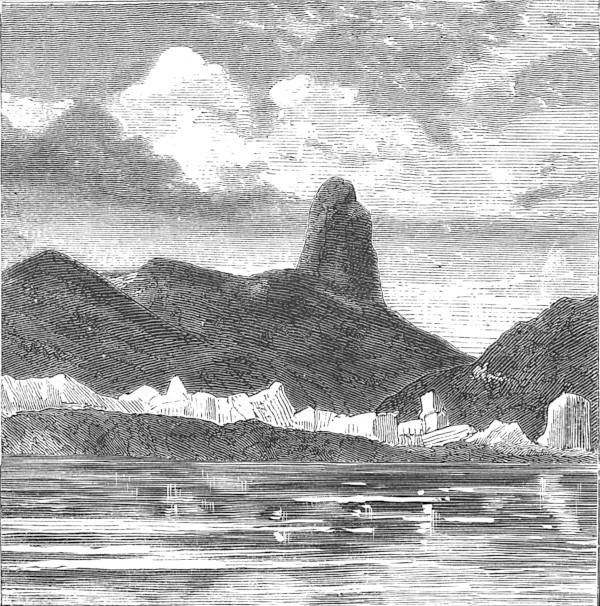
by the way. Then we headed in for the Devil’s Thumb, and, discovering
a moderately firm floe, which seemed to be held in its position
by some grounded icebergs, we steered for it, run the Panther a
hundred yards into it, and proceeded to let our six prizes down on
the ice, where we soon had the skins off; some for specimens, and
some for robes and mats—each one who was the fortunate possessor of a
skin following the bent of his fancy in the matter.
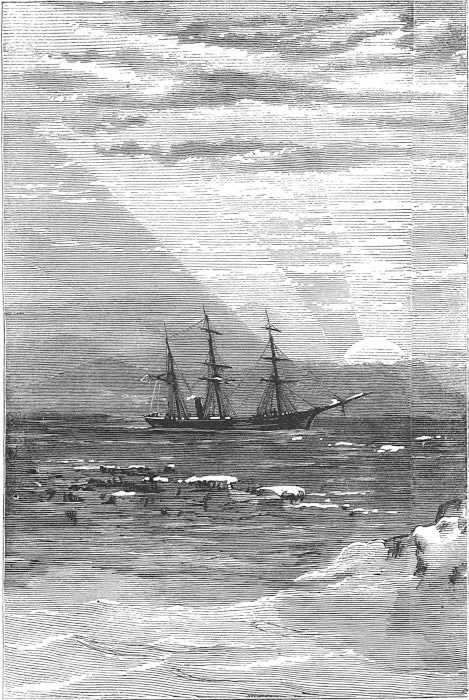
Pushing off from the floe, we steamed to within two miles of the
Thumb, and anchored. Probably no vessel had ever been so near it as
we were, and although our situation was one of some peril, we did not
feel justified in losing the opportunity so auspiciously presented
to us. We climbed the hills all round, and everywhere we went we
discovered numerous traces of reindeer, but we did not succeed in
finding any of the animals themselves. There can be no doubt that
they exist there in considerable numbers, and had we followed them
inland it is equally certain that we would have found any number of
them. But for an enterprise of that description we had not sufficient
time to stay—or, rather, the threatening nature of the ice, and the
uncertainty of our situation, made it important that all hands should
be at least within signalling distance, that we might steam out from
underneath the Devil’s Thumb upon the first threat of danger.
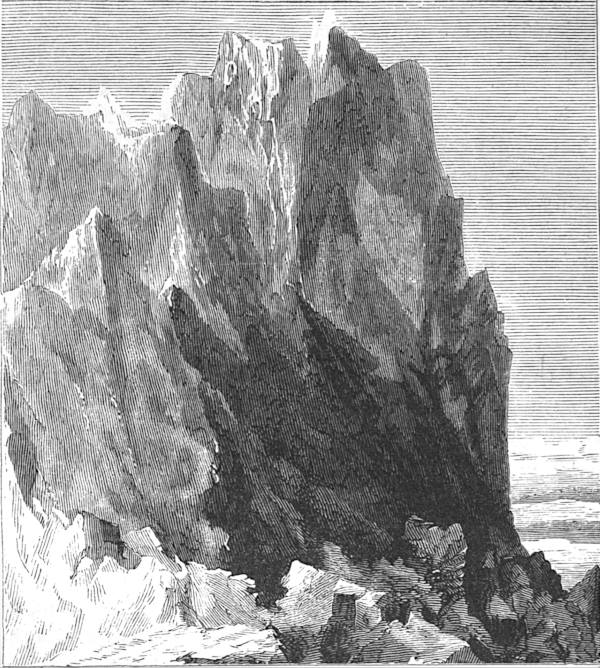
To climb the Thumb we found to be impossible, but we reached its
base, and from there—an elevation of thirteen hundred feet, according
to my barometer—we overlooked one of the most remarkable scenes that
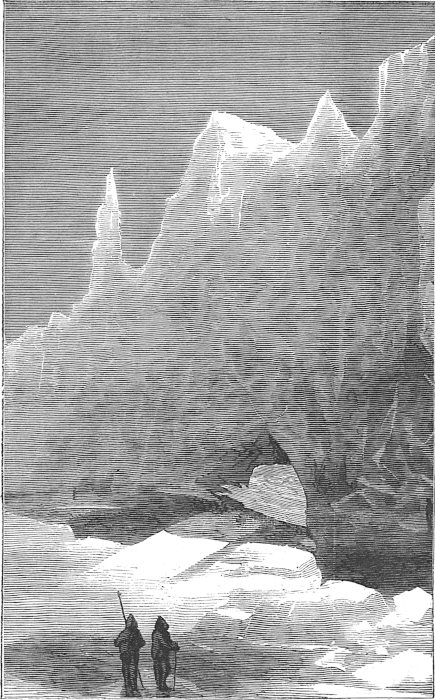
ever met the eye of man. Such a wilderness of ice, such a forest of
icebergs, such boundless desolation, would be difficult to describe,
or to be appreciated except by the actual observer. Let me, in a
mechanical sort of way, make the attempt to convey to the reader’s
mind some idea of this remarkable scene.
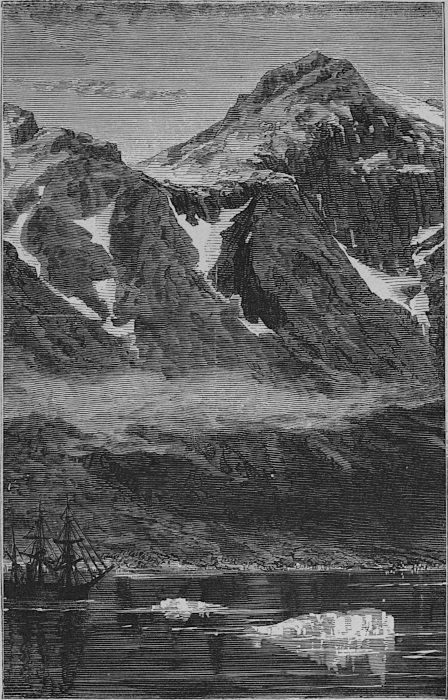
The Devil’s Thumb is an island—at least, without actually sailing
round it in my boat (being prevented by the ice), there were such
indications as to make it certain that, if not an island, it is
connected with the main-land only by a very low and narrow isthmus.
It lies at the head of a deep bay, and it is from five to eight
miles long, by from three to five wide. The Thumb itself is on the
farther side from the sea, and is about six hundred feet high above
its base, rising like a church spire, and as abruptly. Down into the
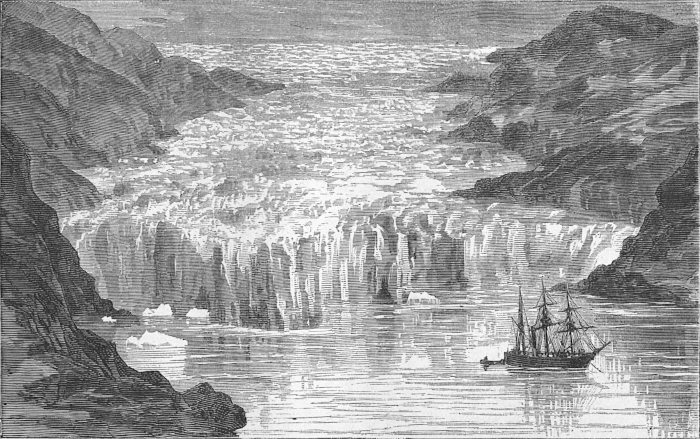
bay, to the north and east from the island, come two great glaciers,
one about twelve miles wide, the other about three. These glaciers
climbed up steadily, or descended, I should rather say, between the
coast mountains in steady streams, which, joining together, and
with others to the north and south of them, form a long level line
against the sky; and this is the summit of the great icy sea—the
mer
de glace
—which covers the whole length of the Greenland continent,
and which, from its exhaustless bed, sends down through every valley
opening to Baffin’s Bay such streams as these. And these streams
send off into the sea the icebergs, which are but trifling fragments
of the glacier itself.
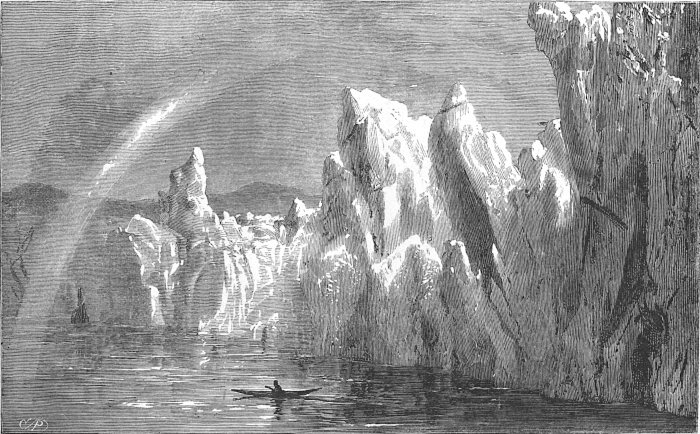
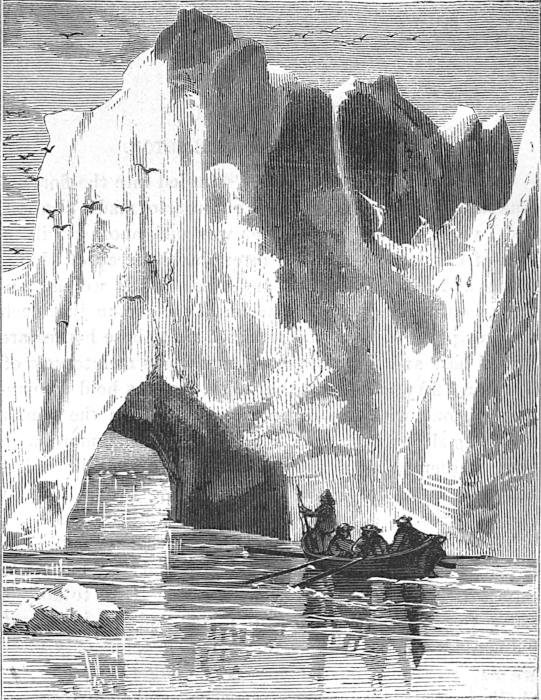
The icebergs coming from these two glaciers about the Devil’s Thumb
were altogether countless. They filled up the whole north side of the
bay, and extended out to the sea for miles. The time of my visit was
near midnight, and with a clear, bright sun illuminating the scene,
scattering everywhere its splendors, I could but wish for something
better than a simple note-book and the use of words to embody an idea
of the view before me. An artist alone, with his pallette and his
pencil, could convey any proper effect of it. My powers of sketching
were quite inadequate. “Blob” might have done better, but no amount
of persuasion could induce him to climb a hill marked in the devil’s
name. Of all the situations of the cruise, this view was the finest
beyond comparison, and to see it was enough to repay one for all the
trouble and vexation and hazard of a dozen such voyages. We missed
a photograph of it for the same reason we missed “Blob’s” sketch—a
fearful superstition. Had it been called “The Pillar of the Church”
instead of “The Devil’s Thumb,” the whole cabin mess would have
climbed it willingly.