In sending this little work before the public, I have tried
to remedy one fault which I have often heard complained
of, namely, that knitting-books generally give so many more
stitches than are really required. This is partly owing to
the different qualities of wool used by different knitters,
and partly also, to a certain extent, whether the worker
knits loosely or tightly. The following directions are for
medium knitters. As knitting sometimes shrinks in the
washing, I should advise my readers to try and knit moderately
loose. But, of course, the principal thing is to have
the same sized wool or silk as that for which the directions
are given; and this is especially important in socks and
stockings. I will therefore state that Charity wheeling is
the thickest and most harsh kind of yarn made; Scotch
wheeling is a trifle less coarse. Scotch fingering is the
usual yarn sold for socks and gentlemen’s stockings: it
ought to be very strong, and to appear about the same size
as Berlin. If it looks finer (and some does) put on more
stitches than are given. For couvrettes, and things of that
kind, the size of the wool and pins is, of course, a matter of
less importance, as it does not signify whether the work is
a trifle larger or smaller than intended; but in stockings, a
slight thing makes a good deal of difference in the fit.
I have also endeavoured to explain everything at full
length, so as to enable inexperienced knitters to find out
the patterns by themselves; the cost of each article is put,
whenever possible, at the head of the pattern.
EXPLANATIONS.
‘To purl or pearl’ and ‘to seam’ mean the same thing; that is,
to put the wool round the right-hand needle. Thus: the wool
hangs straight down, it must be lifted and placed round the
needle from right to left. You must then insert the right-hand
needle into the stitch, exactly the opposite way as in ordinary
knitting.
‘To decrease’ is simply to knit two stitches together. Another
way is to slip a stitch, knit one, pass the slipped stitch
over it.
‘To take two together’ means to knit two together.
‘To increase,’ you must knit both into the lower part of the
stitch, and also into the stitch itself.
Stockings and Socks.
The directions given for silk stockings are worked with
Adams and Co.’s silk, 5 New Street, Bishopsgate Street, E. It
is very good, and of lovely colours. Patterns are sent free, and
all orders can be sent by post. Any uncommon shade can be
dyed to order, provided it be not for less than 1 lb. of silk.
The prices are as follow:—Imperial knitting-silk, the best
quality, any colour, 3s. per 2 oz. skein. Filoselle, any colour,
2s. per oz., or 3d. per skein of 15 yards. Embroidery silk, 1s. 6d.
per oz. Knitting-pins, 2d. per set of four. These knitting-silks
are guaranteed fast colours, and are beautifully bright and
soft.
Those of my readers who prefer a coarser knitting-silk will
be glad to hear that Mr. Adams is now making some.
General Remarks on Socks and Stockings.
For a lady’s stocking it is best to decrease once and increase
three times for the calf of the leg. For a gentleman’s this is
unnecessary. Most of these directions are for ribbed stockings,
as they fit so much better; but if preferred plain, of course the
same number of stitches is required.
You must always remember in ribbed stockings to carry on
the ribs and seam-stitches all down the back of the heel, until
you begin to round it. The ribs on the front of the foot must be
continued straight on, until within an inch of the decreasing for
the toe.
The seam-stitch is made by knitting a certain stitch in two
rounds and pearling it in the third.
Before decreasing for the instep, do two or three plain rounds
and then begin.
The ‘flap,’ or heel before it is rounded, ought to be three
inches, or even more, as a long heel wears better. It also makes
it much stronger to knit it double with Angola wool, of the same
colour as the knitting; it can be bought at any linen-draper’s on
wooden reels for 2d. One reel does a pair.
Except for young boys, socks fit quite well without being
decreased at all for the ankle; therefore I only give one pattern
on the decreasing principle.
With silk stockings the size of pins is important.
Heel of a Stocking or Sock.
To inexperienced knitters the heel seems to present mountains
of difficulty, but in reality the mountain is but a mole-hill
after all. The following pattern is one of the best.
Divide your stitches. We will say you have 50 altogether,
on three needles: take 12 on each side of the seam-stitch, and
knit these 25 backwards and forwards in rows, not rounds
(making the seam-stitch all the same); you must pearl backwards,
so as to keep the knitting even. Continue until you have
made a flap about three inches long, always slipping the first
knitted stitch. Now knit, from the right-hand side, the 12
stitches; then the seam-stitch, which from this time forward you
cease to make. Knit 4 stitches beyond it; knit 2 together;
knit 1; turn, pearl until you get to 4 beyond the seam-stitch,
pearl 2 together, pearl 1, turn. Knit until you come to the
stitch in the previous row where you turned—you may know it
easily by the little hole which was formed by the turning; you
now knit 2 together and knit one more stitch, then turn. Pearl
the next row, of course always pearling 2 together where the
little hole has been left, and so on until you have gradually
worked off the stitches. You then pick up the side-stitches of
this flap and the heel is finished.
To Decrease for the Toe of a Sock or Stocking.
Put half your stitches on one needle, a quarter on the second,
and a quarter on the third needle. Thus: suppose you have 60
stitches, you must have 30 on one side and 15 on the other two.
The 30 must be the front or ribbed part, the two pins with 15
stitches on them ought to be the sole part. In doubling your
knitting now, the front part ought to lie evenly on the sole of
the foot. Begin to knit the 30 stitches; knit 27, slip 1, knit 1,
pass the slipped stitch over, knit 1. Now begin the next pin;
knit 1, knit 2 together. Continue plain knitting. Now begin
the 3rd pin; knit 12, slip 1, knit 1, pass the slipped stitch over,
knit 1. Now you begin again on the 30. Knit 1, knit 2 together.
Continue plain. Do two rounds plain, and then decrease again
in the same manner 4 stitches in every round, leaving always 2
stitches between the decreasing, remembering always to do two
rounds of plain knitting between each decreasing round.
Repeat for two inches and cast off.
Some people only do one round between the decreasing:
this plan makes the toe rounder and more puckered.
Decreasing for Instep.
On the right-hand side of the heel, just where the ribs leave
off, you slip 1, knit 1; pass the slipped stitch over; continue
plain knitting; and where the ribs begin again you knit 2
together. You must remember that on the right side of the
heel you slip, and on the left that you knit 2 together.
Lady’s Striped Silk Stocking.
(MEDIUM SIZE.)
2 oz. black and 2 oz. rose-coloured Imperial knitting-silk.
Pins, No. 17.
Cast on 128 stitches in black, do 12 rounds of 2 plain, 2
pearl. Now make the first stitch the seam-stitch, and do plain
knitting until 4 inches are done, making the stripes come quite
evenly, one inch broad. When you have once joined the rose-coloured,
let the black thread hang down inside the seam-stitch;
do not break off every time you change colour, which must
always take place at the seam-stitch. Now do 3 plain and 1
pearl alternately. When 5½ inches are done decrease on each
side of the seam-stitch. Do * 7 more rows and increase.
Repeat from * twice more. When 12 inches are done decrease
for the ankle every five rows until you have 92 stitches. Knit
until the stocking is 20 inches long, and then divide for the heel.
Proceed as on page 10; pick up the side-stitches, and decrease
over the instep until you have 90 stitches: the front ribs must
be carried on evenly, but the sole is left plain. When the foot
is 7 inches long discontinue ribbing. Knit 9 rounds plain, and
then decrease (see page 12). The foot must be 9¼ inches long.
Cast off and sew up carefully on the wrong side.
Lady’s White Silk Evening Stocking.
Proceed as in the former pattern, with 128 stitches, in the
finest kind of silk. Plain silk stockings are the easiest to knit,
but when finished the striped ones are very pretty, especially
when worn to match the dress, with low shoes.
Gentleman’s Evening Silk Sock.
(AVERAGE SIZE.)
Cast on 108 stitches. Rib by doing 1 plain, 1 pearl. When
3 inches are done, do 3 plain and 1 pearl for 8½ inches. Turn
the heel as on page 11. Decrease at the instep to 96. Carry
on the ribs in the front part, but let the sole be plain; when 8
inches are done leave off ribbing and do 8 plain rounds. Decrease
as on page 12, and when the foot is 10¼ inches long, cast
off and sew up.
Gentleman’s Silk Stocking.
The following pattern is in stripes of black and blue, but it
will do equally well plain. 2 oz. blue and 2 oz. black Imperial
knitting-silk. Pins, No. 17. If coarser silk is used, knit with
pins No. 16 and cast on 128.
Cast on 138 stitches in black, and proceed exactly the same
as with Gentleman’s Knickerbocker Stockings, page 16. Measure
an inch of each coloured knitting alternately: it is better
to measure than to count the rows, as silk is apt to be unequal.
The ankle ought to be 100 stitches. Knit a flap 3 inches long
for the heel, turn it, pick up the side-stitches, and decrease at
the instep to 98. After the first joining of the black and blue,
pass the colour you are not using at the back; always change
the colour at the seam-stitch: in that way you need not break
off the silk when you have finished a stripe, but keep on with
both balls, so as to join the silk only once. The remainder as
page 16.
Lady’s Silk Stocking.
Knitted with Adams and Co.’s thickest knitting-silk and 4
pins, No. 16.
Cast on 120, knit a plain round. Knit 2 pearl, 2 plain, for 8
rounds, and now begin to knit plain, making the first stitch the
seam-stitch. In this stocking you need not increase for the
calf, unless you wish to make it a larger size. If you rib the
stocking, begin when 4 inches of plain knitting are done; knit
(or pearl) the seam-stitch, * pearl 1, knit 3; continue from *.
When 12 inches are knitted decrease every 5th row until you
have only 84 stitches on your pins. When the stocking is 20
inches long divide for the heel, by taking 21 on each side of the
seam-stitch. Knit the heel as on page 11. Pick up the side-stitches,
and reduce over the instep to 80. Make the foot 9
inches long, reducing for the toe as on page 12.
Lady’s Winter Stocking.
Pins, No. 15. 1 lb. merino makes several pairs.
Cast on 116 stitches.
With Berlin fingering-wool only cast on 98, and proceed as
with Girl’s Stocking, page 19.
Sock for a Child of Two Years Old.
In merino yarn and pins No. 17.
Cast on 23 on the first pin, 22 on the second, and 20 on the
third. Knit a plain round, keeping the first stitch as the seam-stitch.
Do ten rounds in ribs of 2 plain, 2 pearl. Now do plain
knitting, and decrease twice in every fourth round for 12 rounds.
Knit 10 rounds. Take 14 on each side of the seam-stitch for
the heel, knit backwards and forwards for 20 rows; turn (see
page 11). Take up 10 side-stitches, and reduce until you have
56 for the foot. Do 26 rounds, decrease, and cast off.
Gentleman’s Knickerbocker Stocking.
Pins, No. 15, and 11 skeins of best Scotch fingering-yarn.
This is the largest size, suitable for a gentleman of six feet
in height.
Cast on 112, 37 on two pins and 38 on the third pin. Rib
for about an inch by doing 1 plain and 1 pearl, remembering to
have the first stitch on the first needle as the seam-stitch. You
make this, by working it plain in 2 successive rounds and pearling
it in the next. Then do plain knitting for 5 inches. You
now begin to rib as follows:—Knit or pearl the seam-stitch,
knit 3 and pearl 1. Continue to knit 3 and pearl 1 every row
until 12½ inches are done. Then begin to decrease every 8
rows. You decrease on the right-hand side of the seam-stitch
by slipping a stitch, knit 1, pass the slipped stitch over. Work
the seam-stitch and knit 2 together. If the stitch to be slipped
happens to be a pearl stitch, you must not slip it but merely
pearl two together on both sides. You will thus decrease 16
stitches, and now 16½ inches ought to be done. Then knit 5
more inches. You ought now to have 94 stitches for the ankle
and divide for the heel. Proceed for this as on page 11; but
as this is a large size, you must make the flap 3½ long, always
slipping the first stitch. When you have turned the heel you
must take up 21 stitches, and decrease for the instep at first
every row; and the last 6 decreasings do every other row until
you have only 92 stitches. When 9 inches of the foot are done
(measuring the whole of the heel as well), you begin to decrease
for the toe, which takes up 2 more inches; you then cast off,
and sew up the toe on the wrong side.
Sock for a Boy of Twelve.
(SUITABLE FOR POOR PEOPLE.)
Charity yarn, 3s. 6d. per lb. This yarn can only be bought
by the lb. Pins, 14 or 15.
Cast on 56, 20 on two pins, and 16 on the third. Knit 3,
pearl 3, alternately: make a seam-stitch. Rib in this way for
an inch. Decrease on each side of the seam-stitch. Do 7 more
rows, decrease again. Rib the sock for about 3 inches, 1 row
plain, and decrease again. You must now decrease again every
6 rows, when you ought to have 38 stitches.
For the heel, take 9 on each side of the seam-stitch, and pearl
and knit until 3 inches are done. Turn and take up the side-stitches.
Decrease every row until you have only 38. When
the foot is 8 inches long decrease for the toe and cast off.
Boy’s Sock.
(ANOTHER GOOD PATTERN, VERY EASY.)
Knitted in charity yarn or wheeling-yarn.
Cast on 48, rib in 2 and 2 alternate, plain and pearl stitches.
Rib 3 inches, and do the rest in plain knitting until 8 inches are
done. Take 12 on each side of the seam-stitch for the heel,
continue as on page 11. Pick up the side-stitches, decrease for
the instep until you have 38 stitches, or until the foot measures
8 inches in breadth; that is, 4 when doubled. When the foot
is 8 inches long decrease for the toe. Make the foot altogether
10 inches long. Cast off and sew up. This pattern, which is
very easy and without any decreasings at all, fits exactly.
For a Boy of Fifteen, in Scotch Wheeling-yarn.
Cast on 54. Proceed as in above pattern, without any decreasings,
until you come to the heel. Divide your stitches,
knit a flap of 3 inches, turn your heel, reduce for the instep until
you have 48 stitches. Make the foot 8 inches long, decrease
until the foot is 10 inches altogether in length. Cast off and sew
up. This wool is so thick and strong that it is hardly necessary
to do the heels and toes double with Angola.
Stocking for a Girl of Fourteen.
Scotch wheeling-yarn—1 lb. at 4s. 3d. makes nearly 3 pairs.
They are very strong and nice for the poor. Pins, 15 or 16.
Cast on 69. Knit 14 rounds, 2 plain, 2 pearl; make the first
stitch the seam-stitch. Then 50 plain rounds. Decrease on
each side of the seam-stitch 5 plain rounds. Increase 3 times
with 5 plain rounds between each, increasing 20 plain rounds.
Decrease with 6 plain rounds between every decreasing until
you have only 53 stitches. Do 34 plain rounds for the ankle.
Divide for heel and do the flap, 29 rows. Take up 18 stitches
on each side. Reduce at the instep until you have 52 stitches.
Do the foot as in preceding pattern, except that this one need
only be 9½ inches long.
For a Boy’s or Girl’s Stocking, about Eight Years Old. Ribbed.
In white Scotch fingering-yarn.
Cast on 80. Knit 12 rounds, 1 plain and 1 pearl. Plain
knitting for 4 inches. Rib 1, knit 3, until you have done 66
rounds. Now decrease on each side of the seam-stitch. Knit
5 rounds and increase in the same way. Do this twice more,
and you ought now to have 84 stitches. When 11 inches are
done decrease every 8 rows, and knit plain until the stocking is
16½ inches long; then divide for heel. Knit and pearl 32 rows,
and proceed as on page 18. Pick up 16 side-stitches, and after
2 rounds keep decreasing every row for the instep until you have
only 68. Work 7¼ inches and decrease. The foot ought to be
9¼ inches long. Cast off and sew up.
Gentleman’s Sock.
(LARGE SIZE.)
The same as the following pattern, but cast on 94. When
you have decreased the instep, let the foot be 92.
Gentleman’s Ribbed Sock.
(SMALL SIZE.)
This also does for a boy from 12 to 14.
Pins, No. 15. Grey or brown best Scotch fingering-yarn, as
bought at Haig & Vince’s, 209 Oxford Street, 6s. per lb. 1 lb.
makes 4 pairs, leaving some over; 2 lbs. make 9 pairs of socks.
Cast on 80. One plain round; make the first stitch the seam-stitch.
Knit in ribs of 1 plain, 1 pearl, for 2½ inches. This is
for the top part. Now begin to rib in threes; 3 plain stitches,
1 pearl. Continue thus for 8 inches, and then divide for the
heel by taking 20 stitches on each side of the seam-stitch. Knit
these 21 backwards and forwards, remembering to keep the
seam-stitch and ribs even: you must, in coming back, of course
pearl 3 and knit 1. When 3 inches or 34 rows are done you
discontinue ribbing, and turn the heel as on page 11. Pick up
18 stitches from the side, and knit the sole plain, but continue
the 10 ribs on the 2 front pins. When 2 rounds are done,
decrease every round until you have only 70 stitches; then knit
until the foot is 7½ inches long. You now discontinue ribbing.
Do 8 rounds plain, and then decrease for the toe as on page 12.
This takes up 2 more inches, and your sock ought now to be 10
inches long. Cast off and sew up.
Baby’s Boot.
This is a very pretty pattern indeed. It must be knitted on
two pins, No. 16: ½ oz. pink Andalusian and ½ oz. white are
required.
Cast on 50 stitches with the pink.
First row—knit plain.
Second row—knit the 3 first stitches; * pearl 2, knit 2.
Repeat from * until you come to the last 3 stitches, which must
be knitted.
Repeat this row twice.
Fifth row—plain.
Sixth row—pearl.
Seventh row—slip the first stitch, * take 2 together. Repeat
from *; knit the last stitch.
Eighth row—slip the first stitch, * put the wool over the
needle to increase; knit 1; repeat from *. In this way you
ought to have 50 stitches on your needles.
Ninth row—knit every stitch.
Tenth row—pearl every stitch.
Eleventh row—slip 1, take 2 together; continue to knit 2
together until you come to the last stitch, which must be knitted.
Twelfth row—the same as eighth.
Thirteenth row—plain knitting.
Fourteenth row—pearl.
Now join the white wool. Do 9 rows of ribbed knitting, but
remember to do 3 plain stitches both at the beginning and end
of every row.
Tenth row—plain knitting.
Eleventh row—pearl.
Twelfth row—slip the first stitch, * take 2 together. Repeat
from *; knit the last stitch.
Thirteenth row—slip the first stitch, * pass the wool over the
needle, knit one; repeat from *. You ought now to have 50
stitches.
Fourteenth row—plain knitting.
Fifteenth row—pearl.
Repeat these four rows three times, so as to have four rows
of ornamental holes. Join the pink wool.
Sixteenth row—slip 1, take 2 together; knit 10, take 2
together; knit 20, take 2 together; knit 10, take 2 together.
Second row—knit plain.
Third row—slip one, take 2 together; continue to knit plain
until you come to the 3rd and 2nd from the end, which must be
knitted together.
Fourth row—plain knitting.
Fifth row—knit 14. Join the white, knit 16; turn round
and work on those 16 stitches in white, leaving the pink on the
needle without working them. Pearl a row, and knit a row.
Then, slip the 1st stitch,* take 2 together; repeat from *.
The next row slip 1, and increase before every stitch by
passing the wool over the needle: you ought now to have 16
stitches.
Knit a row, pearl a row. Repeat these 4 rows 4 times.
You ought now to have 5 rows of ornamental holes. Cast
off the white, and go on with the pink on the right-hand side.
Pick up 11 stitches from the side of the white flap, make 11
stitches. Knit 14 rows.
Fifteenth row—*, slip the 1st stitch, take 2 together. This
ought to be at the toe. The rest plain.
Sixteenth row—plain knitting.
Seventeenth row—slip 1, take 2 together, the rest of the row
being plain knitting.
Eighteenth row—plain.
Nineteenth row—slip 1, take 2 together: take 2 together
again; the rest plain knitting until you come to within 3 of the
end, when you knit 2 together, the last stitch plain.
Twentieth row—knit plain.
Twenty-first row—slip the 1st, knit 2 together; knit 2
together again; continue plain knitting to within 5 of the heel,
when you knit the 5th and 4th together; knit the 3rd and 2nd
together, and the last stitch plain.
Twenty-second row—knit plain.
Twenty-third row—slip the 1st, knit 2 together; knit 2
together again; plain knitting till the 2nd and 3rd from the
end, which you must knit together.
Twenty-fourth row—plain.
Twenty-fifth row—slip 1, take 2 together, the remainder
plain.
Twenty-sixth row—plain.
Twenty-seventh row—slip 1, knit 2 together, the rest plain.
Twenty-eighth row—plain, cast off.
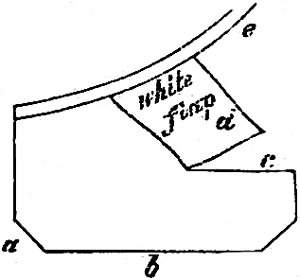
Pick up 11 stitches of pink at c to form the toe.
First row—knit plain. Then increase at the toe until you
have 18 stitches. Knit 3 rows plain.
Decrease every other time at the toe, until you have only 11
stitches. Pick up 11 white stitches at the side of flap d, still
knitting with pink wool, and take up the 14 stitches at e.
Knit 14 rows in pink. Go back to * at the 15th row, and
end at the 28th row.
This is rather a difficult pattern, but when finished quite
repays one for the trouble taken.
Baby’s Boot.
(A VERY EASY PATTERN.)
White Berlin, and pins No. 13.
Cast on 30; and, if speed be a desirability, the entire sock
may be done in plain knitting, but the following way is far
prettier. Knit the 1st row; then do 24 rows for the leg, in
any fancy stitch you like; the last row,* knit 2, wool over the
needle, take 2 together. Repeat from *. This forms holes,
into which ribbon must afterwards be run.
Twenty-fifth row.—From this time forward you must knit 1,
pearl 1; reversed every third row, to make a kind of dice
pattern. Cast on 11 extra stitches at the end of each of the
next two rows, making 52 in all. Increase at the beginning of
every row until there are 62 stitches; do 4 plain rows; then
decrease in the same way until you have only 52 again. Cast
off and sew up. Crochet a double scallop at the top in blue
Andalusian, to give a little finish.
Double Knitting.
Cast on any number of stitches.
Knit a plain row.
Second row—slip the 1st stitch, knit the 2nd in the usual
manner, but put the thread twice round the needle. Then
bring the thread forward as if you were going to pearl, only do
not pearl, but take the stitch off, and put the wool in front of
the stitch back to its place. Then begin again and knit a
stitch with wool twice round the needle.
Third row—knit the first stitch. Bring the wool forward,
and take off the long stitch, putting the thread down in front.
Knit the short stitch, putting the thread twice round the needle.
Double Knitting with Four Pins.
Cast on twice the number of stitches you wish to have on
the right side of the knitting.
* Bring the wool forward, slip 1, put the thread back, knit 1,
putting the thread twice round the needle. Repeat from *.
Second round—pearl, putting the thread twice round the
needle, put the wool back to the other side, and then slip the
long stitch. Repeat these two stitches.
You must be very careful in changing these rows, as otherwise
it joins. A good plan is to tie a piece of red wool where
the pattern begins. Of course the pattern interlaces at the 1st
stitch, but otherwise it ought to be quite separate.
Third round—the same as 1st.
Fourth row—the same as 2nd.
Comforters, to cost 2s.
Double knitting is most useful for boys’ comforters.
Cast on 60 stitches with pins No. 6, and Berlin fingering or
any soft wool, and continue to knit backwards and forwards
until the desired length is attained. White or scarlet double
Berlin is very warm and soft.
A Night-Sock or Carriage-Sock, in Double Knitting.
This pattern does for a grown-up person if tolerably large
bone needles are used.
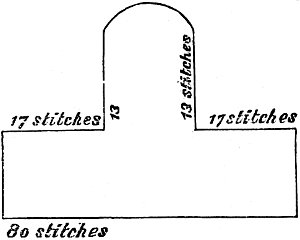
The above figure shows the sock completed but not sewn up.
Cast on 80 stitches. Double knitting for 13 rows.
Fourteenth row—double knit 63, plain knit the rest.
Fifteenth row—take off the 17 plain-knitted stitches, double
knit 46, plain knit to the end.
Sixteenth row—take off the 17 plain stitches.
Continue double knitting for 13 or 14 rows. Now 1 plain
and 1 pearl row.
Knit 1, knit 2 together; knit 6 plain stitches. Repeat to
the end of the row.
Pearl 1 row.
Knit 1, knit 2 together, 5 plain. Repeat to the end of the
row.
Pearl 1 row.
Knit 1, knit 2 together, 5 plain. Repeat.
Knit 1, knit 2 together, 4 plain; repeat until 12 stitches are
left, and cast off, leaving a long thread. Fold the work together
and sew it up at the heel; gather it a little in the sewing at the
toe. This may seem an odd shape, but it fits very well when
on the foot.
Gentleman’s Waistcoat.
(MEDIUM SIZE. FOR A YOUNG MAN.)
Steel pins, No. 10. ½ lb. dark claret-coloured double Berlin
wool, at 6s. 6d.
Cast on 60 stitches.
First row—1 plain, 1 pearl. Repeat.
You must be careful always to pearl where, in the preceding
row, you worked a plain stitch. Every row is alike. When
you have knitted it long enough, work another side in the same
manner, and send it to a tailor to make up. This knitting will
not run down when cut.
Another.
(LARGER OR SMALLER SIZE.)
As sizes vary so much, a good plan to ensure a nice fit is to
measure the front of a waistcoat at the broadest part, and then
for every inch allow 6 stitches in double Berlin wool, with steel
pins No. 10.
Thus: suppose your waistcoat ought to measure 11 inches
across, you must cast on 66 stitches; and for the turnings in
you had better allow 9 stitches: altogether, 75 stitches.
Ermine Muffatee.
1 oz. white and 1 oz. scarlet, 1 skein black, 1 skein yellow
Berlin wool; 4 pins, No. 17.
Cast on 20 on 2 needles, and 23 on the 3rd. Knit 2 inches
in ribs of 3 plain, 3 pearl. Join the scarlet, knit 1 plain inch.
Go on with the white and knit 2 inches, ribbed, 3 and 3. Take
a wool-needle, and with black wool make 2 little lengthway
stitches on the plain stitches of the ribbed part. Then make a
yellow stitch between the black, to imitate ermine spots. Now
double back the plain knitting and hem it in a neat fold. Any
other colour may be substituted for scarlet. A bright blue is
pretty.
Lady’s Muffatee.
(QUICK PATTERN.)
Pins, No. 14. 1 oz. white Berlin, ½ oz. bright blue.
Cast on 20 on two needles, 24 on the 3rd. Plain 3, pearl 3.
Knit 3 inches and cast off. With a bone crochet-needle make
a very narrow crochet edging lengthways up and down each
rib. This has a very pretty and bright effect.
Gentleman’s Muffatee.
1 oz. brown best Scotch fingering-yarn, price 5½d.
Cast on 70 stitches, 1 row plain; 2nd row, 2 plain, 2 pearl.
Repeat for about an inch. Then 4½ inches of plain knitting.
Another inch to match the bottom part, of 2 plain and 2
pearl alternately; remembering, of course, to make the plain
stitches in one row, the pearled ones in the next. Cast off, and
take care not to cast off too tightly, as this part goes over the
hand. Sew up, leaving about four inches unsewn for the thumb.
Join the wool at the lower part of the thumb, nearest the wrist;
pick up 2 stitches; with your second needle turn and pearl off
these 2 together. Now you have 1 stitch upon your needle;
knit this stitch and pick up 1 from the side; turn and pearl
these two; pick up another from the other side. Continue to
pick up these side-stitches, but every 3 rows you must knit (or
pearl) 2 together until you have decreased 8 stitches. You will
now find it more convenient to have the knitting on 2 pins.
Continue knitting and pearling until you have picked up nearly
all the side-stitches. These few remaining stitches, about 8 (4
on either side), take up on a third needle, and knit 3 plain
rounds.
Fourth round—pearl 2, plain 2. Repeat 9 times and cast off.
Knitted Purse.
One skein blue and one black of purse twist.
These old-fashioned long purses are still occasionally used;
the following pattern is rather a small one.
Cast on 72. Knit 2 together, make 1, knit 1. Repeat.
Second row plain. When broad enough double it and sew up,
leaving about 3 inches open for the money to slip in. Finish
off with steel rings and tassels.
Another Purse.
With pins No. 17 or 18, and 1 oz. embroidery silk, price
1s. 6d., from Adams & Co. 5 New Street, Bishopsgate Street,
E., cast on 144, and proceed as above; or make 1, knit 3, draw
the first of the 3 over the other 2.
Second row—plain. Repeat.
Lady’s Knitted Woollen Vest, or Jersey.
(BEAUTIFULLY WARM AND COMFORTABLE.)
Needles, No. 9; merino wool, or 2-ply fleecy; the former
for summer wear.
These cost about 1s. 1d. each, and are the greatest comfort
to those who suffer from the cold.
The 2-ply fleecy is the best wool to use, as it does not wash
hard.
For the back—cast on 78 stitches, pearl 3, plain 3, in ribs
for 140 rows.
141st row—knit 18 stitches; now turn (these 18 stitches form
the shoulder-strap); pearl the 18; knit them; turn, and pearl
them. You ought now to be beginning the row again, and this
time you pearl; and now pearl the 17th and 18th stitches together;
turn and knit back; knit a row, taking the 16th and 17th together;
turn and pearl back; knit a row, taking the 15th and
16th together. Turn, and knit the row. Go on in this way,
remembering always to decrease at the left side, at the end of
every row, until you have done 5 ribs altogether. You ought to
have 12 stitches on now. Then cast off. These ribs ought to
be crossways instead of lengthways.
Now begin to cast off the remaining stitches, until you come
to the last 18. Work this shoulder the same as the last.
The Fig. is the right-hand shoulder, the plain and pearl each
counting as one rib, making 5 in all.
For the front part of the vest you cast on 78 stitches and knit
125 rows. Begin the right-hand shoulder by pearling, and make
ribs as before, only this time you do not begin to decrease at the
left until you have done 7 ribs. Reduce to 12 stitches; make
11 ribs and cast off. Cast off the remaining stitches, and proceed
as before with the last 18 for the fourth shoulder-piece.
Now sew up these two sides until you get to within 24 rows
from the top of the front piece, which is the shortest. You must
now join the rest with a gusset, which you form by picking up
one stitch, knit it and turn; in every row you must now take up
one stitch, and rib them the same as the other part of the
vest in 3 and 3. Thus, the first row you have 1 stitch, the
next row 2, the next row 3, and so on. When 24 rows
are done, cast off. Sew up the shoulders, and crochet a narrow
border of small even holes, into which run a piece of crochet
wool or white ribbon.
It is a good plan to pick up the stitches all along the
shoulder-strap, and knit a few rows, according to the depth
of sleeve desired.
Shetland Shawl.
This takes ¾ lb. of wool, and costs about 9s. A scarlet or
violet crocheted border improves it. It can be finished off
with a fringe or not, as suits the taste. Bone pins, No. 7.
Cast on 302. Knit a plain row; knit 1 plain stitch at the
beginning and end of every row. * Make 1, knit 3, draw the
first of the three over the other two. Repeat from *. The next
row plain. Repeat these two rows until enough is done, and
cast off.
Any fancy stitch will do: it had better be rather a simple one.
Pence Jug.
½ oz. pink and ½ oz. black Andalusian would do three. They
would cost 3½d. each. 5 needles, No. 16.
Cast on 12 stitches on 1 pin for the spout, 10 on each of the
three other needles; 4 rounds plain. Now do rounds of 2 plain,
2 pearl, except the spout, which leave plain, decreasing 1 stitch
at each side of the twelve in the first 4 rounds, and 1 stitch on
every alternate side in the next 8 rounds. The spout is now
finished, and you ought to have 31 stitches on the needles.
Knit 12 rounds, 2 pearl, 2 plain, except under the spout,
where 1 stitch is to be plain.
With black begin the bowl; increase by knitting 2 in 1;
pearl 2 rounds; knit 4 rounds with pink; knit 1 round with
black, increasing 12 stitches (one in every six); pearl 2 rounds
with black; knit 4 rounds pink; knit 1 round black, increasing
12: there ought to be 86 now. Pearl 2 rounds black. Knit 6
rounds pink. Pearl 2 rounds black. Knit 4 rounds pink.
Knit 1 round black, decreasing 10 stitches at intervals. Pearl
2 rounds black. Knit 4 rounds pink, 1 round black, decreasing
6. Pearl 2 black rounds. You ought now to have 72 stitches.
Divide these by 6. Knit 11 rounds pink, decreasing 6 stitches
in each round by knitting 2 together at the commencement of
each division, where a star of 6 points will be found, and 6
stitches will remain on the needles. These are to be drawn up
and sewn together. Now cast on 6 stitches in black, and knit
and pearl alternately until you have done 3 inches: this is for
the handle; attach one end to the bowl and the other to the
top of the jug.
Another.
(LONG SHAPE.)
Andalusian wool as the preceding pattern, and pins No. 15.
Cast on 12 stitches for the spout, and 15 on two other pins.
Knit 4 rounds. Now decrease each side of the spout in every
round. Do 9 rounds and then 3 pearl rows; then 9 more plain
rows. Now for the bowl—increase 1 stitch in every five, and
then do three rounds in black; now join the pink and * knit 2
together, make 1, knit 1: repeat from *, the next round plain.
Repeat these rows twice more, and with black increase again
1 in every 8. Then with pink repeat the pattern from *, and
when the black begins again decrease instead of increasing.
Repeat as in preceding pattern and sew up. Take up 6 stitches
at the top of the jug opposite the spout, and knit and pearl for
three inches; cast off. Leave about a third of an inch hanging,
and above that attach it to the bowl.
Another.
(ON TWO PINS.)
Berlin wool, and pins No. 15.
Cast on 3 stitches in blue or any other bright colour. 1st
row, make 1, knit 1, repeat. 2nd row, make 1, pearl 2, repeat.
3rd row, make 1, knit 3, repeat. 4th row, make 1, pearl 4,
repeat. Continue in this way until you have 42 stitches. Pearl
a row and join the black wool. * Bring the wool forward, knit
2 together; repeat from *. Knit the next row. Repeat these
2 rows twice more. Do the same in blue, then the same in
black again. Join the blue, * knit 2 together, knit 1; repeat
from *. The next row plain. Do this for 4 rows. To form the
neck of the jug rib with black for 6 rows. For the spout, knit
to the middle; increase, knit 1; increase; the rest plain. Pearl a
row, increasing on each side of the 2 centre stitches. Increase
in this way until you have 14 for the spout; cast off in blue.
Sew up the jug and make the handle in blue, beginning a third
of an inch from the top; take up 4 stitches; pearl and knit
alternately until long enough, then attach to the bowl of the jug.
This can be knitted in Andalusian and pins No. 17, but in
that case you must make the bowl larger—68 stitches is a good
size; and the neck or ribbed part must be done for 12 rows
instead of 6.
Easy and Handsome Pattern for an Antimacassar, or Couvrette.
In 6-thread fleecy wool, ¼ lb. for each stripe. Pins, No. 6.
This costs 9s. 9d. Scarlet maize, black, green, violet, are pretty
contrasts.
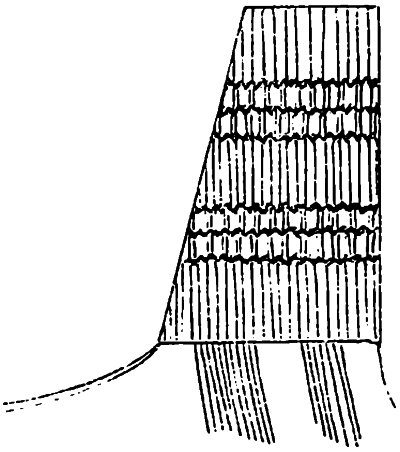
Cast on 14 stitches plain knitting until you have attained
the required length. The only difficulty is in the casting off.
You begin by slipping the first stitch and knitting the second,
which must be very loose indeed, almost an inch in length;
pass the slipped stitch over. Now drop the 3rd stitch and let
it run the whole length of the knitting. Continue thus. The
dropped stitches are allowed to run down, and they form
a kind of loop-pattern separated by ridges. Add a fringe at top
and bottom.
Another.
4-ply fleecy, and bone pins to match.
Cast on 19 and rib cross-ways in nines. When long enough
drop the middle stitch. Cast on 9 in white, rib another stripe
in the same way, and drop the middle stitch. Crochet with black
along every coloured stripe, and join to the white with maize or
orange. Two stripes of green and one of purple look very nice.
Persian Antimacassar.
This is extremely pretty, and is not difficult. The cost of
these couvrettes is generally about the same.
2 or 3 skeins of 4-thread fleecy, of each colour, according to
the length required. Pins, No. 10. Scarlet, gold, green, violet,
dark crimson, and blue. 6 skeins black, and 6 white filoselle,
at 3d. per skein, from Adams and Co., 5 New Street, Bishopsgate
Street, E.
Cast on 22. Knit any length you like and cast off. Now
select any simple wool-work pattern—a palm is best—or any
Moorish pattern, and work it in cross-stitch on the knitting. Do
5 on one strip and 6 on the next, so that they do not come exactly
in a line one with another. This has a very handsome
effect, indeed. The pattern ought to be worked in black, or
black and white filoselle. Join, and add a fringe.
Raised Plait Knitting for Carriage-rug.
(THIS IS EXTREMELY HANDSOME.)
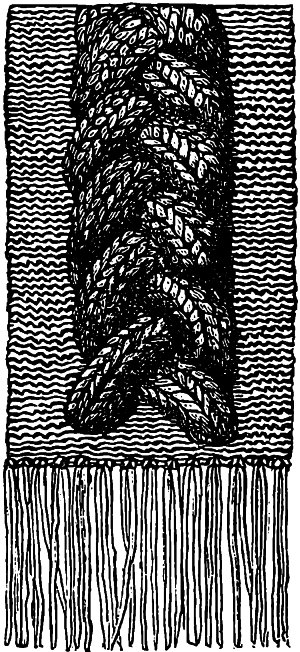
Pins, No. 5. 3 lbs. and 3 ozs. 12-thread fleecy wool. You
must have a third pin pointed at both ends. This costs 25s.
Cast on 20, and knit 6 plain rows.
Seventh row—knit 4, pearl 4, turn round, and knit and pearl
these 4 alternately until 11 rows are done. An easy way of
counting is to look at the side of the small strip, where there
ought to be 7 large chains. When 11 rows are done you slip
these 4 stitches on to the third pin, which you must keep on the
right-hand side of your knitting.
Pearl 4 stitches on the right-hand pin off the 2nd pin on the
left, leaving the 3rd pointed pin hanging down over the right
side of the knitting; then pearl the 4 stitches on the above-mentioned
3rd pin; pearl 4, knit 4.
Eighth row—plain knitting.
Ninth row—knit 4, pearl 12, knit 4.
Tenth row—knit 8, turn round, and pearl and knit these 4
alternately until 11 rows are done. Slip them on to the pointed
pin, and let it hang down over the right side of the knitting.
Knit 4 stitches on the right-hand pin off the left one; then knit
the 4 on the double-pointed pin; knit the remainder.
Eleventh row—knit 4, pearl 12, knit 4.
Twelfth row—plain knitting.
Repeat from the 7th row until one yard and a half are done;
knit 6 plain rows and cast off. You must knit 5 stripes, three
scarlet and two white, and join with Berlin or Scotch fingering.
Put a fringe, which must be crocheted on. Take about 24
inches of wool, double it, insert the crochet-needle in a stitch of
the couvre-pied and pull the ends of the wool through the loop,
and tighten gently with the fingers.
Baby’s Berceaunette Cover.
Long wooden pins, No. 10. 1 lb. pink and 1 lb. white,
4-thread fleecy. Costs 15s. with lining.
Cast on 7 stitches with pink, 7 with white; continue to cast
on alternately 7 in each colour until you have 147 altogether.
Do * 7 stitches in pink, 7 in white. Repeat 3rd row, 7 pink
stitches, and pass the wool in front; then go on with the white.
Continue this knitting, and when 7 rows are done do white over
the pink squares and pink over the white; you thus make
regular rows of squares. You must be careful always to pass
the wool after every alternate row to the front of the knitting,
so as to have all the long threads on the wrong side: care must
be taken not to pull these threads too tightly in passing from
one coloured square to another. Make a fringe, and line carefully
with pink silk.
Several of the couvrette patterns would make the above, and
nearly all the fancy stitches would be pretty done in stripes of
pink and white.
Knitted Quilt.
In stripes with cross-stitch sprigs.
Bone pins No. 6, and 4 lb. 6-thread fleecy, scarlet and white.
Cast on 12 stitches; knit a stripe of plain knitting, 208 rows
long. Now work about 17 sprigs or any other pattern on it, in
bright filoselle silk (see page 10), leaving 10 rows between each
pattern. Now knit a scarlet stripe 108 rows long. This stripe has
no sprigs worked on it. Do 10 scarlet and 9 white stripes, and
join together.
Hearth-Rug.
This must be made in squares and then sewn together. Cast
on with ordinary twine and steel pins any even number of
stitches. Have ready narrow pieces of cloth, about 2¾ inches
long and ½ inch broad. Knit one plain row. Second row, slip
one; * put a strip of cloth between the two needles and knit a
stitch; then turn the end of cloth up again so that both ends
may come on the right side. Knit a stitch. Repeat from *.
The next row plain. You must pull this knitting rather tight.
The cloth can be bought of almost any tailor by the pound
of scraps. It makes a pretty border to put scarlet stripes at
regular intervals.
Loop Knitting.
This knitting leaves loops on one side, and is very pretty and
warm for quilts, couvrettes, &c.
Cast on, in 6-thread fleecy and pins No. 7, any number of
stitches. Do not slip the first stitch, but always knit it.
First row—plain knitting.
Second row—put the wool round the needle as if you were
going to knit a plain stitch, but instead of knitting let the wool
hang straight down over the forefinger of the left hand; wind it
round and put it for the second time over the right needle.
Wind the wool a second time round the finger, and for the third
time put it round the needle; and now knit this stitch, which
ought to have the appearance of three in one. Repeat. The
next row plain. Do about six rows plain and then repeat with
the loops; of course you must only make them on one side of
the knitting, and they will require a little pulling to keep them
in the right place. This is handsome in stripes of shaded red.
Fringe.
Berlin wool or cotton. Pins, No. 14.
Cast on 14. Knit the desired length, cast off 4 stitches, and
then unravel all the rest.
Woollen Fringe.
(VERY HANDSOME.)
Have some ends ready cut, and cast on 7 stitches.
First row—knit 1, bring the wool forward, knit 2 together;
take one of the lengths and double it, hang it on the right-hand
needle, knit 2 stitches, bring the double ends of wool forward,
knit 1 stitch, put the end back, and knit the last stitch.
Second row—knit every stitch plain, taking up with the 4th
stitch the loop of fringe wool, and being careful not to split either
of them. Continue to the end of the row plain.
Third row—the same as 1st.
Fourth row—the same as 2nd. Repeat.
Lady’s Scarlet and White Petticoat.
(WORN INSTEAD OF A FLANNEL ONE.)
Wooden pins about 17 inches long, and then cast on all the
stitches you require. With pins No. 5 cast on 360, and knit
with scarlet for 1 inch; then 2 inches of white, then 2 inches of
scarlet. Now do the rest of the petticoat in double knitting,
or some fancy stitch. (See page 42.) When it is 26 inches long
rib 21 rows in 2 plain, 2 pearl, and cast off. Knit a simple
crochet scarlet edging. These petticoats pull out several inches
longer after being washed.
Lady’s Petticoat, to cost 10s. 6d.
Both these petticoats take about 15 skeins of petticoat yarn.
Bone pins, No. 5.
Begin with scarlet, if preferred, as above; but this pattern is
given for entire white wool.
Cast on 120, and knit 25 inches plain, then rib by doing 2
plain and 2 pearl for 24 rows. Cast off. Do another breadth;
and for the 3rd and front breadth you must, after the first 12
rounds, decrease at the beginning and end of each row about
every two inches. If you do not like to have a gored breadth
do this one exactly the same as the other two. Crochet some
scalloped edges round the bottom of the petticoat, after having
joined the breadths together. These petticoats are beautifully
warm and last for a long time. Summer ones can be knitted
with the same pins in Scotch wheeling-yarn or 2-thread fleecy,
which are much cheaper but not so nice and soft. It makes a
charming finish to put a border as on page 44. You need only
make the petticoat 24 inches long in that case.
For a Common Quilt.
Cast on with cotton 2 stitches, use pins about No. 14, and
increase every row. Do 6 rows of plain and 6 of pearl, so as to
make lengthway ribs. When half a square is done decrease at
the beginning of every row. When a sufficient number of squares
are finished join together with a square piece of calico between
each knitted one. Thus: take a piece of calico, turn down the
raw edges, double it to the size of the knitted square, and tack
the two edges together. Then sew the knitting and the calico
together, as if you were doing patchwork. The raw edges of
the calico must, of course, be turned inwards, meeting each
other so as not to be seen even on the wrong side of the quilt.
This is a quick and neat quilt, but is not so pretty as the other
patterns.
Quilt. Laurel-Leaf Pattern.
Cotton, and pins No. 14 or 15. It makes a beautiful berceaunette
cover in 2 or 3-thread fleecy, and bone pins. The
price so entirely depends on the size of quilt desired that it is
impossible to give it exactly. It is a very handsome pattern.
This quilt is made in squares and joined afterwards.
Cast on 1, and you must not forget to increase at the beginning
of every row.
Second and third rows—plain knitting.
Fourth row—increase (by putting the cotton round the
needle) before every stitch.
Fifth row—you ought to have 6 stitches now. Do 1 plain,
3 pearl, 2 plain.
Twenty-eighth row—knit 13, slip 1, take 2 together, pass the
slipped stitch over. This finishes the leaf, and ought to be 28
stitches; the other half of the square is in ribs, decreasing at
the beginning of every row.
Twenty-ninth row—pearl, then a plain row, then pearl a
row, plain a row, plain another row, pearl. Continue thus in
lengthway ribs of 3, until you have decreased to one stitch.
Join the squares so that 4 laurel leaves meet in the centre.
Maltese Pattern.
Strutt’s knitting-cotton No. 6, and pins No. 16.
This is one of the handsomest patterns there are, but it
must be knitted much tighter than ordinary work. Twist the
cotton twice round the little finger, and you will thus be enabled
to draw the stitches quite tight.
When your squares are done, sew them together at the
plain part, at the beginning, where the increasings were made.
They ought to make a perfect Maltese cross. Cast on 1 stitch
and increase every row. Knit until you have 27 stitches on
your needle. This completes the first division.
Twenty-eighth row—make 1, pearl the rest.
Twenty-ninth row—make 1, knit the remainder.
Thirtieth row—make 1, pearl 1, * put thread before the
needle, pearl 2 together. Repeat from *.
Thirty-first row—make 1, knit the rest.
Thirty-second row—make 1, pearl the rest.
Do the 33rd and 34th rows like the 31st, and now the
2nd division is done.
Thirty-fifth row—make 1, * knit 2, pearl 2. Repeat from *.
Thirty-sixth row—make 1, * pearl 2, knit 2. Repeat from*.
Knit the last stitch.
Thirty-seventh row—make 1, knit 1, * pearl 2, knit 2. Repeat
from *.
Thirty-eighth row—make 1, pearl 1, * knit 2, pearl 2. Repeat
from *.
Thirty-ninth row—make 1, * pearl 2, knit 2. Repeat from *.
Fortieth row—make 1, * knit 2, pearl 2. Repeat from *.
Pearl the last stitch.
Forty-first row—make 1, pearl the rest.
Forty-second row—make 1, pearl the rest.
Forty-third row—now you begin to decrease. Knit 2
together, knit the rest.
Forty-fourth row—pearl 2 together, pearl.
Forty-fifth row—knit 2 together, put the cotton before the
needle. Repeat alternately.
Forty-sixth row—pearl 2 together. Pearl the rest.
Forty-seventh row—knit 2 together, knit the rest.
Forty-eighth row—pearl 2 together, pearl.
Forty-ninth row—like the forty-eighth.
Fiftieth row—now you do the third division again of 2 plain,
2 pearl, according to the pattern; always decreasing at the
beginning. In the last row of this division you knit every
stitch. You ought to have 27 stitches, and the rest of the
square is plain knitting.
It is an improvement after the quilt is finished to run blue
ribbon round the holes which surround the cross, to define it,
and bring it out more clearly.
Canadian Cloud.
Wooden pins, No. 1; 10 skeins of white and 2 of scarlet
Shetland wool.
Cast on 200 stitches, and knit backwards and forwards for
2½ yards. Cast off. Now with the scarlet crochet a border at
the two sides. Double the cloud lengthways, and then draw up
the two ends and finish off with a large tassel, made in the following
way:—Double a skein of white wool twice, then tie it
round very tightly with strong wool about two inches from the
end; cut the other ends, and join the cloud and tassel together
with a crochet cord made of Berlin wool. It makes the cloud
prettier to add a little scarlet crocheted cap to the tassel.
Rose-bud Pattern.
Pins No. 13 and coarse cotton.
Cast on 19 for the pattern, and two extra stitches, to have a
plain one at the beginning and end of every row.
First row—knit the first stitch, and knit 1, pearl 2, knit 1,
put the cotton over the needle, knit 1, slip 1, knit 1, pass the
slipped stitch over, pearl, take 2 together, knit 1, pearl 1, knit 1,
slip 1, knit 1, pass the slipped over, pearl 1, take 2 together, knit
1, put cotton over, knit the last stitch.
Third row—slip the 1st stitch, 1 plain, 2 pearl, 1 plain; put
the cotton over the needle, 1 plain; put cotton over, slip 1, knit
1, pass the slipped over; 1 pearl, take 2 together, 1 pearl, slip 1,
knit 1, pass slipped over, 1 pearl, take 2 together, the cotton
over, 1 plain cotton over, the last plain.
Fourth row—slip the 1st, pearl 4, knit 1, pearl plain, pearl
plain, pearl 5, knit 2, plain pearl.
Fifth row—slip 1, knit 1, pearl 2, knit 1, cotton over, knit 3,
cotton over, slip 1, knit 2 together, draw the slipped over, pearl
1, slip 1, knit 2 together, draw the slipped over, put cotton over,
knit 3, put cotton over, knit the last.
Sixth row—slip the 1st, pearl 6, knit 1, pearl 7, knit 2, pearl
1, knit the last.
Seventh row—slip the 1st, knit 1, pearl 2, knit 1, cotton over,
knit 5, cotton over, slip 1, knit 2 together, pass the slipped over,
put cotton over the needle, knit 5 plain, cotton over.
Eighth row—1 plain, pearl 16, 2 plain, pearl 1, knit the last
plain.
Repeat from the 1st row again.
This forms a handsome border, either for quilts, antimacassars,
or baby’s berceaunette cover; especially the latter, done in
stripes of plain knitting, in wool.
Another Pretty Border.
With Strutt’s knitting-cotton cast on 54 and knit a plain row.
First row—knit 2, * knit 2 together, knit 6, thread forward,
knit 1, thread forward, knit 6, knit 2 together. Repeat *.
Second row—pearl.
Third row—like the first.
Fourth row—pearl.
Fifth row—like the first.
Sixth row—plain knitting.
Seventh row—pearl.
Eighth row—plain knitting.
Begin again from the 1st row.
Arrow Pattern in Stripes.
(VERY EASY.)
Cast on any uneven number of stitches, according to the
width you require. We will say 13. Put the wool before the
needle and knit 6 plain stitches. This makes 7 stitches on the
right-hand needle. Knit 2 together. The rest plain. Every
row alike.
Cable Knitting.
This is very pretty, either for the tops of babies’ boots or
stockings in fine wool, or for couvrettes, quilts, &c. in coarser.
It takes 8 stitches for the pattern. Cast on as many as you
require for the width of the knitting, and do 1 row plain.
Second row—pearl 1, put the wool back, slip 1, knit 1, pass
the slipped stitch over; pearl 1, putting the thread twice round
the needle, knit 4. Repeat to the end of the row.
Third row—pearl 4, knit 1, pearl 2, knit 1. Repeat.
Fourth row—pearl 1, keep the thread forward, slip 1, pass
the wool back to its proper place, knit 1, pass the slipped stitch
over, pearl 1. Now take the next 2 stitches on a third needle,
and keep them on the right side of your knitting; knit the next
2 stitches, and then knit off the 2 on the third needle.
Fifth row—pearl 4, knit 1, pearl 2, knit 1. Repeat.
Begin again from the 2nd row.
If you desire your cable broader you need only add on a few
more stitches, say 9 or 10, to the pattern. With 10 stitches you
would have to slip 4 on to the third needle.
It makes quite as handsome a couvrette as the one on page
37, and costs about the same price. If 6 instead of 12-thread
fleece is used, it is of course much cheaper and smaller.
Hood Pattern.—Any number of stitches divisible by 2.
First row—knit 2 together, thread forward. Repeat.
Second row—thread before the needle, pearl 2 together.
Repeat. Pearl the last 2 together. Do the next row like the 1st.
Fourth row—pearl 1, * thread before the needle, pearl 2
together. Repeat from *.
Fourth row—knit the first thread, pearl the second, pearl 2;
knit the first thread, pearl the second, pearl 2. Repeat.
Lattice Pattern.
This is very handsome for antimacassars in stripes of two or
more colours, and also for a baby’s counterpane. For the latter
cast on in white petticoat yarn 110 stitches on long wooden pins,
No. 6. If when finished you wish it larger put a border in rose-bud
pattern. For an antimacassar cast on 1 stitch with fleecy
wool and coarse bone pins. Plain knitting, increasing at the
commencement of every row, until you have 22. (This pattern
is in sixes, and you must have 2 plain stitches at the beginning
and end of every row to form a border: these must always be
knitted plain. There must be an even number of stitches, 22,
28, 34, according to the width required.)
First row—knit the 22 stitches plain.
Second row—slip 1, knit 1, for the border. * Knit 1, putting
the wool three times round the needle. Repeat from *.
Third row—slip 1, knit 1, for the border. * Take off 6 long
stitches, and pass the first 3 over the second 3, but do not let
the latter run off the left-hand needle; and now knit off these 6
stitches plainly. Repeat from *.
This may sound difficult, but it is really quite the reverse, as
it merely consists in putting three stitches over another three,
and then knitting these six afterwards.
Do 2 plain rows, and repeat from 2nd row.
When long enough, decrease with plain knitting to match
the commencement, and finish off the points with tassels.
The next stripe, if preferred, can be done in a different
pattern, only you must remember to make the points, by beginning
with one stitch and then increasing up to the requisite
number, decreasing in the same manner at the end.
Fancy Stitches.
All the following patterns are pretty. You must always cast
on two extra stitches, so as to have a plain stitch at the beginning
and end of every row, and every alternate row is pearled.
Always work one or two rows plain for a foundation.
Pearl Pattern.—Cast on an even number of stitches. 1st
row—pearl 1, slip 1. Repeat.
Third row—slip 1, pearl 1. Repeat.
Go back to the 1st row.
Rain Pattern.—14 stitches are required for each pattern.
1st row—knit 1, thread forward, knit 5, slip 1, knit 2 together,
pass the slipped stitch over, knit 5, thread forward. Repeat.
Open Pattern. 1st row—knit 1, bring the thread forward,
slip 1, knit 1, pass the slipped over, knit 1, knit 2 together,
bring thread forward. Repeat.
Seventh row—knit 2 together *. Thread forward, knit 3,
thread forward, slip 1, knit 2 together, pass slipped over. Repeat
from *. Then go back to the 1st row.
Square Pattern, with reversed Holes.—Cast on 10 for each
pattern and two over, slip the first and knit the last in every
row. Each alternate row is 5 plain, 5 pearl.
First row—thread forward, slip 1, knit 1, pass slipped over,
knit 3, pearl 5.
Third row—knit 1, thread forward, slip 1, knit 1, pass slipped
over, knit 2, pearl 5.
Honeycomb.—Small holes. Cast on 6 for each pattern.
First row—pearl 1, putting the thread before the needle
twice, pearl 2 together. Repeat.
Third row—pearl 2 together, thread before the needle, pearl 1.
Repeat.
Another Pattern.—Cast on 8 for each.
First row—thread forward, slip 1, knit 1, pass the slipped
over. Repeat.
Third row—thread forward, slip 1, knit 1, pass the slipped
over, knit 6. Repeat.
Brioche.—Cast on any number of stitches in threes, 21, 30,
36, according to the desired width. * Thread before the needle,
knit 2 together, slip 1. Repeat from *.
Nice Pattern for the Tops of Socks.—5 stitches for each
pattern.
First row—pearl 2, keep the thread over the needle, knit 3
together, thread over. Repeat.
Second row—pearl 3, knit 2. Repeat.
Third row—pearl 2, knit 3. Repeat.
Fourth row—like the second.
Very pretty little Pattern.—First row—knit 2, thread
forward, slip 1, knit 1, pass slipped over. Repeat.
Second row—Pearl 2, thread over, pearl 2 together. Repeat
these rows alternately.
Another.—Cast on six for each pattern.
First row—pearl 1, take 2 together, thread forward, knit 1,
thread forward, slip 1, knit 1, pass the slipped over. Repeat.
Second row—pearl 5, knit 1. These two rows alternately.
Another.—Cast on 8 for each pattern.
First row.—Take 2 together, thread forward, knit 2, thread
forward, slip 1, knit 1, pass the slipped over, knit 2. Repeat.
Every other row is—pearl 4, pearl 2 together, thread over,
pearl 2.
By this time my readers will perceive how much alteration
can be made by merely reversing, and slightly altering, the
position of knitted, pearled, and slipped stitches, and will
doubtless be able to invent many more equally pretty patterns
for themselves.
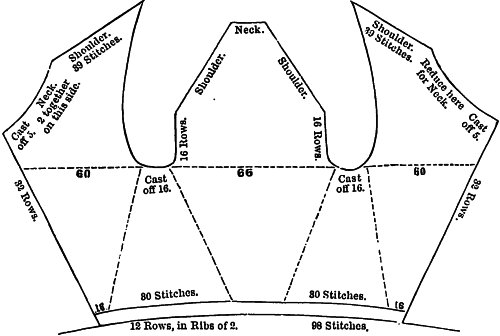
High Bodice, to cost 1s. 3d.
This bodice is meant to wear under the dress. Three skeins
scarlet merino and pins No. 5, or Shetland wool and pins No. 7.
Cast on 98 stitches, and rib with 2 plain, 2 pearl, for 12 rows.
Thirteenth row—knit 16, make 1 (by putting the wool round
the needle), knit 30, make 1, knit 6, make 1, knit 30, make 1,
knit 16.
Fourteenth row—Plain knitting.
Fifteenth row—knit 17, make 1, knit 30, make 1, knit 8, make
1, knit 30, make 1, knit 17.
Sixteenth row—Plain knitting.
Seventeenth row—knit 18, make 1, knit 30, make 1, knit 10,
make 1, knit 30, make 1, knit 18.
Eighteenth row—plain. Continue in this way until you have
done 30 rows with holes and 30 alternate plain rows.
Now, for the front part take 60 stitches, leaving all the rest
still on the needle, and do plain knitting backwards and forwards
on those 60 for 32 rows.
Thirty-third row—cast off 5 stitches, knit the rest plain.
Thirty-fourth row—you must now reduce for the neck at the
end of this row by taking 2 together.
Decrease thus every other row for 31 rows; you must have
39 stitches on your needle. Cast off; this part is for the
shoulder.
Cast off 16 stitches under the arm.
For the back take 66 stitches, and do 16 rows of plain
knitting; then 38 rows, decreasing for the shoulder at the end
of each row. Now cast off 28 stitches for the neck. Cast off 16
under the other arm. Now take the remaining 60 stitches for
the second front, and do 32 rows as on the other side. Reduce
for the neck in the same manner, by casting off 5 at the 32nd
row, and then decreasing at the end of every alternate row for
32 rows. Cast off; there ought to be 39 stitches.
Sew the shoulders together, crochet round the neck and
sleeves (1 treble, 2 chain), and run ribbon or crocheted chain
round the former.
If sleeves are desired, cast on about 48 stitches, and do ribs
of 3 and 3 the desired length.
The following diagram will render the explanations easier:—
A good plan to prevent the front part from stretching too
much is, at every 10th row to leave the last 10 stitches before
the end unknitted.
This pattern is for an ordinary figure, but after one trial the
knitter will find it can be altered to any size.
Baby’s Jacket.
Pins No. 9, and fleecy or fingering-wool.
Cast on 36, knit 5 plain rows.
Sixth row—knit 4, make 1, knit the remainder. The next
row plain.
Eighth row—knit 5, make 1, the rest plain. Continue in this
way to make holes each time one stitch further from the edge
until 13 holes are done. Then do 6 rows, decreasing once in
every row, at the 6th from the edge, on the side where the holes
are: this part goes under the arm. Now cast it off, leaving 32
stitches on the needle for the chest; knit these 32 for 22 rows,
and then decrease (at the opposite side to where you cast off) for
20 rows, thus making 10 decreasings; knit 3 plain rows and
cast off. Do another piece in the same way, and for the back
cast on 22 and knit 5 plain rows: this part is for the neck.
Sixth row—knit 4, increase; knit to within 4 of the end, and
increase again; knit the remaining 4.
Seventh row—plain knitting.
Do these alternately for 26 rows until you have 48 stitches;
knit 16 rows; then knit 1, take 2 together, take 2 together, make
1; plain to within 5 of the end where you make 1, take 2 together,
2 together again, knit the last. The next row plain.
Repeat these two rows alternately 12 times, then do 24 plain
rows and cast off.
For the neck, pick up about 40 stitches in scarlet and do 4
rows of ribbed knitting. Pick up 100 for the waist and do 8
rows plain, also with scarlet, and 2 rows up the front. Finish
off with large buttons and elastic loops, and either knit 4 rows
(like the neck) round the sleeves, or put long ones. For the
latter cast on 40 stitches and knit 7 inches. Rib 20 rows in
scarlet for the wrist.
Child’s Gaiter, to cost 1s. 2d.
Three needles, No. 11 or 12, and 2 oz. brown Berlin wool.
Cast on 60 (for a very small child 54 will do), knit 3, pearl 3,
for 24 rows. Now do plain knitting for 12 rows, then decrease
at the beginning and end of the row. Continue plain knitting,
but you must decrease every five rows. When six decreasings
are done go on knitting until 78 rows are done.
Seventy-ninth row—knit 21 stitches, take the next 18 for the
instep on a third pin and knit backwards and forwards, decreasing
at the beginning and end after the first 2 rows. When
18 rows are done cast off.
Sew up the leg, and take up the rest of the stitches for the
heel. Do 10 rows, decreasing at the beginning and end of every
row. Cast off.
Round Sofa-cushion.
This can be worked in shades, or in any two colours which
contrast well.
Berlin and pins No. 14 may be used, casting on 54 stitches.
This is rather a small size; to make it larger use coarser wool,
and pins to correspond.
First row—plain knitting.
Second row—the rest of the cushion is done in Brioche
stitch; leave the last 3 stitches unknitted, turn and go on with
the Brioche stitch.
Fourth row—leave the last 6 unknitted and turn.
Sixth row—leave the last 9 unknitted, and so on, 3 more
every time you get to the end of the row.
When you have worked off all the stitches, join the next
shade and knit the whole row. The next row like the 2nd.
This makes the knitting come into a gradual round. When
large enough sew it up and do a second in the same way. Make
a round pillow lined with feathers, and put between the knitting,
which must be sewn together like a silk pincushion. Draw in
the centre, which may be finished off with an ornamental button;
the edges can be crocheted or left plain, as preferred.
These cushions used to be very fashionable at one time,
although they are seldom seen now. However, fashions change
so quickly that they may, perhaps, be used again.
Knee-cap.
These are very comfortable for people who are at all rheumatic.
Cast on 29 stitches with Berlin wool, knit 14, bring the wool
forward, knit the rest. Continue this until 28 rows are done.
Then knit 32 rows without increasing. Begin to decrease where
you took the wool forward at the 14th stitch by knitting 2 together.
Do 28 rows to correspond with the other side; have
29 stitches on your pin, the same as you began with. Cast off,
and sew the ends together.
The size of knee-caps must be regulated by the pins, and
also by the number of stitches used. Many people consider
them better when quite plain, without either increasing or decreasing.
Baby’s Hood.
Pins No. 9 and Berlin, or any other soft wool.
Cast on 60, and do 1 plain row. Then do Hood pattern,
page 50, for 5 rows; then 6 rows of plain knitting. Do the rest
in any fancy stitch. When the knitting is 4 inches deep do 2
plain rows, 1 pearled, and cast off.
Cast on 22 stitches for the crown, do 1 plain row.
Second row—knit 1, thread over, take 2 together. Repeat;
6 more plain rows, and then any fancy stitch. When 3 inches
are done knit a row, decreasing at the beginning and end of
the row. Pearl the next, decreasing in the same way. Do 5
more rows in this manner, and cast off. Now sew the crown
and head parts together, gathering the fulness at the top, and
not at the sides.
Take up 74 stitches for the curtain, or neck part, and do 3
rows of alternate knitting and pearling; let the plain part come
on the right side.
In the second row increase after every 2 stitches, so as to
have about 110 altogether. When you have done 3 rows do
any open pattern for 2 inches, and cast off. Edge the hood all
round with a simple crochet edging in pink wool, and then
ribbon round the neck.
These hoods are very useful in grey wool for poor people.
London: Printed by John Strangeways, Castle St. Leicester Sq.
PRICE LIST OF WOOLS AND YARNS
Sold by HAIG AND VINCE,
209 OXFORD STREET, LONDON, W.
PER LB.
s.
d.
s.
d.
Charity Wheeling Yarn
3
6
to
4
0
Best Scotch Wheeling Yarn, 6½d. & 7½d. per skein
4
3
”
4
9
Best Scotch Fingering Yarn
6
0
”
7
0
Scotch Berlin Fingering
7
6
”
8
6
Merino Yarn, 4½d. per skein
10
6
”
12
6
Petticoat Yarn, 9d. per skein
6
0
”
7
0
Andalusian, 10d. per oz.
11
6
”
15
0
Shetland Wool, 10d. per oz
11
6
”
15
0
Pyrenees ditto
—
”
—
Berlin Wool, Single or Double, 7d. to 11d. per oz.
8
6
”
12
6
Fleece Wool in 2, 3, 4, 6, 8, and 12 threads
6
6
”
7
9
Lady Betty Wool, 2, 3, and 4 thread, 9d. and 10d. per oz.
11
6
”
12
6
Angola Yarn, 2½d. per skein
6
0
—
Scotch Knitting Cotton
3
9
—
All patterns in The Lady’s Knitting-Book have been successfully
worked in the above Wools.
[Transcriber’s Note—the following changes have been made to this text: