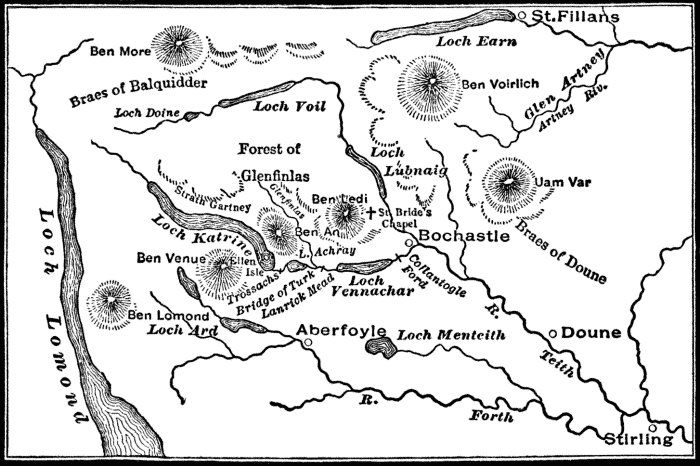
2. witch-elm that shades Saint Fillan's spring. The well or spring of
St. Fillan is on the summit of a hill near Loch Earn, some miles
northeast of the scene of the poem. The reason why Scott places the
"Harp of the North" here is that St. Fillan was the favorite saint of
Robert Bruce, and a relic of the saint had been borne in a shrine by a
warlike abbot at the battle of Bannockburn. The word "witch" (more
properly spelled "wych") is connected with "wicker" and means "bending,"
"drooping."
10. Caledon. Caledonia, poetic name for Scotland.
29. Monan's rill. Scott takes the liberty of assigning a "rill" to
this Scottish martyr of the fourth century on his own authority, unless
his editors have been at fault in failing to discover the stream
indicated.
31. Glenartney's. Glen Artney or Valley of the Artney. The Artney is a
small river northeast of the main scene of the poem.
33. Benvoirlich. "Ben" is Scottish for mountain. Benvoirlich is near
the western end of Glenartney.
53. Uam-Var. A mountain between Glenartney and the Braes of Doune. The
name signifies "great den," and is derived from a rocky enclosure on the
mountain-side, believed to have been used in primitive times as a toil
or trap for deer. As told in Stanza IV a giant was fabled to have
inhabited this den.
71. linn. This word means either "waterfall" or "steep ravine." The
latter is probably the meaning here.
89. Menteith. A village and district southeast of the line of
lakes—Loch Katrine, Loch Achray, and Loch Vennachar—about which the
main action of the poem moves.
93. Lochard. Loch Ard, a small lake south of Loch Katrine.
Aberfoyle. A village east of Loch Ard.
95. Loch-Achray. See note on 89.
97. Benvenue. A mountain on the south bank of Loch Katrine.
103. Cambusmore. An estate owned by Scott's friends, the Buchanans, on
the border of the Braes of Doune.
105. Benledi. A majestic mountain shutting in the horizon to the north
of Loch Vennachar.
106. Bochastle's heath. The plain between Loch Vennachar and the river
Teith.
112. Brigg of Turk. A romantic bridge, still in existence, between
Loch Vennachar and Loch Achray.
120. dogs of black Saint Hubert's breed. A breed of dogs, usually
black in color, very keen of scent and powerful in build, were kept by
the abbots of St. Hubert in commemoration of their patron saint, who was
a hunter.
138. whinyard. Obsolete term for sword.
145. Trossachs. A wild and beautiful defile between Loch Katrine and
Loch Achray. The word signifies "rough or bristled country."
166. Woe worth the chase. "Woe worth" is an exclamation, equivalent to
"alack!"
178. Round and around the sounds were cast. Notice the mimicry of the
echo in the vowel sounds of the line.
196. tower ... on Shinar's plain. The Tower of Babel.
208. dewdrops sheen. What part of speech is sheen? Is this use of
the word obsolete in prose?
227. frequent flung. "Frequent" is used in the original Latin sense
(Lat. frequens) of "crowded together," "numerous."
256. Unless he climb, with footing nice. Scott says: "Until the
present road was made through the romantic pass I have presumptuously
attempted to describe, there was no mode of issuing out of the defile
called the Trossachs, excepting by a sort of ladder, composed of the
branches and roots of trees." What is the meaning of "nice" here? What
other meanings has the word had?
313. Highland plunderers. The clans inhabiting the region about Loch
Katrine were in the habit of making incursions into the neighboring
Lowlands to plunder and lay waste the country. Their warlike habits were
fostered by the rugged and almost inaccessible character of the country,
which prevented the Lowlanders from retaliating upon them, and enabled
them also to resist the royal authority.
363. snood. A ribbon worn by Scotch lassies and upon marriage replaced
by the matron's "curch" or cap. plaid. A rectangular shawl-like
garment made of the checkered cloth called tartan.
438. couch was pulled. Freshly pulled heather was the most luxurious
bedding known to the Highlander.
440. ptarmigan and heath-cock. These birds are a species of grouse,
the one red, the other black.
460. on the visioned future bent. The gift of second-sight was
universally believed in at this period in the Highlands.
504. retreat in dangerous hour. "The Celtic chieftains, whose lives
were continually exposed to peril, had usually, in the most retired spot
of their domain, some place of retreat for the hour of necessity ... a
tower, a cavern, or a rustic hut." (Scott's note in edition of 1830.)
546. target. What is the connection of this word with that used in
archery and gun-practice?
566. brook to wield. "Brook" commonly means "endure." What is its
exact meaning here?
573. Ferragus, or Ascabart. Two giants whose names appear frequently
in medieval romances of chivalry. The first is better known as Ferran,
under which name he figures in the Orlando Furioso of Ariosto.
Ascabart plays a part in the old English metrical romance of Sir Bevis
of Hampton.
580. To whom, though more than kindred knew. This is a very obscure
expression for Scott, who is usually so careful to make himself clear.
The meaning seems to be: Ellen regarded her as a mother, though that was
more than the actual kinship of the two justified (literally "knew how
to recognize").
591. Knight of Snowdoun, James Fitz-James. As appears later in the
poem, these were not his true name and title, though he was entitled to
bear them.
622. a harp unseen. In modern Scotland the bagpipe has altogether
taken the place of the harp. A writer of the sixteenth century says:
"They (the Highlanders) take great delight to deck their harps with
silver and precious stones; the poor ones that cannot attain thereunto
deck them with crystal. They sing verses prettily compounded (i.e.,
composed) containing for the most part praises of valiant men."
638. pibroch. (Pronounced pee-brock.) A wild tumultuous tune played on
the bagpipes in the onset of battle.
642. bittern. A wading bird, allied to the heron.
657. reveillé. As the rhyme shows, this word is pronounced
reh-vail'yah here. The common pronunciation in the United States is
rev-a-lee'. It is the drum-beat or bugle-call at dawn to arouse
soldiers.
1. blackcock. See note to I, 440.
7. minstrel grey. Until well on in the eighteenth century it was
customary for Highland chieftains to keep in their service a bard, whose
chief duty it was to sing the exploits of the ancestors of the line.
69. Lead forth his fleet. What kind of figure is contained in the word
fleet as applied to the flock of ducks?
131. harp, which erst Saint Modan swayed. St. Modan was not a harper,
as Scott elsewhere ingenuously confesses, adding, however, that "Saint
Dunstan certainly did play upon that instrument."
141. Wailed loud through Bothwell's bannered hall. The minstrel tries
to account for the strange way in which his harp gives back mournful
sounds instead of the joyous ones he is trying to evoke, by calling to
Ellen's mind two other occasions when it behaved similarly. One of these
was when it foreboded the death of Ellen's mother; the other when it
foreboded the exile of the Douglasses during the minority of James V.
For particulars, see the introduction on the historical setting of the
poem. Bothwell Castle is on the Clyde, a few miles from Glasgow.
159. From Tweed to Spey. The Tweed is in the extreme southern part,
the Spey in the northern part, of Scotland.
200. Lady of the Bleeding Heart. The minstrel calls Ellen so because a
bleeding heart was the heraldic emblem of the Douglas family.
206. strathspey. A dance, named from the district of Strath Spey, in
the north of Scotland. It resembled the reel, but was slower.
213. Clan-Alpine's pride. Clan Alpine was the collective name of the
followers of Roderick Dhu, who figures later in the poem as Ellen's
rejected suitor and the enemy of the mysterious "Knight of Snowdoun" who
has just taken his departure from the island.
216. Lennox foray. Lennox is the district south of Menteith, in the
Lowlands. It was the scene of innumerable forays and "cattle-drives."
221. In Holy-Rood a knight he slew. Holyrood is the royal castle at
Edinburgh, where the court usually was held. It was deemed a heinous and
desperate offense to commit an act of blood in the royal residence or
its immediate neighborhood, since such an act was an indirect violation
of the majesty of the king, and a breaking of "the king's peace." It was
for this offense that Roderick Dhu was exiled, and compelled to live
like an outlaw in his mountain fastness.
227. Who else dared give. Notice how skilfully Scott manages to give
us the relations of the chief characters of the poem to each other, and
to show that Ellen's father, pursued by the hatred of James V, has been
given the island shelter in Loch Katrine by Roderick Dhu who is about to
make his appearance in the story.
236. Full soon may dispensation sought. A papal dispensation was
necessary, because Ellen and Roderick Dhu were cousins. See next note.
249. All that a mother could bestow. Here again the poet takes the
indirect way of making clear his point, namely that the matron
introduced in the first canto is the mother of Roderick Dhu. The phrase
"an orphan in the wild," is in apposition with the following phrase "her
sister's child"—i.e., Ellen herself. From this it appears that Lady
Margaret is Ellen's aunt, and that Roderick Dhu is, therefore, Ellen's
cousin.
260. Maronnan's cell. A chapel at the eastern extremity of Loch
Lomond, dedicated to the rather obscure saint here named.
270. Bracklinn's thundering wave. The reference is to a cascade made
by a mountain torrent at the Bridge of Bracklinn, near the village of
Callender in Menteith. Notice how Scott's numerous references to places
in the region where the poem is laid tend gradually to give us an idea
of the richness and diversity of the landscape.
274. claymore. A large two-handed sword.
305. Thy father's battle-brand. Some swords, especially those which
had been magically forged, were held to possess the property of drawing
themselves from their scabbard at the approach of their owner's deadly
enemy. This is the first vague hint which Scott gives us as to the real
identity of the "Knight of Snowdoun." To throw a further glamor of
romance about the prophetical weapon, he tells us that it was given by
fairies to an ancestor of its present owner, namely, to Archibald, third
Duke of Angus, called Tine-man (Loseman) because he always lost his men
in battle, and that this gift was made while Archibald was in league
with Harry Hotspur.
319. Beltane game. The sports of May Day.
327. canna. Cotton grass.
Stanza XVI. In this and the two following stanzas notice how skillfully
description and narrative are woven together, and how the picture gains
in detail and distinctness as the boats approach.
334. barges. What change has occurred in the use of this word?
335. Glengyle ... Brianchoil. Why does the poet introduce these proper
names? Are they of any value as information?
343. tartans. See note to I, xix, 363.
395. The chorus first could Allan know. The chorus was the first part
of the song which the harper, listening from the shore, could distinctly
make out.
408. Roderigh Vich Alpine dhu. The words vich and dhu are Gaelic,
the first meaning "descendant of," the second "black or swarthy." King
Alpine was the half-mythical ancestor from whom the clan of Alpine
sprung. The line means, therefore, "Black Roderick, descendant of
Alpine." Compare II, xii, 220, where Allan-bane calls the chieftain
"Black Sir Roderick."
410. Blooming at Beltane. See note to II, 319.
416. Breadalbane. A large district in the western part of the county
of Perth.
419–426. Glen Fruin, Bannochar, Glenn Luss, Ross-dhu, Leven-glen.
What, in simple language, should you say was the value of this array of
obscure names in the song?
431. the rose-bud that graces yon islands. To whom do the singers
metaphorically refer?
497. Percy's Norman pennon. Captured by the Douglas in the raid which
led to the battle of Otterburn, as celebrated in the old ballad of Chevy
Chase. (Sprague.)
504. The waned crescent. This may be taken as referring to some
victory over the Turkish armies in the East, or to the defeat of
Scott's ancestor, Sir Walter Scott of Buccleugh, who was defeated in an
attempt to set the young king free from the Douglas. The shield of Sir
Walter bore a crescent moon.
506. Blantyre. A priory on the banks of the Clyde near Bothwell
castle, of which ruins still remain.
574. Glenfinlas. A valley to the northeast of Loch Katrine, between
Ben-An and Ben-Ledi.
577. royal ward. Malcolm, as a minor, was still under the king's
guardianship.
583. Strath-Endrick glen. A valley on the southeast of Loch Lomond,
presumably Malcolm's home.
623–625. The Meggat, the Yarrow, and the Ettrick are successive
tributaries, the waters of which eventually reach the Tweed. The Teviot
is also a tributary of the Tweed. All five rivers are in the southern
part of Scotland.
678. Links of Forth. Banks of the river Forth. In general the word
"links" means flat or undulating stretches of sandy soil, partially
covered with grass or heather.
692. There are who have. How does this differ from the prose idiom?
801. pity 'twere such cheek should feel the midnight air. Was there
anything in the Highland character and training which would make these
words seem particularly cutting? Notice how the insult is deepened later
by the assumption on Rhoderick Dhu's part that Malcolm is capable of
treachery toward Douglas and the Clan of Alpine.
809. henchman. This word is said to have been originally "haunch-man"
because it was the duty of this retainer to stand beside his master's
chair (at his haunches as it were) at the feast, in readiness to do his
bidding or to defend him if attacked.
831. Fiery Cross. The signal for the gathering of the clan to war. The
preparation and carrying abroad of this cross is described in the next
canto.
39. cushat dove. Better known as the ringdove.
63. shivers. "Slivers" is the more common word, but the verb "to
shiver," meaning to break in pieces, keeps the original meaning.
74. Benharrow. This mountain is near the north end of Loch Lomond.
87. strath. A wide open valley, distinguished from a glen, which is
narrow.
104. fieldfare. A species of thrush.
116. virgin snood. See note to I, 363.
154. River Demon. Concerning this creature Scott gives the current
observation: "The River Demon, or River-horse, is an evil spirit,
delighting to forebode and witness calamity. He frequents most Highland
lakes and rivers; and one of his most memorable exploits was performed
upon the banks of Loch Vennachar: it consisted in the destruction of a
bridal party with all its attendants."
156. noontide hag. A gigantic emaciated female figure which, contrary
to the general rule of ghostly creatures, appeared in the full blaze of
noon.
168. Ben-Shie's boding scream. The ben-shie or banshee was a tutelar
spirit, supposed to forebode by midnight howlings the death of a member
of a family to which it was attached. The superstition is still
prevalent in Ireland.
191. Inch-Cailliach. An island in Loch Lomond, used as a place of
burial for several neighboring clans, of whom the descendants of King
Alpine were the chief. The name means "Isle of Nuns," or "Isle of Old
Women."
Stanza IX. Notice the change in the rime system which marks the break
from flowing narrative to solemn dramatic speech, and is continued
through the stanza to increase the effect of solemnity.
253. Coir-Uriskin, thy goblin cave. This cave and the pass of
Beala-nam-bo were on the slopes of Ben Venue, a mountain near Loch
Katrine. See notes to 622 and 664.
286. Lanrick mead. This meadow is still pointed out to the traveler on
the road from Loch Vennachar to the Trossachs.
300. dun deer's hide. It was their shoes made of untanned deer's hide,
with the hair outwards, which gave the Highlander's their nickname,
"Red-shanks."
349. Duncraggan. A village between Loch Achray and Loch Vennachar.
369. coronach. Death-song.
386. correi. Scott explains this as "the hollow side of the hill,
where game usually lies."
387. cumber. Trouble, perplexity.
394. Stumah. The name of a dog, signifying "faithful."
461. chapel of St. Bride. This chapel stood on the knoll of
Strath-Ire, mentioned at the beginning of the stanza, halfway up the
pass of Leny. Scott is singularly careful not to take liberties with the
geography of the localities where his story is laid.
468. pole-ax. An old weapon consisting of a broad ax-head fastened to
a long pole, with a prick at the back.
480. Tombea's Mary. Tombea and Armandave are names of places in the
vicinity of Strath-Ire.
546. bracken. Fern.
570. Balquidder. The braes of Balquidder extended west from Loch Voil,
to the northward of the scene of the poem. midnight blaze. The heather
on the moorlands is often set on fire by the shepherds in order that new
herbage may spring up.
578. Loch Voil, etc. This and the following names are of poetic value
in suggesting tangibly the rapid passage of the runner from place to
place.
622. Coir-nan-Uriskin. Scott says that this name, signifying "Den of
the Shaggy Men," was derived from the mythical inhabitants of the place,
creatures half man and half goat, resembling the satyrs of classical
mythology.
641. still, stillness. Can you instance other cases of the use of
adjective for noun?
656. satyrs. See note to 622.
664. Beal-nam-bo. The name signifies "Pass of cattle." It is described
as a "most magnificent glade, overhung with aged birch-trees, a little
higher up the mountains than the Coir-nan-Uriskin."
672. A single page, to bear his sword. The sword bearer, like the
henchman and the bard, was a regular officer attached to the person of a
Highland Chief. He was called in Gaelic "Gilliemore," or sword-man.
19. Braes of Doune. Doune is a village on the Teith, a few miles
northwest of Stirling. The word "brae" means slope or declivity; the
braes of Doune stretch away east and north from the village.
36. boune. An obsolete word meaning "prepared."
63. Taghairm. The word means "Augury of the Hide."
68. When swept our merrymen Gallangad. The reference is to one of the
forays or "cattledrives" which the Highland chiefs were fond of making
at the expense of their neighbors. The situation of Gallangad is now
unknown, but it was presumably a portion of the Lennox district.
73. kerns. The kern or cateran of the Highlands was a light-armed
infantryman, as opposed to the heavy-armed "gallowglass."
78. scatheless. Without fear of injury, because of the weariness of
the animal after the march.
82. boss. The word means knob or protuberance, especially that in the
center of a shield. What the boss of a cliff can be it is a little
difficult to understand.
98. watching while the deer is broke. The cutting up of the deer and
allotting of the various portions was technically known as the
"breaking" of the deer. A certain gristly portion was given, by long
custom, to the birds, and came to be known as "the raven's bone."
140. A spy has sought my land. Roderick refers, as appears later, to
the "Knight of Snowdoun" of Canto I.
150. glaive, sword.
153. sable pale. An heraldic term, applied to a black perpendicular
stripe in a coat of arms.
174. stance, station, foundation.
231. Cambus-kenneth's fane. The ruins of Cambus-kenneth Abbey are
still to be seen on the banks of the Forth near Stirling.
262. mavis and merle, thrush and blackbird.
283. darkling was the battle tried. Scott first wrote "blindfold" in
place of "darkling."
285. pall. A rich cloth, from which mantles of noblemen were made.
Vair. A fur much used for the garments of nobility in medieval times.
298. wonn'd, an obsolete equivalent of "dwelt."
306. fairies' fatal green. The elves or gnomes wore green, and were
angered when any mortal ventured to wear that color. For this or some
other reason green was held an unlucky color in many parts of Scotland.
308. thou wert christened man. Urgan, as appears later, was a mortal,
who had fallen under the spell of the elves and lived their life, but
who still retained some of the privileges and immunities which belonged,
according to medieval belief, to all persons who had been baptized into
the Christian church.
371. Dunfermline. An Abbey sixteen miles northwest of Edinburgh.
385. my former guide. This is Red Murdoch, of whom Roderick Dhu
speaks, see 144 ff.
531. The Allan and the Devan are two streams which descend from the
hills of Perthshire into the lowland plain.
555. from Maudlin's charge. Maudlin, as a proper name, is a corruption
of Magdalen. The curious development of meaning which has taken place in
the word should be looked out in the dictionary.
559. peasant pitched a bar. "Pitching the bar" was a feat of strength
like the modern "putting the shot." It was usually indulged in by the
peasantry at fairs and on the village greens.
564. that savage groom. The mad woman refers to Red Murdoch, the
guide.
594. a stag of ten. With ten branches on his antlers.
46. shingles, declivities or "slides" of small broken stone.
124. While Albany with feeble hand. After the death of James IV at
Flodden Field the regency was held first by the mother of the young
king, and then by the Duke of Albany. The latter was forced by the
Estates to leave Scotland in 1624, and soon after the regency fell
practically, though, not constitutionally, into the hands of the king's
step-father, Archibald Douglas, Earl of Angus. See introduction on the
historical setting of the poem.
198. curlew. A shore-bird, with a long curved bill.
253. jack. A coat of mail made of leather or heavy padded cloth.
301. On Bochastle the moldering lines, etc. East of Lake Vennachar, in
the moor of Bochastle, are some traces of the Roman occupation, in the
form of mounds and intrenchments.
409. mountain-cat. "Catamount" is the common name in America.
461. palfrey. A saddle-horse as distinguished from a war-horse.
465. weed, garment. The word is now restricted to the phrase "widow's
weeds."
490–497. Torry, Lendrick, Deanstown, Doune, Blair-Drummond,
Ochtertyre, and Kier, are all on the Teith, between Bochastle and
Sterling.
525. by Saint Serle. The necessities of rime compel the poet to choose
a very obscure saint from the calendar.
532. postern gate, the small rear gate of a castle, generally used by
the servants only.
584. jennet. A small Spanish horse, originally a cross between native
and Arabian stock.
611. morricers, morrice dancers. The morrice or morris was an old
dance, imported into England from Spain. Believed to be a corruption of
"Moorish."
613. butts, the targets for archery practice.
614. Bold Robin Hood and all his band. It is of course not meant that
the renowned outlaw himself and his followers were there, but
masqueraders representing these traditional characters. All the names
that follow occur in one or other of the legends and ballads which
gathered about Robin Hood's name.
622. the white, i.e., the white center of the target.
660. Ladies Rock. A hillock between the Castle and Grayfriar's church,
from which the court ladies viewed the games.
872. lily lawn. A conventional phrase in old ballad poetry, without
any very definite meaning.
42. harness, armor and other war gear.
60. halberd, a weapon consisting of a battle-ax and pike at the end of
a long staff. brand, a poetical word for sword.
92. black-jack, a large drinking can of tarred or waxed leather.
95. Drink upsees out. "Upsees" is a corruption of a Dutch Bacchanalian
interjection.
103. cure. Parish or charge. placket. Petticoat.
104. lurch, swindle, leave in difficulty.
306. prore, poetical form of "prow."
377. erne, eagle.
Stanza XVII. Notice how both rime and rhythm mirror the growing
excitement of the conflict.
452. As their Tinchel cows the game. The "Tinchel" was a circle of
hunters, surrounding a herd of deer and gradually closing in on them.
488. linn, the word here means waterfall.
586. Bothwell's lord, Douglas. See note to II, xiii, 141.
591. How Roderick brooked his minstrelsy. "Brooked" is not used in its
strong sense of "endured," but in the weaker one of "received"; we
should say colloquially "how he took it."