The Ladies’ Complete Guide to Crochet, Fancy Knitting, and Needlework
Whole book · 67 sections
THE LADIES’ COMPLETE GUIDE TO Crochet, Fancy Knitting, and Needlework.
Transcriber’s Note:
New original cover art included with this eBook is granted to the public domain.
BY MRS. ANN S. STEPHENS.
Containing a complete Dictionary of the technical terms and characters used in descriptions of Crochet and Fancy Knitting Patterns. In this work the terms are so clearly explained, that any person who can read, can in a few hours learn to execute the most complicated and difficult patterns in Crochet and Knitting. This work also contains the clearest elementary information and the fullest instructions for every species of Needlework, with new and beautiful edgings and insertions, in addition to the choicest specimens of Ladies’ work.
NEW YORK:
DICK & FITZGERALD,
18 ANN STREET.
Entered according to Act of Congress, in the year 1854, by
GARRETT & CO.,
In the Clerk’s Office of the District Court of the United States for the Southern District of New York.
CONTENTS. — NEEDLE WORK AND ITS HISTORY. — KNITTING. — CROCHET WORK.
LADIES’ COMPLETE GUIDE TO CROCHET AND NEEDLE WORK.
5
The first step in education ever made by the
feminine mind was the art of Needlework.
Before women began to read, and when they
considered writing as a mystery only to be undertaken
by men of nobler parts, Needlework
became a sort of medium by which women
attempted to express their ideas and embody those
affectionate thoughts that must have some expression
to keep the full heart from overflowing.
In olden times, when war and warlike fame
was the great object of every brave man, woman
first learned to write her love and all the mysterious
faith which, with the educated or uneducated,
is a portion of her being, in those war pennants
and embroidered scarfs that were worn by
the sterner sex as rewards of valor or expressions
of love. Taking a hint from the flowers, God’s
own handwriting of love upon the bosom of the
earth, she began to symbol the deep feelings of
her nature in imperfect imitations, and this was
the first step made by woman in the progress of
mind.
How rude and uncouth these first attempts
were, matters little. They constituted the alphabet
of all the bright creations, whether of the
pencil or pen, which are the glory of the present
6century. During the dark ages Needlework was
considered an aristocratic, nay, almost a regal
accomplishment, and queens vied with each other
in the gentle art as ardently as their husbands
struggled in the battle-field.
The Lady of a castle in those times made it a
portion of her duty to initiate the noble damsels
of her household in the mysteries of cross and
tent-stitch, just as her lord held noble youths in
training for the battle-field.
The amount of Needlework done by the female
sovereigns of England and France is really wonderful!
The wife of William the Conqueror
wrought whole suits of tapestry with her own
hands, and poor Mary Stewart has left scores of
mournful proofs how great a consolation this accomplishment
is to the suffering and afflicted.
Her solitude in the various prison castles of England
was softened more by this gentle occupation
of the hands, than by her literary or conversational
talent put together. The most touching
memento of this beautiful woman at Holyrood
Palace is the basket in which she placed those
pretty garments, enriched by her own skill, intended
for the infancy of her only son—that son
who allowed her to remain a prisoner during his
entire youth, rather than endanger the friendship
of her royal murderess. Indeed one of the most
painful events of her life was connected with this
art. After a year of prison life, spent in embroidering
a robe for this pusillanimous son, after she
had woven as it were her anguish and her tears
in the rich fabric, she forwarded the garment to
Scotland, accompanied by a letter full of maternal
love. This letter was directed to James,
Prince of Scotland, not to the King. Holding
7her own sovereign rights as sacred, how could she
acknowledge those of another by her own hands.
James sent the robe back because of this omission
It is easy to fancy, after this outrage, that
poor Mary Stewart might receive her death
warrant with comparative composure.
We should find it difficult to trace the origin
of this particular class of work-table employment,
of which our book treats, except as it sprang
from these intricate stitches first introduced into
old point lace. The transition from one needle
to more, and the weaving of thread into forms of
beauty, was a progress natural to the spirit of
invention, and the facilities for thought which the
first step in any art creates.
Probably the first progress which Knitting made
toward a distinct art, was when yarn stockings
were invented in Flanders. The stitch, as every
New England housewife knows, is simple enough.
But inventive genius has so adorned and varied
it, that stockings are easily enriched with lace-work,
and lace itself is abundantly manufactured
by a little thread and a pair of knitting needles.
There is no female accomplishment so universal
as this of knitting. The women of different nations
perform the simple stitches with a process
of their own, but the result is the same. In Germany
and Russia, the yarn is held in the left
hand, and wound in an intricate fashion among
the fingers of that hand, while with us it is simply
folded over the front and little finger of the
8right hand. The author remembers well the
amazement and merry smiles of a Russian lady in
St. Petersburg, when she exhibited this American
method of producing the stitch the lady
had been forming in the continental fashion; this
was but natural; for the amusement was quite
mutual. Nothing could be droller than the way
in which she handled her needles.
All over Europe, ladies may be seen in their
balconies after dinner, grouped around their
work-baskets, while the gentlemen converse with
them, or silently watch the progress of their pretty
tasks. In the sitting-room of every mansion,
some one corner is rendered cozier than the rest,
by the well-used work table, laden with pretty
boxes and baskets, crowned with a rainbow
wreath of Berlin wool. Fashionable as this
household accomplishment is getting among us,
American ladies devote themselves less to needlework
than those of almost any other nation.
Crochet Work proper is, in its present improved
form, almost a modern invention. It has only
been introduced to any extent into the country
within the last twenty years, but now it is very
general, and our old-fashioned knitting work is
completely thrown into the back ground by the
Crochet needle. The embroidered sheath and
chased silver needle-case have disappeared even
from the cherry-wood workstands of New England,
and a thousand beautiful designs for chairs,
cushions, toilets and wearing apparel, supply the
9place of the old-fashioned stocking basket with
its well mended contents. In England and Ireland,
where the ladies are always industrious,
Crochet work has arisen to the dignity of an art.
It is introduced into the national schools, and
hundreds of poor are supported by the rich laces
and pretty collars produced there.
It is quite wonderful to what perfection this
art has reached in some districts of Ireland.
Every day develops new improvements and contributes
some novel pattern to the world, which
promises to render this class of lace making more
popular than even the English point, has been,
especially on this side the Atlantic. At the Crystal
Palace this year, some specimens of Crochet
collars, sleeves, and even entire dresses, were exhibited
that had all the rich effect of old point
lace. Flowers, even raised in petals from the
ground work, have been invented, and the most
intricate patterns are given with a boldness of
effect only to be found in the ancient lace we have
mentioned.
Thus it is pleasant to see that what was late
only a dainty accomplishment with which the
gentlewoman idled away her time, promises to become
a means of support to the working classes.
In this country, Crochet work can only be denominated
an accomplishment, but we must consider
it not merely as an elegant way of whiling away
time, but as one of those gentle means by which
women are kept feminine and lady-like in this fast
age. Masculine women of hard and coarse grained
natures, are seldom given to these pleasant household
employments. We never hear that Elizabeth
amused herself with the needle, she was too busy
with her pen signing death warrants, or with her
10tongue scolding her council, for any thoughts of
the graceful art which brightened the prison she
gave to her beautiful rival. Indeed, fancy work
in all its branches is always subservient to the
household spirit which attends every true woman.
There is a careless fashion among gentlemen,
of speaking lightly regarding those graceful exhibitions
of female industry, which pass under
the head of Fancy Work. Yet, to our mind,
there is no amusement more innocent and graceful.
One of the most distinguished literary ladies
of this country once told us that she cultivated a
love of her old-fashioned knitting, because it gave
employment for her hands, which were so used
to motion, that she really felt uncomfortable
when they were unemployed. Our friend is only
singular in the homeliness of her taste in knitting
useful stockings, instead of pretty ornaments.
The ladies of almost every country we have ever
seen appear most natural and charming when employed
in some graceful task of needlework or
knitting.
But a love of it is increasing, and still increasing.
Let gentlemen deride these pretty occupations
if they please; we know how much of a
soothing influence lies in the dreamy habit of
counting stitches, and how many bright faculties
are pleasantly exercised in arranging and matching
colors.
On no occasion does a lady seem more lovely than
when half occupied with some feminine art which
keeps her fingers employed, and gives an excuse
for downcast eyes and gentle pre-occupation.
This sort of playing at work, and working at
play, sheds a home feeling around the guests
which no studied effort at hospitality can produce,
11and forms habits of usefulness which consumes
many an hour of idle time that might be
put to far more harmful uses.
There is an air of tranquility, and a proof of
innocent contentment in these domestic accomplishments,
that have a beautiful significance in
the family circle. It is only in well regulated
households that leisure moments are thus gathered
up. It is only minds composed and serene in
their joy, or submissive in sorrow, that can constrain
themselves to the gentle monotony of work
like this.
With a crotchet-needle in the hand, we join
more pleasantly in conversation; the little implement
fills up all embarrassing pauses: its use
gives a feminine and domestic air, which men
may smile at, but cannot condemn; and, under
all circumstances, it is better than counting
beads, like the modern Greeks, or flirting fans,
like the Spanish belles—or flirting without fans,
as sometimes happens to ladies of all nations.
The time which any lady gives to ornamental
needlework is usually made up of those leisure
moments which would be lounged away on a sofa,
or in a rocking-chair; and it is wonderful how
many pretty objects start into existence, that, but
for this taste, would be dreamed away into nothingness.
Of course, no person of well regulated intellect
would make a business of this graceful accomplishment,
unless compelled to exercise it for a subsistence.
We advocate it simply as an amusement,
like all recreation, to be indulged in only
when the more serious duties of life are disposed
of. But it has advantages not always recognized.
Many a fine eye for colors has been cultivated
12into artistic perfection, by the nice discrimination
necessary to assort the tints of a worsted
rose. Grouping may be learned from a close
study of patterns, and a thousand charming associations
may be woven in with the forget-me-not
or heart’s-ease, which we have wrought tremblingly
into the canvass, which a beloved eye
was gazing upon.
Without a gift for needlework, what should
we ladies do for appropriate mementos for our
brothers, husbands, and friends, at Christmas
time, and when birthdays come round, sounding
their yearly remembrances upon our heartstrings?
What should we do for wedding cushions,
and christening robes, when our favorite
cousins insist upon becoming heads of families,
and useful members of society? What excuse
should we have for casting down our eyes, when
other people’s eyes become troublesome? Every
lady knows how many heart-tremors can be carried
off in a vigorous twist of the crotchet-needle;
how many pleasant words may be innocently
received in a sensitive heart, when all its defensive
faculties are busy counting stitches? In
short, we persist in it, that a feminine character
cannot be quite perfect without a knowledge of
all sorts of needlework, and a down-right hearty
love of it, too. For our part, we have buried
many a heart-ache in the growing leaves of a
silken rose, and blunted the sharp edge of pangs
that would not be wrestled with by the sweet,
calm monotony of a shining bit of steel.
The delightful art of netting produces not only
objects of beauty but of comfort so indispensable
in our severe winters, that the fair hand employed
in netting may be deemed useful as our grandmothers’
13were when they seamed enormous quantities
of yarn away in winter socks and stockings.
In our cold seasons, when parties most prevail,
sleeves, cuffs, rigolettes, and over-shoes of delicate
Berlin wool, have saved many a fair form
from colds and their consequent diseases, which,
without such care, prove so fatal when heated
rooms are exchanged for the biting cold of a
winter’s night. With soft warm cuffs, or oversleeves,
to draw over the arms, a snowy web of
netting and tassels upon the head, and shoes thickly
wadded with silk, drawn over the satin slippers,
added to the usual wrappers, no lady need expose
herself to cold though the atmosphere be at
Zero and her dress of gossamer, with low neck
and short sleeves. It is not always that fashion
blends so gracefully with taste and comfort, as it
does in these charming little trifles manufactured
at odd moments, from Berlin wool, by the fair
hands of those who intend to present or wear
them. Besides, the fabrication of these articles is
a pretty accomplishment that possesses a social
value, independent of time well employed, and
comfort secured.
Knitting, crochet work, and the manufactory of
lace are so connected and interwoven together
that the history of one would be incomplete without
the other. We therefore go on from our familiar
and pleasant talk about needlework as an
accomplishment and give its history as a matter
of trade. In this point of view, lace making is the
most important, and indeed so connected with the
rest that we give concise history of its rise and
progress in the world.
We have already spoken of needlework in its
first rude condition, when uncouth figures and a
14barbarian taste for gorgeousness prevailed without
those powers that create harmonious beauty.
After these rude attempts at a first step in the
arts, it is not wonderful that improvements were
made, almost unconsciously, and that the innate
genius that existed then as now in the female
bosom found at all times some imperfect means of
expression through the needle, which ended at last
in those stitches, that have since been combined into
the fabric called lace.
It is certain that neither labor nor ingenuity
was spared in the production of the magnificent
borderings for robes, often worked in gold and
silver and various colors, which are associated in
our minds with the ancients on better grounds
than mere tradition. What, then, is more probable
than that, in the search for novelty and variety—as
much an object of desire, no doubt, in that
age as in our own—the idea should have presented
itself to some tasteful eye of relieving the pattern
of the fabric with occasional spaces, either
left wholly vacant, or filled up with a web-like
ground work? This would, in reality, constitute
lace, however much it might differ from the delicate
material known by that name in the present
day. Whether the introduction of lace is referable
to the classic ages or not, certain it is that a
very respectable degree of antiquity may be
claimed for it.
It must be borne in mind that real or handmade
lace is divided into two distinct classes:
first, that worked with the needle, which has for
ages been known by the name of point, and is but
transparent embroidery; and secondly that made
on a hard cushion or pillow, by the interweaving of
numerous fine threads wound on wooden bobbins.
15The latter method of lace making is comparatively
of modern invention; so that in the early history of
the fabric it must be understood as referring solely
to the point. During the earlier periods at
which the existence of lace is generally recognised,
it was exclusively worked in conventual institutions,
and applied to the adornment of church-furniture
and the state-vestments of the priests.
Had it been made in populous towns, and formed
an article of commerce, more satisfactory information
would have been here and there discovered;
but of those old isolated convents in Spain
and Italy, and of the habits and pursuits of their
inhabitants, little beyond vague tradition has descended
to us. There is every reason to suppose,
that during the thirteenth, fourteenth, and two
following centuries, the making of lace occupied
the same important position in the daily employments
of the nuns, as the arts of copying illuminating
manuscripts, amongst the monks and friars.
It is singular that, in later years, the secrets
connected with the manufacture of old point lace
have been lost to us; and that, although ingenious
imitations are by no means rare, the authentic
method of making it is quite unknown. The substratum
used, or ‘foundation,’ as it is called,
would appear to have been fine linen, though
scarcely a thread is visible to the eye, from the
heavy embroidery upon it, which here and there
stands out in complete relief. The pattern consisted
of small sections of fantastic and varying
outlines; now a rather unnatural imitation of a
flower, now some quaint arabesque or mechanical
form, resembling nothing in the world but itself.
These being distinct from each other, were united
by delicate fibres made with the still common
16button-hole stitch; and it is not easy for mere description
to render justice to the beauty of the general
effect. It seems wonderful that so perfect a
result could have been attained by following the
impulse of the moment; but still more difficult to
believe that any design could have been invented
so strange and capricious in character. As for the
untiring patience displayed in the execution, we
can only rejoice that it was believed to be in a
good cause; that the pious nuns could not foresee
the desecration to which, in the course of some
few centuries, their cherished productions were
to be subjected. When accident or necessity by
degrees alienated the more valuable adornments
of church-furniture, they were applied to secular
purposes; and no doubt many a modern belle
may have unconsciously displayed in a ball room
a lace flounce which has adorned an image of the
Virgin, or sought ineffectual protection from a
draught by drawing around her a mantle of old
point, which has witnessed from the shoulders of
a cardinal many a grand and imposing ceremony.
There are, of course, comparatively few specimens
extant of this very antique lace, properly described
as Spanish point; and these few have in
most cases been handed down to their possessors
as valued heir-looms from generation to generation;
regarded with as much honest pride by the
ladies of the line, as the more valuable portion of
the family heritage by their matter-of-fact husbands.
As the supply of old point can never be
renewed, and competition can never affect it, its
value naturally increases; and when it can be
bought at all, it is only at a price that would be
deemed extravagant by any other than a genuine
lace-fancier.
17It was not until the latter part of the fourteenth
century, that the world at large was indulged
with more than an occasional glimpse of the
beautiful fabric when displayed in the great festivals
of the Church; but by that time some
knowledge of the art had crept out of its holy
hiding-places, and had found its way amongst the
merchants of one or two continental cities, to
whom its novelty and beauty could not fail to recommend
it as a subject of extensive and profitable
commerce. It is true, we do not hear of it at
once as being in general use; but Rome was not
built in a day, neither was point lace to be produced
at a wish. The hands that made it had to
be carefully instructed and exercised in their employment
before any degree of perfection could
be attained, and then long and unwearyingly had
they to pursue it before even the wealthier classes
of society, to whom alone it was attainable, could
be adequately supplied. We meet with most
frequent allusion to Venice, that great bazaar of
the luxuries of the middle ages as the chief seat
of the point lace manufacture in early times. As
this city certainly monopolised the most skilful
artisans in every branch of ornamental handicraft,
and was the great emporium whence everything
beautiful and costly was spread over the world,
it is by no means extraordinary that the establishment
of lacemaking in other countries should be
generally referred back to some wandering band
from the city of the winged lion.
The character of the lace worn during the fifteenth
and sixteenth centuries differed in some
respects from the conventual point, if it may be
so termed. It was less massive, and although,
certainly, exhibiting no deficiency of work, did
18not display that superabundance of adornment
which distinguished the chiefs-d’œuvre of the holy
sisterhoods. This is easily accounted for by the
circumstance, that the one kind was made for
money by those whose bread depended on the
work of their hands, whilst the other was the
chosen occupation of leisure hours, and an outward
demonstration of heart-service.
Brussels, which has during several centuries
maintained a reputation wider and more extended
than any other place, may certainly in the present
day be said to support and, if possible, extend
the renown of its lace; of this there are two
distinct varieties, easily recognisable by the initiated
in such matters. The more valuable and
beautiful kind is that called pointe a l’ aiguille,
or, more commonly, Brussels point; it is worked
wholly with the needle, and is, as its name implies,
a very refined descendant of the ancient
family of the points. It was very much in
vogue among the wealthier classes in England
during the reigns of Charles I. and several succeeding
monarchs, and has been immortalised in
Vandyck’s portraits of the martyr-king, under
the form of the beautiful pointed collar and cuffs
which were dignified by the name of the artist.
Fashion has, in this case, been more constant
than usual, since the taste for Brussels point has
continued so decidedly among us, that we still
monopolise a large proportion of the whole
quantity made; the other variety, called Brussels
plait, being more extensively used in France
Spain, Russia, and other countries. In the latter
description of lace, the flowers for the pattern
are made separately on the pillow, and afterwards
attached to net. It differs, in fact, but little from
19the best English Honiton, of which I shall speak
hereafter.
In the lace called Mechlin, made at Malines
and Antwerp, there are some of those nice distinctions
which render an account of the various
productions of Brussels unavoidably rather complicated.
Mechlin lace is made entirely on the
pillow, and in one piece; it can therefore be applied
only to articles of limited size. Lappets or
trimmings are the forms under which we generally
see it; and in these the exquisite delicacy of
its texture can be thoroughly appreciated. The
chief peculiarity consists in the filmy lightness of
the ground, and in a thick plait-thread, as it is
called, following the outline of the pattern, and
giving the effect of embroidery.
The next class of Belgian lace, called generally
Valenciennes, will be familiar to most of our readers;
but they may be scarcely aware that the contributions
of each of the six towns in which it is
chiefly made offer some distinctive peculiarity,
which would enable a person accustomed to compare
them to decide with certainty upon their
birthplace. The finest description is that which
comes from Ypres. This town is acknowledged
to excel in laces of the finest square ground and
in the widest and most expensive kind; its productions
have been known in some instances to
produce as much as L.50 the yard.
Although Caen and Bayeux were the principal
seats of the blonde manufacture in France,
a variety was originated at Chantilly, which was
brought to a higher perfection than any other,
and was proportionably higher in price. It was
20extensively worn in England about thirty years
ago, but is now almost traditionary here. The
peculiarity of Chantilly blonde consisted of the
rich close pattern, which contrasted with the
filmy lightness of the ground. It was chiefly
woven for veils, which then differed a good deal
from our present idea of them: they were simply
squares surrounded by one of these deep heavy
borders of irregular outline, and also flowered
over in the centre, and were thrown over the bonnet,
completely enveloping the head and shoulders
of the wearer. This description may be recognised
by any one who has ‘assisted,’ as the
French say, at the bringing to light of those
treasures of by-gone days consigned by the changes
in taste and fashion to the darkness and oblivion
of a lumber-room. Among such articles
would be most likely included a Chantilly veil of
gigantic dimensions, or a collar of proportionate
magnitude. But although the general rage for
Chantilly has long past away, it is still used in
small quantities, and is made of exquisite beauty,
as if thereby to retain with the very fastidious
the favor it has lost among the great body of lacewearers.
We should be charmed to proceed with this
history of lace making, till the subject exhausts
itself, but our present book deals with it only
so far as it throws light upon and is connected
with the branch of art particularly under consideration.
Crochet work has now become a
branch of lace making to a considerable extent,
even in our country, where it has been exclusively
held as an accomplishment. But however
21charmed we may be with the subject, a regard
for space must prevent us running off into a dull
essay instead of giving the ways and means by
which this particular class under consideration is
to be fabricated—as a bad example to new beginners,
for if they indulge in such deviations
among the stitches the workmanship will be a
failure, we can assure them. But now we begin
in sober earnest to explore the complicated mysteries
of Crochet work as an art.
INTRODUCTION.
22
In commencing our instructions in Crochet Work
in all its variations, we supply what certainly
is a great want in the American Household,
where some sort of fancy work is essential
to the completion of those domestic circles which
render an American home so cheerful. In giving
those general directions regarding terms and
stitches, which will, we trust, prove acceptable,
we have endeavored to be as concise and clear as
the nature of the subject will admit.
“The Ladies’ Complete Guide to Crochet and
Needlework,” may therefore be regarded as a
compendium both of choice and accurate receipts
and of clear elementary instruction.
We will begin by giving those which are required
for Crochet, and beg our fair readers to
refer to them on any future occasion of doubt or
difficulty.
Chain Stitch (abbreviated into ch.) is the foundation
stitch in crochet. A loop of thread
made on the hook, and through this the thread
is drawn, forming the first chain stitch; draw
the thread through this one, and a second is
formed. Continue the process until you have
done the required number.
Slip Stitch (sl.) is a stitch chiefly used for the
veinings of leaves, and similar parts, in imitations
of Honiton lace. It serves, also, to carry the
thread from one part to another, without either
breaking it off or widening the work. Insert the
hook in the stitch next to that already on the
needle (unless the directions particularly say, miss
so many,) and draw the thread at once through
both stitches. Repeat.
Single Crochet (sc.)—Insert the hook in the
chain, and draw the thread through it; this
forms a second loop on the hook. Draw the
thread through these two by a single movement
and the stitch will be completed.
23Double Crochet (dc.)—Raise the thread over
the hook, so as to pass it round, before inserting
the latter in the chain; draw the thread through,
and you will find three loops on the hook; bring
the cotton through two, which makes one instead
of those taken off. Thus two are still on the
needle; finish the stitch by drawing the thread
through these.
Treble Crochet (tc.) is a stitch precisely
similar to the last; but as the thread is passed
twice round the hook before the insertion of the
latter in the chain, there will be four loops on,
when the thread is drawn through. Bring the
thread three times through two loops to finish
the stitch.
Long Treble Crochet (l tc.) has the thread
twisted three times round the hook, before it is
passed through the chain; consequently, it will
require the thread to be drawn four times
through two loops to finish the stitch.
To work THROUGH a stitch, is to draw the thread
under instead of in it. This is stronger than the
usual method, but not so neat; it is, therefore,
rarely used for anything but very open work.
Square Crochet is that which is made entirely
in small squares, those which form the
pattern being closely filled in, and the ground
open. Open squares are formed thus: 1 dc. 2
ch., miss 2, repeated. Close squares contain
three dc. stitches, thus: 1 c. 1 o., would have
4 dc. 2 ch. Every pattern in square crochet
requires a foundation chain of stitches which can
be divided by three and leave one over; as it is
obvious that if an open square were the last on
the pattern, a dc. stitch would be required to
form the square at the end.
Sometimes a very large piece of work may be
made in treble square crochet. In this work, a
close square of 4 tc. stitches; an open square, 1
tc. 3 ch. miss 3. This style requires the pattern
to be divisible by four, with one stitch over.
The stars, daggers, and asterisks used in printing
knitting and crochet receipts signify that
any stitches given between two similar marks
are to be done as many times as directed; thus,
✕ 3 dc. 2 ch. ✕ three times, means 3 dc. 2 ch.,
3 dc. 2 ch., 3 dc. 2 ch.
When one repetition occurs within another
italics are used at each end of the part. * 1 p.
242 k. 1 p. 1 k. (a) m. 1, k. 1 (a) 6 times * 8 times,
means that one complete pattern being finished,
when you have made 1, knitted 1, 6 times,
8 of those patterns, beginning again each time
at the first *, will be required for the round
or row.
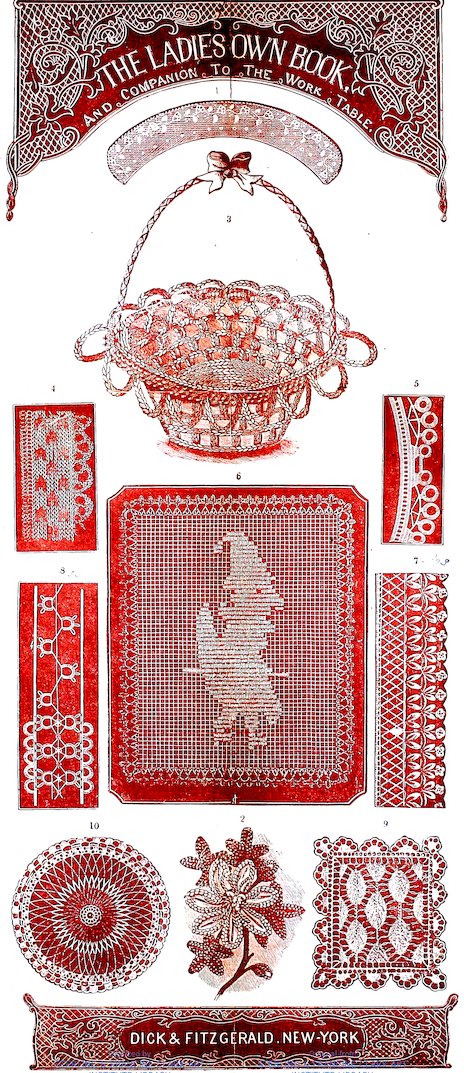
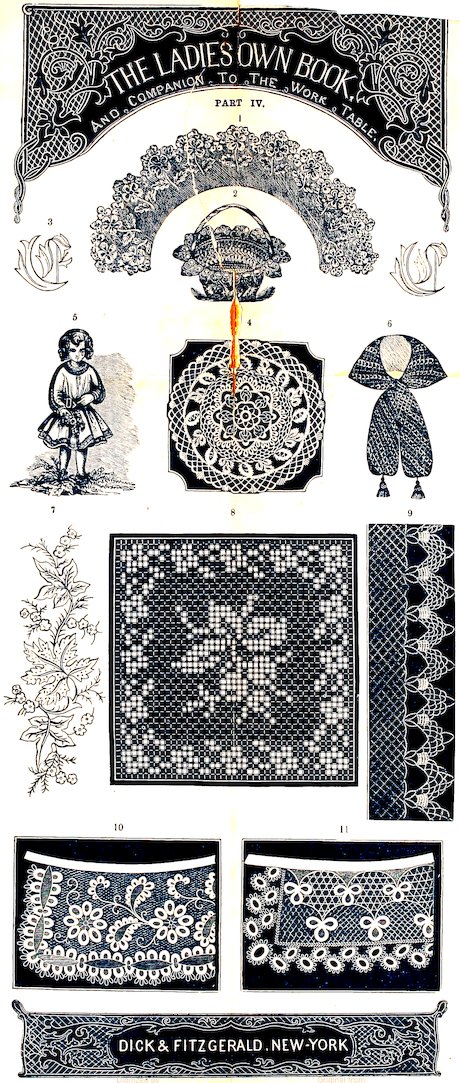
HONITON LACE COLLAR. [ Fig. 1. ]
The same sprigs and edgings may be used for
a Bertha, or Veil, as they are complete in themselves,
and only require to be tastefully grouped
and lightly sewed on Italian net, already cut into
the form required.
For the Border.—Make a chain of the length
required, taking care that there are so many
sevens and two over. 2 sc. on ch. ✕ 5 ch., miss
5, 2 sc. on 2 ch. + repeat.
2nd Row.—2 sc. on the other side of the
chain, ✕ 2 dc. 3 tc., 2 dc., in 5 ch., 2 sc. on same
2 ch. that were worked in the last row + repeat.
3rd Row.—2 slip on 2 sc. + 1 sc. 3 dc., 1 sc.
on 5 ch. 1 slip on sc.; make a chain of 12, close
for a loop, and work round in sc., 1 slip on
second sc. stitch + repeat. Do not make the loop
of 12 at the last pattern.
For the small Sprigs.—16 ch. close in 5th
for a loop, leaving a stem of four; work round
the loop in sc., 2 ch. in continuation of stem, 18
ch., close for loop, round which work thus: 3 ch.,
miss 2, sc. on 3rd, 3 ch., miss 2, dc. on 3rd, ✕ 3
ch., miss 1, dc. on 2nd + twice, 3 ch., miss 2, dc.
on 3rd, 3 ch. miss 2, sc. on 3rd, 3 ch., miss 2,
slip stitch at the close of the loop; work round
in sc. and down the 6 ch. of the stem.
25The large Sprig.—30 ch., close for a loop,
and work round it thus: 1 sl., 2 sc. dc. all the
rest but 3; 2 sc., 1 slip. Turn the work on the
wrong side; 16 ch., miss 3, slip on 4th, + 4 slip
on the last 4 of the chain; 16 ch., miss 4, slip on
5th, + 5 times; 4 slip on last 4 of the 16; 12 ch.,
miss 3, slip on closing stitch; work all round
these loops in dc., except the first and last
stitches of each loop, which must be sc. This
completes the flower: 16 ch., on which work
back, 1 sc. + 2 dc. in one chain, + 4 times, 1 dc.,
9 ch., 1 sc., 7 dc. on the 9; 1 dc. 1 tc., in next
chain of 16; 1 dc., in next; 1 sc. in next; 1
slip in next; slip back on the last 3 stitches;
6 ch., on which 1 slip, 1 sc., 8 dc. (the last of
which will come on the 16 ch.) ; 2 sc., 1 slip,
leaving 2 ch. for the stem, 8 ch.
Shamrock.—21 ch., join in 7th for loop, and
slip 4 on the last 4; 11 ch., join to the stitch
which closed the loop; slip back 4 as before
11 ch., join at the close of the loop, and work all
round in sc., also 6 sc. on stem; 26 ch. slip 11,
leaving 14 for stem; work round the 11 thus:
1 slip, 1 sc., 7 dc., 1 sc. 1 slip, on each side, which
forms a close leaf; repeat leaf, with 8 ch.
for stem instead of 14; then another leaf close
to it; 8 sc. on 8 ch. of stem; repeat the leaf;
7 sc. on stem; repeat the shamrock; 7 sc. on
stem; repeat the leaf, making a ch. of 14 instead
of 12; work in sc. to the base of the flower;
fasten off.
Honiton lace sprigs and edgings must be
finished by running the ends of thread at the
back with a fine sewing needle, and then cutting
them off.
To make hemstitch for the neck, make a
chain the required length, and work thus: 2 ch.
miss 1, 1 dc. This gives the circular form requisite
for the neck of a collar.
PASSION FLOWER IN CHENILLE [ Fig. 2. ]
26
Materials.—One piece of green chenille, of a
medium tint; one of a very delicate green; one
of violet ditto; and a small quantity of rather
stout liteaux. This last is a kind of fine wire,
used in making up flowers, &c. The chenille is
the fine kind termed chenille a broder. Crochet
hook, No. 14.
Cut a piece of liteaux, about a quarter of a
yard long; make a loop at one end of it, occupying
an eighth of the whole length, and twist the
wire, to keep the round perfect; on this loop
work 16 dc. stitches with the lightest green or
white chenille, and on these another round of dc.
stitches. Repeat this seven times more; so that
on the length of liteaux eight of these petals are
formed. When all are done, twist together the
ends of every two, and fasten them thus on a
piece of liteaux, as close together as possible.
Then prepare the stamens and pistil. Twist
some short pieces of liteaux, into a form as nearly
as possible resembling that of the natural pistil,
which, it will be remembered, has three branching
arms. Cover this with pale green chenille.
The stamens are short pieces of liteaux, some
covered with violet, and some with green chenille:
they are to be made of different lengths,
and the ends to be twisted round that of the
pistil, so that they may surround it. Then make
a small ring of liteaux, put it round the stamens
and pistil, and cover it with violet chenille,
when the centre of the flower is completed. Put
round it the liteaux with the eight petals attached,
so that the ring of violet covers the joins. Work
on a small wire ring two rounds of dark green
chenille for the calyx, in which place the flower.
27Twist the ends all together, to form a stem, and
cover it with chenille of the same color.
For the Bud.—Work 20 tc. stitches with the
light green chenille on a bit of liteaux, laying in
another piece of wire at the edge. Draw the
stitches rather together, so as to form a cup, in
which put a morsel of cotton wool. Work on
another bit of liteaux 16 dc. stitches with dark
green chenille; twist the ends together, drawing
the wire into the form of a leaf. Four of these
make the calyx which is to surround the bud.
Twist the ends together, and cover the stem so
formed with chenille.
The Leaves.—Twist a piece of liteaux large
enough to form the centre of a leaf, and work
round it in dc. with the darkest green chenille,
taking care to make your stitches very close
together. Work round this another row of the
same chenille, with a bit of very fine wire in the
edge. Do all in dc. except the first and last
stitches, which must be in sc. Twist the ends of
the wires for a stem, and cover with the same
shade of chenille. If these artificial flowers are
to be used for a head dress, four of them must be
made, and a sufficient number of leaves to form
a drooping branch on each side of the hair. For
a bonnet, they may be formed into a group.
To make a wreath of the present style, unite
the two sprays by either a coronet of leaves, or a
plait of lilac chenille.
For dark hair, make flowers of scarlet chenille
instead of lilac.
CARD BASKET IN CROCHET [ Fig. 3. ]
28
Materials.—Rich blue Berlin wool, two
ounces; gold colour and scarlet filoselle, three-quarters
of an ounce each; fine window cord;
Bone crochet hook.
Form with the cord as small a round as you
can for the commencement of the stand, and continue
to work in it, round and round, until all
the flat part of the basket is done, all in sc.
8th.—4 gold (the 1st on the 1st of last row,)
1 blue, 7 gold, 1 blue, 3 gold. 4 times.
9th.—2 gold, 2 scarlet on 1 gold, 3 gold (the
centre on the single blue,) 2 scarlet on 1 gold,
3 gold on 3 gold, 2 scarlet on 1 gold, 3 gold,
2 scarlet on 1 gold, 1 gold. 4 times.
10th.—1 gold on 1st gold of last row, 3 scarlet
on two stitches, 5 gold, 3 scarlet on 2, 1 gold
on centre of 3 gold, 3 scarlet as before, 5 gold,
3 scarlet. 4 times.
11th.—2 gold on 1, 4 scarlet, 4 gold on 3,
4 scarlet, 2 gold on 1, 4 scarlet, 4 gold on 3,
4 scarlet. 4 times.
12th.—3 gold on 2, 4 scarlet, 3 gold on 2,
4 scarlet, 6 gold, 4 scarlet, 3 gold on 2, 4 scarlet,
3 gold on 2. 4 times.
Thus it will be perceived, the written instructions
are for one exact quarter of each round.
29After having done the last round, do one entirely
of scarlet; cut off the cord at the end of the
round, and work a few stitches to conceal the
termination of it.
For the Sides of the Basket.—The rounds
alternately blue and gold.
1st Round.—1 dc., 3 ch., miss 1; repeat.
2nd.—1 dc. on centre of 3 ch., 3 ch., miss 3.
3rd.—As last, with 4 ch. between.
4th.—Repeat, with 5 ch. between.
5th.—As 4th.
6th.—5 dc. on 5 ch., 1 ch., miss 1; repeat.
7th.—Sc. all round, with cord in as in the first
part.
8th.—3 sc. on 3 centre of 5, 9 ch., miss 3,
repeat.
9th.—To be worked on the same row as the
last, 3 sc. on the 3 missed, 9 ch., miss 3; repeat.
Work these two rows in different colours, and
form a band of wire, covered with ribbon or
crochet, to correspond; conceal the fastening
with bows.
BORDER FOR AN EMBROIDERED QUILT. [ Fig. 4. ] — KNITTED EMBROIDERY.
Materials.—Knitting cotton, white and ingrain
pinks, No. 12; knitting needles, No. 15; eagle
card-board gauge.
Knitted Embroidery, of which the engraving
shows a very simple specimen, is a very novel
and beautiful style of work. In wool, its effect
rivals that of the costly chenille, with the advantage
of being washable; and now that cottons
are dyed of such exquisite colors, they are also
very suitable for it.
With the white cotton cast on 16 stitches, and
purl a row.
301st.—W.: k. 2, m. 1, k. 2 t., k. 3, ✕ k. 1 P., 1
W., 1 P., ✕ W. k. 4, m. 2, k. 2.
2nd.—W.: k. 3, p. 1, k. 1, p. 3, ✕ p. 1 P., 1
W., 1 P., ✕ white p. 3, k. 4.
3rd.—W.: k. 2, m. 1, k. 2 t., k. 5, ✕ k. 3 P,
✕ k. 8 W.
4th.—W.: k. 2, m. 2, k. 2 t., k. 1, p. 4, ✕ p. 1
P., ✕ W., p. 4, k. 4.
5th.—All white: k. 2, m. 1, k. 2 t., k. 12, p. 1,
k. 2.
6th.—W.: k. 6, ✕ p. 1 P., 1 W., 1 P., 3 W.,
1 P., 1 W., 1 P., ✕ k. 4 W.
7th.—W.: k. 2, m. 1, k. 2 t., ✕ k. 1 P., 1 W.,
1 P., 3 W., 1 P., 1 W., 1 P., ✕ W., k. 2 t., m.
2, k. 2 t., k. 2 t.
8th.—W.: k. 3, p. 1, k. 1, ✕ p. 3 P., 3 W., 3
P., ✕ W., k. 4.
9th.—W.: k. 2, m. 1, k. 2 t., k. 1, ✕ k. 1 P.,
5 W., 1 P., ✕ W., k. 5.
10th.—All White: cast off 2, k. 2, p. 9, k. 4.
Repeat the pattern to the length required.
++ Between these marks only the colors intermix.
CROCHET EDGING. [ Fig. 5. ]
Like all other crochet patterns, the size depends
wholly on the materials employed. For dress
trimmings, No. 30 Crochet cotton, with crochet
hook No. 19, will be suitable; or even finer cotton
may be used. But this pattern being particularly
suitable for trimming curtains and so forth, I recommend
Crochet cotton, No. 10, and steel crochet
hook, No. 14.
Make a chain of 15 stitches, and sc. into the
6th of these to make a loop. Work under the
upper half of this loop 8 sc.; 11 ch.; form this
loop as before, leaving one chain between it and
31the last; work 8 sc. in it; do three more with 11
ch., then one with 15, and so on throughout.
When sufficient is done for the piece required,
allowing for its diminishing by one-third, work 7
sc. on the other side of every round, and 1 sc.
between. On the five chain between every five
work 2 sc.
3rd Row.—Begun at the same place as the
last 3 sc. on the three centre stitches of the
first loop, 2 ch., 2 sc. on the centre stitches of
the next 3 loops, with 2 chain between, 3 sc. on
the last of the five, and 4 chain between; repeat.
4th. Worked the same way. 3 sc. on the 3 sc.
of last row, 13 ch., 3 sc. on 3 sc. of the fifth loop,
4 sc. on 4 ch.; repeat.
5th.—1 dc., 1 ch., miss 1; repeat.
6th.—Sc. throughout.
When this is done, work with a common needle
and thread three bars of button-hole stitch, to
connect the three centre loops, as seen in the engraving.
Border for the Anti-Macassar, which must
have a row of sc. up each side previously done
to fasten in the threads.
1st.—1 dc. over dc., of the Anti-Macassar, ✕
2 ch., 7 dc. in next dc., 3 ch., 1 dc. in same stitch.
✕; repeat all round.
2nd.—Sc. in the centre of the 3 ch. of last
round, ✕ 9 ch., sc. in centre of the next, ✕ ; repeat.
3rd.—✕ Sc. on 1st of 9 ch., 3 ch., miss 2, 1 dc.
on 3rd, 4 ch., miss 1, 1 dc. on 2nd. 3 ch., miss 2,
1 sc. on the last of the 9, ✕; repeat.
DEEP LACE IN CROCHET. [ Fig. 7. ] — FOR ANTI-MACASSARS, ETC.
Materials.—Crochet cotton, No. 12; crochet
hook, No. 14 or 15.
Make a chain the required length.
1st Row in sc.
342nd.—1 tc., 1 ch., miss 1, repeat.
3rd.—1 dc., 7 ch., miss 3, dc. in 4th; repeat.
4th.—✕ Sc. in centre of 7 ch., 7 ch., ✕; repeat.
5th, 6th, and 7th.—Like 4th.
8th.—† Sc. in centre of 7 ch., ✕; 9 ch., sc. in
same stitch, ✕ twice 3 ch., miss 3, dc. on 4th.
3 ch., miss 3, †; repeat.
9th.—Sc., miss every sc. stitch of last row.
10th.—✕ sc. on point of the next loop, 3 ch.,
sc. on point of the next loop, 7 ch., ✕ repeat.
11th.—† Sc. on centre of 7 ch., ✕ 9 ch., sc. in
same stitch, + twice 9 ch., †; repeat.
12.—† 9 sc. on 9 ch.; then, on the first
loop of 9, work 1 sc., 2 dc., 6 tc., 2 dc., 1 sc.:
then make the flower thus: 12 ch., slip in 6th
for a loop, ✕ 5 ch., 1 sc. under loop, ✕ 4 times;
work these 4 loops in sc., missing all the previous
sc. stitches, then the 5 ch. that were left of the
12; 1 sc., 2 dc., 6 tc., 1 sc. on 2nd loop of 9, †;
repeat.
TATTED INSERTION. [ Fig. 8. ] — SUITABLE FOR CUFFS, BANDS, ETC.
For the Tatting.—6 double stitches; make a
picot with a fine pin; 3 double stitches, 1 picot,
3 double stitches, 1 picot, 6 double stitches. Draw
this loop up, and leave a space as great as that
indicated in the engraving before making the next.
When a sufficient quantity of this is done, take
a piece of colored paper, rather longer than you
require the insertion to be, and on it rule two
35parallel lines, an inch apart, and another exactly
between them. Take on the tatting, allowing it
to touch, alternately, each outer line; then back
again in the same manner, so that the threads
cross at the centre line, and form a hexagonal
space between every two tatted loops. Braid
the outer lines and the ends; and if the piece
be intended for a cuff, put a double line of
braid at one end for the buttons, and also two
braid loops at the other, for button-holes. A long
needleful of Crochet, No. 70, must then be taken
along the centre line, connecting the cross lines
with a button-hole stitch wherever they occur.
Then work a rosette of English lace in every
space, and another when the four threads cross
each other. The tatting edging is made without
picots, and lightly sewed on the outer edges of
the braid, both sides of which should then be finished
with a row of Venetian edging.
Cast on any number of stitches you like, which
can be divided by 16, and 6 over for the border.
Knit three plain rows.
1st.—K. 3, + m. 1, k. 1, m. 1, k. 2, slip 1, k.
t., pass the slip stitch over, k. 2, + twice for
every pattern, k. 3.
2nd. and every alternate. Knit the three first
and last stitches, and purl all the remainder.
363rd.—K. 3, + m. 1, k. 3, m. 1, k. 1, slip 1, k.
2 t. pass the slip stitch over k. 1. ✕ twice for
each pattern, k. 3.
5th.—K. 3, + m. 1, k. 5, m. 1, slip 1, k. 2 t.,
pass slip stitch over; ✕ twice as before; repeat
and k. 3.
7th.—K. 3, ✕ m. 1, k. 2, slip 1, k. 2 t., pass
slip stitch over; k. 2, m. 1, k. 1. ✕ twice for
each pattern, k. 3.
9th.—K. 3, ✕ k. 1, m. 1, k. 1, slip 1, k. 2 t.,
pass slip stitch over; k. 1, m. 1, k. 3, m. 1, k. 1,
slip 1, k. 2 t., pass slip stitch over; k. 1, m. 1,
k. 2 +; repeat to the last 3 k. 3.
11th.—K. 3, ✕ k. 2, m. 1, slip 1, k,. 2 t., pass
slip stitch over; m. 1, r. 5, m. 1, slip 1, r. 2 t.,
pass slip stitch over; m. 1, k. 3, +; repeat to the
last, 3, k. 3.
13th.—K. 3, ✕[1] k. 2 t., k. 1, m. 1, k. 1, m. 1,
k. 2, k. 3 t., k. 2, m. 1, k. 1, m. 1, k. 2, k. 2 t.
✕. Repeat k. 3.
1. Instead of knitting two together at the beginning
and end of the pattern, in this and the following rows,
the worker will find that she must knit three together in
the body of the Anti-Macassar and at the beginning and
end of the row, only as directed in the text.
15th.—K. 3, ✕ k. 2 t., m. 1, k. 3, m. 1, k. 1,
k. 3 t., k. 1, m. 1, k. 3, m. 1, k. 1, k. 2 t., +;
repeat, k. 3.
17th.—K. 2, k. 2 t., ✕ m. 1, k. 5; m. 1, k. 3 t.,
✕. Repeat to the end of the row, when you
will knit 3 together, and then 3 of the border.
Repeat from 7th to 18th rows inclusive, until
sufficient is done; then knit 3 plain rows, and
fasten off.
Border for Anti-Macassar.—Same cotton
and needles. Cast on 17 stitches.
1st.—Slip 1, k. 2, m. 1, slip 1, k. 2 t., pass slip
stitch over; m. 1, k. 3, m. 1, k. 2 t., k. 1., m. 1,
k. 2 t., m. 1, k. 2 t., m. 1, k. 1.
2nd.—K. 1, purl all but five, k. 5.
3rd.—Slip 1, k. 2, m. 1, k. 2 t., m. 1, k. 2 t.,
k. 1, k. 2 t., m. 1, k. 3, m. 1, k. 2 t., m. 1, k. 2 t.,
m. 1, k. 1.
4th.—Like 2nd.
5th.—Slip 1, k. 2, m. 1, k. 2 t., k. 1, m. 1.
37slip 1, k. 2 t., pass slip stitch over, m. 1, k. 5,
m. 1, k. 2 t., m. 1, k. 2 t., m. 1, k. 1.
6th.—Like 2nd.
7th.—Slip 1, k. 2, m. 1, k. 2 t., m. 1, k. 2 t.,
m. 1, k. 1, m. 1, k. 2 t., k. 5, m. 1, k. 2 t., m. 1,
k. 2 t., m. 1, k 1.
8th.—Cast off 5, purl all the remainder, except
the last five, which knit plain.
NET FOR THE HAIR. [ Fig. 10. ]
Materials.—Three good skeins of scarlet or
blue netting silk; elastic ribbon and tassels to
correspond; crochet hook, No. 12.
Make 6 chain, and form them into a round.
1st.—1 tc. into every chain, and 1 ch., after
every tc., thus making 12 stitches in the round.
2nd.—1 tc. on one chain, 3 ch., miss tc. stitch.
Repeat.
3rd.—✕ 1 tc. on the centre of the loop, 5 ch.,
✕ repeat.
4th.—✕ 1 tc. on centre of loop, 7 ch. ✕ repeat.
5th to 10th rounds inclusive.—Like the last,
increasing two chain at every round, so that 9
ch. are made in the 5th, and 19 in the 10th
round.
11th.—3 tc., 3 ch., miss 3. Repeat.
12th.—✕ 3 tc. on 3 ch., 3 ch., miss 3, + repeat.
13th.—✕ 4 tc., 4 ch., miss 4, ✕ repeat.
14th.—+ 4 tc. on 4 ch., 5 ch., miss 4, + repeat.
The elastic ribbon is to be run in the 11th
round, and tassels fastened to hang over the ear.
BERLIN WORK AND CANVAS EMBROIDERY. — THE STITCHES USED IN BERLIN WORK. — TO FRAME CANVAS. — NEEDLES.
38
It being one of the chief objects of the Proprietors
of this little work, to present to the
reader, in a very portable form, the clearest
and most accurate elementary instructions for
every kind of fashionable Needlework, I have
selected Berlin Work or Canvas Embroidery
as the subject for explanation in this part.
Berlin work is the general term for what
might perhaps be more properly termed embroidery
on canvas; a material with which, doubtless,
most of my readers are well acquainted, although
they may not be familiar with the names of the
different kinds and sizes.
The French Canvas, (sometimes called Patent)
is the one which I prefer for all ordinary purposes.
The open squares are very exact, and the threads
and selvage usually firm and strong. It is the
only kind that is suitable for large pieces, or for
wreaths, or any thing else, in fact, in which
squareness and strength are essential.
Penelope Canvas has the threads placed two
and two in both directions; and took its name, I
presume, from the appearance it presents of having
been worked, and the work picked out again, like
that of the faithful wife of Ulysses. As all trouble
of counting the threads is saved, it is very easy to
work on, but can only be worked in cross-stitch.
German Canvas differs from the French in
having every tenth thread a different color, and
not being so true a square in the mesh.
39It is altogether inferior to the French (or
patent); and, (amongst other disadvantages,) has
that of showing the colored thread through any
light wool. Still, as it obviates, in some degree,
the trouble of counting, many people like to work
on it.
Silk Canvas is a very expensive article; but it
saves much labor, as designs worked on it do not
require to be grounded. I should never advise
any but white silk canvas being used, as the colored
ones do not wear well. There are so many
different qualities of silk canvas, that none should
be bought without careful examination, by laying
something of an opposite tint underneath it, and
thus detecting any irregularities, roughnesses,
&c., good silk canvas should be perfectly even.
Canvas is made of almost every variety of
width; the narrow silk canvas being the proper
size for braces.
Canvas is chosen according to its size, being
numbered much like cotton, according to the
number of threads in the inch. We seldom require
a coarser size than No. 8, which contains
11 threads to the inch—10 has 13,—and so on to
24, which has 27 threads. The next number, 30,
has 31 threads, 40 has 35, and 50, 37. We
seldom use any finer than this.
There are not so many sizes manufactured of
either silk or Penelope canvas; and the former
is never made so coarse as the cotton article.
The surface of canvas is covered by being
worked with various substances, of which silks,
wools, chenille, and beads, may be considered the
principal. Beads are now very much used, intermingled
with silks and wools. For grounding
large articles a new and very beautiful kind of
wool has lately been introduced, termed filoselle.
It works in admirably, and imparts a very rich
effect to a design. It is about the size of Berlin
wool which is fresh and good. For finer articles
floss silk is common, and chenille may be worked
on silk canvas with excellent effect.
Berlin wool may be used for almost any purpose;
for, if too coarse, it can be split without
injury; and if the reverse, two or three threads
may be worked together. It should never be
wound, for however lightly done it is certain to
be injured.
40Fleecy wool has been greatly improved both in
texture and dye of late years, and may now be
used for groundings and those purposes for which,
formerly, it would have been quite unsuitable.
It is much cheaper than Berlin wool.
English, or Embroidery wool, is a much stronger
substance than Berlin; the dark shades are
excellent for the ground of large pieces, but the
lighter tints are not equal to those in the Berlin
wool.
The chenille used for embroidery is called
chenille a broder, to distinguish it from the chenille
ordinaire, which is much coarser. The effect of
flowers, birds and butterflies, worked in chenille,
is rich and beautiful in the extreme, but the pile
so easily attracts dust, and is so liable to injury,
that it should be used only for articles which will
be defended by glass. The needle used for chenille
should have round eyes, and be sufficiently
large to prepare a passage in the satin or canvas
through which the chenille may pass without
injury.
There are but five stitches for canvas work, although
many others are enumerated; for they
are but varieties of the following:
Cross-stitch,
Tent-stitch,
Irish-stitch,
German-stitch,
Gobelin or Tapestry stitch.
Cross-Stitch is worked by bringing up the
needle on the left hand, crossing two straight and
two perpendicular lines, and putting in the needle
on the right; bring the needle up on the right
again, in the space which forms a right angle with
the two already occupied; cross the first thread,
and bring the needle under on the left hand again.
When grounding is done in this stitch, take
care to avoid all appearance of lines and joins
by using unequal length of wool, finishing each
stitch before the next is begun. Grounding
should be begun at the left hand lower corner
and worked upwards.
41Four tent-stitches, just occupy the space of
one cross-stitch a tent-stitch being taken diagonally
from one space to the next above it to the left.
Tent-stitch and Cross-Stitch are distinguished
among the French by the names of Petit
point and Gros point.
Irish-Stitch is extremely simple, and very
rapidly done. It consists of a series of upright
stitches which cross the horizontal lines, and are
worked between the perpendicular ones. For the
first line, (beginning at the left hand corner,) bring
up the needle in the lowest vacant space, and put
it down in the fourth above it, allowing it to cover
four bars of thread; bring up the needle on the
line with the first stitch, with one upright thread
between, and down on the third space, the wool
covering two threads. Repeat these alternate
short and long stitches, throughout the line. The
next and following lines, every stitch must cover
four threads; and as you bring out the needle in
the space in which you brought it down in the
last row, the stitches are still alternately two
threads higher than the intermediate ones.
German Stitch is very similar to the above;
but the stitches are taken diagonally. The first
stitch is taken from one space to the next
diagonal one; in the second, one space is missed;
so that the stitches are alternately long and short.
All the following rows are worked like the first,
care being taken that the long stitches of one
row shall join the short, and vice versa. This
stitch is only used for grounding.
Gobelin Stitch is that which is more peculiarly
fitted for delicate and beautiful picture
working; but the needle requires a really artistic
hand to direct it in forming patterns in this
stitch. The wool crosses two threads in height,
but only one in width; two tapestry stitches
therefore, are equal to a cross-stitch, remembering
that the square so formed is not a true one.
Some writers enumerate other stitches on
canvas; but the best authors reckon the above
named only, all others being merely varieties of
them.
You will observe that any pattern may be
made larger or smaller than the original when
worked, simply by selecting the canvas that will
effect the requisite alteration. When you choose
42your Berlin pattern, consider what size you will
desire your work to be, and calculate by the
scale I have already given you, what canvas will
be needed; and also whether it will require to
be worked in tent-stitch or in cross-stitch. If
for the former you may reckon a thread of canvas
for every square. For the most part, Berlin
patterns are intended to be worked in tent-stitch;
but some have each square in the more
delicate parts divided into four. When this is
the case, the mass must be worked in cross, and
the fine parts in tent-stitch; otherwise it is
quite optional.
I must repeat my previous caution not to attempt
Berlin patterns on German canvas. Figure
pieces especially, would suffer materially in the
effect from the want of squareness in the canvas.
It is not advisable to attempt reducing very materially
a pattern crowded with subjects; nor,
on the other hand, to enlarge one that has few.
The reason of this is obvious.
There is considerable art in doing this properly;
and if negligently arranged, it is certain
that the work will be distorted when complete.
Turn down the canvas and herring-bone it at
each raw edge: then sew it to the webbing of
the frame, thread by thread. When the first
end is sewed, take care that the other end shall
be as nearly as possible opposite it. If too large
for the frame, wrap some clean silver paper several
times round the roller, before the canvas goes
round it.
The part where the pattern is to be begun is
the only part to be exposed in the frame. The
sides must then be tightly braced with fine twine;
and the canvas is then ready for the work.
Berlin work is often done on canvas, with cloth,
satin or velvet underneath it: this saves the
labor of grounding, as the pattern being worked,
the superfluous canvas is cut away, and the embroidery
appears on the solid material. Some
people draw out the threads of the canvas: this
is not only very troublesome, but it also spoils
the effect of the work. Small intermediate
spaces of canvas, not covered with embroidery,
are usually grounded with wool exactly the color
of the cloth.
43In framing cloth and canvas together, it must
be borne in mind that the former stretches considerably
more than the latter. If therefore,
they are intended to be the same size, the cloth
must be cut rather narrower, and (the edges
being turned in,) must be firmly tacked to the
selvages of the canvas. This will, of course,
render the edges thicker than the centre; and
to equalize the height, paper should be wrapt
round the roller.
All patterns should be commenced at the left
hand corner, unless they are intended for a
centre; when the work must be begun on the
centre stitch.
Delicate grounds should never be attempted
on any but perfectly white canvas; and black
grounds should always be avoided, if practicable.
The last direction I can give is to ensure a
proper quantity of wool to begin with; as there
is often great difficulty in matching shades, especially
for grounding.
The needles principally used are tapestry needles,
which are thick and blunt and have a long open
eye,—Sharps, which are similar needles with
sharp points, and are used for working on thicker
substances than canvas,—as cloth, &c.; and short
long eyes, which are used for the same purpose,
and are like common needles, but very short, and
with long eyes.
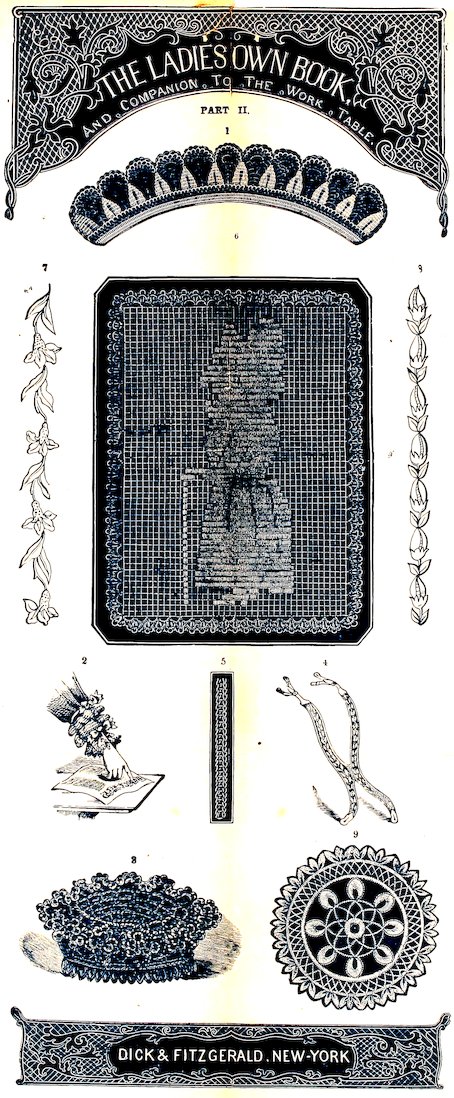
CROCHET COLLAR. [SEE FIG. 1, FRONTISPIECE.]
44
Materials.—Crochet cotton, No. 30. Crochet
hook, No. 20, or 21. Make 320 chain.
1st.—✕ 2 tc. in one chain, 1 ch., miss 1 ✕.
Repeat.
2nd.—✕ 1 tc. under every chain, 3 ch., miss 2
tc. ✕. Repeat.
3rd.—✕ Sc. in every alternative loop of 3 ch., 8
ch. ✕; repeat.
4th and 5th.—✕ sc. through every loop with 8
ch. between ✕. Repeat.
6th.—dc. in every loop.
7th.—✕ 10 tc., 1 ch., 10 tc., without missing
any; 8 ch., miss 6, 1 dc., 8 ch., miss 6 ✕, 12
times, but ending with the 2nd 10 tc.
8th.—10 tc. on first 10 of last row, 2 ch., miss
1, 9 tc., ✕ 8 ch., 1 tc. on dc., 8 ch., 9 tc., beginning
on the 2nd of 10, 2 ch., miss 1, 9 tc. ✕ 10
times, 8 ch., 1 tc. on dc., 8 ch., 9 tc. (beginning
on the 2nd), 2 ch., miss 1, 10 tc.
9th.—10 tc., 2 ch., miss 2, 8 tc. ✕ 6 ch., 1 tc.
on tc., 4 ch., 1 tc. on the same, 6 ch., 8 tc., beginning
on the 2nd of last row, 2 ch., miss 2, 8
tc. ✕ 10 times; 6 ch., 1 tc. on tc., 4 ch., 1 tc.
on same, 6 ch., 8 tc. (beginning on 2nd of last
row), 2 ch., miss 2, 10 tc.
10th.—10 tc., miss 2, 3 ch., 5 tc., ✕ 6 ch., 1
tc. in loop, * 4 ch., 1 tc. in the same loop * twice,
6 ch., 5 tc. (beginning on 3rd), 3 ch., miss 2, 5
tc. ✕ 10 times, 6 ch., 1 tc. into loop, † 4 ch.,
1 tc. into same, † twice, 6 ch., 5 tc. (beginning
on 3rd), 3 ch., miss 2, 10 tc.
11th.—16 tc. in 16 successive stitches, ✕ 6 ch.,
1 tc. into first loop * 4 ch., 1 tc. into the same
loop, * twice, 1 tc. into the next loop, † 4 ch.,
1 tc. into same, † twice; 6 ch., 9 tc. in 9 successive
stitches, beginning on the 3rd of the previous
row, ✕ 10 times; 6 ch., 1 tc. into first
loop, ¶ 4 ch., 1 tc. into the same, ¶ twice; 1 tc.
45into the next, (a) 4 ch., 1 tc. into the same (a),
twice; 6 ch., 16 tc.
12th.—14 tc. ✕ 6 ch., tc. into first loop, 4
ch., 1 tc., into the same; 10 ch., 1 tc. into the
last loop, 4 ch., 1 tc. into the same, 6 ch., 5 tc.
(beginning on 3rd), ✕ 10 times; 6 ch., 1 tc. into
1st loop, 4 ch. 1 tc. into the same, 10 ch., 1 tc.
into the last loop, 4 ch., 1 tc. into the same, 6
ch., 14 tc.
14th.—10 tc. ✕ 6 ch., 1 tc. under the 6 ch. of
the last row; 4 ch., 1 tc.; repeat into each
loop; 4 ch., 1 tc. under the 6 ch., 6 ch., 1 dc.
on centre of 3 tc., ✕ 10 times; 6 ch., 1 tc. under
previous 6 ch., 4 ch., 1 tc. in every loop as before;
4 ch., 1 tc. under 6 ch., 6 ch., 10 tc.
15th.—Sc. on end of the first row, 9 ch., sc.
on 3rd row, 9 ch., sc. on 5th row, 9 ch., sc. on
8th row, 9 ch., sc. on 10th row, 9 ch., sc. on 12th
row, 10 ch., sc. on first tc. stitch of last row,
10 ch., sc. on 8th tc. ✕ 4 ch., tc. under 6 ch.
4 ch., 1 tc. into each loop, ✕ repeat until you
come to the last 9 tc. stitches, then repeat backwards
from before the 4 ch. to the commencement
of the row.
16th.—Sc. 10 ch., sc. into every loop, until
you come to the one of 4 ch.; then work 5 dc.
into every loop, 10 ch. to the last 4 ch. End as
you began.
17th.—Sc. 11 ch., sc. in every loop until you
come to the 5 dc.; then ✕ 4 ch., sc. through
every loop, ✕ to the last 5 dc. Make the second
end to correspond with the first.
Those who crochet very loosely should use a
hook still smaller than the one I have recommended;
as the collar, to look well, should be
done very tightly.
KNITTED LACE UNDERSLEEVE. [ Fig. 2. ]
46
Materials.—Crochet cotton, No. 40; 2 steel
knitting needles, No. 20. Cast on 101 stitches.
Purl one row.
1st.—Knit 1, ✕ m. 1, slip 1, k. 2 t., pass the
slip stitch over, m. 1, k. 1 ✕, repeat.
2nd.—Purled.
Knit from 50 to 60 rows in this manner, and
cast off. This forms one puffing; and, of course,
for a pair of sleeves, you will require four.
For the Insertion.—Cast on 13 stitches;
knit one row, purl 1, knit 1, purl 1; then begin
the pattern.
1st.—K. 1, m. 1, k. 2 t., k. 3, m. 1, k. 2 t.,
k. 3, m. 1, k. 2 t.
2nd, and every alternate row.—K. 3, p. 7, k. 3.
3rd.—K. 1, m. 1, k. 2 t., k. 1, k. 2 t., m. 1,
k. 1, m. 1, k. 2 t., k. 2, m. 1, k. 2 t.
5th.—K. 1, m. 1, k. 2 t., k. 2 t., m. 1, k. 3,
m. 1, k. 2 t., k. 1, m. 1, k. 2 t.
7th.—K. 1, m. 1, slip 1, k. 2 t., pass the slip
stitch over, m. 1, k. 5, ✕ m. 1, k. 2 t., ✕ twice.
8th.—As 2nd, which completes the pattern.
Do as much of this as may be required for the
wrists, allowing a few plain rows at the end to
set a button on; and also two pieces to be inserted
between the puffs, which must be put
rather full into the bands. At the top of the
upper puff, sew on a muslin band, which may be
tacked in the dress.
According to the present style of sleeves, the
ruffle should not fall over the hand, but should
be sewed at the other edge of the wristband
with the puff, on which it must fall back. For
cold weather, an undersleeve of sarsenet, made
of the same dimensions as the knitted one, and
tacked under it, will be found a very great improvement,
and if of a colour that will harmonise
with the dress, will be very becoming.
1st Row.—Knit 2, m. 1, k. 2 t., k. 1, m. 1,
k. 2 t., k. 1, slip 1, k. 1, pass the slip stitch over,
m. 1, k. 3, m. 2, k. 2 t., m. 2, k. 2.
2nd.—K. 3, p. 1, k. 2, p. 1, k. 3, p. 5, k. 5.
3rd.—K. 2, m. 1, k. 2 t., k. 1, m. 1, k. 2 t.,
k. 1, slip 1, k. 1, pass the slip stitch over, m. 1.,
k. 10.
4th.—K. 2, m. 2, k. 2 t., k. 1, k. 2 t., m. 2.,
k. 2 t., k. 2, p. 3, k. 6.
5th.—K. 2, m. 1, k. 2 t., k. 2, m. 1, k. 3 t.,
m. 1, k. 4, p. 1, k. 4, p. 1, k. 2.
6th.—K. 12, p. 3, k. 6.
7th.—K. 2, m. 1, k. 2 t., k. 2 t., m. 1, k. 3,
m. 1, k. 2 t., k. 2, m. 2, slip 1, k. 3 t., pass the
slip stitch over, m. 2, k. 2 t., k. 2 t.
8th.—K. 3, p. 1, k. 2, p. 1, k. 3, p. 5, k. 5.
9th.—Like 3rd.
10th.—Cast off 3, k. 6, p. 2, m. 1, p. 2 t.,
p. 1, k. 5.
This lace should be put on rather full; and on
no account should knitted articles be ironed by
the laundress. It is quite sufficient to pull them
into proper shape whilst they are drying at the
fire.
INSERTIONS IN EMBROIDERY. [ Figs. 7 & 8. ]
Suitable for the fronts of shirts, and for
other purposes; to be worked in satin stitch,
with embroidery cotton, No. 80. The centres
of the leaves and cups of the flowers may be
done in very small eyelet-holes. The stalks
sewn over with extreme neatness.
TABLE MAT. [ Fig. 3. ]
48
Materials.—Shaded green and scarlet 8
thread Berlin wool; bone crochet hook. Make
a chain of six and form it into a round.
1st Round.—12 dc.
2nd.—4 ch., miss 1 sc. in 2nd. stitch; repeat all
round.
3rd.—Like 2nd.
4.—Scarlet wool; 6 ch., sc. under the loop
of 4 ch.; repeat.
5th.—7 ch., sc. under 6 ch. of former round;
repeat.
6th.—9 ch. worked as before.
7th.—12 ch. worked as before: fasten off the
scarlet and begin with the green wool once more.
8th.—12 tc. on 12 ch. of last round, miss sc.
stitch; repeat.
9th.—Sc. on 2nd. stitch, 2 ch., miss 1; repeat.
10th.—+ 1 tc., 3 ch., miss 3 +; repeat.
11th.—+ 1 tc., on tc. of last round, 4 ch. +;
repeat.
12th.—+ Dc. on 4 ch. of last round, 1 ch. +;
repeat.
13th.—[Scarlet wool,] 4 tc. on 4 dc. of last
round, 1 ch.; repeat.
14th—+ 9 dc. on 9 stitches, of last round, 9
ch., dc. into same stitch as the last +; repeat.
15th.—6 ch., sc. in 3rd dc. of last round; repeat
this twice more; 8 ch., unite into the loop
formed by 9 ch. in last round; three times more,
then repeat from the commencement of the 15th
round.
16th.—Sc. in centre loop of 8 ch. in scallop;
1 ch., sc. into centre loop of 8 ch. in next scallop,
11 ch.; repeat.
17th.—12 ch., sc. in third stitch; repeat.
18th.—12 dc. through every chain of 12 in
last round.
19th.—5 ch. unite with sc. on the point of the
loop; repeat.
20th—Dc. all round, and fasten off.
GENTLEMEN’S KNITTED BRACES. [ Fig. 4. ]
49
Materials.—Rich, dark blue, or crimson crochet
silk; two knitting needles, No. 14. Cast
on 19 stitches.
1st. Row.—K. 2, m. 1, k. 1, slip 1, k. 1, pass
the slip stitch over, p. 1, k. 2 t., k. 1, p. 1, k. 1,
slip 1, k. 1, pass the slip stitch over, p. 1, k. 2 t.,
k. 1, m,. 1, k. 2.
2nd.—P. 5, k. 1, p. 2, k. 1, p. 2, k. 1, p. 5.
3rd.—K. 2, m. 1, k. 1, m. 1, slip 1, k. 1, pass
the slip stitch over, p. 1, k. 2 t., p. 1, slip 1, k.
1, pass the slip stitch over, m. 1, k. 1, m. 1, k. 2.
4th.—P. 6, k. 1, p. 1, k. 1, p. 1, k. 1, p. 6.
5th.—K,. 2, m. 1, k. 3, m. 1, slip 1, k. 2 t., pass
the slip stitch over, p. 1, slip 1, k. 2 t., pass the
slip stitch over, m. 1, k. 3, m. 1, k. 2.
6th.—P. 8, k. 1, p. 8.
7th.—K. 2, m. 1, k. 5, m. 1, slip 1, k,. 2 t., pass
the slip stitch over, m. 1, k. 5, m. 1, k. 2.
8th.—Purled.
Repeat this pattern until you have done the
length required for one half of the braces. Then
cast on, and do another length. When made up,
they should be lined with white Petersham ribbon,
and finished with white kid trimmings.
No.—1.—Make a chain the length required and
then work back in dc. This is a very neat little
50trimming for children’s dresses; and if required
to be made of silk and purse twist be used, will
be found to answer every purpose for which a
narrow gimp may be required. It forms also an
excellent substitute for the braid which is run
on the skirt of a dress, as the wools of which it
should then be made, can be procured of any
shade whatever, which the braid itself cannot.
No. 2.—Make a chain of the length required,
and on it work 1 dc., 1 ch, miss 1.
49th.—13 os., 1 dc., 1 ch., miss 1, 30 dc., 1 ch.,
miss 1, 20 os., 1 dc.
50th.—13 os., 1 dc., 1 ch., miss 1, 15 dc., 1 ch.,
miss 1, 1 dc., 1 ch., miss 1, 12 dc., 1 ch., miss 1,
20 os., 1 dc.
51st.—14 os., 13 dc., 2 ch., miss 2, 1 dc., 2 ch.,
miss 2, 1 dc., 1 ch., miss 1, 8 dc., 2 ch., miss 2, 20
os., 1 dc.
52nd.—14 os., 10 dc., 2 ch., miss 2, 3 os., 5 dc.,
1 ch., miss 1, 21 os., 1 dc.
53rd.—15 os., 6 dc., 2 ch., miss 2, 26 os., 1 dc.
54th to 57th inclusive.—In open square crochet.
The border to be the same as that given for
Punch’s Anti-Macassar, in part I. of this book.
CROCHET D’OYLEY. [ Fig. 9. ]
53
Materials.—7 shades of Berlin wool; bone
hook.
Make a chain of 9, and form it into a round.
1st.—Dc., increasing 3 in the round.
2nd.—6 ch., 1 tc., miss 3. Repeat.
3rd.—Sc. on centre of 6 ch., 9 ch. Repeat.
4th.—Sc. on centre of 9 ch., 12 ch. Repeat.
5th. Sc. on centre of 12 ch., 15 ch., sc. on
same stitch, and work 1 sc., 2 dc., 14 tc., 2 dc.,
1 sc. in the loop thus formed. Fasten off, and
repeat in the centre of every 12 ch.
6th.—Begin on the point of the leaf with a
sc. stitch; 15 ch., sc. on point of next leaf, and
so on.
7th and 8th.—Dc. all round.
9th.—✕ Sc., 6 ch., miss 2, ✕. Repeat.
10th.—✕ Sc. on centre of 6 ch., 9 ch., ✕;
repeat.
11th.—✕ Sc. on centre of 9 ch., 12 ch., ✕;
repeat.
12th.—✕ Sc. on centre of 12 ch., 9 ch., ✕; repeat.
13th.—Dc.
14th.—Dc., working two stitches into every one.
15th.—Sc. on the centre of one of the spaces.
✕ 12 ch., sc. in same stitch three times, 12 ch., sc
on centre of next space. And repeat from ✕.
16th.—Dc. all round.
17th.—Sc., ✕ 5 ch., miss 2, sc. in 3rd ✕. Repeat
all round, and fasten off.
POINT LACE STITCHES.
54
Point Lace
is now so fashionable
that very
few are unacquainted
with
its appearance;
but perhaps
some of my readers
will be surprised
when told
that the whole
of the genuine
Point Lace is
the production
of the needle;
not merely the
close and heavy
parts are so
made, but the
most exquisitely
delicate nets,
of which, of late
years, we have
had imitations
from the loom,
are all alike produced
by the
common sewing
needle.
The work of
which we treat
here may be regarded
not as
an imitation of
the valuable and
beautiful work
of ancient times,
but rather as an
actual revival
of an art which
has unfortunately
been suffered
to sink into
oblivion. Of
course, at present,
I content
55myself with giving very simple Point Lace patterns;
but, as my fair readers advance in knowledge,
I shall give them specimens which will still
more exercise their skill and patience.
Point Lace stitches are worked on a foundation
of braid or tape; or, sometimes, cambric. At
present, I chiefly use braid, it being the more
comeatable material, and answering extremely
well for delicate articles. It is the kind termed
French white cotton braid, being very closely
and evenly plaited. That used for large patterns
is No. 9; for delicate work, a still narrower braid
may be employed.
Very much of the beauty of Point Lace depends
of course, on the skill of the workers; but
it would not be exaggeration to assert that even
more is the result of the adaptation of the materials.
A very great variety of cotton and linen thread is
absolutely necessary; not less than nine different
kinds entering frequently into the composition
of one single collar: those I use are termed
Evans’s Point Lace Cottons, manufactured by
Messrs. Walter Evans and Co., of Derby; and
they are as superior to all others that I have tried
as it is possible to imagine. They are sold selected
and arranged properly for this kind of
work.
The pattern being drawn in outline, on colored
paper, is to be then pasted on calico or linen;
when quite dry, begin to braid it, by laying on
the braid, and running it on the paper with a
fine needle and cotton, No. 50. The stitches are
to be taken through the paper, and not very closely
together, except where points of leaves and
other angularities occur. In these places the
braid is sewed at each end of the pattern and
turned back; this is termed mitreing. The stitches
must be taken across the braid, as it is not
liable then to become wider.
The stitches which are used in the specimens I
have hitherto made in point lace are the following,
which may be divided into three kinds: edgings,
laces, and connecting bars.
The use of the edgings is sufficiently obvious:
they form narrow borderings to the braid or
other material which is the foundation of the
lace.
The lace stitches are used to fill up open parts
56in the design, such as the leaves, flowers, or fruit,
the mere outlines of which are made in the braid.
Finally, the connecting stitches unite the several
parts into one perfect mass of work.
EDGES.—Brussels Edging (No. 1).—This is
merely the common button-hole stitch, or (as it is
sometimes called) glove stitch. It is worked
nearly at the edge of the braid, and differs only
from the ordinary button-hole because the stitches
are taken at the distance of the fourteenth part
of an inch apart, and, as the thread is not drawn
tightly, each stitch forms a small loop. It is
worked from left to right.
Venetian Edging (No. 2).—The first stitch is
taken as in Brussels edging, and in the loop thus
formed, four tight button-hole stitches are
worked.
Sorrentine Edging (No. 3).—Make a stitch
as in Brussels edging, but the eighth of an inch
long; work one button-hole stitch in the loop;
repeat at the distance of the sixteenth of an inch;
two stitches are thus formed, one of which is half
the length of the other. Repeat.
LACES.—Brussels Lace (No. 4) is worked
by doing a line of Brussels edging in the space to
be filled up, and then another line, from right to
left, putting the needle, at every stitch, through
one of the loops of the first row. These lines are
to be repeated, backwards and forwards, until
the part is completed. In working the last
row, run the needle through the braid after every
stitch.
Venetian Lace (No. 5).—The beautiful closely-dotted
appearance, characteristic of this lace,
is obtained by working consecutive rows of Venetian
edging, not backward and forwards, but
always from left to right, fastening off after completing
each line; or, if the space be very small,
running the needle in the braid back to the place
where the next line is to be begun.
English Lace (No. 6) is used principally to
fill up large open spaces. Make a series of diagonal
bars across the space to be filled up, securing
the tightness of each thread by working a
button-hole stitch on the braid, before slipping
the needle to the next place; cross these bars by
others, in the contrary direction, and at the same
57distance (one-eighth of an inch) apart. Wherever
the bars cross each other, work a small spot,
by passing the needle alternately under and over
the threads, five or six times round. Twist the
threads twice round each other in bringing
the needle to the next cross, and repeat until a
spot is made at every one. Observe, that in
crossing the first bars you slip the needle alternately
under and over them.
Open English Lace (No. 7) is commenced
like the preceding, but when the two lines of
diagonal bars are made, a line of perpendicular
and one of horizontal threads must be added.
The spot will thus be worked on eight threads
instead of four. The lines to be at the rate of
five to an inch.
English Rosettes (No. 8).—Another beautiful
style of English point. It is a kind of spot,
which looks like the miniature of the rosette on a
baby’s cap, whence its name is derived. A single
spot is only used in one space, and the size is to be
suited to it. The open space is crossed with
four, six or eight twisted threads; the last thread
to be twisted only to the centre, where all
are to be firmly joined by working one or
two tight button-hole stitches. Make the rosette
by passing the needle round one thread
and under the next, then round that and under
the succeeding; continue until you have made a
rosette as large as the space requires, working
from four to ten times round. Stop at the
single thread, twist round it, and fasten off.
Mechlin Lace (No. 9).—This is one of the
most beautiful, and at the same time, complicated
stitches in the list. Those who have worked it,
however, all confess that the effect amply repays
the trouble. It is worked thus: A number of
diagonal bars, each of a single thread, cross each
other in the space to be filled up, at the distance
of one quarter of an inch from each other. Then
all the bars in one direction are to be covered
with button-hole stitch. Begin in the opposite
direction, in the same way, and work it
nearly to the crossing of the two. Pass the
thread loosely round the cross twice, slipping the
needle under one and over another thread, so as
to form the small circle seen in the engraving.
This is to be covered with button-hole stitch;
58and as, from the looseness of the thread, it is
otherwise somewhat troublesome to work it, pin
it down on the paper with a second needle. In
the middle of each quarter of every alternate
round, a dot is to be worked thus: instead of
drawing the thread tight, as usual, put in the
loop a pin, which is to keep it about the eighth
of an inch in length. On this loop work three
button-hole stitches; and withdraw the pin, and
continue the round.
Valenciennes Lace (No. 20,) has a very heavy
appearance, and contrasts admirably with lighter
stitches. A space to be so filled up has a number
of radiating threads, meeting, in a common centre,
to be very closely darned with extremely fine
thread.
Henriquez Lace (No. 11), is, on the contrary,
a very light and delicate stitch. It must
never be done with coarser thread than Evans’s
boar’s head, 120. With this make a diagonal
line across the space to be so filled in, and return
your needle to the point you began from, by twisting
the thread back again. Make another line,
parallel with this one, and not more than the tenth
of an inch from it. Twist it over four times, then
on the single and double thread form a spot, by
darning the three backwards and forwards about
sixteen times. To do this, you must separate
the two threads twisted together whenever you
make a spot. Continue twisting your needle
round the single thread, for the space of one
quarter of an inch, when you will form another
dot. Repeat until this line is finished. Make
similar ones at one quarter of an inch apart in
the entire space; and then cross them with
others, worked in precisely the same manner, in
exactly the opposite direction. Take care that
where the lines cross each other the thread is
twisted between the first bar and the second,
that a small, clear square may be maintained.
Cordovan Lace (No. 12), is similar to the preceding,
but less delicate and less troublesome.
Two twisted bars are made the tenth of an inch
apart, and a third single one, in going back on
which the spots are worked on two twisted
threads and the single one. They are also crossed
by similar ones, the crossing of the threads forming
a diamond of four holes.
59CONNECTING BARS are stitches used in
the various kinds of point lace, to unite different
parts. The most simple is the
Sorrento Bar (No. 13), which is made by
passing a thread from one part to another, fastening
it by a tight stitch, and twisting the thread
back on the bar thus formed; pass the thread
round until it appears as much twisted as a rope.
Bars in Alencon Point (No. 14).—This is
almost the same as our common herring bone
stitch, but the needle is passed under the last
thread after every stitch before taking another,
which twists the two together. Where the space is
more than half-an-inch wide, it is requisite to pass
the needle more than once under after every stitch.
Venetian Bars (No. 15).—Pass the needle
backwards and forwards two or three times, and
work the bar thus formed in close button-hole
stitch. If it be a cross bar, work the button-hole
stitch half the length; make the bar in the
opposite direction, work that; and if another is
required, do the same before finishing the first bar.
Edged Venetian Bars (No. 16) are merely
the above edged on each side with Brussels or
Sorrento edging.
Dotted Venetian Bars (No. 17.)—To make
these bars, pass the thread across the space two
or three times, and make four button-hole stitches
on the bar thus formed; put a needle in the
fourth, and draw it out until it will allow of
three or four button-hole stitches being worked
on it; continue the bar in the same way.
English Bars (No. 18) are used to connect
two lines of edging. Pass the needle backwards
and forwards between two opposite stitches four
times each way, always putting the needle in the
under side of the edge. Sometimes these bars
are radiated, by missing a stitch more on one
side than on the other.
The marked characteristic of Spanish Point
(No. 19) is a kind of heavy satin stitch, with
which parts are ornamented. It is very much
raised, and afterwards worked in button-hole
stitch with fine linen Mecklenburgh thread.
Continuous rows of Sorrento edges worked
backwards and forwards, like Brussels Lace, form
60a variety represented in a corner of the Engraving.
The lower line of edging in the Engraving is
termed Little Venetian. It is worked like the
other, but with only one button-hole stitch.
When, by means of these different stitches,
the pattern is formed into a solid mass of work,
the stitches at the back are to be cut, to detach
the lace from the paper; the threads may
then be picked out and the article is complete.
To join point lace on to cambric or muslin,
make an extremely narrow hem on either, and
lay the inner line of braiding on that. Join
them together by running on the middle of the
braid through the cambric, and then working a
line of Brussels edge on to the inner part of the
braid, taking every stitch through both substances.
2nd.—+ 3 tc., 3 ch., miss 3, +. Repeat. Finish
with 3 tc.
3rd.—+ 3 dc. on 3 tc., 3 ch., +. Repeat.
4th.—+ sc. on 1st dc., 6 ch., miss 5, sc. on
6th, +. Repeat.
5th.—Sc. on the centre of first loop, +, 7 ch.,
sc. on centre of next loop, +. Repeat.
6th.—Sc. on centre of first loop, + 6 ch., sc. on
centre of next loop, +. Repeat.
7th row.—Dc. on all the chain, missing every
sc. stitch.
8th.—Sc. on first stitch, 9 ch., sc. on
same stitch, 12 ch., sc. on same stitch, 9 ch., sc. on
same stitch, turn the work, dc. in every chain of
the 3 loops just formed, turn again, and work
dc. on the previous dc. except the first 5, 7 ch.,
miss 5 stitches of the 7th row, 6 dc. on the
next 6, +. Repeat.
9th.—Sc. on the point of the leaf of 9, 4 ch.,
+ sc. on point of large leaf, 15 ch., +. Repeat.
Finish the row with 4 ch., sc. on point of last
small leaf.
10th.—Dc. in every stitch of the last row
working 2 in every 4th.
11th.—+ 2 dc., 3 ch., miss 3, + until you come
to the stitch over the large leaf, then make a
loop of 6 ch., dc. into the same stitch. Repeat.
12th.—Dc. on all the rest of the line, working
every loop thus—1 sc., 4 dc., 1 sc.
15th.—Dc. in first dc. of last row, + 3 ch.,
miss 2, dc. in 3rd +. Repeat, but without missing
any on the loops.
16th.—Sc. on first chain of the foundation, and
62up the side work 4 ch., miss 2, 8 sc., sc. on every
stitch of the last row, and dc. the other end of
the collar like the first.
17th.—Sc. under first loop, 5 ch., sc. under
2nd, repeat to the sc. stitches, then + 5 ch. miss
2, sc. on 3rd, + to the end, which work like the
beginning.
MAT WITH BORDER OF MOSS, CHERRIES, AND LEAVES. [ Fig. 2. ]
Materials.—Half-an-ounce of bright cherry-coloured
Berlin wool; two shades of green ditto,
or of chenille a broder, two skeins of the best
green fleecy of different shades, or shaded Shetland
will do as well.
For the Moss.—If fleecy wool be used, it
must be split, and a thread of each shade taken,
by using Pyrenees wool this trouble is obviated.
Take a pair of very fine knitting needles; cast on
16 to 20 stitches: knit a piece as tightly as
possible, four times the length required: wet,
and bake or dry it before the fire. When it is
quite dry, cut off one edge throughout the whole
length, and unravel all the stitches but two at the
other edge. (Take care to begin to unravel at
the end you left off knitting, or the wool will
get entangled.) Fold it in four, and sew the
edges together. This will make a very full moss
fringe.
For the Cherries.—Cut a number of rounds
in card, each the diameter of a good-sized
cherry. Cut a small hole in the middle of each
take a needleful of Berlin wool, three times the
length of your arm; thread it with a rug
needle; pass the needle in the hole of the card,
holding the end of the wool with the left hand;
pass the wool; lay it on the edge of the card, as
if you were going to wind it; pass the needle
63through the hole again; repeat this until the
whole needleful of wool is used. Then make a
little tuft of wool on the end of a rather fine
wire; twist the wire tight and pass the ends
into the hole of the card; take a pair of sharp-pointed
scissors, cut the wool all round the card;
with a bit of waxed thread, tie as tightly as possible
the little bunch of wool in the hole of the
card, tear the card off, and pare the wool as
smooth as velvet; cover the ends of wire with
green wool or silk, and each cherry is completed.
Leaves.—Make a cherry of 13 loops in green
wool, and on them, miss 4, dc. in 5th, ✕2 ch.,
miss 2, dc. in 3rd, twice 1 ch., miss 1, slip on
first of 13. Take a ✕piece of very fine wire and
hold it in, while working round this open hem,
leaving a short piece for a stem. Work all round
in tc., except the 2 first and 2 last stitches
which are to be 1 sc., 1 dc., and 1 dc., 1 sc., twist
the two ends of wire together, cover them with
wool. When sufficient leaves are done, form
them into a wreath with the cherries, joining
them by means of the ends of wire; insert them
in the moss, and sew the border thus made
round a mat of velvet, or work, lined with card-board,
and with silk at the other side.
This border may be used for any crochet or
knitted mat; the moss may be made more or
less thick according to taste. A very full border
would require six lengths.
INITIALS IN EMBROIDERY [ Fig. 3. ]
Materials.—Ingrain red and white embroidery
cotton, No. 70 for linen, No. 80 for cambric.
These Initials should be marked on the material,
and then worked in the white cotton in
raised satin stitch, after which a thread is to be
64run entirely round the work, and sewed over in
red very closely indeed.
Every angle and point must be made with the
utmost accuracy, as on this the beauty of the
letters greatly depends.
AUTOUR BOUTONS. [ Fig. 4. ]
Small pattern to surround shirt-studs; to be
worked in embroidery cotton, No. 80. The
small rounds in eyelet-holes to be made with a
fine stiletto, and sewed over.
A VERY PRETTY CARRIAGE BAG. [ Fig. 5. ]
Materials.—White and blue Berlin wool,
half-an-ounce of each; two flat meshes, not quite
a quarter of an inch broad, a piece of French
canvas, No. 24, one-half the size the bag is
desired; gros-de Naples, (the shade of the
coloured wool), cord and tassels to match. With
the blue wool work on the canvass, in common
cross-stitch, a square of 6 stitches in every direction;
miss an equal space and repeat. Thus the
whole space of canvass must be prepared like a
chess-board, the blue checks of one line coming
between those of the previous, the third over
those of the first line, and so on. Having completed
this, take one of your meshes and a rug
needle, threaded with white wool, work immediately
over each blue square of the first line 6
stitches, thus:—Begin at the top of the stitch, lay
the wool over the mesh, take two threads for the
lower part of the stitch, pass the wool under the
mesh, finish your stitch; repeat five times; leave
the mesh on the stitches; take the second mesh,
work a second row exactly alike over this; then,
at the top, a third row of white stitches, four
threads long, and two broad.
65Turn the work, and in the space which is now
over, but was first under the first row of blue
squares, work with the white, the rows round the
meshes, as before, and one of long white stitches.
Turn the work again, and work the next two
rows of white stitches round the meshes.
Repeat the same operation over every other
line of blue squares.
Now take the work cross-way, and work in
white, as before, every space left; then cut the
ends of the white wool.
Make up the bag with a top of silk, line it,
add cords and tassels, and it is complete.
If preferred without silk, have canvass the full
size for a carriage bag and work it all over.
The size I have given for materials will make
this d’oyley about 20 inches, as there are 88
squares, and 9 squares are equal to 2 inches.
Of course, with finer cottons and hooks, the size
will be diminished. Patterns given in square
crochet are very pretty worked in two colours
of wool. The open squares should be worked in
one colour, and the close in the other; every
square consisting of three dc. stitches. Mats of
this description should be tacked on a stand previously
formed of stout card or mill-board,
covered with green calico or silk.
DEEP POINT LACE, FOR A HANDKERCHIEF OR VEIL. [ Fig. 8. ]
66
Visitors to the London Exhibition, will recognise
this pattern as one of those in the gallery
of that wondrous palace: I presume, therefore, it
will be very acceptable to my fair readers.
The pattern of the flowers is well adapted for
the mandarin sleeves which everbody wears just
now. To draw the pattern for that purpose,
merely copy over and over again the two large
flowers at the bottom of the page. Draw the
pattern on colored paper, and use a fine sable
brush, dipped in Indian ink for coloring the lines;
paste the paper on linen, and when dry it will be
fit to be worked. A little more management is
required when a pattern for a handkerchief is to
be made. Cut a square of tissue paper, rather
larger than the handkerchief is to be,—double it
twice, so as to mark the centre of each side, and
trace the three divisions of the corner flower up
to a on one side of this centre, leaving room for
half of another division; fold the paper and trace
a similar piece of the flower on the other side of
the centre, and finish also the division in the middle.
As it will be seen on referring to the plate,
that there are three divisions and nearly half
another up to the a, it will be evident that the
centre flower will have seven divisions. On the
right of this centre draw three of the flowers at
the lower edge of the frontispiece, and at the corner
another flower, exactly like the centre one,
but turned so as to form a corner. Trace the
left hand side of the centre from that already
done, and you will have a perfect side with two
corners. Draw the pattern on colored paper,
from this one side, and line it with linen before
working it.
You will observe that there are two straight
lines of braid in the inner border; the one nearest
to the flowers is only to be laid on when working
67the lace, and connected with the other: no
edging is to be put to it until after the hemmed
cambric is laid underneath, when it is to be run
on, and then edged with Brussels edging.
a.—Sorrento edging. To be worked with
Mecklenburgh thread, 120.
b.—Venice edging. Boar’s-head thread, No.
50.
c.—Brussels edge. Ditto.
d.—Bars of Venice Point. Mecklenburgh
thread, 120.
e.—Rosettes worked on 4 threads: the centre
ones gradually increasing in size, towards
the outer edge of the flower; the others as
small as the spots of English Point. Boar’s-head
thread, No. 90.
f.—Open English lace. Ditto.
g.—Brussels lace. Ditto.
h.—English lace. Boar’s-head thread, No.
70.
i.—Sorrento bars. Mecklenburgh thread, No.
120.
j.—Rosettes. Thread No. 70.
k.—Bars in Alencon point. Ditto.
CROCHET EDGING.
Materials.—Cotton, No. 30. Crochet hook,
No. 20.
Make a chain of the required length, and work
on it one row of dc.
2nd.—✕ 1 dc., 2 ch., miss 2 ✕; repeat.
3rd.—Dc.
4th.—✕ 11 tc., 6 ch., miss 6 ✕; repeat.
5th.—✕ 9 tc. (beginning on the 2nd of last
row); 5 ch., 1 tc. under 6 ch.; 5 ch. ✕; repeat.
686th.—✕ 7 tc., commencing on 2nd, 6 ch., 1 tc.
in first loop, 6 ch., 1 tc. in 2nd, 6 ch. ✕; repeat.
7th.—+ 3 tc. commencing on 3rd of last row, *
6 ch., tc. in loop * to the next tc. stitches, +;
repeat.
8th.—+ tc. on 2nd of 3 of last row, * 6 ch., tc
in loop * to next tc. +; repeat.
This edging will be found very pretty for
children’s dresses and similar articles.
Make a chain of the length required.
1st. row.—1 dc., 1 ch., miss 1; repeat.
2nd.—✕ 1 dc. under a loop, 6 ch., miss 1
loop, dc. under 2nd, 6 ch., miss 1 ✕; repeat.
3rd.—✕ 7 dc. under 1 loop; 3 ch., 2 dc. under
next loop, 3 ch. ✕; repeat.
4th.—✕ 6 dc. over 7, 4 ch.; 2 dc. over 2, 4 ch.
✕; repeat.
5th.—✕ 4 dc. over 6, 4 ch.; 3 sc. over 2, 4 ch.
✕; repeat.
6th.—✕ 3 dc. over 4, 4 ch.; 1 dc. before 3 sc.,
5 ch.; 1 dc. after sc., 4 ch. ✕; repeat.
7th.—✕ 2 dc. over 3, 5 ch.; 6 dc. under the
5 ch., 5 ch., ✕; repeat.
8th.—✕ 1 dc. between 2 dc., 5 ch., 1 dc. after
first of 6 dc., 3 ch; dc. after 2nd, 3 ch., dc. after
3rd, 3 ch., dc. after 4th, 3 ch., dc. after 5th, 5
ch. ✕; repeat.
CROCHET INSERTION.
69
Materials.—Cotton, No. 30 or 34.
Very suitable for shirt fronts and similar
articles.
Make a chain of the required length and work
one row of dc.
2nd.—1 tc., 1 ch., miss 1; repeat.
3rd.—Dc. throughout.
4th.—A row of eyelet-holes, thus—8 ch., close
in a round in the second ch.; work 3 dc. in the
round thus made, drop the loop on the needle,
insert the needle in both sides of 5th dc. of last
row, counting from the top of the row, pick up
the dropped loop, finish a stitch of dc., work three
more crochet in ch. in the round; repeat from
the beginning of the row, joining in every fifth
stitch.
5th.—(The second side of the eyelet-holes)—7
dc. in each eyelet-hole, 1 ch. between every 2.
6th.—4 ch., dc. in 4th on the 2nd side of the
first eyelet-hole; repeat.
7th.—dc.
8th.—1 tc., 1 ch., miss 1; repeat.
9th.—dc.
This insertion is remarkably strong, and very
pretty, made of silk, for trimming dresses, &c.
ELEMENTARY INSTRUCTIONS IN EMBROIDERY. — TO MARK PATTERNS. — STITCHES.
70
Undoubtedly the most artistic style of
needlework is that termed Embroidery; not
the canvas embroidery of which I treated in
Part II. of this work but the yet higher kind
of needlework-painting, which aims at producing
really pictorial effect, without the mechanical
assistance which canvass gives in counting stitches
and determining shades.
In embroidery much is left to the eye, and
still more to the taste. A few words, therefore,
on the subject of selecting colors and harmonizing
tints, as well as on the mere stitches
employed, will probably be acceptable.
Designs are invariably marked on satin, cloth,
or velvet, by means of what are termed pounced
patterns. These are prepared in the following
manner:—The design is carefully traced on
rather thick writing paper; then, with a fine
stiletto it is marked in holes, distant from each
other not more than the eighth of an inch: from
the pattern thus prepared, any number almost
may be marked. The material to be embroidered
is then laid on the table, and the pattern placed
in the proper position over it, and kept there by
means of leaden weights. A little pounce, or
powdered flake white must then be rubbed over
the paper, with a large and flat stump, and, on
the paper being raised, the design appears accurately
marked on the cloth. It requires to be
afterwards re-marked with a fine sable brush,
dipped in a mixture of flake white and milk, or
an artist’s color, contrasting with the material,
71mixed up with a few drops of spirits of turpentine.
White satin, or any very light color on which
white would not show may be pounced with very
finely powdered charcoal, and then marked with
a solution of Indian ink.
For drawing a pattern on any washing material
a still simpler plan may be adopted. Scrape
some red or blue chalk; brush it lightly over a
sheet of thin tissue paper, shake off the loose
grains, lay the chalked side of the paper on the
muslin, and over it the pattern, which you will
trace with a hard sharp-pointed pencil, and the
design will be clearly marked, and require no
further trouble.
When any parts of a pattern are repeated—as
the quarters of a cushion or a handkerchief,
or the scallops of a flounce—have only the
pounced pattern of one quarter or section, and
mark all from that one. It will be found a
much more accurate mode than that of making
the whole paper pattern perfect.
The next step is to put the material in a frame,
two or three inches wider than the work it is
to receive. I must refer to my Instructions in
Berlin Canvas Work, Part II. of this book
for the directions for this very important part of
the process. The needles used are technically
called short long eyes and strands. The latter
are like common needles, but unusually long.
It injures the work to use too fine a needle,
as the small eye frays the silk; on the other hand
a needle that is too large makes holes in the cloth.
The materials chiefly used for embroidery are
wools, chenille, and silks: there are great varieties
of the last-mentioned article, the principal being
Mitorse, Dacca, Berlin, fine and coarse flax,
crochet, and netting silks. Of the netting silks
there are many sizes, which may be used according
to the delicacy of the work.
Initials intended to be in gold, for sachets,
&c., are almost as effective if rich gold-colored
twisted silk be used instead; and the silk will
wear for ever, whilst it is almost impossible to
obtain gold thread which will not tarnish in a
few months.
The common stitch used in embroidery is
72termed long-stitch. It closely resembles the Irish
stitch of canvass work,[2] only without its regularity.
The stitches are taken closely together
and of uneven lengths; the second shade is
blended with the first by filling up the vacant
spaces of the short stitch; the next shade, in the
same way, unites with that one, and so on in an
irregular form, the outline only presenting,
a regular line of stitches, exactly within the
limits of the marked pattern. The shading
must, of course, be done with artistic accuracy.
The veinings of leaves are worked in silk
rather coarser than that used for the rest of the
work. Sometimes this silk is considerably
thicker; it is then laid on, and sewed over with
very fine silk of the same shade, the ends being
drawn through the material. Leaves are frequently
veined with gold thread in a similar manner.
Large leaves should be worked from the points
to the veins; small ones seldom require to be
veined at all. Like stems they are formed of a
succession of slanting stitches very evenly laid
on, forming curves and lines of the width and
dimensions of the patterns, and forming accurate
outlines.
When gold bullion is employed in embroidery,
it is cut into short lengths, which are then laid
on with fine silk of the same hue. Gold thread
is sewed over, and the ends brought through the
cloth and so passed from one part to another.
The Chinese employ, in their most elaborate
embroidery, a very pretty stitch termed, by us,
the French Knot. It is made thus:—Bring the
needleful of silk to the right side of the work, in
the exact spot where the stitch is to be. Hold
the needle in the right hand, and with the left
take up the silk, at an inch or two from the
cloth. Twist the needle twice round the silk,
insert it in the same spot you drew it through
before, and, with the right hand, draw the needle
to the under side, gradually tightening the silk
with the left hand. When quite drawn through
the knot is formed. The great art in this work
is to make the stitches all lie perfectly even.
We seldom use the French Knot for anything
73but the seeds, stamen, or pistils of flowers; but
the Chinese execute whole pieces in this stitch,
shading them most exquisitely, and only using a
coarse white silk or gold thread as an outline to
the whole. In bead embroidery, every stitch is
generally put on separately, and in its own place;
but a very beautiful effect may be obtained in
pearl beads imitating grapes, by stringing them
with white silk, and letting them cross each other in
various directions, still preserving the outline of
the cluster.
A very pretty and effective style of embroidery
is that done with gold braid and wool on
canvass. It is very suitable for slippers,
cushions, the bands of smoking caps, blotting
cases, and many other things. An outline design
in arabesque, or anything else that may appear
suitable for two colors, should be drawn on
paper of the proper dimensions and then marked
on the canvass. The gold braid must be cut into
pieces of the proper lengths, and laid on piece by
piece, the spaces between the pattern being filled
with wool of some well-contrasting color—as
bright blue, green, or claret—so that the pattern
appears in gold on a ground of wool. When
leaves are so worked, a rich silk, of a deeper gold
colour than the braid, should be used afterwards
to vein it.
Having spoken of cushions, it may be well to
tell my fair readers how to make them up most
comfortably:—Cut some good strong calico bias
of the proper size; line it with two or three
thicknesses of good wadding, well fastened to it
in every direction; and stuff the bag thus made
with down; the pillow to be afterwards covered
in any manner that may be desired. Pillows
made in this way are not only much softer than
others, but they also keep their shape much better,
and are not liable to sink after a little wear.
Waistcoats and other articles are now much
embroidered in soie ombre, that is, silk shaded
in varieties of one colour. I cannot say I think
it so pretty as the variety of natural colors, or
even a single self-shade. It is however, fashionable.
The Choice of Colors.—I will conclude
my instructions for embroidery with a few hints
on the choice of suitable colors; as Dogberry
74observes, that “reading and writing come by
nature,” so I may be excused for asserting that
the axiom is (in part, at least) correct, as regards
the power of discriminating colors. In a
great measure it is a natural gift; still it may
be cultivated, nay almost created.
Selecting the necessary wools, silks, &c. is
technically called, sorting a pattern. To sort a
pattern well, it is requisite to consider the capabilities
of the various materials. Wools and
silks, silks in flox, and twisted,—though dipped in
the same vat, would be found to vary materially
in the shade of color when dyed. Hence it is
important to select such materials as will blend
well together, and also wear well when worked.
The following colors may be said to harmonize
perfectly:—
Blue works well with the warmer tints of
drab, stone, and fawn.
Yellow with the richest and darkest shades of
drab.
Pink with soft stone, fawn, and grey.
Lilac with the cold green tints of the same
colors.
Lilac with some greens.
Maize and salmon with green.
Scarlet with a slate tint.
Blue with rich dark claret brown.
Maize with blue.
White with olive green.
Green and blue do not harmonize, whatever
the votaries of the present fashion may declare
to the contrary. Even green leaves do not look
well in the vicinity of blue flowers, unless they
partake of the rich autumn tints of olive, yellow,
and brown. Then the primitive colors, scarlet
and yellow, kill each other; they give color, but
not coloring; and yellow and green, scarlet
and brown, or scarlet and lilac, are all equally
injurious.
It must be remembered that strong contrasts
do not of themselves produce beauty; it is
rather the delicate adjustment of the various
shades. There are numberless varieties of every
leading color—greens, whites, and reds especially.
The following list may be serviceable:—
White Flowers.—These may be shaded in
any of the following colors: green, pure white,
75grey or slate. The choice depends on the color
to be worked, the Fleur de lis requiring, for instance,
to be shaded into green. In all the
shades, however, the greatest softness is imperative.
All sudden contrasts must be avoided.
Damask roses are worked in at least six
shades; from black to a pure rose pink; the
gradations include deep claret, lighter ditto,
scarlet, and a medium shade between the last.
Ordinary roses are shaded from deep scarlet
to bright ponceau, and various shades of pink.
The shades of green, for leaves, are quite innumerable.
It is never in good taste to have a group of
flowers on a light ground without some one in
the group to correspond with it. Not that it
should be a prominent object, but that it softens
the whole.
Finally, I may be permitted to observe that,
as “good wine needs no bush,” so good needlework
requires not very gaudy or striking mountings.
A well designed portfeuille or cushion
does not look at all better for being so extravagantly
finished off, that the eye rests on the
fittings rather than the work. Let cords, tassels,
linings &c., be as good as possible; let them also
be as plain as possible. These are but the frame,
the work is the picture; and the valuable part
should be also the most attractive.
HONITON CROCHET COLLAR. [ Fig. 1. ]
76
This crochet collar, in imitation of Honiton
lace, is composed of sprigs and edging in crochet
sewed on Italian or Brussels net. It is a very
simple style of collar, and may be made very
rapidly.
The Edging.—16 ch. close in the 6 for a
loop, in which work + 5 ch., miss 1, sc. in 2nd +
4 times; 5 ch., sc. on the close of the loop.
Turn the work on the wrong side, and do under
every chain of five 2 sc., 5 dc.; 2 sc.; repeat from
the 16 chain as often as may be required for
the length.
For the Sprig.—Make a chain of 10, form it
into a loop, in which work * 5 ch.; miss 1, sc. in
2nd * 5 times, joining into the close of the
loop at the last; turn on the wrong side, and
this forms the flower. 12 ch. for stem; miss 1,
7 dc., turn the work + 6 ch., miss 1, sc. on 2nd
dc. stitch, + all round this centre of the leaf;
work all these loops in sc.; 9 ch., miss 1, 7 dc.
for centre of another leaf; work as before; 6 ch.,
work sc. all along the stem, and fasten off.
Open hem.—Make a chain of the required
length, and in it work + 2 ch., miss 1, 1 dc. +;
repeat to the end.
To make up crochet Honiton lace for collars,
or any other purpose:—Cut out a pattern of the
article required in coloured paper, slightly larger
than is requisite; then a similar one, in Italian
or Brussels net. A very narrow roll or hem must
be made round this net, and it must then be
tacked on the paper. Then arrange on it the
crochet work, beginning with the edging and
sprigs, and tack them lightly in their places. Run
them round with very fine cotton; put the openwork
in every loop 1 sc., 1 dc., 3 tc., 1 dc., 1 sc.
77hem round the neck, fasten it on; and, round
the outer edge, lay some of the very best pearl
edging.
The collar given in the engraving is formed
in scallops, in each of which one sprig is laid.
In future, when giving receipts for Honiton
lace, I shall refer to this number of our book
for the mode of making up, &c.
KNITTED BASKET. [ Fig. 2. ]
Materials.—Six shades of 4-thread Berlin
wool, in scarlet or any other colour, and 4 bone
pins No. 8.
With the lightest shade of wool cast on 13
stitches.
8th.—Cast off 8, knit 5, ✕, make 1, knit 2
together, ✕ 3 times, knit 1.
This completes one pattern; join on the next
78shade of wool for another, and so on, changing
the shade with every repetition of the pattern.
The seventh pattern will be done again with the
lightest shade; and 12 patterns will be found
sufficient for the edging.
Sew the sides up, and on each of the three
needles take up 33 stitches, from the straight side
of the edging; knit 2 rounds plain, then knit 1,
knit 2 together, knit to within 3 of the end of
the needle, knit 2 together, knit 1; repeat this
on the other two needles; knit one plain round
and one decreasing one alternately, until only 4
stitches are left on each needle. Draw up the
opening, and fasten the wool with a coarse embroidery
needle. Make a handle of 3 or 4 pieces
of fine wire covered with wool or ribbon; and
put a round, similarly covered, at the top and
bottom of the three rows of open hem to keep the
basket in shape.
INITIAL LETTERS IN EMBROIDERY. [ Fig. 3. ]
The C and E here represented are given in a
style more suitable for marking household linen
and large articles than for embroidering delicate
handkerchiefs.
Materials.—Ingrain Turkey red, and white
embroidery cotton, No. 70 for linen, and 80 for
cambric.
The letters are to be worked in raised satin
stitch, with white cotton, and the whole surrounded
by a single thread of red, sewed closely over;
this throws the letters into strong relief, and has
a very chaste and beautiful effect.
In future numbers we shall give other and
more decorative styles of letters, for handkerchiefs,
&c.
SHAMROCK-LEAF D’OYLEY. [ Fig. 4. ]
79
Materials.—Cotton No. 16. Crochet hook,
No. 17. Eagle card-board gauge. 8 ch., close
for a round.
1st.—16 dc.
2nd.—✕ 7 ch., miss 1, sc. on 2nd, ✕ 8 times.
3rd.—✕ 6 ch., sc. on the centre of 7 ch., ✕;
repeat all round.
4th.—Dc. all round, increasing 1 in every other
stitch.
5th.—7 ch., miss 2, dc. into 3rd; turn the
work, 5 ch., miss 2, dc. into 3rd, ✕ 5 times, turn
the work, and repeat from the beginning of the
row.
6th.—✕ sc. on the point of a scallop; 6 ch.,
sc. on centre of next scallop, 9 ch., ✕; repeat.
7th.—7 tc. on 6 ch., 13 ch., ✕ 7 tc. on next 6
ch., 13 ch., ✕ all round.
8th.—✕ sc. on centre of 13 ch., 26 ch., ✕
sc. on centre of next 13, 26 ch., ✕; repeat all
round.
9th.—Dc. all round, increasing every other
stitch.
10th.—7 ch., sc. into the same stitch, turn the
work, 2 dc., 7 tc., 2 dc., in loop of 7, turn again,
miss 8; repeat.
11th.—Commence with sc. on the point of the
leaf, make 7 ch., sc. on the point of the next leaf,
and so on all round.
12th.—✕ sc. on centre of 7 ch., 9 ch., ✕, repeat.
13th.—✕ sc. on centre of 9 ch., 7 ch., ✕ repeat.
14th.—Sc. on centre of the chain of 7, 8 ch.,
slip stitch into the same, 12 ch., slip into the
same, 8 ch., slip into the same; turn the work;
work under the 8 ch., 1 sc., 2 dc., 6 tc., 2 dc., 1
sc.; the loop of 12 work in the same way with
12 tc., the loop of 8, with 6 tc.; fasten off;
miss 2 chains of 7, sc. on 3rd, 10 ch., miss 5,
dc. on the 6th, 1 ch., miss 1., sc. on 2nd, 1
80ch., miss 1, slip on first of 10, work all round
in tc., except the first and last stitches in sc.;
fasten off; miss 2 chains of 7, and repeat from
the beginning of the round.
15th.—✕ sc. on the point of the single leaf,
15 ch., sc. on point of the shamrock, 15 ch., ✕;
repeat.
16th.— Dc. all round, increasing in every other
stitch.
17th.—✕ sc. in one stitch, 7 ch., miss 2,
repeat.
18th.—✕ sc. in centre of 7 ch., 9 ch., ✕;
repeat.
19th.—✕ sc. in centre of 8 ch., 9 ch., ✕;
repeat.
20th.—sc. under 9 ch., ✕ 5 tc. under the same,
12 ch., sc. under the next 9 ch., ✕; repeat.
Like all other crochet work, this pattern may
be greatly increased by the use of coarser materials.
Worked with Evans’s boar’s-head cotton,
No. 4, and a hook proportionably large, it will
make a very pretty couvrette for a music-stool.
PINAFORE. [ Fig. 5. ]
This pinafore or blouse is made of very fine
holland, trimmed with worsted braid. There are
two ways of making it: the first is that given in
the engraving; the second, which has much the
same effect, was brought into this country by a
Russian family of the highest rank. It was made
of the richest crimson velvet with gold braid and
buttons.
The First Pattern.—Measure the length
from the child’s knee to the top of the shoulder;
and cut out in holland, a perfect round, exactly
double the width of the length you have taken,
and two nails over, thus—if it be half a yard from
the child’s knee to the shoulder, the circle must
be one yard and two nails wide. In the exact
centre of this cut a circle out, large enough for
81the neck, and on each side of it, (distant 5 to 6
inches,) another hole for the arm. A slit is
made from the neck, the straight way of the stuff,
six inches long. A pair of full and long sleeves
are then put in the small holes, and two lines of
worsted braid go down them from the centre of
the neck, on each side, confining the sleeves in
plaits. Small wristbands are set on, also trimmed
with braid, the neck and slit are hemmed, and
trimmed in the same way, and buttons and loops
added to fasten the slit. A hem, one nail broad
is made all round the outer edge of the circle,
and trimmed like the rest. The pinafore is then
complete, being merely confined with a broad
band and buckle at the waist.
The other pattern was still more simply made,
notwithstanding the rich materials. As it would
be best made in French merino, I will describe
it in that material—two yards will be more
than enough, unless the child is unusually tall.
Cut off a yard and three-eighths, fold it evenly,
and join up the two sides, leaving only room for
an armhole. Slit the centre of the width about
6 inches, or perhaps twelve; and make a slit of
six inches, at the end of this one in the opposite
direction. Cut the sleeves long, and full at
the bottom, make a hem, which trim with braid,
and put them in the arm-holes; plait up the fulness
on each side of the neck in large plaits, and
confine them by a double row of braid which
continues to the bottom of the sleeve. Hem
and trim the slit in the same manner; fold in
plaits the superfluous fulness of the neck, (if
twelve inches have been cut) and trim it also with
braid. Make a hem at the bottom of the dress
and finish in like manner. A few ornamental
buttons should fasten the opening on the breast,
and also go down the shoulders, and a broad
band round the waist completes this graceful
dress. For full dress, a rich green merino, with
silver braid, and silver buttons, has a very rich
and chaste effect.
NECK TIE. [ Fig. 6. ]
82
Materials.—Two shades of crochet purse
twist, any color that may be desired. Crochet
hook, No. 16. Eagle card-board gauge. Make
a chain of the required length; work one row of sc.
2nd.—Sc. on 1st, 6 ch., miss 3, sc. on 4th; repeat.
3rd.—Turn the work, 6 ch., sc. under first loop,
6 ch., sc. under next; repeat.
Continue these 2 rows until about a yard and a
quarter is done, when work a row thus:—sc. on
centre of 6 ch., 3 ch., sc. in centre of next; finish
with a row of sc.
A ring, covered with silk, and two silk tassels,
complete the neck tie.
EMBROIDERY. [ Fig. 7. ] — SUITABLE FOR THE HALF OF A HANDKERCHIEF CORNER, OR ANY OTHER PURPOSE.
For a handkerchief, I should recommend the
fashionable mixture of scarlet and white embroidery
cotton, No. 80. The large leaves may be
worked merely in outline, being button-hole stitched
in one color, whilst the veinings are done in
another. The specks on the large leaf are small
French knots, which I have described in the “Elementary
Instructions,” in this number. The
fibres and tendrils are run, and sewed over with
the greatest nicety. The broad veinings of the
upper and lower leaf would be improved by being
very delicately worked in small eyelet-holes,
made with a coarse needle rather than a stiletto.
SQUARE D’OYLEY IN CROCHET. [ Fig. 8. ]
83
The materials suitable for Table D’oyleys will
be Cotton, No. 24 or 30, and crochet hook, No.
20. The D’oyley is to be worked from the Engraving,
and afterwards finished with a narrow
crochet edging, which will be found at the end of
this book. To increase or diminish the size of
D’oyleys, use cotton proportionably coarser or
finer.
DEEP LACE IN CROCHET. [ Fig. 9. ]
Materials.—Cotton, No. 40. Crochet hook,
No. 22.
Make a chain the requisite length.
1st.—+ 7 ch., miss 5, sc. on 6th +. Repeat.
2nd.—Sc. on centre of 7 ch., 7 ch. Repeat.
3rd to 7th rows. Like the 2nd.
They may all be worked backwards and forwards.
8th.—+ sc. on centre of 7 ch., 5 ch., +. Repeat.
9th.—✕ sc. on centre of 5, ✕ 3 ch., miss 2, sc.
on 3rd ch., miss 1, sc. on 2nd, ✕. Repeat.
10th.—Sc. on the beginning of the ch., (a.) + 3
ch., miss 2, sc. on 3rd, + twice, 6 ch., slip on
same stitch, 6 ch., slip on same stitch, (a.) Repeat.
11th.—Sc. on centre of 6 ch., 6 ch., sc. in centre
of next 6 ch., 5 ch., sc. on centre of 3 ch., 5
ch., sc. on centre of next 3 ch. Repeat.
12th.—✕ 3 tc. under 6 ch., 3 tc. under next 6
ch., 12 ch., ✕. Repeat.
13th.—+ 6 dc. on 6 tc., * 3 ch., sc. in 3rd ch.,
* 4 times, +. Then repeat from the beginning.
14th.—✕ 6 dc. in 6 of last row, * 5 ch., sc. under
3 ch., * 5 times, ✕. Then repeat from the beginning.
15th.—✕ 6 dc. into the last 6, * 6 ch., sc. under
5 ch. of last row, * 4 times, ✕. Repeat to the
end, and fasten off.
COLLAR IN TATTING OR FRIVOLITE [ Fig. 10. ]
84
Materials.—Cotton, No. 3; Italian net.
I may observe, en passant, that this cotton is the
only one which has been manufactured expressly
for Tatting, and is really suited for that work.
Work the ovals and loops as seen in the Engraving,
leaving threads wherever they appear
to be required; draw the pattern on colored
paper, from the engraving; lay the net on, and
tack the various parts of them in their places,
according to the design; sew over the threads,
centres, &c., with the same cotton, and cut out
the net; fill in the centre of each flower with a
rosette of English Point (see Part III.), worked
in Evans’s Mecklenburgh, 100; the other
open parts might also very effectively be filled
in like manner. A muslin band must be sewed
round the neck.
ANOTHER COLLAR IN FRIVOLITE. [ Fig. 11. ]
Materials.—Tatting cotton, No. 3. Make 13
large trefoils without the pearl edge, and 14
smaller ones, leaving the length of thread shown
in the engraving between every two.
Make also 75 ovals with pearl edge, and two
larger ones for the corners.
Make up the collar like the last, sewing over
all the threads closely in a button-hole stitch.
CROCHET INSERTION. — WORKED THE SHORT WAY.
85
Materials.—Cotton, No. 60, for children’s
dresses, &c.
1st.—26 ch., miss 7, dc. on 8th., ✕ 2 ch., miss
2, dc. on 3rd., ✕ to the end.[3]
2nd.—Slip up the side of the last dc., stitch 5
ch., dc. over dc., ✕ 2 ch., miss 2, dc. over dc. to
the end.
3rd.—Slip up the side 5 ch., dc. over dc., ✕ 2
ch., miss 2, 1 dc., ✕ 3 times, 3 dc., * 2 ch., miss
2, 1 dc., * to the end.
4th.—Slip as before, 5 ch., dc. over dc., 2 ch.,
miss 2, 1 dc., 2 ch., miss 2, 7 dc., ✕ 2 ch., miss
2, 1 dc., ✕ twice.
5th.—Slip as before 5 ch., dc. over dc., 2 ch.,
miss 2, 1 dc., 2 ch., miss 2, 4 dc., + 2 ch., miss 2,
1 dc. + 3 times.
6th.—Slip as before, 5 ch., miss 2, dc. on dc.,
+ 2 ch., miss 2, 4 dc., + twice, * 2 ch., miss 2, 1
dc. * twice.
7th.—Slip as before, 5 ch., miss 2, 7 dc., 2 ch.,
miss 2, 7 dc., 2 ch. miss 2, 1 dc.
8th.—Slip as before, 5 ch., 1 dc. on last of 7
✕ 2 ch., miss 2, 1 dc., 2 ch., miss 2, 4 dc. ✕ 2 ch.,
miss 2, 1 dc., to the end.
9th.—Like 7th.
10th.—Like 6th.
This completes the pattern.
This insertion is of so delicate a texture that to
appreciate it, it ought to be seen, lined with
ribbon: done in coarser materials, it would be
found equally pretty and useful for many articles
of the lady’s toilette.
KNITTING INSTRUCTIONS.
86
Whatever other arts may become popular
among ladies, that of Knitting will ever be held
in high estimation, not merely from the elegance
of the articles produced by an accomplished
knitter, but from the great facility it offers for the
employment of the invalid, the aged, and the
blind. The dexterity the last named acquire, is
too well known to need comment, nor would I
87remark on it but for the sake of convincing
those who possess the blessing of sight, that
there is no good reason for a piece of simple
knitting so absorbing eyes, ears, and thoughts,
as to render them the mere knitting machines
they usually are. To see young ladies stooping,
with rounded shoulders and contracted chest,
over a simple piece of knitting, no one would imagine
that they were exercising an art in
which the blind are the greatest adepts. The
fact is, that the blind exercise their sense of
touch as well as their memory, until the most
elaborate pattern is produced in a manner
perfectly mechanical; why then should we not
be able, in the same manner, to use our fingers,
whilst our thoughts, tongues, and eyes, are at
liberty for the enjoyment of more intellectual
pleasures? A few hints will very soon enable
knitters to pursue their favorite occupation
whilst reading, studying, or conversing; and
although it may appear a matter of little or no
consequence to be able to knit by touch, none
of us can tell how soon sickness or weak sight
may compel us to abandon all employment which
requires strong light or exertion of thought.
The sense of touch appears to be most acute
at the extreme points of the fingers; and it is
desirable so to hold our work as to avail ourselves
of this power. The needles are to be held
in the following manner:—
The work being held in the left hand, the
needle must be held closely pressed between the
palm and the third and fourth fingers, whilst
the foremost stitches are kept near the point
by the thumb and second finger; the first
is thus left free to assist in knitting, slipping
the stitches forward, shortening the point
of the needle, &c. The usual mode of knitting,
is to hold the stitch between the thumb and the
first finger; and those who have been accustomed
to this method, and will try mine, will be
astonished at the rapidity with which the delicate
point of the fore-finger distinguishes between
one kind of stitch and another; the other needle
is held between the thumb and first finger of the
right hand, and rests on the hand. The thread
is passed loosely round the little finger, under the
second and third, and over the tip of the first,
which is quite close to the needle. The thumb
should be quite quiet—the jerking motion, so observable
88in some knitters, being both inelegant
and detrimental to the work.
Knitting needles should have no sharp points.
The needles should gradually taper to a rounded,
smooth end, half an inch, at least, being thus
gradually diminished. I have, as yet, only found
one make of this description; but in no manufactured
article is there a greater difference than
between good and bad knitting needles.
Some patterns have a much better effect woven
than knitted, principally from the superior method
of diminishing; of that, and the best mode of
casting on, I have given diagrams.
Fig. 1.—This gives the first process in casting
on with two needles, (by far the best method.)
Make a loop with your finger and thumb, slip
the needle in, and with the thread (a) knit in the
ordinary way. This forms the first loop. You
will now hold the needle in the left hand; take
another in the right, and slip it into the last
loop. With the point of the finger, carry the
thread between the two needles, and bring the
point of the right hand needle in front, (fig. 2,)
when the stitch is completed. It must then be
slipped on to the left hand needle, and the process
repeated.
Fig. 3.—Purling, (or pearling,) is generally
known. The right hand needle is inserted in
front of the stitch, the thread passed round it,
and then the point pushed backwards, and drawn
out behind.
Fig. 4.—Represents the woven method of
knitting three together, which should always be
employed where the centre stitch is intended for
the uppermost one. The usual mode is this:—slip
1, knit 2 together, pass the slip stitch over
the knitted. The best way is to slip two together
off the needle, knit the third, and slip the two
over. The centre of the three stitches will then
be the front one. If a stitch is to be made before
and after, you will merely bring the thread
in front on each occasion.
Figs. 5 and 6.—Show the manner of purling
three together in the back rows, to correspond
with the knitted ones. We will suppose an open
hem to be on each side, as seen in fig. 7. Put
the thread round the needle, immediately before
the loose stitch c; then insert the point of the
right hand needle in b c, taking both off the
left hand. Purl a and slip the others over
them.
89In working from knitting receipts it is necessary
to remember that no two people knit alike,
and therefore, the needles which suit one person
admirably, will be too large, or too small for
another. I give the sizes which suit an ordinary
worker; but those who are conscious of being
very light, or very loose knitters, will do well to
use needles one or two sizes coarser or finer.
I trust that the above observations will enable
every reader to understand perfectly the
receipts for various choice and beautiful patterns
in knitting, which I shall introduce, from time
to time, in our pages. I therefore proceed,
at once, to the articles represented in the Engraving.
INFANT’S CAP CROWN. [ Fig. 1. ]
Materials.—Cotton Nos. 70 and 90. Crochet
hook, No. 22, eagle card-board gauge, and a fine
sewing needle.
This cap crown is formed by a very pretty
admixture of crochet with point lace stitches.
The sprig, which forms the centre as well as
the border, is made in crochet, in a Honiton lace
pattern. The mode of engraving, with figures to
indicate the number of stitches in every part, is
one invented by myself, already familiar to many
of our readers, to whom it has been found extremely
useful.
Work the crochet with No. 70 cotton. Begin
the sprig at the end of the stem (a,) work up the
two-leaved side, then the flower, and down the
other side of the stem, beginning where you left
off: 10 ch. for the stem.
Leaf, 30 ch., join in the first to form a loop;
work the first and last stitches in sc. and all
the rest in dc., three stitches being made in
90the centre chain; slip 1 at the joining of the loop;
16 ch. for stem; repeat the leaf with 20 ch. instead
of 30; 10 ch. for stem.
Flower.—This is worked round and round,
the right side being always uppermost, and the
thread being passed under the stem at every
round. The inner circle is made first; 18 ch.,
join into a loop, and work all round in sc. ✕ 5
ch., 1 dc. through every 3rd of last round, ✕ 5
times, 5 ch., slip 1 at the stem. Work round
these in sc. * 13 ch., 1 sc. through dc. of last
round * 5 times 13 ch., slip 1 on the stem. Sc.
all round, working on the chain stitches only.
Make a slip stitch at the stem to close the flower
well; sc. on the 10 ch.; then make a leaf of 20
ch. opposite to the last; 8 sc. on chain.
Bud.—22 ch., 1 dc. on the 18th, ✕ 2 ch., miss
2, 1 dc., ✕ twice, 2 ch., miss 2, slip 1. This forms
the open part of the bud. Work round it, 1 sc., 1
dc., 5 tc., 2 dc., 1 sc., 4 ch., 3 sc. on 4, 2 slip, 4
ch., 3 sc. on 4, 1 sc., 2 dc., 5 tc., 1 dc. 1 slip.
Slip down the stem of the bud, sc. 8 on the flower
stem, make a leaf opposite the first, work
down the stem, and fasten off.
Take a fine needle, and run a few stitches on
the wrong side with each end, when you may cut
them off closely.
The Border which would serve very well for
a collar, or any other article, is made thus:—32
ch. for each pattern, or 256 for the round.
Close, to form it into a circle, and on one side of
the chain work thus:—
1st round.—✕ slip 2, 2 ch., miss 2, 1 dc. *
2 ch., miss 2, 1 tc., * twice; 2 ch., miss 2, 1 dc.,
2 ch., miss 2, slip 2, 20 ch., miss 14, slip 2, ✕ 8
times.
2nd, or outer round.—(To be worked on the
other side of the chain.) ✕ 2 slip on 2 slip, 1 sc.,
1 dc., 1 tc., 8 long tc., 1 tc., 1 dc., 1 sc., ✕ 16
times.
3rd or inner round.—(To be worked on the
first, beginning at the open hem.) ✕ 2 slip on 2
slip, 1 sc., 2 dc., 8 tc., 2 dc. 1 sc. 2 slip; then on
the 20 ch., 1 sc., 7 dc., 1 sc., 1 slip, 12 ch.; form
these into a loop, work round them in sc., then
continue on the 20, 1 slip, 1 sc., 7 dc., 1 sc., ✕ 8
times. Fasten off, and put on the pearl edging
with the ends of thread.
To make up the crown, draw a circle the size
of the copy, on mounted paper, tack the crochet
91on it, and connect all the parts with open English
lace worked in Evans’s boar’s-head, No. 90.
(For the Point Lace Stitches, see Part III. of this
work.)
Those who prefer it, may sew the crochet on a
round of Brussels net, as is so generally done
with real Honiton lace.
INITIALS. — [ Fig. 2. ] — [ Fig. 3. ]
Materials.—Embroidery cotton, No. 70,
white, and ingrain scarlet. These letters are particularly
suitable for marking linen, and similar
heavy articles. They should be done in satin stitch,
with the white cotton, and then every part
should have a fine scarlet thread run on each side
of it, surrounding the raised part, and sewed
closely over with the same ingrain scarlet cotton.
White embroidery cotton, No. 80. The work
of these letters should be very delicately done,
the eyelet-holes made with a coarse needle; the
point of a stiletto would make them too large.
These letters are suitable for handkerchiefs.
KNITTED BAG. [ Fig 4. ]
92
Materials.—7 shades of pink, blue, or green
German wool, 2 yards of silk cord to match, and
10 silver rings; bone needles, No. 8. Cast on 90
stitches with the darkest shade.
1st.—Slip 1, ✕ make 1, knit 2 together, knit 2
together, make 1, knit 1, ✕; repeat to the end.
2nd row.—Plain knitting. Do two rows in
every shade progressively, until you come to the
lightest, when you will knit four, then two of
every shade back to the darkest, with which you
will fasten off. Sew up the side.
For the foundation use four needles, No. 20.
Pick up 30 stitches on each of three needles, and
knit 3 plain rounds with the darkest shade but
one.
4th round.—Make 1, k. 2 t., repeat.
5th.—(With the next lightest shade, continuing
to change the wool every fourth round,) knit 12,
knit 2 t., repeat.
6th.—Knit 11, knit 2 t., repeat.
7th.—Knit 10, knit 2 t., repeat.
8th.—Plain knitting.
9th.—Make 1, knit 2 t., repeat.
10th.—Knit 2 t., k. 9, repeat.
11th.—Knit 2 t., k. 8, repeat.
12th.—Knit 2 t., k. 7, repeat.
13th.—Plain knitting.
14th.—Make 1, k. 2 t., repeat.
15th.—K. 8, k. 2 t., repeat.
16th.—K. 7, k. 2 t., repeat.
17th.—K. 6, k. 2 t., repeat.
18th to 22nd.—Like the last 5.
23rd.—Plain knitting.
24th.—M. 1, k. 2 t., repeat.
25th.—K. 2 t., k. 5, repeat.
26th.—K. 2 t., k. 4, repeat.
27th.—K. 2 t., k. 3, repeat.
Take up the remaining stitches and sew up the
centre, on the wrong side, with an embroidery
needle.
LACET BAG. [ Fig. 5. ]
93
This bag is made, as its name implies, of Braid,
(that is, Lacet); it is done very much in the
manner of point lace.
Draw the pattern on colored paper, of the proper
dimensions for the bag; paste a calico lining
on the wrong side of the paper, and with colored
silk braid go over all the black lines, fastening
the ends of braid very neatly and securely to each
other. Then all the double lines seen are to be
worked in Venetian bars, and the single ones in
Sorrento bars, with sewing-silk exactly the color
of the braid. Work the Venetian bars on three
or four threads, and run the needle in the braid
from one to the next.
When complete, it must be removed from the
paper, and another side done. The bag must
then be made of silk that will harmonize well
with the color of the braid, as green with
violet, orange gold color, with maroon or
purple, and so on. A steel clasp and tassels
complete this elegant bag.
D’OYLEY IN SQUARE CROCHET. [ Fig. 6. ]
For full directions for Square Crochet, see
Part I. this work.
Materials.—Cotton, No. 36, with crochet
hook, No. 22, eagle card-board gauge, will make
this D’oyley a proper size for dessert.
For other purposes, coarser or finer materials
may be used. A pretty edging should be
worked all round it. One of the most suitable
is that termed the Ivy-leaf Edging, in the
“Home Circle,” No. 101, Vol. IV., or Fig.
948, on the frontispiece of this number, will do
as well. I may here give a hint for which,
doubtless, many of my readers will thank me.
All the designs given for D’oyleys and Anti-Macassars
in square crochet may be equally
well worked in square netting, the pattern
being darned in afterwards. The material used
for Anti-Macassars should be good and strong
knitting cotton, Evans’s Nos. 8 or 12; but
D’oyleys look best done in Evans’s Mechlenburgh
thread, Nos. 7 or 8, the design being darned in
Mecklenburgh, No. 12.
Square Netting is done in the following
manner:
Begin with one stitch only, and net backwards
and forwards, increasing one stitch at the end of
every row until as many squares are made as
may be required, reckoning from the point up
one side. Then decrease, in the same manner,
until only one stitch is left. When stretched
out, this forms a perfect square, every stitch
being true. Should an oblong piece be required,
(as for a Bread-basket D’oyley,) work to the
widest part as already directed, then continue to
increase at one side, leaving a stitch at the
other, until as much more is done as may be
necessary for the entire length. Finish as in the
perfect square. Crests and coats of arms are particularly
suitable for working in square netting.
CROCHET EDGING. [WORKED THE LONG WAY.] — [ Fig. 7. ] — [WORKED THE SHORT WAY.]
Materials.—For Anti-Macassars, use cotton
No. 8; crochet hook, No. 16. For trimming
petticoats, cotton, No. 30; crochet hook, No. 19
or 20. Make a chain of the length required; or,
to trim an Anti-Macassar, work a row of sc. all
round.
951st. row.—Dc.
2nd.—1 dc., 1 ch., miss 1. Repeat.
3rd.—+ 7 sc., 5 ch., miss 1, 1 dc., 6 ch., miss
1, 1 dc., 7 ch., miss 1, 1 dc., 6 ch., miss 1, 1 dc.
5 ch., miss 1, +. Repeat. (In working an Anti-Macassar,
do not miss any at the corners in this
row, and take care that the 7 chain comes exactly
at the corner. This will allow a sufficient
fulness for the shell to lie flat.)
4th.—+ 5 sc. (beginning on the second of
5,) 5 ch., sc. under the first loop; * 6 ch., sc., 7
(7 sc. in last row,) 5 ch., sc. under first loop,
* 6 ch., sc. under next loop, * 4 times, 5 ch., +.
Repeat.
5th.—✕ 3 sc., (beginning on the 2nd of the
5,) 5 ch., sc., under the first loop; * 6 ch., sc. 7
under next loop, * 6 times, 5 ch., ✕. Repeat.
6th.—+ 1 sc. on centre of 3 in last row, 4 ch.,
sc. under first loop, * 5 ch., sc. under next. *
twice, + 6 ch., sc. under next, + twice, † 5 ch.,
sc. under next, † twice, 4 ch., +. Repeat.
7th.—Begin on the sc. stitch, + 4 sc., 4 ch.,
slip the needle in the threads of the last sc.
stitch, and draw the thread through, +. Continue
thus all round. Work every stitch of the
last row; the appearance is that a strong and
solid edge, with dots at equal distances.
This Edging being more suitable for trimming
articles of the lady’s wardrobe than Anti-Macassars
and D’oyleys, should be worked with Evans’s
boar’s-head, No. 30, crochet hook No. 20; or
for children’s dresses, cotton, No. 40, crochet
hook, No. 22, eagle card-board gauge.
Make a chain of 17. Miss 7, dc. in 8th, 2 ch.;
miss 2, dc. in 3rd, 5 ch., miss 5, dc. in last.
2nd.—Turn the work.—3 ch., 5 dc. on 5 ch.,
3 ch., miss 2, 1 dc., + 3 ch., miss 1, 1 dc., +
twice, 4 ch., miss none, 1 dc.
3rd.—Turn the work. 5 ch., dc. under first
loop, 3 ch., dc. under the second, 3 ch., 4 dc., (the
1st on 1st ch. of the next loop,) 2 ch., miss 2,
1 dc. on the chain immediately after 5 dc., 5 ch.,
miss 5 dc., dc. on third of the 3 ch. at the edge.
Repeat the 2nd and 3rd rows until the required
quantity is completed.
6th.—10 sc., 10 ch., miss
4, 1 dc. under 5th ch., 16 ch.,
miss 5, 1 dc. under 6th, 10
ch., miss 4, 1 dc. under 5th.
Turn, and work the three
loops in sc.; turn again,
and work them in dc.; turn
again, and work three scallops
in the first large one,
thus: ✕ 1 sc., 1 dc. in one
stitch, 3 tc. in the next, 1
dc., 1 sc in the next, ✕ 3
times; then, on the large
loop work six times in the
same way, and on the other
small, three times; finish the
row in sc.
7th.—Turn the work;
make 15 ch., 2 sc. on the
5th and 6th of the loop of
10, 7 ch., 2 sc. at the back
of the second loop, in the
eighth and ninth of the
chain of 16; 7 ch., 2 sc.
on fifth and sixth of the
first loop of 10; 15 ch., 2
sc. on the last two stitches
at the end of the row.
8th.—Turn the work, and
do a row of sc.
979th.—Turn; 15 ch., 2 dc. over the middle
loops of the first scallop, 15 ch., 2 dc. in the
middle of the second scallop, 15 ch, 2 dc. in the
third scallop, 15 ch.; sc. on the last stitch of
the row.
10th.—Turn and work a row of dc.
11th.—Turn and work a row of open square
crochet.
12th.—Like tenth.
13th.—Like eleventh.
14th.—Like tenth.
Then repeat from the sixth row, observing
that as the first lace row has only one scallop
and this has two, you must count the number of
stitches in the last row, and leaving three from
the centre for half of the space between the two
flowers, and sixteen for the three loops, so that
you will work in sc. from the beginning of the
row to within nineteen of the centre; then the
chain of ten, of sixteen, and of ten again, as
directed in row 6, and six sc. stitches in the
centre; the remainder of the row to correspond
with the first part.
The rest of the Chemisette is to be worked
according to the directions already given, observing,
that as the number of stitches gradually
increases, an extra scallop must be made in every
new pattern, and care must be taken that they
fall regularly between those of the previous
row.
When a different depth is done, to come up to
the neck, leave a space of two patterns or so, in
the centre, and continue working at each side,
not increasing at the outer edge, and diminishing
every row at the inner one, in order to fit the
neck.
It is to be set in a habit-shirt of net or Mull
muslin, and two rows of crochet-lace put round
the neck.
Make a chain of 9. Close in the 3rd for a
round, leaving 2 chain. Work under this round
12 dc.
+ Sc. on 1st dc., 5 ch. miss 1, + 6 times.
+ Sc. on 1st stitch of the 1st chain of 5, 3
dc. on three next, sc. on 5th, slip on sc., + 3
times; repeat from the beginning until as many
are done as may be required for the length of
an Anti-Macassar, without a border. Turn, and
work the three loops left in each flower, like the
first three, with a single crochet stitch on the
chain which connects them. Break off your
cotton. 5 ch., dc. under each side of the centre
stitch of the second loop, 9 ch., dc. in the same
place of the next flower, and continue so to the
end, leaving off with 5 chain. Work on this a
row of dc., then an open row, thus:—1 tc., 1 ch.,
miss 1. Repeat.
The next row in dc.
Make another length of flowers, and join them
to the last row, thus:—in working the second
side of the flowers, join the middle loop to the
last row of dc., at the same intervals as the previous
row of flowers is united.
Repeat alternately the open hem and the
flowers, until the Anti-Macassar is sufficiently
wide, finishing with the three rows which form
the open hem. Work an open hem at the other
side, and at both ends, carrying the dc. all round.
Beyond this is a round of small eyelet-holes
which are thus worked:—✕, make a chain of 9,
close in 7th for a loop, under which work 2 dc.;
drop the loop off your hook, take up a loop of
the edge of the Anti-Macassar, then the dropped
99loop and make 3 more dc. under the chain,
reckoning as one thread the dropped loop and
that of the border, + repeat,—joining such eyelet-hole
to every fifth chain of the Anti-Macassar.
Work the 2nd side of the eyelet-holes at each
corner, make a chain all round connecting it with
the eyelet-holes in every fifth stitch. Next
round, 1 dc. in the middle loop of the 2nd side
of the eyelet-holes, 4 ch., repeat throughout the
round with 5 ch. at the corners, dc. all round,
working three stitches in one at the corners.
Next round, ✕ 1 tc., 1 ch., miss 1, ✕ all round,
not missing any at the corners.
Next round, dc, with three in one at the
corners.
Next, ✕ 5 dc. 5 ch., miss 1, 1 dc., 7 ch., miss
1, 1 dc., 5 ch., miss 1 ✕, repeat all round, taking
care that the 7 ch. come exactly at each corner.
Next, sc. on each side of the 3rd dc., ✕ 3 ch.,
sc. in the loop of 5, 3 ch., sc. in the centre of the
loop of 7, 3 ch., sc. in the 2nd loop of 5, 3 ch.,
sc. on each side of the 3rd of the 5 dc.
Next, sc. on a loop, + 3 ch., sc. on next, ✕,
repeat all round, but with 5 ch. at the top of
each Vandyke, and three chains of 5 at each
corner.
This is one of the patterns which look extremely
well when formed by an intermixture
of cotton and wool, or colored and white cottons.
A rich scarlet, green, or cerise wool may
be used for all the eyelet-holes and the edge:
the open-hems, throughout, in white cotton; or
pink and drab cottons wash and wear extremely
well, and possess the additional advantage of not
being so soon soiled as white inevitably is, particularly
in London.
CROCHET MAT.
100
Materials.—Berlin wool—3
shades of brown, 3 of
green, 1 of violet, and 1 of
yellow.
Make the eyelet-hole in
the centre, with the lightest
brown; 9 ch., form into a
round, and work under it
18 sc. stitches.
Take the medium shade
of brown and make 6 similar
eyelet-holes, which are
to be joined to each other,
and to the centre one, by
sewing them at the back with
a rug needle.
With the darkest brown,
make 12 more eyelet-holes,
and having worked them all
round in sc., join them to
the 6, (2 to each) as seen in
the Engraving.
Twelve heartsease must
then be worked, thus: with
violet wool make a chain
of 5, close into a round, +
11 ch., sc. under the loop,
+ twice, 3 ch., slip at the
back of the loops, work in
dc. round the two loops, missing
the last stitch of the
first loop, and the first of the
second, and working together
the two stitches at the
joining of the two loops.
End with a sc. under the
chain of five.
101Take the yellow, sc. under the chain of 5, 9
ch., sc. under same, 11 ch., sc. under same, 9 ch.,
sc. under the same.
Slip on the round to the beginning of the
yellow, and dc. the third violet and second yellow
chain together; dc. all round the 9 ch., connect
it to the 11 by two stitches, and then dc. round
the 11; join the second 9 to the 11 by two
stitches, and, at the last two, connect with the
first violet petal. Fasten off, and sew the twelve
heartsease round the eyelet-holes.
Take the middle shade of green, ✕ sc. on the
left side yellow petal of the first heartsease, 12
ch., sc. on the right side yellow petal of the second,
9 ch., slip across the back of the flower, ✕;
repeat all round.
With the same shade of green—✕ 7 dc. on the
top of the violet petals of the first heartsease, 3
ch., 2 dc. on the centre loops of the 12 ch., ✕; repeat
all round.
Dark green, 5 sc. ✕ 4 ch., miss 1, sc. the other
three, 5 sc., 6 ch., miss 1, sc. 5 of them, 5 sc., 4
ch., sc. 3 of them, 10 sc. ✕; repeat all round,
ending with 5 sc. The chains form veinings for
leaves.
Second shade of green—sc. on sc., and tc. all
round all the veinings, working two in one at every
point.
Take the lightest green, and repeat the preceding
round, working three in the two at the
point of each vein, and catching the sides together.
With the same shade, work the scallops all
round, + dc. in 1 stitch, 3 tc. in next, 1 dc. in
next ✕: repeat.
ELEMENTARY INSTRUCTIONS IN TATTING OR FRIVOLITE.
102
For a considerable period the art of Tatting,
long disused in this country, has been revived in
the fashionable world; and like many other things
which have disappeared for a time, has acquired
greater lustre and beauty than it ever before possessed.
The exercise of the art of Tatting as known to
our grandmothers, was merely an elegant apology
for exhibiting a pretty hand and brilliant rings;
the actual production was never more elaborate
than a neat, but rather substantial edging for a
child’s dress or a lady’s frill. No wonder that
our friends on the other side of the Channel christened
this apology for a lady’s idleness pre-eminently
by the appropriate term Frivolite. At the
late French Exposition of Industry, however,
some very beautiful and elaborate specimens having
been exhibited, this kind of work again became
the rage, both in France and England; and
doubtless the elegant pieces of Tatting which may
be seen in our own Exhibition, will tend yet further
to keep the work popular.
The only necessary instruments are the shuttle,
or short netting-needle, and a gilt pin and ring,
united by a chain. The thread used for Frivolite
should be strong and soft; something like knitting cotton.
The first point to be attended to in Tatting, is
the mode of holding the hands. The shuttle, filled
with thread in the manner of a netting-needle,
should be held between the thumb and the first
and second fingers of the right hand, about half a yard
of the thread being unwound. Take up
this thread two or three inches from the end, between
the thumb and first finger of the left hand,
letting the end fall in the palm of the hand; pass
103the thread round the other fingers of the right
hand, keeping them rather apart from each other,
and bring it again between the thumb and fore-finger,
thus making a circle round the extended
fingers.
Two stitches only are used in Tatting, and it
is usual to do each alternately, as a prettier edging
is thus formed than can be made in any other
way. This is, therefore, called the double stitch.
The first stitch to be learned is termed the English
Stitch. This is made in the following manner:—
Let the thread between the right hand and the
left fall towards you, (as will be seen in the Engraving),
slip the shuttle under the thread between
the first and second fingers, and draw it out to
the right rather quickly, keeping it in a horizontal
line with the left hand. It will be found that
a slipping-loop is formed on this thread with that
which went round the fingers.
Hold the shuttle steadily, with the thread
stretched tightly out, whilst with the second finger
of the left hand, you slip the loop thus made
under the thumb.
I may here remark that when Tatting will not
draw up, it is because the operation is reversed;
and instead of the loop being formed by the
thread round the fingers, it is formed by that
connected with the shuttle. This is usually caused
by the worker letting the thread from the shuttle
hang loosely instead of drawing it out, and holding
it at full stretch.
There is very little difference between the
French and the English stitch. It simply consists
in throwing the thread in a loop over the left, and
inserting the shuttle upwards under the circle
104round the fingers, instead of downwards, as in the
English stitch.
The accompanying Engraving gives a clear
idea of the manner in which this is to be done.
The shuttle is drawn out, and the stitch formed
exactly in the same manner as in the previous
stitch.
The two stitches thus made form one double
stitch; and when as many are done, and drawn
close to each other, as may be directed, the stitches
are held between the first finger and thumb
and the other fingers are withdrawn from the
circle of thread, which is gradually diminished by
drawing out the shuttle until the loop of Tatting
is nearly or entirely closed. The tatted loops
should be quite close to each other, unless particular
directions to the contrary are given.
Sometimes Tatting is ornamented by a succession
of tiny loops, something like pearl edging;
these are made with the pin previously
spoken of.
Slip the ring on the left hand thumb, that the
pin, being attached to the chain, may be ready for
use. Make as many double stitches as the directions
prescribe, twist the pin in the circle of thread,
and hold it between the fore-finger and thumb
whilst making more stitches; repeat.
Tatting should always be done with a very
cool, dry hand.
Common Tatting is merely a length of tatted
loops, with or without picots.
Trefoil Tatting is done by drawing up tightly
three loops, made quite close together, and then
leaving a short space before making more. The
Trefoil is sewed into shape afterwards with a
common sewing needle.
105A pretty variety may be made by trimming a
number of large loops with others very much
smaller, which should be sewed round them. In
this case a little distance must be allowed between
all the large loops.
I should always advise learners to use coarse
crochet silk for their first attempts in Tatting,
as it is very much easier to do with this material
than with any other.
Tatting is usually sewed on net, for collars,
&c. I, however, greatly prefer the effect when
the Tatting is formed into a solid mass by the aid
of Point lace stitches. Diagrams of all these may
be found in Part III. of this work.
EMBROIDERY ON CAMBRIC. — [ Fig. 1. ] SUITABLE FOR THE CORNER OF A HANDKERCHIEF. — [ Fig. 2. ] TO CONTAIN INITIALS.
Materials.—Ingrain red and white embroidery
cotton, No. 80.
The design may be traced on the cambric from
that given in the Engraving, and then worked in
raised satin stitch; the flowers (excepting the
calyxes) in red cotton, and the leaves, stems, and
calyxes in white. The little dots in the flowers
are raised.
Materials.—Either the same as in the proceeding,
or white embroidery cotton only. For
a morning handkerchief, it would look very well
in scarlet, the initials only being in white. The
little rounds in this design are eyelet-holes very
neatly sewed over.
KNITTED LACE COLLAR. [ Fig. 3. ]
106
Materials.—Cotton, No. 40; needles, No. 24.
Cast on fifteen stitches.
1st Row.—Knit 2, m. 1, k. 1, m. 1, k. 2, slip
1, k. 2 t., pass the slip stitch over, k. 2, m. 1,
k. 1, m. 1, k. 2, slip 1, k. 1, pass the slip stitch
over.
2nd, and every alternate row.—Purl all but
two, and knit them plain.
3rd.—Knit 2, m. 1, k. 3, m. 1, k. 1, slip 1,
k. 2 t., pass the slip stitch over the knitted, k. 1,
m. 1, k. 3, m. 1, k. 1, slip 1, k. 1, pass the slip stitch
over.
5th.—Knit 2, m. 1, k. 5, m. 1, slip 1, k. 2 t.,
pass the slip stitch over, m. 1, k. 5, m. 1, slip 1,
k. 1, pass the slip stitch over.
7th.—Knit 4, slip 1, k. 2 t., pass the slip stitch
over, k. 2, m. 1, k. 1, m. 1, k. 2, slip
1, k. 2 t., pass the slip stitch over, k. 2, m. 1,
k. 1.
9th.—Knit 3, slip 1, k. 2 t., pass the slip stitch
over, k. 1, m. 1, k. 3, m. 1, k. 1, slip 1, k.
2 t., pass the slip stitch over, k. 1, m. 1, k. 2.
11th.—Knit 2, slip 1, k. 2 t., pass the slip stitch
over, m. 1, k. 5, m. 1, slip 1, k. 2 t., pass
the slip stitch over, m. 1, k. 3.
12th.—As 2nd. Repeat until sufficient is
done, then trim it with lace. Take up the
stitches at the neck. Knit one row, taking two
together every ten. Knit a few rows more and
cast off.
For the edging, the same materials. Cast on
sixteen stitches, and knit one plain row.
1st.—Knit 2, ✕ m. 1, k. 2 t., ✕ twice, k. 2,
* m. 1, k. 2 t., * 3 times, m. 1, k. 2.
2nd.—Pearl 11, k. 6.
3rd.—Knit 2, ✕ m. 1, k. 2 t., ✕ twice, k. 3,
* m. 1, k. 2 t., * 3 times, m. 1, k. 2.
4th.—Pearl 12, k. 6.
5th.—Knit 2, ✕ m. 1, k. 2 t., ✕ twice, k. 2,
m. 1, k. 2, * m. 1, k. 2 t., * 3 times, m. 1, k. 2.
1076th.—Pearl 14, k. 6.
7th.—Knit 2, + m. 1, k. 2 t., + twice, k. 2 t.,
m. 1, k. 1, m. 1, k. 2 t., k. 1, * m. 1, k. 2 t., * 3
times, m. 1, k. 2.
8th.—Pearl 15, k. 6.
9th.—Knit 2, + m. 1, k. 2 t., + twice, k. 1, m.
1, k. 3, m. 1, k. 2 t., k. 1, * m. 1, k. 2 t., * 3
times, m. 1, k. 2.
10th.—Pearl 16, k. 6.
11th.—Knit 2, + m. 1, k. 2 t., + twice, k. 1,
m. 1, k. 2 t., k. 1, k. 2 t., m. 1, k. 2 t., k. 9.
12th.—Knit 1, ✕, k. 2 t., m. 1, ✕ 4 times, p.
7, k. 6.
13th.—Knit 2, ✕ m. 1, k. 2, ✕ twice, k. 2,
m. 1, k. 3 t., m. 1, k. 11.
14th.—Knit 1, k. 2 t., ✕ m. 1, k. 2 t., ✕ 4
times, p. 5, k. 6.
15th.—Knit 2, + m. 1, k. 2 t., ✕ twice, k. 1,
k. 2 t., m. 1, k. 2 t., k. 10.
16th.—Knit 1, k. 2 t., ✕ m. 1, k. 2 t., ✕ 4
times, p. 3, k. 6.
17th.—Knit 2, ✕ m. 1, k. 2 t., ✕ twice, k. 13.
18th.—Like 16th, but purl 2.
19th.—Knit 2, + m. 1, k. 2 t., + twice, k. 2
t., k. 10.
20th.—Like 16th, without purling any.
21st.—Knit 2, ✕ m. 1, k. 2 t., ✕ twice, k. 10.
22nd.—Plain knitting.
Repeat as often as may be required.
I may observe that this Edging is well suited
for the trimming of a counterpane, or any similar
large piece of work. It should, of course,
be knitted in suitable materials.
29 ch., turn, sc. in 15th, 5 ch., slip into the
same stitches, ✕ 7 ch., miss 4, sc. in 5th, 5 ch.,
slip into the same, ✕ twice, 7 ch., sc. in 1st ch.—this
108forms the foundation. You will now
begin to work the pattern.
1st.—Turn the work, 7 ch., sc. under last 7,
5 ch., slip on the sc. stitch, ✕ 7 ch., sc. under
next loop, 5 ch., slip on the sc. stitch, ✕ 3 times,
5 ch., sc. under the same loop.
2nd.—Turn the work, and slip 3 on 3 of the
last 5 ch., + 7 ch., sc. under the next loop, 5 ch.,
slip on sc. stitch, + 3 times, 7 ch., sc. under last
loop.
3rd.—Turn the work, ✕ 7 ch., sc., under the
next loop, 5 ch., slip on sc. stitch, ✕ 4 times, 4
ch., 3 dc. under the same loop, 3 ch., 1 dc. in the
last of the 3 slip of the preceding row, 4 ch., 1
dc. in the first of the 3 slip, 3 ch., 2 dc. and 1
sc. in the first loop of the foundation.
4th.—Turn the work, 3 ch., 3 dc. under first
loop, 3 ch., 4 dc. under next, 3 ch., 3 dc. under
next, 3 ch., 1 sc. under next, + 7 ch., sc. under
next loop, 5 ch., slip through sc. stitch, + 3
times, 7 ch., sc. under the last loop.
As Dentelles de Laine are at present such fashionable
trimmings for aprons, dresses, and mantles,
our friends would find such an edging as the
above, done in black or colored Pyrenees wool,
far more beautiful and economical than anything
they can purchase. It may also be done in crochet,
or netting silks, and would then be a most
elegant trimming for the Mandarin sleeves, and
berthes of dresses.
When fine cotton edging is desired use No. 30,
and crochet hook 20 or 21.
COLLAR IN FRIVOLITE. [ Fig. 5. ]
Materials.—Bobbinet and fancy ditto, for
the foundation of the collar. For the Frivolite,
use Tatting-cotton, No. 3.
Cut out two collars, one in each kind of net,
and connect them by a line of close button-hole
stitch at the distance of an inch-and-a-quarter
from the outer edge and ends. Then cut off
the inner part of the fancy net and the outer of
109the plain, leaving thus one complete collar composed
of two kinds of net.
Make in Frivolite twenty-five stars of eight
loops each, all drawn up as closely as possible.
The loops should consist of about twenty double
stitches each; make also twenty-four eyelet-holes
in Tatting; sew the stars and eyelet-holes
alternate on the line of button-hole stitch,
beginning and ending with a star. Then make
as many loops (all at a distance from each
other) as may be necessary to cover the plain
net in the manner seen in the Engraving; sew
them on along the lines of thread.
For the border, do a length of Tatting in
alternate single and trefoil loops, with a small
piece of thread between each; and, after whipping
the net, sew the Tatting on. The corner
trefoils should be larger than the others.
A narrow band of net may be put on the neck.
Ladies who prefer Crochet to Tatting, may
work any pattern given for Frivolite in their
favorite manner, by substituting dc. stitches
instead of the double tatting stitches.
For working eyelet-holes in Crochet, I refer
my readers to the instructions for the Anti-Macassar,
in Part V. of this work.
COLLAR IN FRIVOLITE. [ Fig. 6. ]
Materials.—Tatting-cotton, No. 3; shuttle
and pin.
Make 22 trefoils thus: 18 double stitches
for each loop, which must be drawn up quite
tightly; three of these form a trefoil.
Make 22 trefoils, of 15 double stitches, in the
same manner for the next row; and then a
similar set of 12, 9, and 6 double stitches in
each loop. Sew the trefoil of a collar of fancy
net; put on 2 rows of tatted purled edging, as
indicated in the Engraving, finish last line of
Trefoils with a tatted round, and sew a muslin
band round the neck.
FISH CLOTH. [ Fig. 7. ]
110
Materials.—Cotton of the following colors:
two reels white, two green, one dark blue, one
light blue, one black, one lemon color. The colors
will be indicated throughout by their respective
initials. The cotton should be Nos. 10 or 12, and
a very small quantity of Evans’s boar’s-head, No.
40; hooks, Nos. 10 and 20; eagle card-board
gauge.
Begin by making the lemon slices thus:—with
cotton, No. 40; hook, No. 20, make 1
chain of 12; close it into a loop, and work it
all round in dc., taking the stitches under the
chain. Do this four times, when all the pips
will be made. With the yellow cotton, work a
chain, connecting all these from point to point,
in a circle. Work a round of white in the
yellow, with two tc. stitches in every chain.
Then a round of tc. in yellow on the white, with
two stitches in every alternate one. This completes
one lemon slice. Four of them must be
made and sewed on the corners of the fish cloth
after it is completed. The pips only are to be
done with a fine needle and fine cotton.
With the coarse white cotton, and hook, No.
10, make a chain of 116; work eight rows in
open square crochet.
9th.—17 os. in white, 1 dc. in dark blue, 3 dc.
in light blue, 2 ch. in white, 2 dc. light blue,
18 open squares in white. Observe that in
future rows the colors will be indicated by
their respective initials.
10th.—17 os. w., 1 dc. d. b., 4 dc. l. b., 2 ch.
w., 3 dc. l. b., 18 os. w.
11th.—17 os. w., 2 dc. d. b., 3 dc. l. b 2, dc.
w., ? dc. l. b., 17 os. w.
12th.—16 os. w., 3 dc. d., 2 dc. l. b., 2 dc.
b., (to form the eye), ? dc. w., 4 dc. l. b., 17
os. w.
13th.—16 os. w., 4 dc. d. b., 3 dc. l. b., 4
dc. w., 5 dc. l. b., 17 os. w.
11114.—16 os. w., 4 dc. d. b., 4 dc. l. b., 4
dc. w., 5 dc. l. b., 16 os. w.
15th.—15 os. w., 4 dc. d. b., 4 dc. l. b., 5
dc. w., 4 dc. l. b., 1 dc. d. b., 15 os., w.
16th.—15 os. w., 4 dc. d. b., 3 dc. l. b., 6 dc.
w., 2 dc. l. b., 1 dc. d. b., 3 dc. l. b., 1 ch. w.;
open squares in white to the end.
17th.—15 os. w., 4 dc. d. b., 4 dc. l. b., 6 dc.
w., 1 dc. l. b., 6 dc. l. b.; open squares in
white to the end.
18th.—14 os. w., ending with one chain, 4 dc.
d. b., 4 dc. l. b., dc. w., 2 dc. d. b., 1 dc. w.,
6 dc. l. b.; finish with os. in white.
19th.—14 os. w., 4 dc. d. b., 4 dc. l. b., 11
dc. w., 6 dc. l. b.; open squares to the end in
white.
20th—14 os. w., 4 dc. d. b., 4 dc. l. b., 13
dc. w., 6 dc. l. b.; finish with open squares in
white.
21st and 22nd.—Like 20.
23rd.—13 os. w., 1 ch, w., 3 dc. d. b., 5 dc.
l. b., 15 dc. w., 7 dc. l. b.; open squares in
white to the end.
24th.—13 os. w., 3 dc. d. b., 5 dc. l. b., 17
dc. w., 6 dc. l. b.; finish with white in os.
25th.—Begin on the first, leaving out the
open squares. 3 dc. d. b., 5 dc. l. b., 19 dc.
w., 5 dc. l. b.
26th to 31st inclusive.—The same. Now turn
back to the twenty-fifth row, and begin a chain
in the last stitch of the light blue for the fin;
let the chain be composed of twelve stitches; on
that chain, work 2 sc., 3 dc., 7 tc.; turn, and
work 7 dc., 2 sc., which will make it even with
the row above, if the three last stitches are
missed along this; work a row of sc. to unite
it to the fish, as in the Engraving. Then work
open squares in white from the row you first
missed, then to the last, that is, the thirty-first
row. Do the same on the other side of the
fish, taking care that the lower fin reaches a
little lower than the upper one. Begin the
second fin on the twenty-sixth row.
32nd.—13 os. w., 1 ch. w., 4 dc. d. b., 5 dc.
l. b., 17 dc. w., 5 dc. l. b; finish with open
squares in white.
33rd.—13 os. w., 2 ch. w., 4 dc. d. b., 5 dc.
l. b., 15 dc. w., 5 dc. l. b; finish as before.
34th.—14 os. w., 3 dc. d. b., 5 dc. l. b., 13 dc.
w., 5 dc. l. b.; finish as before.
11235th.—14 os. w., 3 dc. d. b., 5 dc. l. b., 11 dc.
w., 5 dc. l. b.; finish as before.
36th.—14 os. w., 1 ch. w., 3 dc. d. b., 5 dc. l.
b., 9 dc. w., 5 dc. l. b.; finish with white os.
37th.—15 os. w., 3 dc. d. b., 5 dc. l. b., 7 dc. w.,
5 dc. l. b.; finish with white open squares.
38th.—15 os. w., 1 ch. w., 3 dc. d. b., 5 dc. l.
b., 5 dc. w., 5 dc. l. b.; finish with white os.
39th.—The same.
40th.—15 os. w., 2 ch. w., 3 dc. d. b., 4 dc. l.
b., 5 dc. w., 3 dc. l. b., 2 dc. 2 ch. w.; open
squares in white to the end.
41st.—16 os. w., 2 dc. d. b., 4 dc. l. b., 5 dc.
w., 2 dc. l. b., 2 ch.; open squares in white to the
end.
42nd.—15 os. w., 1 ch. w., 2 dc. d. b., 4 dc. l.
b., 7 dc. w., 2 dc. l. b.; open squares in white to
the end.
43rd.—15 os. w., 2 dc. d. b., 4 dc. l. b., 9 dc.
w., 2 dc. l. b.; finish with open squares to the
end.
44th.—14 open squares in white, 2 dc. d. b., 4
dc. l. b., 4 dc. w., 2 dc. l. b., 5 dc. w., 2 dc. l.
b.; open squares in white at the end.
45th.—14 open squares in white, 2 dc. d. b., 3
dc. l. b., 5 dc. w., 1 dc. l. b., 2 ch. w.;, 1 dc. l. b.,
6 dc. w., 1 dc. l. b., 1 ch.; and open squares to
the end in white.
46th.—14 os. w., 2 dc. d. b., 3 dc. l. b., 4 dc.
w., dc. l. b., 1 ch., 1 dc., 2 ch., 1 dc., 1 ch., all
in white, 1 dc. l. b., 4 dc. w., 1 dc. l. b., 1 ch.
and os. in white.
47th.—14 os. w., 1 ch. w., 2 dc. d. b., 1 dc. l.
b., 3 dc. w., 1 dc. l. b., 2 ch., 1 dc.. 2 ch., 1 dc.. 2
ch., all in white, 1 dc. l. b., 2 dc. w., 1 dc. l. b., 2
ch. and open squares to the end in white.
48th.—14 os. w., 1 ch. w., 2 dc. d. b., 1 dc. l.
b., 1 dc. w., 1 dc. l. b., ✕ 2 ch., 1 dc. ✕ 4 times,
and 2 ch., w., 1 dc. l. b., 2 dc. w., 1 dc. l. b., 1
ch., and open squares to the end in white. Finish
with eight rows of open squares in white cotton.
For the border, for which the green cotton is
to be used:
Make a chain of 16, turn, miss 2, 2 sc., 3 dc., 4
tc., 3 dc., 2 sc., 1 ch., turn; work the same on
the other side of the chain of 16, and fasten off.
This completes one leaf; let as many be done
as may be required to go all round the D’oyley,
113rather more than twice. Then, with fine green
cotton, sew the points of some, at regular intervals,
round the Fish Cloth. Make a chain all
round, connecting the base of the leaves at regular
intervals. On the chain, work a row of sc.,
connecting the ends of the remaining leaves for
the outer row.
Or the leaves might be made with a chain of
5 between each; the second row of leaves being
worked on the other side.
2nd.—Turn the work; and, in this and the
other alternate rows, take up the side of the
stitch nearest to you, whilst in the intermediate
you take up the side farthest from you. 3 ch.,
twist them, miss 1, 2 dc., * 2 ch., miss 2, 1 dc. *
5 times, 3 dc., 2 ch., miss 2, 1 dc., 2 ch., miss 2,
3 dc.
3rd.—(Turn the work.) 3 ch., twist, miss 1, 2
dc. on dc., 2 ch., miss 2, 4 dc., 2 ch., miss 2, 1
dc., 2 ch., miss 2, 7 dc., 2 ch., miss 2, 1 dc., 2 ch.,
miss 2, 3 dc.
4th.—(Turn.) 3 ch., twist, miss 1, 2 dc., 2 ch.,
miss 2, 4 dc., 2 ch., miss 2, 1 dc., + 2 ch., miss 2,
4 dc., + twice, 2 ch., miss 2, 3 dc.
5th.—(Turn.) 3 ch., twist, miss 1, 2 dc., 2 ch.,
miss 2, 4 dc., 2 ch., miss 2, 1 dc. +, 2 ch. miss 2,
4 dc., + twice, 2 ch., miss 2, 3 dc.
6th.—(Turn.) 3 ch., twist, miss 1, 2 dc.,
2 ch., miss 2, 4 dc., 2 ch., miss 2, 1 dc., 2 ch.,
miss 2, 7 dc., 2 ch., miss 2, 1 dc., 2 ch., miss 2, 3 dc.
1147th.—(Turn.) 3 ch., twist, miss 1, 2 dc., ✕ 2
ch., miss 2, 1 dc. ✕ 6 times, 3 dc., 2 ch., miss 2, 3 dc.
8th.—(Turn.) 3 ch., twist, miss 1, 1 dc., ✕ 2
ch., miss 2, 1 dc., ✕ twice, 3 dc., * 2 ch., miss 2,
1 dc. * 4 times, 2 ch., miss 2, 3 dc.
Repeat until sufficient is done for the purpose
required.
It may be necessary to explain the meaning
of the word twist. In working a crochet pattern
backwards and forwards, or in carrying the
thread from one round to another, without joining,
in a round crochet pattern, the neatest way
is to make three chain, and then twist them, letting
the loop drop off the needle for the purpose
and resuming it; this looks quite sufficiently like
a dc. stitch for all ordinary purposes.
NETTED SCARF.
Materials.—6 oz. light blue filoselle, 1 oz.
each of white and of claret ditto. When winding
the skeins, split them in half and the threads
will then be quite sufficiently thick. Begin with
the border. Take a round mesh, No. 4, [the size
of a common pen-holder,] make 1 stitch.
2nd.—Net 2 in 1.
3rd and succeeding rows.—Add one stitch
at the end of every row until you have thirty
one stitches in the row, when you will net two as
one. The next row, you will increase one at the
end; the following one you will diminish until
you have done fifty rows in this manner, then
decrease at the end of every row until one stitch
only remains.
This being done in white filoselle, may be
darned in a handsome pattern with the claret.
A second piece must be done in the same way.
Then two bands, each half the width of this,
must be made in light blue, to one side of which
a handsome fringe must be sewed, and to the
other the white netting. The body of the scarf
must also be done in the blue filoselle.
Any handsome scroll or pattern for square crochet,
which is not more than thirty squares wide,
may be used for darning the border of the scarf.
NIGHT CAP IN CROCHET.
115
Materials.—Cotton,
No. 12;
crochet hook, No.
16; eagle card-board
gauge; 184
chain. This pattern
is worked
principally in close
and open squares.
5th.—1 slip, 3
ch., miss 2 to 2 o.,
1 c., 1 o., 1 c., 7 o., 5 times, 1 c., 1
o., 1 c., 2 o., 3 ch.,
1 slip on the dc. of
last row.
6th.—1 slip on
the first dc. of the
last row, 3 ch., miss
2, open squares to
the last; then 3 ch.,
miss 2, slip 1 on
the last dc.
7th.—1 dc. on
the last of the 3
ch. of the preceding
row, 1 dc. on
the dc. of the last
row, 6 o., + 1 c.,
1 o., 1 c., 7 o., + 4
times, 1 c., 1 o., 1
c., 6 o., 2 dc.
26th.—Forms half the band at the back. + 2
dc., 5 o., (a) turn; 5 ch., miss 2, 4 o., 2 dc., + 4
times between the crosses, and then to (a) once,.
Slip down the upper side to the top of the last dc.
stitch, in the twentieth row; so the first row of
the follow point is merely a continuation of the
twenty-sixth row.
1st.—Triangular Point: 2 ch., miss 2, 8 o., 1
dc., turn, 3 ch., miss 2, 8 o., (taking care that the
dc. stitches come over those of the previous row),
1 dc., turn, 3 ch., miss 2, 7 o., 1 dc. on dc., turn,
3 ch., miss 2, 6 o., 1 dc. on dc., turn, 3 ch., miss
2, 5 o., 1 dc. on dc., turn, 3 dc., miss 2, 4 o., 1 dc,
on dc., turn, 3 ch., miss 2, 3 o., 1 dc. on dc., turn,
3 ch., miss 2, 2 o., 1 dc., on dc., turn, 3 ch., miss
2, 1 o., 1 dc. on dc., turn, 5 ch., miss 3 dc, on dc.;
slip stitch up the side of this point to the twenty-sixth
row again, which is thus entirely formed by
the first rows of the points. Work five points
and you will have stitches enough left for five
open squares at the end, which are to be worked
to correspond with the other half of the band
at the back of the neck. Sew the ends of the
bands together, leaving the Vandyke loose.
117Work round the inside of the band and round
the Vandyke, thus:—
1st round.—5 ch., miss 2, 1 sc.
2nd.—1 sc. under the chain, 6 ch.; repeat.
It will then be necessary to put a border to
the cap itself; and either any pretty one may be
worked on that is already given in this work, or,
if a narrow one be preferred, the following may
be adopted:—
1st.—✕ 1 dc., 2 ch., miss 2, ✕; repeat all round
except that at the corners you will work, * 1 dc.,
2 ch., miss none, * three consecutive times.
2nd.—1 sc., 5 ch., miss 3 all round.
3rd.—✕ 1 sc., 3 dc., 1 sc., under the loop made
by one chain of five of the last round, 3 ch., 1 sc.
under the next loop of 5, 3 ch. ✕; repeat.
Plait a cord of narrow braid, and make tassels
of the same; run them through the top of the
band at the back, when the ends are sewed together,
and through the point of each Vandyke,
and draw it up when on the head.
CROCHET EDGING. [WORKED THE SHORT WAY.]
Materials.—Cotton, No. 20. Chain of 20
stitches; form into a loop.