The downfall of the Templars—The cause thereof—The Grand Master comes to Europe at
the request of the pope—He is imprisoned, with all the Templars in France, by command
of king Philip—They are put to the torture, and confessions of the guilt of heresy and
idolatry are extracted from them—Edward II., king of England, stands up in defence of
the Templars, but afterwards persecutes them at the instance of the pope—The imprisonment
of the Master of the Temple and all his brethren in England—Their examination
upon eighty-seven horrible and ridiculous articles of accusation before foreign inquisitors
appointed by the pope—The curious evidence adduced as to the mode of admission into
the order, and of the customs and observances of the fraternity—The Templars in France
having revoked their rack-extorted confessions, are treated as relapsed heretics, and burnt
at the stake—Solitary confinement of the Templars in England in separate dungeons—Torture—Confessions
and recantations—The Master of the Temple at London dies in the
Tower—The Grand Master is burnt at the stake—The abolition of the order and disposal
of its property.
En cel an qu’ai dist or endroit,
Et ne sait a tort ou a droit,
Furent li Templiers, sans doutance,
Tous pris par le royaume de France.
Au mois d’Octobre, au point du jor,
Et un vendredi fu le jor.
Chron. MS.
It now only remains for us to relate the miserable and cruel
fate of the surviving brethren of the order of the Temple, and to
tell of the ingratitude they encountered at the hands of their
fellow-Christians in the West. After the loss of all the christian
territory in Palestine, and the destruction of every serious hope
of recovering and retaining the Holy City, the services of the
Templars ceased to be required, and men began to regard with
an eye of covetousness their vast wealth and immense possessions.
The clergy regarded with jealousy and indignation their
removal from the ordinary ecclesiastical jurisdiction, their exemption
from tithe, and the privilege they possessed of celebrating
divine service during interdict; and their hostility to the
order was manifested in repeated acts of injustice, which drew
forth many severe bulls from the Roman pontiffs.[144] The Templars,
moreover, became unpopular with the European sovereigns
and their nobles. The revenues of the former were
somewhat diminished through the immunities conceded to the
order by their predecessors, and the paternal estates of the latter
had been diminished by the grant of many thousand manors,
lordships, and fair estates to the fraternity by their pious and
enthusiastic ancestors. Considerable dislike also began to be
manifested to the annual transmission of large sums of money,
the revenues of the Templars, from the European states, to be
expended in a distant warfare in which Christendom now took
comparatively no interest.
Shortly after the fall of Acre, and the total loss of Palestine,
Edward I., king of England, seized and sequestered to his own
use the monies which had been accumulated by the Templars,
to forward to their brethren in Cyprus, alleging that the property
of the order had been granted to it by the kings of England,
his predecessors, and their subjects, for the defence of
the Holy Land, and that since the loss thereof, no better use
could, be made of the money than by appropriating it to the
maintenance of the poor. At the earnest request of the pope,
however, the king afterwards permitted their revenues to be
transmitted to them in the island of Cyprus in the usual manner.
King Edward had previously manifested a strong desire to
lay hands on the property of the Templars. On his return
from his victorious campaign in Wales, finding himself unable
to disburse the arrears of pay due to his soldiers, he went with
Sir Robert Waleran and some armed followers to the Temple,
and calling for the treasurer, he pretended that he wanted to see
his mother’s jewels, which were there kept. Having been admitted
to the house, he deliberately broke open the coffers of
the Templars, and carried away ten thousand pounds with him
to Windsor Castle. His son, Edward II, on his accession to
the throne, committed a similar act of injustice. He went with
his favourite, Piers Gaveston, to the Temple, and took away
with him fifty thousand pounds of silver, with a quantity of
gold, jewels, and precious stones, belonging to the bishop of
Chester. The impunity with which these acts of violence
were committed, manifests that the Templars then no longer
enjoyed the power and respect which they possessed in ancient
times.
As the enthusiasm, too, in favour of the holy war diminished,
large numbers of the fraternity remained at home in their
western preceptories, and took an active part in the politics of
Europe. They interfered in the quarrels of christian princes,
and even drew their swords against their fellow-Christians.
Thus we find the members of the order taking part in the war
between the houses of Anjou and Aragon, and aiding the king
of England in his warfare against the king of Scotland. In the
battle of Falkirk, fought on the 22nd of July, A. D. 1298, seven
years after the fall of Acre, perished both the Master of the
Temple at London, and his vicegerent the Preceptor of Scotland.
All these circumstances, together with the loss of the
Holy Land, and the extinction of the enthusiasm of the crusades,
diminished the popularity of the Templars. The rolls
of the English parliament about this time begin to teem with
complaints and petitions from the fraternity, of the infringement
of their charters, franchises, liberties, and privileges, in all parts
of the realm.[145]
At the period of the fall of Acre, Philip the Fair, son of St.
Louis, occupied the throne of France. He was a needy and
avaricious monarch, and had at different periods resorted to the
most violent expedients to replenish his exhausted exchequer.
On the death of pope Benedict XI., (A. D. 1304,) he succeeded,
through the intrigues of the French Cardinal Dupré, in raising
the archbishop of Bordeaux, a creature of his own, to the pontifical
chair. The new pope removed the holy see from Rome
to France; he summoned all the cardinals to Lyons, and was
there consecrated, (A. D. 1305,) by the name of Clement V., in
the presence of king Philip and his nobles. Of the ten new
cardinals then created, nine were Frenchmen, and in all his acts
the new pope manifested himself the obedient slave of the
French monarch. The character of this pontiff has been
painted by the Romish ecclesiastical historians in the darkest
colours.
On the 6th of June, A. D. 1306, a few months after his coronation,
he addressed letters from Bordeaux to the Grand Masters
of the Temple and Hospital at Limisso, in the island of Cyprus,
expressing his earnest desire to consult them with regard to the
measures necessary to be taken for the recovery of the Holy
Land. He tells them that they are the persons best qualified to
give advice upon the subject, and to conduct and manage the
enterprise, both from their great military experience and the
interest they had in the success of the expedition. “We order
you,” says he, “to come hither without delay, with as much
secrecy as possible, and with a very little retinue, since you will
find on this side the sea a sufficient number of your knights to
attend upon you.” The Grand Master of the Hospital declined
obeying this summons; but the Grand Master of the Temple
forthwith accepted it, and unhesitatingly placed himself in the
power of the pope and the king of France. He landed in
France, attended by sixty of his knights, at the commencement
of the year 1307, and deposited the treasure of the order, which
he had brought with him from Cyprus, in the Temple at Paris.
He was received with distinction by the king, and then took his
departure for Poictiers to have an interview with the pope.
The secret agents of the French king immediately circulated
various dark rumours and odious reports concerning the Templars.
According to some writers, Squin de Florian, a citizen
of Bezieres, who had been condemned to death or perpetual imprisonment
in one of the royal castles for his iniquities, was
brought before king Philip, and received a free pardon, and was
well rewarded, in return for an accusation on oath, charging the
Templars with heresy, and with the commission of the most
horrible crimes. According to others, Nosso de Florentin, an
apostate Templar, who had been condemned by the Grand Preceptor
and chapter of France to perpetual imprisonment for impiety
and crime, made in his dungeon a voluntary confession of
the sins and abominations charged against the order. Be this
as it may, upon the strength of an information sworn to by a
condemned criminal, king Philip, on the 14th of September,
despatched secret letters to all the baillis of the different provinces
in France, accusing the Templars of infidelity; of mocking
the sacred image of the Saviour; of sacrificing to idols; and
of abandoning themselves to impure practices and unnatural
crimes! “We being charged,” says he, “with the maintenance
of the faith; after having conferred with the pope, the prelates,
and the barons of the kingdom, at the instance of the inquisitor,
from the informations already laid, from violent suspicions, from
probable conjectures, from legitimate presumptions, conceived
against the enemies of heaven and earth! and because the
matter is important, and it is expedient to prove the just like
gold in the furnace, by a rigorous examination, have decreed
that the members of the order who are our subjects shall be
arrested and detained to be judged by the church, and that all
their real and personal property shall be seized into our hands!”
&c. The baillis and seneschals were required accurately to inform
themselves, with great secrecy, and without exciting suspicion,
of the number of the houses of the Temple within their
respective jurisdictions; to provide an armed force sufficient to
overcome all resistance, and on the 13th of October to surprise
the Templars in their preceptories, and make them prisoners.
The inquisition is then directed to assemble to examine the
guilty, and to employ TORTURE if it be necessary. “Before proceeding
with the inquiry,” says Philip, “you are to inform them
(the Templars) that the pope and ourselves have been convinced,
by irreproachable testimony, of the errors and abominations
which accompany their vows and profession; you are to promise
them pardon and favour if they CONFESS the truth, but if
not, you are to acquaint them that they will be condemned to
death.”
As soon as Philip had issued these orders, he wrote to the
principal sovereigns of Europe, urging them to follow his
example, and sent a confidential agent, named Bernard Peletin,
with a letter to the young king, Edward the Second, who had
just then ascended the throne of England, representing in frightful
colours the pretended sins of the Templars. On the 22nd
of September, (A. D. 1306,) king Edward replied to this letter,
observing that he had considered of the matters mentioned
therein, and had listened to the statements of that discreet man,
Master Bernard Peletin; that he had caused the latter to unfold
the charges before himself, and many prelates, earls, and barons
of his kingdom, and others of his council; but that they appeared
so astonishing as to be beyond belief; that such abominable
and execrable deeds had never before been heard of by the
king, and the aforesaid prelates, earls, and barons, and it was
therefore hardly to be expected that an easy credence could be
given to them. The English monarch, however, informs king
Philip, that by the advice of his council he had ordered the
seneschal of Agen, from whose lips the rumours were said to
have proceeded, to be summoned to his presence, that through
him he might be further informed concerning the premises;
and he states that, at the fitting time, after due inquiry, he will
take such steps as will redound to the praise of God, and the
honour and preservation of the catholic faith.[146]
On the night of the 13th of October, all the Templars in the
French dominions were simultaneously arrested. Monks were
appointed to preach against them in the public places of Paris,
and in the gardens of the Palais Royal; and advantage was
taken of the folly, the superstition, and the credulity of the age,
to propagate the most horrible and extravagant charges against
them. They were accused of worshipping an idol covered with
an old skin, embalmed, having the appearance of a piece of
polished oil-cloth. “In this idol,” we are assured, “there were
two carbuncles for eyes, bright as the brightness of heaven, and
it is certain that all the hope of the Templars was placed in it;
it was their sovereign god, and they trusted in it with all their
heart.” They are accused of burning the bodies of the deceased
brethren, and making the ashes into a powder, which they
administered to the younger brethren in their food and drink,
to make them hold fast their faith and idolatry; of cooking and
roasting infants, and anointing their idols with the fat; of
celebrating hidden rites and mysteries, to which young and
tender virgins were introduced, and of a variety of abominations
too absurd and horrible to be named. Guillaume Paradin, in
his history of Savoy, seriously repeats these monstrous accusations,
and declares that the Templars had “un lieu creux ou
cave en terre, fort obscur, en laquelle ils avoient un image en
forme d’un homme, sur lequel ils avoient appliqué la peau d’un
corps humain, et mis deux clairs et luisans escarboucles au lieu
des deux yeux. A cette horrible statue etoient contraints de
sacrifier ceux qui vouloient etre de leur damnable religion, lesquels
avant toutes ceremonies ils contragnoient de renier Jesus Christ,
et fouler la croix avec les pieds, et apres ce maudit sacre auquel
assistoient femmes et filles (seduites pour etre de ce secte) ils
estegnoient les lampes et lumieres qu’ils avoient en cett cave....
Et s’il advenoit que d’un Templier et d’un pucelle
nasquit un fils, ils se rangoient tous en un rond, et se jettoient
cet enfant de main en main, et ne cessoient de le jetter jusqu’a
ce qu’il fu mort entre leurs mains; etant mort ils se rotissoient
(chose execrable) et de la graisse ils en ognoient leur grand
statue!” The character of the charges preferred against the
Templars proves that their enemies had no serious crimes to
allege against the order. Their very virtues, indeed, were
turned against them, for we are told that, “to conceal the
iniquity of their lives, they made much almsgiving, constantly
frequented church, comported themselves with edification, frequently
partook of the holy sacrament, and manifested always
much modesty and gentleness of deportment in the house, as
well as in public.”
During twelve days of severe imprisonment, the Templars remained
constant in the denial of the horrible crimes imputed to
the fraternity. The king’s promises of pardon extracted from
them no confession of guilt, and they were therefore handed
over to the tender mercies of the brethren of St. Dominic, who
were the most refined and expert torturers of the day. On the
19th of October, the grand inquisitor proceeded with his myrmidons
to the Temple at Paris, and a hundred and forty Templars
were one after another put to the torture. Days and weeks
were consumed in the examination, and thirty-six Templars
perished in the hands of their tormentors, maintaining, with
unshaken constancy to the very last, the entire innocence of
their order! Many of them lost the use of their feet from the
application of the torture of fire, which was inflicted in the
following manner:—their legs were fastened in an iron frame,
and the soles of their feet were greased over with fat or butter;
they were then placed before the fire, and a screen was drawn
backwards and forwards, so as to moderate and regulate the
heat. Such was the agony produced by this roasting operation,
that the victim often went raving mad. Brother Bernarde de
Vado, on subsequently revoking a confession of guilt, wrung
from him by this description of torment, says to the commissary
of police, before whom he was brought to be examined, “They
held me so long before a fierce fire that the flesh was burnt off
my heels, two pieces of bone came away, which I present to
you.”[147] Another Templar, on publicly revoking his confession,
declared that four of his teeth were drawn out, and that he confessed
himself guilty to save the remainder. Others of the fraternity
deposed to the infliction on them of the most revolting
and indecent torments;[148] and, in addition to all this, it appears
that forged letters from the Grand Master were shown to the
prisoners, exhorting them to confess themselves guilty! Many
of the Templars were accordingly compelled to acknowledge
whatever was required of them, and to plead guilty to the commission
of crimes which, in the previous interrogatories, they had
positively denied.
These violent proceedings excited the astonishment of
Europe. On the 20th of November, the king of England summoned
the seneschal of Agen to his presence, and examined
him concerning the truth of the horrible charges preferred
against the Templars; and on the 4th of December, the
English monarch wrote letters to the kings of Portugal, Castile,
Aragon, and Sicily, to the following effect:—“To the magnificent
prince the Lord Dionysius, by the grace of God the illustrious
king of Portugal, his very dear friend, Edward, by the
same grace king of England, &c. Health and prosperity. It is
fit and proper, inasmuch as it conduceth to the honour of God
and the exaltation of the faith, that we should prosecute with
benevolence those who come recommended to us by strenuous
labours and incessant exertions in defence of the Catholic faith,
and for the destruction of the enemies of the cross of Christ.
Verily, a certain clerk (Bernard Peletin,) drawing nigh unto our
presence, applied himself, with all his might, to the destruction
of the order of the brethren of the Temple of Jerusalem. He
dared to publish before us and our council certain horrible and
detestable enormities repugnant to the Catholic faith, to the
prejudice of the aforesaid brothers, endeavouring to persuade
us, through his own allegations, as well as through certain
letters which he had caused to be addressed to us for that purpose,
that by reason of the premises, and without a due examination
of the matter, we ought to imprison all the brethren of the
aforesaid order abiding in our dominions. But, considering
that the order, which hath been renowned for its religion and
its honour, and in times long since passed away was instituted,
as we have learned, by the Catholic Fathers, exhibits, and hath
from the period of its first foundation exhibited, a becoming
devotion to God and his holy church, and also, up to this time,
hath afforded succour and protection to the Catholic faith in
parts beyond sea, it appeared to us that a ready belief in an
accusation of this kind, hitherto altogether unheard of against
the fraternity, was scarcely to be expected. We affectionately
ask, and require of your royal majesty, that ye, with due diligence,
consider of the premises, and turn a deaf ear to the
slanders of ill-natured men, who are animated, as we believe,
not with a zeal of rectitude, but with a spirit of cupidity and
envy, permitting no injury unadvisedly to be done to the persons
or property of the brethren of the aforesaid order, dwelling
within your kingdom, until they have been legally convicted of
the crimes laid to their charge, or it shall happen to be otherwise
ordered concerning them in these parts.”
A few days after the transmission of this letter, king Edward
wrote to the pope, expressing his disbelief of the horrible and
detestable rumours spread abroad concerning the Templars.
He represents them to his holiness as universally respected by
all men in his dominions for the purity of their faith and
morals. He expresses great sympathy for the affliction and
distress suffered by the Master and brethren, by reason of the
scandal circulated concerning them; and he strongly urges the
holy pontiff to clear, by some fair course of inquiry, the character
of the order from the unjust and infamous aspersions cast
against it.[149] On the 22nd of November, however, a fortnight
previously, the pope had issued the following bull to king
Edward. “Clement, bishop, servant of the servants of God, to
his very dear son in Christ, Edward, the illustrious king of England,
health and apostolical blessing.
“Presiding, though unworthy, on the throne of pastoral pre-eminence,
by the disposition of him who disposeth all things,
we fervently seek after this one thing above all others; we with
ardent wishes aspire to this, that shaking off the sleep of
negligence, whilst watching over the Lord’s flock, by removing
that which is hurtful, and taking care of such things as are
profitable, we may be able, by the divine assistance, to bring
souls to God. In truth, a long time ago, about the period of
our first promotion to the summit of the apostolical dignity,
there came to our ears a light rumour to the effect that the
Templars, though fighting ostensibly under the guise of religion,
have hitherto been secretly living in perfidious apostasy,
and in detestable heretical depravity. But, considering that
their order, in times long since passed away, shone forth with
the grace of much nobility and honour, and that they were for
a length of time held in vast reverence by the faithful, and that
we had then heard of no suspicion concerning the premises, or
of evil report against them; and also, that from the beginning
of their religion, they have publicly borne the cross of Christ,
exposing their bodies and goods against the enemies of the
faith, for the acquisition, retention, and defence of the Holy
Land, consecrated by the precious blood of our Lord and Saviour
Jesus Christ, we were unwilling to yield a ready belief to
the accusation....”
The holy pontiff then states, that afterwards, however, the
same dreadful intelligence was conveyed to the king of France,
who, animated by a lively zeal in the cause of religion, took immediate
steps to ascertain its truth. He describes the various
confessions of the guilt of idolatry and heresy made by the Templars
in France, and requires the king forthwith to cause all the
Templars in his dominions to be taken into custody on the
same day. He directs him to hold them, in the name of the
pope, at the disposition of the Holy See, and to commit all their
real and personal property to the hands of certain trustworthy
persons, to be faithfully preserved until the holy pontiff shall
give further directions concerning it. King Edward received
this bull immediately after he had despatched his letter to the
pope, exhorting his holiness not to give ear to the accusations
against the order. The young king was now either convinced of
the guilt of the Templars, on the high authority of the sovereign
pontiff, or hoped to turn the proceedings against them to a
profitable account, as he yielded a ready and prompt compliance
with the pontifical commands. An order in council was made
for the arrest of the Templars, and the seizure of their property.
Inventories were directed to be taken of their goods and chattels,
and provision was made for the sowing and tilling of their lands
during the period of their imprisonment.
On the 26th of December the king wrote to the pope, informing
his holiness that he would carry his commands into execution
in the best and speediest way that he could; and on the 8th
of January, A. D. 1308, the Templars were suddenly arrested in
all parts of England, and their property was seized into the king’s
hands. Brother William de la More was at this period Master
of the Temple, or Preceptor of England. He succeeded the
Master Brian le Jay, who was slain, as before mentioned, in the
battle of Falkirk, and was taken prisoner, together with all his
brethren of the Temple at London, and committed to close custody
in Canterbury Castle. He was afterwards liberated on bail
at the instance of the bishop of Durham.[150]
On the 12th of August, the pope addressed the bull faciens
misericordiam to the English bishops as follows:—“Clement,
bishop, servant of the servants of God, to the venerable brethren
the archbishop of Canterbury, and his suffragans, health and
apostolical benediction. The Son of God, the Lord Jesus
Christ, using mercy with his servant, would have us taken up
into the eminent mirror of the apostleship, to this end, that
being, though unworthy, his vicar upon earth, we may, as far as
human frailty will permit in all our actions and proceedings,
follow his footsteps.” He describes the rumours which had
been spread abroad in France against the Templars, and his unwillingness
to believe them, “because it was not likely, nor did
seem credible, that such religious men, who continually shed
their blood for the name of Christ, and were thought to expose
their persons to danger of death for his sake; and who often
showed many and great signs of devotion, as well in the divine
offices as in fasting and other observances, should be so unmindful
of their salvation as to perpetrate such things; we were unwilling
to give ear to the insinuations and impeachments against
them, being taught so to do by the example of the same Lord of
ours, and the writings of canonical doctrine. But afterwards,
our most dear son in Christ, Philip, the illustrious king of the
French, to whom the same crimes had been made known, not
from motives of avarice, (since he does not design to apply or to
appropriate to himself any portion of the estates of the Templars,
nay, has washed his hands of them!) but inflamed with
zeal for the orthodox faith, following the renowned footsteps of
his ancestors, getting what information he properly could upon
the premises, gave us much instruction in the matter by his
messengers and letters.” The holy pontiff then gives a long
account of the various confessions made in France, and of the
absolution granted to such of the Templars as were truly contrite
and penitent; he expresses his conviction of the guilt of
the order, and makes provision for the trial of the fraternity in
England. King Edward in the mean time, had begun to make
free with their property, and the pope, on the 4th of October,
wrote to him to the following effect:
“Your conduct begins again to afford us no slight cause of
affliction, inasmuch as it hath been brought to our knowledge
from the report of several barons, that in contempt of the Holy
See, and without fear of offending the divine Majesty, you have,
of your own sole authority, distributed to different persons the
property which belonged formerly to the order of the Temple in
your dominions, which you had got into your hands at our command,
and which ought to have remained at our disposition....
We have therefore ordained that certain fit and proper persons
shall be sent into your kingdom, and to all parts of the world
where the Templars are known to have had property, to take
possession of the same conjointly with certain prelates specially
deputed to that end, and to make an inquisition concerning the
execrable excesses which the members of the order are said to
have committed.”[151] To this letter of the supreme pontiff, king
Edward sent the following short and pithy reply:—“As to the
goods of the Templars, we have done nothing with them up to
the present time, nor do we intend to do with them aught but
what we have a right to do, and what we know will be acceptable
to the Most High.”
On the 13th of September, A. D. 1309, the king granted letters
of safe conduct “to those discreet men, the abbot of Lagny, in
the diocese of Paris, and Master Sicard de Vaur, canon of Narbonne,”
the inquisitors appointed by the pope to examine the
Grand Preceptor and brethren of the Temple in England; and
the same day he wrote to the archbishop of Canterbury, and the
bishops of London and Lincoln, enjoining them to be personally
present with the papal inquisitors, at their respective sees, as
often as such inquisitors, or any one of them, should proceed
with their inquiries against the Templars.[152]
Among the prisoners confined in the Tower were Brother
William de la More, Knight, Grand Preceptor of England, otherwise
Master of the Temple; Brother Himbert Blanke, Knight,
Grand Preceptor of Auvergne, one of the veteran warriors who
had fought to the last in defence of Palestine, had escaped the
slaughter at Acre, and had accompanied the Grand Master from
Cyprus to France, whence he crossed over to England, and was
rewarded for his meritorious and memorable services, in defence
of the christian faith, with a dungeon in the Tower. Brother
Radulph de Barton, priest of the order of the Temple, custos or
guardian of the Temple church, and prior of London; Brother
Michael de Baskeville, Knight, Preceptor of London; Brother
John de Stoke, Knight, Treasurer of the Temple at London;
together with many other knights and serving brethren of
the same house. There were also in custody in the Tower the
Knights Preceptors of the preceptories of Ewell in Kent, of
Daney and Dokesworth in Cambridgeshire, of Getinges in
Gloucestershire, of Cumbe in Somersetshire, of Schepeley in
Surrey, of Samford and Bistelesham in Oxfordshire, of Garwy in
Herefordshire, of Cressing in Essex, of Pafflet, Huppleden, and
other preceptories, together with several priests and chaplains of
the order. A general scramble appears to have taken place for
possession of the goods and chattels of the imprisoned Templars;
and the king, to check the robberies that were committed,
appointed Alan de Goldyngham and John de Medefeld to inquire
into the value of the property that had been carried off,
and to inform him of the names of the parties who had obtained
possession of it. The sheriffs of the different counties were also
directed to summon juries, through whom the truth might he
better obtained.[153]
On the 22nd of September, the archbishop of Canterbury,
acting in obedience to the papal commands, before a single witness
had been examined in England, caused to be published in
all churches and chapels a papal bull, wherein the pope declares
himself perfectly convinced of the guilt of the order, and solemnly
denounces the penalty of excommunication against all
persons, of whatever rank, station, or condition in life, whether
clergy or laity, who should knowingly afford, either publicly or
privately, assistance, counsel, or kindness to the Templars, or
should dare to shelter them, or give them countenance or protection,
and also laying under interdict all cities, castles, lands
and places, which should harbour any of the members of the
proscribed order! At the commencement of the month of October,
the inquisitors arrived in England, and immediately published
the bull appointing the commission, enjoining the citation
of criminals, and of witnesses, and denouncing the heaviest
ecclesiastical censures against the disobedient, and against every
person who should dare to impede the inquisitors in the exercise
of their functions. Citations were made in St. Paul’s Cathedral,
and in all the churches of the ecclesiastical province of Canterbury,
at the end of high mass, requiring the Templars to appear
before the inquisitors at a certain time and place, and the articles
of accusation were transmitted to the constable of the
Tower, in Latin, French, and English, to be read to all the Templars
imprisoned in that fortress.
On Monday, the 20th of October, after the Templars had been
languishing in the English prisons for more than a year and
eight months, the tribunal constituted by the pope to take the
inquisition in the province of Canterbury assembled in the episcopal
hall of London. It was composed of the bishop of London
Dieudonné, abbot of the monastery of Lagny, in the diocese of
Paris, and Sicard de Vaur, canon of Narbonne, the pope’s chaplain,
and hearer of causes in the pontifical palace. They were
assisted by several foreign notaries. After the reading of the
papal bulls, and some preliminary proceedings, the articles of
accusation, a monument of human folly, superstition, and credulity,
were solemnly exhibited. It was urged against the Templars:
“1. That at their first reception into the order, or at
some time afterwards, or as soon as an opportunity occurred,
they were induced or admonished by those who had received
them within the bosom of the fraternity, to deny Christ or Jesus,
or the crucifixion, or at one time God, and at another time the
blessed Virgin, and sometimes all the saints.—5. That the receivers
told and instructed those that were received, that Christ
was not the true God, or sometimes Jesus, or sometimes the
person crucified.—7. That they said he had not suffered for
the redemption of mankind, nor been crucified but for his own
sins.—9. That they made those they received into the order spit
upon the cross, or upon the sign or figure of the cross, or the
image of Christ.—10. That they caused the cross itself to be
trampled under foot.—11. That the brethren themselves did
sometimes trample on the same cross.—12. Item quod mingebant
interdum, et alios mingere faciebant, super ipsam crucem.—14.
That they worshipped a cat, which was placed in the
midst of the congregation.—16. That they did not believe the
sacrament of the altar nor the other sacraments of the church.—24.
That they believed, and so it was told them, that the Grand
Master of the order could absolve them from their sins.—25.
That the visitor could do so.—26. That the preceptors, of
whom many were laymen, could do it.—36. That the receptions
of the brethren were made clandestinely.—37. That none were
present but the brothers of the said order.—38. That for this
reason there has for a long time been a vehement suspicion
against them.”
The succeeding articles charge the Templars with crimes and
abominations too horrible and disgusting to be named.
“46. That the brothers themselves had idols in every province,
viz. heads; some of which had three faces, and some one,
and some a man’s skull.—47. That they adored that idol, or
those idols, especially in their great chapters and assemblies—48.
That they worshipped them.—49. As their God.—50. As
their Saviour.—51. That some of them did so.—52. That the
greater part did.—53. They said that those heads could save
them.—54. That they could produce riches.—55. That they
had given to the order all its wealth.—56. That they caused
the earth to bring forth seed.—57. That they made the trees to
nourish.—58. That they bound or touched the heads of the said
idols with cords, wherewith they bound themselves about their
shirts, or next their skins.—59. That at their reception the
aforesaid little cords, or others of the same length, were delivered
to each of the brothers.—60. That they did this in worship
of their idols.—61. That it was enjoined them to gird
themselves with the said little cords, as before mentioned, and
continually to wear them.—62. That the brethren of the order
were generally received in that manner.—63. That they did
these things out of devotion.—64. That they did them everywhere.—65.
That the greater part did.—66. That those who
refused the things above mentioned at their reception, or to
observe them afterwards, were killed or cast into prison.”[154] The
remaining articles, twenty-one in number, are directed principally
to the mode of confession practised amongst the fraternity,
and to matters of heretical depravity.—Such an accusation as
this, justly remarks Voltaire, destroys itself.
Brother William de la More, and thirty more of his brethren,
being interrogated before the inquisitors, positively denied the
guilt of the order, and affirmed that the Templars who had
made the confession alluded to in France had lied. They were
ordered to be brought up separately to be examined. On the
23rd of October, Brother William Raven, being interrogated as
to the mode of his reception into the order, states that he was
admitted by Brother William de la More, the Master of the
Temple at Temple Coumbe, in the diocese of Bath; that he
petitioned the brethren of the Temple that they would be
pleased to receive him into the order to serve God and the
blessed Virgin Mary, and to end his life in their service; that
he was asked if he had a firm wish so to do; and replied that
he had; that two brothers then expounded to him the strictness
and severity of the order, and told him that he would not be
allowed to act after his own will, but must follow the will of the
preceptor; that if he wished to do one thing, he would be ordered
to do another; and that if he wished to be at one place,
he would be sent to another; that having promised so to act,
he swore upon the holy gospels of God to obey the Master, to
hold no property, to preserve chastity, never to consent that any
man should be unjustly despoiled of his heritage, and never to
lay violent hands on any man, except in self-defence, or upon
the Saracens. He states that the oath was administered to him
in the chapel of the preceptory of Temple Coumbe, in the presence
only of the brethren of the order; that the rule was read
over to him by one of the brothers, and that a learned serving
brother, named John de Walpole, instructed him, for the space
of one month, upon the matters contained in it. The prisoner
was then taken back to the Tower, and was directed to be strictly
separated from his brethren, and not to be suffered to speak to
any one of them.
The next two days (October 24th and 25th) were taken up
with a similar examination of Brothers Hugh de Tadecastre and
Thomas le Chamberleyn, who gave precisely the same account
of their reception as the previous witness. Brother Hugh de
Tadecastre added, that he swore to succour the Holy Land with
all his might, and defend it against the enemies of the christian
faith; and that after he had taken the customary oaths and the
three vows of chastity, poverty, and obedience, the mantle of the
order with the cross and the coif were delivered to him in the
church, in the presence of the Master, the knights, and the
brothers, all seculars being excluded. Brother Thomas le
Chamberleyn added, that there was the same mode of reception
in England as beyond sea, and the same mode of taking the
vows; that all seculars were excluded, and that when he himself
entered the Temple church to be professed, the door by which
he entered was closed after him; that there was another door
looking into the cemetery, but that no stranger could enter that
way. On being asked why none but the brethren of the order
were permitted to be present at the reception and profession of
brothers, he said he knew of no reason, but that it was so written
in their book of rules.
Between the 25th of October and the 17th of November,
thirty-three knights, chaplains, and serving brothers, were examined,
all of whom positively denied every article imputing
crime or infidelity to their order. When Brother Himbert
Blanke was asked why they had made the reception and profession
of brethren secret, he replied, “through our own unaccountable
folly.” They avowed that they wore little cords
round their shirts, but for no bad end; they declared that
they never touched idols with them, but that they were worn
by way of penance, or according to a knight of forty-three
years standing, by the instruction of the holy father St. Bernard.
Brother Richard de Goldyngham says that he knows
nothing further about them than that they were called girdles
of chastity. They state that the receivers and the party
received kissed one another on the face, but everything else
regarding the kissing was false, abominable, and had never been
done.
Radulph de Barton, priest of the order of the Temple, and
custos or guardian of the Temple church at London, stated,
with regard to Article 24, that the Grand Master in chapter
could absolve the brothers from offences committed against the
rules and observances of the order, but not from private sin,
as he was not a priest; that it was perfectly true that those
who were received into the order swore not to reveal the secrets
of the chapter, and that when any one was punished in the
chapter, those who were present at it durst not reveal it to such
as were absent; but if any brother revealed the mode of his
reception, he would be deprived of his chamber, or else stripped
of his habit. He declares that the brethren were not prohibited
from confessing to priests not belonging to the order of
the Temple; and that he had never heard of the crimes and
iniquities mentioned in the articles of inquiry previous to his
arrest, except as regarded the charges made against the order by
Bernard Peletin, when he came to England from king Philip of
France. He states that he had been custos of the Temple
church at London for ten years, and for the last two years had
enjoyed the dignity of preceptor at the same place. He was
asked about the death of Brother Walter le Bachelor, knight,
formerly Preceptor of Ireland, who died in the Temple at
London, but he declares that he knows nothing about it, except
that the said Walter was fettered and placed in prison, and
there died; that he certainly had heard that great severity had
been practised towards him, but that he had not meddled with
the affair on account of the danger of so doing; he admitted
also that the aforesaid Walter was not buried in the cemetery
of the Temple, as he was considered excommunicated on account
of his disobedience of his superior, and of the rule of the
order.
Many of the brethren thus examined had been from twenty to
thirty, forty, forty-two, and forty-three years in the order, and
some were old veteran warriors who had fought for many a
long year in the thirsty plains of Palestine. Brother Himbert
Blanke, Knight, Preceptor of Auvergne, had been in the order
thirty-eight years. He was received at the city of Tyre, had
been engaged in constant warfare against the infidels, and had
fought to the last in defence of Acre. Brother Robert le Scott,
Knight, a brother of twenty-six years’ standing, had been received
at the Pilgrim’s Castle, the famous fortress of the Knights
Templars in Palestine, by the Grand Master, Brother William
de Beaujeu, the hero who died so gloriously at the head of his
knights at the last siege and storming of Acre. He states that
from levity of disposition he quitted the order after it had been
driven out of Palestine, and absented himself for two years,
during which period he came to Rome, and confessed to the
pope’s penitentiary, who imposed on him a heavy penance, and
enjoined him to return to his brethren in the East, and that he
went back and resumed his habit at Nicosia in the island of
Cyprus, and was re-admitted to the order by command of the
Grand Master, James de Molay. He adds, also, that Brother
Himbert Blanke (the previous witness) was present at his first
reception at the Pilgrim’s Castle.
On the 22nd day of the inquiry, the following entry was made
on the record of the proceedings:—“Memorandum. Brothers
Philip de Mewes, Thomas de Burton, and Thomas de Staundon,
were advised and earnestly exhorted to abandon their religious
profession, who severally replied that they would rather die than
do so.” On the 19th and 20th of November, seven lay witnesses,
unconnected with the order, were examined before the inquisitors
in the chapel of the monastery of the Holy Trinity. Master
William le Dorturer, notary public, declared that the Templars
rose at midnight, and held their chapters before dawn, and he
thought that the mystery and secrecy of the receptions were
owing to a bad rather than a good motive, but declared that he
had never observed that they had acquired, or had attempted to
acquire, anything unjustly. Master Gilbert de Bruere, clerk,
said that he had never suspected them of anything worse
than an excessive correction of the brethren. William Lambert,
formerly a “messenger of the Temple,” knew nothing
bad of the Templars, and thought them perfectly innocent of all
the matters alluded to. And Richard de Barton, priest, and Radulph
de Rayndon, an old man, both declared that they knew
nothing of the order, or of the members of it, but what was good
and honourable.
On the 25th of November, a provincial council of the church,
composed of the bishops, abbots, priors, heads of colleges, and
all the principal clergy, assembled in St. Paul’s Cathedral, and a
papal bull was read, in which the holy pontiff dwells most
pathetically upon the awful sins of the Templars, and their
great and tremendous fall from their previous high estate.
Hitherto, says he, they have been renowned throughout the
world as the special champions of the faith, and the chief defenders
of the Holy Land, whose affairs have been mainly regulated
by those brothers. The church, following them and their
order with the plenitude of its especial favour and regard, armed
them with the emblem of the cross against the enemies of
Christ, exalted them with much honour, enriched them with
wealth, and fortified them with various liberties and privileges.
The holy pontiff displays the sad report of their sins and iniquities
which reached his ears, filled him with bitterness and grief,
disturbed his repose, smote him with horror, injured his health,
and caused his body to waste away! He gives a long account
of the crimes imputed to the order, of the confessions and depositions
that had been made in France, and then bursts out into a
paroxysm of grief, declares that the melancholy affair deeply
moved all the faithful, that all Christianity was shedding bitter
tears, was overwhelmed with grief, and clothed with mourning.
He concludes by decreeing the assembly of a general council of
the church at Vienne to pronounce the abolition of the order,
and to determine on the disposal of its property, to which council
the English clergy are required to send representatives.
In Scotland, in the mean time, similar proceedings had been
instituted against the order. On the 17th of November, Brother
Walter de Clifton being examined in the parish church of the
Holy Cross at Edinburgh, before the bishop of St. Andrews and
John de Solerio, the pope’s chaplain, states that the brethren of
the order of the Temple in the kingdom of Scotland received
their orders, rules, and observances from the Master of the
Temple in England, and that the Master in England received
the rules and observances of the order from the Grand
Master and the chief convent in the East; that the Grand
Master or his deputy was in the habit of visiting the order in
England and elsewhere; of summoning chapters and making
regulations for the conduct of the brethren, and the administration
of their property. Being asked as to the mode of his reception,
he states that when William de la More, the Master, held
his chapter at the preceptory of Temple Bruere in the county of
Lincoln, he sought of the assembled brethren the habit and the
fellowship of the order; that they told him that he little knew
what it was he asked, in seeking to be admitted to their fellowship;
that it would be a very hard matter for him, who was then
his own master, to become the servant of another, and to have
no will of his own; but notwithstanding their representations of
the rigour of their rules and observances, he still continued
earnestly to seek their habit and fellowship. He states that they
then led him to the chamber of the Master, where they held
their chapter, and that there, on his bended knees, and with his
hands clasped, he again prayed for the habit and the fellowship
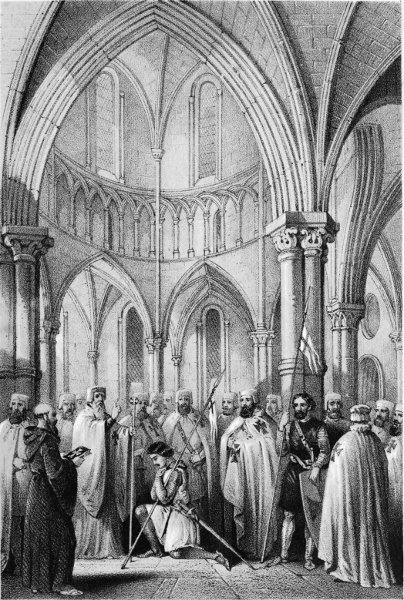
of the Temple; that the Master and the brethren then required
him to answer questions to the following effect:—Whether he
had a dispute with any man, or owed any debts? whether he
was betrothed to any woman? and whether he had any
secret infirmity of body? or knew of anything to prevent him
from remaining within the bosom of the fraternity? And
having answered all these questions satisfactorily, the Master
then asked of the surrounding brethren, “Do ye give your
consent to the reception of Brother Walter?” who unanimously
answered that they did; and the Master and the
brethren then standing up, received him the said Walter in this
manner. On his bended knees, and with his hands joined, he
solemnly promised that he would be the perpetual servant of
the Master, and of the order, and of the brethren, for the purpose
of defending the Holy Land. Having done this, the
Master took out of the hands of a brother chaplain of the order
the book of the holy gospels, upon which was depicted a cross,
and laying his hand upon the book, and upon the cross, he
swore to God and the blessed Virgin Mary to be for ever thereafter
chaste, obedient, and to live without property. And then
the Master gave to him the white mantle, and placed the coif
on his head and admitted him to the kiss on the mouth, after
which he made him sit down on the ground, and admonished
him to the following effect: that from thenceforth he was to
sleep in his shirt, drawers, and stockings, girded with a small
cord over his shirt; that he was never to tarry in a house where
there was a woman in the family way; never to be present at a
marriage or at the purification of women; and likewise instructed
and informed him upon several other particulars.
Being asked where he had passed his time since his reception,
he replied that he had dwelt three years at the preceptory of
Blancradok in Scotland; three years at Temple Newsom in
England; one year at the Temple at London, and three years
at Aslakeby. Being asked concerning the other brothers in
Scotland, he stated that John de Hueflete was Preceptor of
Blancradok, the chief house of the order in that country, and
that he and the other brethren, having heard of the arrest of the
Templars, threw off their habits, and fled, and that he had not
since heard aught concerning them.
Forty-one witnesses, chiefly abbots, priors, monks, priests,
and serving men, and retainers of the order in Scotland, were
examined upon various interrogatories, but nothing of a criminatory
nature was elicited. The monks observed that the receptions
of other orders were public, and were celebrated as
great religious solemnities, and the friends, parents, and neighbours
of the party about to take the vows were invited to attend;
while the Templars, on the other hand, shrouded their proceedings
in mystery and secrecy, and therefore they suspected the
worst. The priests thought them guilty, because they were
always against the church! Others condemned them because
(as they say) the Templars closed their doors against the poor
and the humble, and extended hospitality only to the rich and
the powerful. The abbot of the monastery of the Holy Cross
at Edinburgh declared that they appropriated to themselves the
property of their neighbours, right or wrong. The abbot of
Dumferlyn knew nothing of his own knowledge against them,
but had heard much, and suspected more. The serving men and
the tillers of the lands of the order stated that the chapters were
held sometimes by night and sometimes by day, with extraordinary
secrecy; and some of the witnesses had heard old men say
that the Templars would never have lost the Holy Land if they
had been good Christians!
On the 9th of January, A. D. 1310, the examination of witnesses
was resumed at London, in the parish church of St.
Dunstan’s West, near the Temple. The rector of the church of
St. Mary de la Strode declared that he had strong suspicions of
the guilt of the Templars; he had, however, often been at the
Temple church, and had observed that the priests performed
divine service there just the same as elsewhere. William de
Cumbrook, of St. Clement’s church, near the Temple, the vicar
of St. Martin’s-in-the-Fields, and many other priests and clergymen
of different churches in London, all declared that they had
nothing to allege against the order.
On the 27th of January, Brother John de Stoke, a serving
brother of the order of the Temple, of seventeen years’ standing,
being examined by the inquisitors in the chapel of the Blessed
Mary of Berkyngecherche at London, states, amongst other
things, that secular persons were allowed to be present at the
burial of Templars; that the brethren of the order all received
the sacraments of the church at their last hour, and were
attended to the grave by a chaplain of the Temple. Being interrogated
concerning the burial of the Knight Templar Brother
Walter le Bacheler, Grand Preceptor of Ireland, who had been
confined in the penitential cell in the Temple, for disobedience
to his superiors, and was reported to have been there starved to
death, he deposes that the said knight was buried like any other
Christian, except that he was not buried in the burying-ground,
but in the court of the house of the Temple at London; that he
confessed to Brother Richard de Grafton, a priest of the order,
then in the island of Cyprus, and partook, as he believed, of the
sacrament. He states that he himself and Brother Radulph de
Barton carried him to his grave at the dawn of day, and that the
deceased knight was in prison, as he believes, for the space of
eight weeks; that he was not buried in the habit of his order,
and was interred without the cemetery of the brethren, because
he was considered to be excommunicated, in pursuance, as he
believed, of a rule or statute among the Templars, to the effect
that every one who privily made away with the property of the
order, and did not acknowledge his fault, was deemed excommunicated.
On the 30th of March, the papal inquisitors opened their commission
at Lincoln, and numerous Templars were examined in
the chapter-house of the cathedral, amongst whom were some of
the veteran warriors of Palestine, who had moistened with their
blood the distant plains of the far East. Brother William de
Winchester, a member of twenty-six years’ standing, stated that
he had been received into the order at the castle de la Roca
Guille, in the province of Armenia, bordering on Syria, by the
valiant Grand Master William de Beaujeu. He states that the
same mode of reception existed there as in England, and everywhere
throughout the order. Brother Robert de Hamilton declares
that the girdles said to be worn by the brethren were
called girdles of Nazareth, because they had been pressed against
the column of the Virgin at that place, and were worn in remembrance
of the blessed Mary.
At York, the examination commenced on the 28th of April,
and lasted until the 4th of May, during which period twenty-three
Templars, prisoners in York Castle, were examined in the
chapter-house of the cathedral, and followed the example of
their brethren in maintaining their innocence. Brother Thomas
de Stanford, a member of thirty years’ standing, had been received
in the East by the Grand Master William de Beaujeu,
and Brother Radulph de Rostona, a priest of the order, of
twenty-three years’ standing, had been received at the preceptory
of Lentini in Sicily, by Brother William de Canello, the Grand
Preceptor of Sicily. Brother Stephen de Radenhall refused to
reveal the mode of reception, because it formed part of the
secrets of the chapter, and if he discovered them he would lose
his chamber, be stripped of his mantle, or be committed to
prison.[155]
The proceedings against the order in France had, in the
mean time, assumed a most sanguinary character. On the 28th
of March, (A. D. 1310) five hundred and forty-six Templars, who
persisted in maintaining the innocence of their order, were
assembled in the garden of the bishop’s palace at Paris, to hear
the articles of accusation read over to them, and a committee of
their number was authorised to draw up a written defence.
They asked to have an interview with the Grand Master and
the heads of the order, but this was refused. The total number
of Templars, immured in the prisons of Paris, was nine hundred.
In the course of the examination before the papal commissioners,
Brother Laurent de Beaume produced a letter which
had been sent to him and his fellow-prisoners at Sens, warning
them against a retractation of their confessions in the following
terms: “Sachez que notre pere le pape a mande que tuit cil qui
aurent fayt les suizitos confessions devant ses anvouez, qui en cele
confessions ne voudroient perseverès, que il sorent mis a damnazion et
destruit au feu.” This threat was carried into execution, and
Brother Laurent de Beaume was one of the first victims. The
defence drawn up by the brethren and presented to the commissioners
by Brother Peter de Bologna, begins by stating the
origin and objects of their institution, the vows to which they
subjected themselves, and the mode in which persons were received
into the fraternity. They give a frightful account of the
tortures that had been inflicted upon them, and declare that
those who had escaped with life from the hands of the tormentors,
were either ruined in health or injured in intellect,
and that as pardon and forgiveness had been freely offered to
those knights who would confess, it was not wonderful that false
confessions had been made. They observed that a vast number
of knights had died in prison, and they exhorted the commissioners
to interrogate the guards, jailers, and executioners, and
those who saw them in their last moments, concerning the declarations
and confessions they had made at the peril of their
souls when dying. They maintained that it was a most extraordinary
thing that so many knights of distinguished birth and
noble blood, members of the most illustrious families in Europe,
should have remained from an early age up to the day of their
death, members of the order, and should never, in days of sickness,
or at the hour of death, have revealed any of the horrid
iniquities and abominations charged against it.[156] All the Templars,
indeed, who had made confessions were rapidly following
one another’s example in retracting them, and maintaining their
innocence, and the king hastened to arrest the unfavourable
march of events.
The archbishop of Sens, whose ecclesiastical authority extended
over the diocese of Paris, having died, the king obtained
the vacant see for Philip de Martigny, a creature of his own,
who was installed therein in the month of April. In a letter to
Clement urging this appointment, Philip reminds the holy
pontiff that the new archbishop would have to preside over a
provincial council wherein would be transacted many things
which immediately concerned the glory of God, the stability of
the faith, and of the holy church. Immediately after the enthronement
of this new archbishop, the provincial council of
Sens was convoked at Paris, and on the 10th of May, all the
Templars who had revoked their confessions, and had come
forward to maintain the innocence of their order, were dragged
before it, and sentence of death was passed upon them by the
archbishop in the following terms:—“You have avowed,” said
he, “that the brethren who are received into the order of the
Temple are compelled to renounce Christ and spit upon the
cross, and that you yourselves have participated in that crime;
you have thus acknowledged that you have fallen into the sin
of heresy. By your confession and repentance you had merited
absolution, and had once more become reconciled to the church.
As you have revoked your confession, the church no longer regards
you as reconciled, but as having fallen back to your first
errors. You are, therefore, relapsed heretics, and as such, we
condemn you to the fire!” As soon as the commissioners had
received intelligence of this extraordinary decree, they despatched
messengers to the archbishop and his suffragans, praying them
to delay the execution of their sentence, as very many persons
affirmed that the Templars who died in prison had proclaimed
with their last breath the innocence of their order. But these
representations were of no avail. The archbishop, who was paying
the price of his elevation to a hard creditor, proceeded to
make short work of the business.
The very next morning, (Tuesday, May 12,) fifty-four Templars
were handed over to the secular arm, and were led out to
execution by the king’s officers. They were conducted, at daybreak,
into the open country, in the environs of the Porte St.
Antoine des Champs at Paris, and were there fastened to stakes
driven into the ground, and surrounded by faggots and charcoal.
In this situation, they saw the torches lighted, and the
executioners approaching to accomplish their task, and they
were once more offered pardon and favour if they would confess
the guilt of their order; they persisted in the maintenance of
its innocence, and were burnt to death in a most cruel manner
before slow fires! All historians speak with admiration of the
heroism and intrepidity with which they met their fate. Many
hundred other Templars were dragged from the dungeons of
Paris before the archbishop of Sens and his council. Those
whom neither the agony of torture nor the fear of death could
overcome, but who remained stedfast amid all their trials in
the maintenance of their innocence, were condemned to perpetual
imprisonment as unreconciled heretics; whilst those who,
having made the required confessions of guilt, continued to persevere
in them, received absolution, were declared reconciled to
the church, and were set at liberty.[157]
On the 18th of August, four other Templars were condemned
as relapsed heretics by the council of Sens, and were likewise
burnt by the Porte St. Antoine; and it is stated that a hundred
and thirteen Templars were, from first to last, burnt at the stake
in Paris. Many others were burned in Lorraine; in Normandy;
at Carcassone; and nine, or, according to some writers,
twenty-nine, were burnt by the archbishop of Rheims at Senlis!
King Philip’s officers, indeed, not content with their inhuman
cruelty towards the living, invaded the sanctity of the tomb;
they dragged a dead Templar, who had been treasurer of the
93.
Temple at Paris, from his grave, and burnt the mouldering
corpse as a heretic. In the midst of all these sanguinary atrocities,
the examinations continued before the ecclesiastical tribunals.
Many aged and illustrious warriors, who merited a
better fate, appeared before their judges pale and trembling. At
first they revoked their confessions, declared their innocence,
and were remanded to prison; and then, panic-stricken, they
demanded to be led back before the papal commissioners, when
they abandoned their retractations, persisted in their previous
avowals of guilt, humbly expressed their sorrow and repentance,
and were then pardoned, absolved, and reconciled to the church!
The torture still continued to be applied, and out of thirty-three
Templars confined in the chateau d’Alaix, four died in
prison, and the remaining twenty confessed, amongst other things,
the following absurdities:—that in the provincial chapter of the
order held at Montpelier, the Templars set up a head and worshipped
it; that the devil often appeared there in the shape of
a cat, and conversed with the assembled brethren, and promised
them a good harvest, with the possession of riches, and all
kinds of temporal property. Some asserted that the head worshipped
by the fraternity possessed a long beard; others that
it was a woman’s head; and one of the prisoners declared that
as often as this wonderful head was adored, a great number
of devils made their appearance in the shape of beautiful
women...!!
We must now unfold the dark page in the history of the order
in England. All the Templars in custody in this country had
been examined separately, and had, notwithstanding, deposed in
substance to the same effect, and given the same account of their
reception into the order, and of the oaths that they took. Any
reasonable and impartial mind would consequently have been
satisfied of the truth of their statements; but it was not the object
of the inquisitors to obtain evidence of the innocence, but
proof of the guilt of the order. At first, king Edward the
Second, to his honour, forbade the infliction of torture upon the
illustrious members of the Temple in his dominions—men who
had fought and bled for Christendom, and of whose piety and
morals he had a short time before given such ample testimony
to the principal sovereigns of Europe. But the virtuous resolution
of the weak king was speedily overcome by the all-powerful
influence of the Roman pontiff, who wrote to him in the month
of June, upbraiding him for preventing the inquisitors from submitting
the Templars to the discipline of the rack. Influenced
by the admonitions of the pope, and the solicitations of the
clergy, king Edward sent orders to the constable of the Tower,
to deliver up the Templars to certain gaolers appointed by the
inquisitors, in order that the inquisitors might do with the
bodies of the Templars whatever should seem fitting, in accordance
with ecclesiastical law. The ecclesiastical council then
assembled, and ordered that the Templars should be again confined
in separate cells; that fresh interrogatories should be prepared,
to see if by such means the truth could be extracted, and
if by straitenings and confinement they would confess nothing
further, then the torture was to be applied; but it was provided
that the examination by torture should be conducted without
the PERPETUAL MUTILATION OR DISABLING OF ANY LIMB, AND
WITHOUT A VIOLENT EFFUSION OF BLOOD! and the inquisitors and
the bishops of London and Chichester were to notify the result
to the archbishop of Canterbury, that he might again convene
the assembly for the purpose of passing sentence, either of absolution
or of condemnation.
Fresh instructions were then sent by the king to the constable
of the Tower, and the sheriffs of London, informing them that
the king, on account of his respect for the holy apostolical see,
had conceded to the inquisitors the power of examining the
Templars by TORTURE; and strictly enjoining them to deliver
up the Templars to the inquisitors, and receive them back when
required so to do. The king then acquainted the mayor, aldermen,
and commonalty of his faithful city of London, that out of
reverence to the pope he had authorised the inquisitors, sent
over by his holiness, to question the Templars by TORTURE; and
he commands them, in case it should be notified to them by the
inquisitors that the prisons provided by the sheriffs were insufficient
for their purposes, to procure without fail fit and convenient
houses in the city, or near thereto, for carrying into effect
the contemplated measures. Shortly afterwards, he again wrote
to the mayor, aldermen, and commonalty of London, acquainting
them that the sheriffs had made a return to his writ, to the
effect that the four gates (prisons) of the city were not under
their charge, and that they could not therefore obtain them for
the purposes required; and he commands the mayor, aldermen,
and commonalty, to place those four gates at the disposal of the
sheriffs. Shortly afterwards orders were given for all the Templars
in custody in London to be loaded with chains and fetters!
the myrmidons of the inquisitors were to be allowed to make
periodical visits to see that the imprisonment was properly
carried into effect, and were to be allowed to TORTURE the bodies
of the Templars in any way that they might think fit.[158]
On the 30th of March, A. D. 1311, the examination was resumed
before the inquisitors, and the bishops of London and
Chichester, at the several churches of St. Martin’s Ludgate, and
St. Botolph’s Bishopsgate. The Templars had now been in
prison in England for the space of three years and some months.
During the whole of the previous winter they had been confined
in chains in the dungeons of the city of London, compelled to
receive their scanty supply of food from the officers of the inquisition,
and to suffer from cold, from hunger, and from torture.
They had been made to endure all the horrors of solitary confinement,
and had none to solace or to cheer them during the
long hours of their melancholy captivity. They had been
already condemned collectively by the pope, as members of an
heretical and idolatrous society, and as long as they continued to
persist in the truth of their first confessions, and in the avowal
of their innocence, they were treated as obstinate, unreconciled
heretics, living in a state of excommunication, and doomed,
when dead, to everlasting punishment in hell. They had heard
of the miserable fate of their brethren in France, and they knew
that those who had confessed crimes of which they had never
been guilty, had been immediately declared reconciled to the
church, had been absolved and set at liberty, and they knew that
freedom, pardon, and peace could be immediately purchased by
a confession of guilt; notwithstanding all which, every Templar,
at this last examination, persisted in the maintenance of his
innocence, and in the denial of all knowledge of, or participation
in, the crimes and heresies imputed to the order. They were
therefore again sent back to their dungeons, and loaded with
chains; and the inquisitors, disappointed of the desired confessions,
addressed themselves to the enemies of the order for the
necessary proofs of guilt.
During the month of April, seventy-two witnesses were examined
in the chapter-house of the Holy Trinity. They were
nearly all monks, Carmelites, Augustinians, Dominicans, and
Minorites; their evidence is all hearsay, and the nature of it will
be seen from the following choice specimens:—Henry Thanet,
an Irishman, had heard that a certain Preceptor of the Pilgrim’s
Castle was in the habit of making all the brethren he received
into the order deny Christ. He had heard also that a certain
Templar had in his custody a brazen head with two faces, which
would answer all questions put to it!—Master John de Nassington
had heard that the Templars celebrated a solemn festival
once a year, at which they worshipped a calf!—John de Eure,
knight, sheriff of the county of York, deposed that he had once
invited Brother William de la Fenne, Preceptor of Wesdall, to
dine with him, and that after dinner the Preceptor drew a book out
of his bosom, and delivered it to the knight’s lady to read, who
found a piece of paper fastened into the book, on which were
written abominable heretical doctrines, to the effect that Christ
was not the Son of God, nor born of a virgin, but conceived of
the seed of Joseph, the husband of Mary, after the manner of
other men, and that Christ was not a true but a false prophet,
and was not crucified for the redemption of mankind, but for his
own sins; and many other things contrary to the christian faith.
On the production of this important evidence, Brother William
de la Fenne was called in and interrogated; he admitted that
he had dined with the sheriff of York, and had lent his lady a
book to read, but he swore that he was ignorant of the piece of
paper fastened into the book, and of its contents. It appears
that the sheriff of York had kept this discovery to himself for
the space of six years!
William de la Forde, a priest, rector of the parish of Crofton
in the diocese of York, had heard William de Reynbur, priest of
the order of St. Augustine, who was then dead, say, that the
Templar, Brother Patrick of Rippon, son of William of Gloucester,
had confessed to him, that at his entrance into the order,
he was led, clothed only in his shirt and trousers, through a
long passage to a secret chamber, and was there made to deny
his God and his Saviour; that he was then shown a representation
of the crucifixion, and was told that since he had previously
honoured that emblem he must now dishonour it and spit upon
it, and that he did so. “Item dictum fuit ei quod, depositis
brachis, dorsum verteret ad crucifixum,” and this he did bitterly
weeping. After this they brought an image, as it were, of a calf,
placed upon an altar, and they told him he must kiss that image,
and worship it, and he did so; and after all this they covered
up his eyes and led him about, kissing and being kissed by all
the brethren, but he could not recollect in what part. The
worthy priest was asked when he had first heard all these things,
and he replied after the arrest of the brethren by the king’s orders!
Robert of Oteringham, senior of the order of Minorites, stated
that on one occasion he was partaking of the hospitality of the
Templars at the preceptory of Ribstane in Yorkshire, and that
when grace had been said after supper, the chaplain of the order
reprimanded the brethren, saying, “The devil will burn you;”
and hearing a bustle, he got up, and, as far as he recollects, saw
one of the brothers of the Temple, “brachis depositis, tenentem
faciem versus occidentem et posteriora versus altare!” He then
states, that about twenty years before that time, he was the guest
of the Templars, at the preceptory of Wetherby in Yorkshire,
and when evening came he heard that the preceptor was not
coming to supper, as he was arranging some relics that he had
brought with him from the Holy Land, and afterwards at midnight
he heard a confused noise in the chapel, and getting up
he looked through the keyhole, and saw a great light therein,
either from a fire or from candles, and on the morrow he asked
one of the brethren of the Temple the name of the saint in
whose honour they had celebrated so grand a festival during the
night, and that brother, aghast and turning pale, thinking he
had seen what had been done amongst them, said to him, “Go
thy way, and if you love me, or have any regard for your own
life, never speak of this matter!” Brother John de Wederel,
another Minorite, stated that he had lately heard in the country,
that a Templar, named Robert de Baysat, was once seen running
about a meadow uttering, “Alas! alas! that ever I was born,
seeing that I have denied God and sold myself to the devil!”
Brother N. de Chinon, another Minorite, had heard that a certain
Templar had a son who peeped through a chink in the wall of
the chapter-room and saw a person who was about to be professed,
slain because he would not deny Christ, and afterwards
the boy was asked by his father to become a Templar, but refused,
and he immediately shared the same fate. Twenty other
witnesses, who were examined in each other’s presence, related
similar absurdities.
At this stage of the proceedings, the papal inquisitor, Sicard
de Vaur, exhibited two rack-extorted confessions of Templars
which had been obtained in France. The first was from Robert
de St. Just, who had been received into the order by Brother
Himbert, Grand Preceptor of England, but had been arrested in
France, and there tortured. In this confession Robert de St.
Just states that, on his admission to the vows of the Temple,
he denied Christ, and spat beside the cross. The second confession
had been extorted from Geoffrey de Gonville, Knight of
the Order of the Temple, Preceptor of Aquitaine and Poitou.
In this confession, (which had been revoked, but of which revocation
no notice was taken by the inquisitors,) Geoffrey de
Gonville states that he was received into the order in England
in the house of the Temple at London, by Brother Robert de
Torvile, Knight, the Master of all England, about twenty-eight
years before that time; that the Master showed him on a missal
the image of Jesus Christ on the cross, and commanded him to
deny him who was crucified; that, terribly alarmed, he exclaimed,
“Alas! my lord, why should I do this? I will on no
account do it.” But the Master said to him, “Do it boldly; I
swear to thee that the act shall never harm either thy soul or
thy conscience;” and then proceeded to inform him that the
custom had been introduced into the order by a certain bad
Grand Master, who was imprisoned by a certain sultan, and
could escape from prison only on condition that he would
establish that form of reception in his order, and compel all
who were received to deny Christ Jesus! but the deponent remained
inflexible; he refused to deny his Saviour, and asked
where were his uncle and the other good people who had
brought him there, and was told that they were all gone; and
at last a compromise took place between him and the Master,
who made him take his oath that he would tell all his brethren
that he had gone through the customary form, and never reveal
that it had been dispensed with! He states also that the ceremony
was instituted in memory of St. Peter, who three times
denied Christ! This knight had been tortured in the Temple
at Paris, by the brothers of St. Dominic, in the presence of the
grand inquisitor, and he made his confession when suffering on
the rack; he afterwards revoked it, and was then tortured into
a withdrawal of his revocation, notwithstanding which the inquisitor
made the unhappy wretch, in common with others, put
his signature to the following interrogatory, “Interrogatus,
utrum vi vel metu carceris aut tormentorum immiscuit in suâ
depositione aliquam falsitatem, dicit quod non!”
Ferinsius le Mareschal, a secular knight, being examined,
declared that his grandfather entered into the order of the
Temple, active, healthy, and blithesome as the birds and the
dogs, but on the third day from his taking the vows he was
dead, and, as he now suspects, was killed because he refused to
participate in the iniquities practised by the brethren. An
Augustine monk declared that he had heard a Templar say that
a man after death had no more soul than a dog. Brother John
de Gertia, a Minorite, had heard from a certain woman called
Cacocaca! who had it from Exvalettus, Preceptor of London,
that one of the servants of the Templars entered the Temple
hall where the chapter was held, and secreted himself, and after
the door had been shut and locked by the last Templar who
entered, and the key had been brought by him to the superior,
the assembled Templars jumped up and went into another
room, and opened a closet, and drew therefrom a certain black
figure with shining eyes, and a cross, and they placed the cross
before the Master, and the “culum idoli vel figuræ” they placed
upon the cross, and carried it to the Master, who kissed the said
image, (in ano,) and all the others did the same after him; and
when they had finished kissing, they all spat three times upon
the cross, except one, who refused, saying, “I was a bad man in
the world, and placed myself in this order for the salvation of
my soul; what could I do worse? I will not do it;” and then
the brethren said to him, “Take heed, and do as you see
the order do;” but he answered that he would not do so,
and then they placed him in a well which stood in the midst
of their house, and covered the well up, and left him to perish.
Being asked as to the time when the woman heard this, the
deponent stated that she told it to him about fourteen years
back at London, where she kept a shop for her husband, Robert
Cotacota!
John Walby de Bust, another Minorite, had heard John de
Dingeston say that he had heard that there was in a secret place
of the house of the Templars at London a gilded head, and that
when one of the masters was on his death-bed, he summoned to
his presence several preceptors, and told them that if they
wished for power, and dominion, and honour, they must worship
that head. Gaspar de Nafferton, chaplain of the parish of
Ryde, deposed that he was in the employ of the Templars when
William de Pokelington was received into the order; that he
well recollected that the said William made his appearance at
the Temple on Sunday evening, with the equipage and habit of
a member of the order, accompanied by Brother William de la
More, the Master of the Temple, Brother William de Grafton,
Preceptor of Ribbestane and Fontebriggs, and other brethren:
that the same night, during the first watch, they assembled in
the church, and caused the deponent to be awakened to say
mass; that, after the celebration of the mass, they made the
deponent with his clerk go out into the hall beyond the cloister,
and then sent for the person who was to be received; and on
his entry into the church, one of the brethren immediately
closed all the doors opening into the cloister, so that no one
within the chambers could get out, and thus they remained till
daylight; but what was done in the church the deponent knew
not; the next day, however, he saw the said William clothed in
the habit of a Templar, looking very sorrowful. The deponent
also declared that he had threatened to peep through a secret
door to see what was going on, but was warned that it was
inevitable death so to do. He states that the next morning
he went into the church, and found the books and crosses all
removed from the places in which he had previously left
them.
The evidence given before this papal tribunal affords melancholy
proof of the immorality, the credulity, and the profligacy
of the age. Abandoned women were brought before the inquisitors,
and were induced unblushingly to relate, in the presence
of the archbishop of Canterbury and the English bishops, the
most disgusting and ridiculous enormities; and evidence was
taken down by notaries, and quietly listened to by the most
learned and distinguished characters of the age, which in these
days would be scouted with scorn and contempt from almost
every court in Christendom.[159] On the 22nd of April all the
Templars in custody in the Tower and in the prisons of the
city were assembled before the inquisitors and the bishops of
London and Chichester, in the church of the Holy Trinity, to
hear the depositions of the witnesses publicly read. The
Templars required copies of these depositions, which were
granted them, and they were allowed eight days from that period
to bring forward any defences or privileges they wished to make
use of. Subsequently, before the expiration of the eight days,
the officer of the bishop of London was sent to the Tower with
scriveners and witnesses, to know if they would then set up any
matters of defence, to whom the Templars replied that they
were unlettered men, ignorant of the law, and that all means of
defence were denied them, since they were not permitted to
employ those who could afford them fit counsel and advice.
They observed, however, that they were desirous of publicly
proclaiming the faith, and the religion of themselves and of the
order to which they belonged, of showing the privileges conceded
to them by the chief pontiffs, and their own depositions
taken before the inquisitors, all which they said they wished to
make use of in their defence.
On the eighth day, being Thursday the 29th of April, they
appeared before the papal inquisitors and the bishops of London
and Chichester, in the church of All Saints of Berkyngecherche,
and presented to them the following declaration, which they
had drawn up amongst themselves, as the only defence they
had to offer against the injustice, the tyranny, and the persecution
of their powerful oppressors; adding, that if they had in
any way done wrong, they were ready to submit themselves to
the orders of the church. This declaration is written in the
Norman French of that day, and is as follows:—
“Conue chese seit a nostre honurable père, le ercevesque de Canterbiere,
primat de toute Engletere, e a touz prelaz de seinte Elise,
e a touz Cristiens, qe touz les frères du Temple que sumes ici assemblez
et chescune singulere persone par sen sumes cristien nostre seignur
Jesu Crist, e creoms en Dieu Père omnipotent, qui fist ciel e terre,
e en Jesu soen fiz, qui fust conceu du Seint Esperit, nez de la Virgine
Marie, soeffrit peine e passioun, morut sur la croiz pour touz
peccheours, descendist e enferns, e le tierz jour releva de mort en
vie, e mounta en ciel, siet au destre soen Père, e vendra au jour de
juise, juger les vifs, e les morz, qui fu saunz commencement, e serra
saunz fyn; e creoms comme seynte eglise crets, e nous enseigne. E
que nostre religion est foundée sus obedience, chasteté, vivre sans
propre, aider a conquere la seint terre de Jerusalem, a force e a poer,
qui Dieu nous ad preste. E nyoms e firmement en countredioms
touz e chescune singulere persone par sei, toutes maneres de heresies e
malvaistes, que sount encountre la foi de Seinte Eglise. E prioms
pour Dieu e pour charité a vous, que estes en lieu nostre seinte père
l’apostoile, que nous puissoms aver lez drettures de seinte église, comme
ceus que sount les filz de sainte église, que bien avoms garde, e tenu
la foi, e la lei de seinte église, e nostre religion, la quele est bone,
honeste e juste, solom les ordenaunces, e les priviléges de la court de
Rome avons grauntez, confermez, e canonizez par commun concile,
les qels priviléges ensemblement ou lestablisement, e la règle sount en
la dite court enregistrez. E mettoms en dur e en mal eu touz Cristiens
sauue noz anoisourz, par la ou nous avoms este conversaunt,
comment nous avoms nostre vie demene. E se nous avoms rien
mesprys de aucun parole en nos examinacions par ignorance de seu,
si comme nous sumez genz laics prest sûmes, a ester a lesgard de seint
eglise, comme cely que mourust pour nouz en la beneite de croiz. E
nous creoms fermement touz les sacremenz de seinte église. E nous
vous prioms pour Dieu e pour salvacioun de vous almes, que vous
nous jugez si comme vous volez respoundre pour vous et pour nous
devaunt Dieu: e que nostre examinement puet estre leu e oii devaunt
nous e devaunt le people, salom le respouns e le langage que fust dit
devaunt vous, e escrit en papier.”
“Be it known to our honourable father, the archbishop of
Canterbury, primate of all England, and to all the prelates of
holy church, and to all Christians, that all we brethren of the
Temple here assembled, and every of one of us are Christians,
and believe in our Saviour Jesus Christ, in God the Father
omnipotent, &c., &c.... And we believe all that the holy
church believes and teaches us. We declare that our religion is
founded on vows of obedience, chastity, and poverty, and of
aiding in the conquest of the Holy Land of Jerusalem, with all
the power and might that God affordeth us. And we firmly
deny and contradict, one and all of us, all manner of heresy and
evil doings, contrary to the faith of holy church. And for the
love of God, and for charity, we beseech you, who represent our
holy father the pope, that we may be treated like true children
of the church, for we have well guarded and preserved the
faith, and the law of the church, and of our own religion, that
which is good, honest, and just, according to the ordinances
and the privileges of the court of Rome, granted, confirmed, and
canonized by common council; the which privileges, together
with the rule of our order, are enregistered in the said court.
And we would bring forward all Christians, (save our enemies
and slanderers,) with whom we are conversant, and among
whom we have resided, to say how and in what manner we have
spent our lives. And if, in our examinations, we have said or
done anything wrong through ignorance of a word, since we are
unlettered men, we are ready to suffer for holy church like him
who died for us on the blessed cross. And we believe all the
sacraments of the church. And we beseech you, for the love of
God, and as you hope to be saved, that you judge us as you
will have to answer for yourselves and for us before God; and
we pray that our examination may be read and heard before
ourselves and all the people, in the very language and words
in which it was given before you, and written down on paper.”
The above declaration was presented by Brother William de
la More, the Master of the Temple; the Knights Templars
Philip de Mewes, Preceptor of Garwy; William de Burton, Preceptor
of Cumbe; Radulph de Maison, Preceptor of Ewell;
Michael de Baskevile, Preceptor of London; Thomas de Wothrope,
Preceptor of Bistelesham; William de Warwick, Priest;
and Thomas de Burton, Chaplain of the Order; together with
twenty serving brothers. The same day the inquisitors and
the two bishops proceeded to the different prisons of the city to
demand if the prisoners confined therein wished to bring forward
anything in defence of the order, who severally answered
that they would adopt and abide by the declaration made by
their brethren in the Tower. In the prison of Aldgate there
were confined Brother William de Sautre, Knight, Preceptor of
Samford; Brother William de la Ford, Preceptor of Daney;
Brother John de Coningeston, Preceptor of Getinges; Roger
de Norreis, Preceptor of Cressing; Radolph de Barton, priest,
Prior of the New Temple; and several serving brethren of the
order. In the prison of Crepelgate were detained William de
Egendon, Knight, Preceptor of Schepeley; John de Moun,
Knight, Preceptor of Dokesworth; and four serving brethren.
In the prison of Ludgate were five serving brethren; and in
Newgate was confined Brother Himbert Blanke, Knight, Grand
Preceptor of Auvergne.
The above declaration of faith and innocence was far from
agreeable to the papal inquisitors, who required a confession of
guilt, and the torture was once more directed to be applied.
The king sent fresh orders to the mayor and the sheriffs of the
city of London, commanding them to place the Templars in
separate dungeons; to load them with chains and fetters; to
permit the myrmidons of the inquisitors to pay periodical visits
to see that the wishes and intentions of the inquisitors, with
regard to the severity of the confinement, were properly carried
into effect; and lastly, to inflict TORTURE upon the bodies of the
Templars, and generally to do whatever should be thought
fitting and expedient in the premises, according to the ecclesiastical
law. In conformity with these orders, we learn from the
record of the proceedings, that the Templars were placed in
solitary confinement in loathsome dungeons; that they were
put on a short allowance of bread and water, and periodically
visited by the agents of the inquisition; that they were moved
from prison to prison, and from dungeon to dungeon; were
now treated with rigour, and anon with indulgence; and were
then visited by learned prelates, and acute doctors in theology,
who, by exhortation, persuasion, and by menace, attempted in
every possible mode to wring from them the required avowals!
We learn that all the engines of terror wielded by the church
were put in force, and that torture was unsparingly applied
“usque ad judicium sanguinis!” The places in which these atrocious
scenes were enacted were the Tower, the prisons of Aldgate,
Ludgate, Newgate, Bishopgate, and Crepelgate, the house
formerly belonging to John de Banguel, and the tenements once
the property of the brethren of penitence.[160] It appears that
some French monks were sent over to administer the torture to
the unhappy captives, and that they were questioned and examined
in the presence of notaries whilst suffering under the
torments of the rack. The relentless perseverance and the
incessant exertions of the foreign inquisitors were at last rewarded
by a splendid triumph over the powers of endurance of
two poor serving brethren, and one chaplain of the order, who
were at last induced to make the long desired avowals.
On the 23rd of June, Brother Stephen de Staplebrugge, described
as an apostate and fugitive of the order of the Temple,
captured by the king’s officers in the city of Salisbury, deposed
in the house of the head gaoler of Newgate, in the presence of
the bishops of London and Chichester, the chancellor of the
archbishop of Canterbury, Hugh de Walkeneby, doctor of theology,
and other clerical witnesses, that there were two modes
of profession in the order of the Temple, the one good and
lawful, and the other contrary to the christian faith; that he
himself was received into the order by Brother Brian le Jay,
Grand Preceptor of England, at Dynneslee, and was led into
the chapel, the door of which was closed as soon as he had
entered; that a crucifix was placed before the Master, and that a
brother of the Temple, with a drawn sword, stood on either
side of him; that the Master said to him, “Do you see this
image of the crucifixion?” to which he replied, “I see it, my
lord;” that the Master then said to him, “You must deny that
Christ Jesus was God and man, and that Mary was his mother;
and you must spit upon this cross;” which the deponent,
through immediate fear of death, did with his mouth, but not
with his heart, and he spat beside the cross, and not on it; and
then falling down upon his knees, with eyes uplifted, with his
hands clasped, with bitter tears and sighs, and devout ejaculations,
he besought the mercy and the favour of holy church,
declaring that he cared not for the death of the body, or for any
amount of penance, but only for the salvation of his soul!
On Saturday, the 25th of June, Brother Thomas Tocci de
Thoroldeby, serving brother of the order of the Temple, described
as an apostate who had escaped from Lincoln after his
examination at that place by the papal inquisitors, but had
afterwards surrendered himself to the king’s officers, was brought
before the bishops of London and Chichester, the archdeacon of
Salisbury, and others of the clergy in St. Martin’s Church, in
Vinetriâ; and being again examined, he repeated the statement
made in his first deposition, but added some particulars with
regard to penances imposed and absolutions pronounced in the
chapter, showing the difference between sins and defaults, the
priest having to deal with the one, and the Master with the
other. He declared that the little cords were worn from honourable
motives, and relates a story of his being engaged in a
battle against the Saracens, in which he lost his cord, and was
punished by the Grand Master for a default in coming home
without it. He gives the same account of the secrecy of the
chapters as all the other brethren, states that the members of
the order were forbidden to confess to the friars mendicants,
and were enjoined to confess to their own chaplains; that they
did nothing contrary to the christian faith, and as to their endeavouring
to promote the advancement of the order by any
means, right or wrong, that exactly the contrary was the case,
as there was a statute in the order to the effect, that if any one
should be found to have acquired anything unjustly, he should
be deprived of his habit, and be expelled the order. Being
asked what induced him to become an apostate, and to fly from
his order, he replied that it was through fear of death, because
the abbot of Lagny, (the papal inquisitor,) when he examined
him at Lincoln, asked him if he would not confess anything
further, and he answered that he knew of nothing further to
confess, unless he was to say things that were not true; and
that the abbot, laying his hand upon his breast, swore by the word
of God that he would make him confess before he had done with him!
and that being terribly frightened, he afterwards bribed the
gaoler of the castle of Lincoln, giving him forty florins to let
him make his escape.
The abbot of Lagny, indeed, was as good as his word, for on
the 29th of June, four days after this imprudent avowal, Brother
Thomas Tocci de Thoroldeby was brought back to St. Martin’s
Church, and there, in the presence of the same parties, he made
a third confession, in which he declares that, coerced by two
Templars with drawn swords in their hands, he denied Christ
with his mouth, but not with his heart; and spat beside the
cross, but not on it; that he was required to spit upon the
image of the Virgin Mary, but contrived, instead of doing so, to
give her a kiss on the foot. He declares that he had heard
Brian le Jay, the Master of the Temple at London, say a hundred
times over, that Jesus Christ was not the true God, but a
man: and that the smallest hair out of the beard of one Saracen,
was of more worth than the whole body of any Christian. He
declares that he was once standing in the presence of Brother
Brian, when some poor people besought charity of him for the
love of God and our lady the blessed Virgin Mary; and he
answered, “Que dame, alez vous pendre a vostre dame”—“What
lady, go and be hanged to your lady,” and violently casting a
halfpenny into the mud, he made the poor people hunt for it,
although it was in the depth of a severe winter. He also relates
that, at the chapters, the priest stood like a beast, and had
nothing to do but to repeat the psalm, “God be merciful unto
us, and bless us,” which was read at the closing of the chapter.
(The Templars, by the way, must have been strange idolaters to
have closed their chapters, in which they are accused of worshipping
a cat, a man’s head, and a black idol, with the reading
of the beautiful psalm, “God be merciful unto us, and bless us,
and show us the light of thy countenance, that thy way may be
known upon earth, thy saving health among all nations,” &c.,
Psalm lxvii.) This witness further states, that the priest had
no power to impose a heavier penance than a day’s fast on bread
and water, and could not even do that without the permission
of the brethren. He is made also to relate that the Templars
always favoured the Saracens in the holy wars in Palestine, and
oppressed the Christians! and he declares, speaking of himself,
that for three years before he had never seen the body of Christ
without thinking of the devil, nor could he remove that evil
thought from his heart by prayer, or in any other way that he
knew of; but that very morning he had heard mass with great
devotion, and since then had thought only of Christ, and thinks
there is no one in the order of the Temple whose soul will be
saved, unless a reformation takes place.
Previous to this period, the ecclesiastical council had again
assembled, and these last depositions of Brother Stephen de
Stapelbrugge and Thomas Tocci de Thoroldeby having been
produced before them, the solemn farce of their confession and
abjuration was immediately publicly enacted. It is thus described
in the record of the proceedings:—“To the praise and
glory of the name of the most high Father, and of the Son, and
of the Holy Ghost, to the confusion of heretics, and the
strengthening of all faithful Christians, begins the public record
of the reconciliation of the penitent heretics, returning to the
orthodox faith published in the council, celebrated at London in
the year 1311. In the name of God, Amen. In the year of
the incarnation of our Lord, 1311, on the twenty-seventh day of
the month of June, in the hall of the palace of the bishop of
London, before the venerable fathers the Lord Robert by the
grace of God archbishop of Canterbury, primate of all England,
and his suffragans in provincial council assembled, appeared
Brother Stephen de Stapelbrugge, of the order of the chivalry of
the Temple; and the denying of Christ and the blessed Virgin
Mary his mother, the spitting upon the cross, and the heresies
and errors acknowledged and confessed by him in his deposition,
being displayed, the same Stephen asserted in full council,
before the people of the city of London, introduced for the
occasion, that all those things so deposed by him were true,
and that to that confession he would wholly adhere; humbly
confessing his error on his bended knees, with his hands clasped,
with much lamentation and many tears, he again and again
besought the mercy and pity of holy mother church, offering to
abjure all heresies and errors, and praying them to impose on
him a fitting penance, and then the book of the holy gospels
being placed in his hands, he abjured the aforesaid heresies in
this form ;—‘I, Brother Stephen de Stapelbrugge, of the order
of the chivalry of the Temple, do solemnly confess,’ &c., &c.,
(he repeats his confession, makes his abjuration, and then proceeds;)
‘and if at any time hereafter I shall happen to relapse into
the same errors, or deviate from any of the articles of the faith,
I will account myself ipso facto excommunicated; I will stand
condemned as a manifest perjured heretic, and the punishment
inflicted on perjured relapsed heretics, shall be forthwith imposed
upon me without further trial or judgment!!’”
He was then sworn upon the holy gospels to stand to the sentence
of the church in the matter, after which Brother Thomas
Tocci de Thoroldeby was brought forward to go through the
same ceremony, which being concluded, these two poor serving
brothers of the order of the Temple, who were so ignorant that
they could not write, were made to place their mark on the record
of their abjuration. “And then our lord the archbishop of
Canterbury, for the purpose of absolving and reconciling to the
unity of the church the aforesaid Thomas and Stephen, conceded
his authority and that of the whole council to the bishop
of London, in the presence of me the notary, specially summoned
for the occasion, in these words: ‘We grant to you the authority
of God, of the blessed Mary, of the blessed Thomas the
Martyr our patron, and of all the saints of God (sanctorum atque
sanctarum Dei) to us conceded, and also the authority of the present
council to us transferred, to the end that thou mayest reconcile
to the unity of the church these miserables, separated
from her by their repudiation of the faith, and now brought back
again to her bosom, reserving to ourselves and the council the
right of imposing a fit penance for their transgressions!’ And
as there were two penitents, the bishop of Chichester was joined
to the bishop of London for the purpose of pronouncing the absolution,
which two bishops, putting on their mitres and pontificals,
and being assisted by twelve priests in sacerdotal vestments,
placed themselves in seats at the western entrance of the
cathedral church of St. Paul, and the penitents, with bended
knees, humbly prostrating themselves in prayer upon the steps
before the door of the church, the members of the council and
the people of the city standing around; and the psalm, Have
mercy upon me, O God, after thy great goodness, having been
chaunted from the beginning to the end, and the subjoined
prayers and sermon having been gone through, they absolved
the said penitents, and received them back to the unity of the
church in the following form:—‘In the name of God, Amen.
Since by your confession we find that you, Brother Stephen de
Stapelbrugge, have denied Christ Jesus and the blessed Virgin
Mary, and have spate beside the cross, and now taking better advice
wishest to return to the unity of the holy church with a true
heart and sincere faith, as you assert, and all heretical depravity
having for that purpose been previously abjured by you according
to the form of the church, we, by the authority of the council,
absolve you from the bond of excommunication wherewith you
were held fast, and we reconcile you to the unity of the church,
if you shall have returned to her in sincerity of heart, and shall
have obeyed her injunctions imposed upon you.’” Brother
Thomas Tocci de Thoroldeby was then absolved and reconciled
to the church in the usual manner, after which various psalms
(Gloria Patri, Kyrie Eleyson, Christe Eleyson, &c. &c.) were
sung, and prayers were offered up, and then the ceremony was
concluded.
On the 1st of July, an avowal of guilt was wrung by the inquisitors
from Brother John de Stoke, chaplain of the order, who,
being brought before the bishops of London and Chichester in St.
Martin’s Church, deposed that he was received in the mode mentioned
by him on his first examination; but a year and fifteen
days after that reception, being at the preceptory of Garwy in
the diocese of Hereford, he was called into the chamber of Brother
James de Molay, the Grand Master of the order, who, in the
presence of two other Templars of foreign extraction, informed
him that he wished to make proof of his obedience, and commanded
him to take a seat at the foot of the bed, and the deponent
did so. The Grand Master then sent into the church
for the crucifix, and two serving brothers, with naked swords in
their hands, stationed themselves on either side of the doorway.
As soon as the crucifix made its appearance, the Grand Master,
pointing to the figure of our Saviour nailed thereon, asked the
deponent whose image it was, and he answered, “The image of
Jesus Christ, who suffered on the cross for the redemption of
mankind;” but the Grand Master exclaimed, “Thou sayest
wrong, and art much mistaken, for he was the son of a certain
woman, and was crucified because he called himself the Son of
God, and I myself have been in the place where he was born
and crucified, and thou must now deny him whom this image
represents.” The deponent exclaimed, “Far be it from me to
deny my Saviour;” but the Grand Master told him he must do
it, or he would be put into a sack and be carried to a place which
he would find by no means agreeable, and there were swords in
the room, and brothers ready to use them, &c. &c.; and the deponent
asked if such was the custom of the order, and if all the
brethren did the same; and being answered in the affirmative,
he, through fear of immediate death, denied Christ with his
tongue, but not with his heart. Being asked in whom he was
told to put his faith after he had denied Christ Jesus, he replies,
“In that great Omnipotent God who created the heaven and the
earth!”
On Monday, July 5th, at the request of the ecclesiastical
council, the bishop of Chichester had an interview with Sir
William de la More, the Master of the Temple, taking with him
certain learned lawyers, theologians, and scriveners. He exhorted
and earnestly pressed him to abjure the heresies of which
he stood convicted, by his own confessions and those of his brethren,
respecting the absolutions pronounced by him in the
chapters, and submit himself to the disposition of the church;
but the Master declared that he had never been guilty of the
heresies mentioned, and that he would not abjure crimes which
he had never committed; so he was sent back to his dungeon.
The next day, the bishops of London, Winchester, and Chichester,
had an interview in Southwark with the Knight Templar
Philip de Mewes, Preceptor of Garwy, and some serving brethren
of the New Temple at London, and told them that they were
manifestly guilty of heresy, as appeared from the pope’s bulls,
and the depositions taken against the order both in England
and France, and also from their own confessions regarding the
absolutions pronounced in their chapters, explaining to them
that they had grievously erred in believing that the Master of
the Temple, who was a mere layman, had power to absolve them
from their sins by pronouncing absolution, and they warned
them that if they persisted in that error they would be condemned
as heretics, and that, as they could not clear themselves
therefrom, it behoved them to abjure all the heresies of which
they were accused. The Templars replied that they were ready
to abjure the error they had fallen into respecting the absolution
and all heresies of every kind, before the archbishop of Canterbury
and the prelates of the council, whenever they should be
required so to do, and they humbly and reverently submitted
themselves to the orders of the church, beseeching pardon and
grace. A sort of compromise was then made with most of the
Templars in custody in London. They were required publicly
to repeat a form of confession and abjuration drawn up by the
bishops of London and Chichester, and were then solemnly absolved
and reconciled to the church.
On the 9th of July, Brother Michael de Baskevile, Knight,
Preceptor of London, and seventeen other Templars, were absolved
and reconciled in full council, in the Episcopal Hall of
the see of London, in the presence of a vast concourse of the
citizens. On the 10th of the same month, the Preceptors of
Dokesworth, Getinges, and Samford, the guardian of the Temple
church at London, Brother Radulph de Evesham, chaplain, with
other priests, knights, and serving brethren of the order, were
absolved by the bishops of London, Exeter, Winchester, and
Chichester, in the presence of the archbishop of Canterbury, and
the whole ecclesiastical council. The next day many more
members of the fraternity were publicly reconciled to the church
on the steps before the south door of Saint Paul’s cathedral, and
were afterwards present at the celebration of high mass in the
interior of the sacred edifice, when they advanced in a body towards
the high altar bathed in tears, and falling down on their
knees, they devoutly kissed the sacred emblems of Christianity.
The day after, (July 12,) nineteen other Templars were publicly
absolved and reconciled to the church in the same place, in the
presence of the earls of Leicester, Pembroke, and Warwick, and
afterwards assisted in like manner at the celebration of high
mass. The priests of the order made their confessions and abjurations
in Latin; the knights pronounced them in Norman
French, and the serving brethren for the most part repeated
them in English. The vast concourse of people collected together
could have comprehended but very little of what was uttered,
whilst the appearance of the penitent brethren, and the public
spectacle of their recantation, answered the views of the papal
inquisitors, and doubtless impressed the commonalty with a conviction
of the guilt of the order. Many of the Templars were
too sick (from the effect of torture) to be brought down to Saint
Paul’s, and were therefore absolved and reconciled to the church
by the bishops of London, Winchester, and Chichester, at Saint
Mary’s chapel near the Tower. Among these last were many
old veteran warriors in the last stage of decrepitude and decay.
“They were so old and so infirm,” says the public notary who
recorded the proceedings, “that they were unable to stand;”
their confessions were consequently made before two masters in
theology; they were then led before the west door of the chapel,
and were publicly reconciled to the church by the bishop of
Chichester; after which they were brought into the sacred
building, and were placed on their knees before the high altar,
which they devoutly kissed, whilst the tears trickled down their
furrowed cheeks. All these penitent Templars were now released
from prison, and directed to do penance in different monasteries.
Precisely the same form of proceeding was followed
at York; the reconciliation and absolution being there carried
into effect before the south door of the cathedral.[161]
Similar measures had, in the mean time, been prosecuted
against the Templars in all parts of Christendom. On the
18th of March, the pope wrote to the kings of Castile, Leon,
Aragon, and Portugal, complaining of the omission to torture
the Templars in their dominions. “The bishops and delegates,”
says the holy pontiff, “have imprudently neglected these
means of obtaining the truth; we therefore expressly order them
to employ TORTURE against the knights, that the truth may be
more readily and completely obtained!” The order for TORTURING
the Templars was transmitted to the patriarch of Constantinople,
the bishop of Negropont, and the duke of Achaia; and
it crossed the seas to the king of Cyprus, and the bishops of
Famagousta and Nicosia! The councils of Tarragona and
Aragon, after applying the torture, pronounced the order free
from heresy. In Portugal and in Germany the Templars were
declared innocent: and in no place situate beyond the sphere
of the influence of the king of France and his creature the pope
was a single Templar condemned to death.[162]
On the 16th of October the general council of the church
which had been convened by the pope to pronounce the abolition
of the order, assembled at Vienne, near Lyons in France.
It was opened by the holy pontiff in person, who caused the different
confessions and avowals of the Templars to be read over
before the assembled nobles and prelates. Although the order
was now broken up, and the best and bravest of its members had
either perished in the flames or were languishing in dungeons,
yet nine fugitive Templars had the courage to present themselves
before the council, and demand to be heard in defence of
their order, declaring that they were the representatives of from
1,500 to 2,000 Templars, who were wandering about as fugitives
and outlaws in the neighbourhood of Lyons. Monsieur Raynouard
has fortunately brought to light a letter from the pope
to king Philip, which states this fact, and also informs us how
the holy pontiff acted when he heard that these defenders of
the order had presented themselves. Clement caused them to
be thrown into prison, where they languished and died. He
affected to believe that his life was in danger from the number
of the Templars at large, and he immediately took measures to
provide for the security of his person.
The assembled fathers, to their honour, expressed their disapprobation
of this flagrant act of injustice, and the entire
council, with the exception of an Italian prelate, nephew of the
pope, and the three French bishops of Rheims, Sens, and
Rouen, all creatures of Philip, who had severally condemned
large bodies of Templars to be burnt at the stake in their respective
dioceses, were unanimously of opinion, that before the
suppression of so celebrated and illustrious an order, which had
rendered such great and signal services to the christian faith,
the members belonging to it ought to be heard in their own
defence.[163] Such a proceeding, however did not suit the views
of the pope and king Philip, and the assembly was abruptly
dismissed by the holy pontiff, who declared that since they
were unwilling to adopt the necessary measures, he himself,
out of the plenitude of the papal authority, would supply every
defect. Accordingly, at the commencement of the following
year, the pope summoned a private consistory; and several
cardinals and French bishops having been gained over, the holy
pontiff abolished the order by an apostolical ordinance, perpetually
prohibiting every one from thenceforth entering into it, or
accepting or wearing the habit thereof, or representing themselves
to be Templars, on pain of excommunication.[164]
On the 3rd of April, the second session of the council was
opened by the pope at Vienne. King Philip and his three sons
were present, accompanied by a large body of troops, and the
papal decree abolishing the order was published before the assembly.
The members of the council appear to have been
called together merely to hear the decree read. History does
not inform us of any discussion with reference to it, nor of any
suffrages having been taken. A few months after the close of
these proceedings, Brother William de la More, the Master of
the Temple in England, died of a broken heart in his solitary
dungeon in the Tower, persisting with his last breath in the
maintenance of the innocence of his order. King Edward, in
pity for his misfortunes, directed the constable of the Tower to
hand over his goods and chattels, valued at the sum of 4l. 19s. 11d.,
to his executors, to be employed in the liquidation of his debts,
and he commanded Geoffrey de la Lee, guardian of the lands of
the Templars, to pay the arrears of his prison pay (2s. per diem)
to the executor, Roger Hunsingon.
Among the Cotton MS. is a list of the Masters of the Temple,
otherwise the Grand Priors or Grand Preceptors of England,
compiled under the direction of the prior of the Hospital of
Saint John at Clerkenwell, to the intent that the brethren of
that fraternity might remember the ancient Masters of the
Temple in their prayers.[165] A few names have been omitted
which are here supplied. Magister R. de Pointon. Rocelinus
de Fossa. Richard de Hastings, (A. D. 1160). Richard Mallebeench.
Geoffrey, son of Stephen, (A. D. 1180). Thomas Berard,
(A. D. 1200). Amaric de St. Maur, (A. D. 1203). Alan Marcel,
(A. D. 1224). Amberaldus, (A. D. 1229). Robert Mountforde,
(A. D. 1234). Robert Sanford, (A. D. 1241). Amadeus de Morestello,
(A. D. 1254). Himbert Peraut, (A. D. 1270). Robert Turvile,
(A. D. 1290). Guido de Foresta, (A. D. 1292). James de
Molay, (A. D. 1293). Brian le Jay, (A. D. 1295). William de la
More the Martyr.[166]
The only other Templar in England whose fate merits particular
attention is Brother Himbert Blanke, the Grand Preceptor
of Auvergne. He appears to have been a knight of high
honour and of stern unbending pride. From first to last he had
boldly protested against the violent proceedings of the inquisitors,
and had fearlessly maintained, amid all his trials, his
own innocence and that of his order. This illustrious Templar
had fought under four successive Grand Masters in defence of
the christian faith in Palestine, and, after the fall of Acre, had
led in person several daring expeditions against the infidels.
For these meritorious services he was rewarded in the following
manner:—After having been tortured and half-starved in the
English prisons for the space of five years, he was condemned,
as he would make no confession of guilt, to be shut up in a
loathsome dungeon, to be loaded with double chains, and to be
occasionally visited by the agents of the Inquisition, to see if
he would confess nothing further.[167] In this miserable situation
he remained until death at last put an end to his sufferings.
James de Molay, the Grand Master of the Temple, Guy, the
Grand Preceptor, a nobleman of illustrious birth, brother to
the prince of Dauphiny, Hugh de Peralt, the Visitor-general of
the order, and the Grand Preceptor of Aquitaine, had now languished
in the prisons of France for the space of five years and
a half. The secrets of their dark dungeons were never brought
to light, but on the 18th of March, A. D. 1313, a public scaffold
was erected before the cathedral church of Notre Dame, at Paris,
and the citizens were summoned to hear the order of the Temple
convicted by the mouths of its chief officers, of the sins and
iniquities charged against it. The four knights, loaded with
chains and surrounded by guards, were then brought upon the
scaffold by the provost, and the bishop of Alba read their confessions
aloud in the presence of the assembled populace. The
papal legate then, turning towards the Grand Master and his
companions, called upon them to renew, in the hearing of the
people, the avowals which they had previously made of the guilt
of their order. Hugh de Peralt, the Visitor-general, and the
Preceptor of the Temple of Aquitaine, signified their assent to
whatever was demanded of them, but the Grand Master, raising
his arms bound with chains towards heaven, and advancing to
the edge of the scaffold, declared in a loud voice, that to say
that which was untrue was a crime, both in the sight of God
and man. “I do,” said he, “confess my guilt, which consists
in having, to my shame and dishonour, suffered myself, through
the pain of torture and the fear of death, to give utterance to
falsehoods, imputing scandalous sins and iniquities to an illustrious
order, which hath nobly served the cause of Christianity.
I disdain to seek a wretched and disgraceful existence by engrafting
another lie upon the original falsehood.” He was here
interrupted by the provost and his officers, and Guy, the Grand
Preceptor, having commenced with strong asseverations of his
innocence, they were both hurried back to prison.
King Philip was no sooner informed of the result, than, upon
the first impulse of his indignation, without consulting either
pope, or bishop, or ecclesiastical council, he commanded the
instant execution of both these gallant noblemen. The same
day at dusk they were led out of their dungeons, and were
burned to death in a slow and lingering manner upon small
fires of charcoal which were kindled on the little island in the
Seine, between the king’s garden and the convent of Saint
Augustine, close to the spot where now stands the equestrian
statue of Henri IV.[168] Thus perished the last Grand Master of
the Temple.
The fate of the persecutors of the order is not unworthy of
notice.
A year and one month after the above horrible execution, the
pope was attacked by a dysentery, and speedily hurried to his
grave. The dead body was transported to Carpentras, where the
court of Rome then resided; it was placed at night in a church
which caught fire, and the mortal remains of the holy pontiff
were almost entirely consumed. His relations quarrelled over
the immense treasures he left behind him, and a vast sum of
money, which had been deposited for safety in a church at
Lucca, was stolen by a daring band of German and Italian freebooters.
Before the close of the same year, king Philip died
of a lingering disease which had baffled all the art of his medical
attendants, and the condemned criminal, upon the strength
of whose information the Templars were originally arrested, was
hanged for fresh crimes. “History attests,” says Monsieur
Raynouard, “that all those who were foremost in the persecution
of the Templars, came to an untimely and miserable death.
The last days of Philip were embittered by misfortune; his
nobles and clergy leagued against him to resist his exactions;
the wives of his three sons were accused of adultery, and two of
them were publicly convicted of that crime. The misfortunes
of Edward the Second, king of England, and his horrible
death in Berkeley Castle, are too well known to be further
alluded to.”
“The chief cause of the ruin of the Templars,” justly remarks
Fuller, “was their extraordinary wealth. As Naboth’s vineyard
was the chiefest ground of his blasphemy, and as in England
Sir John Cornwall Lord Fanhope said merrily, not he, but his
stately house at Ampthill, in Bedfordshire, was guilty of high
treason, so certainly their wealth was the principal cause of
their overthrow.... We may believe that king Philip would
never have taken away their lives if he might have taken their
lands without putting them to death, but the mischief was, he
could not get the honey unless he burnt the bees.” King Philip,
the pope, and the European sovereigns, appear to have disposed
of all the personalty of the Templars, the ornaments, jewels,
and treasures of their churches and chapels, and during the
period of five years, over which the proceedings against the
order extended, they remained in the actual receipt of the vast
rents and revenues of the fraternity. King Philip put forward
a claim upon their lands in France to the extent of two hundred
thousand pounds for the expenses of the prosecution, and Louis,
his son, claimed a further sum of sixty thousand pounds:
“J’ignore,” says Voltaire, “ce qui revint au pape, mais je vois
evidemment que les frais des cardinaux, des inquisiteurs déléguès
pour faire ce procès épouvantable monterent à des sommes immenses.”
The holy pontiff, according to his own account,
received only a small portion of the personalty of the order, but
others make him a large participator in the good things of the
fraternity.[169]
On the imprisonment of the Templars in England, the Temple
at London, and all the preceptories dependent upon it, with
the manors, farms, houses, lands, and revenues of the order,
were placed under the survey of the Court of Exchequer, and
extents were directed to be taken of the same, after which they
were confided to the care of certain trustworthy persons, styled
“Guardians of the lands of the Templars,” who were to account
for the rents and profits to the king’s exchequer. These guardians
were directed to pay various pensions to the old servants
and retainers of the Templars dwelling in the different preceptories,
also the expenses of the prosecution against the order;
and they were at different times required to victual the king’s
castles and strongholds. In the month of February, A. D. 1312,
the king gave the Temple manors of Etton and Cave to David,
earl of Athol, directing the guardians of the lands and tenements
of the Templars in the county of York to hand over to
the said earl all the corn in those manors, the oxen, calves,
ploughs, and all the goods and chattels of the Templars existing
therein, together with the ornaments and utensils of the
chapel of the Temple. But on the 16th of May the pope addressed
bulls to the king, and to all the earls and barons of the
kingdom, setting forth the proceedings of the council of Vienne,
and the publication of a papal decree, vesting the property late
belonging to the Templars in the brethren of the Hospital of
St. John, and he commands them forthwith to place the members
of that order in possession thereof. Bulls were also addressed
to the archbishops of Canterbury and York and their
suffragans, commanding them to enforce by ecclesiastical censures
the execution of the papal commands. King Edward and
his nobles very properly resisted this decree, and on the 21st of
August the king wrote to the Prior of the Hospital of St. John
at Clerkenwell, telling him that the pretensions of the pope to
dispose of property within the realm of England, without the
consent of parliament, were derogatory to the dignity of the
crown and the royal authority. The following year the king
granted the Temple at London, with the church and all the
buildings therein, to Aymer de Valence, earl of Pembroke; and
on the 5th of May of the same year, he caused several merchants,
from whom he had borrowed money, to be placed in
possession of many of the manors of the Templars.[170]
Yielding, however, at last to the exhortations and menaces of
the pope, the king, on the 21st of Nov., A. D. 1313, granted the
property to the Hospitallers, and sent orders to the guardians of
the lands of the Templars, and to various powerful barons who
were in possession of the estates, commanding them to deliver
them up to certain parties deputed by the Grand Master and
chapter of the Hospital of St. John to receive them. At this
period many of the heirs of the donors, whose title had been
recognised by the law, were in possession of the lands, and the
judges held that the king had no power of his own sole authority
to transfer them to the order of the Hospital. The thunders
of the Vatican were consequently vigorously made use of, and
all the detainers of the property were doomed by the Roman
pontiff to everlasting damnation. Pope John, in one of his
bulls, dated A. D. 1322, bitterly complains of the disregard by all
the king’s subjects of the papal commands. He laments that
they had hardened their hearts and despised the sentence of excommunication
fulminated against them, and declares that his
heart was riven with grief to find that even the ecclesiastics, who
ought to have been as a wall of defence to the Hospitallers, had
themselves been heinously guilty in the premises.[171]
At last (A. D. 1324) the pope, the bishops, and the Hospitallers,
by their united exertions, succeeded in obtaining an act
of parliament, vesting all the property late belonging to the
Templars in the brethren of the Hospital of St. John, in order
that the intentions of the donors might be carried into effect by
the appropriation of it to the defence of the Holy Land and the
succour of the christian cause in the East. This statute gave
rise to the greatest discontent. The heirs of the donors petitioned
parliament for its repeal, alleging that it had been made against
law, and against reason, and contrary to the opinion of the
judges; and many of the great barons who held the property by
a title recognised by the common law, successfully resisted the
claims of the order of the Hospital, maintaining that the parliament
had no right to interfere with the tenure of private property,
and to dispose of their possessions without their consent.
This struggle between the heirs of the donors on the one hand,
and the Hospitallers on the other, continued for a lengthened
period; and in the reign of Edward the Third it was found necessary
to pass another act of parliament, confirming the previous
statute in their favour, and writs were sent to the sheriffs (A. D.
1334) commanding them to enforce the execution of the acts of
the legislature, and to take possession, in the king’s name, of all
the property unjustly detained from the brethren of the Hospital
of St. John.[172]
Whilst the vast possessions, late belonging to the Templars,
thus continued to be the subject of contention, the surviving
brethren of that dissolved order continued to be treated with the
utmost inhumanity and neglect. The ecclesiastical council had
assigned to each of them a pension of fourpence a day for subsistence,
but this small pittance was not paid, and they were consequently
in great danger of dying of hunger. The king, pitying
their miserable situation, wrote to the prior of the hospital of St.
John at Clerkenwell, earnestly requesting him to take their hard
lot into his serious consideration, and not suffer them to come to
beggary in the streets. The archbishop of Canterbury also
exerted himself in their behalf, and sent letters to the possessors
of the property, reproving them for the non-payment of the
allotted stipends. “This inhumanity,” says he, “awakens our
compassion, and penetrates us with the most lively grief. We
pray and conjure you in kindness to furnish them, for the love
of God and for charity, with the means of subsistence.” The
archbishop of York caused many of them to be supported in the
different monasteries of his diocese.[173]
We have already seen (ante, p. 298) that the Temple at
London, the chief house of the English province of the order,
had been granted (A. D. 1313) by king Edward the Second to
Aymer de Valence, earl of Pembroke. As Thomas earl of Lancaster,
the king’s cousin and first prince of the blood, however,
claimed the Temple by escheat, as the immediate lord of the
fee, the earl of Pembroke, on the 3rd of October, A. D. 1315, at
the request of the king, and in consideration of the grant to him
by his sovereign of other land, gave up the property to the earl
of Lancaster. This earl of Lancaster was president of the
council, and the most powerful and opulent subject of the kingdom,
and we are told that the students and professors of the
common law made interest with him for a lodging in the Temple,
and first gained a footing therein as his lessees. They took
possession of the old Hall and the gloomy cells of the military
monks, and converted them into the great and most ancient
Common Law University in England. From that period to the
present time the retreats of the religious warriors have been devoted
to “the studious and eloquent pleaders of causes,” a new
kind of Templars, who, as Fuller quaintly observes, now “defend
one Christian from another, as the old ones did Christians
from Pagans.”
Subsequently to this event the fee simple or inheritance of
the place passed successively through various hands. On the
memorable attainder and ignominious execution before his
own castle of the earl of Lancaster it reverted to the crown, and
was again granted to Aymer de Valence, earl of Pembroke, who
was shortly afterwards murdered at Paris. He died without
issue, and the Temple accordingly once more vested in the
crown.[174] It was then granted to the royal favourite, Hugh le
Despenser the younger, and on his attainder and execution by
the Lancastrian faction, it came into the hands of the young
king Edward the Third, who had just then ascended the throne,
and was committed by him to the keeping of the Mayor of
London, his escheator in the city. The mayor closed the gate
leading to the waterside, which stood at the bottom of the present
Middle Temple Lane, whereby the lawyers were much incommoded
in their progress backwards and forwards from the
Temple to Westminster. Complaints were made to the king on
the subject, who, on the 2nd day of November, in the third year
of his reign, (A. D. 1330,) wrote as follows to the mayor:—“The
king to the mayor of London, his escheator in the same city.
Since we have been given to understand that there ought to be
a free passage through the court of the New Temple at London
to the river Thames, for our justices, clerks, and others, who
may wish to pass by water to Westminster to transact their
business, and that you keep the gate of the Temple shut by day,
and so prevent those same justices, clerks of ours, and other persons,
from passing through the midst of the said court to the
waterside, whereby as well our own affairs as those of our people
in general are oftentimes greatly delayed, we command you, that
you keep the gates of the said Temple open by day, so that our
justices and clerks, and other persons who wish to go by water
to Westminster may be able so to do by the way to which they
have hitherto been accustomed.” The following year (A. D. 1331)
the king wrote to the mayor, his escheator in the city of London,
informing him that he had been given to understand that the
pier in the said court of the Temple, leading to the river, was so
broken and decayed, that his clerks and law officers, and others,
could no longer get across it, and were consequently prevented
from passing by water to Westminster. “We therefore,” he
proceeds, “being desirous of providing such a remedy as we
ought for this evil, command you to do whatever repairs are
necessary to the said pier, and to defray the cost thereof out of
the proceeds of the lands and rents appertaining to the said
Temple now in your custody; and when we shall have been informed
of the things done in the matter, the expense shall be
allowed you in your account of the same proceeds.”[175]
Two years afterwards (6 E. III., A. D. 1333) the king committed
the custody of the Temple to “his beloved clerk,” William
de Langford, “and farmed out the rents and proceeds thereof
to him for the term of ten years, at a rent of 24l. per annum, the
said William undertaking to keep all the houses and tenements
in good order and repair, and so deliver them up at the end of
the term.” In the mean time, however, the pope and the bishops
had been vigorously exerting themselves to obtain a transfer of
the property to the order of the Knights Hospitallers of Saint
John. The Hospitallers petitioned the king, setting forth that
the church, the cloisters, and other places within the Temple,
were consecrated and dedicated to the service of God, that they
had been unjustly occupied and detained from them by Hugh le
Despenser the younger, and, through his attainder, had lately
come into the king’s hands, and they besought the king to deliver
up to them possession thereof. King Edward accordingly
commanded the mayor of London, his escheator in that city, to
take inquisition concerning the premises.
From this inquisition, and the return thereof, it appears that
many of the founders of the Temple Church, and many of the
brethren of the order of Knights Templars, then lay buried in
the church and cemetery of the Temple; that the bishop of Ely
had his lodging in the Temple, known by the name of the bishop
of Ely’s chamber; that there was a chapel dedicated to St.
Thomas-à-Becket, which extended from the door of the Temple
Hall as far as the ancient gate of the Temple; also a cloister
which began at the bishop of Ely’s chamber, and ran in an
easterly direction; and that there was a wall which ran in a
northerly direction as far as the said king’s highway; that in the
front part of the cemetery towards the north, bordering on the
king’s highway, were thirteen houses formerly erected, with the
assent and permission of the Master and brethren of the Temple,
by Roger Blom, a messenger of the Temple, for the purpose of
holding the lights and ornaments of the church; that the land
whereon these houses were built, the cemetery, the church, and
all the space enclosed between St. Thomas’s chapel, the church,
the cloisters, and the wall running in a northerly direction, and
all the buildings erected thereon, together with the hall, cloisters,
and St. Thomas’ chapel, were sanctified places dedicated to God;
that Hugh le Despenser occupied and detained them unjustly,
and that through his attainder and forfeiture, and not otherwise,
they came into the king’s hands.[176]
After the return of this inquisition, the said sanctified places
were assigned to the prior and brethren of the Hospital of Saint
John; and the king, on the 11th of January, in the tenth year of
his reign, A. D. 1337, directed his writ to the barons of the Exchequer,
commanding them to take inquisition of the value of
the said sanctified places, so given up to the Hospitallers, and of
the residue of the Temple, and certify the same under their seals
to the king, in order that a reasonable abatement might be made
in William de Langford’s rent. From the inquiry made in pursuance
of this writ before John de Shoreditch, a baron of the
Exchequer, it further appears that on the said residue of the
Temple upon the land then remaining in the custody of William
de Langford, and withinside the great gate of the Temple, were
another HALL and four chambers connected therewith, a kitchen,
a garden, a stable, and a chamber beyond the great gate; also
eight shops, seven of which stood in Fleet Street, and the eighth
in the suburb of London, without the bar of the New Temple;
that the annual value of these shops varied from ten to thirteen,
fifteen, and sixteen shillings; that the fruit out of the garden of
the Temple sold for sixty shillings per annum in the gross, that
seven out of the thirteen houses erected by Roger Blom were
each of the annual value of eleven shillings; and that the eighth,
situated beyond the gate of entrance to the church, was worth
four marks per annum. It appears, moreover, that the total annual
revenue of the Temple then amounted to 73l. 6s. 11d., equal
to about 1,000l. of our present money, and that William de Langford
was abated 12l. 4s. 2d. of the said rent.[177]
Three years after the taking of this inquisition, and in the
thirteenth year of his reign, A. D. 1340, king Edward the Third,
in consideration of the sum of one hundred pounds, which the
prior of the Knights Hospitallers promised to pay him towards
the expense of his expedition into France, granted to the said
prior all the residue of the Temple then remaining in the king’s
hands, to hold, together with the cemetery, cloisters, and the
other sanctified places, to the said prior and his brethren, and
their successors, of the king and his heirs, for charitable purposes,
for ever. From this grant it appears that the porter of
the Temple received sixty shillings and tenpence per annum,
and twopence a day wages, which were to be paid him by the
Hospitallers. At this period Philip Thane was prior of the
Hospital; and he exerted himself to impart to the celebration of
divine service in the Temple Church, the dignity and the splendour
it possessed in the time of the Templars. He, with the
unanimous consent and approbation of the whole chapter of the
Hospital, granted to Hugh de Lichefield, priest, and to his successors,
guardians of the Temple Church, towards the improvement
of the lights and the celebration of divine service therein,
all the land called Ficketzfeld, and the garden called Cotterell
Garden; and two years afterwards he made a further grant, to
the said Hugh and his successors, of a thousand fagots a year to
be cut out of the wood of Lilleston, and carried to the New
Temple to keep up the fire in the said church.[178]
King Edward III., in the thirty-fifth year of his reign, A. D.
1362, notwithstanding the grant of the Temple to the Hospitallers,
exercised the right of appointing to the porter’s office,
and by his letter patent he promoted Roger Small to that post
for the term of his life, in return for the good service rendered
him by the said Roger Small.[179]
It appears that the lawyers in the Temple had at this period
their purveyor of provisions as at present, and were then keeping
commons or dining together in the hall. The poet Chaucer, who
was born at the close of the reign of Edward II., A. D. 1327, and
was in high favour at court in the reign of Edward III., thus
speaks of the Manciple, or the purveyor of provisions of the
lawyers in the Temple:—
“A gentil Manciple was there of the Temple,
Of whom achatours mighten take ensample,
For to ben wise in bying of vitaille.
For whether that he paid or toke by taille,
Algate he waited so in his achate,
That he was aye before in good estate.
Now is not that of God a full fayre grace,
That swiche a lewed mannes wit shal pace,
The wisdome of an hepe of lerned men?”
“Of maisters had he mo than thries ten,
That were of lawe expert and curious;
Of which there was a dosein in that hous
Worthy to ben stewardes of rent and lond
Of any lord that is in Englelond,
To maken him live by his propre good,
In honour detteles, but if he were wood,
Or live as scarsly, as him list desire;
And able for to helpen all a shire,
In any cas that mighte fallen or happe;
And yet this manciple sette hir aller cappe.”[180]
At the period of the dissolution of the order of the Templars
many of the retainers of the ancient knights were residing in
the Temple, supported by pensions from the crown. These
were of the class of free servants of office, they held their posts
for life, and not having been members of the order, they were
not included in the general proscription of the fraternity. On
the seizure by the sheriffs and royal officers of the property of
their ancient masters, they had been reduced to great distress,
and had petitioned the king to be allowed their customary
stipends. Edward II. had accordingly granted to Robert
Styfford clerk, chaplain of the Temple Church, two deniers a
day for his maintenance in the house of the Temple at London,
and five shillings a year for necessaries, provided he did service
in the Temple Church; and when unable to do so, he was to
receive only his food and lodging. Geoffrey Talaver, Geoffrey
de Cave, clerk, and John de Shelton, were also, each of them,
to receive for their good services, annual pensions for the term
of their lives. Some of these retainers, in addition to their
various stipends, were to have a gown of the class of free-serving
brethren of the order of the Temple each year; one old garment
out of the stock of old garments belonging to the brethren;
one mark a year for their shoes, &c.; their sons also
received so much per diem, on condition that they did the daily
work of the house.[181] These domestics and retainers of the
ancient brotherhood of the Knights Templars, appear to have
transferred their services to the learned society of lawyers established
in the Temple, and to have continued and kept alive
amongst them many of the ancient customs and observances of
the old Knights. The chaplain of the Temple Church took his
meals in the hall with the lawyers as he had been wont to do with
the Knights Templars; and the rule of their order requiring
“two and two to eat together,” and “all the fragments to be
given in brotherly charity to the domestics,” continued to be
observed, and prevails to this day; whilst the attendants at
table continued to be, and are still called paniers, as in the days
of the Knights Templars.[182]
In the sixth year of the reign of Edward III., (A. D. 1333,)
a few years after the lawyers had established themselves in the
convent of the Temple, the judges of the Court of Common
Pleas were made KNIGHTS,[183] being the earliest instance on record
of the grant of the honour of knighthood for services purely
civil, and the professors of the common law, who had the exclusive
privilege of practising in that court, assumed the title or
degree of FRERES SERJENS or FRATRES SERVIENTES, so that an
order of knights and serving-brethren was most curiously revived
in the Temple, and introduced into the profession of the
law. It is true that the word serviens, serjen, or serjeant, was
applied to the professors of the law long before the reign of
Edward III., but not to denote a privileged brotherhood. It was
applied to lawyers in common with all persons who did any
description of work for another, from the serviens domini regis ad
legem, who prosecuted the pleas of the crown in the county
court, to the serviens or serjen who walked with his cane before
the concubine of the patriarch Heraclius in the streets of Jerusalem.
The priest who worked for the Lord was called serjen
de Dieu, and the lover who served the lady of his affections
serjen d’amour. It was in the order of the Temple that the
word freres serjens or fratres servientes first signified an honorary
title or degree, and denoted a powerful privileged class of brethren.
The fratres servientes armigeri or freres serjens des armes, of
the chivalry of the Temple, were of the rank of gentlemen. They
united in their own persons the monastic and the military character,
they were allotted one horse each, they wore the cross of
the order of the Temple on their breasts, they participated in
all the privileges of the brotherhood, and were eligible to the
dignity of Preceptor. Large sums of money were frequently
given by seculars who had not been advanced to the honour of
knighthood, to be admitted amongst this highly esteemed order
of men. These freres serjens of the Temple wore linen coifs, and
red caps close over them.[184] At the ceremony of their admission
into the fraternity, the Master of the Temple placed the coif
upon their heads, and threw over their shoulders the white
mantle of the Temple; he then caused them to sit down on the
ground, and gave them a solemn admonition concerning the
duties and responsibilities of their profession. The knights
and Serjeants of the common law, on the other hand, have ever
constituted a privileged fraternity, and always address one another
by the endearing term brother. The religious character of
the ancient ceremony of admission into this legal brotherhood,
which took place in the Temple Church, and its striking similarity
to the ancient mode of reception into the fraternity of the
Temple, are curious and remarkable. “Capitalis Justitiarius,”
says an ancient MS. account of the creation of serjeants-at-law,
“monstrabat eis plura bona exempla de eorum prædecessoribus,
et tunc. posuit les coyfes super eorum capitibus, et
induebat eos singulariter de capital de skarletto, et sic creati
fuerunt servientes ad legem.” In his admonitory exhortation, the
chief-justice displays to them the moral and religious duties of
their profession. “Ambulate in vocatione in quâ vocati estis....
Disce cultum Dei, reverentiam superioris, misericordiam
pauperi.” He tells them the coif is sicut vestis candida et immaculata,
the emblem of purity and virtue, and he commences a
portion of his discourse in the scriptural language used by the
popes in the famous bull conceding to the Templars their vast
spiritual and temporal privileges, “Omne datum optimum et omne
donum perfectum desursum est descendens a patre luminum,” &c. &c.[185]
It has been supposed that the coif was first introduced by the
clerical practitioners of the common law to hide the tonsure of
those priests who practised in the Court of Common Pleas,
notwithstanding the ecclesiastical prohibition. This was not
the case. The early portraits of our judges exhibit them with
a coif of very much larger dimensions than the coifs now worn
by the serjeants-at-law, very much larger than would be necessary
to hide the mere clerical tonsure. A covering for that purpose
indeed would be absurd.
From the inquisition into the state of the Temple, taken 10
E. III., A. D. 1337, it appears, as we have already seen, that in
the time of the Knights Templars there were TWO HALLS in the
Temple, the one being the hall of the knights, and the other
the hall of the freres serjens, or serving-brethren of the order.
One of these halls, the present Inner Temple Hall, had been
assigned, the year previous to the taking of that inquisition,
to the prior and brethren of the Hospital of Saint John,
together with the church, cloisters, &c., as before mentioned,
whilst the other hall remained in the hands of the crown, and
was not granted to the Hospitallers until 13 E. III., A. D. 1340.
It was probably soon after this period that the Hospitallers conceded
the use of both halls to the professors of the law, and these
last, from dining apart and being attached to different halls,
at last separated into two societies. When the lawyers originally
came into the Temple as lessees of the earl of Lancaster,
they found engraved upon the ancient buildings the armorial
bearings of the order of the Temple, which were, on a shield
argent, a plain cross gules, and (brochant sur le tout) the holy
lamb bearing the banner of the order, surmounted by a red
cross. These arms remained the emblem of the Temple until
the fifth year of the reign of queen Elizabeth, when unfortunately
the society of the Inner Temple, yielding to the advice
and persuasion of Master Gerard Leigh, a member of the College
of Heralds, abandoned the ancient and honourable device
of the Knights Templars, and assumed in its place a galloping
winged horse called a Pegasus, or, as it has been explained to
us, “a horse striking the earth with its hoof, or Pegasus luna on
a field argent!” Master Gerard Leigh, we are told, “emblazoned
them with precious stones and planets, and by these
strange arms he intended to signify that the knowledge acquired
at the learned seminary of the Inner Temple would raise
the professors of the law to the highest honours, adding, by
way of motto, volat ad æthera virtus, and he intended to allude
to what are esteemed the more liberal sciences, by giving
them Pegasus forming the fountain of Hippocrene, by striking
his hoof against the rock, as a proper emblem of lawyers becoming
poets, as Chaucer and Gower, who were both of the
Temple!”
The Society of the Middle Temple, with better taste, still preserves,
in that part of the Temple over which its sway extends,
the widely-renowned and time-honoured badge of the ancient
order of the Temple.
On the dissolution of the order of the Hospital of Saint John,
(32 Hen. 8,) the Temple once more reverted to the crown, and
the lawyers again became the immediate lessees of the sovereign.
In the reign of James I., however, some Scotchman attempted to
obtain from his majesty a grant of the fee simple or inheritance
of the Temple, which being brought to the knowledge of the two
law societies, they forthwith made “humble suit” to the king, and
obtained a grant of the property to themselves. By letters patent,
bearing date at Westminster the 13th of August, in the
sixth year of his reign, A. D. 1609, king James granted the
Temple to the Benchers of the two societies, their heirs and assigns
for ever, for the lodging, reception, and education of the
professors and students of the laws of England, the said
Benchers yielding and paying to the said king, his heirs and
successors, ten pounds yearly for the mansion called the Inner
Temple, and ten pounds yearly for the Middle Temple.[186]
There are but few remains of the ancient Knights Templars
now existing in the Temple beyond the Church. The present
Inner Temple Hall was the ancient Hall of the Knights, but
it has at different periods been so altered and repaired as to
have lost almost every trace and vestige of antiquity. In the
year 1816 it was nearly rebuilt, and the following extract from
“The Report and Observations of the Treasurer on the late Repairs
of the Inner Temple Hall,” may prove interesting, as
showing the state of the edifice previous to that period. “From
the proportions, the state of decay, the materials of the eastern
and southern walls, the buttresses of the southern front, the
pointed form of the roof and arches, and the rude sculpture on
the two doors of public entrance, the hall is evidently of very
great antiquity.... The northern wall appears to have been
rebuilt, except at its two extremities, in modern times, but on
the old foundations.... The roof was found to be in a very
decayed and precarious state. It appeared to have undergone
reparation at three separate periods of time, at each of which
timber had been unnecessarily added, so as finally to accumulate
a weight which had protruded the northern and southern walls.
It became, therefore, indispensable to remove all the timber of
the roof, and to replace it in a lighter form. On removing the
old wainscoting of the western wall, a perpendicular crack of
considerable height and width was discovered, which threatened
at any moment the fall of that extremity of the building with its
superincumbent roof.... The turret of the clock and the
southern front of the hall are only cased with stone; this was
done in the year 1741, and very ill executed. The structure of
the turret, composed of chalk, ragstone, and rubble, (the same
material as the walls of the church,) seems to be very ancient....
The wooden cupola of the bell was so decayed as to let in
the rain, and was obliged to be renewed in a form to agree with
the other parts of the southern front.”
“Notwithstanding the Gothic character of the building, in
the year 1680, during the treasurership of Sir Thomas Robinson,
prothonotary of C. B., a Grecian screen of the Doric order was
erected, surmounted by lions’ heads, cones, and other incongruous
devices. In the year 1741, during the treasurership of
John Blencowe, esq., low windows of Roman architecture were
formed in the southern front. The dates of such innovations
appear from inscriptions with the respective treasurers’ names.”
This ancient hall formed the far-famed refectory of the Knights
Templars, and was the scene of their proud and sumptuous hospitality.
Within its venerable walls they at different periods
entertained king John, king Henry the Third, the haughty
legates of the Roman pontiffs, and the ambassadors of foreign
powers. The old custom, alluded to by Matthew Paris, (ante,
p. 203,) of hanging around the walls the shields and armorial
devices of the ancient knights, is still preserved, and each succeeding
treasurer of the Temple still continues to hoist his coat
of arms on the wall, as in the high and palmy days of the warlike
monks of old. Here, in the time of the Knights Templars,
the discipline was administered to disobedient brethren, who
were scourged upon their bare backs with leathern thongs.
Here also was kept, according to the depositions of the witnesses
who brought such dark and terrible accusations against the
Templars before the ecclesiastical tribunal assembled in London,
the famous black idol with shining eyes, and the gilded head,
which the Templars worshipped! and from hence was taken the
refractory knight, who having refused to spit upon the cross,
was plunged into the well which stood in the middle of the
Temple court! The general chapters of the Templars were frequently
held in the Temple Hall, and the vicar of the church of
St. Clements at Sandwich, swore before the Papal inquisitors
assembled at London, that he had heard that a boy had been
murdered by the Templars in the Temple, because he had crept
by stealth into the Hall to witness the proceedings of the assembled
brethren.
At the west end of the hall are considerable remains of the
ancient convent of the Knights. A groined Gothic arch of the
same style of architecture as the oldest part of the Temple
Church forms the roof of the present buttery, and in the apartment
beyond is a groined vaulted ceiling of great beauty. The
ribs of the arches in both rooms are elegantly moulded, but are
sadly disfigured with a thick coating of plaster and barbarous
whitewash. In the cellars underneath these rooms are some old
walls of immense thickness, the remains of an ancient window,
a curious fireplace, and some elegant pointed Gothic arches corresponding
with the ceilings above; but they are now, alas!
shrouded in darkness, choked with modern brick partitions and
staircases, and soiled with the damp and dust of many centuries.
These interesting remains form an upper and an under story,
the floor of the upper story being on a level with the floor of the
hall, and the floor of the under story on a level with the terrace
on the south side thereof. They were formerly connected with
the church by means of a covered way or cloister, which ran at
right angles with them over the site of the present cloister-chambers,
and communicated with the upper and under story of
the chapel of St. Anne, which formerly stood on the south side
of the church. By means of this corridor and chapel the brethren
of the Temple had private access to the church for the
performance of their strict religious duties, and of their secret
ceremonies of admitting novices to the vows of the order. In 9
Jac. I., A. D. 1612, some brick buildings three stories high were
erected over this ancient cloister by Francis Tate, esq., and being
burnt down a few years afterwards, the interesting covered way
which connected the church with the ancient convent was involved
in the general destruction, as appears from the following
inscription upon the present buildings:—Vetustissima Templariorum
porticu igne consumpta, anno 1678, Nova hæc, sumptibus
Medii Templi extructa, anno 1681, Gulielmo Whitelocke armigero,
thesaurario. “The very ancient portico of the Templars
being consumed by fire in the year 1678, these new buildings
were erected at the expense of the Middle Temple in the year
1681, during the treasurership of William Whitelocke, esq.”
The cloisters of the Templars formed the medium of communication
between the halls, of the church, and the cells of the
serving brethren of the order. During the formation of the present
new entrance into the Temple, by the church, at the bottom
of the Inner Temple lane, a considerable portion of the brickwork
of the old houses was pulled down, and an ancient wall of
great thickness was disclosed. It was composed of chalk, ragstone,
and rubble, exactly resembling the walls of the church.
It ran in a direction east and west, and appeared to have formed
the extreme northern boundary of the old convent. The exact
site of the remaining buildings of the ancient Temple cannot
now be determined with certainty.
Among the many interesting objects to be seen in the ancient
church of the Knights Templars which still exists in a wonderful
state of preservation, is the Penitential Cell, a dreary place of
solitary confinement formed within the thick wall of the building,
only four feet six inches long and two feet six inches wide,
so narrow and small that a grown person cannot lie down within
it.[187] In this narrow prison the disobedient brethren of the ancient
Templars were temporarily confined in chains and fetters,
“in order that their souls might be saved from the eternal
prison of hell.” The hinges and catch of a door firmly attached
to the doorway of this dreary chamber still remain, and at the
bottom of the staircase is a stone recess or cupboard, where
bread and water were placed for the prisoner. In this cell Brother
Walter le Bachelor, Knight, Grand Preceptor of Ireland, is
said to have been starved to death.
THE END.
LONDON:
G. J. PALMER, SAVOY STREET, STRAND.
Transcriber's note:
Every effort has been made to replicate this text as faithfully as
possible, including inconsistencies in Arabic transcription. Some
changes have been made. They are listed below.
References to footnotes [14] and [71] were missing in the original.
They have been added.
The following is a list of changes made to the original.
The first line is the original line, the second the corrected one.
Page vi:
Henry II., king of England, visits the Temple at Paris
Henry III., king of England, visits the Temple at Paris
Page 3:
but as cotemporary historians of Palestine, who describe the exploits
but as contemporary historians of Palestine, who describe the exploits
Page 8:
themselves in various impregnable castles and strong holds,
themselves in various impregnable castles and strongholds,
Page 10:
The crescent had been torn down by the crusders from the summit
The crescent had been torn down by the crusaders from the summit
Page 14:
arranged by St Bernard, and sanctioned by the Holy Fathers
arranged by St. Bernard, and sanctioned by the Holy Fathers
Page 16:
XLI. It is in no wise lawful for any of the brothers to receive
"XLI. It is in no wise lawful for any of the brothers to receive
Page 17:
"LXVIII. Care must be taken that no brother, powerful or weak
"LXVIII. Care must be taken that no brother, powerful or weak,
Page 20:
In such causes it is neither safe to slay nor to be slain."
In such causes it is neither safe to slay nor to be slain.
Page 23:
and relate the wonderful things that are done in thee."
and relate the wonderful things that are done in thee.
Page 26:
his minister and vicegerent, the famous Suger, abbot of St. Denis
his minister and vicegerent, the famous Suger, abbot of St. Denis:
Page 31:
is of more avail than two two months of fasting and of prayer.
is of more avail than two months of fasting and of prayer.
Page 32:
the vizier who conducted the ambassadors laid aside his scimetar,
the vizier who conducted the ambassadors laid aside his scimitar,
Page 35:
had not put arms into their hands to make conquests; but the
had not put arms into their hands to make conquests;" but the
Page 39:
On the death of Nourdedin, sultan of Damascus, (A. D. 1175,)
On the death of Noureddin, sultan of Damascus, (A. D. 1175,)
Page 52:
In France the principal preceptories were at Besancon, Dole, Salins,
In France the principal preceptories were at Besançon, Dole, Salins,
Page 53:
the immediate jnrisdiction of the Master of the Temple at Paris.
the immediate jurisdiction of the Master of the Temple at Paris.
Page 54 footnote:
Dudg. Monast. Angl. vol. vi. part 2, p. 800 to 817.
Dugd. Monast. Angl. vol. vi. part 2, p. 800 to 817.
Page 58 footnote:
Dug. Monast. Angl. p. 838.
Dugd. Monast. Angl. p. 838.
Page 66:
better things, on pain of suspension and excommunication.
better things, on pain of suspension and excommunication."
Page 68:
the royal penitent to fulfil his vow and and perform his penance;
the royal penitent to fulfil his vow and perform his penance;
Page 70:
'No wonder.' sayde the patryarke, 'for of the deuyll they come,
'No wonder,' sayde the patryarke, 'for of the deuyll they come,
and returned in disgust and disappointment to the Holy Land
and returned in disgust and disappointment to the Holy Land.
Page 77:
be became, through his gallant bearing and demeanour,
he became, through his gallant bearing and demeanour,
Page 86:
now sweeping swifty across the landscape like the rainy clouds
now sweeping swiftly across the landscape like the rainy clouds
Page 87:
every one of them excepting the Grand Master of the the Hospital,
every one of them excepting the Grand Master of the Hospital,
Page 89:
and the blackened corses piled one upon another like the stones
and the blackened corpses piled one upon another like the stones
Page 98:
The place surrrendered after a short siege; the fortifications
The place surrendered after a short siege; the fortifications
and on the spot were Abraham delivered the seven ewe lambs,
and on the spot where Abraham delivered the seven ewe lambs,
Page 108:
He then descended from the pulpit, and prayed in the Mihrah.
He then descended from the pulpit, and prayed in the Mihrab.
Page 118:
The Templars, manfully defended themselves, and their brethren
The Templars manfully defended themselves, and their brethren
Page 122:
then to the centre, patiently enduring the severity of his pain.
then to the centre, patiently enduring the severity of his pain."
Page 156:
to the summit of the castle of Taphnis, to dirct the Greek fire
to the summit of the castle of Taphnis, to direct the Greek fire
the structure near the water, threw out their grapling-irons,
the structure near the water, threw out their grappling-irons,
Page 174:
employed by king Henry the Third in various important negociations.
employed by king Henry the Third in various important negotiations.
"This portion of the sacred edifice was of a lighter and more
This portion of the sacred edifice was of a lighter and more
Page 180:
Henry II., king of England, visits the Temple at Paris
Henry III., king of England, visits the Temple at Paris
Page 186:
and were extirminated in a bloody battle of two days' continuance.
and were exterminated in a bloody battle of two days' continuance.
Page 219:
king Edward had borrowed of the Templars during his stay at Acre."
king Edward had borrowed of the Templars during his stay at Acre.
Page 221:
The separate truces and treaties of peace which Bendocdor had
The separate truces and treaties of peace which Bendocdar had
Page 242:
delares that the Templars had “un lieu creux ou cave en terre,
declares that the Templars had “un lieu creux ou cave en terre,
Page 278:
que nous puissoms aver lez drettures de seinte eglise, comme
que nous puissoms aver lez drettures de seinte église, comme
Page 296:
mischief was, he could not get the honey unless he burnt the bees.
mischief was, he could not get the honey unless he burnt the bees."
Page 307:
fragments to be given in brotherly charity to the domestics,
fragments to be given in brotherly charity to the domestics,"
Page 310:
It was brobably soon after this period that the Hospitallers
It was probably soon after this period that the Hospitallers
Page 320:
"his beloved clerk," William de Langford," and farmed out the rents
"his beloved clerk," William de Langford, "and farmed out the rents