Someone once said—probably it was
Mr. Schwab—that given the right organization
it was no harder to manage the
U. S. Steel Corporation than to operate a
peanut stand.
And Mr. Schwab ought to know, although
no life-sized portrait of him all dressed up
like a peanut vendor has ever been brought
to our attention.
However that may be, his statement is
interesting—especially interesting because
his appraisal of the job of managing very
nearly approaches ours. In "The Knack of
Managing," you see, much of the emphasis
will be on the fact that the fundamental
PRINCIPLES OF MANAGEMENT apply
to every business alike. And if we may
start out with the premise that managing
Mr. Schwab's Bethlehem Steel Company
is not such a far cry from operating a
pretzel plant or a furniture factory, our
battle is already half won.
THE PRINCIPLES OF MANAGEMENT
vary not at all, however different
may be the MECHANICS OF APPLICATION.
How often the editor, how often the
equipment salesman, listens to that time-worn
tale of woe: "My business is different.
So-and-so can do that sort of thing. But
I make gadgets—and your conveyors, your
air conditioners or whatever it is you write
about or sell, won't do me a bit of good."
Of course his business is different—different
in its individual characteristics, its
financial, sales, production, labor problems.
But they are only the CLOTHES the business
wears. They may differ from the
clothes of another enterprise as widely as
the frilly importation from the Rue de la
Paix differs from the sleazy issue of the
East Side sweat shop. But underneath the
clothes the artist knows there is the human
body—and a study of anatomy is necessary
before he can paint the picture. Beneath
the "clothes" of the business are the principles
of management—The ANATOMY
OF MANAGEMENT—the framework
upon which the completed structure is built.
Doesn't it all boil down to something like
the Colonel's lady and Judy O'Grady?
One, presumably, wore a brief peignoir with
a Paris label; the other, a substantial
bungalow apron from a department store
basement. But weren't they "sisters under
the skin"?
Stripped of all the furbelows—the details
of operation, of tools, of materials—the
objectives of our steel master, our
peanut vendor, our pretzel maker, our furniture
manufacturer, are one and the same
thing. Their every-day job, in short, is to
get something well done with maximum dispatch
and at minimum expense.
That's management's job. It goes for
every type of enterprise; whether it involves
the use of a million dollars' capital,
or only ten cents' carfare—or a few minutes
of a man's time. The "clothes" matter not
at all. Beneath them the fundamental
steps in managing are identical. The basic
KNACK OF MANAGING is the same.
Consider one of the simplest forms of
business enterprise—the delivery of a message.
The errand boy—if he's worth his
salt and is really managing his job—does in
principle exactly what the general manager
of the glass plant, the automobile factory,
the textile mill, does when he comes face to
face with his problems. In principle, mind
you.
FIRST—this is the errand boy managing
his job—he settles in his mind exactly
where he has to go. Not just over to Federal
Street—but to 63 Federal. In a word,
he ANALYZES THE BUSINESS or the
job to be done. ANALYSIS, then, is the
first step.
SECOND—he figures out the shortest,
most economical way to go there. In other
words, he PLANS THE DOING OF THE
JOB for the least expenditure. PLANNING
is the second step.
THIRD—shall he walk or shall he ride?
Shall he do the work himself? Or shall
he hire someone else to do it for him? His
third step, you see, is ORGANIZATION.
He organizes the handling of his work.
The "right organization," said Mr.
Schwab——
FOURTH—he must get service. There
are other errand boys. There are elevator
men, office boys to meet and get along with
if he is to execute his errand with the greatest
dispatch. Now, you see, he's HANDLING
THE HELP. The manager of the
piano plant, the agent of the cotton mill,
would call that phase of his job INDUSTRIAL
RELATIONS.
FIFTH—All the time he's planning, going
and doing, he never loses sight of the
final object of his errand. He never forgets
he has a message, perhaps a bunch of
securities, to deliver. He keeps his eye on
the parcel he's carrying. He gets a receipt
before he lets go of it. In other words, he
SUPERVISES AND CARES for his business.
The manager of the shoe shop, of
the furniture factory, never forgets the final
objective. After all, it's PROFIT.
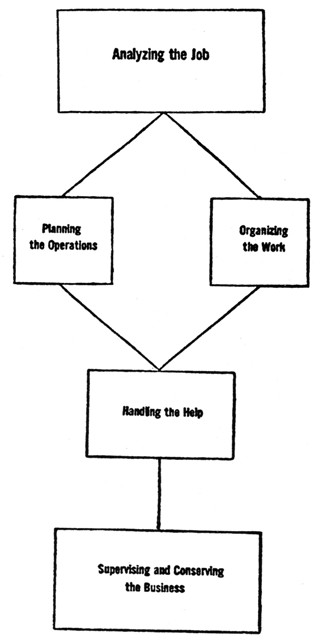
Now look at the chart. It pictures THE
ANATOMY OF MANAGEMENT. The
Chinese say a picture is worth ten thousand
words. And it would take a heap of writing
to tell the story more completely, more
simply than this picture.
Try hanging the "clothes" of your machine
shop, your woodworking plant, your
paper mill, on it. THEY FIT, don't they?
True, the chart is drawn from one of the
most primitive tasks of management—the
simple delivery of a message. But suppose
the boy doesn't deliver the message himself,
but has an assistant. Won't it be necessary
to go through exactly the same
motions? Suppose, instead of one message,
there are fifty. Fifty assistants will be necessary.
Will the job of managing vary a
jot—or even a tittle?
Now substitute fifty boxes for fifty messages.
The boxes have to be shipped. The
same processes of thought, the same principles
of management, apply.
If, instead of fifty boxes to be shipped,
fifty machines are to be manufactured—or
if instead of fifty machines it's fifty
thousand, and a thousand men and a million
dollars of capital are to be employed,
every one of the five principles shown on
the chart will be used. And every essential
point in the management of the business
could be covered by those five fundamentals.
Now substitute ships or shoes or breakfast
food for the machines we have been
talking about, and it becomes clearer than
ever that this BUSINESS OF MANAGING
recognizes no industrial fences.
Learn to manage a peanut stand and, in
principle, you are well on the road to knowing
how to handle the affairs of the U. S.
Steel Corporation.
Five steps there are: (1) Analyze; (2)
Plan; (3) Organize; (4) Handle; (5) Supervise.
Tackle any job on this basis and
follow through. The chances that success
will crown your efforts far outweigh the
possibilities of failure. At least, approaching
a job from these five successive angles
should limit the causes of failure to circumstances
quite beyond your control.
FIVE PRINCIPLES OF MANAGEMENT,
then. Their skillful application
to a business or to a job is the KNACK OF
MANAGING.
To do a real bang-up job of managing,
whether carrying a message or directing a
million-dollar business, the first step is:
Don't make a single move until you've
found out exactly what needs to be done.
But our first Do turned out to be a
Don't. So let's restate it. Find out exactly
what has to be done before you make
a single move.
You've heard that before? And it
doesn't mean a thing?
Neither did it mean a thing to a bright
young man who was taken on as production
manager in a shoe factory. The shoes
were good. Prices were right. Business
was booming. The factory was full of
orders.
But somehow or other shoes weren't getting
shipped on time—or anything like on
time. Three to four weeks late came to be
the customary thing. And customers were,
needless to say, kicking like steers.
So the bright young man was taken on
to get things ironed out.
He pitched in with vim and vigor.
The first morning's mail brought a dozen
complaints of slow deliveries. People were
practically barefoot out in Kansas and
Ohio. They were waiting for those shoes.
"Ha!" said the new production manager,
"Nous verrons." Which means, even in
English, "Now, for what we are about to
see, make us truly thankful." And he went
away from there to see why those orders
weren't out the door.
He was out to prove something. And
Providence—Rhode Island—had supplied
him with enough ammunition to shoot a
manufacturing organization full of holes.
Each order was traced. One was in the
shipping room.
"What's holding this up?" he asked the
shipping clerk.
"Haven't had time to ship it. And we
got other shoes that have been waiting
longer than those. It's a feast or a famine
down here. Some days we just can't get
'em out."
"You're working short-handed. Get a
couple more packers. You've got to get
those shoes out. The customers are hollering
like hell. Get 'em out!"
He found another order up in the cutting
room. But why report the conversation?
It varied only in the number of
cusswords used. It was always the old
story.
"Can't be done."
"Put more people on then. Will two be
enough? Or had we better make it three?"
All down the line it went. More people.
Costs went up. And did orders get out?
Oh, yes, some did. But they got out at the
expense of others. There was more congestion
than ever. Complaints increased.
Then the big boss called him in—and
down—pointed out the increasing costs and
asked how come. So the new production
manager went back over his trail demanding
retrenchment.
"Put 'em on" was changed to "take 'em
off."
The big boss tells the rest of the story.
"He had simply jumped in without finding
out what it was he had to do. Maybe
it was my fault for giving him too much
rope.
"Anyway, he hanged himself—or rather
we had to fire him. Then we took on a
quiet lad who had served his apprenticeship
with a large electrical supply house.
"He didn't know a twelve-iron sole from
a three-quarter foxing. But he knew
plenty about managing, as it turned out.
"I watched him. Things were in a bad
way, you see, and getting no better fast.
He did nothing much for several days but
read his mail. Sat around his office.
Didn't make a move to boss anyone. Stuck
his nose in here and there to find out what
this clerk or that clerk was up to.
"But no action. No tearing his shirt.
No nothing. And the complaints were
coming in with every mail. They never
fazed him. One day I ran across him up in
the fitting room. Another time I bumped
into him he was picking lasts out of the
bins. Again I saw him pushing empty
racks into the heeling room elevator.
"Apparently I had picked another lemon.
Looked like the best thing he did was sit
around and tap his teeth with a pencil.
"He fooled me, though. One afternoon
he dropped into my office with a map.
He'd drawn it between taps. It was a good
map with dotted lines to show just exactly
what happened to an order—any order—every
order. That map showed when it
went into the works, where it went from
there. And so on until it went out the
shipping room door. That's what he'd
been up to the day I saw him picking out
lasts. And I tell you I never had any idea
how many things could happen to an order.
I never realized how shoes halted and stumbled
and staggered around that factory of
ours.
"There were red lines, too. They
showed the changes he proposed making.
Here he would stop backtracking. Here
was unnecessary travel. Here was an old
bottle neck and here was how he was going
to crack it open. And look at those lasts
lying idle with shoes upstairs waiting to be
made on them!
"That wasn't half. It was actually taking
four days to get orders through the office
routine. He showed me how certain
necessary records that took time to make
could be made after the shoes were in
work. Other short cuts would wipe whole
days off our schedules.
"There was nothing to it—when you saw
it in red ink. In fact there's nothing half
so convincing as red ink. There's been none
on our books for the past five years—and
during that time the shoe business has
been no bed of roses.
"What he proposed was simple as pie—if
only someone had stopped to think.
We'd simply got into bad habits. We were
handling the work the same way we'd
handled it back in the days when grandfather
started the business. And this fellow
had been smart enough to wait and
wonder why. Not wonder why either. He
went and found out how come.
"In thirty days we were back on earth.
We were getting shoes out on time—many
many days sooner than we'd even been able
to before. And all because a smart young
man, who didn't know a thing about shoes
but a whole lot about managing, sat and
tapped his teeth and drew a few pictures.—All
because he had been in no hurry to
act until he had found out just what had to
be done."
It is so easy to jump to conclusions! If
you look about a bit, you will see plenty
of men who don't stop to find out what
needs to be done before they start trying
to do it. They're like the shortstop who
hurries his play and tries to throw the runner
out at first before he really gets his
hands on the ball. An error is more often
than not the result.
MANAGING, such men will tell you, is
putting "pep" and "punch" into your work.
Pep and punch were once good words. But
their good qualities have been so often extolled
that most of us have lost sight of
the fact that all the "drive" in the world
is so much wasted energy when it isn't directed
along the right lines. And when it
isn't so directed, it comes pretty close to
being the lowest form of human endeavor.
Witness the "go-getter" who really doesn't
know what it's all about, but often succeeds
in covering up a world of defects under a
cloak of ill-directed energy.
Other men think they are finding out
what needs to be done when actually they
aren't even getting close to the root of the
matter. With the best intentions in the
world, they are grasping at the first straw
the wind blows their way. Eureka! they
shout when they haven't found it at all,
but are merely jumping all the way over
the facts to conclusions! Actually to know
your business or your job demands ANALYSIS.
You have a right to duck. It's another
of those words that work overtime and
have suffered as a result. A certain type
of superficial business executive has done
analysis no good. To him the impressiveness
of the word suffices—to the complete
exclusion of the simplicity of the act itself.
And so analysis to you and you and YOU
has come to mean involved, complex research—running
around a lot in circles and
getting exactly nowhere. Analysis has become
for you an A1 example of the phrase-maker's
art.
REAL ANALYSIS of any problem in
business can, however, be simple—in fact,
it can be nothing else but simple.
Analysis, says Noah Webster, is "a resolution
of anything, whether an object of
the senses or the intellect, into constituent
parts or elements; an examination of component
parts, separately or in their relation
to the whole."
Whooee! all that when he might have
said "TAKING TO PIECES." For analysis
is literally that—taking a thing to
pieces to see what makes the wheels go
round. Not, however, with the destructive
intent of the small boy who strews his
watch all over the floor, but with the
avowed purpose of getting right down to
the sort of brass tacks which make it possible
to see the composition of the whole
clearly and plainly.
Analysis which befogs the issue is not
analysis at all. It's—in the vernacular—a
lot of "hooey."
But the RIGHT KIND OF ANALYSIS
"breaks down" the problem into its component
parts—without losing sight of each
part's relation to the whole. There may
be only two parts to a job of managing.
The messenger who analyzes his business
correctly will find exactly two: where to
go and what to do after he gets there—the
simplest kind of problem and the simplest
type of business analysis. But if the analysis
consisted of twenty pieces instead of
two, it would be no harder; it would only
be longer.
The production manager in the shoe factory
analyzed his job correctly when he
mapped out the route of an order. All he
did was take the manufacturing process to
pieces so that he could put the pieces together
again to form a more efficient whole.
So whether there are two or twenty or
two hundred pieces, the act of ANALYZING—of
TAKING TO PIECES—differs
only in the amount of territory it covers.
Naturally it will be a somewhat more
lengthy process to analyze the job of managing
a steel mill than to separate a peanut
stand and its operation into a few component
parts. But the approach is always the
same.
And no matter how good you may be
with the woods, how the approach does
affect the final score!
Consider for the moment that you
have a house built of blocks and want
to take it to pieces. A quick and easy way
of separating it into its component parts
would be a swift kick aimed down around
the foundations.
A quick method. But comes nothing.
There are all your blocks lying on the floor,
but so far as knowing what they're all
about, you're worse off than ever you were
before you kicked your house down.
The other way of taking your house of
blocks to pieces is to start with the roof
and WORK BACKWARDS. The very
thought, then, of "taking to pieces" suggests
the correct way to undertake the
analysis of a business or of a job.
And a study of the methods of successful
managers will convince the doubtingest
Thomas that starting at the top and working
down to the cellar is the method they
follow in the analysis of any business problem
they have to tackle.
Once a busy ceramic manufacturer found
himself in the restaurant business. He
knew about all there was to know about
dinnerware up to the point where it left
his customers' counters. What went on
after that was pretty much Greek to him
if you know what we mean.
And then he became a restaurateur. All
because his brother-in-law got into him for
several thousand dollars and then couldn't
quite seem to make the darned thing pay
a profit.
Brother-in-law knew the game. Oh, yes.
He had worked for a number of years as
assistant manager in a similar enterprise.
With his "knowledge of the business," he
should have made a success of this cafeteria
of his.
He knew how to handle the help, how to
buy, how to run the kitchen, and so on.
The operating details were as an open book
to him. Judged from every outward appearance,
the cafeteria was up to standard.
It should have climbed out of the red in
short order.
He had been taught to buy carefully and
to manage economically. "Well bought,"
he announced, "is half sold." He'd read it
in a book and he thought he was being a
good salesman. Still the business stayed in
the red.
Our ceramic friend was faced with kissing
his investment goodbye—and probably
with making a job in the pottery for a
good restaurant man—with throwing good
money after bad, or with getting into the
cafeteria business.
He figured this business ought to pay.
Somewhere, he knew, his brother-in-law
had gone wrong. Just where, he believed
he could find out.
So he took over the business. Brother-in-law
stayed on, leaving the new owner
free to observe.
And he did nothing but observe for a
solid week.
Each night he made a list of the points
in managing which had come up in the
course of the day's work.
In a week's time he had an accurate list
of all the actual jobs of managing, as all
bills except for gas and light and rent were
paid and a profit and loss statement was
taken each week.
Then he arranged the list in order of
natural importance.
It began with marketing and checking
bills with deliveries, and ended with counting
the money and depositing it in the
bank.
"Hold on," he thought, "this isn't such
a long way from running a pottery. What
am I in this business for?"
"Because," he answered, "I want to
leave as much of that money in the bank
as possible, and mark it down as profit."
So right away he started to draw pictures.
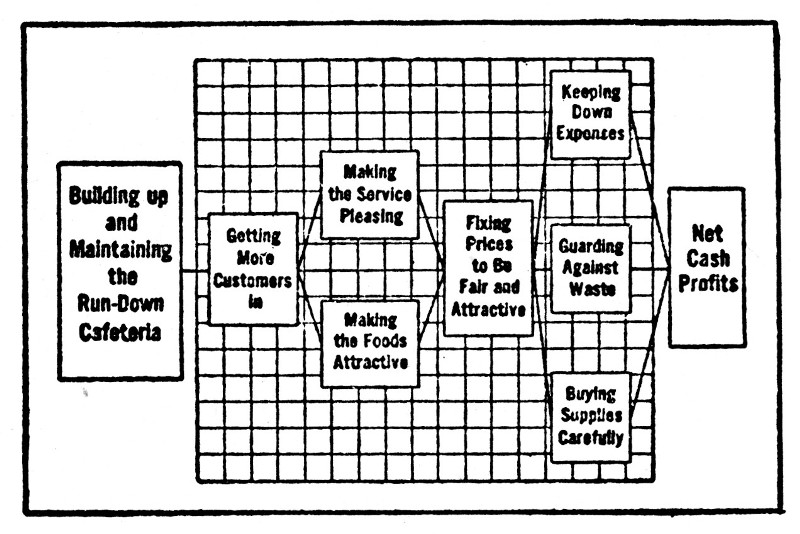
The chart on this page is the result
after he had worked it over and polished
it up.
Note how it works backward from his
final objective—"Net Profits."
"Now," questioned his alter ego, "how
do I determine how much of that money
stays in the bank as profit, and how much
has to be checked out right away for expenses?"
And from his handy list of managerial
functions it was plain that it depended on
three things—buying right, selling with as
little waste as possible, and keeping expenses
down.
"Now we're getting somewhere," he said
to himself. "Those things lead me right
into my next job—which is to fix prices
fairly. For what's the use of buying right,
handling supplies carefully and keeping expenses
right down to the bone unless my
selling prices cover costs, yield a profit, and
still look reasonable to the public?"
Yes, and the most attractive prices,
backed up by careful buying and all the
rest, wouldn't keep the dollars clinking
merrily over the counter unless the food
was so good and the service so excellent
that customers bought liberally and came
back for more.
By this time, you'll note, on taking another
peek at the chart, he had worked
right back to his "Number 1" job—getting
more customers in.
Thus, by ANALYSIS, he found out definitely
what had to be done—and what had
to be done first. Brother-in-law thought he
knew, but he had begun at the wrong end.
He had been looking after expenditures
first and receipts last. He was trying to
squeeze a little margin out of his receipts
before he did anything about getting the
receipts.
How different the new owner's viewpoint!
His brother-in-law, he found, was
thoroughly competent. He'd simply got off
on the wrong foot. In the kitchen and the
storeroom, he was a good operator. But
the new owner's place was "out front."
His job was to "get more customers, get
them to spend more—and to give them
such good food and service that they would
come back and bring their friends."
He began by spending money. Took out
the gas pipe at the entrance. Replaced it
with a brass rail. Provided a small lounging
room where customers could wait for
their friends. Put in upholstered chairs so
they could be comfortable while waiting.
Put attractive uniforms on attractive serving
girls.
There was an air of good taste about the
place when he got through.
Then he changed the arrangement of the
counters. But you know all about that—how
the desserts came first so they would
catch your eye before your tray was too
heavily loaded with the heavier part of the
meal. Staples which offered a small margin
of profit were relegated to places in the
rear. Dishes that made the best profit got
the positions up front. Each day he offered
a low-priced "special." Thus he
planned to increase customers' purchases.
And the business began to grow.
That's all there is. There isn't any more.
Today he doesn't own a chain of cafeterias
extending into many cities and feeding
many thousands of people every day at a
good profit.
He's still a very successful ceramic manufacturer—and
a cafeteria proprietor.
"I flew in the face of tradition," he
says. "'First watch your kitchen' is the
cry of the restaurant man. But I started
with what I wanted—net profits—and
WORKED BACKWARD to make conditions
that would provide net profits.
"VOLUME OF BUSINESS had to come
first. I had to get it before I could get a
margin of profit.
"No doubt I could go out in the kitchen
today and save some money. If I went to
market myself, maybe I could save a cent
a pound on my meats. But I can't give up
my attention to the 'front' in order to
watch the 'back.' As soon as I do that I'm
going to be right back where I started."
It would sound like heresy, wouldn't it,
if we hadn't sat in and watched him begin
with his final objective and work back
through the means which make the objective
possible. Only by careful analysis
would he have had courage enough to FOLLOW
HIS PLAN THROUGH to its successful
conclusion.
And here's the amusing sequel. Today,
as he still dabbles at feeding people, he will
admit that he's a better ceramic manufacturer
as a result of his cafeteria experience.
His pottery had always yielded a nice
profit. When he sat down with his sheet
of coordinate paper and analyzed it, he
found his job of management differed not
at all in its fundamentals.
His first job he found was "out front"
getting more customers in. A better
knowledge of markets, a better job of selling,
a better product—those were the ways
to get the customers in and make them
come back for more.
And his need for a better product led
him out into the plant where he found that
tunnel kilns with exact temperature control
would more than treble the production
of the old periodic kilns—and would produce
better ware.
But that's another story. The important
thing, anyway, is not what he found
had to be done in the cafeteria and in the
pottery, but HOW he found it.
He took his business to pieces—BACKWARDS.
He began with the objective he wanted
to get—MONEY. It was a simple matter
to find that to get money from the business
he had to get customers to come in and
spend money; that to get customers to
come in he must make his place look like
a good place to come to; that to make his
place look attractive he must spend money
on equipment and thought on the arrangement
and display of food.
And there he had his big job cut out for
him, with the other jobs following along in
natural sequence. It altered the whole
METHOD OF MANAGEMENT.
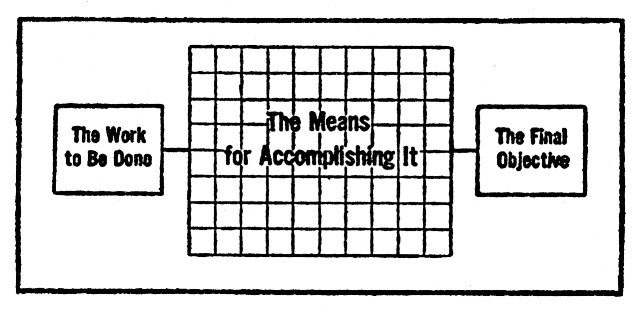
How this METHOD OF MANAGEMENT
is applied to your job is shown in
the chart which follows. It's a skeleton of
what the cafeteria man did.
Indeed, it's more than that. For it
shows what every manager—whether he
manages a steel mill, a punch-press department
or a time-study job—must do if he
is to get an honest-to-goodness PERSPECTIVE
OF HIS WORK.
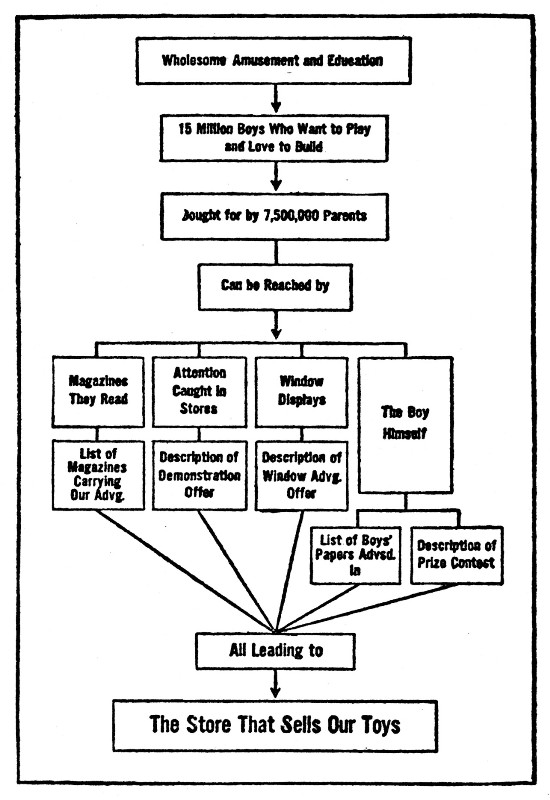
It can be done very simply. Just a sheet
of paper ruled in small squares—you can
buy it at any stationer's—on which to fill
in the steps you must take in between what
you have to do and what you seek to accomplish
by it—and some careful thought
as to just what your job is and why it is
to be done, will develop a true ANALYSIS
of your problems which will beat reams and
reams of typewritten words.
Remember the words of the Chinese philosopher:
"A picture is worth ten thousand
words"—and reflect how clever these
Chinese are!
The MEANS FOR ACCOMPLISHING
the final objective may be many or few.
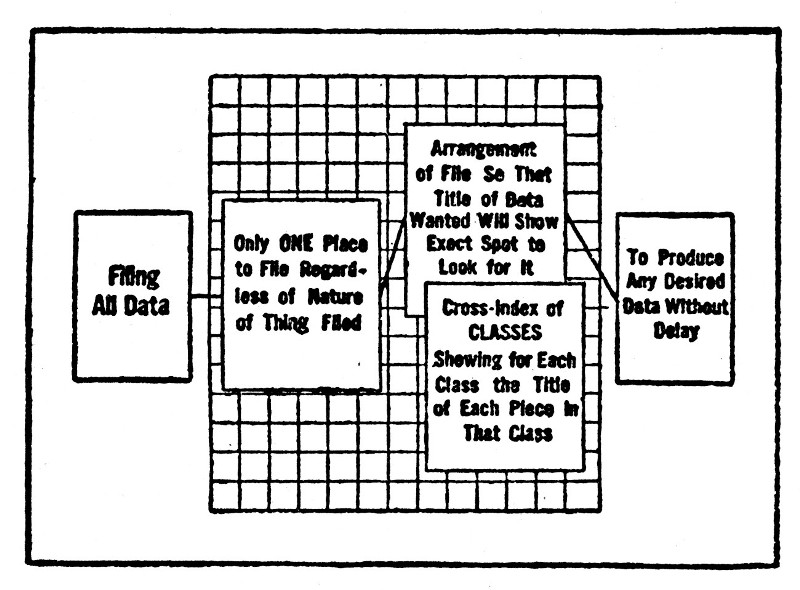
You have seen the cafeteria-manager's
problems on the chart on page 24. Now
turn to page 35 and see what a file clerk
does beside powder her nose from nine to
five.
A bright young lady fresh out of high
school went to work in an editorial office.
There wasn't enough filing to do to keep
her happy from nine to five, so she filled
in with a bit of typing here and a trifle of
routine clerical work there. Thursdays she
hopped over to the neighboring bookstore
and collected Saturday Posts for the editors—now
she'll have to do that on Tuesday.
And Fridays she distributed The New
Yorkers to avid readers.
Filing, though, was her main job. When
she first came, the managing editor said
"Here it is" or words to that effect, and
she went to work.
Those files had always been more or less
of a sore point. An editor's mail is nothing
if not voluminous. And every day Flossie
the fascinating file clerk got a mass of data
which she had to stick away. Her great
trouble was finding it again after she'd
stuck it away.
Often she couldn't find it. And pretty
soon she discovered that she got the blame
no matter what was missing—whether an
important inquiry from Peter B. Stilb or
the editor's pipe cleaners.
She couldn't do a thing about the pipe
cleaners, but she made up her mind that
since she was held responsible when a letter
got lost, she would also have the responsibility
of changing the filing system. The
system, she felt sure, was to blame.
One day when she was "on her lunch"
and the editors didn't need cigarettes from
the corner drugstore, she sat down and
made an ANALYSIS of her problem. Curiously
enough, she started at the end and
WORKED BACKWARDS.
She WORKED BACKWARDS, not because
someone told her that was the right
way to analyze her job, but probably because
she was only a file clerk and no one
ever told her anything.
"Why," she asked herself, "do I file these
old papers anyway?"
"So I can find them again, quickly and
surely, when they're wanted," seemed to
be the only answer to that.
"What's the right way to file these letters
and papers and data so I can find them
quickly?" was her next question.
"Arrange them like words in the dictionary—ONE
PLACE, and ONLY ONE
PLACE, where each can be," was only
common sense.
In the filing system which she had inherited,
there were a dozen places for each
set of data. There was a file on "Industries"
with sub-files for "Automobiles" and
all the rest; a file for data on "Railroads,"
with two or three sub-files. The file clerk
had to use judgment and discretion in selecting
the heading under which each letter
or piece of data was filed. And she wasn't
hired for judgment and discretion. Sometimes,
too, the editors erred in their descriptions
of the material they wanted.
One file, arranged alphabetically—ONE
PLACE TO LOOK, regardless of the thing
looked for—was the logical conclusion,
viewed from the standpoint of finding.
The managing editor was horrified. Mix
"railroads" with "public service," and
"manufacturing" with "agriculture"?
"Why," asked the file clerk, looking back
at her analysis, "why care how things are
kept so long as they can be found quickly?
When you send me for Camels, do you care,
so long as you get them quickly, whether
they're kept next to Chesterfields, or right
beside the chewing gum? When the chief
asks for data on 'C.P.R.' does he care, if
he gets it right away, whether it was filed
next to data on 'Coal' or beside facts about
other railroads?"
"All right," objected the managing editor,
"suppose someone asks for all the data
we have on railroads?"
Not a bad question. It was from a finding
standpoint.
"Have a separate cross-index by classes,"
was the answer. "That is, under 'Railroads'
have a card showing the name of every——"
"But look at the extra work."
Back to her ANALYSIS went the file
clerk. "Why file at all, except to make it
easy to find what we file? If we were to
set up a system for easiest filing, we'd simply
put everything in boxes just as it comes
to us. Our main objective is to make information
easy to find, and anything that
increases the work of filing but lessens the
work of finding, is profitable."
The result was a filing system that has
made a great mass of data as accessible as
the words in the dictionary. And it has
taken the human equation out of the job.
No longer does the file clerk have to stop
and use her judgment as to where she shall
file Mr. Stilb's letter. There is ONE
PLACE AND JUST ONE PLACE.
And the basis of the plan was the simple
process of ANALYZING—of starting with
the final objective and WORKING BACKWARD—not
forward from the work to be
done.
In hundreds of business offices—in
countless industrial plants—time, labor and
money are being wasted today in outmoded
methods which, like Topsy, "just grew."
The manager who started them didn't stop
to reason out first exactly what had to be
done—or if he did, he failed to WORK
BACKWARD from the final objective.
One way is as bad as the other.
In fact, it may even be better not to reason
at all than fail to get to the very bottom
and reason out the absolute right of what
has to be done. At least it takes less time.
A sure way, incidentally, to avoid making
mistakes in your analysis is to do it
on paper. A professor of mathematics in
one of the large universities always tells
his students that no problem should be performed
in the head that can be done on
paper. "Make pencil and paper do as
much as you can, for your brain has enough
to do to supervise the work."
Until your mind is trained to the habit
of QUICK, ACCURATE ANALYSIS,
you'll find it helps to do the work on paper.
Keep on hand a small supply of blank
charts like the one on page 31, on which
to sketch an analysis of new work or of
important decisions. The constant performance
of this detail will of itself train
your mind to look at problems more analytically,
and automatically to sift and
classify them more logically.
Perhaps you can improve on the chart
shown on page 31. Surely you can adapt
it better to your own needs. But force
yourself to some such method. It will help
you to cultivate the instinct of SHREWD,
RAPID ANALYSIS—and at the same time
it cannot help giving you a KEENER,
SURER INSIGHT into the particular
problem, no matter how complex or how
simple it may be.
Sometimes it is the apparently simple
problems that need analysis most. For
example——
Did you ever hear of a sales organization
that didn't have a stenographic problem?
The New York office of a Western factory
was no exception. The manager was
broadminded—even liberal—with his salesmen.
But when it came to stenographers,
he was decidedly Scotch. Valuable men
sat around the office mornings and evenings
waiting for a chance to dictate to a staff of
girls which was measured to fit the average
load of the day, but not the rush load of
the two hours a day when the salesmen
were inside.
Dictating machines seemed to be the answer.
The sales manager figured they
would not only solve the dictation problem,
but would further reduce stenographic
costs.
They were installed. At the same time
the stenographic force was cut to insure
keeping all the girls busy all the day.
Good. The salesmen were able to dictate
when they felt like it. But often the
letters dictated were a day or two late in
being transcribed.
Complaints increased. And the manager
lost his temper: "What's the matter with
this cursed letter-writing business?" he
demanded. "Why the Sam Hill do we have
typists and stenographers?"
Well, why? He calmed down a bit, seized
a sheet of paper and mapped out his problem.
This is what he wrote:
1. Salesmen's letters are to save salesmen's
time and to give prompt service to
customers.
2. I don't begrudge half a day's time of
a $20-a-day salesman to call on a customer.
Then it's still profitable to waste half of
the time of a $4-a-day stenographer in order
to save a long trip for a salesman, or
to get a quick answer to a question.
3. What we need is enough typists to
transcribe every letter of every salesman
promptly, even if part of them have to be
idle half the day.
The increased use of sales letters, the
greater freedom salesmen feel in their dictation,
the number of selling details now
promptly handled by mail without an expensive
call—all are directly traceable to
the manager's ANALYSIS which he made
by using the final objective as a starting
point.
He's a convert to the pencil and paper
method. Sales problems are part of his
daily exercise. He goes to the bottom of
them instinctively. But any problems that
arise concerning office work, he settles only
after analyzing from front to back—on
paper.
His method of charting his ANALYSIS
differs in appearance from the chart on
page 31, but it is identical in PRINCIPLE
AND EFFECT. It works from final objective
BACKWARD.
One more application of the same
KNACK OF ANALYSIS—and we are
done. It is that of an Ohio manufacturer
who recently put up a new building.
Plans prepared by the architect called
for four stories and a basement. When it
came time to discuss arrangement of space,
it was found that one department would
have to go in the basement. There were
objections from all sides.
The manufacturer ended up by taking
the problem home with him to TAKE TO
PIECES and put together again.
He began—fortunately—with the final
objective. "What's this new building for?"
Obviously, to provide more space for enlarged
operations.
"How much space is needed?"
He went over the figures and plans and
found the four main floors weren't enough.
"Then why not a fifth floor?"
As long as a bigger building was to be
built, why not make it big enough? Why
not another full story instead of a basement?
Why not, indeed! Come to find out, no
one knew just why a basement had been
considered. The old building had one, and
apparently that was the only reason for
proposing one for the new building. A full
story would give all the general storage
space of a basement and also give regular
working quarters for the department
crowded out of the four upper floors.
And when the architect was consulted,
it was found that with the extras for excavation,
waterproofing and the like, the cost
of a basement was considerably more than
the cost of another full story.
Yet, but for the manufacturer's analysis
of the building problem from the point of
final objective, the basement would have
gone in—simply because NO ONE HAD
STOPPED TO THINK, and think clearly
and logically.
Logical thinking is a trait that can be cultivated.
Every problem thought through
by means of some such simple help as we
have suggested, makes the mind more
ready to tackle the next problem.
Some men's minds grow so keen by practising
that sort of thinking that they
AUTOMATICALLY TAKE THINGS
TO PIECES as they listen. Before you
finish talking to them, they have already
analyzed your statement and are planning
on its execution—or are ready to reject it.
Sometimes it's intuition. But rarely.
Usually, it is nothing more than cultivated
KNACK.
Cultivate ACCURACY first. SPEED
OF ANALYSIS will come of itself.
Don't start until you know exactly where
you're going.
There is no task so trifling, no business so
large, that its management does not need to
ANALYZE EXACTLY WHAT THERE
IS TO DO.