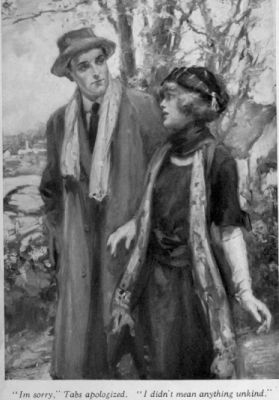
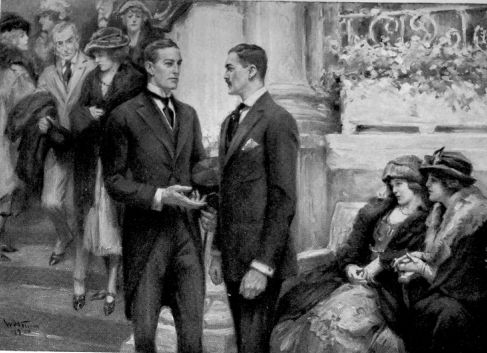
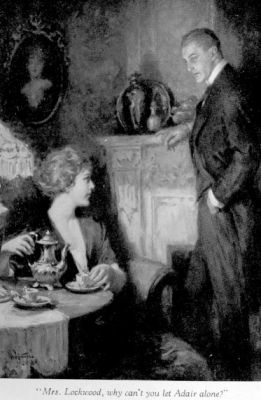
Lady Dawn was the first to recover her composure. "Why, Terry, I thought
you were in bed!"
"I was."
Terry's eyes shifted from Lady Dawn to Tabs. They were startled and
misty with sleep. She seemed only half-awake. Her hand rested on the
door as if ready for retreat. Her square little face was flushed; her
gold, bobbed hair was flattened where it had pressed against the pillow.
She was clad in a filmy negligée; her bare feet had been pushed hastily
into slippers and peeped out rosily from beneath the hem. She looked
immature—the way she had in days gone by when he had tiptoed to her
bedside through the darkness to feel her tight little arms leap
stranglingly about his neck. She had been really a tiny girl then. Why
couldn't she have stayed like that always? Why need she have roused in
him this torturing desire which she did nothing but rebuff?
"I was asleep. I heard voices. I thought——"
What had she thought? How much had she seen and heard? How long had she
been standing there?
Tabs attempted to bridge the awkward silence. "I drove down from
London." Then he added, "That was last night."
None of them had stirred. Lady Dawn advanced from the window into the
pool of lamplight. "I think I know what you thought—that something was
wrong. It was. I nearly fainted. If it hadn't been for Lord Taborley——
But come inside. Why do you remain standing there?"
Terry stepped just across the threshold. Having closed the door, she
leant against it, still holding the knob in her hand. It was plain that
she was making an effort to be valiant. She looked fragile as a peeled
white wand; like a flower, shy and dew-wet. Life had not yet commenced
to break her. The clinging folds of her wrap emphasized her slenderness,
the grace of her lines and the girlish contours of her figure.
Lady Dawn went to her and put her arm about her. "You're afraid. Of what
are you afraid? Surely not of Lord Taborley? He's been telling me—— To
be loved like that—— There was a time when I would have been proud."
Terry's left hand went up to her breast. Her wild violet eyes looked
straight before her, seeking always the face of Tabs. They seemed to
call to him. He came slowly to the table where she could see him. It was
his chance. Lady Dawn was his advocate. It was the chance for which he
had waited.
He was contrasting the two women before him; the one in her dainty,
enviable promise and the dumb hostility of her youth; the other in the
gentleness of her experience and the charity of her dearly purchased
understanding. Terry, whom he had loved since she was a child, had
become inscrutable. But Lady Dawn—— Was it her suffering that made him
know her as he knew himself?
"I hadn't meant to intrude on you," he apologized. "I hadn't the least
idea you were here. How should I have had? You disappeared without
warning; at your father's house your address was refused me. Lady Dawn
will bear me out that, at the very moment you entered, I was assuring
her that my visit had nothing to do with you. Probably you heard."
"Nothing to do with me!" There was relief in her way of saying it. She
visibly relaxed. "Then it isn't because of me at all that you're here?"
The suppressed eagerness of her question was wounding. She wanted to
hear him state more positively that she had had nothing to do with his
visit. Whatever she had seen before they had become aware of her, had
had no power to rouse her jealousy. She could have given him no stronger
proof of how absolutely he had ceased to count. He smiled bitterly. "Not
because of you at all, Terry. The reason for my being here is strictly
private between Lady Dawn and myself. I didn't come to worry you. You
may set your mind at rest."
"Then you didn't know or even suspect——"
He laughed unhappily. "What more can I say to convince you? I haven't
the least idea what you suppose I could suspect. What business is it of
mine to suspect anything? And if I did, what license should I have to
interfere? We're not as we once were. There are no longer any
sentimental obligations that would hold us accountable to each other.
You've shown me that you consider our relation ended. In the face of
that, I should scarcely follow you into the country where, by all
accounts, you've come to escape me. It's purely a coincidence that you
find me here."
He caught Lady Dawn's eyes resting on him. They were wide and clear and
interrogating. He knew what she was remembering: that it was in this
room within the hour that he had said, "But I want her. I can't do
without her. I want no one else." Self-ridicule tempered his spirit into
sharpness. He turned again to Terry.
"Once and for all I should like to set your doubts at rest. You need
have no fear that I shall ever inconvenience you. We're bound to meet
from time to time, but I pledge you my word that I shall never refer to
the past. You're of an age to make decisions for yourself; you've
decided against me. You're acting quite within your privilege when you
discard old friends. You'll wonder why I state obvious facts. I'm doing
so in order that you may feel certain that I've withdrawn whatever
claims I had for influencing your movements. I shall always be
interested—— But as for presuming that anything that I might say or do
would make the least difference to your plans, I shouldn't be so
foolish——"
Breaking away from Lady Dawn, she crossed over to him. Resting her hand
on his arm, she sank her voice and commenced speaking so hurriedly that
he alone could make out what she said.
"I've been false and foolish. I don't need you to tell me. If you knew
how miserable I've been and how I've despised myself—— But I can't
help it. I go on doing things. I never used to be a beast—least of all
to you; never until you wanted me to marry you. If I can act like this
now, what sort of a wife—— Can't you understand? I'm trying to spare
you. But I won't have you hate me, Tabs. I can't endure that. Every
second that I've kept away from you, I've been wanting—not the you
that you are now, but the old you. Won't you start afresh, liking me the
way you did when—before this happened?" She seized his hand on the
impulse and pressed it to her lips. It was the humble act of a small
girl. "Love me just a little. I'm not really bad. Please, please forgive
me my wickedness, dear Tabs."
He stood dumbfounded and embarrassed. If they had been alone, he would
have known what to do. He was at a loss to find a motive for this
display of passion. Was it a ruse to get him back? He crushed the
suspicion as unworthy. Then was it what she had seen that had made her
possessive? Her tears fell scalding on his hands.
He drew her to him. "There, there, little Terry! You mustn't. There's
nothing to cry about. There's nothing wicked in not having loved a man.
It's a thing that can't be helped."
At the sign of his relenting, she threw away the last of her control.
Burying her face against his coat, she clung to him. All that he could
see of her was her golden head and her slight body, quivering with
sobbing. Her voice reached him muffled. "But I am wicked. I've pushed
you from me. If you knew—— If you did, you wouldn't touch me."
There had been no sound, yet something warned him. He looked up. The
door was closing.
"Lady Dawn," he called. In his voice there was the tremor of anxiety.
On the point of vanishing, she glanced back across her shoulder. "What
is it, Lord Taborley?"
The calmness of her austerity made emotion seem shallow. There was a
touch of scorn in her repose.
"Won't you help?"
She smiled faintly. "I was. I was going."
"Then please don't. It's late. Both you and she must be worn out."
Like a figure of silver, she came coldly back. But there was only
tenderness in her voice when she spoke. "Terry, did you hear what Lord
Taborley said? He thinks he ought to be going."
Slipping her arm about the girl, she led her from him. Their footsteps
died out on the turret stairs.
He waited, hoping that Lady Dawn would return. Now that she was gone, he
was invaded with his old loneliness. The dead lords eyed him cynically
from their canvases. Through leaded panes the moonlight fell. It seemed
the sorcery of her spirit. The perfume of the rose-garden was her
breath. How pale she had made his dream of Terry! How trivial she made
all women look when she stood beside them! There was nothing in this
gift of youth for which he had clamored. Terry's youth, had he married
her, would have been his scourge. He knew at last what it was that he
required at the hands of a woman—it was rest.
There was no sound. The Castle was intensely still. He lowered the wick
of the lamp before he left, watched the flame splutter and waited till
it sank. Tiptoeing softly down the stairs, he slipped out noiselessly
into the romance of the summer's night.
Next morning, for the first few seconds after he had wakened, he lay
wondering why he was so happy. Then he remembered.
He had never had a friendship with a woman. From the start, though he
had hidden the fact from himself, his supposed friendship with Maisie
had been nothing less than lazy courtship. Terry had detected that when
she had said that he wouldn't have been so interested in Maisie if she
hadn't been so desperately good-looking. Until this morning he had had
no faith in such friendships. He had believed that their fundamental
attraction, however well concealed, must always be sex. They could never
be more than a pretense, in which either the man or the woman was
cheating—the one being anxious to give more than friendship, the other
deriving amusement from giving less. He had held that such relations
between men and women were inherently dishonest, doomed to end in a
clash of desire or to broaden into an honorable love affair. There was
no middle course between coveting a woman and neglecting her as entirely
dispensable.
But this morning his point of view was altered. He was confident that
his interest in Lady Dawn was on an utterly different footing. He had
never had this peacefulness of feeling for any woman. He marveled at it.
He had to fight the disillusion that it might be no more than a mood.
His liking for her had come to him so suddenly. Suddenness in the
emotions prompted him to distrust. Yet his present contentment seemed as
secure as it was incomprehensible. His new affection compensated him for
all previous failures and atoned for the humiliation of every past
regret.
At that word "affection" he halted himself. Was it affection that he
entertained for Lady Dawn? He took a good look at the suspected word and
decided that it was. But it was the affection of reverence. In owning
this much he qualified his admission by insisting that his affection was
totally devoid of passion. Passion in the presence of Lady Dawn looked
hysteric and paltry. She inspired a serenity which had nothing to do
with the physical. It was the charm of her character that entranced him.
Her body scarcely figured in his thoughts; when it did, it failed to
stir him. It was no more than the gracious vehicle through which the
beauty of her spirit was expressed.
His paramount emotion was gratitude—gratitude that she, who was reputed
to be so cold, should so instantly have unveiled herself. There was a
startling purity in the frankness with which she had bared her spirit
to him. It left him awed and touched. He recognized the generosity which
had prompted her; she had realized his need of a woman's trust. And so
she had withheld nothing that would comfort him. She had made him feel
safe, the way a mother does. She had picked up the little boy that lies
hidden in the heart of every man, and had folded him in her breast.
It had been shameless of her. He had not guessed that a woman could be
so good.
And she had made him so finally sure of her. He felt that he could leave
her and know that her protection would follow him. He could return and
be equally certain that none of her understanding would have vanished.
She was the first woman who had impressed him with her wisdom; the only
one who had had the courage to offer him her strength.
And this was not love. He smiled exultantly. It was nobler and
infinitely more rare. Love, as he had read of it and mistaken it in his
experience, was a devastating energy, greedy and devouring. It was a
continual, nagging contention between self-abasement and hostility. It
was a humiliating attempt on the part of a man to barter something,
which was persistently undervalued, for the feminine equivalent which
was as persistently hoarded. It was an amalgam of physical yearning,
wounded vanity and resentment of contempt. It was egotism masquerading
as altruism. It was a dancing bear lumbering at the heels of insanity.
Of all the passions it was the most hypocritical—a snare-setter, a
digger of pitfalls, an enemy disguised as one's dearest friend. He
thanked God there was no hint of love in his new-found friendship. Like
an outcast fleeing from a storm, he had blundered against the door of
this woman's charity, had felt it yield beneath his touch, and had found
himself immersed in the blessedness of instant and unmerited rest.
Lazily he commenced to dress. From his window he could see the Castle,
perched grave and gray against the forehead of the clouds. He wondered
whether she was up, how she was occupying herself, whether she was
expecting him? He listened to her voice in the silence of his brain,
like the far-away singing of contralto bells. He saw her still face, her
slow smiling, the proud, sweet stateliness of her pacing steps. Then his
thoughts went back to whether he was expected.
If he were not—— The thought chilled him. She had said nothing to
encourage him to seek her afresh. What if his reappearance should cause
her embarrassment—an embarrassment which she would betray by
withholding herself? It was quite likely she would impute to him wrong
motives. Already she might have repented of intimacies she had allowed.
He had placed his arm about her. With the injustice of most women,
though she had permitted it, she might be blaming him because the act
had been witnessed by Terry. Terry of all persons! Having had time to
reflect, she might be accusing him of gallantries. It was not so long
since she had confused him with Adair. From her untypical knowledge of
him she was entitled to estimate him as the kind of man to whom
promiscuous caresses were a practice. He turned coward at the
recollection of his daring. Last night it had been so involuntary and
had seemed so natural. Why had he done it? Why had she allowed it? It
had been the liberty of a plow-boy with a village-girl. There would be
little room for wonder if, when next they met, she fixed a No Man's Land
of pride between herself and his familiarity. She would have good
reason, for their companionship would be shared by Terry. Poor little
Terry, with her exaggerated sins and distorted self-accusations!
He wandered down to breakfast disturbed by these apprehensions. As the
morning dragged by they took shape as facts. Towards noon he could
tolerate his uncertainty no longer. He turned his steps in the direction
of the Castle, having first determined, if he found himself unwelcome,
to announce that the purpose of his visit was to bid good-by before
setting out for London.
He had been shown into the turret room and supplied with the daily
papers, while the same grave image who had admitted him the night
before, had departed in search of her Ladyship. More to calm himself
than to satisfy his curiosity, he commenced to glance through the news.
It was a disjointed world that the pages reflected—not at all the
kingdom round the corner for which the war had been fought. Honor,
patriotism, heroism seemed forgotten words. The old ruthless scramble
of commercialism had restarted. The honesty of everybody, whether
individuals, governments or nations, was being doubted. Class and race
hatreds had broken loose. Strikes were pending. The Allies were allied
only in name; they gnashed their teeth at one another across the
council-table in Paris. The lying game of diplomacy had been revived.
Poison-notes were being exchanged. The tabby-cat statesmen who had been
too old to fight, were busy sowing the seeds of future wars. The
politicians who had nailed mankind to the cross, were casting lots for
the raiment which had survived the sacrifice. No one asked, "Is this
righteousness?" The only question was, "How much of it belongs to me?"
Meanwhile, the children of honester men who had died, starved by their
hundreds of thousands. Mothers pressed sick babies to their milkless
breasts. The mutilated, stoical with neglect, shuffled along the
pavements. Fanatics of despair turned hopeful eyes to Russia where a
devilment was brewing which, should it overboil, would pour destruction
across five continents. No one cared.
He glanced through the window at the quiet landscape, lying green and
sun-dappled against the wet, gray streak of summer sky. Was his own
experience so universal? Were kingdoms perpetually round the corner,
always and always out of sight?
As he again took up the paper, his eye was caught by a head-line:
Steely Jack Runs for Parliament. Immediately he forgot his
pessimism and became absorbed. Braithwaite had come out with the true
story of his life. He was calling on the seven million men who had seen
service to fight on in peace for the ideals for which they had fought in
war. He insisted that if they cast their votes together as one man, they
could control any election. If they combined with the patriot
ex-soldiers of other nations, they could control the world. He was out
to smash politics and the disastrous iniquity of political compromise.
His aim was to restore the comradeship and sharing which had enabled the
old front-line to stand fast. He was establishing a paper. He was
speechifying. He was to hold an immense mass meeting in the Albert
Hall——
Tabs laughed in sheer excitement. Here was one man at any rate who
wasn't content to miss his kingdom. He might have known it. He could see
Braithwaite's bleak look as clearly as if he stood before him. His
instinct was to join him and say to him, in the words of the coster,
"You and me was pals out there." He'd never lost an inch of trench.
"Bravo, Braithwaite!"
"I beg your pardon, your Lordship."
Tabs looked up. The dignified image had returned and was standing in the
doorway, with his chin thrust out and his nose at a high angle with his
collar.
The man coughed deferentially. "If your Lordship will follow me——"
But at that moment he heard her calling from beneath the turret wall,
"Lord Taborley!"
Jumping to his feet, he hurried to the window and leant out. She was in
her riding habit, standing on the terrace above the rose-garden. "I've
just got back from my morning ride. I have to visit the kennels. I was
wondering whether you would accompany me."
He turned to the footman. "If you'll show me the way out to the terrace,
I can find Lady Dawn myself."
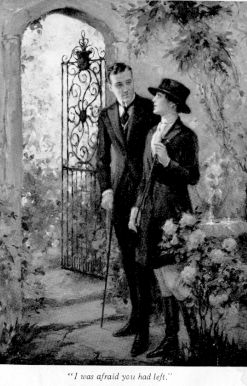
She had moved farther away to where the steps led down between the
rose-bushes. As he came towards her through the sunlight, she pretended
not to notice him, but stood meditatively flicking the dust from the toe
of her boot with her crop. Even when he joined her, she did not look up.
They descended the steps in silence. When they had turned along a path,
where no one could observe them, she raised her eyes. "I was afraid you
had left."
He smiled, unconsciously imitating her quietness. "And I, too, was
afraid. I was afraid you would not want me."
"Why not?" She stopped to pluck a bud in passing. "I should think any
woman would want you."
He looked to see if she were chaffing. "Last night," he explained, "you
were present when at least one woman didn't want me. That was why——"
She shot a glance at him with her honest, stone-gray eyes. Her hands
started out to touch him, but she recalled them. "You must feel sorry
for her," she said softly. "She's so young. I think you'll live to thank
her. She'll learn that men like you don't come every day—only once in a
lifetime."
"I was afraid you had left."
Uneasily he harked back to her first statement. "Why did you fear that I
had left?"
She shrugged her shoulders. "You had nothing for which to stay."
"There was you."
"Me!" She laughed wisely. "You had to say that out of politeness. In a
man's world I'm of no consequence. I know how I appear in your eyes.
I've been married, so I'm no longer a novelty. I'm not so young as I
was; I shall be older. And then I'm a mother—you forget that, Lord
Taborley. Oh no, I have no attractions to offer."
"You have friendship."
"Friendship!" She repeated the word with a shake of her head. "Men never
want merely friendship; they want less or more. They want vivacity—some
one who will halve their years, with whom they can sport and romp. Some
one who can have babies to them—little pink babies, with squirmy toes
and baldy heads. They want to begin everything afresh. They're not
looking for another man's left-overs. Even in the matter of
disillusionizing a woman, they want to do that for themselves. Men
who've not been married, demand that a woman shall be doing everything,
as they are doing it, for the first time. It's their right."
"But there's another side," he protested. "A woman who's been married
has gained experience—the most dearly purchased form of knowledge, as
you yourself have told me. She can be trusted not to expect the
impossible. She's been over the course and knows the pitfalls. She's
learnt the value of compromise. She ought to have learnt how to be kind.
I think kindness is the thing that matters most. Few people are born
with it. You have to have been wretched to acquire the knack of it."
"And yet you have it," she glanced sideways at him humorously, "and you
haven't been married."
Realizing the drift of their conversation, he pulled himself up. He
feared lest she suspected him of flirting. "You're very generous, Lady
Dawn."
They had arrived at a lookout point, where a lichen-covered summerhouse
stood, protected on the steeper side by a low stone wall. Below them lay
the moat, green-scummed and starred with water-lilies; throbbing in the
midday haze, the emerald sward of the parkland seemed to float. Against
the wall she halted. "What makes you say that I'm generous?"
For all his thirty-six years, he blushed like a boy. "Because you take
me seriously. After last night you might have been either amused or
annoyed. The position in which I placed you was false. You thought that
I'd come from London to urge Terry to marry me. When I told you that
there was no one else in the world, you believed that I knew she was
staying with you—that I was trying to persuade you to plead my cause.
The anti-climax, after she'd surprised us, was the height of tragical
absurdity. It reduced all my high-flown sentiments to farce. I wonder
you were able to prevent yourself from laughing. Terry could afford such
a scene; she's little more than a child. I can't. With four more years
to my age I could pass for her father. No, please. I want to be hard on
myself. Let me finish what I'm saying. I've only met you twice; on each
occasion I've suffered a loss of dignity. The other time was when I
tried to turn you away from Maisie's door. You're probably aware that
since then, until Pollock's return, I've seen far more of your sister
than was wise. In fact I've offered myself like a job lot. And yet there
was a time when I was content to wait. I believed that one had only to
be faithful and he'd find what he hoped for round some future corner.
You're a proud woman, Lady Dawn. You admire strength almost cruelly.
You're inhumanly infallible——"
Her eyes filled. She slipped her hand through his arm and patted it
comfortingly. By the contact she was comforting herself as well. "I'm
not. I wasn't infallible when I married. My pride came later to cover up
my fault. I don't say it to flatter you—any woman would want you."
He gazed down at her. "How gentle you are!"
"I understand."
They strolled along in contented silence. They had trespassed far beyond
the bounds of discretion. A diversion was caused when they reached the
kennels. He watched her among the leaping hounds. She employed the same
tactics to quiet them that she had used with himself. With a coaxing
word and a caress she had them crouching at her feet. He listened to
the precision of her orders and the definiteness of her enquiries.
"You'd have made a business woman," he remarked.
She laughed. "I could if I'd been forced." And then, "By the way, you're
lunching with me, aren't you?"
"I'll be delighted. But, since confessions are the fashion, I may as
well make a clean breast. If I had found that you were upset with what
happened last night, I'd planned to tell you I was off to London."
"But you're not?"
"One doesn't run away from happiness."
He was afraid he had offended. Her expression clouded. She withdrew and
walked a few paces apart. He had come almost to the point of
apologizing, when she turned to him eyes that were misty—suspiciously
misty for a woman who never cried. "I'm glad you had the courage to tell
me, because I haven't felt so happy for—— I daren't own how long."
On entering the Castle, she left him while she went to change for lunch.
As he waited, he reminded himself that in a handful of seconds he would
be meeting Terry. The anticipation provided him with none of the old
elation. With what ecstasy he used to watch for her in days gone by, as
though the world was reborn when she stood before him! Far from feeling
ecstasy, he was filled with uneasiness. Her presence would recall to him
his failure and would mock something beautiful that had commenced in
his life. What that something was he hadn't estimated. All he knew was
that, with the coming of Lady Dawn, every one of his problems had
mysteriously found settlement. He was no longer humiliated. He was once
more sure of his direction. He felt unreasonably strong and triumphant,
as though the goal of his striving was in sight. His old dread of
growing middle-aged impressed him as puerile. Whatever his age, she
would always keep pace with him. She was the same age as he was. Had he
been younger or older, he might have missed her or gone by her with
unseeing eyes.
When he entered the room in which lunch was served, he found that Lady
Dawn was alone. Glancing at the table, he perceived with surprise that
only two covers had been laid. She read the question in his eyes and
answered it.
"Terry's away. I forgot to tell you. She had an early breakfast and
motored into Gloucester before I was up. The car's come back without
her. She's sent no word as to when or how she proposes to return."
"Something urgent?" he asked casually.
"More likely shopping. A woman's shopping's always urgent. I'm no wiser
than you are. The first I heard about her going was when I was informed
she had gone."
He relapsed into thought. It wasn't difficult to conjecture the reason
for Terry's errand. She'd been no more anxious to meet him just at
present than he had been to meet her. She'd taken the day off in the
hope that by nightfall he would have departed.
Another solution occurred to him. "Did she ever mention to you a General
Braithwaite?"
Lady Dawn met his eyes with a hint of warning. Listeners were present.
"I believe she did," she admitted discouragingly.
"The only reason why I asked was that his name's in the morning papers.
She may have seen it before she started. If so, it might explain——"
"John will know." Lady Dawn turned to the footman. "Did Miss Beddow read
the papers, John, this morning before she left?"
"She did, my Lady. It was after she had read them that she ordered the
car."
"Then that's it." Tabs dismissed the subject as unworthy of further
discussing. "She went to Gloucester to hurry off a telegram of
congratulation. Braithwaite's had a stroke of luck."
"If that is all," Lady Dawn smiled mischievously, "I wonder that she
didn't come back in the car. A telegram can be dispatched in five
minutes."
From then on, the threat of Terry's return hung over them, urging them
to make the most of their respite. Everything that had started between
them was so new and uncertain. No time-limit had been set to Tabs'
visit; his original reason for coming to Dawn Castle was exhausted.
There was no sufficiently plausible excuse for prolonging his stay in
the village longer. A little absence, a little carelessness of
forgetting, a few new interests and who could say but that this sudden
need of each other, which had rushed them together with such compelling
impulse, might not subside as unaccountably as it had occurred. In both
their hearts this dread was present—this distrust of the permanency of
their emotions. If they parted, they might meet again to find the magic
irrecoverable.
After lunch they retired to the room in the turret. She chose her
favorite chair by the window and sat there sewing, with her work-basket
at her feet. He sat opposite, watching the busy occupation of her hands.
He noticed that many of the garments which she mended belonged to the
small boy whom he had seen in the rose-garden.
She looked up. "I always do everything for Eric."
It was later, when tea was being served, that the small boy himself
peered in on them. Tabs caught his jealous eyes peering round the
doorway. "Won't you come and talk to me?"
But the child ran away, despite his mother's coaxings, and refused to
divulge his place of hiding.
She apologized. "He's not quite eight yet—the only sweetheart I have."
Later she said, "I've been thinking of what we talked last night—I mean
his father. Would it be too far-fetched to believe that it was really he
and not your imagination, that piloted us together?"
"Not far-fetched at all. I'm sure of it. He wanted us to meet that I
might tell you——"
"What?" She bent forward, folding her hands in her lap and watching him
searchingly. "Not about his heroism; he'd take that for granted. Not
that he'd loved me; we both knew it. Not anything self-pitying or weak
that would rouse my regret——"
"You know." His assertion was almost a question. "Somehow he's got his
message across to you."
She lowered her eyes and resumed her sewing. "I couldn't sleep last
night. I lay awake puzzling and remembering—remembering the long waste
of years, the loneliness and the love that had turned to bitterness. And
now, when ordinarily there would be no chance to make amends, he sends
you to me, speaking through your lips and taking possession of your
thoughts. He's trying to do something for me—something that will blot
out my past for me, as his sacrifice has blotted out his past for him.
Something comforting and tender——"
The seconds ticked by. If she had guessed the dead man's desire, she
refused to put it into words. The silence grew painful.
Tabs looked at his watch. It was nearer six than five. He rose
reluctantly. "I suppose I should be going."
"But you're staying in the village to-night?"
"I hadn't intended. There'll be moonlight. I was planning to be in
London by morning."
"Don't do that. You'll make me think you're afraid of meeting Terry.
Dine with me to-night."
She had risen. Her gesture was almost one of pleading. He smiled
tenderly and took her hand. "Your wishes are mine. I'll run down to the
inn and dress."
By the time he returned it was nearly seven. She met him with
ill-concealed trouble. "Terry's not back. It's strange. You see I'm
responsible for her. And——"
The footman entered with a letter. "For your Lordship."
"Are you sure?" Then Tabs recollected. "Yes, of course. I left my
address with Ann."
As he took the letter he scanned the handwriting. "Odd!" When the man
had left, he turned to Lady Dawn. "It's from her. Did you guess?"
"But why should she be writing when she'll be seeing you any minute?"
Tabs squared his lips. He began to feel the stirring of a storm of
anxiety. "Perhaps, because she doesn't intend to be seeing me any
minute." He looked at the postmark. It had been mailed at eleven o'clock
that morning in Gloucester. He tore the envelope and commenced to read.
Before he had read far, he turned with a worried expression to Lady
Dawn. "This concerns you as well." She came and stood beside his elbow.
They glanced through the pages together. It was written on commercial
note-paper of The New Inn, Gloucester, and ran:
Dearest Tabs:
I love you very much—just as much as ever. I always want you to feel
sure of that. But my love isn't the kind you've asked for. It never
can be. Because of this there are so many things that I've not been
able to tell you—so I've been avoiding and deceiving you ever since
you came back. I know I've not been honorable. A promise once given
ought to be sacred; I gave you my promise that I would marry you. But
that's all I could do for you now—just marry you; I couldn't give
you the other things you would have a right to expect. I ought to
have said, the other things you have earned and deserved more than
any man. So, though I married you, I should still be robbing you,
which would be even more treacherous than not fulfilling a promise.
That I'm in love with General Braithwaite is no news to you. Love may
not be the proper word. At least I'm so infatuated with him that
there's no room in my heart for any other man. Do you remember that
night in March, when you dined with us and asked my father for my
hand, and next morning early I came round in a panic to your house? I
didn't dare tell you all my trouble. The General had urged me to
elope with him. I wish, wish, wish that I had. I should be his now
and sure of him. By delaying and suspecting I've all but lost him.
I always knew that he would be a big man—as big after the war as he
was while it lasted. What this morning's papers say about him proves
it. So for all these reasons and because I can't bear to face you at
the Castle, I'm taking my fate in my hands. Please tell Lady Dawn
that I shan't be back and excuse me in any way you can. I'm only
carrying one small bag; she can send the rest of my things after me.
There's one request I have to make—that neither of you will notify
my father till at least twenty-four hours have elapsed. All my future
happiness may depend on your granting this request. It's the last
favor I shall ever ask you.
And now, my very dear Tabs, almost my brother, if this hurts you,
please take revenge by bundling me out of your mind. I was never your
equal, never worthy of you, though you placed me on a pedestal that
was far above you. Comfort yourself by believing that if you'd
married me, you would have found this out. What a wretched quitter I
appear in my own eyes after all you suffered in the trenches, to have
reserved this worse suffering for you, when your life has been spared
and you had counted on me for happiness. My entire body's not worth
your little finger. And yet how good you've always been to me—
You'll get a better woman than I am. I think I already know who
she'll be; if I'm right, I shall be so very glad.
I feel so humble—so apologetic. It's such a different ending from
the one we dreamt when I saw you off on the troop-train with my hair
all blowy down my back. There's nothing gained by recalling that. I
meant so well by you; you've always been so much to me, my dearest,
loyal Tabs.
Even though you despise me, I still insist on signing myself,
Your ever affectionate
Terry.
"I'm sorry." It was Lady Dawn.
He shook himself. He was so raw that even her sympathy almost wounded.
"Don't pity me. It's she we've got to help. What's to be done?"
"Done! I haven't thought. What can we——"
"We can follow her and bring her back. We've got to—and we haven't much
time. You must have read between the lines what her letter meant. After
having turned Braithwaite down, she's gone off to beg him to elope with
her. When a girl puts herself at a man's mercy like that, there's no
knowing how he'll act. The chances are that, whatever he does, it won't
be honorable. We're got to prevent her, not only for her own sake, but
for his sake as well. He's just started on a great career; if this story
leaks out, he'll be smashed. They'll both be smashed, for that matter.
If she'd give him time to marry her honestly, it wouldn't matter whether
her family had consented. But she doesn't intend to—that's why she's
asked us to keep quiet for twenty-four hours. What we've got to do is
not to stop her from marrying him—no one cares about that; but to catch
her before she runs off with him."
"But we don't know where——"
"No, we don't." He spoke rapidly. "But we can find out. Ann can tell us.
Ann's a maid in my house; she was practically engaged to him when he was
my valet. Now that I look back, I'm sure she's known everything from the
start and has seen this coming. We can get Braithwaite's address from
her; when we know that, we shall have laid our hands on Terry."
While he had been speaking, Lady Dawn had been rummaging through her
desk. He went and bent over her, his hands on her shoulders. She was
fingering a time-table. She looked up at him with her head leant back.
"There's no train—nothing that will reach London till morning."
"Then we must motor."
Her face was still raised to his. She spoke softly. "We! You say we
every time. Do you mean—— What do you mean, Lord Taborley?"
His intensity relaxed. Flushing with confusion, he stared down at the
whiteness of her breast, the queenliness of her, her graying hair and
her expectant, tender mouth. "I want you to come with me. I ought to
have asked you properly. I've been taking you for granted and ordering
you about."
She remained very still, gazing directly up into his troubled eyes. He
thought she was judging him. At last she whispered, "Don't be sad. I
like you to order me."
They had all night before them. If they left the Castle by ten, they
could be in Brompton Square by five in the morning. Nothing would be
gained by arriving earlier.
Now that the first shock was over, they went into dinner as if nothing
had happened. In the long, dim banqueting-hall there were only the two
of them. They sat close together at the illuminated high-table like
castaways, marooned on an island, in an ocean of brooding shadows. While
they dined they conversed in lowered voices to prevent their plans from
being overheard. It was decided to take Lady Dawn's Rolls Royce and to
leave the runabout behind. The reason acknowledged was that it would be
more dependable. The reason unmentioned was that the presence of a
chauffeur would lend an air of much needed propriety.
Gradually as they talked, the seriousness of their errand dropped from
sight; their journey took on the complexion of an adventure. Its
unconvention clothed it with romance. How unconventional it was they
realized when Lady Dawn gave the butler orders concerning her departure.
He was an old man, rigid with tradition, who, having served the family
for three generations, had acquired the aristocratic bearing of his
masters.
"At ten o'clock, your Ladyship. To where? To London! That's a long
journey to take at night. And the car will call at the inn first to pick
up his Lordship's luggage. Oh, I see, my Lady. I thought at first that
your Ladyship was going."
"I am," she corrected with quiet dignity. "Lord Taborley and I are going
on an errand of great importance. I don't want this talked about. You
understand? And who'll be driving? Witherall! Then warn Witherall to
keep silent."
When the butler had withdrawn, she turned to Tabs. "I'm breaking all my
precedents for you. I couldn't have told him, if I hadn't had you to
keep me in countenance. He looked so shocked that he made me feel as if
it were you and I, instead of Terry, who were doing the eloping. I'm
sure that's what he thought. There'll be gossip. I shall have to pay the
piper; but I'm too happy to-night to look ahead."
"It hadn't occurred to me——" Tabs hesitated. "I've been unpardonably
inconsiderate. I see it now—you'll be what they call compromised. In
that case, it will be wiser——"
"It won't." She bent towards him laughing. Her pearls, nestling in the
white cleft of her bosom, gleamed dully, shaken by her quiet merriment.
In the short time that he had known her, she had become extraordinarily
girlish—almost girlish enough to put back the hands of time for the
proper man. "It won't. It won't be wiser. It's never wiser to turn your
back on happiness. I'd dare anything to-night. You've invited me; you
can't wriggle out."
"If that's how you feel——" He checked himself. Her mischief warned
him. Instinctively he knew that she was about to ask precisely how he
thought she felt. He cancelled what he had intended saying and
substituted, "It's an ill-wind that blows nobody any good. And it's poor
Terry we have to thank for this chance of being together a little
longer!"
"Is it a chance? You're not bored? You do want me?"
He raised his eyes slowly. Her pain had startled him. Up to that moment
he hadn't been awake to how utterly he had come to want her. For an
instant he had a glimpse of the emptiness of life, should he find
himself deprived of her comradeship.
"You didn't need to ask me that!" he said quietly. "And now it's my turn
to be inquisitive. Does it make you glad to hear me own that I want
you?"
He watched her color rise. It was like the elfin tiptoeing of her spirit
behind the white transparent walls of her flesh. It climbed the smooth
ascent of her breast, passed up the columned tower of her throat and
stared out at him excitedly in the brightness of her eyes.
"Men don't ask things like that," she said reproachfully, "at least,
only when they're flirting. I sometimes think—— Don't treat me like
all the others who were before me."
"What others?"
She held his gaze. "The emotional women and silly girls—— You must
have been loved very often, Lord Taborley."
To have defended himself against her tender jealousy would have been
futile. She was plainly anxious to believe her accusation. Perhaps it
flattered her a little. Perhaps it lent him an added touch of glamor. He
was wondering how he should satisfy her. He could remember no hearts
that his fascination had broken. He could rake up absolutely—— She was
speaking again.
"And yet I'm glad you compelled me to tell you that I wanted you. You're
making me do things that I never did before in my life. I'm supposed to
be a cold woman. You'll find people who'll say that I'm remote and
domineering. I've only one big affection—my little boy. For your sake
I'm leaving him alone to-night."
"For mine?"
"For whose else?"
"I thought for Terry's."
Her lips parted. The laughter died in her eyes. "In your heart you knew
better."
Then he left her and went down to the inn to pack his bag.
He had paid his bill. His luggage had been carried downstairs. There was
still a full quarter of an hour to wait. He sat in his bedroom smoking
furiously. Before he met her again, he wanted to know precisely what had
happened to himself—and, perhaps, to her.
He was filled with self-distrust. His newly discovered propensity for
falling in love was genuinely alarming. It wasted his time, upset his
plans and robbed him of his mental vigor. It made him a rudderless ship
at the mercy of any chance winds of sentiment. Up to less than three
months ago the solitary woman in his life had been Terry. Throughout the
war, while the masculine world had been making an amorous idiot of
itself, he had kept his head clear and gone straight. Things had come to
a pretty pass if now, when normality was returning and the excuse for
running wild was out-of-date, he should start on his emotional
escapades. His love for Terry had been deep-rooted. His fondness for
Maisie had been the attempt of a starved heart to satisfy its craving
with a substitute. But where was this pursuit of substitutes to end? If
it went much further he would gain for himself the reputation of being a
limpet who attached himself to any chance rock of feminine amiability.
The kind of woman he cared to associate with would avoid him. If ever he
were to fall in love again, his attentions would be so shop-worn
that——
If ever he were to fall in love again! Within the last twenty-four hours
his irresponsible heart had committed this disastrous folly for a third
time.
He smiled cynically, as though he were two separate persons, one of whom
was cool and calculating, while the other was improvident and
scape-grace. How Lady Dawn would despise him, were he to reveal to her
the stupid commotion of his mind! His excuse for blundering his way into
her privacy had been sufficiently fantastic: that her late husband was
employing his living brain to communicate with her from the dead. It
must have strained her credulity to the breaking-point. If on top of
this he were to propose to her, what possible conclusions could she
draw? Either that in order to gain her intimacy, he had perpetrated a
cruel fraud; or else that he was so lacking in humor as to believe that
Lord Dawn, from beyond the grave, was arranging for his wife's second
marriage. The drollery of a dead husband acting match-maker made him
smile. In the middle of his smiling he pulled himself up. Why not? Why
shouldn't a husband who had wrecked his wife's happiness, try to repair
the damage, if that were possible, when through death he had attained a
kinder knowledge? The Roman Church prayed to the dead whom it canonized.
There were thousands of parents, wives, sweethearts, bereft by the war,
who were asserting that their longing had bridged the gulf and
penetrated——
He shook himself, as though to struggle free from an invisible
assailant. Hallucinations! All these so-called spiritualistic
manifestations were the result of over-taxed imagination. To stick to
facts was the only safe course; and these were the facts in his case. He
had approached Lady Dawn as a matter of duty to tell her the truth about
a husband whom she had not known at his best. She had misinterpreted his
motive and had believed that he had come to confess to her his own
failure. She had been thrown off her guard, had dropped her mask of
stoicism and had lavished on him a reckless kindness. But other women
had been reckless to him in their kindness. Terry had: so had Maisie.
Women's kindness had caused his present predicament—their kindness,
plus his awkward knack of valuing their kindness at more than its face
worth. He had learnt his lesson. Never again would he be lured into the
net of feminine fickleness. When he felt the temptation rising, he would
suppress and ignore it; at any rate he would ignore it until the woman,
who was rousing his affection, had declared her intentions beyond any
chance of mistaking.
And Lady Dawn? She was in a class by herself. He held her sacred. The
mere thought that she should ever fall in love with him was
impertinence. To talk cheap sentiment would be insulting. It would cause
him to lose her friendship—a loss which he could not bear to
contemplate. It would be taking a mean advantage of a situation created
for an entirely different purpose.—— And yet, dare he trust himself,
now that he was in love with her, in the intimate aloneness of a long
night drive to London?
He rose to his feet disgusted. If this was the loss of self-control that
peace had brought, better a thousand times the rigors of the sacrifice
that was ended. Out there he had been strong; here he was a sick dog,
licking his sores and whimpering at his own shadow. Self-pity had
wrought this wholesale impotence—an impotence which was infecting the
entire world. While individuals and nations had thought only of others,
they had been valiant; they had raced in generous competition,
clean-limbed as athletes, towards the tape, where endeavor ends and
eternity commences. And now this lethargy, this cowardice—this
monstrous fat of quaking emotion!
A memory flashed back on him—an afternoon in March when he had been
obsessed by a similar discontent. It had happened in the Mall, after his
interview with Braithwaite and just before his introduction to Maisie.
He had come across a sign-board which had announced that, by following a
certain path, one would arrive at the Passport Office. That narrow
track, vanishing into the bushy greenness, had seemed to him the first
five hundred yards of the road that led to world-wideness and freedom.
At the end of it lay Samoa, Tibet, the Malay Archipelago—jeweled seas
and painted solitudes which human disillusions could not wither.
Instantly his will concentrated. By following that road he could become
lean-souled again. By reseeking hardships, he could recover his lost
discipline. The idea held him spellbound. It meant escape. It meant a
return to monasticism. Then and there he determined that he would
commence his preliminary enquiries to-morrow.
Going to the window, he leant out. The quaint village street was
sleeping. The night was so still that, it scarcely breathed; it lay like
a tired child in the firm white arms of the moonlight. Coming smoothly
to a halt before the hostel was a powerful car. It was a landaulet and
the hood was lowered. Lady Dawn must have altered her plans at the last
moment; instead of sending for him, she had come herself! Catching sight
of him, she waved her hand. His heart became quiet. Like the night
without, his being was flooded with a drifting whiteness that robbed the
darkness of its terror.
As he stood by the side of the car talking to her while his bag was
being stowed away, her manner was chillingly conventional. It was so
conventional that it bordered on the unfriendly. About the
unfriendliness of the chauffeur there could be no doubt. The elaborate
care with which he tucked the robe about her Ladyship had a distinct air
of alert possessiveness.
When Tabs had taken his place beside her and the village was left
behind, she relaxed and laughed softly. "Such a trouble I've had! They
all disapproved of our expedition—I mean the servants. Their eyes
accused me of—— Perhaps it's better not to be explicit. But that was
why I called for you, instead of letting you come to the Castle. Did you
notice anything queer about Witherall?"
"Your chauffeur? I thought he rather overdid his superciliousness and
that he treated you a little as if he were your husband. Apart from
that——"
"Apart from that," she laughed, "he made you feel entirely welcome. You
mustn't mind him. My servants aren't used to seeing me with an escort.
And then—— Well, an all-night ride would be a little difficult to
explain to anybody."
"I suppose it would."
They relapsed into silence. It was jolly to be so near to her and,
after the fears he had had, to know himself so trusted. She sat quite
close to him, so that he could feel the warmth of her body. Her
shoulders touched him; sometimes she leant against him with a gentle
pressure. Her fragrance was all about him. The robe spread across their
knees gave an added touch of intimacy. He glanced down at her sideways.
She was wearing a moleskin coat with a deep collar of silver-fox. She
had on a moleskin hat, close fitting to her glossy head. Her face was
partly hidden by a smart veil. She was immaculate as ever—as composed
and stylish as if she were going to a theater-party instead of on an
all-night ride to London. But it wasn't her stylishness that impressed
him; it was her littleness. She looked very tender and pale as she sat
beside him. The moral back of her chauffeur, as seen through the glass,
condemned him of unkindness. He had had no right to ask her to accompany
him. Why should he have burdened her with his troubles? She must have
plenty of her own, with her boy to care for and her estate to manage.
"I've been selfish," he said. "You ought to be in bed and sleeping now."
She smiled. "Always blaming yourself, aren't you? I shouldn't be here
unless I'd wanted."
"But why did you want?"
Beneath the robe her hand commenced to grope. It stole into his own and
lay there quietly. "Because I couldn't bear to see you hurt. You're so
good. In some ways you're so strong; in others you're just as tiny as
my Eric. I felt you needed me for the moment."
"For the moment! I shall always need you."
"I wish you might." She shook her head slowly. "But you won't. You'll go
away. I shall hear about you—all the big things you're accomplishing
and planning. And then I shall remember that for just one night I had
you for my very own."
"But we're always going to be friends. I shall be always coming back to
you."
"Men don't come back, Lord Taborley. A man of your temperament is least
likely to come back. You press forward. You're eager. Wherever you go
you form new affections. I'm not like that. I'm cold. You don't think
so, but then I'm treating you as I never treated any other man. You
slipped under my reserve and reached my heart before I could stop you.
Do you know how I'm treating you? Just the way I'd like some good woman
to treat my little Eric one day, when I'm not here and he's a man."
"But you're going to be here for a long time—just as long as I am."
There was alarm in his assertion. "I couldn't bear to think of your not
being in the world. It wouldn't matter so much whether I saw you; it
would be the knowledge that I could see you; that would make all the
difference."
"Would it?"
"Yes, I'm sure. You mustn't think that because there was Terry and—I'm
ashamed to have to own it—a passing fancy for your sister, that I'm
fickle."
"I don't. I never thought it for a moment. What I thought was that you
were unhappy. People do a lot of foolish things when they're unhappy."
"It seems so long since I was unhappy," he said gently. "You've healed
everything."
She was shaken as though with a storm of sobbing. No sound escaped her.
She did a thing which was as amazing as it was beautiful. Raising his
hand which she had been holding, she hugged it against her breast.
During the night he nodded. Once when he wakened, he found her tucking
the robe more closely about him. "Go to sleep. You're tired," she
whispered, patting his shoulder.
A strange woman—strangely maternal and beautiful! She never seemed to
think of herself. The women whom he had known had always demanded that
men should do all the giving. Even Terry had been like that. His
conception, of love had been of a continual bestowing with no hope of
reciprocity. To be allowed to give throughout one's life to the woman
beloved had seemed to him to be the maximum of married blessedness. He
knew better now. Lady Dawn had given so generously that she had
established a new standard; he would never again ask so little from any
woman. He began to perceive that all his approaches to love had been
self-abasing. In the true sense of the word he had never been in love.
Dream-intoxicated, yes! But all that he had experienced had been desire.
It was a new thought to him that a man must respect, even more than he
desires, the woman whom he covets.
His feeling for Lady Dawn was one of worship. When he wakened to find
her watching over him, it seemed to him that the Mother of God sat
beside him. When God's Mother is symbolized in a living woman, love is
reborn into the world.
The last time he awoke, dawn was breaking. The moon had grown feeble. A
chill was in the air. He sat up. "What! Still awake! I don't believe
you've slept a wink all night."
"I haven't. I didn't want. I've been enjoying myself."
"You look tired."
He commenced to pile cushions behind her and tried to coax her to take
some rest. "If you insist," she assented. "But I'd much rather not. I'm
like a child at a party; I want to last out every moment."
"Then let's talk. We're nearing London. We sha'n't get much chance for
being alone after we arrive. We don't know what we'll find. We may be
whisked away in opposite directions. Before we're separated, I want to
acknowledge what I owe you."
"It's cold," she shuddered, drawing closer to him. And then, "You owe me
nothing."
He was tempted to place his arm about her, but the cowardice of past
failure was strong upon him. He was afraid lest the ordinary gestures of
affection would cheapen him in her eyes; he was still more afraid that
they might mean to her that he valued her too lightly. He held himself
in hand, staring straight before him and speaking quietly.
"I'm the only judge of what I owe you. I came to you broken. Life had
made a fool of me. I'd fallen through placing my ideals too high.
Everything was slipping. Every belief I'd ever had was open to doubt.
Most of all I'd lost faith in the goodness of women. To explain my state
of mind I have to tell you that the war had made me fanatical. Like
millions of men who went out to die, I'd persuaded myself that I was
fighting more than Germans—I was fighting to bring about the new heaven
and the new earth. Our politicians promised us as much. You remember
their phrases. 'A world safe for democracy! A land fit for heroes to
live in.' When all the muck and the heartbreak were ended, we found that
outwardly it was the same old world. Heaven was as far away as ever.
There were no signs that any one wanted a new earth. Nations which had
been comrades, began to wrangle. Soldiers came home to find their jobs
held by slackers. The glorious promises had been a death-bed repentance;
their insincerity was proved when the world recovered. But our worst
disappointment was utterly personal—that despite the magnanimity we had
shared and witnessed, we ourselves were no less selfish. For me all
these disillusions were epitomized in Terry. I'd fought for her. I'd
carried her in my heart. If I'd died, my last thoughts would have been
of her. I came back hungry and she disowned me. That she should have
done that made humanity a Judas and God a mocker. I don't mean you to
believe that I gave way at once to this wholesale injustice. At first I
made an effort to struggle against it. I'd always held that great living
was a matter of pressing forward, of wearing an air of triumph when you
knew you were defeated, of believing, in spite of every proof to the
contrary, that further up the road your kingdom waited for you."
He felt the pressure of her friendly hand. "It does," she assured him.
"That's what you've taught me. It's what you taught Maisie; it's almost
as though you'd willed her husband to come back. You're a great
believer. All great believers have been doubters. They give away so much
of their faith that at times they have none left for themselves. You
limp. Don't flinch; with me there's no need to be sensitive. When you
entered my room for the first time, you made me think of another lame
man. Do you remember how Jacob wrestled all night with an unknown
assailant? When dawn was breaking his thigh was out of joint, but he
refused to let his assailant go until he had asked his name. The
stranger would not tell him—instead he blessed him. And then Jacob knew
it was with God he had wrestled. When the sun rose and he went upon his
way, he halted upon his thigh. You have the look that I think he must
have had—the look of a man who has been maimed in trying to make God
answer questions. It's that look and your very lameness that have given
me back something that Lord Dawn took from me—something that he knew,
when he sent you, you could give me back: my faith in men, without
which a woman can have no happiness."
The ghostly world streamed by, silent-footed and mist-muffled. It was
the hour when children are born and weary people die—the hour of new
beginnings and ancient endings, when life and death, like soldiers
changing guard, salute at the cross-roads of the new day as friends.
At last he broke the silence. "I thought I had nothing to give you. I
felt so empty. You seemed so strong and immovable, like a still tree in
a forest that was storm-shaken. You made me feel that however the wind
raged, beneath your branches there would be always rest. I never
knew——" He paused as though he had forgotten what he had set out to
say. "I never guessed that a woman could be so good."
"Nor I that there was so good a man."
They clasped hands so tightly that it hurt. The sun was rising as they
entered London. Trees dripped gold and birds were chattering as they
drove into Brompton Square. It was only when they had halted before the
sleeping house, gay with flaming window-boxes, that she released his
hand. With the severance of contact he awoke from his trance and
remembered the errand that had brought them.
He had opened the door with his latch-key and had stood aside to allow
her to pass into the hall, when suddenly he clutched her arm and drew
her back. He signed to her to make no sound. Together they stood
listening. The early morning stillness was broken by a door shutting
smartly at the top of the house, a cheerful whistling and then the
unmistakeably firm step of a man descending.
Tabs had no man in his employ, so what was a man doing in his house?
There was no secretiveness about the stranger's movements; on the
contrary, there was an airy boldness.
The sunlight danced and nickered on the wall as if it shared the
excitement of their suspense. The footsteps drew nearer. They paused
dramatically. The whistling ceased abruptly. Had the stranger taken
warning? A match was struck. He was only lighting a cigarette. The
footsteps came on again. At the final bend of the stairs the intruder
came in sight. He halted, mirroring their surprise, and stood staring
down at them with a bleak, hard look. He was the man whom they had least
expected.
Tabs was the first to collect himself. He closed the front door behind
him. "Good morning, General. You couldn't have been more prompt if we
had telegraphed you that we were coming." When Braithwaite still stared,
Tabs continued, "Allow me to introduce you to Lady Dawn and may I ask
how long I have had you as my guest?"
Braithwaite drew a puff at his cigarette. His manner was as haughty as
if he had been the owner of the house. "Since last night," he said. "I
have to thank your Lordship for a bed. Mrs. Braithwaite——" A gleam of
amusement shot into his eyes. "Mrs. Braithwaite had a sentiment for
spending her first night beneath your roof. Seeing that you were away
and that I was so newly wedded"—he made an eloquent gesture—"I could
scarcely deny her." Turning on his heel, he commenced to reascend.
Across his shoulder he flung back, "Of course I apologize. We'll not
trespass further. In a few minutes I'll have her dressed. In half an
hour, at the outside, I'll remove her."
"Don't be a fool." Tabs spoke sharply. "You make me wonder which of us
is mad."
Braithwaite regarded him for a moment with an enigmatic smile. "I'm not.
Yesterday I did the wisest thing of my life." With that he vanished.
Lady Dawn turned to Tabs gently. "If that's the way he feels, then he
has. Terry's to be congratulated."
"But why on earth should she have wanted to spend her marriage-night in
my house?" Tabs questioned. "My house of all inappropriate places!
That's what I can't understand. And what could Ann have been doing to
consent? You remember I told you there was a time when he was
practically engaged to Ann."
They mounted the stairs till they came to the first landing. Entering
the library, with its bright red lacquer, they sat down to await events.
But Tabs did not sit long; he was too restless. Having flung wide the
French windows which opened out on to the veranda, he kept going to the
doorway to listen.
He glanced at his wrist-watch. "Barely six o'clock! Upon my word, I
don't relish the idea of her being disturbed. Braithwaite's such a
hot-head. For all I care, they can stop here as long as they like. I'll
take a holiday so as not to embarrass them." He faced Lady Dawn with
troubled frankness. "The question is: are they married? I've been
trying to figure things out. They simply can't be unless he met her with
a special license in Gloucester. And even then, I can't see how—— But
if they're not married, surely he would never have had the audacity to
bring her to my house. It would be too preposterous—to the house of a
man to whom she was engaged, where she would be waited on by a woman
with whom he was once in love."
At that moment Ann entered, pretty and sleepy-eyed, with Braithwaite
following close behind. Tabs commenced speaking at once, in order that
he might put them at their ease as regards his intentions.
"We're not here to blame any one. You, General, evidently think that I'm
hostile. I'm not. As far as you're concerned, Ann, whatever you've done
is right. Of course I'm a little taken aback to find that my house was
chosen for the honeymoon. But if you'd like to have the use of it for a
week or so and Ann doesn't object, I'll clear out and leave you to
yourselves. You'll make me really happy if you'll accept the offer;
it'll be a proof of friendliness. You're wondering why we surprised you
so early. It wasn't to prevent you from marrying. It was because Lady
Dawn was responsible for Terry and we felt that a runaway match, with
the marriage announced after the event, might damage not only her but
you, General, as well. I read yesterday in the papers of what you're
doing and I want to say just this to you. You're the better man. You
deserved to win. Last time we met you refused to shake my hand. I hope
you'll take it now. You can afford to be magnanimous to a rival, now
that you're Terry's husband."
Tabs stood with his hand held out. Braithwaite made no motion to accept
it; and yet his expression was generous. "I can't shake your hand as
Terry's husband, Lord Taborley. I'm not married to her."
Lady Dawn sprang to her feet and came between the two tall men. "Not
married to her! But you intend to marry her? You told us you were
married."
Braithwaite was still smiling. "I am." To their amazement he slipped his
arm about Ann and kissed her sleepy, tender mouth. "Terry is safe with
your Ladyship's sister. We took her there when she arrived last night."
He turned to Tabs. "You said that I was the better man. I'm not. It was
your sense of duty that always urged me. I have to thank your Lordship
for the greatest happiness that can befall any man. You made me see it
as my greatest happiness, when I was in danger of becoming a cad. There
was one thing you said to me that sank into my mind. 'You'll never
succeed, however great your courage, unless you start with your honor
solvent.' You saved my honor. I didn't like your methods. But I thank
you with all my heart now. If it hadn't been for you, neither Ann nor I
would have come safely to our journey's end. I think we'd both like to
shake your hand."
It was two hours later. They were finishing their breakfast in the open,
on the balcony of the Hyde Park Hotel. From where they sat they could
watch a lawn-mower traveling slowly back and forth, patterning the sward
with alternate stripes of different colored greenness. They could smell
the acrid juices of newly cut grass. Beyond the islands of flowers and
vivid candelabra of trees, they could see the wild fowl of the
Serpentine rise and drift like phantoms across the sultry stretch of
blueness. Wheels of a water-cart grumbled sleepily against the gravel.
Moving through the sunlit shadows of the Row, riders were returning from
their early morning gallop.
They were still together—just the two of them. They were romantically
self-conscious of the domestic appearance which their twoness caused.
Only married couples or very ardent lovers rise, while the lazy world is
sleeping, to keep each other company at breakfast. They had not had the
heart to disturb the General and Ann in their temporary possession of
the little nest-like house.
Lady Dawn was speaking. "So you've done it again."
"What have I done?"
"What you did for Maisie. How did you put it last night? You've led them
to their kingdom."
He smiled. "I seem to have a faculty for doing that. I do for others
what I can't do for myself."
Still not looking at him, she said: "Perhaps you don't find your own
kingdom because you're too much in love with the search. You don't want
to bring your journey to an end. There are people like that."
"I'm not one of them.—I wish you'd look at me, Lady Dawn. Do you know
what I covet most in all the world? Rest and certainty. I don't mean a
lazy kind of rest, but the rest of a mind at peace with itself—the
certainty we all had while the war was on, when we were adventuring for
the advantage of other people. I've done nothing lately that wasn't for
myself. I want some one to live for, so that I can forget myself. I've
been thinking——"
The waiter presented the bill. Tabs scarcely knew whether to curse or
bless. He had been approaching the danger-mark; nevertheless, he wasn't
at all sure that he was grateful for the interruption. His heart cried
out to him to risk humiliation by one last act of daring. Experience
warned him that it is the sins of precaution—the follies left
uncommitted—that are most regretted by men of seventy.
She rose as he was gathering up his change. The purpose that had brought
them to London was ended. There was no further reason for their being
together. If they were to prolong their companionship, a new excuse must
be invented. He saw by the tentative manner in which she waited, that
she also had realized that. He became perturbed lest she might dismiss
him. Speaking hurriedly to forestall her, he said, "I suppose we had
better make sure of Terry by hunting her up at Mulberry Tree Court."
She barely nodded. Perhaps she thought, now that Braithwaite had been
eliminated as a rival, that this making sure of Terry betokened a
rekindling of the old infatuation. A constraint grew up between them. It
was not until they were standing on the top of the hotel steps, waiting
for her car, that he ventured to correct the wrong impression. "Funny
about Terry! If it hadn't been for her, we might never have been
friends. The first day of my home-coming she drew my attention to you;
it was too late—you had passed. You were driving with the Queen in the
Park. I remember what Terry said. She called you Di and spoke of you as
the most beautiful woman in England."
She gave no sign that she had heard. As though she were unescorted, she
passed before him down the steps. But the moment they were seated in the
car, she turned to him. She looked her full age. Her face was pale with
more than weariness. He noticed the threads of gray in her hair. Ever
since he had seen Ann in her flushed shy exaltation, he had felt more
keenly the pathos of Lady Dawn. It was a pathos that found an echo in
his heart—the pathos of approaching separation. What purpose did it
serve her to be beautiful, if she had no man of her own to admire her?
"You were on the verge of telling me something, when the waiter
interrupted," she prompted. "It began like a confession. You'd been
speaking about living for other people and your need of rest. Then, you
said you'd been thinking——"
"It was about how one could make a man's job out of living," he answered
quickly. "It's all wrong that one should feel decent only when he's
attempting to get slaughtered. It takes neither brains nor perseverance
to be dead. Any one can——"
"But it was about finding rest that you were speaking."
"Yes, but I've burdened you with too many of my troubles." He hesitated,
wondering whether he dare tell her what had happened to his heart. "I've
done nothing for you. I've only borrowed from your strength. You're the
most restful woman, the most calm——" Then he dodged. "But since you
ask me of what I was thinking, it was of how I might escape to the old
hardships. I thought I'd call at the Passport Office and get in touch
with the Royal Geographical Society, and commence arrangements to
explore——"
"Then I sha'n't be seeing you again?" She asked it in a tone of
dreariness, bordering on terror. Her hands trembled in her lap. She
stared straight before her.
"But you will." He forced a cheerfulness into his voice which he was far
from feeling. "These things take time. It may be weeks——"
"But you'll go away. I know it."
"I suppose I shall. Sooner or later I shall return. In the meanwhile we
can write."
She paid no attention to his consolation. Her face was gray as granite.
Her hands kept folding and unfolding. There was something symbolic in
their emptiness. "You won't come back. It's the end. You weren't sent,
after all."
How or why he said it, he never could tell. The words were utterly
unpremeditated. He spoke them, ordinarily and unemotionally, as though
throwing out a casual suggestion. "We could get married, if that would
make you happier."
"It's what I'd like."
His heart missed a beat. He dared not credit his senses. He glanced down
at her, prepared to find that she was mocking. The most beautiful woman
in England! There was no mistake; she had actually asked him.
"It's what I should like, too." He spoke conventionally. Nothing in his
tone betrayed his emotion. "It's what I've been dreaming from the moment
that we met—— When would be convenient?"
"As soon as possible."
"Would a week from to-day suit?"
She nodded, "Or sooner."
Beneath the robe his hand sought hers. He did not trust himself to look
at her. She was his, all of her and forever. It was marvelous. The
secret clasp of her hand was sufficient for the present. He was still
doubtful of his fortune and unnerved by his temerity. He felt aloof and
disembodied—an uninvolved spectator. And this was love, the journey's
end—this smiling stillness, which was so different from anything he had
imagined!
They entered Mulberry Tree Court and drew up before the house with the
marigold-tinted curtains. It was while they were waiting for the door to
be opened that he broke the silence. Smiling down at her with a guilty,
glad expression he asked, "We're engaged now, I suppose?"
She returned his smile less certainly. "I'm ashamed. But you won't
go——"
He laughed at the folly of her question. "Go, when I've got you, the
woman whom I wanted!"
"Then you won't go exploring? You won't exchange me for hardships?"
"Di, dearest, I've done with searching."
The door was opening. She pulled herself together. Porter stood before
them, neatly laundered, with the old suspicious meekness in her glance.
"Good morning, Porter. We've come to see Miss Beddow. We've been told
that she's staying with my sister."
"She is, your Ladyship. But none of them are down. She arrived so late
and unexpected."
They followed her across the hall into the sun-filled drawing-room, with
its fragrant flowers, tall windows, rockery-garden and little oval pond,
with the toy boat floating on its surface. The moment the door had
closed, he had her in his arms. Now that he was sure of her possession,
he held her desperately as if he feared that he were going to lose her.
"Closer," she whispered. "Closer." It flashed through his memory that
the last time he was in that room, he had been the spectator of just
such a union and had fled from it because he was excluded.
She stirred against him, lifting up her face.
"This time you're really crying," he whispered. Stooping he pressed her
lips. "They always told me you never——"
Freeing her arms, she clasped him tightly about the neck. He could feel
the weight of her body, dragging his face lower. She kissed him
passionately, stopping his breath, as though she would breathe into him
her very soul. "Oh, my dearest—my very dear! How cruel you were! You
made me ask you. I thought I'd never get you."
The door was opening. Terry was watching them. The first they knew of
her presence was when she spoke.
"You came to see me."
They broke apart like shameful children and stood regarding her, their
hands just touching. She seemed their elder.
"I suppose you have the right to jeer at me," she continued slowly. "I'm
left out. I was too cold. I'm too late. I didn't want what was offered
at the time it was offered. What I didn't want once, I can't have now.
And, perhaps, I still don't want it. Tabs used to speak of kingdoms. I
never knew what he meant. You've all found yours—Maisie, Braithwaite,
both of you and even Ann. Everybody, except me." She laughed to prevent
her tears from falling. "I suppose Tabs would tell me that mine's still
round the corner. You would, wouldn't you, Tabs?"
Her need, which had been theirs, penetrated their happiness. They felt
again the old wild pang of neglected loneliness. Sargent's painting
above the mantelpiece, looking down on them, reminded Lady Dawn of her
own forgotten tragedy. It was unendurable that their gladness should
bring sorrow to Terry. With a common instinct they went towards her.
Lady Dawn placed her arms about her. It was Tabs who spoke.
"Little Terry, you're not left out. You're ours more than ever. We've
not robbed you. We couldn't. Of you alone it's true that everything lies
before you. All the time you've had your kingdom, though you didn't know
it. You still have it—the Kingdom of Youth, for which we older people
were all searching."
In the silence that followed there stole to them through the summer
sunshine, above the mutter of London, the music of a distant
barrel-organ. In the mind of Tabs a picture formed; it was of children
dancing along a golden pavement on that first spring morning of his
disillusion. The tune which the barrel-organ played was the same. His
brain sang words to the music:
"Après la guerre
There'll be a good time everywhere."
And it was no longer an optimism—it was fulfilled promise.
Surely, beyond the bounds of space, Lord Dawn also listened and was
happy. For Tabs, as long as life lasted, it would be the marching-song
of the kingdom round the corner.