I propose to give in the following pages an outline
of the advance of science in the past twenty-five
years. It is necessary to distinguish two main kinds
of advancement, both of which are important. Francis
Bacon gave the title ‘Advancement of Learning’ to
that book in which he explained not merely the
methods by which the increase of knowledge was
possible, but advocated the promotion of knowledge
to a new and influential position in the organization of
human society. His purpose, says Dean Church, was
‘to make knowledge really and intelligently the interest,
not of the school or the study or the laboratory only,
but of society at large.’ So that in surveying the
advancement of science in the past quarter of a century
we should ask not only what are the new facts
discovered, the new ideas and conceptions which have
come into activity, but what progress has science made
in becoming really and intelligently the interest of
society at large. Is there evidence that there is an
increase in the influence of science on the lives of our
fellow-citizens and in the great affairs of the State? Is
there an increased provision for securing the progress
of scientific investigation in proportion to the urgency
of its need or an increased disposition to secure the
employment of really competent men trained in scientific
investigation for the public service?
The boundaries of my own understanding and the
practical consideration of what is appropriate to a
brief essay must limit my attempt to give to the general
reader some presentation of what has been going on
in the workshops of science in this last quarter of a
century. My point of view is essentially that of the
naturalist, and in my endeavour to speak of some of
the new things and new properties of things discovered
in recent years I find it is impossible to give any
systematic or detailed account of what has been done
in each division of science. All that I shall attempt is
to mention some of the discoveries which have aroused
my own interest and admiration. I feel, indeed, that
it is necessary to ask forbearance for my presumption
in daring to treat of so many subjects in which I cannot
claim to speak as an authority, but only as a younger
brother full of fraternal pride and sympathy in the
glorious achievements of the great experimentalists and
discoverers of our day.
As one might expect, the progress of the Knowledge
of Nature (for it is to that rather than to the historical,
moral and mental sciences that English-speaking people
refer when they use the word ‘science’) has consisted,
in the last twenty-five years, in the amplification and
fuller verification of principles and theories already
accepted, and in the discovery of hitherto unknown
things which either have fallen into place in the existing
scheme of each science or have necessitated new views,
some not very disturbing to existing general conceptions,
others of a more startling and, at first sight, disconcerting
character. Nevertheless I think I am justified in saying
that, exciting and of entrancing interest as have been
some of the discoveries of the past few years, there has
been nothing to lead us to conclude that we have been
on the wrong path—nothing which is really revolutionary;
that is to say, nothing which cannot be
accepted by an intelligible modification of previous
conceptions. There is, in fact, continuity and healthy
evolution in the realm of science. Whilst some
onlookers have declared to the public that science is
at an end, its possibilities exhausted, and but little of
the hopes it raised realised, others have asserted on the
contrary, that the new discoveries—such as those relating
to the X-rays and to radium—are so inconsistent with
previous knowledge as to shake the foundations of
science, and to justify a belief in any and every absurdity
of an unrestrained fancy. These two reciprocally destructive
accusations are due to a class of persons who
must be described as the enemies of science. Whether
their attitude is due to ignorance or traditions of self-interest,
such persons exist. It is one of the objects of
our scientific associations and societies to combat those
assertions and to demonstrate, by the discoveries announced
at their meetings and the consequent orderly
building up of the great fabric of ‘natural knowledge,’
that Science has not come to the end of her work—has,
indeed, only as yet given mankind a foretaste of
what she has in store for it—that her methods and
her accomplished results are sound and trustworthy,
serving with perfect adaptability for the increase of true
discovery and the expansion and development of those
general conceptions of the processes of nature at which
she aims.
New Chemical Elements.—There can be no doubt
that the past quarter of a century will stand out for
ever in human history as that in which new chemical
elements, not of an ordinary type, but possessed of
truly astounding properties, were made known with
extraordinary rapidity and sureness of demonstration.
Interesting as the others are, it is the discovery of radio-activity
and of the element radium which so far exceeds
all others in importance that we may well account it a
supreme privilege that it has fallen to our lot to live
in the days of this discovery. No single discovery ever
made by the searchers of nature even approaches that
of radio-activity in respect of the novelty of the
properties of matter suddenly revealed by it. A new
conception of the structure of matter is necessitated
and demonstrated by it, and yet, so far from being
destructive and disconcerting, the new conception fits
in with, grows out of, and justifies the older schemes
which our previous knowledge has formulated.
Before saying more of radio-activity, which is apt to
eclipse in interest every other topic of discourse, I must
recall to you the discovery of the five inert gaseous
elements by Rayleigh and Ramsay, which belongs to
the period on which we are looking back. It was found
that nitrogen obtained from the atmosphere invariably
differed in weight from nitrogen obtained from one of
its chemical combinations; and thus the conclusion
was arrived at by Rayleigh that a distinct gas is present
in the atmosphere, to the extent of 1 per cent., which
had hitherto passed for nitrogen. This gas was
separated, and to it the name argon (the lazy one) was
given, on account of its incapacity to combine with
any other element. Subsequently this argon was found
by Ramsay to be itself impure, and from it he obtained
three other gaseous elements equally inert: namely
neon, krypton, and xenon. These were all distinguished
from one another by the spectrum, the sign-manual
of an element given by the light emitted in each case
by the gas when in an incandescent condition. A fifth
inert gaseous element was discovered by Ramsay as a
constituent of certain minerals which was proved by
its spectrum to be identical with an element discovered
twenty-five years ago by Sir Norman Lockyer in the
atmosphere of the sun, where it exists in enormous
quantities. Lockyer had given the name ‘helium’ to
this new solar element, and Ramsay thus found it
locked up in certain rare minerals in the crust of the
earth.
But by helium we are led back to radium, for it
has been found only two years ago by Ramsay and
Soddy that helium is actually formed by a gaseous
emanation from radium. Astounding as the statement
seems, yet that is one of the many unprecedented facts
which recent study has brought to light. The alchemist’s
dream is, if not realised, at any rate justified. One
element is actually under our eyes converted into
another; the element radium decays into a gas which
changes into another element, namely helium.
Radium, this wonder of wonders, was discovered
owing to the study of the remarkable phosphorescence,
as it is called—the glowing without heat—of glass
vacuum-tubes through which electric currents are made
to pass. Crookes, Lenard, and Röntgen each played
an important part in this study, showing that peculiar
rays or linear streams of at least three distinct kinds
are set up in such tubes—rays which are themselves invisible,
but have the property of making glass or other
bodies which they strike glow with phosphorescent light.
The celebrated Röntgen rays make ordinary glass give
out a bright green light; but they pass through it, and
cause phosphorescence outside in various substances,
such as barium platino-cyanide, calcium tungstate, and
many other such salts; they also act on a photographic
plate and discharge an electrified body such as an electroscope.
But the most remarkable feature about them
is their power of penetrating substances opaque to ordinary
light. They will pass through thin metal plates or
black paper or wood, but are stopped by more or less
dense material. Hence it has been possible to obtain
‘shadow pictures’ or skiagraphs by allowing the invisible
Röntgen rays to pass through a limb or even a whole
animal, the denser bone stopping the rays, whilst the
skin, flesh, and blood let them through. They are
allowed to fall (still invisible) on to a photographic plate,
when a picture like an ordinary permanent photograph
is obtained by their chemical action, or they may be
made to exert their phosphorescence-producing power
on a glass plate covered with a thin coating of a phosphorescent
salt such as barium platino-cyanide, when a
temporary picture in light and shade is seen.
The rays discovered by Röntgen were known as the
X-rays, because their exact nature was unknown. Other
rays studied in the electrified vacuum-tubes are known as
cathode rays or radiant corpuscles, and others, again, as
the Lenard rays.
It occurred to M. Henri Becquerel, as he himself tells
us, to inquire whether other phosphorescent bodies besides
the glowing vacuum-tubes of the electricians’ laboratory
can emit penetrating rays like the X-rays. I say
‘other phosphorescent bodies,’ for this power of glowing
without heat—of giving out, so to speak, cold light—is
known to be possessed by many mineral substances. It
has become familiar to the public in the form of ‘phosphorescent
paint,’ which contains sulphide of calcium, a
substance which shines in the dark after exposure to sunlight—that
is to say, is phosphorescent. Other sulphides
and the minerals fluor-spar, apatite, some gems, and, in
fact, a whole list of substances have, under different conditions
of treatment, this power of phosphorescence or
shining in the dark without combustion or chemical
change. All, however, require some special treatment,
such as exposure to sunlight or heat or pressure, to elicit
the phosphorescence, which is of short duration only.
Many of the compounds of a somewhat uncommon
metallic element, called uranium, used for giving a fine
green colour to glass, are phosphorescent substances,
and it was, fortunately, one of them which Henri Becquerel
chose for experiment. Henri Becquerel is professor
in the Jardin des Plantes of Paris; his laboratory
is a delightful old-fashioned building, which had for me
a special interest and sanctity when, a few years ago, I
visited him there, for, a hundred years before, it was the
dwelling-house of the great Cuvier. Here Henri Becquerel’s
father and grandfather—men renowned throughout
the world for their discoveries in mineralogy, electricity,
and light—had worked, and here he had himself gone
almost daily from his earliest childhood. Many an experiment
bringing new knowledge on the relations of light
and electricity had Henri Becquerel carried out in that
quiet old-world place before the day on which, about
twelve years ago, he made the experimental inquiry,
‘Does uranium give off penetrating rays like Röntgen
rays?’ He wrapped a photographic plate in black paper,
and on it placed and left lying there for twenty-four
hours some uranium salt. He had placed a cross, cut
out in thin metallic copper, under the uranium powder,
so as to give some shape to the photographic print should
one be produced. It was produced. Penetrating rays
were given off by the uranium: the black paper was
penetrated, and the form of the copper cross was printed
on a dark ground (fig. 9). The copper was also penetrated
to some extent by the rays from the uranium, so that its
image was not left actually white. Only one step more
remained before Becquerel made his great discovery. It
was known, as I stated just now, that sulphide of calcium
and similar substances become phosphorescent when exposed
to sunlight, and lose this phosphorescence after a
few hours. Becquerel thought at first that perhaps the
uranium salt acquired its power similarly by exposure to
light; but very soon, by experimenting with uranium
salt long kept in the dark, he found that the emission of
penetrating rays, giving photographic effects, was produced
spontaneously. The emission of rays by this
particular sample of uranium salt has shown no sign of
diminution since this discovery. The emission of penetrating
rays by uranium was soon found to be independent
of its phosphorescence. Phosphorescent bodies, as such,
do not emit penetrating rays. Uranium compounds,
whether phosphorescent or not, emit and continue to
emit, these penetrating rays, capable of passing through
black paper and in a less degree through metallic copper.
They do not derive this property from the action of
light or any other treatment. The emission of these
rays discovered by Becquerel is a new property of
matter. It is called ‘radio-activity,’ and the rays are
called Becquerel rays.
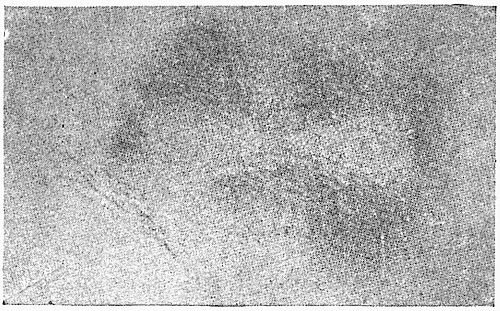
Fig. 9.—Henri Becquerel’s Discovery of Radio Activity.
Photographic print or skiagraph of a copper Maltese Cross produced
by uranium salt placed as a heap of powder on the surface of black paper
wrapped round a sensitive plate. Between the paper and the uranium
powder the flat copper cross was interposed. The rays from the uranium
salt have penetrated the black paper, but have been intercepted to a large
extent by the copper cross—so that the sensitive silver plate is darkened
all about the cross—over an area corresponding to that of the heap of
uranium salt, but is left pale where the copper figure blocked the path of
the active rays given off by the uranium, partially but not wholly. It was
thus proved that the rays from the uranium salt can pass through
blackened paper and also though to a less extent through a plate of
copper.
From this discovery by Becquerel to the detection and
separation of the new element radium is an easy step in
thought, though one of enormous labour and difficulty
in practice. Professor Pierre Curie (whose name I cannot
mention without expressing the grief caused to all
men of science by the sad accident by which his life
was taken) and his wife, Madame Sklodowski Curie, incited
by Becquerel’s discovery, examined the ore called
pitch-blende which is worked in mines in Bohemia and
is found also in Cornwall. It is the ore from which all
commercial uranium is extracted. The Curies found
that pitch-blende has a radio-activity four times more
powerful than that of metallic uranium itself. They at
once conceived the idea that the radio-activity of the
uranium salts examined by Becquerel is due not to the
uranium itself, but to another element present with it
in variable quantities. This proved to be in part true.
The refuse of the first processes by which in the manufacturer’s
works the uranium is extracted from its ore,
pitch-blende, was found to contain four times more of
the radio-active matter than does the pure uranium.
By a long series of fusions, solutions, and crystallizations
the Curies succeeded in ‘hunting down,’ as it were, the
radio-active element. The first step gave them a powder
mixed with barium chloride, and having 2,000 times the
activity of the uranium in which Becquerel first proved
the existence of the new property—radio-activity. Then
step by step they purified it to a condition 10,000 times,
then to 100,000 times, and finally to the condition of a
crystalline salt having 1,800,000 times the activity of
Becquerel’s sample of uranium. The purification could
go no further, but the extraordinary minuteness of the
quantity of the pure radio-active substance obtained
and the amount of labour and time expended in preparing
it may be judged of from the fact that of one
ton of the pitch-blende ore submitted to the process of
purification only the hundredth of a gram—the one-seventh
of a grain—remained.
The amount of radium in pitch-blende is one ten-millionth
per cent.; rarer than gold in sea-water. The
marvel of this story and of all that follows consists
largely in the skill and accuracy with which our chemists
and physicists have learnt to deal with such infinitesimal
quantities, and the gigantic theoretical results which are
securely posed on this pin-point of substantial matter.
The Curies at once determined that the minute
quantity of colourless crystals they had obtained was
the chloride of a new metallic element with the atomic
weight 225, to which they gave the name radium. The
proof that radium is an element is given by its ‘sign-manual’—the
spectrum which it shows to the observer
when in the incandescent state. It consists of six bright
lines and three fainter lines in the visible part of the
spectrum, and of three very intense lines in the ultra-violet
(invisible) part (fig. 10). A very minute quantity is
enough for this observation; the lines given by radium
are caused by no other known element in heaven or
earth. They prove its title to be entered on the roll-call
of elements.
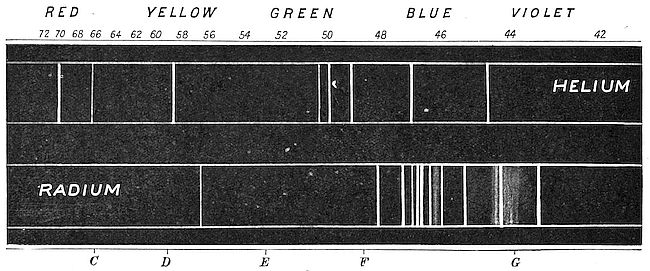
Fig. 10.
A diagram of the visible lines of the spectrum of the elements Radium
and Helium—when rendered incandescent by electric ‘sparking’ in a glass
tube: kindly prepared for this book by Mr. Frederick Soddy of the
University of Glasgow. The position of the chief great lines of the solar
spectrum are marked on the lowest horizontal line. On the upper line
the wave-lengths of the rays occupying the position indicated, are given.
The figure 72 means that the wave-length of the ray occupying this
position when refracted by the prism of the spectroscope is, as measured
from crest to crest of the undulation, seven hundred and twenty millionths
of a millimetre. It is generally written 720·0 µµ.
Lines exist at the ultra-violet end of the spectrum which can be
photographed but do not affect the eye—that is to say are invisible. On
the other hand the lines of the red end of the spectrum do not produce a
photographic effect. Consequently a ‘photographed’ spectrum such as
that given in the next figure (fig. 11) differs in the lines presented both at
the red and the violet ends from the visible series of lines. The two
(visible and photographed spectra) agree only from wave-length 587·6 µµ
to wave-length 447·2 µµ.
The two spectra given in fig. 10 show how great is the difference in the
position and number of the bands of Radium and Helium—yet as shown
in the next figure (fig. 11) the ‘emanation’ from Radium actually is
transformed into Helium.
The atomic weight was determined in the usual way
by precipitating the chlorine in a solution of radium
chloride by means of silver. None of the precious element
was lost in the process, but the Curies never had
enough of it to venture on any attempt to prepare
pure metallic radium. This is a piece of extravagance
no one has yet dared to undertake. Altogether the
Curies did not have more than some four or five grains
of chloride of radium to experiment with, and the total
amount prepared and now in the hands of scientific
men in various parts of the world probably does not
amount to more than sixty grains at most. When
Professor Curie lectured on radium four years ago at
the Royal Institution in London he made use of a small
tube an inch long and of one-eighth bore, containing
nearly the whole of his precious store, wrenched by
such determined labour and consummate skill from tons
of black shapeless pitch-blende. On his return to Paris
he was one day demonstrating in his lecture room with
this precious tube the properties of radium when it
slipped from his hands, broke, and scattered far and
wide the most precious and magical powder ever dreamed
of by alchemist or artist of romance. Every scrap of
dust was immediately and carefully collected, dissolved,
and re-crystallized, and the disaster averted with a loss
of but a minute fraction of the invaluable product.
Thus, then, we have arrived at the discovery of
radium—the new element endowed in an intense form
with the new property ‘radio-activity’ discovered by
Becquerel. The wonder of this powder, incessantly and
without loss, under any and all conditions pouring forth
by virtue of its own intrinsic property powerful rays
capable of penetrating opaque bodies and of exciting
phosphorescence and acting on photographic plates, can
perhaps be realized when we reflect that it is as marvelous
as though we should dig up a stone which without
external influence or change, continually poured forth
light or heat, manufacturing both in itself, and not
only continuing to do so without appreciable loss or
change, but necessarily having always done so for countless
ages whilst sunk beyond the ken of man in the
bowels of the earth.
Wonderful as the story is, so far it is really simple
and commonplace compared with what yet remains to
be told. I will only barely and abruptly state the fact
that radio-activity has been discovered in other elements,
some very rare, such as actinium and polonium; others
more abundant and already known, such as thorium and
uranium, though their radio-activity was not known until
Becquerel’s pioneer-discovery. It is a little strange and
no doubt significant that, after all, pure uranium is
found to have a radio-activity of its own and not to have
been altogether usurping the rights of its infinitesimal
associate.
The wonders connected with radium really begin
when the experimental examination of the properties of
a few grains is made. What I am saying here is not
a systematic, technical account of radium; so I shall
venture to relate some of the story as it impresses me.
Leaving aside for a moment what has been done in
regard to the more precise examination of the rays
emitted by radium, the following astonishing facts have
been found out in regard to it: (1) If a glass tube containing
radium is much handled or kept in the waistcoat
pocket, it produces a destruction of the skin and flesh
over a small area—in fact, a sore place. (2) The smallest
trace of radium brought into a room where a charged
electroscope is present, causes the discharge of the
electroscope. So powerful is this electrical action of
radium that a very sensitive electrometer can detect the
presence of a quantity of radium five hundred thousand
times more minute than that which can be detected by
the spectroscope (that is to say, by the spectroscopic
examination of a flame in which minute traces of radium
are present). (3) Radium actually realizes one of the
properties of the hypothetical stone to which I compared
it, giving out light and heat. For it does give out heat
which it makes itself incessantly and without appreciable
loss of substance or energy (‘appreciable’ is here an important
qualifying term). It is also faintly self-luminous.
Fairly sensitive thermometers show that a few granules
of radium salt have always a higher temperature than
that of surrounding bodies. Radium has been proved to
give out enough heat to melt rather more than its own
weight of ice every hour; enough heat in one hour to
raise its own weight of water from the freezing-point to
the boiling-point. After a year and six weeks a gram of
radium has emitted enough heat to raise the temperature
of a thousand kilograms of water one degree. And this
is always going on. Even a small quantity of radium
diffused through the earth will suffice to keep up its
temperature against all loss by radiation! If the sun
consists of a fraction of one per cent. of radium this
will account for and make good the heat that is annually
lost by it.
This is a tremendous fact, upsetting all the calculations
of physicists as to the duration in past and future
of the sun’s heat and the temperature of the earth’s
surface. The geologists and the biologists have long
contended that some thousand million years must have
passed during which the earth’s surface has presented
approximately the same conditions of temperature as at
present, in order to allow time for the evolution of living
things and the formation of the aqueous deposits of the
earth’s crust. The physicists, notably Professor Tait
and Lord Kelvin, refused to allow more than ten million
years (which they subsequently increased to a hundred
million)—basing this estimate on the rate of cooling of
a sphere of the size and composition of the earth. They
have assumed that its material is self-cooling. But, as
Huxley pointed out, mathematics will not give a true
result when applied to erroneous data. It has now,
within these last five years, become evident that the
earth’s material is not self-cooling, but on the contrary
self-heating. And away go the restrictions imposed by
physicists on geological time. They now are willing to
give us not merely a thousand million years, but as many
more as we want.
And now I have to mention the strangest of all the
proceedings of radium—a proceeding in which the other
radio-active bodies, actinium and thorium, resemble it.
This proceeding has been entirely Rutherford’s discovery
in Canada, and his name must be always associated with
it. Radium (he discovered) is continually giving off,
apart from and in addition to the rectilinear darting
rays of Becquerel—an ‘emanation’—a gaseous ‘emanation.’
This ‘emanation’ is radio-active—that is, gives
off Becquerel rays—and deposits ‘something’ upon bodies
brought near the radium so that they become radio-active,
and remain so for a time after the radium is
itself removed. This emanation is always being formed
by a radium salt, and may be most easily collected by
dissolving the salt in water, when it comes away with
a rush, as a gas. Sixty milligrams of bromide of radium
yielded to Ramsay and Soddy ·124 (or about one-eighth)
of a cubic millimetre of this gaseous emanation. What
is it? It cannot be destroyed or altered by heat or by
chemical agents; it is a heavy gas, having a molecular
density of 100, and it can be condensed to a liquid by
exposing it to the great cold of liquid air. It gives a
peculiar spectrum of its own, and is probably a hitherto
unknown inert gas—a new element similar to argon.
But this by no means completes its history, even so far
as experiments have as yet gone. The radium emanation
decays, changes its character altogether, and loses half
its radio-activity every four days. Precisely at the same
rate as it decays the specimen of radium salt from which
it was removed forms a new quantity of emanation,
having just the amount of radio-activity which has been
lost by the old emanation. All is not known about the
decay of the emanation, but one thing is absolutely
certain, having first been discovered by Ramsay and
Soddy and subsequently confirmed by independent experiment
by Madame Curie. It is this: After being
kept three or four days the emanation becomes, in part
at least, converted into helium—the light gas (second
only in the list of elements to hydrogen), the gas found
twenty-five years ago by Lockyer in the sun, and since
obtained in some quantities from rare radio-active minerals
by Ramsay! The proof of the formation of helium
from the radium emanation is, of course, obtained by the
spectroscope, and its evidence is beyond assail (see fig. 11).
Here, then, is the partial conversion or decay of one
element, radium, through an intermediate stage into
another. And not only that, but if, as seems probable,
the presence of helium indicates the previous presence
of radium, we have the evidence of enormous quantities
of radium in the sun, for we know helium is there in vast
quantity. Not only that, but inasmuch as helium has
been discovered in most hot springs and in various radio-active
minerals in the earth, it may be legitimately argued
that no inconsiderable quantity of radium is present in
the earth. Indeed, it now seems probable that there is
enough radium in the sun to keep up its continual output
of heat, and enough in the earth to make good its loss
of heat by radiation into space, for an almost indefinite
period. Other experiments of a similar kind have rendered
it practically certain that radium itself is formed
by a somewhat similar transformation of uranium, so that
our ideas as to the permanence and immutability on this
globe of the chemical elements are destroyed, and must
give place to new conceptions. It seems not improbable
that the final product of the radium emanation after the
helium is removed is or becomes the metal lead!
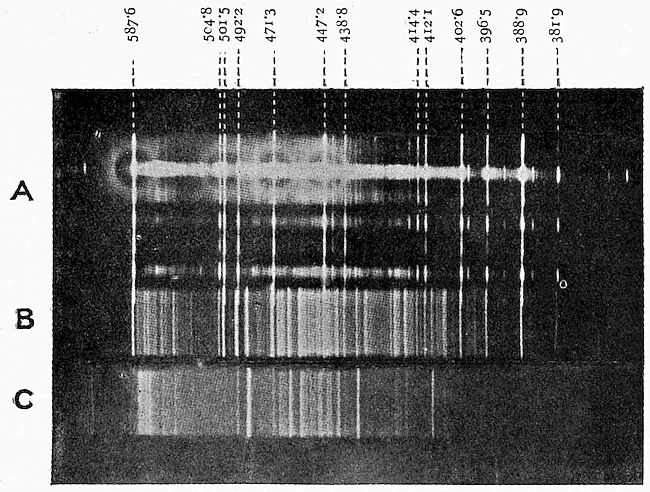
Fig. 11.
| A | { Tube containing | B | { Tube of Radium | C | { Tube of Hydrogen |
| { Helium gas derived | | { emanation, a | | { gas for |
| { from the | | { year old. | | { comparison. |
| { mineral Clevelandite. |
Photographs of the “spark” spectra of A, Helium as extracted from
the mineral Clevelandite of B, the Radium “emanation” after a year’s
enclosure in the tube used and of C of Hydrogen gas: copied from the
paper by Mr. F. Giesel in the Berichte der Deutschen Chemischen Gesellschaft,
vol. xxxix, part 10.
The three photographs are accurately super-imposed so as to show the
coincident lines.
The spectrum B of the tube containing radium emanation is the one
which we are comparing with the other two. When the radium
emanation was first enclosed there was only a small quantity of helium
developed in it, but after keeping for a year the quantity has greatly
increased. After five minutes “sparking” (passage of the electric spark
through the tube) the chief lines of helium become evident but faint in
intensity. The present photograph B was obtained after forty minutes
sparking, and one result of that longer “sparking” has been that a minute
quantity of water vapour in the tube has been broken up—so as to yield the
hydrogen spectrum, which is accordingly seen accompanying the now strong
and brightly developed helium spectrum.
The lines of the spectrum B which correspond with those of hydrogen
are at once recognised by the juxtaposition (below) of the pure Hydrogen
spectrum from another tube—C: the lines in B belonging to and indicating
helium are also recognised by comparison with the pure helium spectrum
of the tube A juxta-posed above. A very few of the lines in B must be due
to other minimal impurities as they are not present either in A or C.
Thirteen lines of the helium spectrum are thus photographed and
recognised in the radium emanation.
The following lines are present in the photographic but invisible
spectrum of radium (not given in fig. 10), viz. at 381·47 µµ (the strongest
line in the radium spectrum) and at 364·96 (a strong line).
In the photographic but invisible spectrum of helium there are three
very faint lines between wave-length 447·2 and 443·7 (appearing as two
only in our photograph); a moderately strong one at 438·8; others at
414·4, at 412·1, at 402·6, and 396·5; a very strong one is present at 388·9,
and a very faint one at 381·9. All these are seen in the photograph A and
also in B. Special treatment and spectroscopes reveal four other very
faint lines in the helium spectrum—the one furthest in the invisible
direction (that is of highest refrangibility and lowest wave-length) being
placed at 318·6 (Soddy).
It must be obvious from all the foregoing that radium
is very slowly, but none the less surely, destroying itself.
There is a definite loss of particles which, in the course
of time, must lead to the destruction of the radium, and
it would seem that the large new credit on the bank of
time given to biologists in consequence of its discovery
has a definite, if remote, limit. With the quantities of
radium at present available for experiment, the amount
of loss of particles is so small, and the rate so slow,
that it cannot be weighed by the most delicate balance.
Nevertheless it has been calculated that radium will
transform half of itself in about fifteen hundred years,
and unless it were being produced in some way all of
the radium now in existence would disappear much too
soon to make it an important geological factor in the
maintenance of the earth’s temperature. As a reply to
this depreciatory statement we have the discovery by
Rutherford and others that radium is continually being
formed afresh, and from that particular element in connection
with which it was discovered—namely, uranium.
Hypotheses and experiments as to the details of this
process are at this moment in full swing, and results
of a momentous kind, involving the building-up of an
element with high atomic weight by the interaction of
elements with a lower atomic weight, are thought by
some physicists to be not improbable in the immediate
future.
The delicate electric test for radio-activity has been
largely applied in the last few years to all sorts and
conditions of matter. As a result it appears that the
radium emanation is always present in our atmosphere;
that the air in caves is especially rich in it, as are
underground waters. Tin-foil, glass, silver, zinc, lead,
copper, platinum and aluminium are, all of them,
slightly radio-active. The question has been raised
whether this widespread radio-activity is due to the
wide dissemination of infinitesimal quantities of strong
radio-active elements, or whether it is the natural intrinsic
property of all matter to emit Becquerel rays.
This is the immediate subject of research.
Over and above the more simply appreciable facts
which I have thus narrated, there comes the necessary
and difficult inquiry, What does it all mean? What
are the Becquerel rays of radio-activity? What must
we conceive to be the structure and mechanism of the
atoms of radium and allied elements, which can not
only pour forth ceaseless streams of intrinsic energy
from their own isolated substance, but are perpetually,
though in infinitesimal proportions, changing
their elemental nature spontaneously, so as to give
rise to other atoms which we recognise as other
elements?
I cannot venture as an expositor into this field. It
belongs to that wonderful group of men, the modern
physicists, who with an almost weird power of visual
imagination combine the great instrument of exact
statement and mental manipulation called mathematics,
and possess an ingenuity and delicacy in appropriate
experiment which must fill all who even partially follow
their triumphant handling of Nature with reverence and
admiration. Such men now or recently among us are
Kelvin, Clerk Maxwell, Crookes, Rayleigh, and J. J.
Thomson.
Becquerel showed early in his study of the rays
emitted by radium that some of them could be bent
out of their straight path by making them pass between
the poles of a powerful electro-magnet. In this way
have finally been distinguished three classes of rays
given off by radium: (1) the alpha rays, which are only
slightly bent, and have little penetrative power; (2) the
beta rays, easily bent in a direction opposite to that in
which the alpha rays bend, and of considerable penetrative
power; (3) the gamma rays, which are absolutely
unbendable by the strongest magnetic force, and have
an extraordinary penetrative power, producing a photographic
effect through a foot thickness of solid iron.
The alpha rays are shown to be streams of tiny
bodies positively electrified, such as are given off by
gas flames and red-hot metals. The particles have
about twice the mass of a hydrogen atom, and they
fly off with a velocity of 20,000 miles a second; that
is, 40,000 times greater than that of a rifle bullet.
The heat produced by radium is ascribed to the impact
of these particles of the alpha rays.
The beta rays are streams of corpuscles similar to
those given off by the cathode in a vacuum tube.
They are charged with negative electricity and travel at
the velocity of 100,000 miles a second. They are far
more minute than the alpha particles. Their mass is
equal to the one-thousandth of a hydrogen atom. They
produce the major part of the photographic and phosphorescent
effects of the radium rays.
The gamma rays are apparently the same, or nearly
the same, thing as the X-rays of Röntgen. They are
probably not particles at all, but pulses or waves in
the ether set up during the ejection of the corpuscles
which constitute the beta rays. They produce the
same effects in a much smaller degree as do the beta
rays, but are more penetrating.
The kind of conceptions to which these and like
discoveries have led the modern physicist in regard to
the character of that supposed unbreakable body—the
chemical atom—the simple and unaffected friend of our
youth—are truly astounding. Nevertheless, they are
not destructive of our previous conceptions, but rather
elaborations and developments of the simpler views, introducing
the notion of structure and mechanism,
agitated and whirling with tremendous force, into what
we formerly conceived of as homogeneous or simply
built-up particles, the earlier conception being not so
much a positive assertion of simplicity as a non-committal
expectant formula awaiting the progress of knowledge
and the revelations which are now in our hands.
As I have already stated, the attempt to show in
detail how the marvellous properties of radium and
radio-activity in general are thus capable of a pictorial
or structural representation is beyond the limits of the
present essay; but the fact that such speculations
furnish a scheme into which the observed phenomena can
be fitted is what we may take on the authority of the
physicists and chemists of our day.
Intimately connected with all the work which has
been done in the past twenty-five years in the nature
and possible transformations of atoms is the great
series of investigations and speculations on astral chemistry
and the development of the chemical elements
which we owe to the unremitting labour during this
period of Sir Norman Lockyer.
Wireless telegraphy.—Of great importance has been the
whole progress in the theory and practical handling of
electrical phenomena of late years. The discovery of
the Hertzian waves and their application to wireless
telegraphy is a feature of this period, though I may remind
some of those who have been impressed by these
discoveries that the mere fact of electrical action at
a distance is that which hundreds of years ago gave to
electricity its name. The power which we have gained
of making an instrument oscillate in accordance with a
predetermined code of signalling, although detached and
a thousand miles distant, does not really lend any new
support[15] to the notion that the old-time beliefs of thought-transference
and second sight are more than illusions
based on incomplete observation and imperfect reasoning.
For the important factors in such human intercourse—namely,
a signalling-instrument and a code of signals—have
not been discovered, as yet in the structure of the
human body, and have to be consciously devised and
manufactured by man in the only examples of thought-transference
over long distances at present discovered or
laid bare to experiment and observation.
High and low temperatures.—The past quarter of a
century has witnessed a great development and application
of the methods of producing both very low and very
high temperatures. Sir James Dewar, by improved
apparatus, has produced liquid hydrogen and a fall of
temperature probably reaching to the absolute zero. A
number of applications of extremely low temperatures to
research in various directions has been rendered possible
by the facility with which they may now be produced.
Similarly high temperatures have been employed in continuation
of the earlier work of Deville, and others by
Moissan, the distinguished French chemist.
Progress in Chemistry.—In chemistry generally the
theoretical tendency guiding a great deal of work has
been the completion and verification of the ‘periodic law’
of Mendeléeff; and, on the other hand, the search by
physical agents such as light and electricity for evidence
as to the arrangement of atoms in the molecules of the
most diverse chemical compounds. The study of
‘valency’ and its outcome, stereo-chemistry, have been
the special lines in which chemistry has advanced. As a
matter of course hundreds, if not thousands, of new
chemical bodies have been produced in the laboratory of
greater or less theoretical interest. The discovery of the
greatest practical and industrial importance in this connection
is the production of indigo by synthetical processes,
first by laboratory and then by factory methods, so
as to compete successfully with the natural product.
Von Baeyer and Heumann are the names associated with
this remarkable achievement, which has necessarily dislocated
a large industry which derived its raw material
from British India.
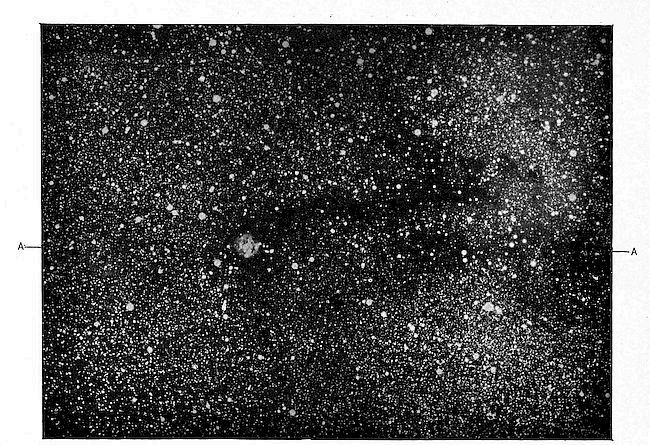
Fig. 12.
This figure should be examined with a magnifying glass. It is a
direct reproduction of a photograph of a detached nebula and surrounding
stars in Cygnus by Dr. Max Wolf of Heidelberg (reproduced
by permission from the Monthly Notices of the Royal Astronomical
Society, vol. lxiv, Plate 18, p. 839, q.v.). The exposure was four hours on
July 10th, 1904, with a camera the lenses of which have a diameter of
sixteen inches. The picture is enlarged so that the apparent diameter of
the Sun or Moon would be about 1⅓ inch on the same scale (one minute,
or sixtieth of a degree, equals one millimetre).
The “apparent diameter” of the sun or moon is about one in 115:
that is to say that a covering disc of any size you like can be made
exactly to coincide with and “cover” the disc of the sun or moon provided
that you place it at a distance from the eye equal to 115 times its own
diameter—thus a disc of an inch in diameter (say a halfpenny) will just
“cover” the sun or moon if placed at a distance from the eye of a little
less than ten feet, a threepenny piece will cover it at about six feet, and a
disc of somewhat less than half that size when held at arm’s length.
The nebula (on the horizontal A A) is seen surrounded by a dark
space—at the end of a long dark lane or “rift” which reminds us of the
track left by a snowball rolled along in the snow. Has the nebula in some
mysterious way swept up the stars in its journey through space? We
cannot at present either affirm or deny such interpretations.
One or two of the brightest of the surrounding stars might just be seen
by an acute eye unaided by a telescope—but no more. The best existing
telescopes would show only the large nebular body on the line A A, and
the larger white spots; the finest dust-like particles are stars of which the
existence is only demonstrated by prolonged photographic exposures such
as this, with a lens which focuses its image on to the dry plate. The old
“wet-plate” would not remain wet sufficiently long to “take” the picture.
It should be borne in mind in looking at this picture that each of the
minutest white spots is probably of at least the same size as our own sun:
further, that each is probably surrounded by a planetary system similar
to our own.
Astronomy.—A biologist may well refuse to offer any
remarks on his own authority in regard to this earliest
and grandest of all the sciences. I will therefore at once
say that my friend the Savilian Professor of Astronomy in
Oxford has turned my thoughts in the right direction in
regard to this subject. There is no doubt that there has
been an immense ‘revival’ in astronomy since 1881; it
has developed in every direction. The invention of the
‘dry plate,’ which has made it possible to apply photography
freely in all astronomical work, is the chief cause
of its great expansion. Photography was applied to
astronomical work before 1881, but only with difficulty
and haltingly. It was the dry-plate (see Fig. 12) which
made long exposures possible, and thus enabled astronomers
to obtain regular records of faintly luminous objects
such as nebulæ and star-spectra. Roughly speaking, the
number of stars visible to the naked eye may be stated as
eight thousand: this is raised by the use of our best
telescopes to some hundred million. But the number
which can be photographed is indefinite and depends on
length of exposure: some thousands of millions can
certainly be so recorded.
The serious practical proposal to ‘chart the sky’ by
means of photography certainly dates from this side of
1881. The Paris Conference of 1887, which made an
international scheme for sharing the sky among eighteen
observatories (still busy with the work, and producing
excellent results), originated with photographs of the
comet of 1882, taken at the Cape Observatory.
Professor Pickering, of Harvard, did not join this
co-operative scheme, but has gradually devised methods
of charting the sky very rapidly, so that he has at
Harvard records of the whole sky many times over, and
when new objects are discovered he can trace their
history backwards for more than a dozen years by reference
to his plates. This is a wonderful new method, a
mode of keeping record of present movements and changes
which promises much for the future of astronomy. By
the photographic method hundreds of new variable stars
and other interesting objects have been discovered. New
planets have been detected by the hundred. Up to 1881
two hundred and twenty were known. In 1881 only one
was found; namely, Stephania, being No. 220, discovered
on May 19. Now a score at least are discovered every
year. Over 500 are now known. One of these—Eros—(No. 433)
is particularly interesting, since it is nearer to
the sun than is Mars, and gives a splendid opportunity for
fixing with increased accuracy the sun’s distance from the
earth. Two new satellites to Saturn and two to Jupiter
have been discovered by photography (besides one to
Jupiter in 1892 by the visual telescope of the Lick Observatory).
One of the new satellites of Saturn goes round
that planet the wrong way, thus calling for a fundamental
revision of our ideas of the origin of the solar
system.
The introduction of photography has made an
immense difference in spectroscopic work. The spectra
of the stars have been readily mapped out and classified,
and now the motions in the line of sight of faint stars
can be determined. This ‘motion in the line of sight,’
which was discernible but scarcely measurable with
accuracy before, now provides one of the most refined
methods in astronomy for ascertaining the dimensions
and motions of the universe. It gives us velocities in
miles per second instead of in an angular unit to be interpreted
by a very imperfect knowledge of the star’s
distance. The method, initiated practically by Huggins
thirteen years before, was in 1881 regarded by many
astronomers as a curiosity. Visual observations were
begun at Greenwich in 1875, but were found to be affected
by instrumental errors. The introduction of dry plates,
and their application by Vogel in 1887, was the beginning
of general use of the method, and line-of-sight
work is now a vast department of astronomical industry.
Among other by-products of the method are the ‘spectroscopic
doubles,’ stars which we know to be double,
and of which we can determine the period of revolution,
though we cannot separate them visually by the greatest
telescope.
Work on the sun has been entirely revolutionised
by the use of photography. The last decade has seen
the invention of the spectro-heliograph—which simply
means that astronomers can now study in detail portions
of the sun of which they could previously only get a bare
indication.
More of the same story could be related, but enough
has been said to show how full of life and progress is
this most ancient and imposing of all sciences.
A minor though very important influence in the
progress of astronomy has been the provision, by the
expenditure of great wealth in America, of great telescopes
and equipments.
In 1877 Sir George Darwin started a line of mathematical
research which has been very fruitful and is of great
future promise for astronomy. As recently as last April,
at the Royal Astronomical Society, two important papers
were read—one by Mr. Cowell and the other by Mr.
Stratton—which have their roots in Sir George Darwin’s
work. The former was led to suggest that the day is
lengthening ten times as rapidly as had been supposed,
and the latter showed that in all probability the planets
had all turned upside down since their birth.
And yet M. Brunetière and his friends wish us to
believe that science is bankrupt and has no new things
in store for humanity.
Geology.—In the field of geological research the main
feature in the past twenty-five years has been the increasing
acceptance of the evolutionary as contrasted
with the uniformitarian view of geological phenomena.
The great work of Suess, ‘Das Antlitz der Erde,’ is
undoubtedly the most important contribution to physical
geology within the period. The first volume appeared
in 1885, and the impetus which it has given to the
science may be judged of by the epithet applied to the
views for which Suess is responsible—‘the New Geology.’
Suess attempts to trace the orderly sequence of the
principal changes in the earth’s crust since it first began to
form. He strongly opposes the old theory of elevation,
and accounts for the movements as due to differential
collapse of the crust, accompanied by folding due to
tangential stress. Among special results gained by
geologists in the period we survey may be cited new
views as to the origin of the crystalline schists, favouring
a return to something like the hypogene origin advocated
by Lyell; the facts as to deep-sea deposits, now in course
of formation, embodied in the ‘Challenger’ reports on
that subject: the increasing discrimination and tracking
of those minor divisions of strata called ‘zones’; the
assignment of the Olenellus fauna of Cambrian age to
a position earlier than that of the Paradoxides fauna;
the discovery of Radiolaria in palæozoic rocks by special
methods of examination, and the recognition of Graptolites
as indices of geological horizons in lower palæozoic
beds. Glacially eroded rocks in boulder-clays of permo-carboniferous
age have been recognised in many parts
of the world (e.g., Australia and South Africa), and thus
the view put forward by W. T. Blanford as to the
occurrence of the same phenomena in conglomerates of
this age in India is confirmed. Eozoon is finally
abandoned as owing its structure to an organism. The
oldest fossiliferous beds known to us are still far from
the beginning of life. They contain a highly developed
and varied animal fauna—and something like the whole
of the older moiety of rocks of aqueous origin have failed
as yet to present us with any remains of the animals or
plants which must have inhabited the seas which
deposited them. The boring of a coral reef initiated
by Professor Sollas at the Nottingham meeting of the
British Association in 1893 was successfully carried out,
and a depth of 1,114½ feet reached. Information of great
value to geologists was thus obtained.
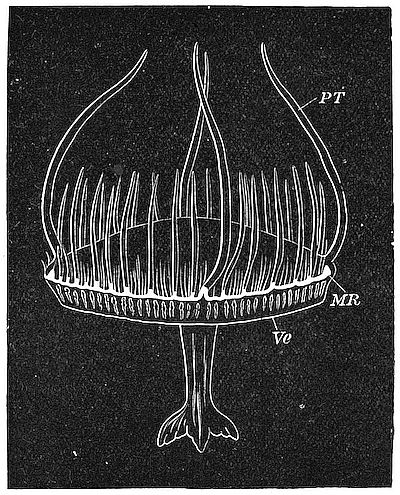
Fig. 13.
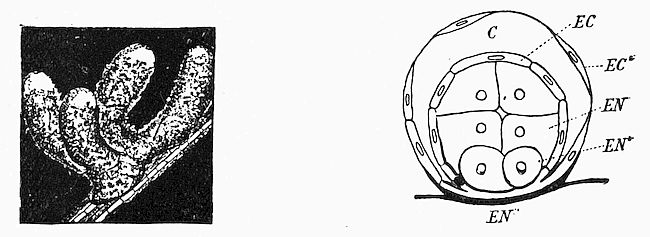
The Freshwater Jelly-fish of Regent’s Park (Limnocodium Sowerbii)
magnified five times linear.
It was discovered in the tropical lily tank of the Botanical Gardens in
June, 1880, and swarmed in great numbers year after year—then suddenly
disappeared. It has since been found in similar tanks in Sheffield, Lyons,
and Munich. Only male specimens were discovered, and the native home
of the wonderful visitor is still unknown.
Fig. 14.
The minute polyp attached
to the rootlets of water-plants—from
which the Jelly-fish Limnocodium
was found to be ‘budded
off.’
Fig. 15.
One of the peculiar sense-organs
from the edge of the swimming
disc of Limnocodium. C,
cavity of capsule; EC, ectoderm;
EN, endoderm. Sense-organs of
identical structure are found in the
Freshwater Jelly-fish of Lake Tanganyika
and in no other jelly-fish.
Animal and Vegetable Morphography.—Were I to
attempt to give an account of the new kinds of animals and
plants discovered since 1881, I should have to offer a
bare catalogue, for space would not allow me to explain
the interest attaching to each. Explorers have been
busy in all parts of the world—in Central Africa, in the
Antarctic, in remote parts of China, in Patagonia and
Australia, and on the floor of the ocean as well as in
caverns, on mountain tops, and in great lakes and rivers.
We have learnt much that is new as to distribution;
countless new forms have been discovered, and careful
anatomical and microscopical study conducted on
specimens sent home to our laboratories. I cannot
refrain from calling to mind the discovery of the eggs
of the Australian duck-mole and hedgehog; the freshwater
jelly-fish (figs. 13, 14, and 15) of Regent’s Park,
the African lakes (fig. 16) and the Delaware River; the
marsupial mole of Central Australia; the okapi (figs. 17,
18, and 19); the breeding and transformations of the
common eel (fig. 20); the young and adult of the mud-fishes
of Australia, Africa, and South America; the fishes
of the Nile and Congo; the gill-bearing earth-worms
and mud-worms; the various forms of the caterpillar-like
Peripatus; strange deep-sea fishes, polyps and sponges.
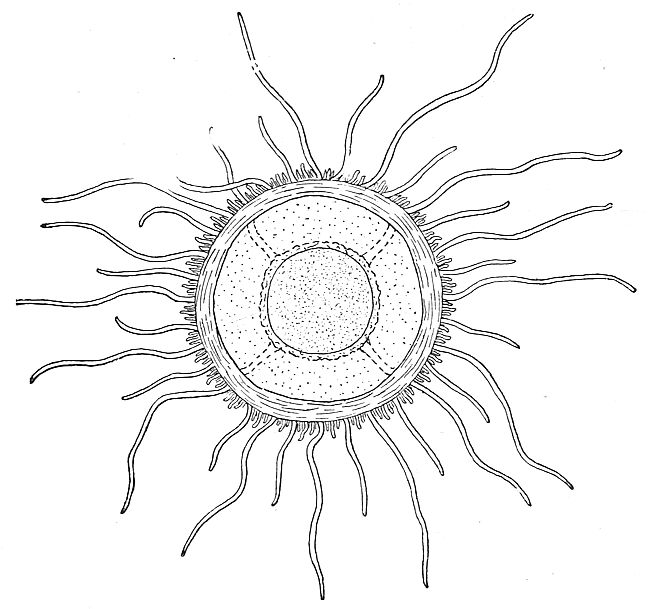
Fig. 16.
The Freshwater Jelly-fish of Lake Tanganyika (Limnocnida Tanganyicae),
magnified five times linear. Since its discovery in Tanganyika it
has been found also in the Lake Victoria Nyanza and in pools in the
Upper Niger basin.
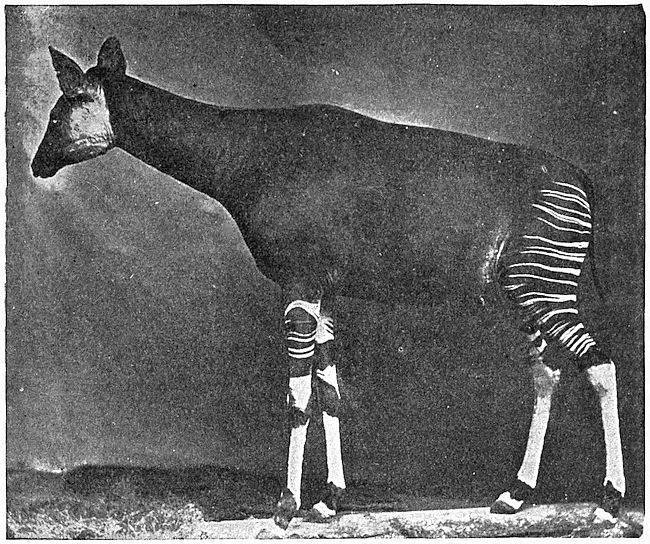
Fig. 17.
The Giraffe-like animal called the Okapi, discovered by Sir Harry
Johnston in the Congo Forest. Photograph of the skin of a female sent
home by him in 1901, and now mounted and exhibited in the Natural
History Museum.
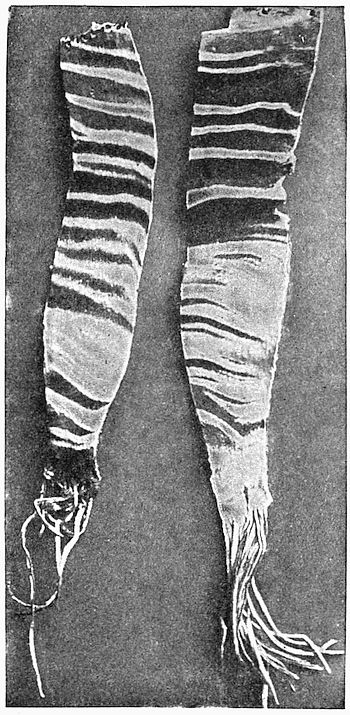
Fig. 18.
Two “bandoliers” cut by the natives from the striped part of the skin
(the haunches) and at first supposed to be bits of the hide of a new kind of
Zebra. These were sent home by Sir Harry Johnston in 1900.
The main result of a good deal of such investigation
is measured by our increased knowledge of the pedigree
of organisms, what used to be called ‘classification.’
The anatomical study by the Australian professors, Hill
and Wilson, of the teeth and the fœtus of the Australian
group of pouched mammals—the marsupials—has
entirely upset previous notions, to the effect that these
are a primitive group, and has shown that their possession
of only one replacing tooth is a retention of one
out of many such teeth (the germs of which are present),
as in placental mammals; and further that many of
these marsupials have the nourishing outgrowth of the
fœtus called the placenta fairly well developed, so that
they must be regarded as a degenerate side-branch of
the placental mammals, and not as primitive forerunners
of that dominant series.
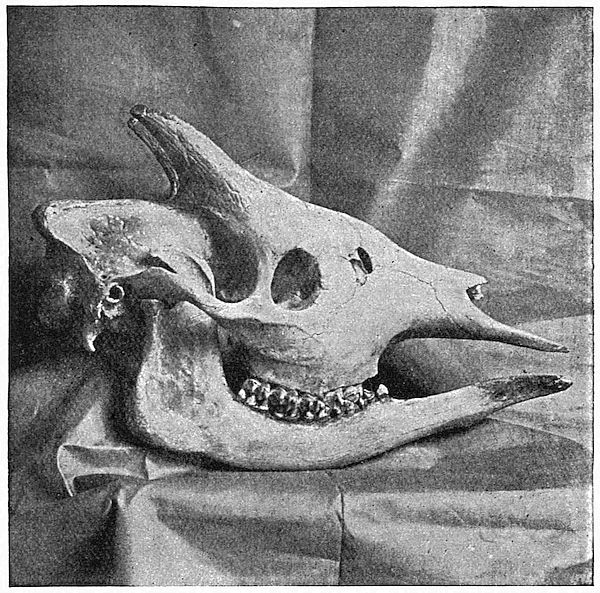
Fig. 19.
Photograph of the skull of a male Okapi—showing the paired boney
horn-cores—similar to those of the Giraffe, but connected with the frontal
bones and not with the parietals as the horn-cores of Giraffes are.
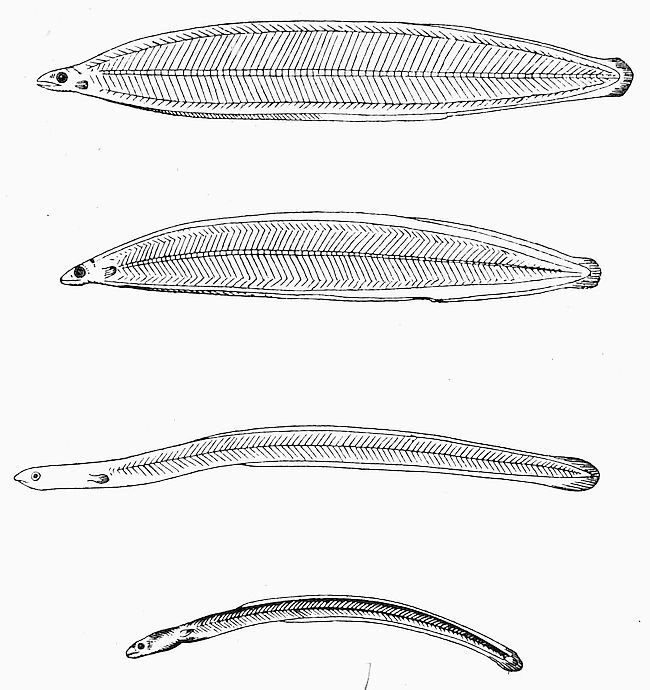
Fig. 20.
Drawings by Professor Grassi, of Rome, of the young of the common
Eel and its metamorphosis. All of the natural size. The uppermost figure
represents a transparent glass-like creature—which was known as a rare
“find” to marine naturalists, and received the name Leptocephalus.
Really it lives in vast numbers in great depths of the sea—five hundred
fathoms and more. It is hatched here from the eggs of the common Eel
which descends from the ponds, lakes, and rivers of Europe in order to
breed in these great depths. The gradual change of the Leptocephalus
into a young Eel or “Elver” is shown, and was discovered by Grassi.
The young Eels leave the great depth of the ocean and ascend the rivers
in immense shoals of many hundred thousand individuals, and wriggle
their way up banks and rocks into the small streams and pools of the
continent.
The above figures were published by Professor Grassi in November
1896, in the Quarterly Journal of Microscopical Science, edited by E. Ray
Lankester and published by Churchill & Sons.
Speculations as to the ancestral connection of the
great group of vertebrates with other great groups have
been varied and ingenious; but most naturalists are
now inclined to the view that it is a mistake to assume
any such connection in the case of vertebrates of a
more definite character than we admit in the case of
starfishes, shell-fish, and insects. All these groups are
ultimately connected by very simple, remote, and not
by proximate ancestors, with one another and with the
ancestors of vertebrates.
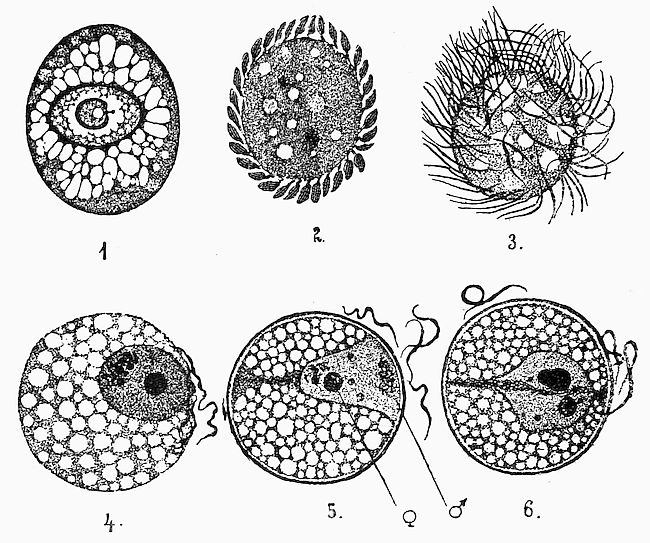
Fig. 21.
The unicellular parasite Benedenia, from the gut of the common
Poulp or Octopus. 1 is the normal male individual; 2 and 3 show
stages in the production of spermatozoa on its surface by budding;
4, 5 and 6 show a female parasite with spermatozoa approaching it.
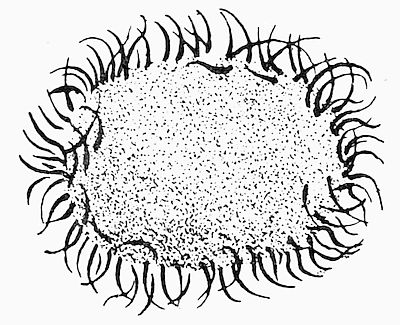
Fig. 22.
Production of spermatozoa on the surface of the unicellular parasite
Coccidium oviforme, from the Rabbit’s intestines.
The origin of the limbs of vertebrates is now generally
agreed to be correctly indicated in the Thatcher-Mivart-Balfour
theory to the effect that they are derived
from a pair of continuous lateral fins, in fish-like
ancestors, similar in every way to the continuous median
dorsal fin of fishes.
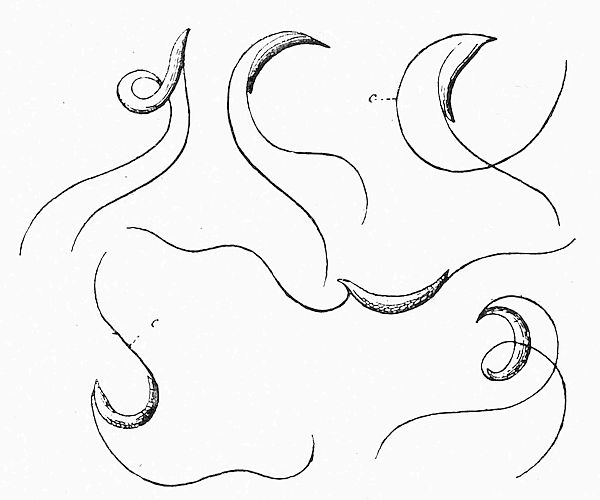
Fig. 23.
Spermatozoa (often called “microgametes”) of the unicellular parasite
Echinospora found in the gut of the small Centipede Lithobius mutabilis.
The discovery of the formation of true spermatozoa
by simple unicellular animals of the group Protozoa is
a startling thing, for it had always been supposed that
these peculiar reproductive elements were only formed
by multicellular organisms (figs. 21, 22, and 23). They
have been discovered in some of the gregarina-like
animalcules, the Coccidia, and also in the blood-parasites.
Among plants one of the most important discoveries
relates to these same reproductive elements, the spermatozoa,
which by botanists are called antherozoids.
A great difference between the whole higher series of
plants, the flowering plants or phanerogams, and the
cryptogams or lower plants, including ferns, mosses,
and algae, was held to be that the latter produce
vibratile spermatozoa like those of animals which swim
in liquid and fertilise the motionless egg-cell of the
plant. Two Japanese botanists (and the origin of this
discovery from Japan, from the University of Tokio,
in itself marks an era in the history of science), Hirase
and Ikeno, astonished the botanical world fifteen years
ago by showing that motile antherozoids or spermatozoa
are produced by two gymnosperms, the ging-ko tree
(or Salisburya) and the cycads (fig. 24). The pollen-tube,
which is the fertilising agent in all other phanerogams,
develops in these cone-bearing trees, beautiful motile spermatozoa,
which swim in a cup of liquid provided for them
in connection with the ovules. Thus a great distinction
between phanerogams and cryptogams was broken down,
and the actual nature of the pollen-tube as a potential
parent of spermatozoids demonstrated.
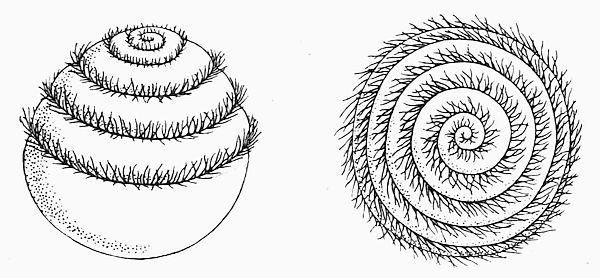
Fig. 24.
Spermatozoa (antherozoids) of Cycas revoluta, seen from the side and
from above. The spermatozoon is spherical, carrying a spiral band of
minute vibratile hairs (cilia) by which it is propelled.
When we come to the results of the digging out
and study of extinct plants and animals, the most
remarkable results of all in regard to the affinities and
pedigree of organisms have been obtained. Among
plants the transition between cryptogams and phanerogams
has been practically bridged over by the discovery
that certain fern-like plants of the Coal Measures—the
Cycadofilices, supposed to be true ferns, are really
seed-bearing plants and not ferns at all, but phanerogams
of a primitive type, allied to the cycads and gymnosperms.
They have been re-christened Pteridosperms
by Scott, who, together with F. Oliver and Seward,
has been the chief discoverer in this most interesting
field.
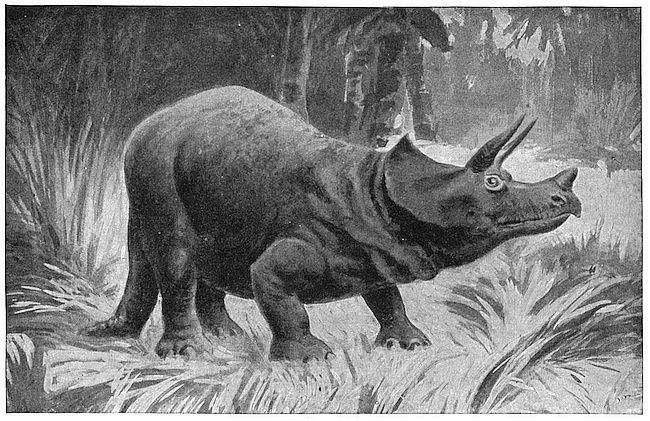
Fig. 25.
The gigantic three-horned Reptile, Triceratops, as large as an Elephant, found in Jurassic strata in
North America. A model of the skeleton may be seen in the Natural History Museum in London.
By their fossil remains whole series of new genera
of extinct mammals have been traced through the
tertiary strata of North America and their genetic
connections established; and from yet older strata of
the same prolific source we have almost complete knowledge
of several genera of huge extinct Dinosauria of
great variety of form and habit (fig. 25).
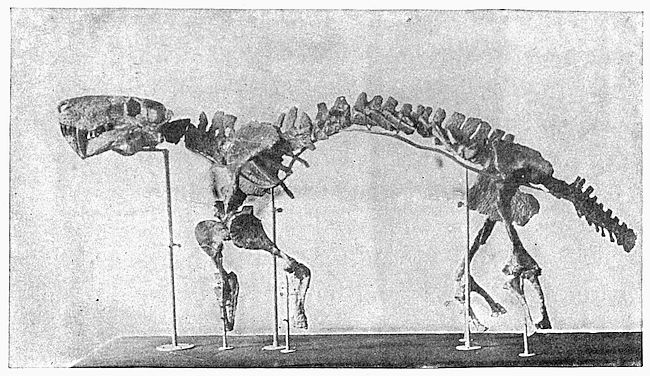
Fig. 26.
Photograph of the skeleton of a large carnivorous Reptile from
Triassic strata in North Russia, discovered by Professor Amalitzky and
named by him, Inostransevia. The head alone is two feet in length.
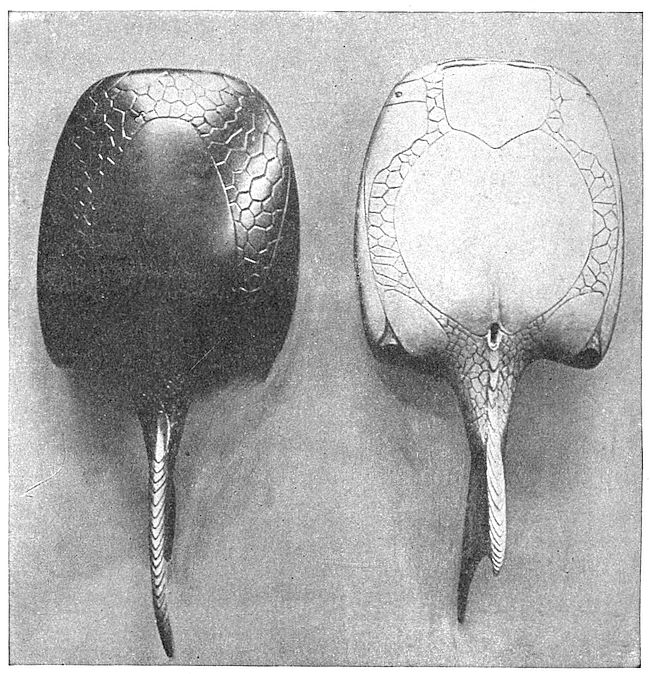
Fig. 27.
Photographs of completed models of the Devonian fish Drepanaspis,
from Devonian slates of North Germany, worked out by Professor
Traquair. The models are in the Natural History Museum, London.
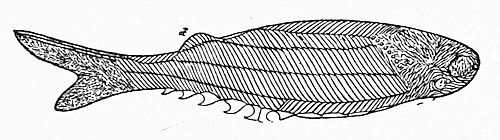
Fig. 28.
The oldest fossil fish known—discovered in the Upper Silurian strata
of Scotland, and named Birkenia by Professor Traquair.
The discoveries by Seeley at the Cape, and by Amalitzky
in North Russia of identical genera of Triassic
reptiles, which in many respects resemble the Mammalia
and constitute the group Theromorpha, is also a prominent
feature in the palæontology of the past twenty-five
years (fig. 26). Nor must we forget the extraordinary
Devonian and Silurian fishes discovered and described by
Professor Traquair (figs. 27 and 28). The most important
discovery of the kind of late years has been that
of the Upper Eocene and Miocene Mammals of the
Egyptian Fayum, excavated by the Egyptian Geological
Survey and by Dr. Andrews of the Natural History
Museum, who has described and figured the remains.
They include a huge four-horned animal as big as a
rhinoceros, but quite peculiar in its characters—the
Arisinoïtherium—and the ancestors of the elephants, a
group which was abundant in Miocene and Pliocene times
in Europe and Asia, and in still later times in America,
and survives at the present day in its representatives the
African and Indian elephant. One of the European
extinct elephants—the Tetrabelodon—had, we have long
known, an immensely long lower jaw with large chisel-shaped
terminal teeth. It had been suggested by me that
the modern elephant’s trunk must have been derived from
the soft upper jaw and nasal area, which rested on this
elongated lower jaw, by the shortening (in the course
of natural selection and modification by descent) of
this long lower jaw, to the present small dimensions
of the elephant’s lower jaw, and the consequent down-dropping
of the unshortened upper jaw and lips, which
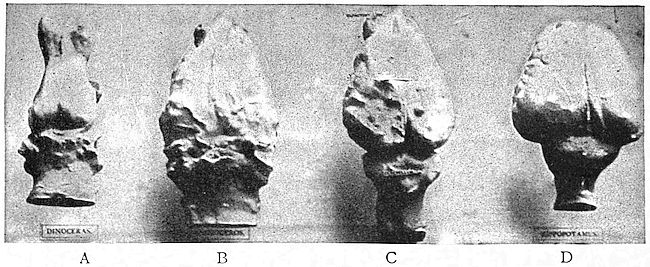
thus become the proboscis. Dr. Andrews has described
from Egypt and placed in the Museum in London
specimens of two new genera—one Palæomastodon, in
which there is a long, powerful jaw, an elongated face,
and an increased number of molar teeth (see figs. 29
and 30); the second, Meritherium (fig. 31), an animal
with a hippopotamus-like head, comparatively minute
tusks, and a well-developed complement of incisor, canine,
and molar teeth, like a typical ungulate mammal. Undoubtedly
we have in these two forms the indications of
the steps by which the elephants have been evolved from
ordinary-looking pig-like creatures of moderate size,
devoid of trunk or tusks. Other remains belonging to
this great mid-African Eocene fauna indicate that not
only the Elephants but the Sirenia (the Dugong and
Manatee) took their origin in this area. Amongst them
are also gigantic forms of Hyrax, like the little Syrian
coney and many other new mammals and reptiles.
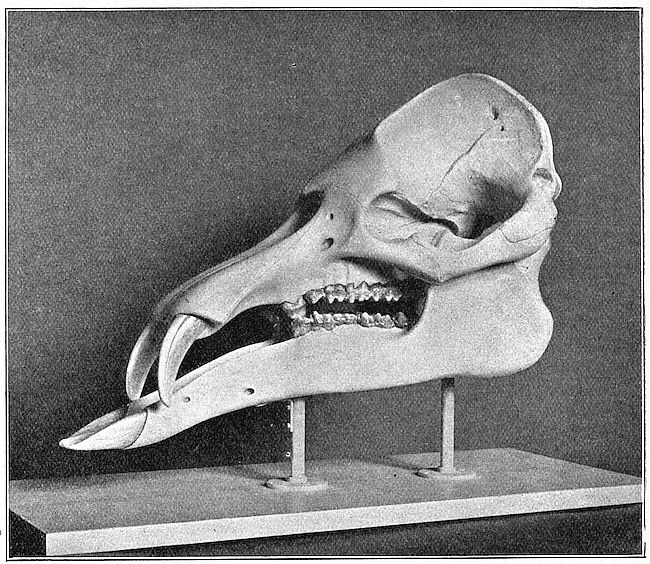
Fig. 29.
Photograph of a complete model of the skull and lower jaw of the
ancestral elephant, Palæomastodon, discovered by Dr. Andrews in the
Upper Eocene of the Fayum Desert, Egypt, and modelled and restored
under his direction in the Natural History Museum, London. The comparatively
short trunk or snout rested on the broad front teeth of the long
lower jaw. The face is elongated, and the cheek-teeth are numerous.
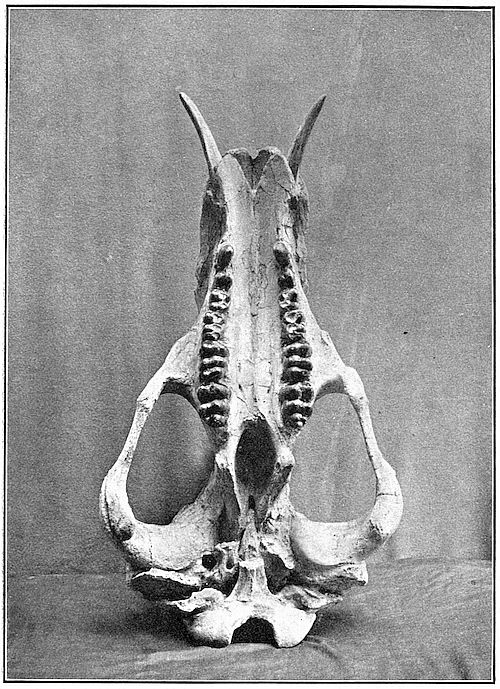
Fig. 30.
Photograph of the lower face of the skull of a specimen of Palæomastodon
brought from Egypt in April, 1906, by Dr. Andrews, and now in
the Natural History Museum, London. The six characteristic cheek-teeth
on each side, and the pair of sabre-like tusks in front, are well seen.
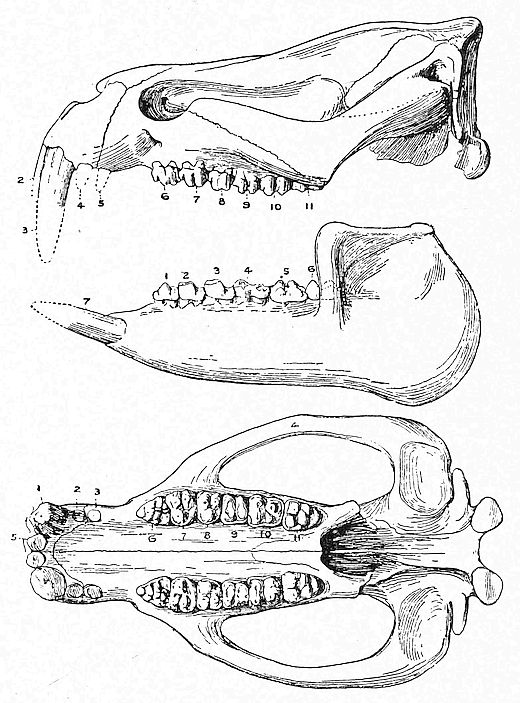
Fig. 31.
Drawing of the skull and lower jaw of the Meritherium, discovered by
Dr. Andrews in the Upper Eocene of the Fayum Desert. The shape of
the skull and proportions of face and jaw are like those of an ordinary
hoofed mammal such as the pig; but the cheek-teeth are similar to those
of the Mastodon, and whilst the full complement of teeth is present in
the front of the upper jaw, we can distinguish the big tusk-like incisor
which alone survives on each side in Palæomastodon, Mastodon, and the
elephants, as the great pair of tusks.
Another great area of exploration and source of new
things has been the southern part of Argentina and
Patagonia, where Ameghino, Moreno, and Scott of
Princeton have brought to light a wonderful series of
extinct ant-eaters, armadilloes, huge sloths, and strange
ungulates, reaching back into early Tertiary times. But
most remarkable has been the discovery in this area of
remains which indicate a former connection with the
Australian land surface. This connection is suggested
by the discovery in the Santa Cruz strata, considered
to be of early Tertiary date, of remains of a huge horned
tortoise which is generically identical with one found
fossil in the Australian area of later date, and known
as Miolania. In the same wonderful area we have the
discovery in a cave of the fresh bones, hairy skin, and
dung of animals supposed to be extinct, viz., the giant
sloth, Mylodon, and the peculiar horse, Onohippidium.
These remains seem to belong to survivors from the last
submergence of this strangely mobile land-surface, and
it is not improbable that some individuals of this ‘extinct’
fauna are still living in Patagonia. The region is
still unexplored and those who set out to examine it have,
by some strange fatality, hitherto failed to carry out
the professed purpose of their expeditions.
I cannot quit this immense field of gathered fact and
growing generalisation without alluding to the study of
animal embryology and the germ-layer theory, which
has to some extent been superseded by the study of
embryonic cell-lineage, so well pursued by some American
microscopists. The great generalisation of the
study of the germ-layers and their formation seems to
be now firmly established—namely, that the earliest
multicellular animals were possessed of one structural
cavity, the enteron, surrounded by a double layer of
cells, the ectoderm and endoderm. These Enterocœla
or Cœlentera gave rise to forms having a second great
body-cavity, the cœlom, which originated not as a split
between the two layers, as was supposed twenty-five years
ago by Haeckel and Gegenbaur and their pupils, but by
a pouching of the enteron to form one or more cavities
in which the reproductive cells should develop—pouchings
which became nipped off from the cavity of their
origin, and formed thus the independent cœlom. The
animals so provided are the Cœlomocœla (as opposed
to the Enterocœla), and comprise all animals above the
polyps, jelly-fish, corals, and sea-anemones. It has been
established in these twenty-five years that the cœlom is
a definite structural unit of the higher groups, and that
outgrowths from it to the exterior (cœlomoducts) form
the genital passages, and may become renal excretory
organs also. The vascular system has not, as it was
formerly supposed to have, any connection of origin with
the cœlom, but is independent of it, in origin and development,
as also are the primitive and superficial renal
tubes known as nephridia. These general statements
seem to me to cover the most important advance in the
general morphology of animals which we owe to embryological
research in the past quarter of a century.[16]
Before leaving the subject of animal morphology I
must apologise for my inability to give space and time
to a consideration of the growing and important science
of anthropology, which ranges from the history of human
institutions and language to the earliest prehistoric bones
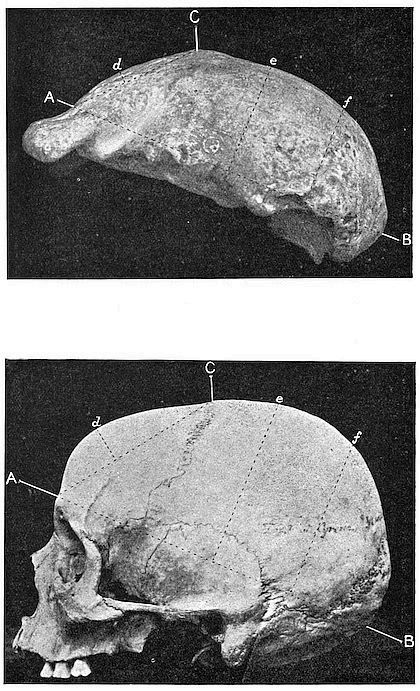
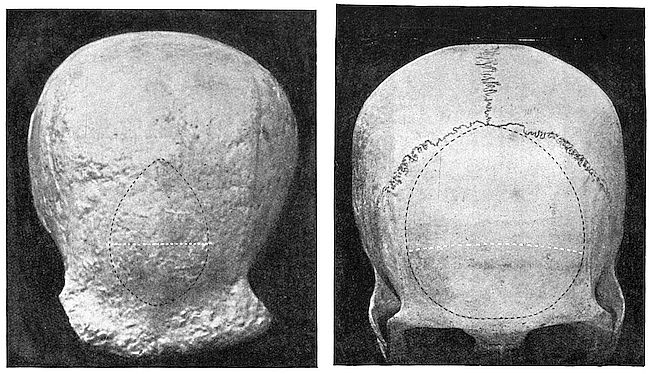
and implements. Let me therefore note here the discovery
of the cranial dome of Pithecanthropus in a river
gravel in Java—undoubtedly the most ape-like of human
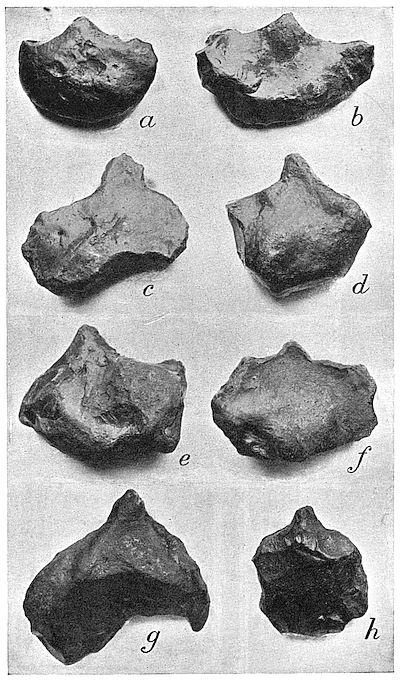
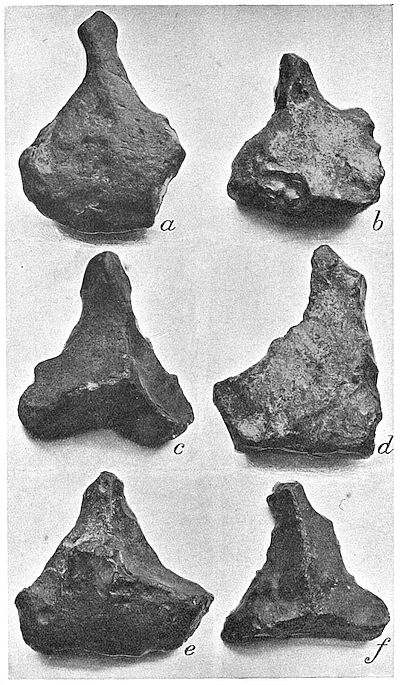
remains, and of great age (see figs. 1 and 2); and, further,
the Eoliths of Prestwich (see figs. 3 and 4), in the human
authorship of which I am inclined to believe, though I
should be sorry to say the same of all the broken flints
to which the name ‘Eolith’ has been applied. The
systematic investigation and record of savage races have
taken on a new and scientific character. Such work as
Baldwin Spencer’s and Haddon’s in Australasia furnish
examples of what is being done in this way.
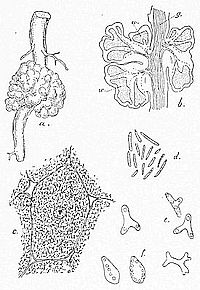
Fig. 32.
Bacillus radicola, the parasite
which infests the roots of
leguminous plants and causes
the growth of nodules whilst
assisting the plant in the
assimilation of nitrogen: (a)
Nodule of the roots of the
common Lupine, natural size;
(b) longitudinal section through
a Lupine root and nodule;
(c) a single cell from a Lupine
nodule showing the bacteria
or bacilli, as black particles in
the protoplasm, magnified
600 diameters; (d) bacilli from
the root nodule of the Lupine;
(e) triangular forms of the
bacillus from the root nodules
of the Vetch; (f) oval forms
from the root nodules of the
Lupine; (d e f) are magnified
1,500 diameters.
Physiology of Plants and Animals.—Since I have not
space to do more than pick out the most important
advances in each subject for brief mention, I must signalize
in regard to the physiology of plants the better understanding
of the function of leaf-green or chlorophyll due
to Pringsheim and to the Russian Timiriaseff, the new
facts as to the activity of stomata in transpiration discovered
by Horace Brown, and the fixation of free
nitrogen by living organisms in the soil and by organisms
(Bacillus radicola) parasitic in the rootlets of
leguminous plants (see fig. 32), which thus benefit by a
supply of nitrogenous compounds which they can
assimilate.
Great progress in the knowledge of the chemistry of
the living cells or protoplasm of both plants and animals
has been made by the discovery of the fact that ferments
or enzymes are not only secreted externally by cells,
but exist active and preformed inside cells. Büchner’s
final conquest of the secret of the yeast-cell by heroic
mechanical methods—the actual grinding to powder of
these already very minute bodies—first established this,
and now successive discoveries of intracellular ferments
have led to the conclusion that it is probable that the
cell respires by means of a respiratory ‘oxydase,’ builds
up new compounds and destroys existing ones, contracts
and accomplishes its own internal life by ferments. Life
thus (from the chemical point of view) becomes a chain
of ferment actions. Another most significant advance in
animal physiology has been the sequel (as it were) of
Bernard’s discovery of the formation of glycogen in the
liver, a substance not to be excreted, but to be taken
up by the blood and lymph, and in many ways more
important than the more obvious formation of bile which
is thrown out of the gland into the alimentary canal.
It has been discovered that many glands, such as the
kidney and pancreas and the ductless glands, the suprarenals,
thyroid, and others, secrete indispensable products
into the blood and lymph. Hence myxœdema,
exophthalmic goitre, Addison’s disease, and other disorders
have been traced to a deficiency or excess of
internal secretions from glands formerly regarded as interesting
but unimportant vestigial structures. From
these glands have in consequence been extracted remarkable
substances on which their peculiar activity
depends. From the suprarenals a substance has been
extracted which causes activity of all those structures
which the sympathetic nerve-system can excite to action;
the thyroid yields a substance which influences the
growth of the skin, hair, bones, &c.; the pituitary gland,
an extract which is a specific urinary stimulant. Quite
lately the mammalian ovary has been shown by Starling
to yield a secretion which influences the state of nutrition
of the uterus and mammæ. A great deal more
might be said here on topics such as these—topics of
almost infinite importance; but the fact is that the
mere enumeration of the most important lines of progress
in any one science would occupy many pages.
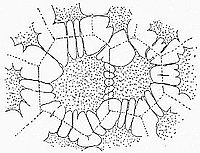
Fig. 33.
The continuity of the protoplasm
of neighbouring vegetable cells, by
means of threads which perforate the
cell-walls. Drawing (after Gardiner)
of cells from the pulvinus of Robinia.
Nerve-physiology has made immensely important advances.
There is
now good evidence
that all excitation
of one group of
nerve-centres is accompanied
by the
concurrent inhibition
of a whole series of
groups of other centres,
whose activity
might interfere with
that of the group
excited to action.
In a simple reflex
flexure of the knee
the motor-neurones to the flexor muscles are excited,
but concurrently the motor-neurones to the extensor
muscles are thrown into a state of inhibition, and so
equally with all the varied excitations of the nervous
system controlling the movements and activities of the
entire body.
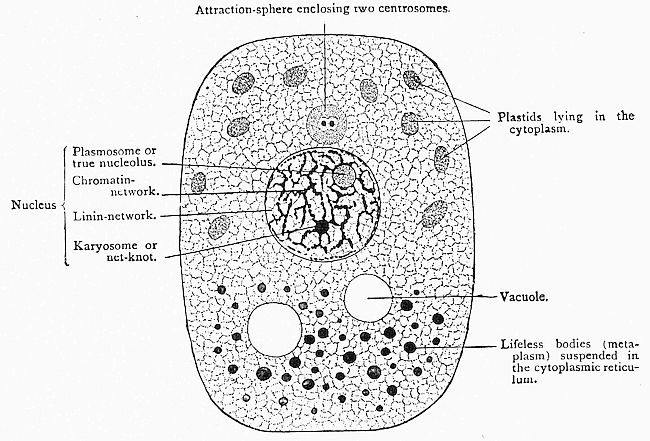
Fig. 34.
Diagrammatic representation of the structures present in a typical cell
(after Wilson). Note the two centrosomes, sometimes single.
The discovery of the continuity of the protoplasm
through the walls of the vegetable cells by means of connecting
canals and threads (see fig. 33) is one of the most
startling facts discovered in connection with plant-structure,
since it was held twenty years ago that a fundamental
distinction between animal and vegetable structure consisted
in the boxing-up or encasement of each vegetable
cell-unit in a case of cellulose, whereas animal cells were
not so imprisoned, but freely communicated with one
another. It perhaps is on this account the less surprising
that lately something like sense-organs have been
discovered on the roots, stems, and leaves of plants, which,
like the otocysts of some animals, appear to be really
‘statocytes,’ and to exert a varying pressure according to
the relations of these parts of the plant to gravity. There
is apparently something resembling a perception of the
incidence of gravity in plants which reacts on irritable
tissues, and is the explanation of the phenomena of
geotropism. These results have grown out of the
observations of Charles Darwin, followed by those of
F. Darwin, Haberlandt, and Nemec.
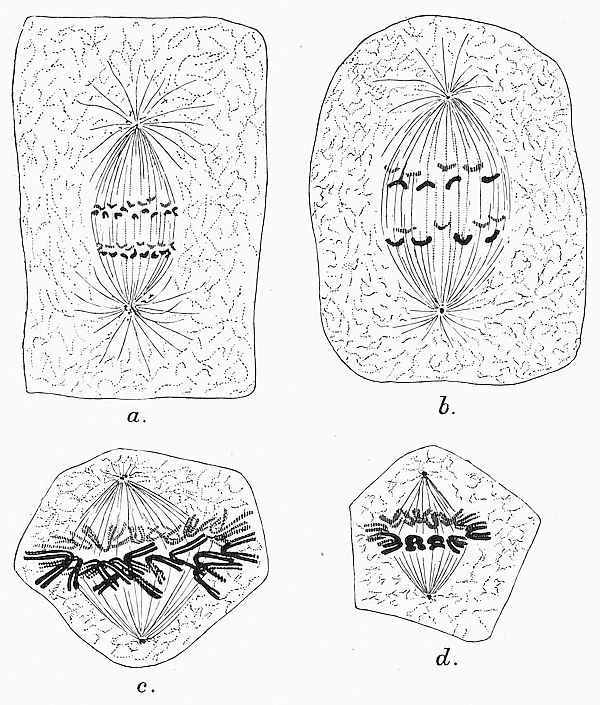
Fig. 35.—The Number of the Chromosomes: (a) Cell of the asexual
generation of the cryptogam Pellia epiphylla: the nucleus is about to divide,
a polar ray-formation is present at each end of the spindle-shaped nucleus,
the chromosomes have divided into two horizontal groups each of sixteen
pieces: sixteen is the number of the chromosomes of the ordinary tissue
cells of Pellia. (b) Cell of the sexual generation of the same plant (Pellia)
in the same phase of division, but with the reduced number of chromosomes—namely,
eight in each half of the dividing nucleus. The completed cells
of the sexual generation have only eight chromosomes. (c) Somatic or
tissue cell of Salamander showing twenty-four ∨-shaped chromosomes,
each of which is becoming longitudinally split as a preliminary to division.
(d) Sperm-mother-cell from testis of Salamander, showing the reduced
number of chromosomes of the sexual cells—namely, twelve; each is split
longitudinally. (From original drawings by Prof. Farmer and Mr. Moore.)
A few words must be said here as to the progress of
our knowledge of cell-substance, and what used to be
called the protoplasm question. We do not now regard
protoplasm as a chemical expression, but, in accordance
with von Mohl’s original use of the word, as a structure
which holds in its meshes many and very varied chemical
bodies of great complexity. Within these twenty-five
years the ‘centrosome’ of the cell-protoplasm has
been discovered (see fig. 34), and a great deal has been
learnt as to the structure of the nucleus and its remarkable
stain-taking bands, the chromosomes. We now
know that these bands are of definite fixed number,
varying in different species of plants and animals, and
that they are halved in number in the reproductive
elements—the spermatozoid and the ovum—so that on
union of these two to form the fertilized ovum (the
parent cell of all the tissues), the proper specific number
is attained (see figs. 35 and 36). It has been pretty
clearly made out by cutting up large living cells—unicellular
animals—that the body of the cell alone,
without the nucleus, can do very little but move and
maintain for a time its chemical status. But it is the
nucleus which directs and determines all definite growth,
movement, secretion, and reproduction. The simple protoplasm,
deprived of its nucleus, cannot form a new
nucleus—in fact, can do very little but exhibit irritability.
I am inclined to agree with those who hold that there
is not sufficient evidence that any organism exists at the
present time which has not both protoplasm and nucleus—in fact,
that the simplest form of life at present existing
is a highly complicated structure—a nucleated cell.
That does not imply that simpler forms of living matter
have not preceded those which we know. We must
assume that something more simple and homogeneous
than the cell, with its differentiated cell-body or protoplasm,
and its cell kernel or nucleus, has at one time
existed. But the various supposed instances of the survival
to the present day of such simple living things—described
by Haeckel and others—have one by one yielded
to improved methods of
microscopic examination and
proved to be differentiated
into nuclear and extra-nuclear
substance.
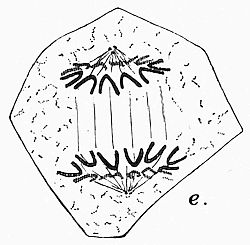
Fig. 36.
Further stage in the division of
the sexual cell drawn in Fig. 35(e),
showing the twelve chromosomes
of the two nuclei of the sperm-cells
resulting from the division (twelve
instead of twenty-four).
The question of ‘spontaneous
generation’ cannot
be said to have been seriously
revived within these twenty-five
years. Our greater knowledge
of minute forms of life,
and the conditions under
which they can survive, as
well as our improved microscopes
and methods of experiment
and observation, have made an end of the arguments
and instances of supposed abiogenesis. The
accounts which have been published of ‘radiobes,’ minute
bodies arising in fluids of organic origin when radium
salts have been allowed to mix in minute quantities with
such fluids, are wanting in precision and detail, but the
microscopic particles which appear in the circumstances
described seem to be of a nature identical with the minute
bodies well known to microscopists and recognised as
crystals modified by a colloid medium. They have been
described by Rainey, Harting, and Ord, on different
occasions, many years ago. They are not devoid of
interest, but cannot be considered as having any new
bearing on the origin of living matter.
Psychology.—I have given a special heading to this
subject because its emergence as a definite line of experimental
research seems to me one of the most important
features in the progress of science in the past quarter of a
century. Thirty-five years ago we were all delighted by
Fechner’s psycho-physical law, and at Leipzig I, with
others of my day, studied it experimentally in the physiological
laboratory of that great teacher, Carl Ludwig.
The physiological methods of measurement (which are
the physical ones) have been more and more widely, and
with guiding intelligence and ingenuity, applied since
those days to the study of the activities of the complex
organs of the nervous system which are concerned with
‘mind’ or psychic phenomena. Whilst some enthusiasts
have been eagerly collecting ghost stories and records of
human illusion and fancy, the serious experimental investigation
of the human mind, and its forerunner the
animal mind, has been quietly but steadily proceeding in
truly scientific channels. The science is still in an early
phase—that of the collection of accurate observations
and measurements—awaiting the development of great
guiding hypotheses and theories. But much has been
done, and it is a matter of gratification to Oxford men
that through the liberality of the distinguished electrician,
Mr. Henry Wilde, F.R.S., a lectureship of Experimental
Psychology has been founded in the University of Oxford,
where the older studies of Mental and Moral Philosophy,
Logic and Metaphysics have so strong a hold, and have
so well prepared the ground for the new experimental
development. The German investigators W. Wundt,
G. E. Müller, C. Stumpf, Ebbinghaus, and Munsterberg
have been prominent in introducing laboratory methods,
and have determined such matters as the elementary laws
of association and memory, and the perceptions of musical
tones and their relations. The work of Goldschneider
on ‘the muscular sense,’ of von Frey on the cutaneous
sensations, are further examples of what is being done.
The difficult and extremely important line of investigation,
first scientifically treated by Braid under the name
‘Hypnotism,’ has been greatly developed by the French
school, especially by Charcot. The experimental investigation
of ‘suggestion,’ and the pathology of dual consciousness
and such exceptional conditions of the mind,
has been greatly advanced by French observers.
The older work of Ferrier and Hitzig on the functions
of the parts of the brain has been carried further by
Goltz and Munk in Germany, and by Schäfer, Horsley,
and Sherrington in England.
The most important general advance seems to be the
recognition that the mind of the human adult is a social
product; that it can only be understood in relation with
the special environment in which it develops, and with
which it is in perpetual interaction. Professor Baldwin,
of Princeton, has done important work on this subject.
Closely allied is the study of what is called ‘the
psychology of groups,’ the laws of mental action of the
individual as modified by his membership of some form
of society. French authors have done valuable work
here.
These two developments of psychology are destined
to provide the indispensable psychological basis for
Social Science, and for the anthropological investigation
of mental phenomena.
Hereafter, the well-ascertained laws of experimental
psychology will undoubtedly furnish the necessary scientific
basis of the art of education, and psychology will
hold the same relation to that art as physiology does to
the art of medicine and hygiene.
There can be little doubt, moreover, of the valuable
interaction of the study of physical psychology and the
theories of the origin of structural character by natural
selection. The relation of the human mind to the mind
of animals, and the gradual development of both, form
a subject full of rich stores of new material, yielding
conclusions of the highest importance, which has not
yet been satisfactorily approached.
I am glad to be able to give wider publicity here to
some conclusions which I communicated to the Jubilee
volume of the ‘Société de Biologie’ of Paris in 1899.
I there discussed the significance of the great increase in
the size of the cerebral hemispheres in recent, as compared
with Eocene Mammals (see fig. 5), and in Man as
compared with Apes, and came to the conclusion that ‘the
power of building up appropriate cerebral mechanism in
response to individual experience,’ or what may be called
‘educability,’ is the quality which characterizes the larger
cerebrum, and is that which has led to its selection,
survival, and further increase in volume. The bearing of
this conception upon questions of fundamental importance
in what has been called genetic psychology is sketched as
follows:
‘The character which we describe as “educability”
can be transmitted; it is a congenital character. But the
results of education can not be transmitted. In each
generation they have to be acquired afresh. With
increased “educability” they are more readily acquired
and a larger variety of them. On the other hand, the
nerve-mechanisms of instinct are transmitted, and owe
their inferiority as compared with the results of education
to the very fact that they are not acquired by the individual
in relation to his particular needs, but have arisen
by selection of congenital variation in a long series of
preceding generations.’
‘To a large extent the two series of brain-mechanisms,
the “instinctive” and the “individually acquired,” are
in opposition to one another. Congenital brain-mechanisms
may prevent the education of the brain and the
development of new mechanisms specially fitted to the
special conditions of life. To the educable animal the
less there is of specialised mechanism transmitted by
heredity, the better. The loss of instinct is what
permits and necessitates the education of the receptive
brain.’
‘We are thus led to the view that it is hardly possible
for a theory to be further from the truth than
that expressed by George H. Lewes and adopted by
George Romanes, namely, that instincts are due to
“lapsed” intelligence. The fact is that there is no
community between the mechanisms of instinct and
the mechanisms of intelligence, and that the latter are
later in the history of the development of the brain
than the former, and can only develop in proportion as
the former become feeble and defective.’[17]
Darwinism.—Under the title ‘Darwinism’ it is convenient
to designate the various work of biologists
tending to establish, develop, or modify Mr. Darwin’s
great theory of the origin of species. In looking back
over twenty-five years it seems to me that we must
say that the conclusions of Darwin as to the origin of
species by the survival of selected races in the struggle
for existence are more firmly established than ever.
And this because there have been many attempts to
gravely tamper with essential parts of the fabric
as he left it, and even to substitute conceptions for
those which he endeavoured to establish, at variance
with his conclusions. These attempts must, I think,
be considered as having failed. A great deal of valuable
work has been done in consequence; for honest criticism,
based on observation and experiment, leads to
further investigation, and is the legitimate and natural
mode of increase of scientific knowledge. Amongst the
attempts to seriously modify Darwin’s doctrine may be
cited that to assign a great and leading importance to
Lamarck’s theory as to the transmission by inheritance
of newly ‘acquired’ characters, due chiefly to American
palæontologists and to the venerated defender of such
views, who has now closed his long life of great work,
Mr. Herbert Spencer; that to attribute leading importance
to the action of physiological congruity and incongruity
in selective breeding, which was put forward by
another able writer and naturalist who has now passed
from among us, Dr. George Romanes; further, the views of
de Vries as to the discontinuity in the origin of new
species, supported by the valuable work of Mr. Bateson
on discontinuous variation; and lastly, the attempt to
assign a great and general importance to the facts ascertained
many years ago by the Abbé Mendel as to
the cross-breeding of varieties and the frequent production
(in regard to certain characters in certain cases)
of pure strains rather than of breeds combining the
characters of both parents. On the other hand we
have the splendid series of observations and writings
of August Weismann, who has, in the opinion of the
majority of those who study this subject, rendered the
Lamarckian theory of the origin and transmission of
new characters altogether untenable, and has, besides,
furnished a most instructive, if not finally conclusive,
theory or mechanical scheme of the phenomena of
Heredity in his book ‘The Germ-plasm.’ Professor
Karl Pearson and the late Professor Weldon—the latter
so early in life and so recently lost to us—have, with
the finest courage and enthusiasm in the face of an
enormous and difficult task, determined to bring the
facts of variation and heredity into the solid form of
statistical statement, and have organised, and largely
advanced in, this branch of investigation which they
have termed ‘Biometrics.’ Many naturalists throughout
the world have made it the main object of their
collecting and breeding of insects, birds, and plants, to
test Darwin’s generalisations and to expand the work
of Wallace in the same direction. A delightful fact
in this survey is that we find Mr. Alfred Russel Wallace
(who fifty years ago conceived the same theory as that
more fully stated by Darwin) actively working and
publishing some of the most convincing and valuable
works on Darwinism. He is still alive and not merely
well, but pursuing his work with vigour and ability.
It was chiefly through his researches on insects in
South America and the Malay Islands that Mr. Wallace
was led to the Darwinian theory; and there is no
doubt that the study of insects, especially of butterflies,
is still one of the most prolific fields in which
new facts can be gathered in support of Darwin and
new views on the subject tested. Prominent amongst
naturalists in this line of research has been and is
Edward Poulton of Oxford, who has handed on to the
study of entomology throughout the world the impetus
of the Darwinian theory. I must here also name a writer
who, though unknown in our laboratories and museums,
seems to me to have rendered very valuable service in
later years to the testing of Darwin’s doctrines and to
the bringing of a great class of organic phenomena
within the cognisance of those naturalists who are
especially occupied with the problems of Variation and
Heredity. I mean Dr. Archdall Reid, who has with
keen logic made use of the immense accumulation of
material which is in the hands of medical men, and
has pointed out the urgent importance of increased
use by Darwinian investigators of the facts as to the
variation and heredity of that unique animal, man,
unique in his abundance, his reproductive activity, and
his power of assisting his investigator by his own record.
There are more observations about the variation
and heredity of man and the conditions attendant upon
individual instances than with regard to any other
animal. Medical men need only to grasp clearly the
questions at present under discussion in order to be
able to furnish with ease data absolutely invaluable in
quantity and quality. Dr. Archdall Reid has in two
original books full of insight and new suggestions, the
‘Present Evolution of Man’ and ‘Principles of Heredity,’
shown a new path for investigators to follow.
The attempt to resuscitate Lamarck’s views on the
inheritance of acquired[18] characters has been met not
only by the demand for the production of experimental
proof that such inheritance takes place, which has never
been produced, but on Weismann’s part by a demonstration
that the reproductive cells of organisms are
developed and set aside from the rest of the tissues at
so early a period that it is extremely improbable that
changes brought about in those other tissues by unaccustomed
incident forces can be communicated to the
germ-cells so as to make their appearance in the offspring
by heredity. Apart from this, I have drawn
attention to the fact that Lamarck’s first and second
laws (as he terms them) of heredity are contradictory
the one of the other, and therefore may be dismissed.
In 1894 I wrote:
‘Normal conditions of environment have for many
thousands of generations moulded the individuals of a
given species of organism, and determined as each
individual developed and grew “responsive” quantities
in its parts (characters): yet, as Lamarck tells us, and as
we know, there is in every individual born a potentiality
which has not been extinguished. Change the normal
conditions of the species in the case of a young
individual taken to-day from the site where for thousands
of generations its ancestors have responded in a perfectly
defined way to the normal and defined conditions of
environment; reduce the daily or the seasonal amount
of solar radiation to which the individual is exposed; or
remove the aqueous vapour from the atmosphere; or
alter the chemical composition of the pabulum accessible;
or force the individual to previously unaccustomed
muscular effort or to new pressures and strains; and
(as Lamarck bids us observe), in spite of all the long-continued
response to the earlier normal specific conditions,
the innate congenital potentiality shows itself.
The individual under the new quantities of environing
agencies shows new responsive quantities in those parts
of its structure concerned, new or acquired characters.
‘So far, so good. What Lamarck next asks us to
accept, as his “second law,” seems not only to lack the
support of experimental proof, but to be inconsistent with
what has just preceded it. The new character which is
ex hypothesi, as was the old character (length, breadth,
weight of a part) which it has replaced—a response to
environment, a particular moulding or manipulation by
incident forces of the potential congenital quality of
the race—is, according to Lamarck, all of a sudden
raised to extraordinary powers. The new or freshly
acquired character is declared by Lamarck and his
adherents to be capable of transmission by generation;
that is to say, it alters the potential character of the
species. It is no longer a merely responsive or reactive
character, determined quantitatively by quantitative
conditions of the environment, but becomes fixed and
incorporated in the potential of the race, so as to persist
when other quantitative external conditions are substituted
for those which originally determined it. In
opposition to Lamarck, one must urge, in the first place,
that this thing has never been shown experimentally to
occur; and in the second place, that there is no ground
for holding its occurrence to be probable, but, on the
contrary, strong reason for holding it to be improbable.
Since the old character (length, breadth, weight) had not
become fixed and congenital after many thousands of
successive generations of individuals had developed it in
response to environment, but gave place to a new
character when new conditions operated on an individual
(Lamarck’s first law), why should we suppose that the
new character is likely to become fixed after a much
shorter time of responsive existence, or to escape the
operation of the first law? Clearly there is no reason
(so far as Lamarck’s statement goes) for any such
supposition, and the two so-called laws of Lamarck are
at variance with one another.’
In its most condensed form my argument has been
stated thus by Professor Poulton: Lamarck’s ‘first law
assumes that a past history of indefinite duration is
powerless to create a bias by which the present can be
controlled; while the second assumes that the brief
history of the present can readily raise a bias to control
the future.’[19]
An important light is thrown on some facts which
seem at first sight to favour the Lamarckian hypothesis
by the consideration that, though an ‘acquired’
character is not transmitted to offspring as the consequence
of the action of external agencies determining the
‘acquirement,’ yet the tendency to react exhibited by
the parent is transmitted, and if the tendency is exceptionally
great a false suggestion of a Lamarckian
inheritance can readily result. This inheritance of
‘variation in tendencies to react’ has a wide application,
and has led me to coin the word ‘educability’ as
mentioned in the section of this address on Psychology.
The principle of physiological selection advocated by
Dr. Romanes does not seem to have caused much
discussion, and has been unduly neglected by subsequent
writers. It was ingenious, and was based on
some interesting observations, but has failed to gain
support.
The observations of de Vries—showing that in
cultivated varieties of plants a new form will sometimes
assert itself suddenly and attain a certain period of
dominance, though not having been gradually brought
into existence by a slow process of selection—have been
considered by him, and by a good many other naturalists,
as indicating the way in which new species arise in
Nature. The suggestion is a valuable one if not very
novel, but a great deal of observation will have to be
made before it can be admitted as really having a wide
bearing upon the origin of species. The same is true of
those interesting observations which were first made by
Mendel, and have been resuscitated and extended with
great labour and ingenuity by recent workers, especially
in this country by Bateson and his pupils. If it should
prove to be true that varieties when crossed do not, in
the course of eventual inter-breeding, produce intermediate
forms as hybrids, but that characters are either
dominant or recessive, and that breeds result having
pure unmixed characters—we should, in proportion as the
Mendelian law is shown to apply to all tissues and organs
and to a majority of organisms, have before us a
very important and determining principle in all that
relates to heredity and variation. It remains, however,
to be shown how far the Mendelian phenomenon is
general. And it is, of course, admitted on all sides
that, even were the Mendelian phenomenon general and
raised to the rank of a law of heredity, it would not
be subversive of Mr. Darwin’s generalisations, but probably
tend to the more ready application of them to
the explanation of many difficult cases of the structure
and distribution of organisms.
Two general principles which Mr. Darwin fully
recognised appear to me to deserve more consideration
and more general application to the history of species
than he had time to give to them, or than his followers
have accorded to them. The first is the great principle
of ‘correlation of variation,’ from which it follows that,
whilst natural selection may be favouring some small
and obscure change in an unseen group of cells—such
as digestive, pigmentary or nervous cells, and that change
a change of selective value—there may be, indeed often
is, as we know, a correlated or accompanying change
in a physiologically related part of far greater magnitude
and prominence to the eye of the human onlooker. This
accompanying or correlated character has no selective
value, is not an adaptation—is, in fact, a necessary but
useless by-product. A list of a few cases of this kind
was given by Darwin, but it is most desirable that more
should be established. For they enable us to understand
how it is that specific characters, those seen and noted
on the surface by systematists, are not in most cases
adaptations of selective value. They also open a wide
vista of incipient and useless developments which may
suddenly, in their turn, be seized upon by ever-watchful
natural selection and raised to a high pitch of growth
and function.
The second, somewhat but by no means altogether
neglected, principle is that a good deal of the important
variation in both plants and animals is not the variation
of a minute part or confined to one organ, but has
really an inner physiological basis, and may be a variation
of a whole organic system or of a whole tissue
expressing itself at several points and in several shapes.
In fact, we should perhaps more generally conceive of
variation as not so much the accomplishment and presentation
of one little mark or difference in weight,
length, or colour, as the expression of a tendency to vary
in a given tissue or organ in a particular way. Thus
we are prepared for the rapid extension and dominance
of the variation if once it is favoured by selective
breeding. It seems to me that such cases as the complete
disappearance of scales from the integument of
some osseous fishes, or the possible retention of three
or four scales out of some hundreds present in nearly
allied forms, favour this mode of conceiving of variation.
So also does the marked tendency to produce
membranous expansions of the integument in the bats,
not only between the digits and from the axilla, but
from the ears and different regions of the face. Of
course, the alternative hairy or smooth condition of the
integuments both in plants and animals is a familiar
instance in which a tendency extending over a large
area is recognised as that which constitutes the variation.
In smooth or hairy varieties we do not postulate an
individual development of hairs subjected one by one to
selection and survival or repression.
Disease.—The study of the physiology of unhealthy,
injured, or diseased organisms is called pathology. It
necessarily has an immense area of observation and is
of transcending interest to mankind who do not accept
their diseases unresistingly and die as animals do, so
purifying their race, but incessantly combat and fight
disease, producing new and terrible forms of it,
by their wilful interference with the earlier rule of
Nature.
Our knowledge of disease has been enormously
advanced in the last quarter of a century, and in an
important degree our power of arresting it, by two
great lines of study going on side by side and originated,
not by medical men nor physiologists in the narrow
technical sense, but by naturalists, a botanist, and a
zoologist. Ferdinand Cohn, Professor of Botany in
Breslau, by his own researches and by personal training
in his laboratory, gave to Robert Koch the start on
his distinguished career as a bacteriologist. It is to
Metschnikoff the zoologist and embryologist that we
owe the doctrine of phagocytosis and the consequent
theory of immunity now so widely accepted.
We must not forget that in this same period much
of the immortal work of Pasteur on hydrophobia, of
Behring and Roux on diphtheria, and of Ehrlich and
many others to whom the eternal gratitude of mankind
is due, has been going on. It is only some fifteen years
since Calmette showed that if cobra poison were introduced
into the blood of a horse in less quantity than
would cause death, the horse would tolerate with little
disturbance after ten days a full dose, and then day
after day an increasing dose, until the horse without
any inconvenience received an injection of cobra poison
large enough to kill thirty horses of its size. Some of
the horse’s blood being now withdrawn was found to
contain a very active antidote to cobra poison—what is
called an antitoxin. The procedure in the preparation of
the antitoxin is practically the same as that previously
adopted by Behring in the preparation of the antitoxin
of diphtheria poison. Animals treated with injections of
these antitoxins are immune to the poison itself when
subsequently injected with it, or, if already suffering
from the poison (as, for instance, by snake-bite), are
readily shown by experiment to be rapidly cured by
the injection of the appropriate antitoxin. This is, as
all will admit, an intensely interesting bit of biology.
The explanation of the formation of the antitoxin in
the blood and its mode of antagonising the poison is not
easy. It seems that the antitoxin is undoubtedly formed
from the corresponding toxin or poison, and that the
antagonism can be best understood as a chemical
reaction by which the complex molecule of the poison
is upset, or effectively modified.
The remarkable development of Metschnikoff’s doctrine
of phagocytosis during the past quarter of a
century is certainly one of the characteristic features
of the activity of biological science in that period.
At first ridiculed as ‘Metschnikoffism,’ it has now won
the support of its former adversaries.
For a long time the ideal of hygienists has been to
preserve man from all contact with the germs of infection,
to destroy them and destroy the animals conveying them,
such as rats, mosquitoes, and other flies. But it has
now been borne in upon us that, useful as such attempts
are, and great as is the improvement in human conditions
which can thus be effected, yet we cannot hope for
any really complete or satisfactory realisation of the ideal
of escape from contact with infective germs. The task
is beyond human powers. The conviction has now been
arrived at that, whilst we must take every precaution
to diminish infection, yet our ultimate safety must
come from within—namely, from the activity, the
trained, stimulated, and carefully guarded activity, of
those wonderful colourless amœba-like corpuscles whose
use was so long unrecognized, but has now been made
clear by the patiently continued experiments and arguments
of Metschnikoff, who has named them ‘phagocytes.’
The doctrine of the activity and immense importance of
these corpuscles of the living body which form part of
the all-pervading connective tissues and float also in the
blood, is in its nature and inception opposed to what are
called the ‘humoral’ and ‘vitalistic’ theories of resistance
to infection. Of this kind were the beliefs that
the liquids of the living body have an inherent and somewhat
vague power of resisting infective germs, and even
that the mere living quality of the tissues was in some unknown
way antagonistic to foreign intrusive disease-germs.
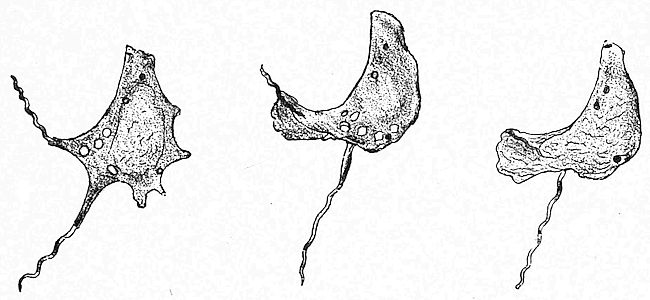
Fig. 37. Fig. 38. Fig. 39.
Fig. 37.—Phagocyte or colourless corpuscle of a guinea-pig in the act of
engulphing two Spirilla or parasitic vegetable microbes of a spiral shape.
Fig. 38.—The same half an hour later, one of the Spirilla is nearly completely
engulphed. Fig. 39.—The same ten minutes later still, one of the
Spirilla is completely absorbed into the substance (protoplasm) of the
phagocyte. (From Metschnikoff’s book, “Immunity,” kindly supplied by
the Cambridge University Press.)
The first eighteen years of Metschnikoff’s career, after
his undergraduate course, were devoted to zoological and
embryological investigations. He discovered many important
facts, such as the alternation of generations in the
parasitic worm of the frog’s lung—Ascaris nigrovenosa—and
the history of the growth from the egg of sponges
and medusæ. In these latter researches he came into
contact with the wonderfully active cells, or living corpuscles,
which in many low forms of life can be seen by
transparency in the living animal. He saw that these
corpuscles (as was indeed already known) resemble the
well-known amœba, and can take into their soft substance
(protoplasm) at all parts of their surface any
minute particles and digest them, thus destroying them.
In a transparent water-flea Metschnikoff saw these amœba-like,
colourless, floating blood-corpuscles swallowing and
digesting the spores of a parasitic fungus which had
attacked the water-fleas and was causing their death.
He came to the conclusion that this is the chief, if not
the whole, value of these corpuscles in higher as well as
lower animals, in all of which they are very abundant.
It was known that when a wound bringing in foreign
matter is inflicted on a vertebrate animal the blood-vessels
became gorged in the neighbourhood and the colourless
corpuscles escape through the walls of the vessels in
crowds. Their business in so doing, Metschnikoff showed,
is to eat up the foreign matter, and also to eat up and
remove the dead, wounded tissue. He therefore called
these white or colourless corpuscles ‘phagocytes,’ the
eater-cells, and in his beautiful book on Inflammation,
published twenty years ago, proved the extreme importance
of their activity. At the same time he had shown
that they eat up intrusive bacteria and other germs (see
figs. 37 to 43); and his work for the last twenty years has
mainly consisted in demonstrating that they are the chief,
and probably the only, agents at work in either ridding
the human body of an attack of disease-causing germs or
in warding off even the commencement of an attack, so
that the man or animal in which they are fully efficient
is ‘immune’—that is to say, cannot be effectively attacked
by disease-germs.
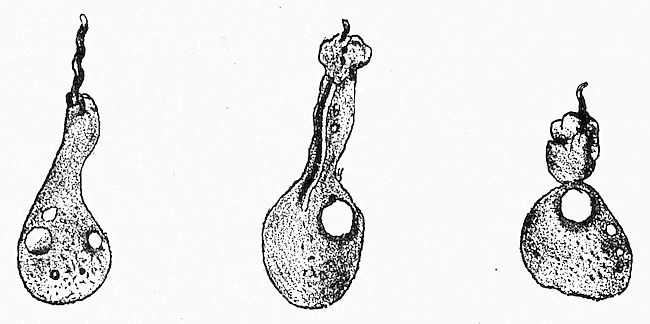
Fig. 40. Fig. 41. Fig. 42.
Fig. 40.—Phagocyte of a guinea-pig in the course of engulphing a very
mobile undulating spirillum. Fig. 41.—The same, forty minutes later.
Fig. 42.—The same taken half an hour after Fig. 41. (From Metschnikoff’s
“Immunity.”)
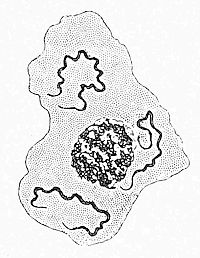
Fig. 43.
A large kind of phagocyte of the guinea-pig,
killed and stained for microscopic examination.
It shows the large spherical nucleus and three
specimens of the spirillum of relapsing-fever
which have been engulphed, and are lying
within its protoplasm. They would have been
slowly digested—that is to say, dissolved by the
digestive juices within the phagocyte. (From
Metschnikoff’s “Immunity.”)
Disease-germs, bacteria, or protozoa produce poisons
which sometimes are too much for the phagocytes, poisoning
them and so getting the upper hand. But, as Metschnikoff
showed, the training of the phagocytes by weak
doses of the poison of the disease-germ, or by weakened
cultures of the disease-germ itself, brings about a power
of resistance in the phagocytes to the germ’s poison, and
thus makes them capable of attacking the germs and
keeping them at bay. Hence the value of inoculations.
The discussion and experiments arising from Metschnikoff’s
demonstrations have led to the discovery of the
production by the phagocytes of certain exudations from
their substance which have a most important effect in
weakening the resistance of the intrusive bacteria and
rendering them easy prey for the phagocyte. These are
called ‘sensitisers,’ and have been largely studied. They
may be introduced artificially into the blood and tissues so
as to facilitate the work of the phagocytes, and no doubt
it is a valuable remedial measure to make use of such
sensitisers as a treatment. Dr. Wright considers that
such sensitisers are formed in the blood and tissues independently
of the phagocytes, and has called them ‘opsonins,’
under which name he has made most valuable
application of the method of injecting them into the
body so as to facilitate the work of the phagocytes in
devouring the hostile bacteria of various diseases. Each
kind of disease-producing microbe has its own sensitiser
or opsonin; hence there has been much careful research
and experiment required in order to bring the discovery
into practical use. Metschnikoff himself holds and quotes
experiments to show that the ‘opsonins’ are actually
produced by the phagocytes themselves. That this should
be so is in accordance with some striking zoological facts,
as I pointed out nearly twenty years ago.[20] For the lowest
multicellular animals provided with a digestive sac or gut,
such as the polyps, have that sac lined by digestive cells
which have the same amœboid character as ‘phagocytes,’
and actually digest to a large extent by swallowing or
taking into their individual protoplasm raw particles of
food. Such particles are enclosed in a temporary cavity,
or vacuole, into which the cell-protoplasm secretes digestive
ferment and other chemical agents. Now there is
no doubt that such digestive vacuoles may burst and so
pour out into the polyp’s stomach a digestive juice which
will act on food particles outside the substance of the
cells, and thus by the substitution of this process of outpouring
of the secretion for that of ingestion of food
particles into the cells we get the usual form of digestion
by juices secreted into a digestive cavity. Now
this being certainly the case in regard to the history of
the original phagocytes lining the polyp’s gut, it does
not seem at all unlikely, but on the contrary in a high
degree probable, that the phagocytes of the blood and
tissues should behave in the same way and pour out
sensitisers and opsonins to paralyse, and prepare their
bacterial food. And the experiments of Metschnikoff’s
pupils and followers show that this is undoubtedly the
case. Whether there is any great variety of and difference
between ‘sensitisers’ and ‘opsonins’ is a matter
which is still the subject of active experiment. Metschnikoff’s
conclusion, as recently stated in regard to the whole
progress of this subject, is that the phagocytes in our
bodies should be stimulated in their activity in order
successfully to fight the germs of infection. Alcohol,
opium, and even quinine, hinder the phagocytic action;
they should therefore be entirely eschewed or used only
with great caution where their other and valuable properties
are urgently needed. It appears that the injection
of blood-serum into the tissues of animals causes an
increase in the number and activity of the phagocytes,
and thus an increase in their resistance towards pathogenic
germs. Thus Durham (who was a pioneer in his
observations on the curious phenomena of the ‘agglutination’
of blood corpuscles in relation to disease) was
led to suggest the injection of sera during surgical
operations, and experiments recently quoted by Metschnikoff
seem to show that the suggestion was well founded.
Both German and French surgeons have employed the
method with successful results, and the demonstration
that an immense number of microbes are thus taken up
and destroyed by the multiplication (due to their regular
increase by cell-division) of the phagocytes of the
injected patient. After years of opposition bravely
met in the pure scientific spirit of renewed experiment
and demonstration, Metschnikoff is at last able to say
that the foundation-stone of the hygiene of the tissues—the
thesis that our phagocytes are our arms of defence
against infective germs—has been generally accepted.
Another feature of the progress of our knowledge of
disease—as a scientific problem—is the recent recognition
that minute animal parasites of that low degree of unicellular
structure to which the name ‘Protozoa’ is given,
are the causes of serious and ravaging diseases, and
that the minute algoid plants, the bacteria, are not alone
in possession of this field of activity. It was Laveran—a
French medical man—who, just about twenty-five
years ago, discovered the minute animal organism in
the red blood-corpuscles, which is the cause of malaria
(see fig. 44). Year by year ever since our knowledge of
this terrible little parasite has increased. We now know
many similar to, but not identical with it, living in the
blood of birds, reptiles, and frogs (see fig. 45).
It is the great merit of Major Ross, formerly of the
Indian Army Medical Staff, to have discovered, by most
patient and persevering experiment, that the malaria
parasite passes a part of its life in the spot-winged gnat
or mosquito (Anopheles), not, as he had at first supposed,
in the common gnat or mosquito (Culex), and that if
we can get rid of spot-winged mosquitoes or avoid their
attentions, or even only prevent them from sucking the
blood of malarial patients, we can lessen, or even abolish,
malaria.
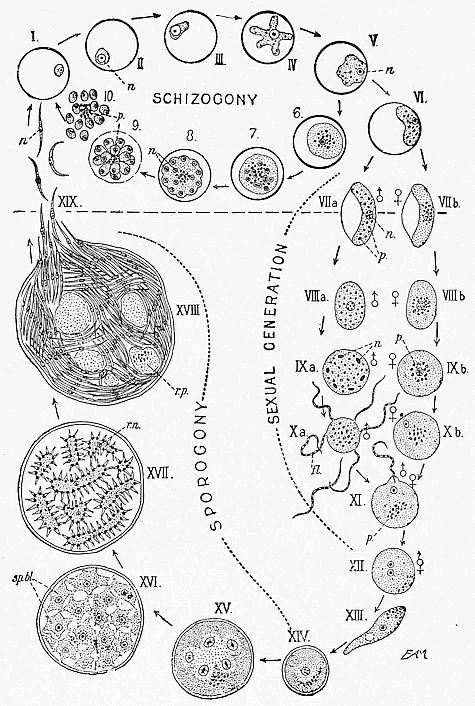
Fig. 44.
SCHIZOGONY
SPOROGONY
SEXUAL GENERATION
A diagram showing the life-history and migration of the Malaria
parasite, Laverania Malariæ, as discovered by Laveran, Ross, and Grassi.
The stages above the dotted line take place in the blood of man. The
oblong-pointed parasite is seen entering the blood at n just below No. 1.
The circles represent the red blood-discs of man. Schizogony means
multiplication by simple division or splitting, and it is seen in Nos. 6, 7, 8,
9, and 10. The stages below the dotted line are passed in the body of the
spot-winged gnats of the genus Anopheles. A peculiar crescent or sausage-shaped
condition is assumed by the parasite inside the red corpuscle No. VI.
These are found to be of two kinds, male and female, Nos. VIIa and VIIb.
They are swallowed by the spot-winged gnat when it sucks the blood of an
infected man. Here in the gut of the gnat they become spherical; the
male spheres produce spermatozoa No. Xa, which fuse with and fertilize
the female spheres or egg-cells No. XI. An active worm-like form No. XIII
results, which pushes its way partly through the wall of the gnat’s gut,
and is then nourished by the gnat’s blood. It swells up, divides internally
again and again, and is enclosed in a firm transparent case or cyst, Nos. XIV
to XVIII. The cysts are far larger in proportion than is shown in the
diagram, and are visible to the naked eye. The final product of the
breaking up, which is called sporogony, is a vast number of needle-shaped
spores or young (called Exotospores, as opposed to the Enhæmospores,
which are formed in the human blood, as seen in Nos. 9 and 10, and serve
there to spread the infection among the red corpuscles). The needle-shaped
spores formed in the gnat’s body accumulate in its salivary glands,
and pass out by the mouth of the gnat when it stabs a new human victim
who thus becomes infected, No. XIX.
Had the sausage-like phases Nos. VIIa and VIIb been swallowed by a
common gnat or mosquito of the genus Culex they would have been
digested and destroyed. It is only in species of gnats of the kind known
as Anopheles that the parasite can undergo its sexual development and
subsequent process of the formation of cysts and needle-shaped exotospores.
(After Minchin in Part I. of Lankester’s “Treatise on Zoology,”
published by A. and C. Black.)
This great discovery was followed by another as to
the production of the deadly ‘Nagana’ horse and cattle
disease in South Africa by a screw-like, minute animal
parasite Trypanosoma Brucei (see fig. 46 B). The
Tsetze fly (see fig. 48 A, B), which was already known
in some way to produce this disease, was found
by Colonel David Bruce to do so by conveying by
its bite the Trypanosoma from wild big-game animals,
to the domesticated horses and cattle of the colonists.
The discovery of the parasite and its relation to the
fly and the disease was as beautiful a piece of scientific
investigation as biologists have ever seen. A curious and
very important fact was discovered by Bruce—namely,
that the native big game (zebras, antelopes, and probably
buffaloes), are tolerant of the parasite. The Trypanosoma
grows and multiplies in their blood, but does not kill
them or even injure them. It is only the unaccustomed
introduced animals from Europe which are poisoned by
the chemical excreta of the Trypanosomes and die in
consequence. Hence the wild creatures—brought into
a condition of tolerance by natural selection and the
dying out of those susceptible to the poison—form a sort
of ‘reservoir’ of deadly Trypanosomes for the Tsetze
flies to carry into the blood of new-comers. The same
phenomenon of ‘reservoir-hosts’ (as I have elsewhere
called them) has since been observed in the case of
malaria; the children of the native blacks in Africa
and in other malarious regions are tolerant of the malarial
parasite, as many as 80 per cent. of children under ten
being found to be infected, and yet not suffering from
the poison. This is not the same thing as the immunity
which consists in repulsion or destruction of the
parasite.
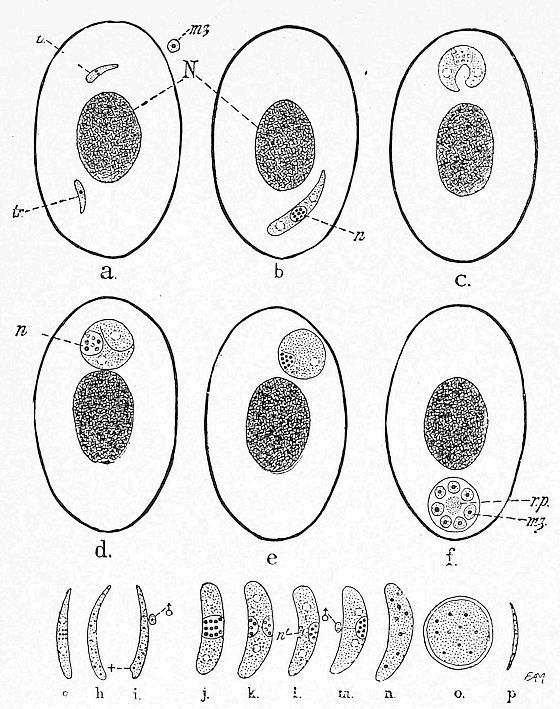
Fig. 45.
Lankesterella ranarum (Lank.), the parasite of the red blood-corpuscles
of the edible Frog, described originally as Drepanidium ranarum by
Lankester in 1882, and previously without name in 1871. The large ovals
represent the red corpuscles of the frog; the dark central mass is the
nucleus, N. In A two spindle-shaped parasites are seen; in B one larger
parasite with nucleus n preparing to divide; in C the parasite is ∨-shaped.
In D the parasite has become spherical, and is so in E also. In F the
spherical parasite has divided into a number of spores mz, with a central
residual body np. The figures G to N represent supposed stages in conjugation
of small and large forms; O is an encysted phase; and P a
spore or sporozoite of the sexual generation similar to the needle-shaped
exotospores of Laverania. (See Fig. 44.) All the figures magnified
2,250 diameters. (After Hintze from Minchin’s section on Sporozoa in
Lankester’s “Treatise on Zoology.”)
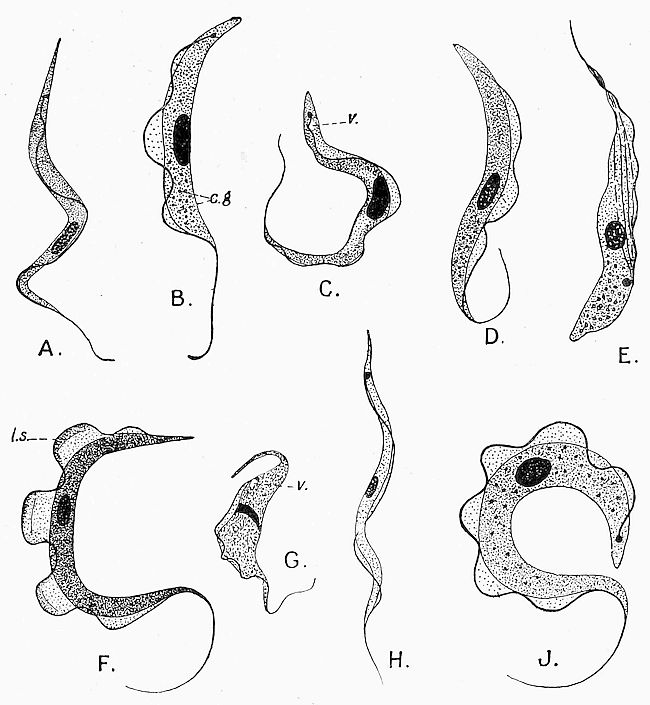
Fig. 46.
Various species of Trypanosoma from the blood of mammals, birds,
and reptiles. A. T. Lewisii, from the blood of rats; B. T. Brucei, the
parasite of the Nagana or Tsetze-fly disease, found in the blood of horses,
cattle, and big game; C. T. gambiense, the parasite causing Sleeping
Sickness in man; D. T. equinum, which causes the mal de caderas in South
American horse ranches; E. T. noctuæ, from the blood of the little owl,
Athene noctua; F. T. avium, found in the blood of many birds; G. a
species found in the blood of Indian pigeons; H. T. ziemanni, a second
species from the blood of the little owl; J. T. damoniæ, from the blood of
a tortoise; c.g., granules; v., vacuole; l.s., fold of the crest or undulating
membrane.
These figures are from Dr. Woodcock’s article on the “Hæmoflagellates”
in the Quarterly Journal of Microscopical Science, April and June,
1906. (See also the figures in the next chapter relating to Sleeping
Sickness.)
The Trypanosomes have acquired a terrible notoriety
within the last four years, since another species, also
carried by a Tsetze fly of another species, has been discovered
by Castellani in cases of Sleeping Sickness in
Uganda, and demonstrated by Colonel Bruce to be the
cause of that awful disease.[21] Over 200,000 natives of
Uganda have died from it within the last five years. It
is incurable, and, sad to relate, not only a certain number
of European employés have succumbed to it in tropical
Africa, but a brave young officer of the Army Medical
Corps, Lieutenant Tulloch, has died from the disease
acquired by him in the course of an investigation of this
disease and its possible cure, which he was carrying out,
in association with other men of science, on the Victoria
Nyanza Lake in Central Africa. Lieutenant Tulloch was
sent out to this investigation by the Royal Society of
London, and I will venture to ask my readers to join
that body in sympathy for his friends, and admiration for
him and the other courageous men who risk their lives in
the endeavour to arrest disease.
Trypanosomes are now being recognised in the most
diverse regions of the world as the cause of disease—new
horse diseases in South America, in North Africa, in the
Philippines and East India are all traced to peculiar
species of Trypanosome. Other allied forms are responsible
for Delhi-sore, and certain peculiar Indian
fevers of man. A peculiar and ultra-minute parasite of
the blood cells causes Texas fever, and various African
fevers deadly to cattle. In all these cases, as also
in that of plague, the knowledge of the carrier of the
disease, often a tick or acarid—in that of plague the flea
of the rat—is extremely important, as well as the knowledge
of reservoir-hosts when such exist.
The zoologist thus comes into closer touch than
ever with the profession of medicine, and the time has
arrived when the professional students of disease fully
admit that they must bring to their great and hopeful task
of abolishing the diseases of man the fullest aid from
every branch of biological science. I need not say how
great is the contentment of those who have long worked
at apparently useless branches of science—such as are
the careful and elaborate distinction of every separate kind
of animal and the life-history and structure peculiar to
each—in the belief that all knowledge is good, to find that
the science they have cultivated has become suddenly
and urgently of the highest practical value.
I have not time to do more than mention here the
effort that is being made by combined international
research and co-operation to push further in our
knowledge of phthisis and of cancer, with a view to their
destruction. It is only since our last meeting at York
that the parasite of Phthisis or Tubercle has been
made known; we may hope that it will not be long before
we have similar knowledge as to Cancer. Only eighteen
months have elapsed since Fritz Schaudinn discovered
the long-sought parasitic germ of Syphilis, the Spirochæta
pallida (see fig. 6). As I write these words the sad
news of Schaudinn’s death at the age of thirty-five
comes to me from his family at Hamburg—an irreparable
loss.
Let me finally state, in relation to this study of
disease, what is the simple fact—namely, that if the
people of Britain wish to make an end of infective
and other diseases they must take every possible means
to discover capable investigators, and employ them for
this purpose. To do this, far more money is required
than is at present spent in that direction. It is
necessary, if we are to do our utmost, to spend a
thousand pounds of public money on this task where
we now spend one pound. It would be reasonable
and wise to expend ten million pounds a year of our
revenues on the investigation and attempt to destroy
disease. Actually what is so spent is a mere nothing,
a few thousands a year. Meanwhile our people are
dying by thousands of preventable disease.
Whilst I have been able, though in a very fragmentary
and incomplete way, to indicate the satisfactory
and, indeed, the wonderful progress of science in the
last quarter of a century, so far as the making of
new knowledge is concerned, I am sorry to say that
there is by no means a corresponding ‘advancement’
of Science in that signification of the word which
implies the increase of the influence of science in
the life of the community, the increase of the support
given to it, and of the desire to aid in its progress,
to discover and then to encourage and reward those
who are specially fitted to increase scientific knowledge,
and to bring it to bear so as to promote the
welfare of the community.
It is, unfortunately, true that the successive political
administrators of the affairs of this country, as well
as the permanent officials, are altogether unaware to-day,
as they were twenty-five years ago, of the vital
importance of that knowledge which we call science,
and of the urgent need for making use of it in a
variety of public affairs. Whole departments of
Government in which scientific knowledge is the one
thing needful are carried on by ministers, permanent
secretaries, assistant secretaries and clerks who are
wholly ignorant of science, and naturally enough dislike
it, since it cannot be used by them, and is in many
instances the condemnation of their official employment.
Such officials are, of course, not to be blamed, but
rather the general indifference of the public to
the unreasonable way in which its interests are
neglected.
A difficult feature in treating of this subject is that
when one mentions the fact that ministers of State
and the officials of the public service are not acquainted
with science, and do not even profess to understand its
results or their importance, one’s statement of this
very obvious and notorious fact is apt to be regarded
as a personal offence. It is difficult to see wherein the
offence lies, for no one seeks to blame these officials
for a condition of things which is traditional and
frankly admitted.
This is really a very serious matter for the scientific
world to consider and deal with. We represent a line
of activity, a group of professions which are in our
opinion of vital importance to the well-being of the
nation. We know that those interests which we value
so highly are not merely ignored and neglected, but
are actually treated as of no account or as non-existent
by the old-established class of politicians and
administrators. It is not too much to say that there
is a natural fear and dislike of scientific knowledge
on the part of a large proportion of the persons who
are devoid of it, and who would cease to hold, or
never have held, the positions of authority or emolument
which they now occupy, were scientific knowledge
of the matters with which they undertake to
deal required of them. This is a thorny subject, and
one in which, however much one may endeavour to
speak in general terms, it is difficult to avoid causing
personal annoyance. Yet it seems to me one of urgent
importance. Probably an inquiry into and discussion
of the neglect of science and the questionable treatment
of scientific men by the administrative departments of
Government might with advantage be undertaken by a
committee appointed by our great scientific societies
for the purpose.
At the same time public attention should be drawn in
general terms to the fact that science is not gaining
‘advancement’ in public and official consideration and
support. The reason is, I think, to be found in the defective
education, both at school and university, of our
governing class, as well as in a racial dislike among all
classes to the establishment and support by public funds
of posts which the average man may not expect to succeed
by popular clamour or class privilege in gaining for himself—posts
which must be held by men of special training
and mental gifts. Whatever the reason for the neglect,
the only remedy which we can possibly apply is that of
improved education for the upper classes, and the continued
effort to spread a knowledge of the results of
science and a love for it amongst all members of the community.
If believers in science took this matter seriously
to heart they might do a great deal by insisting that their
sons, and their daughters too, should have reasonable
instruction in science both at school and college. They
could, by their own initiative and example, do a good deal
to put an end to the trifling with classical literature and
the absorption in athletics which is considered by too
many schoolmasters as that which the British parent desires
as the education of his children.
Within the past year a letter has been published by a
well-known nobleman, who is one of the Trustees of the
British Museum, holding up to public condemnation the
method in which the system laid down by the officials of
the Treasury and sanctioned by successive Governments,
as to the remuneration of scientific men, was applied in an
individual case. I desire to place on record here the Earl
of Crawford’s letter to the ‘Times’ of October 31, 1905,
for the careful consideration of those who desire the
advancement of science. When such things are done,
science cannot be said to have advanced much in public
consideration or Governmental support.
To the Editor of the ‘Times.’
Sir,—The death, noted by you to-day, of my dear friend and
colleague Dr. Copeland, His Majesty’s Astronomer for Scotland, creates
a vacancy in the scientific staff of Great Britain.
Will you permit me, Sir, to offer a word of warning to any who may
be asked to succeed him?
Students or masters of astronomy are not, in the selfish sense,
business men, nor are they as a general rule overburdened with this
world’s goods. It behoves them henceforth to take more care as to
their future in case of illness or physical infirmity and not to trust to the
gratitude or generous impulse of the Treasury Department.
In old days it was the custom when a man distinguished in science
was brought into a high position in the Civil Service that he was credited
with a certain number of years’ service ranking for pension. This
practice has been done away with, and a bargain system substituted.
A short while ago the growing agonies of heart disease caused Dr.
Copeland to feel that he was less able to carry on the duties of his post,
and he determined to resign; but he learnt that under the scale, and in
the absence of any special bargain, the pension he would receive would
not suffice for the necessities of life. The only increase his friends could
get from the Treasury was an offer to allow him about half-a-crown a
week extra by way of a house.
Indignant and ashamed of my Government, I persuaded Dr. Copeland
to withdraw his resignation and to retain the official position which
he has honoured till his death.
I trust, Sir, that this memorandum of mine may cause eminent men
of science who are asked to enter the service of the State when already
of middle age to take heed for their future welfare.
I am, Sir, your obedient servant,
Crawford.
2 Cavendish Square, October 28.
It is more agreeable to me not to dwell further on the
comparative failure of science to gain increased influence
and support in this country, but to mention some instances
on the other side of the account. As long ago as
1842 the British Association took over and developed an
observatory in the Deer Park at Kew, which was placed
at the disposal of the Association by Her Majesty the
Queen. Until 1871 the Association spent annually a large
part of its income—as much in later years as 600l. a year—in
carrying on the work of the Kew Observatory, consisting
of magnetic, meteorological and physical observations.
In 1871 the Association handed over the Observatory to
the Royal Society, which had received an endowment of
10,000l. from Mr. Gassiot for its maintenance, and had
further devoted to that purpose considerable sums from
its own Donation Fund and Government Grant. Further
aid for it was also received from private sources. From
this Observatory at last has sprung, in the beginning of
the present century, the National Physical Laboratory in
Bushey Park, a fine and efficient scientific institution,
built and supported by grants from the State, and
managed by a committee of really devoted men of science
who are largely representatives of the Royal Society. In
addition to the value of the site and buildings occupied
by the National Physical Laboratory, the Government
has contributed altogether 34,000l. to the capital expenditure
on new buildings, fittings, and apparatus, and has
further assigned a grant of 6,000l. a year to the working
of the laboratory. This institution all men of science are
truly glad to have gained from the State, and they will
remember with gratitude the statesmen—the late Marquis
of Salisbury, the Right Hon. Arthur J. Balfour, Mr. Haldane,
and others—as well as their own leaders—Lord
Rayleigh, Sir William Huggins, and the active body of
physicists in the Royal Society who have carried this
enterprise to completion. The British Association has
every reason to be proud of its share in early days in
nursing the germ at Kew which has at length expanded
into this splendid national institution.
I may mention also another institution which, during
the past quarter of a century, has come into existence and
received, originally through the influence of the late Lord
Playfair (one of the few men of science who has ever
occupied the position of a Minister of the Crown), and
later by the influence of the Right Hon. Joseph Chamberlain,
a subsidy of 1,000l. a year from the Government and
a contribution of 5,000l. towards its initial expenses. This
is the Marine Biological Association,[22] which has a laboratory
at Plymouth (see fig. 47), and has lately expended
a special annual grant, at the spontaneous invitation of
His Majesty’s Treasury, in conducting an investigation of
the North Sea in accordance with an international scheme
devised by a central committee of scientific experts. This
scheme has for its purpose the gaining such knowledge of
the North Sea and its inhabitants as shall be useful in
dealing practically and by legislation with the great
fisheries of that area. The reader will, perhaps, not be
surprised to hear that there are persons in high positions
who, though admittedly unacquainted with the scientific
questions at issue or the proper manner of solving them,
are discontented with the action of the Government in
entrusting the expenditure of public money to a body of
scientific men who give their services, without reward or
thanks, to carrying out the purposes of the international
inquiry. Strange criticisms are offered by these malcontents
in regard to the work done in the international
exploration of the North Sea, and a desire is expressed
to secure the money for expenditure by a less scientific
agency. I do not hesitate to say here that the results
obtained by the Marine Biological Association are of
great value and interest, and, if properly continued and
put to practical application, are likely to benefit very
greatly the fishery industry; on the other hand, if the
work is cut short or entrusted to incompetent hands it
will no doubt be the case that what has already been done
will lose its value—that is to say, will have been wasted.
There is imminent danger of this perversion of the funds
assigned to this scientific investigation taking place.
There is no guarantee for the continuance of any funds
or offices assigned to science in one generation by the
officials of the next. The Mastership of the Mint held
by Isaac Newton, and finally by the great chemist
Thomas Graham, has been abolished and its salary
appropriated by non-scientific officials. Only a few years
ago it was with great difficulty that the Government of
the day was prevented from assigning the Directorship
of Kew Gardens to a young man of influence devoid of
all knowledge of botany!
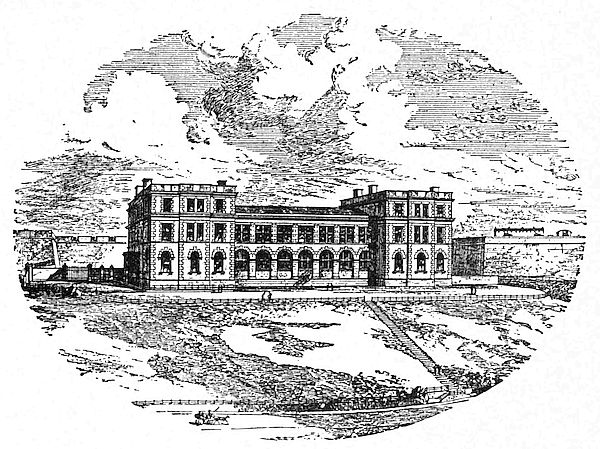
Fig. 47.
The Laboratory of the Marine Biological Association on the Citadel
Hill, Plymouth, overlooking Plymouth Sound. The laboratory was built
with the aid of funds raised by public subscription and a contribution of
£5,000 by H.M. Government, and cost £12,200. The Association has
expended, exclusive of this sum, since the opening of the laboratory in
1884, about £62,000, or an average of £3,000 a year on the maintenance
of the laboratory, steam-boat and fishing-boats, and in payment of a staff
of scientific observers. Of this sum the Government has contributed
one-third, the rest has come from private donations and subscriptions, and
from the “earnings” of the laboratory by sale of specimens, admission
fees to the tank-room, &c. The journal of the Association, published at
intervals, records a vast amount of scientific work, advancing our
knowledge of marine life and of the life-history of fishes.
In addition to the above expenditure and results, the Association has superintended
and most carefully directed the expenditure of £6,000 a year
during the past five years in the investigation of the southern area of the
North Sea and of the Channel at the request of H.M. Government, the work
being part of the International Investigation of the North Sea. The very
voluminous results of these inquiries are published in special reports by
the International Committee. Full particulars of the work of the Marine
Biological Association can be obtained from Dr. E. J. Allen, the Director,
the Laboratory, Citadel Hill, Plymouth, who will also receive donations
and applications for membership of the Association.
One of the most solid tests of the esteem and value
attached to scientific progress by the community is the
dedication of large sums of money to scientific purposes
by its wealthier members. We know that in the United
States such gifts are not infrequent; they are rare in this
country. It is, therefore, with especial pleasure that I
call attention to a great gift to science in this country
made only a few years ago. Lord Iveagh has endowed
the Lister Institute, for researches in connection with the
prevention of disease, with no less a sum than a quarter
of a million pounds sterling. This is the largest gift ever
made to science in this country, and will be productive of
great benefit to humanity. The Lister Institute took its
origin in the surplus of a fund raised (at my suggestion
and with my assistance as secretary) by Sir James Whitehead
when Lord Mayor, some sixteen years ago, for the
purpose of making a gift to the Pasteur Institute in Paris,
where many English patients had been treated, without
charge, after being bitten by rabid dogs. Three thousand
pounds was sent to M. Pasteur, and the surplus of a few
hundred pounds was made the starting-point of a fund
which grew, by one generous gift and another, until the
Lister Institute on the Thames Embankment at Chelsea
was set up on a site presented by that good and high-minded
man, the late Duke of Westminster.
Many other noble gifts to scientific research have been
made in this country during the period on which we are
looking back. Let us be thankful for them, and admire
the wise munificence of the donors. But none the less
we must refuse to rely entirely on such liberality for the
development of the army of science, which has to do
battle for mankind against the obvious disabilities and
sufferings which afflict us and can be removed by knowledge.
The organisation and finance of this army should
be the care of the State.
It is a fact which many who have observed it regret
very keenly, that there is to-day a less widespread interest
than formerly in natural history and general science, outside
the strictly professional arena of the school and
university. The field naturalists among the squires and
the country parsons seem nowadays not to be so numerous
and active in their delightful pursuits as formerly, and
the Mechanics’ Institutes and Lecture Societies of the
days of Lord Brougham have given place, to a very large
extent, to musical performances, bioscopes, and other
entertainments, more diverting, but not really more
capable of giving pleasure than those in which science
was popularised. No doubt the organisation and professional
character of scientific work are to a large extent
the cause of this falling-off in its attraction for amateurs.
But perhaps that decadence is also due in some measure
to the increased general demand for a kind of manufactured
gaiety, readily sent out in these days of easy
transport from the great centres of fashionable amusement
to the provinces and rural districts.
Before concluding this retrospect, I would venture to
allude to the relations of scientific progress to religion.
Putting aside the troubles connected with special creeds
and churches and the claims of the clerical profession to
certain funds and employments to the exclusion of laymen,
it should, I think, be recognized that there is no essential
antagonism between the scientific spirit and what is called
the religious sentiment. ‘Religion,’ said Bishop Creighton,
‘means the knowledge of our destiny and of the means of
fulfilling it.’ We can say no more and no less of Science.
Men of Science seek, in all reverence, to discover the
Almighty, the Everlasting. They claim sympathy and
friendship with those who, like themselves, have turned
away from the more material struggles of human life, and
have set their hearts and minds on the knowledge of the
Eternal.