The sergeant had not seen Eugene for a
week; but although he had not seen him, he
could not get him out of his mind.
As he sauntered about the park day after
day, his vigilant eyes going hither and thither
over roads and foot-paths to see that no trespassers
loitered in them and defaced the growing
trees, or launched boats without permission
on the waterways, Eugene’s pale, thoughtful,
and rather unhappy face floated constantly before
him.
“It’s queer, the interest I take in him,” he
said to himself on the last day of the week.
“It must be because he spoke up so frank-like,
and asked me to be his friend. He’s of a
different cut from any other lad I ever saw.
Guess I’ll look him up after I get off to-day.
I’d like to inquire about him, anyway; and
there’s no one to ask here, for the little miss
and her nurse have given up coming too. I
guess they’ve been promenading on the sunny
side of Commonwealth Avenue on account of
the wind in the Fens.”
Every evening at six the sergeant went off
duty. On that evening, instead of going home,
he bent his footsteps toward No. 29 Lovejoy
Street.
While turning a corner swiftly he ran into
a girl who was hurrying along with her head
bent forward.
It was Virtue Ann, Eugene’s nurse; and on
seeing the sergeant, she threw up her head
with a quick catching of her breath.
“Did I frighten you?” asked the sergeant.
“Oh, no, sir!” said Virtue Ann miserably.
“Then, what’s the matter with you?” he
asked in a puzzled voice.
“It’s not you,” said Virtue Ann, bringing
her handkerchief out of her pocket, and rolling
it into a little ball.
“What is it then?”
“It’s the little boy—his grandfather’s dead,
you know.”
“Not the little French boy’s grandfather?”
“Yes, sir.”
“I’m sorry for this,” said the sergeant soberly.
“That’s why you haven’t come to the
Fens.”
“Yes, sir.”
“And what’s the boy going to do?”
“Oh, oh! that’s what bothers me;” and Virtue
Ann’s tears began to shower down like rain.
“It’s an awful hard case. There he sits day
after day in those little stuffy rooms, waiting
for a letter from France; and if what he wants
doesn’t come something just too dreadful for
anything will happen.”
“Too dreadful!” repeated the sergeant.
“Come now, young woman, take it easy, and
just stop crying, will you? There’s lots of
charitable people in this city, and orphans’
homes and so on. He’ll be all right.”
“Do you suppose he’d go into an orphans’
home?” said Virtue Ann, drying her eyes
and speaking half indignantly. “You don’t
know him, sir. He’s proud and shy, like a little
old man. His grandfather made him just
like himself. Oh! he’s got a lot to answer for.
He was a queer old man, and went peering
about with those little eyes of his, just as if
he was looking out for wickedness in everything.”
“Has the boy relatives in France?” asked
the sergeant.
“Yes; one rich grand-uncle on his mother’s
side. It was to him Master Eugene wrote;
and how do you think he began his letter, sir?
He had no one else by him; so he read it to me,
and put it into English so I could understand.
It began this way, ‘Robber, my grandfather
is now dead; and I call upon you to restore
to me, his rightful heir, the chatto’—is that
the right word, sir?”
“I guess so,” said the sergeant.
“Well, anyway,” continued Virtue Ann,
“Master Eugene laid down the law to him.
He wants him to give up this big house, and
the servants and some money, and if he does
not that little innocent creature will—oh, dear,
dear!” and she fell to catching her breath
again, and could not speak.
“What will he do?” asked the sergeant
impatiently.
“It’s too miserable—I can’t say it,” replied
Virtue Ann. “He’ll make way with himself,
the little dear.”
“Are you crazy?” asked the sergeant.
“No, sir—no, sir. You don’t know that boy.
If you’d lived with him as I have you’d understand
him. He’s just as set in his way as a
man. Why, he’s even told me how he’ll kill
himself;” and she whispered a few words in
the sergeant’s ear that made him start back
and stare at her.
“Do go see him,” said Virtue Ann. “He
took a kind of a fancy to you; I guess it must
have been your uniform.”
“I guess so,” said the sergeant. “Where
are you going?”
“To the corner grocery for some bread and
olives.”
“Well, you go on then, and I’ll call to see
the child.”
“I’ll hurry back,” said Virtue Ann; and
she sped on her way.
The sergeant went quickly down the street
until he found No. 29. On arriving there, he
stepped inside the lobby; and after ringing the
bell marked 4, he put his ear to the tube beside
it.
Presently he heard in Eugene’s clear voice,
“Who is there?”
“Sergeant Hardy,” replied the man.
“Will you have the goodness to walk up?”
said Eugene; and as he spoke he pressed a
spring that made the entrance door fly open,
and enabled the sergeant to enter, and mount
the long flight of stairs.
At the top of the house he found himself in
a narrow, uncarpeted hall, where a door stood
wide open with Eugene beside it.
“How do you do?” said the boy gravely,
extending his hand.
“I’m well,” said the sergeant; “and I’m
sorry to hear of your trouble.”
Eugene bowed in his unchildish fashion,
and led the way to a small, barely furnished
parlor.
The sergeant put his helmet on the table,
and sat down by a window, from which an
extended view of distant hills could be had
over the tops of far and near houses; while
Eugene seated himself opposite, and stretching
out his slender arms and legs, tried hard to fill
the chair that had been a favorite one with his
dead grandfather.
His endeavor to look grave and manly was
not successful. He only impressed the sergeant
as being curiously pitiful and pathetic; and the
words, “Poor little chap,” burst almost involuntarily
from his lips.
Eugene grew rather white; but he managed
to bow again, and to say composedly, “Thank
you, Mr. Officer.”
“When did your grandfather die?” asked
the sergeant.
“Five days ago.”
“And was it sudden?”
“Extremely so. He came home from the
town much fatigued. He lay down on his
bed, rose up once, and called in a loud voice,
‘Eugene!’ I ran to him, but the breath had
left him.”
“You have written to your relatives?” said
the sergeant.
“Yes,” replied Eugene. “I sent a letter to
my grand-uncle, who bought from the government
the confiscated estate of my grandfather.
I demanded money from him to enable me to
live. If he sends it, all will be well. If
not”—
“Well, if not,” said the sergeant, “there
are plenty of people here who will look after
you.”
Eugene’s pale face flushed. “Could I become
a pauper? No, Mr. Officer. If I do not
receive some of the rents from my grandfather’s
estate, I shall dispose of myself otherwise.”
“How long since you’ve been out doors?”
asked the sergeant abruptly.
“Not since my grandfather died,” said
Eugene sadly. “I have not cared for it.”
“Will you go home with me now and have
supper?” asked the sergeant. “I would be
proud and happy to show you my wife.”
Before Eugene could speak, a clapping of
hands was heard. Virtue Ann had come
quietly in, and had heard the sergeant’s proposal.
“Yes, Master Eugene, do go,” she said
joyfully.
Eugene hesitated. “Do, please,” said Virtue
Ann coaxingly; “it will do you good.”
“Very well, sir, I accept with alacrity your
invitation,” said Eugene, slipping from his
chair, and standing before the sergeant. “It
is necessary that I put on my velvet suit,” he
went on, with a slight sparkle in his eyes, and
addressing Virtue Ann as he passed her.
“Yes, yes,” she replied; “I will come and
get it down for you.”
In a few minutes she came hurrying back
to the sergeant. “I’m right glad you asked
him, sir. I never was in such a tight box in
my life as to know what to do about this child.
You see, I’m a stranger here, as you might say,
for I’ve only been four months in the city;
and his grandfather didn’t seem to have any
friends, and I don’t know any one to go to, and
his money is most gone, and he’s such a queer
little thing, and flies into a rage if I cross him;
and I don’t know what to do, and I wish you’d
advise him. I asked Bridget to talk to Mrs.
Manning about him,—that’s the little girl’s
mother; but she says the lady would clap him
into a school or some place with a lot of children,
where he’d be most crazy. I’ll go see
Bridget again to-night. I wish I’d money to
keep the little dear with me, if he’d stay. He’s
so sweet and elegant in his ways; but I’m only
a poor girl, and I’m getting pretty near my
last dollar—oh, here he is! Good-by, Master
Eugene; I’ll call for you at nine.”
The sergeant and Eugene went slowly down
the staircase, and Virtue Ann stood watching
them until they were out of sight. Then she
drew a long sigh, and went into the kitchen to
get something to eat.
The sergeant and Eugene scarcely spoke as
they went along the street. The man was
silent because he was wondering what he could
do to help the boy beside him. The boy was
silent because, despite himself, a soft joy and
peace were stealing into his troubled heart, as
he once more mingled with his fellow-beings,
and breathed the pure evening air.
At last the sergeant stopped before a neat
wooden house near the Fens. “This is my
home,” he said.
Eugene brought back his eyes from the distant
horizon, and flashed a quick, appreciative
glance at the small house and the pretty garden.
“Come in,” said the sergeant gruffly. “My
wife will be getting the supper.”
Eugene saw no face looking out for them
between the ruffled window curtains. All was
quiet and still,—the sergeant had evidently no
children; and the boy thoughtfully went into
the house, and hung up his cap on a rack in
the hall.
“I’ll not put you in the parlor,” said the
sergeant. “Let’s go find the missis;” and he
stalked out toward the kitchen at the back of
the house.
Eugene followed him curiously, and with
some hesitation.
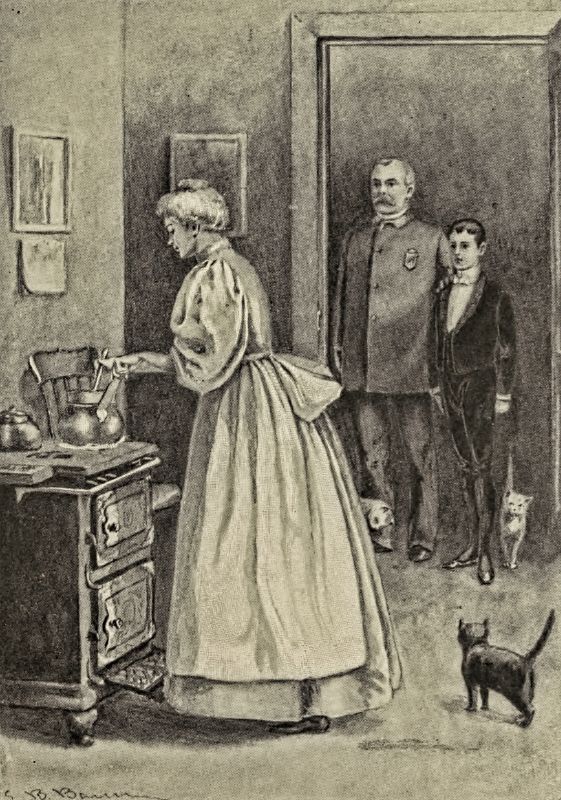
“Well, Wife, I’ve brought a Visitor Home To-night.”
“Isn’t that a picture?” said the sergeant.
He had pushed open the kitchen door; and
Eugene, looking in, saw a small, exquisitely
clean room, with pictures on the walls, and
white curtains at the windows, and a woman
cooking something over a gas-stove.
“Well, wife,” said the sergeant agreeably,
“I’ve brought a visitor home to-night; he’s
the little French boy I told you about. He
has had a great misfortune,—his grandfather
is dead;” and he gently pushed Eugene forward.
The woman raised her head slightly; and
Eugene saw that she had a fresh face, rather
younger than the sergeant’s, clear blue eyes,
and a quantity of soft white hair.
“Stephen,” she said, in a spoiled, almost
childish voice, “how could you? there’s only
stew enough for two, and you know I don’t
like boys.”
“Yes, yes, I know,” he said good-naturedly.
“Here’s the boy; just look round and tell him
so yourself.”
Mrs. Hardy did turn around in the twinkling
of an eye, the uplifted spoon in her hand.
“How do you do?” she said quickly. “I didn’t
see you—don’t mind what I say. I have
just a little prejudice against boys, because they
tease my cats.”
“And this boy has a little prejudice against
you on two scores,” said the sergeant, chuckling
amiably.
“What are they?” asked Mrs. Hardy.
“I’ll tell you later on,” said the sergeant.
Mrs. Hardy laughed softly, and bent her
white head over the stove; while her husband
pointed to a rocking-chair drawn up by one
of the windows, and hospitably invited Eugene
to sit down on it.
Eugene, however, would not seat himself
while his hostess was standing, and contented
himself with leaning against it.
The sergeant excused himself, and went
away to change his uniform; while Mrs. Hardy,
between the intervals of stirring the dish on
the stove, looked curiously at Eugene over her
shoulder.
She was dressed all in white; and there was
something so attractive and unique in her appearance,
in her fresh face and her snowy
hair, that the boy had difficulty in keeping
himself from staring at her.
“So your grandfather is dead,” she said in
a low voice, as if she were talking to herself.
“You must feel badly about it, though you
are only a boy.”
Eugene, without knowing why, felt himself
growing sorry for her because she was sorry
for him.
“One must suffer in this world,” he said
patronizingly. “It is fate.”
“You are young to have found that out,”
said the woman quietly. Then, before he
could answer her, she said, “Do you like
oyster stew?”
“I shall eat with pleasure anything that
you prepare, madam,” said the boy courteously;
“and, indeed, that is one of my favorite
dishes—allow me to assist you;” and he
hurried forward to help her in carrying the
dish to the near dining-room.
“Did you hear me say that there would
not be enough oysters for three?” asked Mrs.
Hardy, fixing her bright blue eyes on the
boy’s face.
“No, madam,” he said without hesitation.
“But you must have—you were close by.”
Eugene tried not to smile, but he could
not help it.
“You are telling a story in order to save
my feelings, aren’t you?” she said brusquely.
Eugene shrugged his shoulders. “A story—well,
scarcely that.”
“It is better to hurt my feelings,” she said
gravely, “than to say what is not true. I
spoke too quickly about the oysters. Here
is cold meat and a salad—we shall have
enough. I suppose you like oil in your
salad.”
“I do, madam.”
“I’ve noticed French people do. My husband
takes sugar and vinegar on his. Now
I will get the chocolate, and we can sit down
as soon as Stephen comes.”
“Why, you and my wife are getting on famously,”
said the sergeant, rubbing his hands
as he entered the room.
Eugene looked at him. His appearance
was quite changed. He was now dressed in
a suit of dark brown clothes, and he wore a
red necktie, and had a white flower in his
buttonhole.
“This boy is not like other boys,” said
Mrs. Hardy calmly; “he is a gentleman.”
“So you like him,” said the sergeant teasingly.
“A pity it is that he can’t like you.”
“Why can’t he like me?” said Mrs. Hardy,
sitting down behind the chocolate and milk
pitchers, and motioning Eugene to sit beside
her.
“Because you are two things that he
doesn’t care for.”
“What are they?”
“You are a woman and a former school-teacher.”
“Don’t you like women?” asked Mrs.
Hardy of Eugene.
“Madam,” he said gallantly, “the world
would be a dreary place without your charming
sex.”
“And school-teachers?”
“Oh! I detest them,” he said frankly,
“with but few exceptions;” and he bowed
to her.
“Do you always talk like this?” asked
Mrs. Hardy with undisguised curiosity.
Eugene smiled at her. He knew that he
talked like a grown-up man.
“Don’t tease the boy,” said the sergeant.
“He isn’t a prig, anyway. Do you know,”
he went on, addressing Eugene, “that I’m
very fond of my wife?”
“You do not surprise me,” said Eugene
with his lips; and in his heart he thought,
“What astonishing candor! I never met such
people.”
“Her father used to be worth his weight
in gold,” said the sergeant. “He owned a
flour-mill. Then he failed and died; and my
wife, like a brave girl, taught and supported
herself till I married her. I guess she’ll
never do that again, though. She has got a
rich old aunt that is going to leave her some
money some day, so she will be provided for
whatever happens to me.”
“I congratulate you,” said Eugene to his
hostess.
“I hope your grand-uncle will do as square
a thing by you as her aunt is doing by her,”
said the sergeant. “We’ve got it down in
black and white.”
Eugene’s face grew so pale that Mrs. Hardy
shook her head at her husband. Then she
pressed the boy to eat various things that
she laid on his plate.
“Your hair is just like a pile of snow
to-night,” said the sergeant, affectionately regarding
the top of his wife’s head. “Do
you know, boy, some people are mischievous
enough to ask if that hair has been turned
white on account of my sins?” and he
laughed uproariously. “What do you tell
them, Bess?”
“I tell them no,” she said, shaking her
head. “We all turn gray in our family when
we’re forty.”
“It gives you the appearance of being in
grande toilette,” said Eugene, who had recovered
his composure. “One could imagine you just
stepping into your carriage to attend a ball.”
Mrs. Hardy looked pleased, and handed him
a huge slice of cake.
The Hardys did not spend a very long time
at the table; and when supper was over the
sergeant withdrew to the garden to smoke,
while Eugene begged to assist his hostess in
carrying the dishes to the kitchen.
“Do you really want to do it?” she said
earnestly; “or is it only your politeness that
makes you ask? No, don’t answer quickly;
take a minute to think.”
Out through the open window Eugene could
see the little garden flooded with electric light
from the near street, and the sergeant sauntering
about it with a pipe in his mouth.
“You had rather be with him, had you not?”
said Mrs. Hardy.
“I had,” replied Eugene, the words slipping
out of his mouth before he could recall them.
“Then, run away,” said Mrs. Hardy; “it is
good for boys to be in the open air as much
as possible, and I am used to washing my
dishes myself. That china belonged to my
mother, and was very expensive, and you might
let it fall; and then, perhaps you would spot
your velvet suit.”
Eugene went out-of-doors; and while walking
about the moist garden paths, he followed
the sergeant’s directions with regard to picking
a number of the sweet tremulous flowers to
take home with him.
“What games can you play?” asked the
sergeant as his eye ran over the pleasing symmetry
of Eugene’s figure.
“I can fence and dance,” said Eugene, “and
ride passably; also I am fond of fishing, and I
can run well at the game one calls ‘prisoner’s
base’ in this country.”
“Good; but what have you done here? Do
you play base-ball and cricket or foot-ball?”
“Not as yet,” said the boy sadly, but proudly;
“we can afford nothing.”
“We must see to that if you stay in Boston,”
said the sergeant. “You’ll not make yourself
a man if you don’t have manly exercise. Why,
here’s Dodo coming home, and old Toddles
with her.”
Eugene lifted up his eyes and smiled in
amusement at two rather decrepit cats that
were climbing the garden fence.
“These are our house cats,” said the sergeant,
“promoted from the park to home service
on account of old age. Come in, pussies,
and have some supper.”
The tortoiseshell pair before entering the
house walked purringly around the sergeant,
and rubbed themselves against his legs.
“It’s wonderful what affection the creatures
have,” he said musingly, as he took his pipe
from his mouth, and looked down at them.
“Don’t you like dumb animals, boy?”
“I had a pony in France that I rather cared
for,” said Eugene, “and I like hunting-dogs
imperfectly well.”
“But you don’t understand dumb creatures,”
said the sergeant. “I can tell by the way that
you speak that you don’t. There’s a whole
book of knowledge shut up from you, boy.
Some day perhaps it will be opened, and you’ll
enjoy life more from knowing that there are
more live things to enjoy it and to like you
than you have had any suspicion of. Let’s
go in now. I guess the missis has got things
tidied.”
Mrs. Hardy was standing on the porch, looking
like a girl with her slim figure and white
gown.
“Would you like to play some games?” she
asked her guest softly.
He showed a polite pleasure at the proposal,
and during the next two hours Mrs. Hardy
initiated him into the mysteries of some American
parlor amusements that he had never before
heard of.
When Virtue Ann came for him, his cheeks
were flushed and his face happy. He looked
like a different boy from the little careworn
creature that had arrived there a few hours
earlier.
“Thank you kindly, ma’am,” said Virtue
Ann in a low voice to Mrs. Hardy; “you’ve
done an angel’s deed in comforting him. I’m
sure I don’t know what’s to become of the
little lad;” and she sighed heavily.
All the evening Mrs. Hardy had been regarding
the boy with a curious intentness of
gaze. At Virtue Ann’s words her eyes again
wandered to Eugene; and she said wistfully,
“Do you say that he is quite alone in the
world, quite, quite alone?”
“Yes; except his old grand-uncle in France,”
said Virtue Ann with a sniff. “He’ll not do
anything for him, I misdoubt. I’ve heard the
grandfather talking about him; and I guess
he’s no better than a skinflint, and”—but here
Virtue Ann was obliged to break off abruptly,
for Eugene came forward to take leave of his
hostess.
Mrs. Hardy listened with a smile on her
face to his well-bred assurances that he had
had a pleasant visit.
“You were criticising us all the time,” she
said keenly; and when Eugene, in discomposure,
could do nothing but gaze helplessly at
her, she bent down suddenly and kissed him.
“Never mind, little lad,” she said, “I know
that this has been a change for you. Good-night,
good-night;” and long after her husband
went into the house, she stood in the doorway,
her eyes wandering down the street that Virtue
Ann and her young charge had taken to go
home.
Virtue Ann had been quite impressed by the
cosiness and pretty furnishings of the little
cottage, and by the mingled dignity and oddity
of the sergeant’s wife.
“She was like an old picture with that white
hair,” she murmured to herself; “and yet there’s
no nonsense about her. I guess she’s a good
housekeeper too, for everything was as neat as
wax. What a good home that would be for
Master Eugene!” and she sighed as she glanced
at the quiet lad beside her.
Sergeant Hardy was tired that night, and
went to bed as soon as Eugene had left his
house. About one o’clock he was awakened
by the sound of suppressed sobbing; and starting
up in bed, he dimly saw his wife standing
by the window.
“What’s the matter, Bess?” he asked
sleepily.
She lifted her white head that she had laid
against the window-pane. “O Stephen! did I
wake you? I’m sorry. It’s nothing—go to
sleep again.”
“People don’t get up out of bed in the middle
of the night to go lean up against windows
and stare out into the dark for nothing,”
he said in a matter-of-fact way. “What’s
wrong with you, Bess?”
“Stephen,” she said in a repressed voice,
“in all the years that we’ve been married
you’ve often heard me say how glad I am
that I’ve never had a child.”
“Often, Bess.”
“How glad—how delighted I am,” she
went on quietly, though he knew by her tones
that she was trembling like a leaf, “that we
have not had to launch another little child
into this world of care and trouble; it’s such
a sad world for children.”
“I know, I know,” he said, trying not to
yawn as he listened to her.
“They’re such a worry when they’re growing
up,” she continued sorrowfully; “they get
ill, and you have to fuss over them in the
daytime, and they call you out of your warm
bed at night.”
“Of course they do,” he responded. “They’re
always bleating like lambs after their parents.”
“And mothers get dragged down and worn
out; and then, when the little things grow old
enough to be a comfort, they go away from
you out into the world, or else you die and
leave them, and almost break your heart in the
going, because you think other people won’t
be as tender with them as you have been.”
“Naturally,” growled the sergeant. “A
body would almost think you had been
through the experience.”
“There are too many children in the
world,” said his wife vehemently. “Hear me
say again, Stephen, that I’m glad, glad, glad,
that I have never had any;” and she sank out
of his sight into a seat in a dark corner, and
covered her face with her hands.
“You’re so glad,” said her husband kindly,
and yet a little ironically, “that you’re crying
your eyes out about it.”
“Let me alone, Stephen,” she said passionately;
“let me cry. You have always been
kind and indulgent with me, and let me have
my own way; and I have got selfish, and look
out always for my own comfort.”
“Oh! never mind, never mind, Bess,” he
said consolingly. “Get into bed again; you’ll
take cold.”
“No, no!” she exclaimed. “Let me be
unselfish for once. Let me imagine that in
the next room there is a little sick child, that
it may call me at any minute, that I must be
ready to go to it;” and sobbing as if her
heart would break, she drew her white hair
over her head like a veil, and curled herself
up miserably on the low seat.
The sergeant looked in her direction compassionately
and with resignation. “I’d cry
with you, Bess, if I could,” he said drowsily,
“but I can’t. I’ll get up and make a hot
drink for you, though, if you like.”
“No, no; I don’t want a hot drink,” she
moaned.
“I guess I’ll just let you alone. You
women like to make yourselves miserable
sometimes,” he said philosophically; and laying
his head down on the pillow, he was soon
asleep.