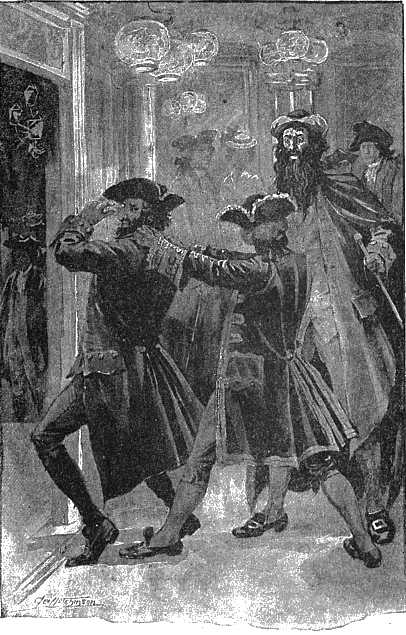
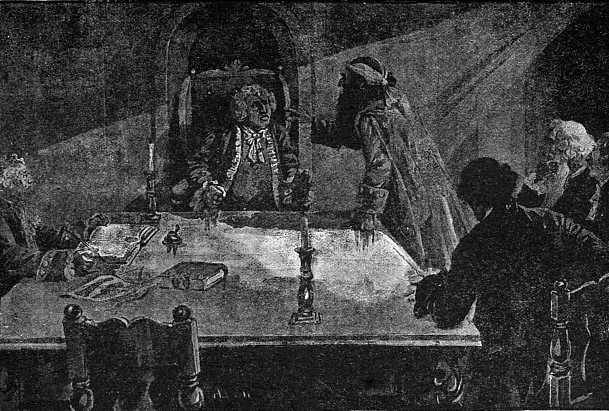
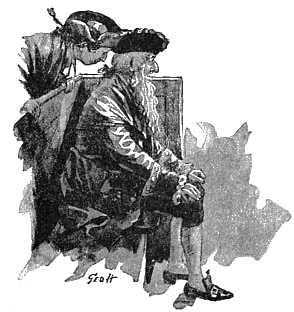
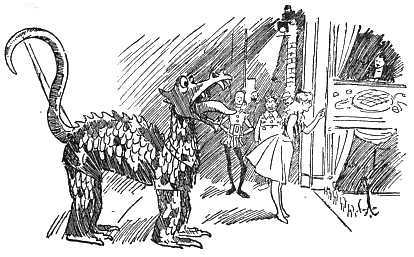
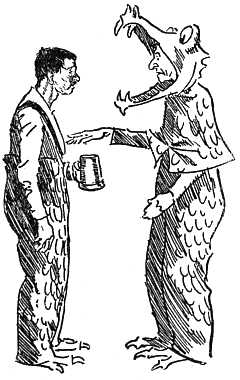
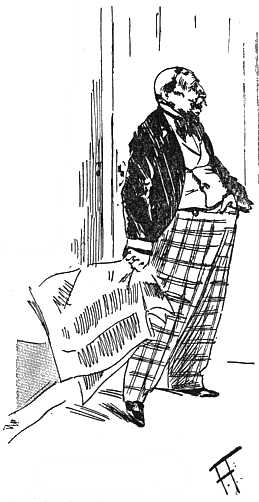
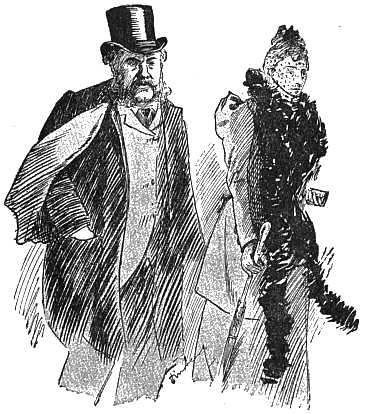
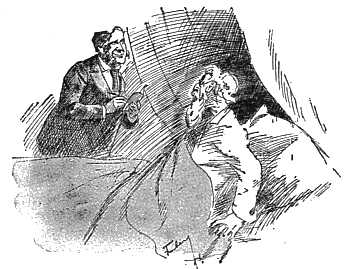
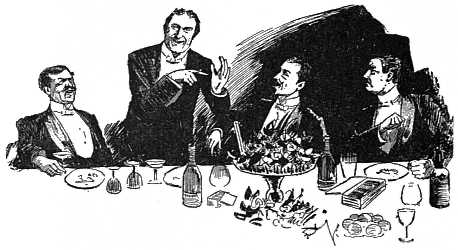
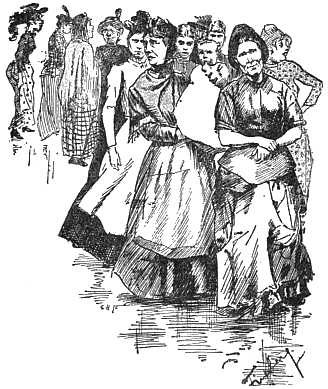
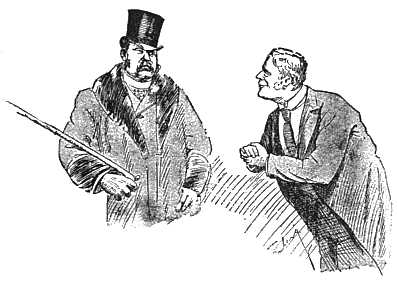
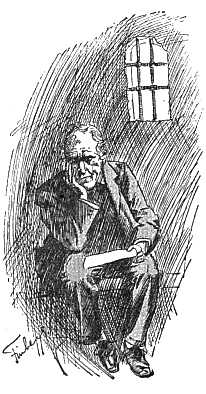
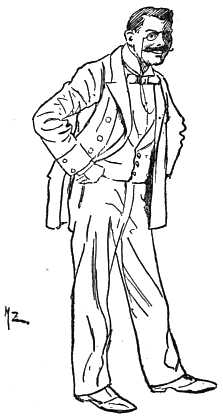
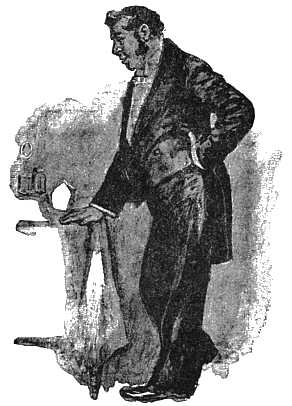
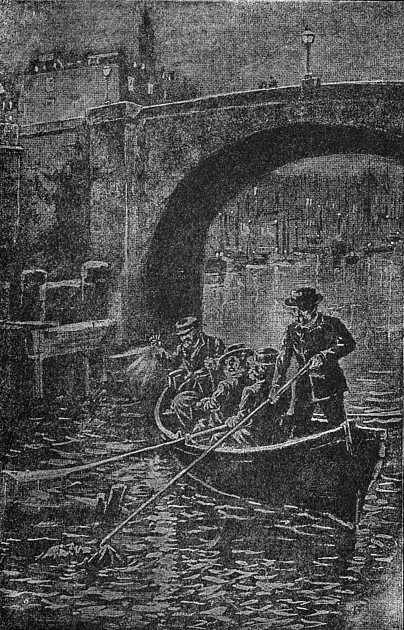
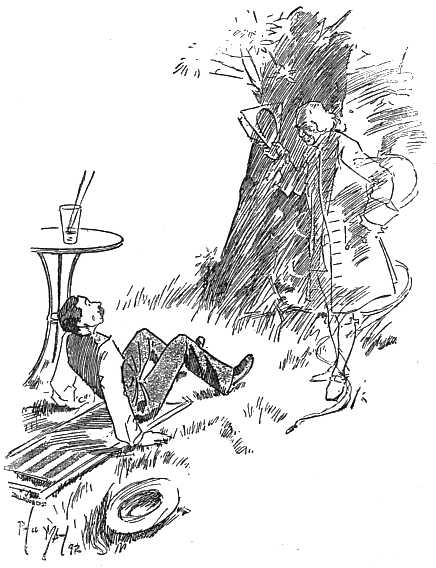
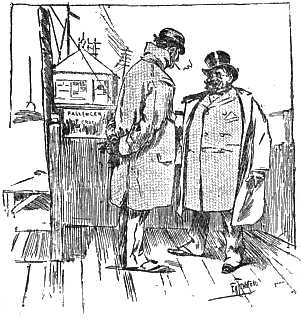
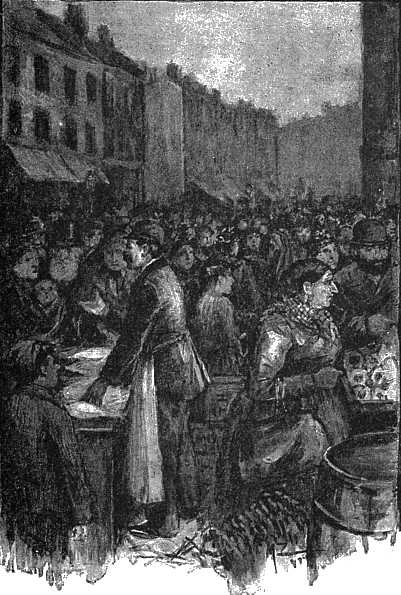
SHOWING HOW THE WICKED PHILANTHROPIST WAS TURNED INTO A FISH-PORTER.
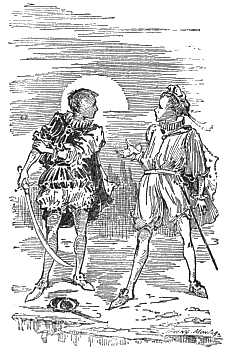
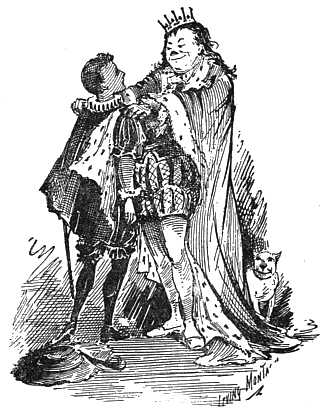
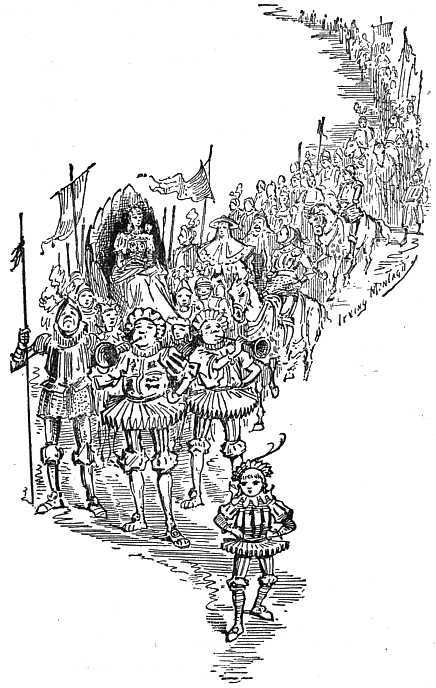
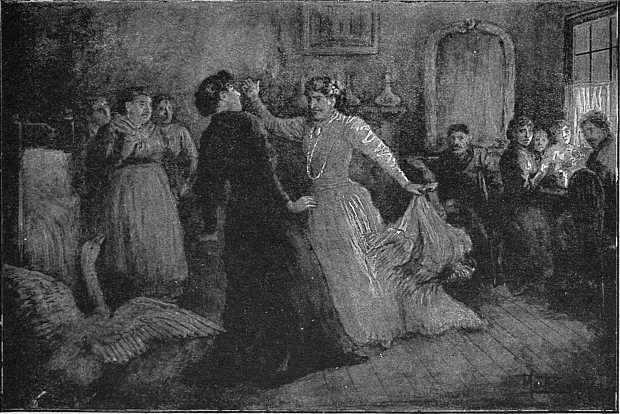
In the days when Lord George Gordon became a Jew, and was suspected of
insanity; when, out of respect for the prophecies, England denied her
Jews every civic right except that of paying taxes; when the
Gentleman's Magazine had ill words for the infidel alien; when
Jewish marriages were invalid and bequests for Hebrew colleges void;
when a prophet prophesying Primrose Day would have been set in the
stocks, though Pitt inclined his private ear to Benjamin Goldsmid's
views on the foreign loans—in those days, when Tevele Schiff was
Rabbi in Israel, and Dr. de Falk, the Master of the Tetragrammaton,
saint and Cabbalistic conjuror, flourished in Wellclose Square, and
the composer of "The Death of Nelson" was a choir-boy in the Great
Synagogue; Joseph Grobstock, pillar of the same, emerged one afternoon
into the spring sunshine at the fag-end of the departing stream of
worshippers. In his hand was a large canvas bag, and in his eye a
twinkle.
There had been a special service of prayer and thanksgiving for the
happy restoration of his Majesty's health, and the cantor had
interceded tunefully with Providence on behalf of Royal George and
"our most amiable Queen, Charlotte." The congregation was large and
fashionable—far more so than when only a heavenly sovereign was
concerned—and so the courtyard was thronged with a string of
Schnorrers (beggars), awaiting the exit of the audience, much as the
vestibule of the opera-house is lined by footmen.
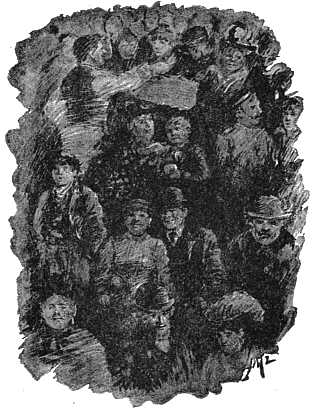
They were a motley crew, with tangled beards and long hair that fell
in curls, if not the curls of the period; but the gaberdines of the
German Ghettoes had been in most cases exchanged for the knee-breeches
and many-buttoned jacket of the Londoner. When the clothes one has
brought from the Continent wear out, one must needs adopt the attire
of one's superiors, or be reduced to buying. Many bore staves, and had
their loins girded up with coloured handkerchiefs, as though ready at
any moment to return from the Captivity. Their woebegone air was
achieved almost entirely by not washing—it owed little to nature, to
adventitious aids in the shape of deformities. The merest sprinkling
boasted of physical afflictions, and none exposed sores like the
lazars of Italy or contortions like the cripples of Constantinople.
Such crude methods are eschewed in the fine art of schnorring. A
green shade might denote weakness of sight, but the stone-blind man
bore no braggart placard—his infirmity was an old established concern
well known to the public, and conferring upon the proprietor a
definite status in the community. He was no anonymous atom, such as
drifts blindly through Christendom, vagrant and apologetic. Rarest of
all sights in this pageantry of Jewish pauperdom was the hollow
trouser-leg or the empty sleeve, or the wooden limb fulfilling either
and pushing out a proclamatory peg.
When the pack of Schnorrers caught sight of Joseph Grobstock, they
fell upon him full-cry, blessing him. He, nothing surprised, brushed
pompously through the benedictions, though the twinkle in his eye
became a roguish gleam. Outside the iron gates, where the throng was
thickest, and where some elegant chariots that had brought worshippers
from distant Hackney were preparing to start, he came to a standstill,
surrounded by clamouring Schnorrers, and dipped his hand slowly and
ceremoniously into the bag. There was a moment of breathless
expectation among the beggars, and Joseph Grobstock had a moment of
exquisite consciousness of importance, as he stood there swelling in
the sunshine. There was no middle class to speak of in the
eighteenth-century Jewry; the world was divided into rich and poor,
and the rich were very, very rich, and the poor very, very poor, so
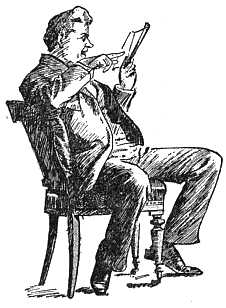
that everyone knew his station. Joseph Grobstock was satisfied with
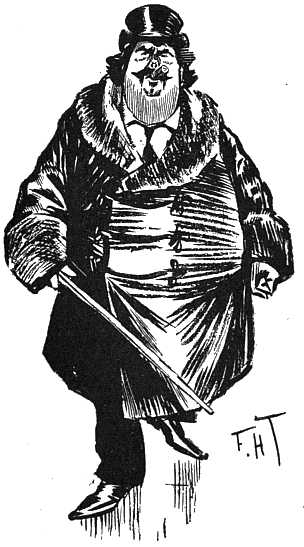
that in which it had pleased God to place him. He was a jovial,
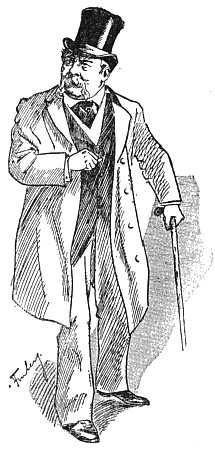
heavy-jowled creature, whose clean-shaven chin was doubling, and he
was habited like a person of the first respectability in a beautiful
blue body-coat with a row of big yellow buttons. The frilled shirt
front, high collar of the very newest fashion, and copious white
neckerchief showed off the massive fleshiness of the red throat. His
hat was of the Quaker pattern, and his head did not fail of the
periwig and the pigtail, the latter being heretical in name only.
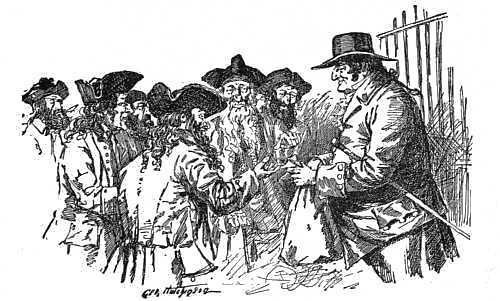
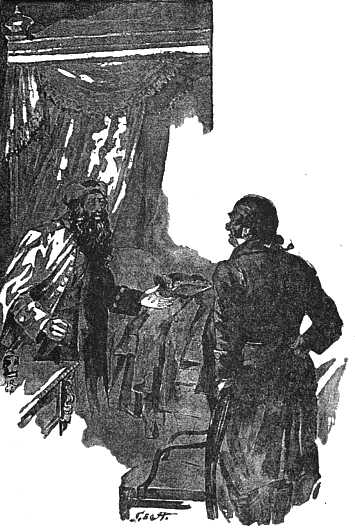
"DIPPED HIS HAND INTO THE BAG."
What Joseph Grobstock drew from the bag was a small white-paper
packet, and his sense of humour led him to place it in the hand
furthest from his nose; for it was a broad humour, not a subtle. It
enabled him to extract pleasure from seeing a fellow-mortal's hat
rollick in the wind, but did little to alleviate the chase for his
own. His jokes clapped you on the back, they did not tickle
delicately.
Such was the man who now became the complacent cynosure of all eyes,
even of those that had no appeal in them, as soon as the principle of
his eleemosynary operations had broken on the crowd. The first
Schnorrer, feverishly tearing open his package, had found a florin,
and, as by electricity, all except the blind beggar were aware that
Joseph Grobstock was distributing florins. The distributor partook of
the general consciousness, and his lips twitched. Silently he dipped
again into the bag, and, selecting the hand nearest, put a second
white package into it. A wave of joy brightened the grimy face, to
change instantly to one of horror.
"You have made a mistake—you have given me a penny!" cried the
beggar.
"Keep it for your honesty," replied Joseph Grobstock imperturbably,
and affected not to enjoy the laughter of the rest. The third
mendicant ceased laughing when he discovered that fold on fold of
paper sheltered a tiny sixpence. It was now obvious that the great man
was distributing prize-packets, and the excitement of the piebald
crowd grew momently. Grobstock went on dipping, lynx-eyed against
second applications. One of the few pieces of gold in the lucky-bag
fell to the solitary lame man, who danced in his joy on his sound leg,
while the poor blind man pocketed his halfpenny, unconscious of
ill-fortune, and merely wondering why the coin came swathed in paper.
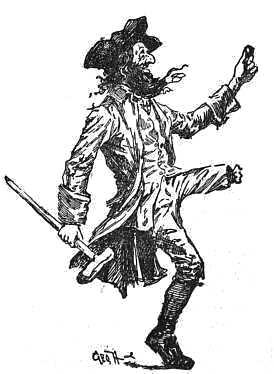
"DANCED ON HIS SOUND LEG."
By this time Grobstock could control his face no longer, and the last
episodes of the lottery were played to the accompaniment of a broad
grin. Keen and complex was his enjoyment. There was not only the
general surprise at this novel feat of alms; there were the special
surprises of detail written on face after face, as it flashed or fell
or frowned in congruity with the contents of the envelope, and for
undercurrent a delicious hubbub of interjections and benedictions, a
stretching and withdrawing of palms, and a swift shifting of figures,
that made the scene a farrago of excitements. So that the broad grin
was one of gratification as well as of amusement, and part of the
gratification sprang from a real kindliness of heart—for Grobstock
was an easy-going man with whom the world had gone easy. The
Schnorrers were exhausted before the packets, but the philanthropist
was in no anxiety to be rid of the remnant. Closing the mouth of the
considerably lightened bag and clutching it tightly by the throat, and
recomposing his face to gravity, he moved slowly down the street like
a stately treasure-ship flecked by the sunlight. His way led towards
Goodman's Fields, where his mansion was situate, and he knew that the
fine weather would bring out Schnorrers enough. And, indeed, he had
not gone many paces before he met a figure he did not remember having
seen before.
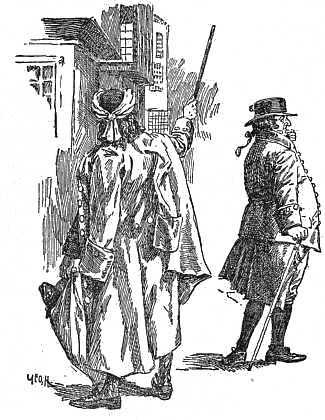
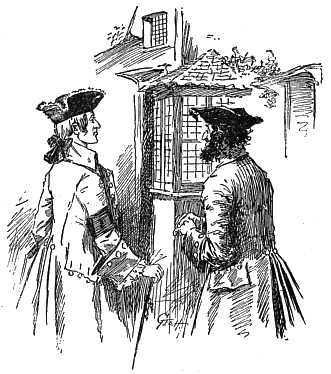
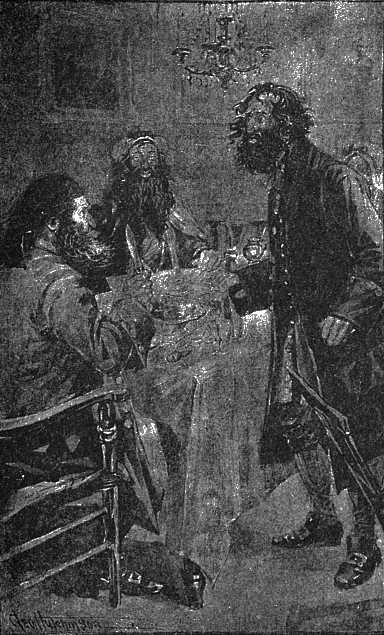
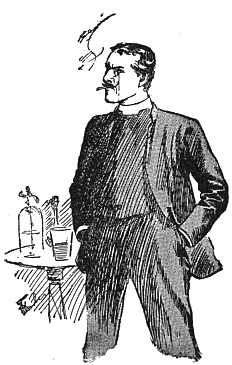
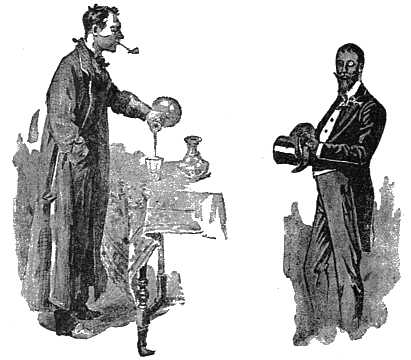
Leaning against a post at the head of the narrow passage which led to
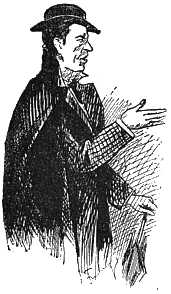
Bevis Marks was a tall, black-bearded, turbaned personage, a first
glance at whom showed him of the true tribe. Mechanically Joseph
Grobstock's hand went to the lucky-bag, and he drew out a
neatly-folded packet and tendered it to the stranger.
The stranger received the gift graciously, and opened it gravely, the
philanthropist loitering awkwardly to mark the issue. Suddenly the
dark face became a thunder-cloud, the eyes flashed lightning.
"An evil spirit in your ancestors' bones!" hissed the stranger, from
between his flashing teeth. "Did you come here to insult me?"
"Pardon, a thousand pardons!" stammered the magnate, wholly taken
aback. "I fancied you were a—a—a—poor man."
"And, therefore, you came to insult me!"
"No, no, I thought to help you," murmured Grobstock, turning from red
to scarlet. Was it possible he had foisted his charity upon an
undeserving millionaire? No! Through all the clouds of his own
confusion and the recipient's anger, the figure of a Schnorrer
loomed too plain for mistake. None but a Schnorrer would wear a
home-made turban, issue of a black cap crossed with a white kerchief;
none but a Schnorrer would unbutton the first nine buttons of his
waistcoat, or, if this relaxation were due to the warmth of the
weather, counteract it by wearing an over-garment, especially one as
heavy as a blanket, with buttons the size of compasses and flaps
reaching nearly to his shoe-buckles, even though its length were only
congruous with that of his undercoat, which already reached the
bottoms of his knee-breeches. Finally, who but a Schnorrer would
wear this overcoat cloak-wise, with dangling sleeves, full of armless
suggestion from a side view? Quite apart from the shabbiness of the
snuff-coloured fabric, it was amply evident that the wearer did not
dress by rule or measure. Yet the disproportions of his attire did but
enhance the picturesqueness of a personality that would be striking
even in a bath, though it was not likely to be seen there. The beard
was jet black, sweeping and unkempt, and ran up his cheeks to meet the
raven hair, so that the vivid face was framed in black; it was a long,
tapering face with sanguine lips gleaming at the heart of a black
bush; the eyes were large and lambent, set in deep sockets under black
arching eyebrows; the nose was long and Coptic; the brow low but
broad, with straggling wisps of hair protruding from beneath the
turban. His right hand grasped a plain ashen staff.
Worthy Joseph Grobstock found the figure of the mendicant only too
impressive; he shrank uneasily before the indignant eyes.
"I meant to help you," he repeated.
"And this is how one helps a brother in Israel?" said the
Schnorrer, throwing the paper contemptuously into the
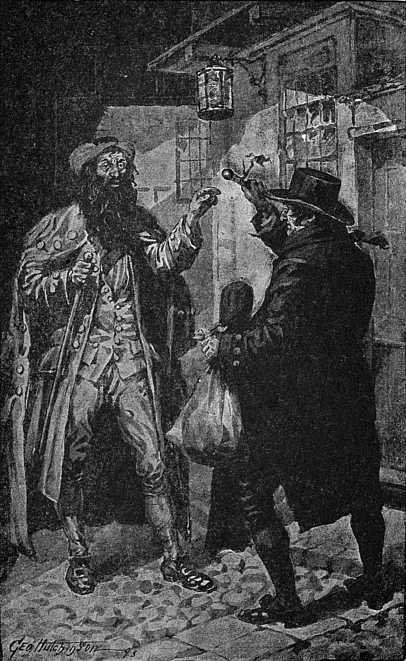
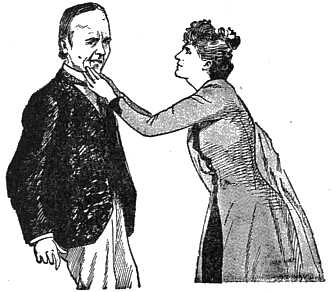
philanthropist's face. It struck him on the bridge of the nose, but
impinged so mildly that he felt at once what was the matter. The
packet was empty—the Schnorrer had drawn a blank; the only one the
good-natured man had put into the bag.
"IT STRUCK HIM ON THE BRIDGE OF THE NOSE."
The Schnorrer's audacity sobered Joseph Grobstock completely; it
might have angered him to chastise the fellow, but it did not. His
better nature prevailed; he began to feel shamefaced, fumbled
sheepishly in his pocket for a crown; then hesitated, as fearing this
peace-offering would not altogether suffice with so rare a spirit, and
that he owed the stranger more than silver—an apology to wit. He
proceeded honestly to pay it, but with a maladroit manner, as one
unaccustomed to the currency.
"You are an impertinent rascal," he said, "but I daresay you feel
hurt. Let me assure you I did not know there was nothing in the
packet. I did not, indeed."
"Then your steward has robbed me!" exclaimed the Schnorrer
excitedly. "You let him make up the packets, and he has stolen my
money—the thief, the transgressor, thrice-cursed who robs the poor."
"You don't understand," interrupted the magnate meekly. "I made up the
packets myself."
"Then, why do you say you did not know what was in them? Go, you mock
my misery!"
"Nay, hear me out!" urged Grobstock desperately. "In some I placed
gold, in the greater number silver, in a few copper, in one
alone—nothing. That is the one you have drawn. It is your
misfortune."
"My misfortune!" echoed the Schnorrer scornfully. "It is your
misfortune—I did not even draw it. The Holy One, blessed be He, has
punished you for your heartless jesting with the poor—making a
sport for yourself of their misfortunes, even as the Philistines
sported with Samson. The good deed you might have put to your account
by a gratuity to me, God has taken from you. He has declared you
unworthy of achieving righteousness through me. Go your way,
murderer!"
"Murderer!" repeated the philanthropist, bewildered by this harsh view
of his action.
"Yes, murderer! Stands it not in the Talmud that he who shames another
is as one who spills his blood? And have you not put me to shame—if
anyone had witnessed your almsgiving, would he not have laughed in my
beard?"
The pillar of the Synagogue felt as if his paunch were shrinking.
"But the others—" he murmured deprecatingly. "I have not shed their
blood—have I not given freely of my hard-earned gold?"
"For your own diversion," retorted the Schnorrer implacably. "But
what says the Midrash? There is a wheel rolling in the world—not he
who is rich to-day is rich to-morrow, but this one He brings up, and
this one He brings down, as is said in the seventy-fifth Psalm.
Therefore, lift not up your horn on high, nor speak with a stiff
neck."
He towered above the unhappy capitalist, like an ancient prophet
denouncing a swollen monarch. The poor man put his hand involuntarily
to his high collar as if to explain away his apparent arrogance, but
in reality because he was not breathing easily under the Schnorrer's
attack.
"You are an uncharitable man," he panted hotly, driven to a line of
defence he had not anticipated. "I did it not from wantonness, but
from faith in Heaven. I know well that God sits turning a
wheel—therefore I did not presume to turn it myself. Did I not let
Providence select who should have the silver and who the gold, who the
copper and who the emptiness? Besides, God alone knows who really
needs my assistance—I have made Him my almoner; I have cast my burden
on the Lord."
"Epicurean!" shrieked the Schnorrer. "Blasphemer! Is it thus you
would palter with the sacred texts? Do you forget what the next verse
says: 'Bloodthirsty and deceitful men shall not live out half their
days'? Shame on you—you a Gabbai (treasurer) of the Great
Synagogue. You see I know you, Joseph Grobstock. Has not the beadle of
your Synagogue boasted to me that you have given him a guinea for
brushing your spatterdashes? Would you think of offering him a
packet? Nay, it is the poor that are trodden on—they whose merits are
in excess of those of beadles. But the Lord will find others to take
up his loans—for he who hath pity on the poor lendeth to the Lord.
You are no true son of Israel."
The Schnorrer's tirade was long enough to allow Grobstock to recover
his dignity and his breath.
"If you really knew me, you would know that the Lord is considerably
in my debt," he rejoined quietly. "When next you would discuss me,
speak with the Psalms-men, not the beadle. Never have I neglected the
needy. Even now, though you have been insolent and uncharitable, I am
ready to befriend you if you are in want."
"If I am in want!" repeated the Schnorrer scornfully. "Is there
anything I do not want?"
"You are married?"
"You correct me—wife and children are the only things I do not
lack."
"No pauper does," quoth Grobstock, with a twinkle of restored humour.
"No," assented the Schnorrer sternly. "The poor man has the fear of
Heaven. He obeys the Law and the Commandments. He marries while he is
young—and his spouse is not cursed with barrenness. It is the rich
man who transgresses the Judgment, who delays to come under the
Canopy."
"Ah! well, here is a guinea—in the name of my wife," broke in
Grobstock laughingly. "Or stay—since you do not brush
spatterdashes—here is another."
"In the name of my wife," rejoined the Schnorrer with dignity, "I
thank you."
"Thank me in your own name," said Grobstock. "I mean tell it me."
"I am Manasseh Bueno Barzillai Azevedo da Costa," he answered simply.
"A Sephardi!" exclaimed the philanthropist.
"Is it not written on my face, even as it is written on yours that you
are a Tedesco? It is the first time that I have taken gold from one of
your lineage."
"Oh, indeed!" murmured Grobstock, beginning to feel small again.
"Yes—are we not far richer than your community? What need have I to
take the good deeds away from my own people—they have too few
opportunities for beneficence as it is, being so many of them wealthy;
brokers and West India merchants, and—"
"But I, too, am a financier, and an East India Director," Grobstock
reminded him.
"Maybe; but your community is yet young and struggling—your rich men
are as the good men in Sodom for multitude. You are the immigrants of
yesterday—refugees from the Ghettoes of Russia and Poland and
Germany. But we, as you are aware, have been established here for
generations; in the Peninsula our ancestors graced the courts of
kings, and controlled the purse-strings of princes; in Holland we held
the empery of trade. Ours have been the poets and scholars in Israel.
You cannot expect that we should recognise your rabble, which
prejudices us in the eyes of England. We made the name of Jew
honourable; you degrade it. You are as the mixed multitude which came
up with our forefathers out of Egypt."
"Nonsense!" said Grobstock sharply. "All Israel are brethren."
"Esau was the brother of Israel," answered Manasseh sententiously.
"But you will excuse me if I go a-marketing, it is such a pleasure to
handle gold." There was a note of wistful pathos in the latter remark
which took off the edge of the former, and touched Joseph with
compunction for bandying words with a hungry man whose loved ones were
probably starving patiently at home.
"Certainly, haste away," he said kindly.
"I shall see you again," said Manasseh, with a valedictory wave of his
hand, and digging his staff into the cobblestones he journeyed
forwards without bestowing a single backward glance upon his
benefactor.
Grobstock's road took him to Petticoat Lane in the wake of Manasseh.
He had no intention of following him, but did not see why he should
change his route for fear of the Schnorrer, more especially as
Manasseh did not look back. By this time he had become conscious again
of the bag he carried, but he had no heart to proceed with the fun. He
felt conscience stricken, and had recourse to his pockets instead in
his progress through the narrow jostling market-street, where he
scarcely ever bought anything personally save fish and good deeds. He
was a connoisseur in both. To-day he picked up many a good deed cheap,
paying pennies for articles he did not take away—shoe-latchets and
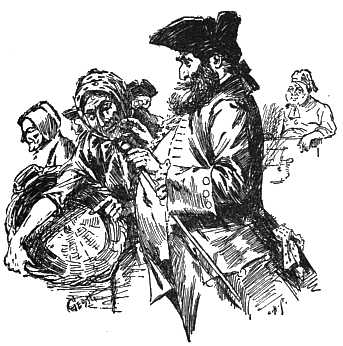
cane-strings, barley-sugar and butter-cakes. Suddenly, through a chink
in an opaque mass of human beings, he caught sight of a small
attractive salmon on a fishmonger's slab. His eye glittered, his chops
watered. He elbowed his way to the vendor, whose eye caught a
corresponding gleam, and whose finger went to his hat in respectful
greeting.
"Good afternoon, Jonathan," said Grobstock jovially, "I'll take that
salmon there—how much?"
"Pardon me," said a voice in the crowd, "I am just bargaining for it."
Grobstock started. It was the voice of Manasseh.
"Stop that nonsense, da Costa," responded the fishmonger. "You know
you won't give me my price. It is the only one I have left," he added,
half for the benefit of Grobstock. "I couldn't let it go under a
couple of guineas."
"Here's your money," cried Manasseh with passionate contempt, and sent
two golden coins spinning musically upon the slab.
In the crowd sensation, in Grobstock's breast astonishment,
indignation, and bitterness. He was struck momentarily dumb. His face
purpled. The scales of the salmon shone like a celestial vision that
was fading from him by his own stupidity.
"I'll take that salmon, Jonathan," he repeated, spluttering. "Three
guineas."
"Pardon me," repeated Manasseh, "it is too late. This is not an
auction." He seized the fish by the tail.
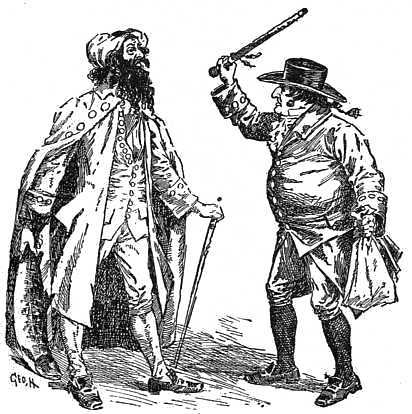
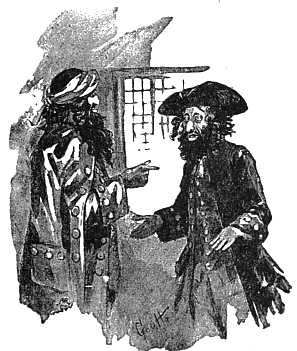
Grobstock turned upon him, goaded to the point of apoplexy. "You!" he
cried. "You—you—rogue! How dare you buy salmon!"
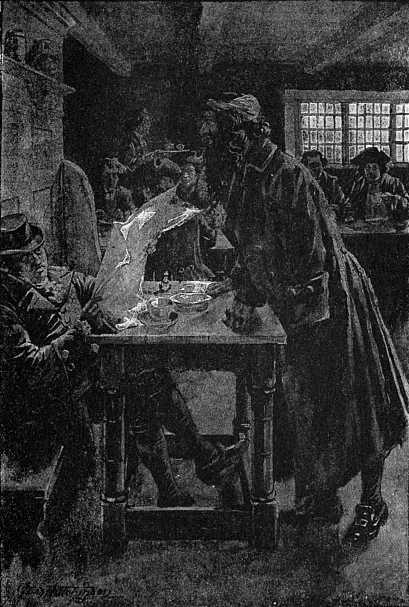
"'YOU ROGUE! HOW DARE YOU BUY SALMON!'"
"Rogue yourself!" retorted Manasseh. "Would you have me steal
salmon?"
"You have stolen my money, knave, rascal!"
"Murderer! Shedder of blood! Did you not give me the money as a
free-will offering, for the good of your wife's soul? I call on you
before all these witnesses to confess yourself a slanderer!"
"Slanderer, indeed! I repeat, you are a knave and a jackanapes. You—a
pauper—a beggar—with a wife and children. How can you have the face
to go and spend two guineas—two whole guineas—all you have in the
world—on a mere luxury like salmon?"
Manasseh elevated his arched eyebrows.
"If I do not buy salmon when I have two guineas," he answered quietly,
"when shall I buy salmon? As you say, it is a luxury; very dear. It is
only on rare occasions like this that my means run to it." There was a
dignified pathos about the rebuke that mollified the magnate. He felt
that there was reason in the beggar's point of view—though it was a
point to which he would never himself have risen, unaided. But
righteous anger still simmered in him; he felt vaguely that there was
something to be said in reply, though he also felt that even if he
knew what it was, it would have to be said in a lower key to
correspond with Manasseh's transition from the high pitch of the
opening passages. Not finding the requisite repartee he was silent.
"In the name of my wife," went on Manasseh, swinging the salmon by the
tail, "I ask you to clear my good name which you have bespattered in
the presence of my very tradesmen. Again I call upon you to confess
before these witnesses that you gave me the money yourself in charity.
Come! Do you deny it?"
"No, I don't deny it," murmured Grobstock, unable to understand why he
appeared to himself like a whipped cur, or how what should have been a
boast had been transformed into an apology to a beggar.
"In the name of my wife, I thank you," said Manasseh. "She loves
salmon, and fries with unction. And now, since you have no further use
for that bag of yours, I will relieve you of its burden by taking my
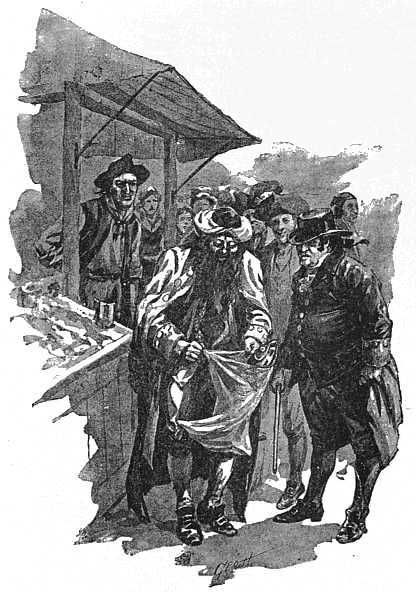
salmon home in it." He took the canvas bag from the limp grasp of the
astonished Tedesco, and dropped the fish in. The head protruded,
surveying the scene with a cold, glassy, ironical eye.
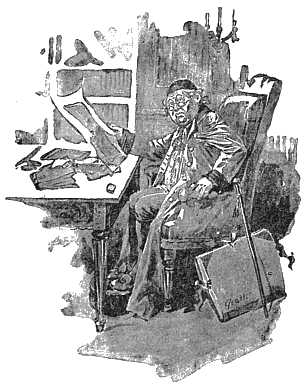
"THE HEAD PROTRUDED."
"Good afternoon all," said the Schnorrer courteously.
"One moment," called out the philanthropist, when he found his tongue.
"The bag is not empty—there are a number of packets still left in
it."
"So much the better!" said Manasseh soothingly. "You will be saved
from the temptation to continue shedding the blood of the poor, and I
shall be saved from spending all your bounty upon salmon—an
extravagance you were right to deplore."
"But—but!" began Grobstock.
"No—no 'buts,'" protested Manasseh, waving his bag deprecatingly.
"You were right. You admitted you were wrong before; shall I be less
magnanimous now? In the presence of all these witnesses I acknowledge
the justice of your rebuke. I ought not to have wasted two guineas on
one fish. It was not worth it. Come over here, and I will tell you
something." He walked out of earshot of the by-standers, turning down
a side alley opposite the stall, and beckoned with his salmon bag. The
East India Director had no course but to obey. He would probably have
followed him in any case, to have it out with him, but now he had a
humiliating sense of being at the Schnorrer's beck and call.
"Well, what more have you to say?" he demanded gruffly.
"I wish to save you money in future," said the beggar in low,
confidential tones. "That Jonathan is a son of the separation! The
salmon is not worth two guineas—no, on my soul! If you had not come
up I should have got it for twenty-five shillings. Jonathan stuck on
the price when he thought you would buy. I trust you will not let me
be the loser by your arrival, and that if I should find less than
seventeen shillings in the bag you will make it up to me."
The bewildered financier felt his grievance disappearing as by sleight
of hand.
Manasseh added winningly: "I know you are a gentleman, capable of
behaving as finely as any Sephardi."
This handsome compliment completed the Schnorrer's victory, which
was sealed by his saying, "And so I should not like you to have it on
your soul that you had done a poor man out of a few shillings."
Grobstock could only remark meekly: "You will find more than seventeen
shillings in the bag."
"Ah, why were you born a Tedesco!" cried Manasseh ecstatically. "Do
you know what I have a mind to do? To come and be your Sabbath-guest!
Yes, I will take supper with you next Friday, and we will welcome the
Bride—the holy Sabbath—together! Never before have I sat at the
table of a Tedesco—but you—you are a man after my own heart. Your
soul is a son of Spain. Next Friday at six—do not forget."
"But—but I do not have Sabbath-guests," faltered Grobstock.
"Not have Sabbath-guests! No, no, I will not believe you are of the
sons of Belial, whose table is spread only for the rich, who do not
proclaim your equality with the poor even once a week. It is your fine
nature that would hide its benefactions. Do not I, Manasseh Bueno
Barzillai Azevedo da Costa, have at my Sabbath-table every week
Yankelé ben Yitzchok—a Pole? And if I have a Tedesco at my table, why
should I draw the line there? Why should I not permit you, a Tedesco,
to return the hospitality to me, a Sephardi? At six, then! I know your
house well—it is an elegant building that does credit to your
taste—do not be uneasy—I shall not fail to be punctual. A Dios!"
This time he waved his stick fraternally, and stalked down a turning.
For an instant Grobstock stood glued to the spot, crushed by a sense
of the inevitable. Then a horrible thought occurred to him.
"WAVED HIS STICK FRATERNALLY."
Easy-going man as he was, he might put up with the visitation of
Manasseh. But then he had a wife, and, what was worse, a livery
servant. How could he expect a livery servant to tolerate such a
guest? He might fly from the town on Friday evening, but that would
necessitate troublesome explanations. And Manasseh would come again
the next Friday. That was certain. Manasseh would be like grim
death—his coming, though it might be postponed, was inevitable. Oh,
it was too terrible. At all costs he must revoke the invitation(?).
Placed between Scylla and Charybdis, between Manasseh and his
manservant, he felt he could sooner face the former.
"Da Costa!" he called in agony. "Da Costa!"
The Schnorrer turned, and then Grobstock found he was mistaken in
imagining he preferred to face da Costa.
"You called me?" enquired the beggar.
"Ye—e—s," faltered the East India Director, and stood paralysed.
"What can I do for you?" said Manasseh graciously.
"Would you mind—very much—if I—if I asked you—"
"Not to come," was in his throat, but stuck there.
"If you asked me—" said Manasseh encouragingly.
"To accept some of my clothes," flashed Grobstock, with a sudden
inspiration. After all, Manasseh was a fine figure of a man. If he
could get him to doff those musty garments of his he might almost pass
him off as a prince of the blood, foreign by his beard—at any rate he
could be certain of making him acceptable to the livery servant. He
breathed freely again at this happy solution of the situation.
"Your cast-off clothes?" asked Manasseh. Grobstock was not sure
whether the tone was supercilious or eager. He hastened to explain.
"No, not quite that. Second-hand things I am still wearing. My old
clothes were already given away at Passover to Simeon the Psalms-man.
These are comparatively new."
"Then I would beg you to excuse me," said Manasseh, with a stately
wave of the bag.
"Oh, but why not?" murmured Grobstock, his blood running cold again.
"I cannot," said Manasseh, shaking his head.
"But they will just about fit you," pleaded the philanthropist.
"That makes it all the more absurd for you to give them to Simeon the
Psalms-man," said Manasseh sternly. "Still, since he is your
clothes-receiver, I could not think of interfering with his office. It
is not etiquette. I am surprised you should ask me if I should mind.
Of course I should mind—I should mind very much."
"But he is not my clothes-receiver," protested Grobstock. "Last
Passover was the first time I gave them to him, because my cousin,
Hyam Rosenstein, who used to have them, has died."
"But surely he considers himself your cousin's heir," said Manasseh.
"He expects all your old clothes henceforth."
"No. I gave him no such promise."
Manasseh hesitated.
"Well, in that case—"
"In that case," repeated Grobstock breathlessly.
"On condition that I am to have the appointment permanently, of
course."
"Of course," echoed Grobstock eagerly.
"Because you see," Manasseh condescended to explain, "it hurts one's
reputation to lose a client."
"Yes, yes, naturally," said Grobstock soothingly. "I quite
understand." Then, feeling himself slipping into future
embarrassments, he added timidly, "Of course they will not always be
so good as the first lot, because—"
"Say no more," Manasseh interrupted reassuringly, "I will come at once
and fetch them."
"No. I will send them," cried Grobstock, horrified afresh.
"I could not dream of permitting it. What! Shall I put you to all that
trouble which should rightly be mine? I will go at once—the matter
shall be settled without delay, I promise you; as it is written, 'I
made haste and delayed not!' Follow me!" Grobstock suppressed a groan.
Here had all his manœuvring landed him in a worse plight than ever.
He would have to present Manasseh to the livery servant without even
that clean face which might not unreasonably have been expected for
the Sabbath. Despite the text quoted by the erudite Schnorrer, he
strove to put off the evil hour.
"Had you not better take the salmon home to your wife first?" said he.
"My duty is to enable you to complete your good deed at once. My wife
is unaware of the salmon. She is in no suspense."
Even as the Schnorrer spake it flashed upon Grobstock that Manasseh
was more presentable with the salmon than without it—in fact, that
the salmon was the salvation of the situation. When Grobstock bought
fish he often hired a man to carry home the spoil. Manasseh would have
all the air of such a loafer. Who would suspect that the fish and even
the bag belonged to the porter, though purchased with the gentleman's
money? Grobstock silently thanked Providence for the ingenious way in
which it had contrived to save his self-respect. As a mere
fish-carrier Manasseh would attract no second glance from the
household; once safely in, it would be comparatively easy to smuggle
him out, and when he did come on Friday night it would be in the
metamorphosing glories of a body-coat, with his unspeakable
undergarment turned into a shirt and his turban knocked into a cocked
hat.
They emerged into Aldgate, and then turned down Leman Street, a
fashionable quarter, and so into Great Prescott Street. At the
critical street corner Grobstock's composure began to desert him: he
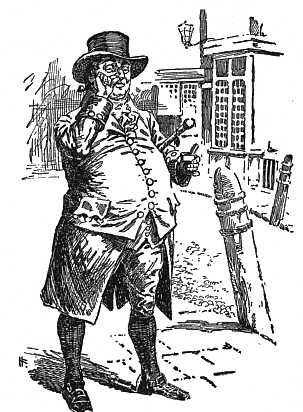
took out his handsomely ornamented snuff-box and administered to
himself a mighty pinch. It did him good, and he walked on and was well
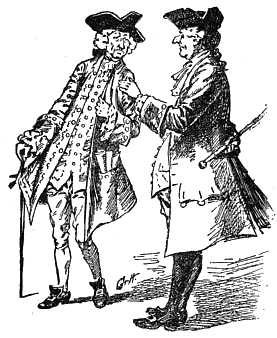
nigh arrived at his own door when Manasseh suddenly caught him by a
coat button.
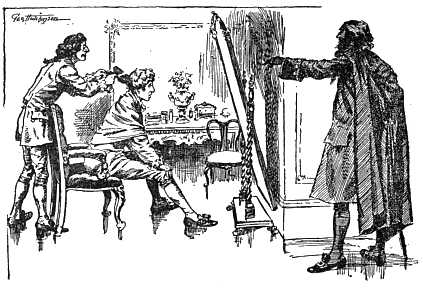
"ADMINISTERED A MIGHTY PINCH."
"Stand still a second," he cried imperatively.
"What is it?" murmured Grobstock, in alarm.
"You have spilt snuff all down your coat front," Manasseh replied
severely. "Hold the bag a moment while I brush it off."
Joseph obeyed, and Manasseh scrupulously removed every particle with
such patience that Grobstock's was exhausted.
"Thank you," he said at last, as politely as he could. "That will do."
"No, it will not do," replied Manasseh. "I cannot have my coat
spoiled. By the time it comes to me it will be a mass of stains if I
don't look after it."
"Oh, is that why you took so much trouble?" said Grobstock, with an
uneasy laugh.
"Why else? Do you take me for a beadle, a brusher of gaiters?"
enquired Manasseh haughtily. "There now! that is the cleanest I can
get it. You would escape these droppings if you held your snuff-box
so—" Manasseh gently took the snuff-box and began to explain, walking
on a few paces.
"Ah, we are at home!" he cried, breaking off the object-lesson
suddenly. He pushed open the gate, ran up the steps of the mansion and
knocked thunderously, then snuffed himself magnificently from the
bejewelled snuff-box.
Behind came Joseph Grobstock, slouching limply, and carrying Manasseh
da Costa's fish.
SHOWING HOW THE KING REIGNED.
When he realised that he had been turned into a fish-porter, the
financier hastened up the steps so as to be at the Schnorrer's side
when the door opened.
The livery-servant was visibly taken aback by the spectacle of their
juxtaposition.
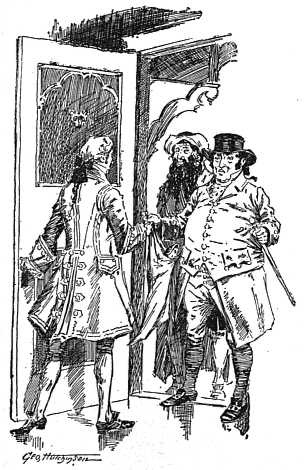
"This salmon to the cook!" cried Grobstock desperately, handing him
the bag.
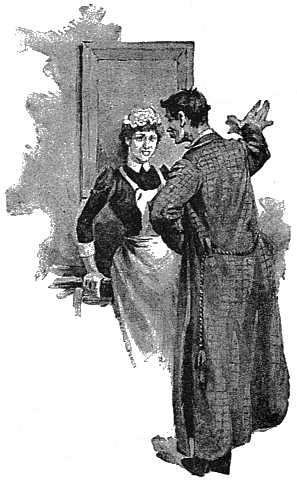
"'THIS SALMON TO THE COOK!'"
Da Costa looked thunders, and was about to speak, but Grobstock's eye
sought his in frantic appeal. "Wait a minute; I will settle with you,"
he cried, congratulating himself on a phrase that would carry another
meaning to Wilkinson's ears. He drew a breath of relief when the
flunkey disappeared, and left them standing in the spacious hall with
its statues and plants.
"Is this the way you steal my salmon, after all?" demanded da Costa
hotly.
"Hush, hush! I didn't mean to steal it! I will pay you for it!"
"I refuse to sell! You coveted it from the first—you have broken the
Tenth Commandment, even as these stone figures violate the Second.
Your invitation to me to accompany you here at once was a mere trick.
Now I understand why you were so eager."
"No, no, da Costa. Seeing that you placed the fish in my hands, I had
no option but to give it to Wilkinson, because—because—" Grobstock
would have had some difficulty in explaining, but Manasseh saved him
the pain.
"You had to give my fish to Wilkinson!" he interrupted. "Sir, I
thought you were a fine man, a man of honour. I admit that I placed my
fish in your hands. But because I had no hesitation in allowing you to
carry it, this is how you repay my confidence!"
In the whirl of his thoughts Grobstock grasped at the word "repay" as
a swimmer in a whirlpool grasps at a straw.
"I will repay your money!" he cried. "Here are your two guineas. You
will get another salmon, and more cheaply. As you pointed out, you
could have got this for twenty-five shillings."
"Two guineas!" ejaculated Manasseh contemptuously. "Why you offered
Jonathan, the fishmonger, three!"
Grobstock was astounded, but it was beneath him to bargain. And he
remembered that, after all, he would enjoy the salmon.
"Well, here are three guineas," he said pacifically, offering them.
"Three guineas!" echoed Manasseh, spurning them. "And what of my
profit?"
"Profit!" gasped Grobstock.
"Since you have made me a middle-man, since you have forced me into
the fish trade, I must have my profits like anybody else."
"Here is a crown extra!"
"And my compensation?"
"What do you mean?" enquired Grobstock, exasperated. "Compensation for
what?"
"For what? For two things at the very least," Manasseh said
unswervingly. "In the first place," and as he began his logically
divided reply his tone assumed the sing-song sacred to Talmudical
dialectics, "compensation for not eating the salmon myself. For it is
not as if I offered it you—I merely entrusted it to you, and it is
ordained in Exodus that if a man shall deliver unto his neighbour an
ass, or an ox, or a sheep, or any beast to keep, then for every matter
of trespass, whether it be for ox, for ass, for sheep, for raiment, or
for any manner of lost thing, the man shall receive double, and
therefore you should pay me six guineas. And secondly—"
"Not another farthing!" spluttered Grobstock, red as a turkey-cock.
"Very well," said the Schnorrer imperturbably, and, lifting up his
voice, he called "Wilkinson!"
"Hush!" commanded Grobstock. "What are you doing?"
"I will tell Wilkinson to bring back my property."
"Wilkinson will not obey you."
"Not obey me! A servant! Why he is not even black! All the Sephardim
I visit have black pages—much grander than Wilkinson—and they
tremble at my nod. At Baron D'Aguilar's mansion in Broad Street
Buildings there is a retinue of twenty-four servants, and they—"
"And what is your second claim?"
"Compensation for being degraded to fishmongering. I am not of those
who sell things in the streets. I am a son of the Law, a student of
the Talmud."
"If a crown piece will satisfy each of these claims—"
"I am not a blood-sucker—as it is said in the Talmud, Tractate
Passover, 'God loves the man who gives not way to wrath nor stickles
for his rights'—that makes altogether three guineas and three
crowns."
"Yes. Here they are."
Wilkinson reappeared. "You called me, sir?" he said.
"No, I called you," said Manasseh, "I wished to give you a crown."
And he handed him one of the three. Wilkinson took it, stupefied, and
retired.
"Did I not get rid of him cleverly?" said Manasseh. "You see how he
obeys me!"
"Ye-es."
"I shall not ask you for more than the bare crown I gave him to save
your honour."
"To save my honour!"
"Would you have had me tell him the real reason I called him was that
his master was a thief? No, sir, I was careful not to shed your blood
in public, though you had no such care for mine."
"Here is the crown!" said Grobstock savagely. "Nay, here are three!"
He turned out his breeches-pockets to exhibit their absolute nudity.
"No, no," said Manasseh mildly, "I shall take but two. You had best
keep the other—you may want a little silver." He pressed it into the
magnate's hand.
"You should not be so prodigal in future," he added, in kindly
reproach. "It is bad to be left with nothing in one's pocket—I know
the feeling, and can sympathise with you." Grobstock stood speechless,
clasping the crown of charity.
Standing thus at the hall door, he had the air of Wilkinson, surprised
by a too generous vail.
Da Costa cut short the crisis by offering his host a pinch from the
jewel-crusted snuff-box. Grobstock greedily took the whole box, the
beggar resigning it to him without protest. In his gratitude for this
unexpected favour, Grobstock pocketed the silver insult without
further ado, and led the way towards the second-hand clothes. He
walked gingerly, so as not to awaken his wife, who was a great amateur
of the siesta, and might issue suddenly from her apartment like a
spider, but Manasseh stolidly thumped on the stairs with his staff.
Happily the carpet was thick.
The clothes hung in a mahogany wardrobe with a plateglass front in
Grobstock's elegantly appointed bedchamber.
Grobstock rummaged among them while Manasseh, parting the white
Persian curtains lined with pale pink, gazed out of the window towards
the Tenterground that stretched in the rear of the mansion. Leaning on
his staff, he watched the couples promenading among the sunlit
parterres and amid the shrubberies, in the cool freshness of declining
day. Here and there the vivid face of a dark-eyed beauty gleamed like
a passion-flower. Manasseh surveyed the scene with bland benevolence;
at peace with God and man.
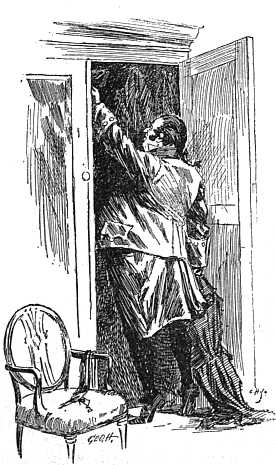
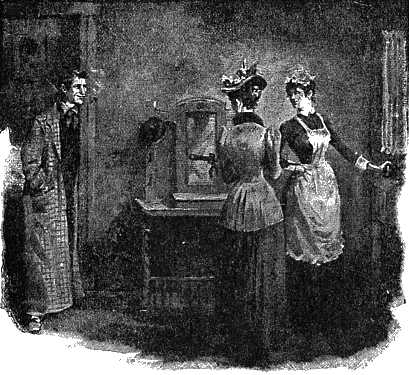
"GROBSTOCK RUMMAGED AMONG THEM."
He did not deign to bestow a glance upon the garments till Grobstock
observed: "There! I think that's all I can spare." Then he turned
leisurely and regarded—with the same benign aspect—the litter
Grobstock had spread upon the bed—a medley of articles in excellent
condition, gorgeous neckerchiefs piled in three-cornered hats, and
buckled shoes trampling on white waistcoats. But his eye had scarcely
rested on them a quarter of a minute when a sudden flash came into it,
and a spasm crossed his face.
"Excuse me!" he cried, and hastened towards the door.
"What's the matter?" exclaimed Grobstock, in astonished apprehension.
Was his gift to be flouted thus?
"I'll be back in a moment," said Manasseh, and hurried down the
stairs.
Relieved on one point, Grobstock was still full of vague alarms. He
ran out on the landing. "What do you want?" he called down as loudly
as he dared.
"My money!" said Manasseh.
Imagining that the Schnorrer had left the proceeds of the sale of
the salmon in the hall, Joseph Grobstock returned to his room, and
occupied himself half-mechanically in sorting the garments he had
thrown higgledy-piggledy upon the bed. In so doing he espied amid the
heap a pair of pantaloons entirely new and unworn which he had
carelessly thrown in. It was while replacing this in the wardrobe that
he heard sounds of objurgation. The cook's voice—Hibernian and
high-pitched—travelled unmistakably to his ears, and brought fresh
trepidation to his heart. He repaired to the landing again, and craned
his neck over the balustrade. Happily the sounds were evanescent; in
another minute Manasseh's head reappeared, mounting. When his left
hand came in sight, Grobstock perceived it was grasping the lucky-bag
with which a certain philanthropist had started out so joyously that
afternoon. The unlucky-bag he felt inclined to dub it now.
"I have recovered it!" observed the Schnorrer cheerfully. "As it is
written, 'And David recovered all that the Amalekites had taken.' You
see in the excitement of the moment I did not notice that you had
stolen my packets of silver as well as my salmon. Luckily your cook
had not yet removed the fish from the bag—I chid her all the same for
neglecting to put it into water, and she opened her mouth not in
wisdom. If she had not been a heathen I should have suspected her of
trickery, for I knew nothing of the amount of money in the bag, saving
your assurance that it did not fall below seventeen shillings, and it
would have been easy for her to replace the fish. Therefore, in the
words of David, will I give thanks unto Thee, O Lord, among the
heathen."
The mental vision of the irruption of Manasseh into the kitchen was
not pleasant to Grobstock. However, he only murmured: "How came you to
think of it so suddenly?"
"Looking at your clothes reminded me. I was wondering if you had left
anything in the pockets."
The donor started—he knew himself a careless rascal—and made as if
he would overhaul his garments. The glitter in Manasseh's eye
petrified him.
"Do you—do you—mind my looking?" he stammered apologetically.
"Am I a dog?" quoted the Schnorrer with dignity. "Am I a thief that
you should go over my pockets? If, when I get home," he conceded,
commencing to draw distinctions with his thumb, "I should find
anything in my pockets that is of no value to anybody but you, do you
fear I will not return it? If, on the other hand, I find anything that
is of value to me, do you fear I will not keep it?"
"No, but—but—" Grobstock broke down, scarcely grasping the
argumentation despite his own clarity of financial insight; he only
felt vaguely that the Schnorrer was—professionally enough—begging
the question.
"But what?" enquired Manasseh. "Surely you need not me to teach you
your duty. You cannot be ignorant of the Law of Moses on the point."
"The Law of Moses says nothing on the point!"
"Indeed! What says Deuteronomy? 'When thou reapest thine harvest in
thy field, and hast forgot a sheaf in the field, thou shalt not go
again to fetch it: it shall be for the stranger, for the fatherless,
and for the widow.' Is it not further forbidden to go over the boughs
of thy olive-tree again, or to gather the fallen fruit of thy
vineyard? You will admit that Moses would have added a prohibition
against searching minutely the pockets of cast-off garments, were it
not that for forty years our ancestors had to wander in the wilderness
in the same clothes, which miraculously waxed with their growth. No, I
feel sure you will respect the spirit of the law, for when I went down
into your kitchen and examined the door-post to see if you had nailed
up a mezuzah upon it, knowing that many Jews only flaunt mezuzahs
on door-posts visible to visitors, it rejoiced me to find one below
stairs."
Grobstock's magnanimity responded to the appeal. It would be indeed
petty to scrutinise his pockets, or to feel the linings for odd coins.
After all he had Manasseh's promise to restore papers and everything
of no value.
"Well, well," he said pleasantly, consoled by the thought his troubles
had now come to an end—for that day at least—"take them away as they
are."
"It is all very well to say take them away," replied Manasseh, with a
touch of resentment, "but what am I to take them in?"
"Oh—ah—yes! There must be a sack somewhere—"
"And do you think I would carry them away in a sack? Would you have me
look like an old clo' man? I must have a box. I see several in the
box-room."
"Very well," said Grobstock resignedly. "If there's an empty one you
may have it."
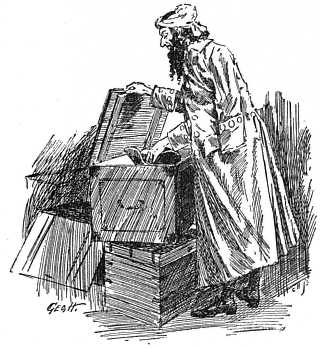
Manasseh laid his stick on the dressing-table and carefully examined
the boxes, some of which were carelessly open, while every lock had a
key sticking in it. They had travelled far and wide with Grobstock,
who invariably combined pleasure with business.
"MANASSEH CAREFULLY EXAMINED THE BOXES."
"There is none quite empty," announced the Schnorrer, "but in this
one there are only a few trifles—a pair of galligaskins and such
like—so that if you make me a present of them the box will be
empty, so far as you are concerned."
"All right," said Grobstock, and actually laughed. The nearer the
departure of the Schnorrer, the higher his spirits rose.
Manasseh dragged the box towards the bed, and then for the first time
since his return from the under-regions, surveyed the medley of
garments upon it.
The light-hearted philanthropist, watching his face, saw it instantly
change to darkness, like a tropical landscape. His own face grew
white. The Schnorrer uttered an inarticulate cry, and turned a
strange, questioning glance upon his patron.
"What is it now?" faltered Grobstock.
"I miss a pair of pantaloons!"
"'I MISS A PAIR OF PANTALOONS!' HE SHRIEKED."
Grobstock grew whiter. "Nonsense! nonsense!" he muttered.
"I—miss—a—pair—of—pantaloons!" reiterated the Schnorrer
deliberately.
"Oh, no—you have all I can spare there," said Grobstock uneasily. The
Schnorrer hastily turned over the heap.
Then his eye flashed fire; he banged his fist on the dressing-table to
accompany each staccato syllable.
"I—miss—a—pair—of—pan—ta—loons!" he shrieked.
The weak and ductile donor had a bad quarter of a minute.
"Perhaps," he stammered at last, "you—m—mean—the new pair I found
had got accidentally mixed up with them."
"Of course I mean the new pair! And so you took them away! Just
because I wasn't looking. I left the room, thinking I had to do with a
man of honour. If you had taken an old pair I shouldn't have minded so
much; but to rob a poor man of his brand-new breeches!"
"I must have them," cried Grobstock irascibly. "I have to go to a
reception to-morrow, and they are the only pair I shall have to wear.
You see I—"
"Oh, very well," interrupted the Schnorrer, in low, indifferent
tones.
After that there was a dead silence. The Schnorrer majestically
folded some silk stockings and laid them in the box. Upon them he
packed other garments in stern, sorrowful hauteur. Grobstock's soul
began to tingle with pricks of compunction. Da Costa completed his
task, but could not shut the overcrowded box. Grobstock silently
seated his weighty person upon the lid. Manasseh neither resented nor
welcomed him. When he had turned the key he mutely tilted the sitter
off the box and shouldered it with consummate ease. Then he took his
staff and strode from the room. Grobstock would have followed him, but
the Schnorrer waved him back.
"TILTED THE SITTER OFF THE BOX."
"On Friday, then," the conscience-stricken magnate said feebly.
Manasseh did not reply; he slammed the door instead, shutting in the
master of the house.
Grobstock fell back on the bed exhausted, looking not unlike the
tumbled litter of clothes he replaced. In a minute or two he raised
himself and went to the window, and stood watching the sun set behind
the trees of the Tenterground. "At any rate I've done with him," he
said, and hummed a tune. The sudden bursting open of the door froze it
upon his lips. He was almost relieved to find the intruder was only
his wife.
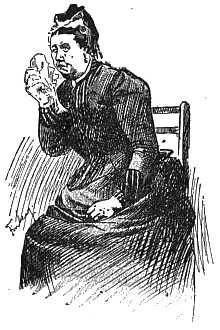
"What have you done with Wilkinson?" she cried vehemently. She was a
pale, puffy-faced, portly matron, with a permanent air of remembering
the exact figure of her dowry.
"With Wilkinson, my dear? Nothing."
"Well, he isn't in the house. I want him, but cook says you've sent
him out."
"I? Oh, no," he returned, with dawning uneasiness, looking away from
her sceptical gaze.
Suddenly his pupils dilated. A picture from without had painted itself
on his retina. It was a picture of Wilkinson—Wilkinson the austere,
Wilkinson the unbending—treading the Tenterground gravel, curved
beneath a box! Before him strode the Schnorrer.
Never during all his tenure of service in Goodman's Fields had
Wilkinson carried anything on his shoulders but his livery. Grobstock
would have as soon dreamt of his wife consenting to wear cotton. He
rubbed his eyes, but the image persisted.
He clutched at the window curtains to steady himself.
"My Persian curtains!" cried his wife. "What is the matter with you?"
"He must be the Baal Shem himself!" gasped Grobstock unheeding.
"What is it? What are you looking at?"
"N—nothing."
Mrs. Grobstock incredulously approached the window and stared through
the panes. She saw Wilkinson in the gardens, but did not recognise him
in his new attitude. She concluded that her husband's agitation must
have some connection with a beautiful brunette who was tasting the
cool of the evening in a sedan chair, and it was with a touch of
asperity that she said: "Cook complains of being insulted by a saucy
fellow who brought home your fish."
"Oh!" said poor Grobstock. Was he never to be done with the man?
"How came you to send him to her?"
His anger against Manasseh resurged under his wife's peevishness.
"My dear," he cried, "I did not send him anywhere—except to the
devil."
"Joseph! You might keep such language for the ears of creatures in
sedan chairs."
And Mrs. Grobstock flounced out of the room with a rustle of angry
satin.
When Wilkinson reappeared, limp and tired, with his pompousness exuded
in perspiration, he sought his master with a message, which he
delivered ere the flood of interrogation could burst from Grobstock's
lips.
"Mr. da Costa presents his compliments, and says that he has decided
on reconsideration not to break his promise to be with you on Friday
evening."
"Oh, indeed!" said Grobstock grimly. "And, pray, how came you to carry
his box?"
"You told me to, sir!"
"I told you!"
"I mean he told me you told me to," said Wilkinson wonderingly.
"Didn't you?"
Grobstock hesitated. Since Manasseh would be his guest, was it not
imprudent to give him away to the livery-servant? Besides, he felt a
secret pleasure in Wilkinson's humiliation—but for the Schnorrer he
would never have known that Wilkinson's gold lace concealed a pliable
personality. The proverb "Like master like man" did not occur to
Grobstock at this juncture.
"I only meant you to carry it to a coach," he murmured.
"He said it was not worth while—the distance was so short."
"Ah! Did you see his house?" enquired Grobstock curiously.
"Yes; a very fine house in Aldgate, with a handsome portico and two
stone lions."
Grobstock strove hard not to look surprised.
"I handed the box to the footman."
Grobstock strove harder.
Wilkinson ended with a weak smile: "Would you believe, sir, I thought
at first he brought home your fish! He dresses so peculiarly. He must
be an original."
"Yes, yes; an eccentric like Baron D'Aguilar, whom he visits," said
Grobstock eagerly. He wondered, indeed, whether he was not speaking
the truth. Could he have been the victim of a practical joke, a prank?
Did not a natural aristocracy ooze from every pore of his mysterious
visitor? Was not every tone, every gesture, that of a man born to
rule? "You must remember, too," he added, "that he is a Spaniard."
"Ah, I see," said Wilkinson in profound accents.
"I daresay he dresses like everybody else, though, when he dines or
sups out," Grobstock added lightly. "I only brought him in by
accident. But go to your mistress! She wants you."
"Yes, sir. Oh, by the way, I forgot to tell you he hopes you will save
him a slice of his salmon."
"Go to your mistress!"
"You did not tell me a Spanish nobleman was coming to us on Friday,"
said his spouse later in the evening.
"No," he admitted curtly.
"But is he?"
"No—at least, not a nobleman."
"What then? I have to learn about my guests from my servants."
"Apparently."
"Oh! and you think that's right!"
"To gossip with your servants? Certainly not."
"If my husband will not tell me anything—if he has only eyes for
sedan chairs."
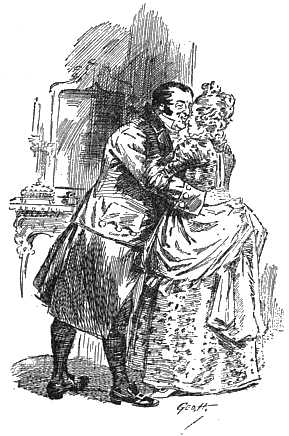
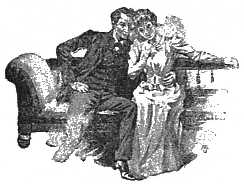
Joseph thought it best to kiss Mrs. Grobstock.
"THOUGHT IT BEST TO KISS MRS. GROBSTOCK."
"A fellow-Director, I suppose?" she urged, more mildly.
"A fellow-Israelite. He has promised to come at six."
Manasseh was punctual to the second. Wilkinson ushered him in. The
hostess had robed herself in her best to do honour to a situation
which her husband awaited with what hope he could. She looked radiant
in a gown of blue silk; her hair was done in a tuft and round her neck
was an "esclavage," consisting of festoons of gold chains. The Sabbath
table was equally festive with its ponderous silver candelabra,
coffee-urn, and consecration cup, its flower-vases, and fruit-salvers.
The dining-room itself was a handsome apartment; its buffets glittered
with Venetian glass and Dresden porcelain, and here and there gilt
pedestals supported globes of gold and silver fish.
At the first glance at his guest Grobstock's blood ran cold.
Manasseh had not turned a hair, nor changed a single garment. At the
next glance Grobstock's blood boiled. A second figure loomed in
Manasseh's wake—a short Schnorrer, even dingier than da Costa, and
with none of his dignity, a clumsy, stooping Schnorrer, with a
cajoling grin on his mud-coloured, hairy face. Neither removed his
headgear.
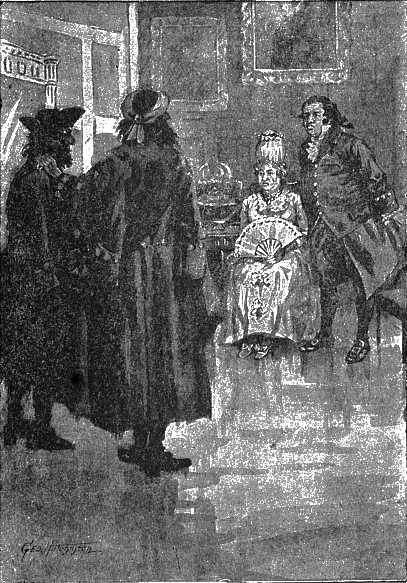
Mrs. Grobstock remained glued to her chair in astonishment.
"Peace be unto you," said the King of Schnorrers, "I have brought
with me my friend Yankelé ben Yitzchok of whom I told you."
Yankelé nodded, grinning harder than ever.
"You never told me he was coming," Grobstock rejoined, with an
apoplectic air.
"Did I not tell you that he always supped with me on Friday evenings?"
Manasseh reminded him quietly. "It is so good of him to accompany me
even here—he will make the necessary third at grace."
The host took a frantic surreptitious glance at his wife. It was
evident that her brain was in a whirl, the evidence of her senses
conflicting with vague doubts of the possibilities of Spanish
grandeeism and with a lingering belief in her husband's sanity.
Grobstock resolved to snatch the benefit of her doubts. "My dear,"
said he, "this is Mr. da Costa."
"Manasseh Bueno Barzillai Azevedo da Costa," said the Schnorrer.
The dame seemed a whit startled and impressed. She bowed, but words of
welcome were still congealed in her throat.
"And this is Yankelé ben Yitzchok," added Manasseh. "A poor friend of
mine. I do not doubt, Mrs. Grobstock, that as a pious woman, the
daughter of Moses Bernberg (his memory for a blessing), you prefer
grace with three."
"'AND THIS IS YANKELÉ BEN YITZCHOK,' ADDED MANASSEH."
"Any friend of yours is welcome!" She found her lips murmuring the
conventional phrase without being able to check their output.
"I never doubted that either," said Manasseh gracefully. "Is not the
hospitality of Moses Bernberg's beautiful daughter a proverb?"
Moses Bernberg's daughter could not deny this; her salon was the
rendezvous of rich bagmen, brokers and bankers, tempered by occasional
young bloods and old bucks not of the Jewish faith (nor any other).
But she had never before encountered a personage so magnificently
shabby, nor extended her proverbial hospitality to a Polish
Schnorrer uncompromisingly musty. Joseph did not dare meet her eye.
"Sit down there, Yankelé," he said hurriedly, in ghastly genial
accents, and he indicated a chair at the farthest possible point from
the hostess. He placed Manasseh next to his Polish parasite, and
seated himself as a buffer between his guests and his wife. He was
burning with inward indignation at the futile rifling of his wardrobe,
but he dared not say anything in the hearing of his spouse.
"It is a beautiful custom, this of the Sabbath guest, is it not, Mrs.
Grobstock?" remarked Manasseh as he took his seat. "I never neglect
it—even when I go out to the Sabbath-meal as to-night."
The late Miss Bernberg was suddenly reminded of auld lang syne: her
father (who according to a wag of the period had divided his time
between the Law and the profits) having been a depositary of ancient
tradition. Perhaps these obsolescent customs, unsuited to prosperous
times, had lingered longer among the Spanish grandees. She seized an
early opportunity, when the Sephardic Schnorrer was taking his
coffee from Wilkinson, of putting the question to her husband, who
fell in weakly with her illusions. He knew there was no danger of
Manasseh's beggarly status leaking out; no expressions of gratitude
were likely to fall from that gentleman's lips. He even hinted that da
Costa dressed so fustily to keep his poor friend in countenance.
Nevertheless, Mrs. Grobstock, while not without admiration for the
Quixotism, was not without resentment for being dragged into it. She
felt that such charity should begin and end at home.
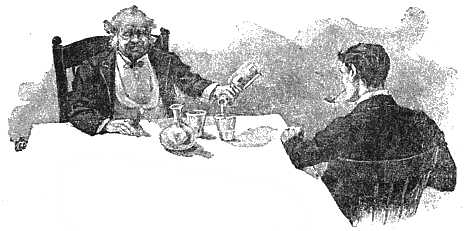
"I see you did save me a slice of salmon," said Manasseh, manipulating
his fish.
"What salmon was that?" asked the hostess, pricking up her ears.
"One I had from Mr. da Costa on Wednesday," said the host.
"Oh, that! It was delicious. I am sure it was very kind of you, Mr. da
Costa, to make us such a nice present," said the hostess, her
resentment diminishing. "We had company last night, and everybody
praised it till none was left. This is another, but I hope it is to
your liking," she finished anxiously.
"Yes, it's very fair, very fair, indeed. I don't know when I've tasted
better, except at the house of the President of the Deputados. But
Yankelé here is a connoisseur in fish, not easy to please. What say
you, Yankelé?"
Yankelé munched a muffled approval.
"Help yourself to more bread and butter, Yankelé," said Manasseh.
"Make yourself at home—remember you're my guest." Silently he added:
"The other fork!"
Grobstock's irritation found vent in a complaint that the salad wanted
vinegar.
"How can you say so? It's perfect," said Mrs. Grobstock. "Salad is
cook's speciality."
Manasseh tasted it critically. "On salads you must come to me," he
said. "It does not want vinegar," was his verdict; "but a little more
oil would certainly improve it. Oh, there is no one dresses salad like
Hyman!"
Hyman's fame as the Kosher chef who superintended the big dinners at
the London Tavern had reached Mrs. Grobstock's ears, and she was
proportionately impressed.
"They say his pastry is so good," she observed, to be in the running.
"Yes," said Manasseh, "in kneading and puffing he stands alone."
"Our cook's tarts are quite as nice," said Grobstock roughly.
"We shall see," Manasseh replied guardedly. "Though, as for
almond-cakes, Hyman himself makes none better than I get from my
cousin, Barzillai of Fenchurch Street."
"Your cousin!" exclaimed Grobstock, "the West Indian merchant!"
"The same—formerly of Barbadoes. Still, your cook knows how to make
coffee, though I can tell you do not get it direct from the plantation
like the wardens of my Synagogue."
Grobstock was once again piqued with curiosity as to the Schnorrer's
identity.
"You accuse me of having stone figures in my house," he said boldly,
"but what about the lions in front of yours?"
"I have no lions," said Manasseh.
"Wilkinson told me so. Didn't you, Wilkinson?"
"Wilkinson is a slanderer. That was the house of Nathaniel Furtado."
Grobstock began to choke with chagrin. He perceived at once that the
Schnorrer had merely had the clothes conveyed direct to the house of
a wealthy private dealer.
"Take care!" exclaimed the Schnorrer anxiously, "you are spluttering
sauce all over that waistcoat, without any consideration for me."
Joseph suppressed himself with an effort. Open discussion would betray
matters to his wife, and he was now too deeply enmeshed in falsehoods
by default. But he managed to whisper angrily, "Why did you tell
Wilkinson I ordered him to carry your box?"
"To save your credit in his eyes. How was he to know we had
quarrelled? He would have thought you discourteous to your guest."
"That's all very fine. But why did you sell my clothes?"
"You did not expect me to wear them? No, I know my station, thank
God."
"What is that you are saying, Mr. da Costa?" asked the hostess.
"Oh, we are talking of Dan Mendoza," replied Grobstock glibly;
"wondering if he'll beat Dick Humphreys at Doncaster."
"Oh, Joseph, didn't you have enough of Dan Mendoza at supper last
night?" protested his wife.
"It is not a subject I ever talk about," said the Schnorrer,
fixing his host with a reproachful glance.
Grobstock desperately touched his foot under the table, knowing he was
selling his soul to the King of Schnorrers, but too flaccid to face
the moment.
"No, da Costa doesn't usually," he admitted. "Only Dan Mendoza being a
Portuguese I happened to ask if he was ever seen in the Synagogue."
"If I had my way," growled da Costa, "he should be excommunicated—a
bruiser, a defacer of God's image!"
"By gad, no!" cried Grobstock, stirred up. "If you had seen him lick
the Badger in thirty-five minutes on a twenty-four foot stage—"
"Joseph! Joseph! Remember it is the Sabbath!" cried Mrs. Grobstock.
"I would willingly exchange our Dan Mendoza for your David Levi," said
da Costa severely.
David Levi was the literary ornament of the Ghetto; a shoe-maker and
hat-dresser who cultivated Hebrew philology and the Muses, and broke a
lance in defence of his creed with Dr. Priestley, the discoverer of
Oxygen, and Tom Paine, the discoverer of Reason.
"Pshaw! David Levi! The mad hatter!" cried Grobstock. "He makes
nothing at all out of his books."
"You should subscribe for more copies," retorted Manasseh.
"I would if you wrote them," rejoined Grobstock, with a grimace.
"I got six copies of his Lingua Sacra," Manasseh declared with
dignity, "and a dozen of his translation of the Pentateuch."
"You can afford it!" snarled Grobstock, with grim humour. "I have to
earn my money."
"It is very good of Mr. da Costa, all the same," interposed the
hostess. "How many men, born to great possessions, remain quite
indifferent to learning!"
"True, most true," said da Costa. "Men-of-the-Earth, most of them."
After supper he trolled the Hebrew grace hilariously, assisted by
Yankelé, and ere he left he said to the hostess, "May the Lord bless
you with children!"
"Thank you," she answered, much moved.
"You see I should be so pleased to marry your daughter if you had
one."
"You are very complimentary," she murmured, but her husband's
exclamation drowned hers, "You marry my daughter!"
"Who else moves among better circles—would be more easily able to
find her a suitable match?"
"Oh, in that sense," said Grobstock, mollified in one direction,
irritated in another.
"In what other sense? You do not think I, a Sephardi, would marry her
myself!"
"My daughter does not need your assistance," replied Grobstock
shortly.
"Not yet," admitted Manasseh, rising to go; "but when the time comes,
where will you find a better marriage broker? I have had a finger in
the marriage of greater men's daughters. You see, when I recommend a
maiden or a young man it is from no surface knowledge. I have seen
them in the intimacy of their homes—above all I am able to say
whether they are of a good, charitable disposition. Good Sabbath!"
"Good Sabbath," murmured the host and hostess in farewell. Mrs.
Grobstock thought he need not be above shaking hands, for all his
grand acquaintances.
"This way, Yankelé," said Manasseh, showing him to the door. "I am so
glad you were able to come—you must come again."
SHOWING HOW HIS MAJESTY WENT TO THE THEATRE AND WAS WOOED.
As Manasseh the Great, first beggar in Europe, sauntered across
Goodman's Fields, attended by his Polish parasite, both serenely
digesting the supper provided by the Treasurer of the Great Synagogue,
Joseph Grobstock, a martial music clove suddenly the quiet evening
air, and set the Schnorrers' pulses bounding. From the Tenterground
emerged a squad of recruits, picturesque in white fatigue dress,
against which the mounted officers showed gallant in blue surtouts and
scarlet-striped trousers.
"Ah!" said da Costa, with swelling breast. "There go my soldiers!"
"'THERE GO MY SOLDIERS.'"
"Your soldiers!" ejaculated Yankelé in astonishment.
"Yes—do you not see they are returning to the India House in
Leadenhall Street?"
"And vat of dat?" said Yankelé, shrugging his shoulders and spreading
out his palms.
"What of that? Surely you have not forgotten that the clodpate at
whose house I have just entertained you is a Director of the East
India Company, whose soldiers these are?"
"Oh," said Yankelé, his mystified face relaxing in a smile. The smile
fled before the stern look in the Spaniard's eyes; he hastened to
conceal his amusement. Yankelé was by nature a droll, and it cost him
a good deal to take his patron as seriously as that potentate took
himself. Perhaps if Manasseh Bueno Barzillai Azevedo da Costa had had
more humour he would have had less momentum. Your man of action is
blind in one eye. Cæsar would not have come and conquered if he had
really seen.
Wounded by that temporary twinkle in his client's eye, the patron
moved on silently, in step with the military air.
"It is a beautiful night," observed Yankelé in contrition. The words
had hardly passed his lips before he became conscious that he had
spoken the truth. The moon was peeping from behind a white cloud, and
the air was soft, and broken shadows of foliage lay across the path,
and the music was a song of love and bravery. Somehow, Yankelé began
to think of da Costa's lovely daughter. Her face floated in the
moonlight.
Manasseh shrugged his shoulders, unappeased.
"When one has supped well, it is always a beautiful night," he said
testily. It was as if the cloud had overspread the moon, and a thick
veil had fallen over the face of da Costa's lovely daughter. But
Yankelé recovered himself quickly.
"Ah, yes," he said, "you have indeed made it a beaudiful night for
me."
The King of Schnorrers waved his staff deprecatingly.
"It is alvays a beaudiful night ven I am mid you," added Yankelé,
undaunted.
"It is strange," replied Manasseh musingly, "that I should have
admitted to my hearth and Grobstock's table one who is, after all, but
a half-brother in Israel."
"But Grobstock is also a Tedesco," protested Yankelé.
"That is also what I wonder at," rejoined da Costa. "I cannot make out
how I have come to be so familiar with him."
"You see!" ventured the Tedesco timidly. "P'raps ven Grobstock had
really had a girl you might even have come to marry her."
"Guard your tongue! A Sephardi cannot marry a Tedesco! It would be a
degradation."
"Yes—but de oder vay round. A Tedesco can marry a Sephardi, not so?
Dat is a rise. If Grobstock's daughter had married you, she vould have
married above her," he ended, with an ingenuous air.
"True," admitted Manasseh. "But then, as Grobstock's daughter does not
exist, and my wife does—!"
"Ah, but if you vas me," said Yankelé, "vould you rader marry a
Tedesco or a Sephardi?"
"A Sephardi, of course. But—"
"I vill be guided by you," interrupted the Pole hastily. "You be de
visest man I have ever known."
"But—" Manasseh repeated.
"Do not deny it. You be! Instantly vill I seek out a Sephardi maiden
and ved her. P'raps you crown your counsel by choosing von for me.
Vat?"
Manasseh was visibly mollified.
"How do I know your taste?" he asked hesitatingly.
"Oh, any Spanish girl would be a prize," replied Yankelé. "Even ven
she had a face like a Passover cake. But still I prefer a Pentecost
blossom."
"What kind of beauty do you like best?"
"Your daughter's style," plumply answered the Pole.
"But there are not many like that," said da Costa unsuspiciously.
"No—she is like de Rose of Sharon. But den dere are not many handsome
faders."
Manasseh bethought himself. "There is Gabriel, the corpse-watcher's
daughter. People consider his figure and deportment good."
"Pooh! Offal! She's ugly enough to keep de Messiah from coming. Vy,
she's like cut out of de fader's face! Besides, consider his
occupation! You vould not advise dat I marry into such a low family!
Be you not my benefactor?"
"Well, but I cannot think of any good-looking girl that would be
suitable."
Yankelé looked at him with a roguish, insinuating smile. "Say not dat!
Have you not told Grobstock you be de first of marriage-brokers?"
But Manasseh shook his head.
"No, you be quite right," said Yankelé humbly; "I could not get a
really beaudiful girl unless I married your Deborah herself."
"No, I am afraid not," said Manasseh sympathetically.
Yankelé took the plunge.
"Ah, vy can I not hope to call you fader-in-law?"
Manasseh's face was contorted by a spasm of astonishment and
indignation. He came to a standstill.
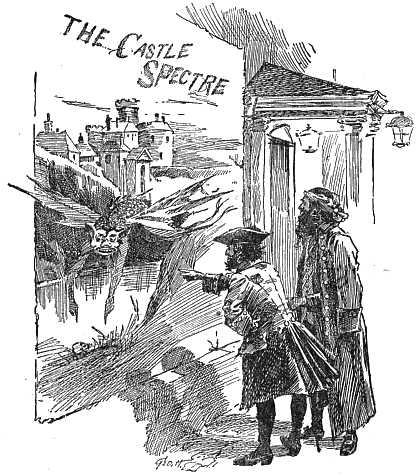
"Dat must be a fine piece," said Yankelé quickly, indicating a
flamboyant picture of a fearsome phantom hovering over a sombre moat.
"'DAT MUST BE A FINE PIECE.'"
They had arrived at Leman Street, and had stopped before Goodman's
Fields Theatre. Manasseh's brow cleared.
"It is The Castle Spectre," he said graciously. "Would you like to
see it?"
"But it is half over—"
"Oh, no," said da Costa, scanning the play bill. "There was a farce by
O'Keefe to start with. The night is yet young. The drama will be just
beginning."
"But it is de Sabbath—ve must not pay."
Manasseh's brow clouded again in wrathful righteous surprise. "Did you
think I was going to pay?" he gasped.
"N-n-no," stammered the Pole, abashed. "But you haven't got no
orders?"
"Orders? Me? Will you do me the pleasure of accepting a seat in my
box?"
"In your box?"
"Yes, there is plenty of room. Come this way," said Manasseh. "I
haven't been to the play myself for over a year. I am too busy always.
It will be an agreeable change."
Yankelé hung back, bewildered.
"Through this door," said Manasseh encouragingly. "Come—you shall
lead the way."
"But dey vill not admit me!"
"Will not admit you! When I give you a seat in my box! Are you mad?
Now you shall just go in without me—I insist upon it. I will show you
Manasseh Bueno Barzillai Azevedo da Costa is a man whose word is the
Law of Moses; true as the Talmud. Walk straight through the portico,
and, if the attendant endeavours to stop you, simply tell him Mr. da
Costa has given you a seat in his box."
Not daring to exhibit scepticism—nay, almost confident in the powers
of his extraordinary protector, Yankelé put his foot on the threshold
of the lobby.
"But you be coming, too?" he said, turning back.
"Oh, yes, I don't intend to miss the performance. Have no fear."
Yankelé walked boldly ahead, and brushed by the door-keeper of the
little theatre without appearing conscious of him; indeed, the
official was almost impressed into letting the Schnorrer pass
unquestioned as one who had gone out between the acts. But the visitor
was too dingy for anything but the stage-door—he had the air of those
nondescript beings who hang mysteriously about the hinder recesses of
playhouses. Recovering himself just in time, the functionary (a meek
little Cockney) hailed the intruder with a backward-drawing "Hi!"
"Vat you vant?" said Yankelé, turning his head.
"Vhere's your ticket?"
"Don't vant no ticket."
"Don't you? I does," rejoined the little man, who was a humorist.
"Mr. da Costa has given me a seat in his box."
"Oh, indeed! You'd swear to that in the box?"
"By my head. He gave it me."
"A seat in his box?"
"Yes."
"Mr. da Costa, you vos a-sayin', I think?"
"The same."
"Ah! this vay, then!"
And the humorist pointed to the street.
Yankelé did not budge.
"This vay, my lud!" cried the little humorist peremptorily.
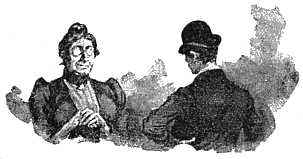
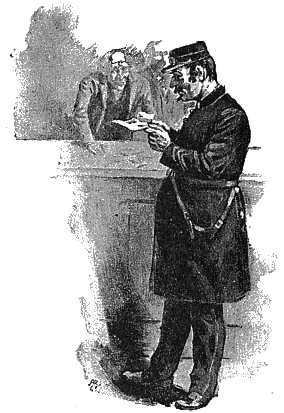
"I tells you I'm going into Mr. da Costa's box!"
"And I tells you you're a-goin' into the gutter." And the official
seized him by the scruff of the neck and began pushing him forwards
with his knee.
"Now then! what's this?"
"'NOW THEN! WHAT'S THIS?'"
A stern, angry voice broke like a thunderclap upon the humorist's
ears. He released his hold of the Schnorrer and looked up, to behold
a strange, shabby, stalwart figure towering over him in censorious
majesty.
"Why are you hustling this poor man?" demanded Manasseh.
"He wanted to sneak in," the little Cockney replied, half
apologetically, half resentfully. "Expect 'e 'ails from Saffron 'Ill,
and 'as 'is eye on the vipes. Told me some gammon—a cock-and-bull
story about having a seat in a box."
"In Mr. da Costa's box, I suppose?" said Manasseh, ominously calm,
with a menacing glitter in his eye.
"Ye-es," said the humorist, astonished and vaguely alarmed. Then the
storm burst.
"You impertinent scoundrel! You jackanapes! You low, beggarly
rapscallion! And so you refused to show my guest into my box!"
"Are you Mr. da Costa?" faltered the humorist.
"Yes, I am Mr. da Costa, but you won't much longer be door-keeper,
if this is the way you treat people who come to see your pieces.
Because, forsooth, the man looks poor, you think you can bully him
safely—forgive me, Yankelé, I am so sorry I did not manage to come
here before you, and spare you this insulting treatment! And as for
you, my fine fellow, let me tell you that you make a great mistake in
judging from appearances. There are some good friends of mine who
could buy up your theatre and you and your miserable little soul at a
moment's notice, and to look at them you would think they were
cadgers. One of these days—hark you!—you will kick out a person of
quality, and be kicked out yourself."
"I—I'm very sorry, sir."
"Don't say that to me. It is my guest you owe an apology to. Yes—and,
by Heaven! you shall pay it, though he is no plutocrat, but only what
he appears. Surely, because I wish to give a treat to a poor man who
has, perhaps, never been to the play in his life, I am not bound to
send him to the gallery—I can give him a corner in my box if I
choose. There is no rule against that, I presume?"
"No, sir, I can't say as there is," said the humorist humbly. "But you
will allow, sir, it's rayther unusual."
"Unusual! Of course, it's unusual. Kindness and consideration for the
poor are always unusual. The poor are trodden upon at every
opportunity, treated like dogs, not men. If I had invited a drunken
fop, you'd have met him hat in hand (no, no, you needn't take it off
to me now; it's too late). But a sober, poor man—by gad! I shall
report your incivility to the management, and you'll be lucky if I
don't thrash you with this stick into the bargain."
"But 'ow vos I to know, sir?"
"Don't speak to me, I tell you. If you have anything to urge in
extenuation of your disgraceful behaviour, address your remarks to my
guest."
"You'll overlook it this time, sir," said the little humorist, turning
to Yankelé.
"Next time, p'raps, you believe me ven I say I have a seat in Mr. da
Costa's box," replied Yankelé, in gentle reproach.
"Well, if you're satisfied, Yankelé," said Manasseh, with a touch of
scorn, "I have no more to say. Go along, my man, show us to our box."
The official bowed and led them into the corridor. Suddenly he turned
back.
"What box is it, please?" he said timidly.
"Blockhead!" cried Manasseh. "Which box should it be? The empty one,
of course."
"But, sir, there are two boxes empty," urged the poor humorist
deprecatingly, "the stage-box and the one by the gallery."
"Dolt! Do I look the sort of person who is content with a box on the
ceiling? Go back to your post, sir—I'll find the box myself—Heaven
send you wisdom—go back, some one might sneak in while you are away,
and it would just serve you right."
The little man slunk back half dazed, glad to escape from this
overwhelming personality, and in a few seconds Manasseh stalked into
the empty box, followed by Yankelé, whose mouth was a grin and whose
eye a twinkle. As the Spaniard took his seat there was a slight
outburst of clapping and stamping from a house impatient for the end
of the entr'acte.
Manasseh craned his head over the box to see the house, which in turn
craned to see him, glad of any diversion, and some people, imagining
the applause had reference to the new-comer, whose head appeared to
be that of a foreigner of distinction, joined in it. The contagion
spread, and in a minute Manasseh was the cynosure of all eyes and the
unmistakable recipient of an "ovation." He bowed twice or thrice in
unruffled dignity.
There were some who recognised him, but they joined in the reception
with wondering amusement. Not a few, indeed, of the audience were
Jews, for Goodman's Fields was the Ghetto Theatre, and the Sabbath was
not a sufficient deterrent to a lax generation. The audiences—mainly
German and Poles—came to the little unfashionable playhouse as one
happy family. Distinctions of rank were trivial, and gallery held
converse with circle, and pit collogued with box. Supper parties were
held on the benches.
In a box that gave on the pit a portly Jewess sat stiffly, arrayed in
the very pink of fashion, in a spangled robe of India muslin, with a
diamond necklace and crescent, her head crowned by terraces of curls
and flowers.
"Betsy!" called up a jovial feminine voice from the pit, when the
applause had subsided.
"Betsy" did not move, but her cheeks grew hot and red. She had got on
in the world, and did not care to recognise her old crony.
"Betsy!" iterated the well-meaning woman. "By your life and mine, you
must taste a piece of my fried fish." And she held up a slice of cold
plaice, beautifully browned.
Betsy drew back, striving unsuccessfully to look unconscious. To her
relief the curtain rose, and The Castle Spectre walked. Yankelé, who
had scarcely seen anything but private theatricals, representing the
discomfiture of the wicked Haman and the triumph of Queen Esther (a
rôle he had once played himself, in his mother's old clothes), was
delighted with the thrills and terrors of the ghostly melodrama. It
was not till the conclusion of the second act that the emotion the
beautiful but injured heroine cost him welled over again into
matrimonial speech.
"Ve vind up de night glorious," he said.
"I am glad you like it. It is certainly an enjoyable performance,"
Manasseh answered with stately satisfaction.
"Your daughter, Deborah," Yankelé ventured timidly, "do she ever go to
de play?"
"No, I do not take my womankind about. Their duty lies at home. As it
is written, I call my wife not 'wife' but 'home.'"
"But dink how dey vould enjoy deirselves!"
"We are not sent here to enjoy ourselves."
"True—most true," said Yankelé, pulling a smug face. "Ve be sent here
to obey de Law of Moses. But do not remind me I be a sinner in
Israel."
"How so?"
"I am twenty-five—yet I have no vife."
"I daresay you had plenty in Poland."
"By my soul, not. Only von, and her I gave gett (divorce) for
barrenness. You can write to de Rabbi of my town."
"Why should I write? It's not my affair."
"But I vant it to be your affair."
Manasseh glared. "Do you begin that again?" he murmured.
"It is not so much dat I desire your daughter for a vife as you for a
fader-in-law."
"It cannot be!" said Manasseh more gently.
"Oh dat I had been born a Sephardi!" said Yankelé with a hopeless
groan.
"It is too late now," said da Costa soothingly.
"Dey say it's never too late to mend," moaned the Pole. "Is dere no
vay for me to be converted to Spanish Judaism? I could easily
pronounce Hebrew in your superior vay."
"Our Judaism differs in no essential respect from yours—it is a
question of blood. You cannot change your blood. As it is said, 'And
the blood is the life.'"
"I know, I know dat I aspire too high. Oh, vy did you become my
friend, vy did you make me believe you cared for me—so dat I tink of
you day and night—and now, ven I ask you to be my fader-in-law, you
say it cannot be. It is like a knife in de heart! Tink how proud and
happy I should be to call you my fader-in-law. All my life vould be
devoted to you—my von thought to be vordy of such a man."
"You are not the first I have been compelled to refuse," said
Manasseh, with emotion.
"Vat helps me dat dere be other Schlemihls (unlucky persons)?"
quoted Yankelé, with a sob. "How can I live midout you for a
fader-in-law?"
"I am sorry for you—more sorry than I have ever been."
"Den you do care for me! I vill not give up hope. I vill not take no
for no answer. Vat is dis blood dat it should divide Jew from Jew, dat
it should prevent me becoming de son-in-law of de only man I have ever
loved? Say not so. Let me ask you again—in a month or a year—even
twelve months vould I vait, ven you vould only promise not to pledge
yourself to anoder man."
"But if I became your father-in-law—mind, I only say if—not only
would I not keep you, but you would have to keep my Deborah."
"And supposing?"
"But you are not able to keep a wife!"
"Not able? Who told you dat?" cried Yankelé indignantly.
"You yourself! Why, when I first befriended you, you told me you were
blood-poor."
"Dat I told you as a Schnorrer. But now I speak to you as a suitor."
"True," admitted Manasseh, instantly appreciating the distinction.
"And as a suitor I tell you I can schnorr enough to keep two vives."
"But do you tell this to da Costa the father or da Costa the
marriage-broker?"
"Hush!" from all parts of the house as the curtain went up and the
house settled down. But Yankelé was no longer in rapport with the
play; the spectre had ceased to thrill and the heroine to touch. His
mind was busy with feverish calculations of income, scraping together
every penny he could raise by hook or crook. He even drew out a
crumpled piece of paper and a pencil, but thrust them back into his
pocket when he saw Manasseh's eye.
"I forgot," he murmured apologetically. "Being at de play made me
forget it was de Sabbath." And he pursued his calculations mentally;
this being naturally less work.
When the play was over the two beggars walked out into the cool night
air.
"I find," Yankelé began eagerly in the vestibule, "I make at least von
hundred and fifty pounds"—he paused to acknowledge the farewell
salutation of the little door-keeper at his elbow—"a hundred and
fifty a year."
"Indeed!" said Manasseh, in respectful astonishment.
"Yes! I have reckoned it all up. Ten are de sources of charity—"
"As it is written," interrupted Manasseh with unction, "'With ten
sayings was the world created; there were ten generations from Noah to
Abraham; with ten trials our father Abraham was tried; ten miracles
were wrought for our fathers in Egypt and ten at the Red Sea; and ten
things were created on the eve of the Sabbath in the twilight!' And
now it shall be added, 'Ten good deeds the poor man affords the rich
man.' Proceed, Yankelé."
"First comes my allowance from de Synagogue—eight pounds. Vonce a
veek I call and receive half-a-crown."
"Is that all? Our Synagogue allows three-and-six."
"Ah!" sighed the Pole wistfully. "Did I not say you be a superior
race?"
"But that only makes six pound ten!"
"I know—de oder tirty shillings I allow for Passover cakes and
groceries. Den for Synagogue-knocking I get ten guin—"
"Stop! stop!" cried Manasseh, with a sudden scruple. "Ought I to
listen to financial details on the Sabbath?"
"Certainly, ven dey be connected vid my marriage—vich is a
Commandment. It is de Law ve really discuss."
"You are right. Go on, then. But remember, even if you can prove you
can schnorr enough to keep a wife, I do not bind myself to consent."
"You be already a fader to me—vy vill you not be a fader-in-law?
Anyhow, you vill find me a fader-in-law," he added hastily, seeing the
blackness gathering again on da Costa's brow.
"Nay, nay, we must not talk of business on the Sabbath," said Manasseh
evasively. "Proceed with your statement of income."
"Ten guineas for Synagogue-knocking. I have tventy clients who—"
"Stop a minute! I cannot pass that item."
"Vy not? It is true."
"Maybe! But Synagogue-knocking is distinctly work!"
"Vork?"
"Well, if going round early in the morning to knock at the doors of
twenty pious persons, and rouse them for morning service, isn't work,
then the Christian bell-ringer is a beggar. No, no! Profits from this
source I cannot regard as legitimate."
"But most Schnorrers be Synagogue-knockers!"
"Most Schnorrers are Congregation-men or Psalms-men," retorted the
Spaniard witheringly. "But I call it debasing. What! To assist at the
services for a fee! To worship one's Maker for hire! Under such
conditions to pray is to work." His breast swelled with majesty and
scorn.
"I cannot call it vork," protested the Schnorrer. "Vy at dat rate
you vould make out dat de minister vorks? or de preacher? Vy, I reckon
fourteen pounds a year to my services as Congregation-man."
"Fourteen pounds! As much as that?"
"Yes, you see dere's my private customers as vell as de Synagogue. Ven
dere is mourning in a house dey cannot alvays get together ten friends
for de services, so I make von. How can you call that vork? It is
friendship. And the more dey pay me de more friendship I feel,"
asserted Yankelé with a twinkle. "Den de Synagogue allows me a little
extra for announcing de dead."
In those primitive times, when a Jewish newspaper was undreamt of, the
day's obituary was published by a peripatetic Schnorrer, who went
about the Ghetto rattling a pyx—a copper money-box with a handle and
a lid closed by a padlock. On hearing this death-rattle, anyone who
felt curious would ask the Schnorrer:
"Who's dead to-day?"
"So-and-so ben So-and-so—funeral on such a day—mourning service at
such an hour," the Schnorrer would reply, and the enquirer would
piously put something into the "byx," as it was called. The collection
was handed over to the Holy Society—in other words, the Burial
Society.
"P'raps you call that vork?" concluded Yankelé, in timid challenge.
"Of course I do. What do you call it?"
"Valking exercise. It keeps me healty. Vonce von of my customers (from
whom I schnorred half-a-crown a veek) said he was tired of my coming
and getting it every Friday. He vanted to compound mid me for six
pound a year, but I vouldn't."
"But it was a very fair offer. He only deducted ten shillings for the
interest on his money."
"Dat I didn't mind. But I vanted a pound more for his depriving me of
my valking exercise, and dat he vouldn't pay, so he still goes on
giving me de half-crown a veek. Some of dese charitable persons are
terribly mean. But vat I vant to say is dat I carry de byx mostly in
the streets vere my customers lay, and it gives me more standing as a
Schnorrer."
"No, no, that is a delusion. What! Are you weak-minded enough to
believe that? All the philanthropists say so, of course, but surely
you know that schnorring and work should never be mixed. A man
cannot do two things properly. He must choose his profession, and
stick to it. A friend of mine once succumbed to the advice of the
philanthropists instead of asking mine. He had one of the best
provincial rounds in the kingdom, but in every town he weakly listened
to the lectures of the president of the congregation inculcating work,
and at last he actually invested the savings of years in jewellery,
and went round trying to peddle it. The presidents all bought
something to encourage him (though they beat down the price so that
there was no profit in it), and they all expressed their pleasure at
his working for his living, and showing a manly independence. 'But I
schnorr also,' he reminded them, holding out his hand when they had
finished. It was in vain. No one gave him a farthing. He had blundered
beyond redemption. At one blow he had destroyed one of the most
profitable connections a Schnorrer ever had, and without even
getting anything for the goodwill. So if you will be guided by me,
Yankelé, you will do nothing to assist the philanthropists to keep
you. It destroys their satisfaction. A Schnorrer cannot be too
careful. And once you begin to work, where are you to draw the line?"
"But you be a marriage-broker yourself," said Yankelé imprudently.
"That!" thundered Manasseh angrily, "That is not work! That is
pleasure!"
"Vy look! Dere is Hennery Simons," cried Yankelé, hoping to divert his
attention. But he only made matters worse.
Henry Simons was a character variously known as the Tumbling Jew,
Harry the Dancer, and the Juggling Jew. He was afterwards to become
famous as the hero of a slander case which deluged England with
pamphlets for and against, but for the present he had merely outraged
the feelings of his fellow Schnorrers by budding out in a direction
so rare as to suggest preliminary baptism. He stood now playing antic
and sleight-of-hand tricks—surrounded by a crowd—a curious figure
crowned by a velvet skull-cap from which wisps of hair protruded, with
a scarlet handkerchief thrust through his girdle. His face was an
olive oval, bordered by ragged tufts of beard and stamped with
melancholy.
"You see the results of working," cried Manasseh. "It brings
temptation to work on Sabbath. That Epicurean there is profaning the
Holy Day. Come away! A Schnorrer is far more certain of
The-World-To-Come. No, decidedly, I will not give my daughter to a
worker, or to a Schnorrer who makes illegitimate profits."
"But I make de profits all de same," persisted Yankelé.
"You make them to-day—but to-morrow? There is no certainty about
them. Work of whatever kind is by its very nature unreliable. At any
moment trade may be slack. People may become less pious, and you lose
your Synagogue-knocking. Or more pious—and they won't want
congregation-men."
"But new Synagogues spring up," urged Yankelé.
"New Synagogues are full of enthusiasm," retorted Manasseh. "The
members are their own congregation-men."
Yankelé had his roguish twinkle. "At first," he admitted, "but de
Schnorrer vaits his time."
Manasseh shook his head. "Schnorring is the only occupation that is
regular all the year round," he said. "Everything else may fail—the
greatest commercial houses may totter to the ground; as it is written,
'He humbleth the proud.' But the Schnorrer is always secure. Whoever
falls, there are always enough left to look after him. If you were a
father, Yankelé, you would understand my feelings. How can a man allow
his daughter's future happiness to repose on a basis so uncertain as
work? No, no. What do you make by your district visiting? Everything
turns on that."
"Tventy-five shilling a veek!"
"Really?"
"Law of Moses! In sixpences, shillings, and half-crowns. Vy in
Houndsditch alone, I have two streets all except a few houses."
"But are they safe? Population shifts. Good streets go down."
"Dat tventy-five shillings is as safe as Mocatta's business. I have it
all written down at home—you can inspect de books if you choose."
"No, no," said Manasseh, with a grand wave of his stick. "If I did not
believe you, I should not entertain your proposal for a moment. It
rejoices me exceedingly to find you have devoted so much attention to
this branch. I always held strongly that the rich should be visited in
their own homes, and I grieve to see this personal touch, this contact
with the very people to whom you give the good deeds, being replaced
by lifeless circulars. One owes it to one's position in life to afford
the wealthy classes the opportunity of charity warm from the heart;
they should not be neglected and driven in their turn to write cheques
in cold blood, losing all that human sympathy which comes from
personal intercourse—as it is written, 'Charity delivers from death.'
But do you think charity that is given publicly through a secretary
and advertised in annual reports has so great a redeeming power as
that slipped privately into the hands of the poor man, who makes a
point of keeping secret from every donor what he has received from the
others?"
"I am glad you don't call collecting de money vork," said Yankelé,
with a touch of sarcasm which was lost on da Costa.
"No, so long as the donor can't show any 'value received' in return.
And there's more friendship in such a call, Yankelé, than in going
to a house of mourning to pray for a fee."
"Oh," said Yankelé, wincing. "Den p'raps you strike out all my
Year-Time item!"
"Year-Time! What's that?"
"Don't you know?" said the Pole, astonished. "Ven a man has Year-Time,
he feels charitable for de day."
"Do you mean when he commemorates the anniversary of the death of one
of his family? We Sephardim call that 'making years'! But are there
enough Year-Times, as you call them, in your Synagogue?"
"Dere might be more—I only make about fifteen pounds. Our colony is,
as you say, too new. De Globe Road Cemetery is as empty as a Synagogue
on veek-days. De faders have left deir faders on de Continent, and
kept many Year-Times out of de country. But in a few years many faders
and moders must die off here, and every parent leaves two or tree sons
to have Year-Times, and every child two or tree broders and a fader.
Den every day more German Jews come here—vich means more and more to
die. I tink indeed it vould be fair to double this item."
"No, no; stick to facts. It is an iniquity to speculate in the
misfortunes of our fellow-creatures."
"Somebody must die dat I may live," retorted Yankelé roguishly; "de
vorld is so created. Did you not quote, 'Charity delivers from death'?
If people lived for ever, Schnorrers could not live at all."
"Hush! The world could not exist without Schnorrers. As it is
written, 'And Repentance and Prayer and Charity avert the evil
decree.' Charity is put last—it is the climax—the greatest thing on
earth. And the Schnorrer is the greatest man on earth; for it stands
in the Talmud, 'He who causes is greater than he who does.' Therefore,
the Schnorrer who causes charity is even greater than he who gives
it."
"Talk of de devil," said Yankelé, who had much difficulty in keeping
his countenance when Manasseh became magnificent and dithyrambic. "Vy,
dere is Greenbaum, whose fader vas buried yesterday. Let us cross over
by accident and vish him long life."
"Greenbaum dead! Was that the Greenbaum on 'Change, who was such a
rascal with the wenches?"
"De same," said Yankelé. Then approaching the son, he cried, "Good
Sabbath, Mr. Greenbaum; I vish you long life. Vat a blow for de
community!"
"It comforts me to hear you say so," said the son, with a sob in his
voice.
"Ah, yes!" said Yankelé chokingly. "Your fader vas a great and good
man—just my size."
"'YOUR FADER VAS A GREAT AND GOOD MAN—JUST MY SIZE.'"
"I've already given them away to Baruch the glazier," replied the
mourner.
"But he has his glaziering," remonstrated Yankelé. "I have noting but
de clothes I stand in, and dey don't fit me half so vell as your
fader's vould have done."
"Baruch has been very unfortunate," replied Greenbaum defensively.
"He had a misfortune in the winter, and he has never got straight yet.
A child of his died, and, unhappily, just when the snowballing was at
its height, so that he lost seven days by the mourning." And he moved
away.
"Did I not say work was uncertain?" cried Manasseh.
"Not all," maintained the Schnorrer. "What of de six guineas I make
by carrying round de Palm-branch on Tabernacles to be shaken by de
voomans who cannot attend Synagogue, and by blowing de trumpet for de
same voomans on New Year, so dat dey may break deir fasts?"
"The amount is too small to deserve discussion. Pass on."
"Dere is a smaller amount—just half dat—I get from de presents to de
poor at de Feast of Lots, and from de Bridegrooms of de Beginning and
de Bridegrooms of de Law at de Rejoicing of de Law, and dere is about
four pounds ten a year from de sale of clothes given to me. Den I have
a lot o' meals given me—dis, I have reckoned, is as good as seven
pounds. And, lastly, I cannot count de odds and ends under ten
guineas. You know dere are alvays legacies, gifts, distributions—all
unexpected. You never know who'll break out next."
"Yes, I think it's not too high a percentage of your income to expect
from unexpected sources," admitted Manasseh. "I have myself lingered
about 'Change Alley or Sampson's Coffee House just when the jobbers
have pulled off a special coup, and they have paid me quite a high
percentage on their profits."
"And I," boasted Yankelé, stung to noble emulation, "have made two
sov'rans in von minute out of Gideon de bullion-broker. He likes to
give Schnorrers sov'rans, as if in mistake for shillings, to see vat
dey'll do. De fools hurry off, or move slowly avay, as if not
noticing, or put it quickly in de pocket. But dose who have visdom
tell him he's made a mistake, and he gives dem anoder sov'ran. Honesty
is de best policy with Gideon. Den dere is Rabbi de Falk, de Baal
Shem—de great Cabbalist. Ven—"
"But," interrupted Manasseh impatiently, "you haven't made out your
hundred and fifty a year."
Yankelé's face fell. "Not if you cut out so many items."
"No, but even all inclusive it only comes to a hundred and forty-three
pounds nineteen shillings."
"Nonsense!" said Yankelé, staggered. "How can you know so exact?"
"Do you think I cannot do simple addition?" responded Manasseh
sternly. "Are not these your ten items?"
| |
|
£ |
s. |
d. |
| 1. |
Synagogue Pension, with Passover extras |
8 |
0 |
0 |
| 2. |
Synagogue-knocking |
10 |
10 |
0 |
| 3. |
District Visiting |
65 |
0 |
0 |
| 4. |
As Congregation-man and Pyx-bearer |
14 |
0 |
0 |
| 5. |
Year-Times |
15 |
0 |
0 |
| 6. |
Palm-branch and Trumpet Fees |
6 |
6 |
0 |
| 7. |
Purim-presents, &c. |
3 |
3 |
0 |
| 8. |
Sale of Clothes |
4 |
10 |
0 |
| 9. |
Equivalent of Free Meals |
7 |
0 |
0 |
| 10. |
Miscellanea, the unexpected |
10 |
10 |
0 |
| |
|
___________ |
| |
Total |
£143 |
19 |
0 |
"A child could sum it up," concluded Manasseh severely. Yankelé was
subdued to genuine respect and consternation by da Costa's marvellous
memory and arithmetical genius. But he rallied immediately. "Of
course, I also reckoned on a dowry mid my bride, if only a hundred
pounds."
"Well, invested in Consols, that would not bring you four pounds
more," replied Manasseh instantly.
"The rest vill be made up in extra free meals," Yankelé answered no
less quickly. "For ven I take your daughter off your hands you vill be
able to afford to invite me more often to your table dan you do now."
"Not at all," retorted Manasseh, "for now that I know how well off you
are I shall no longer feel I am doing a charity."
"Oh, yes, you vill," said Yankelé insinuatingly. "You are too much a
man of honour to know as a private philantropist vat I have told de
marriage-broker, de fader-in-law and de fellow Schnorrer. Besides, I
vould have de free meals from you as de son-in-law, not de
Schnorrer."
"In that relation I should also have free meals from you," rejoined
Manasseh.
"I never dared to tink you vould do me de honour. But even so I can
never give you such good meals as you give me. So dere is still a
balance in my favour."
"That is true," said da Costa thoughtfully. "But you have still about
a guinea to make up."
Yankelé was driven into a corner at last. But he flashed back,
without perceptible pause, "You do not allow for vat I save by my
piety. I fast twenty times a year, and surely dat is at least anoder
guinea per annum."
"But you will have children," retorted da Costa.
Yankelé shrugged his shoulders.
"Dat is de affair of de Holy One, blessed be He. Ven He sends dem He
vill provide for dem. You must not forget, too, dat mid your
daughter de dowry vould be noting so small as a hundred pounds."
"My daughter will have a dowry befitting her station, certainly," said
Manasseh, with his grandest manner; "but then I had looked forward to
her marrying a king of Schnorrers."
"Vell, but ven I marry her I shall be."
"How so?"
"I shall have schnorred your daughter—the most precious thing in
the world! And schnorred her from a king of Schnorrers, too!! And
I shall have schnorred your services as marriage-broker into de
bargain!!!"
SHOWING HOW THE ROYAL WEDDING WAS ARRANGED.
Manasseh Bueno Barzillai Azevedo da Costa was so impressed by his
would-be son-in-law's last argument that he perpended it in silence
for a full minute. When he replied, his tone showed even more respect
than had been infused into it by the statement of the aspirant's
income. Manasseh was not of those to whom money is a fetish; he
regarded it merely as something to be had for the asking. It was
intellect for which he reserved his admiration. That was strictly not
transferable.
"It is true," he said, "that if I yielded to your importunities and
gave you my daughter, you would thereby have approved yourself a king
of Schnorrers, of a rank suitable to my daughter's, but an analysis
of your argument will show that you are begging the question."
"Vat more proof do you vant of my begging powers?" demanded Yankelé,
spreading out his palms and shrugging his shoulders.
"'VAT MORE PROOF DO YOU VANT?'"
"Much greater proof," replied Manasseh. "I ought to have some instance
of your powers. The only time I have seen you try to schnorr you
failed."
"Me! ven?" exclaimed Yankelé indignantly.
"Why, this very night. When you asked young Weinstein for his dead
father's clothes!"
"But he had already given them away!" protested the Pole.
"What of that? If anyone had given away my clothes, I should have
demanded compensation. You must really be above rebuffs of that kind,
Yankelé, if you are to be my son-in-law. No, no, I remember the dictum
of the Sages: 'To give your daughter to an uncultured man is like
throwing her bound to a lion.'"
"But you have also seen me schnorr mid success," remonstrated the
suitor.
"Never!" protested Manasseh vehemently.
"Often!"
"From whom?"
"From you!" said Yankelé boldly.
"From me!" sneered Manasseh, accentuating the pronoun with infinite
contempt. "What does that prove? I am a generous man. The test is to
schnorr from a miser."
"I vill schnorr from a miser!" announced Yankelé desperately.
"You will!"
"Yes. Choose your miser."
"No, I leave it to you," said da Costa politely.
"Vell, Sam Lazarus, de butcher shop!"
"No, not Sam Lazarus, he once gave a Schnorrer I know elevenpence."
"Elevenpence?" incredulously murmured Yankelé.
"Yes, it was the only way he could pass a shilling. It wasn't bad,
only cracked, but he could get no one to take it except a Schnorrer.
He made the man give him a penny change though. 'Tis true the man
afterwards laid out the shilling at Lazarus's shop. Still a really
great miser would have added that cracked shilling to his hoard rather
than the perfect penny."
"No," argued Yankelé, "dere vould be no difference, since he does not
spend."
"True," said da Costa reflectively, "but by that same token a miser is
not the most difficult person to tackle."
"How do you make dat out?"
"Is it not obvious? Already we see Lazarus giving away elevenpence. A
miser who spends nothing on himself may, in exceptional cases, be
induced to give away something. It is the man who indulges himself in
every luxury and gives away nothing who is the hardest to schnorr
from. He has a use for his money—himself! If you diminish his store
you hurt him in the tenderest part—you rob him of creature comforts.
To schnorr from such a one I should regard as a higher and nobler
thing than to schnorr from a mere miser."
"Vell, name your man."
"No—I couldn't think of taking it out of your hands," said Manasseh
again with his stately bow. "Whomever you select I will abide by. If I
could not rely on your honour, would I dream of you as a son-in-law?"
"Den I vill go to Mendel Jacobs, of Mary Axe."
"Mendel Jacobs—oh, no! Why, he's married! A married man cannot be
entirely devoted to himself."
"Vy not? Is not a vife a creature comfort? P'raps also she comes
cheaper dan a housekeeper."
"We will not argue it. I will not have Mendel Jacobs."
"Simon Kelutski, de vine-merchant."
"He! He is quite generous with his snuff-box. I have myself been
offered a pinch. Of course I did not accept it."
Yankelé selected several other names, but Manasseh barred them all,
and at last had an inspiration of his own.
"Isn't there a Rabbi in your community whose stinginess is proverbial?
Let me see, what's his name?"
"A Rabbi!" murmured Yankelé disingenuously, while his heart began to
palpitate with alarm.
"Yes, isn't there—Rabbi Bloater!"
Yankelé shook his head. Ruin stared him in the face—his fondest hopes
were crumbling.
"I know it's some fishy name—Rabbi Haddock—no it isn't. It's Rabbi
Remorse something."
Yankelé saw it was all over with him.
"P'raps you mean Rabbi Remorse Red-herring," he said feebly, for his
voice failed him.
"Ah, yes! Rabbi Remorse Red-herring," said Manasseh. "From all I
hear—for I have never seen the man—a king of guzzlers and topers,
and the meanest of mankind. Now if you could dine with him you might
indeed be called a king of Schnorrers."
Yankelé was pale and trembling. "But he is married!" he urged, with
a happy thought.
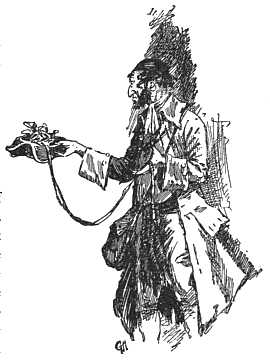
"THE TREMBLING JEW."
"Dine with him to-morrow," said Manasseh inexorably. "He fares extra
royally on the Sabbath. Obtain admission to his table, and you shall
be admitted into my family."
"But you do not know the man—it is impossible!" cried Yankelé.
"That is the excuse of the bad Schnorrer. You have heard my
ultimatum. No dinner, no wife. No wife—no dowry!"
"Vat vould dis dowry be?" asked Yankelé, by way of diversion.
"Oh, unique—quite unique. First of all there would be all the money
she gets from the Synagogue. Our Synagogue gives considerable dowries
to portionless girls. There are large bequests for the purpose."
Yankelé's eyes glittered.
"Ah, vat gentlemen you Spaniards be!"
"Then I daresay I should hand over to my son-in-law all my Jerusalem
land."
"Have you property in de Holy Land?" said Yankelé.
"First class, with an unquestionable title. And, of course, I would
give you some province or other in this country."
"What!" gasped Yankelé.
"Could I do less?" said Manasseh blandly. "My own flesh and blood,
remember! Ah, here is my door. It is too late to ask you in. Good
Sabbath! Don't forget your appointment to dine with Rabbi Remorse
Red-herring to-morrow."
"Good Sabbath!" faltered Yankelé, and crawled home heavy-hearted to
Dinah's Buildings, Tripe Yard, Whitechapel, where the memory of him
lingers even unto this day.
Rabbi Remorse Red-herring was an unofficial preacher who officiated at
mourning services in private houses, having a gift of well-turned
eulogy. He was a big, burly man with overlapping stomach and a red
beard, and his spiritual consolations drew tears. His clients knew him
to be vastly self-indulgent in private life, and abstemious in the
matter of benevolence; but they did not confound the rôles. As a
mourning preacher he gave every satisfaction: he was regular and
punctual, and did not keep the congregation waiting, and he had had
considerable experience in showing that there was yet balm in Gilead.
He had about five ways of showing it—the variants depending upon the
circumstances. If, as not infrequently happened, the person deceased
was a stranger to him, he would enquire in the passage: "Was it man
or woman? Boy or girl? Married or single? Any children? Young 'uns or
old 'uns?"
When these questions had been answered, he was ready. He knew exactly
which of his five consolatory addresses to deliver—they were all
sufficiently vague and general to cover considerable variety of
circumstance, and even when he misheard the replies in the passage,
and dilated on the grief of a departed widower's relict, the results
were not fatal throughout. The few impossible passages might be
explained by the mishearing of the audience. Sometimes—very
rarely—he would venture on a supplementary sentence or two fitting
the specific occasion, but very cautiously, for a man with a
reputation for extempore addresses cannot be too wary of speaking on
the spur of the moment.
Off obituary lines he was a failure; at any rate, his one attempt to
preach from an English Synagogue pulpit resulted in a nickname. His
theme was Remorse, which he explained with much care to the
congregation.
"For instance," said the preacher, "the other day I was walking over
London Bridge, when I saw a fishwife standing with a basket of
red-herrings. I says, 'How much?' She says, 'Two for three-halfpence.'
I says, 'Oh, that's frightfully dear! I can easily get three for
twopence.' But she wouldn't part with them at that price, so I went
on, thinking I'd meet another woman with a similar lot over the water.
They were lovely fat herrings, and my chaps watered in anticipation of
the treat of eating them. But when I got to the other end of the
bridge there was no other fishwife to be seen. So I resolved to turn
back to the first fishwife, for, after all, I reflected, the herrings
were really very cheap, and I had only complained in the way of
business. But when I got back the woman was just sold out. I could
have torn my hair with vexation. Now, that's what I call Remorse."
"'I COULD HAVE TORN MY HAIR.'"
After that the Rabbi was what the congregation called Remorse; also
Red-herring.
The Rabbi's fondness for concrete exemplification of abstract ideas
was not, however, to be stifled, and there was one illustration of
Charity which found a place in all the five sermons of consolation.
"If you have a pair of old breeches, send them to the Rabbi."
Rabbi Remorse Red-herring was, however, as is the way of preachers,
himself aught but a concrete exemplification of the virtues he
inculcated. He lived generously—through other people's
generosity—but no one could boast of having received a farthing from
him over and above what was due to them; while Schnorrers (who
deemed considerable sums due to them) regarded him in the light of a
defalcating bankrupt. He, for his part, had a countervailing grudge
against the world, fancying the work he did for it but feebly
remunerated. "I get so little," ran his bitter plaint, "that I
couldn't live, if it were not for the fasts." And, indeed, the fasts
of the religion were worth much more to him than to Yankelé; his meals
were so profuse that his savings from this source were quite a little
revenue. As Yankelé had pointed out, he was married. And his wife had
given him a child, but it died at the age of seven, bequeathing to him
the only poignant sorrow of his life. He was too jealous to call in a
rival consolation preacher during those dark days, and none of his own
five sermons seemed to fit the case. It was some months before he took
his meals regularly.
At no time had anyone else taken meals in his house, except by law
entitled. Though she had only two to cook for, his wife habitually
provided for three, counting her husband no mere unit. Herself she
reckoned as a half.
It was with intelligible perturbation, therefore, that Yankelé,
dressed in some other man's best, approached the house of Rabbi
Remorse Red-herring about a quarter of an hour before the Sabbath
mid-day meal, intent on sharing it with him.
"No dinner, no marriage!" was da Costa's stern ukase.
What wonder if the inaccessible meal took upon itself the grandiosity
of a wedding feast! Deborah da Costa's lovely face tantalised him like
a mirage.
The Sabbath day was bleak, but chiller was his heart. The Rabbi had
apartments in Steward Street, Spitalfields, an elegant suite on the
ground-floor, for he stinted himself in nothing but charity. At the
entrance was a porch—a pointed Gothic arch of wood supported by two
pillars. As Yankelé mounted the three wooden steps, breathing as
painfully as if they were three hundred, and wondering if he would
ever get merely as far as the other side of the door, he was assailed
by the temptation to go and dine peacefully at home, and represent to
da Costa that he had feasted with the Rabbi. Manasseh would never
know, Manasseh had taken no steps to ascertain if he satisfied the
test or not. Such carelessness, he told himself in righteous
indignation, deserved fitting punishment. But, on the other hand, he
recalled Manasseh's trust in him; Manasseh believed him a man of
honour, and the patron's elevation of soul awoke an answering chivalry
in the parasite.
He decided to make the attempt at least, for there would be plenty of
time to say he had succeeded, after he had failed.
Vibrating with tremors of nobility as well as of apprehension, Yankelé
lifted the knocker. He had no programme, trusting to chance and
mother-wit.
Mrs. Remorse Red-herring half opened the door.
"I vish to see de Rabbi," he said, putting one foot within.
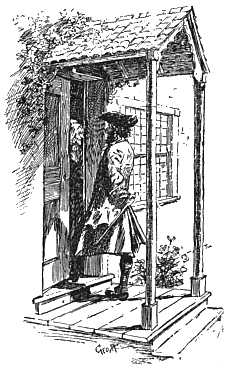
"'I VISH TO SEE DE RABBI.'"
"He is engaged," said the wife—a tiny thin creature who had been
plump and pretty. "He is very busy talking with a gentleman."
"Oh, but I can vait."
"But the Rabbi will be having his dinner soon."
"I can vait till after dinner," said Yankelé obligingly.
"Oh, but the Rabbi sits long at table."
"I don't mind," said Yankelé with undiminished placidity, "de longer
de better."
The poor woman looked perplexed. "I'll tell my husband," she said at
last.
Yankelé had an anxious moment in the passage.
"The Rabbi wishes to know what you want," she said when she returned.
"I vant to get married," said Yankelé with an inspiration of veracity.
"But my husband doesn't marry people."
"Vy not?"
"He only brings consolation into households," she explained
ingenuously.
"Vell, I won't get married midout him," Yankelé murmured lugubriously.
The little woman went back in bewilderment to her bosom's lord.
Forthwith out came Rabbi Remorse Red-herring, curiosity and cupidity
in his eyes. He wore the skull-cap of sanctity, but looked the
gourmand in spite of it.
"Good Sabbath, sir! What is this about your getting married?"
"It's a long story," said Yankelé, "and as your good vife told me your
dinner is just ready, I mustn't keep you now."
"No, there are still a few minutes before dinner. What is it?"
Yankelé shook his head. "I couldn't tink of keeping you in dis
draughty passage."
"I don't mind. I don't feel any draught."
"Dat's just vere de danger lays. You don't notice, and one day you
find yourself laid up mid rheumatism, and you vill have Remorse," said
Yankelé with a twinkle. "Your life is precious—if you die, who vill
console de community?"
It was an ambiguous remark, but the Rabbi understood it in its most
flattering sense, and his little eyes beamed. "I would ask you
inside," he said, "but I have a visitor."
"No matter," said Yankelé, "vat I have to say to you, Rabbi, is not
private. A stranger may hear it."
Still undecided, the Rabbi muttered, "You want me to marry you?"
"I have come to get married," replied Yankelé.
"But I have never been called upon to marry people."
"It's never too late to mend, dey say."
"Strange—strange," murmured the Rabbi reflectively.
"Vat is strange?"
"That you should come to me just to-day. But why did you not go to
Rabbi Sandman?"
"Rabbi Sandman!" replied Yankelé with contempt. "Vere vould be de good
of going to him?"
"But why not?"
"Every Schnorrer goes to him," said Yankelé frankly.
"Hum!" mused the Rabbi. "Perhaps there is an opening for a more
select marrier. Come in, then, I can give you five minutes if you
really don't mind talking before a stranger."
He threw open the door, and led the way into the sitting-room.
Yankelé followed, exultant; the outworks were already carried, and his
heart beat high with hope. But at his first glance within, he reeled
and almost fell.
Standing with his back to the fire and dominating the room was
Manasseh Bueno Barzillai Azevedo da Costa!
"Ah, Yankelé, good Sabbath!" said da Costa affably.
"G-g-ood Sabbath!" stammered Yankelé.
"Why, you know each other!" cried the Rabbi.
"Oh, yes," said Manasseh, "an acquaintance of yours, too, apparently."
"No, he is just come to see me about something," replied the Rabbi.
"I thought you did not know the Rabbi, Mr. da Costa?" Yankelé could
not help saying.
"I didn't. I only had the pleasure of making his acquaintance half an
hour ago. I met him in the street as he was coming home from morning
service, and he was kind enough to invite me to dinner."
Yankelé gasped; despite his secret amusement at Manasseh's airs, there
were moments when the easy magnificence of the man overwhelmed him,
extorted his reluctant admiration. How in Heaven's name had the
Spaniard conquered at a blow!
Looking down at the table, he now observed that it was already laid
for dinner—and for three! He should have been that third. Was it fair
of Manasseh to handicap him thus? Naturally, there would be infinitely
less chance of a fourth being invited than a third—to say nothing of
the dearth of provisions. "But, surely, you don't intend to stay to
dinner!" he complained in dismay.
"I have given my word," said Manasseh, "and I shouldn't care to
disappoint the Rabbi."
"Oh, it's no disappointment, no disappointment," remarked Rabbi
Remorse Red-herring cordially, "I could just as well come round and
see you after dinner."
"After dinner I never see people," said Manasseh majestically; "I
sleep."
The Rabbi dared not make further protest: he turned to Yankelé and
asked, "Well, now, what's this about your marriage?"
"I can't tell you before Mr. da Costa," replied Yankelé, to gain time.
"Why not? You said anybody might hear."
"Noting of the sort. I said a stranger might hear. But Mr. da Costa
isn't a stranger. He knows too much about de matter."
"What shall we do, then?" murmured the Rabbi.
"I can vait till after dinner," said Yankelé, with good-natured
carelessness. "I don't sleep—"
Before the Rabbi could reply, the wife brought in a baked dish, and
set it on the table. Her husband glowered at her, but she, regular as
clockwork, and as unthinking, produced the black bottle of schnapps.
It was her husband's business to get rid of Yankelé; her business was
to bring on the dinner. If she had delayed, he would have raged
equally. She was not only wife, but maid-of-all-work.
Seeing the advanced state of the preparations, Manasseh da Costa took
his seat at the table; obeying her husband's significant glance, Mrs.
Red-herring took up her position at the foot. The Rabbi himself sat
down at the head, behind the dish. He always served, being the only
person he could rely upon to gauge his capacities. Yankelé was left
standing. The odour of the meat and potatoes impregnated the
atmosphere with wistful poetry.
Suddenly the Rabbi looked up and perceived Yankelé. "Will you do as we
do?" he said in seductive accents.
The Schnorrer's heart gave one wild, mad throb of joy. He laid his
hand on the only other chair.
"I don't mind if I do," he said, with responsive amiability.
"Then go home and have your dinner," said the Rabbi.
"'THEN GO HOME AND HAVE YOUR DINNER.'"
Yankelé's wild heart-beat was exchanged for a stagnation as of death.
A shiver ran down his spine. He darted an agonised appealing glance at
Manasseh, who sniggered inscrutably.
"Oh, I don't tink I ought to go avay and leave you midout a tird man
for grace," he said, in tones of prophetic rebuke. "Since I be here,
it vould be a sin not to stay."
The Rabbi, having a certain connection with religion, was cornered; he
was not able to repudiate such an opportunity of that more pious form
of grace which needs the presence of three males.
"Oh, I should be very glad for you to stay," said the Rabbi, "but,
unfortunately, we have only three meat-plates."
"Oh, de dish vill do for me."
"Very well, then!" said the Rabbi.
And Yankelé, with the old mad heart-beat, took the fourth chair,
darting a triumphant glance at the still sniggering Manasseh.
The hostess rose, misunderstanding her husband's optical signals, and
fished out a knife and fork from the recesses of a chiffonier. The
host first heaped his own plate high with artistically coloured
potatoes and stiff meat—less from discourtesy than from life-long
habit—then divided the remainder in unequal portions between Manasseh
and the little woman, in rough correspondence with their sizes.
Finally, he handed Yankelé the empty dish.
"You see there is nothing left," he said simply. "We didn't even
expect one visitor."
"First come, first served," observed Manasseh, with his sphinx-like
expression, as he fell-to.
Yankelé sat frozen, staring blankly at the dish, his brain as empty.
He had lost.
Such a dinner was a hollow mockery—like the dish. He could not expect
Manasseh to accept it, quibbled he ever so cunningly. He sat for a
minute or two as in a dream, the music of knife and fork ringing
mockingly in his ears, his hungry palate moistened by the delicious
savour. Then he shook off his stupor, and all his being was
desperately astrain, questing for an idea. Manasseh discoursed with
his host on neo-Hebrew literature.
"We thought of starting a journal at Grodno," said the Rabbi, "only
the funds—"
"Be you den a native of Grodno?" interrupted Yankelé.
"Yes, I was born there," mumbled the Rabbi, "but I left there twenty
years ago." His mouth was full, and he did not cease to ply the
cutlery.
"Ah!" said Yankelé enthusiastically, "den you must be de famous
preacher everybody speaks of. I do not remember you myself, for I vas
a boy, but dey say ve haven't got no such preachers nowaday."
"In Grodno my husband kept a brandy shop," put in the hostess.
There was a bad quarter of a minute of silence. To Yankelé's relief,
the Rabbi ended it by observing, "Yes, but doubtless the gentleman
(you will excuse me calling you that, sir, I don't know your real
name) alluded to my fame as a boy-Maggid. At the age of five I
preached to audiences of many hundreds, and my manipulation of texts,
my demonstrations that they did not mean what they said, drew tears
even from octogenarians familiar with the Torah from their earliest
infancy. It was said there never was such a wonder-child since Ben
Sira."
"But why did you give it up?" enquired Manasseh.
"It gave me up," said the Rabbi, putting down his knife and fork to
expound an ancient grievance. "A boy-Maggid cannot last more than a
few years. Up to nine I was still a draw, but every year the wonder
grew less, and, when I was thirteen, my Bar-Mitzvah (confirmation)
sermon occasioned no more sensation than those of the many other lads
whose sermons I had written for them. I struggled along as boyishly as
I could for some time after that, but it was in a losing cause. My age
won on me daily. As it is said, 'I have been young, and now I am old.'
In vain I composed the most eloquent addresses to be heard in Grodno.
In vain I gave a course on the emotions, with explanations and
instances from daily life—the fickle public preferred younger
attractions. So at last I gave it up and sold vodki."
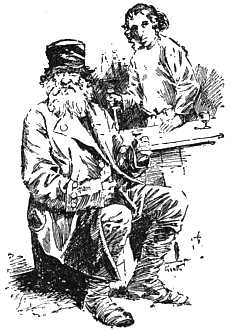
"'SOLD VODKI.'""'SOLD VODKI.'"
"Vat a pity! Vat a pity!" ejaculated Yankelé, "after vinning fame in
de Torah!"
"But what is a man to do? He is not always a boy," replied the Rabbi.
"Yes, I kept a brandy shop. That's what I call Degradation. But there
is always balm in Gilead. I lost so much money over it that I had to
emigrate to England, where, finding nothing else to do, I became a
preacher again." He poured himself out a glass of schnapps, ignoring
the water.
"I heard nothing of de vodki shop," said Yankelé; "it vas svallowed
up in your earlier fame."
The Rabbi drained the glass of schnapps, smacked his lips, and
resumed his knife and fork. Manasseh reached for the unoffered bottle,
and helped himself liberally. The Rabbi unostentatiously withdrew it
beyond his easy reach, looking at Yankelé the while.
"How long have you been in England?" he asked the Pole.
"Not long," said Yankelé.
"Ha! Does Gabriel the cantor still suffer from neuralgia?"
Yankelé looked sad. "No—he is dead," he said.
"Dear me! Well, he was tottering when I knew him. His blowing of the
ram's horn got wheezier every year. And how is his young brother,
Samuel?"
"He is dead!" said Yankelé.
"What, he too! Tut, tut! He was so robust. Has Mendelssohn, the
stonemason, got many more girls?"
"He is dead!" said Yankelé.
"Nonsense!" gasped the Rabbi, dropping his knife and fork. "Why, I
heard from him only a few months ago."
"He is dead!" said Yankelé.
"Good gracious me! Mendelssohn dead!" After a moment of emotion he
resumed his meal. "But his sons and daughters are all doing well, I
hope. The eldest, Solomon, was a most pious youth, and his third girl,
Neshamah, promised to be a rare beauty."
"They are dead!" said Yankelé.
This time the Rabbi turned pale as a corpse himself. He laid down his
knife and fork automatically.
"D—dead," he breathed in an awestruck whisper. "All?"
"Everyone. De same cholera took all de family."
The Rabbi covered his face with his hands. "Then poor Solomon's wife
is a widow. I hope he left her enough to live upon."
"No, but it doesn't matter," said Yankelé.
"It matters a great deal," cried the Rabbi.
"She is dead," said Yankelé.
"Rebecca Schwartz dead!" screamed the Rabbi, for he had once loved the
maiden himself, and, not having married her, had still a tenderness
for her.
"Rebecca Schwartz," repeated Yankelé inexorably.
"Was it the cholera?" faltered the Rabbi.
"No, she vas heart-broke."
Rabbi Remorse Red-herring silently pushed his plate away, and leaned
his elbows upon the table and his face upon his palms, and his chin
upon the bottle of schnapps in mournful meditation.
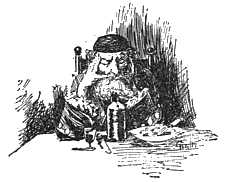
"IN MOURNFUL MEDITATION."
"You are not eating, Rabbi," said Yankelé insinuatingly.
"I have lost my appetite," said the Rabbi.
"Vat a pity to let food get cold and spoil! You'd better eat it."
The Rabbi shook his head querulously.
"Den I vill eat it," cried Yankelé indignantly. "Good hot food like
dat!"
"As you like," said the Rabbi wearily. And Yankelé began to eat at
lightning speed, pausing only to wink at the inscrutable Manasseh; and
to cast yearning glances at the inaccessible schnapps that supported
the Rabbi's chin.
Presently the Rabbi looked up: "You're quite sure all these people are
dead?" he asked with a dawning suspicion.
"May my blood be poured out like this schnapps," protested Yankelé,
dislodging the bottle, and vehemently pouring the spirit into a
tumbler, "if dey be not."
The Rabbi relapsed into his moody attitude, and retained it till his
wife brought in a big willow-pattern china dish of stewed prunes and
pippins. She produced four plates for these, and so Yankelé finished
his meal in the unquestionable status of a first-class guest. The
Rabbi was by this time sufficiently recovered to toy with two
platefuls in a melancholy silence which he did not break till his
mouth opened involuntarily to intone the grace.
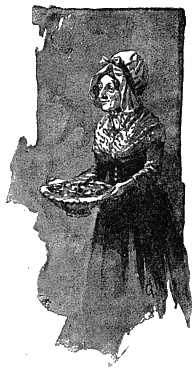
"PRUNES AND PIPPINS."
When grace was over he turned to Manasseh and said, "And what was this
way you were suggesting to me of getting a profitable Sephardic
connection?"
"I did, indeed, wonder why you did not extend your practice as
consolation preacher among the Spanish Jews," replied Manasseh
gravely. "But after what we have just heard of the death-rate of Jews
in Grodno, I should seriously advise you to go back there."
"No, they cannot forget that I was once a boy," replied the Rabbi with
equal gravity. "I prefer the Spanish Jews. They are all well-to-do.
They may not die so often as the Russians, but they die better, so to
speak. You will give me introductions, you will speak of me to your
illustrious friends, I understand."
"You understand!" repeated Manasseh in dignified astonishment. "You do
not understand. I shall do no such thing."
"But you yourself suggested it!" cried the Rabbi excitedly.
"I? Nothing of the kind. I had heard of you and your ministrations to
mourners, and meeting you in the street this afternoon for the first
time, it struck me to enquire why you did not carry your consolations
into the bosom of my community where so much more money is to be made.
I said I wondered you had not done so from the first. And you—invited
me to dinner. I still wonder. That is all, my good man." He rose to
go.
The haughty rebuke silenced the Rabbi, though his heart was hot with a
vague sense of injury.
"Do you come my way, Yankelé?" said Manasseh carelessly.
The Rabbi turned hastily to his second guest.
"When do you want me to marry you?" he asked.
"You have married me," replied Yankelé.
"I?" gasped the Rabbi. It was the last straw.
"Yes," reiterated Yankelé. "Hasn't he, Mr. da Costa?"
His heart went pit-a-pat as he put the question.
"Certainly," said Manasseh without hesitation.
Yankelé's face was made glorious summer. Only two of the quartette
knew the secret of his radiance.
"There, Rabbi," he cried exultantly. "Good Sabbath!"
"Good Sabbath!" added Manasseh.
"Good Sabbath," dazedly murmured the Rabbi.
"Good Sabbath," added his wife.
"Congratulate me!" cried Yankelé when they got outside.
"On what?" asked Manasseh.
"On being your future son-in-law, of course."
"Oh, on that? Certainly, I congratulate you most heartily." The two
Schnorrers shook hands. "I thought you were asking for compliments
on your manœuvring."
"Vy, doesn't it deserve dem?"
"No," said Manasseh magisterially.
"No?" queried Yankelé, his heart sinking again. "Vy not?"
"Why did you kill so many people?"
"Somebody must die dat I may live."
"You said that before," said Manasseh severely. "A good Schnorrer
would not have slaughtered so many for his dinner. It is a waste of
good material. And then you told lies!"
"How do you know they are not dead?" pleaded Yankelé.
The King shook his head reprovingly. "A first-class Schnorrer never
lies," he laid it down.
"I might have made truth go as far as a lie—if you hadn't come to
dinner yourself."
"What is that you say? Why, I came to encourage you by showing you how
easy your task was."
"On de contrary, you made it much harder for me. Dere vas no dinner
left."
"But against that you must reckon that since the Rabbi had already
invited one person, he couldn't be so hard to tackle as I had
fancied."
"Oh, but you must not judge from yourself," protested Yankelé. "You be
not a Schnorrer—you be a miracle."
"But I should like a miracle for my son-in-law also," grumbled the
King.
"And if you had to schnorr a son-in-law, you vould get a miracle,"
said Yankelé soothingly. "As he has to schnorr you, he gets the
miracle."
"True," observed Manasseh musingly, "and I think you might therefore
be very well content without the dowry."
"So I might," admitted Yankelé, "only you vould not be content to
break your promise. I suppose I shall have some of de dowry on de
marriage morning."
"On that morning you shall get my daughter—without fail. Surely that
will be enough for one day!"
"Vell, ven do I get de money your daughter gets from de Synagogue?"
"When she gets it from the Synagogue, of course."
"How much vill it be?"
"It may be a hundred and fifty pounds," said Manasseh pompously.
Yankelé's eyes sparkled.
"And it may be less," added Manasseh as an after-thought.
"How much less?" enquired Yankelé anxiously.
"A hundred and fifty pounds," repeated Manasseh pompously.
"D'you mean to say I may get noting?"
"Certainly, if she gets nothing. What I promised you was the money she
gets from the Synagogue. Should she be fortunate enough in the
sorteo—"
"De sorteo! Vat is dat?"
"The dowry I told you of. It is accorded by lot. My daughter has as
good a chance as any other maiden. By winning her you stand to win a
hundred and fifty pounds. It is a handsome amount. There are not many
fathers who would do as much for their daughters," concluded Manasseh
with conscious magnanimity.
"But about de Jerusalem estate!" said Yankelé, shifting his
standpoint. "I don't vant to go and live dere. De Messiah is not yet
come."
"No, you will hardly be able to live on it," admitted Manasseh.
"You do not object to my selling it, den?"
"Oh, no! If you are so sordid, if you have no true Jewish sentiment!"
"Ven can I come into possession?"
"On the wedding day if you like."
"One may as vell get it over," said Yankelé, suppressing a desire to
rub his hands in glee. "As de Talmud says, 'One peppercorn to-day is
better dan a basketful of pumpkins to-morrow.'"
"All right! I will bring it to the Synagogue."
"Bring it to de Synagogue!" repeated Yankelé in amaze. "Oh, you mean
de deed of transfer."
"The deed of transfer! Do you think I waste my substance on
solicitors? No, I will bring the property itself."
"But how can you do dat?"
"Where is the difficulty?" demanded Manasseh with withering contempt.
"Surely a child could carry a casket of Jerusalem earth to Synagogue!"
"A casket of earth! Is your property in Jerusalem only a casket of
earth?"
"What then? You didn't expect it would be a casket of diamonds?"
retorted Manasseh, with gathering wrath. "To a true Jew a casket of
Jerusalem earth is worth all the diamonds in the world."
"But your Jerusalem property is a fraud!" gasped Yankelé.
"Oh, no, you may be easy on that point. It's quite genuine. I know
there is a good deal of spurious Palestine earth in circulation, and
that many a dead man who has clods of it thrown into his tomb is
nevertheless buried in unholy soil. But this casket I was careful to
obtain from a Rabbi of extreme sanctity. It was the only thing he had
worth schnorring."
"I don't suppose I shall get more dan a crown for it," said Yankelé,
with irrepressible indignation.
"That's what I say," returned Manasseh; "and never did I think a
son-in-law of mine would meditate selling my holy soil for a paltry
five shillings! I will not withdraw my promise, but I am disappointed
in you—bitterly disappointed. Had I known this earth was not to cover
your bones, it should have gone down to the grave with me, as enjoined
in my last will and testament, by the side of which it stands in my
safe."
"Very vell, I von't sell it," said Yankelé sulkily.
"You relieve my soul. As the Mishnah says, 'He who marries a wife
for money begets froward children.'"
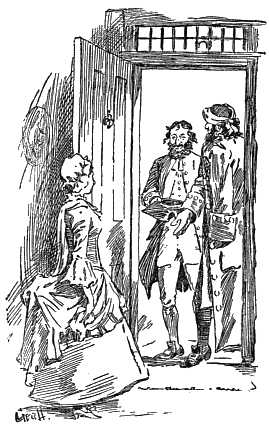
"THE UNCONSCIOUS BRIDE OPENED
THE DOOR."
"And vat about de province in England?" asked Yankelé, in low,
despondent tones. He had never believed in that, but now, behind all
his despair and incredulity, was a vague hope that something might yet
be saved from the crash.
"Oh, you shall choose your own," replied Manasseh graciously. "We will
get a large map of London, and I will mark off in red pencil the
domain in which I schnorr. You will then choose any district in
this—say, two main streets and a dozen byways and alleys—which
shall be marked off in blue pencil, and whatever province of my
kingdom you pick, I undertake not to schnorr in, from your
wedding-day onwards. I need not tell you how valuable such a province
already is; under careful administration, such as you would be able to
give it, the revenue from it might be doubled, trebled. I do not think
your tribute to me need be more than ten per cent."
Yankelé walked along mesmerised, reduced to somnambulism by his
magnificently masterful patron.
"Oh, here we are!" said Manasseh, stopping short. "Won't you come in
and see the bride, and wish her joy?"
A flash of joy came into Yankelé's own face, dissipating his glooms.
After all there was always da Costa's beautiful daughter—a solid,
substantial satisfaction. He was glad she was not an item of the
dowry.
The unconscious bride opened the door.
"Ah, ha, Yankelé!" said Manasseh, his paternal heart aglow at the
sight of her loveliness. "You will be not only a king, but a rich
king. As it is written, 'Who is rich? He who hath a beautiful wife.'"
SHOWING HOW THE KING DISSOLVED THE MAHAMAD.
Manasseh da Costa (thus docked of his nominal plenitude in the solemn
writ) had been summoned before the Mahamad, the intended union of his
daughter with a Polish Jew having excited the liveliest horror and
displeasure in the breasts of the Elders of the Synagogue. Such a Jew
did not pronounce Hebrew as they did!
"THE ELDERS OF THE SYNAGOGUE."
The Mahamad was a Council of Five, no less dread than the more
notorious Council of Ten. Like the Venetian Tribunal, which has
unjustly monopolised the attention of history, it was of annual
election, and it was elected by a larger body of Elders, just as the
Council of Ten was chosen by the aristocracy. "The gentlemen of the
Mahamad," as they were styled, administered the affairs of the
Spanish-Portuguese community, and their oligarchy would undoubtedly be
a byword for all that is arbitrary and inquisitorial but for the
widespread ignorance of its existence. To itself the Mahamad was the
centre of creation. On one occasion it refused to bow even to the
authority of the Lord Mayor of London. A Sephardic Jew lived and moved
and had his being "by permission of the Mahamad." Without its consent
he could have no legitimate place in the scheme of things. Minus "the
permission of the Mahamad" he could not marry; with it he could be
divorced readily. He might, indeed, die without the sanction of the
Council of Five, but this was the only great act of his life which was
free from its surveillance, and he could certainly not be buried save
"by permission of the Mahamad." The Haham himself, the Sage or Chief
Rabbi of the congregation, could not unite his flock in holy wedlock
without the "permission of the Mahamad." And this authority was not
merely negative and passive, it was likewise positive and active. To
be a Yahid—a recognised congregant—one had to submit one's neck to a
yoke more galling even than that of the Torah, to say nothing of the
payment of Finta, or poll-tax. Woe to him who refused to be Warden of
the Captives—he who ransomed the chained hostages of the Moorish
Corsairs, or the war prisoners held in durance by the Turks—or to be
President of the Congregation, or Parnass of the Holy Land, or
Bridegroom of the Law, or any of the numerous dignitaries of a complex
constitution. Fines, frequent and heavy—for the benefit of the
poor-box—awaited him "by permission of the Mahamad." Unhappy the
wight who misconducted himself in Synagogue "by offending the
president, or grossly insulting any other person," as the ordinance
deliciously ran. Penalties, stringent and harrying, visited these and
other offences—deprivation of the "good deeds," of swathing the Holy
Scroll, or opening the Ark; ignominious relegation to seats behind the
reading-desk, withdrawal of the franchise, prohibition against shaving
for a term of weeks! And if, accepting office, the Yahid failed in the
punctual and regular discharge of his duties, he was mulcted and
chastised none the less. A fine of forty pounds drove from the
Synagogue Isaac Disraeli, collector of Curiosities of Literature,
and made possible that curiosity of politics, the career of Lord
Beaconsfield. The fathers of the Synagogue, who drew up their
constitution in pure Castilian in the days when Pepys noted the
indecorum in their little Synagogue in King Street, meant their
statutes to cement, not thus to disintegrate, the community. 'Twas a
tactless tyranny, this of the Mahamad, an inelastic administration of
a cast-iron codex wrought "in good King Charles's golden days," when
the colony of Dutch-Spanish exiles was as a camp in enemies' country,
in need of military régime; and it co-operated with the attractions
of an unhampered "Christian" career in driving many a brilliant family
beyond the gates of the Ghetto, and into the pages of Debrett. Athens
is always a dangerous rival to Sparta.
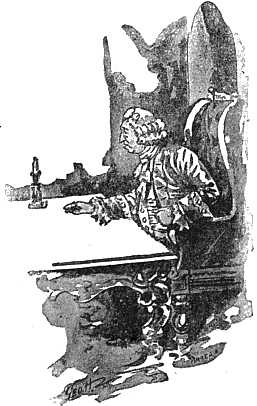
"THE PRESIDENT OF THE MAHAMAD."
But the Mahamad itself moved strictly in the grooves of prescription.
That legalistic instinct of the Hebrew, which had evolved the most
gigantic and minute code of conduct in the world, had beguiled these
latter-day Jews into super-adding to it a local legislation that grew
into two hundred pages of Portuguese—an intertangled network of
Ascamot or regulations, providing for every contingency of Synagogue
politics, from the quarrels of members for the best seats down to the
dimensions of their graves in the Carreira, from the distribution of
"good deeds" among the rich to the distribution of Passover Cakes
among the poor. If the wheels and pulleys of the communal life moved
"by permission of the Mahamad," the Mahamad moved by permission of the
Ascamot.
The Solemn Council was met—"in complete Mahamad." Even the Chief of
the Elders was present, by virtue of his privilege, making a sixth;
not to count the Chancellor or Secretary, who sat flutteringly
fingering the Portuguese Minute Book on the right of the President. He
was a little man, an odd medley of pomp and bluster, with a
snuff-smeared upper lip, and a nose that had dipped in the wine when
it was red. He had a grandiose sense of his own importance, but it was
a pride that had its roots in humility, for he felt himself great
because he was the servant of greatness. He lived "by permission of
the Mahamad." As an official he was theoretically inaccessible. If you
approached him on a matter he would put out his palms deprecatingly
and pant, "I must consult the Mahamad." It was said of him that he had
once been asked the time, and that he had automatically panted, "I
must consult the Mahamad." This consultation was the merest form; in
practice the Secretary had more influence than the Chief Rabbi, who
was not allowed to recommend an applicant for charity, for the quaint
reason that the respect entertained for him might unduly prejudice the
Council in favour of his candidate. As no gentleman of the Mahamad
could possibly master the statutes in his year of office, especially
as only a rare member understood the Portuguese in which they had been
ultimately couched, the Secretary was invariably referred to, for he
was permanent, full of saws and precedents, and so he interpreted the
law with impartial inaccuracy—"by permission of the Mahamad." In his
heart of hearts he believed that the sun rose and the rain fell—"by
permission of the Mahamad."
The Council Chamber was of goodly proportions, and was decorated by
gold lettered panels, inscribed with the names of pious donors, thick
as saints in a graveyard, overflowing even into the lobby. The flower
and chivalry of the Spanish Jewry had sat round that Council-table,
grandees who had plumed and ruffled it with the bloods of their day,
clanking their swords with the best, punctilious withal and
ceremonious, with the stately Castilian courtesy still preserved by
the men who were met this afternoon, to whom their memory was as faint
as the fading records of the panels. These descendants of theirs had
still elaborate salutations and circumlocutions, and austere dignities
of debate. "God-fearing men of capacity and respectability," as the
Ascama demanded, they were also men of money, and it gave them a
port and a repose. His Britannic Majesty graced the throne no better
than the President of the Mahamad, seated at the head of the long
table in his alcoved arm-chair, with the Chief of the Elders on his
left, and the Chancellor on his right, and his Councillors all about
him. The westering sun sent a pencil of golden light through the
Norman windows as if anxious to record the names of those present in
gilt letters—"by permission of the Mahamad."
"Let da Costa enter," said the President, when the agenda demanded the
great Schnorrer's presence.
The Chancellor fluttered to his feet, fussily threw open the door, and
beckoned vacancy with his finger till he discovered Manasseh was not
in the lobby. The beadle came hurrying up instead.
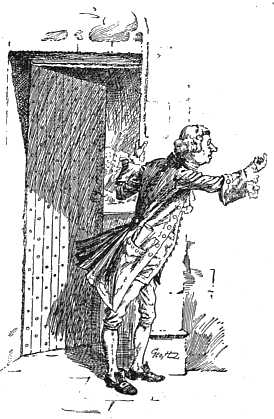
"BECKONED WITH HIS FINGER."
"Where is da Costa?" panted the Chancellor. "Call da Costa."
"Da Costa!" sonorously intoned the beadle with the long-drawn accent
of court ushers.
The corridor rang hollow, empty of Manasseh. "Why, he was here a
moment ago," cried the bewildered beadle. He ran down the passage, and
found him sure enough at the end of it where it abutted on the street.
The King of Schnorrers was in dignified converse with a person of
consideration.
"Da Costa!" the beadle cried again, but his tone was less awesome and
more tetchy. The beggar did not turn his head.
"Mr. da Costa," said the beadle, now arrived too near the imposing
figure to venture on familiarities with it. This time the beggar gave
indications of restored hearing. "Yes, my man," he said, turning and
advancing a few paces to meet the envoy. "Don't go, Grobstock," he
called over his shoulder.
"Didn't you hear me calling?" grumbled the beadle.
"I heard you calling da Costa, but I naturally imagined it was one of
your drinking companions," replied Manasseh severely.
"The Mahamad is waiting for you," faltered the beadle.
"Tell the gentlemen of the Mahamad," said Manasseh, with reproving
emphasis, "that I shall do myself the pleasure of being with them
presently. Nay, pray don't hurry away, my dear Grobstock," he went on,
resuming his place at the German magnate's side—"and so your wife is
taking the waters at Tunbridge Wells. In faith, 'tis an excellent
regimen for the vapours. I am thinking of sending my wife to
Buxton—the warden of our hospital has his country-seat there."
"But you are wanted," murmured Grobstock, who was anxious to escape.
He had caught the Schnorrer's eye as its owner sunned himself in the
archway, and it held him.
"'Tis only a meeting of the Mahamad I have to attend," he said
indifferently. "Rather a nuisance—but duty is duty."
Grobstock's red face became a setting for two expanded eyes.
"I thought the Mahamad was your chief Council," he exclaimed.
"Yes, there are only five of us," said Manasseh lightly, and, while
Grobstock gaped incredulous, the Chancellor himself shambled up in
pale consternation.
"You are keeping the gentlemen of the Mahamad waiting," he panted
imperiously.
"Ah, you are right, Grobstock," said Manasseh with a sigh of
resignation. "They cannot get on without me. Well, you will excuse me,
I know. I am glad to have seen you again—we shall finish our chat at
your house some evening, shall we? I have agreeable recollections of
your hospitality."
"My wife will be away all this month," Grobstock repeated feebly.
"Ha! ha! ha!" laughed Manasseh roguishly. "Thank you for the reminder.
I shall not fail to aid you in taking advantage of her absence.
Perhaps mine will be away, too—at Buxton. Two bachelors, ha! ha! ha!"
and, proffering his hand, he shook Grobstock's in gracious farewell.
Then he sauntered leisurely in the wake of the feverishly impatient
Chancellor, his staff tapping the stones in measured tardiness.
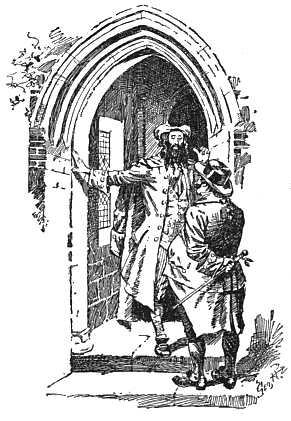
"'HA! HA! HA!' LAUGHED MANASSEH."
"Good afternoon, gentlemen," he observed affably as he entered the
Council Chamber.
"You have kept us waiting," sharply rejoined the President of the
Mahamad, ruffled out of his regal suavity. He was a puffy, swarthy
personage, elegantly attired, and he leaned forward on his velvet
throne, tattooing on the table with bediamonded fingers.
"Not so long as you have kept me waiting," said Manasseh with quiet
resentment. "If I had known you expected me to cool my heels in the
corridor I should not have come, and, had not my friend the Treasurer
of the Great Synagogue opportunely turned up to chat with me, I should
not have stayed."
"You are impertinent, sir," growled the President.
"I think, sir, it is you who owe me an apology," maintained Manasseh
unflinchingly, "and, knowing the courtesy and high breeding which has
always distinguished your noble family, I can only explain your
present tone by your being unaware I have a grievance. No doubt it is
your Chancellor who cited me to appear at too early an hour."
The President, cooled by the quiet dignity of the beggar, turned a
questioning glance upon the outraged Chancellor, who was crimson and
quivering with confusion and indignation.
"It is usual t-t-to summon persons before the c-c-commencement of the
meeting," he stammered hotly. "We cannot tell how long the prior
business will take."
"Then I would respectfully submit to the Chief of the Elders," said
Manasseh, "that at the next meeting of his august body he move a
resolution that persons cited to appear before the Mahamad shall take
precedence of all other business."
The Chief of the Elders looked helplessly at the President of the
Mahamad, who was equally at sea. "However, I will not press that point
now," added Manasseh, "nor will I draw the attention of the committee
to the careless, perfunctory manner in which the document summoning me
was drawn up, so that, had I been a stickler for accuracy, I need not
have answered to the name of Manasseh da Costa."
"But that is your name," protested the Chancellor.
"If you will examine the Charity List," said Manasseh magnificently,
"you will see that my name is Manasseh Bueno Barzillai Azevedo da
Costa. But you are keeping the gentlemen of the Mahamad waiting." And
with a magnanimous air of dismissing the past, he seated himself on
the nearest empty chair at the foot of the table, leaned his elbows on
the table, and his face on his hands, and gazed across at the
President immediately opposite. The Councillors were so taken aback by
his unexpected bearing that this additional audacity was scarcely
noted. But the Chancellor, wounded in his inmost instincts, exclaimed
irately, "Stand up, sir. These chairs are for the gentlemen of the
Mahamad."
"And being gentlemen," added Manasseh crushingly, "they know better
than to keep an old man on his legs any longer."
"If you were a gentleman," retorted the Chancellor, "you would take
that thing off your head."
"If you were not a Man-of-the-Earth," rejoined the beggar, "you would
know that it is not a mark of disrespect for the Mahamad, but of
respect for the Law, which is higher than the Mahamad. The rich man
can afford to neglect our holy religion, but the poor man has only the
Law. It is his sole luxury."
The pathetic tremor in his voice stirred a confused sense of
wrong-doing and injustice in the Councillors' breasts. The President
felt vaguely that the edge of his coming impressive rebuke had been
turned, if, indeed, he did not sit rebuked instead. Irritated, he
turned on the Chancellor, and bade him hold his peace.
"He means well," said Manasseh deprecatingly. "He cannot be expected
to have the fine instincts of the gentlemen of the Mahamad. May I ask
you, sir," he concluded, "to proceed with the business for which you
have summoned me? I have several appointments to keep with clients."
The President's bediamonded fingers recommenced their ill-tempered
tattoo; he was fuming inwardly with a sense of baffled wrath, of
righteous indignation made unrighteous. "Is it true, sir," he burst
forth at last in the most terrible accents he could command in the
circumstances, "that you meditate giving your daughter in marriage to
a Polish Jew?"
"No," replied Manasseh curtly.
"No?" articulated the President, while a murmur of astonishment went
round the table at this unexpected collapse of the whole case.
"Why, your daughter admitted it to my wife," said the Councillor on
Manasseh's right.
Manasseh turned to him, expostulant, tilting his chair and body
towards him. "My daughter is going to marry a Polish Jew," he
explained with argumentative forefinger, "but I do not meditate giving
her to him."
"Oh, then, you will refuse your consent," said the Councillor,
hitching his chair back so as to escape the beggar's progressive
propinquity. "By no means," quoth Manasseh in surprised accents, as he
drew his chair nearer again, "I have already consented. I do not
meditate consenting. That word argues an inconclusive attitude."
"None of your quibbles, sirrah," cried the President, while a scarlet
flush mantled on his dark countenance. "Do you not know that the union
you contemplate is disgraceful and degrading to you, to your daughter,
and to the community which has done so much for you? What! A Sephardi
marry a Tedesco! Shameful."
"And do you think I do not feel the shame as deeply as you?" enquired
Manasseh, with infinite pathos. "Do you think, gentlemen, that I have
not suffered from this passion of a Tedesco for my daughter? I came
here expecting your sympathy, and do you offer me reproach? Perhaps
you think, sir"—here he turned again to his right-hand neighbour,
who, in his anxiety to evade his pertinacious proximity, had
half-wheeled his chair round, offering only his back to the
argumentative forefinger—"perhaps you think, because I have
consented, that I cannot condole with you, that I am not at one with
you in lamenting this blot on our common 'scutcheon; perhaps you
think"—here he adroitly twisted his chair into argumentative
position on the other side of the Councillor, rounding him like a
cape—"that, because you have no sympathy with my tribulation, I have
no sympathy with yours. But, if I have consented, it is only because
it was the best I could do for my daughter. In my heart of hearts I
have repudiated her, so that she may practically be considered an
orphan, and, as such, a fit person to receive the marriage dowry
bequeathed by Rodriguez Real, peace be upon him."
"This is no laughing matter, sir," thundered the President, stung into
forgetfulness of his dignity by thinking too much of it.
"No, indeed," said Manasseh sympathetically, wheeling to the right so
as to confront the President, who went on stormily, "Are you aware,
sir, of the penalties you risk by persisting in your course?"
"I risk no penalties," replied the beggar.
"Indeed! Then do you think anyone may trample with impunity upon our
ancient Ascamot?"
"Our ancient Ascamot!" repeated Manasseh in surprise. "What have
they to say against a Sephardi marrying a Tedesco?"
The audacity of the question rendered the Council breathless. Manasseh
had to answer it himself.
"They have nothing to say. There is no such Ascama." There was a
moment of awful silence. It was as though he had disavowed the
Decalogue.
"Do you question the first principle of our constitution?" said the
President at last, in low, ominous tones. "Do you deny that your
daughter is a traitress? Do you—?"
"Ask your Chancellor," calmly interrupted Manasseh. "He is a
Man-of-the-Earth, but he should know your statutes, and he will tell
you that my daughter's conduct is nowhere forbidden."
"Silence, sir," cried the President testily. "Mr. Chancellor, read the
Ascama."
The Chancellor wriggled on his chair, his face flushing and paling by
turns; all eyes were bent upon him in anxious suspense. He hemmed and
ha'd and coughed, and took snuff, and blew his nose elaborately.
"There is n-n-no express Ascama," he stuttered at last. Manasseh sat
still, in unpretentious triumph.
The Councillor who was now become his right-hand neighbour was the
first to break the dazed silence, and it was his first intervention.
"Of course, it was never actually put into writing," he said in stern
reproof. "It has never been legislated against, because it has never
been conceived possible. These things are an instinct with every
right-minded Sephardi. Have we ever legislated against marrying
Christians?" Manasseh veered round half a point of the compass, and
fixed the new opponent with his argumentative forefinger. "Certainly
we have," he replied unexpectedly. "In Section XX., Paragraph II." He
quoted the Ascama by heart, rolling out the sonorous Portuguese like
a solemn indictment. "If our legislators had intended to prohibit
intermarriage with the German community, they would have prohibited
it."
"There is the Traditional Law as well as the Written," said the
Chancellor, recovering himself. "It is so in our holy religion, it is
so in our constitution."
"Yes, there are precedents assuredly," cried the President eagerly.
"There is the case of one of our Treasurers in the time of George
II.," said the little Chancellor, blossoming under the sunshine of the
President's encouragement, and naming the ancestor of a Duchess of
to-day. "He wanted to marry a beautiful German Jewess."
"And was interdicted," said the President.
"Hem!" coughed the Chancellor. "He—he was only permitted to marry her
under humiliating conditions. The Elders forbade the attendance of the
members of the House of Judgment, or of the Cantors; no celebration
was to take place in the Snoga; no offerings were to be made for the
bridegroom's health, nor was he even to receive the bridegroom's call
to the reading of the Law."
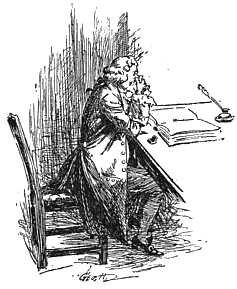
"'HEM!' COUGHED THE CHANCELLOR."
"But the Elders will not impose any such conditions on my son-in-law,"
said Manasseh, skirting round another chair so as to bring his
forefinger to play upon the Chief of the Elders, on whose left he had
now arrived in his argumentative advances. "In the first place he is
not one of us. His desire to join us is a compliment. If anyone has
offended your traditions, it is my daughter. But then she is not a
male, like the Treasurer cited; she is not an active agent, she has
not gone out of her way to choose a Tedesco—she has been chosen. Your
masculine precedents cannot touch her."
"Ay, but we can touch you," said the contemporary Treasurer,
guffawing grimly. He sat opposite Manasseh, and next to the
Chancellor.
"Is it fines you are thinking of?" said Manasseh with a scornful
glance across the table. "Very well, fine me—if you can afford it.
You know that I am a student, a son of the Law, who has no resources
but what you allow him. If you care to pay this fine it is your
affair. There is always room in the poor-box. I am always glad to hear
of fines. You had better make up your mind to the inevitable,
gentlemen. Have I not had to do it? There is no Ascama to prevent my
son-in-law having all the usual privileges—in fact, it was to ask
that he might receive the bridegroom's call to the Law on the Sabbath
before his marriage that I really came. By Section III., Paragraph I.,
you are empowered to admit any person about to marry the daughter of a
Yahid." Again the sonorous Portuguese rang out, thrilling the
Councillors with all that quintessential awfulness of ancient statutes
in a tongue not understood. It was not till a quarter of a century
later that the Ascamot were translated into English, and from that
moment their authority was doomed.
The Chancellor was the first to recover from the quotation. Daily
contact with these archaic sanctities had dulled his awe, and the
President's impotent irritation spurred him to action.
"But you are not a Yahid," he said quietly. "By Paragraph V. of the
same section, any one whose name appears on the Charity List ceases to
be a Yahid."
"And a vastly proper law," said Manasseh with irony. "Everybody may
vote but the Schnorrer." And, ignoring the Chancellor's point at
great length, he remarked confidentially to the Chief of the Elders,
at whose elbow he was still encamped, "It is curious how few of your
Elders perceive that those who take the charity are the pillars of
the Synagogue. What keeps your community together? Fines. What ensures
respect for your constitution? Fines. What makes every man do his
duty? Fines. What rules this very Mahamad? Fines. And it is the poor
who provide an outlet for all these moneys. Egad, do you think your
members would for a moment tolerate your penalties, if they did not
know the money was laid out in 'good deeds'? Charity is the salt of
riches, says the Talmud, and, indeed, it is the salt that preserves
your community."
"Have done, sir, have done!" shouted the President, losing all regard
for those grave amenities of the ancient Council Chamber which
Manasseh did his best to maintain. "Do you forget to whom you are
talking?"
"I am talking to the Chief of the Elders," said Manasseh in a wounded
tone, "but if you would like me to address myself to you—" and
wheeling round the Chief of the Elders, he landed his chair next to
the President's.
"Silence, fellow!" thundered the President, shrinking spasmodically
from his confidential contact. "You have no right to a voice at all;
as the Chancellor has reminded us, you are not even a Yahid, a
congregant."
"Then the laws do not apply to me," retorted the beggar quietly. "It
is only the Yahid who is privileged to do this, who is prohibited from
doing that. No Ascama mentions the Schnorrer, or gives you any
authority over him."
"On the contrary," said the Chancellor, seeing the President
disconcerted again, "he is bound to attend the weekday services. But
this man hardly ever does, sir." "I never do," corrected Manasseh,
with touching sadness. "That is another of the privileges I have to
forego in order to take your charity; I cannot risk appearing to my
Maker in the light of a mercenary."
"And what prevents you taking your turn in the graveyard watches?"
sneered the Chancellor.
The antagonists were now close together, one on either side of the
President of the Mahamad, who was wedged between the two bobbing,
quarrelling figures, his complexion altering momently for the blacker,
and his fingers working nervously.
"What prevents me?" replied Manasseh. "My age. It would be a sin
against heaven to spend a night in the cemetery. If the body-snatchers
did come they might find a corpse to their hand in the watch-tower.
But I do my duty—I always pay a substitute."
"No doubt," said the Treasurer. "I remember your asking me for the
money to keep an old man out of the cemetery. Now I see what you
meant."
"Yes," began two others, "and I—"
"Order, gentlemen, order," interrupted the President desperately, for
the afternoon was flitting, the sun was setting, and the shadows of
twilight were falling. "You must not argue with the man. Hark you, my
fine fellow, we refuse to sanction this marriage; it shall not be
performed by our ministers, nor can we dream of admitting your
son-in-law as a Yahid."
"Then admit him on your Charity List," said Manasseh.
"We are more likely to strike you off! And, by gad!" cried the
President, tattooing on the table with his whole fist, "if you don't
stop this scandal instanter, we will send you howling."
"'IF YOU DON'T STOP THIS SCANDAL INSTANTER, WE WILL SEND YOU HOWLING!'"
"Is it excommunication you threaten?" said Manasseh, rising to his
feet. There was a menacing glitter in his eye.
"This scandal must be stopped," repeated the President, agitatedly
rising in involuntary imitation.
"Any member of the Mahamad could stop it in a twinkling," said
Manasseh sullenly. "You yourself, if you only chose."
"If I only chose?" echoed the President enquiringly.
"If you only chose my daughter. Are you not a bachelor? I am convinced
she could not say nay to anyone present—excepting the Chancellor.
Only no one is really willing to save the community from this scandal,
and so my daughter must marry as best she can. And yet, it is a
handsome creature who would not disgrace even a house in Hackney."
Manasseh spoke so seriously that the President fumed the more. "Let
her marry this Pole," he ranted, "and you shall be cut off from us in
life and death. Alive, you shall worship without our walls, and dead
you shall be buried 'behind the boards.'"
"For the poor man—excommunication," said Manasseh in ominous
soliloquy. "For the rich man—permission to marry the Tedesco of his
choice."
"Leave the room, fellow," vociferated the President. "You have heard
our ultimatum!"
But Manasseh did not quail.
"And you shall hear mine," he said, with a quietness that was the more
impressive for the President's fury. "Do not forget, Mr. President,
that you and I owe allegiance to the same brotherhood. Do not forget
that the power which made you can unmake you at the next election; do
not forget that if I have no vote I have vast influence; that there is
not a Yahid whom I do not visit weekly; that there is not a
Schnorrer who would not follow me in my exile. Do not forget that
there is another community to turn to—yes! that very Ashkenazic
community you contemn—with the Treasurer of which I talked but just
now; a community that waxes daily in wealth and greatness while you
sleep in your sloth." His tall form dominated the chamber, his head
seemed to touch the ceiling. The Councillors sat dazed as amid a
lightning-storm.
"Jackanapes! Blasphemer! Shameless renegade!" cried the President,
choking with wrath. And being already on his legs, he dashed to the
bell and tugged at it madly, blanching the Chancellor's face with the
perception of a lost opportunity.
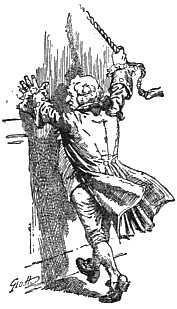
"HE DASHED TO THE BELL."
"I shall not leave this chamber till I choose," said Manasseh,
dropping stolidly into the nearest chair and folding his arms.
At once a cry of horror and consternation rose from every throat,
every man leapt threateningly to his feet, and Manasseh realised that
he was throned on the alcoved arm-chair!
But he neither blenched nor budged.
"Nay, keep your seats, gentlemen," he said quietly.
The President, turning at the stir, caught sight of the Schnorrer,
staggered and clutched at the mantel. The Councillors stood spellbound
for an instant, while the Chancellor's eyes roved wildly round the
walls, as if expecting the gold names to start from their panels. The
beadle rushed in, terrified by the strenuous tintinnabulation, looked
instinctively towards the throne for orders, then underwent
petrifaction on the threshold, and stared speechless at Manasseh, what
time the President, gasping like a landed cod, vainly strove to utter
the order for the beggar's expulsion.
"Don't stare at me, Gomez," Manasseh cried imperiously. "Can't you see
the President wants a glass of water?"
The beadle darted a glance at the President, and, perceiving his
condition, rushed out again to get the water.
This was the last straw. To see his authority usurped as well as his
seat maddened the poor President. For some seconds he strove to mouth
an oath, embracing his supine Councillors as well as this beggar on
horseback, but he produced only an inarticulate raucous cry, and
reeled sideways. Manasseh sprang from his chair and caught the falling
form in his arms. For one terrible moment he stood supporting it in a
tense silence, broken only by the incoherent murmurs of the
unconscious lips; then crying angrily, "Bestir yourselves, gentlemen,
don't you see the President is ill?" he dragged his burden towards the
table, and, aided by the panic-stricken Councillors, laid it flat
thereupon, and threw open the ruffled shirt. He swept the Minute Book
to the floor with an almost malicious movement, to make room for the
President.
The beadle returned with the glass of water, which he well-nigh
dropped.
"Run for a physician," Manasseh commanded, and throwing away the water
carelessly, in the Chancellor's direction, he asked if anyone had any
brandy. There was no response.
"Come, come, Mr. Chancellor," he said, "bring out your phial." And the
abashed functionary obeyed.
"Has any of you his equipage without?" Manasseh demanded next of the
Mahamad.
They had not, so Manasseh despatched the Chief of the Elders in quest
of a sedan chair. Then there was nothing left but to await the
physician.
"You see, gentlemen, how insecure is earthly power," said the
Schnorrer solemnly, while the President breathed stertorously, deaf
to his impressive moralising. "It is swallowed up in an instant, as
Lisbon was engulfed. Cursed are they who despise the poor. How is the
saying of our sages verified—'The house that opens not to the poor
opens to the physician.'" His eyes shone with unearthly radiance in
the gathering gloom.
The cowed assembly wavered before his words, like reeds before the
wind, or conscience-stricken kings before fearless prophets.
When the physician came he pronounced that the President had had a
slight stroke of apoplexy, involving a temporary paralysis of the
right foot. The patient, by this time restored to consciousness, was
conveyed home in the sedan chair, and the Mahamad dissolved in
confusion. Manasseh was the last to leave the Council Chamber. As he
stalked into the corridor he turned the key in the door behind him
with a vindictive twist. Then, plunging his hand into his
breeches-pocket, he gave the beadle a crown, remarking genially, "You
must have your usual perquisite, I suppose."
The beadle was moved to his depths. He had a burst of irresistible
honesty. "The President gives me only half-a-crown," he murmured.
"Yes, but he may not be able to attend the next meeting," said
Manasseh. "And I may be away, too."
SHOWING HOW THE KING ENRICHED THE SYNAGOGUE.
The Synagogue of the Gates of Heaven was crowded—members, orphan
boys, Schnorrers, all were met in celebration of the Sabbath. But
the President of the Mahamad was missing. He was still inconvenienced
by the effects of his stroke, and deemed it most prudent to pray at
home. The Council of Five had not met since Manasseh had dissolved it,
and so the matter of his daughter's marriage was left hanging, as
indeed was not seldom the posture of matters discussed by Sephardic
bodies. The authorities thus passive, Manasseh found scant difficulty
in imposing his will upon the minor officers, less ready than himself
with constitutional precedent. His daughter was to be married under
the Sephardic canopy, and no jot of synagogual honour was to be bated
the bridegroom. On this Sabbath—the last before the wedding—Yankelé
was to be called to the Reading of the Law like a true-born
Portuguese. He made his first appearance in the Synagogue of his
bride's fathers with a feeling of solemn respect, not exactly due to
Manasseh's grandiose references to the ancient temple. He had walked
the courtyard with levity, half prepared, from previous experience of
his intended father-in-law, to find the glories insubstantial. Their
unexpected actuality awed him, and he was glad he was dressed in his
best. His beaver hat, green trousers, and brown coat equalled him with
the massive pillars, the gleaming candelabra, and the stately roof. Da
Costa, for his part, had made no change in his attire; he dignified
his shabby vestments, stuffing them with royal manhood, and wearing
his snuff-coloured over-garment like a purple robe. There was, in
sooth, an official air about his habiliment, and to the worshippers it
was as impressively familiar as the black stole and white bands of the
Cantor. It seemed only natural that he should be called to the Reading
first, quite apart from the fact that he was a Cohen, of the family
of Aaron, the High Priest, a descent that, perhaps, lent something to
the loftiness of his carriage.
When the Minister intoned vigorously, "The good name, Manasseh, the
son of Judah, the Priest, the man, shall arise to read in the Law,"
every eye was turned with a new interest on the prospective
father-in-law. Manasseh arose composedly, and, hitching his sliding
prayer-shawl over his left shoulder, stalked to the reading platform,
where he chanted the blessings with imposing flourishes, and stood at
the Minister's right hand while his section of the Law was read from
the sacred scroll. There was many a man of figure in the congregation,
but none who became the platform better. It was beautiful to see him
pay his respects to the scroll; it reminded one of the meeting of two
sovereigns. The great moment, however, was when, the section being
concluded, the Master Reader announced Manasseh's donations to the
Synagogue. The financial statement was incorporated in a long
Benediction, like a coin wrapped up in folds of paper. This was always
a great moment, even when inconsiderable personalities were concerned,
each man's generosity being the subject of speculation before and
comment after. Manasseh, it was felt, would, although a mere
Schnorrer, rise to the height of the occasion, and offer as much as
seven and sixpence. The shrewder sort suspected he would split it up
into two or three separate offerings, to give an air of inexhaustible
largess.
The shrewder sort were right and wrong, as is their habit.
The Master Reader began his quaint formula, "May He who blessed our
Fathers," pausing at the point where the Hebrew is blank for the
amount. He span out the prefatory "Who vows"—the last note prolonging
itself, like the vibration of a tuning-fork, at a literal pitch of
suspense. It was a sensational halt, due to his forgetting the amounts
or demanding corroboration at the eleventh hour, and the stingy often
recklessly amended their contributions, panic-struck under the
pressure of imminent publicity.
"Who vows—" The congregation hung upon his lips. With his usual
gesture of interrogation, he inclined his ear towards Manasseh's
mouth, his face wearing an unusual look of perplexity; and those
nearest the platform were aware of a little colloquy between the
Schnorrer and the Master Reader, the latter bewildered and agitated,
the former stately. The delay had discomposed the Master as much as it
had whetted the curiosity of the congregation. He repeated:
"Who vows—cinco livras"—he went on glibly without a pause—"for
charity—for the life of Yankov ben Yitzchok, his son-in-law, &c.,
&c." But few of the worshippers heard any more than the cinco livras
(five pounds). A thrill ran through the building. Men pricked up their
ears, incredulous, whispering one another. One man deliberately moved
from his place towards the box in which sat the Chief of the Elders,
the presiding dignitary in the absence of the President of the
Mahamad.
"I didn't catch—how much was that?" he asked.
"'I DIDN'T CATCH.'"
"Five pounds," said the Chief of the Elders shortly. He suspected an
irreverent irony in the Beggar's contribution.
The Benediction came to an end, but ere the hearers had time to
realise the fact, the Master Reader had started on another. "May He
who blessed our fathers!" he began, in the strange traditional
recitative. The wave of curiosity mounted again, higher than before.
"Who vows—"
The wave hung an instant, poised and motionless.
"Cinco livras!"
The wave broke in a low murmur, amid which the Master imperturbably
proceeded, "For oil—for the life of his daughter Deborah, &c." When
he reached the end there was a poignant silence.
Was it to be da capo again?
"May He who blessed our fathers!"
The wave of curiosity surged once more, rising and subsiding with this
ebb and flow of financial Benediction.
"Who vows—cinco livras—for the wax candles."
This time the thrill, the whisper, the flutter, swelled into a
positive buzz. The gaze of the entire congregation was focussed upon
the Beggar, who stood impassive in the blaze of glory. Even the orphan
boys, packed in their pew, paused in their inattention to the Service,
and craned their necks towards the platform. The veriest magnates did
not thus play piety with five pound points. In the ladies' gallery the
excitement was intense. The occupants gazed eagerly through the
grille. One woman—a buxom dame of forty summers, richly clad and
jewelled—had risen, and was tiptoeing frantically over the woodwork,
her feather waving like a signal of distress. It was Manasseh's wife.
The waste of money maddened her, each donation hit her like a poisoned
arrow; in vain she strove to catch her spouse's eye. The air seemed
full of gowns and toques and farthingales flaming away under her very
nose, without her being able to move hand or foot in rescue; whole
wardrobes perished at each Benediction. It was with the utmost
difficulty she restrained herself from shouting down to her prodigal
lord. At her side the radiant Deborah vainly tried to pacify her by
assurances that Manasseh never intended to pay up.
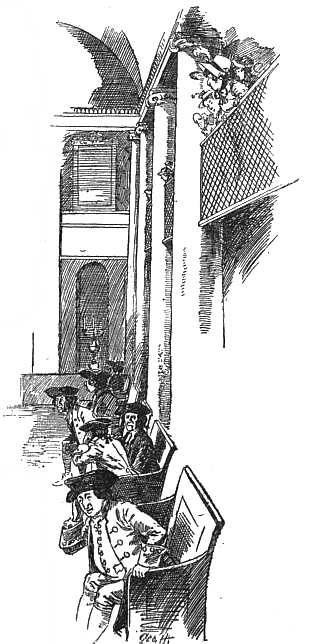
"SHE STROVE TO CATCH HER SPOUSE'S EYE."
"Who vows—" The Benediction had begun for a fourth time.
"Cinco livras for the Holy Land." And the sensation grew. "For the
life of this holy congregation, &c."
The Master Reader's voice droned on impassively, interminably.
The fourth Benediction was drawing to its close, when the beadle was
seen to mount the platform and whisper in his ear. Only Manasseh
overheard the message.
"The Chief of the Elders says you must stop. This is mere mockery. The
man is a Schnorrer, an impudent beggar."
The beadle descended the steps, and after a moment of inaudible
discussion with da Costa, the Master Reader lifted up his voice
afresh.
The Chief of the Elders frowned and clenched his praying-shawl
angrily. It was a fifth Benediction! But the Reader's sing-song went
on, for Manasseh's wrath was nearer than the magnate's.
"Who vows—cinco livras—for the Captives—for the life of the Chief
of the Elders!"
The Chief bit his lip furiously at this delicate revenge; galled
almost to frenzy by the aggravating foreboding that the congregation
would construe his message as a solicitation of the polite attention.
For it was of the amenities of the Synagogue for rich people to
present these Benedictions to one another. And so the endless stream
of donatives flowed on, provoking the hearers to fever pitch. The very
orphan boys forgot that this prolongation of the service was retarding
their breakfasts indefinitely. Every warden, dignitary and official,
from the President of the Mahamad down to the very Keeper of the Bath,
was honoured by name in a special Benediction, the chief of Manasseh's
weekly patrons were repaid almost in kind on this unique and festive
occasion. Most of the congregation kept count of the sum total, which
was mounting, mounting....
Suddenly there was a confusion in the ladies' gallery, cries, a babble
of tongues. The beadle hastened upstairs to impose his authority. The
rumour circulated that Mrs. da Costa had fainted and been carried out.
It reached Manasseh's ears, but he did not move. He stood at his post,
unfaltering, donating, blessing.
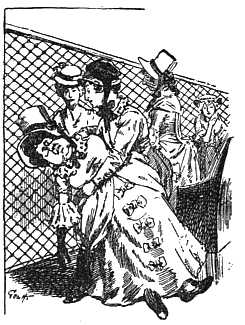
"MRS. DA COSTA HAD FAINTED."
"Who vows—cinco livras—for the life of his wife, Sarah!" And a
faint sardonic smile flitted across the Beggar's face.
The oldest worshipper wondered if the record would be broken.
Manasseh's benefactions were approaching thrillingly near the highest
total hitherto reached by any one man upon any one occasion. Every
brain was troubled by surmises. The Chief of the Elders, fuming
impotently, was not alone in apprehending a blasphemous mockery; but
the bulk imagined that the Schnorrer had come into property or had
always been a man of substance, and was now taking this means of
restoring to the Synagogue the funds he had drawn from it. And the
fountain of Benevolence played on.
The record figure was reached and left in the rear. When at length the
poor Master Reader, sick unto death of the oft-repeated formula (which
might just as well have covered all the contributions the first time,
though Manasseh had commanded each new Benediction as if by an
after-thought), was allowed to summon the Levite who succeeded
Manasseh, the Synagogue had been enriched by a hundred pounds. The
last Benediction had been coupled with the name of the poorest
Schnorrer present—an assertion and glorification of Manasseh's own
order that put the coping-stone on this sensational memorial of the
Royal Wedding. It was, indeed, a kingly munificence, a sovereign
graciousness. Nay, before the Service was over, Manasseh even begged
the Chief of the Elders to permit a special Rogation to be said for
a sick person. The Chief, meanly snatching at this opportunity of
reprisals, refused, till, learning that Manasseh alluded to the ailing
President of the Mahamad, he collapsed ingloriously.
But the real hero of the day was Yankelé, who shone chiefly by
reflected light, but yet shone even more brilliantly than the
Spaniard, for to him was added the double lustre of the bridegroom and
the stranger, and he was the cause and centre of the sensation.
His eyes twinkled continuously throughout.
The next day, Manasseh fared forth to collect the hundred pounds!
The day being Sunday, he looked to find most of his clients at home.
He took Grobstock first as being nearest, but the worthy speculator
and East India Director espied him from an upper window, and escaped
by a back-door into Goodman's Fields—a prudent measure, seeing that
the incredulous Manasseh ransacked the house in quest of him.
Manasseh's manner was always a search-warrant.
The King consoled himself by paying his next visit to a personage who
could not possibly evade him—none other than the sick President of
the Mahamad. He lived in Devonshire Square, in solitary splendour. Him
Manasseh bearded in his library, where the convalescent was sorting
his collection of prints. The visitor had had himself announced as a
gentleman on synagogual matters, and the public-spirited President had
not refused himself to the business. But when he caught sight of
Manasseh, his puffy features were distorted, he breathed painfully,
and put his hand to his hip.
"SORTING HIS COLLECTION OF PRINTS."
"You!" he gasped.
"Have a care, my dear sir! Have a care!" said Manasseh anxiously, as
he seated himself. "You are still weak. To come to the point—for I
would not care to distract too much a man indispensable to the
community, who has already felt the hand of the Almighty for his
treatment of the poor—"
He saw that his words were having effect, for these prosperous pillars
of the Synagogue were mightily superstitious under affliction, and he
proceeded in gentler tones. "To come to the point, it is my duty to
inform you (for I am the only man who is certain of it) that while you
have been away our Synagogue has made a bad debt!"
"A bad debt!" An angry light leapt into the President's eyes. There
had been an ancient practice of lending out the funds to members, and
the President had always set his face against the survival of the
policy. "It would not have been made had I been there!" he cried.
"No, indeed," admitted Manasseh. "You would have stopped it in its
early stages. The Chief of the Elders tried, but failed."
"The dolt!" cried the President. "A man without a backbone. How much
is it?"
"A hundred pounds!"
"A hundred pounds!" echoed the President, seriously concerned at this
blot upon his year of office. "And who is the debtor?"
"I am."
"You! You have borrowed a hundred pounds, you—you jackanapes!"
"Silence, sir! How dare you? I should leave this apartment at once,
were it not that I cannot go without your apology. Never in my life
have I borrowed a hundred pounds—nay, never have I borrowed one
farthing. I am no borrower. If you are a gentleman, you will
apologise!"
"I am sorry if I misunderstood," murmured the poor President, "but
how, then, do you owe the money?"
"How, then?" repeated Manasseh impatiently. "Cannot you understand
that I have donated it to the Synagogue?"
The President stared at him open-mouthed.
"I vowed it yesterday in celebration of my daughter's marriage."
The President let a sigh of relief pass through his open mouth. He was
even amused a little.
"Oh, is that all? It was like your deuced effrontery; but still, the
Synagogue doesn't lose anything. There's no harm done."
"What is that you say?" enquired Manasseh sternly. "Do you mean to say
I am not to pay this money?"
"How can you?"
"How can I? I come to you and others like you to pay it for me."
"Nonsense! Nonsense!" said the President, beginning to lose his temper
again. "We'll let it pass. There's no harm done."
"And this is the President of the Mahamad!" soliloquised the
Schnorrer in bitter astonishment. "This is the chief of our ancient,
godly Council! What, sir! Do you hold words spoken solemnly in
Synagogue of no account? Would you have me break my solemn vow? Do you
wish to bring the Synagogue institutions into contempt? Do you—a man
already once stricken by Heaven—invite its chastisement again?"
The President had grown pale—his brain was reeling.
"Nay, ask its forgiveness, sir," went on the King implacably; "and
make good this debt of mine in token of your remorse, as it is
written, 'And repentance, and prayer, and charity avert the evil
decree.'"
"Not a penny!" cried the President, with a last gleam of lucidity, and
strode furiously towards the bell-pull. Then he stood still in sudden
recollection of a similar scene in the Council Chamber.
"You need not trouble to ring for a stroke," said Manasseh grimly.
"Then the Synagogue is to be profaned, then even the Benediction which
I in all loyalty and forgiveness caused to be said for the recovery of
the President of the Mahamad is to be null, a mockery in the sight of
the Holy One, blessed be He!"
The President tottered into his reading-chair.
"How much did you vow on my behalf?"
"Five pounds."
The President precipitately drew out a pocket-book and extracted a
crisp Bank of England note.
"Give it to the Chancellor," he breathed, exhausted.
"I am punished," quoth Manasseh plaintively as he placed it in his
bosom. "I should have vowed ten for you." And he bowed himself out.
In like manner did he collect other contributions that day from
Sephardic celebrities, pointing out that now a foreign Jew—Yankelé to
wit—had been admitted to their communion, it behoved them to show
themselves at their best. What a bad effect it would have on Yankelé
if a Sephardi was seen to vow with impunity! First impressions were
everything, and they could not be too careful. It would not do for
Yankelé to circulate contumelious reports of them among his kin. Those
who remonstrated with him over his extravagance he reminded that he
had only one daughter, and he drew their attention to the favourable
influence his example had had on the Saturday receipts. Not a man of
those who came after him in the Reading had ventured to offer
half-crowns. He had fixed the standard in gold for that day at least,
and who knew what noble emulation he had fired for the future?
Every man who yielded to Manasseh's eloquence was a step to reach the
next, for Manasseh made a list of donors, and paraded it reproachfully
before those who had yet to give. Withal, the most obstinate
resistance met him in some quarters. One man—a certain Rodriques,
inhabiting a mansion in Finsbury Circus—was positively rude.
"If I came in a carriage, you'd soon pull out your ten-pound note for
the Synagogue," sneered Manasseh, his blood boiling.
"Certainly I would," admitted Rodriques laughing. And Manasseh shook
off the dust of his threshold in disdain.
By reason of such rebuffs, his collection for the day only reached
about thirty pounds, inclusive of the value of some depreciated
Portuguese bonds which he good-naturedly accepted as though at par.
Disgusted with the meanness of mankind, da Costa's genius devised more
drastic measures. Having carefully locked up the proceeds of Sunday's
operations, and, indeed, nearly all his loose cash, in his safe, for,
to avoid being put to expense, he rarely carried money on his person,
unless he gathered it en route, he took his way to Bishopsgate
Within, to catch the stage for Clapton. The day was bright, and he
hummed a festive Synagogue tune as he plodded leisurely with his stick
along the bustling, narrow pavements, bordered by costers' barrows at
one edge, and by jagged houses, overhung by grotesque signboards, at
the other, and thronged by cits in worsted hose.
But when he arrived at the inn he found the coach had started. Nothing
concerned, he ordered a post-chaise in a supercilious manner,
criticising the horses, and drove to Clapton in style, drawn by a pair
of spanking steeds, to the music of the postillion's horn. Very soon
they drew out of the blocked roads, with their lumbering procession of
carts, coaches, and chairs, and into open country, green with the
fresh verdure of the spring. The chaise stopped at "The Red Cottage,"
a pretty villa, whose façade was covered with Virginian creeper that
blushed in the autumn. Manasseh was surprised at the taste with which
the lawn was laid out in the Italian style, with grottoes and marble
figures. The householder, hearing the windings of the horn, conceived
himself visited by a person of quality, and sent a message that he was
in the hands of his hairdresser, but would be down in less than half
an hour. This was of a piece with Manasseh's information concerning
the man—a certain Belasco, emulous of the great fops, an amateur of
satin waistcoats and novel shoestrings, and even said to affect a
spying-glass when he showed at Vauxhall. Manasseh had never seen him,
not having troubled to go so far afield, but from the handsome
appurtenances of the hall and the staircase he augured the best. The
apartments were even more to his liking; they were oak panelled, and
crammed with the most expensive objects of art and luxury. The walls
of the drawing-room were frescoed, and from the ceiling depended a
brilliant lustre, with seven spouts for illumination.
Having sufficiently examined the furniture, Manasseh grew weary of
waiting, and betook himself to Belasco's bedchamber.
"You will excuse me, Mr. Belasco," he said, as he entered through the
half open door, "but my business is urgent."
The young dandy, who was seated before a mirror, did not look up, but
replied, "Have a care, sir, you well nigh startled my hairdresser."
"Far be it from me to willingly discompose an artist," replied
Manasseh drily, "though from the elegance of the design, I venture to
think my interruption will not make a hair's-breadth of difference.
But I come on a matter which the son of Benjamin Belasco will hardly
deny is more pressing than his toilette."
"Nay, nay, sir, what can be more momentous?"
"The Synagogue!" said Manasseh austerely.
"Pah! What are you talking of, sir?" and he looked up cautiously for
the first time at the picturesque figure. "What does the Synagogue
want of me? I pay my finta and every bill the rascals send me.
Monstrous fine sums, too, egad—"
"But you never go there!"
"No, indeed, a man of fashion cannot be everywhere. Routs and rigotti
play the deuce with one's time."
"What a pity!" mused Manasseh ironically. "One misses you there. 'Tis
no edifying spectacle—a slovenly rabble with none to set the standard
of taste."
The pale-faced beau's eyes lit up with a gleam of interest.
"Ah, the clods!" he said. "You should yourself be a buck of the
eccentric school by your dress. But I stick to the old tradition of
elegance."
"You had better stick to the old tradition of piety," quoth Manasseh.
"Your father was a saint, you are a sinner in Israel. Return to the
Synagogue, and herald your return by contributing to its finances. It
has made a bad debt, and I am collecting money to reimburse it."
The young exquisite yawned. "I know not who you may be," he said at
length, "but you are evidently not one of us. As for the Synagogue I
am willing to reform its dress, but dem'd if I will give a shilling
more to its finances. Let your slovenly rabble of tradesmen pay the
piper—I cannot afford it!"
"You cannot afford it!"
"No—you see I have such extravagant tastes."
"But I give you the opportunity for extravagance," expostulated
Manasseh. "What greater luxury is there than that of doing good?"
"Confound it, sir, I must ask you to go," said Beau Belasco coldly.
"Do you not perceive that you are disconcerting my hairdresser?"
"I could not abide a moment longer under this profane, if tasteful,
roof," said Manasseh, backing sternly towards the door. "But I would
make one last appeal to you, for the sake of the repose of your
father's soul, to forsake your evil ways."
"Be hanged to you for a meddler," retorted the young blood. "My money
supports men of genius and taste—it shall not be frittered away on a
pack of fusty shopkeepers."
The Schnorrer drew himself up to his full height, his eyes darted
fire. "Farewell, then!" he hissed in terrible tones. "You will make
the third at Grace!"
"'FAREWELL!' HE HISSED."
He vanished—the dandy started up full of vague alarm, forgetting
even his hair in the mysterious menace of that terrifying sibilation.
"What do you mean?" he cried.
"I mean," said Manasseh, reappearing at the door, "that since the
world was created, only two men have taken their clothes with them to
the world to come. One was Korah, who was swallowed down, the other
was Elijah, who was borne aloft. It is patent in which direction the
third will go."
The sleeping chord of superstition vibrated under Manasseh's dexterous
touch.
"Rejoice, O young man, in your strength," went on the Beggar, "but a
day will come when only the corpse-watchers will perform your
toilette. In plain white they will dress you, and the devil shall
never know what a dandy you were."
"But who are you, that I should give you money for the Synagogue?"
asked the Beau sullenly. "Where are your credentials?"
"Was it to insult me that you called me back? Do I look a knave? Nay,
put up your purse. I'll have none of your filthy gold. Let me go."
Gradually Manasseh was won round to accepting ten sovereigns.
"For your father's sake," he said, pocketing them. "The only thing I
will take for your sake is the cost of my conveyance. I had to post
hither, and the Synagogue must not be the loser."
Beau Belasco gladly added the extra money, and reseated himself before
the mirror, with agreeable sensations in his neglected conscience.
"You see," he observed, half apologetically, for Manasseh still
lingered, "one cannot do everything. To be a prince of dandies, one
needs all one's time." He waved his hand comprehensively around the
walls which were lined with wardrobes. "My buckskin breeches were the
result of nine separate measurings. Do you note how they fit?"
"They scarcely do justice to your eminent reputation," replied
Manasseh candidly.
Beau Belasco's face became whiter than even at the thought of
earthquakes and devils. "They fit me to bursting!" he breathed.
"But are they in the pink of fashion?" queried Manasseh. "And
assuredly the nankeen pantaloons yonder I recollect to have seen worn
last year."
"My tailor said they were of a special cut—'tis a shape I am
introducing, baggy—to go with frilled shirts."
Manasseh shook his head sceptically, whereupon the Beau besought him
to go through his wardrobe, and set aside anything that lacked
originality or extreme fashionableness. After considerable reluctance
Manasseh consented, and set aside a few cravats, shirts, periwigs, and
suits from the immense collection.
"Aha! That is all you can find," said the Beau gleefully.
"Yes, that is all," said Manasseh sadly. "All I can find that does any
justice to your fame. These speak the man of polish and invention; the
rest are but tawdry frippery. Anybody might wear them."
"Anybody!" gasped the poor Beau, stricken to the soul.
"Yes, I might wear them myself."
"Thank you! Thank you! You are an honest man. I love true criticism,
when the critic has nothing to gain. I am delighted you called. These
rags shall go to my valet."
"Nay, why waste them on the heathen?" asked Manasseh, struck with a
sudden thought. "Let me dispose of them for the benefit of the
Synagogue."
"If it would not be troubling you too much!"
"Is there anything I would not do for Heaven?" said Manasseh with a
patronising air. He threw open the door of the adjoining piece
suddenly, disclosing the scowling valet on his knees. "Take these
down, my man," he said quietly, and the valet was only too glad to
hide his confusion at being caught eavesdropping by hastening down to
the drive with an armful of satin waistcoats.
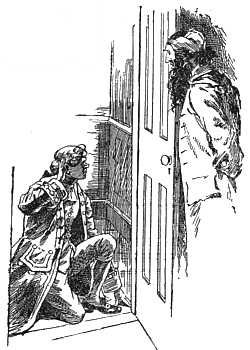
"THE SCOWLING VALET ON HIS KNEES."
Manasseh, getting together the remainder, shook his head despairingly.
"I shall never get these into the post-chaise," he said. "You will
have to lend me your carriage."
"Can't you come back for them?" said the Beau feebly.
"Why waste the Synagogue's money on hired vehicles? No, if you will
crown your kindness by sending the footman along with me to help me
unpack them, you shall have your equipage back in an hour or two."
So the carriage and pair were brought out, and Manasseh, pressing into
his service the coachman, the valet, and the footman, superintended
the packing of the bulk of Beau Belasco's wardrobe into the two
vehicles. Then he took his seat in the carriage, the coachman and the
gorgeous powdered footman got into their places, and with a joyous
fanfaronade on the horn, the procession set off, Manasseh bowing
graciously to the master of "The Red House," who was waving his
beruffled hand from a window embowered in greenery. After a pleasant
drive, the vehicles halted at the house, guarded by stone lions, in
which dwelt Nathaniel Furtado, the wealthy private dealer, who
willingly gave fifteen pounds for the buck's belaced and embroidered
vestments, besides being inveigled into a donation of a guinea towards
the Synagogue's bad debt. Manasseh thereupon dismissed the chaise with
a handsome gratuity, and drove in state in the now-empty carriage,
attended by the powdered footman, to Finsbury Circus, to the mansion
of Rodriques. "I have come for my ten pounds," he said, and reminded
him of his promise (?). Rodriques laughed, and swore, and laughed
again, and swore that the carriage was hired, to be paid for out of
the ten pounds.
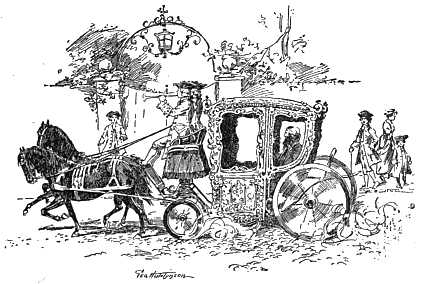
"DROVE IN STATE."
"Hired?" echoed Manasseh resentfully. "Do you not recognise the arms
of my friend, Beau Belasco?" And he presently drove off with the note,
for Rodriques had a roguish eye. And then, parting with the chariot,
the King took his way on foot to Fenchurch Street, to the house of his
cousin Barzillai, the ex-planter of Barbadoes, and now a West Indian
merchant.
Barzillai, fearing humiliation before his clerks, always carried his
relative off to the neighbouring Franco's Head Tavern, and humoured
him with costly liquors.
"But you had no right to donate money you did not possess; it was
dishonest," he cried with irrepressible ire.
"Hoity toity!" said Manasseh, setting down his glass so vehemently
that the stem shivered. "And were you not called to the Law after me?
And did you not donate money?"
"Certainly! But I had the money."
"What! With you?"
"No, no, certainly not. I do not carry money on the Sabbath."
"Exactly. Neither do I."
"But the money was at my bankers'."
"And so it was at mine. You are my bankers, you and others like you.
You draw on your bankers—I draw on mine." And his cousin being thus
confuted, Manasseh had not much further difficulty in wheedling two
pounds ten out of him.
"And now," said he, "I really think you ought to do something to
lessen the Synagogue's loss."
"But I have just given!" quoth Barzillai in bewilderment.
"That you gave to me as your cousin, to enable your relative to
discharge his obligations. I put it strictly on a personal footing.
But now I am pleading on behalf of the Synagogue, which stands to lose
heavily. You are a Sephardi as well as my cousin. It is a distinction
not unlike the one I have so often to explain to you. You owe me
charity, not only as a cousin, but as a Schnorrer likewise." And,
having wrested another guinea from the obfuscated merchant, he
repaired to Grobstock's business office in search of the defaulter.
But the wily Grobstock, forewarned by Manasseh's promise to visit him,
and further frightened by his Sunday morning call, had denied himself
to the Schnorrer or anyone remotely resembling him, and it was not
till the afternoon that Manasseh ran him to earth at Sampson's
coffee-house in Exchange Alley, where the brokers foregathered, and
'prentices and students swaggered in to abuse the Ministers, and all
kinds of men from bloods to barristers loitered to pick up hints to
easy riches. Manasseh detected his quarry in the furthermost box, his
face hidden behind a broadsheet.
"HIS FACE HIDDEN BEHIND A BROADSHEET."
"Why do you always come to me?" muttered the East India Director
helplessly.
"Eh?" said Manasseh, mistrustful of his own ears. "I beg your pardon."
"If your own community cannot support you," said Grobstock, more
loudly, and with all the boldness of an animal driven to bay, "why not
go to Abraham Goldsmid, or his brother Ben, or to Van Oven, or
Oppenheim—they're all more prosperous than I."
"Sir!" said Manasseh wrathfully. "You are a skilful—nay, a famous,
financier. You know what stocks to buy, what stocks to sell, when to
follow a rise, and when a fall. When the Premier advertises the loans,
a thousand speculators look to you for guidance. What would you say if
I presumed to interfere in your financial affairs—if I told you to
issue these shares or to call in those? You would tell me to mind my
own business; and you would be perfectly right. Now Schnorring is
my business. Trust me, I know best whom to come to. You stick to
stocks and leave Schnorring alone. You are the King of Financiers,
but I am the King of Schnorrers."
Grobstock's resentment at the rejoinder was mitigated by the
compliment to his financial insight. To be put on the same level with
the Beggar was indeed unexpected.
"Will you have a cup of coffee?" he said.
"I ought scarcely to drink with you after your reception of me,"
replied Manasseh unappeased. "It is not even as if I came to schnorr
for myself; it is to the finances of our house of worship that I
wished to give you an opportunity of contributing."
"Aha! your vaunted community hard up?" queried Joseph, with a
complacent twinkle.
"Sir! We are the richest congregation in the world. We want nothing
from anybody," indignantly protested Manasseh, as he absent-mindedly
took the cup of coffee which Grobstock had ordered for him. "The
difficulty merely is that, in honour of my daughter's wedding, I have
donated a hundred pounds to the Synagogue which I have not yet managed
to collect, although I have already devoted a day-and-a-half of my
valuable time to the purpose."
"But why do you come to me?"
"What! Do you ask me that again?"
"I—I—mean," stammered Grobstock—"why should I contribute to a
Portuguese Synagogue?"
Manasseh clucked his tongue in despair of such stupidity. "It is just
you who should contribute more than any Portuguese."
"I?" Grobstock wondered if he was awake.
"Yes, you. Was not the money spent in honour of the marriage of a
German Jew? It was a splendid vindication of your community."
"This is too much!" cried Grobstock, outraged and choking.
"Too much to mark the admission to our fold of the first of your sect!
I am disappointed in you, deeply disappointed. I thought you would
have applauded my generous behaviour."
"I don't care what you thought!" gasped Grobstock. He was genuinely
exasperated at the ridiculousness of the demand, but he was also
pleased to find himself preserving so staunch a front against the
insidious Schnorrer. If he could only keep firm now, he told
himself, he might emancipate himself for ever. Yes, he would be
strong, and Manasseh should never dare address him again. "I won't pay
a stiver," he roared.
"If you make a scene I will withdraw," said Manasseh quietly. "Already
there are ears and eyes turned upon you. From your language people
will be thinking me a dun and you a bankrupt."
"They can go to the devil!" thundered Grobstock, "and you too!"
"Blasphemer! You counsel me to ask the devil to contribute to the
Synagogue! I will not bandy words with you. You refuse, then, to
contribute to this fund?"
"I do, I see no reason."
"Not even the five pounds I vowed on behalf of Yankelé himself—one of
your own people?"
"What! I pay in honour of Yankelé—a dirty Schnorrer!"
"Is this the way you speak of your guests?" said Manasseh, in pained
astonishment. "Do you forget that Yankelé has broken bread at your
table? Perhaps this is how you talk of me when my back is turned. But,
beware! Remember the saying of our sages, 'You and I cannot live in
the world,' said God to the haughty man. Come, now! No more paltering
or taking refuge in abuse. You refuse me this beggarly five pounds?"
"Most decidedly."
"Very well, then!"
Manasseh called the attendant.
"What are you about to do?" cried Grobstock apprehensively.
"You shall see," said Manasseh resolutely, and when the attendant
came, he pressed the price of his cup of coffee into his hand.
Grobstock flushed in silent humiliation. Manasseh rose.
Grobstock's fatal strain of weakness gave him a twinge of compunction
at the eleventh hour.
"You see for yourself how unreasonable your request was," he murmured.
"Do not strive to justify yourself, I am done with you," said
Manasseh. "I am done with you as a philanthropist. For the future you
may besnuff and bespatter your coat as much as you please, for all the
trouble I shall ever take. As a financier, I still respect you, and
may yet come to you, but as a philanthropist, never."
"Anything I can do—" muttered Grobstock vaguely.
"Let me see!" said Manasseh, looking down upon him thoughtfully. "Ah,
yes, an idea! I have collected over sixty pounds. If you would invest
this for me—"
"Certainly, certainly," interrupted Grobstock, with conciliatory
eagerness.
"Good! With your unrivalled knowledge of the markets, you could easily
bring it up to the necessary sum in a day or two. Perhaps even there
is some grand coup on the tapis, something to be bulled or beared
in which you have a hand."
Grobstock nodded his head vaguely. He had already remembered that the
proceeding was considerably below his dignity; he was not a
stockbroker, never had he done anything of the kind for anyone.
"But suppose I lose it all?" he asked, trying to draw back.
"Impossible," said the Schnorrer serenely. "Do you forget it is a
Synagogue fund? Do you think the Almighty will suffer His money to be
lost?"
"Then why not speculate yourself?" said Grobstock craftily.
"The Almighty's honour must be guarded. What! Shall He be less well
served than an earthly monarch? Do you think I do not know your
financial relations with the Court? The service of the Almighty
demands the best men. I was the best man to collect the money—you are
the best to invest it. To-morrow morning it shall be in your hands."
"No, don't trouble," said Grobstock feebly. "I don't need the actual
money to deal with."
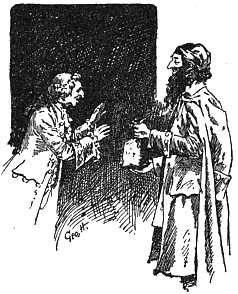
"STRUCK THE CHANCELLOR BREATHLESS."
"I thank you for your trust in me," replied Manasseh with emotion.
"Now you speak like yourself again. I withdraw what I said to you. I
will come to you again—to the philanthropist no less than
financier. And—and I am sorry I paid for my coffee." His voice
quivered.
Grobstock was touched. He took out a sixpence and repaid his guest
with interest. Manasseh slipped the coin into his pocket, and shortly
afterwards, with some final admonitions to his stock-jobber, took his
leave.
Being in for the job, Grobstock resolved to make the best of it. His
latent vanity impelled him to astonish the Beggar. It happened that he
was on the point of a magnificent manœuvre, and alongside his own
triton Manasseh's minnow might just as well swim. He made the sixty
odd pounds into six hundred.
A few days after the Royal Wedding, the glories of which are still a
tradition among the degenerate Schnorrers of to-day, Manasseh struck
the Chancellor breathless by handing him a bag containing five score
of sovereigns. Thus did he honourably fulfil his obligation to the
Synagogue, and with more celerity than many a Warden. Nay, more!
Justly considering the results of the speculation should accrue to the
Synagogue, whose money had been risked, he, with Quixotic
scrupulousness, handed over the balance of five hundred pounds to the
Mahamad, stipulating only that it should be used to purchase a
life-annuity (styled the Da Costa Fund) for a poor and deserving
member of the congregation, in whose selection he, as donor, should
have the ruling voice. The Council of Five eagerly agreed to his
conditions, and a special junta was summoned for the election. The
donor's choice fell upon Manasseh Bueno Barzillai Azevedo da Costa,
thenceforward universally recognised, and hereby handed down to
tradition, as the King of Schnorrers.