THE KILIMA-NJARO EXPEDITION. A RECORD OF SCIENTIFIC EXPLORATION IN EASTERN EQUATORIAL AFRICA. AND A GENERAL DESCRIPTION OF THE NATURAL HISTORY, LANGUAGES, AND COMMERCE OF THE KILIMA-NJARO DISTRICT.
Transcriber’s Note:
New original cover art included with this eBook is granted to the public domain.
Photo aquatinte Boussod Valadon & Co.
BY
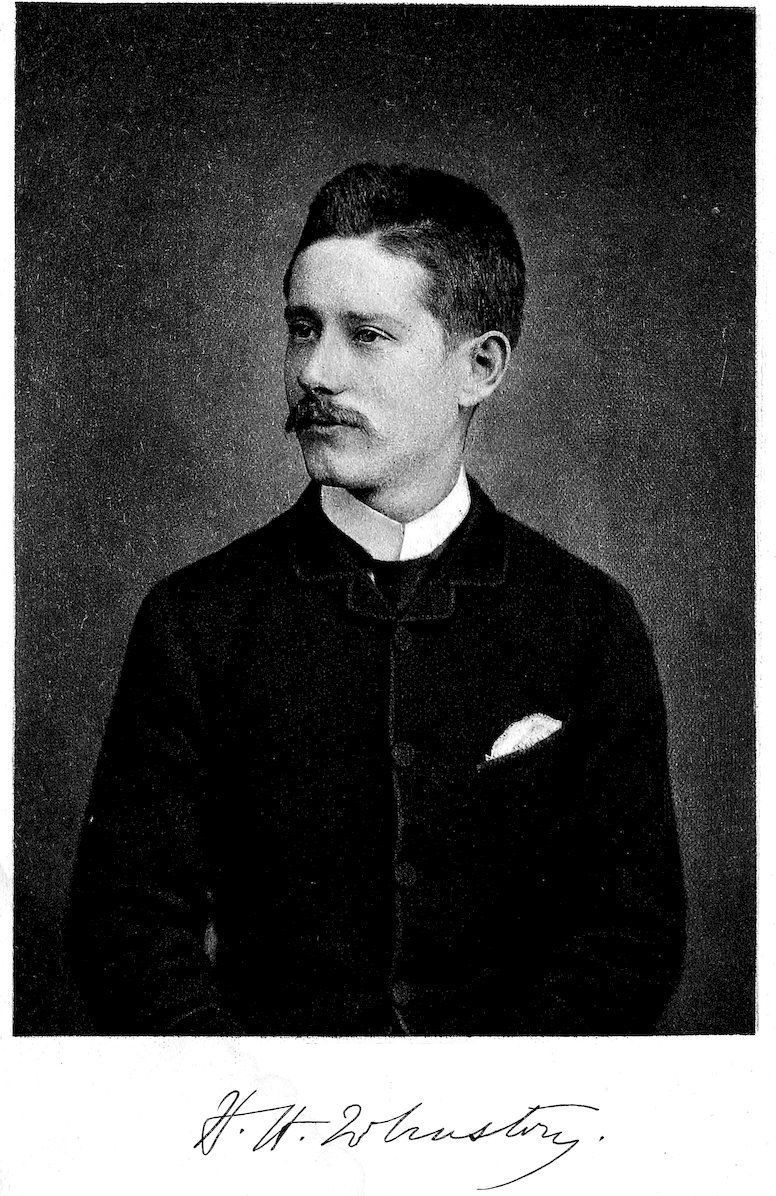
H. H. JOHNSTON, F.Z.S., F.R.G.S.
MEMB. ANTHROP. INSTITUTE, ETC.; LEADER OF THE EXPEDITION, AUTHOR OF “THE RIVER CONGO FROM ITS MOUTH TO BÓLÓBÓ.”
WITH SIX MAPS AND OVER EIGHTY ILLUSTRATIONS BY THE AUTHOR.
LONDON
KEGAN PAUL, TRENCH, AND CO., 1, PATERNOSTER SQUARE.
1886.
LONDON:
PRINTED BY GILBERT AND RIVINGTON, LIMITED
ST. JOHN'S SQUARE.
[The rights of translation and of reproduction are reserved.]
iiiTO
SIR JOHN KIRK, K.C.M.G., M.D., ETC.,
TRAVELLER, BOTANIST, DIPLOMATIST, AND GUARDIAN OF BRITISH INTERESTS AT ZANZIBAR,
THIS BOOK IS AFFECTIONATELY DEDICATED
BY THE AUTHOR.
v
Hail to thee, monarch of African mountains!
Remote, inaccessible, silent, and lone—
Who from the heart of the tropical fervours
Liftest to heaven thine alien snows.
· · · · ·
I see thee supreme in the midst of thy co-mates.
Standing alone, ’twixt the earth and the heavens,
Heir of the Sunset and Herald of Morn,
Zone above zone, to thy snow-crested summits
The climates of Earth are displayed, as an index,
Giving the scope of the Book of Creation.
There, in the gorges that widen, descending
From cloud and from cold into summer eternal,
Gather the threads of the ice-gendered fountains—
Gather to riotous torrents of crystal,
And, giving each shelvy recess where they dally,
The blooms of the North and its evergreen turfage,
Leap to the land of the lion and lotus!
· · · · ·
Sovereign mountain, thy brothers give welcome:
Mont Blanc, in the roar of his mad avalanches,
Hails thy accession; superb Orizaba,
Belted with beech and ensandalled with palm;
Chimborazo, the lord of the regions of noonday;—
Mingle their sounds in magnificent chorus.
They, the baptized and the crownèd of ages,
Watch-towers of continents, altars of Earth,
Welcome thee now to their mighty assembly.
· · · · ·
None has a claim to the honours of story,
Or the superior splendours of song,
Greater than thou, in thy mystery mantled—
Thou the sole monarch of African mountains.
Take, then, a name, and be filled with existence,
Yea, be exultant in sovereign glory,
While from the hand of the wandering poet
Drops the first garland of song at thy feet.
· · · · ·
“Kilima-njaro,” a poem by Bayard Taylor, circa 1855.
PREFACE.
vii
As the Kilima-njaro Expedition was initiated and
supported by two of the most important among our
British Scientific Societies, it may perhaps seem excusable
that I, who was its appointed leader, should
venture to lay the general results of this enterprise
before the public.
I do so only in the sincere desire to contribute,
however feebly, to the mounting sum of our knowledge
of Africa—that continent, which I look upon as
the New World of the nineteenth century.
I cannot conclude these few prefatory lines without
most heartily thanking every friend or chance acquaintance
who by word or deed facilitated my task.
It is pleasant to look back upon this expedition as
having been provocative of nothing but kindness.
While the names of certain of my benefactors are
mentioned elsewhere in the pages of this work in
juxtaposition with their good deeds, I think this the
most fitting place in which to record my special sense
of obligation to Philip Lutley Sclater, Esq., Ph. D.,
Sec. Zoological Society; Edward L. Lawson, Esq.;
Edwin Arnold, Esq., C.S.I.; Carmichael Thomas, Esq.;
viiiand, with all his faults, Mandara, Chief of Moši;
who, though he once threatened to cut off my head,
nevertheless in his brighter moods supplied me with
much valuable information.
H. H. JOHNSTON.
London, November, 1885.
NOTE TO THE READER.
ix
In the orthography of most African words and proper
names in this book, especially in those which are
written for the first time, I have followed what seems
to me the simplest and most satisfactory phonetic
system—that of Dr. Lepsius’ standard alphabet.
As this may be new to some of my readers, I may
mention here that the vowels are generally pronounced
as in Italian, viz.:—
a = ah; e = eh; i = ee; o = oh; ô = aw; u = oo.
In diphthongs, the sound of each vowel may be
distinctly heard, as ai = ah-ee; ou = oh-oo.
Those consonants which differ in look from the
Roman character, are—
Č, pron. ch; ǰ, pron. as an English j; ṅ, pron. ng’; š, pron. sh;
and others, which are of less frequent occurrence, are explained fully
in Chapter XX.
As frequently recurring examples of this orthography,
I may instance,—
“Čaga”
—pronounced
“Chaga;”
“Moši”
„
“Moshy;” and
“ǰipé”
„
“Jeepay.”
I have only diverged from this system where the
xproper names from long use have accustomed us to
other spelling. Thus I write “Galla,” although properly
it should be “Gala,” and I have even avoided
disfiguring the “j” of “Kilima-njaro” with a v;
although I fear the result of this lenity will be that
half my readers will pronounce it wrongly. To avoid
this I may, perhaps, for the benefit of the timid who
always shirk African names, write its exact pronunciation
in our clumsy English orthography.
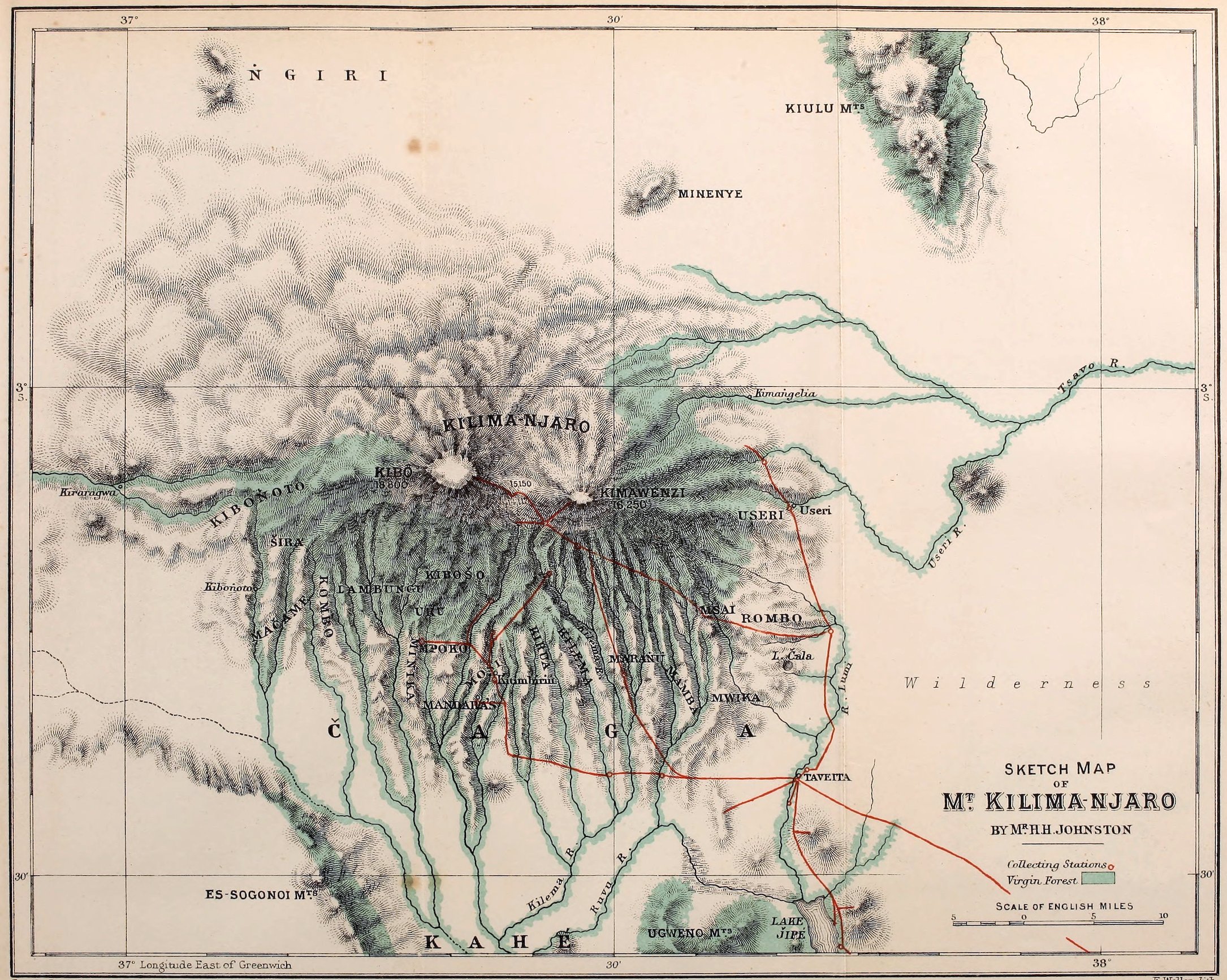
[Click anywhere on map for high resolution image.]
THE KILIMA-NJARO EXPEDITION.
1
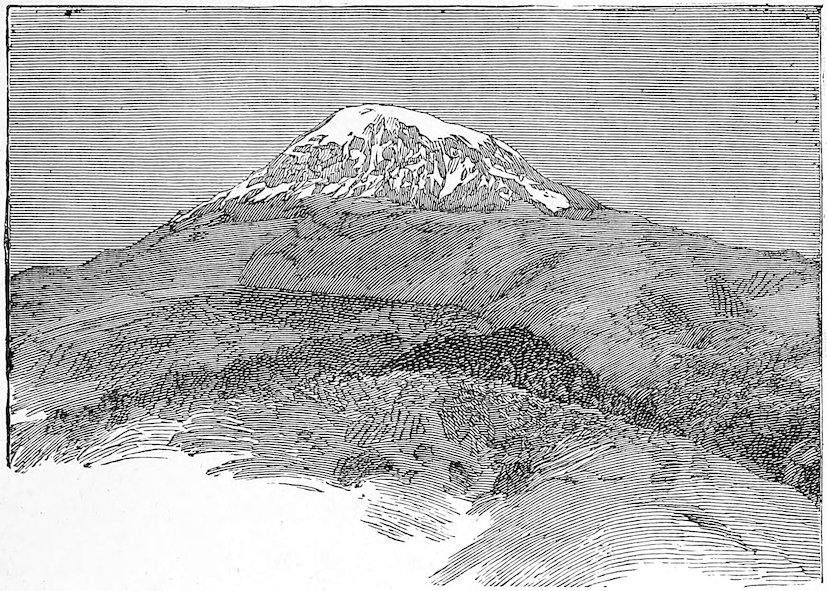
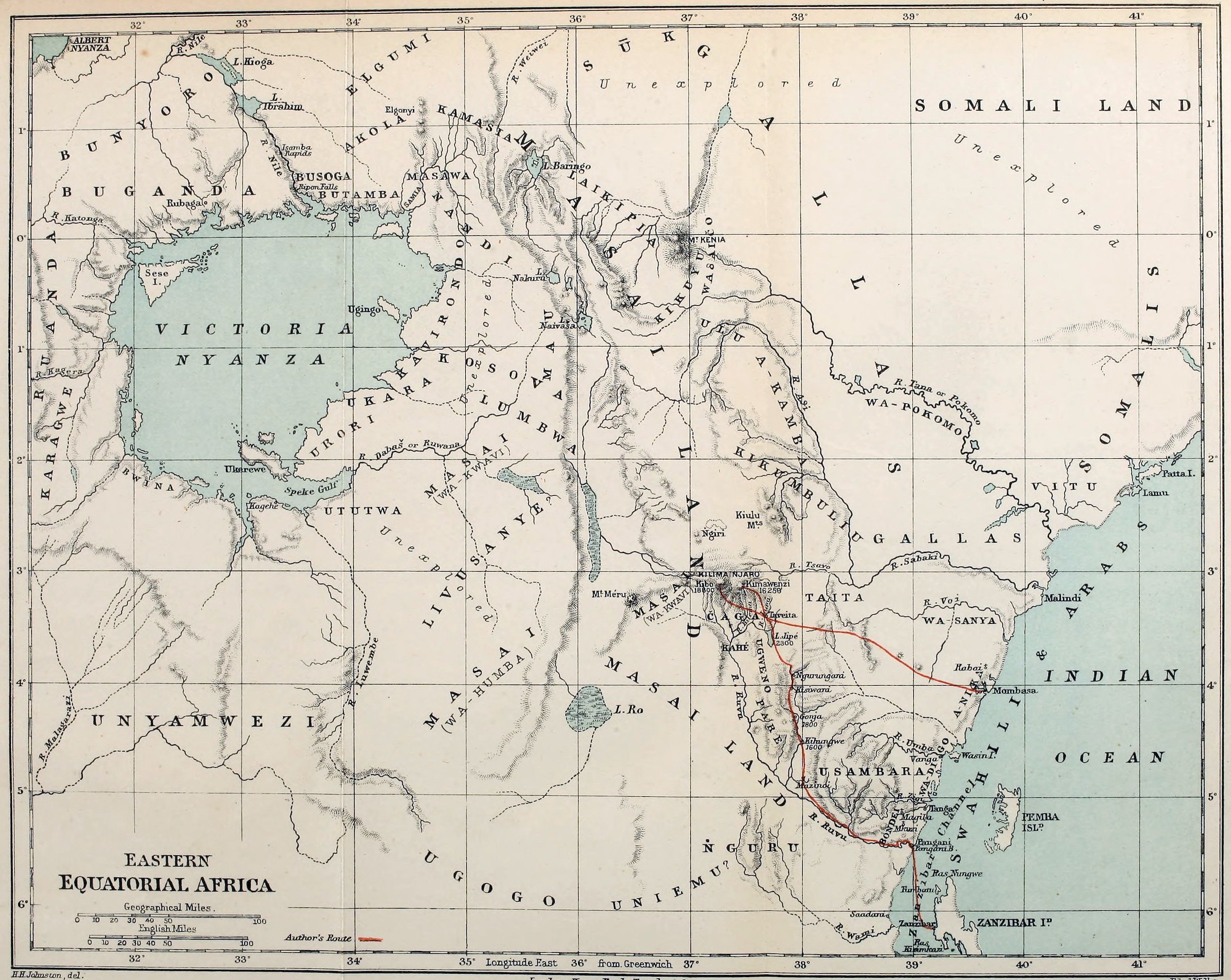
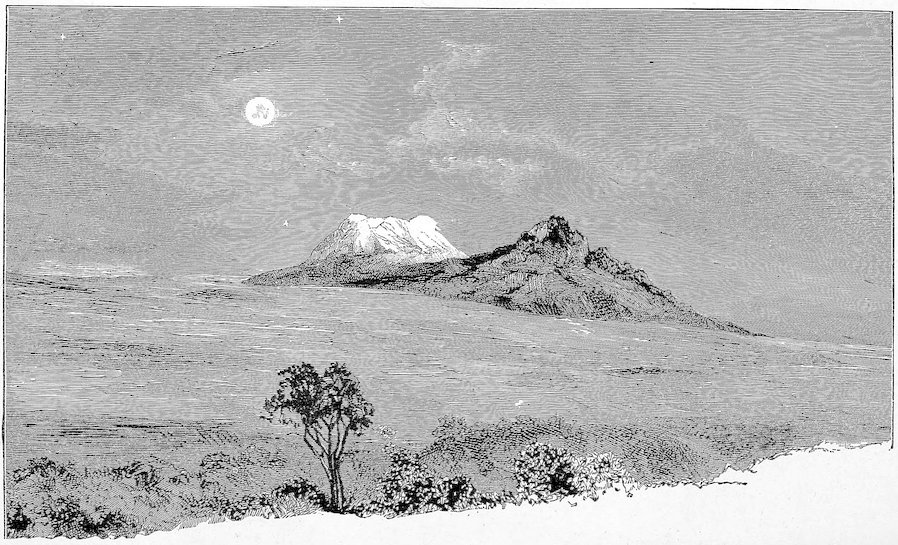
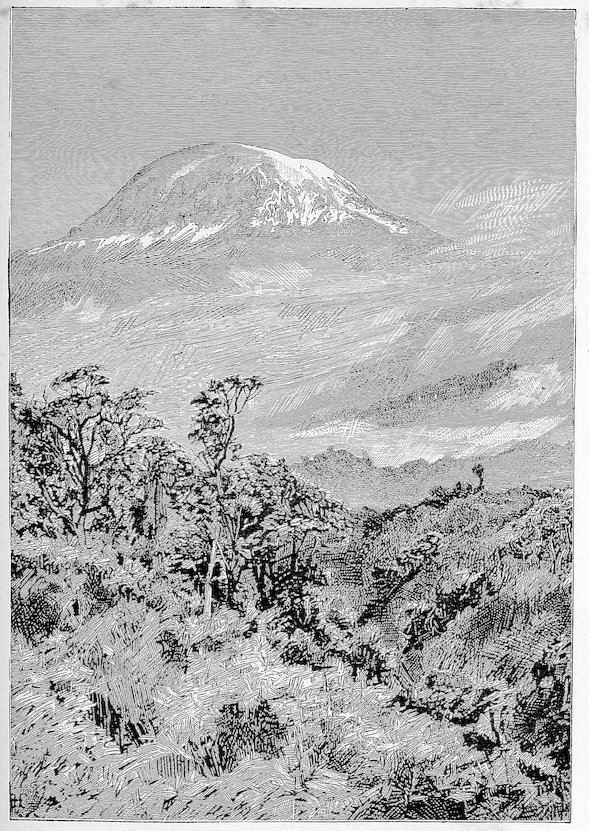
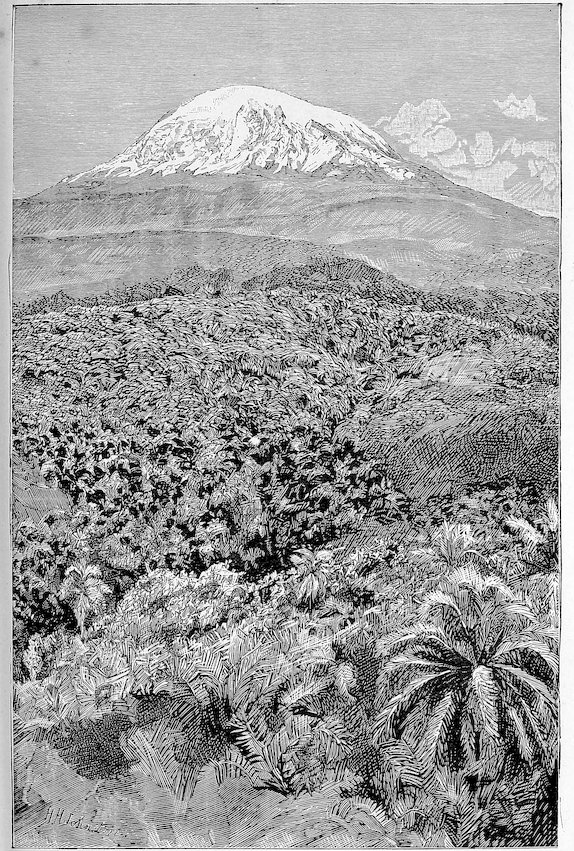
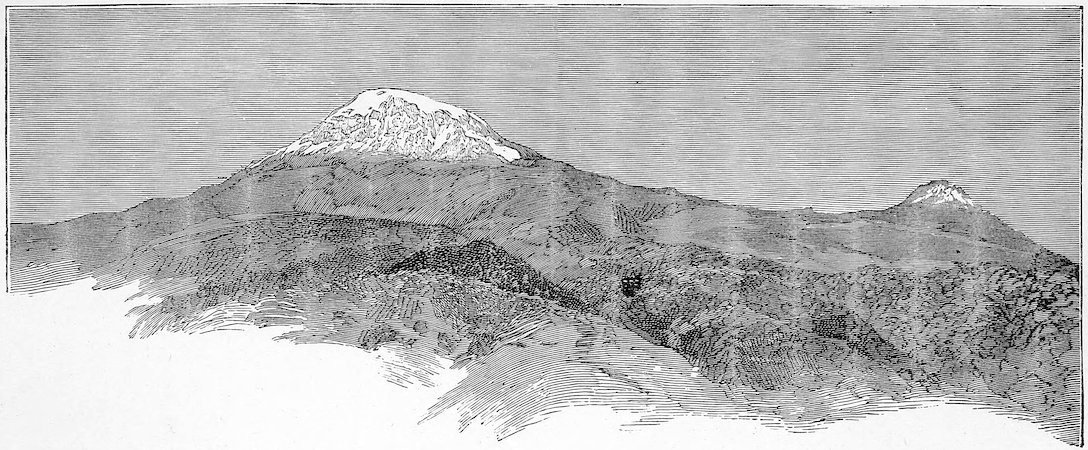
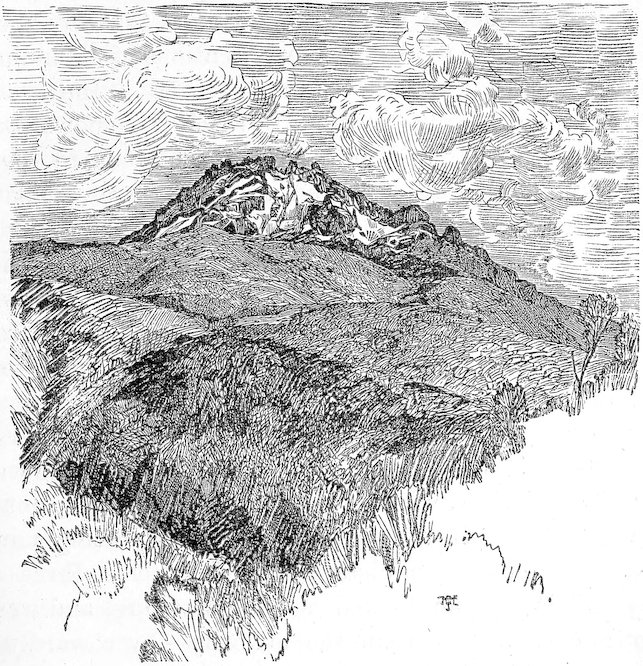
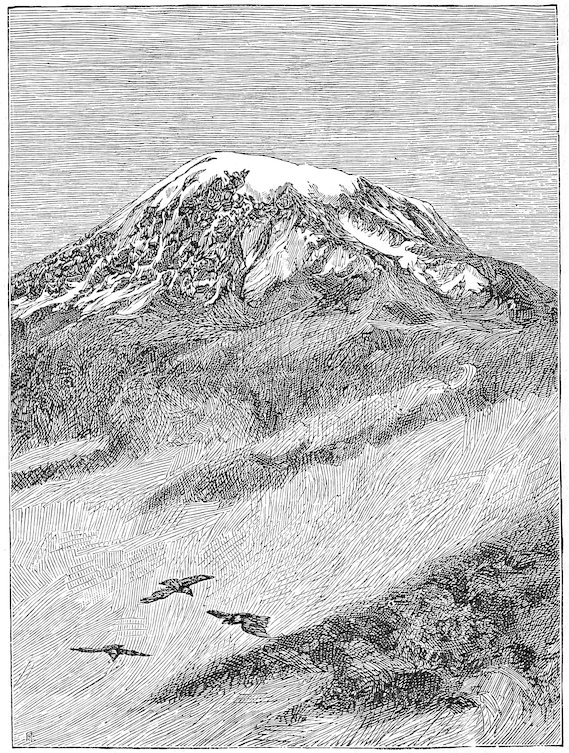
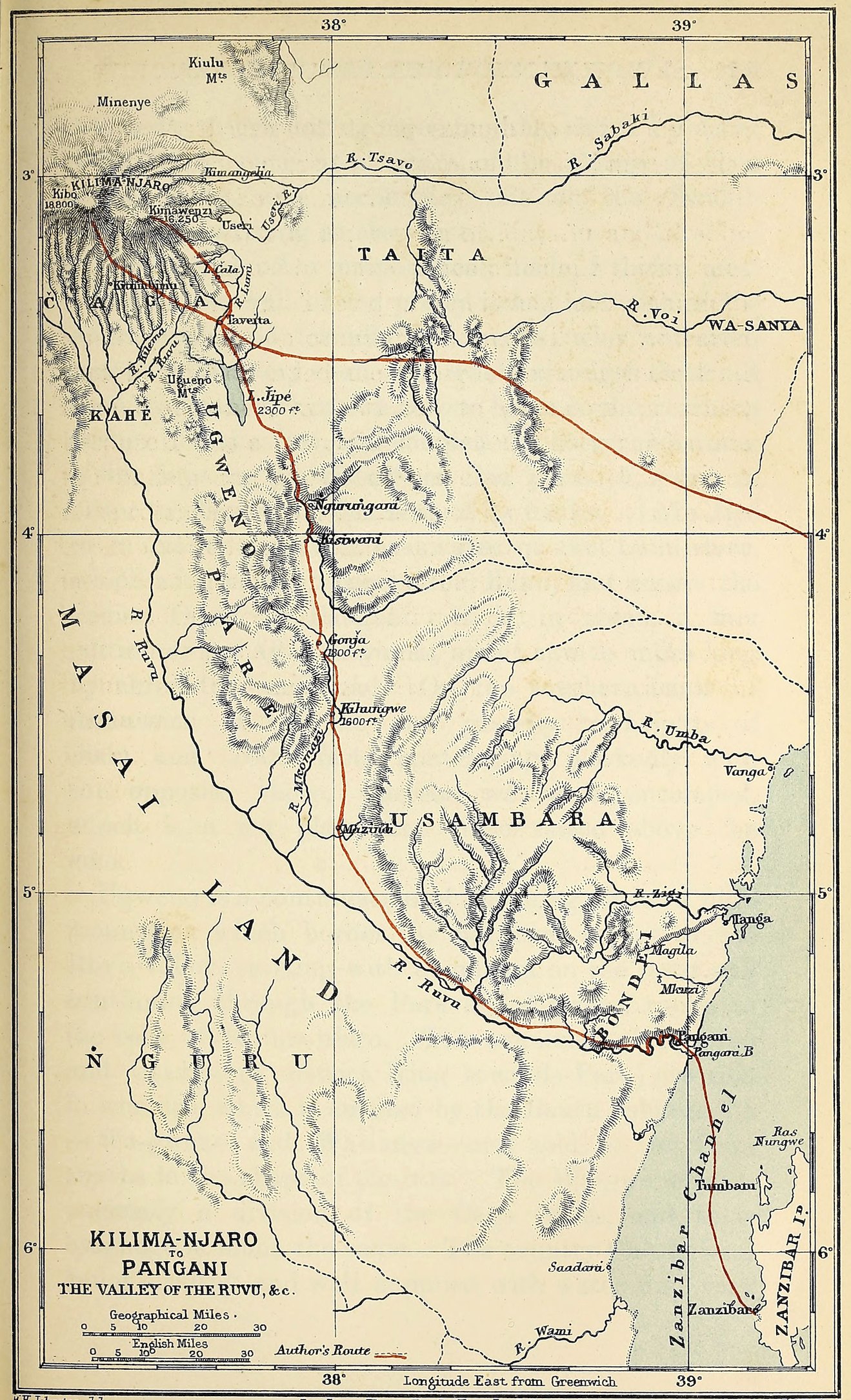
Kilima-njaro[1] is the name currently given to a huge
mountain-mass in Eastern Africa, consisting of two
giant peaks and many lesser ones, situated below the
third parallel south of the Equator, and at a distance,
in a straight line, of about 175 miles from the coast.
The highest of the two principal summits—Kibô—reaches
an elevation 18,880 feet above the sea, and
the lesser peak—Kimawenzi—attains to 16,250 feet.
Both ascend above the snow-line, no other point in the
same clump of mountains doing so, and both are the
craters of extinct volcanoes. The entire mass of
Kilima-njaro seems to be due to volcanic upheaval,
and it was doubtless at one time, and that geologically
recent, the great vent of the volcanic forces of Eastern
Equatorial Africa, which are still active in regions
further to the north or west in the district lying
between the Victoria Nyanza and the Indian Ocean.
Kilima-njaro, ever since its existence was positively
known to modern geographers, has been claimed
2as the highest of African mountains, its chief summit
reaching an altitude of nearly 19,000 feet. It is just
possible that in the unknown region stretching between
the Victoria Nyanza and Abyssinia loftier peaks may
be discovered, or that Mount Kenia, which lies about
200 miles due north of Kilima-njaro, may be found
after accurate measurement to exceed the height of
the latter mountain by a few feet, but until this is
done, the geography-books may still continue to put
forward Kilima-njaro as the highest peak in Africa.
Indeed, this they are likely to do for the next decade
or so, whether he is superseded or not, for I have
remarked that in all geographical questions, physical
or political, it takes a sadly long time for increase of
knowledge to penetrate the school manuals used in
the instruction of the British youth. They always
seem separated from the progress of discovery as the
fixed stars are separated from our powers of vision.
Just as the rays of light now reaching us from
Sirius would be found illustrating a condition of
things going on many years ago, so in most of the
school geography-books, geographical knowledge is
reflected a decade or so in arrears. I think in most of
them France is now deprived of Alsace and Lorraine,
and the territorial unity of Italy is a fait accompli; but I
fancy the Congo is as yet undiscovered, and Turkey in
Europe still extends its suzerainty over “the Danubian
Principalities,” Servia, Bulgaria, and Montenegro. I
took up one of these school class-books the other day
and found that Mount Miltsin (12,000 odd feet) in
Morocco was the highest known peak in Africa.
Doubtless next year, in a later edition, the claims of
Kilima-njaro will be considered, and just as these
receive a tardy recognition, some adventurous traveller
3will bring to our knowledge another African Alp of
mightier proportions and loftier summit destined to oust
from his proud position the object of my recent journey,
who, displaced from the homage of the eager geographer,
must be content to linger still a few years longer in possession
of the vague respect of the British schoolboy.
Although the mass of Kilima-njaro rises rather
abruptly from a fairly level plain, it is hardly to be
called isolated, and indeed it may be said that an
almost continuous chain of mountain-ranges and independent
peaks connect it with Abyssinia on the
north, Natal on the south, and, possibly, also with
the Cameroons on the west. Judged by the flora
which clothes its higher regions, it may be almost
regarded as the common meeting-ground of many
forms peculiarly characteristic of these three widely
separated mountain-districts.
To ascertain the relationships of the fauna and flora
of Kilima-njaro, two learned societies—the British
Association for the Advancement of Science and the
Royal Society—at the instigation, I believe, of Mr.
Sclater, the Secretary of the Zoological Society of
London, delegated certain of their members to form
a Kilima-njaro Expedition Committee, and funds to
the extent of 1000l. were placed at their disposal.
The great height attained by Kilima-njaro, and the fact
that this snow-clad mountain-mass lies in the Equatorial
zone, and exhibits an extraordinary range of
climates on its broad slopes, were thought sufficient
causes to give rise to or explain many curious features
in its fauna and flora; moreover, a like condition of
things—perpetual snow under the Equator—was only
to be met with elsewhere in Central and South America,
no mountains in other parts of the tropics reaching to
4the snow-line. In all cases lofty ranges lying in little-known
regions are interesting to students of natural
history. Isolated mountains of great height are often
like oceanic islands, and serve as a refuge and a last
abiding-place for low types or peculiar forms, which in
larger and more densely-populated areas find the
competition too keen, and are extinguished in the
struggle for life. Or, it may be, some species or genus,
originally of a generalized type, becomes by various
circumstances the inhabitant of an alpine range or a
sea-girt island, and being thus removed and protected
from the natural checks to its peculiar development
offered by the contemporaneous evolution of its fellows,
may, as it were, run riot in the absence of rivalry, and
assume very eccentric and singular forms. Thus we
can imagine that a pigeon something like the modern
didunculus of the South Sea Islands once arrived in
Mauritius, having perhaps hitherto had to contend
with the usual dangers which naturally menace the
existence of a meek-spirited, plump bird that is good
to eat. But this pigeon, either chancing on Mauritius
in the course of its long flights, or dwelling on the
island at a date when its connection with a pre-existing
continent was being severed, found itself in singularly
favourable circumstances, plenty to eat and nothing to
attack it—no animals of prey being left on the island.
So in the course of time, no longer obliged to fly from
foes or take long journeys in search of food, this
pigeon became a dodo, huge, fat, and inert, with atrophied
and useless pinions. Again, on the mountain-ranges
of Sumatra, of Japan, of North America, also
on the Alps of Europe, dwell queer, old-fashioned
ruminants—goat-antelopes, capricorns, chamois—which
would have long since perished in the fierce,
5hustling life of the plains, or more probably have
become moulded into some advanced and perfected
type, like the great ruminants of the lowlands. There
were these possibilities of zoology to encourage exploration;
and another interesting feature in the fauna
and flora of high mountains is that they often retain
vestiges of an older nature, that has long since been
supplanted in lower levels by a new reign. In this
way Kini Balu, the lofty mountain of Borneo, preserves
on its upper slopes an Australian flora long since
superseded in the plains below by the vegetation of
India. On the Alps reappear the butterflies of Arctic
Europe. The Abyssinian mountains can show genera
and species of animals and plants from temperate
countries north and south, from Europe and the Cape
of Good Hope, and consequently the question as to the
relations of the fauna and flora of Kilima-njaro, the
highest mountain known in Africa, with that of other
regions, was one of great interest, and one which, however
decided, might solve many curious puzzles as to
the geographical distribution of living forms.
If we should discover around the snows of this huge
mass of extinct volcanoes the gentians and edelweiss of
the Alps, or even other semi-Arctic forms, these would
arouse a supposition that during some past glacial
epoch the frigid North had sent its children into
Central Africa, following the ice and snow. Or should
we find, as we ascended Kilima-njaro, the birds, beetles,
butterflies, and plants of the Cape of Good Hope, or
even the antique types of Madagascar, this might show
that the clump of snow mountains had served as one
of the last footholds of the older autochthonous
African nature, which was dispossessed and driven into
distant islands and remote corners of the continent by
6recent inroads of the lustier things of Europe; by the
advent of the apes, and lions, and huge herbivora, which
scattered and extinguished the feeble lemurs, insectivores,
and edentates that heretofore prevailed. It
might also be, in a lesser way, with man as it had been
with lower forms of life, that the fastnesses of Kilima-njaro
should prove the shelter of some poor type,
some human relic of a race long passed away, whose
speech, whose handicraft, whose superstitions would
arouse new problems for the anthropologist, or serve as
a happy link to strengthen imperfect chains of evidence.
Questions like these, which the existence of snow-clad
mountains in Central Africa inevitably suggested,
were of sufficient importance to warrant the despatch
of an expedition, which should obtain information and
material to aid in their solution; and at one time
it was proposed that Mr. Joseph Thomson should
endeavour to combine with his journey across the Masai
country (since so splendidly carried out) a prolonged
journey on Kilima-njaro, and a consequent investigation
of its fauna and flora. But for many reasons this
plan had to be abandoned, and the British Association
and Royal Society combined to organize a separate
expedition, with the command of which I was entrusted
some months after my return from the River Congo.
Kilima-njaro is supposed to have been vaguely known
to the Portuguese as early as the sixteenth century,
and inasmuch as these people held Mombasa for nearly
200 years, and Mombasa lies within 180 miles of the
mountain, and is the point of departure and return of
many Swahili and Arab trading parties, who visit the
base of the snow peaks, it would indeed be curious if
no rumours of the existence of such a mighty object of
wonder ever reached the ears of the Portuguese.
7Enciso,[2] a Spanish writer of the sixteenth century,
mentions its existence, and calls it “Mount Olympus.”
Others have supposed that the legendary Mountains
of the Moon had their basis of actual existence in
Kilima-njaro; however this may be, putting aside
vague rumours which in this case had a just foundation
and in many other cases had no foundation at
all, the first European who discovered Kilima-njaro
and made its existence known to the civilized world,
was Rebmann, a German missionary, who, wandering
inland from Mombasa, first descried the wonderful
snowy dome of Kibô, the highest summit of the mass,
on the 11th of May, 1848. Being a simple-minded
man, and overawed by the unexpected beauty and
majesty of the spectacle which the distant snow-clad
summit offered as it rose from a base of sombre
forest into the clear blue sky, he fell on his knees and
recited the 111th Psalm, seeming almost to think that
a little pimple on the surface of our tiny planet was
one of the chief and most glorious productions of the
Creator. Rebmann had the good fortune to alight on
8Kilima-njaro in times of peace before the Arab traders
and the slave trade had brought the curse of internecine
war to the industrious and thrifty agriculturists
who inhabited the fertile mountain-slopes. He consequently
wandered about freely, through most of the
little Čaga[3] states, with a small following of some ten
porters and but little baggage. On his return to the
coast he communicated his discovery to Krapf, who
shortly afterwards started himself for the interior,
and discovered Mount Kenia, but only saw Kilima-njaro
from a distance of forty miles. The results of
these two remarkable expeditions were modestly made
known to the geographical societies of Europe, but in
Paris alone did the discovery of Kenia and Kilima-njaro
meet with any practical recognition. The silver
medal of the Geographical Society in that city was
awarded to Messrs. Krapf and Rebmann, for making
known the existence of snow-clad mountains in
Eastern Equatorial Africa.
In England the missionaries’ information was
greatly discredited, because they had not been able
to map out their journeys by observations for latitude
and longitude, and could only fix the position of the
mountains, of which they alleged the existence, by
dead reckoning. As a matter of fact, they placed
them with wonderful accuracy, considering the rough
methods employed, and subsequent discoveries have
corroborated their statements. Krapf only saw Mount
Kenia from a distance of over forty miles, and Rebmann
probably approached no nearer than fifteen
miles to the snows of Kilima-njaro. Both could only
9asseverate that they had seen snow, and both were
accused of being deceived by their vivid imaginations.
Their most relentless critic was a redoubtable person,
for long years a terror to real explorers, Mr.
Desborough Cooley, a kind of geographical ogre, who
used to sit in his study in England, shaping and
planning out the map of Africa (basing his arrangements
of rivers, lakes, and mountains on ridiculous
and fantastic linguistic coincidences and resemblances
of his own imagination), and who rushed out and tore
in pieces all unheeding explorers in the field who
brought to light actual facts which upset his elaborate
geographical schemes. Mr. Cooley proved in the most
exhaustive and conclusive manner, that Messrs. Krapf
and Rebmann could not have seen mountains capped
with perpetual snow in Equatorial Africa, and, ergo, they
did not exist.
However, Nature and Truth are relentless. They
will not stifle or modify their accomplished facts to
please any one. You would have thought that after
the beautiful and logical manner in which Mr. Cooley
had set forth that snow-clad mountains could not
exist near the Equator (I suppose he forgot those of
America), that Nature would have felt ashamed of
producing anything unnatural and would have backed
up Mr. Cooley’s statements by whipping Kilima-njaro
and Kenia off the land of Africa before any adventurous
explorer could conclusively prove their existence.
But no; after an interval[4] of about ten years, in 1861,
Baron von der Decken, a Hanoverian, went to Kilima-njaro
10and stayed there from the end of July to the
beginning of September, and was able entirely to corroborate
the statements of the much-maligned Rebmann.
He was not able to ascend higher than 8000 feet,
but on a succeeding visit in December, 1862, he
attained an altitude of 10,500 feet, although on
neither occasion did he approach anywhere near the
snow. He made, however, an admirable survey of
the whole southern slope of the mountain, which is
still and has been our chief authority for the delineation
of Kilima-njaro on the map. His researches were
rather added to than superseded by the journeys of
Thomson and myself. Von der Decken calculated the
height of the two great peaks, Kibô and Kimawenzi,
and considerably reduced the exaggerated estimate of
their respective altitudes. He, however, erred slightly
in under-estimating the height of Kibô, which he gives
as only 18,700. My own observations make it 18,800,
and Thomson gives it as 18,880. Von der Decken
(still traditionally known on the mountain as the
“Baroni”) received the gold medal of the Royal
Geographical Society for his careful surveys of Kilima-njaro
and its vicinity.
In 1871, the Rev. Charles New, a missionary, who
had been sent out to East Africa by the United
Methodist Free Church Mission, made a journey to
Moši, in Čaga, and thence ascended Kilima-njaro to
the verge of the snow, reaching an altitude of about
14,500 feet. He spent the month of August on the
mountain, but did not go over much new ground.
Encouraged by his pleasant experiences during this
trip and filled with a craving for further exploits in
the same field of fascinating mystery, he returned to
Čaga two years later, with the intention of pursuing
11his investigations. But this time his former host,
Mandara, chief of Moši, disappointed in the quantity
and quality of the presents brought to him by Mr.
New, robbed the explorer of nearly all he possessed,
including his gold chronometer (given him by the
Royal Geographical Society) and his silver aneroid.
Then poor New, broken-hearted, and sick with anxiety
and fatigue, turned his steps towards the coast, and
died ere he reached Mombasa. I have an impression
from what Mandara himself has told me, that his
animosity and rapacity were aroused with respect to
New by the latter’s too vehement and perhaps injudicious
harangues against slavery. Mandara declared
that Mr. New had incited openly his subjects to rebel
against him, but this I think highly improbable. It
is possible that the missionary inveighed against slavery
in such a way that Mandara dreaded lest his utterances
should have the effect of arousing his serfs to a
wish for freedom, and that he therefore robbed him
and cast him out of his kingdom. This view of the
case is supported by the accounts given by an old
friend of New’s, Kapitau, an intelligent and pleasant-mannered
coast trader, with whom I have had much
conversation. This man retains an earnest respect
for the missionary, and accuses Mandara of having
wished to poison him.
After New’s death, Kilima-njaro remained unvisited
until quite recently, when, in 1883, Mr. Joseph Thomson
arrived there, on his journey across Masai-land.
He also visited Mandara, and was also robbed by that
rapacious chieftain. Starting from Moši he ascended
to an altitude of nearly 9000 feet, made a small collection
of plants, and pursued his journeys, which
ultimately led him nearly all round the base of the
12mountain. Mr. Thomson was the first who saw the
northern aspects of Kilima-njaro.
I might also mention that Dr. Fischer, a German
traveller, passed within some thirty miles of Kilima-njaro
a little while before Mr. Thomson. He subsequently
penetrated Masai-land as far as Lake
Naivaša.
All these above-mentioned travellers had paid visits
of a more or less fleeting character to Kilima-njaro, and
few had studied in any way its natural history, or had
attempted to make collections of any importance.
Von der Decken brought back some beetles and one
or two plants. New gathered and sent home a few
specimens of the flora growing on the upper slopes.
Dr. Fischer introduced us to a new Touraco[5] dwelling
in the vicinity of the mountain, and Thomson in his
hurried ascent procured some twenty plants, nearly
all of which were new to science. But in the main
little of the flora or fauna of Kilima-njaro had been
made known, and the object of my mission was to make
collections which would materially aid us in settling
the relations which this clump of mountains bore to
other lofty African ranges in its peculiar forms of life.
The Kilima-njaro Committee, taking into consideration
the peculiar difficulties of African travel, hesitated to
send out on this expedition any one who, though a
trained naturalist, should yet have had no previous
experience of the climate and mode of life in the dark
continent; and although I professed little skill or
capacity in natural history collecting (for you may
be enthusiastically fond of the study of botany and
zoology, and yet be a very poor taxidermist or herbalist),
it was thought that my acquaintance with the
13difficulties of African expedition and the exigencies of
travel in a barbarous country would enable me to conduct
the expedition to Kilima-njaro with some chance
of success. Unfortunately the sum of 1000l. placed
at my disposal, although sufficient with due economy
to meet the ordinary expenses of the expedition,
would not permit of European collectors being taken,
the cost of the passage-money, salary, and keep of
two men amounting to nearly half the sum already
mentioned. However, this difficulty did not much
concern me at the time, as one or two collectors were
promised from the Calcutta Botanical Gardens, whose
expenses would have been defrayed by their employers
in return for a set of specimens collected. But on
arriving at Zanzibar I was disappointed of their aid,
for it was found at the last moment impossible to
induce any Indian collectors to join an expedition to
Central Africa. Consequently I had to depend on the
chance aid of such natives of Zanzibar accompanying
my caravan as might evince any taste for a collector’s
duties. Sir John Kirk, indeed, procured for me two
men who had been with Dr. Fischer during his recent
expedition, and who had an elementary knowledge of
drying plants and skinning birds; but these men, on
account of their superior attainments, were so exacting
and difficult to deal with, that when they deserted me
soon after my arrival on the mountain and went to
a neighbouring chief to organize his slave-trading
caravans, I did not miss them keenly. Nevertheless,
after this, the entire charge of collecting fell upon me,
adding to the already existing and by no means perfunctory
cares of superintending the expedition. I
not only had to conduct long and wearisome palavers
with native chiefs, and talk them into acquiescence
14with my plans, I not only had to show the men how
to build houses, where to construct roads and bridges,
and lay out plantations, but I must also shoot and skin
birds, gather and press plants, collect beetles, and
catch butterflies. In a moist climate like that of
Kilima-njaro the labour involved in making good
botanical collections alone was very great, and in all
this I had no help. My Zanzibar porters, although
excellent, hardworking, faithful fellows, evinced no
aptitude whatever for natural history collecting. In
spite of my repeated and painstaking instructions,
they would bring me flowers without leaves, and leaves
without flowers. They preferred catching butterflies
with their fingers to using a net, and thought that an
insect in fragments was quite as satisfactory as a
whole specimen. In short I found that if any work
was to be of use in collecting, it must proceed solely
from my own efforts. I merely mention these difficulties
so that my readers may properly appreciate the
character of the task I was called on to perform.
The instructions given me by the Kilima-njaro Committee
were to proceed direct to Mount Kilima-njaro,
reside in the vicinity of the mountain for at least six
months, and collect as much as possible near the snow-line.
As already mentioned, funds to the extent of
1000l. were granted me, and besides that, the Royal
Geographical Society generously provided me with a
complete set of instruments for making astronomical
and meteorological observations. I ought also to
mention that Messrs. Howard and Son made me a
most liberal present of quinine, an item of the outfit
which would have amounted under ordinary circumstances
to a considerable expense, and other leading
purveyors treated me with great generosity, so that I
was altogether most kindly supported in my undertaking.
15Having previously despatched my heavy
luggage by British India steamship, I left London in
the beginning of March, 1884, and travelled overland
to Egypt, spent a week or two rambling about the
highways and byeways of that unhappy land, joined
my steamer at Suez, and quitted her at Aden with
heartfelt joy, after a horribly uncomfortable voyage of
eight days. At Aden I had a delightful experience
of what British hospitality can do to cast a halo round
the most unattractive spots. At the house of the
Resident and Governor, General Blair, V.C., I spent a
most enjoyable interval whilst awaiting the Zanzibar
steamer.
I somewhat dreaded the advent of this vessel, for
after my experience of cockroaches, rats, bad smells,
and bad food in the steamer which had carried me to
Aden, I anticipated a renewal of this purgatory on
board the steamship of the same company which was
to complete the journey to Zanzibar. But this was
fortunately not the case. The Java, though an old-fashioned
and not too speedy boat, was scrupulously
clean, and her staff of officers were all that could be
desired in kindness and skill. The fare was excellent,
the weather perfect, the fellow-passengers few and
agreeable; and our journey to Zanzibar was more like
a trip on a friend’s yacht. We stopped at Lamu, and
lunched with Lieutenant Haggard, her Britannic
Majesty’s vice-consul, and then at Mombasa, where I
went off for a lengthy conference with Captain Gissing,
our vice-consul at that port, who was already kindly
interesting himself in the equipment of my expedition,
and engaging porters from the vicinity of that place to
accompany me, for it was considered best by Sir John
Kirk that I should start from Mombasa for Kilima-njaro.
After my first brief visit to the place, however,
16I continued on my way to Zanzibar, to confer with
Sir John Kirk, and to engage a certain number of men.
Accordingly, one day in the middle of April, 1884, I
awoke in the early sunshine, and looked forth on a
crescent of white buildings rising above an irregular
line of black shipping and black mud, and later on in
the day landed at Zanzibar, and found myself in that
busy mart of East African trade, whence so many expeditions
and explorers have started for the conquest
of Africa’s secrets. Here I was soon enjoying the
kind hospitality of Sir John Kirk, and feeling in the
contemplation of the strange, varied life around me
that the first chapter of my experiences in East Africa
had pleasantly begun.
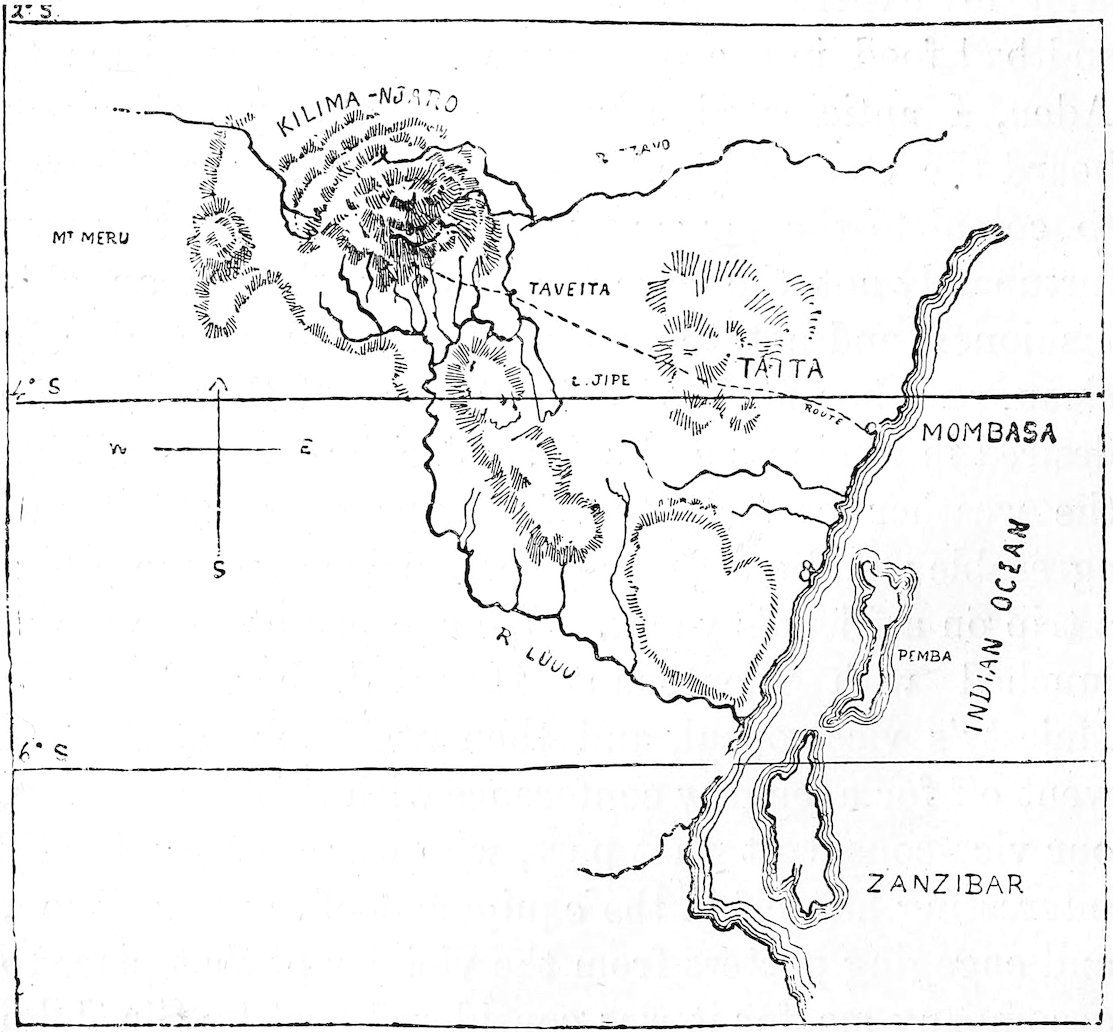
Map 2.—Route to Kilima-njaro.
CHAPTER II. SIR JOHN KIRK AT HOME.
17
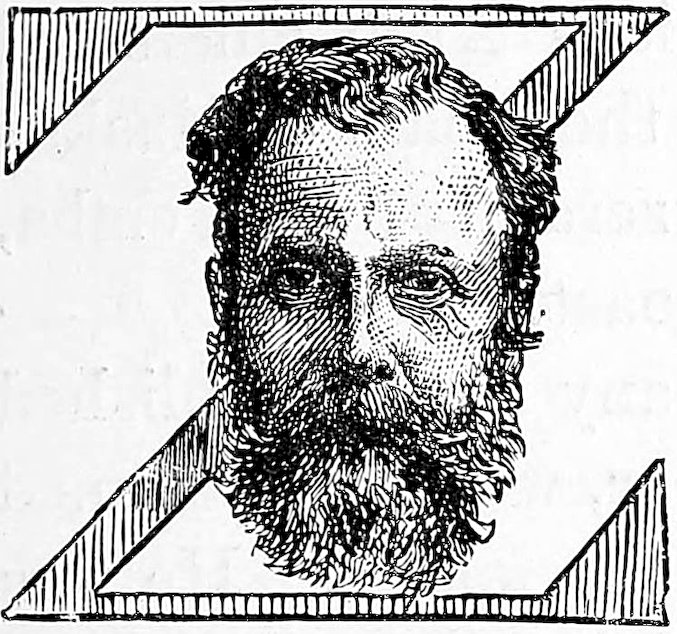
Fig. 1.—Sir John Kirk.
Zanzibar, an island lying
about twenty miles off the
East Coast of Africa, under
the sixth parallel south of the
equator (I feel bound to furnish
this information in the prevailing
state of ignorance respecting
African geography),
has long been a nucleus of foreign rule along the
eastern seaboard of the Dark Continent. Without
going into the questions of its remote history, and
considering whether it was or whether it was not
distinctly known to the hazy geographers of classical
days, we can feel pretty certain that, for nearly as
many centuries as form the Christian Era, Zanzibar
has been a place of resort for the Arab and Persian
traders and slave-dealers of the Red Sea, the Persian
Gulf, and the coasts of Sind and Gujerat. There was
at one time a distinct Persian colonization of the East
African littoral to the north of Zanzibar, and apparently
also in Zanzibar itself, though here the intermixture
of Persian blood in the local race is in no
way as evident as in places on the mainland, such
as Lamu, Malindi, or Magdishu. However, even in
18Zanzibar, distinct traces of Fire Worship remain
engrafted on the African Mohammedanism of the
inhabitants. After several centuries of quasi Arab
rule, Zanzibar in the beginning of the sixteenth
century came under the dominion of the Portuguese,
whose language has left its traces in the Swahili
vocabulary. When Portugal fell into the power of
Spain, and her hold on Abyssinia and the Eastern
Horn of Africa waned and faded, the Arabs reasserted
their independence in Zanzibar, and the island remained
in the possession of various Arab chiefs till
the end of the last century, when the Imam of Maskat
proclaimed and maintained his suzerainty over Pemba,
Zanzibar, and the neighbouring coast.
In 1841, the East India Company first established
relations with the ruler of Zanzibar, who had assumed
the title of “Sayyid,” or Lord of the Island. He was
at the same time Sovereign of ’Oman, that East
Arabian principality of which Maskat is the capital.
Lieut.-Colonel Hamerton, the first British representative
at the Court of Zanzibar, remained many years
at his post, and was still in East Africa when Burton
undertook his pioneer journey to the Lake regions.
On his death General Rigby succeeded him as Consul-General
and Political Agent, and was in turn followed
by several officials whose residence in the island was
of short duration. At length, in 1873, Sir John Kirk,
who had first come to Zanzibar as Vice-Consul in 1866,
and who had for some years acted in a superior
capacity, received his formal appointment to the post
of Consul-General, and later on attained the further
office of Political Agent. Sir John Kirk, who comes
of an old Forfarshire family, was educated primarily
as a doctor, and served as a physician to the British
19hospital at Renkioi, Dardanelles, during the Crimean
War; but already, both at the University and during
his service abroad, his taste and aptitude for natural
history had so developed that he little cared to make
the medical profession his ultimate career. In 1858
he accepted the post of naturalist to Dr. Livingstone’s
expedition to the Zambesi. When he arrived at the
mouth of this river, the circumstances of the expedition
were such that it became necessary for Dr. Kirk
(as he then was) to lay his studies of natural history
aside, and assume the arduous position of second in
command, and direct personally the conduct of the
land party. It was largely owing to his exertions
and untiring labour that the unfortunate Zambesi
Expedition was not an even costlier experiment than
it eventually proved; and Dr. Livingstone found in
his colleague and second in command a mainstay and
help in several critical emergencies wherein the rest
of his staff were of little service.
Shortly after his return from the Zambesi Dr. Kirk
was offered the post of Vice-Consul at Zanzibar, and
thus entered the service in which he rose successively
to the ranks of Consul, Consul-General, and Political
Agent. In 1878 he was made C.M.G., and in 1881
he was knighted.
There is no one living or dead who has so profoundly
influenced the condition of Eastern Africa as Sir John
Kirk. To him more than to any one else is owing the
effective repression of slave-trading; and it is only
quite recently that the full consequences of his steady
anti-slavery policy began to appear and develop themselves
into a healthy and beneficent solution of a
difficult African problem. When Sir John first arrived
in Zanzibar the Arab ruler of the island, the so-called
20Sultan, was little more than primus inter pares. He
was recognized as “Sayyid,” or Lord, of Zanzibar, by
the Arab nobles and traders, but his authority was
most uncertain. Many of his subjects thought themselves
superior to him in purity of blood and ancient
genealogy, and whenever the wishes of their nominal
ruler—merely one of themselves deputed to transact
the Government business—clashed with their personal
interests or predilections, they openly bade him defiance,
and put their fortress-houses into a state of
siege. The standing army was composed of a few
miserable, beggarly Baluch mercenaries—ill-clothed,
unpaid, and as cowardly as they were rapacious.
Slaves were openly sold in Zanzibar, and the Sayyid
was too weak to incur the displeasure of his Arab
subjects by the suppression of a lucrative and easy
trade. When Sayyid Majid died and the present
“Sultan,” Barghash bin Sa’id, succeeded him, Sir
John Kirk set himself resolutely to acquire the confidence
and friendship of the young Arab ruler, and,
aided by his great knowledge of Arabic and Ki-Swahili,
was able to converse with the Sayyid in strict intimacy,
without the medium of an interpreter, so that he was
enabled often to weld the will of Barghash to conformity
with his own wishes by means of an earnest
expostulation and half-playful sarcasm which would
have sounded ill through the intermediary of some
wily Goanese. So great was the influence already
exercised over the Prince of Zanzibar after two years
of personal intercourse that Sir John Kirk was able
to exact from him as a favour and concession to
friendship that which Sir Bartle Frere, with all his
personal prestige and position, and with a fleet of
ironclads behind him, failed to extort, namely, the
Sayyid’s signature to a treaty for the suppression of
the East African slave-trade. This, though refused
under threats of bombardment, was granted after a
few hours’ conversation with Sir John Kirk, and the
treaty, which during Sir Bartle Frere’s mission had
been persistently rejected by the “Sultan,” was signed
and sealed within a few hours after the envoy’s departure,
and overtook him in a rapid despatch-boat
before he reached Aden. An amusing incident is
recorded of Sayyid Barghash during the séance of
deliberation which took place before he signed the
treaty. Sir John Kirk was explaining to him the
terrors and inconveniences of a blockade, how all
supplies of provisions would be stopped, and the island
reduced to starvation, and he wound up his effective
picture by asking the “Sultan” what he would do
then? “Why,” said Sayyid Barghash, “I should
just come and live with you, Consul.”
21It is owing to our present representative in Zanzibar
that the Sultan has gradually assured and strengthened
his hold over the East African coast between the
Portuguese northern boundary and the No-man’s Land
of the Somali Deserts, thus keeping in hands friendly
to England the richest coast-lands of East Africa and
the trade-routes to the Central Basin. Sir John Kirk
has little disguised his views about English influence
in the Indian Ocean, and he steadfastly bears in mind
that nearly the entire commerce of Eastern Africa is in
the hands of British subjects, and that, to uphold our
influence in the country, we should encourage to the
utmost the thrifty settlers from Western India. He
also feels, as any observant politician must, that much
as we may admire and sympathize with the promptings
to colonization which, like the desire for offspring late
22in life, are now animating so many old European
nations, there is no reason why England should act as
a political midwife, and assist in bringing to birth their
late-born children, or neglect the wants of her own
large family in order that her neighbours’ weaklings
may not die of inanition.
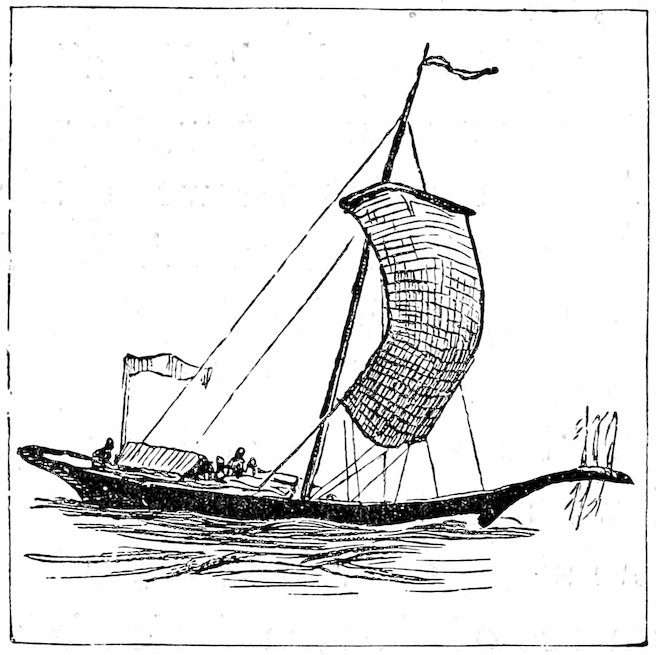
Fig. 3.—Mtépé (with mat sail).
One of the firmest resolves of Sir John Kirk has been
to keep Eastern Africa between 10° N. and 10° S. clear
of foreign influences, and so to hold this littoral through
our nominee, the present Sayyid, that whenever the
cold fit shall be off and the hot wave of further colonization
flow on again—whenever the irresistible spreading
of the English people compels it to look towards fresh
fields of enterprise—Zanzibar, city, island, and coast,
may not be found in hands hostile to British trade.
To Sir John Kirk alone we owe it that the Government
of Portugal has not now included the important
Rovuma river in its
East African possessions;
and the same
person is responsible for
having, with one English
frigate, driven away the
whole Egyptian fleet
under McGillup Pasha,
when, acting under secret
orders from the
Egyptian Government,
the Khedive’s East African
Expedition proceeded to annex, occupy, and
fortify the principal ports in the Sayyid’s continental
dominions. About the manifold checks that
French ambition and “protecting” zeal[6] have received
23in these Zangian regions I need not dilate, as they are
questions involving political feelings of some acerbity
at the present time, and would therefore be out of place
in this book. But I might further recall to my readers
that it is to the personal exertions of the British Agent
and Consul-General that Zanzibar owes its line of telegraph,
its mail service, its hospital, its observatory, its
standing army (officered
and commanded by Englishmen),
its horticultural
development, its projected
sanitary reform,
and possibly also the
scarcely less precious
introductions of lawntennis
and afternoon tea.
Fig. 4.
Small Mtépé and Outrigger Canoe.
The British Agency
and Consulate-General
in the town of Zanzibar
is a handsome Arab
house standing towards
the southern end of the
city, and just overhanging
the sea, which at
high tide lashes its protecting wall. The style of
exterior and interior is purely Arab, or, to use a more
24accepted term in architecture, Saracenic. Entering
from the narrow streets an iron gateway, you come
into the grateful shade of a small garden, planted
with spreading mimosas, cocoanut palms, and mangoes,
and through the interstices of the foliage you
look up at the high grey-white walls of the house,
which are scarcely relieved in their monotony by
the small and shuttered windows. The doorway is
regularly Eastern, quite a “Sublime Porte” in miniature.
Broad, shallow steps lead up to it, forming an
admirably-arranged mise-en-scène for the grouping of
white-clothed “Sikari” (consular guards) and Indian
suppliants in gaudy costumes. The frame of the door,
which is itself garnished with immense copper nails, is
delicately and intricately carved in black wood, with
arabesque designs and letter scrolls.
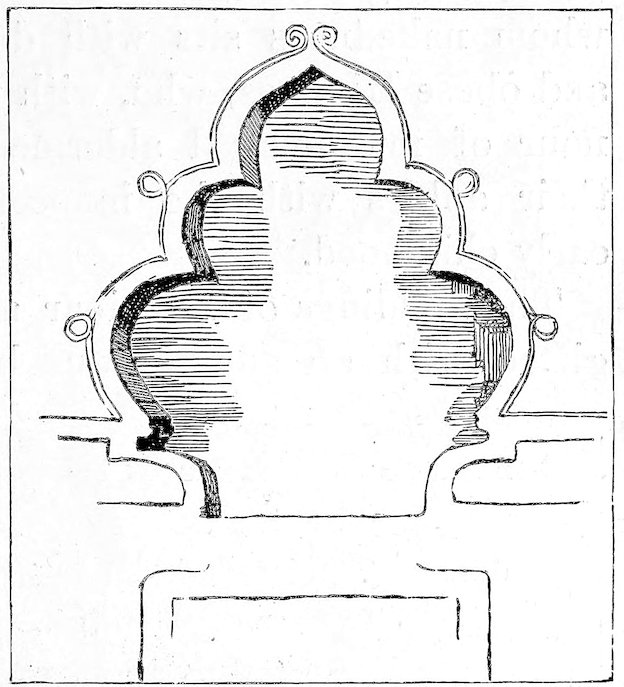
Entering here, you come upon a small recess, with
ogival niches round the walls—a sort of anteroom—and
from this a winding staircase ascends to the first-floor,
when you find yourself in the interior gallery
surrounding the four sides of the patio, or hollow square,
which is the ground-plan of most Saracenic buildings.
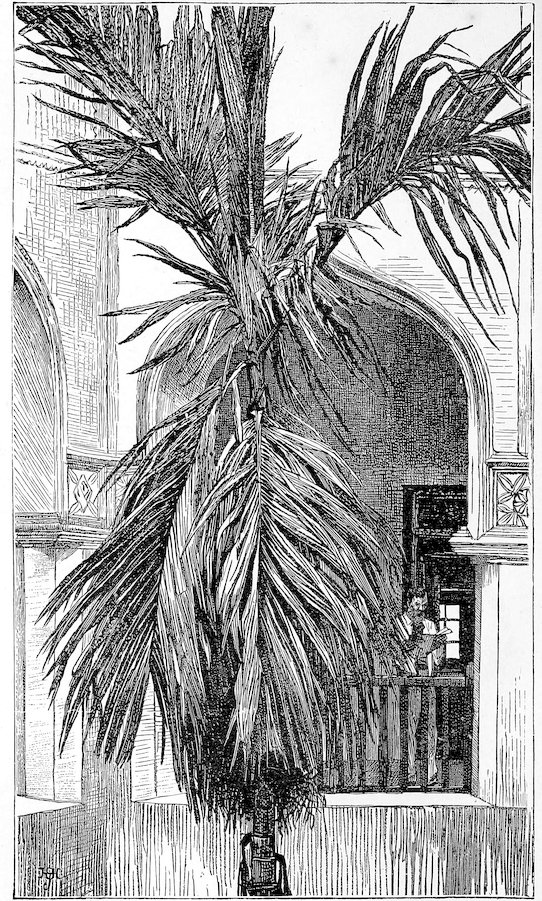
From the centre of the patio rises a graceful areca-palm,
which contrasts pleasingly with the formal arches of
the gallery. The house ascends to several storeys, and
is surmounted by flat terraces of varying height; but
round the patio, on the first-floor, the principal dwelling-rooms
are ranged. These are all Arab in character—narrow,
high-pitched, lighted with little windows with
deep embrasures. The walls are dead white, cut into
by false arches of slightly horse-shoe shape, forming
alternate recesses wherein shelves of pottery, bookcases,
or cabinets may be placed. Within the arches,
too, are further niches, cut deeper into the wall, with
a carved stone tracery at the back to let in air. These
give an effect of lightness to the somewhat massive
walls, and the little points of light gleaming through
the windows of cut stone act as a point de mire in each
recess. There are no pictures on the walls; nothing
but coruscations of Oriental pottery, all of it got from
Zanzibar and the neighbouring coast. The amount of
beautiful Persian, Moorish, and even Chinese pottery
and porcelain to be found in Zanzibar is really surprising.
Much of it is hoarded up by old Arab families,
who have kept it for generations in their households,
and it only sees the light in occasional bankruptcies
and auction sales. On many parts of this Zangian
coast pottery is fastened into the walls of mosques or
plastered on to tombs, whence—I say it with regret—Europeans
do not hesitate to “loot” it, under the
pretext that if they do not the degenerate descendants
of the Oriental settlers will. At places like Lamu the
most tasteful Persian porcelain, rich in colour and very
old, was to be easily picked up but a short while ago,
though the sudden rush of greedy travellers has diminished
the supply. Much of this Persian pottery—great
bowls of gorgeous tints, blue and gold plates, vases
and cups—decorate the walls of the Consulate, and
lend colour and brightness to its apartments.
The windows of two sides of the house look forth on
the sea, and command the entire harbour. All the
shipping becomes a study of ever-changing colour and
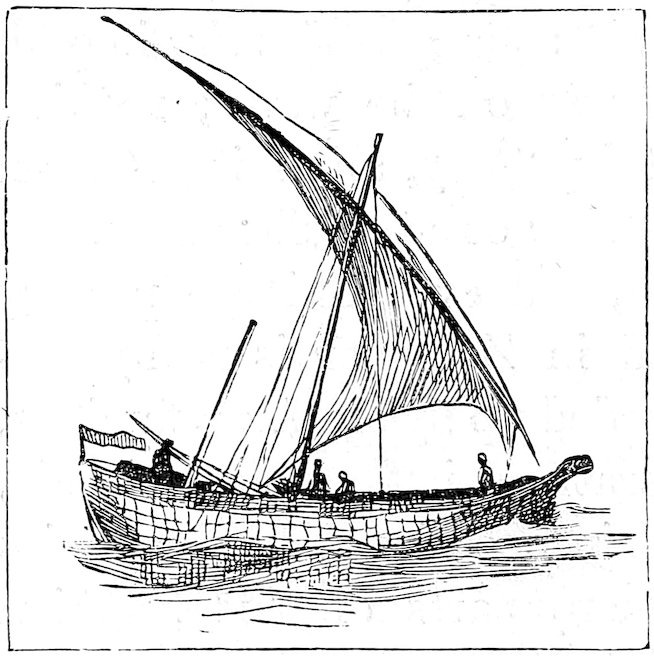
form. The great black hulks of the steamers, surmounted
by their tall masts and funnels; the snow-sails
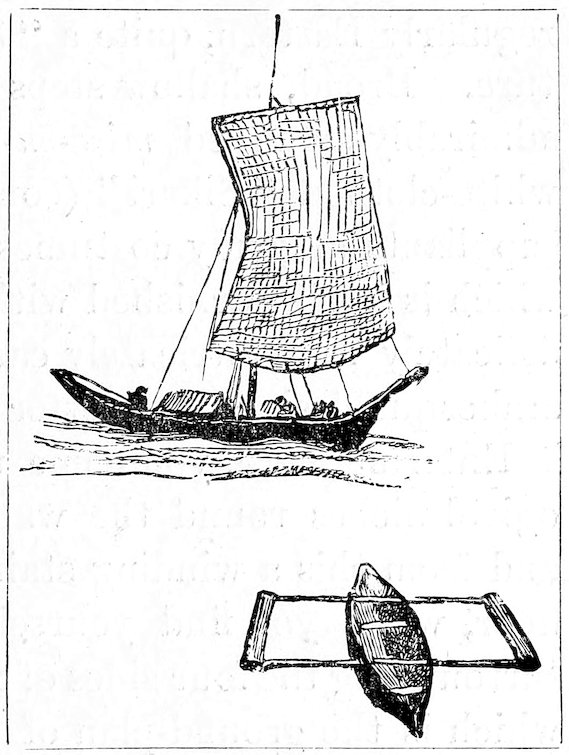
of the daus coming into port; the “mtépé,” or
native barque, with a huge sail made of matting; the
dismantled daus, with their brown rigging and masts
and folded sails, lying at anchor in the blue still water:
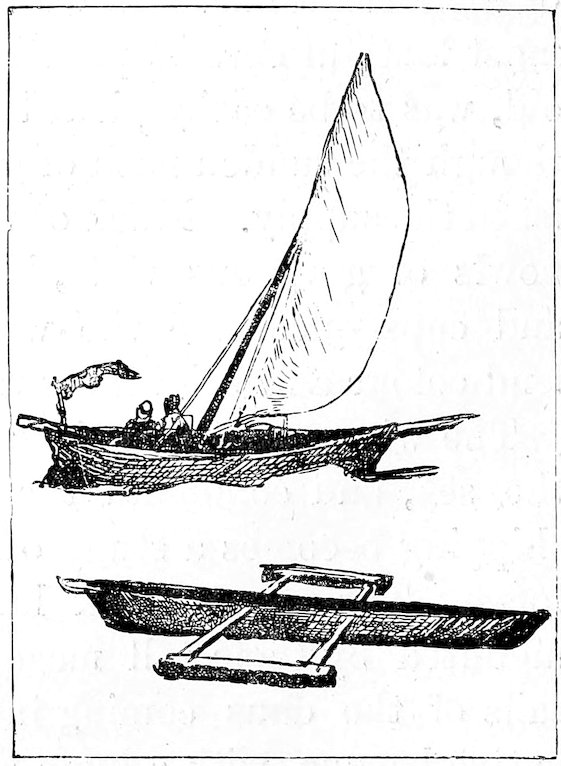
26and the multitude of tiny craft, canoes with outriggers,
and the canoes that are simple dugouts—all these form,
together with the flags
of many nations and the
bright costumes of the
native sailors, the blue
sky, with its rolling cumulus-clouds,
the placid
sea, and the green islands
on its horizon, an infinitely
diversified panorama,
rather than a picture,
but a cheerful scene,
full of bright activity,
and a pleasant field of
contemplation to an idle man in a rocking-chair on a
shady balcony, who is able to rest inactive in his cool
retreat, and watch the
busy work going on
around him.
Fig. 7.
Fishing Boat and Outrigger Canoe.
27
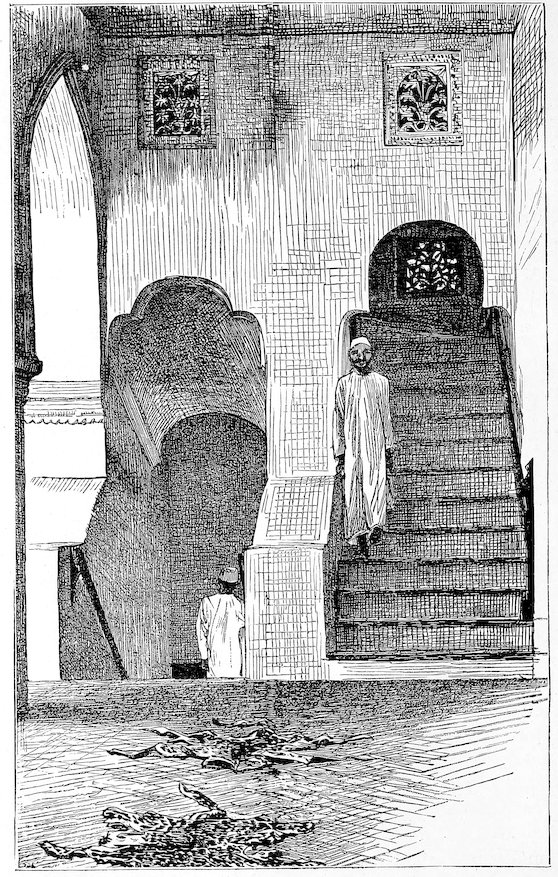
Fig 8.—A Saracenic Doorway.
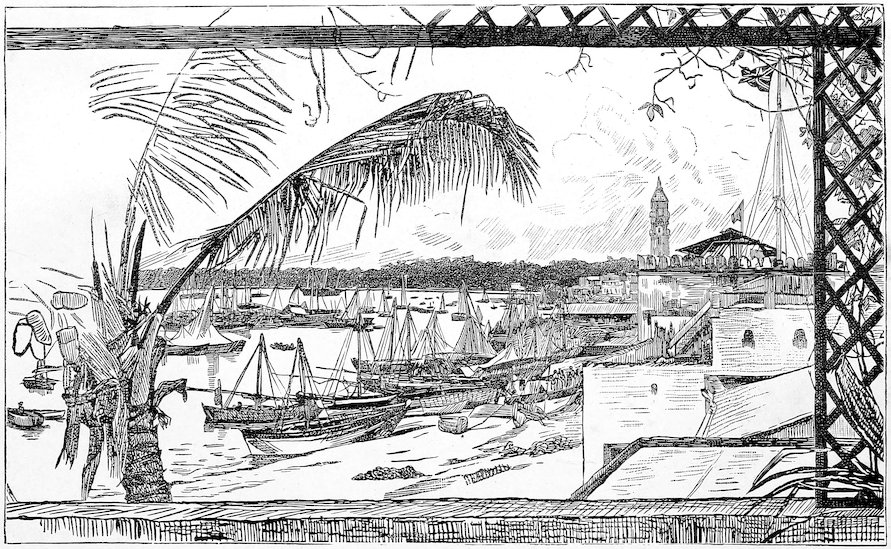
If you look from the
verandah of the Consulate
towards the town of
Zanzibar you have a
scene of much picturesqueness
and colour, and
one which, focussed and
framed by the lattice-work
that is hung with
creeping plants, becomes
a real picture. You see
the ships in the harbour,
the canoes and rowing-boats
skimming in and out among the large vessels,
then lines of daus all drawn up along the shore of
white sand, with busy crowds of men working round
and about them, some
unloading, some repairing,
some looking
idly on, others stripping
for a bathe and
playing at a peculiar
game in the water,
round the hulls of
the half-floated daus,
which consists in turning
a somersault and
bringing your legs
down with a smack
on your companions’
backs. Indeed, the
absence of all social restraint on the shore at Zanzibar
might occasionally ruffle the sensibilities of those of our
weaker sex who are supposed to be shocked at seeing
life under somewhat primitive conditions. There are
no “bathing regulations” at Zanzibar, and the
beach immediately below the Consular windows is the
favourite resort of “natives,” who in complete nudity
gaily chase each other along the silver strand, or
plunge into the tiny billows and the black ooze of the
nether shore. Indeed, the number of Indians who
seem to choose the purlieus of the British Consulate
for performing their ablutions (doubtless because they
look upon it as a right of British subjects to bathe
under their Consul’s eye) render it necessary sometimes
to despatch a Sikari for the purpose of driving
the nude Hindoos to remoter shores, for should the
Consul be entertaining the lady residents of Zanzibar
28at afternoon tea on the balcony, it is somewhat embarrassing
for their gaze continually to encounter, not
the black glistening forms of the burly negroes on
whom nakedness sits with decency, but the yellow
and obese Hindoos, who, with the figures and demeanour
of middle-aged aldermen, are paddling up to
their ankles with the innocence and unconcern of
early childhood.
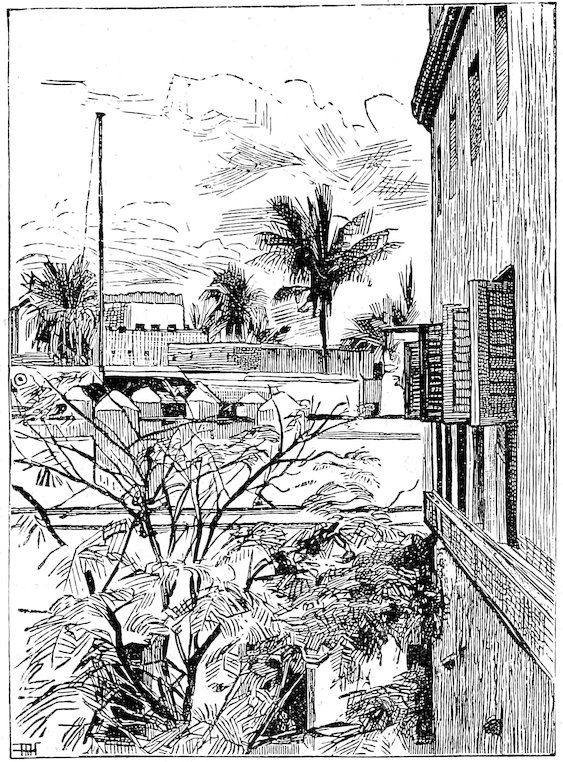
Fig. 10.—A View over the Housetops.
The buildings of Zanzibar along the shore-line are
gifted with an adventitious beauty which is derived
from contrasts of
colour, and light,
and shade. The Sultan’s
clock-tower,
which rises like a
minaret above the
flat-roofed houses,
is in reality a structure
of vulgar,
tasteless design, but
seen from a distance
with its ugliness
softened down,
it lends considerable
point to the
harbour view of
Zanzibar. The other
buildings are little
remarkable for elegance
of exterior shape, but, being all whitewashed or
of light-coloured stone, they form under the sun’s
rays a snowy, irregular mass, the outline of which
tells out effectively against a deep blue or a storm-grey
sky, and is here and there relieved by the green cocopalms
or the flags of the Sultan’s palace and the
different Consulates.
29This view at sunset becomes really beautiful. The
eastern sky is a sombre blue-grey, and the water of
the harbour reflects the same tint, unvaried in the
evening stillness by a ripple. The long headland of
dark green forest, which stretches out into the sea,
lends a deepening tone to the darkened water and sky,
and forms with them an effective foil, a neutral background
to the white tower and the mass of white
buildings which, turned towards the west, reflect on
their sympathetic surfaces the warm glow of the
sunset. In the daytime, under the blaze of a vertical
sun, these houses of Zanzibar are disagreeably dazzling,
but now, in this one quiet half-hour of the short evening,
they glow with a soft pink radiance, and their
tender blush-colour is heightened by its background
of strangely-coloured eastern sky which, first becoming
sombre blue with the sinking sun, for a brief while
grows green with jealousy of the west and partial
reflection of the sunset, and offers a complementary
contrast to the houses at their pinkest. Then, along
the shore, and on the blue bay, the shipping, turned
towards the warm light of evening, loses its blackness
and distinct outlines, and fuses into dusky brown, the
mazes of masts and rigging seeming to part with their
perspective and to stick together in one indistinct
mass. As the shadows deepen and the rose-tinted
houses fade into dull grey, the stages of the Sultan’s
tower are picked out with yellow lamps, and suddenly
from the summit gleams out in cold radiance a star of
more than first magnitude—Sayyid Barghash has
fitted up his clock-tower with the electric light.
Any one visiting Sir John Kirk at home will hardly
30have set foot in his house many hours without remarking
the arrival of an Indian gentleman in a suit of
white clothes of half Asiatic, half European cut, with
a magnificent gold-embroidered turban, a watch-chain,
a ring, and an umbrella. This is Pira Doji, incorrectly
known on board the mail steamers as “The Prime
Minister of Zanzibar.” He is really an astute Indian
trader, who by his capacity for business and exceptional
talents as a raconteur, has known how to obtain
a very large share of the “Sultan’s” confidence and
esteem. Pira Doji is a most useful man to Sayyid
Barghash. Without in reality attaining the position
of Prime Minister or Grand Vizier (the Sayyid has no
Ministers, and therefore rules cheaply), he has yet
become a sort of financial adviser to the Prince of
Zanzibar, and is at the same time head-waiter at
State dinners, man-of-business, negotiator in delicate
matrimonial affairs, and the picker-up and retailer
of all the town news. If Sayyid Barghash is mentioned
in the Times, Pira forthwith goes to the
“Sultan” with a copy of the passage scored round
with red chalk. If a European resident in Zanzibar
sprains his ankle, or beats his cook, the “Sultan”
likewise hears of it through the same source. Consequently
all new arrivals at the Consulate become
objects of interest to Pira, as likely to furnish “paragraphs”
for his princely gossip. If ever a “Society”
paper is founded in Zanzibar, it will have Pira Doji for
its editor.
His Highness Sayyid Barghash having then heard
of our arrival, and as much of our disposition,
antecedents, present intentions, and future plans as
Pira can glean from the Consul’s household, it becomes
incumbent on us to present ourselves, or get our
31Consul to present us, at one of the Sultan’s Friday
levées.
Drawn up before his tawdry palace (a ricketty
building of many storeys, of no style whatever, and
of execrable taste) is a smart-looking regiment of the
New Zanzibar army, the men in white uniform, with
red and yellow caps, and the officers in white trousers
and magnificently embroidered tunics. At their head
stands their organizer and Commander-in-Chief, General
Matthews, who gives the order to present arms as
the Consular party draws near. Then the Goanese
band strikes up “God save the Queen,” and we risk a
sunstroke by walking through the serried ranks of
soldiers with our helmets raised above our heads.
In the entry to the palace more guards, Persian and
Baluch, are assembled, and there are crowds of Arabs
in gala costumes. Preceded by a kind of Master of
the Ceremonies, we pass along corridors and apartments
furnished in the Neo-Oriental (bastard French)
style, and then ascend a strangely mean and poky
staircase covered with scraps of faded kamptulicon.
As we emerge on a small landing, coming up, as it
were, from a stage trap, a tall, portly Arab leans over
the stair-rail, and extends to each in turn a firm,
plump hand. It is Sayyid Barghash come to greet
his visitors half way; and though his cordial way of
taking you by the hand and hoisting you up is merely
a piece of formal courtesy, still it is of material assistance
to you in emerging from the trap-like staircase.
Preceded by the Sayyid, we are ushered into a long,
narrow reception-room of Arab shape but later French
decoration. Except for the fine Persian carpet which
goes the whole length of the apartment, there is little
to note that is pleasing to a critical eye. The furniture
32is red velvet and gilt wood. Round the walls
are ranged medley assemblages of kitchen clocks,
ormolu timepieces, aneroid barometers, thermometers,
anemometers, telescopes, opera-glasses, musical-boxes,
swords, spears, guns, pistols, toys of ingenious kinds,
photographic albums, photographs glazed and framed
and faded, and what not else. The upper end of the
room, where the “Sultan” ordinarily sits, has a
large mirror in the centre, and on either side of the
mirror is a full-length oil painting of Sayyid Barghash.
These two paintings are identical in every detail.
They were manufactured in Paris. The Sayyid had
a photograph taken of himself during his visit to
London. It was in a sitting posture. He sent it to
Paris with the order that it was to be enlarged standing,
and then converted into two oil paintings. The
Parisian artist, in no way at a loss, cut off the head
of the sitting Sultan and stuck it on to the decapitated
portrait of some Algerian Arab photographed erect.
The combination was enlarged, and in due time gave
rise to the two oil paintings in the palace at Zanzibar.
Sayyid Barghash bin Sa’id, the Prince of Zanzibar,
Pemba, and the Zangian coast, is a man of about
forty-five, as far as an Arab’s age may be guessed.
He is tall, somewhat corpulent, and not unhandsome.
Were it not that his face betrays the traces of a too
uxorious life, and that he has for some reason lately
cut off his moustache and trimmed his beard to resemble
an English tradesman’s, he might even be
called good-looking. His complexion is clear, his eyes
large and fine, though faded with excesses, and his
teeth white and perfect. The Sultan’s feet are just
of that ideal type that Sir Frederick Leighton loves
to paint, and which, until I saw them peeping from
33Sayyid Barghash’s sandals, I never believed to exist.
The feet and hands of the Sultan of Zanzibar are the
most beautifully formed I ever saw in a man, and he
is justly proud of them; but alas! his symmetry ends
at his ankles, for he is afflicted with elephantiasis—a
not uncommon disease in Zanzibar, and his limbs are
swollen and misshapen. Though he speaks no languages
but Arabic and Swahili, he is a better-read
man than many a contemporary Eastern Sovereign,
and even aspires to the honours of an author.
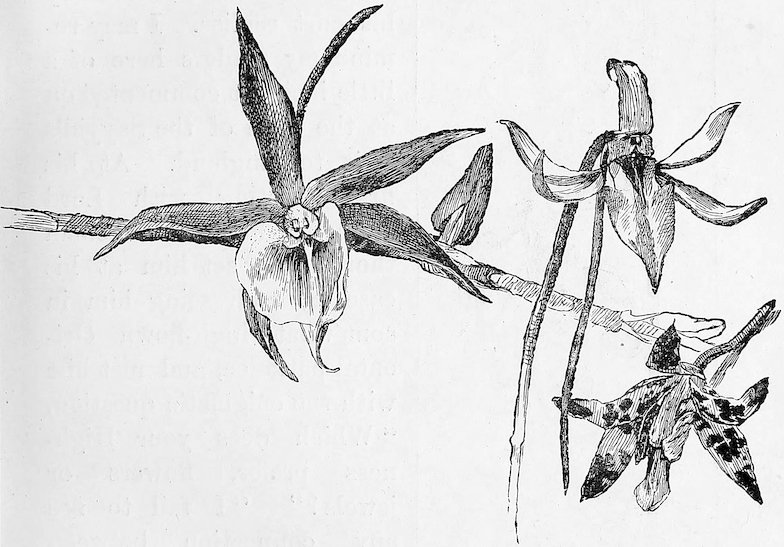
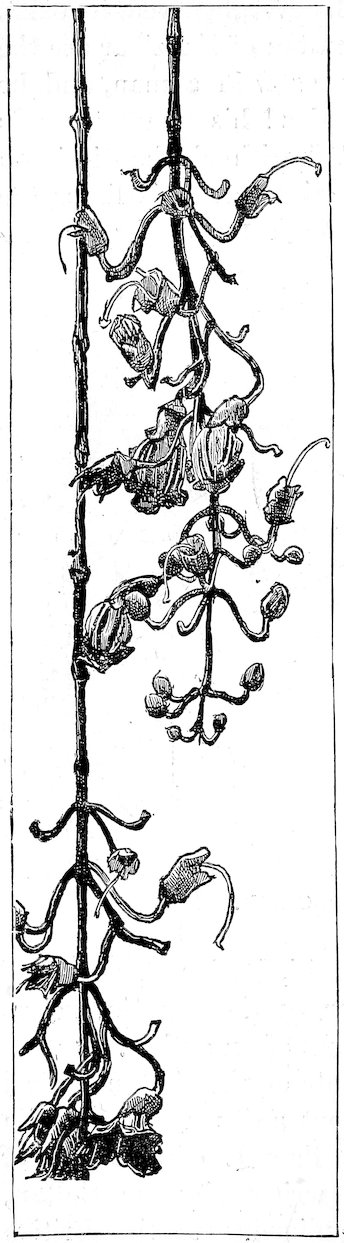
Fig. 11.—Zanzibar Orchids.
One day four or five servants of the Sultan arrived
at the Consulate, bearing about a dozen volumes of a
work in Arabic. This was Part I. of a Digest of
Mohammedan Jurisprudence written by the Sultan,
and presented with his compliments to the British
34Agent. In conversation,
Sayyid Barghash is often
sprightly, and all that he
says is marked by intelligence
and good sense. He
is simple in his diction,
for an Arab, and sometimes
baffles verbose flatterers by
his curt replies. I may remind
my readers here of a
little incident commented on
at the time of the Sayyid’s
visit to England. At his
first meeting with Lord
Beaconsfield that statesman
thought to set him at his
ease by addressing him in
somewhat high-flown Oriental
parlance, and met him
with the enigmatic question,
“Which does your Highness
prefer, flowers or
jewels?” “I fail to see
any connection between
them,” replied Sayyid Barghash
in all simplicity.
Fig. 12.—Kigelia Africana.
An interview with the
Ruler of Zanzibar, then, is
not of that fade character
which characterizes a ceremonial
visit to most Oriental
sovereigns. He poses
you with many shrewd questions,
and when the reception
35is over, the coffee and rose-sherbet drunk, and
the Sayyid hands you down the well-like staircase,
and you depart with the band playing “Rule
Britannia,” you feel that you have met a man who,
had he received anything like an education, and had
been trained by civilized ideas of morality to conceal,
if not to bridle, his unruly passions, would have
made no mean figure among the world’s rulers and
statesmen.
Sayyid Barghash is the son of the last joint ruler of
Maskat and Zanzibar—Sayyid Sa’id. His mother was
an Abyssinian woman. He has nearly a hundred wives
and five or six children, one son only among them. He
is brother to the present Imam of Maskat. His income
is approximately 300,000l. a year, mostly derived from
Customs duties.
Zanzibar, the chief town of his dominions, known as
Unguja to the inhabitants, has a population of about
90,000. As regards trade it is the most flourishing
and important place in East Africa, and the value of
its exports exceeds at the present time 1,300,000l., of
which ivory alone contributes 400,000l. The value of
the imports is about 1,000,000l., and they chiefly consist
of cotton stuffs, kerosene oil, and rice. About
6,000 British subjects reside in the town, mostly Indians,
and in their hands lie the whole retail and most of the
wholesale trade.
36
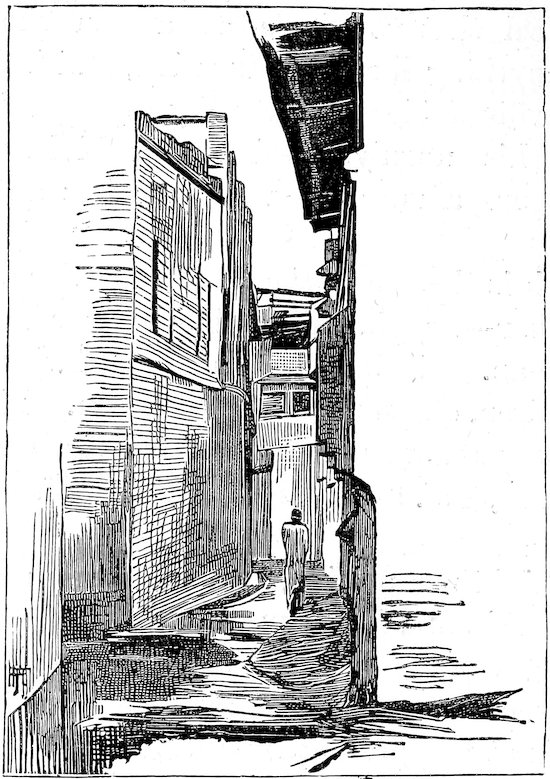
Fig. 13.—A Street in Zanzibar.
The streets of Zanzibar are paved with a sort of
coral “ray,” sometimes cemented over, and are generally,
from the nature of their paving, clean and inodoriferous.
They are very narrow, and the houses in the Arab
quarters are lofty, so that you may walk about most of
the town in perfect shade. There are few really handsome
buildings externally, yet many of the portals to
the houses and mosques are gracefully designed in
Saracenic style. Considerable Persian influence is
evident in the
general architecture
and interior
decoration of
the mosques and
larger buildings,
and the Persian
pointed arch (different
in shape
from the Syrian
or the Moorish)
is constantly met
with. In fact,
to a student of
Saracenic architecture,
Zanzibar
and the Zangian
coast are very interesting,
as they
offer not only
buildings of great age, some of the mosques dating
back to the tenth century of our era, but of archaic
style, recalling most unmistakably the kind of architecture
met with in Saracenic monuments in Spain of
the same age, showing thus how universal with the
early Arab rule was that distinct architectural style
which they developed from the late Byzantine. Just
as there are words in Portuguese and Swahili[7] derived
37from a common Arabic origin, so the resemblance
between the architecture in Southern Portugal and
Spain with that of Zanzibar may be explained by recalling
the fact that the Iberian Peninsula and the
Zangian coast both formed at one time extremities of
Arab rule. While Zanzibar, however, resembles any
other Eastern city, and differs little in outward aspect
from Aleppo or Jaffa, yet the island to which it gives
its name is thoroughly tropical African in its virgin
state. The vegetation is rank and rich, and nearly
every genus of the tropical African flora is represented
among its plants. There are a few orchids, supposed
to be peculiar, and possibly one or two ferns. Many
trees have been introduced from India, and flourish in
a way that exceeds their development in the mother-country.
Magnificent mangoes are planted all over
the island, and the fruit they yield is justly celebrated
for its flavour of strawberries and cream. Of course
pine-apples, oranges, limes, and cocoanuts abound, and
fruit here may be had all the year round in constant
variety and great quantity. Many remarkable and
many very beautiful productions in African flora, though
by no means peculiar to this island, may be observed
and studied here with greater facility than on the mainland.
Of such are the magnificent blue Clitorea, the
extraordinary Kigelia Africana, the exquisitely lovely
Hibiscus schizopetalus, the Crinum lilies, and the
gorgeous-leaved Crotons. The zoology of Zanzibar is
purely African in its character, as far as it is yet known.
Being separated but a few miles from the mainland, its
birds and insects differ little, if at all, from the parent
fauna. It possesses, however, at least two species
(in common with its sister isle of Pemba) of peculiar
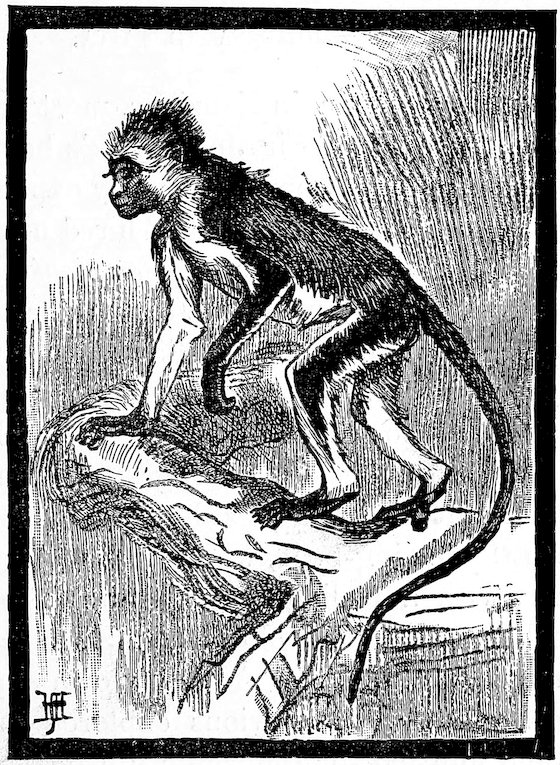
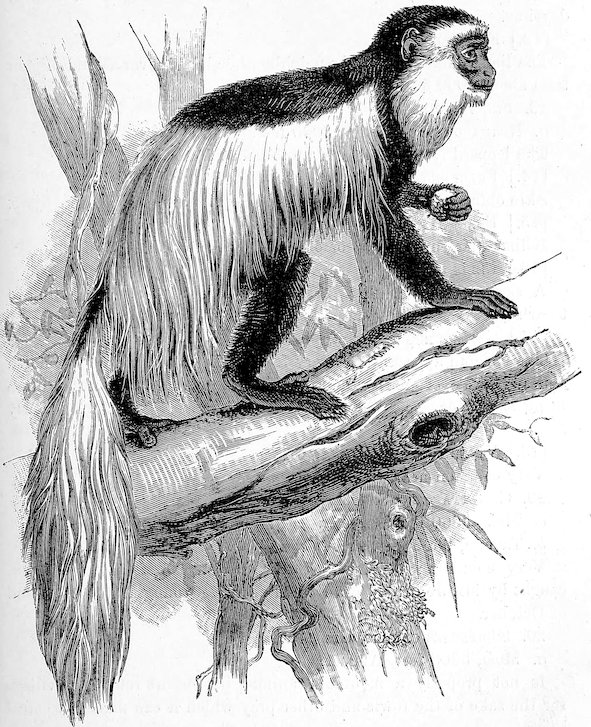
mammals, viz. the Galago Zanzibariensis (a kind of
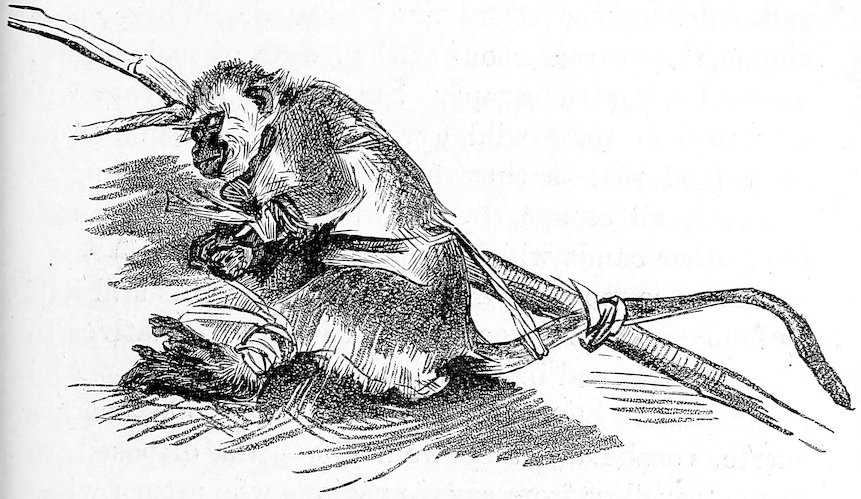
38Lemuroid), and a handsome monkey, the Colobus Kirkii.
This latter, as its name indicates, was brought to light
by Sir John Kirk; it was also extinguished by his
means. Like most great men who have helped to
extend the British Empire, Sir John has one dark blot
on his escutcheon. Warren Hastings exterminated the
Rohillas, Governor Eyre was accused of too summarily
suppressing the Maroons; Sir John Kirk, more, perhaps,
in the interests of British science than of British rule,
has entirely destroyed an innocent species of monkey.
The Colobus Kirkii had disappeared from nearly every
part of the island of Zanzibar, but a rumour prevailed
that it still lingered in a clump of forest as yet unvisited
by hunters. Thither Sir John sent his chasseurs to
report on the monkey’s existence. After a week’s
absence they returned, triumph illumining their swarthy
lineaments. “Well, did you find them?” asked the
British Consul-General. “Yes,” replied the men with
glee, “and we killed them every one!” Wherewith
twelve monkey corpses were flung upon the floor, and
Colobus Kirkii joined the Dodo, the Auk, the Rhytina
and the Moa in the limbo of species extinguished by
the act of man.
When Sir John Kirk gets conscience-troubled, and
the manes of the avenging Colobi (as negroes would
believe) tamper with his health; when Zanzibar gets
stuffy and feverish, and the official routine tryingly
monotonous: he steals away, often on foot, to a little
paradise he has created among the groves of Mbwéni,
a tiny settlement on the coast of the island. Here he
lives a life that is to him ideally happy. He chats with
his tenants, who lead Arcadian lives of nothing to do
and plenty to eat; he wanders in a shooting-coat amid
the groves of coco-palms and the clumps of pandanus
39that border the sea; he photographs; and, above all,
he gardens. Here, among his Cycads and his Orchids,
his Ensetes and his Dracænas, spade in hand, a wide-awake
hat on his head, a rare flower in his button-hole,
and rustic contentment irradiating his face—here, amid
scenery which typifies a botanist’s paradise, Sir John
Kirk is emphatically At Home.
Fig. 15.—Colobus Kirkii.
CHAPTER III. THE START—MOMBASA TO TAITA.
40
After a month’s sojourn in Zanzibar, most agreeably
spent as the recipient of Sir John Kirk’s hospitality,
all my arrangements for commencing my expedition to
Kilima-njaro were completed. I had hired upwards of
thirty porters, most of them old employés of Mr.
Stanley’s on the Congo, and despatched them to Mombasa
in an Arab dau, while I followed in the mail-steamer
going north, accompanied by my personal
servant, a Tamil boy from Ceylon. I took leave of
Sir John Kirk with considerable regret one dark evening
after an unusually agreeable dinner-party, and
entered a little rowing-boat, which was to take me to
the steamer, with a feeling of such downheartedness
that my calmer reflections told me Zanzibar was likely
to prove my African Capua. After my own experience
I could realize now how previous explorers had been
unnerved and unfitted for the rough life of the wilderness
by the luxurious and easy-going life in Zanzibar.
Fortunately the steamer I was journeying in to Mombasa
was the same vessel which had brought me down
to Aden, so that I once more found myself among
friends. The night I left Sir John Kirk’s was stiflingly
hot, and the steamer was full of passengers—I shuddered
at passing the night in a poky cabin with three other
41inmates. The captain saw my hesitation, and offered
most kindly to rig up a cot for me on deck. I accepted
his proposal eagerly, forgetting the danger in it, of
which both of us were unaware. The steamer, according
to custom, would remain all night in Zanzibar
harbour, and leave at dawn. Now—and this is the
only reason I record this incident—there is no surer
way of getting a bad fever than to sleep in the open
air in a tropical port. The reasons for this are many
and would take up a great deal of time and space to
describe properly; I therefore confine myself to the
dogmatic assertion, which I here record in the interest
of such of my readers as may be proceeding to the
tropics, and are likely to be tempted to pass a quiet
night in harbour on the cool upper deck instead of in
their stuffy berths below. Sleep in the air as much as
you like at open sea, but never when you are lying
off shore in a port or land-locked bay. I paid the
penalty of this one night’s mistake in a very bad fever
which attacked me soon after I landed at Mombasa,
and left me horribly weak from its effects. Most fortunately,
in my hour of extremity, I had fallen among
friends. Captain Gissing, the Vice-Consul, was my
host, and not only quartered me and my baggage in
his Consulate, but also put up my thirty Zanzibar
followers, an act of kindness for which I fear he was
ill-rewarded by their noisy behaviour and continual
squabbles with the populace of the town. So kind was
Captain Gissing, that I was not made aware of this
till after my recovery, and I beg to thank him again
here for his considerate patience. The men were anything
but bad fellows, but I suppose, finding themselves
masterless with plenty to eat and nothing to do, they
waxed riotous. In the meantime, the Rev. Mr. Handford,
42of the Church Missionary Society, who had
brought me round in the crisis of my fever, carried me
off to his station of Frere Town on the mainland
(Mombasa is an island) to effect my convalescence,
which, so pleasant was the nursing bestowed on me
under his wife’s kind care, would have been quietly
enjoyable had I not continually worried myself about
my arrested work. However, my friends were not idle
while I lay in enforced inactivity, and the Revs. A.
Downes Shaw, of Kisolutini, and Thomas Wakefield,
of Jomvu, were both busily engaging porters for
my caravan.
At length I was so far recovered as to resume my
preparations for departure, and I once more repaired
to Captain Gissing’s house to pack my vast quantity
of baggage into loads of a more or less uniform weight,
averaging fifty pounds apiece.
As yet Eastern Africa provides no other means of
porterage than human labour, and all goods and
chattels have to be carried on men’s heads and
shoulders. There are donkeys to be bought, it is true,
but they never seem to do well on long journeys, and
are in no way to be depended on; besides, at the time
when I was staying at Mombasa, asses were both dear
in price and poor in quality. Thirty of my men had
been, as already mentioned, engaged in Zanzibar, and
it would have been far better for the fortunes of my
caravan had I recruited all the porters of my expedition
at that place, for the men who frequent the capital
and emporium of the dominions of Sayyid Barghash
are of a better stamp than the worthless A-nika
and A-rabai that inhabit the vicinity of Mombasa.
Why this should be is a problem very difficult to solve,
and one not altogether unsurrounded by thorny questions.
43I am afraid that in recording my downright
bad opinion of the native carriers—many of them professing
Christians—which are to be found in the
vicinity of the English missionary stations near Mombasa,
I am giving pain to my very kind friends, the
missionaries who labour in those parts. I am sorry
for this, for I am aware, more than any one perhaps,
how thoroughly deserving of respect and support is
their unselfish work in those regions. But truth
must be told, and in the interests of travellers who
succeed me in these districts, I warn them never, if
they can help it, to engage porters at Mombasa.
Independently of all questions of religion—Mohammedan
and Christian alike—the inhabitants of the
Mombasa district are a thoroughly bad lot. It is
hopeless to win them by kindness, or infuse a spirit
of discipline by sternness. They are liars, cowards,
thieves, and drunkards. They were so when Krapf,
the earnest pioneer of Christian missions, first came
among them; they are so still, after nearly forty years
of evangelization. Why is it that men got from Zanzibar,
Pangani, Mozambique, or elsewhere, should be
so much superior? It must be some inherent fault in
the local race, because the few men whom I obtained
from the Mombasa missions that were not natives of
Mombasa, but had been trained in the mission schools,
turned out all that could be desired.
However, being unaware of all this, I had already
vicariously engaged the bulk of my porters at Mombasa,
fearing to be disappointed at Zanzibar, as there
is often a paucity of caravan-men in that place, owing
to the constant demand. Even before I started for
the interior, the true character of the Mombasa men
began to dawn upon me, but I hesitated to take the
44extreme step of dismissing them and sending to Zanzibar
for others, because this would, firstly, be very
expensive, and secondly, for the reason that they were
only engaged for one month to transport my goods to
the mountain, and there leave me with my nucleus of
thirty Zanzibaris. Moreover, I was feverishly anxious
to leave Mombasa, feeling sure that I should never
shake off the effects of my illness till I left the unhealthy
coast; and without worrying myself about a
change of men, I had quite sufficient hindrance and
vexatious delay in the purchase and packing of the
necessary goods for sale and barter in the interior.
The great staple of East African trade and the
chief currency of all countries lying inland, is “merikani,”
or American sheeting. I had to purchase several
huge bales of this at Zanzibar and transport it to
Mombasa, there to be split up into loads of five gora
each. A “gora,” or “jora,” is about forty-two yards,
and in sheeting of medium quality, weighs 12 lbs., so
that each load of five gora weighed 60 lbs., and was a
fair burden for a single porter. There were many
other kinds of “cloth” (“cloth” becomes in Africa a
generic name for all dry goods) to be taken. “Kaniki,”
or indigo-dyed cotton; gaudy red handkerchiefs
from Manchester looms; “bandeira,” or Turkey-red;
“kikoi,” or handsomely bordered waistbands, fringed
every two yards; richly dyed stuffs from Western
India and the Persian Gulf, “maskati,” “dubhani,”
“sabhai,” &c. All these in common with the “merikani,”
had to be carefully divided into loads averaging
55 lbs. or 60 lbs.; each load counted and catalogued in
its amount to check the stealing of any of its contents,
and then finally sewn up in a peculiar kind of grass
matting, very strong, and almost impervious to rain.
45Next, the beads had to be considered. It was necessary
to take with the expedition different kinds and
colours, for in East Africa, as I remarked on the
River Congo, there are most varied and capricious
tastes to consult among the natives, and scarcely two
villages concur in their canons of taste. Thus, you
must take different sizes of blue bead, called by the
Wa-swahili maji bahri, or “sea-water,” for although an
entire tribe may affect one shade of blue in their bead
necklaces, yet each individual will have special opinion
as to the correct size of the bead. Then there are
large ruby-red beads and white ones, and tiny pink
and medium-sized black, and transparent blue. When
the beads are bought in sacks from the traders, they
are only threaded on rotten, worthless thread, and it
is impossible to trade with them before they have been
re-threaded securely. For this purpose you purchase
on the coast a stout twine, made, I fancy, from the
fibre of a Raphia palm, and then you set your men to
work to re-thread all the beads. This task, of course,
gives them immense opportunities for quiet pilfering,
for the beads in their eyes are almost like coinage; so
not only must you keep a sharp eye on the little groups
of four or five merry black men who are so blithely
slipping bead after bead along the yellow strings of
palm-fibre, but each man’s lot must be carefully
weighed before and after its transference from the old
thread to the new. Even with every precaution some
loss always takes place during the process, and a day
or two after this task is over you are surprised and
grieved to see one of your most trusted followers
reeling about the streets of the coast town, drunk on
the proceeds of the misappropriated beads.
If you are likely to travel through countries ranged
46over by the Masai, large coils of iron wire must be
taken, as these predatory people greatly value it, and
turn it to many useful ends in their simple manufactures.
Natives of all tribes in East Africa are also
fond of copper and brass wire of every thickness, the
very large sizes being coiled into bracelets or anklets,
and the finer sorts used with much ingenuity to ornament
gun-stocks, the hafts of knives, or the rods of
spears. Finally, to this already extensive list of goods
must be added a few sacks of cowries, barrels of trade
gunpowder, tin boxes of percussion-caps, looking-glasses,
large and small butchers’ knives, bells, mouse-traps,
and cheap musical instruments; while as presents
for chiefs of special importance, fancy articles have to
be taken, such as musical-boxes, accordions, guns of
superior make, playing-cards, fine snuff, and gaudy
picture-books. I was myself provided with a huge
roll of coloured plates from the Graphic and other
illustrated papers, which I found made a most satisfactory
impression on chiefs of an æsthetic turn of mind,
already cloyed with the cloth, beads, and brass wire
of the ordinary trader. When all these wares had
been selected, assorted, and packed, I had further to
add to our encumbrances by purchases of food for
myself and the men, as the country through which
our journey lay was almost uninhabited and devoid of
cultivation. For myself I added crates of potatoes
and onions, and a dozen live fowls to my precious
stock of preserved provisions; while for the men, large
quantities of Indian corn and beans were bought.
How easily fed these Swahili porters are! What other
race would be content to trudge twenty miles a day
with a burden of sixty pounds, and be regaled on
nothing but maize and beans?
47
Fig. 17.—The Shaws’ House, Kisolutini—the first Mission Station in East Africa.
At length all my arrangements were finished. The
men had received and spent their advanced wages, and
had sobered down after the drunken spree by which
they nearly always inaugurate a journey into the
interior. I myself was ready and anxious to be off.
I longed for the bracing air of the inland plateaux to
dispel the weakening fever from which I suffered, and
gladly stepped into Captain Gissing’s pretty skiff, in
48which the first stage of the journey might be made,
for several tidal creeks extend inland from Mombasa
for a distance of nearly twenty miles. My men journeyed
by land, and we all met again in the vicinity of
the mission station of Rabai. After one night spent
with Mr. and Mrs. Wakefield at Jomvu, and a pleasant
rest with the Shaws at Kisolutini, I was at length
launched alone into the wilderness, rather relieved than
otherwise at my unaccustomed solitude. My party
consisted of one hundred and twenty men.
The first day’s tramp into the interior was very
trying. Owing to the scarcity of water, I had resolved
to make a long march to a place called Gora, at a distance
of about thirty miles from my starting point. I
gave my caravan a little start ahead of me, and followed
leisurely in a hammock, feeling at first too weak from
fever to be able to go on foot. In fact, what with
anterior weakness and a blazing sun, I felt in such a
stupid condition that I hoped, during the first day of
my travels, to be allowed to journey peacefully without
undue exercise of energy. But it was not to be, and
perhaps fortunately so, since there is nothing that
dispels the languidness of fever so speedily as the
necessity for vigorous action. After some hours’ easy
jog-trot in my net-hammock, I came up with the bulk
of my caravan, and found all the men reclining in the
pleasant shade of a leafy wood. The Zanzibaris rose
somewhat apologetically, and with a show of respect,
but the men of Rabai and Mombasa merely looked at
me with stolid unconcern, and several yawned unrestrainedly
in my face when I questioned them as
to the cause of this prolonged halt. The head-man of
these Christian—save the mark!—porters then informed
me that his men considered the walk to Gora
49too long to be undertaken in a day, and had chosen
this pleasant spot to repose in during the sultry hours.
I called on the laggards to take up their burdens and
go on; I maintained that I alone had the power to
order a halt; that the morning was still fresh, and
that if we rested now we should never reach the
water-place by nightfall—in vain, I was only met with
sullen looks and murmurs of dissent.
Now was the crisis in which my authority was to be
asserted or for ever to be subordinated to the men’s caprices.
The Zanzibaris were waiting to see how I should
act, and would gauge my disposition by the way in which
I met my first difficulties. In fact, the scene in which
this conflict of wills took place was not ill-disposed for
effect. A slight depression or basin was sunk in the
centre of the clearing, in which the dissentient porters
and their loads were grouped, and around ran an
amphitheatre-like rise of ground, whereon stood a file
of Zanzibaris awaiting the outcome of our dispute
before taking sides. No longer addressing an indiscriminate
crowd, I called on one man to pick up his
burden and take the road. He promptly and curtly
refused, and as quickly my Indian servant had him by
the heels, whilst I soundly trounced him with his own
walking-stick. This was quite a sufficient display of
force. Whilst the recalcitrant porter was still screaming
abjectly for pardon, and I was still gravely counting
the strokes of the wand—eight!—nine!—ten!—eleven!—the
other men had hoisted their loads on
their bullet-heads, and were falling into file along the
narrow path, leaving my servant and myself alone with
the victim of our wrath. The very hammock-men
had disappeared, and hurried forward in an excess of
zeal. But I was almost independent of them now.
50The temporary burst of just anger not only brought
a flush of colour to my pallid face, but seemed to
restore strength to my limbs, and I strode on now by
the side of the caravan, exhorting and encouraging the
men till we had all regained our good humour, and
even the scapegoat himself emerged from sulky silence,
and gave a half-humorous, half-dolorous account of his
beating to the men walking near him.
I had now a little leisure to observe the character of
the scenery through which we were passing. There were
no hills at present in sight, and the view was bounded
by the scrub and stunted trees which closed up round
the narrow path. Nevertheless, the want of landscape
beauty was atoned for by the vivid glory of the wild
flowers, which now, at the close of the rainy season,
were in perfection of bloom. That beautiful genus
Commelyna (a monocotyledonous plant allied distantly
to the spider-worts) gave us species with pale blue,
ultramarine, and citron-yellow blossoms. I marvel
that the Commelynæ, commonest of African flowers,
have never been introduced by European floriculturists.
Under cultivation they ought to yield beautiful displays
of colour, and, as many species grow on the flanks of
Mount Kilima-njaro in an English temperature, there
is no reason why they should not supplant the lobelia
in our garden borders, and yield a vivid sheet of rich
blue blossoms far surpassing the feeble flowerets of the
last-mentioned plant. Many other wild flowers make
themselves noticeable by their abundance and beauty
in this district between Gora and Rabai, which lies
at about thirty to forty miles from the coast, and
receives more rain and humidity from the not far
distant Indian Ocean than the sterile steppes further
westward. Great, tall, terrestrial orchids of the Lisso-chilus51genus border the pathway, and display their
graceful heads of blossoms, which are mauve, or
bright yellow, or yellow and purple, according to the
species. Then there are spotted-leaved aloes, with
sprays of waxy-pink flowers, great prickly candelabra
euphorbias, with tiny green inflorescence, and other
smaller euphorbias with large, weird flowers of a dull,
dead purple-brown. White and blue clitoreas trail
over harsher shrubs, and enliven the grey-green bush
with tender colour. Crinum lilies are lavish in
squandered bloom, and the air is fragrant with a thousand
odours, to which the flowers of acacias, climbing
jessamines, and corissas powerfully contribute.
We reached Gora that night by the light of the
moon, but as my tardy porters had lagged behind, I
arrived at the camping-place without tent, bed, or
provisions, and not only had to lie down to sleep supperless,
but blanketless; and, as the night air was
unusually chilly, my health was not improved by these
privations. The next day we fortunately had but a
march of sixteen miles to accomplish; nevertheless
the men went very badly. We stopped in the morning
at Samburu, a pleasant place, with once-cultivated
plantations run wild. Here there was indifferent
water in clefts in the rocks, and we set to work to
prepare our midday meal. We waited for the laggards
of the caravan until four o’clock, and then, too impatient
to delay any longer, I took advantage of the cool
afternoon and limped on to my next camping-place.
By midnight all were at length reassembled, but I
resolved in future, if it were only to avoid anxiety, to
walk behind instead of before the caravan, and not to
pass any one on the road; thus, I should always arrive
simultaneously with my baggage. The following day
52I put this plan into operation, but its first results
were not encouraging. About every half-hour the
Rabai men would put down their burdens and compose
themselves for a nap in the shade. As these
intermittent siestas greatly deranged the uniform
progress of the caravan, I objected, preferring to rest
unanimously every two hours, but walk uninterruptedly
whilst on the march. As the Rabai men were, however,
of a different opinion, I now began to meet at
every turn of the path a man’s load without a man,
and on inquiry was told that its whilom bearer had
decamped into the bush. Last of all I counted nearly
a dozen of such abandoned burdens, and sat down
desperate by the wayside, not knowing what course to
pursue. However, my Zanzibar men stood by me like
trumps, and many of them carried extra loads, and so
brought all the things to our next camping-place at
Ziwani.
Here we arrived at about dusk, although there
was scarcely any ending to the daylight, for we were
favoured with a brilliant moon. I now was able
to review my men and rearrange the loads so that all
the things might be carried on the morrow. I retired
at last to my tent, thoroughly exhausted, both with
physical fatigue and mental anxiety. Throwing myself,
or rather involuntarily tumbling, on my bed, I
felt I was fainting, and just roused my energies sufficiently
to ask my servant to open my wine-case and
get me out some champagne. When a bottle of Moët
and Chandon had been uncorked, and a tumblerful
(alas for the delicate champagne-glass, I had it not!)
drunk, an effect as magical as that of the “hashish”
given by the Sheikh of the Mountain to his deluded
followers was produced. Before the foaming draught
53had passed my lips I was a poor, despondent creature
of the earth, earthy, and tied to the base soil by
physical fatigue and mental prostration; but no
sooner had the sparkling wine entered my system
than I was transfigured, transformed. My fever-dried
skin broke out into grateful perspiration, the fitful
pulse resumed a brisk and regular beat—no fainting
now. I felt ready to march anywhere, and my
blistered and ulcerated feet pained me no more. I
ate my evening meal in a sort of tranquil ecstasy, and
afterwards undressed dreamily, and steeped all my
cares in the Lethe of sleep. And a cupful of champagne
on an empty stomach had sufficed to work this
happy change!
In case there are some of my readers whom this
rhapsody (copied almost word for word from my
diary) may offend, let them understand that I am
singing the praises of champagne as a medicine, not
as a customary drink. No one can inveigh more
strenuously than I against the daily or even frequent
use of alcoholic drinks in a hot climate. I believe that
in Africa, as a general rule, and under ordinary circumstances,
a man may with benefit to himself abstain
totally from the use of wine, beer, or spirits. But,
for the very reason that he rarely indulges in strong
drink, when he does find himself in a state of physical
or mental prostration, especially ensuing from attacks
of fever, there is no more certain tonic than a little
good champagne. I have seen cases in Africa, East
and West, where a cupful of champagne administered
at an apparently hopeless juncture has snatched a
man from a sinking condition, and brought him back
to life. I only took a dozen of champagne—and no
other wine—with me to Kilima-njaro, and of this
54dozen eleven bottles were consumed at various crises
in my adventures, when I felt my physical strength
deserting me. Somehow the very knowledge that
you have such a stimulant at hand braces your nerves
with mental confidence, and the happy faith in its
sovereign efficacy inspires you with a cheering belief
that Death himself will flee before a goblet of
champagne.
The name of our last camping-place, “Ziwani,” had
a pleasant sound to the thirsty traveller, for translated
into English it means “By the pool,” and would consequently
suggest the close proximity of water. But,
except under favourable conditions, this is not the case
at the spot in question, and, as it happened, Taru, a
day’s journey from Ziwani, was the last place where
we had been able to replenish our gourds and bottles.
In consequence of such dearth of water it was necessary
that the distance between Ziwani and Maungu (the
next watering-place) should be covered in a day, and
as this was thirty-two miles it meant a forced march
of thirteen hours. My men had willingly allowed me
to ignore the disagreeable necessity, fearing that I
might, as I certainly should have done, force them to
break the distance between Ziwani and Maungu by a
night march—a thing they much detested, even when
performed by the light of a full moon, having, like
most Africans, a superstitious fear of night. But being
themselves conscious of the long stretch of waterless
country they had to traverse before reaching the mountains
of Maungu, they, for once, were eager and ready
to start before their leader’s call, and consequently
when I awoke from that delicious dreamless sleep
caused by the timely draught of champagne, I found
myself almost alone, while a strange and unwonted
55silence pervaded the camp. The head-man of the
caravan was squatted outside the tent patiently awaiting
my awakening. The Indian servant and the senior
cook were busily preparing breakfast, while just sufficient
men remained behind to carry my tent, bed, and cooking
apparatus.
Learning the cause of my porters’ disappearance,
and far from disapproving such unaccustomed and
unprompted activity, I hastily dressed, swallowed
my breakfast, and also prepared myself for the long
journey that lay before us. The bright slanting
beams of an hour-old sun lit up the landscape so cheerfully
that the purpose of covering thirty-two miles by
nightfall seemed both feasible and easy of accomplishment.
The air was fresh and buoyant, and either my
potion of the night before or the change from the hothouse
atmosphere of the coast to a more bracing
climate had brought back strength to my limbs and
courage to my heart, for I stepped out along the red
path at three miles an hour and enjoyed the exercise.
This rate of progress soon brought me up to the rearguard
of those who had started with the earliest dawn,
but whose energy had waned after two or three hours’
hard tramp. Already, with stupid resignation, many
were stretching themselves by the wayside, having first,
to satisfy a moderate thirst, consumed in several gulps
the remainder of the drinking-water which was to
carry them through the day; and, this finished, they
were prepared to lie down in utter hopelessness, feeling
themselves unequal to the task of walking twenty-five
miles to the next water-supply or twenty-five miles
back to the last.
I should parenthetically remark that these East
Coast porters, like most Africans, are utterly without
56prevision, and so long as they can satisfy the desire of
the moment care little to provide for future wants as
yet unfelt. On long journeys, where there is no water
on the road, you will experience the greater difficulty
in preventing your men dropping and dying of thirst,
because, although they may have started with an ample
supply of drinking-water in their gourds—quite sufficient
for the time required if carefully measured out—yet,
in spite of warning and prohibition, they will
squander the precious fluid, quench every slight attack
of thirst, and consume it all in a few hours; then,
during the long waterless tramp which ensues, they will
wring your heart with the sight of their sufferings, and
stagger along the dusty path with dry, swollen tongues,
parched lips, and bloodshot eyes.
So it was on this terrible journey to Maungu.
Towards midday, when the noon blazed in fierce
white heat, when the sky was so hot and scintillating
that it was devoid of all colour and shone like a
silver shield, when the short, scrubby mimosas gave
no sheltering shade under their thorny boughs, when
escape from the overpowering dazzling sunshine was
impossible, and the baked and heated soil seemed to
burn the soles of my boots, and made the men who
were still plodding on pick up their feet like the proverbial
dancing bear—then I began to doubt whether
my party would reach Maungu intact, for now it
was useless to battle with the sullen sluggishness of
many of the porters, who preferred lying in the road
exposed to hard words and blows rather than toiling
patiently and uninterruptedly on in the direction of
water and permissible repose. So in sheer despair I
left them to lie wherever they threw themselves, accepting
in lieu of any other consolation their assurance
57that they would follow on in the cooler hours of the
day. Now, even, it became with myself a desperate
rush to reach the water-supply before I should suffer
painfully from thirst. An examination of my own store
of the precious liquid had revealed the appalling fact
that not one drop remained, and the man who had been
carrying my bottles and calabash confessed to having
assisted in its disappearance. This was a serious
matter; thumping the man did nothing towards allaying
my increasing thirst. All that could be done was to
journey on patiently but unremittingly in the direction
of Maungu. There was no time to prepare food in the
middle of the day: I pulled out a tin of hare soup from
my provision box, opened it, and drank the undiluted
liquor. The unfinished bottle of champagne was
divided and consumed by myself and my patient Tamil
servant, lending a factitious strength to our tired, overheated
bodies, and so far buoying up our spirits that
we strode on past man after man until we were well
ahead of the caravan.
Soon, however, I needed to rest more and more
frequently, stopping at last to pause and pant in
every patch of thin shade. Then my Tamil boy
and the head-collector proposed that they should go
on alone and return to meet me as soon as water
was found. This I acceded to, and so was left
completely alone. In this condition, hobbling along
painfully, resting continually, and with foolish persistency
painting, to my thirsting imagination, vivid
pictures of cooling draughts, I toiled through the sultry
afternoon, persisting doggedly in my determination not
to give in till I was within measurable distance from
water. Sometimes I did give way—stretched myself
languidly under the faint patchwork of shade that
58some meagre bush afforded, and lay there during some
minutes, vainly trying to moisten my dried lips with
my parched tongue, and hoping that with the approach
of night and its dewy coolness I might overcome this
raging thirst. Then the little lithe lizards would come
and look at me with their heads on one side, and their
bright eyes scanning me half-mockingly; an irate ant
would nip my hot hand, which I had abandoned as if it
no longer belonged to me, and carelessly placed on an
unconsidered ant-hill, till at length, weary of my unrestful
repose, I would stagger to my feet, and limp
on for a few minutes in agony, as you always do when
you have given blistered feet a brief rest and then
commence walking again.
I will spare you a further recital of these very
ordinary, everyday African sufferings, so interesting
to me to ponder over now that I am writing about
them in England, where thirst is almost desirable
from the many pleasant ways there are of quenching
it. I will suppose that I have stumbled over
a rocky path in the waning daylight, toiled on the
last dreary miles of the journey under a rising
moon, and at length found myself amid a strange
thicket of thorny trees and weird euphorbias at the
base of the hill of Maungu. In the camping-place
where most caravans stop, I see a small fire burning,
a man sitting, and a man lying down. The former is
one of my natural history collectors and the other my
Indian servant, Virapan, who has fainted. I question
the collector, a man called Athmani, and he tells me
the water lies in a cup-shaped basin at the summit of
the hill (which is nearly 5000 feet high), and that his
companion and helpmate, Mabruki, has gone to get
some. Fancy when you have walked thirty-two miles
59for a drink finding your cistern lies some three or four
thousand feet above you!
With what amount of patience I should have awaited
the return of the water-carrier I do not know, but
just at this juncture one of my porters arrived, and
threw down his burden with a weary sigh. I remembered
with joy the contents of the lumpy sack he
bore, and rapidly untying its mouth took from it
several cocoanuts. Filling a gourd with their milk, I
was able to assuage the thirst of myself and my
servant, who had returned to consciousness, and we
then passed with equanimity the half-hour that elapsed
before Mabruki came back from his quest among the
rocks of Maungu, bearing gourds full of delicious
water, clear and cool.
At this camping-place we remained until the
afternoon of the next day, awaiting the coming in
of all the laggards; but my patience was at last
overtaxed, and I resolved to go on with a few
followers to Ndara, the next camping-spot, where
we should be in an inhabited country, and with
pleasanter surroundings, for the vegetation in the
vicinity of Maungu was singularly forbidding and
ugly, suggesting some enchanted forest, and, moreover,
the water-supply proved scanty and difficult of access.
I left my head-man and a few followers to search for
the missing men, and walked on to Ndara through
the moonlight, stopping to sleep for a few hours
before dawn. In the early morning we began to
ascend and cross a rocky ridge, and on surmounting
it looked out westward over the plains or mountain
plateaux of Taita. Here our sight was gladdened by
clumps of really green and shady trees, and we were
further delighted by the first signs of evident cultivation.
60Further on we met some natives, ugly, nearly
naked, and very black, with huge rings of beads in
their wide-lobed ears, and greeting them with effusive
friendliness we induced them to follow us to our
camp with a few eatables (sweet potatoes and corn-cobs
principally), feeling in our delight at once more
reaching habitable country an amiable desire to be on
the best of terms with its inmates. We pitched the
tent at the foot of Ndara Hill, near a pool of dirty
water, whither large flocks of cattle came to drink.
In this not unpicturesque country of rocks and
forest trees and lovely wild flowers I stayed during
two days, and at last collected my caravan round me.
Maungu was very nearly being a Moscow to my little
army, but ultimately there was small loss in either
men or goods. Some two or three porters had run
back to the coast, leaving their burdens behind, while
two miscreants who carried a case of spirit for preserving
natural history specimens, had broached and
drunk the alcohol, and, strange to say, still survived
this extraordinary bout.
Before I leave Ndara, therefore, I may take this
opportunity of describing, somewhat in detail, the
men who were following me to the steeps of Kilima-njaro,
and on whose fidelity the fate of the expedition
entirely depended. The head-man of the entire
caravan was Kiongwe, a pleasant-spoken, rather
plain young man of about thirty, who had served
much on the Congo, and had accompanied Stanley
thither in his first expedition, in proof of which he
wore a massive silver ring. Kiongwe (whose name
meant in Swahili a “headstrong jackass,” and who
was therefore politely called by his inferiors “Shaongwe”
in order that his name might not be too
61closely interpreted) was good-tempered, respectful,
and fairly brave, but could not always be trusted with
property, as he felt now and then an irresistible
temptation to appropriate a little of his master’s cloth
and beads. However, he made a good head-man, for
if lenient to his own occasional dishonesty he watched
well that no one else robbed me. The second in command
was Abdallah, another old Congo traveller, and
a learned Arab scribe. Excelling Kiongwe in politeness
and suavity of demeanour, he also erred somewhat
as regards strict honesty, but was on the whole
a very good fellow. His manners and mode of life
were quite fastidiously gentlemanly, and his person
was always, and under every circumstance, clean and
sprucely apparelled. Without being in the least religious
he had a gusto for prayers, and all his leisure
moments were employed in the rapid and glib recital
of the Koran. I once asked him what would be his
ideal mode of life. “Kusoma Muungu, sikuzote”—“To
be always praying to God,” he replied, with the
faintest hypocritical tone of self-satisfaction in his
voice.
62
Fig. 18.—Virapan, my Tamil Servant.
Then in order of precedence came Mabruki and
Athmani, two natural history collectors, men who, by
accompanying several preceding African travellers,
had acquired a rough knowledge of preparing specimens.
The further history of these two gentlemen
will be disclosed as this narrative proceeds. My two
cooks deserve a word of mention. Faraji, the elder,
was a busy old man of the Yao tribe, who had accompanied
Cameron across Africa and further served a
three-years’ term on the Congo. He was the strongest
man in the caravan, and his only fault was a somewhat
large style of housekeeping, by which himself and his
colleagues were amply fed out of the remains of my
dinner. Cephas, the junior cook, often called Cephassi
by the soft-tongued Zanzibaris, was originally a freed
Nyassa slave. Educated at the Nassick Mission,
near Bombay, he had been taught to cook in a way
that generally procured him good situations. He had
visited England and there acquired certain useful
expletives which served him as augmentative, diminutive,
63intensifying, and modifying adverbs, and lent
great expression to his simple English. Beneath the
rank of the men already cited, whose wages were
specially fixed, came a troop of Zanzibaris on their
promotion, who received a uniform rate of five dollars
a month. Among these, however, I had noticed
already several as good servants or cheerful, conscientious
men—Ibrahim and Kadu Stanley, especially.
Ibrahim was nick-named “Mčekesaji,” a word which
you will find translated in Steere’s dictionary “a
merry, laughing body.” Kadu Stanley was remarkable
as having been an old servant of Stanley, to
whom he had been given by Mtesa, King of Buganda.
After the Zanzibaris came a herd of Rabai and Mombasa
men, solely remarkable for their hopelessly bad
disposition and for the quaint combination of Christian
and heathen names they assumed. I had only engaged
them to carry the bulk of my goods to Kilima-njaro,
and when we had attained that goal I took leave of
them without regret.
CHAPTER IV. TAITA TO KILIMA-NJARO.
64
Having once more reassembled the men, rearranged
the burdens, and left behind what we could not carry
in the kind charge of a missionary who was temporarily
residing on the summit of Ndara Hill, we
started on a day’s journey to Mwatate, passing through
dense thorny bush, rocky defiles, and dried-up stream
courses, and finally reaching, to my joy, the first
channel of running water we had met with since leaving
the vicinity of the coast. The ground along its
banks had been cleared and cultivated; we crossed the
stream on a rickety wooden bridge, and passed up
through fields of maize and brakes of sugar-cane to
our camping-place, under an umbrageous tree. Here
pleasant-mannered natives greeted us; we paid the
small present demanded as an indemnity for passing
through their country and drinking “their” water,
and then enjoyed a welcome rest amid surroundings of
quiet beauty. The next day we were travelling through
a Swiss-like country of mountain passes and richly
fertile valleys, and at length came to Bura, a camping-place
at the foot of the strangely peaked mountains of
that name. Here we were nearly having a skirmish
with the natives, who demanded an exorbitant payment
for the right of drinking from their river. However,
a resolute attitude on our part preserved the
peace, and we were soon on excellent terms with the
Wa-taita, buying fowls, maize, and honey at a great
rate. On the morrow we skirted the little river of
Bura for a few miles, and then, reluctantly leaving its
belt of rich, majestic forest, plunged resolutely into
the waterless wilderness which separated us from the
base of Kilima-njaro.
65Although the journey before us was a far longer
one than that terrible march to Maungu, it was,
nevertheless, marked by no sufferings from fatigue
and thirst, for I had the men now well in hand,
and was careful to ascertain that no one had
started without a due supply of water. The country
we passed through was indeed a wilderness, but yet
rather parklike in its aspect. There was an entire
absence of undergrowth, and tallish trees with cedar-like
crowns rose at regular intervals, looking, in their
uniformity of unvarying red trunks and bright green
compact foliage, like an unskilfully painted landscape.
Other noticeable features in the scene were the tall
red ant-hills and, strange imitation, the tall red antelopes,
a species of hartebeest,[8] resembling faintly in
shape the form of a giraffe with sloping hind-quarters,
high shoulders, and long neck. Being a deep red-brown
in colour, and standing one by one stock-still
at the approach of the caravan, it was really most
difficult and puzzling sometimes to know which was
hartebeest and which was ant-hill; for the long grass
hiding the antelope’s legs left merely a red-humped
mass, which, until it moved, might well be the mound
of red earth constructed by the white termites. The
66unconscious mimicry was rendered the more ludicrously
exact sometimes by the sharply-pointed, flag-like
leaves of a kind of squill—a liliaceous plant—which
frequently crowned the summit of the ant-hill,
or grew at its base, thus suggesting the horns of an
antelope, rather with the head erect, or browsing low
down. The assimilation cannot have been fancied on
my part, for it deceived even the sharp eyes of my
men; and again and again a hartebeest would start
into motion at twenty yards distance and gallop off,
while I was patiently stalking an ant-hill, and crawling
on my stomach through thorns and aloes, only to find
the supposed antelope an irregular mass of red clay.
67
Fig. 20.—Zebras.
The great plain which lies between the country of
Taita and the eastern base of Kilima-njaro swarms
with game, especially where the land slopes gently
towards Lake ǰipe, which may be descried to the
southward as a narrow slit of silvery white lying
between a band of dull green forest and the purple
wall of the Ugweno Mountains. As we marched along
herds of hartebeest, gnu, eland, and buffalo defiled
before us, wending their way slowly along their own
beaten tracks to the accustomed drinking-place, where,
poor fools, some of them were sure to lose their lives,
for, lying in ambush in the forest tunnel, down which
the thirsty creatures rush to the water, would be either
lions, leopards, or human hunters, armed with poisoned
arrow and broad-bladed spear. But however much a
keen desire to drink might blind them to danger when
they are near their goal, they were wary enough now,
and their sentinels kept a sharp look-out on our
movements; only the giddy zebras—most inquisitive
of animals—risked their lives by galloping up to inspect
the passing caravan. The sight of all this game was
potent enough to stir a hunting impulse in the soul of
the most jaded traveller; and although I found it hard
enough to plod along the dusty track in the rear of
the caravan, and avoid the impulse to cast myself down
and rest in every patch of sparsely scattered shade,
still I did every now and then make a sally at some
wondering antelope that stood in the distance staring,
snorting, and occasionally stamping petulantly with
its fore-feet at the strange, inexplicable, snake-like line
of white-vestured men slowly winding over the plain.
But my attempts at stalking, and my snap-shots were
too impatient and hurried to meet with any definite
68success. The fact is, in African travel, it is not easy
to combine the accomplishment of twenty or thirty
miles walked every day on foot, with the exploits of
the chase, especially when haunted by the knowledge
that every minute’s delay that separates you from your
water-supply is dangerous. You leave the road just
to stalk a group of zebras grazing not more than two
hundred yards off, and you think if you can only creep
up to that ant-hill and hide behind it, you will get a
splendidly easy shot. Well, the ant-hill is reached, but
the zebras have moved off a little farther, and now there
is a stumpy mimosa-tree between you and your aim.
However, it is a matter of a few paces to crawl up
to it and fire from behind its branches. You reach
the tree, and just as you are going to raise your gun
you crack a dead twig, and the zebras move and trot
off some distance farther. Now it is too long a shot
to risk, but as the game is grazing peacefully and
unsuspiciously again, you may just as well creep up a
little nearer and then fire. So you go down on allfours
in the grass, and crawl along, putting your
hands invariably down on cruel thorns or sharp twigs
every time they touch the ground; your back aches
with the snake-like posture you assume, and when at
length you cautiously raise your head above the grass
and dare to look frankly before you, you find the
zebras have moved on again, and you either crawl
after them, infatuated with the love of hunting, or in
desperation foolishly fire your gun at a distant speck,
and of course miss, when all that remains of the animals
you have stalked is a light cloud of red dust hanging
in the hot air. And now you become fully conscious
of how foolish you have been to leave the caravan.
How hot the sun is! And your blistered feet ache as
69you limp back through the stubbly grass to find the
track once more, of course tripping up a dozen times
over unseen stumps and stones, and finally reaching the
road to see your caravan represented by a few white
specks in the extreme distance, these white specks now
hurrying on with aggravated speed, just as if they
knew you were limping painfully after them, and
wished to pay you out for the many times when, they
being tired and halting, you, burdenless and fresh,
had remorselessly driven them on. And so with many
sensible reasons you vow that nothing shall tempt you
from the road again, for, even supposing you killed
anything, can you stop the caravan for many hours
while the meat is cooked and the skin cured? Of
course not, why—and here you interrupt these reflections
by exclaiming excitedly to your servant, “Oh,
look here; I can’t stand this. Give me my gun—sh!
don’t you see that sable antelope—there! standing
under the shade of the big tree;” and so hurriedly
taking aim you fire, and
oh! joy, the antelope falls,
evidently wounded, but,
alas! not to the death,
for it is up and off again
before your next shot can
finish the work, and like
an idiot, you forget your
sore feet and fatigue, and
go racing after it over
stocks and stones till once
more you find it is in vain
to combine the cares of a marching caravan and the
pleasures of the chase.
Fig. 21.
Sable Antelope.
The expedition had been toiling on across the hot
70plains of Lanjora through the sultry afternoon, and
now towards evening stopped to lay down its many
burdens amid the dusty tufts of scorched grass round
the base of a great mimosa-tree. Only one hour might
we rest, for water lay two days behind us and one
long day’s journey in front, and we intended but to
stretch our tired legs on the lumpy soil until the
obscurity prevailing after sunset was dispelled by the
uprising of the full moon. Then beneath her cooler
rays we should journey on towards our goal for half
the night, and so be spared a longer walk through the
heat of the morrow’s sun. The day had been sultry,
and, though the rainy season was over, the western
sky was a mass of lurid clouds, which in one part of
the horizon were particularly dark and concentrated.
I knew what caused this, and what object these cloud-masses
were jealously concealing like the courtiers and
officials who surround the person of some Eastern
emperor; and I, who had journeyed many weary miles
to see the greatest snow-capped mountain of Central
Africa, impatiently longed for some giant broom to
clear the sky of those heavy mists and vapours which
now hid him from my gaze.
Slowly a globe of yellow-white rose in the east and
mounted into the clouds, from whence a softened light
descended, and showed the track across the plain
winding away like a crooked snake towards the west.
With many an impatient sigh and grunt the weary
men took up their burdens, and I, no less tired, but
compelled to show my porters an encouraging example,
staggered on to my blistered feet and limped along in
front of the caravan, which, once more on the move,
jogged on with little heart till midnight. Then we
could no more; so, making fires to keep off the wild
beasts, we stopped to rest till dawn. With the falling
temperature of the small hours, a brisk wind arose
from the heated plain and swept the clouds from off
the sky, all except the mass that obstinately clung to
Kilima-njaro. Feverish and over-tired, I could not
sleep, and sat and watched the heavens, waiting for
the dawn. A hundred men were snoring around me,
and the night was anything but silent, for the hyenas
were laughing hideously in the gloom outside our
circle of expiring embers. At five o’clock I woke my
servant Virapan, and whilst he was making my morning
coffee I dropped into a doze, from which, at
dawn, he roused me, and pointed to the horizon,
where, in the north-west, a strange sight was to be
seen. “Laputa!” I exclaimed; and as Virapan,
though he had read “Robinson Crusoe” and the
“Arabian Nights” in his native tongue, had never
heard of “Gulliver’s Travels,” I proceeded to enlighten
him as to the famous suspended island of Swift’s
imagining, and explained my exclamation by pointing
to the now visible Kilima-njaro, which, with its two
peaks of Kibó and Kimawenzi and the parent mass of
mountain, rose high above a level line of cloud, and
thus, completely severed in appearance from the earth
beneath, resembled so strangely the magnetic island
of Laputa.
THE FIRST VIEW OF KILIMA-NJARO.
71Kilima-njaro was weird in the early flush of dawn,
with its snowy crater faintly pink against a sky of
deep blue-grey, wherein the pale and faded moon was
sinking, and the stars were just discernible; but as
the stronger light of perfect day prevailed, and the
clouds which concealed the base of the mountain disappeared,
its appearance was disappointing. Owing
to an atmospheric illusion Kilima-njaro, which was in
72reality about forty miles distant, appeared to rise from
the plain just beyond a distant clump of trees, and its
greater peak of snow, so distinctly crater-like in form,
together with the lesser and more jagged Kimawenzi,
were as hard and commonplace in look as the cheap
Italian water-colour drawings of Vesuvius, charged
with “body-colour,” and devoid of ærial effect.
Kilima-njaro, now, was not imposing, and I soon
ceased to realize its great height when it looked not
much farther off than the farther groups of trees. As
the day grew warm it was once more hidden behind
layers of clouds, and I marched on towards my destination
somewhat disappointed.
For some two days since leaving the mountains of
Taita we had been crossing a waterless tract with
poor herbage of dusty-brown or yellow-white, and
grey, withered trees, and real verdure had been denied
us; but now on reaching a point within some thirty
miles of Kilima-njaro a change of an agreeable character
came over the scene.[9] Tall umbrageous trees
cast a welcome shade over the short herbage, which
was closely cropped like a lawn by the many herds of
antelopes. The bushes were vividly green, and some
of them bore tufts of bright-coloured flowers. Many
birds frequenting the bushy trees attested the proximity
of water—we were, indeed, close to a little
affluent of Lake ǰipe—and the feeling that we were
now without threatened thirst added to the pleasure
of the morning’s walk, and promised for the future
less arduous journeyings. I was, therefore, beginning
to relax my strict watch over the men, and knowing
73there was no need for hurry now that we were perceptibly
nearing our goal, I was sauntering along easily
in advance of the caravan, when my servant Virapan
tugged me by the shoulder, and said, “What is that
big animal, sir?”
I looked along the path in front, and saw, to my
great astonishment, a lion quietly trotting ahead of
us. As he heard the sound of a voice he unconcernedly
looked round, gave us one penetrating glance,
made a few hesitating steps, and then stopped to stare
again. A mad impulse to fire seized me, and although
my sporting gun was behind with the caravan, I took
the Snider from my servant’s hands, aimed it hastily,
and fired. No sooner had the smoke cleared away
than I saw the lion bounding away in great leaps over
the low bushes, evidently untouched by the bullet.
He entered a dense mass of thorny acacias and there
stopped. My head-collector coming up, we followed
him to this refuge, and I can assure you I felt then
anything but comfortable, for we could see, amid the
thickly-interlaced twigs, literally nothing, while a deep
ominous growling reached our ears, so strangely
divested of “locality” that we could neither of us
determine the exact spot from which it proceeded.
We now decided to withdraw with all due caution, and
backed respectfully from the presence of the king of
beasts till we had once more regained the road, where
we found most of the carriers awaiting anxiously the
result of our encounter. Disliking to be baffled, I
proposed that we should organize a regular battue,
and drive the lion from his shelter, but nobody liked
the idea except my Indian servant, who was inadequate
for the task, so I reluctantly abandoned what might
have been a spirited lion hunt. Towards the afternoon
74of this day, which had begun in such an exciting
manner, first with the view of Kilima-njaro and next
with the lion, we left every trace of sterility behind us—the
very mimosas and acacias becoming changed
and improved in their appearance, exhibiting more
foliage and less thorns—and the track winding through
superb avenues of lofty umbrageous trees. After
many days of journeying in a sun-scorched wilderness
my tired eyes here rested with delight on the soft
green of the exuberant vegetation, while I no longer
tramped along a stony road under a blazing sun, but
followed a soft leaf-covered path plunged in absolute
shade. We were now in the precincts of Taveita, but
before we actually entered that African paradise we
were obliged to halt at a gateway in the forest where
the path was blocked with an immense structure of
tree-trunks. Just a tiny aperture was left, an entrance
three feet high in the shape of a delta, and through
this we all had to wriggle and crawl, while several of
the loads would scarcely admit of passing through,
and only the most ingenious twisting and turning
effected this end.
The first barrier passed we found ourselves in a small
square chamber, really a space between two gateways,
where in times of war and rapine suspicious visitors
could be inspected and interviewed before being allowed
to enter. There was, however, no one to scrutinize us
in this gateway, because the “passport” regulations
of Taveita have been greatly relaxed of late years, but
a few decades back this elaborate hindrance to free
transit was the only protection the wretched Taveitans
had against the merciless assaults of the Masai robber
bands. By erecting these wooden obstructions across
the only feasible approaches to their forest stronghold
75they checked the impetuous onslaught of the brigands,
and were able, moreover, to kill many of the bewildered
Masai with their guns before these people could creep
round or destroy the barrier. As the Masai never throw
their spears, but always use them and most of their
other arms in hand-to-hand conflict, they are naturally
at a disadvantage when opposed to an enemy who has
entrenched himself behind a slight fortification and can
use his firearms to advantage.
Passing in through a second and easier doorway,
we found ourselves in full view of banana plantations,
standing out in glistening green against a background
of stately forest. Here and there small groups of beehive
huts stood in a clearing, surrounded by tall wooden
fences. We had fired a salute of guns when approaching
Taveita, to announce to its inhabitants, with many
a sonorous boom re-echoing through the forest alleys,
that strangers were arriving with peaceable and friendly
intentions, and a wish to trade. As I was in the act
of crossing a narrow rivulet, by means of the slippery
stem of a banana that has been thrown across it, I
caught sight of the first natives, who were on their
way to inspect our caravan, and when I looked up, and
they saw my white face and strange costume, a glad
shout of surprise went up from their wide mouths,
and they pushed forward to seize and shake me by the
hand.
Such an unusual and demonstrative welcome gave
me a pleasant impression of Taveita to commence with,
and this, I am glad to say, was strengthened as time
went on. Its inhabitants were, however, not only
remarkable for their bonhomie and kindly disposition,
but presented other notable characteristics which were
not long in impressing themselves on my observation.
76Firstly, their hair was generally worn in long strings,
where the wool was stiffened with fat and red clay into
a number of rats’ tails. There were generally one or
two incisors knocked out in the upper jaw, the lobes
of the ear were enormously distended with wooden
cylinders or rings, and lastly, the Wa-taveita, like most
of the natives of Inner Eastern Africa (and unlike
those of the West), were totally ignorant of what we
call decency. I would like to express this more delicately
by saying that they were innocent of all clothing,
but this was not the case, as many of the inhabitants
wore cloth, or skins, round their shoulders, either
for adornment or when the weather was chilly with
breezes blowing off the snow-capped mountain.
I felt at home with the Wa-taveita from the first, for
they were thoroughly conversant with Swahili, the coast
language—the French of Eastern Africa, and as I also
knew this tongue we had at once a medium of ready
communication. So the natives who had come to meet
our caravan, and trotted along by my side to direct me
to the accustomed camping-place, chattered as we went
and not only asked for, but imparted, information.
One of the first questions was, “What is your name,
white man?” “Johnston.” “Jansan?” they shrieked
laughingly. “Why you must me Tamsan’s (Thomson’s)
brother.” (Mr. Joseph Thomson, on his way to Masai-land,
had passed through Taveita, leaving a very pleasant
impression behind him. As by an odd coincidence
we were both white, and our names, in the natives’ pronunciation,
only differed in the initial consonant, the
evident inference was that, to use the natives’ phrase,
“We were of one mother.”) It would have been of
such little use trying to disabuse them of this happy
and likely idea that I accepted tacitly the suggested
77relationship, and it was soon noised about Taveita that
Bwana Tamsan’s brother was come, and many of
Thomson’s old friends flocked to greet me.
Our camp was established in one corner of a vast
clearing, nearly square in shape, whereon certain Swahili
traders, en route to Masai-land, had built a temporary
and straggling village of palm-thatched huts to accommodate
their wives and concubines during their
absence in the wilds. As soon as my tent was up, and
my goods were properly stored and placed under the
supervision of a trusted man, a food allowance was
measured out to the hungry porters of the caravan.
That is to say, a bale of cloth was unpacked, and each
man received three ells (or “hands,” as they were here
called) of white American sheeting, which was to purchase
him sufficient food for three days. After the
distribution of cloth the men dispersed for the rest of
the day to forage in the Taveita market, and I was free
to attend to my own affairs and to receive my new
acquaintances. Firstly, however, the tent was closed,
and I had a good and much-needed bath, for almost
since leaving the coast water had been so precious that
we had feared to lavish even a teacupful on the toilet.
But here we had a glorious running river, crystal clear,
and cool; and were it not for the inconvenient publicity
which a dip in the stream itself would occasion at this
moment, I should have strongly preferred it to a cramped
bath in the hot tent. Nevertheless, a wash of any
kind and a complete change of clothes was very refreshing,
and when once more my tent door was thrown
open to the throng, and I appeared before the elders
of Taveita seated on my camp chair, I felt sure my
white face was several shades lighter than on my arrival.
This little colony of quiet agriculturists, known as
78Taveita, is unlike the neighbouring states in being a
republic, or commonwealth, administered rather than
ruled by an oligarchy of four or five important men
known as the “Wa-zēē,” or elders. There are really
two entirely distinct races inhabiting Taveita—the Wa-kwavi,
a tribe of settled Masai who have turned from
lawless robbers into honest, thrifty tillers of the soil,
and the Wa-taveita proper, a people of Bantu stock,
allied in origin to the A-kamba farther north and
the Wa-čaga of Kilima-njaro. The Wa-taveita predominate
over the Wa-kwavi in numbers, and the
elders are mostly of the former stock. These functionaries
had come to greet me with little gifts and
offerings such as they deemed most acceptable to me,
and, of course, expected an equivalent present on my
part. One man had brought a baaing, reluctant sheep,
and tied it to the tent-pegs. Another thrust into my
lap a couple of fowls, strongly fastened together by
the legs, but otherwise not disturbed in equanimity,
for they pecked inquiringly at the buttons of my jacket.
A third member of the Taveitan Legislative Council
pointed to a basket of corn-cobs as his donation, and
so on. Each in return received about twice the value
of his free-will offering in cloth and beads, and, I am
sorry to say, in accordance with African custom, they
at first affected to be dissatisfied with the return-gifts,
and tried to haggle for an increase, but finding this
“try on” of no avail, immediately resigned themselves
to the inevitable, and marched off very contentedly
with what they could get. The remainder of the day
was utilized by the men in buying food, while I availed
myself of the unwonted rest to recruit my strength,
and so did nothing in the way of active exertion beyond
skinning a few birds.
79About half-past 7 a.m. on the morrow we resumed
our journey towards Kilima-njaro. I was going to
establish myself at the Court of Mandara, chief of
Moši, a state on the southern flank of the mountain.
Until my return from East Africa so little was known
of the politics of Kilima-njaro, that it was popularly
supposed there was but one paramount ruler of the
district, and he, Mandara, chief of Moši, who had sent
letters to and exchanged presents with Sir John Kirk,
and had seen, perhaps, each of the four or five Europeans
who had approached Kilima-njaro. The way
to his country lay first west, then north-west of
Taveita, and the distance to be traversed was some
twenty-seven miles.
After leaving our camp we first had to cross the
River Lumi, over which a curious bridge was thrown.
Some years ago the Wa-taveita were much inconvenienced
by repeated floods, which rendered their river
(fed from the snows of Kilima-njaro) dangerous or
impossible to ford, and consequently cut off one-half
of the colony from communication with the other.
The idea of bridging this five-yard-wide rivulet was
too difficult for the native mind, so the elders of
Taveita contracted with a Swahili trader to do the
job. The price was to be a bullock. The trafficker
in ivory and slaves was not long in his operations.
Selecting one of the finest and straightest trees growing
on the summit of the river bank, he set to work
with his followers, and with repeated chops severed its
trunk near the base. The tree fell forward straight
across the river from bank to bank, needing but the
lopping of its superfluous crown of leafy branches to
from as satisfactory a bridge as the natives required.
As, however, its trunk remained rounded like a cylinder,
80and was polished and extremely slippery with the
constant passage of naked feet, it offered anything but
a secure foothold, and as a fall from any part of the
bridge would be rather dangerous, I preferred fording
the stream on a man’s back to risking the transit of
the tree-trunk, although all my men, with heavy burdens
on their heads, crossed it without mishap.
Fig. 23.—The Strange Creeper.
Leaving the river, we walked for about two miles
through very magnificent forest, where Raphia palms
reached a great development; next we emerged
abruptly on an unattractive wilderness of low thorny
shrubs and coarse grass. The land rose gently before
us towards the huge mass of Kilima-njaro, which was
at present screened with louring clouds. In the
middle distance, were broken chains of jagged hills,
interspersed with isolated hillocks and mounds of
conical shape, suggesting the idea that when the great
discharge of eruptive matter from the two huge
volcanoes of Kibô and Kimawenzi was temporarily or
permanently checked, the sick earth broke out all
over the irritated surface with minor pustules and
pimples through which the disturbing matter was
discharged, the present aspect of the mountain and
its vicinity being the result of the scars and hardened
scabs of these now healed-up earth-boils. We walked
for some ten miles over an unattractive country devoid
of water, and little better than desert. The hills
were sparsely overgrown with sad, grey-looking trees,
almost leafless or else sprinkled with scanty foliage of
an olive-green. In the rolling plains at their base
there was little to break the monotonous yellow of
the withered grass. Now and then was seen a Bauhinia
shrub or stunted tree, with its bifid leaves that afforded
as little shade as the poor foliage of the eucalyptus,
81or a thorny mimosa with flattened crown and red
trunk, like a conventional tree from a child’s box of
toys; or, lastly, a few inconspicuous nameless shrubs,
with leaves of a shiny grey colour, like those of most
plants living in semi-desert countries. Once or twice
we crossed the dry bed of a torrent and found therein
a more varied but scarcely more pleasing vegetation.
Rampant euphorbias, with fleshy, snake-like, coiling
stems armed with horrid spikes, trailed themselves
triumphantly over unresisting shrubs; acacias, which
from sheer viciousness had almost done without leaves
to bestow all their productive powers on the development
of terribly efficacious thorns, threw out their
cruel grappling-hooks over the path and ripped up our
faces, hands, or clothing as we passed. Other plants
of the lily tribe (debased and wicked members of a
beautiful family) grew like swords stuck in the ground
point upwards, and woe betide any careless person
who put his hand on the apex of their rigid, blade-like
leaves—their rapier-points would pierce his palm
as readily as a sword of steel. But as we had crossed
a ridge stretching out into the plain, and our path,
from sloping upwards, descended a little on the other
side, this fantastic vegetation, befitting the precincts
of some horrid mediæval monster’s lair, modified
its repulsive character, and became intermixed with
shrubs and grass of vivid green, while to our joy we
descried some half a mile ahead a belt of dense purple-green
foliage, which in these African wildernesses
always denotes the presence of water. In fact, a few
minutes’ walk took us from the dull white glare of the
hazy noontide in the open, shadeless waste into a cool,
delicious bower of deep green shade, where at first, so
great was the contrast, we blinked our eyes and could
82see no details. Then I made out a clear limpid stream
slipping along over small stones, or forming still,
quiet, mirror-like pools between
grey walls of smooth,
massive tree trunks, which
resembled stone in their
colour and polish. Often
the severity of these broad
wooden bulwarks would
be tempered with rich
masses of foliage depending
from the smaller boughs
above, and breaking up
with graceful and fanciful
detail the somewhat formal
outlines of the vista. The
tree trunks that bordered
the stream were many
of them singularly broad
in girth. In one or two cases they were grappled
with by parasitic figs that wound themselves
round their stout victim like vegetable boa-constrictors,
or, as in the example illustrated, like
some huge, long-bodied lizard. In the shade of this
green tunnel, where the little river—which the Swahili
traders call the Mto wa Habari, or “River of
News”—bored its way through the forest belt, we
cast down our burdens and prepared to rest and eat
our midday meal. Succeeding the white glare of the
shadeless open country this sweet and cool retreat
beneath a dense over-arching canopy of foliage was
inexpressibly soothing after our weary walk from
Taveita. The men went off to the other side of the
stream, and were lost to sight in the woodland; I only
83knew of their presence by the occasional murmur of
voices coming from their camp, and by the blue
curling smoke of their cooking fires, which ascended
in gentle puffs through the network of leafy boughs.
My portable table and camp-chair had been unfastened,
and the former was set up on a level patch of sward
by the waterside, and was quickly covered with a
snowy cloth from the canteen, while my servant further
laid it with the enamelled iron plates and knife and
fork and napkin for my solitary meal. To pass the
time and forget my impatient hunger whilst the repast
was being prepared, I sat down on my camp-stool and
made the rough sketch of the stream which is presented
here: but my artistic labours were gladly laid
aside at the announcement that lunch was ready, and
I sat down with keen satisfaction to my tempting
table, which had been further brightened by a little
bouquet of wild flowers gathered and arranged by
Virapan. Would you like to know what I ate? If
so, I will endeavour to describe this one meal, so
that you may better realize how I ordinarily fared
in Africa while on the road. There was a plate of
fowl soup to begin with, nicely flavoured with onions,
thickened with a little maize-flour and rice. Two
thin slices of toast lay beside it, made from some
loaves my cook baked while we rested at Taveita.
After the soup was finished came a little good curry
made from the soup meat, and flavoured with cocoanut
milk (for we had carried a sack of cocoanuts
from the coast). Then, when the curry is eaten, a
fresh plate was brought me, and a dear old battered
calabash about half-full of delicious honey, which
tastes like the smell of mimosa blossoms; and after
eating some of this spread on a slice of Taveitan bread
(which deserves its recipe in brackets: two pounds of
maize-flour, half a cup of palm wine, a quarter of an
ostrich egg, a pinch of salt, and a spoonful of butter),
I wound, up my lunch with a cup of fragrant tea, and
sat over an old book, while my men packed up the
impedimenta once more, and started again on the road
towards Moši.
Fig. 24.—The River Habari.
84The afternoon was sultry, and we felt so meritorious
in having accomplished our ten miles before lunch,
that there was a general disposition to take things
easily; besides which, our path led us through much
more pleasing country than in the morning. We
crossed a biggish stream (which rises near the summit
85of Kilima-njaro, and is called the Kilema River), then
a smaller one, and at last, near our preordained camping-place
for the night—a charming “almost-island”
(this term sounds more expressive than peninsula),
nearly surrounded by the little Mkuyuni River. You
could hardly imagine a more romantically beautiful
spot than this in which I camped. It was only
approachable at one point—where a huge tree trunk
spanned the tiny gulf between the bank and the island,
and formed a bridge over which to pass to and fro.
It was this fallen tree which had made our camping-place
a peninsula, for in lying across the stream its
lower branches acted as a kind of dam by stopping all
the stones, earth, and refuse washed down by the
rivulet, and so forming in time a firm barrier that
sent all the water careering round the other side of
the island. In the centre of this pretty peninsula
rose a gigantic sycamore fig-tree (which among the
Swahili traders gave its name to this stream—Mkuyu—a
sycamore; Mkuyuni—the place by the sycamore)—and
under the vast canopy of its mighty branches
the whole caravan encamped, feeling tolerably protected
from the weather by the leafy thatch o’er head.
In all my previous African experiences I had never
known what it was to be in real danger from the
attacks of lions. The king of beasts had hitherto
exhibited a provoking shyness and a persistent dislike
to cultivate my acquaintance—so much so, that I
often used to complain that I gained nothing from
my wish to know the lion at home and that I might
learn more about him in Regent’s Park than in the
savagest wilds of Africa. But ever since the troubled
night which we spent at the Mkuyuni, I ask no more for
leonine visits, especially in the darkness of the small
86hours, and will content myself with an occasional
journey to the Zoological Gardens, where I can see
this grandest of cats in a safe and comfortable cage.
Soon after we had retired to rest on this occasion,
when the men had begun to snore round their fires,
wrapped up in dusky white cloths like so many
mummies, and when the leader of the caravan was
curling himself snugly between the blankets, the most
terrific roar you ever heard startled us all into sudden
wakefulness. Though the lion that uttered it was
probably forty or fifty yards distant, the sound of his
thunderous bellow seemed to come from our very
midst. I sat up in bed and looked uneasily around
me, but nobody complained of being eaten, so I lay
down again, and even began to think this very interesting
and very African, full of local colour, and so on.
But now on our right and left, on either side of the
river, a chorus of loud roaring began. The night
was as yet pitchy dark, for the moon would not rise
till the early morning. We could see nothing beyond
the blaze of our cordon of fires. However, feeling
that it was despicably tame to lie still in bed and go
to sleep while my porters shivered with fear, I arose,
took my gun, and fired into the bushes where the
roaring was loudest. This, the men informed me,
was the unwisest thing I could do; of course I killed
nothing, and the noise of the firearm, instead of aweing
the lions into silence, only seemed to exasperate them.
I certainly never heard anything like the noise they
made. My men averred that we were surrounded by
ten beasts—I suppose they distinguished ten various
roarings; certainly, the next morning, when we examined
the precincts of our camp, the many footprints
of different sizes which were marked in the soft
87vegetable soil of the surrounding woodland and in the
red soil of the river bank, indicated unquestionably
that a whole troop of lions had been in our immediate
vicinity during the night. I noticed a curious fact
connected with the unseen approach of these beasts.
Whenever a lion was nearing our camp, and before he
attested his vicinity by a roar, we were, when we had
learned to read the warning, made aware of the fact
by the sudden nervous twittering of the small birds in
the branches above. It was a tremulous diapason of
fear, most singularly impressive. On several subsequent
occasions the approach of large wild beasts has
been signified to me in the same manner.
The morning that succeeded this disturbed night
saw us taking the road soon after sunrise, all in the
best spirits at the approaching termination of a long
tramp. We walked on for about two hours through
low forest country, clad with scrubby trees rarely
exceeding fifteen to twenty feet in height—an undergrowth
of large-leaved solanaceous plants, which grew
so regularly and on a soil so tidy and devoid of weeds
or grass, that I at first took the country to be cultivated,
and imagined these thriving herbs to be some kind of
native tobacco. The wild flowers (ground orchids,
hibiscus, clematis, and a kind of sunflower) were very
beautiful and quite brilliant in their displays of colour.
Within about an hour’s journey from the confines of
Moši the path divides into two tracks, one going still
due west and keeping to the plains, the other turning
round towards the southern flank of Kilima-njaro, and
mounting upwards. Here, at this junction, we encountered
some rather disreputable Wa-swahili, shabbily
clothed (it is the wearing clothes, by-the-bye, which
enables one in this country to distinguish between the
88Wa-swahili, or natives of the coast, and the people of
the interior), and armed with Snider guns. They were
courtiers of Mandara’s, sent thoughtfully by that chief
to meet us, and see we did not take the wrong road.
Their greeting, however, was too familiar and impudent,
to my taste, and I began to have a lurking presentiment
that these scampish parasites of the chief of Moši might
prove inimical to my mission; for, in the interior here,
white men are looked upon by the coast traders as
spies on the slave trade, and though outwardly fawned
on and flattered from fear, yet are secretly thwarted
and hindered in every possible way, especially as regards
the native chiefs, whom the Wa-swahili are desirous
of alienating from enlightenment. However, keeping
these reflections to myself, I toiled along the ascending
path, and after an hour’s stiff pull, caught a glimpse of
an enchanting land. Hitherto our track had led through
thick bush, with every view of the surrounding country
shut out. Now we had entered a clearing, near to
cultivation, and nothing impeded our view. Northwards
the vast mass of the mountain stretched upwards
into the heavens, its twin peaks shrouded in heavy
cumulus clouds, and below the clouds, the billowy swell
of hill upon hill and ridge succeeding ridge was a deep
sullen blue under the heavy shadow of lowering cumuli.
Then came a few lines of dark purple-green forest,
still in shade, and, in the middle distance, where the
sunlight broke upon the scene, the gentle, rounded
hills gleamed out against the sombre background with
their groves of emerald-green bananas marking the
commencement of the cultivated zone. Nearer to us
succeeded deep ravines, with thread-like cascades,
clumps of tidy forest—just a few tall trees left growing
out of religious veneration—smooth, sunny downs,
89whereon flocks of goats were grazing, patches of freshly-tilled
soil, cultivated fields, hedge-lined lanes, and lastly,
the red denuded hill, the No-man’s Land, the Pisgah,
on which we were standing to gaze on this Promised
Land, towards which for thirteen days we had been
toiling through the wilderness. There was, however,
no preordained restriction to my entering it, nor was
my lieutenant qualified to play the part of Joshua, so I,
who had been pausing here to let all my followers come
up with me and regain their breath, once more took up
my staff and marched into Mandara’s country. A ravine
and a small stream separated us from the collection of
beehive huts and gardens which formed his capital,
and before crossing I stopped and gave the order for a
salute of twenty-one guns to be fired (Mandara had
heard from the Arab traders that such was the number
of guns accorded to independent Royalty, and insisted
on it). This accomplished I climbed the steep red
path before me, and arrived at a kind of open green
shaded by fine spreading trees. Here a lot of men
were squatted with their shining broad-bladed spears
stuck upright into the ground. They took but little
notice of me, and I afterwards found that Mandara’s
soldiers think it beneath their dignity to be surprised
at anything. I nevertheless scanned them with considerable
interest. Many were in their war-paint and
were dressed to imitate the dreaded warriors of the
Masai. On their heads would be either a huge circlet
of ostrich feathers, or an imposing head-dress made
from the black and white mane of the Colobus monkey.
The same animal’s skin, with its long silky hair, of
a most startling contrast in colour, was roughly
fashioned into a covering for the shoulders, arranged
so that a short lappet hung over the breasts, and the
90hinder part of the skin covered the back, while the long
white tail of the monkey was disposed in such a manner
as to suggest its being actually a caudal appendage of the
wearer. Other soldiers wore, in place of Colobus skins,
huge thick capes round the neck and shoulders, resembling
the fur capes of our coachmen. These were
generally made of cock’s feathers (black), or of the
short, dark feathers of the ostrich. Round the ankles
were short “raffs” of goat-skin, and often a “ring” of
goat-skin—that is to say, a tag of hide with a slit
through it—was thrust on to the finger. The lobes
of the ears were distended with plugs of wood or
hollow wooden rings, or hung with an infinitude of
very fine steel chains (a local manufacture). Various
other ornaments or charms decorated the body, but in
all cases adornments and coverings were so disposed
as to strictly avoid any purpose of what we should call
decency, these people of Kilima-njaro, like those of
Taveita, showing no idea of employing clothes for concealment.
I had time to pause and make these observations,
for we had come to a halt. After passing the groups
of soldiers whose attire, or the want of it, has just been
described, we had gone through a hedge of dwarf
dracænas and scarlet-flowered aloes, and were arrived
on another open space at the back of Mandara’s compound.
Hereupon we were directed to pitch our camp.
The tent was soon up, and the loads were carefully
piled in front of it, packed as compactly as possible,
so as not to excite too much cupidity by a rash display
of wealth. When this was finished, a messenger from
Mandara arrived leading an unwilling goat. This
animal was killed in my presence, skinned and cut up,
and a small piece of the hide was made into a ring for
91my finger, which I was instructed to wear immediately
as a sign of friendly peace, a similar bit being cut off
and sent to Mandara for the same purpose.[10] The flesh
of the goat was then handed over to my cook, to prepare
for my next meal, and, as a matter of fact, it
turned out delicious eating, for the slain animal was a
plump young gelding, specially fattened for food.
92
Fig. 25.—Trees with Honey-boxes.
Being informed that Mandara would not pay me a
visit until the afternoon, preferring that his guest should
eat and refresh himself after his long journey, I had a
little leisure to look about me, as far as the laughing,
staring crowds of Čaga people who thronged the encampment
would allow. We were here about 3500
feet in altitude, relatively at the foot of the mountain,
but yet with splendid views over the plains, which lay
fifteen hundred feet below. All around were signs of
agriculture of a high order, and though the people were
naked, one could see they were anything but savages.
There was nowhere a congeries of houses that could
be called a town, but the whole country, where it was
cultivated, was equally inhabited. Here and there the
yellow thatch of a beehive hut peeped out from the
green fronds of the banana groves. The fields were
intersected with numerous runnels of water, diverted
at different levels from the parent streams in the ravines
above. The air was musical with the murmur of trickling
rivulets and tinkling bells, for the flocks and herds
were now being driven in from the pastures to the
natives’ compounds, to be shut up from the afternoon
heat. Wherever the ground was not in cultivation it
was covered with brilliantly-coloured wild flowers—balsams,
hibiscuses, dissotises, green and white ground
orchids, scarlet aloes, and numberless species whose
names I knew not, and from
all these the bees were taking
toll. The mild-eyed kine
driven from the pastures
suggested supplies of milk;
the throng of bees about the
blossoms implied that honey
was also to be had. On
the branches of all the
big trees hereabouts
were hung oblong
cases—boxes—made
93of bark, in which these half-domesticated
bees constructed their hives and stored their
honey. These “honey-boxes,” called by the natives
“Mizinga,” which word is also applied to cannons
on the coast, are familiar objects in East Africa, and
may generally be met with in the vicinity of villages.
CHAPTER V. ARRIVAL AT MANDARA’S COURT.
94
Before describing my first interview with Mandara,
the chief of Moši, it may be well to say a few explanatory
words about his actual position and previous
career.
By Sir John Kirk’s advice I directed my steps to
his kingdom and capital in the first instance, for we
both imagined that I had only to conciliate this personage
in order to be able to range free and undisturbed
over the whole of Kilima-njaro.
It was, however, a great mistake—though one I was
a long time finding out—because Mandara ruled over
a very small tract of land, and only up to 6000 feet
altitude, and being at constant war with his neighbours,
and his little kingdom in a continual state of blockade,
his protection as far as it influenced a peaceful residence
on the upper slopes of the mountain was worse than
useless. Had it not been that the time spent perforce
in Mandara’s country was of little use for natural
history purposes—for I could not forget that I had
come out principally to study the alpine district near
the snow-line, and not the rich but more typically
African fauna and flora at lower levels—I should little
regret the months I passed in Moši, for I regard Mandara
as one of the most remarkable Africans I have
95ever met. He is a man whose portrait should be
placed with certain others of his contemporaries,
Rumanika, Mtesa, the Kasongo, whose lineaments stand
out sharply amid the obscurity of Savage Africa, and
whose names, so associated with the pioneers of African
exploration, will certainly not fall into oblivion.
As far as we can trust to his own traditions as to
his ancestry, it would appear that his grandfather was
a younger brother of the ruling chief of Mpoko, or
Mpokomo, a state lying to the west of Moši. He
seems to have been a great warrior, and protected his
few subjects so zealously against the raids of the Masai
(who at that time menaced the very existence of the
Čaga mountaineers), that he formed them in time into
a prosperous and thriving community. The origin or
etymology of the name Moši (pronounced in English
“Moshy”) is not very clear. In the language of
Taveita it means “smoke,” which, from the fact that
at all times puffs of white smoke arising from the constant
burning of weeds are to be observed, when the
land is seen from the plains below, is a not improbable
derivation; still it may be more likely drawn from
some term in Ki-čaga, the language of the country.
As it is sometimes pronounced Muši or Muži, I thought
it might have been akin to the common Bantu word
“muǰi,” a town or settlement; but as that term becomes
“muri” in Ki-čaga, I am still at a loss. However this
may be, Moši is the well-known name on Kilima-njaro
of the little state founded, as tradition goes, by Mandara’s
grandfather. This hero is supposed to have
fallen in battle with the Masai, and his second—some
say his third—son inherited the power. He strengthened
his position by marriage, and espoused several
princesses of the reigning families in the vicinity of his
96kingdom. From one of these was born Mandara, or
as he appears first to have been called, Makindara.
The explanation of his name, like that of his state, is
not so clear in meaning as are most specimens of
African nomenclature. His own subjects pronounce
it “Maṅdara” (Mangdara), and the other inhabitants
of the mountain “Makiṅdara.” I have sometimes
fancied it might be a contraction and corruption of
Maṅge-ndara = Maṅdara, viz. the Chief Ndara.
Mandara’s mother seems to have been a very shrewd
and clever woman, and under her long regency the
state of Moši flourished. Apparently in those happy
days peace prevailed among all the sections of the
Čaga people inhabiting Kilima-njaro. Or at least
there were no internecine wars, and the only conflicts
were occasional skirmishes with the Masai, whenever
those rovers tried to extend their cattle-raids to the
mountain pastures. But then came the cursed slave-traders—the
Swahili Arabs, or Arabized Mohammedan
half-breeds—from the Zanzibar coast. Finding the
united inhabitants of Čaga[11] too strong to submit to
forcible slave-raiding or kidnapping, they tried to effect
their purpose by introducing discord into the local
politics. Selecting some particular chief—especially
a young, ambitious man like Mandara, when he commenced
to reign—they gave him rich presents, and
filled him with flattering speeches, and persuaded him
that if he took advantage of the unprepared state of
some of his neighbours, and suddenly marched an army
into their territory, he might not only reign as paramount
chief over Čaga, but would also make a nice
97fortune out of the sale of slaves. Mandara was not loth
to play the rôle of conqueror. He had made friends
with the Masai and even obtained their assistance, and
he therefore proceeded, under the instigations of the
Arabs, to harry, burn, kill, and enslave his peaceful
neighbours and countrymen of many little Čaga states.
For some time he carried all before him, and the
Kilima-njaro market was a famous one for the slave-traders
of Mombasa. Mandara, and other chiefs whom
in turn they induced to play the same policy, supplied
them with slaves at about the cost of two dollars each,
and though quite fifty per cent. of them died before
reaching the coast—for these poor mountaineers cannot
stand the climate of the plains, and perish of fever
and nostalgia—still the remainder being remarkable
for their skill in agriculture, fetched a high price
among the wealthy Mohammedan landowners of Zanzibar.
At length a reaction took place. The outraged
Wa-čaga formed a league (which is still in force)
against Mandara in defence of their hearths and homes,
and in spite of his valorous army and his skilful
defence, the fortune of war so far turned against him,
that he was compelled to fly from his country as an
exile. When this reverse in his fortunes took place
is not very clear, and Mandara himself is reserved on
the subject; but it would seem to have been some ten
years ago. The causes which led to his reinstatement
are also left to conjecture; but I fancy that his
enemies, content with their revenge, retired from his
country, and that Mandara, with the help of his
friends, the agricultural Masai of Aruša, was enabled
to return to Moši. Since then his martial ardour has
somewhat cooled, and although he still devotes much
time and attention to the drill of his army (which consists
98perhaps of 1000 men, the pick of Moši’s manhood),
it is more for purposes of defence. He occupies at
present somewhat the position, in Kilima-njaro politics,
of a Napoleon who has returned from Elba, but
prudently avoids a Waterloo.
Though this remarkable savage never, in his most
successful days, ruled over a larger territory than the
postal area of London, yet the fame of his intelligence,
his kingly manners, and his bravery extended far and
wide in Central Africa, borne by the Swahili traders,
who journeyed in all directions between the Victoria
Nyanza and the Indian Ocean. Slave-traders and
slave-kidnappers though these men are, their influence
over Africa has had a certain civilizing tendency.
These strange Arab mongrels, who have become
almost an independent race, merit the designation of
Africa’s land-carriers, They journey for purposes of
trade over nearly all the district which lies between the
Victoria Nile, Abyssinia, the great lakes, the Upper
Congo, and the Zambesi. After visiting such a chief
as Mandara they may find themselves at the court of
Mtesa, the late chief of the Uganda, and they will carry
the fame of one king to another. Mandara alleges
that he held communication (I suppose this consisted
in the transmission of Arabic compliments) with Mtesa
of Uganda, and with Mirambo of Unyamwesi, by
means of such far-travelling traders as Jumba Kimemeta,
in whose company Mr. Thomson crossed Masai-land.
This is quite possible; at any rate through the
Swahili merchants Mandara first heard of her Majesty
the Queen, of Sir John Kirk (the “Baloza”), and of
Sayyid Barghash of Zanzibar. The same itinerant
pedlars informed this Central African savage, who has
never been thirty miles from his birthplace, nor visited
99a civilized settlement, nor seen the ocean, or a ship, of
the leading factors in Oriental politics, how the Waingrezi
(English) possessed India; how the Wa-fransa
(French) had tried to conquer Madagascar with their
“manowari” (men-of-war); and how the Wa-dachi
(Deutsche = Germans) were making treaties with the
chiefs of Usagara. It is no doubt largely through
Swahili merchants that the mind of Mandara has been
prepared, since my departure, for the acceptance of the
suzerainty of Sayyid Barghash of Zanzibar. He was
shrewd enough to know that before the advent of
Europeans he could not stand alone, and he greatly
dreaded the coming of French or Germans. His
suspicions and fears of these two leading European
nations were positively ridiculous, considering that
they both ignored his existence, and had never at any
time evinced the slightest wish to annex Kilima-njaro.
All that he knew of them was of course derived from
the exaggerated accounts of the Wa-swahili, and it is
a curious thing that these people of the Zanzibar coast
should so detest the French and Germans. Some of
the traders, I know, confuse the Belgians with the
French, and imagine it is the former nation that has
(happily) abstracted the Upper Congo from the slave-and-ivory-hunting
operations of the Zanzibaris. But
what can these people have known of Germany and the
Germans hitherto to bear so marked a grudge against
the children of the Fatherland? Curiously enough
the European power most liked and respected by the
Zanzibar traders is England, though for half a century
we have tried our hardest to ruin the slave-trade, on
which the prosperity of the Zangian Arabs has been so
largely based. Yet every bombardment or capture of
slave-daus only seems to add to our prestige, and the
100fame of the mighty English “manowari,” and the
quiet, resolute man who directs their operations, is
yearly carried farther and farther into Central Africa
by the very men who have suffered most by our anti-slavery
policy. It is really astonishing to find that
there are villages on Kilima-njaro where the naked and
savage inhabitants know of no other fact beyond their
physical horizon, except that towards the rising sun
there is a vast sheet of water, on which mighty iron
canoes deal indiscriminate death to the enemies of a
great white man, sometimes called the “Baloza,”[12] who
is the sultan of the coast.
Pursuant to these ideas Mandara had sent presents
and greetings to Sir John Kirk, seeking his friendship,
and during my stay on the mountain, Mandara applied
to me for a Union Jack to fly over his mud and wattle
citadel, as a sign that he was under the protection of
my country. As I feared this emblem of just rule
might be made to cover a multitude of sins committed
in its name, and that the slave-raids of this African
prince might be justified by the British ensign which
his bandits would flaunt before them, I transmitted
this request to the consideration of Sir John Kirk.
Various complications prevented its concession, and
eventually, frightened at the rumoured coming of the
Germans, Mandara accepted the suzerainty of the
Sultan of Zanzibar.
Mandara has seen all the Europeans who have ever
visited Kilima-njaro. Rebmann, the missionary who
first told us snow-mountains existed in Africa, passed
through his country, when Mandara was, according to
his own account, about three years old. Von der
101Decken—still remembered as the “Baroni”—came
thither when the chief of Moši was a youth and under
the tutelage of his mother. Mandara received the
missionary New on his first journey to the mountain,
and enabled him to make his two partial ascents, in
one of which he just reached the snow-line.
On his second visit to Kilima-njaro in 1873, Mr.
New was robbed of all his valuables by Mandara, and
retired broken-hearted to the coast. Mr. Joseph
Thomson fell into his clutches in 1883, on his journey
to Masai-land, and though he was forced to make a
much more generous present than he at first intended,
yet he frequently admits that Mandara afterwards
treated him and his caravan with really royal hospitality.
Before I arrived in his country he had made
friends with Sir John Kirk, and I took with me important
letters from our Consul-General at Zanzibar,
officially recommending me to Mandara’s good offices,
and though in after-times you will see that I had very
strained relations with our variable friend, yet such
was the respect he bore for the wide-stretching English
power, that, though he had me utterly defenceless in
his clutches, without the strength to resist or the
means to run away, and in spite of eager covetousness
of my valuable property, he never robbed me of
a pennyworth by force, nor ever allowed his people to
do so.
Before coming to Kilima-njaro, I had read everything
that was written about Mandara, and my
curiosity as to his appearance, and my anxiety as to
the impression I should create in his imagination, were
excited to the utmost. My vagrant habits have sometimes
led to my being presented to personages that
the world holds distinguished, but in no case did I
102ever anticipate an introduction to a temporal or
spiritual magnate with more anxiety than my first
interview with the Sultan of Moši. I had formed an
exaggerated estimate of his power for good and evil,
and fancied that the fate of my expedition lay in his
sable hands. Nor was I alone in this impression, for
the men of my caravan held Mandara in excessive awe
and dread, and the rabble of Rabai, who were already
grovelling before him, would have cut my throat
cheerfully if that had been pleasing to the great chieftain,
in whose power they were. To do Mandara
honour—for I was told by my men that he was very
sensitive as to appearances, and measured a man by
his cloth—I had donned a white shirt with a collar in
which some little starch remained, a smart coat, and
patent leather boots, and this attire, although perhaps
becoming, was uncomfortable at the close of a long,
hot march, when I wished to unbend in easy costume.
I therefore hoped that the ordeal might soon be over.
Presently, whilst I was fidgeting about inside my tent,
getting rather tired of the intense curiosity I aroused
among the simple country-folk, who thronged the precincts
of my camp and were not ashamed, like the
soldiers, to express their awe and surprise, I heard a
distant shouting, while loud cries and complaints arose
nearer and nearer at hand, and then were seen the
civilian subjects of Mandara fleeing in all directions,
and being vigorously chased from the scene by a
number of lithe young men perfectly nude, and armed
with long and supple wands. These were the police
of Moši, and their object was to disperse the vulgar
herd from the precincts of royalty, their sovereign
being then on his way to pay a visit to the white
stranger. Kiongwe soon entered my tent, and said
103in an agitated whisper, “Mandara has come, and is
waiting to greet you.” I left my tent in as composed
a manner as possible, and sought Mandara with my
eyes. He was not difficult to distinguish from his
body-guard. With a natural instinctive feeling for
effect he had grouped his soldiers in a semicircle round
him, and placed himself somewhat in front, with a
crescent of fierce-looking warriors behind, each man
holding his shining spear-blade erect and glistening,
thereby edging the dark background with a bright
shimmering band of steel. The first impression
Mandara produced on me was that of a grand old
woman! The full, rounded, beardless face, the somewhat
graceful column-like neck, and full bosom, with
above all the head-dress—a red handkerchief, worn as
women wear it in Zanzibar—and the sweeping folds
of the long faded cloth wound loosely round his body,
gave one the impression of a superb virago rather
than of an African chief in the prime of life. Mandara,
like a towering sibyl of five feet ten inches, planted
his spear in the ground with an emphasis that long
made the blade quiver, gave me one very sharp look
out of his only serviceable eye (the sight of the other
is destroyed), and then for the moment took no direct
notice of my presence, but commenced a long and
animated chat with his head policemen, listening apparently
with much amusement to their account of
the summary way in which the populace had recently
been dispersed, and occasionally laughing in a right
royal manner, showing, as he did so, a splendid set of
teeth.
At last I was nettled by this apparent disregard—it
is always dangerous to be too meek and unassuming
with African chiefs—so I asked my head-man in an
104audible tone which of the people present was Mandara,
affecting to search for him among the crowd. There
was a silence. Then Kiongwe, in the most cringing
tone and manner, approached the chief with many a
deprecating salaam, affected to kiss his hand, and then
begged to inform him that his master, the white man
from Zanzibar, the “Consul’s child,” was here, and
desired an interview. Mandara’s gaze now rested on
me with a benign and singularly winning smile, which
effaced the preceding impression that his somewhat
heedless manner had produced. I advanced a few
steps and said, in rather a hesitating voice, in the
middle of a profound silence, “Sultan, the Baloza (Sir
John Kirk) sends you many greetings, and hopes you
are well.” I had spoken in Swahili, and he replied
fluently in the same language, and in a voice pleasantly
modulated and different from the hoarse speech of his
subjects, “Child of the Baloza, I am pleased to see
you. I like your face.” Then, after a short pause, in
which his dignity relaxed, he advanced towards me,
took my hand, and said, almost in a coaxing manner,
“Tuzumgumze! Let us chat.” At this signal all his
followers and mine, who had hitherto stood “at attention,”
relaxed their attitudes with one accord. No
one spoke, but they all sat down, making as they did
so that unanimous shuffling which you hear in church
when people arise from their knees and sit down to
arrange themselves for the sermon; and this analogy
was further carried out by the chorus of throat-clearings
and hurried coughs which rapidly went the
round of my circle of listeners, who were desirous of
removing all physical obstacles which should prevent
them from thoroughly hearing and understanding the
words of wit and wisdom about to fall from our lips.
105The chief began the interrogatory. “What pretty
boots you have got on!” he said. To which I could
think of nothing more original to reply than, “Oh, do
you think so?” “Yes, they are very fine—‘vizuri
sana;’ have you got a pair that would fit me?” This
was a question that required rather a diplomatic
answer. I had but one pair of patent leather shoes,
and I judged from what I saw of Mandara’s foot that
they would be quite inadequately sized, so I replied,
vaguely, “I will look and see.” But the chief’s
attention had already wandered to other subjects.
He pressed me with the most varied questions, sometimes
too impatient to wait for an answer. “What is
the braid on your coat made of?” “Silver.” “Is
silver the same as that white stuff on the top of Kilima-njaro?”
“And have you come all this way from
Ulaya (Europe) to gather the glittering thing that
makes Kibô shine in the sun?” “Why is your sultan
called Queeny?” “The Arabs tell me Queeny is a
woman; is that true?” “Did Queeny send you here?”
“No; the Waalimu (wise men) of England have sent
me, so that I might see everything there was to be
seen on Kilima-njaro, and come home and tell them all
about it.” “What did they do that for?” “Because
they love knowledge.” Mandara pondered a moment,
and then he glanced up and said quickly, “Look!
you can write, can’t you? All the Wa-zungu (white
men) can. Very well. See everything hereabouts—I
will show you—and then write it all to the Waalimu
of Ulaya. Your men and mine shall take the letter
to the coast, but you shall stop with me, always—eh?
Always. I like you; and besides, I want a white
man to teach me how to write, and to show my Ma-fundi
(artificers) how to make cannon, and instruct
106my soldiers to fight like the soldiers of Sayyid Barghash
of Zanzibar. You know Bwana Mafiu (General
Matthews[13])? Well, I want you to be my Bwana
Mafiu.” I made no reply to these embarrassing propositions,
thinking it better to preserve a discreet
silence and gain my ends patiently. Then Mandara
continued, in a plaintive voice, “Bwana Tomsen (Mr.
Joseph Thomson) came here; I liked him; he was
generous, and he spoke well of my country; but he
would not stop. ‘Baroni’ (Baron Von der Decken),
and Bwana New (the missionary) have both been here,
but they came and went. Now,” he added, laughing
grimly, “the Baloza has sent you here to see me;
well, I don’t want you ever to go. Do you hear?
(Usikia?) Never! Now, come along to my house and
show me the presents you have brought.” So the
meeting was adjourned. Mandara gathered up his
skirts, not ungracefully, and stalked off to his compound,
whilst I hastily unpacked and arranged the
gifts I had brought him, which were as follows: A
handsome embroidered “joho” or Arab coat; a
“kanzu” (long shirt-like garment); a “kilemba”
(stuff for a turban); several “vikoi” or waistbands,
and a scarlet fez; a musical-box, many coloured pictures,
looking-glasses, mouse-traps, knives, bells, two
small barrels of gunpowder, boxes of caps, and a
bar of lead.
107
Fig. 26.—Mandara’s Left Ear.
Accompanied by Kiongwe, Cephas, and others, I
went to his reception-shed. Here he was surrounded
by the Swahili courtiers, and seemed in a good
humour, apparently appreciating the presents I had
brought. Whilst he was examining them, occasionally
slapping his thigh with a delighted gesture, or making
a curious whistling sound with his pursed-up lips, I
had leisure to examine his appearance thoroughly.
Of fine height, as I have already observed, probably
five feet ten or eleven inches, his frame was splendidly
modelled, though the rounded form of his contour
indicated a slight tendency to fleshiness. His face was
a peculiar one, rather broad across the cheek-bones,
with fine arched brows, good forehead, a slightly
hooked nose, wide, thin-lipped mouth, and firm, rounded,
resolute chin. One eye, as has been already remarked,
was blind, and had a vacant glassy stare, but
the other was bright as an eagle’s, and lay glittering
under an eagle’s
brow. The general aspect
of his face, especially the
hooked nose and high
cheek-bones, reminded me
of the traditional likeness
of the North-American
Red Indian Chief. Mandara’s
ears, however, were
all his own. The fashion
of his country and people
he had certainly carried to
excess. The lobe of both
ears had been pierced, and
the distended aperture of
one had become so enlarged
that a great wooden
ring had been forced into
the centre. I can best explain
it by a drawing, as
words are quite inadequate.
Fortunately, although Mandara would never
108allow me to take his portrait, I was once able surreptiously
to sketch his left ear. The lobe of the other
ear was hung with a few small steel chains, and was
less remarkable. He had a row of splendid teeth,
though there was a slight, probably artificial, space in
the centre of the upper incisors. Through this
aperture he would often squirt his saliva or his mouthful
of banana-beer whenever he grew animated. The
colour of his skin was a bluish brown, if you can
realize such a combination—I mean a glossy umber
with a bloom on it—and there was an entire absence
of hair on his face, and the wool of his head was
shaved close. As he says he can remember Rebmann’s
visit to Kilima-njaro (which took place in 1848),
and was about three or four years old at the time, his
approximate age at the present time would be about
forty years. When I saw him he looked somewhat
older, but this is evidently due to premature age
creeping over him after a life of unrestrained passions.
Mandara had a singularly winning smile, utterly unlike
the African grin. While his somewhat curling,
cruel lips would relax and display the glistening teeth,
his brows would be puckered in a half puzzled, half
petulant manner, and at the same time his one,
round, living eye, into which all his strong feeling was
concentrated, gleamed and glanced with roguish
merriment. As he sat and played with his presents,
like a great child, impatiently wanting the Swahilis to
explain everything in a breath, this smile would constantly
pass over his face, and lent it each time a
very pleasing, kindly look. He was evidently in a
thoroughly good temper on the day of my arrival. He
listened attentively to the reading of Sir John Kirk’s
letter, examined the seals of the Consulate, asked
109numberless questions, and chattered to me as freely as
though we were old companions. All questions about
building, settling, choosing a site in his country, he
deferred to a lesser “palaver,” to be arranged by his
attendants. Indeed I noticed, that whenever Mandara
wished to drive a hard bargain, and this desire
never deserted him even in his most gushing outbursts
of friendliness, he negotiated it through intermediaries,
and never treated directly with me on matters
of business, having a royal dislike to saying disagreeable
things. Accordingly, on this occasion, when he
had exhausted his surprise and delight at the coloured
pictures, when he had ceased to turn the handle of the
musical-box, and had rung all the bells till their
hammers were unhung, and, sure sign of an exhausted
brain, had begun to yawn, I craved permission to
withdraw, which was gracefully accorded, and I
retired to my tent, followed by two Wa-čaga leading
fat sheep and carrying bananas as the Sultan’s contribution
to my dinner.
Early the next morning I rose and dressed, and was
some time performing an unusually protracted toilet,
for I had the rare opportunity of being able to dress
at my ease without pulling down the tent and hurrying
off the men with their loads. On raising the
canvas flap, and going out into the fresh morning
sunlight, I was somewhat surprised to see Mandara
with a circle of soldiers round him inspecting my
goods, and carrying on an active conversation with
the Zanzibaris. I saluted him gravely, but he returned
the greeting, as I thought, somewhat coldly. However,
he came and sat down in my deck-chair, and
then cast his dangerous gaze around my tent and its
furniture. Singling out my dressing-bag he begged
110to examine it, and I could not refuse; so he passed
all its contents through his hands, uttering constantly
his curious whistling exclamation, “Tu, tu, tu!”
of admiring astonishment. He asked for nothing but
an old toothbrush, and though I proffered a new one
in exchange, he stuck to his first choice, and resolutely
carried it off. After he had left me his counsellors
arrived, and the rest of the morning was taken up in
bargaining about the amount of goods to be paid for a
building-site and permanent settlement in Moši. I
say “permanent settlement” because Mandara declared
at the time that this first payment was to be
the last, and that by coming to terms with his delegates
I purchased the land outright and for ever,
retaining the power to sell or otherwise dispose of it
to any one else. This first agreement he never repudiated,
although we afterwards squabbled about the
extent of my plantations. The price for the land was
fixed at 210 yards of American sheeting, three dozen
handkerchiefs, and about thirty pounds of red beads,
all of which were immediately paid, and we were
informed that on the morrow we might quit Mandara’s
presence, and fix on any unoccupied site that pleased
us. These preliminaries concluded, I began to enjoy
a little well-earned repose, and settled down to sketch
some of the scenery, which was lovely enough to move
even exclamations of admiration from my stolid Zanzibaris.
Above me, to the north, rose majestically
the snowy dome of Kibô,[14] untouched by mist, and
clearly cut against the smalt-blue sky. The middle
distance was hidden, and the trees of the foreground
111seemed to touch the snow with their waving tops.
Below me, on the other side, lay stretched a vast
plain, marked, as on a map, with rivers, mountains,
and forests, and stretching away into hazy space,
where it mingled with the low-lying strata of cloud.
We were only 3,500 feet above the sea at Mandara’s,
and relatively at the very foot of the mountain; but
the view on all sides, above and below, was unusually
magnificent. I was interrupted in my sketching by a
messenger from the chief. I could not at first understand
the import of his message, as he spoke in
Ki-čaga, but with the aid of an interpreter I ascertained
he bore a request that I would go and visit one
of Mandara’s wives who was sick. Hearing the cause
of her indisposition was a virulent ulcer, I took with
me the necessary ointments, and followed the messenger
alone, being conducted to a quiet little square
inside a palisade, where, in three beehive huts, dwelt
the three principal wives of Mandara. I was introduced
to the ailing lady, who scarcely glanced at
me, merely sticking out a leg, on which festered a
hideous sore. She had been fanning it to keep away
the flies before my arrival, but now quietly surrendered
it to me, imagining, poor simple thing, that I
should immediately cure it. I explained to her, however,
that recovery would be slow and gradual. Then
laving the ulcer in cold spring-water, which was
brought to me in a broken gourd, I applied to it the
kind of ointment recommended in my medicine-book,
and, bandaging up her leg, added much good advice,
and left. I suppose my simple skill had made a due
impression, for I was hardly back in camp and sketching
once more when the messenger arrived again,
informing me there were more of Mandara’s wives
112needing my assistance, and insisting on my starting to
see them without delay. Feeling annoyed at these
constant demands on my time and medicine-chest, I
nevertheless complied, in order to keep on good terms
with the chief, but this time I resolved to use a coarser
and scarcely less effectual remedy for open sores—paraffin—of
which I had an ample store. So, with a
small tin of this mineral oil, more lint, and more linen
bandaging, I again followed the messenger, and this
time was taken to a different quarter, where I entered
a large, low-pitched, round building, with a peaked
roof—in fact a big beehive hut. The interior being
only lighted by the low doorway, it was at first impossible
to distinguish anything in the gloom, especially
as a curious odorous steam, and the smoke of a wood
fire mingled and rendered the obscurity inside denser.
At length, however, I could make out that the building
was divided into a certain number of stalls,
separated in the centre by a broad lane. On one side
were milch cows, some four or five, each with a calf,
and each in her separate stall; on the other were
about the same number of women, one or two with
children. They evinced little surprise or amusement
at seeing me, and all but the sick one went on with
the food-preparing avocations they were already
engaged in. I dressed the woman’s ulcer with
paraffin, left her some oil for a further application,
and withdrew, half-stifled with the ammoniacal odours
of this stable-harem. Once more back in camp I had
many further calls here and there to visit patients and
treat the most varied disorders, from a broken arm to
insanity and blindness. In all cases it was hoped that
I should effect immediate cures, and had I commenced
a series of miracles, no surprise would have been
113elicited, so great was the implicit faith in a white
man’s “healing-magic.” But now, somewhat nettled
at the calm way in which I was ordered about, I intimated
that all who wished for medicine or medical
advice must come for it in person, and wait my pleasure
to be attended to. In no wise rebuffed, the
subjects of Mandara thronged the precincts of my
tent, and would have overrun everything and sullied
all the clean appurtenances of my little habitation,
had I not formed a stout barrier of bales and boxes,
and set a strong guard to keep order among the
rabble. Then one by one I saw the sick, the maimed,
the hopelessly diseased, and, in a few hours, had made
more saddening acquaintance with the ills that flesh is
heir to—even in a pristine, savage state—than had
been afforded to me under any previous circumstances
of my wandering career. The whole of that evening
I patiently inquired into each complaint, and, to
the best of my poor ability, administered medical
relief.
CHAPTER VI. MY FIRST SETTLEMENT ON KILIMA-NJARO.
114
Very early in the morning of the succeeding day—the
second after our arrival in Moši—I began to
prepare for the last stage of my journey, the search
for a suitable site on which to establish my principal
and central collecting-station. Various considerations
must influence me in my selection. Firstly, it must
not be too low down on the mountain, so as to be inconveniently
far from my collecting-grounds; secondly,
it must not be too high up or my men would suffer
unduly from cold, and we should induce no natives to
bring their food supplies for sale. Again, I did not
wish to build too near Mandara’s court in case that
monarch should honour us with an inconvenient
amount of his society, and always have me at his beck
and call; on the other hand, if I journeyed too far
into the wilderness I lost the protection Mandara was
able to accord me and would, consequently, nullify the
object of my settlement in Moši, which was to be
enabled to pursue my avocations quietly and economically
by living with a very few followers under the
ægis of a powerful prince.
I, therefore, after long consultation of the imperfect
map, decided that a certain prominent spur of the
mountain in the north-east of Mandara’s country
115(overlooking the bed of a rivulet) would best answer
my purpose for a secure and pleasant settlement.
After experience showed me that this almost accidental
choice would have been a strangely fortunate one,
and had I made a permanent residence in Mandara’s
country, I should have eventually built there. But
on my indicating this selection to the chief on my
arrival, I could see that it met with his secret disapproval.
He really feared that in establishing myself
on this distant spot I should be too independent of
his caprices. Yet he did not countermand it, but
merely nodded and said enigmatically, “We shall
see—kešo, kešo” (kešo! fatal word = ‘to-morrow’).
However, I was determined to show him that I intended
to have my own way. Accordingly, I prepared
actively for departure on the morrow. I thought it
ominous that no guides or message came from
Mandara’s court, but I, nevertheless, affected not to
notice this, and gave the order cheerfully to shoulder
loads and march. Only thirty men—the Zanzibaris—responded.
The Rabai porters sat sullen and immovable,
and raised not a finger to their loads. I
asked them if they had understood me. “Perfectly,”
they said, “but Mandara had given them orders not
to move.” “But,” I exclaimed, “I am your master,
I pay you, and I command you to take up your loads
and follow me to the last stage of the journey.”
“What do we care for your commands?” they replied.
“Why Mandara could kill us all in a moment, and
who could resist him? And you—why you daren’t
even beat us, because you know we should tell the
missionaries.” This was indeed bitterness for me,
especially the feeling that I was impotent to harm
these wretches. Unfortunately, they had all received
116the greater part of their wages in advance, and had
carefully stored up their dollars before quitting the
coast, so that the threat of depriving them of the
small remainder of their pay, if they failed to complete
the contract, had little effect. Mandara, it appears,
had tried to cajole and frighten the Zanzibaris into
joining the strike, but these true-hearted Mussulmen
had informed him that they had but one master and
that the white man, and him only would they obey—an
answer for which Mandara ever afterwards bore
them a grudge. I therefore in my difficulty turned
to them for counsel. Kiongwe, the head-man, whose
experience under Stanley had made him a reliable
adviser, proposed a daring solution of the quandary,
namely, that he should proceed forthwith to Mandara’s,
present him my salaams, and inform him I was now
ready to start, and waiting only for the promised
guide. On this errand he went, and found Mandara
in the best of humours, and apparently grieved to
hear of the mutiny in my camp, though his one eye
twinkled as he said so.
A compromise was arrived at. Kiongwe was informed
that I was free to go wherever I chose, but
that Mandara advised me to select the site which his
delegates would show me. As I had a hundred loads
and only thirty men willing to carry them, I had
better put my goods under his charge, and he would
take care of them until they could be removed in
instalments to the selected site. I was rueful when
Kiongwe returned and communicated the result of his
interview, because I felt how utterly I had placed
myself in Mandara’s power. Moreover, I dreaded
lest the proposed “taking charge of my goods” were
not a pretext for exacting a huge ransom. However,
117I submitted to fate, and after events showed me that
I had misjudged Mandara. The site he had selected
for my settlement was not quite equal to the one
I would have preferred, as regards natural history
purposes, but it was not far removed in distance, and
certainly had many peculiar advantages. As to the
goods placed under Mandara’s care, I can only say
they were made over to me absolutely intact.
Nevertheless, not foreknowing the happy termination
of my troubles, it was with a somewhat anxious heart
that I accompanied my thirty Zanzibaris, following as
speedily as possible Mandara’s nimble soldiers. These,
our guides, sped along in front, skipping uphill like
goats, and making nothing of the slippery, clayey
descents, slimy with recent showers, where we had
carefully to walk sideways to avoid a headlong tumble.
But these glissades were only accidents along the
winding track; our general direction was upwards.
We left the spur on which Mandara’s residences stand,
wound along a little artificial watercourse which irrigated
the chief’s banana plantations, then attacked a
very steep hill-side, up which we clambered almost on
all fours, clutching at grass tufts by the way, stopped
to breathe under the spreading branches of some magnificent
acacia-trees, where the bold, grey monkeys
peered at us wonderingly with their blue faces, and
ducked their heads and chattered at our ugliness;
again mounted up, up, up, till our knees grew palsied,
and our chests ached; passed through rich hedges of
glossy-leaved dracœnas, pink-flowered aloes, spreading
fern-fronds and fruiting brambles, turned the corner
sharply, and entered on a less fatiguing portion of our
route.
How charming was the journey now before us!
118After such a tiring ascent, wherein we were nearly
compelled to relapse into our pristine mode of locomotion—in
fact to imitate those great baboons who
scampered away from us on all fours up the lanes,
disturbed in their raids on the banana clusters; we
were now able to stroll at our ease, though such was
the exhilaration of the scene, and the freshness of the
morning air, that I skipped and tripped, childlike,
along the level path. And such a path! Like a tiny
towing-track it followed a Lilliputian canal, cut along
an artificial channel in the hill-side, or, to express it
more clearly, diverted from the parent-stream before
the hill was a hill in a far-off valley, and now pursuing
its tranquil course and gentle descent along the swelling
bosom of the mountain, while the original rivulet
descended below in wasteful cascades. Both path and
irrigating channel hung seemingly in mid-air, jutting
out from the mountain-side with a thousand feet of
tree-choked ravine below and five hundred feet of
bracken-covered hill above. Therefore, as we marched
along so gaily, we looked down on the velvety tops of
the bushy trees with which the sheer descent of rock
and fern was studded, and up through the wide, orange-tinted
bracken fronds at the bright green banana
groves that crested the summit of the hill. Then we
rounded the prettiest little clump of woodland imaginable,
pushed out like an ornamental shelf or bracket
from the wall of hill, and positively suspended over the
green gulf below. This, indeed, was a “hanging-wood,”
and I almost hesitated at first to follow the path that
hung upon its edge, fearing lest the weight of our passing
troop might break down the border that supported
path and stream, and send us tumbling into the valley
beneath. But this was a danger more fanciful than
real, for the ledge was firmly buttressed underneath by
the strong roots of the forest-trees clinging to the rock.
As we skirted this great ravine we arrived at a point
where it narrowed, and where the difference between
valley and hill was less. Here the little rivulet, which
farther on its course lay a thousand feet below, was on
a level with the path, and here it was made to give
birth by careful damming to artificial canals, which
started away on either side to irrigate the terraced hill-plantations
with their sluggish flow. Where we crossed
the pretty stream was in a shady hollow. It had
expanded to a shimmering pool; large sycamore fig-trees
with spatulate leaves rose above its banks. Tall
arums, with pale yellow flower-sheaths, and untidy
Isolepis grasses, whose heads of streaming filaments
looked like green mops, studded its flattened banks, and
we jumped in a few seconds from stone to stone across
its shallow flow, crossing at the same time both
stream and valley, and finding ourselves commencing
the ascent of the opposite hill, and, but that we
now had the widening gorge between us, seemingly
retracing our steps to Mandara’s town. His little beehive
huts, on which we had hitherto turned our backs,
now reappeared behind the shoulder of the opposite hill,
but when our climb was done lay more than a thousand
feet below us. Here we had reached our destination.
119There are numberless spurs or buttresses of the
parent-mountain on the southern side of Kilima-njaro.
Some are bold, serrated, and abrupt; some
are rounded and nearly flattened on the top. On one
of these Mandara’s residence is placed, on another, of
more imposing height, I was about to build; and there
are yet others, and others, and others, stretching out
westward and eastward into the great plain below.
120Each one of these spreading buttresses is separated from
its neighbours by a ravine, which, as you ascend it,
will gradually narrow and narrow until it disappears,
and the two diverging spurs of the mountain converge
into the parent mass, so that the general effect of
Kilima-njaro from the south would suggest a tree-trunk
poised on its spreading roots. In each ravine there
is a rivulet, and along the crest of each buttress, or it
may be somewhat to the side, meanders an artificially-trained
stream, diverted from the rivulet at some higher
fountain or waterfall, and carried in a gentle descent
along the brow of the hill. This, of course, is the
handiwork of man, but so industrious have been at
varying times the Bantu inhabitants of Kilima-njaro,
that there is scarcely a spur descending from the
southern base of the mountain that is unprovided with
the irrigating channel—or, it may be, three or four
channels at different elevations—running along its
sloping crest or flanks, and keeping its terraced
gardens supplied with water. In those parts where
wars have devastated the country, and where the hills
are no longer cultivated or inhabited, these former
runnels of water still remain, although from want of
care the channels may have dried up and become turfed
over.
121
Fig. 28.—Head and Shoulders of our Cow.
In half an hour I had fixed on the site for my settlement,
and remained there alone to guard the first
instalment of my goods while my men returned to
bring the rest. By the end of the afternoon everything
had safely arrived, and for the first time during
many weeks I knew what it was to be free from care,
and be able to enjoy an afternoon of idleness. I no
longer cared now whether the men of Rabai ran away
or not. My goods were safely landed at my destination,
my wearying tramp over wold and fell, sharp
rocks and scorching sand, was at an end, and I was
free to rest with the satisfaction of finding that my
brightest anticipations of Kilima-njaro scenery were
realized. No more desperate marches after water,
only to find it hidden away in the crevices of lofty hills.
There, alongside of me, in front of me, as I sat in my
deck-chair on the broad brow of the hill, swirled the
water in its artificial channel, brought by man’s patient
ingenuity to keep us company in our eyrie. A little
way off me lay my men, their work for the day concluded.
They had with happy abandonment thrown
themselves down on the sweet turf, lying half somnolent
in fragrant beds of mint and clover, crushing
with their dead weight many a delicate ground-orchid
or purple-red dissotis. The tent had been pitched, and
the cook’s fire was sending
up a little column
of smoke, which stood
out bluish-white against
the green background
of the rising hill-side. A
goat and kid, a cow and
calf, presents from Mandara,
munched peacefully
the rank grass
round the bushes, but
save for the occasional
smothered tearing noise
they made when cropping
the herbage, and except the desultory conversation
between the two cooks, no sound broke the
dreamy silence. By a thoughtful order of Mandara’s,
no native was allowed to visit my encampment the first
122day of our arrival, so that, until we had got all our
goods safely stored, there might be no temptation to
steal. Consequently my attention was undistracted,
and totally given to the examination of my new surroundings.
The site of my first settlement on Kilima-njaro lay
about two miles to the north-east of the capital of
Moši (in latitude 3° 17′ 30″ S., and longitude 37° 25′
E.), on the brow of a fine hill nearly 5000 feet above
the sea; but, of course, not much elevated above the
surrounding country. On either side yawned a deep
ravine, with a stream flowing through in its depths;
but at the back the hill, which was only one of the
many spurs of the mountain-side, joined the parent
mass, and might thus be easily approached without
much serious climbing. It would have been a splendid
site for a city, and, indeed—who knows?—may be
some day. I sometimes amuse myself by thinking
that when—as it must be sooner or later—Kilima-njaro
is colonized by a superior race, and fair cities
spring up on its breezy heights, some of them may
arise from the original sites of my various stations,
and when they look back with complacency on their
prosperous career and some aspiring archivist starts to
write their history from its earliest commencement,
my insignificance may be rescued from utter oblivion
as the first inhabitant and the pristine architect of
their foundation. Perhaps in the city museum may
be preserved some curious relics of my stay—a champagne-bottle,
a petroleum-tin, or an empty jar that
once contained arsenical soap; and in the municipal
library, perhaps even a copy of this book may be
found, in which the passages descriptive of the city’s
ancient site may be eagerly discussed and quoted. In
123the interest, then, of a possible futurity, I will complete
the history of my settlement in Moši, the native
name of which was “Kitimbiriu.” On the summit of
this elongated hill—colline, or “little neck,” is a
French name which describes it well—was a nearly
level and broad plateau, three sides of which descended
almost precipitously into the valleys below. With a
very little work it might have been made unapproachable
save from the north, where it joined on to higher
ground. Along one side and then across and down
the other side flowed a tiny artificial canal of clear
water brought from a tumbling stream higher up the
mountain, and carried along this hill from above in a
very gently descending channel. Thus we had water
at our very door, and needed not to seek it in the ravine
a thousand feet below. It seemed so strange and
quaint to find a placid brooklet flowing along high
ground up in the clouds and at the edge of a precipice.
All this was due to the patient industry of the Wa-čaga
of Kilima-njaro, who prefer to live on the tops of hills
for safety, and therefore carry their water in artificial
channels from the heights above, and make it flow the
whole length of these inhabited spurs, while the parent
streams go dashing down the valleys, descending in
cascades of 70 and 100 feet, till they flow far, far below
the placid canals which water the hill-crests stretching
out into the plains.
124
Fig. 29.—A View towards Mačame.
In the centre of my settlement a large and spreading
tree gave a pleasant shade in the warm noonday, and
further sheltered my habitations from the occasional
high winds; and lastly—and this, I suppose, no afterwork
of man can alter—the view to be obtained
from this site was almost unequalled in Čaga. “All
the world,” said Mandara once, “can be seen from
your windows;” and though, of course, it was not a
strictly true assertion, it was plausible when uttered
in view of such a splendid expanse of country—such a
veritable map of Eastern Africa as might be seen from
Kitimbiriu. The two snow-peaks of Kibô and Kimawenzi
rose above us to the north. Looking westward
we might gaze over the whole belt of inhabited
country as far as Mačame, near the great western
shoulder of Kilima-njaro, which stretches towards
Méru. Many a forest-crowned hill intervened; and
in the foreground the scenery was a bewildering maze
of banana plantations in their glinting, vivid green,
of maize-fields, of patches of red and freshly turned-up
soil, and dark purple blots, which were isolated trees
left standing in the cultivated land. Then there were
the bare, sheep-cropped downs forming stretches of
pale green colour, and the hill-sides clothed with
125feathery bracken, which at the season of my arrival
(June) was dried to a vivid yellow. All these varied
tones, too crude and startling in the foreground,
became harmonized into a beautiful green and purple
patchwork in the middle distance, and faded away
near the horizon into a calm and tender violet, broken
here and there by the blue puffs of smoke which
everywhere mark the inhabited zone; for the natives
of Čaga are perpetually clearing the land of weeds and
burning
the refuse in great
bonfires to fertilize
the soil with the ashes.
Fig. 30.
A View towards Ugweno.
Southward and eastward I looked
across to the beautiful blue hills of Ugweno,[15]
at the base of which lies Lake ǰipé.
The lake cannot be seen from the
elevation of Kitimbiriu, but mount
a thousand feet higher and you will descry it like an
oblong mirror at the base of the purple hills.
126
Fig. 31.—Mount Méru.
But in all this range of view there was no grander
object for the eyes to rest on—scarcely excepting the
snowy dome of Kibô—than Méru, the grandest mountain
in symmetrical shape that Africa can boast. It
rises, a perfect pyramid, to the west of Kilima-njaro,
and springs heavenward from the sunny plain till it
reaches a height of nearly 15,000 feet.[16] I wish I could
paint it for you as I saw it at the close of this tranquil
afternoon when I lay resting and awaiting my dinner
on the hill-top of Kitimbiriu. Imagine, first, a western
127sky of clear, pale gold, deepening into orange just close
to the horizon. Over this hangs in the upper heaven
a thin sheet of greyish purple cloud, semi-opaque, semi-transparent,
letting a little of the warm ground show
through, sharp edged, and so disposed at a slight angle
as to appear like the border of a dusky curtain prepared
to drop over the scene. This foil enhances the
vivid glory of the golden belt which stretches across
the sky. Then out of a serrated horizon of unimportant
peaks and cones rises the clear, dark blue
pyramid of Méru, its outline just a little tampered with
by Nature, so that it may not be rendered too formal.
The summit is slightly flattened, and on the right side
a jagged notch breaks the uniformity of its long
northern slope. The accidental effect of colour is as
beautiful as anything. Seen by this light there is no
subtle interweaving of tints. The whole mass of Méru
is one clear tone of dark grey-blue, and the brilliant
band of sky behind is an unvaried positive gold. Just
to break the almost decorative look the formal contrast
bears, there is one faint, delicate smear of cloud
stretching right across the upper half of mountain and
sky. Méru is cut off from the middle distance by a
long, undulating, purple line marking the farthest
westward spur of Kilima-njaro. The centre of the
picture is a rich, dusky-green plain, interwoven with
lines of purple and brown to mark the distant clumps
of forest bordering the river-course. In the more
distant foreground stretch out the nearer buttresses of
Kilima-njaro, long lines of hillocks, crested with occasional
umbrageous trees, but more often clothed with
banana groves of pale, pure green. These interwoven
lines of hill stretch upwards from the vague obscurity
of the middle distance till they culminate in the great
128simple shoulder of the down rising across our ravine.
This is a plain grassy slope with white goats browsing
on it, but in the immediate foreground it is dropping
into the more misty depths of the widening gorge over
whose purple abyss soar and wheel in high relief a few
brown vultures.
Fig. 32.—A Kite.
It was most delightful thus to look forth from my
eyrie on the many lands spread before me as on a huge
and living map, and also to feel that I was safe from
all attack on the part of the lawless rovers of the
plains. My gaze stretched away, even into parts of
Africa that are unknown and unvisited of white men,
and I could scan the natural features of these countries
at a glance, and correct the disposition of their rivers
and mountain ranges on the map. Sometimes, when
the partial mists rose over the nearer hills and valleys,
and the brow of my hill seemed to be an island floating
in the air, the effect was a most pleasing and novel
one. I, my men, my huts, and my domestic animals
seemed to be sailing over Africa in a giant balloon.
Below us, beyond the mists, were the sunlit plains, the
lines of velvet forest bordering the winding streams,
the stretches of open
pasture-land like lakes
of grass, green amid
the darker forest and
the purple hills. Then,
at our feet, rolling
clouds of grey vapour,
and, standing out in
strong relief against
this vacuous background,
the soaring
kites who wheeled and poised with outspread pinions
129just below my feet, seeming like the birds which
accompanied Solomon when he flew through the air
on his magic carpet, as the Arab legends tell us.
Throughout the four months of my residence in
Kitimbiriu the beauties of the scenery never palled and
never grew monotonous. With such varied atmospheric
agencies the effects around us changed like the
designs of a kaleidoscope, and rarely came two alike.
Sometimes, perhaps at early dawn, everything would
be veiled in blank mist, save only the summit of Kibô,
and this would gleam out above the clouds, like some
supernatural vision, rosy in the effulgence of the coming
dawn. Or, it might be, in the noontide every trace of
vapour would have vanished, and the velvet forest lie
glowing in gold-green light and dusky purple shadows,
every detail strongly marked, while the precipices,
jutting rocks, and shining nevées of Kibô were discernible
with startling clearness, though the peak lay distant
nearly fifteen miles. In the afternoon, perhaps, the
sky was hung with dense curtains of purple-grey cloud,
and the plain below lay in monotonous blue shadow;
only away to the west, behind the pyramid of Méru, the
heavens exhibited one clear, cloudless belt, which the
descending sun turned to refulgent gold, and against
this relief, as on some antique illumination or decorative
design, the peak of Méru and the jagged hill-tops at
its base would stand out in a simple tone of indigo.
On the morning succeeding my arrival I had little
leisure for observing the scenery, although I felt in
high spirits and very much the better for my long,
dreamy, restful afternoon of the day before, spent idly
in the contemplation of the matchless landscapes
round me. Perhaps for this reason I was inclined to
relent in my just wrath against the Rabai porters, and
130pay them the remainder of their wages and let them
go. Or it may have been a message from Mandara,
asking me to overlook their mutiny of the day before,
and send them back to the coast with their money and
food allowance, which decided me to this act of forgiveness,
for such powerful advocacy was not to be
slighted. Accordingly these creatures were summoned
from Mandara’s village, ranged in line by my Zanzibaris,
and received their “chits,” or slips of paper,
which they were to present for payment to the Consul
on the coast. On each “chit” was written the
amount of the man’s wages, minus fines for misbehaviour,
or plus a present for well-doing. Further,
perhaps, was a line or two of writing to serve as a
“character,” good or bad, as the case may be, which
Captain Gissing, when he payed them at Mombasa,
would doubtless enlarge into a stern upbraiding or
kindly commendation. I fear, however, from what I
remember of these men, that he would have been more
occupied in rebuking than commending, for a worse
stamp of men than the Rabai porters I have rarely met
with in Africa, and I think most other travellers’ experience
is the same. Their first evangelist, Krapf,
describes them in despair as a “crooked and indifferent
generation of heathens,” and although the generation
of which he wrote may have passed away, the one to
which it has given place amply illustrates the principle
of heredity by perpetuating with increased force the
ancestral badness.
It was with considerable relief that I dismissed
them from my settlement in Čaga and turned to my
faithful Zanzibaris, who were setting to work with
bright activity to make our little colony inhabitable.
Twenty of these Zanzibaris were allowed to lie by and
131rest, for I intended to send them shortly back to Taita
to fetch the goods there left behind in the missionary’s
house, when so many of the Wa-rabai deserted; but
of the remaining twelve, each man received his appointed
task. Abdallah was made supervisor of the
working men; Mabruki and Athmani were already
engaged in drying plants and skinning birds under
my tuition; Faraǰi and Cephas were building a
kitchen; Ibrahim was sent with Baher, Fariǰala, and
Mwali Mnyani to take spades and clear the site for my
house; Abdallah bin Saleh was to cut grass and
attend to the goat and cow; Mguu collected firewood
for the cooks; while, most important task of all, to
Kadu Stanley was given the post of gardener—he had
to dig up a piece of soil, divide it into neat plots, sow
it with my English seeds, and hedge it round about
with a sturdy palisade. The day succeeding my arrival
I had already put into my kitchen-garden the seeds of
mustard and cress, radishes, turnips, carrots, onions,
tomatoes, borage, sage, cucumbers, and melons; and at
the end of my first week in Čaga, I was already eating
a salad of my own growing.
We did not, however, sink at once into this life of
quiet colonization. During the first few days of my
stay I was much annoyed by continual visits from
Mandara’s parasites; wretched bankrupt Swahili
traders or runaway slaves, who had taken refuge
with the chief of Moši from their creditors or owners;
and, in the sense that a one-eyed man is king amongst
the blind, so this rascality of the coast quite lorded it
over the simple savage, and affected to consider itself
on a par with the white man. From the first time,
however, that I met them on the road to Čaga, when
they were sent to welcome me to Mandara’s country.
132I felt it would be a struggle for supremacy between
us. They were secretly enraged at my coming, fearing
to lose their influence over the fickle chief, and seeing
much hindrance to the slave-trade, which they, the
ex-slaves, were so profitably organizing. Accordingly,
from the very first they sought to thwart me, and,
without resorting to any overt act of malice, intended
to render my stay in the country impossible. Before
I had barely occupied my settlement a day they began
making constant visits to my tent, coolly demanding
this and that article in the name of Mandara. At
first I simply declined, but, after one or two refusals,
their ringleader, an ape-like, shrunken man, marked
with small-pox, said in a threatening tone, “I tell you
what, young man (kiǰana), if you are not more generous,
you will never be able to stop here.” I immediately
seized my stick, and jumped after him; but he
had gathered up his skirts and fled, followed by his
companions. At this juncture there was but one
course to be pursued. I called to me two or three of
my men, took my walking-stick, and started on the
road to Mandara’s house. Arriving at his village
green, I saw his Swahili parasites lolling about, some
of them affecting to play with much interest a game
like “draughts,” called bao, although I saw them
watching me out of the corners of their eyes. All,
however, studiously remained indifferent to my approach,
and for a second I paused, irresolute as to how
I should announce myself to the chief. Then I called
to the nearest man, who was stooping over one of the
bao players, and told him quietly to go and tell Mandara
I desired an interview. He kept his back turned
to me, shrugged his shoulders, and smiled scornfully
at his comrades. My temper rose, but, apart from
133this, I knew these curs only cringe to force. I raised
my stick, and brought it down with a sounding thwack
on the shoulders of the inattentive man. “Now,”
I said, “you pig, you slave, go and tell the chief I
have come to say good-bye.” He looked startled and
hurried off. Presently I was summoned by a Čaga
warrior to approach, but before I reached the hedge
of dracœnas that bounded Mandara’s enclosure the
chief himself came striding to meet me, not, as I had
nerved myself to meet him, with knitted brows and
sullen scowl, but with a charming smile and beaming
face. Taking both my hands in his outstretched
palms, he said, “What! has my white man come to
see me already? How good! Now we must have a
chat. Bring a seat there, and a cup of ‘tembo.’”
This winning manner quite altered the tone of my
feelings, and, after such graciousness, I felt that
peevish complaints sounded very ill from my mouth.
However, I braced myself to the disagreeable task,
and told him resolutely that I must leave if any
further demand for presents was made. “You know,
Mandara, I am a poor man. The Wa-alimu (wise
men) of Ulaya have not provided me with many goods.
I cannot afford to give you constant gifts. If you
really want me to build here and live in your country,
you must leave off asking me for presents.”
Mandara, at these words, looked around on all
present with well-acted astonishment. His one bright
eye grew sad and perplexed under his knitted brow,
as he said, “What is the white man saying? I don’t
understand. Why does he want to go?” My men
then told him, with averted looks and in tones of
deepest respect, that the white man was offended
because Mandara’s Swahilis came asking for frequent
134gifts for their chief. “Oh, is that all?” said Mandara,
who had of course instigated the whole affair,
and had sent these men to sound me gently, and see
if I was of a generous and yielding temperament.
“These men don’t know what they are saying; they
should converse with the white man’s servants, not
with him. But,” he said, “we are wasting our
time over little words—manéno madogo. Between the
white man and Mandara only great affairs should be
treated of, or else general and light conversation (zumgumzo).
I am Sultan here, am I not?” (An eager and
hurried assent on every one’s part.) “And this is the
Baloza’s child. Let him settle here in peace, and not
concern himself with the conversation of slaves.”
Here he affected to scowl at the Wa-swahili, who bore
all this tirade very stolidly, as if a prearranged
comedy was being carried out. However, I was not
to be outdone in amiability, and so I heartily shook
Mandara’s great paw, and drank sour tembo (which I
detested) with an affected enjoyment quite touching
in its hypocrisy. Then a bright idea crossed my mind
and I said—seeing that Mandara expected a reply
to his oration—“Mandara, I have got a little tale
(hadithi) to tell you.” “I am listening,” answered
the chief. “Once, do you know, in Ulaya, there was
a man who had a hen (none of the Wa-čaga have heard
of geese) which laid him every morning a golden egg.
And the man was very pleased at first, but after awhile
he got impatient, and he said, ‘Instead of waiting
for many days till I get a good sum from this hen’s
eggs, let me cut her open now, and get out all the
gold at once.’ And he did so, and found nothing
inside. Now, wasn’t that a foolish man, Mandara?”
“Ye-es,” replied the chief thoughtfully, “perhaps he
135was.” Then he sipped more tembo, and reflected.
After a pause he turned to me and continued, “And
now I will tell you a tale. When I plant a seed or a
sapling here in my plantation, I let it grow quietly
at first—I do not pull it up to look at its roots, and
I do not pluck its early blossoms or its tender leaves.
I wait until it is mature, and then,” he added thoughtfully,
looking straight before him, “if it fails to bear
abundant fruit, I cut it down.”
Then our conversation ranged over the most varied
subjects—European life, a description from me of an
ironclad—manowari (man-of-war) as Mandara called it—the
history and configuration of Čaga from Mandara,
whose notion of local geography was singularly correct—the
Čaga language, the English tongue, and so on.
The interview ended in rapturous friendship. Mandara
declared himself my father, claimed me as a son,
and announced, almost hysterically, a complete community
of goods (a statement to which I inwardly
demurred). “Whenever the white man wanted a cow
or a goat, he would just take them from the herds of
his father Mandara, and whenever Mandara desired a
handsome gun or a European bed, he would use those
that belonged to his white child.”
As an earnest of this happy arrangement he sent
for a splendid ram, with an immensely fat tail, a ewe,
and a lamb, and handed them over to me as a little
“kitowéo” (relish), to take back to my camp. I
then shook his great hand enthusiastically, and with
many a parting shout of “Kwa-heri (good-bye),
Mandara,” “Kwa-heri, mtoto wangu!” (good-bye,
my child), I turned my steps back to Kitimbiriu, my
men enthusiastic over the “manéno mazuri” (fine
words) which had passed between their master and
136the chief of Moši. Of course on my return I made
up a quantity of the things he most coveted, especially
a number of packets of European seeds, and sent
them to him as an equivalent for the sheep. After
this interview the relations between Mandara and
myself assumed such a friendly character, that I felt
myself able to rely entirely on his goodwill as a protection
against the rapacity of his followers. Consequently,
the very next day I despatched twenty
men to Taita for the purpose, already mentioned, of
bringing the last instalment of goods left behind.
When these had departed, I was now at liberty to
turn my attention to more congenial studies. I installed
my two collectors in a quickly constructed
hut, unpacked the bales of botanical paper, the cases
of taxidermist paraphernalia, and other necessaries in
natural history collecting, and set to work to amass
and preserve as many specimens of the fauna and
flora around me as I could obtain. Having given
every man his allotted task, and being able to trust
the general supervision of the settlement to my Indian
servant, I was freer in my movements than I had
been for a long time, and could ramble about alone
all day with the certainty of finding everything going
on well when I returned. With a light heart I was
able to explore the beauties of my African Switzerland.
First of all, I desired to obtain a sketch of the snowy
dome of Kibô. This, the highest summit of Kilima-njaro,
was not always on view. For weeks together
he would be swathed in clouds. But should you be
an early riser, you would hardly fail to catch a glimpse
of him just at sunrise, when before the cold breath of
morning the unfolding clouds part and scatter, and
disclose his splendid crown of virgin snow, irradiated
137with the pale pink sunshine. Thus it was that within
a few days of my arrival I had my first good stare
at, and began my first detailed sketch of Kilima-njaro’s
highest peak, which the coast people call “the mountain
of the Snow Fiend,” and the Masai more reverently
term “the Home of God.” I hurried a short
distance from my camp to the edge of the ravine,
whence there was little to obstruct the view, and
there, squatted amid the crushed bracken fronds at
the commencement of the precipitous descent, I looked
across first to the opposite hill, crested with feathery
trees, acacias, sycamores, and palms, and then to
the swelling forest-clad heights beyond, gloomy and
sombre in the shade, as yet untouched by the sloping
sunshine. Above
these a vast white
sheet of fleecy cloud,
uniform and flat,
and crowning all, as
if cut off from the
lower earth, and
floating majestically
in the pale blue
heaven, the snow-covered
dome, with
its blemishes of
shadow and blaze of
preponderating light
like that of the disc
of the moon.
Fig. 34.—A Native Dam.
The jealous
clouds, however,
granted me but a
poor half-hour in which to sketch the features of their
138monarch, and I was compelled to defer the completion
of my work to other opportunities. Meanwhile, I
extended my walks, gun in hand, and a collecting
portfolio on my back, in all directions, but my first
favourite stroll was up the valley of our little stream.
Following the tiny path which ran parallel with our
irrigating channel, I came to the place where the latter
branched off from the parent stream. Here, at will,
a passing native could cut off our water-supply by
laying a packet of grass and mud athwart the little
channel, and, therefore, bearing this in mind, and
regarding also the fertility and beauty of the rich
valley (full of the alluvial soil washed down from the
hill-sides by the rain), I resolved that hereabouts my
principal plantations should be made. I obtained
Mandara’s consent to the plan, and accordingly set
my man, Kadu Stanley, to work at once, directing
him to clear away the brushwood, burn it, mix the
ashes with the soil, and then plough the whole field
up and break the clods of earth. Soon many a rich
bed of dark red earth was sown with seed, and
separated from its fellows by little runnels, along
which, once a day or oftener, water, diverted from the
nearest waterfall, was turned. Indeed, perpetual irrigation
was here much simplified. The plenteous
stream went bounding through the valley, with a
cascade every hundred yards or so. From the head
of these waterfalls nothing was easier than to divert
a stream on either side, carry it along a banked-up
channel above your plantations, and turn the water
wherever you willed into the network of tiny trenches
which intersected the plots of ground.
Fig. 35.—“Kitimbiriu” (our First Settlement on Kilima-njaro).
139However, artificial irrigation seemed almost a superfluity
in Čaga, where never a month passed without
rain, and where the climate was as moist as that of
Devonshire. I soon began to find that my first care
must be to get a rain-proof roof to sleep under. Our
primal houses were roughly made in a very few days.
The men proceeded to the forest, cut a certain number
of poles, used those that were forked at one extremity
as “uprights,” and laid the horizontal rods across
them, tying everything securely with long lithe strips
of wetted banana fibre. Then to this rough framework
they affixed a number of smaller sticks, until a
rough lattice-work was formed, and finally, the whole,
roof and all, would be neatly thatched with the old
fronds of the banana-tree, resembling brown paper in
140look and texture. (By-the-bye, when civilization extends
to Africa and people have got beyond the stage
when they only seek for gold or diamonds, it strikes
me that sun-dried banana leaves would form an admirable
material for paper-making, superior to esparto
grass.) Provided the roof was done with care, it
ought to be completely rain-tight. As it was, a little
patching generally had to take place after the first
shower. No windows, of course, were made. Light
was obtained from the open doorway, which was
closed at night by a mackintosh curtain and a door of
wooden framework. Inside, the earthen floor was
stamped hard by men’s feet, and before inhabiting the
house numerous fires were burnt on the ground and
their ashes pounded into the beaten earth. Of course
a trench or moat, to carry off the heavy rain, was
dug all round the house, so that it generally happened
that these hastily-constructed abodes were wonderfully
dry and snug. When the house was built for my
own occupation I had a large mat made from plaited
strips of the useful “migomba” (dried banana leaves),
and thrown down on the bare floor of beaten earth.
Then, on this, one or two wild beasts’ skins or a
bright-coloured Zanzibar “mkeka” (dyed grass mat),
added quite a comfortable look to the interior. My
bed was mounted in one corner, my portable table
stood in the centre of the dwelling, boxes of necessaries
were arranged along the walls, my washing-basin
was poised on a roughly-made tripod, shelves
were hastily rigged up to support the lighter articles
of my equipment, and lastly, nails and hooks were
knocked into the accommodating rafters, and from
these depended all the heterogeneous articles that
would let themselves be hung up.
141Similar habitations were constructed for my men,
paths were cleared and open spaces mowed, and
soon, where before had been little but the pristine
wilderness, rose the first decided outlines of my little
colony.
CHAPTER VII. “HALCYON DAYS.”
142
About a month was spent in the calm and contemplative
occupations described in the last chapter.
This period seemed in one way to pass all too quickly,
for the days slipped by one after the other, and no
date stood marked out prominently by extraordinary
events; and yet for the amount of work performed
and for the changes in our environment, that first
short term of our residence on Kilima-njaro was an
age, a cycle of history, especially for the natives.
While two-thirds of my men were tramping to Taita
and back to fetch the rest of my goods, I, with the remaining
third, was hard at work during every twelve
hours of daylight. Not only did we build the temporary
houses and plant the kitchen-gardens I have
already described, but we installed our cows and goats
in a spacious stable, constructed with sufficient strength
to resist a night attack from leopards; we set going a
poultry-run of eighty fowls; and we established a
primitive dairy, wherein the milk from our animals
was laid out in large flat wooden dishes (bought from
the natives), and produced such a liberal quantity of
cream that when enough had been taken to churn into
butter (this operation was really performed by shaking
in a large bottle), the remainder served to enrich my
143afternoon tea or early breakfast. One morning towards
the close of this most tranquil period my heart
really swelled with proprietary pride, when I saw
on my neatly-laid breakfast-table the first new-laid
eggs of my poultry-yard, the first radishes from my
garden, the first loaf from our home-made oven, together
with the adjuncts of our dairy, a pat of butter
and a jug of cream. With opulence came refinement
and the renaissance of art. I was now no longer content
to lodge in a hut, however dry and snug. I wanted
a spacious house. The ground being cleared and
levelled, I planned out with pegs and twine a residence
of ample size and regular proportions—26 feet long
and 18 feet wide, with two “wings” of 9 feet square
at the sides. The roof was to rise to a height of
12 feet at the apex, in the centre, and slope down to
7 feet at the sides. The interior of the main building
was to be again divided lengthways by inside partitions
into two equal portions, one-half to furnish a
long salon and reception-room, and the other to be
subdivided again into three compartments, which would
be respectively used as bed-room, bath-room, and
store-room. Of the two wings, one would become my
servant’s room, and the other a pantry where the
crockery and table-gear should be kept. It was altogether
a grand scheme, a majestic design, and when
my six or seven builders were initiated into the plans
they tapped their open mouths with their hands to
express their admiration for such a bold flight in
architecture. But the fact was that, like many ambitious
projectors, my plans were too vast for the
means at hand for carrying them into operation.
During three months this great edifice was constructing,
and a few days after the last touches were put
144to its embellishments I had, alas! to leave Moši for
good, and my deserted palace doubtless remains behind
(white ants and natives permitting) to testify to
future explorers, by its (relatively) Cyclopean proportions
and harmonious design, that an ambitious white
man once sojourned in that spot.
While my building of clay and wood may prove but
fleeting evidences of my long residence in Moši, the
roads I made, and even the bridges over the shallow
streams are likelier to subsist. One of my first actions
on entering a savage country and residing there, though
it may be only for a day or two, is to get men, axes,
sickles, and spades, and clear a path from somewhere
to somewhere else through the dense bush. It always
seems to me that in so doing I am opening up, however
feebly, the land to civilization. Moreover, if you
are going to collect in the forest and study nature
there, it is much pleasanter to have a decent path
along which to walk to your basis of operations. So
my broad tracks stretched right away in many directions
from the settlement, and along them I could go
backwards and forwards to my work.
So even was the tenor of my ways during this first
month in Moši, that I can find no striking events
worthy to lay before you, other than the mild domestic
incidents of this bucolic life. As one day was the repetition
of another, I may describe pretty accurately
how a whole month was passed by retailing to you the
petty incidents and occupations which made up the
sum of my existence between awaking from my
slumbers in the morning and retiring to my well-earned
rest at night.
One typical day of my first month’s residence in
Kitimbiriu shall be taken from my diary and laid
145before you, with a little filling in of details and addition
of explanatory information, necessary to my readers,
but superfluous in my own journal, where I write from
one day to another with due regard for my memory of
recorded events and observations.
About seven in the morning (in these equatorial
regions it is scarcely light till nearly six) I hear the
plashing of water in my bath, mingling with the last
echoes of some fantastic dream—perchance some incongruous
vision of English life that has come upon
me in my heavy morning slumber—and I gradually
awake, with many a sigh and groan, to find my servant
Virapan filling my bath with several kettlefuls of
warm water and a pail of cold from the stream, whose
murmur I occasionally hear coming as a second to
the treble of the cackling hens and bleating goats.
Ah! how I hesitate to leave the shelter of my sheets
and blankets! Though the slanting morning sunbeams
pierce the crevices of the thatched wall, and
fall in golden paillettes on the matted floor, the thermometer
still marks little over fifty, and the air is
sharp and keen, even within my sheltered hut. Nevertheless,
the steaming bath will soon be lukewarm if I
dally, and moreover breakfast—and in this healthy
life I love my meals, and look forward to them with
tender longing—cannot be laid until the bath is out of
the way, so with one impetuous bound I am out of
the sheets, my pyjamas are flung off, and I can sponge
myself with the warm water which, in the tropics, is
so much healthier and more beneficial than the icy
douche which strong-minded, generally disagreeable,
people affect in England.
I find my pen was leading me into a detailed description
of my toilet, an act so purely superfluous and
146uninteresting to the reader that I am glad I stopped
short in time. Give me a quarter of an hour after
my bath, and I am clothed, and brushed, and spruce,
and standing at my cottage door lustily ringing a
small hand-bell. When its last brazen tinkle is silent,
cries are heard from the distant huts of my Swahili
porters. “Tayari, Bwana, Tayari. Aya! Kazi,
Kazi!” “Ready, master, ready. Work, to work!”
These ejaculations are meant somewhat to appease
me while the utterers are turning regretfully from
their couches or their firesides, and donning their
scanty garments. Then nine or ten men come running
down the incline, for their quarters are higher up
the hill than mine, and hastily form themselves into
a line in front of my door.
I call over the roll: “Cephas?” (Cephas is the
chief cook, and is engaged in cooking my breakfast, so
I excuse his reply.) “Faraji?” “Ndimi, Bwana—here
I am, sir,” comes a cry from the cowshed, where
milking is going on. “Abdallah?” (Abdallah is for
the time being head-man, and Minister of Public Works
in my Cabinet. He is slightly deceitful, invariably
courteous, always tidy and smartly dressed, rather a
rogue but an accomplished one.) “Hapa, Bwana—here,
sir.” “Fariǰala?” “Yes, sir.” (Fariǰala has
been an old mission boy, and retains “Yes, sir,” as
the last fragment of the English tongue. He also
sings “Te Deums” when at work, imagining them to
be popular English melodies. He is a good, willing
fellow, thoroughly honest.) “Ibrahim?” (Ibrahim is
the best man in the caravan. He is short, fat, with
an enormous mouth, and always in a good temper.)
And so I go through the list of names till the twelve
are accounted for. This task over, I then have to
147attend to small ailments of some. This man has an
ulcer, that a stomach-ache, another complains of a
cough, more often the maladies suddenly assumed are
of a less tangible character, like the neuralgia of civilization.
“A pain here, sir, oh! so bad. I’m afraid
I can’t work to-day.” “Oh, nonsense! you ate too
much yesterday. Go and chop some firewood, that’ll
do you more good than medicine.” And so all are
finally told off to their tasks—two to attend to the
gardens, one to get firewood, one to herd the goats,
sheep, and cow, another to look after the fowls, five
to build the big house or cut the roads, as the case
maybe. Faraǰi and Cephas of course attend to the
cooking, and nothing else.
Fig. 37.—Clematis and Hibiscus.
Now I am a free man, and may go for a stroll in
the fresh morning
air before breakfast
is served, walking
along the path
that fringes the
crest of the narrowing
hill-spur on
which the settlement
is placed,
gazing, perhaps, at
the majestic snow-peak
of Kibô which
rises sharp and
clear above the
morning mists, or
gathering wild
flowers to deck my
breakfast-table.
Here grow gorgeous dissotises, large-petalled mauvered
148flowers, primrose-yellow and purple-centred hibiscuses,
creamy-white clematis, with thick, woolly petals,
and many lovely blossoms of balsams, and a mauve-white
thing like phlox—quite a glowing mass of colour
in my natural garden, which makes me hotly refute
the theory that the tropics cannot produce flowershows
equal to those of the temperate zone.
I come back in answer to the earnest appeals of
Virapan, who assures me breakfast is getting cold, but
I must yet delay my sitting down till my floral treasures
are placed in water, and put in the centre of my
repast. I must describe to you my breakfast-table.
I have a right to pride myself on its appearance, as
most of the good things it bears are our own local
productions and not imported from Europe, and I
want it to preach a little lesson that will show how
much Africa may be made to yield in the way of comfort
when comfort is sought. Of course this applies
more to the resident than to the traveller, who cannot
stay long enough in a place to develop its resources.
Firstly, there is a nice snowy cloth spread over the
table, then the silver is bright, and the enamelled iron
plates are clean, all details which are due to a little
supervision over servants’ work. The grateful steam
of coffee comes from a pretty cafetière, a little white
jug contains hot milk from my own cow, there is a pat
of fresh butter of our own making lying in a cool green
leaf, a nicely-baked loaf, made from maize-flour and
eggs (and in a long parenthesis I might explain that
the flour is of our own grinding and sifting, and the
eggs are from our own poultry); and lastly, there are
grilled kidneys from a sheep we killed yesterday, fried
bananas as an entremet, and a bowl of honey.
Of all these delicacies, only coffee and sugar are
149extraneous, so that I hope thus to show how much
comfort and good living may be extracted even from
savage Africa.
When the meal is finished I set out to visit my
plantations. They are situated about half a mile from
my house. The walk thither takes you along the little
stream which supplies a canal, or, to use a more expressive
Cornish word, a “leat” of water to our settlement,
and the ground has been cleared and planted
near the waterside, so that irrigation is easy. Here is
working Kadu Stanley, a bright, willing Mganda boy,
given by King Mtesa of Buganda to Stanley, when he
visited that monarch in 1876. Kadu has sojourned
several years on the Congo, and after his return to
Zanzibar has taken service with me. I have made
him head-gardener.
Here are planted all the seeds I have brought from
England, together with potatoes, onions, &c., brought
from Zanzibar, and many native vegetables as well.
Already, after a month or six weeks, the growth is
surprising. Radishes are still in good condition for
eating, the mustard and cress have run to seed, turnips
are nearly ready, carrots and cucumbers are
coming up, and sticks have been already placed in
long rows for the peas and beans. The purple-green
shoots of the potatoes are springing up wherever
“eyes” have been planted, some of the onions are in
flower. The only recalcitrant thing is spinach, which
for some reason will not flourish.
I leave Kadu and go onwards up the valley, sketch-book
under my arm, and my small bird-gun in my
hand. Across the stream there flits a large kingfisher,
grey and rufous brown and verditer-blue, with red
beak. Like the real aboriginal kingfisher, he feeds
150only on insects, as there are no fish in these streams.
Fishing has been quite an afterthought with the kingfishers,
and is a pastime by no means shared by all the
members of the group. Many Australian species, the
halcyon of the Cape Verde Islands, and this common
East African halcyon found on Kilima-njaro never
attempt to catch fish, even though they be near
streams well stocked with piscine prey, but content
themselves with the variety of insects that haunt the
waterside. I shoot this kingfisher just to identify
him, and afterwards, when his little stomach is opened,
the carapaces of beetles and remains of grasshoppers
are found within.
Fig. 38.—A ravine in Moši.
Now the stream I am ascending becomes two
streamlets, and the valley bifurcates into two ravines,
while the broad slope of a hill faces me, so I leave the
151pleasant path along the waterside and toil up the
clayey ascent. But when I have reached the level
crest of this bracken-covered height, I slip into a
smooth and level track, winding along between low
hedges of strychnia and dracœna, and giving off many
side turnings which lead to native compounds and
enclosures. Several maidens pass me shyly, going to
market with bananas or neat baskets of millet meal or
bags of Indian corn. Some of the bolder, who have
perhaps met me before in the market-place, or at
Mandara’s, give me the Čaga greeting, “Mbuia”
(friend), to which I heartily reply, “Mbuia, mbuia.”
How strange it is! In all probability many of these
Čaga girls have never seen me or any other white man
before; yet we meet in a lane suddenly, and beyond a
somewhat timid shrinking to one side, there is no fear
and no surprise exhibited. Each after the formal
greeting wends his or her way tranquilly. And yet,
to imagine a similar contrast, suppose some English
country girls, say in the most rural depths of Somersetshire,
were suddenly to come upon a naked black
man striding along a leafy lane, armed with spear and
shield, and decked with strange adornments, necklaces
of human teeth, and such like, would they not
in all likelihood shriek for help, or giggle convulsively,
or in some obtrusive fashion display their amazement?
Yet these African maidens, to whom I, clothed where
they are accustomed to utter nakedness, with aneroid
hanging round my neck, sketch-book under my arm,
and gun in hand, suddenly appear, merely give me a
modest greeting and a shy look, and quietly pursue
their way.
152
KILIMA-NJARO SEEN FROM ABOVE MOŠI (“PALMS AND SNOW”).
After a further ascent I arrive on the summit of a
rounded hill which considerably o’ertops its fellows
for miles round, and offers views of unexampled magnificence
in all this lovely country. To the north,
without a single fleck of intervening cloud, rises Kilima-njaro,
the whole central ridge and both the peaks
completely visible. The eye first rests irresistibly on
the splendid snowy dome of Kibô, absolute in whiteness
under the glare of the vertical sun, with a few
faint purplish blots, like the crater-shadows on the
moon’s face, coming out where the bare rock breaks
through the snow, and then in the few hollows, gaps,
or crevasses, tender cool shadows of pale blue break
somewhat the dazzling effect of unsullied white. Below
the snow-cap of Kibô lies a great stretch of purple
moorland broken up dimly into ravines, cliffs, hillocks,
and ridges by shadows of deeper tint, but seen with
the eyes half shut seeming a band of purple colour
merging into a colder bluish tint where it reaches the
distant snow, and becoming darker and sombrer where
it mingles with the middle distance of dark-green
forest. To the left of Kibô, a rounded descent of the
mountain-mass stretches down with some few jags
and modulations till it passes away into the far-off
plain, and to the right of the snowy dome a ridge
nearly horizontal reaches to the sister and minor peak,
the jagged Kimawenzi, which has merely patches and
streaks of snow resting amid its strange black peaks
and pinnacles.[17] The background to the entire scene
is a sky of intense blue, which is almost free from
cloud save for a few vapourous cumuli lying behind
the centre ridge of the mountain. In the middle distance
are grandly swelling, rolling hills, magnificently
wooded with, in some cases, a forest growth so uniform
that, looked down on from a height, its surface
is like rich green velvet pile. Here and there, but
rarely, on the hill-sides there are open patches of land,
covered with short turf or bracken. These offer, by
the side of the darker
forest, tracts of lovely
grass-green colour, almost
unrepresentable in
pigment, from the fact
that in water-colours or
oil there is no plain
tint, or combination of
tints, that will exactly
give it, or in which any
permanency can be
hoped for. From the
matrix of one or two
of the nearer hills
springs gush forth and
flow through ever deepening
ravines with
musical clamour, though
their course and their
birthplace can only be
conjectured at a distance
from the greater
luxuriance of the forest
which they provoke.
In the foreground I look upon the descending
northern slope of the great hill from whose summit
this unexampled view is obtained, and here there is an
intricate mass of low forest, principally composed of
the Mkindu palm (belonging to the genus Phœnix, a
kind of wild date), mixed with indiscriminate shrubs,
many of them overgrown with parasitic cucurbits and
154loranthus. This palm is the only member of the order
I have ever found growing on the slopes of Kilima-njaro.
In the plains below there are several others,
the Hyphœne thebaïca, or branching palm; the
“Mwale” (Raphia vinifera), and the Borassus flabelliformis,
but I have never seen any of these on the
mountain.
Having worked industriously at my sketch, and
shot three sun-birds which were hovering round the
teazle-like flowers of a labiate plant in my vicinity, I
now begin to think of returning homeward, for lunchtime
is approaching, and, besides, the monarch of
mountains has begun to weary of his condescension;
he thinks I have stared at him enough, and he is
wreathing light fleecy clouds round his august features
as a signal that the interview is at an end. So I
gather up my sketching materials, pop the sun-birds
into a roll of wadding in my carnassière, and stroll
homeward through the red lanes bordered with dracœnas,
aloes, strychnia, and bramble, the latter covered
with delicious blackberries, and the strychnia, which
is semi-cultivated by the natives, with tiny yellow
fruit exactly resembling miniature oranges, though
scarcely larger than big peas. These are good to the
taste, and, according to the natives, wholesome to eat,
though in some way I connect them with ideas of
poisons, and never largely indulge in their consumption.
As I near my settlement I hear a great clamour
of tongues, and find a market is going on in the
vicinity of the Zanzibaris’ quarters. About thirty
Wa-čaga are there busy chaffering their goods for
cloth and blue beads. The men are all naked, excepting
for a tiny cloak or mantle of dressed fur round
their shoulders. The women are principally clothed
155with thick bands of beads, but they generally have a
short leathern apron or petticoat. The wares of these
people consist principally of Indian corn, in the ripe
grain, and also green cobs; two or three kinds of
beans and peas; flour made from millet seed; tobacco
in the leaf; honey; bananas, ripe and unripe; calabashes
of sour milk or rancid butter, and numbers of
live fowls. Perhaps on such a day as this I have
purchased as many as eighty fowls for one “hand”
(about an ell) of cloth each (approximate value 2d. an
ell). Or there may by chance be a goat or sheep for
sale; but this not often, as Mandara is supposed to
own all the live-stock of the country as personal
property, although he gives many goats, sheep, and
cows to his subjects as presents, conditionally on their
not being parted with, so he himself is almost the
exclusive dealer in live-stock. I amuse myself by a
little friendly chaffering before lunch, but leave all
serious purchases to my servants, for the natives
invariably deceive me when I wish to buy, either
palming off old scraggy fowls, bad eggs, and adulterated
honey on my inexperience, or else charging me
extravagant prices.
One little item may be noticed in this market which
will show how observant and practical the people are,
and how they seize any lawful means of making
money. I have only resided here, let us suppose,
some few weeks, and yet the natives have noticed my
fondness for eating blackberries, a thing they never
do themselves for some reason or other. Consequently,
without any hint from me, children have been sent by
their parents to collect industriously all the berries
to be got, and here they are, wrapped in banana-leaves,
on sale for a trifle in cloth or beads. Also
156many women have brought bundles of firewood, so
neatly done up and chopped into such handy logs that,
although it seems superfluous to buy it, when one
man’s mission in the station is to collect nothing else
in the woods all day long, yet it is sold so cheaply,
and is so conveniently ready for use, that I often
purchase it, and feel by so doing that I am encouraging
the enterprise and spirit of my black
neighbours.
157
Fig. 41.—Čaga Doorway.
After lunch I sit for an hour or two skinning birds;
then, when the afternoon sun is declining, I set out
for another ramble. Perhaps before starting I sip a
welcome cup of tea in the natural arbour behind my
house. Then taking my sketch-book, I wander forth
in delicious aimlessness, now stopping to sketch a
distant view of Mandara’s village, seen from the head
of our ravine, now scrambling up a bracken-covered
hill-side in almost wild exuberance of spirits. “How
happy life seems here,” I stop and reflect to myself,
as, my face all aglow with the flush of exercise, I rest
awhile, seated on some grassy mound at the summit
of the hill, and looking down on my busy settlement
beneath, where the men at work are so many ants
creeping two and fro, my gardens are green patches,
and my houses might be the tiny habitations of leaves
and twigs which some species of ants are wont to
construct. Whilst I am gazing over this most varied
prospect—over the tiny beginnings of a colony on the
hill below, over the many ridges of banana-covered
hills beyond, and further away the illimitable plains
marked and patterned like a carpet with patches of
purple forest, streaks of yellow sand, red hillocks,
and pale green savannahs—a slight noise behind me
attracts my attention, and I look round to find a
Čaga man regarding me with a friendly grin, which
exposes a row of filed and villainous teeth. It is my
milkman, he who supplies me every morning with an
extra quantity of milk which is needed for butter-making.
A conversation ensues, wherein neither
understands the other to any extent, for I am as yet
ignorant of Ki-čaga, and my interlocutor knows no
Swahili. However, he evidently wants me to do
something, for
like a dog he
will not leave me
alone, but keeps
going on a little
way along the
path, and then
looking back. So
I gather that he
wishes me to accompany
him. We
soon arrive at the
hedge round a
native compound,
and, passing
through the narrow
triangular
doorway, girt
about with living
tree-trunks, and
blocked, if need
be, by a rough-hewn
massive
plank, we enter
a small yard
wherein stand three buildings. One is a neatlybuilt
158storehouse, raised on piles (as may be seen
in the illustration), and the other two beehive
huts, surmounted with peaks like hay-cocks; goats
and fat-tailed sheep are feeding on the pea-shucks
which a woman, who is shelling peas, casts from
time to time on the ground; and fowls are busy
picking in the several rubbish-heaps, or kitchen-middens,
which stand outside the doorway. Little
surprise is manifested at my entrance. Another
woman comes out from the smaller house, and stares
for a short time at the unexpected arrival, but the
woman shelling peas scarcely looks up from her work.
Invited by my Čaga friend to make myself at home I
sit on the only available seat, a rough-hewn log cast
on the ground, and commence a sketch of the scene
before me. The storehouse is rapidly drawn in, the
159doorway of another dwelling is outlined, and I am
just adventuring on a study of the seated figure
shelling peas when she divines my intention, rises
indignantly, and walks into her house. My host
also seems a little uneasy, for the people look upon
Art as magic, and imagine drawings are made of
things and people for sorcerish reasons. However, I
reassure him, put up my sketch-book, and rise to go.
This Čaga man is (and always was throughout my
stay) exceedingly amiable, and thinks perhaps this
time that his fears about magic have hurt my feelings,
so he presses me to accept some green ears of Indian
corn, and together we go to the corn-field, outside
the compound, and cut some five or six cobs, which
are tied together by their sheaths and hung over my
arm. Thus burdened, and taking a friendly farewell,
I descend the hill and walk back to my settlement.
Here I find two or three natives have come to see me,
160bearing several live monkeys for sale. The poor
creatures are tightly tied to forked sticks, and are so
bound with withes and strips of bast that they can
only grind their teeth in impotent rage. I do not
really want them, as they are of a very common
species, but to encourage the people to search for and
bring me live things, I buy them for a small amount
of cloth. Then the canines of the savage males are
docked, and the monkeys are tied round the hips with
leathern thongs fastened to tree-trunks, and then
relieved of their fetters and released. Whereon, of
course, they career about at the length of their tether,
vainly hoping to escape. Strange to say, they will
all pause in their wild gyrations to eat bananas or
other food that is thrown to them. (In the night,
however, all escape, by gnawing resolutely through
the leather bands which keep them in captivity.)
Fig. 42.—Čaga Storehouse and Dwelling.
Fig. 43.—The Captive.
When the monkeys are disposed of there is still half
an hour or so before sunset, so I induce the natives to
sit at my feet and instruct me in their language. Ah!
If my readers knew how difficult it is to collect an accurate
vocabulary they would be little disposed to
blame travellers from savage regions who return without
linguistic information. Think how you have to deal
with people who have not the faintest conception of
what you are about, except that it somehow has to do
with magic, and is therefore not altogether lawful.
You are without an interpreter, and can only hold up
objects at first, and imply, half by gesture, that you
want to know their names. Then as to more intricate
questions, what weary work it is to elicit information,
and how delighted one feels when some important
doubt is solved, or a new explanation is unconsciously
offered of some puzzling phenomena. The language
161of Kilima-njaro (Ki-čaga) is one of the Bantu group,
which includes nearly all the African tongues south of
the Equator. It is one of the prefix-governed tongues,
and the forms of its various classes of prefixes are
varying, but always show a common ancestral origin.
The utmost number of known prefixes is by some
computed at sixteen—by Bleek at eighteen, as he
includes two pre-positions, “ko” and “mo” (“to”
and “in”) with the regular prefixes. (See for further
information, “Bantu Languages,” Chapter XX.)
Now in the language under consideration all the
sixteen classes of prefix (except the twelfth) are represented,
but some of them are much altered from the
typical form. My object is to obtain examples of
them all; but I want particularly to ascertain the form
of the eighth prefix (a plural one). Unfortunately I
cannot ask any of my friends, “What is your eighth
prefix?” I should never be understood if I explained
for a hundred years. I have to get at it in some other
way. “What is this?” I ask, holding up a knife.
“Ki-ošo,” they reply. “Just so,” I reflect, “‘ki’ is
the seventh prefix, and the plural must give the form
of the eighth.” “How do you say ‘many knives’?”
I continue; “‘ki-ošo’ is one, what is for many?”
“Šingi” (many), they reply. “No, but many
knives?” “Šingi” is again repeated. Then I ask,
“See, this is one knife—ki-ošo kimo (holding up one
finger). What is for two knives?” (holding up two
fingers). “Two fingers,” they reply, looking up very
much puzzled. Then in despair I send for another
knife, and placing it beside the original one again, ply
them with a question. This only elicits the word for
“another;” but, at length, after many disappointments,
they are induced to say “‘Ši-ošo šivi’” (two
162knives), which gives me “Ši-ošo” as the plural of
“ki-ošo,” and consequently “ši” is the form of the
eighth prefix, and so on. But half an hour
soon exhausts their mental energies, and they
are sent away with a present, while I go to my
dinner.
My little table has been laid with a snowy cloth,
and the lamp placed on it spreads abroad its soft
effulgence. My muddy boots are taken off, and my
servant slips my feet into a pair of red morocco slippers
that nestle into the skin rug just in front of my
camp-chair. A pleasant book is placed at my side,
and the gloom of the night and its weird children—the
bats and the hawkmoths—are shut out by a heavy
curtain, and I feel how pleasant and easy it is, even in
Africa, to create an atmosphere of home. Here in
three or four days my servants can build me a dwelling,
and I can furnish it so that when my door is closed
and my thoughts abstracted it needs an effort to
realize that the wilderness lies outside.
When my dinner, a meal of three courses—soup,
meat, and honey dumplings—is finished, the cloth is
cleared, the lamp trimmed, and the door closed for the
night. Then for two hours I sit and write my diary,
much in fact of what I am rewriting now. But at
length my eyelids grow heavy, I find my head nodding
over the book, so I relax from my labours, undress,
and creep thankfully into my snug little bed. I feel
as safe and as much at home as in a well-appointed
English inn. Only the occasional wild laugh of a
prowling hyena, slinking round our settlement, or the
distant booming roar of the hungry lion, recall to me
almost pleasantly, that I am lodging in the wilds of
Africa. But slumber soon intervenes, and thus ends,
163as far as consciousness is concerned, what my diary
has characterized as a “thoroughly happy day.”
So passed with little variation my first few weeks in
Moši; in planting, building, scheming, sketching
landscapes, skinning birds, and drying wild flowers.
No troubles as yet overcast my horizon, and if afterwards
I was harassed with anxious fears, and worried
with intolerable suspense, the memory of those darker
days is overborne by the vivid impression I retain of
the first and brightest period of my sojourn on Kilima-njaro.
This I shall always remember as the most
enjoyable time I ever spent in Africa.
CHAPTER VIII. “TROUBLOUS TIMES.”
164
Hitherto I had lived like Robinson Crusoe, in happy
ignorance of savage and hostile neighbours. The only
possible things of harm that I could have anticipated
in my lonely rambles would have been a crafty leopard,
pouncing on me from an overhanging bough, or the sudden
onrush of a solitary buffalo. But now I was metaphorically
and actually to see the footprints of my human
foes imprinted in my favourite haunts. Whereas before
my rambles on the mountains had been merely bounded
by the short leisure time at my disposal, they were now
to be circumscribed by the ring of warlike enemies that
surrounded us. I have already explained to you the
reason I selected Mandara’s kingdom as my base of
operations on Kilima-njaro. It was usually supposed,
before my journey took place, that he was the paramount
ruler of the mountain states, and it was thought
that if I placed myself under Mandara’s protection I
might range free and undisturbed over the whole of
this African Switzerland. In this, however, a great
mistake was made, because Mandara ruled over a
relatively small tract of land, and only up to 6000
feet in altitude. He did not command the shortest
or any route to the higher regions near the
snow-peaks; and being at constant war with his
165neighbours, and his little kingdom in a continued
state of blockade, his protection, as far as it influenced
a peaceful residence on the upper slopes of the mountain,
was worse than useless. Unfortunately, too,
Mandara had made immediate use of the two or three
barrels of gunpowder I had innocently given him, and
had further availed himself of the moral support which
my presence at his court afforded to wage a rash and
unprovoked war on his neighbours, and to rob them
in various well-planned raids of their wives and cattle,
adding the latter to his herds and the former to his
harem, and checking their enraged pursuits with the
lofty threats that, if they dared to infringe the territory
of Moši, “his” white man would pickle them
alive. Consequently, while I was so tranquilly and
innocently pursuing my quiet avocations, skinning
birds, drying plants, building houses, and cutting
roads amid the ferny glades around my growing
settlement, far from the turmoil of war, and unconscious
of the perpetration of ill deeds, the unhappy
people of Kirua, Kibôšo, and Maraṅu were connecting
the loss of their womankind and cows with my advent
in Čaga, and naturally vowing me a life-long hatred.
In the meantime my porters were returning from Taita
with the rest of my goods, and in due time approached
the base of the mountain. As they journeyed tranquilly
one afternoon towards the frontier of Moši, and
were congratulating themselves that a short march the
next day would bring them to my settlement, their
leader descried in the distance a body of men moving
cautiously amongst the brushwood. Fearing lest they
were Masai, he immediately made a forward rush for a
camping-place close at hand—in fact, the very same
site, a little peninsula nearly surrounded by a rivulet,
166where on the former journey lions had besieged us, as
described in Chapter IV. The noise of their quick
movement attracted the notice of the band of savages,
who were evidently watching for the passage of my
men, and they ran hastily towards the river to intercept
the latter, thinking they were going to cross;
but on arriving there they found the twenty Zanzibaris
drawn up on the “almost-island” with their
guns cocked and ready. The savages hesitated, and
stopped to parley. Seeing this my head-man, Kiongwe,
resolved to delay their action with conversation as far
as possible till darkness should supervene and put a
temporary stoppage on warlike deeds, for, as no doubt
all well know, most Africans dread to fight at night.
After a short silence the leader of the enemy asked, in
a hesitating way, “Who are you?” “We are the
servants of the white man who lives at Mandara’s,”
proudly replied Kiongwe. “Then you are bad men,”
shrieked his interpellator with sudden fury. “Your
master has helped Makindara (Mandara) to attack us,
and he has given him strong medicine to make him
conquer. Makindara has robbed us of many things;
now you shall pay. Give us all those goods you are
carrying, and return to Taveita; you shan’t pass by
here.” Kiongwe was a cunning man. He saw that it
was well-nigh impossible for twenty heavily-burdened
men to force their way through an armed band of fifty,
so he prudently replied in conciliatory terms, “My
master is not a bad man; he has fought nobody, and
knows nothing of Mandara’s wars. See, it is now
getting dark. Let us sleep here till dawn, then we
will speak again about this matter.” Whereupon he
told the porters to cut boughs from the surrounding
trees and roughly hedge in the encampment, and to
167gather firewood from around to make blazing watch-fires.
The savages meanwhile disposed themselves
sullenly in a circle round the little camp. Darkness
fell. One by one the simple-minded enemy sank to
sleep, confident that their prey feared the night as
they themselves did, and would neither attack nor
attempt to flee before the dawn. But Kiongwe kept
all his men awake, made the watch-fires blaze, then at
midnight, when his foes were snoring with sweet
unanimity, he gave a stealthy word of command, the
men rose silently, hoisted their burthens on their heads,
clutched their guns, and one by one leaving the
encampment, picked their way like cautious cats amid
the sleeping forms of the besiegers. So, whether
observed or not, they walked out into the darkness
unopposed, and if any of the enemy slept not, and
saw them go, his tongue was tied, and he dared not
give the warning to his comrades, for—who could tell?—perhaps,
after all, they were not men but ghosts,
and none may fight with spirits in the enshrouding
night.
Kiongwe and his men stumbled along perseveringly
for several hours, and then, having put a good distance
between themselves and their possible pursuers, lay
down to rest and wait for the dawn, for the last part
of their journey offered many obstacles in the darkness
to burdened men. I should have told you, in proper
sequence, that soon after nightfall Kiongwe had
detached from the camp two lithe, active men, relieved
them of their burdens, and enjoined them to elude the
enemy and make their way speedily to my settlement,
warn me of the state of affairs, and ask for advice and
assistance. Accordingly, as I was leisurely undressing
that night, at about eleven o’clock, having sat up unusually
168late to write my diary, I heard knocks at the
door, and men saying, “Hodi, hodi?” (“Hodi” is
a polite Swahili term, somewhat equivalent to “May I
come in?”) Virapan, my servant, opened and admitted
Mabruki Majera and Ali Masi, Kiongwe’s two messengers.
They told me the news in hurried gasps and
with a little natural exaggeration. Amazed and indignant
that my men should be in danger from savages
whom I had never knowingly harmed, I hurried on my
things, and, in my impetuosity, was about to dash off
with a few men to Kiongwe’s assistance. But the more
prudent of my followers counselled a wiser course.
They represented that in the dark night I might either
lose my way or break my leg in some unseen pitfall, or
else tumble unprepared on the hidden enemy, who might
despatch me in the darkness without even the chance
of knowing I was white, and superior to the common
run of men. At any rate, they advised that we should
first apprise Mandara of our predicament, and seek
counsel and assistance from him. Accordingly I
immediately started for Mandara’s, and had quite
enough experience on the way of the difficulties and
dangers of a mountain track on a dark night to be
thankful I had followed my men’s advice, and not
sought the foe under these disadvantageous conditions.
We found Mandara—I had sent a messenger on ahead—seated
with a company of his warriors under the
large open shed in which he ordinarily received visitors
or transacted business. He looked rather blinky,
having but recently left his slumbers, but on my entry
checked a huge yawn, and beckoned me, with a wan
smile, to take a seat by his side. His warriors were
squatting round blazing fires, stretching their hands
169to the blaze, for it was a chilly night, and their
shoulders twitched and trembled with convulsive
shivering. I stated the case to Mandara in, perhaps,
rather a theatrical manner, and informed him I intended
to go and seek my men at once and bring them back,
whether the enemy objected or not. “Who,” I concluded,
“would dare to fight a white man?” Mandara
heard me with a quiet smile, and then, interrupting,
said to my men, “Your master is talking nonsense
(upumbafu). How does he suppose he can find his
way to these men at night? Perhaps he will lose the
road, and a lion will kill him, or he may fall into the
hands of the Wa-kibôšo, and they won’t be afraid to
cut his throat. No, this is but a little matter, and not
worth the risking of a white man’s life. When the
time comes for your master to fight, he and I shall go
to war side by side. Now I will tell you what shall
be done. I will send sixty of my soldiers at once, and
they shall take two of you with them to speak the
Swahili tongue to Kiongwe, otherwise he may mistake
them for his enemies and shoot. You shall go there
with my men and bring the white man’s carriers safely
back.” There was so much good sense in what Mandara
said that I resolved to acquiesce, at any rate for
the present, so I bade him good-bye, left two of my
men behind, and crept back along the uncertain path
to my demesne. As we went we saw the war-fires
gleam out from hill to hill, we heard the war-cry re-echoing
from gorge to gorge, and on the road we,
from time to time, encountered swarthy naked forms
hurrying to the rendezvous. Some had started from
their sleep and merely seized their spears and shields,
without waiting to don their martial costume, and
wives and children were running after them with plumes
170of Colobus skin and carapace of kite’s feathers. All
greeted us with hysteric friendliness as they passed,
and when I met band after band of warriors, I could
not help feeling thankful that they were friends, not
foes.
I returned home and slept till dawn; then, being
awakened with the first streaks of returning light, and
finding that none of my men had arrived, I hesitated
no longer, armed myself and my few followers, and
took the road to the plains. After walking for some
two hours I, who was in front, saw the bushes in the
distance moving and heard the low voices of men. I
was just preparing for a grim emergency and standing
in the path, revolver in hand, imagining it was the
enemy I had to confront, when a familiar face emerged
from the scrub, I saw a burthen carried on the head,
and I at once knew it was my missing caravan approaching.
I greeted the foremost men affectionately,
and passed on to the rear of the little column, bidding
the others hurry forward. There I found Kiongwe,
and he gave me a hasty account of his adventures.
After reposing a short time in a dry river-bed, they had
arisen with the dawn, and once more continued their
march. Whilst we were talking, loud voices were heard
behind, and there appeared my two men, who had
accompanied Mandara’s soldiers, and who were now
scurrying along with a few Moši men following in a
disorderly crowd. Directly they saw me they shrieked,
“Oh, master, run for your life; the Wa-šenzi (savages)
are coming.” However, I preserved, fortunately, a
little presence of mind, otherwise these injudicious men
would have caused a regular panic, as my porters were
preparing to cast down their loads and flee. But with
a few peremptory words I rallied them, and we beat
171an orderly retreat just in time. Soon after we had
reached our little eyrie, wherein I felt so snug and
secure, we could hear the distant cries of the baffled
and pursuing enemy. It appeared that the sixty
soldiers of Mandara, who had gone to relieve my men,
passed them on the road, and went on professing their
longing to exterminate the presumptuous foe; but no
sooner did they come within gunshot of the enemy,
who had just awakened and begun to follow the spoor
of the fugitives, than the hardy warriors of Mandara
took to flight, and under these conditions my two men
accompanying them wisely followed their example. A
hot pursuit ensued, from which we just escaped, and
the enemy, following Mandara’s flying men, was
diverted from our track and dashed along the road
to Mandara’s capital. In the vicinity, however, of
their chief’s residence, inspired no doubt to fight pro
aris et focis, the men of Moši made a stand; they were
reinforced, and a desperate battle took place, in which
the enemy was ultimately worsted. But in the meantime
Mandara’s neighbours on his western and northern
frontier, seeing his guards removed to combat the
invaders on the southern side, took advantage of the
unprotected state of this part of his kingdom, crossed
the border, laid waste with fire and sword, captured
cattle and women, and indulged in sweet revenge for
many a former raid on their own homesteads. When
we saw from our high ridge the smoke rising from the
burning villages of Western Moši, and simultaneously
heard the din of battle coming from the southern
frontier, we felt it was time to take a definite part
in the conflict. Should Mandara be crushed between
two forces, and vanquished, we might expect scant
mercy from the victorious enemy. Accordingly, the
172chief of Moši having sent a messenger asking for
advice and ammunition, I immediately armed twenty
of my own men with Sniders and muzzle-loading guns,
took a barrel of powder, a box of cartridges, and a bag
of buckshot; and, further, in view of an eventuality
which I had often anticipated even in England, I packed
a mysterious box with some of the contents of a watertight
case, and gave it to one of my men with the
strictest injunctions as to its careful porterage.
As we wound along the hill-side towards Mandara’s
we found the narrow path choked with lowing kine
and bleating goats. At the approach of war and invasion
the inhabitants of Moši were driving all their
cattle to Mandara’s fortress. Thither we also went
our way. Ordinarily the chief would pass his days in
a circle of four or five beehive huts and open sheds,
surrounded by a low hedge of dracænas and exposed
to view from the village green; but in troublous times
he withdrew to an extraordinary fastness which merits
a word or two of description. To the south of these
visible huts, which to an unsuspecting passer-by constituted
the entirety of Mandara’s town, rose a dense
grove of unusually fine bananas. The initiated who
wished to approach the hidden citadel wound through
their cool green shade by circuitous paths, patent to
all at this time by the press of cattle that thronged
them, and then arrived at a stockade of living forest.
The chief of Moši had girt about his stronghold with a
compact band of trees, dug up by the roots as saplings
and planted alive, so that with a year or two’s growth
their trunks had thickened and left no space between.
Further, they were planted in the outer works four
deep, and, being alive and green, their network of
foliage masked the fortress with a living grove which
173would not be set fire to with the same ease as a
stockade of dead timber. One small opening alone
appeared, through which cattle could just be pushed,
and which, during a siege, was closed with heavy
wooden doors and guarded with the two small cannon
Mandara possessed. We made our way through the
lowing herds of cattle, passed many minor bulwarks
and hedges, and at length arrived before a large
building of wattle and clay, shaped almost like a
European house. Herein Mandara was sitting with
his wives and children, and, in strange contrast to his
usual majestic demeanour, seemed quite tremulous
with fear. His western borders were being devastated
unopposed, and all his soldiers were engaged in fierce
battle on the southern side. I sat some while with
him, and assured him of my earnest co-operation and
of our ultimate invincibility. Then loud shouts began
to sound nearer and nearer to the tree-girt walls, and
while his attendants rushed to inspect the on-comers,
Mandara clutched my hand and implored me not to
leave him. But he had no cause for further alarm. The
shouting came from his own victorious soldiers, who,
after a desperate battle of several hours’ duration, had
succeeded in beating back the enemy’s invasion on the
southern frontier, and were now prepared, after quenching
their thirst, to go and avenge their slaughtered
brethren on the west. This news made Mandara a
new man. He shook me by both hands, he laughed
aloud, skipped about, and then seizing his huge broad-bladed
spear, he struck the ground with its shaft, drew
up his fine figure to its full height, and strode about
the compound with haughty mien and gleaming eye,
the very embodiment of a warrior chief, and very
different to the almost lubberly creature who a few
174minutes before had been well-nigh whimpering with
fear.
Some of his soldiers who had just arrived wore the
most extraordinary war costumes, evidently designed
to strike terror into their foes. Most of them had, as
a good foundation, plastered their skins with red ochre
and mutton fat, and on this had drawn, especially
about the face, most ludicrous designs in white—white
rings round the eyes, or white spots on their cheeks.
This gave them a look like an English clown, with a
dash of the typical bogey that haunts the dream of
every childhood. On their heads were crescents made
of ostrich feathers, or caps of the Colobus monkey skin.
This last-mentioned animal (Colobus Gueresa, var. nov.
Caudatus) also supplied them with mantles of long
black and white fur, and contributed the heavily
plumed tails which these Čaga soldiers fixed on to
that portion of their body where tails should rightly
appear if man had not dispensed with such appendages.
Some of the men wore thick capes of kites’ feathers
round the shoulders, and not a few had tied round the
head masks of ghastly ugliness, with a double face,
looking behind and before. They were all very excited
about their exploits, and many screamed out hysterically
in high falsetto voices. One unusually quiet man
was pointed out to me as a great hero. It was said
that, being surprised collecting firewood in the forest,
and attacked by three of the enemy with spears and
swords, he had succeeded in parrying their blows with
a wooden stake, had disarmed them, and killed them
all three.
Whilst we stood listening to this clamour two
soldiers staggered in, a ghastly sight, streaming with
blood, though their wounds were not serious, and they
175brought the news that Mandara’s brother, who was defending
the western frontier, was hard pressed by the
enemy, and had begun to retreat. At these serious
tidings a silence fell on the assembly. I then proposed
to Mandara that I should start at once, and
try to give a decisive turn to the conflict against the
Wa-Kibôšo. Moreover, I had a certain plan in my
mind that I was very anxious to carry out. After a
little deliberation our mode of procedure was settled,
and Mandara’s remaining soldiers, having quenched their
thirst with liberal draughts of banana-beer, which the
women were constantly brewing, now prepared to
start once more for the fray. One body of about a
hundred started off under the command of Mandara’s
chief captain, and marched towards the north-west,
hoping to take the enemy in flank, while my little
force, accompanied by some native guides and a few of
Mandara’s Swahilis, directed itself due west towards
the smoking villages. A very little experience showed
me that I could not fight like a Čaga man. When I
had descended my seventh ravine and was preparing
to mount the eight escarpment along our route under
a blazing sun, I devoutly hoped the enemy might not
be waiting for us at the top, otherwise all that I could
do would be to throw myself breathless and perspiring
at his feet, and let him do his worst. But although
the enemy was there when we reached the summit, he
was harmless; that is to say, we found nothing
but dead bodies around us when we had scaled the
height, for by another turn in the fortune of war
the Wa-Kibôšo were once more retreating before Mandara’s
forces. Stopping here to rest and regain
breath, I looked for the first time on the bodies of men
slain in war, and the sight was quite sufficiently
176bloody to appal the most callous nature. The weapons
which had effected the greatest slaughter in the skirmish
had been the great shovel-bladed spears made
after the fashion of the Masai. Though Mandara
boasted so much of his guns, yet in the hands of these
untrained savages, who have no idea of aim, they were
almost innocuous weapons, whereas the spears used
hand to hand inflicted horrible wounds. Here were
corpses disembowelled by a lunge and a twist of the
spear. Others had their backs literally carved open
down the spine. Most of the severed heads had probably
been chopped off by the short Roman swords
which the Čaga soldiers carry. Hereabouts was
quite a typical field of carnage. In many places the
ground was pappy with oozing blood. In others little
pools of gore were coagulating and caking under the
fierce sunlight. The tall blades of the trampled grass
were flecked and splashed with brown drops of the
dried fluid. The place looked and smelt like a
shambles. Already the many hideous creatures that
make their living out of scenes of slaughter were
swarming forth, emboldened with the scent of blood.
Great green flies buzzed over the stark bodies of the
slain, ants swarmed in myriads round the flakes of gore,
while, strange contrast! lovely butterflies, blue and
black, gold and black, metallic green and saffron yellow,
paused intoxicated on the blood-soaked ground, greedily
sucking up the thickening, frothy liquid with the
enjoyment of ghouls. The neighbouring trees and
bushes were dotted with vultures and crows, only
waiting our departure to fling themselves on the feast.
With a saddened and disgusted feeling I left this
scene, almost loathing friends and foes alike. Why,
in the midst of such superb scenery, with smiling
177plenty exhibited on every hand, could these silly
savages think of nothing but mutual extermination?
It was curious to look from the bloody field of battle
to the great dazzling snowy dome which rose above us
to the north, immaculate, pure, and freezing in its
isolation, and then think that it, after all, was the
cause of all this trouble. If Kilima-njaro had not
drawn me hither on this quest, the people of Moši and
Kibôšo would not have come to blows on my behalf,
and these poor mutilated corpses might still have
been live men in the prime of life, eating, drinking,
laughing with their wives and children. Must it
be that I should walk through blood to reach the
snow?
Once more the din of battle reached our ears. The
enemy was again engaged with the forefront of Mandara’s
forces. We could see them fighting amid the
banana groves covering a distant slope, or at least we
could see the little puffs of white smoke which rose
continually from amongst the green maze of fronds,
and hear the popping of guns and the faint shouts and
battle-cries. Over their heads soared grimly a flight
of vultures waiting for their coming repast. As we
were seen marching to the field of action, guns firing
and flags flying, Mandara’s men pressed on their
enemies with renewed valour, encouraged by our
approach, and the disheartened Wa-kibôšo yielded and
fled up the hill-side till they reached the summit, where
they turned and halted, met by reinforcements. The
men of Moši were too exhausted to follow, and when I
had arrived on the scene I found them crouching down
at the foot of the hill, watching their foes. Had the
Wa-kibôšo now charged down the slope on us, whom
they greatly outnumbered, the consequences for our
178side might have been disastrous; for Mandara’s weary
men began to waver, and seemed to think of going
home and leaving me to settle the conflict, and my own
men were not only worn out with their previous night’s
walk, but were further tired by our long tramp to the
field of battle. We should therefore have been unfitted
to withstand the impetuous rush of two or three
hundred men. However, the Wa-kibôšo were content
to stand on the defensive. They were curious and
anxious to see what tactics the white man would follow,
with what new kind of sorcery he would war against
them. The white man was proposing meanwhile to a
dissentient group of followers a grand charge up the
hill, which should carry the enemy’s positions, and
drive them off in headlong flight. Had he been backed
up by the hundred and twenty-one men around him,
this plan would doubtless have ended in a signal victory;
but as no one except his Indian servant acceded
to it, he felt that under those circumstances a grand
charge of two would lack sufficient moral effect. During
these deliberations the sun was sinking below the
purple mass of Mount Méru, and I resolved to fall back
on a rather fantastical method I had preconceived of
scattering my enemies, and striking effectual terror
into their foolish hearts. I moved my men on to the
crown of a small hillock which faced the hill-top
whereon the ranks of Wa-kibôšo stood in savage array.
Before darkness fell my men had planted several stout
poles on the summit of our hillock, and had further
erected a kind of rough platform of boughs, on which
a few of the leather capes of Mandara’s men were
spread, to make a smooth surface. Then I called for
the mysterious case I had packed and brought with
me from my settlement. Only my servant, Virapan,
179understood the nature of its contents, and as he drew
forth white tubes and blue tubes, and queer little tins,
not only the men of Mandara believed that I was about
to practise sorcery of the first water, but even my own
matter-of-fact Zanzibaris fancied that something uncanny
was about to take place. As for the Wa-kibôšo
I was just near enough to their hill-top to catch every
now and then the murmurs of their wonderment at
our actions. Quietly and expeditiously Virapan and
Cephas cut a few thin rods, and handed them to me to
insert into the little extinguishers attached to some of
the larger tubes, which were then hung up through
staples to the upright posts. I laid out open tins of
dusky powder on the platform of boughs, I lighted in
readiness my bull’s-eye lantern; in short, not to weary
the expectant reader longer, I made all the necessary
preparations for a grand display of fireworks. No
sooner had darkness set in than I blazed forth upon the
astonished natives with Bengal lights, red fire, Roman
candles, serpent squibs, and lastly a magnificent flight
of rockets. The terrified Wa-kibôšo scarcely waited
to see the last of these. When the first rocket rose
with a flaming shower and a shrieking rush into the
air, and then broke well over their heads into a mass
of blue and crimson falling meteors, our astounded
foes fled in dismay, and we found ourselves alone on
the field, whence we journeyed peacefully home by the
light of a late rising moon.
The next day we were all utterly prostrate with
fatigue, and not in the best of humours, although
Mandara had sent us a fat ox wherewith to feast and
make merry. The fact was, he had accompanied his
gift with congratulations on my tour de force of the day
before, and a cool request that I would proceed to
180follow up the advantage gained by an invasion of the
enemies’ territory, which I was to utterly harry and
devastate, and then hand over to Mandara’s keeping.
In fact he would have liked me to conquer all the
states of Čaga for him on my own responsibility. This
I peremptorily declined to do. I explained to him that
I had only joined in the fight of the day before because
my own men and goods had been threatened, but that
I had come to Kilima-njaro not to make war on any
one, but to go my own way in peace and confine
myself to the slaughter of the beasts of the field if I
must kill anything. I also let him know with
unusual outspokenness that to an English mind
his policy of continually harrying the states of his
neighbours in order to supply the Arab caravans
with slaves, was excessively distasteful, and one
which would inevitably lose him Sir John Kirk’s
friendship.
This reply rather took him by surprise, and for some
days there was a coolness between us. Then he sent
for me and delivered a long speech, which was certainly
one of the cleverest and most casuistic I have ever
heard from the mouth of an African slave-dealer as an
argument in favour of selling men into slavery. The
gist of it was:—“Here are people who make war on
me. I defend myself, and carry the war into their
country, as we did the other day. Very well, a number
of prisoners are made. What would you have me do
with them? Slaughter them? No; that would be
displeasing to Erua (God). Return them to my
enemies? Then they would only take that as a sign
of weakness, and attack me once more. Distribute
them among my own people on my own land? But
my subjects would themselves protest, and say, ‘If
181strangers are to occupy the soil, where is the room for
our children to cultivate?’ Then what can I do but
sell them to the Arabs?” I answered this by first
describing to Mandara (who probably was unaware of
this other aspect) what the Arabs did with the unhappy
Wa-Čaga whom they purchased; how they made them
labour in the sugar-plantations on the coast; how they
exported them to regions across the sea, the nameless
outrages inflicted on the youths and maidens, and as I
warmed to the subject his face grew sombre, and he
hung his head. Then I drew another picture. “See,”
I said, “how silly is war; who profits but the Arabs?[18]
Yes,” I exclaimed, getting furious as I thought of it,
“it is you, you vile wretches,” pointing to his Swahili
parasites who sat sulkily by, “who are the curse of the
country. May God punish you in this world and the
next! I, at any rate, warn you, I will do my best to
thwart your dealings; I will write to the Consul on the
coast and give your names, and stop your slave-convoys.
So you had better decamp and try fields
where no white man is.” Then I turned to Mandara
and said, “Take my advice for once. Cast these men
from your country, and turn all your attention to
legitimate trade. Make your slaves cultivate your
own plantations instead of the Arabs’. Supply the
caravans going and returning to and from Masai-land
with food. You know how gladly they will pay for it
in goods and money (rupees). Thus you will grow rich
and still retain the Consul’s friendship. Above all, let
there be peace on the mountain. Make friends with
Ki-bôšo, Ki-rua, and Maraṅu, and then the white man
182as your friend may wander everywhere in peace.”
When I had finished, Mandara took me by both hands
and said, “Indeed you are speaking truth; I know it.
Why do you not always come to me and counsel me?
If I have only these Swahili people to advise me,
how can I avoid doing wrong?” In this Mandara
was right. I believe, as I wrote to Sir John Kirk at
the time, that I might have acquired a very powerful
and useful influence over Mandara’s mind had I made
the endeavour. It was such an advantage being able
to talk with him direct, and dispense with the nullifying
influence of an interpreter. But at the same time
it was not my mission to meddle with the politics of
Kilima-njaro; I had been sent there to superintend
the collecting of scientific information and the necessary
material for investigating the fauna and flora of the
snow-mountain, and not to redress the wrongs of the
suffering inhabitants. Only so far as they hindered or
otherwise affected my proper work could I exert any
influence over local chieftains. My employers had not
placed funds at my disposal to suppress slave-trading,
or weld the states of Kilima-njaro into a confederation
against the Swahili traffickers in human flesh. I had,
as it was, quite sufficient difficulty in doing any
natural history collecting at all, for I had found my
two collectors very idle and inefficient, and the entire
work, even in its most menial details, was soon to be
thrown on my hands without any outside help; consequently
I was disinclined to waste many hours of
daylight in conversation with the chief of Moši,
interesting as he was to talk to. I therefore neglected
to follow up the decided advantage I had gained over
Mandara’s conscience, and employed the few peaceful
days which followed the warlike movements I have
183just described exclusively in skinning birds and drying
plants. Unfortunately, while thus engaged the Swahili
courtiers, who now hated me virulently, made every
effort to regain their baneful influence over Mandara’s
vacillating mind.
CHAPTER IX. AN ANXIOUS PERIOD.
184
Believing myself to be secure for the present in
Mandara’s friendship, I resolved without further delay
to send eighteen of my thirty Zanzibaris to Sir John
Kirk at Zanzibar, whither they could carry my first
collections of the fauna and flora of Kilima-njaro, and
my despatches laying before him the then existing
state of affairs. Moreover, inasmuch as I found my
paucity of men a great obstacle in pursuing my investigations
and an altogether false economy, I desired
Kiongwe, my head-man, who went in charge of this
caravan, to recruit for me thirty or forty stout fellows
in Zanzibar and bring them back with him, together
with a further supply of necessary goods.
Eighteen was a small number of men to send along
the Pangani route to Zanzibar, but fortunately, just as
they were setting out on the journey, Thomson’s friend,
Jumba Kimemeta, arrived at Mandara’s (I am sorry to
say to purchase slaves[19]), and offered to escort them all
the way to the town of Pangani. I gladly accepted,
but as the men were ready I did not like to keep them
hanging about idle in my settlement, so I sent them on
by themselves to Taveita to join Kimemeta there.
185Most fortunate was it that I did so. Jumba Kimemeta
started from Moši a day or two afterwards, with the
slaves purchased from Mandara. The Masai, knowing
this, lay in wait for him, attacked his caravan, routed
it, and Jumba only escaped by the skin of his teeth,
losing slaves, oxen, and goods. Had my men been
with him, they would certainly have abandoned the
collections, and then nobody in England would have
believed me when I explained their loss.
Kiongwe was supposed to occupy a fortnight in
journeying to the coast, the same time in returning,
while his work in Zanzibar would hardly oblige him
to remain there longer than a week or ten days; consequently
in six weeks at the most I might expect
his arrival in Moši with the reinforcement of men and
goods.
Nevertheless it was with some presentiment of
coming difficulties that I bade him farewell on the
morning of July 11th, and watched his little band
slowly wending their way out of my sight into the
distant plain. Yet he must be sent some time or
other, and the present moment seemed the most propitious.
After he had gone and my band of men was reduced
to twelve, including all hands, trouble was not long in
coming. My chief collector, Mabruki, had begun to
grow very exacting. He received nearly double the
wages of my invaluable Indian servant and considerably
more than the other Swahili porters. His food allowance
was also specially increased, and he might have
had anything in reason for the asking: not that he
was a good collector—far from it—but then he was
better than nobody and, moreover, was a very fair shot
with the rifle. He enjoyed, indeed, sallying out into
186the lower country near the base of the mountain and
stalking antelopes, but this was not what I wanted
him to do. I preferred that he should go up the
mountain and collect there. He soon began to grow
dissatisfied and became a continual grumbler. When
Kiongwe was preparing to go to the coast he asked
leave to accompany him, pleading business of his own
to settle. I thought this utterly unreasonable, and
knew the excuse of private business was only meant to
cover some other purpose. At any rate, I reminded
him of his contract and held him to it. This only increased
his sulkiness, and he began to listen to the
suggestions of Mandara’s Swahilis, who were trying
actively to ruin me by causing the desertion of my men.
They persuaded Mabruki that if he left me and entered
Mandara’s service, he might become a great man.
They pointed out how lucrative the slave-trading
business was, and how Mandara needed a man like
him to transact his business on the coast. Mabruki
was won over and only sought an excuse for breaking
with me. It was not long in coming. I found him
one morning returning from Mandara’s town, when I
had sent him to a particular valley to collect. He had
not a bird or a flower to offer as an excuse. Nor did
he try to excuse himself. When I began to scold him,
he said quietly, “That is enough; I don’t care for
this work, I have found something better to do: give
me my food allowance and let me return to the coast.”
Like a simpleton, I believed he intended to join
Kiongwe, who had not long started, so I gave him goods
to buy food for a fortnight, lent him a gun and ammunition,
paid him the balance of his wages and let him
go. The other collector, Athmani, who was his slave,
accompanied him. Having got out of me all he could,
187he then turned his steps, not coastwards, but to
Mandara’s court. Here the Swahilis at once led him
to the chief and said “Now, you wouldn’t believe us
when we told you this white man was bad; listen then
to what his own servants say.” Accordingly Mabruki
and Athmani sat down and told Mandara—not a string
of falsehoods—but a number of inconvenient truths so
coloured with malicious interpretation as to be in
Mandara’s eyes the most damning of accusations.
They revealed to him that I had a beautiful elephant-gun
(which had certainly been kept from Mandara’s
covetous gaze), and detailed, in fact, the entire contents
of my armoury—so many sporting guns, so many
Sniders, cases of cartridges, kegs of powder, bags of
shot. They did not explain that these were brought
with a view to the slaughter of birds and beasts and
for purposes of just defence, but hinted that these
weapons were intended to overawe the chief of Moši
and take possession of his country. “Well, but,” interposed
Mandara,[20] “how could he do that when I have
1000 soldiers and he only ten?” “Don’t you understand?”
the traitors replied; “he has sent Kiongwe to
Zanzibar to bring back many soldiers—” “Forty,”
interposed Mandara. “Ah, he says forty to you, but
how do you know what he may not have written in the
letters? No, now is the time to crush him, before his
reinforcements come.” “But the Baloza, what will
he say?” “How do you know whether the Baloza really
sent him?” “Why, he brought letters—” “Yes, and
read them himself—none of your men can read.”
Mandara here produced the two epistles, and remarked
that the seal of the Consulate was on them. This
188rather baffled Mabruki, but Athmani took another tone.
“What does it matter if you do take away all his goods—he
has broken faith with you, he has concealed from
you many of his possessions.” “Well, but if he fights for
them and is killed, what will the Baloza say then, when
he sends to ask for his news?” “Why, you will just
answer that he has gone away to the Masai country
and you know no more of him. Who can contradict
you?” “And the Aruša-ruša (fireworks)?” “All
harmless, children’s playthings.”
Poor Mandara was racked with indecision. On the
one hand the Swahili courtiers had been poisoning his
mind for days past by representing that my views as
to slavery and my displays of fireworks and other potent
magic had powerfully impressed the minds of the common
people and had seriously impaired Mandara’s
authority; on the other hand, a remnant of the friendly
feeling I had once inspired still lingered in his mind.
He coveted my goods with all the intensity of his
savage desires—think what the possession of an elephant-gun
would do to raise his prestige in the eyes of the
neighbouring chiefs!—and the European bed, so smart
and clean—and the silver forks and spoons—but no!
I was his guest, I was the sacred “mgeni,” the stranger-friend
from whom nothing must be taken by force, or
God would be enraged. Still, why did I keep so many
guns and so much ammunition? Was it for peaceful
ends, or was the plea of sport a hollow pretext? Was
this white man black at heart after all? Did he really
intend to send for soldiers to Zanzibar that he might
seize the land and be master of it. Clearly it were
better to get rid of him quietly while he was weak and
without supporters. No wrong should be done, but
the white man must go.
189Accordingly, his deliberations not having been
sweetened by the frequent cups of tembo thrust on
him by his insidious courtiers, he dictated a preremptory
message to me, which one of his soldiers was
sent to deliver.
I was sitting, working tranquilly, in my little house
that afternoon, when the messenger of evil arrived.
I had been going through some of Mabruki’s recent
work, and derived a melancholy satisfaction in finding
it so bad as to be useless. I reflected pleasantly that,
though I should have henceforth the sole charge of
collecting, at least I should save some forty rupees a
month, and do the work better myself. Just then I
looked up, and saw Mandara’s man. “What does he
want, Abdallah?” I asked my servitor who ushered
him in. “Oh, very bad news,” he replied in a low
tone, and then proceeded to interpret the message, for
my men had made greater progress in Ki-čaga than I
at that time.
“Mandara sends to the white man, who calls himself
Child of the Baloza, and says, ‘Now I know your
heart is black, and you have deceived me. You have
shown me only a part of your possessions, and you
kept concealed from me many guns, and powder, and
engines of war (mi-tambo). This you did that you
might take my country by surprise and kill me, and
make yourself chief in my stead. And they tell me
you have sent to Unguǰa (Zanzibar), not for forty men,
but for an army. Now, therefore, I say to you, you
are a guest and I may not take anything from you by
force; but give me all your guns, and the big one for
elephants, all your powder, and all your bullets, and
I will buy them at a fair price. Then I shall know, if
this is done, that you do not wish to fight me, and
190you may remain. But if not, then I say, pack up all
your goods and go, for I know you are my enemy.’”
This curious message was written down by Abdallah in
Swahili, in order that I might confront Mandara with
his own words, and ask if he acknowledged them. In
the meantime I dismissed the soldier, saying I would
reply later on. Then, side by side with the message
of Mandara’s, I wrote an answer to the effect that the
“Sultan” of Moši was deceived by bad and designing
men, that time would right me in his opinion, and
that meanwhile I would neither sell him a gun nor an
ounce of powder, nor would I leave his country until
Kiongwe should return. (How, indeed, could I do so,
when I had ten porters and fifty-eight loads?) In
the evening, Virapan, Cephas, and Abdallah repaired
to Mandara’s court to communicate this reply. As
usual he had begun to vacillate, and now let himself
be convinced that I had no sinister intentions affecting
his rule, but complained that the real fault he found
with me was my mean disposition. He took Cephas
to his stronghold, and showed him the clothes, guns,
pistols, and patent medicines he had received from
Thomson; even curious relics—the gifts that Baron
Von der Decken had made to Mandara’s mother, and
the articles which had been wrung from poor Charles
New. “Now,” he said, “what has your white man
given me to compare with these? Fine words, good
advice (šauri), tales about hens laying golden eggs. I
don’t want always talk and nothing else; I want him
to show his friendship by gifts, as a white man should.
And as he is so fond of fables (hadii), remind him of
the one I told him when he first came here—say to
him, ‘the tree is now well-rooted and mature, and if
it does not soon begin to bear fruit, I shall cut it
191down.’” There was some amount of truth in Mandara’s
complaints. From his point of view I had not
been generous. I had paid scrupulously for everything,
I had always sent Mandara the equivalent of
his presents of cattle or sheep in various trade goods,
or bright, shining, silver rupees. I had supplied him with
many useful European seeds, and had frittered away
nearly all my stock of medicines on his soldiers
and wives, and on arriving I had given him the
articles mentioned in Chapter V.; but I could not
lavish cloth and beads on him continually, as I had
only enough to last me till Kiongwe’s return, and
must pay for my daily food in these commodities; and
I would not supply him with guns and powder, now
that I knew the use to which he put them, viz. to
procure the Arabs slaves. However, although he had
no claim on my generosity, I thought it well spent if
a little money would secure his friendship, so I offered
to pay 1l. a month (an immense sum in this part of
the world, especially when it is represented by twelve
rupees) in the form of rent, for the land which he
had given me as a plantation. At first he was beside
himself with joy when I conveyed this proposal to him
in person, and patted my back with affection; but no
sooner had I left him, rejoiced at his change of
manner, than Mabruki entered on the scene, sneered
at the chief’s delight, and said the white man had
bags upon bags of rupees—he had seen them—and
that it was as easy for him to pay 100 monthly
as 12.
Mandara therefore sent word to me that he had
consulted with his advisers, and that he thought 100
rupees a month a reasonable rent for the plantation
(this plantation, be it noted, was a piece of wild,
192uncultivated land given to me by Mandara on my
arrival). To this preposterous demand I returned the
curt reply that he was talking nonsense (upumbafu),
and the matter dropped for a time. However, shortly
afterwards when I was out botanizing, a soldier of
Mandara’s came up and told me civilly but firmly,
that I was not to pick any flowers. I asked him what
he meant, and he said those were the “Maṅge’s”
orders (Maṅge is the title given to Mandara), that I
was to be followed wherever I went, and prevented
from collecting plants. I packed up the specimens I
had gathered and returned home, meaning to ask
Mandara what this meant. On my way I shot a little
bird. The soldier at once ran forward, picked it up,
and took it, saying, “This is the Maṅge’s.” I went
to Mandara’s town, and desired to know what this
hindrance meant. He declined to see me, saying his
heart was bitter that day, but sent word to this effect—“All
this land is mine, therefore all the flowers,
birds, butterflies, everything on it are mine also. If
you can’t afford the rent I ask, never mind, I have
nothing more to say; but don’t rob me of my property.
If you want flowers, birds, or beasts, my slaves shall
collect them and sell them to you at a fair price; but
if you go and take any more without my leave, I will
seize your goods.” Here was a nice dilemma! I
could not collect on Mandara’s territory without paying
an enormous tax, and I could not collect outside it
without risking death at the hands of his enemies.
This was a difficulty in obtaining specimens which
would hardly have occurred to the consideration of
the scientific societies who sent me out to Kilima-njaro.
Having provided the funds, there seemed
nothing simpler than to despatch some one to the
193mountain to collect, and here I was, settled on Kilima-njaro,
and yet unable to touch a plant or an insect of
those interesting regions around me—at least unable
in theory, and much thwarted in the practice, although
I still went stealthily to collect.
One day soon after this fresh aggravation, Mandara
(in whose utmost naughtiness there was always a
spice of fun) sent me a dirty old basket full of vegetable
refuse, with a message to the effect that I might
add this to my collections on the payment of a few
ells of cloth. I kicked the basket from one end of
the settlement to the other, and said, “that was the
only answer,” at which rash act my men were appalled,
but when Mandara heard of it, he gave a hearty laugh.
However, matters did not improve. Failing to extort
anything from me by force, Mandara tried starvation
and ordered all his people to abstain from selling me
any article of food. One or two men who were
detected smuggling food into my settlement at night
were sold as slaves. Another man who was heard to
call me “Mangé Muzungu,” “White Chief,” was
severely beaten as conferring on me a title equal to
Mandara’s. Nevertheless, I offered no sign of yielding,
for I knew that would be fatal—it would mean
that little by little everything would be taken from
me, and I should be left to return as New did,
under similar circumstances, broken-hearted with the
thought of failure. Accordingly, though my milkman
politely intimated he would be unable to continue
sending his daily supply, and though children left off
coming to me with blackberries, and the women
ceased to bring me ripe bananas, I cheerfully dispensed
with butter, cream, fruit puddings, and
banana fritters, and when Mandara, curious as to my
194state of mind, set spies to sound me, I expressed
myself perfectly happy and self-contained. Indeed,
thanks to a little foresight, I had so developed my
plantations and my live-stock that I produced enough
to sustain us on the premises. But at heart I was
miserable. The feeling of utter impotence and of
letting day by day slip by without anything accomplished
towards the fulfilment of my mission, nearly
made me ill, and if the climate had not been such a
peculiarly fine one, I should have worried myself into
a fever. What I felt most cruelly was the complete
want of a sympathizer, of any one to whom I might
unbend. All through my difficulties I had to assume
a nonchalant air and light-hearted manner I was far
from feeling, in order that my men should not be
unduly alarmed at Mandara’s threats. In the last
days of July, matters began to come to a crisis.
Mandara had sent to me to say he was about to make
war again on Kibôšo, and desired me to furnish him
with ten men, well armed, and several kegs of powder.
I answered that my men had other work to do, that
Mandara’s quarrels were his own business, and, that I
had no powder to give or sell. No immediate notice
was taken of this refusal, but a day or two afterwards
it was brought to my tyrant’s knowledge, first, that I
was secretly purchasing stores of food, and secondly,
that I had been seen catching butterflies and gathering
plants in contravention of his orders. Accordingly
he resolved on a decided stroke to crush my resistance
and frighten me into compliance with his
requests.
One morning, the 30th of July, I was sitting at
work in my house, when a naked gentleman, with a
broad-bladed shining spear and a monkey-skin head-dress,
195strutted into our settlement with an easy nonchalance
of manner which made an evident impression
on the Zanzibaris,
for they
did not attempt
to oppose his passage
into my private
compound,
but allowed him
to enter unchallenged,
and plant
his spear into the
ground with an
emphasis that
made it quiver,
and stand at ease
in a conqueror’s
pose.
Fig. 44.—A Soldier of Mandara’s.
My temper had
been already ruffled
that morning.
We had
lost our favourite
milch goat in the
night, carried off
by hyenas; and I had suddenly learned that the
natives refused to sell milk, fowls, or other provisions,
in obedience to secret orders from their
chief. Also—for misfortunes never come singly—my
servant had fallen sick, and my cook had cut off his
finger chopping wood. So when I looked up from my
work, skinning birds, that lent themselves badly to
my taxidermist skill, and saw the swarthy figure
planted in front of my house, I wrathfully cried out to
196my attendants, “What does this man want here, and
why do you let him in without telling me?” Abdallah
came forward, and mildly questioned the Čaga warrior
as to his purpose. “Words from Mandara,” he laconically
replied, and then, the interpreter being summoned,
proceeded to detail the ultimatum of the chief—so
many guns, barrels of powder, bags of shot, tables,
chairs, cups and saucers, knives, forks, and spoons to
be handed over at once, together with the greater part
of my trade goods, or—and then followed Mandara’s
terrible threats of slaughter and rapine. The purport
of this speech I somewhat understood from the occasional
words and phrases of Ki-čaga that were familiar
to me, and any doubt as to the import of the threats
which closed the message was set aside by the man’s
expressive gesture. When he came to talk of killing,
he drew the edge of his dexter finger across his
throat, severing in fancy his jugular vein. At the close
of his speech the Zanzibari interpreter repeated all
that had been said, striving to exaggerate as much
as possible the gruesome nature of the threats
and the advisability of conceding everything asked
for. But I had long since decided that to yield to
the “Sultan’s” demands would entail the loss of all
means of defence, of livelihood, and would be the ruin
of the expedition. Even if I succeeded in reaching
the coast, it would mean that I had failed in my
attempt, and all this would be far worse than the risk
of assassination at Mandara’s hands, for I knew his
moods varied with his potations. So, affecting a calm
manner which I did not feel, I refused Mandara’s demands
in toto. “Hatta sindano” (“Not even a needle”),
I added, taking one from my coat lappet and showing
it. This reply having been explained to the envoy, he
197withdrew stolidly to repeat it to his master, and I
was left alone with my men to discuss the further
proceedings to be taken. Of course only the leading
men of the caravan were consulted; the rank and file
were supposed to be left in ignorance of our danger,
lest panic should seize them. They knew well enough,
however, having questioned the Čaga soldier, and now
sat in a melancholy group discussing the probability
of having their throats cut, and rueing openly the day
that their ill fortune brought them to such a country.
However, I had finished my confabulations, and therefore
ordered the men to be about their work as if
nothing had happened, or was going to happen. One
man was told to go and get firewood. He took an axe,
and reluctantly left the timorous group of gossipers,
but behold! he had scarcely got a hundred yards
from the cleared ground of the settlement, when we
saw him turning about and hastily retracing his steps,
while from the brushwood and fern rose the glinting
spears and white head-dresses of Mandara’s soldiers.
It was then, on going to investigate, that I found we
were regularly invested by an irregular ring of armed
warriors, who were squatted in the grass and fern,
without, however, any attempt at concealment. They
had formed a cordon which they intimated must not
be broken until the demands of the “Mangé” were
satisfied. Though firm in their language they were
not uncivil, and were evidently only performing their
duty. They were even respectful to me personally,
evidently assuming that a quarrel between the white
man and their chief was not their affair. We learned
from them that Mandara meant to try and starve
us into submission, that he intended to place these
soldiers here to cut us off from all further food
198supplies. I laughed at this. “What!” I asked, “does
Mandara know I have eighty fowls, a cow, a calf,
four goats, and two sheep, beside a storehouse
crammed with grain and a garden full of vegetables?
Say, how long can we not live on those supplies, and
does your chief intend to keep you here for months?”
They only shrugged their shoulders indifferently.
“Theirs not to reason why, Theirs but to do or die.”
One man, however, suggested that perhaps if my water
supply were cut off at the river-head I might not feel
so comfortable. I then asked what the other Čaga
people would say, whom my little canal also supplied
with water? Meanwhile my message, with its decided
refusal, had reached Mandara, and we could from our
height conjecture somewhat the effect produced. How
anxiously our gaze wandered over the intervening
valley, and rested on the little cluster of yellow beehive
huts which masks Mandara’s capital! We had seen
the messenger enter the town, and after more than a
quarter of an hour’s interval he emerged alone, and
once more took the winding hill-path to our settlement.
I was affecting to continue my work in my
hut, for it would not do to let either my own men or
the natives perceive that I was alarmed at the critical
state of affairs, but as I stooped over my bird-skins
again I heard the clang of a spear-shaft striking the
hard ground, and again Mandara’s emissary stood
before me.
“The Mangé wants to see two of your men,” he said.
“I will go myself,” I replied, getting my hat and
stick.
“No,” answered the envoy, “Mandara does not want
to see the white man. His heart is bitter. Send two
of your servants.”
199After considerable parleying, for my men naturally
felt that it was like entering the lion’s den, Abdallah
and another Zanzibari volunteered to go on this dangerous
errand. Accordingly they set out, secretly
armed with revolvers, and accompanied the soldier to
Mandara’s town. Following their progress with my
opera-glass, I saw them enter the native compound, and
then ensued an anxious wait before they re-issued and
made their way alone back to Kitimbiriu. When they
entered the settlement I saw bad news painted on their
lineaments, so I hurried them into my house before they
could communicate it to my quaking men. When they
were seated in the doorway of my dwelling, their dark
bodies like silhouettes against the flaming evening
sky, they unfolded their ominous tale.
When they had reached Mandara’s place, it seemed,
they found him seated among his councillors and captains
in a quivering rage. His one eye gleamed with
anger, and his whole frame trembled with convulsive
wrath. Speaking slowly and distinctly, evidently
trying to keep control over himself, he told them that
there was but one ruler in the country, and that one
he. It sufficed for him to send an order to the white
man and it must be instantly obeyed, or the throat of
every man in the settlement should be cut. “What,”
he exclaimed, “do I care for his Consul or his Queeny?
Have I not a thousand soldiers? Go and tell him!”
The men crept away from the precincts of the irate
monarch thoroughly cowed, but they were not gone
far before he sent to recall them. On again entering
his presence, Mandara assailed them with imprecations
and horrible threats, and dismissed them a second
time, summoned them back again, hurled at them
hoarsely more vituperation, and finally bade them
200hurry to my presence and inform me what they had
heard.
This they were in no way loth to do, fearing, indeed,
for their lives in this assemblage of warriors armed
to the teeth, whom a word from their chief would precipitate
on any victim of his wrath. I suspected, even
when I heard their terrified account, that this scene
was a good bit of clever acting on Mandara’s part,
meant to have its due effect on me by the panic it
should produce among my men.
At any rate, as we sat in the gloom of the early
night still discussing our situation, my dinner untouched
on the table, and, to judge from the gleam of
their watch-fires in the bush, the soldiers of Mandara
still encircling us, the prospect seemed a sufficiently
sombre one. Nor did the night bring a temporary
truce to my anxieties. I found it difficult to compose
myself to sleep, for my brain was continually forming
projects for escaping secretly from Mandara’s country,
and yet carrying away somehow my fifty-eight loads
of goods; a well-nigh impossible feat to accomplish
with ten men. Every sudden noise from the bush,
the anxious whispers from my watching men, the distant
blowing of a horn, or firing of a gun made me
start from bed wide-awake and expecting a midnight
attack from the savages. And when towards dawn I
found a short forgetfulness in fitful dozing, it was but
to awake on a morrow of similar anxiety.
However, the tension was fortunately relieved by an
unexpected and unintentional ally. The Wa-kibôso,
whom Mandara had been recently raiding, had routed
his armies with considerable slaughter—he confessed
to the loss of 100 men, about ten per cent. of his
entire force—and had further sent a bombastic message
201to the effect that they were about to arrive in
Moši, with the intention of burning, harrying, robbing,
slaying everything in their way. Mandara therefore
desired in such contingency the moral support of the
white man’s friendship and co-operation. All the
soldiers were naturally withdrawn from the blockade
of my settlement, I was once more at liberty to go
forth and botanize, and no restrictions were placed in
the way of my purchasing food. However, I was too
angry with Mandara for what he had made me suffer
to respond very cordially to his advances. I refused
to co-operate in the defence of Moši, and said I would
keep all my powder and ammunition for the safeguarding
of my own settlement. Of course the Wa-kibôšo
stopped short at the frontier on this occasion.
I premised they would from the fact that they had
sent to say they were coming. But, nevertheless, they
had evidently inflicted a severe blow on Mandara’s
strength, and one which for a long time kept him
quiet. Gradually my relations with him began to improve.
His people were so decidedly my friends, that
he was forced, despotic monarch though he was, to come
over to their opinion. They declared my coming had
brought wealth to them all. I bought all their products
and paid for them honestly. No man could ever
accuse me of an unjust or unfriendly act. When they
were sick, they came for medicine, and were never
denied.[21] In short Mandara was compelled by popular
opinion to own he had treated me badly, and as a sign
202of this, he resumed friendly relations by paying me a
state visit in my “town.” Here he gossiped to his
heart’s content, and peered like an inquisitive child
into all the recesses of my house. It was the first time
he had visited me since I had begun building, and he
was amazed at the progress made. Then he asked to
see all my “wonderful things,” and on the whole
behaved very well, asking for nothing. At length,
after uneasily fidgeting on his chair, he said hurriedly,
“And now bring out your elephant-gun; I must see
it.” All my men looked scared; now I was going to
be fleeced. “Must you see it, Mandara?” I asked,
gravely looking in his face. “No,” said the poor
savage, with a sudden effort to control his covetousness,
“I will not see it. Do not show it to me, lest I
should desire it.”
Really, why I made such a fuss about this elephant-gun
seems hard to understand, for it turned
out a useless and burdensome weapon, unreliable
for greater distances than twenty yards, but in
those days it seemed to us to sum up all the question
of our resistance to Mandara’s encroachments.
We felt if we yielded the elephant-gun we should
never be able to make a stand on anything else, and
then everything would go, and we might be stripped
as New was. However, on the occasion of this visit,
I did my best to be gracious, and opened a bottle of
champagne—with some trepidation, imagining Mandara
would insist on the rest of the dozen—and a tin
of cocoanut biscuits. However, the champagne
created but a poor impression—I think it was too dry
for his palate—while on the other hand, he simply
tucked the tin of biscuits under his arm and walked
off with it, enraptured with the first one he had
203scrunched. After this day, although we sometimes
disputed about commercial transactions (which were
always unprofitable to me, and only a disguised form
of tribute to Mandara), we never had another quarrel,
and I had complete liberty of action in Moši. Alas!
this was after all but an extended durance—a prison,
though a spacious and lovely one. In vain I yearned
for some means of crossing the barrier of foes which
intervened between me and my goal, the snow-peaks
of Kilima-njaro!
CHAPTER X. A TRIP TO TAVEITA.
204
Throughout this period of anxiety, so monotonously
related in the last chapter, I had held to one fixed
resolve, to quit Moši when Kiongwe returned. Mandara’s
hostility had nothing to do with it. I never
looked upon that as any real obstacle in my path. It
was rather that Mandara, whether friendly or otherwise,
was comparatively powerless to aid me in my
ascent of the higher regions of Kilima-njaro, just as he
would have been powerless to prevent it had I established
myself with his enemies. The upper road to
the snow-peaks lay in the hands of the hostile league
of Kibôšo, Kirua, and Maraṅu, who blockaded the
western, northern, and eastern frontiers of Moši. All
Mandara’s power lay to the south. He was intimately
allied with the Masai of Kisongo and Aruša, and they
aided him in keeping open his southern border. This
very fact, however, had to enter into my calculations.
Mandara was very potent with the Masai; they paid
him constant consultative visits. On one occasion,
when he was in a good humour, he sent for me and
introduced me to his robber allies, telling them he wished
that they should see my face, and know it as one of his
greatest friends, who must never be assaulted.
In all my rambles to and fro between Moši and
205Taveita, though I might be unaccompanied by more
than half a dozen men, I was never interfered with by
the Masai, whereas I used constantly to hear of their
attacking other caravans; and whenever they did so,
Mandara was generally in collusion. Consequently I
knew that if I attempted to quit his kingdom against
his will or without his leave, he had but to signal to
the Masai, and they would effectually bring me to
ruin.
Another difficulty I had to deal with was the question
of my baggage. I had fifty-eight loads stored at Moši,
and ten porters. Kiongwe would be coming from the
coast with some sixty carriers, but they would nearly
all of them bring burthens; consequently on their
arrival in Moši I should be unable to carry off the loads
already stored there. The only solution would be to stop
the new caravan at Taveita, leave ten men there with the
fresh supply of goods, and let the rest come on empty-handed
to Moši. Then I could take leave of Mandara
somehow, and carry off all my loads, whereas, if I
departed from Moši leaving property behind, and then
made friends with Mandara’s enemies, he would probably
seize my belongings in revenge for this act of
faithlessness.
How could we let Kiongwe know of my change of
intentions? If I sent a messenger to Taveita, Mandara’s
spies would be sure to report what was taking
place, and set him on the scent of my little plot. The
only plan was to go myself to Taveita, because then I
could more easily explain my intentions to Kiongwe.
According to our calculations he should be due there
about the 22nd of August at the latest; so I determined
to leave Kitimbiriu on the 18th. Mandara’s
consent was obtained, and besides sending two of his
206soldiers with me, he accorded his protection to my
settlement during my absence. Here, though I only
left one man in charge, I felt perfectly confident in
Mandara’s rectitude. Strange combination of qualities,
both good and bad, was the nature of Moši’s sovereign!
While he could see no harm in bullying, frightening,
worrying his guest into yielding up his goods, yet he
would never take anything by force, although he had
merely to stretch out his hand to do so.
I looked forward to my Taveita trip as the prisoner
does to his quitting gaol, or as a pent-up toiler in
towns must to his annual holiday in the country.
Every effort I had recently made to wander beyond the
borders of Moši up the mountain had been resolutely
prevented by the Wa-Kibôšo; in fact, on the 11th of
August we nearly lost our lives in an ambush. Every
flower I gathered in the debatable ground was
snatched with trepidation and a wary look all round,
and I feared to fire my gun at any bird lest it should
attract the attention of my hidden foes. Consequently
the idea of leaving Moši on the south and going for a
holiday trip to Taveita was full of pleasant possibilities,
and proved as interesting in reality as in anticipation.
Leaving Kitimbiriu on the 18th, my eight porters
and I walked gaily down the path up which we had
toiled, some nine or ten weeks before, on our entry
into Moši. By noon we had reached the pretty little
Mkuyuni river, associated with several of our adventures.
Here the lions had besieged us, and here
Kiongwe had taken refuge from the savages. Now I
found its banks peaceful and deserted, although we
had just missed a large troop of elephants, who must
have crossed in the morning. Many bristles from their
tails still hung in the bushes, dragged out, I suppose,
207as they switched them to and fro. As we were to
lunch here I left the part of the stream where the
elephants had trampled the banks and sullied the water,
and crept through the bushes to a charming secluded
bend of the rivulet, where, seated in deepest shade,
I could gaze at a vista of sunlit vegetation beyond.
Fig. 45.—The Mkuyuni Stream.
Having rested here, we marched on to the Mto wa
Habari, another old camping-place (see Chapter IV.),
and the next morning entered the glorious forests of
Taveita. Here we found the Swahili town a mere
waste and open place strewn with ashes. The Wataveita
208had burnt it down, according to their habit,
when the caravan season was over and the traders had
gone. This is their invariable custom, for which they
give various reasons, the real one being probably that
they do not wish the coast people to gain a permanent
footing there. As far as I was concerned, they welcomed
me with enthusiastic delight, and reminded me
of my promise to build a house in their midst. I told
them I had on the present occasion only come for a few
days, to await my caravan, but that I wanted a large
piece of ground in a secluded part of their territory
where I might ultimately make a “town,” in which
to store my goods. They led me to a beautiful site,
close to where Thomson had built when he sojourned
there on his way to Masai-land. Not a vestige of his
habitation remained other than the oral tradition of
its situation. Possibly, of the fine little colony I
started there may be little to see now, for although I
bought the land I could not promise to occupy it, and
the absentee system is not in favour at Taveita.
This place, from the day of my first arrival up to the
time of my final departure, seemed to me one of the
loveliest spots on the earth’s surface. Imagine first a
charming river of crystal clearness winding in curves
and loops through tropical forest of such an imposing
grandeur that it rather recalls to one’s imagination the
vegetation of some more lusty epoch of the earth’s
youth than the present degenerate days of less exuberant
growth. The river flows sometimes between high
banks—little cliffs of red soil—crested with gigantic
trees, whose enormous roots, detached from the crumbling
earth, stretch out like grey, sprawling fingers
high in air above the rushing water; sometimes curls
itself wantonly in loops, cutting out sweet little peninsulas
209of forest-clad mounds and hillocks, on which one
longs to go and build a little hut and live for ever;
sometimes flows solemnly and slowly with glassy look
amid winding avenues of palms, acacias, albizzias,
sterculias, parinariums, sycamores, and wild bananas,
through the stately architecture of a vegetable Venice.
Here are places where the river broadens out into
shallows, and the banks slope down in turfy lawns or
stretches of sparkling sand to the water’s edge; there
you may emerge from your bath on natural quays of
smooth and polished stone, most grateful to the naked
feet that shrink from gritty pebbles or thorny,
prickly, tangled weeds.
The River Lumi, which flows through Taveita and
creates all its luxuriant forest, is uninhabited by noxious
creatures, such as crocodiles or leeches, and only
harbours harmless fish, that are good to eat, or great
timid varanus lizards, who never interfere with one’s
bathing. Its water is exquisitely cool, clear, and sweet,
and comes from the snows of Kilima-njaro.
Here and there amid the lofty aisles of the Taveitan
forest are little clearings, pretty homesteads of yellow
beehive huts, neat plots of cultivated ground, groves
of emerald-green bananas, which are the habitations of
the happy Arcadians who have made this tropical paradise
their home. They were once miserable refugees
who sought asylum and concealment in the impenetrable
forest which even now girds their colony with
a belt of closely growing trunks and thickly inter-knitted
mesh of creeping stems. In this leafy labyrinth
they were screened from the outside world they
dreaded—from the cruel pursuits of the raiding Masai.
On the few occasions when these robbers have tried to
penetrate the maze of forest, the Taveitans, knowing
210its turns and windings better than the dwellers in
the open, have gained a fierce victory over their
assailants. Now they dwell in safety, and their little
republic is the favourite resort of not only the coast
traders, who leave their wives here when they enter
the dangerous Masai country, but of all the hunted,
homeless fugitives from Čaga, from Taita, and from
Ukambani. Though there is thus great intermixture
of race, the original language of the Wa-taveita holds
its ground and is the general tongue of the community.
Swahili is known to most of the inhabitants, who mix
a great deal with the coast traders, and Masai is also
spoken and understood, because the Masai who once
harried the Wa-taveita so cruelly, now come peacefully
to trade, exchanging their ivory, oxen, and asses for
vegetable food, for trade goods, and for honey—of
which the Taveita people obtain great quantities from
their bees. Moreover, there is a fairly large colony
of about two or three thousand agricultural Masai
(called Wa-kwavi by the coast people) settled at
Kikoro, a southern extension of Taveita. This is a
most interesting locality for a student of African races
to settle in. It resembles Stanley Pool on the Congo,
Dondo on the Quanza, Khartūm on the Nile, and such
like emporiums of trade; a rendezvous of tribes,
tongues, peoples, and nations. You may sit here in
the porch of your comfortable thatched house, which
may be built in a few days from the materials at hand,
and receive visits from representatives of most of the
nations found in East Central Africa. Arabs, Gallas,
Masai, A-kamba, Wa-čaga, Wa-pare, Wa-taita, Wa-gweno,
Wa-swahili, Wa-sambara; the people of Kavisondo
on the Victoria Nyanza, of Bu-ganda, and Bu-nyoro;
of Njemps, and Samburu, all find their way
211to Taveita somehow, whether as slaves, traders, tramps,
criminals, or refugees. You may hear about twenty
African languages talked around you, and, by searching
among the slave caravans which stop here for
repose, a list of hundreds of East African tongues
might be composed.
Yet, though it is so hospitable to all comers,
there is no lack of law and order. Taveita is ruled
over by a senate of notables called the “Wazēē,”
or elders. These functionaries, though usually in
the background, generally come forward when there is
any dispute to be settled either between their fellow-citizens
or foreign traders, and their authority is upheld
by all the able-bodied male population of Taveita.
It was from them that I obtained my cession of land,
and after the fee was handed over and the agreement
ratified, I had no more bother and no more asking
for presents. At all times their gentle behaviour and
kindly manners were charming.
Although the settlement of Taveita contains in all
perhaps some 6000 of every nationality, they are scattered
so widely over the domain that one lot of huts
is scarcely in view of another. Each family lives
apart. At night, strange to say, lions, leopards, and
hyenas parade the forest alleys, without check or
hindrance. The hyenas dig up the newly-buried corpses
and discuss them with horrid laughs, just outside the
doors of the surviving relatives, who never intervene.
The natives shut up their live-stock in houses similar
to their own, and consequently do not lose many by
the leopards; but I, being ignorant of the rapacity
of these brutes, lost at one time several sheep and goats,
for the leopards would leap high palisades and jump
back again, carrying away their victim. I set a trap,
212and killed one in the act, and another was shot by the
men. Night after night lions would roar and bellow,
seemingly just a few yards from our enclosure. Yet,
though I have heard of losses in live-stock, I never was
told that any human being fell a victim to these carnivora,
though from the number of slaves tied together
and allowed to sleep in the bush, outside the camps,
I should think such a disaster not uncommon.
Taveita is full of monkeys. They are to be seen in
nearly every big tree, and chatter and mow at you
from the branches. Great baboons are plentiful a
little farther from the dwellings, on the borders of the
forest. Many big varanus lizards, sometimes reaching
six feet in length, frequent the forest near the river.
Food in Taveita is moderately plentiful and reasonable
in price, though not so very cheap as in Čaga.
Fish, both from the River Lumi and from Lake ǰipé,
is good and plentiful. Bananas are of fine quality,
but dear. Corn and vegetables are also relatively
expensive and scarce.
One great treat for the visitor to Taveita during the
months of June, July, and August are the ostrich
eggs which are brought in from the outside country,
where ostriches abound. In September and October
these are over, and the natives bring you instead young
ostriches which they have captured—bristly little creatures
with scale-tipped plumes—and sell them for an
ell of cloth each (about twopence in value).
Finding Kiongwe did not arrive, after five or six
days’ waiting, I returned once more to Moši. Both my
departure from Taveita and my arrival at Kitimbiriu
were signalized by many kind acts on the part of my
black friends. As we wound our way through the
tortuous paths of the Taveitan forest, our acquaintances
213rushed from their homesteads to inquire the
cause of our departure. “You are not going to leave
us, Muzungu?” they cried; “promise you will return.”
“Yes, I promise,” was my reply; then they
pressed on my acceptance fowls, goats, bananas, and
gourds of new milk for the journey. Again, when we
arrived at Kitimbiriu, Mandara sent a messenger with
many “salaams” and congratulations, and a little
“kitowéo” or “relish” for my breakfast, in the shape
of two big goats. The Čaga people of the vicinity all
came to shake hands, although I had only been absent
a week. One man was so delighted to see me (it was
my milkman, and I daresay he had missed my custom),
that he spat[22] repeatedly at the sun to thank the Almighty
for my safe return. However, rather to Mandara’s
disappointment—for now that we were friends
he wanted me to sit and gossip all day—I returned,
to Taveita again on the 28th of August, as much in
the interests of natural history as anything, because
failing an ascent of the mountain, there was no better
hunting-ground than the Taveitan forests, especially
for birds.
The pleasure of returning to this most interesting
place was a little clouded by finding Kiongwe still
not arrived, although he was nearly a fortnight overdue;
but knowing that nothing comes in Africa from
useless worrying, I settled down to pleasant work,
resolved to resign myself to the inevitable dilatoriness
of a Swahili caravan. As soon as it was known that
we had returned, many friends came with offerings of
milk, fowls, bananas, and fish. One man, a great
214stately savage, innocently naked, and a type of perfect
physical development, wanted me to visit him at
his house, so I went thither with my Indian servant.
Round his little compound was a kind of fence formed
of the long midribs of the Mwale palm laid lengthways.
There were three houses inside, one for the women,
one for the goats and sheep, and one for the man.
His dwelling, though small, was far from uncomfortable,
and the interior was remarkable for the neatness
that characterizes the domestic arrangements of most
Africans. There was a raised daïs for the bed, on
which skins were laid; a little three-cornered stool to
sit on; afire burning in the centre of the floor; spears,
knives, horns of animals, and many other articles ranged
to dry round the walls. At the man’s earnest request
we partook of sour milk and sugar-cane. He
also wished us to try some rather dirty half-fried fish,
but this I was obliged to decline. Whilst I sat talking
to him, his wife, a motherly-looking soul, appeared,
leading a small, rather unhealthy child, and was
further followed by a genial old hag, my friend’s
mother. This latter was a merry, social old body,
though very monkey-like as she sat and chewed sugar-cane,
holding it before her with both hands, and
gnawing it laterally with her teeth, while the farther
end of the cane was clutched between her lean thighs.
My host caught his child to him with unmistakable
parental affection. He carefully pinched and pressed
the great protruded stomach, as if divining this to
be an unhealthy symptom. Seeing he was anxious
and wishing to say something kind, I offered to send
medicine, which in the Swahili tongue is expressed by
an Arab word “dawa.” But he only replied, “Dawa,
what do we know of dawa?” Then he looked up
215to the sky in quite a simple way and said, “Perhaps
Muungu will cure him? who knows?—the other one
died.” “Then you had another child?” I asked.
“Yes,” he said, “but Muungu took it.” He looked
again at his child, and seeing its eyes were flecked
with mucus he cleaned them with great sucking kisses.
At length I rose, and said in a roundabout way I had
better be going. He put the child from him with a
sigh, and rose and followed me to my camp, carrying
a present of bananas.
About this time numbers of Wa-taita from the districts
of Bura were flocking to the vicinity of Taveita
in search of subsistence. A terrible famine raged
throughout the countries bordering on the Zanzibar
littoral in the year 1884. Many—far more than we
can calculate—died of starvation, multitudes sold
themselves and their children into willing slavery, not
caring where they went or how they worked, provided
only they were fed. This scarcity of food had not
affected those happy regions lying within the beneficent
influence of the great Snow Mountain. Here
the gentle showers condensed around the lofty peaks
never failed, and consequently the fruitful soil produced
its due supply of crops. Food could scarcely
have been cheaper anywhere in the world than in
Čaga, where a man might live comfortably on the expenditure
of twopence-worth of cloth a day. But in
Taveita, where only sufficient land was cultivated to
supply the wants of the residents, provisions were
already becoming relatively dear, owing to the unprecedented
demand from the influx of coast people, who
were afraid of penetrating the mysterious wilds of
Čaga. The Wa-taita who had arrived in Taveita,
seeking food, were consequently hard put to it at first
216to find a subsistence, and many of them had taken to
hunting the big game in the vicinity of the forest
country. They went out all night and concealed
themselves in the branches of trees overhanging the
well-known drinking-places of the animals. Thence
they discharged their arrows and lances into the body
of a buffalo or rhinoceros. The wounded animal was
long in dying, and sometimes lions intervened and
carried him off. Sometimes the Wa-taita kept up a
running fight, as it were, till the late morning, harassing
the wounded quarry with their dog-like pursuit
until it fell exhausted with loss of blood and fatigue.
Then they threw themselves on its dead body, skinned
it, cut it up, had a glorious feast on the half-cooked
flesh, which they grilled on hot stones in hastily made
fires, and brought the remainder into Taveita to sell
or exchange for vegetable food.
217
Fig. 46.—Vultarine attitudes.
Some of these gentry offered to take me one day to
a good place in which to shoot game. Soon after
dawn I went, under their guidance, first through the
belt of magnificent forest which engirdles Taveita, and
then emerged on a tract of country similar in aspect
to all the dry, bushy plains in Africa. Footprints of
game began to show themselves, nearly always, however,
in beaten tracks and runs converging towards the
distant river. The spoor of rhinoceros, buffalo, zebra,
giraffe, warthog, lion, and many antelopes was distinctly
visible, and on the leafless trees great vultures
perched in somnolent satiety. So heavy were they
with their recent meal, and so evidently unused to man,
that I was able to approach as close as I pleased to
them, and very much disgusted the Taita guides by
taking out my sketch-book to draw some of their
attitudes, which I did with as much ease as if I had
been studying them in a cage at Regent’s Park. Unfortunately,
I am more of an artist than a sportsman.
In many a spot the fragments of bones and the
trodden herbage, together with the surrounding footprints,
showed that a lion had recently feasted off his
prey. In one such place I saw, to my great surprise,
a human being slinking away as I approached. I
called out to my guides to know who that was, and
they explained to me that certain hungry creatures—human
hyenas—unable to procure the death of any
wild animals for themselves, followed the lions
wherever they went; and when the king of beasts had
killed his prey, slaked his appetite, and walked off to
drink, they intervened and carried off the remains of
218his bloody repast. “And does the lion never return
and kill them?” I asked. “Will a gorged vulture
fly, or a full lion attack a man?” they replied contemptuously.
In spite of all this evidence as to the
abundance of big game, I actually saw but little, for
the morning was now advanced, and the animals had
retreated from the hot sun into dense cover. I might,
perhaps, have had better sport had I behaved more
like a sportsman; but I would tramp along unconcernedly
and chatter to my guides, consequently I
often heard a warning whistle and snort from the
antelopes we were tracking, and they were off before
I could fire. I managed, however, to bring down a
Mpala[23] antelope, and I wounded a warthog, but he
got away in the dense bush. I killed some francolin
and pigeon with my shot-gun, and at any rate the
commissariat did not suffer from my morning’s outing.
I found the meat of the Mpala very dry and unpalatable,
but it was enjoyed by my men and the
Wa-taita.
Hearing so constantly from these people of the fine
sport to be got at night (we had a moon about this
time) and at earliest dawn, I resolved to go and live
for a day or two in the wilderness outside Taveita, so
that I might be on the spot, and not fatigue myself
with a long preliminary tramp to the scene of
operations.
219
Fig. 47.—The Mpala Antelope (Æpyceros Melampus).
We followed the course of the River Lumi—our river
as we affectionately called it—in a northerly direction,
for about three miles. We had quitted the great
forest in which Taveita is built, and except for the
band of noble trees through which the river flowed,
220there were only low scattered bushes covering the
plain. This was emphatically the game country of
Africa, and wherever you find this kind of landscape,
no matter in what part of the tropical continent, you
may be sure it is inhabited by the big African herbivora.
We pitched the tent in a snug little corner by the
river-side, a kind of peninsula surrounded on three
sides by the water, and secured from outward view by
bushes and trees. I spent most of the day roaming
about with a gun, but only killed a zebra (Equus Chapmani),
which had, however, a very handsome hide. A
great deal of game was visible from the summit of the
little cone, rising on the left bank of the river, but it
was evidently very wary, owing to the recent inroads
of Taita and Kamba hunters.
It was at night, however, that I hoped to bring
down a good bag, by concealing myself at the river-side,
and shooting the animals as they came to drink.
The banks of the Lumi were, as already mentioned,
clothed with a narrow band of dense forest. Here
and there gaps had been formed in the dense array of
trees, and through these the thirsty, animals had made
a broad way down to the water. The ground would
be pounded into red dust, all turf or vegetation destroyed,
and even the tree-trunks on either side of the
tunnel—for such it was through the dense wood—polished
up to a certain height by the passage of
crowds of great hustling beasts. Such a place as
this, there was no mistaking. That it had been recently
frequented we could tell by the abundance of fresh
exuviæ strewing the entrance; moreover, here were
bones, skulls, horns, and other fragments of the lions’ repasts,
which, however thoroughly they might have been
picked by hyenas, vultures, and ants, still to the practised
eyes of our guides showed by their condition that some
few hours ago they formed part of living individuals.
221Here I resolved, therefore, to conceal myself after
dark, with my gun and plenty of ammunition, and my
imagination pictured with delight scenes after the
fashion of Gordon Cummings’s tales. The best mode
of lying in ambush was much disputed. I at first was
in favour of making a kind of “skarm,” a low pit just
deep enough to hold my body, with a fringe of thorny
branches round it as a cover. But this, for various
reasons, did not meet with the approval of my men.
Firstly, we found, on digging just below the soil, that
water filtered into the pit, which would render it disagreeable
to stand or sit in; and, secondly, it was my
guide’s opinion that wounded or angry beasts might
just walk in on top of me. Consequently we adopted
the notion of the Wa-taita, which on the whole was best,
namely, to construct a platform between the branches
of the trees overhanging the “run,” about ten feet
above it.
This was carried out toward the end of the afternoon,
and in the evening, having comfortably dined
and taken my coffee in camp, I took leave of my men,
and was hoisted up on to the platform, together with
an 8-bore elephant-gun, a bag of ammunition, a rug,
matches, a bull’s-eye lantern, and a flask of cold
coffee. Two Wa-taita mounted neighbouring trees,
settled down in the forked branches, and we were
left to commence our night vigil. My camp was only
a quarter of a mile distant, and I was quite safe from
any wild beasts except leopards or snakes, neither of
which were likely to attack me.
Surely, I thought to myself, there could be no
pleasanter way of shooting big game than this. Instead
222of tramping miles and miles through thorns and over
sharp rocks, under a blazing sun, in search of a vigilant
quarry, here you await him in numbers, seated at your
ease, in the cool night air, able to take careful aim, and
safe from any nasty display of spite on the part of your
wounded victims. Undoubtedly my opinion was the
right one from an epicurean point of view, provided
that all the elements of the combination were present;
but just as the best place in a theatre would be worthless
in front of an empty stage, so all my elaborate
preparations for a grand battue of big game were of
little use when the expected animals did not arrive.
Slowly the night wore on. The moon, just past her
prime, rose late, and changed gradually from a coppery
red to a yellow white as she mounted higher and higher,
bringing by degrees a lesser day to bear upon the
scene. Gazing out from under the branches to the
open plain, I could distinguish ghostly forms, devoid
of colour and substantiality, flitting here and there,
objectless and restless—hyenas, probably, seeking stray
fragments of carrion. Now and then the singing, monotonous
chorus of the cicadas and tree-frogs was momentarily
interrupted and again resumed, or varied by the
shrill chanting of a soloist, or temporarily overborne
by the faint, distant booming of a lion’s roar; otherwise
nothing interrupted the solemn quietude of the night.
Half sitting, half reclining on my tree-perch, my
limbs soon stiffened with the unchanged posture, and
I grew chilly with inaction. The night breeze blowing
over the snows of Kilima-njaro sent tremors of cold
through my body; I sought a more comfortable position,
and a better arrangement of my rug. In doing
so a slight creaking and rustling of the boughs was
caused, and I was startled to hear from the other side
of the water a sudden outbreak of strange, half-human
223cries—screams, barks, and guttural murmurs. Looking
in that direction I was able to make out a small
party of baboons, who had come down to drink, and
evidently mistook the stealthy noises I had made for
the approach of their relentless enemy, the leopard.
Though they peered uneasily into the gloom, and did not
turn at once to run, I would not shoot, because I did
not wish to frighten more important game that might
be approaching; and, moreover, because, except for
scientific purposes, I think it is so sad to kill a monkey.
To see a baboon in its death-throes causes me almost as
much pain as if he were a member of my own species.
However, my forbearance was not duly rewarded.
A few small things, probably civets, cats, or jackals,
crept noiselessly to the waterside and drank uneasily,
but I held my hand, deeming it mockery to blow them
to fragments with an elephant’s bullet. Here and
there in the open a large form seemed to hesitate about
passing through the tunnel where I was concealed, and
I always waited, unwilling to risk an uncertain aim
and a distant shot for the hope of certain slaughter
when they should defile past my lair. But they came
not, and disappeared into the outer gloom. What was
the reason? I asked myself. They could not see me
behind my screen of boughs, and I sat long in noiseless
immobility. The fact that they divined the presence
of a human being by scent never entered my head, and
I forgot that the wind blew from me towards them, and
carried to their powers of smell sufficient evidence to
deter them from approaching any nearer a suspicious
spot. Yet I knew that this drinking-place had been
much frequented the previous night, and I could now
hear a mingled chorus of animal cries from distant
bends of the river, showing that the thirsty creatures
of the wilds had come to satisfy their thirst. I
224consulted in a whisper with, the Taita hunters as to the
advisability of leaving our perch and seeking game on
foot, but they were strongly averse to this procedure,
and persisted in saying, “Wait, and they will surely
come.” But they surely did not, and as soon as the
first promise of dawn irradiated the sky I indignantly
left my platform and wandered out into the dewy
plains, seeking a victim. A giddy zebra, browsing on
the sodden turf, stopped behind his friends to stare at
me, and received a bullet from the mighty 8-bore,
which soon laid him low. I also killed a female roan
antelope, and so returned less discontented to my camp
than I might otherwise have felt at my uneventful
night, for at any rate here was abundant meat for the
men.
225At the end of the succeeding day my sporting picnic
was interrupted by the arrival of messengers from
Mandara, who bore a strongly worded communication
in writing, to the effect that I was to return at once
to Moši, as Mandara had some important news to
communicate. Wondering who among the chiefs
followers had suddenly attained epistolary skill, and
grumbling at the somewhat dictatorial tone of the
command, I nevertheless deemed it advisable to comply,
the more so as Kiongwe’s inexplicable absence made
me averse to risking a loss of Mandara’s friendship.
I left behind two trusted followers, Abdallah and Kadu
Stanley, in my Taveita settlement, with the fullest
instructions as to their procedure in case Kiongwe
came during my absence, and then once more quitting
my favourite place of sojourn, I turned my steps
towards Moši with an anxious heart.
Arrived at Mandara’s court, however, an unexpectedly
pleasant reception awaited me. It appeared
that a large Swahili caravan had reached
Moši during my absence in Taveita, and its leader
happened to be a trader of some position on the coast.
He had seen me in Zanzibar the day I went to visit
the Sultan with Sir John Kirk, and consequently
conceived an exaggerated, but useful opinion as to my
relative importance in the scale of humanity. He
questioned Mandara as to my welfare and whereabouts
with an empressement and evident interest which did
much to endue that chieftain with a loftier opinion
as to the social position of his guest. Finding his
Swahili friend was a scholar, he resolved to set at
226rest his last doubts in the authenticity of my statements,
and accordingly brought out the two letters of
Sir John Kirk which I had presented as an introduction,
and asked to have them read. When their
contents were made known to him he was seized with
compunction and apprehension at the way in which
he had previously thwarted my mission. A passage
in Sir John Kirk’s long communication to the effect
that he hoped Mandara would aid me to the utmost
in ascending Kilima-njaro awoke the chief to a sense
of his neglected duty.
227
Fig. 50.—My Settlement at Taveita.
Without further delay I must be recalled from
Taveita and sent up the mountain before the failure of
my mission could be reported to the Baloza. Accordingly,
messengers were despatched at once to Taveita,
and as soon as I had obeyed their summons and presented
myself at my tyrant’s court, Mandara hastened
to describe the elucidation of his doubts which had
taken place, and assured me now of his sincere wish
to render me help and counsel. “Did I wish to
ascend the great mountain? I should go to-morrow,
that very next day, and climb as far as I chose, even
to the white ‘salt’ which covered the top. He
would send guides and soldiers to accompany me.”
I was at first too surprised at this change of demeanour
to realize the happy change in my prospects, but when
Mandara kept repeating, as he patted my hand encouragingly,
“To-morrow, you shall go to-morrow,”
it began to dawn on me that it was a serious proposal,
and I accepted eagerly and began to discuss the details
of the expedition. Nine of my own men would be
taken and six soldiers of Mandara’s to act as guides.
“You had better not defer your journey,” said the
chief, “lest the Wa-kibôšo get wind of it and intercept
you.” It was arranged I should not be absent
more than a week, and that the guides should receive
four yards of cloth each, to buy food for their sojourn
on the chilly heights. Mandara presented me with a
couple of goats as a contribution towards our commissariat,
and took leave of me with continued wishes
228for my success and a sincere hope of my safe return.
I repaired to my settlement, full of joyful anticipation,
commenced packing, and slaughtered a bullock, so
that every one might have a good preliminary feast
before entering on the anxious journey of the morrow.
Mandara’s six men, one of whom was Kilaki, an old
friend and constant frequenter of my “town,” came
to receive their “cloth” and their instructions. I
adjured them not to keep me waiting on the morrow,
and then sent them off that they might have time to
bid their families farewell and make their investments
in food. When preparation had been made, and everything
packed save the necessaries of our civilized
existence, which might be thrust into the bags before
starting, I retired to rest, but slept little, so feverishly
anxious was I to commence my first ascent of Kilima-njaro.
CHAPTER XI. A FIRST ASCENT.
229
Faithful to their promise, Mandara’s five soldiers, led
by Kilaki, arrived in our settlement at sunrise. They
brought with them bags of provisions, and three fat
sheep, which were to constitute a further supply of
food, and one which would obligingly transport itself
to the desired goal.
Leaving Faraǰi, the cook, alone in charge of Kitimbiriu,
we commenced our ascent by following the
upper road skirting the crest of our long hill. We
walked first between tall hedges of glossy-leaved
dracænas and gorgeous scarlet-flowered aloes, which
grew from tall stems in arborescent form. As we
passed the wooden doorways of the different congeries
of huts which border these Čaga lanes the inhabitants
rushed out mirthfully to greet us. “Utoṅga ako,
Maṅge Muzungu?” (Where are you going, white
chief?) they cried. “Ngatoṅga Kibô” (I am going
to Kibô) I joyfully answered. (Kibô is the giant
summit of the mass.) From each little tidy compound
of Wa-čaga, from their trim fields and luxuriant
plantations, came merry girls, their arms linked together
affectionately, and accompanied by their brothers,
fathers, and husbands, all in perfect nudity and all in
smiling good-humour. They would range themselves
230along the sides of the narrow lane, backing, with
much giggling, into the fern-fronds and brambles as
I approached, and saluting my followers with many
outspoken remarks as to their personal appearance
and the errand on which they were bound. In the
rear of the small company came the six soldiers of
Mandara, wearing conspicuously the white cloths I
had given them, and loaded with their shields, arms,
and water-gourds. They urged along the upward
path the three docile and unsuspecting sheep, which
were to serve as their stock of provisions during our
residence above the clouds. At about 5400 feet we
quitted the last signs of cultivation, and consequently
missed the familiar runnels of water which in the
inhabited country intersect the land every few yards.
The surrounding scenery was now charmingly soft
and pretty, so exactly like Devonshire hills and coombes
in general aspect that I need not give it a more detailed
description. At 6000 feet we halted for a brief
rest. The ascent had been very gradual. Here, where
we first rested, there were grassy downs of short
springy turf scattered over with magnificent clumps
of forest; but higher up the woodland scenery, though
very pretty and “English” in look, did not offer
remarkably fine timber, the trees being short and
twisted with dense undergrowth. The wild flowers
were beautiful. Parasitic begonias trailed their lovely
pink bells in long festoons; magenta-coloured balsams
gleamed from among the fern-fronds, and every now
and then we would come across clumps of crimson
and salmon-tinted gladioli that provoked expressions
of admiration even from my followers, whose eyes
were caught with the rich displays of colour. The
tree-trunks, even to the minor branches, were densely
231hung with moss, orchilla-lichen, or delicate epiphytic
ferns. Other species of ferns grew luxuriantly at the
side of the path, some of them actually British in their
extended range. There were polypodies, holly ferns,
bracken, maidenhair, identical apparently—I have
since found at Kew they were actually the same—with
those we know in England. Unfamiliar, though,
to our English scenes were the magnificent tree-ferns
(of the species Lonchitis pubescens), which rose grandly
above the dense undergrowth, with fronds of a shiny
bluish-green, whenever the pale green light of the
forest fell athwart their downy leaflets or silky stems.
At a greater altitude than 8000 feet these tree-ferns
were rarely met with; indeed, they were mostly confined
to a zone round the mountain between 7000 feet
and 8000 feet above sea-level.
Fig. 51.—Tree Fern (Lonchitis pubescens).
232Our path was very wet with the moisture that
dripped from the forest, and often obstructed with
huge tree-trunks that lay across it. It was one of a
series of tracks which converge from the different
little kingdoms on the mountain up to a height of
about 9000 feet odd, where they join a path running
nearly due east and west from Šira to Useri. As the
inhabitants of the Kilima-njaro States are nearly
always at war with one another, and, consequently,
have not free transit through the hostile territory of
their neighbours, they all resort, by means of the
upward road, to the neutral ground above, and at
varying heights above the inhabited district pursue
their journey round the mountain. They do not always
do so peacefully, however, as it is the disagreeable
custom of the mountaineers to post themselves occasionally
in ambush at the cross-roads and leap out on
any passing travellers too weak to resist them, in
which case the men are killed and the women are
carried off in triumph as slaves. As we were few in
number, though presumably stout of heart, our guides
were very nervous during this ascent, and often
paused to listen anxiously to the murmurs of the
forest, fearing to detect the voices of their foes. Our
conversation was held in a low tone, and my servant,
Virapan, who incautiously gave way to a peal of
laughter when amused by some incident on the route,
was angrily checked by Kilaki, Mandara’s captain,
and told that he was risking the lives of the party.
However, throughout this day’s journey we heard
233nothing more alarming than the occasional trumpeting
of elephants or the mocking cry of the blue-green
touraco.
Owing to the absence of any drinking-water on our
road ever since the last streamlet we had crossed in
Moši, we scarcely stopped anywhere to rest until
reaching our camping-place, at a height of 8600 feet.
Here we found a little rivulet flowing silently over
mossy rocks, and forming clear, deep pools every few
yards. The water was icy cold. Above the stream
the path led us to a slight clearing in the forest, where
we saw a few rotting huts and wind shelters. “These,”
said Mandara’s men, “we made when we came to
fight against Useri. We slept here, halfway.” My
men were enjoined by the Wa-čaga not to make any
noise that might attract the attention of enemies in
the vicinity; they even objected to our lighting big
fires, in case the curling smoke might betray our presence;
but at this I became impatient, preferring to
risk the chance of a scuffle with the Wa-kibôšo to
suffering from cold. Already, as the sun was setting,
the temperature rapidly sank, and the air became very
chilly, while a white rime settled on the grass. The
forest and the surrounding vegetation were weirdly
strange. Giant heaths of the familiar genus Erica
grew unfamiliarly as tallish trees. An extraordinary
composite plant (since named from my specimens
Senecio Johnstoni) flourished in the marshy ground
near the rivulet and rose to twenty feet in height.
From a distance it appeared something like a banana,
with huge broad leaves at the summit of a slim, bare,
black trunk, but with yellow flowers like a groundsel—a
humble plant, to which indeed, it is not distantly
allied. “Everlasting flowers,” of tender rosy pink or
yellow-white, grew in clusters where the forest was
less dense, and pretty star-like anemones, blush-colour
with yellow centres, sprang up like pale stars amid
the dusky herbage. Things that resembled chervil
and hemlock grew in rank abundance, and the
crimson gladioli gleamed out vividly on all sides.
There were also pretty irises and ground orchids of a
rich mauve-pink. Altogether, although the flora was
different from that at lower levels, it lost nothing in
brilliancy of colours. The men rapidly constructed
wind shelters of branches, lit roaring fires, and wrapped
themselves in their scanty garments to resist the increasing
cold. The Čaga soldiers killed two of their
sheep recklessly, thinking nothing of economizing their
food, and distributed some of the meat among my
men, offering me a really choice leg of mutton. All
through the night the tree-hyraxes kept us awake
with their ringing plaintive cry. After a long discussion
the next morning, I decided to move our
permanent camp higher up the mountain, so that I
might be nearer the field of my researches, and also
for the reason that the men of Mandara continually
dreaded an attack from their enemies, and would not
allow us to fire our guns at any bird or beast, fearing
lest the shots might reveal our existence. On reaching
a height of 9000 feet the continuous forest came to an
end, and we emerged on tracts of tussocky grass,
interspersed here and there in parklike fashion with
clumps of trees. We were now on a kind of level
table or shelf, which stretched away round the southern
slope of the mountain, and from which the great
central mass (the ridge culminating in the two peaks
of Kibô and Kimawenzi) arose with a somewhat abrupt
ascent. In the hollows of this further range there
235were clumps of forest up to 10,000 feet. Many bright-coloured
flowers grew up to this altitude, notably a
vivid blue cynoglossum (houndstongue), mauve and
blue irises, and pink, waxy-white, and yellow “everlastings.”
Tufts of artemisia (southernwood) grew
in sheltered places. There were many heaths, a small
kind of geranium, huge proteas, and divers ferns and
mosses. The foliage of the trees was rather a dull
grey-green, and their boughs and trunks were rendered
almost shapeless by the
thick tapestry of moss and
orchilla-lichen. A black
and white raven was frequently
seen sailing overhead,
two or three white
butterflies flitted about, and
a small grey moth hovered
over the grass. A little lizard, nearly dull uniform
black, with faint markings, darted to and fro in the
herbage, pursuing the drowsy-looking flies that settled
on the grass-blades in the sun.
Fig. 53.—A Raven soaring.
Whilst my men were preparing lunch under the
shade of a stunted tree I made a rapid excursion
upwards to collect some plants, and then returned to
my followers about noon. I had just got out my
theodolite to take some observations of the different
peaks in sight, and had finished “screwing up” the
levels, when a cry from my men behind caused me to
look up. In the distance, coming from the west, a
large band of Wa-kibôšo—our most bitter foes—were
to be seen approaching at a round trot, covering themselves
with their shields and waving their spears in the
air. I had just time to form my little force of sixteen
men into a square, and awaited with anxious heart the
236onset. Fortunately, in the middle of their charge the
Wa-kibôšo stopped short. There, between us and
them, unheeded by me, stood my theodolite, poised on
its tripod stand, with its levels, doubtless, as well adjusted
as when I had previously left it. This harmless
instrument had filled the Wa-kibôšo with sudden
dread. It was, no doubt, considered some engine of
sorcery so powerful that I needed but to place it between
myself and my foes, and I could then await their
onslaught with equanimity. The Wa-kibôšo, therefore,
paused, their war-cry ceased, they gazed uneasily at
the theodolite, and, to my intense relief, slowly withdrew
to a neighbouring hillock, from the top of which
they watched our proceedings. After a quarter of an
hour of immobility on either side the Wa-kibôšo
suddenly left their post of observation at a gentle run,
and disappeared into the forest below. I had a short
deliberation with my men, who insisted on at once
returning to Mandara’s country, alleging that the Wa-kibôšo
would return in greater numbers and cut off
our communications below, thus severing us from our
food supplies. I then suggested that, instead of returning
direct to Moši, we should continue our exploration
of the mountain and then descend through Useri
on the plains below, and thus reach Taveita. This
also was overruled, and, perhaps, wisely, as the people
of Useri were equally hostile to Mandara with the Wa-kibôšo,
and would possibly have massacred our little
band of sixteen men had we tried to pass through their
country. Finally, I resolved to take the advice of
Mandara’s soldiers, and return to our settlement at
once, without further delay. We therefore re-entered
the forest, and passed our old camping-place of the
night before, where we saw the print of many feet,
237from which we concluded that the Wa-kibôšo must
have come here just after our departure, have discovered
our route, and followed our tracks up the mountain.
We were discussing this question and leisurely
continuing the descent, when one of our guides stopped,
commanded silence, and listened intently. I naturally
did the same, and heard a faint ringing cry behind us.
We looked at one another with serious faces and said
“The Wa-kibôšo!” Evidently they had rediscovered
our track, and were announcing it to their more distant
comrades. An unreasoning panic seized my people.
They started off in a headlong flight down the mountain,
and for some time I feared the men might cast
away their loads and lose my collections, but fortunately
they clung to their burthens as Swahili porters do even
“in extremis.” At length I felt I could no longer
keep up such a rapid descent over slippery tree-trunks
and glissades of mud. I had already nearly broken
my leg and effectually barked my shins, so I called
repeatedly on the foremost men of our party to stop,
and we journeyed for a little while at a more reasonable
pace. Soon, however, we had another fright. Those
who were in front came to a sudden halt, cried out, and
fell back in confusion. “What is it?” I asked, panting.
“The Wa-kibôšo,” gasped my men, and sure enough,
up the steep descent of the narrow path we could
descry white head-dresses and gleaming spears approaching.
This time we no longer made the least stand.
The cook, Cephas, attempted to fly, slipped, and fell
into a ditch; others crept into the bush and hid; and
I myself, too utterly sick and exhausted to offer any
resistance, sat down by the wayside and awaited my
fate. There was a hush, a whisper rising into a shout,
and then a sudden glad cry from my reassured followers,
238“Watu wa Mandara! Watu wa Mandara” (Mandara’s
people). I rose to my feet and greeted the
captain of the force with the usual Čaga salutation,
“Mbuïa” (friend). He informed me that Mandara
had feared a difficulty with the people of Kibôšo, and
had sent 200 soldiers to escort us back. After this
last scare nothing further happened to cause us further
anxiety. Mandara’s soldiers went along their course
behind us, and had a skirmish with the Wa-kibôšo to
cover our retreat, and we eventually reached our
settlement of Kitimbiriu thoroughly exhausted with
our day’s adventures, but feeling quite happy at once
more coming “home.”
Mandara sent the next day his congratulations on
my safe return, and a fine goat wherewith to make
merry. As I had almost given up the hope of ever
seeing my caravan from the coast—they were six
weeks overdue, and I imagined them annihilated by
the Masai—I felt very uncertain as to my chances of
withdrawing from Mandara’s country, and consequently
congratulated myself on the improved relations
subsisting between myself and that chief. I
now devoted myself entirely to natural history
studies and researches into the habits and customs of
the Wa-čaga, and the peculiarities of their interesting
dialect. The days slipped by most pleasantly, I ate
and drank of the best, for my kitchen-garden yielded
me almost every well-known kind of vegetable in
abundance, and the native markets supplied such
cheap and varied provisions that I scarcely had cause
to regret the exhaustion of my European stores. In
short, I was now resigned apparently to a long isolation
on Kilima-njaro, without any present hope of
reopening communication with the coast, when, one
239day—in fact on the 22nd of September—while I was
working at my collections of plants in the late afternoon,
and preparing to clear the table for dinner to be
laid, two men, breathless and speechless, emerged
from the steep ascent on the eastern flank of our hill
and stood before me. I immediately recognized
Abdallah and Kadu Stanley, whom I had left behind
at Taveita, to report the arrival of the caravan, but
their silence seemed so ominous that I could merely
stare in suspended apprehension. However, they were
only speechless from their steep and exhausting climb,
and as soon as they had recovered their wind they
ambled forward with beaming faces, kissed my hands,
and said, “Oh, Bwana, nothing but good news! good
news! Kiongwe has returned, and all is well.” With
these words; they threw at my feet a bag of letters,
and squatted down in my doorway to pant at their
ease. The revulsion of feeling within me was wonderful.
I now lost my calm, contented resignation of
heretofore, and yearned to do great things. No longer
need I cajole Mandara and elude the bloodthirsty Wa-kibôšo.
With the reinforcements that were now
arriving, I should have at my disposal a force of over
sixty men, with which I could disregard the goodwill
of the natives of Kilima-njaro, and quietly pursue my
mission without fear of hindrance.
However, I was not yet free from difficulties, though
the termination of my trials seemed at hand. Mandara,
hitherto, especially after his recent amiable behaviour,
had cherished the notion that my residence in his
country would be perpetual, and would probably
become very angry if he found out I was entertaining
a project of withdrawing from Moši and transferring
my expedition to the country of his enemies. Consequently
240it behoved me to act discreetly so that I might
carry away all my property from Kitimbiriu without
provoking any inimical action on his part. Probably
he would not actively intervene to prevent my departure,
or to rob me of my goods; but he had only to
convey a hint to the Masai in the plains below, and
my caravan would have little chance of ever reaching
Taveita intact. To Taveita, as a neutral ground, I
determined to go before again attempting the ascent of
Kilima-njaro from another point in Čaga. Accordingly
I had directed that the porters should leave their new
loads there before proceeding to Moši, so that they
might come nearly empty-handed, and be ready to
transport my goods from Kitimbiriu.
Abdallah had carried out my secret orders very
well. Kiongwe stayed behind at Taveita with the
sick and halting, and watched over the new supplies
which were there stowed away, while Abdallah and
Kadu came on to me with thirty porters, and carried
nothing but the bag of letters and some selected presents
for Mandara.
The morning after the arrival of my reinforcements
I went to Mandara’s court to announce ceremoniously
the safe coming of my long-looked-for men, and to
read to him some letters I had received from Sir John
Kirk. Dressed in my best clothes, and accompanied
by several followers gaily decked, and bearing presents—for
I had fortunately received some gaudy uniforms
and other gifts for Mandara from Zanzibar—I made my
way to his little square of beehive huts, wherein he
passes the hours of daylight. As I crossed the
village-green the groups of soldiers there stationed
preserved a sullen demeanour, evidently reflected from
the present disposition of their chief. But I was not
241abashed, and passed blithely on into the very midst of
Mandara’s circle. The chief was seated in gloomy
silence, surrounded by his usual Swahili courtiers.
When I saluted him cheerily he turned away his head
and scowled. His parasites did the same, in a somewhat
exaggerated fashion. But I was determined to
force my good-humour on him. Laying a brilliant
scarlet gold-braided vestment on his lap, I shook his
unwilling hand, and said, “Khabari njema! (Good
news!). Khabari njema, Mandara. Khabari za Baloza,
sikiliza (News of the Consul, listen).” Mandara
grunted and turned his head half round. Then I
seated myself on one of the low stools near him and
began to rather freely interpret a letter I drew from
my pocket. In this supposed communication from Sir
John Kirk I affected to find stringent orders to leave
Mandara’s country, and return to the coast without
delay. “I don’t believe a word of it,” said the Prince
of Moši when I had finished, “not one word! If the
Baloza wants you to return, why does he send your
men back loaded with goods when, if what you say is
true, you don’t need them? No, you want to quit
me and go to live with some other chief on the mountain,
and that is why you have left your goods behind
at Taveita, and your porters come here empty-handed.”
I protested, however, that his suspicions were unjust,
and vowed that although now obliged to leave him, I
would some day return; but for a little while Mandara
was obdurate. He even muttered threats about
impeding my departure, although after uttering them
he looked ashamed and contradicted himself. At
length when I had half forcibly thrown the scarlet
coat round his shoulders and laid out the other presents
in tempting array his set features relaxed into a
242regretful smile. “Well, child of the Baloza!” he
said, with a sigh, “if you must go, you must, and I
cannot prevent you. But you will promise to return,
will you not? And then, see what we will do
together”—and he warmed to the theme as he talked;
“We will make a big shamba (plantation) and grow
all the vegetables of Europe; we will trade for ivory
with the Masai; we will get rich together, eh?”
Four months of Mandara’s society had taught me how
illusory all his offers of partnership were. However,
I soothed him with assurances that sooner or later I
would reappear in Moši and our relations should be
renewed in a satisfactory manner. “And you won’t
forget to bring me an iron bedstead and an iron
chair, like yours, and a European dog, will you?” I
assented to all these requests, and ultimately our
meeting broke up with much mutual friendliness.
The next morning I bought some sheep and goats
of Mandara, and bade him an affectionate farewell.
Then, having made all due preparations, and taken a
heartbreaking leave of my thriving plantations, where
the beds of potatoes and trailing cucumbers looked so
prosperous, I gazed for the last time at the country of
Moši, where I had made my home during four months,
and then turned my back on Mandara and his kingdom,
and set my face once more towards Taveita.
CHAPTER XII. A MOVE TO MARAṄU. [24]
243
The people of Taveita were glad to welcome me once
more to their midst, and after the first few days, spent
in rapidly building houses to store my goods, and huts
for my followers—from which efforts a small town
ultimately arose—I prepared to smooth the way by
negotiations for a peaceful ascent of Kilima-njaro.
The chief of Maraṅu, a largish state (a little bigger
than Middlesex) on the south-eastern flank of the great
mountain, had latterly sent emissaries to Taveita, to
question the people of the forest sanctuary as to my
real character and disposition. News of my disputes
with Mandara had reached him, and he thought,
perhaps, he might oust that chief in my good graces,
and get me all to himself with my (supposed) illimitable
wealth, and my wonderful powers of sorcery. I met
his advances enthusiastically—perhaps too enthusiastically,
because it at first roused suspicion as to my
real motives in entering Maraṅu—and sent to say, by
Taveitan intermediaries, that I should be very happy
to make peace. I invited, moreover, all the different
chieftains of Kilima-njaro to send delegates to Taveita,
244where we might discuss our differences on neutral
ground. The hope was in me that now being duly
supported by a well-equipped band of followers, and
residing on my own land, I might act as the peaceful
arbiter of Kilima-njaro, might show its foolish people
that their quarrels were only to the advantage of the
Arab slave-traders, and induce them to band together
in a friendly confederation to resist the common enemy.
My proposal for a conference was well received. Representatives
from Kibôšo, Mamba, Mwika, Kirua, Useri,
came to Taveita. I had also sent a letter to Mandara,
explaining my object and inviting him to co-operate,
but no immediate answer was given, nor did he send
any delegate to attend our conference. The naked
ambassadors of the different states I have mentioned
were all of one opinion. “Make friends with Maraṅu,
and you are friends with all of us. As to forming a
league with Mandara against the coast people, perhaps
we will see—later; but it is Mandara who must first
make amends; it is he who has for years past robbed,
enslaved, and harried us. Did Maraṅu ever fight with
Kibôšo, or Useri with Mamba and Mwika? Never!
There would be peace on the mountain were it not for
Mandara. He began the war—let him make proposals
of peace. Where is his delegate to-day?”
I confess that having done my utmost I was not
going to waste any more time in trying to restore
peace in troubled Čaga. Politics I only meddled with
inasmuch as they were contingent on the prosecution
of my scientific mission. As Mandara abstained from
following my pacific suggestions, all that remained to
me was to make friends as speedily as possible with
Maraṅu—not for the pleasure of its chief’s acquaintance,
or for interest in its welfare, but in order to
245reside in the upper regions in peace and quiet—and
then proceed at once to the borders of the snow, and
make up for lost time by collecting as busily as possible.
Had the mission of pacifying and regenerating the
states of Kilima-njaro been confided to me I would
have thrown my whole heart into it, and might perhaps
have done some real good, but it was not for that end
that I had received my grants from the Royal Society
and the British Association. They wanted plants and
birds and beetles, not assurances that certain obscure
communities of savages in Central Africa had been
induced to abstain for a few months from killing and
enslaving one another. What would they say, when
my six months’ residence on Kilima-njaro was over,
and I presented myself to their committee, and said,
“Oh, I am sorry to inform you I found the state of
affairs in the Čaga commonwealth so disorganized, that
I set myself to work to restore peace and prosperity,
and this took up so much time that I wasn’t able to
collect”?
No, so anxious was I to effect the purpose for which
I had come to Eastern Africa, that I often, when
worried by all these intrigues, could find nothing more
fitting to exclaim than “Bother your quarrels and your
wrongs, let me get to the snow.” Sometimes I longed
for giant bombs containing carbonic acid gas, that I
might explode them on the mountain, and painlessly
asphyxiate its troublesome inhabitants. But as this
was out of the question, the only plan I could think of
was to make friends with Mandara’s enemies, whether
Mandara liked it or not. Accordingly, after the little
conference referred to, I despatched a mission to
Maraṅu with handsome presents for its chief, and a
warm acceptance of his peaceful overtures. Kiongwe,
246who had a pleasant manner and knew a little Ki-čaga,
undertook this rather risky errand. Arrived in the
vicinity of the king’s residence he was long kept waiting
outside, because the timid young sovereign was
afraid of being bewitched by the white man’s emissary.
The people of Maraṅu, no less than their chief, still
feared treachery on my part. They dreaded lest all
these peaceful overtures might not be a cunning means
of penetrating the country and then attacking it unawares,
in league with the dreaded Mandara. So as
they still hesitated between accepting or rejecting my
proposals they resolved to ascertain the true character
of my mission by a potent test. A goat was brought
before the young chief, and made to swallow a poisonous
drug. “Now,” said the Sultan of Maraṅu to the
smiling but secretly uneasy Kiongwe, “if the goat dies
I shall know that your heart is black and your mission
deceitful, and I will kill you, that your master may see
how I hate a lie; but if the goat lives, good; I shall then
be convinced you have spoken the truth, and your
master really wishes to be my friend.” After a short
period of suspense the goat began to retch violently,
and finally vomited the noxious dose, then it shivered
a little, shook itself, bleated, and began to browse. A
loud burst of delighted acclamation greeted this favourable
outcome of the ordeal, and Kiongwe was relatively
safe. His moral sifting was not altogether finished,
however; he must submit to a further trial. The
queen-dowager, who was reputed a regular witch or
wizard-finder, took him by both hands and gazed
earnestly into his eyes. If his look should flinch or
turn aside, then was his heart black and treacherous.
So far from flinching, however, he glared at the queen-mother
for his very life, and it was she who first
247blinked; consequently, this last épreuve had terminated
in his favour, and further whoops and yells of hysterical
joy rent the air. Then sending for the fattest ram
in his dominions, the chief of Maraṅu dismissed
Kiongwe with this characteristic present, and bade
him assure me that he and his subjects anxiously
awaited the happy day when I and my people would
enter and build in their country.
On the day following Kiongwe’s return a curious
occurrence, savouring of poetical justice, took place.
One of my men informed me, early in the morning,
that in another part of Taveita the renegades of our
expedition, Mabruki and Athmani, had passed the night
on their way to the coast, whither they were convoying
a band of slaves. (The reader may remember that
these two men had deserted from me during my first
trials in Moši, and had gone to live with Mandara to
organize his slave-trade.) At first I concluded that
the information was of little value, as they would be
certain to rise with the dawn and pursue their road,
and I regretted bitterly that the news had reached me
too late to cause an effective intervention. But further
reflection showed the possibility that Mabruki and
his confederate might still be within reach. The body
of the caravan would have quitted Taveita at dawn,
but the two ex-collectors, occupying now the position
of independent traders, and being no longer subservient
to commands, might possibly linger behind for an
extra hour of sleep or to buy provisions for the day.
At any rate I resolved to see if I could catch them and
release any of their unfortunate slaves. Accordingly,
assembling my followers round me, in case there
should be an appeal to force, we marched swiftly and
silently down to the camping-place indicated by my
248informer, and there had the great joy to catch Mabruki
and Athmani lying on the turf, half dozing, with four
slaves—three women and a boy—fastened round the
trunk of a tree, in whose grateful shade the renegades
reposed. As I told my men in a loud voice to cut the
ropes which bound the slaves (the poor creatures had
their heads inserted in a kind of wooden pillory, which
was tied to the tree-trunk), Mabruki and Athmani
started up in amazed anger, and the former seized his
gun as if meaning to shoot me, but I suppose a glance
at my well-armed followers made him refrain, so he
broke out into angry abuse instead. “Look here,
Mabruki,” I said, “if you talk like that I will have you
tied to this tree and soundly thrashed. You are
subjects of the Sayyid of Zanzibar, and as such forbidden
to trade in slaves. I have a perfect right to
free these people, and, what is more, if I carried out
my duty I should put you in irons, and hand you over
to justice when I reach Zanzibar; but as I am going
back to Kilima-njaro that is not convenient, so I let
you go free for once, knowing that sooner or later
punishment will overtake you.” He changed his tone,
and fawned on me, and assured me that the slaves
were not his, but Mandara’s, and in taking them I
should make Mandara my bitter enemy; but I paid no
attention, and carried off the slaves to my town.
When we had reached this place I questioned them,
and found they were people of Maraṅu captured by
Mandara in war, and sold cheap to Mabruki, who
was taking them to the coast to sell on his own
account, together with a large number of other slaves
which he was to dispose of for Mandara. These latter
had left Taveita, under the charge of one of Mandara’s
Swahilis, by early dawn, and Mabruki, who was the
249leader of the caravan, was to have rejoined them by
midday. Having learnt this, I ordered the fetters of
the slaves to be struck off, and told them they were
now free to go whithersoever they willed, but that if
they feared to fall again into the hands of their captors
they might wait till the morrow, and accompany my
caravan to Maraṅu. This proposal they gladly accepted,
and when the fact was fully realized that their liberty
was given back to them and that they would soon be
restored to their mountain home—for these Čaga people
are like the Swiss of old, passionately attached to their
native peaks and valleys—they burst into exclamations
of delight, calling me “Ndofu”—elephant—and
“Great Chief,” and “Father,” and, what was less
agreeable, crawling to my feet after the manner of their
people and spitting on me continually, to manifest the
esteem in which I was held. Mabruki and Athmani
returned to Mandara’s, vowing they would come back
with a big army to avenge their loss. But I knew it
was a vain threat, so I left my little town with but a
small garrison, and started for Kilima-njaro with a
band of over forty men, some carrying loads and others
acting as guards, for we were not too sure that
enemies might not rise up somewhere to contest our
progress, and I was resolved this time to attain my
end by force if necessary.
The country of Maraṅu was reached after one day’s
long walk. Its southern frontier was a very remarkable
one, and formed a barrier seemingly impossible
to cross in the teeth of armed opposition. An impetuous
stream flowing between precipitous walls of
rock separated Maraṅu from the outer wilderness.
When we arrived on the brink of this ravine and
looked across to the opposite side, transit seemed a feat
250for birds alone; but under the guidance and with the
help of the Wa-maraṅu, who had come to meet us, we
managed to cross this strange gulf. We were first of
all let down a sheer wall of rock twenty feet in height,
clinging to the stout ropes of creepers, and then received
in the arms of stalwart natives, who were standing
thigh-deep in the rushing water at the base of
the cliff. Two men carried me over to the opposite
shore, oppressed, not with my weight, but by the force
of the current, which threatened to make them lose
their footing and wash us all away. Fortunately on
the further side the cliff was not so precipitous, and
afforded a few feet of landing. Here I paused to watch
the safe descent of my men and goods down the opposite
wall of cliff into the water, and, when all were
fairly over their difficulties, I began to scale the bank
behind me, and was able to reach its summit unaided
otherwise than by the friendly branches which the
cresting woodland stretched towards me. Then, when
the climb was over, I found myself surrounded by
silent natives, well armed, but quite friendly, and by
their directions I continued my upward journey along
a narrow slippery path until I arrived at the gate of
the town.
This perhaps is an incorrect phrase. It is rather
the gate of the country than of the town. Throughout
Čaga, by which is meant the inhabited district of
Kilima-njaro, there is no such thing as a congeries of
habitations forming a town or village in our sense of
the word. Each family lives apart with its own two
or three houses for men, women, and beasts, surrounded
by its plantations and gardens, with plenty
of room for expansion all round. In another sense,
however, each separate state of Čaga may be looked
251upon as a huge straggling city, one vast capital of
huts and gardens, equally inhabited and cultivated
throughout its extent. This little territory is more or
less completely surrounded by natural defences—indeed
the girdle of ravines and cliffs has formed the
state by giving security to its inhabitants—but there
is almost always one easy means of approach which
has been left open by Nature, and that is, therefore,
strongly fortified by man. Consequently nearly all
these tiny Čaga kingdoms have their “door” of entry,
which is at all times strongly guarded, and often serves
as a pretext for toll. In my case, however, as an
honoured guest of the chief, I was not asked for any
“gate-money,” and the guards on the farther side of
the barrier invited me cordially to enter freely. This,
in spite of goodwill on their part, was not easy of
accomplishment. The opening through which I was
expected to pass was a narrow delta-like slit or
tunnel about three feet high, three feet broad,
and six feet long. Through this I had to wriggle
awkwardly, and consequently entered Maraṅu in the
attitude of the Enemy of our race when punished for
the fall of man. However, as this entailed no humiliation
in the natives’ eyes, and as prince and peasant
quitted and entered their precincts in the same manner,
I took it very good-humouredly, picked myself up,
dusted my habiliments and smiled beamingly on all
around. The smile was returned with many a broad
grin, but as yet no word of greeting passed their lips.
They simply sat on their haunches and stared at me.
None of them, except two or three who had acted as
my guides, had ever seen a white man before, and
they wanted to examine the marvel visually before expending
their energies in talk. However, I was not
252so taciturn, but addressed a few friendly words in
Ki-čaga to the foremost men. A shout of surprise
went up, “Amanya mateta haru!” (He knows our
language!) they cried, and we were friends at once.
I could not help feeling how satisfactory this was.
Here there were perhaps 400 savages assembled, all
of them armed—in short, most of the fighting-men of
the country were present, and about 200 of them
provided—strange incongruity!—with Government
Sniders. These had recently been obtained from a
Swahili trader who had bought rifles from Thomson’s
men and other discharged expeditions on the coast,
and had exchanged them in Maraṅu for ivory. Bravely
as my forty followers might have fought, we should
inevitably have been massacred to a man in these
rocky defiles had the natives chosen to revenge on us
their old quarrels with Mandara, in which, until recently,
I had been thought to bear an active part.
Fortunately they had no such evil intentions, and I
felt such confidence in the naïve wonder and awe with
which I was regarded that I walked about unarmed,
and allowed my men to disperse in all directions. I
inquired for the Sultan, but I was told that he had
gone on a visit to his uncle of Kibôšo, and would not
return until the next day. His brother, however, a
proud-looking, handsome boy, with an ancient Egyptian
cast of features and light complexion, was pointed
out to me, and I asked him to show me a place
wherein we might camp, as night was approaching.
He set a soldier to lead the way, and we walked upwards
for about half an hour, finally settling on a
village-green—a smooth expanse of turf, intersected
by a stream of running water. The Sultan’s mother,
a woman of middle age, came to greet us, and brought
253the welcome present of a large fat goat, which was
immediately killed, cut up and distributed among my
hungry followers, a nice loin-chop and kidneys being
cooked for me.
The next morning the worthy mother of the reigning
chief sent me a bowl of delicious fresh milk, and I
received also many visits on the part of the local
notables, but had to dismiss them while my toilet was
being performed, though this brought little privacy,
as many shoved their heads under the skirting of the
tent and watched me take my bath with intense interest.
As soon as I had dressed I set the men to
work to cut branches and make a necessary fence
round the tent and kitchen—otherwise the crowd of
natives would have invaded every corner. Then I
went on my walks abroad to see Maraṅu in the fresh
morning air, and pay various visits of ceremony. First,
I repaired to the Sultan’s mother to thank her heartily
for sending gifts of meat and milk. This lady received
me in a spacious compound under a kind of open shed,
with seats placed all round, and a handsome white
ox-hide neatly stretched over the floor within. The
Sultan’s mother took me by both hands, and looked
hard into my eyes. This ordeal I was instructed
(sotto voce by Kiongwe) to bear without flinching, and
on no account to avoid the Sultana’s gaze. Consequently
I glared at her so fixedly that she was forced
to lower her eyes, upon which she turned to her
attendants and declared she approved of me thoroughly.
Then I was desired to seat myself by her side on the
white ox-skin. I did so. A brief and embarrassed
silence followed, broken by the queen-mother, who expressed
to Kiongwe somewhat hesitatingly that she
greatly desired to see the colour of my legs. On
254hearing the request I had first thought to dissuade her
by explaining what a tedious process it would be to
unlace and take off my long shooting-boots, but, seeing
she was seriously disappointed, I consented so far as
to pull up my knee-breeches and disclose the upper
part of my shin. Loud were the cries from the many
lookers-on, and deep the admiration of the Sultan’s
mother at the sight of flesh so white. “It looks like
cloth which has been washed with soap from the
coast,” she said, and then added, with considerable
acumen, “I know why his skin is so pale; he always
keeps it covered. We show everything to the sun,”
which was strictly true, for not only the queen-mother,
but most of the ladies of this African court were really
as devoid of apparel as could well be, the only attempt
at a covering being collars of beads and iron bracelets.
After this we went in a long procession to the Sultan’s
residence, the owner being temporarily absent. Here
there was much more constructive art displayed than
at Moši. First a solid wall or enceinte of stones; then
the divisions of the minor spaces formed by neat—extremely
neat—hedges of well-trimmed dracæna, and,
lastly, stout fences of large planks, constructed to
divide and shut off the various compartments of the
Sultan’s rather al fresco residence. These planks had
not been sawn, but simply split first and then planed
by gentle chopping with a small axe until the thickness
was about equal. The boards were fastened together
by holes drilled in the side and stout bands of
leather cord passed through and through.
I extracted the following information from the queen-mother
as to the hereditary laws in this part of Čaga.
It is not the eldest son who succeeds his father as
the ruling chief, nor the youngest, but usually the
255second or third, because this fortunately placed individual
generally, for reasons too complicated to be
here explained, acquires the greater portion of his
sire’s wealth, and is chosen to succeed him by the
elders of the nation as one likely to be munificent.
Somiriali, the present Sultan of Maraṅu, is quite a
young man, and has fifty wives.
On the third day of my stay in his country the Sultan
returned from his expedition, and I went to see him
early in the morning. After waiting some minutes in
a crowd of soldiers and women, a thin, mean-looking
youth at length appeared, and advanced somewhat
timidly towards me. He took my hand, and I shook
his vigorously. Then there was an awkward pause, and
after smiling vaguely at one another, Mauki, one of
the Sultan’s men, called to me from the crowd that I
had better withdraw and see the Sultan afterwards in
his house. Accordingly later on I repaired to the
chief’s residence, and there saw him sitting in a close,
pokey little compartment, his sleeping-chamber, in
fidgety expectation of his presents. He looked on
restlessly while the tin box was opened, and, as each
fresh thing appeared, he asked, “What else? What
else?” The musical-box he somewhat appreciated,
and turned its handle by jerks. The cloth and beads
were hardly looked at, and the coloured pictures which
had so delighted the æsthetic Mandara were received
with suspicion and distrust, as savouring somewhat of
magic. After many words and fine promises, all of
which had little effect on the dissipated youth, who
was more concerned about the parasites that infested
his person than about the advantages to be derived
from the white man’s friendship, we withdrew and
took our leave; but, shortly afterwards, the Sultan
256followed on my footsteps, and appeared in the camp
just as I was sitting down to a quiet breakfast. I
began to hate him, especially as he entered my tidy
tent and sat down in his greasy paint and dirt on my
clean bed. Now commenced my difficulties. I wanted,
in reality, merely to pass through this man’s country
and obtain guides for the higher regions, and wished
his people to accompany me for the further reason
that they would be able to explain to the warlike Wa-kibôšo,
with whom they were allied, the change in my
position, and how I had made friends with their chief
of Maraṅu, who was one of the principal leaders in the
coalition against Mandara.
The chief, however, looked on my arrival in his
country as an excellent opportunity for extortion;
and, moreover, wanted me to live permanently at his
court, so that my stream of wealth might flow into his
coffers rather than his neighbours’. So it was I had
to intrigue a little with the Sultan of Maraṅu as to my
ultimate intention of returning to Taveita, and promise
anything so that he should remain in good-humour,
and give me guides, and let me go to the snow-peaks.
Therefore I was obliged to control my repugnance at
his filthy presence, and smile sweetly at his inquisitive
pryings into my private boxes. At one time he suddenly
seized my loaded revolver, hanging up from the
tent-post, and, before I could stop him, fired off every
cartridge in it at random, fortunately hitting nobody,
but only missing my own person by a fluke. Then he
would take my greatcoat and try it on, and indeed
endeavoured to walk off with it, until forcibly detained.
At length he calmed down, and proceeded to formulate
his demands, which he desired me to forward by
special messenger to Sir John Kirk, at Zanzibar,
257hinting that I should be held a hostage until the
goods arrived. I stipulated that meanwhile he should
send me up the mountain. He consented, and then I
allowed him to give the wildest scope to his covetous
imagination. “See,” he said, “I want you to give
me this bed” (patting my tidy, clean white couch).
“Very well,” I replied, “when I come back from the
mountain.” “And this chair?” “Yes, and the
chair, too.” “Very well, now take karatassi (paper),
and write down all the things I want the Baloza (Sir
John Kirk) to send me from the coast.” (I got out a
sheet of note-paper and a pencil, and affected to
write.) “First, I want thirty barrels of powder.”
“Yes,” I answered with sweet compliance, and wrote
busily. “Next, 100 bunduki Sna-ider (Snider rifles),
and 100 bunduki za fataki (muzzle-loading guns), and
1000 viassi (cartridges), for the bunduki Sna-ider, and
a big ‘kinanda’ (concertina) like the Arabs have, and a
little box like this (my desk), and a table and a house
of cloth (tent), and thirty loads of big red beads, and
thirty loads of fine blue beads, and fifty loads of
Merikani, and soruali (trousers—a palpable want),
&c.” Here he paused to think of some fresh item,
and Kiongwe, enraged at his rapacity, could no longer
restrain his feelings, so he said to me, in broken
English, “This man plenty devilly.” The Sultan
pricked up his ears, and asked suspiciously, “Eh,
what? Kitu gani devilly?” (What sort of thing is
“devilly”?) “Oh,” I replied, with much presence of
mind, “a sort of coat like this,” pointing to my jacket.
“Very well, then,” he answered, “write down two
devilly.” I affected to do so, and then once more
besought the Sultan that guides might be given me
the next morning. As his greed was now appeased
258by these lavish promises he assented, and to my great
relief, wrapped his unpleasant garment round him and
left my tent.
Accordingly it was decided that the following day
we should commence our second ascent of Kilima-njaro.
Fig. 54.—Kibô Cloud-capped.
CHAPTER XIII. A SECOND ASCENT.
259
After a most disturbed night, owing to the howling
of the natives, who were celebrating their chief’s
return by vigorous dancing, I set to work early to
pack and prepare for my second ascent of the mountain.
It was very hot that morning, and what with
the fatigue and worry of distributing the loads and
serving out “posho” (food allowance), I felt quite
knocked up. The Sultan made many difficulties
about furnishing me with guides, but as I showed
resolutely that I intended to go either with or without
them, he gave in, and sent me four men, clamorous
ravens that they were. These latter shrieked and
disputed about the amount of cloth due to them, and
at length I abruptly turned two away. About half-past
one we started, and left the precincts of the
Sultan’s “court” with little regret. After crossing
one fine river and walking through a smiling and
fertile country, we began to ascend some thousand
feet above the level of Maraṅu, and passed along
intricate lanes of dracæna and by banana groves
flourishing at a height of about 5500 feet. After a
further ascent of a few hundred feet, cultivation came
to an end, and we entered a heathy district, with
pleasant grassy knolls and many streams of running
260water, finally encamping for the night beside a lovely
fern-choked brook at 6500 feet, the whole ascent
having proved very gradual.
The following day we quitted our camping-place at
about half-past seven, and walked on, with occasional
rests, for about two hours, when we found ourselves
in dense forest, at an elevation of 7000 feet. Here
we stopped and breakfasted. The scenery was pretty
much the same as on the Moši road, which was
described in Chapter XI. Short, gnarled trees,
uplands thickly covered with moss and ferns, and
teeming with parasitic begonias, bearing sweet-scented
white flowers; many tree-ferns and few signs of
animal life, save occasional tracks of elephants or
the scattered feathers of a touraco—dark blue with
red pinions. At half-past eleven we started again,
and journeyed on till nearly three. We had then
reached an elevation of 9000 feet, and had passed for
some distance through a region clear of forest, and
merely covered with open grass. At our camping-place,
however, we entered the woodland again, and
here, fortunately, found a little stream of water.
Indeed, on the road between the mountain and Maraṅu
water was much more abundant than on the Moši
track. I caught a small chameleon and several beetles
in this place. The next day we left this camp at
eight o’clock, and journeyed eastward for about two
hours, searching for a good site whereon to make my
settlement, which must be close to water, and not too
high up, so that my shivering followers might not
suffer unreasonably from cold. I selected an admirable
spot on a grassy knoll rising above the river
of Kilema, which takes its source near the east of
Kimawenzi. The altitude of this site was nearly
26110,000 feet. It was about four miles in a direct line
from Kimawenzi, and about seven from Kibô.
Directly my choice was made, so that no time might
be lost, the men set to work at once cutting down the
giant ericas (heaths), and using their trunks for
building-poles and their dry heather for thatch, while
the coarse grass that here covered the ground was
reaped, and also employed for roofing the huts and
making snug beds on the ground. With such rapidity
did the men work that before nightfall on the day of
our arrival some fifteen cosy huts had been nearly
completed, and a rough kind of kitchen had been
made for my behoof. For my own lodging the tent
had to serve, as I was not yet confident as to the
rain-proof character of the heather huts. That night
they were to be roughly tried.
I had taken to my bed early in the afternoon,
having severely hurt my knee, falling over sharp rocks
in the stream-valley; but I could see through the
tent door clouds of fearful portent rolling up over the
upper slopes of the hidden mountain. In the early
night growls of thunder began to be heard, together
with lurid quiverings of lightning, which shimmered
through the awful complete darkness. Big drops fell
one by one with thuds like pellets on the tightly-stretched
covering of the tent. Then, suddenly, a
bellow of thunder, so deafeningly loud that one’s ears
were stunned for a moment, burst from the storm
right over our heads, seemingly, and echoed from all
the ravines and hollows of the mountain side. Flash
after flash of lightning revealed the whole scene in
momentary brilliancy, and then the few desultory
drops of rain changed into a soaking downpour. I
called my two personal servants and my cook into the
262tent, which, happily, was watertight, and they gratefully
huddled together on the floor till the tempest
ceased.
The next morning, however, by a happy contrast
the scene was fair and smiling. The sky was cloudless
and serene, the two snow-peaks were in full view,
and mild as the heat of the sun was at this elevation,
it was nevertheless of some service in drying the
soaked garments of the men. All through this day
succeeding the storm the men worked unremittingly
at their houses, especially thatching their roofs with
increased care, and when another downpour took
place we observed with pleasure that no wet had
penetrated the interior of the dwellings.
When these were completed, the whole settlement
was further surrounded by a stout fence or “boma”
as a wise precaution against possible assault. The
rushing river flowed along one side of our little village,
and the only gate of entrance and exit was so constructed
that it might easily be blocked and rendered
impassable.
My own portion of the settlement was strongly
railed off from the rest, and would serve in case of
attack as a citadel and last refuge from besiegers.
You see we were still doubtful as to the manner in
which our old foes of Kibôšo would behave, and
thought it best to anticipate the worst. We had
scarcely finished these preparations before, one morning
early, my men came running in to announce the
approach of a troop of suspicious-looking savages. It
was the Wa-kibôšo, we felt sure, and all made silently
ready to defend the settlement if these people intended
to fight. Soon their foremost men appeared
on the rising slope to the west of the settlement,
263planted their spears in the ground and sat down to
parley. Taking Kiongwe and one of the Maraṅu
guides, I hobbled out (for my wounded knee still
pained me) to within ten yards of the Wa-kibôšo.
“Do you come as friends or foes?” I asked. “Mbuïa,
mbuïa!” (Friends, friends!), they quickly replied, and
then came running down the slope to shake hands.
After this they informed us that hearing the white
man, who had lived in Moši, had now left Mandara
and had come to live peacefully high up on Kilima-njaro,
the people of Kibôšo were anxious to be friends
with him and come to trade, but that, fearing he might
still be bitter in heart against them, they had sent
their soldiers on in advance to sound the white
man’s feelings. I hastened to reply cordially to this
statement and begged the Kibôšo soldiers to go and
tell their fellow-citizens who were waiting in the bush
that they might come and trade fearlessly with me
and receive good measure for what they sold. The
soldiers and I then exchanged presents, after which
they went off to call their countrymen on the scene.
The trading Wa-kibôšo came by midday, bringing
provisions for sale, both good in quality and cheap in
price, so that now, all anxiety about provisioning my
party was at an end.
I could not but admire the enterprise which these
people showed in carrying their wares a distance of
some eight or nine miles to trade with one whom but
a few days before they had considered a dangerous
magician. I soon got on excellent terms with these
Wa-kibôšo whom in past days I had looked upon as
my bitterest foes, and who had been in turns amazed
and mystified by my fireworks and my theodolite.
Now that we were friends I had many a pleasant
264chat with them, and offered to visit their country and
chief (who is the uncle of the Prince of Maraṅu), but
this last proposal they hesitated to accept. Their
Sultan had given them permission to trade with me,
and he wished to remain at peace with the white man,
but as to seeing him!—“No, he was much too undoubted
a sorcerer!” The chief of Kibôšo was an
old man, and it would be easy to bewitch him. So,
on the whole, it would be better for both parties that
we should remain apart. I did not insist, as I only
cared now to collect in the chilly regions near the
snow, and wished for no more native complications
after my delays and difficulties in Moši and Maraṅu.
Every day during my stay at this high elevation the
Wa-kibôšo came to trade, bringing bleating goats,
magnificent clusters of ripening bananas, sweet potatoes,
honey, and tobacco; and, moreover, as soon as
they were made aware of my wishes, they captured
animals for my collections, and would bring me
squeaking, wriggling hyraxes tied securely to forked
sticks. Many of these little beasts proved utterly
untamable, though I kept several young ones alive
until I returned to Taveita, but on reaching the lowlands
they sickened and died.
The accident to my knee-cap compelled me to spend
several days in enforced idleness, but as soon as I
was able to go about I began my rambles up the
mountain. My first excursion was to the base of
Kimawenzi, the lesser of the two peaks. The terrible
hurricane of wind, however, that raged round this
jagged series of lava spurs prevented me from continuing
the ascent, although I doubt if it be possible
for any one to reach the summit, owing to the want of
foothold. The snow varies very much in quantity on
265Kimawenzi. Sometimes the whole peak will be
covered down to the parent ridge, with only the precipitous
rocks peeping blackly through the mantle of
white. At other periods the snow will be reduced to
an insignificant patch, and the reddish sand which
fills the crevices and glissades between the lava rocks
will be left exposed to view. This change from an
almost complete snow-cap to nearly no snow at all
may be effected in twelve hours.
Fig. 55.—Kimawenzi.
During the whole of our stay in these regions, which
included the greater part of October, we were subjected
constantly to the most violent thunderstorms,
266and indeed the weather generally was abominable, and
its effect on my men most depressing. Although the
roofs of their hastily-built huts were fairly watertight,
yet the constantly dripping rain made the ground
swampy, and the driving mist swept into every opening
and rendered everything uncomfortably damp. For
hours together we would be enveloped in dense fog,
which had such a gloomy appearance that my men
often begged me to abandon my intentions of ascending
any further, and return to sunny Taveita. But, until
I had made a further attempt to reach the snows and
possibly the apex of Kibô I could not accede to their
wishes. Therefore, I began to make arrangements
for a lengthened climb of the huge domed summit
which marks the climax of Kilima-njaro. To do this
successfully it would be necessary, owing to the time
occupied in the ascent, to sleep on the way. Accordingly,
I could not go alone, but must induce a few
followers to accompany me to carry my necessary
impedimenta. My Indian servant, Virapan, of course
volunteered; but I had to leave him behind, as he was
not only disabled with severe ulcers on the legs, but I
was afraid to quit the settlement without putting some
responsible person in charge. So I selected three of
my followers who looked agile and strong, and were
not more cowardly than the majority—by cowardly I
mean afraid of the unknown and the unseen: they
were brave enough in the presence of ordinary African
dangers—and providing each man with a warm
blanket, and loading them with my own coverings,
and with food, and implements for collecting and
observing, I waited until the morning mists had
somewhat cleared, and then, taking an affectionate
leave of the rest of my caravan, who looked upon my
267companions and myself as rash men courting death, I
turned my face to that quarter of the sky where the
heavy concentration of cloud masses indicated the
presence of the great Kibô.
Starting at nine, I walked upwards, with few stoppages,
until 1.30. At first we crossed grassy, undulating
hillocks, the road being fairly easy. Then we
entered a heathy tract, scorched and burnt with
recent bush fires, but higher up, where the blaze had
not reached, the vegetation was fairly abundant and
green. Small pink irises[25] studded the ground in
numbers, an occasional gladiolus[26] of a vivid crimson
gleamed brightly out from the tufted grass. About
12,600 feet we struck a pretty little stream, flowing
S.S.W., and lower down carving its way through a
tremendous ravine, the sides of which were clothed
with thick vegetation and gaily lit up with the brilliant
red-leaf shoots of the protea (Protea Abyssinica)
shrub. At the place where we crossed the stream the
banks were shelving, and above the little ford the
water fell in pretty cascades through a rift in the
higher ridge of rock. About this spot the surrounding
scenery had lost much of its accustomed asperity. On
the further side of the stream was a patch of level
green sward, somewhat spoilt by the buffaloes who
came thither to drink and sport, and who had rucked
up and befouled much of this little natural lawn.
Strange sessile thistles grew here, nearly five feet in
circumference, belonging to the genus Carduus, also
an extraordinary lobelia (Lobelia Deckeni), three to
four feet in height, with a teazle-like crown of silvery
green bracts and bright blue blossoms. Other remarkable
plants were the lovely Cynoglossum amplifolium,
268with rich ultramarine flowers, and an extraordinary
arborescent plant, since named Senecio Johnstoni, looking
somewhat like a banana in the distance, but in
reality consisting of a tall, black, smooth trunk,
twenty to thirty feet in height, and surmounted by a
huge crown of broad leaves interspersed or headed up
with bunches of yellow blossom. This strange composite
grew abundantly in the streamlet’s bed, and its trunk
was so superficially rooted and so rotten that, in spite
of its height and girth, I could pull it down with one
hand.
Fig. 56.—Senecio Johnstoni.
Tufts of chervil and other tall Umbelliferæ, with
patches of vivid green moss, overhung the water,
which itself was lovely in its absolute clearness and in
the bright wavelets and streaks of foam which marked
269its hurried descent. At this altitude of nearly 13,000
feet bees and wasps were still to be seen—their very
presence, too, seemed to account for the vivid colours
of the flora—and bright little sun-birds darted from
bush to bush, gleaning their repast of honey.[27]
As we ascended on the further side of the stream-valley
we came to some strange boulders or smoothed
masses of rock. They had been eaten away underneath
into small caverns, large enough for a man to
creep into. I went inside several, but detected
nothing whatever resembling either past or present
animal occupation. The last fern I saw on Kilima-njaro,[28]
as I went upwards, I picked from under a
sheltered shelf of one of these caverns. Beyond and
about these huge slabs of rock the ground became
pappy and boggy with water, in fact some three or
four small springs issued from about the rocks, and
seemed to have done their work in carving the cavelike
hollows within. Putting down my hand to gather
a small plant by the roots, I was surprised to find the
water warm. At first I fancied it an illusion, and
called to one of the men to try, when he also exclaimed
at the unexpected warmth. Then getting out my
thermometer I found the temperature of the trickling
mud—for it was little else in this bog—to be
91° Fahr.
270
Fig. 57.—Curious Rocks, marked like a Tortoise-shell.
Mounting high above the rivulet the scenery
became much harsher. Vegetation only grew in
dwarfed patches as we passed the altitude of 13,000
feet, and the ground was covered with boulders, more
or less big, apparently lying in utter confusion, and
without any definite direction. These slabs of rock
were singularly shaped, and marked like huge tortoise-shells
(vide illustration), being divided by lines
and seams into a tesselated surface. They were not
very difficult to climb over, and even seemed to act as
irregular stone steps upwards. In their interstices
heaths of the size of large shrubs grew with a certain
luxuriance, and bright yellow euryops flowers studded
the occasional patches of bare earth, while every now
and then my eye alighted with pleasure on lovely
clusters of pink everlasting flowers growing, where they
did grow, so thickly that they presented a blushing
sheet of rosy bloom. About 13,700 feet I saw the last
resident bird, a kind of stonechat.[29] It went in little
cheery flocks, and showed such absence of fear that I
had to walk away from it before shooting, to avoid
shattering my specimen. After this, with the exception
271of an occasional high-soaring kite or great-billed
raven, I saw no other bird.
Fig. 58.—Great-billed Ravens.
On reaching a height a little above 14,000 feet, I
stopped again to boil the thermometer and refresh
myself with a little lunch. The result of my observations
gave this altitude as 14,117 feet. Throughout
this ascent, which was easy to climb, I suffered absolutely
nothing from want of health or mountain-sickness,
although my three Zanzibari followers lagged
behind, panting and exhausted, and complained much
of their lungs and head. Moreover, every gust of
wind breaking the silence of the mountain made them
look round with ashy countenances, convinced that
the Bogy of Kilima-njaro was upon them, coming in
propriâ personâ to chastise our presumption. I often
dreaded that their panic would overcome them, and
that they would turn and flee, carrying with them my
collecting things, instruments, and provisions. Moreover,
about this time we occasionally heard distant
rumblings of thunder echoing among unseen cliffs and
valleys; and although these weird sounds might be
only referable to that cause, still I confess they did
resemble somewhat the rising murmurs of an angry
272spirit—or, at least, they did to my men’s imaginations,
for I myself, never having heard an angry spirit
murmur, was not in a position to discriminate. However,
I resolved not to try their powers of endurance
much longer, so, on arriving at the place where I
stopped to lunch—a protected hollow surrounded by
huge flattened boulders—I determined to fix on this
as our sleeping-place for the night, and accordingly
directed the men to collect the dry roots of the heaths
and other fair-sized shrubs as firewood. They were
further instructed to proceed to the small stream
which rose hard by and fill our gourds there with
water, and afterwards to stretch out a macintosh in
guise of a tent, so that we might have some shelter
against possible rain and wind. Other directions for
rendering our instalment as comfortable as the
unfavourable circumstances would permit were also
given; and having left the men in seemingly better
spirits, I hastened to continue my ascent while the
weather would permit.
Climbing up a few hundred feet higher than the
last stopping-place, and rounding an unsuspected and
deep ravine, I arrived close to the base of a small peak
which had been a continual and useful point to aim at
during the whole journey from my station. I was
now at an elevation of 15,150 feet, and on the central
connecting ridge of Kilima-njaro, and could see a little
on both sides, though the misty state of the atmosphere
prevented my getting any good view of the
country. This ridge, which from below looks so
simple and straight, is in reality dotted with several
small monticules and cut up into many minor ridges,
the general direction of which is, on the southern side,
from north-east to south-west. To the eastward I
273could see the greater part of Kimawenzi rising grandly
with its jagged peaks and smooth glissades of golden
sand. Westward I still looked vainly in the piled-up
clouds, for the monarch of the chain still remained
obstinately hidden, and I was at a loss how to best
approach his awful crown of snow. At length, and it
was so sudden and so fleeting that I had no time to
fully take in the majesty of the snowy dome of Kibô,
the clouds parted and I looked on a blaze of snow so
blinding white under the brief flicker of sunlight that
I could see little detail. Since sunrise that morning
I had caught no glimpse of Kibô, and now it was
suddenly presented to me with unusual and startling
nearness. But before I could get out my sketch-book
and sharpen my chalk-pencil the clouds had once
more hidden everything, indeed had enclosed me in a
kind of London fog, very depressing in character, for
the decrease in light was rather alarming to one who
felt himself alone and cut off at a point nearly as high
as the summit of Mont Blanc. However, knowing
now the direction of my goal, I rose from the clammy
stones, and clutching up my sketch-book with benumbed
hands, began once more to ascend westwards.
Seeing but a few yards in front of me, choked with
mist, I made but slow progress; nevertheless, I
continually mounted along a gently sloping, hummocky
ridge where the spaces in between the masses of rock
were filled with fine yellowish sand. There were also
fragments of stone strewn about, and some of these I
put into my knapsack. The slabs of rock were so
slippery with the drizzling mist that I very often
nearly lost my footing, and I thought with a shudder
what a sprained ankle would mean here. However,
though reflection told me it would be better to return
274to my followers and recommence the climb to-morrow,
I still struggled on with stupid persistency, and at
length, after a rather steeper ascent than usual up the
now smoother and sharper ridge, I suddenly encountered
snow lying at my very feet, and nearly plunged
headlong into a great rift filled with snow that here
seemed to cut across the ridge and interrupt it. The
dense mist cleared a little in a partial manner, and I
then saw to my left the black rock sloping gently to
an awful gulf of snow so vast and deep that its limits
were concealed by fog. Above me a line of snow was
just discernible, and altogether the prospect was such
a gloomy one with its all-surrounding curtain of
sombre cloud and its uninhabited wastes of snow and
rock, that my heart sank within me at my loneliness.
Nevertheless, I thought “only a little farther and
perhaps I may ascend above the clouds and stand
gazing down into the crater of Kilima-njaro from its
snowy rim.” So turning momentarily northwards I
rounded the rift of snow, and once more dragged
myself, now breathless and panting, and with aching
limbs, along the slippery ridge of bare rock which
went ever mounting upwards. I continued this for
nearly an hour, and then dropped exhausted on the
ground, overcome with what I suppose was an ordinary
attack of mountain-sickness.
It is not necessary to dilate on my sensations at
this moment. Possibly there are some among my
readers who have scaled the giant peaks of South
America, India, and Armenia, and who would laugh
at the puny difficulties that Kilima-njaro presents—a
mountain that can be climbed without even the aid of
a walking-stick, and where the most serious obstacles
arise from mist and cold which would scarcely deter a
275cockney from ascending Snowdon. But the feeling
that overcame me when I sat and gasped for breath
on the wet and slippery rocks at this great height was
one of overwhelming isolation. I felt as if I should
never more regain the force to move, and must remain
and die amid this horrid solitude of stones and snow.
Then I took some brandy-and-water from my flask,
and a little courage came back to me. I was miserably
cold, the driving mist having wetted me to the skin.
Yet the temperature recorded here was above freezing-point,
being 35° Fahr. I boiled my thermometer, and
the agreeable warmth of the spirit-lamp put life into
my benumbed hands. The mercury rose to 183·8.
This observation when properly computed, and with
the correction added for the temperature of the intermediate
air, gives a height of 16,315 feet as the
highest point I attained on Kilima-njaro. I thus
came within a little more than 2000 feet of the summit,
which is usually estimated to reach an altitude of
18,800 feet.
Having looked at my watch, I found it was now
nearly half-past four, so I resolved to hasten back as
quickly as possible to my improvised shelter, for the
clouds were thickening, and thin showers of sleety
snow were falling. A high wind arose and whipped
my face with the icy rain, and made it very difficult
to keep my footing on the slippery ridge. At length
I reached the boulders and the sand, then descending
with greater ease entered once more, at about an
altitude of 15,000 feet, the region of vegetation.
Keeping in view the small hillock I have already
mentioned as such a useful landmark, I ultimately
found my way back to the spot where I had left the
men. What was my agonized surprise to find on
276searching the sheltered hollow, that it was deserted
and abandoned! I hesitated but little. Sooner than
remain there without blankets, food, or fire, I would
endeavour to regain my station, even though I had to
wander all night on the lonely flanks of the mountain;
so starting off in the waning daylight, I hurried over
the now easy descent at a pace that soon quickened
into an irregular run. I crossed the stream at the
well-remembered ford; and cheered with the sight of
old landmarks, and warmed with the violent exercise,
I marched straight on in the direction of my little
village. The mists dispersed, the moon shone out
brightly, I could clearly distinguish familiar hill-tops,
and on reaching once more the banks of my own river,
I then had an unfailing guide to follow until the
glimmering watch-fires of my settlement glanced out
from our bushy stockade, and the loud voices of men
broke the still and frosty air. As I stepped in through
the palisade, and appeared before my almost terror-stricken
men, I saw I was at first taken for my own
ghost, but when I had spoken a few sentences in a
very real and energetic tone to the three culprits who
had deserted me, the other men crowded round me in
an ecstasy of joy, kissing my hands, patting me all
over to assure themselves that I was back in the flesh,
and assuring me that if I had taken them, they would
never have left me to perish in the snowy solitudes
above—no! not if the Demon of the Mountain had
appeared visibly in all his terrors to confront them.
It appeared that my three followers had remained for
about an hour in the place I had left them, and then
seeing I did not return, had been seized with an irresistible
panic, had caught up their loads, and had
returned helter-skelter to the station. Fortunately
277they had not lost the collections, so after a short
rebuke I was disposed to condone their fault; the
more so, as I felt so thankful to return to warmth
and shelter and familiar faces, that I little cared to
pass the night in unprofitable scolding.
278
Fig. 59.—The Dome of Kibô from an altitude of 11,000 feet.
The next day I was so worn out with fatigue that
I could not go far beyond the settlement, and therefore
spent my time chaffering with the men of Uru and
Kibôšo, who had arrived to hold another market. On
the morrow, I once again made an attempt, this time
alone, to reach the snows of Kibô, and just managed
to do so, but the weather was again atrocious, and the
bitter cold compelled me to return at an early hour,
to avoid being benighted far from camp. The rain
cleared about five o’clock, and on my homeward tramp
I had one magnificent view of the dome of Kibô,
thickly and freshly powdered with snow and roseate
under the rays of the declining sun. I was struck by
the numbers of great-billed ravens which together
with one hawk circled and soared high up, near the
snows of the mountain. Perhaps some adventurous
buffalo had come to grief and they were watching
from the heights above his struggles in a native’s pitfall.
I saw the dung and footprints of these buffaloes
up to 14,000 feet, and it is possible that they pass
backwards and forwards over the central ridge between
the northern and southern slopes of Kilima-njaro.
I also saw the footmarks of a large antelope,
possibly a koodoo, to judge from the natives’ description.
I might here remark that in spite of a month’s
residence in these high altitudes, not to mention
previous visits at other times, I never succeeded in
seeing a specimen of the buffalo or big antelope who
penetrate in their wanderings up to the very snow,
although of their existence I have not the smallest
doubt from the distinctness and freshness of the footmarks
so frequently met with, and from the presence
of droppings only a few hours old. The natives, also,
ascend the mountain to heights of 12,000 and 13,000
feet, solely for the purpose of digging pitfalls to entrap
279these creatures. I have questioned them many times
and exhaustively, and they assured me the buffalo
and koodoo were identical with those inhabiting the
plain below. The natives’ shields were often made of
untanned buffalo-hide, and the horns were turned into
powder-flasks. I should further mention here that
the elephant, at all times an excellent mountaineer
(I have seen him on the Chella mountains in Angola
at 8000 feet), wanders up Kilima-njaro to as great a
height as the buffalo. I have not only seen his recent
traces, but at a height of 13,000 feet I actually saw
three of these animals crossing nimbly a stream-valley,
and mounting with agility the steep slopes that rose
above the water. At night, too, round our settlement
we would frequently hear their loud shrill trumpeting.
A species of hyrax[30] inhabits the slopes of Kilima-njaro
up to 11,000 feet. It affects always the neighbourhood
of trees. During the night, in the forest, these
creatures call loudly to one another. The young
hyraxes, even in captivity, exhibit great power of
modulation in their voices, and their loud cries are
almost human in tone.
During the greater part of October I remained in
this lofty settlement, and spent nearly every hour of
daylight rambling about the mountain with my collecting-portfolio
and bird-gun. But in only two of my
trips, as already recorded, did I reach the snow.
Owing to the length of time involved in a climb to the
snow-line (for the slope of the mountain was very
gradual) I was never able to accomplish the entire
ascent of either peak, going and returning in one day;
and as I found it impossible to induce my shivering
280men to follow me into the mists and hailstorms, and
could not unaided carry tent, instruments, and food,
I had reluctantly to resign my long-meditated feat,
and leave the actual summit of Kilima-njaro still
virgin.
Moreover, my time for collecting at these high levels
was coming to an end. Although I had soon got
inured to the climate myself, and felt invigorated by
the frosty nights, my poor followers, accustomed to
the greenhouse-atmosphere of Zanzibar, were suffering
cruelly from the cold. To clothe forty men in warm
blankets was beyond my resources, and to induce them
to live for a long period lightly clad in garments of
cotton, in a temperature which was often below the
freezing-point, required, to say the least, considerable
persuasion; but my chief anxiety arose, not so much
from their unwillingness to remain a few weeks longer
at an altitude of 10,000 feet, as from their unfitness
to do so. Several of the men were suffering severely
from bronchial affections; one or two had had touches
of pleurisy; of chilblains and rheumatism all complained;
so that I began to fear that, unless I moved
to lower levels, I should have no men left to carry my
loads. Therefore, after deliberating with the head-men
of the caravan, I prepared to evacuate my highest
station on Kilima-njaro at the end of October, and
following a new route through unexplored country,
return to my settlement at Taveita.
CHAPTER XIV. THROUGH THE FORESTS OF KIMAWENZI AND THE COUNTRY OF ROMBO.
281
To have retraced my steps to Maraṅu, now that my residence
near the snow was at an end, would have been
simply madness. I had made use of the Sultan as far
as he could aid my mission, and now to re-enter his dominions
and place myself voluntarily in his power would
be nothing less than walking into a trap from which
an exit could only be obtained by an enormous ransom.
According to Čaga fashion I should simply be kept as a
hostage till I had made good my promises and induced
Sir John Kirk to satisfy the utmost demand of my
greedy captor. Consequently I cared little for the
unknown risks of a new road, provided I fell not again
into the cul-de-sac from which I had issued safely to
ascend the mountain. Moreover, I wished to see
something of the eastern flank of Kilima-njaro; so
after much consultation of my map and discussion
with my head-men I fixed on a track running round
the base of Kimawenzi and descending to the plain
through Rombo, past the crater-lake, Čala, and along
the banks of the Lumi river, which flows through
Taveita.
During the whole time of our stay on the upper
slopes of Kilima-njaro our native guides from Maraṅu
282had remained with us, of course receiving pay for
their employment. They always believed that we
should return with them to their grasping Sultan, and
I kept them in ignorance of my real plans, intending
quietly to part company with them where our two
roads diverged, and not forewarn them of my determination
to avail myself of another route back to Taveita.
Together we started, therefore, when all had
been made ready; and leaving our alpine settlement
with its grassy slopes and forests of arboreal heaths,
we took the path running eastwards round the upper
slopes of the mountain. Descending a few hundred
feet we found ourselves in comparatively dense and
luxuriant forest, with a rich undergrowth, contrasting
strongly with the bleak, grassy steppes only a trifle
higher in altitude. Further on we arrived at the old
camping-place of our former upward journey, at a
height of 9000 feet. Here we remained to rest and
eat our midday meal, gathering up our energies for
the rather critical task that lay before us; for, having
resolved on no account to return to Maraṅu, we must
now part company with the men who had hitherto
led us, and, relying in future on our own powers of
pathfinding, strike out an independent route to the
desired goal. As my head-men were somewhat diffident
of their own qualities in “fore-louping” (as the
Boers call it in the south), I undertook to lead the
caravan back to Taveita by compass and map. Accordingly,
little heeding the cries and mocking laughter
of our guides, we started confidently along a faintly-marked
path running eastward. At first all went
well, but soon the path died away, and not daring to
stop or hesitate, I plunged boldly into the trackless
bush. The men followed meekly, but the absence of
283any road rendered their progress very trying. After
about an hour of struggling through the rank forest
undergrowth, during which I keenly felt my responsibility,
we emerged on a little open grassy patch.
Here all, uninvited, put down their loads, and very
free criticism on our mode of travel was uttered. To
add to our disagreeables, incessant rain had been falling
since two o’clock. Whilst stopping here to rest
and hold a consultation, like a despotic monarch who
feels his power threatened and seeks to appease his
subjects by granting them a constitution, I invited all
the men to take part in our deliberations, and suggest
the best course to be followed. At this juncture the
native guides arrived, having followed in our footsteps,
anxious to see the result of our self-guidance. Wishing
to transfer my responsibility to other shoulders, I
offered them a present of cloth if they would lead us
through the trackless forest to the precincts of Rombo;
whence I knew we could find our way unaided to
Taveita. They consented, and once more we entered
the dusky woods, following a zigzag course by means
of the rough paths which elephants had just made.
Often the long-stemmed flowers, and crushed, stained
grass would be slowly rising up again erect from the
prostrate position into which they had been trampled
by the feet of the cumbrous proboscidians, and their
smoking dung would bestrew the track, showing
how recently these lords of the forest had preceded
us. Indeed, from time to time they would make their
presence known by sonorous trumpeting, but as they
were quite aware of our proximity they took good
care to conceal their huge bodies. The undergrowth
was so dense that you might have touched an elephant
in your gropings before you saw him; but above this
284dense tangle of six or seven feet in height rose the
straight smooth trunks of superb trees; indeed, the
timber I saw here was exceptionally fine.
The gloom of the forest was intensified by the
enormous masses of orchilla-weed which grew thickly
on the upper branches of the trees, in such a manner
as to suggest a grey-green cloth being thrown over
the foliage. The density of the woodland growth was
almost appalling; we felt like insects creeping and
twining through the interstices of the mighty trunks.
As we preferred to go whither the elephants had forced
a way, our course was naturally an erratic one, and
several times the men lay down in despair to pant
and rest, declaring that night would still find us groping
in the forest maze—nay, that should the guides
maliciously desert us, we might wander for ever in
this leafy labyrinth till we either perished at the hands
of skulking robbers or fell an easy prey to angry elephants
or hungry leopards. In vain I pointed to my
compass and said that should the guides fail us, that
was an unerring pathfinder; the men shook their
heads despondently and said it might be in “Ulaya”—my
country—but in the land of the savages—“Ušenzi”—it
availed nothing. I must confess the dull green
gloom of the forest was very oppressive. The mists
of the mountain permeated the foliage and a continual
moisture dripped down on us. We were all wetted
through every covering. Our clothes were ponderous
with absorbed water—it was fatiguing to stagger
under their weight. Disagreeable noises—all very easy
to account for, but full of vague terror to my superstitious
following—broke the stillness of the rank depths
of vegetation wherein we stumbled and crept along.
The hyraxes uttered their thrilling, half-human, wailing
285cry. Unseen birds sounded their sonorous notes like
a tolling bell. Ear-piercing shrieks came from some
hunted monkey, pursued, maybe, by a leopard.
Elephants sent their discordant nasal trumpeting
vibrating harshly through the glades. Each porter,
as he clutched his load with one hand and with the
other pushed aside the interwoven boughs, turned his
head uneasily from side to side, dreading the sudden
rising from the bush of some terrible unimagined foe.
Strangers to this tremulous suspense, the Maraṅu
guides hacked away a bush here, pushed aside a
branch there, leapt over fallen tree-trunks, slid down
glissades of sodden earth, glided through thorny
groves, and paying no heed to our sighs and groans,
our pleadings for repose, our cruel stumbles and headlong
falls, passed imperturbably through the trackless
woods, and cared seemingly little whether we followed
them or not. Nevertheless at whatever cost we kept
them in sight, and at length to our universal relief
quitted this gloomy region of dense, dank forest at
about half-past five in the afternoon, and emerged
quite suddenly and unexpectedly upon a beautiful parklike
country of grassy hillocks, undulating plains,
running streams, ferny hollows, and tidy copses.
Hereabouts we camped out, and I, ravished with the
beauty of the scenery and with the magnificence of
the view (for I was still at an altitude of 8500 feet, and
could see far and wide round the mountain), set myself
to work to create in imagination a fair city of civilization
which should rise on these grassy slopes and
dominate the cultivable lands below. Here, on these
two hillocks, I would build my twin forts, and here
should be my terraced vineyards, there cornfields and
gardens, and there a handsome stone house, my preliminary
286palace. As I mused thus, the sinking sun
emerged from a curtain of cloud, and shed a wonderful
rosy radiance over the beautiful scene. The distant
valley of the Ruvu, with its sinuous lines of
green forest, the mountain mass of Ugweno, with hills
and hillocks in all directions, the nearer forests, the
natural lawns sloping downwards towards the cultivated
zone; and, lastly, the awful, jagged, snow-streaked
and spotted Kimawenzi rising to the north—all
were irradiated with a tender, smiling light, the
very shadows of which were attenuated and softened.
Then, until purple darkness fell upon the scene,
I stood on one of the seven hills of my African
Rome, and pondered on the possibilities of its
existence.
On the succeeding day we discovered early in the
morning that our guides had really and actually
deserted us, so we were left entirely to our own
resources for finding the way to Taveita. However,
I was confident, and the men scarcely less so, for no
matter how distant our goal might be, we at least
could see it in the valley before us. Nevertheless, not
wishing to pursue a course which would lead us
through Mamba, Mwika, or the inhabited regions on
the south-western flank of Kimawenzi, I was obliged
to direct myself more to the northward, and consequently
out of the shortest route to Taveita. We
travelled for hours through a delightful country made
by Nature for a European settlement, and singularly
English in look, with open grassy spaces, which seemed
in the distance like ruddy cornfields, and shady woods
and copses full of fine timber. Plenty of running
streams of clear water intersected this gently sloping,
almost level plateau, which, although such a tempting
287Arcadia, was entirely uninhabited, save by buffaloes
and elephants. The average elevation of this country
was between 8000 feet and 9000 feet, and the temperature,
consequently, almost cool, ranging from forty-three
degrees at night to seventy degrees in the midday
warmth. After some four hours’ walking from our camp,
we crossed the long ridge that marks the southern flank
of Kimawenzi, and began to descend the eastern slope
of the mountain. Soon we emerged on a kind of heathlike
country, and then looked forth on a splendid view
stretching from Mwika to the mountains of Bura and
Ukambani (the Kiulu range), with Lake ǰipé on one
hand and the River Tzavo on the other. At our feet
lay the banana groves of the inhabited belt of Useri
and Rombo.
To the latter we directed our descending steps, and
soon encountered in the bush some of its stray inhabitants,
a savage-looking set, probably posted there
to give notice of attack from the dreaded Mandara,
who has occasionally visited the country on his slave-raiding
expeditions. These men fled precipitately at
our approach, and raised a cry of warning to the inhabitants
below, the result being that on entering their
territory we found them armed to the teeth, and
resolved to resist our further approach. After a little
parleying—which was conducted under difficulties, for
they clearly spoke a very different dialect to the
ordinary Ki-čaga tongue—we gave a small present in
cloth, and requested to be shown the road to Taveita.
They accepted my gift somewhat sullenly, and made
no move to guide us through their country. However,
holding the men well in hand, I quietly pursued
our downward journey, always keeping in view the
distant green streaks in the valley below, which
288marked the windings of the River Lumi. Our progress
was repeatedly hindered and occasionally stopped
by the ever-increasing and turbulent force of savages
who pressed upon our flanks, clamouring for a division
of our goods. “Ngubo! Ngubo!” was their sole cry,
and an archaic one, for “Ngubo” is the oldest known
form of a widespread Bantu word for cloth or covering.
In Zulu it is “Ngubo” as the Wa-rombo have it,
but in most other East African tongues it is “Nguo”
and “Nguwo.”
I flung them a few yards of red cloth as a present
to their sultan. This acted like the articles which are
thrown to pursuing wolves from the inmates of a hunted
sledge—it served for a moment to delay their oncoming,
and I had time to form my somewhat scattered men
into line and press resolutely on towards the plain.
The natives followed with increased hostility, mistaking
our resolute retreat for a cowardly flight. As
a matter of fact I did not much fear them in spite of
their numbers, as they carried no guns and were but
armed with ill-made spears, so that in case of hostilities
I could doubtless have slaughtered many; but
my anxiety the whole time I lived on Kilima-njaro was
to avoid war and bloodshed. Although in a pitched
battle you may easily gain the advantage, yet the news
that you have resorted to violent methods to attain
your end spreads through a district like wildfire, and
everywhere you are received with deep distrust or open
enmity. I am of the opinion of Mr. Thomson that it
is preferable to suffer many indignities sooner than be
the first to shed blood. I also agree with him that it
is insanity to travel about Africa unarmed. Never
anywhere was that saying truer, “Si vis pacem para
bellum.” So we held on our way resolutely and
289quietly, paying no heed to the verbal provocations of
the Wa-rombo. When at length we emerged on the
open country, I turned and saluted them with some
very vigorous terms in Ki-čaga, and they for a while
dispersed; afterwards for some distance hanging on
our heels like hyenas ready to snap up any loiterer or
lag-behind.
The country of Rombo, from what I could see of it,
is not very attractive in its natural features. Indeed,
I was informed afterwards that its unhappy people,
harried on all sides by Wa-čaga and Masai, were only
allowed to live there because the land was not worth
taking possession of. The rainfall, so abundant and
constant on other parts of the mountain, is here
strangely and partially deficient. The perennial watercourses
flowing from the base of Kimawenzi either turn
to the south-east or north-east, thus neglecting the
due-eastern slope of the mountain, on which Rombo
is situated. True, the land is deeply scored and intersected
by a few profound ravines, but these are but the
beds of occasional torrents which flow only after heavy
rains in the uplands. The River Lumi, even, dries up
where it nears Rombo, and its flow, apparently, reissues
farther on from an underground channel. The
aspect of the country is very dismal. Poor little
withered plantations of parched cereals or groves of
stumpy, dwarfed bananas mark the few attempts at
cultivation; and outside these, there is little but stony
gorges scattered with thorny vegetation in their dry
depths, and stony hills and rolling plateaux sparsely
clothed with long, dry, yellow grass. Yet, unprepossessing
though this land may be, it is likely to be an
important district in the opening up of Kilima-njaro.
Not only is it nearest to the approach from the coast,
290but it offers the shortest cut to the magnificent uninhabited
regions lying all round the mountain between
6000 feet and 11,000 feet, which present the most
favourable conditions for European settlements. In
all other parts of the lower slopes of Kilima-njaro you
meet with populous and arrogant little states, which
at any rate need much subsidizing before they consent
to your passage through their territories; whereas in
Rombo the population is sparse, and the natives are
poor savages unarmed with anything more formidable
than ill-made spears, and unable to seriously oppose
the march of a small and resolute force. A little
kindness would soon win them over, especially if they
were protected against the raids of slave-hunters.
All through this somewhat trying day we had never
paused in our descent to eat or drink. We were
agreed that no halt would be satisfactory till we
reached the banks of the River Lumi—“our river,” as
we affectionately called it—and camped by its running
waters. As we slowly wound our way over stony
hillocks and grassy downs, followed by the waspish
Wa-rombo, our gaze concentrated itself on the distant
line of dark green forest which curved across the
yellow plain like a narrow ribbon, ending in the great
blot of verdure which marked the site of Taveita.
On our way we had an interesting view of Čala, a
little lake filling up one of the minor craters on the
mountain-side.
About seven in the evening we reached the banks
of the Lumi only to find, to our cruel disappointment,
it was absolutely devoid of water. In dumb despair
we gazed on its grey boulders and parched sand.
Then a little reflection convinced me that we were
needlessly despondent. I had, in my previous rambles,
291followed the Lumi to within a few miles of where we
had just arrived, and left it still a flowing river; consequently
a little further on water must be found. So
again we took up our burthens and limped wearily
along the banks of the stream. After an hour’s
tramp, one of my men gave a cry of delight and
pointed to a stagnant pool of green water in the
river-bed. All but myself rushed down and drank
greedily, but I preferred restraining my thirst till we
obtained a purer fluid. Soon the pools in the dry
stream-course became more frequent, then a tiny
thread of water began to flow, and at length the
whole river, as it were, issued ready-made from the
earth. Evidently during the dry season the Lumi
filters underground for part of its course and is only a
visible river after the rains.
Fig. 60.—Lake Čala.
Finding another of those charming peninsulas so
often described in these experiences—a lovely glade
292with spreading trees and smooth turf, nearly surrounded
by a loop of the stream—we resolved to make
our camp here. Fortunately a brilliant moon dispelled
the darkness and materially aided our work.
The neck of dry land connecting us with the outer
plain was carefully cut off with a formidable hedge of
thorns, and secure in our isolated camp, we might disregard
the prowling Wa-rombo who still skulked
without. A guard was set, but no attack disturbed
our heavy slumbers. However, the next day we had
no sooner started than bands of savages began to form
on the rising slopes of the mountain and came running
towards us at a half-trot. This time matters looked
serious. There were men armed with guns as well as
Wa-rombo with spears and shields. The history of it
was this (as I afterwards learned). When our guides
had deserted us halfway to Rombo they had hastened
back to Maraṅu to inform their master of my breach
of faith. Resolved now to strip me of all my goods
and avenge ancient grudges, the young chief despatched
an army of a hundred men armed with
Sniders to intercept me and crush my little force.
They never imagined I could find my way alone, and
expected to encounter me still wandering hopelessly
in the forests of Kimawenzi. However, on arriving
at my former sleeping-place it was ascertained that I
had taken the direction of Rombo. To Rombo, therefore,
they came, and angrily questioned its inhabitants.
These savages informed the Maraṅu soldiers that I
had forced my way through their country that very
day and was now camped by the Lumi. At earliest
dawn the Maraṅu and Rombo hordes came in search
of us, hoping to catch the caravan on the march and
surprise it when the porters should be scattered singly
293along the track. We were, however, already prepared
for a possible attack, and walked forward across the
plain in a compact body of forty resolute men. As
soon as it was seen that the enemy was gaining on us
I sent all the porters carrying burthens to the front,
and assembled in their rear those who were well armed
and acted as guards. In this order we continued
our march. When within a hundred yards the foremost
men of Maraṅu called on me to stop and parley.
I bade the porters who were loaded to walk on slowly
along the track whilst I and my guards halted to hear
what the enemy had to say. The parleying, however,
was but a ruse to gain time. No sooner had I turned
towards the foe, to question them, than they started up
from their recumbent position and fired a volley at us
with their guns. Although the bullets went harmlessly
whistling over our heads, I was enraged at this
treachery and saw now it was high time that I taught
them a lesson. Too much forbearance would seem to
them timidity. So I gave the word and we took
careful aim and fired. The savages had already
thrown themselves flat to await our return fire; nevertheless
two of them were wounded. Then as we advanced
for a further discharge, the entire force rose to
its feet and fled precipitately, and we naturally did not
trouble to pursue. The entire result of this encounter
was that one of my men had been slightly wounded by
a Rombo lance and (as we afterwards ascertained) one
Maraṅu soldier received a scalp wound and another
had his arm broken by a bullet. Then we resumed
our march and ultimately reached Taveita without any
further incident.
Here I rejoiced to find all well and thriving. Abdallah
had purchased five young ostriches, which, together
294with my Muscovy ducks, pigeons, fowls, goats,
and sheep, made up a curious farmyard. A large
space had been cleared and sown with crops, and a
tall fence surrounded my domain. The day following
my arrival I purchased seven more ostriches at an ell
of cloth apiece; thus hoping to lay the foundation of
an ostrich farm. After three days of rest I set out on
a trip which I had meant to extend to the northern
side of Kilima-njaro, but owing to the smallness of
my band of followers I was not able to succeed, as the
Masai were prepared to give trouble, and I had not
goods enough to satisfy their demands. I penetrated
first to Useri, a Čaga state on the north-eastern slope
of Kimawenzi, but the Sultan of that place refused
resolutely to see me, alleging that I was a powerful
magician (teste those never-to-be-forgotten fireworks!),
and would certainly bewitch him if we came in
visual contact. Nevertheless, he did not wish to
quarrel with me, and gave his subjects permission to
trade. I remained here three days, and bought provisions,
skins, rhinoceros horns, and two tusks of
ivory. Had I had the goods with me for barter I
might have traded advantageously in the last commodity,
for the Wa-seri not only obtain many tusks from
the elephant pitfalls which they make in their country,
but also buy it from the Endorobo,[31] or helot tribes of
the Masai, who camp in the vicinity of Useri at certain
seasons of the year. I proceeded about four miles
further in the direction of Kimangélia, but received
the news from a retreating Swahili caravan that the
Masai in the vicinity of that place had quarrelled with
the traders and refused to allow any caravan to pass
295them. As I was not strong enough to force my way,
I returned once more to Taveita and busied myself with
collecting in the vicinity.
I also received a deputation of Maraṅu and Rombo
people, who came to make peace after our skirmish of
the week before. They declared it had arisen through
a misapprehension of my intentions. They now feared
that having offended me I might bewitch their land
from a distance, and wished to exchange presents,
because I was a powerful magician, who turned aside
the bullets and spears of his enemies. I laughed at
all pretensions to supernatural power, but tried to
explain that it was always silly to quarrel with white
men, who must get the better of any struggle, not
because they practised witchcraft, but because they had
better guns than black men and knew how to use
them. I was glad to hear that no lives were lost, and
would willingly make friends. Accordingly I accepted
a small bullock they had brought and gave them in
return gay cloths and bags of beads with which they
retreated joyfully, extolling the power and generosity
of the white man, who never made slaves.
CHAPTER XV. LAKE ǰIPÉ AND THE ROAD TO GONǰA.
296
The time was now approaching when I should be
obliged to leave Taveita and return to the coast.
My six months on Kilima-njaro were coming to an
end, and the funds for the expedition also. Unless
more money were granted me I should have to discharge
my porters, pay their wages, wind up my
affairs, and return to England, for living in Central
Africa is no more possible without money or money’s
worth than it is elsewhere. Nevertheless, I could
not bear to think I was quitting the country, and felt
so hopeful and convinced that help in some shape or
form would await me in Zanzibar, and that in a few
weeks I should be back in Taveita with renewed zeal
for my work, that I did not like to abandon my
comfortable and well-ordered settlement to the wild
beasts and white ants, especially as the ground it was
built on was my own, purchased from the natives of
Taveita. Therefore, after a little deliberation, finding,
moreover, that I had many goods and implements of
husbandry which I could neither carry to the coast,
for want of porters, nor bring myself to throw away;
and disliking also to abandon my goats, fowls, ducks,
pigeons, and tame ostriches, I finally decided to leave
four men in charge of the settlement, who should
await my return during three months, and if I did not
then arrive, pack up as many of the things as they
could carry, and accompany one of the Swahili
caravans returning to the coast.
H. H. Johnston, del.London; Kegan Paul, Trench, & Co.E. Weller.
[Click anywhere on map for high resolution image.]
297These and other preparations made, I took a most
reluctant farewell of my pretty town, and also of the
affectionate and friendly Wa-taveita, who entreated
me to return very soon and dwell amongst them. I
then made a short march of four hours to the northern
corner of Lake ǰipé, and camped out there, remaining
a few days in the vicinity of this piece of water in
order to observe the denizens of its banks. Lake ǰipé
is in reality a shallow backwater of the Lumi river,
which afterwards becomes the Ruvu, and enters the
Indian Ocean at Pangani. It is, in short, a tiny
edition of the Albert Nyanza, about twelve miles long
by three to four broad. On the southern bank the
mountains of Ugweno rise grandly to heights of
6000 and 7000 feet, contrasting markedly with
the opposite shore, whereon we were encamped,
which is a flat plain, but little raised above the
lake.
Ugweno is a continuation of the long chain of high
mountains which border the northern aspect of the
Ruvu valley, starting with Usambara on the coast and
continuing through the Pare and Ugweno range to
the base of Kilima-njaro. The countries of Ugweno
and Usaṅga (a district lying towards Pare) are rich
in iron ore, which is smelted by the Bantu inhabitants—Wa-gweno
and Wa-saṅga—and sold to the Čaga
smiths in the shape of pig-iron. The Wa-gweno seem
anciently a division of the Čaga tribes, and their
language is much the same. The country they live in,
being healthy and well supplied with water and very
298sparsely inhabited, is well fitted for European settlements.
The vicinity of Lake ǰipé is much frequented by
herds of game and its waters are teeming with big
fish, principally siluroids and cyprinoids. Hippopotami
and crocodiles are plentiful. Numbers of
water-birds haunt the reedy shores—storks, egrets,
pelicans, spur-winged plovers, ducks, and Egyptian
geese. The country round this lake is a first-rate
district for sport, but hunters should camp near the
River Lumi, for the water of ǰipé is disgusting, and only
drinkable after it has been well boiled and skimmed.
As there is no current through the lake—for the river
that flows in, turns round and flows out again—and
as this stagnant pond lies exposed to the continual
rays of an ardent sun, and harbours, moreover,
large numbers of hippopotami, who make the lake
like their tank at the Zoological Gardens, the water
drawn from it is a filthy fluid, warm, green, and slimy.
My men drank of it in large quantities, nevertheless,
without harm, but for myself I had it boiled and
boiled for hours, and the green scum or froth taken
off. I was obliged to avail myself of this liquid, as
after leaving the lake we should be obliged to travel
for thirty-five miles without water.
From the southern borders of ǰipé we obtained our
last view of Kilima-njaro. The craterous shape of
the larger peak, Kibô, was very apparent. It was
towards the close of a peaceful afternoon, just as I
was turning to quit the lake, that I had my farewell
glimpse of this king of African mountains. The sky
had become a very pale blue with the descending sun.
The whole upper part of Kilima-njaro, with its double
peaks, was on view. Soft grey clouds slept on the
299middle slopes, and at the base of the vast mountain
lay the numberless hills and hillocks of cultivated
čaga. Then came the dense forests of the Ruvu and
the Lumi, the silver breeze-swept waters of ǰipé, a
low promontory covered with spear-grass, and in the
foreground a muddy, oozy shore dotted with egrets
and plovers. Before turning away to commence a long
stage in our journey to the coast I hastily sketched
in this picture on my sketch-block.
The sudden change from the bracing climate of
Kilima-njaro to the heat of the plains had at first
affected my health, much as a rapid transition from
the temperate regions to the tropics might do, and I
had a slight touch of fever at ǰipé, which laid me up.
As this was, however, an unpleasant locality in which
to remain, my men proposed to carry me in a
hammock until I should have regained my strength.
To that I consented, and as the walk before us to the
next camping-place was long and waterless, it had
been also determined that we should defer our departure
from the further extremity of the lake until
five o'clock in the afternoon, and take advantage of
the brilliant moon to pursue our course in the cool
hours of the night. Accordingly an hour before
sunset, when I had finished my hasty sketch of Kilima-njaro,
I got into my hammock, which was carried by
Faraǰi, the head-cook (an old Congo man) and Hamis
Hadi, a stalwart porter of the Yao tribe, and for a
short time went over the ground at a swinging pace,
all the caravan keeping up with me, for it was fine
“going” country. We were directing our course
S.S.E. over a plain of great extent, absolutely level,
without a rut, and covered with fine turf, like a vast
lawn. Here and there a bushy tree broke the monotony.
300We saw a troop of young ostriches walking
quietly about like well-behaved children, unaccompanied
by any parental guardian, while herds of
buffaloes and many beautiful antelopes were grazing
on the sweet short turf in this brief hour of waning
sunlight. Towards nightfall it began to rain, and the
rising moon was hidden. I had to leave my hammock
and struggle along on foot, wading desperately through
slush and water, falling into ant-bear burrows, and
weighed down with my heavy, rain-soaked greatcoat,
which I wisely wore to avoid a wetting nearer the
skin. We could not stop to rest until the rain should
cease, for the drenching was best undergone in
motion; nevertheless, it was dreary work pounding
along up to our ankles in liquid mud, unable to see
more than a few yards ahead, and only knowing the
path from what was not path by its having become
the bed of a torrent. The rain descended in a terrific
downpour, which nearly beat us to the earth, but
amid all my dreariness I felt thankful at reflecting
that my baggage was safely packed in air-tight cases
which water could not penetrate. About eight o’clock
the worst of the storm seemed over, and though it
drizzled a little while longer, the clouds were rapidly
dispersing and giving way to the brilliant moon. We
sought refuge under a low tree and camped out. The
men, although soaked and wearied, behaved very well,
and tried to cheer each other with small witticisms.
All crowded anxiously round Cephas, our clever
second cook, who could make a fire when no one else
could, and who now had obtained a little dry wood
by breaking in pieces the various dead branches lying
about and extracting the dry pith from the centre.
With this as a commencement he soon lit a fire, and
301when the joyous flames leapt up from the crackling,
spitting wood, exclamations of glad relief burst from
every one’s lips, and we all extended our cold wet
hands to the blaze. Soon my servant, Virapan,
brought me a bowl of hot and savoury soup, and after
swallowing this I crept into my nice dry bed and slept
a delicious dreamless sleep until two in the morning,
when Kiongwe aroused me to go on. Then, with
many a dismal yawn and sigh, we struggled along
towards a dome-shaped hill, principally of limestone,
and partially covered with forest. Reaching its base
at about daybreak, we then turned southward and
walked over a low plateau, which shut out Kilima-njaro
and ǰipé for ever from our view, while, on the
other hand, we looked towards the hills of Ngurungani
and the fine mountains of Pare. The country on
the northern slope and on the summit of the tableland
was exceedingly desolate and barren, but on the
descent towards the south, and in the basin-like
hollow below, the soil was rich, black, and alluvial,
and green grass grew luxuriantly, together with some
lovely lilies, whose white blossoms starred the prairie
in all directions. Here I saw more game at once than
I have ever seen in Africa. It was a sportsman’s
paradise—a delicious dream of happy hunting-grounds
hardly to be realized in this life. Hundreds and
hundreds of giraffes scudded before us; herds of
elands (the bulls a deep dun colour with glossy hides
that looked like satin in the noonday sun) sauntered
along, now nibbling the sweet grass, now trotting off
as we advanced. Myriads of red hartebeests, sable
antelopes, mpalas, and zebras studded the undulating
plain, while a small group of ostriches might be
observed on our left-hand side, and a rhinoceros stood
302under the shade of a mimosa to the right of the path,
flicking his short tail from side to side, and watching
the movements of our caravan with suspicion. Alas!
they had no reason to fear me. Waterless, deadbeat,
and sun-stricken, it needed all my resolution
painfully to plod along the path, and I was quite
incapable of stalking big game when I doubted if I
should have sufficient force left to carry me to our
camping-place.
About two o’clock we crossed the Ngurungani ridge,
and arrived at a stony river-bed, in which a little rainwater
still remained. The men drank greedily of it.
Here in the middle of the road we saw a sheep freshly
killed, skinned, and cub up, all the gory remains being
neatly tied up in the skin. Various meanings were
assigned to this unwonted apparition; but as I once
more took the road and saw the sandy path marked
with many footsteps, and with the impressions of
oxen’s feet, I said to myself, “The Masai!” The men
also were of this opinion, but thought they had passed
early in the morning. Nearing our camping-place,
however, we saw smoke and heard voices, so we
cautiously stopped and waited for all the caravan to
assemble. Then, united, we pressed boldly on, although
the hearts of many quaked at the thought of encountering
the most dreaded savages of Eastern Africa.
Abdallah walked beside me, and Virapan in front, and
I heard the former gabbling prayers to Allah and his
Prophet as he shouldered his rifle and marched along.
Virapan and I were the first to see the Masai. We
arrived at the bed of a broad torrent, now dried up,
save for occasional rock-pools, and there, in a large
basin-like hollow below the rocks on which we stood,
were perhaps a thousand men, some of whom were
303sitting gnawing half-cooked beef round smouldering
fires. As we emerged from the bush and our boots
clattered on the stones, they looked up, but without
exhibiting any surprise or even offering to move. I
called out in lusty amiability, “Subai?” (their form of
greeting, to which the proper answer is “Iba!”), but
no reply came. The nearest among them motioned
us back in a not discourteous manner, and intimated
they would come and talk to us anon. We marched
into a small enclosure of thorns and stones, overlooking
the stony hollow wherein the Masai were seated, and
putting down the burthens, got ready our twenty-eight
guns for a desperate fight if necessary. Then the
Masai came, perhaps forty at once, with a leader. The
leader called out to us imperiously, “Tōtŏna!” (“Sit
down!”), which we did. Then they conferred among
themselves. Some said, “Endara Elajomba!”
(“Fight the coast people”). Others said, “No, wait
first.” Then they again withdrew, and afterwards the
captain and a few elder men returned bearing branches
in their hands (a sign of peace). They called on two
or three of our men to advance and confer with them,
so Kiongwe, Ibrahim, and Bakari went. After asking
various questions as to who I was, where I came
from, and whither I was going, the Masai leader inquired
“Had we any sickness?” This query aroused
a happy, but sadly unveracious, thought in my mind.
“Tell him,” I said to Kiongwe, in Swahili, a language
the Masai did not understand, “Tell him we have
small-pox.” Kiongwe grasped the idea, and said to
the Masai captain, with well-feigned vexation, “Yes;
we have got a man suffering from the white disease”
(the Masai name for small-pox). “Show him,” the
leader replied, at the same time moving several yards
304off. I immediately dragged forward an Albino, who
was a porter in my caravan—a wretched pink-and-white
creature, with tow-coloured hair and a mottled
skin. The Masai at once exclaimed, “Oh, this is a
bad disease—look, it has turned the man white!”
Then he shouted out they had no wish to interfere
with us, nor would they take anything from our
infected goods. One concession alone they asked, and
this we readily granted, which was that we would not
follow too closely on their footsteps lest they might get
our “wind” and catch the disease. And with this
they turned round, rejoined their fellows, called up their
herd of cows and their donkeys, and slowly wended
their way up the hilly path. In half an hour’s time
the last Masai had disappeared, and, relieved from our
anxieties, we rushed to the water and drank.
The camp that these warriors had been occupying
offered a most curious aspect. The great baobab-trees,
just coming into pale green leaf, were crowded with
birds of prey—or rather of carrion—vultures, crows,
and marabu storks. Under the sparse shade of this
rather leafless forest of grey boughs the Masai had
made their camp, near the stones of the dry torrent’s
bed. They had killed many cattle, and cast the refuse
and offal into the low bushes. On this the vultures
and storks had glutted themselves to repletion, and
now perched heavily and stupidly on the tree-tops.
The smoke of the cooking-fires rose still in white
columns into the air, and brought to our nostrils acrid
odours of burnt fat. Behind all was the blue wall of
the Pare hills rising high against the western heavens,
which in the approaching sunset had turned to a clear
citron yellow.
305
Fig. 62.—Masai Camp.
Strange to say, soon after the last of the Masai had
disappeared from the scene, all these heavy carrionbirds
roused themselves and flapped away to follow
the retiring army of bandits. My men informed me
that whenever the Masai are on the march they are
accompanied from place to place by a flight of vultures,
storks, and crows, whom they religiously protect,
for the services they render in removing offal from
their camps. Whenever in this country you approach
a shady spot, and see the branches of the trees loaded
with vultures, be sure within that grove a party of
Masai are eating roast beef or sucking the blood from
306a slaughtered ox, and if you are unprepared to encounter
these gentry take warning and turn away.
The next day three hours’ walking over a very heavy
black soil—washed down by the rains from the hills—brought
us to Kisiwani, a dry river-bed at the foot
of the Pare hills. Here I was so utterly exhausted
and faint with the exertions and anxieties of the last
few days, following my touch of fever, that I had to
spend half the day in complete repose in order to
recruit my strength. It was a charming spot in which
to do so. Magnificent forest trees towered high into
the air; but higher still, and cutting off half the
heavens, as it were, rose the noble Pare mountains.
A soothing atmosphere of peace pervaded our camp.
Hither came no Masai, for they wisely kept aloof
from the indignant attacks of the Pare mountaineers,
who had more than once given these freebooters a
sound thrashing. Nevertheless to honest men like us
they were kind and friendly. They brought us
gourds full of ice-cold water from their mountain
streams, and ripe bananas, and funny little black
sheep. Their chief sent me a present and an invitation
to come and see him in his mountain home. I would
have gladly done so, but I felt no confidence in my
walking powers, and I dreaded to bring on another
attack of fever by over-exertion. So I sent him several
choice gifts and complimentary messages, and said
when I next came that way I would remember his
kindness to a passing stranger.
The Wa-pare, from what I have seen of them, seem
a very amiable people, like the Wa-taveita. I take a
great interest in their country, because I regard it as
one of the links of healthy land uniting Kilima-njaro—the
future sanatorium of Eastern Africa—with the
307coast. Twenty miles beyond Kisiwani we came to the
pleasing and fruitful district of Gonǰa, a settlement of
Wa-zeguha, ruled by sons of Semboǰa, the chief of
Usambara, a vassal of the Sayyid of Zanzibar. Here
signs of coast influence were quite apparent, and for
the first time since leaving Mombasa at the commencement
of the expedition, I knew I was not among
savages.
Gonǰa, with its clear, swift river, its splendid groves
of forest trees, its luxuriant plantations, reminded us of
our favourite Taveita, and we felt a keen sympathy
with this place, which was the first inhabited spot we
had encountered in seventy miles of wilderness. At
the back of Gonǰa, in the Pare hills, the scenery
was enchantingly lovely—wooded crags, rich valleys,
emerald-green banana groves, rippling streams, and
splendid waterfalls, one of which, another Staubbach,
gave rise to the river which encircles the town. We
could see its grey-white shoot of descending water in
the distance, too far off to show the changing light
of motion, and apparently as unvarying and immobile
as the blue hill-side, just like a photographed waterfall.
On a little peninsula backed by hills, and nearly surrounded
by a loop of the river, the rambling village
of Gonǰa is built, the whole congeries of houses being
encircled with a tall fence of euphorbias and other
prickly shrubs. The dwellings are fashioned much
after the style of the native houses on the coast—structures
of wattle and clay, generally divided into
several apartments.
We found the chief and notables dressed like respectable
Arabs, and they greeted us with Arab salutations.
I ascertained that not only they but the people they
governed were great linguists. They spoke Ki-zeguha,
308Ki-pare, Ki-swahili, a little Arabic, and Masai. The
latter language they were quite versed in, and for some
hours I sat down with my note-book adding considerably
to the information I had already amassed.
The upper classes in Gonǰa, and especially those
connected with the family of the chief Semboǰa, look
like Arabs in their complexion and physiognomy.
They have, however, woolly hair. I questioned them
as to their origin, but they did not acknowledge Arab
intermixture; nevertheless, they are evidently a cross
breed, though the intermixture may be and probably
is ancient. They are the outpost of—may I call it
civilization?—and Mohammedanism in this part of
Africa. Here one’s life is quite safe; here no presents
are asked for, and here money is taken and understood.
How curious is the spread of the influence of a
strong government! Since the days that India has
been well governed under British rule, her commerce
and her currency have begun to extend themselves
widely over Eastern Africa, from Somali-land to Natal,
and here in the market-place of Gonǰa, nearly a hundred
miles from the coast, you will find the people
talking of pice, annas, and rupees, and see the image
and superscription of her Majesty the Empress of India
circulating freely among the various tribes who come
hither to trade.
CHAPTER XVI. GONǰA TO LONDON.
309
Leaving this settlement of Gonǰa we walked through a
beautiful and well-forested plain, brimming over with
fertility, although little cultivated. We camped at
Kihuṅgwe’s, another Zegūha chief of Semboǰa’s family,
who has made a settlement on the banks of the
Mkomazi river, and attracted to his precincts vagabonds
and fugitives from all adjacent countries. We
were now at the northern entrance of a broad and
level plain which stretches between the mountains of
Pare and Usambara and slopes very gently to the
River Ruvu. It is perhaps forty miles in width,
uninhabited save by a few harmless bands of Masai,
whose spirit has been broken by repeated defeats
received from the Wa-sambara and the Wa-pare, and
who are now too meek to demand tribute from passing
caravans. I met some of these people on the road,
and stopped to chat with them and glean some more
notes about their language. We also encountered
some of the Wa-mbugu, a curious race of cattle-keepers
dwelling at the foot of the Usambara hills.
This plain is covered with thin shrubs and stunted
trees, with occasional patches of emerald-green grass.
It is the resort of immense quantities of game, which
310here finds cover, sustenance, and water, for the
Mkomazi flows through the centre.
We found the recent spoor of elephants, and saw
at different times giraffes, elands, gnus, and cobus
antelopes. I shot a cow eland, but she managed to
get away into the dense bush, and we had not time to
follow her trail. Baboons were singularly abundant
in the big trees, and as for the guinea-fowls!—I never
saw the like in any part of Africa. Altogether this
Mkomazi valley teemed with life, and would doubtless
prove as fine a hunting-ground as Ṅguruṅgani, or the
vicinity of Lake ǰipé.
As we approached Mazindi, the capital of King
Semboǰa, the forest trees grew loftier and richer in
foliage, and the ground began to change from the flat
plain to a succession of ridges and low hills. We
were, indeed, approaching the verge of Usambara; in
fact a kind of “undercliff,” lying at the foot of those
extraordinary mountains which towered from 4000
to 7000 feet above the plain. In all my varied African
experiences, in the Atlas Mountains of Algeria, in the
Chella range of Southern Angola, on Kilima-njaro, or
elsewhere, I have never seen anything so unique and
strangely imposing as the western aspect of Usambara.
Imagine giant cliffs of granite and limestone rising
nearly like a sheer wall 4000 feet and more from the
plain. The ascent looks impossible, and one imagines
a descent might only be performed by lowering oneself
from the top with several thousand feet of rope. At the
back of this giant barrier of granite there lies a lovely
land of forests, streams, and mountain meadows, wherein
reside—strange as it seems to us who wander in this
savage wilderness!—Englishmen, labouring hard to
spread all that is best in religion and civilization among
311the docile inhabitants. Scarcely more than forty miles in
a direct line from where we are gazing over Usambara,
are European houses, churches, schools, dispensaries,
and, I dare say, tennis-courts and cricket-grounds.
The thought that civilization was so near us rendered
me impatient with the wilderness which, for a wonder,
began to lose its potent charm. I hurried along the
red track, and gazed so fixedly towards our goal, a
distant clump of huts and stone walls, which is called
Mazindi, that I bestowed but little observation on the
surrounding landscape. Nevertheless I could not but
notice the numbers and numbers of handsome hyphœne[32]
palms that lined the way. We walked
through a stately grove, which, but for the different
species of palm, reminded me of Elche in South-Eastern
Spain. My men could not resist stopping to
gnaw the gingerbread-like fruit of the hyphœne, and
so I got far ahead of them and arrived alone at the
gate of Mazindi.
Women were returning from the river with their
filled pitchers gracefully poised on the head. Their
faces were pleasing, and their complexions a clear
olive—I was just going to write “evidently from
Arab intermixture,” but I hesitate. The subject of
the origin of these Usambara people is rather a complicated
one, and their lightness of complexion seems
to be due to some other cause than a strain of Arab
blood. I cited this as the reason why the Wa-zegūha
of Gonǰa were so different to the negro type, but I did
so in despair of any other solution, and because I
knew that the Wa-zegūha on the coast had for centuries
come into contact with the Arabs; but with
the Wa-sambara, whom I first met here in Mazindi it
312is different. The Arabs had penetrated very little
into the hills and valleys of Usambara, so difficult of
entry in the opposition of a sturdy people, and therefore
a theoretical cross with them would not satisfactorily
account for the yellow skins and fine features of
some of the Wa-sambara. Possibly the aboriginal mountaineers,
who preceded the Bantu invasion, were allied
to the Galla or Masai in race, and have largely transmitted
their characteristics to the modern inhabitants.
There are, as it were, two towns of Mazindi:
one, built on the steep rise of the undercliff, and
simply the residence and court of Semboǰa, the
chief; and the other a regular rambling African
village in the plain below, surrounded by banana
groves and a dense euphorbia hedge. There are besides
many gipsy-like encampments of Masai, and even
temporary “towns” of those cattle-keeping rovers,
who have, after years of border warfare, made friends
with Semboǰa, and are gradually changing in character
from restless thievish nomads to honest settled agriculturists—in
short, here you may see Masai in the
process of becoming “Wa-kwavi,” as the Swahili
traders call them. Far too much has been made of
this slight distinction. One man has written a vocabulary
of “Kwavi,” and another of “Masai,” and each
ignored the fact that they were independently treating
one identical tongue. Of course other grammarians
and generalizers followed suit like parrots, and so you
see the Masai family of languages solemnly divided
into two main branches:—
(a) Masai,
(b) Kwavi;
which would be as silly as announcing that the English
“languages” offered two distinct groups—
313(a) Cockney,
(b) Provincial.
Though the nomad Masai and the agricultural
Masai (Wa-kwavi) differ so much in habits they do
not differ at all in language, other than where they
may border on Bantu settlements and borrow a few
Bantu words. If you ask the “Wa-kwavi” of Mazindi
what they are, they will reply at once, “Masai.” And
if you ask a nomad Masai of the Ruvu, or elsewhere,
what he calls his congeners of Mazindi—who, perhaps,
a generation ago were fighting in the same clan—he
will answer contemptuously, “Em-barawuio,” a
feminine word of not very pleasant signification.[33]
“Kwavi” is supposed to be a corrupted version of
“El-oigob,” “the people of the soil.” This is a term
used in common by Masai and Kwavi, but is more
especially affected by the latter, as it implies a settled
residence.
Though the Masai of Mazindi and the Mkomazi
valley speak their language with purity, whether agriculturists
or rovers, yet in race they certainly alike
betray a mingling with alien people. In their midst
are still residing helot tribes, of undecided relationships,
who may represent the remnant of conquered and
partially absorbed races, previously owners of the land.
High above Semboǰa’s citadel waves the bloodred
Arab-flag of Zanzibar. Semboǰa is eager to own
himself a vassal of Sayyid Barghash. When I went
to see him on the morning of my arrival I found
myself ushered into an African imitation of the
314Oriental “divan,” a low-pitched, thatched building, in
the interior of which a low wooden seat bordered
three sides of the oblong room, the fourth side being
a half-open verandah. Many Swahili and Arab
traders and courtiers were seated there, squatting on
their haunches, and imperturbably smoking. A few
lazy greetings were muttered, but I thought their tone
rather insolent, and very coldly replied. At the end
of the bench, near the verandah, was a gorgeous silk
cushion and a Persian carpet. I was about to seat
myself thereon, imagining it was the guest’s place,
when the Sultan, Semboǰa, suddenly entered and
shouldered me out, taking me by the arm and forcing
me down beside him. I was rather hurt at this
cavalier proceeding, but soon recovered my good
humour when I found no offence was intended.
Semboǰa was a little Arab-like, wizen old man,
with a very quizzical expression. Two bright eyes
sparkled amid his crow’s feet and wrinkles. He had
villainous teeth, stumpy, and red with much chewing
of betel-nut. His costume was quite Arab in style,
and in perfect taste. His well-trimmed, elegant feet
were shod in inlaid sandals. On a finger of his right
hand was a fine signet ring, which he turned round
and round as he spoke. The most elegant Swahili
came from his lips, intermingled with Arab terms and
phrases, much as, some years ago, English people had
the questionable taste to interlard their conversation
with scraps of French. Semboǰa was evidently quite
a cultured man—a more civilized Mandara. At the
time I visited him he was much concerned about
German aggression, rumours of which had just begun
to get abroad. He therefore repeatedly announced
himself a faithful vassal of Sayyid Barghash. When
315I presented to him the letter of recommendation
which the Sultan of Zanzibar had kindly given me at
the outset of my journey, he kissed the seal reverentially,
and listened attentively while it was read aloud
by his scribe. At the conclusion he turned to me and
said, “All my possessions are yours. Take what you
will. What do you want?” I replied, laughing,
“Nothing but your good will, and a little fresh milk.”
But Kiongwe, who was more practical, said to Semboǰa,
with a deprecatory cough and a grin, “The
white man is very fond of the flesh of sheep and oxen.”
“Good,” exclaimed Semboǰa; “in the things of Europe
I am a poor man, but of cattle, sheep, and milk I have
plenty, and will not let my guest go lacking.”
Accordingly, soon after we returned to camp, some
soldiers of Semboǰa arrived with a fine fat bullock,
two goats, and a sheep, and the women of his household
sent us gourds of both fresh and fermented milk,
the latter being most esteemed by Africans. As a
return for this hospitality I gave Semboǰa a 12-bore
fowling-piece and 100 cartridges, some coloured pictures
which he much desired, a suit of pyjamas, and
quantities of gaudy handkerchiefs and clothes for his
wives.
Mutually pleased, we parted with many effusive
compliments, and, refreshed by my short rest at
Mazindi, I pursued my course to the borders of the
Ruvu. On reaching this turbulent stream we walked
along its banks with little incident as far as a point
about fifteen miles from the coast, called the “Mašamba,”
or “plantations” of Pangani. Here, with a
few of my men, I took to a canoe and descended the
river to its mouth. After rather a dangerous voyage
in this rickety “dug-out,” we fortunately reached the
316beach of Pangani without a catastrophe. It was a
pitch-dark night when I landed on this unfamiliar
shore, and I felt more strange and friendless than I
had ever done in the wilderness. Where should I
find a decent shelter for the night in this dirty Arab
town? As I wandered up into the bazaar I sought in
vain for the face of some one to assist me. At length
I entered a better street and paused before the stately
dwelling of a rich Hindu. I entered the hall and
inquired for the master. A portly, yellow-faced man,
in richly embroidered garments, came forward. “Can
you tell me,” I asked him, “where I can obtain houseroom
for the night? I have just come from the
interior.” “I suppose you had better go to the
Mission,” he said curtly, and turned away. “What
Mission?” I inquired of my men. I did not know
there was an English Mission in Pangani. I knew
the Universities’ Mission had stations on other parts
of the coast and in Usambara, but I had never heard
of one in Pangani. As a matter of fact they really
only possessed a house there as a pied à terre used in
passing to and fro between Usambara and Zanzibar.
I went back into the dark, dirty street, and clutched
the first boy I saw. “Now,” I said, “I will give you
a rupee if you will lead me to the English Mission.”
“Orright,” he replied delightedly in broken English,
“cum ’long!” A few turns and twists in the labyrinth
of sordid streets brought us to a more open
space, and we were suddenly conducted into the courtyard
of a large house. Here our guide pulled a loud,
clanging bell, screamed out something in Swahili, and
left us. Immediately a pleasant-looking man and
woman came out of a side door opening on to the
yard, and giving a respectful salutation, invited us
317to ascend a broad ladder which led to a terrace and
some upper apartments. The woman carried a lamp,
and the man a bunch of keys. Without another word
the man opened the door of a spacious, well-lit room,
and the woman placed the lamp on the table within.
“What shall I get you?” she asked. “Will you
have some chai (tea)?” I said gratefully I would,
and secretly wondered all the time where were the
white occupants of the house. Why were they not
made aware of my coming? Presently the woman
returned, and began to make the bed. Then she
pointed to a large chest, and said, “You must open
that; only white men know how.” I looked at the
box, and saw a word in Greek letters printed on it.
It was a letter lock, and I comprehended the woman’s
meaning. The key-word was printed in Greek, so that
the mission servants, I suppose, who could read
English, should not understand the mode of opening
the lock, and make too free with the contents of the
chest, which, on opening, I ascertained to be all the
necessaries for the table—cruets, knives, forks, cloths,
napkins, glasses, and plates. I opened another box,
and found therein well-chosen books, reviews, and
newspapers, food for the mind. And yet no host to
greet me! Really, this was like some fairy tale, where
you enter an enchanted castle whose owner has been
turned into a cat, or a monkey, or a marble statue, and
find no responsible master to bid you welcome, but
yet a mute hospitality on every hand, and all your
wants forestalled and provided for.
“Where are the Wa-zungu (white men) who live in
this house?” I asked the housekeeper as she brought
my supper. “They left in the steamer two days
ago.” “Did you expect me?” I continued. “No.”
318“Then perhaps I am taking someone else’s room.”
“No,” she said, “there are other chambers if others
come, and all white men who come to Pangani lodge
here.”
In the best sense of the word the Universities’
Mission keeps open house at Pangani. I did not need
much pressing to make this residence my headquarters
during my short stay in the town.
The proud Hindu whom I had met on first landing
cashed my note of hand for a large amount of rupees,
and I was thus enabled to pay off my caravan men at
Pangani. They nearly all of them received presents
on account of their good conduct and fidelity. It was
with some display of feeling on both sides that I parted
with my Zanzibari servitors, especially with those who
had borne all the anxieties and dangers of our stay in
Čaga, and we could only console ourselves by supposing
that our journeyings and companionship would
soon be renewed. Indeed I trusted to be back in
Pangani in another fortnight, ready to return to
Kilima-njaro.
Hiring a dirty, evil-smelling Arab dau (all were dirty
and evil-smelling, so I had little choice, except as to
the particular kind of dirt and variety of odour), I set
out with a few followers and my luggage for Zanzibar.
The vessel was so leaky and old, that I am sure we
should have gone to the bottom in the least bit of a
gale. Fortunately the sea was like oil, or glass, or a
millpond, or whatever simile best produces to your
imagination absolute unruffled stillness. Yet this
safe extreme of calm had its disadvantages. In vain
our Swahili captain whistled, and cried “Njōō Kazkazi!”
(Come, north wind!); not a breeze would fill our
drooping sail. The men rowed with long oars, and I
319suppose that had some effect; at any rate, whether it
was current, wind, or oars, we must have had some
motive-power, because at four o’clock we were off the
island of Zanzibar, and by seven in the evening we
had reached the town and harbour of that name. I
left my servants on board to guard the luggage, and
went alone into the lamp-lit streets. I could hardly
walk soberly, nor keep my lips from parting in exultant
smiles when I thought how I was going to take Sir
John Kirk by surprise. Here he was, if he thought
about me at all, imagining that I must be still living
with Mandara on Kilima-njaro, and yet I was within but
a few strides of his house. I pictured my entry—I
would hastily explain to the servant, and run upstairs
unannounced, and knock at Sir John’s door as he
was dressing for dinner. What astonishment, what
laughing explanations there would be! How we
would sit and talk half the night over our coffee and
grog in the pretty drawing-room, hung with Oriental
porcelain! Thus musing, I reached the Consulate and
knocked at the outer door, which I was surprised to
see closed. After a long delay, bolts and bars were
withdrawn, and a sleepy janitor looked out. “Don’t
you remember me?” I asked anxiously, “the Bwana
mdogo that went to Kilima-njaro?” “Ah, yes,” he
replied, his face growing friendly with recognition,
“to be sure! but,” shaking his head sadly, “the
Bwana mkubwa (the great master) is not here.”
“Not here?” I exclaimed, sick with disappointment,
“then where is he?” “Gone to Kilwa in the steamer—won’t
return till steamer does.” I turned away
sadly, and thought I might just as well have slept the
night on board the smelly dau. Then I remembered
the Judge of the Consular Court lived hard by. I went
320to him, and he gave me a capital dinner, told me all the
news, and alleviated my disappointment. The doctor,[34]
who was dining with him, offered me a bed, and so
I was spared the fleaey quarters of a Zanzibar hotel.
The next day, whether it was the disappointment of
missing Sir John Kirk, or the sudden change to the
relaxing climate of Zanzibar, I fell ill with a feverish
languor, and lost interest and appetite. I could not
even stir myself to read my letters, except so far as
to ascertain that there were no fresh funds forthcoming
with which to continue the expedition. My
collections were already packed, and I had nothing to
do but to await the arrival of the homeward-bound
steamer. Fortunately, in this despondent condition,
Captain Dowding, of H.M.S. Osprey, then stationed at
Zanzibar, ran across me and carried me off to his
pretty ship. Here, in the soothing cleanliness and
comfort of a man-of-war, I recovered my health and
spirits, and waited resignedly the steamer’s coming.
Sir John Kirk just returned in time to welcome me
back and see me off, and then, regretfully, I put away
Kilima-njaro, Taveita, Kitimbiriu from my memory,
and tried to look forward with pleasure to a return to
Europe.
Our voyage from Zanzibar to Aden was a slow
agony of nearly a fortnight’s duration. The monsoon
was dead against us, and the ship was—well, not
worthy of the company that owned her. The days
dragged by like continual repetition of an uneasy
dream. If was too rough to write, I had nothing to
read, and even the last resource of the weary voyager—an
321interest in his meals—failed me. From what I
remember of the bill of fare, tinned salmon and
currant buns were the standing dishes at every repast.
I was so far fortunate in having fellow-sufferers of an
agreeable disposition, and in mutual sympathy we
derived the means of alleviating our discomforts and
awaited patiently our release at Aden.
After a few days at this unjustly vilified spot, where,
perhaps, the kind hospitality of General and Mrs. Blair
caused me to view everything too much—not couleur
de rose, that would be out of place in Aden, where a hot
red tint preponderates—but couleur de verdure, I set
out for Suez, and had an exceedingly rapid passage,
in the British India S.S. Dacca, of under five days.
Owing to the quarantine, however, this advantage was
neutralized, as I just missed the overland mail, and
had to resign myself to a week in Egypt, which was
not unpleasantly spent in looking up old friends and
revisiting old haunts.
Then travelling viâ Brindisi and Calais, I reached
London on the 31st of December, 1884; in spite of all
delays, not much more than six weeks after I last saw
the snow-peaks of Kilima-njaro from the reedy shores
of Lake ǰipé.
Thus ends the history of my expedition to the snow
mountain of Eastern Equatorial Africa.
A sketch of the results of my researches and observations
in Natural History, Anthropology, Languages,
&c., will be given in the following chapters.
CHAPTER XVII. CLIMATE, GEOLOGY, BOTANY, ETC.
322
Elsewhere in this work I have briefly pointed out the
main features in the physical geography of the Kilima-njaro
region, the dry, almost uninhabited plains, covered
with coarse yellow grass and stunted trees, save
where perennial streams induce rich vegetation; the
misty snow-capped mountains, where the damp climate
causes a verdure and a freshness reminding us of the
fairest portions of our own island; the majestic forests
that clothe certain districts like Taveita, or, not far
distant, the broad flats white with natron-salt, the beds
of dried-up lakes. With a country offering such very
diverse features there are naturally wide ranges of
temperature and an infinite variety of climate. Two
days’ climb on Kilima-njaro will transfer you from
equatorial heat to Arctic cold. You may change your
surroundings in this short period from the tropical
vegetation of Taveita to a lifeless wilderness of ice,
rocks, and snow. Midway up the mountain there are
lovely regions, mild, equable, and moist, with a
climate resembling a Devonshire summer. Here the
intense verdure and the luxuriance of fern life testify
to the constant showers of gentle rain. A few thousand
feet below, in the salt plains, you may be parched and
scorched by the hot desert winds, recalling—though
323in a much modified degree—the sirocco or khamsīn of
Northern Africa. In the forests of Taveita the (to
me, not disagreeable) unvarying, moist, greenhouse
warmth of the tropical lowlands awaits you. Here,
perhaps, the utmost range of the thermometer during
the twenty-four hours will be ten or twelve degrees.
In the outer plains it may vary from 91° in the early
afternoon to 58° before dawn.
During the four months (June—September) of my
stay in Moši, at an altitude of 5000 feet, the average
readings in the shade of the thermometer were as
follows: At noon, 71°; at 8 p.m., 60°; at 6 a.m., 58°.
The lowest reading at noon was 68° (August 12th);
the highest 80° (July 3rd and June 12th). The lowest
reading at night (from 10 to 12 p.m.) was 54°; the
highest 62. In my more elevated collecting stations,
at 10,000 and 11,000 feet, the lowest night temperature
(recorded) was 29°; the highest at 3 p.m., 65°.
At Taveita the highest registered was 90° at 3 p.m.;
the lowest at 4 a.m., 60°. The highest temperature
ever recorded in the plains between Kilima-njaro and
the coast was 91°.
From these observations the reader will perceive
that, for at least six months of the year, the temperature
of this portion of Eastern Africa is quite bearable,
if not in some places delightful. Nowhere is there
extreme heat, and the nights are always so far cool,
that bedclothes are supportable and sleep is refreshing.
What it is for the other half of the year I
cannot personally say, as I have had no experience,
but travellers and missionaries who know the adjacent
countries assure me that the temperature is but little
higher during the other months when the wet season
prevails; it is rather that the climate becomes everywhere
324more equable, and the thermometer does not
descend so relatively low at night.
The seasons that prevail over this district are also
influenced by local surroundings. Close to the coast
the rains commence in October, intermit from December
to March, and return in all their force during
April and May. The true “dry season” is from
June till October, during which not a drop of rain
falls, though the sky is often clouded. Between the
coast country and the elevated plateau about 100
miles inland there is a district which is much stinted
in its rainfall, except where unusually high mountains
arrest the moisture-laden winds from the Indian Ocean.
There we arrive at the most general type of African
scenery—wide, rolling savannahs, covered with grass
and scattered clumps of trees. These extend, here
and there broken by mountain ranges, to the shores
of the Victoria Nyanza, and over all this district the
rainfall is generally limited to the months of November,
December, March, April, and May. On the
western shores of the Nyanza Lake rain falls during
ten months of the year, a contrast to the regions lying
in the same latitudes between the Victoria Nyanza
and the Indian Ocean. In all lofty plateaux or high
mountain ranges the rainfall is very different to what
it is in the plains below. Thus in Kilima-njaro it
rains more or less throughout the year. My residence
there was during the dry season, yet, nevertheless,
in the month of June I had to record six days
of rain; in July, 8; in August, 9; in September, 7;
in October, 8; and in the first half of November,
5. The real rainy season is from November to
May, but the Wa-čaga inform me that there is
seldom at any season a continuous heavy downpour,
325but rather a greater or less frequency of
showers.
In the plains, however, near the mountain, the fall
of rain is torrential, and is equal in violence to what
one usually meets with in the tropics.
While snow is never absent from either of the twin
summits of Kilima-njaro, and, indeed, at all times
covers the upper part of the dome of Kibô with a
mantle of unvarying white, yet the quantity and downward
extent of the snows vary almost daily, even in
the dry season. After a rainy night in the lowlands,
the snow on the following morning may be seen on
Kibô down to a level of 14,000 feet, and even a little
lower on the western slope, while the whole of craggy
Kimawenzi is a pinnacle of scintillating whiteness,
like—to use a very hackneyed simile—a sugarloaf.
Yet if the succeeding day be warm and sunny, the
snow on Kimawenzi may shrink in twenty-four hours
to a tiny patch and a streak in between the jagged
walls of black rock, while on Kibô it will withdraw its
inroads 1000 feet above the level of the day before.
On the whole, the least snow observable is during the
months of July and August. In October there is a
great deal. I should think the most snow fell, from
what I hear by native report, during February and
March, but at this time, nevertheless, the natives
maintain that an ascent of the mountain is easiest, as
the mists are not so frequent. Neither is the cold so
great, curiously enough.
Snow is reported occasionally to fall on the summit
of Mount Meru, the pyramidal peak lying to the south-west
of Kilima-njaro, and on its western slope
to lie for some months. The western slopes of
Kibô and Kimawenzi are much more snow-covered
326than the eastern, and the snow extends to lower
levels.
Doubtless the perpetually melting snow is the cause
of the many streams which issue from the sides and
base of Kilima-njaro. Nevertheless, it is curious,
considering that the snow-clad peaks slope to all the
quarters of the compass, that the streams flowing from
the mountain should be principally confined to its
southern aspect. From the north of Kilima-njaro not
a stream descends, although some thirty miles from
its summits, in the plains of Ṅgiri, there is an extensive
marsh, sometimes, in the rainy season, almost becoming
a lake. To the west of the mountain, one
stream, the Eṅgare Nairobi (cold water), flows to an
unknown bourn, possibly ending in the great salt
marsh or swamp of Eṅgaruka. On the eastern versant,
start the various rivulets of Useri, Kimaṅgelia,
and others which go to form the Tzavo, a river entering
the Indian Ocean at Malindi. The River Lumi,
flowing through Taveita and into Lake ǰipé, also rises
on the eastern side of Kilima-njaro; but none of these
streams, already mentioned, start from the higher
levels of the mountain. They either issue at once, or
only well forth in full volume at its base. Thus the
Lumi is generally represented as rising some distance
up the mountain in the country of Rombo. In a
measure this is correct, for the dry bed of the stream
is there, and this occasionally in the wet season is
filled by a torrent, but at most times it does not show
a drop of water, and it is only when one has quite
descended the mountain and reached a level of 2000
odd feet—the level of the surrounding plain—that the
Lumi suddenly issues full-grown from its dry bed.
A mile from where it first appears in a series of
327puddles, it is scarcely fordable. On the southern side
of Kilima-njaro, however, it is very different. Here two
large streams commence to flow close to the snow-line,
one rising near the base of Kibô, and the other
near the base of Kimawenzi. Myriads of other rivulets
intersect this hilly region of Čaga, which between
6000 feet and 3000 feet is well populated and under
considerable cultivation. The most perfectly-watered
and most fertile country is, strangely enough, without
inhabitants, namely, the districts lying to the south-east
of Kimawenzi, described in Chapter XIV. All
these streams flowing from the south and south-east
of Kilima-njaro form the River Ruvu (Luvu of the
Wa-taveita, and Ruvu of the Wa-zeguha), which enters
the Indian Ocean at Pangani.
The greatest extent of the elevated mass of Kilima-njaro
is about sixty miles, from north-west to south-east.
That this huge mountain-mass is nothing but the
result of past volcanic activity has been well shown
by Mr. Thomson. He conjectures that Kimawenzi
was the original outlet of the volcano, but that when,
in course of time, its peak had been raised higher and
higher by the accumulation of lava-flow and ashes,
and the subterranean forces sought another and easier
outlet, the mightier crater of Kibô was formed, which
ultimately towered above its older rival, and in its
turn grew too high for the escape of the imprisoned
matter, which found fresh vents in the many minor
craters on the mountain-side. Now, though there
are still traditions of slight earthquake shocks having
occurred within the last two or three generations
of inhabitants, there has been no further manifestation
of volcanic activity, and the great snowcrowned
328volcano has probably entered a peaceful old
age.
NOTE BY PROFESSOR T. G. BONNEY, Dr.Sc., LL.D., F.R.S.,
President of the Geographical Society,
On a Small Collection of Rocks brought from the Higher Regions of
Kilima-njaro by Mr. H. H. Johnston.
No. 1.—Subangular fragment of smooth, compact, nearly black
rock; appears as if somewhat waterworn; fracture rather conchoidal.
A glass-basalt, or possibly one of the more basic augite-anderite.
14,000 feet. Central ridge of Kilima-njaro.
No. 2.—Subangular fragment, somewhat rounded in outline; appearance
like No. 1; colour rather light; and a few small scattered
crystals of whitish felspar visible; more probably an augite-anderite.
14,000 feet. Central ridge of Kilima-njaro.
Nos. 3–5.—Flattened fragments, with a rather platy, more or less
scoriaceous structure; fragments of a lava flow; probably augite-anderite.
14,000 feet. Central ridge of Kilima-njaro.
No. 6.—A dull, dark-grey rock, with numerous small scattered
crystals of either hornblende or augite. I believe the former. Probably
a hornblende-anderite; at any rate, it is almost certainly an
anderite of some kind, and one of those which are near the basalts.
The specimen is a large slab. 14,700 feet. Base of Kimawenzi.
Nos. 7–14.—Fragments of rock and mineral. The rocks, which
are rather decomposed, appear to be of volcanic origin, and most contain
rather large crystals of the mineral sent with them. This is a
rather peculiar form of felspar, the sort probably anderite. 14,000
feet. Base of Kibô.
Nos. 15, 16.—Decomposed, scoriaceous in part, with generally
compact shapes. Dark in colour. Contain rather large crystals of
the above-named felspar, which is probably a variety of anderite.
14,000 feet. Central ridge.
No. 17.—A crystal, fairly well-preserved, about 1½ inch long.
Apparently it is a felspar, but the form is certainly an exceptional
one. From its form I should suppose it to belong to the monoclinic
system, and was bounded by basal clinopinacoidal and prismatic
planes; but I do not remember to have seen a sanidine (or indeed
any other felspar) crystal of this form, and suspect it will prove to be
a plagio-clastic felspar. 14,000 feet. Central ridge.
No. 18.—Rolled pebble of dark scoria, with crystals sometimes
329nearly an inch long and ⅛ inch thick, of a glassy mineral, probably
felspar, perhaps sanidine. 13,000 feet. Stream-valley on southern
slope of Kilima-njaro.
Nos. 19, 20.—Fragments less rounded, of a similar sort, perhaps
less scoriaceous. From same place as above.
No. 21.—A similar fragment, but rather more glassy-looking, with
a “ropey” structure, and containing smaller crystals. 13,000 feet.
No. 22.—Rounded pebble, dark scoria. 13,000 feet.
Nos. 23–33.—Fragments. Varieties of a dark, more or less
vitreous lava, which I think in chemical composition is likely to
agree rather with an augite-anderite than a basalt. 13,000 feet.
Stream-valley.
No. 34.—A pebble, dark lava, with small grey felspar crystals.
13,000 feet. Stream-valley.
Nos. 35–37.—A dark compact lava, containing elongated felspar
crystals as above. 14,000 feet.
Nos. 38, 39.—Rather decomposed. A dark subvitreous lava, with
crystals of felspar, similar to those from base of Kibô. 15,000 feet.
Rocks from base of Kimawenzi.
No. 40.—Similar to preceding specimens, but rather paler in colour
softer, and more decomposed. Same locality.
Nos. 41–43.—Stones from Kimawenzi. Similar to last-named.
14,800 feet.
The flora of Kilima-njaro is naturally interesting, as
may be imagined from the extraordinary range of
climate between the eternal snows of the summits and
the hot tropical plains at the base. The vegetation
on the coast is fairly rich and luxuriant, and typical
of the tropics. There are fine forest trees—acacias,
figs, baobabs, bombaxes, calophyllums, and others,
while the mango has been introduced from India, and
become wild. The pandanus grows in marshy places;
cycads are occasionally seen, and among palms the
Cocoa-nut, the Borassus, the Hyphæne thebaïca
(branching palm), several kinds of Raphia, Elaïs, and
wild Date. At the commencement and close of the
rainy season the ground is covered with vividly-coloured
wild flowers. Blue clitoreas, blue commelynas,
330crimson, white, yellow, purple, and pink hibiscuses,
lovely epiphytic orchids, white, spotted, and green,
and ground-orchids of the genus Lissochilus—crimson-mauve
and sulphur-yellow. Altogether, as I have
often declared, Tropical Africa differs apparently from
the other parts of the tropics in displaying splendid
shows of bright-coloured flowers which really surpass
anything we meet with in the temperate zone.
Inland, however, a short distance from the coast
this wealth of vegetation ceases as we cross the somewhat
dreary “Nyika,” or wilderness, a country poorly
provided with water, and uncertain in its rainfall.
But as soon as the beneficent influence of the giant
mountains makes itself felt in moisture-laden breezes
and dew-dropping mists, then Flora revives, and puts
forth all her strength. In such places like Taveita
the wealth of vegetation and the grandeur of the
forest trees is inspiring. You feel carried back from
our age of mean development to some past epoch, when
vegetable life was on a scale with the strange, huge
animal forms which marked the lusty earth’s creative
prime.
331
Fig. 63.—Musa Ensete, a wild Banana.
The lower slopes of Kilima-njaro are exquisitely
green, and scarcely a patch of earth remains uncovered,
but the general aspect of vegetation recalls our English
Devonshire and not the tropics. Bushy trees crown
the hill-tops, or choke the narrow valleys. The grassy
downs are covered with patches of bracken and scented
with a low-growing mint. The native lanes are bordered
with brambles and magnificent ferns, some of
which belong to common European genera. There
are besides other things more properly African which
do not mind the colder climate of the uplands, such as
dracænas, aloes, strychnias, balsams, and ground-orchids.
In some of the stream-valleys the MusaEnsete, a wild banana, grows luxuriantly up to about
6000 feet and down to 3000 feet, or a little lower if
332there is water. It is also met with in the Taveitan
forest at the base of Kilima-njaro. It seems to be in
fruit at all seasons of the year, but the bunch here
illustrated was cut in September. The colour of the
ripe fruit is a pale orange. The length about 3½ inches.
Inside there are varying rows of seeds, from two to
five or more, and in each row there may be either
two, three, four, five, six, or seven seeds. Each seed
is irregularly shaped, about ½ inch in diameter, and
very black. The pulp which surrounds and closely
adheres to the seeds is orange in colour, when fresh,
and somewhat pithy in texture, although very glutinous.
The inside of the seeds is a friable white pith, easily
rubbed into a white powder by the natives. When
in this state it is used for divinations and augury.
Blown from the palm of the hand into the air, its
capricious wafting by the breeze is supposed to indicate
the direction of an expected attack during war, or the
most favourable quarter in which to travel for commerce.
The thin pulp of this fruit is just eatable;
faintly sweet, but leaving a somewhat acrid taste in the
mouth like an unripe banana of the cultivated species.
Its structure is somewhat curious, for it is composed
of long veins at wide intervals, and in between are
thin delicate lines running at right angles. It is supposed
by the natives that children grow up fine and
tall if they eat the pulp of Musa Ensete.[35] The natives
recognize its relationship to the cultivated banana.
At a height of 7000 to 8000 feet tree-ferns may be
met with, belonging to the species Lonchitis pubescens
(illustrated on p. 231). Then above that the arborescent
heaths begin to appear, and the orchilla lichen covers
nearly all the forest with a grey-green veil. Between
3338000 and 9000 feet the giant Senecios are met with
(a new species, illustrated in Chapter XIII.), and continue
upwards till near the borders of the snow.
Gorgeous crimson gladioli, pale pink and mauve and
cerulean blue irises, grow to great altitudes; indeed,
some of the flowers of the grassy uplands between
10,000 and 14,000 feet, are particularly brilliant in
colour. There are vivid blue cynoglossums, the blush-pink
everlastings, the yellow euryops, the strange
straw-coloured proteas, with red bracts and red-leaf
shoots, the smalt-coloured lobelias (L. Deckeni), and
many others which it would be tedious to catalogue.
Fig. 64.
Single Fruit. Half natural size.
334Ferns cease to be found at a greater altitude than
13,000 odd feet. The giant heaths above that altitude
give place to smaller species, the vegetation generally
becomes more and more stunted, and therefore the
strange Senecios look the stranger from their towering
in solitary grandeur above the lowly herbs. But after
an altitude of 14,000 feet is passed they are also absent
from the scene; then one is left with a few artemisias
(southernwood), heaths, and everlasting flowers, until
at length they too disappear, and there remain little
red and greenish lichens, expanses of yellow sand, lead-coloured
rocks, black boulders, and snow.
Taking into consideration the fact that the region
of Kilima-njaro is volcanic, and therefore probably
geologically modern, it must be evident that the main
features of its vegetation are of no great antiquity.
It is therefore an interesting problem as to which of
the two floras—the South African or the Abyssinian—was
the first to reach the chilly regions round its
snow-clad peaks. It is also as yet an undecided
question as to which flora is the advancing one;
whether the Cape forms are slowly penetrating northward,
some of them reaching Abyssinia, some of them
arrested on the heights of Kilima-njaro, and marking
a return flow of the vegetation (and possibly of the
fauna also) of Southern Africa, or whether the great
invasion of Northern forms which have so largely
contributed in later epochs to the modern fauna and
flora of Tropical Africa is still going on. Whilst Cape
genera and species of plants penetrate to Abyssinia,
Abyssinian forms have reached the Zambesi highlands
and the Drakensberg Mountains.
The flora of the higher regions of Kilima-njaro is
almost equally divided in its affinities between Abyssinia
335and Cape Colony. There are besides, in the collections
I have brought back, two new genera offering no near
allies; types of other genera only known hitherto in
Arabia or India; and some new species of East
African genera that have apparently modified themselves
for life at high altitudes. It is interesting to
note that while some of the species whose generic
home is in the hot tropical plains have strayed up the
great mountain and got used to the cold, so others,
which come from temperate regions, have ventured
down the mountain and got used to the heat. A
curious instance of this is Artemisia afra, which I
have found at 14,000 feet near the snow, and at 3000
feet, in close proximity to the hot plains. If plants
of temperate or cold climates could occasionally stray
so far as this from the regions and the temperature
they most affect, it would materially aid in their distribution,
for the seeds of the Artemisia (this plant
will be familiar to my non-scientific readers as
“southernwood,” or “old man”) might easily be
borne from the jungle at the base of Kilima-njaro to
the precincts of Mount Meru, some thirty miles distant,
and find on the chilly slopes of that mountain
another congenial home and starting-place for a further
colonization of unknown peaks beyond. Thus, taking
into consideration the fact that more or less high
ground connects the mountains of the Kilima-njaro
district with the Cape Colony in the south and the
Cameroons in the west, it is possible to account for
the presence of many hardy genera belonging to temperate
zones on the heights of Tropical Africa without
always invoking special climatic changes and revolutions
in the past.
To the ordinary mind even of an unreflecting traveller
336there is something very wonderful and imposing
in the aspect presented by such a region as Kilima-njaro.
The summits clothed with virgin snow, the
upper regions bearing the humble plants of temperate
climes, the heaths, the hounds’-tongues (to call them
by their familiar names), the forget-me-nots, the
buttercups, clematises, anemones, violets, and geraniums;
the bracken, polypodies, and male fern that
are always associated with the flora of our chilly
lands; and then, descending through rich forests of
tree-ferns, dracænas, and moss-hung mimosas to the
vegetable wealth of the equatorial zone, to the wild
bananas, the palms, the orchids, the india-rubber
creepers, the aloes, and the baobabs that are among
the better-known of the myriad forms of vegetation
clothing the lower spurs and ramparts of Kilima-njaro.
Zone above zone....
The climates of Earth are displayed as an index,
Giving the scope of the Book of Creation,
There in the gorges that widen, descending,
From cloud and from cloud into summer eternal,
Gather the threads of the ice-gendered fountains,
Gather to riotous torrents of crystal,
And, giving each shelvy recess where they dally
The blooms of the north and its evergreen turfage,
Leap to the land of the lion and lotus!...
APPENDIX. ENUMERATION OF THE PLANTS COLLECTED BY MR. H. H. JOHNSTON ON THE KILIMA-NJARO EXPEDITION, 1884.
337
(By Professor Oliver, F.R.S., and Mr. J. G. Baker, of the Royal Gardens, Kew.)
With three exceptions the new species here described belong to genera
already known from Tropical Africa. These exceptions are Hormolotus
Johnstoni, Oliv. (Leguminosæ), and Astephania africana, Oliv.
(Compositæ), both monotypic genera here first described, and
Anisotes parvifolius, Oliv. (Acanthaceæ), belonging to a genus known
previously only from Arabia and Socotra.
The genus Valeriana is here recorded for the first time from
Tropical Africa, I believe; but the single specimen brought home I
have not ventured to describe. A species of the genus occurs at the
Cape. A single specimen also of an Anthoxanthum was gathered at
13,200 ft. on Kilima-njaro—possibly a robust form of A. odoratum—a
second genus here first noted from E. Tropical Africa.
Clematis Thunbergii, Steud. var. hirta (foliis C. Wightianæ)
Kœhleria cristata, Pers. var. (Airochloa convoluta, Hochst.)
7000 ft.
Eragrostis Schimperi, Benth. (Harpachne, Hochst.)
Kilima-njaro, 6000 ft.
„ sp.
6000 ft.
Festuca macrophylla, Hochst. var.?
12–13,000 ft.
„ aff. F. Schimperianæ Rich.
13,000 ft.
Hymenophyllum polyanthos, Sm.
8000 ft.
Cystopteris fragilis, Bernh.
13,000 ft.
Adiantum candatum, L.
4300 ft.
„ æthiopicum, L.
4–6000 ft.
„ Capillus-veneris, L.
5–6000 ft.
Cheilanthes multifida, Sw.
4–7000 ft.
Pellæa geraniæfolia, Fée.
4–7000 ft.
„ hastata, Fée.
4–7000 ft.
Lonchitis pubescens, Willd.
6–8000 ft.
Pteris flabellata, Thunb.
4–8000 ft.
„ aquilina, L.
up to 10,000 ft.
„ quadriaurita, Retz.
4–7000 ft.
Asplenium monanthemum, L.
10,000 ft.
„ furcatum, Thunb.
4–8000 ft.
„ lunulatum, Sw.
4–8000 ft.
„ cicutarium, Sw.
7800 ft.
„ Sandersoni, Hook.
8000 ft.
„ loxoscaphoides, Baker sp. n.
8000 ft.
„ sertularioides, Baker sp. n.
9–13,000 ft.
„ Thunbergii, Kunze.
5000 ft.
Aspidium aculeatum, Sw.
4–8000 ft.
„ „
13,700 ft.
Nephrodium molle, Desv.
4–10,000 ft.
„ cicutarium, var. gemmiferum, Fée.
4–8000 ft.
Polypodium Phymatodes, L.
5000 ft.
Acrostichum hybridum, Brg.
8000 ft.
„ Aubertii, Desv.
8000 ft.
Mohria vestita, Baker sp. n.
6000 ft.
Lycopodium clavatum, L.
7500–8500 ft.
Selaginella rupestris, Spring.
40–60 miles inland.
„ molliceps, Spring.
5000 ft.
349Marchantia (no fruit)
Grimmia
12,000 ft.
Dicranum
10,000 ft.
Thuidium
10,000 ft.
Physcia flavicans (Sw.)
„ speciosa (Wulf.)
Parmelia perlata (L.)
„ sp.
14,300 ft.
Usnea sp. (The “orchilla-weed” of commerce)
Most abundant, from 5000 to 12,000 ft.
Fig. 65.—Branching Borassus Palm.
CHAPTER XVIII. ZOOLOGY.
350
I will precede the enumeration of my zoological
collections by a short sketch of the main features of
the Kilima-njaro fauna.
To begin with our near kinsfolk, the monkeys. I
found these creatures much more abundantly present
in East Central Africa than during my journeys on
the West Coast. Although Western Africa is probably
better provided with species of quadrumana than
any other division of the continent, the monkeys are
much scarcer in numbers and harder to see, possibly
owing to the greater density of the forests.
During eight months on the Congo I only saw
monkeys twice in a wild state, and that in one place
only; and throughout my entire stay of sixteen
months in West Africa I can only remember six
occasions on which I actually beheld these animals in
a state of nature. On the other hand, I had scarcely
left the East Coast, to journey towards Kilima-njaro,
when monkeys showed themselves abundantly in the
wilds.
The first to attract my attention were the baboons,
probably the species known as Cynocephalus hamadryas,
C. Sphinx, and C. babouin. They were generally
found on the outskirts of native plantations,
where they almost subsisted on the maize and other
351food-stuffs stolen from the gardens of their more
highly-developed fellow-primates. In the inhabited
region of Kilima-njaro, generally known as the country
of Čaga, baboons were strangely abundant. They
were generally in flocks of fourteen to twenty, of all
ages, and both sexes. They were so little molested
by the natives that they showed small fear of man,
and, instead of running away, would often stop to
look at me about twenty yards off, and the old males
would show their teeth and grunt. I have frequently
seen the natives driving them from the plantations, as
they might a troop of naughty boys, and the baboons
retreating with swollen cheek-pouches, often dragging
after them a portion of the spoil. On one occasion, in
a river-bed at the foot of Kilima-njaro, my Indian
servant, ordinarily a very plucky boy, met a troop of
baboons, who, instead of fleeing up into the trees,
came running towards him in a very menacing manner,
and he was so frightened at their aspect that he took
to his heels. The baboons followed, and, but that the
boy forded the shallow stream, and put the water
between him and his pursuers, he might have had an
awkward contest. I killed a baboon once in Čaga,
one of a troop who were rifling a maize plantation,
and its companions, instead of running away, surrounded
the corpse and snarled at me. As I had fired
off both barrels of my gun, and had no more ammunition,
I went back to my settlement to fetch some of
my followers, and upon the approach of several men
the baboons ran off. We picked up the dead one and
carried it back. It was a female, and apparently
young and tender. Out of curiosity I had its flesh
cooked the next day and ate it,[36] hoping in this lawful
352way to form some idea of the practice of cannibalism;
I can only say that the succulence and quality of this
creature’s flesh were quite unexceptionable. I have
noticed this with most of the species of Old-World
monkey I have as yet tasted. During my four months’
stay in Mandara’s country I ate the common Cercopithēcus
pygerythrus constantly, and found it made a very
toothsome stew. The most remarkable monkey in all
this region is probably the Colobus, which apparently
offers a new variety or sub-species in the country
round Kilima-njaro, remarkable for having an entirely
white heavily-plumed tail. The common species, with
a black tail tipped with white, I have shot in the
forested plains near the coast. The Colobus monkey
is almost the only one that quite avoids the neighbourhood
of man; the other genera frequent the vicinity
of native plantations, and doubtless profit by the
abundance of cultivated food. I never observed any
Galago (a lemuroid animal) in this district, nor do the
natives speak of one, although it is a genus well represented
in other parts of Africa.
Bats are by no means common or often seen. I saw
some fruit-bats once in the forest hanging to a sycamore
fig-tree. No member of the group of Insectivora
came under my notice. The Carnivora in this country
of big game are, of course, well represented. The lion
is very abundant and very bold; but the leopard is
more feared by the natives than his larger ally.
While stopping in Mandara’s country, two of that
chief’s subjects were killed by leopards, one of them
353close to the frequented village-green. The leopard
ascends the mountain up to about 8000 feet, scarcely
higher. I shot one of these creatures in the valley of
a stream in broad daylight. I think it had been
sleeping by the water, and was suddenly awakened by
my near approach, and too dazed to fly immediately.
The most common dog is the side-striped jackal.
There is a wild dog found on Kilima-njaro which
barks loudly. It is quite nocturnal, and I have never
been able to shoot it; but from its appearance in
bright moonlight it looks somewhat like the Abyssinian
dog (Canis Simensis). The natives know it by a
different name from that applied to the jackal—viz.
Nzudu.
Hyenas are very common, and both species, striped
and spotted, are present; but the striped hyena more
affects the hills, while the spotted kind inhabits the
plains. The spotted hyena is a much more predatory
animal here than one generally imagines. Not only
does it steal sheep and calves from the herds, but it
even carries off children, and will often attack wounded
or weakly men. I once sent a sick man back to the
coast a short distance by himself, and he was severely
bitten at night by the hyenas. He succeeded, however,
in beating them off, and recovered from his
wounds.
Civets and genets are very abundant; so also are
one or two specimens of ichneumon. I noticed no
kind of weasel, ratel, or badger.
The Orycteropus Æthiopicus, or Ant-bear, is common
on the plains, to judge by his many huge burrows;
but I have never seen him, and only identify him from
natives’ descriptions.
Among the Rodentia there were few that came under
354my notice. A species of Graphiurus[37] (probably G.
capensis) is found in the forests of Kilima-njaro. The
porcupine is fairly common, and a small black rat
infests the natives’ houses.
A hyrax is found on Kilima-njaro (H. Brucei) between
7000 and 11,000 feet. It lives entirely in the
trees, which it climbs with the facility of a squirrel.
It is much sought after by the Wa-čaga for its warm,
furry skin, which is made into cloaks.
The elephant inhabits Kilima-njaro up to a great
height. I have seen two females and a young one at
an altitude of 13,000 feet, crossing a stream-valley,
and mounting the opposite bank with the agility of
goats. As I have also met with this creature in the
Chella Mountains of Angola, where he climbs to 8000
feet, in fact, as high as he can go, I am convinced he
can easily adapt himself to a mountain life.
Round the base of Kilima-njaro the rhinoceros is
very abundant; and in Lake ǰipé hippopotami are
found. The zebra (Equus Chapmani) is present in
incredible quantities in the plains round Kilima-njaro.
In fact, the vast herds of varied game which pasture
on the level country between the snow mountains
and the coast remind one of the tales of Gordon
Cumming.
Among the more noticeable Ruminantia are the
buffalo (Bubalus Caffer), the giraffe (very abundant),
the eland, the kudu, the bush-buck (Tragelaphus
sylvaticus), the sable antelope (Hippotragus niger), the
pallah, one or two gazelles, gnus, hartebeests, bless-boks,
and many small species of Neotragus and Cephalophus.
The kudu penetrates up the mountain to a
height of 14,000 feet, in company with the buffalo,
355attracted possibly by the sweet perennial pasture. A
Neotragus and a Cephalophus are also found at high
altitudes. I give here a drawing of a head of the
little Neotragus antelope (possibly N. Kirki) found on
Kilima-njaro. As you may see, it has the nose nearly
developed into a trunk, a tendency which is very
common, after all, among mammals, and which reaches
its utmost development with the elephant.
Fig. 66.—Neotragus Kirki.
In the plains round Kilima-njaro the red hartebeest
(Alcephalus Cokei) is found in myriads. This
creature by the colour of its coat and its strange
shape assimilates marvellously with the huge red ant-hills
(habitations of the white termites) which abound
in the districts favoured by the hartebeests. When
you are out stalking it is really most difficult and
puzzling sometimes to know which is hartebeest and
ant-hill; for the long grass hiding the antelope’s legs
leaves merely a red humped mass which, until it
356moves, may well be a mound of red earth. The unconscious
mimicry is rendered the more ludicrously
exact sometimes by the sharply-pointed flag-like
leaves of a kind of lily which frequently crown the
summit of the ant-hill or grow at its base, thus
suggesting the horns of an antelope, either with the
head erect, or browsing low down. Vide Chapter
IV.
Among the passerine birds of Kilima-njaro I have
brought back six that are new to science. Three of
these are sun-birds, one is a flycatcher, and the remaining
two are chats. The sun-birds are found very high
up the mountain, in that resembling the hummingbirds
which frequent the Andes near to the snow-line.
They hover round the long tubular flowers of certain
labiate plants, and on being captured it will be noticed
that the feathers of the brow are thickly covered with
pollen, so that in these regions sun-birds share with
insects the means of fertilizing flowers.
Fig. 67.—Head of Great-billed Raven (Corvultur albicollis).
The bird mentioned in Chapter XIII. as being found
at a height of 14,000 feet, the highest dweller, except
the occasional passing ravens or kites, is Pinarochroa
hypospodia, a kind of stonechat.
Other passerine birds of a note are a lovely oriole
(Oriolus notatus), which frequents the forests of the
357lower slopes, and the great white-necked raven, alluded
to and illustrated in Chapter XIII.
Fig. 68.—The dying Hornbill.
The great crested hornbill (Buceros cristatus) is
generally distributed over the mountain up to 6000
feet, especially near habitations. They show no fear
of man, being generally protected by the natives, who
look upon them with superstitious awe, arising possibly
from their being useful scavengers, as well as
from their peculiar loud cry, which resembles at times
that of the wailing of a woman in distress, at others
that of the braying of an ass. In August and September
they are generally breeding, and occasionally
the head of the female may be seen peering out from
a hole in a tree, some thirty or forty feet high, where
she has been plastered in by her affectionate husband.
By the chips lying about it would appear that these
holes are excavated by the birds to the required size.
They are monogamous, and show great affection for
each other, which is fortunate, as the female during
358incubation has entirely to rely on her mate for daily
sustenance. I shot a fine male hornbill once, at
Taveita, and he fell to the ground mortally wounded.
His dying struggles were quite touching to behold,
and I felt almost criminal in having caused his death.
His breath came and went in great gasps, and his
snowy stomach was streaked with red blood. His
large eye with long lashes gazed at me with calm
wonder and vague reproach, as if to say, “What ill
have I done that you should kill me?” He disdained
to snap at the stick with which I gently poked
his opened beak, and still kept his eye fixed on me,
regarding my impertinent investigations of his person
as unnecessary insults. So he lay during some
minutes, with long shuddering breathings raising and
lowering the feathers of his breast and back. Then
another hornbill, evidently his mate, came and perched
on the bough of a neighbouring tree and uttered a
low cry. The dying bird started up to life again,
raised his head high, flapped his widespread, glossy
wings, dragged himself painfully along the ground,
and gave vent to one sonorous bellow; then his great
head dropped on one side, and his wide-open eye
glazed with an expression of eager hope hardened in it
even in death.
A beautiful turaco inhabits the forests in Kilima-njaro.
It is bluish-green-purple, with a white-lined
crest and scarlet skin round the eyes. Its wings, like
most other turacos, have intense crimson pinions, and
therefore it is a gorgeous object as it flaps its loose
flight through the forest aisles.
Several species of pigeon are found on the mountain,
notably one very fine bird, Palumbus arquatrix,
which inhabits the upper regions.
359Francolin and guinea-fowl are most abundant, but
the latter bird I have never met with at any great
altitude above the plains.
Numbers of water-birds frequent the shallow lakes
and swamps in the vicinity of Kilima-njaro. Lake
J̌ipé is a great resort of pelicans, geese, egrets, and
saddle-billed storks. I have only noticed one water-bird
on the mountain at any altitude, and this was a
species of duck, I think Anas xanthorhyncus, which
was found inhabiting ice-cold streams at an elevation
of 11,000 feet.
The abundance of vultures has already been remarked,
and is in marked contrast to what may be
observed in West Africa, where these vultures are
absent, and their place is filled by another Accipitrine
scavenger (Gypohierax), who apparently finds so little
offal to sustain him, that he has in many places to
turn his attention to fishing.[38]
360
Fig. 69.—(a) The right Manus or Wing of young Ostrich. (b) Scale Feathers of young Ostrich.
The ostrich which is so numerous in the vicinity of
Kilima-njaro, is a recently determined species—Struthius
Danaoides, Shelley—apparently differing from
S. camelus in the colour of the soft parts and naked
skin, and the size and markings of the egg. I kept
many of the young ostriches alive during my residence
at Taveita. As most of my readers know, young
ostriches for the first few months of their life are
covered with curious scale-like plumes, but, unless
they are scientific ornithologists, they may not be also
aware that the hand (wing) of the ostrich exhibits
three fingers, instead of the two that most other birds
possess. The third finger is without a claw. This is
but one of the many details which make the ostrich
more reptilian than other living birds. The ostriches
breed during the months of June, July, and August
in the vicinity of Kilima-njaro. The hatched young
appear about the month of October, or a little earlier.
I am told by the Wa-taveita that for the first few
days after emerging from the egg they remain under
the guardianship of the mother, but I must own that
whenever I have myself seen them, they were, no
matter if young enough to be run down and easily
captured, unaccompanied by any parent. Nevertheless
the natives persist in their statement, and they
further averred, without any questioning from me, that
361the male ostrich simulates lameness (like the peewit
and the wild duck), in order to distract the pursuit of
his children by would-be captors.
Among reptiles, crocodiles are found in Lake ǰipé
and in the River Ruvu. Large varanus lizards (Monitor
niloticus) are frequently found in the forests of
Taveita. They share the water and the trees as their
habitat, generally plunging into the stream when
frightened or disturbed. They seem to me to feed
largely on fish, and no doubt often capture and eat
small squirrels and birds. When extended full length
along a tree-trunk, immobile, and exactly matching
the colour of the bark with their grey-green mottled
skin, these creatures are very hard to distinguish from
their surroundings, and doubtless often in consequence
deceive the sharp eyes even of a squirrel. From what
I know of these creatures, and from what the natives
tell me, they use their long, heavy, whip-like tail as
a powerful weapon. When driven into a corner they
will slash right and left, and if the tail strikes your
shins they will certainly be barked. A blow with the
tail will kill a dog, and I believe many an unwary bird,
squirrel, and possibly small monkey, is flicked from a
tree overhanging the stream into the water, and
plunged after by the agile lizard. The teeth of this
creature are weak and blunt, and only sufficient for
mastication.
There are some five species of snakes, mostly non-venomous.
The common python is present.
Chameleons are not only very common on Kilima-njaro,
but are found up to an altitude of 13,000 feet.
The natives consider them venomous and hurtful, and
scream with fear if one is pushed near them. They
regarded me as a sorcerer when I handled these creatures
362with impunity. Of course the poor little chameleons,
like the “effets” that our nurses always
warned us against, are entirely innocuous, and make,
moreover, interesting pets, being a source of amusement
with their goblinish ways and strange appearance.
Frogs are found in the ice-cold streams as high
up as 13,000 feet. Tree-frogs of many kinds haunt
the forest, and chirp perseveringly.
Fig. 70.—Varanus Lizards.
363Fish are nowhere found in the rivers of Kilima-njaro,
save in the River Lumi, which flows into Lake ǰipé.
I give a drawing of the only kind caught in the Lumi,
which is the river of Taveita. It is probably a species
of Barbel or Labio, of the family Cyprinidæ. In Lake
ǰipé a silurus is very common, and there are many
other kinds of fish also present, but the shores of the
lake are deserted, nobody fishes there, and the fish
would not rise to ordinary bait; and therefore as my
time at ǰipé was short, and my health bad, I had no
opportunity of investigating its piscine forms. Freshwater
crabs of the genus Thelphusa (T. depressa, var.
Johnstoni) are present in most of the mountain streams.
They appear to be most closely related to the river-crabs
of Natal and South Africa.
Fig. 71.—A Fish from the River Lumi.
Throughout this region butterflies are few and
scarce. They do not penetrate much higher than
8000 or 9000 feet. The common clouded yellow is
often seen on Kilima-njaro.
Bees and wasps penetrate to a height of 14,000
feet. They belong principally to the genus Xyloropus.
Most of the beetles are allied to, or identical with,
South-east African forms. One new species has no
allies nearer than India. Others are related to
Abyssinian species, and some to the beetles of Somali-land.
APPENDICES. [39] — 1. Note on a Nematoid Worm ( Gordius verrucosus ) Obtained by MR. H. H. Johnston on Kilima-njaro. By F. Jeffrey Bell, M.A., F.Z.S. — 2. Description of a new Variety of River-Crab of the Genus Thelphusa , From Kilima-njaro. by E. J. Miers , F.L.S., F.Z.S. — 3. A List of the Lepidoptera collected by Mr. H. H. Johnston during his recent Expedition To Kilima-njaro. By F. D. Godman, F.R.S. , &c. — Rhopalocera. — Heterocera. — 4. On the Insects collected on Kilima-njaro by Mr. H. H. Johnston. By Chas. O. Waterhouse. — COLEOPTERA. [40] — Carabidæ . — Scarabæidæ. — Trichiidæ. — Buprestidæ. — Moluridæ. — HYMENOPTERA, ORTHOPTERA, &c. — LIST OF BIRDS COLLECTED OR OBSERVED ON KILIMA-NJARO AND ITS VICINITY. [41] — LIST OF MAMMALS OBTAINED AND OBSERVED ON MOUNT KILIMA-NJARO AND ITS VICINITY.
364
The single specimen of Gordius which was obtained by Mr. Johnston
belongs to a well-known and widely-distributed species, but yet
presents points of interest such as are almost always absent from so-called
new species.
So far as my knowledge extends (and on this particular point it is
in advance of that of Dr. Linstow, who, in his valuable “Compendium
der Helminthologie,” does not mention the parasite now under consideration),
Gordius verrucosus is in earlier life parasitic on a species
of the genus Mantis; and there is in the British Museum a specimen
of “Mantis, sp.,” which, as Mr. Waterhouse has been good enough to
point out to me, is really M. membranacea, accompanying a Gordius.
The whole of the abdomen of this Orthopteron is completely emptied
of its contents. A similarly excavated Mantis, the appearance of
which had excited Mr. Waterhouse’s wonder, is to be found among
the insects collected by Mr. Johnston between 3000 and 5000 feet.
A specimen, belonging apparently to the same species, is to be
found half-in and half-out of the abdomen of Hierodula bioculata, a
Mantid collected on the west coast of Africa, and lately presented to
the trustees by Dr. Günther, F.R.S.
With regard to the geographical distribution of the species, it is to
be noted that it is sufficiently wide to include South Africa and
Ceylon; while there are in the British Museum specimens named
respectively by Dr. Baird, the author of the species, and by Dr. Örley,
who in 1881 went carefully through the collection in the Museum;
these specimens are reported as coming from Vera Paz, Guatemala
(presented by O. Salvin, Esq.), and the “neighbourhood of Irazu, Costa
Rica” (presented by Messrs. Godman and Salvin). The fact that the
same parasite is to be found in hosts of different species is well
365known. The present case, in which Mantis membranacea from Ceylon,
Idoleum diabolicum from Kilima-njaro, and Hierodula bioculata from
West Africa, are infested by a common form, is almost exactly
paralleled by the case of the Tænia described by Peters from a
rhinoceros from the Mozambique, and by Murie and Garrod in
rhinoceri from India.
As to the second point which has arisen, the presence of G. verrucosus
in Central America, I note differences in the form of the integumentary
papillæ, which are sufficient to induce me to suggest that
no stress should be at present laid on this point, though they are not
enough, when taken in conjunction with my own want of experience
in the degrees of possible variations, to lead me to put myself into
more decided opposition to the views or determinations of such
workers as Dr. Baird or Dr. Örley.
The species of Thelphusa, or River-Crabs, are extremely numerous,
and their discrimination is often very difficult, on account of the
changes which the species undergo as they increase in age and size.
In the collection brought by Mr. H. H. Johnston from Kilima-njaro
are two specimens of this genus, which I assign, though not without
some hesitation, to the Thelphusa depressa, Krauss, described from
types taken near Pietermaritzburg, Natal. They agree with the
description and figure in their depressed carapace, which is considerably
dilated at the branchial regions, in the non-development of the
lateral epibranchial tooth, and in other essential characters; but
differ in the more strongly defined cervical suture of the carapace, and
the more strongly denticulated merus, and much less strongly arcuated
dactylus of the chelipedes. As regards this latter character, I may
observe that in a series of Thelphusæ (perhaps T. difformis) in the
Museum collection, the dactyli of the chelipes are in some males
arcuated, and in others nearly straight.
I append a detailed description of the specimens from Kilima-njaro,
which I propose to designate T. depressa, Krauss, var. Johnstoni, but
which may prove to belong to a distinct species.
Thelphusa Depressa, Krauss, var. Johnstoni.
Cf. Thelphusa depressa, Krauss, Sudafrik. Crustaceen, p. 38, pl. 11.
fig. 4 (1843).
Carapace transverse, widest in its postfrontal region, depressed,
with the dorsal surface nearly smooth, and divided into two nearly
366equal portions by the zigzag cervical suture, which extends transversely
across the carapace to the postero-lateral margins; behind this a second
transverse depression (not a suture) crosses the carapace behind the
cardiac region. The postfrontal crest extends to the antero-lateral
margins of the carapace, and is interrupted only by the meso-gastric
suture, which bifurcates posteriorly (as usual in the genus); this crest
is granulated near to the antero-lateral margins, which are defined by
a distinctly granulated line; the lateral epibranchial teeth are not
developed. On the hepatic and branchial regions are several faintly
indicated lines, which extend inward for a short distance over the
dorsal surface of the carapace from the lateral margins. The front is
about one-third the width of the carapace, punctulated above, with its
anterior margin sinuated, its antero-lateral angles obtuse and not prominent.
The orbital margins are entire, and defined by a raised line,
which is granulated except near to the front; the inferior orbital
margin is regularly arcuate, not (as in T. perlata) angulated near to
the interior subocular lobe, which is not at all prominent; the tooth,
also, at the exterior orbital angle is very little developed; the parts of
the carapace adjoining the antero-lateral angles of the buccal cavity
are very distinctly granulated. The eye-peduncles are slender (for a
species of this genus), and the eyes do not attain the exterior angle of
the orbit. The exterior maxillipedes are formed as in T. perlata,
having the ischium and merus of the endognath distally truncated,
the merus rounded at its antero-external angle, and scarcely emarginate
at its antero-internal angle. The chelipedes in the adult male are
unequal, the right the larger; in both the merus is armed with a
series of spinules on the anterior margin, and with a somewhat longer
spine near the distal extremity; the carpus with a spine followed by
a smaller spinule on the inner margin; the palm is somewhat compressed
and nearly smooth, rounded above; the dactyl and pollex are
denticulated on the inner margins, and have between them, when
closed, a rather narrow interspace; the dactyl is slightly arcuated and
as long as, or rather shorter than, the palm. The ambulatory legs are
of moderate length, with the fourth to sixth joints compressed, and
with the superior margins acute; the margins of the penultimate
joints near to the distal extremity and the dactyli are armed with
small spinuliform teeth, which on the dactyli are disposed in four
longitudinal series.
Adult male.
Lines.
Millims.
Length of carapace
17¼
37
Breadth of carapace about
25½
54·5
Length of a chelipede.
44
93·5
367This form may be distinguished from other African species in which
the postfrontal crest is distinctly developed, by the following characters:—From
T. perlata, M. Edw., which is found at the Cape and
Port Natal, by the wider transverse carapace, which is more dilated at
the branchial regions, and not dorsally granulated near the antero-lateral
margins, and by the form of the orbit, whose inferior margin
is regularly concave (not as in specimens referred to T. perlata in the
Museum collection), abruptly angulated near the interior subocular
lobe. From T. inflata, M. Edw., by the less convex carapace, straight
postfrontal crest, and the granulated line which borders the antero-lateral
margins of the carapace. T. aubryi, M. E., T. africana, A. M.
E., and T. emarginata, Kingsley, from the Gaboon, West Africa, and
Port Natal, have an additional tooth between the exterior angle of the
orbit and the postfrontal crest. In T. goudoti, M. E., from Madagascar,
the postfrontal crest is less developed, and the immobile finger of
the chelipedes forms more or less of an angle with the inferior margin
of the palm. Another species from Madagascar, T. madagascariensis,
A. M. E., which has not, I believe, been figured, is distinguished by
the lesser development of the postfrontal crest and the straighter
fingers of the chelipedes, which meet along their inner margins. In
the West African T. bayoniana, T. anchietæ, and T. dubia, Brito
Capello, the lateral epibranchial tooth is more developed. In T. limula
Hilgendorf, from Senegambia, the postfrontal crest is less distinctly
developed near the lateral epibranchial teeth, behind which, in the
males, are indications of two other teeth.
Mr. Johnston’s collection of Lepidoptera contains 61 specimens,
including 27 species; of the latter there are 21 species of Rhopalocera
and 6 of Heterocera. Of the Rhopalocera I have described three
species as new, and a fourth, a Chrysophanus, of which only one
specimen of a female is in the collection, remains unnamed, though
it too is probably new. This small collection therefore contains
nearly twenty per cent. of novelties, which must be considered a high
proportion.
But so small is the series that I do not think any comparison of
the Lepidopterous fauna of this region with that of the rest of
Africa can be entered upon with advantage. Suffice it to say that
by far the majority of the species are widely distributed African
ones; that there is a northern element, as shown in Colias edusa,
368and perhaps the Chrysophanus; and that there is barely a trace
of the Abyssinian fauna in the materials before me. But these
suggestions may all be set aside whenever a representative collection
is made. Of the 27 species no less than 19 are represented by single
specimens.
1. Danais Dorippus.
Euplœa dorippus, Klug, Symb. Phys., Insecta, t. 48. f. 1–5.
Kilima-njaro, rocky, wooded, and cultivated country and grassy
downs, at 4000–5000 feet, July.
Four examples (2 ♂︎, 2 ♀︎).
None of these specimens have any white on the secondaries, and
agree best with Fig. 5 of Klug’s plate. D. dorippus is a common
East African species.
2. Acræa Johnstoni, sp. nov.
Alis anticis rufis, apicibus et marginibus externis (introrsum valde
sinuatis; nigro-fuscis) posticis ad basin et marginibus externis
late nigrescentibus, area discali albida venis fuscis divisa; subtus
anticis fere omnino rufis ad marginem externum canescentibus,
venis nigris et inter eas striolis fuscescentibus; posticis ut supra
limbo externo canescente venis et striolis inter eas diviso; maculis
quibusdam ad basin nigris; palpis, femoribus iuterne, abdomine
infra, et maculis costalibus, rufis; capite et thorace maculis albis
notatis.
Kilima-njaro, clearing in forest at 5500 feet, September.
A single male specimen of this apparently very distinct species.
3. Acræa Insignis.
Acræa insignis, Distant, P. Z. S. 1880, p. 184, t. xix. f. 6.
Acræa Buxtoni, Hew. Ent. Month. Mag. xiv. p. 154.
Kilima-njaro, wooded hills at 5000 feet, August.
This insect was first described by Hewitson from examples procured
by Buxton in the neighbourhood of Zanzibar, and was named by him
after its discoverer. Mr. Distant pointed out that the name A. Buxtoni
had been already applied to another species by Mr. Butler, and hence
renamed it as above. Our collection contains a good series of this
insect, chiefly taken by Mr. Last at Mamboia in Eastern Central
Africa. These exhibit considerable variation in the amount of black
at the base of the secondaries, for while some specimens have only
four or five isolated spots, others have a large confluent patch
occupying the basal third of these wings, and between these two
extremes we have every intermediate, all captured in the same locality
and at the same time.
369Mr. Johnston procured but a single example, which has the confluent
black patch, and agrees in this respect with some of our own
specimens from Mamboia.
4. Acræa Bræsia, sp. nov.
Alis anticis semihyalinis ad basin rosaceo suffusis macula in cellula
altera ad finem ejus quinque in serie fere recta ultra eam, una
inter ramos medianos, duabus inter ramum medianum primum
et venam submedianano nigris, margine externo fusco nigro
maculis lunulatis submarginalibus rufis, posticis rosaceis ad
basin obscurioribus margine externo nigro area discali plus
minusve maculata; subtus anticis fere ut supra posticis flavidis
nigro distincte maculatis, ad basin et marginem internum rosaceo
notatis, margine externo nigro lunulis septem flavidis includente;
fronte, palpis et pedibus fulvis; abdomine subtus flavido, lateribus
albo maculatis; capite, prothorace et thorace albido distincte
maculatis.
Kilima-njaro, in wooded country at 5000 feet, August.
A single male specimen allied to A. oncæa, differing in its diaphanous
primaries and its more rosy secondaries.
5. Acræa Natalica.
Acræa natalica, Boisd. Voy. Deleg. ii. p. 590; Hopff. Pet. Reise,
Zool. v. p. 371, t. 23. f. 12, 13.
Kilima-njaro, grassy downs at 6000 feet, June.
One example (♀︎).
Agrees best with specimens of this species, but the disk of the
secondaries is whiter and the spots in general are larger.
6. Pyrameis Cardui.
Papilio cardui, Linn. Syst. Nat. i. p. 276.
Kilima-njaro, in thin forest country at 7000 feet, July.
One much worn male.
7. Junonia Clelia.
Papilio cletia, Cram. Pap. Exot. t. 21. f. E, F.
Kilima-njaro, rocky country at 4000 and 5000 feet, wooded country
and grassy downs at 5000 feet, June and July.
8. Junonia Ænone.
Papilio ænone, Linn. Mus. Ulr. pp. 274, 275.
Kilima-njaro, in rocky, grassy, and wooded country at 5000 feet,
wooded country at 6000 feet, June and July.
Six specimens, all males, of this widely ranging species.
9. Precis Sesamus.
Precis sesamus, Trimen, Trans. Ent. Soc. 1883, p. 347.
Kilima-njaro, forest country at 7000 feet, July.
One example (♂︎).
37010. Lycæna Gaika.
Lycæna gaika, Trimen, Trans. Ent. Soc. 3rd ser. i. p. 403.
Kilima-njaro, grassy downs at 5000 feet, June.
One male.
The single specimen agrees with Trimen’s description and with our
series of this species. It appears to us to be distinct from L. lysamon,
with which Mr. Trimen united his L. gaika in the “Rhopalocera
Africæ Australis.” Both species occur in South Africa, but L. lysamon
may always be distinguished by the presence of a black spot within
the cell of the primaries.
11. Chrysophanus, sp.?
Kilima-njaro, grassy downs at 5000 feet, June.
A single female example of a true Chrysophanus, which we are
unable to recognize and which we hesitate to describe without
specimens of the other sex.
12. Terias Rahel?
Papilio rahel, Fabr. Ent. Syst. iii. p. 204 (apud Trimen).
Kilima-njaro, wooded country at 5000 feet, August.
A single female specimen, which we cannot undertake to determine
with certainty without examples of the other sex. It may possibly
be a female of T. candace, Feld., from Abyssinia.
13. Pieris Severina.
Papilio severina, Cram. Pap. Exot. t. 338, f. G, H.
Kilima-njaro, wooded country at 5000 to 6000 feet, July and August.
Taveita, dense forest at 2300 feet, September.
One male and three females.
14. Pieris Hellica.
Papilio hellica, Linn. Syst. Nat. i. p. 760.
Kilima-njaro, wooded, rocky, and cultivated ground, grassy downs, at
4000 to 5500 feet, July and August.
Thirteen males and one female.
All the specimens have the primaries rather more pointed, with a
slightly blacker apex, and the colouring of the underside is brighter
than in the examples in our collection.
15. Eronia Cleodora.
Eronia cleodora, Hübn. Samml. exot. Schmett. ii. t. 130.
Tavieta, in dense forest at 2300 feet.
16. Callidryas Pyrene.
Colias pyrene, Swains. Zool. Ill. i. t. 51.
Kilima-njaro, in wooded country at 5000 feet.
Two females only.
17. Callidryas Florella.
Papilio florella, Fabr. Syst. Ent. p. 479.
371Kilima-njaro, in wooded country at 6000 feet.
A single female specimen.
18. Colias Edusa.
Papilio edusa, Fabr. Mant. Ins. ii. p. 23.
Kiliman-njaro, wooded and grassy country at 4000 and 5000 feet, July.
Four males and one female.
19. Teracolus Auriginius.
Teracolus auriginius, Butl. Ann. Mag. Nat. Hist. ser. 5, vol. xii.
p. 103.
Kilima-njaro, in wooded and grassy country, 5000 and 6000 feet.
Two examples agreeing with specimens in the British Museum
thus named by Mr. Butler.
20. Papilio Demoleus.
Papilio demoleus, Linn. Syst. Nat. i. p. 753.
Kilima-njaro, in wooded country at 5000 feet, August.
A single specimen of this common African species.
21. Papilio Brontes, sp. nov.
Alis nigris fascia lata communi, ad costam anticarum disjuncta,
metallico-cæruleo, macula parva ad anticarum apicem et posticis
serie submarginali ejusdem coloris; subtus fusco-nigris anticis ad
apicem et posticis omnino, brunnescentioribus, his venis et striis
tribus in cellula longitudinalibus nigris, fascia communi submarginali
a vena mediana anticarum ad angulum posticarum
analem transeunte, venis nigris divisa, in anticis quoque inter
venas bisecta lactescente-alba, margine posticarum interno maculis
parvis duabus ejusdem coloris, posticis subcaudatis, vena mediana
producta.
Kilima-njaro, in forest country at 5000 feet, August.
Allied to Papilio bromius, but the transverse band is of a deeper
blue, both wings are less elongated, the secondaries are more acutely
produced at the anal angle. Beneath, the light coloured submarginal
band is straighter on the secondaries and less broken up, moreover it
is extended on the primaries as far as the median nervure beyond the
cell, the apex of primaries and the secondaries are browner and
though the latter have three radiating streaks in the cell as in P.
bromius, there are no intervenal streaks beyond it.
A single male specimen is the only one Mr. Johnston obtained.
Mr. Johnston’s collection contains six specimens of as many species
of Heterocera, and for these Mr. Butler has kindly given us the
following names.
37222. Acherontia Atropos.
Kilima-njaro, forest at 3000 feet, September.
23. Mecyna Polygonalis.
Kilima-njaro, wooded country at 5000 feet, August.
24. Hypina, sp.?
Kilima-njaro, wooded country at 5000 feet, July.
25. Sterrha Oacraria.
Kilima-njaro, scrubby heath at 8000 feet, July.
26. Prodenia?
Kilima-njaro, wooded country at 5000 feet, September.
27. Amyna, sp.?
Kilima-njaro, wooded country at 5500 feet, August.
The series of Coleoptera collected by Mr. Johnston comprises
examples of fifty-six species. Many of them belong to widely distributed
genera and are not of special interest.
Of the nine species taken at an elevation of 10,000 to 14,000 feet,
the following are worthy of note:—Two male examples of Carabus
Deckeni, Gerstaecker, which was described from a single female example
found in this mountain. The species, however, proves to be a
Calosoma, and not a Carabus, and is nearly allied to a species found
in Abyssinia.
There is a single specimen of one of the Trichiidæ, which I have
provisionally placed in the genus Calometopus, although the clypeus
not being emarginate it is possible that a new genus may have to be
made for its reception. I have named the species Calometopus
planatus. There are only two species of this genus known, C.
senegalensis and C. nyassæ.
The third species which I would mention is one of the Heteromera
of the family Moluridæ. I have named it Melanolophus ater; it
appears to be most nearly allied to M. septemcostatus, described by
Fairmaire in Revoil’s “Faune et Flore des Pays Çomalis,” but which,
if I have correctly determined it, occurs also in Abyssinia.
Of the species found at lower elevations the majority, so far as I
have identified them, are only known from South-east Africa (e.g.
373Melyris parvula, Gerst., Himatismus buprestoides, Gerst., Amiantus
castanopterus, Haag, Sepidium muscorum, Gerst., Anomalipus heraldicus,
Gerst., Mylabris kersteni, Gerst., Epicauta dichrocera, Gerst.,
Rhopalizus sansibaricus, Gerst., Phrissoma giganteum, Guérin); others
are found in most parts of Africa (e.g. Calosoma senegalensis, Dej.,
Oryctes boas, Fabr.).
Of the new species which I describe, Scarabæus cribricollis has its
nearest ally, so far as I know, in an Indian species S. sanctus, Fabr.;
Amblysterna Johnstoni is nearest to A. natalensis, Fabr.
Carabus Deckeni, Gerst.
This interesting species was described by Dr. Gerstaecker (Wiegm.
Arch. f. Naturg., 1867, p. 10; Von der Decken’s Reise in Ost-Africa,
iii. p. 56, pl. iv. f. 2) from a single female example found by Dr.
Kersten on Kilima-njaro at an elevation of 8000 feet.
The two examples male and female found by Mr. Johnston differ
from the female described by Dr. Gerstaecker in being rather smaller
(only 13 millim. long), and, so far as one can judge from description,
in having the elytra smoother with less impressed striæ.
Dr. Gerstaecker remarks on the fact of a species of Carabus being
found in this locality, none ever having been found before in South
Africa. The species, however, is not a Carabus, but a Calosoma, as
is indicated by the compressed third joint of the antennæ; a character
which Dr. Gerstaecker overlooked when he stated that the separate
joints of the antennæ are formed as in Carabus pumilio.
Scarabæus Cribricollis, n. sp.
Black, somewhat dull. Head closely and very strongly punctured,
the punctures longitudinally confluent on the front of the clypeus,
the anterior teeth of which are rather acute and moderately reflexed.
Thorax nearly twice as broad as long, moderately convex, with a
transverse impression in the middle of the base. In the middle of
the disk is a shining (but finely punctured) line, which does not
extend much beyond the middle; all the rest of the surface is
strongly punctured; the punctures near the shining line are a little
separated from each other, but at the sides and on the fore part they
are crowded together and asperate; the sides are strongly rounded,
finely serrate, and fringed with black hair. The elytra are a little
narrower than the thorax, very slightly narrowed posteriorly, dull,
but with the suture shining; the striæ are fine, the interstices flat
and finely coriaceous (except the sutural interstices and the scutellar
374region), with numerous dull shallow punctiform impressions placed
very irregularly. Femora and tibiæ fringed with black hair. Sternum
smooth and shining, with a well-marked broad impression between
the intermediate legs.
Length 22 millim.
This species most nearly resembles the Indian Scarabæus sanctus,
Fabr. The sides of the thorax are, however, more regularly rounded,
much less sinuate before the posterior angles; the shining discoidal
line is broader, and there are no smooth spots on each side of this line.
The elytra have the striæ finer and neater, the interstices are flatter,
coriaceous, with the punctiform impressions smaller and more separated
from each other.
Onthophagus Johnstoni, n. sp.
Entirely black, except the apex of the antennæ, which is rusty-yellow.
Head as long as broad, obliquely narrowed in front of the
middle, rounded at the apex, closely and coarsely rugose, except near
the eyes. There is a slightly raised straight ridge between the
eyes, and a second, longer one halfway between this and the
front of the clypeus. The thorax is smooth, shining at the sides
and in front, slightly dull above; the fore part is perpendicularly
truncate; the truncature bounded above by a slightly prominent ridge;
viewed from the front there are three shallow impressions: on each
side there is a line of small tubercles bounding the discoidal area; the
surface of the disk is moderately closely but extremely delicately
punctured, and appears impunctate to the naked eye; the sides are
more distinctly punctured: the base is oblique on each side, and is
angularly produced in the middle. The elytra are convex, shining,
not quite twice as wide as the length at the suture, rounded at the
sides and apex, very delicately striated, the striæ delicately punctured;
the interstices flat, sparingly punctured; near the suture the punctures
are extremely delicate but become more distinct towards the sides.
The pygidium is rather sparingly but distinctly punctured. The sides
of the sterna, the margins of the femora, and the posterior tibiæ are
fringed with long black hair.
Length 21–25 millim.
I know of no species which much resembles this. Its most near
ally is a species which I have seen named O. noctis, Th., in Mr. Bates’s
collection. The species has somewhat the general build of O. marsyas,
Ol.; the head is longer, the clypeus not sinuous at the sides; the
thorax rather flatter above, with a prominent, nearly straight ridge in
front above the anterior perpendicular truncature; the anterior angles
are as if truncated; the base is more angularly produced in the middle
of the base; the elytra are scarcely narrowed at the base, &c.
375
Calometopus? planatus, n. sp.
Nearly black; the elytra dark testaceous, with the suture, margins,
and a lunate spot near the scutellum smoky black. Antennæ and
tibiæ reddish yellow, the margins of the abdominal segments pale
yellow. Head very closely and rather strongly punctured; the clypeus
more finely punctured, a little broader than long, not emarginate
at the apex, but slightly arcuate, the angles obtuse; all the margins
reflexed. Thorax a very little broader than long, moderately convex,
very strongly and rather closely punctured, parallel at the sides to
considerably in front of the middle, where it is obliquely narrowed;
the anterior angles nearly right-angles, very slightly prominent; the
posterior angles obtusely rounded; the base gently arcuate and margined:
on the disk there is a slight impression a little in front of the
middle: the sides have the lateral ridge only behind the middle and
at the anterior angle; the slightly swollen under flank is thus not
separated from the upper surface of the thorax in front of the middle.
Scutellum elongate, triangular, strongly punctured. Elytra twice as
broad as the thorax, a little longer than broad; flat, with the sides
nearly perpendicularly deflexed; dull, the suture and sublateral ridge
shining: each elytron with six somewhat irregular dorsal lines of dark
punctures; the apex closely rugulose. Pygidium closely vermiculate-strigose.
Club of the antennæ a little longer than all the previous
joints taken together. Body beneath and the legs sparingly clothed
with yellow hair. Anterior tibiæ obtusely tridentate. The posterior
tibiæ with a triangular tooth a little below the middle; the edge above
this tooth with four or five small teeth. Tarsi long and slender;
claws red. Abdomen shining, not very closely but strongly punctured;
the basal segment yellow in the middle, margined with yellow
at the sides.
Length 12 millim.
A single example was met with. It is probable that this species
may have to be separated from Calometopus on account of the form of
the clypeus, which is not emarginate. Never having seen the type
of the genus (C. senegalensis), I am unable at present to say in what
other way it differs.
Amblysterna Johnstoni, n. sp.
Size and general form of A. natalensis, Fabr. Golden green,
shining, the underside and legs coppery, the sides of the abdomen
violet. Thorax more convex than in A. natalensis, more closely and
much more strongly punctured; the sides more regularly arcuate, with
376only a very small lateral impression; the dorsal median channel well-marked.
Elytra very strongly and irregularly punctured, with small
punctures interspersed; the punctures near the shoulders are somewhat
transverse, and the interspaces being very narrow become transverse
rugæ. All the large punctures are finely punctured and filled with
pale pubescence, which gives the elytra a speckled appearance. The
lateral and apical costæ are as in A. natalensis, but not so strongly
marked, and there is no lateral stripe above the lateral costa. Antennæ
black, with the opaque portions smoky. Underside of the body
somewhat violet, the abdominal segments margined with green. Legs
coppery.
Length 25 millim.
Psiloptera læta, n. sp. (Illustrated P. Z. S. 1885, p. 235.)
Rather parallel, depressed, bluish green above, brassy green below.
Head very rugose. Thorax nearly one-third broader than long, a little
broader across the middle than at the base, and then obliquely narrowed
in front, with a shallow median impression and one on each side;
the surface rather strongly but very irregularly punctured, coarsely
rugulose-punctate at the sides; the irregular space on each side of the
median impression sparingly punctured, shining coppery; and a little
more removed from the middle there is an irregular-shaped coppery
spot a little in front of the middle. Scutellum black. Elytra nearly
parallel for two-thirds their length, then narrowed to the apex, not
very convex, with lines of somewhat strong punctures; the alternate
interstices flat, the others in parts very slightly convex; the flat interstices
are strongly and not very closely punctured; the others have
each about eight ovate finely punctured impressions; the raised parts
smooth and slightly brassy. At the sides there is a submarginal,
closely, and finely punctured impressed line, extending from under
the shoulder to near the apex; in this stripe there is some very fine
whitish pubescence, which is only visible in certain lights. Prosternum
with a triangular projection on each side of the front margin.
Abdomen irregularly and strongly punctured, and finely pubescent.
Length 30 millim.
Melanolophus ater, n. sp. (Illustrated P. Z. S. 1885, p. 235.)
Dull black. Head closely and strongly punctured, with a slight
impression on the forehead. Antennæ with the third joint nearly as
long as the fourth and fifth taken together; the fourth joint a little
longer than broad, the following joints very similar; the tenth joint
the same length as the ninth, but broader than long; the eleventh
as broad as the tenth, but short, truncate at the apex. Thorax as
long as broad, or even a trifle longer, very convex (densely and
strongly punctured, the intervals irregular, shining, rugæ or granules),
377moderately narrowed at the base and apex; arcuate at the sides, with
no lateral ridge; the front margin nearly straight, the anterior angles
not prominent, the base slightly bowed. Elytra not quite twice as
broad as the thorax, oblong-ovate, moderately convex; each elytron
with three zigzag shining costæ (two dorsal, one lateral), the interstices
plicate and rugulose; the suture not costiform. The sides of
the elytra shining, the surface uneven and sparingly punctured.
Prosternal process closely and rather strongly punctured; the meso-
and metasterna less so. Abdomen dull, very finely punctured, the
punctuation of the apical segment rather stronger. Legs rugose, not
clothed with paler tomentum.
Length 14–15 millim.
The females are rather broader than the males, especially in the
elytra, which are more oblong and somewhat flattened dorsally. The
males have two very small shining spots on the disk of the thorax
in front of the middle, and there is an indication of a fine median line.
I have been in doubt whether to place this species in the genus
Amiantus or the more recent genus Melanolophus, Fairm. (Faun, et
Fl. des Pays Çomalis, 1882, p. 69). The general form is, however,
more that of Melanolophus, but the suture of the elytra is not costiform.
The anterior angles of the thorax are not produced forward
as in Amiantus. The antennæ are rather shorter than in either of
these genera.
The other Insects collected by Mr. Johnston do not present anything
remarkable. There is, however, a very fine specimen of Mantis
(Idolum diabolicum, Saussure), of which a male example in the
British Museum is from the White Nile.
By Captain G. E. Shelley, F.Z.S., and Mr. H. H. Johnston, F.Z.S.
⁂ Those birds which were only observed by the author, and the skins
of which were not obtained, have their numbers inserted in brackets.
1. Alseonax Minima (Heugl.).
Muscicapa minima, Heugl. Orn. N. O.-Afr. p. 435, pl. 18. f. 1. ♂︎,
4000 feet; ♂︎, 6000 feet; ♂︎, 7000 feet.
3782. Muscicapa Johnstoni.
Muscicapa Johnstoni, Shelley, P. Z. S. 1884, p. 558.
♀︎, 6000 feet.
Found on the southern slope of the mountain just above Moši, on
the borders of the cultivated district.
3. Lanius Caudatus, Cab.
Lanius caudatus, Gadow, Cat. B. Brit. Mus. viii. p. 254; Fischer,
Zeitschr. ges. Orn. (Madaraz), 1884, p. 344.
♂︎, 3000 feet. In immature plumage.
This species affects the desert and waterless districts at the foot of
the mountain, where it perches upon the low shrubs, and pounces
upon the grasshoppers, which are very abundant in these districts,
and form its principal food.
4. Lanius collaris, Linn.
Lanius collaris, Gadow, Cat. B. Brit. Mus. viii. 1883, p. 255.
Lanius humeralis, Fischer, Zeitschr. ges. Orn. (Madaraz), 1884,
p. 344.
Close to P. sordida (Rüpp.), which is the type of the genus Pinarochroa;
but the present bird is slightly larger, paler and less isabelline
beneath, and has the white on the tail more limited, each feather
having broad blackish-brown ends.
Upper parts brown, slightly darker on the crown and quills; tail—the
four outer pairs of feathers white with broad blackish-brown ends;
this colour extends somewhat down their shafts, and covers about
one-third of the end-portion of the outer web of the exterior feather,
and nearly the entire inner web of the third feather from the centre;
the centre two pairs entirely black. The wing-coverts and inner
secondaries are broadly edged with sandy brown, and the remainder
of the quills have almost obsolete similarly coloured edges. Sides of
the head in front of the eye and the cheeks slightly washed with ashy
brown. Underparts ashy buff, slightly darker on the lower throat
and front and sides of the chest, and passing into rufous-shaded brown
on the flanks, thighs, and under tail-coverts; under surface of the
wings dark brown with the coverts rufous-brown; the axillaries and
inner margins of the quills ashy buff. Total length 5–7 inches, culmen
0·55, wing 3, tail 2·2, tarsus 1·25.
Found only at great altitudes, affecting the grassy and boulder
regions, where they are to be seen in family parties of from three to
five. Here they enliven the desert scenery by flitting before the
traveller with a constantly repeated pleasing chirp, and perched upon
the boulders flit their tails up and down after the manner of Chats.
11. Pratincola axillaris.
Pratincola axillaris, Shelley, P. Z. S. 1884, p. 556.
Very similar in size, form, and colour to N. famosa, but readily
distinguished by the pectoral tufts being bright scarlet.
Entire head, neck, back, least and median wing-coverts, and chest
metallic green, with the base of the feathers black; a small black
patch from the gape to the eye. The head, neck, and back have a
slight golden shade, not so strong as is generally the case in N.
famosa, while the rump and upper tail-coverts have a bluish lustre;
remainder of the wings brownish black with a slight purple gloss;
the greater wing-coverts are partially edged with metallic green,
shaded with bronzy violet on a few of the outer feathers; the primary-coverts
and the greater secondaries show, in certain lights, faint indications
of similar metallic edges. Tail purplish black, the feathers
towards the centre being narrowly and partially edged with bluish
green. Axillary tufts bright scarlet; abdomen, thighs, and under
surface of the wings blackish brown; under tail-coverts purplish
black, with slight traces of metallic bluish-green margins to a few of
the feathers. The under wing-coverts towards the bend of the wing
are tipped with metallic green. Bill and legs black. Total length
10·6 inches, culmen 1·25, wing 3·3, tail 6·6, tarsus 0·7.
Very abundant. Not seen lower than 5000 or 6000 feet, but
reaches higher up the mountain than any other bird with the exception
of Corvultur albicollis and Pinarochroa hypospodia. Found very
much round a curious teazle-like lobelia (L. Deckeni). Also at lower
levels it affects the tall aloe flower-shoots.
16. Nectarinia kilimensis, Shelley.
Nectarinia kilimensis, Shelley, P. Z. S. 1884, p. 555.
Two ♂︎, 3000 feet; ♂︎ ♀︎, 4000 feet; 4 ♂︎, 5000 feet; ♀︎,
5600 feet; ♂︎, not labelled.
Found mostly near base of mountain, very common. Rarely if ever
seen above 5600 feet.
Nectarinia Reichenowi, Shelley, P. Z. S. 1884, p. 556, pl. 51.
Drepanorhynchus Reichenowi, Fischer, Zeitschr. ges. Orn. (Madaraz),
1884, p. 338.
♂︎, 4000 feet; 2 ♀︎, 5000 feet. Never seen above 5000 feet.
381They abound in the native plantations, being, in common with most
of the other Sun-birds, attracted there by the flowers of the sweet
potato and of various beans and peas.
18. Cinnyris affinis, Rüpp.
Cinnyris affinis, Shelley, Monogr. Nect. p. 239, pl. 74. fig. 2.
♂︎, 4000 feet; ♂︎, 5000 feet; ♂︎, not labelled.
Very abundant at low levels.
19. Cinnyris mediocris, sp. n.
♂︎, Kilima-njaro, 12,000 feet.
Intermediate between C. chalybeus and C. chloropygius, but with the
bills lightly more curved than in either. It resembles C. chalybeus in
the colouring of the metallic parts, having the blue terminal collar to
the throat and blue upper tail-coverts; but differs from that species
and resembles C. chloropygius in the colouring of the abdomen, thighs,
under tail-coverts, and wings, which are darker and more olive than in
C. chalybeus.
Entire head, neck, back, least and median wing-coverts uniform
metallic golden green; upper tail-coverts steel-blue; remainder of the
wings dark brown, with the margins of the feathers shaded with olive;
the green of the throat terminates in a narrow steel-blue collar, followed
by a broad scarlet collar; pectoral tufts yellow; remainder of the
underparts brownish olive, slightly washed with olive-yellow; thighs
dark-brown; bill and legs black. Total length 4·6 inches, culmen
0.7, wing 2·1, tail 2, tarsus 0·7.
Fairly abundant. Only remarked in upper regions.
20. Cinnyris Kirki, Shelley.
Cinnyris Kirki, Shelley, Monogr. Nect. p. 273, pl. 85; Fischer,
Zeitschr. ges. Orn. (Madaraz), 1885, p. 339.
Motacilla longicauda, Rüpp, Neue Wirb. pl. 29. fig. 2.
Two ♂︎, 6000 feet.
22. Poliospiza tristriata, Rüpp.
Poliospiza tristriata, Heugl. Orn. N.O.-Afr. p. 642.
♀︎, 8000 feet. Found in small flocks.
23. Citrinella citrinelloides, Rüpp.
Citrinella citrinelloides, Heugl. Orn. N.O.-Afr. p. 644.
♀︎, 6000 feet; ♂︎, 7000 feet.
24. Vidua principalis (Linn.).
Vidua principalis, Fischer, Zeitschr. ges. Orn. (Madaraz), 1884, p. 325.
Two ♂︎, 5000 feet.
25. ?Penthetria eques, Hartl.
Penthetria eques, Fischer, Zeitschr. ges. Orn. (Madaraz), 1884, p. 326.
382♂︎, 5000 feet; ♀︎, 7000 feet.
These are immature specimens or in the brown winter plumage, and
can therefore only be doubtfully referred to this species.
26. Hyphantornis ocularius (Smith).
Hyphantornis ocularius, Fischer, Zeitschr. ges. Orn. (Madaraz),
1884, p. 331.
♂︎, 2300 feet; ♂︎, 6000 feet.
27. Sycobrotus Reichenowi, Fischer.
Sycobrotus Reichenowi, Shelley, P. Z. S. 1884, p. 557.
Hyphanturgus Reichenowi, Fischer, Zeitschr. ges. Orn. (Madaraz),
1884, p. 331.
2 ♂︎, 3 ♀︎, 5000 feet; ♂︎, 6000 feet.
Breeds in colonies, especially affecting palm-trees.
28. Oriolus notatus, Peters.
Oriolus notatus, Sharpe, Cat. B. Brit. Mus. iii. p. 196; Fischer,
Zeitschr. ges. Orn. (Madaraz), 1884, p. 334.
♂︎, 2500 feet. Irides carmine.
29. Amydrus morio (Linn.).
♂︎, 7000 feet.
This is a full adult male, agreeing perfectly in its measurements with
Natal specimens.
Met with in small flocks of five or six. They utter a low pleasing
cry or soft whistle and frequent small thickets.
30. Corvultur albicollis (Lath.).
Corvultur albicollis, Sharpe, Cat. B. Brit. Mus. iii. p. 24.
Archicorax albicollis, Fischer, Zeitschr. ges. Orn. (Madaraz), 1884,
p. 336.
♂︎, 5000 feet.
Inhabits the whole mountain up to the snow, and breeds in August
in crevices in the most inaccessible rocks.
31. Corvus Scapulatus, Daud.
Corvus scapulatus, Sharpe, Cat. B. Brit. Mus. iii. 1877, p. 22;
Fischer, Zeitschr. ges. Orn. (Madaraz), 1884, p. 337.
♀︎, 5000 feet.
More a bird of the plains than the mountainous region, where its
place is taken by Corvultur.
32. Barbatula Leucotis, Sundev.
Barbatula leucotis, Marshalls, Monogr. Capitonidæ, p. 131, pl. 52.
Megalæma leucotis, Fischer, Zeitschr. ges. Orn. (Madaraz), 1884,
p. 371.
♂︎, 3000 feet; ♀︎, 6000 feet.
It inhabits the dense forest, where its presence is often proclaimed
by its harsh strident note, which it repeats at intervals, and being a
383bold bird is easily killed. The first pair were met with at Taveita,
perched on the bough of a mimosa, and others were seen on the
southern flank of the mountain up to 6000 feet.
[33.] Dendropicus sp.
Shot in country of Taita, alt. 3000 feet. Skin lost.
34. Hapaloderma narina (Vieill.).
Hapaloderma narina, Fischer, Zeitschr. ges. Orn. (Madaraz), 1884,
p. 368.
♂︎, 3000 feet.
This specimen agrees better with the Natal birds, with which
we have compared it, than with the equatorial race, H. constantia,
Sharpe.
Only one specimen seen at Taveita, in the forest, and must be scarce,
as the natives appear to have no name for it.
35. Eurystomus afer (Lath.).
Eurystomus afer, Sharpe, Ibis, 1871, p. 274.
Two ♂︎, 4000 feet.
Often mob birds of prey.
36. Halcyon orientalis, Peters.
Halcyon orientalis, Sharpe, Monogr. Alcedinidæ, p. 181, pl. 66;
Fischer, Zeitschr. ges. Orn. (Madaraz), 1884, p. 361.
♂︎, 5000 feet.
Feeds principally upon the small crabs which inhabit the mountain-streams.
37. Buceros cristatus, Rüpp.
Bycanistes cristatus; Elliot, Monogr. Bucerotidæ, pl. 26.
Buceros cristatus, Fischer, Zeitschr. ges. Orn. (Madaraz), 1884,
p. 361.
♂︎, 4000 feet; ♀︎, 5000 feet; ♀︎, 6000 feet.
Generally distributed over the mountain up to 6000 feet, especially
near habitations. They show no fear of man, being generally protected
by the natives, who look upon them with superstitious awe,
arising possibly from their being useful scavengers, as well as from
their peculiar loud cry, which resembles at times that of the wailing
of a woman in distress, at others that of the braying of an ass. In
August and September they were breeding, and occasionally the head
of the female might be seen peering out from a hole in a tree some
thirty or forty feet high, where she had been plastered in by her
affectionate husband. By the chips lying about, it would appear that
these holes are excavated by the birds to the required size. They
are monogamous, and show great affection for each other, which is
fortunate, as the female during incubation has entirely to rely on her
mate for daily subsistence.
38438. Buceros melanoleucus, Licht.
Tockus melanoleucus, Elliot, Monogr. Bucerotidæ, pl. 49.
♂︎ ♀︎, 5000 feet.
[39.] Bucorvus abyssinicus.
The ground hornbill, very frequently seen on Kilima-njaro and
elsewhere in vicinity of native villages, not higher than 5000 feet.
Never noticed in open country away from human habitations.
Rigorously protected by natives, on account of its scavenging habits.
40. Turacus Hartlaubi (Fischer and Reichenow).
Corythaix Hartlaubi, Fischer, Zeitschr. ges. Orn.(Madaraz), 1884, p. 363.
♂︎ ♀︎, 10,000 feet. Bill red and green. Skin round the eyes scarlet.
Sexes similar.
It frequents the forest, and is most abundant at about 9000 feet.
Its loud cry may be frequently heard, but it is difficult to see amongst
the thick foliage, and still more difficult to approach, being very shy.
41. Colius leucotis, Rüpp.
Colius leucotis, Fischer, Zeitschr. ges. Orn. (Madaraz), 1884, p. 363.
♂︎, 5000 feet; 2 ♂︎, 6000 feet.
[42.] Pœocephalus Rüppellii.
Observed in the country of Taita.
Not met with on Kilima-njaro.
43. Francolinus Schuetti, Cab.
Francolinus (Scleroptera) Schuetti, Cab. J. f. O. 1880, p. 351; 1881,
pl. 2.
Francolinus Schuetti, Fischer, Zeitschr. ges. Orn. (Madaraz), 1884,
p. 382.
♂︎, 6000 feet.
Frequents the rocks and was very abundant at 5000 feet. It was
not met with in the plains.
44. Francolinus Altumi, Fischer and Reichen.
Francolinus Altumi, Fischer and Reichen. J. f. O. 1884, p. 179,
pl. 2; Fischer, Zeitschr. ges. Orn. (Madaraz), 1884, p. 383.
♂︎, 6000 feet.
This species frequents the plains more than the mountains.
[45.] Numida cristata.
The crested guinea-fowl. Often killed in plains and ravines at the
base of the mountain.
[46.] Numida cornuta.
Very common in low country.
[47.] Coturnix histrionica.
Common in plains.
[48.] Otis sp.
Frequently met with in plains at base of the mountain.
385[49.] Lobivanellus albiceps.
On Lake ǰipé.
[50.] Sterna caspia.
On Lake ǰipé,
[51.] Treron Wakefieldi, Sharpe.
Treron Wakefieldi, Shelley, Ibis, 1883, p. 269.
Two ♂︎ ♀︎, 5000 feet; ♀︎, 6000 feet.
Seen generally in pairs, eats the sycamore-figs.
Proc. Zool. Soc.—1885, No. XVI.
[52.] Palumbus arquatrix (Temm.).
Palumbus arquatrix, Shelley, Ibis, 1883, p. 283.
♂︎, 10,000 feet.
Bare skin round eyes, bill, and feet saffron-yellow. This specimen
agrees perfectly with others from Natal. Only noticed at great
altitudes from 8500 feet to 10,300 feet. Seen in pairs in the dense
forests, sometimes in company with Turacus Hartlaubi.
[53.] Tympanistria tympanistria (Temm.).
Tympanistria tympanistria, Shelley, Ibis, 1883, p. 326.
Peristera tympanistria, Fischer, Zeitschr. ges. Orn. (Madaraz), 1884,
p. 278.
♀︎, 5000 ft.
[54.] Turtur vinaceus.
Everywhere at base of mountain.
[55.] Turtur semitorquatus.
Common in plains, near water.
[56.] Chalcopelia afra.
In low country.
[57.] Balearica pavonina.
In numbers near Lake ǰipé.
[58.] Porphyrio, sp.
In the vicinity of Lake ǰipé and the River Ruvu.
[59.] Chenalopex æygyptiaca.
Lake ǰipé.
[60.] Anas xanthorhyncus?
Streams at high altitudes, 8000 feet to 11,000 feet.
[61.] Pelicanus onocrotalus.
Lake ǰipé.
[62.] Nycticorax, sp.?
Lake ǰipé and R. Lumi.
[63.] Ardea purpurea.
Lake ǰipé and R. Lumi.
[64.] Ardea goliath.
Lake ǰipé.
386[65.] Ardea alba.
Lake ǰipé.
[66.] Ardea bubulcus.
Lake ǰipé and most rivers. This bird often follows the cattle of
natives to pick off the ticks that infest them.
[67.] Scopus umbretta.
Lake ǰipé and R. Lumi. Very common.
[68.] Xenorhyncus senegalensis.
Lake ǰipé.
[69.] Leptoptilus crumeniferus.
Very common in plains. Follows the Masai armies in their raids,
and frequents Masai settlements. Rarely seen away from the society
of man.
70. Ibis hagedash (Lath.).
Ibis hagedash, Fischer, Zeitschr. ges. Orn. (Madaraz), 1884, p. 386.
♀︎, 3000 feet. Irides scarlet.
Shot in a marsh near Taveita out of a small flock of ten or twelve.
[71.] Serpentarius secretarius.
The “Secretary Bird.” Very common in the plains.
72. Polyboroides typicus, Smith.
Polyboroides typicus, Sharpe, Cat. B. Brit. Mus. i. p. 48.
♀︎, 5000 feet.
Only met with in the neighbourhood of villages. Their feathers
and those of the kite are much prized by the natives for the ornamentation
of their capes.
[73.] Neophron percnopterus.
The Egyptian vulture. Common up to an alt. of 5000 feet.
74. Neophron monachus (Temm.).
Neophron monachus, Sharpe, Cat. B. Brit. Mus. i. p. 19.
Neophron pileatus, Fischer, Zeitschr. ges. Orn. (Madaraz), 1884, p. 376.
♂︎, 5000 feet.
Not observed higher up the mountain, as it frequents the more
thickly inhabited parts; often in flocks associated with the ground
hornbills and the white-necked ravens.
[75.] Vultur cinereus?
Plains round Kilima-njaro.
[76.] Gyps Rüppellii.
[77.] Otogyps?
Plains round Kilima-njaro.
[78.] Spizaetus, sp.
Found on Kilima-njaro up to 8000 feet alt.
[79.] Haliætus vocifer.
Lake ǰipé and Ruvu R.
387[80.] Heliotarsus ecaudatus.
Plains round Kilima-njaro.
81. Buteo augur, Rüpp.
Buteo augur, Sharpe, Cat. B. Brit. Mus. i. p. 175; Fischer, Zeitschr.
ges. Orn. (Madaraz), 1884, p. 374.
♂︎, 4000 feet; ♂︎, 5000 feet; ♂︎, 8000 feet.
82. Buteo desertorum (Daud).
Buteo desertorum, Sharpe, Cat. B. Brit. Mus. i. p. 179; Fischer,
Zeitschr. ges. Orn. (Madaraz), 1884, p. 374.
♂︎, 5000 feet.
83. Asturinula monogrammica (Temm.).
Asturinula monogrammica, Sharpe, Cat. B. Brit. Mus. i. p. 275;
Fischer, Zeitschr. ges. Orn. (Madaraz), 1884, p. 374.
♂︎, 5000 feet.
84. Struthio danaoides, Shelley.
The ostrich of E. Equatorial Africa. Eggs brought back; collected
in vicinity of Taveita. Young ostriches kept in captivity by me in
that place.
This ostrich, I am informed by the natives, lives a good deal on
insects and small reptiles, as well as on leaves and herbage. The
young ostriches I kept at Taveita ate raw meat in preference to
anything else, though they would also swallow leaves and chopped
grass.
By Oldfield Thomas, F.Z.S. With a few additional notes by the
Author.
⁂ The species which have their numbers bracketed were those
of which skins or horns were not brought home, and which were
either identified by the Author in their particular habitat, or approximately
named by Mr. Oldfield Thomas from the Author’s drawings.
It is needless to say these drawings, wherever made, were carefully
executed from specimens living or dead, and their fidelity may be
relied on.
[1.] Cynocephalus hamadryas.
Country of Taita and vicinity of River Lumi.
[2.] Cynocephalus sphinx.
Kilima-njaro up to 6000 feet, especially in vicinity of native villages.
Also in adjacent plains and along the River Lumi. Especially abundant
near Taveita.
388[3.] Cynocephalus babouin.
On Kilima-njaro up to 5000 feet, and in and near Taveita.
[4.] Cercopithēcus albicularis.
In and near Taveita.
[5.] Cercopithēcus Lalandii.
In and near Taveita and along River Lumi.
[6.] Cercopithēcus griseo-viridis.
On Kilima-njaro up to 7000 or 8000 feet, and everywhere near
water in the plains below. Naturally the commonest monkey to be
seen.
7. Cercopithēcus pygerythrus, Geoffr.
a, b. Moši, on the south side of the mountain, 5000 feet, June to
August.
Very common in the cultivated gardens round the village, and in
the forests lower down at Taveita. These monkeys are exceedingly
familiar and mischievous, coming into the gardens to steal fruit, &c.,
and are entirely without any fear of man.
8. Colobus guereza, Rüpp., var. caudatus, var. nov.
a. Useri, N.E. flank of mountain, 3000 feet, end of October.
Very common all round the base of Kilima-njaro.
The specimen brought, like two or three beautiful skins obtained
by Mr. Thomson in the same neighbourhood, belongs to a peculiar race
or variety apparently restricted to this region, and characterized by
having the white brush of the tail very much larger and finer than is
the case in the true Abyssinian C. guereza. In the latter animal the
proximal 12 to 16 inches of the tail is short-haired and quite black,
only the terminal 8 to 12 inches being white and tufted, and the white
mantle hanging down from the body hides only about one-third of the
black part of the tail. In the Kilima-njaro race, however, only some
3 or 4 inches of the base of the tail are black, and the remainder
(with the hairs about 20 or 21 inches) is developed into a magnificent
white brush, of which individual hairs are from 7 to 9 inches in length.
The hairs of the white body-mantle, moreover, entirely cover the black
at the base of the tail, the white of the latter and of the mantle being
quite continuous.
In addition to this race, however, the true Guereza is also found in
the neighbourhood of Kilima-njaro, as the mantle of the lowland Masai
warrior, of whom a drawing is given in Chapter XIX., is made of the
skin of this animal, but this is, of course, a rather vague indication of
the original locality of the specimen. Mr. Johnston tells me that the
natives clearly distinguish the two races, and that the white-tailed form
is, at least in the Kilima-njaro district, a more strictly mountain animal
than the other.
389Taking now into consideration the extreme constancy of the markings
of the Colobi, the very different appearance that the present animal
has from the usual type, its restriction to a small district round Kilima-njaro,
and the distinction by the natives of the two forms, I think it
will be necessary to distinguish Mr. Johnston’s animal as a separate
variety or sub-species, to which the name of C. guereza caudatus might
be applied.
Fig. 72.—Colobus Guereza, var. Caudatus.
[9.] Galago crassicaudata?
Found in Taita and near the coast, but not on the mountain.
390[10.] Cynonycteris collaris.
Taveita forests.
11. Vesperugo nanus, Peters.
Moši, 5000 feet, September 12. Found hanging to a tree in
daytime.
[12.] Felis leo, L.
The lion is abundant in the neighbourhood, but never ascends higher
than about 3000 feet.
13. Felis pardus, L.
a. Near foot of mountain, 3000 feet.
The leopard is very common up to about 7500 feet.
[14.] Felis serval.
Skin obtained in Taita. Common in country at base of Kilima-njaro.
[15.] Felis caffra.
Kilima-njaro up to 5000 or 6000 feet, and forest of Taveita.
[16.] Felis caracal.
A skin seen near Useri, in possession of natives. According to
their report common in the plains.
[17.] Cynælurus venator.
The cheetah appears to be very frequently met with to the north
and north-east of Kilima-njaro. The Masai and Endurobo often
bring skins for sale. One was purchased at Useri, but subsequently
lost.
[18.] Viverra civetta.
Very common near base of mountain.
19. Genetta tigrina, Schr.
a. Moši, 5000 feet, October.
b. Taveita, 2300 feet, August.
Very common; occurs up to 7000 feet. A female specimen,
caught by Mr. Johnston, gave birth to three young at about the end
of October.
20. Herpestes caffer, Gm. (?).
a. Moši, 5000 feet, August.
Is not properly a mountain animal, but occurs round the village
for the sake of the fowls and other prey which it can manage to steal
there.
Without the skull it is impossible to determine with certainty
whether this is H. ichneumon, L., or H. caffer, Gm.; but the skin has,
on the whole, rather more the appearance of H. caffer, and it is, therefore,
provisionally referred to the southern form.
[21.] Hyæna crocuta.
Very abundant in vicinity of Kilima-njaro, but scarcely ascends
higher than 3000 feet.
391[22.] Hyæna striata.
Found on the mountain from 3000 to 6000 feet. Prowls round
native villages. Also met with in Taveita and Taita.
23. Canis lateralis, Scl.
a. Moši, 5000 feet, August.
Very common round the village, to which it is attracted by the
chance of stealing refuse, &c.; not otherwise found much above
3000 feet.
[24.] Canis, sp.
Mr. Johnston several times saw and heard a species of dog or fox,
which he was not able to obtain, but which looked rather like a large
fox, and emitted a distinct bark, similar to that of a domestic dog.
It is just possible that this was the rare Abyssinian Canis simensis,
Rüpp., no other animal appearing at all to agree with Mr. Johnston’s
description. Native name, Nzudu.
[25.] Sciurus erythropus?
On Kilima-njaro, between 3000 and 7000 feet.
[26.] Xerus, sp.
Taveita forest.
[27.] Graphiurus capensis.
Kilima-njaro, 6000 feet. Nocturnal habits. Vide illustration, p. 392.
[28.] Mus, sp.?
A small black rat infesting native houses.
[29.] Aulacodus swindernianus?
Reported by natives near Taveita. Native name, Mbuku.
[30.] Hystrix cristata.
Very common in plains.
[31.] Lepus capensis.
Killed near Taveita in plains.
32. Hyrax Brucei, Gray (?).
a, b. ♂︎ and ♀︎, 10,000 feet, on the south side of the mountain,
26th October.
Native name in Ki-čaga, Kimburu.
Fairly common in the mountain-forests, where they live entirely in
the trees, and not among the rocks. They do not descend below about
7000 feet and range up to 11,000 feet. These two specimens were
brought alive to Mr. Johnston; but the female, after giving birth to
three young, died almost at once, and the male, refusing to eat, also
died in three or four days.
The specimens agree exactly, so far as can be made out from skins
only, with the type of Gray’s H. irrorata (Ann. Mag. N. H. 1869,
p. 242), a species, however, which Mr. Blanford (Geol. Zool. Abyss.
p. 252, 1870) has shown to be probably not specifically separable
392from the same author’s H. Brucei. Mr. Blanford obtained his Abyssinian
conies at elevations varying from 2000 to 8000 feet, and it was
only to be expected that specimens inhabiting a locality so much
further south as Kilima-njaro should have been found ranging as high
as 11,000 feet above the sea.
Fig. 73.—Graphiurus Capensis. (a) foot. (b) hand.
393[33.] Elephas africanus, L.
Mr. Johnston states that he himself saw and shot at elephants at
an altitude of no less than 13,000 feet.
34. Rhinoceros bicornis, L.
a, b, c. Horns; Taveita, 2300 feet, end of October.
Very common on the elevated plains at the base of Kilima-njaro, but
not ascending the mountain itself. Is not found in the true forest, but
only in the bush.
These horns were brought in to Mr. Johnston by the A-kamba
people, who obtain them by killing the animals with poisoned arrows.
35. Equus Burchelli, var. Chapmani. Thomas.
a. Taveita, 2300 feet, 25th August.
Very common, in herds of about twenty, on the open plains round
the mountain, never ascending above about 2400 feet.
This specimen, like all those I have seen or heard of from localities
on or north of the Zambezi, belongs to the so-called Equus Chapmani,
Layard,[45] in which the dark stripes extend on the limbs right down to
the hoof.
That this form, however, cannot be distinguished specifically from
the true E. Burchelli is sufficiently proved by the following sentence,
extracted from Mr. T. E. Buckley’s useful paper on the distribution of
South African mammals:[46]—“Out of five of these animals shot in one
herd, there were individuals showing every variation of colour and
marking, from the yellow and chocolate stripes to the pure black and
white, the stripes in some ceasing above the hock, and in others being
continued distinctly down to the hoof.” On the whole, the somewhat
ugly trinomial “Equus Burchelli Chapmani” seems to express fairly
correctly the degree of distinctness to which this northern race has
attained.
I am told by Mr. Thomson also that throughout his travels in
Eastern Equatorial Africa he has never seen any but this leg-striped
race of Burchell’s zebra.
[36.] Hippopotamus amphibius.
Common in Lake ǰipé.
[37.] Phacochœrus, sp.
Wart-hogs are found on Kilima-njaro up to an elevation of 8000 feet.
[38.] Bubalus caffer, Sparrm. (?).
According to Mr. Johnston, buffaloes occur commonly in the forests
up to 14,000 feet. Whether these are B. caffer or B. æquinoctialis,
Blyth (B. centralis, Gray), is doubtful, but a magnificent pair of horns
brought by Mr. Thomson from the same region belong undoubtedly to
394B. caffer; and I therefore provisionally refer those seen by Mr.
Johnston to the same species.
[39.] Giraffa camelopardalis.
Very abundant near Taveita, and along Ruvu valley. For native
name, see Vocabulary of Ki-čaga, &c.
[40.] Oreas canna.
The eland is everywhere most abundant in the plains.
[41.] Strepsiceros kudu, Gray.
Mr. Johnston states that the kudu ranges up to no less than 14,000
feet, at which height it is by no means rare.[47]
[42.] Tragelaphus sylvaticus.
Common in plains, especially near Taveita.
[43.] Oryx beisa?
A species of Oryx, apparently O. beisa seen at Nguruṅgani.
[44.] Hippotragus niger.
Frequently seen in vicinity of Taveita.
[45.] Hippotragus equinus.
♀︎ shot near Taveita. Vide illustration, Chapter X.
[46.] Alcelaphus Cokei.
Most parts of the plains. Vide Chapter IV.
[47.] Connochœtes gnu.
Common in plains.
[48.] Æpyceros melampus.
The beautiful pallah is everywhere common in the plains. Shot
near Taveita. Vide illustration, Chapter X.
[49.] Gazella Granti?
A Taita hunter showed the author a pair of horns which he had
procured from the scene of a lion’s repast near Taveita, which seemed
to belong to this graceful antelope.
[50.] Cervicapra bohor.
Common in plains, and apparently inhabiting mountains up to
10,000 feet.
[51.] Neotragus Kirki?
Vide illustration, ante.
This Neotragus here illustrated was killed in Kilima-njaro at an
altitude of over 11,000 feet. It apparently ranges up to 14,000 feet
altitude in the dry season.
[52.] Cephalopus mergens.
Met with in the grassy plains and near rivers.
[53.] Orycteropus æthiopicus.
Common in the plains.
CHAPTER XIX. ANTHROPOLOGY.
395
The races of man which I am about to enumerate
at the commencement in this chapter, extend over a
region of Eastern Africa lying between the first degree
north of the Equator and five degrees to the south,
and bounded on the west by the Victoria Nyanza and
the thirty-fourth degree of east longitude, and on the
east by the Indian Ocean. I wish, for the sake of
comparison, to review all the known races inhabiting
this wide stretch of country; but I shall more especially
describe those dwelling in the vicinity of Mount
Kilima-njaro, with whom I have come into personal
contact during my recent stay in that district.
The country which lies between the Victoria Nyanza
and the coast, and is circumscribed by the limits I
have just cited, offers certain peculiarities of conformation
worthy of recapitulation, inasmuch as they
doubtless influence the races of men inhabiting those
regions. Beyond the fertile cultivated coast-belt,
which is rarely more than ten miles broad, begins the
Nyika, a strange “wilderness,” as its name imports,
covered with harsh repellant vegetation, and almost
unprovided with running water. Here the rainfall is
scanty, and the country bears a parched look all the
year round. This semi-desert, except where it is
396broken by mountainous districts or intersected by great
rivers, extends uninterruptedly to within a short distance
of the eastern shores of the Victoria Nyanza—is
indeed the prevailing type of scenery throughout
Africa, for the Dark Continent is on the whole less
forested than any other part of the tropics. But, as a
happy contrast to this dreary “veldt,” as it is called
in the south, rise the magnificent mountain systems
of Usambara, Taita, Pare, Ugweno, Kilima-njaro,
Kiulu; not to mention other mighty ranges which
Thomson has made known to us, and which offer from
his description the same characteristics as those I have
myself explored. Another break in the Nyika is
made by the courses of perennial rivers flowing to the
Indian Ocean, such as the Ruvu or Luvu, the Tzavo
or Sabaki, the Tana, and a few minor streams of less
importance. The marked distinction between the outward
aspects of the well-watered forest country on the
banks of rivers, lakes, or amid high mountains, and the
great rolling plains sparsely covered with stunted trees
or thorny scrub which I call the Nyika, is carried out
further in the races of man inhabiting either. The
forest country on the hills or along the rivers is
occupied by resident agriculturists, belonging principally
to the Bantu family, ethnologically and linguistically,
and the forbidding wilderness in the plains
is ranged over by the semi-nomad, cattle-keeping
Masai, who for the present must be regarded as
forming an independent group in African anthropology.
The Masai, who occupy a large portion of this district,
are divided into many classes, tribes, and even
independent nations. Some are settled agriculturists
(called by the coast people Wa-kwavi), others are still
397fierce semi-nomads, spreading far and wide in their
raids, though retaining a certain tribal district in
which they make a more or less permanent abode.
There are the Wa-kwavi of En-ǰemsi and the district
of Lake Baringo; of Laikipia; Kosova and Lumbwa,
near Kavirondo. There are also the Wa-kwavi of
Aruša and Méru, near Kilima-njaro, and of the Ruvu
river, and Ṅguru in the south. The principal Masai
clans are those of Sigirari, Kisoṅgo, Sogonoi, Ṅgiri,
and Laitokitok, in the vicinity of Kilima-njaro, and of
Matumbato, Kaputei, Kinaṅgop, Dogilani, Eṅ-guaso
Eṅ-gišu—(Cattle-river)—districts stretching to the
north and west of the great snow-mountain. Thomson[48]
considers the Masai of Kilima-njaro to be the purest
in blood, and the most free from foreign admixture.
To the extreme north of the district under review
certain peoples have been made known to us by
Thomson’s explorations, such as the Nandi, Sūk, and
Kamasia tribes, which, according to this distinguished
traveller’s observations, would seem to be related in
language and race with the Masai, and help to fill up
the blank between the southern members of that
family and their distant relatives, the Latuka and
Bari, in the valley of the White Nile.
The principal Bantu tribes in this region are the
Wa-tutwa, Wa-kara, and Wa-rori on the south-eastern
shores of the Victoria Nyanza, and the Ba-samia
and Ba-nyara to the north of Kavirondo; the
Wa-kikuyu, Wa-mbe, and Wa-δaičo to the south and
west of Mount Kenia; the A-kamba, inhabiting a
large district known as Ukambani, between the rivers
Amboni and Tzavo; the Wa-pokomo on the Tana,
which flows from the base of Kenia to the Indian
398Ocean; the A-nyika, A-digo, Wa-bondei, and the Arabized
Wa-swahili on the coast between Lamu and the
mouth of the Ruvu at Pangani; the Wa-sambara and
Wa-zeguha that inhabit Usambara and the adjacent
plains; the Wa-taita of the Taita mountains, midway
between Kilima-njaro and the coast; the Wa-pare and
Wa-gweno, and, lastly, the Wa-taveita, dwelling to
the south-east of Kilima-njaro; the Wa-kahe of the
Upper Ruvu, and the Wa-čaga, who inhabit all but the
northern flanks of the great snow-mountain.
The north-eastern portion of this district, which I
term Eastern Equatorial Africa, is mainly populated
by the Galla and Somali peoples, two races bitterly
opposed to one another, although closely related in
blood and language. They form a remarkably distinct
variety of man apparently midway between the Negro
on the one hand and the Arab on the other. Their
languages belong to the Ethiopic branch of the Hamitic
family according to some, and according to others
constitute (with their congeners) a separate and independent
group, with certain undeniable approaches to
the Semitic and Hamitic tongues.
The region over which the Galla race exists is
a curiously extended one, and yet often strangely
restricted in width. They occupy, roughly speaking,
a long, narrow strip of Eastern Africa scarcely exceeding,
at the utmost, 200 miles in breadth, in fact more
or less confined between the thirty-seventh and fortieth
degree of east longitude, but nevertheless stretching
in a southerly direction from the twelfth parallel
north of the Equator to the fourth parallel south,
over a distance of some 1100 miles. The Gallas have
largely mingled with the population of Abyssinia in
North-Eastern Africa, and now they are every year
399advancing farther and farther southward down the Zangian
coast, pushed on by their remorseless foes the
Somali. At present the Gallas are nearing Mombasa,
and the Somali have begun to approach the banks of
the Tana river. Inland the southern boundary of the
Galla extension is at present the Sabaki river. On
the west they border on Ukambani, the country of the
A-kamba, a Bantu race, and farther north they march
with the Masai district till about 4° or 5° N. of the
Equator, when, as far as we know, tribes of Nilotic
negroes become their western neighbours. Apparently,
as time goes on, they will come betwixt hammer and
anvil. The Somali will push them farther and farther
west, while the Masai will force them to recoil eastwards
to avoid his savage raids. Thus their future is
rather gloomy. Perhaps the best thing they can do
is to advance towards the Nile and Abyssinia.
There is a curious colony of Nilotic negroes settled
in the district of Kavirondo on the eastern bank of
the Victoria Nyanza, surrounded on all sides by tribes
of Bantu and Masai race. From what we know of their
language, philologically, at any rate, they are closely
related to the Šiluk people of the White Nile, and
must represent a curious and isolated colony of Nile
negroes, the remnant of some former invasion now
surrounded on all sides by people of alien origin.
They are only known as yet from the descriptions of
Swahili traders, and no European has yet visited their
country save the hasty coasting trip along their shores
which Stanley made when circumnavigating the Victoria
Nyanza.
Thomson has explored the country to the north of
Kavirondo, and we learn from him that there the people
are Bantu, speaking apparently a language closely
400related to Lu-ganda and Ki-nyoro. The nearest kinsmen,
therefore, of this Šiluk colony on the Victoria
Nyanza, would seem to be the Lur people who inhabit
the north-western bank of the Albert Nyanza, in 4°
N. latitude. I think it very probable that, at any
rate in language, the Šiluk race is a distant relative
of the Masai. The Bari tongue, one of the most
northern members of the Masai group, betrays in its
vocabulary a resemblance to certain languages of the
Šiluk family which can hardly be accidental or be
accounted for by a theory of loan-words. The same
thing occurs also with the Diṅka, as Lepsius pointed
out in the preface to his “Nuba Grammar.”[49]
Much yet remains to be ascertained about the relationships
and affinities of the reported dwarf races
401lying between Kilima-njaro and the Nyanza, who may
turn out possibly to resemble the Doko who inhabit
a portion of the almost unknown regions stretching
between Abyssinia and Masai-land. There are also
curious helot tribes living in serfdom with the Masai
and the Galla, and speaking the languages of their
masters, though they are said to retain independent
tongues of their own. Such are the Wa-boni (also
known as the Wa-sania, Wa-dahalo, Wa-ta, ǰuwano,
Alaṅgulo, &c.) who live in the vicinity of the Sabaki,
Tana, and Ozi rivers, also on various parts of the
coast between Malindi and the River ǰub. Then,
also, there are the Endorobo (a Masai term, probably
En-dorobo, “the short, stumpy, inferior”), the Elkonono,
a tribe of blacksmiths. The Wa-boni (their
very name is foreign, as may be seen by the Swahili
prefix Wa-) live among or near the southern Galla
tribes, and are often plundered by these tyrants. They
are chiefly hunters, practise no agriculture, and keep
few domestic animals but dogs. In physical type,
judging by the few specimens I have seen in the vicinity
of Lamu, I should call them very unlike the Galla.
They are sooty black, undersized, and very negroid in
their features, with woolly hair. M. Greffulhe, a French
merchant who had come in contact with them while
living and trading in their country, was kind enough
to furnish me with a few words of their language,
which I insert in a foot-note.[50] The reader will see
402that it is principally the same as Galla, except that in
the numerals it makes a slight approach to Masai which
is not so evident in the former tongue.
The Endorobo and Elkonono whom I encountered
to the north-east of Kilima-njaro, were living near the
Masai encampments as a helot race of hunters and
smiths. I was informed that they manufactured all
the spears, shields, and swords of the Masai. They
were an ugly lot, very different in appearance from
the Masai, short in stature, black, and with their legs
often bowed and exhibiting a negro’s shin. I could
not elicit any words of their own language—if they
possessed a peculiar speech—and in my hearing they
only spoke Masai.
403In the country to the west and north-west of Usambara,
below the mountains, are the remnants of a
curious tribe of cattle-keepers, the Wa-mbugu, as their
Usambara neighbours call them. They are sometimes
known as the Ala. In appearance they are pleasing,
with thin lips, well-shaped noses, rather narrow eyes,
and not unlike the Masai. Their colour is a deep brown-black,
and their hair does not apparently differ from
the frizzly chevelure of the Bantu negro. The language
they speak (which has recently been brought to light by
Archdeacon Farler of Magila[51]), is a thorough enigma.
While possessing Bantu prefixes, and using them as
they are used in Bantu languages, its word-roots, with
one or two exceptions, are utterly unlike anything we
have yet met with. The exceptions are a few terms
taken from Masai, Ki-kamba, and Ki-sambara.
On the coast, especially between Lamu and Pangani,
ancient Arab settlements were planted a thousand
years ago, and though their pristine glory has long
since departed, some of the descendants of these early
colonists still remain, and together with the more recently
arrived ’Omani and Hadramauti Arabs represent
the Semitic family in this congeries of nations. The
intermixture of Arab and Bantu has formed the
curious mongrel race known as the Wa-swahili, or
“people of the coast” (from the Arabic Sahel, coast),
and these enterprising traders have, especially in late
years, played a most important rôle, for good and for
bad, in the opening-up of Eastern and Western Africa.
I will now proceed to describe more in detail such
of those tribes and races with whom I came into personal
contact during my expedition to Kilima-njaro.
404They fall naturally into two groups—the Masai and
the Bantu.
Until I had safely reached Kilima-njaro with all
my goods, I was not at all anxious to encounter any
of the former race, great as was the interest I felt in
their strange customs and the structure of their
euphonious language. Nevertheless, when Mandara
sent to me one day the message that a party of Masai
had come to visit him and trade, and that I might run
over and interview them, I hastened to do so; and,
tucking my note-book under my arm, I made off to
Moši, where the good-natured chieftain, who was a
fluent speaker in Masai, served as my interpreter, and
wrung from his solemn, stately guests some of the
information which I here impart. At that time Thomson
had only just returned to Zanzibar from his
wonderful journey through Masai-land, and the result
of his observations had not been given to the world:
so that the Masai were to me nearly a new subject,
and I was eager for enlightenment as to their idiosyncrasies.
To many of my readers who have perused
Mr. Thomson’s interesting work, much of what I here
write may seem a twice-told tale, but as a matter
of fact it is rather the filling in the details of the
picture Mr. Thomson has so vividly and faithfully
drawn.
The Masai of whom I write belong mainly to the
clans of Kisoṅgo,[52] Sigirari, and Laitokitok. I have
come in contact with them both on the march
and when I have been living at Taveita or Moši,
whither their women and elders would come to purchase
honey and vegetables. I have also traded with
405the Wa-kwavi (agricultural Masai) of Taveita, Aruša,
and the Ruvu valley.
The distinction made between the Wa-kwavi and
Masai has been already commented on, and I would
only refer to it again to repeat it is little more than
one based on mode of life. In speech these two
divisions of the race are identical, and the Wa-kwavi
only differ from the Masai in appearance in those districts
where they have made slaves among the neighbouring
Bantu tribes and taken the females as concubines,
a thing which has occurred considerably—as
I am informed by Swahili traders—in those vague
districts lying between Kilima-njaro and Unyamwezi.
But as the Masai of neighbouring districts do the same,
with the same result, namely, that the colour of the
skin becomes black, and the features lose all fineness
of moulding—this negroid mingling is not to be taken
as a characteristic of the Wa-kwavi section.
The previous history of the Masai people has been
a common incident in the unwritten race-struggles
which surge among savage humanity. It has been
that of most rising and invading populations, like the
Huns and Turks and Goths of Europe. First, some
tribe, or division of a tribe, has been forced into war
in self-defence, and has won a victory over its assailants.
Then it acquires a taste for fighting, and
from being persecuted becomes the persecutor. It
spreads its conquests and ravages far and wide, the
fighting qualities descend from father to son in increasing
intensity. Soon, however, there are no
weaker peoples left to subdue or to harry. The land
is a wilderness, cultivation has ceased. The fighting
tribe suffers from hunger. Then a section of them
turns to the soil and commences a rude agriculture.
406This pursuit in time prospers, and the improved condition
of the agriculturist attracts the envy and greed
of their nomadic brothers. A civil war ensues, which,
no matter what vicissitudes may happen, ends in the
triumph of the tillers of the soil, for to defend their
crops and granaries they construct fortifications and
walled towns. Then with the victory of the settled
authorities comes an opening for commerce. The
lives of traders are safer among a hardworking colony
of agriculturists than amid lawless rovers and cut-throats.
So, in time, civilization finds an opening into
what was once a terra incognita on account of the
fierceness of its inhabitants. So it has been, and is,
with the Masai. The last few decades a perceptible
alteration in their condition of life has begun to
appear. That section of them known as the Wa-kwavi
has taken to a settled mode of life. No longer
do they rove about seeking whom they may rob and
slay, but they dwell within fixed limits, cultivate the
soil, and encourage traders to settle in their midst. A
bitter civil war has raged between them and their still
nomadic cousins, at times a war of mutual extermination,
but somehow or other the settlements of the
Wa-kwavi continue to increase and prosper, while not
a few of the tribes of Masai who retain their pastoral
habits and still scorn to till the soil are being confronted
by a disagreeable alternative that they themselves
can recognize. They must either turn their
spears into spades and their swords into reaping-hooks—or
starve. The cattle disease which has lately raged
among them throughout the length and breadth of the
land, has played havoc with the herds on which their
main sustenance depends. As to renewing their live-stock
by raids on the tribes of the coast or the far
407interior, that will soon be—is already—an impossibility.
Where their victims were too weak to resist
they have simply given up cattle-keeping for fear of
attracting the ruthless plundering of the Masai, and
now subsist meekly on vegetables and fowls; where
they were already strong, they have become stronger,
either by settled government or by occupying unassailable
positions. Soon there will be no cattle left
to raid, and the Masai will range the wide deserted
plains in all their splendid insolent bravery and die of
inanition. The inhabitants of the walled cities or the
lofty hills will dwell secure from attack, and the
wretched remnants of vanquished tribes still lingering
in unprotected haunts will not be worth robbing. Then
the proud Masai must turn to and wring from the soil that
sustenance which only comes as the reward of honest
labour. A dear old warrior of Kisoṅgo, with the
manners of a well-bred Arab, and the physique of an
aged Hercules (supposing that hero to have recovered
his attack of blood-poisoning and to have attained the
condition of a magnificent ruin), said to me a little
more than a year ago, “Ah, when you next return to
Taveita in twelve months’ time, you will find us all
Embarawuio (Wa-kwavi), like these people of Kikoro,[53]
whom we used to rob and kill when I was a youth.
And now, see! All our cattle are dying, though we
have sent them to the pastures of ǰipé, and I have to
come here to buy food from these Es-singa (slaves),
who are fat and strong, and lack not good things to
eat.” The old gentleman had, in fact, come with a troop
of wives and many asses to buy grain and honey and
dried bananas. In time these more civilized Wa-kwavi
will prevail in numbers and power over the fierce pastoral
408Masai, and thus Eastern Equatorial Africa will
be opened up to safe and profitable trade. At the
very worst, however, the Masai are neither so dangerous
nor so bloodthirsty as the Soudanese Arabs or
the fanatical Tuaregs of the Sahara. If you are content
to pay their tribute, you need not fight, and if you
are forced to defend yourself, these people are powerless
in front of a stockade, as they have no guns, and
never throw their spears, being only accustomed to a
hand-to-hand fight. We may be thankful that Mohammedanism
has not yet reached them to turn them into
mad fanatics or faithless cut-throats like their neighbours
to the north and east. It is, indeed, a curious
subject for reflection that this powerful religion, which
in a short time swept like an epidemic over all Somali-land
and the entire Soudan from Red Sea to Atlantic,
should have halted on the borders of Masai-land,
powerless in its appeals.
The physical appearance of the unregenerate robber
Masai is splendid. It is a treat to the anthropological
student to gaze on such magnificent examples of the
fighting man. It is an example of one side of our
multiform nature pushed to an exclusive and supreme
development. The Masai warrior is the result of the
development of Man into a beautiful Animal. To call
him God-like, as we do the Greek ideals, would be
silly and inappropriate—as much so as seeing divinity
in a well-bred race-horse or an Alderney cow. To
compare him with the statues of Apollo with which we
are most of us familiar in foreign galleries or as
plaster casts in English palaces of entertainment, is
unfair to the one and the other. If you could find
Apollo represented with huge-lobed ears, fang-like
teeth, high cheek-bones, and a woolly crop, not to
409mention other peculiar and, to our, or perhaps I may
say your notions—for I am personally without prejudices—ungraceful
developments, then you might
aptly compare his ideal representation with the living
Masai; or if you could discover specimens of these
people who possessed the fleshy effeminate contours,
the sexless countenance of vacuous beauty attributed
to the god of poetry, music, and prophecy, you might
more fittingly describe them as dark statues of Apollo.
As it is, the physical perfection of these East African
beef-eating, bloodthirsty warriors is of the prize-fighter’s
or the rowing-man’s ideal, rather than the æsthete’s.
The full-grown Masai of pure blood generally
attains six feet in height by the age of seventeen,
though at that time he is often spindly and cumbersome,
an ungraceful hobbledehoy. Three years, however,
of an exclusive diet of milk, blood, and half-raw
beef-steaks, combined with a rigorous training in
warlike and athletic exercises, have developed him into
a sinewy, muscular man of admirable proportions,
broad of chest, with a smallish head, a graceful neck,
and limbs whose muscles seem hard as iron. There
is no fat on his body. I cannot say that his hands
and feet are always well-shaped. Though the instep
is high, the foot spreads out rather broadly and
squarely at the toes; the minor ones advancing nearly
in a line with the big toe.
Their faces are somewhat Mongoloid in look, at first
sight. The rather narrow, slanting eyes, the prominent
cheek-bones, and the pointed chin suggest that
impression. On the other hand, the nose is often
beautifully shaped, with high bridge and delicately-carved
nostrils, which obey sensitively the passing
feelings of their owner, quivering and dilating with
410pride and rage, or widening and relaxing with good
humour. Their heads are often singularly round and
broad for Africans, though at the same time I have
not failed to see the most dolichocephalic skulls among
the true Masai. The hair is certainly longer and less
frizzly than among the true negroes, though at the same
time this may be only due to the careful and continual
combing-out it undergoes and its straightening with
a thick paste of clay and fat. It is, after all, a negro’s
wool, and is not longer or more abundant, certainly,
than the regular Papuan crops of hair which the Bantu
people of the Upper Congo have been found to possess.
The ears of the Masai are naturally large, and,
inasmuch as big ears are admired, this may be an
inherited and perpetuated peculiarity; but, apart from
what Nature has done for the race, Art steps in and
effects greater changes still in the individual. When
quite young the Masai children drill holes through the
lobes of their ears. Through these small twigs are
pushed, beginning at the size of lucifer-matches and
gradually increasing as the aperture is extended until
a huge wedge of ivory, four or five inches in diameter,
can be passed easily through the lobe of the ear, which
is changed to a thin loop of skin drooping to the
shoulder. Sometimes a kind of wooden stretcher is
employed, like a cotton-reel with a groove at both
ends, and this is inserted lengthwise, to extend the
ear. Usually, when it is considered sufficiently large,
a row of fine iron chains, made by the skilful Čaga
forgers, will be hung to the distended loop, or there
may be a circular wooden or ivory ring like Mandara’s,
which is illustrated on page 107. Married people
change all these ornaments for discs of copper-wire,
coiled round and round and looking just like small
411Catherine-wheels in shape. These are hung on to the
ear, and it is de rigueur to do so on entering the
marriage state.
The eyes, in these people, as already noted, are long
and slanting. The sclerotic is clearer and whiter
than in the typical negro, though in most of the
men it becomes very bloodshot and enhances their
fierce, wicked look. The eyebrows are prominent and
generally hairless—I think the hairs are pulled out
purposely with tweezers. Whether there is much sign
of beard or moustache I cannot say. The men I have
seen are always rigidly smooth-faced. They use razors
(El-morūnya) of iron, made by the El-konono, a helot
tribe of blacksmiths. I fancy the place of shaving-soap
is taken by a thin layer of wet clay. “To shave,”—barn—,
also means “to scrape,” in their language. I do
not think, however, there is much growth of beard in
these people, or that they need to shave very frequently.
The shape and size of the mouth varies exceedingly
in the Masai, doubtless according to the greater or
less purity of the race. This feature is always large,
but frequently the lips are thin, and the upper one
rather inverted than everted. The teeth are generally
very ugly. They are often carious, but even when
sound they project at an angle from the purple-red,
discoloured gum, and appear like isolated fangs. The
wide space which is often seen between the two middle
incisors of the upper jaw is doubtless due to artificial
filing, and is supposed to aid them in the projecting of
their saliva, which is such an important ceremony
with these people.[54] Instances of marked prognathism
I have never seen among the Masai.
412As regards their limbs, I have generally noticed
that the forearm is long, as it often is in Africans,
and that the tip of the middle finger nearly reaches
the knee when the arm is dropped by the side. The
forearm is generally thin and rather straight all the
way down, but although the muscles do not much
project they are hard as iron. These few lines of
vague description are of little use to anthropologists,
and I regret very much that I have not a series of
body-measurements to give you, but such a thing was
impossible with the Masai. They angrily rejected
the proposal when I advanced with my measuring-tape.
The colour of their skin is a dull chocolate-brown,
ordinarily, varying between the Nos. 28 and 42 of
Broca’s colour types. Occasionally among the women
lighter shades may be seen, but this is generally in the
vicinity of the Wa-gogo people, who are very light-complexioned
negroes. Some Masai—more especially
Wa-kwavi—are a dull black, but this tone always
accompanies coarse features and indicates a mixture
with captives from the black tribes east, south, and
west. Hair on the body seems tolerably abundant in
the usual parts, if allowed to grow—at least, so I
am informed—but it is always rigorously pulled
out, and all the Masai I ever saw were carefully
depilated.
Circumcision is generally performed on the male at
the age of fourteen, as far as I can ascertain—that is
to say, it is done as one of the preparatory rites that
celebrate the attainment of manhood. The manner of
operation and the result are, I believe, quite peculiar
to the Masai.[55]
413After birth, the Masai baby (who is generally quite
yellow when first born), is carried in a roll of leather
attached to its mother’s shoulders. Female infants
are considered a disappointment, and are often termed
contemptuously “pans,” or “empty, hollow vessels”
(E-modi). The more boys a wife bears, the more she
is esteemed. Up to the age of three both sexes alike
are term “Eṅ-gera” or “children”—a word meaning
“the sheep sort,” or “the little sheep.” Then the
males are distinguished as “Eṅ-aiok” (sing. Eṅ-aion),
and later as “El-aiok,” while the girls continue to be
called Eṅ-gera until they attain puberty, when they
are known as En-doye (sing. En-dito). Young men
after circumcision, when they leave the family home
and consort with the warriors, are called “El-barnodi,”
from the roots barn, to shave, and odi, or godi, a
calabash. It means that they shave or scrape the
milk-calabashes (which are never cleaned with water,
but by scraping and rubbing with wood-ashes) for the
young warriors, and make themselves otherwise generally
useful. At about the age of seventeen they
become fighting-men, and join the army, which includes
practically the entire manhood of the nation
between the ages of seventeen and twenty-four. The
young men are known as El-moran. Their dress is
picturesque but scanty. In ordinary, everyday life
they wear nothing, and walk about in all their splendid,
shameless nudity; or if they wish to make a little
toilet, or are about to leave the camp, they sling a
414leathern cape about the shoulders or over one shoulder,
tie a narrow leather girdle round the waist, in which
to stick a knife or wooden club, and don their leather
sandals, of which, by-the-bye, they are continually
cutting out fresh pairs from new ox-hides, this being
almost the only form of work they do not consider
menial. When going to war, however, these simple
adornments above described are considerably added to.
The leather cape is removed, and its place is taken—firstly,
by a long piece of cloth, sewn down the middle
with a coloured stripe; and secondly, by a thick carapace
made of kite’s feathers, or, as in my sketch, by a
cape made of the skins of the Colobus monkey. A
cap of Colobus skin may also be worn on the head, or
a striking head-dress made of ostrich feathers, and
shaped roughly like an ellipse. The leather cape
which ordinarily is worn round the shoulders will now
be twisted round the waist like a belt, and in the folds
of this are secured the knobkerry (Ol-oikuma) and the
Ol-alem or sword. Sometimes a ring of goat-skin,
with the fur outside, or a strip of Colobus skin, will
be worn round the ankles, and then, with a long-bladed
spear and shield four feet high, the equipment
of a Masai warrior is complete.
The hair of the men is combed out into long
frizzles, artificially lengthened with strips of bark,
and stiffened with clay and fat. Sometimes it is worn
in long locks like rats’-tails, or more frequently it is
drawn into a couple of pig-tails both over the forehead
and at the nape of the neck. The women usually
shave their heads, wholly or in part, and bestow little
care on that part of their person. On the other hand,
they are much more extensively clothed than the men,
being enwrapped generally from head to feet in ample
garments of dressed leather. Their necks, wrists,
415and ankles are covered with massive coils of iron or
copper wire, and
beads are largely
used to ornament
the fringe
of their clothing.
Fig. 74—A Masai Warrior.
The Masai
men rarely marry
until they are
over twenty-five,
416nor the women until twenty. But both sexes,
avant de se ranger, lead a very dissolute life
before marriage, the young warriors and unmarried
girls living together in free love. The married Masai
is a changed being. From a lustful, bloodthirsty fiend
he becomes a staid, courteous, and reasonable man,
anxious to obtain and impart information, and as
desirous of healing a breach and preventing bloodshed
as before he loved to foment a quarrel and take
part in a massacre. Whilst still an unmarried man
and a warrior he abjures all vegetable food, and
strictly confines himself to a diet of milk and meat.
Moreover, he must not mix these two things, but,
before changing from one to another, must take a
powerful purgative, so that, for instance, if he has
been living on milk, and wishes to eat or drink blood,
he must thoroughly clear his system before changing
from one to the other. But after marriage, when he
is no longer looked upon as a fighting-man, his diet is
unrestricted. He now seeks to obtain vegetable food
from the humble races of cultivators who dwell in the
vicinity of his settlement, or eagerly purchases honey
with tusks of ivory.
Marriage is little more than a question of purchase,
and the amount of cows to be paid varies with the
comparative wealth of the bridegroom and the bride’s
father. This question also regulates the number of
wives. They seldom, however, espouse less than two.
Married people are generally called “El-kieko,” and
the husband is termed “El-moruo.”
When little children die, they are often buried within
the village enclosure, or even beneath the floor of the
mother’s dwelling. Grown-up persons are generally
placed under a tree in a sitting posture with the knees
417touching the chin. A calabash supposed to contain milk,
but generally empty, is placed by the side. A slight
excavation in the ground is either chosen or made, in
which to put the body. Stones are then heaped
around it and over it, and grass is thrown on the top,
so that a kind of cairn is generally formed. Nevertheless,
the hyenas scarcely ever fail to pull down this
mound and drag out the corpse, which is then devoured
without any interposition on the part of the
surviving relatives. When any person dies within an
inhabited village, the settlement has to be purified by
the medicine-man with a liquor made from the half-digested
food (E-moǰok) in the stomach of an ox,
which is killed for the occasion. After death the
name of a deceased person is never mentioned, lest his
spirit should obey the call and return. Notwithstanding
this impression, these people have almost no fear
of or belief in ghosts or demons, and mock at the
Bantu people in their vicinity for their elaborate
propitiation of the shades.
The Masai worship a vague Supreme Being, whom
they call “Eṅ-gai,” a feminine word also meaning the
“heavens” and “rain.” Eṅ-gai is sometimes supposed
to dwell on the summit of Kilima-njaro, which is
therefore called “Eṅgaǰi-Eṅgai” or the House of God.
This Great Spirit with whom rain and grass[56] are
peculiarly associated—as being the chief sign and
result of his beneficence—is propitiated with loud
singing and dancing (Isīlil). They also sacrifice
sheep, and tie all the bloody remains in the skin and
leave it on isolated mountains, or at a place where
418many paths converge. The Masai mention another
and weaker divinity, whom they also designate by a
female appellation—“En-naiterkob.” En-naiterkob
seems to be a kind of earth-spirit (Eṅ-kob, the earth,
the world), in contradistinction to Eṅ-gai, the heavens,
the over-arching sky. The Masai often call on Naiterkob
to mediate with Eṅ-gai and obtain the granting of
their prayers for rain, success in war, or many male
children. They regard with peculiar veneration the
snowy summits of both Kilima-njaro (Ol-doinyo oibor,
the white mountain) and Kenia (En-durkenia, or
Ol-doinyo oigeri, the spotted mountain), imagining
that these are at once the chosen residence of Naiterkob
and the places on which Eṅ-gai reposes, and that
they are therefore the most fitting sites for mediation
with the Most High.
The political constitution of the Masai tribes is
mainly patriarchal, but the rule is sometimes a dual
one. The father of the tribe, the supreme chief, is
generally a man chosen for his wealth, his wisdom, or
his martial renown; or it may be that he is a mighty
medicine-man skilled in the arts of divination and prophecy,
and able to compound powerful drugs from the
roots and bark of certain trees. If the former he is
called Ol-beiǰani, and holds his place as long as he can
keep it, but if his power is sacerdotal—if he is an Ôl-eibon,
then he is probably supreme till death. The
office is not hereditary. Sometimes the Beiǰani and
the Eibon are found ruling side by side—the temporal
and spiritual chieftains. In other cases it may be the
Eibon who wields exclusive power or unites the temporal
and spiritual functions in his own person. The
Wa-kwavi states are usually little republics ruled by
an oligarchy of all the wealthier or more powerful
419elders. Here the Eibon, or medicine-man, plays a less
important part.
The Masai are very respectful in disposition to their
elders, and the younger members of the community
will seldom sit in the presence of the old men. At
the same time they exhibit little grief at the death of
their comrades, whether in battle or in village squabbles.
As to remorse, that outcome of civilization does not
exist among them. A Masai will murder his friend
or neighbour either in a free fight over a herd of captured
cattle, or in pursuance of private revenge, and
live not a whit the less merrily afterwards. Nevertheless,
while it is thought an honourable distinction
to kill a fellow-citizen in fair fight, to murder any one
secretly or by surprise is punished by a heavy fine.
This is for the good of the community, not because it
is thought wicked. The Masai, in fact, have scarcely
any conceptions of good and bad like those of Europeans.
Torono, which we translated “bad,” really
means “broken, useless, inferior, spoilt;” Maṅgadi is
not “wicked,” but “cruel;” Sidai is not “good,”
but “loose-mannered, easy-going, wanton, unchaste.”
Certain actions are recognized as injurious to the community
and the commonwealth, and as such they are
punished and repressed; but they do not, as do many
races of men, connect different good or bad deeds with
the pleasure or displeasure of the gods. Were the
Masai given to enunciating moral maxims they would
probably say, “To be good is to be silly,” and “Be
cunning and you will prosper;” “Happy is the man
who has smashed many skulls and stolen many cows:
his children shall honour him,” and so on.
The agricultural Wa-kwavi build their houses generally
after the method of the Bantu or other foreign
420races in whose vicinity they settle; besides copying
them in many other particulars. The semi-nomad
Masai do not make much pretence at architecture. As
they roam about over certain districts, they often inhabit
different portions at different times of the year.
In the rainy season they may take to the open plains
where the grazing is now good for the cattle, but in
the winter or rainless period they will change to hilly
ground where the mists create perennial verdure, or to
the vicinity of great lakes and rivers for the same
reason. Their quickly-constructed towns or villages,
of which the women are generally the architects and
builders, consist of a huge circle of low mud huts,
surrounded by a thorn fence. In the middle of this
enclosure the cattle are kept at night. Their huts
are generally built as follows: first making a rough
framework of pliant boughs, which are bent over and
stuck in the ground at both ends, they plaster on this
a mixture of mud and ox-dung, and, for further resistance
to heavy rain, hides are thrown over the top,
outside. The height of the dwellings barely exceeds
four feet. There is a low, porch-like door. The only
attempt at furniture is a hide laid across a row of
sticks to serve as a couch at night.
The length of the house may be from nine to ten
feet, and the breadth five. The top is generally
rounded from the nature of the framework. They
often, especially when built in a row, look like little
more than inhabited mud walls.
The principal utensils of the Masai are calabashes,
made from gourds and the huge fruit of the baobab-tree,
leather bags, pots and spoons hollowed out of
soft wood, or made of clay for cooking purposes.
Snuff-boxes and pipe-bowls are made from the hard
421shells of certain fruits, or from ivory or rhinoceros
horn. Their spears, knives, razors, and all metal
instruments are made by the curious El-konono tribe,
who dwell among them as vassals and serfs. Some of
the poor Masai make a subsistence by neatly sewing
leathern garments and disposing of them to women or
old men in exchange for food.
The domestic animals of the Masai are oxen, goats,
sheep, donkeys, and dogs. Fowls they despise and
do not keep. Their cattle absorb all their thoughts.
For their possession and retention wars are waged.
The gift of an ox is a sign of solemn peacemaking, and
is generally accompanied by much spitting right and
left of the men who lead it. Nearly all their rites and
superstitions are connected with cattle. They believe
that they are the lawful heritage of the Masai race,
whose primal ancestor received from Naiterkob the
power to tame the wild oxen of the woods; and under
this impression they “lift” the cattle of all weaker
nations, maintaining that they have no right to their
possession. Nevertheless, they probably got their kine
from their northern home, somewhere on the White
Nile, for the generic word they use for cow and cattle
is identical with that of the Bari people round Gondokoro,
and related to similar terms in the Šiluk and
Diṅka tongues (vide Vocabulary). The only type of
ox which I have seen in their possession is that humped
Asiatic breed (the zebu), so common in Tropical Africa,
and which probably owes its introduction to the
ancient Egyptians. But I am informed that farther
in the interior to the eastward of Kilima-njaro, there
is another breed of cattle in the possession of these
people—a breed like the oxen of the Cape and South-west
Africa, with large bodies, no hump, and immense
422widespread horns. On the Kunene river (South-west
Africa, latitude 17° S.) I have met with the two breeds
side by side—the big, long-horned and the small,
humped cattle. In Angola there is a mingling of the
two. On the Gold Coast and the Oil rivers I have
only seen the small, humped variety, though I am told
farther inland the other appears. Whence this long-horned,
straight-backed, large-sized ox (which is normally
a dun-brown) came from, I am at a loss to say.
Of course it was not African in its origin, as in Africa
there is not, nor, as far as we know, has there been, a
wild ox of the genus Bos. Yet this last breed—which
much resembles the Hungarian and South European
(Spanish) cattle, was evidently an early introduction
into Africa, for in many districts it appears to have
preceded the humped kind. It was the only breed the
Hottentots possessed. It seems to be very much kept
by the populous nations in the interior of South Central
Africa, between the Congo and Zambezi.
The Masai have a word for the pig which is also
common to their distant relatives on the Nile (vide
Vocabulary), but they do not keep it in a domestic condition.
The term for pig is used to indicate the wild
warthog (Phacochœrus).
Their goats are those of East Africa generally, a
small, plump variety. They possess two breeds of
sheep, only one of which I have seen. This is the
hairy, fat-tailed sheep, with short horns. The other I
judge from report to resemble the tall, big-horned,
chest-maned, domestic sheep of Central and Western
Africa (vide illustration, p. 428 of my book, “The
River Congo”). The common fat-tailed sheep is
called Eṅ-gera, and the long-horned kind El-mērekeš,
or El-kirieš.
423The Masai donkeys are generally splendid beasts,
and are simply and solely the wild Ethiopian ass
(Equus hœmiopus) domesticated. Where they have
been free from mixture with coast breeds, they are,
as I saw them, literally undistinguishable in size,
colour, and markings from the wild ass of Abyssinia
and North-east Africa. They have none of the stripes
on the legs which appear in the wild ass of Somali-land.
The Masai must have got them from the far
north. Their word for ass agrees with that in the
Latuka language spoken in 5° north latitude, to the
east of the Nile (vide Vocabulary).
The Masai are much attached to their dogs. Generally
each child is followed about by one, its own
exclusive pet. They are—those that I have seen—disappointing
mongrels, all colours, and of no marked
breed. Generally the ears are erect and pointed.
The colour may be fawn, fawn and white, black and
tan, all black, or black, tan, and white. They are about
the size of large terriers. They never bark.
The marabou storks (Leptoptilus), vultures, and
hyenas (H. crocuta) which frequent the Masai encampments
are strangely tame, and are protected for the
useful scavenging they perform. Strangers cause
grave offence by killing them. The spotted hyena is
often called by the Masai “Ol-uwaru onyoǰine”, the
limping leopard. The striped hyena, which is rarer
and shyer, and keeps more to the open, is called
“Otonu.”
Whenever the warrior Masai are on a journey they
are positively accompanied by flights of vultures and a
few marabou storks. Wherever they stop to slaughter
cattle, these scavengers descend and feast on the offal
till they are so gorged that you may see a Masai pushing
424them away with his foot. The hyenas that haunt
the vicinity of their burial-places root up and devour
the dead soon after their relatives have laid them in the
soil, without in any way being checked or molested.
The Masai rarely kill or eat any of the game around
them—zebras, giraffes, buffaloes, and antelopes, so
that their country from long preserving has become a
hunter’s paradise. Unfortunately, the Masai are incensed
at any guns being fired in their vicinity, lest the report
should stampede their cattle; consequently a sportsman
would often find himself cruelly hampered.
The ivory in which these people trade is secured
for them by the helot tribes of hunters—En-dorobo,
El-mau, and others, who actively pursue the elephants
with spears and poisoned lances. The Wa-kwavi, who
are agricultural Masai, cultivate, of course, most of the
East African vegetables—sugar-cane, maize, bananas,
millet, tobacco, sweet potatoes, and the collocasia root.
The names of all these things are derived from Bantu
languages, and are not related to terms employed by
the other members of the Masai family in the Nile
basin. Tobacco is not smoked by the Masai, but
mixed with natron (magad) and chewed. It is also
powdered and taken as snuff most extensively. Tobacco
is always called by a corruption of the coast name,
which again is only a variant of “tobacco.” It is
wonderful, considering how recent is the introduction,
that tobacco has so quickly spread among these wild
people that they already forget its foreign origin.
The Masai are very fond of honey, which they not
only purchase from their agricultural, bee-keeping
neighbours, but also obtain from the stores of wild
bees in warthog or ant-bear burrows. To these they
are often guided by the honey-bird (Indicator), a creature
425they naturally regard with kindness. From the
honey, mixed with water, they make an intoxicating
mead called “ol-marūa.” This and sour milk are their
chief beverages. Milk is regarded as a sacred fluid.
They will never give or sell it to strangers of other
nations, and were it not that the women are less rigid
in their views than the men, and that they may occasionally
be bribed with beads to bring milk clandestinely
to the strangers, this grateful fluid would otherwise
be unprocurable in Masai-land. Moreover,
although they will readily give or sell castrated
bullocks, they will never willingly part with a cow.
The most heinous act a stranger can commit in their
land is to boil milk. This, they think, will so enrage
the cows that they will at once run dry. Any one caught
doing so can only atone for the sin with a fearfully
heavy fine, or, failing that, the insult to the holy
cattle will be wiped out in his blood. Talking of blood,
this is one of the Masai warrior’s chief and favourite
forms of nutriment. The ox is generally stunned with
a blow on the back of the head, and then a vein is
opened in the throat. To this the Masai applies his
lips, and sucks and sucks until he can hold no more or
until his impatient comrades tear him from the spurting
vein. Doubtless the salts in the warm blood
supply a need in his diet, for in no other form does salt
mix with his food, the warriors being compelled to
refrain from the salted tobacco their elders so enjoy.
Commerce and the cattle disease will do much to
open up Masai-land, which is the finest country in
Africa. The one will soften and the other will tame
these fierce people. The increasing love of trade goods
impels them to encourage the arrival of coast caravans,
and the loss of their cattle, as before explained, will
426force them to till the soil. Then, as my old Masai
friend prophesied, they will all become Wa-kwavi, and
if the original nomad Masai be a fierce, intractable,
insolent bully, he no sooner becomes a settled agriculturist
than he changes into the nicest, quietest, honestest,
mildest inhabitant in Africa. Therefore, although
they may fail to see it, the greatest boon Eṅ-gai can
confer upon them is to sweep their cattle off the land.
Almost exclusively the Masai inhabit the plains round
the Kilima-njaro district, while the uplands still retain
the older population of the country. This consists of
people belonging linguistically and racially to the great
Bantu family, which occupies nearly all Africa south
of the Equator. From a linguistic point of view the
Bantu are absolutely homogeneous—there is no mistaking
a Bantu tongue for a member of any other
family. But ethnologically the distinction is much
disputed. Some good authorities maintain that the
Bantu races (Kaffirs, Congo, Swahili people, and the
inhabitants of the great lakes) do not agree amongst
themselves in any particular type, nor differ markedly
from other negroes on the Nile or the west coast.
This is a question of such intricacy, and needing so
much careful argument, that I am not prepared to enter
into it here, nor am I ready or anxious to prove the
racial homogeneity of the Bantu-speaking people.
While I recognize that there is certainly a great physical
similarity between the Ovampo, Ovaherero (Damaras),
the inhabitants of the Upper Congo, the Ba-ganda of
the Victoria Nyanza, and the Zulus, I admit at the
same time that there are many other tribes and races
speaking Bantu languages who differ markedly from
the fine types above cited. I have seen natives from
the borders of Lake Nyassa, from the Lower Congo,
427from East Central Africa, who presented all the most
hideous and exaggerated features of the Gold Coast
negro, although the yellow faces in some of them might
suggest an ancient strain of Hottentot or Bushman.
Of course the Bantu is a negro—so is the Masai,
the Wolof, the Mandiṅgo, or the pale-faced Berta of
Abyssinia; so also, in my opinion, are the Hottentots
and Bushmen. All African races with frizzly hair I
would call negroes, whether their noses varied (as they
do in the same tribe) from the patulous, wide nostrilled,
bridgeless form of the Bushman to the fine, aquiline,
delicately-shaped organ which you encounter among
the Masai or the Wolof. There is no feature constant
like the hair. You may meet some tribes of Bushmen
who are dwarfs, and others (such as those found near
the Kunéné and Upper Zambezi) who attain the average
size. The colour of all negroes may vary in the same
district from jet-black to tawny-yellow, but still their
hair, though it may be long or short, is frizzly. Nevertheless,
among the negro races there are wide differences
that separate them into certain fairly well marked
groups, the members of which evince more affinity for
one another than for other sections of the sub-species
or variety. Thus the low types of Masai resemble, not
the Bantu, but the negro races of the Nile—the Šiluk-Diṅka
people—from whom they perhaps originally
sprang. The finest physical type of the Bantu, whether
he be found in Damara-land, on the Victoria Nyanza,
or in Natal, offers much the same characteristics in
common, and does not at all resemble the Masai, who
may be the highest development of the Nile negro, or
the Wolof, who is among the handsomest samples of
the races of Northern Guinea. Therefore, inasmuch
as the mountaineers of the Kilima-njaro district and
428elsewhere, who speak languages of the Bantu family,
differ from the Masai in speech and in physical features,
and resemble rather in both these points the
majority of the inhabitants of the southern half of
Africa (who also belong linguistically to the same
group), and further, as I cannot call one negro and
the other negroid (since both are negro), I prefer to
use the term Bantu in a physical as well as in a linguistic
sense, and to speak of the Bantu peoples in
contradistinction to the Masai. The principal Bantu
tribes in the district I am describing are the Wa-taveita
on the River Lumi, at the base of Kilima-njaro, the
Wa-čaga, who, under many chieftains and political
divisions, inhabit the great mountain, the Wa-gweno
and Wa-kahe to the south, and the A-kamba and Wa-taita
to the north-east and east. When I started for
Kilima-njaro from Mombasa I encountered no inhabitants
until we reached the hills of Maungu, on the
borders of Taita. Here some people came and sold us
honey and spoke to us in the Ki-taita dialect. At
Ndara and Bura we subsequently saw more of the
Wa-taita, and many of them afterwards emigrated to
Taveita and Čaga, and even entered my service as
hunters and scouts, so that I was enabled to see a good
deal of them from first to last, and take down vocabularies
of their dialect.
In outward appearance the Wa-taita are unprepossessing.
They are about the medium height, the
men varying generally from five feet three inches to
five feet nine inches, and the women from four feet
eleven inches to five feet four inches. They have
fairly good figures, the limbs, especially the legs, are
well formed, but the men are somewhat effeminate
and slight-looking. In facial aspect there is much
429variation. While many have little pug noses with no
perceptible bridge, and a much-rounded, projecting
forehead, others exhibit an almost Red Indian physiognomy,
with aquiline noses, high cheek-bones, and
retreating foreheads. The teeth are artificially filed
and sharp pointed, but are naturally set somewhat
wide apart in the jaw. The whites of the eyes are
much clouded. The ears are so tortured and misshapen
by prevailing fashion, that it is hard to guess
their original shape. The body is disposed to be hairy,
but is carefully depilated all over, even to the plucking
out of eyebrows, eyelashes, beard and moustache.
The colour of the skin is generally dull, sooty-black,
but this is often disguised by the coating of soot or
red earth and fat or castor-oil, which is rubbed over
the skin. The hair is generally shaved all round the
head, and only allowed to grow on the occiput. Here
it is much cultivated and pulled out into long strings,
which are stiffened with grease and threaded with
beads. Beads, indeed, are the adoration of the Wa-taita.
The women wear massive collars of them,
sometimes six inches broad and three inches deep,
which are placed round the neck, and sometimes so
lift up the chin as to compel the wearer to keep the
head well thrown back. Several hundred strings of
beads are bound round the waist, smaller bands cross
and recross the back and breasts, they are banded
round the shaven part of the head, they hang in
scattered strings from the temple downwards, they
decorate the tiny tablier or leather apron which is
worn for purposes of decency, and the borders of the
two-tailed leathern garment which hangs on the back
and legs are also edged with beads of various colours.
In both sexes the lobes of the ears are pierced, and
430the hole is widened until the distended flap of skin
nearly reaches the shoulder. When this result has
been attained, many rings of beads are inserted, and
continue to weigh down the distorted ear, the outer
auricle of which is further pierced and hung with
beads of a larger kind. This hanging the ears with
beads is peculiar to the Wa-taita, the other mountain
races in the vicinity employing for the like purpose
fine iron chains, bolts of wood, or rings of wood or
ivory. There are but slight traces of religion among
them. They are afraid of spirits, who are supposed
to dwell in large forest trees, and perhaps for the
reason that their dead are always buried in the forest.
The country is but slightly wooded, but on the hill-tops
clumps of high trees are religiously conserved.
The baobabs among these people, as among other East
African races, are looked upon as particularly the
abode of spirits. The word for God in their language
is Mulungu, but I more than suspect it is a borrowed
term from the coast tribes, and that Eruwa, “sun,”
is their true conception of an over-ruling deity. Among
the Wa-pare, the Wa-gweno, the Wa-taveita, and the
Wa-čaga the word for “sun” and “God” is identical.
Mulungu is in use among the A-nika and the A-kamba,
and Muūngu and Mungo among the Wa-swahili and
the Wa-pokomo. All these variants descend from an
original form, Mu-n-kulu-n-kulu, which is most closely
preserved in the modern Zulu U-nkulunkulu. The
adjective -kulu in nearly all Bantu tongues has the
meaning of “great” or “old.” To this was added the
n prefix, then the personal prefix mu, so that finally
the combination meant the “old, old one,” for great
and old in this sense are almost synonymous, and
Bleek conjectures the term to have been a relic of
431ancestor worship, or the deification of some tribe-founder.
One other incident may be mentioned about the
Wa-taita before I leave them. Their marriages are
arranged first by purchase, the intended husband paying
the father of the girl the three or more cows fixed
as the price. When these preliminaries are settled the
girl runs away and affects to hide. She is sought out
by the bridegroom and three or four of his friends.
When she is found, the men seize her and carry her off
to the hut of her future husband, generally each man
holding a limb, so that she is supported by four men
including the bridegroom. On arriving at their destination,
being accompanied on the way by bands of
laughing girls and women, she enters the hut with her
four captors, and each in turn is allowed to exercise
a peculiarly marital privilege. Then having been in
this strange manner repaid for their services, they
leave her to the exclusive possession of her husband.
She remains with him for three days, then is escorted
back to her father’s house by another procession, and
finally returns to her future home to take up the cares
and duties of domestic life.
The language of the Wa-taita is about intermediate
between the dialects of the coast and those of Čaga.
The A-kamba, who live on a broad stretch of
country to the north of Taita nearly to the base of
Kenia, are the neighbours of the Gallas on the coast.
They are very roving, colonizing people, and great
hunters. I have seen many of them at Taveita,
whither they would bring rhinoceros horns and dried
rhinoceros flesh for sale. These are on the whole a
good-looking race, and I was surprised to find in many
that the hair, though short, is straight, which together
432with a light skin shows an intermixture of Galla blood.
They are slightly clothed in leathern coverings with a
certain regard for decency. Originally, according to
their traditions, inhabitants of plains and mountains
to the south-east of Kilima-njaro, they were driven
farther north by the inroads of the Masai, and eventually
settled in that long strip of country which
separates the latter race from the Galla. Here they
have taken pretty firm root, together with their close
relations, the Wa-kikuyu and the Wa-δaičo of Kenia,
and however they may have been harassed by both
Masai and Galla, they have increased and multiplied.
Indeed of late years they have become too numerous
in their own land for the limited supply of food, and
so are compelled to wander to the coast and to Taveita
in search of subsistence. They are a quiet, industrious,
manly race, very different to the wretched
A-nyika of Mombasa (teste Krapf), and will doubtless,
when their country comes to be opened up, play the
same important rôle of carriers and workmen as the
Wa-swahili of Zanzibar.
The beautiful forest district of Taveita is inhabited
by two different colonies. One a Kwavi people of
Masai origin, and the other and more primitive a most
interesting Bantu tribe, the Wa-taveita, who exhibit
marked peculiarities in their language and ideas. Let
me begin by saying that they are one of the pleasantest
people I have ever encountered in Africa. They are
of fair height, some of the men being both tall and
robust, and attaining occasionally six feet in height.
Their figures are often models of symmetry and
grace. They anoint the body with oil and ochre, as
do the neighbouring people already described. The
hair is dressed in many fashions, more often divided
433with fat into separate strips, and the whole united in
a pigtail at the back, or else allowed to hang in long
locks about the face and shoulders. They frequently
let the beard and moustache grow, and generally
abstain from plucking out eyelashes and eyebrows, as
is done elsewhere, though this is also occasionally
practised at Taveita. Circumcision is general. Marriage
is of course a matter of purchase, but no sign
of imitating capture seems to be practised here. If
the young man cannot afford to pay for his wife at
once, he gives over to the father a certain portion
of the price, and his intended bride is betrothed to
him and carefully prevented from communicating with
other males until the rest of the purchase is paid.
Then she becomes a wife, and directly signs of pregnancy
are manifest she is dressed with much display
of beads, and over her eyes a deep fringe of tiny iron
chains is hung, which hides her and also prevents her
from seeing clearly. She is generally accompanied by
an old woman, who is deputed to screen her from all
excitement and danger until the expected event has
taken place; after which little further fuss is made,
and other succeeding children are born without any
extra precautions being taken.
After marriage the greatest laxity of manners is
allowed among the women, who often court their lovers
under the husband’s gaze; provided the lover pays,
no objection is raised to his addresses. Both sexes
have little notion or conception of decency, the men
especially seeming to be unconscious of any impropriety
in nakedness. What clothing they have is worn
as an adornment or for warmth at night and early
morning. These people are affectionate and kindly in
their family relations, as may be instanced by such an
434episode as the one recorded on page 214 of this work.
Nevertheless they display strange callousness sometimes
where death is concerned. The body of a much-loved
wife or child is hastily buried in a shallow trench
outside the circle of huts, and covered with stones and
grass. The hyenas at night proceed to exhume and
devour the corpse without provoking any interference
from the sorrowing relatives, who the next morning will
kick aside the osseous fragments of their loved ones without
exhibiting the slightest sign of emotion or tenderness.
They have a vague belief in life after death, but it is the
disembodied spirits on whom they concentrate their
thoughts, and not the lifeless clay, which is to them of no
account. This is not as most of their congeners think—it
is rather the effect of Masai influence; for among the
majority of Bantu negroes very considerable attention
is paid to the corpse, under the idea that the spirit of
the dead person is still much affected by the condition
and disposal of its previous tenement.
The people of Taveita subsist mainly on vegetable
food, of which they rear a great variety in their
beautiful gardens. They also eat fish and meat. The
fish are caught in the River Lumi, which runs through
the settlement, by means of skilfully-made wickerwork
traps and weirs. They also construct from the
midribs of a Raphia palm most clever rods and lines,
the whole material coming from the palm, with a
native-made iron hook superadded.
435
Fig. 75.—Men of Taveita making fire.
Drills and Fire-sticks.
The Wa-taveita proper number about 2000. They
bear an excellent reputation among the coast traders
for honesty and friendliness. They speak Ki-swahili
almost universally, and speak it with singular correctness;
but of course among themselves Ki-taveita is
the only language used. This very interesting Bantu
dialect offers many curious features and retains a
number of archaic words in its vocabulary. It is
somewhat midway between Ki-kamba and Ki-čaga
436but offers independent features of its own. So much
intercourse with traders from the coast seems to have
slightly robbed them of originality, and in their modes
of life and forms of belief they somewhat ape the Wa-swahili.
Many of them are almost Mohammedans. I
noticed one little detail as regards fire-making which
is worth recording. To produce fire, which is done in
the common African way by rapidly drilling a hard
pointed stick into a small hole in a flat piece of wood,
is the exclusive privilege of the men, and the secret is
handed down from father to son, and never, under
any conditions—so they say—revealed to women. I
asked one man why that was. “Oh,” he said, “if
women knew how to make fire they would become our
masters.” Nevertheless, without this drawback, the
fair sex in Taveita have pretty much their own way.
I have known one or two leading matrons who have
always insisted on having their voice in the deliberations
of the Wazēē, or elders, who govern Taveita. I
have referred to their laxity of conduct after marriage,
but it springs so much from amiability of disposition
that it can hardly be called vice. In short, a more
kindly, sensible, considerate set of beings, I have
never met than the Wa-taveita.
The Wa-čaga of Kilima-njaro do not altogether resemble
them. They are neither so pleasing in appearance
nor in disposition. Sometimes they attain a fine stature,
as in the case of Mandara, the chief of Moši, but generally
they are short men. The women, however, are at
times good-looking, and have well-proportioned figures.
In fact, the ordinary rule amongst Africans is here reversed,
and the women are handsomer than the men.
Amongst these people we again meet signs of marriage
by capture, but in their case it does not seem to be as
I have described in the Wa-taita, for the bridegroom
437is quite equal single-handed to the capture of his
wife, and certainly not disposed to reward his friends
in the same manner as the less exclusive M-taita
husband. On several occasions when I observed a
marriage ceremony during my residence in Čaga, I
found it consisted (after the purchase of the woman
had been privately arranged) in the husband carrying
off his wife pig-aback, while the relatives and friends
pursued with shrieks of laughter, affecting to try and
rescue the screaming girl; but, of course, all this was
simulated, and a survival of past customs, for nowadays
a man only gets his bride when he has settled
the bargain previously with his future father-in-law.
In such states as Moši, where there is a relatively
large standing army, the chief will generally distribute
the female slaves captured in war among his soldiers,
and dower them himself with cattle. Thus his soldiers
become indebted to him for their domestic happiness,
and are consequently very much attached to the
person of their monarch, who is, to them, the sole
dispenser of benefits.
Real immorality hardly exists among the Wa-čaga;
Mohammedan influence not having as yet initiated
them into vicious thoughts and ways. We should be
apt to call, from our point of view, their nakedness and
almost animal unconsciousness of shame indelicate, but
it is rather, when one gets used to it, a pleasing survival
of the old innocent days when prurient thoughts
were absent from the mind of man. The Wa-čaga
cannot be accused of indecency, for they make no
effort to be decent, but walk about as Nature made
them, except when it is chilly, or if they wish to look
unusually smart, in which cases they throw cloth or
skins around their shoulders.
There are, as far as I can ascertain, no initiatory
438ceremonies among the Wa-čaga, such as are so constantly
met with in other tribes of Bantu negroes
in connection with the entrance into a state of puberty
of young people of either sex. Circumcision, if performed
on the male, which it is not universally, is
generally done after the age of puberty.
The Wa-čaga share with the Masai, whom they may
have copied, a curious habit of spitting on things or
people as a compliment or sign of gratitude. I remember
one man, after I returned to my settlement
in Čaga from a short trip to Taveita, was so pleased
at my safe return that he took my hand in his and
spat repeatedly at the sky, saying constantly “Eruwa
iča!” (“God is good!”). They have but a vague idea
of the deity. Indeed, one never knows whether or not
he is identical with the sun, for that luminary bears
just the same name, “Eruwa.” It is interesting to
notice, in contradistinction to the derivation of the
name of God I recently gave as coming from ancestor
worship, that among other African nations the deity is
identified with the sky or the sun. Thus there is the
term “Eruwa” already referred to, which indicates
“God” in Ki-čaga. Among the Wa-taveita it is
“Zuwa,” also “Sun,” although the Swahili have
lately introduced their word, Muungu. The form
“Eruwa,” “Zuwa,” is identical in origin with the
Swahili “ǰua,” the Luganda “Njuba,” the Congo
“Ntuva,” all meaning sun, and all remounting to an
archaic form “Nduba.” On the Upper Congo the
Ba-yanzi have but one word for God and sky—“Ikuru,”
or “Likulu.” Even among the Gallas
“Waka” means indifferently God and sky, and in the
Masai language “Eṅgai” (a feminine word) means
both God, sky, and rain.
439However, to return to the subject of the Wa-čaga.
Though having little religious belief, they are very
superstitious, and have great dread of sorcery. Large
trees are supposed to be much affected by ghosts, and
for this reason are spared by the axe. Their dead
are buried in these isolated forests, sometimes in hollow
trees, sometimes in the ground. Hyenas generally
dig them up and eat them—this being little cared for
by the survivors, as is the case among the Masai and
the Wa-taveita.
Fig. 76.—A Čaga Forge.
The Wa-čaga are clever smiths, and forge all kinds
440of utensils, weapons, and ornaments from the pig-iron
they receive from the country of Usanga, near Lake
ǰipé. The forge is but a pair of goat-skin bellows
converging into a hollow cone of wood, to which is added
two more segments of stone pierced through the centre
and ending in a stone nozzle which is thrust into the
furnace of charcoal. The bellows are kept steady by
several pegs thrust into the ground, and a huge stone
is often placed on the pipe to keep it firm. After the
iron has been heated white hot in the charcoal it is
taken out by the iron pincers and beaten on a stone
anvil. The Čaga smiths make not only spear-blades
and knives of apparently tempered steel, but they can
fabricate the finest and most delicate. Out of a rhinoceros
horn they will make a beautifully turned and
polished club, carved by hand, for they have no turning
lathe. Pottery is almost absent. Basket-work is
carried to great perfection, and they can weave it so
tightly that milk may be held in these utensils of woven
grass or banana-fibre. The wooden platters that they
make show no little skill in shaping, as they are cut
out of solid blocks of wood, and not joined in any
way.
But it is in their husbandry that the Wa-čaga mostly
excel. The wonderful skill with which they irrigate
their terraced hill-sides by tiny tunnels of water
diverted from the main stream shows a considerable
advancement in agriculture. Their time is constantly
spent in tilling the soil, manuring it with ashes,
raking it, and hoeing it with wooden hoes. All their
agricultural implements, except the choppers, adzes,
and sickles, are of wood—wooden hoes, wooden
stakes, and so on. They have a very clever mode of
irrigating equally a given surface. As the little canals
441of water are always elevated above the cultivated plots,
they will tap it at a convenient spot above the bed to be
watered, and then
turn the stream
into a rough conduit
made of the
hollow stems of bananas
cut in half,
the end of each
stem overlapping
the next. Then
as the water enters
the last joint it is
freely turned right
and left, dispersing
the vivifying stream
in all directions.
1. Wooden Hoe.—2. Leather Honey Case.—3. Gourd.—4. Wooden Tray or Dish.—5. Club made from Rhinoceros Horn.—6. Knife.
Fig. 77.—Čaga Utensils.
The food of the
Wa-čaga is mostly
vegetable. Fish are
absent from the streams of their country; but,
morever, like the Wa-taita, they think them unfit to
eat, and of the same nature as serpents. They breed
fowls in large numbers, but merely to sell to the passing
caravans of traders from the coast, for they themselves
abjure poultry as food, thinking it unwholesome
and unmanly. Their other domestic animals
are the ox, the goat, the sheep, and the dog, though
the latter animal is rarely seen. The oxen are much
valued. They belong to the humped Zebu breed prevalent
throughout East Africa from the days of the ancient
Egyptians. The goats are small and handsome, with
poorly developed horns, drooping ears, and often two
small appendages of skin in place of the ordinary
442beard. The sheep are of large size, hairy, with fine
dewlaps and drooping ears. The male has an enormously
fat tail, developed to such an extent as to
really impede his movements. A fine sheep may be
bought for from four to eight yards of cloth, a fat
goat for about the same cost, and a milch goat a
trifle dearer.
Milk enters largely into the diet of the Wa-čaga,
and they are also passionately fond of warm blood
fresh from the throat of a newly-slaughtered animal.
Whenever I killed an ox for my men—who being Mohammedans
insisting on cutting its throat and letting
it bleed to death—the Wa-čaga would assemble with
their little wooden bowls, and as the animal lay in its
death throes on the ground, the hot purple blood
spurting at high pressure from the severed veins, the
eager natives filled one after the other their wooden
vessels and then stepped apart from the crowd to drink
the coagulating gore with utter satisfaction and a
gourmet’s joy. They are great flesh-eaters when they
can afford it, but, as I have already said, their main
diet is vegetable. Among the plants grown for food
are maize, sweet potatoes, yams, arums (Colocasia
antiquorum), beans, peas, red millet, and the banana.
Tobacco is also largely cultivated, and the natives chew
it and consume it as snuff mixed with natron-salt.
Honey is produced in immense quantities by the semi-wild
bees which make their hives in the wooden cases
put up by the natives among the forest trees. A
large barrelful may be bought for two yards of cloth.
The Wa-čaga inhabit the western, southern, and
eastern slopes of Kilima-njaro. The northern side of
the mountain is without any other inhabitants than
roving bands of Masai. The principal Čaga states,
443beginning on the west, are Šira, Kiboṅoto, Mačame,
Uru, Kibošo, Mpokomo, Moši, Kirua, Kilema, Maraṅu,
Mamba, Mwika, Msai, Rombo, Useri, and
Kimaṅgelia. Although these little states are perpetually
quarrelling among themselves, they are
nevertheless closely united by ties of blood and possess
a common language, Ki-čaga, unless, indeed, the Warombo,
as I have sometimes thought, speak a dialect
of their own.
The inhabitants of Kahe (the country lying due
south of Kilima-njaro in the plains of the Upper Ruvu),
of Ugweno, and also, I am told, of Mount Méru, seem
to resemble closely the Wa-čaga in language and in
physical features. They were doubtless the same race
not long since, but the invasion of the Masai split
them up into different sections, and they became
isolated in their coigns of refuge, some on the mountains,
some in the marshy swamps. The Wa-gweno
are a very timid set, and greatly afraid of witchcraft.
Everything at all strange or incomprehensible is
“usawi” (sorcery). They not only dread the Masai
with all their hearts, but they also invest the little
Lake ǰipé, which lies at the foot of their mountains,
with imaginary terrors, declaring they dare not fish
on its banks or cross its waters in canoes, on account
of an awful kelpy-like monster which dwells in the
lake and sallies out to devour all who may approach
the waterside. In vain do the Wa-taveita go and fish
there fearlessly under the eyes of the Wa-gweno;
these timorous folk nevertheless continue to avoid the
lake wherein are present such boundless stores of food.
I have no doubt that the legend of the water-monster
arose from either the voracious crocodiles or the obstreperous
hippopotami which inhabit the waters of ǰipé.
444
Fig. 78.—A Čaga House.
My readers may possibly have been disappointed to
find in this chapter so little information as to peculiar
customs or beliefs exhibited by the people it described.
I can only say this want is not owing to any lack of
probing or questioning on my part. I have come to
the conclusion that whatever religious notions, mystic
ceremonies, initiatory practices which the inhabitants
of Kilima-njaro may have retained originally from
their ancestors and shared with their other existing
relatives, have at the present time disappeared, or
have been worn away by constant changes of abode,
massacres, flights, and all the incidents of an anxious
struggle for existence, which the fluctuating peoples of
Eastern Equatorial Africa have, for the last few centuries,
undergone. Those who may have read what I
have previously written respecting African races on
the Congo, in Angola, and elsewhere, will perceive that
445I have often had to remark curious initiatory ceremonies,
elaborate animistic belief displayed in burial
customs, various modes of phallic worship, and obscure
superstitions connected with eating or drinking.
Scarcely any of these phases of savage religion, fancy,
or folk-lore, have I encountered in the peoples who inhabit
Kilima-njaro and its vicinity. I do not say they
are non-existent, I merely mention that they have not
come under my personal recognition, and if succeeding
travellers are more fortunate than I in this particular,
I shall conclude that in spite of my constant investigation
these peculiarities have failed to display themselves
to my perception.
CHAPTER XX. THE LANGUAGES OF THE KILIMA-NJARO DISTRICT. — A TABLE OF SUBSTANTIVAL PREFIXES IN KI-ČAGA, KI-GWENO, AND KI-TAVEITA. — EXAMPLES OF THE ABOVE PREFIXES APPLIED TO NOUNS. — THE CONCORD IN KI-ČAGA AND KI-GWENO. — THE CONCORD IN KI-TAVEITA.
446
(a) Masai.
(b) Ki-čaga, Ki-taveita, &c. (Bantu Languages).
The interest taken in African languages is a newly
awakened but a growing one. The work of Bleek,
Lepsius, Müller, Steere, and Schön; of Barth, Koelle,
Krapf, and Reinisch—not to mention many other
earnest workers in this freshly opened field, who each
contribute their quota to our present sum of knowledge—has
at length begun to meet with due appreciation,
and though many of these patient grammarians and
students of unrecognized forms of speech have passed
away, yet in almost every case their work has begun
to acquire a notoriety and a value that neither they
nor their publishers hoped for when the grammars or
vocabularies or handbooks were first issued to an
unheeding public.
Those who are beginning or prosecuting their
African linguistic researches owe a debt of gratitude
to Mr. Robert Needham Cust[57] for his painstaking
bibliographical work, which tabulates every known
source of information on the subject, and where some
form of order is introduced into what, from very
paucity of knowledge, has long been a hopeless maze
447of conflicting theories. Imperfect as our grasp of the
subject is, we are able now at least to rise from its
contemplation with certain definite ideas as to the
grouping or classifying of African tongues. We know
there is the great Bantu family in the southern half
of the continent; the common origin and relationships
of the Hamitic languages becomes apparent; the
tongues appertaining to the Semitic group in the north
and north-east are relegated to their place; and if
more general classifications of the vast number of
Negro and negroid forms of speech are found to be
at present illusory, we can at least recognize several
very distinct and natural families, lacking, it may be,
any appreciable relationships with extraneous linguistic
groups outside their own area, but possessing evident
signs of a common structural plan and a common
origin. Such are the Nuba tongues, the Fula group,
the Hausa, Kanuri, Wolof, Kru, Mande, Bagirmi,
Šiluk, and Diṅka language-clusters of Central and
Western Africa. Distinct also, and offering only a
slight indication of possible affinities, is the language
spoken with but little dialectal variation by the well-marked
race known as the Masai, whose ethnological
features have been treated of in the preceding
chapter.
In the south, south-west, and south-central districts
of Africa, enclaves of the Bushman and Hottentot
tongues are found—the “Click” languages, as they
are often called, and the subject of their mutual relations
is still much disputed by authorities. But
Theophilus Hahn[58] shows that there is decided resemblance
in many words of common use, and in the
448first three numerals, and even Bleek is constrained to
admit that the difference between the speech of
Hottentot and Bushman scarcely exceeds that between
English and Latin or English and Sanscrit,
languages derived from a common Aryan stock,
though widely separated by time and manner of
development.
(a) Masai.
As far as is known, the neighbourhood of Kilima-njaro
offers languages belonging to only two of the
African families which I have mentioned—the Masai
and the Bantu. As has been already stated, helot
tribes of En-durobo are often found in the vicinity of
Useri, Kimaṅgelia, and the north-eastern slopes of
Kilima-njaro, but those few with whom I came into
personal contact only spoke Masai, and could not be
induced to utter any words or phrases of their own
speech if they still possessed any special dialect peculiar
to them. My materials for a superficial study of
the Masai language were principally derived from individuals,
both Masai proper and the so-called “Wa-kwavi,”
or agricultural Masai, who visited the chief
Mandara for trade during my residence in Moši;
from the Wa-kwavi of Kikoro, near Taveita; from
the few Masai whom I met near Useri, and from the
roving Masai who visited Gonǰa, at the foot of the
Pare hills, and Semboja's town, Mazindi, on the
western flank of Usambara. I find my vocabularies
agree pretty closely with those of Krapf and Erhardt,
and the chief differences arise from what I believe to
be the more exact orthography I have employed.
Erhardt gives in general the form of the word more
correctly than Krapf. Both their vocabularies, however,
are deserving of the highest credit as having
449been compiled with wonderful accuracy under circumstances
of much difficulty.
Krapf called his work “A Vocabulary of the Wa-kwavi
Tongue,” and Erhardt entitled his, more justly,
“A Vocabulary of the Masai Language.” Neither
seemed to be aware that they were studying the same
form of speech, although practically the only difference
in their vocabularies comes from the employment of
diverse modes of orthography. The language they
illustrated seems to be a tolerably pure form of Masai
which is spoken in the vicinity of Kilima-njaro.
I find some discrepancy between my linguistic notes
and those of Mr. Last, who visited the southern
Masai, or Wa-kwavi dwelling in Northern Nguru. I
believe that gentleman has in hand a voluminous MS.
vocabulary which will, doubtless, exhibit an interesting
study of the language; but the sentences and
words given by him in the Royal Geographical
Society’s “Proceedings” for September, 1883, seem to
show that the dialect is either a very corrupt one or
has been imperfectly understood. Some words are
evidently borrowed from neighbouring Bantu dialects,
and the possessive pronouns and persons of the verb
are sometimes not in accord with the English translation.
About Northern Masai we know but very little.
It was a great disappointment to me that Mr. Joseph
Thomson, who is the sole European who has yet
visited those regions where the Masai impinge on other
races to the north, should have had no opportunities
of making linguistic notes. He would otherwise have
been able to throw some light on the affinities and
origin of the Masai language. He mentions the people
of Sūk who dwell somewhere to the north of Lake
450Bariṅgo, and observes that their language resembles
Masai to a certain extent, with, however, distinct
differences. What these differences are he does not
tell us, and therefore we cannot conjecture, in the
absence of information, what affinities the Sūk language
may display.
The researches of Dr. Emin-Bey (the governor of
the Egyptian Equatorial provinces, whose fate is still
uncertain) throw a certain amount of light on the
northern members of the Masai family of languages.
He gives us a vocabulary of the Latuka language (of
which a few words were also gathered by Sir Samuel
Baker), and places the position of the Latuka people
in about 5° N. of the Equator, where they are nearly
surrounded by the negro tribes (and languages) of
Madi, Šuli, and others. Dr. Emin-Bey says the Latuka
belongs to the Laṅgo cluster, farther south, calls the
Laṅgo a Galla language, and remarks that the Latuka
also evinces Galla affinities. In these suppositions
I am disposed to disagree with him. The Latuka
language has absolutely less relationship with the
Galla than the few slight and doubtful signs exhibited
by the Masai: and the probability is that, as the
Latuka is said to be closely related to the Laṅgo, this
latter language is also of the Masai group. Though
the Latuka tongue differs considerably from Masai
proper, perhaps to the extent of fifty per cent., in the
small vocabulary collected by Dr. Emin-Bey, there is,
however, no doubt whatever that it is a language of
the same family, and I shall endeavour to show in the
appended vocabulary that it agrees in many test-words
and essential points with Masai. The only other
known tongue which can at present be said to form
an independent member of this family is the Bari, a
451language spoken over a fairly large district on both
banks of the White Nile between 4° and 6° N. latitude.
The fact of its evident relationship to Masai was
pointed out by Lepsius in the preface to his Nubian
grammar, but this interesting discovery has been
completely ignored by other authorities on African
languages, who have grouped the Masai with Nuba,[59]
Fula, and many other utterly dissimilar tongues.
At the present time, from the information we possess,
we are able to constitute a separate family of African
languages called the Masai, of which the undermentioned
forms of speech are probably members. (I append
a query to those of doubtful existence or affinities.)
Bari.
Latuka.
Laṅgo?
Sūk?
Samburu?
Masai.
The only possible affinities that the Masai group
displays for other independent families of African
languages are, on the one hand, with the Diṅka and
the Šiluk tongues, and on the other, with the Galla
branch of the Hamitic family.
With the Diṅka and Šiluk (Šuli, Lur, Šiluk, &c.), the
resemblances are confined to a certain undoubted correspondence
in the vocabularies, numerals, and pronouns;
while in grammar there is scarcely any affinity.
Masai proper, more than the northern members of
the family, approaches the Galla somewhat in grammatical
construction, and there are, besides, a few
cases of correspondence in the numerals and pronouns.
452There is absolutely no distinction between the Masai
proper and the agricultural Masai, or “Wa-kwavi,”
as regards their language. The vocabularies given by
Krapf of the Wa-kwavi, and Erhardt of the Masai,
only differ slightly in orthography, and are independent
versions of one and the same form of speech. As I
have already remarked, the Masai tongue, wherever
spoken by Masai people, offers, as far as we yet know,
little dialectal variation, though it is used over a
district stretching between 5° 30′ S. and the Equator.
In this uniformity it resembles the Galla language,
which exhibits but trifling differences in the dialects
spoken on the confines of Abyssinia (12° N. latitude),
and on the coast of the Indian Ocean, near Mombasa.
Doubtless the fact is due to the roving habits of the
race, for, as has been already mentioned, the Masai
warriors range in their raids over nearly the entire
district that bears their name, and thus are kept in
constant communication with the outlying tribes of
their race.
Before describing in a superficial manner the grammatical
construction of the Masai tongue, I feel bound
to remark that for beauty and simplicity of expression
it stands almost unrivalled among the languages of
Africa. Compared with such dreadfully complicated
forms of speech as the Fulde (spoken by the Fulbe or
“Fulahs” in Central and West Africa), where there
are some nineteen[60] ways of forming the plural, and the
verbs with their many tenses and moods are worse
than in Greek, the Masai language offers the grammatical
simplicity of English. It has, moreover, a
very copious vocabulary, and its combinations of
sounds are harmonious, simple, and easily pronounced
453by Europeans. Another pleasant feature about it is
that every syllable is so clearly enunciated by the
people who speak it that a stranger may much more
easily distinguish each word and realize its meaning
than is ordinarily possible with a barbarian tongue.
The leading features of the Masai language are these.
It distinguishes three genders or classes of nouns,
answering approximately to masculine, feminine, and
neuter (or common). These genders are indicated by
the form of the demonstrative article, demonstrative
pronoun, nominal, adjectival, and participial prefix, but
only the last—the neuter, or common—is represented in
the personal pronouns and in the persons of the verb.
There are two numbers, singular and plural. The
plural is formed by an addition to or a change in the
termination of the noun in the singular, sometimes by
a change of article,[61] and in certain parts of speech
(pronouns, a few adjectives, &c.) by prefixing or
affixing Ku or K to the root.[62]
There are no cases or declensions of the noun expressed
by inflection or change in termination. The
substantive in the genitive case follows the governing
word, with a particle interposed between the nominative
and genitive. This particle seems to be either
masculine, feminine, or neuter, according to the
gender of the noun in the nominative case.
The adjectives are either independent substantives
assuming an adjectival position, or else they are participles
from a verbal root, preceded by the masculine,
feminine, and neuter (or general, or collective) prefixes.
454The personal pronouns precede the verb. The possessive
pronouns follow the noun. The demonstrative
pronouns may either be placed before or after the
substantive. The interrogative pronoun precedes the
verb, so also does the relative particle, and the interrogative
particle precedes the noun.
The stem or root of the verb remains unaltered,
but the tenses and modifications of the sense (such as
a passive, a reciprocal, a causative meaning, &c.) are
formed by adding both prefixes and suffixes. Many of
these are traceable to abbreviated forms of independent
verbs.
The negative particle is always prefixed to the verb.
It is generally expressed by the particle me (m- before a
vowel); but in certain tenses negation is indicated by the
use of a separate prefix formed from an auxiliary verb.
The prepositions in Masai, as their name indicates,
precede the word they govern. The only postpositions
are certain enclitic adverbs.
The accent in Masai falls occasionally (especially in
derivatives) on the first syllable of the word (generally
the root), most frequently on the penultimate, and
rarely on the last.
Having briefly noted the leading characteristics of
the language, I will now proceed to examine its important
features in a somewhat more detailed manner.
As regards the phonology of Masai it may be remarked
that the vowels have mostly their Italian value.
There are no obscure or modified sounds, and in this
the Masai language resembles most of the Bantu forms
of speech, wherein, also, there are no vowels that are
not clearly and distinctly sounded as in Italian. In
Masai words may end in a consonant (unlike the
opposite rule in Bantu), but two consonants never455come together, unless one of them be a nasal or a
liquid. The sounds represented in the language are
these:—
Vowels.—a, e, i, o, ô, u. (U is sometimes pronounced as a semi-diphthong,
like “u” in the word “sure.”)
Consonants.—(No aspirates; neither h, h′, nor χ (kh) are represented).
Gutturals.—k, g. Palatals.—y, ǰ (sounding both as French
“j” and “dj”), d′ (“dy′” an intermediate sound between “d” and
“j”). Č (ch in church) is not present in Masai. Dentals.—d, t, s
(no z), š (sh), ž. Liquids.—l, r. Nasals.—n, ṅ (ng′), ny. Labials.—m,
b, p, w, v. (F and v are absent in Southern Masai.)
It may be noted here that in Masai the hard and
soft forms of the gutturals, dentals, and labials are
easily interchangeable. It is difficult to know sometimes
whether to write D or T, K or G, B or P. In
the same way Š, Ž, and ǰ are hardly distinguishable
from one another. The word Žore, “friend,” is pronounced
sometimes Šore, ǰore, and even Dyore. Guduk,
“mouth,” may be Kutuk, Gutuk, or Kuduk.
The article in Masai[63] seems to be of three forms,
viz. ôl, el, and en. The first may be taken as meaning
“strong, big, masculine,” and is probably related
to ole, olewa, “strong, male, manly.” Or it may
be a compound between this sexual adjective and the
second article el, which latter seems to be common in
456gender and collective in number, serving as plural to
ôl, and sometimes preceding nouns of a collective
character that have no singular. El most probably is
a demonstrative pronoun of common gender, and the
same as ele, he, she, it, this (plur. kulo, they, these).
Both ôl and el drop their liquid consonant before
the letter “s” beginning a word; as in Arabic, a
double sound of that consonant is heard, as—ossesin
(= ol-sessin, “the body”), ossoit (= ol-soit, “the
stone”), es-soit (= el-soit), &c.
The last of the three articles, en, assumes the forms
e, es, eṅ (sometimes eṅg), and em, according as it
precedes nouns commencing with an n or m, an s, a
vowel, or a labial; as—E-modi, “a pan,” or “pot;”
e-naṅga, “cloth;” es-siaṅgiki, “a wife;” eṅ-oloṅ, or
eṅ-goloṅ “the sun;” eṅ-guduk, “the mouth;” em-bere,
“the spear.”
The article en is mainly feminine in its significance,
but it also gives a diminutive, depreciatory, weakened,
playful, or affectionate character to the word it precedes.
Thus eṅ-ker is “a female sheep” (ôl-ker, “a
ram”), eṅ-doinyo, “a hill” (ôl-doinyo, “a mountain”),
em-barawui, “the Wa-kwavi, or agricultural Masai,”
a contemptuous name used in the feminine sense by
the nomad Masai to imply cowardice; eṅ-guǰita,
“tender grass” (ôl-guǰita, “strong, rough grass”),
and so on.
The article en (with its variants, e, eṅ, eṅg, em, &c.)
seems to be more immediately derived from ena, the
feminine demonstrative pronoun answering to ele in the
masculine, before described. It is possible that ena
may be a compound of el, the common article, directive,
or demonstrative, and na the feminine particle—i.e.
el-na, e-na, ena, en. Just as I already hinted
457that ôl may be compounded of o (ole, “male”) and
el.
This consideration leads us to the discussion of the
masculine, feminine, and neuter (or common) particles
which are often prefixed to nouns and adjectives.
O, oi, li, le, indicate masculinity or strength when
prefixed to a root. These forms are evidently derived
from ole (plur. olewa), “male,” a term which is possibly
allied to the verbal stem gol, “to be strong,” and
iôlo, yôlo, “to know,” “to be able,” and even oloṅ,
goloṅ, “sun.” Placed before a root word, ole has by
contraction or abbreviation become o, oi (ole, o-e, o-i),
le, &c. This prefix is used at present to give a masculine
character to the word it precedes: as oigob (oi-kob;
kob, “land”), “men of the land;”[64]o-irok, “black,”
masc.; o-ibor, “white,” masc. (ol-doinyo oibor, “the
white mountain”); o-irosi, “heavy,” masc.; li-kai,
“another,” masc.; l-ino, “thy,” masc.; and so on.
The traces of the common or neuter prefix, e, ei,
or el (ele), are not so frequent as either the masculine
or feminine particles; still there are several words in
which it is indisputably present, as ei-bardani, “bride
or bridegroom;” ei-gulo, “breast-bone;” ei-baṅgi, “a
moderate-sized hill;” e-ǰon, “fresh, green;” e-irok,
“black;” e-ado, “long;” e-muaja, “how much?” all
adjectives in the common gender: and abstract nouns,
as eweji, “place;” eiso (Latuka, eido), “heaven;”
e-duwa, “bitterness;” e-gogo, “old age,” &c.
The feminine prefix is na, and appears to be
connected with the root, nana, “weak, soft, tender,”
even in a depreciatory sense, “worthless,
rotten.” It is united to all stems to which a special
458feminine sense is to be given. Thus, na-ido “sister,”
a term of address to women oido, “brother,” masc.;
eido, “the brotherhood,” common; na-daṅgile, “dear
one, darling”—a term applied to women; na-do,
“long,” fem. (enaṅga nado, “the long cloth”); na-gai,
“good, well,” adv. from -gai, “good” (En-gai,
fem., “God, rain,” lit. “the good”); na-ǰon, “green,”
fem., &c.
Examples of the above prefixes applied to the same
root:—
-ǰon, “fresh, green.”
Masculine.
Common.
Feminine.
Ôl-doinyo oǰon,
El-ata éǰon,
Em-benek naǰon,
“the green mountain.”
“fresh oil.”
“the green leaf.”
There would appear at times traces as of all these
particles—o, na, and e—forming or having formed
themselves into pronouns for the classes they represent,
especially in juxtaposition with the verb. At the
present moment this only appears in participial adjectives
formed from verbs, and not in the tenses, where
only the common prefix, e, is represented. Whether
anciently all three forms were used as pronouns—he,
she, and it—or whether such a development is approaching,
I cannot say. At present, he, she, it, they,
are represented by a common verbal pronoun or particle—e
or ei. Thus we say—
Ôl-duṅani
e-mud (-mud = the root of the verb).
En-daṅgile
El-eduwa
El-dana
The man
he
disappears.
The woman
she
The bitterness
it
The people
they disappear.
Also ele, the demonstrative pronoun, is generally
459accepted as a personal pronoun, meaning “he,” “she,”
and “it.” “They” is ordinarily expressed by the
plural form of this word, viz. kulo. Of course, for
strictly demonstrative purposes, this pronoun has a
feminine form, which will be treated of afterwards.
To summarize what I have been saying, it would
seem as if originally there had been in Masai three
genders or classes of nouns—masculine or strong,
common or general, feminine or diminutive—and that
these three classes were provided with certain particles
which were prefixed to word-stems to indicate the
class or gender of the governing noun. This somewhat
reminds one of the concord in Bantu languages,
but the resemblance is not effectually carried out; if
it were, you would be able to say in Masai—
Ôl-duṅani o-gol o-šam; ki-šam-ole;
The man strong he loves; we love him;
= The strong man loves; we love him;
or,
En-daṅgile na-lulunga na-kweni; ki-niṅ-na.
The woman healthy she laughs; we hear her.
= The healthy woman laughs; we hear her.
As it is you say—
Ôl-duṅani o-gol e-šam; ki-šam-ele, and En-daṅgile na-lulunga
e-kweni; ki-niṅ-ele.
In the Bantu tongues, where there is a large (in all
sixteen) number of noun-classes, the governing prefix
of the subject follows throughout. Thus in Swahili
they say—
Wa-tu wa-zuri wa-ja; na-wa-ona;
The men handsome they come; I them see;
= The handsome men are coming; I see them;
or—
Ki-tu ki-dogo ki-mo; Tu-ki-pate.
The thing little it is within; That we it may get.
= The little thing is inside; let us get it.
460In the sex-denoting Hamitic, Semitic, and Aryan
tongues this concord, imperfectly as it is now represented,
once existed, though the sex-denoting particles
were generally added to the termination of the word
instead of preceding it.
Thus in Galla (Hamitic) they say—
Niti hieti oboleti-ši ilaltiiši wamte.
Woman poor sister her saw (and) her called.
= The poor woman saw her sister and called her.
In this case the syllable ti, which has a feminine
signification, and iši, its variant, run through all the
words dependent on the governing noun.
In Hottentot[65] almost the same thing presents itself
(I quote from Bleek’s Grammar):—
Those women our tribe’s they, another village in dwelling find them we do, praise we do cattle of them.
= The women of our tribe who live in that village, we find them, we praise their cattle.
In Arabic (Semitic) much the same concord is
present as in Galla. Thus, to use the same phrase we
might say:—
الامراة مسكينة شافت اختها و نادتها
Al-imrat maskinat šāfat uχt-ha wa nadat-ha.
The poor woman saw her sister and called her.
In many of the Aryan tongues the concord is
exhibited by more or less uniform terminations of words
according to gender, which are usually constant in
their operation.[66] We most of us can call to mind the
461masculine, feminine, and neuter endings of familiar
Aryan languages, which modify the same root in a
generic sense, and which are repeated in the dependent
adjectives and pronouns. It is as much a concord as
what strikes us so particularly in Bantu, only it takes
the form of a suffix instead of a prefix.
The personal pronouns in Masai are:—
Sing.
Plur.
1.
nanu.
iok.
2.
ie, or iye.
endai.
3.
ele (he, she, it). Vide demons. pron.
kulo.
The 2nd person singular ie seems to be a somewhat
mutilated form. I fancy there are slight indications
in the language of its once having had a
masculine and feminine form, as in the Semitic
tongues; possibly oiye, loiye (loiye is still used as a
form of saluting males) for the masculine, and naiye
for the feminine. The 2nd person plural seems to
be of a feminine character, and to be composed of
enda, demons. pron. fem., “that,” and ie or iye, “thou”—so
that it would originally assume the meaning of
“you, there.” In Galla, all nouns, whether masculine
or feminine, use the feminine pronoun, and are considered
to be in the feminine gender when used in a
collective sense.
Ele and kulo, the 3rd pers. sing. and plur. are
simply demonstrative pronouns, and when not standing
with the verb would be common or masculine in
gender. The female equivalents are ena and kuna.
The objective forms of the personal pronouns are
462apparently the same as those in the nominative case.
In construction they are placed after the verb or predicate.
“I give you”
is
Nanu aišo ie. I give you.
“Thou givest me”
is
Iye īšo nanu. Thou givest me.
At the same time, it must be remarked that in
speaking Masai the pronoun in the objective case is
often understood rather than given. Thus “I give”
will often stand for “I give him, or you, or them,”
according to the context.
Reflective pronouns are often simply the ordinary
personal forms, but in cases of peculiar emphasis the
words os-sesin (body), ôl-dau (heart), are used in
conjunction with possessive pronouns. Thus “I,
myself,” is nanu, os-sesin-lai, lit. “I, my body;” or
“I love myself,” Nanu ašam ôl-dau-lai, lit. “I love
my heart.”
For the 3rd person, sing. and plur., a form ninye,
or nenye, is sometimes used. This may possibly be an
old feminine form of the 3rd person possessive article,
enye, and may refer to a feminine noun understood.
A reciprocal form of the pronouns is sometimes made
by prefixing pa, a preposition meaning “for, by, with,”
as paiok, paye, &c. This has often the force of “each
other.”
Before the verb-root certain particles are used which
seem originally to have been abbreviated forms of the
personal pronouns.
For the
1st
person
sing.
a-.
„
2nd
„
„
i-.
„
3rd
„
„
e-. (Vide supra.)
„
1st
„
plur.
ki-.
„
2nd
„
„
ki-.
„
3rd
„
„
e-.
463Examples:—
-kweni, to laugh.
A-kweni,
I laugh.
I-kweni,
Thou laughest.
E-kweni,
He, she, it laughs.
Ki-kweni,
We laugh.
Ki-kweni,
You laugh.
E-kweni,
They laugh.
It is possible that the form of the 1st pronominal
prefix in the verb was na,[67] an abbreviation of nanu.
There are one or two cases in which it still seems to
linger, as in naji, “I am called.” The form of the 1st
and 2nd persons plural, it will be noticed, are the same.
As may be noticed in several African languages, the
2nd person plural has not a very well fixed existence,
and seems to borrow forms from the other persons.
The possessive pronouns are used as suffixes, and
are:—
Sing.
Plur.
My, -lai, masc.; ai, fem. and common.
-lainai, masc.; -ainai, fem. and common.
Thy, -lino, masc.; -ino or -nono, fem. and common.
-linono, masc.; -nono, fem. and common.
His, her, its, -lenye, masc.; -enye, fem. and common (sing. and plur.).
Our, -laṅ, masc.; -aṅ, fem. and common (sing. and plur.).
Your (doubtful; possibly -inye or -enye, the same as his, &c.).
Their, -lēnyěna, masc.; -ēnyěna, fem. (sing. and plur.).
Examples of above:—
Arabe-lai, my friend (masc.).
Anaši-ai, my sister (fem.).
Eiboni-lino, thy chief (masc.).
Naiu-ino, thy mother (fem.).
Aji-enye, his house (fem.).
Tokitin-ainai, my things (fem.).
&c.
The relative pronouns in Masai seem to present but
464one form, and that is a slight one. It consists of n-
prefixed to the pronominal particle preceding the verb,
as:—
Ôl-duṅani nešam (n-e-šam).
The man who loves.
En-doki našam nanu.
The thing which love I.
= The thing which I love.
The interrogatives are:—
Aṅai? “who? which?” Nyo? and Ainyo? “what?” K-, Ka?[68]
is often prefixed to nouns, and means “what sort of?” “what-?”
Ka-l-kiteṅ? “what sort of a bullock?” &c.
All these interrogatives need the relative n- before
the verb, as Aṅai neno? “Who is coming?” Ken-doki
neti? “What thing is here?”
The demonstratives are:—
Sing.
Plur.
Masc.
Fem.
Masc.
Fem.
Ele or elo.
Ena, “this.”
Kulo or Kule.
Kuna, “these.”
Elde.
Enda, “that.”
Kulde.
Kunda, “those.”
Sometimes n or ni (a form of the adv. eni, “here,”)
is prefixed to all the forms, and accentuates their position—nelo
means “this, here.” When prefixed to the
plural, ku is left out, as nieldo, “those, these.” All
these demonstratives may take their place as personal
pronouns.
Adjectival pronouns are:—
Poki or boki, “all, every.”
(Pokirare, all two = both.)
-kai, other.
Likai, masc. sing. }
Eṅkai, } fem. } the other.
Nakai, } sing. and plur. } the others.
Kulikai, common. }
The adjectives in Masai are either independent
nouns used in an adjectival sense (like in many of our
465compound substantives, such as, “dog-collar,” “mealworm,”
&c.) and unassociated with gender or class;
or else verb-roots, which are preceded by the class-prefix
of the noun they qualify, and which are adjectives
in a participial sense.
Of the first description there are words like torono,
torok, originally a substantive meaning “destruction,
anything broken, spoilt,” but now only used as an
adjective with the meaning of “bad, very bad,”
according to termination. Torok is at once the plural
and the intensified form. Thus:—
Ôl duṅani torono is “the bad man.”
Ôl duṅani torok is “the very bad man.”
El duṅanak torok is “the bad men.”
Adjectives of this description generally agree with
their governing substantive in number (unless they
are only found in a collective form possessing no
plural), but exhibit no prefixes indicative of gender;
but those of the second class, which comprise the bulk
of the adjectives, and which may possibly be present-participles,
always prefix to their stem the distinctive
particle showing the class of the noun they qualify.
Thus, iroši, a verb-root meaning “to be heavy,”
becomes oiroši, masc., nairoši, fem., eiroši, common,
according as it serves as adjective to—
Ôl-alem (masc.), “the knife.”
En-dolu (fem.), “the hatchet.”
El-ekari (common), “the bread.”
These adjectives do not change their termination in
the plural. Masculine nouns, which, as I have already
explained, go into the common, neutral gender when
they become plural, change their adjectival prefix also.
Thus you say:—
466Ôl-doinyo oibor (the white mountain), sing.;
but
El-doinyon eibor (the white mountains), plur.
The adjectives, however, remain the same in both
numbers for feminine and common nouns.
In Masai, the adjectives always follow the nouns.
In treating of the prefixes, pronouns, and adjectives,
I have said so much about the substantive indirectly
that there remains but little to remark respecting this
important part of speech.
In Masai, it seems to me that the substantive
originates from a verbal-root rather than that it gives
birth to the verb, as seems to be the case in the commencement
of Aryan speech, I shall treat of this
further when discussing the verb.
I have already treated of the three genders, or
classes of nouns, in Masai; I will now briefly explain
how the plural is formed. This, in the majority of
substantives, is done by adding k or ki, n or ni[69] to
the root, with, unless it ends in a vowel or a liquid, a
vowel in between the root and the plural suffix. As a
matter of fact, most substantives end in a vowel.[70]
One or two seemingly irregular plurals are formed
by adding a to the root, or tin,[71] as:—
Kera, plur. of
Ker, “a sheep.”
Eweǰitin, „
Eweǰi, “a place.”
Tokitin, „
Toki, “a thing.”
Many collective nouns, or nouns of neuter gender,
form no plural, or occasionally (and this is also noticeable
in certain adjectives) form a plural by prefixing
ku. This prefix ku will have been already noticed in
467the demonstrative pronouns where it forms the plural
(ku-na, ku-lo, ku-lde, &c.). It is evidently an old
plural prefix of neuter gender. There are no “cases”
distinguishable in the Masai noun, but when it is used
in a “vocative” sense the definite article is dropped
and the class prefix substituted. Thus, in addressing
children you say “Na-kera!” “Oh, children!”
instead of Eṅ-kera, “the children,” “Ô-duṅani!”
“Oh, man!” “Eiboni!” “Oh, chief!”
It is difficult to treat of the Masai verb without
entering somewhat into the question of the construction
of the Masai language.
I believe that it is possible to trace most of the
fundamental ideas which form the base of this speech
to monosyllabic roots. Many of these are still existing
in their primitive form, side by side with their polysyllabic
variants, and it is not difficult to guess at the
agglutinative processes which have built up the structure
of the language.
The particles which are used to form the different concepts
that are built up from a single root may be placed
before or after the stem. Sometimes they consist of independent
verbal roots, prefixed or affixed, or they may
be simple reduplications of the primitive idea with a view
of intensifying it, or adverbial or prepositional prefixes,
or affixed particles used in a passive sense, and so on.
An example will better illustrate my meaning.
From the root, ud, “digging, boring, hollowing,”
is derived—
eṅg-ud-uk
(eṅg.
= the art. fem.
(“the mouth”)
ud
= the root.
uk
= another stem, meaning “shining, glittering;” therefore
eṅg-ud-uk means the glittering cavity, viz. “the mouth.”)
468eṅg-ud-uk-aǰi (the “door”)
(aǰi
= house. Engudukaǰi, lit. “the mouth of the house.”)
e-ud-oto
= “hole.”
eṅg-ud-a
= “the digger,” viz. “the field rat.”
en-d-ud-e
= “the bowels;” lit. “a cavity.”
en-d-ud-ua
= “a basket;” lit. the plaited or “dug into.”
en-d-ud-unio
= “the heel,” in the sense of the heel’s continually “digging” into the ground.
-ud-i, passive
= to be dug, hollowed.
ud-i-ki
= a kind of double passive; lit. “to be furrowed (viz. wrinkled) repeatedly.” = to purpose, intend, after reflection.
-ud-i-kini
= to be intended or destined for.
i-ud
= to rub, to wipe.
im-ud
= “im” = to pass; lit. to pass down, to set, as the sun. Eṅ-goloṅ eimud = “the sun sets.”
is-ud-o
= to hide, conceal.
is-ud-orie
= to hide carefully, viz. hide different portions in different places. Or = to divide. The prefixed s is from the adv. si = again, and implies “repeated digging.”
(The particles used in forming this tense are evidently relics of the roots -lo, -po, signifying “to go.” Vide Vocabulary, verbs.}
Alaēn,
I shall find.
Malaen,
I shall not bind.
(lit. ālo, I go. aen, to bind.)
Milaen,
Thou shalt not bind.
Melaen,
He shall not bind.
Ilaēn,
thou shalt bind.
Mekilaen,
We shall not bind.
Elaēn,
He shall bind.
Mekilaen, (or Mekipuaen),
You shall not bind.
Kipuaen,
We shall bind.
(Kipu is an irregular plural of alo, to go, from another root.)
Mepuaen,
They shall not bind.
Kipuaen,
You shall bind.
(The vowels that come together in this tense are often contracted with one sound. Thus “Kipuaen” will be generally heard “Kipwen.” I spell them thus to show the proper mode of conjugating the tense.)
Epuaen,
They shall bind.
Imperative Mood.
Maten,
let me bind.
Mien,
bind not.
Tena,
bind thou.
Maten,
let us bind.
Mienieni,
bind ye not.
Endena,
bind ye.
Subjunctive Mood.
Present Tense.
Pēn,
If, when, whilst I bind.
Pemaen or pemēn,
If I bind not
Peien,
If thou bindest.
Pemien,
If thou bind not.
&c.
&c.
This tense is made by prefixing the preposition pe,
if, when, whilst, &c., to the present indicative.
Another combination is with the relative particle n,
ne, and expresses, “that I may,” &c. It always
470follows an interrogative pronoun or a preceding verb.
This tense is often expressed by an infinitive in
English, as:—
Ayau naen, I wish to bind; lit. I wish that I may bind.
After a relative or interrogative pronoun it is prefixed
to the verb in the same manner, as:—
Aṅai nēn? Who is binding? lit. Who that is binding?
Its manner of uniting with the personal prefixes of
the verb is the same as that of pe, me, and other
particles already given, viz.:—
Naen,
that I may, thou mayest, he may, &c., bind.
Nein,
Nēn,
Nekien,
Nekien,
Nēn,
Both these particles, pe and ne or ni, together with
others, such as teni, “if,” perchance, K, Ka, “What?”
(Kaien? “What art thou binding?”) may be prefixed to
all the tenses of the indicative mood in the active and
passive voices, thus giving them a subjunctive or
potential sense.
Thus you may say:—
Petena, If he bound.
Neitukien, That we bound not.
&c.
Passive Voice.
-eni, to be bound.
Indicative Mood.
Present Tense.
Affirmative.
Negative,
Aeni,
I am bound.
Maeni,
I am not bound.
Ieni,
Thou art bound.
Mieni,
Thou art not bound.
&c.
&c.
Adding for this tense -i to the present indicative, active voice.
471
Past Tense.
Affirmative.
Negative.
Atēnaki,
I was bound.
Ituätenaki,
I was not bound.
Itēnaki,
Thou wast bound.
Ituitenaki,
Thou was not bound.
And so on.
&c.
Adding -ki to termination of past tense, indicative; active voice.
Future Tense.
Alaeni, I shall be bound.
&c.
Imperative Mood.
Tenaki, be thou bound.
Endenaki, be ye bound.
Besides the above-mentioned tenses, others can be
formed by the aid of auxiliary verbs, as:—
Aidipa atena,
I had bound, I have already bound; lit. I have finished, I have bound.
Ituaidip atena,
I had not bound, &c.
Ayau naen,
I would bind; lit. I would, will, desire that I bind.
Many verbs, especially derivatives, and those commencing
with i, make their past tense differently from
the mode already described, viz. by simply affixing a
to the root. Thus:—
Aidip,
I finish.
Aidipa,
I finished.
Aiken,
I count.
Aikena,
I counted.
The mode of forming the past tense in other verbs
is, as in the first example, given by prefixing -ta, -te,
-ti, -to, or -tu, to the root, and adding a to stems
ending in a consonant, as:—
A-t-ena (properly a-te-ena),
I bound.
A-ta-šama,
I loved (from šam, to love).
A-ti-riša,
I equalled (from riš, to equal).
A-to-roro,
I trod (from roro, to tread).
A-tu-šuma,
I put down (from šum, to put down).
472It may be remarked that on the tonic vowel of the
root, the vowel of the prefix -t- generally depends.
The elements of construction in the verb may be
briefly summarized.
The present affirmative is simply the root with the
personal prefixes added. The past affirmative is
formed by prefixing -ta, -te, -ti, -to, or -tu, to the root,
and affixing a, or by doing the latter only in the case
of most derivative verbs commencing with i.
It is possible that the -ta, &c., prefixed to the verb
to form a past tense is related to the verb-root -ta, “to
be, become, have.” The origin of the future tense has
already been surmised. It is formed by prefixing -l
(al, il, el) to the three persons in the singular of the
present tense, and -po (kipu, epu) to the three persons
in the plural.
The imperative, it will have been remarked, resembles
greatly the past tense in the affirmative. In
those verbs which form their preterite without prefixing
-t-, the imperative also lacks this particle, and resembles
the past tense exactly in the 2nd pers. sing. In the
2nd pers. plural, the e, en, em, end, placed before the
verb, as in Endašam, “love ye;” Enden, “bind ye,”
stands for Endai, “you.”
The negative is generally formed by prefixing m or
me- to the affirmative. This particle is derived from
the adverb emme, “no, not.” The exception to this
rule lies in the negative past tense of indicative where
itu, etu takes the place of m. I cannot obtain any
clue to the origin of this prefix, unless it is related
to -toa, “died, ceased” (Atoa, “I died.”)
The passive is usually formed by adding i in the
present, and ki in the past tenses to the form of the
active voice. In some verbs, -i is replaced by -ki or
473-ni, and either of these two may be doubled to intensify
or modify the sense.
The meanings of verbal-roots may be altered by
various affixes and prefixes. Among the former are—
-šo, causative (from -išo, to give).
-ate, reciprocative.
-ie, transitive.
-si, intensitive (from -si, again).
-ge, restrictive (from -ge, only, but).
-ka, applicative.
The verb “to be, to have (viz. be with), to become,
to exist,” is expressed by three forms:—
-ra, -ta, and -ti.
-ra applies more to actual existence, and is only used
in the present tense, -ta is used in present and past,
and with compounds. It is often translated by “to
have.” -ti applies to locality generally, and is possibly
no thing but the preposition ti, “in, on” (Ati, “I am here,”
Iti, “thou art here, or there,” &c.). There are some few
defective verbs, and one or two such as “to go,” “to
come,” which are irregular, and made up of several
different roots, as happens often in other tongues.
As previously explained, great variety of meaning
may be obtained from the original monosyllabic roots,
which express simple concepts, by the agglutinative
process which tacks on before and behind other particles
which enlarge, diminish, or intensify the primitive
sense of the verb.
Adverbs in Masai are generally affixed, and prepositions
prefixed to the verb-root. Many independent
nouns or verbs have the form of adverbs and prepositions.
The conjunctions are au, “or, either;” o
and na, “and, with,” according to gender.
Having now passed the main features of this language
474in review, we may be better able to fix its
position and relationships among other African linguistic
groups.
In the recognition of sexual gender it resembles
the Semitic, Hamitic, and Hottentot tongues; but, as
I have tried to show, this generic distinction is somewhat
hazy and seems to have originated rather in
differentiating the strong, big things from the small
and weak. The three classes in Masai, viz. strong or
masculine, neuter or common, feminine or weak, seem
to occupy a somewhat intermediate position between
the many arbitrary classes in the Fula and Bantu
languages, and the two genders of nouns—male and
female—in the Semitic and Hamitic families. The
“feminine” consonant in Masai is n. In the Hottentot,[74]
Hamitic, and Semitic languages it is generally t
(ϑ (th), š, h).
In the question of construction the primal roots of
the Masai language seem to have been monosyllabic—in
this differing from the Bantu and Hamitic (wherein
they were probably dissyllabic) and the Semitic (in
which they were trisyllabic and triliteral). The
manner of forming the plural by adding an affix to the
root resembles the plan adopted in certain Hamitic or
Ethiopic tongues, particularly in Galla, where the few
plurals that exist are made by adding -n, -ni, -da to the
singular form of the noun. The secondary and rarer
mode of giving a plural signification to a root (chiefly
in pronouns and adjectives, and in Bari in certain
nouns) by changing the prefix to ku (Bari, ko), reminds
one of the prefix-governed families of African tongues.
The mode of forming derivative verbs by affixing
475various suffixes to the stem, thus imparting a reciprocal,
causative, or intensitive meaning to the simple root,
recalls the same method in the Galla and Bantu languages.
At the same time, although the Masai group offers
certain points of agreement in grammatical features
with the Hamitic and Bantu divisions, there is no
positive approximation to either. Certain of the
numerals bear a slight resemblance to those of the
Galla, and there are also a few words alike in the
vocabularies of both these groups, but the similarity is
possibly accidental, or some of the words may have
been borrowed, one from the other. Masai certainly
resembles Galla in its recognition of sexual gender, but
differs from it by the possession of a third or neuter
class of nouns (the Galla, all Hamitic or Semitic
tongues beside, only recognizes two genders, masc.
and fem.). Judging by certain indisputable resemblances
between the vocabularies of Masai and Bari
and the Diṅka-Šiluk tongues, there is a great probability
that the origin of the Masai family of languages
is to be traced to the basin of the White Nile. Its
affinities with the Galla branch of the Hamitic group
raise the same interesting problems as the similarity
which exists in certain grammatical features between
the Hausa language of the Niger basin and the Berber
tongues. On these points depend the solution of
many difficult questions respecting the origin of the
Hamitic and Semitic languages, and possibly races.
I append the following vocabulary of Masai for
purposes of reference rather than with any idea of
giving a glossary of the language. This would be out
of place in a work of this sort, and therefore the
following list of words is only given for the convenience
476of the student of African philology who may
happen to take up this book.
I have added to the Masai vocabulary words from
other African languages, either belonging to the same
group or forming part of separate linguistic families
which might seem to be remotely connected with the
Masai.
The mode of spelling adopted in these and other
vocabularies which follow, and throughout the volume
where African names are introduced which have not a
generally accepted orthography, is practically the same
as that proposed in Lepsius’ “Standard Alphabet.”
The following letters are used:—
Vowels:—
a, ā, e, ē, i, ī, o, ō, ô, ö, u, ū, ü.
Consonants:—
k, g, υ, χ, h′, h, y, ǰ, č, d′, d, ϑ, δ, t, s, š, z, ˇ, l, r, n, ṅ, ń (ny), m, b, p, f, v, w.
In their pronunciation it may be said roughly that
the vowels are sounded as in Italian and the consonants
as in English, but for the benefit of those who have
not studied Lepsius’ system I give a further explanation.
Among the vowels
a
is sounded
as in
“master.”
ā
„
„
“rather.”
e
„
„
“met.”
ē
„
„
“grey.”
i
„
„
“bit.”
ī
„
„
“ravine.”
o
„
„
“not.”
ō
„
„
“bone.”
ô
„
„
“store,” or a in “all.”
ö
like the German ö in “Böse,” or French œu in “cœur.”
477u
„
„
“put.”
ū
„
„
“rule” (oo).
ü
like the French u or German ü.
The consonants are sounded thus:—
k as in “kitten.”
g as in “gate.”
γ (the Greek gamma) like the Arabic غ (γain), a sound resembling the Northumberland “burr” or the French
“r grasséyé.”
χ (the Greek chi), like ch in German or خ in Arabic.
h′, like the Arabic ح, a strongly aspirated h.
h as in “house.”
y as in “year.”
ǰ as in “jar” (the English “j”).
č as ch in English or c before e and i in Italian. Ča = cha.
d′ a sound like “dy,” intermediate between ǰ and d.
d as in “day.”
ϑ as th in “think.”
δ as th in “that.”
t as in “tale.”
s as in “sail.”
š, English sh, as in “shawl.”
z as in “zinc.”
ž as in “azure” = the French “j.”
l as in “lace.”
r as in “Rome.”
n as in “need.”
ṅ as in “singing”—a ringing nasal sound like ng, but carrying on no sound of the g.
ń, sometimes used at the end of words for ny = the Spanish ñ.
m as in “maid” and “umpire.”
b as in “boat.”
p as in “perch.”
f as in “fail.”
v as in “veil.”
w as in “wait” and “nawab” (a consonantal u).
Where the accent is not marked, it generally falls
on the penultimate.
478(b) The Bantu languages of Kilima-njaro.
At the risk of wearying a majority of my readers, I
will preface my vocabularies of the Bantu languages
of the Kilima-njaro district by a slight sketch of the
main features of this most remarkable family of
tongues. The word “Bantu” has been so often used
in this book that there are some who may be unaware
of its meaning, and annoyed at its constant repetition
and apparently meaningless character. To these, and
not to the advanced in African studies, I tender this
little general dissertation.
479
Map No. 5.—Map of Africa, showing range of Bantu Languages.
Any one who glances at a linguistic map of Africa—such
an one as Mr. Ravenstein has drawn for Mr.
Cust’s book on African languages—will hardly fail
to perceive how thickly certain districts, such as
Abyssinia, the basin of the White Nile, the Lower
Niger, or the country round Sierra Leone, are dotted
with the names of distinct languages. Nor is it
merely a question of numerous dialects of common
origin. Many of these tongues—spoken, it may be,
by only two or three thousand inhabitants of a single
cluster of villages in a circumscribed area—are quite
isolated, quite without relationships to other known
forms of speech; or again, some of the languages may
show faint indications of possible affinities—just a
few hints in their grammatical construction or
vocabulary, or phonology—sufficient to enable great
generalizers in philology to bundle them together in
one common group, in a desperate hope of simplifying
the arrangement of African languages. Even the
well-marked and undoubted natural families that overlie
these regions—the Hamitic, the Fula, the Nubian,
the Šiluk, the Hausa, the Mandiṅgo—exhibit only
sufficient similarity of structure in their different
branches to enable the philologist to satisfy himself
that he is justified in regarding them as forming
homogeneous groups. But the various members of
any one of these families often differ widely in their
vocabularies, and sometimes are unlike in many
grammatical points. For instance, Galla and Šilha
(Shlu) (the language of the Moroccan Berbers) are
both members of the Hamitic group, yet, beyond their
structural resemblance and their agreement in certain
main features of grammar, they scarcely possess a root
or test-word in common.[75] I need not multiply instances
480of this; the fact is already recognized by students of
African languages, that in the northern half of the
continent there are bewildering multitudes of diverse
tongues belonging to many independent families, and
apparently irreducible to a common origin. Yet cross
the irregular boundary-line which runs over the continent
from 6° N. on the west coast to the Equator on
the east coast—viz. the northern limit of the Bantu
speech—and what do we find? Why that the whole
of the southern half of Africa, with the exception of
the Masai and Galla intrusion in the north-east and
the Hottentot enclave in the south-west,[76] is the
domain of a single homogeneous family of languages,
the Bantu differing perhaps less among themselves
than do the many offshoots of the Aryan stock. The
only other African tongues which in any way approach
the Bantu (as regards similarity of structure) occupy
little isolated patches of country in Central and
Western Africa, surrounded often by totally dissimilar
forms of speech. Originally, there is little doubt, the
primal Bantu language was as one of these, a member
of a little group of prefix-governed tongues developed
somewhere in the heart of Africa. Peculiar circumstances
gave the people who spoke it the opportunity
of playing a great rôle in unwritten African history;
and the Bantu negroes, at one time very likely an
obscure and unimportant tribe like the Temne and
Bulom of Sierra Leone, the Efik of Old Calabar, or
the Tumale of Kordofan, became the ruling and almost
481the exclusive race of Southern Tropical Africa, swallowing
up, obliterating, absorbing the previous inhabitants
of the land, and carrying their own form of language
triumphantly from the Upper Nile to Natal, and from
the River Tana on the east coast to Fernando Po on the
west. In the spread of the Masai race and language
we may see, on a much smaller scale, a parallel to this
extension of the Bantu. It will be remembered that
I already have pointed out the relations which the
Masai language bears to the Šiluk and other tongues
spoken in the basin of the White Nile. Some of these
forms of speech resemble Masai about as much as the
Non-Bantu prefix-languages resemble Bantu-proper.
Most of them are spoken over small and confined
areas. Yet the range of the Masai tongue and its
various dialects extends almost uninterruptedly from
3° N. to 5° S. of the Equator, wherever the Masai
race has spread in its warlike raids. Now we know
that in many parts of Eastern Equatorial Africa the
Masai only arrived, as it were, the other day. In
many districts, too, in the centre of their present
home the remnant of aboriginal natives still retain the
oral tradition that several generations ago the Masai
were unknown in the land. Yet, with the exception
of a few isolated mountain-ranges where the Bantu-speaking
inhabitants still linger, the Masai language
is dominant throughout the whole length and breadth
of the huge country known as Masai-land. Moreover, it
is probable that had this warlike race not encountered
natives armed with firearms and dominated by Arabs
on the south, they would have overrun a considerably
larger district than the one they at present occupy, and
their language would have acquired an even greater
range, and in course of time have lost its uniformity,
482and become split up into many separate dialects. Yet
it is probable that some centuries ago the Masai were
only a small section of a Nilotic race which adverse
circumstances drove from its original home, and forced
farther and farther south, the Masai all the time
developing their fighting qualities, first to save themselves
from extinction, and then in turn to pursue a
successful policy of rapine and dominion. Such, in all
likelihood, were the origin and history of the spread
of the Bantu race and language. It is quite possible
that before their advent the southern half of Africa
was sparsely populated, perhaps by a low type of
negro in the north and west, and Hottentots, Bushmen,
and Pigmies in the south and centre. The invading
Bantu carried all before him in the early days
of his invasion, and was probably little but a fighting-man,
as is the Masai at the present day. In the west,
however, he was stopped—choked, one might almost
say—by the dense negro population, and in the south-west
by the Hottentots, who were probably driven to
bay in this corner of the continent. In the centre of
Africa the race and language of the Bantu people are
purest to this day, probably from the much less intermixture
which took place between them and any previous
inhabitants. Judged by his purest types—the
inhabitants of the great lakes and the Congo basin—the
Bantu was probably a red race in its origin.
Intermixture with Hottentots has given the Zulus a
yellowish tinge, and clicks in their language, and the
fusing of Bantu and Negro on the west coast has
debased the character of the speech and deepened the
colour of the skin.
Taking into consideration the fact that the unwritten
languages of a savage people vary with
483extraordinary rapidity, and noting at the same time
how great is the uniformity in grammar, construction,
and vocabulary between all the Bantu languages, we
can hardly believe that they are a very ancient offshoot
of the negro race, or that the date of their original
dispersion from their centre of development is very
far removed. I should think, as far as we may judge,
that it is about 2000 to 2500 years since the Bantu
people commenced their invasion of Southern Africa;
and that before this date—before the dispersal of
what was evidently a compact and homogeneous tribe—one
common language, the Bantu mother-speech,[77]
was spoken. One of the principal reasons which
induces me to hazard this guess as to the recent period
at which this family of languages split up into separate
branches and spread out over half the continent of
Africa, is the interesting fact that in nearly every
form of Bantu speech the domestic fowl is indicated
by words of one type, all pointing to a common origin.
This in its most archaic form is ṅguku. This is the
term used in Ki-nyoro,[78] in Lu-ganda (the language of
Buganda, on the north-west shore of the Victoria
Nyanza), in the tongues of the Upper Congo, of Lake
Tanganyika, of Kilima-njaro, at the present day, while
variants of the same word are found in Kafir (iṅkuku),
Zulu, Mpoṅgwe, and, in short, almost all the known
members of the Bantu group. Now this leads us to
believe that the domestic fowl must have been known
to the original Bantu race before it commenced its
migrations from the centre of its development, from
484its primal home. Yet the era of the domestication of
Gallus Bankiva is not a very remote one, as far as we
can ascertain, even in Malacca and Indo-China, its
original habitat. Hindustan seems to have known it
as a domesticated bird about 2000 years B.C., China
about 1200 B.C., and the Polynesians possibly carried
it with them when they started about two thousand
years ago to colonize the Pacific Archipelagoes. From
India it spread to Persia, and the Persians made it
known to the Greeks about 1000 B.C. Aristophanes
called it the “Persian bird.” It was not known to
the Romans till much later, and the Ancient Jews
ignored it till long after the Babylonian captivity.
It was introduced into Egypt, as far as we can tell,
during the early part of the Ptolemic rule. Down the
Nile it quickly spread to the negro and negroid inhabitants—as
quickly as turkeys, Muscovy ducks, pine-apples,
manioc, Indian corn, and other American products
have penetrated to the heart of Africa during
the last two centuries—and thus probably reached the
ancestors of the Bantu race not more than some two
thousand years ago. Even yet there are many parts
of Africa where the fowl is not known, such as in
Masai-land and in some parts of South and West Africa.
The Bushmen have it not. Moreover, the fact that
there is such an absence of special varieties and peculiar
breeds seems to suggest that the fowl in Africa has
not yet had time to depart in any marked manner from
the original stock.[79]
By studying the comparative vocabularies of the
485Bantu languages, many interesting conjectures may
be made as to the original home and primitive
condition of this people. Thus the fact that
similar words are used in the remotest and most
widely separated members of the group to express
“leopard,” “elephant,” “hippopotamus,” “buffalo,”
“pig,” “ape,” “monkey,” “grey parrot,” “bee,”
&c., leads us to believe that these creatures were
familiar to the primitive Bantu race; while we may
infer that because the rhinoceros, giraffe, lion, ostrich,
and zebra are known by many different and varying
terms in the dialects of those tribes acquainted with
them, they were unknown to the forefathers of the
people in their ancestral home. Now the first-mentioned
list of creatures (with many others which might
486be cited but for want of space) suggest a well-forested
and well-watered country in West Central
Africa as the original abode of the Bantu race. The
grey parrot, for instance, is found as far east as the
Victoria Nyanza, and as far south as Angola, but
otherwise is confined to Western Africa. The leopard,
elephant, apes, and monkeys mostly affect densely-wooded
regions. The hippopotamus only inhabits
big rivers or lakes. The buffalo is rarely found westward
of the Niger. On the other hand the lion,
giraffe, rhinoceros, zebra, or ostrich decidedly prefer
the sparsely-wooded steppes and savannahs of Eastern
and Southern Africa; so that, on the whole, we may
conclude that the primitive Bantu being unacquainted
with them, and knowing other creatures (such as the
grey parrot) confined to the forested districts of Western
Central Africa, there had his primæval home, and
thence started on his career of conquest and colonization
over Western, Southern, and Eastern Africa.
From the fact that there is a common name for
“ox” (ṅgombe, iṅkombo, iṅkomo, omo, ṅombe) throughout
nearly all the Bantu languages, we may safely
infer that cattle-keeping was a feature of the primitive
life of the race, and also that they were agriculturists,
because the terms applied to various implements for
tilling the soil, to “ploughing,” “digging,” “sowing,”
“reaping,” are retained, very little altered, by some
of their remotest descendants. We may gather from
the same reasons that besides the ox they possessed
other domestic animals, namely, the goat, possibly the
sheep, the dog, the pig,[80] and the fowl. Of the present
487cultivated plants, very few were known to them in
the days before their dispersal, perhaps only millet,
pumpkins, edible arums, the banana, and a few obscure
roots and fruits.
They seem to have been acquainted with the use of
iron and copper, used smelting-forges of the primitive
type still in vogue, and beat out knives, spears, and
arrow-heads as they do now. The bow was certainly
in common use, and its name is not only well-nigh
universal throughout Bantu Africa, but also seems to
have sprung from a very old root. Pottery, basket-weaving,
and some form of clothing, either of plaited
grass, banana-fibre, or imported cloth, was in use.
Canoes were familiar to the early Bantu people, to
judge by the universality of their primitive name.
A conception of a Supreme Being or Creator seems to
have existed, but a belief in spirits of the dead, in
magic, witchcraft, certain vague forms of “fetishism,”
and phallic worship certainly prevailed, and the
“medicine-man,” “rain-maker,” or magician most
undoubtedly exercised as powerful a sway over the
primitive Bantu as he does throughout every branch
of his widespread descendants.
Apparently in that golden age before their dispersal
the Bantu people were neither acquainted with small-pox,
syphilis, nor many forms of disease which plague
them nowadays. They smoked hemp, possibly, but
not tobacco, and they drank one or two kinds of
fermented liquors. They anointed themselves with
oil, rancid butter, red earth, and the dyes of certain
trees. They sang and they danced, and they possessed
drums and musical instruments with strings.
Circumcision is not universal among all Bantu
nations at the present day, and it is possible that it
488was not originally practised by their common ancestors,
though at the same time it may have been partially in
use. Initiatory ceremonies for youths on attaining
manhood were certainly in vogue. Just as the life of
the early Aryans may be conjectured from the examination
of word-roots common to most of the forms
of speech which are descended from an Aryan mother-tongue,
or in the same way by a careful study of the
modern Bantu languages, we are able not only to
reconstruct the primitive Bantu speech, but we can
also glean much information as to the relative culture
and mode of life existing in the original tribe of
negroes from which most of the Bantu races of Africa
are descended.
It is just possible that some of my readers may
wish to know the meaning and origin of this term
“Bantu” which has been so frequently used in this
book, and which is generally accepted as the designation
of an important family of African languages and
a large section of the negro race. “Bantu” (properly
Ba-ntu) means “men, people, folk.” It is the plural
of Mu-ntu “a man,” “a human being,” and is a term
which under different variations is present in nearly
every one of the languages belonging to this family.
It may become Wantu, Wandu, Watu, Vantu, o Vantu,
Vatu, Atu, Batu, Wanu, Vanu, Anu, o Manu, but it is
always traceable back to the archaic form—Bantu.
This with the added article in some languages becomes
a Bantu. Such it is in Zulu, in Kaffir, and such it is
in Ki-nyoro and Lu-ganda, on the Victoria Nile and
the Victoria Nyanza. On account of the universality
of this form, and of its being so characteristic of the
structure of these languages, it was proposed by Bleek
as a fit designation for the great South African family
489of prefix-governed tongues. Many other titles, of
course, have been suggested. Krapf proposes, firstly,
“Nilotic,” which is absurd, as only one or two outlying
members of the family touch the Nile; and Orphno-Cushitic,
which is utterly unmeaning and very cumbersome.
Another writer suggests “Kaffir-Congo” as a
fit appellation, but how is this term to include the
languages of Kilima-njaro and the Cameroons? “Zingian,”
“Zanjian,” are equally silly and inadequate.
“The prefixing languages” is not sufficiently restrictive,
as several other African groups are governed
by prefixes—in short we return to “Bantu” as the
only satisfactory designation of this class of languages
and of the tolerably homogeneous races who speak
them. The leading characteristics of the Bantu
languages have been much misinterpreted by various
writers on African philology. As a rule one original
author takes the question up in a superficial manner,
studies one particular language, or at most a small
section of the entire group, draws a few hasty conclusions,
and those who succeed him in a consideration
of the subject copy him like unreasoning parrots, and
spend neither time nor trouble in elaborating an
opinion of their own. Thus Bleek, who only made a
detailed study of Kaffir-Zulu, and was (through no
fault of his) unacquainted with more recently discovered
tongues, states that he considers the Kaffir-Zulu
to be the most archaic form of existing Bantu
speech and the nearest approach to the original mother-tongue.
Other writers succeeding him blindly copy
the same opinion and parade it as their own, whereas
had they taken the trouble to make any independent
researches, using recent material to aid them, they
would have long since ascertained that Kaffir-Zulu is
490very far from proving to be the Sanskrit of the Bantu.
Again, other authors, speak of the concord (a feature
by no means peculiar to the Bantu, but present in
many other radically different languages, as I have
pointed out on page 459) as “euphonic alliteration.”
This is rubbish. Its origin is clearly not euphony,
but lies in the laborious reiteration which in so many
savage languages is used to obtain certainty of meaning;
and as to alliteration, why in most languages it
does not exist because the nominal and other prefixes
no longer correspond in sound. For instance, in
Lu-ganda, one of the most archaic of Bantu languages,
we should say—
Muti
guli
muvundo
gutuka;
tugisale.
Tree
that
rotten
falls;
let us it cut down.
=
That rotten tree is falling;
let us cut it down.
If it were a question purely of euphonic alliteration
we should expect to find mu as the concord-prefix
applied to “Muti,” a noun of the third class. But,
as you see, it is sometimes mu, sometimes gu, and
sometimes gi. This is explained to the careful student
who finds by research that the original form of the
third prefix was ṅgu, which became changed in some
situations to mu, and in others to gu or gi. This is not
only the case in nearly all the Bantu languages, but it
applies to many of the prefixes, and shows that anything
like alliteration does not often occur.
Another generally enunciated dictum about the
Bantu languages was that all their roots were polysyllabic.
This is, however, not the case. While
some of the simple concepts expressed in words of
more than one syllable cannot be dissolved any farther
into their component elements, at the same time many
most important ideas are expressed by monosyllabic
491roots which are certainly not abbreviations. Such
are the widespread forms found in nearly every
member of the group: -fa, “dying, to die;” -pa, “to
give;” -ndi and -ba, “to be;” -ta, “to slay;” ńa (nya)
“to evacuate;” ya, za, “to come,” &c., and numberless
noun-roots, such as -ti (in mu-ti, “a tree”—anything
to do with wood; ka-ti, “a little stick;” -ka,
diminutive prefix), -ntu, “an object” (mu-ntu, “man;”
ki-ntu, “thing;” pa-ntu, “place,” &c.), and so on.
We may therefore reduce the real features of the
Bantu family of languages to these:—
I. They are agglutinative in their construction.
II. None of their words ever end in a consonant except in rare
instances, where the termination through contraction becomes a nasal
sound.
III. No two consonants come together without an intervening
vowel, except where one of them is a nasal or a labial.
IV. Substantives are divided into many classes or genders, the full
number of which is sixteen. These are governed by characteristic
prefixes, differing in singular and plural, and observing the “concord”
throughout the sentence.
V. No sexual gender is recognized, but two particular classes of
prefixes (one singular, and one plural) indicate sentient forms of animal
life only, though these may also be expressed by nouns bearing other
prefixes as well.
VI. The pronominal-particles (which are really identical in origin
with the prefixes) must always precede the verbal-root, except in the
imperative mood.
VII. The verbal-root may modify its termination by change of vowel
or by suffixing certain particles; or it may even change its radical
vowel, either to form a tense or to alter the original meaning of the
simple stem, this being actually inflection.
VIII. Adjectives and numerals always follow the noun.
The complete number of prefixes is, as before
remarked, sixteen. Bleek has made it eighteen, by
adding two prepositions to the list, which in a few of
the languages appear to adopt the concord; but they
492are independent prepositions, and not true pronominal-prefixes.
In the most archaic forms at present discoverable
the sixteen prefixes are as follows:—
Singular.
Plural.
1.
Mŭ.
2.
Ba (Mŭ and Ba are only applied to sentient beings).
Bu (generally used to form abstract nouns from concrete roots).
15.
Ku (a directive; identical with preposition meaning “to.” Used as an infinitive with verb-roots).
16.
Pa (locative; only applied to nouns or other forms of speech indicating place or position).
There are few instances of the prefixes changing
from plural to singular in signification, or vice versâ,
except that the 14th (Bu), which is generally used to
form abstract nouns, may occasionally serve as plural
to the 13th (Ka). The 15th and 16th (Ku and Pa)
are of no number, being practically prepositions. Ku
is used with verbs in the sense of “to,” and as an
adverb of locality. Pa only serves as concord to
nouns of place, and as a preposition generally means
“here” and “on.” The 9th prefix often adheres to
nouns in both numbers.
As regards the correspondence of singular and
plural prefixes, it is by no means constant, though the
plan set forth above is considered by some the normal
493one. The 1st (Mu) always takes the 2nd (Ba) as a
plural, but the 2nd prefix may occasionally become
plural to the 9th (N-). The 5th always takes the 6th
and the 7th and the 8th as plural, but the 6th prefix
(Ma) and the 8th (Bi) sometimes correspond with
other singular prefixes. Thus Ma may often be the
plural of Bu, or of N-, or of Lu. Again, the 12th
prefix (Tu) is very often the plural of the 13th (Ka),
and the 10th (Tin or ϑin) of the 11th (Lu). In some
languages certain prefixes drop out altogether, and are
either represented by a hiatus or replaced by another
prefix. Indeed, there are very few Bantu languages in
which all the sixteen prefixes are present, and probably
none in which they all retain their archaic forms.
In Makonde, a language spoken about Cape Delgado
in East Africa, the entire sixteen are present, and
possibly this occurs also in Ki-nyoro, the tongue
spoken in Bu-nyoro, on the Victoria Nile, Oči-herero,
of Damara-land, and probably a few languages of the
Congo basin and the Upper Zambezi possess this
distinction. On the other hand, there are many Bantu
tongues in which the number of classes has become
very much diminished, while some of the prefixes
have so changed their forms as to become fused into
others, and no longer recognizable. Thus, in Mpoṅgwe,
the corrupt tongue of the Gaboon, there are only
twelve of the original sixteen classes represented, and
among these the 1st, 3rd, and 11th assume the same
form, and can only be distinguished by their corresponding
plurals or concord. In Swahili, also, the
classes are reduced to twelve, and in some other languages
to eleven, and even ten.
Again, the forms of the prefixes often vary from the
standard already cited. Thus Ba will become Va, Wa,
494A, and even Ma. And ϑin or Tin change to Zin, Din,
Lin, or ϑon.
The Bantu languages have been divided for convenience
of description into four main branches, the
Western, Southern, Eastern, and Central. These are
not altogether natural and homogeneous divisions, as
some of the languages though geographically close to
one another are in reality widely separated in manner
and time of development. However, for the present
this arrangement, being a simple one, may stand.
It is, therefore, in the Eastern division that the
Bantu languages of Kilima-njaro are placed, though
they exhibit certain points of resemblance to the
tongues spoken on the Victoria Nyanza. On the
whole, perhaps, their most decided affinities lie with
the languages to the east of them, namely, the Ki-kamba,
Ki-taita, Ki-nyika, and Ki-pokomo.
The language spoken on Kilima-njaro is Ki-čaga.
This seems to be the speech of all the Bantu inhabitants
of the mountain, unless, indeed, the Wa-rombo
are to be excepted. These wild people seemed to me
to use a different dialect to the rest of the Wa-čaga.
(Vide Chapter XIV.)
To the south-east of the great mountain is the little
agricultural colony of Taveita. Ki-taveita is the language
used by the Bantu half of the population—Masai
being the speech of the remainder. Ki-gweno
closely resembles Ki-čaga. It is the dialect of the
Ugweno mountains to the south of Lake ǰipé.
Ki-kamba is spoken by the A-kamba dwelling on the
upper waters of the Tzavo river, but as this language
has already been described by Krapf, and latterly by
the Rev. A. Downes-Shaw,[82] I do not think it necessary
495to include it in my vocabularies, otherwise than to
point out an occasional correspondence of terms.
For the system of orthography used in spelling these
languages, I would refer the reader to the explanation
given on page 476 in connection with the Masai
vocabulary. In the phonology of these languages
several facts require to be noticed.
Ki-čaga, which has evidently been an isolated tongue
for several centuries, surrounded by an ocean of Masai,
has developed rather a peculiar pronunciation. Some
of the vowels, especially u, have acquired a much duller
and more indistinct sound than is usual among Bantu
languages, where ordinarily the vowels have a clear,
open sound, as in Italian. In Ki-čaga it is often
difficult to distinguish between a and u (ü) and i. In
many words where u is the tonic vowel in other forms
of Bantu speech, it is changed to i in Ki-čaga.
G often becomes h, and sometimes γ. H may replace
several consonants, but generally stands where
a g is used in other tongues. L as an initial is very
frequently changed to n,[83] and sometimes r, while r is
an exceeding common sound, being constantly substituted
for t, d, and z. Sometimes d stands for t, and
after the former letter a “trilled” sound like an r is
often heard, so that the listener hardly knows whether
to write such a word as wanda, “place,” wanda, or
wandra. F before i often becomes š (ši), and p changes
to w. In Ki-taveita g often becomes γ, but never h.
D sometimes replaces t, and so does s in a few words,
but otherwise t holds its place and does not change to
r or h, as is so frequently the case in Ki-čaga or
Kinyika. V has a tendency to become w, and p does
496not exist in the language, its place being nearly always
taken by h, in foreign words by b, and in a few cases
by f. Ki-gweno offers much the same features as
Ki-čaga in its phonology, except that h instead of w
replaces p, and t is not so often changed to r.
Dawo, en; pl. -n. (Kiteṅ with the masc. article ôl means a bullock, a gelded ox.)
Šiluk } Diaṅ.
Šuli } Diaṅ.
Lur } Diaṅ.
Kavirondo } Diaṅ.
Diṅka, Wen.
γwen.
Crocodile
Kinyaṅ, ôl
Lat., Enya.
Bari, Kinyoṅ.
Šuli, Nyaṅ.
Lur, Niaṅ.
Day (-light)
Barkiǰi, em
Lat., Na-loṅ.
Bari, Koloṅ.
(from sunrise to sunset)
Gôloṅ, eṅ; pl. -i
Diṅka, Akol.
Death
Ôtoa, ôl
Bari, Atoan.
504Dog
Dia, ôl; pl. Diain
Lat., Eṅ-gōk.
Bari, Dioṅ.
Diṅka, ǰio.
Šuli, Gwôk.
Donkey
Sigiria, os; pl. -n
Lat., Os-segira.
Door
Kutuk-aǰi, eṅ; pl. -n (lit. mouth
of house)
Dream (vide verb)
Drum
Dam, ôl; pl. -i
Siṅgôdio, os; pl. -n
Dwarf
Didikimo, en (fem. diminutive)
Eagle
Kilit, ôl; pl. Kilili
Ear
Giok, eṅ; pl. Gia
Lat., Nē-iok.
Diṅka, Yig.
Bari, Čwet.
Šuli, Yit.
Egg
Mosor, ôl
Lat., Et-telio.
Orušia, eṅ
Otorui, em (ostrich egg?)
Elbow
Dakule, en; pl. -n
Lat., Oggole.
Elephant
Dome, ôl; pl. -n
Lat., Tome.
Bari, Tome.
Excrement
Gik, eṅ
Eye
Goṅ, eṅ; pl. Goniek
Lat., Onyet.
Bari, Konie.
Šiluk, Waṅ.
Diṅka, Nyen.
Face
Gomon, eṅ; pl. -i
Bari, Komon.
Fat
Sūnia, os
Elata (grease, oil)
Bari, Welet.
Father (genitor)
Oiu, ôl
Lat., Mon.
(head of household)
Mēnye, ôl
Bari, Monye.
(term of address)
Papa, ôl; pl. -n
Baba.
Feather
Gobiro, ôl (large)
Bari, Kofiret.
„ eṅ (small)
Finger
Kimoǰino, ôl; pl. Kimoǰik
Fire
Gima, eṅ; pl. Giman
Lat., Ne-ima.
Bari, Kiman.
Diṅka, Maǰ.
Šuli, Maǰ.
Fish
Síṅgeri, os; pl. -n
Food
Dā, en
505Fool
Dūrwei, ôl; pl. Durwan
Foot
Geǰu, eṅ; pl. Geǰek
(lower part)
Oilēle, ol; pl. -k
(sole)
Dap, en
Lat., At-tiva.
Foreigner
Omoni, ôl (lit. beggar)
Forest
Dim, en
Bari, Mudim.
Fowl
Guku, eṅ
from Ṅguku, a universal
Bantu word.
Motonyi, ôl
(Bari, Čukoro; Lat.,
Nogoro, logoro.)
Friend
Žore, ôl; pl. -n
Dōruet, ôl; pl. -a
Frog
Dua, en
Bari, Doke.
Fruit
Gululwi, eṅ
Bari, Konie.
Genitor
Oiu, ôl (masc.)
Naiu, e (fem.) (from the root -iu-)
Giraffe
Maūti, ôl
Girl
Dito, en; pl. Doiak
Lat., Odueti.
Siaṅgiki, es; pl. -n
Goat
Dare, en (common plur.)
Kine, ôl (he-goat); pl. Kineǰi.
Lat., Ne-ini.
Kine, eṅ (female); pl. Kineǰin
God
Gai, eṅ (fem., also rain, sky, &c.)
Grass
Kuǰita, ôl
Grave
Gurare, eṅ
Gumoto, eṅ
Lat., Ume, el.
Gum of teeth
Irt, eṅ.
Gun
Diol, en; pl. -n
Hair (of the head)
Babit, ôl
(body)
Bon, em
Hand
Gaina, eṅ; pl. Gaik.
Lat., Na-gas.
Bari, Kanin.
Diṅka, Čien.
Šiluk, Čiṅga.
Hare
Kitoǰo, ôl
Lat., Itoǰo.
Head
Lugunia, ôl; pl. -n
Lat., Na-gu.
Bari, Kwe.
Heart
Dau, ôl; pl. -n
Lat., Et-taǰi.
Bari, Tewili.
Heel
Dudunio, en; pl. -n
Hill
Eibaṅgi, ôl; pl. -n
Lat., Ebak.
Hippopotamus
Makau, ôl; pl. -n
Hoe
ǰerembe, en
A Bantu word.
Honey
Neišo, e
Lat., Essio.
506Horn
Segegwa, os; pl. -n
House
Gaji, eṅ; pl. Gaǰiǰik
Lat., N-aǰi.
Bari, Kadi.
Šuli, Āt.
Hunger
Ameo, ôl
Lat., Idua.
Bari, Magor.
Husband
Môruo, ôl; pl. Môruak
Hyena (striped)
Otonu, ôl; pl. Otonak
(spotted)
Nyoǰine, ôl; pl. Nyoǰinak
Insect
Kimamani, ôl; pl. -n
Iron
Seṅeṅge, os
Island
Abori, ôl
Lat. N-abful.
Knee
Guguṅ, eṅ; pl. Guṅ
Lat., Og-guṅi.
Bari, Kuṅo.
Knife
Alem, ôl; pl. -an
Lat., Ademi.
Bari, Wale.
Šuli, Pala.
Language (vide mouth)
Leg
Geǰu, eṅ; pl. Geǰek
Lat., N-eiǰu.
Leopard
Uwaru, ôl; pl. Uwarak
Lat., Auvuru.
Bari, Gwaron (hyena).
Lion
Nyatun, ôl
Locust
Mati, ôl
Magic
Setan, es
Maize
Bayek, ôl
Man
Duṅani, ol; pl. Duṅana
Lat., E-duṅgoni, a
craftsman.
Market
Siṅgira, os; pl. -n
Meat
Giriṅgo, eṅ.
Lat., Eriṅgo
Lur and Šuli, Riṅgo.
Bari, Kore.
Milk
Kule
Lat., Nā-li.
Bari, Le.
Monkey
Boroši, ol; pl. -n
Moon and
Laba, ol; pl. -n
Lat., Aǰafa.
month
Bari, Yapa.
Diṅka, Pei.
Morning
Tadekenia (East)
Mother (personal)
Yeyo
Lat., Eaṅ.
Bari, Yaṅo.
(general)
Noto, en; pl. Noton
Bari, Nwote.
(as mistress)
Nain, en
Mountain
Doinyo, ôl; pl. Doinyak or Doinyon
Lat., Adoṅge, Donye.
507Mouth
Gutuk, eṅ; pl. Gutuāk
Lat., Edok.
(language, door, &c.)
Bari, Kotok.
Diṅka, Vtok.
Šiluk } Dŏga.
Suli } Dŏga.
Lur } Dŏga.
Nail (finger and toe)
Oibôso, ôl; pl. Oibôsok
Lat., Aviela.
Name
Garna, eṅ; pl. -n
Lat., Avure.
Bari, Karin.
Diṅka, Rin.
Navel
Surôrwa, os; pl. -n
Neck
Murd, em; pl. -on
Lat., Am-morit.
Bari, Murut.
Needle
Ditu, ôl; pl. -n
Night
Kewarie (darkness)
Bari, Kwaje.
„ fall
Dara, en
Lat., At-tari.
Nose
Gume, ôl; pl. -n
Lat., Ne-imo.
„ eṅ (diminutive)
Bari, Kume.
Diṅka, Ūm.
Šuli } Ūme.
Lur } Ūme.
Ox
Moṅgi, ôl; pl. Kiteṅi
Peace
Serre, es
Sôtwa, os
Penis
ǰabo, en; pl. ǰabok (the
“wrapped-up,” “concealed,” is the
meaning of this word, although, as
a matter of fact, the Masai men
are the most shamelessly indecent
in the world)
Pig
Bitir, ôl; pl. -on
Lat., Abūtir.
Bari, Uri.
Pipe
Modi, ôl; pl. -o
Place
Weiǰi, e; pl. -tin
Plantation
Guruma, eṅ; pl. -ni
Pot
Modi, em; pl. -o
Prostitute
Siǰ or Sid’, es
Rain
Gai, eṅ (Eṅgai, in one word)
Lat., Ag-gede.
Rat (burrowing)
Uda, eṅg; pl. -n
(house)
Deroni, en; pl. Dero
Rhinoceros
Mūnyi, ôl
Lat., Emoy’.
Bari, Mui.
River
Gare, eṅ (water)
Lat., Ari.
Bari, Kare.
Gwasu, ôl
508
Mwipo, ol; pl. -n
Geǰu, ôl (small stream)
„ eṅ (brook)
Road
Goitoi, eṅ; pl. -n.
Roof
Geberi, eṅ
Saliva
Gāmulak, eṅ
Lat., Amēla.
Bari, Kamolak.
Salt
Munian, em
A Bantu word.
Sand
Gǘlukok, eṅ; pl. Gǘlukwa
Shadow
Oip, ôl; pl. -i
Sheep
Ger, ôl, eṅ; pl. Gera
Lat., Na-ker (fem.).
Shield
Oṅo, ôl; pl. -n
Shoe (leathern sandal)
Namka, en; pl. -n
Sickness
Ea, eṅg (from ē, to die)
Sister ắ
Ganä́ši, eṅ; pl. Ganä́šan
Bari, Kiačer.
Daṅgile, eṅ (a term of salutation)
Skin (hide)
ǰôni, ôl; pl. ǰonito
Lat., Na-gon (fem.).
Sky
Gadamba, eṅ
Slave
Siṅga, os; pl. -n
Sleep
ǰô, en (Dyo)
Lat., Aǰôto.
Bari, Doto.
Šuli, Nenǰo.
Small-pox
Eṅg-ēa naibor (the white sickness)
Lat., Eibora.
Smoke
Būrwo, em
Lat., Av-vuru.
Bari, Kofuret, Kopuröt.
Snake
Asurai, ôl; pl. Asuran
(Lat. Am-monu. Bari, Munu.)
Snow
Seret, es
Snuff
Kombau, ôl
Gišuki, eṅ
Son
Aioni, Aiu, ôl or eṅg; pl. Aiok
Song
Siṅgolio, os; pl. -n
Soul
Dau, ôl
Spear
Bere, em; pl. -n
Lat., Aveira.
Bari, Gor.
Speech
Rorei, or
Omon, el (words)
Spine
Giǰi, eṅ
Spinster
Gapiak, eṅ
Star
Okirāi, ôl; pl. Ôkir
Stick
Sebua, os
Stomach
Ošoke, eṅ; pl. Ošoa
Lat., Noke.
Stone
Soit, os; pl. -on
(Lat., Amoru. Bari, Murufit.)
509String
Ene, eṅg
Sun
Oloṅ, eṅg, or Goloṅ, eṅ
Lat., Na-loṅ (fem.).
Bari, Koloṅ.
Diṅka, Akol.
Šuli, Ceṅ.
Tail
Kidôṅoi, ôl; pl. Kidoṅo
Tale
Bai, ôl
Tear
Giǰo, ôl; pl. -n
Širi, eš
Testicles
Derege, ôl; pl. -n
Thief
Aburon, ôl; pl. Aburok
Thing
Doki, en; pl. Dokitin
Thorn
Gikwa, ôl; pl. -n
Lat., Ikoa.
Bari, Kikwoti.
Throat
Murut, em
Bari, Murut.
Gos, ôl
Yoṅin.
Thunder
Gurugur, eṅ
Dara, en
Lat., Ed-diri.
Tobacco
Kumbau, ol
(from the word Tumbako, through the corrupt form Kumbatu.)
Toe (vide finger)
Kimoǰino, ôl
Lat., Abuge.
Tongue
Geǰep, ôl; pl. -a
Lat., Aṅgaǰi.
Bari, Nedeb.
Diṅka, Lyeb.
Šuli, Lieva.
Lur, Levve.
Tooth
Ala, ôl; pl. -n
Lat., Ala.
Bari, Kele.
Šuli, Lāk.
Diṅka, Lēk.
Town
Gaṅ, eṅ; pl. Gaṅite
Maniara, ôl; pl -n
Tree
ǰáni, ôl, en; pl. ǰanito
Lat., At-tana.
ǰata, en; pl. Gek
Šuli, ǰat.
Dimi, en (a number of trees,
Bari, Kadini.
forest)
Diṅka, Tim.
Tribe (vide town and country)
Kob, eṅ; Gaṅ, en
Truth
Edede
Twins
Mao, el
Udder
Nyawo, en; pl. -n
Lat., Anyava.
Bari, Panyak.
510Ulcer
Dodudai, ôl
Uncle
Abulai, ôl
Urine
Gūlak, eṅ
Bari, Kūla.
Lat., Agola.
Vagina
Gwali, eṅg
Boliš, em; pl. -an (the female
pudenda)
Village
Ganāsa, eṅ; pl. -n (a small group
of houses)
Vulture
Modôni, e
War
ǰore, en; pl. ǰoriak
Lat., Avere.
Bari, Ko.
Water
Gare, eṅ
Lat., Nare.
Bari, Kari (river).
Wax
Došo, en
Way
Goidoi, eṅ
Well
Duroto, ôl (also pond, lake)
Wife
Siaṅgiki, es; pl. -n
Wilderness
Sero, ôs
Wind
Giǰabe, eṅ
Lat., Iǰami.
Window (hole)
Udoto, eṅ; pl. -n
Witchcraft
Dāsim, en
Wizard
Oisakutoni, ôl; pl. Eisakutok
Eiboni, ôl; pl. Eibonok
Woman
Norion, en; pl. Noriok
(Bari, Nuru = child.)
Daṅadana, en (a mother)
Damonon, en (pregnant)
Siaṅgiki, es (wife)
Daṅgile, en, na (mode of address)
Gogo, eṅ (old woman)
Word
Omon, ôl
World
Kob, eṅ
Year
Ari, ôl; pl. -n
Zebra
Oitiko, ôl; pl. -n
Lat., Edigo.
Numerals.
1
-bo (o-bo, masc.; na-bo, fem.)
Lat., -bodi.
Somali, Kob.
2
-arre (w-arre, masc.; n-arre, fem.)
Lat., -arrega.
Bari, Öri, murek.
Diṅka, Rōu.
Šiluk } Arrio.
Šuli } Arrio.
Lur } Arrio.
5113
Uni
Lat., Gonigo.
Bari, Ok (in compounds).
4
Uṅgwan; Otoni (Southern Masai)
Lat., Aṅgon.
Bari, Uṅgwan.
Diṅka, Ṅgwan.
Šiluk } Aṅgwēn.
Suli } Aṅgwēn.
Lur } Aṅgwēn.
5
Imiet
Lat., Miyet.
Bari, Kanat.
Diṅka, Vdieč.
Šiluk ) Abīč.
Šuli } Abīč.
Lur } Abīč.
6
Ille
Lat., Elle.
Somali, Li.
Boni, Lī.
Galla, Dia.
7
Nabušana
Lat., Attarit.
8
Isiet
Lat., Otogoṅi (5 + 3).
Galla, Zadeta.
Boni, Siete.
9
Sāl, or Sahal
Lat., Otoṅgoṅ (5 + 4).
Galla } Sagalla.
Somali } Sagalla.
Boni } Sagalla.
10
Tomon
Lat., Tomon.
Somali, Tomon.
Galla, -tama (in the decades).
Woratta, Tama.
Boni, Tobenna.
Bari, Mere (in the decades).
Diṅka, Vtiar.
11
Tomon obo
Lat., Tomon abodi.
20
Dikitam
Lat., At-tomon abodi.
Kitikitam, Dígtam
Galla, Diketama.
(This is evidently a very ancient form. It is remarkable that it is almost identical with the Galla. It is probably composed of an old word for 2, viz. Dik or Tiki and Tama = 10.)
30
Osom
Somali, Sodon.
512
Galla, Sad-tam or Sodom.
40
Artam.
Somali, Afarton.
(Query: Is there here an evidence of an older form of 4 in Masai, related to the Galla, viz. Ar, Afur?)
Galla, Afurtam.
50
Onom (also Neiduruǰa)
Somali, χantom.
Galla, Šantam.
60
Ipi (“many”); beyond this the numerals do not seem to be further expressed in Masai. Ipi is used for 70, 80, 90, 100 indifferently.
Torono; pl. Torok. (In Masai the pl. of adjectives is often used in the singular as an intensitive; thus Torok means in the singular, “very bad.”)
Bari. -doro = fallen, spoilt, damaged.
Beautiful (vide good)
Sidai
Bitter
-dua
Lat., -dua (ô, na, e).
Black
-rok
Lat., -riok.
Eloitwe
Bari, Elurwe.
Bold
Ol-ēṅoni; pl. Eṅok, el (the manly)
Lat., Ol-le.
Broad
Dabaš
Ala
Bari, Anagalan.
Broken (spoilt)
-derie
Clean (vide white)
-ibor
Lat., -ibor.
Clever (cunning)
Nyen, or Ṅeṅ
Bari, Kaṅa.
Cruel
-maṅ
Dead
-toa
Bari, Atoan.
513
Lat., Adua (dumb, silent).
Deep
Akwa
Dirty
-sorto
Dry
-doyo
Each
Kil
Every
Boki
Lat., -ǰogo.
Fat
-bir
Lat., -vir.
Bari, -ofir.
Feeble
-nana
Lat., -nana.
Few
Kuti
Fresh
-ǰon
Full
-puta
Lat., -vot.
Good
Sidai. (This word comes from the root Sid’, “to be of easy manners,” “to be unchaste,” whence -sid’ or -siǰ, “incontinent.” It shows the notion of morality among the Masai, that such a term should come to mean “pleasant,” “handsome,” “good,” and even “useful”); pl. Sidan.
Lat., Isidda (wanton).
Subad, or Subai (used as a greeting)
Lat., Mgada (good).
-gai (from which root Rain and God)
Great
Kito; pl. Kitok
Green
-nyori
-ǰon (fresh, raw)
-šal (in contradistinction to dry, burnt)
Hard
-gol
Bari, Al-ogo.
Having
-ata
Healthy
-lulunga
-gol
Heavy
-iroši
Lat., -irosi.
High
-ado
Lat. ôdo.
Bari, -aǰo.
Hot
-ruwa
Left (hand)
Kirian
Little
-ti, Kiti; pl. Kutiti
Bari, -dit.
Long
-ado (vide high)
Bari, -aǰo.
Lat., -odo.
Low
Abori
Male
Ole; pl. Lewa
Lat., Olle.
Bari, Logulao; Lo- (masc. article and prefix).
514Many
Kumo, Kumok
Near
Etana
New
Neǰuk
Lat., Aṅgeǰuk.
Bari, Ludukotyo.
Old
Msana
Lat., Meruan.
Gogo (old in years)
Bari, Madoṅ.
Eos
Open
Eigenu
Lat., Aṅa.
Bari, Aṅa.
Other
-kai, ôl, eṅ; pl. Kulikai
Pregnant
Emena
Red
-nyokie
Right (hand)
Olewa (vide male)
Ripe
Eo, Eoto
Lat., -dori.
Bari, Toran.
Short
Torop or Dorob
Lat., Os-suk.
Sick
-mui, Emui
Lat., Uṅgwe.
Spotted
-geri
Bari, Mimyen.
Strong
-gol
Sweet
-melok
Thick
-pir
Lat., -vir.
Bari, ofir.
Thin
Roṅgai
Weak
-nana (evidently connected with Na, the feminine particle)
Lat., Na-, fem. article.
Bari, Na, No, Nu, fem. article.
Šiluk, Nyano = she.
White
-ibor
Lat., -ivor; Aboṅ.
For Pronouns see preceding sketch of grammar.
Verbs.
Able, be
-idim
Abound
-bore
Bari, ǰore = overflow.
Agree
-šiate
Angry, to be
-goro
Bari, Awaran = angry.
Anoint
-el
Bari, Wel-et = ointment.
-pik
Arrive
-beki
Ask
-bar
Avoid
-pal
515Awake
-tobiwo
-inyo
Be
-ra; -ta; -ti.
Bear (to give birth)
-išo
Beat
-ar
Begin
-aṅgas
Bend
-lok
Benighted, to be
-muta
Bind
-en, -gen, -igen (all sorts of variants from the primitive root -en)
Bite
-on
Blow
-yuk; -kut
Bari, Kudie.
Boil (act.)
-yir
(neut.)
-tokitok
Break (act.)
-rek
(neut.)
-er (from this root a number of terms are derived, such as -derie, broken, from the past tense of -er = -derie, &c.)
Break open
-bol
Bari, Bel, Belen; Futukö.
„ off
-pukus
Breathe
-yaṅ
Bari, Yukakin.
Bring
-iau
Bari, ǰwe.
Build
-itobir (from -ito, make, and -bir, big, wide, &c.)
Bury
-nuk
-tur (to excavate)
Buy
-inyaṅu
Call
-ibot
Carry
-nap (-nab in conjugation)
Catch
-iwōn; -wab
Choose
-ikebu; -šilu
Circumcise
-murāt
Clean
-ǰud
Bari, Čea.
Climb
-ilebaki
Clothe (act.)
-yop
(pass.)
-išop
Come
an irregular verb conjugated by the imperfect and independent forms -lotu, -yuo, -ponu
Bari, Po, Fo.
Count
-iken
Bari, Ken.
(reckon)
Šuli, Ken.
Copulate
-urbono
516Cover
-pukur
Bari, Rap.
(conceal)
-jab (from this root = Enjabo, penis, viz. “the covered, concealed”)
Cut
-duṅ
„ open
-pūl
„ up
-saǰ
Dance
-raṅ
Deceive
-led’ or leǰ
Despise
-men
Die
-ē (irregular verb, past tense,
-tua)
Bari, Toan.
Dig
-tur
Do
-itobir (old form, -ito)
Dream
-idetidet
Drink
-mat
Bari, Moǰu.
Šuli, Mate.
Eat
-nya (irregular verb, past tense, -tama)
Bari, Nye.
Šuli, Tyam.
Empty
-bugu
„ to be
-mota
Enter
-ǰiṅ
Erect
-ṅgada
Escape
-luaǰa
Fall
-doye
Bari, Doro.
Fatten
-bir
Bari, Ofir = fat.
Fear
-ure
Feel
-niṅ
Bari, Yin = to hear.
Fight
-ara
Latuka, Ivot.
Fill
-ibut
Find
-šia?
Finish
-idip; -mit
Fly
-ipiri
Follow
-tubake
Forbid
-anya
Forget
-torgine
Frighten
-iture; -urešo
Generate
-iu (old form only existing in compounds and derivatives, such as -išo, the modern verb, past tense, -toiūo)
Get
-šia; -tum
Give
-išo (imperative irreg., Enǰo, Enǰoki)
Go
Irregular verb composed of the independent forms, -lo; -po; -no; šom; and -beti
Lat., -lo.
517Greet
-irorok (from -roro, to speak)
Bari, Ro-man.
Grind
-idoṅ
Grow
-bulu
Hang
-ik
Bari, Likie.
Have
-ata (to be with)
-ra ( „ )
Heal
-išiu
Hear
-niṅ (the same as “feel”)
Bari, Yin.
Šuli, Win.
Help
-retoki
Hide
-isudo
Hit
-ar
Hunt
-iṅoru
Ill, be
-mui
Bari, Mimyen.
Itch
-oǰ
Judge
-iriš.
Jump
-isioṅ
Kick
-ramo
Kill
-ar; -rem
Bari, Rembu.
Know
-yôlo
Laugh
-kwen
Bari, Kweni.
Lick
-meǰ
Lie
-teleǰase
Lie down
-ber
Like
-nyon; -šam
Bari, Nyar.
Live, to (be alive)
-piu
Look
-iṅon; -imariri
Lose
-imim
Love
-šam; -nyor; -iyan
Bari, Nyar; Yap.
Make
-itobir
Marry
-yam (for a man)
-yamišo (for a woman)
Bari, Yenbaǰi.
Milk
-leb
Bari, Le = milk, n.
Mix
-gurd
Move
-ipoṅ
Bari, Bondu.
Overcome
-mir
Pass
-im
Perish
-min
Perspire
-ilaṅ
Plant
-tur
Pregnant, be
-mena
Pull
-ibuṅ; -yet
Bari, ǰik.
Pursue
-suǰ
Push
-rumo
Put
-Šum; -rid
518Quarrel
-arare; arate
Rain
-ša
Remove
-tau; -tumu
Rend
-giǰ
Reply
-iruk
Resemble
-wana
Return
-riṅyo
Roar
-šir
Roast
-beǰ
Rob
-buro
Run
-bor
Say
-ǰo
See
-dol (irregular; past tense, -tadūa)
Seek
-iṅoru
Seize
-ibuṅ
Sell
-mir
Send
-ipaya
Sew
-rip
Shake
-igusugusu
Shave
-barn
Bari, Barandu.
Shine
-imer; iwaṅ
Sing
-raṅ; -isilil
Sit
-ton; -totona
Skin
-ǰeṅ
Sleep
-irura
Smell (stink)
-ṅgu
(fragrant)
-robil
Speak
-iro; iroro
Stand
-idaso
Steal
-buro
Stoop
-ulud
Suck
-nak
Swallow
-iǰo
Take
-ya (past tense, -yawa)
Talk
-iroro
Tear
-giǰ
Tell
-liki
Think
-ǰo
Throw
-ibugo; -idad
Tie
-lid; -en
Tire
-naura
Tremble
-girigira
Twist
-gur; -biaǰ
Urinate
-lut
Bari, Kula.
Vanquish
-dim
Vomit
-lobišo
519Want
-yau
Wash
-ug; -sul
Watch
-muda
Weep
-išir
Wipe
-yud
Write
-sir
Yawn
-aṅa
Adverbs, Prepositions, &c.
Above
Keber
Bari, Ki.
Afterwards
Pei
Again
Si
Ago
Oba, muidi
Although
Pe
Always
Osake
And
O (masculine); na (feminine)
As, like
Kam
Galla, Kam.
At
Ti; T-
Because
Amu
Before
Teṅgomom (“in the face”)
Behind
Tolkurum
Beyond
Endalo
But (only)
-ke (generally enclitic)
Down
Abori
Either (or)
au—ao
Entirely
Boki; naleṅ
Far
Ba
Bari, Faǰo.
First
-bo
For From
Ko; K-
Bari, Ko.
Here
Ene; tene
Bari, Ni.
How?
Aˇi?
How much? „ many?
-muaǰa (prefix according to gender of noun)
Bari, Moda?
If
Den or Ten; Pe, P-
In
-ti; T-, Te; Atwa
Like
Kam
Galla, Kam.
Much
Kumo, Kumok
No
Emé
Galla, Me, eme.
Not
Me, M-
Now
Tata
Of
-a (la, na, ra, according to gender)
Often
Enake
On
Keber
Bari, Ki.
Only
Ke
Bari, Gelen.
520Outside
Aulo
Quickly
Sarasara
Really
Edede
Slowly
Akidi
So
Neǰa
Bari, Čona.
There
Ende, Tende
Bari, Ni.
To
Ko, K-; Te, T-
To-day
Tata; Duo
Lat., Agana.
To-morrow
Teisere
Lat., Taleloṅ.
Under
Abori
Upon
Keber
Very
Kumo
Well
Subai
What sort? What kind of?
Ka, K-? (prefixed to word)
When?
Kaǰi?
Where?
Aǰi? Akodēē?
Why?
Painyo? (For what?)
With
La, na, e; ko; pe
Yes
Neǰata (It is so); Oi; iba; eo; iko, &c.
Yesterday
Ṅole
Lat., Golo-ṅgole
APPENDIX II. VOCABULARIES OF KI-ČAGA, KI-GWENO, AND KI-TAVEITA. — Some Tenses of the Verb in Ki-čaga and Ki-taveita.
521
For explanation of Orthography, see the preceding remarks on
pp. 476, 477.
The number affixed to a substantive indicates the prefix class to
which it belongs, and shows how its plural may be formed. Unusual
or irregular plurals are given.
Nouns.
English.
Ki-čaga.
Ki-gweno, &c.
Ki-taveita.
Air
Mbého, 9; Otanu, 11
(Ki-kambambewo, 9)
Animal
Nyama
Nyama, 9
Nyama, 9.
Ant
Mbome, 9; Safu, 9
Safu, 9; Maciči, 6.
Anus
Dako, 9; Kisi, 7
Itako, 5.
Ape (baboon)
Ifubi, 5
Iregēń, 5.
Arm
Mkoṅo, 3; Kuoko, 15
Kuwoko, 15
Mukono, 3.
Arrow
Mfi, 3
Mwasa, 3.
Aunt
Msaǰa, 1
Mudnēdu, 1.
Axe
Soka, 5
Isoka, 5.
Back
Muhoṅgo, 3
Mwoṅgo, 3.
Banana (fruit)
Ikundu, 5
Niru’u, 5
Idiō, 5.
„ (tree)
(Ki-teke, River Congo; nku, 9)
Nginda, 9.
Baobab
Mku, 3.
Basket
Mwera, 3
Kitaṅgo, 7.
Bat
Ikoro, 5
Ngoṅgolo, 9.
Beads
Mukazi, 3.
Beard
Ṅgerero, 9
(Ki-kamba; Kiṅgelwa, 7)
Kōlo, 9?
Bed
Nčoiṅ, 9
(Masai, Ol-ǰoni)
Niwai, 9.
Bee
Nǰuki, 9
Nzuki, 9
Nyoki, 9.
Bell
Kimaṅga, 7
Manga? Kisumanze, 7.
Bellows
Mfo, 3
Nkumfura, 9.
Belly
Ndeu, 9
(Ki-kamba, Ivu, 5)
Kinena, 7.
Bird
Ndehe, 9
Ndege, 9
Ndege, 9.
Blood
Msamu, 3
Sakame, 9.
Body
Nyimbi, mbi, 9
Mbi, 9
Mwuri, 3.
Bone
Nifuo, 5
(Ki-kamba, Iwindi, 5)
Niwindi, 5.
Book
Nčole, 9
Bottom
Wanda, 16
Nisi, 9.
Bow
Wuda, 14
Wura, 14
Wuta, 14.
Boy
Mana, 1
Mwana, Kume, 1.
Brains
Orongo, Nyorongo, 11
(Ki-kamba, Yongo, 11)
Wongo, 14.
Brass
Moro, 3
522Breast (female)
Ma-wehe, 6, pl.
„ (male)
Mbafu, 9
Mbafui, 9.
Brother
Mana-wama, 1 (son of mother)
Mdu.
Ndeho 9 (obsolete)
Buffalo
Mbogo, 9
(Ki-kamba, Mboo, 9)
Mboγo, 9.
Butter
Mafuda, 6
Mafuta, 6.
Butterfly
Mfugo, 3
Mbambarito, 9.
Buttocks
Madako, 6
Mbweča, 9
Cat
Nkite, 7
Munyawi, 1.
Chair
Kitembo, 7
(Ki-kamba, Kitumbi, 7)
Kičumbi, 7.
Cheek
Ṅgundu, 9; pl. 6
Itumbo, 5.
Chief
Maṅge, 1
(Ki-taita, Mgosi, 1)
Mfumu, 1.
(Zulu, Iṅkosi, 1)
Mgosi, 1.
Child
Mtutu, 1
Mwana, 1
Mwana mdongo, 1.
Chin
Ngeru, 9; pl. 6
Kireǰu, 7.
Circumcision
Nyifuto, 5
Kutawanwa, 15.
Civet-cat
Nyaha, 5
(Ki-swahili, Ṅgawa, 9)
Cloth
Ṅguwo, 9
Nsori, 9
Ṅguo, 6.
Cloud
Mtuna, 3
Izua, 5.
Cock
Oluṅôni, 11
Ṅguruwi, 9.
Cold
Mbeho, 9
Mbeho, 9.
Copper
Kera, 9
Corpse
Afa (he dies), 1
Afwa (he is dead).
Country
Wanda, 16
Ntere, 9.
Cow
Ṅombe, 9; Mbe, 9
(Ki-taita, Ṅgoma, 9; Zulu, Inkomo, 9)
Ṅombe, 9.
Crab
Inje, 5
Kidaṅgoe, 7.
Crocodile
Kinyaṅ, 7
(Masai, Ôl-ginyaṅ)
Kinyaṅ, 7.
Crow
Iguru, 5
(Ki-taita, Ṅgolo, 9)
Ikuru, 5.
Day
Nyimo, 5; pl. Mumo. 6
Mfiri, 3
Zwale-muka?
Dawn
Ṅgameni, 9
Heabu, 16.
Death
Akomeka, 1
Čičafoiči (relative, the thing which is dead?)
Devil
Asuko, 1
Luhuṅgu, 11; pl. 10.
Dog
Mbara, 9
Kite, 7; (Ki-kamba, Ṅgite, 7)
Kibaru (also Jackal).
Donkey
Ndsoi, 9
(Lu-ganda, Ndogoi)
Nǰoe, 9.
Door
Mwoṅgo, 3
Nimbenge, 5.
Dream
Nyalodia, 5
Waota (? They dream).
Drum
Mtiṅgo, 3
Ṅgoma, 9.
Dwarf
Agu’ana, 1
Mfuhi, 1.
Eagle
Imaruea, 5
Ear
Kudu, 15
Isikio, 5.
Egg
Liboro, 5
Igi, 5.
Elbow
Okokuo, 11
(Lu-ganda, Lukokola, 11)
Ikokora, 5.
Elephant
Ndofu, 9; pl. 6
Nzobu, 9.
Eunuch
Mavumi, 1
Acigo-makedi.
Evil
Kibicu, 7
Kiwiwi, 7.
Excrement
Marifi, 6
Mavi, 6.
Eye
Riso, 5
Riso, 5
Jiso, 5.
„ lid
Mbawa, 9
„ brow
Nyinyili, 5
Face
Kiamu, 7
Nibušo, 5.
523Fat
Mafuda, 6
Mafuta, 5.
Father
Baba, 1
Mpapa, 1.
Fear
Owu, 11
Nifoli, 5.
Feather
Mberi, 9
Finger
Kimunu, 7
Munyu, 3 (Ki-kamba, Čaa, Ki-nyika, Čala)
Ibiča, 5.
Fire
Môdo, 3
Môto, 3.
Fish
Ikuṅga, 5
(Ki-kamba, Kuyu, 7)
Ṅguluma, 9.
Flower
Kivaro, 7
Kiwaro, 7.
Food
Nyirafuna, 5
Nikijo, 5.
Fool
Kitondo, 7; Mtondo, 1
Ewukwa, 1; 3rd. pers. verb.
Foot
Nyawayo, 9; Nutufü, 11
Niwatu, 9.
Foreskin
Ibutu, 5
Ṅgigwala, 9.
Forest
Msudu, 3
Ṅkititu, 7.
Fowl
Ṅguku, 9
Ṅguku, 9
Ṅguku, 9.
Fox
Nzudu, 9. (This is the name given to a wild dog which barks loudly; probably Canis simensis.)
Friend
Mbuia, 9 and 1
Mbuia, 9 and 1.
Frog
Ṅgeli, 9
Ndunda, 9.
Fruit
Mfuranˇe, 3
Gazelle
Sarulía. (This is the name often given to Neotragus Kirkii.)
(The pronominal particle attached to the verb is in italics.)
Ku-neka, To give.
Ku-tonga, To go.
Present.
Present.
Sing. 1 pers. Ṅga. } neka, I give.
Sing. 1 pers. Ni-hu-ni-toṅga, I am going.
Nǰi } neka, I give.
„ 2 „ Wu-neka, Thou givest.
„ 2 „ U-k’-u-toṅga, Thou art going.
„ 3 „ A-neka, He gives.
„ 3 „ E-kw-e-toṅga, He is going.
Plur. 1 „ Lu-neka, We give.
Plur. 1 „ Tu-ku-tu-toṅga, We are going.
„ 2 „ Mu-neka, You give.
„ 2 „ Mu-ku-mu-toṅga, You are going.
„ 3 „ Wa-neka, They give.
„ 3 „ Wa-ku-wa-toṅga, They are going.
Past (Imperfect).
(This a curious affirmative form of the present in common use; the true simple present has become the past.)
Sing. 1 pers. Li-ka-nǰi-neka, I was giving.
„ 2 „ Li-ka-wu-neka, Thou wast giving.
&c. &c.
Past (Perfect).
Past (Perfect).
Sing. 1 pers. Ṅǰi-li-neka, I gave.
Sing. 1 pers. Na-toṅga, I went.
„ 2 „ Wu-toṅga, Thou went.
„ 3 „ E-toṅga, He went.
&c. &c.
&c. &c.
Future.
Future.
Sing. 1 pers. Ṅga-ku-neka, I shall give.
Sing. 1 pers. Na-ku-toṅga, I shall go.
&c. &c.
&c. &c.
Imperative.
Imperative.
Sing. 2 pers. Neka, Give thou.
Sing. 2 pers. Toṅga, Go thou.
Plur. 2 „ Nekani, Give ye.
Plur. 2 „ Tongani, Go ye.
534I cannot ascertain the subjunctive (if there is any), nor am I able
to make out some of the more complicated tenses of the verb. It
seems to me that both in Ki-čaga and Ki-taveita—as in Ki-swahili
and some other North-eastern Bantu tongues—the verbal forms have
undergone considerable degradation and obliteration, just as happens
in our own English tongue. There is no trace of that mode of forming
the preterite tense by a true inflection, which may be observed in the
majority of existing Bantu languages, and which was certainly present
in the mother-speech.
The negative is formed (in connection with the verb) by incorporating
certain particles with the pronominal prefixes. These
together form the following mode of expressing negation:—
(In Ki-taveita the negation is always emphasized by repeating after
the verb the full forms of the personal pronoun, such as: mi, ´we,
´nwi, ´swi, &c. Si-tonga-mi would literally be “I am not going, I!”
in the sense of the French, “Je ne vais pas, moi!”)
A very emphatic negative adverb in Ki-čaga is Ôte, “no, certainly
no,” “not at all.”
Among the adverbs, prepositions, and conjunctions are:—
Ki-čaga.
Ki-taveita.
Na, and, with.
Na, and, with.
Ku, to.
Ku, to.
Wa, on.
Ha, on.
Kwa, for, in order.
Kwa, for, in order.
-a (wa, ya, za, la, &c., according to concord), of.
-a (wa, ya, kia, ǰa, la, &c., according to concord), of.
Wala, but.
Ela, but.
Gana, or.
Kiki? why?
Kini? why?
Neku? Ako? where?
Kahe? where?
CHAPTER XXI. THE COMMERCIAL PROSPECTS OF E. EQUATORIAL AFRICA.
535
As an anticipatory reply to the inquiries of such of
my readers as may be of a commercial turn, I conclude
this work on the district of Kilima-njaro by a short
summary of its commercial prospects and capabilities.
If in my natural history or geographical statements
I occasionally repeat information already given in
previous chapters, I deprecate the critic’s impatience;
I do so because the general reader is not likely to
peruse this chapter, and my commercial friends will
probably not have wasted their time over the other
portions of the book; consequently it will be suggested
to neither that he has seen these facts stated before,
while at the same time their reiteration may serve to
accentuate—what I believe to be—their great importance
from the point of view in which this chapter is
written.
Let me, then, first sketch out the physical geography
of this country, which I have broadly described as
Eastern Equatorial Africa. For present purposes, it
may be delineated as follows:—By the River Ruvu, or
Pangani, on the south; then westwards, following the
4th degree of south latitude to the 32nd degree of
east longitude, including the basin of the Victoria
Nyanza lake, and round again to the east, from the
536northern border of the lake, by Bariṅgo, to Kenia, the
Tana river, and the coast.
The most marked characteristics of this region are
its immense isolated mountain-masses, in most cases
volcanic, such as Kenia and Kilima-njaro, the latter
the highest known peak in Africa, its spacious level
plains, or, more strictly speaking, plateaux, and its
freedom from marshy or swampy ground, as contrasted
with other parts of Africa. The water supply
is fairly abundant, and equally distributed, though
there is but one river, the Tana, or Pokomo, which is
at all navigable. Besides the huge Victoria Nyanza,
there are a few very much smaller lakes, one or two
of which are salt, and the majority fresh. The highlands,
up to 10,000 feet, and also the banks and rivers
of streams, are generally clothed with forests of
splendid timber, the plateaux are often covered with
scattered bush and short grass—not the terrible giant
grass of six to eight feet high, which obstructs so
much of African country; while many districts I can
only compare to beautiful natural lawns, whereon you
meet with springy turf, closely cropped by the browsing
antelopes, and here and there a group of handsome
shady trees, disposed with so much regularity that it
would seem as if man and not Nature had planted
them. Such is the country that lies between Paré
and Usambara, or in the vicinity of Lake ǰipé, or
again, to the south of Kilima-njaro, and also in many
districts to the north, as we hear from Thomson.
These vast regions are very unequally populated.
On the coast there is a fringe of slightly civilized
races, nominally under the dominion of the Sayyid of
Zanzibar. These people belong principally to the
Bantu family of negroes, which includes all the inhabitants
537of Africa from the Victoria Nyanza to the
Cape and Fernando Po to Mombasa, with very few
exceptions. There are also Gallas on the north between
the Sabaki and the Dana rivers, a few invading
Somalis in the same district, Arabs of pure blood and
Arab hybrids of every degree throughout the length
of the littoral, and about four thousand Banyans and
other natives of British India who come there to trade
and sometimes to settle. To add to this medley of
races, there are remains here and there of ancient
Persian and Portuguese colonization, but, as I have
before said, the bulk of the coast population is Bantu-negro,
a stock which seems to absorb and assimilate
easily most foreign strains. The lingua-franca spoken
is the celebrated Swahili language, one of the Bantu
tongues, which promises to be the French of Eastern
Africa.
On penetrating inland from the coast, the country
is for the first hundred miles, as a rule, very thinly
inhabited, except on certain mountainous districts, or
along the coast of the Ruvu, the Sabaki, or the Tana
rivers, and what people there are belong to the Bantu
stock, and speak languages related to Swahili. Whenever
you meet with people speaking Bantu languages
in this part of Africa, you find they are invariably
settled agriculturists, and never nomads. As a contrast
to them, may now be mentioned the celebrated
Masai, a negro race of splendid physical development.
The Masai are semi-nomads, that is to say, each tribe
has its home country wherein the married men and
women settle, and move about within a circumscribed
radius, while the warriors, who are forced to remain
unmarried, range over immense areas, for the sake of
plunder. These people were once, and are still in a
538lesser way, the scourge of Eastern Equatorial Africa.
They have made previously well-populated, prosperous
districts abandoned wildernesses, driving away all the
cattle, killing such of the inhabitants as resisted, and
leaving the remainder to die of starvation. But of
late years they no longer play the same havoc. Between
the coast and Kilima-njaro they are rarely to
be met with, and in such cases as when they are encountered
away from their homes, the white traveller
will not find them very hard to deal with. Commerce
is slowly but surely humanizing the Masai. They
most of them prefer trading to fighting now. Yearly
they are visited by many native caravans from the
coast, who go to buy ivory with iron, wire, cloth, and
beads. Certain tribes of the Masai, generally known
as Wa-kwavi by the coast people, have abandoned
entirely this roving robber life, and now occupy large
districts as quiet, thrifty agriculturists. The Masai
are all of them great cattle-keepers, and possess not
only innumerable herds of splendid kine, but also
keep numbers of donkeys as beasts of burden. These
asses are very fine animals, resembling exactly the
Ethiopean wild ass, from which stock they are certainly
derived. The Masai are a people who in time
will become amenable to civilization, I am sure, and
commerce will temper their wild ways. They are
very different from the mad fanatics we have been
fighting in the Soudan, and if all Europeans behave
as well to them as Mr. Joseph Thomson has done, we
should soon be welcomed as traders and settlers in
their midst.
It may be roughly said, then, that between the
coast and the Victoria Nyanza, the plains or plateaux
are inhabited by the Masai and their helot races, and
539the mountains and mountain-ranges by Bantu people.
These latter evidently occupied the land prior to the
incursion of the Masai from the north, and existed in
former times in greater numbers than at the present
day. Of late, however, their fortunes have begun to
revive. Forced, during their struggle for existence,
to take to the highlands that were difficult of access
to an invader, they have become a more hardy, independent
race than their relations on the coast, and
have also, in their wish to turn their mountain soil to
the best advantage, become skilful and laborious
agriculturists. Now their relations with the Masai
are becoming sensibly improved, the Masai raids have
ceased before the rude fortifications of the hill tribes,
and both parties are able to trade on equal terms.
The inhabitants of the mountains bring their honey
and vegetables, their smiths’ work, and dressed skins,
and exchange them against the ivory, rhinoceros horns,
and natron salt that are collected by the rovers of the
plains. These two distinct races, whose contact was
formerly so provocative of bloodshed and rapine, are
now exchanging peaceably their products, but also
their ideas, manners, and customs. The Bantu of
Kilima-njaro and Taveita loves to copy the Masai
costume and mode of fighting, he incorporates many
Masai words and salutations into his own tongue,
while the once nomadic and restless Masai are increasingly
taking to agriculture in the vicinity of
Bantu settlements, and are changing from lawless
robbers into quiet and honest tillers of the soil.
Around the Victoria Nyanza lake, the population
becomes very dense, and probably the littoral people
alone may be estimated at from ten to twelve millions.
With one small exception they are Bantu, and speak
540languages of an archaic form, and more resembling
the typical Bantu mother-speech than any other we
have yet met with. The exception is a small enclosure
of Nilotic negroes settled in the country of Kavirondo
on the eastern shore of the lake, who have never yet
come into contact with Europeans. We know something
of their language from the Swahili traders, and
we find it to belong to the same group as the Šiluk of
the White Nile.
Besides the races above enumerated, dwarf tribes
are reported in the unknown country lying between
the Victoria Nyanza and Kilima-njaro, and there are
also curious helot tribes dwelling among the Masai as
hunters or smiths or slaves, who speak languages of
their own, and remain at present unclassified in their
affinities.
Of all the people I have mentioned in this hasty
recapitulation, the Bantu offers the greatest hope for
civilization. He is so industrious, so imitative, so
inquiring, that he is instinctively attracted towards
the white man. He is a born trader, and will travel
miles to sell a fowl, while his appreciation of Manchester
stuffs and Birmingham beads should ensure
him the favour of British merchants.
The animal and vegetable products of this vast
region are typically African. I might reiterate that
it is a sportsman’s paradise. Such quantities of big
game were surely never met with elsewhere. If you
want confirmation of my statements on this point,
read Mr. Thomson’s book, “Masai-land.” In some
districts you may stand on a hillock and see the plains
at your feet covered with compact herds of antelopes,
moving in squadrons, with straggling companies of
giraffes, with scattered flocks of ostriches. Buffaloes
541abound so as to be dangerous. Rhinoceroses are so
numerous that their horns are an important item in
the trade, for they may be bought in the interior for
a few pence worth of cloth, and sold on the coast for
three and four rupees each. Hippopotami are abundant
in the rivers and lakes. The Vice-Consul at
Lamu, on the coast near the Pokomo river, informs
me that when properly prepared (which is done by
cutting the skin into long thin strips and drying it in
the sun), hippopotamus hides will fetch 5l. apiece in
Natal. But the great wealth of this country lies in
its ivory, which is preferred to any other in the
Zanzibar market. The elephant abounds in the neighbourhood
of Kilima-njaro to the extent of many thousands.
He here becomes quite a mountaineer, and
ranges through the magnificent forests that clothe the
upper slopes of this giant among African peaks. The
natives waylay his forest tracks with artfully devised
pitfalls and traps, preferring this more cowardly way
of procuring their ivory to facing the elephant in the
chase. Other tribes to the north and west of Kilima-njaro
kill the elephant with poisoned arrows, or
javelins, or sharp swords. Indeed, there is one district
on the northern borders of Masai-land where, according
to Mr. Thomson, “elephants are said to swarm unmolested
and their ivory to rot untouched, for the
people of the surrounding region have no trading
relations with any one, and do not know the value of
that precious article. A tusk worth 150l. in England
may be picked up for nothing, or bought from any
native for a pennyworth of beads, &c., &c.” However
this may be, whether the elephants are slain for their
ivory, or whether, as in the tales of Sinbad the Sailor,
there are districts in which the tusks may be simply
542gathered from among the bones of elephants who for
centuries have died and died unnoticed in these untravelled
wilds, ivory is procured somehow and in such
quantities—even with the absurdly inadequate means
of exploitation and porterage—that there is always
more than enough to supply the many native caravans
led by Moslem natives from the coast, which annually
traverse this country between the Indian Ocean and
the Victoria Nyanza lake. Another item of trade
should not be forgotten, namely, the valuable and
handsome wild beast skins, which may either be procured
in the chase, or very cheaply purchased from
the natives. A leopard skin may be bought for about
two or three shillings’ worth of goods, and will sell on
the coast for eight or nine. Lions’ skins are less easy
to obtain from the natives, as that animal is rarely killed
by them, but European sportsmen might shoot him to
any extent, as he is both common and bold. Monkey
skins, of the handsome variety of white-tailed colobus,
which is alone found in this region, are valuable, and
fetch a good price on the coast.
Ostriches are exceedingly numerous in the vicinity
of Kilima-njaro. When living at Taveita in the
summer and autumn of 1884, I and my men used to
largely subsist on their eggs, which were brought us
in numbers by the natives, and sold for about a pennyworth
of cloth each. Sometimes by searching we
would ourselves discover nests. In the month of
October I bought twelve young ostriches from the
natives at the rate of an ell of cloth apiece. I could
have purchased many more, and started an ostrich
farm had I wished, but as I was returning shortly to
the coast I did not feel disposed to commence the
undertaking. I tried to bring these young ostriches
543away with me, but they all died before reaching
Zanzibar, as they suffered a great deal from the effects
of the land transit, being very young. Of course to
any ornithologist this country is exceedingly interesting,
but to those whom I am more immediately addressing,
rare or beautiful birds will not serve as a sufficient
inducement for opening up a new country; still I
might remark, for economic reasons, that there are
abundance of guinea fowl, francolin, pigeons, and
bustards, and all these serve materially to supply the
traveller with palatable food.
I cannot say much for the reptiles of this country,
as there are few species which would attract the
traveller’s attention, and none which, as far as I know,
would be useful commercially, unless the crocodiles of
Lake ǰipé might furnish some of the leather which is
now so fashionable for dressing-bags; but the very
scarcity and unobtrusiveness of the reptiles is a negative
advantage. Like most parts of Africa I have
ever visited, the snakes here are very few and infrequent
in their appearance. Most species, too, are
non-venomous.
In many of the streams, rivers, and lakes there are
fish in great quantities, representing most of the
African fresh-water genera. There are few that are
not edible, and some species are remarkably good to
eat, and of considerable size and weight. While at
Taveita I was often able to feed the entire caravan
during a week or more on the fish caught in the small
River Lumi; and at ǰipé they are so plentiful that a
fish-smoking establishment, similar to those on the
Upper Congo, might be set going to provide food for
long journeys. There are few things that Swahili
porters like better than a fish diet.
544The insects are not likely to offer anything commercially
interesting, nor indeed any of the lower
invertebrate forms. I might, however, in their case
lay stress on the same favourable fact as with regard
to the snakes, viz. the scarcity or absence of noxious
forms. Thus there is no tsetse fly, such as, but a
short distance southward, interferes with the introduction
of horses and cattle. Mosquitoes only exist
in certain districts, near rivers or lakes, and are
entirely absent from most parts of the country. Fleas
and bed-bugs are unknown, nor has the American
jigger, which is such a pest on the Congo, been introduced.
White ants are not very numerous, and do
not exist at all above a moderate elevation. The tænia
intestinal worm, so often heard of in other parts of
Africa, is here never to my knowledge met with.
I might mention that a small edible fresh-water crab
is found in the rivers.
As to the vegetable productions, they are, apart
from those cultivated and introduced by man, certainly
valuable. There is particularly fine timber growing
in many parts, particularly on Kilima-njaro and in the
mountainous districts to the northward, and again on
the west of the Victoria Nyanza. The forests in
Usambara and in Paré, both districts near the coast,
are full of magnificent lofty trees, which are much
prized at Zanzibar for shipbuilding. On the coast
and in Zanzibar, timber sells for 25 to 50 dollars per
50 cubic feet, according to quality.
Gums are produced in the interior, both copal and
a kind called false copal. India-rubber can be procured
from at least one creeper, the Landolphia florida,
and I think also another, a species of fig. Coffee grows
wild, especially on the northwards of the district,
545where it is the same species as the Abyssinian plant,
which, it is supposed, being first introduced from the
kingdom of Kaffa to the south of Abyssinia, thence
derives its name. Coffee-planting would succeed admirably
in districts like Usambara, which may be
regarded as the natural home of this shrub, which is,
indeed, indigenous to the African continent. I might
mention that cardamums are produced here, and semsem
seed is also largely reported for making spurious
olive oil.
On the trees growing in the Kilima-njaro and Usambara
forests, orchilla weed, in incredible quantities, is
found growing. When delivered half clean, that is
to say, mixed with sticks and rubbish, on the coast, it
fetches from 3 to 3½ dollars per frasilah of 35 lbs.
As regards minerals, iron ore is found in some
abundance, and copper apparently also; since the
natives possess rude rings and ornaments of this metal
which have not come from the coast. Nitrate of soda
covers vast plains to the south, west, and north of
Kilima-njaro.
There is good building stone in many parts of the
country. Limestone often appears.
And now, having briefly noted some of the productions
with which this part of Africa is naturally
endowed, I may mention others which owe their introduction
or development to the agency of man.
Vast herds of cattle are kept not only by the Masai,
whose very raison-d’être, as it were, consists in cattle
breeding, but also by the agricultural races on the
borders of Lake Victoria Nyanza, and in the mountain
districts everywhere. When I was residing on Kilima-njaro
I not only purchased excellent beef at about
ten shillings a bullock, but also procured daily so much
546milk that I was able to make cream, butter, and cheese
in plenty. The oxen are not, as a rule, so large as the
Cape breeds, and, indeed, come from quite another
stock, being descendants of Asiatic humped variety—the
zebu—introduced into Africa by the ancient
Egyptians. The hides are held in such little account
by the natives that they may be purchased for the
merest trifle. As I have already mentioned, the Masai
keep large herds of fine strong asses, which they are
always ready to sell cheaply.
Goats and sheep are most abundant. The goats are
small, plump, and great milk-givers. The sheep
belong to the fat-tailed variety, and offer really excellent
juicy, tender mutton. Those who have visited
Usambara will agree with me that the mountain mutton
of East Africa rivals in tenderness and shortness that
furnished by the Welsh and Highland sheep. Like all
African sheep, they are hairy and without wool.
Fowls are not kept by the Masai, but are met with in
great quantities on Victoria Nyanza, and among all of
the agricultural Bantu races. On Kilima-njaro they
might be purchased at the rate of one ell of cloth each,
averaging a cost, when the local value of cloth is estimated,
of 2½d. each. In two days, at Mandara’s
capital, I purchased eighty fowls. Some of them are
a very handsome breed, pure white, with very long tail
feathers in the male. Another variety is plump and
dumpy, with exceedingly short legs. The hens are
very good layers.
The vegetable productions of the natives’ cultivation
are the banana, the sweet potato, the edible arum root,
the sugar-cane, Indian corn, mtama, or red millet, and
many unnamed varieties of peas and beans.
A little rice is grown in some districts, namely, at
547Taveita and on the River Tana. Tobacco is everywhere
abundant, and exceedingly cheap.
I might mention my own almost incredible experience
with the cultivation of European vegetables on Kilima-njaro.
Immediately after my arrival, I planted the
eyes of a few potatoes, onion bulbs, and the seeds of
mustard, cress, radishes, turnips, carrots, peas, beans,
spinach, borage, sage, tomatoes, cucumbers, and
melons. Everything came up and flourished amazingly.
In three months’ time I had a dozen fine cucumbers from
one plant, and so many potatoes that I was able to give
them away to my men, as well as supplying my own
table. I had everything else in abundance in a short
space of time. Before leaving, I had planted my land
at Taveita with wheat and coffee, limes, oranges,
mangoes, and cocoanuts. I also distributed numbers
of useful seeds among the natives.
I should have mentioned in its proper place before
the vegetables, that there is a great quantity of
delicious honey produced throughout this district.
The wax is of very good quality, but the natives have
no use for it, and merely throw it away.
I might now, perhaps, briefly summarize the principal
trade products, and in some cases give their cost in the
interior and on the coast. At present, no doubt, the
most paying thing is ivory. This may be bought in the
Masai countries, between the Victoria Nyanza and the
coast, at the rate of from one to two shillings a pound,
according to quality. When I refer to money in the
interior, I mean money’s worth in cloth or other trade
goods. On the coast ivory sells from six to ten shillings
a pound, sometimes reaching a higher price.
Hides may be almost got for nothing in the interior,
and merely cost the expense of transit. On the coast
548they are sold, when dry, at about one dollar for seven
pounds.
Rhinoceros horns I have already alluded to. They
find a ready sale on the coast, fetching on an average,
five shillings apiece.
Live-stock of all kinds may be purchased cheaply in
the interior, and find a ready market on the coast.
There is even another source of profit in which,
although many people laugh when I suggest it, I see
nothing ridiculous, viz. the capture and sale of wild
animals. If it can pay Hamburg and Austrian firms
to hunt, and employ hunters on the confines of Abyssinia,
for the purpose of supplying the zoological
gardens of the world with wild animals, why should
not the same thing be done here, where animal life is
present to a degree which puts Abyssinia and the
Eastern Soudan to shame. If you can get from 100l.
to 200l. for a young rhinoceros, elephant, hippopotamus,
or giraffe, with lesser sums, in proportion,
for large antelopes, zebras, buffaloes, ostriches, lions,
leopards, snakes, and crocodiles, surely it is worth
while to capture them in districts like these, that are
actually nearer the sea than the hunting-grounds of
the German firms, and where the natives are already
familiar with such a trade, and with the mode of capturing
wild animals alive? When I was on Kilima-njaro
and Taveita, the natives were always bringing
me live creatures for sale, and I have already mentioned
how cheaply I bought young ostriches.
Another important trade product would be orchilla
weed, which may be gathered for nothing in the vast
forests of Kilima-njaro. I have already mentioned its
selling price on the coast.
Iron, copper, and nitrate of soda might pay profit
549on their transit, when communications between the
coast and interior are facilitated.
Nevertheless, it is to be admitted that the special
wealth of this country lies in its agricultural future.
There are districts that might become the granaries of
the world, possessing, over a large area, a European
climate. There are other regions peculiarly adapted
by their elevation for the culture of quinine. Sugar-cane
already grows half wild, and its cultivation might
be increased to any extent. Coffee, tea, cacao, vanilla,
would thrive in countries and districts remarkably
suitable for their favourable growth. Above all, the
question arises that if it can pay people to open up
and trade with other parts of Africa, why should these
magnificent fertile lands remain untouched, when they
possess a climate superior in its salubrity to any other
part of the continent?
In the neighbourhood, and near the base of Kilima-njaro,
the greatest heat I registered was 81°; in the
warmest part of the interior, 91°. The average night
temperature in hilly districts is 60°; in the plains, 68°.
Except on the loftiest mountains, and on the Victoria
Nyanza lake, where it rains a few days in every month,
the seasons in Eastern Equatorial Africa are regular
in their divisions of wet and dry. From June to the
end of October there is almost no rain, and from
November to May there is an abundant rainfall during
certain months. On Kilima-njaro the climate up to
8000 feet is that of a Devonshire summer; above that
elevation you may have it as cold as you like, the
higher you go.
I hope I have now said sufficient to show you that if
Africa is worth opening up at all, the region which lies
between the coast and Victoria Nyanza is eminently so.
550There is no doubt that Africa is the New World of the
nineteenth century. What America was to Europe in
the sixteenth and seventeenth centuries, that Africa is
now. Within the last two years, England, France,
Germany, Portugal, Spain, Italy, Belgium, and even
Sweden have taken decided steps towards founding
African colonies. Consequently I argue from this that
if land in Africa is worth having, how much more
profitable would it be in a fine country with a healthy
climate lying between a great lake and the Indian
Ocean.
Having explained to you that from my point of view
this region is worth possessing, I now wish to indicate
to you as briefly as possible the best way of opening
it up to trade and civilization. Selecting some good
port on the coast—and there are three or four to choose
from, within a limit of a hundred miles of coast-line—the
expedition should establish themselves firstly in the
healthy and beautiful country of Usambara. The road
to the interior runs either to the north or south of this
little Switzerland, and joins to the west of it. In
Usambara the first station should be established, as
the country is very healthy. Here, too, the land
might be sown and planted with all kinds of crop, for
the proximity to the sea would render exportation easy
and cheap. From Usambara you should cross the rich
and fertile valley of the Mkomazi river and enter the
hill country of Paré, the trade route continuing along
the level plain at the foot of the hills. The scenery of
Paré I can only call enchanting. There are wooded
crags, waterfalls, secluded Alpine valleys, and splendid
views. The people are pleasant to deal with, and food
is plentiful. From Paré you might proceed to Ugwéno,
over against Lake ǰipé, the road still following the
551plains, and the stations being established in the hills.
From Ugwéno it is a short distance to Kilima-njaro,
which offers splendid sites for large settlements, and
has also no scarcity of food. From Kilima-njaro there
are two routes to be opened up. One, or the most
important, leads past Mount Méru, another pleasant
site for a trading station, straight to Speke Gulf, on
the Nyanza. The other is more or less Thomson’s
track, leading to Lake Bariṅgo and the north-west.
This is the richest country for ivory. Hither every
year come the Swahili caravans, who trade nearly to
the borders of Abyssinia and the Nile. In all important
districts stations might be founded after
Stanley’s style along the Congo, and these would, in
time, become centres of civilization, cultivation, and
trade. Although there is no doubt that a railway,
under British auspices, made to connect the Victoria
Nyanza with the coast, would give the entire trade of
Eastern Central Africa into our hands, yet such an
enterprise seems at present utterly impossible. British
capitalists, shipowners, and manufacturers have lost
the spirit of “merchant adventurers,” and now regard
every venture that does not immediately promise
interest on preliminary outlay, with pardonable
timidity. Nevertheless, it seems to me that there
are still young energetic men in our country who love
a roving life, and who do not shrink from entering the
wild regions of Africa because there is no railway to
take them. Such as these flock year after year into
the unpleasing regions between the Cape Colony and
the Zambesi, attracted by the love of sport or a sheer
unreasoning, English desire to pry into new countries.
Why do not some of them band together, and instead
of spending their money, time, and energies on barren
552Bechuana-land, boldly push into the countries west and
north of Kilima-njaro, trading, shooting, and exploring?
I can at least promise them far greater abundance of
game than in the much shot over regions of South
Africa, while they will never be likely to meet with
such unhealthy districts as the Zambesi valley. “But
the Masai?” people timidly suggest. Well, the Masai
are not, after all, worse than the Kaffirs, Zulus, or
even Hottentots were to the first explorers of Southern
Africa. They want a little managing, that is all, and
every fresh European will—or ought to—find his path
smoothed by his predecessors. Besides, in some of
the finest country there are no Masai. Along the
direct route between the Victoria Nyanza and the
coast only a strip of about 100 miles, viz. about a
fourth of the distance, is ranged over by Masai and is
annually traversed by Swahili caravans.
The first consideration in the development of this
country is to encourage trade and create agriculture.
Along many of the native tracks, as they at
present exist, there is no obstacle for stout waggons,
at any rate, as far into the interior as the precincts of
Méru and Kilima-njaro, that is to say, half way to the
Victoria Nyanza. Mules in plenty may be purchased
in Zanzibar, and will do well in the country, or asses
might be bought from the Masai. Oxen, doubtless,
might also be trained to draw waggons as on the
coast. As I have before remarked, there is no tsetse fly
in the country, so that even horse-breeding might be
attempted in time.[91] Human labour is plentiful on the
coast and fairly cheap. You may hire good stout
carriers at the rate of five dollars a month, and the cost
553of their food is about twopence a day. Many of these
men make very decent soldiers and guards, as Stanley
has found on the Congo. As a rule the Zanzibar
porters are faithful, trustworthy men—I have always
found them so, and have even discovered very fine
qualities in their nature too. At any rate, if they fall
out with a white man it is generally his fault; a very
little discipline, together with a kind and quiet manner,
will always keep them in order. Many of them can
read and write their own language in the Arabic
character, so that if you wish to communicate with
them at a distance you can do so by letter. The cost
of keeping these men in the country would very much
lessen after the first year or two, as you might soon
grow sufficient food on your plantations to support the
entire expedition. These Zanzibaris are very easily
satisfied. They will subsist tranquilly on a few
handfuls of maize a day, or a little rice and dried fish,
or simply bananas; while if you manage to bring down
some zebra or antelope with your rifle they are overjoyed.
In two days ten men will construct you a
spacious dwelling with a grass-thatched rain-tight
roof, and in a much shorter time will build their own
simpler habitations. They are singularly handy, and
can plant gardens, make roads, trap animals, cure
skins, construct bird-cages, wash clothes, mend them,
make them, cook a dinner, and arrange a nosegay with
equal facility. They are much more ingenious than
English navvies, much more enduring of hardships,
and much more courteous in behaviour. Without
doubt, they are the means, the force, by which
Eastern Africa will be opened up.
The white men who should form the pioneers of
any commercial enterprise in Central Africa must be
554young, vigorous, and active, not, as they are so often,
usé, battered men, who have failed in other careers,
and try Africa as a last chance. They should possess
sufficient education to be inspired with an intelligent
interest in the wonderful nature that will surround
them. There is no more miserable person in Africa
than your utterly uncultured man; he pines and
sickens for want of sympathy with his surroundings,
while he who is so far alive to natural history as to be
moved by the interesting fauna and flora of Equatorial
Africa will never be lonely, nor have time to be ill. If
any of them have a taste for sport, he will be never
unhappy, for this country surely offers, without exception,
the most splendid hunting-ground in the world.
Nor, in such a case, will his sport be mere useless
butchery of beautiful animals. He will be able to
supply his caravan with fresh meat, at no expense,
and may secure many valuable skins and hides. In
the case of elephants, a sportsman is a positive acquisition
to the party, as he can procure ivory for
nothing. I have, personally, known men in Southwestern
Africa who have made their fortunes over
ivory and ostrich feathers.
That the opening-up of this country would secure
a new field for commerce, I am convinced. Wherever
I went the natives were anxious to trade—more anxious
to trade than to fight, always. Constantly they have
said to me, “Why won’t you come here, and set up a
shop”—for shop they employ the word duka, which
the Swahilis have taught them—“and let us exchange
our goods for yours?” At places nearly two hundred
miles from the coast I have found people who had
never seen a white man before, in the possession of
Maria Theresa dollars and Indian rupees, with which
555they came to buy cloth from me. They had, of course,
received this currency from the coast traders, but it
only shows they are beginning to understand the value
of money; nay, more, Mandara, the chief of Moši, on
Kilima-njaro, wanted me to open a banking account
for him at Zanzibar, and he had a distinct though
crude idea of drawing cheques. Even the fiercest
people here have wants for extraneous things that
must be satisfied. Then again, if you introduce commerce
and a ready market, you suppress the slave
trade. Chiefs now sell their people into slavery because
the Arabs will not buy anything else, slaves
being the most profitable investment for the coast
trader; but once convince them—and Africans are
much more practical than you think—that more money
is to be gained by employing their serfs to cultivate
the soil at home and produce food stuffs and other
products for sale, and I am sure the expatriation of
these wretched people will cease. Again, at the present
moment one chief makes war against another to procure
prisoners and sell them as slaves, but commercial
instinct will introduce peace by turning the sword
into a reaping-hook, and covering the devastated
fields with fair and marketable harvests. These people
are well worthy of civilization—yes, even the fierce
and roving Masai, who are already being softened
wherever they impinge on the rendezvous of coast trade.
I would suggest that in any undertaking to open up
Eastern Equatorial Africa, Kilima-njaro should be
made the centre of operations, both on account of its
fine climate and the placability of its inhabitants, and
for the further reason that the intervening country
between Kilima-njaro and the coast is quite safe for
travelling.
556I have no doubt some, if not many, of my readers
have received several of these statements with irritable
incredulity. It is, somehow or other, vaguely annoying
to the placid nature of an Englishman, who has made
enough to live on and only wants to live quietly, to
come across travellers—whose works he skims through
in his easy-chair—that insist on bringing to his notice
new and wonderful tracts of land which are possible
El Dorados, and in which he must take an interest
and invest his money, or they will never leave him in
peace and will constantly din into his ears the appalling
news that he has let slip an unrecoverable
opportunity of showing his patriotism and his commercial
perspicacity. How well we know those cries
and laments that ever and anon sweep through the
public press and assail John Bull at his breakfast-table
or worry his return from business. “You have
lost the granary of Africa, or the granary of America,”
as the case may be. “You are about to abandon the
garden of Asia to the French, Russians, Germans!”
and so on. I must say I rather sympathize with my
readers if they display any restless petulance after
reading such a chapter as this. The feeling arises
partly from a lurking conviction of an element of
truth in the statements, and partly from resentment
at not being allowed to ignore these advantages which
they must either take up themselves or see pass into
the hands of aliens. “Why can’t you let us alone?”
they feel inclined to exclaim, “we’ve got quite enough
for our immediate wants, we have no need to embark
in fresh enterprises.” Or they try to satisfy themselves
and crush their disturber by anxiously endeavouring
to oppose argument to argument and
disprove all beguiling statistics. Yes, I am very sorry,
557dear reader, if I have worried and bored you by
inserting a leaf or two of commercial propaganda into
what you thought, when you ordered it from the
library, was just going to be an average African book—adventures
with lions, tossings by buffaloes, encounters
with nasty natives, and so on. Believe me, I have
done so disinterestedly. I am not an African trader,
nor do I intend to be. I am not getting up a company
to develop East Africa and speculate in land. If a
railway is made to Kilima-njaro, I shall probably hear
of its accomplishment from the forests of Borneo or
the snow-peaks of the Andes, and remember I once
visited that part of the world. Scientific pursuits and
a love of rambling have led me to this richly endowed
region as they may next year lead me elsewhere, and
I have thought it well to let my countrymen know
what advantages it possesses, so that when British
merchants and philanthropists are bewailing the loss
of the great African sanatorium, they cannot at least
plead ignorance of its existence or advantages.
Having said this much I leave my poor remarks to
the kind consideration of the general public, by whom,
and Mr. Mudie, we authors of a day receive our raison-d’être.
INDEX.
559
Note. All African names of countries, languages, or peoples, which
are not found under the initial letter in this index, should be looked for
under the initial of the root-form. Thus for Ki-taveita (the language of
Taveita), see Taveita, Ki-; for Usambara, Sambara, U-; Wa-čaga,
Čaga, Wa-; Bu-nyoro, Nyoro, Bu-. Inasmuch as the prefix in these cases
constantly varies with the meaning of the root, it is necessary to recognize
the unvarying root, alone, in this index.
GILBERT AND RIVINGTON, LIMITED, ST. JOHN’S SQUARE, LONDON.
E. Weller, lith.
[Click anywhere on map for high resolution image.]
1. From kilima, mountain, and njaro, the name of a demon supposed
to cause cold. This name is only known to the people of the coast,
and is unrecognized in the interior.
2. I owe this information to the kind researches of Mr. E. G. Ravenstein,
F.R.G.S., the learned African cartographer. The following is
a quotation from Enciso’s great work, the “Suma de Geographia que
trata de todas las partidas y provincias del Mundo,” published at
Seville in 1519 (later editions 1530, 1546), fol. 57.
(Translation.) “West of this port (Mombaça) is the Ethiopian
Mount Olympus, which is very high, and further off are the mountains
of the moon, in which are the sources of the Nile. In all this
country are much gold and ‘aiales fieros,’ and here devour the people
locusts (lãgostas).”
No gold has since been met with by succeeding travellers, and as
to the “aiales fieros,” neither Mr. Ravenstein nor myself can give any
translation to the former of the two words. “Aiales” may be a name
of a tribe, perhaps a hint at the Masai; or more possibly it may be
a printer’s contraction of “animales”—“animales fieros”—“fierce
animals.”
Enciso was a Spanish pilot, but his information is evidently derived
from the Portuguese, who held Mombaça as early as 1507.
3. Čaga (which is pronounced Chaga) is the native name for the
inhabited belt, between 3000 and 7000 feet, stretching round the
mountain.
4. Rebmann had made a second journey to Kilima-njaro soon after
his first, intending to proceed due east to the Unknown Lake (Victoria
Nyanza), but the chief of Mačame plundered him and compelled
him to return unsuccessfully to the coast.
6. In remarks of this character I do not wish it to be supposed that
while ardently admiring all British officials who have but one single-minded
purpose, viz. that of straining every effort to secure peculiar
advantages for the power and commerce of their own country, I
am hypocritical enough to think it immoral and unjust when the
same object is held in view by the servants of foreign powers—France,
Russia, Germany, and the like. From their point of view
they are acting quite rightly and deserve every credit from their
fellow-countrymen for their determined efforts to thwart our healthy
appetite, which must seem like greediness to them. Every one for
himself. Self-denial only creates selfishness.
7. Swahili is the name given to the predominant language of the
Zanzibar negroes. It is derived from the Arabic “Sabel,” the coast.
Swahili belongs to the Bantu family of African languages, vide
Chapter XX.
9. We were within the benign influences of the mountain, and had
entered the area of perpetual moisture surrounding its cloud-capped
peaks.
10. This practice is called by the Wa-čaga “Kišoṅo.” The skin is
generally taken from the animal’s forehead, and the ceremony is
equivalent to blood-brotherhood.
11. At the risk of reiteration I might remind my readers that Čaga is
the native name of the entire inhabited districts on the slopes of
Kilima-njaro.
12. Baloza (Baluz) is a Persian term for consul, which is used in
Zanzibar to indicate Sir John Kirk.
13. An English officer, the Commander-in-Chief of the Zanzibar army.
14. Kibô, I might remind you, is the highest summit of Kilima-njaro.
Kibô means in Ki-čaga simply “whiteness.” We should pronounce
it “Keebaw.”
15. The country of Ugweno is very interesting, and offers the most
lovely landscapes in its midst, combining peaks of 7000 feet, rich
forests, cascades, green lawns, and peeps at the lake below and the
silver windings of the Luvu. The Wagweno speak a tongue that is
evidently more archaic than that of the Wa-čaga. They are an
inoffensive but very timid, wild people; much harried formerly by
the cruel Masai. Now they live so high up in the hills that they are
in safety, but, on the other hand, lack good soil for their crops and
pasture for their cattle.
16. The height of its apex is 14,700 feet. It is occasionally, but
rarely, tipped with snow. Méru lies nearly due west of Kilima-njaro,
in lat. 3° 15′ S., and long. 36° 40′ E., and is visible across the
plains for a distance of at least seventy miles, and is at all times a
majestic object. It is said to be inhabited by a gentle race of agriculturists,
akin in origin and tongue to the Wa-čaga of Kilima-njaro.
At its base dwell tribes of Masai, who are great cattle-keepers, and
whose herds of kine range over the vast green plains that lie between
Méru and Kilima-njaro at the upper waters of the Luvu River.
18. By Arabs I do not mean pure-blooded Arabs of Arabia, but the half-breeds,
or Mohammedan mongrels, of the Zanzibar coast, who always
announce themselves to natives as “Wa-Arabu.”
19. He was, however, a good fellow and a good friend to me, and
only acted after his own lights.
20. It was from him that I afterwards heard an account of this
conversation.
21. A curious incident in my quarrel with Mandara was, that even
when our relations were at the worst, he would calmly send to me for
medicine for himself, his wives, and children. One of his Swahilis
cautioned him that perhaps I might take advantage of this to poison
him, but Mandara said quietly, “A black man might do so, but a
white man never would.”
22. Spitting, among these people, is a sign of respect and honour.
The most reverent way of returning thanks to the Ruler of the
universe is to spit in the direction of His visible embodiment, the sun.
23. Æpyceros Melampus. I use here the common South African name.
The Wa-taveita call it “Kulungu” and the Wa-taita “Nosi.”
24. As this word often recurs it may be well to note that in accordance
with the system of spelling employed it would be pronounced
“Marang’u.”
33. He feels for his honest, plodding relative the same contempt that
a Highland rover who was called Gow would evince for his cousin
who settled as a merchant in the lowlands and translated his name
into Smith.
34. Dr. Williams, the kindest of hosts and best of good fellows, who
is since unhappily dead, to the universal regret of the English colony
in Zanzibar.
35. This belief also prevails in the Nyassa region.
36. The natives of many parts of Africa greatly esteem the baboon as
an article of food. Vide the paper on the Cameroons, by the Rev.
George Grenfell, in the “Proceedings of the Royal Geographical
Society,” October, 1882, p. 590. Doubtless the great resemblance to
human flesh is not held as a drawback.
39. Mostly reprinted (by permission) from the “Proceedings of the
Zoological Society, 1884–5”—in some cases with a few additions on my
own part.
40. A plate illustrating the new and rare species in this collection is
given in the “Proceedings of the Zoological Society,” p. 231. 1885.
41. The collection contains examples of fifty species, including the
following six considered to be new to science:—Muscicapa Johnstoni,
Pinarochroa hypospodia, Pratincola axillaris, Nectarinia Johnstoni,
N. kilimensis, and Cynniris mediocris.
42. Illustrated in “Proceedings of the Zoological Society,” pp. 222,
223. 1885.
43. Illustrated in “Proceedings of the Zoological Society,” pp. 222,
223. 1885.
54. To spit on any one is a sign of respect and friendship. To wipe
off the saliva is a great insult to the spitter.
55. Præputio e superiore parte diviso, duæ quasi lingulæ sub glandem
truduntur, ubi quum coaluerunt, fit molle et rotundum tuber glandi
subjectum, ita ut paullo longius conspiciente videtur penis duplicem
terminum habere. Hoc membrum apud Masaios enorme est: quod
celare turpe existimatur, honestum expromere, atque etiam ostentare.
Apud feminas clitoris ante matrimonium abscinditur quo facilius fiat
conceptio.
56. Grass (gujita) is regarded as peculiarly sacred. It is a sign of
peace and goodwill. To throw grass at any one is to display goodwill
and favour.
57. “The Modern Languages of Africa,” 2 vols., Trübner and Co.
58. “Tsuñi-||goam; the Supreme Being of the Khoi-khoi.” T. Hahn,
Ph.D.; Trübner and Co.
59. This, I must confess, is a conclusion so difficult of explanation
that I fail to understand how it was arrived at.
61. As in the masculine nouns, which in the plural take the neuter
article.
62. This is a very common prefix in Bari, where it becomes Ko generally:
not always there used in a plural sense, but rather an intensitive.
63. In Latuka the article is apparently O or ol, na, and el.
In Bari the article is almost identical with the third personal
pronouns, the demonstrative, and the gender prefix. It is as
follows:—
Masc. sing.
Fem. sing.
Common plur.
Lo, lu
Na, nu
ti, či, ku.
As a demonstrative pronoun it is—
Masc. sing.
Fem. sing.
Lo
Na.
Masc. plur.
Fem. plur.
Či-lo, kulo
Či-ne, ku-ne.
64. This term oigob (with the article, el-oigob) is supposed to be
the origin of the Swahili term “Kwavi” for the agricultural Masai.
65. The Hottentot is a sex-denoting language, but I do not imply
that it is necessarily related to the Hamitic tongues.
66. Such as in Latin where the vowel “a” is particularly characteristic
of the final terminations of feminine nouns, and reappears in most of
the corresponding pronouns and adjectives, as in such a phrase as
this:—
“Illa ancilla est bona.” Here the concord is as apparent as in the
tongues we have been quoting.
67. Na is still the form used in Central Masai-land, according to Dr.
Fischer.
73. The personal pronouns are placed here for convenience of reference.
They are not always used with the verb unless emphasis is required.
74. The Hottentot, like the Masai, has three classes, masc., fem., and
common.
75. Compare with this Lu-ganda and Oči-herrero, languages spoken at
either extremity of the Bantu language-field, separated as widely as
are Galla and Šilha, yet differing from each other only as Latin from
Greek.
76. I hardly think it worth while to except the languages of the
Pigmy races (Obongo and others) from this general statement, as we
know too little of them to pronounce as to their affinities.
77. Itself, no doubt, in those early days but a sister-tongue or a
lateral branch of many cognate forms of prefix-governed speech descended
from an earlier stock.
78. Ki-nyoro, one of the most northerly forms of Bantu language, is
spoken in Bu-nyoro on the Victoria Nile, in lat. 2° N.
79. I fancy some may be inclined to suggest that the fowl may have
been introduced at an earlier date into Africa by way of Madagascar,
and that the Malay invaders of that island might well have brought
it with them from the Indian Archipelago. Apart from the fact that
we can discover no introduction of any animal or plant in a domesticated
condition from Madagascar into Africa, but rather that most
domesticated animals in that island bear Bantu names, and in all
likelihood owe their origin to importation from the Mosambique
coast, we may further consider, for weighty linguistic reasons, that
the region of South-east Africa opposite Madagascar was a very
unlikely site for the original home and starting-point of the Bantu
people. Again, it might be argued that the fowl may have been
introduced from Madagascar to the opposite coast, and that it was
thence passed on into all parts of Bantu Africa—the Lake district,
Natal, the Cameroons, the Congo—carrying with it everywhere its
original name. But in this case how is it, while all the Bantu
languages know it by kindred (practically identical) terms, that in
neighbouring or intervening forms of speech of alien families it is
designated by entirely dissimilar words? Also it must be noted that
all foreign products introduced into Africa, and acclimatized there
since the discovery of America, do not carry their original names with
them from tribe to tribe as they pass across the dark continent.
Things like Indian corn, sweet potatoes, manioc, the Muscovy duck,
the pineapple, bear a different designation in almost every separate
dialect, and though sometimes their original foreign name may turn
up in the centre of Africa, in the intervening lands nearer the coast
it has been long since changed and distorted beyond recognition.
Lastly, the introduction into Madagascar of the domestic fowl is
usually ascribed to the Arabs, about eight or nine hundred years ago.
Few writers on Madagascar mention its presence in the island, and it
is probably not widely kept even at the present time.
80. The word for pig is as widespread as that for ox. I have tried to
show in my book on the Congo that the pig was domesticated in
Africa long before its introduction by the Portuguese.
81. Where an alternative rendering is added in brackets, it is meant
to indicate what the peculiarities of the concord and other reasons
lead us to regard as the older form of the prefix, now no longer in
actual use.
82. “A Pocket Vocabulary of East African languages,” by the Rev.
A. Downes-Shaw. S.P.C.K.
83. Where this occurs in the case of the 5th prefix Li, which I
believe is derived from an older form Ndi, it is probably only a case
of the n surviving.
85. These are added for the purpose of comparison. The words
given of Latuka are copied from Dr. Emin-Bey’s vocabularies, published
in the Zeitschrift für Ethnologie, Berlin, 1882. Dr. Friedrich
Müller is my chief authority for Bari. The following are among the
languages occasionally cited in this vocabulary:—
Latuka and Bari, members of the Masai family.
Diṅka.
Šiluk
Šiluk family.
Šuli
Lūr
Galla
Ethiopic branch of Hamitic family.
Somali
Boni
Woratta
Latuka is spoken in a somewhat small district nearly 5° N. latitude,
to the east of the White Nile.
Bari is the language of a slightly larger area on both banks of the
White Nile round about Gondokoro. It borders on Latuka.
Diṅka is the name given to a large group of languages spoken about
the junction of the White Nile and the Bahr al Ghazal, from 7° to
9° 30′ N.
Šiluk is the tongue of the negroes inhabiting the western bank of
the White Nile from latitude 9° 30′ to 11° N.
Šuli is really only a dialect of Šiluk, and is spoken by a small tribe
to the south of Latuka, in latitude 4° N.
Lur is also only a variant of Šiluk. It is the language of the
north-western bank of the Albert Nyanza, in 3° 30′ to 4° N. latitude.
(A further extension of the Šiluk tongues is the speech of
Kavirondo, spoken on the eastern shore of the Victoria Nyanza in
2° S. latitude, so that this closely-related group of languages—the
Šiluk—extends its colonies from 11° N. latitude to 2° S. of the
Equator.)
Galla, an important member of the Ethiopic branch of the Hamitic
family of languages, is spoken with relatively little variation over an
immense area, stretching from 12° N., in Abyssinia, to 4° S, in the
vicinity of Mombasa, and up the Sabaki river to within sight of
Kilima-njaro.
Somali, the dominant language of the eastern horn of Africa,
closely related to Galla.
Boni is a form of Galla spoken by the Boni (Wa-boni, as the
Swahilis call them), or San people, a helot race of hunters living on
the banks of certain rivers in Southern Galla-land.
Woratta, an independent Ethiopic tongue, distantly allied to Galla,
and spoken in Central Galla-land.
86. Whenever the adjective is given with a hyphen preceding it, the
reader must understand that it is merely the root, and that the
masc., fem., or neuter particles must be prefixed according to gender.
Invariable adjectives commence with a capital letter.
87. The blanks before the root indicate that the concord prefix is to be inserted
according to rule.
88. From this root is derived Kibô (whiteness), the name of Kilima-njaro’s highest
peak.
89. Only the root of the verbs is given. The prefix in the infinitive answering to
our “to” is Ku-, No. 15.
90. These forms in Ki-čaga are rather unsettled. I have sometimes
heard them pronounced Gu, Ga, &c., and sometimes Ku, Ka. The
more archaic-form prevailing in many Bantu languages would be Ku,
Ka, Katu, &c. This becomes Hu, Ha in Swahili, A in Zulu, To, Ta
in Lu-ganda, Su, Sa in Ki-nyanˇa, and so on. The archaic form of the
negative prefix was KA.
91. In Samburu, to the north of Masai-land, horses are abundant,
and are often brought down to the Zanzibar coast for sale.
A LIST OF
KEGAN PAUL, TRENCH, & CO.’S PUBLICATIONS.
1 Paternoster Square,
London.
A LIST OF
KEGAN PAUL, TRENCH, & CO.’S PUBLICATIONS.
CONTENTS.
PAGE
General Literature
2
Parchment Library
18
Pulpit Commentary
20
International Scientific Series
28
Military Works
30
Poetry
31
Works of Fiction
35
Books for the Young
36
A. K. H. B.—From a Quiet Place. A New Volume of Sermons.
Crown 8vo. 5s.
ALEXANDER (William, D.D., Bishop of Derry)—The Great Question,
and other Sermons, Crown 8vo. 6s.
ALLEN (Rev. R.) M.A.—Abraham; his Life, Times, and Travels,
3,800 years ago. Second Edition. Post 8vo. 6s.
ALLIES (T. W.) M.A.—Per Crucem ad Lucem. The Result of a
Life. 2 vols. Demy 8vo. 25s.
A Life’s Decision. Crown 8vo. 7s. 6d.
AMHERST (Rev. W. J.)—The History of Catholic Emancipation
and the Progress of the Catholic Church in the British Isles
(chiefly in England) from 1771–1820. 2 vols. Demy 8vo. 24s.
AMOS (Prof. Sheldon)—The History and Principles of the Civil
Law of Rome. An aid to the study of Scientific and Comparative Jurisprudence.
Demy 8vo. 16s.
Ancient and Modern Britons: a Retrospect. 2 vols. demy 8vo. 24s.
ANDERDON (Rev. W.H.)—Evenings with the Saints. Crown 8vo. 5s.
ANDERSON (David)—‘Scenes’ in the Commons. Crown 8vo. 5s.
ARISTOTLE—The Nicomachean Ethics of Aristotle. Translated
by F. H. Peters, M.A. Second Edition. Crown 8vo. 6s.
ARMSTRONG (Richard A.) B.A.—Latter-Day Teachers. Six
Lectures. Small crown 8vo. 2s. 6d.
AUBERTIN (J. J.)—A Flight to Mexico. With 7 full-page Illustrations
and a Railway Map of Mexico. Crown 8vo. 7s. 6d.
Six Months in Cape Colony and Natal. With Illustrations and
Map. Crown 8vo. 6s.
BADGER (George Percy) D.C.L.—An English-Arabic Lexicon. In
which the equivalents for English Words and Idiomatic Sentences are rendered
into literary and colloquial Arabic. Royal 4to. 80s.
BAGEHOT (Walter)—The English Constitution. New and Revised
Edition. Crown 8vo. 7s. 6d.
Lombard Street. A Description of the Money Market. Eighth
Edition. Crown 8vo. 7s. 6d.
Essays on Parliamentary Reform. Crown 8vo. 5s.
Some Articles on the Depreciation of Silver, and Topics
connected with it. Demy 8vo. 5s.
BAGOT (Alan) C.E.—Accidents in Mines: Their Causes and Prevention.
Crown 8vo. 6s.
The Principles of Colliery Ventilation. Second Edition,
greatly enlarged, crown 8vo. 5s.
The Principles of Civil Engineering in Estate Management.
Crown 8vo. 7s. 6d.
BAKER (Thomas)—A Battling Life; chiefly in the Civil Service. An
Autobiography, with Fugitive Papers on Subjects of Public Importance.
Crown 8vo. 7s. 6d.
BALDWIN (Capt. J. H.)—The Large and Small Game of Bengal
and the North-Western Provinces of India. Small 4to. With
20 Illustrations. New and Cheaper Edition. Small 4to. 10s. 6d.
BALLIN (Ada S. and F. L.)—A Hebrew Grammar. With Exercises
selected from the Bible. Crown 8vo. 7s. 6d.
BALL (John, F.R.S.)—Notes of a Naturalist in South America.
Crown 8vo.
BARCLAY (Edgar)—Mountain Life in Algeria. Crown 4to.
With numerous Illustrations by Photogravure. 16s.
BARLOW (F. W.) M.A.—The Ultimatum of Pessimism. An Ethical
Study. Demy 8vo. 6s.
Short History of the Normans in South Europe. Demy 8vo.
7s. 6d.
BAUR (Ferdinand) Dr. Ph., Professor in Maulbronn.—A Philological
Introduction to Greek and Latin for Students. Translated and
adapted from the German by C. Kegan Paul, M.A., and the Rev. E. D.
Stone, M.A. Third Edition. Crown 8vo. 6s.
BAYLY (Capt. George)—Sea Life Sixty Years Ago. A Record of
Adventures which led up to the Discovery of the Relics of the long-missing
Expedition commanded by the Comte de la Perouse. Crown 8vo. 3s. 6d.
BELLASIS (Edward)—The Money Jar of Plautus at the Oratory
School: An Account of the Recent Representation. With Appendix and
16 Illustrations. Small 4to. 2s.
The New Terence at Edgbaston. Being Notices of the Performances
in 1880 and 1881. With Preface, Notes, and Appendix. Third
Issue. Small 4to. 1s. 6d.
BIBLE FOLK-LORE.—A Study in Comparative Mythology. Large
crown 8vo. 10s. 6d.
BIRD (Charles) F.G.S.—Higher Education in Germany and England:
Being a Brief Practical Account of the Organisation and Curriculum
of the German Higher Schools. With Critical Remarks and Suggestions with
reference to those of England. Small crown 8vo. 2s. 6d.
BLACKBURN (Mrs. Hugh)—Bible Beasts and Birds. A New Edition
of ‘Illustrations of Scripture by an Animal Painter.’ With Twenty-two
Plates, Photographed from the Originals, and Printed in Platinotype. 4to.
cloth extra, gilt edges, 42s.
BLACKLEY (Rev. W. S.)—Essays on Pauperism. 16mo. sewed,
1s.
BLECKLY (Henry)—Socrates and the Athenians: an Apology.
Crown 8vo. 2s. 6d.
BLOOMFIELD (The Lady)—Reminiscences of Court and Diplomatic
Life. New and Cheaper Edition. With Frontispiece. Crown 8vo. 6s.
BLUNT (The Ven. Archdeacon)—The Divine Patriot, and other
Sermons, Preached in Scarborough and in Cannes. New and Cheaper
Edition. Crown 8vo. 4s. 6d.
BLUNT (Wilfrid S.)—The Future of Islam. Crown 8vo. 6s.
Ideas about India. Crown 8vo. cloth, 6s.
BODDY (Alexander A.)—To Kairwân the Holy. Scenes in Muhammedan
Africa. With Route Map, and 8 Illustrations by A. F. Jacassey.
Crown 8vo. 6s.
BOSANQUET (Bernard)—Knowledge and Reality. A Criticism of
Mr. F. H. Bradley’s ‘Principles of Logic.’ Crown 8vo. 9s.
BOUVERIE-PUSEY (S. E. B.)—Permanence and Evolution. An
Inquiry into the supposed Mutability of Animal Types. Crown 8vo. 5s.
BOWEN (H. C.) M.A.—Studies in English, for the use of Modern
Schools. 7th Thousand. Small crown 8vo. 1s. 6d.
English Grammar for Beginners. Fcp. 8vo. 1s.
Simple English Poems. English Literature for Junior Classes. In
Four Parts. Parts I., II., and III. 6d. each; Part IV. 1s.; complete, 3s.
BRADLEY (F. H.)—The Principles of Logic. Demy 8vo. 16s.
BRIDGETT (Rev. T. E.)—History of the Holy Eucharist in
Great Britain. 2 vols. Demy 8vo. 18s.
BRODRICK (The Hon. G. C.)—Political Studies. Demy 8vo. 14s.
BROOKE (Rev. S. A.)—Life and Letters of the Late Rev. F. W.
Robertson, M. A. Edited by.
I.
Uniform with Robertson’s Sermons. 2 vols. With Steel Portrait, 7s. 6d.
II.
Library Edition. 8vo. With Portrait, 12s.
III.
A Popular Edition. In 1 vol. 8vo. 6s.
The Fight of Faith. Sermons preached on various occasions.
Fifth Edition. Crown 8vo. 7s. 6d.
The Spirit of the Christian Life. Third Edition. Crown 8vo. 5s.
Theology in the English Poets.—Cowper, Coleridge, Wordsworth,
and Burns. Fifth Edition. Post 8vo. 5s.
Christ in Modern Life. Sixteenth Edition. Crown 8vo. 5s.
Sermons. First Series. Thirteenth Edition. Crown 8vo. 5s.
Sermons. Second Series. Sixth Edition. Crown 8vo. 5s.
BROWNE (H. L.)—Reason and Religious Belief. Crown 8vo.
3s. 6d.
BROWN (Rev. J. Baldwin) B.A.—The Higher Life: its Reality,
Experience, and Destiny. Sixth Edition. Crown 8vo. 5s.
Doctrine of Annihilation in the Light of the Gospel of
Love. Five Discourses. Fourth Edition. Crown 8vo. 2s. 6d.
The Christian Policy of Life. A Book for Young Men of
Business. Third Edition. Crown 8vo. 3s. 6d.
BROWN (Horatio F.)—Life on the Lagoons. With two Illustrations
and a Map. Crown 8vo. 6s.
BURDETT (Henry C.)—Help in Sickness: Where to Go and What
to Do. Crown 8vo. 1s. 6d.
Helps to Health: The Habitation, The Nursery, The Schoolroom,
and The Person. With a Chapter on Pleasure and Health Resorts. Crown
8vo. 1s. 6d.
BURKE (The late Very Rev. T. N.)—His Life. By W. J. Fitzpatrick.
2 vols. With Portrait. Demy 8vo. 30s.
BURTON (Mrs. Richard)—The Inner Life of Syria, Palestine, and
the Holy Land. Post 8vo. 6s.
CAPES (J. M.)—The Church of the Apostles: an Historical Inquiry.
Demy 8vo. 9s.
Carlyle and the Open Secret of His Life. By Henry Larkin.
Demy 8vo. 14s.
CARPENTER (W. B.) LL.D., M.D., F.R.S., &c.—The Principles
of Mental Physiology. With their Applications to the Training and
Discipline of the Mind, and the Study of its Morbid Conditions. Illustrated.
Sixth Edition. 8vo. 12s.
Catholic Dictionary—Containing some account of the Doctrine,
Discipline, Rites, Ceremonies, Councils, and Religious Orders of the Catholic
Church. By William E. Addis and Thomas Arnold, M.A. Third
Edition, Demy 8vo. 21s.
CHARLES (Rev. R. H.)—Forgiveness, and other Sermons. Crown 8vo.
CHEYNE (Rev. Canon, M.A., D.D., Edin.)—Job and Solomon; or,
the Wisdom of the Old Testament. Demy 8vo.
The Prophecies of Isaiah. Translated with Critical Notes and
Dissertations. 2 vols. Third Edition. Demy 8vo. 25s.
Circulating Capital. Being an Inquiry into the Fundamental Laws of
Money. An Essay by an East India Merchant. Small crown 8vo. 6s.
CLAIRAUT—Elements of Geometry. Translated by Dr. Kaines.
With 145 Figures. Crown 8vo. 4s. 6d.
CLAPPERTON (Jane Hume)—Scientific Meliorism and the Evolution
of Happiness. Large crown 8vo. 8s. 6d.
CLARKE (Rev. Henry James) A.K.C.—The Fundamental Science.
Demy 8vo. 10s. 6d.
CLAYDEN (P. W.)—Samuel Sharpe—Egyptologist and Translator
of the Bible. Crown 8vo. 6s.
CLODD (Edward) F.R.A.S.—The Childhood of the World: a
Simple Account of Man in Early Times. Seventh Edition. Crown 8vo. 3s.
A Special Edition for Schools, 1s.
The Childhood of Religions. Including a Simple Account of the
Birth and Growth of Myths and Legends. Eighth Thousand. Crown 8vo. 5s.
A Special Edition for Schools, 1s. 6d.
Jesus of Nazareth. With a brief sketch of Jewish History to the
Time of His Birth. Small crown 8vo. 6s.
COGHLAN (J. Cole) D.D.—The Modern Pharisee, and other
Sermons. Edited by the Very Rev. H. H. Dickinson, D.D., Dean of
Chapel Royal, Dublin. New and Cheaper Edition. Crown 8vo. 7s. 6d.
COLE (George R. Fitz-Roy)—The Peruvians at Home. Crown 8vo. 6s.
COLERIDGE (Sara)—Memoir and Letters of Sara Coleridge.
Edited by her Daughter. With Index. Cheap Edition. With one Portrait.
7s. 6d.
COLLECTS EXEMPLIFIED (The)—Being Illustrations from the
Old and New Testaments of the Collects for the Sundays after Trinity. By
the Author of ‘A Commentary on the Epistles and Gospels.’ Edited by the
Rev. Joseph Jackson. Crown 8vo. 5s.
CONNELL (A. K.)—Discontent and Danger in India. Small crown
8vo. 3s. 6d.
The Economic Revolution of India. Crown 8vo. 4s. 6d.
COOK (Keningale, LL.D.)—The Fathers of Jesus. A Study of the
Lineage of the Christian Doctrine and Traditions. 2 vols. Demy 8vo. 28s.
CORR (The late Rev. Thomas)—Essays, Tales, Allegories, and
Poems. Crown 8vo.
CORY (William)—A Guide to Modern English History. Part I.—MDCCCXV.-MDCCCXXX.
Demy 8vo. 9s. Part II.—MDCCCXXX.-MDCCCXXXV.
15s.
COTTERILL (H. B.)—An Introduction to the Study of Poetry.
Crown 8vo. 7s. 6d.
COTTON (H. J. S.)—New India, or India in Transition. Third
Edition. Crown 8vo. 4s. 6d. Popular Edition, paper covers, 1s.
COUTTS (Francis Burdett Money)—The Training of the Instinct of
Love. With a Preface by the Rev. Edward Thring, M.A. Small crown
8vo. 2s. 6d.
COX (Rev. Sir George W.) M.A., Bart.—The Mythology of the Aryan
Nations. New Edition. Demy 8vo. 16s.
Tales of Ancient Greece. New Edition. Small crown 8vo. 6s.
A Manual of Mythology in the form of Question and Answer.
New Edition. Fcp. 8vo. 3s.
An Introduction to the Science of Comparative Mythology
and Folk-lore. Second Edition. Crown 8vo. 7s. 6d.
COX (Rev. Sir G. W.) M.A., Bart., and JONES (Eustace Hinton)—Popular
Romances of the Middle Ages. Third Edition, in 1 vol.
Crown 8vo. 6s.
COX (Rev. Samuel) D.D.—A Commentary on the Book of Job. With
a Translation. Demy 8vo. 15s.
Salvator Mundi; or, Is Christ the Saviour of all Men? Tenth
Edition. Crown 8vo. 5s.
The Larger Hope: a Sequel to ‘Salvator Mundi.’ Second Edition,
16mo. 1s.
The Genesis of Evil, and other Sermons, mainly expository.
Third Edition. Crown 8vo. 6s.
Balaam: An Exposition and a Study. Crown 8vo. 5s.
Miracles. An Argument and a Challenge. Crown 8vo. 2s. 6d.
CRAWFURD (Oswald)—Portugal, Old and New. With Illustrations
and Maps. New and Cheaper Edition. Crown 8vo. 6s.
CROZIER (John Beattie) M.B.—The Religion of the Future.
Crown 8vo. 6s.
CRUISE (F. R., M.D.)—Thomas à Kempis. Notes of a Visit to the
Scenes in which his Life was spent, with some Account of the Examination of
his Relics. Demy 8vo. Illustrated.
CUNNINGHAM (W., B.D.)—Politics and Economics: An Essay
on the Nature of the Principles of Political Economy, together with a Survey
of Recent Legislation. Crown 8vo. 5s.
DANIEL (Gerard)—Mary Stuart: a Sketch and a Defence. Crown
8vo. 5s.
DANIELL (Clarmont)—The Gold Treasure of India: An Inquiry
into its Amount, the Cause of its Accumulation, and the Proper Means of
Using it as Money. Crown 8vo. 5s.
Discarded Silver: a Plan for its Use as Money. Small crown
8vo. 2s.
DARMESTETER (Arsène)—The Life of Words as the Symbols
of Ideas. Crown 8vo. 4s. 6d.
DAVIDSON (Rev. Samuel) D.D., LL.D.—Canon of the Bible: Its
Formation, History, and Fluctuations. Third and revised Edition. Small
crown 8vo. 5s.
The Doctrine of Last Things, contained in the New Testament,
compared with the Notions of the Jews and the Statements of Church Creeds.
Small crown 8vo. 3s. 6d.
DAWSON (Geo.) M.A.—Prayers, with a Discourse on Prayer.
Edited by his Wife. First Series. New and Cheaper Edition. Crown 8vo.
3s. 6d.
Prayers, with a Discourse on Prayer. Edited by George St.
Clair. Second Series. Crown 8vo. 6s.
Sermons on Disputed Points and Special Occasions. Edited by
his Wife. Fourth Edition. Crown 8vo. 6s.
Sermons on Daily Life and Duty. Edited by his Wife. Fourth
Edition. Crown 8vo. 6s.
The Authentic Gospel, and other Sermons. Edited by George
St. Clair. Third Edition. Crown 8vo. 6s.
Biographical Lectures. Edited by George St. Clair, F.G.S.
Large crown 8vo. 7s. 6d.
DE JONCOURT (Madame Marie)—Wholesome Cookery. Third
Edition. Crown 8vo. 3s. 6d.
Democracy in the Old World and the New. By the Author of ‘The
Suez Canal, the Eastern Question, and Abyssinia,’ &c. Small crown 8vo. 2s. 6d.
DENT (H. C.)—A Year in Brazil. With Notes on Religion, Meteorology,
Natural History, &c. Maps and Illustrations. Demy 8vo. 18s.
Discourse on the Shedding of Blood, and The Laws of War.
Demy 8vo. 2s. 6d.
DOUGLAS (Rev. Herman)—Into the Deep; or, The Wonders of the
Lord’s Person. Crown 8vo. 2s. 6d.
DOWDEN (Edward) LL.D.—Shakspere: a Critical Study of his Mind
and Art. Seventh Edition. Post 8vo. 12s.
Studies in Literature, 1789–1877. Third Edition. Large post
8vo. 6s.
Dulce Domum. Fcp. 8vo. 5s.
DU MONCEL (Count)—The Telephone, the Microphone, and the
Phonograph. With 74 Illustrations. Second Edition. Small crown 8vo. 5s.
DURUY (Victor)—History of Rome and the Roman People.
Edited by Professor Mahaffy, with nearly 3,000 Illustrations. 4to. 6 Vols.
in 12 Parts, 30s. each volume.
EDGEWORTH (F. Y.)—Mathematical Psychics. An Essay on
the Application of Mathematics to Social Science. Demy 8vo. 7s. 6d.
Educational Code of the Prussian Nation, in its Present Form.
In accordance with the Decisions of the Common Provincial Law, and with
those of Recent Legislation. Crown 8vo. 2s. 6d.
Education Library. Edited by Sir Philip Magnus:—
An Introduction to the History of Educational Theories.
By Oscar Browning, M.A. Second Edition. 3s. 6d.
Old Greek Education. By the Rev. Prof. Mahaffy, M.A. Second
Edition. 3s. 6d.
School Management; including a General View of the Work of
Education, Organization, and Discipline. By Joseph Landon. Fifth
Edition. Crown 8vo. 6s.
EDWARDES (Major-General Sir Herbert B.)—Memorials of his
Life and Letters. By his Wife. With Portrait and Illustrations. 2 vols.
Demy 8vo. 36s.
ELSDALE (Henry)—Studies in Tennyson’s Idylls. Crown 8vo. 5s.
EMERSON’S (Ralph Waldo)Life. By Oliver Wendell Holmes.
[English Copyright Edition.] With Portrait. Crown 8vo. 6s.
Enoch, the Prophet. The Book of. Archbishop Laurence’s Translation.
With an Introduction by the Author of the ‘Evolution of Christianity.’
Crown 8vo. 5s.
ERANUS.A Collection of Exercises in the Alcaic and Sapphic
Metres. Edited by F. W. Cornish, Assistant Master at Eton. Second
Edition. Crown 8vo. 2s.
EVANS (Mark)—The Story of our Father’s Love, told to Children.
Sixth and Cheaper Edition. With Four Illustrations. Fcp. 8vo. 1s. 6d.
Faith of the Unlearned, The. Authority, apart from the Sanction
of Reason, an Insufficient Basis for It. By ‘One Unlearned,’ Crown 8vo. 6s.
‘FAN KWAE’ at Canton before Treaty Days, 1825–1844. By
An Old Resident. With Frontispiece. Crown 8vo. 5s.
FEIS (Jacob)—Shakspere and Montaigne: An Endeavour to Explain
the Tendency of Hamlet from Allusions in Contemporary Works. Crown
8vo. 5s.
Five o’Clock Tea. Containing Receipts for Cakes of every description,
Savoury Sandwiches, Cooling Drinks, &c. By the Author of ‘Breakfast
Dishes’ and ‘Savouries and Sweets.’ Fcp. 8vo. 1s. 6d., or 1s. sewed.
FLOREDICE (W. H.)—A Month among the Mere Irish. Small
crown 8vo. 5s.
Frank Leward. Edited by Charles Bampton. Crown 8vo. 7s. 6d.
FULLER (Rev. Morris)—The Lord’s Day; or, Christian Sunday. Its
Unity, History, Philosophy, and Perpetual Obligation. Sermons. Demy 8vo.
10s. 6d.
GARDINER (Samuel R.) and J. BASS MULLINGER, M.A.—Introduction
to the Study of English History. Second Edition.
Large crown 8vo. 9s.
GARDNER (Dorsey)—Quatre Bras, Ligny, and Waterloo. A
Narrative of the Campaign in Belgium, 1815. With Maps and Plans. Demy
8vo. 16s.
GELDART (E. M.)—Echoes of Truth. Sermons, with a Short Selection
of Prayers and an Introductory Sketch, by the Rev. C. B. Upton. Crown
8vo. 6s.
GEORGE (Henry)—Progress and Poverty: an Inquiry into the
Causes of Industrial Depressions, and of Increase of Want with Increase of
Wealth. The Remedy. Fifth Library Edition. Post 8vo. 7s. 6d. Cabinet
Edition, crown 8vo. 2s. 6d.
⁂ Also a Cheap Edition, limp cloth, 1s. 6d.; paper covers, 1s.
Social Problems. Crown 8vo. 5s.
⁂ Also a Cheap Edition, paper covers, 1s.
Protection, or Free Trade. An Examination of the Tariff
Question, with especial regard to the Interests of Labour. Crown 8vo. 5s.
GLANVILL (Joseph)—Scepsis Scientifica; or, Confest Ignorance, the
Way to Science; in an Essay of the Vanity of Dogmatising and Confident
Opinion. Edited, with Introductory Essay, by John Owen. Elzevir 8vo.
printed on hand-made paper, 6s.
Glossary of Terms and Phrases. Edited by the Rev. H. Percy Smith
and others. Medium 8vo. 7s. 6d.
GLOVER (F.) M.A.—Exempla Latina. A First Construing Book, with
Short Notes, Lexicon, and an Introduction to the Analysis of Sentences. Second
Edition. Fcp. 8vo. 2s.
GOLDSMID (Sir Francis Henry) Bart., Q.C., M.P.—Memoir of.
Second Edition, revised. Crown 8vo. 6s.
GOODENOUGH (Commodore J. G)—Memoir of, with Extracts from
his Letters and Journals. Edited by his Widow. With Steel Engraved
Portrait. Third Edition. Crown 8vo. 5s.
GORDON (Major-Gen. C. G.)—His Journals at Kartoum. Printed
from the Original MS. With Introduction and Notes by A. Egmont Hake.
Portrait, 2 Maps, and 30 Illustrations. 2 vols. Demy 8vo. 21s. Also a
Cheap Edition in 1 vol., 6s.
Gordon’s (General) Last Journal. A Facsimile of the last
Journal received in England from General Gordon. Reproduced by Photolithography.
Imperial 4to. £3. 3s.
Events in his Life. From the Day of his Birth to the Day of his
Death. By Sir H. W. Gordon. With Maps and Illustrations. Demy 8vo. 18s.
GOSSE (Edmund)—Seventeenth Century Studies. A Contribution
to the History of English Poetry. Demy 8vo. 10s. 6d.
GOULD (Rev. S. Baring) M.A.—Germany, Present and Past. New
and Cheaper Edition. Large crown 8vo. 7s. 6d.
The Vicar of Morwenstow: a Life of Robert Stephen Hawker,
M.A. New and Cheaper Edition. Crown 8vo. 5s.
GOWAN (Major Walter E.)—A. Ivanoff’s Russian Grammar.
(16th Edition). Translated, enlarged, and arranged for use of Students of the
Russian Language. Demy 8vo. 6s.
GOWER (Lord Ronald)—My Reminiscences. Limp Parchment, Antique,
with Etched Portrait, 10s. 6d.
Last Days of Mary Antoinette. An Historical Sketch. With
Portrait and Facsimiles. Fcp. 4to. 10s. 6d.
Notes of a Tour from Brindisi to Yokohama, 1883–1884. Fcp.
8vo. 2s. 6d.
GRAHAM (William) M.A.—The Creed of Science, Religious, Moral,
and Social. Second Edition, revised. Crown 8vo. 6s.
The Social Problem in its Economic, Moral, and Political
Aspects. Demy 8vo. 14s.
GREY (Rowland)—In Sunny Switzerland. A Tale of Six Weeks.
Small crown 8vo. 5s.
Lindenblumen, and other Stories. Small crown 8vo. 5s.
GRIMLEY (Rev. H. N.) M.A.—Tremadoc Sermons, chiefly on the
Spiritual Body, the Unseen World, and the Divine Humanity.
Fourth Edition. Crown 8vo. 6s.
The Temple of Humanity, and other Sermons. Crown 8vo. 6s.
GUSTAFSON (Axel)—The Foundation of Death. A Study of the
Drink Question. Fourth Edition. Crown 8vo. 5s.
Some Thoughts on Moderation. Reprinted from a Paper read at
the Reeve Mission Room, Manchester Square, June 8, 1885. Crown 8vo. 1s.
HAECKEL (Prof. Ernst)—The History of Creation. Translation
revised by Professor E. Ray Lankester, M.A., F.R.S. With Coloured Plates
and Genealogical Trees of the various groups of both plants and animals.
2 vols. Third Edition. Post 8vo. 32s.
The History of the Evolution of Man. With numerous Illustrations.
2 vols. Post 8vo. 32s.
A Visit to Ceylon. Post 8vo. 7s. 6d.
Freedom in Science and Teaching. With a Prefatory Note by
T. H. Huxley, F.R.S. Crown 8vo. 5s.
Half-Crown Series:—
A Lost Love. By Anna C. Ogle (Ashford Owen).
Sister Dora: a Biography. By Margaret Lonsdale.
True Words for Brave Men: a Book for Soldiers and Sailors.
By the late Charles Kingsley.
Notes of Travel: being Extracts from the Journals of Count von
Moltke.
English Sonnets. Collected and Arranged by J. Dennis.
Home Songs for Quiet Hours. By the Rev. Canon R. H. Baynes.
Hamilton, Memoirs of Arthur, B.A., of Trinity College, Cambridge.
Crown 8vo. 6s.
HARRIS (William)—The History of the Radical Party in Parliament.
Demy 8vo. 15s.
HARROP (Robert)—Bolingbroke. A Political Study and Criticism.
Demy 8vo. 14s.
HART (Rev. J. W. T.)—Autobiography of Judas Iscariot. A Character-Study.
Crown 8vo. 3s. 6d.
HAWEIS (Rev. H. R.) M.A.—Current Coin. Materialism—The
Devil—Crime—Drunkenness—Pauperism—Emotion—Recreation—The
Sabbath. Fifth Edition. Crown 8vo. 5s.
Arrows in the Air. Fifth Edition. Crown 8vo. 5s.
Speech in Season. Fifth Edition. Crown 8vo. 5s.
Thoughts for the Times. Fourteenth Edition. Crown 8vo. 5s.
Unsectarian Family Prayers. New Edition. Fcp. 8vo. 1s. 6d.
HAWKINS (Edwards Comerford)—Spirit and Form. Sermons
preached in the Parish Church of Leatherhead. Crown 8vo. 6s.
HAWTHORNE (Nathaniel)—Works. Complete in 12 vols. Large
post 8vo. each vol. 7s. 6d.
Vol. I.
Twice-Told Tales.
II.
Mosses from an Old Manse.
III.
The House of the Seven Gables, and The Snow
Image.
IV.
The Wonder Book, Tanglewood Tales, and
Grandfather’s Chair.
V.
The Scarlet Letter, and The Blithedale
Romance.
VI.
The Marble Faun. (Transformation.)
VII. & VIII.
Our Old Home, and English Note-Books.
IX.
American Note-Books.
X.
French and Italian Note-Books.
XI.
Septimius Felton, The Dolliver Romance,
Fanshawe, and, in an appendix, The Ancestral Footstep.
XII.
Tales and Essays, and other Papers, with a Biographical
Sketch of Hawthorne.
HEATH (Francis George)—Autumnal Leaves. Third and Cheaper
Edition. Large crown 8vo. 6s.
Sylvan Winter. With 70 Illustrations. Large crown 8vo. 14s.
HEGEL—The Introduction to Hegel’s Philosophy of Fine Art.
Translated from the German, with Notes and Prefatory Essay, by Bernard
Bosanquet, M.A. Crown 8vo. 5s.
HENNESSY (Sir John Pope)—Ralegh in Ireland, with his Letters
on Irish Affairs and some Contemporary Documents. Large crown
8vo. printed on hand-made paper, parchment, 10s. 6d.
HENRY (Philip)—Diaries and Letters. Edited by Matthew Henry
Lee, M.A. Large crown 8vo. 7s. 6d.
HINTON (J.)—The Mystery of Pain. New Edition. Fcp. 8vo. 1s.
Life and Letters. With an Introduction by Sir W. W. Gull,
Bart., and Portrait engraved on Steel by C. H. Jeens. Fifth Edition.
Crown 8vo. 8s. 6d.
Philosophy and Religion. Selections from the MSS. of the late
James Hinton. Edited by Caroline Haddon. Second Edition. Crown
8vo. 5s.
The Law Breaker and The Coming of the Law. Edited by
Margaret Hinton. Crown 8vo. 6s.
Hodson of Hodson’s Horse; or, Twelve Years of a Soldier’s Life
in India. Being Extracts from the Letters of the late Major W. S. R. Hodson.
With a vindication from the attack of Mr. Bosworth Smith. Edited by his
brother, G. H. Hodson, M.A. Fourth Edition. Large crown 8vo. 5s.
HOLTHAM (E. G.)—Eight Years in Japan, 1873–1881. Work,
Travel, and Recreation. With 3 Maps. Large crown 8vo. 9s.
Homology of Economic Justice: An Essay by an East India
Merchant. Small crown 8vo. 5s.
HOOPER (Mary)—Little Dinners: How to Serve them with
Elegance and Economy. Twentieth Edition. Crown 8vo. 2s. 6d.
Cookery for Invalids, Persons of Delicate Digestion, and
Children. Fifth Edition. Crown 8vo. 2s. 6d.
Every-Day Meals. Being Economical and Wholesome Recipes
for Breakfast, Luncheon, and Supper. Sixth Edition. Crown 8vo. 2s. 6d.
HORNADAY (W. T.)—Two Years in a Jungle. With Illustrations.
Demy 8vo. 21s.
HOSPITALIER (E.)—The Modern Applications of Electricity.
Translated and Enlarged by Julius Maier, Ph.D. 2 vols. Second Edition,
revised, with many additions and numerous Illustrations. Demy 8vo. 12s. 6d.
each volume.
Vol. I.—
Electric Generators, Electric Light.
II.—
Telephone: Various Applications: Electrical Transmission of Energy.
HOWARD (Robert) M.A.—The Church of England and other
Religious Communions. A Course of Lectures delivered in the Parish
Church of Clapham. Crown 8vo. 7s. 6d.
HUMPHREY (Rev. William)—The Bible and Belief. A Letter to
a Friend. Small crown 8vo. 2s. 6d.
HUNTER (William C.)—Bits of Old China. Small crown 8vo. 6s.
HUNTINGFORD (Rev. E.) D.C.L.—The Apocalypse. With a
Commentary and Introductory Essay. Demy 8vo. 9s.
HUTCHINSON (H.)—Thought Symbolism and Grammatic Illusions:
Being a Treatise on the Nature, Purpose, and Material of Speech.
Crown 8vo. 2s. 6d.
HUTTON (Rev. Charles F.)—Unconscious Testimony; or, the Silent
Witness of the Hebrew to the Truth of the Historical Scriptures.
Crown 8vo. 2s. 6d.
HYNDMAN (H. M.)—The Historical Basis of Socialism in
England. Large crown 8vo. 8s. 6d.
IDDESLEIGH (Earl of)—The Pleasures, Dangers, and Uses of
Desultory Reading. Fcp. 8vo. in Whatman paper cover, 1s.
IM THURN (Everard F.)—Among the Indians of Guiana. Being
Sketches, chiefly Anthropologic, from the Interior of British Guiana. With
53 Illustrations and a Map. Demy 8vo. 18s.
JACCOUD (Prof. S.)—The Curability and Treatment of Pulmonary
Phthisis. Translated and Edited by Montagu Lubbock, M.D.
Demy 8vo. 15s.
Jaunt in a Junk: A Ten Days’ Cruise in Indian Seas. Large crown
8vo. 7s. 6d.
JENKINS (E.) and RAYMOND (J.)—The Architect’s Legal
Handbook. Third Edition, Revised. Crown 8vo. 6s.
JENKINS (Rev. Canon R. C.)—Heraldry: English and Foreign. With
a Dictionary of Heraldic Terms and 156 Illustrations. Small crown 8vo. 3s. 6d.
Story of the Caraffa. Small crown 8vo. 3s. 6d.
JERVIS (Rev. W. Henley)—The Gallican Church and the Revolution.
A Sequel to the History of the Church of France, from the Concordat
of Bologna to the Revolution. Demy 8vo. 18s.
JOEL (L.)—A Consul’s Manual and Shipowner’s and Shipmaster’s
Practical Guide in Their Transactions Abroad. With Definitions of
Nautical, Mercantile, and Legal Terms; a Glossary of Mercantile Terms in
English, French, German, Italian, and Spanish; Tables of the Money, Weights,
and Measures of the Principal Commercial Nations and their Equivalents in
British Standards; and Forms of Consular and Notarial Acts. Demy 8vo. 12s.
JOYCE (P. W.) LL.D. &c.—Old Celtic Romances. Translated from
the Gaelic. Crown 8vo. 7s. 6d.
KAUFMANN (Rev. M.) B.A.—Socialism: its Nature, its Dangers, and
its Remedies considered. Crown 8vo. 7s. 6d.
Utopias; or, Schemes of Social Improvement, from Sir Thomas More
to Karl Marx. Crown 8vo. 5s.
KAY (David)—Education and Educators. Crown 8vo. 7s. 6d.
KAY (Joseph)—Free Trade in Land. Edited by his Widow. With
Preface by the Right Hon. John Bright, M.P. Seventh Edition. Crown
8vo. 5s.
⁂ Also a cheaper edition, without the Appendix, but with a Review of Recent
Changes in the Land Laws of England, by the Right Hon. G. Osborne
Morgan, Q.C., M.P. Cloth, 1s. 6d.; Paper covers, 1s.
KELKE (W. H. H.)—An Epitome of English Grammar for the
Use of Students. Adapted to the London Matriculation Course and Similar
Examinations. Crown 8vo. 4s. 6d.
KEMPIS (Thomas à)—Of the Imitation of Christ. Parchment
Library Edition, parchment or cloth, 6s.; vellum, 7s. 6d. The Red Line
Edition, fcp. 8vo. red edges, 2s. 6d. The Cabinet Edition, small 8vo.
cloth limp, 1s.; or cloth boards, red edges, 1s. 6d. The Miniature Edition,
32mo. red edges, 1s.
⁂ All the above Editions may be had in various extra bindings.
KETTLEWELL (Rev. S.) M.A.—Thomas à Kempis and the
Brothers of Common Life. 2 vols. With Frontispieces. Demy 8vo.
30s.
⁂ Also an Abridged Edition in 1 vol. With Portrait. Crown 8vo. 7s. 6d.
KIDD (Joseph) M.D.—The Laws of Therapeutics; or, the Science
and Art of Medicine. Second Edition. Crown 8vo. 6s.
KINGSFORD (Anna) M.D.—The Perfect Way in Diet. A Treatise
advocating a Return to the Natural and Ancient Food of Race. Small crown
8vo. 2s.
KINGSLEY (Charles) M.A.—Letters and Memories of his Life.
Edited by his Wife. With Two Steel Engraved Portraits and Vignettes.
Fifteenth Cabinet Edition, in 2 vols. Crown 8vo. 12s.
⁂ Also a People’s Edition in 1 vol. With Portrait. Crown 8vo. 6s.
All Saints’ Day, and other Sermons. Edited by the Rev. W.
Harrison. Third Edition. Crown 8vo. 7s. 6d.
True Words for Brave Men. A Book for Soldiers’ and Sailors’
Libraries. Eleventh Edition. Crown 8vo. 2s. 6d.
KNOX (Alexander A.)—The New Playground; or, Wanderings in
Algeria. New and Cheaper Edition. Large crown 8vo. 6s.
Land Concentration and Irresponsibility of Political Power, as
causing the Anomaly of a Widespread State of Want by the Side of the Vast
Supplies of Nature. Crown 8vo. 5s.
LANDON (Joseph)—School Management; including a General View
of the Work of Education, Organisation, and Discipline. Fifth Edition.
Crown 8vo. 6s.
LAURIE (S. S.)—Lectures on The Rise and Early Constitution
of Universities. With a Survey of Mediæval Education. Crown 8vo. 6s.
LEE (Rev. F. G.) D.C.L.—The Other World; or, Glimpses of the
Supernatural. 2 vols. A New Edition. Crown 8vo. 15s.
Letters from an Unknown Friend. By the Author of ‘Charles
Lowder.’ With a Preface by the Rev. W. H. Cleaver. Fcp. 8vo. 1s.
LEWARD (Frank)—Edited by Chas. Bampton. Crown 8vo. 7s. 6d.
LEWIS (Edward Dillon)—A Draft Code of Criminal Law and
Procedure. Demy 8vo. 21s.
Life of a Prig. By One. Third Edition. Fcp. 8vo. 3s. 6d.
LILLIE (Arthur) M.R.A.S.—The Popular Life of Buddha. Containing
an Answer to the Hibbert Lectures of 1881. With Illustrations. Crown
8vo. 6s.
Buddhism in Christendom; or, Jesus, the Essene. Demy 8vo.
with numerous Illustrations.
LLOYD (Walter)—The Hope of the World: An Essay on Universal
Redemption. Crown 8vo. 5s.
LONGFELLOW (H. Wadsworth)—Life. By his Brother, Samuel
Longfellow. With Portraits and Illustrations. 2 vols. Demy 8vo. 28s.
LONSDALE (Margaret)—Sister Dora: a Biography. With Portrait.
Cheap Edition. Crown 8vo. 2s. 6d.
George Eliot: Thoughts upon her Life, her Books, and Herself.
Second Edition. Small crown 8vo. 1s. 6d.
LOUNSBURY (Thomas R.)—James Fenimore Cooper. With Portrait.
Crown 8vo. 5s.
LOWDER (Charles)—A Biography. By the Author of ‘St. Teresa.’
New and Cheaper Edition. Crown 8vo. With Portrait. 3s. 6d.
LÜCKES (Eva C. E.)—Lectures on General Nursing, delivered
to the Probationers of the London Hospital Training School for Nurses.
Crown 8vo. 2s. 6d.
LYALL (William Rowe) D.D.—Propædeia Prophetica; or, The Use
and Design of the Old Testament Examined. New Edition, with Notices by
George C. Pearson, M.A., Hon. Canon of Canterbury. Demy 8vo. 10s. 6d.
LYTTON (Edward Bulwer, Lord)—Life, Letters, and Literary
Remains. By his Son the Earl of Lytton. With Portraits, Illustrations,
and Facsimiles. Demy 8vo. cloth. Vols. I. and II. 32s.
MACAULAY (G. C.)—Francis Beaumont: A Critical Study. Crown
8vo. 5s.
MACCALLUM (M. W.)—Studies in Low German and High
German Literature. Crown 8vo. 6s.
MACHIAVELLI (Niccolò)—His Life and Times. By Prof. Villari.
Translated by Linda Villari. 4 vols. Large post 8vo. 48s.
Discourses on the First Decade of Titus Livius. Translated from
the Italian by Ninian Hill Thomson, M.A. Large crown 8vo. 12s.
The Prince. Translated from the Italian by N. H. T. Small crown
8vo. printed on hand-made paper, bevelled boards, 6s.
MACKENZIE (Alexander)—How India is Governed. Being an
Account of England’s work in India. Small crown 8vo. 2s.
MAC RITCHIE (David)—Accounts of the Gypsies of India.
With Map and Illustrations. Crown 8vo. 3s. 6d.
MAGNUS (Lady)—About the Jews since Bible Times. From the
Babylonian Exile till the English Exodus. Small crown 8vo. 6s.
MAGUIRE (Thomas)—Lectures on Philosophy. Demy 8vo. 9s.
MAIR (R. S.) M.D., F.R.C.S.E.—The Medical Guide for Angloindians.
Being a Compendium of Advice to Europeans in India, relating
to the Preservation and Regulation of Health. With a Supplement on the
Management of Children in India. Second Edition. Crown 8vo. 3s. 6d.
MALDEN (Henry Elliot)—Vienna, 1683. The History and Consequences
of the Defeat of the Turks before Vienna, September 12, 1683, by
John Sobieski, King of Poland, and Charles Leopold, Duke of Lorraine.
Crown 8vo. 4s. 6d.
Many Voices.—A Volume of Extracts from the Religious Writers of
Christendom, from the First to the Sixteenth Century. With Biographical
Sketches. Crown 8vo. cloth extra, red edges, 6s.
MARKHAM (Capt. Albert Hastings) R.N.—The Great Frozen Sea:
a Personal Narrative of the Voyage of the Alert during the Arctic Expedition
of 1875–6. With Six Full-page Illustrations, Two Maps, and Twenty-seven
Woodcuts. Sixth and Cheaper Edition. Crown 8vo. 6s.
MARTINEAU (Gertrude)—Outline Lessons on Morals. Small
crown 8vo. 3s. 6d.
MASON (Charlotte M.)—Home Education. A Course of Lectures to
Ladies, delivered in Bradford in the winter of 1885–1886. Crown 8vo. 3s. 6d.
MAUDSLEY (H.) M.D.—Body and Will. Being an Essay Concerning
Will, in its Metaphysical, Physiological, and Pathological Aspects. 8vo. 12s.
Natural Causes and Supernatural Seemings. Crown 8vo. 6s.
McGRATH (Terence)—Pictures from Ireland. New and Cheaper
Edition. Crown 8vo. 2s.
MEREDITH (M. A.)—Theotokos, the Example for Woman.
Dedicated, by permission, to Lady Agnes Wood. Revised by the Venerable
Archdeacon Denison. 32mo. 1s. 6d.
MILLER (Edward)—The History and Doctrines of Irvingism;
or, the so-called Catholic and Apostolic Church. 2 vols. Large post 8vo. 15s.
The Church in Relation to the State. Large crown 8vo. 4s.
MILLS (Herbert)—Poverty and the State; or, Work for the Unemployed.
An Enquiry into the Causes and Extent of Enforced Idleness, together
with a statement of a remedy practicable here and now. Crown 8vo.
MITCHELL (Lucy M.)—A History of Ancient Sculpture. With
numerous Illustrations, including six Plates in Phototype. Super royal, 42s.
Selections from Ancient Sculpture. Being a Portfolio containing
Reproductions in Phototype of 36 Masterpieces of Ancient Art, to illustrate
Mrs. Mitchell’s ‘History of Ancient Sculpture.’ 18s.
MITFORD (Bertram)—Through the Zulu Country. Its Battlefields
and its People. With five Illustrations. Demy 8vo. 14s.
MOCKLER (E.)—A Grammar of the Baloochee Language, as it is
spoken in Makran (Ancient Gedrosia), in the Persia-Arabic and Roman
characters. Fcp. 8vo. 5s.
MOLESWORTH (W. Nassau)—History of the Church of England
from 1660. Large crown 8vo. 7s. 6d.
MORELL (J. R.)—Euclid Simplified in Method and Language.
Being a Manual of Geometry. Compiled from the most important French
Works, approved by the University of Paris and the Minister of Public
Instruction. Fcp. 8vo. 2s. 6d.
MORGAN (C. Lloyd)—The Springs of Conduct. An Essay in Evolution.
Large crown 8vo. cloth, 7s. 6d.
MORISON (James Cotter)—The Service of Man. An Essay towards
the Religion of the Future. Demy 8vo.
MORRIS (George)—The Duality of all Divine Truth in our
Lord Jesus Christ: For God’s Self-Manifestation in the Impartation
of the Divine Nature to Man. Large Crown 8vo. 7s. 6d.
MORSE (E. S.) Ph.D.—First Book of Zoology. With numerous
Illustrations. New and Cheaper Edition. Crown 8vo. 2s. 6d.
NELSON (J. H.) M.A.—A Prospectus of the Scientific Study of
the Hindû Law. Demy 8vo. 9s.
Indian Usage and Judge-made Law in Madras. Demy 8vo.
NEWMAN (Cardinal)—Characteristics from the Writings of.
Being Selections from his various Works. Arranged with the Author’s
personal Approval. Seventh Edition. With Portrait. Crown 8vo. 6s.
⁂ A Portrait of Cardinal Newman, mounted for framing, can be had, 2s. 6d.
New Social Teachings. By Politicus. Small crown 8vo. 5s.
NEWMAN (Francis William)—Essays on Diet. Small crown 8vo. 2s.
New Truth and the Old Faith: Are they Incompatible? By
a Scientific Layman. Demy 8vo. 10s. 6d.
NICOLS (Arthur) F.G.S., F.R.G.S.—Chapters from the Physical
History of the Earth: an Introduction to Geology and Palæontology.
With numerous Illustrations. Crown 8vo. 5s.
NOEL (The Hon. Roden)—Essays on Poetry and Poets. Demy
8vo. 12s.
NOPS (Marianne)—Class Lessons on Euclid. Part I. containing the
First Two Books of the Elements. Crown 8vo. 2s. 6d.
Nuces: Exercises on the Syntax of the Public School Latin Primer.
New Edition in Three Parts. Crown 8vo. each 1s.
⁂ The Three Parts can also be had bound together in cloth, 3s.
OATES (Frank) F.R.G.S.—Matabele Land and the Victoria Falls.
A Naturalist’s Wanderings in the Interior of South Africa. Edited by C. G.
Oates, B.A. With numerous Illustrations and 4 Maps. Demy 8vo. 21s.
O’CONNOR (T.P.) M.P.—The Parnell Movement. With a Sketch
of Irish Parties from 1843. Large crown 8vo. 7s. 6d.
OGLE (W.) M.D., F.R.C.P.—Aristotle on the Parts of Animals.
Translated, with Introduction and Notes. Royal 8vo. 12s. 6d.
O’HAGAN (Lord) K.P.—Occasional Papers and Addresses. Large
crown 8vo. 7s. 6d.
O’MEARA (Kathleen)—Frederic Ozanam, Professor of the Sorbonne:
his Life and Work. Second Edition. Crown 8vo. 7s. 6d.
Henri Perreyve and his Counsels to the Sick. Small crown
8vo. 5s.
One and a Half in Norway. A Chronicle of Small Beer. By Either
and Both. Small crown 8vo. 3s. 6d.
O’NEIL (The late Rev. Lord)—Sermons. With Memoir and Portrait.
Crown 8vo. 6s.
Essays and Addresses. Crown 8vo. 5s.
Only Passport to Heaven, The. By One who has it. Small crown
8vo. 1s. 6d.
OSBORNE (Rev. W. A.)—The Revised Version of the New Testament.
A Critical Commentary, with Notes upon the Text. Crown 8vo. 5s.
OTTLEY (Henry Bickersteth)—The Great Dilemma: Christ His own
Witness or His own Accuser. Six Lectures. Second Edition. Crown 8vo.
3s. 6d.
Our Public Schools—Eton, Harrow, Winchester, Rugby, Westminster,
Marlborough, The Charterhouse. Crown 8vo. 6s.
OWEN (F. M.)—John Keats: a Study. Crown 8vo. 6s.
Across the Hills. Small crown 8vo. 1s. 6d.
OWEN (Rev. Robert) B.D.—Sanctorale Catholicum; or, Book of
Saints. With Notes, Critical, Exegetical, and Historical. Demy 8vo. 18s.
OXONIENSIS—Romanism, Protestantism, Anglicanism. Being a
Layman’s View of some Questions of the Day. Together with Remarks on
Dr. Littledale’s ‘Plain Reasons against Joining the Church of Rome.’ Small
crown 8vo. 3s. 6d.
PALMER (the late William)—Notes of a Visit to Russia in 1840–41.
Selected and arranged by John H. Cardinal Newman. With Portrait. Crown
8vo. 8s. 6d.
Early Christian Symbolism. A series of Compositions from Fresco-Paintings,
Glasses, and Sculptured Sarcophagi. Edited by the Rev. Provost
Northcote, D.D., and the Rev. Canon Brownlow, M.A. With Coloured
Plates, folio, 42s.; or with plain plates, folio, 25s.
Parchment Library. Choicely printed on hand-made paper, limp parchment
antique or cloth, 6s.; vellum, 7s. 6d. each volume.
Milton’s Poetical Works. 2 vols.
Chaucer’s Canterbury Tales. The Prologue; The Knightes
Tale; The Man of Lawes Tale; The Prioresses Tale; The Clerkes Tale.
Edited by Alfred W. Polland.
Selections from the Prose Writings of Jonathan Swift. With
a Preface and Notes by Stanley Lane-Poole, and Portrait.
English Sacred Lyrics.
Sir Joshua Reynolds’ Discourses. Edited by Edmund Gosse.
Selections from Milton’s Prose Writings. Edited by Ernest
Myers.
The Book of Psalms. Translated by the Rev. Canon Cheyne, D.D.
The Vicar of Wakefield. With Preface and Notes by Austin
Dobson.
English Comic Dramatists. Edited by Oswald Crawfurd.
English Lyrics.
The Sonnets of John Milton. Edited by Mark Pattison.
With Portrait after Vertue.
French Lyrics. Selected and Annotated by George Saintsbury.
With miniature Frontispiece, designed and etched by H. G. Glindoni.
Fables by Mr. John Gay. With Memoir by Austin Dobson,
and an etched Portrait from an unfinished Oil-sketch by Sir Godfrey Kneller.
Select Letters of Percy Bysshe Shelley. Edited, with an Introduction,
by Richard Garnett.
The Christian Year; Thoughts in Verse for the Sundays and
Holy Days throughout the Year. With etched Portrait of the Rev. J. Keble,
after the Drawing by G. Richmond, R.A.
Shakspere’s Works. Complete in Twelve Volumes.
Eighteenth Century Essays. Selected and Edited by Austin
Dobson. With a Miniature Frontispiece by R. Caldecott.
Q. Horati Flacci Opera. Edited by F. A. Cornish, Assistant
Master at Eton. With a Frontispiece after a design by L. Alma Tadema.
Etched by Leopold Lowenstam.
Edgar Allan Poe’s Poems. With an Essay on his Poetry by
Andrew Lang, and a Frontispiece by Linley Sambourne.
Shakspere’s Sonnets. Edited by Edward Dowden. With a
Frontispiece etched by Leopold Lowenstam, after the Death Mask.
English Odes. Selected by Edmund Gosse. With Frontispiece
on India paper by Hamo Thornycroft, A.R.A.
Of the Imitation of Christ. By Thomas À Kempis. A revised
Translation. With Frontispiece on India paper, from a Design by W. B.
Richmond.
Poems: Selected from Percy Bysshe Shelley. Dedicated to Lady
Shelley. With Preface by Richard Garnett and a Miniature Frontispiece.
⁂ The above Volumes may also be had in a variety of leather bindings.
The Poetical Works of John Milton. 2 vols.
Letters and Journals of Jonathan Swift. Selected and edited,
with a Commentary and Notes, by Stanley Lane Poole.
De Quincey’s Confessions of an English Opium Eater.
Reprinted from the First Edition. Edited by Richard Garnett.
The Gospel according to Matthew, Mark, and Luke.
PARSLOE (Joseph)—Our Railways. Sketches, Historical and
Descriptive. With Practical Information as to Fares and Rates, &c., and a
Chapter on Railway Reform. Crown 8vo. 6s.
PASCAL (Blaise)—The Thoughts of. Translated from the Text of
Auguste Molinier by C. Kegan Paul. Large crown 8vo. with Frontispiece,
printed on hand-made paper, parchment antique, or cloth, 12s.; vellum, 15s.
PAUL (C. Kegan)—Biographical Sketches. Printed on hand-made
paper, bound in buckram. Second Edition. Crown 8vo. 7s. 6d.
PAUL (Alexander)—Short Parliaments. A History of the National
Demand for Frequent General Elections. Small crown 8vo. 3s. 6d.
PEARSON (Rev. S.)—Week-day Living. A Book for Young Men
and Women. Second Edition. Crown 8vo. 5s.
PENRICE (Major J.)—Arabic and English Dictionary of the
Koran. 4to. 21s.
PESCHEL (Dr. Oscar)—The Races of Man and their Geographical
Distribution. Second Edition, large crown 8vo. 9s.
PETERS (F. H.)—The Nicomachean Ethics of Aristotle. Translated
by. Crown 8vo. 6s.
PHIPSON (E.)—The Animal Lore of Shakspeare’s Time. Including
Quadrupeds, Birds, Reptiles, Fish, and Insects. Large post 8vo. 9s.
PIDGEON (D.)—An Engineer’s Holiday; or, Notes of a Round
Trip from Long. 0° to 0°. New and Cheaper Edition. Large crown 8vo. 7s. 6d.
Old World Questions and New World Answers. Large crown
8vo. 7s. 6d.
Plain Thoughts for Men. Eight Lectures delivered at the Foresters’
Hall, Clerkenwell, during the London Mission, 1884. Crown 8vo. 1s. 6d.;
paper covers, 1s.
POE (Edgar Allan)—Works of. With an Introduction and a Memoir
by Richard Henry Stoddard. In 6 vols. with Frontispieces and Vignettes.
Large crown 8vo. 6s. each vol.
PRICE (Prof. Bonamy)—Chapters on Practical Political Economy.
Being the Substance of Lectures delivered before the University of Oxford.
New and Cheaper Edition. Large post 8vo. 5s.
Prig’s Bede: The Venerable Bede Expurgated, Expounded, and Exposed.
By the Prig, Author of ‘The Life of a Prig.’ Fcp. 8vo. 3s. 6d.
Pulpit Commentary (The). Old Testament Series. Edited by the Rev.
J. S. Exell and the Rev. Canon H. D. M. Spence.
Genesis. By Rev. T. Whitelaw, M.A. With Homilies by the Very
Rev. J. F. Montgomery, D.D., Rev. Prof. R. A. Redford, M.A., LL.B.,
Rev. F. Hastings, Rev. W. Roberts, M.A.; an Introduction to the Study
of the Old Testament by the Venerable Archdeacon Farrar, D.D., F.R.S.;
and Introductions to the Pentateuch by the Right Rev. H. Cotterill, D.D.,
and Rev. T. Whitelaw, M.A. Eighth Edition. One vol. 15s.
Exodus. By the Rev. Canon Rawlinson. With Homilies by
Rev. J. Orr, Rev. D. Young, Rev. C. A. Goodhart, Rev. J. Urquhart,
and Rev. H. T. Robjohns. Fourth Edition. Two vols. 18s.
Leviticus. By the Rev. Prebendary Meyrick, M.A. With Introductions
by Rev. R. Collins, Rev. Professor A. Cave, and Homilies by
Rev. Prof. Redford, LL.B., Rev. J. A. Macdonald, Rev. W. Clarkson,
Rev. S. R. Aldridge, LL.B., and Rev. Mccheyne Edgar. Fourth
Edition. 15s.
Numbers. By the Rev R. Winterbotham, LL.B. With Homilies by
the Rev. Professor W. Binnie, D.D., Rev. E. S. Prout, M.A., Rev. D.
Young, Rev. J. Waite; and an Introduction by the Rev. Thomas Whitelaw,
M.A. Fifth Edition. 15s.
Deuteronomy. By Rev. W. L. Alexander, D.D. With Homilies
by Rev. D. Davies, M.A., Rev. C. Clemance, D.D., Rev. J. Orr, B.D.,
and Rev. R. M. Edgar, M.A. Third Edition. 15s.
Joshua. By Rev. J. J. Lias, M.A. With Homilies by Rev. S. R.
Aldridge, LL.B., Rev. R. Glover, Rev. E. De Pressensé, D.D.,
Rev. J. Waite, B.A., Rev. F. W. Adeney, M.A.; and an Introduction by
the Rev. A. Plummer, M.A. Fifth Edition. 12s. 6d.
Judges and Ruth. By the Bishop of Bath and Wells and Rev. J.
Morison, D.D. With Homilies by Rev. A. F. Muir, M.A., Rev. F. W.
Adeney, M.A., Rev. W. M. Statham, and Rev. Professor J. Thomson,
M.A. Fourth Edition, 10s. 6d.
1 Samuel. By the Very Rev. R. P. Smith, D.D. With Homilies
by Rev. Donald Fraser, D.D., Rev. Prof. Chapman, and Rev. B. Dale.
Sixth Edition. 15s.
1 Kings. By the Rev. Joseph Hammond, LL.B. With Homilies
by the Rev. E. De Pressensé, D.D., Rev. J. Waite, B.A., Rev. A.
Rowland, LL.B., Rev. J. A. Macdonald, and Rev. J. Urquhart.
Fourth Edition. 15s.
1 Chronicles. By the Rev. Prof. P. C. Barker, M.A., LL.B.
With Homilies by Rev. Prof. J. R. Thomson, M.A., Rev. R. Tuck, B.A.,
Rev. W. Clarkson, B.A., Rev. F. Whitfield, M.A., and Rev. Richard
Glover. 15s.
Ezra, Nehemiah, and Esther. By Rev. Canon G. Rawlinson,
M.A. With Homilies by Rev. Prof. J. R. Thomson, M.A., Rev. Prof. R. A.
Redford, LL.B., M.A., Rev. W. S. Lewis, M.A., Rev. J. A. Macdonald,
Rev. A. Mackennal, B.A., Rev. W. Clarkson, B.A., Rev. F. Hastings,
Rev. W. Dinwiddie, LL.B., Rev. Prof. Rowlands, B.A., Rev. G. Wood,
B.A., Rev. Prof. P. C. Barker, LL.B., M.A., and Rev. J. S. Exell, M.A.
Sixth Edition. One vol. 12s. 6d.
Jeremiah (Vol. I.). By the Rev. Canon Cheyne, D.D. With Homilies
by the Rev. F. W. Adeney, M.A., Rev. A. F. Muir, M.A., Rev. S.
Conway, B.A., Rev. J. Waite, B.A., and Rev. D. Young, B.A. Second
Edition. 15s.
Jeremiah (Vol. II.), and Lamentations. By the Rev. Canon Cheyne,
D.D. With Homilies by Rev. Prof. J. R. Thomson, M.A., Rev. W. F.
Adeney, M.A., Rev. A. F. Muir, M.A., Rev. S. Conway, B.A., Rev. D.
Young, B.A. 15s.
Pulpit Commentary (The). New Testament Series.
St. Mark. By the Very Rev. E. Bickersteth, D.D., Dean of
Lichfield. With Homilies by the Rev. Prof. Thomson, M.A., Rev. Prof.
Given, M.A., Rev. Prof. Johnson, M.A., Rev. A. Rowland, LL.B., Rev.
A. Muir, M.A., and Rev. R. Green. Fourth Edition. 2 Vols. 21s.
The Acts of the Apostles. By the Bishop of Bath and Wells.
With Homilies by Rev. Prof. P. C. Barker, M.A., Rev. Prof. E. Johnson,
M.A., Rev. Prof. R. A. Redford, M.A., Rev. R. Tuck, B.A., Rev. W.
Clarkson, B.A. Second Edition. Two vols. 21s.
I Corinthians. By the Ven. Archdeacon Farrar, D.D. With Homilies
by Rev. Ex-Chancellor Lipscomb, LL.D., Rev. David Thomas, D.D.,
Rev. Donald Fraser, D.D., Rev. Prof. J. R. Thomson, M.A., Rev. R.
Tuck, B.A., Rev. E. Hurndall, M.A., Rev. J. Waite, B.A., Rev. H.
Bremner, B.D. Second Edition. 15s.
II Corinthians and Galatians. By the Ven. Archdeacon
Farrar, D.D., and Rev. Preb. E. Huxtable. With Homilies by Rev.
Ex-Chancellor Lipscomb, LL.D., Rev. David Thomas, D.D., Rev. Donald
Fraser, D.D., Rev. R. Tuck, B.A., Rev. E. Hurndall, M.A., Rev. Prof.
J. R. Thomson, M.A., Rev. R. Finlayson, B.A., Rev. W. F. Adeney,
M.A., Rev. R. M. Edgar, M.A., and Rev. T. Croskerry, D.D. Price 21s.
Ephesians, Philippians, and Colossians. By the Rev. Prof.
W. G. Blaikie, D.D., Rev. B. C. Caffin, M.A., and Rev. G. G. Findlay,
B.A. With Homilies by Rev. D. Thomas, D.D., Rev. R. M. Edgar, M.A.,
Rev. R. Finlayson, B.A., Rev. W. F. Adeney, M.A., Rev. Prof. T.
Croskerry, D.D., Rev. E. S. Prout, M.A., Rev. Canon Vernon Hutton,
and Rev. U. R. Thomas, D.D. Price 21s.
Hebrews and James. By the Rev. J. Barmby, D.D., and Rev.
Prebendary E. C. S. Gibson, M.A. With Homiletics by the Rev. C. Jerdan,
M.A., LL.B., and Rev. Prebendary E. C. S. Gibson. And Homilies by the
Rev. W. Jones, Rev. C. New, Rev. D. Young, B.A., Rev. J. S. Bright,
Rev. T. F. Lockyer, B.A., and Rev. C. Jerdan, M.A., LL.B. Price 15s.
PUNCHARD (E. G.) D.D.—Christ of Contention. Three Essays.
Fcp. 8vo. 2s.
PUSEY (Dr.)—Sermons for the Church’s Seasons from Advent
to Trinity. Selected from the published Sermons of the late Edward
Bouverie Pusey, D.D. Crown 8vo. 5s.
RADCLIFFE (Frank R. Y.)—The New Politicus. Small crown 8vo.
2s. 6d.
RANKE (Leopold von)—Universal History. The Oldest Historical
Group of Nations and the Greeks. Edited by G. W. Prothero. Demy 8vo.
16s.
RENDELL (J. M.)—Concise Handbook of the Island of Madeira.
With Plan of Funchal and Map of the Island. Fcp. 8vo. 1s. 6d.
REYNOLDS (Rev. J. W.)—The Supernatural in Nature. A
Verification by Free Use of Science. Third Edition, revised and enlarged.
Demy 8vo. 14s.
The Mystery of Miracles. Third and Enlarged Edition. Crown
8vo. 6s.
The Mystery of the Universe: Our Common Faith. Demy
8vo. 14s.
RIBOT (Prof. Th.)—Heredity: a Psychological Study on its Phenomena,
its Laws, its Causes, and its Consequences. Second Edition. Large crown
8vo. 9s.
ROBERTSON (The late Rev. F. W.) M.A.—Life and Letters of.
Edited by the Rev. Stopford Brooke, M.A.
I. Two vols., uniform with the Sermons. With Steel Portrait. Crown
8vo. 7s. 6d.
II. Library Edition, in demy 8vo. with Portrait. 12s.
III. A Popular Edition, in 1 vol. Crown 8vo. 6s.
Sermons. Four Series. Small crown 8vo. 3s. 6d.
The Human Race, and other Sermons. Preached at Cheltenham,
Oxford, and Brighton. New and Cheaper Edition. Small crown 8vo. 3s. 6d.
Notes on Genesis. New and Cheaper Edition. Small crown 8vo.
3s. 6d.
Expository Lectures on St. Paul’s Epistles to the Corinthians.
A New Edition. Small crown 8vo. 5s.
Lectures and Addresses, with other Literary Remains. A New
Edition. Small crown 8vo. 5s.
An Analysis of Tennyson’s ‘In Memoriam.’ (Dedicated by
Permission to the Poet-Laureate.) Fcp. 8vo. 2s.
The Education of the Human Race. Translated from the German
of Gotthold Ephraim Lessing. Fcp. 8vo. 2s. 6d.
The above Works can also be had bound in half-morocco.
⁂A Portrait of the late Rev. F. W. Robertson, mounted for framing, can
be had, 2s. 6d.
ROMANES (G. J.)—Mental Evolution in Animals. With a Posthumous
Essay on Instinct, by Charles Darwin, F.R.S. Demy 8vo. 12s.
ROSMINI SERBATI (A.) Founder of the Institute of Charity—Life.
By Father Lockhart. 2 vols. Crown 8vo. 12s.
Rosmini’s Origin of Ideas. Translated from the Fifth Italian Edition
of the Nuovo Saggio. Sull’origine delle idee. 3 vols. Demy 8vo. 10s. 6d. each.
Rosmini’s Psychology. 3 vols. Demy 8vo. [Vols. I. & II. now ready,
10s. 6d. each.]
RULE (Martin) M.A.—The Life and Times of St. Anselm, Archbishop
of Canterbury and Primate of the Britains. 2 vols. Demy
8vo. 32s.
SAMUELL (Richard)—Seven, the Sacred Number. Its Use in
Scripture and its Application to Biblical Criticism, with a Chapter on the
Bible and Science. Crown 8vo.
SAMUEL (Sydney M.)—Jewish Life in the East. Small crown 8vo.
3s. 6d.
SAYCE (Rev. Archibald Henry)—Introduction to the Science of
Language. 2 vols. Second Edition. Large post 8vo. 21s.
SCOONES (W. Baptiste)—Four Centuries of English Letters:
A Selection of 350 Letters by 150 Writers, from the Period of the Paston
Letters to the Present Time. Third Edition. Large crown 8vo. 6s.
SÉE (Prof. Germain)—Bacillary Phthisis of the Lungs. Translated
and Edited for English Practitioners, by William Henry Weddell,
M.R.C.S. Demy 8vo. 10s. 6d.
SHAKSPEARE—Works. The Avon Edition, 12 vols. fcp. 8vo. cloth,
18s.; in cloth box, 21s.; bound in 6 vols., cloth, 15s.
SHELLEY (Percy Bysshe)—Life. By Edward Dowden, LL.D.
With Portraits and Illustrations, 2 vols., demy 8vo. 36s.
SHILLITO (Rev. Joseph)—Womanhood: its Duties, Temptations, and
Privileges. A Book for Young Women. Third Edition. Crown 8vo. 3s. 6d.
SIDNEY (Algernon)—A Review. By Gertrude M. Ireland Blackburne.
Crown 8vo. 6s.
Sister Augustine, Superior of the Sisters of Charity at the St. Johannis
Hospital at Bonn. Authorised Translation by Hans Tharau, from the
German ‘Memorials of Amalie von Lasaulx.’ Cheap Edition. Large
crown 8vo. 4s. 6d.
Skinner (James). A Memoir. By the Author of ‘Charles Lowder.’
With a Preface by the Rev. Canon Carter, and Portrait. Large crown 8vo.
7s. 6d.
⁂ Also a Cheap Edition, with Portrait. Crown 8vo. 3s. 6d.
SMEATON (Donald)—The Karens of Burmah. Crown 8vo.
SMITH (Edward) M.D., LL.B., F.R.S.—Tubercular Consumption
in its Early and Remediable Stages. Second Edition. Crown 8vo. 6s.
SMITH (Sir W. Cusack, Bart.)—Our War Ships. A Naval Essay.
Crown 8vo. 5s.
Spanish Mystics. By the Editor of ‘Many Voices.’ Crown 8vo. 5s.
Specimens of English Prose Style from Malory to Macaulay.
Selected and Annotated, with an Introductory Essay, by George Saintsbury.
Large crown 8vo., printed on hand-made paper, parchment antique, or cloth,
12s.; vellum, 15s.
SPEDDING (James)—Reviews and Discussions, Literary, Political,
and Historical not relating to Bacon. Demy 8vo. 12s. 6d.
Evenings with a Reviewer; or, Bacon and Macaulay. With a
Prefatory Notice by G. S. Venables, Q.C. 2 vols. Demy 8vo. 18s.
STAPFER (Paul)—Shakspeare and Classical Antiquity: Greek and
Latin Antiquity as presented in Shakspeare’s Plays. Translated by Emily J.
Carey. Large post 8vo. 12s.
STATHAM (F. Reginald)—Free Thought and True Thought. A
Contribution to an Existing Argument. Crown 8vo. 6s.
Stray Papers on Education and Scenes from School Life. By B. H.
Second Edition. Small crown 8vo. 3s. 6d.
STREATFEILD (Rev. G. S.) M.A.—Lincolnshire and the Danes.
Large crown 8vo. 7s. 6d.
STRECKER-WISLICENUS—Organic Chemistry. Translated and
Edited, with Extensive Additions, by W. R. Hodgkinson, Ph.D., and A. J.
Greenaway, F.I.C. Demy 8vo. 12s. 6d.
Suakin, 1885; being a Sketch of the Campaign of this Year. By an
Officer who was there. Second Edition. Crown 8vo. 2s. 6d.
SULLY (James) M.A.—Pessimism: a History and a Criticism. Second
Edition. Demy 8vo. 14s.
Sunshine and Sea. A Yachting Visit to the Channel Islands and
Coast of Brittany. With Frontispiece from a Photograph and 24 Illustrations.
Crown 8vo. 6s.
SWEDENBORG (Eman.)—De Cultu et Amore Dei, ubi Agitur de
Telluris ortu, Paradiso et Vivario, tum de Primogeniti seu Adami
Nativitate, Infantia, et Amore. Crown 8vo. 6s.
On the Worship and Love of God. Treating of the Birth of the
Earth, Paradise, and the Abode of Living Creatures. Translated from the
original Latin. Crown 8vo. 7s. 6d.
Prodromus Philosophiæ Ratiocinantis de Infinito, et Causa
Finali Creationis; deque Mechanismo Operationis Animæ et Corporis.
Edidit Thomas Murray Gorman, M.A. Crown 8vo. 7s. 6d.
Tacitus’ Agricola: A Translation. Small crown 8vo. 2s. 6d.
TAYLOR (Rev. Isaac)—The Alphabet. An Account of the Origin
and Development of Letters. With numerous Tables and Facsimiles. 2 vols.
Demy 8vo. 36s.
TAYLOR (Jeremy)—The Marriage Ring. With Preface, Notes, and
Appendices. Edited by Francis Burdett Money Coutts. Small crown
8vo. 2s. 6d.
TAYLOR (Sedley)—Profit Sharing between Capital and Labour.
To which is added a Memorandum on the Industrial Partnership at the Whitwood
Collieries, by Archibald and Henry Briggs, with Remarks by Sedley
Taylor. Crown 8vo. 2s. 6d.
‘They Might Have Been Together Till the Last.’ An Essay
on Marriage, and the Position of Women in England. Small crown 8vo. 2s.
THOM (John Hamilton)—Laws of Life after the Mind of Christ.
Two Series. Crown 8vo. 7s. 6d. each.
THOMPSON (Sir H.)—Diet in Relation to Age and Activity.
Fcp. 8vo. cloth, 1s. 6d.; Paper covers, 1s.
TIDMAN (Paul F.)—Gold and Silver Money. Part I.—A Plain
Statement. Part II.—Objections Answered. Third Edition. Crown 8vo.
1s.
TIPPLE (Rev. S. A.)—Sunday Mornings at Norwood. Prayers
and Sermons. Crown 8vo. 6s.
TODHUNTER (Dr. J.)—A Study of Shelley. Crown 8vo. 7s.
TOLSTOI (Count Leo)—Christ’s Christianity. Translated from the
Russian. Large crown 8vo. 7s. 6d.
TRANT (William)—Trade Unions: Their Origin and Objects, Influence
and Efficacy. Small crown 8vo. 1s. 6d.; paper covers, 1s.
TREMENHEERE (H. Seymour) C.B.—A Manual of the Principles
of Government as set forth by the Authorities of Ancient
and Modern Times. New and enlarged Edition. Crown 8vo. 3s. 6d.
Cheap Edition, 1s.
TRENCH (The late R. C., Archbishop)—Sermons New and Old.
Crown 8vo. 6s.
Notes on the Parables of Our Lord. Fourteenth Edition.
8vo. 12s.; Popular Edition, crown 8vo. 7s. 6d.
Notes on the Miracles of Our Lord. Twelfth Edition.
8vo. 12s.; Popular Edition, crown 8vo. 7s. 6d.
Studies in the Gospels. Fifth Edition, Revised. 8vo. 10s. 6d.
Brief Thoughts and Meditations on Some Passages in Holy
Scripture. Third Edition. Crown 8vo. 3s. 6d.
Synonyms of the New Testament. Tenth Edition, Enlarged.
8vo. 12s.
On the Authorised Version of the New Testament. Second
Edition. 8vo. 7s.
Commentary on the Epistle to the Seven Churches in Asia.
Fourth Edition, Revised. 8vo. 8s. 6d.
The Sermon on the Mount. An Exposition drawn from the
Writings of St. Augustine, with an Essay on his Merits as an Interpreter of
Holy Scripture. Fourth Edition, Enlarged. 8vo. 10s. 6d.
Shipwrecks of Faith. Three Sermons preached before the University
of Cambridge in May 1867. Fcp. 8vo. 2s. 6d.
Lectures on Mediæval Church History. Being the Substance
of Lectures delivered at Queen’s College, London. Second Edition. 8vo. 12s.
English, Past and Present. Thirteenth Edition, Revised and
Improved. Fcp. 8vo. 5s.
On the Study of Words. Nineteenth Edition, Revised. Fcp.
8vo. 5s.
Select Glossary of English Words Used Formerly in Senses
Different from the Present. Fifth Edition, Revised and Enlarged.
Fcp. 8vo. 5s.
Proverbs and Their Lessons. Seventh Edition, Enlarged. Fcp.
8vo. 4s.
Poems. Library Edition. 2 vols. Small crown 8vo. 10s.
Sacred Latin Poetry. Chiefly Lyrical, Selected and Arranged
for Use. Third Edition, Corrected and Improved. Fcp. 8vo. 7s.
A Household Book of English Poetry. Selected and Arranged,
with Notes. Fourth Edition, Revised. Extra fcp. 8vo. 5s. 6d.
An Essay on the Life and Genius of Calderon. With Translations
from his ‘Life’s a Dream’ and ‘Great Theatre of the World.’ Second
Edition, Revised and Improved. Extra fcp. 8vo. 5s. 6d.
Gustavus Adolphus in Germany, and other Lectures on the
Thirty Years’ War. Second Edition, Enlarged. Fcp. 8vo. 4s.
Plutarch: his Life, his Lives, and his Morals. Second Edition,
Enlarged. Fcap. 8vo. 3s. 6d.
Remains of the Late Mrs. Richard Trench. Being Selections
from her Journals, Letters, and other Papers. New and Cheaper Issue. With
Portrait. 8vo. 6s.
TUKE (Daniel Hack) M.D.—Chapters in the History of the Insane
in the British Isles. With Four Illustrations. Large crown 8vo.
12s.
TWINING (Louisa)—Workhouse Visiting and Management during
Twenty-five Years. Small crown 8vo. 2s.
TYLER (J.)—The Mystery of Being; or, What Do We Know?
Small crown 8vo. 3s. 6d.
VAUGHAN (H. Halford)—New Readings and Renderings of
Shakespeare’s Tragedies. 3 vols. Demy 8vo. 12s. 6d. each.
VILLARI (Professor)—Niccolò Machiavelli and his Times. Translated
by Linda Villari. 4 vols. Large crown 8vo. 48s.
VILLIERS (The Right Hon. C. P.)—Free Trade Speeches of. With
Political Memoir. Edited by a Member of the Cobden Club. 2 vols. With
Portrait. Demy 8vo. 25s.
⁂ Also a People’s Edition, in 1 vol. crown 8vo. limp 2s. 6d.
VOGT (Lieut.-Col. Hermann)—The Egyptian War of 1882. A Translation.
With Map and Plans. Large crown 8vo. 6s.
VOLCKXSOM (E. W. v.)—Catechism of Elementary Modern
Chemistry. Small crown 8vo. 3s.
WALLER (Rev. C. B.)—The Apocalypse, reviewed under the Light of
the Doctrine of the Unfolding Ages, and the Restitution of All Things. Demy
8vo. 12s.
WALPOLE (Chas. George)—A Short History of Ireland from the
Earliest Times to the Union with Great Britain. With 5 Maps and
Appendices. Second Edition. Crown 8vo. 6s.
WARD (William George) Ph.D.—Essays on the Philosophy of
Theism. Edited, with an Introduction, by Wilfrid Ward. 2 vols, demy
8vo. 21s.
WARD (Wilfrid)—The Wish to Believe: A Discussion concerning
the Temper of Mind in which a reasonable Man should undertake Religious
Inquiry. Small crown 8vo. 5s.
WEDDERBURN (Sir David) Bart, M.P.—Life of. Compiled from
his Journals and Writings by his Sister, Mrs. E. H. Percival. With etched
Portrait, and facsimiles of Pencil Sketches. Demy 8vo. 14s.
WEDMORE (Frederick)—The Masters of Genre Painting. With
Sixteen Illustrations. Post 8vo. 7s. 6d.
WHITE (H. C.)—Reform of the Church Establishment. The
Nation’s Rights and Needs. Crown 8vo.
WHITNEY (Prof. William Dwight)—Essentials of English Grammar,
for the Use of Schools. Second Edition, crown 8vo. 3s. 6d.
WHITWORTH (George Clifford)—An Anglo-Indian Dictionary:
a Glossary of Indian Terms used in English, and of such English or other Non-Indian
Terms as have obtained special meanings in India. Demy 8vo. cloth, 12s.
WILLIAMS (Rowland) D.D.—Psalms, Litanies, Counsels, and
Collects for Devout Persons. Edited by his Widow. New and Popular
Edition. Crown 8vo. 3s. 6d.
Stray Thoughts Collected from the Writings of the late
Rowland Williams, D.D. Edited by his Widow. Crown 8vo. 3s. 6d.
WILSON (Lieut.-Col. C. T.)—The Duke of Berwick, Marshal of
France, 1702–1734. Demy 8vo. 15s.
WILSON (Mrs. R. F.)—The Christian Brothers: their Origin
and Work. With a Sketch of the Life of their Founder, the Ven. Jean
Baptiste, de la Salle. Crown 8vo. 6s.
WOLTMANN (Dr. Alfred), and WOERMANN (Dr. Karl)—History
of Painting. Vol. I. Ancient, Early, Christian, and Mediæval
Painting. With numerous Illustrations. Super-royal 8vo. 28s.; bevelled
boards, gilt leaves, 30s. Vol. II. The Painting of the Renascence. Cloth,
42s.; cloth extra, bevelled boards, 45s.
YOUMANS (Eliza A.)—First Book of Botany. Designed to cultivate
the Observing Powers of Children. With 300 Engravings. New and Cheaper
Edition. Crown 8vo. 2s. 6d.
YOUMANS (Edward L.) M.D.—A Class Book of Chemistry, on the
Basis of the New System. With 200 Illustrations. Crown 8vo. 5s.
Y. Z.—Parochial Parleys on the Athanasian Creed, The Inspiration
of the Bible, Scientific Heresies, and other kindred subjects.
Between the Rev. Hugh Hierous, M.A., M.C.U., and his Parishioner,
Theophilos Truman. Edited by Y. Z. Crown 8vo. 6s.
THE INTERNATIONAL SCIENTIFIC SERIES.
I. Forms of Water: a Familiar Exposition
of the Origin and Phenomena of
Glaciers. By J. Tyndall, LL.D.,
F.R.S. With 25 Illustrations.
Ninth Edition. Crown 8vo. 5s.
II. Physics and Politics; or, Thoughts
on the Application of the Principles
of ‘Natural Selection’ and ‘Inheritance’
to Political Society. By Walter
Bagehot. Seventh Edition. Crown
8vo. 4s.
III. Foods. By Edward Smith, M.D.,
LL.B., F.R.S. With numerous Illustrations.
Ninth Edition. Crown 8vo.
5s.
IV. Mind and Body: the Theories of
their Relation. By Alexander Bain,
LL.D. With Four Illustrations.
Seventh Edition. Crown 8vo. 4s.
V. The Study of Sociology. By Herbert
Spencer. Twelfth Edition.
Crown 8vo. 5s.
VI. On the Conservation of Energy.
By Balfour Stewart, M.A., LL.D.,
F.R.S. With 14 Illustrations. Sixth
Edition. Crown 8vo. 5s.
VII. Animal Locomotion; or, Walking,
Swimming, and Flying. By J. B.
Pettigrew, M.D., F.R.S., &c. With
130 Illustrations. Third Edition.
Crown 8vo. 5s.
VIII. Responsibility in Mental
Disease. By Henry Maudsley, M.D.
Fourth Edition. Crown 8vo. 5s.
IX. The New Chemistry. By Professor
J. P. Cooke. With 31 Illustrations.
Eighth Edition, remodelled and enlarged.
Crown 8vo. 5s.
X. The Science of Law. By Professor
Sheldon Amos. Sixth Edition. Crown
8vo. 5s.
XI. Animal Mechanism: a Treatise on
Terrestrial and Aërial Locomotion.
By Professor E. J. Marey. With 117
Illustrations. Third Edition. Crown
8vo. 5s.
XII. The Doctrine of Descent and
Darwinism. By Professor Oscar
Schmidt. With 26 Illustrations. Sixth
Edition. Crown 8vo. 5s.
XIII. The History of the Conflict
between Religion and Science.
By J. W. Draper, M.D., LL.D.
Nineteenth Edition. Crown 8vo. 5s.
XIV. Fungi: their Nature, Influences,
Uses, &c. By M. C. Cooke, M.D.,
LL.D. Edited by the Rev. M. J.
Berkeley, M.A., F.L.S. With numerous
Illustrations. Third Edition.
Crown 8vo. 5s.
XV. The Chemical Effects of Light
and Photography. By Dr. Hermann
Vogel. Translation thoroughly
revised. With 100 Illustrations. Fourth
Edition. Crown 8vo. 5s.
XVI. The Life and Growth of Language.
By Professor William Dwight
Whitney. Fifth Edition. Crown
8vo. 5s.
XVII. Money and the Mechanism of
Exchange. By W. Stanley Jevons,
M.A., F.R.S. Seventh Edition.
Crown 8vo. 5s.
XVIII. The Nature of Light. With
a General Account of Physical Optics.
By Dr. Eugene Lommel. With 188
Illustrations and a Table of Spectra
in Chromo-lithography. Fourth Edit.
Crown 8vo. 5s.
XIX. Animal Parasites and Messmates.
By P. J. Van Beneden.
With 83 Illustrations. Third Edition.
Crown 8vo. 5s.
XX. Fermentation. By Professor
Schützenberger. With 28 Illustrations.
Fourth Edition. Crown 8vo. 5s.
XXI. The Five Senses of Man. By
Professor Bernstein. With 91 Illustrations.
Fifth Edition. Crown 8vo.
5s.
XXII. The Theory of Sound in its
Relation to Music. By Professor
Pietro Blaserna. With numerous Illustrations.
Third Edition. Crown 8vo.
5s.
XXIII. Studies in Spectrum Analysis.
By J. Norman Lockyer, F.R.S.
Fourth Edition. With six Photographic
Illustrations of Spectra, and numerous
Engravings on Wood. Crown
8vo. 6s. 6d.
XXIV. A History of the Growth of
the Steam Engine. By Professor
R. H. Thurston. With numerous
Illustrations. Third Edition. Crown
8vo. 6s. 6d.
XXV. Education as a Science. By
Alexander Bain, LL.D. Sixth
Edition. Crown 8vo. 5s.
XXVI. The Human Species. By Prof.
A. De Quatrefages. Third Edition.
Crown 8vo. 5s.
XXVII. Modern Chromatics. With
Applications to Art and Industry. By
Ogden N. Rood. With 130 original
Illustrations. Second Edition. Crown
8vo. 5s.
XXVIII. The Crayfish: an Introduction
to the Study of Zoology. By
Professor T. H. Huxley. With 82
Illustrations. Fourth Edition. Crown
8vo. 5s.
XXIX. The Brain as an Organ of
Mind. By H. Charlton Bastian,
M.D. With numerous Illustrations.
Third Edition. Crown 8vo. 5s.
XXX. The Atomic Theory. By Prof.
Wurtz. Translated by G. Cleminshaw,
F.C.S. Fourth Edition. Crown
8vo. 5s.
XXXI. The Natural Conditions of
Existence as they affect Animal
Life. By Karl Semper. With 2 Maps
and 106 Woodcuts. Third Edition.
Crown 8vo. 5s.
XXXII. General Physiology of
Muscles and Nerves. By Prof. J.
Rosenthal. Third Edition. With
Illustrations. Crown 8vo. 5s.
XXXIII. Sight: an Exposition of the
Principles of Monocular and Binocular
Vision. By Joseph Le Conte, LL.D.
Second Edition. With 132 Illustrations.
Crown 8vo. 5s.
XXXIV. Illusions: a Psychological
Study. By James Sully. Second
Edition. Crown 8vo. 5s.
XXXV. Volcanoes: what they are
and what they teach. By
Professor J. W. Judd, F.R.S. With
92 Illustrations on Wood. Third
Edition. Crown 8vo. 5s.
XXXVI. Suicide: an Essay on Comparative
Moral Statistics. By Prof.
H. Morselli. Second Edition. With
Diagrams. Crown 8vo. 5s.
XXXVII. The Brain and its Functions.
By J. Luys. Second Edition.
With Illustrations. Crown 8vo. 5s.
XXXVIII. Myth and Science: an
Essay. By Tito Vignoli. Second
Edition. Crown 8vo. 5s.
XXXIX. The Sun. By Professor Young.
With Illustrations. Second Edition.
Crown 8vo. 5s.
XL. Ants, Bees, and Wasps: a Record
of Observations on the Habits of the
Social Hymenoptera. By Sir John
Lubbock, Bart., M.P. With 5 Chromolithographic
Illustrations. Eighth
Edition. Crown 8vo. 5s.
XLI. Animal Intelligence. By G. J.
Romanes, LL.D., F.R.S. Fourth
Edition. Crown 8vo. 5s.
XLII. The Concepts and Theories of
Modern Physics. By J. B. Stallo.
Third Edition. Crown 8vo. 5s.
XLIII. Diseases of Memory: an Essay
in the Positive Pyschology. By Prof.
Th. Ribot. Third Edition. Crown
8vo. 5s.
XLIV. Man before Metals. By N.
Joly. Third Edition. Crown 8vo. 5s.
XLV. The Science of Politics. By
Prof. Sheldon Amos. Third Edit.
Crown. 8vo. 5s.
XLVI. Elementary Meteorology.
By Robert H. Scott. Third Edition.
With numerous Illustrations. Crown
8vo. 5s.
XLVII. The Organs of Speech and
their Application in the Formation
of Articulate Sounds.
By Georg Hermann von Meyer.
With 47 Woodcuts. Crown 8vo. 5s.
XLVIII. Fallacies: a View of Logic
from the Practical Side. By Alfred
Sidgwick. Second Edition. Crown
8vo. 5s.
XLIX. Origin of Cultivated Plants.
By Alphonse de Candolle. Crown 8vo.
5s.
L. Jelly Fish, Star Fish, and Sea
Urchins. Being a Research on
Primitive Nervous Systems. By
G. J. Romanes. Crown 8vo. 5s.
LI. The Common Sense of the Exact
Sciences. By the late William Kingdon
Clifford. Second Edition. With
100 Figures. 5s.
LII. Physical Expression: Its Modes
and Principles. By Francis Warner,
M.D., F.R.C.P. With 50 Illustrations.
5s.
LIII. Anthropoid Apes. By Robert
Hartmann. With 63 Illustrations. 5s.
LIV. The Mammalia in their Relation
to Primeval Times. By
Oscar Schmidt. With 51 Woodcuts.
5s.
LV. Comparative Literature. By H.
Macaulay Posnett, LL.D. 5s.
LVI. Earthquakes and other Earth
Movements. By Prof. John Milne.
With 38 Figures. 5s.
LVII. Microbes, Ferments, and
Moulds. By E. L. Trouessart.
With 107 Illustrations. 5s.
MILITARY WORKS.
BARRINGTON (Capt. J. T.)—England
on the Defensive; or, the Problem
of Invasion Critically Examined.
Large crown 8vo. with Map, 7s. 6d.
BRACKENBURY (Col. C. B.) R.A.—Military
Handbooks for Regimental
Officers:
I. Military Sketching and Reconnaissance.
By Colonel F. J.
Hutchison and Major H. G. MacGregor.
Fourth Edition. With 15
Plates. Small crown 8vo. 4s.
II. The Elements of Modern
Tactics Practically applied to
English Formations. By Lieut.-Col.
Wilkinson Shaw. Fifth Edit.
With 25 Plates and Maps. Small
crown 8vo. 9s.
III. Field Artillery: its Equipment,
Organisation, and Tactics. By
Major Sisson C. Pratt, R.A. With
12 Plates. Second Edition. Small
crown 8vo. 6s.
IV. The Elements of Military
Administration. First Part: Permanent
System of Administration.
By Major J. W. Buxton. Small
crown 8vo. 7s. 6d.
V. Military Law: its Procedure and
Practice. By Major Sisson C. Pratt,
R.A. Second Edition. Small crown
8vo. 4s. 6d.
VI. Cavalry in Modern War. By
Col. F. Chenevix Trench. Small
crown 8vo. 6s.
VII. Field Works. Their Technical
Construction and Tactical Application.
By the Editor, Col. C. B.
Brackenbury, R.A. Small crown 8vo.
BRENT (Brig.-Gen. J. L.)—Mobilizable
Fortifications and their
Controlling Influence in War.
Crown 8vo. 5s.
BROOKE (Major C. K.)—A System of
Field Training. Small crown 8vo.
2s.
CLERY (C.) Lieut.-Col.—Minor Tactics.
With 26 Maps and Plans.
Sixth and cheaper Edition, revised.
Crown 8vo. 9s.
COLVILE (Lieut.-Col. C. F.)—Military
Tribunals. Sewed, 2s. 6d.
CRAUFURD (Capt. H. J.)—Suggestions
for the Military Training
of a Company of Infantry.
Crown 8vo. 1s. 6d.
HAMILTON (Capt. Ian) A.D.C.—The
Fighting of the Future. 1s.
HARRISON (Lieut.-Col. R.)—The
Officer’s Memorandum Book for
Peace and War. Third Edition.
Oblong 32mo. roan, with pencil, 3s. 6d.
Notes on Cavalry Tactics, Organisation,
&c. By a Cavalry Officer.
With Diagrams. Demy 8vo. 12s.
PARR (Capt. H. Hallam) C.M.G.—The
Dress, Horses, and Equipment of
Infantry and Staff Officers.
Crown 8vo. 1s.
SCHAW (Col. H.)—The Defence and
Attack of Positions and Localities.
Third Edition, revised and
corrected. Crown 8vo. 3s. 6d.
STONE (Capt. F. Gleadowe) R.A.—Tactical
Studies from the Franco-German
War of 1870–71. With
22 Lithographic Sketches and Maps.
Demy 8vo. 30s.
The Campaign of Fredericksburg,
November to December, 1862: a
Study for Officers of Volunteers. By
a Line Officer. Crown 8vo. With
Five Maps and Plans.
WILKINSON (H. Spenser) Capt. 20th
Lancashire R.V.—Citizen Soldiers.
Essays towards the Improvement of
the Volunteer Force. Crown 8vo.
2s. 6d.
POETRY.
ADAM OF ST. VICTOR—The Liturgical
Poetry of Adam of St.
Victor. From the text of Gautier.
With Translations into English in the
Original Metres, and Short Explanatory
Notes. By Digby S. Wrangham,
M.A. 3 vols. Crown 8vo. printed on
hand-made paper, boards, 21s.
AUCHMUTY (A. C.)—Poems of English
Heroism: From Brunanburgh
to Lucknow; from Athelstan to Albert.
Small crown 8vo. 1s. 6d.
BARNES (William)—Poems of Rural
Life, in the Dorset Dialect.
New Edition, complete in one vol.
Crown 8vo. 8s. 6d.
BAYNES (Rev. Canon H. R.)—Home
Songs for Quiet Hours. Fourth
and cheaper Edition. Fcp. 8vo.
2s. 6d.
BEVINGTON (L. S.)—Key Notes.
Small crown 8vo. 5s.
BLUNT (Wilfrid Scawen)—The Wind
and the Whirlwind. Demy 8vo.
1s. 6d.
The Love Sonnets of Proteus. Fifth
Edition. 18mo. cloth extra, gilt top,
5s.
BOWEN (H. C.) M.A.—Simple English
Poems. English Literature for
Junior Classes. In Four Parts. Parts
I. II. and III. 6d. each, and
Part IV. 1s., complete 3s.
BRYANT (W. C.)—Poems. Cheap
Edition, with Frontispiece. Small
crown 8vo. 3s. 6d.
Calderon’s Dramas: the Wonderworking
Magician—Life is a Dream—the
Purgatory of St. Patrick. Translated
by Denis Florence MacCarthy.
Post 8vo. 10s.
Camoens Lusiads. Portuguese Text
with English Translation, by J. J.
Aubertin. Second Edition. 2 vols.
Crown 8vo. 12s.
CAMPBELL (Lewis)—Sophocles. The
Seven Plays in English Verse. Crown
8vo. 7s. 6d.
CERVANTES.—Journey to Parnassus.
Spanish Text, with Translation
into English Tercets, Preface,
and Illustrative Notes, by James Y.
Gibson. Crown 8vo. 12s.
Numantia; a Tragedy. Translated
from the Spanish, with Introduction
and Notes, by James Y. Gibson.
Crown 8vo., printed on hand-made
paper, 5s.
CHAVANNES (Mary Charlotte)—A Few
Translations from Victor Hugo,
and other Poets. Small crown
8vo. 2s. 6d.
CHRISTIE (A. J.)—The End of Man.
With 4 Autotype Illustrations. 4to.
10s. 6d.
CLARKE (Mary Cowden)—Honey from
the Weed. Verses. Crown 8vo.
7s.
COCKLE (Mrs. Moss)—Fantasias.
Small cr. 8vo. 2s. 6d.
COXHEAD (Ethel)—Birds and Babies.
Imp. 16mo. With 33 Illustrations.
2s. 6d.
DANTE—The Divina Commedia of
Dante Alighieri. Translated, line
for line, in the ‘Terza Rima’ of the
original, with Notes, by Frederick
K. H. Haselfoot, M.A. Demy 8vo.
DE BERANGER.—A Selection from
his Songs. In English Verse. By
William Toynbee. Small crown
8vo. 2s. 6d.
DENNIS (J.)—English Sonnets.
Collected and Arranged by. Small
crown 8vo. 2s. 6d.
DENT (Mrs. William)—Ceylon: a
Descriptive Poem, with Notes. Small
crown 8vo. 1s. 6d.
DERRY and RAPHOE (William Alexander)
Bishop of, D.D., D.C.L.—St.
Augustine’s Holiday, and
other Poems. Crown 8vo. 6s.
DE VERE (Aubrey)—Poetical Works:
I. The Search after Proserpine,
&c. 6s.
II. The Legends of St. Patrick,
&c. 6s.
III. Alexander the Great, &c.
6s.
The Foray of Queen Meave, and
other Legends of Ireland’s Heroic
Age. Small crown 8vo. 5s.
Legends of the Saxon Saints.
Small crown 8vo. 6s.
DILLON (Arthur)—River Songs and
other Poems. With 13 Autotype
Illustrations from designs by Margery
May. Fcp. 4to. cloth extra, gilt
leaves, 10s. 6d.
DOBSON (Austin)—Old World Idylls,
and other Verses. Sixth Edition.
18mo. cloth extra, gilt tops, 6s.
At the Sign of the Lyre. Fourth
Edition. Elzevir 8vo., gilt top, 6s.
DOMETT (Alfred)—Ranolf and Amohia:
a Dream of Two Lives. New
Edition revised. 2 vols. Crown 8vo.
12s.
Dorothy: a Country Story in Elegiac
Verse. With Preface. Demy 8vo. 5s.
DOWDEN (Edward) LL.D.—Shakspere’s
Sonnets. With Introduction
and Notes. Large post 8vo.
7s. 6d.
Dulce Cor: being the Poems of Ford
Berêton. With Two Illustrations.
Crown 8vo. 6s.
DUTT (Toru)—A Sheaf Gleaned in
French Fields. New Edition.
Demy 8vo. 10s. 6d.
Ancient Ballads and Legends of
Hindustan. With an Introductory
Memoir by Edmund Gosse. Second
Edition. 18mo. Cloth extra, gilt top, 5s.
EDWARDS (Miss Betham)—Poems.
Small crown 8vo. 3s. 6d.
ELDRYTH (Maud)—Margaret, and
other Poems. Small crown 8vo. 3s. 6d.
All Souls’ Eve, ‘No God,’ and other
Poems. Fcp. 8vo. 3s. 6d.
ELLIOTT (Ebenezer), The Corn Law
Rhymer—Poems. Edited by his Son,
the Rev. Edwin Elliott, of St. John’s,
Antigua. 2 vols. Crown 8vo. 18s.
English Verse. Edited by W. J. Linton
and R. H. Stoddard. In 5
vols. Crown 8vo. each 5s.
1. Chaucer to Burns.
2. Translations.
3. Lyrics of the Nineteenth Century.
4. Dramatic Scenes and Characters.
5. Ballads and Romances.
EVANS (Anne)—Poems and Music.
With Memorial Preface by Ann
Thackeray Ritchie. Large crown
8vo. 7s.
FOSKETT (Edward)—Poems. Crown
8vo. 6s.
GOODCHILD (John A.)—Somnia
Medici. Small crown 8vo. Two
Series, 5s. each.
GOSSE (Edmund W.)—New Poems.
Crown 8vo. 7s. 6d.
Firdausi in Exile, and other Poems.
Elzevir 8vo. gilt top, 6s.
GRINDROD (Charles)—Plays from
English History. Crown 8vo.
7s. 6d.
The Stranger’s Story and his Poem,
The Lament of Love: An Episode
of the Malvern Hills. Small
crown 8vo. 2s. 6d.
GURNEY (Rev. Alfred)—The Vision of
the Eucharist, and other Poems.
Crown 8vo. 5s.
A Christmas Faggot. Small crown
8vo. 5s.
HEYWOOD (J.C.)—Herodias. A
Dramatic Poem. New Edition revised.
Small crown 8vo. 5s.
Antonius. A Dramatic Poem. New
Edition, Revised. Small crown 8vo.
5s.
HICKEY (E. H.)—A Sculptor, and
other Poems. Small crown 8vo. 5s.
HOLE (W. G.)—Procris, and other
Poems. Fcp. 8vo. 3s. 6d.
KEATS (John)—Poetical Works.
Edited by W. T. Arnold. Large
crown 8vo. choicely printed on hand-made
paper, with Portrait in eau forte.
Parchment, or cloth, 12s.; vellum, 15s.
KING (Mrs. Hamilton)—The Disciples.
Eighth Edition, with Portrait and
Notes. Crown 8vo. 5s.
A Book of Dreams. Crown 8vo. 3s. 6d.
KNOX (The Hon. Mrs. O. N.)—Four
Pictures from a Life, and other
Poems. Small crown 8vo. 3s. 6d.
Kosmos; or, The Hope of the World.
Small crown 8vo. 3s. 6d.
LANG (A.)—XXXII Ballades in Blue
China. Elzevir 8vo. parchment, or
cloth, 5s.
Rhymes à la Mode. With Frontispiece
by E. A. Abbey. Elzevir 8vo.
cloth extra, gilt top, 5s.
LASCELLES (John)—Golden Fetters,
and other Poems. Small crown
8vo. 3s. 6d.
LAWSON (Right Hon. Mr. Justice)—Hymni
Usitati Latine Redditi,
with other Verses. Small 8vo. parchment,
5s.
Lessing’s Nathan the Wise. Translated
by Eustace K. Corbett. Crown
8vo. 6s.
Living English Poets. mdccclxxxii.
With Frontispiece by Walter Crane.
Second Edition. Large crown 8vo.
printed on hand-made paper. Parchment,
or cloth, 12s.; vellum, 15s.
LOCKER (F.)—London Lyrics. New
Edition, with Portrait. 18mo. cloth
extra, gilt tops, 5s.
Love in Idleness. A Volume of Poems.
With an etching by W. B. Scott.
Small crown 8vo. 5s.
Love Sonnets of Proteus. With
Frontispiece by the Author. Elzevir
8vo. 5s.
LUMSDEN (Lieut.-Col. H. W.)—Beowulf:
an Old English Poem.
Translated into Modern Rhymes.
Second and revised Edition. Small
crown 8vo. 5s.
LYSAGHT (Sidney Royse)—A Modern
Ideal. A Dramatic Poem. Small
crown 8vo. 5s.
MAGNUSSON (Eirikr) M.A., and
PALMER (E. H.) M.A.—Johan
Ludvig Runeberg’s Lyrical Songs,
Idylls, and Epigrams. Fcp. 8vo.
5s.
MAKCLOUD (Even)—Ballads of the
Western Highlands and Islands
of Scotland. Small crown 8vo.
3s. 6d.
MCNAUGHTON (J. H.)—Onnalinda.
A Romance. Small crown 8vo. 7s. 6d.
M.D.C.—Passages from some Journals,
and other Poems. Small crown
8vo. 3s. 6d.
M.D.C.—Three Lyrical Dramas:
Sintram, The Friends of Syracuse,
The Lady of Kynast. Small crown
8vo. 3s. 6d.
The Kaleefeh and the Wag; or,
the Quintuple Deceit. An Extravaganza
in Two Acts. Crown 8vo. 1s.
Chronicles of Christopher Columbus:
a Poem in Twelve Cantos.
Crown 8vo. 7s. 6d.
MEREDITH (Owen) [The Earl of
Lytton] Lucile. New Edition. With
32 Illustrations. 16mo. 3s. 6d.; cloth
extra, gilt edges, 4s. 6d.
MORRIS (Lewis)—Poetical Works.
New and Cheaper Editions, with Portrait,
complete in 3 vols. 5s. each.
Vol. I. contains Songs of Two Worlds.
Eleventh Edition.
Vol. II. contains The Epic of Hades.
Twentieth Edition.
Vol. III. contains Gwen and the Ode of
Life. Sixth Edition.
The Epic of Hades. With 16 Autotype
Illustrations after the drawings by
the late George R. Chapman. 4to.
cloth extra, gilt leaves, 21s.
The Epic of Hades. Presentation
Edition. 4to. cloth extra, gilt leaves,
10s. 6d.
Songs Unsung. Fifth Edition. Fcp.
8vo. 5s.
Gycia: a Tragedy in Five Acts. Fcp.
8vo. 5s.
The Lewis Morris Birthday Book.
Edited by S. S. Copeman. With
Frontispiece after a design by the late
George R. Chapman. 32mo. cloth
extra, gilt edges, 2s.; cloth limp, 1s. 6d.
MORSHEAD (E. D. A.)—The House
Atreus. Being the Agamemnon,
Libation-Bearers, and Furies of Æschylus.
Translated into English Verse.
Crown 8vo. 7s.
The Suppliant Maidens of Æschylus.
Crown 8vo. 3s. 6d.
MOZLEY (J. Rickards).—The Romance
of Dennell. A Poem in Five Cantos.
Crown 8vo. 7s. 6d.
MULHOLLAND (Rosa)—Vagrant
Verses. Small crown 8vo. 5s.
NOEL (The Hon. Roden)—A Little
Child’s Monument. Third
Edition. Small crown 8vo. 3s. 6d.
The Red Flag, and other Poems.
New Edition. Small crown 8vo. 6s.
The House of Ravensburg. New
Edition. Small crown 8vo. 6s.
Songs of the Heights and Deeps.
Crown 8vo. 6s.
OBBARD (Constance Mary)—Burley
Bells. Small crown 8vo. 3s. 6d.
O’HAGAN (John)—The Song of
Roland. Translated into English
Verse. New and Cheaper Edition.
Crown 8vo. 5s.
PFEIFFER (Emily)—The Rhyme of
the Lady of the Rock and How
it Grew. Small crown 8vo. 3s. 6d.
Gerard’s Monument, and other Poems.
Second Edition. Crown 8vo. 6s.
Under the Aspens: Lyrical and
Dramatic. With Portrait. Crown
8vo. 6s.
PIATT (J. J.)—Idyls and Lyrics of
the Ohio Valley. Crown 8vo. 5s.
PIATT (Sarah M. B.)—A Voyage to
the Fortunate Isles, and other
Poems. 1 vol. Small crown 8vo.
gilt top, 5s.
In Primrose Time. A New Irish
Garland. Small crown 8vo. 2s. 6d.
PREVOST (Francis)—Melilot. Small
crown 8vo. 3s. 6d.
Rare Poems of the 16th and 17th
Centuries. Edited by W. J. Linton.
Crown 8vo. 5s.
RHOADES (James)—The Georgics of
Virgil. Translated into English
Verse. Small crown 8vo. 5s.
ROBINSON (A. Mary F.)—A Handful
of Honeysuckle. Fcp. 8vo. 3s. 6d.
The Crowned Hippolytus. Translated
from Euripides. With New
Poems. Small crown 8vo. cloth, 5s.
ROUS (Lieut.-Col.)—Conradin. Small
crown 8vo. 2s.
SCHILLER (Friedrich)—Wallenstein.
A Drama. Done in English Verse,
by J. A. W. Hunter, M.A. Crown
8vo. 7s. 6d.
SCHWARTZ (J. M. W.)—Nivalis:
a Tragedy in Five Acts. Crown 8vo.
5s.
SCOTT (E. J. L.)—The Eclogues of
Virgil. Translated into English
Verse. Small crown 8vo. 3s. 6d.
SCOTT (George F. E.)—Theodora, and
other Poems. Small crown 8vo. 3s. 6d.
SEYMOUR (F. H. A.)—Rienzi. A
Play in Five Acts. Small crown 8vo.
5s.
Shakspere’s Works. The Avon Edition,
12 vols. fcp. 8vo. cloth, 18s.; and
in box, 21s.; bound in 6 vols.
cloth, 15s.
SHERBROOKE (Viscount)—Poems of
a Life. Second Edition. Small
crown 8vo. 2s. 6d.
SMITH (J. W. Gilbart)—The Loves of
Vandyck: a Tale of Genoa. Small
crown 8vo. 2s. 6d.
The Log o’ the ‘Norseman,’ Small
crown 8vo. 5s.
Songs of Coming Day. Small crown
8vo. 3s. 6d.
Sophocles: The Seven Plays in English
Verse. Translated by Lewis Campbell.
Crown 8vo. 7s. 6d.
SPICER (Henry)—Haska: a Drama in
Three Acts (as represented at the
Theatre Royal, Drury Lane, March
10th, 1877). Third Edition, crown
8vo. 3s. 6d.
Uriel Acosta, in Three Acts. From
the German of Gatzkow. Small
crown 8vo. 2s. 6d.
Tasso’s Jerusalem Delivered. Translated
by Sir John Kingston James,
Bart. 2 vols. printed on hand-made
paper, parchment, bevelled boards,
large crown 8vo. 21s.
TAYLOR (Sir H.)—Works Complete in
Five Volumes. Crown 8vo. 30s.
Philip van Artevelde. Fcp. 8vo.
3s. 6d.
The Virgin Widow, &c. Fcp. 8vo.
3s. 6d.
The Statesman. Fcp. 8vo. 3s. 6d.
TAYLOR (Augustus)—Poems. Fcp.
8vo. 5s.
TODHUNTER (Dr. J.)—Laurella,
and other Poems. Crown 8vo. 6s. 6d.
Forest Songs. Small crown 8vo. 3s. 6d.
The True Tragedy of Rienzi: a
Drama. Crown 8vo. 3s. 6d.
Alcestis: a Dramatic Poem. Extra
fcp. 8vo. 5s.
Helena in Troas. Small crown
8vo. 2s. 6d.
TYLER (M. C.)—Anne Boleyn: a
Tragedy in Six Acts. Small crown
8vo. 2s. 6d.
TYNAN (Katherine)—Louise de la
Valliere, and other Poems. Small
crown 8vo. 3s. 6d.
WATTS (Alaric Alfred and Emma Mary
Howitt)—Aurora: a Medley of
Verse. Fcp. 8vo. cloth, bevelled
boards, 5s.
WEBSTER (Augusta)—In a Day: a
Drama. Small crown 8vo. 2s. 6d.
Disguises: a Drama. Small crown
8vo. 5s.
Wet Days. By a Farmer. Small crown
8vo. 6s.
WOOD (Rev. F. H.)—Echoes of the
Night, and other Poems. Small
crown 8vo. 3s. 6d.
Wordsworth Birthday Book, The.
Edited by Adelaide and Violet
Wordsworth. 32mo. limp cloth,
1s. 6d.; cloth extra, 2s.
YOUNGMAN (Thomas George)—Poems.
Small crown 8vo. 5s.
YOUNGS (Ella Sharpe)—Paphus, and
other Poems. Small crown 8vo.
3s. 6d.
A Heart’s Life, Sarpedon, and other
Poems. Small crown 8vo. 3s. 6d.
WORKS OF FICTION.
‘All But:’ a Chronicle of Laxenford
Life. By Pen Oliver, F.R.C.S.
With 20 Illustrations. Second Edit.
Crown 8vo. 6s.
BANKS (Mrs. G. L.)—God’s Providence
House. New Edition. Crown
8vo. 3s. 6d.
CHICHELE (Mary)—Doing and Undoing:
a Story. Crown 8vo. 4s. 6d.
Danish Parsonage. By an Angler.
Crown 8vo. 6s.
GRAY (Maxwell)—The Silence of
Dean Maitland. A Novel. 3 vols.
Crown 8vo. 31s. 6d.
HUNTER (Hay)—Crime of Christmas
Day. A Tale of the Latin
Quarter. By the Author of ‘My
Ducats and My Daughter.’ 1s.
HUNTER (Hay) and WHYTE (Walter)—My
Ducats and My Daughter.
New and Cheaper Edition. With
Frontispiece. Crown 8vo. 6s.
Hurst and Hanger. A History in
Two Parts. 3 vols. 31s. 6d.
INGELOW (Jean)—Off the Skelligs.
A Novel. With Frontispiece. Second
Edition. Crown 8vo. 6s.
JENKINS (Edward)—A Secret of
Two Lives. Crown 8vo. 2s. 6d.
KIELLAND (Alexander L.)—Garman
and Worse. A Norwegian Novel.
Authorised Translation by W. W.
Kettlewell. Crown 8vo. 6s.
LANG (Andrew)—In the Wrong Paradise,
and other Stories. Crown
8vo. 6s.
MACDONALD (G.)—Donal Grant.
A Novel. New and Cheap Edition,
with Frontispiece. Crown 8vo. 6s.
Castle Warlock. A Novel. New
and Cheaper Edition. Crown 8vo. 9s.
Malcolm. With Portrait of the Author
engraved on Steel. Sixth Edition.
Crown 8vo. 6s.
The Marquis of Lossie. Fifth
Edition. With Frontispiece. Crown
8vo. 6s.
St. George and St. Michael. Fourth
Edition. With Frontispiece. Crown
8vo. 6s.
Paul Faber, Surgeon. Crown 8vo.
6s.
Thomas Wingfold, Curate. Crown
8vo. 6s.
What’s Mine’s Mine. Second Edition.
With Frontispiece. Crown 8vo. 6s.
Annals of a Quiet Neighbourhood.
Fifth Edition. With Frontispiece.
Crown 8vo. 6s.
The Seaboard Parish: a Sequel to
‘Annals of a Quiet Neighbourhood.’
Fourth Edition. With Frontispiece.
Crown 8vo. 6s.
Wilfred Cumbermede. An Autobiographical
Story. Fourth Edition.
With Frontispiece. Crown 8vo. 6s.
MALET (Lucas)—Colonel Enderby’s
Wife. A Novel. New and Cheaper
Edition. With Frontispiece. Crown
8vo. 6s.
MULHOLLAND (Rosa)—Marcella
Grace. An Irish Novel. Crown
8vo. 6s.
PALGRAVE (W. Gifford)—Hermann
Agha: an Eastern Narrative. Third
Edition. Crown 8vo. 6s.
SHAW (Flora L.)—Castle Blair; a
Story of Youthful Days. New and
Cheaper Edition. Crown 8vo. 3s. 6d.
STRETTON (Hesba)—Through a
Needle’s Eye. A Story. New and
Cheaper Edition, with Frontispiece.
Crown 8vo. 6s.
TAYLOR (Col. Meadows) C.S.I., M.R.I.A.
Seeta. A Novel. New and Cheaper
Edition. With Frontispiece. Crown
8vo. 6s.
Tippoo Sultaun: a Tale of the Mysore
War. New Edition, with Frontispiece.
Crown 8vo. 6s.
Ralph Darnell. New and Cheaper
Edition. With Frontispiece. Crown
8vo. 6s.
A Noble Queen. New and Cheaper
Edition. With Frontispiece. Crown
8vo. 6s.
The Confessions of a Thug.
Crown 8vo. 6s.
Tara: a Mahratta Tale. Crown 8vo.
6s.
Within Sound of the Sea. New
and Cheaper Edition, with Frontispiece.
Crown 8vo. 6s.
BOOKS FOR THE YOUNG.
Brave Men’s Footsteps. A Book of
Example and Anecdote for Young
People. By the Editor of ‘Men who
have Risen.’ With Four Illustrations
by C. Doyle. Eighth Edition. Crown
8vo. 3s. 6d.
COXHEAD (Ethel)—Birds and Babies.
With 33 Illustrations. Imp. 16mo.
cloth gilt, 2s. 6d.
DAVIES (G. Christopher)—Rambles
and Adventures of our School
Field Club. With Four Illustrations.
New and Cheaper Edition.
Crown 8vo. 3s. 6d.
EDMONDS (Herbert)—Well-spent
Lives: a Series of Modern Biographies.
New and Cheaper Edition.
Crown 8vo. 3s. 6d.
EVANS (Mark)—The Story of our
Father’s Love, told to Children.
Sixth and Cheaper Edition of Theology
for Children. With Four Illustrations.
Fcp. 8vo. 1s. 6d.
MAC KENNA (S. J.)—Plucky Fellows.
A Book for Boys. With Six
Illustrations. Fifth Edition. Crown
8vo. 3s. 6d.
REANEY (Mrs. G. S.)—Waking and
Working; or, From Girlhood to
Womanhood. New and Cheaper
Edition. With a Frontispiece. Cr.
8vo. 3s. 6d.
Blessing and Blessed: a Sketch of
Girl Life. New and Cheaper Edition.
Crown 8vo. 3s. 6d.
Rose Gurney’s Discovery. A Book
for Girls. Dedicated to their Mothers.
Crown 8vo. 3s. 6d.
English Girls: Their Place and Power.
With Preface by the Rev. R. W. Dale.
Fourth Edition. Fcp. 8vo. 2s. 6d.
Just Anyone, and other Stories. Three
Illustrations. Royal 16mo. 1s. 6d.
Sunbeam Willie, and other Stories.
Three Illustrations. Royal 16mo.
1s. 6d.
Sunshine Jenny, and other Stories.
Three Illustrations. Royal 16mo.
1s. 6d.
STORR (Francis) and TURNER (Hawes).—Canterbury
Chimes; or, Chaucer
Tales Re-told to Children. With Six
Illustrations from the Ellesmere MS.
Third Edition. Fcp. 8vo. 3s. 6d.
STRETTON (Hesba)—David Lloyd’s
Last Will. With Four Illustrations.
New Edition. Royal 16mo.
2s. 6d.
WHITAKER (Florence)—Christy’s Inheritance:
A London Story. Illustrated.
Royal 16mo. 1s. 6d.