 t was the first day of vacation.
Schools, if you were not
through with them, had
now become empty, closed, silent
buildings, stripped of authority to
imprison and bedevil you and then
mark you discreditably because you
righteously rebelled against being imprisoned
and bedeviled. They could
safely be left to dust and cobwebs
within and to any weeds that might
lodge and sprout outside—the more the
better. You stood on the spring edge
of the long, free, careless summer and
could look unconcernedly across at the
distant autumn edge. Then as the
woods, now in their first full green, were
beginning to turn dry and yellow, the
powerless buildings would again become
tyrannical schools.
But if you had finished high school,
on this first day of vacation you were
on the Boy's Common: schools behind
you, the world of business around you,
ahead of you ambitious college or the
stately University. Webster had been
turned loose on the Boy's Common.
The family were at breakfast. Every
breakfast in the cottage was much the
same breakfast: routine is the peace of
the roadless. Existence there throughout
the year was three hundred and
sixty-five times more or less like itself.
The earth meantime did change for the
signs of the zodiac: the cottage changed
also, but had a zodiac of its own.
Thus, when the planet was in the sign
of Capricornus, the cottage on a morning
had fried perch for breakfast, as a
sign that it was in Pisces; when earth
was in Gemini, the family might have
a steak which showed that it was in
Taurus—or that Taurus was in the
family.
There was always hot meat of one
kind and hot bread of two kinds and
hot coffee of any kind. If Webster's
father upon entering the breakfast
room had not seen a dish before him
to carve or apportion, the shock could
not have been greater, had he found
lying on his folded napkin an enclosure
from the bank notifying him that he
had been discharged for having made
the figure four instead of the figure two.
He sat squarely facing the table as
long as his own portion of the meat
lasted, meantime eating rapidly and
bending over to glance at his paper
which lay flat beside his coffee cup.
With the final morsel of meat he turned
sidewise and sat cross-legged, with his
paper held before his face as a screen—notification
that he would rather not
talk at the moment, unless they preferred....
If they showed that
they did prefer, he still had means to
discourage their preference. Now and
then he reached around toward his
plate and groped for the remaining
crumbs of bread, or hooked his forefinger
in the handle of his cup and conveyed
it behind the paper.
Webster's mother, busied with service
at the tray, commenced her breakfast
after the others. She talked to
her husband until he interposed his
newspaper. Then she unconsciously
lowered her voice and addressed remarks
to the children. Occasionally
she tried to arrange their dissensions.
A satirist of human life, studying
Webster's father and mother at the
head and foot of the table—symbol at
once of their opposition and conjunction—a
satirist, who for his own amusement
turns life into pictures of something
else, might have described their
bodily and pictorial relation as that
of a large, soft deep-dished pudding
to a well trimmed mutton chop. Their
minds he would possibly have imagined
as two south winds moving
along, side by side; whatever else they
blew against, they could not possibly
blow against each other.
On this fine June morning, the first
day of his vacation, Webster was late
for breakfast. He arranged to be late.
From his bathroom-bedroom he could
hear the family with their usual morning
talk, Elinor's shrill chatter predominating.
When her chatter ceased
he would know that she had satisfied
her whimsical appetite and had slipped
from her chair, impatient either to get
to the front porch with its creaky
rocking-chair or to dart out the gate
to other little girls in the block; restlessly
seeking some adventure elsewhere
if none should pass before her
eyes at home.
He waited till she should go; there
was something especial to speak of
with his father and he did not wish
this to be spoiled by Elinor's interference
and ridicule.
When she was gone he went in to
breakfast.
"Well, my son, how are you going
to spend your first day of vacation?"
his father inquired, helping him to his
portion and not particularly noticing
his own question.
"I thought I'd go over into the
woods," Webster replied.
An unfavourable silence followed
this announcement. That old stubborn
controversy about the woods!...
"Father," asked Webster, with his
eyes on his plate, "did you ever see
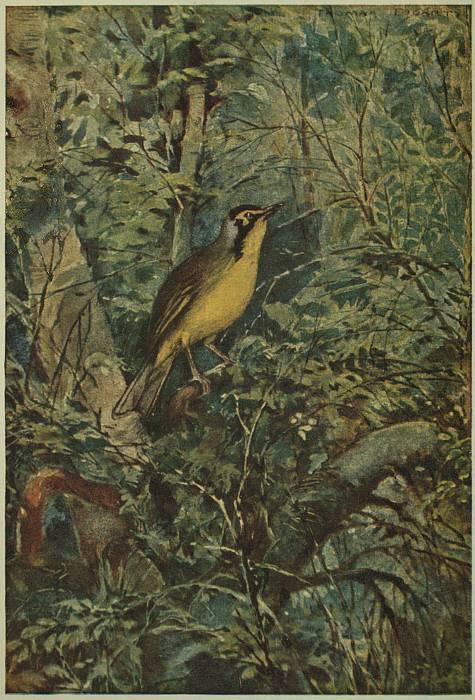
the Kentucky warbler?"
Webster's father looked over the
top of the wood-pulp screen. His
face had a somewhat vacant expression.
He waited. Finally he
said:
"My son, I believe you asked me a
question: I shall have to ask you to
repeat your question; I may be losing
my hearing or I may be losing my
mind. You asked me—?"
Webster, in the same deliberate tone,
repeated his question:
"Did you ever see the Kentucky
warbler?"
Webster's father looked over his
spectacles at Webster's mother as with
the air of an appeal for guidance:
"My dear, your son asks me, if I
understand him, whether I have ever
seen a Kentucky wooden war horse?"
He was not above fun-making and
it seemed to him that the occasion
called for it.
Webster's mother explained:
"One of the professors from the
University lectured to them in April
about birds. His head has been full
of birds ever since: I shouldn't wonder
if his dreams have been full of them."
She looked at Webster not without
ineradicable tenderness and pride; she
could not quite have explained the
pride, she could have explained the
tenderness.
Now the truth of the matter was
that since that memorable morning
of the April talk at high school, she
had been hearing from Webster repeatedly
on that subject. He had told
her of the lecture immediately upon
reaching home; she had never seen
him so wrought up. And from that
time he had upon occasion plied her
with questions: as to what she knew
of birds when she lived in the country.
She had to tell him that she knew very
little; everybody identified the several
species that preyed upon fruit and
berries and young chickens; she named
these readily enough. She had never
heard of a bird called the Kentucky
warbler. And she had never heard of
Alexander Wilson.
All this she had duly narrated to
Webster's father—greatly to his dejection.
A bank officer with a solitary
son, now graduated from high school,
going after bird-nests—that was a
prospect before such a father! He had
shaken his head in silence that more
than spoke.
"I told him," Webster's mother had
concluded, "that the only Wilsons
worth knowing in Kentucky were the
horse-people Wilsons: of course we
know them. It has been amusing to
watch Elinor. Whenever Webster has
begun about birds, if she has overheard
him, she has made it convenient
to settle somewhere near and listen.
She would break in and stop his questions,
but then there would be no more
entertainment for her. She has been
a study."
Thus Webster's father was not so
ill-informed as he now appeared. In
return for the information from Webster's
mother, apparently for the first
time imparted, he looked at his son
with an expression which plainly meant
that as a speculation the latter was
becoming a graver risk.
"No, my son," he said, "I have
never met your forest friend. I am
merely a Kentucky bank warbler. One
who did his warbling years ago. There
is some war left in me. I suppose there
will always be war left in me, but there
isn't any war-ble. I warbled one distant
solitary spring to your mother.
She replied beautifully in kind and
lavishly in degree. We made a nest
and had a hatching. Since then the
male bird has been trying—not to
escape the consequences of his song—but
to meet his notes like a man. I
have never stumbled upon your forest
friend."
Webster ate in silence for a few
moments and then remarked, as though
it were a matter of vital importance:
"His notes are:
"'Tweedle tweedle tweedle, Tweedle
tweedle tweedle,' Wilson described them
that way a hundred and six years ago."
"I don't doubt it, my son. I am not
questioning your word—nor Mr. Wilson's.
But I don't see anything very
remarkable in that: if you come to the
bank any day, you can hear men say
the same thing. They come in and
say, 'Tweedle.' And they go out."
Webster continued:
"Audubon described the notes as
'Turdle turdle turdle.'"
Deeper silence at the table. Webster
continued in the face of the
silence;
"A living naturalist says the notes
may be:
"'Toodle toodle toodle.'"
Silence at the table still more deep.
Webster broke it:
"Another naturalist describes the
bird as saying:
"'Ter-wheeter wheeter wheeter wheeter
wheeter.'"
The silence! Webster continued:
"Another naturalist thinks the song
is:
"'Che che che peery peery peery.'"
Webster's father raised his eyebrows—he
had no hair to raise—at Webster's
mother: a sign that their graduate
was beginning to celebrate his vacation.
"My son," he said, "when I was a
little fellow in school, one of the reading
lessons was a poem called 'Try,
Try Again.' Perhaps the bird is working
along that line."
"Thomas Jefferson followed a bird
for hours in the woods," said Webster,
with dignity: he somehow felt rebuked.
"And for twenty years he
tried to catch sight of another."
"Don't let me come between you and
Thomas Jefferson," said Webster's
father, waving his hand toward his
son in protest. "God forbid that I
should come between any two such
persons as Daniel Webster and Thomas
Jefferson!"
"The government at Washington,"
observed Webster stoutly, "is behind
the Kentucky warbler."
"Then, my son, I advise you to get
behind the Government."
The rusty bell at the little front door
went off with a sound like the whirr of
a frightened prairie chicken. The
breakfast maid, also the cook, also the
maid of all work, also a unit of the
standardised population of disservice
and discontent, entered and pushed a
bill at Webster's father.
"The butcher," she announced with
sullen gratification, "He's waiting."
As Webster's father left the table,
he tapped his son affectionately on the
head with his paper: "You follow the
bird, my boy; and follow Thomas
Jefferson, if you can. The butcher
follows me."
Webster's mother sat watching him.
He had begun to get his lunch ready.
He held the bottom-half of a long,
slender roll, which might have served
as a miniature model for an old-time
Kentucky river-ark; and with his knife,
grasped like an oar, he was lining the
inside with some highly specialised yellow
substance. She deplored his awkwardness
and fought his independence.
"Let me put up your lunch for you,
my son!"
"I'll put it up."
He was not to be cheated out of that
fresh sensation of pleasure which comes
to the male, young or old, who tries to
cook in camp, to fry, to boil, to season,
or to serve things edible.
Webster pulled out of his pocket a
crumpled piece of brown paper and
smoothed it out on the table cloth. It
showed butcher stains.
Webster's mother protested.
"My son! Take a napkin! Take
this clean napkin for your lunch!"
"I like this paper."
The idea of being in the forest and
unrolling his lunch from a napkin:
what would Wilson have thought?
Elinor, being "nice," always rolled her
lunch in a napkin.
"But you will be hungry: let me get
you some preserves!"
"Not anything sweet." Elinor always
had preserves. He rolled his
lunch roughly and thrust it, butcher-stains
and all, into his pocket. His
mother was exasperated and distressed.
"My son, your lunch will come loose
in your pocket: I'll get you a string."
"I don't want a string." Elinor tied
everything. Girls tied; boys buttoned.
The difference between men and women
was strings.
"But you'll get the grease on you,
Webster! It will run down your
legs!"
"Very well, then, I'll have greasy
legs. Why not?"
She followed him out to the porch.
Her character lacked capacity of initiative.
She waited for him to be old
enough to take some initiative; then she
would stand by him.
"Don't go too far," she said tenderly,
"and you ought to have some of your
friends to go with you, some of the boys
from school."
"They can't go today. Nobody can
go today. Anybody would be in the
way today."
He said this to himself.
She watched him from the porch and
called: "Don't stay too late."
Webster walked quickly to the main
corner of the block—Jenny's corner.
On this first morning of being through
with school and of feeling more like a
man free to do as he pleased, Jenny for
that reason became more important—he
must see her before starting. Heretofore
the pleasure of being with Jenny
had definitely depended upon what
Jenny might do; this morning the idea
was beginning to be Jenny herself.
She was in her trumpet-vine arbour,
the roof of which was already sun-dried.
The shaded sides were still dew-wet.
She bounded across to him, very
exquisite in her light blue frock with
broad, fresh white ribbons in her light-brown
hair: healthy, docile, joyous,
with innocent blue eyes and the complexion
of apple blossoms.
"Where are you going?" she asked
in a voice which implied that the day
would be as pleasant, no matter where
he went: nevertheless she had no
thought of appearing indifferent to him.
He told her.
"What are you going into the woods
for?" she inquired, with little dancing
movements of her feet on the yard
grass in irrepressible health and joy and
with no especial interest in his reply.
He told her.
"Could you go?" He very well knew
she could not and merely yielded to an
impulse to express himself: he was
offering to ruin the day for her.
"They wouldn't let me," said Jenny,
apparently not disappointed at being
thus kept at home.
He sought to make the best of his
disappointment.
"Even if you could go, I am afraid
you never would be quiet, Jenny."
"I'm afraid I wouldn't," Jenny replied,
responsive to every suggestion.
He lingered, tenderly disturbed by
her: the roots of the future were growing
in him this morning. He was
changing, he was changing her: there
was an outreaching of his nature to
draw her into the future alongside him.
Jenny suddenly stopped dancing and
came closer to the fence, having all at
once become more conscious of Webster,
standing there as he had never
stood before, looking at her as he had
never looked. Her nature was of yielding
sweetness, clasping trust. She
glanced around the cottage windows:
the situation was very exposed. Webster
glanced at the cottage windows:
the situation did not appear in the
least exposed. Her eyes became more
round with an idea:
"Are you coming back this way?"
"I will come back this way."
Jenny danced away from the fence,
laughing excitedly: "Will it be late?"
"I can make it late?"
Webster climbed the fence of the
forest under the foliage of a big tree
of some unknown kind and descended
waist-deep into the foliage of a weed
with a leaf as big as an elephant's ear:
it had a beautiful trumpet-shaped white
and purple flower. He wished he knew
what it was: on the very edge of the
forest, at his very first step, he had
sunk waist-deep into ignorance. Then
he waded through the rank nightshade
and stepped out upon the grass
of the woods—the green carpet of
thick turf, Kentucky bluegrass.
At last he was there under those
softly waving trees which summer after
summer he had watched from the porch
and windows: long they had called to
him and now he had answered their call.
But the disappointment! As he had
looked at the forest across the distance,
the tree-tops had made an unbroken
billowy line of green along the blue
horizon, continuous like the waves of
the sea as he imagined the sea. Somewhere
under that forest roof he had
taken it for granted that there would
be thick undergrowth, wild spots for
shy singing nesting birds. The disappointment!
The trees stood ten or
twenty or thirty feet apart. The longest
boughs barely touched each other,
their lowest sometimes hung forty or
fifty feet in the air. He did not see a
tree whose branches he could reach
with his upstretched arm. The sun
shone everywhere under them every
bright day and the grass grew thick up
to their trunks.
Another disappointment! The wood
was small. He walked to the middle
of it and from there could see to its
edge on each of its four sides. On one
side was a field of yellow grain—what
the grain was he did not know—ignorance
again. On the side opposite this
was a field of green grain—what he
did not know. Straight ahead of him
as he looked through the trees, he
could see an open paddock on which
the sunlight fell in a blazing sheen; it
turned to silver the white flanks of
some calves and made soft gold of the
coats of grazing thoroughbreds. Beyond
the paddock he could see stables
and sheds and beyond these a farmhouse:
he could faintly hear the cackle
of barnyard poultry.
He stood in bluegrass pasture—once
Kentucky wilderness. It was like
an exquisite natural park. As he had
skirmished toward the country along
turnpikes with school-mates or other
friends during his life, often his eyes
had been drawn toward these world-famous
bluegrass pastures. Now he
was in one; and it was here that he had
come to look for the warbler which
haunts the secret forest solitudes!
He sat down under a big tree with a
feeling of how foolish he had been.
This was again followed by an overwhelming
sense of his ignorance.
He did not know the kind of tree he
sat under nor of any other that stood
far or near. These were such as sugar
maple and red oak and white oak and
black ash and white ash and black
walnut and white walnut—rarely white
walnut—and hickory and locust and
elm and a few haws: he did recognise a
locust tree but then a locust tree grew
in Jenny's yard! All around him weeds
and wild flowers and other grasses
sprang up out of the bluegrass: he did
not know them.
There was one tree he curiously
looked around for, positive that he
should not be blind to it if fortunate
enough to set his eyes on one—the
coffee tree. That is, he felt sure he'd
recognise it if it yielded coffee ready to
drink, of which never in his life had
they given him enough. Not once
throughout his long troubled experience
as to being fed had he been allowed
as much coffee as he craved.
Once, when younger, he had heard some
one say that the only tree in all the
American forest that bore the name of
Kentucky was the Kentucky coffee tree;
and he had instantly conceived a desire
to pay a visit in secret to that corner
of the woods. To take his cup and
a few lumps of sugar and sit under the
boughs and catch the coffee as it
dripped down.... No one to hold
him back ... as much as he wanted at
last ...! The Kentucky coffee tree—his
favourite in Nature!
He said to himself, looking all
round him, that he had the outdoor
loneliness and blindness of Silas
Marner this wonderful morning.
Propped against the tree he sat still
a while, thinking of the long day before
him and of how he should spend it
in this thin empty pasture, abandoned
by the wild creatures. But as he deliberated,
suddenly and then more and
more he awoke to things going on
around him.
A few feet away and on a level with
his eyes a little fellow descended from
high over-head. A little green gymnast
trying to reach the ground by
means of his own rope which he manufactured
out of his body as he came
down. How could he do it? How had
he learned the very first time to make
the rope strong enough to bear his
weight instead of its giving way and
letting him drop? Something seized one
of Webster's ankles with a pair of small
jaws like pincers and reminded him that
his foot was in the way: it had better
move on. A black ant suddenly rushed
angrily over his knee. A cricket leaped
in the grass. One autumn one of them
had started its song behind the wainscoting,
Elinor had pushed her toe
against the woodwork and silenced it.
A few feet away a bunch of white clover
blossomed: a honey bee was searching
it. Webster found on the back of one
of his hands, which was pressed against
the grass, a tiny crimson coach—a
mere dot of a crimson coach being
moved along he could not see how.
The colour was most gorgeous and the
material of the finest velvet. He let it
go on its way across his hand withersoever
it might be journeying. Directly
opposite his eyes, some forty feet
from the ground, was a round hole in a
rotten tree-trunk. Webster wondered
whether a bird ever pecked a square
hole in anything. Suddenly from behind
him a red-headed bird flew to the
dead tree-trunk and alighted near the
hole: he recognised the wood-pecker.
And he remembered that this was the
first bird Wilson had killed that first
day he entered the American forest:
he was glad that it was the first he
encountered! No sooner had the wood-pecker
alighted than the head of another
bird appeared at the hole and the
wood-pecker took to his heels—to his
wings. Webster wished he had known
what this other bird was: it had a black
band across its chest and wore a
speckled jacket and a dull reddish cap
on the back of its head. A disturbance
reached him from a nearby treetop, a
wailing voice, a gulping sound, as if
something up there were sick and full
of suffering and were trying to take its
medicine. He watched the spot and
presently a crow flew out of the thick
leaves: the crow's family seemed not in
good health. A ground squirrel jumped
to the end of a rotting log some yards
away but at sight of him shrieked and
darted in again. The whole pasture
was alive.
Webster had all this time become
conscious that another sound had been
reaching his ear at regular intervals
from the high branches of the trees,
first in one place and then in another.
His eyes had followed the voice but he
could see no bird. The sound was like
this:
Se—u—re?
That was the first half of the song—a
question. A few moments later the
other half followed, perhaps from another
tree—the answer:
Se—u—u.
Here was a mystery: what was the
bird? Could it be the bluebird!—his
ignorance again, the comicality of his
ignorance! Webster had never seen or
heard a bluebird. He recalled what the
professor had told them—that Alexander
Wilson had written the first poem
on the American bluebird, perhaps still
the best poem; and he had given them
the poem to memorise if they liked,
saying that they might not think it
good poetry, but at least it was the
poetry of a man who thought he could
criticise Robert Burns! Webster had
memorised the verses and as he now
searched the forest boughs for this invisible
bluebird, he repeated to himself
some of Wilson's lines:
"When all the gay scenes of summer are o'er
And autumn slow enters so silent and sallow
And millions of warblers that charmed us before
Have fled in the train of the sun-seeking swallow;
The bluebird, forsaken, but true to his home
Still lingers and looks for a milder tomorrow
Till forced by the horrors of winter to roam,
He sings his adieu in a lone note of sorrow."
Again that long fine strain cast far
out upon the air like a silken reel:
Se—u—re? Se—u—u.
Or could it be a woodcock?
He got up by and bye and walked
toward the field of yellow grain on one
side of the pasture. Before he was halfway
he stopped, arrested by a wonderful
sound: from the top rail of the
fence before him, separating the pasture
from the grain, came a loud ringing
whistle. It was Bobwhite! Boys at
school sometimes whistled "bobwhite."
He knew this bird because he had seen
him hanging amid snow and ice and
holly boughs outside meat shops about
Christmas time. Here now was the
summer song: in it the green of the
woods, the gold of the grain, the far
brave clearness of the June sky.
He tipped forward, not because his
feet made any noise. Once again,
nearer, that marvellous music rang past
him, echoing on into the woods. Then
it ceased; and as Webster approached
the field fence what he saw was a rabbit
watching him over the grass tops until
with long soft leaps it escaped through
the fence to the safety of the field.
For a while he remained leaning on
this fence and looking out across the
coming harvest. Twenty yards away a
clump of alders was in bloom: some
bird was singing out there joyously. It
made a che che che sound, also; but its
colour was brown.
The idea occurred to Webster that
he would recross the pasture to the
field on the other side and go on to the
turnpike: one ran there, for he heard
vehicles passing. He would make inquiry
about some piece of forest further
from the city. He remembered
again what the professor told them:
"Some of you this summer during
your vacation may go out to some
nearby strip of woods—what little is
left of the old forest—in quest of the
warbler. Seek the wildest spots you
can find. The Kentucky bluegrass
landscape is thin and tame now, but
there are places of thick undergrowth
where the bird still spends his Kentucky
summer. Shall I give you my
own experience as to where I found
him when a boy half a century ago?
On my father's farm there was a woodland
pasture. The land dipped there
into a marshy hollow. In this hollow
was a stock pond. Around the edges
of the pond grew young cane. It was
always low because the cattle browsed
it. The highest stalks were scarcely
five feet. On the edge of the canebrake
a thicket of papaw and blackberry
vines added rankness and forest secrecy.
It was here I discovered him. The
pale green and yellow of his plumage
blent with the pale green and yellow
of the leaves and stalks. But it was
many years before I knew that the
bird I had found was the Kentucky
warbler. If I had only known it when
I was a boy!"
When Webster reached the turnpike
and looked up and down, no one was
in sight. He sat on the fence and
waited. By and bye, coming in from
the country, a spring wagon appeared.
Curious projections stuck out from the
top and sides of boxes in the wagon.
When it drew nearer Webster saw
poultry being taken to market. He
looked at the driver but let him pass
unaccosted: there would be little use
in applying for information about warblers
at headquarters for broilers.
Next from the direction of the city
he saw coming a splendid open carriage
drawn by a splendid horse and
driven by a very pompous coloured
coachman in livery. An aristocratic
old lady sat in the carriage, shielding
her face from the dazzling sunlight with
a rich parasol. She leaned out and
looked curiously at Webster.
"Suydam," she called out to her
coachman with a voice that had the
faded sweetness of faded rose leaves,
"did you notice that remarkable boy?
He looked as though he would have
liked to drive with me out into the
country. I wish I had invited him to
do so."
A milk cart followed with a great
noise of tin cans. With milk carts
Webster felt somewhat at home: it
was often his business to receive the
family milk. As the cart was passing,
he motioned for the milkman to stop.
Perhaps all milkmen stop at any sign:
there may be an order: Webster called
out with a good deal of hesitation:
"Do you know of a woods further
out full of bushes and thickets?"
The milkman gave a little flap of
the rein to his horse:
"What's the matter with you?" he
said with patient forbearance:
Finally Webster saw creeping down
the turnpike toward him an empty
wagon-bed drawn by a yoke of oxen.
A good-natured young negro man sat
sideways on the wagon-tongue, smoking.
Webster halted him by a gesture
and a voice of command:
"Do you know of a bushy woods
further out?"
Any negro enjoys being questioned
because he enjoys not answering questions.
Most of all he enjoys any puzzling
exercise of his mother wit.
"A bushy woods?"
"Yes, a bushy woods."
"What do you want with a bushy
woods?"
"I want to find where there is one."
The negro hesitated: "there's a
bushy woods about four miles out."
"Is it on the pike?"
"On the pike! Did you ever see a
bushy woods on the pike? It's beside
the pike."
"Right side or left side?"
"Depends which way you're going.
Right side if you are going out, left
side if you're coming in."
"You say it's four miles out?"
"You pass the three mile post and
then you go a little further."
"Are there any birds in it?"
"Birds? There's owls in it. There's
coons in it."
"Do you know a young canebrake
when you see one?"
"I know an old hempbrake when I
see one."
Webster enjoyed his new authority
in holding up his negro and questioning
him about a forest. And it seemed to
him that the moment had come when
it was right to use money if you had it,
horns or no horns. He pulled out a
dime. The negro, too surprised to
speak, came across and received it.
He declined to express thanks but felt
disposed to show that he had earned
the money by repeating a piece of information:
"It's four miles out."
"Is there much of it?"
"Much of it? Much as you want."
"Do you live in it?"
"No, I don't live in it: I live in a
house."
He had retaken his seat on the
wagon-tongue.
"What kind of pipe stem is that you
are using?"
"What kind? It's a cane pipe stem."
"Where did you get the cane?"
"Where did I get it? I got it in the
woods."
"Then there is young cane growing
in the woods?"
"Who said there wasn't?"
Webster, beginning this morning to
use his eyes, took notice of something
which greatly interested him as the
wagon moved slowly off down the
pike: strands of hemp clung to it here
and there like a dry hanging moss.
The geologist had told them that his
own boyhood lay far back in the era
of great Kentucky hemp-raising. Much
of the hemp was broken in March, the
month of high winds. As the hemp-breakers
busily shook out their handfuls
while separating the fibre from
the shard, strands were carried away
on the roaring gales, lodging against
stubble and stumps and fences of the
fields or blown further on into the
pastures. Later when it was baled
and hauled in, other filaments were
caught on the rafters and shingles of
hemp-houses and barns. Thus when
in April the northward migration of
birds reached Kentucky, this material
was everywhere ready and plentiful,
and the Baltimore orioles on the bluegrass
plateau built their long hanging
nests of Kentucky hemp.
Webster, sitting on the fence and
thinking of this, meantime laid his
plans for the larger adventure of the
following day: the clue he sought had
unexpectedly been found: he would go
out to the place where young cane
grew: there he might have a real
chance at the warbler.
This being settled to his satisfaction,
he hurried impatiently back to his
woodland pasture. It had seemed empty
of living creatures when he entered
it; soon it had revealed itself as a whole
teeming world. The mere green carpet
of the woods was one vast birthplace
and nursery, concert hall, playground,
battlefield, slaughter-pen,
cemetery.
"But my ignorance!" he complained.
"I have good strong eyes, but all these
years they have been required to look
at dead maps, dead books, dead pencils
and figures, dead everything: not
once in all that time have they been
trained upon the study of a living
object."
His ears were as ignorant as his eyes:
he had not been educated to hear and
to know what he heard. Innumerable
strange sounds high and low beat incessantly
on them—wave upon wave
of louder and fainter melodies, the
summer music of the intent and earnest
earth. And everywhere what fragrances!
The tonic woody smells! Each
deep breath he drew laved his lungs
with sun-clean, leaf-sweet atmosphere.
Hour after hour of this until his whole
body and being—sight, smell, hearing,
mind and spirit—became steeped in
the forest joyousness.
Now it was alone in the June woods
that long bright afternoon that Webster
took final account of the last wonderful
things the geologist had told
them that memorable morning. He
pondered those sayings as best he
could, made out of them what he could:
"I am not afraid to trust you, the
young, with big ideas which will lift your
minds as on strong wings and carry them
swiftly and far through time and space.
If you are taught to look for great things
early in life, you will early learn how to
find great things; and the things you love
to find will be the things you will desire
and try to do. I wish not to give you a
single trivial, mean weak thought."
"The Kentucky warbler for over a hundred
years has worn the name of the State
and has carried it all over the world—leading
the students of bird life to form
some image of a far country and to fix
their thoughts at least for some brief moment
on this same beautiful spot of the
world's surface. As long as he remains
in the forests of the earth, he will keep the
name of Kentucky alive though all else it
once meant shall have perished and been
forgotten. He is thus, as nearly as anything
in Nature can be, its winged worldwide
emblem, ever young as each spring
is young, as the green of the woods is
young."
"Study the warbler while you may:
how long he will inhabit the Kentucky
forest no one can tell. As civilisation
advances upon the forest, the wild species
retreat; when the forest falls, the wild
species are gone. Every human generation
during these centuries has a last look
at many things in Nature. No one will
ever see them again: Nature can never
find what she has once lost: if it is gone,
it is gone forever. What Wilson records
he saw of bird life in Kentucky a hundred
years ago reads to us now as fables of the
marvellous, of the incredible. Were he
the sole witness, some of us might think
him to be a lying witness. Let me tell you
that I in my boyhood—half a century
later than Wilson's visit to Kentucky—beheld
things that you will hardly believe.
The vast oak forest of Kentucky
was what attracted the passenger pigeon.
In the autumn when acorns were ripe but
not yet fallen, the pigeons filled the trees
at times and places, eating them from the
cups. Walking quietly some sunny afternoon
through the bluegrass pastures, you
might approach an oak and see nothing
but the tree itself, thick boughs with the
afternoon sunlight sparkling on the leaves
along one side. As you drew nearer, all
at once, as if some violent explosion had
taken place within the tree, a blue smoke-like
cloud burst out all around the treetop—the
simultaneous explosive flight
of the frightened pigeons. Or all night
long there might be wind and rain and
the swishing of boughs and the tapping
of loosened leaves against the window
panes; and when you stepped out of
doors next morning, it had suddenly become
clear and cold. Walking out into
the open and looking up at the clear sky
you might see this: an arch of pigeons
breast by breast, wing-tip to wing-tip,
high up in the air as the wild geese fly,
slowly moving southward. You could not
see the end of the arch on one horizon or
the other: the whole firmament was
spanned by that mighty arch of pigeons
flying south from the sudden cold. Not
all the forces in Nature can ever restore
that morning sunlit arch of pigeons flying
south. The distant time may come, or
a nearer, when the Kentucky warbler
will have vanished like the wild pigeon:
then any story of him will be as one of
the ancient fables of bird life."
"The rocks of the earth are the one
flooring on which every thing develops its
story, then either disappears upon the
stillness of the earth's atmosphere or
sinks toward the silence of its rocks.
Of the myriad forms of life on the earth
the bird has always been the one thing
nearest to what we call the higher life of
the human species.
"It is the form and flight of the bird
alone that has given man at last the mastery
of the atmosphere. Without the bird
as a living model we have not the slightest
reason to believe that he could have ever
learned the mechanism of flight. Now
it is the flight of the bird, studied under
the American sky, that has given the
nations the war engine that will perhaps
rule the destiny of the human race henceforth.
The form of the bird will fly before
our autumn-brown American armies
as they cross the sea—leading them
as the symbol of their victory. When
they lie along the trenches of France as
thick as fallen brown autumn leaves in
woodland hollows, it will be the flight of
bird-like emblems of destruction that
will guide them like hurricane-rushing
leaves as they sweep toward their evil
enemy."
"Through all ages the flight of the
bird alone has been the interpreter of the
human spirit. The living, standing on
the earth and seeing the souls of their dead
pass beyond their knowledge, have fixed
upon the bird as the symbol of their faith.
When you are old enough, if not already,
to know your Shakespeare, you will find
in one line of one of his plays the whole
vast human farewell of the living to the
dead: they are the words of Horatio to
Hamlet, his dying prince: 'the flights of
angels sing thee to thy rest.'"
"As far as we geologists know, this
is the morning of the planet. Not its
dawn but somewhere near its sunrise.
The bird music we hear in these human
ages are morning songs. Back of that
morning stretches the earth's long dawn;
and the rocks tell us that thrushes were
singing in the green forests of the earth
millions of years before man had been
moulded of the dust and had awakened
and begun to listen to them. Thus bird
music which seems to us so fresh is the
oldest music of the earth—millions of
years older than man's. And yet all this
is still but a morning song. The earth is
young, the birds are young, man is
young—all young together at the morning
of the earth's geologic day. What
the evening will be we do not know. It
is possible that the birds will be singing
their evening song to the earth and man
already have vanished millions of years
before."
"Many questions vex us: all others lead
to one: when man vanishes, does he pass
into the stillness of the earth's atmosphere
and sink toward the stillness of its rocks
like every other species? He answers
with his faith: that his spirit is here he
knows not why, but takes flight from it he
knows not how or whither. Only, faith
discloses to him one picture: the snowy
pinion folded and at rest in the Final
Places."
That long sunny afternoon in the
June woods! The shadows of the trees
slowly lengthened eastward. The sun
sank below the forest boughs and
shot its long lances against the tree
trunks. It made a straight path of
gold, deeper gold, across the yellow
grain. The sounds of life died away,
the atmosphere grew sweeter with
the odours of leaves and grasses and
blossoms.
Webster recrossed the woods as he
had entered it, waded through the
nightshade and climbed the fence under
the dark tree.
It was twilight when he entered the
City.
As he passed her yard, Jenny bounded
across to him joyous, innocent, tender,
in a white frock with fresh blue
ribbons in her brown hair.
"Did you find him?" she asked, her
happiness not depending on his answer.
"It was not the right place. Tomorrow
I am going out further into the
country to a better place."
"The humming-bird has been here,"
Jenny announced with an air of saying
that she had been more successful as a
naturalist.
He made no reply: as the veteran
observer of a day, he had somewhat
outgrown the trumpet-vine arbour and
the ruby-throat.
He lingered close to the fence. Jenny
lingered. He moved off, disappointed
but devoid of speech.
"Come back!" Jenny whispered,
with reproach and vexation.
It was the first invitation. It was
the first acceptance of an invitation.
There would have been a second acceptance
but the invitation was not
there to accept.
When Webster turned in at his home
gate, everything was just as he had
foreseen: his father sat on one side of the
porch, smoking the one daily cigar; his
mother faced him from the opposite
side, slowly rocking. Elinor crouched
on the top step between them: he would
have to walk around her or over her.
His father laughed heartily as he
sauntered up.
"Well, my son, where is your game
bag? What have you brought us for
breakfast?"
Webster looked crestfallen: he returned
empty-handed but not empty-minded:
he had had a great rich
day; they thought it an idle wasted
one.
"Some of the boys have been here
for you," said his mother. "They left
word you must be certain to meet them,
in the morning for the game. Freshen
yourself up and I'll give you your supper."
Elinor said nothing—a bad sign with
her. She sat with her sharp little chin
resting on her palms and with her eyes
on him with calculating secrecy. He
stepped around her.
His room had never seemed so
cramped after those hours in the
woods under the open sky. The whole
cottage seemed so unnatural, everything
in the City so unnatural, after
that day in the forest.
At supper he had not much to say;
his mother talked to him:
"I put my berries away to eat with
you for company." They ate their
berries together.
He felt tired and said he would go to
bed. His room was darkened when he
returned to it; he felt sure he had left
his lamp burning; someone had been
in it. He lighted his lamp again.
As he started toward his window to
close the shutters, his eye caught sight
of an object hanging from the window
sash. A paper was pinned around it.
The handwriting was Elinor's. It was
a bluejay, brought down by a lucky
stone from some cottager's hand. Webster
read Elinor's message for him:
"Your favourite Kentucky Warbler,
From your old friend,
Thomas Jefferson."
He sat on the side of his bed. The
sights and sounds and fragrances of the
pasture were all through him; the sunlight
warmed his blood still, the young
blood of perfect health.
He turned in for the night and sleep
drew him away at once from reality.
And some time during the night he
awoke out of his sleep to the reality of a
great dream.