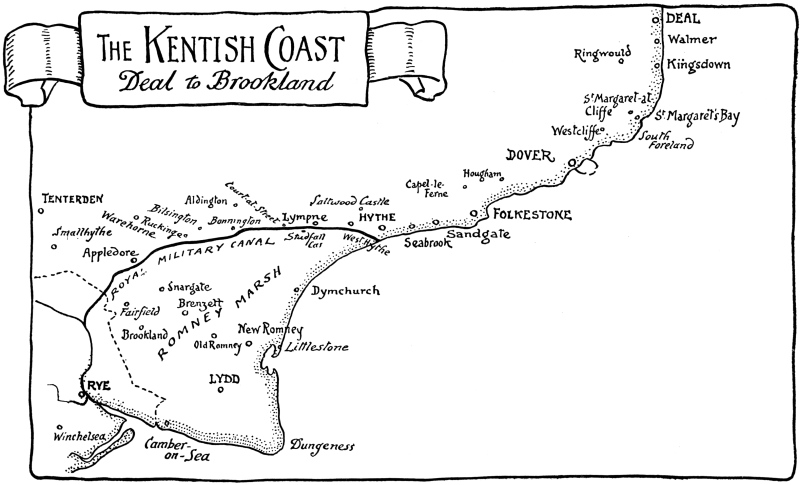
From Sandgate the seashore goes level for many
miles, through Seabrook and Hythe, and across
Romney Marsh to Dungeness. Not until Sussex
is reached and Winchelsea passed do the cliffs
again rise, confronting the sea.
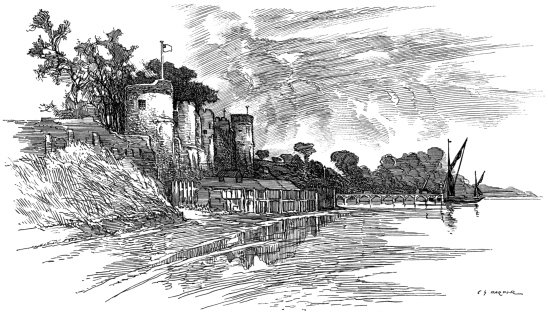
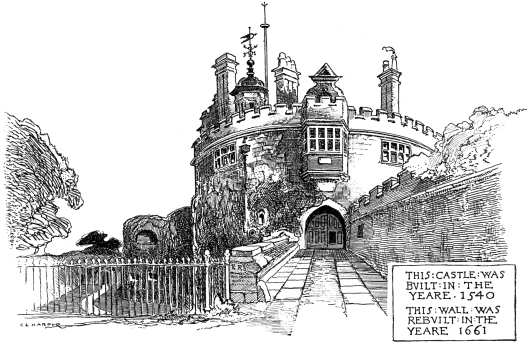
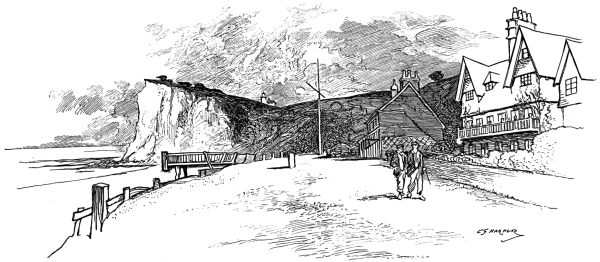
Hard by Sandgate Castle stands the centenary
monument on the modest parade to Sir John
Moore, the hero of Coruña, unveiled November
19th, 1909. The spot is appropriate because, at
the back of Sandgate, up away out of sight,
is Shorncliffe Camp, closely associated with
that distinguished soldier. The military works in
these parts, along a coast so peculiarly exposed
to foreign invasion, are many and important.
Henry the Eighth, as we have seen, was diligent
in fortifying these low-lying shores, and there
came a time, two hundred and sixty-five years
later, when the Government of that day was equally
concerned about a possible French attack. Then,
in 1805, was constructed the famous “Royal
Military Canal,” which extends a distance of
about twenty miles from Rye to Hythe, with its
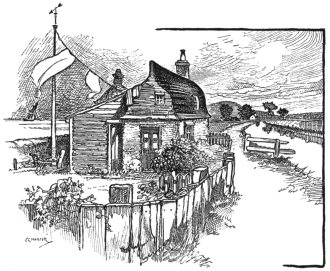
sluices here at Seabrook, adjoining Sandgate
railway-station. The canal is thirty feet wide
and nine feet deep in the middle. Its function
was, in connection with a regular line of martello towers
on the beach, to hamper and impede a
landing-force.
“Mr. Pitt’s Military Canal,” as it was in those
days styled, formed the target for many shafts of
ridicule. “The French,” said Ingoldsby, “managed
indeed to scramble over the Rhine and the
Rhone, and other insignificant currents, but they
never did, or could, pass Mr. Pitt’s ‘Military
Canal.’”
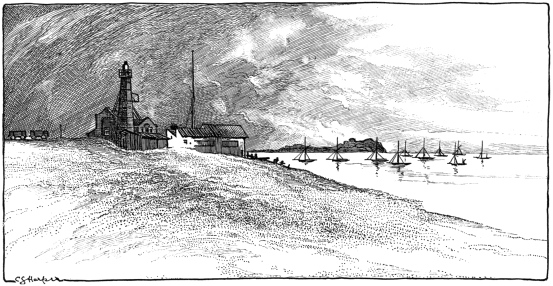
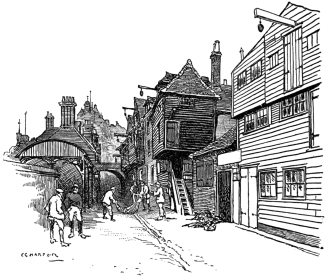
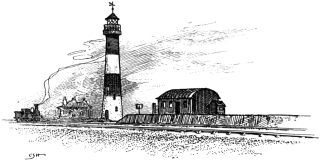
Here, where the Canal’s sluices pour their
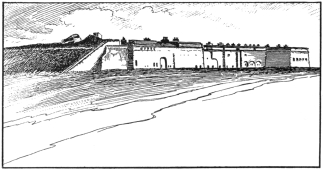
waters into the sea, are remains of military works,
intended to defend this vital spot, with Shorncliffe
Camp above. The world wags still with an
amiable slowness here, the old horse-tramway
through Sandgate to Hythe, belonging to the
South-Eastern Railway, leaving the main road
and progressing along the beach. The only
trouble is the constant succession of motor-cars,
generally racing at illegal speeds along these
flat roads and producing clouds of dust.
HYTHE.
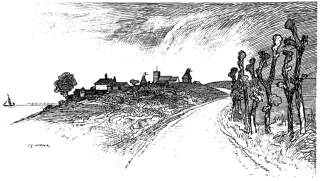
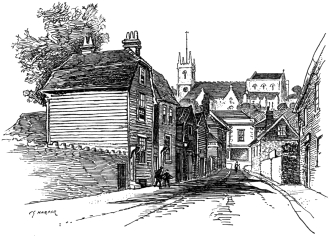
Seabrook melts insensibly into Hythe, that
quaint old place whose name, signifying “the
harbour,” proves how changed are the local
conditions from those remote times when the
little town first arose. Then ships came up to it.
To-day the sea is distant across a mile-long
waste of shingle, and, of all the four parishes in
it, but one now remains; with but one church.
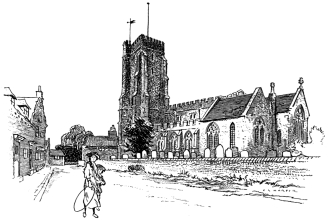
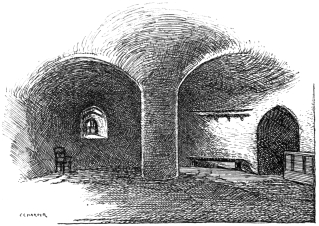
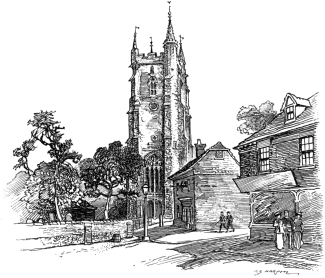
This, the noble Early English church of St. Leonard,
is of much architectural interest; but it
is sadly to be supposed that the average holiday-maker
is more attracted by the gruesome collection
of ancient skulls, exhibited in the crypt,
or undercroft. You may see these poor relics,
if you have a mind to it, for the fee of threepence,
and the curiously morbid taste widely distributed
among sightseers brings in a plentiful harvest
of pennies and threepenny-bits, all through
the summer. The collection at present consists
of some six hundred skulls and a neatly arranged
stack of bones that once formed the framework
of about seven thousand men. They are supposed
to be the remains of men of some distant
age who fell in battle by the seashore; and,
whether they died in the hour of victory or of
defeat, we may perhaps assume, now that their
bones, so many centuries later, bring a modest
income to the church of Hythe, that they did
not die in vain. But whether they would have
chosen to be a show for the curious and the
vulgar is another matter. For myself, I think
it a scandal and an indignity, and consider that
the clergy of Hythe, past and present, deserve
the greatest censure for holding and continuing
the exhibition.
Were it not that scientific men, examining the
skulls, have declared them all to be those of men,
we might most fittingly assume that this undercroft
was merely a charnel-house, like those
seen in Brittany, to which the bones of the older
occupants of the churchyard are from time to
time removed; but since the remains are only
those of men, and as many of the skulls exhibit
gashes, the vague ancient legends of some great
battle appear to be not without foundation.
But at what period that great fight was fought,
and between what opposing races, is uncertain.
Hasted, in his “History of Kent,” tells us
that the battle was fought A.D. 456, between the
Britons and the Saxons, and that the Saxons were
utterly defeated: “Vortimer still followed the retreating
Saxons, and, coming up with them again
on the seashore near Folkestone in the year 456,
fought a third battle with them between that place
and Hythe, gaining a complete victory. Nennius
and others say it was fought in a field on the shores
of the Gallic Sea, where stood the Lapis Populi.”
Another historian places the date of the battle
three hundred and eighty-seven years later.
“A.D. 843,” he says, “in the reign of Ethelwolf,
the Danes landed on the coast of Kent, near
to the town of Hyta, and proceeded as far as
Canterbury, great part of which they burnt.
At length Gustavus (then Governor of Kent)
raised a considerable force, with which he opposed
their progress; and, after an engagement in which
the Danes were defeated, pursued them to their
shipping on the sea-coast, where they made a
most obstinate resistance. The Britons, however,
were victorious, but the slaughter was prodigious,
there being not less than thirty thousand left
dead. After the battle the Britons, wearied with
fatigue, returned to their homes, leaving the
slain on the field of battle, where, being exposed
to the different changes of the weather, the flesh
rotted from the bones, which were afterwards
collected and piled in heaps by the inhabitants,
who in time removed them into a vault in one
of the churches of Hyta, now called Hythe.”
Hythe owes a great deal to the memory of
William Pitt, whose Military Canal has, in the
more than a hundred years since it was made,
become one of the loveliest of waterways, on which
splendid boating, under the shade of century-old
trees, may be had. Leaving the town, the road
comes at once, past the bridge over the Canal and
by the “Duke’s Head” inn, into the romantic
region of Romney Marsh.
Romney Marsh was in merry Tom Ingoldsby’s
time so out of the way that he could find it
possible to say, with that humorous exaggeration
which enshrines some little truth, “the world,
according to the best geographers, is divided
into Europe, Asia, Africa, America, and Romney
Marsh. In this last-named, and fifth, quarter
of the globe a witch may still be occasionally
discovered in favourable, i.e. stormy seasons,
weathering Dungeness Point in an eggshell, or
careering on her broomstick over Dymchurch
Wall.”
The last witch eloped with the ultimate smuggler,
full seventy years since, but Romney Marsh
remains, a beautiful open expanse of wide horizons,
clear skies, and succulent pastures. The
coastwise road runs across its levels, seven miles
to New Romney, with the village of Dymchurch
in between, Dymchurch Wall keeping out the
sea. This, viewed from the inner side, is a lofty
grassed earthen bank, faced seawards with a
masonry “apron,” as engineers style it; while at
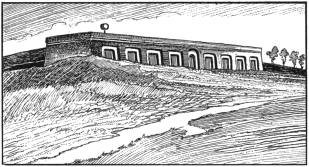
regular intervals the martello towers of an olden
scheme of coast-defence are features of the way.
Cobbett, writing in 1825, was very severe upon
them:
“I had baited my horse,” he writes, “at
New Romney, and was coming jogging along
very soberly, now looking at the sea, then looking
at the cattle, then the corn, when my eye,
in swinging round, lighted upon a great round
building, standing upon the beach. I had scarcely
had time to think about what it could be, when
twenty or thirty others, standing along the coast,
caught my eye; and, if any one had been behind
me, he might have heard me exclaim, in a voice
that made my horse bound, ‘The martello towers,
by ——!’ Oh, Lord! To think that I should
be destined to behold these monuments of the
wisdom of Pitt and Dundas and Perceval! Good
G—! Here they are, piles of bricks in a circular
form about three hundred feet (guess) circumference
at the base, and about one hundred and fifty
feet circumference at the top. There is a doorway,
about midway up, in each, and each has two
windows. Cannons were to be fired from the top
of these things, in order to defend the country
against the French Jacobins!
“I think I have counted along here upwards of
thirty of these ridiculous things, which, I daresay,
cost five, perhaps ten, thousand pounds each;
and one of which was, I am told, sold on the coast
of Sussex, the other day, for two hundred pounds!
There is, they say, a chain of these things all the
way to Hastings! I daresay they cost millions.
But far indeed are these from being all, or half, or
a quarter of the squanderings along here. Hythe is
half barracks; the hills are covered with barracks,
and barracks most expensive, most squandering,
fill up the side of the hill. Here is a canal (I crossed
it at Appledore) made for the length of thirty miles
(from Hythe, in Kent, to Rye, in Sussex) to keep
out the French; for, those armies who had so often
crossed the Rhine and the Danube were to be kept
back by a canal made by Pitt, thirty feet wide, at
the most! All along the coast there are works of
some sort or other, incessant sinks of money;
walls of immense dimensions; masses of stone
brought and put into piles. Then you see some of
the walls and buildings falling down; some that
have never been finished. The whole thing taken
together,” he concludes, “looks as if a spell had
been, all of a sudden, set upon the workmen; or,
in the words of the Scripture, here is the ‘desolation
of abomination, standing in high places.’”
The martello towers seem to have thoroughly
obsessed Cobbett, for he presently bursts forth
again, to tell us how they were “erected to keep
out the Jacobin French, lest they should come
and assist the Jacobin English. The loyal people
of this coast were fattened by the building of them.
Pitt and his loyal Cinque Ports waged interminable
war against Jacobins. These very towers are
now used to keep these loyal Cinque Ports themselves
in order. These towers are now used to
lodge men, whose business is to sally forth, not
upon Jacobins, but upon smugglers. Thus, after
having sucked up millions of the nation’s money,
these loyal Cinque Ports are squeezed again:
kept in order, kept down, by the very towers which
they rejoiced to see rise to keep down the Jacobins.”
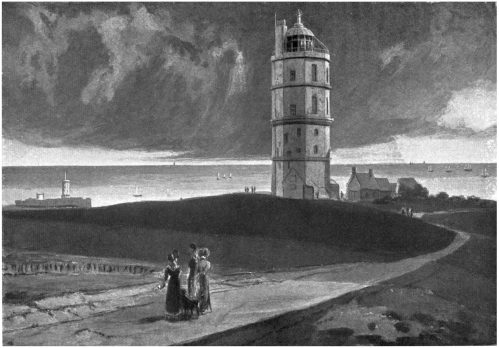
Seventy-six of these martello towers were
erected along the flat places of the Kent and Sussex
shores in the first years of the nineteenth century,
when Napoleon threatened us with invasion.
They cost, according to their size, from £10,000
to £20,000 apiece, and were constructed of such
a thickness of brick, with a vaulted brick roof,
that they were thoroughly bomb-proof. The
thickness of the brick walls varies from six feet
on the rear, or landward, side, to nine feet facing
the sea. The interior consists of a base, intended
to serve as the magazine, with two rooms above,
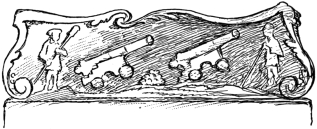
for the garrison. On the roof was mounted a
swivel-gun, while on either side of each tower
a howitzer was planted, as a flank defence. The
martello towers are said to have been introduced
from Italy, on whose Mediterranean coast,
we are told, they had first been built for the
purpose of defending the seaboard against the
pirates who once infested those seas. It is even
said that their name, “Torri di Martello,” derives
from the warning to neighbouring villages
sounded on the approach of a pirate ship by
striking a bell with a hammer, in Italian martello;
but another derivation is given from a
circular fort on the seashore at Martella, in
Corsica, reduced only after severe fighting in the
time of Nelson.
At any rate, they do not deserve the ridicule
that has been showered upon them, from the time
of their building until the present day. They had
never an opportunity of being put to the test, for
Napoleon thought better of his projected invasion;
but time has been on the side of these much-abused
forts, for Lord Kitchener’s blockhouses
on the African veldt, not altogether remotely
resembling them, were largely instrumental in
bringing the weary and inglorious great Boer
War to a close.
The history of the martello towers during the
last few years, forms an interesting footnote to
Cobbett’s denunciations. Some, near Hythe, have
been undermined and split in half by the sea,
and others have been, at great labour and expense,
demolished. Others yet have been let by the
War Office at modest rentals to romantic people
on the look out for something unconventional
in the way of a seaside bungalow. Should
any romantic reader of these pages desire to do
the like, I have no doubt the War Office will be
quite ready to let others of these forts that have
never fought the foe. Indeed, now and again
official advertisements may be seen, inviting tenders
for renting some of them, for twelve months.
The Department has by no means extravagant
notions as to the value of them as “desirable
residences,” and an offer of £4 or £5 is pretty sure
to win acceptance. It is not an extravagant
rental, but, on the other hand, there are obvious
drawbacks from a residential point of view. It is
not every one who would be content with a home
that looks externally like a gigantic pork-pie and
has the defects of possessing but three rooms,
one on the ground-floor (originally intended for a
powder-magazine) with no windows, and two above,
dimly illuminated by loopholes in the walls. Indeed,
in the winter months life in a martello tower must
be almost as gloomy as in a prison. But summer,
to be sure, brings compensations, for the interior is
then apt to be delightfully cool, and the concreted
roof, originally designed to hold a swivel-gun
and other ordnance, forms an ideal platform for
deck-chairs. Nor need this open-air life on the
roof be at all exposed to the gaze of the public,
for a four-foot parapet runs round, screening
it from too great publicity.
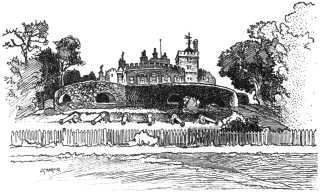
We shall, however, better judge what Romney
Marsh is like by mounting to the high lands that
overlook it; that ridge which is crested picturesquely
by Lympne Church and Castle on the
right, marking the ancient coast line in the times
of the Romans. What is now the Marsh was then
a shallow lagoon where the Roman vessels rode
at anchor; and to this day the remains of the
Roman seaport of Portus Lemanis, called “Studfall
Castle,” strew the tumbled grassy slopes
beneath Lympne Castle, in fragments of massive
masonry. It is an excessively steep climb, past
Botolph’s Bridge, up to Lympne; that “Lymme
Hill, or Lyme,” of which Camden wrote. He
tells us, truly enough, that this “was sumtyme
a famose haven, and good for shyppes that might
come to the foot of the hille. The place is cawled
Shipway or Old Haven. Farther, at thys daie
the lord of the V ports kepeth his principal court
a lytil by est from Lymme hill.”
The Court of Shepway, to which Camden thus
alludes, was the chief legislative and executive
body of the Cinque Ports. It made the laws
governing that confederacy of ports, and pronounced
decrees.
A subsidiary court of the Cinque Ports, inferior
to the Court of Shepway, was in remote times
held in the open air on Dymchurch beach. This
was the “Court of Brodhull,” and was later
removed to Romney.
Shepway Court also was an open-air assembly,
presided over by the Lord Warden. Here offenders
were tried upon charges of high treason, failure
of ship-service, false judgment, and treasure-trove.
Process upon conviction was summary. Convicted
disturbers of the King’s peace, debasers
of coin, and plunderers of ships or ships’ gear to
the value of twenty pence were at once drawn
around Shepway on hurdles and afterwards hanged.
An even more terrible fate awaited any jurat
disclosing the King’s counsel, his fellows and his
own. He was bound hand and foot to a stake
set upon the seashore where the tide ebbed and
flowed, his throat was cut, and his tongue drawn
out through the slit.
The Lord Warden was always, from the earliest
times, sworn in at the Court of Shepway upon his
appointment. The first Lord Warden was Earl
Godwin. This ceremony continued here until
1597, when Lord Cobham took the oath at Bekesbourn.
Meanwhile the business of the ancient
Court had been transferred to Dover. The composition
of this open-air assembly was, the Lord
Warden, with the Mayor of Sandwich on his right
and the Mayor of Dover on his left; on the right
of the Mayor of Sandwich, the Mayor of Hastings;
and the Mayors of Romney, and Hythe, Winchelsea
and Rye, Faversham, Folkestone, or
Fordwich, Lydd, Pevensey or Seaford, and Tenterden,
respectively in succession, right and left.
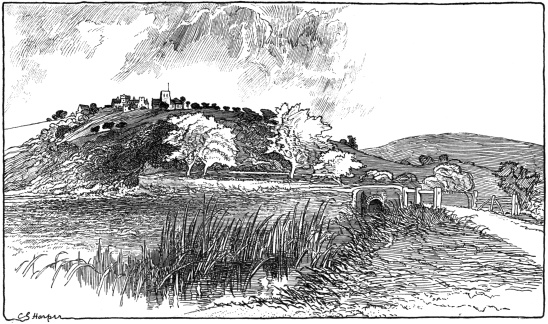
LYMPNE.
At Shepway Cross, on the hill-top, we turn left
into Lympne, which was once pronounced locally
as a two-syllabled word, “Limn-ey”; obviously
derived from the old Roman Lemanis. How
or why the intruding “p” came into the place-name
is unknown, and cannot be traced back
further than Morden’s map of Kent, about 1680.
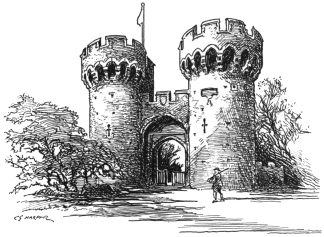
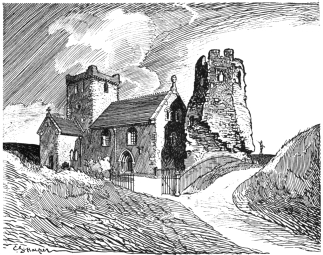
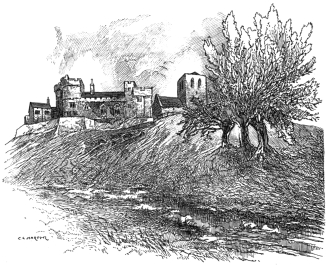
The great Early English church adjoins the
castle, originally one of the numerous seats of
the Archbishops of Canterbury, and afterwards
for centuries a farmhouse. This interesting building,
with remains of fourteenth-century work,
was sold about 1907 to Mr. F. J. Tennant, the
millionaire brother-in-law of Mr. Asquith. Until
that time the public had access to the place;
but it has since been restored and huge additions
made, wholly changing the aspect of the spot.
Before these developments it was possible to
wander anywhere at will about the ruins of the
castrum on the undercliff; but now one is restricted,
and goes between limits of barbed-wire, and
hedged in with threatening prohibitions. It is
to be observed that never before in all its history
had the castle suffered siege or violence, until
this transformation had been effected. And then
its warlike history began, in the determined irruption
of a band of those “bold, bad ones,” the
silly suffragettes, who stormed the terraces and
flung stones through the dining-room windows
during one of Mr. Asquith’s visits. The great
gods laugh at the exquisite irony of the situation!
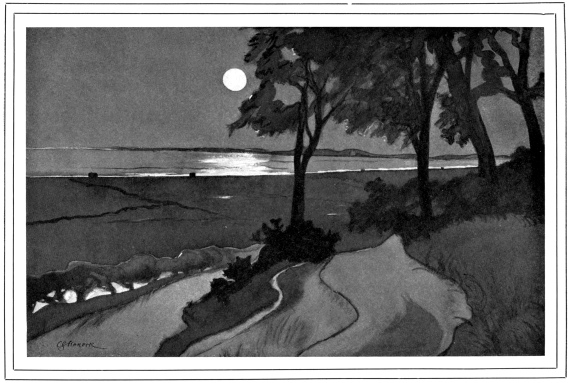
From the ridge on which Lympne is placed
one looks down over the whole extent of Romney
Marsh, with the Military Canal down in the
foreground, and out in middle distance the curving
sweep of the shore, accented at intervals by the
line of martello towers. It is beautiful by day,
but touched to nobility at night, under the gleam
of the harvest moon.
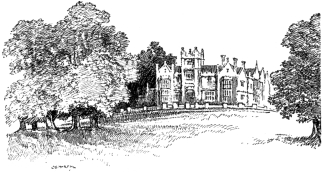
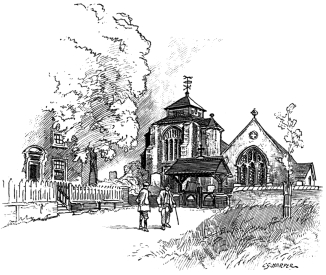
LYMPNE CASTLE AND CHURCH.
Half a mile out of Lympne, on the way to
Aldington, a rough and obscure lane turns to
the left, out of the road, between some new residences
which have just been built. It is not at
first a particularly inviting way, but it leads to
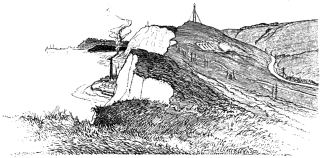
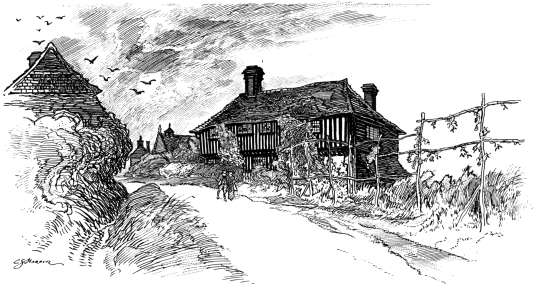
a singular undercliff scene, where an ancient
cottage, completely wrapped in creepers, even to
roof and chimneys, stands on a plateau which
has the appearance of having slid bodily half
way down the cliff. This indeed is exactly what,
in the words of Hasted, the historian of Kent,
did happen one night in the year 1727. So evenly
and silently did this take place that the farmer and
his wife knew nothing of it until they awoke
next morning to the new point of view presented
from their windows. The cottage is known as
the “French House,” from the fine view hence
of the coast of France.
Immediately at the end of the next hamlet,
Court-at-Street, a steep, rough lane deeply sunk
between rugged banks and overhung with trees
leads down to the Marsh, or rather, to a little
plateau or undercliff looking upon it. It is a
beautiful view you get hence, a variant of other
beautiful glimpses on the way from Lympne to
Appledore, taking in the flat Marsh and the
Royal Military Canal and the long sweep of coast
curving to Dungeness. But something other than
a mere view-point makes the spot interesting.
It is a little building, roofless and otherwise in
ruins, that stands there; a building with one
remaining architectural feature in the shape of a
late doorway, probably of the time of Henry the
Seventh. This was anciently a chapel. The
reason of its being placed in a situation so obscure
is lost, but there must have been an excellent
one for such a choice, for mediæval chapels commonly
stood, as shops do now, in positions that
commanded traffic, and for the same reason: that
they should secure the notice and the custom of
wayfarers, by whose alms and offerings they
were largely supported. At the time when the
story presently to be told was enacted this chapel
had already fallen upon evil times. Whatever
relics it had possessed had—as modern theatrical
managers say of their unsuccessful plays—“failed
to attract”—and the hermit who once had lived
there was gone.
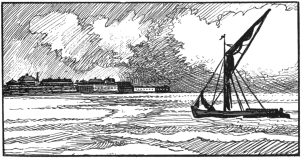
ROMNEY MARSH: THE MARTELLO TOWERS AND MILITARY CANAL: MOONLIGHT.
But it has a late story of its own, a tragical
story of the tragic and epoch-making age of Henry
the Eighth. In those last few years when it was
still roofed and weather-proof it was used by the
cunning priests of a declining and damnable
creed for the purpose of keeping alive their almost
exploded superstitions. Reformation was in the
air, in things spiritual and temporal alike, and
the religious houses were presently to be dissolved
and to be made loose their hold upon the large
proportion of English soil they had accumulated
by centuries of bequests. Some sign, any sign,
was required by the doomed clergy of that age
by which the pretensions of their class could be
bolstered up and the actions of a King bent upon
reform discredited; and such a sign, the religious
of Canterbury acutely believed, could be made
to appear from the strange possession, demoniacal
or angelic—that had suddenly befallen a peasant
girl in Aldington, one Elizabeth Barton, at that
time a servant in the employ of Master Thomas
Cobb, bailiff to the Lord Archbishop of Canterbury.
Cobb lived in the little house still standing
at Aldington, and now known as “Cobb’s Hall,”
and was startled when his maid-servant suddenly
developed strange and terrifying behaviour, and
began to rave on religious matters. To modern
ideas the symptoms detailed in the lengthy old accounts
of Elizabeth Barton’s career would seem to
point to epileptic fits, followed by religious mania;
but the simple folk of those times thought her
inspired, and those others who were not so simple,
and knew a good deal better, took excellent good
care that the notion of her inspiration should
be well nursed. Religious mania is generally
the product of outside influences acting upon a
diseased body and an ill-balanced mind; and it
may be suspected, since the crisis in the affairs
of the Church was then the chief topic in the
mouths of all men, that Elizabeth had been influenced
by the talk she heard, and by the preaching
of the then rector of Aldington, Richard
Masters. In her trances and somnambulistic exploits
and in her ravings the ordinary people
thought her possessed of evil spirits; but Richard
Masters declared she had always been a devout
girl, and he now professed, when called to her
bedside, to have heard her say “very godly certain
things concerning the seven deadly sins and
the Ten Commandments.” This, in the view of
the Church, was inspiration. Masters journeyed
to London, and at Lambeth Palace acquainted
the old and failing Archbishop Warham with this
strange portent, and was encouraged to keep
diligent account of all her utterances.
And then Elizabeth Barton suddenly recovered,
and was in the scullery again, cleaning
pots and pans and dishes. We may picture the
disappointment Masters experienced, on his return,
to find his prodigy become suddenly so
commonplace.
But it was too late for this poor Elizabeth to
be allowed to return obscurely to her domestic
duties. Cobb’s house was besieged by the curious,
who came merely to look at her, and by the superstitious,
who had heard she could prophesy, and
by the ailing, who thought that a laying on of
hands would cure them.
Two monks were brought over from Canterbury,
to make a religious seer and prophetess
of her, and Cobb was persuaded that the best
room in the house, and not the scullery, was
her proper place. These two emissaries, Doctor
Bocking and Dan William Hadley, gave her a
course of instruction in the Acta Sanctorum, and
taught her to believe herself of the company of
saints and equal to such miraculous deeds as theirs.
Thus arose the title by which she is known in
history, the “Holy Maid of Kent.” She now
experienced a recurrence of her cataleptic states,
but appears more often to have made a pretence
of them. Her instructors removed her at this juncture
to this lonely Chapel of Our Lady at Court-at-Street,
which had for some time past, with
the general decay of pilgrimage and the growing
disbelief in relics, been doing very badly.
The removal was made the occasion for a great
and striking religious procession, and two thousand
persons assembled to witness a promised
miracle: a promise said to have been made to
Elizabeth by the Virgin Mary that she should
be cured if she visited that shrine. Elizabeth
was carried to the place, with every appearance of
severe affliction, “her face wondrously disfigured,
her tongue hanging out, and her eyes being in
like manner plucked out and lying upon her cheek.
There was then heard a voice speaking within
her belly, as it had been in a tunnel, her lips not
greatly moving; she all that while continuing
by the space of three hours or more in a trance.”
And the voice spoke of the joys of heaven and
the torments of hell and of the efficacy of pilgrimage
and the beauty of giving to Holy Church.
“And,” continues the account, “after she
had lyen there a long time, she came to herself
again, and was perfectly whole.” It was, in short,
a very clever and successful exhibition of acting
and ventriloquy, and completely captured the
crowd.
The Virgin now desired her to repair to the
Priory of St. Sepulchre at Canterbury, and to
assume the name of Sister Elizabeth and take
Dr. Bocking for her spiritual instructor. There she
was gradually coached into religious and political
prophecies, and began to launch threats against
the King in respect of his divorce and of his proposed
marriage with Anne Boleyn. She declared—and
forced her way into his presence at Canterbury,
on his return from France, to declare it—that
he should not reign a month after that
marriage and should die “a villain’s death.” But
the King, quite unmoved, married as he had
intended, and a month passed, and he seemed
none the worse. The Holy Maid, like many another
prophet before and since, was obliged to
move the date of the anticipated retribution
forward, and still the vengeance of Heaven did
not descend. The obvious inference is that
Elizabeth was not in the confidence of Providence;
but through the reports of the monks of Canterbury,
who spread the most extraordinary accounts
of her life in the Priory, in which the devil in
person was said to have appeared, in an attempt
to commit an indecent assault upon her, she was
widely looked upon as divinely inspired. Sir
Thomas More, regarded by all competent persons
as one of the most learned and cultured persons
of that age, believed in her.
For three years she continued her extraordinary
career of fraud and blasphemy, and then
the heavy hand of the King descended upon
her and her accomplices. One can only feel
surprised that it had been delayed so long, for
Henry the Eighth was not usually long-suffering
under insult.
She was hanged, with Doctor Bocking and
others of her accomplices in religious deceptions
and political offences, April 21st, 1534, at Tyburn.
“Hither,” said she, in her dying speech and
confession, “I am come to die. I have been not
only the cause of mine own death, which most
justly I have deserved, but am also the cause of
the death of all these persons who at this time
here suffer. And yet I am not so much to be
blamed, considering that it was well known unto
these learned men that I was a poor wench without
learning, and therefore they might have easily
perceived that the things which were done by
me could not proceed in no such sort; but their
capacities and learning could right well judge that
they were altogether feigned. But because the
things which I feigned were profitable unto them,
therefore they much praised me, and bare me in
hand that it was the Holy Ghost, and not I that
did them.”
This, with much else, she confessed, admitting
among other things that a letter purporting to
have been written by the Virgin Mary, in heaven,
and sent to a widow in London, was written by
a St. Augustine’s monk named Hawkhurst.
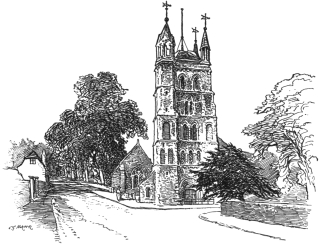
Aldington church tower rises in stately massiveness
amid the plain of Aldington Frith—“Aldington
Fright,” as the country people call it.
It is a noble, though an unfinished building, begun
about 1507, and in progress until 1537. Those
were not favourable times for new church works,
and the Archbishop’s palace—one of his many
palaces—close by, dated its decay from the
same period. Nothing is left of his park of more
than a thousand acres, and of the palace itself,
its five kitchens, eight dove-houses, six stables,
nine barns, and other appurtenances on an equally
generous scale, nothing now remains but some
few architectural fragments built into the walls
of a comparatively modern house.
Aldington is notable not only from its connection
with the story of the Holy Maid, but also
because Erasmus was rector here for a short period.
His appointment in 1511 by Archbishop Warham
was something in the nature of a scandal, however
well-meaning its object, which was to provide
him, as a learned, but poor, scholar, with a livelihood.
Erasmus was a Dutchman, quite ignorant
of the English language, however well versed
in Latin; and either his awakened conscience, or
the growing indignation of the people of Aldington
at having a tongue-tied alien thrust upon them,
presently led to his resigning. A charge of £20
per annum, then a large sum, fully equal to £200
present value, was then made upon the living,
and paid by his successor for his support. After
a short interval, Richard Masters, who figured
prominently in the affair of the Holy Maid, was
appointed, and with varying fortunes he held the
rectory until his death, in 1558.
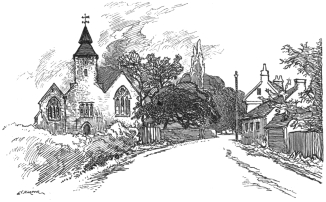
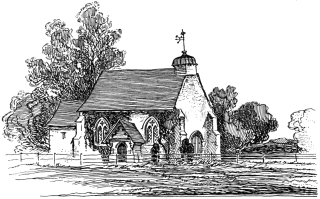
Beyond this we may fitly turn down again
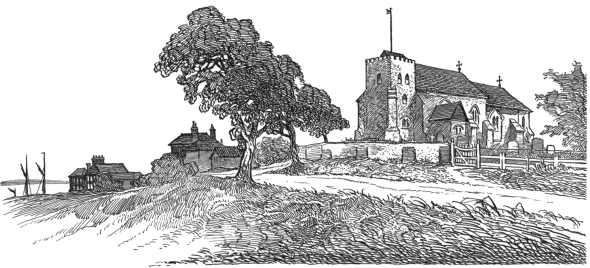
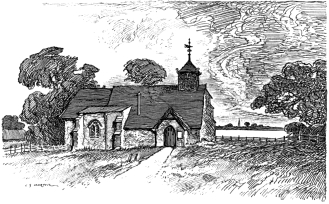
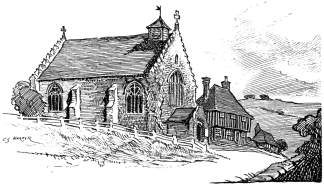
to the Marsh, past Bonnington church, a tiny
building standing close beside the Military Canal.
Thence across the levels, by winding roads, the
way goes to Newchurch, “new” so long ago that
the origin is lost in antiquity. It is a typical
Marshland village, and the heavy tower of the
church itself leans forward in a manner suggesting
imminent collapse. It has probably suggested
the same idea for three hundred years, or more;
and so there is certainly no immediate danger.
Hereabouts the sheep are the chief animate
objects. Romney Marsh was ever a region famous
for its flocks, and from the earliest times
the smugglers who smuggled wool out of the
country, regardless of the strict penal laws against
the exportation of fleeces, were more important
than those who smuggled goods inwards. They
had their own special designation, and were
known as “owlers,” probably in the first instance
from their signalling in the night with calls like
those of the owls.
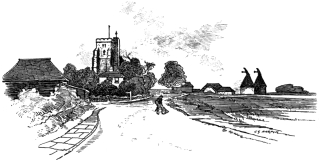
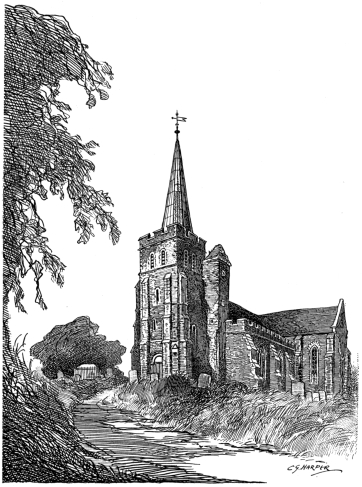
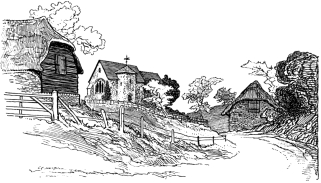
BONNINGTON CHURCH.
There are no “shepherds” here, on the Marsh.
They are, in local parlance, “lookers.” When the
agricultural labourer in these parts takes up with
“ship,” he announces, “I be a-going a-lookering”;
lookering being, in fact, a variety of shepherding
peculiar to these surroundings, with special terms
and conditions.
To trace these byways of the Marsh in spring,
say in the third week of May, when the thorn-trees
are in bloom, is an experience to be remembered;
it is the best time of all the year to
see Romney Marsh. Then such remote spots as
Ivychurch, in the very middle of it, seem idyllic.
“Ivychurch” does not, by the way, take its
name, as might be supposed, from ivy, but has
its root in “ea,” for water, having originally
been situated on an islanded knoll ever so little
raised above the level of the wet marshes. The
term “Marsh,” it should be said, survives although
the roads and byways are now as dry as those
of other scenes, thanks to the constant care of
the jurats and other officers whose functions are
to keep the dykes deeply delved, the sluices in
order, and Dymchurch Wall in repair. In default
of these, Romney Marsh, or the greater
portion of it, would again be drowned, for it is
at a lower level than the sea.