FROM THE SMITHSONIAN REPORT FOR 1926, PAGES 469-486
(WITH 3 PLATES)
(Publication 2904)
UNITED STATES
GOVERNMENT PRINTING OFFICE
WASHINGTON
1927
Plate 1
Walpi
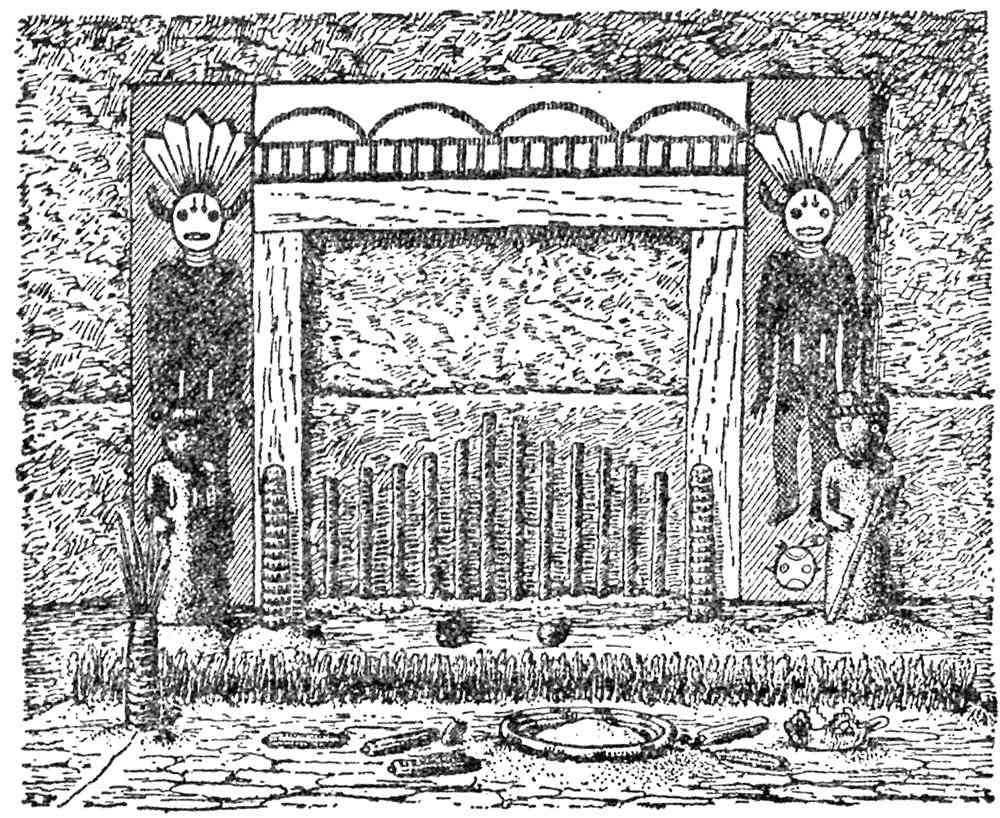
Six Directions Altar
THE KATCINA ALTARS IN HOPI WORSHIP — INTRODUCTION — COMPARISON WITH THE NIMAN ALTAR AT CIPAULOVI
By J. Walter Fewkes, Chief, Bureau of American Ethnology
[With 3 plates]
The present article is the fifth of a series published in the annual
reports of the Smithsonian Institution on the composition of Hopi
worship. The Hopi, the name meaning peaceful, belong to the Pueblo
stock and are agricultural Indians. They are descendants of the
Arizona cliff dwellers and have preserved to the present many survivals
of their ancient worship. The object of the series of five
papers above referred to is to record a few of their rites in sun, fire,
and ancestor ceremonies that have survived to the present time. The
Pueblos performed their secret ceremonies in subterranean rooms
called kivas that were entered from the roof.
It is customary for the priest in the course of the ceremonies to
erect an altar, so called, on which is placed their tiponi, or sacred
badge of office, surrounded by various fetishes, idols, and wooden
objects bearing symbols. Here are placed all sacred objects possessed
by the fraternity of priests who celebrate the rite. There are four
Hopi villages or pueblos that perform the rituals independently,
the sacred paraphernalia differing in each. From a study of these
altars it is possible for us to learn the aim of their various ceremonies.
The present paper compares the four Katcina altars for
this purpose.
That element of pueblo worship known as the Katcina forms fully
one-half of the Hopi ritual, beginning with the arrival of the Katcinas
or masked dancers in January or February, and lasting until
their departure in July, inclusive. It is distinguished from other
components by the presence of masked participants called Katcinas,
supposed to be personators of the ancients, or “others.” The yearly
departure of these worthies from the villages is celebrated in July
by a great religious observance called the Niman or Farewell Katcina
ceremony; their arrival by several rites, one of the most striking of
which is called Powamu, or “Bean Planting.” At the times of their
arrival and departure there are erected in the kiva of each of the
four villages which celebrate them, the same altars, about which
certain secret rites are performed. Our knowledge thus far is limited
to four of the five Katcina altars,[1] and there still remains the altar
of Cuñopavi, regarding which nothing has yet been recorded.[2]
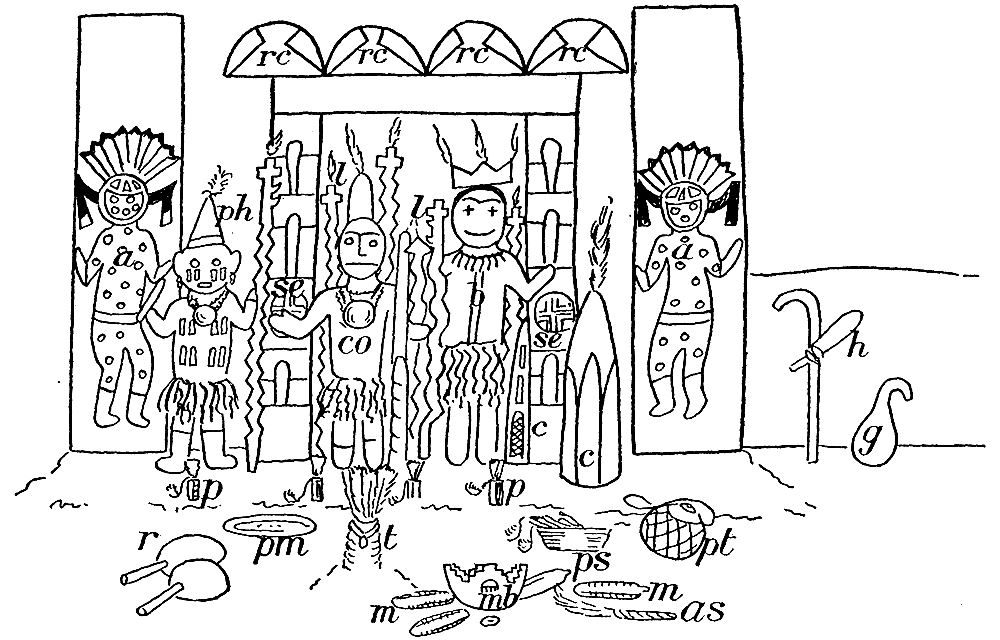
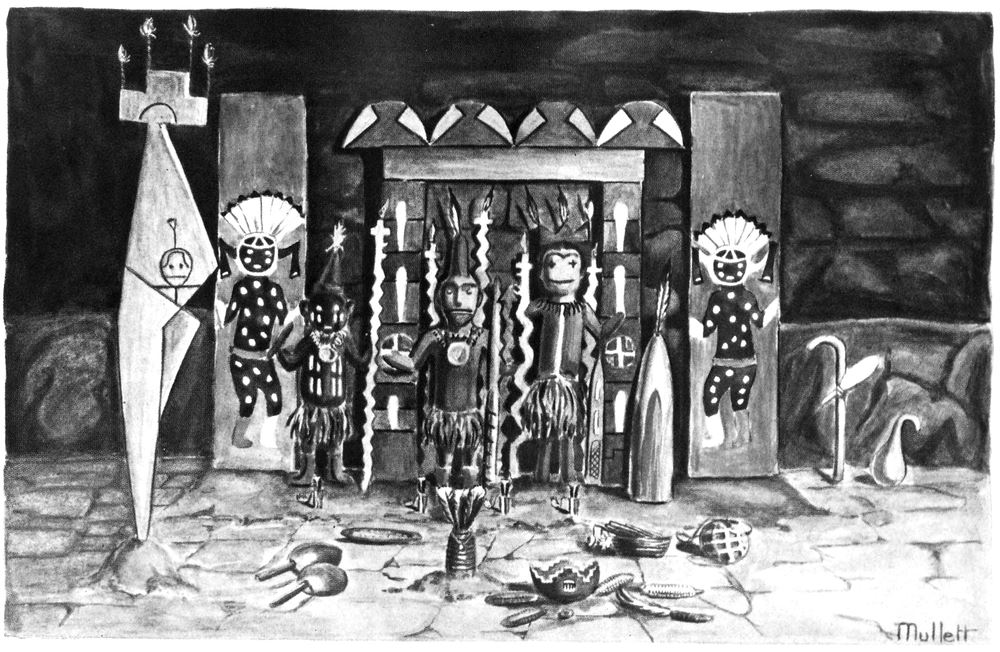
Explanation of Plate 2—Katcina Altar at Oraibi
a, Tunwup, or Sun Katcina; as, Aspergill; b, Tcuelawu; c, Corn mound; co, Cotokinungwu; g, Gourd; h, Planting stick;
l, Lightning symbols; m, Ears of maize; mb, Medicine bowl; p, Prayer sticks; ph, God of war; pm, Prayer meal; ps, Prayer
sticks in basket; pt, Gourd (netted) for sacred water; r, Rattles; rc, Rain clouds; sc, Sun emblems; t, Tiponi.
Plate 2
Katcina
Altar at Oraibi
Our knowledge of Katcina altars of the Rio Grande in the other
pueblos is very scanty, owing largely to the exclusion of ethnologists
from the kivas. Katcina dances in the open plazas are repeatedly
figured but the secret rites and accompanying altars, if any, are
not known.
In the following pages the author presents a morphological study
of the four known Katcina altars of Hopi. The illustrations of the
most complex, that of Oraibi, have been taken from the excellent
memoir of Voth on the Powamu of that pueblo; the others are
from personal studies made in 1890-1895.
The structure of the Oraibi Katcina altar is as follows: The
reredos consists of two upright wooden slats united above by a crosspiece
which in the illustration (pl. 2) is surmounted by a row of
four segments of circles with rain cloud pictures representing the
four directions, and colored with appropriate pigments, beginning
with yellow or north at the right. The decoration of the crosspiece
is obscure, but on the uprights there are figures recalling
sprouting vegetation, and circles with differently colored quadrants.
Two idols, probably of wood, stand between the vertical slats of
the altar, filling nearly the whole space. That on the left evidently
represents the Sky God (Cotokinungwu) for it has a conical apex
to the head, a painted chin, and near its left hand stands a wooden
slat of zigzag form, a prescribed symbol of lightning.[3] This image
has several short parallel marks of different colors on the body, and
wears horsehair, stained red, about the loins.
The other figurine wears a coronet with triangular-shaped rain
cloud symbols, which remind one of the headdress of the Lakonemana,
a tutelary goddess of the woman’s society, the Lalakontu,
whose ceremonials in September have been described elsewhere.[4]
The two vertical wooden slats, one on each side of the uprights,
bear pictures of the same personage, probably Tunwupkatcina, on
whose head is a fan-shaped crest of feathers. On each side the
head has a horn, at the extremity of which hangs a symbolic feather.
The human figures have characteristic markings on their foreheads,
and their bodies are black, dotted with white spots.
There is no mistaking the symbolism of the remaining idol standing
at the right of the altar, as an image of Puukonhoya, the “Little
War God,” whose characteristic features are the parallel marks on
the body, and the weapons of war in his hands.
Several sticks, cut in zigzag shapes with curved appendages and
short crossbars at one end, stand between the uprights of the reredos.
From their forms, these objects may readily be identified as lightning
symbols so common in all Tusayan altars. One of these, which has
a complicated tip or head, is placed close to the outstretched arm of
Cotokinungwu, with whom it is naturally associated. The straight
rod leaning on the same arm is possibly a cornstalk symbol. The
rounded stick, tapering at one end, which stands under the extended
left hand of the image on the left, is probably a symbol of maize.
A somewhat larger pointed object, painted at its base with zones of
yellow, green, red and white, and surmounted by a feather, is called
“the mound” and suggests the kaetukwi or Corn Mound of the
Lalakontu, being similarly situated to an image on the left of this
altar. The surface of the latter object, however, instead of being
painted, is encrusted[5] with clay covered with different kinds of seeds.
The crook at the extreme left of the altar has attached to it an
object which resembles the paddle carried by a participant in the
Heheakatcina, or public ceremonial of the Niman at Walpi.
Four pahos, or prayer-sticks, are placed at intervals in hillocks of
sand before the images on the altar. The Katcina tiponi,[6] or badge
of the chief, stands on the floor before the altar.
Just in advance of the left-hand idol—the image with a coronet—there
is a small oblong basket in which are laid a number of sticks
with feathers, seeds, and pinches of meal. This is called the
“Mother,” and recalls similar objects which have been observed
on the Lalakontu altar, whose contents have been described elsewhere.[7]
I need not dwell on the other accessories of the Powamu altar at
Oraibi save to note that they are common to other altars, and in no
respect characteristic. I refer to the basket tray of sacred meal, the
rattles, a medicine bowl, aspergill, and six ears of corn used in
special rites.
The strange object at the extreme right, surrounded by a tablet,
symbolic of a rain cloud, bears the picture of the head of Ho’katcina.
It is supported on a pedestal, and appears to be peculiar to Oraibi.[8]
Cipaulovi, the smallest of all the Hopi pueblos, is situated on the
Middle Mesa, and its Katcina altar is the poorest in paraphernalia,
as shown by a comparison with the altar at Oraibi, the most complicated
in Tusayan.
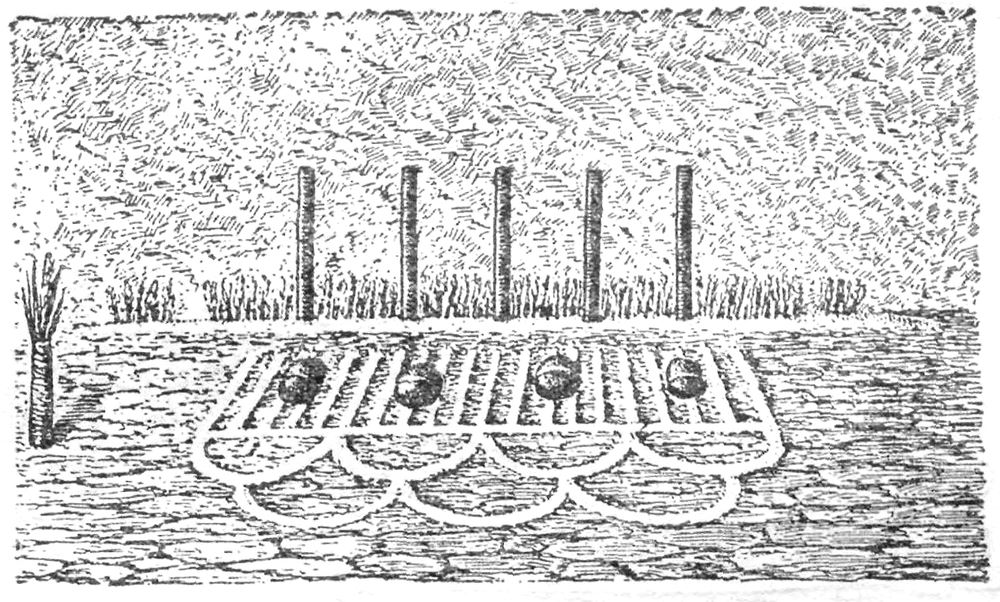
Fig. 1.
—Cipaulovi Niman Katcina altar
Omitting the medicine bowl, rattles, sacred meal, and pahos, the
Cipaulovi Niman altar consists of a figure of seven rain clouds, with
parallel lines representing falling rain, drawn on the floor with
sacred meal, and a row of five vertical sticks, symbols of growing
corn. Upon the meal picture which represents the falling rain,
there are four stone implements arranged in a row. The tiponi, or
palladium of the Katcinas is placed on a hillock of sand at the
right of the same picture. There are no idols or images of anthropomorphic
forms on this altar, and unless the stone implements
may be so interpreted, no lightning symbols. The Niman altar at
Cipaulovi[9] is very simple, but the essentials of a Katcina altar are
included. The two prominent symbols are those representing rain
clouds and growing corn, which are elaborated in the more complicated
Katcina altars and may be regarded as embodying the
two main aims of Katcina celebrations.[10]
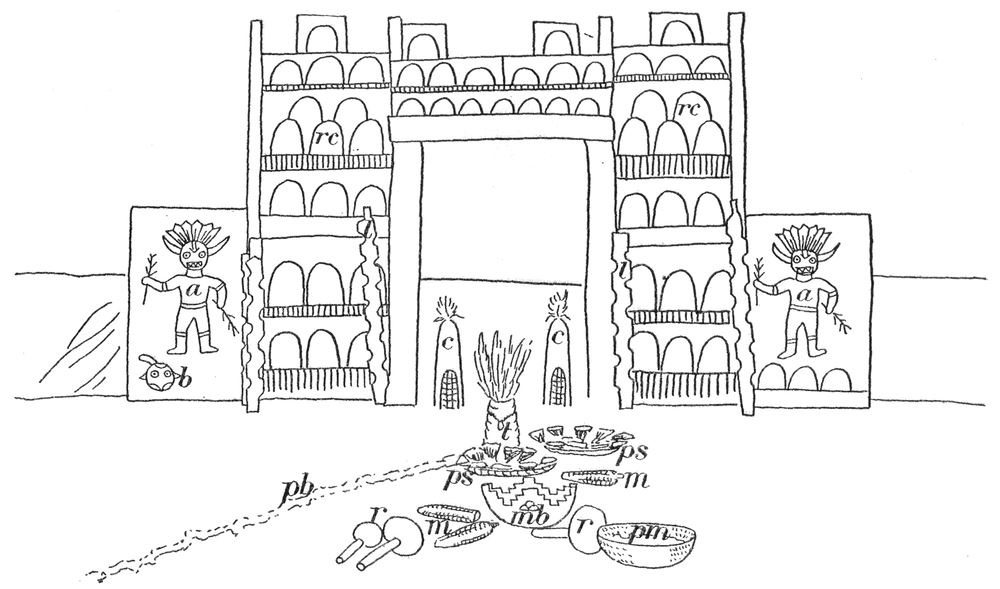
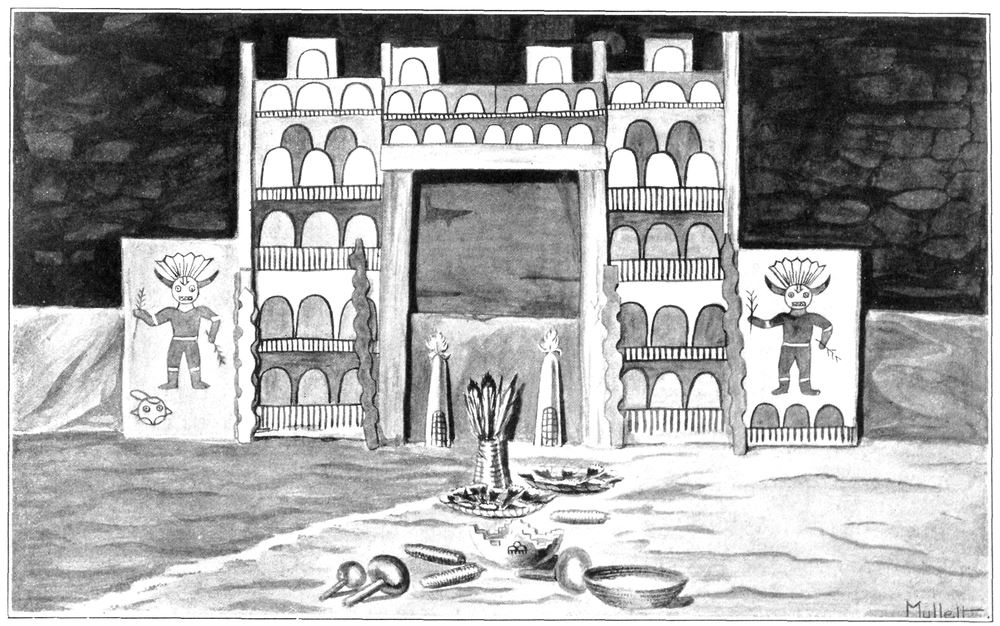
Explanation of Plate 3—Walpi Niman Katcina altar
a, Tunwup, or Sun Katcina; b, Tcuelawu; c, Corn mound; l, Lightning symbols; m, Ears of maize; mb, Medicine bowl; pb, Path
of blessing; pm, Prayer meal; ps, Prayer sticks in baskets; r, Rattles; rc, Rain clouds; t, Tiponi.
Plate 3
Walpi Niman Katcina Altar
COMPARISON WITH THE NIMAN KATCINA ALTAR AT WALPI — COMPARISON WITH THE NIMAN KATCINA ALTAR AT MICONINOVI — ALTAR OF ORAIBI POWALAWU — CONCLUSIONS REGARDING THE PLACE OF KATCINAS IN TUSAYAN WORSHIP — FOOTNOTES: — Transcriber’s Notes
The Walpi Katcina is next in simplicity to that of Cipaulovi.
It has instead of a meal picture, however, a reredos upon which
are depicted rain and rain cloud symbols, and the two supplementary
uprights, with pictures of Tunwup referred to in the
Oraibi altar. There are zigzag slats, symbols of lightning, and
rounded sticks with emblematic corn designs, neither of which,
however, is as complicated as at Oraibi.
The Katcina tiponi is prominent, but there are no images on the
altar, no basket with seeds and feathered sticks, and no crook with
attached handle. While, therefore, the altar of the Walpi Niman
Katcina is more complicated than at Cipaulovi, it is not as rich
in accessories as that at Oraibi.[11]
The Katcina altar in this, the most populous village at the
Middle Mesa, is simpler than at Oraibi, but more complicated than
the Walpi representative. It has, in addition to the objects found
on the Walpi altar, two idols or images, one on each side. The zigzag
sticks are lacking, but stone implements similar to those on the
far simpler Cipaulovi altar are present. There are two emblems of
maize, as at Walpi, and numerous sticks, representing growing corn,
recalling the same symbols of the Cipaulovi equivalent.
It will be seen, therefore, that while it is the nearest of all to the
Oraibi altar, an additional idol, the “Mother” or basket of seeds,
etc., the crook (naluchoya), and the picture of Ho’katcina are
unrepresented at Miconinovi.
The two images of the Miconinovi altar are apparently the Little
War God and the Germ Maid. There may be a doubt of the accuracy
in identification of the latter, but she has the symbols of rain
clouds on the head and in the hand. The other image has the parallel
marks on the body, symbols of Puukonhoya, but it must be confessed
that the same marks are found on the Cotokinungwu idol
although the latter image has the characteristic cone on the head
which is not present in the Miconinovi image. The evidence
would thus favor the conclusion that the right hand figurine of
the Miconinovi altar represents Puukonhoya rather than Cotokinungwu,
and as far as known Oraibi is the sole pueblo which has
an idol of Cotokinungwu on the flute altars, of which those of four
pueblos are known.[12]
A comparative study of the symbolism, simple and elaborate, of
the Katcina altars leads me to the conclusion that the most complicated
altar, that at Oraibi, is the result simply of elaboration of the
less developed altars, of the introduction of new elements. Analysis
reduces this composite symbolism to rain clouds, fertilization, growth,
and maturity of corn, the elements which dominate the whole Hopi
ritual.
Fig. 2.—Miconinovi Niman Katcina altar
A somewhat more detailed statement of this point is perhaps
desirable. In the Hopi ritual three methods of representing supernatural
personages are adopted. First, personifications by men,
women, and children. Second, representations by images or idols.
Third, representations by pictures, conventionalized objects, or
symbols. These three methods may coexist; they are interchangeable,
and may be phylogenetically connected in the development of
rituals. In the public ceremonials the first method is almost invariably
adopted, but in secret rites all three are employed.[13] The representations
on the Katcina altars at Cipaulovi and Walpi are
limited to the third method; those at Miconinovi and Oraibi include
likewise the second.
There is no need of going into detail regarding the meanings of
the symbols of the third method of representation as used on Katcina
altars. The simplicity of this method, here applied, is apparent,
and the symbols are those of rain clouds, lightning, and corn in
various stages of growth.
A discussion of the second method, or representation by images
and what they mean when used on Katcina altars, will bring out
several points of interest. These images, commonly called idols,[14]
occur on the Katcina altars of Oraibi and Miconinovi and represent
the same conceptions as the symbols. The idol with the raincloud
coronet is a representation of a corn-rain supernatural personage
who has many names and appears in ceremonials both public and
secret of many different priesthoods. In the ceremony called the
Lalakontu she is either personated by women in the public dance
or represented by images on the altar and is called Lakonemana
(Lakone Maid). In the October ceremony, called Mamzrauti, she
is likewise represented by the first and second methods,[15] and is
called Mamzraumana.[16] The same is true of the Owakulti, still
performed at Oraibi, although extinct at Walpi, where she is known
as Owakulmana.
During the dramatization in the Antelope kiva of the Snake
Ceremonials at Walpi she is personated by a maid called the Tcuamana[17]
(Snake Maid) and no effigy of her is employed in this archaic
ceremony. The Flute Society represent her in their rites in both the
first and second ways, with two girls in the public dance, and images
on the altars in the secret observances, where she is called Lenyamana
(Flute Maid).[18] In Palülükonti[19] she is personated by the
first method, and is called Calakomana. The most elaborate images
of this being, also called Calakomanas, are secular in character, and
are used as dolls. All her different names, and some others which
might be mentioned, are aliases, sacerdotal society names of the same
mythological conception, which may more accurately be called
Muiyinwu, the Germ Goddess, who is likewise associated with rain.
The symbolism of images on the left side of the Katcina altars
of Miconinovi and of Oraibi is highly conventionalized, but clearly
enough developed to show that the images represent the same Rain-Germ
Goddess who, in some ceremonials, is personified by a girl;
in others by a similar image. This image is called the Rain-Germ
(Corn)[20] Maid because in the most elaborate representations of her
this bifid nature is strongly indicated by symbolism. Her idol on
the Miconinovi Flute altar has four symbols of corn on the body, and
bears three rain cloud tablets on the head. In numerous dolls[21] she
has a symbol of an ear of corn on the forehead and an elaborate raincloud
tablet with a rainbow on the head.
The other idol, likewise known in various ceremonials by tutelary
sacerdotal aliases, is the male cultus hero, the fructifying
principle symbolized by lightning and personified according to
the society, by such supernaturals as Cotokinungwu, Puukonhoya,
Tcuatiyo, Lentiyo, and the like.
In this totem-pole-like doll we have Hehea, the male, with two
Calakos, females, as their symbolism clearly indicates. The Hopi
have a legend that the Calako maids brought the first corn to their
ancestors, and in that legend it is said that Calakotaka, or the male
Calako, a sun god, initiated the youth into the Katcinas by flogging
them, as Tunwup still functions in Powamu.
The etymology of the word Calako is unknown to me, and it may
have been derived from the same source as the Zuñi word. A corn
husk, and by derivation a cigarette paper, is called by the Hopi a
calakabu.
The symbolism of the male Calako is identical with that of Tunwup
and resembles that of the Zuñi Shalako. The Hopi celebrate
their sun-prayer-stick making in July, the Zuñi in December, or at
different solstices. The Hopi say that they derived their celebration
from the Zuñi (see Fifteenth Ann. Rept. Bur. Amer. Ethnol.).
When this interesting ceremonial is performed at Sitcomovi the
Calako maids do not appear, and the four giants with avian symbolism
apparently personate a sun drama, but as a derivative from
Zuñi we must await an interpretation of the original for conclusive
evidence of its meaning.
The images of the altars as well as symbolic designs depicted
upon them show us that fructification, growth and maturing of
corn, and rain clouds are predominant in representations on Niman
Katcina altars.
I have not offered a suggestion in regard to the identity of the
strange being, Tunwup, nor am I quite sure that he can be interpreted,
but I strongly suspect that he is none other than the Sun, a
worship of whom pervades the whole Katcina ritual.[22]
The element which predominates in the worship at the Powamu
ceremony is the fructification of germs; and as beans figure so conspicuously
in it as symbols, it’s popularly called the “Bean Planting,”
while a ceremony following it is Palülükonti,[23] in which corn is
sprouted, is called the “Corn Planting.” As in Hopi conceptions
the Sun is father of all life, a ceremony called the Powalawu, appropriate
to the object or aim of Powamu, precedes the planting of
beans in the kivas. The ceremony is strictly a part of Powamu,
showing it is a form of direct sun worship. In it a special sun altar
is made of a sand mosaic upon which, during ceremonial songs, a
tray of meal composed of all kinds of seeds used by the Hopi is
copiously sprinkled on the picture of the sun; medicine water is then
thrown upon the same to typify the rains which under the sun’s
action causes these seeds to germinate and grow.
My comparative study of the Hopi Katcina altars has therefore
led me to the following conclusions: Their symbolism, whether in
pictures, rites, or of images, refer to two elements, or supernaturals,
which control rain and growth of corn. The latter are male
and female, representing the sky god and the earth goddess, the
father and the mother, the lightning and the earth, the two sexes
without whose union life is impossible.[24]
The ceremonials performed about the Katcina altars admit of the
same interpretation, and it remains for me to indicate their nature
and bearing on the above conclusions.
A sand picture of the great paternal deity, Tawa, the Sun, has
never been reported from any Tusayan altar except Oraibi. Such a
picture is made in Powalawu, the opening ceremony of Powamu
and described by Mr. Voth.
The altar is made on the floor of the kiva, and is placed on a
layer of valley sand on which are made four concentric zones of
different colored sands surrounding a middle circle of white sand
on which is drawn a stellate figure of the sun. These different concentric
zones are yellow, green, red, and white, beginning with the
smallest, and ending with a peripheral in white. They are separated
by black lines, and a quartz crystal[25] to which a string, with attached
feather, is tied, is placed in the middle of the picture of the sun. A
quadrant apart on the periphery of the picture, beyond the white
zone, there are four arrow-shaped projections, colored yellow, green,
red, and white, following a circuit with the center of the whole sand
painting on the left hand. These, like the zones, are made of differently
colored sands and are rimmed with black. Across the yellow
arrow-headed figure extend several parallel red lines of sand; across
the green, white; across the red, yellow; and across the white, green.
On the supposition that the inner figure represents the sun, the
four peripheral arrow-shaped appendages are supposed to represent
heads of the lightning snakes of the four cardinal points, north,
west, south, and east, as their colors indicate.[26]
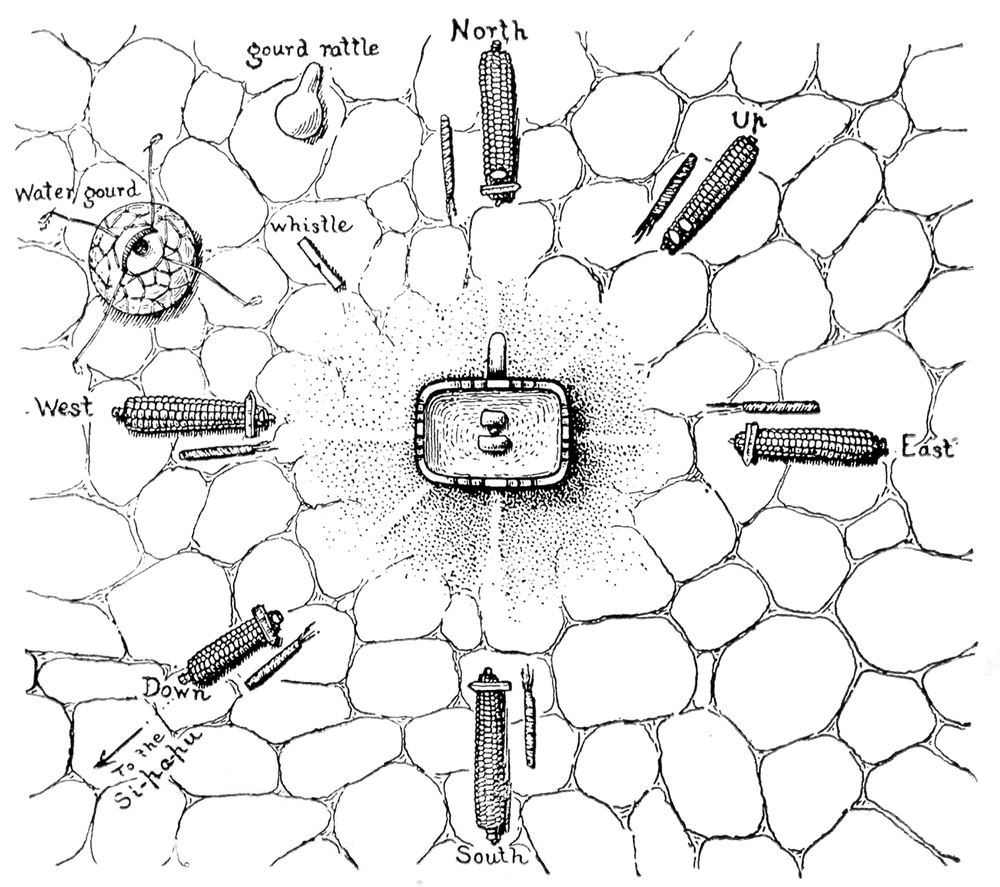
The accessories used in the celebration of the Powalawu are arranged
on the floor radially about this sand picture, and fall into
two groups, one on lines in continuation of the rays of the central
figure, the others on intermediary lines. There are, therefore, four
sets of both groups alternating with each other.
The objects which form a single group of the former in this
quaternary arrangement are as follows: A yellow reed, a paho-stand,
and a ball made of powdered pikumi.[27] Intermediate between
these, also with a quaternary arrangement, there is a ball
made of clay painted black in which a feather is attached, a blackened
reed, and a stone arrow point. The paho-stand with these
objects consists of a cubical block in which the following objects are
inserted in line: A small crook, a green double paho, several sticks
(called civapi, howapki, honyi, masiswapi), a black eagle feather
with four nakwakwocis tied to it and a ring with netted cord, and
finally a paho of a color corresponding to the cardinal direction in
which the paho-stand is placed.
The details of the Powalawu ceremony have been described by
Voth, from whose account I will mention a few generalities.
The celebrants gathered at the altar at about noon and sang
many songs with accompanying events which were performed by
Siima, the chief, now dead.
1. White earth, roots, and honey added to the medicine bowl.
2. Meal made of watermelon, melon, squash, bean, and corn seeds,
sprinkled carefully over the sand picture.
3. Charm liquid stirred and sprinkled on sand altar.
4. Priest ascended ladder of the kiva and blew a yellow feather
through a reed from the north paho-stand out of the hatch toward
the north, after which he blew a whistle pointing it the same way.
This was done in sequence to the west, south, and east, taking objects
from the altar each time.
5. Priest ascended ladder with a black reed from north cluster, and
blew from it, toward the north, a small feather. He then blew a
feather in sequence from the four stones, ascending the ladder each
time.[28] He licked honey from the stones and spat to the four cardinal
points.
6. Couriers carried the clay balls to distant shrines, and four
priests bore the four paho-stands, reeds, and yellow balls to other
shrines, also at cardinal points.
While the above events were transpiring songs were sung by the
assembled priests, and at the close the quartz crystal on the Sun picture
was raised from the stand and handled by each priest, who
sucked it, and pressed it to his heart.
7. Ceremonial smoke.
8. Prayers.
9. The sand gathered up and carried outside the kiva.
10. Feast.
The aim of the ceremony appears clear. Meal of all kinds of seed
sprinkled on the Sun typifies fructification of all Hopi food plants.
Water is poured on the meal as symbolic of the rains which the
celebrants hope will increase their crops.
The details of the nine days’ ceremonials of the Powamu at Oraibi
need not be described here, but it may be well to indicate their
general character.[29]
Beans were planted in boxes in all the kivas on the day after
Powalawu (February 5, 1894) and were forced to germinate in the
heated rooms, where they grew for 16 days. From February 13
(the first day of the nine days’ ceremony) until the 17th, Siima, the
chief, visited all these kivas, and when not so employed passed his
time in one of the rooms fasting, or making prayer objects.
I am indebted to Mr. Voth for my knowledge of the secret rites
of the Powamu at Oraibi. They supplement that which I have
published elsewhere on the Walpi representation, from which, however,
it differs very considerably. (See Fifteenth Ann. Rept., Bur.
Amer. Ethnol.; also Amer. Anthrop., Vol. VII, No. 1, 1894, and
Int. Archiv für Ethnog., Band VIII, 1895.)
The Powamu altar was erected on February 17, and from that day
until the ninth (February 21) daily songs of interesting character
were sung about it.
Many dolls, bows and arrows[30] for children are likewise made in
the kivas, and the chiefs prepared prayer emblems and other ceremonial
objects.
The culmination of Powamu, when we should expect the acme of
the series of rites, occurred on the afternoon of the ninth day (February
21), when the sprouting beans were pulled up, and distributed
with dolls and other presents, and when certain personages of supernatural
character brought significant gifts to the priests. It is the
last event to which I wish especially to call the reader’s attention.
This episode, which seems to me to bring out clearly the aim of
the Powamu ceremony, may be called the advent and departure of
Hahaiwuqti[31] followed by the Eototo and other supernaturals. The
main events of this episode were as follows: The man who personified
the “Old Woman” (Hahaiwuqti) having masked and otherwise
arrayed himself at a shrine[32] outside the pueblo, began to howl
vigorously. Siima the chief of Powamu, made offerings at this
shrine and drew on the ground, with sacred meal, several figures of
rain clouds about 20 yards nearer the village. Hahaiwuqti, as if
tolled along by this mystic sign, moved to it and again began to
howl. Siima made another set of rain cloud figures, again about
20 yards nearer the village, and the howling Hahaiwuqti advanced
to the second meal figures. Halting thus at intervals, and howling
as she went, the “Old Woman” at last stood in the public plaza
of Oraibi, and in answer to her cries people came to her, sprinkled
her with pinches of meal and took objects from the basket she
bore.
She then sought the entrance to the kiva in which the priests
were engaged in ceremonial smoking and singing. She stood like
a statue at the hatch, howling as if to announce her coming to the
priests within the room below. They soon responded, and came out
of the kiva headed by Siima with a bowl of medicine and an aspergill,
followed by a second priest with a reed cigarette and a coal of
fire, and others with bags of sacred meal. Hahaiwuqti was asperged,
smoked upon and sprinkled with meal, and presented with a paho accompanied
with a prayer, after which the priests returned to their
room and the “Old Woman” went away to the west. A few
minutes later men disguised as Eototo and Ahul approached the
kiva hatch near which some unknown Katcina had made in meal on
the ground a cross and rain cloud. Eototo rubbed meal on each of
the four sides of the kiva hatchway[33] and poured water into the
kiva entrance from the sides, as I have described in my accounts of
the Walpi and Cipaulovi Niman Katcina. Ahul followed his example,
whereupon the priests again emerged from the kiva and
treated these two visitors in the same way they had used Hahaiwuqti.
They received corn in return, after which the visitors retired,
following the “Old Woman.”
After their departure, two “mudheads” (Koyimse) and three
Katcinas, two men wearing Humis, Jemes, Katcina masks and one
the maskette and apparel of the female Humis, approached the kiva
entrance.[34] Then came personifications of Ana, Hehea, and two
Tacab Katcinas. Following these were three lame Howaik Katcinas,
masked as their predecessors, and clearly designated by appropriate
symbolism.
At each new arrival the priests in the kiva responded, emerged
from their room, and treated these visitors as they had their leader,
Hahaiwuqti.
As the masked personages left the village they passed westward.[35]
When the priests had retired to their kiva for the last time they
smoked on the presents left by their strange visitors, and the chief
divided the gift Eototo had brought into 10 bundles, and gave one
package to each Powamu priest. Then followed minor events, as
taking down the altar, which do not now concern us. The departure
of Hahaiwuqti and her band closed the main ceremony.[36]
It certainly seems legitimate to conclude that this acme of the
Powamu is a dramatic representation embodying the aim of the
whole ceremony. It is a visit of Hahaiwuqti in her disguise as
known to Katcinas, followed by her children bringing gifts and
receiving prayers. What other prayers are more appropriate to
Hahaiwuqti than petitions for abundant crops, or what gifts more
desirable than those Eototo[37] gave in a symbolic way, viz: water
and sprouting vegetation? The rejuvenescence of nature is always
to a primitive mind akin to sorcery, and believed to be brought about
by the sorcerer’s arts, and hence this ceremony takes place in the
Powako-muyamuh, or Wizard Moon, which gives it its name by
syncopation, Powamu.[38]
We are justified in regarding the Katcinas as spirits of the dead,
or divinized ancestors, shades or breath-bodies of those who once
lived, as mortuary prayers clearly indicate. The theory of ancestor
worship gives us a ready explanation for the fact that ancestral
spirits are represented by masked persons, and as a corollary, a
suggestion regarding the significance of the different symbolism of
those masks.
The Hopi, like many people, look back to mythic times when
they believe their ancestors lived in a “paradise,” or state or place
where food (corn) was plenty and rains abundant, a world of
perpetual summer and flowers. Their legends recount how, when
corn failed or rain ceased, cultus heroes have sought these imaginary
or ideal ancestral homes to learn the “medicine,” songs, prayers,
fetishes, and charms efficacious to influence or control supernaturals,
which blessed these happy lands. Each sacerdotal society
tells the story of its own hero bringing from that land a bride, who
transmitted to her son the knowledge of the altars, songs, and
prayers, which forced the crops to grow and the rains to fall in
her native country. To become thoroughly conversant with the
rites he is said to marry the maid; otherwise at his death they would
be lost, since knowledge of the “medicine” is believed to be transmitted,
not through his clan, but that of his wife. So the Snake
hero brought the Snake-Maid (corn-rain girl) from the underworld;
the Flute hero, her sister, the Flute-Maid; the Little War
God, the Lakonemana and other supernaturals.
A Katcina hero in the old times, “on a rabbit hunt came to a
region where there was no snow. There he saw other Katcina people
dancing amidst beautiful gardens. He received melons from them
and carrying them home told a strange story of the people who
inhabited a country where there were flowering plants in midwinter.
The hero and a comrade were sent back, and they stayed
with their people, returning home loaded with fruit in February.
They had learned the songs of those with whom they had lived,
and taught them in the kiva of their own people.”[39]
In the ceremonies with unmasked personifications, or those celebrated
yearly between July and January which are not Katcinas, an
attempt is made to reproduce rites which legends declare the cultus
or ancestral heroes saw in the lands they visited, which lands are
reputed to be variously situated, but generally in the underworld,
to augment the efficacy of the ceremonies. In the ceremonies between
January and August, or those called Katcinas, the same feeling is
dominant. Each performance is an endeavor to reproduce a traditional
ancestral Katcina celebration. The performers are masked
because, according to their stories, the participants in those
ancient rites are reputed to have had zoomorphic, or at least
only partially anthropomorphic forms. The symbolism of the
mask portrays the totems of those legendary participants, and
those of corn, rain, water-loving animals, lightning and the like,
therefore predominate.
I have shown in preceding papers that both the symbols and
figurines on Katcina altars refer to the sun, rain clouds, and the
fertilization, growth and maturation of corn. It has likewise been
made evident that the ceremonial acts of the priests are employed
to affect the supernaturals who control these elements or produce
these necessities.
The priests strive to reproduce traditional ceremonials without
innovations, and are guided in their presentation by current legends.
Masked personations of ancestral spirits are, therefore, introduced
that the performance may be more realistic, or closer to the reputed
ancestral ceremony. This feeling is at base the reason why the
priests, unable to explain why they perform certain rites in certain
ways, respond, “we make our altars, sing our songs, and say our
prayers in this way because our old people did so, and surely they
knew how to make the corn grow and the rains fall.”
It appears from what is written above that the cosmic supernaturals
which appear on the Hopi Katcina altars are the same as
pointed out in the previous article, the Sun, the Sky, Earth, Fire,
Ancestors, and that idols are likewise prominent. The Hopi, like
all the pueblos, are commonly called sun worshippers, but the relations
of the altars of the Katcina cult to Sky God (Sun) worship
is very instructive.
In conclusion it should be said that, although the ceremonial practices
of the Hopi Katcinas appear very complicated, they are in
reality simpler than the literature of them would seem to indicate.
In the first place, we must bear in mind that in the Hopi religion the
association of religion and ethics is very weak, the duty of the priest
being to perform his part of the ceremony as nearly as possible in the
traditional way it was inherited from his ancestors. Secondly, the
rite and ceremony show that the main object desired is a material not
a spiritual one, primarily to fertilize Indian corn, his national food,
and incidentally to protect his own life and that of his family. The
objects of his worship form together a complex composed of closely
allied elements in which the supernatural powers that control the
food are preemiment.
[1] Journ. Amer. Ethnol. and Archæol., Vol. II, No. 1. Sitcomovi and Hano have no
Niman Katcina, nor do they celebrate the Tusayan ritual in its entirety. The word
Katcina is used to designate both a dance and a participant in a dance. Between July
and January there are no Katcina rites in Tusayan.
[2] I have been interested to discover what proportion of the whole number of Hopi ceremonials
have been described, and the results are such as to allay any conceit that we
know much about the subject. Without considering the abbreviated ceremonials there are
in the ritual 12 which are of nine days duration. There are five variants of this ritual,
differing in altars, paraphernalia, and rites, so that we may say there are performed in
Tusayan about 60 ceremonials, each nine days long, to be investigated. Of these there
are 40 of which we know nothing, save their existence; 15, fragments of which have been
described; and 5 which have been fairly well studied. There are about 30 Hopi altars
which have never been figured or described, or as far as I know seen by ethnologists. It
thus appears that there is plenty of material in this province to occupy the students of
primitive ritual for some time to come. An adequate comprehension of the Hopi Katcina
ritual requires a consideration of five different modifications of the same altars.
[3] The image of Cotokinungwu in the Oraibi flute altar (q. v.) has zigzag figures down
the legs, which would appear to associate this deity with lightning.
[4] Amer. Anthrop., Vol. 5, No. 2, April, 1892, Pl. I, fig. 1; Pl. III, figs. 1 and 2.
[5] The Hopi, ancient and modern, were adepts in this craft of mosaic encrustations, using
for that purpose turquoises, shells, and other substances.
[6] The chief who flogs the children in the initiation, which occurs in Powamu, holds this
object in his hand. This flogging at Walpi is performed by a man masked to represent
Tunwup. Int. Archiv für Ethnog., Band viii, 1895. 15th Ann. Rep. Bur. Amer. Ethnol.,
pp. 283-284.
[8] A great many observations remain to be made before any one can claim to know the
exact meaning of pueblo rites, but the material awaits investigation, and can be obtained
by persistent work in the field. The time, however, is past when any compiler can write
an account of the aboriginal religions of America and neglect the Hopi for want of published
material.
[9] For Niman altars of Cipaulovi, Miconinovi, and Walpi, see Journ. Amer. Ethnol. and
Archæol., Vol. II, No. 1.
[10] The character of the public ceremonials of the Katcinas, even when abbreviated, as
in the so-called rain dances, justifies the theory that their main objects are the two above
mentioned. Even the clowns, a priesthood directly connected with Katcinas and absent
in all other ceremonies, are concerned with the growth of seeds.
[11] It may be borne in mind that the same altar is made in Powamu and Niman, and
whether called by one or the other of these names it is the same thing—a Katcina altar.
[12] Journ. Amer. Folk-Lore, Vol. VIII, No. XXXI. The conical prolongation of the head
is also found in many figurines and images and while the similarity of symbolism would
lead to the belief that the two supernaturals are identical, the presence of two similar
images on an altar indicates that they are distinct.
[13] In other secret rites, not considered in this article, the first method is employed as in
Powamu. Personifications in public dances are ordinarily masked, and as a rule Katcinas
doff their masks when they dance in kivas. In certain instances, however, the mask is
worn in kiva ceremonials.
[14] I regard them as complicated symbols, not intrinsically objects of worship.
[15] In the public dance she is represented by a girl, but there is a beautiful instance in
this ceremony where the third method is substituted for the first in the public dance.
For some reason unknown to me, in the 1891 exhibit at Walpi no girl performed this
part, but her place was taken by a participant in the dance who bore in her hands a flat
board with a picture of the Germ Maid (see Mamzrauti, Amer. Anthrop., Vol. V, No. 3,
1892, Pl. IV, figs. 9, 10). The picture, not the bearer, represented the Germ Maid. It is
a remarkable confirmation of my theory that Mamzraumana is the same personation as
Calakomana; that this picture is identical in symbolism with pictures of the latter, and
was so called by the priests. Comparing the picture Mamzraumana on the Mamzrau altar
and of the same on this tablet we see differences in old and new Hopi art. The picture
publicly exhibited conforms to modern conception of her symbolism, as shown in dolls,
etc.; that on the altar, which the uninitiated can not see, is the older form, before innovations
and modifications.
[20] As maize is the most important food of the Pueblo Indians there is a tendency to
make this name more specific, “Corn Maid.” This appears to be the name of the doll
Calakomana, “Corn Maid.”
[21] The range of variation of the dolls of the Calakomana may be seen by consultation
of my memoir on Tusayan Dolls (Int. Archiv für Ethnog., Band VII, pp. 45-74, 1894).
One of the strangest of these represents two Germ Maids, one above the other, surmounted
by a male figurine, Hehea Katcina, which has lightning emblems on the cheeks
and phallic symbols on the body.
[22] He is intimately connected with the “flogging” ceremony, when children are “introduced”
to the Katcinas (see Fifteenth Ann. Rep. Bur. Amer. Ethnol., pp. 283-284). The
radiating crown of feathers and the two horns on the head, together with the symbol on
the forehead, ally him with Calakotaka (male Calako) whose kinship with the Sun-bird
is elsewhere referred to. Tunwup appears to be a local name of this worthy in Walpi
kivas.
[23] In the so-called “screen drama” of this ceremony, we have pictures of the Sun
painted on disks. On the theory that Palülükonti is a fertilization ceremony, it would be
explained as referring to corn, and the thrusting of the snake effigies through openings
closed by Sun-disk symbols connected with this event.
[24] In the same way that I have compared the Little War Gods and the Germ Maids of
Katcina altars we might also compare the male and female figures of the flute altars
which we know from variants. The same will be possible with the cultus hero and his
female double of Lalakontu, Mamzrauti, etc. There is a striking morphological identity
in many altars of different societies.
[25] A quartz crystal is used to deflect the light of the sun into the medicine bowl in
Niman Katcina. Journ. Amer. Ethnol. and Archæol., Vol. II, No. 1.
[26] Similar projections at intervals a quadrant apart are common on symbols of the sun,
and I have found them on ancient pottery from Homolobi. The arrow-headed appendages
are not, as far as I know, found in any other instance of palæography.
[27] Pikumi is a kind of hasty pudding, a favorite dish in ceremonial feasts. It is baked
in small pits lined with corn husks, which have previously been heated by building fires
within them. The coals are raked out, the mush put in, and a stone slab luted over the
pit. Upon this a fire is maintained over night, and on the morning of the final day of a
great ceremonial they are opened. The soft part is eaten immediately, but the mush
which has caked to the corn husks is reground and made into other forms of food. The
above-mentioned balls are made of the latter products.
[28] Evidently this and the following acts are to bring the summer birds.
[29] The Oraibi Powalawu, witnessed twice, took place Feb. 4, 1894, and Jan. 14, 1896.
The chronology of the succeeding events in 1894 was as follows:
Feb. 5-9, bean planting in all kivas.
Feb. 13-21, nine active days of Powamu ceremony, q. v. The Powamu, according to
my enumerations, includes not only the nine active days but also several preceding in
which the beans are planted, beginning with Powalawu, and making a complete ceremony
of 16 days.
[30] These gifts for little girls were made in the Niman Powamu and Palülükonti at Walpi.
They were fashioned in the form of Katcinas. (Int. Archiv für Ethnog., Band VII, 1894.)
On the eighth pahos were made for Hahaiwuqti and Eototo, who visit the kiva on the
ninth day. The former personage appears to be known by different names in Oraibi and
Walpi, but I believe the same personage is intended by both names.
[31] For a picture of Hahaiwuqti, see Amer. Anthrop., Vol. VII, No. 1, 1894. For symbolism
of Eototo, see Int. Archiv für Ethnog., Band VII, 1894.
[32] In the shrine he put a paho, several nakwakwocis, and meal, after which he took a
little honey in his mouth and spat to the four cardinal points. He gave a basket with a
paho, sprouted beans, and other objects to Hahaiwuqti after he left him at the second
meal figures.
This method of tolling the gods is practiced in the march of the Flute priests from the
spring to the pueblo. (Journ. Amer. Ethnol. and Archæol., Vol. II; in Lalakontu, and in
Mamzrauti, op. cit.)
The Katcinas are tolled along by meal deposited on the trail by the priests. A trail is
closed by a line of meal at right angles to the same.
[33] Those in one of the kivas
received meal (prayers) and nakwakwocis (personal prayers).
Hahaiwuqti gave them the basket she bore and the objects remaining in it, upon which
at the close of the ceremony, all the priests smoked (prayed).
[34] From the belts of Humis the priests took a sprig of spruce. This is only customary
after the Humis Katcina dance. (Journ. Amer. Ethnol. and Archæol., Vol. II, No. 1.)
The Humis (humita, corn) wear terraced (rain cloud) tablets on the mask. (Journ.
Amer. Ethnol. and Archæol., Vol. II, No. 1.)
[35] For symbolism of their masks and dress see Journ. Amer. Ethnol. and Archæol., Vol.
II, No. 1; Int. Archiv für Ethnog., Band VII. Ana wears a long beard and is therefore
called the bearded Katcina. Hehea has zigzag marks on the cheeks. The symbolism of
Tacab varies considerably, but is readily recognized.
[36] A Hopi prayer combines two elements of ceremony—prayer proper and sacrifice, the
former spoken or not, the latter always expressed by symbols. As they are an agricultural
people, their aboriginal wealth is an agricultural product, as corn. Their poverty of corn
and the requirement of their ritual necessitated sacrifices of meal, a highly practical substitution.
So likewise tobacco smoke is a sacrifice, the burning of rare herbs, or the pine
needles in the “New Fire” ceremony.
The act of sacrificing animals or human beings is not a part of their present ritual, but
a knowledge of its efficacy exists. They have legends of human sacrifice on rare occasions
in the past. The killing of an animal and smearing the body of the man representing
Masawuh with its blood, at the time of Lieutenant Brett’s visit to Oraibi in 1891, is an
instance of animal sacrifice. Several survivals of animal sacrifices in warrior ceremonies
might be quoted from legends.
[37] Eototo is believed to be a god of metamorphism, or growth, intimately associated with
germination, a sacerdotal equivalent of Masawuh, as far as these functions are concerned.
[38] I have elsewhere called Powamu a purification ceremony or lustral observance, which
it is in certain particulars, but I am now convinced that its main object is to further the
fructification of vegetation.
[39] Journ. Amer. Ethnol. and Archæol., Vol. II, No. 1, p. 152. The Katcina hero in this
story would appear not to have brought a wife from this people.
pg 470 Changed: pt, Guord (netted) for sacred water
to: pt, Gourd (netted) for sacred water
pg 471 Changed: os as far as I know seen by ethnologists.
to: or as far as I know seen by ethnologists.
pg 471 Changed: It thus appears that there it plenty
to: It thus appears that there is plenty
pg 472 Captialized vol. to Vol. (2 times in Footnotes)
pg 475 Changed: recall the same symbols of the Cipaulovi equivalent
to: recalling the same symbols of the Cipaulovi equivalent
pg 478 Changed: In Palulukonti[19] she is personated by
to: In Palülükonti[19] she is personated by
pg 479 Changed: its popularly called the “Bean Planting,”
to: it’s popularly called the “Bean Planting,”
pg 481 Changed: also with a quarternary arrangement
to: also with a quaternary arrangement
pg 484 Changed: From the belts of Humis the priets
to: From the belts of Humis the priests
pg 484 Changed: a sacerdotal equivalent of Masauwuh
to: a sacerdotal equivalent of Masawuh