BY J. ARTHUR HARRIS AND OSCAR M. KUCHS.
With Plate I.
In 1882 Professor Todd published his interesting
observations[D]
on the pollination of Solanum rostratum and Cassia chamæcrista.
Since that time, so far as the writers are aware, nothing has appeared
upon this subject. During the months of August and September, 1901,
opportunity was afforded the writers for making more extended
observations on these species. The notes here given are the result
of these observations. In some respects, these observations, or the
conclusions drawn from them, differ essentially from those made by
Professor Todd; in others they are practically the same. The writers
feel that, even where observations or conclusions are the same, the
confirmation of Professor Todd’s results is of value, since the data
have been collected in a different locality and a different year.
It must be borne in mind that the lack of agreement between the
observations in the present paper with those made by Professor Todd
is probably largely due to the inferior quality of his material. S.
rostratum had been but recently introduced into southern Iowa when
Professor Todd’s article was written. It apparently did not thrive very
well, the greatest number of flowers mentioned as appearing on any one
plant being ten—a very small number to be produced by a plant of any
considerable size. While also an introduced plant in eastern Kansas, it
has been long and well established, and grows
luxuriantly.[E]
The data upon which the conclusions here given are based have been
given largely in tabulated form. For the present purpose, it might have
been sufficient to give only the summarized results of some of the
tables. They have, however, been inserted in full, since the writers
hope that they may be useful in future work on these plants, and since
they believe that the collection of carefully prepared statistical
data of this kind is very valuable for the decision of some biological questions.
The writers wish to express their gratitude to W.C. Stevens, professor
of botany, for suggestions on the work, and to Hugo Kahl, entomologist
of the University of Kansas, for the identification of the insects. The
drawings were made by Miss Marguerite E. Wise.
S. rostratum is a low, spreading, bushy annual, sometimes attaining a
diameter of four or five feet and a height of one and one-half
feet.[F]
The pinnately lobed leaves, as well as other parts of the plant, are
beset with strong prickles. It seems to be especially adapted to arid
regions, thriving on the dry plains of the
Southwest.[G]
The material studied by the writers grew, for the most part, in clayey
soil, around old stone-quarries on Mount Oread, a projection of the Kaw
river bluffs. A brief examination was made of material growing in waste
places in St. Joseph, Mo.
During the very severe drought, which extended up to August, S.
rostratum was one of the few plants which were apparently uninjured
and blossomed with any considerable vigor. The most of the observations
were made after the drought was broken by the rain of August 9, when
the plants were in the height of their flowering season.
The flower has a somewhat irregular, wheel-shaped, gamopetalous
corolla, bright yellow in color. Four of the stamens are normal in
their structure, but the fifth, which is on the lower side of the
flower, has attained a length almost twice that of the others. Its
anther is large and tapering. At about the middle it is crooked a
little toward the outside, and its slender, tapering apex is curved
upward. The filaments of all the stamens are very short, bringing the
anthers close up to the base of the corolla. The small anthers are of
about the same color as the corolla, varying sometimes to a greenish
yellow. The large anther, however, is quite different; the proximal
half being of a greenish yellow, while the distal half has a more or
less pronounced purple color. Professor Todd, in his paper, does not
speak of the color of the anthers, but Fritz
Mueller,[H]
in writing of S. rostratum, says: “All the anthers, as I am informed
by Professor Todd, are of the same dull yellow color.” All the material
examined by the writers from this locality shows a decidedly different
color for the distal half of the large stamen. It seems hardly probable
that material growing in Iowa should show such a marked difference,
but in case this statement is not the result of an oversight on the
part of Professor Todd, it is of considerable interest. The anthers
dehisce by terminal pores, as is common in the genus to which the plant belongs.
The two lower lobes of the corolla are produced into short wings, which
in the bud enfold the pistil and the large stamen, which is clearly
differentiated as such in the youngest buds in which the stamens may be
discerned by careful dissection. In the bud the pistil lies immediately
above the large stamen, but upon the opening of the flower extends
between the filaments of the large stamen and that of the small stamen
either to the right or to the left.
Professor Todd’s statement is: “The pistil in any flower turns toward
the axis of the raceme.” While in a general way this is true, the
statement might be more clearly expressed, since it is only in the
general direction of the pistil as a whole that it points toward the
axis of the raceme.
The style is not inserted perfectly perpendicularly upon the top of
the ovary, but bends slightly downward from the longitudinal axis of
the flower. Professor Todd has overlooked this point in his figure.
Throughout the remainder of its course until near the tip it is almost
straight. Thus it will be seen that the large stamen and the pistil are
placed almost opposite each other on the lower side of the flower. The
angle between their incurved ends, which approach within about three
mm. of each other, is about seventy degrees, thus causing them to point
toward opposite sides of the flower. Thus it will be seen that, since
the flowers are arranged alternately on the opposite sides of a simple,
bractless raceme, and the tip of the large stamen always points toward
the axis of this raceme, the flowers on the opposite sides of the
raceme have both the stigma and the pores of the large stamen turned in
opposite directions.
Professor Todd says: “The flowers are arranged on simple, bractless
racemes which extend in a horizontal position.” The material examined
by the writers does not quite agree with this observation, the most
of the racemes extending upward at a considerable angle. Ten racemes
from different plants were selected at random and their angle above the
horizontal taken. From the table, it will be noted that the nearest
approach to the horizontal is fifteen degrees above, one raceme is
vertical, and the average of the ten is fifty-seven degrees above the horizontal.
| TABLE A. |
| I | 65° |
| II | 75° |
| III | 45° |
| IV | 90° |
| V | 15° |
| VI | 45° |
| VII | 60° |
| VIII | 80° |
| IX | 50° |
| X | 45° |
| Average |
57° |
The terminal portion of the raceme, bearing the buds, is strongly
decurved, so that unopened buds obstruct in no way a clear view of the
conspicuous flowers, which thus appear to be terminal. The racemes,
when in flower, are so far to the outside that the flowers are very
little screened by the foliage, whose dark green background renders
them more conspicuous.
The fact that the racemes extend upward at some angle from the
horizontal, by bringing the flowers above the foliage, renders them
more conspicuous.
The terminology used throughout this paper is the same as that
suggested by Professor Todd. Those flowers in which the pistil as a
whole extends towards the right hand, facing in the same direction
as the flower, will be called right-handed, and those in which the
pistil as a whole extends toward the left, left-handed. It will be seen
that, since the tips of pistil and large stamen approach each other,
as above described, the tip of the pistil in a right-handed flower
turns considerably toward the left, and vice versa. The flowers on
the right-hand side of the raceme, as we pass out from the central axis of
the plant, are always left-handed, and those on the left side, right-handed.
Professor Todd found from the examination of a small series of material
that about an equal number of right-and left-handed flowers is
produced. He also says: “It is also a fact of observation that the
flowers of a cluster on any one branch and opening about the same time
are either all right-handed or all left-handed. Any plant, however, if it
is at all large, exhibits right-and left-handed flowers in about equal numbers.”
The regularity with which the flowers are divided into the two classes is very
striking. Table B shows the condition of ten plants observed at the same time.
| TABLE B. |
| Plant | I |
7 | pistils right-handed, |
7 | left-handed. |
| " | II |
6 | " " |
6 | " |
| " | III |
8 | " " |
9 | " |
| " | IV |
29 | " " |
31 | " |
| " | V |
11 | " " |
7 | " |
| " | VI |
10 | " " |
7 | " |
| " | VII |
10 | " " |
13 | " |
| " | VIII |
3 | " " |
3 | " |
| " | IX |
3 | " " |
2 | " |
| " | X |
6 | " " |
9 | " |
| Total | 10 |
93 | pistils right-handed, |
94 | left-handed. |
So in these ten plants the number of right-and left-handed flowers is
practically equal. The greatest difference in the number of the two
kinds is seen in number X, where forty per cent. are right-handed and
sixty per cent. left-handed.
Considerable care was exercised in determining the number of right-and
left-handed flowers opening on the racemes of different branches at the
same time.
Only those flowers were considered which had opened simultaneously.
In order to effect this, all the flowers were removed from the plant the
evening before and note was made of the condition of those opening the next day.
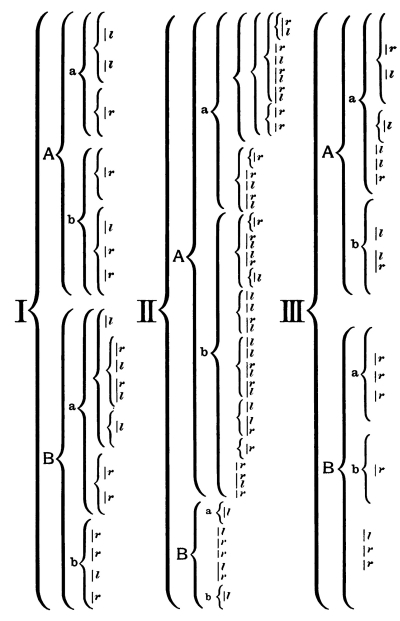
The following diagram shows the conditions of flowers opening on three
plants on the morning of August 20, braces indicating the branches of
the plant, and the straight lines the racemes; the numbers of right-
and left-handed flowers being indicated under the raceme by r and l.
(See page 20.)
From the table, it will be seen that there are on the first plant 8
left-and 11 right-handed flowers; on the second, 24 left-and 27
right-handed; on the third, 7 left-and 9 right-handed flowers. The
numbers of right-and left-handed flowers occurring on the divisions
a and b of the main branches, A and B, of the three plants, are as follows:
- I.-Aa, 2l, 1r; Ab, 1l, 3r; Ba, 4l, 4r; Bb, 1l, 3r.
- II.-Aa, 8l, 13r; Ab, 13l, 11r; Ba, 1l, Bb, 1l; B, 2l, 3r.
- III.-Aa, 4l, 2r; Ab, 2l, 1r; Ba, 3r; Bb, 1r; B, 2r, 1l.
On the three plants, with 36 racemes bearing branches, there were 18
branches which produced only one kind of flowers. Of these branches,
however, 15 bore only 1 flower each. From this it will be seen that the
flowers opening at the same time on any one branch are not all either
right-or left-handed. In the large branches, A and B, the number of
the two kinds is quite evenly distributed; in only one case-branch
B of plant III—is a large per cent. of the flowers alike. Even in
branches of the second denomination—Aa, Bb—flowers of one kind occur
exclusively, where more than one flower is found, only in Ba of plant III.
In addition to the above table, observations
were made on three plants to determine the regularity with which they
bore right-and left-handed flowers. On three successive mornings the
plants had produced:
| |
I. |
II. |
III. |
| |
Right. | Left. |
Right. | Left. |
Right. | Left. |
| First morning |
7 | 7 |
6 | 6 |
8 | 9 |
| Second morning |
7 | 11 |
10 | 7 |
14 | 17 |
| Third morning |
16 | 10 |
8 | 12 |
13 | 10 |
| Total |
30 | 28 |
24 | 25 |
35 | 36 |
It will be noticed that when a marked excess of
flowers of one kind occurs one morning, a somewhat proportionate excess
of the other type occurs the following morning. This is of course
necessary if an equal number of the two types of flowers are to be
produced and, to a certain extent, to be maintained on the same plant;
and is to be expected from the alternate occurrence of the two types on
opposite sides of the raceme.
The flowers open early in the morning and remain open from three to
four days, depending somewhat upon the condition of the weather. Some
which were covered with cheese-cloth “tents” were noticed to remain
open almost a week. At the end of this period the corolla wilts and falls
off, as does also the pistil. The flowers seem to partially close at night.
A limited series of experiments were made to determine if
self-fertilization and cross-fertilization between flowers of the
opposite type opening simultaneously on the same raceme are
possible.[I]
The writers have not made sufficiently extensive observations to arrive
at any general conclusions of value as to the comparative fertility
of cross-and self-pollination, either between flowers on the same or
different racemes, or between the flowers of different plants, but they
have been able to obtain a limited series of definite results which may
be of interest.
In making experiments to determine these points, all old flowers were
removed from the plants in the afternoon or evening and the plants
covered with a small “tent” of cheese-cloth. The cheese-cloth was
of a mesh sufficiently small to prevent the access of any insects
large enough to effect pollination, while large enough to allow a
ready circulation of air and good illumination. The following morning
pollination was effected between the flowers which had opened by
tapping pollen from the large anther onto a clean glass slip and
transferring it to the stigma of the same or another flower. The
plant was then again covered and allowed to remain so, except when
examined from time to time, until the corolla and pistil had fallen
off. The following results were obtained from three plants upon which
observations were made:
August 20. (a) Twelve stigmas pollinated with pollen from large
stamen of the same flower.(b) Cross-pollination effected between two
flowers which had opened on a raceme at the same time.
August 22. (a) Five of the twelve flowers had fallen off.
(b) One flower had fallen off. The other seemed to be developing.
August 24. (a) Five ovaries with their corollas fallen off appeared
fresh and healthy and seemed to be developing. Two more of the twelve
had dropped off. (b) Remaining pod seemed to be thriving.
August 26. (a) Four of the five ovaries were clearly developing.
The fifth appeared doubtful.
September 13. (a) Three fully developed pods remained. (b)
Development of pod arrested when about half grown.
August 20. (a) Four flowers self-pollinated as with plant I.
(b) Cross-pollination effected on seven racemes between flowers
which had opened simultaneously on the racemes.
August 22. (a) All yet on. (b) One flower of a pair
had fallen off.
August 24. (a) Two ovaries remained and looked as though they might
develop. (b) Three pairs fallen off at raceme. The single pod of
one pair still remained and looked as though it might develop. All
remaining pairs seemed to be thriving.
August 26. (a) One pod developing; the other doubtful.
(b) Single pod of pair developing. Two pairs were thriving;
one pair was almost grown. The third pair looked doubtful.
September 13. (a) One pod fully developed; the other fallen off.
(b) One pair fully developed. One each of two other pairs were fully
developed.
August 20. Thirteen flowers marked to see if autogamy takes place.
August 22. All flowers still on the plant.
August 24. All but two flowers had fallen off. One of these seemed to
be developing; the other looked wilted.
August 26. One pod was thriving; the other had wilted and fallen off.
September 13. One pod fully developed.
From the structure of the flowers it would seem
that self-pollination would be impossible. When the flower is open,
the stigma has never been observed to be in contact with the terminal
portion of the large stamen. The stamens do not dehisce until after the
flower has opened, nor does the stigma come in contact with the tip of
the anther in the bud; thus, clistogamy would be out of the question.
It appears from the results obtained from plant III that spontaneous
self-pollination is possible. Of course, however, the positive result
in this one case should by no means be taken as conclusive evidence
of self-pollination. At the present, the most logical explanation to
be suggested seems to be that, when the flowers partially close at
night, the tips of the pistil and the large stamen are brought into
contact. This might occasionally occur, but it is by no means always
the case. At the time of the writing of this paper, material for the
determination of this point is not available, but two or three flowers
examined at night during the summer, before the results of the above
experiments had suggested the importance of a careful examination of
a large series of material, did not show the stamen and pistil in
contact. Of course, note will be taken of the fact that in only one
out of thirteen flowers on the plant did spontaneous pollination take
place. Another suggestion might be that, approaching so near as they do
to each other, a puff of pollen might be thrown from the large stamen
and fall upon the pistil when the plant is shaken.
In plants I and II, it will be seen that, in the first case, three
fully developed seed pods were obtained from twelve flowers the stigmas
of which were supplied with pollen from the large stamen of the same
flower. In the second case, one fully developed seed pod was obtained
from four pollinated flowers—just twenty-five per cent. in each case.
In the cases in which cross-pollination was effected between right-
and left-handed flowers opening simultaneously on the same raceme, we
find that, in the first, one pod of the two was only half developed at
the end of twenty days. Since the pods are normally fully developed
in somewhat less than this length of time, and this undeveloped pod
appears somewhat dried, its development seems doubtful. In the second
case, one pair of seed pods out of seven pairs of flowers crossed were
fully developed, and one seed pod from each of two other pairs were
fully and normally developed, making four out of fourteen flowers which
yielded seed pods—28.5 per cent.
Professor Todd observed only a small humblebee visiting the flowers
of this plant. Owing, probably, to more favorable opportunities for
observation, the writers have been able to secure other insects
collecting pollen.
The following is a list of the species:
Agapostemon texanus Cress. Two specimens collected August 5, at
two p. m. The insects were collecting pollen
from the small stamens, to which they clung while they forced the
pollen out by pinching the anthers between their fore legs. Pollen was
stored on the hind legs. The insect was not seen to come in contact
with the tip of the large stamen or the stigma.
Apis mellifica Linn. Taken at two p. m.,
August 5. They sometimes came in contact with large stamen
and pistil, but more often did not touch them at all. Occasionally
both stamen and pistil would come in contact with the same side of the
insect’s body. Short stamens were sometimes approached from above, the
large stamen and pistil remaining untouched.
Anglochora pura Say. Taken at 10:30 a. m.,
August 6. Obtained pollen from the large stamen by alighting on it, crawling to
the tips, and collecting it from the terminal pores.
Halictus sp. A smaller insect than the preceding one, but obtained pollen in the same
manner.[J]
No humblebees were taken around Lawrence, although many were noticed
working on the plants; consequently the names of the species noticed
cannot be given. In St. Joseph, Mo., there were taken at three
p. m., when bees were not generally seen working on the plant:
Bombus virginicus. One specimen.
Bombus pennsylvanicus. One specimen.
An examination of fifty flowers taken at this time showed from the
dented condition of the small stamens that they had all been visited.
Between eight and nine a. m., September 3,
when bees were numerous, there were taken:
Bombus virginicus. Two specimens.
Bombus pennsylvanicus. Twelve specimens.
Bombus scutellaris. One specimen.
The writers found that the humblebees were the principal agents
effecting cross-pollination. It was observed that the bee in visiting
the flower allowed itself to rest on the tips of the extending stamen
and pistil, which, being of the same length, came in contact with both
sides of the body just in front of the hind legs, these being left
perfectly free. The weight of the bee springs down both stamen and pistil.
Professor Todd’s theory in regard to the pollination of this plant is
as follows: “The weight of the bee so springs down the flower, that
it is quite difficult, on account of the large, flexible corolla,
to see just what is done, but repeated observations led me, quite
satisfactorily, to this conclusion. The bee seeks the pollen—for the
flowers have neither nectar nor odor—and this she uniformly gets from
the four shorter stamens; never, so far as I could determine, from the
larger one. This she does by seizing each one, near its base, between
her mandibles, and with a sort of milking motion crowds the pollen out
of the terminal pores; meanwhile, by the movements of her feet, the
larger stamen is repeatedly sprung backwards, and as often throws a
cloud of pollen on one side of her body; this in a right-handed flower.
When she passes to a left-handed flower, which, as was explained
above, is very likely not to be on the same plant, the pollen is
carried directly to the pistil of that flower, and so on. We have here,
therefore, a novel apparatus for cross-fertilization, quite distinct
from those that have been most commonly noticed.”
A considerable quantity of pollen may be thrown from the terminal pores
of the large stamen upon tapping it. It thus seems quite possible that
some pollen is thrown upon the side of the insect, as described by
Professor Todd. All the meaning of
Mr. Meehan’s[K]
statement is not clear to the writers, but he says, in speaking of
Professor Todd’s results: “In regard to the manner in which the pollen
is extracted, he found that ‘this she does by seizing each anther near
its base between her mandibles, and, with a sort of milking motion,
crowds the pollen out of the terminal pores.’ If this were the general
way, there would be no necessity for any pollen being ejected from
the long stamens, for the stigma would surely receive some during the
‘milking’ process; and the pore at the apex in the long anther is
beyond the line of the stigma, so that on ejection from the pore the
pollen would go still farther beyond.”
It seems that this statement is of considerable importance for S.
rostratum as well as for C. marilandica. Professor Todd very
evidently overlooked the fact that, in securing the pollen from the
small stamens and transferring it to the hind legs, the sides of the
insect are sure to be well dusted with pollen from these stamens. In
the case of Apis mellifica, as noted above, there is no certainty
that in visiting the flower the same side will be turned toward the
stamen or pistil. Even in the case of large insects, such as Bombus,
it would seem that the probability that the stigma will be supplied
with pollen from the large stamen exclusively is very small. It seems
improbable that S. rostratum should depend exclusively upon such
an uncertain method of pollination as the projection, by the jarring
of a stamen, of a puff of pollen upon the side of an insect, and the
subsequent transfer of this pollen to the stigma of a flower of a
different type. Of course, it is not improbable that a part of the
pollen is furnished by the large stamen, as suggested by Professor
Todd, but that fertilization should be effected exclusively by this
means seems highly improbable.
The pollen from the large stamen has been shown to be fertile in a
certain number of cases, but unfortunately opportunity was not offered
for experiments on the fertility of pollen from the small stamens. A
rather hasty microscopic examination of fresh, unstained pollen from
the large and small stamens reveals no very striking difference in form.
In C. marilandica, Meehan[L]
found that the large, strong stamens on each side of the pistil served
only as a platform upon which the insect could rest while procuring the
pollen from the small stamens. He found that the lower stamens, while
filled with pollen, did not dehisce of their own account, nor were they
opened by the insect.[M]
The lower stamens and the pistil of the Solanum under consideration
serve the purpose of a platform when the flowers are visited by the
larger bees. It seems to the writers that this is not improbably the
function of the greatest importance of the observed arrangements of
the stamen and pistil in S. rostratum. In C. marilandica, the
pollen for fertilization, as well as for the attraction of the insect
visitor, is furnished by the small stamens, while the pollen produced
by the large stamens appears to have no function.[N]
The condition is not so specialized in the species of Solanum under
consideration. Here the pollen produced by the small anthers serves
for the attraction of insects and, as it seems to the writers, for
fertilization, while the large stamen, in connection with the pistil,
serves as a support for the visiting insect, and possibly furnishes
some pollen for cross-fertilization.[O]
In reference to the relative amount of pollen produced by a large
and small stamen, Halstead has given a note, in his paper in the
Botanical Gazette.[P]
The material in the hands of the writers at the time of the writing
of this paper is not suitable for a verification of Mr. Halstead’s
results; consequently they are simply quoted on his authority. Even if
the amount of pollen produced by the large anther is no greater than
that produced by one of the smaller, it is still very considerable, as
may be readily seen by tapping it out on a glass slip. He says:
“The single large stamen of Solanum rostratum,
with its beak-like appearance, is a giant among its fellows, but does
not exceed them in the production of pollen, for, while three or four
times larger than the others, its thecæ are reduced to narrow, curved
lines of mother-cells. The ordinary stamens, on the other hand, possess
unusually large cavities in which the pollen is borne. The giant
stamen, in cross-section, is shown at a, in fig. 3, while a similar
section of an ordinary stamen is shown at b. The almost infertile
condition of the large stamen reminds one of the structure of the
stamens of the cultivated potatoes. In these, while large and plump,
there is almost no pollen-bearing layer, and usually no apical pore
opens for the discharge of pollen.”
In C. marilandica, as Meehan has shown, autogamy is impossible, while
in S. rostratum autogamy may possibly sometimes take place.
The bee visits the flower for pollen; contrary, however, to the
statement of Professor Todd, that “the flowers have neither nectar nor
odor,” the writers observed that, especially in the early morning, the
odor was decidedly pronounced. It was observed that the bee collected
no pollen from the large stamen, but took it regularly from the four
smaller. This it did by grasping the anthers, one at a time, near
the base, and forcing the pollen out through the terminal pores, by
pinching it throughout the length between its mandibles. An exception
to this in the case of Agapostemon texanus Cress, is already noted in
the list of species. It will be remarked that our observations on this
point correspond in general to those of Professor Todd.
Of course the statement of Professor Todd, that the next flower of
the opposite type which is visited by the bee is very apt to be on
another plant, loses entirely its significance, since it has been shown
that the flowers on a branch are not at all likely to be all right-
or left-handed. In visiting the flowers, the humblebees, as a general
rule, simply pass to the flower most conveniently at hand, and this
flower is very apt to be on the same plant, especially where the plants
are at all large. The humblebees especially work vigorously in the
early morning. In a patch of S. rostratum examined between eight and
nine o’clock, in St. Joseph, Mo., nearly all the flowers had already
been visited. At this time fifteen specimens of humblebees were taken.
A great many flowers would be visited by the bee before it found one
which had not already been despoiled of its pollen. In visiting such
flowers, the bee would alight for a moment on the pistil and large
stamens, as described above, and then pass on to the next flower when
it had ascertained that there was no pollen present. In this way over
twenty flowers may be visited in a minute. It will be seen that, when
the bees are at all numerous and as well dusted with pollen as they
usually are, the pistil is almost certain to receive pollen, and fertilization
to be effected, especially if the pollen from the small stamens is functional.
Among other insects found visiting the plant, the honey-bee was most frequent.
As will be noticed from our list, some insects visit the plants
without effecting cross-pollination. Those insects which obtain pollen
in an illegitimate manner do not secure it from the small stamens
exclusively, but almost invariably visit the large stamen as well.
The adaptation of the plant to propagation by the production of seeds
is of considerable significance.[Q]
A normal plant will produce in the neighborhood of 7000 seeds. In
making observations on this point, it was found from five pods examined
there was an average of fifty-six seeds.
| Pod | 1 |
contained | 66 |
seeds. |
| " | 2 |
" | 53 |
" |
| " | 3 |
" | 51 |
" |
| " | 4 |
" | 53 |
" |
| " | 5 |
" | 58 |
" |
| |
281 | seeds; av., 56. |
Pods 4 and 5 were from the same plant but separate racemes;
the others were from different plants. In determining the
average number of seeds produced by the plant, five plants
growing normally and in different localities were observed, with
the following results:
| Plant | 1 |
192 | pods. |
| " | 2 |
50 | " |
| " | 3 |
66 | " |
| " | 4 |
113 | " |
| " | 5 |
210 | " |
Taking the average of fifty-six seeds per pod obtained above, we see
that the plant producing 122.5 pods, the average from the preceding
table, would produce about 7000 seeds.
One plant was observed upon which occurred fifty-five to sixty racemes.
Allowing the low average of six pods to the raceme, the plant will
produce in the neighborhood of 20,000 seeds. Occasionally a very large
plant is observed which produces as many as 125 racemes. Allowing the
same low average of six pods to the raceme, it will be seen that on a
plant of this size there will be produced in the neighborhood of 40,000 seeds.
Only a very small proportion of the ovaries fail to develop. Out of the
forty-one racemes observed in five plants, taken at random in different
localities, results were obtained as follows:
| Plant | 1, |
5 | racemes |
53 | pods, |
4 | failed. |
|
| " | 2, |
5 | " |
42 | " |
3 | " |
|
| " | 3, |
9 | " |
55 | " |
5 | " |
|
| " | 4, |
11 | " |
91 | " |
6 | " |
|
| " | 5, |
11 | " |
121 | " |
5 | " |
|
| | |
41 | racemes, |
367 | pods, |
23 | failed, |
or 6.2 per cent. |
According to these figures, not more than 6.2 per cent. of the ovaries
failed to be fertilized.
While Cassia chamæcrista is usually abundant in Douglas county,
owing, probably, largely to the severe drought, opportunities for study
were not nearly so favorable as for Solanum. The material studied was
found growing, for the most part, in somewhat shaded localities on the
banks of Lake View.
Professor Todd has given very well the points in the structure of the
flower of this species. He says: “The points that are of interest to
us are the sickle-shaped pistil, the stamens with long, rigid anthers
opening by terminal pores, and the most of them pointed toward the
incurved petal, which is always on the opposite side from the pistil.”
The flowers are arranged in small clusters a little above the axils of
the leaves. In some cases the axillary bud also develops into a flower
cluster. The axillary clusters have been considered separately in the
calculations made upon the conditions of the flowers.
Owing to the lack of material, Professor Todd was unable to determine
any definite law governing the arrangement of the flowers in C.
chamæcrista. This the writers have attempted to do. The determination
of any law governing the order of development of the flowers in a plant
like C. chamæcrista, where they are arranged in clusters developed
from buds produced on the main axis, and the development of which is
probably accelerated or retarded by various conditions, is much more
difficult than in S. rostratum, where they are produced on a definite
raceme, which is early differentiated from the terminal growing point,
and at first develops more rapidly than the bud which is to continue
the main axis of the branch.[R]
TABLE D. (Part 1)
| Cluster |
1 | 2 |
3 | 4 |
5 | 6 |
| plant. |
|
| I |
{ 1 |
A | 2b |
b, 5p | b, l, p |
A | A |
| |
| |
| |
| |
| { 2 |
l, p | 2p |
A | 3p |
p | A |
| |
| |
| |
| |
| { 3 |
p | 3p |
4p | b, 3p |
br, 4p | b, r, p |
| | |
| |
| |
| II - |
1 |
2b | b, 3p, a |
b, 2p, a | 2b, 3p |
2b, 3p | r |
| III - |
1 |
3b |
2b, p |
b, 2p |
2b, 2p |
b, br, p |
b, 3p |
| | |
| |
| |
| IV |
{ 1 |
b | 2b, bl |
2b, r | 2b, bl |
3b | 3b, br |
| { 2 |
A | b, bl |
3b,bl | 3b, p |
3b | 3b, r, p |
| V - |
1 |
A | 2b, p |
b, l, p | b, p |
b, r, p | 2b, 2p |
| VI |
{ 1 |
A | A |
A | A |
p | 2p, a |
| { 2 |
A | p |
b, 3p | b, 2p |
2b, 3p | 2b, p |
| VII - |
1 |
b, bl, 2p |
2b, 2p |
b, l, p |
2b, bl, 2p |
b, r, 2p |
2b, br, p |
| | |
| |
| |
| VIII |
{ 1 |
2b | 2b |
2b | 2b |
2b | |
| { 2 |
b | 2b, lp |
b, l, p | 2b, r, p |
3b, br | { 2b, l
{ b |
| |
| |
| |
|
| IX |
{ 1 |
2p | b, br, 2p |
absent | 2b, 3p |
b, r, 2p | 2b, a |
| { 2 |
b, 3p | 2b, 4p |
b, l, 3p | 2b, 2p |
b, 3p | 2b, bl, 2p |
| { 3 |
A | 2b, 3p |
2b, p | 2b, p, a |
2b, 3p | 2b, p |
| { 4 |
A | b, 2p |
b, p | b, r, 2p |
b, 3p | b, p, a |
| X |
{ 1 |
2b, 1p | 2b |
2b, p | b, 2p |
br, p | b, br, p |
| { 2 |
A | A |
b | b, a |
b, p | 2b, p |
TABLE D. (Part 2)
| Cluster |
7 | 6 |
9 | 10 |
11 | 12 |
| plant. |
|
| I |
{ 1 |
A | A |
A | b, 2p |
2b, 2p | 2b, 2p |
| |
| |
| |
| |
| { 2 |
A | 2b, lp |
b | A |
3b, p | { 2b
{ lb |
| |
| |
| |
|
| { 3 |
b, 4p | 2b,bl, 3p |
2b, br, 2p, a | 2b, p, a |
b, l, 2p | 2b, bl, p |
| | |
| |
| |
| II - |
1 |
2b, br | 2b, br |
b, r, p | 2b, bl |
3b | 2b |
| III - |
1 |
b, 3p |
4p |
b, r, 3p |
b, bl, 3p |
b, 3p |
3b, 2p |
| | |
| |
| |
| IV |
{ 1 |
2b, l | 3b |
3b | 3b |
3b | 3b |
| { 2 |
3b, br | 3b, l |
4b | 4b |
4b | |
| V - |
1 |
b, bl, p | b, r, p |
2b, r | 2b |
2b | 2b |
| VI |
{ 1 |
b, 3p | b, 3p, a |
b, r, 3p | 2b, 2p |
2b, 3p | 3b, p |
| { 2 |
b, r, p | 2b, p, a |
2b, l, p | 3b, p |
3b, r | 3b |
| VII - |
1 |
{ 2b, l, p
{ 2b | 3b, bl |
{ 3b, r
{ b | 3b |
3b | 3b |
| |
|
|
| VIII |
{ 1 |
| |
| |
| |
| { 2 |
{ 3b
{ 2b | 3b
b |
| |
| |
| |
|
|
|
| IX |
{ 1 |
2b, bl | 2b, r, p |
2b, a | 2b, l |
3b | 2b |
| { 2 |
2b, r | 2b, p |
b, l, p | 2b, bl |
3b | 3b |
| { 3 |
b, 2p | l |
2b, 2p | b, br, 2p |
2b, 2p | 2b |
| { 4 |
b, r, 3p | b, 3p |
| |
| |
| X |
{ 1 |
b, bl, r | 2b, br |
2b | 2b |
2b | b, a |
| { 2 |
b, r | 2b, a |
l | 2b |
2b | |
TABLE D. (Part 3)
| Cluster |
13 | 14 |
15 | 16 |
17 | 18 |
| plant. |
|
| I |
{ 1 |
l | b, 2p |
2b, 2p | 3b, 2p |
{ 3b, p
{ b | br, 2b, p
b |
| |
| |
| |
| { 2 |
3b, p | 2b, l, p |
2b, bl | 2b, r |
{ 3b
{ b | 2b |
| | |
| |
| |
| { 3 |
br, a | {2b, br, a
{a |
2b, la | 2b |
b | 2b |
| | |
| |
| |
| II - |
1 |
2b | |
| |
| |
| III - |
1 |
b, 3p |
2b, bl |
2b, p |
2b, r |
b |
b |
| | |
| |
| |
| IV |
{ 1 |
| |
| |
| |
| { 2 |
| |
| |
| |
| V - |
1 |
| |
| |
| |
| VI |
{ 1 |
3b, a | 3b, a |
2b, l | 3b |
3b | 3b |
| { 2 |
3b | 3b |
2b | |
| |
| VII - |
1 |
2b |
2b |
| |
| |
| | |
| |
| |
| VIII |
{ 1 |
| |
| |
|
| { 2 |
| |
| |
| |
| | |
| |
| |
|
| IX |
{ 1 |
| |
| |
| |
| { 2 |
3b | |
| |
| |
| { 3 |
2b, p | 2b, a |
3b | 2b |
| |
| { 4 |
| |
| |
| |
| X |
{ 1 |
| |
| |
| |
| { 2 |
| |
| |
| |
TABLE D. (Part 4)
| Cluster |
19 | 20 |
21 | 22 |
23 | 24 |
| plant. |
|
| I |
{ 1 |
3b, p | { 2b, br
{ b |
3b | { 3b
{ b |
| |
| |
| |
| |
| { 2 |
2b | |
| |
| |
| |
| |
| |
| |
| { 3 |
| |
| |
| |
| |
| |
| |
| |
| II - |
1 |
| |
| |
| |
| III - |
1 |
{ 2b, 2p
{ b | b, l, p |
{ 2b, l
{ b | 3b, a |
2b, a | 2b |
| | |
| |
| IV |
{ 1 |
| |
| |
| |
| { 2 |
| |
| |
| |
| V - |
1 |
| |
| |
| |
| VI |
{ 1 |
3b | 3b |
| |
| |
| { 2 |
| |
| |
| |
| VII - |
1 |
| |
| |
| |
| | |
| |
| |
| VIII |
{ 1 |
| |
| |
| |
| { 2 |
| |
| |
| |
| | |
| |
| |
|
| IX |
{ 1 |
| |
| |
| |
| { 2 |
| |
| |
| |
| { 3 |
| |
| |
| |
| { 4 |
| |
| |
| |
| X |
{ 1 |
| |
| |
| |
| { 2 |
| |
| |
| |
TABLE D. (Part 5)
| Cluster |
|
| plant. |
|
| I |
{ 1 |
6A, 35b, 2br, 2l, 21p. |
| { 2 |
4A, 26b,1bl, 2l, 1r, 11p. |
| { 3 |
23b, 2bl, 4br, 1l, 1r, 31p, 5a. |
| II - |
1 |
22b, 2br, 1bl, 2r, 12p, 2a. |
| III - |
1 |
41b, 2bl, 1br, 2l, 2r, 34p, 2a. |
| IV |
{ 1 |
30b, 2bl, 1br, 1l, 1r, 2p. |
| { 2 |
1A, 31b, 2b1, 1br, 1l, 1r, 2p. |
| V - |
1 |
1A, 17b, 1bl, 1l, 3r, 8p. |
| VI |
{ 1 |
14A, 30b, 1l, 1r, 18p, 4a. |
| { 2 |
1A, 28b, 1l, 2r, 14p, 1a. |
| VII - |
1 |
33b, 3bl, 1br, 2l, 2r, 11p. |
| VIII |
{ 1 |
10b. |
| { 2 |
21b, 1br, 2l, 1r, 3p. |
| IX |
{ 1 |
19b, 1bl, 1br, 1l, 2r, 10p, 2a. |
| { 2 |
25b, 2bl, 2l, 1r, 19p. |
| { 3 |
1A, 27b, 1br, 1l, 18p, 2a. |
| { 4 |
1A, 7b, 2r, 15p, 1a. |
| X |
{ 1 |
18b, 1bl, 3br, 1r, 6p, 1a. |
| { 2 |
2A, 12b, 1l, 1r, 2p, 2a. |
| |
21A, 455b, 18br, 18bl, 21l, 24r, 234p, 22a. |
Abundant material in apparently the best condition was found growing
around Lake View. Ten plants from this locality were examined,
and their condition is here given in tabulated form. In the table
following, the number of the plant is given in Roman numerals, the
numbers of the branches following it in Arabic numerals. Beginning with
the lower portion of the branch and passing upward, the flower clusters
are numbered consecutively. These numbers, designated by “cluster,” are
given in the first line at the top of the table. In the column beneath
each of these numbers is shown the condition of the flowers of that
cluster on the different branches of the different plants. The table
was arranged in this form, not because a comparison of the condition of
clusters of the same number is especially desired, but because this
seemed the most compact form in which it could be arranged. In the
columns under the different clusters, the condition of the flowers
is designated as follows: r = right-, l = left-handed flower;
b = bud; br and bl designate buds which are so well developed
that it is possible to determine whether they are right-handed or
left-handed—these buds will probably open the following morning; a=a
bud or flower which has fallen off or failed to develop; A, indicates
that the whole cluster has failed to develop. When an axillary cluster
is developed it is included in a brace, with the cluster occurring
immediately above it, the axillary cluster always being placed below.
A seed pod is designated by p.
In the last column to the right the condition of each branch is
summarized, and finally the grand total is given at the foot of the column.
In table D we have taken into account 241 flower clusters, and 21 which
are either abortive or injured. The number of abortive clusters might
be somewhat increased if great care had been exercised in looking
for the accessory buds just above the axils of the lowest leaves
on the branches. As a rule, however, the first internode or so, if
questionable, was omitted. From this it would seem that about eight
per cent. of the clusters fail to develop, a percentage which would
probably be somewhat increased if care had been exercised in noting the
buds where development had been arrested at a very early stage.
On the 10 plants, 14 axillary clusters were produced, being 5.5 per
cent. of all the developed clusters. Of these 14 clusters, 2 produced 2
buds each, the others only 1; an average of 1.14 flowers per cluster.
The 241 normally developed clusters produced 773 buds, an average of
3.27 flowers per cluster. Of the 773 buds produced on the 10 plants, 22
are found to be injured and fail to develop normally; a percentage of 2.84.
While the series of material is too limited to permit of indulging in
generalizations, it might be of interest to note that on 40 plants
bearing 332 seed pods, taken from two square feet of ground, September
4, and 3 other plants producing 130 seed pods, taken at the same time,
not a single pod developed from an axillary cluster was found. These
plants, however, with the exception of the last three, represent all
produced on a definite area. It might not be improbable that the
smaller, crowded plants would not be so likely to produce axillary
clusters as the larger plants growing under more favorable conditions.
We may at least conclude from this that the axillary flowers are of
little consequence in the seed-producing capacity of the plant.
For the sake of convenience, it has been deemed advisable to summarize
in table E the conditions of the flowers and buds which will probably
open the day following, as given in table D. From this table, it will
be seen that on the day the plants were examined 42 flowers were
open—5.4 per cent. of the 773 buds produced on the 10 plants. These
flowers as well as the buds, 36 in number, which were to open the next
day, are equally divided into right-and left-handed.
The buds which are next to open do not, in any of the cases noted in
the above tables, occur on a cluster with flowers which are already open.
| TABLE E. |
| Plant I, |
6r | buds, |
3l | buds, |
2r | flowers, |
5l | flowers. |
| II, |
2r | " |
1l | " |
2r | " |
0l | " |
| III, |
1r | " |
2l | " |
2r | " |
2l | " |
| IV, |
2r | " |
4l | " |
2r | " |
2l | " |
| V, |
0r | " |
1l | " |
3r | " |
1l | " |
| VI, |
0r | " |
0l | " |
3r | " |
2l | " |
| VII, |
1r | " |
3l | " |
2r | " |
2l | " |
| VIII, |
1r | " |
0l | " |
1r | " |
2l | " |
| IX, |
2r | " |
3l | " |
5r | " |
4l | " |
| X, |
3r | " |
1l | " |
2r | " |
1l | " |
| |
18r | buds, |
18l | buds, |
24r | flowers, |
21l | flowers. |
There seems to be no law governing the production of right-and
left-handed flowers on the opposite sides of the main axis of the
plant. Sometimes two right-or left-handed flowers will be produced
in succession on one side of the raceme, and sometimes right-and
left-handed alternate on the same side.
Concerning the method of pollination in C. chamæcrista, the writers
have not been able to thoroughly satisfy themselves. Todd says: “I
consider the following explanation most probable: In getting the
pollen, some grains are dropped on the incurved petal, and by it made
to adhere to points of the bee, and to such points in a right-handed
flower as will carry it to the stigma of a left-handed flower, and
vice versa.” Robertson[S]
says: “The pollen, being thus forced out of the terminal anther pores,
falls either directly upon the bee or upon the lateral petal which
is pressed close against the bee’s side. In this way the side of the
bee which is to the incurved petal receives the most pollen.... A bee
visiting a left-hand flower receives pollen upon the right side and
then flying to a right-hand flower strikes the same side against the stigma.”
It is very difficult to see just what takes place when the flowers are
visited by a large insect, but the writers have observed that when they
are visited by honey-bees, for instance, the insect supports itself by
hooking his left hind leg over the terminal, upturned portion of the
stigma in a right-handed flower, and the right leg in a left-handed
flower. The pistil then would serve the function of support for the
insect visitor. It was noticed that sometimes bees would attempt to get
the pollen by approaching the flower from some direction other than
that described above. The insect usually failed in this, and after one
or two unsuccessful endeavors would give up the attempt and support
itself by placing the leg over the terminal portion of the pistil
while it secured the pollen. The function of the incurved petal is
not perfectly clear. With an insect well dusted over with pollen
from both right-and left-handed flowers, it seems improbable that
cross-fertilization in any considerable number of cases should occur
from some grains dropped on the incurved pistil.
The writers are not sure that the insect in flying to another flower
strikes the tip of the pistil against the side, as stated by Robertson.
Certainly, in many cases, the insect, while collecting the pollen,
supports itself by placing one leg over the tip of the pistil. When
the leg bears a large mass of pollen, which is being stored there, it
seems hardly possible that the flowers could fail to be pollinated.
It might be suggested that, since the stamens for the most part point
in the direction of the incurved petal, the function of this petal is
to prevent access to the stamens, except in the cases in which the
insect supports itself by means of the pistil. While this seems to the
writers, at the present time, the most logical of the two functions so
far suggested, much more careful observation work must be done before
this point is finally decided. The petal may to a certain extent, in
connection with the pistil, serve as support for the insect. Todd and
Robertson observed only humblebees visiting the flowers. The writers obtained:
- Apis mellifica Linn. Lake View, August 7. Seven specimens.
- Agapostemon texanus Cress. Lake View, August 7.
- Mellisoides bimaculata (St. Farg) Lepl. Lake View, August 7.
- Megachile petulans Cress. Lake View, August 7.
- Bombus separatus Cress. Lake View, August 7.
As in the case of Solanum, it will be seen that the collecting period
extended over a very short period of time. More search would doubtless
greatly increase the list.
Robertson reports the following species as collecting pollen: Bombus
virginicus Oliv., B. separatus Cress., B. americanorum F.,
and B. scutellaris Cress.
August 28, when the blossoming season for C. chamæcrista was almost
over, an examination of material from the above-named region was made
for the purpose of determining the number of seeds produced by a single
plant. Fifteen pods were selected at random from different plants and
the number of ovules counted. It was impossible to tell about the
number in each pod which were fully and normally developed seeds or
which would become such; consequently this factor is not taken into
consideration. The percentage of ovules which fail to develop is, however,
small. The number of seeds found to the pod is shown by the following:
| TABLE F. |
| Pod I, | 13 |
seeds. | |
| II, | 14 |
" | |
| III, | 11 |
" | |
| IV, | 11 |
" | |
| V, | 10 |
" | |
| VI, | 12 |
" | |
| VII, | 16 |
" | |
| VIII, | 12 |
" | |
| IX, | 8 |
" | |
| X, | 14 |
" | |
| XI, | 17 |
" | |
| XII, | 18 |
" | |
| XIII, | 17 |
" | |
| XIV, | 15 |
" | |
| XV, | 14 |
" | |
| Total XV, | 202 |
seeds, | or 13.4 per pod. |
From this it will be seen that the minimum number of seeds found was
8, the maximum 18, with an average of 13.4. Since the pods were simply
gathered at random, there is no certainty of gaining the maximum or
minimum number of seeds, but a fair average of the number produced
may be expected. September 4 three plants were examined to determine
something about the range of variation in the number of ovules produced
in the pods of a single plant. The results are given as follows:
- Plant 1 varies from 5 to 11.
- Plant 2 varies from 8 to 18.
- Plant 3 varies from 9 to 14.
- Plant 1 had 35 pods, plant 2 had 64, and plant 3 had 27.
- Plant 1 was selected on account of the small number of seeds produced per pod.
It will be seen from table D that an average of nearly 3.3 flower
buds per cluster is produced. These were moderate-sized, healthy
plants, producing on the whole probably more than the average number
of clusters per plant. On the ten plants, there were produced 342
clusters, which bore 344 seed pods, instead of about 1120, the number
of flowers which might be expected, thus giving less than thirty-three
per cent. of the buds which produce mature seed pods.
It will be seen that, while in the observations made on S. rostratum
the flowers which failed to produce seed did not reach much over six
per cent., in C. chamæcrista it is over sixty per cent. In addition
to this fact, it is rare to see a seed pod of S. rostratum which has
been destroyed by insects or other destructive agencies, while in 460
pods of C. chamæcrista which were examined at Lake View, September 4,
not one was found which did not have some of the ovules destroyed by
the larvæ of some insect, and probably this would amount on the average
to fifty per cent. of all the seeds produced, being in the case of some
plants as high as seventy-five per cent.
A convenient method of approaching the question of the production of
seeds might be to determine the number of seed pods produced on a given
area of ground. A general idea may be obtained from the examination of
the plants growing upon two square feet of ground. In the first case,
the plants were much crowded; in the second, not nearly so much so; in
fact, it may be said they were growing under “normal” conditions. It
might be interesting to compare the results. The material for the two
tables was taken September 4.
| FIRST SQUARE FOOT. |
| Plant | 1, |
pods | 0 |
| " | 2, |
" | 10 |
| " | 3, |
" | 4 |
| " | 4, |
" | 13 |
| " | 5, |
" | 0 |
| " | 6, |
" | 12 |
| " | 7, |
" | 3 |
| " | 8, |
" | 1 |
| " | 9, |
" | 4 |
| " | 10, |
" | 3 |
| " | 11, |
" | 0 |
| " | 12, |
" | 25 |
| " | 13, |
" | 2 |
| " | 14, |
" | 0 |
| " | 15, |
" | 0 |
| " | 16, |
" | 10 |
| " | 17, |
" | 2 |
| " | 18, |
" | 0 |
| " | 19, |
" | 0 |
| " | 20, |
" | 0 |
| " | 21, |
" | 0 |
| " | 22, |
" | 6 |
| " | 23, |
" | 1 |
| " | 24, |
" | 5 |
| " | 25, |
" | 2 |
| " | 26, |
" | 3 |
| " | 27, |
" | 0 |
| " | 28, |
" | 3 |
| Total, | 28, |
pods | 109 |
SECOND SQUARE FOOT. |
| Plant | 1, |
pods | 1 |
| " | 2, |
" | 50 |
| " | 3, |
" | 36 |
| " | 4, |
" | 15 |
| " | 5, |
" | 48 |
| " | 6, |
" | 34 |
| " | 7, |
" | 9 |
| " | 8, |
" | 11 |
| " | 9, |
" | 9 |
| " | 10, |
" | 3 |
| " | 11, |
" | 0 |
| " | 12, |
" | 7 |
| Total, | 12, |
pods | 223 |
In the first square foot of ground, where the plants were much crowded,
of the twenty-eight plants, ten produced no seed pods at all, and of
the remaining eighteen only six produced over five each. On these
plants an average of a little less than four pods per plant was
produced. In the second lot, where, evidently, the plants were not
nearly so crowded, only four produced fewer than five seed pods,
and there was a general average of 18.7 pods per plant.
On the first foot of ground, then, there might be produced in the
neighborhood of 1300 seeds; on the second, 2600. The large Solanum
upon which 40,000 seeds were estimated would probably cover an area of
12.5 square feet, giving 3200 seeds per square foot. Of course, these
figures represent only certain isolated cases, which in a way are
typical, but must not be taken to represent the average condition.
The largest plant noted September 4 had produced 100 pods, with an
average of thirteen seeds per pod; this plant might show 1300 seeds.
Professor Todd discusses in his paper the occurrence of similar
divergences from the typical form in other Solanaceæ and Leguminosæ,
and tries to discover some hint as to their origin. Lack of material
for observation precludes any present discussion of these points.
The results of these observations may be briefly summarized as follows:
1. As Professor Todd observed, the numbers of right-and left-handed
flowers on a plant of any considerable size are about equal.
2. As a general rule, only one flower opens at a time on a raceme,
but very commonly two will open on the raceme the same morning,
giving a right-and left-handed flower opening simultaneously, and
thus permitting in a considerable number of cases pollination between
flowers on the same raceme, even if Professor Todd’s theory of the
method of pollination be the correct one.
3. Even on the smaller branches of the plant, the flowers are almost
always approximately divided into the two types.
4. The flower has a distinct odor.
5. Various species of insects visit the flowers for pollen. Many
insects secure pollen without effecting pollination.
6. In a rather hasty microscopic examination, no very apparent
difference was detected between the pollen from large and small stamens.
7. A very important function of the observed arrangement of stamen and
pistil in S. rostratum seems to the writers to be that of support for
the visiting insect.
8. It might seem that the pollen from the small stamens is of much
more importance in the process of fertilization than Professor Todd
suspected, especially since it seems that there is much more certainty
of the pollen from the small stamens reaching the pistil than there is
of that from the large stamen. The fact that there is some question
as to the fertility of the pollen from the large stamen in all cases,
and that in the case of another plant stamens of somewhat similar
arrangement seem to have lost entirely their direct reproductive
function, would indicate the same.
9. In a limited number of cases the pollen from the large stamen of
a flower seems to be fertile on its own stigma, as well as upon the
stigma of a flower opening simultaneously on the opposite side of raceme.
10. Spontaneous self-pollination seems sometimes to occur.
11. The percentage of cases in which seeds develop in those flowers in
which artificial pollination is effected in the same flower or in two
flowers of the same raceme is much smaller than when cross-pollination
is effected by insects, reaching, in the case of the somewhat limited
experiments of the writers, only as high as 28.5 per cent. Whether
this is partially due to the method of applying the pollen or not
has not been determined; whether the seeds produced by these cases
of pollination of the same flower or flowers on the same raceme are
capable of germination or not has not yet been determined. It might
be suggested that the low percentage of cases is due to a lack of
fertility in the pollen of the large stamen.
12. Estimated from the number of seed pods which normally develop, the
number of flowers in which pollination is not effected is very small,
not reaching, in the observations of the writers, much over six per cent.
1. Right- and left-handed flowers are produced at the same time on
the plant. When several plants are taken, the number of right-and
left-handed flowers produced is practically the same.
2. So far as observed, two flowers were never seen open at the same
time on a cluster, nor was a bud ready to open the following morning
ever found on a cluster with an open flower. Thus, cross-pollination
between flowers on the same cluster would not be possible, as it
frequently is in S. rostratum.
3. So far as the writers have been able to ascertain, there is no
law governing the producing of right-and left-handed flowers on the
opposite sides of the main axis.
4. Various species of insects visit the flowers for pollen.
5. It seems that pollination is effected in many cases by the
transfusal of pollen from the leg of the insect, where it is being
carried, to the stigma of the stamen upon which it is supporting
itself. The function suggested by Professor Todd for the incurved petal
seems to the writers entirely improbable.
Botanical Laboratory, University of Kansas,
September 28, 1901.
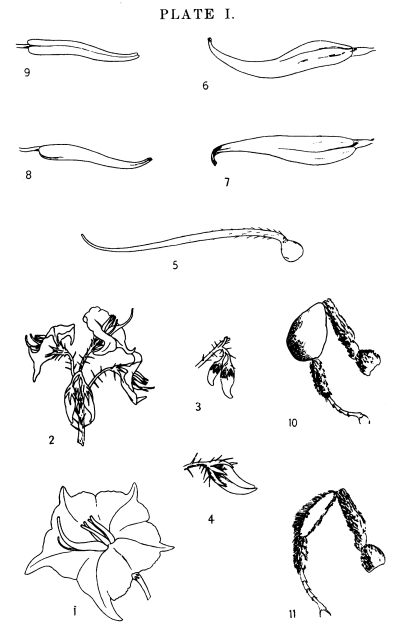
EXPLANATION OF PLATE I.
Fig. 1. Right-handed flower from the front and a little to
one side, showing large and small stamens, pistil, and wings of the
corolla, which enfold pistil and large stamen in the bud. × 2.
Fig. 2. Tip of a raceme from the front, showing one left- and
two right-handed flowers; also the decurved end of the raceme, with the buds.
Fig. 3. Lateral view of decurved tip of raceme, showing the buds.
Fig. 4. Lateral view of bud ready to open the following
morning, showing the two lower lobes of the corolla, enfolding pistil and large stamen.
Fig. 5. Ovary and pistil. × 5.
Figs. 6 and 7. Lateral and dorsal view of large stamen. × 5.
Figs. 8 and 9. Lateral and dorsal view of small stamen. × 5.
Figs. 10 and 11. Hind leg of Bombus, with and without mass
of pollen.
Transcriber's Notes:
The cover image was created by the transcriber, and is in the public domain.
Typographical errors have been silently corrected but other variations
in spelling and punctuation remain unaltered.