Although the foregoing facts, figures, and charts
show conclusively the difference between good heredity
and bad and the result of introducing mental deficiency
into the family blood, yet because it is so difficult actually
to appreciate the situation, because facts and figures
do not have flesh and blood reality in them, we give in
this chapter a few cases, graphically written up by
our field worker, to show the differences in the types
of people on the two sides of the family. These are
only a few of the many, but are fairly typical of the
condition of things that was found throughout the
investigation. On the bad side we have the type of
family which the social worker meets continually and
which makes most of our social problems. A study
of it will help to account for the conviction we have
that no amount of work in the slums or removing the
slums from our cities will ever be successful until we take
care of those who make the slums what they are. Unless
the two lines of work go on together, either one is
bound to be futile in itself. If all of the slum districts
of our cities were removed to-morrow and model tenements
built in their places, we would still have slums in
a week’s time, because we have these mentally defective
people who can never be taught to live otherwise
than as they have been living. Not until we take care
of this class and see to it that their lives are guided
by intelligent people, shall we remove these sores from
our social life.
There are Kallikak families all about us. They are
multiplying at twice the rate of the general population,
and not until we recognize this fact, and work on this
basis, will we begin to solve these social problems.
The following pictures from life have been prepared
by our field worker, Miss Elizabeth S. Kite, and besides
giving an idea of the family, they will also show something
of her method, and enable the reader to judge of
the reliability of the data.
On one of the coldest days in winter the field worker
visited the street in a city slum where three sons of
Joseph (Chart IX, section D) live. She had previously
tested several of the children of these families in the
public school and found them, in amiability of character
and general mentality, strikingly like our own
Deborah, lacking, however, her vitality. There was
no fire in their eyes, but a languid dreamy look, which
was partly due, no doubt, to unwholesome city environment.
In one house she found the family group—six
human beings, two cats, and two dogs—huddled in a
small back room around a cook stove, the only fire in
the house. In this room were accumulated all the
paraphernalia of living. A boy of eleven, who had
been tested in the school previously, was standing by
the fire with a swollen face. He had been kept home
on this account. In a rocking-chair, a little girl of
twelve was holding a pale-faced, emaciated baby. In
the corner two boys were openly exposing themselves.
The mother was making her toilet by the aid of a comb
and basin of water, set on the hearth of the stove; a pot
and kettle were on top. The entrance of the field
worker caused no commotion of any kind. The boy
with the swollen face looked up and smiled, the mother
smiled and went on with her toilet, the girl with the baby
smiled, the boys in the corner paid no attention. A
chair was finally cleared off and she sat down, while
everybody smiled. She learned that the husband made
a dollar a day and that the girl next older than the
child of twelve was married and had a baby. Another
younger girl was at school, the family having been at
last able to provide her with shoes. The girl of twelve
should have been at school, according to the law, but
when one saw her face, one realized it made no difference.
She was pretty, with olive complexion and dark,
languid eyes, but there was no mind there. Stagnation
was the word written in large characters over
everything. Benumbed by this display of human
degeneracy, the field worker went out into the icy
street.
A short distance farther on, she came to the home
of another brother. The hideous picture that presented
itself as the door opened to her knock was one
never to be forgotten. In the first home, the type was
no lower than moron. One felt that when winter was
over and spring had come, the family would expand
into a certain expression of life—but here, no such
outlook was possible, for the woman at the head of this
house was an imbecile. In one arm she held a frightful
looking baby, while she had another by the hand.
Vermin were visible all over her. In the room were a
few chairs and a bed, the latter without any washable
covering and filthy beyond description. There was no
fire, and both mother and babies were thinly clad.
They did not shiver, however, nor seem to mind. The
oldest girl, a vulgar, repulsive creature of fifteen, came
into the room and stood looking at the stranger. She
had somehow managed to live. All the rest of the
children, except the two that the mother was carrying,
had died in infancy.
The following is a story of Guss, whose position will
be found on Chart IX, section A.
When young, he married a normal girl who belonged
to a decent family, but had no education. After a few
months the mother of our Deborah came to visit them.
She was then a young girl, ready to associate with any
man who would look at her. The two behaved so
badly that the wife turned her out. This was the first
knowledge the wife had of the character of her husband.
She lived with him ten years or more. In that time
he did not average three months’ work out of twelve,
so she had, practically, to support him and her ever
increasing family. She knew that he was untrue to her,
but there was no way to prove it. At last she seemed
to grasp the situation. She began to believe that there
was something wrong with him mentally,—wrong with
the whole family,—so she decided to leave him. She
took her six living children, rented another house and
turned him adrift. He went at once to live with a
feeble-minded girl belonging to a low-grade family of
the neighborhood. Soon after this girl’s child was born
he left her, becoming promiscuous in his relations. At
one time, he and two of his cousins spent the best part
of two days and nights in a tree to elude the police,
who were searching for them and another man, all of
whom had been accused by a girl then in confinement.
When the other man was caught and made to marry
the girl, they came down.
In 1904, this scion of the Kallikak family, Guss, went
off with a gypsy camp and was married to one of the
women. For some time he stayed with the camp, following
them into another State. In the neighborhood
where they located, a murder was committed which
was fastened upon the gypsies and finally settled upon
him. A great sensation was raised in the papers about
it. He was arrested, but finally cleared of the charge,
though not until he was effectually cured of his love for
gypsy life.
In 1907,—and here comes the most infamous part
of the story,—a minister married Guss to his own first
cousin, a woman of questionable character. The witnesses
were Guss’s sister and her husband. Every one
concerned, except the minister, knew that around the
corner, in a little street, so near that at certain hours
of the day the shadow of the church spire under which
they were standing fell upon it, was a house in which
Guss’s lawful wife was living and working to support
his children. The minister, too, might have known,
had he taken the least trouble, and thus have been
spared the ignominy of uniting two such beings with
this travesty of the blessing of heaven. Soon after
their union, this couple ceased to live together—Guss
going off with another woman and his wife with another
man.
The field worker was not able to locate Guss, but she
found that a minister farther up the State had, in 1910,
married his late wife to the man with whom she was
living. The couple, however, had gotten wind that
some one was looking for them, so when the field
worker arrived, she found that they had moved on,
leaving no address.
The following story shows the continuation of these
conditions into the next generation:—
It was considered desirable to see the illegitimate son
of Guss, who had been born to the feeble-minded girl
after Guss had been turned adrift by his lawful wife.
This child had had, when young, a severe attack of
scarlet fever which deprived him of his hearing. He
had been admitted into a home for deaf children, but
the mother had taken him out. It was learned that
this girl had married her own cousin and that the pair
were living on the outskirts of a country town, with
this deaf boy and four of their own children.
Arrived at this place, the field worker first sought the
school where these children were supposed to go, hoping
to obtain some light on the question of their mentality
and also to learn their school record. She found that
they so seldom attended school that the teacher could
give very little information regarding them. By dint
of persistent inquiry, the family was discovered living
in the back shed of a dilapidated country tenement.
It was a bitter, cold day in February and about
eleven in the morning when the field worker knocked
at the door. Used as she was to sights of misery and
degradation, she was hardly prepared for the spectacle
within. The father, a strong, healthy, broad-shouldered
man, was sitting helplessly in a corner. The
mother, a pretty woman still, with remnants of ragged
garments drawn about her, sat in a chair, the picture
of despondency. Three children, scantily clad and
with shoes that would barely hold together, stood about
with drooping jaws and the unmistakable look of the
feeble-minded. Another child, neither more intelligent
nor better clad, was attempting to wash a few greasy
dishes in cold water. The deaf boy was nowhere to be
seen. On being urgently requested, the mother went
out of the room to get him, for he was not yet out of bed.
In a few moments she returned. The boy with her
wore an old suit that evidently was made to do service
by night as well as by day. A glance sufficed to establish
his mentality, which was low. The whole family
was a living demonstration of the futility of trying to
make desirable citizens from defective stock through
making and enforcing compulsory education laws.
Here were children who seldom went to school because
they seldom had shoes, but when they went, had neither
will nor power to learn anything out of books. The
father himself, though strong and vigorous, showed by his
face that he had only a child’s mentality. The mother
in her filth and rags was also a child. In this house
of abject poverty, only one sure prospect was ahead,
that it would produce more feeble-minded children
with which to clog the wheels of human progress. The
laws of the country will not permit children ten years
old to marry. Why should they permit it when the
mentality is only ten? These and similar questions
kept ringing through the field worker’s mind as she
made her way laboriously over the frozen road to the
station.
Early in the course of this investigation, it had been
learned that the father of Deborah’s mother had come,
when a young man, to the prosperous rural community
where his daughter was living at the time of our investigation.
The informant could not say whence he
had come, but the name of a person was given who was
supposed to know. Many fruitless attempts to find
this person were made before the object was attained.
When at last discovered, she turned out to be an elderly
lady of refinement and culture. Strangely enough,
long afterwards it was learned that she was connected
with the good side of the Kallikak family, but was all
unconscious of the relationship which existed between
it and the degenerate branch. She was delighted to
go back in memory and recall impressions made on her
mind in youth.
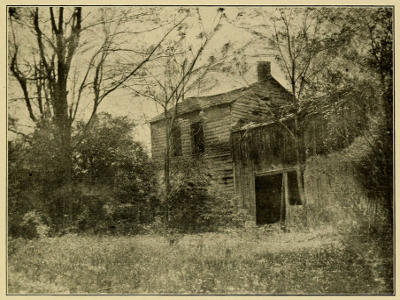
She had been raised in B——, a town at the foot of a
mountain chain upon whose top the grandfather of
Deborah’s grandfather, Martin Kallikak Jr., had always
lived. When she was a little girl, he was a very old
man. She remembered being taken to drive, when a
child, and seeing the old hut on the mountain, where he
lived with his strange daughters, “Old Moll,” “Old
Sal,” and Jemima. The dilapidated dwelling, with its
windows bulging with rags, formed a picture she had
never forgotten. There were in her mind floating
memories of great scandals connected with these women
and their lonely mountain hut. The father went by
the name of the “Old Horror,” and as she remembered
him, he was always unwashed and drunk. At election
time, he never failed to appear in somebody’s cast-off
clothing, ready to vote, for the price of a drink, the
donor’s ticket.
This information, coming when it did, seemed amazing
and carried with it the probability of establishing
the certainty of defect transmitted through five generations.
But the town in question was remote and the
probability of finding any living person able to give
accurate information seemed so slight that nothing
further was done in this direction for many months.
In the meantime, the families of the fifteen brothers
and sisters of Deborah’s grandfather had been worked
out, and the names of several living relatives back in
the mountain ascertained. The time was ripe.
Appealing for a night’s lodging at the home of a retired
farmer, the field worker was fortunate enough to
be received. As the hostess was showing her to a room,
she asked tentatively, “You have lived in B—— a
long time?” “About sixty-five years,” was the pleasant
reply. “So, then, you know something of most of
the old families?” “There are not many old residents
of B—— with whose history I am not familiar.” Then
followed a few cautious questions in regard to the Kallikak
family which drew forth answers that soon convinced
the field worker she was on solid ground and
could advance without wasting time in needless precautions.
At this juncture, the supper bell rang. In
the dining room the acquaintance of the host was
made. When the meal was over, the couple turned
their united attention to the problem put before them.
“Why,” the host began, when he comprehended what
was wanted, “do you know that is the worst nest
you’re getting into, in the whole country? The mountains
back here are full of these people; I can point out
to you where every one of them lives.” Then he
turned to the table and began to sketch a map of the
mountain roads which must be followed next day. In
the midst of this he paused, as though an idea had come
to him, then he said hesitatingly, “You see, it’s
really impossible for a stranger like you to find all these
people. Some of them live on obscure back roads that
you could hardly get at without a guide. Now, my
time is of no value, and if you will permit me, I will
gladly serve in that capacity myself.” Needless to
say, his services were thankfully accepted, with the
result that nearly two hundred persons were added to
Deborah’s family chart.
This proved, however, only the beginning of the
study that has been made of the family in the vicinity
of B——. Numerous visits to many homes, always
from the center of the genial couple’s house, have made
the field worker such a well-known figure among these
people, that they long ago forgot what little surprise
they may have felt at her first visit. “You’re one of
the family?” was frequently asked her at the beginning.
“No, not really, only as I know so many of
your cousins and aunts and uncles, I thought, since I
was in B——, I would like to know you.” This usually
sufficed, but if it did not, the field worker was able so to
inundate the questioner with information about his
own relatives, that before she was through, he had forgotten
that anything remained unanswered. The relation
once established, no further explanation was
necessary. She was able to go in and out among them,
study their mentality, awake their reminiscences, until
finally the whole story was told.
Besides members of the family, numerous old people
were here and there discovered who were able to add
materially to the information otherwise obtained.
One shrewd old farmer who was found tottering in from
the field proved to be of especial service in determining
the mental status of Martin Kallikak Jr. In introducing
herself, the field worker had spoken of her interest
in Revolutionary times and of having come to him because
she had been told that he was well informed as
to the history of the locality. “Yes,” he said, with
excusable pride, as he led the way to the kitchen steps
descending into the garden, “not much has happened
in this place for the last seventy years in which I have
not taken an active part. Do you see that tree there?”
and he pointed to a fine maple that threw its luxuriant
shade over the path that led to the barn. “The day my
wife and I came here sixty years ago, we planted that
tree. It was a little sapling then, and see what it has
become!” After much more talk she cautiously put
the question, “Do you remember an old man, Martin
Kallikak, who lived on the mountain edge yonder?”
“Do I?” he answered. “Well, I guess! Nobody’d
forget him. Simple,” he went on; “not quite right
here,” tapping his head, “but inoffensive and kind.
All the family was that. Old Moll, simple as she was,
would do anything for a neighbor. She finally died—burned
to death in the chimney corner. She had come
in drunk and sat down there. Whether she fell over
in a fit or her clothes caught fire, nobody knows. She
was burned to a crisp when they found her. That was
the worst of them, they would drink. Poverty was
their best friend in this respect, or they would have
been drunk all the time. Old Martin could never stop
as long as he had a drop. Many’s the time he’s rolled
off of Billy Parson’s porch. Billy always had a barrel
of cider handy. He’d just chuckle to see old Martin
drink and drink until finally he’d lose his balance and
over he’d go! But Horser—he was a case! I saw
him once after I’d heard he was going to marry Jemima.
I looked him over and said, ‘Well, if you aren’t a fine-looking
specimen to think of marrying anybody!’
and he answered, ‘I guess you’re right—I aren’t much,
but I guess I’ll do fer Jemima.’
“Such scandals as there were when those girls were
young!” he continued. “You see, there was a fast
set of young men in B—— in those days, lawyers, who
didn’t care what they did. One of them got paid back,
though, for Jemima wanted to put her child on the
town, and they made her tell who was its father. Then
he had to give something for its support, and she gave it
this man’s full name. I saw him one day soon afterward
and he was boiling with rage. All the comfort
I gave him was to say, ‘I don’t see but what you’re
getting your just deserts, for if anybody wants to play
with the pot, they must expect to get blackened!’
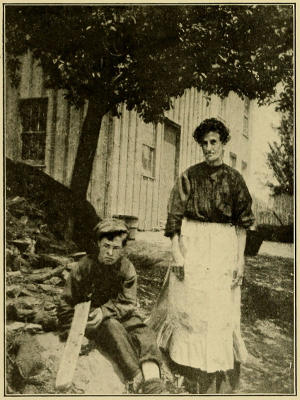
Great-grandson of “Daddy” Kallikak.
This boy is an imbecile of the Mongolian type.
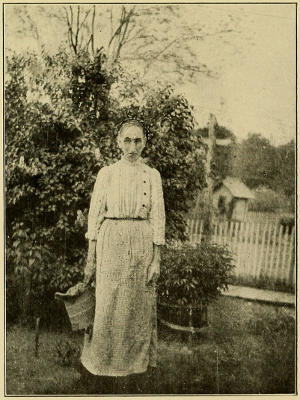
Malinda, Daughter of “Jemima.”
“By the way! Do you know that old Martin had
a half brother Frederick—as fine a man as the country
owned—who lived about twenty miles from here?
You see, Martin’s mother was a young girl in Revolutionary
times when Martin’s father was a soldier.
Afterwards he went back home and married a respectable
woman.”
“Did you ever see the mother of old Martin?” the
field worker asked. “No, she was dead before my time,
but I have heard the folks talk about her. She lived
in the woods not far from here. Dear me!” he went
on, “it’s been so long since I’ve thought of these people
that many things I forget, but it would all come back
to me in time.”
Two daughters of Jemima lived in B——. A little
study of Chart V, sections A and B, will place them in
their relation to the rest of the family and give the
chief facts of their lives. Little more need be added.
One of them was early put out to service and later
married a cobbler to whom she has borne many children.
She is not known to have had any illegitimate offspring,
but if she escaped, her daughter has made up for
her deficiency in this respect. The other sister grew
up in the mountain hut with her mother, and was living
there when her grandfather died. Her husband and
most of her children are defective, but there are two by
unknown fathers who are normal. One of these, a
girl of considerable ability, supports herself and mother
in a decent way and is respected by her townspeople.
The mother is tall, lean, angular, much resembling
Jemima, except that the latter was even more masculine.
Many are the living inhabitants of B—— to whom
the old woman was a well-known figure, for she often
came down into the town bringing berries to sell, her
large feet shod with heavy boots, her skirts short, while
her sharp, angular features were hidden in the depths
of a huge sunbonnet. She thus formed a striking picture
that could not easily be forgotten.
A third daughter of Jemima had gone to Brooklyn to
live, and the question kept repeating itself, “What will
she be like?” and this all the more because of the uncertainty
of the parentage on the father’s side. Perhaps
he was a normal man. Perhaps this will prove to be
a normal woman and so break the dead monotony of
this line of defectives.
In a back tenement, after passing through a narrow
alley, the home of this woman was found. It was about
ten o’clock in the morning. After climbing a dark and
narrow stairway, one came to a landing from which
a view could be had of the interior of the apartment.
In one room was a frowsled young woman in tawdry
rags, her hair unkempt, her face streaked with black,
while on the floor two dirty, half-naked children were
rolling. At the sight of a stranger, they all came forward.
The field worker made her way as best she
could, across heaps of junk that cluttered the room,
to a chair by an open window through which a breath
of outside air could be obtained. On the bureau by
the window a hideous diseased cat was curled in the
sunshine. The mother, Jemima’s daughter, was not at
home, but the woman who had presented herself was
her daughter, and these were the grandchildren. The
woman’s feeble-mindedness made it possible to ask her
question after question, such as could not have been
put to a normal person. Her answers threw a flood of
light upon the general depravity of life under such
conditions. When the mother at last arrived, she
proved to be of a type somewhat different from anything
before encountered in this family. She appeared
to be criminalistic, or at least capable of developing
along that line. Unfortunately, the visit could not
either be prolonged or repeated, so that no satisfactory
study was made.
In the city, the individual is lost in the very immensity
of the crowd that surrounds him, so that his
individual actions, except such as he himself chooses to
reveal or can be made to reveal, are lost to the people
about him; therefore there was little hope of obtaining
much side light on the problem here presented. During
the short interview the older woman showed unmistakable
signs of wanting to appear respectable in the midst
of her depravity, something quite characteristic of the
high-grade moron type in the family. She was friendly
and distinctly more intelligent than her daughter, but
there was little more will power or ability to cope with
the problems of life. One of her daughters had disappeared
off the face of the earth a few years before—there
had been a baby—that was all they knew. She
was working at Coney Island. One day she came home
and, when she left the next morning, it was the last they
ever saw of her. A brother of the girl had also disappeared
in much the same way.
The field worker left the tenement with the positive
assurance that environment without strict personal
supervision made little difference when it was a question
of the feeble-minded.
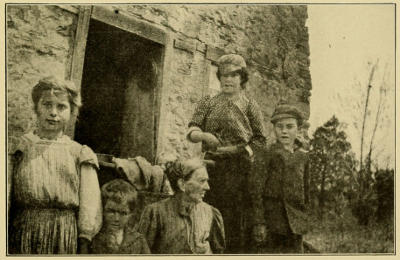
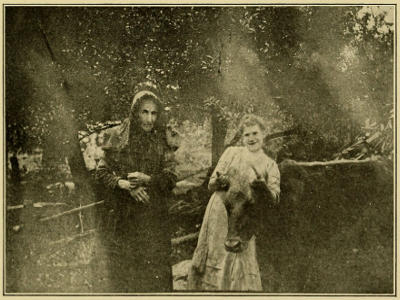
Great-grandchildren of “Old Sal.”
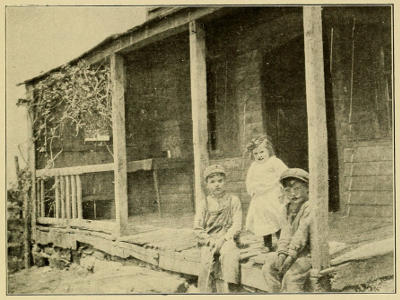
Children of Guss Saunders, with their Grandmother.
Owing to the courtesy of the County Superintendent
and the intelligent coöperation of the teachers, it was
possible to apply the Binet tests to all the descendants
of Martin Kallikak who could be found in the schools.
The request for this had been made in a way to give
no clew to the particular purpose underlying the search.
By selecting from every class one or two bright pupils
to take the tests along with the dull ones, all personal
element was eliminated. As children everywhere are
found to delight in the tests, only those who were not
called out were disappointed.
A morning was spent in a schoolhouse situated on the
top of a bold, rocky ledge that went by the picturesque
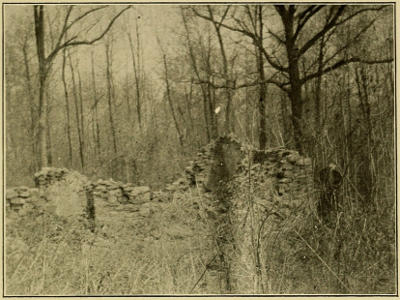
name of Hard Scrabble. It was within a quarter of a
mile of the ruins of Martin Kallikak’s hut, and a number
of his descendants were enrolled among its pupils.
One of the grandsons of “Old Sal” lived on a farm
near Cedarhill, several miles farther up the ridge. This
man, Guss Saunders by name, had been reported to be
the father of a large family. Nothing, however, had
been learned of him beyond the facts stated, and therefore
the inference was that he had turned out better
than the rest of his brothers. It had been to determine
this matter that the long ride was undertaken.
Arrived at the farm, the question of the mentality of
this family was quickly answered. Desolation and
ruin became more apparent at every step. The front
of the large farmhouse was quite deserted, but following
a few tracks the back door was reached. Such an
unwonted spectacle as a visitor attracted instant attention.
The door opened, revealing a sight to which, alas,
the field worker was only too accustomed. She gazed
aghast at what appeared to her to be a procession of
imbeciles. The tall, emaciated, staggering man at the
head braced himself against a tree, while the rest stopped
and stood with a fixed, stupid stare. Quickly regaining
control, the field worker said pleasantly, “Good
afternoon, Mr. Saunders. I hope you don’t mind my
intruding on you this way, but you see I am looking up
the children of the neighborhood, and I was sorry not
to find any of yours in the Cedarhill school to-day.”
He at once thought he had to do with a school inspector,
and his answer bears no setting forth in print. It was
an incoherent, disjointed, explosive protest against
school laws in general and fate in particular. It was
mixed up with convulsive sobs, while his bleared, swollen
eyes brimmed over with tears. The field worker began
to feel real sympathy for the man, although she knew
that he was drunk and that drunkards are easily moved
to tears. “Oh, I am sorry for you,” she said; “your
wife then is dead, is she?” “Yes, she’s dead!” he
answered with a wild gesture, “they took her right
out of that room—they said they’d cure her, if I’d let
her go. You can see the doctors in B——, they know
all about it—they’ll tell you what they done—they
took her away, and she never come back—Oh!”
Stifling his sobs, he went on, “And now they say I
am to send my children to school—and what can I do?
Look there!” pointing to a lump of humanity, a girl
who, at first glance, had thrown her imbecilic shadow
over the whole group, making them all look imbecilic—“do
you see that girl? She’s always fallin’ into fits,
and nobody can’t do nothin’ with her.” Breaking in
here, the field worker said, “But, Mr. Saunders, you
ought not to have the burden and the care of that girl;
she could be made so happy and comfortable in a place
where they understand such cases. You ought—”
The field worker could get no farther. His eyes suddenly
assumed a wild, desperate look and he burst out,
“No, no! They’ll never get her. They tried it once,
but they didn’t get her. They took my wife away and
she never came back—they’ll never get her!” A few
soothing words to allay the storm she had unconsciously
raised, another expression of sympathy, and the
field worker drove away, pondering deeply the meaning
of what had been seen and heard.
We have come to the point where we no longer leave
babies or little children to die uncared for in our streets,
but who has yet thought of caring intelligently for the
vastly more pathetic child-man or child-woman, who
through matured sex powers, which they do not understand,
fill our land with its overflowing measure of misery
and crime? Such thoughts as these filled the mind
of the field worker on the ride home.
Arrived at B——, her first care was to obtain an interview
with the doctor who had attended Guss’s wife
when she died. She found him ready to explain all he
could of the family which he had always known and
attended. “The mother,” he said, “was a kind-hearted,
simple-minded soul, who tended as best she could to the
needs of her family.” The epileptic girl, he explained,
had always been a great care, and the doctor himself,
aided by several prominent citizens, had taken the
trouble to complete all necessary arrangements for having
her admitted to the epileptic colony at Skillman.
The father, however, could never be made to give his
consent. The mother was still quite young when she
was carrying her eleventh child. Some accident happened
which threatened her with a miscarriage. The
doctor was summoned. He saw that it was a serious
case and sent for two other physicians in consultation.
It was decided that an immediate operation was necessary,
if the woman’s life was to be saved. They succeeded
in persuading Guss to allow her to be removed
to the hospital. Their efforts, however, were unavailing;
she died under the operation.
On the outskirts of B—— lived the owner of the Cedarhill
farm worked by Guss Saunders. He proved to be
an intelligent man, with an admirably appointed home.
He was keenly alive to the needs of the family, about
which the field worker came to inquire. “The pity
about Guss,” he began, “is that he can never let drink
alone. Why, do you know, if I paid that man wages,
he’d use every cent for rum. I ceased giving him money
long ago, for if I had, the town would have had to look
after his children. I give him credit at the store, and
they supply him with what he needs.”
The foregoing glimpses of the defective branch of the
Kallikak family must suffice, though the field worker’s
memory and notebook contain many similar instances.
In turning to describe the other branch of the family,
two difficulties confront the writer.
First, the question of identification. The persons
already described are either gone and have left nothing
behind them by which they can be identified, or, if
living, will never recognize themselves in this book.
The opposite is true of the good family. Some of
them will recognize themselves, but the public must not
discover them. To insure this, the writer must refrain
from telling the very facts that would give the story its
most interesting touches.
The second difficulty is that a description of the activity
of a normal family of respectability and usefulness
is never as interesting as the bizarre experiences of
the abnormal.
Hence the reader will find in the following sketches
only such facts as will show the thoroughly normal and
regular family life of the intelligent citizens of a commonwealth.
In a certain village of New Jersey, lying picturesquely
on the crest of a hill, is a graveyard where Martin Kallikak
Sr. and several of his immediate descendants lie
peacefully at rest. He had in his lifetime a great passion
for the accumulation of land and left large farms
to most of his children. These farms lie in the vicinity
of the aforesaid village. Some of them are still in the
possession of his descendants, while others have passed
into strangers’ hands. On the hill above this village
is a stucco farmhouse in a fine state of preservation.
It belonged to Amos—lineal descendant of one of the
colonial governors of New Jersey and to Elizabeth,
daughter of Martin Kallikak Sr. The farm is, at present,
in the possession of the widow of Elizabeth’s grandson,
the latter having been a minister in New York City.
In renting the farm, the family has always retained a
wing of the house, which, although remodeled, still
presents much the same appearance as in the days of
Amos and Elizabeth. There is the same fireplace, the
same high-backed chairs, the clock, desk, and china
cupboard. Every summer the family has come back to
the old place to enjoy the country air, the luscious
grapes and other fruit planted by their ancestor.
On another hill, less than two miles distant, lives a
granddaughter of the same Amos and Elizabeth. Her
father had been, in his day, one of the wealthiest and
most prominent citizens of the community. In an old
desk, part of his inheritance from his mother, was found
a number of valuable papers belonging to the Kallikak
family. One of these is the famous deed of the original
purchase made in 17— by Casper Kallikak, signed by
the governor of the colony. These papers the daughter
guards with great pride. She is a woman of ability
and manages her large farm with admirable skill. The
splendid old homestead, which has been remodeled and
fitted up with all modern conveniences, was built by
her mother’s ancestor. Although she is deeply interested
in all family matters, she has been too much engrossed
in business affairs to have given this subject
much attention. A daughter of hers, however, who has
inherited the taste, has been able to make up for her
mother’s lack in this respect. The young woman is
now married, and her oldest son bears the united name
of his two ancestors, the colonial governor and Martin
Kallikak.
Miriam, the oldest daughter of Martin Sr., married
a man who was a carpenter and a farmer. Although of
good family, yet, for some unknown reason, he was not
personally acceptable to Martin or his wife. Miriam
died when only thirty-six years old, and her husband
married again. In his will, Martin makes no mention
of his grandchildren by this daughter. They have been
respectable farming people, but have never held the
same social position as the other members of the family.
Martin’s third daughter, Susan, married a man descended
from a family conspicuous in the colonial history
of New Jersey and which counts among its members
one of the founders of Princeton University, while
a collateral branch furnished a signer to the Declaration
of Independence. One of Susan’s sons is still living,
having attained the advanced age of ninety-eight.
He is a resident of the town that bears his family name
and has always been conspicuous as a loyal and upright
citizen. To-day, the old man has quite lost his mental
power but retains his courteous manner and placid
gentlemanly countenance.
In a central region of northern New Jersey, remote
from any direct line of travel, lies a town named for
one of the families connected with the earliest settlement
of the colony. This family rose to distinction in
many of its branches, but honors itself chiefly for having
produced one of the most brilliant advocates of the
cause of Independence of which New Jersey can boast.
He was descended on his mother’s side from the first
president of Princeton University and took his degree
there before he was sixteen years of age. From this
family, Martin Kallikak’s youngest son, Joseph, chose
his wife. It is interesting to note that the descendants
of this pair have shown a marked tendency toward
professional careers. One daughter, however, married
a farmer, and most of her descendants have remained
fixed to the soil. Another daughter married a prominent
merchant, and this line, having been fixed in the
city, has produced men chiefly engaged in mercantile
pursuits; but the sons, of whom there were five, all
studied medicine, and although only one of these became
a practicing physician, their children have carried
on the family tradition in this line.
On the outskirts of another New Jersey town, in a
beautiful old homestead, inherited from his mother,
lives a grandson of Frederick Kallikak, oldest son of
Martin. He is a courteous, scholarly man of the old
school. His home is rendered particularly attractive
by the presence of his southern wife and two charming
daughters. In his possession are numerous articles
belonging to his great-grandfather. This gentleman
manifested such an intelligent interest in giving information
in regard to his family that it seemed a question
of honor to inform him as to the purpose of the investigation,
laying bare the facts set forth in this book.
He proved to be, perhaps, the one man best qualified
in the entire family for entering into an analysis of its
characteristics, and this he did freely, in so far as it
would serve the ends of the investigation.
Another descendant of Martin Kallikak Sr., a granddaughter
of his youngest child, Abbie, had been previously
informed regarding the same facts. This lady
is a person not only of refinement and culture but is the
author of two scholarly genealogical works. She has,
for years, been collecting material for a similar study
of the Kallikak family. This material she generously
submitted to the use of the field worker. In the end she
spent an entire day in the completion and revision of
the normal chart presented in this book. No praise
can be too high for such disinterested self-forgetfulness
in the face of an urgent public need. We owe to these
two persons most of the information which has made
possible the study of the normal side of this family.
Of Martin Kallikak Sr., himself, the record of many
characteristic traits has been preserved. As stated
in another chapter, his father died when he was a lad of
fifteen. The father, in his will, after enumerating certain
personal bequests to his wife, recommends the
selling of the homestead farm, in order to provide for
the education of his children. There is a quaint document
still in existence, in which Martin Kallikak, having
attained his majority, agrees to pay £250 to each
of his three “spinster” sisters, still minors, in return for
a quitclaim deed of the homestead farm. This was
a considerable burden for a young man to assume, but
it seems to have given him the impetus which later
made him a rich and prosperous farmer.
He had joined the Revolutionary Army in April,
1776. Two years later he was wounded in a way to
disable him for further service, and he then returned
to the home farm. During the summer of enforced
idleness he wooed and won the heart of a young woman
of good Quaker family. Her shrewd old father, however,
refused to give his consent. To his objections,
based on the ground that Martin did not own enough
of this world’s goods, the young man is recorded as
saying, “Never mind. I will own more land than ever
thou did, before I die,” which promise he made true.
That the paternal objection was overruled is proven by
the registry of marriages, which gives the date of Martin’s
union with the Quakeress as January, 1779.
The old Bible of Casper Kallikak, one of the family
heirlooms, is in the possession of a Reverend Mr. ——,
who is descended from Casper through the line of one
of his daughters. This Bible was bought in 1704 and
is still in an excellent state of preservation, for, although
time-stained, the pages are intact and there still may
be seen in legible handwriting the family record penned
so long ago. On a flyleaf, is a quaint verse in which
old Casper bequeaths the volume to his eldest son,
bidding him, “So oft as in it he doth looke” remember
how his father had “aye been guided by ye precepts in
this booke,” and enjoining him to walk in the same safe
way.