By William Makepeace Thackeray
With illustrations by the Author
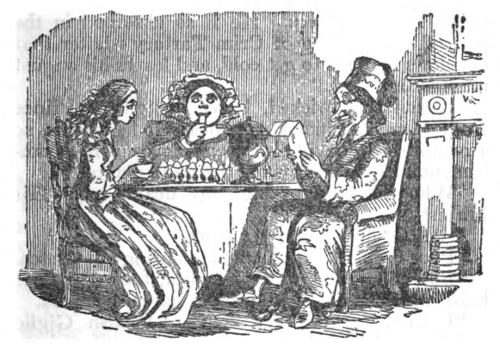
This is Valoroso XXIV., King of Paflagonia,
seated with his Queen and only child at their
royal breakfast-table, and receiving the letter which
announces to His Majesty a proposed visit from
Prince Bulbo, heir of Padella, reigning King of
Crim Tartary. Remark the delight upon the monarch’s
royal features. He is so absorbed in the
perusal of the King of Crim Tartary’s letter that
he allows his eggs to get cold, and leaves his august
muffins untasted.
“What! that wicked, brave, delightful Prince
Bulbo!” cries Princess Angelica; “so handsome, so
accomplished, so witty—the conqueror of Rimbombamento,
where he slew ten thousand giants!”
“Who told you of him, my dear?” asks His
Majesty.
“A little bird,” says Angelica.
“Poor Giglio!” says mamma, pouring out the tea.
“Bother Giglio!” cries Angelica, tossing up her
head, which rustled with a thousand curl-papers.
“I wish,” growls the King—“I wish Giglio
was.…”
“Was better? Yes, dear, he is better,” says the
Queen. “Angelica’s little maid, Betsinda, told me
so when she came to my room this morning with my
early tea.”
“You are always drinking tea,” said the monarch,
with a scowl.
“It is better than drinking port or brandy and
water,” replies Her Majesty.
“Well, well, my dear, I only said you were fond
of drinking tea,” said the King of Paflagonia, with
an effort as if to command his temper. “Angelica!
I hope you have plenty of new dresses; your milliner’s
bills are long enough. My dear Queen, you
must see and have some parties. I prefer dinners,
but of course you will be for balls. Your everlasting
blue velvet quite tires me: and, my love, I should
like you to have a new necklace. Order one. Not
more than a hundred or a hundred and fifty thousand
pounds.”
“And Giglio, dear?” says the Queen.
“Giglio may go to the—”
“Oh, sir,” screams Her Majesty. “Your own
nephew! our late King’s only son.”
“Giglio may go to the tailor’s, and order the bills
to be sent in to Glumboso to pay. Confound him!
I mean bless his dear heart. He need want for
nothing; give him a couple of guineas for pocket-money,
my dear; and you may as well order yourself
bracelets while you are about the necklace,
Mrs. V.”
Her Majesty, or Mrs. V., as the monarch facetiously
called her (for even royalty will have its
sport, and this august family were very much attached),
embraced her husband, and, twining her
arm round her daughter’s waist, they quitted the
breakfast-room in order to make all things ready
for the princely stranger.
When they were gone, the smile that had lighted
up the eyes of the husband and father fled—the
pride of the King fled—the MAN was alone. Had
I the pen of a G. P. R. James, I would describe
Valoroso’s torments in the choicest language; in
which I would also depict his flashing eye, his distended
nostril—his dressing-gown, pocket-handkerchief,
and boots. But I need not say I have not the
pen of that novelist; suffice it to say, Valoroso was
alone.
He rushed to the cupboard, seizing from the
table one of the many egg-cups with which his
princely board was served for the matin meal, drew
out a bottle of right Nantz or Cognac, filled and
emptied the cup several times, and laid it down with
a hoarse “Ha, ha, ha! now Valoroso is a man
again!”
“But oh!” he went on (still sipping, I am sorry
to say), “ere I was a king, I needed not this intoxicating
draught; once I detested the hot brandy
wine, and quaffed no other fount but nature’s rill.
It dashes not more quickly o’er the rocks than I
did, as, with blunderbuss in hand, I brushed away
the early morning dew, and shot the partridge,
snipe, or antlered deer! Ah! well may England’s
dramatist remark, ‘Uneasy lies the head that wears
a crown!’ Why did I steal my nephew’s, my young
Giglio’s—? Steal! said I? no, no, no, not steal, not
steal. Let me withdraw that odious expression. I
took, and on my manly head I set, the royal crown
of Paflagonia; I took, and with my royal arm I
wield, the sceptral rod of Paflagonia; I took, and
in my outstretched hand I hold, the royal orb of
Paflagonia! Could a poor boy, a snivelling, drivelling
boy—was in his nurse’s arms but yesterday, and
cried for sugar-plums and puled for pap—bear up
the awful weight of crown, orb, scepter? gird on the
sword my royal fathers wore, and meet in fight the
tough Crimean foe?”
And then the monarch went on to argue in his
own mind (though we need not say that blank verse
is not argument) that what he had got it was his
duty to keep, and that, if at one time he had entertained
ideas of a certain restitution, which shall
be nameless, the prospect by a certain marriage of
uniting two crowns and two nations which had been
engaged in bloody and expensive wars, as the Paflagonians
and the Crimeans had been, put the idea
of Giglio’s restoration to the throne out of the question:
nay, were his own brother, King Savio, alive,
he would certainly will away the crown from his
own son in order to bring about such a desirable
union.
Thus easily do we deceive ourselves! Thus do
we fancy what we wish is right! The King took
courage, read the papers, finished his muffins and
eggs, and rang the bell for his Prime Minister.
The Queen, after thinking whether she should go
up and see Giglio, who had been sick, thought,
“Not now. Business first; pleasure afterwards. I
will go and see dear Giglio this afternoon; and now
I will drive to the jeweller’s, to look for the necklace
and bracelets.” The Princess went up into her
own room, and made Betsinda, her maid, bring out
all her dresses; and as for Giglio, they forgot him
as much as I forget what I had for dinner last
Tuesday twelvemonth.
Paflagonia, ten or twenty thousand years ago,
appears to have been one of those kingdoms where
the laws of succession were not settled; for when
King Savio died, leaving his brother Regent of the
kingdom, and guardian of Savio’s orphan infant,
this unfaithful regent took no sort of regard of
the late monarch’s will; had himself proclaimed
sovereign of Paflagonia under the title of King
Valoroso XXIV., had a most splendid coronation,
and ordered all the nobles of the kingdom to pay
him homage. So long as
Valoroso gave them
plenty of balls at Court,
plenty of money and lucrative
places, the Paflagonian
nobility did not
care who was king; and as
for the people, in those
early times, they were
equally indifferent. The
Prince Giglio, by reason
of his tender age at his
royal father’s death, did
not feel the loss of his
crown and empire. As
long as he had plenty of
toys and sweetmeats, a
holiday five times a week,
and a horse and gun to go
out shooting when he grew a little older, and, above
all, the company of his darling cousin, the King’s
only child, poor Giglio was perfectly contented;
nor did he envy his uncle the royal robes and
scepter, the great hot uncomfortable throne of
state, and the enormous cumbersome crown in
which that monarch appeared from morning till
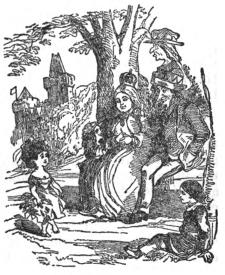
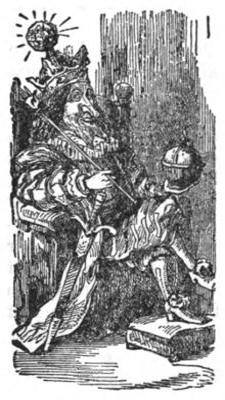
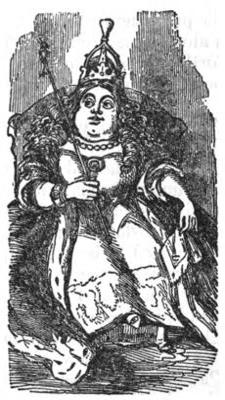
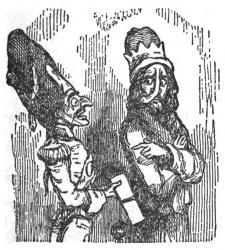
night. King Valoroso’s portrait has been left to
us; and I think you will agree with me that he must
have been sometimes rather tired of his velvet, and
his diamonds, and his ermine, and his grandeur. I
shouldn’t like to sit in that stifling robe with such
a thing as that on my head.
No doubt, the Queen must have been lovely in
her youth, for though she grew rather stout in after
life, yet her features, as shown in her portrait, are
certainly pleasing. If
she was fond of flattery,
scandal, cards, and fine
clothes, let us deal
gently with her infirmities,
which, after all,
may be no greater than
our own. She was
kind to her nephew;
and if she had any
scruples of conscience
about her husband’s
taking the young
Prince’s crown, consoled
herself by thinking
that the King,
though a usurper, was
a most respectable
man, and that at his
death Prince Giglio
would be restored to his throne, and share it with
his cousin, whom he loved so fondly.
The Prime Minister was Glumboso, an old
statesman, who most cheerfully swore fidelity to
King Valoroso, and in whose hands the monarch left
all the affairs of his kingdom. All Valoroso wanted
was plenty of money, plenty of hunting, plenty of
flattery, and as little trouble as possible. As long
as he had his sport, this monarch cared little how
his people paid for it: he engaged in some wars, and
of course the Paflagonian newspapers announced
that he gained prodigious victories: he had statues
erected to himself in every city of the empire; and
of course his pictures placed everywhere, and in all
the print-shops: he was Valoroso the Magnanimous,
Valoroso the Victorious, Valoroso the Great, and so
forth—for even in these early times courtiers and
people knew how to flatter.
This royal pair had one only child, the Princess
Angelica, who, you may be sure, was a paragon in
the courtiers’ eyes, in her parents’, and in her own.
It was said she had the longest hair, the largest eyes,
the slimmest waist, the smallest foot, and the most
lovely complexion of any young lady in the Paflagonian
dominions. Her accomplishments were
announced to be even superior to her beauty; and
governesses used to shame their idle pupils by telling
them what Princess Angelica could do. She
could play the most difficult pieces of music at sight.
She could answer any one of “Mangnall’s Questions.”
She knew every date in the history of
Paflagonia, and every other country. She knew
French, English, Italian, German, Spanish, Hebrew,
Greek, Latin, Cappadocian, Samothracian,
Ægean and Crim Tartar. In a word, she was a
most accomplished young creature; and her governess
and lady-in-waiting was the severe Countess
Gruffanuff.
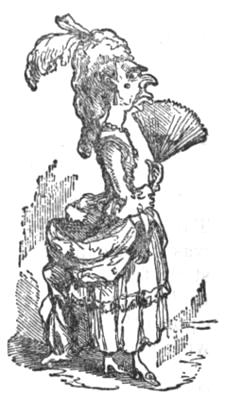
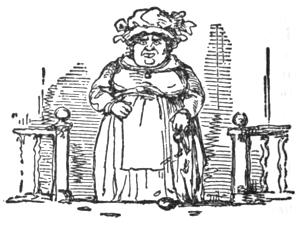
Would you not fancy, from this picture, that
Gruffanuff must have been a person of the highest
birth? She looks so haughty that I should have
thought her a Princess at the very least, with a
pedigree reaching as far back as the Deluge. But
this lady was no better born than many other ladies
who give themselves airs;
and all sensible people
laughed at her absurd pretensions.
The fact is, she
had been maid-servant to
the Queen when Her
Majesty was only Princess
and her husband had been
head footman; but after his
death or disappearance, of
which you shall hear presently,
this Mrs. Gruffanuff,
by flattering, toadying, and
wheedling her royal mistress,
became a favorite
with the Queen (who was
rather a weak woman),
and Her Majesty gave her a title, and made her
nursery governess to the Princess.
And now I must tell you about the Princess’s
learning and accomplishments, for which she had
such a wonderful character. Clever Angelica
certainly was, but as idle as possible. Play at sight,
indeed! she could play one or two pieces, and pretend
that she had never seen them before; she could
answer half a dozen “Mangnall’s Questions”; but
then you must take care to ask the right ones. As
for her languages, she had masters in plenty, but
I doubt whether she knew more than a few phrases
in each, for all her pretence; and as for her embroidery
and her drawing, she showed beautiful
specimens, it is true, but who did them?
This obliges me to tell the truth, and to do so I
must go back ever so far, and tell you about the
Fairy Blackstick.
Between the kingdoms of Paflagonia and Crim
Tartary, there lived a mysterious personage, who
was known in those countries as the Fairy Blackstick,
from the ebony wand or crutch which she carried;
on which she rode to the moon sometimes, or
upon other excursions of business or pleasure, and
with which she performed her wonders.
When she was young, and had been first taught
the art of conjuring by the necromancer, her
father, she was always practising her skill, whizzing
about from one kingdom to another upon her black
stick, and conferring her fairy favors upon this
Prince or that. She had scores of royal godchildren;
turned numberless wicked people into beasts,
birds, millstones, clocks, pumps, bootjacks, umbrellas,
or other absurd shapes; and, in a word, was
one of the most active and officious of the whole
College of fairies.
But after two or three thousand years of this
sport, I suppose Blackstick grew tired of it. Or
perhaps she thought, “What good am I doing by
sending this Princess to sleep for a hundred years?
by fixing a black pudding on to that booby’s nose?
by causing diamonds and pearls to drop from one
little girl’s mouth, and vipers and toads from another’s?
I begin to think I do as much harm as
good by my performances. I might as well shut
my incantations up, and allow things to take their
natural course.
“There were my two young goddaughters, King
Savio’s wife, and Duke Padella’s wife, I gave them
each a present, which was to render them charming
in the eyes of their husbands, and secure the affection
of those gentlemen as long as they lived.
What good did my Rose and my Ring do these two
women? None on earth. From having all their
whims indulged by their husbands, they became
capricious, lazy, ill-humored, absurdly vain, and
leered and languished, and fancied themselves irresistibly
beautiful, when they were really quite old
and hideous, the ridiculous creatures! They used
actually to patronise me when I went to pay them
a visit—me, the Fairy Blackstick, who knows all
the wisdom of the necromancers, and who could
have turned them into baboons, and all their diamonds
into strings of onions, by a single wave of
my rod!” So she locked up her books in her cupboard,
declined further magical performances, and
scarcely used her wand at all except as a cane to
walk about with.
So when Duke Padella’s lady had a little son
(the Duke was at that time only one of the principal
noblemen in Crim Tartary), Blackstick, although
invited to the christening, would not so
much as attend; but merely sent her compliments
and a silver papboat for the baby, which was really
not worth a couple of guineas. About the same
time the Queen of Paflagonia presented His Majesty
with a son and heir; and guns were fired, the
capital illuminated, and no end of feasts ordained
to celebrate the young Prince’s birth. It was
thought the Fairy, who was asked to be his godmother,
would at least have presented him with
an invisible jacket, a flying horse, a Fortunatus’s
purse, or some other valuable token of her favor;
but instead, Blackstick went up to the cradle of
the child Giglio, when everybody was admiring
him and complimenting his royal papa and mamma,
and said, “My poor child, the best thing I can send
you is a little misfortune”; and this was all she
would utter, to the disgust of Giglio’s parents, who
died very soon after, when Giglio’s uncle took the
throne, as we read in Chapter I.
In like manner, when Cavolfiore, King of Crim
Tartary, had a christening of his only child, Rosalba,
the Fairy Blackstick, who had been invited,
was not more gracious than in Prince Giglio’s case.
Whilst everybody was expatiating over the beauty
of the darling child, and congratulating its parents,
the Fairy Blackstick looked very sadly at the baby
and its mother, and said, “My good woman (for the
Fairy was very familiar, and no more minded a
Queen than a washerwoman)—my good woman,
these people who are following you will be the first
to turn against you; and as for this little lady, the
best thing I can wish her is a little misfortune.”
So she touched Rosalba with her black wand, looked
severely at the courtiers, motioned the Queen an
adieu with her hand, and sailed slowly up into the
air out of the window.
When she was gone, the Court people, who had
been awed and silent in her presence, began to
speak. “What an odious Fairy she is (they said)—a
pretty Fairy, indeed! Why, she went to the
King of Paflagonia’s christening, and pretended to
do all sorts of things for that family; and what has
happened—the Prince, her godson, has been turned
off his throne by his uncle. Would we allow our
sweet Princess to be deprived of her rights by any
enemy? Never, never, never, never!”
And they all shouted in a chorus, “Never, never,
never, never!”
Now, I should like to know, and how did these
fine courtiers show their fidelity? One of King
Cavolfiore’s vassals, the Duke Padella just mentioned,
rebelled against the King, who went out to
chastise his rebellious subject. “Any one rebel
against our beloved and august Monarch!” cried
the courtiers; “any one resist him? Pooh! He is
invincible, irresistible. He will bring home Padella
a prisoner, and tie him to a donkey’s tail, and drive
him round the town, saying, ‘This is the way the
Great Cavolfiore treats rebels.’”
The King went forth to vanquish Padella; and
the poor Queen, who was a very timid, anxious
creature, grew so frightened and ill, that I am sorry
to say she died; leaving injunctions with her ladies
to take care of the dear little Rosalba. Of course
they said they would. Of course they vowed they
would die rather than any harm should happen to
the Princess. At first the Crim Tartar Court
Journal stated that the King was obtaining great
victories over the audacious rebel: then it was announced
that the troops of the infamous Padella
were in flight: then it was said that the royal army
would soon come up with the enemy, and then—then
the news came that King Cavolfiore was vanquished
and slain by His Majesty, King Padella
the First!
At this news, half the courtiers ran off to pay
their duty to the conquering chief, and the other
half ran away, laying hands on all the best articles
in the palace; and poor little Rosalba was left there
quite alone—quite alone; and she toddled from one
room to another, crying, “Countess! Duchess!”
(only she said “Tountess, Duttess,” not being able
to speak plain) “bring me my mutton sop; my
Royal Highness hungy! Tountess! Duttess!” And
she went from the private apartments into the
throne room and nobody was there—and thence
into the ball-room and nobody was there—and
thence into the pages’ room and nobody was there—and
she toddled down the great staircase into the
hall and nobody was there—and the door was
open, and she went into the court, and into the garden,
and thence into the wilderness, and thence into
the forest where the wild beasts live and was never
heard of any more!
A piece of her torn mantle and one of her shoes
were found in the wood in the mouths of two lionesses’
cubs, whom King Padella and a royal hunting
party shot—for he was King now, and reigned
over Crim Tartary. “So the poor little Princess
is done for,” said he; “well, what’s done can’t be
helped. Gentlemen, let us go to luncheon!” And
one of the courtiers took up the shoe and put it in
his pocket. And there was an end of Rosalba!
When the Princess Angelica was born, her
parents not only did not ask the Fairy Blackstick
to the christening party, but gave orders to their
porter absolutely to refuse her if she called. This
porter’s name was Gruffanuff, and he had been
selected for the post by their Royal Highnesses because
he was a very tall fierce man, who could say
“Not at home” to a tradesman or an unwelcome
visitor with a rudeness which frightened most such
persons away. He was the husband of that Countess
whose picture we have just seen, and as long as
they were together they quarrelled from morning
till night. Now this fellow tried his rudeness once
too often, as you shall hear. For the Fairy Blackstick
coming to call upon the Prince and Princess,
who were actually sitting at the open drawing-room
window, Gruffanuff not only denied them, but
made the most odious vulgar sign as he was going
to slam the door in the Fairy’s face! “Git away,
hold Blackstick!” said he. “I tell you, Master and
Missis ain’t at home to you;” and he was, as we
have said, going to slam the door.
But the Fairy, with her wand, prevented the door
being shut; and Gruffanuff came out again in a
fury, swearing in the most abominable way, and
asking the Fairy “whether she thought he was a
going to stay at that there door hall day?”
“You are going to stay at that door all day and
all night, and for many a long year,” the Fairy
said, very majestically; and Gruffanuff, coming
out of the door, straddling before it with his great
calves, burst out laughing, and cried “Ha, ha, ha!
this is a good un! Ha—ah—what’s this? Let me
down—O—o—H’m!” and then he was dumb!
For, as the Fairy waved her wand over him, he
felt himself rising off the ground, and fluttering up
against the door, and then, as if a screw ran into
his stomach, he felt a dreadful pain there, and was
pinned to the door; and then his arms flew up over
his head; and his legs, after writhing about wildly,
twisted under his body; and he felt cold, cold,
growing over him, as if he was turning into metal;
and he said, “O—o—H’m!” and could say no more,
because he was dumb.
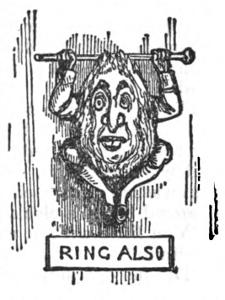
He was turned into metal! He was, from being
brazen, brass! He was neither more nor less than
a knocker! And there he was, nailed to the door
in the blazing summer day, till he burned almost
red-hot; and there he was, nailed to the door all the
bitter winter nights, till his brass nose was dropping
with icicles. And the postman came and rapped
at him, and the vulgarest boy with a letter came
and hit him up against the door. And the King
and Queen (Princess and Prince they were then)
coming home from a walk that evening, the King
said, “Hullo, my dear! you have had a new knocker
put on the door. Why, it’s rather like our porter
in the face! What has become of that boozy vagabond?”
And the housemaid came and scrubbed his
nose with sand-paper; and
once, when the Princess
Angelica’s little sister was
born, he was tied up in an
old kid glove; and, another
night, some larking young
men tried to wrench him
off, and put him to the
most excruciating agony
with a turnscrew. And
then the Queen had a fancy
to have the color of the
door altered; and the painters
dabbed him over the
mouth and eyes, and nearly
choked him, as they painted him pea-green. I warrant
he had leisure to repent of having been rude
to the Fairy Blackstick!
As for his wife, she did not miss him; and as he
was always guzzling beer at the public-house, and
notoriously quarrelling with his wife, and in debt
to the tradesmen, it was supposed he had run away
from all these evils, and emigrated to Australia or
America. And when the Prince and Princess chose
to become King and Queen, they left their old
house, and nobody thought of the porter any more.
One day, when the Princess Angelica was quite
a little girl, she was walking in the garden of the
palace, with Mrs. Gruffanuff, the governess, holding
a parasol over her head, to keep her sweet complexion
from the freckles, and Angelica was carrying
a bun, to feed the swans and ducks in the royal
pond.
They had not reached the duck-pond, when there
came toddling up to them such a funny little girl!
She had a great quantity of hair blowing about her
chubby little cheeks, and looked as if she had not
been washed or combed for ever so long. She wore
a ragged bit of a cloak, and had only one shoe on.
“You little wretch, who let you in here?” asked
Gruffanuff.
“Div me dat bun,” said the little girl, “me vely
hungy.”
“Hungry! what is that?” asked Princess Angelica,
and gave the child the bun.
“Oh, Princess!” says Gruffanuff, “how good,
how kind, how truly angelical you are! See, your
Majesties,” she said to the King and Queen, who
now came up, along with their nephew, Prince
Giglio, “how kind the Princess is! She met this
little dirty wretch in the garden—I can’t tell how
she came in here, or why the guards did not shoot
her dead at the gate!—and the dear darling of a
Princess has given her the whole of her bun!”
“I didn’t want it,” said Angelica.
“But you are a darling little angel all the same,”
says the governess.
“Yes; I know I am,” said Angelica. “Dirty little
girl, don’t you think I am very pretty?” Indeed,
she had on
the finest of little
dresses and hats;
and, as her hair
was carefully
curled, she really
looked very well.
“Oh, pooty,
pooty!” says the
little girl, capering
about, laughing,
and dancing,
and munching
her bun; and as
she ate it she began
to sing, “Oh,
what fun to have
a plum bun! how
I wis it never was done!” At which, and her
funny accent, Angelica, Giglio, and the King and
Queen began to laugh very merrily.
“I can dance as well as sing,” says the little girl.
“I can dance, and I can sing, and I can do all sorts
of ting.”
And she ran to a flower-bed, and pulling a few
polyanthuses, rhododendrons, and other flowers,
made herself a little wreath, and danced before the
King and Queen so drolly and prettily, that everybody
was delighted.
“Who was your mother—who were your relations,
little girl?” said the Queen.
The little girl said, “Little lion was my brudder;
great big lioness my mudder; neber heard of any
udder.” And she capered away on her one shoe,
and everybody was exceedingly diverted.
So Angelica said to the Queen, “Mamma, my
parrot flew away yesterday out of its cage, and I
don’t care any more for any of my toys; and I think
this funny little dirty child will amuse me. I will
take her home, and give her some of my old frocks.”
“Oh, the generous darling!” says Gruffanuff.
“Which I have worn ever so many times, and
am quite tired of,” Angelica went on; “and she
shall be my little maid. Will you come home with
me, little dirty girl?” The child clapped her hands,
and said, “Go home with you—yes! You pooty Princess!—Have
a nice dinner, and wear a new dress!”
And they all laughed again, and took home the
child to the palace, where, when she was washed
and combed, and had one of the Princess’s frocks
given to her, she looked as handsome as Angelica,
almost. Not that Angelica ever thought so; for
this little lady never imagined that anybody in the
world could be as pretty, as good, or as clever as
herself. In order that the little girl should not become
too proud and conceited, Mrs. Gruffanuff
took her old ragged mantle and one shoe, and put
them into a glass box, with a card laid upon them,
upon which was written, “These were the old
clothes in which little Betsinda was found when the
great goodness and admirable kindness of her
Royal Highness the Princess Angelica received
this little outcast.” And the date was added, and
the box locked up.
For a while little Betsinda was a great favorite
with the Princess, and she danced, and sang, and
made her little rhymes, to amuse her mistress. But
then the Princess got a monkey, and afterwards
a little dog, and afterwards a doll, and did not care
for Betsinda any more, who became very melancholy
and quiet, and sang no more funny songs,
because nobody cared to hear her. And then, as
she grew older, she was made a little lady’s-maid
to the Princess; and though she had no wages, she
worked and mended, and put Angelica’s hair in
papers, and was never cross when scolded, and was
always eager to please her mistress, and was always
up early and to bed late, and at hand when wanted,
and in fact became a perfect little maid. So the
two girls grew up, and, when the Princess came
out, Betsinda was never tired of waiting on her;
and made her dresses better than the best milliner,
and was useful in a hundred ways. Whilst the
Princess was having her masters, Betsinda would
sit and watch them; and in this way she picked up a
great deal of learning; for she was always awake,
though her mistress was not, and listened to the
wise professors when Angelica was yawning or
thinking of the next ball. And when the dancing-master
came, Betsinda learned along with Angelica;
and when the music-master came, she
watched him, and practised the Princess’s pieces
when Angelica was away at balls and parties; and
when the drawing-master came, she took note of all
he said and did; and the same with French, Italian,
and all other languages—she learned them from
the teacher who came to Angelica. When the
Princess was going out of an evening she would
say, “My good Betsinda, you may as well finish
what I have begun.” “Yes, miss,” Betsinda would
say, and sit down very cheerful, not to finish what
Angelica begun, but to do it. For instance, the Princess
would begin a head of a warrior, let us say, and
when it was begun it was something like this—
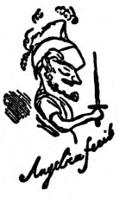
But when it was done, the warrior was like this—
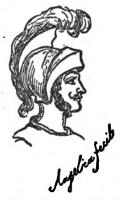
(only handsomer still if possible), and the Princess
put her name to the drawing; and the Court and
King and Queen, and above all poor Giglio, admired
the picture of all things, and said, “Was there
ever a genius like Angelica?” So, I am sorry to say,
was it with the Princess’s embroidery and other accomplishments;
and Angelica actually believed that
she did these things herself, and received all the
flattery of the Court as if every word of it was true.
Thus she began to think that there was no young
woman in all the world equal to herself, and that no
young man was good enough for her. As for Betsinda,
as she heard none of these praises, she was
not puffed up by them, and being a most grateful,
good-natured girl, she was only too anxious to do
everything which might give her mistress pleasure.
Now you begin to perceive that Angelica had faults
of her own, and was by no means such a wonder
of wonders as people represented Her Royal Highness
to be.
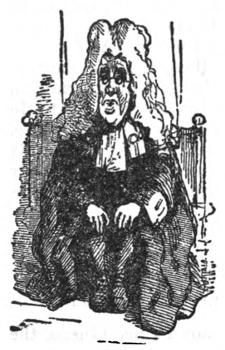
And now let us speak about Prince Giglio, the
nephew of the reigning monarch of Paflagonia.
It has already been stated, in page 398, that as
long as he had a smart coat to wear, a good horse
to ride, and money in his pocket, or rather to take
out of his pocket, for he was very good-natured,
my young Prince did not care for the loss of his
crown and scepter, being a thoughtless youth, not
much inclined to politics or any kind of learning.
So his tutor had a sinecure. Giglio would not learn
classics or mathematics, and the Lord Chancellor of
Paflagonia, Squaretoso, pulled a very long face because
the Prince could not be got to study the Paflagonian
laws and constitution; but, on the other
hand, the King’s gamekeepers and huntsmen found
the Prince an apt pupil; the dancing-master pronounced
that he was a most elegant and assiduous
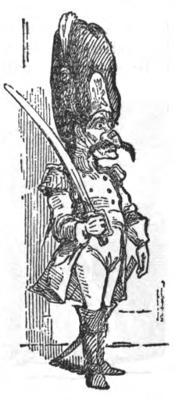
scholar; the First Lord of
the Billiard Table gave
the most flattering reports
of the Prince’s
skill; so did the Groom of
the Tennis Court; and as
for the Captain of the
Guard and Fencing Master,
the valiant and veteran
Count Kutasoff
Hedzoff, he avowed that
since he ran the General
of Crim Tartary, the
dreadful Grumbuskin,
through the body, he
never had encountered so
expert a swordsman as
Prince Giglio.
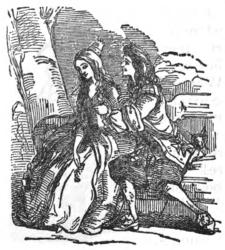
I hope you do not imagine that there was any impropriety
in the Prince and Princess walking together
in the palace garden, and because Giglio
kissed Angelica’s hand in a polite manner. In
the first place they are cousins; next, the Queen is
walking in the garden too (you cannot see her, for
she happens to be behind that tree), and Her Majesty
always wished that Angelica and Giglio should
marry; so did Giglio: so did Angelica sometimes,
for she thought her cousin very handsome, brave,
and good-natured: but then you know she was so
clever and knew so many
things, and poor Giglio knew
nothing, and had no conversation.
When they looked at
the stars, what did Giglio
know of the heavenly bodies?
Once, when on a sweet night
in a balcony where they
were standing, Angelica said,
“There is the Bear.” “Where?”
says Giglio. “Don’t be afraid,
Angelica! if a dozen bears
come, I will kill them rather
than they shall hurt you.”
“Oh, you silly creature!” says
she; “you are very good, but
you are not very wise.” When
they looked at the flowers,
Giglio was utterly unacquainted
with botany, and had
never heard of Linnæus. When the butterflies
passed, Giglio knew nothing about them, being as
ignorant of entomology as I am of algebra. So
you see, Angelica, though she liked Giglio pretty
well, despised him on account of his ignorance. I
think she probably valued her own learning rather
too much; but to think too well of one’s self is the
fault of people of all ages and both sexes. Finally,
when nobody else was there, Angelica liked her
cousin well enough.
King Valoroso was very delicate in health, and
withal so fond of good dinners (which were prepared
for him by his French cook Marmitonio),
that is was supposed he could not live long. Now
the idea of anything happening to the King struck
the artful Prime Minister and the designing old
lady-in-waiting with terror. For, thought Glumboso
and the Countess,
“when Prince
Giglio marries his
cousin and comes to
the throne, what a
pretty position we
shall be in, whom he
dislikes, and who
have always been
unkind to him. We
shall lose our places
in a trice; Gruffanuff
will have to
give up all the jewels,
laces, snuffboxes,
rings, and
watches which belonged to the Queen, Giglio’s
mother, and Glumboso will be forced to refund
two hundred and seventeen thousand millions
nine hundred and eighty-seven thousand four
hundred and thirty-nine pounds, thirteen shillings,
and sixpence halfpenny, money left to Prince
Giglio by his poor dear father.” So the Lady of
Honor and the Prime Minister hated Giglio because
they had done him a wrong; and these unprincipled
people invented a hundred cruel stories
about poor Giglio, in order to influence the King,
Queen, and Princess against him; how he was so
ignorant that he could not spell the commonest
words, and actually wrote Valoroso Valloroso, and
spelt Angelica with two I’s; how he drank a great
deal too much wine at dinner, and was always idling
in the stables with the grooms; how he owed ever so
much money at the pastrycook’s and haberdasher’s;
how he used to go to sleep at church; how he was
fond of playing cards with the pages. So did the
Queen like playing cards; so did the King go to
sleep at church, and eat and drink too much; and, if
Giglio owed a trifle for tarts, who owed him two
hundred and seventeen thousand millions nine hundred
and eighty-seven thousand four hundred and
thirty-nine pounds, thirteen shillings, and sixpence
halfpenny, I should like to know? Detractors and
tale-bearers (in my humble opinion) had much better
look at home. All this backbiting and slandering
had effect upon Princess Angelica, who began
to look coldly on her cousin, then to laugh at him
and scorn him for being so stupid, then to sneer at
him for having vulgar associates; and at Court
balls, dinners, and so forth, to treat him so unkindly
that poor Giglio became quite ill, took to his bed,
and sent for the doctor.
His Majesty King Valoroso, as we have seen,
had his own reasons for disliking his nephew; and
as for those innocent readers who ask why?—I beg
(with the permission of their dear parents) to refer
them to Shakespeare’s pages, where they will read
why King John disliked Prince Arthur. With
the Queen, his royal but weak-minded aunt, when
Giglio was out of sight he was out of mind. While
she had her whist and her evening parties, she cared
for little else.
I dare say two villains, who shall be nameless,
wished Doctor Pildrafto, the Court Physician, had
killed Giglio right out, but he only bled and physicked
him so severely that the Prince was kept to
his room for several months, and grew as thin as a
post.
Whilst he was lying sick in this way, there came
to the Court of Paflagonia a famous painter, whose
name was Tomaso Lorenzo, and who was Painter
in Ordinary to the King of Crim Tartary, Paflagonia’s
neighbor. Tomaso Lorenzo painted all
the Court, who were delighted with his works; for
even Countess Gruffanuff looked young and
Glumboso good-humored in his pictures. “He flatters
very much,” some people said. “Nay!” says
Princess Angelica, “I am above flattery, and I
think he did not make my picture handsome
enough. I can’t bear to hear a man of genius unjustly
cried down, and I hope my dear papa will
make Lorenzo a knight of his Order of the Cucumber.”
The Princess Angelica, although the courtiers
vowed Her Royal Highness could draw so beautifully
that the idea of her taking lessons was absurd,
yet chose to have Lorenzo for a teacher, and it was
wonderful, as long as she painted in his studio,
what beautiful pictures she made! Some of the
performances were engraved for the Book of Beauty;
others were sold for enormous sums at Charity
Bazaars. She wrote the signatures under the drawings,
no doubt, but I think I know who did the pictures—this
artful painter, who had come with other
designs on Angelica than merely to teach her to
draw.
One day, Lorenzo showed the Princess a portrait
of a young man in armor, with fair hair and the
loveliest blue eyes, and an expression at once melancholy
and interesting.
“Dear Signor Lorenzo, who is this?” asked the
Princess.
“I never saw any one so handsome,” says Countess
Gruffanuff (the old humbug).
“That,” said the painter, “that, madam, is the
portrait of my august young master, His Royal
Highness Bulbo, Crown Prince of Crim Tartary,
Duke of Acroceraunia, Marquis of Poluphloisboio,
and Knight Grand Cross of the Order of the
Pumpkin. That is the Order of the Pumpkin glittering
on his manly breast, and received by His
Royal Highness from his august father, His Majesty
King Padella I., for his gallantry at the battle
of Rimbombamento, when he slew with his own
princely hand the King of Ograria and two hundred
and eleven giants of the two hundred and
eighteen who formed the King’s bodyguard. The
remainder were destroyed by the brave Crim
Tartar army after an obstinate combat, in which
the Crim Tartars suffered severely.”
What a Prince! thought Angelica: so brave—so
calm-looking—so young—what a hero!
“He is as accomplished as he is brave,” continued
the Court Painter. “He knows all languages perfectly:
sings deliciously: plays every instrument:
composes operas which have been acted a thousand
nights running at the Imperial Theatre of Crim
Tartary, and danced in a ballet there before the
King and Queen; in which he looked so beautiful,
that his cousin, the lovely daughter of the King of
Circassia, died for love of him.”
“Why did he not marry the poor Princess?”
asked Angelica, with a sigh.
“Because they were first cousins, madam, and
the clergy forbid these unions,” said the Painter.
“And, besides, the young
Prince had given his
royal heart elsewhere.”
“And to whom?”
asked Her Royal Highness.
“I am not at liberty to
mention the Princess’s
name,” answered the
Painter.
“But you may tell me
the first letter of it,”
gasped out the Princess.
“That your Royal
Highness is at liberty to
guess,” says Lorenzo.
“Does it begin with a
Z?” asked Angelica.
The Painter said it wasn’t a Z; then she tried a
Y; then an X; then a W, and went so backwards
through almost the whole alphabet.
When she came to D, and it wasn’t D, she grew
very much excited; when she came to C, and it
wasn’t C, she was still more nervous; when she came
to B, and it wasn’t B, “O dearest Gruffanuff,” she
said, “lend me your smelling-bottle!” and, hiding
her head in the Countess’s shoulder, she faintly
whispered, “Ah, Signor, can it be A?”
“It was A; and though I may not, by my Royal
Master’s orders, tell your Royal Highness the
Princess’s name, whom he fondly, madly, devotedly,
rapturously loves, I may show you her
portrait,” says this slyboots: and leading the Princess
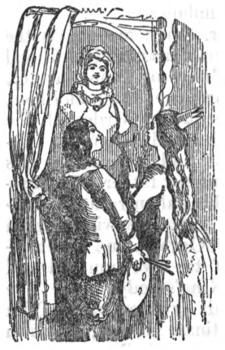
up to a gilt frame, he drew a curtain which was
before it.
O goodness! the frame contained a LOOKING-GLASS!
and Angelica saw her own face!
The Court Painter of His Majesty the King of
Crim Tartary returned to that monarch’s dominions,
carrying away a number of sketches which he
had made in the Paflagonian capital (you know, of
course, my dears, that the name of that capital is
Blombodinga); but the most charming of all his
pieces was a portrait of the Princess Angelica,
which all the Crim Tartar nobles came to see. With
this work the King was so delighted, that he decorated
the Painter with his Order of the Pumpkin
(sixth class), and the artist became Sir Tomaso
Lorenzo, K. P., thenceforth.
King Valoroso also sent Sir Tomaso his Order
of the Cucumber, besides a handsome order for
money, for he painted the King, Queen, and principal
nobility while at Blombodinga, and became
all the fashion, to the perfect rage of all the artists
in Paflagonia, where the King used to point to the
portrait of Prince Bulbo, which Sir Tomaso had
left behind him, and say, “Which among you can
paint a picture like that?”
It hung in the royal parlor over the royal sideboard,
and Princess Angelica could always look at
it as she sat making the tea. Each day it seemed
to grow handsomer and handsomer, and the Princess
grew so fond of looking at it, that she would
often spill the tea over the cloth, at which her father
and mother would wink and wag their heads, and
say to each other, “Aha! we see how things are
going.”
In the meanwhile poor Giglio lay upstairs very
sick in his chamber, though he took all the doctor’s
horrible medicines like a good young lad; as I hope
you do, my dears, when you are ill and mamma
sends for the medical man. And the only person
who visited Giglio (besides his friend the captain
of the guard, who was almost always busy or on
parade), was little Betsinda the housemaid, who
used to do his bedroom and sitting-room out, bring
him his gruel, and warm his bed.
When the little housemaid came to him in
the morning and evening, Prince Giglio used
to say, “Betsinda, Betsinda, how is the Princess
Angelica?”
And Betsinda used to answer, “The Princess is
very well, thank you, my Lord.” And Giglio
would heave a sigh, and think, if Angelica were
sick, I am sure I should not be very well.
Then Giglio would say, “Betsinda, has the Princess
Angelica asked for me to-day?” And Betsinda
would answer, “No, my Lord, not to-day”;
or, “She was very busy practising the piano when
I saw her”; or, “She was writing invitations for an
evening party, and did not speak to me”; or make
some excuse or other, not strictly consonant with
truth; for Betsinda was such a good-natured creature,
that she strove to do everything to prevent
annoyance to Prince Giglio, and even brought him
up roast chicken and jellies from the kitchen (when
the Doctor allowed them, and Giglio was getting
better), saying, “that the Princess had made the
jelly, or the bread-sauce, with her own hands, on
purpose for Giglio.”
When Giglio heard this he took heart and began
to mend immediately; and gobbled up the jelly,
and picked the last bone of the chicken-drumsticks,
merry-thought, sides’-bones, back, pope’s
nose, and all—thanking his dear Angelica; and
he felt so much better the next day, that he dressed
and went downstairs, where, whom should he meet
but Angelica going into the drawing-room! All
the covers were off the chairs, the chandeliers taken
out of the bags, the damask curtains uncovered,
the work and things carried away, and the handsomest
albums on the table. Angelica had her
hair in papers: in a word, it was evident there was
going to be a party.
“Heavens, Giglio!” cries Angelica: “you here in
such a dress! What a figure you are!”
“Yes, dear Angelica, I am come downstairs, and
feel so well to-day, thanks to the fowl and the
jelly.”
“What do I know about fowls and jellies, that
you allude to them in that rude way?” says
Angelica.
“Why, didn’t—didn’t you send them, Angelica
dear?” says Giglio.
“I send them indeed! Angelica dear! No, Giglio
dear,” says she, mocking him, “I was engaged
in getting the rooms ready for His Royal Highness
the Prince of Crim Tartary, who is coming to
pay my papa’s Court a visit.”
“The—Prince—of—Crim—Tartary!” Giglio
said, aghast.
“Yes, the Prince of Crim Tartary,” says Angelica,
mocking him. “I dare say you never heard of
such a country. What did you ever hear of? You
don’t know whether Crim Tartary is on the Red
Sea or on the Black Sea, I dare say.”
“Yes, I do, it’s on the Red Sea,” says Giglio, at
which the Princess burst out laughing at him, and
said, “Oh, you ninny! You are so ignorant, you
are really not fit for society! You know nothing
but about horses and dogs, and are only fit to dine
in a mess-room with my Royal father’s heaviest
dragoons. Don’t look so surprised at me, sir: go
and put your best clothes on to receive the Prince,
and let me get the drawing-room ready.”
Giglio said, “Oh, Angelica, I didn’t think this
of you. This wasn’t your language to me when
you gave me this ring, and I gave you mine in the
garden, and you gave me that k—”
But what k was we never shall know, for Angelica,
in a rage, cried, “Get out, you saucy, rude creature!
How dare you to remind me of your rudeness?
As for your little trumpery twopenny ring,
there, sir, there!” And she flung it out of the
window.
“It was my mother’s marriage-ring,” cried
Giglio.
“I don’t care whose marriage-ring it was,” cries
Angelica. “Marry the person who picks it up if
she’s a woman; you shan’t marry me. And give me
back my ring. I’ve no patience with people who
boast about the things they give away. I know
who’ll give me much finer things than you ever gave
me. A beggarly ring indeed, not worth five
shillings!”
Now Angelica little knew that the ring which
Giglio had given her was a fairy ring: if a man
wore it, it made all the women in love with him; if
a woman, all the gentlemen. The Queen, Giglio’s
mother, quite an ordinary-looking person, was admired
immensely whilst she wore this ring, and her
husband was frantic when she was ill. But when
she called her little Giglio to her, and put the ring
on his finger, King Savio did not seem to care for
his wife so much any more, but transferred all his
love to little Giglio.
So did everybody love him as long as he had
the ring; but when, as quite a child, he gave it to
Angelica people began to love and admire her;
and Giglio, as the saying is, played only second
fiddle.
“Yes,” says Angelica, going on in her foolish ungrateful
way. “I know who’ll give me much finer
things than your beggarly little pearl nonsense.”
“Very good, miss! You may take back your
ring too!” says Giglio, his eyes flashing fire at her
and then, as if his eyes had been suddenly opened,
he cried out, “Ha! what does this mean? Is this
the woman I have been in love with all my life?
Have I been such a ninny as to throw away my
regard upon you? Why—actually—yes—you are
a little crooked!”
“Oh, you wretch!” cries Angelica.
“And, upon my conscience, you—you squint a
little.”
“Eh!” cries Angelica.
“And your hair is red—and you are marked with
the smallpox—and what? you have three false teeth—and
one leg shorter than the other!”
“You brute, you brute, you!” Angelica screamed
out; and as she seized the ring with one hand, she
dealt Giglio one, two, three smacks on the face,
and would have pulled the hair off his head had
he not started laughing, and crying—
“Oh dear me, Angelica, don’t pull out my hair,
it hurts! You might remove a great deal of your
own, as I perceive, without scissors or pulling at all.
Oh, ho, ho! ha, ha, ha! he, he, he!”
And he nearly choked himself with laughing, and
she with rage; when, with a low bow, and dressed
in his Court habit, Count Gambabella, the first
lord-in-waiting, entered and said, “Royal Highnesses!
Their Majesties expect you in the Pink
Throne-room, where they await the arrival of the
Prince of Crim Tartary.”
Prince Bulbo’s arrival had set all the Court in
a flutter: everybody was ordered to put his or her
best clothes on: the footmen had their gala liveries;
the Lord Chancellor his new wig; the Guards their
last new tunics; and Countess Gruffanuff, you may
be sure, was glad of an opportunity of decorating
her old person with her finest things. She was
walking through the court of the Palace on her
way to wait upon their Majesties, when she spied
something glittering on the pavement, and bade
the boy in buttons who was holding up her train,
to go and pick up the article shining yonder. He
was an ugly little wretch, in some of the late groom-porter’s
old clothes cut down, and much too tight
for him; and yet, when he had taken up the ring
(as it turned out to be), and was carrying it to
his mistress, she thought he looked like a little
Cupid. He gave the ring to her; it was a trumpery
little thing enough, but too small for any of her
old knuckles, so she put it into her pocket.
“Oh, mum!” says the boy, looking at her, “how—how
beyoutiful you do look, mum, to-day, mum!”
“And you, too, Jacky,” she was going to say;
but, looking down at him—no, he was no longer
good-looking at all—but only the carroty-haired
little Jacky of the morning. However, praise is
welcome from the ugliest of men or boys, and
Gruffanuff, bidding the boy hold up her train,
walked on in high good-humor. The guards saluted
her with peculiar respect. Captain Hedzoff,
in the ante-room, said, “My dear madam, you look
like an angel to-day.” And so, bowing and smirking,
Gruffanuff went in and took her place behind
her Royal Master and Mistress, who were in the
throne-room, awaiting the Prince of Crim Tartary.
Princess Angelica sat at their feet, and behind the
King’s chair stood Prince Giglio, looking very
savage.
The Prince of Crim Tartary made his appearance,
attended by Baron Sleibootz, his chamberlain,
and followed by a black page carrying the most
beautiful crown you ever saw! He was dressed in
his travelling costume, and his hair, as you see,
was a little in disorder. “I have ridden three hundred
miles since breakfast,” said he, “so eager was
I to behold the Prin—the Court and august family
of Paflagonia, and I could not wait one minute
before appearing in your Majesties’ presences.”
Giglio, from behind the throne, burst out into a
roar of contemptuous laughter; but all the Royal
party, in fact, were so flurried, that they did not
hear this little outbreak. “Your R. H. is welcome
in any dress,” says the King. “Glumboso, a chair
for His Royal Highness.”
“Any dress His Royal Highness wears is a Court
dress,” says Princess Angelica, smiling graciously.
“Ah! but you should see my other clothes,” said
the Prince. “I should have had them on, but that
stupid carrier has not brought them. Who’s that
laughing?”
It was Giglio laughing. “I was laughing,” he
said, “because you said just now that you were in
such a hurry to see the Princess, that you could not
wait to change your dress; and now you say you
come in those clothes because you have no others.”
“And who are you?” says Prince Bulbo, very
fiercely.
“My father was King of this country, and I am
his only son, Prince!” replies Giglio, with equal
haughtiness.
“Ha!” said the King and Glumboso, looking
very flurried; but the former, collecting himself,
said, “Dear Prince Bulbo, I forgot to introduce to
your Royal Highness my dear nephew, His Royal
Highness Prince Giglio! Know each other! Embrace
each other! Giglio, give His Royal Highness
your hand!” and Giglio, giving his hand,
squeezed poor Bulbo’s until the tears ran out of
his eyes. Glumboso now brought a chair for
the royal visitor, and placed it on the platform on
which the King, Queen, and Prince were seated;
but the chair was on the edge of the platform,
and as Bulbo sat down, it toppled over, and he
with it, rolling over and over, and bellowing like a
bull. Giglio roared still louder at this disaster,
but it was with laughter; so did all the Court when
Prince Bulbo got up; for though when he entered
the room he appeared not very ridiculous, as he
stood up from his fall for a moment he looked so
exceedingly plain and foolish, that nobody could
help laughing at him. When he had entered the
room, he was observed to carry a rose in his hand,
which fell out of it as he tumbled.
“My rose! my rose!” cried Bulbo; and his chamberlain
dashed forwards and picked it up; and gave
it to the Prince, who put it in his waistcoat. Then
people wondered why they had laughed; there was
nothing particularly ridiculous in him. He was
rather short, rather stout, rather red-haired, but,
in fine, for a Prince, not so bad.
So they sat and talked, the royal personages together,
the Crim Tartar officers with those of Paflagonia—Giglio
very comfortable with Gruffanuff
behind the throne. He looked at her with such
tender eyes, that her heart was all in a flutter. “Oh,
dear Prince,” she said, “how could you speak so
haughtily in presence of their Majesties? I protest
I thought I should have fainted.”
“I should have caught you in my arms,” said
Giglio, looking raptures.
“Why were you so cruel to Prince Bulbo, dear
Prince?” says Gruff.
“Because I hate him,” says Gil.
“You are jealous of him, and still love poor
Angelica,” cries Gruffanuff, putting her handkerchief
to her eyes.
“I did, but I love her no more!” Giglio cried.
“I despise her! Were she heiress to twenty thousand
thrones I would despise her and scorn her.
But why speak of thrones? I have lost mine. I am
too weak to recover it—I am alone, and have no
friend.”
“Oh, say not so, dear Prince!” says Gruffanuff.
“Besides,” says he, “I am so happy here behind
the throne that I would not change my place, no,
not for the throne of the world!”
“What are you two people chattering about
there?” says the Queen, who was rather good-natured,
though not overburthened with wisdom. “It
is time to dress for dinner. Giglio, show Prince
Bulbo to his room. Prince, if your clothes have
not come, we shall be very happy to see you as you
are.” But when Prince Bulbo got to his bedroom,
his luggage was there and unpacked; and the hairdresser
coming in, cut and curled him entirely to
his own satisfaction; and when the dinner-bell rang,
the royal company had not to wait above five-and-twenty
minutes until Bulbo appeared, during which
time the King, who could not bear to wait, grew as
sulky as possible. As for Giglio, he never left
Madam Gruffanuff all this time, but stood with
her in the embrasure of a window, paying her compliments.
At length the Groom of the Chambers
announced His Royal Highness the Prince of Crim
Tartary! and the noble company went into the
royal dining-room. It was quite a small party;
only the King and Queen, the Princess, whom Bulbo
took out, the two Princes, Countess Gruffanuff,
Glumboso the Prime Minister, and Prince Bulbo’s
chamberlain. You may be sure they had a very
good dinner—let every boy and girl think of what
he or she likes best, and fancy it on the table.
The Princess talked incessantly all dinner-time
to the Prince of Crimea, who ate an immense deal
too much, and never took his eyes off his plate,
except when Giglio, who was carving a goose, sent
a quantity of stuffing and onion sauce into one of
them. Giglio only burst out a-laughing as the
Crimean Prince wiped his shirt-front and face with
his scented pocket-handkerchief. He did not make
Prince Bulbo any apology. When the Prince
looked at him, Giglio would not look that way.
When Prince Bulbo said, “Prince Giglio, may I
have the honor of taking a glass of wine with you?”
Giglio wouldn’t answer. All his talk and his eyes
were for Countess Gruffanuff, who you may be
sure was pleased with Giglio’s attentions—the
vain old creature! When he was not complimenting
her, he was making fun of Prince Bulbo,
so loud that Gruffanuff was always tapping him
with her fan, and saying—“Oh, you satirical
Prince! Oh, fie, the Prince will hear!” “Well, I
don’t mind,” says Giglio, louder still. The King
and Queen luckily did not hear; for Her Majesty
was a little deaf, and the King thought so much
about his own dinner, and, besides, made such a
dreadful noise, hobgobbling in eating it, that he
heard nothing else. After dinner, His Majesty and
the Queen went to sleep in their arm-chairs.
This was the time when Giglio began his tricks
with Prince Bulbo, plying that young gentleman
with port, sherry, madeira, champagne, marsala,
cherry-brandy, and pale ale, of all of which Master
Bulbo drank without stint. But in plying his
guest, Giglio was obliged to drink himself, and, I
am sorry to say, took more than was good for him,
so that the young men were very noisy, rude, and
foolish when they joined the ladies after dinner;
and dearly did they pay for that imprudence, as
now, my darlings, you shall hear!
Bulbo went and sat by the piano, where Angelica
was playing and singing, and he sang out of tune,
and he upset the coffee when the footman brought
it, and he laughed out of place, and talked absurdly,
and fell asleep and snored horridly. Booh, the
nasty pig! But as he lay there stretched on the
pink satin sofa, Angelica still persisted in thinking
him the most beautiful of human beings. No doubt
the magic rose which Bulbo wore caused this infatuation
on Angelica’s part; but is she the first young
woman who has thought a silly fellow charming?
Giglio must go and sit by Gruffanuff, whose old
face he too every moment began to find more lovely.
He paid the most outrageous compliments to her:—There
never was such a darling—Older than he
was?—Fiddle-de-dee! He would marry her—he
would have nothing but her!
To marry the heir to the throne! Here was a
chance! The artful hussy actually got a sheet of
paper, and wrote upon it, “This is to give notice
that I, Giglio, only son of Savio, King of Paflagonia,
hereby promise to marry the charming and
virtuous Barbara Griselda, Countess Gruffanuff,
and widow of the late Jenkins Gruffanuff, Esq.”
“What is it you are writing, you charming
Gruffy?” says Giglio, who was lolling on the sofa,
by the writing-table.
“Only an order for you to sign, dear Prince,
for giving coals and blankets to the poor, this cold
weather. Look! the King and Queen are both
asleep, and your Royal Highness’s order will do.”
So Giglio, who was very good-natured, as Gruffy
well knew, signed the order immediately; and, when
she had it in her pocket, you may fancy what airs
she gave herself. She was ready to flounce out of
the room before the Queen herself, as now she was
the wife of the rightful King of Paflagonia! She
would not speak to Glumboso, whom she thought a
brute, for depriving her dear husband of the crown!
And when candles came, and she had helped to
undress the Queen and Princess, she went into her
own room, and actually practised on a sheet of
paper, “Griselda Paflagonia,” “Barbara Regina,”
“Griselda Barbara, Paf. Reg.,” and I don’t know
what signatures besides, against the day when she
should be Queen, forsooth!
Little Betsinda came in to put Gruffanuff’s
hair in papers; and the Countess was so pleased,
that, for a wonder, she complimented Betsinda.
“Betsinda!” she said, “you dressed my hair very
nicely to-day; I promised you a little present.
Here are five sh—no, here is a pretty little ring,
that I picked—that I have had some time.” And
she gave Betsinda the ring she had picked up in the
court. It fitted Betsinda exactly.
“It’s like the ring the Princess used to wear,”
says the maid.
“No such thing,” says Gruffanuff, “I have had it
this ever so long. There, tuck me up quite comfortable;
and now, as it’s a very cold night (the
snow was beating in at the window), you may go
and warm dear Prince Giglio’s bed, like a good
girl, and then you may unrip my green silk, and
then you can just do me up a little cap for the
morning, and then you can mend that hole in my
silk stocking, and then you can go to bed, Betsinda.
Mind I shall want my cup of tea at five o’clock in
the morning.”
“I suppose I had best warm both the young gentlemen’s
beds, ma’am,” says Betsinda.
Gruffanuff, for reply, said, “Hau-au-ho!—Grau-haw-hoo!-Hong-hrho!”
In fact, she was snoring
sound asleep.
Her room, you know, is next to the King and
Queen, and the Princess is next to them. So pretty
Betsinda went away for the coals to the kitchen,
and filled the royal warming-pan.
Now, she was a very kind, merry, civil, pretty
girl; but there must have been something very captivating
about her this evening, for all the women
in the servants’ hall began to scold and abuse her.
The housekeeper said she was a pert, stuck-up
thing: the upper-housemaid asked how dare she
wear such ringlets and ribbons, it was quite improper!
The cook (for there was a woman-cook as
well as a man-cook) said to the kitchen-maid that
she never could see anything in that creetur: but as
for the men, every one of them, Coachman, John,
Buttons the page, and Monsieur, the Prince of
Crim Tartary’s valet, started up, and said:
| “My eyes!” |
} |
What a pretty girl Betsinda is!” |
| “O mussey!” |
} |
| “O jemmany!” |
} |
| “O ciel!” |
} |
“Hands off; none of your impertinence, you vulgar,
low people!” says Betsinda, walking off with
her pan of coals. She heard the young gentlemen
playing at billiards as she went upstairs: first to
Prince Giglio’s bed, which she warmed, and then to
Prince Bulbo’s room.
He came in just as she had done; and as soon as
he saw her, “O! O! O! O! O! O! what a beyou—oo—ootiful
creature you are! You angel—you peri—you
rosebud, let me be thy bulbul—thy Bulbo, too!
Fly to the desert, fly with me! I never saw a
young gazelle to glad me with its dark blue eye that
had eyes like thine. Thou nymph of beauty, take,
take this young heart. A truer never did itself
sustain within a soldier’s waistcoat. Be mine! Be
mine! Be Princess of Crim Tartary! My Royal
father will approve our union; and, as for that little
carroty-haired Angelica, I do not care a fig for her
any more.”
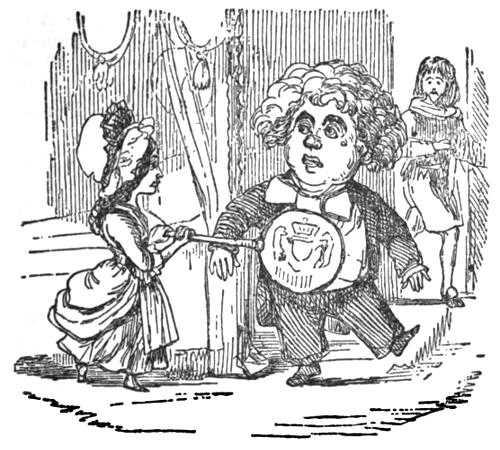
“Go away, your Royal Highness, and go to bed,
please,” said Betsinda, with the warming-pan.
But Bulbo said, “No, never, till thou swearest
to be mine, thou lovely, blushing, chambermaid divine!
Here, at thy feet, the Royal Bulbo lies, the
trembling captive of Betsinda’s eyes.”
And he went on, making himself so absurd and
ridiculous, that Betsinda, who was full of fun, gave
him a touch with the warming-pan, which, I promise
you, made him cry “O-o-o-o!” in a very different
manner.
Prince Bulbo made such a noise that Prince Giglio,
who heard him from the next room, came in to
see what was the matter. As soon as he saw what
was taking place, Giglio, in a fury, rushed on
Bulbo, kicked him in the rudest manner up to the
ceiling, and went on kicking him till his hair was
quite out of curl.
Poor Betsinda did not know whether to laugh or
to cry; and kicking certainly must hurt the Prince,
but then he looked so droll! When Giglio had done
knocking him up and down to the ground, and
whilst he went into a corner rubbing himself, what
do you think Giglio does? He goes down on his
own knees to Betsinda, takes her hand, begs her to
accept his heart, and offers to marry her that
moment.
Fancy Betsinda’s condition, who had been in
love with the Prince ever since she first saw him
in the palace garden, when she was quite a little
child.
“Oh, divine Betsinda!” says the Prince, “how
have I lived fifteen years in thy company without
seeing thy perfections? What woman in all
Europe, Asia, Africa, and America, nay, in Australia,
only it is not yet discovered, can presume to
be thy equal? Angelica? Pish! Gruffanuff? Phoo!
The Queen? Ha, ha! Thou art my Queen. Thou
art the real Angelica, because thou art really angelic.”
“O, Prince! I am but a poor chambermaid,” says
Betsinda, looking, however, very much pleased.
“Didst thou not tend me in my sickness, when all
forsook me?” continues Giglio. “Did not thy gentle
hand smooth my pillow, and bring me jelly and
roast chicken?”
“Yes, dear Prince, I did,” says Betsinda, “and I
sewed your Royal Highness’s shirt-buttons on too,
if you please, your Royal Highness,” cries this artless
maiden.
When poor Prince Bulbo, who was now madly in
love with Betsinda, heard this declaration, when he
saw the unmistakable glances which she flung upon
Giglio, Bulbo began to cry bitterly, and tore quantities
of hair out of his head, till it all covered the
room like so much tow.
Betsinda had left the warming-pan on the floor
while the Princes were going on with their conversation,
and as they began now to quarrel and be
very fierce with one another, she thought proper to
run away.
“You great big blubbering booby, tearing your
hair in the corner there; of course you will give me
satisfaction for insulting Betsinda. You dare to
kneel down at Princess Giglio’s knees and kiss her
hand!”
“She’s not Princess Giglio!” roars out Bulbo.
“She shall be Princess Bulbo, no other shall be
Princess Bulbo.”
“You are engaged to my cousin!” bellows out
Giglio.
“I hate your cousin,” says Bulbo.
“You shall give me satisfaction for insulting
her!” cries Giglio in a fury.
“I’ll have your life.”
“I’ll run you through.”
“I’ll cut your throat.”
“I’ll blow your brains out.”
“I’ll knock your head off.”
“I’ll send a friend to you in the morning.”
“I’ll send a bullet into you in the afternoon.”
“We’ll meet again,” says Giglio, shaking his fist
in Bulbo’s face; and seizing up the warming-pan, he
kissed it, because, forsooth, Betsinda had carried it,
and rushed downstairs. What should he see on the
landing but His Majesty talking to Betsinda, whom
he called by all sorts of fond names. His Majesty
had heard a row in the building, so he stated, and
smelling something burning, had come out to see
what the matter was.
“It’s the young gentlemen smoking, perhaps,
sir,” says Betsinda.
“Charming chambermaid,” says the King (like
all the rest of them), “never mind the young men!
Turn thy eyes on a middle-aged autocrat, who has
been considered not ill-looking in his time.”
“Oh, sir! what will Her Majesty say?” cries Betsinda.
“Her Majesty!” laughs the monarch. “Her
Majesty be hanged. Am I not Autocrat of Paflagonia?
Have I not blocks, ropes, axes, hangmen—ha?
Runs not a river by my palace wall? Have I
not sacks to sew up wives withal? Say but the word,
that thou wilt be mine own—your mistress straightway
in a sack is sewn, and thou the sharer of my
heart and throne.”
When Giglio heard these atrocious sentiments, he
forgot the respect usually paid to Royalty, lifted
up the warming-pan, and knocked down the King
as flat as a pancake; after which, Master Giglio
took to his heels and ran away, and Betsinda went
off screaming, and the Queen, Gruffanuff, and the
Princess, all came out of their rooms. Fancy their
feelings on beholding their husband, father, sovereign,
in this posture!
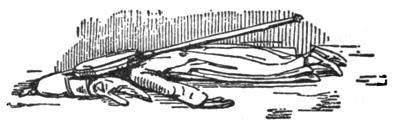
As soon as the coals began to burn him, the King
came to himself and stood up. “Ho! my captain
of the guards!” His Majesty exclaimed, stamping
his royal feet with rage. O piteous spectacle! the
King’s nose was bent quite crooked by the blow of
Prince Giglio! His Majesty ground his teeth with
rage. “Hedzoff,” he said, taking a death-warrant
out of his dressing-gown pocket, “Hedzoff, good
Hedzoff, seize upon the Prince. Thou’lt find him
in his chamber two pair up. But now he dared,
with sacrilegious hand, to strike the sacred night-cap
of a king—Hedzoff, and floor me with a warming-pan!
Away, no more demur, the villain dies!
See it be done, or else—h’m—ha!—h’m! mind thine
own eyes!” and followed by the ladies, and lifting
up the tails of his dressing-gown, the King entered
his own apartment.
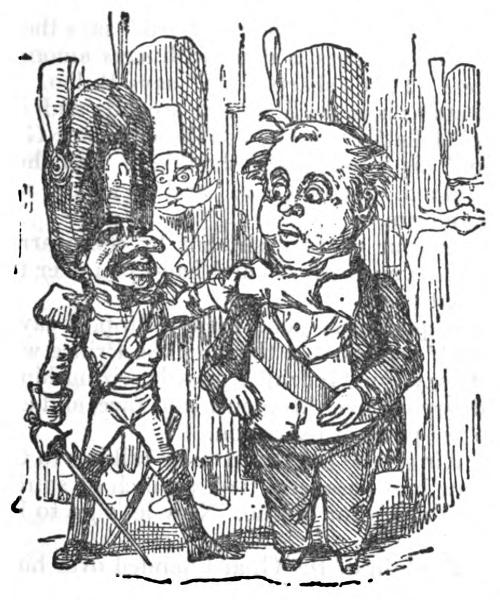
Captain Hedzoff was very much affected, having
a sincere love for Giglio. “Poor, poor Giglio!” he
said, the tears rolling over his manly face, and dripping
down his moustachios; “my noble young
Prince, is it my hand must lead thee to death?”
“Lead him to fiddlestick, Hedzoff,” said a female
voice. It was Gruffanuff, who had come out in her
dressing-gown when she heard the noise. “The
King said you were to hang the Prince. Well, hang
the Prince.”
“I don’t understand you,” says Hedzoff, who
was not a very clever man.
“You Gaby! he didn’t say which Prince,” says
Gruffanuff.
“No; he didn’t say which, certainly,” said Hedzoff.
“Well, then, take Bulbo, and hang him!”
When Captain Hedzoff heard this, he began to
dance about for joy. “Obedience is a soldier’s
honor,” says he. “Prince Bulbo’s head will do
capitally,” and he went to arrest the Prince the very
first thing next morning.
He knocked at the door. “Who’s there?” says
Bulbo. “Captain Hedzoff? Step in, pray, my
good Captain; I’m delighted to see you; I have
been expecting you.”
“Have you?” says Hedzoff.
“Sleibootz, my Chamberlain, will act for me,”
says the Prince.
“I beg your Royal Highness’s pardon, but you
will have to act for yourself, and it’s a pity to wake
Baron Sleibootz.”
The Prince Bulbo still seemed to take the matter
very coolly. “Of course, Captain,” says he, “you
are come about that affair with Prince Giglio?”
“Precisely,” says Hedzoff, “that affair of Prince
Giglio.”
“Is it to be pistols, or swords, Captain?” asks
Bulbo. “I’m a mighty good hand with both, and I’ll
do for Prince Giglio as sure as my name is my
Royal Highness Prince Bulbo.”
“There’s some mistake, my Lord,” says the Captain.
“The business is done with axes among us.”
“Axes? That’s sharp work,” says Bulbo. “Call
my Chamberlain, he’ll he my second, and in ten
minutes, I flatter myself, you’ll see Master Giglio’s
head off his impertinent shoulders. I’m hungry
for his blood. Hoo-oo, aw!” and he looked as savage
as an ogre.
“I beg your pardon, sir, but by this warrant I
am to take you prisoner, and hand you over to—to
the executioner.”
“Pooh, pooh, my good man!—Stop, I say—ho!—hulloa!”
was all that this luckless Prince was enabled
to say, for Hedzoff’s guards seizing him, tied
a handkerchief over his mouth and face, and carried
him to the place of execution.
The King, who happened to be talking to Glumboso,
saw him pass, and took a pinch of snuff and
said, “So much for Giglio. Now let’s go to breakfast.”
The Captain of the Guard handed over his prisoner
to the Sheriff, with the fatal order,
“At sight cut off the bearer’s head.
“Valoroso XXIV.”
“It’s a mistake,” says Bulbo, who did not seem
to understand the business in the least.
“Poo—poo—pooh,” says the Sheriff. “Fetch
Jack Ketch instantly. Jack Ketch!”
And poor Bulbo was led to the scaffold, where
an executioner with a block and a tremendous axe
was always ready in case he should be wanted.
But we must now revert to Giglio and Betsinda.
Gruffanuff, who had seen what had happened
with the King, and knew that Giglio must come to
grief, got up very early the next morning, and went
to devise some plans for rescuing her darling husband,
as the silly old thing insisted on calling him.
She found him walking up and down the garden,
thinking of a rhyme for Betsinda (tinder and winda
were all he could find), and indeed having forgotten
all about the past evening, except that Betsinda
was the most lovely of beings.
“Well, dear Giglio,” says Gruff.
“Well, dear Gruffy,” says Giglio, only he was
quite satirical.
“I have been thinking, darling, what you must
do in this scrape. You must fly the country for a
while.”
“What scrape?—fly the country? Never without
her I love, Countess,” says Giglio.
“No, she will accompany you, dear Prince,” she
says, in her most coaxing accents. “First, we must
get the jewels belonging to our royal parents, and
those of her and his present Majesty. Here is the
key, duck; they are all yours, you know, by right,
for you are the rightful King of Paflagonia, and
your wife will be the rightful Queen.”
“Will she?” says Giglio.
“Yes; and having got the jewels, go to Glumboso’s
apartment, where, under his bed, you will
find sacks containing money to the amount of
£217,000,000,987,439 13s. 6½d., all belonging to
you, for he took it out of your royal father’s room
on the day of his death. With this we will fly.”
“We will fly?” says Giglio.
“Yes, you and your bride—your affianced love—your
Gruffy!” says the Countess, with a languishing
leer.
“You my bride!” says Giglio. “You, you hideous
old woman!”
“Oh, you—you wretch! didn’t you give me this
paper promising marriage?” cries Gruff.
“Get away, you old goose! I love Betsinda, and
Betsinda only!” And in a fit of terror he ran from
her as quickly as he could.
“He! he! he!” shrieks out Gruff; “a promise is a
promise if there are laws in Paflagonia! And as for
that monster, that wretch, that fiend, that ugly little
vixen—as for that upstart, that ingrate, that beast,
Betsinda, Master Giglio will have no little difficulty
in discovering her whereabouts. He may look very
long before finding her, I warrant. He little knows
that Miss Betsinda is—”
Is—what? Now, you shall hear. Poor Betsinda
got up at five in winter’s morning to bring her cruel
mistress her tea; and instead of finding her in a good
humor, found Gruffy as cross as two sticks. The
Countess boxed Betsinda’s ears half a dozen times
whilst she was dressing; but as poor little Betsinda
was used to this kind of treatment, she did not feel
any special alarm. “And now,” says she, “when
Her Majesty rings her bell twice, I’ll trouble you,
miss, to attend.”
So when the Queen’s bell rang twice, Betsinda
came to Her Majesty and made a pretty little curtsey.
The Queen, the Princess, and Gruffanuff were
all three in the room. As soon as they saw her they
began.
“You wretch!” says the Queen.
“You little vulgar thing!” says the Princess.
“You beast!” says Gruffanuff.
“Get out of my sight!” says the Queen.
“Go away with you, do!” says the Princess.
“Quit the premises!” says Gruffanuff.
Alas! and woe is me! very lamentable events had
occurred to Betsinda that morning, and all in consequence
of that fatal warming-pan business of the
previous night. The King had offered to marry
her; of course Her Majesty the Queen was jealous;
Bulbo had fallen in love with her; of course Angelica
was furious: Giglio was in love with her, and
oh, what a fury Gruffy was in!
| “Take off that |
{ |
cap |
} |
I gave you,” they said, all at once, |
| { |
petticoat |
} |
| { |
gown |
} |
and began tearing the clothes off poor Betsinda.
| “How dare you flirt with |
{ |
the King?” |
} |
cried the Queen, the Princess, and Countess. |
| { |
Prince Bulbo?” |
} |
| { |
Prince Giglio?” |
} |
“Give her the rags she wore when she came into
the house and turn her out of it!” cries the Queen.
“Mind she does not go with my shoes on, which
I lent her so kindly,” says the Princess; and indeed
the Princess’s shoes were a great deal too big for
Betsinda.
“Come with me, you filthy hussy!” and taking up
the Queen’s poker, the cruel Gruffanuff drove Betsinda
into her room.
The Countess went to the glass box in which she
had kept Betsinda’s old cloak and shoe this ever so
long, and said, “Take those rags, you little beggar
creature, and strip off everything belonging to honest
people, and go about your business”; and she
actually tore off the poor little delicate thing’s back
almost all her things, and told her to be off out of
the house.
Poor Betsinda huddled the cloak round her back,
on which were embroidered the letters PRIN…
ROSAL… and then came a great rent.
As for the shoe, what was she to do with one poor
little tootsey sandal? the string was still to it, so she
hung it round her neck.
“Won’t you give me a pair of shoes to go out in
the snow, mum, if you please, mum?” cried the poor
child.
“No, you wicked beast!” says Gruffanuff, driving
her along with the poker—driving her down the
cold stairs—driving her through the cold hall—flinging
her out into the cold street, so that the
knocker itself shed tears to see her!
But a kind fairy made the soft snow warm for her
little feet, and she wrapped herself up in the ermine
of her mantle, and was gone!
“And now let us think about breakfast,” says
the greedy Queen.
“What dress shall I put on, mamma? the pink or
the pea-green?” says Angelica. “Which do you
think the dear Prince will like best?”
“Mrs. V.!” sings out the King from his dressing-room,
“let us have sausages for breakfast! Remember
we have Prince Bulbo staying with us!”
And they all went to get ready.
Nine o’clock came, and they were all in the breakfast-room,
and no Prince Bulbo as yet. The urn
was hissing and humming: the muffins were smoking—such
a heap of muffins! the eggs were done,
there was a pot of raspberry jam, and coffee, and
a beautiful chicken and tongue on the side-table.
Marmitonio the cook brought in the sausages. Oh,
how nice they smelt!
“Where is Bulbo?” said the King. “John, where
is His Royal Highness?”
John said he had a took hup His Roilighnessesses
shaving-water, and his clothes and things, and he
wasn’t in his room, which he sposed His Royliness
was just stepped hout.
“Stepped out before breakfast in the snow! Impossible!”
says the King, sticking his fork into a
sausage. “My dear, take one. Angelica, won’t
you have a saveloy?”
The Princess took one, being very fond of
them; and at this moment Glumboso entered
with Captain Hedzoff, both looking very much
disturbed.
“I am afraid your Majesty—” cries Glumboso.
“No business before breakfast, Glum!” says the
King. “Breakfast first, business next. Mrs. V.,
some more sugar!”
“Sire, I am afraid if we wait till after breakfast
it will be too late,” says Glumboso. “He—he—he’ll
be hanged at half-past nine.”
“Don’t talk about hanging and spoil my breakfast,
you unkind vulgar man you,” cries the Princess.
“John, some mustard. Pray who is to be
hanged?”
“Sire, it is the Prince,” whispers Glumboso to
the King.
“Talk about business after breakfast, I tell you!”
says His Majesty, quite sulky.
“We shall have a war, Sire, depend on it,” says
the Minister. “His father, King Padella.…”
“His father, King who?” says the King. “King
Padella is not Giglio’s father. My brother, King
Savio, was Giglio’s father.”
“It’s Prince Bulbo they are hanging, Sire, not
Prince Giglio,” says the Prime Minister.
“You told me to hang the Prince, and I took the
ugly one,” says Hedzoff. “I didn’t, of course, think
Your Majesty intended to murder your own flesh
and blood!”
The King for all reply flung the plate of sausages
at Hedzoff’s head. The Princess cried out
“Hee-karee-karee!” and fell down in a fainting fit.
“Turn the cock of the urn upon Her Royal Highness,”
said the King, and the boiling water gradually
revived her. His Majesty looked at his watch,
compared it by the clock in the parlor, and by that
of the church in the square opposite; then he wound
it up; then he looked at it again. “The great question
is,” says he, “am I fast or am I slow? If I’m
slow, we may as well go on with breakfast. If I’m
fast, why, there is just the possibility of saving
Prince Bulbo. It’s a doosid awkward mistake, and
upon my word, Hedzoff, I have the greatest mind
to have you hanged too.”
“Sire, I did but my duty; a soldier has but his
orders. I didn’t expect after forty-seven years of
faithful service that my sovereign would think of
putting me to a felon’s death!”
“A hundred thousand plagues upon you! Can’t
you see that while you are talking my Bulbo is being
hung?” screamed the Princess.
“By Jove! she’s always right, that girl, and I’m
so absent,” says the King, looking at his watch
again. “Ha! there go the drums! What a doosid
awkward thing though!”
“Oh, papa, you goose! Write the reprieve, and
let me run with it,” cries the Princess—and she got
a sheet of paper, and pen and ink, and laid them
before the King.
“Confound it! where are my spectacles?” the
Monarch exclaimed. “Angelica! go up into my
bedroom, look under my pillow, not your mamma’s;
there you’ll see my keys. Bring them down
to me, and—Well, well! what impetuous things
these girls are!” Angelica was gone, and had run
up panting to the bedroom, and found the keys,
and was back again before the King had finished
a muffin. “Now, love,” says he, “you must go all
the way back for my desk, in which my spectacles
are. If you would but have heard me out.… Be
hanged to her! There she is off again. Angelica!
Angelica!” When His Majesty called in his loud
voice, she knew she must obey, and came back.
“My dear, when you go out of a room, how often
have I told you, shut the door. That’s a darling.
That’s all.” At last the keys and the desk and the
spectacles were got, and the King mended his pen,
and signed his name to a reprieve, and Angelica ran
with it as swift as the wind. “You’d better stay, my
love, and finish the muffins. There’s no use going.
Be sure it’s too late. Hand me over that raspberry
jam, please,” said the Monarch. “Bong! Bawong!
There goes the half-hour. I knew it was.”
Angelica ran, and ran, and ran, and ran. She
ran up Fore Street, and down High Street, and
through the Market-place, and down to the left, and
over the bridge, and up the blind alley, and back
again, and round by the Castle, and so along by
the Haberdasher’s on the right, opposite the lamppost,
and round the square, and she came—she came
to the Execution place, where she saw Bulbo laying
his head on the block!!! The executioner raised
his axe, but at that moment the Princess came
panting up and cried “Reprieve!” “Reprieve!”
screamed the Princess. “Reprieve!” shouted all
the people. Up the scaffold stairs she sprang, with
the agility of a lighter of lamps; and flinging herself
in Bulbo’s arms, regardless of all ceremony,
she cried out, “Oh, my Prince! my lord! my love!
my Bulbo! Thine Angelica has been in time to
save thy precious existence, sweet rosebud; to prevent
thy being nipped in thy young bloom! Had
aught befallen thee, Angelica too had died, and
welcomed death that joined her to her Bulbo.”
“H’m! there’s no accounting for tastes,” said
Bulbo, looking so very much puzzled and uncomfortable
that the Princess, in tones of tenderest
strain, asked the cause of his disquiet.
“I tell you what it is, Angelica,” said he, “since
I came here yesterday, there has been such a row,
and disturbance, and quarrelling, and fighting, and
chopping of heads off, and the deuce to pay, that
I am inclined to go back to Crim Tartary.”
“But with me as thy bride, my Bulbo! Though
wherever thou art is Crim Tartary to me, my bold,
my beautiful, my Bulbo!”
“Well, well, I suppose we must be married,” says
Bulbo. “Doctor, you came to read the Funeral
Service—read the Marriage Service, will you?
What must be, must. That will satisfy Angelica,
and then, in the name of peace and quietness, do let
us go back to breakfast.”
Bulbo had carried a rose in his mouth all the time
of the dismal ceremony. It was a fairy rose, and
he was told by his mother that he ought never to
part with it. So he had kept it between his teeth,
even when he laid his poor head upon the block,
hoping vaguely that some chance would turn up in
his favor. As he began to speak to Angelica, he
forgot about the rose, and of course it dropped
out of his mouth. The romantic Princess instantly
stooped and seized it. “Sweet rose!” she exclaimed,
“that bloomed upon my Bulbo’s lip, never, never
will I part from thee!” and she placed it in her
bosom. And you know Bulbo couldn’t ask her to
give the rose back again. And they went to breakfast;
and as they walked, it appeared to Bulbo
that Angelica became more exquisitely lovely every
moment.
He was frantic until they were married; and
now, strange to say, it was Angelica who didn’t
care about him! He knelt down, he kissed her hand,
he prayed and begged; he cried with admiration;
while she for her part said she really thought they
might wait; it seemed to her he was not handsome
any more—no, not at all, quite the reverse; and not
clever, no, very stupid; and not well bred, like
Giglio; no, on the contrary, dreadfully vul—
What, I cannot say, for King Valoroso roared
out “Pooh, stuff!” in a terrible voice. “We will
have no more of this shilly-shallying! Call the
Archbishop, and let the Prince and Princess be
married offhand!”
So, married they were, and I am sure for my
part I trust they will be happy.
Betsinda wandered on and on, till she passed
through the town gates, and so on the great Crim
Tartary road, the very way on which Giglio too was
going. “Ah!” thought she, as the diligence passed
her, of which the conductor was blowing a delightful
tune on his horn, “how I should like to be on
that coach!” But the coach and the jingling horses
were very soon gone. She little knew who was in
it, though very likely she was thinking of him all
the time. Then came an empty cart, returning
from market; and the driver being a kind man, and
seeing such a very pretty girl trudging along the
road with bare feet, most good-naturedly gave her a
seat. He said he lived on the confines of the forest,
where his old father was a woodman, and, if she
liked, he would take her so far on her road. All
roads were the same to little Betsinda, so she very
thankfully took this one.
And the carter put a cloth round her bare feet,
and gave her some bread and cold bacon, and was
very kind to her. For all that she was very cold
and melancholy. When after travelling on and on,
evening came, and all the black pines were bending
with snow, and there, at last, was the comfortable
light beaming in the woodman’s windows; and so
they arrived, and went into his cottage. He was
an old man, and had a number of children, who were
just at supper, with nice hot bread-and-milk, when
their elder brother arrived with the cart. And they
jumped and clapped their hands; for they were
good children; and he had brought them toys from
the town. And when they saw the pretty stranger,
they ran to her, and brought her to the fire, and
rubbed her poor little feet, and brought her bread-and-milk.
“Look, father!” they said to the old woodman,
“look at this poor girl, and see what pretty cold
feet she has. They are as white as our milk! And
look and see what an odd cloak she has, just like
the bit of velvet that hangs up in our cupboard, and
which you found that day the little cubs were killed
by King Padella, in the forest! And look, why,
bless us all! she has got round her neck just such
another little shoe as that you brought home, and
have shown us so often—a little blue velvet shoe!”
“What,” said the old woodman, “what is all this
about a shoe and a cloak?”
And Betsinda explained that she had been left,
when quite a little child, at the town with this cloak
and this shoe. And the persons who had taken care
of her had—had been angry with her, for no fault,
she hoped, of her own. And they sent her away
with her old clothes—and here, in fact, she was.
She remembered having been in a forest—and perhaps
it was a dream—it was so very odd and strange—having
lived in a cave with lions there; and, before
that, having lived in a very, very fine house,
as fine as the King’s, in the town.
When the woodman heard this, he was so astonished,
it was quite curious to see how astonished
he was. He went to his cupboard,
and took out of a stocking
a five-shilling piece of King
Cavolfiore, and vowed it was
exactly like the young woman.
And then he produced the shoe
and piece of velvet which he
had kept so long, and compared
them with the things which Betsinda
wore. In Betsinda’s little
shoe was written, “Hopkins, maker to the Royal
Family”; so in the other shoe was written, “Hopkins,
maker to the Royal Family.” In the inside
of Betsinda’s piece of cloak was embroidered, “Prin
Rosal”; in the other piece of cloak was embroidered
“cess Ba. No. 246.” So that when put
together you read, “Princess Rosalba. No. 246.”
On seeing this, the dear old woodman fell down
on his knee, saying, “O my Princess, O my gracious
royal lady, O my rightful Queen of Crim Tartary,—I
hail thee—I acknowledge thee—I do thee homage!”
And in token of his fealty, he rubbed his
venerable nose three times on the ground, and put
the Princess’s foot on his head.
“Why,” said she, “my good woodman, you must
be a nobleman of my royal father’s Court!” For
in her lowly retreat, and under the name of Betsinda,
Her Majesty, Rosalba, Queen of Crim Tartary,
had read of the customs of all foreign courts
and nations.
“Marry, indeed, am I, my gracious liege—the
poor Lord Spinachi once—the humble woodman
these fifteen years syne. Ever since the tyrant Padella
(may ruin overtake the treacherous knave!)
dismissed me from my post of First Lord.”
“First Lord of the Toothpick and Joint Keeper
of the Snuffbox? I mind me! Thou heldest these
posts under our royal Sire. They are restored to
thee, Lord Spinachi! I make thee knight of the
second class of our Order of the Pumpkin (the first
class being reserved for crowned heads alone).
Rise, Marquis of Spinachi!” And with indescribable
majesty, the Queen, who had no sword handy,
waved the pewter spoon with which she had been
taking her bread-and-milk, over the bald head of
the old nobleman, whose tears absolutely made a
puddle on the ground, and whose dear children
went to bed that night Lords and Ladies Bartolomeo,
Ubaldo, Catarina, and Ottavia degli
Spinachi!
The acquaintance Her Majesty showed with the
history, and noble families of her empire, was wonderful.
“The House of Broccoli should remain
faithful to us,” she said; “they were ever welcome
at our Court. Have the Articiocchi, as was their
wont, turned to the Rising Sun? The family of
Sauerkraut must sure be with us—they were ever
welcome in the halls of King Cavolfiore.” And
so she went on enumerating quite a list of the
nobility and gentry of Crim Tartary, so admirably
had Her Majesty profited by her studies while in
exile.
The old Marquis of Spinachi said he could
answer for them all; that the whole country groaned
under Padella’s tyranny, and longed to return to
its rightful sovereign; and late as it was, he sent his
children, who knew the forest well, to summon this
nobleman and that; and when his eldest son, who
had been rubbing the horse down and giving him
his supper, came into the house for his own, the
Marquis told him to put his boots on, and a saddle
on the mare, and ride hither and thither to such
and such people.
When the young man heard who his companion
in the cart had been, he too knelt down and put her
royal foot on his head; he too bedewed the ground
with his tears; he was frantically in love with her,
as everybody now was who saw her; so were the
young Lords Bartolomeo and Ubaldo, who punched
each other’s little heads out of jealousy; and so,
when they came from east and west at the summons
of the Marquis degli Spinachi, were the Crim Tartar
Lords who still remained faithful to the House
of Cavolfiore. They were such very old gentlemen
for the most part that Her Majesty never suspected
their absurd passion, and went among them
quite unaware of the havoc her beauty was causing,
until an old blind Lord who had joined her party
told her what the truth was; after which, for fear
of making the people too much in love with her, she
always wore a veil. She went about privately,
from one nobleman’s castle to another; and they
visited among themselves again, and had meetings,
and composed proclamations and counter-proclamations,
and distributed all the best places of the
kingdom amongst one another, and selected who of
the opposition party should be executed when the
Queen came to her own. And so in about a year
they were ready to move.
The party of Fidelity was in truth composed of
very feeble old fogies for the most part; they went
about the country waving their old swords and
flags, and calling “God save the Queen!” and King
Padella happening to be absent upon an invasion,
they had their own way for a little, and to be sure
the people were very enthusiastic whenever they
saw the Queen; otherwise the vulgar took matters
very quietly, for they said, as far as they could
recollect, they were pretty well as much taxed in
Cavolfiore’s time, as now in Padella’s.
Her Majesty, having indeed nothing else to
give, made all her followers Knights of the Pumpkin,
and Marquises, Earls, and Baronets; and they
had a little court for her, and made her a little
crown of gilt paper, and a robe of cotton velvet;
and they quarrelled about the places to be given
away in her court, and about rank and precedence
and dignities—you can’t think how they quarrelled!
The poor Queen was very tired of her
honors before she had had them a month, and I
dare say sighed sometimes even to be a lady’s-maid
again. But we must all do our duty in our respective
stations, so the Queen resigned herself to
perform hers.
We have said how it happened that none of the
Usurper’s troops came out to oppose this Army
of Fidelity; it pottered along as nimbly as the
gout of the principal commanders allowed: it consisted
of twice as many officers as soldiers: and at
length passed near the estates of one of the most
powerful noblemen of the country, who had not
declared for the Queen, but of whom her party had
hopes, as he was always quarrelling with King
Padella.
When they came close to his park gates, this
nobleman sent to say he would wait upon Her
Majesty: he was a most powerful warrior, and his
name was Count Hogginarmo, whose helmet it
took two strong negroes to carry. He knelt down
before her and said, “Madam and liege lady! it
becomes the great nobles of the Crimean realm to
show every outward sign of respect to the wearer
of the Crown, whoever that may be. We testify
to our own nobility in acknowledging yours. The
bold Hogginarmo bends the knee to the first of the
aristocracy of his country.”
Rosalba said, “The bold Count of Hogginarmo
was uncommonly kind.” But she felt afraid of
him, even while he was kneeling, and his eyes
scowled at her from between his whiskers, which
grew up to them.
“The first Count of the Empire, madam,” he
went on, “salutes the Sovereign. The Prince addresses
himself to the not more noble lady! Madam,
my hand is free, and I offer it, and my heart and
my sword to your service! My three wives lie
buried in my ancestral vaults. The third perished
but a year since; and this heart pines for a consort!
Deign to be mine, and I swear to bring to your
bridal table the head of King Padella, the eyes
and nose of his son Prince Bulbo, the right hand
and ears of the usurping Sovereign of Paflagonia,
which country shall thenceforth be an appanage to
your—to our Crown! Say yes; Hogginarmo is not
accustomed to be denied. Indeed I cannot contemplate
the possibility of a refusal: for frightful
will be the result; dreadful the murders; furious
the devastations; horrible the tyranny; tremendous
the tortures, misery, taxation, which the people
of this realm will endure, if Hogginarmo’s wrath
be aroused! I see consent in your Majesty’s
lovely eyes—their glances fill my soul with
rapture!”
“Oh, sir!” Rosalba said, withdrawing her hand
in great fright. “Your Lordship is exceedingly
kind; but I am sorry to tell you that I have a prior
attachment to a young gentleman by the name of—Prince—Giglio—and
never—never can marry
any one but him.”
Who can describe Hogginarmo’s wrath at this
remark? Rising up from the ground, he ground
his teeth so that fire flashed out of his mouth, from
which at the same time issued remarks and language,
so loud, violent, and improper, that this pen
shall never repeat them! “R-r-r-r-r-r—Rejected!
Fiends and perdition! The bold Hogginarmo rejected!
All the world shall hear of my rage; and
you, madam, you above all shall rue it!” And kicking
the two negroes before him, he rushed away,
his whiskers streaming in the wind.
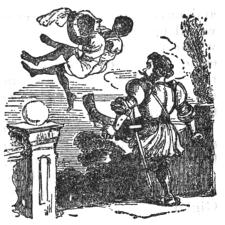
Her Majesty’s Privy Council was in a dreadful
panic when they saw Hogginarmo issue from the
royal presence in such a towering rage, making
footballs of the poor negroes—a panic which the
events justified. They marched off from Hogginarmo’s
park very crestfallen; and in another half-hour
they were met by that rapacious chieftain
with a few of his followers, who cut, slashed,
charged, whacked, banged, and pommelled amongst
them, took the Queen prisoner, and drove the
Army of Fidelity to I don’t know where.
Poor Queen! Hogginarmo, her conqueror, would
not condescend to see her. “Get a horse-van!” he
said to his grooms, “clap the hussy into it, and send
her, with my compliments, to His Majesty King
Padella.”
Along with his lovely prisoner, Hogginarmo
sent a letter full of servile compliments and loathsome
flatteries to King Padella, for whose life, and
that of his royal family, the hypocritical humbug
pretended to offer the most fulsome prayers. And
Hogginarmo
promised speedily
to pay his humble
homage at his august
master’s
throne, of which
he begged leave to
be counted the
most loyal and
constant defender.
Such a wary old
bird as King Padella
was not to
be caught by Master
Hogginarmo’s
chaff, and we shall hear presently how the tyrant
treated his upstart vassal. No, no; depend on’t,
two such rogues do not trust one another.
So this poor Queen was laid in the straw like
Margery Daw, and driven along in the dark ever
so many miles to the Court, where King Padella
had now arrived, having vanquished all his enemies,
murdered most of them, and brought some of the
richest into captivity with him for the purpose of
torturing them and finding out where they had hidden
their money.
Rosalba heard their shrieks and groans in the
dungeon in which she was thrust; a most awful
black hole, full of bats, rats, mice, toads, frogs, mosquitoes,
bugs, fleas, serpents, and every kind of
horror. No light was let into it, otherwise the gaolers
might have seen her and fallen in love with
her, as an owl that lived up in the roof of the tower
did, and a cat, you know, who can see in the dark,
and having set its green eyes on Rosalba, never
would be got to go back to the turnkey’s wife to
whom it belonged. And the toads in the dungeon
came and kissed her feet, and the vipers wound
round her neck and arms, and never hurt her, so
charming was this poor Princess in the midst of her
misfortunes.
At last, after she had been kept in this place ever
so long, the door of the dungeon opened, and the
terrible King Padella came in.
But what he said and did must be reserved for
another chapter, as we must now go back to Prince
Giglio.
The idea of marrying such an old creature as
Gruffanuff frightened Prince Giglio so, that he
ran up to his room, packed his trunks, fetched in a
couple of porters, and was off to the diligence
office in a twinkling.
It was well that he was so quick in his operations,
did not dawdle over his luggage, and took the early
coach, for as soon as the mistake about Prince Bulbo
was found out, that cruel Glumboso sent up a
couple of policemen to Prince Giglio’s room, with
orders that he should be carried to Newgate, and
his head taken off before twelve o’clock. But the
coach was out of the Paflagonian dominions before
two o’clock; and I dare say the express that was
sent after Prince Giglio did not ride very quick,
for many people in Paflagonia had a regard for
Giglio, as the son of their old sovereign; a Prince
who, with all his weaknesses, was very much better
than his brother, the usurping, lazy, careless, passionate,
tyrannical, reigning monarch. That Prince
busied himself with the balls, fêtes, masquerades,
hunting-parties, and so forth, which he thought
proper to give on the occasion of his daughter’s
marriage to Prince Bulbo; and let us trust was
not sorry in his own heart that his brother’s son
had escaped the scaffold.
It was very cold weather, and the snow was on
the ground, and Giglio, who gave his name as simple
Mr. Giles, was very glad to get a comfortable
place in the coupé of the diligence, where he sat
with the conductor and another gentleman. At
the first stage from Blombodinga, as they stopped
to change horses, there came up to the diligence a
very ordinary, vulgar-looking woman, with a bag
under her arm, who asked for a place. All the inside
places were taken, and the young woman was
informed that if she wished to travel, she must go
upon the roof; and the passenger inside with Giglio
(a rude person, I should think), put his head out
of the window, and said, “Nice weather for travelling
outside! I wish you a pleasant journey, my
dear.” The poor woman coughed very much, and
Giglio pitied her. “I will give up my place to her,”
says he, “rather than she should travel in the cold
air with that horrid cough.” On which the vulgar
traveller said, “You’d keep her warm, I am sure, if
it’s a muff she wants.” On which Giglio pulled his
nose, boxed his ears, hit him in the eye, and gave
this vulgar person a warning never to call him
muff again.
Then he sprang up gaily on to the roof of the
diligence, and made himself very comfortable in
the straw. The vulgar traveller got down only at
the next station, and Giglio took his place again,
and talked to the person next to him. She appeared
to be a most agreeable, well-informed, and entertaining
female. They travelled together till night,
and she gave Giglio all sorts of things out of the
bag which she carried, and which indeed seemed
to contain the most wonderful collection of articles.
He was thirsty—out there came a pint bottle of
Bass’s pale ale, and a silver mug! Hungry—she
took out a cold fowl, some slices of ham, bread, salt,
and a most delicious piece of cold plum-pudding,
and a little glass of brandy afterwards.
As they travelled, this plain-looking, queer
woman talked to Giglio on a variety of subjects,
in which the poor Prince showed his ignorance as
much as she did her capacity. He owned, with
many blushes, how ignorant he was; on which the
lady said, “My dear Gigl—my good Mr. Giles,
you are a young man, and have plenty of time before
you. You have nothing to do but to improve
yourself. Who knows but that you may find use
for your knowledge some day? When—when you
may be wanted at home, as some people may be.”
“Good heavens, madam!” says he, “do you know
me?”
“I know a number of funny things,” says the
lady, “I have been at some people’s christenings,
and turned away from other folks’ doors. I have
seen some people spoilt by good fortune, and others,
as I hope, improved by hardship. I advise you to
stay at the town where the coach stops for the night.
Stay there and study, and remember your old
friend to whom you were kind.”
“And who is my old friend?” asked Giglio.
“When you want anything,” says the lady, “look
in this bag, which I leave to you as a present, and
be grateful to—”
“To whom, madam?” says he.
“To the Fairy Blackstick,” says the lady, flying
out of the window. And when Giglio asked the
conductor if he knew where the lady was?
“What lady?” says the man; “there has been no
lady in this coach, except the old woman, who got
out at the last stage.” And Giglio thought he had
been dreaming. But there was the bag which
Blackstick had given him lying on his lap; and
when he came to the town he took it in his hand and
went into the inn.
They gave him a very bad bedroom, and Giglio,
when he woke in the morning, fancying himself in
the Royal Palace at home, called, “John, Charles,
Thomas! My chocolate—my dressing-gown—my
slippers”; but nobody came. There was no bell,
so he went and bawled out for waiter on the top
of the stairs.
The landlady came up, looking—looking like
this—
“What are you a hollaring and a bellaring for
here, young man?” says she.
“There’s no warm water—no servants; my boots
are not even cleaned.”
“He, he! Clean ’em yourself,” says the landlady.
“You young students give yourselves pretty airs.
I never heard such impudence.”
“I’ll quit the house this instant,” says Giglio.
“The sooner the better, young man. Pay your
bill and be off. All my rooms is wanted for gentlefolks,
and not for such as you.”
“You may well keep the Bear Inn,” said Giglio.
“You should have yourself painted as the sign.”
The landlady of the Bear went away growling.
And Giglio returned to his room, where the first
thing he saw was the fairy bag lying on the table,
which seemed to give a little hop as he came in.
“I hope it has some breakfast in it,” says Giglio,
“for I have only a very little money left.” But on
opening the bag, what do you think was there? A
blacking-brush and a pot of Warren’s jet, and on
the pot was written—
Poor young men their boots must black:
Use me and cork me and put me back.
So Giglio laughed and blacked his boots, and put
back the brush and the bottle into the bag.
When he had done dressing himself, the bag gave
another little hop, and he went to it and took out—
1. A tablecloth and a napkin.
2. A sugar-basin full of the best loaf-sugar.
4, 6, 8, 10. Two forks, two teaspoons, two knives,
and a pair of sugar-tongs, and a butter-knife, all
marked G.
11, 12, 13. A teacup, saucer, and slop-basin.
14. A jug full of delicious cream.
15. A canister with black tea and green.
16. A large tea-urn and boiling water.
17. A saucepan, containing three eggs nicely
done.
18. A quarter of a pound of best Epping butter.
19. A brown loaf.
And if he hadn’t enough now for a good breakfast,
I should like to know who ever had one?
Giglio, having had his breakfast, popped all the
things back into the bag, and went out looking for
lodgings. I forgot to say that this celebrated university
town was called Bosforo.
He took a modest lodging opposite the Schools,
paid his bill at the inn, and went to his apartment
with his trunk, carpet-bag, and not forgetting, we
may be sure, his other bag.
When he opened his trunk, which the day before
he had filled with his best clothes, he found it
contained only books. And in the first of them
which he opened there was written—
Clothes for the back, books for the head:
Read and remember them when they are read.
And in his bag, when Giglio looked in it, he found
a student’s cap and gown, a writing-book full of
paper, an inkstand, pens, and a Johnson’s dictionary,
which was very useful to him, as his spelling
had been sadly neglected.
So he sat down and worked away, very, very
hard for a whole year, during which “Mr. Giles”
was quite an example to all the students in the
University of Bosforo. He never got into any riots
or disturbances. The Professors all spoke well of
him, and the students liked him too; so that, when
at examination, he took all the prizes, viz.—
- The Spelling Prize
- The Writing Prize
- The History Prize
- The Catechism Prize
- The French Prize
- The Arithmetic Prize
- The Latin Prize
- The Good Conduct Prize,
all his fellow-students said, “Hurray! Hurray for
Giles! Giles is the boy—the student’s joy! Hurray
for Giles!” And he brought quite a quantity of
medals, crowns, books, and tokens of distinction
home to his lodgings.
One day after the Examinations, as he was diverting
himself at a coffee-house with two friends—(Did
I tell you that in his bag, every Saturday
night, he found just enough to pay his bills, with a
guinea over, for pocket-money? Didn’t I tell you?
Well, he did, as sure as twice twenty makes forty-five)—he
chanced to look in the Bosforo Chronicle,
and read off, quite easily (for he could spell, read,
and write the longest words now), the following;—
“Romantic Circumstance.—One of the most
extraordinary adventures that we have ever heard
has set the neighboring country of Crim Tartary
in a state of great excitement.
“It will be remembered that when the present
revered sovereign of Crim Tartary, His Majesty
King Padella, took possession of the throne, after
having vanquished, in the terrific battle of Blunderbusco,
the late King Cavolfiore, that Prince’s only
child, the Princess Rosalba, was not found in the
royal palace, of which King Padella took possession,
and, it was said, had strayed into the forest
(being abandoned by all her attendants), where
she had been eaten up by those ferocious lions, the
last pair of which were captured some time since,
and brought to the Tower, after killing several
hundred persons.
“His Majesty King Padella, who has the kindest
heart in the world, was grieved at the accident which
had occurred to the harmless little Princess, for
whom His Majesty’s known benevolence would
certainly have provided a fitting establishment.
But her death seemed to be certain. The mangled
remains of a cloak, and a little shoe, were found in
the forest, during a hunting-party, in which the
intrepid sovereign of Crim Tartary slew two of
the lion’s cubs with his own spear. And these interesting
relics of an innocent little creature were
carried home and kept by their finder, the Baron
Spinachi, formerly an officer in Cavolfiore’s household.
The Baron was disgraced in consequence of
his known legitimist opinions, and has lived for
some time in the humble capacity of a woodcutter,
in a forest on the outskirts of the Kingdom of Crim
Tartary.
“Last Tuesday week Baron Spinachi and a number
of gentlemen, attached to the former dynasty,
appeared in arms, crying, ‘God save Rosalba, the
first Queen of Crim Tartary!’ and surrounding a
lady whom report describes as ‘beautiful exceedingly.’
Her history may be authentic, is certainly
most romantic.
“The personage calling herself Rosalba states
that she was brought out of the forest, fifteen years
since, by a lady in a car drawn by dragons (this
account is certainly improbable), that she was left
in the Palace Garden of Blombodinga, where Her
Royal Highness the Princess Angelica, now married
to His Royal Highness Bulbo, Crown Prince
of Crim Tartary, found the child, and, with that
elegant benevolence which has always distinguished
the heiress of the throne of Paflagonia, gave the
little outcast a shelter and a home! Her parentage
not being known, and her garb very humble, the
foundling was educated in the Palace in a menial
capacity, under the name of Betsinda.
“She did not give satisfaction, and was dismissed
carrying with her, certainly, part of a mantle and a
shoe, which she had on when first found. According
to her statement she quitted Blombodinga about
a year ago, since which time she has been with the
Spinachi family. On the very same morning the
Prince Giglio, nephew to the King of Paflagonia,
a young Prince whose character for talent and
order were, to say truth, none of the highest, also
quitted Blombodinga, and has not been since heard
of!”
“What an extraordinary story!” said Smith and
Jones, two young students, Giglio’s especial
friends.
“Ha! what is this?” Giglio went on, reading—
“Second Edition, Express.—We hear that the
troop under Baron Spinachi has been surrounded,
and utterly routed, by General Hogginarmo, and
the soi-disant Princess is sent a prisoner to the
capital.
“University News.—Yesterday, at the Schools,
the distinguished young student, Mr. Giles, read
a Latin oration, and was complimented by the
Chancellor of Bosforo, Dr. Prugnaro, with the
highest University honor—the wooden spoon.”
“Never mind that stuff,” says Giles, greatly disturbed.
“Come home with me, my friends. Gallant
Smith! intrepid Jones! friends of my studies—partakers
of my academic toils—I have that to
tell shall astonish your honest minds.”
“Go it, old boy!” cried the impetuous Smith.
“Talk away, my buck!” says Jones, a lively
fellow.
With an air of indescribable dignity, Giglio
checked their natural, but no more seemly, familiarity.
“Jones, Smith, my good friends,” said the
Prince, “disguise is henceforth useless; I am no
more the humble student Giles, I am the descendant
of a royal line.”
“Atavis edite regibus, I know, old co—,” cried
Jones. He was going to say old cock, but a flash
from THE ROYAL EYE again awed him.
“Friends,” continued the Prince, “I am that
Giglio, I am, in fact, Paflagonia. Rise, Smith,
and kneel not in the public street. Jones, thou
true heart! My faithless uncle, when I was a baby
filched from me that brave crown my father left
me, bred me, all young and careless of my rights,
like unto hapless Hamlet, Prince of Denmark;
and had I any thoughts about my wrongs, soothed
me with promises of near redress. I should espouse
his daughter, young Angelica; we two indeed
should reign in Paflagonia. His words were false—false
as Angelica’s heart!—false as Angelica’s
hair, color, front teeth! She looked with her skew
eyes upon young Bulbo, Crim Tartary’s stupid
heir, and she preferred him. ’Twas then I turned
my eyes upon Betsinda—Rosalba, as she now is.
And I saw in her the blushing sum of all perfection;
the pink of maiden modesty; the nymph
that my fond heart had ever woo’d in dreams,”
etc., etc.
(I don’t give this speech, which was very fine,
but very long; and though Smith and Jones knew
nothing about the circumstances, my dear reader
does, so I go on.)
The Prince and his young friends hastened home
to his apartment, highly excited by the intelligence,
as no doubt by the royal narrator’s admirable
manner of recounting it, and they ran up to
his room where he had worked so hard at his
books.
On his writing-table was his bag, grown so long
that the Prince could not help remarking it. He
went to it, opened it, and what do you think he
found in it?
A splendid long, gold-handled, red-velvet-scabbarded,
cut-and-thrust sword, and on the sheath
was embroidered “Rosalba for Ever!”
He drew out the sword, which flashed and illuminated
the whole room, and called out “Rosalba
for ever!” Smith and Jones following him, but
quite respectfully this time, and taking the time
from His Royal Highness.
And now his trunk opened with a sudden pong,
and out there came three ostrich feathers in a gold
crown, surrounding a beautiful shining steel helmet,
a cuirass, a pair of spurs, finally a complete
suit of armor.
The books on Giglio’s shelves were all gone.
Where there had been some great dictionaries,
Giglio’s friends found two pairs of jack-boots
labelled, “Lieutenant Smith,” “—Jones, Esq.,”
which fitted them to a nicety. Besides, there were
helmets, back and breast plates, swords, etc., just
like in Mr. G. P. R. James’s novels; and that
evening three cavaliers might have been seen issuing
from the gates of Bosforo, in whom the porters,
proctors, etc., never thought of recognizing the
young Prince and his friends.
They got horses at a livery stable-keeper’s, and
never drew bridle until they reached the last town
on the frontier before you come to Crim Tartary.
Here, as their animals were tired, and the cavaliers
hungry, they stopped and refreshed at an hostel.
I could make a chapter of this if I were like some
writers, but I like to cram my measure tight down,
you see, and give you a great deal for your money,
and, in a word, they had some bread and cheese and
ale upstairs on the balcony of the inn. As they
were drinking, drums and trumpets sounded nearer
and nearer, the market-place was filled with
soldiers, and His Royal Highness looking forth,
recognized the Paflagonian banners, and the Paflagonian
national air which the bands were playing.
The troops all made for the tavern at once, and
as they came up Giglio exclaimed, on beholding
their leader, “Whom do I see? Yes! No! It is,
it is! Phoo! No, it can’t be! Yes! It is my friend,
my gallant faithful veteran, Captain Hedzoff! Ho!
Hedzoff! Knowest thou not thy Prince, thy
Giglio? Good Corporal, methinks we once were
friends. Ha, Sergeant, an my memory serves me
right, we have had many a bout at singlestick.”
“I’ faith, we have a many, good my Lord,” says
the Sergeant.
“Tell me, what means this mighty armament,”
continued His Royal Highness from the balcony,
“and whither march my Paflagonians?”
Hedzoff’s head fell. “My Lord,” he said, “we
march as the allies of great Padella, Crim Tartary’s
monarch.”
“Crim Tartary’s usurper, gallant Hedzoff?
Crim Tartary’s grim tyrant, honest Hedzoff!” said
the Prince, on the balcony, quite sarcastically.
“A soldier, Prince, must needs obey his orders:
mine are to help His Majesty Padella. And also
(though alack that I should say it!) to seize
wherever I should light upon him—”
“First catch your hare! ha, Hedzoff!” exclaimed
His Royal Highness.
“—On the body of Giglio, whilome Prince of
Paflagonia,” Hedzoff went on, with indescribable
emotion. “My Prince, give up your sword without
ado. Look! we are thirty thousand men to one!”
“Give up my sword! Giglio give up his sword!”
cried the Prince; and stepping well forward on to
the balcony, the royal youth, without preparation,
delivered a speech so magnificent that no report
can do justice to it. It was all in blank verse (in
which, from this time, he invariably spoke, as more
becoming his majestic station). It lasted for three
days and three nights, during which not a single
person who heard him was tired, or remarked the
difference between daylight and dark. The soldiers
only cheering tremendously, when occasionally,
once in nine hours, the Prince paused to suck an
orange, which Jones took out of the bag. He explained,
in terms which we say we shall not attempt
to convey, the whole history of the previous transaction,
and his determination not only not to give up
his sword, but to assume his rightful crown; and at
the end of this extraordinary, this truly gigantic effort,
Captain Hedzoff flung up his helmet, and
cried, “Hurray! Hurray! Long live King Giglio!”
Such were the consequences of having employed
his time well at College.
When the excitement had ceased, beer was ordered
out for the army, and their Sovereign himself
did not disdain a little! And now it was with some
alarm that Captain Hedzoff told him his division
was only the advanced guard of the Paflagonian
contingent, hastening to King Padella’s aid; the
main force being a day’s march in the rear under
His Royal Highness Prince Bulbo.
“We will wait here, good friend, to beat the
Prince,” His Majesty said, “and then will make
his royal father wince.”
King Padella made very similar proposals to
Rosalba to those which she had received from the
various princes who, as we have seen, had fallen in
love with her. His Majesty was a widower, and
offered to marry his fair captive that instant, but
she declined his invitation in her usual polite gentle
manner, stating that Prince Giglio was her love,
and that any other union was out of the question.
Having tried tears and supplications in vain, this
violent-tempered monarch menaced her with threats
and tortures; but she declared she would rather suffer
all these than accept the hand of her father’s
murderer, who left her finally, uttering the most
awful imprecations, and bidding her prepare for
death on the following morning.
All night long the King spent in advising how
he should get rid of this obdurate young creature.
Cutting off her head was much too easy a death
for her; hanging was so common in His Majesty’s
dominions that it no longer afforded him any sport;
finally, he bethought himself of a pair of fierce lions
which had lately been sent to him as presents, and
he determined, with these ferocious brutes, to hunt
poor Rosalba down. Adjoining his castle was an
amphitheatre where the Prince indulged in bull-baiting,
rat-hunting, and other ferocious sports.
The two lions were kept in a cage under this place;
their roaring might be heard over the whole city,
the inhabitants of which, I am sorry to say, thronged
in numbers to see a poor young lady gobbled up by
two wild beasts.
The King took his place in the royal box, having
the officers of his Court around and the Count
Hogginarmo by his side, upon whom His Majesty
was observed to look very fiercely; the fact is, royal
spies had told the monarch of Hogginarmo’s behavior,
his proposals to Rosalba, and his offer to
fight for the crown. Black as thunder looked King
Padella at this proud noble, as they sat in the front
seats of the theatre waiting to see the tragedy
whereof poor Rosalba was to be the heroine.
At length that Princess was brought out in her
nightgown, with all her beautiful hair falling down
her back, and looking so pretty that even the beef-eaters
and keepers of the wild animals wept plentifully
at seeing her. And she walked with her poor
little feet (only luckily the arena was covered with
sawdust), and went and leaned up against a great
stone in the center of the amphitheatre, round
which the Court and the people were seated in
boxes, with bars before
them, for fear of the great,
fierce, red-maned, black-throated,
long-tailed, roaring,
bellowing, rushing
lions. And now the gates
were opened, and with a
wurrawarrurawarar two
great lean, hungry, roaring
lions rushed out of
their den, where they had
been kept for three weeks
on nothing but a little
toast-and-water and dashed
straight up to the stone
where poor Rosalba was
waiting. Commend her to
your patron saints, all you kind people, for she is
in a dreadful state!
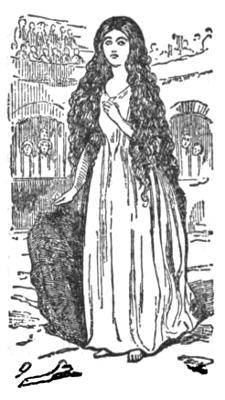
There was a hum and a buzz all through the circus,
and the fierce King Padella even felt a little
compassion. But Count Hogginarmo, seated by
His Majesty, roared out “Hurray! Now for it!
Soo-soo-soo!” that nobleman being uncommonly
angry still at Rosalba’s refusal of him.
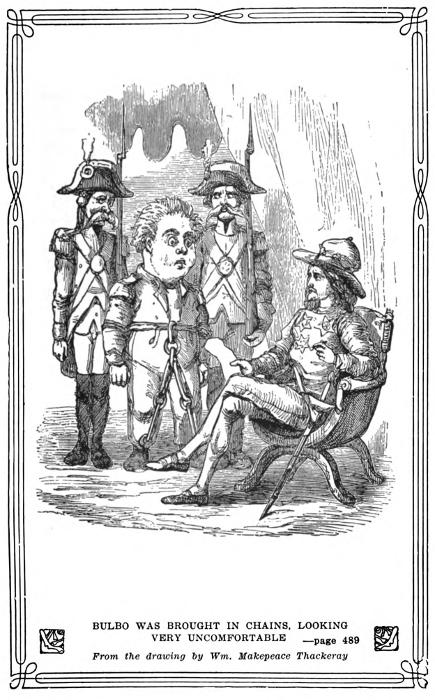
BULBO WAS BROUGHT IN CHAINS, LOOKING
VERY UNCOMFORTABLE
—page 489
From the drawing by Wm. Makepeace Thackeray
But O strange event! O remarkable circumstance!
O extraordinary coincidence, which I am
sure none of you could by any possibility have
divined! When the lions came to Rosalba, instead
of devouring her with their great teeth, it was with
kisses they gobbled her up! They licked her pretty
feet, they nuzzled their noses in her lap, they moo’d,
they seemed to say, “Dear, dear sister, don’t you
recollect your brothers in the forest?” And she
put her pretty white arms round their tawny necks,
and kissed them.
King Padella was immensely astonished. The
Count Hogginarmo was extremely disgusted.
“Pooh!” the Count cried. “Gammon!” exclaimed
his Lordship. “These lions are tame beasts come
from Wombwell’s or Astley’s. It is a shame to
put people off in this way. I believe they are little
boys dressed up in doormats. They are no lions
at all.”
“Ha!” said the King, “you dare to say ‘gammon’
to your Sovereign, do you? These lions are no
lions at all, aren’t they? Ho! my beef-eaters! Ho!
my bodyguard! Take this Count Hogginarmo
and fling him into the circus! Give him a sword
and buckler, let him keep his armor on, and his
weather-eye out and fight these lions.”
The haughty Hogginarmo laid down his opera-glass,
and looked scowling round at the King and
his attendants. “Touch me not, dogs!” he said,
“or by St. Nicholas the Elder, I will gore you!
Your Majesty thinks Hogginarmo is afraid? No,
not of a hundred thousand lions! Follow me
down into the circus, King Padella, and match thyself
against one of yon brutes. Thou darest not.
Let them both come on, then!” And opening a
grating of the box, he jumped lightly down into
the circus.
Wurra wurra wurra wur-aw-aw-aw!!!
In about two minutes
The Count Hogginarmo was
GOBBLED UP
by
those lions,
bones, boots, and all,
and
There was an
End of him
At this, the King said, “Serve him right, the rebellious
ruffian! And now, as those lions won’t eat
that young woman—”
“Let her off!—let her off!” cried the crowd.
“NO!” roared the King. “Let the beef-eaters go
down and chop her into small pieces. If the lions
defend her, let the archers shoot them to death.
That hussy shall die in tortures!”
“A-a-ah!” cried the crowd. “Shame! shame!”
“Who dares cry out shame?” cried the furious
potentate (so little can tyrants command their
passions). “Fling any scoundrel who says a word
down among the lions!”
I warrant you there was a dead silence then,
which was broken by a Pang arang pang pangkarangpang,
and a Knight and a Herald rode in
at the further end of the circus: the Knight, in full
armor, with his vizor up, and bearing a letter on
the point of his lance.
“Ha!” exclaimed the King, “by my fay, ’tis
Elephant and Castle, pursuivant of my brother of
Paflagonia; and the Knight, an my memory serves
me, is the gallant Captain Hedzoff! What news
from Paflagonia, gallant Hedzoff? Elephant and
Castle, beshrew me, thy trumpeting must have made
thee thirsty. What will my trusty herald like to
drink?”
“Bespeaking first safe conduct from your Lordship,”
said Captain Hedzoff, “before we take a
drink of anything, permit us to deliver our King’s
message.”
“My Lordship, ha!” said Crim Tartary, frowning
terrifically. “That title soundeth strange in
the anointed ears of a crowned King. Straightway
speak out your message, Knight and Herald!”
Reining up his charger in a most elegant manner
close under the King’s balcony, Hedzoff turned
to the Herald, and bade him begin.
Elephant and Castle, dropping his trumpet over
his shoulder, took a large sheet of paper out of his
hat, and began to read:
“O Yes! O Yes! O Yes! Know all men by
these presents, that we, Giglio, King of Paflagonia,
Grand Duke of Cappadocia, Sovereign Prince of
Turkey and the Sausage Islands, having assumed
our rightful throne and title, long time falsely
borne by our usurping Uncle, styling himself King
of Paflagonia—”
“Ha!” growled Padella.
“Hereby summon the false traitor, Padella, calling
himself King of Crim Tartary—”
The King’s curses were dreadful. “Go on, Elephant
and Castle!” said the intrepid Hedzoff.
“—To release from cowardly imprisonment his
liege lady and rightful Sovereign, Rosalba, Queen
of Crim Tartary, and restore her to her royal
throne: in default of which I, Giglio, proclaim the
said Padella sneak, traitor, humbug, usurper, and
coward. I challenge him to meet me, with fists or
with pistols, with battle-axe or sword, with blunderbuss
or singlestick, alone or at the head of his army,
on foot or on horseback; and will prove my words
upon his wicked ugly body!”
“God save the King!” said Captain Hedzoff,
executing a demivolte, two semilunes, and three
caracols.
“Is that all?” said Padella, with the terrific calm
of concentrated fury.
“That, sir, is all my royal master’s message.
Here is His Majesty’s letter in autograph, and
here is his glove, and if any gentleman of Crim
Tartary chooses to find fault with His Majesty’s
expressions, I, Tuffskin Hedzoff, Captain of the
Guard, am very much at his service,” and he waved
his lance, and looked at the assembly all round.
“And what says my good brother of Paflagonia,
my dear son’s father-in-law, to this rubbish?” asked
the King.
“The King’s uncle hath been deprived of the
crown he unjustly wore,” said Hedzoff gravely.
“He and his ex-minister, Glumboso, are now in
prison waiting the sentence of my royal master.
After the battle of Bombardaro—”
“Of what?” asked the surprised Padella.
“Of Bombardaro, where my liege, his present
Majesty, would have performed prodigies of
valor, but that the whole of his uncle’s army came
over to our side, with the exception of Prince
Bulbo.”
“Ah! my boy, my boy, my Bulbo was no traitor!”
cried Padella.
“Prince Bulbo, far from coming over to us, ran
away, sir; but I caught him. The Prince is a prisoner
in our army, and the most terrific tortures
await him if a hair of the Princess Rosalba’s head
is injured.”
“Do they?” exclaimed the furious Padella, who
was now perfectly livid with rage. “Do they indeed?
So much the worse for Bulbo. I’ve twenty
sons as lovely each as Bulbo. Not one but is as fit
to reign as Bulbo. Whip, whack, flog, starve, rack,
punish, torture Bulbo—break all his bones—roast
him or flay him alive—pull all his pretty teeth out
one by one! But justly dear as Bulbo is to me—joy
of my eyes, fond treasure of my soul!—Ha,
ha, ha, ha! revenge is dearer still. Ho! torturers,
rackmen, executioners—light up the fires and make
the pincers hot! get lots of boiling lead!—Bring out
Rosalba!”
Captain Hedzoff rode away when King Padella
uttered this cruel command, having done his
duty in delivering the message with which his royal
master had entrusted him. Of course he was very
sorry for Rosalba, but what could he do?
So he returned to King Giglio’s camp, and
found the young monarch in a disturbed state of
mind, smoking cigars in the royal tent. His Majesty’s
agitation was not appeased by the news that
was brought by his ambassador. “The brutal ruthless
ruffian royal wretch!” Giglio exclaimed. “As
England’s poesy has well remarked, ‘The man that
lays his hand upon a woman, save in the way of
kindness, is a villain.’ Ha, Hedzoff!”
“That he is, your Majesty,” said the attendant.
“And didst thou see her flung into the oil? and
didn’t the soothing oil—the emollient oil, refuse to
boil, good Hedzoff—and to spoil the fairest lady
ever eyes did look on?”
“Faith, good my liege, I had no heart to look
and see a beauteous lady boiling down; I took your
royal message to Padella, and bore his back to you.
I told him you would hold Prince Bulbo answerable.
He only said that he had twenty sons as
good as Bulbo, and forthwith he bade the ruthless
executioners proceed.”
“O cruel father—O unhappy son!” cried the
King. “Go, some of you, and bring Prince Bulbo
hither.”
Bulbo was brought in chains, looking very uncomfortable.
Though a prisoner, he had been tolerably
happy, perhaps because his mind was at
rest, and all the fighting was over, and he was
playing at marbles with his guards when the King
sent for him.
“Oh, my poor Bulbo,” said His Majesty, with
looks of infinite compassion, “hast thou heard the
news?” (for you see Giglio wanted to break the
thing gently to the Prince), “thy brutal father
has condemned Rosalba-p-p-p-ut her to death,
P-p-p-prince Bulbo!”
“What, killed Betsinda! Boo-hoo-hoo,” cried
out Bulbo. “Betsinda! pretty Betsinda! dear Betsinda!
She was the dearest little girl in the world.
I love her better twenty thousand times even than
Angelica,” and he went on expressing his grief in
so hearty and unaffected a manner that the King
was quite touched by it, and said, shaking Bulbo’s
hand, that he wished he had known Bulbo sooner.
Bulbo, quite unconsciously, and meaning for the
best, offered to come and sit with his Majesty,
and smoke a cigar with him, and console him. The
royal kindness supplied Bulbo with a cigar; he had
not had one, he said, since he was taken prisoner.
And now think what must have been the feelings
of the most merciful of monarchs, when he informed
his prisoner that, in consequence of King
Padella’s cruel and dastardly behavior to Rosalba,
Prince Bulbo must instantly be executed! The
noble Giglio could not restrain his tears, nor could
the Grenadiers, nor the officers, nor could Bulbo
himself, when the matter was explained to him, and
he was brought to understand that His Majesty’s
promise, of course, was above every thing, and
Bulbo must submit. So poor Bulbo was led out,
Hedzoff trying to console him, by pointing out
that if he had won the battle of Bombardaro, he
might have hanged Prince Giglio. “Yes! But
that is no comfort to me now!” said poor Bulbo;
nor indeed was it, poor fellow!
He was told the business would be done the next
morning at eight, and was taken back to his dungeon,
where every attention was paid to him. The
gaoler’s wife sent him tea, and the turnkey’s daughter
begged him to write his name in her album,
where a many gentlemen had wrote it on like occasions!
“Bother your album!” says Bulbo. The
Undertaker came and measured him for the handsomest
coffin which money could buy—even this
didn’t console Bulbo. The Cook brought him
dishes which he once used to like; but he wouldn’t
touch them: he sat down and began writing an
adieu to Angelica, as the clock kept always ticking,
and the hands drawing nearer to next morning.
The Barber came in at night, and offered to shave
him for the next day. Prince Bulbo kicked him
away, and went on writing a few words to Princess
Angelica, as the clock kept always ticking, and the
hands hopping nearer and nearer to next morning.
He got up on the top of a hat-box, on the top of a
chair, on the top of his bed, on the top of his table,
and looked out to see whether he might escape, as
the clock kept always ticking and the hands drawing
nearer, and nearer, and nearer.
But looking out of the window was one thing,
and jumping another: and the town clock struck
seven. So he got into bed for a little sleep, but
the gaoler came and woke him, and said, “Git up,
your Royal Ighness, if you please, it’s ten minutes
to eight!”
So poor Bulbo got up: he had gone to bed in his
clothes (the lazy boy), and he shook himself, and
said he didn’t mind about dressing, or having any
breakfast, thank you; and he saw the soldiers who
had come for him. “Lead on!” he said; and they
led the way, deeply affected; and they came into
the courtyard, and out into the square, and there
was King Giglio come to take leave of him, and
His Majesty most kindly shook hands with him,
and the gloomy procession marched on—when
hark!
Haw—wurraw—wurraw—aworr!
A roar of wild beasts was heard. And who
should come riding into the town, frightening away
the boys, and even the beadle and policeman, but
Rosalba!
The fact is, that when Captain Hedzoff entered
into the court of Snapdragon Castle, and was discoursing
with King Padella, the lions made a dash
at the open gate, gobbled up the six beef-eaters in
a jiffy, and away they went with Rosalba on the
back of one of them, and they carried her, turn and
turn about, till they came to the city where Prince
Giglio’s army was encamped.
When the King heard of the Queen’s arrival,
you may think how he rushed out of his breakfast-room
to hand Her Majesty off her lion! The lions
were grown as fat as pigs now, having had Hogginarmo
and all those
beef-eaters, and were
so tame anybody
might pat them.
While Giglio knelt
(most gracefully)
and helped the Princess,
Bulbo, for his
part, rushed up and
kissed the lion. He
flung his arms round
the forest monarch;
he hugged him, and
laughed and cried for
joy. “Oh, you darling
old beast, oh,
how glad I am to see you, and the dear, dear Bets—that
is, Rosalba.”
“What, is it you? poor Bulbo!” said the Queen.
“Oh, how glad I am to see you,” and she gave him
her hand to kiss. King Giglio slapped him most
kindly on the back, and said, “Bulbo, my boy, I am
delighted, for your sake, that Her Majesty has
arrived.”
“So am I,” said Bulbo; “and you know why.”
Captain Hedzoff here came up. “Sire, it is half-past
eight: shall we proceed with the execution?”
“Execution! what for?” asked Bulbo.
“An officer only knows his orders,” replied Captain
Hedzoff, showing his warrant, on which His
Majesty King Giglio smilingly said, “Prince Bulbo
was reprieved this time,” and most graciously invited
him to breakfast.
As soon as King Padella heard, what we know
already, that his victim, the lovely Rosalba, had
escaped him, His Majesty’s fury knew no bounds,
and he pitched the Lord Chancellor, Lord Chamberlain,
and every officer of the Crown whom he
could set eyes on, into the cauldron of boiling oil
prepared for the Princess.
Then he ordered out his whole army, horse,
foot, and artillery; and set forth at the head
of an innumerable host, and I should think
twenty thousand drummers, trumpeters, and
fifers.
King Giglio’s advanced guard, you may be sure,
kept that monarch acquainted with the enemy’s
dealings, and he was in no wise disconcerted. He
was much too polite to alarm the Princess, his
lovely guest, with any unnecessary rumors of
battles impending; on the contrary, he did everything
to amuse and divert her; gave her a most
elegant breakfast, dinner, lunch, and got up a ball
for her that evening, when he danced with her every
single dance.
Poor Bulbo was taken into favor again, and
allowed to go quite free now. He had new clothes
given him, was called “My good cousin” by His
Majesty, and was treated with the greatest distinction
by everybody. But it was easy to see he was
very melancholy. The fact is, the sight of Betsinda,
who looked perfectly lovely in an elegant new
dress, set poor Bulbo frantic in love with her again.
And he never thought about Angelica, now Princess
Bulbo, whom he had left at home, and who, as
we know, did not care much about him.
The King, dancing the twenty-fifth polka with
Rosalba, remarked with wonder the ring she wore;
and then Rosalba told him how she had got it from
Gruffanuff, who no doubt had picked it up when
Angelica flung it away.
“Yes,” says the Fairy Blackstick, who had come
to see the young people, and who had very likely
certain plans regarding them. “That ring I gave
the Queen, Giglio’s mother, who was not, saving
your presence, a very wise woman; it is enchanted,
and whoever wears it looks beautiful in the eyes
of the world. I made poor Prince Bulbo, when he
was christened, the present of a rose which made
him look handsome while he had it; but he gave it
to Angelica, who instantly looked beautiful again,
whilst Bulbo relapsed into his natural plainness.”
“Rosalba needs no ring, I am sure,” says Giglio,
with a low bow. “She is beautiful enough, in my
eyes, without any enchanted aid.”
“Oh, sir!” said Rosalba.
“Take off the ring and try,” said the King, and
resolutely drew the ring off her finger. In his
eyes she looked just as handsome as before!
The King was thinking of throwing the ring
away, as it was so dangerous and made all the
people so mad about Rosalba; but being a Prince
of great humor, and good humor too, he cast eyes
upon a poor youth who happened to be looking on
very disconsolately, and said—
“Bulbo, my poor lad! come and try on this
ring. The Princess Rosalba makes it a present
to you.”
The magic properties of this ring were uncommonly
strong, for no sooner had Bulbo put it on,
but lo and behold, he appeared a personable, agreeable
young Prince enough—with a fine complexion,
fair hair, rather stout, and with bandy legs; but
these were encased in such a beautiful pair of
yellow morocco boots that nobody remarked them.
And Bulbo’s spirits rose up almost immediately
after he had looked in the glass, and he talked to
their Majesties in the most lively, agreeable manner,
and danced opposite the Queen with one of the
prettiest maids of honor, and after looking at Her
Majesty, could not help saying—
“How very odd! she is very pretty, but not so
extraordinarily handsome.”
“Oh no, by no means!” says the Maid of Honor.
“But what care I, dear sir,” says the Queen, who
overheard them, “if you think I am good-looking
enough?”
His Majesty’s glance in reply to this affectionate
speech was such that no painter could draw it. And
the Fairy Blackstick said, “Bless you, my darling
children! Now you are united and happy; and
now you see what I said from the first, that a little
misfortune has done you both good. You, Giglio,
had you been bred in prosperity, would scarcely
have learned to read or write—you would have been
idle and extravagant, and could not have been a
good King as now you will be. You, Rosalba,
would have been so flattered, that your little head
might have been turned like Angelica’s, who
thought herself too good for Giglio.”
“As if anybody could be good enough for him,”
cried Rosalba.
“Oh, you, you darling!” says Giglio. And so
she was! and he was just holding out his arms in
order to give her a hug before the whole company,
when a messenger came rushing in, and said, “My
Lord, the enemy!”
“To arms!” cries Giglio.
“Oh, mercy!” says Rosalba, and fainted of
course.
He snatched one kiss from her lips, and rushed
forth to the field of battle!
The Fairy had provided King Giglio with a suit
of armor, which was not only embroidered all over
with jewels, and blinding to your eyes to look at,
but was water-proof, gun-proof, and sword-proof;
so that in the midst of the very hottest battles His
Majesty rode about as calmly as if he had been a
British Grenadier at Alma. Were I engaged in
fighting for my country, I should like such a suit
of armor as Prince Giglio wore; but, you know,
he was a Prince of a fairy tale, and they always
have these wonderful things.
Besides the fairy armor, the Prince had a fairy
horse, which would gallop at any pace you please;
and a fairy sword, which would lengthen and run
through a whole regiment of enemies at once. With
such a weapon at command, I wonder, for my part,
he thought of ordering his army out; but forth they
all came, in magnificent new uniforms, Hedzoff
and the Prince’s two college friends each commanding
a division, and His Majesty prancing in person
at the head of them all.
Ah! if I had the pen of a Sir Archibald Alison,
my dear friends, would I not now entertain you
with the account of a most tremendous shindy?
Should not fine blows be struck? dreadful wounds
be delivered? arrows darken the air? cannon balls
crash through the battalions? cavalry charge infantry?
infantry pitch into cavalry? bugles blow;
drums beat; horses neigh; fifes sing; soldiers roar,
swear, hurray; officers shout out “Forward, my
men!” “This way, lads!” “Give it ’em, boys!”
“Fight for King Giglio, and the cause of right!”
“King Padella for ever!” Would I not describe all
this, I say, and in the very finest language too?
But this humble pen does not possess the skill necessary
for the description of combats. In a word,
the overthrow of King Padella’s army was so complete,
that if they had been Russians you could not
have wished them to be more utterly smashed and
confounded.
As for that usurping monarch, having performed
acts of valor much more considerable than could
be expected of a royal ruffian and usurper, who had
such a bad cause, and who was so cruel to women—as
for King Padella, I say, when his army ran
away, the King ran away too, kicking his first general,
Prince Punchikoff, from his saddle, and galloping
away on the Prince’s horse, having, indeed,
had twenty-five or twenty-six of his own shot under
him. Hedzoff coming up, and finding Punchikoff
down, as you may imagine, very speedily disposed
of him. Meanwhile King Padella was scampering
off as hard as his horse could lay legs to ground.
Fast as he scampered, I promise you somebody else
galloped faster; and that individual, as no doubt
you are aware, was the Royal Giglio, who kept
bawling out, “Stay, traitor! Turn, miscreant, and
defend thyself! Stand, tyrant, coward, ruffian,
royal wretch, till I cut thy ugly head from thy
usurping shoulders!” And, with his fairy sword,
which elongated itself at will, His Majesty kept
poking and prodding Padella in the back, until that
wicked monarch roared with anguish.
When he was fairly brought to bay, Padella
turned and dealt Prince Giglio a prodigious crack
over the sconce with his battle-axe, a most enormous
weapon, which had cut down I don’t know how
many regiments in the course of the afternoon.
But, Law bless you! though the blow fell right
down on His Majesty’s helmet, it made no more
impression than if Padella had struck him with a
pat of butter: his battle-axe crumpled up in
Padella’s hand, and the Royal Giglio laughed for
very scorn at the impotent efforts of that atrocious
usurper.
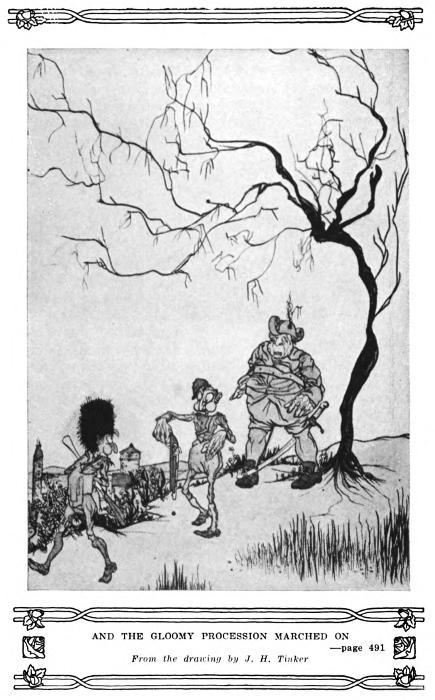
AND THE GLOOMY PROCESSION MARCHED ON
—page 491
From the drawing by J. H. Tinker
At the ill success of his blow the Crim Tartar
monarch was justly irritated. “If,” says he to
Giglio, “you ride a fairy horse, and wear fairy armor,
what on earth is the use of my hitting you? I
may as well
give myself up
a prisoner at
once. Your
Majesty won’t,
I suppose, be
so mean as to
strike a poor
fellow who
can’t strike
again?”
The justice
of Padella’s remark struck the magnanimous Giglio.
“Do you yield yourself a prisoner, Padella?”
says he.
“Of course I do,” says Padella.
“Do you acknowledge Rosalba as your rightful
Queen, and give up the crown and all your treasures
to your rightful mistress?”
“If I must, I must,” says Padella, who was naturally
very sulky.
By this time King Giglio’s aides-de-camp had
come up, whom His Majesty ordered to bind the
prisoner. And they tied his hands behind him, and
bound his legs tight under his horse, having set him
with his face to the tail; and in this fashion he was
led back to King Giglio’s quarters, and thrust into
the very dungeon where young Bulbo had been
confined.
Padella (who was a very different person in the
depth of his distress to Padella the proud wearer
of the Crim Tartary crown), now most affectionately
and earnestly asked to see his son—his dear
eldest boy—his darling Bulbo; and that good-natured
young man never once reproached his
haughty parent for his unkind conduct the day before,
when he would have left Bulbo to be shot
without any pity, but came to see his father, and
spoke to him through the grating of the door, beyond
which he was not allowed to go; and brought
him some sandwiches from the grand supper which
His Majesty was giving above stairs, in honor of
the brilliant victory which had just been achieved.
“I cannot stay with you long, sir,” says Bulbo,
who was in his best ball dress, as he handled his
father in the prog, “I am engaged to dance the
next quadrille with Her Majesty Queen Rosalba,
and I hear the fiddles playing at this very moment.”
So Bulbo went back to the ball-room, and the
wretched Padella ate his solitary supper in silence
and tears.
All was now joy in King Giglio’s circle. Dancing,
feasting, fun, illuminations, and jollifications
of all sorts ensued. The people through whose villages
they passed were ordered to illuminate their
cottages at night, and scatter flowers on the roads
during the day. They were requested, and I
promise you they did not like to refuse, to serve the
troops liberally with eatables and wine; besides, the
army was enriched by the immense quantity of
plunder which was found in King Padella’s camp,
and taken from his soldiers; who (after they had
given up everything) were allowed to fraternise
with the conquerors; and the united forces marched
back by easy stages towards King Giglio’s capital,
his royal banner and that of Queen Rosalba being
carried in front of the troops. Hedzoff was made
a Duke and a Field-Marshal. Smith and Jones
were promoted to be Earls; the Crim Tartar Order
of the Pumpkin and the Paflagonian decoration of
the Cucumber were freely distributed by their
Majesties to the army. Queen Rosalba wore the
Paflagonian Ribbon of the Cucumber across her
riding-habit, whilst King Giglio never appeared
without the grand Cordon of the Pumpkin. How
the people cheered them as they rode along side by
side! They were pronounced to be the handsomest
couple ever seen: that was a matter of course; but
they really were very handsome, and, had they
been otherwise, would have looked so, they were so
happy! Their Majesties were never separated
during the whole day, but breakfasted, dined and
supped together always, and rode side by side, interchanging
elegant compliments, and indulging in
the most delightful conversation. At night, Her
Majesty’s ladies of honor (who had all rallied
round her the day after King Padella’s defeat)
came and conducted her to the apartments prepared
for her; whilst King Giglio, surrounded by
his gentlemen, withdrew to his own royal quarters.
It was agreed they should be married as soon as
they reached the capital, and orders were despatched
to the Archbishop of Blombodinga, to
hold himself in readiness to perform the interesting
ceremony. Duke Hedzoff carried the message,
and gave instructions to have the Royal Castle
splendidly refurnished and painted afresh. The
Duke seized Glumboso, the Ex-Prime Minister,
and made him refund that considerable sum of
money which the old scoundrel had secreted out of
the late King’s treasure. He also clapped Valoroso
into prison (who, by the way, had been dethroned
for some considerable period past), and
when the Ex-Monarch weakly remonstrated, Hedzoff
said, “A soldier, sir, knows but his duty; my
orders are to lock you up along with the Ex-King
Padella, whom I have brought hither a prisoner
under guard.” So these two Ex-Royal personages
were sent for a year to the House of Correction,
and thereafter were obliged to become monks
of the severest Order of Flagellants, in which state,
by fasting, by vigils, by flogging (which they administered
to one another, humbly but resolutely),
no doubt they exhibited a repentance for their past
misdeeds, usurpations, and private and public
crimes.
As for Glumboso, that rogue was sent to the
galleys, and never had an opportunity to steal any
more.
The Fairy Blackstick, by whose means this
young King and Queen had certainly won their respective
crowns back, would come not unfrequently,
to pay them a little visit—as they were
riding in their triumphal progress towards Giglio’s
capital—change her wand into a pony, and travel
by their Majesties’ side, giving them the very best
advice. I am not sure that King Giglio did not
think the Fairy and her advice rather a bore,
fancying it was his own valor and merits which
had put him on his throne, and conquered Padella:
and, in fine, I fear he rather gave himself airs towards
his best friend and patroness. She exhorted
him to deal justly by his subjects, to draw mildly on
the taxes, never to break his promise when he had
once given it—and in all respects to be a good
King.
“A good King, my dear Fairy!” cries Rosalba.
“Of course he will. Break his promise! can you
fancy my Giglio would ever do anything so improper,
so unlike him? No! never!” And she
looked fondly towards Giglio, whom she thought
a pattern of perfection.
“Why is Fairy Blackstick always advising me,
and telling me how to manage my government, and
warning me to keep my word? Does she suppose
that I am not a man of sense, and a man of
honor?” asks Giglio testily. “Methinks she rather
presumes upon her position.”
“Hush! dear Giglio,” says Rosalba. “You
know Blackstick has been very kind to us, and we
must not offend her.” But the Fairy was not
listening to Giglio’s testy observations, she had
fallen back, and was trotting on her pony now, by
Master Bulbo’s side, who rode a donkey, and made
himself generally beloved in the army by his cheerfulness,
kindness, and good-humor to everybody.
He was eager to see his darling Angelica. He
thought there never was such a charming being.
Blackstick did not tell him it was the possession of
the magic rose that made Angelica so lovely in his
eyes. She brought him the very best accounts of
his little wife, whose misfortunes and humiliations
had indeed very greatly improved her; and, you see,
she could whisk off on her wand a hundred miles in
a minute, and be back in no time, and so carry polite
messages from Bulbo to Angelica, and from Angelica
to Bulbo, and comfort that young man upon
his journey.
When the Royal party arrived at the last stage
before you reach Blombodinga, who should be in
waiting, in her carriage there with her lady of
honor by her side, but the Princess Angelica! She
rushed into her husband’s arms, scarcely stopping
to make a passing curtsey to the King and Queen.
She had no eyes but for Bulbo, who appeared perfectly
lovely, to her on account of the fairy ring
which he wore; whilst she herself, wearing the magic
rose in her bonnet, seemed entirely beautiful to the
enraptured Bulbo.
A splendid luncheon was served to the Royal
party, of which the Archbishop, the Chancellor,
Duke Hedzoff, Countess Gruffanuff, and all our
friends partook, the Fairy Blackstick being seated
on the left of King Giglio, with Bulbo and Angelica
beside her. You could hear the joy-bells ringing in
the capital, and the guns which the citizens were
firing off in honor of their Majesties.
“What can have induced that hideous old Gruffanuff
to dress herself up in such an absurd way?
Did you ask her to be your bridesmaid, my dear?”
says Giglio to Rosalba. “What a figure of fun
Gruffy is!”
Gruffy was seated opposite their Majesties, between
the Archbishop and the Lord Chancellor,
and a figure of fun she certainly was, for she was
dressed in a low white silk dress, with lace over, a
wreath of white roses on her wig, a splendid lace
veil, and her yellow old neck was covered with
diamonds. She ogled the King in such a manner
that His Majesty burst out laughing.
“Eleven o’clock!” cries Giglio, as the great
Cathedral bell of Blombodinga tolled that hour.
“Gentlemen and ladies, we must be starting. Archbishop,
you must be at church, I think, before
twelve?”
“We must be at church before twelve,” sighs out
Gruffanuff in a languishing voice, hiding her old
face behind her fan.
“And then I shall be the happiest man in my
dominions,” cries Giglio, with an elegant bow to the
blushing Rosalba.
“Oh, my Giglio! Oh, my dear Majesty!” exclaims
Gruffanuff; “and can it be that this happy
moment at length has arrived—”
“Of course it has arrived,” says the King.
“—And that I am about to become the enraptured
bride of my adored Giglio!” continues Gruffanuff.
“Lend me a smelling-bottle, somebody.
I certainly shall faint with joy.”
“You my bride?” roars out Giglio.
“You marry my Prince?” cried poor little
Rosalba.
“Pooh! Nonsense! The woman’s mad!” exclaims
the King. And all the courtiers exhibited by their
countenances and expressions, marks of surprise,
or ridicule, or incredulity, or wonder.
“I should like to know who else is going to be
married if I am not?” shrieks out Gruffanuff.
“I should like to know if King Giglio is a gentleman,
and if there is such a thing as justice in Paflagonia?
Lord Chancellor! my Lord Archbishop!
will your Lordships sit by and see a poor, fond, confiding,
tender creature put upon? Has not Prince
Giglio promised to marry his Barbara? Is not this
Giglio’s signature? Does not this paper declare
that he is mine, and only mine?” And she handed
to his Grace the Archbishop the document which
the Prince signed that evening when she wore the
magic ring, and Giglio drank so much champagne.
And the old Archbishop, taking out his eyeglasses,
read—“This is to give notice, that I, Giglio, only
son of Savio, King of Paflagonia, hereby promise
to marry the charming Barbara Griselda, Countess
Gruffanuff, and widow of the late Jenkins Gruffanuff,
Esq.’”
“H’m,” says the Archbishop, “the document is
certainly a—a document.”
“Phoo!” says the Lord Chancellor, “the signature
is not in His Majesty’s handwriting.” Indeed,
since his studies at Bosforo, Giglio had made an
immense improvement in caligraphy.
“Is it your handwriting, Giglio?” cries the
Fairy Blackstick, with an awful severity of
countenance.
“Y—y—y—es,” poor Giglio gasps out, “I had
quite forgotten the confounded paper: she can’t
mean to hold me by it. You old wretch, what will
you take to let me off? Help the Queen, some one—Her
Majesty has fainted.”
| “Chop her head off!” |
} |
exclaim the impetuous Hedzoff, the ardent Smith, and the faithful Jones. |
| “Smother the old witch!” |
} |
| “Pitch her into the river!” |
} |
But Gruffanuff flung her arms round the Archbishop’s
neck, and bellowed out, “Justice, justice,
my Lord Chancellor!” so loudly, that her piercing
shrieks caused everybody to pause. As for Rosalba,
she was borne away lifeless by her ladies; and you
may imagine the look of agony which Giglio cast
towards that lovely being, as his hope, his joy, his
darling, his all in all, was thus removed, and in
her place the horrid old Gruffanuff rushed up
to his side, and once more shrieked out, “Justice,
justice!”
“Won’t you take that sum of money which
Glumboso hid?” says Giglio; “two hundred and
eighteen thousand millions, or thereabouts. It’s a
handsome sum.”
“I will have that and you too!” says Gruffanuff.
“Let us throw the crown jewels into the bargain,”
gasps out Giglio.
“I will wear them by my Giglio’s side!” says
Gruffanuff.
“Will half, three-quarters, five-sixths, nineteen-twentieths,
of my kingdom do, Countess?” asks the
trembling monarch.
“What were all Europe to me without you, my
Giglio?” cries Gruff, kissing his hand.
“I won’t, I can’t, I shan’t—I’ll resign the crown
first,” shouts Giglio, tearing away his hand; but
Gruff clung to it.
“I have a competency, my love,” she says,
“and with thee and a cottage thy Barbara will be
happy.”
Giglio was half mad with rage by this time. “I
will not marry her,” says he. “Oh, Fairy, Fairy,
give me counsel?” And as he spoke he looked wildly
round at the severe face of the Fairy Blackstick.
“‘Why is Fairy Blackstick always advising me,
and warning me to keep my word? Does she suppose
that I am not a man of honor?’” said the
Fairy, quoting Giglio’s own haughty words. He
quailed under the brightness of her eyes; he felt
that there was no escape for him from that awful
inquisition.
“Well, Archbishop,” said he in a dreadful voice,
that made his Grace start, “since this Fairy has led
me to the height of happiness but to dash me down
into the depths of despair, since I am to lose
Rosalba, let me at least keep my honor. Get up,
Countess, and let us be married; I can keep my
word, but I can die afterwards.”
“Oh, dear Giglio,” cries Gruffanuff, skipping
up, “I knew, I knew I could trust thee—I knew
that my Prince was the soul of honor. Jump into
your carriages, ladies and gentlemen, and let us go
to church at once; and as for dying, dear Giglio,
no, no:—thou wilt forget that insignificant little
chambermaid of a Queen—thou wilt live to be consoled
by thy Barbara! She wishes to be a Queen,
and not a Queen Dowager, my gracious Lord!”
And hanging upon poor Giglio’s arm, and leering
and grinning in his face in the most disgusting manner,
this old wretch tripped off in her white satin
shoes, and jumped into the very carriage which had
been got ready to convey Giglio and Rosalba to
church.
The cannons roared again, the bells pealed
triple-bobmajors, the people came out flinging
flowers upon the path of the royal bride and bridegroom,
and Gruff looked out of the gilt coach window
and bowed and grinned to them. Phoo! the
horrid old wretch!
The many ups and downs of her life had given
the Princess Rosalba prodigious strength of mind,
and that highly principled young woman presently
recovered from her fainting-fit, out of which Fairy
Blackstick, by a precious essence which the Fairy
always carried in her pocket, awakened her. Instead
of tearing her hair, crying, and bemoaning
herself, and fainting again, as many young women
would have done, Rosalba remembered that she
owed an example of firmness to her subjects; and
though she loved Giglio more than her life, was determined,
as she told the Fairy, not to interfere between
him and justice, or to cause him to break his
royal word.
“I cannot marry him, but I shall love him always,”
says she to Blackstick; “I will go and be
present at his marriage with the Countess, and sign
the book, and wish them happy with all my heart. I
will see, when I get home, whether I cannot make
the new Queen some handsome presents. The Crim
Tartary crown diamonds are uncommonly fine, and
I shall never have any use for them. I will live and
die unmarried like Queen Elizabeth, and, of course,
I shall leave my crown to Giglio when I quit this
world. Let us go and see them married, my
dear Fairy, let me say one last farewell to him;
and then, if you please, I will return to my own
dominions.”
So the Fairy kissed Rosalba with peculiar tenderness,
and at once changed her wand into a very
comfortable coach-and-four, with a steady coachman,
and two respectable footmen behind, and
the Fairy and Rosalba got into the coach, which
Angelica and Bulbo entered after them. As for
honest Bulbo, he was blubbering in the most
pathetic manner, quite overcome by Rosalba’s misfortune.
She was touched by the honest fellow’s sympathy,
promised to restore to him the confiscated
estates of Duke Padella his father, and
created him, as he sat there in the coach, Prince,
Highness, and First Grandee of the Crim
Tartar Empire. The coach moved on, and,
being a fairy coach, soon came up with the bridal
procession.
Before the ceremony at the church it was the custom
in Paflagonia, as it is in other countries, for the
bride and bridegroom to sign the Contract of
Marriage, which was to be witnessed by the Chancellor,
Minister, Lord Mayor, and principal officers
of state. Now, as the royal palace was being
painted and furnished anew, it was not ready for
the reception of the King and his bride, who proposed
at first to take up their residence at the
Prince’s palace,
that one which
Valoroso occupied
when Angelica
was born,
and before he
usurped the
throne.
So the marriage
party
drove up to the
palace: the dignitaries
got out
of their carriages and stood aside: poor Rosalba
stepped out of her coach, supported by Bulbo, and
stood almost fainting up against the railings so as
to have a last look of her dear Giglio.
As for Blackstick, she, according to her custom,
had flown out of the coach window in some inscrutable
manner, and was now standing at the
palace door.
Giglio came up the steps with his horrible bride
on his arm, looking as pale as if he was going to
execution. He only frowned at the Fairy Blackstick—he
was angry with her, and thought she came
to insult his misery.
“Get out of the way, pray,” says Gruffanuff
haughtily. “I wonder why you are always poking
your nose into other people’s affairs?”
“Are you determined to make this poor young
man unhappy?” says Blackstick.
“To marry him, yes? What business is it of
yours? Pray, madam, don’t say ‘you’ to a Queen,”
cried Gruffanuff.
“You won’t take the money he offered you?”
“No.”
“You won’t let him off his bargain, though you
know you cheated him when you made him sign
the paper?”
“Impudence! Policemen, remove this woman!”
cries Gruffanuff. And the policemen were rushing
forward, but with a wave of her wand the
Fairy struck them all like so many statues in their
places.
“You won’t take anything in exchange for your
bond, Mrs. Gruffanuff,” cries the Fairy, with awful
severity. “I speak for the last time.”
“No!” shrieks Gruffanuff, stamping with her
foot. “I’ll have my husband, my husband, my
husband!”
“You Shall have your Husband!” the Fairy
Blackstick cried; and advancing a step, laid her
hand upon the nose of the Knocker.
As she touched it, the brass nose seemed to elongate,
the open mouth opened still wider, and
uttered a roar which made everybody start. The
eyes rolled wildly; the arms and legs uncurled
themselves, writhed about, and seemed to lengthen
with each twist; the Knocker expanded into a figure
in yellow livery, six feet high; the screws by
which it was fixed to the door unloosed themselves,
and Jenkins Gruffanuff once more trod the threshold
off which he had been lifted more than twenty
years ago!
“Master’s not at home,” says Jenkins, just in his
old voice; and Mrs. Jenkins, giving a dreadful
youp, fell down in a fit, in which nobody minded
her.
For everybody was shouting, “Huzzay! Huzzay!”
“Hip, hip, hurray!” “Long live the King and
Queen!”
“Were such things ever seen?” “No, never,
never, never!” “The Fairy Blackstick for ever!”
The bells were ringing double peals, the guns
roaring and banging most prodigiously. Bulbo
was embracing everybody; the Lord Chancellor
was flinging up his wig and shouting like a madman;
Hedzoff had got the Archbishop round the
waist, and they were dancing a jig for joy; and as
for Giglio, I leave you to imagine what he was
doing, and if he kissed Rosalba once, twice—twenty
thousand times, I’m sure I don’t think he was
wrong.
So Gruffanuff opened the hall door with a low
bow, just as he had been accustomed to do, and
they all went in and signed the book, and then they
went to church and were married, and the Fairy
Blackstick sailed away on her cane, and was never
more heard of in Paflagonia.
AND HERE ENDS THE FIRESIDE PANTOMIME.