By Nathaniel Hawthorne
In the old city of Trœzene, at the foot of a lofty
mountain, there lived, a very long time ago, a
little boy named Theseus. His grandfather, King
Pittheus, was the sovereign of that country, and
was reckoned a very wise man; so that Theseus, being
brought up in the royal palace, and being naturally
a bright lad, could hardly fail of profiting by
the old king’s instructions. His mother’s name was
Æthra. As for his father, the boy had never seen
him. But, from his earliest remembrance, Æthra
used to go with little Theseus into a wood, and sit
down upon a moss-grown rock, which was deeply
sunken into the earth. Here she often talked with
her son about his father, and said that he was called
Ægeus, and that he was a great king, and ruled
over Attica, and dwelt at Athens, which was as
famous a city as any in the world. Theseus was
very fond of hearing about King Ægeus, and often
asked his good mother Æthra why he did not come
and live with them at Trœzene.
“Ah, my dear son,” answered Æthra, with a sigh,
“a monarch has his people to take care of. The men
and women over whom he rules are in the place of
children to him; and he can seldom spare time to
love his own children as other parents do. Your
father will never be able to leave his kingdom for
the sake of seeing his little boy.”
“Well, but, dear mother,” asked the boy, “why
cannot I go to this famous city of Athens, and tell
King Ægeus that I am his son?”
“That may happen by-and-by,” said Æthra. “Be
patient, and we shall see. You are not yet big and
strong enough to set out on such an errand.”
“And how soon shall I be strong enough?”
Theseus persisted in inquiring.
“You are but a tiny boy as yet,” replied his
mother. “See if you can lift this rock on which we
are sitting.”
The little fellow had a great opinion of his own
strength. So, grasping the rough protuberances of
the rock, he tugged and toiled amain, and got himself
quite out of breath, without being able to stir
the heavy stone. It seemed to be rooted into the
ground. No wonder he could not move it; for it
would have taken all the force of a very strong
man to lift it out of its earthy bed.
His mother stood looking on, with a sad kind of
a smile on her lips and in her eyes, to see the zealous
and yet puny efforts of her little boy. She could
not help being sorrowful at finding him already so
impatient to begin his adventures in the world.
“You see how it is, my dear Theseus,” said she,
“you must possess far more strength than now before
I can trust you to go to Athens, and tell King
Ægeus that you are his son. But when you can lift
this rock, and show me what is hidden beneath it,
I promise you my permission to depart.”
Often and often, after this, did Theseus ask his
mother, whether it was yet time for him to go to
Athens; and still his mother pointed to the rock, and
told him that, for years to come, he could not be
strong enough to move it. And again and again the
rosy-cheeked and curly-headed boy would tug and
strain at the huge mass of stone, striving, child as he
was, to do what a giant could hardly have done
without taking both of his great hands to the task.
Meanwhile the rock seemed to be sinking farther
and farther into the ground. The moss grew over it
thicker and thicker, until at last it looked almost
like a soft green seat, with only a few gray knobs
of granite peeping out. The overhanging trees,
also, shed their brown leaves upon it, as often
as the autumn came; and at its base grew ferns
and wild flowers, some of which crept quite over
its surface. To all appearance, the rock was as
firmly fastened as any other portion of the earth’s
substance.
But, difficult as the matter looked, Theseus was
now growing up to be such a vigorous youth, that,
in his own opinion, the time would quickly come
when he might hope to get the upper hand of this
ponderous lump of stone.
“Mother, I do believe it has started!” cried he,
after one of his attempts. “The earth around it is
certainly a little cracked!”
“No, no, child!” his mother hastily answered.
“It is not possible you can have moved it, such a
boy as you still are.”
Nor would she be convinced, although Theseus
showed her the place where he fancied that the stem
of a flower had been partly uprooted by the movement
of the rock. But Æthra sighed and looked
disquieted; for, no doubt, she began to be conscious
that her son was no longer a child, and that, in a
little while hence, she must send him forth among
the perils and troubles of the world.
It was not more than a year afterwards when
they were again sitting on the moss-covered stone.
Æthra had once more told him the oft-repeated
story of his father, and how gladly he would receive
Theseus at his stately palace, and how he
would present him to his courtiers and the people,
and tell them that here was the heir of his dominions.
The eyes of Theseus glowed with enthusiasm,
and he would hardly sit still to hear his mother
speak.
“Dear mother Æthra,” he exclaimed, “I never
felt half so strong as now! I am no longer a child,
nor a boy, nor a mere youth! I feel myself a man!
It is now time to make one earnest trial to remove
the stone.”
“Ah, my dearest Theseus,” replied his mother,
“not yet! not yet!”
“Yes, mother,” said he, resolutely, “the time has
come!”
Then Theseus bent himself in good earnest to
the task, and strained every sinew, with manly
strength and resolution. He put his whole brave
heart into the effort. He wrestled with the big
and sluggish stone, as if it had been a living enemy.
He heaved, he lifted, he resolved now to succeed,
or else to perish there, and let the rock be his monument
for ever! Æthra stood gazing at him, and
clasped her hands, partly with a mother’s pride,
and partly with a mother’s sorrow. The great
rock stirred! Yes, it was raised slowly from the
bedded moss and earth, uprooting the shrubs and
flowers along with it, and was turned upon its side.
Theseus had conquered!
While taking breath, he looked joyfully at his
mother, and she smiled upon him through her tears.
“Yes, Theseus,” she said, “the time has come,
and you must stay no longer at my side! See
what King Ægeus, your royal father, left for you,
beneath the stone, when he lifted it in his mighty
arms, and laid it on the spot whence you have now
removed it.”
Theseus looked, and saw that the rock had been
placed over another slab of stone, containing a
cavity within it; so that it somewhat resembled a
roughly-made chest or coffer, of which the upper
mass had served as the lid. Within the cavity lay
a sword, with a golden hilt, and a pair of sandals.
“That was your father’s sword,” said Æthra,
“and those were his sandals. When he went to be
King of Athens, he bade me treat you as a child
until you should prove yourself a man by lifting
this heavy stone. That task being accomplished,
you are to put on his sandals, in order to follow in
your father’s footsteps, and to gird on his sword,
so that you may fight giants and dragons, as King
Ægeus did in his youth.”
“I will set out for Athens this very day!” cried
Theseus.
But his mother persuaded him to stay a day or
two longer, while she got ready some necessary
articles for his journey. When his grandfather,
the wise King Pittheus, heard that Theseus intended
to present himself at his father’s palace,
he earnestly advised him to get on board of a
vessel, and go by sea; because he might thus arrive
within fifteen miles of Athens, without either
fatigue or danger.
“The roads are very bad by land,” quoth the
venerable king; “and they are terribly infested
with robbers and monsters. A mere lad, like
Theseus, is not fit to be trusted on such a perilous
journey, all by himself. No, no; let him go by
sea!”
But when Theseus heard of robbers and monsters,
he pricked up his ears, and was so much the
more eager to take the road along which they were
to be met with. On the third day, therefore, he
bade a respectful farewell to his grandfather,
thanking him for all his kindness, and, after affectionately
embracing his mother, he set forth, with
a good many of her tears glistening on his cheeks,
and some, if the truth must be told, that had
gushed out of his own eyes. But he let the sun and
wind dry them, and walked stoutly on, playing
with the golden hilt of his sword, and taking very
manly strides in his father’s sandals.
I cannot stop to tell you hardly any of the adventures
that befell Theseus on the road to Athens.
It is enough to say, that he quite cleared that part
of the country of the robbers, about whom King
Pittheus had been so much alarmed. One of these
bad people was named Procrustes; and he was indeed
a terrible fellow, and had an ugly way of
making fun of the poor travellers who happened
to fall into his clutches. In his cavern he had a
bed, on which, with great pretence of hospitality,
he invited his guests to lie down; but if they happened
to be shorter than the bed, this wicked villain
stretched them out by main force; or, if they were
too tall, he lopped off their heads or feet, and
laughed at what he had done, as an excellent joke.
Thus, however weary a man might be, he never
liked to lie in the bed of Procrustes. Another of
these robbers, named Scinis, must likewise have
been a very great scoundrel. He was in the habit
of flinging his victims off a high cliff into the sea;
and, in order to give him exactly his deserts,
Theseus tossed him off the very same place. But,
if you will believe me, the sea would not pollute
itself by receiving such a bad person into its bosom;
neither would the earth, having once got rid of him,
consent to take him back; so that, between the cliff
and the sea, Scinis stuck fast in the air, which was
forced to bear the burden of his naughtiness.
After these memorable deeds, Theseus heard of
an enormous sow, which ran wild, and was the terror
of all the farmers round about; and, as he did
not consider himself above doing any good thing
that came in his way, he killed this monstrous creature,
and gave the carcass to the poor people for
bacon. The great sow had been an awful beast,
while ramping about the woods and fields, but was
a pleasant object enough when cut up into joints,
and smoking on I know not how many dinner
tables.
Thus, by the time he reached his journey’s end
Theseus had done many valiant feats with his
father’s golden-hilted sword, and had gained the
renown of being one of the bravest young men of
the day. His fame travelled faster than he did,
and reached Athens before him. As he entered the
city, he heard the inhabitants talking at the street
comers and saying that Hercules was brave, and
Jason too, and Castor and Pollux likewise, but
that Theseus, the son of their own king, would turn
out as great a hero as the best of them. Theseus
took longer strides on hearing this, and fancied
himself sure of a magnificent reception at his
father’s court, since he came thither with Fame to
blow her trumpet before him, and cry to King
Ægeus, “Behold your son!”
He little suspected, innocent youth that he was,
that here in this very Athens, where his father
reigned, a greater danger awaited him than any
which he had encountered on the road. Yet this
was the truth. You must understand that the
father of Theseus, though not very old in years,
was almost worn out with the cares of government,
and had thus grown aged before his time. His
nephews, not expecting him to live a very great
while, intended to get all the power of the kingdom
into their own hands. But when they heard that
Theseus had arrived in Athens, and learned what a
gallant young man he was, they saw that he would
not be at all the kind of person to let them steal
away his father’s crown and scepter, which ought
to be his own by right of inheritance. Thus these
bad-hearted nephews of King Ægeus, who were
the own cousins of Theseus, at once became his enemies.
A still more dangerous enemy was Medea,
the wicked enchantress; for she was now the king’s
wife, and wanted to give the kingdom to her son
Medus, instead of letting it be given to the son of
Æthra, whom she hated.
It so happened that the king’s nephews met
Theseus, and found out who he was, just as he
reached the entrance of the royal palace. With
all their evil designs against him, they pretended to
be their cousin’s best friends and expressed great
joy at making his acquaintance. They proposed
to him that he should come into the king’s presence
as a stranger, in order to try whether Ægeus would
discover in the young man’s features any likeness
either to himself or his mother Æthra, and thus
recognize him for a son. Theseus consented; for
he fancied that his father would know him in a
moment, by the love that was in his heart. But,
while he waited at the door, the nephews ran and
told King Ægeus that a young man had arrived in
Athens, who, to their certain knowledge intended
to put him to death, and get possession of his royal
crown.
“And he is now waiting for admission to your
majesty’s presence,” added they.
“Aha!” cried the old king, on hearing this.
“Why, he must be a very wicked young fellow
indeed! Pray, what would you advise me to do
with him?”
In reply to this question, the wicked Medea put
in her word. As I have already told you, she was a
famous enchantress. According to some stories,
she was in the habit of boiling old people in a large
caldron, under pretence of making them young
again; but King Ægeus, I suppose, did not fancy
such an uncomfortable way of growing young, or
perhaps was contented to be old, and therefore
would never let himself be popped into the caldron.
If there were time to spare from more important
matters, I should be glad to tell you of Medea’s
fiery chariot, drawn by winged dragons, in which
the enchantress used often to take an airing among
the clouds. This chariot, in fact, was the vehicle
that first brought her to Athens, where she had done
nothing but mischief ever since her arrival. But
these and many other wonders must be left untold;
and it is enough to say that Medea, amongst a
thousand other bad things, knew how to prepare a
poison that was instantly fatal to whomsoever
might so much as touch it with his lips.
So when the king asked what he should do with
Theseus, this naughty woman had an answer ready
at her tongue’s end.
“Leave that to me, please your majesty,” she
replied. “Only admit this evil-minded young man
to your presence, treat him civilly, and invite him
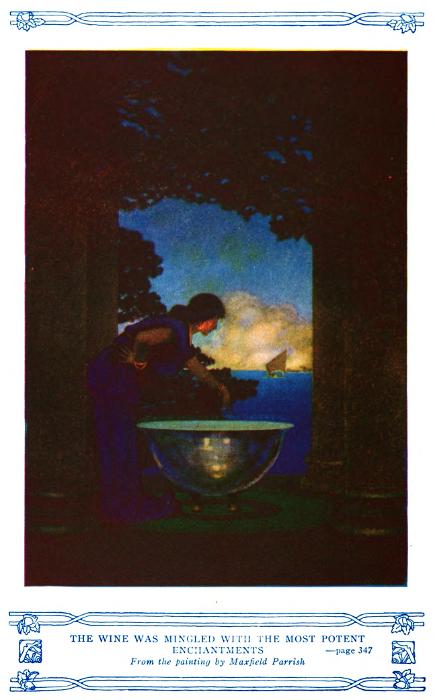
to drink a goblet of wine. Your majesty is well
aware that I sometimes amuse myself with distilling
very powerful medicines. Here is one of them
in this small phial. As to what it is made of, that
is one of my secrets of state. Do but let me put a
single drop into the goblet and let the young man
taste it, and I shall answer for it, he shall quite lay
aside the bad designs with which he comes hither.”
As she said this, Medea smiled; but, for all her
smiling face, she meant nothing less than to poison
the poor innocent Theseus, before his father’s eyes.
And King Ægeus, like most other kings, thought
any punishment mild enough for a person who was
accused of plotting against his life. He therefore
made little or no objection to Medea’s scheme, and
as soon as the poisonous wine was ready, gave
orders that the young stranger should be admitted
into his presence. The goblet was set on a table
beside the king’s throne; and a fly, meaning just to
sip a little from the brim, immediately tumbled
into it, dead. Observing this, Medea looked round
at the nephews and smiled again.
When Theseus was ushered into the royal apartment,
the only object that he seemed to behold was
the white-bearded old king. There he sat on his
magnificent throne, a dazzling crown on his head,
and a scepter in his hand. His aspect was stately
and majestic, although his years and infirmities
weighed heavily upon him, as if each year were a
lump of lead, and each infirmity a ponderous stone,
and all were bundled up together, and laid upon his
weary shoulders. The tears both of joy and sorrow
sprang into the young man’s eyes; for he thought
how sad it was to see his dear father so infirm, and
how sweet it would be to support him with his own
youthful strength, and to cheer him up with the
alacrity of his loving spirit. When a son takes his
father into his warm heart, it renews the old man’s
youth in a better way than by the heat of Medea’s
magic caldron. And this was what Theseus resolved
to do. He could scarcely wait to see whether King
Ægeus would recognize him, so eager was he to
throw himself into his arms.
Advancing to the foot of the throne, he attempted
to make a little speech, which he had been thinking
about, as he came up the stairs. But he was almost
choked by a great many tender feelings that gushed
out of his heart and swelled into his throat, all
struggling to find utterance together. And therefore,
unless he could have laid his full, over-brimming
heart into the king’s hand, poor Theseus knew
not what to do or say. The cunning Medea observed
what was passing in the young man’s mind. She
was more wicked at that moment than ever she had
been before; for (and it makes me tremble to tell
you of it) she did her worst to turn all this unspeakable
love with which Theseus was agitated, to his
own ruin and destruction.
“Does your majesty see his confusion?” she whispered
in the king’s ear. “He is so conscious of
guilt, that he trembles and cannot speak. The
wretch lives too long! Quick! offer him the wine!”
Now King Ægeus had been gazing earnestly at
the young stranger, as he drew near the throne.
There was something, he knew not what, either in
his white brow, or in the fine expression of his
mouth, or in his beautiful and tender eyes, that
made him indistinctly feel as if he had seen this
youth before; as if, indeed, he had trotted him on
his knee when a baby, and had beheld him growing
to be a stalwart man, while he himself grew old.
But Medea guessed how the king felt, and would
not suffer him to yield to these natural sensibilities;
although they were the voice of his deepest heart,
telling him, as plainly as it could speak, that here
was our dear son, and Æthra’s son, coming to claim
him for a father. The enchantress again whispered
in the king’s ear, and compelled him, by her witchcraft,
to see everything under a false aspect.
He made up his mind, therefore, to let Theseus
drink off the poisoned wine.
“Young man,” said he, “you are welcome! I am
proud to show hospitality to so heroic a youth. Do
me the favor to drink the contents of this goblet.
It is brimming over, as you see, with delicious wine,
such as I bestow only on those who are worthy of it!
None is more worthy to quaff it than yourself!”
So saying, King Ægeus took the golden goblet
from the table, and was about to offer it to Theseus.
But, partly through his infirmities, and partly because
it seemed so sad a thing to take away this
young man’s life, however wicked he might be, and
partly, no doubt, because his heart was wiser than
his head, and quaked within him at the thought of
what he was going to do—for all these reasons, the
king’s hand trembled so much that a great deal of
the wine slopped over. In order to strengthen his
purpose, and fearing lest the whole of the precious
poison should be wasted, one of his nephews now
whispered to him—
“Has your majesty any doubt of this stranger’s
guilt? There is the very sword with which he meant
to slay you. How sharp, and bright, and terrible
it is. Quick!—let him taste the wine; or perhaps
he may do the deed even yet.”
At these words, Ægeus drove every thought and
feeling out of his breast, except the one idea how
justly the young man deserved to be put to death.
He sat erect on his throne, and held out the goblet
of wine with a steady hand, and bent on Theseus a
frown of kingly severity; for, after all, he had too
noble a spirit to murder even a treacherous enemy
with a deceitful smile upon his face.
“Drink!” said he, in the stern tone with which he
was wont to condemn a criminal to be beheaded.
“You have well deserved of me such wine as this!”
Theseus held out his hand to take the wine. But,
before he touched it, King Ægeus trembled again.
His eyes had fallen on the gold-hilted sword that
hung at the young man’s side. He drew back the
goblet.
“That sword!” he exclaimed; “how came you by
it?”
“It was my father’s sword,” replied Theseus,
with a tremulous voice. “These were his sandals.
My dear mother (her name is Æthra) told me his
story while I was yet a little child. But it is only a
month since I grew strong enough to lift the heavy
stone, and take the sword and sandals from beneath
it, and come to Athens to seek my father.”
“My son! my son!” cried King Ægeus, flinging
away the fatal goblet, and tottering down from the
throne to fall into the arms of Theseus. “Yes, these
are Æthra’s eyes. It is my son.”
I have quite forgotten what became of the king’s
nephews. But when the wicked Medea saw this
new turn of affairs, she hurried out of the room,
and going to her private chamber, lost no time in
setting her enchantments at work. In a few
moments she heard a great noise of hissing snakes
outside of the chamber window; and, behold! there
was her fiery chariot, and four huge winged serpents,
wriggling and twisting in the air, flourishing
their tails higher than the top of the palace,
and all ready to set off on an aërial journey. Medea
stayed only long enough to take her son with her,
and to steal the crown jewels, together with the
king’s best robes, and whatever other valuable
things she could lay her hands on; and getting into
the chariot, she whipped up the snakes, and
ascended high over the city.
The king, hearing the hiss of the serpents,
scrambled as fast as he could to the window, and
bawled out to the abominable enchantress never to
come back. The whole people of Athens, too, who
had run out of doors to see this wonderful spectacle,
set up a shout of joy at the prospect of getting rid
of her. Medea, almost bursting with rage, uttered
precisely such a hiss as one of her own snakes, only
ten times more venomous and spiteful; and glaring
fiercely out of the blaze of the chariot, she shook
her hands over the multitude below, as if she were
scattering a million of curses among them. In so
doing, however, she unintentionally let fall about
five hundred diamonds of the first water, together
with a thousand great pearls, and two thousand
emeralds, rubies, sapphires, opals, and topazes, to
which she had helped herself out of the king’s
strong-box. All these came pelting down, like a
shower of many-colored hailstones, upon the heads
of grown people and children, who forthwith
gathered them up, and carried them back to the
palace. But King Ægeus told them that they were
welcome to the whole, and to twice as many more,
if he had them, for the sake of his delight at finding
his son, and losing the wicked Medea. And, indeed,
if you had seen how hateful was her last look, as
the flaming chariot flew upward, you would not
have wondered that both king and people should
think her departure a good riddance.
And now Prince Theseus was taken into great
favor by his royal father. The old king was never
weary of having him sit beside him on his throne,
(which was quite wide enough for two), and of
hearing him tell about his dear mother, and his
childhood, and his many boyish efforts to lift the
ponderous stone. Theseus, however, was much too
brave and active a young man to be willing to spend
all his time in relating things which had already
happened. His ambition was to perform other and
more heroic deeds, which should be better worth
telling in prose and verse. Nor had he been long
in Athens before he caught and chained a terrible
mad bull, and made a public show of him, greatly
to the wonder and admiration of good King Ægeus
and his subjects. But pretty soon he undertook an
affair that made all his foregone adventures seem
like mere boy’s play. The occasion of it was as
follows:—
One morning, when Prince Theseus awoke, he
fancied that he must have had a very sorrowful
dream, and that it was still running in his mind,
even now that his eyes were open. For it appeared
as if the air was full of a melancholy wail; and
when he listened more attentively, he could hear
sobs, and groans, and screams of woe, mingled with
deep, quiet sighs, which came from the king’s
palace, and from the streets, and from the temples,
and from every habitation in the city. And all
these mournful noises, issuing out of thousands of
separate hearts, united themselves into the one
great sound of affliction, which had startled Theseus
from slumber. He put on his clothes as quickly as
he could (not forgetting his sandals and gold-hilted
sword), and hastening to the king, inquired what
it all meant.
“Alas! my son,” quoth King Ægeus, heaving a
long sigh, “here is a very lamentable matter in
hand. This is the woefulest anniversary in the whole
year. It is the day when we annually draw lots to
see which of the youths and maidens of Athens shall
go to be devoured by the horrible Minotaur!”
“The Minotaur!” exclaimed Prince Theseus; and
like a brave young prince as he was, he put his
hand to the hilt of his sword. “What kind of a
monster may that be? Is it not possible, at the
risk of one’s life, to slay him?”
But King Ægeus shook his venerable head, and
to convince Theseus that it was quite a hopeless
case, he gave him an explanation of the whole affair.
It seems that in the island of Crete there lived a
certain dreadful monster, called a Minotaur, which
was shaped partly like a man and partly like a bull,
and was altogether such a hideous sort of a creature
that it is really disagreeable to think of him. If he
were suffered to exist at all, it should have been on
some desert island, or in the duskiness of some deep
cavern, where nobody would ever be tormented by
his abominable aspect. But King Minos, who
reigned over Crete, laid out a vast deal of money in
building a habitation for the Minotaur, and took
great care of his health and comfort, merely for
mischief’s sake. A few years before this time, there
had been a war between the city of Athens and the
island of Crete, in which the Athenians were beaten
and compelled to beg for peace. No peace could
they obtain, however, except on condition that they
should send seven young men and seven maidens,
every year, to be devoured by the pet monster of
the cruel King Minos. For three years past, this
grievous calamity had been borne. And the sobs,
and groans, and shrieks, with which the city was
now filled, were caused by the people’s woe, because
the fatal day had come again, when the fourteen
victims were to be chosen by lot, and the old people
feared lest their sons or daughters might be taken,
and the youths and damsels dreaded lest they themselves
might be destined to glut the ravenous maw
of that detestable man-brute.
But when Theseus heard the story, he straightened
himself up, so that he seemed taller than ever
before; and as for his face, it was indignant, despiteful,
bold, tender, and compassionate, all in one look.
“Let the people of Athens, this year, draw lots
for only six young men, instead of seven,” said he.
“I will myself be the seventh; and let the Minotaur
devour me, if he can!”
“O my dear son,” cried King Ægeus, “why
should you expose yourself to this horrible fate?
You are a royal prince, and have a right to hold
yourself above the destinies of common men.”
“It is because I am a prince, your son, and the
rightful heir of your kingdom, that I freely take
upon me the calamity of your subjects,” answered
Theseus. “And you, my father, being king over
this people, and answerable to heaven for their welfare,
are bound to sacrifice what is dearest to you,
rather than that the son or daughter of the poorest
citizen should come to any harm.”
The old king shed tears, and besought Theseus
not to leave him desolate in his old age, more especially
as he had but just begun to know the happiness
of possessing a good and valiant son. Theseus,
however, felt that he was in the right, and therefore
would not give up his resolution. But he assured
his father that he did not intend to be eaten up,
unresistingly, like a sheep, and that, if the Minotaur
devoured him, it should not be without a battle for
his dinner. And finally, since he could not help it,
King Ægeus consented to let him go. So a vessel
was got ready, and rigged with black sails; and
Theseus, with six other young men, and seven
tender and beautiful damsels, came down to the
harbor to embark. A sorrowful multitude accompanied
them to the shore. There was the poor old
king, too, leaning on his son’s arm, and looking as
if his single heart held all the grief of Athens.
Just as Prince Theseus was going on board, his
father bethought himself of one last word to say.
“My beloved son,” said he, grasping the prince’s
hand, “you observe that the sails of this vessel are
black; as indeed they ought to be, since it goes upon
a voyage of sorrow and despair. Now, being
weighed down with infirmities, I know not whether
I can survive till the vessel shall return. But, as
long is I do live, I shall creep daily to the top of
yonder cliff, to watch if there be a sail upon the
sea. And, dearest Theseus, if, by some happy
chance, you should escape the jaws of the Minotaur,
then tear down those dismal sails, and hoist others
that shall be bright as the sunshine. Beholding
them on the horizon, myself and all the people will
know that you are coming back victorious, and will
welcome you with such a festal uproar as Athens
never heard before.”
Theseus promised that he would do so. Then,
going on board, the mariners trimmed the vessel’s
black sails to the wind, which blew faintly off the
shore, being pretty much made up of the sighs that
everybody kept pouring forth on this melancholy
occasion. But by-and-by, when they had got fairly
out to sea, there came a stiff breeze from the north-west,
and drove them along as merrily over the
white-capped waves as if they had been going on
the most delightful errand imaginable. And though
it was a sad business enough, I rather question
whether fourteen young people, without any old
persons to keep them in order, could continue to
spend the whole time of the voyage in being miserable.
There had been some few dances upon the
undulating deck, I suspect, and some hearty bursts
of laughter, and other such unseasonable merriment
among the victims, before the high blue
mountains of Crete began to show themselves
among the far-off clouds. That sight, to be sure,
made them all very grave again.
Theseus stood among the sailors gazing eagerly
towards the land; although, as yet, it seemed hardly
more substantial than the clouds, amidst which the
mountains were looming up. Once or twice he
fancied that he saw a glare of some bright object, a
long way off, flinging a gleam across the waves.
“Did you see that flash of light?” he inquired of
the master of the vessel.
“No, prince; but I have seen it before,” answered
the master. “It came from Talus, I suppose.”
As the breeze came fresher just then, the master
was busy with trimming his sails, and had no more
time to answer questions. But while the vessel flew
faster and faster towards Crete, Theseus was astonished
to behold a human figure, gigantic in size,
which appeared to be striding, with a measured
movement, along the margin of the island. It
stepped from cliff to cliff, and sometimes from one
headland to another, while the sea foamed and
thundered on the shore beneath, and dashed its jets
of spray over the giant’s feet. What was still more
remarkable, whenever the sun shone on this huge
figure, it flickered and glimmered; its vast countenance,
too, had a metallic luster, and threw great
flashes of splendor through the air. The folds of
its garments, moreover, instead of waving in the
wind, fell heavily over its limbs, as if woven of some
kind of metal.
The nigher the vessel came, the more Theseus
wondered what this immense giant could be, and
whether it actually had life or no. For, though it
walked, and made other life-like motions, there yet
was a kind of jerk in its gait, which, together with
its brazen aspect, caused the young prince to suspect
that it was no true giant, but only a wonderful
piece of machinery. The figure looked all the more
terrible because it carried an enormous brass club
on its shoulder.
“What is this wonder?” Theseus asked of the
master of the vessel, who was now at leisure to
answer him.
“It is Talus, the Man of Brass,” said the master.
“And is he a live giant, or a brazen image?” asked
Theseus.
“That, truly,” replied the master, “is the point
which has always perplexed me. Some say, indeed,
that this Talus was hammered out for King Minos
by Vulcan himself, the skilfulest of all workers in
metal. But who ever saw a brazen image that had
sense enough to walk round an island three times a
day, as this giant walks round the island of Crete,
challenging every vessel that comes nigh the shore?
And, on the other hand, what living thing, unless
his sinews were made of brass, would not be weary
of marching eighteen hundred miles in the twenty-four
hours, as Talus does, without ever sitting down
to rest? He is a puzzler, take him how you will.”
Still the vessel went bounding onward; and now
Theseus could hear the brazen clangor of the giant’s
footsteps, as he trod heavily upon the sea-beaten
rocks, some of which were seen to crack and crumble
into the foamy waves beneath his weight. As they
approached the entrance of the port the giant
straddled clear across it, with a foot firmly planted
on each headland, and uplifting his club to such a
height that its butt-end was hidden in a cloud, he
stood in that formidable posture, with the sun
gleaming all over his metallic surface. There
seemed nothing else to be expected but that, the
next moment, he would fetch his great club down,
slam bang, and smash the vessel into a thousand
pieces, without heeding how many innocent people
he might destroy; for there is seldom any mercy in
a giant, you know, and quite as little in a piece of
brass clockwork. But just when Theseus and his
companions thought the blow was coming, the
brazen lips unclosed themselves, and the figure
spoke.
“Whence come you, strangers?”
And when the ringing voice ceased, there was
just such a reverberation as you may have heard
within a great church bell, for a moment or two
after the stroke of the hammer.
“From Athens!” shouted the master in reply.
“On what errand?” thundered the Man of Brass.
And he whirled his club aloft more threateningly
than ever, as if he were about to smite them with a
thunderstroke right amidships, because Athens, so
little while ago, had been at war with Crete.
“We bring the seven youths and the seven
maidens,” answered the master, “to be devoured by
the Minotaur!”
“Pass!” cried the brazen giant.
That one loud word rolled all about the sky, while
again there was a booming reverberation within the
figure’s breast. The vessel glided between the headlands
of the port, and the giant resumed his march.
In a few moments, this wondrous sentinel was far
away, flashing in the distant sunshine, and revolving
with immense strides around the island of Crete, as
it was his never-ceasing task to do.
No sooner had they entered the harbor than a
party of the guards of King Minos came down to
the water side, and took charge of the fourteen
young men and damsels. Surrounded by these
armed warriors, Prince Theseus and his companions
were led to the king’s palace, and ushered
into his presence. Now, Minos was a stern and
pitiless king. If the figure that guarded Crete was
made of brass, then the monarch, who ruled over it,
might be thought to have a still harder metal in his
breast, and might have been called a man of iron.
He bent his shaggy brows upon the poor Athenian
victims. Any other mortal, beholding their fresh
and tender beauty, and their innocent looks, would
have felt himself sitting on thorns until he had made
every soul of them happy, by bidding them go free
as the summer wind. But this immitigable Minos
cared only to examine whether they were plump
enough to satisfy the Minotaur’s appetite. For my
part, I wish he himself had been the only victim;
and the monster would have found him a pretty
tough one.
One after another, King Minos called these pale
frightened youths and sobbing maidens to his footstool,
gave them each a poke in the ribs with his
scepter (to try whether they were in good flesh or
no), and dismissed them with a nod to his guards.
But when his eyes rested on Theseus, the king
looked at him more attentively, because his face
was calm and brave.
“Young man,” asked he, with his stern voice,
“are you not appalled at the certainty of being
devoured by this terrible Minotaur?”
“I have offered my life in a good cause,”
answered Theseus, “and therefore I give it freely
and gladly. But thou, King Minos, art thou not
thyself appalled, who, year after year, hast perpetrated
this dreadful wrong, by giving seven
innocent youths and as many maidens to be devoured
by a monster? Dost thou not tremble,
wicked king, to turn thine eyes inward on thine own
heart? Sitting there on thy golden throne, and in
thy robes of majesty, I tell thee to thy face, King
Minos, thou art a more hideous monster than the
Minotaur himself!”
“Aha! do you think me so?” cried the king,
laughing in his cruel way. “To-morrow, at breakfast
time, you shall have an opportunity of judging
which is the greater monster, the Minotaur or
the king! Take them away, guards; and let this
free-spoken youth be the Minotaur’s first morsel!”
Near the king’s throne (though I had no time
to tell you so before) stood his daughter Ariadne.
She was a beautiful and tender-hearted maiden,
and looked at these poor doomed captives with very
different feelings from those of the iron-breasted
King Minos. She really wept, indeed, at the idea
of how much human happiness would be needlessly
thrown away, by giving so many young people, in
the first bloom and rose blossom of their lives, to be
eaten up by a creature who, no doubt, would have
preferred a fat ox, or even a large pig, to the
plumpest of them. And when she beheld the brave,
spirited figure of Prince Theseus bearing himself
so calmly in his terrible peril, she grew a hundred
times more pitiful than before. As the guards were
taking him away, she flung herself at the king’s
feet, and besought him to set all the captives free,
and especially this one young man.
“Peace, foolish girl!” answered King Minos.
“What hast thou to do with an affair like this? It
is a matter of state policy, and therefore quite
beyond thy weak comprehension. Go water thy
flowers, and think no more of these Athenian
caitiffs, whom the Minotaur shall as certainly eat
up for breakfast as I will eat a partridge for my
supper.”
So saying, the king looked cruel enough to devour
Theseus and all the rest of the captives,
himself, had there been no Minotaur to save him
the trouble. As he would hear not another word
in their favor, the prisoners were now led away,
and clapped into a dungeon, where the jailer
advised to go to sleep as soon as possible, because
the Minotaur was in the habit of calling for breakfast
early. The seven maidens and six of the
young men soon sobbed themselves to slumber.
But Theseus was not like them. He felt conscious
that he was wiser, and braver, and stronger than
his companions, and that therefore he had the
responsibility of all their lives upon him, and must
consider whether there was no way to save them,
even in this last extremity. So he kept himself
awake, and paced to and fro across the gloomy
dungeon in which they were shut up.
Just before midnight, the door was softly unbarred,
and the gentle Ariadne showed herself,
with a torch in her hand.
“Are you awake, Prince Theseus?” she
whispered.
“Yes,” answered Theseus. “With so little time
to live, I do not choose to waste any of it in sleep.”
“Then follow me,” said Ariadne, “and tread
softly.”
What had become of the jailer and the guards,
Theseus never knew. But, however that might be,
Ariadne opened all the doors, and led him forth
from the darksome prison into the pleasant moonlight.
“Theseus,” said the maiden, “you can now get
on board your vessel, and sail away for Athens.”
“No,” answered the young man; “I will never
leave Crete unless I can first slay the Minotaur,
and save my poor companions, and deliver Athens
from this cruel tribute.”
“I knew that this would be your resolution,”
said Ariadne. “Come, then, with me, brave Theseus.
Here is your own sword, which the guards
deprived you of. You will need it; and pray
Heaven you may use it well.”
Then she led Theseus along by the hand until
they came to a dark, shadowy grove, where the
moonlight wasted itself on the tops of the trees,
without shedding hardly so much as a glimmering
beam upon their pathway. After going a good
way through this obscurity, they reached a high
marble wall, which was overgrown with creeping
plants, that made it shaggy with their verdure.
The wall seemed to have no door, nor any windows,
but rose up, lofty, and massive, and mysterious,
and was neither to be clambered over, nor, so far
as Theseus could perceive, to be passed through.
Nevertheless, Ariadne did but press one of her
soft little fingers against a particular block of
marble, and, though it looked as solid as any other
part of the wall, it yielded to her touch, disclosing
an entrance just wide enough to admit them. They
crept through, and the marble stone swung back
into its place.
“We are now,” said Ariadne, “in the famous
labyrinth which Dædalus built before he made himself
a pair of wings, and flew away from our island
like a bird. That Dædalus was a very cunning
workman; but of all his artful contrivances, this
labyrinth is the most wondrous. Were we to take
but a few steps from the doorway, we might
wander about all our lifetime, and never find it
again. Yet in the very center of this labyrinth is
the Minotaur and, Theseus, you must go thither to
seek him.”
“But how shall I ever find him,” asked Theseus,
“if the labyrinth so bewilders me as you say it
will?”
Just as he spoke, they heard a rough and very
disagreeable roar, which greatly resembled the lowing
of a fierce bull, but yet had some sort of sound
like the human voice. Theseus even fancied a rude
articulation in it, as if the creature that uttered it
were trying to shape his hoarse breath into words.
It was at some distance, however, and he really
could not tell whether it sounded most like a bull’s
roar or a man’s harsh voice.
“That is the Minotaur’s noise,” whispered
Ariadne, closely grasping the hand of Theseus, and
pressing one of her own hands to her heart, which
was all in a tremble. “You must follow that sound
through the windings of the labyrinth, and, by and
by, you will find him. Stay! take the end of this
silken string, I will hold the other end; and then,
if you win the victory, it will lead you again to this
spot. Farewell, brave Theseus.”
So the young man took the end of the silken
string in his left hand, and his gold-hilted sword,
ready drawn from its scabbard, in the other, and
trod boldly into the inscrutable labyrinth. How
this labyrinth was built is more than I can tell you,
but so cunningly contrived a mizmaze was never
seen in the world, before nor since. There can be
nothing else so intricate, unless it were the brain
of a man like Dædalus, who planned it, or the heart
of any ordinary man; which last, to be sure, is ten
times as great a mystery as the labyrinth of Crete.
Theseus had not taken five steps before he lost
sight of Ariadne and in five more his head was
growing dizzy. But still he went on, now creeping
through a low arch, now ascending a flight of steps,
now in one crooked passage, and now in another,
with here a door opening before him, and there one
hanging behind, until it really seemed as if the
walls spun round, and whirled him round along
with them. And all the while, through these
hollow avenues, now nearer, now farther off again,
resounded the cry of the Minotaur; and the sound
was so fierce, so cruel, so ugly, so like a bull’s roar,
and withal so like a human voice, and yet like
neither of them, that the brave heart of Theseus
grew sterner and angrier at every step; for he felt
it an insult to the moon and sky, and to our affectionate
and simple Mother Earth, that such a monster
should have the audacity to exist.
As he passed onward, the clouds gathered over
the moon, and the labyrinth grew so dusky that
Theseus could no longer discern the bewilderment
through which he was passing. He would have
felt quite lost, and utterly hopeless of ever again
walking in a straight path, if, every little while,
he had not been conscious of a gentle twitch at the
silken cord. Then he knew that the tender-hearted
Ariadne was still holding the other end, and that
she was fearing for him, and hoping for him, and
giving him just as much of her sympathy as if she
were close by his side. Oh, indeed, I can assure
you, there, was a vast deal of human sympathy
running along that slender thread of silk. But
still he followed the dreadful roar of the Minotaur,
which now grew louder and louder, and finally so
very loud that Theseus fully expected to come
close upon him, at every new zigzag and wriggle
of the path. And at last, in an open space, at the
very center of the labyrinth, he did discern the
hideous creature.
Sure enough, what an ugly monster it was!
Only his horned head belonged to a bull; and yet,
somehow or other, he looked like a bull all over,
preposterously waddling on his hind legs; or, if
you happened to view him in another way, he
seemed wholly a man, and all the more monstrous
for being so. And there he was, the wretched
thing, with no society, no companion, no kind of a
mate, living only to do mischief, and incapable of
knowing what affection means. Theseus hated
him, and shuddered at him, and yet could not but
be sensible of some sort of pity; and all the more,
the uglier and more detestable the creature was.
For he kept striding to and fro, in a solitary
frenzy of rage, continually emitting a hoarse roar,
which was oddly mixed up with half-shaped words;
and, after listening a while, Theseus understood
that the Minotaur was saying to himself how
miserable he was, and how hungry, and how he
hated everybody, and how he longed to eat up the
human race alive.
Ah, the bull-headed villain! And oh, my good
little people, you will perhaps see, one of these
days, as I do now, that every human being who
suffers anything evil to get into his nature, or to
remain there, is a kind of Minotaur, an enemy of
his fellow-creatures, and separated from all good
companionship, as this poor monster was.
Was Theseus afraid? By no means, my dear
auditors. What! a hero like Theseus afraid! Not
had the Minotaur had twenty bull heads instead of
one. Bold as he was, however, I rather fancy that
it strengthened his valiant heart, just at this crisis,
to feel a tremulous twitch at the silken cord, which
he was still holding in his left hand. It was as
if Ariadne were giving him all her might and
courage; and, much as he already had, and little
as she had to give, it made his own seem twice as
much. And to confess the honest truth, he needed
the whole, for now the Minotaur, turning suddenly
about, caught sight of Theseus, and instantly
lowered his horribly sharp horns, exactly as a mad
bull does when he means to rush against an enemy.
At the same time, he belched forth a tremendous
roar, in which there was something like the words
of human language, but all disjointed and shaken
to pieces by passing through the gullet of a miserably
enraged brute.
Theseus could only guess what the creature
intended to say, and that rather by his gestures
than his words, for the Minotaur’s horns were
sharper than his wits, and of a great deal more
service to him than his tongue. But probably this
was the sense of what he uttered:
“Ah, wretch of a human being! I’ll stick my
horns through you, and toss you fifty feet high, and
eat you up the moment you come down.”
“Come on, then, and try it!” was all that
Theseus deigned to reply; for he was far too magnanimous
to assault his enemy with insolent
language.
Without more words on either side, there ensued
the most awful fight between Theseus and the
Minotaur that ever happened beneath the sun or
moon. I really know not how it might have turned
out, if the monster, in his first headlong rush
against Theseus, had not missed him, by a hair’s
breadth, and broken one of his horns short off
against the stone wall. On this mishap he bellowed
so intolerably that a part of the labyrinth tumbled
down, and all the inhabitants of Crete mistook the
noise for an uncommonly heavy thunder-storm.
Smarting with the pain, he galloped around the
open space in so ridiculous a way that Theseus
laughed at it, long afterwards, though not precisely
at the moment. After this, the two antagonists
stood valiantly up to one another, and fought sword
to horn, for a long while. At last, the Minotaur
made a run at Theseus, grazed his left side with
his horn, and flung him down; and thinking that he
had stabbed him to the heart, he cut a great caper
in the air, opened his bull mouth from ear to ear,
and prepared to snap his head off. But Theseus
by this time had leaped up, and caught the monster
off his guard. Fetching a sword stroke at him with
all his force, he hit him fair upon the neck, and
made his bull head skip six yards from his human
body, which fell down flat upon the ground.
So now the battle was ended. Immediately the
moon shone out as brightly as if all the troubles
of the world, and all the wickedness and the ugliness
that infest human life, were past and gone
forever. And Theseus, as he leaned on his sword
taking breath, felt another twitch of the silken
cord; for all through the terrible encounter, he had
held it fast in his left hand. Eager to let Ariadne
know of his success, he followed the guidance of
the thread, and soon found himself at the entrance
of the labyrinth.
“Thou hast slain the monster,” cried Ariadne,
clasping her hands.
“Thanks to thee, dear Ariadne,” answered
Theseus, “I return victorious.”
“Then,” said Ariadne, “we must quickly summon
thy friends, and get them and thyself on board
the vessel before dawn. If morning finds thee here,
my father will avenge the Minotaur.”
To make my story short, the poor captives were
awakened, and, hardly knowing whether it was not
a joyful dream, were told of what Theseus had
done, and that they must set sail for Athens before
daybreak. Hastening down to the vessel, they all
clambered on board, except Prince Theseus, who
lingered behind them on the strand, holding
Ariadne’s hand clasped in his own.
“Dear maiden,” said he, “thou wilt surely go
with us. Thou art too gentle and sweet a child for
such an iron-hearted father as King Minos. He
cares no more for thee than a granite rock cares
for the little flower that grows in one of its crevices.
But my father King Ægeus, and my dear
mother, Æthra, and all the fathers and mothers in
Athens, and all the sons and daughters too, will
love and honor thee as their benefactress. Come
with us, then; for King Minos will be very angry
when he knows what thou hast done.”
Now, some low-minded people, who pretend to
tell the story of Theseus and Ariadne, have the
face to say that this royal and honorable maiden
did really flee away, under cover of the night, with
the young stranger whose life she had preserved.
They say, too, that Prince Theseus (who could
have died sooner than wrong the meanest creature
in the world) ungratefully deserted Ariadne on a
solitary island, where the vessel touched on its
voyage to Athens. But, had the noble Theseus
heard these falsehoods, he would have served their
slanderous authors as he served the Minotaur!
Here is what Ariadne answered, when the brave
Prince of Athens besought her to accompany him:
“No, Theseus,” the maiden said, pressing his
hand, and then drawing back a step or two, “I cannot
go with you. My father is old, and has nobody
but myself to love him. Hard as you think his
heart is, it would break to lose me. At first, King
Minos will be angry; but he will soon forgive his
only child; and, by and by, he will rejoice, I know,
that no more youths and maidens must come from
Athens to be devoured by the Minotaur. I have
saved you, Theseus, as much for my father’s sake
as for your own. Farewell! Heaven bless you!”
All this was so true, and so maiden-like, and was
spoken with so sweet a dignity, that Theseus
would have blushed to urge her any longer. Nothing
remained for him, therefore, but to bid Ariadne
an affectionate farewell, and to go on board the
vessel, and set sail.
In a few moments the white foam was boiling up
before their prow, as Prince Theseus and his companions
sailed out of the harbor, with a whistling
breeze behind them. Talus, the brazen giant, on
his never-ceasing sentinel’s march, happened to be
approaching that part of the coast; and they saw
him, by the glimmering of the moonbeams on his
polished surface, while he was yet a great way off.
As the figure moved like clockwork, however, and
could neither hasten his enormous strides nor retard
them, he arrived at the port when they were just
beyond the reach of his club. Nevertheless, straddling
from headland to headland, as his custom
was, Talus attempted to strike a blow at the vessel,
and, overreaching himself, tumbled at full length
into the sea, which splashed high over his gigantic
shape, as when an iceberg turns a somerset. There
he lies yet; and whoever desires to enrich himself
by means of brass had better go thither with a diving
bell, and fish up Talus.
On the homeward voyage, the fourteen youths
and damsels were in excellent spirits, as you will
easily suppose. They spent most of their time in
dancing, unless when the sidelong breeze made the
deck slope too much. In due season, they came
within sight of the coast of Attica, which was their
native country. But here, I am grieved to tell you,
happened a sad misfortune.
You will remember (what Theseus unfortunately
forgot) that his father, King Ægeus, had
enjoined it upon him to hoist sunshiny sails, instead
of black ones, in case he should overcome the
Minotaur, and return victorious. In the joy of
their success, however, and amidst the sports, dancing,
and other merriment, with which these young
folks wore away the time, they never once thought
whether their sails were black, white, or rainbow
colored, and, indeed, left it entirely to the
mariners whether they had any sails at all. Thus
the vessel returned, like a raven, with the same
sable wings that had wafted her away. But poor
King Ægeus, day after day, infirm as he was, had
clambered to the summit of a cliff that overhung
the sea, and there sat watching for Prince Theseus,
homeward bound; and no sooner did he behold the
fatal blackness of the sails, than he concluded that
his dear son, whom he loved so much, and felt so
proud of, had been eaten by the Minotaur. He
could not bear the thought of living any longer;
so, first flinging his crown and scepter into the sea
(useless baubles that they were to him now!)
King Ægeus merely stooped forward, and fell
headlong over the cliff, and was drowned, poor
soul, in the waves that foamed at its base!
This was melancholy news for Prince Theseus,
who when he stepped ashore, found himself king
of all the country, whether he would or no; and
such a turn of fortune was enough to make any
young man feel very much out of spirits. However,
he sent for his dear mother to Athens, and,
by taking her advice in matters of state, became a
very excellent monarch, and was greatly beloved
by his people.
By Nathaniel Hawthorne
Once, in the old, old times a fountain gushed
out of a hill-side, in the marvellous land of
Greece. And, for aught I know, after so many
thousand years, it is still gushing out of the very
selfsame spot. At any rate, there was the pleasant
fountain, welling freshly forth and sparkling
adown the hill-side, in the golden sunset, when a
handsome young man named Bellerophon drew
near its margin. In his hand he held a bridle,
studded with brilliant gems, and adorned with a
golden bit. Seeing an old man, and another of
middle age, and a little boy, near the fountain, and
likewise a maiden, who was dipping up some of the
water in a pitcher, he paused, and begged that he
might refresh himself with a draught.
“This is very delicious water,” he said to the
maiden as he rinsed and filled her pitcher, after
drinking out of it. “Will you be kind enough to
tell me whether the fountain has any name?”
“Yes; it is called the Fountain of Pirene,”
answered the maiden; and then she added, “My
grandmother has told me that this clear fountain
was once a beautiful woman; and when her son was
killed by the arrows of the huntress Diana, she
melted all away into tears. And so the water,
which you find so cool and sweet, is the sorrow of
that poor mother’s heart!”
“I should not have dreamed,” observed the
young stranger, “that so clear a well-spring with
its gush and gurgle, and its cheery dance out of the
shade into the sunlight, had so much as one tear-drop
in its bosom! And this, then, is Pirene?
I thank you, pretty maiden, for telling me its name.
I have come from a far-away country to find this
very spot.”
A middle-aged country fellow (he had driven his
cow to drink out of the spring) stared hard at
young Bellerophon, and at the handsome bridle
which he carried in his hand.
“The water-courses must be getting low, friend,
in your part of the world,” remarked he, “if you
come so far only to find the Fountain of Pirene.
But, pray, have you lost a horse? I see you carry
the bridle in your hand; and a very pretty one it
is with that double row of bright stones upon it.
If the horse was as fine as the bridle, you are much
to be pitied for losing him.”
“I have lost no horse,” said Bellerophon, with
a smile. “But I happen to be seeking a very famous
one, which, as wise people have informed me, must
be found hereabouts, if anywhere. Do you know
whether the winged horse Pegasus still haunts the
Fountain of Pirene, as he used to do in your forefathers’
days?”
But then the country fellow laughed.
Some of you, my little friends, have probably
heard that this Pegasus was a snow-white steed,
with beautiful silvery wings, who spent most of
his time on the summit of Mount Helicon. He
was as wild, and as swift, and as buoyant, in his
flight through the air, as any eagle that ever soared
into the clouds. There was nothing else like him in
the world. He had no mate; he never had been
backed or bridled by a master; and, for many a
long year, he led a solitary and a happy life.
Oh, how fine a thing it is to be a winged horse!
Sleeping at night, as he did, on a lofty mountain-top,
and passing the greater part of the day in the
air, Pegasus seemed hardly to be a creature of the
earth. Whenever he was seen, up very high above
people’s heads, with the sunshine on his silvery
wings, you would have thought that he belonged to
the sky, and that, skimming a little too low, he had
got astray among our mists and vapors, and was
seeking his way back again. It was very pretty
to behold him plunge into the fleecy bosom of a
bright cloud, and be lost in it, for a moment or
two, and then break forth from the other side. Or,
in a sullen rainstorm, when there was a gray
pavement of clouds over the whole sky, it would
sometimes happen that the winged horse descended
right through it, and the glad light of the upper
region would gleam after him. In another instant,
it is true, both Pegasus and the pleasant light would
be gone away together. But any one that was
fortunate enough to see this wondrous spectacle felt
cheerful the whole day afterward, and as much
longer as the storm lasted.
In the summer-time and in the beautifulest of
weather, Pegasus often alighted on the solid earth,
and, closing his silvery wings, would gallop over hill
and dale for pastime as fleetly as the wind. Oftener
than in any other place, he had been seen near the
Fountain of Pirene, drinking the delicious water,
or rolling himself upon the soft grass of the margin.
Sometimes, too (but Pegasus was very dainty in
his food), he would crop a few of the clover-blossoms
that happened to be sweetest.
To the Fountain of Pirene, therefore, people’s
great-grandfathers had been in the habit of going
(as long as they were youthful, and retained their
faith in winged horses), in hopes of getting a
glimpse at the beautiful Pegasus. But, of late
years, he had been very seldom seen. Indeed,
there were many of the country folks, dwelling
within half an hour’s walk of the fountain, who had
never beheld Pegasus, and did not believe that
there was any such creature in existence. The
country fellow to whom Bellerophon was speaking
chanced to be one of those incredulous persons.
And that was the reason why he laughed.
“Pegasus, indeed!” cried he, turning up his nose
as high as such a flat nose could be turned up—“Pegasus,
indeed! A winged horse, truly! Why,
friend, are you in your senses? Of what use would
wings be to a horse? Could he drag the plow so
well, think you? To be sure, there might be a little
saving in the expense of shoes; but then, how would
a man like to see his horse flying out of the stable
window?—yes, or whisking him up above the clouds,
when he only wanted to ride to the mill? No, no! I
don’t believe in Pegasus. There never was such a
ridiculous kind of a horse-fowl made!”
“I have some reason to think otherwise,” said
Bellerophon, quietly.
And then he turned to an old gray man, who was
leaning on a staff, and listening very attentively,
with his head stretched forward, and one hand at
his ear, because, for the last twenty years, he had
been getting rather deaf.
“And what say you, venerable sir?” inquired he.
“In your younger days, I should imagine, you must
frequently have seen the winged steed!”
“Ah, young stranger, my memory is very poor!”
said the aged man. “When I was a lad, if I remember
rightly, I used to believe there was such a horse,
and so did everybody else. But nowadays, I hardly
know what to think, and very seldom think about
the winged horse at all. If I ever saw the creature,
it was a long, long while ago; and, to tell you the
truth, I doubt whether I ever did see him. One
day, to be sure, when I was quite a youth, I remember
seeing some hoof-tramps round about the brink
of the fountain. Pegasus might have made those
hoof-marks; and so might some other horse.”
“And have you never seen him, my fair maiden?”
asked Bellerophon of the girl, who stood with the
pitcher on her head, while this talk went on. “You
certainly could see Pegasus, if anybody can, for
your eyes are very bright.”
“Once I thought I saw him,” replied the maiden,
with a smile and a blush. “It was either Pegasus,
or a large white bird, a very great way up in the
air. And one other time, as I was coming to the
fountain with my pitcher, I heard a neigh. Oh,
such a brisk and melodious neigh as that was! My
very heart leaped with delight at the sound. But
it startled me, nevertheless; so that I ran home
without filling my pitcher.”
“That was truly a pity!” said Bellerophon.
And he turned to the child, whom I mentioned at
the beginning of the story, and who was gazing at
him, as children are apt to gaze at strangers, with
his rosy mouth wide open.
“Well, my little fellow,” cried Bellerophon, playfully
pulling one of his curls, “I suppose you have
often seen the winged horse.”
“That I have,” answered the child, very readily.
“I saw him yesterday, and many times before.”
“You are a fine little man!” said Bellerophon,
drawing the child closer to him. “Come, tell me all
about it.”
“Why,” replied the child, “I often come here
to sail little boats in the fountain, and to gather
pretty pebbles out of its basin. And sometimes,
when I look down into the water, I see the image of
the winged horse, in the picture of the sky that is
there. I wish he would come down, and take me on
his back, and let me ride him up to the moon! But,
if I so much as stir to look at him, he flies far
away out of sight.”
And Bellerophon put his faith in the child, who
had seen the image of Pegasus in the water, and in
the maiden, who had heard him neigh so melodiously,
rather than in the middle-aged clown, who
believed only in cart-horses, or in the old man
who had forgotten the beautiful things of his
youth.
Therefore, he haunted about the Fountain of
Pirene for a great many days afterward. He kept
continually on the watch, looking upward at the
sky, or else down into the water, hoping forever
that he should see either the reflected image of the
winged horse, or the marvellous reality. He held
the bridle, with its bright gems and golden bit, always
ready in his hand. The rustic people, who
dwelt in the neighborhood, and drove their cattle to
the fountain to drink, would often laugh at poor
Bellerophon, and sometimes take him pretty
severely to task. They told him that an able-bodied
young man, like himself, ought to have
better business than to be wasting his time in such
an idle pursuit. They offered to sell him a horse,
if he wanted one; and when Bellerophon declined
the purchase, they tried to drive a bargain with
him for his fine bridle.
Even the country boys thought him so very
foolish, that they used to have a great deal of sport
about him, and were rude enough not to care a fig,
although Bellerophon saw and heard it. One little
urchin, for example, would play Pegasus, and cut
the oddest imaginable capers, by way of flying;
while one of his school-fellows would scamper after
him, holding forth a twist of bulrushes, which was
intended to represent Bellerophon’s ornamental
bridle. But the gentle child, who had seen the
picture of Pegasus in the water, comforted the
young stranger more than all the naughty boys
could torment him. The dear little fellow, in his
play-hours, often sat down beside him, and, without
speaking a word, would look down into the
fountain and up toward the sky, with so innocent a
faith, that Bellerophon could not help feeling
encouraged.
Now you will, perhaps, wish to be told why it was
that Bellerophon had undertaken to catch the
winged horse. And we shall find no better opportunity
to speak about this matter than while he is
waiting for Pegasus to appear.
If I were to relate the whole of Bellerophon’s
previous adventures, they might easily grow into a
very long story. It will be quite enough to say,
that, in a certain country in Asia, a terrible monster,
called a Chimæra, had made its appearance,
and was doing more mischief than could be talked
about between now and sunset. According to the
best accounts which I have been able to obtain, this
Chimæra was nearly, if not quite the ugliest and
most poisonous creature, and the strangest and
unaccountablest, and the hardest to fight with,
and the most difficult to run away from, that ever
came out of the earth’s inside. It had a tail like
a boa-constrictor; its body was like I do not care
what; and it had three separate heads, one of which
was a lion’s, the second a goat’s, and the third an
abominably great snake’s. And a hot blast of fire
came flaming out of each of its three mouths!
Being an earthly monster, I doubt whether it had
any wings; but, wings or no, it ran like a goat and
a lion, and wriggled along like a serpent, and thus
contrived to make about as much speed as all the
three together.
Oh, the mischief, and mischief, and mischief that
this naughty creature did! With its flaming
breath, it could set a forest on fire, or burn up a
field of grain, or, for that matter, a village, with
all its fences and houses. It laid waste the whole
country round about, and used to eat up people
and animals alive, and cook them afterward in the
burning oven of its stomach. Mercy on us, little
children, I hope neither you nor I will ever happen
to meet a Chimæra!
While the hateful beast (if a beast we can anywise
call it) was doing all these horrible things, it
so chanced that Bellerophon came to that part of
the world, on a visit to the king. The king’s name
was Iobates, and Lycia was the country which he
ruled over. Bellerophon was one of the bravest
youths in the world, and desired nothing so much
as to do some valiant and beneficent deed, such
as would make all mankind admire and love him.
In those days, the only way for a young man to
distinguish himself was by fighting battles, either
with the enemies of his country, or with wicked
giants, or with troublesome dragons, or with wild
beasts, when he could find nothing more dangerous
to encounter.
King Iobates perceiving the courage of his
youthful visitor, proposed to him to go and fight
the Chimæra, which everybody else was afraid
of, and which, unless it should be soon killed, was
likely to convert Lycia into a desert. Bellerophon
hesitated not a moment, but assured the king that
he would either slay this dreaded Chimæra, or
perish in the attempt.
But, in the first place, as the monster was so prodigiously
swift, he bethought himself that he should
never win the victory by fighting on foot. The
wisest thing he could do, therefore, was to get the
very best and fleetest horse that could anywhere
be found. And what other horse, in all the world,
was half so fleet as the marvellous horse Pegasus,
who had wings as well as legs, and was even more
active in the air than on the earth? To be sure, a
great many people denied that there was any such
horse with wings, and said that the stories about
him were all poetry and nonsense. But, wonderful
as it appeared, Bellerophon believed that Pegasus
was a real steed, and hoped that he himself might
be fortunate enough to find him; and, once fairly
mounted on his back, he would be able to fight the
Chimæra at better advantage.
And this was the purpose with which he had
travelled from Lycia to Greece, and had brought
the beautifully ornamental bridle in his hand. It
was an enchanted bridle. If he could only succeed
in putting the golden bit into the mouth of Pegasus,
the winged horse would be submissive, and would
own Bellerophon for his master, and fly whithersoever
he might choose to turn the rein.
But, indeed, it was a weary and anxious time,
while Bellerophon waited and waited for Pegasus,
in hopes that he would come and drink at the
Fountain of Pirene. He was afraid lest King
Iobates should imagine that he had fled from the
Chimæra. It pained him, too, to think how much
mischief the monster was doing, while he himself,
instead of fighting with it, was compelled to sit
idly poring over the bright waters of Pirene, as
they gushed out of the sparkling sand. And as
Pegasus came thither so seldom in these latter
years, and scarcely alighted there more than once
in a lifetime, Bellerophon feared that he might
grow an old man, and have no strength left in his
arms nor courage in his heart, before the winged
horse would appear. Oh, how heavily passes the
time, while an adventurous youth is yearning to do
his part in life and to gather in the harvest of his
renown! How hard a lesson it is to wait! Our life
is brief, and how much of it is spent in teaching us
only this!
Well was it for Bellerophon that the gentle
child had grown so fond of him, and was
never weary of keeping him company. Every
morning the child gave him a new hope to
put in his bosom, instead of yesterday’s withered
one.
“Dear Bellerophon,” he would cry, looking up
hopefully into his face, “I think we shall see
Pegasus to-day!”
And, at length, if it had not been for the little
boy’s unwavering faith, Bellerophon would have
given up all hope, and would have gone back to
Lycia, and have done his best to slay the Chimæra
without the help of the winged horse. And in that
case poor Bellerophon would at least have been terribly
scorched by the creature’s breath, and would
most probably have been killed and devoured.
Nobody should ever try to fight an earth-born
Chimæra, unless he can first get upon the back of
an aërial steed.
One morning the child spoke to Bellerophon even
more hopefully than usual.
“Dear, dear Bellerophon,” cried he, “I know not
why it is, but I feel as if we should certainly see
Pegasus to-day!”
And all that day he would not stir a step from
Bellerophon’s side; so they ate a crust of bread
together and drank some of the water of the fountain.
In the afternoon, there they sat, and Bellerophon
had thrown his arm around the child, who
likewise had put one of his little hands into Bellerophon’s.
The latter was lost in his own thoughts, and
was fixing his eyes vacantly on the trunks of the
trees that overshadowed the fountain, and on the
grapevines that clambered up among their branches.
But the gentle child was gazing down into the
water; he was grieved, for Bellerophon’s sake, that
the hope of another day should be deceived, like
so many before it; and two or three quiet tear-drops
fell from his eyes, and mingled with what were said
to be the many tears of Pirene, when she wept
for her slain children.
But, when he least thought of it, Bellerophon
felt the pressure of the child’s little hand, and
heard a soft, almost breathless, whisper.
“See there, dear Bellerophon! There is an image
in the water!”
The young man looked down into the dimpling
mirror of the fountain, and saw what he took to be
the reflection of a bird which seemed to be flying
at a great height in the air, with a gleam of sunshine
on its snowy or silvery wings.
“What a splendid bird it must be!” said he.
“And how very large it looks, though it must really
be flying higher than the clouds!”
“It makes me tremble!” whispered the child. “I
am afraid to look up into the air! It is very beautiful,
and yet I dare only look at its image in the
water. Dear Bellerophon, do you not see that it is
no bird? It is the winged horse Pegasus!”
Bellerophon’s heart began to throb! He gazed
keenly upward, but could not see the winged
creature, whether bird or horse; because, just then,
it had plunged into the fleecy depths of a summer
cloud. It was but a moment, however, before the
object reappeared, sinking lightly down out of the
cloud, although still at a vast distance from the
earth.
Bellerophon caught the child in his arms, and
shrank back with him, so that they were both hidden
among the thick shrubbery which grew all around
the fountain. Not that he was afraid of any harm,
but he dreaded lest, if Pegasus caught a glimpse of
them, he would fly far away, and alight in some
inaccessible mountain-top. For it was really the
winged horse. After they had expected him so
long, he was coming to quench his thirst with the
water of Pirene.
Nearer and nearer came the aërial wonder, flying
in great circles, as you may have seen a dove when
about to alight. Downward came Pegasus, in those
wide, sweeping circles, which grew narrower, and
narrower still, as he gradually approached the
earth. The nigher the view of him, the more
beautiful he was, and the more marvellous the
sweep of his silvery wings. At last, with so light
a pressure as hardly to bend the grass about the
fountain, or imprint a hoof-tramp in the sand of its
margin, he alighted, and, stooping his wild head,
began to drink. He drew in the water, with long
and pleasant sighs, and tranquil pauses of enjoyment;
and then another draught, and another, and
another. For, nowhere in the world, or up among
the clouds, did Pegasus love any water as he loved
this of Pirene. And when his thirst was slaked, he
cropped a few of the honey-blossoms of the clover,
delicately tasting them, but not caring to make a
hearty meal, because the herbage, just beneath the
clouds, on the lofty sides of Mount Helicon, suited
his palate better than this ordinary grass.
After thus drinking to his heart’s content, and
in his dainty fashion, condescending to take a little
food, the winged horse began to caper to and fro,
and dance as it were, out of mere idleness and sport.
There never was a more playful creature made than
this very Pegasus. So there he frisked, in a way
that it delights me to think about, fluttering his
great wings as lightly as ever did a linnet, and running
little races, half on earth and half in the air,
and which I know not whether to call a flight or a
gallop. When a creature is perfectly able to fly,
he sometimes chooses to run, just for the pastime
of the thing; and so did Pegasus, although it cost
him some little trouble to keep his hoofs so near
the ground. Bellerophon, meanwhile, holding the
child’s hand, peeped forth from the shrubbery,
and thought that never was any sight so beautiful
as this, nor ever a horse’s eyes so wild and spirited
as those of Pegasus. It seemed a sin to think of
bridling him and riding on his back.
Once or twice Pegasus stopped, and snuffed the
air, pricking up his ears, tossing his head, and turning
it on all sides, as if he partly suspected some
mischief or other. Seeing nothing, however, and
hearing no sound, he soon began his antics again.
At length—not that he was weary, but only idle
and luxurious—Pegasus folded his wings, and lay
down on the soft green turf. But, being too full
of aërial life to remain quiet for many moments
together, he soon rolled over on his back, with his
four slender legs in the air. It was beautiful to
see him, this one solitary creature, whose mate had
never been created, but who needed no companion,
and, living a great many hundred years, was as
happy as the centuries were long. The more he
did such things as mortal horses are accustomed to
do, the less earthly and the more wonderful he
seemed. Bellerophon and the child almost held their
breath, partly from a delightful awe, but still more
because they dreaded lest the slightest stir or murmur
should send him up, with the speed of an
arrow-flight, into the furthest blue of the sky.
Finally, when he had enough of rolling over
and over, Pegasus turned himself about, and, indolently,
like any other horse, put out his fore legs, in
order to rise from the ground; and Bellerophon,
who had guessed that he would do so, darted suddenly
from the thicket, and leaped astride of his
back.
Yes, there he sat, on the back of the winged
horse!
But what a bound did Pegasus make, when for
the first time, he felt the weight of a mortal man
upon his loins! A bound, indeed! Before he had
time to draw a breath, Bellerophon found himself
five hundred feet aloft, and still shooting upward,
while the winged horse snorted and trembled with
terror and anger. Upward he went, up, up, up,
until he plunged into the cold misty bosom of a
cloud, at which, only a little while before, Bellerophon
had been gazing, and fancying it a very pleasant
spot. Then again, out of the heart of the cloud,
Pegasus shot down like a thunderbolt, as if he
meant to dash both himself and his rider headlong
against a rock. Then he went through about a
thousand of the wildest caprioles that had ever been
performed either by a bird or a horse.
THE QUEST OF THE GOLDEN FLEECE
—page 80
From the painting by Maxfield Parrish
I cannot tell you half that he did. He skimmed
straight forward, and sidewise, and backward. He
reared himself erect, with his fore legs on a wreath
of mist, and his hind legs on nothing at all. He
flung out his heels behind, and put down his head
between his legs, with his wings pointing right
upward. At about two miles’ height above the
earth, he turned a somerset, so that Bellerophon’s
heels were where his head should have been, and
he seemed to look down into the sky instead of up.
He twisted his head about, and, looking Bellerophon
in the face, with fire flashing from his eyes,
made a terrible attempt to bite him. He fluttered
his pinions so wildly that one of the silver feathers
was shaken out, and floating earthward, was picked
up by the child, who kept it as long as he lived, in
memory of Pegasus and Bellerophon.
But the latter (who, as you may judge, was as
good a horseman as ever galloped) had been watching
his opportunity, and at last clapped the golden
bit of the enchanted bridle between the winged
steed’s jaws. No sooner was this done, than
Pegasus became as manageable as if he had taken
food, all his life, out of Bellerophon’s hand. To
speak what I really feel, it was almost a sadness to
see so wild a creature grow suddenly so tame. And
Pegasus seemed to feel it so, likewise. He looked
round to Bellerophon, with the tears in his beautiful
eyes, instead of the fire that so recently flashed from
them. But when Bellerophon patted his head, and
spoke a few authoritative, yet kind and soothing
words, another look came into the eyes of Pegasus;
for he was glad at heart, after so many lonely centuries,
to have found a companion and a master.
Thus it always is with winged horses, and with
all such wild and solitary creatures. If you can
catch and overcome them, it is the surest way to
win their love.
While Pegasus had been doing his utmost to
shake Bellerophon off his back, he had flown
a very long distance; and they had come within
sight of a lofty mountain by the time the bit was
in his mouth. Bellerophon had seen this mountain
before, and knew it to be Helicon, on the summit
of which was the winged horse’s abode. Thither
(after looking gently into the rider’s face, as if to
ask leave) Pegasus now flew, and, alighting, waited
patiently until Bellerophon should please to dismount.
The young man, accordingly, leaped from
his steed’s back, but still held him fast by the bridle.
Meeting his eyes, however, he was so affected by
the gentleness of his aspect, and by the thought of
the free life which Pegasus had heretofore lived,
that he could not bear to keep him a prisoner, if
he really desired his liberty.
Obeying this generous impulse he slipped the
enchanted bridle off the head of Pegasus, and took
the bit from his mouth.
“Leave me, Pegasus!” said he. “Either leave
me, or love me.”
In an instant the winged horse shot almost out
of sight, soaring straight upward from the summit
of Mount Helicon. Being long after sunset, it was
now twilight on the mountain-top, and dusky evening
over all the country round about. But Pegasus
flew so high that he overtook the departed day, and
was bathed in the upper radiance of the sun.
Ascending higher and higher, he looked a bright
speck, and, at last, could no longer be seen in the
hollow waste of the sky. And Bellerophon was
afraid that he should never behold him more. But,
while he was lamenting his own folly, the bright
speck reappeared, and drew nearer and nearer, until
it descended lower than the sunshine; and, behold,
Pegasus had come back! After this trial there
was no more fear of the winged horse’s making his
escape. He and Bellerophon were friends, and put
loving faith in one another.
That night they lay down and slept together,
with Bellerophon’s arm about the neck of Pegasus,
not as a caution, but for kindness. And they awoke
at peep of day, and bade one another good morning,
each in his own language.
In this manner, Bellerophon and the wondrous
steed spent several days, and grew better acquainted
and fonder of each other all the time.
They went on long aërial journeys, and sometimes
ascended so high that the earth looked hardly bigger
than—the moon. They visited distant countries,
and amazed the inhabitants, who thought that the
beautiful young man, on the back of the winged
horse, must have come down out of the sky. A
thousand miles a day was no more than an easy
space for the fleet Pegasus to pass over. Bellerophon
was delighted with this kind of life, and
would have liked nothing better than to live always
in the same way, aloft in the clear atmosphere; for
it was always sunny weather up there, however
cheerless and rainy it might be in the lower region.
But he could not forget the horrible Chimæra,
which he had promised King Iobates to slay. So,
at last, when he had become well accustomed to
feats of horsemanship in the air, and could manage
Pegasus with the least motion of his hand, and had
taught him to obey his voice, he determined to
attempt the performance of this perilous adventure.
At daybreak, therefore, as soon as he unclosed
his eyes, he gently pinched the winged horse’s ear,
in order to arouse him. Pegasus immediately
started from the ground, and pranced about a quarter
of a mile aloft, and made a grand sweep around
the mountain-top, by way of showing that he was
wide awake, and ready for any kind of an excursion.
During the whole of this little flight, he uttered a
loud, brisk, and melodious neigh, and finally came
down at Bellerophon’s side, as lightly as ever you
saw a sparrow hop upon a twig.
“Well done, dear Pegasus! well done, my sky-skimmer!”
cried Bellerophon, fondly stroking the
horse’s neck. “And now, my fleet and beautiful
friend, we must break our fast. To-day we are
to fight the terrible Chimæra.”
As soon as they had eaten their morning meal,
and drank some sparkling water from a spring
called Hippocrene, Pegasus held out his head, of
his own accord, so that his master might put on the
bridle. Then with a great many playful leaps and
airy caperings, he showed his impatience to be
gone; while Bellerophon was girding on his sword,
and hanging his shield about his neck, and preparing
himself for battle. When everything was
ready, the rider mounted, and (as was his custom,
when going a long distance) ascended five miles
perpendicularly, so as the better to see whither he
was directing his course. He then turned the head
of Pegasus toward the east, and set out for Lycia.
In their flight they overtook an eagle, and came
so nigh him, before he could get out of their way,
that Bellerophon might easily have caught him by
the leg. Hastening onward at this rate, it was still
early in the forenoon when they beheld the lofty
mountains of Lycia, with their deep and shaggy
valleys. If Bellerophon had been told truly, it was
in one of those dismal valleys that the hideous
Chimæra had taken up its abode.
Being now so near their journey’s end, the winged
horse gradually descended with his rider; and they
took advantage of some clouds that were floating
over the mountain-tops, in order to conceal themselves.
Hovering on the upper surface of a cloud,
and peeping over its edge, Bellerophon had a
pretty distinct view of the mountainous part of
Lycia, and could look into all its shadowy vales at
once. At first there appeared to be nothing remarkable.
It was a wild, savage, and rocky tract of high
and precipitous hills. In the more level part of the
country, there were the ruins of houses that had
been burned, and, here and there, the carcasses of
dead cattle, strewn about the pastures where they
had been feeding.
“The Chimæra must have done this mischief,”
thought Bellerophon. “But where can the monster
be?”
As I have already said, there was nothing remarkable
to be detected, at first sight, in any of the valleys
and dells that lay among the precipitous heights
of the mountains. Nothing at all; unless, indeed, it
were three spires of black smoke, which issued from
what seemed to be the mouth of a cavern, and clambered
sullenly into the atmosphere. Before reaching
the mountain-top, these three black smoke-wreaths
mingled themselves into one. The cavern
was almost directly beneath the winged horse and
his rider, at the distance of about a thousand feet.
The smoke, as it crept heavily upward, had an ugly,
sulphurous, stifling scent, which caused Pegasus to
snort and Bellerophon to sneeze. So disagreeable
was it to the marvellous steed (who was accustomed
to breathe only the purest air), that he waved his
wings, and shot half a mile out of the range of this
offensive vapor.
But, on looking behind him, Bellerophon saw
something that induced him first to draw the bridle,
and then to turn Pegasus about. He made a sign,
which the winged horse understood, and sunk slowly
through the air, until his hoofs were scarcely more
than a man’s height above the rocky bottom of the
valley. In front, as far off as you could throw a
stone, was the cavern’s mouth, with the three smoke-wreaths
oozing out of it. And what else did Bellerophon
behold there?
There seemed to be a heap of strange and terrible
creatures curled up within the cavern. Their bodies
lay so close together, that Bellerophon could not
distinguish them apart; but, judging by their heads,
one of these creatures was a huge snake, the second
a fierce lion, and the third an ugly goat. The lion
and the goat were asleep; the snake was broad
awake, and kept staring around him with a great
pair of fiery eyes. But—and this was the most wonderful
part of the matter—the three spires of smoke
evidently issued from the nostrils of these three
heads! So strange was the spectacle, that, though
Bellerophon had been all along expecting it, the
truth did not immediately occur to him, that here
was the terrible three-headed Chimæra. He had
found out the Chimæra’s cavern. The snake, the
lion, and the goat, as he supposed them to be, were
not three separate creatures, but one monster!
The wicked, hateful thing! Slumbering as two-thirds
of it were, it still held, in its abominable claws,
the remnant of an unfortunate lamb—or possibly
(but I hate to think so) it was a dear little boy—which
its three mouths had been gnawing, before
two of them fell asleep!
All at once, Bellerophon started as from a
dream, and knew it to be the Chimæra. Pegasus
seemed to know it, at the same instant, and sent
forth a neigh, that sounded like the call of a trumpet
to battle. At this sound the three heads reared
themselves erect, and belched out great flashes of
flame. Before Bellerophon had time to consider
what to do next, the monster flung itself out of the
cavern and sprang straight toward him, with its immense
claws extended, and its snaky tail twisting
itself venomously behind. If Pegasus had not
been as nimble as a bird, both he and his rider
would have been overthrown by the Chimæra’s
headlong rush, and thus the battle have been ended
before it was well begun. But the winged horse
was not to be caught so. In the twinkling of an
eye he was up and aloft, half-way to the clouds,
snorting with anger. He shuddered, too, not with
affright, but with utter disgust at the loathsomeness
of this poisonous thing with three heads.
The Chimæra, on the other hand, raised itself
up so as to stand absolutely on the tip-end of its
tail, with its talons pawing fiercely in the air, and
its three heads spluttering fire at Pegasus and his
rider. My stars, how it roared, and hissed and
bellowed! Bellerophon, meanwhile, was fitting his
shield on his arm, and drawing his sword.
“Now, my beloved Pegasus,” he whispered in
the winged horse’s ear, “thou must help me to slay
this insufferable monster; or else thou shalt fly
back to thy solitary mountain-peak without thy
friend Bellerophon. For either the Chimæra dies,
or its three mouths shall gnaw this head of mine,
which has slumbered upon thy neck!”
Pegasus whinnied, and, turning back his head,
rubbed his nose tenderly against his rider’s cheek.
It was his way of telling him that, though he
had wings and was an immortal horse, yet
he would perish, if it were possible for immortality
to perish, rather than leave Bellerophon
behind.
“I thank you, Pegasus,” answered Bellerophon.
“Now, then, let us make a dash at the monster!”
Uttering these words, he shook the bridle; and
Pegasus darted down aslant, as swift as the flight
of an arrow, right toward the Chimæra’s threefold
head, which, all this time, was poking itself as high
as it could into the air. As he came within arm’s-length,
Bellerophon made a cut at the monster,
but was carried onward by his steed, before he
could see whether the blow had been successful.
Pegasus continued his course, but soon wheeled
round, at about the same distance from the
Chimæra as before. Bellerophon then perceived
that he had cut the goat’s head of the monster almost
off, so that it dangled downward by the skin,
and seemed quite dead.
But, to make amends, the snake’s head and the
lion’s head had taken all the fierceness of the dead
one into themselves, and spit flame, and hissed,
and roared, with a vast deal more fury than before.
“Never mind, my brave Pegasus!” cried Bellerophon.
“With another stroke like that, we will
stop either its hissing or its roaring.”
And again he shook the bridle. Dashing aslantwise,
as before, the winged horse made another
arrow-flight toward the Chimæra, and Bellerophon
aimed another downright stroke at one of the two
remaining heads, as he shot by. But this time,
neither he nor Pegasus escaped so well as at first.
With one of its claws, the Chimæra had given the
young man a deep scratch in his shoulder, and had
slightly damaged the left wing of the flying steed
with the other. On his part, Bellerophon had
mortally wounded the lion’s head of the monster,
insomuch that it now hung downward, with its fire
almost extinguished, and sending out gasps of
thick black smoke. The snake’s head, however
(which was the only one now left), was twice as
fierce and venomous as ever before. It belched
forth shoots of fire five hundred yards long, and
emitted hisses so loud, so harsh, and so ear-piercing,
that King Iobates heard them, fifty miles off,
and trembled till the throne shook under him.
“Well-a-day!” thought the poor king; “the Chimæra
is certainly coming to devour me!”
Meanwhile Pegasus had again paused in the air,
and neighed angrily, while sparkles of a pure
crystal flame darted out of his eyes. How unlike
the lurid fire of the Chimæra! The aërial steed’s
spirit was all aroused, and so was that of Bellerophon.
“Dost thou bleed, my immortal horse?” cried
the young man, caring less for his own hurt than
for the anguish of this glorious creature, that ought
never to have tasted pain. “The execrable Chimæra
shall pay for this mischief with his last head!”
Then he shook the bridle, shouted loudly, and
guided Pegasus, not aslantwise as before, but
straight at the monster’s hideous front. So rapid
was the onset, that it seemed but a dazzle and a
flash before Bellerophon was at close gripes with
his enemy.
The Chimæra, by this time, after losing its second
head, had got into a red-hot passion of pain
and rampant rage. It so flounced about, half on
earth and partly in the air, that it was impossible
to say which element it rested upon. It opened
its snake-jaws to such an abominable width, that
Pegasus might almost, I was going to say, have
flown right down its throat, wings outspread, rider
and all! At their approach it shot out a tremendous
blast of its fiery breath, and enveloped Bellerophon
and his steed in a perfect atmosphere of
flame, singeing the wings of Pegasus, scorching
off one whole side of the young man’s golden ringlets,
and making them both far hotter than was
comfortable, from head to foot.
But this was nothing to what followed.
When the airy rush of the winged horse had
brought him within the distance of one hundred
yards, the Chimæra gave a spring, and flung its
huge, awkward, venomous, and utterly detestable
carcass right upon poor Pegasus, clung around
him with might and main, and tied up its snaky
tail into a knot! Up flew the aërial steed, higher,
higher, higher, above the mountain-peaks, above
the clouds, and almost out of sight of the solid
earth. But still the earth-born monster kept its
hold, and was borne upward, along with the creature
of light and air. Bellerophon, meanwhile,
turning about, found himself face to face with the
ugly grimness of the Chimæra’s visage, and could
only avoid being scorched to death, or bitten right
in twain, by holding up his shield. Over the upper
edge of the shield, he looked sternly into the savage
eyes of the monster.
But the Chimæra was so mad and wild with pain,
that it did not guard itself so well as might else
have been the case. Perhaps, after all, the best
way to fight a Chimæra is by getting as close to it
as you can. In its efforts to stick its horrible iron
claws into its enemy, the creature left its own
breast quite exposed; and perceiving this, Bellerophon
thrust his sword up to the hilt into its cruel
heart. Immediately the snaky tail untied its knot.
The monster let go its hold of Pegasus, and fell
from that vast height downward; while the fire
within its bosom, instead of being put out, burned
fiercer than ever, and quickly began to consume the
dead carcass. Thus it fell out of the sky, all
aflame, and (it being nightfall before it reached
the earth) was mistaken for a shooting star or a
comet. But, at early sunrise, some cottagers were
going to their day’s labor, and saw, to their astonishment,
that several acres of ground were strewn
with black ashes. In the middle of a field, there
was a heap of whitened bones, a great deal higher
than a haystack. Nothing else was ever seen of
the dreadful Chimæra!
And when Bellerophon had won the victory, he
bent forward and kissed Pegasus, while the tears
stood in his eyes.
“Back now, my beloved steed!” said he. “Back
to the Fountain of Pirene!”
Pegasus skimmed through the air, quicker than
ever he did before, and reached the fountain in a
very short time. And there he found the old man
leaning on his staff, and the country fellow watering
his cow, and the pretty maiden filling her
pitcher.
“I remember now,” quoth the old man, “I saw
this winged horse once before, when I was quite
a lad. But he was ten times handsomer in those
days.”
“I own a cart-horse, worth three of him!” said
the country fellow. “If this pony were mine, the
first thing I should do would be to clip his wings!”
But the poor maiden said nothing, for she had
always the luck to be afraid at the wrong time.
So she ran away, and let her pitcher tumble down,
and broke it.
“Where is the gentle child,” asked Bellerophon,
“who used to keep me company, and never lost
his faith, and never was weary of gazing into the
fountain?”
“Here am I, dear Bellerophon!” said the child,
softly.
For the little boy had spent day after day, on
the margin of Pirene, waiting for his friend to
come back; but when he perceived Bellerophon descending
through the clouds, mounted on the
winged horse, he had shrunk back into the shrubbery.
He was a delicate and tender child, and
dreaded lest the old man and the country fellow
should see the tears gushing from his eyes.
“Thou hast won the victory,” said he, joyfully,
running to the knee of Bellerophon, who still sat
on the back of Pegasus. “I knew thou wouldst.”
“Yes, dear child!” replied Bellerophon, alighting
from the winged horse. “But if thy faith had
not helped me, I should never have waited for
Pegasus, and never have gone up above the clouds,
and never have conquered the terrible Chimæra.
Thou, my beloved little friend, hast done it all.
And now let us give Pegasus his liberty.”
So he slipped off the enchanted bridle from the
head of the marvellous steed.
“Be free, for evermore, my Pegasus!” cried he,
with a shade of sadness in his tone. “Be as free as
thou art fleet!”
But Pegasus rested his head on Bellerophon’s
shoulder, and would not be persuaded to take
flight.
“Well then,” said Bellerophon, caressing the
airy horse, “thou shalt be with me, as long as thou
wilt; and we will go together, forthwith, and tell
King Iobates that the Chimæra is destroyed.”
Then Bellerophon embraced the gentle child,
and promised to come to him again, and departed.
But, in after years, that child took higher flights
upon the aërial steed than ever did Bellerophon,
and achieved more honorable deeds than his
friend’s victory over the Chimæra. For, gentle
and tender as he was, he grew to be a mighty poet!
By Charles Kingsley
This is a tale of heroes who sailed away into a
distant land to win themselves renown forever,
in the adventure of the Golden Fleece.
Whither they sailed, my children, I cannot clearly
tell. It all happened long ago; so long that it has
all grown dim, like a dream which you dreamed
last year. And why they went I cannot tell: some
say that it was to win gold. It may be so; but the
noblest deeds which have been done on earth have
not been done for gold.
The Spartans looked for no reward in money
when they fought and died at Thermopylæ; and
Socrates the wise asked no pay from his countrymen,
but lived poor and barefoot all his days, only
caring to make men good. And there are heroes
in our days also, who do noble deeds, but not for
gold. Our discoverers did not go to make themselves
rich when they sailed out one after another
into the dreary frozen seas.
Therefore we will believe—why should we not?—of
these same Argonauts of old, that they too
were noble men, who planned and did a noble deed;
and that therefore their fame has lived, and been
told in story and in song, mixed up, no doubt, with
dreams and fables, and yet true and right at heart.
So we will honor these old Argonauts, and listen
to their story as it stands; and we will try to be like
them, each of us in our place; for each of us has
a Golden Fleece to seek, and a wild sea to sail over
ere we reach it, and dragons to fight ere it be ours.
And what was that first Golden Fleece? I do
not know, nor care. The old Greeks said that it
hung in Colchis, which we call the Circassian coast,
nailed to a beech-tree in the War-god’s wood; and
that it was the fleece of the wondrous ram who bore
Phrixus and Helle across the Black Sea. For
Phrixus and Helle were the children of the cloud-nymph,
and of Athamas the Minuan king. And
when a famine came upon the land, their cruel
stepmother Ino wished to kill them, that her own
children might reign, and said that they must be
sacrificed on an altar, to turn away the anger of the
gods. So the poor children were brought to the
altar, and the priest stood ready with his knife, when
out of the clouds came the Golden Ram, and took
them on his back, and vanished. Then madness
came upon that foolish king, Athamas, and ruin
upon Ino and her children. For Athamas killed one
of them in his fury; and Ino fled from him with
the other in her arms, and leaped from a cliff into
the sea, and was changed into a dolphin, such as you
have seen, which wanders over the waves forever
sighing, with its little one clasped to its breast.
But the people drove out King Athamas, because
he had killed his child; and he roamed about
in his misery, till he came to the Oracle in Delphi.
And the Oracle told him that he must wander for
his sin, till the wild beasts should feast him as their
guest. So he went on in hunger and sorrow for
many a weary day, till he saw a pack of wolves.
The wolves were tearing a sheep; but when they
saw Athamas they fled, and left the sheep for him,
and he ate of it; and then he knew that the oracle
was fulfilled at last. So he wandered no more;
but settled, and built a town, and became a king
again.
But the ram carried the two children far away
over land and sea, till he came to the Thracian
Chersonese, and there Helle fell into the sea. So
those narrow straits are called “Hellespont,” after
her; and they bear that name until this day.
Then the ram flew on with Phrixus to the north-east
across the sea which we call the Black Sea
now; but the Greeks call it Euxine. And at last,
they say, he stopped at Colchis, on the steep Circassian
coast; and there Phrixus married Chaleiope,
the daughter of Aietes the king; and offered
the ram in sacrifice; and Aietes nailed the ram’s
fleece to a beech, in the grove of Mars the War-god.
After a while Phrixus died, and was buried, but
his spirit had no rest; for he was buried far from
his native land, and the pleasant hills of Greece.
So he came in dreams to the heroes of the Minuai,
and called sadly by their beds, “Come and set my
spirit free, that I may go home to my fathers and
to my kinsfolk, and the pleasant Minuan land.”
And they asked, “How shall we set your spirit
free?”
“You must sail over the sea to Colchis, and bring
home the Golden Fleece; and then my spirit will
come back with it, and I shall sleep with my
fathers and have rest.”
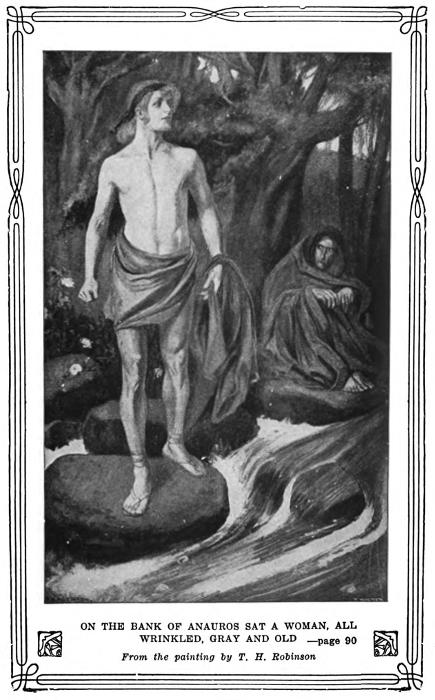
ON THE BANK OF ANAUROS SAT A WOMAN, ALL WRINKLED, GRAY AND OLD
—page 90
From the painting by T. H. Robinson
Often he came thus, and called to them, but when
they awoke they looked at each other, and said,
“Who dare sail to Colchis, or bring home the
Golden Fleece?” And in all the country none was
brave enough to try it; for the man and the time
were not come.
Phrixus had a cousin called Æson, who was king
in Iolcos by the sea. There he ruled over the rich
Minuan heroes, as Athamas his uncle ruled in
Bœotia; and, like Athamas, he was an unhappy
man. For he had a stepbrother named Pelias, of
whom some said that he was a nymph’s son, and
there were dark and sad tales about his birth.
When he was a babe he was cast out on the
mountains, and a wild mare came by and kicked
him. But a shepherd passing found the baby, with
its face all blackened by the blow; and took him
home, and called him Pelias, because his face was
bruised and black. And he grew up fierce and
lawless, and did many a fearful deed; and at last
he drove out Æson his stepbrother, and then his
own brother Neleus, and took the kingdom to himself,
and ruled over the rich Minuan heroes, in
Iolcos by the sea.
And Æson, when he was driven out, went sadly
away out of the town, leading his little son by the
hand; and he said to himself, “I must hide the
child in the mountains; or Pelias will surely kill
him, because he is the heir.”
So he went up from the sea across the valley,
through the vineyards and the olive groves, and
across the torrent of Anauros, toward Pelion, the
ancient mountain, whose brows are white with
snow.
He went up and up into the mountain, over
marsh, and crag, and down, till the boy was tired
and footsore, and Æson had to bear him in his
arms, till he came to the mouth of a lonely cave, at
the foot of a mighty cliff.
Above the cliff the snow-wreaths hung, dripping
and cracking in the sun; but at its foot around the
cave’s mouth grew all fair flowers and herbs, as if
in a garden, ranged in order, each sort by itself.
There they grew gaily in the sunshine, and the
spray of the torrent from above; while from the
cave came the sound of music, and a man’s voice
singing to the harp.
Then Æson put down the lad, and whispered:
“Fear not, but go in, and whomsoever you shall
find, lay your hands upon his knees and say, ‘In the
name of Jupiter, the father of gods and men, I
am your guest from this day forth.’”
Then the lad went in without trembling, for he
too was a hero’s son; but when he was within, he
stopped in wonder to listen to that magic song.
And there he saw the singer lying upon bear-skins
and fragrant boughs: Chiron, the ancient
Centaur, the wisest of all things beneath the sky.
Down to the waist he was a man, but below he was
a noble horse; his white hair rolled down over his
broad shoulders, and his white beard over his broad
brown chest; and his eyes were wise and mild, and
his forehead like a mountain wall.
And in his hands he held a harp of gold, and
struck it with a golden key; and as he struck, he
sang till his eyes glittered, and filled all the cave
with light.
And he sang of the birth of Time, and of the
heavens and the dancing stars; of the ocean, and
the ether, and the fire, and the shaping of the
wondrous earth. And he sang of the treasures of
the hills, and the hidden jewels of the mine, and
the veins of fire and metal, and the virtues of all
healing herbs, and of the speech of birds, and of
prophecy, and of hidden things to come.
Then he sang of health, and strength, and manhood,
and a valiant heart; and of music, and hunting,
and wrestling, and all the games which heroes
love; and of travel, and wars, and sieges, and a
noble death in fight; and then he sang of peace and
plenty, and of equal justice in the land; and as he
sang the boy listened wide-eyed, and forgot his
errand in the song.
And at the last old Chiron was silent, and called
the lad with a soft voice. And the lad ran trembling
to him, and would have laid his hands upon
his knees; but Chiron smiled, and said, “Call hither
your father Æson, for I know you, and all that has
befallen, and saw you both afar in the valley, even
before you left the town.”
Then Æson came in sadly, and Chiron asked
him, “Why camest you not yourself to me, Æson
the Æolid?”
And Æson said: “I thought, Chiron will pity the
lad if he sees him come alone; and I wished to try
whether he was fearless, and dare venture like a
hero’s son. But now I entreat you by Father Jupiter,
let the boy be your guest till better times, and
train him among the sons of the heroes, that he may
avenge his father’s house.”
Then Chiron smiled, and drew the lad to him,
and laid his hand upon his golden locks, and said,
“Are you afraid of my horse’s hoofs, fair boy, or
will you be my pupil from this day?”
“I would gladly have horse’s hoofs like you, if
I could sing such songs as yours.”
And Chiron laughed, and said, “Sit here by me
till sundown, when your playfellows will come
home, and you shall learn like them to be a king,
worthy to rule over gallant men.”
Then he turned to Æson, and said, “Go back in
peace, and bend before the storm like a prudent
man. This boy shall not cross the Anauros again,
till he has become a glory to you and to the house
of Æolus.”
And Æson wept over his son and went away;
but the boy did not weep, so full was his fancy of
that strange cave, and the Centaur, and his song,
and the playfellows whom he was to see.
Then Chiron put the lyre into his hands, and
taught him how to play it, till the sun sank low
behind the cliff, and a shout was heard outside.
And then in came the sons of the heroes, Æneas,
and Hercules, and Peleus, and many another
mighty name. And great Chiron leaped up joyfully,
and his hoofs made the cave resound, as they
shouted, “Come out, Father Chiron; come out and
see our game.” And one cried, “I have killed two
deer”; and another, “I took a wildcat among the
crags”; and Hercules dragged a wild goat after
him by its horns, for he was as huge as a mountain
crag; and Cœneus carried a bear-cub under each
arm, and laughed when they scratched and bit, for
neither tooth nor steel could wound him. And
Chiron praised them all, each according to his
deserts.
Only one walked apart and silent, Æsculapius,
the too-wise child, carrying herbs and flowers, and
round his wrist a spotted snake; he came with
downcast eyes to Chiron, and whispered how he
had watched the snake cast its old skin, and grow
young again before his eyes, and how he had gone
down into a village in the vale, and cured a dying
man with a herb which he had seen a sick goat eat.
And Chiron smiled, and said, “To each Minerva
and Apollo gave some gift, and each is worthy
in his place; but to this child they have given an
honor beyond all honors, to cure while others kill.”
Then the lads brought in wood and split it, and
lighted a blazing fire; and others skinned the deer
and quartered them, and set them to roast before
the fire; and while the venison was cooking they
bathed in the snow torrent, and washed away the
dust and sweat.
And then all ate till they could eat no more (for
they had tasted nothing since the dawn), and drank
of the clear spring water. And when the remnants
were put away, they all lay down upon the skins
and leaves about the fire, and each took the lyre in
turn, and sang and played with all his heart.
After a while they all went out to a plot of grass
at the cave’s mouth, and there they boxed, and
ran, and wrestled, and laughed till the stones fell
from the cliffs.
Then Chiron took his lyre, and all the lads joined
hands; and as he played, they danced to his
measure, in and out, and round and round. There
they danced hand in hand, till the night fell over
land and sea, while the black glen shone with their
broad white limbs and the gleam of their golden
hair.
And the lad danced with them, delighted, and
then slept a wholesome sleep, upon fragrant leaves
of bay, and myrtle, and marjoram, and flowers of
thyme; and rose at the dawn, and bathed in the
torrent, and became a school-fellow to the heroes’
sons, and forgot Iolcos, and his father, and all his
former life. But he grew strong, and brave, and
cunning, upon the pleasant downs of Pelion, in
the keen hungry mountain air. And he learned to
wrestle, and to box, and to hunt, and to play upon
the harp; and next he learned to ride, for old
Chiron used to mount him on his back; and he
learned the virtues of all herbs, and how to cure all
wounds; and Chiron called him Jason the healer,
and that is his name until this day.
By Charles Kingsley
Ten years came and went, and Jason was
grown to be a mighty man. Some of his fellows
were gone, and some were growing up by his
side. Æsculapius was gone into Peloponnesus to
work his wondrous cures on men; and some say he
used to raise the dead to life. And Hercules was
gone to Thebes to fulfil those famous labors which
have become a proverb among men. Peleus had
married a sea-nymph, and his wedding is famous to
this day. And Æneas was gone home to Troy, and
many a noble tale you will read of him, and of all
the other gallant heroes, the scholars of Chiron the
just.
Now it happened on a day that Jason stood on
the mountain, and looked north and south and east
and west; and Chiron stood by him and watched
him, for he knew that the time was come. And
Jason looked and saw the plains of Thessaly, where
the Lapithæ breed their horses; and the lake of
Boibé, and the stream which runs northward to
Peneus and Tempe; and he looked north, and saw
the mountain wall which guards the Magnesian
shore; Olympus, the seat of the Immortals, and
Ossa, and Pelion, where he stood. Then he looked
east and saw the bright blue sea, which stretched
away forever toward the dawn. Then he looked
south, and saw a pleasant land, with white-walled
towns and farms, nestling along the shore of a land-locked
bay, while the smoke rose blue among the
trees; and he knew it for the bay of Pagasai, and
the rich lowlands of Hæmonia, and Iolcos by the
sea.
Then he sighed, and asked, “Is it true what
the heroes tell me—that I am heir of that fair
land?”
“And what good would it be to you, Jason, if
you were heir of that fair land?”
“I would take it and keep it.”
“A strong man has taken it and kept it long.
Are you stronger than Pelias the terrible?”
“I can try my strength with his,” said Jason; but
Chiron sighed, and said:
“You have many a danger to go through before
you rule in Iolcos by the sea: many a danger and
many a woe; and strange troubles in strange lands,
such as man never saw before.”
“The happier I,” said Jason, “to see what man
never saw before.”
And Chiron sighed again, and said, “The eaglet
must leave the nest when it is fledged. Will you go
to Iolcos by the sea? Then promise me two things
before you go.” Jason promised, and Chiron answered,
“Speak harshly to no soul whom you may
meet, and stand by the word which you shall speak.”
Jason wondered why Chiron asked this of him;
but he knew that the Centaur was a prophet, and
saw things long before they came. So he promised,
and leaped down the mountain, to take his fortune
like a man. He went down through the arbutus
thickets, and across the downs of thyme, till he
came to the vineyard walls, and the pomegranates
and the olives in the glen; and among the olives
roared Anauros, all foaming with a summer flood.
And on the bank of Anauros sat a woman, all
wrinkled, gray, and old, her head shook palsied on
her breast, and her hands shook palsied on her
knees; and when she saw Jason, she spoke whining,
“Who will carry me across the flood?”
Jason was bold and hasty, and was just going to
leap into the flood: and yet he thought twice before
he leaped, so loud roared the torrent down, all
brown from the mountain rains, and silver-veined
with melting snow; while underneath he could hear
the bowlders rumbling like the tramp of horsemen
or the roll of wheels, as they ground along the narrow
channel, and shook the rocks on which he stood.
But the old woman whined all the more, “I am
weak and old, fair youth. For Juno’s sake, carry
me over the torrent.”
And Jason was going to answer her scornfully,
when Chiron’s words came to his mind. So he said,
“For Juno’s sake, the Queen of the Immortals on
Olympus, I will carry you over the torrent, unless
we both are drowned midway.”
Then the old dame leaped upon his back, as
nimbly as a goat; and Jason staggered in, wondering;
and the first step was up to his knees. The
first step was up to his knees, and the second step
was up to his waist; and the stones rolled about his
feet, and his feet slipped about the stones; so he
went on staggering and panting, while the old
woman cried from off his back: “Fool, you have
wet my mantle! Do you make game of poor old
souls like me?”
Jason had half a mind to drop her, and let her get
through the torrent by herself; but Chiron’s words
were in his mind, and he said only, “Patience,
mother; the best horse may stumble some day.”
At last he staggered to the shore, and set her
down upon the bank; and a strong man he needed
to have been or that wild water he never would
have crossed.
He lay panting awhile upon the bank, and then
leaped up to go upon his journey; but he cast one
look at the old woman, for he thought, “She should
thank me once at least.” And as he looked, she
grew fairer than all women, and taller than all men
on earth; and her garments shone like the summer
sea, and her jewels like the stars of heaven; and
over her forehead was a veil, woven of the golden
clouds of sunset; and through the veil she looked
down on him, with great soft heifer’s eyes; with
great eyes, mild and awful, which filled all the glen
with light. And Jason fell upon his knees, and hid
his face between his hands.
And she spoke, “I am the Queen of Olympus,
Juno the wife of Jupiter. As thou hast done to
me, so will I do to thee. Call on me in the hour of
need, and try if the Immortals can forget.”
And when Jason looked up, she rose from off the
earth, like a pillar of tall white cloud, and floated
away across the mountain peaks toward Olympus,
the holy hill.
Then a great fear fell on Jason: but after a while
he grew light of heart; and he blessed old Chiron,
and said, “Surely the Centaur is a prophet, and
guessed what would come to pass, when he bade me
speak harshly to no soul whom I might meet.”
Then he went down toward Iolcos; and as he
walked he found that he had lost one of his sandals
in the flood. And as he went through the streets,
the people came out to look at him, so tall and fair
was he; but some of the elders whispered together;
and at last one of them stopped Jason, and called
to him, “Fair lad, who are you, and whence come
you; and what is your errand in the town?”
“My name, good father, is Jason, and I come
from Pelion up above; and my errand is to Pelias
your king; tell me then where his palace is.”
But the old man started, and grew pale, and said,
“Do you not know the oracle, my son, that you go
so boldly through the town with but one sandal on?”
“I am a stranger here and know of no oracle;
but what of my one sandal? I lost the other in
Anauros, while I was struggling with the flood.”
Then the old man looked back to his companions:
and one sighed, and another smiled; at last he said,
“I will tell you, lest you rush upon your ruin unawares.
The oracle in Delphi has said that a man
wearing one sandal should take the kingdom from
Pelias, and keep it for himself. Therefore beware
how you go up to his palace, for he is the fiercest
and most cunning of all kings.”
Then Jason laughed a great laugh, like a war-horse
in his pride. “Good news, good father, both
for you and me. For that very end I came into the
town.” Then he strode on toward the palace of
Pelias, while all the people wondered at his bearing.
And he stood in the doorway and cried, “Come
out, come out, Pelias the valiant, and fight for your
kingdom like a man.”
Pelias came out wondering, and “Who are you,
bold youth?” he cried.
“I am Jason, the son of Æson, the heir of all this
land.”
Then Pelias lifted up his hands and eyes, and
wept, or seemed to weep; and blessed the heavens
which had brought his nephew to him, never to leave
him more. “For,” said he, “I have but three daughters,
and no son to be my heir. You shall be my
heir then, and rule the kingdom after me, and marry
whichsoever of my daughters you shall choose;
though a sad kingdom you will find it, and whosoever
rules it a miserable man. But come in, come
in, and feast.”
So he drew Jason in, whether he would or not,
and spoke to him so lovingly and feasted him so
well, that Jason’s anger passed; and after supper
his three cousins came into the hall, and Jason
thought that he should like well enough to have one
of them for his wife.
But at last he said to Pelias, “Why do you look
so sad, my uncle? And what did you mean just
now when you said that this was a doleful kingdom,
and its ruler a miserable man?”
Pelias sighed heavily again and again and again,
like a man who had to tell some dreadful story, and
was afraid to begin; but at last—“For seven long
years and more have I never known a quiet night;
and no more will he who comes after me, till the
Golden Fleece be brought home.” Then he told
Jason the story of Phrixus, and of the Golden
Fleece; and told him, too, which was a lie, that
Phrixus’ spirit tormented him, calling to him day
and night. And his daughters came, and told the
same tale (for their father had taught them their
parts), and wept, and said, “Oh who will bring
home the Golden Fleece, that our uncle’s spirit may
rest; and that we may have rest also, whom he never
lets sleep in peace?”
Jason sat awhile, sad and silent; for he had often
heard of that Golden Fleece; but he looked on it as
a thing hopeless and impossible for any mortal man
to win.
But when Pelias saw him silent, he began to talk
of other things, and courted Jason more and more,
speaking to him as if he was certain to be his heir,
and asking his advice about the kingdom; till Jason,
who was young and simple, could not help saying to
himself, “Surely he is not the dark man whom people
call him. Yet why did he drive my father out?”
And he asked Pelias boldly, “Men say that you
are terrible, and a man of blood; but I find you a
kind and hospitable man; and as you are to me, so
will I be to you. Yet why did you drive my father
out?”
Pelias smiled, and sighed. “Men have slandered
me in that, as in all things. Your father was growing
old and weary, and he gave the kingdom up to
me of his own will. You shall see him to-morrow,
and ask him; and he will tell you the same.”
Jason’s heart leaped in him when he heard that he
was to see his father; and he believed all that Pelias
said, forgetting that his father might not dare to
tell the truth.
“One thing more there is,” said Pelias, “on
which I need your advice; for, though you are
young, I see in you wisdom beyond your years.
There is one neighbor of mine, whom I dread more
than all men on earth. I am stronger than he now,
and can command him; but I know that if he stay
among us, he will work my ruin in the end. Can
you give me a plan, Jason, by which I can rid myself
of that man?”
After a while Jason answered, half laughing,
“Were I you, I would send him to fetch that same
Golden Fleece; for if he once set forth after it
you would never be troubled with him more.”
A bitter smile came across Pelias’ lips, and a
flash of wicked joy into his eyes; and Jason saw it,
and started; and over his mind came the warning
of the old man, and his own one sandal, and the
oracle, and he saw that he was taken in a trap.
But Pelias only answered gently, “My son, he shall
be sent forthwith.”
“You mean me?” cried Jason, starting up,
“because I came here with one sandal?” And he
lifted his fist angrily, while Pelias stood up to him
like a wolf at bay; and whether of the two was the
stronger and the fiercer it would be hard to tell.
But after a moment Pelias spoke gently, “Why
then so rash, my son? You, and not I, have said
what is said; why blame me for what I have not
done? Had you bid me love the man of whom I
spoke, and make him my son-in-law and heir, I
would have obeyed you; and what if I obey you
now, and send the man to win himself immortal
fame? I have not harmed you, or him. One thing
at least I know, that he will go, and that gladly;
for he has a hero’s heart within him, loving glory,
and scorning to break the word which he has
given.”
Jason saw that he was entrapped; but his second
promise to Chiron came into his mind, and he
thought, “What if the Centaur were a prophet in
that also, and meant that I should win the fleece!”
Then he cried aloud: “You have well spoken, cunning
uncle of mine! I love glory, and I dare keep
to my word. I will go and fetch this Golden Fleece.
Promise me but this in return, and keep your word
as I keep mine. Treat my father lovingly while
I am gone, for the sake of all-seeing Jupiter,
and give me up the kingdom for my own on the
day that I bring back the Golden Fleece.”
Then Pelias looked at him and almost loved him,
in the midst of all his hate; and said, “I promise,
and I will perform. It will be no shame to
give up my kingdom to the man who wins that
fleece.”
Then they swore a great oath between them,
and afterward both went in, and lay down to
sleep.
But Jason could not sleep for thinking of his
mighty oath, and how he was to fulfil it, all alone,
and without wealth or friends. So he tossed a long
time upon his bed, and thought of this plan and
of that; and sometimes Phrixus seemed to call him,
in a thin voice, faint and low, as if it came from far
across the sea, “Let me come home to my fathers
and have rest.” And sometimes he seemed to see
the eyes of Juno, and to hear her words again—“Call
on me in the hour of need, and see if the
Immortals can forget.”
And on the morrow he went to Pelias, and said,
“Give me a victim, that I may sacrifice to Juno.”
So he went up, and offered his sacrifice; and as he
stood by the altar Juno sent a thought into his
mind; and he went back to Pelias, and said:
“If you are indeed in earnest, give me two
heralds, that they may go round to all the princes
of the Minuai, who were pupils of the Centaur
with me, that we may fit out a ship together, and
take what shall befall.”
At that Pelias praised his wisdom, and hastened
to send the heralds out; for he said in his heart,
“Let all the princes go with him, and, like him,
never return; for so I shall be lord of all the
Minuai, and the greatest king in Greece.”
By Charles Kingsley
So the heralds went out, and cried to all the
heroes of the Minuai, “Who dare come to the
adventure of the Golden Fleece?”
And Juno stirred the hearts of all the princes,
and they came from all their valleys to the yellow
sands of Pagasai. And first came Hercules, the
mighty, with his lion’s skin and club, and behind
him Hylas his young squire, who bore his arrows
and his bow; and Tiphys, the skilful steersman;
and Butes, the fairest of all men; and Castor and
Pollux the twins, the sons of the magic swan; and
Cæneus, the strongest of mortals; and thither came
Zetes and Calais, the winged sons of the North
Wind; and Peleus, the father of Achilles, whose
bride was silver-footed Thetis, the goddess of the
Sea. And thither came Telamon and Oileus, the
fathers of the two Aiantes, who fought upon the
plains of Troy; and Mopsus, the wise soothsayer,
who knew the speech of birds; and Idmon, to whom
Phœbus gave a tongue to prophesy of things to
come; and Ancaios, who could read the stars; and
Argus, the famed shipbuilder, and many a hero
more, in helmets of brass and gold with tall dyed
horsehair crests, and embroidered shirts of linen
beneath their coats of mail, and greaves of polished
tin to guard their knees in fight; with each man
his shield upon his shoulder, of many a fold of
tough bull’s hide, and his sword of tempered bronze
in his silver-studded belt; and in his right hand a
pair of lances, of the heavy white ash-staves.
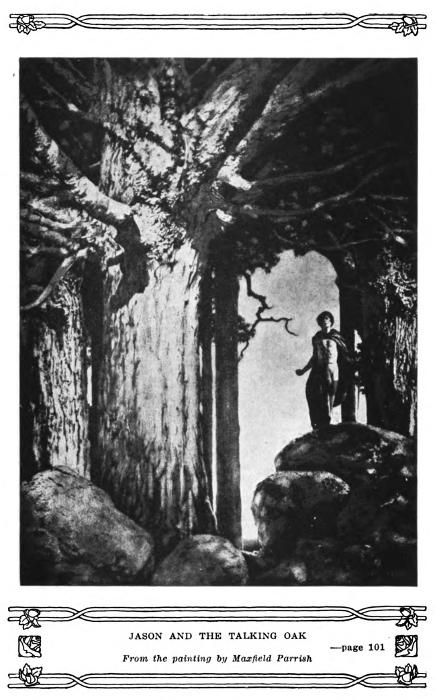
JASON AND THE TALKING OAK
—page 101
From the painting by Maxfield Parrish
So they came down to Iolcos, and all the city
came out to meet them, and were never tired with
looking at their height, and their beauty, and their
gallant bearing, and the glitter of their inlaid arms.
And some said, “Never was such a gathering of the
heroes since the Greeks conquered the land.” But
the women sighed over them, and whispered, “Alas!
they are all going to their death!”
Then they felled the pines on Pelion, and shaped
them with the axe, and Argus taught them to build
a galley, the first long ship which ever sailed the
seas. They pierced her for fifty oars—an oar for
each hero of the crew—and pitched her with coal-black
pitch, and painted her bows with vermilion;
and they named her Argo after Argus, and
worked at her all day long. And at night Pelias
feasted them like a king, and they slept in his
palace-porch.
But Jason went away to the northward, and into
the land of Thrace, till he found Orpheus, the
prince of minstrels, where he dwelt in his cave under
Rhodope, among the savage Cicon tribes. And
he asked him, “Will you leave your mountains,
Orpheus, my fellow-scholar in old times, and cross
Strymon once more with me, to sail with the heroes
of the Minuai, and bring home the Golden Fleece,
and charm for us all men and all monsters with
your magic harp and song?”
Then Orpheus sighed, “Have I not had enough
of toil and of weary wandering far and wide since
I lived in Chiron’s cave, above Iolcos by the sea?
In vain is the skill and the voice which my goddess
mother gave me; in vain have I sung and labored;
in vain I went down to the dead, and charmed all
the kings of Hades, to win back Eurydice my bride.
For I won her, my beloved, and lost her again the
same day, and wandered away in my madness,
even to Egypt and the Libyan sands, and the isles
of all the seas, driven on by the terrible gadfly, while
I charmed in vain the hearts of men, and the savage
forest beasts, and the trees, and the lifeless stones,
with my magic harp and song, giving rest, but
finding none. But at last Calliope, my mother,
delivered me and brought me home in peace; and
I dwell here in the cave alone, among the savage
Cicon tribes, softening their wild hearts with music
and the gentle laws of Jupiter. And now I must
go out again to the ends of all the earth, far away
into the misty darkness, to the last wave of the
Eastern sea. But what is doomed must be, and a
friend’s demand obeyed; for prayers are the
daughters of Jupiter, and who honors them honors
him.”
Then Orpheus rose up sighing, and took his
harp, and went over Strymon. And he led Jason
to the southwest, up the banks of Haliacmon and
over the spurs of Pindus, to Dodona the town of
Jupiter, where it stood by the side of the sacred
lake, and the fountain which breathed out fire, in
the darkness of the ancient oak-wood, beneath the
mountain of the hundred springs. And he led
them to the Talking Oak, where the black dove
settled in old times, and was changed into the
priestess of Jupiter, and gave oracles to all nations
round. And he bade him cut down a bough, and
sacrifice to Juno and to Jupiter, and they took
the bough and came to Iolcos, and nailed it to the
beakhead of the ship.
At last the ship was finished and they tried to
launch her down the beach; but she was too heavy
for them to move her, and her keel sank deep into
the sand. Then all the heroes looked at each other
blushing; but Jason spoke and said, “Let us ask
the magic bough; perhaps it can help us in our
need.”
Then a voice came from the bough, and Jason
heard the words it said, and bade Orpheus play
upon the harp, while the heroes waited round,
holding the pine-trunk rollers, to help her toward
the sea.
So Orpheus took his harp, and began his magic
song: “How sweet it is to ride upon the surges,
and to leap from wave to wave, while the wind
sings cheerful in the cordage, and the oars flash fast
among the foam! How sweet it is to roam across
the ocean, and see new towns and wondrous lands,
and to come home laden with treasure, and to win
undying fame!”
And the good ship Argo heard him, and longed
to be away and out at sea; till she stirred in every
timber, and heaved from stem to stern, and leaped
up from the sand upon the rollers, and plunged
onward like a gallant horse; and the heroes fed her
path with pine-trunks, till she rushed into the
whispering sea.
Then they stored her well with food and water,
and pulled the ladder up on board, and settled
themselves each man to his oar, and kept time to
Orpheus’ harp; and away across the bay they
rowed southward, while the people lined the cliffs;
and the women wept, while the men shouted, at the
starting of that gallant crew.
By Charles Kingsley
What happened next, my children, whether
it be true or not, stands written in ancient
songs, which you shall read for yourselves some
day. And grand old songs they are, written in
grand old rolling verse; and they call them the
Songs of Orpheus, or the Orphics, to this day.
They tell how the heroes came to Aphetai, across
the bay, and waited for the southwest wind, and
chose themselves a captain from their crew: and
how all called for Hercules, because he was the
strongest and most huge; but Hercules refused,
and called for Jason, because he was the wisest of
them all. So Jason was chosen captain; and
Orpheus heaped a pile of wood, and slew a bull,
and offered it to Juno, and called all the heroes to
stand round, each man’s head crowned with olive,
and to strike their swords into the bull. Then he
filled a golden goblet with the bull’s blood, and with
wheaten flour, and honey, and wine, and the bitter
salt-sea water, and bade the heroes taste. So each
tasted the goblet, and passed it round, and vowed
an awful vow: and they vowed before the sun, and
the night, and the blue-haired sea who shakes the
land, to stand by Jason faithfully in the adventure
of the Golden Fleece; and whosoever shrank back,
or disobeyed, or turned traitor to his vow, then
justice should minister against him, and the Fates
who track guilty men.
Then Jason lighted the pile, and burned the
carcass of the bull; and they went to their ship and
sailed eastward, like men who have a work to do;
and the place from which they went was called
Aphetai, the sailing-place from that day forth.
Three thousand years and more ago they sailed
away, into the unknown Eastern seas, and great
nations have come and gone since then, and many
a storm has swept the earth; many a mighty armament,
to which Argo would be but one small boat,
English and French, Turkish and Russian, have
sailed those waters since, yet the fame of that small
Argo lives forever, and her name is become a
proverb among men.
So they sailed past the Isle of Sciathos, with the
Cape of Sepius on their left, and turned to the
northward toward Pelion, up the long Magnesian
shore. On their right hand was the open sea, and
on their left old Pelion rose, while the clouds
crawled round his dark pine-forests, and his caps
of summer snow. And their hearts yearned for
the dear old mountain, as they thought of pleasant
days gone by, and of the sports of their boyhood,
their hunting, and their schooling in the cave
beneath the cliff. At last Peleus spoke, “Let us
land here, friends, and climb the dear old hill once
more. We are going on a fearful journey; who
knows if we shall see Pelion again? Let us go up
to Chiron our master, and ask his blessing ere we
start. And I have a boy, too, with him, whom he
trains as he trained me once—the son whom Thetis
brought me, the silver-footed lady of the sea, whom
I caught in the cave, and tamed her, though she
changed her shape seven times. For she changed,
as I held her, into water, and to vapor, and to burning
flame, and to a rock, and to a black-maned
lion, and to a tall and stately tree. But I held her
and held her ever, till she took her own shape again,
and led her to my father’s house, and won her
for my bride. And all the rulers of Olympus came
to our wedding, and the heavens and the earth
rejoiced together, when an Immortal wedded a
mortal man. And now let me see my son; for it
is not often I shall see him upon earth: famous he
will be, but short-lived, and die in the flower of
youth.”
So Tiphys the helmsman steered them to the
shore under the crag of Pelion; and they went up
through the dark pine-forests toward the Centaur’s
cave.
As they came into the misty hall, beneath the
snow-crowned crag, they saw the great Centaur
lying, with his huge limbs spread upon the rocks;
and beside him stood Achilles, the child whom no
steel could wound, and played upon his harp right
sweetly, while Chiron watched and smiled.
Then Chiron leaped up and welcomed them, and
kissed them every one, and set a feast before them
of swine’s flesh, and venison, and good wine; and
young Achilles served them, and carried the golden
goblet round. And after supper all the heroes
clapped their hands, and called on Orpheus to sing;
but he refused, and said, “How can I, who am the
younger, sing before our ancient host?” So they
called on Chiron to sing, and Achilles brought him
his harp; and he began a wondrous song, a famous
story of old time, of the fight between the Centaurs
and the Lapithai, which you may still see carved
in stone. He sang how his brothers came to ruin
by their folly, when they were mad with wine;
and how they and the heroes fought, with fists, and
teeth, and the goblets from which they drank; and
how they tore up the pine-trees in their fury, and
hurled great crags of stone, while the mountains
thundered with the battle, and the land was wasted
far and wide; till the Lapithai drove them from
their home in the rich Thessalian plains to the
lonely glens of Pindus, leaving Chiron all alone.
And the heroes praised his song right heartily; for
some of them had helped in that great fight.
Then Orpheus took the lyre, and sang of Chaos,
and the making of the wondrous World, and how
all things sprang from Love, who could not live
alone in the Abyss. And as he sang, his voice rose
from the cave, above the crags, and through the
tree-tops, and the glens of oak and pine. And the
trees bowed their heads when they heard it, and the
gray rocks cracked and rang, and the forest beasts
crept near to listen, and the birds forsook their
nests and hovered round. And old Chiron clapped
his hands together, and beat his hoofs upon the
ground, for wonder at that magic song.
Then Peleus kissed his boy, and wept over him,
and they went down to the ship; and Chiron came
down with them, weeping, and kissed them one by
one, and blessed them, and promised to them great
renown. And the heroes wept when they left him,
till their great hearts could weep no more; for he
was kind and just and pious, and wiser than all
beasts and men. Then he went up to a cliff, and
prayed for them, that they might come home safe
and well; while the heroes rowed away, and watched
him standing on his cliff above the sea, with his
great hands raised toward heaven, and his white
locks waving in the wind; and they strained their
eyes to watch him to the last, for they felt that they
should look on him no more.
So they rowed on over the long swell of the sea,
past Olympus, the seat of the Immortals, and past
the wooded bays of Athos, and Samothrace the
sacred isle; and they came past Lemnos to the
Hellespont, and through the narrow strait of
Abydos, and so on into the Propontis, which we
call Marmora now. And there they met with
Cyzicus, ruling in Asia over the Dolions, who, the
songs say, was the son of Æneas, of whom you will
hear many a tale some day. For Homer tells us
how he fought at Troy, and Virgil how he sailed
away and founded Rome. Now Cyzicus, the songs
say, welcomed the heroes, for his father had been
one of Chiron’s scholars; so he welcomed them, and
feasted them, and stored their ship with corn and
wine, and cloaks and rugs, the songs say, and
shirts, of which no doubt they stood in need.
But at night, while they lay sleeping, came down
on them terrible men, who lived with the bears in
the mountains, like Titans or giants in shape; for
each of them had six arms, and they fought with
young firs and pines. But Hercules killed them
all before morn with his deadly poisoned arrows;
but among them, in the darkness, he slew Cyzicus
the kindly prince.
Then they got to their ship and to their oars, and
Tiphys bade them cast off the hawsers and go to
sea. But as he spoke a whirlwind came, and spun
the Argo round, and twisted the hawsers together,
so that no man could loose them. Then Tiphys
dropped the rudder from his hand, and cried, “This
comes from the gods above.” But Jason went forward,
and asked counsel of the magic bough.
Then the magic bough spoke, and answered,
“This is because you have slain Cyzicus your friend.
You must appease his soul, or you will never leave
this shore.”
Jason went back sadly, and told the heroes what
he had heard. And they leaped on shore, and
searched till dawn; and at dawn they found the
body, all rolled in dust and blood, among the
corpses of those monstrous beasts. And they wept
over their kind host, and laid him on a fair bed,
and heaped a huge mound over him, and offered
black sheep at his tomb, and Orpheus sang a magic
song to him, that his spirit might have rest. And
then they held games at the tomb, after the custom
of those times, and Jason gave prizes to each
winner. To Ancæus he gave a golden cup, for he
wrestled best of all; and to Hercules, a silver one,
for he was the strongest of all; and to Castor, who
rode best, a golden crest; and Pollux the boxer
had a rich carpet, and to Orpheus for his song a
sandal with golden wings. But Jason himself was
the best of all the archers, and the Minuai crowned
him with an olive crown; and so, the songs say,
the soul of good Cyzicus was appeased and the
heroes went on their way in peace.
But when Cyzicus’ wife heard that he was dead
she died likewise of grief; and her tears became a
fountain of clear water, which flows the whole year
round.
Then they rowed away, the songs say, along the
Mysian shore, and past the mouth of Rhindacus,
till they found a pleasant bay, sheltered by the long
ridges of Arganthus, and by high walls of basalt
rock. There they ran the ship ashore upon the
yellow sand, and furled the sail, and took the mast
down, and lashed it in its crutch. And next they
let down the ladder, and went ashore to sport and
rest.
There Hercules went away into the woods, bow
in hand, to hunt wild deer; and Hylas the fair boy
slipped away after him, and followed him by stealth,
until he lost himself among the glens, and sat down
weary to rest himself by the side of a lake; and
there the water nymphs came up to look at him,
and loved him, and carried him down under the
lake to be their playfellow, forever happy and
young. And Hercules sought for him in vain,
shouting his name till all the mountains rang; but
Hylas never heard him, far down under the sparkling
lake. So while Hercules wandered searching
for him, a fair breeze sprang up, and Hercules was
nowhere to be found; and the Argo sailed away,
and Hercules was left behind, and never saw the
noble Phasian stream.
Then the Minuai came to a doleful land, where
Amycus the giant ruled, and cared nothing for
the laws of Jupiter, but challenged all strangers
to box with him, and those whom he conquered he
slew. But Pollux the boxer struck him a harder
blow than he ever felt before, and slew him; and the
Minuai went on up the Bosphorus, till they came to
the city of Phineus, the fierce Bithynian king; for
Zetes and Calais bade Jason land there, because
they had a work to do.
They went up from the shore toward the city,
through forests white with snow; and Phineus
came out to meet them with a lean and woeful face,
and said, “Welcome, gallant heroes, to the land of
bitter blasts, the land of cold and misery; yet I
will feast you as best I can.” And he led them in,
and set meat before them; but before they could
put their hands to their mouths, down came two
fearful monsters, the like of whom man never saw;
for they had the faces and the hair of fair maidens,
but the wings and claws of hawks; and they
snatched the meat from off the table, and flew
shrieking out above the roofs.
Then Phineus beat his breast and cried, “These
are the Harpies, whose names are the Whirlwind
and the Swift, the daughters of Wonder and of
the Amber-nymph, and they rob us night and day.
They carried off the daughters of Pandareus, whom
all the gods had blessed; for Venus fed them on
Olympus with honey and milk and wine; and Juno
gave them beauty and wisdom, and Minerva skill
in all the arts; but when they came to their wedding,
the Harpies snatched them both away, and
gave them to be slaves to the Fates and live in
horror all their days. And now they haunt me, and
my people, and the Bosphorus, with fearful storms
and sweep away our food from off our tables, so
that we starve in spite of all our wealth.”
Then up rose Zetes and Calais, the winged sons
of the North Wind, and said, “Do you not know
us, Phineus, and these wings which grow upon our
backs?” And Phineus hid his face in terror; but
he answered not a word.
“Because you have been a traitor, Phineus, the
Harpies haunt you night and day. Where is
Cleopatra our sister, your wife, whom you keep in
prison? and where are her two children, whom
you blinded in your rage, at the bidding of an evil
woman, and cast them out upon the rocks? Swear
to us that you will right our sister, and cast out
that wicked woman; and then we will free you
from your plague, and drive the whirlwind maidens
to the south; but if not, we will put out your eyes,
as you put out the eyes of your own sons.”
Then Phineus swore an oath to them, and drove
out the wicked woman; and Jason took those two
poor children, and cured their eyes with magic
herbs.
But Zetes and Calais rose up sadly and said,
“Farewell now, heroes all; farewell, our dear companions,
with whom we played on Pelion in old
times; for a fate is laid upon us, and our day is
come at last, in which we must hunt the whirlwinds
over land and sea forever; and if we catch them
they die, and if not, we die ourselves.”
At that all the heroes wept; but the two young
men sprang aloft into the air after the Harpies,
and the battle of the winds began. The heroes
trembled in silence as they heard the shrieking of
the blasts; while the palace rocked and all the city,
and great stones were torn from the crags, and the
forest pines were hurled earthward, north and
south and east and west, and the Bosphorus boiled
white with foam, and the clouds were dashed against
the cliffs.
But at last the battle ended, and the Harpies
fled screaming toward the south, and the sons of
the North Wind rushed after them, and brought
clear sunshine where they passed. For many a
league they followed them, over all the isles of the
Cyclades, and away to the southwest across Hellas,
till they came to the Ionian Sea, and there they fell
upon the Echinades, at the mouth of the Achelous;
and those isles were called the Whirlwind Isles for
many a hundred years. But what became of Zetes
and Calais I know not, for the heroes never saw
them again: and some say that Hercules met them,
and quarrelled with them, and slew them with his
arrows; and some say that they fell down from
weariness and the heat of the summer sun, and that
the Sun-god buried them among the Cyclades, in
the pleasant Isle of Tenos; and for many hundred
years their grave was shown there, and over it a
pillar, which turned to every wind. But those dark
storms and whirlwinds haunt the Bosphorus until
this day.
But the Argonauts went eastward, and out into
the open sea, which we now call the Black Sea, but
it was called the Euxine then. No Greek had ever
crossed it, and all feared that dreadful sea, and its
rocks, and shoals, and fogs, and bitter freezing
storms; and they told strange stories of it, some
false and some half true, how it stretched northward
to the ends of the earth, and the sluggish
Putrid Sea, and the everlasting night, and the
regions of the dead. So the heroes trembled, for
all their courage, as they came into that wild Black
Sea, and saw it stretching out before them, without
a shore, as far as eye could see.
And first Orpheus spoke, and warned them,
“We shall come now to the wandering blue rocks;
my mother warned me of them, Calliope, the immortal
muse.”
Soon they saw the blue rocks shining like spires
and castles of gray glass, while an ice-cold wind
blew from them and chilled the heroes’ hearts. As
they neared they could see them heaving, as they
rolled upon the long set waves, crashing and grinding
together, till the roar went up to heaven. The
sea sprang up in spouts between them, and swept
round them in white sheets of foam; but their heads
swung nodding high in air, while the wind whistled
shrill among the crags.
The heroes’ hearts sank within them, and they
lay upon their oars in fear; but Orpheus called to
Tiphys the helmsman, “Between them we must
pass; so look ahead for an opening, and be brave,
for Juno is with us.” But Tiphys the cunning
helmsman stood silent, clenching his teeth, till he
saw a heron come flying mast-high toward the
rocks, and hover a while before them, as if looking
for a passage through. Then he cried, “Juno has
sent us a pilot; let us follow the cunning bird.”
Then the heron flapped to and fro a moment, till
he saw a hidden gap, and into it he rushed like an
arrow, while the heroes watched what would befall.
And the blue rocks clashed together as the bird flew
swiftly through; but they struck but a feather from
his tail, and then rebounded apart at the shock.
Then Tiphys cheered the heroes, and they
shouted; and the oars bent like withes beneath their
strokes as they rushed between those toppling ice-crags
and the cold blue lips of death. And ere the
rocks could meet again they had passed them, and
were safe out in the open sea.
After that they sailed on wearily along the Asian
coast, by the Black Cape and Thyneis, where the
hot stream of Thymbris falls into the sea, and
Sangarius, whose waters float on the Euxine, till
they came to Wolf the river, and to Wolf the
kindly king. And there died two brave heroes,
Idmon and Tiphys the wise helmsman; one died
of an evil sickness, and one a wild boar slew. So
the heroes heaped a mound above them, and set
upon it an oar on high, and left them there to sleep
together, on the far-off Lycian shore. But Idas
killed the boar, and avenged Tiphys; and Ancaios
took the rudder and was helmsman, and steered
them on toward the east.
And they went on past Sinope, and many a
mighty river’s mouth, and past many a barbarous
tribe, and the cities of the Amazons, the warlike
women of the East, till all night they heard the
clank of anvils and roar of furnace-blasts, and the
forge-fires shone like sparks through the darkness
in the mountain glens aloft; for they were come to
the shores of the Chalybes, the smiths who never
tire, but serve Mars the cruel War-god, forging
weapons day and night.
At day-dawn they looked eastward, and midway
between the sea and the sky they saw white snow-peaks
hanging, glittering sharp and bright above
the clouds. And they knew that they were come to
Caucasus, at the end of all the earth: Caucasus the
highest of all mountains, the father of the rivers
of the East. On this peak lies chained the Titan,
while a vulture tears his heart; and at his feet are
piled dark forests round the magic Colchian land.
And they rowed three days to the eastward, while
Caucasus rose higher hour by hour, till they saw
the dark stream of Phasis rushing headlong to the
sea, and, shining above the tree-tops, the golden
roofs of King Aietes, the child of the Sun. Then
out spoke Ancaios the helmsman, “We are come
to our goal at last, for there are the roofs of Aietes,
and the woods where all poisons grow; but who can
tell us where among them is hid the Golden Fleece?
Many a toil must we bear ere we find it, and bring
it home to Greece.”
But Jason cheered the heroes, for his heart was
high and bold; and he said, “I will go alone up to
Aietes, though he be the child of the Sun, and win
him with soft words. Better so than to go all together,
and to come to blows at once.” But the
Minuai would not stay behind, so they rowed boldly
up the stream.
And a dream came to Aietes, and filled his heart
with fear. He thought he saw a shining star, which
fell into his daughter’s lap; and that Medea his
daughter took it gladly, and carried it to the river-side,
and cast it in, and there the whirling river bore
it down, and out into the Black Sea. Then he
leaped up in fear, and bade his servants bring his
chariot, that he might go down to the river-side and
appease the nymphs, and the heroes whose spirits
haunt the bank. So he went down in his golden
chariot, and his daughters by his side, Medea the
fair witch-maiden, and Chalciope, who had been
Phrixus’ wife, and behind him a crowd of servants
and soldiers, for he was a rich and mighty prince.
As he drove down by the reedy river he saw
Argo sliding up beneath the bank, and many a
hero in her, like Immortals for beauty and for
strength, as their weapons glittered round them in
the level morning sunlight, through the white mist
of the stream. But Jason was the noblest of all;
for Juno, who loved him, gave him beauty and tallness
and vigorous manhood.
And when they came near together and looked
into each other’s eyes the heroes were awed before
Aietes as he shone in his chariot, like his father the
glorious Sun; for his robes were of rich gold tissue,
and the rays of his diadem flashed fire, and in his
hand he bore a jewelled scepter, which glittered
like the stars; and sternly he looked at them under
his brows, and sternly he spoke and loud: “Who
are you, and what want you here, that you come
to the shore of Cutaia? Do you take no account
of my rule, nor of my people the Colchians who
serve me, who never tired yet in the battle, and
know well how to face an invader?”
And the heroes sat silent before the face of that
ancient king. But Juno the awful goddess put courage
into Jason’s heart, and he rose and shouted
loudly in answer, “We are no pirates nor lawless
men. We come not to plunder and to ravage, or
carry away slaves from your land; but my uncle
the son of Neptune, Pelias the Minuan king, he it
is who has set me on a quest to bring home the
Golden Fleece. And these, too, my bold comrades,
are no nameless men; for some are the sons of Immortals,
and some of heroes far renowned. And
we, too, never tire in battle, and know well how to
give blows and to take: yet we wish to be guests
at your table: it will be better so for both.”
Then Aietes’ rage rushed up like a whirlwind,
and his eyes flashed fire as he heard; but he crushed
his anger down in his breast, and spoke mildly a
cunning speech:
“If you will fight for the fleece with my Colchians,
then many a man must die. But do you
indeed expect to win from me the fleece in fight?
So few you are that if you be worsted I can load
your ship with your corpses. But if you will be
ruled by me, you will find it better far to choose the
best man among you, and let him fulfil the labors
which I demand. Then I will give him the Golden
Fleece for a prize and a glory to you all.”
So saying, he turned his horses and drove back
in silence to the town. And the Minuai sat silent
with sorrow, and longed for Hercules and his
strength; for there was no facing the thousands of
the Colchians and the fearful chance of war.
But Chalciope, Phrixus’ widow, went weeping
to the town; for she remembered her Minuan husband,
and all the pleasures of her youth, while she
watched the fair faces of his kinsmen, and their
long locks of golden hair. And she whispered to
Medea, her sister, “Why should all these brave men
die? why does not my father give them up the
fleece, that my husband’s spirit may have rest?”
And Medea’s heart pitied the heroes, and Jason
most of all; and she answered, “Our father is stern
and terrible, and who can win the Golden Fleece?”
But Chalciope said, “These men are not like our
men; there is nothing which they cannot dare nor
do.”
And Medea thought of Jason and his brave
countenance, and said, “If there was one among
them who knew no fear, I could show him how to
win the fleece.”
So in the dusk of evening they went down to the
river-side, Chalciope and Medea the witch-maiden,
and Argus, Phrixus’ son. And Argus the boy
crept forward, among the beds of reeds, till he
came where the heroes were sleeping, on the thwarts
of the ship, beneath the bank, while Jason kept
ward on shore, and leaned upon his lance full of
thought. And the boy came to Jason, and said:
“I am the son of Phrixus, your cousin; and Chalciope
my mother waits for you, to talk about the
Golden Fleece.”
Then Jason went boldly with the boy, and found
the two princesses standing; and when Chalciope
saw him she wept, and took his hands, and cried:
“O cousin of my beloved, go home before you die!”
“It would be base to go home now, fair princess,
and to have sailed all these seas in vain.” Then
both the princesses besought him; but Jason said,
“It is too late.”
“But you know not,” said Medea, “what he must
do who would win the fleece. He must tame the
two brazen-footed bulls, who breathe devouring
flame; and with them he must plow ere nightfall
four acres in the field of Mars; and he must sow
them with serpents’ teeth, of which each tooth
springs up into an armed man. Then he must fight
with all those warriors; and little will it profit him
to conquer them, for the fleece is guarded by a serpent,
more huge than any mountain pine; and over
his body you must step if you would reach the
Golden Fleece.”
Then Jason laughed bitterly. “Unjustly is that
fleece kept here, and by an unjust and lawless
king; and unjustly shall I die in my youth, for I
will attempt it ere another sun be set.”
Then Medea trembled, and said, “No mortal
man can reach that fleece unless I guide him
through. For round it, beyond the river, is a wall
full nine ells high, with lofty towers and buttresses,
and mighty gates of threefold brass; and over the
gates the wall is arched, with golden battlements
above. And over the gateway sits Brimo, the wild
witch-huntress of the woods, brandishing a pine-torch
in her hands, while her mad hounds howl
around. No man dare meet her or look on her, but
only I her priestess, and she watches far and wide
lest any stranger should come near.”
“No wall so high but it may be climbed at last,
and no wood so thick but it may be crawled
through; no serpent so wary but he may be
charmed, or witch-queen so fierce but spells may
soothe her; and I may yet win the Golden Fleece,
if a wise maiden help bold men.”
And he looked at Medea cunningly, and held her
with his glittering eye, till she blushed and trembled,
and said: “Who can face the fire of the bull’s
breath, and fight ten thousand armed men?”
“He whom you help,” said Jason, flattering her,
“for your fame is spread over all the earth. Are
you not the queen of all enchantresses, wiser even
than your sister Circe, in her fairy island in the
West?”
“Would that I were with my sister Circe in her
fairy island in the West, far away from sore temptation
and thoughts which tear the heart! But if it
must be so—for why should you die?—I have an
ointment here; I made it from the magic ice-flower
which sprang from Prometheus’ wound, above the
clouds on Caucasus, in the dreary fields of snow.
Anoint yourself with that, and you shall have in
you seven men’s strength; and anoint your shield
with it, and neither fire nor sword can harm you.
But what you begin you must end before sunset,
for its virtue lasts only one day. And anoint your
helmet with it before you sow the serpents’ teeth;
and when the sons of earth spring up, cast your
helmet among their ranks, and the deadly crop of
the War-god’s field will mow itself, and perish.”
Then Jason fell on his knees before her, and
thanked her and kissed her hands; and she gave
him the vase of ointment, and fled trembling
through the reeds. And Jason told his comrades
what had happened, and showed them the
box of ointment; and all rejoiced but Idas, and he
grew mad with envy.
At sunrise Jason went and bathed, and anointed
himself from head to foot, and his shield, and his
helmet, and his weapons, and bade his comrades
try the spell. So they tried to bend his lance, but
it stood like an iron bar; and Idas in spite hewed
at it with his sword, but the blade flew to splinters
in his face. Then they hurled their lances at his
shield, but the spear-points turned like lead; and
Caineus tried to throw him, but he never stirred a
foot; and Pollux struck him with his fist a blow
which would have killed an ox, but Jason only
smiled, and the heroes danced about him with delight;
and he leaped, and ran, and shouted in the
joy of that enormous strength, till the sun rose, and
it was time to go and claim Aietes’ promise.
So he sent up Telamon and Aithalides to tell
Aietes that he was ready for the fight; and they
went up among the marble walls and beneath the
roofs of gold, and stood in Aietes’ hall while he
grew pale with rage.
“Fulfil your promise to us, child of the blazing
Sun. Give us the serpents’ teeth, and let loose the
fiery bulls; for we have found a champion among
us who can win the Golden Fleece.”
And Aietes bit his lips, for he fancied that they
had fled away by night; but he could not go back
from his promise; so he gave them the serpents’
teeth. Then he called for his chariot and his horses,
and sent heralds through all the town; and all the
people went out with him to the dreadful War-god’s
field.
And there Aietes sat upon his throne, with his
warriors on each hand, thousands and tens of thousands,
clothed from head to foot in steel chain-mail.
And the people and the women crowded to
every window and bank and wall; while the Minuai
stood together, a mere handful in the midst of that
great host. Chalciope was there and Argus, trembling,
and Medea, wrapped closely in her veil; but
Aietes did not know that she was muttering cunning
spells between her lips.
Then Jason cried, “Fulfil your promise, and let
your fiery bulls come forth.”
Then Aietes bade open the gates, and the magic
bulls leaped out. Their brazen hoofs rang upon
the ground, and their nostrils sent out sheets of
flame, as they rushed with lowered heads upon
Jason; but he never flinched a step. The flame of
their breath swept round him, but it singed not a
hair of his head; and the bulls stopped short and
trembled when Medea began her spell.
Then Jason sprang upon the nearest and seized
him by the horn; and up and down they wrestled,
till the bull fell grovelling on his knees; for the
heart of the brute died within him; and his mighty
limbs were loosed, beneath the steadfast eye of that
dark witch-maiden and the magic whisper of her
lips.
So both the bulls were tamed and yoked; and
Jason bound them to the plow, and goaded them
onward with his lance till he had plowed the sacred
field.
And all the Minuai shouted; but Aietes bit his
lips with rage for the half of Jason’s work was
over, and the sun was yet high in heaven.
Then he took the serpents’ teeth and sowed them,
and waited what would befall. But Medea looked
at him and at his helmet, lest he should forget the
lesson she had taught.
Every furrow heaved and bubbled, and out of
every clod arose a man. Out of the earth they rose
by thousands, each clad from head to foot in steel,
and drew their swords and rushed on Jason, where
he stood in the midst alone. Then the Minuai grew
pale with fear for him; but Aietes laughed a bitter
laugh. “See! if I had not warriors enough already
round me, I could call them out of the bosom of
the earth.”
But Jason snatched off his helmet, and hurled it
into the thickest of the throng. And blind madness
came upon them, suspicion, hate, and fear; and one
cried to his fellow, “Thou didst strike me!” and
another, “Thou art Jason; thou shalt die!” So
fury seized those earth-born phantoms, and each
turned his hand against the rest; and they fought
and were never weary, till they all lay dead upon
the ground. Then the magic furrows opened, and
the kind earth took them home into her breast;
and the grass grew up all green again above them,
and Jason’s work was done.
Then the Minuai rose and shouted, till Prometheus
heard them from his crag. And Jason cried,
“Lead me to the fleece this moment, before the sun
goes down.”
But Aietes thought, “He has conquered the bulls,
and sown and reaped the deadly crop. Who is
this who is proof against all magic? He may kill
the serpent yet.” So he delayed, and sat taking
counsel with his princes till the sun went down and
all was dark. Then he bade a herald cry, “Every
man to his home for to-night. To-morrow we will
meet these heroes, and speak about the Golden
Fleece.” Then he turned and looked at Medea.
“This is your doing, false witch-maid! You have
helped these yellow-haired strangers, and brought
shame upon your father and yourself!”
Medea shrank and trembled, and her face grew
pale with fear; and Aietes knew that she was
guilty, and whispered, “If they win the fleece, you
die!”
But the Minuai marched toward their ship,
growling like lions cheated of their prey; for they
saw that Aietes meant to mock them, and to cheat
them out of all their toil. And Oileus said, “Let
us go to the grove together, and take the fleece by
force.”
And Idas the rash cried, “Let us draw lots who
shall go in first; for, while the dragon is devouring
one, the rest can slay him and carry off the fleece
in peace.” But Jason held them back, though he
praised them; for he hoped for Medea’s help.
And after a while Medea came trembling, and wept
a long while before she spoke. And at last: “My
end is come, and I must die; for my father has
found out that I have helped you. You he would
kill if he dared; but he will not harm you, because
you have been his guests. Go, then, go, and remember
poor Medea when you are far away across
the sea.” But all the heroes cried:
“If you die, we die with you; for without you we
cannot win the fleece, and home we will not go
without it, but fall here fighting to the last man.”
“You need not die,” said Jason. “Flee home
with us across the sea. Show us first how to win
the fleece; for you can do it. Why else are you the
priestess of the grove? Show us but how to win
the fleece, and come with us, and you shall be my
queen, and rule over the rich princes of the Minuai,
in Iolcos by the sea.” And all the heroes pressed
round, and vowed to her that she should be their
queen.
Medea wept, and shuddered, and hid her face in
her hands; for her heart yearned after her sisters
and her playfellows, and the home where she was
brought up as a child. But at last she looked up
at Jason, and spoke between her sobs: “Must I
leave my home and my people, to wander with
strangers across the sea? The lot is cast, and I
must endure it. I will show you how to win the
Golden Fleece. Bring up your ship to the wood-side,
and moor her there against the bank; and let
Jason come up at midnight, and one brave comrade
with him, and meet me beneath the wall.”
Then all the heroes cried together, “I will go!”
“and I!” “and I!” And Idas the rash grew mad
with envy; for he longed to be foremost in all things.
But Medea calmed them, and said, “Orpheus shall
go with Jason, and bring his magic harp; for I hear
of him that he is the king of all minstrels, and can
charm all things on earth.”
And Orpheus laughed for joy, and clapped his
hands, because the choice had fallen on him; for in
those days poets and singers were as bold warriors
as the best.
So at midnight they went up the bank, and found
Medea; and besides came Absyrtus her young
brother, leading a yearling lamb.
Then Medea brought them to a thicket beside the
War-god’s gate; and there she bade Jason dig a
ditch, and kill the lamb, and leave it there, and
strew on it magic herbs and honey from the honeycomb.
Then sprang up through the earth, with the red
fire flashing before her, Brimo the wild witch-huntress,
while her mad hounds howled around. She
had one head like a horse’s, and another like a
ravening hound’s, and another like a hissing
snake’s and a sword in either hand. And she leaped
into the ditch with her hounds, and they ate and
drank their fill, while Jason and Orpheus trembled,
and Medea hid her eyes. And at last the witch-queen
vanished, and fled with her hounds into the
woods; and the bars of the gates fell down, and the
brazen doors flew wide, and Medea and the heroes
ran forward and hurried through the poison wood,
among the dark stems of the mighty beeches,
guided by the gleam of the Golden Fleece, until
they saw it hanging on one vast tree in the midst.
And Jason would have sprung to seize it; but
Medea held him back, and pointed, shuddering, to
the tree-foot, where the mighty serpent lay, coiled
in and out among the roots, with a body like a
mountain pine. His coils stretched many a fathom,
spangled with bronze and gold; and half of him
they could see, but no more, for the rest lay in the
darkness beyond.
And when he saw them coming he lifted up his
head, and watched them with his small bright eyes,
and flashed his forked tongue, and roared like the
fire among the woodlands, till the forest tossed and
groaned. For his cries shook the trees from leaf to
root, and swept over the long reaches of the river,
and over Aietes’ hall, and woke the sleepers in the
city, till mothers clasped their children in their fear.
But Medea called gently to him, and he stretched
out his long spotted neck, and licked her hand, and
looked up in her face, as if to ask for food. Then
she made a sign to Orpheus, and he began his
magic song.
And as he sung, the forest grew calm again, and
the leaves on every tree hung still; and the serpent’s
head sank down, and his brazen coils grew
limp, and his glittering eyes closed lazily, till he
breathed as gently as a child, while Orpheus called
to pleasant Slumber, who gives peace to men, and
beasts, and waves.
Then Jason leaped forward warily, and stepped
across that mighty snake, and tore the fleece from
off the tree-trunk; and the four rushed down the
garden, to the bank where the Argo lay.
There was a silence for a moment, while Jason
held the Golden Fleece on high. Then he cried,
“Go now, good Argo, swift and steady, if ever you
would see Pelion more.” And she went, as the
heroes drove her, grim and silent all, with muffled
oars, till the pinewood bent like willow in their
hands, and stout Argo groaned beneath their
strokes.
On and on, beneath the dewy darkness, they fled
swiftly down the swirling stream; underneath
black walls, and temples, and the castles of the
princes of the East; past sluice-mouths, and fragrant
gardens, and groves of all strange fruits;
past marshes where fat kine lay sleeping, and long
beds of whispering reeds; till they heard the merry
music of the surge upon the bar, as it tumbled in
the moonlight all alone.
Into the surge they rushed, and Argo leaped the
breakers like a horse; for she knew the time was
come to show her mettle, and win honor for the
heroes and herself. Into the surge they rushed,
and Argo leaped the breakers like a horse, till the
heroes stopped all panting, each man upon his oar,
as she slid into the still broad sea.
Then Orpheus took his harp and sang a pæan,
till the heroes’ hearts rose high again; and they
rowed on stoutly and steadfastly, away into the
darkness of the West.
By Elsie Finnimore Buckley
In the city of Calydon long ago there were great
rejoicings because the queen Althæa had given
birth to a son, her first-born, who, if he grew to
years of manhood, would in time sit upon the
throne of his father Œneus, and rule the land.
Some seven days after the child was born it chanced
that the queen was lying in her chamber, with the
babe upon her breast.
As she lay she watched the shadows playing up
and down upon the walls, and to her eyes they took
strange forms of men and beasts. Now it was a
great fight she saw, with horses and chariots rushing
over a plain, and mighty warriors meeting face
to face in battle; now it was a hunt, with winding
of horns and dogs straining at the leash, and a
white-tusked boar breaking through a thicket. But
whether it was a hunt or whether it was a battle,
everywhere there was one figure of a man she
watched—a man tall and fair and brave, who stood
out conspicuous among his fellows—such a hero as
her son might grow to be if he lived till years of
manhood. And she prayed that her vision might
come true, and her son grow up to be a hero—a
man mighty in sport and mighty in battle. In time
the flames died down, and the fire burned clear and
still upon the hearth. The queen’s eyes grew heavy,
and she was about to turn on her side to sleep when
a strange thing happened, which took from her all
desire for rest. The wall of the room in front of
her, which had glowed bright and cheery in the firelight,
grew gray and misty and seemed to vanish
before her eyes, and through the opening there
came towards her the forms of three strange
women, taller and more terrible than any women
of earth. The first one carried in her hand a skein
of thread, the second a spindle, and the third a pair
of great sharp shears. The queen lay still and
motionless with terror as they came forward slowly
arm in arm and stood beside the couch, looking
down upon the child at her breast. At length the
first one spoke.
“I give to thy child, Althæa, a thread of life exceeding
bright and fair.”
“And I,” said the second, “will weave that thread
into dark places, where it will shine the brighter
for the darkness round about, and bring him
honor and great renown.”
The third one said never a word, but walked
slowly round the couch till she stood before the fire
on the hearth. A great brand had fallen from the
grate, and lay smouldering on the stones. Bending
down, she took it in her hand, and thrust it deep
into the red-hot heart of the fire, and stood watching
it till it was well alight, and the tongues of
flame shot crackling upwards. Then she turned
towards the queen.
“As soon as that brand upon the fire is consumed,”
she said, “I will cut the shining thread
with my shears, and his life shall be as ashes cast
forth upon the wind.”
With a cry of terror the queen sprang up from
her couch, rushed across the room, and, drawing
forth the blazing brand from the fire, she smothered
it in her gown, and crushed it beneath her bare feet,
till not a live spark remained about it. Then she
hid it in a secret place where she alone could find it,
and cast herself upon her couch and knew no more.
For many a long day she lay between life and
death, but at last the gods had mercy, and her
strength came slowly back to her. But when anyone
asked her the cause of her burning, she would
shudder and mutter some strange tale of a brand
which fell from the fire, and would have burnt out
the life of her child. What she meant no one ever
knew, but they thought that the gods had stricken
her with a sudden fever, and that, not knowing
what she did, she had burnt herself in the fire. But
of the half-burnt brand and of the word of the
Fates they knew nothing, for Althæa had said in
her heart:
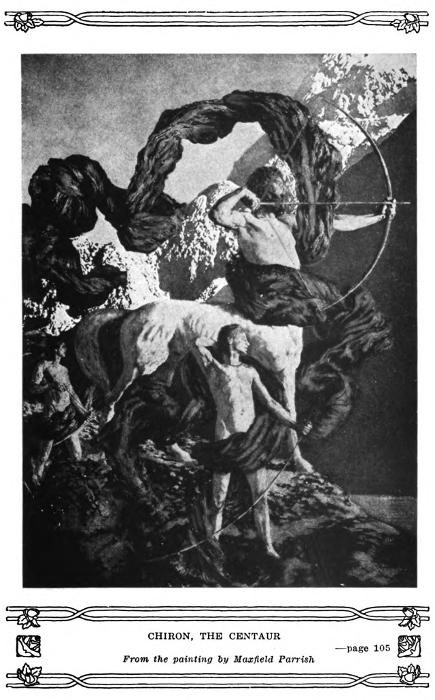
CHIRON, THE CENTAUR
—page 105
From the painting by Maxfield Parrish
“The Fates have spoken, and their word shall
surely come to pass. A fine and fair thread of life
has Lachesis given to my son, and Clotho will weave
it into dark places, where it shall shine exceeding
bright. The gifts they have given are good. The
hand of Atropos alone is against him, and she has
measured his life by the life of a frail piece of wood.
But so long as the gods shall give me strength
no careless hand shall place that brand upon the
flames, and no man shall know the secret of his
life, for grief or madness may turn even the heart
of a friend. On me, and on me alone, shall my
son’s life rest; for well do I know that neither
prayer nor sacrifice can avail to turn the heart of
Atropos, the Unswerving One.” So she kept the
brand securely hidden where she alone could find it.
Many other fair children did she bear to Œneus
the king, but best of them all she loved Meleager,
her first-born; for the word that the Fates had
spoken came true. He grew to be a great warrior
and a mighty man, and was feared by his foes and
loved by his friends through the length and breadth
of the land. In all the country-side there was no
man who could hurl the javelin with such force and
skill as he, and whenever he went forth to battle the
victory lay with the men of Calydon, and he was
called the savior and protector of his city.
When he was in the flower of his manhood,
the call of Jason came from far Iolcos for all the
heroes of Greece to join him in his search for the
Golden Fleece. Amongst them sailed Meleager in
the good ship Argo, and came to the land of the
dusky Colchians on the shores of the Black Sea.
He played his part like a man, and came back to
Calydon with a fair name for courage and endurance.
Then was he hoisted on the shoulders of his
countrymen and carried through the streets of the
city, and feasted right royally in his father’s house.
Soon after his return it chanced that the harvest
was more plentiful than it had ever been within
the memory of man. Wherefore Œneus the king
ordered a great thanksgiving to be held throughout
the land in honor of Bacchus and Ceres and
Minerva, who had given such good gifts to men.
At every shrine and temple the altars smoked with
sacrifice, and glad bands of youths and maidens
with garlands on their heads danced hand in hand
around, singing the song of the harvest.
When Diana, the huntress, saw that everywhere
the altars smoked in honor of Ceres and Bacchus
and Minerva, but that never a single stone was
raised to her, she was filled with jealousy and wrath.
One night, when all the land lay sleeping, she left
the mountains, where she loved to hunt, and came
down to Calydon. The arrows in her quiver rattled
as she strode along in her wrath, and the flash of
her eyes was as the flash of summer lightning across
the sky. With great swinging strides she came
and stood over Œneus as he slept.
“O king,” she said, “too long have I been patient
and waited for my dues; but I will suffer thine
ingratitude no more. When the young corn stands
green upon the plain, and the vine-leaves are shooting,
and the trees cast once more their shade upon
the bare hill-side, then shalt thou have cause to
know my power. Broad and dark are the forests,
and many a wild beast lurks therein that is tame at
my word alone. One of these will I let loose upon
thy land. Many a fair field shall be trodden underfoot,
and many a vineyard and olive-grove laid
waste—yea, and red blood shall flow, ere my wrath
be assuaged, and I take away the pests from your
midst. I have spoken, and no sacrifice shall turn
me from my word.”
Thus did she speak, saying the words in his ear,
and turned and left the room by the way she had
come. With a start he awoke from his sleep and
looked around him, but no one could he see. Only
a sudden storm of wind lashed the branches of the
trees against each other, and a dark cloud hid the
face of the moon.
“The sad winter-time is coming,” he thought,
“with its storms and its darkened days. Yet, lest
there be aught in my dream, I will remember Diana
to-morrow, and her altars, too, shall smoke with
sacrifice.”
So on the morrow a great festival was held in
honor of Diana, the maiden huntress, and Œneus
laid aside all thought of his dream. But when the
spring-time came and the early summer, he had
cause to remember it with sorrow, for out of the
forests there came a great boar which laid waste
all the country, right and left. In size he was
more huge than an ox of Epirus, whose oxen are
the largest in the world, and the bristles on his
neck stood up like spikes. His breath was as a
flame of fire that burned up all that stood in his
way, and his cruel little eyes gleamed red with
blood. Over the cornfields he raged, and trampled
the green blades beneath his hoofs, and with his
strong, white tusks he tore down the vine-branches
and broke the overhanging boughs of the olive, so
that the young berries and fruit lay spoilt upon
the ground. Not only did he lay waste the fields,
but the flocks and herds on the pasture-land were
not safe from his attack, and neither shepherds
nor dogs could protect them from his fury.
Through all the country-side the people fled in
terror for their lives, and hid within the city walls,
only now and again a band of the bravest would go
forth and lay nets and snares for him; but so great
was the strength of the beast that he broke through
every trap they could devise, and, killing any man
who stood in his path, he would return, with greater
fury than before, to his attack upon the fields and
cattle. At length things came to such a pass that,
unless the monster could be checked, famine would
ere long stare the people in the face. When Meleager
saw that neither prayer nor sacrifice would
turn the heart of Diana, nor any ordinary hunting
put an end to the boar, he determined to gather
around him a band of heroes who, for the sake of
glory, would come together for the hunt, and either
kill the beast or perish themselves in the attempt.
So he sent a proclamation far and wide through all
the kingdoms of Greece.
“O men of Greece,” he said, “the fair plains of
Calydon lie trodden underfoot by a grievous monster,
and her people are fallen upon evil days.
Come hither and help us, all ye who love adventure,
and fear not risk nor peril, ye seasoned warriors
whose spirit is not dead within you, and ye young
men who have yet your name to win. Come hither
to us, and we will give you fair sport and good
cheer withal.”
In answer to his call there flocked from far and
wide to Calydon a great host of brave men, and
mighty was the muster which gathered beneath the
roof of Œneus for the hunting of the boar. Jason
himself came, the leader of the Argonauts, and Castor
and Pollux, the great twin brethren, whose
stars are in the sky. There was Theseus, too, who
slew the Minotaur, and Peirithous his friend, who
went down with him to Hades, and tried to carry
off Proserpine from the King of the Dead. And
swift-footed Idas came, and Lynceus, his brother,
whose eyes were so sharp that they could see into
the center of the earth. Others were there besides,
whose names are too many to tell, and Toxeus and
Plexippus, the brothers of Althæa the queen, whom
she loved as she loved her own son Meleager. In
the great hall a sumptuous feast was spread, and
loud was the laughter and bright were the faces, as
one friend met another he had not seen for many
a long day. The feast was well under way when
one of the attendants whispered in the ear of the
king that yet another guest had come for the hunting
of the boar.
“Who is he?” asked the king.
“My lord, I know not,” the man replied.
“Well, keep him not standing without, at all
events,” said Œneus, “but show him in here, and
we will make him welcome with the rest.”
In a few moments the man returned, and held
back the curtain of the great doorway for the newcomer
to enter. All eyes were turned eagerly that
way to see who it might be, and a murmur of surprise
ran round the hall; for they saw upon the
threshold no stalwart warrior, as they had expected,
but a maiden young and beautiful. She was clad
in a hunter’s tunic, which fell to her knee, and her
legs were strapped about with leathern thongs.
Crosswise about her body she wore a girdle, from
which hung a quiver full of arrows, and with her
right hand she leant on a great ashen bow like a
staff. Her shining hair fell back in waves from
her forehead, and was gathered up in a coil behind,
and she held her head up proudly and gazed round
on the company unabashed. The glow of her cheek
and the spring of her step told of life in the open,
and of health-giving sport over hill and dale, so
that she might have been Diana herself come down
from her hunting on the mountains.
She looked round the hall till her eyes fell on
Œneus, the host, in the place of honor, and in no
wise troubled by the silence which her coming had
caused, she said: “Sire, for my late-coming I crave
thy pardon. Doubtless some of thy guests have
come from more distant lands than I, but, as ill-luck
would have it, I chose to come by way of the
sea instead of by the isthmus. For a whole day I
ate out my heart with waiting till the wind fell, and
I could cross over in safety.”
Concealing his surprise as best he could, Œneus
answered: “Maiden, we thank thee for thy coming,
and make thee right welcome in our halls. Yet
we would know thy name who, a woman all alone,
hast crossed barren tracts of land and stormy seas
unflinching, and come to take part in a hunt which
is no mere child’s sport, but a perilous venture, in
which strong men might hesitate to risk their lives
and limbs.”
As she listened to his words she smiled. “O
king,” she said, “thou hidest thy surprise but ill.
Yet am I not offended, nor will I make a mystery
of who I am. My name is Atalanta, and I come
from the mountains of Arcadia, where all day long
I hunt with the nymphs over hill and over dale, and
through the dark forests, following in the footsteps
of her we serve, great Diana the huntress. At her
command I stand before thee now, for she said to
me, ‘Atalanta, the land of Calydon lies groaning
beneath the curse, wherewith I cursed them because
they forgot me, and gave me not my dues. But do
thou go and help them, and for thy sake I will
lay aside my wrath, and let them slay the monster
that I sent against them. Yet without thee shall
they not accomplish it, but the glory of the hunt
shall be thine.’ Thus did she speak, and in obedience
to her word am I come.”
When she had spoken, a murmur ran round the
hall, and each man, determined in his mind that no
mere woman should surpass him in courage and
strength. The sons of Thestius, the queen’s brothers,
especially looked askance at her, and their
hearts were filled with jealousy and wrath; for
there seemed no reason why she should not be a
match for any man among them, in a trial where
swiftness of foot and sureness of eye would avail
as much as brute force. When Meleager saw their
dark looks he was very angry that they should so
far forget their good breeding as to fail in welcoming
a guest, and he rose from his seat and went
towards her.
“O maiden,” he said, “we make thee right welcome
to our halls, and we thank thee because thou
hast heard our appeal, and art come to help us in
the day of our trouble. Come, now, and sit thee
down, and make glad thy heart with meat and
wine, for thou must need it sorely after thy long
journeying.”
As he spoke, he took her by the hand and set
her in a place of honor between his father and
himself, and saw that she had her fill of the good
fare on the board. As he sat beside her and talked
with her, his heart was kindled with love, for she
was exceeding fair to look upon; and the more he
thought upon the morrow’s hunting, the more loath
was he that she should risk her life in it. At length
he said:
“Atalanta, surely thou knowest not what manner
of beast it is that we are gathered together to destroy.
Thou hast hunted the swift-footed stag,
perchance, through the greenwood, but never a
monster so fierce as this boar that Diana has sent
against us. I tell thee, it will be no child’s play,
but a matter of death to some of us. Hast thou no
mother or father to mourn thee if any evil chance
befall, or any lover who is longing for thy return?
Think well ere it be too late.”
But she laughed aloud at his words. “Thou
takest me for some drooping damsel that sits at
home and spins, and faints if she see but a drop
of blood. I tell thee, I know neither father, nor
mother, nor husband, nor brother, and I love but
little the lot of womenkind. Never have I lived
within four walls, and the first roof that covered
me was the forest-trees of Mount Parthenius.
Whence I came or how I got to Parthenius no one
can tell, and I have no wish to find out. As for
savage beasts, had I not the eyes of a hawk and the
feet of a deer, I had not been safe ten seconds on
the uplands of Arcadia. For there dwells a fierce
tribe of centaurs—monsters half human and half
horse—who have the passions of men and the
strength of beasts. These pursued me over hill and
dale, and I fled like the wind before them; but ever
and anon I found time to turn and let fly from my
bow a dart which fell but seldom short of the mark.
So that after a time they gave up in despair, and
molested me no more. So talk not to me of fierce
beasts or of danger.”
And nothing that Meleager could say would
turn her from her purpose. But across the board
he saw the eyes of Toxeus and Plexippus, his
mother’s brothers, fixed upon him, and their brows
were dark and lowering as they frowned upon him
and Atalanta. So he said no more, lest they should
discover his secret and taunt him. As for Atalanta,
a stone would have returned his love as readily
as she. For a companion in the hunt she liked
him full well, but to give up her maiden life for
his sake was as far from her thoughts as the east
is from the west.
When the morrow dawned, great was the bustle
and confusion in the court of the palace, where all
were to meet together for the hunting of the boar.
Attendants ran this way and that to fetch and
carry for their masters, and, as the huntsman blew
his horn, the hounds barked impatiently, and
strained, whining, at their leashes. At length,
when all was ready, Althæa with her maidens came
forth into the portico, and bade farewell to her
guests, her husband, her brothers, and to Meleager,
her son. “God speed thee, my son,” she said, as
she looked proudly on him, “and good luck to thy
hunting.”
Then she stood on the step and waved to them
with a smile as they turned to look back at her before
the curve of the roadway hid them from sight.
But though a smile was on her lips, her eyes were
full of tears, and her heart within her was dark
with a dim foreshadowing of evil. With a heavy
step, she turned and went into the house, and as
she passed the altar by the hearth she stopped and
bowed her head. “Great Diana,” she prayed,
“have mercy and bring my loved ones safely back
to me this day.”
Then she went to her chamber and drew forth
from its hiding-place the half-burnt brand on which
her son’s life depended. “His life, at any rate, is
safe,” she thought, “so long as this brand is in my
keeping.” And she hid it away again where she
knew no one could find it, and set to work restlessly,
to while away the hours as best she could,
till the hunters should come home.
They, meanwhile, had gone their way up the
steep path which led into the mountains and deep
into the heart of the forest, where they knew their
prey was lurking. Soon they came upon the
track of his hoofs leading to the dry bed of a
stream, where the rushes and reeds grew high in
the marsh-land, and the bending willows cast their
shadow over the spot he had chosen for his lair.
Here they spread the nets cautiously about, and
stationed themselves at every point of vantage,
and, when all was ready, let loose the hounds, and
waited for the boar to come forth from his hiding-place.
Not long did they have to wait. With a
snort of rage he rushed out. The breath from his
nostrils came forth like steam, and the white foam
flew from his mouth and covered his bristly sides
and neck. Quick as lightning, he made for the
first man he could see, and the tramp of his hoofs
re-echoed through the woods like thunder as he
came upon the hard ground. As soon as he rushed
out, a shower of missiles fell towards him from
every side, but some were aimed awry or fell too
far or too short of him, and those that touched him
slipped aside on his tough hide; and he broke
through the nets that had been spread to catch him,
and galloped away unharmed, whilst two of the
hunters, who stood in his path, and had not been
able to rush aside in time, lay groaning on the
ground with the iron mark of his hoof upon them.
When the rest saw that he had escaped they gave
chase with all speed, headed by Castor and Pollux,
on their white horses, and Atalanta close beside
them, running swiftly as the wind. Ahead of
them the woodland track gave a sudden turn to the
left, and the boar, rushing blindly forward, would
have plunged into the undergrowth and bushes,
and escaped beyond range of their darts. But Atalanta,
seeing what must happen, stopped short in
the chase. Quick as thought, she put an arrow to
the string, and let fly at the great beast ahead; and
Diana, true to her word, guided the arrow so that
it pierced him in the vital part behind the ear.
With a snort of pain and fury, he turned round
upon the hunters and charged down towards them
as they came up from behind, and great would have
been the havoc he had wrought among them but
for Meleager. As the brute bore down, he leaped
lightly to one side, and, gathering together all his
strength, buried the spear deep into the beast’s
black shoulder, and felled him to the earth with the
force of his blow. Immediately the others gathered
round, and helped to finish the work that Meleager
had begun, and soon the monster lay dead upon
the ground.
Then Meleager, with his foot upon the boar’s
head, spoke to the hunters. “My friends,” he said,
“I thank you all for the courage and devotion you
have shown this day. My land can once more
raise her head in joy, for the monster that wrought
such havoc in her fields lies dead here at my feet.
Yet the price of his death has not been light, my
friends.” And they bowed their heads in silence,
as they remembered the two whom the boar had
struck in his rush, one of whom was now dead.
“Yet those who have suffered, have suffered gloriously,
giving up themselves, as brave men must,
for the sake of others, and their names shall surely
not be unremembered by us all. Once more, my
trusty comrades, I thank you, every man of you.
As for thee, lady,” he continued, turning to Atalanta,
“while all have played their part, yet the
glory of the hunt is thine. But for thy sure hand
and eye the beast might yet be lurking in the forest.
Wherefore, as a token of our gratitude, I will give
to thee the boar’s head as a trophy to do with as
thou wilt.”
At his words a murmur of applause went round
the ring of them that listened. Only the voices of
Toxeus and Plexippus were not heard, for they
were mad with jealousy and wrath, and as soon as
there was silence they spoke.
“By what right,” asked Toxeus, “shall one bear
off the trophy of a hunt in which each one of us
has played his part?”
The insolence of his words and looks roused the
anger of Meleager to boiling-point. All through
the hunt the brothers had shown scant courtesy to
Atalanta, and now their rudeness was past bearing.
“By the same right as the best man bears off the
prize in any contest,” he answered quietly, though
he was pale with rage.
“Happy is that one who has first won the heart
of the judge, then,” said Plexippus with a sneer, as
he looked at Atalanta.
By the truth and the falsehood of his words Meleager
was maddened past all bearing. Scarce
knowing what he did, he sprang upon him, and before
anyone knew what he was about, he had buried
his hunting-knife in the heart of Plexippus. When
Toxeus saw his brother fall back upon the grass, he
sprang upon Meleager, and for a moment they
swung backwards and forwards, held each in the
other’s deadly grip. But Meleager was the younger
and the stronger of the two, and soon Toxeus too
lay stretched upon the ground beside his brother,
and a cry of horror went through the crowd of those
who stood by. Pale and trembling, Meleager
turned towards them.
“My friends,” he said, “farewell. You shall
look upon my face no more. Whether I slew them
justly or no, the curse of Heaven is upon me, and
I know that night and day the Furies will haunt
my steps, because my hand is red with the blood
of my kinsmen. O fair fields of Calydon, that I
have loved and served all my days, farewell for
ever. Never more shall I look upon you, nor my
home on the steep hill-side, nor the face of the
queen, my mother; but I must hide my head in
shame far from the haunts of men. As for thee,
lady,” he said, turning to Atalanta, “their taunt
was false, yet true. Right honorably didst thou
win the trophy, as all these here will testify;” and
he pointed to the hunters standing round. “Yet
my soul leapt with joy when I found that into
thine hand and none other’s I might give the prize
of the hunt. Wherefore, think kindly on my memory,
lady, when I am far away, for a brave man’s
heart is in thy keeping. Farewell.”
And he turned and went away by the forest-path.
So surprised were all the company that no
man moved hand or foot to stop him. The first
to speak was Atalanta. “Comrades,” she said, “do
you bear home the dead and break the news as
gently as may be to the queen, and I will follow
him, if perchance I can comfort him, for the hand
of Heaven is heavy upon him.”
The rumor had reached the city that the boar
had been killed, but not without loss among the
gallant band that had gone out against him, and
with a heavy heart Althæa was waiting to know
who it was that had fallen. In time she saw them
returning home, and in their midst four litters carried
on the shoulders of some. When she saw them,
her heart stood still with fear, and as they came up
and laid down the litters before the doorway she
was as one turned to marble, and moved neither
hand nor foot. When Œneus the king saw her,
he took her gently by the hand. “Come within,
lady,” he said; “the hunting of the boar has cost
us dear.”
“Ah! tell me the worst at once,” she cried. “I
can bear it better so. The suspense is maddening
me.”
“Two of those who lie before thee are strangers
who have given themselves for us,” he said. “One
of them is sore wounded, and the other is gone
beyond recovery. The other two, Althæa, are very
near and dear to us—Toxeus and Plexippus, thy
brothers.”
And he pointed to two of the bodies which lay
side by side before her, with their faces covered.
With a cry she drew back the coverings, and gazed
upon the faces that she loved so well. As she
looked, she saw the wounds that had killed them,
and she knew now that it was no wild beast that
had slain them, but the hand of man. Drawing herself
up to her full height, she looked round on those
who stood by, and the gleam of her eyes was terrible
to see. “Deceive me no more,” she said, “but
tell me how these two came to fall by the hand of
man.”
“Lady,” said Œneus, “they sought a quarrel
with one of our company, and in anger he slew
them both.”
For a moment she was silent, then in a low voice,
yet one that all could hear, she spoke. “My curse
be upon him, whosoe’er he be. O Daughters of
Destruction, wingless Furies, I bid you track his
footsteps night and day. May no roof cover his
head nor any man give him food or drink, but let
him be a vagabond on the face of the earth till just
vengeance overtake him. On thee, Œneus, do I
lay this charge, and on my son Meleager, to avenge
the death of these my kinsmen, who have been
foully slain.”
In vain did Œneus try to stop her. She was as
one deaf to his entreaties. When she had finished,
she looked round for Meleager, and when she could
not see him, she cried—“where is my son?”
“Lady,” said Œneus, “even now the wingless
bearers of thy curse are hunting him through the
forest.”
For a moment she swayed to and fro as though
she would fall. “Ye gods, what have I done?” she
muttered.
Then with a cry she turned and rushed through
the doorway, across the deserted palace to her own
chamber, and barring the door behind her, she
took from its hiding-place the brand she had kept
jealously so long. As on the day when the Fates
had come to her, a bright fire was burning on the
hearth, and deep into the heart of it she pushed the
log with both her hands.
“O my son, my son!” she cried; “to think that I
should come to this! But though the flame that
devours thy life burns out my heart within me,
yet must I do it. Thus only can I save thee from
my curse. For the word, once spoken, never dies,
and the Furies, once aroused, sleep never, night
nor day. Wherefore Death alone can give thee
peace, O Meleager, my first-born and my dearest.”
Œneus meanwhile had followed her, and stood
without, asking her to open to him. But she cried
out to him:
“All is well. I beg thee leave me. I would be
alone.”
So he left her; and she stood watching the flames
slowly eat the wood away, and at last, when the
log fell apart in ashes, she sank down upon the
floor, and with her son’s life hers too went out for
grief.
Meleager meanwhile had gone blindly forward
along the forest track, and from afar Atalanta followed
him. For a time he went onward, straight
as an arrow, never stopping, never turning. But
when his mother’s curse was spoken, faster than
the whirlwind the Furies flew from the realms of
endless night, and came and crouched before his
feet. With a cry he turned aside, and tried to flee
from them, but wherever he looked they were there
before him, and he reeled backward and forward
like a drunken man. But soon his strength seemed
to give way, and he fell forward on the grass, and
Atalanta ran forward and took his head upon her
knee. To her eyes they two were alone in the heart
of the forest, for the foul shapes of the Furies he
alone had seen. But now he lay with his eyes
closed, faint and weak, and she thought that some
time in the hunt he must have strained himself, and
lay dying of some inward hurt that no man could
heal, for on his body she could see not a scratch.
So she sat in the gathering gloom with his head
upon her lap. There was naught else she could
do. At last, when his heart beat so faint that she
thought it had stopped once for all, he opened his
eyes and looked up at her, and when he saw her the
fear and the madness died out of his face, and he
smiled.
“The gods are kind,” he said. Once more he
closed his eyes, and Atalanta knew that he would
open them never again. Gently she laid him with
his head on the moss-covered roots of a tree, and
sped away to the city to bear the news of his death.
In the darkness of night they bore him through the
forest, and all the people gathered together and
watched from the walls the torchlit procession as it
came slowly up the hill. By the side of his mother
they laid him, and burned above them the torches
of the dead, and the mourners, with heads bowed
in grief, stood around.
Thus did it come to pass that the hunting of the
boar ended in grief for the land of Calydon, and
Atalanta went back to the Arcadian woodlands
with a sore place in her heart for Meleager, who
had died happy because his head was resting on her
knee.
By Elsie Finnimore Buckley
Once upon a time there ruled in Arcadian
Tegea a proud-hearted king named Schœnus.
A tamer of horses was he, and a man mighty in the
hunt and in battle. Above every other thing he
loved danger and sport and all kinds of manly
exercise. Indeed, these things were the passion of
his life, and he despised all womenkind because they
could take no part nor lot in them. And he wedded
Clymene, a fair princess of a royal house, because
he wished to raise up noble sons in his halls, who
should ride and hunt with him, and carry on his
name when he was dead. On his wedding-day he
swore a great oath, and called upon all the gods to
witness it.
“Never,” he swore in his pride, “shall a maid
child live in my halls. If a maid is born to me, she
shall die ere her eyes see the light, and the honor
of my house shall rest upon my sons alone.”
For many a long year no child was born to him,
and when at last he had hopes of an heir, the babe
that was born was a maid. When he saw the child
his heart was cut in two, and the pride of a father
and the pride of his oath did battle within him for
victory.
The pride of his oath conquered, for he was
afraid to break his word in the face of all his
people. He hardened his heart, and gave orders
that the child should be cast out upon the mountains
to die of hunger and cold. So the babe was
given to a servant, who bore it forth and left it on
the slope of bleak Parthenium.
When Diana, the maiden goddess, saw the child
cast forth to die, she was filled with anger against
Schœnus, and swore that it should live. Wherefore
she sent a she-bear to the place where the child lay,
and softened the heart of the beast, so that she
lifted it gently in her mouth and bore it to the cave
where her own cubs lay hid. There she suckled it
with her own young ones, and tended it night and
day, till it grew strong and could walk, and the
cave rang with its laughter as it played and gambolled
with the young bears. When Diana knew
that the child was old enough to live without its
foster-mother, she sent her nymphs to fetch it away,
and when they bore it to her she was well pleased
to find it fair and strong.
“Her name shall be Atalanta,” she said to them.
“She shall dwell on the mountains and in the woods
of Arcadia, and be one of my band with you. A
mighty huntress shall she be, and the swiftest of all
mortals upon earth; and in time she shall return to
her own folk and bring joy and sorrow to their
hearts.”
Thus it came to pass that Atalanta lived with
the nymphs in the woodlands of Arcadia. They
taught her to run and to hunt, and to shoot with
bow and arrows, till soon the day came when she
could do these things as well as any of their band.
Diana loved her, and delighted to do her honor;
and when the land of Calydon cried to her for
mercy, because of the boar she had sent to ravage
it in her wrath, she decreed that none but Atalanta
should have the glory of that hunt. The tale of how
she came to Calydon, and how the boar was slain
at last through her, I have told you before; and of
how death came to Meleager, because he loved her,
and would not let any man insult her while he stood
idly by. By the fame of that hunt her name was
carried far and wide through Greece, so that when
she came to the funeral games of Pelias there was
no need to ask who she was. She ran in the foot race
against the swiftest in the land, and won the prize
so easily that when she reached the goal the first
man had scarce passed the turning-point, though he
was no sluggard to make a mock of. When the
games were over, she went back to Arcadia without
a tear or a sigh, but her face and her memory lived
in the heart of many a man whose very name she
had not known.
The tale of how Atalanta went back to her own
folk, and of how she was wooed and won, is as
follows:
One day, when King Schœnus held a great hunt
in the forest on the edge of his domain, it chanced
that Atalanta had come to those parts; and when
she heard the blare of the bugles and the barking of
the hounds her heart leapt with joy. Full often had
she joined in a hunt on the uplands of Arcadia, and
run with the hounds.
So now she joined in the chase as the stag broke
loose from cover, and her white feet flashed in the
sunlight as she followed the hounds across the open
moorland. King Schœnus, when he saw her, was
glad.
“It is Atalanta, the maiden huntress,” he cried.
“See that she be treated with due courtesy, for she
is the only woman on earth who is fit to look a man
in the face.”
And he rode eagerly after her. But the best
horse in all that company was no match for Atalanta.
Far ahead of them all she shot, like an arrow
from the bow, and when at last the stag turned at
bay in a pool, she was the first to reach him. When
the rest had come up, and the huntsman had slain
the stag, the king turned to her.
“Atalanta,” he said, “the trophy of this chase is
thine, and my huntsman shall bear the head of the
stag whithersoever thou shalt bid him. In token
of our esteem, I beg thee to accept this ring. When
thou lookest upon it, think kindly of an old man
whose heart is lonely, and who would fain have a
daughter like thee.”
As he spoke he drew off a gold ring from his
finger and held it towards her; the tears stood in his
eyes and his hand shook as he looked on her fair
young form, and remembered the babe he had cast
out on the mountains to die. If she had lived she
would have been at an age with Atalanta, and perchance
as fair and as strong as she; and his heart
was bitter against himself for the folly of his oath.
When Atalanta heard his words, she had a mind
at first to refuse his gift. Many a man before had
offered her gifts, and she had refused them every
one; for she had no wish to be beholden to any man.
But when she saw the eyes of the old king dim with
tears, and how his hand shook as he held out the
ring, her heart was softened, and yearned with a
strange yearning towards him. Coming forward,
she knelt at his feet and took the ring, and held
his hand and kissed it.
“May the gods grant the prayer of thy heart,
sire,” she said, “and give thee a daughter like unto
me, but fairer and more wise than I!”
As he looked down on the hand that held his own
the old king trembled more violently than before,
for above the wrist was a birthmark like the birthmark
above the wrist of the babe he had cast forth
to die. And he knew that he made no mistake, for
that mark had lived in his mind as though it had
been branded with red-hot steel.
“Atalanta,” he said, “the gods have heard thy
prayer. This is not the first time thy fingers have
closed about mine.”
“What meanest thou, sire?” she asked.
“As many years ago as the span of thy young
life,” he said, “I held in my arms a new-born babe,
the child that the gods had given me, and its little
hand with a birthmark above the wrist closed about
my finger trustfully. But because of my foolish
pride I hardened my heart. I cast away the gift of
the gods and sent the child to die upon the mountains.
But the birthmark on its wrist was branded
on my brain so that I could not forget it. Never
till this day have I seen that mark again, and now I
see it on thy wrist, my child.”
He bowed his head as he spoke, and the tears
from his eyes fell upon her hand, which lay in his
as she knelt before him.
“Oh, my father!” she cried, and bent forward and
kissed his hand.
When he found that she did not turn from him,
though she knew what he had done, he was more
deeply moved than before. “Atalanta,” he said,
“when I cast thee forth to die, I gave back to the
gods the life they had given me, and now I have no
right to claim it again. Yet would thy presence be
as sunshine in my halls if thou wert to come back
to me, my child.”
Thus did the call come to Atalanta to return to
her own folk, and the choice lay before her. On the
one side was her free life in the forest, with Diana
and her nymphs, the hunt, the fresh air, and all the
things that she loved; on the other was life within
the walls of a city, and the need to bow her head to
the customs and the ways of men. Her heart misgave
her when she thought of it.
“My lord,” she said, “will a young lion step into
the cage of his own free will, think you?”
The old king bowed his head at her words.
“Alas! what other answer could I look for?” he
said. “I thank the gods that they have shown me
thy fair face this day. Perchance, when we hunt
again in these parts, thou wilt join us for love of
the chase. Till then, my child, farewell.”
With trembling hands he raised her from her
knees, and kissed her on the forehead. Then he
signed to his men to lead forward his horse, and
mounted and rode sadly home through the forest
with his company. When they had gone, she sighed,
and turned and went upon her way. But her eyes
were blind and her ears were deaf to the sights and
sounds she loved so well, and that night she tossed
restlessly upon her couch of moss. For before her
eyes was the figure of an old man bowed with sorrow,
and in her ear his voice pleaded, trembling
with longing and love.
In the early dawn she rose up from her couch,
and bathed in a stream close by, and gathered up
her shining hair in a coil about her head. Then she
put on her sandals and a fresh white tunic, slung
her quiver about her shoulders, and bow in hand
went forth through the forest. Looking neither to
the right nor to the left, she went on her way till she
came to the white road that led to the city. Then
she turned and looked back at the forest.
“Dear trees and woods,” she said, “farewell, and
ye nymphs that dwell in the streams and dance on
the green sward of the mountains. When I have
trodden the white road and gone up to the city, I
can live with you no more. As for thee, great
Diana, who saved me in the beginning, I will be thy
servant for ever, and dwell a maiden all my days,
and a lover of the hunt.” So saying she stepped out
bravely on the white highway, and went up into the
city, till she came to the gate of the palace. When
she had entered the hall, she stopped and looked
about her. At first all seemed silent and deserted
for the folk had gone their several ways for the
work of the day; but at length she spied an old man
sitting on a carved chair in one of the alcoves between
the pillars. It was the king, her father. He
sat with his head upon his hand and his eyes downcast
upon the floor, and his face was sad and full of
longing. And she went and knelt at his feet. The
old man gazed for a moment in her face, as though
he did not see her; then he started from his chair
and laid his hand upon her shoulder. “Atalanta!”
he cried.
“My father,” she said, “I have come back to
thee.”
Then he gathered her up in his arms. “Oh, my
child, my child!” he said. “The gods are kind
beyond my desert.”
“Thy voice cried out to me in the night-time,”
she said, “and I could not shut my heart to thy
pleading. The call of the free earth was strong,
but the call of my blood was stronger.”
Thus did Atalanta come back to her own folk,
and bring joy to the heart of her father and the
mother who had never held her in her arms. A
great feast was held in the palace in her honor, and
through all the city the people rejoiced because of
her. Suitors flocked from far and wide to seek her
hand in marriage. But she treated them one and all
with scorn, and vowed that she would never wed.
At first her father smiled upon her, and looked on
her refusal to wed as the sign of a noble nature,
that was not to be won for the asking of the first
chance-comers. So he gathered about him the
noblest princes in the land in the hope that among
them all there would be one who could win her
heart. But the months passed by, and still she
vowed that she would never wed. All her delight
was in running and hunting, and to ride by her
father’s side. At length the king grew anxious.
“Surely, my child,” he said, “among all these
princes there is one whom thou couldst love?”
“I shall never love any man but thee, my father,”
she replied.
Nothing that he could say would persuade her to
go back from her resolve. But still he reasoned
with her night and day, till at length she grew so
wearied of the matter that she bethought of a plan
that would rid her of all her suitors.
“My father,” she said, “I will wed any man who
shall ask for my hand, if he will fulfill one condition.”
“My child,” cried her father, “I knew that in the
end thou wouldst listen to reason. Tell me thy
condition, that I may spread it abroad among those
who are suing for thy hand.”
“Tell them,” she said, “that I will wed the first
man among them who will run a race with me. If
he win, I will be his bride, but if he lose, he must
die.”
The king’s face fell when he heard her words.
“Surely thou speakest in mockery, Atalanta,” he
said. “No man in all the world can run as swiftly
as thou canst, and they know it. Thou wilt drive
thy suitors from thee; or if any be foolhardy enough
to run with thee, they will run to a certain death.”
“No man will run to a certain death, my father,”
she answered. “When they know that to sigh for
me is to sigh for death, they will go back to their
own folk, and I shall be troubled with suitors no
more.”
So he published abroad among the suitors the
condition she had made. When they heard it there
was great consternation among them, and they
consulted together as to what they should do, and
some sent a deputation to her to find out the meaning
of her words.
“Lady,” they asked, “when thou speakest of
death thou speakest perchance in parables. Those
who run in the race with thee and are outstripped
must give up all hope of thee, and look upon thy
face no more. And this would be death indeed to
them that love thee.”
But she laughed in their faces. “He who courts
death may race with me at daybreak, and at sunset
he shall drink the poison-cup without fail, and
look neither on my face again nor the face of any
living thing. Have I spoken plainly now?”
The next day there was great confusion in the
halls of King Schœnus. There was shouting and
bustling, and attendants ran this way and that.
Chariots clattered through the gateway and drew
up in the court, and baggage was piled high behind
the horses. And Atalanta laughed aloud at the
success of her scheme; for suitor after suitor came
and kissed her hand and bade her farewell.
That night the gathering about the board was
scantier than it had been for many a long day. Yet
a few of the suitors remained, and seemed in no
haste to be gone.
“They are waiting for thee to fulfil thy condition,”
said the king.
Then Atalanta herself went and pleaded with
them.
But they replied, “Lady, thou hast given the condition
of thy marrying, and we are waiting to fulfil
it.”
Thus was she forced to keep her word, and the
lists were made ready for the race, and the lots were
cast among the suitors as to which of them should
be the first to run against her. In the early morning,
before the sun was strong, the race was run,
and all the city crowded to the course to watch it.
The man ran well and bravely, but his speed was
as child’s play to Atalanta. She put forth her
strength like a greyhound that is content to run
for a while before the horses, but when he scents
a hare, can leave them far behind. Even so did
Atalanta run, and came in cool and fresh at the
goal, whilst her rival ran in hot and panting behind
her.
Thus did it come to pass that the first man drank
the poison cup because of his love for Atalanta.
With a smiling face did he drink it, as a man drinks
at a feast.
And now a time of darkness and mourning fell
upon the land, and many a day in the year the city
was hung with black for the sake of some noble
suitor who had chosen death rather than life without
Atalanta. And Atalanta’s heart was sore
within her, because of the rash condition she had
made in her ignorance. When she would fain have
recalled her words it was too late, for the suitors
bound her to her promise.
“Either give thyself of thine own free will to
one of us, or else let us take our chance of winning
thee or death,” they said.
And she was forced to run with them. For in
her heart she knew that even death was happier
for a man than to win her without her love.
Thus were the words of Diana fulfilled when she
said, “In time she shall return to her own folk, and
bring joy and sorrow to their hearts.”
One day it chanced that a stranger came to the
city on a morning that a race was to be run. The
night before he had slept in a village near by, and
the people had told him the tale of Atalanta, and
how on the morrow another suitor was to run to his
death. But he scoffed at their words.
“No man would run to certain death,” he said,
“were the maid as fair as Venus.”
“Go and see for thyself,” they replied. “Soon
we shall hear that thou too wilt run in the race.”
“Never,” he said; “no woman can cheat my life
from me.”
But they shook their heads unconvinced. “Many
before thee have spoken likewise,” said they, “and
yet they have run.”
“If I run, I will run to win,” he answered.
“Can a snail outstrip a deer?” they asked.
“It might so chance,” said he.
“Thou art mad,” they cried.
“Better to be mad on earth than sane in Hades,”
he replied.
But they shook their heads the more, and tapped
wisely with their fingers on their foreheads, to show
that he was mad and spoke at random.
“Well, well,” he said, with a laugh, “we shall see
what we shall see.”
The next morning he set forth early for the city,
and, mingling with the crowd, he made his way to
the race-course, and found for himself a place
where he could watch the whole sight with ease.
The race was run, and ended as it always ended;
and once again the city was hung with black. But
in the mind of the stranger an image remained
which had not been there before—the image of a
maid whose white feet flashed in the sunlight and
her tunic swung to and fro as a flag swings in the
breeze.
“Great Hercules!” he thought within himself, “to
run shoulder to shoulder with her for a moment,
even in a race for death, might be worth the while
after all. I will make myself known at the palace,
and see what the gods will give me.”
For some days he lay hid in the city, till he
thought the time was ripe for him to go up to
the palace of the king. Then he went for a walk
along the highway, and when he was covered with
dust and grime, he returned to the city and made
his way at once to the palace.
When Atalanta saw a stranger at the board her
heart sank within her, and she kept her eyes turned
away, as though she had not seen him, for she made
sure that he too had come to run in the race with
her. It chanced that night that the company was
scanty, and no man talked in private to his neighbor,
but the conversation leapt from one end of
the board to the other, as each one took his share in
it and said his say. The stranger, too, took his
part with the rest of them, in nowise abashed; and
so shrewd were his words, and so full of wit, that
soon he had a smile upon the face of each one at
the table. For many a long day the talk had not
been so merry nor the laughter so loud at the table
of King Schœnus. Atalanta, too, forgot her constraint,
and talked and laughed freely with the
stranger; and he answered her back, as though it
had been man to man, and showed no more deference
to her than to the others of the company.
When the meal was over, the king approached
the stranger, and Atalanta stood beside him.
“Sir,” said the king, “thy name and thy country
are still hid from us, but we are grateful for thy
coming, and would be fain for thee to stay as long
as it shall please thee.”
“I thank thee, sire,” said the stranger, “but I am
bound by a strange vow. I may not reveal my
name, nor accept hospitality for more than one
night from any man, till I come to a house where
none other than the king’s daughter shall promise
me her hand in marriage. From the tales I have
heard in the neighboring country, I have learnt
that I may not hope to end my vow beneath this
roof—though indeed,” he said, turning to Atalanta,
“I would fain press my suit if there were any
chance of success.”
But Atalanta threw back her head at his words.
“Thou hast doubtless heard the condition,” she
said, “by the fulfilment of which alone a man may
win my hand.”
“Alas, sir!” said the king, “I would press no
man to try his luck in that venture.”
“Since that is so,” said the stranger, “I will go
forth once more upon my journey at break of day,
and see what luck the gods will give me. I thank
thee for thy kindly hospitality this night, and beg
thee to excuse me. I have travelled far, and would
fain rest now, as I must go a long distance ere I
can rest again.”
Thereupon he took his leave of King Schœnus
and his daughter. But she, for all her pride, could
not forget the man who seemed to bid her farewell
with so light a heart.
It was her custom to rise early in the morning,
before the rest of the household was stirring, and
to go forth alone into the woods; and it was the lot
of one of the slaves to rouse himself betimes to give
her food ere she went, so that when she appeared,
as was her wont, he thought nothing of it. The
stranger had risen even earlier than she, and the
slave was waiting upon him.
“Good-morrow, sir,” she said. “It is not often I
have a companion when I break my fast.” Then
she turned to the slave, “Thou mayest get thee
back to thy bed,” she said, “and sleep out thy sleep
in peace. I will see to the wants of our guest and
speed him on his way.”
Thereupon Atalanta sat down at the board beside
the stranger, and they fell to with all the appetite
of youth and health; and as they ate they laughed
and joked, and talked of strange lands they both
had seen and adventures that had befallen them.
In the space of one-half hour they were as good
friends as though they had known each other all
their lives.
When they had finished their meal the stranger
rose. “I must bid thee farewell, lady,” he said.
“Nay, not yet,” she replied; “I will set thee on
thy way, and show thee a road through the forest
that will bring thee to the city thou seekest. I
know every track and path as well as the wild deer
know them.”
He tried to dissuade her, but she would not
listen, and led him out from the palace by a side
gate, which she unbarred with her own hands.
Down through the sleeping streets they went, where
the shadows of the houses lay long upon the ground,
and out across the open downs into the shade of
the forest. At length they came to a broad track
that crossed the path they were in, and Atalanta
stopped short and pointed to the right.
“From here,” she said, “thou canst not miss thy
way. Follow the track till it lead thee to the highroad,
and when thou strikest the highroad, turn
to the left, and thou wilt come to the city thou
seekest.”
Then she held out her hand to him. “I must
bid thee farewell,” she said, “and good luck to the
ending of thy vow.”
“Lady,” he said, and took her hand in his, “if
thou wilt, thou canst release me now from my
vow.”
But she drew her hand away sharply and tossed
back her head. “Many kings have daughters besides
King Schœnus,” she said, “and any one of
them could release thee from thy vow as well as I.”
“Atalanta,” he said, “no king’s daughter save
thee shall ever release me from my vow. From
the first moment that I saw thee I loved thee.”
“Thou knowest how thou mayest win me. Art
thou willing to run in the race?”
“Much good will my love do me if I had to drink
the poison cup. Nay, nay,” he said; “I love thee
too well to put my death at thy door. When I
have some chance of winning the race, I will come
back and claim thee. In the meantime, lady, farewell.”
And, bowing to her, he turned and went his way,
without so much as looking back at her, as she
stood trembling with astonishment and anger.
Day after day passed by, and he came not. “He
is a man of his word,” she thought at last.
“Till he has some chance of winning he will not
come back. And he is no fool. He knows he can
never run as I can run. He will never come
back.”
Yet for all this she watched for him. When she
went forth into the road, or into the forest, she
looked for his form at every turn of the way. The
weeks and months passed by, and still he returned
not; winter came and went, and once again the dewdrops
shone in the summer sunlight as Atalanta
walked in the forest at break of day. When by
chance she raised her eyes, there at the parting
of the ways, he stood, as though in answer to her
thoughts.
“I have come back, lady,” he said.
“Oh!” she cried from her heart, “I am glad thou
hast come back.”
Then he bent and kissed her hand. So once
more they walked in silence side by side along the
path they had walked before. As they drew near
to the edge of the forest, Atalanta was the first to
speak.
“And thy vow,” she asked—“hast thou found
release from it?”
“Not yet,” he answered. “I am come back to
run the race, that I may win release.”
Once again the spirit of perversity came upon
her. “Where hast thou learnt to run like the
wind?” she asked.
“I have not learnt to run like the wind,” he replied.
“I have learnt something better than that.”
“Few things are better in a race than swiftness,”
she said.
“True,” he answered; “yet I have found the one
thing better.”
“What is this strange thing?” she asked.
“When we have run the race, thou wilt know,”
he said.
“I have grown no sluggard,” she said, with a toss
of her head, as though to warn him that her speed
was not a thing to be despised. So they came to
the palace, and from the lowest to the highest the
inmates greeted the stranger with joy. For he had
won the hearts of them all by his wit and his genial
smile. But they sighed when they heard that he
too had come to run in the fatal race.
“Alas!” said the old king, shaking his head, “I
had rather not have looked upon thy face again
than see thee back on such an errand.”
The young man laughed. “He who runs with
a fair hope of winning runs swiftly,” he said. “The
others were dragged down by the shackles of their
own despair.”
“Thou dost not know my daughter,” said the
king.
“Mayhap I know her better than thou thinkest,
and better than thou knowest her thyself,” said
the stranger.
No arguments or entreaties would turn him from
his purpose. “I must win release from my vow,”
he said. “I cannot live all my life a nameless wanderer.
Yet will I not wed any woman I love not,
for the sake of my release. Atalanta alone can
save me, for I love none other.”
So the lists once again were prepared, and the
course made smooth for the race. The folk were
gathered together round the course, and Atalanta
and the stranger stood ready and waiting for the
word to be given. She had made it a condition of
the race that her rivals should have a good start of
her, and she stood with her eyes upon the stranger’s
back, as he waited many paces before her. All too
soon the word was given, and he sprang forward
from his place, like a dog which has been straining
at his leash springs forward when the hook is unloosed.
And Atalanta, too, sprang forward; but
whereas the man ran like a hunted thing that
strains every muscle to save its life, she ran with the
swinging grace of a wild deer that, far away from
the hunters and hounds, crosses the springing turf
of the lonely moor, fearless and proud, as he throws
back his antlers in the breeze. Thus did Atalanta
run, as though she had no thought of the race, or
of the man who ran for his life. Yet, though she
seemed to make no effort, she gained upon her rival
at every step, and now she was running close behind
him, and now she was almost shoulder to shoulder,
and out of the corner of his eye he could see the
gleam of her tunic. Then for a moment he slackened
his pace, and it seemed that she would pass
him, and on every side the people shouted out to
him, “Run, run! Faster, faster! She will pass
thee.”
But he put his hand into the opening of his tunic,
and drew forth something from his breast. Then
his hand swung up above his head, and from it there
flashed a dazzling fiery apple. Up and down
through the air it flashed like a meteor, and rolled
along the grass, till it stopped far away in the
center of the course, and lay shining like a jewel in
the rays of the sun. Every eye was turned from
the race to watch its gleaming flight, and Atalanta
stopped short and watched it too. When she saw
it stop still in the middle of the course, flashing
and sparkling in the grass, a great desire sprang
up in her heart to have it—a desire that she could
not resist. And she darted aside out of the path
of the race and went and picked up the shining
golden apple and put it in the bosom of her tunic.
Meanwhile the stranger had lost no time, and when
Atalanta came back to the spot she had left, he was
far ahead upon the course, and she had to run
with a will if she wished to overtake him. But
once again she gained upon him, and the space
between them grew less and less, till they were
running well nigh shoulder to shoulder. And once
again he saw the gleam of her tunic beside him; and
again he slackened his speed for a moment, and
sent a second gleaming apple into the air. Once
more the desire sprang up in Atalanta’s heart, and,
leaving the course, she picked up the second apple
and put it in the bosom of her tunic beside the
first. By the time she had returned to the path
the stranger had rounded the turning-point and was
well on his way towards the goal, and she put
forth all her strength to overtake him. But the
ease of her running was gone. She ran as one who
runs bearing a burden, yet she would not cast away
the golden apples in her bosom; for though they
hampered her, she gained upon her rival, and for
the third time they were running almost shoulder
to shoulder. And again, the third time, the same
thing happened, and Atalanta left the course to
pick up the shining fruit. This time when she
returned to her place the stranger was close upon
the goal, and all around the people were shouting
and waving their hands. With all the strength
that was left in her she made a great spurt to overtake
him. If she would cast away the golden
apples, she might yet win the race; but the same
mad desire which had spurred her to pick them up
forbade her now to let them go. As she ran they
seemed to grow heavier and heavier in her bosom;
yet she struggled and panted on, and step by step
did she gain upon him, though her eyes were darkened
to all but his form and the goal ahead. On
every side the people shouted louder than before,
for they knew not now which of them would win.
As they drew near to the goal they were again almost
shoulder to shoulder, and the stranger saw
once more the flash of Atalanta’s tunic beside him,
while there were yet some paces to run. Then he
gave a great spurt forward, and leapt away from
her side. She tried to do likewise, but her strength
was gone. She had made her last effort before.
Thus did it come to pass that the stranger ran in
first to the goal, and, running close upon his heels,
Atalanta fell breathless into his arms as he turned
to catch her. She had run twice as far as he, but
what matter if he had not outsped her. He had
won the race. The tears shone in her eyes, but he
knew they were not tears of grief; and in the face
of all the people he kissed her.
Thus was Atalanta, the swiftest of all mortals,
beaten in the race by the stranger, and learnt
from his lips what it was that he had found on
his travels that had made speed of no avail in the
race.
For after they had come back to the city, surrounded
by the joyous folk, and had passed hand
in hand beneath the gateway; after he had revealed
to them all that he was Milanion, the son of Amphidamas,
and the old king had fallen on his neck
and given him his blessing, because he proved to be
the son of his own boyhood’s friend, and the man of
all others he would have chosen for his son-in-law—after
all this, when the speeches and the merrymaking
were over, they two walked on the moonlit
court of the palace.
“Tell me their secret,” she said, and held out the
fruit in her hands.
“Their secret lies in thy heart, Atalanta,” he
answered.
“What meanest thou?” she asked.
“When I left thee at the parting of the ways,”
he said, “I travelled many a weary league by land,
and on the road I passed many a shrine of Venus.
But I never passed them by without lifting up my
hands in prayer to the goddess, for I knew that
she could help me if she would, and I knew that
to them that love truly she is ever kind in the end.
But I wandered till I was footsore and weary, and
yet I had no sign. At length I came to the seashore,
and took ship for the pleasant isle of Cyprus,
which is her home. There at last she came to me,
walking on the waves of the sea. As I lay on the
shore in the night-time, I saw her as a great light
afar, and she drew near to me with the foam playing
white about her feet. In her hand she bore
three shining golden apples.
“‘Fear not, Milanion,’ she said; ‘I have heard
the cry of thy heart. Here are three apples from
mine own apple-tree. If she whom thou lovest
loves thee in return, she cannot resist the spell of
their golden brightness. When thou runnest
against her, cast them one by one into the middle
of the course. If she love thee she will turn aside
to pick them up. For her they will be heavy as
the gold they seem made of. For thee they will
be light as the fruit whose form they wear. Farewell
and good luck to thy race.’
“Thereupon darkness came over my eyes, and I
could find no words to thank her. When I awoke
I thought it had been a dream, but lo! by my side
upon the sand lay the apples, shining in the sunlight.”
“And thy vow?” asked Atalanta. “How camest
thou to make such a vow?”
He laughed at her words. “Long ago in my
father’s house I heard of thee and how thou couldst
cast such a spell upon the hearts of men that for
thy sake they would fling away their lives. And
a great desire came upon me to see this thing for
myself, for I could scarce believe it. So I set forth
alone to find thee, and hid my name from all men
as I journeyed, for thus could I be more free to act
as seemed best in mine own eyes. And I saw thee
run in a race, and that glimpse was enough to
tell me that I too one day must run with thee. Yet
was I more wary than my rivals. I knew that to
come as a suitor was the way to turn thy heart to
stone. Wherefore I pretended to be bound by a
vow, which would bring me as a passing stranger
before thee. Deep in my heart I felt that when a
man desires one thing on earth above every other—when
he loves that thing better than life itself, he
is likely to win it in the end, if he walk patiently
step by step in faith. He will win that thing, or
death, in his struggle for it; and he is content that
so it should be.”
By Nathaniel Hawthorne
Once upon a time, there lived a very rich
man, and a king besides, whose name was
Midas; and he had a little daughter, whom nobody
but myself ever heard of, and whose name I either
never knew, or have entirely forgotten. So, because
I love odd names for little girls, I choose to
call her Marygold.
This King Midas was fonder of gold than of
anything else in the world. He valued his
royal crown chiefly because it was composed of
that precious metal. If he loved anything better,
or half so well, it was the one little maiden who
played so merrily around her father’s footstool.
But the more Midas loved his daughter, the more
did he desire and seek for wealth. He thought,
foolish man! that the best thing he could possibly
do for this dear child would be to bequeath her
the immensest pile of yellow, glistening coin that
had ever been heaped together since the world was
made. Thus, he gave all his thoughts and all his
time to this one purpose. If ever he happened to
gaze for an instant at the gold-tinted clouds of
sunset, he wished that they were real gold, and
that they could be squeezed safely into his strong
box. When little Marygold ran to meet him, with
a bunch of buttercups and dandelions, he used to
say, “Poh, poh, child! If these flowers were as
golden as they look, they would be worth the
plucking!”
And yet, in his earlier days, before he was so
entirely possessed of this insane desire for riches,
King Midas had shown a great taste for flowers.
He had planted a garden, in which grew the biggest
and beautifulest and sweetest roses that any
mortal ever saw or smelt. These roses were still
growing in the garden, as large, as lovely, and as
fragrant, as when Midas used to pass whole hours
in gazing at them, and inhaling their perfume.
But now, if he looked at them at all, it was only
to calculate how much the garden would be worth
if each of the innumerable rose petals were a thin
plate of gold. And though he once was fond of
music (in spite of an idle story about his ears,
which were said to resemble those of an ass), the
only music for poor Midas, now, was the chink of
one coin against another.
At length (as people always grow more and
more foolish, unless they take care to grow wiser
and wiser), Midas had got to be so exceedingly
unreasonable that he could scarcely bear to see
or touch any object that was not gold. He made
it his custom, therefore, to pass a large portion of
every day in a dark and dreary apartment, under
ground, at the basement of his palace. It was
here that he kept his wealth. To this dismal hole—for
it was little better than a dungeon—Midas
betook himself whenever he wanted to be particularly
happy. Here, after carefully locking the
door, he would take a bag of gold coin, or a gold
cup as big as a washbowl, or a heavy golden bar,
or a peck-measure of gold-dust, and bring them
from the obscure corners of the room into the one
bright and narrow sunbeam that fell from the dungeon-like
window. He valued the sunbeam for no
other reason but that his treasure would not shine
without its help. And then would he reckon over
the coins in the bag; toss up the bar, and catch it
as it came down; sift the gold-dust through his
fingers; look at the funny image of his own face,
as reflected in the burnished circumference of the
cup; and whisper to himself, “O Midas, rich King
Midas, what a happy man art thou!” But it was
laughable to see how the image of his face kept
grinning at him, out of the polished surface of the
cup. It seemed to be aware of his foolish behavior,
and to have a naughty inclination to make fun
of him.
Midas called himself a happy man, but felt that
he was not yet quite so happy as he might be. The
very tiptop of enjoyment would never be reached,
unless the whole world were to become his treasure-room,
and be filled with yellow metal which should
be all his own.
Now, I need hardly remind such wise little people
as you are, that in the old, old times, when
King Midas was alive, a great many things came
to pass which we should consider wonderful if
they were to happen in our own day and country.
And, on the other hand, a great many things take
place nowadays, which seem not only wonderful
to us, but at which the people of old times would
have stared their eyes out. On the whole, I regard
our own times as the strangest of the two; but,
however that may be, I must go on with my story.
Midas was enjoying himself in his treasure-room,
one day, as usual, when he perceived a shadow
fall over the heaps of gold, and, looking suddenly
up, what should he behold but the figure of
a stranger, standing in the bright and narrow sunbeam!
It was a young man, with a cheerful and
ruddy face. Whether it was that the imagination
of King Midas threw a yellow tinge over everything,
or whatever the cause might be, he could
not help fancying that the smile with which the
stranger regarded him had a kind of golden radiance
in it. Certainly, although his figure intercepted
the sunshine, there was now a brighter
gleam upon all the piled-up treasures than before.
Even the remotest corners had their share of it,
and were lighted up, when the stranger smiled, as
with tips of flame and sparkles of fire.
As Midas knew that he had carefully turned the
key in the lock, and that no mortal strength could
possibly break into his treasure-room, he, of course,
concluded that his visitor must be something more
than mortal. It is no matter about telling you who
he was. In those days, when the earth was comparatively
a new affair, it was supposed to be often
the resort of beings endowed with supernatural
power, and who used to interest themselves in the
joys and sorrows of men, women, and children,
half playfully and half seriously. Midas had met
such beings before now, and was not sorry to meet
one of them again. The stranger’s aspect, indeed,
was so good-humored and kindly, if not beneficent,
that it would have been unreasonable to suspect
him of intending any mischief. It was far more
probable that he came to do Midas a favor. And
what could that favor be, unless to multiply his
heaps of treasure?
The stranger gazed about the room; and when
his lustrous smile had glistened upon all the golden
objects that were there, he turned again to Midas.
“You are a wealthy man, friend Midas!” he observed.
“I doubt whether any other four walls,
on earth, contain so much gold as you have contrived
to pile up in this room.”
“I have done pretty well—pretty well,” answered
Midas in a discontented tone. “But,
after all, it is but a trifle, when you consider that
it has taken me my whole life to get it together.
If one could live a thousand years, he might have
time to grow rich!”
“What!” exclaimed the stranger. “Then you
are not satisfied?”
Midas shook his head.
“And pray what would satisfy you?” asked the
stranger. “Merely for the curiosity of the thing,
I should be glad to know.”
Midas paused and meditated. He felt a presentiment
that this stranger, with such a golden
luster in his good-humored smile, had come
hither with both the power and the purpose of
gratifying his utmost wishes. Now, therefore, was
the fortunate moment, when he had but to speak,
and obtain whatever possible, or seemingly impossible
thing, it might come into his head to ask. So
he thought, and thought, and thought, and heaped
up one golden mountain upon another, in his imagination,
without being able to imagine them big
enough. At last, a bright idea occurred to King
Midas. It seemed really as bright as the glistening
metal which he loved so much.
Raising his head, he looked the lustrous stranger
in the face.
“Well, Midas,” observed his visitor, “I see that
you have at length hit upon something that will
satisfy you. Tell me your wish.”
“It is only this,” replied Midas. “I am weary
of collecting my treasures with so much trouble,
and beholding the heap so diminutive, after I have
done my best. I wish everything that I touch to be
changed to gold!”
The stranger’s smile grew so very broad, that it
seemed to fill the room like an outburst of the
sun, gleaming into a shadowy dell, where the
yellow autumnal leaves—for so looked the lumps
and particles of gold—lie strewn in the glow of
light.
“The Golden Touch!” exclaimed he. “You
certainly deserve credit, friend Midas, for striking
out so brilliant a conception. But are you quite
sure that this will satisfy you?”
“How could it fail?” said Midas.
“And will you never regret the possession of
it?”
“What could induce me?” asked Midas. “I ask
nothing else, to render me perfectly happy.”
“Be it as you wish, then,” replied the stranger,
waving his hand in token of farewell. “To-morrow
at sunrise, you will find yourself gifted with
the Golden Touch.”
The figure of the stranger then became exceedingly
bright, and Midas involuntarily closed his
eyes. On opening them again, he beheld only one
yellow sunbeam in the room, and, all around him,
the glistening of the precious metal which he had
spent his life in hoarding up.
Whether Midas slept as usual that night, the
story does not say. Asleep or awake, however, his
mind was probably in the state of a child’s, to whom
a beautiful new plaything has been promised in the
morning. At any rate, day had hardly peeped
over the hills, when King Midas was broad awake,
and, stretching his arms out of bed, began to touch
the objects that were within reach. He was anxious
to prove whether the Golden Touch had really
come, according to the stranger’s promise. So he
laid his finger on a chair by the bedside, and on
various other things, but was grievously disappointed
to perceive that they remained of exactly
the same substance as before. Indeed, he felt very
much afraid that he had only dreamed about the
lustrous stranger, or else that the latter had been
making game of him. And what a miserable affair
would it be, if, after all his hopes, Midas must
content himself with what little gold he could
scrape together by ordinary means, instead of
creating it by a touch!
All this while, it was only the gray of the morning,
with but a streak of brightness along the edge
of the sky, where Midas could not see it. He lay
in a very disconsolate mood, regretting the downfall
of his hopes, and kept growing sadder and sadder,
until the earliest sunbeam shone through the
window, and gilded the ceiling over his head. It
seemed to Midas that this bright yellow sunbeam
was reflected in rather a singular way on the white
covering of the bed. Looking more closely, what
was his astonishment and delight, when he found
that his linen fabric had been transmuted to what
seemed a woven texture of the purest and brightest
gold! The Golden Touch had come to him with
the first sunbeam!
Midas started up, in a kind of joyful frenzy, and
ran about the room, grasping at everything that
happened to be in his way. He seized one of the
bed-posts, and it became immediately a fluted
golden pillar. He pulled aside a window curtain,
in order to admit a clear spectacle of the wonders
which he was performing; and the tassel grew
heavy in his hand—a mass of gold. He took
up a book from the table. At his first touch, it
assumed the appearance of such a splendidly bound
and gilt-edged volume as one often meets with
nowadays; but, on running his fingers through the
leaves, behold! it was a bundle of thin golden plates,
in which all the wisdom of the book had grown illegible.
He hurriedly put on his clothes, and was
enraptured to see himself in a magnificent suit of
gold cloth, which retained its flexibility and softness,
although it burdened him a little with its
weight. He drew out his handkerchief, which little
Marygold had hemmed for him. That was likewise
gold, with the dear child’s neat and pretty
stitches running all along the border, in gold
thread!
Somehow or other, this last transformation did
not quite please King Midas. He would rather
that his little daughter’s handiwork should have
remained just the same as when she climbed his
knee and put it into his hand.
But it was not worth while to vex himself about
a trifle. Midas now took his spectacles from his
pocket, and put them on his nose, in order that he
might see more distinctly what he was about. In
those days, spectacles for common people had not
been invented, but were already worn by kings;
else, how could Midas have had any? To his great
perplexity, however, excellent as the glasses were,
he discovered that he could not possibly see through
them. But this was the most natural thing in the
world; for, on taking them off, the transparent
crystals turned out to be plates of yellow metal,
and, of course, were worthless as spectacles, though
valuable as gold. It struck Midas as rather inconvenient
that, with all his wealth, he could never
again be rich enough to own a pair of serviceable
spectacles.
“It is no great matter, nevertheless,” said he to
himself, very philosophically. “We cannot expect
any great good, without its being accompanied with
some small inconvenience. The Golden Touch is
worth the sacrifice of a pair of spectacles, at least,
if not of one’s very eyesight. My own eyes will
serve for ordinary purposes, and little Marygold
will soon be old enough to read to me.”
Wise King Midas was so exalted by his good
fortune, that the palace seemed not sufficiently
spacious to contain him. He therefore went down
stairs, and smiled, on observing that the balustrade
of the staircase became a bar of burnished gold, as
his hand passed over it, in his descent. He lifted
the door-latch (it was brass only a moment ago, but
golden when his fingers quitted it), and emerged
into the garden. Here, as it happened, he found a
great number of beautiful roses in full bloom, and
others in all the stages of lovely bud and blossom.
Very delicious was their fragrance in the morning
breeze. Their delicate blush was one of the fairest
sights in the world; so gentle, so modest, and so
full of sweet tranquillity, did these roses seem to be.
But Midas knew a way to make them far more
precious, according to his way of thinking, than
roses had ever been before. So he took great pains
in going from bush to bush, and exercised his magic
touch most indefatigably; until every individual
flower and bud, and even the worms at the heart of
some of them, were changed to gold. By the time
this good work was completed, King Midas was
summoned to breakfast; and as the morning air
had given him an excellent appetite, he made haste
back to the palace.
What was usually a king’s breakfast in the days
of Midas, I really do not know, and cannot stop
now to investigate. To the best of my belief, however,
on this particular morning, the breakfast consisted
of hot cakes, some nice little brook trout,
roasted potatoes, fresh boiled eggs, and coffee, for
King Midas himself, and a bowl of bread and milk
for his daughter Marygold. At all events, this is
a breakfast fit to set before a king; and, whether
he had it or not, King Midas could not have had a
better.
Little Marygold had not yet made her appearance.
Her father ordered her to be called, and,
seating himself at table, awaited the child’s coming,
in order to begin his own breakfast. To do
Midas justice, he really loved his daughter, and
loved her so much the more this morning, on
account of the good fortune which had befallen
him. It was not a great while before he heard her
coming along the passageway crying bitterly. This
circumstance surprised him, because Marygold was
one of the cheerfullest little people whom you
would see in a summer’s day, and hardly shed a
thimbleful of tears in a twelvemonth. When Midas
heard her sobs, he determined to put little Marygold
into better spirits, by an agreeable surprise;
so, leaning across the table, he touched his daughter’s
bowl (which was a china one, with pretty
figures all around it), and transmuted it to gleaming
gold.
Meanwhile, Marygold slowly and disconsolately
opened the door, and showed herself with her apron
at her eyes, still sobbing as if her heart would
break.
“How now, my little lady!” cried Midas. “Pray
what is the matter with you, this bright morning?”
Marygold, without taking the apron from her
eyes, held out her hand, in which was one of the
roses which Midas had so recently transmuted.
“Beautiful!” exclaimed her father. “And what
is there in this magnificent golden rose to make
you cry?”
“Ah, dear father!” answered the child, as well
as her sobs would let her; “it is not beautiful, but
the ugliest flower that ever grew! As soon as I
was dressed I ran into the garden to gather some
roses for you; because I know you like them, and
like them the better when gathered by your little
daughter. But, oh dear, dear me! What do you
think has happened? Such a misfortune! All the
beautiful roses, that smelled so sweetly and had so
many lovely blushes, are blighted and spoilt! They
are grown quite yellow, as you see this one, and
have no longer any fragrance! What can have
been the matter with them?”
“Poh, my dear little girl—pray don’t cry about
it!” said Midas, who was ashamed to confess that
he himself had wrought the change which so greatly
afflicted her. “Sit down and eat your bread and
milk! You will find it easy enough to exchange a
golden rose like that (which will last hundreds of
years) for an ordinary one which would wither in
a day.”
“I don’t care for such roses as this!” cried Marygold,
tossing it contemptuously away. “It has no
smell, and the hard petals prick my nose!”
The child now sat down to table, but was so occupied
with her grief for the blighted roses that she
did not even notice the wonderful transmutation
of her china bowl. Perhaps this was all the better;
for Marygold was accustomed to take pleasure in
looking at the queer figures, and strange trees and
houses, that were painted on the circumference of
the bowl; and these ornaments were now entirely
lost in the yellow hue of the metal.
Midas, meanwhile, had poured out a cup of
coffee, and, as a matter of course, the coffee-pot,
whatever metal it may have been when he took it
up, was gold when he set it down. He thought
to himself, that it was rather an extravagant style
of splendor, in a king of his simple habits, to breakfast
off a service of gold, and began to be puzzled
with the difficulty of keeping his treasures safe.
The cupboard and the kitchen would no longer be
a secure place of deposit for articles so valuable
as golden bowls and coffee-pots.
Amid these thoughts, he lifted a spoonful of
coffee to his lips, and, sipping it, was astonished to
perceive that, the instant his lips touched the liquid,
it became molten gold, and, the next moment hardened
into a lump!
“Ha!” exclaimed Midas, rather aghast.
“What is the matter, father?” asked little Marygold,
gazing at him, with the tears still standing in
her eyes.
“Nothing, child, nothing!” said Midas. “Eat
your milk, before it gets quite cold.”
He took one of the nice little trouts on his plate,
and, by way of experiment, touched its tail with
his finger. To his horror, it was immediately transmuted
from an admirably fried brook-trout into a
gold-fish, though not one of those gold-fishes which
people often keep in glass globes, as ornaments for
the parlor. No; but it was really a metallic fish,
and looked as if it had been very cunningly made
by the nicest goldsmith in the world. Its little
bones were now golden wires; its fins and tail were
thin plates of gold; and there were the marks of
the fork in it, and all the delicate, frothy appearance
of a nicely fried fish, exactly imitated in metal.
A very pretty piece of work, as you may suppose;
only King Midas, just at that moment, would much
rather have had a real trout in his dish than this
elaborate and valuable imitation of one.
“I don’t quite see,” thought he to himself, “how
I am to get any breakfast!”
He took one of the smoking-hot cakes, and had
scarcely broken it, when, to his cruel mortification,
though, a moment before, it had been of the whitest
wheat, it assumed the yellow hue of Indian meal.
To say the truth, if it had really been a hot Indian
cake, Midas would have prized it a good deal more
than he now did, when its solidity and increased
weight made him too bitterly sensible that it was
gold. Almost in despair, he helped himself to a
boiled egg, which immediately underwent a change
similar to those of the trout and the cake. The
egg, indeed, might have been mistaken for one of
those which the famous goose, in the story-book,
was in the habit of laying; but King Midas was the
only goose that had had anything to do with the
matter.
“Well, this is a quandary!” thought he, leaning
back in his chair, and looking quite enviously at
little Marygold, who was not eating her bread and
milk with great satisfaction. “Such a costly breakfast
before me, and nothing that can be eaten!”
Hoping that, by dint of great dispatch, he might
avoid what he now felt to be a considerable inconvenience,
King Midas next snatched a hot potato,
and attempted to cram it into his mouth, and swallow
it in a hurry. But the Golden Touch was too
nimble for him. He found his mouth full, not of
mealy potato, but of solid metal, which so burnt
his tongue that he roared aloud, and, jumping up
from the table, began to dance and stamp about
the room both with pain and affright.
“Father, dear father!” cried little Marygold, who
was a very affectionate child, “pray what is the
matter? Have you burnt your mouth?”
“Ah, dear child,” groaned Midas, dolefully, “I
don’t know what is to become of your poor father!”
And, truly, my dear little folks, did you ever
hear of such a pitiable case in all your lives? Here
was literally the richest breakfast that could be set
before a king, and its very richness made it absolutely
good for nothing. The poorest laborer, sitting
down to his crust of bread and cup of water,
was far better off than King Midas, whose delicate
food was really worth its weight in gold. And what
was to be done? Already, at breakfast, Midas was
excessively hungry. Would he be less so by dinner-time?
And how ravenous would be his appetite for
supper, which must undoubtedly consist of the same
sort of indigestible dishes as those now before him!
How many days, think you, would he survive a
continuance of this rich fare?
These reflections so troubled wise King Midas,
that he began to doubt whether, after all, riches
are the one desirable thing in the world, or even
the most desirable. But this was only a passing
thought. So fascinated was Midas with the glitter
of the yellow metal, that he would still have refused
to give up the Golden Touch for so paltry a consideration
as a breakfast. Just imagine what a
price for one meal’s victuals. It would have been
the same as paying millions and millions of money
(and as many millions more as would take forever
to reckon up) for some fried trout, an egg, a
potato, a hot cake, and a cup of coffee!
“It would be quite too dear,” thought Midas.
Nevertheless, so great was his hunger, and the
perplexity of his situation, that he again groaned
aloud, and very grievously, too. Our pretty Marygold
could endure it no longer. She sat, a moment,
gazing at her father, and trying, with all the might
of her little wits, to find out what was the matter
with him. Then, with a sweet and sorrowful impulse
to comfort him, she started from her chair,
and, running to Midas, threw her arms affectionately
about his knees. He bent down and kissed
her. He felt that his little daughter’s love was
worth a thousand times more than he had gained
by the Golden Touch.
“My precious, precious Marygold!” cried he.
But Marygold made no answer.
Alas, what had he done? How fatal was the gift
which the stranger bestowed! The moment the
lips of Midas touched Marygold’s forehead, a
change had taken place. Her sweet, rosy face, so
full of affection as it had been, assumed a glittering
yellow color, with yellow tear-drops, congealing
on her cheeks. Her beautiful brown ringlets
took the same tint. Her soft and tender little form
grew hard and inflexible within her father’s encircling
arms. Oh, terrible misfortune! The victim
of his insatiable desire for wealth, little Marygold
was a human child no longer, but a golden statue!
Yes, there she was, with the questioning look of
love, grief, and pity, hardened into her face. It
was the prettiest and most woeful sight that ever
mortal saw. All the features and tokens of Marygold
were there; even the beloved little dimple
remained in her gold chin. But, the more perfect
was the resemblance, the greater was the father’s
agony at beholding this golden image, which was
all that was left him of a daughter. It had been a
favorite phrase of Midas, whenever he felt particularly
fond of the child, to say that she was worth
her weight in gold. And now the phrase had become
literally true. And now, at last, when it
was too late, he felt how infinitely a warm and
tender heart that loved him, exceeded in value all
the wealth that could be piled up betwixt the earth
and sky!
It would be too sad a story, if I were to tell you
how Midas, in the fulness of all his gratified desires,
began to wring his hands and bemoan himself; and
how he could neither bear to look at Marygold, nor
yet to look away from her. Except when his eyes
were fixed on the image, he could not possibly
believe that she was changed to gold. But, stealing
another glance, there was the precious little figure,
with a yellow tear-drop on its yellow cheek, and a
look so piteous and tender, that it seemed as if that
very expression must needs soften the gold and
make it flesh again. This, however, could not be.
So Midas had only to wring his hands, and to wish
that he were the poorest man in the wide world, if
the loss of all his wealth might bring back the
faintest rose-color to his dear child’s face.
While he was in this tumult of despair, he suddenly
beheld a stranger standing near the door.
Midas bent down his head, without speaking; for
he recognized the same figure which had appeared
to him, the day before, in the treasure-room, and
had bestowed on him this disastrous faculty of the
Golden Touch. The stranger’s countenance still
wore a smile, which seemed to shed a yellow luster
all about the room, and gleamed on little Marygold’s
image, and on the other objects that had
been transmuted by the touch of Midas.
“Well, friend Midas,” said the stranger, “pray
how do you succeed with the Golden Touch?”
Midas shook his head.
“I am very miserable,” said he.
“Very miserable, indeed!” exclaimed the stranger.
“And how happens that? Have I not faithfully
kept my promise with you? Have you not everything
that your heart desired?”
“Gold is not everything,” answered Midas.
“And I have lost all that my heart really cared
for.”
“Ah! So you have made a discovery, since yesterday?”
observed the stranger. “Let us see, then.
Which of these two things do you think is really
worth the most—the gift of the Golden Touch, or
one cup of clear cold water?”
“O blessed water!” exclaimed Midas. “It will
never moisten my parched throat again!”
“The Golden Touch,” continued the stranger,
“or a crust of bread?”
“A piece of bread,” answered Midas, “is worth
all the gold on earth!”
“The Golden Touch,” asked the stranger, “or
your own little Marygold, warm, soft and loving
as she was an hour ago?”
“Oh my child, my dear child!” cried poor Midas,
wringing his hands. “I would not have given that
one small dimple in her chin for the power of
changing this whole big earth into a solid lump of
gold!”
“You are wiser than you were, King Midas!”
said the stranger, looking seriously at him. “Your
own heart, I perceive, has not been entirely changed
from flesh to gold. Were it so, your case would
indeed be desperate. But you appear to be still
capable of understanding that the commonest
things, such as lie within everybody’s grasp, are
more valuable than the riches which so many mortals
sigh and struggle after. Tell me, now, do you
sincerely desire to rid yourself of this Golden
Touch?”
“It is hateful to me!” replied Midas.
A fly settled on his nose, but immediately fell to
the floor; for it, too, had become gold. Midas
shuddered.
“Go, then,” said the stranger, “and plunge into
the river that glides past the bottom of your garden.
Take likewise a vase of the same water, and
sprinkle it over any object that you may desire to
change back again from gold into its former substance.
If you do this in earnestness and sincerity,
it may possibly repair the mischief which your
avarice has occasioned.”
King Midas bowed low; and when he lifted his
head, the lustrous stranger had vanished.
You will easily believe that Midas lost no time
in snatching up a great earthen pitcher (but, alas
me! it was no longer earthen after he touched it),
and hastening to the river-side. As he scampered
along, and forced his way through the shrubbery, it
was positively marvellous to see how the foliage
turned yellow behind him, as if the autumn had
been there, and nowhere else. On reaching the
river’s brink, he plunged headlong in, without waiting
so much as to pull off his shoes.
“Poof! poof! poof!” snorted King Midas, as his
head emerged out of the water. “Well; this is
really a refreshing bath, and I think it must have
quite washed away the Golden Touch. And now
for filling my pitcher!”
As he dipped the pitcher into the water, it gladdened
his very heart to see it change from gold into
the same good, honest earthen vessel which it had
been before he touched it. He was conscious, also,
of a change within himself. A cold, hard, and
heavy weight seemed to have gone out of his bosom.
No doubt, his heart had been gradually losing its
human substance, and transmuting itself into insensible
metal, but had now softened back again into
flesh. Perceiving a violet, that grew on the bank of
the river, Midas touched it with his finger, and was
overjoyed to find that the delicate flower retained
its purple hue, instead of undergoing a yellow
blight. The curse of the Golden Touch had, therefore,
really been removed from him.
King Midas hastened back to the palace; and, I
suppose, the servants knew not what to make of
it when they saw their royal master so carefully
bringing home an earthen pitcher of water. But
that water, which was to undo all the mischief that
his folly had wrought, was more precious to Midas
than an ocean of molten gold could have been. The
first thing he did, as you need hardly be told, was
to sprinkle it by handfuls over the golden figure
of little Marygold.
No sooner did it fall on her than you would have
laughed to see how the rosy color came back to
the dear child’s cheek! and how she began to sneeze
and sputter!—and how astonished she was to find
herself dripping wet, and her father still throwing
more water over her!
“Pray do not, dear father!” cried she. “See how
you have wet my nice frock, which I put on only
this morning!”
For Marygold did not know that she had been
a little golden statue; nor could she remember anything
that had happened since the moment when
she ran with outstretched arms to comfort poor
King Midas.
Her father did not think it necessary to tell his
beloved child how very foolish he had been, but
contented himself with showing how much wiser
he had now grown. For this purpose, he led little
Marygold into the garden, where he sprinkled all
the remainder of the water over the rose-bushes,
and with such good effect that above five thousand
roses recovered their beautiful bloom. There were
two circumstances, however, which, as long as he
lived, used to put King Midas in mind of the
Golden Touch. One was, that the sands of the
river sparkled like gold; the other, that little
Marygold’s hair had now a golden tinge, which he
had never observed in it before she had been transmuted
by the effect of his kiss. This change of
hue was really an improvement, and made Marygold’s
hair richer than in her babyhood.
When King Midas had grown quite an old man
and used to trot Marygold’s children on his knee
he was fond of telling them this marvellous story,
pretty much as I have told it to you. And then
would he stroke their glossy ringlets, and tell them
that their hair, likewise, had a rich shade of gold,
which they had inherited from their mother.
“And to tell you the truth, my precious little
folks,” quoth King Midas, diligently trotting the
children all the while, “ever since that morning,
I have hated the very sight of all other gold, save
this!”
By Nathaniel Hawthorne
Mother Ceres was exceedingly fond of
her daughter Proserpina, and seldom let her
go alone into the fields. But, just at the time when
my story begins, the good lady was very busy,
because she had the care of the wheat, and the
Indian corn, and the rye and barley, and, in short,
of the crops of every kind, all over the earth; and
as the season had thus far been uncommonly backward,
it was necessary to make the harvest ripen
more speedily than usual. So she put on her turban,
made of poppies (a kind of flower which she
was always noted for wearing), and got into her
car, drawn by a pair of winged dragons, and was
just ready to set off.
“Dear mother,” said Proserpina, “I shall be very
lonely while you are away. May I not run down
to the shore, and ask some of the sea-nymphs to
come up out of the waves and play with me?”
“Yes, child,” answered Mother Ceres. “The
sea-nymphs are good creatures, and will never lead
you into any harm. But you must take care not
to stray away from them, nor go wandering about
the fields by yourself. Young girls, without their
mothers to take care of them, are very apt to get
into mischief.”
The child promised to be as prudent as if she
were a grown-up woman, and, by the time the
winged dragons had whirled the car out of sight,
she was already on the shore, calling to the sea-nymphs
to come and play with her. They knew
Proserpina’s voice, and were not long in showing
their glistening faces and sea-green hair above
the water, at the bottom of which was their home.
They brought along with them a great many
beautiful shells; and, sitting down on the moist
sand, where the surf wave broke over them, they
busied themselves in making a necklace, which they
hung around Proserpina’s neck. By way of showing
her gratitude, the child besought them to go
with her a little way into the field, so that they
might gather abundance of flowers, with which she
would make each of her kind playmates a wreath.
“Oh no, dear Proserpina,” cried the sea-nymphs;
“we dare not go with you upon the dry land.
We are apt to grow faint, unless at every breath
we can snuff up the salt breeze of the ocean. And
don’t you see how careful we are to let the surf
wave break over us every moment or two, so as to
keep ourselves comfortably moist? If it were not
for that, we should soon look like bunches of uprooted
sea-weed dried in the sun.”
“It is a great pity,” said Proserpina. “But do
you wait for me here, and I will run and gather
my apron full of flowers, and be back again before
the surf wave has broken ten times over you. I
long to make you some wreaths that shall be as
lovely as this necklace of many-colored shells.”
“We will wait, then,” answered the sea-nymphs.
“But while you are gone, we may as well lie down
on a bank of soft sponge, under the water. The
air to-day is a little too dry for our comfort. But
we will pop up our heads every few minutes to see
if you are coming.”
The young Proserpina ran quickly to a spot
where, only the day before, she had seen a great
many flowers. These, however, were now a little
past their bloom; and wishing to give her friends
the freshest and loveliest blossoms, she strayed
farther into the fields, and found some that made
her scream with delight. Never had she met with
such exquisite flowers before—violets, so large
and fragrant—roses, with so rich and delicate a
blush—such superb hyacinths and such aromatic
pinks—and many others, some of which seemed
to be of new shapes and colors. Two or three
times, moreover, she could not help thinking that
a tuft of most splendid flowers had suddenly
sprouted out of the earth before her very eyes, as
if on purpose to tempt her a few steps farther.
Proserpina’s apron was soon filled and brimming
over with delightful blossoms. She was on the
point of turning back in order to rejoin the sea-nymphs,
and sit with them on the moist sands, all
twining wreaths together. But, a little farther
on, what should she behold? It was a large shrub,
completely covered with the most magnificent
flowers in the world.
“The darlings!” cried Proserpina; and then she
thought to herself, “I was looking at that spot
only a moment ago. How strange it is that I did
not see the flowers!”
The nearer she approached the shrub, the more
attractive it looked, until she came quite close to it;
and then, although its beauty was richer than words
can tell, she hardly knew whether to like it or not.
It bore above a hundred flowers of the most brilliant
hues, and each different from the others, but
all having a kind of resemblance among themselves,
which showed them to be sister blossoms. But there
was a deep, glossy luster on the leaves of the shrub,
and on the petals of the flowers, that made Proserpina
doubt whether they might not be poisonous.
To tell you the truth, foolish as it may seem, she
was half inclined to turn round and run away.
“What a silly child I am!” thought she, taking
courage. “It is really the most beautiful shrub that
ever sprang out of the earth. I will pull it up by
the roots, and carry it home, and plant it in my
mother’s garden.”
Holding up her apron full of flowers with her
left hand, Proserpina seized the large shrub with
the other, and pulled and pulled, but was hardly
able to loosen the soil about its roots. What a deep-rooted
plant it was! Again the girl pulled with all
her might, and observed that the earth began to
stir and crack to some distance around the stem.
She gave another pull, but relaxed her hold, fancying
that there was a rumbling sound right beneath
her feet. Did the roots extend down into some enchanted
cavern? Then, laughing at herself for so
childish a notion, she made another effort; up came
the shrub, and Proserpina staggered back, holding
the stem triumphantly in her hand, and gazing at
the deep hole which its roots had left in the soil.
Much to her astonishment, this hole kept spreading
wider and wider, and growing deeper and
deeper, until it really seemed to have no bottom;
and all the while, there came a rumbling noise out
of its depths, louder and louder, and nearer and
nearer, and sounding like the tramp of horses’
hoofs and the rattling of wheels. Too much frightened
to run away, she stood straining her eyes into
this wonderful cavity, and soon saw a team of four
sable horses snorting smoke out of their nostrils,
and tearing their way out of the earth with a
splendid golden chariot whirling at their heels.
They leaped out of the bottomless hole, chariot and
all; and there they were, tossing their black manes,
flourishing their black tails, and curvetting with
every one of their hoofs off the ground at once,
close by the spot where Proserpina stood. In the
chariot sat the figure of a man, richly dressed, with
a crown on his head, all flaming with diamonds.
He was of a noble aspect, and rather handsome,
but looked sullen and discontented; and he kept
rubbing his eyes and shading them with his hand,
as if he did not live enough in the sunshine to be
very fond of its light.
As soon as this personage saw the affrighted
Proserpina, he beckoned her to come a little nearer.
“Do not be afraid,” said he, with as cheerful a
smile as he knew how to put on. “Come! Will
not you like to ride a little way with me, in my
beautiful chariot?”
But Proserpina was so alarmed, that she wished
for nothing but to get out of his reach. And no
wonder. The stranger did not look remarkably
good-natured, in spite of his smile; and as for his
voice, its tones were deep and stern, and sounded
as much like the rumbling of an earthquake under
ground as anything else. As is always the case
with children in trouble, Proserpina’s first thought
was to call for her mother.
“Mother, Mother Ceres!” cried she, all in a
tremble. “Come quickly and save me.”
But her voice was too faint for her mother to
hear. Indeed, it is most probable that Ceres was
then a thousand miles off, making the corn grow
in some far-distant country. Nor could it have
availed her poor daughter, even had she been
within hearing; for no sooner did Proserpina begin
to cry out, than the stranger leaped to the
ground, caught the child in his arms, and again
mounting the chariot, shook the reins, and
shouted to the four black horses to set off. They
immediately broke into so swift a gallop that it
seemed rather like flying through the air than
running along the earth. In a moment, Proserpina
lost sight of the pleasant vale of Enna, in
which she had always dwelt. Another instant
and even the summit of Mount Ætna had become
so blue in the distance, that she could scarcely
distinguish it from the smoke that gushed out of
its crater. But still the poor child screamed, and
scattered her apron full of flowers along the way,
and left a long cry trailing behind the chariot;
and many mothers, to whose ears it came, ran
quickly to see if any mischief had befallen their
children. But Mother Ceres was a great way off,
and could not hear the cry.
As they rode on, the stranger did his best to
soothe her.
“Why should you be so frightened, my pretty
child,” said he, trying to soften his rough voice.
“I promise not to do you any harm. What! You
have been gathering flowers? Wait till we come
to my palace, and I will give you a garden full of
prettier flowers than those, all made of pearls, and
diamonds, and rubies. Can you guess who I am?
They call my name Pluto, and I am the king of
diamonds and all other precious stones. Every
atom of the gold and silver that lies under the
earth belongs to me, to say nothing of the copper
and iron, and of the coal-mines, which supply me
with abundance of fuel. Do you see this splendid
crown upon my head? You may have it for a
plaything. Oh, we shall be very good friends, and
you will find me more agreeable than you expect,
when once we get out of this troublesome sunshine.”
“Let me go home!” cried Proserpina—“let me
go home!”
“My home is better than your mother’s,”
answered King Pluto. “It is a palace, all made
of gold, and crystal windows; and because there
is little or no sunshine thereabouts, the apartments
are illuminated with diamond lamps. You
never saw anything half so magnificent as my
throne. If you like, you may sit down on it, and
be my little queen, and I will sit on the footstool.”
“I don’t care for golden palaces and thrones,”
sobbed Proserpina. “Oh, my mother, my mother!
Carry me back to my mother!”
But King Pluto, as he called himself, only
shouted to his steeds to go faster.
“Pray do not be foolish, Proserpina,” said he,
in rather a sullen tone. “I offer you my palace
and my crown, and all the riches that are under
the earth, and you treat me as if I were doing
you an injury. The one thing which my palace
needs is a merry little maid, to run upstairs and
down, and cheer up the rooms with her smile.
And this is what you must do for King Pluto.”
“Never!” answered Proserpina, looking as miserable
as she could. “I shall never smile again till
you set me down at my mother’s door.”
But she might just as well have talked to the
wind that whistled past them; for Pluto urged on
his horses, and went faster than ever. Proserpina
continued to cry out, and screamed so long and
so loudly that her poor little voice was almost
screamed away; and when it was nothing but a
whisper, she happened to cast her eyes over a great,
broad field of waving grain—and whom do you
think she saw? Who, but Mother Ceres, making
the corn grow, and too busy to notice the golden
chariot as it went rattling along. The child mustered
all her strength, and gave one more scream,
but was out of sight before Ceres had time to turn
her head.
King Pluto had taken a road which now began
to grow excessively gloomy. It was bordered on
each side with rocks and precipices, between which
the rumbling of the chariot-wheels was reverberated
with a noise like rolling thunder. The trees and
bushes that grew in the crevices of the rocks had
very dismal foliage; and by and by, although it
was hardly noon, the air became obscured with a
gray twilight. The black horses had rushed along
so swiftly, that they were already beyond the
limits of the sunshine. But the duskier it grew, the
more did Pluto’s visage assume an air of satisfaction.
After all, he was not an ill-looking person,
especially when he left off twisting his features
into a smile that did not belong to them. Proserpina
peeped at his face through the gathering dusk,
and hoped that he might not be so very wicked as
she at first thought him.
“Ah, this twilight is truly refreshing,” said King
Pluto, “after being so tormented with that ugly
and impertinent glare of the sun. How much
more agreeable is lamplight or torchlight, more
particularly when reflected from diamonds! It
will be a magnificent sight when we get to my
palace.”
“Is it much farther?” asked Proserpina. “And
will you carry me back when I have seen it?”
“We will talk of that by and by,” answered
Pluto. “We are just entering my dominions.
Do you see that tall gateway before us? When
we pass those gates, we are at home. And there
lies my faithful mastiff at the threshold. Cerberus!
Cerberus! Come hither, my good dog!”
So saying, Pluto pulled at the reins, and stopped
the chariot right between the tall, massive pillars
of the gateway. The mastiff of which he had
spoken got up from the threshold, and stood on his
hinder legs, so as to put his forepaws on the
chariot-wheel. But, my stars, what a strange dog
it was! Why, he was a big, rough, ugly-looking
monster, with three separate heads, and each of
them fiercer than the two others; but, fierce as
they were, King Pluto patted them all. He
seemed as fond of his three-headed dog as if it had
been a sweet little spaniel, with silken ears and
curly hair. Cerberus, on the other hand, was evidently
rejoiced to see his master, and expressed
his attachment, as other dogs do, by wagging his
tail at a great rate. Proserpina’s eyes being
drawn to it by its brisk motion, she saw that this
tail was neither more nor less than a live dragon,
with fiery eyes, and fangs that had a very poisonous
aspect. And while the three-headed Cerberus
was fawning so lovingly on King Pluto, there was
the dragon tail wagging against its will, and looking
as cross and ill-natured as you can imagine, on
its own separate account.
“Will the dog bite me?” asked Proserpina,
shrinking closer to Pluto. “What an ugly creature
he is!”
“Oh, never fear,” answered her companion.
“He never harms people, unless they try to enter
my dominions without being sent for, or to get
away when I wish to keep them here. Down,
Cerberus! Now, my pretty Proserpina, we will
drive on.”
On went the chariot, and King Pluto seemed
greatly pleased to find himself once more in his
own kingdom. He drew Proserpina’s attention to
the rich veins of gold that were to be seen among
the rocks, and pointed to several places where one
stroke of a pick-axe would loosen a bushel of diamonds.
All along the road, indeed, there were
sparkling gems, which would have been of inestimable
value above ground, but which were here
reckoned of the meaner sort, and hardly worth a
beggar’s stooping for.
Not far from the gateway, they came to a
bridge, which seemed to be built of iron. Pluto
stopped the chariot, and bade Proserpina look at
the stream which was gliding so lazily beneath it.
Never in her life had she beheld so torpid, so black,
so muddy-looking a stream: its waters reflected no
images of anything that was on the banks, and it
moved as sluggishly as if it had quite forgotten
which way it ought to flow, and had rather stagnate
than flow either one way or the other.
“This is the river Lethe,” observed King Pluto.
“Is it not a very pleasant stream?”
“I think it a very dismal one,” said Proserpina.
“It suits my taste, however,” answered Pluto,
who was apt to be sullen when anybody disagreed
with him. “At all events, its water has one very
excellent quality; for a single draught of it makes
people forget every care and sorrow that has hitherto
tormented them. Only sip a little of it, my
dear Proserpina, and you will instantly cease to
grieve for your mother, and will have nothing in
your memory that can prevent your being perfectly
happy in my palace. I will send for some,
in a golden goblet, the moment we arrive.”
“Oh, no, no, no!” cried Proserpina, weeping
afresh. “I had a thousand times rather be miserable
with remembering my mother, than be happy
in forgetting her. That dear, dear mother! I never,
never will forget her.”
“We shall see,” said King Pluto. “You do not
know what fine times we will have in my palace.
Here we are just at the portal. These pillars are
solid gold, I assure you.”
He alighted from the chariot, and taking Proserpina
in his arms, carried her up a lofty flight
of steps into the great hall of the palace. It was
splendidly illuminated by means of large precious
stones, of various hues, which seemed to burn like
so many lamps, and glowed with a hundredfold
radiance all through the vast apartment. And
yet there was a kind of gloom in the midst of this
enchanted light; nor was there a single object in
the hall that was really agreeable to behold, except
the little Proserpina herself, a lovely child, with
one earthly flower which she had not let fall from
her hand. It is my opinion that even King Pluto
had never been happy in his palace, and that this
was the true reason why he had stolen away Proserpina,
in order that he might have something
to love, instead of cheating his heart any longer
with this tiresome magnificence. And, though he
pretended to dislike the sunshine of the upper
world, yet the effect of the child’s presence, bedimmed
as she was by her tears, was as if a faint
and watery sunbeam had somehow or other found
its way into the enchanted hall.
Pluto now summoned his domestics, and bade
them lose no time in preparing a most sumptuous
banquet, and above all things, not to fail of setting
a golden beaker of the water of Lethe by Proserpina’s
plate.
“I will neither drink that nor anything else,”
said Proserpina. “Nor will I taste a morsel of food,
even if you keep me forever in your palace.”
“I should be sorry for that,” replied King Pluto,
patting her cheek; for he really wished to be kind,
if he had only known how. “You are a spoiled
child, I perceive, my little Proserpina; but when
you see the nice things which my cook will make
for you, your appetite will quickly come again.”
Then, sending for the head cook, he gave strict
orders that all sorts of delicacies, such as young
people are usually fond of, should be set before
Proserpina. He had a secret motive in this; for,
you are to understand, it is a fixed law, that, when
persons are carried off to the land of magic, if they
once taste any food there, they can never get back
to their friends. Now, if King Pluto had been
cunning enough to offer Proserpina some fruit, or
bread and milk (which was the simple fare to which
the child had always been accustomed), it is very
probable that she would soon have been tempted
to eat it. But he left the matter entirely to his
cook, who, like all other cooks, considered nothing
fit to eat unless it were rich pastry, or highly
seasoned meat, or spiced sweet cakes—things which
Proserpina’s mother had never given her, and the
smell of which quite took away her appetite, instead
of sharpening it.
But my story must now clamber out of King
Pluto’s dominions, and see what Mother Ceres
has been about, since she was bereft of her daughter.
We had a glimpse of her, as you remember,
half hidden among the waving grain, while the
four black steeds were swiftly whirling along the
chariot in which her beloved Proserpina was so unwillingly
borne away. You recollect, too, the loud
scream which Proserpina gave, just when the
chariot was out of sight.
Of all the child’s outcries, this last shriek was the
only one that reached the ears of Mother Ceres.
She had mistaken the rumbling of the chariot-wheels
for a peal of thunder, and imagined that
a shower was coming up, and that it would assist
her in making the corn grow. But, at the sound
of Proserpina’s shriek, she started, and looked
about in every direction, not knowing whence it
came, but feeling almost certain that it was her
daughter’s voice. It seemed so unaccountable,
however, that the girl should have strayed over
so many lands and seas (which she herself could
not have traversed without the aid of her winged
dragons), that the good Ceres tried to believe that
it must be the child of some other parent, and
not her own darling Proserpina, who had uttered
this lamentable cry. Nevertheless, it troubled her
with a vast many tender fears, such as are ready
to bestir themselves in every mother’s heart,
when she finds it necessary to go away from her
dear children without leaving them under the
care of some maiden aunt, or other such faithful
guardian.
So she quickly left the field in which she had
been so busy; and, as her work was not half done,
the grain looked, next day, as if it needed both
sun and rain, and as if it were blighted in the ear,
and had something the matter with its roots.
The pair of dragons must have had very nimble
wings; for, in less than an hour, Mother Ceres had
alighted at the door of her home, and found it
empty. Knowing, however, that the child was
fond of sporting on the seashore, she hastened
thither as fast as she could, and there beheld the
wet faces of the poor sea-nymphs peeping over a
wave. All this while, the good creatures had
been waiting on the bank of sponge, and, once
every half-minute or so, had popped up their four
heads above water, to see if their playmate were
yet coming back. When they saw Mother Ceres,
they sat down on the crest of the surf wave, and
let it toss them ashore at her feet.
“Where is Proserpina?” cried Ceres. “Where
is my child? Tell me, you naughty sea-nymphs,
have you enticed her under the sea?”
“Oh, no, good Mother Ceres,” said the innocent
sea-nymphs, tossing back their green ringlets, and
looking her in the face. “We never should dream
of such a thing. Proserpina has been at play with
us, it is true; but she left us a long while ago,
meaning only to run a little way upon the dry land,
and gather some flowers for a wreath. This was
early in the day, and we have seen nothing of her
since.”
Ceres scarcely waited to hear what the nymphs
had to say, before she hurried off to make inquiries
all through the neighborhood. But nobody told
her anything that could enable the poor mother
to guess what had become of Proserpina. A
fisherman, it is true, had noticed her little footprints
in the sand, as he went homeward along
the beach with a basket of fish; a rustic had seen
the child stooping to gather flowers; several
persons had heard either the rattling of chariot-wheels,
or the rumbling of distant thunder; and
one old woman, while plucking vervain and catnip,
had heard a scream, but supposed it to be some
childish nonsense, and therefore did not take the
trouble to look up. The stupid people! It took
them such a tedious while to tell the nothing that
they knew, that it was dark night before Mother
Ceres found out that she must seek her daughter
elsewhere. So she lighted a torch, and set forth,
resolving never to come back until Proserpina was
discovered.
In her haste and trouble of mind, she quite
forgot her car and the winged dragons; or, it
may be, she thought that she could follow up
the search more thoroughly on foot. At all
events, this was the way in which she began her
sorrowful journey, holding her torch before her,
and looking carefully at every object along the
path. And as it happened, she had not gone far
before she found one of the magnificent flowers
which grew on the shrub that Proserpina had
pulled up.
“Ha!” thought Mother Ceres, examining it by
torchlight. “Here is mischief in this flower! The
earth did not produce it by any help of mine, nor
of its own accord. It is the work of enchantment,
and is therefore poisonous; and perhaps it has poisoned
my poor child.”
But she put the poisonous flower in her bosom,
not knowing whether she might ever find any other
memorial of Proserpina.
All night long, at the door of every cottage and
farmhouse, Ceres knocked, and called up the
weary laborers to inquire if they had seen her
child; and they stood, gaping and half asleep, at
the threshold, and answered her pityingly, and besought
her to come in and rest. At the portal of
every palace, too, she made so loud a summons
that the menials hurried to throw open the gate,
thinking that it must be some great king or queen,
who would demand a banquet for supper and a
stately chamber to repose in. And when they
saw only a sad and anxious woman, with a torch
in her hand and a wreath of withered poppies
on her head, they spoke rudely, and sometimes
threatened to set the dogs upon her. But nobody
had seen Proserpina, nor could give Mother Ceres
the least hint which way to seek her. Thus
passed the night; and still she continued her
search without sitting down to rest, or stopping
to take food, or even remembering to put out the
torch; although first the rosy dawn, and then the
glad light of the morning sun, made its red flame
look thin and pale. But I wonder what sort of
stuff this torch was made of; for it burned dimly
through the day, and, at night, was as bright as
ever, and never was extinguished by the rain or
wind, in all the weary days and nights while Ceres
was seeking for Proserpina.
It was not merely of human beings that she
asked tidings of her daughter. In the woods
and by the streams, she met creatures of another
nature, who used, in those old times, to haunt the
pleasant and solitary places, and were very
sociable with persons who understood their language
and customs, as Mother Ceres did. Sometimes,
for instance, she tapped with her finger
against the knotted trunk of a majestic oak; and
immediately its rude bark would cleave asunder,
and forth would step a beautiful maiden, who was
the hamadryad of the oak, dwelling inside of it,
and sharing its long life, and rejoicing when its
green leaves sported with the breeze. But not one
of these leafy damsels had seen Proserpina. Then,
going a little farther, Ceres would, perhaps, come
to a fountain, gushing out of a pebbly hollow in
the earth, and would dabble with her hand in the
water. Behold, up through its sandy and pebbly
bed, along with the fountain’s gush, a young
woman with dripping hair would arise, and stand
gazing at Mother Ceres, half out of the water, and
undulating up and down with its ever-restless
motion. But when the mother asked whether her
poor lost child had stopped to drink out of the
fountain, the naiad, with weeping eyes (for these
water-nymphs had tears to spare for everybody’s
grief), would answer, “No!” in a murmuring voice,
which was just like the murmur of the stream.
Often, likewise, she encountered fauns, who
looked like sunburnt country people, except that
they had hairy ears, and little horns upon their
foreheads, and the hinder legs of goats, on which
they gambolled merrily about the woods and
fields. They were a frolicsome kind of creature,
but grew as sad as their cheerful dispositions
would allow when Ceres inquired for her daughter,
and they had no good news to tell. But sometimes
she came suddenly upon a rude gang of
satyrs, who had faces like monkeys and horses’
tails behind them, and who were generally dancing
in a very boisterous manner, with shouts of noisy
laughter. When she stopped to question them,
they would only laugh the louder, and make new
merriment out of the lone woman’s distress.
How unkind of those ugly satyrs. And once,
while crossing a solitary sheep-pasture, she saw a
personage named Pan, seated at the foot of a
tall rock, and making music on a shepherd’s flute.
He, too, had horns, and hairy ears, and goat’s feet;
but, being acquainted with Mother Ceres, he
answered her question as civilly as he knew how,
and invited her to taste some milk and honey out
of a wooden bowl. But neither could Pan tell her
what had become of Proserpina, any better than
the rest of these wild peoples.
And thus Mother Ceres went wandering about
for nine long days and nights, finding no trace of
Proserpina, unless it were now and then a withered
flower; and these she picked up and put in
her bosom, because she fancied that they might
have fallen from her poor child’s hand. All day
she travelled onward through the hot sun; and at
night, again, the flame of the torch would redden
and gleam along the pathway, and she continued
her search by its light, without ever sitting down
to rest.
On the tenth day, she chanced to espy the mouth
of a cavern, within which (though it was bright
noon everywhere else) there would have been only
a dusky twilight; but it so happened that a torch
was burning there. It flickered, and struggled
with the duskiness, but could not half light up the
gloomy cavern with all its melancholy glimmer.
Ceres was resolved to leave no spot without a
search; so she peeped into the entrance of the
cave, and lighted it up a little more, by holding
her own torch before her. In so doing, she caught
a glimpse of what seemed to be a woman, sitting
on the brown leaves of the last autumn, a great
heap of which had been swept into the cave by the
wind. This woman (if woman it were) was by no
means so beautiful as many of her sex; for her
head, they tell me, was shaped very much like a
dog’s, and, by way of ornament, she wore a wreath
of snakes around it.
But Mother Ceres, the moment she saw her,
knew that this was an odd kind of a person, who
put all her enjoyment in being miserable, and
never would have a word to say to other people,
unless they were as melancholy and wretched as
she herself delighted to be.
“I am wretched enough now,” thought poor
Ceres, “to talk with this melancholy Hecate, were
she ten times sadder than ever she was yet.”
So she stepped into the cave, and sat down on
the withered leaves by the dog-headed woman’s side.
In all the world, since her daughter’s loss, she had
found no other companion.
“O Hecate,” said she, “if ever you lose a daughter,
you will know what sorrow is. Tell me, for
pity’s sake, have you seen my poor child Proserpina
pass by the mouth of your cavern?”
“No,” answered Hecate, in a cracked voice, and
sighing betwixt every word or two—“no, Mother
Ceres, I have seen nothing of your daughter. But
my ears, you must know, are made in such a way
that all cries of distress and affright, all over the
world, are pretty sure to find their way to them;
and nine days ago, as I sat in my cave, making
myself very miserable, I heard the voice of a young
girl, shrieking as if in great distress. Something
terrible has happened to the child, you may rest
assured. As well as I could judge, a dragon, or
some other cruel monster, was carrying her away.”
“You kill me by saying so,” cried Ceres, almost
ready to faint. “Where was the sound, and which
way did it seem to go?”
“It passed very swiftly along,” said Hecate,
“and, at the same time, there was a heavy rumbling
of wheels towards the eastward. I can tell you
nothing more, except that, in my honest opinion,
you will never see your daughter again. The best
advice I can give you is, to take up your abode in
this cavern, where we will be the two most wretched
women in the world.”
“Not yet, dark Hecate,” replied Ceres. “But do
you first come with your torch, and help me to seek
for my lost child. And when there shall be no more
hope of finding her (if that black day is ordained
to come), then, if you will give me room to fling
myself down, either on these withered leaves or on
the naked rock, I will show you what it is to be miserable.
But, until I know that she has perished
from the face of the earth, I will not allow myself
space even to grieve.”
The dismal Hecate did not much like the idea of
going abroad into the sunny world. But then she
reflected that the sorrow of the disconsolate Ceres
would be like a gloomy twilight round about them
both, let the sun shine ever so brightly, and that
therefore she might enjoy her bad spirits, quite as
well as if she were to stay in the cave. So she
finally consented to go, and they set out together,
both carrying torches, although it was broad daylight
and clear sunshine. The torchlight seemed
to make a gloom; so that the people whom they met
along the road could not very distinctly see their
figures; and, indeed, if they once caught a glimpse
of Hecate, with the wreath of snakes round her
forehead, they generally thought it prudent to run
away, without waiting for a second glance.
As the pair travelled along in this woe-begone
manner, a thought struck Ceres.
“There is one person,” she exclaimed, “who
must have seen my poor child, and can doubtless
tell what has become of her. Why did not I think
of him before? It is Phœbus.”
“What,” said Hecate, “the young man that
always sits in the sunshine? Oh, pray do not think
of going near him. He is a gay, light, frivolous
young fellow, and will only smile in your face.
And besides, there is such a glare of the sun about
him, that he will quite blind my poor eyes, which I
have almost wept away already.”
“You have promised to be my companion,” answered
Ceres. “Come, let us make haste, or the
sunshine will be gone, and Phœbus along with it.”
Accordingly, they went along in quest of Phœbus,
both of them sighing grievously, and Hecate,
to say the truth, making a great deal worse lamentation
than Ceres; for all the pleasure she had, you
know, lay in being miserable, and therefore she
made the most of it. By and by, after a pretty long
journey, they arrived at the sunniest spot in the
whole world. There they beheld a beautiful young
man, with long, curling ringlets, which seemed to
be made of golden sunbeams; his garments were
like light summer clouds; and the expression of his
face was so exceedingly vivid, that Hecate held her
hands before her eyes, muttering that he ought to
wear a black veil. Phœbus (for this was the very
person whom they were seeking) had a lyre in his
hands, and was making its chords tremble with
sweet music; at the same time singing a most exquisite
song, which he had recently composed. For,
besides a great many other accomplishments,
this young man was renowned for his admirable
poetry.
As Ceres and her dismal companion approached
him, Phœbus smiled on them so cheerfully that
Hecate’s wreath of snakes gave a spiteful hiss, and
Hecate heartily wished herself back in her cave.
But as for Ceres, she was too earnest in her grief
either to know or care whether Phœbus smiled or
frowned.
“Phœbus,” exclaimed she, “I am in great trouble,
and have come to you for assistance. Can you tell
me what has become of my dear child Proserpina?”
“Proserpina! Proserpina, did you call her name?”
answered Phœbus, endeavoring to recollect; for
there was such a continual flow of pleasant ideas in
his mind that he was apt to forget what had happened
no longer ago than yesterday. “Ah, yes, I
remember her now. A very lovely child, indeed.
I am happy to tell you, my dear madam, that I did
see the little Proserpina not many days ago. You
may make yourself perfectly easy about her. She
is safe, and in excellent hands.”
“Oh, where is my dear child?” cried Ceres, clasping
her hands and flinging herself at his feet.
“Why,” said Phœbus—and as he spoke, he kept
touching his lyre so as to make a thread of music
run in and out among his words—“as the little
damsel was gathering flowers (and she has really a
very exquisite taste for flowers) she was suddenly
snatched up by King Pluto, and carried off to his
dominions. I have never been in that part of the
universe; but the royal palace, I am told, is built in
a very noble style of architecture, and of the most
splendid and costly materials. Gold, diamonds,
pearls, and all manner of precious stones will be
your daughter’s ordinary playthings. I recommend
to you, my dear lady, to give yourself no uneasiness.
Proserpina’s sense of beauty will be duly gratified,
and, even in spite of the lack of sunshine, she will
lead a very enviable life.”
“Hush! Say not such a word!” answered Ceres,
indignantly. “What is there to gratify her heart?
What are all the splendors you speak of, without
affection? I must have her back again. Will you
go with me, Phœbus, to demand my daughter of
this wicked Pluto?”
“Pray excuse me,” replied Phœbus, with an elegant
obeisance. “I certainly wish you success, and
regret that my own affairs are so immediately pressing
that I cannot have the pleasure of attending
you. Besides, I am not upon the best of terms with
King Pluto. To tell you the truth, his three-headed
mastiff would never let me pass the gateway; for I
should be compelled to take a sheaf of sunbeams
along with me, and those, you know, are forbidden
things in Pluto’s kingdom.”
“Ah, Phœbus,” said Ceres, with bitter meaning in
her words, “you have a harp instead of a heart.
Farewell.”
“Will not you stay a moment,” asked Phœbus,
“and hear me turn the pretty and touching story of
Proserpina into extemporary verses?”
But Ceres shook her head, and hastened away,
along with Hecate. Phœbus (who, as I have told
you, was an exquisite poet) forthwith began to
make an ode about the poor mother’s grief; and, if
we were to judge of his sensibility by this beautiful
production, he must have been endowed with a very
tender heart. But when a poet gets into the habit
of using his heart strings to make chords for his
lyre, he may thrum upon them as much as he will,
without any great pain to himself. Accordingly,
though Phœbus sang a very sad song, he was as
merry all the while as were the sunbeams amid
which he dwelt.
Poor Mother Ceres had now found out what had
become of her daughter, but was not a whit happier
than before. Her case, on the contrary, looked more
desperate than ever. As long as Proserpina was
above ground there might have been hopes of
regaining her. But now that the poor child was
shut up within the iron gates of the king of the
mines, at the threshold of which lay the three-headed
Cerberus, there seemed no possibility of her ever
making her escape. The dismal Hecate, who loved
to take the darkest view of things, told Ceres that
she had better come with her to the cavern, and
spend the rest of her life in being miserable. Ceres
answered that Hecate was welcome to go back
thither herself, but that, for her part, she would
wander about the earth in quest of the entrance to
King Pluto’s dominions. And Hecate took her at
her word, and hurried back to her beloved cave,
frightening a great many little children with a
glimpse of her dog’s face, as she went.
Poor Mother Ceres! It is melancholy to think
of her pursuing her toilsome way all alone, and
holding up that never-dying torch, the flame of
which seemed an emblem of the grief and hope
that burned together in her heart. So much did
she suffer, that, though her aspect had been quite
youthful when her troubles began, she grew to look
like an elderly person in a very brief time. She
cared not how she was dressed, nor had she ever
thought of flinging away the wreath of withered
poppies, which she put on the very morning of
Proserpina’s disappearance. She roamed about in
so wild a way, and with her hair so dishevelled, that
people took her for some distracted creature, and
never dreamed that this was Mother Ceres, who had
the oversight of every seed which the husbandman
planted. Nowadays, she gave herself no trouble
about seed-time nor harvest, but left the farmers to
take care of their own affairs, and the crops to fade
or flourish, as the case might be. There was nothing,
now, in which Ceres seemed to feel an interest
unless when she saw children at play, or gathering
flowers along the wayside. Then, indeed, she would
stand and gaze at them with tears in her eyes. The
children, too, appeared to have a sympathy with her
grief, and would cluster themselves in a little group
about her knees, and look up wistfully in her face;
and Ceres, after giving them a kiss all round, would
lead them to their homes, and advise their mothers
never to let them stray out of sight.
“For if they do,” said she, “it may happen to
you, as it has to me, that the iron-hearted King
Pluto will take a liking to your darlings, and snatch
them up in his chariot, and carry them away.”
One day, during her pilgrimage in quest of the
entrance to Pluto’s kingdom, she came to the palace
of King Celeus, who reigned at Eleusis. Ascending
a lofty flight of steps, she entered the portal, and
found the royal household in very great alarm about
the queen’s baby. The infant, it seems, was sickly
(being troubled with its teeth, I suppose), and
would take no food, and was all the time moaning
with pain. The queen—her name was Metanira—was
desirous of finding a nurse; and when she beheld
a woman of matronly aspect coming up the
palace steps, she thought, in her own mind, that
here was the very person whom she needed. So
Queen Metanira ran to the door, with the poor wailing
baby in her arms, and besought Ceres to take
charge of it, or, at least, to tell her what would do
it good.
“Will you trust the child entirely to me?” asked
Ceres.
“Yes, and gladly, too,” answered the queen, “if
you will devote all your time to him. For I can see
that you have been a mother.”
“You are right,” said Ceres. “I once had a child
of my own. Well; I will be the nurse of this poor,
sickly boy. But beware, I warn you, that you do
not interfere with any kind of treatment which I
may judge proper for him. If you do so, the poor
infant must suffer for his mother’s folly.”
Then she kissed the child, and it seemed to do
him good; for he smiled and nestled closely into her
bosom.
So Mother Ceres set her torch in a corner (where
it kept burning all the while), and took up her
abode in the palace of King Celeus, as nurse to the
little Prince Demophoön. She treated him as if he
were her own child, and allowed neither the king
nor the queen to say whether he should be bathed in
warm or cold water, or what he should eat, or how
often he should take the air, or when he should be
put to bed. You would hardly believe me, if I were
to tell how quickly the baby prince got rid of his
ailments, and grew fat, and rosy, and strong, and
how he had two rows of ivory teeth in less time
than any other little fellow, before or since. Instead
of the palest, and wretchedest, and puniest imp in
the world (as his own mother confessed him to be
when Ceres first took him in charge), he was now a
strapping baby, crowing, laughing, kicking up his
heels, and rolling from one end of the room to the
other. All the good women of the neighborhood
crowded to the palace, and held up their hands, in
unutterable amazement, at the beauty and wholesomeness
of this darling little prince. Their wonder
was the greater, because he was never seen to taste
any food; not even so much as a cup of milk.
“Pray, nurse,” the queen kept saying, “how is it
that you make the child thrive so?”
“I was a mother once,” Ceres always replied;
“and having nursed my own child, I know what
other children need.”
But Queen Metanira, as was very natural, had a
great curiosity to know precisely what the nurse did
to her child. One night, therefore, she hid herself
in the chamber where Ceres and the little prince
were accustomed to sleep. There was a fire in the
chimney, and it had now crumbled into great
coals and embers, which lay glowing on the hearth,
with a blaze flickering up now and then, and flinging
a warm and ruddy light upon the walls. Ceres sat
before the hearth with the child in her lap, and the
firelight making her shadow dance upon the ceiling
overhead. She undressed the little prince, and
bathed him all over with some fragrant liquid out
of a vase. The next thing she did was to rake back
the red embers, and make a hollow place among
them, just where the backlog had been. At last,
while the baby was crowing, and clapping its fat
little hands, and laughing in the nurse’s face (just
as you may have seen your little brother or sister do
before going into its warm bath), Ceres suddenly
laid him, all naked as he was, in the hollow among
the red-hot embers. She then raked the ashes over
him, and turned quietly away.
You may imagine, if you can, how Queen
Metanira shrieked, thinking nothing less than that
her dear child would be burned to a cinder. She
burst forth from her hiding-place, and running to
the hearth, raked open the fire, and snatched up
poor little Prince Demophoön out of his bed of live
coals, one of which he was gripping in each of his
fists. He immediately set up a grievous cry, as
babies are apt to do when rudely startled out of a
sound sleep. To the queen’s astonishment and joy,
she could perceive no token of the child’s being
injured by the hot fire in which he had lain. She
now turned to Mother Ceres, and asked her to
explain the mystery.
“Foolish woman,” answered Ceres, “did you not
promise to intrust this poor infant entirely to me?
You little know the mischief you have done him.
Had you left him to my care, he would have grown
up like a child of celestial birth, endowed with
superhuman strength and intelligence, and would
have lived forever. Do you imagine that earthly
children are to become immortal without being tempered
to it in the fiercest heat of the fire? But you
have ruined your own son. For though he will be
a strong man and a hero in his day, yet, on account
of your folly, he will grow old, and finally die, like
the sons of other women. The weak tenderness of
his mother has cost the poor boy an immortality.
Farewell.”
Saying these words, she kissed the little prince,
Demophoön, and sighed to think what he had lost,
and took her departure without heeding Queen
Metanira, who entreated her to remain, and cover
up the child among the hot embers as often as she
pleased. Poor baby! He never slept so warmly
again.
While she dwelt in the king’s palace, Mother
Ceres had been so continually occupied with taking
care of the young prince, that her heart was a little
lightened of its grief for Proserpina. But now,
having nothing else to busy herself about, she
became just as wretched as before. At length, in
her despair, she came to the dreadful resolution that
not a stalk of grain, nor a blade of grass, not a
potato, nor a turnip, nor any other vegetable that
was good for man or beast to eat, should be suffered
to grow until her daughter were restored. She even
forbade the flowers to bloom, lest somebody’s heart
should be cheered by their beauty.
Now, as not so much as a head of asparagus ever
presumed to poke itself out of the ground, without
the especial permission of Ceres, you may conceive
what a terrible calamity had here fallen upon the
earth. The husbandmen ploughed and planted as
usual; but there lay the rich black furrows, all as
barren as a desert of sand. The pastures looked as
brown in the sweet month of June as ever they did
in chill November. The rich man’s broad acres and
the cottager’s small garden-patch were equally
blighted. Every little girl’s flower-bed showed
nothing but dry stalks. The old people shook their
white heads, and said that the earth had grown aged
like themselves, and was no longer capable of wearing
the warm smile of summer on its face. It was
really piteous to see the poor, starving cattle and
sheep, how they followed behind Ceres, lowing and
bleating, as if their instinct taught them to expect
help from her; and everybody that was acquainted
with her power besought her to have mercy on the
human race, and, at all events, to let the grass
grow. But Mother Ceres, though naturally of an
affectionate disposition, was now inexorable.
“Never,” said she. “If the earth is ever again
to see any verdure, it must first grow along the
path which my daughter will tread in coming back
to me.”
Finally, as there seemed to be no other remedy,
our old friend Quicksilver was sent post haste to
King Pluto, in hopes that he might be persuaded to
undo the mischief he had done, and to set everything
right again, by giving up Proserpina. Quicksilver
accordingly made the best of his way to the great
gate, took a flying leap right over the three-headed
mastiff, and stood at the door of the palace in an
inconceivably short time. The servants knew him
both by his face and garb; for his short cloak, and
his winged cap and shoes, and his snaky staff had
often been seen thereabouts in times gone by. He
requested to be shown immediately into the king’s
presence; and Pluto, who heard his voice from the
top of the stairs, and who loved to recreate himself
with Quicksilver’s merry talk, called out to him to
come up. And while they settle their business together,
we must inquire what Proserpina has been
doing ever since we saw her last.
The child had declared, as you may remember,
that she would not taste a mouthful of food as long
as she should be compelled to remain in King
Pluto’s palace. How she contrived to maintain her
resolution, and at the same time to keep herself
tolerably plump and rosy, is more than I can explain;
but some young ladies, I am given to understand,
possess the faculty of living on air, and
Proserpina seems to have possessed it, too. At any
rate, it was now six months since she left the outside
of the earth; and not a morsel, so far as the attendants
were able to testify, had yet passed between
her teeth. This was the more creditable to Proserpina,
inasmuch as King Pluto had caused her to be
tempted, day after day, with all manner of sweetmeats,
and richly preserved fruits, and delicacies of
every sort, such as young people are generally most
fond of. But her good mother had often told her
of the hurtfulness of these things; and for that reason
alone, if there had been no other, she would have
resolutely refused to taste them.
All this time, being of a cheerful and active
disposition, the little damsel was not quite so unhappy
as you may have supposed. The immense
palace had a thousand rooms, and was full of beautiful
and wonderful objects. There was a never-ceasing
gloom, it is true, which half hid itself among
the innumerable pillars, gliding before the child as
she wandered among them, and treading stealthily
behind her in the echo of her footsteps. Neither
was all the dazzle of the precious stones, which
flamed with their own light, worth one gleam of
natural sunshine; nor could the most brilliant of the
many-colored gems, which Proserpina had for playthings,
vie with the simple beauty of the flowers she
used to gather. But, still wherever the girl went,
among those gilded halls and chambers, it seemed
as if she carried nature and sunshine along with
her, and as if she scattered dewy blossoms on her
right hand and on her left. After Proserpina came,
the palace was no longer the same abode of stately
artifice and dismal magnificence that it had before
been. The inhabitants all felt this, and King Pluto
more than any of them.
“My own little Proserpina,” he used to say, “I
wish you could like me a little better. We gloomy
and cloudy-natured persons have often as warm
hearts at bottom, as those of a more cheerful character.
If you would only stay with me of your
own accord, it would make me happier than the
possession of a hundred such palaces as this.”
“Ah,” said Proserpina, “you should have tried to
make me like you before carrying me off. And the
best thing you can do now is, to let me go again.
Then I might remember you sometimes, and think
that you were as kind as you knew how to be. Perhaps,
too, one day or other, I might come back, and
pay you a visit.”
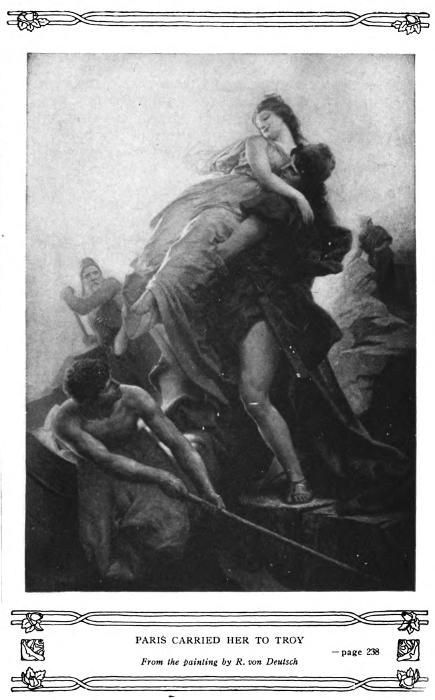
PARIS CARRIED HER TO TROY
—page 238
From the painting by R. von Deutsch
“No, no,” answered Pluto, with his gloomy smile,
“I will not trust you for that. You are too fond
of living in the broad daylight, and gathering flowers.
What an idle and childish taste that is! Are
not these gems, which I have ordered to be dug for
you, and which are richer than any in my crown—are
they not prettier than a violet?”
“Not half so pretty,” said Proserpina, snatching
the gems from Pluto’s hand, and flinging them to
the other end of the hall. “Oh my sweet violets,
shall I never see you again?”
And then she burst into tears. But young people’s
tears have very little saltness or acidity in
them, and do not inflame the eyes so much as those
of grown persons; so that it is not to be wondered
at if, a few moments afterwards, Proserpina was
sporting through the hall almost as merrily as she
and the four sea-nymphs had sported along the edge
of the surf wave. King Pluto gazed after her, and
wished that he, too, was a child. And little Proserpina,
when she turned about, and beheld this great
king standing in his splendid hall, and looking so
grand, and so melancholy, and so lonesome, was
smitten with a kind of pity. She ran back to him,
and, for the first time in all her life, put her small
soft hand in his.
“I love you a little,” whispered she, looking up
in his face.
“Do you, indeed, my dear child!” cried Pluto,
bending his dark face down to kiss her; but Proserpina
shrank away from the kiss, for though his
features were noble, they were very dusky and grim.
“Well, I have not deserved it of you, after keeping
you a prisoner for so many months, and starving
you besides. Are you not terribly hungry? Is
there nothing which I can get you to eat?”
In asking this question, the king of the mines had
a very cunning purpose; for, you will recollect, if
Proserpina tasted a morsel of food in his dominions,
she would never afterwards be at liberty to quit
them.
“No, indeed,” said Proserpina. “Your head cook
is always baking, and stewing, and roasting, and
rolling out paste, and contriving one dish or another,
which he imagines may be to my liking. But
he might just as well save himself the trouble, poor,
fat little man that he is. I have no appetite for
anything in the world, unless it were a slice of bread
of my mother’s own baking, or a little fruit out of
her garden.”
When Pluto heard this, he began to see that he
had mistaken the best method of tempting Proserpina
to eat. The cook’s made dishes and artificial
dainties were not half so delicious, in the good child’s
opinion, as the simple fare to which Mother Ceres
had accustomed her. Wondering that he had never
thought of it before, the king now sent one of his
trusty attendants, with a large basket, to get some
of the finest and juiciest pears, peaches, and plums
which could anywhere be found in the upper world.
Unfortunately, however, this was during the time
when Ceres had forbidden any fruits or vegetables
to grow; and, after seeking all over the earth, King
Pluto’s servant found only a single pomegranate,
and that so dried up as to be not worth eating.
Nevertheless, since there was no better to be had, he
brought this dry, old withered pomegranate home
to the palace, put it on a magnificent golden salver,
and carried it up to Proserpina. Now it happened,
curiously enough, that, just as the servant was
bringing the pomegranate into the back door of the
palace, our friend Quicksilver had gone up the front
steps, on his errand to get Proserpina away from
King Pluto.
As soon as Proserpina saw the pomegranate on
the golden salver, she told the servant he had better
take it away again.
“I shall not touch it, I assure you,” said she. “If
I were ever so hungry, I should never think of eating
such a miserable, dry pomegranate as that.”
“It is the only one in the world,” said the servant.
He set down the golden salver, with the wizened
pomegranate upon it, and left the room. When he
was gone, Proserpina could not help coming close
to the table, and looking at this poor specimen of
dried fruit with a great deal of eagerness; for, to
say the truth, on seeing something that suited her
taste, she felt all the six months’ appetite taking
possession of her at once. To be sure, it was a very
wretched-looking pomegranate, and seemed to have
no more juice in it than an oyster-shell. But there
was no choice of such things in King Pluto’s palace.
This was the first fruit she had seen there, and the
last she was ever likely to see; and unless she ate
it up immediately, it would grow drier than it
already was, and be wholly unfit to eat.
“At least, I may smell it,” thought Proserpina.
So she took up the pomegranate, and applied it to
her nose; and, somehow or other, being in such close
neighborhood to her mouth, the fruit found its way
into that little red cave. Dear me! what an everlasting
pity! Before Proserpina knew what she was
about, her teeth had actually bitten it, of their own
accord. Just as this fatal deed was done, the door
of the apartment opened, and in came King Pluto,
followed by Quicksilver, who had been urging him
to let his little prisoner go. At the first noise of
their entrance, Proserpina withdrew the pomegranate
from her mouth. But Quicksilver (whose
eyes were very keen, and his wits the sharpest that
ever anybody had) perceived that the child was a
little confused; and seeing the empty salver, he
suspected that she had been taking a sly nibble of
something or other. As for honest Pluto, he never
guessed at the secret.
“My little Proserpina,” said the king, sitting
down, and affectionately drawing her between his
knees, “here is Quicksilver, who tells me that a
great many misfortunes have befallen innocent people
on account of my detaining you in my dominions.
To confess the truth, I myself had already
reflected that it was an unjustifiable act to take you
away from your good mother. But, then, you must
consider, my dear child, that this vast palace is apt
to be gloomy (although the precious stones certainly
shine very bright), and that I am not of the most
cheerful disposition, and that therefore it was a
natural thing enough to seek for the society of some
merrier creature than myself. I hoped you would
take my crown for a plaything, and me—ah, you
laugh, naughty Proserpina—me, grim as I am, for
a playmate. It was a silly expectation.”
“Not so extremely silly,” whispered Proserpina.
“You have really amused me very much,
sometimes.”
“Thank you,” said King Pluto, rather dryly.
“But I can see, plainly enough, that you think my
palace a dusky prison, and me the iron-hearted
keeper of it. And an iron heart I should surely
have, if I could detain you here any longer, my
poor child, when it is now six months since you
tasted food. I give you your liberty. Go with
Quicksilver. Hasten home to your dear mother.”
Now, although you may not have supposed it,
Proserpina found it impossible to take leave of
poor King Pluto without some regrets, and a good
ideal of compunction for not telling him about the
pomegranate. She even shed a tear or two, thinking
how lonely and cheerless the great palace would
seem to him, with all its ugly glare of artificial
light, after she herself—his one little ray of natural
sunshine, whom he had stolen, to be sure, but only
because he valued her so much—after she should
have departed. I know not how many kind things
she might have said to the disconsolate king of
the mines, had not Quicksilver hurried her away.
“Come along quickly,” whispered he in her
ear, “or his Majesty may change his royal mind.
And take care, above all things, that you say
nothing of what was brought you on the golden
salver.”
In a very short time, they had passed the great
gateway (leaving the three-headed Cerberus barking,
and yelping, and growling, with threefold
din, behind them), and emerged upon the surface
of the earth. It was delightful to behold, as
Proserpina hastened along, how the path grew
verdant behind and on either side of her. Wherever
she set her blessed foot, there was at once a dewy
flower. The violets gushed up along the wayside.
The grass and the grain began to sprout with tenfold
vigor and luxuriance, to make up for the
dreary months that had been wasted in barrenness.
The starved cattle immediately set to work grazing,
after their long fast, and ate enormously all
day, and got up at midnight to eat more. But I
can assure you it was a busy time of year with the
farmers, when they found the summer coming upon
them with such a rush. Nor must I forget to say
that all the birds in the whole world hopped about
upon the newly blossoming trees, and sang together
in a prodigious ecstasy of joy.
Mother Ceres had returned to her deserted
home, and was sitting disconsolately on the doorstep,
with her torch burning in her hand. She
had been idly watching the flame for some moments
past, when, all at once, it flickered and went
out.
“What does this mean?” thought she. “It was
an enchanted torch, and should have kept burning
till my child came back.”
Lifting her eyes, she was surprised to see a sudden
verdure flashing over the brown and barren
fields, exactly as you may have observed a golden
hue gleaming far and wide across the landscape,
from the just risen sun.
“Does the earth disobey me?” exclaimed Mother
Ceres, indignantly. “Does it presume to be green,
when I have bidden it be barren, until my daughter
shall be restored to my arms?”
“Then open your arms, dear mother,” cried a
well-known voice, “and take your little daughter
into them.”
And Proserpina came running, and flung herself
upon her mother’s bosom. Their mutual transport
is not to be described. The grief of their separation
had caused both of them to shed a great
many tears; and now they shed a great many more,
because their joy could not so well express itself
in any other way.
When their hearts had grown a little more quiet,
Mother Ceres looked anxiously at Proserpina.
“My child,” said she, “did you taste any food
while you were in King Pluto’s palace?”
“Dearest mother,” answered Proserpina, “I will
tell you the whole truth. Until this very morning,
not a morsel of food had passed my lips. But to-day,
they brought me a pomegranate (a very dry
one it was, and all shrivelled up, till there was little
left of it but seeds and skin), and having seen no
fruit for so long a time, and being faint with hunger,
I was tempted just to bite it. The instant I
tasted it, King Pluto and Quicksilver came into
the room. I had not swallowed a morsel; but—dear
mother, I hope it was no harm—but six of
the pomegranate seeds, I am afraid, remained in
my mouth.”
“Ah, unfortunate child, and miserable me!” exclaimed
Ceres. “For each of those six pomegranate
seeds you must spend one month of every year
in King Pluto’s palace. You are but half restored
to your mother. Only six months with me, and
six with that good-for-nothing King of Darkness!”
“Do not speak so harshly of poor King Pluto,”
said Proserpina, kissing her mother. “He has some
very good qualities; and I really think I can bear
to spend six months in his palace, if he will only
let me spend the other six with you. He certainly
did very wrong to carry me off; but then, as he
says, it was but a dismal sort of life for him, to live
in that great gloomy place, all alone; and it has
made a wonderful change in his spirits to have a
little girl to run up stairs and down. There is some
comfort in making him so happy; and so, upon
the whole, dearest mother, let us be thankful that
he is not to keep me the whole year round.”