By Washington Irving
In the bosom of one of those spacious coves
which indent the eastern shore of the Hudson,
at that broad expansion of the river denominated
by the ancient Dutch navigators the Tappan Zee,
and where they always prudently shortened sail,
and implored the protection of St. Nicholas when
they crossed, there lies a small market-town or
rural port, which by some is called Greensburgh,
but which is more generally and properly known
by the name of Tarrytown. This name was given,
we are told, in former days, by the good housewives
of the adjacent country, from the inveterate
propensity of their husbands to linger about the
tavern on market days. Be that as it may, I do
not vouch for the fact, but merely advert to it, for
the sake of being precise and authentic. Not far
from this village, perhaps about two miles, there
is a little valley, or rather lap of land, among high
hills, which is one of the quietest places in the
whole world. A small brook glides through it, with
just murmur enough to lull one to repose; and the
occasional whistle of a quail, or tapping of a woodpecker,
is almost the only sound that ever breaks in
upon the uniform tranquillity.
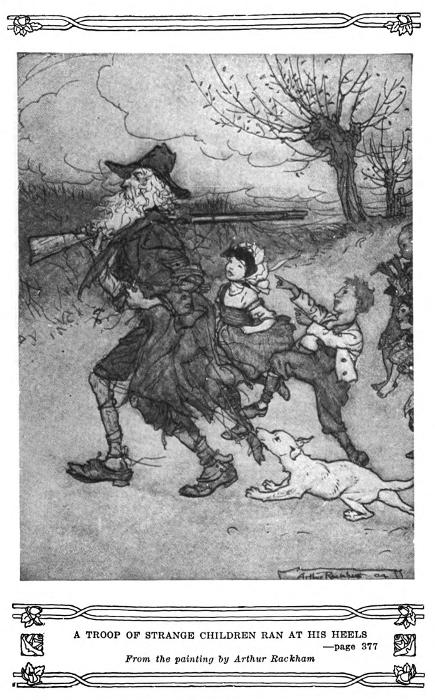
A TROOP OF STRANGE CHILDREN RAN AT HIS HEELS
—page 377
From the painting by Arthur Rackham
I recollect that, when a stripling, my first exploit
in squirrel-shooting was in a grove of tall walnut-trees
that shades one side of the valley. I had
wandered into it at noon time, when all nature is
peculiarly quiet, and was startled by the roar
of my own gun, as it broke the Sabbath stillness
around, and was prolonged and reverberated by
the angry echoes. If ever I should wish for a retreat,
whither I might steal from the world and
its distractions, and dream quietly away the remnant
of a troubled life, I know of none more promising
than this little valley.
From the listless repose of the place, and the
peculiar character of its inhabitants, who are descendants
from the original Dutch settlers, this
sequestered glen has long been known by the name
of Sleepy Hollow, and its rustic lads are called
the Sleepy Hollow Boys throughout all the
neighboring country. A drowsy, dreamy influence
seems to hang over the land, and to pervade the
very atmosphere. Some say that the place was
bewitched by a high German doctor, during the
early days of the settlement; others, that an old
Indian chief, the prophet or wizard of his tribe,
held his pow-wows there before the country was
discovered by Master Hendrick Hudson. Certain
it is, the place still continues under the sway of
some witching power, that holds a spell over the
minds of the good people, causing them to walk in
a continual reverie. They are given to all kinds
of marvellous beliefs; are subject to trances and
visions; and frequently see strange sights, and hear
music and voices in the air. The whole neighborhood
abounds with local tales, haunted spots, and
twilight superstitions; stars shoot and meteors
glare oftener across the valley than in any other
part of the country, and the nightmare, with her
whole nine-fold, seems to make it the favorite scene
of her gambols.
The dominant spirit, however, that haunts this
enchanted region, and seems to be commander-in-chief
of all the powers of the air, is the apparition
of a figure on horseback without a head. It is
said by some to be the ghost of a Hessian trooper,
whose head had been carried away by a cannon-ball,
in some nameless battle during the revolutionary
war; and who is ever and anon seen by
the country folk, hurrying along in the gloom of
night as if on the wings of the wind. His haunts
are not confined to the valley, but extend at times
to the adjacent roads, and especially to the vicinity
of a church at no great distance. Indeed, certain
of the most authentic historians of those parts,
who have been careful in collecting and collating
the floating facts concerning this specter, allege
that the body of the trooper, having been buried
in the churchyard, the ghost rides forth to the
scene of battle in nightly quest of his head;
and that the rushing speed with which he
sometimes passes along the Hollow, like a midnight
blast, is owing to his being belated, and in
a hurry to get back to the churchyard before daybreak.
Such is the general purport of this legendary
superstition, which has furnished materials for
many a wild story in that region of shadows; and
the specter is known, at all the country firesides,
by the name of the Headless Horseman of Sleepy
Hollow.
It is remarkable that the visionary propensity
I have mentioned is not confined to the native
inhabitants of the valley, but is unconsciously
imbibed by every one who resides there for a time.
However wide awake they may have been before
they entered that sleepy region, they are sure, in
a little time, to inhale the witching influence of the
air, and begin to grow imaginative—to dream
dreams, and see apparitions.
I mention this peaceful spot with all possible
laud; for it is in such little retired Dutch valleys,
found here and there embosomed in the great State
of New York, that population, manners, and customs,
remain fixed; while the great torrent of migration
and improvement, which is making such
incessant changes in other parts of this restless
country, sweeps by them unobserved. They are
like those little nooks of still water which border a
rapid stream; where we may see the straw and
bubble riding quietly at anchor, or slowly revolving
in their mimic harbor, undisturbed by the rush of
the passing current.
Though many years have elapsed since I trod
the drowsy shades of Sleepy Hollow, yet I question
whether I should not still find the same trees
and the same families vegetating in its sheltered
bosom.
In this by-place of nature, there abode, in a
remote period of American history, that is to say,
some thirty years since, a worthy wight of the
name of Ichabod Crane; who sojourned, or, as he
expressed it, “tarried,” in Sleepy Hollow, for the
purpose of instructing the children of the vicinity.
He was a native of Connecticut; a State which
supplies the Union with pioneers for the mind as
well as for the forest, and sends forth yearly its
legions of frontier woodsmen and country schoolmasters.
The cognomen of Crane was not inapplicable
to his person. He was tall, but exceedingly
lank, with narrow shoulders, long arms and legs,
hands that dangled a mile out of his sleeves, feet
that might have served for shovels, and his whole
frame most loosely hung together. His head was
small, and flat at top, with huge ears, large green
glassy eyes, and a long snipe nose, so that it looked
like a weathercock, perched upon his spindle neck,
to tell which way the wind blew. To see him
striding along the profile of a hill on a windy day,
with his clothes bagging and fluttering about him,
one might have mistaken him for the genius of
famine descending upon the earth, or some scarecrow
eloped from a cornfield.
His school-house was a low building of one large
room, rudely constructed of logs; the windows
partly glazed, and partly patched with leaves of
old copy-books. It was most ingeniously secured
at vacant hours, by a withe twisted in the handle
of the door, and stakes set against the window
shutters; so that, though a thief might get in with
perfect ease, he would find some embarrassment in
getting out; an idea most probably borrowed by
the architect, Yost Van Houten, from the mystery
of an eel-pot. The school-house stood in a rather
lonely but pleasant situation, just at the foot of a
woody hill, with a brook running close by, and a
formidable birch tree growing at one end of it.
From hence the low murmur of his pupils’ voices,
conning over their lessons, might be heard in a
drowsy summer’s day, like the hum of a bee-hive;
interrupted now and then by the authoritative
voice of the master, in the tone of menace or command;
or, peradventure, by the appalling sound of
the birch, as he urged some tardy loiterer along the
flowery path of knowledge. Truth to say, he was
a conscientious man, and ever bore in mind the
golden maxim, “Spare the rod and spoil the child.”—Ichabod
Crane’s scholars certainly were not
spoiled.
I would not have it imagined, however, that he
was one of those cruel potentates of the school,
who joy in the smart of their subjects; on the
contrary, he administered justice with discrimination
rather than severity; taking the burthen off
the backs of the weak, and laying it on those of
the strong. Your mere puny stripling, that
winced at the least flourish of the rod, was passed
by with indulgence; but the claims of justice were
satisfied by inflicting a double portion on some
little, tough, wrong-headed, broad-skirted Dutch
urchin, who sulked and swelled and grew dogged
and sullen beneath the birch. All this he called
“doing his duty by their parents”; and he never
inflicted a chastisement without following it by
the assurance, so consolatory to the smarting
urchin, that “he would remember it, and thank
him for it the longest day he had to live.”
When school hours were over, he was even the
companion and playmate of the larger boys; and
on holiday afternoons would convoy some of the
smaller ones home, who happened to have pretty
sisters, or good housewives for mothers, noted for
the comforts of the cupboard. Indeed, it behooved
him to keep on good terms with his pupils. The
revenue arising from his school was small, and
would have been scarcely sufficient to furnish him
with daily bread, for he was a huge feeder, and
though lank, had the dilating powers of an anaconda;
but to help out his maintenance, he was,
according to country custom in those parts,
boarded and lodged at the houses of the farmers,
whose children he instructed. With these he lived
successively a week at a time; thus going the
rounds of the neighborhood, with all his worldly
effects tied up in a cotton handkerchief.
That all this might not be too onerous on the
purses of his rustic patrons, who are apt to consider
the costs of schooling a grievous burden, and
schoolmasters as mere drones, he had various ways
of rendering himself both useful and agreeable.
He assisted the farmers occasionally in the lighter
labors of their farms; helped to make hay; mended
the fences; took the horses to water; drove the
cows from pasture; and cut wood for the winter
fire. He laid aside, too, all the dominant dignity
and absolute sway with which he lorded it in his
little empire, the school, and became wonderfully
gentle and ingratiating. He found favor in the
eyes of the mothers, by petting the children, particularly
the youngest; and like the lion bold,
which whilom so magnanimously the lamb did
hold, he would sit with a child on one knee, and
rock a cradle with his foot for whole hours together.
In addition to his other vocations, he was the
singing-master of the neighborhood, and picked
up many bright shillings by instructing the young
folks in psalmody. It was a matter of no little
vanity to him, on Sundays, to take his station in
front of the church gallery, with a band of chosen
singers; where, in his own mind, he completely
carried away the palm from the parson. Certain
it is, his voice resounded far above all the rest of
the congregation; and there are peculiar quavers
still to be heard in that church, and which may be
heard half a mile off, quite to the opposite side of
the mill-pond, on a still Sunday morning, which
are said to be legitimately descended from the
nose of Ichabod Crane. Thus, by divers little
makeshifts in that ingenious way which is commonly
denominated “by hook and by crook,” the
worthy pedagogue got on tolerably enough, and
was thought, by all who understood nothing of the
labor of headwork, to have a wonderfully easy life
of it.
The schoolmaster is generally a man of some
importance in the female circle of a rural neighborhood;
being considered a kind of idle gentlemanlike
personage, of vastly superior taste and accomplishments
to the rough country swains, and
indeed, inferior in learning only to the parson.
His appearance, therefore, is apt to occasion some
little stir at the tea-table of a farmhouse, and the
addition of a supernumerary dish of cakes or
sweetmeats, or, peradventure, the parade of a
silver teapot. Our man of letters, therefore, was
peculiarly happy in the smiles of all the country
damsels. How he would figure among them in
the churchyard, between services on Sundays!
gathering grapes for them from the wild vines that
overran the surrounding trees; reciting for their
amusement all the epitaphs on the tombstones; or
sauntering, with a whole bevy of them, along
the banks of the adjacent mill-pond; while
the more bashful country bumpkins hung sheepishly
back, envying his superior elegance and
address.
From his half itinerant life, also, he was a kind
of travelling gazette, carrying the whole budget of
local gossip from house to house; so that his
appearance was always greeted with satisfaction.
He was, moreover, esteemed by the women as a
man of great erudition, for he had read several
books quite through, and was a perfect master of
Cotton Mather’s History of New England Witchcraft,
in which, by the way, he most firmly and
potently believed.
He was, in fact, an odd mixture of small shrewdness
and simple credulity. His appetite for the
marvellous, and his powers of digesting it, were
equally extraordinary; and both had been increased
by his residence in this spellbound region. No
tale was too gross or monstrous for his capacious
swallow. It was often his delight, after his
school was dismissed in the afternoon, to stretch
himself on the rich bed of clover bordering the
little brook that whimpered by his school-house,
and there con over old Mather’s direful tales, until
the gathering dusk of the evening made the printed
page a mere mist before his eyes. Then, as he
wended his way, by swamp and stream and awful
woodland, to the farmhouse where he happened
to be quartered, every sound of nature, at that
witching hour, fluttered his excited imagination:
the moan of the whip-poor-will[4] from the hillside;
the boding cry of the tree-toad, that harbinger of
storm; the dreary hooting of the screech-owl, or
the sudden rustling in the thicket of birds frightened
from their roost. The fireflies, too, which
sparkled most vividly in the darkest places, now
and then startled him, as one of uncommon
brightness would stream across his path; and if,
by chance, a huge blockhead of a beetle came
winging his blundering flight against him, the
poor varlet was ready to give up the ghost, with
the idea that he was struck with a witch’s token.
His only resource on such occasions, either to
drown thought, or drive away evil spirits, was
to sing psalm tunes;—and the good people of
Sleepy Hollow, as they sat by their doors of an
evening, were often filled with awe at hearing
his nasal melody, “in linked sweetness long drawn
out,” floating from the distant hill, or along the
dusky road.
Another of his sources of fearful pleasure was,
to pass long winter evenings with the old Dutch
wives, as they sat spinning by the fire, with a row
of apples roasting and spluttering along the hearth,
and listen to their marvellous tales of ghosts and
goblins, and haunted fields, and haunted brooks,
and haunted bridges, and haunted houses, and
particularly of the headless horseman, or galloping
Hessian of the Hollow, as they sometimes called
him. He would delight them equally by his
anecdotes of witchcraft, and of the direful omens
and portentous sights and sounds in the air, which
prevailed in the earlier times of Connecticut; and
would frighten them woefully with speculations
upon comets and shooting stars; and with the
alarming fact that the world did absolutely turn
round, and that they were half the time topsy-turvy!
But if there was a pleasure in all this, while
snugly cuddling in the chimney-corner of a chamber
that was all of a ruddy glow from the crackling
wood fire, and where, of course, no specter dared
to show his face, it was dearly purchased by the
terrors of his subsequent walk homewards. What
fearful shapes and shadows beset his path amidst
the dim and ghastly glare of a snowy night!—With
what wistful look did he eye every trembling
ray of light streaming across the waste fields from
some distant window!—How often was he appalled
by some shrub covered with snow, which, like a
sheeted specter, beset his very path!—How often
did he shrink with curdling awe at the sound of
his own steps on the frosty crust beneath his feet;
and dreaded to look over his shoulder, lest he
should behold some uncouth being tramping close
behind him!—and how often was he thrown into
complete dismay by some rushing blast, howling
among the trees, in the idea that it was the Galloping
Hessian on one of his nightly scourings!
All these, however, were mere terrors of the
night, phantoms of the mind that walked in darkness;
and though he had seen many specters in his
time, and been more than once beset by Satan in
divers shapes, in his lonely perambulations, yet
daylight put an end to all these evils; and he would
have passed a pleasant life of it, in despite of the
devil and all his works, if his path had not been
crossed by a being that causes more perplexity to
mortal man than ghosts, goblins, and the whole
race of witches put together, and that was—a
woman.
Among the musical disciples who assembled, one
evening in each week, to receive his instructions in
psalmody, was Katrina Van Tassel, the daughter
and only child of a substantial Dutch farmer. She
was a blooming lass of fresh eighteen; plump as a
partridge; ripe and melting and rosy-cheeked as
one of her father’s peaches, and universally famed,
not merely for her beauty, but her vast expectations.
She was withal a little of a coquette, as
might be perceived even in her dress, which was a
mixture of ancient and modern fashions, as most
suited to set off her charms. She wore the ornaments
of pure yellow gold, which her great-great-grandmother
had brought over from Saardam; the
tempting stomacher of the olden time; and withal
a provokingly short petticoat, to display the
prettiest foot and ankle in the country road.
Ichabod Crane had a soft and foolish heart towards
the sex; and it is not to be wondered at that
so tempting a morsel soon found favor in his eyes;
more especially after he had visited her in her
paternal mansion. Old Baltus Van Tassel was a
perfect picture of a thriving, contented, liberal-hearted
farmer. He seldom, it is true, sent either
his eyes or his thoughts beyond the boundaries of
his own farm; but within those everything was
snug, happy, and well-conditioned. He was satisfied
with his wealth, but not proud of it; and
piqued himself upon the hearty abundance rather
than the style in which he lived. His stronghold
was situated on the banks of the Hudson, in one
of those green, sheltered, fertile nooks, in which
Dutch farmers are so fond of nestling. A great
elm-tree spread its broad branches over it; at the
foot of which bubbled up a spring of the softest and
sweetest water, in a little well, formed of a barrel;
and then stole sparkling away through the grass,
to a neighboring brook, that bubbled along among
alders and dwarf willows. Hard by the farmhouse
was a vast barn, that might have served for a
church; every window and crevice of which seemed
bursting forth with the treasures of the farm. The
flail was busily resounding within it from morning
to night; swallows and martins skimmed twittering
about the eaves; and rows of pigeons, some with
one eye turned up, as if watching the weather,
some with their heads under their wings, or buried
in their bosoms, and others swelling, and cooing,
and bowing about their dames, were enjoying the
sunshine on the roof. Sleek unwieldy porkers
were grunting in the repose and abundance of their
pens; whence sallied forth, now and then, troops
of sucking pigs, as if to snuff the air. A stately
squadron of snowy geese were riding in an adjoining
pond, convoying whole fleets of ducks; regiments
of turkeys were gobbling through the farmyard,
and guinea fowls fretting about it, like ill-tempered
housewives, with their peevish, discontented
cry. Before the barn door strutted the gallant
cock, that pattern of a husband, a warrior, and
a fine gentleman, clapping his burnished wings, and
crowing in the pride and gladness of his heart—sometimes
tearing up the earth with his feet, and
then generously calling his ever-hungry family of
wives and children to enjoy the rich morsel which
he had discovered.
The pedagogue’s mouth watered, as he looked
upon this sumptuous promise of luxurious winter
fare. In his devouring mind’s eye, he pictured to
himself every roasting-pig running about with a
pudding in his belly, and an apple in his mouth;
the pigeons were snugly put to bed in a comfortable
pie, and tucked in with a coverlet of crust; the
geese were swimming in their own gravy; and the
ducks pairing cosily in dishes, like snug married
couples, with a decent competency of onion sauce.
In the porkers he saw carved out the future sleek
side of bacon, and juicy relishing ham; not a turkey
but he beheld daintily trussed up, with its gizzard
under its wing, and, peradventure, a necklace of
savory sausages; and even bright chanticleer himself
lay sprawling on his back, in a side-dish, with
uplifted claws, as if craving that quarter which his
chivalrous spirit disdained to ask while living.
As the enraptured Ichabod fancied all this, and
as he rolled his great green eyes over the fat
meadow-lands, the rich fields of wheat, of rye, of
buckwheat, and Indian corn, and the orchards
burdened with ruddy fruit, which surrounded
the warm tenement of Van Tassel, his heart
yearned after the damsel who was to inherit these
domains, and his imagination expanded with the
idea, how they might be readily turned into cash,
and the money invested in immense tracts of wild
land, and shingle palaces in the wilderness. Nay,
his busy fancy already realized his hopes, and
presented to him the blooming Katrina, with a
whole family of children, mounted on the top of a
wagon loaded with household trumpery, with pots
and kettles dangling beneath; and he beheld himself
bestriding a pacing mare, with a colt at her
heels, setting out for Kentucky, Tennessee, or the
Lord knows where.
When he entered the house the conquest of his
heart was complete. It was one of those spacious
farmhouses, with high-ridged, but lowly-sloping
roofs, built in the style handed down from the
first Dutch settlers, the low projecting eaves
forming a piazza along the front, capable of being
closed up in bad weather. Under this were hung
flails, harness, various utensils of husbandry, and
nets for fishing in the neighboring river. Benches
were built along the sides for summer use; and a
great spinning-wheel at one end, and a churn at
the other, showed the various uses to which this
important porch might be devoted. From this
piazza the wondering Ichabod entered the hall,
which formed the center of the mansion and the
place of usual residence. Here, rows of resplendent
pewter, ranged on a long dresser, dazzled his
eyes. In one corner stood a huge bag of wool
ready to be spun; in another a quantity of linsey-woolsey
just from the loom; ears of Indian corn,
and strings of dried apples and peaches, hung in
gay festoons along the walls, mingled with the
gaud of red peppers, and a door left ajar gave
him a peep into the best parlor, where the claw-footed
chairs, and dark mahogany tables, shone
like mirrors. Andirons, with their accompanying
shovel and tongs, glistened from their covert of
asparagus tops; mock-oranges and conch-shells
decorated the mantel-piece; strings of various
colored birds’ eggs were suspended above it. A
great ostrich egg was hung from the center of the
room, and a corner cupboard, knowingly left open,
displayed immense treasures of old silver and well-mended
china.
From the moment Ichabod laid his eyes upon
these regions of delight, the peace of his mind was
at an end, and his only study was how to gain the
affections of the peerless daughter of Van Tassel.
In this enterprise, however, he had more real
difficulties than generally fell to the lot of a
knight-errant of yore, who seldom had anything
but giants, enchanters, fiery dragons, and such
like easily conquered adversaries, to contend with;
and had to make his way merely through gates
of iron and brass, and walls of adamant, to the
castle keep, where the lady of his heart was
confined, all of which he achieved as easily as a
man would carve his way to the center of a
Christmas pie, and then the lady gave him her
hand as a matter of course. Ichabod, on the contrary,
had to win his way to the heart of a country
coquette, beset with a labyrinth of whims and
caprices, which were forever presenting new difficulties
and impediments; and he had to encounter
a host of fearful adversaries of real flesh and blood,
the numerous rustic admirers, who beset every
portal to her heart, keeping a watchful and angry
eye upon each other, but ready to fly out in the common
cause against any new competitor.
Among these the most formidable was a burly,
roaring, roystering blade, of the name of Abraham,
or, according to the Dutch abbreviation, Brom
Van Brunt, the hero of the country round, which
rang with his feats of strength and hardihood.
He was broad-shouldered and double-jointed, with
short curly black hair, and a bluff, but not unpleasant
countenance, having a mingled air of fun and
arrogance. From his Herculean frame and great
powers of limb, he had received the nickname of
Brom Bones, by which he was universally known.
He was famed for great knowledge and skill in
horsemanship, being as dexterous on horseback as
a Tartar. He was foremost at all races and cock-fights;
and, with the ascendency which bodily
strength acquires in rustic life, was the umpire in
all disputes, setting his hat on one side, and giving
his decisions with an air and tone admitting of no
gainsay or appeal. He was always ready for either
a fight or a frolic; but had more mischief than ill-will
in his composition; and, with all his overbearing
roughness, there was a strong dash of waggish
good humor at bottom. He had three or four boon
companions, who regarded him as their model, and
at the head of whom he scoured the country, attending
every scene of feud or merriment for miles
round. In cold weather he was distinguished by a
fur cap, surmounted with a flaunting fox’s tail;
and when the folks at a country gathering descried
this well-known crest at a distance, whisking about
among a squad of hard riders, they always stood
by for a squall. Sometimes his crew would be
heard dashing along past the farmhouses at midnight,
with whoop and halloo, like a troop of Don
Cossacks; and the old dames, startled out of their
sleep, would listen for a moment till the hurry-scurry
had clattered by, and then exclaim, “Ay,
there goes Brom Bones and his gang!” The
neighbors looked upon him with a mixture of awe,
admiration, and good will; and when any madcap
prank or rustic brawl occurred in the vicinity, always
shook their heads, and warranted Brom Bones
was at the bottom of it.
This rantipole hero had for some time singled
out the blooming Katrina for the object of his
uncouth gallantries, and though his amorous
toyings were something like the gentle caresses and
endearments of a bear, yet it was whispered that
she did not altogether discourage his hopes.
Certain it is, his advances were signals for rival
candidates to retire, who felt no inclination to
cross a lion in his amours; insomuch, that when his
horse was seen tied to Van Tassel’s paling, on a
Sunday night, a sure sign that his master was
courting, or, as it is termed, “sparking,” within,
all other suitors passed by in despair, and carried
the war into other quarters.
Such was the formidable rival with whom
Ichabod Crane had to contend, and, considering
all things, a stouter man than he would have
shrunk from the competition, and a wiser man
would have despaired. He had, however, a happy
mixture of pliability and perseverance in his nature;
he was in form and spirit like a supple-jack—yielding,
but tough; though he bent, he never broke; and
though he bowed beneath the slightest pressure, yet,
the moment it was away—jerk! he was as erect,
and carried his head as high as ever.
To have taken the field openly against his rival
would have been madness; for he was not a man
to be thwarted in his amours, any more than that
stormy lover, Achilles. Ichabod, therefore, made
his advances in a quiet and gently-insinuating
manner. Under cover of his character of singing-master,
he made frequent visits at the farmhouse;
not that he had anything to apprehend from the
meddlesome interference of parents, which is so
often a stumbling-block in the path of lovers.
Balt Van Tassel was an easy, indulgent soul; he
loved his daughter better even than his pipe,
and like a reasonable man and an excellent father,
let her have her way in everything. His notable
little wife, too, had enough to do to attend to her
housekeeping and manage her poultry; for, as she
sagely observed, ducks and geese are foolish things,
and must be looked after, but girls can take care
of themselves. Thus while the busy dame bustled
about the house, or plied her spinning-wheel at one
end of the piazza, honest Balt would sit smoking
his evening pipe at the other, watching the achievements
of a little wooden warrior, who, armed with a
sword in each hand, was most valiantly fighting the
wind on the pinnacle of the barn. In the meantime,
Ichabod would carry on his suit with the daughter
by the side of the spring under the great elm, or
sauntering along in the twilight, that hour so
favorable to the lover’s eloquence.
I profess not to know how women’s hearts are
wooed and won. To me they have always been
matters of riddle and admiration. Some seem to
have but one vulnerable point, or door of access;
while others have a thousand avenues, and may be
captured in a thousand different ways. It is a
great triumph of skill to gain the former, but a still
greater proof of generalship to maintain possession
of the latter, for the man must battle for his fortress
at every door and window. He who wins a
thousand common hearts is therefore entitled to
some renown; but he who keeps undisputed sway
over the heart of a coquette, is indeed a hero.
Certain it is, this was not the case with the redoubtable
Brom Bones; and from the moment Ichabod
Crane made his advances, the interests of the
former evidently declined; his horse was no longer
seen tied at the palings on Sunday nights, and a
deadly feud gradually arose between him and the
preceptor of Sleepy Hollow.
Brom, who had a degree of rough chivalry in his
nature, would fain have carried matters to open
warfare, and have settled their pretensions to the
lady, according to the mode of those most concise
and simple reasoners, the knights-errant of yore—by
single combat; but Ichabod was too conscious
of the superior might of his adversary to enter the
lists against him: he had overheard a boast of
Bones, that he would “double the schoolmaster up,
and lay him on a shelf of his own school-house”;
and he was too wary to give him an opportunity.
There was something extremely provoking in this
obstinately pacific system; it left Brom no alternative
but to draw upon the funds of rustic waggery
in his disposition, and to play off boorish practical
jokes upon his rival. Ichabod became the object
of whimsical persecution to Bones, and his gang
of rough riders. They harried his hitherto peaceful
domains; smoked out his singing-school, by
stopping up the chimney; broke into the school-house
at night, in spite of its formidable fastenings
of withe and window stakes, and turned everything
topsy-turvy: so that the poor schoolmaster
began to think all the witches in the country held
their meetings there. But what was still more
annoying, Brom took all opportunities of turning
him into ridicule in presence of his mistress, and
had a scoundrel dog whom he taught to whine in
the most ludicrous manner, and introduced as a
rival of Ichabod’s to instruct her in psalmody.
In this way matters went on for some time, without
producing any material effect on the relative
situation of the contending powers. On a fine
autumnal afternoon, Ichabod, in pensive mood, sat
enthroned on the lofty stool whence he usually
watched all the concerns of his little literary realm.
In his hand he swayed a ferule, that scepter of
despotic power; the birch of justice reposed on
three nails, behind the throne, a constant terror to
evil doers; while on the desk before him might be
seen sundry contraband articles and prohibited
weapons, detected upon the persons of idle urchins;
such as half-munched apples, popguns, whirligigs,
fly-cages, and whole legions of rampant little paper
game-cocks. Apparently there had been some
appalling act of justice recently inflicted, for his
scholars were all busily intent upon their books, or
slyly whispering behind them with one eye kept
upon the master; and a kind of buzzing stillness
reigned throughout the school-room. It was suddenly
interrupted by the appearance of a negro,
in tow-doth jacket and trousers, a round-crowned
fragment of a hat, like the cap of Mercury, and
mounted on the back of a ragged, wild, half-broken
colt, which he managed with a rope by way of
halter. He came clattering up to the school door
with an invitation to Ichabod to attend a merry-making
or “quilting frolic,” to be held that evening
at Mynheer Van Tassel’s; and having delivered
his message with that air of importance, and effort
at fine language, which a negro is apt to display on
petty embassies of the kind, he dashed over the
brook, and was seen scampering away up the hollow,
full of the importance and hurry of his mission.
All was now bustle and hubbub in the late quiet
school-room. The scholars were hurried through
their lessons, without stopping at trifles; those
who were nimble skipped over half with impunity,
and those who were tardy, had a smart application
now and then in the rear, to quicken their speed,
or help them over a tall word. Books were flung
aside without being put away on the shelves, ink-stands
were overturned, benches thrown down, and
the whole school was turned loose an hour before
the usual time, bursting forth like a legion of young
imps, yelping, and racketing about the green, in joy
at their early emancipation.
The gallant Ichabod now spent at least an extra
half-hour at his toilet, brushing and furbishing up
his best, and indeed only suit of rusty black, and
arranging his locks by a bit of broken looking-glass,
that hung up in the school-house. That he
might make his appearance before his mistress in
the true style of a cavalier, he borrowed a horse
from the farmer with whom he was domiciliated, a
choleric old Dutchman, of the name of Hans Van
Ripper, and, thus gallantly mounted, issued forth,
like a knight-errant in quest of adventures. But it
is meet I should, in the true spirit of romantic
story, give some account of the looks and equipments
of my hero and his steed. The animal he
bestrode was a broken-down plough-horse, that
had outlived almost everything but his viciousness.
He was gaunt and shagged, with a ewe neck and a
head like a hammer; his rusty mane and tail were
tangled and knotted with burrs; one eye had lost
its pupil, and was glaring and spectral; but the
other had the gleam of a genuine devil in it. Still
he must have had fire and mettle in his day, if we
may judge from the name he bore of Gunpowder.
He had, in fact, been a favorite steed of his master’s,
the choleric Van Ripper, who was a furious
rider, and had infused, very probably, some of his
own spirit into the animal; for, old and broken-down
as he looked, there was more of the lurking
devil in him than in any young filly in the country.
Ichabod was a suitable figure for such a steed.
He rode with short stirrups, which brought his
knees nearly up to the pommel of the saddle; his
sharp elbows stuck out like grasshoppers’; he
carried his whip perpendicularly in his hand, like a
scepter, and, as his horse jogged on, the motion of
his arms was not unlike the flapping of a pair of
wings. A small wool hat rested on the top of his
nose, for so his scanty strip of forehead might be
called; and the skirts of his black coat fluttered out
almost to the horse’s tail. Such was the appearance
of Ichabod and his steed, as they shambled out of
the gate of Hans Van Ripper, and it was altogether
such an apparition as is seldom to be met with in
broad daylight.
It was, as I have said, a fine autumnal day, the
sky was clear and serene, and nature wore that rich
and golden livery which we always associate with
the idea of abundance. The forests had put on
their sober brown and yellow, while some trees of
the tenderer kind had been nipped by the frosts
into brilliant dyes of orange, purple, and scarlet.
Streaming files of wild ducks began to make their
appearance high in the air; the bark of the squirrel
might be heard from the groves of beech and
hickory nuts, and the pensive whistle of the quail
at intervals from the neighboring stubble-field.
The small birds were taking their farewell
banquets. In the fulness of their revelry, they
fluttered, chirping and frolicking, from bush to
bush, and tree to tree, capricious from the very
profusion and variety around them. There was
the honest cock-robin, the favorite game of stripling
sportsmen, with its loud querulous note; and
the twittering blackbirds flying in sable clouds;
and the golden-winged woodpecker, with his crimson
crest, his broad black gorget, and splendid
plumage; and the cedar-bird, with its red-tipped
wings and yellow-tipped tail, and its little montero
cap of feathers; and the bluejay; that noisy coxcomb,
in his gay light-blue coat and white under-clothes;
screaming and chattering, nodding and
bobbing and bowing, and pretending to be on good
terms with every songster of the grove.
As Ichabod jogged slowly on his way, his eye,
ever open to every symptom of culinary abundance,
ranged with delight over the treasures of jolly
autumn. On all sides he beheld vast store of
apples; some hanging in oppressive opulence on
the trees; some gathered into baskets and barrels
for the market; others heaped up in rich piles for
the cider-press. Farther on he beheld great fields
of Indian corn, with its golden ears peeping from
their leafy coverts, and holding out the promise of
cakes and hasty-pudding; and the yellow pumpkins
lying beneath them, turning up their fair round
bellies to the sun, and giving ample prospects of
the most luxurious of pies; and anon he passed
the fragrant buckwheat fields, breathing the odor
of the bee-hive, and as he beheld them, soft anticipations
stole over his mind of dainty slapjacks,
well buttered, and garnished with honey or treacle,
by the delicate little dimpled hand of Katrina Van
Tassel.
Thus feeding his mind with many sweet thoughts
and “sugared suppositions,” he journeyed along
the sides of a range of hills which look out upon
some of the goodliest scenes of the mighty Hudson.
The sun gradually wheeled his broad disk down
into the west. The wide bosom of the Tappan
Zee lay motionless and glassy, excepting that here
and there a gentle undulation waved and prolonged
the blue shadow of the distant mountain.
A few amber clouds floated in the sky, without a
breath of air to move them. The horizon was of
a fine golden tint, changing gradually into a pure
apple green, and from that into the deep blue of
the mid-heaven. A slanting ray lingered on the
woody crests of the precipices that overhung some
parts of the river, giving greater depth to the
dark-gray and purple of their rocky sides. A sloop
was loitering in the distance, dropping slowly down
with the tide, her sail hanging uselessly against
the mast; and as the reflection of the sky gleamed
along the still water, it seemed as if the vessel was
suspended in the air.
It was towards evening that Ichabod arrived
at the castle of the Heer Van Tassel, which he
found thronged with the pride and flower of the
adjacent country. Old farmers, a spare leathern-faced
race, in homespun coats and breeches, blue
stockings, huge shoes, and magnificent pewter
buckles. Their brisk withered little dames, in
close-crimped caps, long-waisted short gowns,
homespun petticoats, with scissors and pin-cushions,
and gay calico pockets hanging on the
outside. Buxom lasses, almost as antiquated as
their mothers, excepting where a straw hat, a fine
ribbon, or perhaps a white frock gave symptoms
of city innovation. The sons, in short square-skirted
coats with rows of stupendous brass
buttons, and their hair generally queued in the
fashion of the times, especially if they could procure
an eel-skin for the purpose, it being esteemed,
throughout the country, as a potent nourisher and
strengthener of the hair.
Brom Bones, however, was the hero of the scene,
having come to the gathering on his favorite steed
Daredevil, a creature, like himself, full of mettle
and mischief, and which no one but himself could
manage. He was, in fact, noted for preferring
vicious animals, given to all kinds of tricks, which
kept the rider in constant risk of his neck, for he
held a tractable well-broken horse as unworthy of
a lad of spirit.
Fain would I pause to dwell upon the world of
charms that burst upon the enraptured gaze of
my hero, as he entered the state parlor of Van
Tassel’s mansion. Not those of the bevy of
buxom lasses, with their luxurious display of red
and white; but the ample charms of a genuine
Dutch country tea-table, in the sumptuous time
of autumn. Such heaped-up platters of cakes of
various and almost indescribable kinds, known
only to experienced Dutch housewives! There
was the doughty doughnut, the tenderer oly-koek,
and the crisp and crumbling cruller; sweet cakes
and short cakes, ginger cakes and honey cakes, and
the whole family of cakes. And then there
were apple pies and peach pies and pumpkin
pies; besides slices of ham and smoked beef; and
moreover delectable dishes of preserved plums,
and peaches, and pears, and quinces; not to mention
broiled shad and roasted chickens; together
with bowls of milk and cream, all mingled higgledy-piggledy,
pretty much as I have enumerated
them, with the motherly teapot sending up its
clouds of vapor from the midst—Heaven bless
the mark! I want breath and time to discuss this
banquet as it deserves, and am too eager to get
on with my story. Happily, Ichabod Crane was
not in so great a hurry as his historian, but did
ample justice to every dainty.
He was a kind and thankful creature, whose
heart dilated in proportion as his skin was filled
with good cheer; and whose spirits rose with
eating as some men’s do with drink. He could not
help, too, rolling his large eyes round him as he
ate, and chuckling with the possibility that he
might one day be lord of all this scene of almost
unimaginable luxury and splendor. Then, he
thought, how soon he’d turn his back upon the
old school-house, snap his fingers in the face of
Hans Van Ripper, and every other niggardly
patron, and kick any itinerant pedagogue out of
doors that should dare to call him comrade!
Old Baltus Van Tassel moved about among his
guests with a face dilated with content and good
humor, round and jolly as the harvest moon. His
hospitable attentions were brief, but expressive,
being confined to a shake of the hand, a slap on
the shoulder, a loud laugh, and a pressing invitation
to “fall to, and help themselves.”
And now the sound of the music from the common
room, or hall, summoned to the dance. The
musician was an old gray-headed negro, who had
been the itinerant orchestra of the neighborhood
for more than half a century. His instrument was
as old and battered as himself. The greater part
of the time he scraped on two or three strings,
accompanying every movement of the bow with a
motion of the head, bowing almost to the ground,
and stamping with his foot whenever a fresh couple
were to start.
Ichabod prided himself upon his dancing as
much as upon his vocal powers. Not a limb, not
a fiber about him was idle; and to have seen his
loosely hung frame in full motion, and clattering
about the room, you would have thought Saint
Vitus himself, that blessed patron of the dance,
was figuring before you in person. He was the
admiration of all the negroes; who, having
gathered, of all ages and sizes, from the farm and
the neighborhood, stood forming a pyramid of
shining black faces at every door and window,
gazing with delight at the scene, rolling their white
eyeballs, and showing grinning rows of ivory from
ear to ear. How could the flogger of urchins be
otherwise than animated and joyous? the lady of
his heart was his partner in the dance, and smiling
graciously in reply to all his amorous oglings;
while Brom Bones, sorely smitten with love and
jealousy, sat brooding by himself in one corner.
When the dance was at end, Ichabod was
attracted to a knot of the sager folks, who, with
old Van Tassel, sat smoking at one end of the
piazza, gossiping over former times, and drawing
out long stories about the war.
This neighborhood, at the time of which I am
speaking, was one of those highly-favored places
which abound with chronicle and great men. The
British and American lines had run near it during
the war; it had, therefore, been the scene of
marauding, and infested with refugees, cow-boys,
and all kinds of border chivalry. Just sufficient
time had elapsed to enable each story-teller to
dress up his tale with a little becoming fiction,
and, in the indistinctness of his recollection, to
make himself the hero of every exploit.
There was the story of Doffue Martling, a large,
blue-bearded Dutchman, who had nearly taken a
British frigate with an old iron nine-pounder from
a mud breastwork, only that his gun burst at the
sixth discharge. And there was an old gentleman
who shall be nameless, being too rich a mynheer
to be lightly mentioned, who, in the battle of
Whiteplains, being an excellent master of defence,
parried a musket ball with a small sword, insomuch
that he absolutely felt it whiz round the
blade, and glance off at the hilt; in proof of which,
he was ready at any time to show the sword, with
the hilt a little bent. There were several more
that had been equally great in the field, not one
of whom but was persuaded that he had a considerable
hand in bringing the war to a happy
termination.
But all these were nothing to the tales of ghosts
and apparitions that succeeded. The neighborhood
is rich in legendary treasures of the kind.
Local tales and superstitions thrive best in these
sheltered, long-settled retreats; but are trampled
under foot by the shifting throng that forms the
population of most of our country places. Besides,
there is no encouragement for ghosts in most
of our villages, for they have scarcely had time to
finish their first nap, and turn themselves in their
graves, before their surviving friends have travelled
away from the neighborhood; so that when
they turn out at night to walk their rounds, they
have no acquaintance left to call upon. This
is perhaps the reason why we so seldom hear
of ghosts except in our long-established Dutch
communities.
The immediate cause, however, of the prevalence
of supernatural stories in these parts, was
doubtless owing to the vicinity of Sleepy Hollow.
There was a contagion in the very air that blew
from that haunted region; it breathed forth an
atmosphere of dreams and fancies infecting all the
land. Several of the Sleepy Hollow people were
present at Van Tassel’s, and, as usual, were doling
out their wild and wonderful legends. Many
dismal tales were told about funeral trains, and
mourning cries and wailings heard and seen above
the great tree where the unfortunate Major
André was taken, and which stood in the neighborhood.
Some mention was made also of the
woman in white, that haunted the dark glen at
Raven Rock, and was often heard to shriek on
winter nights before a storm, having perished
there in the snow. The chief part of the stories,
however, turned upon the favorite specter of
Sleepy Hollow, the headless horseman, who had
been heard several times of late, patrolling the
country; and, it was said, tethered his horse nightly
among the graves in the churchyard.
The sequestered situation of this church seems
always to have made it a favorite haunt of
troubled spirits. It stands on a knoll, surrounded
by locust-trees and lofty elms, from among which
its decent whitewashed walls shine modestly forth,
like Christian purity beaming through the shades
of retirement. A gentle slope descends from it
to a silver sheet of water, bordered by high trees,
between which peeps may be caught at the
blue hills of the Hudson. To look upon its grass-grown
yard, where the sunbeams seem to sleep so
quietly, one would think that there at least the
dead might rest in peace. On one side of the
church extends a wide woody dell, along which
raves a large brook among broken rocks and
trunks of fallen trees. Over a deep black part
of the stream, not far from the church, was
formerly thrown a wooden bridge; the road that
led to it, and the bridge itself, were thickly shaded
by overhanging trees, which cast a gloom about
it, even in the daytime; but occasioned a fearful
darkness at night. This was one of the favorite
haunts of the headless horseman; and the place
where he was most frequently encountered. The
tale was told of old Brouwer, a most heretical
disbeliever in ghosts, how he met the horseman
returning from his foray into Sleepy Hollow, and
was obliged to get up behind him; how they galloped
over bush and brake, over hill and swamp,
until they reached the bridge; when the horseman
suddenly turned into a skeleton, threw old Brouwer
into the brook, and sprang away over the tree-tops
with a clap of thunder.
This story was immediately matched by a thrice
marvellous adventure of Brom Bones, who made
light of the galloping Hessian as an arrant jockey.
He affirmed that, on returning one night from the
neighboring village of Sing-Sing, he had been overtaken
by this midnight trooper; that he had offered
to race with him for a bowl of punch, and should
have won it too, for Daredevil beat the goblin horse
all hollow, but, just as they came to the church
bridge, the Hessian bolted, and vanished in a flash
of fire.
All these tales, told in that drowsy undertone
with which men talk in the dark, the countenances
of the listeners only now and then receiving a casual
gleam from the glare of a pipe, sank deep in the
mind of Ichabod. He repaid them in kind with
large extracts from his invaluable author, Cotton
Mather, and added many marvellous events that
had taken place in his native State of Connecticut,
and fearful sights which he had seen in his nightly
walks about Sleepy Hollow.
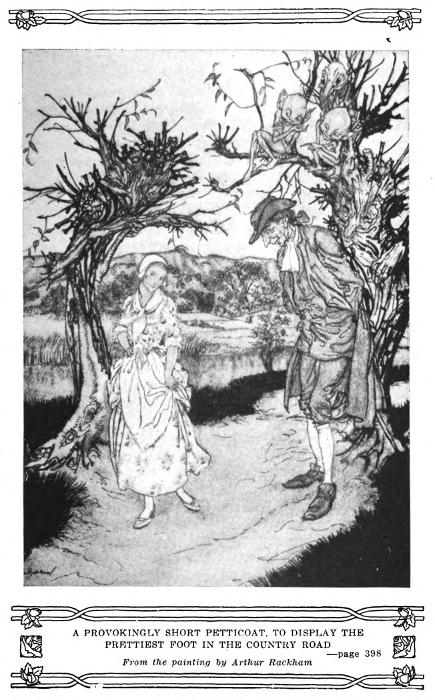
A PROVOKINGLY SHORT PETTICOAT, TO DISPLAY THE
PRETTIEST FOOT IN THE COUNTRY ROAD
—page 398
From the painting by Arthur Rackham
The revel now gradually broke up. The old
farmers gathered together their families in their
wagons, and were heard for some time rattling
along the hollow roads, and over the distant hills.
Some of the damsels mounted on pillions behind
their favorite swains, and their light-hearted laughter,
mingling with the clatter of hoofs, echoed along
the silent woodlands, sounding fainter and fainter
until they gradually died away—and the late
scene of noise and frolic was all silent and deserted.
Ichabod only lingered behind, according to the custom
of country lovers, to have a tête-à-tête with
the heiress, fully convinced that he was now on the
highroad to success. What passed at this interview
I will not pretend to say, for in fact I do not
know. Something, however, I fear me, must have
gone wrong, for he certainly sallied forth, after no
great interval, with an air quite desolate and chop-fallen.—Oh
these women! these women! Could
that girl have been playing off any of her coquettish
tricks?—Was her encouragement of the poor
pedagogue all a mere sham to secure her conquest
of his rival?—Heaven only knows, not I!—Let
it suffice to say, Ichabod stole forth with the air of
one who had been sacking a hen-roost, rather than
a fair lady’s heart. Without looking to the right
or left to notice the scene of rural wealth, on which
he had so often gloated, he went straight to the
stable, and with several hearty cuffs and kicks,
roused the steed most uncourteously from the comfortable
quarters in which he was soundly sleeping,
dreaming of mountains of corn and oats, and whole
valleys of timothy and clover.
It was the very witching time of night that Ichabod,
heavy-hearted and crest-fallen, pursued his
travel homewards, along the sides of the lofty hills
which rise above Tarrytown, and which he had
traversed so cheerily in the afternoon. The hour
was as dismal as himself. Far below him, the Tappan
Zee spread its dusky and indistinct waste of
waters, with here and there the tall mast of a sloop,
riding quietly at anchor under the land. In the
dead hush of midnight, he could even hear the barking
of the watch-dog from the opposite shore of
the Hudson; but it was so vague and faint as only
to give an idea of his distance from this faithful
companion of man. Now and then, too, the long-drawn
crowing of a cock, accidentally awakened,
would sound far, far off, from some farmhouse
away among the hills—but it was like a dreaming
sound in his ear. No signs of life occurred near
him, but occasionally the melancholy chirp of a
cricket, or perhaps the guttural twang of a bull-frog,
from a neighboring marsh, as if sleeping
uncomfortably, and turning suddenly in his bed.
All the stories of ghosts and goblins that he had
heard in the afternoon, now came crowding upon
his recollection. The night grew darker and darker;
the stars seemed to sink deeper in the sky, and driving
clouds occasionally hid them from his sight.
He had never felt so lonely and dismal. He was,
moreover, approaching the very place where many
of the scenes of the ghost stories had been laid.
In the center of the road stood an enormous tulip-tree,
which towered like a giant above all the other
trees of the neighborhood, and formed a kind of
landmark. Its limbs were gnarled, and fantastic,
large enough to form trunks for ordinary trees,
twisting down almost to the earth, and rising again
into the air. It was connected with the tragical
story of the unfortunate André, who had been
taken prisoner hard by; and was universally known
by the name of Major André’s tree. The common
people regarded it with a mixture of respect and
superstition, partly out of sympathy for the fate of
its ill-starred namesake, and partly from the tales
of strange sights and doleful lamentations told
concerning it.
As Ichabod approached this fearful tree, he began
to whistle: he thought his whistle was answered—it
was but a blast sweeping sharply through the
dry branches. As he approached a little nearer,
he thought he saw something white hanging in the
midst of the tree—he paused and ceased whistling,
but on looking more narrowly, perceived that it
was a place where the tree had been scathed by
lightning; and the white wood laid bare. Suddenly
he heard a groan—his teeth chattered and his
knees smote against the saddle: it was but the
rubbing of one huge bough upon another, as they
were swayed about by the breeze. He passed the
tree in safety, but new perils lay before him.
About two hundred yards from the tree a small
brook crossed the road, and ran into a marshy and
thickly-wooded glen, known by the name of Wiley’s
Swamp. A few rough logs, laid side by side, served
for a bridge over this stream. On that side of the
road where the brook entered the wood, a group of
oaks and chestnuts, matted thick with wild grapevines,
threw a cavernous gloom over it. To pass
this bridge was the severest trial. It was at this
identical spot that the unfortunate André was captured,
and under the covert of those chestnuts and
vines were the sturdy yeomen concealed who surprised
him. This has ever since been considered a
haunted stream, and fearful are the feelings of the
schoolboy who has to pass it alone after dark.
As he approached the stream his heart began to
thump; he summoned up, however, all his resolution,
gave his horse half a score of kicks in the ribs,
and attempted to dash briskly across the bridge;
but instead of starting forward, the perverse old
animal made a lateral movement, and ran broadside
against the fence. Ichabod, whose fears increased
with the delay, jerked the reins on the
other side, and kicked lustily with the contrary
foot: it was all in vain; his steed started, it is true,
but it was only to plunge to the opposite side of the
road into a thicket of brambles and alder bushes.
The schoolmaster now bestowed both whip and
heel upon the starveling ribs of old Gunpowder,
who dashed forward, snuffling and snorting, but
came to a stand just by the bridge, with a suddenness
that had nearly sent his rider sprawling over
his head. Just at this moment a plashy tramp by
the side of the bridge caught the sensitive ear of
Ichabod. In the dark shadow of the grove, on the
margin of the brook, he beheld something huge,
misshapen, black and towering. It stirred not, but
seemed gathered up in the gloom, like some gigantic
monster ready to spring upon the traveller.
The hair of the affrighted pedagogue rose upon
his head with terror. What was to be done? To
turn and fly was now too late; and besides, what
chance was there of escaping ghost or goblin, if
such it was, which could ride upon the wings of the
wind? Summoning up, therefore, a show of courage,
he demanded in stammering accents—“Who
are you?” He received no reply. He repeated
his demand in a still more agitated voice. Still
there was no answer. Once more he cudgelled the
sides of the inflexible Gunpowder, and, shutting his
eyes, broke forth with involuntary fervor into a
psalm tune. Just then the shadowy object of
alarm put itself in motion, and, with a scramble
and a bound, stood at once in the middle of the
road. Though the night was dark and dismal, yet
the form of the unknown might now in some degree
be ascertained. He appeared to be a horseman of
large dimensions, and mounted on a black horse of
powerful frame. He made no offer of molestation
or sociability, but kept aloof on one side of the road,
jogging along on the blind side of old Gunpowder,
who had now got over his fright and waywardness.
Ichabod, who had no relish for this strange midnight
companion, and bethought himself of the adventure
of Brom Bones with the Galloping Hessian,
now quickened his steed, in hopes of leaving
him behind. The stranger, however, quickened his
horse to an equal pace. Ichabod pulled up, and
fell into a walk, thinking to lag behind—the other
did the same. His heart began to sink within
him; he endeavored to resume his psalm tune, but
his parched tongue clove to the roof of his mouth,
and he could not utter a stave. There was something
in the moody and dogged silence of this
pertinacious companion, that was mysterious and
appalling. It was soon fearfully accounted for.
On mounting a rising ground, which brought the
figure of his fellow-traveller in relief against the
sky, gigantic in height, and muffled in a cloak,
Ichabod was horror-struck, on perceiving that he
was headless!—but his horror was still more increased,
on observing that the head, which should
have rested on his shoulders, was carried before him
on the pommel of the saddle: his terror rose to
desperation; he rained a shower of kicks and blows
upon Gunpowder, hoping, by a sudden movement,
to give his companion the slip—but the specter
started full jump with him. Away then they
dashed, through thick and thin; stones flying, and
sparks flashing at every bound. Ichabod’s flimsy
garments fluttered in the air, as he stretched his
long lank body away over his horse’s head, in the
eagerness of his flight.
They had now reached the road which turns off
to Sleepy Hollow; but Gunpowder, who seemed
possessed with a demon, instead of keeping up it,
made an opposite turn, and plunged headlong
down hill to the left. This road leads through a
sandy hollow, shaded by trees for about a quarter
of a mile, where it crosses the bridge famous in
goblin story, and just beyond swells the green
knoll on which stands the whitewashed church.
As yet the panic of the steed had given his
unskilful rider an apparent advantage in the
chase; but just as he had got half way through the
hollow, the girths of the saddle gave way, and
he felt it slipping from under him. He seized it
by the pommel, and endeavored to hold it firm,
but in vain; and had just time to save himself by
clasping old Gunpowder round the neck, when
the saddle fell to the earth, and he heard it
trampled under foot by his pursuer. For a
moment the terror of Hans Van Ripper’s wrath
passed across his mind—for it was his Sunday
saddle; but this was no time for petty fears; the
goblin was hard on his haunches; and (unskilful
rider that he was!) he had much ado to maintain
his seat; sometimes slipping on one side, sometimes
on another, and sometimes jolted on the high ridge
of his horse’s backbone, with a violence that he
verily feared would cleave him asunder.
An opening in the trees now cheered him with
the hopes that the church bridge was at hand.
The wavering reflection of a silver star in the
bosom of the brook told him he was not
mistaken. He saw the walls of the church dimly
glaring under the trees beyond. He recollected
the place where Brom Bone’s ghostly competitor
had disappeared. “If I can but reach that
bridge,” thought Ichabod, “I am safe.” Just
then he heard the black steed panting and blowing
close behind him; he even fancied that he
felt his hot breath. Another convulsive kick
in the ribs, and old Gunpowder sprang upon the
bridge; he thundered over the resounding planks;
he gained the opposite side; and now Ichabod
cast a look behind to see if his pursuer should
vanish, according to rule, in a flash of fire and
brimstone. Just then he saw the goblin rising in
his stirrups, and in the very act of hurling his
head at him. Ichabod endeavored to dodge the
horrible missile, but too late. It encountered his
cranium with a tremendous crash—he was tumbled
headlong into the dust, and Gunpowder, the black
steed, and the goblin rider, passed by like a whirlwind.
The next morning the old horse was found without
his saddle, and with the bridle under his feet,
soberly cropping the grass at his master’s gate.
Ichabod did not make his appearance at breakfast—dinner-hour
came, but no Ichabod. The boys
assembled at the school-house, and strolled idly
about the banks of the brook; but no schoolmaster.
Hans Van Ripper now began to feel
some uneasiness about the fate of poor Ichabod,
and his saddle. An inquiry was set on foot, and
after diligent investigation they came upon his
traces. In one part of the road leading to the
church was found the saddle trampled in the
dirt; the tracks of horses’ hoofs deeply dented
in the road, and evidently at furious speed, were
traced to the bridge, beyond which, on the bank
of a broad part of the brook, where the water ran
deep and black, was found the hat of the unfortunate
Ichabod, and close beside it a shattered
pumpkin.
The brook was searched, but the body of the
schoolmaster was not to be discovered. Hans Van
Ripper, as executor of his estate, examined the
bundle which contained all his worldly effects.
They consisted of two shorts and a half; two stocks
for the neck; a pair or two of worsted stockings;
an old pair of corduroy smallclothes; a rusty razor;
a book of psalm tunes, full of dogs’ ears; and a
broken pitchpipe. As to the books and furniture
of the school-house, they belonged to the community,
excepting Cotton Mather’s History of
Witchcraft, a New England Almanac, and a book
of dreams and fortune-telling; in which last was a
sheet of foolscap much scribbled and blotted in
several fruitless attempts to make a copy of
verses in honor of the heiress of Van Tassel.
These magic books and the poetic scrawl were
forthwith consigned to the flames by Hans Van
Ripper; who from that time forward determined
to send his children no more to school; observing,
that he never knew any good come of this same
reading and writing. Whatever money the
schoolmaster possessed, and he had received his
quarter’s pay but a day or two before, he must
have had about his person at the time of his disappearance.
The mysterious event caused much speculation
at the church on the following Sunday. Knots of
gazers and gossips were collected in the churchyard,
at the bridge, and at the spot where the hat
and pumpkin had been found. The stories of
Brouwer, of Bones, and a whole budget of others,
were called to mind; and when they had diligently
considered them all, and compared them with the
symptoms of the present case, they shook their
heads, and came to the conclusion that Ichabod
had been carried off by the Galloping Hessian.
As he was a bachelor, and in nobody’s debt,
nobody troubled his head any more about him.
The school was removed to a different quarter of
the hollow, and another pedagogue reigned in his
stead.
It is true, an old farmer, who had been down to
New York on a visit several years after, and from
whom this account of the ghostly adventure was
received, brought home the intelligence that Ichabod
Crane was still alive; that he had left the neighborhood,
partly through fear of the goblin and
Hans Van Ripper, and partly in mortification at
having been suddenly dismissed by the heiress; that
he had changed his quarters to a distant part of the
country; had kept school and studied law at the
same time, had been admitted to the bar, turned
politician, electioneered, written for the newspapers,
and finally had been made a justice of the
Ten Pound Court. Brom Bones, too, who shortly
after his rival’s disappearance conducted the blooming
Katrina in triumph to the altar, was observed
to look exceedingly knowing whenever the story
of Ichabod was related, and always burst into a
hearty laugh at the mention of the pumpkin; which
led some to suspect that he knew more about the
matter than he chose to tell.
The old country wives, however, who are the best
judges of these matters, maintain to this day that
Ichabod was spirited away by supernatural means;
and it is a favorite story often told about the neighborhood
round the winter evening fire. The bridge
became more than ever an object of superstitious
awe, and that may be the reason why the road has
been altered of late years, so as to approach the
church by the border of the mill-pond. The school-house
being deserted, soon fell to decay, and was
reported to be haunted by the ghost of the unfortunate
pedagogue; and the plough-boy, loitering
homeward of a still summer evening, has often
fancied his voice at a distance, chanting a melancholy
psalm tune among the tranquil solitudes of
Sleepy Hollow.
THE HARE WHO THOUGHT THE WORLD HAD COME TO AN END
Translated by H. N. Francis
Once upon a time there was near the Western
Ocean a grove of palm and vilva trees. A
certain Hare lived here beneath a palm sapling, at
the foot of a vilva tree. One day this Hare after
feeding came and lay down beneath a young
palm tree, and the thought struck him: “If this
earth should be destroyed, what would become of
me?”
At this very moment a ripe vilva fruit fell on a
palm leaf. At the sound of it the Hare suddenly
thought, “This solid earth is collapsing,” and starting
up he fled without so much as looking behind
him.
Another Hare saw him scampering off as if
frightened to death, and asked the cause of his sudden
flight. “Pray don’t ask me,” he said. The second
Hare, followed, crying, “Pray, sir, what is it?”
and kept running after him.
Then the Hare stopped a moment and, without
looking back, he said, “The earth here is breaking
up.” And at this the second Hare ran after the
first. And then first one and then another Hare
caught sight of him running and joined in the
chase, till one hundred thousand Hares all took
their flight together. They were seen by a Deer,
a Boar, an Elk, a Buffalo, a Wild Ox, a Rhinoceros,
a Tiger, a Lion and an Elephant. And
when they asked what it meant and were told
that the earth was breaking up, they too took to
flight. By degrees this host of animals was a
league long.
A wise Brahmin who saw this headlong flight of
animals, and was told that the cause of it was that
the earth was coming to an end, thought: “The
earth is nowhere coming to an end. Surely it must
be some sound which was misunderstood by them.
If I don’t make a great effort they will all perish.
I will save their lives.” With the speed of a lion
he got before them to the foot of a mountain,
and roared three times like a lion. They were
terribly frightened and stopped in their flight,
standing all huddled together. The Brahmin, in
the guise of a Lion, went amongst them and asked
why they were running away.
“The earth is collapsing,” they answered.
“Who saw it collapsing?” he said.
“The Elephants know all about it,” they replied.
He asked the Elephants, but they didn’t know.
They said the Lions knew. But the Lions said,
“We don’t know; the Tigers know.” The Tigers
said, “The Wild Oxen know.” The Wild Oxen,
“The Buffaloes.” The Buffaloes, “The Elks.”
The Elks, “The Boars.” The Boars, “The Deer.”
The Deer said, “We don’t know; the Hares
know.” When the Hares were questioned they
pointed to one particular Hare and said, “This
one told us.”
So the Brahmin went up to him and asked, “Is
it true, sir, that the earth is breaking up?”
“Yes, sir, I saw it,” said the Hare.
“Where,” he asked, “were you living when you
saw it?”
“Near the ocean, sir, in a grove of palm and vilva
trees. As I was lying beneath the shade of a palm
sapling at the foot of a vilva tree, I thought, ‘If this
earth should break up, where shall I go?’ And at
that very moment I heard the sound of the earth
breaking up, and I fled.”
The Lion thought to himself: “A ripe vilva fruit
evidently must have fallen on a palm leaf and made
a ‘thud,’ and this Hare jumped to the conclusion
that the earth was coming to an end, and ran away.
I will find out the exact truth about it.” So he reassured
the herd of animals and said: “I will take the
Hare and go and find out exactly whether the earth
is coming to an end or not, in the place pointed out
by him. Until I return do you stay here.” Then,
placing the Hare on his back, he sprang forward
with the speed of a lion, and putting the Hare down
in a palm grove, he said, “Come, show us the place
you meant.”
“I dare not, my lord,” said the Hare.
“Come, don’t be afraid,” said the Lion. The
Hare, not daring to go near the vilva tree, stood
afar off and cried, “Yonder, sir, is the place of
dreadful sounds.”
The Lion went to the foot of the vilva tree, and
saw the spot where the Hare had been lying beneath
the shade of the palm tree, and the ripe vilva
fruit that fell on the palm leaf, and having ascertained
that the earth had not broken up, he placed
the Hare on his back and with the speed of a lion
soon came again to the herd of beasts.
He told them the whole story, and having thus
reassured the herd of beasts he let them go.
THE ELEPHANT HAS A BET WITH THE TIGER
By Walter Skeat, M.R.A.S., F.A.L.
In the beginning Gajah the Elephant and Rimau
the Tiger were sworn friends. But one day
they came to a clearing and presently encountered
Lobong, the long-tailed Spectacle-Monkey. And
when he saw the Monkey the Elephant said, “Mr.
Lobong yonder is far too noisy; let us try and
shake him off; if he falls to me I am to eat you;
and if he falls to you, you are to eat me—we will
make a wager of it.” The Tiger said, “Agreed?”
and the Elephant replied, “Agreed.” “Very well!”
said the Tiger; “you shall try and menace him
first.” So the Elephant tried to menace the Monkey.
“Au! Au! Au!” he trumpeted, and each
time he trumpeted the Monkey was scared. But
the Monkey went jumping head foremost through
the branches and never fell to the ground at all.
Presently, therefore, the Tiger asked the Elephant,
“Well, Friend Elephant, would you like to
try your luck again?” But the Elephant said, “No,
thank you. It shall be your turn now; and if he
falls to you, you shall eat me—if you really can
make him fall!”
Then the Tiger went and roared his longest and
loudest and shortened his body as for a spring and
growled and menaced the Monkey thrice. And the
Monkey leaped and fell at the Tiger’s feet, for his
feet and hands were paralyzed and would not grip
the branches any more. Then the Tiger said,
“Well, Friend Elephant, I suppose I may eat you
now!” But the Elephant said, “You have, I admit,
won the wager; but I beg you to grant me just
seven days’ respite, to enable me to visit my wife
and children and to make my will.” The Tiger
granted the request, and the Elephant went home,
bellowing and sobbing every foot of the way.
Now the Elephant’s wife heard the sound of her
husband’s voice, and said to her children, “What
can be the matter with your father that he keeps
sobbing so?” And the children listened to make
sure and said, “Yes, it really is father’s voice, the
sobbing, and not that of anybody else.” Presently
Father Elephant arrived, and Mother Elephant
asked, “What were you sobbing for, father?
What have you done to yourself?” Father Elephant
replied, “I made a wager with Friend Tiger
about shaking down a Monkey, and Friend Tiger
beat me; I menaced the Monkey, but he did not
fall; if he had fallen to me, I was to have eaten
Friend Tiger, but if he fell to Friend Tiger, Friend
Tiger was to eat me. I was beaten, and now Friend
Tiger says he is going to eat me. So I begged
leave to come home and see you, and he has given
me just seven days’ respite.”
Now for the seven days Father Elephant kept
sobbing aloud, and neither ate nor slept. And the
thing came to the hearing of Friend Mouse-deer.
“What can be the matter with Friend Elephant
that he keeps bellowing and bellowing, neither does
he sleep, so that night is turned into day, and day
into night? What on earth is the matter with
him? Suppose I go and see” (said the Mouse-deer).
Then the Mouse-deer went to see what was
wrong, and asked, “What is the matter with you,
Friend Elephant, that we hear you bellowing and
bellowing every single day and every single night,
just now, too, when the Rams are upon us? You
are far too noisy.”
But the Elephant said, “It is no mere empty
noise, Friend Mouse-deer, I have got into a dreadful
scrape.” “What sort of a scrape?” inquired the
Mouse-deer. “I made a wager with Friend Tiger
about shaking down a Monkey, and he beat me.”
“What was the stake?” asked the Mouse-deer.
“The stake was that Friend Tiger might eat me if
Friend Tiger frightened it down; and if I frightened
it down, I might eat Friend Tiger. It fell to
Friend Tiger, and now Friend Tiger wants to eat
me. And my reason for not eating or sleeping any
more is that I have got only just seven days’ respite
to go home and visit my wife and children and
to make my will.” Then the Mouse-deer said, “If
it came to Friend Tiger’s eating you, I should feel
exceedingly sorrowful, exceedingly distressed; but
things being only as you say, I feel neither.” “If
you will assist me, I will become your slave, and my
descendant shall be your slaves forever.” “Very
well, if that is the case, I will assist you,” said the
Mouse-deer. “Go and look for a jar full of molasses.”
Friend Elephant promised to do so, and
went to look for it at the house of a maker of Palm-wine.
The owner of the house fled for his life, and
the jar fell into Friend Elephant’s possession, who
bore it back to the Mouse-deer.
Then Friend Mouse-deer said, “When does your
promise expire?” and Friend Elephant replied,
“To-morrow.” So when next morning arrived they
started, and the Mouse-deer said, “Now pour the
molasses over your back and let it spread and spread
and run down your legs.” Friend Elephant did
as he was ordered. Friend Mouse-deer then instructed
the Elephant as follows: “As soon as I
begin to lick up the molasses on your back, bellow
as loud as you can and make believe to be hurt, and
writhe and wriggle this way and that.”
And presently Friend Mouse-deer commenced to
lick hard, and Friend Elephant writhed and wriggled
and made believe to be hurt, and made a
prodigious noise of trumpeting. In this way they
proceeded and Friend Mouse-deer got up and sat
astride upon Friend Elephant’s back. And the
Elephant trumpeted and trumpeted all the way
till they met with Friend Tiger. At this Friend
Mouse-deer exclaimed, “A single Elephant is very
short commons; if I could only catch that big and
fat old Tiger there, it would be just enough to satisfy
my hunger.”
Now when Friend Tiger heard these words of
the Mouse-deer, he said to himself, “So I suppose
if you catch me, you’ll eat me into the bargain, will
you?” And Friend Tiger stayed not a moment
longer, but fled for his life, fetching very lofty
bounds. And soon he met with the Black Ape,
and Friend Ape asked, “Why running so hard,
Friend Tiger? Why so much noise, and why, just
when the Rams are upon us, too, do you go fetching
such lofty bounds?” Friend Tiger replied,
“What do you mean by ‘So much noise’? What
was the Thing that was got upon Friend Elephant’s
back, that had caught Friend Elephant and
was devouring him so that he went writhing and
wriggling for the pain of it, and the blood went
streaming down in floods? Moreover the Thing
that was on Friend Elephant’s back said, to my
hearing, that a single Elephant was very short commons;
but if It could catch a fat old Tiger like
myself that would be just enough to satisfy Its
hunger.” Friend Ape said, “What was that Thing,
Friend Tiger?” “I don’t know,” said the Tiger.
“Ah,” mused the Ape, “I wonder if It could be
Friend Mouse-deer!” “Certainly not,” said the
Tiger; “why, how in the world could Friend
Mouse-deer swallow Me? To say nothing of his not
being used to meat food” (said he). “Come and
let us go back again.”
Then they went back again to find the Elephant,
and first the Ape went the faster, and then the Tiger
went the faster, and then the Ape got in front
again. But Friend Mouse-deer sitting on Friend
Elephant’s back saw them coming and shouted,
“Hallo, Father Ape” (said he), “this is a dog’s
trick indeed; you promise to bring me two Tigers
and you only bring me one. I refuse to accept it,
Father Ape.”
Now when the Tiger heard this, he ran off at
first as fast as he could, but presently he slackened
his pace and said, “It is too bad of you, Friend
Ape, for trying to cozen me in order to pay your
own debts. For shame! Father Ape! It was only
through good luck that he refused to accept me; if
he had accepted, I should have been dead and done
with. So now, if you come down to the ground,
you shall die the death yourself, just for your trying
to cheat me.”
Thus the Tiger and the Ape were set at enmity,
and to this day the Tiger is very wroth with the
Ape for trying to cheat him. And here the story
ends.
HOW THE TORTOISE OUTRAN THE DEER
By C. F. Hartt
A Tortoise met a Deer out walking, one
day, and asked him what he was looking for.
The Deer answered, “I am out for a walk, to see if
I cannot find something to eat; and pray where are
you going, Tortoise?”
“Oh, out walking, looking for water to drink.”
“How soon do you expect to reach the water?”
asked the Deer.
“Why do you ask that question?” returned the
Tortoise.
“Because your legs are so short.”
“Well!” answered the Tortoise, “I can run faster
than you can. If you are long-legged you cannot
run so fast as I.”
“Then let us run a race!” said the Deer.
“Well,” answered the Tortoise, “when shall we
run?”
“To-morrow.”
“At what time?”
“Very early in the morning.”
“All right,” assented the Tortoise, who then
went into the forest and called together his relations,
the other Tortoises, saying, “Come on, let’s
catch him!”
“But how are you going to catch him?” they
inquired.
“I said to the Deer,” answered the Tortoise,
“‘Let us run a race, to see who can run the faster.’
Now I am going to cheat that Deer. You scatter
yourselves along the edge of the campo, in the
forest, keeping not very far from one another, and
see that you keep perfectly still, each in his place!
To-morrow, when we begin the race, the deer will
run on the campo, but I will remain quietly in my
place. When he calls out to me, if you are ahead
of him, answer, but take care not to respond if he
has passed you.”
Early the next morning the Deer went out to
meet the Tortoise.
“Come,” said the former, “let us run!”
“Wait a bit!” said the Tortoise, “I am going to
run in the woods.”
“Why, how are you, a little, short-legged fellow,
going to run in the forest?” asked the Deer, surprised.
The Tortoise insisted that he could not run in the
campo, but that he was accustomed to run in the
forest, so the Deer assented, and the Tortoise went
into the woods, saying: “When I take my position I
will make a noise with a little stick, so that you may
know I am ready.”
When the Tortoise, having reached his place,
gave the signal, the Deer started off leisurely,
laughing to himself, not thinking it worth his while
to run. After the Deer had gone quite a little distance,
he turned round and called out, “Hullo,
Tortoise!” When to his astonishment, a Tortoise
a little way ahead cried out, “Hullo, Deer!”
“Well,” said the Deer to himself, “that Tortoise
does run fast!” Whereupon he hurried up for a
bit and then called out again, but the voice of the
Tortoise still seemed to be beyond him.
“Why, how’s this?” exclaimed the Deer, and he
ran briskly for a little ways till, thinking that he
surely must have passed the Tortoise, he stopped,
turned about, and called again. “Hullo, Deer!”
the answer came from the edge of the forest just
ahead.
On this the Deer set off at full speed, and, after
a little, but without stopping this time, he called to
the Tortoise. And still the cry, “Hullo, Deer!”
came back to him from ahead. He then redoubled
his forces, but with no better success, and at last,
tired and bewildered, he ran against a tree and fell
dead.
The noise made by the feet of the Deer having
ceased, the first Tortoise listened. Not a sound
was heard. Then he called to the Deer, but received
no response. So he went to see what was
the matter and found the Deer lying at the foot
of the tree.
This is an Amazonian myth of the Tupi-speaking population, as related
in the Lingua Geral.—Charles F. Hartt.
A myth of the slow Tortoise (Sun) and the swift Deer (Moon), a
race which the Sun always wins.
WHICH WAS THE STRONGER, THE TORTOISE, THE TAPIR, OR THE WHALE?
By C. F. Hartt
One day a Tortoise went down to the sea to
drink. A Whale saw him and called out:
“Here, what are you doing, Tortoise?”
“Why, I’m drinking, ’cause I’m thirsty.”
Then the Whale began to make fun of the Tortoise’s
short legs, but the Tortoise indignantly
replied: “Even if my legs are short, I am stronger
than you, and I can pull you on shore.”
The Whale laughed, “Come on, let me see you
do it!”
“Well!” said the Tortoise, “just wait until I go
into the forest and get a sipó!”[5]
Away went the Tortoise into the forest, and
there he met a Tapir, who asked him what he was
looking for.
“I am looking for a sipó.”
“And what are you going to do with a sipó?”
asked the Tapir.
“I want it to pull you down to the sea.”
“You!” exclaimed the Tapir, surprised. “I’ll
pull you into the forest, and, what’s more—but
never mind, let’s try who may be the stronger! Go
get your sipó!” The Tortoise went off, and presently
came back with a very long sipó, one end of
which he tied around the body of the Tapir.
“Now,” said the Tortoise, “wait here until I go
down to the sea. When I shake this sipó, run with
all your might into the forest.” Having attached
one end to the Tapir, he dragged the other down to
the sea and fastened it to the tail of the Whale.
This accomplished, he said, “I will go up into the
forest, and when I shake the sipó, pull as hard as
you can, for I am going to draw you on shore.”
The Tortoise then went into the wood, midway
between the Whale and the Tapir, shook the sipó,
and awaited the result. First the Whale, swimming
vigorously, dragged the Tapir backward to
the sea, but the latter, resisting with all his might,
finally gained a firm foothold and began to get the
better of the Whale, drawing him in toward the
shore. Then the Whale made another effort, and
in this manner they kept tugging against one
another, each thinking the Tortoise at the other
end of the sipó, until at last, both gave up the
struggle from sheer exhaustion.
The Tortoise then walked down to the shore, and
the Whale called out to him: “Well, you certainly
are strong, Tortoise; I am very tired.”
The Tortoise untied the sipó from the Whale,
and, having dipped himself in the water, went
over to where the Tapir was puffing after his
labors.
“Well, Tapir,” he said, as he untied the sipó,
“you see that I am the stronger.”
“It is true, Tortoise, you are very, very strong.”
The Tortoise (Sun) has a trial of strength with the Tapir (Moon)
or perhaps this is the Tortoise (Sun) provoking the everlasting tidal
contest between sea and land.—C. F. Hartt.
HOW THE TURTLE GOT HIS SHELL
By Annie Ker
Long ago, our fathers have told us, the Turtle
and the Wallaby were friends. Now on a
certain day the Turtle was hungry, and asked his
friend to go with him to the beach and from thence
to the Hornbill’s garden, where was much sugarcane
and where bananas also were plentiful. This
they did, and fed plentifully on all that was there.
The Wallaby trod upon the stalks of the bananas
and bowed them to the ground that his friend
might eat. Thus did he also to the tall sugarcanes
and the flowering rush. And they both did eat
and their hunger was stayed.
Now while they were eating the Birds were at
work in their gardens, tilling the ground. When
the work was finished they dug up much taro and
returned to the village to cook their food. They
peeled the roots and cut them up and placed them
in the pots for cooking. Then said Binama
the Hornbill, “Let one of you go down to the
beach and bring sea water that our food may be
salted.”
But nothing came of it, for one by one the Birds
made excuse, fearing lest an enemy lay in wait.
At last the Wagtail arose, and ran into the house to
make ready to go to the beach. He hung his shell
breastplate round his neck, tied waving feathers
round his head, and took his spear and went forth.
As he went he leaped from side to side the better to
avoid the foe, if foe there were. In a little while he
came to Binama’s garden and saw the Turtle and
Wallaby feeding. Their hearts trembled; nevertheless
the Turtle made bold and said to the Wagtail,
“Thy master has bidden us eat of his bananas
that our hunger may be stayed.”
Now the Wagtail knew in his heart that they
lied, but he answered never a word, but filled his
bottles with sea water and ran back to the village
by another way. When he reached the village he
cried aloud, “Friends, the Turtle and the Wallaby
are eating in our master’s garden!” At this word
all arose and ran for their spears, and surrounded
the garden. The Wallaby lifted up his head, and
seeing naught but enemies round about him, tarried
not but leaped mightily, and escaped. The
Turtle could not jump, as he well knew, so he
crawled with haste into a yam patch and hid himself
under the leaves.
The Birds knew he was still there, and they
hunted for him diligently until they found him
and dragged him forth. The Turtle feared greatly,
and cried, “Take not vengeance on me, for truly
the Wallaby bade me come hither and with his feet
he broke the stalks, while I only ate of the fruit.”
The Birds cared little for his words, and tied
him to a pole and thus carried him to Binama’s
house, where they laid him upon a shelf till the
morrow.
The next day Binama called his servants together
and all went to dig food to make a feast,
when they should slay the Turtle. None were in
the house but the children whom Binama had set
to guard the captive. Then the Turtle made his
voice soft, and called to the children, “Loosen my
bonds, O children,” quoth he, “that we may play
together.” Now the children knew not what was
in the Turtle’s mind, and they did as he bade them.
He crawled down from the shelf, and stretched
himself, for he was stiff and sore. Then he said
to the children, “Where are your ornaments?
Leave the poor ones in the basket, and bring forth
only the good ones, that I may see them.”
The children ran to the place where Binama kept
his ornaments, and brought forth a long necklace
of shell money, also two shell armlets and a wooden
bowl, and laid them before the Turtle. He forthwith
wound the necklace many times round his
neck, and put on both the shell armlets. Moreover
the bowl he fastened upon his back. Then he
said to the children, “Ye behold me now richly
attired. Watch while I run a little and back again,
and tell me if the sight is a good one or no.”
The children watched him crawl a few paces and
called him to return. This the Turtle did and all
sat together in the shade of a tree. Then the
Turtle crawled once more, and the children laughed
to watch his ungainly form decorated with their
father’s ornaments. Again the Turtle returned to
the children, but this time he did not sit with them.
For on a sudden he heard voices and knew the men
were drawing near. Then he saw them as they
came forth, and ran swiftly to the sea. The children
cried aloud to their father, “Come, for the
Turtle is running away!”
When Binama heard this cry, he and the Birds
with him threw the sheaves of taro aside and gave
chase to the runaway. But the Turtle had already
reached the sea, and he hastened to dive. The
Birds called, “Show thyself now. Lift up thy
head.” So the Turtle did so, and the angry Birds
cast great stones into the sea, and the left armlet
which the turtle wore was shattered. So he dived,
but they called again, “Show thyself. Lift up thy
head,” and a stone fell upon the right armlet and
broke it into small pieces. Again they called, and
again the Turtle raised himself in the water, and
this time the stones cut the string on which the
necklace of shell money was threaded.
And now for the last time came the call, “Show
thyself. Lift up thy head.” The Turtle once
more raised himself and the Birds flung after him
all the great stones they could find. They fell in
scores upon the wooden bowl which had been
carried away from Binama’s home, but it was not
destroyed, nay, nor was it harmed at all. And the
Turtle fled far over the sea, nor was he seen again
of Binama or his followers.
But since that day even until now, so our
fathers have told us, all turtles carry upon their
backs the bowl which in the old days was in the
house of Binama.
THE LEGEND OF RATA
By Sir George Grey
Wahieroa had been treacherously slain
by a chief named Matuku, so it became the
duty of his young son Rata to revenge his father’s
death. By the time he had grown up he had devised
a plan for doing this, and gave the necessary orders
to his followers. He then started on a journey.
Arrived at the entrance to Matuku’s place he
found a Man sitting in the courtyard who had been
left in charge.
“Where is the man who killed my father?” he
asked.
“He lives down in the earth and I call to warn
him when the new moon appears. That is when
he comes upon earth to do battle.”
“How can he know when the proper time comes?”
“I call to him in a loud voice.”
“When will there be a new moon?”
“In two nights. Return to your village, but
come here again on the morning of the second
day.”
On the morning appointed, Rata returned and
found the Man sitting in the same place.
“Do you know any spot where I can conceal
myself from the enemy with whom I am about to
fight?” he inquired.
The Man replied, “Come with me and I will show
you the two fountains of clear water.”
“This spot that we stand on,” said the Man, when
they arrived at the place, “is the place where
Matuku rises up from the earth, and yonder fountain
is the one on which he combs and washes his
dishevelled hair; but this fountain is the one he uses
to reflect his face in while he dresses it. You can
not kill him while he is at the fountain he uses
to reflect his face in, because your shadow would
also be reflected in it and he would see it; but at the
fountain in which he washes his hair you may smite
and slay him.”
“Will he make his appearance this evening?”
“Yes.”
They had not waited long when the moon became
visible and the Man told Rata to hide himself
near the brink of the fountain in which Matuku
would wash his hair. Then he shouted aloud,
“Ho, ho, the new moon is visible—a moon two
days old.”
Matuku heard him and, seizing his two-handed
wooden sword, rose from the earth. He laid his
sword on the ground at the edge of the fountain
where he dressed his hair, and kneeling down on
both sides of it he loosened the strings which bound
up his long locks, shook them out, and plunged his
head into the clear cool water. Rata crept out
from where he lay hid, and rapidly moved up and
stood behind him. As Matuku raised his head
above the water Rata with one hand seized him by
the hair, while with the other he smote and slew
him.
“Where shall I find the bones of my father?” he
next asked the Keeper.
“They are not here; a strange people who live at
a distance came and carried them off.”
Upon hearing this reply Rata returned to his
village to think matters over. He went to the
forest and, having found a very tall tree that grew
straight throughout its entire length, he felled it
and cut its noble branching tops, intending to
fashion the trunk into a canoe.
The Insects which inhabit trees and the Spirits
of the Forest were very angry at this, and as soon
as Rata had returned to the village, when his day’s
work was done, they took the tree and raised it up
again. The multitude of Insects, Birds and Spirits
worked away at replacing each little chip and
shaving in its proper place, and sang as they
worked:
“Fly together, chips and shavings,
Stick ye fast together,
Hold ye fast together;
Stand upright again, O tree.”
Early the next morning Rata came back. When
he got to the place where he had left the trunk
lying on the ground, he could not at first find it.
That fine tall straight tree, which he saw standing
whole and sound, was the same he thought he had
cut down, and there it was now, erect again; however,
he stepped up to it and, hewing away, he felled
it to the ground once more. Off he cut its fine
branching top, and he began to hollow out the hold
of the canoe, and round off the prow and the stern
into their proper, gracefully curved forms. In the
evening when it became too dark to work, he returned
to his village.
As soon as he was gone the multitudes of Insects,
Birds and Spirits raised up the tree upon its stump
once more. They sang as they worked, and when
they had ended the tree again stood as sound as ever
in its former place in the forest.
Morning dawned, and Rata returned once more
to work at his canoe. When he reached the place
was not he amazed to see the tree standing,
untouched, just as he had first found it? Nothing
daunted, however, he hews away at it again and
down it topples, crashing to the earth. As soon as
he saw the tree on the ground Rata went off, as
if going home, but turned back and hid himself
in the underwood, in a spot whence he could peep
out and see what took place. He had not been
hidden long when he heard the innumerable multitude
of the children of Tane approaching singing
their incantations, and at last they arrived at the
place where the tree was lying on the ground.
Rata rushed upon them. He seized some of
them, shouting: “Ha, ha, it is you, is it, who have
been exercising your magical arts upon my tree?”
Then the children of Tane all cried aloud in
reply, “Who gave you authority to fell the
forest god to the ground? You had no right to
do so.”
When Rata heard this he was overcome with
shame at what he had done. The children of Tane
called out to him: “Return, O Rata, to thy village,
we will make a canoe for you,” and Rata obeyed
their orders without delay.
They were so numerous and each understood so
well what to do that they had no sooner begun to
adze out a canoe, than it was finished. When the
canoe was afloat upon the sea, one hundred and
forty warriors embarked on board it and they paddled
off to seek their foe.
One night, just at nightfall, they reached the
fortress of their enemy. Rata landed alone, leaving
all his warriors on board. As he stole along the
shore he saw that a fire was burning on the sacred
place where the enemy sacrificed to their gods.
Without stopping he crept directly towards the fire
and hid behind some thick bushes. There were
several priests, and to assist them in their magical
arts they were using the bones of Wahieroa, knocking
them together to beat time while repeating a
powerful incantation known only to themselves.
Rata listened attentively to this incantation until
he had learned it by heart, and when he was quite
sure he knew it he rushed suddenly upon the priests.
Being ignorant of the numbers of the enemy or
whence they came, they made little resistance and
were in a moment overcome. The bones of his
father Wahieroa were then eagerly snatched up.
He hastened with them back to the canoe, embarked
on board it, and his warriors at once paddled away.
Rata’s task of avenging his father’s death being
thus ended, his tribe hauled up his large canoe on
the shore and roofed it over with thatch to protect
it from the sun and weather.
WHY THE ELEPHANT HAS SMALL EYES
By Elphinstone Dayrell, F.R.G.S., F.R.A.I.
When Ambo was King of Calabar, the Elephant
was not only a very big animal, but
he had eyes in proportion to his bulk. In those
days men and animals were friends, and all mixed
together quite freely. At regular intervals King
Ambo used to give a feast, and the Elephant used
to eat more than any one, though the Hippopotamus
used to do his best; however, not being as big
as the Elephant, although he was very fat, he was
left a long way behind.
As the Elephant ate so much at these feasts, the
Tortoise, who was small and very cunning, made
up his mind to put a stop to the Elephant eating
more than a fair share of the food provided. He,
therefore, placed some dry kernels and shrimps, of
which the Elephant was very fond, in his bag, and
went to the Elephant’s house to make an afternoon
call.
When the Tortoise arrived the Elephant told
him to sit down, so he made himself comfortable,
and, having shut one eye, took one palm kernel and
a shrimp out of his bag and commenced to eat them
with relish.
When the Elephant saw the Tortoise eating, he
said, as he was always hungry himself, “You seem
to have some good food there; what are you
eating?”
The Tortoise replied that the food was sweet but
was rather painful, as he was eating one of his eyes;
and he lifted up his head, showing one eye closed.
The Elephant said, “If the food is so good, take
out one of my eyes and give me the same food.”
The Tortoise, who was waiting for this, knowing
how greedy the Elephant was, said, “I cannot reach
your eye, you are so big.” So the Elephant took
the Tortoise in his trunk and lifted him up, and
with one quick scoop he had the Elephant’s eye out.
The Elephant trumpeted with pain, but the Tortoise
gave him some of the dried kernels and
shrimps, and they so pleased the Elephant that he
soon forgot the pain.
Soon the Elephant said, “That food is so sweet I
must have some more;” but the Tortoise told him
that before he could have any the other eye must
come out. To this the Elephant agreed, and soon
the Elephant was quite blind. The Elephant then
began to make a great noise, and started pulling
trees down and doing much damage, calling out
for the Tortoise. The Tortoise had slid down the
Elephant’s trunk to the ground, and hid himself.
The next morning when the Elephant heard the
people passing, he asked them what the time was,
and the Bush Buck, who was nearest, shouted out,
“The sun is now up, and I am going to market to
get some yams and fresh leaves for my food.”
Then the Elephant perceived that the Tortoise
had deceived him, and began to ask all the passers-by
to lend him a pair of eyes, as he could not see,
but every one refused, as they wanted their eyes
themselves. At last the Worm grovelled past, and
seeing the big Elephant, greeted him in his humble
way. He was much surprised when the King of
the Forest returned his salutation, and very much
flattered also.
The Elephant said, “Look here, Worm, I have
mislaid my eyes. Will you lend me yours for a few
days? I will return them next market-day.”
The Worm was so flattered at being noticed by
the Elephant that he gladly consented, and took
his eyes out—which, as every one knows, were very
small—and gave them to the Elephant. When the
Elephant had put the Worm’s eyes into his own
large eye-sockets, the flesh immediately closed round
them so tightly that when the market-day arrived it
was impossible for the Elephant to get them out
again to return to the Worm; and although the
Worm repeatedly made applications to the Elephant
to return his eyes, the Elephant always pretended
not to hear, and sometimes used to say in a
very loud voice, “If there are any Worms about,
they had better get out of my way, as they are so
small I cannot see them, and if I tread on them
they will be squashed.”
Ever since then the Worms have been blind, and
for the same reason Elephants have such small
eyes, quite out of proportion to the size of their
huge bodies!
THE BOY WHO SET A SNARE FOR THE SUN
By H. R. Schoolcraft
At the time when the animals reigned on the
earth, they had killed all the people but a Girl
and her little brother; and these two were living in
fear in an out-of-the-way place. The Boy was a
perfect little pigmy, and never grew beyond the
size of a mere infant; but the Girl increased with
her years, so that the task of providing food and
shelter fell wholly upon her. She went out daily to
get wood for the lodge-fire, and she took her little
brother with her that no mishap might befall them,
for he was too little to leave alone. A big bird of
a mischievous disposition might have flown away
with him. She made him a bow and arrows, and
one day she said to him: “My little brother, I will
leave you behind where I have been gathering the
wood; you must hide yourself, and you will soon
see the snowbirds come and peck the worms out of
the logs which I have piled up. Shoot one of them
and bring it home.”
He obeyed her, and tried his best to kill one, but
he came home unsuccessful. His sister told him
that he must not despair, but try again the next day.
She accordingly left him at the gathering place
of the wood, and returned to the lodge. Toward
nightfall she heard his little footsteps crackling
through the snow, and he hurried in and threw
down, with an air of triumph, one of the birds
which he had killed. “My sister,” said he, “I wish
you to skin it, and stretch the skin, and when I
have killed more I will have a coat made out of
them.”
“But what shall we do with the body?” said she;
for they had always up to that time lived upon
greens and berries.
“Cut it in two,” he answered, “and season our
stew with one half of it at a time.”
It was their first dish of game, and they greatly
relished it.
The Boy kept on in his efforts, and in the course
of time he killed ten birds, out of the skins of which
his sister made him a pretty little coat. As he was
small, there was one bird skin to spare.
“Sister,” said he, one day, as he marched up and
down before the lodge, dressed in his new coat and
fancying himself the Greatest Little Fellow in the
World—as he was, for there was no other beside
him—“My sister, are we really alone in the world,
or are we making believe? Is there nobody else
living? And tell me, was all this great broad earth
and this huge big sky made for a little boy and girl
like you and me?”
“By no means,” she said. And then she explained
to him that there were many folks very
unlike a harmless girl and boy, such as they were,
who lived in another part of the earth, and that if
he would live blameless and not endanger his life,
he must never go where they were. This only
served to inflame the Boy’s curiosity, and he soon
took his bow and arrows and went in that direction.
After walking a long while and meeting no
one, he became tired and stretched himself upon a
high, green knoll, where the day’s warmth had
melted off the snow.
It was a charming place to lie upon, and he fell
asleep. While he slept the Sun beat so hot upon
him that it singed his bird-skin coat and so shrivelled
and shrunk it upon his body as to wake him up.
When he saw the mischief the Sun’s fiery beams
had played with the coat he was so proud of, he
flew into a great rage and scolded the Sun in a
terrible way for a little boy no higher than a man’s
knee. “Do not think you are too high for me to
get you,” said he; “I shall revenge myself, oh Sun.
I will have you for a plaything yet.”
When he reached home he told his sister how
unfortunate he had been, and bitterly bewailed the
spoiling of his new coat. He would not eat, not so
much as a single berry. He lay down, like one who
fasts, without changing his position for ten days,
nor could his sister persuade him to get up. At
the end of ten days he turned over on the other side
and lay in that position for ten days.
When he got up he was very pale, but very determined.
He ordered his sister to make him a
snare, as he meant to catch the Sun. She said
she had nothing, but presently she brought forward
a deer’s sinew, which their father had left,
and made it into a string suitable for a noose. The
moment she showed it to her brother he said it
would not do, and angrily bade her find something
else. She said she had nothing else, but presently
remembered the bird’s skin that had been left over
when the coat was made, and this she made into a
string. With this the Boy was more vexed than
over the other. “The Sun has had enough of my
bird skins,” he said; “find something else.”
She did not dare to say again that she had nothing,
so she went out of the lodge murmuring to
herself, “Was there ever so obstinate a boy?”
Luckily she thought of her hair, and pulling out
some of it here and there from among her beautiful
black locks, she quickly braided it into a fine
cord and handed it to her brother.
The moment his eye fell on it he was delighted,
and immediately began to run it back and forth
through his hands, trying its strength. Satisfied
that the long, glossy coil was strong enough, he
wound it around his shoulders and set out from
the lodge a little after midnight, his object being
to catch the Sun before he rose.
Having fixed his snare firmly at a place where
the Sun must strike the land as it rose above the
earth, he waited patiently. The instant it appeared
he drew the cord tight, so that the Sun was
held fast and could not rise.
Soon there was a great commotion among the
animals who ruled the earth. They had no light,
and ran to and fro, calling out to each other and
asking what had happened. They called together
a council to discuss the matter. An old Dormouse,
suspecting what was the trouble, proposed that
some one should be appointed to go out and cut the
cord. This was a bold thing to do, as the rays of
the Sun would surely burn whoever ventured near
them. No one seemed willing to run the risk, so
the Dormouse himself undertook to go. The Dormouse
was, at this time, the largest animal in the
world. When he stood up he looked like a mountain.
He made haste to the place where the Sun lay
ensnared, and as it came nearer and nearer its back
began to smoke and burn with the heat, and the
whole top of its huge body was turned in a very
short time to enormous heaps of ashes. The Dormouse
did succeed, however, in cutting the cord
with its teeth, and the Sun blazed up into the high,
blue sky, as beautiful as ever.
The poor Dormouse paid the price of his bravery.
So great was the heat of the Sun, that he found
himself, when it was all over, shrunk to a little bit
of a thing, and that is the reason why the Dormouse
is one of the tiniest creatures on the earth.
The Little Boy returned home, when he discovered
that the Sun had escaped his snare and devoted
himself entirely to hunting. “If the beautiful hair
of my sister would not hold the Sun fast, nothing in
the world could,” he said. “I was not born, a little
fellow like me, to look after the Sun. It takes some
one greater and wiser than I to do that.”
Whereupon he went out and shot ten more snowbirds,
for at that he was very expert, and had a new
bird-skin coat made, which was prettier than the
one he had worn before.
THE BIRD LOVER
By Cornelius Mathews
In a region of country where the forest and the
prairie strived which should be the most beautiful—the
open plain, with its free sunshine and
winds and flowers, or the closed wood, with its
delicious twilight-walks and enamored haunts—there
lived a wicked manito in the disguise of an
old Indian.
Although the country furnished an abundance
of game, and whatever else a good heart could wish
for, it was the study of this wicked genius to destroy
such as fell into his hands. He made use of
all his arts to decoy men into his power, for the
purpose of killing them. The country had been
once thickly peopled, but the Mudjee Monedo had
so thinned it by his cruel practices, that he now
lived almost solitary in the wilderness.
The secret of his success lay in his great speed.
He had the power to assume the shape of any four-footed
creature, and it was his custom to challenge
such as he sought to destroy, to run with him. He
had a beaten path on which he ran, leading around
a large lake, and he always ran around this circle
so that the starting and the winning post was the
same.
Whoever failed, as every one had, yielded up
his life at this post; and although he ran every
day, no man was ever known to beat this evil
genius; for whenever he was pressed hard, he
changed himself into a fox, wolf, deer, or other
swift-footed animal, and was thus able to leave his
competitor behind.
The whole country was in dread of this same
Mudjee Monedo, and yet the young men were constantly
running with him; for if they refused, he
called them cowards, which was a reproach they
could not bear. They would rather die than be
called cowards.
To keep up his sport, the manito made light of
these deadly foot-matches, and instead of assuming
a braggart air, and going about in a boastful
way, with the blood of such as he had overcome
upon his hands, he adopted very pleasing manners,
and visited the lodges around the country as any
other sweet-tempered and harmless old Indian
might.
His secret object in these friendly visits was to
learn whether the young boys were getting old
enough to run with him; he kept a very sharp eye
upon their growth, and the day he thought them
ready, he did not fail to challenge them to a trial
on his racing-ground.
There was not a family in all that beautiful
region which had not in this way been visited and
thinned out; and the manito had quite naturally
come to be held in abhorrence by all the Indian
mothers in the country.
It happened that there lived near him a poor
widow woman, whose husband and seven sons he
had made away with; and she was now living with
an only daughter, and a son of ten or twelve years
old.
This widow was very poor and feeble, and she
suffered so much for lack of food and other comforts
of the lodge, that she would have been glad
to die, but for her daughter and her little son. The
Mudjee Monedo had already visited her lodge to
observe whether the boy was sufficiently grown to
be challenged to the race; and so crafty in his approaches
and so soft in his manners was the
Monedo, that the mother feared that he would yet
decoy the son and make away with him as he had
done with his father and his seven brothers, in spite
of all her struggles to save him.
And yet she strove with all her might to
strengthen her son in every good course. She
taught him, as best she could, what was becoming
for the wise hunter and the brave warrior. She
remembered and set before him all that she could
recall of the skill and the craft of his father and his
brothers who were lost.
The widow woman also instructed her daughter
in whatever should make her useful as a wife; and
in the leisure time of the lodge, she gave her lessons
in the art of working with the quills of porcupine,
and bestowed on her such other accomplishments
as should make her an ornament and a blessing
to her husband’s household. The daughter,
Minda by name, was kind and obedient to her
mother, and never failed in her duty. Their lodge
stood high up on the banks of a lake, which gave
them a wide prospect of country, embellished with
groves and open fields, which waved with the blue
light of their long grass, and made, at all hours of
sun and moon, a cheerful scene to look upon.
Across this beautiful prairie, Minda had one
morning made her way to gather dry limbs for
their fire; for she disdained no labor of the lodge.
And while enjoying the sweetness of the air and
the green beauty of the woods, she strolled far
away.
She had come to a bank, painted with flowers of
every hue, and was reclining on its fragrant couch,
when a bird, of red and deep-blue plumage softly
blended, alighted on a branch near by, and began
to pour forth its carol. It was a bird of strange
character, such as she had never before seen. Its
first note was so delicious to the ear of Minda, and
it so pierced to her young heart, that she listened as
she had never before to any mortal or heavenly
sound. It seemed like the human voice, forbidden
to speak, and uttering its language through this
wild wood-chant with a mournful melody, as if it
bewailed the lack of the power or the right to make
itself more plainly intelligible.
The voice of the bird rose and fell, and circled
round and round, but whithersoever floated or
spread out its notes, they seemed ever to have their
center where Minda sat; and she looked with sad
eyes into the sad eyes of the mournful bird, that
sat in his red and deep-blue plumage just opposite
to the flowery bank.
The poor bird strove more and more with his
voice, and seemed ever more and more anxiously
to address his notes of lament to Minda’s ears, till
at last she could not refrain from saying: “What
aileth thee, sad bird?”
As if he had but waited to be spoken to, the bird
left his branch, and alighting upon the bank, smiled
on Minda, and, shaking his shining plumage, answered:
“I am bound in this condition until a maiden
shall accept me in marriage. I have wandered
these groves and sung to many and many of the
Indian girls, but none ever heeded my voice till
you. Will you be mine?” he added, and poured
forth a flood of melody which sparkled and spread
itself with its sweet murmurs over all the scene,
and fairly entranced the young Minda, who sat
silent, as if she feared to break the charm by
speech.
The bird, approaching nearer, asked her, if she
loved him, to get her mother’s consent to their marriage.
“I shall be free then,” said the bird, “and
you shall know me as I am.”
Minda lingered and listened to the sweet voice
of the bird in its own forest notes, or filling each
pause with gentle human discourse; questioning
her as to her home, her family, and the little incidents
of her daily life.
She returned to the lodge later than usual, but
she was too timid to speak to her mother of that
which the bird had charged her. She returned
again and again to the fragrant haunt in the wood;
and every day she listened to the song and the discourse
of her bird admirer with more pleasure, and
he every day besought her to speak to her mother
of the marriage. This she could not, however,
muster heart and courage to do.
At last the widow began herself to have a suspicion
that her daughter’s heart was in the wood,
from her long delays in returning, and the little
success she had in gathering the fire-branches for
which she went in search.
In answer to her mother’s questions, Minda revealed
the truth, and made known her lover’s request.
The mother, considering the lonely and
destitute condition of her little household, gave her
consent.
The daughter, with light steps, hastened with
the news to the wood. The bird lover of course
heard it with delight, and fluttered through the
air in happy circles, and poured forth a song of joy
which thrilled Minda to the heart.
He said that he would come to the lodge at sunset,
and immediately took wing, while Minda hung
fondly upon his flight, till he was lost far away in
the blue sky.
With the twilight the bird lover, whose name
was Monedowa, appeared at the door of the lodge,
as a hunter, with a red plume and a mantle of blue
upon his shoulders.
He addressed the widow as his friend, and she
directed him to sit down beside her daughter, and
they were regarded as man and wife.
Early on the following morning, he asked for
the bow and arrows of those who had been slain
by the wicked manito, and went out a-hunting. As
soon as he had got out of sight of the lodge, he
changed himself into the wood-bird, as he had been
before his marriage, and took his flight through the
air.
Although game was scarce in the neighborhood
of the widow’s lodge, Monedowa returned at evening,
in his character of a hunter, with two deer.
This was his daily practice, and the widow’s family
never more lacked for food.
It was noticed, however, that Monedowa himself
ate but little, and that of a peculiar kind of
meat, flavored with berries, which, with other circumstances,
convinced them that he was not as the
Indian people around him.
In a few days his mother-in-law told him that
the manito would come to pay them a visit, to see
how the young man, her son, prospered.
Monedowa answered that he should on that day
be absent. When the time arrived, he flew upon a
tall tree, overlooking the lodge, and took his station
there, as the wicked manito passed in.
The Mudjee Monedo cast sharp glances at the
scaffolds so well laden with meat, and as soon as he
had entered, he said, “Why, who is it that is furnishing
you with meat so plentifully?”
“No one,” she answered, “but my son; he is just
beginning to kill deer.”
“No, no,” he retorted; “some one is living with
you.”
“Kaween, no indeed,” replied the widow; “you
are only making sport of my hapless condition.
Who do you think would come and trouble themselves
about me?”
“Very well,” answered the manito, “I will go;
but on such a day I will again visit you, and see
who it is that furnishes the meat, and whether it is
your son or not.”
He had no sooner left the lodge and got out of
sight, than the son-in-law made his appearance
with two more deer. On being made acquainted
with the conduct of the manito, “Very well,” he
said, “I will be at home the next time, to see him.”
Both the mother and the wife urged Monedowa
to be aware of the manito. They made known to
him all of his cruel courses, and assured him that no
man could escape from his power.
“No matter,” said Monedowa; “if he invites me
to the race-ground, I will not be backward. What
follows may teach him, my mother, to show pity
on the vanquished, and not to trample on the
widow and those who are without fathers.”
When the day of the visit of the manito arrived,
Monedowa told his wife to prepare certain pieces
of meat, which he pointed out to her, together with
two or three buds of the birch-tree, which he requested
her to put in the pot. He directed also
that the manito should be hospitably received, as if
he had been just the kind-hearted old Indian he
professed to be. Monedowa then dressed himself
as a warrior, embellishing his visage with tints of
red, to show that he was prepared for either war or
peace.
As soon as the Mudjee Monedo arrived, he eyed
this strange warrior whom he had never seen before;
but he dissembled, as usual, and, with a gentle
laugh, said to the widow, “Did I not tell you that
some one was staying with you, for I knew your
son was too young to hunt.”
The widow excused herself by saying that she
did not think it necessary to tell him, inasmuch as
he was a manito, and must have known before he
asked.
The manito was very pleasant with Monedowa,
and after much other discourse, in a gentle-spoken
voice, he invited him to the racing-ground, saying
it was a manly amusement, that he would have an
excellent chance to meet there with other warriors,
and that he should himself be pleased to run with
him.
Monedowa would have excused himself, saying
that he knew nothing of running.
“Why,” replied the Mudjee Monedo, trembling
in every limb as he spoke, “don’t you see how old I
look, while you are young and full of life. We
must at least run a little to amuse others.”
“Be it so, then,” replied Monedowa. “I will
oblige you. I will go in the morning.”
Pleased with his crafty success, the manito would
have now taken his leave, but he was pressed to remain
and partake of their hospitality. The meal
was immediately prepared. But one dish was used.
Monedowa partook of it first, to show his guest
that he need not fear, saying at the same time, “It
is a feast, and as we seldom meet, we must eat all
that is placed on the dish, as a mark of gratitude to
the Great Spirit for permitting me to kill animals,
and for the pleasure of seeing you, and partaking
of it with you.”
They ate and talked, on this and that, until they
had nearly dispatched the meal, when the manito
took up the dish and drank off the broth at a breath.
On setting it down he immediately turned his head
and commenced coughing with great violence.
The old body in which he had disguised himself
was well nigh shaken in pieces, for he had, as
Monedowa expected, swallowed a grain of the
birch-bud, and this, which relished to himself as
being of the bird nature, greatly distressed the old
manito, who partook of the character of an animal
or four-footed thing.
He was at last put to such confusion of face by
his constant coughing, that he was enforced to
leave, saying, or rather hiccoughing as he left the
lodge, that he should look for the young man at the
racing-ground in the morning.
When the morning came, Monedowa was early
astir, oiling his limbs and enameling his breast and
arms with red and blue, resembling the plumage in
which he had first appeared to Minda. Upon his
brow he placed a tuft of feathers of the same shining
tints.
By his invitation his wife, Minda, the mother and
her young son, attended Monedowa to the manito’s
racing-ground.
The lodge of the manito stood upon a high
ground, and near it stretched out a long row of
other lodges, said to be possessed by wicked kindred
of his, who shared in the spoils of his cruelty.
As soon as the young hunter and his party approached,
the inmates appeared at their lodge-doors
and cried out:
“We are visited.”
At this cry, the Mudjee Monedo came forth and
descended with his companions to the starting-post
on the plain. From this the course could be seen,
winding in a long girdle about the lake; and as
they were now all assembled, the old manito began
to speak of the race, belted himself up and pointed
to the post, which was an upright pillar of stone.
“But before we start,” said the manito, “I wish
it to be understood that when men run with me I
make a wager, and I expect them to abide by it—life
against life.”
“Very well—be it so,” answered Monedowa.
“We shall see whose head is to be dashed against
the stone.”
“We shall,” rejoined the Mudjee Monedo. “I
am very old, but I shall try and make a run.”
“Very well,” again rejoined Monedowa; “I hope
we shall both stand to our bargain.”
“Good!” said the old manito; and he at the same
time cast a sly glance at the young hunter, and
rolled his eyes toward where stood the pillar of
stone.
“I am ready,” said Monedowa.
The starting shout was given, and they set off
at high speed, the manito leading, and Monedowa
pressing closely after. As he closed upon him, the
old manito began to show his power, and changing
himself into a fox he passed the young hunter with
ease, and went leisurely along.
Monedowa now, with a glance upward, took the
shape of the strange bird of red and deep-blue
plumage, and with one flight, lighting at some distance
ahead of the manito, resumed his mortal
shape.
When the Mudjee Monedo espied his competitor
before him, “Whoa! whoa!” he exclaimed; “this
is strange;” and he immediately changed himself
into a wolf, and sped past Monedowa.
As he galloped by, Monedowa heard a noise
from his throat, and he knew that he was still in
distress from the birch-bud which he had swallowed
at his mother-in-law’s lodge.
Monedowa again took wing, and, shooting into
the air, he descended suddenly with great swiftness,
and took the path far ahead of the old manito.
As he passed the wolf he whispered in his ear:
“My friend, is this the extent of your speed?”
The manito began to be troubled with bad forebodings,
for, on looking ahead, he saw the young
hunter in his own manly form, running along at
leisure. The Mudjee Monedo, seeing the necessity
of more speed, now passed Monedowa in the shape
of a deer.
They were now far around the circle of the lake,
and fast closing in upon the starting-post, when
Monedowa, putting on his red and blue plumage,
glided along the air and alighted upon the track
far in advance.
To overtake him, the old manito assumed the
shape of a buffalo; and he pushed on with such long
gallops that he was again the foremost on the
course. The buffalo was the last change he could
make, and it was in this form that he had most
frequently conquered.
The young hunter, once more a bird, in the act
of passing the manito, saw his tongue lolling from
his mouth with fatigue.
“My friend,” said Monedowa, “is this all your
speed?”
The manito made no answer. Monedowa had
resumed his character of a hunter, and was within
a run of the winning-post, when the wicked manito
had nearly overtaken him.
“Bakah! bakah! nejee!” he called out to Monedowa;
“stop, my friend, I wish to talk to you.”
Monedowa laughed aloud as he replied:
“I will speak to you at the starting-post. When
men run with me I make a wager, and I expect
them to abide by it—life against life.”
One more flight as the blue bird with red wings,
and Monedowa was so near to the goal that he
could easily reach it in his mortal shape. Shining
in beauty, his face lighted up like the sky, with
tinted arms and bosom gleaming in the sun, and the
parti-colored plume on his brow waving in the
wind, Monedowa, cheered by a joyful shout from
his own people, leaped to the post.
The manito came on with fear in his face.
“My friend,” he said, “spare my life;” and then
added, in a low voice, as if he would not that the
others should hear it, “Give me to live.” And he
began to move off as if the request had been
granted.
“As you have done to others,” replied Monedowa,
“so shall it be done to you.”
And seizing the wicked manito, he dashed him
against the pillar of stone. His kindred, who were
looking on in horror, raised a cry of fear and fled
away in a body to some distant land, whence they
have never returned.
The widow’s family left the scene, and when
they had all come out into the open fields, they
walked on together until they had reached the fragrant
bank and the evergreen wood, where the
daughter had first encountered her bird lover.
Monedowa, turning to the widow, said:
“My mother, here we must part. Your daughter
and myself must now leave you. The Good Spirit,
moved with pity, has allowed me to be your friend.
I have done that for which I was sent. I am permitted
to take with me the one whom I love. I
have found your daughter ever kind, gentle and
just. She shall be my companion. The blessing
of the Good Spirit be ever with you. Farewell,
my mother—my brother, farewell.”
While the widow woman was still lost in wonder
at these words, Monedowa, and Minda, his wife,
changed at the same moment, rose into the air, as
beautiful birds, clothed in shining colors of red and
blue.
They caroled together as they flew, and their
songs were happy, and falling, falling, like clear
drops. As they rose, and rose, and winged their
way far upward, a delicious peace came into the
mind of the poor widow woman, and she returned
to her lodge deeply thankful at heart for all the
goodness that had been shown to her by the Master
of Life.
From that day forth she never knew want, and
her young son proved a comfort to her lodge, and
the tuneful carol of Monedowa and Minda, as it
fell from heaven, was a music always, go whither
she would, sounding peace and joy in her ear.
WUNZH, THE FATHER OF INDIAN CORN
By Cornelius Mathews
In time past—we cannot tell exactly how many,
many years ago—a poor Indian was living,
with his wife and children, in a beautiful part of
the country. He was not only poor, but he was
not expert in procuring food for his family, and his
children were too young to give him assistance.
Although of a lowly condition and straitened in
his circumstances, he was a man of kind and contented
disposition. He was always thankful to
the Great Spirit for everything he received. He
even stood in the door of his lodge to bless the birds
that flew past in the summer evenings; although,
if he had been of a complaining temper, he might
have repined that they were not rather spread upon
the table for his evening meal.
The same generous and sweet disposition was
inherited by his eldest son, who had now arrived
at the proper age to undertake the ceremony of the
fast, to learn what kind of a spirit would be his
guide and guardian through life.
Wunzh, for this was his name, had been an
obedient boy from his infancy—pensive, thoughtful,
and gentle—so that he was beloved by the
whole family.
As soon as the first buds of spring appeared, and
the delicious fragrance of the young year began to
sweeten the air, his father, with the help of his
younger brothers, built for Wunzh the customary
little lodge, at a retired spot at some distance from
their own, where he would not be disturbed during
the solemn rite.
To prepare himself, Wunzh sought to clear
his heart of every evil thought, and to think of
nothing that was not good, and beautiful, and
kindly.
That he might store his mind with pleasant ideas
for his dreams, for the first few days he amused
himself by walking in the woods and over the
mountains, examining the early plants and flowers.
As he rambled far and wide, through the wild
country, he felt a strong desire to know how the
plants and herbs and berries grew, without any
aid from man, and why it was that some kinds
were good to eat, and that others were possessed of
medicinal or poisonous power.
After he had become too languid to walk about,
and confined himself strictly to the lodge, he recalled
these thoughts, and turning them in his
mind, he wished he could dream of something that
would prove a benefit to his father and family, and
to all others of his fellow-creatures.
“True,” thought Wunzh, “the Great Spirit made
all things, and it is to him that we owe our lives.
Could he not make it easier for us to get our food,
than by hunting animals and taking fish? I must
try to find this out in my visions.”
On the third day Wunzh became weak and faint
and kept to his bed. Suddenly he fancied, as he
lay thus, that a bright light came in at the lodge
door, and ere he was aware, he saw a handsome
young man, with a complexion of the softest and
purest white, coming down from the sky, and advancing
toward him.
The beautiful stranger was richly and gayly
dressed, having on a great many garments of
green and yellow colors, but differing in their
deeper or lighter shades. He had a plume of waving
feathers on his head, and all his motions were
graceful, and reminded Wunzh of the deep green
of the summer grass, and the clear amber of the
summer sky, and the gentle blowing of the summer
wind. Beautiful as the stranger was, he paused on
a little mound of earth, just before the door of the
lodge.
“I am sent to you, my friend,” said his celestial
visitor, in a voice most soft and musical to listen to,
“I am sent to you by that Great Spirit who made
all things in the sky, and on the earth. He has
seen and knows your motives in fasting. He sees
that it is from a kind and benevolent wish to do
good to your people, and to procure a benefit for
them; that you do not seek for strength in war, or
the praise of the men of the bloody hand. I am
sent to instruct you and to show you how you can
do your kindred good.”
He then told the young man to arise, and to
prepare to wrestle with him, as it was only by
this means that he could hope to succeed in his
wishes.
Wunzh knew how weak he was from fasting, but
the voice of the stranger was cheery, and put such
a courage in his heart, that he promptly sprang up,
determined to die rather than fail. Brave Wunzh!
if you ever accomplish anything, it will be through
the power of the resolve that spake within you at
that moment.
He began the trial, and after a long-sustained
struggle he was almost overpowered, when the
beautiful stranger said:
“My friend, it is enough for once, I will come
again to try you”; and smiling on him, he returned
through the air in the same direction in which he
had come.
The next day, although he saw how sweetly the
wild-flowers bloomed upon the slopes, and the birds
warbled from the woodland, he longed to see the
celestial visitor, and to hear his voice.
To his great joy he reappeared at the same hour,
toward the going down of the sun, and re-challenged
Wunzh to a trial of strength.
The brave Wunzh felt that his strength of body
was even less than on the day before, but the courage
of his mind seemed to grow. Observing this,
and how Wunzh put his whole heart in the struggle,
the stranger again spoke to him in the words he
used before, adding:
“To-morrow will be your last trial. Be strong,
my friend, for this is the only way in which you can
overcome me and obtain the boon you seek.”
The light which shone after him as he left
Wunzh was brighter than before.
On the third day he came again and renewed the
struggle. Very faint in body was poor Wunzh,
but he was stronger at heart than ever, and determined
to prevail now or perish.
He put forth his utmost powers, and after a
contest more severe than either of the others, the
stranger ceased his efforts, and declared himself
conquered.
For the first time he entered Wunzh’s little fasting
lodge, and sitting down beside the youth, he
began to deliver his instructions to inform him in
what manner he should proceed to take advantage
of his victory.
“You have won your desire of the Great Spirit,”
said the beautiful stranger. “You have wrestled
manfully. To-morrow will be the seventh day of
your fasting. Your father will give you food to
strengthen you, and as it is the last day of trial
you will prevail. I know this, and now tell
you what you must do to benefit your family and
your people. To-morrow,” he repeated, “I shall
meet you and wrestle with you for the last time. As
soon as you have prevailed against me, you will
strip off my garments and throw me down, clean
the earth of roots and weeds, make it soft, and
bury me in the spot. When you have done this,
leave my body in the earth, and do not disturb it,
but come at times to visit the place, to see whether
I have come to life, and above all be careful to
never let the grass or weeds grow upon my grave.
Once a month cover me with fresh earth. If you
follow these my instructions you will accomplish
your object of doing good to your fellow-creatures
by teaching them the knowledge I now teach you.”
He then shook Wunzh by the hand and disappeared,
but he was gone so soon that Wunzh could
not tell what direction he took.
In the morning, Wunzh’s father came to his
lodge with some slight refreshments, saying:
“My son, you have fasted long enough. If the
Great Spirit will favor you, he will do it now. It
is seven days since you have tasted food, and you
must not sacrifice your life. The Master of Life
does not require that.”
“My father,” replied Wunzh, “wait till the sun
goes down. I have a particular reason for extending
my fast to that hour.”
“Very well,” said the old man, “I shall wait
till the hour arrives, and you shall be inclined to
eat.”
At his usual hour of appearing, the beautiful
sky-visitor returned, and the trial of strength was
renewed. Although he had not availed himself of
his father’s offer of food, Wunzh felt that new
strength had been given him. His heart was
mighty within him to achieve some great purpose.
Courage was like the eagle that spreads his wings
within the treetop for a great flight, within the
bosom of the brave Wunzh.
He grasped his angel challenger with supernatural
strength, threw him down, and, mindful of
his own instructions, tore from him his beautiful
garments and plume, and finding him dead, immediately
buried him on the spot, using all the precautions
he had been told of, and very confident
was Wunzh, all the time, that his friend would
again come to life.
Wunzh now returned to his father’s lodge, where
he was warmly welcomed, for as it had been appointed
to him during the days of his fasting to
walk apart with Heaven, he was not permitted to
see any human face save that of his father, the
representative to the little household upon earth of the
Good Father who is in Heaven.
Wunzh partook sparingly of the meal that had
been prepared for him, and once more mingled in
the cares and sports of the family. But he never
for a moment forgot the grave of his friend. He
carefully visited it throughout the spring, and
weeded out the grass, and kept the ground in a
soft and pliant state; and sometimes, when the
brave Wunzh thought of his friend that was gone
from his sight, he dropped a tear upon the earth
where he lay.
Watching and tending, and moistening the earth
with his tears, it was not long before Wunzh saw
the tops of green plumes coming through the
ground; and the more faithful he was in obeying
his instructions in keeping the ground in order, and
in cherishing the memory of his departed friend,
the faster they grew. He was, however, careful to
conceal the charge of the earth which he had from
his father.
Days and weeks had passed in this way; the summer
was drawing toward a close, when one day,
after a long absence in hunting, Wunzh invited his
father to follow him to the quiet and lonesome spot
of his former fast.
The little fasting-lodge had been removed, and
the weeds kept from growing on the circle where it
had stood; but in its place rose a tall and graceful
plant, surmounted with nodding plumes and stately
leaves, and golden clusters.
There was in its aspect and bearing the deep
green of the summer grass, the clear amber of
the summer sky, and the gentle blowing of the
summer wind.
“It is my friend!” shouted Wunzh, “it is the
friend of all mankind. It is Mondawmin; it is our
Indian Corn! We need no longer rely on hunting
alone, for as long as this gift is cherished and taken
care of, the ground itself will give us a living.”
He then pulled an ear.
“See, my father,” said he, “this is what I fasted
for. The Great Spirit has listened to my voice,
and sent us something new, and henceforth our
people will not alone depend upon the chase or
upon the waters.”
Wunzh then communicated to his father the instructions
given to him by the stranger. He told
him that the broad husks must be torn away, as he
had pulled off the garments in his wrestling, and
having done this, he directed him how the ear must
be held before the fire till the outer skin became
brown—as the complexion of his angel friend had
been tinted by the sun—while all the milk was retained
in the grain.
The whole family, in high spirits, and deeply
grateful to the Merciful Master who gave it, assisted
in a feast on the newly-grown ears of corn.
So came that mighty blessing into the world, and
we owe all of those beautiful fields of healthful
grain to the dream of the brave boy Wunzh.
WHEN BRER WOLF HAVE HIS CORN SHUCKING
Anonymous
Brer Wolf he make a powerful crop of
corn one year, and he turn it over in his
mind how he going to get all that corn shucked,
’cause Brer Wolf mighty unpopular man with his
neighbors, and when Brer Wolf have a corn shucking
the creeters don’t turn out like they do when
Sis Coon have a corn shucking.
But Brer Wolf he have a powerful handsome
daughter on the carpet. All the chaps about the
county has had their heads set to step up to Brer
Wolf’s daughter. So Brer Wolf he send out word
how the chap what shucks the most corn at his
shucking shall have his handsome daughter.
Well, the chaps they come from the fur end of
Columbia County, and some come from Richmond
County, and they set to work, and they make the
shucks fly, and each chap have a pile to hisself.
Brer Coon he mighty set on Brer Wolf’s daughter,
and Brer Coon he know hisself are powerful likely
corn shucker, and Brer Coon he ’low to hisself how
he have a right smart chance to get the gal.
Brer Fox his head done plain turned when Miss
Wolf role her handsome eyes at hisself; and so
Brer Fox he get a pile to hisself and fall to
work.
Now old Brer Rabbit his heart set on the gal,
but Brer Rabbit he are a mighty poor corn shucker.
Brer Rabbit he just naterally know he don’t stand
no chance shucking a pile of corn and making time
against Brer Coon.
So Brer Rabbit he don’t waste hisself, Brer
Rabbit don’t, but he take his hat off and he go up
to Brer Wolf, and he make his bow, and he ask
Brer Wolf, if he learn his daughter to dance, can
he have her? But Brer Wolf he say, “What I
said, I said.”
Well, Brer Rabbit he feel terrible put down, but
he fall to, and he act most survigorous. He sing
and he dance, and he dance and he sing, and he
amuse the company most ’greeable like; and he
sing before the gals, and he dance before the gals,
and he show them the new step and the new shuffle,
Brer Rabbit do. Brer Coon he just turn his eye on
Brer Rabbit ’casionally, but he don’t pay no attention
to his acting and his frolicking. Brer Coon he
just make time with his corn shucking, twell Brer
Coon’s pile it make three times the pile of the other
chaps.
When it come time for Brer Wolf to come
round and count his piles, Brer Rabbit he set down
’long side Brer Coon, and he fall to shucking corn
to beat all. When Brer Wolf come ’round, Brer
Rabbit he certainly do make the shucks fly powerful
’cause the old rascal just been cutting up and
acting all the evening, and he ain’t tired like the
other chaps.
When Brer Wolf see the great pile so much
bigger than what all the other chaps got, Brer
Wolf he say, “What for both you chaps shuck on
one pile?” Brer Coon he ’low that all his pile.
He ’low, Brer Coon do, how Brer Rabbit been
cutting up and frolicking all the evening, and he
just now come and set down ’longside his pile.
Brer Rabbit he say he swear and kiss the book,
this my pile. Brer Coon he just been frolicking
and going on all the evening to beat all; he make
us laugh nigh ’bout fit to kill ourselves while I
done work my hands plum to the bone. Now he set
hisself down here and say it his pile.
Brer Wolf he say he leave it to the company.
But the chaps they don’t want Brer Rabbit to have
the gal, and they don’t want Brer Coon to have
the gal, so they won’t take sides; they ’low they
been working so powerful hard, they don’t take
noticement of Brer Coon or Brer Rabbit. Then
Brer Wolf he ’low he leave it to the gals.
Now Miss Wolf she been favoring Brer Rabbit
all the evening. Brer Rabbit dancing and singing
plum turned Miss Wolf’s head, so Miss Wolf she
say, “It most surely are Brer Rabbit’s pile.” Miss
Wolf she say she “plum ’stonished how Brer Coon
can story so.”
Brer Rabbit he take the gal and go off home
clipity, lipity. Poor old Brer Coon he take hisself
off home, he so tired he can scarcely hold hisself
together.
BRER RABBIT’S COOL AIR SWING
Anonymous
Mr. Man he had a fine garden.
Brer Rabbit he visit Mr. Man’s garden
every day to destroy the latest thing in it, twell Mr.
Man plum wore out with old Brer Rabbit, Mr. Man
he set a trap for old Brer Rabbit down ’longside the
big road.
One day when Mr. Man going down to the cross-roads,
he look in his trap, and sure ’nough, there old
Brer Rabbit.
Mr. Man he say, “Oh, so old man, here you is.
Now I’ll have you for my dinner.”
Mr. Man he takes a cord from his pocket, and tie
Brer Rabbit high on a limb of a sweet gum tree, and
he leave Brer Rabbit swinging there twell he come
back from the cross-roads, when he aim to fotch
Brer Rabbit home and cook him for his dinner.
Brer Rabbit he swing this away in the wind and
that away, and he swing this away in the wind and
that away in the wind, and he think he time done
come. Poor old Brer Rabbit don’t know where
he’s at.
Presently here come Brer Wolf loping down the
big road. When Brer Wolf see old Brer Rabbit
swinging this away and that away in the wind, Brer
Wolf he stop short and he say, “Fore the Lord,
man! What you doing up there?” Brer Rabbit he
say, “This just my cool air swing. I just taking a
swing this morning.”
But Brer Rabbit he just know Brer Wolf going
to make way with him. Brer Rabbit he just turn
it over in his mind which way he going to get to.
The wind it swing poor Brer Rabbit way out this
away and way out that away. While Brer Rabbit
swinging, he work his brain, too.
Brer Wolf he say, “Brer Rabbit, I got you fast;
now I going eat you up.” Brer Rabbit he say,
“Brer Wolf, open your mouth and shut your eyes,
and I’ll jump plum in your mouth.” So Brer
Wolf turn his head up and shut his eyes. Brer
Rabbit he feel in his pocket and take out some
pepper, and Brer Rabbit he throw it plum down
Brer Wolf’s throat. Brer Wolf he nigh ’bout
’stracted with the misery. He cough and he roll in
the dirt, and he get up and he strike out for home,
coughing to beat all. And Brer Rabbit he swing
this away and that away in the wind.
Presently here come Brer Squirrel. When Brer
Squirrel he see the wind swing Brer Rabbit way
out this away and way out that away, Brer Squirrel
he that ’stonished he stop short. Brer Squirrel
he say, “Fore the Lord, Brer Rabbit, what you
done done to yourself this yer time?”
Brer Rabbit he say, “This yer my cool swing,
Brer Squirrel. I taking a fine swing this morning.”
And the wind it swing Brer Rabbit way out
this away and way back that away. Brer Rabbit
he fold his hands and look mighty restful and
happy, like he settin’ back fanning hisself on his
front porch.
Brer Squirrel he say, “Please, sir, Brer Rabbit,
let me try your swing one time.”
Brer Rabbit he say, “Certainly, Brer Squirrel,
you do me proud,” and Brer Rabbit he make like
he make haste to turn hisself loose. Presently
Brer Rabbit he say, “Come up here, Brer Squirrel,
and give me a hand with this knot,” and Brer
Squirrel he make haste to go and turn Brer
Rabbit loose, and Brer Rabbit he make Brer
Squirrel fast to the cord. The wind it swing
Brer Squirrel way out this away and way out that
away, and Brer Squirrel he think it fine.
Brer Rabbit he say, “I go down to the spring to
get a fresh drink. You can swing twell I come
back.”
Brer Squirrel he say, “Take your time, Brer
Rabbit, take your time.” Brer Rabbit he take his
time, and scratch out for home fast he can go,
and he ain’t caring how long Brer Squirrel swing.
Brer Squirrel he swing this away and he swing
that away, and he think it fine.
Presently here come Mr. Man. When Mr. Man
he see Brer Squirrel, he plum ’stonished. He say,
“Oh, so old man, I done hear of many and many of
your fine tricks, but I never done hear yourself into
a squirrel before. Powerful kind of you, Brer
Rabbit, to give me a fine squirrel dinner.”
Mr. Man he take Brer Squirrel home and cook
him for dinner.
THE FOUR SEASONS
By Lillian M. Gask
There was not a prettier cottage on the borders
of the forest than that which was the
home of Clare and Laura. A beautiful rose-tree
clambered all over the little house, thrusting its
clusters of small pink blossoms through the open
windows, and nodding to Clare as though to say:
“You are as sweet as we are, and the sun shines
on us all.”
The roses did not nod their heads at Laura, for
she was as ugly and wicked as Clare was lovely.
Her face wore always a heavy frown, which her
mother’s reflected; for Laura was her favorite
child, and she could not bear to see that her second
daughter, for whom she had no spark of love,
should be so much the more attractive of the two.
Dame Nature had been very kind to the little
Clare. The roses had given their delicate coloring
to her soft cheeks, and her pretty eyes were just the
hue of a purple pansy. The red of the crimson
berries that glinted among the evergreens when
winter came was not more vivid than that of her
lips, and her hair had the sheen of yellow corn when
the sun is smiling on it. Laura could not look at
her without a pang of envy, and longed to drive
her away from home.
One bitter day in winter, when a waste of snow
surrounded the cottage, and frozen icicles hung
from the roof, Laura asked her mother if Clare
might pick some violets in the woods for her.
“‘Violets?’” exclaimed the mother, “at this time
of the year? Why, you must be dreaming, child!
There is not a single flower in all the forest!”
But Laura insisted that Clare should be sent to
seek for the flowers, and, loath to refuse her anything,
her mother did as she was asked.
“Do not come back without them, or it will be
the worse for you,” Laura called from the doorway,
as she watched her little sister go shiveringly down
the pathway that led to the forest. In its depths,
she knew, there lurked gaunt gray wolves, and
these were fierce with hunger.
Clare knew this too, and her heart was faint with
fear as she passed through the grove of fir-trees.
A cheery little robin hopped down from one of the
branches, and sang a few bars of his winter song as
if to comfort her; she had gone but a few paces
further when she saw the red of his breast repeated
in a glimmer of ruddy light in the distance. She
hastened towards it, and found it came from a huge
fire, round which were sitting twelve strange men.
The faces of all were kindly, but while three had
long white beards and snowy garments, three had
golden beards and long green garments, three had
auburn beards and yellow garments, and yet another
triplet, with long black beards, were dressed
in violet. One of the three whose hair was frosted
looked up as she approached.
“May I warm myself at the fire, kind sir?” she
asked him timidly, and making room for her at
once, he asked her why she wandered in the forest
in such bitter weather.
“I was sent to pluck violets for my sister,” Clare
explained, “and I dare not go home without them,
or she would be very angry.”
At this her questioner turned to one of the three
men who were robed in purple.
“Violets are your concern, Brother May. Cannot
you help the poor little thing?” he asked. “She
will be frozen to death otherwise, for to-night ’twill
be colder than ever.”
“To be sure I will,” said Brother May, laying a
gentle hand on Clare’s fair hair; and taking the
staff from the white-haired man, he poked the fire.
This was the signal for a most marvellous change
in the forest. Ice and snow disappeared, and the
air became soft and balmy. Birds sang in the
branches overhead, and flowers sprang up as if by
magic round the path which Clare had trodden.
She filled her hands with fragrant violets, and
thanked the brothers for their help.
“You are welcome, dear child,” they cried; and
the old man took back his staff again, and in his
turn poked the fire. Once more it was winter,
and Clare hastened home to the cottage as quickly
as she could.
Both Laura and her mother were surprised to
see her, for they had made sure that she would
lose her way. Laura snatched at the violets, only
to toss them aside, and was so unkind for the rest
of the day that Clare sobbed herself to sleep.
Next morning she was again sent out in the
snow. This time it was to seek wild strawberries
in the forest, and her sister’s look was so full of
meaning as she said, “Do not come home without
them!” that the poor little maiden trembled with
fear as well as with cold as she entered the gloomy
wood. The same friendly robin fluttered across
her path, and following the direction in which he
flew, to her great delight she saw again the ruddy
glow of the fire. The twelve strange men were
still seated round it, and Brother January took her
by the hand.
“Why are you here again, poor child?” he asked
her gently. “It would surely be wiser for you to
stay at home while King Frost reigns over the
land, for you are young and tender, and his grip
is very cruel.”
“I had to come, sir,” Clare explained. “My
sister said she must have strawberries. We gathered
some in June last year.”
Brother January turned to a companion dressed
in flowing yellow.
“Strawberries are your concern, Brother June,”
he said. “It is for you now to come to the aid of
our little friend.”
“I will do so with pleasure,” said Brother June,
taking the staff held out to him, and giving the fire
a vigorous poke. At this, the winter disappeared,
the trees sprang into full leaf, and crimson berries
were seen amidst the creeping tendrils of the strawberry
plant.
Clare gathered as much of the sweet fruit as
she could carry, and once more thanked her friends
with a grateful smile.
“You are welcome,” they cried in chorus, and
as Brother January took back his staff the winter
once more spread its mantle over the earth.
Instead of being grateful for the delicious fruit
that Clare had brought her, Laura was more vexed
than ever to find she had not been eaten by wolves.
Her mother, too, looked at the poor girl angrily,
and sent her out to the barn, as if she could no
longer bear the sight of her.
Clare was barely awake next morning when she
was told that she must go to the forest and bring
home some apples for her sister Laura, who had a
fancy for them.
“But it’s so dark, dear mother,” cried Clare in
terror.
“Make haste and go,” was the only answer, and
as quickly as her numbed fingers would allow her,
Clare finished her simple toilet and started on her
way.
The robin was still asleep with his head tucked
under his wing, but a tiny wood-mouse poked
out his head from his nest in the foot of a hollow
tree, as he heard her footsteps upon the frozen
snow.
“If you walk straight on, you will find your
friends,” he squeaked, and Clare thankfully followed
his directions. Before long she was warming
herself before the glowing fire, and the brothers
were asking with much sympathy why she had again
been sent to face the cold.
“‘Apples’!” cried Brother January, when she
had told them. “Ah! it’s your concern now, Brother
September.”
Forthwith September poked the fire, and lo and
behold! it was cheery autumn, and the ground was
strewn with crimson and russet leaves. A tree of
wild apples close beside her was laden with fruit.
Brother September turned to the child with a
kindly smile. “Gather two of them,” he said.
Clare picked two of the largest and finest, and
when she had done so, September handed back his
staff to January; he stirred the fire, and ice and
snow reappeared.
Laura made no effort to disguise her disappointment
when Clare brought her the two apples. She
ate them, however, and finding their flavor most
delicious, commanded her to fetch her hood and
cloak. In spite of all that her mother could say
to dissuade her, she declared that she would go
to the forest and gather some for herself.
“I shall find much finer ones than those you
brought me, you greedy creature!” she said to
Clare as she flounced away, refusing her gentle
offer to go with her.
The sun shone brightly on the sparkling snow,
and she took the same path that her sister had
done. The robin glanced at her from his bright
dark eyes, but he did not attempt to sing. He was
frightened by something he saw in her face; it was
the spirit of greed and envy.
After wandering about for some time, and, to
her great disgust, finding nothing whatever in the
way of fruit, Laura at last caught sight of the fire,
with the twelve little men sitting round. Without
a word of greeting, she pushed her way into their
midst, and held out her hands towards the glowing
embers.
“What do you want?” asked Brother January,
somewhat nettled by her rude manners.
“Nothing from you!” she answered roughly,
scowling as she spoke. The old man poked the fire
in silence, and the sky grew dark; a heavy snow
storm began to fall, and Laura tried in vain to
make her way home again, for the great flakes,
dropping silently one on another, made the path
she had come by impossible to tread. She stumbled
at last into a great drift, and soon was buried
in its depths.
Her mother grew more and more anxious about
her as the day wore on, and when afternoon came
set out to seek her in the forest. She also found
her way to the glowing fire, and pushing aside
Brother January just as her daughter had done,
proceeded to warm her hands. When asked what
she wanted, she gave the same rude answer, with
the same result. The old man poked the fire, and
the snow fell swiftly and silently. Very soon she
too was buried in a glistening bank, and Clare had
neither mother nor sister left.
With all their faults she had loved them fondly,
and it would have been lonely for her in the cottage
now, if it had not been for her friends of the forest.
As each month of the year came round, one paid
her a visit, bringing flowers or fruit, or glorious
crimson leaves. The white-bearded men alone
came empty-handed, but these sat with her beside
the fire, and told her wonderful stories of winter
in many lands. In the course of time she became
a good and beautiful woman, and wedded a prince
from a distant shore.
THE THREE LEMONS
By Lillian M. Gask
A certain Sultan had a son of whom he
was justly proud, for the young man was
handsome and gay of temper, and had never been
known to do an unworthy action. In the circle
of the court he was the brightest star, and very
sweet were the glances thrown him by the high-born
ladies who served the Sultan. The Prince
was courteous to them all, but he favored no one,
and as years went on, and he showed no signs of
taking to himself a wife, the Sultan became disturbed.
“My son,” he said, “why do you not choose a
bride? It is time you were married, for I should
like to see you the father of children before I go
to my rest. Surely it would be easy to find a mate
amidst these fair women you see around you? I
should experience no difficulty were I in your
place.”
The young Prince looked at him thoughtfully.
“I must have something more than any of them
can give me, my father,” he replied, “and if you
really wish me to take a wife, I will go on a long
journey, perhaps even round the world, and seek a
princess whom I can love. She must be fair as the
morning, white as the snow, and as pure as an
angel.”
“Well said, my son,” replied the Sultan. “I wish
you good fortune and a safe return.” And without
more ado the Prince departed.
The air was crisp with frost, and the glittering
crystals of the snow threw back the radiance of the
sunlight from bank to meadow. The waves that
tossed and tumbled on the distant shore seemed
to beckon him towards them, so he hastened to
the coast, where he found a splendid vessel resting
at anchor. While he was yet wondering how it
had come there, and whither it was bound, invisible
hands drew him on board, and as his feet touched
the deck, the anchor lifted, and the ship set sail.
For three days and three nights it glided swiftly
over the sea, steered by a shadowy pilot who spoke
no word. On the morning of the fourth day it
came to a stop beside a little islet, and the Prince
was amazed to see his favorite horse issue from
the hold, ready saddled and bridled. Concluding
that he was expected to land, he led the horse on
shore, and when he turned round to take another
look at the ship, it had completely vanished.
No sign of any habitation was to be seen, and the
cold was so intense that he could scarcely hold the
reins. In spite of this, he rode on and on, till at
last he reached a small white house that stood by
itself on the top of a hill, unsheltered from the
wind. He knocked at the door with eager haste,
hoping for the glimpse of a fire, and perhaps some
food. His summons was answered by a venerable
woman with scanty hair like wisps of snow,
who stared at him inquiringly.
“I seek a wife, good mother,” said the Prince.
“She must be the most beautiful princess in the
world, and as good as she is beautiful. Can you
tell me where to find her?”
The old woman half shut the door. “You will
not find her here,” she said, “for I am Winter, and
this is my kingdom. My sister Autumn perhaps
may help you, but I have no time for thoughts of
love. You will find her if you go straight on.”
The Prince thanked the old lady, and remounted
his horse hoping that Autumn would at least give
him rest and refreshment. After a while he found
that the snow had disappeared, and that luscious
fruit now hung in clusters from the trees. The
stubble of the corn tinted the fields with gold, and
the squirrels were busily engaged in storing nuts
for the winter. A little further on he came to a
small brown house beside a wood, and, again dismounting,
he knocked at the door. It was opened
by a woman with abundant dark hair and eyes like
sloes. Her cheeks were ruddy, and her look was
kind; she did not, however, ask him in.
“What are you seeking, young man?” she inquired
in a gentle voice.
“I seek a wife,” he answered briefly.
“Ah,” she exclaimed, “then I cannot help you.
My name is Autumn, and I am far too busy gathering
fruit to have time to spare for such things
as love and marriage. My sister Summer is full
of dreams, and she may find you what you want.”
So saying, she shut the door, and as there was
nothing else for him to do, the Prince resumed
his journey.
He noticed ere long that the grass by the roadside
was very tall, and that the fields were heavy
with corn ready for harvest. The air was so warm
that it touched his cheek caressingly, and the sun
shone down so hotly that he was fain to unloose
his coat. He was very glad when at last he saw
a small yellow house shaded by a group of trees.
As he knocked at the door, he heard the sound of
a distant waterfall, and the hope of quenching his
thirst was more in his mind just then than the
fairest wife in Summer’s kingdom. His summons
was answered by a stately woman crowned with
auburn tresses.
“I am sorry I cannot help you,” she said, when
he had told her the object of his journey, “for I too
am very busy. Hasten you to my sister Spring;
she is the friend of lovers, and will surely aid you.”
So the Prince went on till he saw a little green
house in a bower of lilac. Hyacinths and violets,
jonquils, narcissi, and fragrant lilies-of-the-valley
bloomed beneath the windows, and when he
knocked at the door, a little lady with flaxen
hair, and eyes of soft deep violet, appeared on the
threshold.
“Won’t you take pity on me?” he asked her
eagerly. “Your sisters sent me on to you. I
seek a wife, who must be fair as the morning,
white as the snow, and pure as an angel from
Heaven.”
“You ask a great deal,” Spring told him, smilingly,
“but I will do my best for you. Come in
and rest—you must be tired and hungry.” And
to his great delight she ushered him into a long,
low room, filled with the scent of flowers.
When he had feasted on bread and honey, and
quenched his thirst with sweet new milk, she
brought him three fine lemons on a crystal tray.
Beside them was a handsome silver knife, and a
quaint gold cup of rare design.
“These are magic gifts,” she said, “so guard
them carefully. Return at once to your own home,
and make your way to the great fountains in the
palace gardens. Having made quite sure that you
are alone, take your silver knife and cut open the
first lemon. As you do so, a lovely princess will
instantly appear, and will ask you to give her
water. If you at once offer her some in this golden
cup, she will stay with you and be your wife, but
should you hesitate, even for the space of a second,
she will vanish into thin air, and you will never see
her again.”
“I am not likely to be so foolish,” said the Prince,
“but if I do, shall I have no wife at all?”
“You must then cut open the second lemon,”
Spring answered gravely, “and exactly the same
thing will occur. If you hesitate this time also,
and she too disappears, you will have one more
chance with the third lemon. Should your wits
fail you a third time, you will die without a mate.”
The Prince would have thanked her for her
kindness, but she waved him away with a smile and
a sigh, telling him not to delay. Full of joyful anticipation,
he rode once more through the kingdoms
of Summer, Autumn, and Winter, and when he
arrived at the coast found the same stately vessel
awaiting his pleasure. The wind was favorable
on his homeward voyage, and in a very short time
he had once more gained the precincts of his
father’s palace. Giving his horse into the care of a
groom, he hurried into the great gardens, and when
he had filled Spring’s gold cup with water from the
splashing fountains, cut open the first lemon. He
had no sooner done so than a most exquisite Princess
appeared before him, and with a timid glance
asked him to give her water.
“I am thirsty,” she murmured. “Will you not
let me drink from your golden cup?”
The Prince was so lost in admiration that he
could only gaze at her, and with a gesture of reproach
the lovely maiden vanished. It was in vain
that he lamented his stupidity. Do as he would,
he could not call her back again, and with many
regrets he cut the rind of the second lemon. Once
more the gleaming spray of the dancing fountains
took the form of a beautiful girl.
“Fair as the morning and white as snow!” cried
the Prince in rapture, too delighted to heed her
request for a cup of water. He did not regain his
senses until she also had disappeared, when he
again bewailed his neglect of Spring’s injunctions.
With trembling fingers he inserted the silver knife
into the third lemon, and as the pungent odor of
the golden fruit escaped into the air another Princess
appeared before him. Closing his eyes, lest
they might be dazzled by her exceeding beauty, he
immediately offered the golden cup. The maiden
raised it to her lips with a bewitching smile, and
drained it to its dregs. The Prince laughed aloud
for joy; now at last he had found the bride he
sought.
No summer morning was fairer than she, for the
whiteness of snow gleamed on chin and brow, and
her expression was pure and gentle as an angel’s.
Drawing her down beside him on to a flowery bank,
he held her hand and looked into her eyes.
“Will you be my wife?” he whispered, and to his
delight she answered, “Yes.”
When his first raptures were over, he noticed,
with some disappointment, the simplicity of his
bride’s gown. It was of some simple stuff the
color of running water, and hung in long flowing
folds round her lissom form. No necklace broke
the outline of her dainty throat, and she looked so
different from the maidens of the court that the
Prince, who, after all, was only a man, and not,
perhaps, a very wise one, felt that something was
lacking to complete her beauty.
“Your robe is not worthy of you, dear love,” he
cried. “If you wait for me here, I will fetch you
one of rich white satin from my father’s palace, and
a rope of pearls to twine around your neck.”
But the Princess knew that she needed no ornaments
to enhance her beauty, and she did not wish
him to leave her. Her lover, however, was so insistent
that she consented to stay by the fountains
while he went home, and, more in love with her
than ever, he hurried away.
Now the Princess was very timid, and as the
Prince tarried long she grew frightened of being
alone. So she stretched out her arms to a tree
above her, and swung herself up that she might
nestle amidst its branches. The foliage hid her
slender limbs in their flowing draperies, but her
exquisite face gleamed like a flower from a setting
of glossy leaves, and was mirrored in the deep
basin of the fountains. An ugly negress who
came to fill her pitcher caught sight of its loveliness,
and, since she had never gazed into a mirror
believed it to be her own.
“Oh, how very handsome I am!” she murmured.
“I am far too beautiful to do the bidding of any
mistress. I will never draw water again.” And
flinging the pitcher from her, she strutted home
with the air of a peacock.
“Why have you come back empty-handed,
Deborah?” inquired her mistress.
“I have seen my face in the fountain,” was the
reply, “and I am much too lovely to fetch and carry
like a poor slave.”
“Why, you are as ugly as sin!” her mistress retorted
sharply. “Go back at once, and do as you
are told.”
Deborah fetched another pitcher and went back
to the fountains, grumbling the while. Again she
caught sight of the Princess’s face reflected in the
water, and again her swarthy features became distorted
with pride.
“It is true!” she cried. “I am lovely as a dream.
I will marry a prince, and live in a palace.” With
this she threw down the second pitcher, and
flounced into her mistress’s presence with such an
assumption of dignity that that lady burst out
laughing.
“If you only knew how ugly you are,” she cried,
when she could speak, “you would never talk such
ridiculous nonsense.” And daring her to return
again without the water, she handed the mortified
woman a third pitcher, and sent her back to the
fountain.
The flower-like face of the fair Princess smiled
back at the angry negress as she bent over the
pool, and the poor creature grinned and ogled.
“But I am handsome,” she cried triumphantly.
“As handsome as a queen.”
She spoke so loudly that the Princess heard her,
and her laugh rang out like a peal of bells. Looking
hastily up, the negress saw her in the branches,
and disappointed vanity rendered her almost
speechless.… Her mistress was right then,
after all, and the lovely vision she had seen in the
water was not the reflection of herself. As she
stared upward with dilated eyes, there came to her
thoughts of revenge.
“I will make her suffer for this,” she murmured,
but wreathing her wide lips in a false smile, she
bade the Princess “Good-morrow.”
“Why do you hide in a tree, lovely lady?” she
asked her gently.
“I am waiting for my Prince, who has gone to
fetch me a satin robe, and a rope of pearls to twine
round my neck,” answered the Princess shyly.
“Your golden hair has been tossed by the wind,”
remarked the negress. “Let me come up beside
you, and I will make it smooth. It will not do to
look untidy when your Prince arrives!”
“How kind you are!” said the Princess, and as
she bent her silken head towards the negress, the
treacherous woman stabbed it with a long sharp pin.
The Princess fell back, faint with pain, but before
her body could touch the ground she turned
into a snow-white pigeon, and flew off uttering
plaintive cries.
The negress took her place in the tree, and when
at last the Prince appeared, bearing a satin robe
and a bridal veil, it was she whom he saw looking
down on him.
“Where is my sweet Princess?” he asked. “She
is fair as the morning, and white as snow. What
have you done with her?”
“Alas! dear Prince,” answered the negress sadly,
“while you were away an enchantress came and
changed me into my present form. When you
have proved your love by making me your wife, I
shall, in three days’ time, once more become a fair
and beautiful Princess; but if you desert me, I
must remain forever hideous.”
Although the sight of her filled him with repulsion,
the Prince was a man of honor, and would
not break his word. Calling the ladies who were
waiting in the carriage which he had brought to
convey his bride to the palace, he bade them array
her in the satin gown, and, pretending not to see
their astonishment and disgust, drove back with
her to his father, introducing her as his promised
wife.
The Sultan was naturally horrified at her appearance,
but when the Prince explained to him
how matters stood, he agreed that he must marry
her, and hope for the best.
While the father and son talked thus together,
the negress wandered over the palace, giving unnecessary
orders to the servants, and making herself
hateful to all. She even ventured into the
great kitchens, and commanded the chief cook to
prepare rich viands for her wedding ceremonies.
As she issued her orders in a loud, harsh voice, she
passed by the window, and noticed a slim white
pigeon sitting on the sill.
“Kill me that bird,” she cried, “and cook it for
my supper.”
Not daring to disobey her, the chief cook killed it
immediately, plunging a sharp knife into its snowy
breast. Three drops of blood fell from the window-sill
into the courtyard, and a tiny seedling sprang
from each of these. As if a fairy had waved her
wand, they grew into trees of fragrant blossom, and
in less time than it takes to tell, the blossoms turned
into golden lemons.
Meanwhile the Prince was seeking for his bride,
for since he had set himself so distasteful a task, he
wished to perform it well.
“She is in the kitchen, your Royal Highness,” he
was informed by one of his shocked courtiers, and
in going to meet her, the Prince passed under the
lemon-trees. The sight of their fruit brought him
a ray of hope, and gathering three of the finest that
he could find, he hastened with them to his own
room, where, having filled the golden cup with
water, he plunged the blade of the silver knife into
the rind of the first lemon.
As before, a beautiful girl appeared, and
stretched out her fair hands for the golden cup.
“Ah, no!” he cried. “You are very charming,
but you are not my Princess.”
He cut the rind of a second lemon, and as he
did so the second Princess took form before him.
He shook his head at her mute entreaty for a cup
of water, and she too disappeared. Then he cut
the rind of the third lemon, and lo, his own Princess
was once more in his arms!
Great was the joy and relief of the old Sultan
when he heard from the Prince that this beautiful
girl was his real bride, but he listened with a frown
of anger as she told them all that had happened
when her lover left her by the fountain. He ordered
the negress to be immediately brought before
him, and, regarding her very sternly, asked her
what she would think a fitting punishment for an
affront offered to the future wife of his dear son.
“Nothing less than death,” declared the negress,
“and death by burning. Let the offender be cast
into your Majesty’s oven, and the great door shut.”
“Madam, you have passed sentence on yourself,”
replied the Sultan dryly, and, shrieking with
terror, the negress was led away.
But the sweet Princess would not let her suffer.
“She is but a poor ignorant woman,” she said,
“and it must be sad to be so ugly. Set her free,
I entreat you, and let her go. This is the boon I
ask you for my wedding gift.”
The Sultan could not refuse his new daughter’s
first request, and the Prince regarded her fondly.
“I saw you were fair as morning, and white as
snow,” he murmured, “and now I know that you
are sweet as an angel.”
And though the years to come brought him
trouble and sorrow as well as joy, he was indeed
blest. Beloved of all, his Princess wielded a gentle
sway, and he never saw the fruit of a lemon without
sending a grateful thought to Spring for the magic
gifts by which he had fared so well.