“As one reads, the mystery and
terror of the jungle seem to penetrate
his soul, yet he reads on reluctant to
lay down a book so grimly fascinating.”—Presbyterian.
Fetish Folk of West Africa
Illustrated, 8vo, cloth, net $1.50
“Mr. Milligan has written interestingly
and vividly of the people
among whom he labored, telling of
their ways and habits, repeating some
of their legends and beliefs and pointing
out their failings as well as their
good qualities.”—N. Y. Sun.
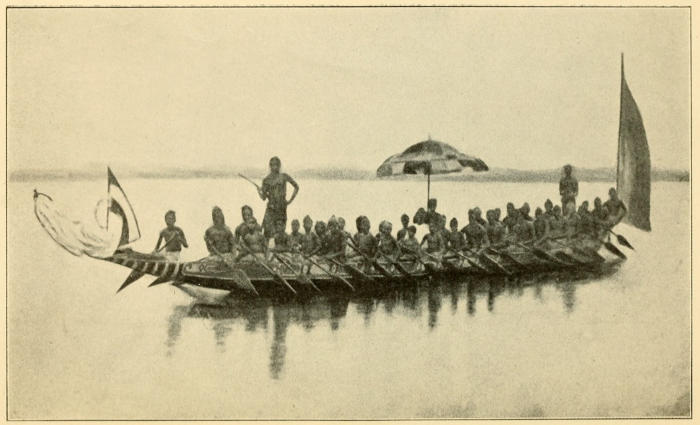
CANOE OF A CHIEF ON THE CAMERON RIVER.
(See page 354)
The Jungle Folk of Africa
By
ROBERT H. MILLIGAN
ILLUSTRATED
New York Chicago Toronto
Fleming H. Revell Company London and Edinburgh
Copyright, 1908, by
FLEMING H. REVELL COMPANY
Second Edition
New York: 158 Fifth Avenue
Chicago: 17 North Wabash Ave.
Toronto: 25 Richmond Street, W.
London: 21 Paternoster Square
Edinburgh: 100 Princes Street
PREFACE
“In the realm of the unknown, Africa is the absolute,”
said Victor Hugo. Since the time of
Hugo the civilized world has become better acquainted
with African geography; but the Africans
themselves are still a people unknown.
A certain noted missionary, while on furlough in
America, after delivering a masterly and brilliant lecture
on Africa to an audience of coloured people, gave an opportunity
for persons in the audience to ask him questions
pertaining to the subject. He was rather abashed
when an elderly negro, who had been deeply interested
in the lecture, called out: “Say, Mistah S., is they any
colo’ed folks ovah thah?” Most people know that there
are a goodly number of “colo’ed folks” in Africa; but
the knowledge of the majority extends only to the colour
of the skin. And if in this book I endeavour to make
the Africans known as they really are, it is because I believe
that they are worth knowing.
In the generation that has passed since the books of
Du Chaillu were the delight of boys—old boys and young—the
African has received but scant sympathy in literature.
Du Chaillu had the mind of a scientist and the
heart of a poet. He never understated the degradation
of the African nor exaggerated his virtues, but he recognized
in him the raw material out of which manhood is
made. He realized that the African, like ourselves, is
not a finality, but a possibility—“the tadpole of an archangel,”
as genius has phrased it. But, then, Du Chaillu
lived among the Africans long enough to speak their
language, to forget the colour of their skin, and to know
them, mind and heart, as no passing traveller or casual
observer can possibly know them.
In more recent books the African is usually and uniformly
presented as physically ugly, mentally stupid,
morally repulsive, and never interesting. This is by no
means my opinion of the African. Kipling’s characterization,
“half child, half devil,” is very apt. But what in
the world is more interesting than children—except devils?
This book is an attempt to exhibit the human nature of
the African, to the end that he may be regarded not
merely as a being endowed with an immortal soul and a
candidate for salvation, but as a man whose present life
is calculated to awaken our interest and sympathy; a
man with something like our own capacity for joy and
sorrow, and to whom pleasure and pain are very real;
who bleeds when he is pricked and who laughs when he
is amused; a man essentially like ourselves, but whose
beliefs and whose circumstances are so remote from any
likeness to our own that as we enter the realm in which
he lives and moves and has his being we seem to have
been transported upon the magic carpet of the Arabian
fable, away from reality into a world of imagination—a
wonderland, where things happen without a cause and
nature has no stability, where the stone that falls downwards
to-day may fall upwards to-morrow, where a person
may change himself into a leopard and birds wear
foliage for feathers, where rocks and trees speak with
articulate voice and animals moralize as men—a world
running at random and haphazard, where everything
operates except reason and where credulity is only equalled
by incredulity. Elsewhere it is the unexpected that happens:
in Africa it is the unexpected that we expect.
A knowledge of the jungle folk of Africa will include
some acquaintance with their jungle home, their daily
life, their work, their amusements, their social customs,
their folk-lore, their religion, and, among the rest, it will
include their response to missionary effort. Of these
several subjects, those which receive scant treatment in
this book will be more fully presented in a second book
on Africa, which is now in course of preparation.
I have avoided generalizations and abstractions, in the
belief that the concrete and the personal would be not
only more interesting but also more informing. This
book is, therefore, in the main, a narration of the particular
incidents of my own experience and observation
during seven years in Africa; incidents, many of which,
at their occurrence, moved me either to laughter or to
tears, and sometimes both in alternation. For, nowhere
else in the world does tragedy so often end in comedy,
and comedy in tragedy.
I am indebted to Mr. Harry D. Salveter for his kindness
in furnishing me with many photographic illustrations,
including the best of my collection.
Wet and dry seasons—The climate—The trader—Old
Calabar—The crocodile—The most beautiful place in
West Africa—The ugliest place in the world—Mount
Cameroon—A ride on a mule—Landing in the surf.
Where no white man had been—The greatest forest in the
world—The caravan—Outfit—African roads—Bridges—The
worst of the road—Blessings in disguise—The art of
walking—The arrival in camp—The misery of morning—Rubber
stomachs.
The road at the worst—Tired out—A palaver with the carriers—Elephants—A
caravan astray—A long night—A
borrowed shirt—The sullen forest—Accident the constant
factor—A last journey—Advantage of breakfast before
daylight.
The camp—African mimics—The lemur’s cry—Legend of
the snail—The chimpanzee and the ungrateful man—A
fable of the turtle—Why the leopard walks alone—A
“true” story—A magic fight—Discovering a thief—A
spirit who spreads disease—A shadow-slayer—A witch
discovered—Lying awake at night.
Efulen—The “white animal” performs—Africa no solitude—The
mail—The first fever—Yearning for a shirt—A
vivid account of my funeral—The first house—Cooks
and cooking—The medical layman—Mrs. Laffin’s visit.
The Bulu tribe—“Better-looking than white people”—Dress—Ornamentation—A
sociable queen—The white
man’s origin—Our fetishes—A magic letter—Buying and
selling—Chief Abesula.
Killed by mistake—A woman stolen—A passion for clothes—The
Batanga church—Expectoration a fine art—Romantic
career of a nightshirt—Bekalida—Keli, the
incorrigible—Death of Dr. Good.
The Kru tribe—The “real thing”—Kru English—The
Kruboy’s superstition—The ship’s officers—Dressing with
much assistance—Loading mahogany—The Kruboy and
the surf—The white man out of his element.
St. Paul de Loanda—Canine passengers—Portuguese slavery—An
American problem—A health-change—Boma—Belgian
atrocities—Matadi—Stanley—What I heard at
Matadi—The apathy of the nations.
Gaboon—The village—The house—The door—The kiss
unpopular, and no wonder—Marriage customs—A woman
tortured—An elder brother—Immoral customs—The Gorilla
Society—War—A troublesome sister—A blessing
that resembled a curse—A strange war-custom—Music—Dancing—Story
of the elephant and the gorilla—Fable
of the sun and moon.
The conception of God—Dreams—Ancestor-worship—The
conception of nature—The fetish proper—A wonderful
medicine-chest—Various fetishes—A case of discipline—Witchcraft—A
convicted witch—Wives and witchcraft—The
white man and witchcraft.
The Evangeline—Makuba—An un-dress ball—Ndong Koni—A
saint that lied—Capsized and rescued—A dying
slave—Dressed in a table-cloth—Flogging a chief—A story
of true love.
The language difficulty—Lacked nothing but the essentials—The
late M. de la R.—One of Macbeth’s witches—Death
of Nduna—Bojedi—More candid than kind—The
racial weakness—A royal romance—Marriage ceremonies—A
penitent—A fall.
A health-change—The brightest of his class—Rotten Elephant—Very
sick—An object of wonder—Mount Teneriffe—Adventure
with a stage-coach—Adventure with a
donkey—The crisis—The Ashantee war—A burial at sea.
Reality versus romance in missions—Arrival of the steamer—Adventure
in a canoe—An Apollo Belvidere in ebony—A
sensational call to worship—A white man’s foot—A
prayer that caused a panic—Not wickedness, but worms—The
right hand, or the left?—“Dawn of the Morning”—M’abune
Jésu—Keeping the Sabbath—The harvest—The
Jesuits—A building not made with hands—“O’er
crag and torrent.”
When I was about to sail for Africa a friend
read to me a thrilling incident which was
supposed to be prophetic of my own fate. A
cannibal maiden proposes marriage to a newly-arrived
missionary. The missionary modestly declines her offer;
whereupon, looking down at him with utmost complacency,
she tells him that she will have him anyhow—either
married, or fried. I have gone to Africa twice, and
have lived there nearly seven years, yet I have escaped
both of these dreadful contingencies. There is no longer
any glamour of romance about the missionary life. It is
not a life of hair-raising adventures and narrow escapes.
In those seven years I was never frightened and seldom
killed. Dull monotony is the normal experience and
loneliness the besetting trial.
Neither are the sacrifices and privations of missionary
life so great as many of us have supposed. The sacrifices
of the missionary are more tangible, but not therefore
greater, than those of the faithful minister at home;
whose sacrifices are often more real because less obvious.
A few days before I sailed the second time for Africa,
when I knew from former experience that the missionary
life was no martyrdom, I was one day seated at a dinner-table
where Africa and my going was the subject of conversation.
The company had the most exaggerated ideas
of the privations incident to missionary life. There was no
use in a denial on my part; and to have disclaimed any of
the fictitious virtues with which they loaded me would
only have caused them to add the virtue of modesty to
the rest.
A maiden lady across the table, who for some time had
sat with abstracted countenance, at last, with upturned
eyes and clasped hands, remarked: “Well, I think it is
an appalling sacrifice.”
To have lived up to my part, my face at that moment
should have worn a saintly expression of all the virtues
rolled into one; but it happened that my mouth was
quite full of pork and cabbage, with which my carnal
mind was occupied, and I am sure I looked more like an
epicure than an ascetic. Nothing but the pork and cabbage
kept me from laughing outright.
Really, life in Africa is much the same as life anywhere
else; and the “privations” only teach us how many
things we can do without which we once thought were
indispensable. This lesson is impressed the more deeply in
such a land as Africa, where a human being may live
for threescore years—comfortable, apparently happy,
and at least healthy—with little else than a pot, a pipe
and a tom-tom; the first ministers to his necessity, the
second to comfort and the third to pleasure. If we will
persist in regarding the missionary as a martyr, let us
consider that the martyr does not differ essentially from
other Christians. Martyrdom is potentially contained
in the initial decision of each Christian. The consecration
of a life to Christ implies the willingness to lay it
down for Him. In an uncivilized land there is a likelihood
of unwonted hardships, and among savages some
possibility of a violent death; but the latter is vastly improbable.
One can procure an outfit more conveniently and at
less cost in Liverpool than in New York. A week at
Liverpool is sufficient for this purpose. The outfit will
depend somewhat upon whether one expects to live on the
coast or in the bush where he will be cut off from the
facilities of transportation by water. All transportation
to the interior is by native porters, who carry sixty or
seventy pounds on their backs, in loads as compact as
possible. This excludes most furniture; and such furniture
as can be transported is usually “knocked down.”
An ordinary outfit will include several helmets of cork or
pith, several white umbrellas lined with green, a dozen
white drill suits, denim trousers, canvas shoes, leather
shoes, rubber boots, cheese-cloth for mosquito-bars, rubber
blankets, pneumatic pillows, hot-water bags, a supply
of medicines (unless these are already on the field)
especially quinine and castor-oil, a six-mouths’ supply of
food—canned meats, vegetables and fruits—besides bedding
and kitchenware, tableware, napery, etc., according
to need, and guns and ammunition.
There is a romantic interest about this last week spent
in the purchase of strange articles for an untried life, and
in taking leave of civilization,—of such things as cities,
society, music, fresh beef and fine clothes. The last
evening in Liverpool I went to hear Tannhauser. Music
had always been my pastime, and it was not an easy sacrifice
to make. I therefore looked forward to that evening
with peculiar interest, knowing that not again until
my return, however long I might remain in Africa, would
I hear any music worthy of the name. But Tannhauser
proved to be not a sweet parting from civilization but an
awful experience, by reason of some one in my neighbourhood
beating the time with his foot, as they so often do
in England. I had one of the best seats in the house, but
I exchanged it for another, only to find myself in a worse
neighbourhood; for, in addition to a man on each side of me
beating the time, a woman immediately behind “hummed
the tune.” At the close of the performance I was in a
condition of “mortal mind” that would have scandalized
those who are disposed to canonize missionaries. But the
sorrow of parting was thus mitigated as I reflected that
civilization has its pains and savagery some compensations.
I went home and wrote the following to a friend:
“Some one alluding to Macaulay’s knowledge of history
and his unerring accuracy once said that infinite damnation
to Macaulay would consist in being surrounded by
fiends engaged in misquoting history while he was rendered
speechless and unable to correct them; and I am
thinking that my inferno would consist in being compelled
to listen to some such exquisite melody as O Thou Sublime
Sweet Evening Star, surrounded the while by fiends keeping
time with their feet, and Beelzebub humming the
tune.”
On my first voyage to Africa (having been appointed to
the West Africa Mission, by the Board of Foreign Missions
of the Presbyterian Church) I was four weeks on the way,
from Liverpool, and landed at Batanga, in Cameroon, two
hundred miles north of the equator. On the second voyage
I was five weeks on the way, and landed at Libreville
(better known as Gaboon) in the Congo Français, almost
exactly at the equator. Libreville was the capital of the
French Congo. Gaboon is properly the name of the bay
or great estuary upon which Libreville is situated, and
is one of the very few good harbours on the west coast.
But long before the existence of Libreville, captains and
traders had used the name Gaboon to designate the adjacent
settlement of native villages and trading-houses, and it is
still the name in general use.
We made many calls along the way. Some of the
places are very beautiful, such as the Canary Islands,
Sierra Leone, Cape Coast Castle, Victoria, Fernando Po
and Gaboon; and some are quite otherwise, for Africa is
a land of extremes. Bonny is repulsive, and the Rio del
Rey is a nightmare. Meanwhile, we are getting further
and further away from all that is known and natural to
our eyes, and nearer to a land of strange birds and beasts
and trees, inhabited by tribes that to the white man are
only a name, or have no name, and to whom he is perhaps
an imaginary being, or the ghost of their dead ancestors.
At the Canary Islands, a week after leaving Liverpool,
one may spend a day of interest and pleasure. On my
first voyage we called at Las Palmas, in Grand Canary
Island. On the second voyage we called at Santa Cruz
on Teneriffe Island. The object of chief interest is the
great Mount Teneriffe, seen sometimes a hundred miles at
sea; probably the Mount Atlas of ancient fable, which
was supposed to support the firmament. There are of
course many mountain peaks in the world which rise to a
greater height above the sea-level; but they are usually
in ranges or on high table-lands far from the sea, and
while the altitude is great, the individual peak may not
be great. Teneriffe rises directly out of the sea, slowly at
first but with increasing inclination, until at last it sweeps
upward to the clouds and far above them, to a height
of 12,500 feet. The sandy slopes upon the higher altitudes
reflect the light with unequalled splendour. From
the harbour of Las Palmas we saw the sun rising on Teneriffe.
We stood on the deck before the dawn, and while
darkness was all around us, saw the heights already struggling
with the darkness, and the summit bathed in the light
of the unrisen day. A heavy mist rolled down and spread
over the valleys, like a sea resplendent with every interchange
of deepening and dissolving colour; while from
below arose the increasing noise and tumult of a half-civilized
city awaking from slumber. In a little while the
clouds begin to assemble, and the peak is hidden throughout
the day: so it is always. But in the evening, the
clouds again are parted, like opening curtains, and the
whole mountain is disclosed, majestic and beautiful in the
light of the setting sun.
On the homeward voyage the steamers often take on an
enormous deck-cargo of bananas. They are put in crates
the size of barrels and are packed in straw. In the event
of a severe storm before reaching Liverpool they are more
than likely to be washed overboard. It is a pleasure to
watch this loading from the upper deck. The Spanish
workmen are neat and clean; they are skillful and work
rapidly, as indeed they must in order to load the entire
cargo in one day, which is usually the limit of time. All
day long Spanish boys without clothes are crowded around
the steamer in small boats, begging the passengers to
throw pennies into the water and see them dive and get
them. Many pennies and small silver coins are thrown
over in the course of the day; and the boys seldom miss one.
A number of the passengers debark at the Canary
Islands, and the rest have more room and more comfort.
Immediately upon leaving the Islands double awnings are
stretched over the decks; and the passengers and ship’s
officers the next day don their tropical clothing. The sea
is exceedingly calm as compared with the North Atlantic
and the air soft and balmy. It recalled those lines of
Keats—
“Often it is in such gentle temper found,
That scarcely will the very smallest shell,
Be moved for days from where it sometime fell,
When last the winds of heaven were unbound.”
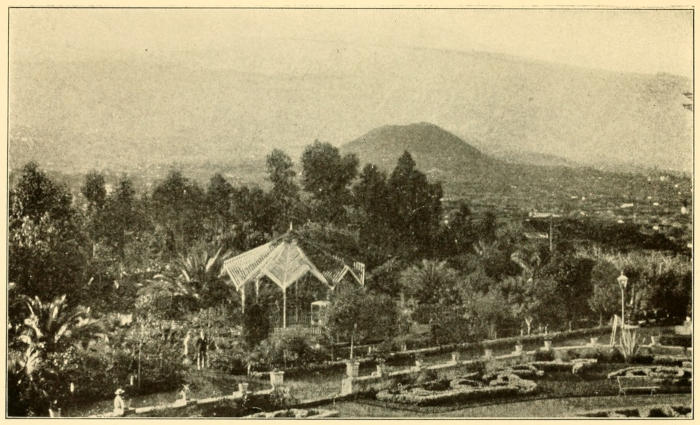
MOUNT TENERIFFE, CANARY ISLANDS.
Probably the Mount Atlas of ancient fable, which was supposed to support the firmament.
The change to tropical life takes place in one day and
it is like being suddenly transported into another world.
The men nearly all are dressed in white drill suits, and
most of them wear white caps and white canvas shoes.
If they go ashore at various ports along the way they will
exchange the cap for a cork helmet and besides will probably
carry a white umbrella. The white suits if well
made and well laundered look much more comfortable and
becoming than any other clothing. They are usually
made in military style with stitched collar, so as we go
on further south the shirt of civilization may at length be
dispensed with and the coat worn directly over an undershirt,—which
latter ought to be of wool and medium
weight. Except my first year, I wore no shirt at any
time through all the years that I lived in Africa, not even
at the French Governor’s annual reception at Gaboon.
The English at Old Calabar on formal occasions make
themselves ridiculous in black dress suits with the conventional
area of shirt-front and collar. In these they
swelter, vastly uncomfortable, while the starch dissolves
and courses towards their shoes down back and breast.
It is not only, nor chiefly, the high temperature but the
extreme humidity that makes the atmosphere so oppressive.
It seems to be seventy-five per cent, warm water.
On shipboard it is usually comfortable and pleasant
while we are under way. The most delightful part of
the voyage is the first few days after leaving the Canary
Islands, when the course lies in the track of the northeast
trade-winds. One thinks very differently, however, of
this trade-wind in coursing against it on the homeward
voyage after a length of time on the fever-stricken coast.
It seems piercing cold, and, as Miss Kingsley says, one
wishes that the Powers above would send it to the Powers
below to get it warmed. It is in this zone that deaths
most frequently occur on board. On the outward voyage
immediately after the most delightful part of the voyage
comes the very worst part of it, as we pass beyond the trade-wind
and close in to the coast near Cape Verde. For
several days one is tempted to wish that he might turn
back. There is a dead calm on board, and the heat is
enough to curl one’s hair. It recalled Sydney Smith’s
description of some such place, where “one feels like
taking off his flesh and sitting in his bones.” But it continues
only two or three days. During this time the
“punka” is installed, a large fan suspended from the
ceiling, the entire length of the table, worked by a rope,
which a boy pulls with his hand.
A week after leaving the Canary Islands we reached
our first African port, Sierra Leone. It has the finest
harbour on the entire west coast. From the harbour it
is very beautiful, with mountains of intense green standing
like sentinels on either side and behind the town.
The sound of the wind raging about these peaks, like the
roaring of a lion, gives the name, Sierra Leone. Despite
its attractive appearance, it is called The Whiteman’s
Grave, and its history justifies the name. But as we proceed
down the coast we find that every place which has
any considerable number of white men is called The
Whiteman’s Grave. The name Sierra Leone applies to
the entire English colony; that of the town at this place
is Freetown. It was originally a colony of freed slaves,
which the English planted there during the suppression
of the slave traffic. The first ship-load of colonists, between
four and five hundred, was landed in 1787. Of
these, sixty died on the way or within a fortnight after
landing. Freetown has now a population of thirty thousand,
and is prosperous. Along the wharf are warehouses
with roofs of corrugated iron. The roofs of the
traders’ houses also, both here and all along the coast,
are of corrugated iron. Here and there among the colourless
huts of the natives there stands out boldly the
frame houses of successful native traders, made of imported
material and usually painted an impudent blue.
Houses with floors are everywhere called deck-houses; for
the decks of ships were the first floors ever seen by the
natives.
So soon as we had anchored, the natives, in a score of
boats, were crowding about the gangway, pushing back
each other’s boats, fighting, cursing and yelling, in a
general strife for the very lucrative privilege of rowing
passengers ashore. However otherwise engaged in this
scramble they are all yelling; and the resultant noise is
the proper introduction to Africa. For, as noise is the
first, so it will be the final and lasting impression. It is
the grand unity in which other associations are gradually
dislimned. We went ashore in the late afternoon. The
people were all in the streets, moving about, but no one
moving rapidly; all active, but no one very active. As
there are no vehicles, pedestrians occupy the whole
street, which is covered with grass. There is a great
variety of dress and considerable undress. Many of the
women wear a loose calico wrapper—a Mother Hubbard;
and many of the men are dressed in the Mohammedan
costume, which is more becoming, and more suitable for
the climate, than any possible modification of European
dress. It consists of a long white shirt with loose, flowing
sleeves, and an outer garment somewhat like a university
gown, of black or of blue. The ordinary man
wears anything he may happen to have, from an eighth
of a yard of calico to a rice-bag in which he cuts holes
for his head and arms.
Ever so many were carrying loads on their heads—never
any other way—and without touching them with
their hands. Indeed, if their hands were engaged I am
not sure whether they could talk; for when they talk
they gesticulate continually. Some were carrying beer
bottles erect on their heads, some carried books, some of
the women carried folded parasols; others carried fire-wood,
or bananas, or large baskets of vegetables. They
exchange the neighbourhood gossip as they pass, but
without turning their heads; and sometimes they throw
down their loads and seat themselves on opposite sides of
the street to have “a friendly yell.” When we returned
to the steamer we found on board, on the lower deck,
about twenty native passengers. They have brought all
their household goods, including chickens; and several
of the women have babies strapped to their backs. They
pay only for a passage on deck, taking the risk of the
weather, and expect to yell their way to Fernando Po, in
about two weeks. The number of deck passengers increases
at each of the next several ports, until the deck is
crowded; but they are never allowed on the upper
deck.
The deck, formerly spacious and shining, is now covered
with baggage, the abundance of which is only exceeded
by its outlandish variety. The first mate is the
ship’s general housekeeper. Cleanliness and order are
a mental malady with him. If he could have his way
the ship would carry no cargo, since the opening of the
hatches and the discharging of it deranges the order of
the lower deck and litters it with rubbish. Besides he
would like to employ the boat-crews in holystoning one
deck or another all the time instead of only once each
morning. The sight of a dog affects him more seriously
than seeing a ghost. Passengers are a great trial to him
who carelessly place their deck chairs for comfort or for
conversation with each other instead of leaving them in
unneighbourly straight lines as he arranged them. He
is rarely on speaking terms with the chief engineer, because
the latter must frequently have coal carried from
the forehold; and there is a standing feud between him
and the cook, whose grease-tub sits outside the galley
door. The mate’s sole horror of a storm at sea is that
the rolling of the ship spills the grease. Imagine the life
this gentleman lives from the time that the native passengers
begin to come aboard and fill the deck with their
piles of miscellaneous baggage. He ages perceptibly.
Disorder is precisely the weak point in the native character;
and much of the mate’s time is spent in pitched
battles with the native women, over the bestowment of
their goods. No sooner has he, with the help of several
deck-hands, arranged a lady’s goods in a neat square pile
ten feet high and seated her children in a straight row
than the lady orders all her children to get out of her way
and proceeds to tear down the pile in order to get a cosmetic
and a mirror that happen to be in two different
boxes in the bottom. When the mate is not around the
deck passengers seem very happy as they sit at random
on their baggage and yell at each other. Here and there
men in Mohammedan dress sit on the sunny deck in
cross-legged tailor-fashion, reminding one of old Bible
pictures. If they quarrel a great deal they also laugh a
great deal, and the quarrels are no sooner ended than
they are forgotten.
At Lagos several native men came out in a boat to meet
a deck passenger and land his baggage. The natives are
not allowed to use the gangway, and if the rope ladder is
in use they pass up and down a single rope suspended
over the ship’s side. On this occasion I observed one of
the men from the boat alongside sliding down a rope and
carrying a heavy box, by no means an easy thing to do.
He expected that the others of his party would be waiting
to receive him in the boat below. But they had drifted
several yards away and were engaged in eating some potato
peelings which a steward had thrown to them. He
called to them but they paid no attention:—they were
eating. He yelled at them and cursed them, at the same
time making with his legs impressive gestures of appeal
and threat. But they sat indifferent until they had finished,
while he with his load remained suspended in the
air. Moreover, the sea at Lagos abounds with sharks.
At last, having finished their repast, they came to his
rescue. I was watching eagerly to see how many would
be killed in the ensuing fight. But not a blow was struck,
and the palaver did not last a minute. So forgetful are
they of injuries. And though they are capable of great
cruelty towards their enemies, their cruelty is callous
rather than vindictive; not the cruelty that delights in
another’s pain, but rather that of a dull imagination which
does not realize it.
A few days after leaving Sierra Leone we anchored off
Monrovia, the capital of Liberia, where we shipped eighty
native men, Krumen, who were engaged by the ship as
workmen for the discharging and loading of cargo. They
are engaged for the round trip down the coast, three or four
months, and are unshipped again on the homeward voyage.
Of these Krumen I shall speak at some length in
another chapter. They are the original native tribe of
this part of the coast and are not to be confounded with
the proper Liberians whose ancestors emigrated from
America.
Liberia represents the philanthropic effort of America
to restore to their native land the Africans carried to
America by the slave trade. A large area of country was
purchased from the native chiefs, and in 1820 the first
settlement of colonists was established. Liberia is a country
of possibilities. There is no richer soil on the entire
west coast. It is especially suitable for coffee and cocoa;
but it has remained undeveloped. The poor and ignorant
colonists were not fit for self-government. America
should have done more or else less. The Liberians might
far better have remained in America. During the several
generations of their absence from Africa they seemed to
have lost the power of resisting the malaria. The mortality
among them was very great and they were pitiably
helpless. The government of Liberia some one has said
is a fit subject for comic opera. At one time becoming
possessed of a little cash, by some wonderful accident,
they provided themselves with a small gunboat by which
they hoped to convince calling ships that theirs is a real
government competent to collect dues, impose fines, and
enforce the rules of quarantine and release that obtain at
other ports, for which purpose it has proved as ineffective
as a pop-gun. But they have used it successfully against
the canoes of the Krumen in levying a heavy and unjustifiable
duty upon these men when they return from the
south voyage with their pay.
After two weeks on shipboard the immobility of life
becomes agreeable and we are all content to be lazy.
And in the evening when the social instinct is lively and
men sit together at leisure in the balmy breeze, under the
canvas roof, on a well-lighted deck, the sea so calm as to
allay all apprehension, a wall of darkness around us, and
the immensity of the sea beyond, as separate from the
rest of the world as would be some tiny planet that has
separated from the solid earth and rotates upon its own
axis, then the charm of travel on the tropical sea is all
that the imagination had preconceived,—a lazy, luxurious
dream. When Boswell remarked to Johnson, “We grow
weary when idle,” Johnson replied: “That is, sir, because
others being busy, we want company; but if all
were idle there would be no growing weary; we should
entertain one another.” We were all equally idle and
lazy, and wished we could be lazier. There were whole
days when the conversation—until evening—contained
nothing more epigrammatic than “Please pass the butter,”
or “Have a pickle?”
The company consists of traders, government officials
and missionaries; and the captain is usually present. As
our number diminishes at each successive port, we become
better acquainted and more friendly. Men of antipodal
differences are thus frequently brought into friendly
and sympathetic relations, men who in ordinary life
would seldom have been brought into contact with each
other, and who never would have known that they had
anything in common; and the experience is wholesome.
I have learned to think more kindly of the African trader
and to refrain from criticism because of some whom I
have known intimately on these long voyages.
As we sit on deck in the evening the captain tells us
that at Lagos, where we are due in a few days, he has
seen the natives fight the sharks in the sea and kill them.
The shark is the monster of the tropical seas, the incarnation
of ferocity and hunger. The native takes a stout
stick, six inches long and sharpened at both ends. With
his hand closed tight around this he dives into the sea,
and as the shark comes at him with its terrible mouth
open, he thrusts the stick upright into its mouth as far as
he can. There it remains planted in the upper and lower
jaws of the shark, which, not being able to close its mouth,
soon drowns and comes to the surface. It is a good story,
and not incredible as a fact; for the native is brave enough
and fool enough to do this very thing. But this is the
same captain who tells of fearful storms which he has successfully
encountered, when the ship rolled until she took
in water through the funnels. He remarked to me one
day, speaking of one of his officers who was not the brightest:
“I always have to verify his reckoning; for he always
mistakes east for west and invariably puts latitude
where longitude ought to be.” He also tells of an invitation
he once received from a cannibal chief near Old
Calabar, to come ashore and help him pick a missionary.
He has seen the sea-serpent many a time and knows all
about it. It is not dark green with brown stripes, as is
generally supposed, but is bright yellow with blue spots,
and is quite three hundred feet long. On one occasion it
followed the captain’s ship for several days, at times raising
one hundred and fifty feet of its length out of the
water, and being prevented from helping itself to a sailor
now and then only by great quantities of food which they
threw over to it. This caused a famine on board, and
they reached the nearest port in a half-starved condition.
An affidavit goes with each of the captain’s stories.
Most captains indulge in this entertaining hyperbole.
Some are decidedly gifted with what has been called a
“creative memory.” I have never yet known a
captain who could not turn out as handsome a yarn as
Gulliver.
As the company become better acquainted conversation
is more intimate and varied. Now we are discussing
some subject of continental magnitude, and again, with
equal interest, some infinitesimal triviality. Detached
from the rest of the world, and with no daily budget of
news, our interest becomes torpid, and things great and
small appear without perspective on a flat surface of
equality. We avowed our disbelief in the infallibility of
the pope, and pronounced against his claim to temporal
authority. We anticipated all the conclusions of the
Hague Conference, and discussed the imminence of the
“yellow peril.” We resolved that the Crown Colony
system was a failure and had never been a success, and
we devised an elaborate substitute but could not agree
upon the details. We agreed that the English aristocracy
had long been effete, and that the Duke of X, related to
the queen, was a “hog.” We reached the amicable conclusion
that the thirteen colonies should never have rebelled,
and that the blame was all on the side of England.
We left posterity nothing to say on the relative merits of
the republican and the monarchic forms of government,
and decided that the enfranchisement of the negro was a
mistake.
In juxtaposition to these discussions, one man occupied
the company a part of an evening recounting the entire
history of his corns; but I regret that I have forgotten
their number and disposition. Another disclosed the
fact that he always wore safety-pins instead of garters,
and descanted upon his preference with such enthusiasm
that he made at least one convert that I know of. I was
carefully told how to mix a gin cocktail (though I may
never have any practical use for this valuable knowledge)
and how to toss a champagne cocktail from one glass to
another in a beautiful parabolic curve; also how many
cocktails a man might drink in a day without being
chargeable with intemperance: in short, if there is anything
about “booze” that I do not know it must be because
I have forgotten.
One night (but this was another voyage and a different
kind of captain) we put in practice the principle of arbitration
of which we were all adherents; and the result
was my discomfiture. An argument had arisen among
us as to which was the more simple of the two currency
systems, dollars and cents, and pounds, shillings and pence—as
if there were logical room for difference of opinion!
At last, the captain arriving, we decided to refer the matter
to him and to surrender our judgment to his arbitrament.
The captain (an Englishman of the very stolid
sort), after a period of reflection replied very slowly, and
with all the gravity of a judge: “Pounds, shillings and
pence is the simpler system; for, don’t you know, that
when you are told the price of a thing in dollars and cents
you always, in your mind, convert it into pounds, shillings
and pence.”
“Of course, Captain,” said I; “I had not thought of
that until you mentioned it; neither had I recalled the
well-known fact that a Frenchman, while speaking
French in the streets of Paris, is really thinking in English.
Your decision is as shrewd as it is impartial.”
II THE COAST
But the pleasure of the voyage depends largely
upon the season. The wet and the dry seasons are
distinctly divided. There is a long wet season of
four months and a short wet season of two months each
year, and corresponding long and short dry seasons. The
rains generally follow the course of the sun as it moves
between the northern and southern solstice. The regularity
of the seasons is modified by local influences such
as the proximity of mountains. The seasons at Batanga,
for instance, are not so distinctly divided as at Gaboon.
I am most familiar with the climate of Gaboon, which is
practically at the equator. The long wet season begins
in September, when the sun is coursing from the equator
towards the southern solstice, and continues nearly four
months. The long dry season begins in May and continues
for four months. Those are the delightful months
of the year. We are accustomed to associate a dry spell
with heat and glaring sunshine. But there the brightest
sunshine is in the wet season between the showers. The
dry season is both cool and shady; so cool that the natives
find it uncomfortable, while the sun is sometimes not
seen for a week. It always seems to be just about to rain.
A stranger to the climate would not risk going half a
mile without taking an umbrella. But he is perfectly
safe. There is not the least danger of rain between May
and September. Often in the dry season I have travelled
through the midday hours in a canoe, lying full length on
a travelling rug with my face towards the sky; for there
is no glare: the mellow light has the quality of moonlight.
But a strong wind prevails during the dry months, and
it is the season when the surf rages wildly on the open
coast; when surf boats with cargo are often broken on
the beach and the native crews lose their limbs and sometimes
their lives. The ground though very dry does not
become parched. The rustling of the palms or of the
thatch roof at the close of the season is like the heavy
pattering of rain, so much so that sometimes one is deceived
in spite of himself. The dry season is healthiest
for white men, but not for the native. They are not sufficiently
protected against the wind, and pneumonia is
common. However much we prefer the dry season, yet
we weary of it towards the close, and like the natives we
fairly shout for joy at the first shower.
The wet season is very disagreeable. The rain falls in
streams, and, as Miss Kingsley says, “does not go into
details with drops.” There are several torrential downpours
each day and night. In the intervals during the
day the sky is swept clear of clouds and the sun shines
the strongest. The atmosphere is extremely humid and
sultry. With the least exertion, or with no exertion, one
perspires profusely, and there is no evaporation. One
ought to change his clothing several times a day; but
most of us cannot afford to devote so much time to comfort.
Frequent tornadoes often cool the air in the evening.
The most uncomfortable of all places during the rain is
on shipboard. The rain will at length find its way
through any thickness of awning, and the delightful deck
must be deserted for the stifling saloon. Our paradise is
transformed to a purgatory. The rain is accompanied by
a heavy mist and as it dashes upon the surface of the sea
it lifts a cloud of spray that hides the water beneath and
we seem to be drifting courseless through cloudland, with
our horizon immediately around us. As it continues day
after day everybody becomes depressed; and as for the
captain, it is scarcely safe to speak to him. One day when
I was travelling in the wet season, the captain lost a
whole day prowling up and down the coast looking for a
place which was completely hidden in the rain and mist.
He was angry; and an angry captain is a fearsome object.
He is accustomed to being obeyed, and is master of
everything else but the fourth element, which occasionally
thwarts his plans and derides his authority. At a
moment when the rain slackened from a torrent to a
heavy shower, a passenger put his head out on deck and
remarked: “It’s not raining, Captain.”
“Well, if that is not rain,” thundered the disgusted
captain, “it is the best imitation of rain that I have ever
seen.”
The subject upon which conversation dwells longest
and to which it ever returns with gruesome interest is the
African fever. The news that is brought on board at
each port is like a death bulletin. To the new comer it
is all very trying and very tragical. But he cannot escape
from it; for the Old Coaster (and a man who has
been out once before is an Old Coaster) assumes the grave
responsibility of impressing deeply upon the mind of the
tenderfoot the serious conditions which he is about to
confront. It is impressed upon him that the fever is inevitable,
and that the young and healthy die first; that
temperate habits instead of being a defense are a snare,
and that not to drink is simply suicide. Missionaries die
like flies. But then of course it comes to the same thing
in the end; there is no escape; and to worry about it, or
to expect it, will bring on a fever in two days. Exposure
to the sun is sure to induce fever; and yet none die so
quickly as those who carry umbrellas. Quinine is useless
except to brace the mind of those who believe in it;
but it isn’t any good. And when you get fever, you
can’t escape, by leaving the coast in a hurry, even if
there should be a steamer in port, which is very unlikely;
for a man going aboard with fever is sure to die. Perhaps
it is the horror of being buried at sea that kills
him.
“How is that new clerk whom I brought out for you
last voyage?” asks the captain, of a trader who has
come aboard for breakfast.
“Poor chap!” says the trader, “he didn’t live two
weeks. Another came on the next steamer, and he
pegged out in three weeks. They ought to be sent out
two at a time.”
“You remember so-and-so,” says another; “well, poor
chap! (and as soon as he says “poor chap” we know the
rest) he was found dead in bed one morning since you
were here. They had used up all the lumber that they
had laid away for coffins, so they took half the partition
out of his house, to make a coffin; and then they didn’t
get it long enough. The next fellow is now living alone
in that same house with half the partition gone, and of
course he can’t help reflecting that there is just enough
left to make another coffin; and, indeed, to judge by the
way he was looking when I saw him last they may have
used it by this time.”
“Have you heard about the poor chap that so-and-so
sent up country? Well, he died a few weeks ago.
He was all alone except for the native workmen, and as
soon as he died they ran away in fear. The agent got
word of it and started up country immediately; but the
rats had found him first.”
It is only when one reflects that all these “poor chaps”
were somebody’s sons, and somebody’s brothers, that one
realizes the tragedy of the coast. These little conversations
on board seem like the final obsequies performed for
those who are dead.
“Do men ever die of anything except fever?” asks a
new comer.
“O yes,” says the Old Coaster. “Let me see: there’s
dysentery,—poor C died of that last week; and there’s
enlarged spleen, abscesses, pneumonia, consumption
(one falls into consumption here very quickly, and often
when he least expects it), kraw-kraw and smallpox
(smallpox has just broken out at Fernando Po: that’s
our next port), not to speak of seven or eight varieties of
itch, which some men have all the time; but itch doesn’t
kill. By the way, I suppose you know that in this climate
it is necessary that bodies be buried a few hours
after death.”
In the speech of the coast there is no such thing as
reticence, and soon enough we all learn to speak with
brutal bluntness. The only comfort held out to the new
comer is the hope that he will receive, as a sort of
obituary, the kindly designation, “Poor Chap.”
I have never argued for the salubrity of the African
climate; nor am I disposed to protest the general opinion
that it is “the worst climate in the world.” The white
man never becomes acclimatized, and never will until he
develops another kind of blood. One lives face to face
with the constant and proximate possibility of death as
long as he is on the coast. It is an unnatural consciousness,
which, when prolonged through years, tends to become
fixed and permanent even when one has removed
from the circumstances that were its occasion. And yet,
the conversation of the Old Coaster is liable to make an
exaggerated impression. In the first place, the impression
is natural that the climate being so unhealthful must
also be uncomfortable. But, in reality, while several
months of the year are extremely uncomfortable, the
greater part of the year is tolerably comfortable and there
are several months of exceedingly pleasant weather.
Neither is the heat so great as is generally supposed.
With the greatest effort on my part, I never succeeded in
disabusing my friends of the notion that I was slowly
roasting to death in Africa. With every hot spell in
America, when the thermometer was standing at 100°,
their thoughts turned towards me in profound sympathy.
While I have at times suffered with the heat and there
have been times on the river, between high banks, cut
off from the breeze, when I nearly fainted, and one occasion
upon which I was quite overcome, yet as a rule I
lived comfortably by day; and the nights are always cool.
The maximum temperature on the coast is from 86° to 88°,
Fahrenheit, and even such a temperature is rare. One
ought to add, however, that owing to the extreme
humidity this temperature in Africa is incomparably
hotter than the same temperature in America. It is the
sultriness of the hottest weather that makes it insufferable.
West Africa is heated by steam and without the
medium of radiators. The uniformity of the climate is
pleasurable, and is very strange to us of northern latitudes.
One may reckon upon the weather to a certainty.
Within the limits of a given season there is scarcely any
variation from day to day.
The insalubrity is due to the deadly malaria of the
reeking, mosquito-infested swamps. Mr. Henry Savage
Landor, after a journey across Africa, announces to the
world that he is a strong disbeliever in the mosquito
theory of malaria. But, that the mosquito is the agent
of the malaria bacillus, medical science no longer regards
as theory, but as fact, a fact established by the most
elaborate and painstaking series of experiments ever
conducted in the interest of medical science. Mr. Landor
also tells us that he and his men were frequently attacked
by malarial fever, becoming so weak that they could not
raise their hands; but in every case a dose of castor-oil
effected a cure in a few hours. He is therefore a strong
advocate of castor-oil, but disbelieves in quinine. The
use of castor-oil is no new discovery. Every man who
has had any experience in West Africa takes it at the
approach of a fever. But there is no substitute for
quinine. And the medical men of the coast will agree
in saying that life depends always upon the judicious use
of it.
In recent years there has been such progress in the
knowledge of malaria, and how to meet malarial conditions,
that the record of West Africa is continually improving.
Then again, missionary societies, following the
example of the various European governments, have
ceased to make war upon the inevitable and have greatly
reduced the term of service. In American missions the
term is generally three years; in English missions it is a
year and a half or two years; and in the government
service the term is usually much shorter than in the missions.
My first experience in Africa was not a fair test
of the climate. We were engaged in opening a new mission
station in the bush, and the conditions were the most
unhealthful. Our food was the coarsest,—it was several
mouths before we tasted bread; our accommodations were
the poorest,—part of the time we lived in a tent that did
not protect us against the heavy rains; and besides there
were forced journeys to the coast in the wet season with
incidental hardships. After a succession of fevers and
sensational recoveries I fled from the coast with broken
health at the end of a year and a half.
But the second time, when I lived at Gaboon, I stayed
five and a half years,—far too long. During the first
three years at Gaboon T had fever once every two or three
months. I became very familiar with its preceding
symptoms—physical exhaustion for several days, such
that the least effort induced painful weariness and a frequent
heavy sigh; aching of head and limbs; chills alternating
rapidly with feverish heat, and a terrible temper.
At the end of the third year I had a very severe
fever which, instead of yielding to quinine the third day,
became much worse, and the natives carried me in a hammock
to the French hospital. There I remained for five
weeks. But after that I had no more fever, not even once,
though I remained in Africa more than two years longer,
which would have been absolutely impossible if the fevers
had continued. The difference was in my use of quinine.
At first I took quinine only with the attacks of fever, and
then I took an enormous quantity. But in the later
period I kept myself immune by taking it daily whether
I was ill or not. I took five grains every night for those
several years. People are usually greatly surprised at
this and ask if such an amount of quinine was not a terrible
strain upon the constitution. It was, without doubt; but
not so great a strain as malarious blood, and frequent
fevers, and the shock of very large doses of quinine at
such times. If I had not been in greatly reduced health
before I began to take it regularly it is not likely that I
should have required nearly so much. But this is anticipating;
for we are still on the outward voyage.
In general the coast of West Africa is not beautiful;
although it has a weird fascination for those who have
once lived on it. It is low-lying, straight and monotonous:
a gleaming line of white surf, a golden strip of sandy
beach, a dark green line of forest—and that is all, for
days and days and days, and for some two thousand miles,
only broken at long intervals by the great estuary that is
a peculiar characteristic of African rivers, and by low
hills far away on the horizon. Many of the traders are
living, not in the white settlements, but in single trading-houses
and far apart along this lonely shore. They like
it or they hate it. To some it is an idle dream-life that
they enjoy, and to others it is a nightmare that they abhor.
Some of those who came aboard looked like haunted
men. Each day is exactly like all the others, and the
natural surroundings never vary however far they may
wander along the beach—three endless lines of colour
stretching away to eternity, the dull green forest front,
the yellow strip of sand, the white surge of the foaming
surf, and beyond it the boundless sea. Even in the darkest
night the forest still shows as a blacker rim against the
darkness, and the surf-line is white with a whiteness that
no night can obscure. The unceasing sound of it is like
low thunder, and unless one loves it he must often think
what a relief it would be if it would stop but for one brief
moment, and how the silence would “sink like music on
his heart.”
In such places, and in the bush, the traders sometimes
wear only pajamas, by day as well as night. There are
natives enough around, and there is always noise enough;
but it is the noise that only emphasizes solitude. And
one were better to live entirely alone than to be subjected
to the influence of African degradation without the moral
restraints of home and the society of equals, unless his religious
belief be something more than a mere acceptance
of tradition, and his principles something more than conventional
morality. There is a better class of natives
whose society might relieve loneliness, but the trader, as
a rule, does not gather this class around him.
Some are pleased to say very hard things about the
traders. But he who would judge justly must have a
mind well attempered to the claims of morality on the
one hand, and on the other, to the allowance due to the
frailty of human nature when placed in circumstances of
unparalleled temptation. No man ever realizes the moral
restraints of good society until they are all withdrawn;
nor how insidious the influence even of the most repulsive
vices when they have become so common to our eyes that
they cease to shock: the moral safety of most men is in
being shocked. Of course there are bad men among the
traders, and some very bad; and the rumshop which,
wherever the white man has penetrated, rises like a death-spectre
in the landscape, is an abomination to which it
would be difficult to do injustice. But it is not chiefly
the trader who is responsible for the rum traffic. Many
of them would be thankful if the various governments
would entirely prohibit its importation. Moreover, they
sell a thousand things besides rum,—as many useful
things, and necessary to civilization, as the native is willing
to buy. The traders are all men of courage—we can
at least admire them for that—and many are honest and
many are kind; and it were far better to refrain from
condemning the dissolute than that in so doing one should
soil the reputation of an honest man.
We called at Cape Coast Castle, Accra, Lagos, Monrovia
and several other places where there are no harbours,
and where the surf is so violent that passengers
rarely go ashore unless these places are their destination.
The longest stop on the voyage was at Old Calabar, sixty
miles up the Calabar River, where we stayed five days.
Old Calabar when I was there first was the English capital
of the Oil Rivers Protectorate, which afterwards became
a part of Nigeria. The heat was insufferable; for,
while it is possible to keep cool on the hills where the
white men live, it is not possible in the low channel of the
river, and especially in the cabin of a steamer. The
name Old Calabar has a fine far-away sound, like Cairo or
Bagdad, and suggests a place of romantic and legendary
interest. And indeed the tales of the Arabian Nights
scarcely surpass the real history of the native despots that
have ruled at Old Calabar even down to the death of King
Duke in our own times, when, despite the presence of the
English, it is said that five hundred natives were stealthily
put to death to furnish the king a seemly retinue in
the other world.
The run up the Calabar River is a pleasant variety after
the long weeks on the sea. Here we first saw the crocodile,
which abounds in all the largest rivers of Africa.
It is the ugliest beast in the world. Lying on a bank of
mud, its head always towards the water, and among old
logs and roots, it looks itself like some gnarled and slimy
log, and is difficult to discern. But at the sound of a gun
or the near approach of the steamer it slides down into
the water quick as a flash. Most of the passengers get
their guns and take a few shots at them. In every case
the passenger declares that he has shot the crocodile without
a doubt; and as the creature disappears into the water
there is of course no way of disproving the statement.
But when we were coming down the river there seemed to
be as many as ever.
The Spanish Island of Fernando Po is the most beautiful
place in West Africa. Seen from the harbour in the
early morning light or in the soft glow of the evening it
is a fairy-land of tropical beauty. The bottom of the
semicircular harbour is the crater of an extinct volcano
and is very deep. The bank is covered down to the
water with a lavish growth of ferns, and trailing vines,
and flowers of many colours; while above the palm tree
is abundant—the most graceful of all trees, and the billowy
bamboo tosses in the breeze. In the middle and extending
backwards is the white town of Saint Isabel, and
behind the town stands a great solitary mountain of
green, which rises to a height of ten thousand feet. Like
other fairy-lands it requires the illusion of distance. It
appears best from the harbour, and that is true of most
tropical beauty. The soil is the most fertile in West
Africa. I have seen plantains there full twice as large as
any that I have seen elsewhere. For some years it has
been producing large quantities of cocoa, most of which
is shipped to Spain and thence over the world in the form
of chocolate.
Africa is a land of extremes. From Fernando Po
crossing again to the mainland we went fifteen miles up
the Rio del Rey to the ugliest place in the world. I have
also been in the Rio del Rey several times on the homeward
voyage, when the steamers usually spend a day
there taking on palm-oil and rubber,—a coast steamer
would go to Hades for palm-oil and take all the passengers
along with it. There is no native village here.
The three trading houses receive the produce which the
natives bring down the river. All around is one vast
mangrove swamp, an ideal mosquito-incubator. The
trading-houses are erected upon a foundation made with
the ashes of passing steamers, which were saved and deposited
here.
The foliage of the mangrove is thin, and at a distance
resembles our poplar. But the greater part of the mangrove
is a solid mass of roots, almost wholly above ground
and more nearly vertical than horizontal. The trees
seem to be standing on stilts, six or eight feet long, as if
they were trying to keep out of the water. There are
also aerial roots, long, leafless and straight, depending
from all the branches, even the highest, which as they
reach the water spread into several fingers. At the high
tide the roots are submerged and the ugliness of the
swamp concealed for a while. But as the tide ebbs the
roots appear dripping and slimy until they are completely
exposed: and as the water still recedes long stretches of
fœtid mud-bank appear. The smell has been accumulating
for ages. A low-lying mist rises from the oozing
banks, and now and then stretches a stealthy arm out
over the river, or creeps from root to root. Some one
standing near exclaimed: “O heavens, what a place!”
I could only wonder at the geographical direction of his
thoughts; for my thoughts were of Gehenna and the
river Styx. The mangrove swamp is surely the worst
that nature has ever been known to do. My feeling of
disgust was intensified by many experiences of after
years. Sometimes approaching a town at the ebbing tide,
a strong native has carried me on his back from the boat
to the solid bank, across a waste of sludge, and sometimes
he has fallen in the act. Other times, when one
could not wade, they have thrown me a line and have
dragged me across in a canoe; and I felt that if the canoe
should capsize I would sink almost forever; or, perhaps
be dug up twenty thousand years hence and exhibited as
a pre-historic specimen. “Every prospect pleases,”
reads the hymn, “and only man is vile.” But the worst
débris of humanity is not half so vile as the prospect of
a mangrove swamp at low tide.
The death record of the Rio del Rey is appalling.
Every time that I have been there—seven times—the
traders that came on board looked like dying men; and
often their limbs were bandaged for ulcers or kraw-kraw.
I was once on board when an English missionary and his
wife debarked at this place, expecting to go on up the
river, beyond the swamps, to the mission station in the
hills of the interior. The lady was becoming more and
more fearful during the voyage, and the effect upon her
of this lower river was such that she was almost hysterical.
She remained on board all day until we were about
to weigh the anchor. The first impression counts for
much in the matter of health and resistance to the fever;
and the sight of that shrinking woman going ashore in
such a place was pitiable; for we all felt that she was
doomed. After a few months, however, she escaped with
her life; but she was never able to return to Africa.
The mangrove swamp stretches along the greater part of
the coast of West Africa, and along the rivers where the
water is salt or brackish because of the flow of the tide
from the sea.
The next experience after the Rio del Rey was a greater
contrast than ever. We proceeded forty miles southward
and called at Victoria, in the German colony of Cameroon.
The harbour at Victoria is divided from the sea by
a semicircle of islands, some small and some larger. One
of these islands, a large barren rock, when seen from a certain
part of the beach, bears a singular though grotesque
resemblance to Queen Victoria as she appeared when
seated upon the throne. It is presumably from this that
the place was given the name Victoria; for the English
traders were there before Germany occupied the territory.
Immediately behind the harbour is the great Mount
Cameroon, one of the greatest mountains in the world, a
solitary peak, which rises immediately from the sea to a
height of 13,700 feet; which is twelve hundred feet higher
than Teneriffe. It was evening as we approached, and
before we had entered the harbour it was night; for in
the tropics day darkens quickly into night and there is
no twilight. But on the top of the mountain, far above
our night, we still saw the rose-red of the lingering day.
The moon rose behind the mountain and we steered into
the shadow of it closer and closer, for by night it seemed
much nearer than it really was. The number of passengers
had diminished to a very few, and they were silent;
not a voice was heard on the deck. It was the strangest
silence I have ever experienced; not the mere negation
of sound, but like something positive, and diffused from
the mountain itself; a silence more impressive than
speech; the silence of an infinite comprehension. The
engines stopped: we were ready to cast the anchor, and
I found myself wondering how the captain’s voice would
sound when in a moment he would shout: “Let go.”
“How fit a place,” someone at length remarked, “for
the sounding of the last trumpet and the final judgment!
before this mountain which has looked down unchanged
upon all the generations that have come and passed away
since the world began.”
It is not always silent, however, for the natives, with
some sense of its majesty, call it the “Throne of Thunder.”
Fierce storms wage battle around its middle height, with
terrific peals of thunder such as I have never heard elsewhere.
Sometimes for many days it wraps itself in
clouds and darkness, completely invisible. I was once a
whole week at various ports within a few miles of it, and
did not catch a glimpse of it. The clouds wrapped it
about to the very base, and there was nothing to indicate
that it was there except the unusual frequency of storm
and thunder. Then, one day when we were at Victoria,
the weather brightened so much that we expected soon to
see the peak. I asked a native attendant, a young man,
to watch for it and tell me if he saw it. At length, while
I was sitting on deck watching for it myself, he exclaimed:
“The peak! Mr. Milligan, the peak!”
“Where?” I said. “I don’t see it.”
“Look higher,” he exclaimed.
“I am looking as high as I can. I am looking as high
as the sky.”
“Look higher than the sky,” he cried, with native
simplicity; “the sky is not high.”
I lifted my eyes still higher towards the zenith, and
there, through an expanding rift in the heavy cloud, I
saw the peak, calm, bright and beautiful, just as it had
been all the time, even when hidden by low-hanging
clouds. I have often thought of it since. God is higher
than our highest thought, higher than our sky. Our
habits of mind and heart, even our theology may hide
Him from our sight, until by some unwonted experience
these are shattered, and through the rent clouds of our
former sky we see the living God.
A short time before I left Africa I spent ten days at a
sanitarium of the Basle Mission, on the side of Cameroon,
between three and four thousand feet high. I had then
been in Africa for years and had tropical blood in my
veins, and I suffered much with the cold. There was so
much covering on my bed that I was fairly sore with the
weight of it, and yet I was cold. The storms raged frequently,
hiding the heavens from those below and the
earth from us; for we were above the storm-cloud, and
dwelt in light and sunshine. The detonation of thunder
beneath us was like the muttering rumble of an earthquake.
The German government has built a splendid road
from the base of the mountain up to the sanitarium. The
road is well graded, and winds upwards like a continuous
S, covering a distance of sixteen miles in the ascent. I
was delighted when I found that the missionaries would
provide me a mule upon which I could ride up to the
sanitarium. I am a lover of horses, and often during
those years in Africa I had been homesick for the sight
of one. The mule, when he appeared, was sleek and
strong; I put my arms around his neck and patted him
and caressed him as if he were a long-lost friend. Then
I mounted him and started up the road, an attendant following
behind with another mule and carrying my baggage.
The mule which I rode was deeply imbued with
Longfellow’s sentiment: “Home-keeping hearts are
happiest; to stay at home is best.” He climbed slowly
and reluctantly, and by some mysterious operation of the
law of gravitation his head had a persistent tendency to
turn about and swing down the grade. I soon realized
that I could go faster without him, and that the strength
which I was expending in keeping him in the path of
duty was greater than that which I would require in going
my way alone; and I had no strength to spare.
Therefore after three or four miles in his company, finding
his disposition fixed and unaspiring, I dismounted,
and leaving him in the road for the guide, I walked the
rest of the sixteen miles.
But ten days later, when I was returning to Victoria,
the same mule was again put at my disposal, and I
gladly accepted him. For I was much stronger, and I
was going in the direction of his own desire; and besides
it was down-hill all the way, and I knew that he was too
lazy to hold back. The grade was not such that there
was any danger to him from running; so I galloped the
sixteen miles, and had the ride of my life. I could have
shouted with delight. After a few miles I took a severe
pain in my side. I dismounted and lay down on the
ground. In a little while I was all right again, and taking
off a pair of stout suspenders I tied them as tight as
possible around my waist with a large clumsy knot at my
side. I had already discarded my coat, and my only
upper garment was a woolen undershirt with short
sleeves. The suspenders around my waist gave me a new
accession of strength and I galloped all the rest of the
way, with the same pleasure, and entered Victoria where
I made something of a sensation. My last association,
therefore, with the great mountain, was not an impression
of its solemn majesty, but the memory of a jolly good
ride.
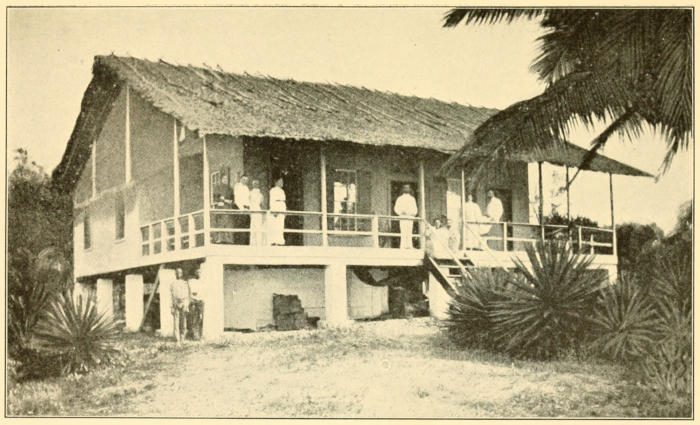
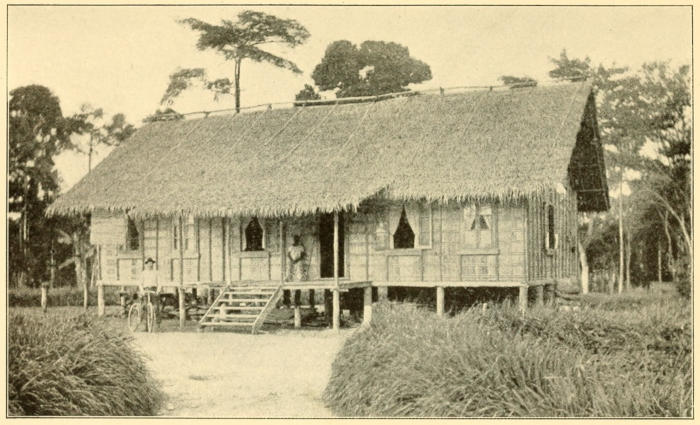
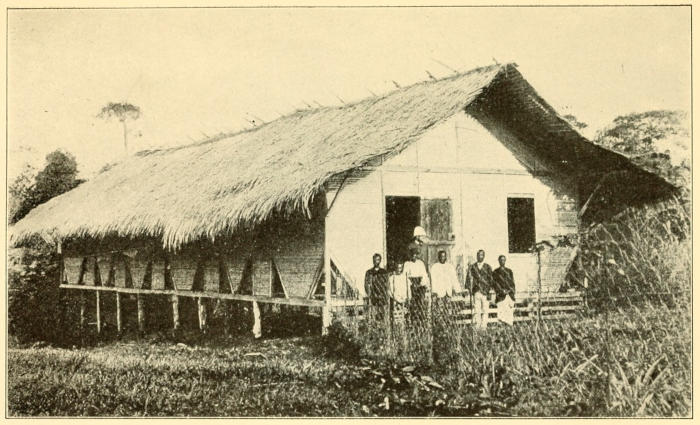
MISSION HOUSE AT BATANGA.
I was glad when at last we reached Batanga, and the
long voyage was over. Our attention was drawn to the
canoes in which men were fishing, and for which Batanga
is famous. The quiet morning sea was dotted with them
within a radius of a mile around us, some of them being
two miles from the shore. The Batanga canoe is the
smallest on the entire coast. It is almost as light as
bark; the men come to the beach in the morning carrying
their canoes on their heads. It is quite an entertainment
to see them going out through the surf, and I have
seen a canoe capsized half a dozen times in the attempt.
Later in the day, when the surf is heavier, they cannot
get out at all. At sea the man straddles his canoe and
lets his legs hang in the water; and in this fashion he
sometimes ventures two miles from the shore.
We anchored nearly a mile from the beach and were
sent ashore in a surf-boat manned by native Krumen.
There is no harbour at Batanga, and the landing in the
surf was the most exciting of my African experiences until
that time. As we entered the surf the boat stood still
for a moment, until caught up on the breast of a breaker,
and—“Then, like a pawing horse let go, she made a
sudden bound,” and we were carried towards the beach
with violent speed that looked like destruction for us all.
The crest of the breaker passed under us, however, when
we were close to the beach, and immediately the Krumen
leaped into the water, and with all their might ran the
boat up on the beach far enough to escape the next wave.
Then, while most of them placed themselves around the
boat to steady it, the rest of them presented their backs
to the passengers and yelled at them to jump on and ride
ashore.
As the pitching boat was poised for a moment, standing
on the gunwale, I seized a Kruman firmly by the hair
with both my hands, and leaped upon him, astride his
neck with my legs over his shoulders. I had put on a
fresh white suit for the occasion, notwithstanding that I
had been instructed by the Old Coasters that the Kruman,
with his unique sense of humour, makes it a point to
drop the new comer into the surf and present him to his
friends ashore as much bedraggled and beflustered as
possible. I also had on the inevitable cork helmet, so
bulky, and drooping over the eyes. Most men unaccustomed
to them feel as awkward as they would in a Gainsborough
hat. The Kruman, I am glad to report, did not
drop me; perhaps because I kept so firm a hold on his
hair that he did not know how much of it he might lose
by a sudden or unexpected separation from me. It was
probably my own fault, and not his, that when he stooped
to deposit me, I missed the trick of lighting on my feet,
which I afterwards learned. I reached the ground on all
fours, in the wet sand. The white helmet fell from my
head and rolled off towards the sea and I followed it,
running quadrupedal fashion, and snatched it from an
approaching wave.
A moment later I was exchanging greetings with a
group of missionaries who had gathered on the beach.
At this landing on the beach I observed that we were
standing under a cocoa-palm. I looked up, and lo, there
was no snake hanging from it. Now, the most vivid impression—in
fact the only impression of Africa that I
had carried thus far through life, except that of sunny
fountains rolling down golden strands, was made by a
picture in the old-fashioned geography; in which there
were crowded together, with contempt of perspective, an
elephant, a hippopotamus, a rhinoceros, a lion, a leopard,
a gorilla, a chimpanzee, several other monkeys, and a
python hanging from a tree.
“They are all here,” said some one, in explanation;
“but they are not so thick on the ground as you may
have supposed.”
REV. A. C. GOOD, Ph.D.
Dr. Good died at Efulen at the age of thirty-seven. He was
a man of the Livingstone type.
III BUSH TRAVEL
Upon our arrival at Batanga we at once commenced
the preparations for a journey into the
bush, than which nothing could have been a
greater contrast to the long, idle voyage on the sea; for
our physical strength and powers of endurance were to be
taxed more than ever before.
There were two others besides myself, Mr. Kerr, a new
arrival, and the Rev. A. C. Good, an intrepid and consecrated
missionary whose name was already known
throughout the United States. Dr. Good had been twelve
years in Africa, working most of the time among the Fang
of the Ogowé River, but had lately come to Batanga for
the purpose of opening the Bulu interior. The language
of the Fang was so much like the Bulu that Dr. Good could
converse with the latter from the first. Before the arrival
of Mr. Kerr and myself Dr. Good had already made one
journey into the Bulu country to a distance of seventy-five
miles, where he chose the site of the first station,
afterwards named Efulen.
In those days nearly all the distance between Efulen
and the beach was covered with dense unbroken forest.
None of the Bulu as far as we knew had ever been to the
coast; and no white man had ever entered that part of the
interior. The Mabeya tribe, living immediately behind
the coast tribe, were already in trade relations with the
Bulu; so that there were roads, that is, foot-paths, through
the forest. But they were seldom used, and were only a
little better than none at all. The present good bush-road
from Batanga to Efulen did not exist in those days.
We made it ourselves after we had been there nearly a
year, and it has been greatly improved from time to time.
The first road which we followed made a great detour to
the south, and we walked, according to Dr. Good’s calculation,
seventy-five miles from Batanga to Efulen, although
the distance by the present straight road is less
than sixty miles.
And, by the way, before we enter the forest, bidding a
temporary farewell to civilization, we do well to take
leave of this highly civilized term, “mile.” It is more
than superfluous in such a forest: it is positively misleading.
Such roads are not measured in terms of linear distance,
but only in measures of time. To say that a place
is distant half a day’s journey, or five hours, is to speak
intelligibly; but to say that a place is five miles distant
is to give not the slightest information as to the time it
will take to reach it. On the few good roads which in
recent years have been improved by the government one
might perhaps walk thirty miles a day: on the worst
roads that I have attempted I could not walk five miles a
day with equal labour.
Men can now walk to Efulen in three days over the
present road, and I with others have done it in that time,
although in greatly reduced health; yet I was not nearly
so tired as when I used to walk it in five days over the
road that we first followed. The greater distance was by
no means the only difference; the chief difference was in
the quality of the road. The first road was so obscure
that in many places we could scarcely follow it; and in
some places it was so completely overgrown that we had
to cut our way through, making the road as we went, for
which reason we always kept men with cutlasses ahead
of the caravan. Much also depends upon the season. A
road might be very good and easy to travel in the dry
season, but almost, or quite, impassable in the wet season,
when the forest is flooded, when the streams have become
rivers and the rivers have far overspread their banks, so
that the traveller is wading in water much of the time.
In opening a new station we could not choose our time
for travel, and it so happened that in my year and a half
at Efulen I only made two round trips in the dry season.
The African forest is the greatest in the world, both in
the area covered and in the density of growth. The tribes
with whom I am familiar conceive of the whole world as
a vast bush intersected with rivers. The tribes are moving
ever from the interior towards the sea; and some of
those who have long been coast tribes still retain in the
idiom of their language the record of their former ignorance.
The word for “river” is used to designate the
sea, and “the whole world” is “the whole bush.” A
man will speak of his country as his “bush,” and the
white man’s country he calls “the white man’s bush.”
God, they say, loves “the whole bush.” Heaven, or the
other world, is “the other bush,” and in singing “I have
a Father in the promised land,” they say: “I have a
Father in the bush beyond.”
One who is accustomed to the maple, beech, oak and
pine, finds the African forest strangely unfamiliar.
There are extremes of soft and hard woods; and one will
soon observe that as a rule the soft woods have large
leaves, while most of the hard woods have small leaves.
Teak, mahogany, lignum vitæ, ebony and camwood are
characteristic. The most striking and beautiful tree of
the forest is a species of cotton wood. It grows an enormous
height, with a silver-gray trunk like a column of
granite, and is supported by immense buttresses. In the
primeval forest, that which has not at any time been cut
down for man’s habitation, the foliage is very high and
the gray trunks suggest the columns of a cathedral. The
branches above interlace, forming a canopy of foliage and
excluding the sun. Cable vines of various sizes, many of
them six or eight inches in diameter, lash the trees together,
ascending the tree trunks in a spiral coil like an
endless python and sometimes strangling them to death,
then swinging from tree to tree in loops and coils, gnarled
and twisted. The foliage and flowers of these spread
through the tree tops, making the dim light below more
dim, and from the swinging cables an undisciplined profusion
of other vines and various hanging plants depend
in festoons and draperies, all interwoven in bewildering
confusion. The ground is covered with a thick compost
of rotting leaves and branches and insects. Every few
yards a giant tree trunk lies prostrate and is filled with
myriad insects that will soon devour it.
Lightning sometimes strikes the tallest trees, which
come crashing down bringing half a dozen others with
them. Then in this open place where the sunlight reaches
the ground there shoots up with amazing rapidity a tangled
undergrowth, from which young trees race upwards
to secure the light and air in such rivalry and struggle that
the weak are soon strangled or crowded to death, and the
battle is to the swift.
The poet William Watson in melodious verses prays
for—
“The advent of that morn divine
When nations may as forests grow,
Wherein the oak hates not the pine,
Nor beeches wish the cedars woe,
But all in their unlikeness blend
Confederate to one golden end.”
No one will deny that this is beautiful poetry; but it is
deplorably false science. Nothing could be more untrue
to the facts. The oak, the pine and the cedar, considered
as living things with conscious aims and individual interests
(for that is how the poet would have us consider
them), do hate each other with a hatred to which there is
no parallel in human society. Men sacrifice for each
other, and we even have martyrs. But in the forest there
is no sacrifice, no martyrdom, nor do trees ever confederate;
but each fights for itself in a ceaseless and savage
struggle. And nowhere else in the forest world is the
struggle for existence so remorseless as in the tropic zone
of Africa; for nowhere else is variety so profuse and
growth so rapid.
In the primeval forest the undergrowth is not dense
and travel is not so difficult. But as the natives are always
moving their towns and abandoning old sites, a
considerable portion of the forest is the growth of a few
years; and here the undergrowth is so dense and matted
that there is no possibility of passing through it except as
one tunnels his way with the cutlass, and the jungle
closes on both sides of the path like a wall. This is the
usual character of the bush along the rivers. There are
not many flowers in the forest. The most common is the
orchid. But flowers are numerous in the clearings and
more open places. In particular there is a lovely convolvulus
of delicate lavender that climbs over all the
lower growth of the clearing and blooms in such profusion
as to give its colour to the landscape. The impression
of the beauty or the ugliness of the forest depends largely
upon whether one sees it in the wet or the dry season.
In the dry season, travelling on a fairly good road, the
idea of the cathedral with its solemn majesty was often
present with me; I was impressed with its beauty and
enjoyed the solitude. But in the wet season I loathed it.
Who could enjoy, or even recognize, beauty while standing
knee-deep in mud? Its stillness is not the stillness
that speaks to the mind and heart. It is dull and dead.
We had twenty-eight native carriers (whom we must
call porters when speaking to Englishmen) each with a
load of about forty pounds. They often carry more than
twice that weight over the present road to Efulen;
seventy pounds is the standard load. But besides the
better roads there is also this great difference that the natives
were at that time new to the work of carrying heavy
loads, to which they have since become accustomed. The
present young men have grown up in the work. Besides
our personal effects and food supplies we carried
trade-goods, with which to buy food and building material
from the natives, and to pay native workmen.
There was no currency in that interior tribe. We paid
out principally salt, beads, and brass rods, the latter used
for ornaments for the legs and arms. After a year there
was some demand for cloth—highly coloured prints—and
other articles for which there was no use at first.
We were dressed in suits of denim or other cheap material.
I bought my suit at a trading-house in Batanga
for two dollars, and packed away all my better clothing.
Beneath the coat I wore a heavy woollen undershirt, the
only proper kind for the tropics, and proper all the time,
no matter what else one may choose or discard. We
were glad to discard the helmet while travelling in the
forest, and to substitute a felt hat. Tastes differ widely
as to the best footwear; but I like best for such a road a
pair of canvas shoes with rubber soles, alternating with
stout leather shoes every second or third day. Each man
carries a wooden stick or staff about five feet in length.
When a man has chosen and trimmed for himself a stick
that exactly suits him, he becomes attached to it with a
sentimental regard, according to the distance he has
travelled with it and the journeys he has made. He is
sensitive to any criticism passed upon it; and no experienced
bush-traveller will make disparaging remarks
about another man’s staff, but around the camp-fire they
will vie with each other in praising each his own. I remember
mine very well and I would give much to have
it now.
Perhaps this attachment is the stronger because, as a
rule, we do not carry watches in that country. Most
watches will run only for a short time. A fine gold
watch is the most useless of all; the very cheapest will
run longest. When I began to tell this in America, I
found that I was sacrificing my reputation for accuracy
of statement: whereupon I stated the facts to a jeweller
who, after consideration, said there was a very plain explanation,
namely, that the hair-spring of the more expensive
movements is usually finer and more closely
coiled than that of the cheaper watches, so fine that the
least rust upon it would interfere with its motion.
Our outfit for the road was very light. This was
Dr. Good’s habit and with me it was a kind of instinct.
We were measuring our strength against the forces of the
forest, testing our ability to endure and to wrest from the
forest itself the means of enduring. Having this feeling,
to carry along the ready-made comforts of civilization
seems like taking a mean advantage of nature. Some
few things must be taken. But the opinions of the wisest
differ as to what those few things should be, and each
man ardently believes in, and advocates his own outfit.
The explanation is that nothing of the outfit except food
is an absolute necessity. Other things, however important,
are of the nature of comforts; and what is necessary
to one man’s comfort, another can often do without.
One may suggest for such a journey a good water-proof
bag containing a sweater, extra socks and pajamas, and
two blankets. A good rubber blanket is a necessity if
one expects to sleep in the open forest. Canned foods,
of course, are used, and for cooking utensils, a frying-pan
and a sauce-pan will suffice for three, and a cup, tin
plate, knife, fork and spoon for each. Several cutlasses
are necessary for clearing the road, preparing beds, cutting
fire-wood and other uses. Matches also must be
taken and kept in a dry place. A few towels and toilet
articles complete the necessary outfit. On our first journey
we took camp-beds, but only because we had need of
them at Efulen. I never carried one again.
Besides this general and common outfit each man
nearly always has some one article that nobody else carries
but himself, and that, in his mind, is more important
than anything else. I do not remember what Mr. Kerr’s
indispensable was, for we never walked together except
this once, it being necessary that either one of us should
stay at the station. Mine, however, was a pair of leather
gloves, at which Dr. Good used to laugh; for we travelled
often together. But they saved me much loss of blood
and the pain of torn hands from the brambles and long
briers that stretched across the path, and they also enabled
me to protect my face from them by pushing them
aside better than I could have done with bare hands.
Dr. Good’s indispensable was a mosquito-net with canopy
and sides which he also urged upon me as a necessity and
which I insisted was a superfluity. There were no mosquitoes
in our camping-places in the forest; but he used
the net to protect against damp and against any slight
motion of the air, for one takes cold very easily and the
least cold is liable to induce fever. We had many a
good-natured “scrap” over these hobbies; but neither
of us ever converted the other. There was, however, one
article with which I was always well supplied and for
which Dr. Good himself usually thanked me before the
end of a journey, and that was the indispensable safety-pin.
I never foresaw any particular use for it, but many
uses unforeseen invariably emerged as we travelled. Some
travellers carry a piece of oiled baize in a convenient and
accessible place. It can be used to sit down on; for one
can never sit on the ground, even if it is dry, because of
insects. But its special use is for an apron, which is attached
with safety-pins and worn in the morning through
the dripping shrubbery. If one is wearing high shoes he
can even keep his feet dry by this means.
The road that threads the forest from Batanga to Efulen
was a narrow foot-path twelve inches wide and poorly
beaten. The wet season had begun and the rains had
been falling two or three weeks. The road was not even
as good as we had expected; for Dr. Good, who had fully
described it, had passed over it at the end of the dry
season, when the road was at the best. The typical
African road is a contorted line that vacillates and
swerves to right and left, turning and twisting at acute
angles continually, and often for no apparent reason, as
if it had been made by some crazy person. But in such
cases there was always an original reason even when it
no longer exists. For instance, the native carrying a
load finds a tree fallen across the path. It is easier for
him with his load to go around it than to climb over it.
But a log does not remain long in an African forest. Between
insects and rot it is soon demolished. Meantime,
along its length there has grown up a dense undergrowth;
and rather than cut through this the native keeps to the
path, now beaten, which passed around the log; and
the new traveller wonders why the path should not be
straight. It is estimated that an African road is a third
longer in each mile by reason of its crookedness. But
this is not the only peculiarity of a forest path. African
trees have enormous roots, and much of them is above
ground. This is the chief obstruction, and there are
many others.
No two successive steps are the same length, nor upon
the same level. If the attention is diverted for a moment,
one may stumble and fall. The road carefully avoids the
hills and keeps down in the lowest parts. The natives,
carrying loads, dislike climbing, but they have not the
least aversion to mud; indeed, it has some advantages
for their bare feet. One passes through every variety of
it and every depth. The road often follows the bed of a
stream for a distance, a foot or more under water or in
mud, according to the season. Meanwhile, the part of
the traveller that is above ground is kept moist by the
dripping shrubbery that meets across the path. Many
of the shrubs are covered with thorns, spines and hooks.
One of the worst of these, armed with sharp spikes and
not easy to see because it bears but little foliage, sprawls
across the path just high enough to catch the average man
under the chin, where it leaves a mark that looks as if it
might have been made with a cross-cut saw. Then,
again, there are long stretches of road that are not any
worse than crossing a ploughed field after a rain. Every
day, and sometimes several times a day, we forded
streams, often wading to the waist, and we rather enjoyed
it after the mud.
The deeper ravines we crossed on bridges. Bridge-building
in Africa is no great triumph of mechanical engineering.
The bridges which crossed the narrower
ravines and gorges consisted simply of several long, slender
poles laid down side by side. They ought to be on a
level but are not. One is six inches or a foot higher than
the other, and there is so much spring in them that the
feat of crossing is equal to a tight-rope performance.
Over extensively flooded areas where the water is too
deep to wade, a bridge of single poles is supported in
forked uprights at intervals of the length of the poles,
and above the bridge a rope of vine is stretched to hold
with the hand. It happened more than once that by
some mishap we tumbled into the stream below; but the
natives were quick to fish us out.
The worst part of the journey was on the last day,
through the new clearings which the natives had made
for their gardens. In these the whole forest lay prostrate,—trees
great and small, the tangled mass of vines,
and all the débris made by its crashing fall. The whole
enormous mass is left lying until the lighter parts of it
dry: then it is burned over. This burning is repeated at
long intervals until at length much of it is burned away.
But by this time the natives are perhaps thinking of deserting
it and making a new garden somewhere else, or
they may have moved their town away. Meanwhile,
they somehow reach the ground and plant their cassava
which flourishes in the fresh, rich soil. The difficulty in
an African garden is not to get things to grow, but to
keep other things from growing. They never hesitate to
fell the forest thus across the road, obstructing the caravans
and bringing curses on their heads.
One might think on approaching a town through one
of these clearings that it had been made as a formidable
defense in time of war. To go through it is a tedious
and exhausting trial. One moment the traveller is crawling
on all fours under a log; then he walks up the inclined
trunk of a tree a distance of fifty feet, then turns
and follows one of its branches, from this leaps to a
branch of another tree which he follows down to the
trunk, which is perhaps ten feet above the ground, while
below him are upright sticks or broken branches upon
which he may be impaled if he falls, or at least badly
bruised. From this he mounts a cross-log and proceeds
downwards to another which he follows until it brings
him five feet from the ground, when he jumps the rest of
the way, crawls under another log, proceeds a few yards
on the ground, mounts another log, follows it until he
finds himself again six feet off the ground and wondering
how he will reach it; but the next moment he has already
reached it and wonders how he got there. Then he does
this all over again, and then again. I never passed
through such a clearing without getting bruised or hurt
in some way. The natives with their bare feet climb over
these smooth logs better than the white man with his
shoes unless they have rubber soles; in the morning before
the dew has dried it is especially hard. It is much
harder from the fact that we are no longer in the shade of
the forest, but exposed to the fierce tropical sun unrelieved
by the least breeze because of the surrounding
forest.
A caravan with their heavy loads, walking through
such a forest ruin, presents a picturesque scene to the
spectator. Some are crawling under logs, some are
climbing on top of them, half a dozen are walking in
procession up an inclined trunk, some are walking a log
ten feet in the air, others are twisting their way through
a maze of branches and some have fallen to the ground.
With such a clearing in mind, and remembering what
has been said about African bridges, the reader will not
be likely to ask the oft-repeated question, why donkeys
and horses are not more used. The use of either would
necessitate the carrying of a derrick with rope and tackle.
This recalls to my mind an occasion some years afterwards
that afforded high amusement to some friends of
mine. I had been home in America for several years
and was about to go to Africa a second time when I received
a visit from Mr. Kerr, who was home on furlough.
He gave me an enthusiastic account of the work done
by the German government in improving the Bulu roads,—although
it was perhaps the road to Lolodorf rather
than that to Efulen of which he was speaking. He declared
that as compared with the first roads that he and
I had travelled, I would never recognize it as an African
road; for it was “grand,”—“simply grand.”
With an outburst of enthusiasm I replied that since I
might be appointed to that station, and since the road
was “simply grand,” I would buy a pair of donkeys at
the Canary Islands and take them with me.
“Man alive!” he exclaimed, “one would think you
had never been in Africa; a donkey couldn’t get over it.”
To my friends it was a hopeless paradox that a road
could be “simply grand,” and yet be impassable to a
donkey. Nevertheless, about that time they began using
donkeys on the road to Efulen, so much had the roads
been improved in the intervening years, and they have
been using them more and more since that time. There
is difficulty, however, in getting them over the streams
and ravines, and I am not sure whether they are used to
advantage in the wet season.
Only experience will teach a man to walk the bush-road
with the least effort; and some never learn. I can
remember yet how on that first morning I shrunk from
the water and the mud, trying to keep my feet dry and
my clothes clean. I think Mr. Kerr had more sense from
the beginning. I, however, was in a state of rigidity,
both physical and mental, that would soon have exhausted
me. But after a while a kindly Providence took me in
hand, sending upon me a rapid succession of blessings in
disguise. The mud lay deep in the path and I was trying
to straddle it as I walked, when, as I sprang forward to
clear a wider space, some demon was evidently permitted
to catch my foot and throw it up, with the result that I
landed full length on my back in the mud. A few minutes
later the same impalpable enemy tripped me and I
fell headlong on my stomach. Still later we reached a
broad, black, quiescent pond of water of the consistency
of molasses.
“Can you swim?” said Dr. Good to me; “I forgot to
ask you that.”
“Yes,” said I, thinking of the glowing description he
had given me of the road, “there were several things you
forgot to ask me, and some things you forgot to tell. But
even if I could not swim in clear water, I could probably
swim in that pond.”
We plunged in and were able to wade through it.
Shortly after this a drenching rain fell, a tropical downpour,
that wet us to the skin. In this rain we stood and
ate our first lunch, some fresh biscuits which one of the
ladies at Batanga had baked that morning, saying as she
tied them up for us in heavy oil paper, that it would be
the last food of that sort that we would taste for a long
time. But when the rain came on, the native carrier who
had them in charge appropriated the oil paper to carry
his shirt in, leaving the biscuits exposed to the rain. As
we stood eating them while it still rained, it was with
mitigated sorrow we reflected that it would be the last of
that sort we would taste for a long time. I will admit
that this was a dreary outset, but it was not unfortunate.
My tenderfoot rigidity had completely relaxed for the remainder
of the day. I cared not what happened afterwards,
and walked without timidity, fearing neither mud
nor water, nor height, nor depth, nor any such thing.
No amount of experience and practice in walking long
distances on our public roads at home will insure success
in walking a bush-path. In the latter there are constant
obstructions and frequent annoyances, the obstructions
requiring a peculiar physical aptitude, the annoyances a
peculiar mental aptitude. The native possesses both
aptitudes to a marvellous degree. The average native,
carrying on his back a load of forty pounds, can keep up
with the average white man carrying nothing. Yet, I
have no doubt that on a turnpike, neither of them carrying
anything, the average white man would equal the
native and perhaps outwalk him. It must also be remembered
that the white man is in a hostile climate in
Africa, and is never normally strong.
We started in the morning as soon as it was light enough
to see the path, that is, about six o’clock, and walked
eight or nine hours a day, stopping an hour at noon. We
walked at a very rapid pace, almost on a run where the
path would permit. About four o’clock we stopped for
the day, usually at a camping-ground made by the natives
in carrying produce from the interior. These camps
were open glades surrounded by the forest wall and ceiled
by the blue sky.
Two or three nights we camped beside a flowing stream,
a hidden brook, that “all night to the sleeping woods
sang a quiet tune.”
After sitting ten minutes I followed along a short distance
till I found an inviting spot where the pellucid
stream widened and spread over a sand bottom, and there,
all mud-bespattered, perspiring, weary and sore, I lay
down in the cool, running stream, with my clothes on.
Does the reader know what luxury is? Certainly not,
unless after eight or nine hours of walking and wading
over such a road he has lain down in a cool stream with
his clothes on. I turn my face to one side and then the
other, and let the flowing water caress my cheek, and as
it washes away the mire from my clothing, it also soothes
the weary limbs and sore joints and smoothes out the
wrinkles of care; and my heart answers back in a song
to the murmur of its music. This is the ancient Lethean
stream in which the weary and the aged bathed and became
oblivious of pain and sorrow. After a bath I get
into woollen pajamas and slippers, and sit down a little
later to the best repast of modern times—an absolutely
unlimited quantity of boiled rice and corned beef. “Is
this really corned beef?” said I; “it tastes like angel.”
Does the reader know what luxury is? Not unless after
such a journey he has sat down to such a meal. For luxury
is not something objective in the thing that we enjoy,
but in the keenness of our relish; and that depends upon
contrast—in this instance the contrast of rest and food
with hard and hungry endurance. A few days after
reaching New York, I attended a banquet at which was
served I know not how many courses, the richest and the
best. Objectively, it was everything that ingenuity could
devise; only keen-edged appetite was wanting. And I
was saying within me to my fellow guests: “Ah! I have
a secret that you know not. This is only a taste of luxury;
but if you would enjoy it to the full measure of your
capacity, you must follow me eight hours through the fell
roads of the jungle, bathe in running water, get into
woollen pajamas, and then sit down in an arboreal
salle à manger to a banquet of unlimited rice and corned
beef.”
We usually slept under booths made from the boughs
of trees which we found in most of the camps. The most
primitive bed and that which we sometimes used, was
made by cutting slender, round poles six feet long and
laying them side by side on two cross-sticks at the head
and foot. The native carrier sleeps on this bed of poles
with nothing under him and nothing over him; but when
possible he keeps a fire beside him. We white men were
wrapped in a blanket or two. But the use of such a bed
is not wise when it can be avoided, and it is seldom necessary.
More than once some one unable to sleep had to
rise in the dark, find one or two bags in which loads were
packed, spill the contents on the ground (making such a
noise that one suddenly waking might suppose that an
elephant had charged the camp) and spread the bags upon
the bed in the hope of subduing the effect of its knots and
depressions and its general hardness. I soon discarded
that sort of bed and preferred to bivouac in a hammock
of stout and stiff canvas, suspended between two trees,
with a rope stretched taut above it upon which I threw a
large and light rubber blanket which formed a gable over
me. This was, at least for me, the most comfortable and
luxurious bush-bed that I ever slept in.
But in the early morning of the second day both comfort
and luxury seemed remote and unrealizable ideas.
There is a miserable chill in the forest at five o’clock in
the morning that always makes one reluctant to leave
his warm blankets; and on that morning it was raining.
After coming out of the stream the night before, I had
wrung out of my clothes what water I could, and they remained
without further drying until I put them on in the
morning to the accompaniment of chattering teeth, for
they seemed as cold as ice. The boys’ fires had all gone
out and we ate some boiled rice left over from the night
before—ate it standing; for sitting down one’s clothes
will get next to him, but standing up one can shrink
away from them, or, at least, he can try. After some
experience I was almost able to stand up in a suit of
clothes without letting them touch me. Everything was
wet and cold and the branches and shrubs shook water
on us. There is a right way and a wrong way to conquer
the ill-will of such a morning. The wrong way is to confess
your misery, to shiver and shrink and try to save
yourself. The right way is to plunge into it suddenly,
get wet as quickly as possible, step lively, and make believe
that you like it. The power of this mental attitude
is astonishing, and with a little determination you will
soon be master of the situation.
Before the end of the second day we discovered that the
native stomach is made of the finest kind of rubber. Before
leaving Batanga we had given to each carrier a supply
of food for seven days, and before the end of the
second day, some of them had eaten it all. That meant
hunger and trouble for all those “foolish virgins” for
the rest of the journey. It also meant trouble for us.
The others divided with them, as they nearly always do
when this happens. But still they did not have enough
and all were hungry before the end of the journey. In
consequence they were too weak to carry their loads.
They lagged behind and grumbled continually, and
sometimes they seemed on the point of refusing to go on.
The difference between a good carrier and a poor one is
often simply this, that the one stops eating when he is
full and the other stops only when the supply of food is
exhausted.
IV BUSH PERILS
“By what I have read in books, I think few that have held a pen
were ever really wearied, or they would write of it more strongly.”—Robert
Louis Stevenson.
Several months later Dr. Good and I returned
from the interior to Batanga, passing over the
road at its very worst. It was near the end of
the wet season. For many weeks the rains had fallen
day and night. The forest was flooded; the streams
were rushing rivers, and the rivers had far overspread
their banks. Beyond these floods were marshes which
were still worse. Where the water was too deep to be
waded, temporary bridges such as I have described had
been constructed, consisting of a single line of poles extending
from one support to another, sometimes two or
three feet under the water, with a rope of vine stretched
a few feet above that one might hold with his hand.
These bridges were more simple than ingenious, and more
ingenious than safe. A number of times the vine above
broke, upon which we lost our balance and fell into the
water but were rescued by a life-saving crew of the carriers.
For in crossing the worst places we always waited
for the carriers. Nor did we proceed until we saw all the
loads over safely. One or two crossed at a time and the
others, having laid down their loads, stood by to be of
service in case of accident. In one place when we were
crossing a rushing stream in which the bridge was buried
two feet under the water, the line of poles beneath our
feet suddenly came to an end, having been swept away
by the current, and we crossed the deepest part on the
upper vine alone going hand over hand until our feet
came in contact with another pole. But this let us down
into the water almost to our necks. In another place,
crossing a considerable stretch of water, the bridge was
such that Dr. Good preferred to cross by climbing the
trees and passing along the interlacing branches.
We were seven days on the way between Efulen and
Batanga, including a Sunday on which we rested. I was
a convalescent, having recently been sick with a very
severe fever that had kept me in bed for more than a
month, and I was still weak. Indeed, the reason for
hurrying to the coast at this time instead of waiting for
the dry season was chiefly my need of a physician. The
first day I walked four hours very slowly and could do no
more; but my strength increased greatly on the way and
we walked further each day.
On that journey we had to use the cutlasses very often
to clear the road so as to make it passable; and one day
we found the road so flooded that we were obliged to
leave it and for several hours we cut our way through the
matted undergrowth where there was no road; but it was
very slow work. That same day Dr. Good, in jumping
over a muddy place, lighted on a slippery stick that was
hidden beneath the surface and fell headlong. I was following
so close behind that I was already in mid-air
when he fell; and, of course, I tripped over him and fell
too. For a few seconds at least we were a sorry sight.
There was a stream near by, however, and we washed
away the portion of German territory that clung to us,
and made a presentable toilet.
But Dr. Good had fallen on a projecting root and had
hurt his side quite badly. It was like him to say nothing
about it until, as we stood at the stream, I observed
that he was pale. Then he told me that he had hurt
himself and that there was a pain in his side. He
thought that a band tied around his waist would relieve
him; so I peeled a strip of bark four inches wide from a
tree and tied it tight around him, over his coat, making
a bow at his back. Considered æsthetically it left much
to be desired, but it served the purpose. He walked with
difficulty the first hour or two; then the pain gradually
subsided, and although he was bruised, it occasioned him
no further trouble.
On the last night of our long immurement in the forest,
we camped for the first time in an open glade where the
sun had warmed and dried the ground, and the wood also
was dry enough to enable us to have a big camp-fire.
We kept the fire all night, and for the first time on the
way got our clothes well dried. Not only were they dry;
they were even warm when we dressed in the morning.
We were in high spirits and greatly enjoyed our breakfast.
But immediately upon starting out, and before our
blood was in vigorous circulation, we came to a long
stretch of water covering acres of ground. We were
greatly surprised at this, for Dr. Good knew this place
and had not expected any such thing. The explanation,
as we found two hours later, was that a little town had
just been built near by and the people, being at war with
their neighbours, had dammed a stream so as to surround
their town with water and marsh for defense against the
approach of their enemies. This unsightly and disgusting
place they were very proud of as serving admirably
their purpose of safety.
When we came to the water we waded in and walked on
and on not knowing its extent. But at last we were in almost
to our shoulders, and Dr. Good suggested that I
should wait while he looked for the road, for he knew the
way better than I. It was long before he found it and I
stood for an hour in the water. I had never felt any ill
effects from wading water, but now I was standing, not
wading; and I had not done any walking that morning
to invigorate me. Before we had proceeded far after
leaving the water, my joints were stiff and muscles sore,
especially the tendons of the heel and the knee, and every
step cost pain. But we had the longest day of all before
us, and our food supply being exhausted, we must reach
Batanga that night. It was a day I shall never forget.
To the pain of aching joints and sore muscles was soon
added that of exhaustion. It happened that I had been
quoting Heine and passing severe moral verdicts upon
him for saying somewhere—“Psychical pain is more
easily borne than physical; and if I had my choice between
a bad conscience and a bad tooth, I should choose
the former.” This, no doubt, is pure paganism; but
now when I was suffering something of the weakness and
pain that poor Heine endured, I am afraid that if I had
been offered a bad conscience in exchange for physical
suffering, with the sure promise that I could get my better
conscience back again at the beach, I might have succumbed
to the temptation. Thank God that in the crises
we seldom have the choice. At any rate, Heine did not
seem so much of a pagan that day as when I sat by the
warm camp-fire the night before descanting on another’s
pain, and Dr. Good did not have to listen to further moral
dissertations on my part. Hours before we reached the
beach my legs were fainting under me but still we walked
on with long strides and at the usual rapid pace, threading
the forest while hour was added to hour.
We did not take our usual noonday rest, for we both
knew that if I should stop walking for a little while I
would be unable to go on. We usually chatted together
as we walked, but that day from noon until we reached
the beach, I do not recall that a word was spoken. Dr.
Good was too wise to express the sympathy that I knew
he felt. We had always taken turns in setting the pace;
but at noon I said to him: “You go ahead; I am not
equal to the extra mental exertion of setting the pace: it
will be easier for me to keep up with you.”
The last hour of that interminable day was through a
grass field where we were exposed to the sun and the heat.
The rank grass was much higher than our heads and intercepted
the sea-breeze. It also cut my arms and face
till I was covered with blood; for I was too tired to protect
myself. Each successive step required a new decision,
and an effort involving the utmost conjoint exertion
of mind and body. My teeth were set and I was
breathing audibly. At last we entered a native town and
as we passed through the long street, the people and their
chief, Bivinia, came trooping forward with cordial greetings
and hands extended towards us; but I neither extended
my hand nor replied to their salutations. Indeed,
my mind was so concentrated on the effort that it required
to keep on walking that I was only half-conscious
of the presence and attention of the natives; they were
like forms moving to and fro in an uneasy dream. But
the longest day has an end. We reached Dr. Good’s
house and I threw myself into a chair while he dispatched
a messenger to Mr. Gault who lived two miles further,
asking Mr. Gault to send men with a hammock to carry
me on to his house where I was going to stay.
It is doubtful whether one ever recovers from such an
unnatural straining of nerves and muscles. The muscles
in a few days may regain their elasticity and the joints
their suppleness; but somewhat of the power of endurance
is lost and especially the quality of resiliency, the
power of quickly recovering from mental or physical
prostration, leaving one an easier victim of virulent disease;
and nerves so overwrought may from time to time
wreak the vengeance of untold misery through all the
after years.
During the following dry season we employed a force
of men in making a new road, the present road from
Batanga to Efulen. It is practically straight, and therefore
much shorter than the old road, so that a good
walker can make the journey in three days. Moreover,
it follows higher ground and is more dry. We also cut
down many trees along the way, which relieved the
gloom, although the road still passes beneath a leafy
arcade sufficient to protect from the sun. We improved
the bridges and wherever possible made a bridge by felling
a tree. But the native roads, except the few that
have been improved by white men, are still such as I have
described. It happened also that most of our journeys
were at first made in the wet season. After the first year,
however, that was no longer necessary, and we began to
feel that the pioneer period was drawing to a close. But
I presume that those who now live at Efulen and other
interior stations, in journeys to the further interior, especially
to towns off the main road, if they travel in the
wet season, find just such roads as we first travelled.
The last time I walked from Efulen during my first
term in Africa, I enjoyed the journey. The forest was
more dry than I had believed it could be. The ground
was strewn with leaves suggestive of our autumn. Nor
was it dark and depressing as before. Upon the forest-canopy
of green, supported by tall columns of sombre
gray, the light danced and played like sunshine on rippling
water and shone through in silvery streams and
shifting golden bars. The forest floor was a humus of
soft mould and light, dry leaves. The low green undergrowth,
closing the path before and behind me, now that
it was not dripping with water, was attractive, and gave
a pleasant sense of privacy combining with the subtle
sense of companionship with the vast life of the great
forest. For it was no longer the dead, repellent jungle
of some months ago, but a real forest in which one loves
to walk alone, a forest full of mystery and spiritual suggestion,
whose stillness speaks to us in a language that
we strive to understand, or gives, as Tennyson says, “A
hint of somewhat unexprest:”
“’Tis not alone the warbling woods,
The starred abysses of the sky,
The silent hills, the stormy floods,
The green, that fills the eye.—
These only do not move the breast;
Like some wise Artist, Nature gives
Through all her works, to each that lives,
A hint of somewhat unexprest.”
In setting out from Efulen we always had a “palaver”
with the carriers which in one instance, at least, threatened
to become a fight. Dr. Good on his first journey
before my arrival in Africa had paid the carriers a certain
amount for the round trip; for they had to carry
their loads both ways. One can scarcely overestimate
the authority of precedent in Africa. The citation of a
precedent is sufficient to justify any subsequent action
that may be to the advantage of him who cites it, even
though the action be flagitious and the precedent only
remotely relevant. A single precedent may establish a
custom and established custom is a despot from whom
there is no appeal, and whose authority transcends moral
law. A Kruman, if asked why he does this or that,
thinks that he gives the most lucid explanation when he
answers: “It be fashion for we country.” We had expected
to pay our carriers from Batanga to Efulen less
than Dr. Good had paid, since they were carrying loads
only one way. But his one trip had established the
amount of pay, and at the first mention of lower prices
there was a storm of protest accompanied by scathing
moral observations. It made no difference to them, they
averred, whether or not they carried loads both ways;
they would just as soon walk with a load as without one,
and indeed a little rather. We had no alternative, so we
paid the full price of a round trip; but we stipulated that
if at any time we should wish to send loads from the interior
to Batanga, we should require the carriers to take
them without any additional pay; and to this they cordially
agreed.
It was seldom that we had anything but mail to send
to Batanga, except when one of ourselves was going, and
then we usually had four or five loads. But there were
always several times this number of carriers. Some few,
therefore, must be selected to carry the loads, while the
rest walked light. It was natural, I suppose, that when
they knew a white man was going back with them to
Batanga they should all pretend to be sick in order to
escape carrying a load. So sure as they heard me coming
towards their house in the early morning to choose
several carriers, immediately they presented such a spectacle
of suffering as was never seen in any hospital. It
was very perplexing for almost invariably some one or
two of them were really sick and quite unfit to carry
loads. On one occasion as I approached, the scene was
more heartrending than usual. There were means and
cries and shrieks such as might issue from a railroad
wreck in which a score of broken and mangled human
beings were pinioned by the wreckage. I found them
sitting and lying around in every posture of pain. Some
were nursing sore feet and sprained ankles, some had
violent attacks of indigestion, several had fever, and one
had a fit. Each one was occupied with his own suffering
and betrayed no consciousness of my presence.
After looking around I walked out without speaking.
I made a bold guess as to the sick and the well; and returning
a few minutes later, followed by several workmen
with the loads, I advanced as if by some occult means I
knew exactly the degree of sincerity or insincerity on the
part of each, and placed the heaviest load in front of a
certain man, saying quietly: “You will carry this
load.” Now it happened that this was the only sick
man in the crowd and he was quite unfit to carry anything.
The truth is that the man, being really sick, did
not call in the assistance of dramatic art, and he made
less fuss than any of the others. We were not many
hours on the way before I discovered the mistake I had
made. It is very difficult to make any change on the
road, and is regarded as something less than fair. To
accomplish it without a mutiny one must assume a terrifying
countenance of the utmost ferocity and cannibalism.
In this I was evidently successful; for late in the afternoon
I suddenly called a halt, waited until all the men came
up, and then ordered a man to take the load off the back of
the sick man and put it on the man who that morning had
been seized with a fit at my approach. This I did with
the more relish because I had heard him chuckling about
it along the way and telling the joke on the white man.
We seldom saw an animal in the forest, although we
knew they were there. The only monkey that we saw on
our first journey Mr. Kerr shot and gave to the carriers
who ate every part of it, inside and out, including the
skin—after burning off the hair. We sometimes heard
the blood-curdling night-cry of the leopard; but we never
saw one. On several occasions when I was alone I heard
elephants plunging along the path before me, or suddenly
discovered their tracks at my feet, so fresh that the water
was still trickling into them. The elephant is not dangerous
unless one comes upon him suddenly and startles
or frightens him; but if he “charges,” he is terrible. A
chief near Efulen was one day walking in the forest at
the head of a hunting party. At a point where the path
suddenly swerved around the upturned root of a tree, he
found himself face to face with an elephant. Before he
had time to fire the elephant instantly charged. It put
its tusk through his body and then trampled him to death
under its feet. The natives taught me, when I heard
elephants ahead, to stop and shout until there was complete
silence; which meant that they had hidden in the
forest and I could pass along the path in perfect safety,
no matter how near they might be. But the first time
that this occurred, and the second time, I made the
natives prove their advice by going ahead themselves,
which they never hesitated to do.
In the wet season I always walked in company with the
caravan; but in the dry season I preferred to walk alone,
and often left the carriers far behind me, scattered along
the road in different groups. At a fork in the road I always
threw a handful of fresh leaves upon the road that
I followed, as a sign to the carriers that they might be
sure to take the same way. Never but once did they fail
to follow me. On that occasion some of the carriers were
boys of a strange tribe, the Galway, more used to waterways
than to bush roads. Until the last evening they
had walked behind others who were familiar with bush
travel and whom they could follow heedlessly. But that
evening it happened that the Galway were ahead and
they took the wrong road, not observing my sign of the
leaves on the path, and the whole caravan went astray
except two carriers who were far behind and separated
from the others. To follow their misfortune to the issue,
the Galway got separated from the rest of the caravan and
arrived at Batanga two days late, famished with hunger
and frightened half to death.
Meanwhile, I had walked on far ahead until I thought
that the carriers might require all the daylight that was
left to catch me, and then I stopped and waited for them;
though I had not yet reached the camp. As time passed
and no carriers appeared I began to feel uneasy. The
chill of the evening was approaching, and I had not even
a coat; so I began to walk back and forth rapidly to keep
warm. Finally, two carriers arrived. One of them had
my food, which was fortunate; but the other had nothing
that I wanted on the road. The lost Galway had my bed
and extra clothing, and even the matches. We waited
for them anxiously and called loudly, but there was no
answer. Then swiftly, as always in the forest of the
tropics, the day turned into night: “At one stride
comes the dark.” A heavy, palpable darkness, like
smoke, enshrouded us and rose higher till it blotted out
the leafy canopy and blackened the very sky. The
opacity of the darkness was such that we could not see
each other, nor could I see my hand when I placed it before
my eyes.
For a while I forgot the loss of the other carriers in
thankfulness for the company of these two men. For,
however kindly the mood of the forest by day, or however
joyful the camp-fire by night in congenial company,
yet, to one alone through the night, without comfort or
means of rest, and with the possibility of being lost, the
forest is truly dreadful. One in such a plight interprets
the forest through the medium of his misery and his fear.
The intolerable vastness of his prison dungeon suggests
the “outer darkness,” and the experience of a soul forsaken.
I was miserably cold and had nothing to protect
me; nor had I a bed except a rubber blanket. I kept
walking back and forth on a bit of path a few yards long,
notwithstanding that I had walked all day. There was
but little rest. Occasionally I threw myself down on the
rubber blanket but was so cold that before long I rose
again and began walking. Fortunately I was in unusually
good health, for Africa, or the exposure might
have resulted even more seriously than it did. My cook,
Eyambe, a Batanga man, who had worked for us at
Efulen for several months, possessed the remnant of a
shirt, so much prized that he had carried it with him to
the bush, lest his numerous relatives, male and female,
should wear it out in his absence. He came to me in the
darkness feeling his way, and said, “Mr. Milligan, my
shirt, you must take him and wear him, please. This
bush he no be too bad for we black man; but my heart
cry for white man.”
I took it, of course, and wore it. But the cheer that I
derived from the kindness of his heart was greater than
the poor comfort of the shirt.
I thanked God when morning dawned at last; but it is
unnecessary to say that I was in poor condition for walking
next day, the last day of the journey. I knew that
the exposure would bring on fever and I walked more
rapidly than usual so as to reach Batanga as soon as possible.
I sometimes even ran, as if in precipitate flight
from a pursuing beast. The part of the road over which
I passed that day was quite new and poorly cleared. My
clothing may not have been stout enough to withstand
the thorns and briers which I encountered; or else, in my
hurry, I was reckless. At any rate, when I emerged
from the forest, behind Mr. Gault’s house, one leg of my
trousers was gone from above the knee, and the other leg
was also exposed through several rents, the remainder of
the trousers being fastened with numerous safety-pins. I
was also scratched and bleeding more than on any
previous trip.
As I turned and looked back from the beach towards
the gloomy and sullen forest, in the vivid realization of
the exposure of that long night and the fever which I
knew was imminent, I had the feeling which Stanley describes
when he and his long caravan emerged from the
dark prison forest after the immurement of several
months, in which scores of their comrades had died by
the way, the whole caravan now enfeebled and wasted
with hunger, the black, glossy skin turned an ashen gray.
They ascended a hill and first looking up yearningly
towards the bright blue sky, they then turned with a sigh
and looked back over the sable forest that heaved away
to the infinity of the west. In their sudden exaltation
they shook their clenched fists at it, uttering imprecations,
and with gestures of defiance and hate. They apostrophized
it for its cruelty to themselves and their kinsmen;
they compared it to hell, and accused it of the murder of
a hundred of their comrades. But the forest which lay
vast as a continent before them, and drowsy, like a great
beast, answered not a word, but rested in its infinite sullenness,
remorseless and implacable.
I was not mistaken in my apprehension of fever. I did
not return to Efulen again. One fever followed another
in quick succession, becoming at length so serious that
my fellow missionaries at Batanga united in urging me
not to risk another attack. An English steamer on the
outward voyage called just at that time and I went south
to Gaboon, where I sailed on a French steamer for Marseilles
and thence home.
Little did I think when I was leaving Efulen for a few
days, as I supposed, that I was really taking a long leave
of Efulen and Africa, not again to see either for four
years, and never again to see Dr. Good. That last morning,
when I was setting out for the beach, he walked with
me down the long Efulen hill to the foot, where we stood
perhaps half an hour, formulating our expectations and
making the clearest-cut plans, none of which were
realized, although they pertained to the immediate
future.
The element of accident is a constant factor in Africa,
that continually changes the course of our reckoning and
overturns our surest calculations. Accidents are no more
numerous there than elsewhere, but they are more serious.
Climbing a mountainside, a slip of the foot is fraught
with more danger than on a level road. In the hostile
climate of Africa, the smallest accident, a moment’s incaution
or forgetfulness on your own part or on the part
of others, may change the entire future. Elsewhere the
best-laid plans of men have about an equal chance with
the best-laid plans of mice, if the observation of Burns
is to be trusted. But in Africa the probability of the
future is entirely with the mice.
While I was in Africa a second time and living in Gaboon,
two hundred miles further south on the coast, I
visited Efulen once more. The road was much more improved
than when I had seen it last. The sun shone
through the arcade of vines and branches and formed
upon the pathway a filigree of gold and silver light. The
mode of travel was different accordingly. It was the best
time of the year and there was a happy party of eleven,
so that the journey was like a continuous picnic. Four
of the party were ladies, three of whom were carried in
hammocks and one rode a donkey. Besides, and chiefly,
there was a very sweet little girl, two years old—a little
splash of golden sunshine in the gray forest light, a dream
of home, a fragment of a song⸺ Ah me! how lonely one
becomes for the sight of a white child when he has lived
some years in the jungles! Much of the time the ladies
were walking and the hammocks empty. The hammock
is suspended from a long bamboo pole borne upon the
shoulders of two carriers. But the carriers must be relieved
frequently, for it is dreadfully hard work. Six of
the strongest native men are required for one hammock.
Little Lois also had her special hammock, with a firm
floor in it, so that she could sit upright, and she was perfectly
happy when riding through the forest.
LITTLE FRANCES, BORN IN AFRICA.
Ah me, how lonely one becomes for the sight of a white child when
he has lived some years in the jungles!
Several towns had been built along the way and in one
of them we stopped each night, where we occupied native
houses and slept on native beds of straight bamboo
poles covered with armfuls of grass—as good a bed
as one could desire. The numerous ticks in the grass
were converted into bed-ticks—such was our resourcefulness
of expedient. The only dislikable part of the
journey was rising so early in the morning when we
could have slept on for hours, after the walk of the
preceding day. But an incident of that journey impressed
it distinctly upon my mind that there is some advantage
in eating breakfast before daylight. One morning
we had an oatmeal breakfast. The day dawned upon
two tardy boarders before they had eaten and they were
horrified at discovering that the oatmeal was full of vermiform
animalcules. Of course, they could not eat it
and had the poorer breakfast in consequence, and the
other nine thought that it served them quite right for
being so late. A doubt has always lurked in the recesses
of my mind as to whether the joke was really on
the two or on the nine.
We did not, as in former days, keep steadily to a regular
pace without stopping, even for hours at a time, and
walking in comparative quiet. For the hammock carriers
go very rapidly, on a dog-trot, continually shouting,
and a white man follows immediately behind each hammock.
They repeat a regular call and response, half
song, half shout, as if to sustain their animation and
courage. What wonderful voices they have! The forest,
startled from her deep repose as we pass along, rebounds
with shout and answering echo, while we dash on
over height and depth, over rock and stream and mire,
for an hour. Then, out of breath and in copious perspiration,
we sit down for fifteen or twenty minutes, and
at the word of command we are off again with a dash and
a shout. It is all very pleasant and a great improvement
on the old way, although one pays very little attention to
the forest and is wholly oblivious to its moods. But the
old way is still the regular way on all roads except those
few which the white man has undertaken to improve.
And this disposition to “improve” everything he puts
his hand to is a radical difference between the native and
the white man. The mental habit of the native is contentment
with things as they are; in which he is far more
happy than fortunate. He would let this old world, or
this old “bush” as he calls it, stay as it is to the end of
time. The unhappy restlessness of the white man, his
dissatisfaction with what he has and his longing for what
he has not, his eagerness for change and “improvement,”
the native is sometimes disposed to regard as a morbid
mental disease. But the greatest wonder of it is that the
white man includes the native himself in his program of
improvement. He finds him a denizen of the forest, his
mental habitudes like her changing moods, now sullen
and cruel, now gentle and cheerful for a little while, partaking
of her darkness mingled here and there with
broken beams of light; and as he clears a way through
the deep forest making the darkness light, so he labours
that a gleam of heaven’s light may shine down into the
benighted native soul; that it may lighten the path of
his destiny more and more, and lead him on, in ways of
purity and peace, till the gleam become the “perfect
day.”
V THE CAMP-FIRE
If it is dreadful to be overtaken in the forest by the
punctual night of the tropics, while unprepared,
without camp or comfort, yet, to the weary man,
after a good bath and a good supper, and with a good bed
awaiting him, the brief period of the departing day and
the increasing camp-fire glow, the smell of wood smoke
and the crackle of the burning log, are a delightful experience.
The camp is usually an open glade, where the night is
not so sudden in its fall. The shadows grow longer in the
evening light, and the gray twilight deepens till the stars
shine through. Then in the red glow of the camp-fire,
phantom shadows and eerie forms flit to and fro, approaching
towards us and receding into the darkness like
spirits impelled by curiosity, and planning either play or
mischief according to the mood of the observer. In the
day the man is properly the master of his mood, but in
this hour it is pleasant to relax and let the mood be master
of the man, giving a free rein to fancy.
Immediately after supper it was my custom to hold
prayers with the carriers. Then, if the labour of the day
has been easy, or a Sunday rest has intervened, they become
more sociable and communicative than usual, and
often prolong the evening with camp-fire stories. They
are born orators and can tell a story to perfection, whether
it be a fable handed down from others, or a narrative from
their own experience. The knowledge of the native may
be ever so limited and his thought meagre, but he can
always give it appropriate and striking form and express
himself in forceful and sometimes beautiful language.
He never hesitates nor becomes incoherent; his words
flow like a river and keep well within the course of his
purpose. His gestures are animated and infinitely varied,
sometimes grotesque, more often graceful, and always expressive.
He has also a faculty of imitation beyond all men.
For instance, two schoolboys (if we may leave the camp-fire
for a while to digress upon this native talent for imitation)—two
schoolboys sit talking together, myself paying
no attention, when one of them imitates the clicking of
my typewriter so that I immediately recognize it. A new
clock has recently been placed in the school, and I recognize
their imitation of its stroke. Again, I recognize the
noise of the gasoline engine of the launch, Dorothy, now
at half speed, now full speed, now running smoothly and
now with the peculiar omission followed by a heavier
stroke, due to a weak battery.
A boy in talking to me refers to another boy by a name
that I do not know, one with rather a peculiar countenance.
I say: “I do not know of whom you are speaking.”
He replies: “He looks like this”—slightly twisting
his face into an exaggerated and ludicrous likeness of the
other boy, which I instantly recognize.
One day at Efulen the body of a very large monkey,
killed by Mr. Kerr or Dr. Good, hung suspended from the
roof of our back porch. The expression of the monkey’s
face was fearfully human. It did not look dead, but
rather as if it had been very drunk the night before and
was sleeping off the effects. I heard our two house-boys
giggling and chuckling on the porch, and looking out I
saw them standing in front of the monkey trying to look
just like him, which they did with such startling success
that I complimented them by telling them that either of
them might exchange places with the monkey without
Dr. Good ever knowing the difference.
On one occasion a party of white men and native boys
were travelling on a river launch for several days. Four
of the white men occupied their spare time in playing a
certain game with dominoes. One day when they had
left the cabin, four native boys sat down in their places
and taking the dominoes, began to imitate the white men.
They were absolutely ignorant of the game, and did not
know the white men’s language, and yet they presented
the semblance of the whole performance, each boy impersonating
an individual white man—his exclamations,
manner, and general behaviour during the progress of the
game, from the deal to the last trick and the noisy conclusion.
This art of imitation is useful to the natives in hunting.
For instance, a deer hunter in the forest will imitate the
noise of two fighting bush-deer, and he will do it so well
that any deer within hearing will come running to the
spot. In reciting their numerous fables, in which animals
are made to talk and act so as to teach lessons of
prudence and goodness, the native will imitate the noise
or the movements of each animal, and some of these
stories one might almost follow without knowing the
language.
This talent is also useful to the native in preaching the
Gospel, which they all do, great and small, old and
young, as soon as they become Christians, and often long
before. I talked one day to a group of Christian boys,
or young men, on the words: “Now the serpent was
more subtile than any beast of the field,” applying the
words obviously to the subtility of the Evil One in tempting
us. Shortly afterwards, one of those young men,
Ndong Koni (whose name I am likely to mention very
frequently in the succeeding chapters) preached to a large
audience a sermon on those words, which put mine to
shame:
“You know where you may expect to find other animals,”
he said, “and you also know their times.” And
then naming first the leopard, he told them the kind of
place that it frequents, and at what hours it seeks its prey,
while the eager audience roared assent. So he did with
the elephant, the gorilla and others. But the serpent, he
told them, is found everywhere, often in the path before
them, even in their houses, and always when least expected.
Then he compared its powers with those of other
animals, describing the leopard’s strength to fight, the
fleetness of the deer in escaping, and how the monkey
climbs; but how the serpent outfights the leopard, outruns
the deer, outclimbs the monkey. The audience
knowing well all the habits of the animals of the forest,
was wildly appreciative, and several times took the sermon
out of the speaker’s mouth.
On another occasion, a young man, Amvama, preached
on the “Lost Sheep” of the parable, describing its peculiar
helplessness. All the animals of the forest, however
far they wander, can find their way back—but not
the sheep; every other animal has some peculiar defense
against its enemies of the forest, but the sheep is defenseless.
The sheep lost in the forest cannot of itself get
back to the town, and it is sure to be devoured by the
wild beasts. Amvama did not fail to apply this to our
own moral plight as lost and helpless.
But, we will return to the camp-fire in the forest, and
the dim and dusky company seated around it, and the
larger circle of fitful shadows and furtive forms that come
gliding out, and back again into the forest. The opaque
darkness pours forth such a volume of sound as never
was heard in any forest elsewhere;—a thousand mingled
noises of the night, weird, and difficult to associate with
any bodily form, but belonging, one might easily fancy,
to the shadow spirits of the forest, some of them perhaps
the spirits of dead men—of those who, labouring under
heavy loads, fell by the wayside, and died of sickness or
fatigue, whose skeletons we sometimes pass; of those who
by the spell of an enemy’s fetish lost their way, and never
saw the face of man again; of those who for some crime
have been driven forth into the forest by their own people,
to die of hunger, or by the beasts.
Above all the myriad noises of the night, and separate
from them, at times there falls upon the ear a prolonged
cry of distress, that smites upon the heart, heard always
in the African forest and never afterwards forgotten. It
is a succession of ten or twelve long cries, shrill, tremulous
and piercing; rather low at first, and vague, but gradually
rising to a cry of definite terror, and again descending
until it is lost in the volume of the forest noise.
It is a little disappointing to find the real source of this
peculiar cry; and most people never find it, for it is exceedingly
difficult to locate; whether near or far, whether
high or low, one cannot be sure. It does not proceed as
imagination suggested, from the spirits of the dead at
variance and afflicting one another, but from a warm-bodied,
innocent creature, the lemur, which lives in the
heights of the trees, feeds upon insects, birds and reptiles,
and seldom comes to the ground. In appearance it is
somewhat like a bulky bear’s cub, but not well armed
for offense or defense, and leading a precarious life among
the stronger and fiercer creatures of the forest.
And now it occurs to me that the Lemures in Roman
mythology were the spirits of those who had died in sin
and who could not find rest, for whom expiatory rites
were celebrated in the temple. It is generally supposed
that Linnæus gave the name lemur to this family
of animals because of the pale and strangely ghost-like
faces of some of them; but the peculiar cry of this particular
kind of lemur is more sepulchral than the appearance
of any of them, and might well be a reason for
the name they bear.
There is one other characteristic sound in the night-forest,
though personally I have not heard this sound
when far from the coast. It is a single monotonous note,
a little like a low tone on a flute, about ten seconds in
duration, and without rise or fall, a doleful sigh or sob of
unending remorse. This sound, although it always seems
to be distant, is even more difficult to locate than the
other. It is human more than all other sounds of the
forest, and yet sepulchral, and the superstitious mind is
easily persuaded that it issues from the unseen world.
The source of it is rather extraordinary; for according to
native testimony it proceeds from a certain gigantic
snail, as it slowly draws itself into and out of its shell.
This theory is difficult either for white man or black man
to verify; for the sound is heard only at night, and it
ceases as one approaches. But the native is by no means
likely to be mistaken.
And now at the camp-fire a native is relating to his
fellows a strange legend of the origin of this sound; a
legend familiar to all the tribes of West Africa, and illustrating
a rare interpretative faculty of the native mind.
This is the camp-fire story:
“There was once a wayward and wilful son who lived
alone with his mother. One day coming home hungry
he ordered her to gather some greens and cook them for
him. The mother, who never resisted his wishes, went
out and gathered plenty of greens and cooked them. But
in the cooking they shrivelled up as greens always do.
Then the mother presented the greens to her son; but
the son looking at them accused his mother of having
eaten the greens herself. This she denied; but the son
would not believe her, and in his anger he struck her a
blow on the head, and the mother fell dead at his feet.
Then he cried out in anguish and sorrow; long and bitterly
did he cry, but in vain. She was dead! She was
dead! He had killed his own mother. From that day,
all the days he mourned, saying always: ‘I killed my
mother; I killed my mother;’ and all the nights he
sobbed and moaned: ‘I killed my mother.’
“Then the spirits seeing his sorrow, that it was very
great, and hearing him cry always day and night, at last
were moved with pity, and turned him into a snail, which
cannot suffer like a man. But though the snail does not
weep in the daytime, yet at night it mourns and cries: ‘I—killed—my—mother;’
and so it will keep on crying
until the end of the world.”
The reader will of course understand that the note of
the snail is single and bears no resemblance to these articulate
words of the son’s sorrow. The interpretation is
purely spiritual, and poetic genius could scarcely improve
upon it as an expression of the unending remorse which
the sound conveys to sensitive and susceptive minds.
Sitting around the camp-fire they listen to the story as
interested as if they had never heard it before, as children
listen to the repetition of fables and nursery tales.
Then remarks are made upon a son’s duty towards his
mother, and some of them tell what good mothers they
have; for this is the deepest reverence and highest sentiment
of the African mind.
“Whatever other estimate we may form of the African,”
wrote Leighton Wilson, than whom no one has
ever known the African better, “we may not doubt his
love for his mother. Her name, whether she be dead or
alive, is always on his lips and in his heart. She is the
first being he thinks of when awakening from his slumbers
and the last he remembers when closing his eyes in
sleep; to her he confides secrets which he would reveal
to no other human being on the face of the earth. He
cares for no one else in time of sickness; she alone must
prepare his food, administer his medicine, perform his
ablutions and spread his mat for him. He flies to her in
the hour of his distress, for he well knows if all the rest
of the world turn against him she will be steadfast in her
love, whether he be right or wrong.
“If there be any cause which justifies a man in using
violence towards one of his fellow men it would be to resent
an insult offered to his mother. More fights are occasioned
among boys by hearing something said in disparagement
of their mothers than all other causes put
together. It is a common saying among them that if a
man’s mother and his wife are both on the point of being
drowned, and he can save only one of them, he must save
his mother, for the avowed reason that if the wife is lost
he may marry another, but he will never find a second
mother.”
Following the legend of the snail, several fables are
told as we sit by the camp-fire. There is a fable called,
The Chimpanzee and the Ungrateful Man:
“There was once a poor man who had but one wife and
one child, and they lived in a small house in a far-away
bush town near which was a stream with fish. The man
was a hunter, and with his spear he hunted game in the
forest, but the woman made fish-traps of basketwork and
caught fish in the stream.
“One day when the man was hunting in the forest the
woman took her babe and went to look at her fish-traps.
She put her babe on the bank and herself went down into
the water. Soon the babe began to cry; but the mother
heard not for the noise of the running water. Now there
was a mother chimpanzee in the top of a great tree near
by. The chimpanzee had her home there in a safe place;
but when she heard the babe she felt pity and she came
down to the ground and taking the child in her arms,
nursed it to sleep.
“The mother, having removed the fish from the traps,
came up the bank to get her babe, and lo! there sat a
great monkey and the babe sleeping upon its breast. She
screamed with fright, and screamed again, so that the
chimpanzee, afraid lest the hunter might come, put the
babe down and ran into the forest. The woman snatched
her babe and ran home very much frightened. She told
the story to her husband but he only laughed.
“However, the next time the woman went to work at
her fish-traps the man followed her and hid in the thicket.
Again the woman laid down her babe and waded into the
stream and again the babe began to cry and again at
length the kind chimpanzee ventured down the tree and
quieted the babe on her breast. Then the man thinking
only of procuring a big feast of meat drew stealthily near
with spear in hand and aiming it right at the heart of the
chimpanzee suddenly hurled it with all his might. But
the chimpanzee, seeing him just in time, held out the
babe to receive the flying spear which pierced through
its body. The horrified father had slain his own
child.
“The chimpanzee laid the dead babe on the ground
with the spear still sticking in it, and fled to the forest.
But before disappearing it turned and said: ‘I was
doing you a kindness in taking care of your babe.
Therefore the evil that you would have done me has fallen
upon yourself.’”
There is a very common fable in which the turtle
teaches the wisdom and prudence of not interfering
in other people’s palavers. The leopard and the python
had a quarrel. The leopard visits the turtle and asks his
help against the python. The turtle says to the leopard:
“Come again to-morrow evening.”
Then the python comes to the turtle and asks his help
against the leopard, and the turtle says to the python:
“Come again to-morrow evening.”
The next evening the python comes again to the turtle
and asks his help against the leopard. The turtle says
to the python: “Go hide in the thicket and keep still
for a while.”
Then the leopard comes to the turtle and asks his help
against the python. “Go hide in the thicket,” says the
turtle.
Then the leopard ran into the thicket and walked on top
of the python.
“Now,” says the turtle to the python and the leopard,
“you can settle your own palaver.”
Another man tells why it is that the leopard has no
friend among all the animals, but walks always alone in
the forest. Once upon a time a chief made a great trap
to catch animals. First a gazelle fell into the trap.
Then he cried and cried to his companion (the story-teller
imitates the cry of this and the following animals to
a critical but delighted audience) but the gazelle’s companion
did not hear and he died there, for the chief was
away on a journey. Then a wild boar came and was
caught and he also cried to his companion. Then an
antelope came and was caught. They all died in the
trap. Then came a leopard and was caught, but before
the leopard died a turtle came; and the turtle felt pity for
the leopard and released him. Then the leopard wanted
to kill the turtle which had released him. So the turtle
crawled inside of a hollow tree. The leopard followed
the turtle into the tree, but he got fast in the tree and
could not get out.
Now this was a tree that bears fruit upon which
monkeys feed. So after a while there came a blue-nosed
monkey to eat the fruit of the tree. Then there came a
white-nosed monkey; then a red-headed monkey; then a
black monkey. When the leopard heard the noise of
the monkeys he begged them to come and release him.
Then the monkeys all came and got the leopard out of the
tree. But no sooner did the leopard find himself safe
than he fought with the monkeys, and he killed the white-nosed
monkey and the red-headed monkey and ate them.
Then the black-haired monkey, who had escaped up a
tree, said to the leopard: “You leopards are rogues and
treacherous. We helped you and saved your life, and as
soon as you were helped you turned on us and began to
kill us.” So the leopard to this day has no friends, but
walks alone in the forest, for he cannot be trusted. And
there are men who cannot be trusted any more than the
leopard; therefore they live without friends.
“Oh,” cried the audience, “men do not know the
language of the leopard and the language of the monkey.”
“No,” replies the story-teller, “men cannot speak the
language of either of these animals; but some men have
fetishes by which they can understand the language of all
animals when they hear them talk.”
A man tells “a true story” about a slave who lives in
his town, and who frequently turns himself into a leopard
and eats the sheep of the town. He has also, in the form
of a leopard, attacked men and women of the town, who
had offended him. Everybody in the town knows this to
be true.
This suggests to another the story of a magic fight. A
certain stranger coming into a town walked rudely
against a man, wishing to quarrel with him that he might
get his goods. The man said nothing, but expecting that
the stranger would return and try to provoke a fight he
prepared himself by making medicine; for he had great
knowledge of medicine and magic, though he never used
his knowledge except in self-defense. The stranger returned
as he expected and again walked rudely against
him. The man said to the stranger: “Do you want to
fight with me?”
“Yes,” replied the stranger, and he cursed the man’s
mother, at which the man struck him.
Now the stranger was a powerful witch, and immediately
he turned into a leopard; but to his great surprise
his opponent also turned into a leopard. Then a terrible
fight took place between the two leopards. They leaped
and sprang upon each other and howled so frightfully
that the women of the town fell down with fear; but the
men all gathered around the fighting leopards. Then
suddenly the stranger turned himself into a python and
springing upon the leopard threw a deadly coil around its
neck; but the other leopard also turned into a python, and
the pythons fought together, coiling about each other, hissing,
and biting. Then the stranger turned into a gorilla
that he might seize the python and choke it in his terrible
hands, but the other python also turned into a gorilla, and
the gorillas fought and tried to squeeze each other to death.
At last the stranger, getting exhausted, turned into an
eagle that he might fly away, but the other also turned
into an eagle, and pursuing him dealt him a fatal blow.
The dying eagle changed again into a man and begged
the other man for mercy, which was refused. He would
not make medicine for him, and so the stranger died.
On one of these camp-fire occasions a coast man who
had been employed at Efulen tells how he recovered certain
goods that a Bulu workman had stolen from him.
He called together all the workmen, both Bulu and coast
men, and after telling them that his goods had been
stolen he proposed to discover the thief by ordeal. He
told them of an ordeal that was well known in his town,
and that never failed. Then he produced a dish of medicine
he had made, which he said he would squirt into the
eye of each man. In the eye of an innocent person it
would be harmless as water, but it would burn the eye of
the guilty one. From the first he had suspected a certain
Bulu man, but he wanted formal evidence and the best
evidence would be the man’s confession, which he determined
to obtain. He stood the men in a row, with the
suspected Bulu man near the last. Then he began squirting
a copious dose of medicine into an eye of each man in
turn. It did not hurt in the least, for the very good
reason that it was nothing but water—which nobody
knew but himself. Then when he came to the suspected
man, he slipped a handful of red pepper into the water,
and squirted it into the man’s eye. A sudden scream, a
full confession, and the goods restored were some of the
more important effects of this wonderful ordeal. And
many African ordeals are useful for discovering a criminal
when you happen to know who he is.
One man tells “a true story” of an evil spirit who
hates people and who spreads disease and death. He
once appeared in the forest near a town, in the form of a
little child, evidently lost and hungry, and crying bitterly.
Some kind-hearted woman finding him took pity
on him and carried him to the town in her arms. But
she was soon smitten with smallpox, which spread from
her to others and the whole town was destroyed.
However the evening may begin with fable and fiction,
it usually ends with narratives of fact and experience.
But their facts are as fabulous as their fables and there is
no distinct line between. One may listen to a story that
is a tissue of impossibilities, and may suppose that the
native is repeating a myth or a legend to which the
imagination of at least several generations has contributed
fantastic details, only to find that the purport of the story
is a narrative of fact which the native solemnly believes.
For they know little of nature’s laws and nothing of their
uniformity.
Therefore “miracles” are always happening. The
miracles of the New Testament, as a display of supernatural
power, do not at first impress the native mind;
not because he cannot believe them, but because he believes
them too easily, and believes that miracles more
wonderful take place in his own town every day. But
the moral quality—the benevolence and mercy—of the
New Testament miracles impresses him deeply, and this
to him is their wonder. For, among his people, men and
women who possess supernatural power wield it to an evil
purpose, or at best, in their own interest.
A man tells of a murderer in his town who was
suspected of having killed a number of persons who had
died a mysterious death, after having first lost their
shadows. The suspected man was closely watched, and,
sure enough, one day they caught him in the very act of
driving a nail into another man’s shadow. Everybody
knows that a man’s shadow is his spirit, or at least one of
his spirits, and if it be mortally wounded, or in any way
induced to leave him, he will die. No man will long survive
the loss of his shadow. But while witches and other
murderers commit their evil deeds under cover of night,
the shadow-slayer chooses the day and often the noonday.
Many a man has lost his shadow at noonday—not so
difficult to understand if it be remembered that we are
speaking of the tropics, where, at certain seasons, the sun
at noonday is directly overhead.
The people were so enraged at this murderer who was
caught driving the nail into a man’s shadow—was caught
only after the deed was done, making death certain—and
who must have been the cause of all the recent unaccountable
deaths in the town, that they carried him into the
forest and bound him to the ground in the track of the
driver ants, which immediately covered his whole body
and devoured him, leaving nothing but the bones. But
in the night-time his screams were still heard, even after
his death, and the people were sore afraid. His spirit
haunted the town, until at length the people deserted it
and built in another place. And even yet the belated traveller
passing that way hears the screams of the dead man.
But the greatest fear in all Africa is the witch. The
witch’s soul is “loose from her body,” and at night she
leaves her body and goes about the town, an unseen
enemy, doing mischief and wickedness. A young man by
the camp fire tells of a witch in his town who for some
time had been “eating” the children of the town. It is
not the body, but the spirit, that she eats, after which the
child sickens, and gradually becoming worse, at length dies.
The discovery of witchcraft was made in a peculiar
way. A certain man who was sick and lying awake at
night with pain, thought one night that he heard a sound
in the street. He crawled close to the wall and peering
through a crack he beheld in the street the phantom form
of a woman carrying the form of a child. She laid the
child down in the street. Then she drew the form of a
knife with the evident intention of cutting the child to
pieces and eating it. But the knife was powerless to cut
because of the bodily eyes of the man who was a spectator.
Again and again the woman tried to dissect the child
and still the knife refused to cut. At length it occurred
to her that she was probably being watched. Then, taking
the child up quickly, she returned it to the house
whence she had stolen it, restored it to its body, and fled,
without being recognized by the man who had seen her.
In the morning he reported to the town all he had seen.
The wildest excitement ensued. The mothers of the town
were in terror, not knowing who the witch was that was
eating their children. But one of the women was taken
suddenly ill and they became suspicious, though they said
nothing. She grew rapidly worse until she was seized
with a convulsion and foam appeared at her mouth, a
certain sign of witchcraft and that her own witch inside
had rebelled and was eating her. Then they all reviled
and cursed her, gave her no food, threw cold water on her,
mocked her agony, and exulted in her pain until she died.
A deep, resonant, hungry roar of a leopard arrests the
attention of the company around the camp-fire. It is at
a pretty safe distance, however, and the white man having
given orders to keep the fire burning retires to his
hammock a little apart, but takes his rifle with him.
The effect of these last stories is sobering and saddening,
especially to a mind not yet accustomed to such tales.
A shadow lies across the white man’s heart. And that
same shadow lies across every charm in Africa and mars
every beauty—the reflection of the cruel ignorance and
awful sufferings of its people. The observer who does
not see the shadow must never have entered into the
mind-life and the heart-life of the people. The vast forest
darkness, and the weird night-sounds that befit the
darkness, deepen the impression of the camp-fire stories.
That piercing cry of the lemur, how it suggests the
terror of the wretched man devoured by driver ants!
And that other mournful note is surely the remorse of
spirits in the other world for cruel deeds committed here.
There is now something awful in the darkness. One
feels with the Ancient Mariner—
“Like one that on a lonesome road
Doth walk in fear and dread,
And having once turned round walks on,
And turns no more his head;
Because he knows a fearful fiend
Doth close behind him tread.”
Sleep does not come quickly to a mind depressed. As
I lie awake and listen, the noises of the night reverberating
through the forest, with the rush of the wind in the
tree tops, blend together in one vast chorus, whose music
is a funeral march.
The materialistic modern mind calls the universe a
machine. But the old Norsemen of the forest said that it
is a tree, the tree Igdrasil, that lured the mind of a great
modern mystic. Often in the night-forest have I recalled
the Norse legend of the tree Igdrasil, the tree of existence.
It is watered by three streams, the past, the present and
the future. The branches are human history, the leaves
are the actions and the words of men; the wind sighing
through it is the sobbing of men’s sorrows.
But the forest is as variable in her moods as the mind
of a man. Stern at times and sometimes awful, yet again
she loves to soothe the mind and impart a gentle cheer.
If you would know the charm of the night-forest in her
most intimate and communicative mood you must wait
until some time, as if in response to an inaudible summons,
you waken after several hours of deep, restful sleep
that is one of the secrets of the forest. Under a roof and
between close walls a wakeful hour is monotonous and
miserable and the habit of wakefulness is a malady that
were fit penance for mortal sins. But in the open forest,
especially when there is a glimmer of stars shining through
the screen of dark foliage, a wakeful hour passes easily.
One is never lonely in such an hour, for a mystic life pervades
the night-forest, and one realizes that it is something
more and greater than the definite forms which the
eye sees by day. When these are dissolved in darkness
one is more sensible of the underlying, mysterious life,
as of a spiritual presence. Forms, whether material or
creedal, sometimes conceal the reality which they represent.
The noises of the night-forest, the mingled voices
of innumerable crickets, tree-toads, frogs and croaking
night-birds, the chatter of the stream over the stones, the
rushing of the wind above the trees, with many unfamiliar
sounds, each almost indistinguishable in the thrilling
volume, seem but the sights of the silent day transformed
into sound, and one feels that the interpretation
of the sound would be also the interpretation of the forms
and shapes, of colours, of shadows and broken light-beams.
This illusion may be promotive of the native belief in
animistic nature. For the eye does not see those animate
creatures in the day, and to the child-mind it might easily
seem that the myriad noises of the night issue from rock
and hill and stream and tree.
Lying thus awake but restful, the blended noises of the
resounding forest fall upon the passive ear like the confused
echo of some world-orchestra, or a broken strain
from the music of the planets and the stars as they sweep
through vast orbits, on and on forever. For the night-forest,
unlike the day, speaks always musically to the ear
that is attuned to hear it.
The soft sound of the wind among the leaves of the
highest branches again lulls the wakeful listener into
sleep; and he enjoys it the more because of the brief
disturbance.
VI A HOME IN THE BUSH
Efulen, my first African home, I saw for the
first time in July 1893. It is in Cameroon, among
the Bulu people, directly behind Batanga, less
than sixty miles from the coast, and about two hundred
miles north of the equator.
Efulen is situated upon a hill two hundred and fifty
feet high and nearly two thousand feet above the sea-level,
and is surrounded by mountains. The scenery is
beautiful and magnificent and resembles the mountainous
parts of Pennsylvania; but in that tropical climate there
are atmospheric effects seldom seen in the colder latitudes.
Mountain and valley are covered with a forest of green
with here and there a tree of red or scarlet, and so dense
that one might think he could walk on it. From the top
of Efulen hill one looks out on a rolling plain of foliage
that stretches away over valley and hill, until it becomes
extinct in the dim distance of the empurpled hills. Often
in the morning, when the atmosphere of the valleys is
clear, an overhanging mist cuts off the tops of the mountains,
which appear as elevated table-lands, all of the
same height, and precisely level. A few minutes later
the scene is magically transformed. The mist has descended
and filled the valleys as if all the clouds of the
heavens had fallen down, while the mountain-peaks,
radiant with the sunlight, rise out of the mist like islands
out of a deep sea.
I have said that Dr. Good had already made one journey
into this interior. He chose Efulen for the site of the
new mission station, and set natives to work cutting down
trees and clearing the top of the hill. The name Efulen,
which we afterwards gave it, was first used by the natives
themselves. It is from a Bulu word, fula, which means
to mix; for they never had seen such a mingling of people,
of different towns and even hostile tribes, as they saw
daily on our hill, where all could come with safety.
It was but few trees that the several workmen had cut
when we arrived. For the native, especially when working
for the white man, requires a large amount of intellectual
stimulus. We found a bare spot of sufficient size
for our tent, and there we pitched it and began felling the
trees around us, letting the sun down upon ground that it
had perhaps not reached for centuries. The wet season
was upon us; the rains were heavier and more frequent
each day. Our tent did not turn the heaviest rains,
which sometimes came in on us in the night and saturated
our beds; but it did us no harm. Much more serious
were the extreme and rapid alternations of temperature
within the tent. After a thunder-storm it was often cold
enough to make our teeth chatter, while between showers,
if the sun shone upon the wet tent, it was impossible
to endure the heat inside. At such times, however, all
we had to do was to stay outside. We slept on camp-beds,
three of which filled the tent, leaving in the middle just
room enough for a table, and we sat on our beds while
eating, side-dishes being placed on the beds. Our table,
which Dr. Good and I made with a cross-cut saw, and
which had no legs, was a solid cut out of a log three feet
in diameter. The first time we sawed it through our saw
sloped off in a line at least thirty degrees from the vertical
and with an increasing curve, to Mr. Kerr’s undisguised
amusement. But having served our apprenticeship we
got the next quite straight. And since the slope of the
hill was about thirty degrees, the log table, when properly
placed, stood exactly upright, and Mr. Kerr’s ridicule
was changed to admiration of our skill and judgment.
Most of our dishes were of tin, which we called our silver
service. Indeed, there was no want of tin, for most
of our food was imported in tins—meats, milk and butter.
Africa, as some one says, is a land flowing with
milk and honey—condensed milk and tinned honey.
There are many varieties of tinned meats, according
to the labels, but they all taste alike when one has
become tired of them and dislikes them equally;
sometimes, when one is feverish, the smell of them is as
much as an ordinary stomach can digest in that debilitating
climate. During those first months our meats were
chiefly Armour’s sausage and some anomalous concoction
of strong meats and stale onions called Irish Stew. We
bought from the natives bananas, plantains and sweet potatoes,
and after some time we were able to buy a chicken
on rare occasions. As soon as possible we began raising
our own chickens; but it was only after several months
that we had them frequently. Our cook, a young man
from the coast, who spoke Kru English, would come to
me and ask: “Mastah, what thing you go chop? Must
I kill a chicken, or must I kill a tin?” He much preferred
to “kill a tin,” for in that case the cooking was
very simple and consisted in punching a hole in the top
of the tin and then placing it on an outside fire—we had
no stove. When we began to have chickens occasionally
the cook informed us that he must have an assistant, because
“one man he no be fit for do all them work.”
Thus we lived for two months and a half, until our house
was built. We bore the rudeness of our circumstances
by making them a constant source of mutual amusement.
And often we conquered defeat itself by laughing at it.
The hill was crowded from dawn until dark with a
pandemonium of naked and astonished natives, who had
never seen white men before. They think aloud. Every
impression utters itself in a yell. The habit of talking
aloud to themselves is so common that some white men
have accounted for it by supposing that they are talking
to the spirits of their ancestors. I can only say that if
this be so they evidently conceive of the other world as
being very far away.
Each separate act or movement of us white strangers
produced a shout of astonishment.
“He walks!” they shout, when he takes a step forward;
or: “He sits down!” as they jostle each other
for a front place to see the animal perform.
The animal, meanwhile, rises to his feet, sits down,
then rises again, turns round slowly, lifts one leg, then
the other, lifts his arms and turns round again. If he has
a hat on he will take it off several times. If by any
chance he should have a coat on he will take the coat off
too. No matter how much he may take off they will still
desire him to take off more and complete the vaudeville.
He turns round once or twice more, moves each of his
several limbs again, turns round again as an encore, and
then sits down, while the crowd yells appreciation and
delight. Then follows a lively discussion as to his appearance
and proportions. Some of them think he would
be good-looking if he only had some colour, but such a
complexion would make anybody ugly. Others think
that he is good-looking even as he is. An interesting
query, however, is whether his whole body is white, or
only his hands and face, the rest of him being black like
themselves. In order to settle this urgent question they
beg him to take off his trousers.
A GROUP OF ADMIRING NATIVES.
They admire the white man’s hat as much as himself, and regard a suit
of blue denim as a nobler work than an honest man.
The white man’s feelings are not seriously affected by
the fact that they evidently consider his hat quite as wonderful
as himself, and a suit of blue denim a nobler work
than an honest man. Of course the first novelty will soon
wear off, but a white man, as long as he lives away from
the coast and the older settlements, will always be an object
of wonder and excitement, and will be expected to
maintain his position by wonderful and exciting performances.
There is danger that the missionary will never
get used to it, but will lose his whole stock of patience
and perhaps his reason in the effort; and there is danger
also that he will become so well used to this inordinate
attention that he will miss it dreadfully when he comes
home, and is relegated to his proper obscurity in American
society.
Africa is not a great solitude in which one of an ascetic
temper might enjoy silence and meditation. There is no
quiet except during the night and no solitude but the
solitude of a strange city where one passes through a
multitude unrecognized and unknown. For these Africans
will probably never know us. Nor had we three
white men any privacy in our relations with each other,
either in our tent or in the house that displaced it; and
for my own part, this was the most trying of all our privations.
Under the circumstances I think we three men
deserved great credit for not hating each other. But after
supper, when it was dark I used to go out to a little walk
about ten yards long in front of the house and removed a
short distance from it, the only smooth walk on the entire
hill, and there I enjoyed a few minutes of delightful
respite from noise and publicity, while my thoughts of
home and friends were unrestrained. The life in the
homeland seemed already painfully distant, and almost
vague and unreal. Like Silas Marner, when he removed
from his old home to Raveloe where he was surrounded
by people who knew nothing of his history, so to me
sometimes the past seemed like a dream because related
to nothing in my present life, and the present, too, a
dream, because linked with no memories of the past.
Even at night the noise does not cease, but only removes
to a distance where it no longer disturbs. The
people stay in their towns at night, but they usually
make more noise than in the day. From a village at the
foot of the hill rises the weird and incessant wail of their
mourning for the dead, an appalling dirge that chills the
blood; from another village near by, a savage noise of
war drums and shouting by which they are warning an
expected enemy that they are on the watch; from another,
the uncouth music of their dissolute dance; from
another the cries of men who profess to be transformed
into gorillas or leopards:—on all sides the noise ascending
throughout the night like the smoke of their torment.
How eagerly we welcomed the mail! It arrived once
a month, and was six weeks old. Even Dr. Good, indefatigable
worker, and the opposite of emotional, was unable
to pursue the usual routine of work when we were
expecting the carriers with mail. They usually came in
the evening, and all that day we were under a noticeable
strain of expectancy. We were also exceedingly talkative
and communicative for a day or two after its arrival.
Years afterwards I once visited one of our missionaries,
Miss Christensen, when for some months she had been
staying alone at Benito, one of our old coast stations. I
remarked that the arrival of her mail must be a great relief
to the extreme loneliness of her situation. She replied
that, on the contrary, the mail day was the loneliest
of all, for want of some appreciative friend to whom she
could tell the news contained in her letters and talk about
it. There were educated natives around her whose friendship
was almost sufficient for other days, but not for mail
day. Her home interests were unintelligible to them.
My first letters from Efulen were written on an immense
log that lay near the tent. I stood and leaned over
upon it as I wrote. When I finished my first letter I
found that I had been leaning against a stream of pitch
all the while, with the sleeve of a woollen sweater lying in
it. But the difficulties of letter-writing were not merely
physical. Each correspondent in the homeland naturally
expected me to tell him all about the natives and our life
in Africa. To describe adequately any one phase of our
life would require a length of letter that would have made
my correspondence unmanageable, and to refer to our
strange surroundings without adequate description would
have left my letters unintelligible. I thought to meet
the difficulty by dividing my friends into groups, asking
friends of a feather to flock together, and writing occasionally
a long and elaborate letter to each flock. I
have never succeeded in killing two birds with one stone,
but I killed a number of valued correspondents with each
of those letters. No one replied to them but the person
to whom the envelope was directed.
After one month in Africa, while we were still in the
tent, I had my first and worst experience of the dreaded
African fever, although in this instance it was probably
malarial-typhoid. It lasted several weeks. When we
had been at Efulen nearly a month Dr. Good was suddenly
called to the coast by the severe illness of his wife,
who was at Batanga expecting soon to leave for home.
Dr. Good was not a physician, but with years of experience
and an aptitude for medicine he had acquired such
skill in the treatment of African fever that he was almost
equal to a physician. As for myself, I summed up my
experience in the statement that once in my life I had
had a severe headache. I do not remember whether
Mr. Kerr’s experience had been as extensive as mine.
We both had a vague consciousness when Dr. Good left
for the coast that our situation was precarious and fraught
with some danger:—in a country called the Whiteman’s
Grave, under conditions that even in America would have
taxed the constitution of the strongest. In the light of
later knowledge we could have greatly improved upon
our pioneer methods, and they seemed to us quite amateurish
though supported by the best intentions. In
coping with untried conditions and unknown factors of
danger one must always expect to go through a period of
preliminary inexperience and make preliminary blunders
before attaining the mastery. But in Africa the preliminary
inexperience often costs the life of one and the
blunders disable another, while the triumph is reserved
for those who come after. The imperfection of our first
policy was inevitable; the present method, which provides
every procurable comfort for men so situated, is
not only more humane but immensely more economical.
It is only in the last few years that missions have become
a science—at least in Africa, and that those who go to
dangerous and unknown places may profit by the formulated
experience of those who have gone to such places
before. Of course it was never intended that two new
arrivals, Mr. Kerr and myself, should be left alone at a
new station. But the unexpected emergency which called
Dr. Good to the coast is typical of the miscarriage of the
surest plans that men can make in Africa.
Only a few days after Dr. Good left Efulen I was
stricken with the fever. The approach of it is very peculiar,
especially the first time. I mistook it for a spell
of homesickness; for one becomes extremely depressed.
I thought I had been brave, but all at once the very pith
of my resolution was gone. I felt that I had overrated
my courage. The life which I had chosen seemed a doom
from which there was now no honourable escape. My
feelings recoiled in an agony of revolt that was mentally
prostrating. It was the fever and I did not know. It
was night and I was walking near the house, but I was
too tired to continue walking, and I lay down on the
ground in the dim starshine and wept for home,—it was
many years ago and I was very young. I was not surprised
that I had a severe headache, for I thought it was
the result of my mental agitation. The next day I was
worse, and the following night I was delirious the whole
night, but morning brought relief. I did not think it
could be fever for the symptoms were not what I had expected.
We were pitiably helpless.
At last, a happy thought striking Mr. Kerr, he exclaimed:
“I have a thermometer: that will tell us.”
“It would tell us,” said I, “if we knew what normal
temperature is; but for my part I don’t know, though I
think it is 212°”—perhaps I was still delirious.
Mr. Kerr suggested that it might be marked on the
thermometer. And, if not, I said that he might take his
own temperature first, and so ascertain the normal.
However, it was marked on the thermometer at ninety-eight
and two-fifths degrees, or thereabouts. Mr. Kerr
then took my temperature and found that it was 105°.
In the evening it was 106°. Next day it was the same,
and so the fever raged for several days. We dispatched a
messenger to Dr. Good, reporting to him also my temperature
for two days. It was the tenth day of the fever before
he reached me, though he started immediately; for the
roads were at the worst. He had no expectation that I
would be alive. Meantime I had begun to take quinine.
The wet season was now at the worst. The tent was not
sufficient to turn the heaviest rains, which sometimes
came through and saturated the bed. Between showers
the sun came out so strong that I was compelled to leave
bed and rush outside for fresh air. After several days
of this, Mr. Kerr suggested that my bed be moved into
the house of the workmen, which had only an earthen
floor with a considerable slant to it. But it had at least
a thatch roof that would turn rain and would afford a
better protection against the sun. There was a square
opening for a window over which we hung a salt-bag.
Then followed a long fight for life, through several weeks,
and a slow victory due chiefly to the kindness and untiring
care of my associates. Dr. Good after his arrival
nursed me day and night. What is usually known as
African fever ends fatally or otherwise in a few days. I
therefore concluded long afterwards that it must have
been malarial-typhoid.
We each have our foibles and whims which sickness
sometimes brings into strong relief. One of my own I
cannot forbear relating. After several days of sickness,
when I knew that it was fever, and recovery seemed hopeless,
my mind turned to the meagre and unique undertaking
formalities in such a place as Efulen. The fact
that no boards were procurable did not trouble me in the
least; I felt that I could be comfortable in a cotton
blanket or a rubber sheet. But I had a great longing for
a genuine white shirt laundered in America. Through
all the successive changes of clothing by which I had
gradually discarded the total apparel of civilization I had
maintained a serene attitude. But, for that final ceremony,
after which there should be no more changes, I had
a childish desire for something that would separate me
from the rude and savage surroundings of Africa and that
would serve to designate the civilization to which I really
belonged; and the most civilized article I could think of
was a white shirt such as those I had packed away in the
bottom of a trunk at Batanga.
A little incident of that period will further illustrate
the helplessness of bachelor white men in such an emergency.
One day, when I had been ill a week, I became
hungry for the first time; but not so hungry that I could
eat corned beef, sardines, or Irish stew; and we had not
yet been able to procure a chicken or even an egg from
the natives. Mr. Kerr looking hopelessly over the pile
of tins suddenly discovered one little tin of oysters, which
had gotten into our supplies by some happy mischance.
He shouted for joy and came running to show it to me.
Nothing could have been better; and when he asked me
how I would like to have them prepared, I said I would
like them stewed in milk. He soon brought them to me
steaming, and even the odour seemed to invigorate me.
I took a spoonful—and with a nauseous exclamation I
spewed it into the middle of the room. Dear reader,
condensed milk is forty per cent. sugar.
Two other incidents of those days will serve to exhibit
certain native characteristics that I may not have occasion
to notice again. A party of natives were going to the coast
and on the way they stopped at Efulen. Hearing how
very ill I was, and consulting with the workmen, they
concluded that I might live one more day, or two days
at the most. Accordingly when they reached the coast,
the two days having expired, they reported to my friends
that I was dead. The report was credited for several
days, although in the mind of some there was a doubt.
It was only when these messengers appeared again and
they asked them about the details of the funeral that the
story broke down notwithstanding the fine imagination
of the natives; for they had never seen a white man
buried, and their own customs were very different. They
evidently made me so misconduct myself at my own
funeral that my friends concluded that I was alive. But
that was the nearest I ever came to an untimely end. I
would not by any means call those natives unmitigated
liars. Not every white man can maintain the distinction
between fact and conviction.
Again, one night when the fever was at the worst, a
small boy, Lolo, who was sitting by my bed keeping cold
water on my head, told me that there was no more water.
This was the fault of the cook, a man of Batanga. Mr.
Kerr was asleep in the other end of the house, and he
needed sleep. I sent for the cook and told him to go
quickly and bring water. There was a good spring part
way down the hill a short distance behind the house.
The man refused to go, though he had never been disobedient
before. He was afraid of the darkness. It was
useless to threaten him or quarrel with him, and worse
than useless for a sick man. No power under heaven
could have compelled him to go to that spring alone; nor
was there any one on the premises who would go with
him. Not all are so cowardly in the night; but there are
many strong men in Africa who would fight bravely to
death with any visible or natural foe, but are arrant
cowards before the creatures of their own imagination;
invisible and supernatural enemies with which they fill
the darkness of the night.
It was a great day for us when our new house was
finished. It was made entirely of native material and was
much like a native house except that it had a floor and
was elevated from the ground and had swinging doors and
windows. Like all houses of white men in Africa it was
set on posts about six feet from the ground. The walls
were of bark, in pieces six feet long and from a foot to
two feet in width. The bark is held by split bamboo the
size of laths, placed horizontally, six inches apart and
tied with bush-rope made of the abundant vine, which is
split and shaved down with a knife. The roof, which
was supported by rafters of bamboo, was of palm thatch.
This roof turns the rain perfectly and is much cooler than
any other kind. There was no ceiling in the house.
AN IMPROVED MISSION HOUSE AT EFULEN.
The first house was similar but much smaller.
The changes of temperature at Efulen being very sudden,
and immediately felt within the thin walls of our
house, we had need of fire, and we made a fireplace by a
simple device for which we claimed joint credit. We cut
a hole in the floor and built the ground up from below to
the level of the floor. There was no chimney, not even
a hole for the smoke to escape; but it got out easily
enough through the opening (the width of the rafters)
between the walls and the roof. Usually we found it
very pleasant to sit around a good fire in such a fireplace,
and the smoke troubled us but very little. Often however
by reason of some sudden change of wind, or passing
whirlwind, the smoke was seized with panic and
spread in a black cloud through the room, so enveloping
us and suffocating our senses that the fire itself was
wholly inferential, on the principle that where there was
so much smoke there must be some fire. Many a thought
of siderial sublimity, in the moment of its utterance, was
thus strangled in a mouthful of smoke and ashes.
The whole house was twenty-four feet long and sixteen
feet wide. There were five rooms in all. The partitions
were of bark and did not reach to the roof but were
eight feet high. We had greatly improved our furniture.
Those who admire mission furniture ought to have
seen ours. Instead of the first table, which was a solid
piece of log turned on end, Dr. Good and I sawed a cut
six inches wide out of that same log, and Mr. Kerr put
rustic legs into it. The chairs were made exactly the
same way but cut from smaller logs.
In such a house, seated upon such chairs and around
such a table we sat each evening after supper, indulging
in a social hour. And while the votaries of the simple
life in the far-away homeland were absorbed in the discussion
of such questions as How to Avoid Luxuries, the
subject of our discussion was frequently How to Obtain
Comforts.
We were not always idle as we talked; for the evening
brought its own duties, often of a strictly domestic nature
Sometimes, as we sat around the table, Dr. Good was engaged
in darning his socks, Mr. Kerr was mending his
shoes, while in a state of despair I was trying to put a
neat patch on a pair of trousers.
This magnificent house was regarded by the Bulu, not
as a private house, but as a public place, equivalent to
their palaver-houses. They sometimes showed resentment
when we insisted upon the personal view of it and
required them to ask admission before coming in, which
they were disposed to do in crowds and at all times, even
when we were eating. We were always willing to show
them through it in groups, though it took considerable
time. Some of them expressed their astonishment in
vociferous yells, but others, deeply impressed, looked
around them with a reverential air, like people in church.
They came up the steps of the porch on their hands and
knees, as Africans always do at first. The women and
children seemed afraid of the height of it and it would
not have been possible to get them to stand near the edge
and look down from the dizzy height of nearly six feet.
This timidity which at first I could not understand and
which later disappeared, I imagine was not due so much
to the height of the house above the ground but to their
doubt regarding the safety of the floor. They had never
walked on any floor but the solid ground, and they stepped
upon ours as if they fully expected that it would break
and let them through.
We had hoped that the climate of Efulen would be
more healthful than that of the coast; but the health record
since the station was established in 1893, has not
been better than that of some other stations. Personally
I believe that without doubt Efulen is more healthful
than the immediate coast at Batanga; but I do not regard
it as more healthful than Gaboon. It is certainly cooler
and owing to its elevation of two thousand feet the air is
not so humid and is more exhilarating. But the changes
of temperature are very sudden and one becomes sensitive
even to slight changes after being in the tropics a
few years. In the light of similar experiments made elsewhere
in West Africa it seems likely that less fever but
more dysentery will prevail in those localities that have
the higher altitudes, and less dysentery and more fever at
the coast. To some persons fever is more dangerous; to
others, dysentery; one may take his choice. At Efulen
the sand-flies are very bad, morning and evening; but they
cease their activity in the bright sunshine and also in the
darkness of night.
There was a marked improvement in our food after
some months, owing to our obtaining a better cook from
the coast. The coast men were at first in doubt about
their safety among the Bulu, and none of those would go
with us who could get a position at the coast. But when
a number of their men had come back alive their fear was
removed and we obtained better help. Our first cook
was a common workman who had never cooked before.
It was part of my duty to instruct him. To the objection
that I had never cooked anything in my life there was
the compensating consideration that the best way in the
world to learn anything is to be obliged to teach it to
somebody else. The moment that I dreaded most in they
course of the day was that in which the cook appeared
coming towards me to get the order for dinner. For,
with Irish stew, salmon and sausage, what opportunity
is there for the exercise of a fine gastronomic imagination?
It was the same thing from day to day; and if I
derived no other good from the experience, I at least
learned for all time to sympathize with housekeepers in
the monotonous circularity of the domestic routine. Under
my painstaking instructions the cook learned to wash
his hands instead of simply wiping them on his hair or
his legs, to place a tin of meat on the fire (after punching
a hole in the top) and to take it off when I told him to
do so; he learned to put plantains into the fire to roast
and to take them out any time he happened to think
about it. But he had not yet learned the difference between
warm water and hot water when he tired of his
work and returned to his beloved home, while I began
on another candidate for kitchen honours. About the
time I had taught him to boil water he also wearied of
work and went home. Then I hired a Bulu boy and began
to instruct him even with more assurance, for I was
now an experienced teacher. The Bulu boy learned fast,
though he evinced an incorrigible disposition to carry his
dish towel on his head, or tied round his neck. Finally
after an experience of trials and tribulations in many
chapters I appealed to Mrs. Godduhm of Batanga who
trained a cook specially for us; and he proved a saint of
the frying-pan. It was this cook Eyambe, who afterwards,
as I have told in writing on bush travel, when we
were overtaken by night in the forest, insisted that I
should take his shirt, and said: “You must take him
and wear him please. This bush he no be too bad for we
black man; but my heart cry for white man.”
It was several months before we had flour. Meantime,
during my long fever, I conceived a desire for bread that
became a craving like the hunger of famine as I grew
weaker. Dr. Good sent word to Mrs. Good at the coast
to send some bread as the carriers were returning immediately.
He did not tell me that he had sent for it,
lest by some mischance it might not come. But when it
arrived and before he opened the package he told me it
had come. Then they opened it; there were two loaves—all
blue with mould and looking like poison; for it was
the wet season and the carriers had been long on the way.
The disappointment was too great. I told Dr. Good to
cut off the worst part, on the outside, and burn the rest
to a black crisp, and I ate the burned bread.
Flour arrived some weeks later when I was again on
my feet; and then it occurred to us that none of us knew
just what to do with it. For our cook had not yet arrived.
One of us modestly confessed that he knew something
about making biscuits. It was immediately voted
that he take half a day off and exercise his culinary
talent. The biscuits were made and appeared that evening
on the table. When I surveyed them I suggested
that it would be fitting that we should keep them as
happy memorials of this first triumph. So saying I took
the two that were coming to me and put them in my box
of curios under the bed. I have them after all these
years. Time works no change upon them.
Some months later I had a severe attack of dysentery
and for three days had been allowed no food but the white
of an egg. The physician, who happened to be visiting
at Efulen at the time, told me one morning, in response to
my eager inquiry, that he would allow me something a
little heavier than the white of an egg. I immediately
applied for a mince pie; for we had minced meat in tins.
The proposition was promptly vetoed by the doctor. But
a week later, when I was again on my feet, the request
was granted. This mince pie was the most pretentious
achievement that we had yet undertaken, and the most
stupendous failure. If too many cooks spoil a pie, as it
is said of some other things, I think that the whole community
of Efulen, white and black, must have had a
hand in that ill-fated pie, for a few persons could never
have made so many mistakes. The oven was a pot set
on an outside fire, with another pot turned upside down
to cover it. An explosion occurred during the process of
cooking. I do not know what caused it—possibly a
stone bursting or the overheated pot cracking. At any
rate it was a good opportunity for Dr. Good’s wit, who
contended that the pie had exploded through the neglect
to put air-holes in the top of it. And that night he presented
a resolution that hereafter cooks should be obliged
to punch air-holes in the top of every pie, lest they should
explode, thereby endangering our property and our lives
and entailing the loss of the pie itself. I suggested an
amendment, that in no case should a cook be allowed to
make such pies upon tin plates, lest the plates, not being
observed, might be cut up and eaten with the pie.
Efulen has now passed the experimental stage. One can
get as good cooks and better food there than at the coast.
In the work of the station, though formally we were
equal, yet as a matter of fact, we recognized Dr. Good as
head, owing to his years of experience and his competence.
Dr. Good spent most of his time itinerating—preaching
in the streets of the villages near and far. He
also made several long tours of two or three weeks for the
purpose of exploring the further interior. While at the
station he studied the language, translated, and did a
large amount of medical work. Mr. Kerr had charge of
the work of building, and most of the material work
necessary in establishing the station. I studied the language,
did all the buying from natives and went to the
coast when it was necessary that a white man should conduct
the caravan. Later in the year I did what I could
of Dr. Good’s medical work in his absence, the chief result
being invaluable experience on my part, and no
fatalities that could be proved to be the direct result of
my treatment.
I am sure that those who have never been among uncivilized
people, or at least those who have not a vivid
realization of their ignorance will not know what a layman
with experience may accomplish in healing the sick
and instructing the mind through healing. When I went
to Africa I was as ignorant of medicine as an educated
man could be, and I had neither Dr. Good’s liking nor
aptitude for it. But, in the first place, like other white
men in that climate, I was soon compelled to become my
own physician. For even if there is a professional physician
at the same station, he cannot be there always; but
self-care must be constant, and so one accumulates a considerable
experience. And what he does for himself he
can do for the natives. For however ignorant he may be
of medicine he is wiser than they. When I saw a woman
writhing in a convulsion I at least suspected poisoning;
but they suspected witchcraft and beat drums around her
to drive out the bad spirit. When I saw a poor boy delirious
with fever and instead of administering some remedy
the distracted parents were only trying to discover
who had bewitched him, the difference between my
knowledge and their ignorance seemed immeasurable,
and I could advise them and help them, for already I had
learned considerable about malarial fever. When a poor
child was suffering with worms, that frightful scourge of
Africa, incredible to us in the extent of its prevalence,
and the parents, though they knew and could tell me what
was the matter, yet knew of no remedy but to change the
child’s fetishes, I knew, even if I had been in Africa only
a few months, that santonine is far more effective than
any change of fetishes. And no man ever lands in Africa
before he knows that sulphur is excellent for itch. Ulcers
also are exceedingly common. Cuts, scratches and
wounds are always neglected and may become bad ulcers;
and sometimes the blood is so tainted by the diseases of
vice that ulcers will not heal without internal remedies
such as potassium iodide. There is abundant need of all
the skill of the best equipped physician. But the majority
of cases needing medical treatment are simple in the
diagnosis and the treatment; for the weak and the sickly
are bound to die young. Fevers, ulcers, worms, and itch
are very common and cause more suffering than everything
else. But any layman can do something for these.
And if he is associated with a physician for a time, he
can learn to do much for the relief of suffering. He can
do as much as he has time to do; and knowledge grows
with experience. So it was that even I, despite unusual
ignorance of medicine and original ineptitude, after some
years, when I was in charge of a boys’ boarding-school,
treated from fifteen to twenty boys a day; for the parents
were especially willing to send their sick boys; and at
the end of the term there was very little sickness among
them.
There is much less sickness among the tribes of the interior
than those at the coast. If we knew all the reasons
for this we might also know why the coast tribes everywhere
are dying out, many of them being now but small
remnants of formerly great and powerful tribes. The
coast tribes have all come from the interior, and the interior
tribes to-day are all moving towards the coast.
The change of climate may have been for the worse; for
the strong sea-breeze alternating with the stronger land-breeze
is hard on those who are not protected by clothing.
The slave traffic greatly reduced the coast tribes
and threatened the extinction of some of them; but it is
not a reason why they should still continue to decrease.
The excessive use of the white man’s rum without doubt
reduces the birth-rate among coast tribes. Besides, certain
diseases have been imported with the white man’s
vices. And it is also possible that the greater amount of
sickness and disease among coast tribes may be in part
due to the better care of children among the semi-civilized
people of the coast, with the result that a greater
number of weak and sickly children live to maturity than
in the savage life of the interior, where none but the
robust are likely to survive.
Many sick people came to Efulen, most of them with
very bad ulcers. They realized the benefit, and it won
their good-will and their desire to have us stay among
them; but I cannot say that it won their gratitude.
Even when they paid nothing for medicines or for bandages,
they took for granted that we were in some way
serving our interest by healing them. Their psychology
allowed no place for any altruistic motive. The outer
bandage with which Dr. Good bound their ulcerated
limbs, he used several times, in fact as long as he could,
for bandages were not easy to supply and many were required.
But his patients, especially the women, liked to
have new white bandages each day, for they regarded
them as ornamental. So they would take off the bandage
before coming to him and would declare that they had
lost it, or that it had been stolen. But frequently when
he would tell a woman that he would not dress the ulcer
until she should find the bandage she would deliberately
take it out of her basket before his eyes and hand it to
him half laughing and half scolding. Shortly after our
arrival at Efulen a chief came from a distant town bringing
his sick wife. He left her, however, in the village at
the foot of the hill and first came up alone to talk the
palaver with Dr. Good and see what the white man would
give him if he would bring his sick wife to him to be
healed. Very frequently they asked for pay for being
treated and for taking our medicine. The medical work
therefore did not serve our missionary purpose as greatly
as I had anticipated. But that is no argument against
it. Duty is duty; and to relieve pain and suffering as
far as we are able is a duty quite apart from any consideration
of gratitude or reward.
No more notable event occurred during the entire year
than the visit of Mrs. Laffin, one of our missionaries at
Batanga, who had only been in Africa a short time, and
was destined soon to find a grave there. Dr. and Mrs.
Laffin came in the dry season, when the roads were at the
best, and Mrs. Laffin was carried in a hammock much of
the time. Mrs. Laffin was a saintly woman, an ideal
missionary and a very charming lady. She was the first
white woman who ever visited the Bulu country, and it
required a superb courage. She greatly desired to see
the Bulu people; and besides, with the true woman’s
sympathy, she wished to know how we were really living
at Efulen and to offer suggestions for our comfort. Our
new house, for the first time, seemed very bare and quite
unfit for such a visitor. As soon as we heard of her coming
I sent to the coast for a number of things that I felt
we must have for her reception. Among other things I
asked Mr. Gault to send me some table-cloths, out of one
of my boxes; though we had never felt any need of them
before. He sent me bed-sheets instead; but they served
the purpose admirably; and we had towels for napkins.
One day, when I was apologizing to Mrs. Laffin for
our having only the comforts and none of the luxuries of
life, she replied about as follows: “If I had loved a
fine house and housekeeping more than anything else I
would have stayed in America where both are possible.
But I have chosen missionary work in preference, and
housekeeping therefore is only a hindrance. Now, if you
had carpets, upholstered furniture, and pictures on the
walls, I, having a woman’s domestic conscience, would
feel that, instead of giving my time to the people, I
ought first of all to oversee your house and order the
housekeeping. But, as it is, this house gives me no more
concern than if it were a wood-shed or a stable, and I
can go to the towns without restraint or any conscientious
scruple. I believe that in Africa we ought to have
as good food as possible, comfortable beds and chairs, and
plenty of room, and I hope that you will soon have all
these; but for the brief period of my visit here your
house just suits me.” I may say that I made no more
apology.
One day while Mrs. Laffin was there she was buying
some food from a native for which she paid him in salt.
She gave him the right amount, but he as usual thought
it was not sufficient and told her to go and bring some
more. When she did not do as he said, he ordered her
in the threatening tone that he would use to a Bulu
woman. I immediately came forward and taking up
his cassava threw it down the hill and told him to follow
it “quickly, quickly.” He looked at me in surprise and
hastened to explain that it was not I whom he was addressing,
but only the woman, and that he would never
address a man in that manner. I told him that I would
far rather he would address me in that way than the
white woman. But he still repeated: “It was not you,
white man; it was not you, but only a woman that I
spoke to.”
At length, however, he understood my meaning, but
was only more surprised than ever and calling out to his
friends told them, to their great amusement, that in the
white man’s country the men obey the women,—which
was not exactly the idea that I had intended to convey.
I then told him that if he would tell the white woman
that he was sorry for his rudeness she would still buy his
cassava.
It was strange how Mrs. Laffin without knowing a
word of Bulu, and making but little use of an interpreter,
yet, by the language of a sympathetic heart expressed in
manner and in actions, reached the hearts of those poor
Bulu women, and discovered some womanly quality in
them. They all followed her through the village, and
they were almost gentle in her presence. I heard them
telling afterwards how that in passing through a certain
village she saw a child who had cut its finger and was
crying. It was a cut that his mother would not even
have noticed, but Mrs. Laffin instantly drawing a pretty
handkerchief from her pocket tore it in two to bind the
bleeding finger. In another matter they showed surprising
modesty, which Mrs. Laffin evidently thought was
natural to them; but, indeed, it was natural to them only
in her presence. One cannot describe, nor even understand,
the powerful influence of such a woman upon the
degraded and fallen of her own sex; but even all good
women have not Mrs. Laffin’s influence. When she was
leaving Efulen after two weeks, to return to Batanga, the
Bulu women as she passed through their villages left
their work and their palavers to follow her far along the
way in silence, only asking that she might some time
come back again.
It was not many months afterwards that she was
stricken with the dreaded fever, that came suddenly and
unawares, like some stealthy beast creeping out of the
jungle in the darkness. The third day she died. She
had been in Africa a little more than a year. Such is the
price of Africa’s redemption. But we may not say that
her life was wasted. Such a life and such an influence
cannot be in vain.
THE PASSION FOR CLOTHES.
They soon begin to wear clothes which they regard as mere ornamentation;
nor do they always distinguish the “gender” of the garments sold them by
the white man.
VII THE BUSH PEOPLE
The natives of Efulen, the Bulu tribe, are a
branch of the great Fang tribe. They are
brown—not black, in colour, and are several
shades lighter than most of the coast tribes. They need
not be commiserated for their colour. It is quite to their
liking; and they think they are far better-looking than
white people.
The Bulu go almost entirely naked. The men wear a
strip of cloth a few inches wide, suspended from a string
around the hips, one end of the cloth being fastened in
front and the other behind. They wore only bark-cloth
when we first went among them, made from the bark of a
tree, the pulp being hammered out of it and the coarse
fiber remaining. The women wore less than the men,
their entire dress consisting of a few leaves suspended
from a similar string around the hips and a square-cut
bobtail of coloured grass. Children wear nothing but the
string around the waist, which is put on immediately after
birth and has a fetish significance. An occasional rub
with oil and then with red powder, made of camwood,
completes the toilet of the adults. Before our first year
had passed some of the men in the villages near by were
wearing imported cloth, and in larger pieces. By this
time both men and women are wearing it. Superficial
changes follow rapidly in the wake of the white man.
But further back in the interior the conditions are still
unchanged.
If they have but little use for clothing, they are excessively
fond of ornamentation, and the women are
slaves of fashion. Most of their ornaments are imported
trinkets from the white man’s country, which have
travelled far in advance of the white man himself. Both
men and women have a peculiar and striking way of
dressing the hair. Crossing it back and forth over strips
of bamboo, they build it into three or four ridges, several
inches high, running from the front to the back of the
head. Each ridge is mounted with a close row of common
white shirt-buttons. When shirt-buttons cannot be
procured, a certain small shell is used. Sometimes the
ridges are circular, one within another like a story cake,
iced with shirt-buttons. In addition to this the women
often sew on above each ear a card containing as many as
six dozen buttons. Sometimes they also build a kind of
splash-board behind the head, from ear to ear, to hold
more buttons. The hair thus arranged remains undisturbed
for several months. It forms a convenient place
for wiping their hands or the bread-knife (which is also
every other kind of knife) or anything else that may be
particularly dirty. After dressing the hair grease is
smeared over it, from time to time, which in the sun
melts into the hair, giving it a rich gloss; and some of
the grease passing through issues in a very black stream
down the back. This enables it to support an amazing
abundance of small animal life. They are very generous
in helping one another to remove these, and in passing
through a village one may often see some one reclining
with his or her head in the lap of a friend who is performing
this kindly office. It is especially appropriate
that a host should thus accommodate a guest. It is done
in the street, of course, where everything else is done.
For if they should retire to the house any length of time
something might happen and they not be there to see;
or, some bit of particularly spicy scandal might be detailed
and they not hear it, and life even at the best is
dull enough.
But we have not completed the decorating of these
women; for they would be ashamed to be seen in this
paucity of ornamentation. Across the middle of the
forehead they wear several strings of beads, or sometimes
a strip of monkey-skin, an inch wide, edged with shirt-buttons,
and fastened behind the head. They also have
bangles three inches to a foot long, all around the head,
consisting of loose hair strung with beads of all colours.
But there is still room for more, and they wear around
the neck countless strings of a small blue-black bead,
piled up sometimes several inches high on the shoulders.
Occasionally they pierce the septum of the nose and insert
a string of beads or a brass ring; and the ears are
treated in the same manner. A black tattooed marking
between the eyes, and two broad artistically designed
lines of the same upon the cheeks running from the direction
of the ear towards the mouth, complete the head-ornamentation
of a fashionable Bulu woman.
Upon one arm, or both, she wears an enormous cuff,
made of heavy brass wire, an eighth of an inch in diameter,
coiled into a solid gauntlet, large at the elbow, tapering
down to the wrist and spreading again towards the
hand. It is made on the arm and is not supposed to be
removed. Sometimes it is worn on the upper arm, in
which case it chafes the arm, and after a while causes an
ulcer. These are also frequently worn on the lower leg.
But for this latter purpose they prefer a large brass ring,
several of which they wear on each leg, and which they
keep brightly polished. A woman if she can afford it,
wears as many of these brass rings as she can walk with.
It is strange that they have no love of flowers, and
still more strange when one considers their instinctive
love of music. Passing through a village and seeing a
woman performing her semi-annual duty of combing her
hair, I have suggested the decorative possibilities of
flowers rather than shirt-buttons. I have even gathered
them for her and have put them in her hair, and I am
sure they were becoming. But to her they were ridiculous;
nor was she moved when I told her that white
women in my country infinitely preferred flowers to shirt-buttons.
The men are tattooed on their faces and their breasts;
but the markings are light and scarcely disfigure the face.
Every man carries at his left side a long, two-edged,
sword-like knife. It is a splendid article, which they
themselves manufacture. It is carried in a sheath of python-skin,
suspended from a shoulder-strap of leopard-skin,
though sometimes monkey-skin or goat-skin is substituted.
The flint-lock gun had reached there long before
our time; and every man had a gun which he carried
all the time.
The men are usually tall, athletic and remarkably well-formed,
though not as full in the chest as a perfect physique
would require. Most of the younger men are good-looking.
Many of the younger women have decidedly
pretty faces, but they are not as intelligent-looking as the
men. Most of the children are beautiful, with sweet,
good-natured faces and lovely eyes. Indeed, all of those
whom one would call good-looking have beautiful, large
and expressive eyes, that can look brimful either of
laughter or affection; and the boys, to the age of fourteen
or fifteen, have the most beautiful eyes I have ever
seen.
The Bulu people were unmistakably friendly and fluently
sociable. It did not seem to matter much that
during those first days we did not understand a word
they said. The women were more sociable than the men,
but the men were more dignified and self-respecting.
Most sociable of all was the head-wife of the principal
chief. In the usual traveller’s book he would be called a
king and she a queen, but these titles are misleading
without explanation. This “queen” often used to come
to Efulen selling potatoes, half a bucketful at a time, for
which she bought more beads. She was getting along in
years, but still maintained an air of superannuated gaiety.
Upon her back were several ugly scars where his lordship,
her husband, had struck her with a cutlass—an unpleasant
habit quite characteristic of African husbands.
One day, wishing to strengthen the bond of friendship,
she presented us with a coil of snake for our dinner,
which we declined with profuse thanks. On another occasion,
after our house was built, she came with five
junior wives of the same chief, and asked that they be
shown through our house. I escorted them through the
house, as one might escort a party through the White-house
in Washington. Shrieks of wonder accompanied
their inspection of every article. Finally this head-wife,
in lively gratitude, insisted upon dancing in the dining-room
for our entertainment. The feet are the least active
members in this singular dance. Most of the time she
stands in one place; nor does she pirouette like the dervish
of Egypt. The dance has not the gladsome hop of
the Bohemian dances, nor the swift glide of the tarantella;
and of course it is altogether unlike any of our
conventional dances. It is an amazing and rapid succession
of extravagant gestures, grotesque poses and outrageous
contortions. The shoulders and stomach and all
the muscles of her seeming boneless body are set in
violent motion. If dancing is “the poetry of motion,”
this is downright doggerel. She accompanies it with a
vocal imitation of their several wooden instruments, as
incongruous as the dance itself. She seems to be imitating
half a dozen instruments at once, while deaf to either
applause or remonstrance on our part she dances on
heedless of perspiration and decorum. Finally this lady
came to me one day and, offering to leave her husband,
made me a proposal of marriage, to the delight of Dr.
Good and Mr. Kerr. Shortly after this she went crazy.
We came in contact with a belief regarding the white
man’s origin which is widely prevalent, namely, that
their dead ancestors have gone over the sea and have become
white men. We, therefore, are their ancestors.
Dr. Good and I once entered a town where the white man
had never been seen. While the people were still standing
back, afraid of us, a woman looking intently in my
face uttered a cry of recognition, mistaking me for her
dead grandfather, or grand-uncle, or something of that
sort.
“Are you not so-and-so, of my family?” she asked.
Not being eager to claim relationship, I hastily assured
her that I was not.
“Are you a spirit, or are you flesh?” she asked.
I told her I was no spirit, but flesh and bones and as
solid as herself; and I invited her to come and put her
hand on me.
“Will my hand not go through?” she asked; and I
assured her that it would not.
Then coming towards me gradually, taking a short step,
then a fearful breath, then another step, she at last put
her hand upon my arm and then not knowing what would
happen to her she turned and ran down the street. But
soon recovering herself she cried out: “He is solid just
like us. My hand didn’t go through.” Then they all
came, men, women and children, to investigate for themselves.
Some pinched me, some pushed, and some pulled
my hair, to the infinite amusement of Dr. Good. I made
no protest against the more delicate experiments of the
women and children; but the sense of touch on the part
of the men was so obtuse that I turned on one of them
and by the vigorous use of my fists undertook to convince
him that my quality was more substantial than spirit,
while the town shrieked with laughter. The rest were
willing to take that man’s word that I was solid. “You’re
flesh and bones,” they cried in a chorus.
“Yes,” said I, “I am flesh and bones and fists.”
When we first went among them our safety was in their
fetishism and this we had counted upon. However
kindly they may have felt, yet to them our poor bundles
of goods were fabulous wealth; and it was our opinion
then and afterwards that greed would have completely
mastered them and they would have killed us for our
goods if they had dared. Dr. Good, as I have said, had
lived for years among the Fang, whose language is so
much like the Bulu that he could understand the Bulu
from the first, although he did not always let them know
this. In the first Bulu town where we stayed over night
Dr. Good heard them discussing us. The younger men
were greatly excited and might have proved dangerous
but for the counsel of the older men, who are always held
in high respect. These elders argued that since we three
strangers, with a few unarmed followers, had left our own
tribe and had come boldly among them we must surely
have very powerful fetishes—powerful enough to overcome
theirs and inflict death on our enemies. Our very
goods which they coveted was evidence of this; for it is
only by fetishes that people acquire riches. Further
evidence was afforded by the fact that we had meat in
tins which our boys told them had been there for two
years and it was not rotten. They had seen it, and it
smelled delicious. But the convincing proof was Mr.
Kerr’s gun, the most beautiful thing that ever had been
seen, and which, according to the report of the boys, was
never known to miss aim (which indeed was a fact when
Mr. Kerr held it) and everybody knows that this depends
entirely upon a man’s fetishes. These sage counsels prevailed.
And before this belief in our fetishes and the fear
of them was dissipated we had gained their friendship,
and were safe on that basis.
A month after our arrival at Efulen, Dr. Good, having
occasion to go to the coast, on the way bought something
from a native to whom he gave a note addressed to me in
which he requested me to give the bearer a red cap—a
thing of yarn worth about five cents, much appreciated
by the native, but more becoming to a monkey than a
man. Dr. Good explained to him, as his eyes dilated
with astonishment, that he would only need to go to
Efulen and hand the note to me without saying a word,
whereupon I would fetch out a red cap and give it to him.
It was almost too great a strain upon his credulity, but
he agreed. His entire town accompanied him to see this
unheard-of miracle. It was a walk of half a day and they
passed through several towns on the way, in which they
told what was going to happen at Efulen. The population
of each town, jerking the dinner off the fire, snatching
up the baby and leaving the dead to bury their dead,
joined in the procession. A great crowd presented themselves
before the house. They had agreed not to invalidate
the evidence of the miracle by letting me know what
Dr. Good had said. The note was the fetish that must
effect the result. They stood with their hands over their
mouths for fear the secret would fly out. Despite their
extraordinary efforts to keep silence for a minute they
were only moderately successful. The leader handed me
the note: I looked at it and without a word went into
the house and immediately returned with the cap. They
vented their astonishment in a great shout. Then each
of them, yelling as loud as possible, began to repeat the
entire incident from the beginning. They must have
been telling the story to their dead ancestors in Europe
and America, if one might judge by their evident distance,
and by the fact that no one seemed to expect anybody else
to listen to him. This incident increased our prestige.
In a certain trading-house a similar incident once occurred.
A native presented a note to the trader who gave
him a knife. Then all the young enterprising natives
appropriated paper wherever they could find it, and cutting
it into similar pieces presented it to the trader supposing
that he would automatically produce a knife and
give it to them; but when they witnessed his dumb ignorance
they concluded that there were serious limitations to
the white man’s magic.
I have said that they regarded our meagre stock of
goods as fabulous wealth. They regarded us as we might
regard a multi-millionaire. And, strange enough, we
gradually fell into their way of thinking, and regarded
their attitude as consonant with the facts. And why not?
For, to be rich is to have a little more than your neighbours,
and to be poor is to have less. There is no sense
of privation in being compelled to do without those
things which nobody else has; but however much we may
have, we feel the pinch of poverty when there are additional
comforts and enjoyments immediately around us
which we cannot procure. Our privations were many
and great, but they were for the most part inevitable.
After the first few months we had the best procurable in
our situation, and far more than those around us. So,
every man in such a place will learn that wealth, after
all, is a sentiment more than a condition, a feeling rather
than a fact. But the return to civilization is like a sudden
reversal of fortune, and in dire contrast a man experiences
a very painful and oppressive sense of poverty
when confronted with wealth so far beyond his own.
We gave out various goods in pay to workmen engaged
upon our premises. We bought food for the workmen
and some for ourselves. The staple article of exchange
was salt: one might almost call it the currency.
There is so little of it that there is a chronic hunger for
it. Children like it better than sugar. A teaspoonful of
salt is the price of an egg. We also gave in exchange
beads, shirt-buttons, brass rods, red-caps, knives, gun-flints,
and later in the year we began to sell a little
cloth. We bought bananas, plantains, cassava (that
which Stanley calls “manioc,” which is their principal
food) and building-material. All exchange is by barter,
and it is a very tedious and trying process, a long palaver
being regarded as almost essential to propriety even in
the purchase of the smallest article. In trading among
themselves the man who can talk longest and loudest
usually gets the best of the bargain. The maintaining of
a fixed price is new to the African and is hateful to him,
even if the price be good, for it tends to deprive him of
the palaver, which is the joy of his life. He makes the
best of the fixed price however and even discovers that it
still has some dramatic and histrionic possibilities. He
lays down his bamboo, or his thatch, before me, telling
me in a neighbourly manner how far he has had to go for
it and how exceedingly scarce it is becoming, how unusually
good this particular material is and what lavish
offers he received for it along the way, and how friendship
for the white man prevailed over baser considerations.
For, what were he and his people before the white man
came? But now, as for himself, he has left behind all his
vices, and that very morning has decided to be a Christian.
I interrupt this fine flow of sentiment by asking him
what he wants in exchange for his thatch. He thinks he
will take a little salt. I measure out with a spoon the
exact amount—which he knew before he left his town.
The dramatic moment is when I put away the spoon. He
glances from the salt to myself several times with a fine
simulation of disappointment and contempt, calculated
to reduce me to pulp. He is no child in his art, but
such an adept that my moral fortitude almost surrenders
before that look. I seek to relieve the strain by saying
with affected carelessness: “That’s all. Take your salt
and get out.”
The reply to this delicate suggestion is a prolonged
yell of many mingled emotions: and then he grabs,—not
the salt, but his thatch and starts down the hill cursing
the white man. I have not so much affronted his judgment
as I have wounded his feelings, and perhaps have
put a stumbling-block in the way of his salvation. He
thinks better of it, however, and comes back, takes the
salt and goes away blessing me.
It was hard to procure eggs. The natives do not eat
eggs but always set them. At first they asked the price
of a chicken for an egg, because, they said, the egg
would become a chicken, with proper treatment. The
time element is always eliminated in every consideration.
But most of the eggs that they brought us would never
have become chickens under any circumstances; and this
they knew, for they had given them a thorough trial.
When I pronounce an egg to be bad a man always wants
it back; for he or his friend will try to sell it to me again,
watching an opportunity when I am very busy and have
not time to examine it closely. I have probably refused
the same egg half a dozen times in one morning, and then
perhaps have bought it, and the successful vender has
amused the people of his town by relating the transaction
at my expense.
The women bring their garden produce in heavy loads
carried on their backs in large baskets. I stand on the
porch as I buy and they on the ground, their produce
lying on the porch at my feet. They always rise very
early, and they usually reach the hill about daylight.
We cannot buy more than half of the food they bring; so
there is a noisy and animated scramble for first place.
They are there before we are up in the morning and they
wait in a shed occupied by our men a little way down the
hill and in front of our house. There they indulge in
chatter and laughter, and one might think they had forgotten
their errand. But the moment I open the door
and step outside (for it fell to me to do the buying) every
woman, with a yell, snatches her basket and pitches it on
her back, or perhaps comes dragging it along the ground,
thinking in this way to gain a moment over her sisters,
and pushing and pulling each other, some of them laughing,
more of them cursing, and all of them yelling, the
whole fanfare sweeps up to the door. Not having been
accustomed to rise so early, my sense of humour is still
dormant at that hour; life is always a serious matter to
me and a doubtful boon until after breakfast. I yawn,
and yawn again, and heave a weary sigh, as I reflect that
the clamorous noise which has thus ushered in the day
will continue through the long hours until its close.
Soon after our arrival at Efulen Dr. Good and I visited
the town of an old chief of some fame, named Abesula.
Abesula’s claim to greatness was based upon the possession
of thirty-five wives and any man who could endure
life with thirty-five African wives must be made of uncommon
stuff. He was old and most of them were young
and unruly, and each one seemed disposed to do her full
duty in reconciling him to death by making his present
life intolerable. As we entered the town an old woman
who knew Dr. Good and was very glad to see him came
forward to salute him, calling him his usual name, Ngoot.
She was covered thick with redwood powder, like red
oxide, from head to feet, and he was dressed in light-coloured
clothes and was quite trim, for we had travelled by
a good road. In a salutation of “linked sweetness long
drawn out”—“Ay! Ngoo-t, Ngoo-t, Ngoo-t,” she threw
her arms around him and embraced him affectionately,
leaving him covered with redwood powder. Other
women, evidently thinking that this was the proper way
to receive a white man, followed her example. Now,
one of Dr. Good’s peculiarities was an insuperable aversion
to effusions of emotion. But he always considered
the effect of his actions upon the mind or the feelings of
the natives; so he submitted to this tender ceremony, but
he looked as miserable as ever Abesula did with his
thirty-five wives all calling him names at once. Then
the old woman, not wishing to show partiality, approached
me with an amiable, toothless smile and all the
redwood that was not on Dr. Good’s clothes; but regardless
of consequences I took to my heels and bestowed myself
at a safe distance down the street, feeling that I had
made sacrifices enough for the black race to be morally
excusable for declining this unsavoury embrace.
In the evening we sang several hymns to draw the
people together. They all came and Abesula sat in the
midst. Then Dr. Good preached to them, and some paid
close attention. But after a while Abesula, interrupting,
said: “Ngoot, won’t you soon be through preaching?
For I wish that you two white men would sing and dance
for the people; I don’t care for singing without dancing,
and I don’t like preaching at all.” But we did not resort
to this sensational method of holding a congregation.
That same evening a score of Abesula’s wives engaged
in a general quarrel with each other. An African family
has no skeletons in the closet. They all hang outside the
front door. The quarrel began with two of them, who,
earlier in the evening, sat each within the door of her
own house, on opposite sides of the street, reviling each
other in language of loathsome indecency, until at last,
when their intellectual resources of warfare were exhausted,
the other women told them to come out into the
street and fight it out. Whereupon the two women came
out into the street and throwing off even their scant apparel
of leaves, began to fight. To our surprise they did
not scratch nor pull each other’s hair, as we had heard
that women do when they fight. It was more like wrestling,
although blows were delivered according to opportunity.
They were fairly matched; but at last one was
thrown to the ground, the other falling on top, and then
clasping each other and fighting they rolled over and
over in the street. When one of them was beaten the
other women began to take sides and a large number became
involved. Then the indiscreet Abesula interfered
and they all joined together against him. To say that
this large and unhappy family washed the dirty linen of
their domestic infelicity in the street is putting it too
mildly. The linen was foul and fit only for the fire. The
women sought to shame the old savage out of countenance
by the revelation of filthy secrets—but there are no secrets
in Africa. Abesula replied with a shocking history of
their immoralities which I fear was too true. He raged
like an infuriated beast. He asked for a stick. Some
one brought him one about ten feet long. As he talked
he beat the ground with the stick and when it broke in
his hands he called for another. He cursed them and
threatened them with the hostility of supernatural powers
by which they would die various sudden deaths in surprising
forms, and suffer frightful penalties in another
world. All this while he was pounding the ground, in
which performance it was supposed that his wives were
beaten by proxy. It was a very forcible way of expressing
his opinion of them, and of showing them what their
conduct deserved, while it was safer for himself and more
conducive to good health and a long life, than a personal
attack upon them, seeing that it was one against thirty-five.
But finding at length that this bloodless flogging even
when accompanied with awful language produced no
other result than self-exhaustion and violent perspiration,
he resolved to kill himself without actually dying—a
simple paradox to the African mind. He brought out of
his house a long knife and a lighted torch, and carefully
arranging a seat in the middle of the street where all
could witness the shedding of his blood, he sharpened
the knife, made his last speech, in which he told his
wives how he would haunt them after death, then raised
the knife above him, threw back his head, and pointed the
knife towards his breast. This tragical performance requires
that at this interesting moment some one, preferably
a wife, should rush towards him in terrible alarm and excitement
and wrench the knife from his hand just in time
to save his life. This touching evidence of regard is a
first measure of reconciliation and is usually followed by
a truce of hostilities. But Abesula had made life so bitter
for these women that their contempt was unbounded
and they desired no armistice. Not one of them moved
to save his life. He still held the knife above him, as if
to say: “Is no one going to interfere? Is it possible
that you would allow a great man like me to take his
own life when you could so easily prevent it? At least
think of the trouble it will entail, the grave-digging, the
burial, a month of mourning, and perhaps charges of
witchcraft.” Still no one moved. Abesula suddenly resolved
to sharpen his knife again so as to make death
quite certain. This being done he again raised it and
pointed it towards his heart. A native man said to
Dr. Good: “Stop him! white man, stop him! Take
the knife from him!” And it may be that the women
had been expecting a white man to perform this obliging
duty. But neither of us moved. At last the knife descended,
and with such terrible force that it would have
been driven into his heart and clean through his back if
it had not been that his arm was trembling with excessive
determination, and the descending knife, missing aim,
struck the ground, penetrating nearly to the hilt. Poor
Abesula, inconsolable at finding himself still alive, and
feeling that his dignity, if not his life, was gone forever,
rose from the ground and sneaked away. But he cast a
baleful look backward, as if to say, “For two beads I’d
destroy this world and make another where great men
could be appreciated. As for you black creatures, you
don’t know a great man when you see him.”
Later that night when all had retired to sleep, Dr.
Good and I were still discussing polygamy, that some
white people assert is right and necessary for Africa.
Mr. E. D. Morel points to the triumphs of Mohammedanism
in Africa as a proof of its better adaptation to
the moral and material welfare of the people than Christianity,
attributing its success to its allowance of
polygamy. But Mr. Morel’s friend, Sir Harry Johnston,
than whom perhaps no man living knows more about
Central Africa and its people, accounts for the rapid
spread of Mohammedanism in a very simple and obvious
manner, when he says: “Mohammedanism, as taught
to the negro, demands no sacrifice of his bodily lusts.”
Mohammedanism does improve the African—there is
nothing gained by denying it. But, at best, it only
“moves the masses to a cleaner stye,” which, though
cleaner, is still a “stye”; while the aim of Christianity
is a household, in which the law is love, not lust. It is
natural that it should take the negro longer to learn this
lesson and that he should be slow in making the sacrifices
that it demands.
In the morning Abesula seemed to have forgotten all
about the palaver, as if it were a very ordinary occurrence,
as I presume it really was. We rewarded him for
the house that we had occupied by a gift of a red-cap
(cost, five cents), the remains of our tallow candle and
six lumps of white sugar.
VIII AFTER A YEAR
My progress in acquiring the language was
greatly retarded by my long sickness, and by
more than one prolonged stay at the coast.
But the language is easy. At the end of a year I was
conducting Sabbath services in Dr. Good’s absence and
preaching in a stammering way. Mr. Kerr was speaking
the language much better than I; and Dr. Good had
actually translated the Gospels, though it was a tentative
translation that he knew would soon need revision. We
were also penetrating a little beneath the surface of native
life, seeing with other eyes and beginning to realize its
degradation and to feel deeply its misery and sadness.
When we three white men, on our way to Efulen, entered
the first Bulu town, the old chief asked Dr. Good
whether we were brothers. When Dr. Good replied that
we were not, the old man, turning slowly towards his
people, with an incredulous laugh exclaimed: “What a
lie!” It seemed impossible that three men who were
not brothers could travel together in the forest and not
kill each other.
One day I heard a sudden outcry of great alarm from a
village at the foot of our hill. Several men of that village
were at our station at the time, and with a shout they
started for home. I quickly followed them and saw as I
entered the village that a tragedy had occurred. I afterwards
learned that four of their prominent men had been
shot. They were hunting in the forest and not suspecting
danger, when another party, who were really friendly,
mistook them for enemies in the dark forest, and shot all
four. This is a kind of mistake that occurs frequently.
The native would rather kill ten friends than let one
enemy escape; so they often kill first and investigate
afterwards. The village was very small and the loss of
four stalwart men left them insufficiently protected against
their enemies. This day the four bodies had been found
in the forest and the news had just reached the village.
Instantly, all the wives of those men stripped off their
scant clothing of leaves, smeared their bodies with clay
and running into the garden of bananas threw themselves
on the ground tearing their hair and screaming, while the
other women of the village gathered around and tried to
comfort them. There was more than one reason for this
demonstration. In part it was probably genuine grief;
but there was also a strong element of fear, the fear of
every wife whose husband dies from any cause whatsoever,
that she will be charged with having bewitched him
and suffer the penalty of death, perhaps by being buried
alive with the dead body of her husband. For in this
instance of the four men, it would be said, that they wore
upon their necks certain fetishes that would have made
them invisible to any one attempting to do them harm,
and that evidently the spell of witchcraft had broken the
power of the fetish. The fact that a man’s wife, or wives,
are the first to be charged with his death, implying that
they would be more likely than others to desire it, throws
a lurid light upon their social relations and incidentally
upon polygamy. The African wife everywhere is an
artist in the use of poison.
In that entire year at Efulen I do not remember that
there was one natural death, though we never ceased to
hear their mourning for the dead. In those tribes where
no degree of civilization is yet established it is estimated
that nineteen out of twenty Africans die by violence.
And when one comes to know the people individually
and by name, instead of by impersonal figures,
one realizes something of the enormity of wrong and
suffering covered by this record.
One of the friendliest of the natives who had been
coming to see us almost every day, a young man of splendid
physique, was dragged up the hill to our door, unconscious,
a bullet from an enemy’s gun having penetrated
his forehead, breaking the skull and laying bare
the brain. With their coarse knives they had tried to
dig the pieces of broken bone out of the wound. That
war began with the stealing of a woman, or rather her
elopement with a man of another town. The reason she
gave was that her husband was so homely she could not
live with him. The man probably had no wife and had
no possible means of procuring the very large dowry necessary
for her purchase. The town from which the woman
was stolen, according to native custom, at the very first
opportunity killed a person belonging to the town to
which the woman was taken. Then the other town killed
several of their people. During this war the people of
the more distant town could not reach Efulen, and those
of the nearer town brought their guns when they attended
our service on Sunday and sat with them in their hands,
ready for instant action. The war between the two towns
continued until twelve persons had been killed, eight on
one side and four on the other. Then another woman
was stolen, and another war began and this first one was
settled in a great palaver, which was called in a neutral
town, the people of the two opposing towns being gathered
together and sitting on opposite sides of the street.
After endless oratory, some of it weak enough and some
of it eloquent, it was agreed that one side, having killed
four more than the enemy, should pay over to them four
women, and the town to which the man belonged who had
first stolen the woman should collectively pay a proper
dowry. Having thus agreed they returned to their respective
towns and it remained only to name the four
women who should be given over to the other town.
Dr. Good and I were present when the old chief, after
taking counsel with the elders, named the four women.
The whole town was assembled. As he pronounced each
name there was a shriek and a woman fled to the bush;
but a number of men knowing the name beforehand,
caught her, dragged her back into the street, while she
struggled and threw herself on the ground as if she were
trying to kill herself. But it was useless. They bound
them with bush-rope and they were taken away. Upon
reaching the other town, they would become the wives of
the chief, or others upon whom he might magnanimously
bestow them. My impression is that at first they are
usually regarded with ill-will. Sometimes, when a
woman seems not to be reconciled to her lot, her feet are
put in stocks until she is brought into subjection; but in
time she submits to the inevitable and makes the best of
it. I have known instances among the Fang where such
women were regarded as slaves.
Yet in all their degradation there was still something
childlike about them. We found them always interesting
and even lovable; and though so far below our own moral
level, our sympathy was not repelled by their degradation.
One upon the mountain top may seem far above
his fellows; but, when he looks up, the infinite stars are
equally above them all. The higher our ideals the more
lowly our hearts, the more sane and broad our sympathies.
It ought not to be expected that we would accomplish
any individual or social transformation in a brief year.
Only with length of time can even a divine religion, so
long as it leaves men free, transform the customs of ages,
and in minds knowing only animal desires, create new
and noble ideals. Without doubt the new truth that we
taught had become more intelligible and above all, they
grasped its practical import. We not only preached but
practiced justice, honesty, truthfulness, and kindness (to
their amazement), and they interpreted our creed by our
practice. For they themselves were preachers of righteousness
before they ever heard of the white man; but it
was in doing that they lacked. We felt at the end of the
year that they understood us, and recognized our moral
principles as right: and this was a great advance.
But the actual reforms among them were for the most
part merely superficial and scarcely moral. Some of
them developed a passion for clothes, which they regarded
as mere ornamentation. It is sometimes said that
we missionaries preach a “Gospel of cloth” mistaking
clothes for morality. And a superficial observer at
Efulen would probably have supposed that the ludicrous
effort of the people to clothe themselves was the result of
our teaching and advice. But it was due only to their
ready habit of imitation; and as a matter of fact we were
disposed to discourage it. For one of the first lessons
that the white man learns in Africa is that clothes and
morality are not so nearly related as he had supposed.
It is preferable in this as in everything else that knowledge
should precede practice: otherwise, the results will
be at least grotesque and often injurious to health. One
man is dressed in the crown or the brim of a hat; another
wears a pair of cast-off shoes, or perhaps one shoe, while
his friend wears the other; and even when they are new
he is indifferent about shoe-strings. One man will wear
as his entire outfit a ragged coat of inhuman proportions;
another wears a pair of trousers that have outworn all the
buttons, while his whole time and attention are occupied
in keeping them on, and with indifferent success. Such
rags of clothing turn these fine and manly-looking fellows
into low-down rowdies or even into the semblance of apes.
Nor do they always know the gender of the garments
shown them in the trading-houses, and not all the traders
will assist their taste. One may sometimes see a tall
chief dressed in a pink or blue Mother Hubbard. At the
coast I once saw a stalwart bushman, who had just disposed
of an ivory, “dressed to kill” in a lady’s under-garment,
fresh from the box, snow-white and trimmed
with delicate embroidery. He was so proud as he
strutted along that he could scarcely speak.
But clothes, until they have learned to take proper care
of them, are often injurious to their health. They will
keep these garments on night and day, wet or dry, and
may not take them off till they fall off. It is worse with
shoes. The feet of the native are shod with natural sole-leather;
and if they were not, the bush-paths would be
impassable for him. But he wears his shoes through
mud and water, and keeps them on at night. The result
is that they make his feet tender, besides injuring his
health.
Shortly after we went to Efulen, such was the passion
for clothes that if one should throw away an old pair of
socks instead of burning them, no matter where they
might be thrown, one might count on it that somebody,
probably a boy, would soon appear in the yard wearing
those socks, sometimes on his hands instead of his feet,
thinking that they would last longer. One day when I
decided that a certain pair of shoes were no longer fit to
wear, I took them out into the yard and placing them on
a block, took an axe, and proceeded to chop them into
small pieces. All the natives in the yard, visitors and
workmen, came running to me and loudly begged for the
shoes with outstretched hands. But oblivious to their
clamorous entreaties, I kept swinging the axe and compelling
them to stand back. When I had finished I
asked them what they wanted, explaining that I could
not swing an axe and listen to them at the same time, especially
when they were all talking at once. They turned
away with looks of disgust.
A certain chief at Efulen succeeded in procuring a suit
of bright blue denim. The following Sunday the family
came to our service with the suit divided between them,
the women having divested themselves of the native attire.
The old man wore the coat, his wife followed with the
trousers, and a grown daughter brought up the rear with
the vest. Of course they came late, and walked to a
front seat. The missionaries were supposed to maintain
their gravity. I was not there myself and am indebted to
Mr. Kerr for the incident.
My visits to the coast were like coming back to civilization;
such was the contrast of Batanga and Efulen.
And, besides, there was a white child at the coast, little
Frances, a dear little girl about a year old, whom I
carried in my arms much of the time that I was there.
For I have already told how one longs for the sight of a
white child. During those visits to the coast I often
preached in the Batanga Church and I became well acquainted
with that congregation. By their progress of a
few years and by the Christian character of many individuals
known to me, I was accustomed to measure the
possibilities of the Bulu and the prospect of our work.
THE OLD CHURCH AT BATANGA.
The walls are of split bamboo and the roof of palm thatch. The
triangular openings serve both for ventilation and expectoration.
The first Sunday after my arrival in Africa I preached
in the church at Batanga. I had carefully packed away
every article of better clothing, including all starched
linen, and all my shirts, and was wearing a suit which I
had purchased at a trading-house for two dollars. I have
reason to remember this from what Dr. Good said afterwards.
He told me that when I landed from the steamer
he surveyed me with eager curiosity, and that I had
somehow impressed him with a doubt as to whether I
would be able to adapt myself to our bush-life. But
when he entered the Batanga Church the following Sunday
and saw me standing in the pulpit divested of collar,
cuffs and shirt, and dressed in a suit that everybody
knew had cost exactly two dollars, doubt was banished,
and to a fellow missionary he expressed his changed mind
in the emphatic words: “He’ll do.” But surely in
Africa and everywhere else our dress should be that
which is proper to our work and our surroundings.
The Batanga Church had a membership of four hundred,
and the attendance was very large. The present
edifice is a hideous and expensive structure of foreign
material, altogether inappropriate to native conditions
and a disfigurement in the landscape. But the old
church of those days, while not sufficient in size, was admirable
in other respects and picturesque—elevated on
posts and with a board floor, bamboo walls, and roof of
palm thatch. Along the base of the walls, at regular intervals,
were large triangular openings for ventilation.
But the people being accustomed to leave all matters of
ventilation and sanitation to providence, evidently supposed
that these openings were intended for their accommodation
in expectorating. For the habit of expectoration
is fixed and constant, and is as characteristic of
Africa as noise. One does not object to it so much among
bush people, who usually assemble outside, and in whose
houses there are only ground floors. But when they begin
to be civilized it is more noticeable and becomes offensive.
The majority of the Batanga people, with the
native instinct of good manners, were just sufficiently
civilized to know that it is bad form to spit on the floor,
but not sufficiently civilized to break off the habit entirely.
During the service they continually expectorated
through the openings in the walls, and especially the
women. It seemed that the more interested they became
in the sermon the more fluently they expectorated. My
attention was arrested and almost diverted by the uncertainty
and suspense whenever I saw an old woman on the
inside end of a pew, lean forward, twist her head to one
side, take deliberate aim, and fire past six persons. She
never missed the hole—unless some one of those between
her and the wall should happen to move or lean forward
just at the wrong moment, which of course was not her
fault. The appearance which this habit presented outside
the church always recalled what Dickens said of this
same habit in America—that the appearance outside the
windows of a railway coach was as if some one inside were
ripping open a feather tick.
The men and women sit on different sides of the church
and I believe that in their stage of civilization it is best
that they should thus be separated, though sometimes it
is attended with inconvenience. For instance, a father
may have charge of a baby that wants its mother; and if
so it may be passed from one to another across the entire
church, as I have seen, dangling by one little arm, and
with no covering but that which nature has provided in
its black skin. The large majority are dressed and there
is nothing grotesque or foolish in their costumes. Most
of the men wear a white undershirt and a large square
robe of cotton, usually of bright colours, bound around
the waist and falling almost to the feet. This is the most
becoming male dress in Africa; and the black man in his
own climate always looks best in bright colours. A few
of the men, in too great haste to be civilized, wear shirts
and trousers, the trousers a manifest misfit and the shirt
outside the trousers. This mode of wearing the shirt,
however, I would not criticise; it is charmingly naive,
and rather sensible when one becomes accustomed to it.
The women wear a similar square robe of bright cotton,
or better material, bound around immediately below the
arms, leaving the shoulders bare, and falling to their feet.
But among them are many, both men and women, who
wear a smaller cloth, bound around the waist and falling
to the knees, with nothing on the upper body. Individuals
have different costumes but these are the types; and
the types are so established that anything eccentric or
much out of style would occasion a smile. People of the
bush sometimes straggle into the service so absurdly
dressed that the gravity of the entire congregation is upset.
It was so one Sunday when the following incident
occurred.
While I had fever at Efulen, being obliged to change
clothing frequently, I discarded pajamas for nightshirts.
They were long ones that reached to my feet. These
when taken off were usually hung near the fire to dry,
where the smoke stained and discoloured them. When I
was well I discarded them. Mr. Kerr, for some reason,
presented one to a Bulu man. Soon afterwards the man
visited the coast and of course took this wonderful garment
with him. What is the use of having fine clothes
if one is not to show them off? The Bulu man, looking
very grand in my stained nightshirt, attended the service
in the Batanga Church, came late, of course, and
walked up the long aisle to a front seat, while the large
congregation made an agonizing effort to “remember the
Sabbath day to keep it holy.” But there were a number
of missionaries present and they had heard me speak of
those garments and their extreme discolouration by the
smoke; and when they saw the Bulu enter they immediately
recognized the garment.
Some of the Batanga people had begun to wear shoes,
though there is no need of them and they look better
without them. They have a preference for heavy shoes
that will make a noise as they walk up the aisle, otherwise
people might not know that they had them. But
above all, they must have shoes with “squeaking” soles,—or,
as the natives say, shoes that “talk”; and the first
question a native asks when he would buy a pair of shoes
is: “Do they talk proper loud?” They wear black
shoe-strings when they cannot get pink or white. Some
of them are so uncomfortable that they remove their shoes
during the service.
The collection at the Batanga service was gathered only
occasionally and was unique in quality and quantity—chickens,
bananas, cassava, sweet potatoes, dried fish,
pieces of cloth, shirts, hats, knives, boards, etc.
But I had occasion frequently to review the records of
the session of the church, and of realizing the undercurrents
of the lives of those people; and there I found nothing
amusing. It was a sad, sad story of pathos and dire
tragedy. There were confessions of weak failure; but
there were other confessions of defeat only after long and
brave fighting against temptations which those in Christian
lands cannot conceive and which I cannot relate.
There were stories of domestic sorrow. A Christian man
tells the session that he did not partake of the communion
because his heart was full of bitterness against his heathen
wife for her unfaithfulness and immorality. A Christian
woman declares that she refused to marry a man who had
other wives. She was tied hands and feet and carried to
his house. Another woman tells the wrongs she endured
from a heathen husband. A broken-hearted father tells
that he had not lately attended the services because the
death of his only son had filled him with doubt of God’s
goodness. A widowed mother also confesses doubt because
God had taken away her only son. These are the
weak Christians who have been called before the session;
and these are the men and women at whose weaknesses
travellers and other critics would laugh and point the finger
of scorn, and because of them condemn the entire congregation
of those who profess to be Christians. The majority
of white men in Africa judge the native Christians
without mercy, and they judge the whole native church
by its weakest member. At Las Palmas, on Grand Canary
Island, I tasted a fresh fig for the first time in my life and
pronounced it “disgusting,” whereupon a native Spaniard,
a judge of figs, looking at me, said: “O, sir, you
are eating a bad one!” He was right. I was eating a
bad fig and judging the whole species by that one. It is
thus that many white men judge the native Christians of
Africa.
Prominent in the Batanga Church, and always present
at the service, was a woman, Bekalida, noted in her tribe
for her good looks, but in these latter years smitten with
a disease that had horribly disfigured her, and had eaten
away her entire nose. When this calamity befell her she
was so overwhelmed with grief and shame that for a long
time she could not bear to be seen in public. But at last,
with her face covered, she appeared in the little prayer-meeting
of women conducted by her great friend, Miss
Nassau, and there, in pathetic and eloquent words, she
poured out her heart while they wept, and told them how
that she had been vain and proud until the Lord in His
love had smitten her; how that during the long weeks of
her affliction faith forsook her. Her heart was hard and
rebellious and she felt that she could not bear her shame;
but she yearned for that comfort that only God could
give; she came to Jesus again in penitence and He received
her and her heart was filled with the peace of
God; for it was better to be disfigured than to be vain and
proud.
In that same congregation there was one Mbula, who
afterwards became a minister; a young man of simple
manners and godly life. Growing up in the midst of
African degradation, he was yet pure, strong and manly.
He developed unusual gifts as a preacher, simplicity and
force, fluency of speech and a charming grace of manner
that many white ministers might envy. There was
another young man, Eduma, who also became a minister
and is to-day an influential leader among those who are
striving to live in a higher and better way than they
have hitherto known. Already from that congregation
missionaries have gone to the Bulu, whom they formerly
despised. At least one of those missionaries, Ndenga, has
lived a life, and done a work, of faith and devotion that
is fitted to surprise and to convince all those who have
seriously doubted whether the African is capable of a
high ideal and of patient performance.
Towards the end of our first year among the Bulu it was
very plain that a change had taken place in our relations
to them. They had become convinced that our persons
were not inviolable as they had first thought and that we
had no fetishes to serve us as a potent protection; while,
on the other hand, though we had steadily gained their
regard, it might be doubted whether their friendship was
yet sufficient for our security. If there is ever any danger
of violence it is in this period of transition. One or
two incidents will illustrate the change of feeling.
In a certain town which Dr. Good and I once visited,
much farther in the interior and where no white man had
ever been before, a young Bulu man came to us at the
close of the service and addressing us in English said: “I
sabey English mouf.” Imagine our surprise! He gave us
some account of himself.
PASTOR AND ELDERS OF THE BATANGA CHURCH.
His name was Keli. When a child he had been taken
by his father on a visit to a neighbouring tribe. While
there he was stolen from his father and taken to a distant
village where he became a slave. Some time afterwards
he was taken to the coast and sold to a chief of the coast
tribe. Finally the chief sold him to a white man, who in
turn gave him to another white man and he was taken to
Gaboon. His master was a Frenchman, and Keli was his
personal attendant. The boy made himself so useful that
when the Frenchman went on furlough to France he took
him along. After living in Paris a considerable time the
Frenchman concluded not to return to Africa; whereupon
he sent Keli to England and gave him into the
charge of an English trader who was expecting soon to
sail for Africa. With this trader Keli returned to Africa.
Not long after this the trader having occasion to visit
Batanga took Keli with him. This was his opportunity.
In the night he fled to the forest. Finally he fell in with
a caravan going to the Bulu country, and at last reached
his town, after an absence of seven years, during which
his father and mother had died, and he had been long-forgotten.
Keli had not been trained by his various
masters in wisdom and judgment, and he made the mistake
of telling the people all that he had seen in Paris
and London—all about the big buildings and multitudes
of people, all about the clothes they wore and the very
cold season of snow and ice, all about horses and carriages
and railway trains—quite overtaxing their credulity,
and earning the reputation of a notorious liar and
incorrigible fool. Missionaries sometimes make the same
mistake and pay the same penalty.
Meantime Keli had become accomplished to the extent
of knowing French and English and five native dialects.
But, alas! how destitute of moral power is civilization
alone! Keli did not seem to have any moral ideas. The
restraining fear of his former fetishism had been expelled,
and no moral motive implanted. His morality was much
below that of the average Bulu, except in the shedding
of blood. Nothing but long familiarity can make that an
indifferent matter to any man however degraded; and
Keli had a horror of blood. We took him home with us
to Efulen and made him cook and houseboy, for we were
in our usual strait at the time. He knew his work well
and was unapproached in service for the short time that
he behaved. But at the first opportunity, one Sunday
during the service, Keli captured and stole a chicken,
the mother of a young brood. He strewed feathers along
a bush-path to make believe that a wild animal had taken
it. Of course it will be remembered that among a people
who have so little, a chicken is one of the high values.
The theft was not insignificant in the mind of the Bulu.
But for us the really serious import of the matter was
that it raised the question as to whether they could steal
from us with impunity, or with any possibility of not being
detected. They had never attempted it before, being
restrained by the dread of our supposed fetishes, which
Keli knew to be a delusion. I need not say that we had
never fostered the delusion, yet it had served a providential
use. It was now likely to be dispelled and we
were not certain as to the consequences. Keli immediately
killed the chicken and gave it to a Bulu man, his
accomplice, who wrapped it in a loin-cloth and took it to
his town while Keli himself came running to me in great
distress, as soon as the service was concluded, telling a
most interesting story of a bushcat that he had seen just
as it was disappearing with the chicken, and how he had
given chase and had tried to rescue it. Of course I suspected
himself, but I said nothing until, by a chain of
evidence that I have forgotten, I traced it to him. We
made him a prisoner, and Dr. Good soon wrung a confession
from him. He said he would find the chicken—which,
however, having lost its head, could never be the
same chicken again. I took him to town still a prisoner,
a workman walking behind him with a rope around his
waist. He led me through the town to the house of his
accomplice. Entering the house he proceeded directly
to the bed and from underneath it produced the chicken,
wrapped in the cloth of the other thief.
I took the chicken and the cloth and started back to
the station, still accompanied by Keli, and a long procession
of natives. I had gone but a short distance when
the owner of the cloth with a number of men following,
came running from behind, and dashing past me with a
shout, immediately turned about, placed himself in the
narrow path before me, and with his long knife in his
raised arm demanded his cloth. It may have been mere
bluff on his part, one cannot tell. The chief danger, if
there was any, was not their natural brutality so much as
their excitement. Of course I could not yield to a demand
that was really a threat and so bring us into contempt.
But I was far from comfortable and I would
gladly have made a present of the entire incident to my
worst enemy. My resources were, in the first place,
straight bluff, and second, the moral prestige of the
white man. Keeping my eye fixed upon him I ordered
him out of the path, and as he did not obey, I suddenly
struck him as heavy a blow as I could,—so suddenly that
he was taken completely off his guard and was thrown
headlong into the thicket, while I passed on. Surprised
more than hurt, it took him some time to recover himself
and to take counsel with his fellows. Meantime,
wishing to avoid an ugly palaver, and still to retain personal
authority, I unfolded the cloth, discovered before
the eyes of the people that it was very dirty and full of
holes, laughed at it and got them to laugh, and finally
threw it aside, saying: “Tell him that this cloth
is not fit for a white man to take.” As I moved on I
heard the man and his friends coming again, running
and yelling; but as he came up the people shouted
that they had his cloth, and the sight of it appeased his
anger.
That night we kept Keli a prisoner in our house. Dr.
Good thought that in our peculiar situation we could not
afford to let him go unpunished. With great reluctance
he advised that he ought to be flogged in the presence of
the people. He was always kind and considerate towards
the natives, but he was not a man who would shirk a
duty because it was disagreeable. For myself, my mind
was not quite clear that flogging was a moral necessity.
But I knew Dr. Good well and had learned to trust him,
so I consented that he should do as he thought best. The
next morning, therefore, he and I took Keli down to the
principal town, and having called all the people together,
Dr. Good told them, in native fashion, the story of Keli’s
wrong. And he added that in view of Keli’s youth and
the hard circumstances of his life he had decided that he
would only flog him and dismiss him. Thereupon, with
a rod prepared for the purpose, he began to administer
the flogging.
Now, if I were relating fiction and not reality, I should
certainly proceed to have Keli properly flogged and the
mind of the community deeply impressed in consequence.
But as reality never quite attains the ideal, and as I may
not substitute imagination for history in this sober narrative,
I must tell of “the slip twixt the cup and the lip.”
Prominent among Keli’s moral discrepancies was cowardice;
and even before the rod descended for the first
time he uttered a scream that evidently startled Dr.
Good, for he let go his hold and Keli bounded from him.
Dr. Good chased him and could easily have caught him
but it had been raining and the clay surface of the street
was smooth and slippery, giving Keli’s bare feet a
decided advantage. They both resembled amateur performers
on roller skates. The chase that followed seemed
to appeal peculiarly to the humour of the natives, which
was the more excessive because of the strong reaction
from fear and apprehension. They laughed wildly.
Keli led the way around the palaver-house once or twice,
then down the street, Dr. Good following him close and
reaching after him, while he administered what would
have been a severe flogging but that the strokes persistently
fell about twelve inches behind Keli’s shoulders,
affording him, I imagine, an acute realization of the old
adage, “A miss is as good as a mile.” Soon they
reached a steep slope in the street, and Keli, steadily
gaining, at last made his escape. I, looking on, maintained
an exterior of stern gravity that was the very antithesis
of my feeling. But deeper than outward gravity
and inward laughter I was praying that nothing might
happen to impede Keli’s steady progress; for this flogging
in pantomime served to impress a moral lesson,
while it left no marks on poor Keli’s skin, whom seven
tribes and nations had helped to degrade. I should not
wonder if Dr. Good himself felt somewhat as I did.
On our way home Dr. Good intimated to me the moral
propriety of not mentioning the incident to Mr. Kerr or
any of the missionaries at the coast, for I was soon going
to the coast.
“Indeed,” said I, “you could not possibly bribe me
to silence regarding the episode of this morning. It
would be a great wrong, in this weary land, to deprive
my fellow missionaries of such an entertainment, and I
am really thinking of going to the coast a day earlier
than I had expected.”
No man could yield to the inevitable with better grace
than Dr. Good. Before we reached home he was laughing;
and he was even disposed to anticipate me in telling
the story, which he did with dramatic effects and graphic
touches inimitable.
It was not long after this that the Bulu conceived the
idea of wresting from us a higher price for all articles of
native food. When we refused their demand they all
joined together in a boycott. Our position was serious
enough; for we had a number of workmen from the coast
whose entire food we purchased from the Bulu. We happened
to have rice on hand which for the time we gave
the men and which was sufficient to last several days.
Meantime, it happened that there was more sickness than
usual. Some of the principal chief’s wives had bad ulcers
and were coming daily for treatment. But one day when
our rice was nearly exhausted, Dr. Good turned them all
away, saying that he would treat them when the people
would bring food. This was a possibility that had never
occurred to them. A few days later they decided to bring
food and end the boycott. But now that they had once
attempted it there was need that we should always be prepared
by having on hand a supply of rice.
About this time I went to the coast expecting to remain
only a few days and return with a large caravan;
for we were in need of many things. It was on this
journey that the incident occurred which I have related,
when my carriers lost their way with my bed and clothing
and I suffered extreme exposure. The result was a
fever immediately upon reaching the coast, and a second
fever before I had sufficiently recovered from the first to
set out for the interior, and then a third fever, the worst
that I had had. If I could have reached Efulen I would
probably have recovered; for the climate of Batanga is
dreadful. But the wet season, which had been coming on
gradually was now at its worst, and cut off the possibility
of a retreat to the interior, in my greatly reduced health.
The last fever had been so serious that I could not risk
another. There was only one thing to do. So, with the
advice of all the missionaries at Batanga, I took the first
steamer that came, and fled from the coast, having been
in Africa a year and a half. Nor did my health permit
of my return to Africa for four full years. As I put out
from the Batanga beach in a surf-boat and stood looking
back at the receding shore while we rose and fell with the
heavy waves of the evening sea, the last one that I saw
was Mrs. Laffin, who again came out and waved her handkerchief.
She was very well then; but only a few weeks
later she died.
A month after Mrs. Laffin’s death came the dreadful
news that Dr. Good had died. He was a man of iron
constitution and such amazing vitality of body and mind
that it seemed impossible to associate death with him.
The unnaturalness of his death impressed me as might
some great convulsion in nature; as if a mountain had
been uprooted and cast into the depths of the sea.
Mr. Kerr was at Efulen when Dr. Good died and several
other missionaries had arrived.
While I was still there Dr. Good had planned a trip of
three weeks into the interior further than he had yet gone
with a view to choosing a site for another mission station;
but circumstances at Efulen led him to postpone the journey.
At that time he received a message from a notorious
and dreaded chief of the interior near the present
Elat, warning him not to dare to come into his country,
for that he would surely kill him. Dr. Good, however,
continued his preparations for the journey. In the course
of a long and serious conversation as to what it would be
best to do in case that interior chief or any other should
do him violence or should capture and detain him, he
urged and exacted from me a promise that in any event
the German government should not be called to his assistance,
even to save his life. Not that he denied his
right to protection but he knew the severity of the government,
having recently witnessed it in a war upon a
neighbouring tribe. And indeed I myself had arrived in
Africa in time to see something of the desolation of that
war in the silent and smoking remains of towns from
which the people (all who had escaped from the sword)
had fled into the depths of the forest. For instance, two
little boys who had just been taken into our school at
Batanga had been found alone in the forest, and crying
beside the dead body of their mother. I yielded to
Dr. Good a reluctant promise as he desired; for I could not
controvert the moral principle which actuated this strong,
brave-hearted man.
For other reasons he did not go at that time; but not long
after I left Africa, and upon the arrival of others, he set
out upon this hard and uncertain journey. Perhaps he
erred on the side of economy and indifference to comfort,
not providing himself with everything procurable that
could conserve his strength and vitality. He made extensive
explorations of the interior, chose the site for a
new station, returned to Efulen exhausted, and the next
day was stricken with fever. The third day afterwards
he died, having been delirious most of the time. He was
only thirty-seven years old. His last conscious words
were a message to the church at home, “See that I have
not laboured in vain.”
Great man and great missionary! There was something
about Dr. Good that always reminded one of
Livingstone. Six years later, standing at his grave on
Efulen hill, where every tree and every foot of ground
were associated with his memory, I recalled the inscription
in the crypt of St. Paul’s Cathedral, over the tomb of Sir
Christopher Wren, its great architect. “If you ask a
monument look around you.” The Church of Efulen,
the growth of which has since been marvellous, no
costly pile of stone or marble, but of more precious
human souls upon whose darkness the light of heaven
has dawned, the large congregation that gathers there to
worship the true God, and the many changes in the
community near and far—these are the lasting monuments
of Dr. Good.
IX THE KRUBOYS
It was not on the voyage to Batanga, but on subsequent
voyages along the lower coast, to the Congo,
to St. Paul de Loanda and Benguela, that I was
fully impressed with the service of the black man to the
white and the disposition to cruelty on the part of the
latter. For it is south of Batanga that the natives
employed on the steamer do their hardest work. What
I saw and heard on those several voyages gave ample food
for reflection upon the moral danger of unrestrained
authority and the unfitness of most men to govern their
fellows of lower degree. I was allowed to remain absorbed
in my own thoughts as there were but few passengers
on board; on one such journey I was the only passenger
for three weeks out of five.
After leaving Sierra Leone on the outward voyage the
course changes eastward. A few days later we sighted
the coast of Liberia and nearly opposite Monrovia we
anchored and waited for eighty black men who were
shipped as workmen for the rest of the voyage. We
anchored far out at sea; for the Liberian coast is very
rough and dangerous, and for most of the entire coast the
latest charts are more than fifty years old.
These workmen belong to the Kru tribe. They do all
the work of discharging and taking on cargo for the entire
voyage, remaining on board for the round trip—usually
three or four months—and receiving in payment
an average of a shilling a day. We do not call them
“Krumen,” but “Kruboys,” for in Africa they are boys
till they die.
The Kruboys are the “real thing,” the Africans that
you have pictured in your imagination and have read
about, and at the sight of them coming off in a fleet of
large canoes, accompanied by the whole population, almost
stark naked—the majority wearing a bit of calico the
size of a pocket-handkerchief—black and savage, and
each of them yelling like ten savages, the ladies on board
usually hurry down to their cabins and remain for a while
in obscurity. Ropes are thrown over to the Kruboys and
they climb the side of the ship like monkeys. At closer
view they do not appear savage at all. Every face reveals
laughing good-nature, and each man looking after
his simple necessities in a businesslike way makes himself
as comfortable as possible, and yells as loud as possible,
while he asks for what he wants and declares to all on
board what he is going to do, though he does not seem to
expect anybody to listen to him or to pay any attention
to him. There is considerable disputation, some quarrelling,
and an occasional fight. They have a remarkable
way of passing from laughter to quarrel and from fight to
song by the easiest sort of transition: passion does not
linger.
One soon becomes accustomed to their nakedness, and
even the ladies seem to forget it. In this they are helped
by the native’s childlike unconsciousness of any breach
of etiquette. Then sometimes one goes to the other extreme
and thinks that there is nothing of the savage
about them at all—barring the yell and a soon-discovered
incorrigible indifference to the categories of “mine” and
“thine” with consequent insecurity of all portable property.
In this stage of developing opinion I have heard
ladies pronounce them “perfectly lovely.” And the
Old Coaster blandly informs them that they are “as
innocent as lambs.”
The Kruboy is of real negro stock, and is not so graceful,
not so intellectual, not so gentle in manners, as the
natives further south of the Calabar, the Bantu tribes,
who are not classified as negroes. But the Kruboy’s
physique is magnificent, in size, development, and
strength. They prefer to sleep in the companionway or
some other sheltered place; but, as there is not room for
all, most of them lie in their nakedness on the open deck,
exposed to all kinds of weather. Their food is rice, salt
pork, and sea biscuits. Their degradation is manifest
not so much in the indecency that most people expect, as
in their unappeasable hunger and greedy appetite. All
food is “chop” to the Kruboy, and when he eats he
“chops.” You may not like this word—you may hate
it; but you will be obliged to use it continually on the
coast; and the Kruboy would not understand any substitute.
One day the Kruboys were landing some salt at
Batanga for our missionary, Mr. Gault, when the boat
capsized in the surf and before they could recover it the
salt had all dissolved in the sea. They came to Mr. Gault
carrying the empty, dripping sacks, but absolutely indifferent
to the loss, and said: “Massa, the sea done
chop all them salt.”
The English names of the Kruboys are interesting, and
need some explanation. In the African languages there
is no distinct vocabulary of “proper names.” As it was
with the Jews, and some other nations ancient and modern,
so in Africa names are usually descriptive or commemorative
of some incident, notable or otherwise, and
any word, phrase, or sentence, may be so used. For instance
on the Gaboon River there is a very small village,
which, as I was entering it for the first time, one of my
boat-boys described as consisting of four men, four women,
four houses, four goats, and four chickens; but the name
of it was Bi Biana Milam—We Despise Big Towns. I
thought it was rather pathetic; for I know how the big
towns vex the little towns. Childlessness is a reproach
and a great sorrow among African women; and a certain
woman in Gaboon who was advanced in years when she
bore her first child gave him a name which means, “It-is-no-disgrace-to-be-childless.”
These names sound far
better in their own language.
But the Kruboys of the steamers take English names
which, to say the least, are not dignified, and are more
absurd when the ship’s officers call them out in anger—and
the ship’s officers are always angry when they talk
to the Kruboys. Frying-Pan, Black Kettle, Crowbar,
Ham and Eggs, Liver and Bacon, Bottle of Beer,
Whisky, Bag of Rice, Weariness, Three O’clock, Daybreak,
Half a Dinner, Castor Oil, Every Day, To-morrow,
Never Tire, Sea Breeze, Jim Crow, Two Pounds Six,
Smiles, Silence, My Friend, Gunpowder, Bayonet, Cartridge,
Crocodile, Misery, Get-your-hair-cut, Tom Tom,
Pagan and Shoo Fly are names I have heard.
While we are on this subject we may as well get acquainted
with the Kru English, which is the “Pigeon
English” of the coast. All Kruboys “speak English
Mouth” in this peculiar dialect. To people of intelligence
and cultivation it is always very offensive at first.
They especially cannot bear to hear white people use it;
nor does it seem to them in the least degree necessary.
Good English is as simple and they think would be quite
as easily understood by the black man. I remember well
how it first affected me. I was disgusted when I was told
that I would soon be speaking it myself. The first change
in my feelings took place when I found that it had its
method and its idiom. It is not “any old English.”
There is correct and incorrect Kru English. It may
properly be regarded as a dialect. The African languages,
however they may differ in vocabulary, have a common
idiom. Kru English is simply the idiom of the African
languages with an English vocabulary. There are some
irregularities and a small number of importations from
other tongues, the principal foreign word being “sabey”
for “know,” from the French “savez.” One of its principal
features is the use of the verb “live” for the verb
“to be.”
I stand in the doorway and call: “Half a Dinner!”
and the answer comes back faintly: “I live for come.”
If I want to ask a boy whether Shoo Fly has arrived, I
say: “Shoo Fly live?” And as Shoo Fly never arrives
when he is expected I probably get the answer: “Shoo
Fly no live;” or, “Shoo Fly no lib;” or possibly, “He
lib for chop, massa.”
To “find” a thing is to search for it, though one may
not find it at all; and a man will say: “I find him, find
him, long time and never look him.”
There is a great dearth of prepositions in the African
languages; and in Kru language the word “for” serves
all prepositional uses. It seldom uses more than one
demonstrative, and the word “them” is forced to do this
reluctant service.
I ask: “What for them man Weariness he no work to-day?”
and perhaps get the answer: “He live for sick.
He live close for die.”
There are certain stock phrases that one hears all the
time: “You sabey Englis mouf?” “I hear him small,
small.” “Massa, I no sabey them palaver.” “Them
man he make me trouble too much.” “I go one time”
(“one time” is “at once”), or “I go come one time.”
Kruboys are not the only Africans who speak Kru
English. It is spoken by thousands along the coast who
have no knowledge of any other European language.
Even Frenchmen, and especially Germans, in their own
colonies, sometimes have to learn Kru English in order to
converse with their boat-boys. White men are often
proud of speaking it well, and I have sometimes seen men
standing at the head of the gangway and shouting down
to the boys in a boat below, apparently for no other reason
than to display their linguistic talent, as one might be
vain of a knowledge of French or German. I have not
used it as much as some; for, in the Congo Français where
I spent most of my time, very little English, good or bad,
is spoken; and in the interior one does not hear it at all.
But I am very familiar with it. I have preached in it
and have even prayed in it. This would have been impossible
if any person had been present who could speak
good English. Humour is peculiarly a social enjoyment.
It takes at least two persons to enjoy a joke. Often in
the native towns I have witnessed the most amusing incongruities
without being in the least amused, until I
thought of it afterwards, sometimes long afterwards, when
talking with some one else who would appreciate the
humour and see the incongruity with me. So, I say, I
have preached in the Kru English, and, reverently, I believe—at
least without any consciousness of incongruity;
but if an English-speaking person had entered the church
I could scarcely have proceeded to the end of the sentence.
Shortly before leaving Africa I was visiting a coast
town in a tribe whose own language I did not know.
But they understood Kru English, and I preached to them
in that dialect, on the parable of the Lost Sheep. It will
not be fully appreciated without the African accent, tone,
and gesture. I related the parable to them about as
follows:
S’pose one man he have hunderd sheep and one sheep
go loss for bush, what you think them man he go do?
Well he go lef’ all them other sheep and he go find them
sheep he live for bush. He go find him, find him, and
no tire till he look him. S’pose he find him four or three
days and never look him, well, he no tire; and s’pose he find
him seven or six days and never look him he no tire; ten
or nine days and never look him, he no tire; he go find
him, find him, find him, all time till he look him. And
s’pose he look him, well, he take them sheep on him
shoulder, so⸺ He carry him for house and give him
plenty chop, and he be glad too much. Then he go call
all him friends, plenty man, plenty wife, and small piccaninny,
and he say to them: “Say, you sabey them
sheep that done loss for bush? Well, this day I look him.
Then all people they make palaver and be happy too
much. So, s’pose man go lef’ all him sins and do God-fashion;
well, all them people, what live for top, they
make fine palaver, and be happy too much.”
There may be inaccuracies in this, but it is tolerably
correct; and I am sure that my African audience understood
it. There is Kru English and Kru-er English, and
Kru-est English. In the latter, “that” and “them”
become “dat” and “dem.” But even if many natives
use this form they perfectly understand the white man
when he uses the correct form; and it is execrably bad
taste to exaggerate either the pronunciation or the idiom,
and to outdo the native himself in departing from the
correct form. It also seems to me to be bad taste for
white people to use Kru English when it is not necessary,
as some do. And when a white woman deliberately
adopts in her own household the word “chop,” and other
such words, she puts a strain upon my respect.
Once when I was living at Gaboon, a north-coast man
from Accra called on me, with whom I conversed in Kru
English. That evening I received a letter from him
which I kept for a long time as one of my souvenirs of
Gaboon. I venture to reproduce it from memory:
Right Reverend Father in God:
This day I done look gold toof what live for your mouf.
All my life I never look so fine toof. Berra well. I like
toof for my own mouf all same as them toof. I no like
white toof again. S’pose you go buy me one toof all same
as yours; s’pose you buy him for your country; berra
well; I be fit for pay you cash and I be your fren all
time. Please, Mister Milgan, do this for God’s sake.
Your fren,
(Signed) Joseph Accra.
For trade and commerce between Africa and the civilized
nations the Kruboy is at present more important
than any other African, and is almost indispensable.
For, owing to the heavy surf the open coast is nearly inaccessible
for the landing of cargo and can only be
worked by the most skillful and daring boatmen, and the
Kruboy excels all Africans in these qualities. They received
their first training from the slavers of early days,
in whose service they learned both beach work and ship
work. The slavers finding them useful allies and wishing
to maintain friendly relations with them persuaded them
to put a distinguishing mark upon themselves so that
none of them might be taken and enslaved by mistake.
This mark is a tattooed band, with an open pattern, running
down the middle of the forehead and to the tip of
the nose. The fashion, when once established, remained,
and they are all tattooed in this way. The Kruboy also
until late years hired with traders all along the coast to
do beach work, that is, handle boats and cargo, sample
rubber and oil, prepare copra, and do the variety of work
of a trading-house. He is willing to serve an apprenticeship
almost for nothing, during which time, he says, he
“live for learn sense.” He is paid largely in goods.
On his return to his country (and he will not stay
away longer than a year) the Liberian government exacts
a portion of his goods. A large part of the remainder
goes to the elders of his tribe who have protected his
wives in his absence. If he refuses this demand, which
is usually exorbitant, or if he stays away too long from
his country, the wives themselves are confiscated.
Goods, however, that are made up into clothing are
never demanded; and this accounts for a habit of the
Kruboy which sometimes amazes ship-passengers. On
his return as a deck-passenger after serving a year down
the coast he turns tailor and employs all his time in
making clothes, cutting them out and sewing them, on
the deck. If there are many Kruboys thus travelling
the lower deck presents an aspect of fantastic activity.
In late years they have not gone far down the coast except
as ship-hands.
The Kru people are peculiarly inaccessible to Christian
influence. This is in part owing to the fact that they are
away so much of the time. The life that they live when
thus separated from their people and the nature of their
contact with white men are not conducive to their moral
welfare. But, as a matter of fact, very little missionary
work has been done among them. They are extremely superstitious.
The surf, with which the Kruboy fights desperate
battles for his life, is full of malignant spirits; and
so of everything that opposes or hurts him. His soul leaves
him when he sleeps, and often some witch catches it in a
trap; whereupon he takes sick and soon dies. Sometimes
the witch inflicts a fatal wound upon the soul; and
sometimes he hangs the trap over the fire and the soul
shrinks and dies, himself failing and dying at the same
time. Occasionally, however, the wandering soul stays
away of its own accord. A witch-doctor may catch it
and put it back into him for a consideration. Sometimes
when the soul of the sleeper would return in the
morning it finds its place taken by some malicious spirit
which inflicts sickness. The witch-doctor must first expel
this spirit before restoring the man’s soul.
When a person of any importance dies the Kru custom
is to kill a number of others to accompany him to the
underworld. The underworld is somewhat like this, and
the inhabitants there pass their time somewhat as we do
here; much of it is therefore spent in talking palavers.
Sometimes they even talk palavers which began in this
life and were not settled or were decided unjustly. For
this purpose they often need the testimony of persons
still living, and such persons immediately die in order to
go to the underworld and give testimony. This is a common
explanation when a number of persons die about the
same time.
I like the Kruboy so well and I admire his bravery so
much that I am reluctant to admit his glaring deficiency
of morals,—that he lies, steals, commits adultery, and
kills his neighbours with a good-natured or perhaps
stupid indifference to right and wrong scarcely paralleled
even in Africa.
The treatment that the natives receive at the hands of the
ship’s officers is often the very opposite of brave. Many of
these officers are pleasant gentlemen. Some of them will
later be captains, and as a rule none but the best ever
reach that position. The captains of the coast steamers
are a fine class of men and delightful to travel with. I
have never witnessed cruelty on their part towards the
natives; though I have sometimes wondered that they
did not interfere and restrain the angry passions of their
officers. Yet, it must be added that the officers have not
so much need of restraint when the captain is standing by.
Not to touch upon the doubtful propriety of swearing
under any circumstances; no one but a fool will habitually
swear at a Kruboy. For the Kruboy is as indifferent
to a curse as to a blessing, and thus it reacts upon the
man himself, exasperating him and putting him into such
a rage as to threaten him with a fit of apoplexy or at least
a brain-storm. The cursing of one or another of the
officers at the Kruboys is both loud and continuous, and
if it should suddenly cease one might be justified in supposing
that the ship had sprung a leak and was about to
go to the bottom and the officers to certain death.
On the homeward voyage there are always, among the
deck-passengers, a number of Accra or Lagos men who
have been working on the south coast and are returning
home with their pay, a large portion of which is in the
shape of various goods. There is no harbour in either of
these places and the steamer anchors far out, in rough
water, the passengers going ashore in boats. Some
officers when in charge of native passengers are careful of
their baggage; but occasionally—and not seldom—it is
flung down into the boat below without the slightest care
and even with the apparent intention of causing as much
breakage and other damage as possible. The officer
casts an occasional glance towards the upper deck, quite
sure that the white passengers are enjoying the joke.
But he is mistaken: both the missionary and the trader
are indignant. For they both know the native better
than he does, and they also know that those goods were
earned by the hard labour of at least a year, and perhaps
three years, during which time he has not seen his home or
his friends. And only those who know them intimately
can understand this sacrifice; for the African can die of
homesickness.
THE DEBARKATION OF A DECK PASSENGER.
It is in accord with native etiquette that these men
coming home should arrive very much dressed, in new
clothes, starched linen and infinite jewelry. This dressing
is done on the open deck and occupies sometimes the
entire day before the arrival, to the delight of the white
passengers, who also give much kindly and gratuitous
advice, which the native takes in good part. But in
spite of their assistance there is nearly always something
a little “off” in the completed toilet. One individual,
grandly dressed, had his new shoes on the wrong feet.
They had been made on a very crooked last and the effect
was more grotesque than one would suppose. He
looked as if he expected to walk with his legs crossed.
Well, we may enjoy all this with very kindly feelings towards
the native. But the fun is all spoiled when the
ship’s officer perpetrates a practical joke apparently for
our amusement. These passengers, men and women, in
places where the sea is rough, are lowered into the boat
by a chair, which is fastened to the end of a long rope
suspended from a crane. The chair looks perfectly safe
and comfortable as it sits on the deck. The native gets
into it without hesitation. The rope is then drawn up by
the crane till the chair is raised from the deck and goes
swinging out over the bounding main. Its occupant, if
it be a woman with a baby, for instance, screams with
fright, and perhaps as the chair moves off flings her baby
back on the deck, trusting to Providence for its landing;
but the African baby leads a charmed life. Meanwhile
the woman shuts her eyes and resigns herself to her fate.
The chair is lowered to the boat below, and if the sea be
rough and the boat heaving and tossing there is a very
dangerous moment as the chair first comes in contact
with it. The women are always lowered with care. But
in lowering these much-dressed men—usually several at
once—the officer in charge frequently makes it a point to
“capsize” them, by letting the chair come down on the
gunwale of the surf-boat, or on a thwart, so as to spill
the occupants into the boat and into the six inches of
very dirty water in the bottom of it, head first, or on their
backs. Not to speak of the bruised and bleeding condition
which sometimes results from this treatment, the
native’s toilet is deranged, his clothes perhaps torn, and
he goes ashore in woeful dishabille. No one enjoys this
joke but the officer himself.
At Lagos, on the homeward voyage, in these late years
natives come on board with large basket-coops of
chickens which they take to Sekondi and sell to the
white men connected with the mines. In each of these
baskets there are three or four dozen chickens, which
will sell for three shillings each; and surely this is an industry
that ought to receive every encouragement. It is
good for the natives and good for the miners. Yet, on
certain steamers, such is the carelessness in loading them
that sometimes not half the chickens reach Sekondi
alive. There is not the least necessity for this large loss,
nor for any loss. One day a trader of Fernando Po and
I standing together watched a native, who had just come
on board with his chickens, while he took out of one
basket sixteen dead ones, exactly a third of the whole
number, and he probably lost as many in landing them.
We both thought that if the owner had been a white
man in all probability not a chicken would have been
lost.
The Kruboys are divided into deck-boys and boat-boys.
The more intelligent and experienced of the deck-boys
run the steam-winches and cranes, used in raising
cargo from the hold, and in loading and stowing. Above
the unceasing and relentless creaking of these three or
four machines is heard the loud voice of one or several
natives who stand at the open hatches and transmit orders
from those in the hold below to those at the machines, the
orders being always accompanied by appropriate gestures,
which are also signals, so well understood that words
would not be necessary for the common orders. Those at
the hatches repeat from early morning till late at night
the following calls: “Heave a link—half a link—half
a link—lower away. Lower a link—half a link—lower a
link—heave away.” Except between ports this goes on
incessantly above the noise of the several winches. On
one occasion when I had been feeling miserable for
several days I said to the captain: “If ever I go mad I
am sure I shall go on saying as long as I live: ‘Half a
link—half a link—heave away.’” The captain replied:
“That is precisely the end to which I myself am looking
forward.” But when I am well I never weary of watching
them at work.
A great variety of cargo is discharged, but more salt
and gin than anything else. We take on rubber, ivory,
mahogany, ebony, camwood, palm-oil and kernels. The
palm-oil and kernels are used for the manufacture of soap
and candles. The camwood, also called barwood, was
more in demand before the use of analine dyes, but is
still used in dyeing bandannas.
But the work of loading mahogany is of greatest interest
to the passengers. At Gaboon many hundreds of
these logs are always lying on the beach (or “in” the
beach, as the disgusted captain frequently reports)
awaiting shipment. African mahogany in these days is
being shipped even to America where it is used for furniture.
It is not nearly so valuable as the mahogany of
Cuba and South America. But when it is figured with
the “roe” it brings an enormous price. The roe of the
mahogany is formed in the grain by one ring overlapping
the other, making mottled ringlets of light and shade,
sometimes very pronounced and exquisitely beautiful.
Only those trees are cut which are close to the river, for
the native has no mechanical means of transporting it and
no mechanical aptitude to invent such means. They cut
it into logs about twenty feet long, the average diameter
being three feet. Such a log weighs about a ton and
sometimes much more. They slide the logs down into
the river on improvised rollers. Then in one or several
canoes they tow from two to eight logs at a time to the
coast where they are sold to the white trader for about
five dollars each, in goods. This is the average value at
Gaboon. The trader puts the house-mark on them and
then leaves them on the beach until they are shipped.
At high tide most of them are afloat but they cannot drift
away, as the waves are stronger than the current and
drive them back on the beach. The German traders
usually have their logs squared before shipping whereby
much is saved on the freight to Europe. But others say
that it costs more to have them squared by the native
using an adz than to pay the extra freight and have them
squared in the mills of Europe.
The Kruboys are sent ashore from the ship to raft the
logs, having first rolled them down the beach or dug
them out of it. A spike with a ring attached, called a
dog, is driven into an end of each log, through which a
rope is passed. Then they are towed, ten or twelve at a
time, to the steamer, usually anchored half a mile, or even
a mile from the shore. The Kruboys with surf-boats and
paddles tow them well away from the shore and then they
are taken by the steam launch, if the launch happens to
be in order, which is once in a while. It is only in late
years that the English steamers have carried launches.
The first of these were evidently such as had been discarded
by more favoured lines. They had ways past
finding out. One of these, from its characteristic habit,
a trader named the Sudden Jerk, following native custom.
Another which was sound only in the whistle I named the
Piercing Scream.
The work of unbeaching the logs and towing them to
the steamer is very hard, but the danger and the excitement
is in getting them loaded and stowed. They are
made fast at the ship’s side. Several of the Kruboys remain
in the water. They first knock the “dog” out of
the last log; then they pass a chain around it which is
made fast to the steel cable of the deck-winch. A signal,
always accompanied by a shout, is passed up to one on
deck who transmits it to the man at the winch and the
log is lifted out of the water. The Kruboy rises with it a
part of the way, then leaps into the water and prepares the
next log. This may not seem so very difficult to men who
are as much at home in the water as on shore. But these
logs weighing a ton each are all the while dashing against
each other or against the ship’s side with a deep boom that
echoes through the ship. They are pitching and tossing
and spinning, while the Kruboy tries to balance himself
on top, keeps his eye on every log that is near, and at the
same time does his work. But however it pitches and
plunges he rides it as easily as a cowboy rides a pitching
broncho. At first I looked on not only with interest, as
always, but with a horrible fascination that I had never
before experienced. All the passengers, from the upper
deck, are watching the Kruboy lying across a log that
heaves and rolls while he passes the chain beneath it, and
at that moment another log is driven towards it with its
full ton weight, the two colliding broadside. The passengers
shout; if there is a lady aboard she screams. But
somehow, when those logs meet, the Kruboy is not between
them. He is underneath, and quite out of sight.
At last he comes up somewhere, and shaking the water
from his woolly head, looks up with a smile full of white
teeth and says: “He nebber catch me.” And this goes
on all day long, whenever logs are loaded. Occasionally
an arm is broken, more often a leg, and sometimes a life
is lost.
When the log is raised to the height of the lower deck
it is passed from one spar to another which is over the
hatch, and sweeps across the deck, all the Kruboys at the
same moment shouting for everybody to get out of the
way; but no time is lost in waiting for them to obey the
order. They dodge skillfully, however; for one is always
dodging something in Africa, and there is seldom any
accident. But terrible accidents have sometimes occurred
down in the hold, during the hard work of stowing the
logs so that every cubic foot of space may be occupied.
I have also seen the steel cable break when a log weighing
nearly two tons was suspended over the hatch. One
thinks, of course, that all the Kruboys down in that dark
hold are directly under the falling log, which is never the
case, and the volume of vocal noise which ascends immediately
afterwards is a great relief to the blood-curdled
feelings of the spectator, for it indicates that nobody is
missing. But the fright extends beyond one’s solicitude
for the Kruboys. For it looks as if that log would plunge
right through the bottom of the ship. One will discover,
however, that it fell upon a bed of several logs carefully
placed there against such an accident.
But I have not yet told of the hardest and the bravest
work of the Kruboy, a work for which few men anywhere
in the world would have sufficient daring, namely, his
landing of cargo through the surf in the season of the
“calemma,” or great wave of the southwest coast. Twice
I have gone far south of Gaboon when the sea was at the
worst. Once I went as far as Benguela, in Angola, and
again I visited the Congo. On the latter journey I was
nearly five weeks on shipboard.
The boat-boys are divided into crews according to the
number of surf-boats in use. In a good sea a crew
usually consists of seven men, six of whom use paddles,
while the seventh, the headman, stands erect in the stern
of the boat and steers with an oar attached to the stern.
In a rough sea fewer boats are lowered and the crew is
increased to as many as thirteen men. However long the
day’s work or hard the battle with the sea, they sing to
the last stroke, keeping time with their paddles to one of
their strange, wild boat-songs. Sometimes the song has
only rhythm and no melody, being a monotonous repetition
of several notes: “So sah, so sooh, so sah, so sooh,
so sah, so sooh, ad—zh! So sah, so sooh,” etc. The
man who sings at his work will do more work in a given
time and do it better. Not that the African is always a
great worker. He is seldom that; but he does more
work singing than he would do not singing. And he
sings because, however wronged and oppressed, there is
a freedom within him which the white man can never
take away; a lightness of heart, a buoyancy of spirit intractable
to tyranny.
West Africa is notorious in all the world for its paucity
of harbours, and its heavy surf, which at certain seasons
rages like a battle, the roar of it like many voices defying
the white man that would approach its shores. The
surf at one place where we called was so bad that we were
seven days discharging one day’s cargo. The sea rolled
in with a tremendous swell—the calemma—like a wall of
water that looked three stories high, which, as it approached
the land, burst into a succession of breakers
that raced towards the shore, and striking with the boom
of cannon, tossed the white surf high into the air. One
always feels, in going through it, that he is fighting a
personal foe; there is even something human in the sound
of it. The Kruboy says it is full of spirits. Savage
spirits, they must be, and drunken, which leap and
tumble and shout in mad carousal.
At each place the first venture in the surf-boats was
watched eagerly from the ship. Three or four boats set
out together with a light cargo. Near the surf they stop,
landing one at a time, and waiting for the right moment.
They wait perhaps as long as half an hour. Then, in the
first boat, at the word of the headman, they throw their
weight on the paddles and pull for their lives, not looking
to either side, nor speaking a word. Now they are
in the breakers, borne forward upon the racing waves
with violent speed, a roaring monster before them and
another more ferocious one pursuing. At this moment
the safety of all depends upon the skill of the headman
in keeping the boat placed right to the wave. And in
any case, if the boat, upon reaching the beach, strike the
ground at a moment when the water has receded, the
breaker following will be upon it before they can drag it
up the beach, and catching it up will perhaps stand it
straight on end, and hurl it backward upon the beach;
or, if it be not straight to the wave, it will be whirled
about and flung up the beach, rolling over and over, with
all its freight of boxes and barrels, the boys escaping I
know not how—but not always escaping.
One day when the beach seemed much better than
usual, the captain and the ship’s surgeon ventured ashore.
The purpose of the captain was probably to visit the
shippers with the object of drumming up trade, as captains
are obliged to do on the coast. For this purpose he
makes a very friendly call on each trader, listens to his
graphaphone, and even praises it. He was brave to risk
the surf, but he took the doctor. The captain afterwards
narrated the adventure of their landing to a small but enthusiastic
audience. He said that after waiting outside
the surf half an hour, the headman suddenly gave the
order, and in a moment they were in the breakers, riding
on the top of one of them, and speeding towards the
shore at the rate of “seventy miles an hour,” which calculation
was merely his sensation expressed in terms of
linear measure. The captain was in the bow of the boat
well braced and cushioned. But when the boat struck
the beach with the force of a railway collision, the doctor
was thrown violently over two thwarts into the captain’s
bosom, whom he clasped about the neck with a steel-like
grip. The next moment another breaker picked the boat
up and hurled it upon the beach, throwing both captain
and doctor to a perfectly safe distance where they
sprawled upon the sand. The doctor, still hugging the
captain’s neck, and very much frightened, exclaimed:
“O Captain, dear Captain, is there anybody killed but
you and me?”
But now it is evening, at the close of a bad day. No
white man has ventured ashore these ten days. But the
Kruboys have gone, and there on the beach is a boat
making a last attempt to come off. The sea has been getting
worse all day, and it is now like a boiling caldron.
They have been there for hours, and have tried again and
again to get off, but have failed, though they have no
cargo, and they are the best crew and have the best headman
of all. Several times they have been thrown back
on the beach, and once the boat was capsized when
nearly through the breakers; now they are making a last
effort.
They stand around the boat, their weight against it,
alert, and waiting in eager attention for the word of command.
A shout from the headman, and in a moment
they have pushed the big boat out into the water, have
leaped into it, grasped the paddles, and are pulling like
mad. The first breaker strikes the boat a blow that
staggers it: the spirits must have been very angry.
They are through it; but the boat is nearly half full of
water and is not straight. The headman throws himself
upon the oar, but alas! with such force that the becket
attaching it to the stern is wrenched off. They are now
at the mercy of the next breaker, a fearful one, which
sweeps them ashore with violence, whirling the boat
round, and then rolling it over and over upon the beach.
As the water recedes we see them lying scattered at random
upon the sand. They get up slowly as if half dazed;
and one of them lies unconscious as the next wave washes
over him, matting his hair with the wet sand. And
there lies the brave headman badly bruised, the flesh
torn from his leg, exposing the bone from the knee down.
But one poor boy has fought his last fight with the wild
sea. Many fights he has won, but the spirits have beaten
him this time. “Oh, boys,” he says, “I’m hurt. I
can’t get up. I can’t even move. I’m afraid my back
is broken.”
So it was indeed: his back was broken. Late in the
night he died, the other boys sobbing like children as
they stood around him. Next day they buried him; and
that evening they got off to the ship. As they approached,
the wind wafted to us the sound of a native dirge, weird
and plaintive, which they were chanting for their dead
brother.
I feel bound to tell the sequel of this incident. The
next day the sea was so bad that it seemed useless and
foolish to attempt to land. The boys presented themselves
in a body before a certain one of the officers and
said: “Mastah, them sea he be bad too much. We no
be fit for land cargo. S’pose we try, we go loss all cargo,
and plenty man’s life. So please excuse to-day, Mastah;
for we think to-morrow go be fine.”
The answer they received was a volley of profanity and
curses. “Just because one of them was killed they all
turn cowards,” said one. “Always thinking of themselves!”
said another. With many such shrewd observations,
and sundry moral exhortations to bravery, the
boats were lowered and they were ordered into them.
But on these same steamers there are brave men and
kind-hearted. On this particular morning the purser
boldly protested. “If they are cowards,” said he,
“what are we? For notwithstanding the demands of
business, not one of us has ventured ashore for many days.
I’m no coward myself,” he continued, “but I confess
that those boys put my bravery to shame. They are the
bravest boys in the world. Neither do I believe that they
are bound to risk their lives in such a sea as this for a
shilling a day.”
While he was speaking some one shouted: “There
goes the first boat.”
We ran to the side just in time to see the boat borne
down by the first breaker, whirled around and capsized,
the boys struggling for their lives, not only with a furious
sea, but with heavy boxes and casks and the boat itself,
all tossed to and fro in the surging waters. They escaped
without serious injury; but no white man could have escaped.
About the same time, a few miles up the coast,
a steamer had one of its strong surf-boats flung upon the
beach with such violence that it was broken in two across
the middle. Another steamer had two boys killed.
One day our boys went ashore early in the morning,
leaving the ship at half-past five. They were expecting to
make the first trip before breakfast, as usual, and therefore
had nothing to eat before starting. They had landed the
cargo safely at the trading-house; but the sea was so bad
that they could not get off to the ship all that day.
They made several unsuccessful attempts, and it was almost
night when at last they succeeded. Meanwhile, the
swell had become so heavy that we had steamed far out
for safety, and were anchored seven miles from the shore.
The boys reached the ship after dark, and we then learned
that the white trader ashore had given them nothing to
eat; although the ship would have repaid him. Those
boys had battled with the sea weak with hunger, not
having had a taste of food all that day. It is only fair to
say that on the steamers they are well fed. There are
but very few English traders who would do as that man
did; though there are many such men of other nationalities.
Only a short time afterwards, one evening at the table,
an officer who had been ashore told us a story that was
intended to prove the cruelty of the native. A white
trader, he said, had caught a young elephant. He went
away on a journey to the bush, leaving the care of it to
his native workmen. Upon his return, after several
months, he found the elephant in very poor health; and
a few weeks later it died. There was no doubt that the
natives had neglected to feed it in his absence, and this
was the cause of its death. Horrible cruelty of the
beastly native! Pungent remarks, appropriate to the
occasion, were contributed all around the table. For myself—I
was thinking of those starved and tired boys battling
with a raging sea. But I said not a word. What
would be the use?
We need not be sentimental about the native’s wrongs.
Though a victim, he is not necessarily innocent. He
would do unto others as others do unto him; and his life
is perhaps not rendered more miserable by the white man
than it was before. But, then, they are savages and we
are supposed to be civilized; and the most wretched excuse
that the white man can give for his cruelty is that
he is only imitating the natives themselves. The white
man is always calling the native a devil, and always expecting
him to act like an angel, while he himself, so far
from being angelic, sets an infernal example.
The truth is that the white man in the tropics is out of
his element as much as the diver who works in the deep
sea. The atmosphere in which he was produced and in
which he developed—the mental, moral, social and physical
conditions—are also necessary to his moral and
physical maintenance. The climate weakens and depresses
him, while at the same time he is not sustained
by domestic cheer and the society of equals to which he
has been accustomed. He is invariably nervous and as a
consequence impatient, while at the same time the circumstances
that confront him in the discharge of his daily
duties are such as would try the temper of a saint. If he
remain long in a climate so unnatural to him and in a
strange and uncivilized society the likelihood is that there
will be an imperceptible and unconscious lowering of
moral standards and accommodation to the standards of
the society around him. Cruelty which at first shocked
him gradually ceases to shock and at length he becomes
indifferent, or perhaps himself capable of barbarous deeds
from which he would at first have recoiled with horror.
For the men of whom I have been speaking are not inferior
to the average man at home. Your virtues, and
the graces of mind and character upon which you pride
yourself—your strength and composure, your patience
and devotion to duty, your honesty, your justice, your
purity—all these belong not only to yourself but to the
society which has produced you and of which you are a
part. The moral standards which it has erected in the
course of its social evolution, the safety with which it has
surrounded you, the comforts which this safety has made
procurable, the disapprobation by which it punishes any
infraction of its laws—to these, not to yourself alone, you
owe your moral attainments. None but the highest and
most fixed moral standards will bear transportation to a
tropical climate and tropical society. Until this fact is
clearly recognized the relation of civilization to the uncivilized
tropics is likely to be productive of misery and
shame. If I did not hate sensationalism I could easily
fill this chapter with a record of the misdeeds and barbarities
in Africa of men, many of whom belonged to
respectable families and to good society and were well-behaved
at home.
Neither does the white man become acclimated in the
tropics—no more than the diver in the deep sea. The
longer he remains, his physical and moral resources become
the more exhausted. Let us keep these facts in
mind in judging those of whom we have spoken, and
those of whom we have yet to speak in the next chapter.
X WHITE AND BLACK
“Our only program, I am anxious to repeat, is the work of moral
and material regeneration.”—King Leopold II.
“The work of civilization, as you call it, is an enormous and continual
butchery.”—M. Lorand, in the Belgian Parliament.
St. Paul de Loanda, in the Portuguese colony
of Angola, is the only place on the entire west
coast of Africa that looks like a real city. It is
several centuries old, and from the sea the appearance is
not unlike the Mediterranean cities of North Africa. But
as soon as one goes ashore this illusion is dissolved.
What makes it unlike any other settlement on the west
coast is chiefly its roofs of red tile instead of corrugated
iron, with its superheated appearance, that is used in all
places recently built. The city is also lighted by oil
lamps. The harbour being one of the best, I went ashore
with the captain and after a walk about the town we played
a few games of billiards with the British consul. I had
then been several years on the coast and this seemed like
a brief return to civilization. The night coming on
brought with it more civilization. A native band played,
by ear, two or three tunes, and played them well—considering.
It is said that they have played those same
tunes since the band was organized, and no one now living
remembers when that was.
A mouldering church, Our Lady of Salvation, which
stands on the beach, is two and a half centuries old, and
is a work of art, containing interesting and historical
scenes in blue and white tiles. From this place in the
dark age of slavery thousands of slaves were shipped
across the Atlantic; and the Roman Catholic bishop sat
on the wharf and baptized them, not individually, but in
shiploads. Surely Our Lady of Salvation might have been
called Our Lady of Sorrows.
There were very few passengers on board, but there
were a number of dogs. The captain had a weakness for
dogs. The breed of the dog made no difference.
Whether they were useful or useless, whether sound and
healthy or dreadfully diseased and scarcely able to walk,
he loved them all without partiality or discrimination.
Men further up the coast who had European dogs that
were particularly mangy or threatened with rabies would
give them into the captain’s care and he would take
them for a health-change down the coast. At one time
there were nine dogs living on board. He never seemed
to realize that in this, as in all other things, tastes differ;
and that a certain dog, an English mastiff, as ugly as the
rest of its kind, might not be entirely welcome to share
my soup at the table just because it was welcome to his.
There were two fox-terriers tied together with five or
six feet of small rope between them. As their health
improved these two terriers became animated beyond all
control. They amused themselves by pulling down cages
full of parrots for the delight of hearing them remonstrate
in a prolonged concert of harsh squawking. But their
chief exercise was straight running at breakneck speed
from one end of the promenade deck to the other, with
six feet of rope stretched taut between them, to the terror
of the passengers, who were so few in number that they
were regarded as a negligible quantity. There was a lady
on board with whom I occasionally walked until the terriers
made it impossible to do so without sacrificing either
comfort or gallantry. At the sight of them coming towards
her, like a whirlwind sweeping down the deck and
the rope threatening to trip her up, the lady’s energy all
went to her hands instead of her feet; for she invariably
lost her presence of mind and stood still wringing her
hands instead of hastily retreating into some safe corner.
But I could not understand why she should think that I
also ought to lose my presence of mind and stand still
and be tripped when I had youth and fleetness of limb to
accomplish an escape.
We were three days at Benguela during which we witnessed
the Mardi Gras celebration. Men, women, and
children filled the streets with merrymaking and presented
a spectacle of fantastic colours, grotesque costumes,
and uncouth masks, such as I had never before seen. Our
errand to Benguela was the delivery of a large consignment
of supplies for the newly projected railway which,
it is expected, shall ultimately extend far inland to the
region of Lake Tanganyika, thus connecting with the
traffic of the east coast. The bit of this railway already
built represents what Portugal has done towards the
development of Africa in the course of several centuries.
The trading-houses of Benguela are surrounded by
walled enclosures, or compounds, in former days used for
the confinement of slaves awaiting shipment. This is not
like the bush country further north, but is more open and
its main slave-trail extends a thousand miles into the interior.
This is the end of the trail that Livingstone followed
in his first tragic journey across Africa.
But that which ought to be fully known to the civilized
world is that slavery still exists in the whole territory of
Angola and in the adjoining Portuguese islands, and
with all its attendant horrors. Most of the house-servants
and factory-servants of Benguela are slaves purchased
with money and frequently resold. Young women are sold
and resold by white men to white men as mistresses. Any
white man in Benguela will tell one that the average price
is twenty pounds. She may be resold from time to time
at a decreasing price. The work on the large plantations
is done by slaves who serve under the lash, and it is estimated
that half the population of Angola are in slavery;
some would say more than this. This includes domestic
as well as foreign slavery. But the traffic by the Portuguese
has made domestic slavery more severe. They
were also being shipped from Benguela at that time, to
the islands of San Thomé and Principe, at the rate of
three or four thousand a year, and in all probability the
number has since increased. I have visited Principe,
and I know something of the actual conditions in that
island.
The ways of Portugal have not changed in these four
centuries of her African history. In the year 1509 a Portuguese
officer landing in South Africa became embroiled
with the Hottentots and he and twenty of his men were
killed. Three years afterwards a Portuguese captain
landed a cannon loaded with grapeshot as a pretended
present to the Hottentots. Men, women and children
gathered around in wonder. While they were admiring
it the Portuguese captain fired it off and looked on with
delight as the wretched people fell in heaps. And Portugal
has not changed. The ally of England from time
immemorial, and possessing a remarkable collection of
souvenirs in the form of anti-slavery treaties, some of
them recent and one of them as late as 1885, she still prosecutes
her slave-trade with vigour, albeit with circumspection
to her reputation as well as her profit.
The Bailundu rebellion, in the interior of Angola, in
1902, was still an occasional topic of conversation. The
Portuguese claimed that it was caused by the few American
missionaries of that interior district—as if their own
rapacity and lust were not sufficient explanation. If that
be true, and if it be true that the missionaries are responsible
for all similar wars from Angola to China, as their
detractors allege, it is surely evident that the missionary
influence is not to be derided after all, but is a tremendous
force to be reckoned with in national economy. The
Bailundu rebellion was a complete failure. The unorganized
native forces were unable to stand before an army
disciplined by white officers, and it soon developed into
a wholesale massacre of natives.
Shortly afterwards a missionary from that part spent a
day with me at Gaboon and recounted many incidents of
the war. Portuguese planters exacted enormous indemnity
which reduced many to slavery. Such incidents as the
following occurred: A certain man, in order to pay his
portion of the indemnity exacted by a certain planter, at
last was compelled to sell his two children as slaves. He
returned to his village with desolate heart and tearless
eyes, went into his house, came out again, and walked
around it, went into it again and came out with his sword,
uttered one heart-broken cry, and plunging the sword into
his breast, killed himself.
As a consequence of the war, however, the Angola
secret became known and there was considerable feeling
aroused among the better class in Portugal. To their
righteous remonstrance the government responded by
abolishing the name of slavery and prosecuting the traffic
as vigorously as ever under an ingenious and particularly
diabolical form of law called “labour contract.” The only
difference to the native is that while formerly his servitude
was a direct violation of law it is now perfectly legal;
but he is still seized and transported and labours under
the lash until he dies.
In 1905, Mr. Henry W. Nevinson went to Angola for
the express purpose of investigating the reported slavery.
Mr. Nevinson upon a careful and intelligent investigation
found the conditions such as I have stated, and he gave
an accurate report in a series of articles in Harper’s
Magazine.
The slave-merchant, or “labour-merchant,” as we must
now call him, procures his labourers in the interior, sometimes
six hundred or eight hundred miles from the coast.
He pays for them in rifles and other goods. The price
that he offers, while very small, considering the value of
a slave to a planter, is yet sufficient to excite the cupidity
of a class of natives beyond the possibility of control.
They first sell their domestic slaves to the white men, then
they sell anybody whom they can get into their power.
In the old slave days it was not safe for three men to go
together to the slave-market lest two of them should combine
to sell the third, and such is always the brutalizing
effect of the slave-trade on many of the natives. Those
slaves that are not used on the plantations of Angola are
marched in caravans to the coast. They march in
shackles, or chained together, and under an armed guard.
Many die on the way, sometimes half the caravan.
Arriving at the coast, they are sold, or contracted, to
an employer, usually a planter of San Thomé or Principe,
at a large advance on the interior price. They are then
brought by the employer before a magistrate who draws
up a contract in proper legal form. It makes not the
slightest difference what the native answers to the questions
asked him or whether he answers at all, a contract
is drawn up in which he declares that he has come of his
own free will to contract for his services at so much labour
for so much pay, and that the contract holds good for five
years. The contractor on his part agrees to pay a certain
monthly wage and to provide food and clothing. The
native is given a copy of the contract and a little tin
cylinder in which to keep it, the sign and declaration of
his freedom and protection by law. But hypocrisy can
go even further; for these Portuguese, merchants and
government officials, actually pose as Philanthropists.
“See,” they say, “what we have done for these men and
women. They were all slaves to black men, and we have
redeemed them.” Philanthropy is usually unlucrative,
but the genius of the Portuguese has made it pay.
Despite the expiration of the contract at the end of five
years and the promise of a free passage home, the native
thus transported is never known to return. Henceforth
he is one of a long line of men and women that labour on
the cocoa fields all the day long, some of the women carrying
babies on their backs—that labour in stolid silence
under the lash or the prod of a sharpened stick from
early morning till the sound of the evening bell. That
they become debased and immoral is only what we should
expect; and therefore the traffic in men’s bodies is also a
traffic in men’s souls. So they live and toil, each day
like all the others until the last short journey, when, as
Mr. Nevinson describes, “their dead bodies are lashed
to poles to be carried out and flung away in the forest.”
But is there no relief to the dark picture? No compensation?
Yes, there is some compensation. We get
cheaper cocoa and plenty of chocolate.
The people of the United States have a deep and practical
interest in the question of the principles that ought
to regulate the relations of the governing and the governed
in those tropical countries that are under the dominion
of the various civilized powers. Having come
into possession of the Philippine Islands, with their vast
and undeveloped resources, the problem is their own and
waits for solution. Upon the people of the United States,
because of the serious and responsible situation with which
they are confronted, may devolve the task of devising and
administering a form of government in accord with the
higher modern standard of English-speaking people in regard
to the national duty involved in the relation of a
civilized power to a subject and savage people. No graver
problem is likely to arise in the course of the entire century
of which we are still on the threshold. And the
United States is the better prepared for her task by the
fact that she is uncontrolled by precedent and unbiased
by tradition.
The Portuguese theory of tropical control is evident
enough. The acquired possession is an estate to be
worked for the benefit of those in control, whose right is
simply “might.” Its native inhabitants, who have the
moral right to its possession, are counted among the
various resources of the acquired property, and may be
exploited accordingly. The practical sequences of this
theory are slavery and plunder.
The theory that surrounds the colony with high tariffs
for the exclusive benefit of the governing power and
which concedes foreign monopolies to the disregard of
native interests, is not essentially different from that of
Portugal. This latter is the theory that is being worked
out in the Congo Français as a result of the example and
influence of the Belgian trusts, and the intrigues of King
Leopold’s agents in France. We believe that it cannot
be permanent as a form of French colonial government
because of the humane and generous instincts of the
French people. And it is certain that such a policy
could not long endure in any territory under the control
of the United States. For a policy in order to be permanent
must have the support of the moral sentiment of the
nation, and such a policy traverses our basal doctrine of
the native equality of men.
But there is in the United States a tendency to the other
extreme, namely, to insist upon the native right of self-government,
holding that the sum of our duty is to set up
a civilized form of government and then withdraw from
control, leaving the native nation to maintain it. The
advocates of such a policy are guilty of a serious oversight
in forgetting that “democracy is not simply a form
of government, but a state of human evolution.” The
native form of government cannot advance far beyond the
social life of the people, for they are sustained by the same
moral forces. As a matter of fact there is not in the world
a single example of a successful native government of a
tropical country. Failures are conspicuous on both sides
of the Atlantic; for instance, Hayti in the West Indies
and Liberia in Africa. The tropical governments of
Central and South America are not in any sense native
governments, but are administered by a permanently resident
foreign community, in their own interest, whose
moral standards tend to lower more and more as they
mingle with the native populations. A form of native
government that would compare with those of civilized
nations is by no means possible until the moral forces
that have contributed to the highest civilization are
operative in their social life.
It is evident that the tropical nations if left to themselves
will not develop the resources of their country.
But it is equally evident that the civilized world will not,
and ought not, to leave these resources undeveloped.
For civilization depends upon the tropics for many trade
products, including india-rubber, and the dependence increases
at such a rate that it is predicted that the main
lines of commerce in the future will run north and south
instead of east and west, and the prediction is not fanciful.
It would seem therefore that the development of the
resources of the tropics will be by the native under the
supervision of the white man. The ideal government
will be based upon the clear recognition of mutual need
and mutual benefit; and the principle that will mould
the form of government and be constantly operative in
its administration will be the duty of the civilized nation
to bring to the uncivilized its best benefits, to their mutual
advantage. The interest of the native himself will
be always the first consideration; for he has the first
right to the resources of his country and to the reward of
his labour; and the interest of the foreign nation second,
in the greater sources of supply and the enlarged market
for her merchandise.
To give actuality and force to such a government three
things will be required in its administration, as suggested
by Mr. Benjamin Kidd in his book, “The Control of the
Tropics”: first, its officers must be only those who represent
the highest moral ideals of civilization; second, the
most intimate contact must be maintained with the home
government; third, the policy and its administration
must be constantly subject to the severe scrutiny of public
opinion. Public apathy, inconsiderate confidence in
our agents in the tropics—the conceit that they cannot
go far wrong because they are Americans, will lead to
shame and degradation.
Such a moral motive and the conscientious discharge
of the duty involved constitute the white man’s right,
and his only right, to occupy the black man’s country.
It was with Captain Button of the Volta that I went up
the Congo to Boma and Matadi. I owe to several of the
captains, and to Captain Harrison in particular, a debt
of gratitude for many kindnesses; but I travelled most
with Captain Button and from no other did I receive so
many kind, and often costly favours. More than once,
upon finding me in very bad health when his ship called
at Gaboon, he fairly forced me to go for a health-change;
and on the occasion of my visit to the Congo I was in
such a miserable condition of health that a single attack
of fever would probably have been my last, when Captain
Button swooped down upon me and carried me off.
I had been troubled with abscesses, common enough on
the coast, and when I went aboard I had a very severe
one on my left forearm. One night, near the Congo,
when I was suffering with the pain and had been awake
several nights, the captain had a stretcher placed on deck
for me and advised that I lay my arm in a basin of warm
water which was placed beside me. He then told the
ship’s surgeon to examine my arm and see whether it
ought not to be lanced. But he told him not to mention
the matter of lancing it to me. I was weak and nervous
with loss of sleep and he wished to save me the additional
pain of thinking about the lancing of it and consenting to
it. The doctor examined the arm and then having consulted
with the captain went below and got his lance.
When he returned the captain was sitting beside me
ready to assist. The doctor a second time bent over the
arm as it was extended over the basin. Then I saw the
gleam of a knife which was instantly plunged into my
arm. Ten minutes of agony during which the captain
poured on warm water,—and then rest; the first I had
had for many days, and a few minutes later I was asleep.
That was the last of the abscesses and from that time I
gained perceptibly each day.
At Boma, the capital of the Congo Free State, sixty
miles from the mouth of the river, we lay in against the
bank and moored the ship to the shore. Close beside us
was a sight upon which I gazed with gruesome interest,
the wreck of the steamship Matadi. My first voyage to
Africa was on the Matadi. I think it was on her next
voyage that she was wrecked. Like all the ships of her
class she was called a palm-oil tub. The steamers of the
present service are incomparably better. The Matadi was
blown up by a fearful explosion of gunpowder that had
been carelessly stored. All the crew except one were
drowned. There were also on board two American missionaries,
Mr. and Mrs. Harvey, who went down with the
ship. They were in their cabin when the explosion occurred.
The door jammed and could never afterwards be
opened, so that the bodies remain there to this day. A
smoke-stack protruding out of the water, a part of a poop-deck,
overgrown with grass, and an enormous side-piece
flung upon the shore—such were the innuendo of the
scene.
Boma is built on the side of a long, sloping hill. Its
buildings, many of them made of sheets of corrugated
iron, are scattered in disorder. Behind them on higher
ground is the attractive, pale-coloured residence of the
governor. There is a good road and several avenues of
palms and a number of flower-gardens surrounding the
residences. A well-ordered hospital, a state school, a
palace of justice, a prison for white men, a fort and barracks
are the more conspicuous buildings. Three street-lamps
and a native band that plays twice a week, probably
by ear, make life delightful and bring the city
up to date. Boma looks well from the river—as looks go
in Africa. But when one remembers that for more than
twenty years it has been the capital of the Congo Free
State, a territory four times the size of Germany, from
which also vast wealth has been drawn and that Belgium’s
civilizing agencies have been concentrated here, one is
not greatly impressed. At least it does not compare
with the other capitals of West Africa, the French Libreville,
the German Dualla or the English Calabar.
In the hospital at Boma one may see cases of the
strange “sleeping sickness,” that awful scourge that has
in late years passed across Africa from the east to the
west decimating the population and often in the farther
east destroying entire towns. Until very recently there
has been no recovery. The patient sleeps without waking,
except for food—sleeps and wastes away for eight or
ten months until he dies. The germ is now supposed to
be carried by the tsetse fly.
I of course witnessed no Belgian atrocities at Boma, and
it would surely have been a matter of amazement if I
had. But still more amazing is the report of certain
casual travellers, who had no more opportunity than myself
for direct observation, to the effect that there are no
atrocities, because they did not witness them. If I had
gone to King Leopold’s representative, the governor at
Boma, and had told him, in the course of a neighbourly
conversation, that I had heard about the Belgian atrocities
and had come to witness them that I might exploit
them to the horrified nations, and then had asked him to
accommodate my purpose by having at least a few atrocities
performed in the front yard, including the different
varieties of murder, mutilation and torture, it would have
been parallel to the methods pursued by certain persons,
who actually heralded their arrival and their purpose all
along the way, notified Leopold’s agents in particular,
perfected their investigations by asking questions of these
same agents, and then proclaimed that these cruel reports
of atrocities and atrocities represent an unparalleled conspiracy
on the part of several hundred men from half a
score of nations, who having lived many long years in the
Congo have become prejudiced and have accumulated a
number of personal grievances against the Belgian officials
and are now seeking by the invention of innumerable
charges of unheard-of crimes to ruin the reputation
of Good King Leopold and deprive him of his rights.
The administration of the Congo government is not a
melodrama; it is anything but that. Leopold’s atrocities
are not placed on free exhibition at Boma for the entertainment
of travellers, some of whom are immorally unconcerned
in regard to the real suffering of the natives.
They are performed only for money and plenty of it.
The motive is money and the argument is that they pay.
Though I was only a traveller, and not a resident, in the
Congo Free State, yet I can speak with some authority on
the question of the Belgian régime; for I lived several
years in the adjoining territory, the Congo Français, a
large part of which was farmed out in concessions to Belgian
companies, whose policy and methods were precisely
those of the Congo Free State. Such a system, however,
is contrary to the spirit of the French, and one cannot
think that it will long endure.
Consider for a moment the various sources of the evidence
against Leopold and his agents. There are about
two hundred Protestant missionaries in the Congo Free
State, representing the United States, Canada, Great
Britain, Germany, Norway, Sweden and Denmark. These
missionaries, men and women, have lived for years in the
Congo, many of them twenty, and even twenty-five years,
and are scattered over the entire territory. They speak
the language of the people and therefore have the most
intimate knowledge of conditions. Their motive is only
the good of the native, and every influence that makes for
the betterment of the native’s condition contributes to
their success. That they should not know the truth in
regard to the alleged atrocities of the Belgians is impossible;
that they should unite to falsify the truth is unthinkable.
But their testimony is all of one kind, and
against Belgium, and constitutes probably the most terrible
indictment of a civilized government in the last two
thousand years, if not in the history of the world.
But there are other witnesses besides missionaries. In
1903 the British government, in response to the entreaty
and remonstrance of missionaries and traders and English
Chambers of Commerce, appointed Mr. Roger Casement,
British Consul to the Congo, to make a thorough investigation
of conditions in the Congo Free State. Mr. Casement,
whom I had the pleasure of meeting at Matadi, was
peculiarly fitted for the task assigned to him. He had
spent twelve years in the consular service in Africa. He
had the unqualified confidence of the British government
and was held in the highest esteem and admiration by all
classes of men in the Congo. Mr. Poultney Bigelow says
of him: “Roger Casement is the sort of man depicted in
Jules Verne’s novels, the man who is everlastingly exploring
and extricating himself from every imaginable
difficulty by superhuman tact, wit and strength.”
Mr. Casement’s report of the results of his investigation
is a revealing document. It confirms the worst charges
that had been made. It abounds in such incidents as the
following: “This man himself, when I visited him in
Boma gaol, in March, 1901, said that more than a hundred
women and children had died of starvation at his
hands, but that the responsibility was due to his superior’s
orders and neglect.”
But even Belgians have been, and are to-day, among
those who denounce the Belgian king. For instance, a
Belgian agent, named Lecroix, confessed that he had been
instructed by his chief to massacre all the natives of a
certain village, including women and children, for not
bringing in enough rubber. He also told how that on
one occasion his chief had put sixty women in chains, all
but five of whom died of starvation.
At last the feeling became so strong in Europe that in
September, 1904, King Leopold appointed a Commission
of Inquiry consisting of three persons, two of whom were
his own subjects; the third was an eminent Swiss jurist.
This was somewhat like King Leopold investigating himself.
But the Commission seems to have listened impartially
to the testimony. With the eyes of Europe upon
them they proceeded to the Congo and spent four and a
half months in taking the sworn testimony of “hundreds
of witnesses.” The contrast between what the Commission
expected to find, and what they actually found,
may be best expressed in the words that M. Janssens,
president of the Commission, is reported to have spoken
publicly before leaving Boma: “I came here with a feeling
of confidence, expecting to find everything in order.
I did not think I was about to come into contact with
such putridity as I have found.”
In general the report of King Leopold’s Commission
confirms all the charges, including the very worst, that
had ever been made against the Congo government.
To such an extent is this true that those who are working
against the continuance of King Leopold’s rule in the
Congo would be willing to base their appeal on the report
of the Commission alone. It is a lengthy and exhaustive
document, but a few brief extracts will convey a fair idea
of the whole; for instance the following:
“In the majority of cases the native must go one or two
days’ march every fortnight, until he arrives at that part
of the forest where the rubber vines can be met with in a
certain degree of abundance. There the collector passes
a number of days in a miserable existence. He has to
build himself an improvised shelter which obviously cannot
replace his hut. He has not the food to which he is
accustomed. He is deprived of his wife, exposed to the
inclemencies of the weather and the attacks of wild beasts.
When once he has collected the rubber he must bring it
to the State station, or to that of the Company, and only
then can he return to his village, where he can sojourn for
barely more than two or three days, because the next demand
is upon him.
“They brought before the Commission a multitude of
native witnesses, who revealed a great number of crimes
and excesses alleged to have been committed by the sentries....
The truth of the charges is borne out by
a mass of evidence and official reports.... The
agents examined by the Commission did not even attempt
to refute them.
“According to the witnesses, these auxiliaries convert
themselves into despots, demanding women and food, not
only for themselves, but for a retinue of parasites which
a love of rapine causes to become associated with them.
They kill without pity all those who attempt to resist.
“If we accept Stanley’s figures it is incontestable that
a large part of the population must have disappeared;
for, from Stanley Pool to Nouvelle Anvers, the banks of
the river are almost deserted.”
Thus much from the report of King Leopold’s Commission.
What is called the “sentry system” is the most
atrocious factor in this policy. As a matter of course
coercion must be used in the enforcement of a continuous
labour-tax. An army of thirty thousand native soldiers is
maintained for the suppression and exploitation of the
people, who are unarmed and defenseless. Thus can a
king do when he becomes a trader. This army is raised
by conscription, and is practically an army of slaves.
The conscripts are removed from their own people and
are made to serve among strangers. Despair is never a
sanctifying grace; and these desperate men are armed and
compelled to a life of continual cruelty and shocking
crime, whereby they are in course of time transformed
into foulest fiends. To them is committed the oversight
of those who collect rubber and the punishment of those
who come short. This is the “sentry system.”
When I visited Boma and Matadi the commonest subject
of conversation, both by traders and missionaries, was
the Belgian atrocities.
Matadi is one hundred and ten miles from the sea.
Between Boma and Matadi, at a bend in the river, there
is a fearful whirlpool called the Devil’s Caldron, at least
it is “fearful” in the wet season when the river is highest
and the current swiftest. This vortex is the shape of
a funnel. As we left it on our right and passed across
the outer rim, the big ocean steamer listed to starboard.
A short time before, a lighter loaded with cargo and
manned by Kruboys had been drawn into it. Several
persons watched it as it swept around in a narrowing
circle until at last near the centre it suddenly took a
header and plunged into the abyss with its human freight.
Matadi is built on the side of a perpendicular rock,
which Richard Harding Davis says is “not so large as
Gibraltar, nor so high as the Flatiron Building, but it is
a little more steep than either. Three narrow streets
lead to its top. They are of flat stones, with cement
gutters. The stones radiate the heat of stove-lids. They
are worn to a mirror-like smoothness, and from their
surface the sun strikes between your eyes, at the pit of
your stomach, and blisters the soles of your mosquito
boots.”
Matadi is not much more than a railroad terminus.
Between the Lower and Upper Congo, that is, between
Matadi and Leopoldville, on Stanley Pool, the river is not
navigable, owing to the rapids. A railroad two hundred
and fifty miles long unites these two places. It was built
at a tremendous cost both of money and of life. Out of
four hundred Chinese imported at one time, for work on
the railroad, two hundred and fifty died within three
years. Kruboys and others were brought from the north
and engaged to work according to a certain definite contract;
but in most cases the contract was disregarded and
they were practically enslaved, working until they died.
The railroad, the Chemin de Fer du Congo, is exceedingly
useful and has also proved a paying investment. The
fare from Matadi to Leopoldville, two hundred and fifty
miles, was fifty dollars, when I was at Matadi, that is,
twenty cents a mile. But I imagine that those who had
made the journey on foot over that rough country, did
not begrudge the exorbitant fare.
Henry M. Stanley, starting from Matadi, blasted the
rocks in order to make a road by which the sections of his
boat could be dragged along en route to the Upper Congo.
Until I visited Matadi I did not know the meaning of the
name which the natives gave to Stanley, Bula Matadi.
It means Breaker of Rocks—a name to be proud of,
surely; and one which Stanley deserved. His authority
was superseded by that of the government of the Congo,
which to this day is called by the natives Bula Matadi—Breaker
of Rocks and incidentally of men. It happened
that Consul Casement was at Matadi; and the captain and
I were invited to a picnic which was given in his honour.
It was a novel experience for Africa. We rowed down
the river and landed for our lunch in a peculiar and
pleasant place on piles of rock, of historic and even legendary
interest.
During those days there was a representative missionary
gathering at Matadi and I had the opportunity of
meeting and conversing with missionaries from all over
the Congo Free State. Some of them I had known before.
All whom I met had but one story to tell in regard
to the “Belgian atrocities,” a story that might have been
a chapter from the history of Hell.
They told of seeing more than fifty severed hands at a
time, including hands of children, which the soldiers
were taking to the white men to prove that they had
killed people according to their orders. The black
soldiers had also eaten the flesh of their victims. Sometimes
the agents demanded an amount of food from the
natives for themselves and the entire post which the
natives could only continue to furnish by buying from
other natives; and they were expecting that when they
could buy no more they would be killed. In some villages
when the impost of food was delivered the people
had nothing left for themselves, and fed on leaves.
When the rubber in certain districts was becoming exhausted
and the tax was not reduced the people mixed
the latex (juice of the rubber vine) with an inferior latex,
and when they did so the agent, if it was discovered, made
them eat it. The work about the posts was done by slaves,
mostly women, and at night these women were obliged to
be at the disposal of the native soldiers. Missionaries
themselves had met soldiers driving to the post women
tied together with ropes, to be held as hostages until their
husbands could bring a certain amount of rubber. This
was the usual means of compelling men to bring rubber.
They often tortured the women in order to intimidate the
men. But many of the hostages could not be redeemed
and were starved to death. They told of the mutilations
of the living, of hands and feet chopped off, and of men
unsexed. They told of four or five men placed in a row
one behind another and shot with one bullet, and of
women and children crucified. They told of the population
of certain districts reduced from thousands to hundreds,
and in other districts wiped out entirely. It is
estimated by some that since the ascendency of King
Leopold in the Congo the total population has decreased
from twenty-five millions to fifteen millions, there being
ten million murders set down to the account of the king.
Returning from Matadi to the steamer in the sultry
tropical night, it seemed as if the very atmosphere were
drenched with blood, that we breathed its vapours, and
that the great swift-rolling tide beneath us was the blood
of the slain millions, hurrying out to incarnadine the
sea that boats against the shores of all the civilized world.
The greed of Leopold and the apathy of the nations are
together responsible for the existence of present conditions
in the Congo. It is irrelevant to answer that there
are also atrocities in Portuguese and other possessions of
Africa. There is more oppression and cruelty in the
Congo Free State than in all the rest of Africa. Moreover,
we have no authority over Portugal and can exercise
only the right of appeal and its moral influence.
But the Powers signatory to the Brussels Act, with the
United States in the lead, created the Congo Free State,
and are still the formal guardians of its people. A conference
of those Powers would without doubt deal with
other evils in Africa besides those of the Congo Free State.
To the average man, unversed in the forms of international
usage, it would seem within the competence of any one
of the Powers which committed to King Leopold a sacred
trust upon certain definite conditions, to urge upon the
other responsible powers the duty of meeting again to inquire
whether those conditions have been fulfilled and to
adjudicate the issues relating to their non-fulfillment.
Meanwhile, the Congo State lies bleeding at every pore,
and those who are hoping and praying in all the world
for a people who have ceased to hope and have never
learned to pray, have their eyes turned towards the United
States.
A missionary writing from Baringa in the Congo said:
“An old chief came up to where we were standing. ‘Oh,
white man,’ he pleaded, ‘do have our work changed.
We do not want to shirk it, but there is no longer any
rubber in our district and my people are being killed for
nothing. What am I to do?’ I suggested that the inspector
appointed by the king would no doubt come to
Baringa and he could appeal to him. He asked how
long it would be before the inspector would come. I
said perhaps two months; upon which he cried out,
‘Two months! It will be too late then. We shall all be
killed before that time.’ And after we had left him we
could hear him crying after us, ‘We shall all be killed!
We shall all be killed!’”
Four years have passed, and in all likelihood the chief
with his family has been killed long ago, leaving not
even a name behind him, but only this haunting cry, that
keeps ringing in one’s heart.
So they all are crying to us with outstretched hands;
a people who call the white man, Father, and trust him
with pathetic confidence until he betrays their trust and
smites them with the rod of tyranny. I think I can hear
their piteous cry wafted on the winds that wander over
the great forest: “We shall all be killed! We shall all
be killed!”
XI THE FANG
During my second and much longer term in
Africa I lived at Baraka, a mission station two
miles south of Libreville, in the Congo Français,
on the great estuary of the Gaboon River, or, the bay, as
I always called it. The coast tribe of the Gaboon is
called the Mpongwe. But my work was almost entirely
with the interior tribe—the Fang.
The Fang is probably the largest of all the tribes of
West Africa. The Bulu of the Cameroon interior are a
branch of the Fang, and there are several other branches.
They occupy the interior of Cameroon and the Congo
Français, extending north and south behind at least
twelve coast tribes occupying three hundred miles of
coast. M. de Brazza after extended travel among the
Fang estimated that there were more than ten millions,
and perhaps fifteen millions of them; but I think it unlikely
that further knowledge will confirm this calculation.
M. de Brazza is usually a most reliable authority;
but he probably travelled through the more densely populated
parts of the Fang territory.
Since most of my work was done among the Fang,
along the Gaboon River, they are the tribe that I know
best. I am very partial to them, and therefore, before
going further I must say a word in regard to the pronunciation
of this word, “Fang,” and beg the reader not
to speak of them as if they were a generation of vipers.
The name is not pronounced in the least like our word
“fang,” and indeed the vowel sound in the latter word is
unknown in the African dialects; the sound of the letter
“a” is like that in the word “father.”
The whole Fang tribe has been moving towards the
coast for many years, and they have already emerged at
several points, notably Gaboon. Dr. Leighton Wilson,
writing about 1860, speaks of them as having just appeared
west of the Sierra del Crystal Mountains, one hundred
miles east of the Gaboon Coast. Dr. Wilson, who
had a more extended knowledge of the coast than any
man of his time, speaks of the Fang as the most remarkable
and most forceful people he had met in West Africa.
They now have villages among the Mpongwe, and along
the entire length of the Gaboon River and the tributaries
of the river and estuary. This for years was my mission
field, a territory one hundred and twenty miles east and
west, and fifty miles north and south. The entire area is
a network of waterways, which are also the highways;
for there are very few bush-roads, and they are of the
worst kind. I know of no more attractive field in West
Africa. It combines the far more comfortable home of
the coast, and the more hopeful work of the interior.
By the use of a launch, or even a sailboat, the towns on
the watercourses are easily and quickly accessible.
Thus, also, it allows for expansion and concentration
of influence in their proper relation. Instead of the influence
of the missionary being concentrated in an immediate
community where he becomes practically a pastor,
in such a field as that of the Gaboon watercourses he
is rather as a bishop among native pastors, and influential
in many communities. For the native, however
meagre his education, if he be otherwise worthy, is always
a better pastor than the foreigner, and needs only
counsel. The church also is likely to be more independent
in spirit, and resourceful. In a single community
where the white missionary is ever present, Christianity
shares his prestige, and a few leaders being converted,
the movement becomes popular, and many follow without
deep convictions or earnest purpose. But in a community
with which no white man is identified Christianity
cannot acquire an artificial popularity; converts are
earnest,—are leaders, not followers, and each group becomes
the centre of a strong influence, exerted in service
from the beginning, and the nucleus of a native church.
At the same time there may be a proper concentration
of influence in boarding-schools and classes for religious
training, and especially in a seminary for the training of
catechists and ministers. This withal approaches most
nearly to the method of our Master, who preached to
multitudes in various places widely separated, the while
He concentrated His influence in the training of the
twelve. He who of all men might have dispensed with
methods, was really a master of methods.
Before my time the only work of our mission among
the Fang was at Angom Station, on the upper river,
seventy miles above Baraka; but the work though faithfully
done had been restricted to one town, which was
a small factor in the great field that I have described,
which larger field had never been opened to missionary
work. When our missionary at Angom died, and his
successor after a short period withdrew, the station was
abandoned; and the little church not yet established in
the faith, unable to stand alone, soon collapsed. A few
years later, in 1902, when little remained but the name,
the Angom church was formally dissolved by the Corisco
Presbytery.
I have written at some length of the Bulu of the interior.
The Fang of the interior, at the head waters of
the Gaboon, are like the Bulu, while some of those at the
coast are quite civilized.
The Fang village in this territory is built close to the river
or stream. The population of a village varies from fifty to
three hundred; the average population is probably not
more than a hundred persons. Those of the same village
are closely related, usually brothers or first cousins, and
their wives and children, with the elders, or grandfathers.
They regard themselves as one family, and all the
children of the village as brothers and sisters. Under no
circumstances would they intermarry. The child addresses
ever so many men as “Father,” and ever so many
women as “Mother.” Parental authority is not exclusive;
the whole town has more or less to say in the control
and discipline of each child. The result is that while
a score of parents are adding zest to existence in a fine
squabble as to whether the child shall sit here, or there,
shall do this, or that, the child, heedless of conflicting
orders, does as he likes and goes where he pleases. Yet,
one finds, as he knows them better, that the real parents
are always distinguished and exercise the final authority.
The village consists of a single street running away
from the river, though sometimes there is a second street,
at right angles with the first, and occasionally even a
third. On either side of the street the houses are built
in straight rows, close together, and almost exactly the
same. Among the Bulu the houses are detached; but
among the Fang they are under one continuous roof.
This arrangement is convenient for an enemy in time of
war. For, to set fire to the first house is to burn the
whole town; and nothing could burn more rapidly than
dry thatch. Nearer the coast the enemy will often saturate
the end of the first roof with kerosene—it is the only
use they make of kerosene. Across each end of the street
is a “palaver-house,” which is the public place, where
the men spend most of the day in talking, eating, sleeping
and quarrelling. This is the club-house of the men,
and the women enter it only on privilege. A missionary
entering a town will nearly always be sure of an
audience in the palaver-house.
The houses have bark walls held by horizontal strips
of bamboo tied with rope of vine, and supported by upright
poles two feet apart, which are sharpened at the
lower end and stuck in the ground. The roof is of palm
thatch, and there is no floor. Not a nail is used in the
entire construction of the house. Nearer the coast, bark
is not used for walls. They are made of split bamboo,
attached horizontally to upright poles.
The interior is a single room with beds around the
walls. The bed consists of straight round poles laid
lengthwise upon two cross-poles, the head being supported
by a wooden pillow. Upon these beds the natives
sleep with nothing under them and nothing over them.
But they usually keep a fire at night, which is made on
the earth floor. There is no outlet for the smoke, but it
escapes through a narrow open space between the walls
and the roof. The door is tight closed at night, and
often a family will enjoy themselves around a smouldering
fire in smoke so dense that a white man could scarcely
enter.
Their houses are kept as clean inside as their construction
allows. But they are always in a state of disorder.
The native mind has no categories. The native’s knowledge
consists of isolated facts which he feels no mental
compulsion to classify; neither do the women take pleasure
in household order; and the notion of each article
having a regular and proper place is foreign to their
minds. However civilized they may become in the future,
I can hardly think that the teapot under the bed or
the pig in the parlour would ever offend their sense of
propriety.
In the middle of the front wall is a rectangular hole,
that looks like a window, but it is both door and window.
At night it is closed by propping a piece of bark against
it. The successful entrance of this door is a gymnastic
feat requiring long practice for its performance, and we
can afford to watch the white man’s first attempt. He
has seen the black man pass through it so easily that he
does not suspect any difficulty. Approaching with assurance
he lifts one leg quite high and passes it over the
sill, only to find that he cannot get his head in; for not
only is the door very low but the ragged thatch eaves of
the roof project immediately in front of it. In the attempt
his helmet, striking the eaves, rolls into the street.
He goes after the helmet, brushes off some of the dirt, and
approaching a second time, though with less assurance,
he puts the other leg through the door, which is no improvement
whatever upon the first effort, and he loses his
helmet again. A third time he essays to enter, but with
a step that indicates a rise of temperature. He thrusts
his head and shoulders through the door, then tries to
bring a foot in after him; but, invariably failing to get
his foot nearly high enough to pass the sill he trips, falls
forward, and goes plunging into the house sprawling on
all fours, and only by extraordinary exertion escapes the
fire in the middle of the room. The children, if they are
not accustomed to the white man, scream with fright,
and the grown people laugh without restraint. Those in
the street laugh still louder and afford every evidence that
the rear view of the performance—the unintelligible exertions,
the sudden disappearance and the feet lingering
on the door-sill—was an entertainment which they would
greatly enjoy a second time. The white man gets up out
of the dust and the ashes, glares fiercely around and asks
if anybody knows where his helmet is. Some time in the
future, after an extended and distressing experience he
may chance to observe exactly how the black man enters
his small door. He neither halts nor hesitates; but throwing
up one leg, he throws his head down at the same
time, probably extending an arm in front of him, and
thrusting both head and leg through together, he bolts
into the house. Near the coast the houses are better.
There are often several rooms in a house. They have
doors that swing on hinges, and windows the same, but unglazed.
They have grass mats upon the beds. But all
this is the result of the imported civilization.
The idle life of the Fang, especially in the interior, and
his freedom from responsibility, seem to the impatient
white man to have obliterated from his mind the idea of
time. The more prosperous people near the coast have a
passion for clocks, but it is because they like to hear them
tick and strike. A Fang cannot conceive that he has
wronged you if he comes several days late to keep an engagement.
This unreliableness in everything where time
is a factor is one of the chief trials of the white man in
Africa. But he ought to regard the native’s viewpoint
and consider how very irritating and really discouraging
to the native must be the white man’s incessant hurry.
“We are not in a hurry,” says the black man. “Why
should you come to Africa to set us all hurrying? Has it
made your own people so very happy that you want to
share with us the blessing of haste?”
The African is the most sociable man in the world.
He could not easily be killed with work even the hardest:
he is not much afraid of it. But isolate him, take
him away from his people, and he could easily die of
homesickness. He is strongly emotional and warmly
affectionate by nature. He loves his children, and sometimes
embraces them tenderly, but he never kisses them.
The kiss is meaningless to the African. They have never
seen any such thing except between white people. I am
almost ashamed to tell their interpretation of it as some
of them have seen it executed and have reported to their
people; but I presume it will do no harm. They think
that white people, in kissing, expectorate into each other’s
mouths. The word by which they designate the kiss is a
compound which means “to exchange saliva.”—No wonder
it is not popular! When those at the coast begin the
practice of this fine art, it is usually accompanied by a
sound loud enough to start a team of horses.
All their spare time they sit in the palaver-house and
talk, stopping for an occasional nap. The old men as
they sit scratching themselves with the itch relate wonderful
tales and tell infinite lies about their achievements
when young, how many women eloped with them, how
many enemies they had killed in war, and how they had
fought wild animals with unheard-of bravery. But they
turn out interesting tales and are always listened to respectfully
because of their years.
The chief factor in the social life is the marriage customs
and the relations of husband and wife. The woman
is regarded as inferior in every way to the man. It
would be disgraceful to a man to be caught eating with
his wife. Her duty is to work for him and to provide for
him. She is bought with a price and is a part of his
wealth; indeed, a man’s wealth and influence are measured
by the number of his wives. The son inherits the father’s
wives, all but his own mother. Frequently in the forest
one may see a woman staggering along the rough bush-path
under a load of forty or fifty pounds, and perhaps
carrying her poor babe in a strap hung at her side, while
her lordly husband walks before her with only his gun or
a knife. In some tribes a wife must keep a certain distance
behind her husband as they walk. If he should fall
she must also fall, lest she laugh at him.
MAN AND WIFE.
The woman always carries the load.
TWO MEN DANCING.
The music, supplied by various drums, may have charms
to soothe the savage breasts; it certainly
would soothe no other kind.
A man and his wife once came to me from a distant
town, the woman carrying a load of food which they
wished to sell, the man carrying nothing. I told them
that I had no use for the food and could not buy it;
whereupon the man appealed to my pity and urged that
the poor woman, who was exhausted, and who was suffering
with an ulcer on her foot, was not able to carry the
load back home. I replied that I knew how to relieve
her, and I asked them both to turn their backs and close
their eyes. They did as I asked, probably expecting that
I would perform some miracle that would make the burden
light. But, taking the burden from the woman’s
back, I suddenly put it upon the man, and threw the strap
over his shoulder. He flung it upon the ground with an
angry protest at the great indignity I had put upon him
in the presence of his wife.
Inconsistent with this is his love of his mother, of
which I have spoken before; but it may be mentioned
again, for it is the strongest sentiment and the deepest
emotion in the mind and heart of the African. He always
loves his mother more than his wife. The wife is
also expected to love the members of her own family more
than her husband; but the love of mother is strongest in
the men. She is the one who will defend him against the
machinations of his wives and be true to him when all
others combine to denounce or to injure him. One day
on an English steamer a traveller who was standing on
deck and teasing some Kruboys in a boat below remarked
to an Old Coaster how very good-natured they were. The
Old Coaster told him something to say to one of them that
involved a reflection on his mother. The traveller made
the remark and was startled and somewhat frightened
when the “good-natured” Kruboy turned upon him in a
rage, cursed him and threatened to kill him. If he had
been ashore he might have paid the penalty with his life.
The African, old and young, thinks he has fully justified
any violent assault upon another when he says: “He
cursed my mother.” Any reflection whether it be more
or less serious is called a “curse.”
A man also loves his children more than his wife.
Often the head-wife is the one who bears the most children.
Children are not weaned until the age of three years or
thereabouts. During all this period of lactation the husband
and wife observe absolute continence in regard to
each other, though not necessarily in regard to others.
A man has as many wives as he can afford to buy.
The idea of marrying “just for love” is laughable. Such
an act is sometimes cited as indicating weakness of character.
Marriages of “strong-minded” men are controlled
by expediency and convenience. In the territory
of the Gaboon I know of no man that has more than ten
wives; but in the farther interior some chiefs have half a
hundred. Yet, though the possession of many wives is the
ambition of every man, most of them never possess more
than one. The dowry which a man pays for a wife is
enormous; and none but the most successful traders are
able to earn the amount. A dowry is often kept intact and
passed from father to son, doing repeated service. A man
may also procure a dowry by the sale of a sister. I have
heard Fang boys boasting that they were rich because
they had several sisters.
For those who are not so fortunate as to inherit a dowry
or to have a sister, there are two alternatives; first they
may remain unmarried, with the result that they will be
regarded as contemptibly poor, and will be engaged in
endless palavers with all the husbands of the town; or,
they may boldly steal a woman of some other town, which
will cause war between the two towns, and in the end,
after several or many persons have been killed, the whole
town will have to pay the dowry. Sometimes a man may
have an incomplete dowry and may by working earn sufficient
to complete it. The following would be an ordinary
dowry among the Fang living near the coast: Ten goats,
five sheep, five guns, twenty trade-boxes (plain wooden
chests), one hundred heads of tobacco, ten hats, ten looking-glasses,
five blankets, five pairs of trousers, two dozen
plates, fifty dollars’ worth of calico, fifty dollars’ worth of
rum, one chair and one cat. In addition to the above he
must make frequent presents to his wife’s relations, who
may be expected to arrive at any time and in any number
for an indefinite visit. If there is any hatred in the heart
of the African man it is usually directed towards his
wife’s relations. A man is all his lifetime subject to
bondage by reason of his wife.
A certain fellow missionary was married to another
missionary. Some of the African boys, knowing that the
white man had paid no dowry, expressed envious regrets
at the ease with which a white man marries a wife. “All
you white men have to do,” they said, “is simply to ask
a woman; and the whole palaver is finished.” This also
made my celibacy the more incomprehensible.
When a wife dies without having borne children the
husband has the right to insist that the dowry be returned.
A part of it and sometimes all of it will have been spent,
and the people are reluctant to make up the loss; so the
request that the dowry be returned after the death of a
wife nearly always leads to war, though they do not question
the right of the custom. If the wife runs away either
to her own or another town, the dowry paid for her must
be returned, if the woman is not sent back. In nearly
every case her people will find it more convenient to send
her back than to restore the dowry; so their bad passions
of greed and immorality are balanced the one against
the other, and the large dowry serves the purpose of keeping
husband and wife together. But if the woman runs
away not to her own town, but to some other town, eloping
with another man, her people will often prevent war
between the two towns by inducing her to return. Otherwise
they themselves will become involved in the war.
Nearly all the wars between different communities of the
same tribe begin with a “woman-palaver.”
A woman after an attempt to run away, or upon being
brought back, is usually put in stocks until she becomes
submissive. Her foot is passed through a hole in a heavy
block of wood about four feet long, the hole then being
closed by a bolt. She is kept thus night and day. The
irritation of the rough wood often produces a very bad
ulcer. A woman in stocks is a common sight in the
Fang towns. One day while I was in a Fang town on
the river, I heard a woman crying in the next town as if
in great pain. I asked an explanation and said I must
go and see what was the matter. Some men of her town
being present tried to persuade me not to go by telling a
variety of conflicting lies that made me suspicious. I
went to the town, and found in the palaver-house a withered
old savage punishing his young wife by putting her
hand in a large and heavy block, with the help of his
younger brothers. He had made a small hole in the block
and was dragging her hand through it. The hole was so
small that he thought she would not be able to get her
hand out, and it would not require the usual bolt. The
hand was about one-third of the way through the hole and
was already badly bruised. I knew the Fang towns, and
just how far I could safely venture to use force in each,
for they differ widely. The individual counts for nothing;
everything depends upon the feeling or attitude of
the whole town towards the white man. The sight of the
woman and her crying were unbearable; I ordered the
old chief to withdraw her hand immediately. He knew
just how to do it and I did not. He began to argue, but
I said: “Argument afterwards: remove her hand instantly.”
Still he talked, and the woman cried. But a
moment later my hand clutched his throat and he found
himself pinioned against the opposite wall. Thereupon
he indicated his readiness to comply with my request.
He dragged her hand out of the block; the women of the
town, all assembled, led her away as they moaned pathetically
in sympathy, the woman herself still crying.
A little later I followed them into the house and found
them pouring warm water over the bruised hand to soothe
the pain; but the woman still cried.
Meantime, the old man told me the story. It was
typical of the extreme injustice often committed against
the African woman: A young woman married against
her will to a very old man, with the inevitable consequence
that she despised him and cared too much for
somebody else. I made the incident the text of my sermon
and preached an up-to-date sermon on Woman’s
Rights.
The old man’s cupidity, always alert, suggested a happy
expedient. In a suave manner he deliberately proposed
that since I knew so well how to treat a woman, he would
as a favour accept a proper dowry from me, renounce his
claim upon her and let me marry her. But I exclaimed,
at least to myself: “This is so sudden!”
But would not the old man immediately carry out his
purpose when I had left the town? No, he would not.
An unexpected interruption in the performance of such
an act he would regard as a sign that the act would be
attended by misfortune to himself, and he would not repeat
it. And that particular act, if he had repeated it,
would certainly have been attended by misfortune; inflicted
not by any invisible power, but by a white man.
For, having undertaken to prevent the wrong, if I should
afterwards allow it, I would lose influence and be despised
in that town. But lest the reader should think of me as
a very warlike individual, with a Bible in one hand and
a big stick in the other, I hasten to say that, except in
self-defense, I have only three times, in more than twice
so many years, laid violent hands upon a native; and all
three times the outrageous treatment of a woman was the
occasion.
Less dowry is paid for a child than for “a whole
woman,” as the Fang would say. A man frequently pays
the dowry for a very young girl, who is then taken to his
town and given in charge to his mother to raise, and the
mother will probably “raise” her very early in the
morning. She trains the girl for her son, and at a proper
age delivers his wife to him. Children are often betrothed
to each other, the boy’s father paying the dowry
to the girl’s father, the children of course having nothing
to say in the matter. I am inclined to think that these
latter are the happiest marriages in Africa. A man once
came to Efulen in great distress saying that his little
daughter, a mere baby, was very ill and that if we did
not help her she would surely die and, he added, the
worst of it was that she was betrothed and he had received
a portion of the dowry which he would be obliged to return
if she should die. His grief was truly pitiable. I
have known instances where a child was betrothed before
it was born, the dowry to be kept intact and returned
in case the child should not be a girl.
One Sunday I walked to an inland town two hours behind
Baraka, where I found the people engaged in talking
a dowry-palaver. I had to wait until this was
finished before I could get a hearing. The occasion of
the palaver was briefly this: Some years ago, in another
town, there were two brothers whose father died leaving
them their sister as an inheritance. A husband was
found for this sister who paid a handsome dowry. The
elder brother appropriated the dowry and took to himself
a wife. Several years passed; the younger brother
was grown to manhood, and he too desired a wife but
had no dowry with which to procure her. He demanded
from his brother his rightful share of his sister’s dowry.
The dowry of course was gone; but the elder brother now
had a daughter five years old, and it was proposed that
he should find a husband for this child, thus procuring a
dowry with which to settle with his younger brother.
The trouble between the brothers became serious; and
the people, wishing to avoid war, induced them to ask a
certain neighbouring chief, who had a reputation for wisdom
and diplomacy, to arbitrate between them and decide
the matter.
This was the palaver that was in progress when I
entered the town on Sunday, and I heard the closing
speeches and the decision of the judge, which was as follows:
“I will cut the palaver thus: The elder brother
must dispose of his daughter as speedily as possible, and
pay to his younger brother the sum of the dowry. Meanwhile,
to procure obedience to this, the elder brother’s
wife will remain in this town as my wife until the dowry
is paid.”
This amicable arrangement was agreed to by all the
parties concerned.
This chief deserved his reputation for cleverness. A
few weeks later I was passing through his town when he
called after me and asked if I were going to pass by without
making him a little present of some tobacco in recognition
of our intimate friendship.
In reply I asked: “Why do you not rather complain
that I pass your town without stopping to tell you God’s
Word? Is tobacco more important?”
His sprightly answer, delivered with perfect simplicity,
was, “No doubt God’s Word is more important; but
tobacco also is God’s gift, and I am very grateful to Him
for it.”
Some of their immoral customs one can only mention
with reserve even in writing. It is always regarded as
amiable, and is sometimes required, that a host should
give his wife to a guest. The wife is not consulted. Yet,
if the guest, being a Christian, should refuse to comply
with this custom, the woman, regarding herself as repulsed,
will become enraged and vow vengeance upon the
visitor; it will be positively dangerous for him to eat
food in that town lest she poison him. It is common also
for a man afflicted with a long illness to ask a friend to
assume his marital relations until his recovery.
In one instance this request was made of a Christian
man by an intimate friend, and at the woman’s suggestion.
The man in his distress appealed to me to talk the
palaver with the sick man. If a man has many wives, it
is regarded as magnanimous for him to take but little
notice of social wrong-doing; and the result is boundless
immorality.
Charges of adultery are often made for the purpose of
extortion. For this same purpose husbands and wives
together often conspire against another person.
Polygamy is the greatest obstacle to the introduction
of Christianity. It is not identical with the question of
African sensuality; but involves a man’s wealth, influence
and reputation, all of which depend upon the number
of his wives. It is the very foundation of the whole
structure of African society and is as firmly rooted as
their Cameroon Mountain in the African soil. Critics of
missions say that the obstacle is insuperable. But we believe
in a Power that can say to the mountain: “Be thou
removed; and be thou cast into the sea.” And that
same Power is actually removing polygamy to-day.
Moreover, the critics do not seem to see or do not understand
that if polygamy be an insuperable obstacle to
Christianity it is also an insuperable obstacle to civilization,
which they advocate. The renouncing of polygamy
and putting away his wives with all the loss that it involves
serves as a final test of the African’s sincerity in
professing the Christian faith. The man of the parable
said: “I have married a wife, and therefore I cannot
come.” When at the close of a service in a native town
I gave a similar invitation a man replied with a sorrowful
shake of his head: “I have married five wives, and
cannot come.”
In the later chapters of this book I shall tell of men
who, notwithstanding the jeers and contempt of the people,
have put away many wives and have come.
Among the real negro tribes of the Soudan (for the
tribes of Central and Southern Africa are not pure
negroes) there is a central government and a general
organization. But there is no tribal organization among
the Fang or any other tribe south of the Calabar River.
The village, or a group of villages close together and immediately
related, is the unit and the entirety of organization;
although a common language is a bond of sympathy
and they might freely unite against a common foe.
Their government is nearly patriarchal in form. There
is a headman in each village who is usually advanced in
years. But unless he has many more wives than any
other man he takes counsel in all matters with the elders
of the town; and there are many public discussions in
which all the men have a right to advise. There is no
despotism, except the despotism of custom which no chief
would challenge.
The right hand of the government is a secret society of
the men, usually called The Gorilla Society, or sometimes
The Leopard Society. This or some corresponding society
is found in all the tribes of West Africa, though there are
details of difference even between the communities of the
same tribe. The head of the society is not supposed to be a
man, but a gorilla. They all know that this is not true but
they have agreed to impose this lie upon each other and
no one would dare say that the head of the society is a
man. This man, or gorilla, is a witch-doctor and has
great knowledge of witchcraft and all the occult arts.
When a person dies the gorilla can tell whether he has
been a victim of witchcraft, and he has means of discovering
the witch. In order to realize the power of this
man and the society one need only remember that nearly
every death in Africa is imputed to witchcraft. His
knowledge, however, is not regarded as absolute. He
designates certain persons whom he professes to see in a
vision, and they are then tried by ordeal.
It would be impossible to exaggerate the African terror
of witchcraft. When it is announced that a certain
deceased person has died of witchcraft, a panic ensues.
They run back and forth in the street with wild, staring
eyes, uttering imprecations and demanding blood.
The common ordeal is to drink some poisonous concoction
and if it does not produce vertigo the accused is adjudged
innocent; but if he staggers or falls he is guilty,
and the people, all standing around and looking on with
spears and swords in their hands, immediately rush upon
him and kill him, usually cutting the body to pieces. Far
more women than men die this death.
Among the Fang this society represents the worship of
ancestors. The motive of the worship is not devotion to
their ancestors but rather that they may procure their
help in every undertaking, good and bad. Each man as
directed by the head of the society secures the skull of a
father or uncle recently deceased and after various ceremonies,
of which I shall speak when I describe the native
religion, he puts the skull in a box made for the purpose.
No woman may see the contents of the box, nor is she
supposed to know what it contains. If she should see the
skull she will die. And she really does die, if it be known
that she has seen it. She is doubtless poisoned by the
society. The spirit of the ancestor, if the skull is well
treated, will punish with sickness or death a disobedient
or false wife, or any other enemy. This it is supposed
will in some degree restrain disobedience on the part of
wives and secure justice and honesty between men. Thus
it serves the purpose of government. Where the power
of the ancestor is the efficient agent rather than the supernatural
power of the head of the society, the latter has
less prominence and often does not profess to be more
than a man. But where he is regarded as a gorilla, or
spirit, no woman or child or uninitiated man may see
him and live. Therefore as he approaches a town he
gives warning by roaring like a gorilla. The women and
children flee for their lives. Or, if unable to escape,
they fall upon the ground and shut their eyes, mothers
also putting their hands over their babies’ eyes, until the
gorilla passes out of the town, after having helped himself
to chickens, bananas or anything that he desires.
The African, it is said, loves idleness, amusement and
war; of these three he probably loves war most.
Except in the vicinity of the foreign governments or
the missions, war is the usual condition; not only between
tribe and tribe but between village and village.
Beyond the range of civilization there is no salutation between
persons casually meeting and no need of it; a man
hearing another approaching in the forest would hide.
Nsama, which means a crowd, is also the word for chance,
or opportunity; because a man does not go anywhere
alone and a crowd is his opportunity. Of course villages
are often on friendly terms and some may manage to remain
so; but in such cases there are usually strong
reasons of expediency.
The usual beginning of a war is the stealing of a woman,
as I have said; but this does not always lead to war and
the shedding of blood. Nearer the coast milder measures
of retaliation are often preferred, and when a woman is
stolen the offended town will capture one of the other side
and keep him prisoner until the woman is returned. The
solidarity of the village in the native mind is impressed
upon one continually. They also capture persons of a
village in which some one owes them a dowry which he is
reluctant to pay. In all such matters the whole village is
held responsible for each one of its inhabitants. Many a
time, travelling on the river, I have been about to call at
a town when one of my crew in alarm has told me that
there was a palaver between that town and his town and
he dare not enter there. At the next town another one of
the crew may raise the same objection; and another at the
next. After a thorough trial I had to depend almost entirely
on men of the coast rather than the Fang, for at
least the first two years. It was not a cowardly imagination
on the part of my Fang crew; they were in real
danger.
On one occasion one of my Fang boys, Ndong Koni, my
best helper and most devoted friend, accompanied me to
a certain Fang town with which his people had a palaver.
He had not a vestige of fear in him and he told me nothing
about it, but depended upon my presence for his
safety. When I was about to hold a service in the street
I observed that the people were muttering in anger, and
at last there was an outburst of wrath which, as I saw in
a moment, was directed against Ndong Koni. A “sister”
of Ndong Koni, who as a matter of fact was not nearer
than a second cousin, having married a man in this town,
had recently run away from a brutal husband, and her
people had not yet made her return, or, unwilling to
send her back, had not yet returned the dowry. The
proposition was to seize Ndong Koni and put him in
stocks until the palaver should be settled. Once they
should lay hands upon him nothing could be done to restrain
them; for when degraded and ignorant people
have committed one hostile act they become excited and
violent; they are then a mob. I hurried to Ndong Koni’s
side and with him I stepped back from the crowd while
I addressed them and presented various arguments.
NDONG KONI.
The first, the most faithful and the bravest of all my African
friends.
I said first: “Ndong Koni while in my service does
not belong to his town, but to me; he is my son, and you
have no palaver with me. Now suppose that one of your
own young men should work for me—and I see several
fine-looking young men here with strong arms to pull an
oar. Suppose that a young man of your town should go
with me to Alum, where you have a palaver, and that the
people of Alum should attempt to seize him, what would
you like to have me do? Shall I say: ‘He is only a
black boy and I am a white man; I don’t care what you
do with him.’ Or shall I say: ‘The colour of the skin
makes no difference, so long as the blood is red. This
boy while he works for me is my son; and if you should
harm a white man’s son you will have a palaver with me
and with the white governor at Libreville who owns the
gunboat.’ Now what would you like me to say if one of
these young men should go with me to Alum and the
people should want to put him in stocks?”
They shouted in reply: “We would want you to say
he was your son. Those are good words. You are the
father of us all.”
“Yes,” said I, “I have many, many children; but my
life is full of trouble, for they do not obey me.”
The chief and a few others were as hostile as ever, but
there was a marked change in the attitude of the people;
and in order to force an assertion of their friendliness I
attempted a grand bluff, while I was inwardly quaking.
Approaching the threatening chief I laid my hand upon
his arm and said: “Come and seize this boy if you
dare. Come with me and before my face put your hand
upon my son.”
“No,” cried the people; and they crowded between
the chief and Ndong Koni. The palaver was finished;
but I thought it well to pass on to the next town and not
wait to hold a service. Before I got away however they
crowded around me, saying: “Since you are the father
of the Fang surely you ought to give us some tobacco. A
father gives tobacco to his sons.”
It is thus frequently in Africa; the serious ends in
burlesque; and, perhaps as frequently, comedy ends in
tragedy.
The chief himself, coming forward just before my departure,
assured me of his good will by solemnly taking
my hand in his and spitting in it. I know the theory of
some regarding this touching demonstration of affection,—that
the native means only to blow with his breath,
symbolic of imparting a blessing, and that the spitting is
incidental, a “by-product”—so to speak—of the blessing.
But as I looked at my hand I realized that it was
not a theory, but a condition, that confronted me, a condition
that called loudly for soap and water—warm water
and plenty of soap. I have before this acknowledged the
receipt of blessings in disguise; but I would cheerfully
renounce any possible benefits that might accrue from a
blessing coming in such a disguise as this. And if the
old chief had approached me a second time with the offer
of a blessing on the other hand, I would have said:
“Please give me a curse instead, by way of variety.”
The form of “socialism,” by which any one of a village
may be seized and killed by the enemy for the wrong of
any other of that same village, is even carried further,
and to the extent that one person may be given over to
the enemy for the wrong done by another person. I have
already said, in reference to the Bulu, that at the end of
a war the ordinary way of settling the palaver is that the
side that has done the most killing will pay over to the
other side a corresponding number of women, who become
wives or sometimes slaves in the enemy’s town.
In war they are not careful to kill only the enemy,
but often shoot recklessly at any one in sight who might
possibly belong to the other side, not waiting to be sure
about it. In the dark forest they often mistake a friend
for a foe, with dreadful consequences. On the river it is
not so frequent.
One evening one of my boys, Amvama, who afterwards
became a catechist, an honest and lovable boy, was in a
canoe on the river, fishing with a net. It was evening
and he was in the shade of overhanging trees. Several
canoes approached and the people mistaking Amvama
fired upon him. He hastened to the bank and leaving
the canoe and net fled into the forest, while they seized
all that he had left. They afterwards learned who it was
that they had so nearly killed. Amvama’s people demanded
his canoe and net, which were surrendered. But
the civilized Amvama cared less for the loss of these
things than for the personal outrage done him in their
attempt to kill him. He indignantly put the question:
“Why did you fire upon me?”
They only replied: “How did we know it was you?”
“How did you know it was not I?” responded
Amvama. But it is not likely that the discussion contributed
greatly to the science of ethics among the Fang.
There is a strange war-custom in all the tribes of West
Africa unlike anything that I have known or heard of
elsewhere. Often when a woman is stolen from a small
and poorly defended town, the people, desiring to make
a desperate protest, or being unusually resentful and
fierce, will kill some person of a third town that has nothing
whatever to do with the palaver, by way of drawing
attention to the fact that a crime has been committed and
of impressing the community with its enormity. But it
seems hard that a man should be punished for a crime
without having the pleasure of committing it. Sometimes,
however, this is done to enlist the help of the third
town. For, this third town according to custom is not
supposed to retaliate directly but will unite with the town
which has killed one of their people in wreaking vengeance
upon the first town, which was the original offender and
therefore the cause of all the trouble.
Imagine A, B and C to be three schoolboys; the principle
of the custom then is this (if the colloquial language
may be pardoned): A licks B; B, not being able to lick
A, lies in wait for C and licks him; then C joins with B
and they together lick A. The moral beauty of this
principle is evident: A, B and C each get licked.
On one occasion when holding a service in a town we
heard two shots fired in rapid succession in another town
close by. Each shot killed a man; one of them was a
chief. They were unarmed and suspecting no harm;
for neither they nor their people had anything to do
with the palaver which was the occasion of the killing;
nor had they even heard of it. A man of the town
that I was visiting and who was then sitting in the audience
had just stolen a woman from another town, which
latter town was small and poorly defended. Being desperate,
and in order that they might not be a prey to
stronger towns, they resorted to this peculiar mode of
justice that they might form a strong coalition against
the enemy. In this they succeeded and fourteen persons
were killed before that palaver was ended.
Among the Mpongwe, in the old days before the foreign
power was established, and among the closely related
tribes south of them, this custom prevailed in an extreme
form. A woman being stolen, the people of the offended
town would hurry to another town near by before the
news had reached them and would kill somebody. This
town would then hurry to the next and kill somebody there,
each town doing likewise until perhaps five or six persons
of as many different towns would be killed in one night.
The last town would then, with the help of the others, demand
justice from the first. It may be that the object of
this frightful custom was to restrain men from committing
the initial crime, that might be attended with such widespread
death, bringing upon themselves the curses of many
people. For above all things the African cannot bear to
be disliked and cannot endure execration.
The chief amusements of the Fang and other tribes of
West Africa are music, dancing and story-telling. In
these, and at all times, they exhibit a strong sense of
humour, truly surprising in an uncivilized people. In
this faculty they are next to our own race and quite unequalled
by others. In their survival of suffering and
oppression, in their easy forgetfulness of injury, and their
constant buoyancy of mind, who can tell how much they
owe to their keen sense of humour? The pain of suffering
and the weight of heavy burdens are mitigated by
frequent laughter. They are fond of incongruous comparisons.
On one occasion when we were travelling on
the river there was on board a white man who was very
bald, and who attracted considerable attention from the
crew because they had never seen a bald white man before.
One of their number cheered up a lot of tired boys
by remarking that the head of that white man was like a
fresh-laid egg.
They are passionately fond of music; but their sense
of rhythm is far more keen than their sense of melody.
Accordingly the drum in various forms is the favourite
instrument. There are two principal kinds of drum,
both made from the trunk of a tree hollowed out, and
about four feet long. One of these stands upright and
the open end is covered with deerskin. It is beaten with
the palms of the hand. They play remarkably well upon
this drum. With great variety in the beat they maintain
a constant and perfect rhythm.
The other drum, which is larger, lies on its side, has
closed ends, and a long narrow opening in the side. It is
beaten with two heavy sticks. The wood of the drum is
very resonant and it can be heard at a distance of many
miles. It is used as a kind of telegraph between towns,
and messages are sent upon it. This is done by means
of a secret language of inarticulate sounds which they
are able to imitate upon the drum, according to the
part of it which they strike and the regularity of
the stroke. The women do not understand it, except
a few common calls. Neither would any one be allowed
to teach it to a white man. This telegraphic use of
the drum is extraordinary; messages of startling definiteness
are sometimes sent ahead of a caravan over a
great distance being repeated in town after town. This
drum, therefore, bulky and unlikely as it appears, is
very skillfully made, being precise in form and with
varying shades of thickness in different parts. As to its
musical qualities, it may have charms to soothe the savage
breast; I am very sure that it could soothe no others;
and among white people it would make more savages
than it would soothe.
Besides the drums there are several other instruments,
but of less importance. The most common of these is a
wooden harp with strings made of a vegetable fibre,
which respond to the fingers with tinkling notes. There
is also a xylophone consisting of a row of parallel wooden
bars, graduated in length, and placed upon a base of two
parallel banana stocks, which lie upon the ground.
Banana stocks are used because they are non-conducting.
The wooden bars are hammered with sticks. The notes
are pleasant; but the Fang do not make much of it, as it
is not sufficiently noisy to impress them. There is still
another in common use; a harp with a single string, the
sound of which is like the magnified music of a Jew’s-harp.
Their singing, like their instrumental music, has not
much “tune” to it, but there is always a stirring rhythm
and a certain weird and touching quality, which impressed
me the more because I could never quite understand
it,—the same elusive charm that characterizes the
singing of the negroes of the Southern States. I do not
refer to the negro songs composed by white men, which
are entirely different, but the melodies that the negro
sings at his work. The native songs are of the nature of
chants, and turn upon several notes of a minor scale.
But it is not quite our minor scale. There is one prominent
and characteristic note, which I confess defied me,
though it may have been a minor third slightly flat. I
found it very difficult to reduce their songs to musical
notation.
The words of most of the songs are improvised by the
leading voice, and have a regular refrain in which all
join. But if they wish to sing in chorus, as in their
dance-songs, any words will serve the purpose and the
same sentence may be repeated for an hour. “Our old
cow she crossed the road” were luminous with propriety
and sentiment in comparison with the words that they
will sometimes sing in endless repetition. “The leopard
caught the monkey’s tail,” “The roots grow underneath
the ground,” are samples of their songs. Their canoe-songs
I like best of all. The rhythm is appropriate and
one almost hears the sound of the paddles. They sing
nearly all the time as they use the paddle or the oar, and
on a long journey they say it makes the hard work
easier. If they should take a white man on a journey
and, not being his regular workmen, should expect a
“dash”—a fee, or present, in African vernacular—the
leading voice will sing the white man’s praises on the
journey, alluding in particular to his benevolence, while
the others all respond, seeking thus by barefaced flattery
and good-natured importunity to shame the meanness out
of him.
Dancing, both with old and young, takes the place in
general of our games and sports, except that the men
also hunt. The music used is that of the two drums already
described, especially the upright one, and they
usually sing as they dance. They can scarcely listen to
the music without indulging the movements of the dance.
Men and women never dance together; and they have
nothing like our conventional dances. There is something
of the freedom and unrestrained movements of the
Italian and Hungarian peasant-dances; yet in comparison
with these latter the African dance is a very uncouth
performance, though frequently difficult, and extremely
grotesque. Its peculiar characteristic is that the feet are
no more active than any other part of the body; arms,
shoulders, abdomen, head—all the parts and every
muscle are set in motion, sometimes including even the
eyes and the tongue. Their champions we would call
contortionists rather than dancers.
Sometimes famous dancers from different towns, in fantastic
and absurd decorations and dress, will contend for
the championship in a contest of several days. They
dance in the middle of the street before an audience of
almost the entire population of the different towns seated
on the ground on either side of the street. The music is
not adapted to the dance, but the dance to the changing
music. The musicians have hard work, and they make
it harder. Streaming with perspiration they beat the
drums with changing time and increasing rapidity until
they are almost as nearly exhausted as the dancers, and
one might think that the music had gone mad. Without
doubt the native dance is a fine bodily exercise; and
they dance so much that the exercise is perhaps the chief
factor in the development of the strength and athletic
form of the native.
The women dance on the moonlight nights, and often
through the entire night. They all sing as they dance,
most of them standing in a circle while individuals one
after another step into the middle of the circle and lead
the performance. The men are standing around looking
on and when a leader finishes her part one or several of
her gentlemen friends will step into the circle and embrace
her. These dances have always appeared innocent
enough to me. But the native Christians, who know
better than I, and who also know the side-scenes that invariably
attend the dance though not a part of it, uniformly
condemn the dance, and say that no Christian
ought to take part in it.
They dance on all festive occasions—a betrothal, a
marriage, a victory in war, the end of a war, or the end
of a term of mourning for the dead. The men decorate
themselves with paint and feathers, and often they wear
around their ankles strings of native bells, consisting of
the dried hull of a certain nut, into which while still
green they insert small stones, which make a peculiarly
metallic and pleasant noise.
They usually form in two long lines in the street, with
the drums across one end. Some great dancer will perform
in the middle, down the lines and back, sometimes
in graceful movements, and sometimes in contortions
almost fiendish until his body seems to have no shape at
all “distinguishable in member, joint or limb.” Sometimes
they all move with him down the street and back.
They sing and shout as they dance, shaking the bells on
their ankles, and occasionally all together suddenly
stamping upon the ground. They mark the time to perfection,
and the effect of so many men keeping the time
perfectly while their movements differ, together with the
volume of wild song and shouting is quite fascinating.
The chief dance of the men is that of their Secret
Society, which is performed only on very dark nights,
the women being compelled to retire to their houses and
close the door lest they see it and die. In this dance
they deliberately try to be unhuman and hideous in their
movements. I once witnessed this dance when I had
been but a short time in Africa and did not know the
serious nature of my intrusion; and I suppose I came
much nearer suffering violence at their hands than I
knew at the time. It is the height of indiscretion to
show unnecessary contempt for native customs, or to disregard
their feelings for the sake of satisfying mere
curiosity. But I was not aware of their feelings until it
was too late to retreat.
Hearing the drumming and the roar of the gorilla-man
I knew they were having a characteristic dance and with
a lantern in my hand I started along the bush-path to see
it and entered the town before they were aware of my approach.
The offense was double. I had turned the light
upon the performance, possibly allowing women to see
the gorilla-man through the chinks of the houses; and I
myself had defied him by looking upon him with uninitiated
eyes, for which according to custom I ought to die.
He approached me whirling about and contorting his
body, roaring the while like a gorilla, and brandished
his sword very close to my face, to one side and then the
other. But I was not intimidated for the sufficient reason
that I did not believe he would touch me. Then, as
I stood my ground, he thought to terrorize me by his
supernatural powers, which the native would fear far
more than a sword. He brought out a number of human
bones and laying them on the ground before me he performed
a ceremony which was supposed to bring down
upon me the wrath of his ancestors. But of the two
dangers I was rather more afraid of the sword than the
ancestors. They all saw my indifference and concluded
that I had with me some fetish stronger than theirs and
powerful for my protection; and they resumed the dance
while I looked on, having first accommodated them by
turning down the light. It was a strange sight, these
black phantom-forms darting to and fro in the dark, like
flitting shadows often with a wriggling, reptile motion,
and shrieking the while like hobgoblins.
I have already spoken at length of the African’s love
of story-telling, and have given many examples. The
following two stories are types of a large class.
The elephant and the gorilla hate each other, for each
thinks himself king of the forest. Meeting one day in
the bush-path, each refused to step aside to let the other
pass.
“Let me pass,” said the elephant; “for these woods
belong to me.”
The gorilla beat his breast and made a noise like the
sound of a drum. Then he replied: “Oh, Oh, Oh, Oh!
These woods do not belong to you. I am master here.”
The elephant would not move aside; so the gorilla
broke down a tree and beat the elephant to death. And
the proof of it is that the prostrate tree was found beside
the body of the dead elephant.
The sun and moon are great enemies. They are the
same age but each claims to be older than the other. The
sun is the friend of the people and brings daylight and
gladness. The moon hates people and devours them like
insects; she brings darkness, witchcraft and death. One
day the sun and the moon had a palaver and got very
angry at each other. The palaver, as usual, began by
each one claiming to be older than the other.
The moon said: “Who are you? You are nobody, for
you are alone and have no family. My equal? Indeed!
Look at these countless stars. They are all my people;
but you are alone.”
The sun replied: “Oh, Moon, mother of darkness and
of witchcraft! I would have as many people as you if
you had not killed them all. But now I have taken the
people of the world, men, women and children, to be my
family; and I love them all.”
XII FETISHES
The Fang, like other tribes of West Africa, have
a name for God and they conceive that He is a
personal being, who made the heavens and the
earth, and created man. The one thing that they will say
of God and the only fixed idea regarding Him is that He
made everything. The world, even in the mind of the
African, is an effect which demands a cause; and that
cause is God. But since they have no conception of
God’s eternity, by the same principle of causality they
must account for God Himself. So God has a father and
a grandfather. This notion of a divine ancestry is evidently
an effort of the mind to grope its way back to a
First Cause.
They do not fear God, and they certainly do not love
or reverence Him. Nor do I know that they ever
worship Him. The transient observer among them sees
wooden images, evidently objects of worship, and supposes
that they are images of God; but in most cases, if
not in all, these are images of ancestors or imaginary personages.
He figures in some of their fables; but His
deeds are usually wanton, wicked, or immoral. Most of
these fables would not bear repetition. God is simply a
magnified African chief with a great number of wives,
most of whom have been stolen in the first instance.
God takes no interest in the world that He has made.
He looks down with indifference upon all its cruelty, its
sorrow, and its sin. If He interferes in human affairs it
is perhaps to make mischief, or to confuse and distress men
and women for His amusement. The most that the natives
desire of God is that He will let them alone, and to
this end they let Him alone.
Our teaching at this point is radical. They are surprised
to learn that God always does right; that He loves
right and hates wrong; that He loves them as a father
loves his children; that their sins grieve Him and that
He will punish their cruelties. We divest the character
of God of all that is filthy and wicked, and teach them
that God is such a one as Jesus was while on earth, even
as He said to Philip: “He that hath seen Me hath seen
the Father.” To them it is an entirely new conception.
Their belief in a future life is very clear, although
there are individuals who will deny it. Their belief
finds strong support in dreams. The African believes
in dreams as actual occurrences, and they relate them
one to another with great earnestness, which perhaps
tends to make them more vivid and possibly more frequent.
But no dreams are more common and none more
vivid than those in which friends and loved ones
appear who have recently died. Those who hold to the
evolution of all our ideas from natural antecedents have
in the dream as regarded by primitive people a plausible
origin for the belief in a future life.
There were two Mpongwe women of Gaboon, Tito and
Lucy, whom I used to invite regularly every Saturday to
come to my Bible-class on Sunday morning. They were
as regular in not coming as I was in inviting them, although
they invariably promised to come and their parting
salutation was usually: “Well, good-bye, till to-morrow
morning.” The truth is that Tito and Lucy
were not Bible-class women. They had been taught in
our mission school in the early days before the French
government forbade the use of English; so they both
spoke English fairly well. Lucy was sometimes called
the Mpongwe queen, for she was head of the family that
had ruled the entire tribe in former days. She became a
victim of rum, which sent her to an untimely grave. Her
family told me that during the last two years of her life
it was doubtful whether she was ever sober. Tito had
been the mistress of several white men in succession, who
had either died or had gone home never to return, and as
a result of her career had acquired heaps of clothes, a
miscellaneous assortment of jewelry from glass to gold,
and an awful temper.
At length one Sunday morning who should come to my
Bible-class but Tito and Lucy!—half an hour before the
time. I felt something must have happened, and probably
something wrong. For I knew that my invitation
had not brought them; still less their promise. That
same afternoon I was passing through their town and I
stopped to ask them why in the world they had come to
Bible-class. Then Tito explained that she had not had
any intention of coming and that she had promised me
just because “it be proper fashion to say Yes, more than
No,” but on Saturday night she had a dream in which an
angel had appeared to her or at least had spoken to her
from the next room and had told her that she and Lucy
“must go to-morrow to Mr. Milligan’s Bible-class.” In
the morning she told Lucy the dream and they both decided
at once that they would come to the class. Without
scruple they could disobey from week to week the
mandate of normal conscience, and the moral law of
truth, but they rendered absolute obedience to the invalid
experience of a dream. Afterwards, however, Tito became
a regular attendant and finally she was received
into the Gaboon Church and became a faithful Christian.
She was by nature generous and she was especially skillful
and kind in caring for the sick.
Another woman, Ayenwa, lived in Tito’s town, who
had been educated in the mission school but was now living
as the mistress of a white man. Ayenwa was a
good-looking woman and she had the soft, pleasant voice
that is characteristic of the cultivated Mpongwe woman
and distinguishes her from other African women. I had
talked to Ayenwa more than once and had remonstrated
with her in regard to the life she was living. But although
she was troubled about it, she had made no change.
At length a brother of hers died, and she was greatly afflicted
by his death. He was a devout Christian, and before
he died he had pleaded with Ayenwa to abandon her
present way of living. Much as she loved him she did
not yield to his desire and counsel. But not long after
his death she came to me and said that she had left the
white man and had renounced forever that kind of life;
although she was friendless since her brother’s death and
did not know how she would get a living. It was owing
to a dream.
She told me very earnestly and in beautiful language
how that she had seen her brother in a dream. She had
seen him in a forest, but the forest was very beautiful
and it was like a great church. He smiled when he saw
her and he called her by her name. She cried when she
saw him and she told him how she missed him. He told
her not to weep for he was very happy and was never
sick any more. But he told her to remember his dying
words to her, and so to live that when she died she would
come to him and then they would never be separated any
more. For several days the dream was always in her
mind. Then she resolved that at any cost she would forsake
evil and do right. And surely God would take care
of her.
Ancestor-worship is the highest form of African fetishism,
and it is only called fetishism because the ancestor’s
skull or other part of the body is the medium of communication.
In general it indicates reverence towards
age; and this is a striking characteristic of the African.
Yet I have known of an instance where an old woman
was afraid that her son would kill her in order to procure
the help and favour which she could render him after
death. It is quite likely that such things really happen.
At any rate love is not the apparent motive in ancestor-worship;
it is simply the hope of gain by obtaining their
favour.
The usual fetish of ancestor-worship is the skull of the
father, which the son keeps in a box. The father occasionally
speaks to the son in dreams and frequently communicates
with him by omens. He helps him in all his
enterprises, good and evil, and secures his success in
love, in hunting and in war. All those who have these
skulls are a secret society, which, as I have said, is powerful
to rule and to tyrannize over others.
Young boys are initiated into this society by rites and
ceremonies that are revolting. The initiation varies
widely in different tribes and even in the same town
there is no uniform ceremony. No white man could ever
witness the ceremony, and there are very few natives
that would tell him all about it. But a general idea he
may get from some; and single details from others at different
times. In the mild ceremony of the more civilized
Fang towns, the boy who is to be initiated is made very
drunk and taken blindfolded to the bush, to a place set
apart for the use of the society. The ceremony continues
several days. In one part of it the bandage is removed
from his eyes at midnight, a low fire is burning which
gives a feeble light, and he finds himself surrounded by
the members of the society with faces and bodies frightfully
distorted and all the skulls of their ancestors exposed
to view, together with the heads of persons who
have recently died. Some one asks him what he sees.
He replies that he sees only spirits and solemnly declares
that these are not men.
Boys are often initiated against their will. One of my
schoolboys, a handsome lad of about fifteen, during a vacation
was initiated and died before it was over. It is
his initiation that I have just described—at least the very
small part of it that I was able to find out. His death
made them more unwilling to tell me. His initiation
lasted several days during which he was compelled to remain
in the bush. Further up the river a boy, during
the initiation, is usually placed for several days in a
house alone, after being made to look at the sun so long
that sometimes he faints, and when he is taken into the
house he cannot at first see anything. Meantime the
door is closed and they all go away. Gradually he sees
things around him and at length discovers opposite him
a corpse, in an early stage of decomposition. He is kept
there day and night during the ceremony. The men
visit him and subject him to all sorts of indignities in
order to impress him with the necessity of absolute
obedience to the society. They defile him with filth,
and that the vilest of filth. But I presume that the
reader will gladly excuse me from any further description
of this disgusting practice. One cannot omit all reference
to such things if he would describe the African as
he really is.
They believe that the skull of the father or other ancestor
when it has been properly prepared becomes the
residence of the ancestor, who, however, is not confined
to it, but wanders about returning to it as to his home.
The son, in order to avoid the wrath of the departed
father, and to obtain his help, will keep the skull comfortably
warm and dry, occasionally rubbing it with oil
and redwood powder, and will feed it bountifully. The
process of feeding it is interesting. The son before going
on a hunting expedition will open the box, and addressing
his father in audible words will ask his favour and
will promise that in return for success he will give him a
goodly portion of the game. If he should neglect this duty
for a length of time he may find when he meets an animal in
the forest that his gun will not fire, and he may even find
himself helpless before his enemies. The white man
knowing the kind of guns they use, does not think it
necessary to go so far for an explanation of the fact that
they often fail in a critical moment. When the son returns
with game he will again open the box and place the
meat before the skull. Then he will close the house
against all possibility of intrusion and he himself will go
away while the father eats. After a while he comes back,
and although he finds the meat exactly as he left it, he
supposes that in some mysterious way his father has
eaten it and yet left it, that is, has eaten the spirit of it.
He then eats it himself, sharing it also with the men of
the society. But since it has been offered to the dead
father it is now sacred, and he cannot allow his wife or
children to taste it under any circumstances. The men,
being of a religious turn of mind, offer to the father, all,
or nearly all, the game they procure, and if women and
children are left hungry they can at least admire the fervent
piety of husbands and fathers.
It is only the skulls of men, not of women, that are
used by the Secret Society. But the spirits of women return
after death, like those of men, and frequently become
very troublesome. On Corisco Island there lives a
man who has been in contact with civilization all his lifetime
and is fairly educated though he is not a Christian.
His wife died; and shortly afterwards she began playing
pranks in his town and even in his house. She broke
nearly all his dishes. Then, one night, she struck him in
the neck, and he instantly recognized her. His neck was
stiff in the morning. That proved it! Not being able
to strike back in this unequal warfare and preferring an
enemy whom he could kick (for this individual wore
shoes and scarcely anything else) he lost spirit and finally
pulled down the entire town and built in another place.
Women and children never possess the skulls of ancestors.
The power of the ancestor is more often used against
women than others. Among the Mpongwe and some
other tribes a woman may worship her ancestors; for
which purpose she uses not skulls but wooden images,
which she never exhibits.
The African conception of nature may be inferred from
what we have said of their view of God and their worship
of ancestors. God having made the world seems to take
no more interest in it. Other spirits innumerable control
it and continually interfere with its normal operations.
Since there is no single intelligence ever present and presiding
it follows that there is no uniformity in nature and
no reign of law. Those phenomena which attract the
African’s attention he ascribes immediately to a supernatural
cause. He does not look for a natural cause. If
a tree falls across his path, somebody threw it. The
activity of spirits accounts for everything. There is no
line between nature and the supernatural; miracles are
always happening. The causes of natural phenomena
being supernatural are also inscrutable. The study of
nature and the investigation of her laws is precluded by
this conception.
If then we would understand the African, if we would
distinguish between his mentality and a state of imbecility,
we must bear in mind that, since according to his
conception innumerable spirits at variance with each
other preside over nature, uniformity, constancy and dependability
are not to be expected. The rainbow, he
says, is a serpent, which has the power of making itself
visible or invisible at will. If a mountain disappear behind
the clouds he has no difficulty in believing that a
spirit who inhabits the mountain has removed it, and that
he brings it back when the sun shines. The white man
who does not accept this explanation and demands a
natural and knowable cause does not thereby manifest a
knowledge of nature but an ignorance of spirits. The
canoe which carries him safely to-day may lose its buoyancy
and sink beneath the waves to-morrow. In some of
their fables, at the utterance of a magic word a ship may
sink, a house may fall, a man be reduced to physical and
mental impotence; and such fables are scarcely distinguishable
from fact in his conception. At their first contact
with the white man they suppose that the beads,
cloth and other goods which he displays are made by himself,
by some magic process, as easy when known as the
utterance of a word; and they suppose that we could
without effort make them as rich as ourselves. If a house
or a town should burn down there is little use in looking
for the cause, as it may have been set on fire by some ancestor
who is angry at being neglected.
When Du Chaillu visited a certain town in which the
people had never before seen a white man, regarding him
as a spirit, they all declared that a great rock near the
town had been moved by him and was not in the same
place it had been before. This inspired them with dread.
But when the smallpox broke out among them and the
scourge followed him with the persistency of fate, there
was no doubt in their minds but that he had caused it;
and meanwhile they made not the slightest effort to protect
themselves against the contagion. They regarded
him with increasing fear and hostility until at last his
journey came to a disastrous end. He and his party
turned and fled while the natives pursued with poisoned
arrows. But they soon desisted from the pursuit; for,
they declared, their arrows rebounded harmless from his
body, and sometimes even passed through him and did
him no injury. In all this let it not be supposed for a
moment that the native is a fool. He is true to his
philosophy of nature: but his philosophy is wrong. He
knows nothing of the doctrine of God,—of one Intelligence
presiding over all nature, and that natural laws are therefore
persistent and uniform.
But to the native chaotic conception of nature we must
add another idea of fearful import. To the mind of
the African nature presents a frowning aspect, from
which he naturally infers that the spirits which rule or
reside within it are mostly hostile to him. It is only to
the reflecting mind that nature seems beneficent. Her
greatest forces, her constant ministry, are not obvious.
That which is normal and regular does not attract attention.
A man thinks more of the one month of sickness
than the eleven months of health; he is more observant
of the storm than of sunshine, more conscious of adversity
than prosperity. The laws of growth, seed-time and harvest,
rain and sunshine—all the kindly ministry of nature
is quiet and unobtrusive, while her cruelty thrusts itself
upon the attention because it is her unaccustomed mood.
The conception of nature in the African mind is derived
from the devastating tornado and the storm upon the sea
that threatens to engulf him, from the hard work necessary
to procure his food and the scarcity of meat, from
sickness that disables him and death that bereaves him
of his friends. It is therefore a part of his philosophy
that the spirits are at enmity with him. His own ancestors
are among them and they may be placated and
even rendered favourable, but a far greater number
are hostile; and the motive of his worship is not
devotion but fear. He worships the spirits of his ancestors
that he may obtain their help against all other
spirits.
Contrary to all this Jesus teaches him to call God,
Father; and God’s Fatherhood includes His care, which
at once relates God to nature, for it is largely through
nature that God’s care is exercised. To believe in God’s
care over us is to believe that nature’s laws are the operation
of His will. The mind awakens to the beneficence
of nature, and we learn that even storm, disease and
death are under the control of a sympathetic Power.
The fear of the native is changed to confidence and trust.
Next to the ancestral relic is a lower form of fetishism
in which the external object is the vessel or residence of
a spirit, which is under the control of the possessor of the
object. A still lower form of fetishism is pure animism,
in which the various objects of nature have each a life
analogous to that of man to which their phenomena are
due. Witchcraft is a supernatural power obtained by a
person through a compact with an evil spirit. In Africa
witchcraft is also fetishism inasmuch as it is usually, and
perhaps always, supposed that there is within the witch’s
body a physical object which is the residence of the evil
spirit.
The skull or other relic of the ancestor differs from the
common fetish in that the possessor of the former cannot
compel the ancestor to do his will; he can only persuade
him, or induce his help and favour by offerings and kind
treatment. But the possessor of the common fetish does
not make offerings to it; the fetish is under his control
and he can compel the spirit within it to serve him. If
it should disobey him he will punish it. The usual punishment
is to hang it in smoke. Fetishes have a horror
of smoke. I do not know that the native ever punishes
his ancestor for refusing a favour. If he should leave the
skull in a cold or wet place, or should neglect offerings of
food, the ancestor will suffer discomfort, but the discomfort
is slight compared with the evil that he will send
upon his undutiful son as a punishment for such neglect.
In the proper fetish (if the word fetish be restricted in
its meaning) the spirit resides within the object but is
not a part of it, and may leave it, the fetish being then
of no more use. A still lower form of fetish, implying
animism, is that in which the spirit of the fetish is its
own life, and is related to it as the soul to the body.
This latter fetish however is different from a mere amulet
or charm; for the charm operates not by any intelligence
within itself but by some sympathetic influence without.
Such, for instance, is the horseshoe which the negro in
our South hangs over his door for luck. The charm, the
fetish, and the relic represent ascending grades of belief.
But they are all confused in the mind of the African, just
as we confuse them under the one term fetishism.
As long as we live in Africa, however, we do not often
speak of fetishes, but of medicines: for this is in strict
accord with native usage. The native calls his fetishes
medicines, and his medicines fetishes, and in his mind
there is no difference. The remedial power of medicine
is supernatural, due either to magic or to a spirit residing
within it. Upon swallowing the medicine, the spirit of
the medicine, like a policeman, chases through the body
after the spirit of the disease until it strangles it or drives
it out. Of course the white man’s medicines are fetishes
also.
The following story (although I do not vouch for its
truth) illustrates very well the magical operation of
medicine. A certain chief, it is said, induced a German
trader to order for him a chest of medicines prepared in
Germany. The bottles of medicine are all numbered and
the chest is accompanied by a book of directions, competent
for the diagnosis of any particular case. Every
liable symptom and combination of symptoms is recorded
together with the prescription for each. The prescription
refers to the bottles by their numbers. One day the
chief fell sick. He found his symptoms accurately described
in the book, followed by the direction to take
one spoonful of No. 15. The bottle of that particular
number was missing; so he took one spoonful of No. 7
and one of No. 8. But the result was so alarming that as
soon as he was sufficiently recovered from the shock he
consigned the chest to the spirit of the deep sea with the
hope that it might do Neptune more good than it had
done him; and to this end he was careful to send the
book of directions with it.
There is a large class of fetishes in which the ancestor
is the agent. If a man is expecting to ask a favour of
another he will be sure of a generous compliance if he
scrape the skull of his ancestor and succeed in putting a
little of the powder into the other man’s food. Du Chaillu
was highly incensed when he found that this was the explanation
of a certain chief’s generosity who had been
feeding him lavishly for several days.
A man walking in the forest usually carries suspended
from his neck a medicine, contained in a goat’s horn, the
effect of which is to make him invisible to an enemy if
he should meet him in the path. He often carries another,
somewhat similar, which will turn the bullets of an enemy’s
gun into water if the enemy should see him and
shoot at him; or sometimes the bullets will pass through
his body and do him no harm. He wears a band, a
“kaga,” about his neck, which tightens at the approach
of danger. The explanation of the latter may be a physical
fact, namely, that fear distends the cords of the neck
so that the band would really be tighter. He carries
another medicine in a horn which, if danger overtake him
in the forest, or he should be in need of help, will whistle
in his town, however far away, and summon the people.
It is obvious that several of these fetishes are quite superfluous
if the others are to be relied upon. The native
therefore does not fully trust his fetishes; and there is
always the fear that some enemy may have a stronger
fetish than his own. There are fetishes to protect a man
against theft. One of these will cause a person who steals
from its owner to “swell up and burst.” Indeed there
are a great many fetishes used for various purposes which
have this same effect of causing persons to swell up and
burst. Another fetish is kept in the box containing the
owner’s cloth, tobacco and other goods. If a thief should
open the box this fetish will spring out and go right
through him.
Before entering upon a war several days are sometimes
spent in the preparation of war-medicine. The best fetish-doctors
unite their skill in the preparation. It is medicine
that makes the gun shoot straight; it is medicine
that makes the bullets kill; it is medicine that makes a
man fearless; it is medicine that makes cowards of the
enemy. The French government brought into the Congo
Français native soldiers of Senegal, armed with first-rate
guns and skilled in the use of them. The Fang were of
course eager to know the secret of their powerful gun-medicine.
Two of the soldiers who were in personal contact
with the Fang sold them little tin boxes filled with
mud, which they said was their gun-medicine. The two
enterprising soldiers were “getting rich quick” when
the government required their prompt attendance at the
capital.
Some of the war-medicines are repulsive. On extreme
occasions they will sprinkle upon the forth-going warriors
an admixture of the decomposing brains of men recently
deceased and the blood of fowls or of animals, with
other disgusting ingredients. With this medicine besides
others which are suspended about his neck, the smell of
such a hero would detract somewhat from the glamour
of his exploits; and one can imagine, upon his return
from the war, the people holding their noses and singing,
“Lo, the Conquering Hero Comes.”
There are other fetishes which are used more commonly
to avenge private wrongs.
When a man cuts his hair or trims his beard, he carefully
guards it and then burns it, lest a single hair should
fall into the hands of an enemy. So he does with the
cuttings of his nails. The possession of these would give
an enemy power over him; for they are the common ingredients
of a fetish-medicine. A piece of his clothing
may also be used in this way. Such medicine, if buried
before his doorway or placed beside the path where he
will pass, even without coming in contact with him, will
inflict sickness or disease, misfortune or death. Most of
the evils that befall the native he attributes to the power
of these hostile fetishes. Only the most devout and consecrated
Christians are entirely freed from this superstition.
Even in the Mpongwe Church of Gaboon, the oldest
in the Mission, there are many cases of discipline for
such beliefs.
There was one particular case that came up in some
form at nearly every meeting of the session of the church
for more than a year. A young woman, named Anuriguli,
was married and a short time afterwards was received
into the church. It was said by certain of the
heathen that an envious woman of a town near by, who
was also a member of the church, had made medicine to
prevent Anuriguli from having children. For this is a
great affliction and reproach to an African woman. Some
half dozen families, men and women, became entangled
in this quarrel, most of them however being heathen.
The Christians among them were several times summoned
before the session of the church. Each told his story in
his own way; the native way is to begin as far back
towards the creation of the world as their knowledge of
history extends, and leave to the very last all reference to
the matter in hand. There is a notable absence of embarrassment
in such a discussion, even on the part of the
women; nor are they in the least forward; in fact they
are not self-conscious at all; for no native ever hesitates
for a word or experiences the slightest difficulty in expressing
himself in appropriate language. Anuriguli declared
she had never accused the other woman of making
medicine against her. She had heard it from others, but
she did not fear such medicines since she had become a
Christian; although if the woman had done so it would
indicate a feeling of extreme hostility towards her however
powerless her efforts might be, and this enmity was
making her heart sore. The other woman declared her
innocence, and that for years she had not believed in this
superstition; nor had she any hostile feelings that would
prompt her to such a wicked action; but she had heard
that Anuriguli accused her, and the accusation was hurting
both her feelings and her reputation; and her heart
was very sore, for the heathen had cast bitter reproaches
upon her.
Having given much advice, but too little sympathy, I
fear, I exacted a promise from each and all of them that
they would stop talking about the matter, and I dismissed
them; for the session had endless work ahead of them,
some of it more serious than this. The result was that it
broke out afresh, and three months later they were all
before the session again, when the matter was more complicated
than at first. Three months later it again came
before the session for the third time. Anuriguli’s position
had somewhat altered. She had heard that the other
woman said that she said that the other woman said that
she said ... that the other woman had made medicine
to injure her! And still there are those who assert
that the African is not intellectually competent! I did
then what I wished I had done in the first place—gave
them all the time they wanted and took time myself to
realize that fetishism is a terrible reality in Africa, that
public opinion recognizes it and can inflict as heavy penalties
as anywhere else upon those who fall into disrepute;
for the African, because his social instincts are strong, is
very sensitive regarding his reputation. A patient and
sympathetic hearing ended the whole matter.
The ingredients of a fetish are usually objects associated
with that which is desirable or that which is fearful—the
strong, the swift, the gruesome, the repulsive, the mysterious
and objects associated with death. The eagle’s
talon is commonly used, the wing feathers of any bird,
the claw of the leopard, the teeth of all animals and their
blood, dried bits of their flesh and their offal. When
Shakespeare describes the contents of the witches’ caldron
and their invocation of trouble, one might think that he
had been a missionary to the Fang.
“Fillet of a fenny snake,
In the caldron boil and bake;
Eye of newt and toe of frog,
Wool of bat and tongue of dog,
Adder’s fork and blind-worm’s sting,
Lizard’s leg and howlet’s wing,
For a charm of powerful trouble,
Like a hell-broth boil and bubble.”
“Double, double toil and trouble;
Fire burn and caldron bubble.”
When the fetish is not merely for protection, but is intended
to injure a particular person, it must include such
personal ingredients as the cuttings of the hair or nails of
that person, or a shred of his clothing.
Fetishism and witchcraft inevitably go together. A
witch is in league with an evil spirit by which she can
leave the body, and return to it, for her spirit is “loose
from her body.” She “eats” the spirit, or life, of her
enemies, and all people are her enemies, innocent or
guilty alike. She is sold to evil. The African does not
regard the spirit or soul of a person as immaterial.
It is a thin vaporous material which resembles the
body in form and appearance. This is perhaps everywhere
the conception that underlies the belief in ghosts.
Primitive people generally associate this spirit with the
shadow, and sometimes with the breath. The African believes
that a man may lose his shadow. Soon afterwards
he will die. An enemy may also injure it. Many an
African has sought to kill another by driving a nail into
his shadow. A man’s shadow is big in the morning because
it is fresh and strong. It shrivels up with the heat
of the sun. It is evident that the sun afflicts it for it always
keeps on the cooler side, away from the sun.
Many tribes—whether all tribes I cannot say—believe
that a person has several spirits. It is always the spirit
that gets sick, and any one of a man’s spirits may get
sick, or may leave him. In the latter case a skillful doctor
will be able to catch the spirit and put it back in the
man. Madness is always imputed to a malignant spirit
inhabiting a man’s body; such a spirit may be born with
the man.
Their chief fetishes, however, are for protection against
witches. In many houses, immediately inside the door
there hangs a fetish which at night builds a fire around
the sleeping inmate, a fire invisible to all others but
witches, and through which no witch can pass. Another
has the power to change the bamboo cabin into a house
of stone, through which witches cannot pass. It retains
the appearance of bamboo in every respect, and one can
see the light between the pieces, but in reality it is solid
stone, with no openings at all, not even for the door. We
are reminded of another miracle whereby bread is
changed into something which is not bread, the change
being non-apparent since it takes place not in the accidents
but in the essence of the material. So, the bamboo
is transubstantiated into stone.
One is sometimes mentally staggered and feels that he
is losing his hold on reality by the stories of Africans
recounting their own experiences and what their eyes
have seen, stories told soberly and with every evidence
of sincerity. A man tells how that while his wife’s body
was in her bed he looked out into the street and saw her
spirit form, with that of others whom he recognized,
armed with knives and cutting up the form of a person
and eating it. The victim whose life they have eaten
sickens soon afterwards and dies a lingering death.
One day walking along the Batanga beach with a fellow
missionary, we passed a large, flat rock almost submerged
beneath the rising tide, which recalled to my
companion the following story. Some years ago at
Batanga there lived a man who had long suspected his
wife of witchcraft. One night he had occasion to speak
to her, but she did not answer. He tried to rouse her
from sleep, but could not. He concluded that she was
away on some witch errand leaving her body behind her,
as witches do. He himself had some knowledge of witchcraft
though he employed this knowledge only in self-defense.
He anointed her body with red pepper. Witches
abhor red pepper; and they cannot reënter a body thus
anointed. Towards morning the woman returned to
her body only to find that she was undone; groans and
sighs told her distress to the ear of the husband who lay
quiet as if asleep. She lingered until the day began to
dawn. Now, witches are afraid of light even more than
of pepper. She retired and hid herself near the house to
await the next night. Meantime, the husband related
the whole story to the assembled people, and they accepted
it nothing doubting. They resolved to burn the
body immediately. They dragged it through the street
to the beach in the sight of her own family and her children,
amidst execrations and insults, and burned it on
the rock while the tide was low, and soon afterwards the
rising waves swept the ashes into the sea.
The Africans do not say of a woman that she is a witch,
but that she has a witch. She commits witchcraft by
means of the witch which she possesses. And since everything
has a material body of some kind, the witch can be
found within the woman. Often a witch rebels against
its possessor and “eats” her. This is the frequent explanation
of convulsions, and a convulsion is enough to
bring suspicion and a charge of witchcraft against a
woman. A sure way to find out the truth of the matter
and relieve the strain of suspense is to kill the woman,
open the body and make a conscientious and impartial
investigation. In this manner, executing the sentence
first and afterwards finding a verdict of “guilty” or
“not guilty,” the verdict is more likely to be just, while
they also avoid a prolonged and scandalous trial, and
evince a delicate regard for the woman’s reputation. Any
old thing that they may find in the body not consistent
with their ideas of anatomical propriety is identified as
the witch.
Sometimes a hen is set on eggs and the accused person
is pronounced guilty, or not guilty, according as the
greater number of chickens hatched are male or female.
But this kind of ordeal is more common in deciding
cases of adultery. More commonly in the case of witchcraft
a certain mild poison is administered to the accused
in a drink. Sometimes she vomits it, or it passes without
any serious effect. But if she becomes dizzy and
staggers, they instantly leap upon her with knives and
kill her. There seems to be no such thing in the African
opinion as a natural death. All deaths that we call
natural are imputed to witchcraft. As soon as the cry
of witchcraft is raised, the people, panic stricken with
fear, are transformed to ferocious demons. With wild
eyes they rush up and down the street in a body crying
out for blood. This is the opportunity of the witch-doctor,
either to levy blackmail, or to rid himself of his
enemies. When a woman is accused by him, no matter
in what esteem she may have been held hitherto, and regardless
of her family connections, the people turn upon
her in cruel rage and can scarce wait for the ordeal.
Such scenes, and the violent death following are very
common among them; yet the white man rarely witnesses
anything of the kind. They are altogether different when
he is present.
One of our missionaries has told me how that, in the
early days, on Corisco Island, he once saw a condemned
woman, one whom he knew, taken out to sea in a boat.
A short distance from the shore they cut her throat and
flung her into the sea. Meanwhile, behind a rock which
hid them from his view, they burned at the stake the
condemned woman’s son, a young boy, lest growing up
he should avenge his mother’s death. Their motive in
inflicting such a horrible death upon an innocent boy
was probably to disable his spirit and prevent it from returning
to trouble them.
A man’s wives are the first to be suspected of having
caused his death, as they are usually supposed to have a
latent desire for it. As a matter of fact they are very
skillful in the use of the deadly poisons which abound in
Africa, and which they often administer in food. Much
of the witchcraft in Africa is straight poison. A native
offering you drink or food always tastes it first himself in
your presence to show that it is not poisoned. It is an
unsavoury custom, but it is wise to observe it strictly.
The use of poison is a peculiarly unpleasant habit on the
part of a wife since she has a constant opportunity.
Slaves also, and sometimes white men’s servants, contract
this same habit. Truly, life in Africa, in its every aspect,
is a fight with death. It is possible, as some say,
that the practice of killing wives at the death of their
husbands has this origin; in any case it serves to restrict
the use of poison and to induce wives to try to keep
their husbands alive.
Wives accused of having caused the death of a husband
by witchcraft, are often buried alive with his dead body.
A Bulu chief near Efulen died leaving seven wives.
They were charged with having bewitched him and were
about to be buried alive with him when Dr. Good reached
the town and saved their lives. A very large grave was
already dug in the street and the body was laid in the
middle. The women lay naked and trembling upon the
ground. But the people would not perform the atrocious
deed in the presence of the white man. Dr. Good stayed
in the town even against their protest, and would not
leave it until they had filled the grave, and he knew that
the women were safe. In one of the Bulu towns, ten
women, wives of one husband, were buried alive with the
body of the husband. In another town twenty women
were buried thus with the body of the husband. A large
grave was dug and the body placed in the middle; the
women’s legs were broken with clubs and then they were
flung into the grave.
The belief in witchcraft has been more prolific of
cruelty than any other in the history of the world. It
dehumanizes men with fear. The story of the power
which a remnant belief in witchcraft has exercised in
civilized and even Christian communities is the darkest
page in their history, and we will need to remember that
in Africa there is no restraint of civilization and no light
of Christianity. I am always afraid that the depiction of
the diabolical cruelty incident to the belief in witchcraft
may cause the civilized to recoil from the African as if he
were less than human, and hopelessly brutal. It is therefore
well that we should insistently remember the facts
of history and the slow emancipation of civilization from
this same belief with its horror of cruelty. Between the
promulgation of the bull of Pope Innocent VIII against
sorcery, in 1484, and the last judicial execution for witchcraft,
in 1782, it is estimated that 300,000 women perished
in Europe on this charge. The last execution in England
was that of Mrs. Hickes and her nine-year-old
daughter, in 1716.
Since a particular incident makes a more adequate impression
than a general statement, I quote entire a brief
story told by Froude in one of his historical essays, The
Influence of the Reformation on the Scottish Character, which
he takes from the official report of the proceedings in the
case:
“Towards the end of 1593 there was trouble in the
family of the Earl of Orkney. His brother laid a plot to
murder him, and was said to have sought the help of a
‘notorious witch,’ Alison Balfour. When Alison Balfour’s
life was looked into, no evidence could be found
connecting her either with the particular offense or with
witchcraft in general; but it was enough in these matters
to be accused. She swore she was innocent; but her
guilt was only held to be aggravated by perjury. She
was tortured again and again. Her legs were put in
caschilaws—an iron frame which was gradually heated
till it burned into the flesh—but no confession could be
wrung from her. The caschilaws failed utterly, and
something else had to be tried. She had a husband, a
son, and a daughter, a child seven years old. As her
own sufferings did not work upon her, she might be
touched, perhaps, by the sufferings of those who were
dear to her. They were brought into court and placed
at her side; and the husband first was placed in the
‘lang irons’—some accursed, I know not what. Still
the devil did not yield. She bore this; and her son was
next operated on. The boy’s legs were set in ‘the boot’—the
iron boot you may have heard of. The wedges
were driven in, which, when forced home, crushed the
very bone and marrow. Fifty-seven mallet strokes were
delivered upon the wedges. Yet this, too, failed. There
was no confession yet. So, last of all, the little daughter
was taken. There was a machine called the piniwinkies,—a
kind of thumb-screw, which brought blood from
under the finger-nails, with a pain successfully terrible.
These things were applied to the poor child’s hands, and
the mother’s constancy broke down, and she said she
would admit anything they wished. She confessed her
witchcraft—so tried, she would have confessed to the
seven deadly sins—and then she was burned, recalling
her confession, and with her last breath protesting her
innocence.”
We civilized folk have a way of forgetting our own
history, and the pit from which we have been digged.
XIII A BOAT CREW
The following is the beginning of a letter written
to a circle of friends in America while I was in
Africa.
“Seated within the open door of my study I look down
the hillside, through a vista of gorgeous oleander and
orange trees, of graceful, waving palms and the soft cascade
foliage of the bamboo tossing and tumbling in the
breeze, to the blue expanse where the Gaboon rolls out to
the boundless ocean. The early afternoon is quiet, and
the hazy atmosphere, peculiar to Africa, blends together in
gentle harmony things most diverse in form and colour.
But there is one object to which the mind and eye turn
back yet again, and which by associations variously tender,
pathetic, or amusing, lead memory off for a while to
wander in the dreamy mazes of the past. It is the mission
boat Evangeline, which lies at anchor on the bay,
rising and falling with the successive waves. The
Evangeline came to Africa many years ago. Some of
those who commanded her are now infirm with age, and
the voices of some are heard on earth no more. Her
special work has always been that of itinerating,—carrying
the Gospel of light and peace to those who sit in
darkness and sorrow, by many waters. Like her namesake,
the lonely maiden of Acadia, she has followed the
rivers of a strange land and streams unknown that wind
and wander through ‘forests primeval.’
“The Evangeline is a gig, twenty-two feet long, having
four oars and requiring four oarsmen. Her lines are perfect,
and for her size she is a remarkably fine sailing-boat,
riding a rough sea with a steadiness and lightness
that have drawn praise from old seamen. Before the
strong sea-breeze she seems fairly animate and impelled
by motive and purpose as she spreads her wings to the
wind and speeds forward on her errand of mercy. I can
think also of sultry days when her sails hung loose and
heavy through the whole day while tired men pulled
wearily at the oars, whistling vainly for the wind, which
ever ‘bloweth where it listeth.’ I can think of toils long
and hard when we wound wearily through mangrove
swamps, by fetid banks, under the relentless heat of a
tropical sun. But these experiences belong to the past
and I can forget them now. For it is one of the touching
frailties of human nature that as the past recedes into
the obscure distance we magnify its fond and pleasant
memories and forget the evils that we no longer feel.
“My long journeys in the Evangeline are probably
past; for a naphtha launch, the Dorothy, has arrived, dispensing
with the toil of oars and the aid of the fickle wind,
perfectly protected from sun and rain and fitted with every
comfort for day and night. But the Evangeline, though
her name designates her as feminine, belongs to the
ordained clergy of the Presbyterian Church and has not
yet passed the dead-line. We will find for her some field
in which a few years longer she may exercise her talents.
“This afternoon as I look at her I seem to see the faces
of faithful boat-boys who journeyed with me by day and
by night, and my mind is filled with recollections of experiences
and incidents by the way. There are none in
Africa whom I know better than those boat-boys; and
through them I probably know all Africans better and
love them more. For when sails are set before a good
wind and the bow tosses the waves aside, the music of the
plashing water, the mutual dependence and isolation
from others,—the delight of it all makes social freedom
and comradeship peculiar to such life; and again, when
they toil at the oars hour after hour without complaint,
sympathy breaks down all barriers. If you should laugh
at these boys let your laughter be sympathetic; they are
worthy of sympathy. Life is so hard for the African, so
bare and comfortless! And when he would fain seek the
road to the Better Land so many forces conspire against
him that, apart for our faith in God and the love of God,
one might think that the world around him was contrived
for his defeat. In this dark land one catches only
an occasional glimpse of the all-ruling and kindly Providence
in which we believe. It would seem rather that the
fabled goddess of fortune, blind and turning her wheel in
the darkness, dispenses at random the destinies of men.”
The captain of the Evangeline was Makuba, a man of
Benito, one hundred miles north, one of the Kombi tribe,
the remnant of a proud and capable people who for many
years have been in contact with the civilization of the
coast. The Kombi know the sea and are excellent boatmen,
strong and daring. In travelling in their own
canoes even on the sea, they commonly stand up in the
canoe, using long paddles. When there are five or six
men in the canoe, or the sea is rough, it is interesting to
watch them. Makuba was a man of splendid physique
and very strong, and as bold as a lion. Shortly after I
went to Africa, when for a while I lived entirely alone,
at Angom Station, seventy miles up the Gaboon River,
a serious palaver occurred in which Makuba took a prominent
part.
The Fang of the adjacent village stole some goods from
him. He and several other workmen, being coast men,
were regarded by the interior Fang as natural enemies.
I was morally responsible for the safety of these coast men
and I regarded myself as responsible also for the stolen
goods. Moreover there was a mission store at that station
and the sight of our goods was a continual challenge to
the passionate greed of the Fang, who therefore must not
be allowed to think that they could steal anything from
the premises with impunity. Indeed, our very reputation
and evangelistic success were involved; for it was plain
that the Fang had been mistaking forbearance for cowardice,
and in their esteem there is nothing so contemptible
as a coward.
On this occasion I followed strictly the native mode of
obtaining justice, and that which the native, with his
idea of the solidarity of a community, recognizes as fair.
A few minutes after the theft a man from the same town
to which the thief belonged passed through the mission
premises. I gave the order to the workmen to capture
him and take his gun. Makuba, without assistance,
executed the order. The man fought him violently, but
being overcome was at length reduced to cursing him and
predicting the various horrible deaths by which he would
die, not to speak of everlasting torment that would be
sure to follow. The indignant Makuba in reply tore
open the front of his shirt and exposed an ugly scar
upon his breast.
“Am I afraid of the Fang?” he cried. “Do you see
that scar? A Fang knife did that in an attack upon my
tribe, and I alone killed the man who carried it and two
of his friends.”
I then took charge of the gun and told the man that I
would return it as soon as his people would bring me the
stolen goods, and then I released him.
MAKUBA, CAPTAIN OF THE BOAT-CREW.
In a tornado his chief anxiety was always for the white man, that
he might not get wet, and it was a part of politeness
not to protect himself.
An hour later some thirty or forty very angry men,
armed with knives and guns, and shouting their war-cry,
rushed into the yard. They did not yet realize that I
was going to take up the palaver, but thought they had
only to deal with the workmen, who were unarmed.
Their intention was to kill Makuba and take the gun,
which they supposed was in his possession. They ran
past the end of my house towards the workmen’s house
shouting the name of Makuba. But it chanced that he
was at the other end of my house, so they missed him.
Immediately returning they saw him but before they
reached him I pushed him into the house and closing the
door myself confronted them and addressed them from
the porch, explaining that since Makuba was in my
employ I was bound to protect him; that the palaver
was therefore mine, and they would have to fight me
first. They first demanded that Makuba be delivered to
them, but at length proposed to accept the gun as a compromise.
I of course declined the compromise and
demanded the stolen goods for the gun.
Finally one of them raised the cry: “Let us kill the
white man and take the store.”
This may have been a mere bluff. I am disposed to
think that it was; but I did not think so that day, and
one cannot be sure. It was in a Fang town much nearer
to the coast and to the French government that Mr.
Marling was once robbed of his very clothing and left
naked in the street of the village.
The idea of killing the white man for the goods in the
store became uncomfortably popular. They recounted
all the grievous wrongs they had suffered at the hands of
white men, and missionaries in particular, from the discovery
of Africa down to the present moment. They
had at various times respectfully advised that the church
be closed and the store kept open all the time, and had
been told in reply that the church was more important
than the store, and that preaching the Gospel was our
chief work. They had come to buy goods and had
found the store closed and the missionaries holding
prayers with the people. They had advised that we
must sell goods only to them and not to their enemies
and had been told that we loved their enemies. They had
advised that we lower our prices on all articles except
those that they did not want and we had seen fit to fix
our own prices regardless of their feelings. They had
frequently come to the station to beg a little present and
the missionaries had affronted them by offering them
work. They had requested tobacco of this present white
man and in reply he had invited them to Sunday-school.
The situation had become intolerable and they proposed
to recompense full vengeance upon the aforesaid
white man. The older men, however, advised that if
they should attack the white man and the mission it
ought not to be done by one town, but that all the adjacent
towns ought to be engaged in it so as to spread the
responsibility. This advice prevailed and they decided
upon an attack that night, and sent messengers to two
large towns some distance in the forest, telling them to
come armed for an attack on the mission. I did not
suppose at the time that we had a single weapon of defense
except the old gun that we had captured. It was
already loaded, but as far as I knew we had no ammunition.
I immediately set out to search the premises, and
to my great joy found a rifle, which had accidentally
been left there. We found plenty of ammunition both
for the rifle and the gun which we had seized. I also
ordered the men to catch any native that might come
near the premises and to take his gun. They were
greatly surprised when they heard the report of the rifle
and immediately recognized it as “a white man’s gun,”
of which they have a wholesome dread, believing also
that the white man has medicine which will make his
gun shoot straight and absolutely sure. I was very careful
to conceal the fact that I had only one rifle, and they
were quite deceived, supposing that I had a sufficient
number for all of us. They dispatched messengers a
second time to the forest towns to tell them of our
preparations. They all came together that night armed
for war, and shots were fired continually during the
night, but no attack was made. When I afterwards
learned how prone they are to experimentation with a
new comer, I realized that it might have been a mere
bluff. No one can tell; but I had no such thought at
the time. Neither did Makuba nor any of the workmen
regard it as a bluff.
All the workmen excepting Makuba besought me to
give back the captured gun and stop the palaver. I
brought them into my house that night; but Makuba
with the rifle in his hand insisted upon keeping watch,
and walked before my door the whole night. The
matter of his stolen goods and his personal danger were
quite forgotten in absorbing anxiety for the white man’s
safety. I may add that I cut off all communication with
the people, refusing to buy their supplies of food, or to
open the store, until after several days they returned the
stolen goods, and the palaver was finished.
A short time after this I made Makuba the captain of
the boat crew. He knew the sea, and everything about
boats and was perfectly trustworthy. But these qualifications
are more common in Africa than the faculty of
discipline and command which is by no means common.
Makuba was not altogether wanting in talent for discipline,
but when this proved insufficient he procured
obedience to his orders by diplomacy and argument; and
for that matter, the greatest sea-captain dispenses with
argument only because he is given authority to punish
and to put in irons, which requires no talent at all.
But all Makuba’s resources of discipline and diplomacy
were taxed when I hired Obianga, a young man of the
Fang, whose home was near Angom. Poor Obianga is
dead; and I would not make cheap jokes at his expense.
He was like a wild unbroken colt, full of life, willing to
work, and not lazy, but resentful of the bit and reins of
authority. For any man, especially one of another tribe,
to give him an order was equivalent to calling him a
slave; and, representative of his tribe, he seemed ever to
be saying: “We were never in bondage to any man.”
When Makuba would shout an order to him, however
urgent, even if a tempest were approaching, Obianga
would perhaps tell him to “shut up.” Then we usually
improvised a little tempest on our own account, Makuba’s
indignation being the turbulent factor. But in milder
weather he would try persuasion and various expedients,
old and new, always prevailing in the end.
I never interfered in these altercations, though I sometimes
reckoned with the offender when the journey was
over. More than once Makuba asked me to dismiss
Obianga, but I would not; for I liked him and felt that
there was in him the raw material for an excellent man.
Then, too, I remembered that I once dismissed another
man upon Makuba’s urgent and repeated request, and no
sooner did Makuba hear of it than he came to me begging
me to take the man on again, saying that he himself
had been too impatient, reminding me also that the
man had a wife and child, and promising that if I
would take him back he would not complain of him
again. Of course I took him back; and Makuba kept his
word.
The worst disputes between Obianga and Makuba took
place when they supposed that I was asleep. The native
when he lies down anywhere sleeps immediately. Whenever
I was lying in the bottom of the boat they always
supposed that I was asleep and that no conceivable noise
could waken me. During one of their quarrels Makuba,
with a voice like a thunderbolt, roars: “If you don’t do
what I say I will tell Mr. Milligan that you have two
wives.”
“Sh—sh! Makuba,” says Obianga. “What did you
tell me to do?”
Such altercations as the following were not uncommon:
Captain Makuba orders Obianga to “haul away on the
peak halliards”; to which Obianga promptly replies:
“Do it yourself.”
“I won’t do it: you will do it,” says Makuba in a
threatening tone.
“Are you my father?” says Obianga.
“No,” answers Makuba with infinite scorn. “How
could a Kombi man be the father of an animal like
you?”
“Then stop giving me orders,” says Obianga with
rising wrath. “It is not the first time you have tried it,
and one of these days you will find out that it won’t do.”
“One of these days you will find out that I am the
captain of this boat and that you will have to obey me,”
says Makuba.
“Not as long as I can carry a gun,” answers Obianga.
By this time they are standing up and looking hard at
each other. But Makuba would not think of striking a
man in a mission boat. He therefore becomes diplomatic.
Suddenly in a tone altogether different he says:
“Obianga, the trouble with you is that you are just a
bush man; you don’t know anything about civilization.
On every big ocean-steamer there is a captain, and every
man on board, no matter what tribe he belongs to, obeys
the captain.”
Obianga becomes instantly curious and asks: “Is he
rich!”
“Yes,” says Makuba, “he gets big pay, and so do I
get big pay.”
“How much do you get, Makuba?”
“How much do you think?”
Obianga thinks, as well as he knows how, his
countenance distorted with the effort, and at length
answers reflectively: “Two dollars a mouth.”—He himself
gets a dollar and a half.
A broad smile engages Makuba’s features as he slowly
answers: “Five dollars a month.”
Obianga gives expression to his surprise in a long, low
whistle. It is quite evident to him that no ordinary person
could command such wages; and in a tone of utmost
compliance he says: “What was it you told me to do,
Makuba? I forget.”
“I forget too,” says Makuba. “O, yes,” he adds,
“I told you to haul on the peak halliards.”
Again, it is night, dark and stormy: a tornado seems
to be approaching. Captain Makuba shouts the order to
Obianga, to “make fast the jib-sheet.”
Obianga, who is no more afraid of a tornado than anything
else, and whose head is nodding with sleep, tells
him to mind his own business.
Makuba, losing his patience, of which he has not a
large stock, calls him a cannibal—the worst insult he
could offer him, and adds: “You especially like to eat
us Kombi people: you say our flesh is the best.”
“You lie,” says Obianga (the current form of polite
contradiction), “we like the Bekeli people better than
the Kombi; there is more salt in the Bekeli.”
Do not conclude from this that Obianga himself is a
cannibal. He probably never tasted human flesh; but
it is not so long since his fathers emerged from cannibalism
but that tradition still distinguishes between the flesh of
the surrounding tribes; nor was Obianga at this moment
disposed to admit that Makuba would make a more
savoury dish than any of the rest of us.
In spite of Makuba’s anger it strikes him as very funny
that his intended insult should fall so wide of the mark,
and he laughs “in linked thunder long drawn out.”
There is nothing more contagious in Africa than laughter,
and Obianga joins in it; and then of course he obeys the
order. Soon after this, the storm having passed, they
are singing together “I have a Father in the Promised
Land,” singing it well, too; and while they sing I fall
asleep.
But if a tornado should swoop down upon us, as it happens
so often, or a drenching rain should catch us, the
half child nature in Makuba would disappear immediately
and reveal a whole man, strong, fearless and resourceful.
In a tornado no man knew better than he
just what to do for safety; and in a rain-storm his only
anxiety seemed to be for the health of the white man—lest
he should get wet, while at such times it was almost
a matter of politeness with him not to protect himself.
Once on a journey of three days on the open sea, from
Benito to Gaboon, I was miserably sick the second day
and could not eat. Neither would Makuba eat, because
I did not. The wind was contrary, and he sat at the
stroke oar pulling hard until two o’clock in the afternoon
without food. At last almost in tears (speaking in Kru
English in which he and I always conversed) he said:
“Mr. Milligan, hunger no catch you? All this day I look
you and you never chop. Suppose you no chop you go die.”
Observing for the first time that his own food had not
been touched, I said in surprise: “What for all them
chop live same as morning-time? Yourself you never
chop all this day?”
He replied: “Suppose you no be fit for chop then I
no chop; I wait you, Mr. Milligan.”
“But Makuba,” I said, “suppose me and you, all two,
be sick, then what man go take care of me? I no want
other man; I want you.”
“Ah, Mr. Milligan,” he replied with a smile, “white
man have plenty sense all same as God; black man be
same as piccaninny.” Thereupon he took food and ate
heartily, for he was very hungry.
I received Makuba into the church and baptized him.
He was an honest man and a faithful Christian. He had
a mind of his own too, and was quite original in some of
his opinions. He detested every form of affectation and
was fond of saying that the black man must adhere to his
own habits, customs, and fashions, in so far as they were
not sinful, instead of imitating the white man. Nor had
he any respect for the white man, whether missionary or
trader, who would fall into the ways of the black man, in
speech, or dress, or manners. I quite agree with him as
to the principle, but I sometimes was at variance with
him in the practice. For instance, when Makuba used
the boys’ bread-knife to trim his toe-nails, and they objected,
he invoked this favourite principle of loyalty to
his race and their customs, and wanted to know why they
affected white man’s ways so long as they could not
change their skins. Without violating the delicate sentiment
attaching to this custom I tried to convince Makuba
that there were many black people in the world who
would not think of trimming their toe-nails with the
bread-knife. If I might judge by his polite but incredulous
smile, he probably thought that I was mistaken on
this point. But if Makuba were preparing my dinner he
would do it with scrupulous cleanliness, not forgetting
that I am a white man.
One day we went in the Evangeline to a town some
thirty miles distant, where there was a Christian, Mba
Obam (usually contracted to Mb’Obam) who was the uncle
of one of my boat-boys, Ndong Koni. Shortly after our
arrival Ndong Koni advised that we should hold our service
before night, as the town was preparing for a great
celebration (that is to say, a great dance) that night, to
which they had invited the people of an adjacent town.
The occasion of all the revelry was the end of the term of
mourning for a prominent man of the town, who having
been dead a whole month had been sufficiently lamented.
It remained only to give him a good “send-off,” and to
release his friends from any further obligations. During
the month of mourning the women wail every night, and
there is no dancing.
Towards evening the men of Ndong Koni’s town began
to adorn and decorate themselves for the fancy un-dress
ball, using paint and powder, and wearing round their
ankles strings of native bells. The women take no part
in these celebrations except to look on and to add to the
noise. When they were all ready the men formed themselves
into two long lines in the street, with the drums and
other wooden instruments across one end. A certain
famous dancer performed in the middle, down the lines
and back, to the beating of the drums. He seemed to be
all joints, and he passed from shape to shape so rapidly
that at times he seemed to have no shape at all. At intervals
all the men danced, keeping their places in the
line, but at certain changes in the music whirling to the
other end of the street, and back, adding also a wild song
to the beating of the drums, and furiously shaking the
bells on their ankles, by which means together with a
sudden stamp upon the ground they managed to mark
time, which they did to perfection, and to add rhythm,
which was quite fascinating in such a volume of noise.
Among the tribes which have been longer at the coast
such celebrations are attended with rum-drinking; they
are also continued all night, and before morning the scene
is a hideous debauch. But the Fang have not yet become
victims of the white man’s rum, and I know of no wrong
attaching to these dances of the men except that they
sometimes get excited almost to frenzy; when this occurs
they are not unlikely to draw their knives on each other
upon the slightest provocation, thus closing the celebration
in a free-for-all fight and the spilling of blood.
“Where is the man who hath not tried
How mirth doth into folly glide,
And folly into sin?”
Ndong Koni had joined in the frolic. In one particular
dance they used firebrands which they waved before
them. Next to Ndong Koni stood a man of giant size
who thought he had a grudge against one of the family.
When the excitement was at its height he suddenly threw
fire in Ndong Koni’s face. Ndong Koni was only a boy
of about nineteen years and not large; but quick as a
flash he struck the fellow a blow in the face. The man,
instantly drawing his sword, sprang at him; but Ndong
Koni had already drawn his sword and was on his guard.
In a minute, as it seemed, the men of the two towns separated
and stood facing each other, a sword in every
man’s hand. Then, thrusting and parrying, they circled
around and drifted down the street towards the place
where I was sitting. Before any serious wounds were inflicted,
the chief, Mb’Obam, hearing the clash of swords,
came from his house, and running between them at considerable
risk to himself begged them not to fight, especially,
he added, when the white man was visiting their
town. He soon succeeded in quieting them.
Meantime I had been occupying a seat of honour, a
real chair, or the venerable remains of one (probably the
only chair in the town), infirm and unstable, and with
one leg missing. Here I was maintaining a feeble existence
against a fearful onslaught of mosquitoes. Another
of my boat-boys, an old man of Liberia, named Benjamin,
was near me when the quarrel occurred at the other end
of the street. Benjamin did not understand the Fang
language very well. He heard their angry voices and
saw the flash of their swords as they were moving towards
us. Hearing them also call out the name of the white
man, Benjamin reached the extraordinary conclusion that
they were going to kill me. Quite terrified, the old man
rushed towards me with the cry, “O my master, my master!”
and flung his arms around me, probably with the benevolent
intention of dragging me off into the thicket, or
hiding me in some hole; but the chair on which I was
sitting, being a delicate piece of furniture and lacking a
leg, as I have said, was overturned, and I went sprawling
on the ground all mixed up with Benjamin, and wondering
whether the man had gone mad. By the time I
gathered myself up and got my parts together the quarrel
in the street was quieted and Benjamin saw his mistake.
No further misadventures occurred during the remainder
of this pleasant evening.
Poor Benjamin! We shall not hear of him again, and
we may dismiss him with a word. That was the last
journey he made in the Evangeline. He was a capable,
hard-working and kind-hearted old man, and we were all
attached to him. But rum was his besetting sin and
finally his ruin. After a long hard struggle against it he
at last gave up the fight and became a helpless and hopeless
victim. I had to dismiss him. When I left Africa
he was in a native town near by, drinking himself to
death; nor could he live long. But so great is the multitude
hurrying down this same broad road to destruction
that one more old man would never be noticed in the
crowd.
Ndong Koni who figured in the fire-dance, was the one
I have known most intimately of all Africans, and the
one who made the strongest appeal to my affections.
He was a handsome boy, as light in colour as a mulatto,
of gentle manners and affectionate disposition. He came
to me and engaged as a boat-boy shortly after I began
work among the Fang. I taught him constantly. He
served in many capacities varying from boat-boy to catechist.
Soon after Ndong Koni began to work for me, I visited
a group of towns in the interior accompanied by him
and several other natives. We walked nine miles by a
good forest path and then travelled twelve hours by canoe.
I recall that on that journey I was preaching in a certain
town to a good-sized audience who were gathered in the
palaver-house, when an old man, seated directly in front
of me and beside an anvil upon which he had been hammering,
became tired of my sermon and deliberately took
up his heavy hammer and resumed his work, pounding
the anvil with a deafening noise against which I could
not proceed. The joke was plainly on me. Addressing
a young man, I asked him if he would help me to carry
the anvil outside, which we proceeded to do, before the
old fellow realized what we were about, taking it to a safe
distance, and leaving him sitting there with his work all
around him. Thereupon I proceeded with “secondly,”
and “thirdly.”
In returning, two days later, we started in the canoe at
five o’clock in the morning and the boys paddled until
seven at night, when we again took the forest path. We
had expected upon leaving the canoe to stay all night in
a native town at that place; but sure symptoms of approaching
fever warned me that I had best get home as
soon as possible, which necessitated a walk of nine miles
by night through the forest. The road was somewhat
open, however, and the path well cleared, so that the
journey was quite possible. The men were worn out after
their long day’s work. When I told them that I wished
to go home that night their first exclamations of surprise
were followed by profound silence. I said: “I know you
are tired and it is not necessary that you should go on
with me; but I ought to have one boy, for I am not sure
of the road.”
Before I had finished, Ndong Koni, although the
youngest of the party, had my food-chest on his head,
and starting off said: “Mr. Milligan, I too, I go with
you.”
In all my journeying in the Evangeline Ndong Koni was
with me. He was my best helper in the religious services
in the towns. He was boat-boy and preacher and often
cooked my meals besides, for he was always willing to be
called upon for extra service. Upon reaching a town he
would take the organ on his head and carry it into the
town, where he would find the best place to hold a service,
and he and I would go through the town and call the
people. After singing a few hymns, in which all the
boat-boys joined, I would speak to the people a while and
then ask Ndong Koni to speak. I have learned my best
lessons from him. Not only was he fluent in speech, but
with lively intelligence and unfailing sympathy he adapted
his subjects and his words perfectly to his hearers. A
more kind-hearted boy I have seldom known in any land,
although cruelty was the most prominent characteristic
of the heathen around him, of whom were his own people.
The only reason I can give for this contrast is simply that
Ndong Koni was a Christian.
He had faults, I well know. But I am not the one to
mention them, so much do I still feel my indebtedness to
him for innumerable kindnesses through all those years,
in which he journeyed with me sharing exposure and
hardship, sharing also the joy of preaching the Gospel.
On one occasion Ndong Koni went into a French trading-house
and asked for something which he wanted to
buy. The white man behind the counter told him that
he did not have the article. Ndong Koni turned to go
out, but the white man called to him and said: “Why
don’t you buy rum instead?”
“Because I am a Christian,” answered Ndong Koni.
The white man railed at his belief and told him his own
anti-Christian beliefs.
“Well,” said Ndong Koni, “if I believed as you do I
would drink rum and do a great many other things that
I do not do. But as long as I am a Christian I shall not
do those things.”
Once at the close of a school term when I was taking
the schoolboys home, I had seventeen boys in the Evangeline,
which I was towing behind the Dorothy. We had
gone about twenty miles when the engine of the Dorothy
suddenly stopped and refused to go in spite of all my efforts.
I found afterwards that the benzine which had
been sent me from Germany was not the quality which
the engine required. I had this same experience frequently
during the next several months, and after starting
out with the Dorothy towing the Evangeline we would
return to port a few days later with the little Evangeline
towing the Dorothy. But this time I had first to take the
boys to their homes leaving the Dorothy at anchor. The
Evangeline with seventeen boys in it was already crowded,
but myself and the crew of five men squeezed into it, and
room was also made for the men to use the oars. There
was a good wind but we had no sails. The tide had just
turned and was against us, the current was strong, and
we sat in that cramped position for ten hours, while those
faithful boys pulled hard at the oars without relief. At
midnight we reached the first town, twenty miles beyond
where the Dorothy had stopped. Here we remained until
morning. Three of the schoolboys lived in this town.
The other fourteen lived in several different towns on
other rivers. Morning found me with fever, due to the
long exposure to the sun, for which I was not prepared,
not having expected it. It was necessary that I should
start for home immediately in the Evangeline. But what
was I to do with the schoolboys?
In the emergency I called Ndong Koni, who looked
tired enough from the long pull at the oar; but he said
that he would take them through the bush to their homes.
Of all the boys who have worked for me in Africa there
was none excepting Ndong Koni and perhaps Makuba to
whom I would have committed the care of so many boys
in such a situation. The roads which are but poorly
beaten paths lay through swamp and jungle all the way,
and at the close of the wet season they were at the worst.
The Fang of this region seldom use the bush-path, their
towns being all on the watercourses. But the chief difficulty
was the danger of meeting enemies on the way, and
the fact that certain boys must avoid certain towns.
Ndong Koni got them all safely to their homes. But immediately
after starting he found that the smallest boy
had a sore foot and walked with difficulty. I too recalled
this after they had gone and I was very anxious about
the boy. Ndong Koni, however, instead of letting him
walk, or of sending him back to me, carried him on his
shoulders all the way to his town, more than ten miles
distant.
The sequel may be of interest to my readers. Before
Ndong Koni left me I had engaged a man to take his
place at the oar. Knowing from dire experience the unreliability
of the native and the ease with which he absolves
himself from the solemnest engagements, I told this
man that he might change his mind and cancel the engagement
if he chose to do so before Ndong Koni should
leave me, but that after Ndong Koni had gone he would
not be at liberty to change his mind, but would be obliged
to accompany me even if it should require a flogging to
persuade him. He protested that his feelings were badly
hurt at the suggestion that he would be capable of breaking
his promise and of leaving the white man in such a
distressing predicament, especially this particular white
man, to whom he owed every virtue that he possessed,
and any of his neighbours would be glad to testify to his
stainless reputation and the purity of his life.
Nevertheless, half an hour after Ndong Koni had gone,
when I was ready to start, this saint among savages was
missing. I called him and hunted for him in vain; nor
could I get a man to take his place. The people told me
that he had gone ahead of me in a canoe and was waiting
for me at their fishing-camp a short distance down the
river—which I knew to be false for the simple reason
that they said it was true. I asked them to show me the
man’s house, but no one seemed to know in which house
he lived. His own brothers could not tell me. A bribe
of a dose of salts was sufficient to induce the chief to lead
the way to the man’s house. The door was a large piece
of bark propped from the inside. It yielded to a vigorous
push so easily that I was precipitated into the house
headlong, my feet catching as I passed through the door
and my helmet as usual rolling into the ashes. The man,
I believe, was hidden within, but I did not search for
him. I seized a large earthen jug, used by the women
for carrying water and counted a valuable possession, and
started off for the river, the whole town at my heels, making
a deafening uproar. Many were in violent remonstrance
and others were laughing. I took the jug aboard
the boat and ordered the boys to push off.
We were getting under weigh when the missing man
appeared upon the bank. But the saint had reverted to
the savage, and was nothing but an ordinary cannibal
threatening to cut me into small pieces and eat me.
While the boat moved slowly towards the middle of the
river I talked with him and told him that if he wanted
the jug he would have to keep his agreement. He at
length offered to go on condition that I would send the
jug ashore as soon as he came aboard and not take it to
Gaboon, for it belonged to his wife. I agreed to this
proposition. He probably intended, when the jug was
at a safe distance, to leap overboard and swim ashore.
But once I had him in my grip I decided to take no
chances lest his noble character might suffer another relapse.
I made him lie down on his back in the bottom
of the boat beneath the thwarts, and I seated myself on
his stomach. The whole population of the town was on
the bank, and rending the air with laughter, in which
even the man’s wives joined. So we put off down the
river.
After a while he respectfully advised that it was no
longer necessary for me to sit on him; that he could not
possibly swim back to his town, nor walk through the
mangrove swamp on either side of the river, and besides
he was needed at the oar for he knew that the white man
was in a hurry to reach Gaboon. As to the proposal that
I change my seat I told him that what was at first a matter
of necessity was now a matter of choice and that I
could not be as comfortable sitting on a thwart. But one
oar was idle; and besides I was deeply moved by his
anxiety to get me to Gaboon as quickly as possible. So
I relented and changed my seat, while he crawled out
and took the oar. I had a few choice bananas, which I
asked him to eat with me, and before he had finished
eating we were the best of friends; and so we were ever
afterwards.
The launch Dorothy (which succeeded the Evangeline) I
usually kept anchored well out on the bay, giving her
plenty of cable. It was always hard to get out to her in
the evening and I preferred to start up the river in the
quiet of the morning but that was not always possible.
One evening we were going out to her in a canoe, preparatory
to a journey, when the sea was rougher than
usual, and we had a misadventure that was no joke at the
time. In the canoe were eight natives and several trunks
and other baggage. Ndong Koni was in the stern. We
soon saw that we were overloaded but we went on, the
canoe taking water more and more rapidly.
“We can’t make it,” said some one; “let us turn
back.”
But to attempt to turn in such a sea would surely have
swamped us; besides, we were more than half-way to the
launch.
I gave the order to go on, and every man to pull for
his life. I stood up and urged the men to their best.
But it was in vain. The canoe settled deeper in the
water, which soon came almost to my knees. At last it
went under, in eighteen feet of water, and a rough sea
that no white man could swim in. Dear reader, if you
should ever find yourself in such a situation, a hopeless
distance from the shore and the craft sinking into the
depths beneath your feet, let me advise you above all
things to be perfectly calm. Don’t worry. Worry will
not help in the least.
I turned to Ndong Koni and said: “Ndong, if my life
is to be saved I guess it is up to you to do it.”
There was no need to speak to him. He sprang over the
heads of several boys and into the water after me, and
catching me by the shoulder, fought the sea with the
other arm. The canoe came to the surface bottom upwards.
The natives old and young swim marvellously,
and are at home in the roughest water. We tried to get
to the canoe but a wave swept it away; then another
dashed it towards us and against us. We clung to it as
best we could but again and again we were separated
from it, and again dashed against it. There was a canoe
with several natives in the distance; but they either did
not see us, or they were disposed to let nature take its
course. We might have been devoured by sharks but
for the fact that there were a number of us, and we were
making plenty of noise. But some men on the shore saw
us, and calling loudly for help they at last pushed off a
large canoe and came towards us, the captain yelling at
the men to pull and pull harder. When they reached
us we had been twenty minutes in the water, and were
taken out not so much the worse except Ndong Koni,
who was exhausted and bruised by the canoe striking
him, from which he had each time saved me.
When we reached the beach I am sure no one will
wonder that I said to him: “Ndong Koni, if I had a son
of my own I could only wish that he were as brave and
unselfish as you are.”
I asked him what he would have as salvage for saving
my life.
He replied: “A tin of corned beef for supper.” He
seemed to think that was enough.
While we were struggling in the sea fifty schoolboys
had reached the beach in a state of panic. The crying of
the smaller boys was hysterical and they could not stop
even when I was safe on land. They continued to cry,
saying the while, “O Mr. Milligan, what would we have
done? For you are our father.”
At last I dried their tears by saying: “Look here,
boys, I know what you are crying for: you are sorry that I
was not drowned.” Every face was for a moment transfixed
with amazement, as they stared at one another.
Then they all laughed.
Next day they dragged for my trunk which contained
most of the useful things that I had in Africa. At last
when the tide was at the ebb they found it. Among
other things which lay in the sea over night was a French
Testament that I used to carry with me. I still have
this relic.
The kindness of such a boy as Ndong Koni is only appreciated
when contrasted with the awful cruelty which is
the outstanding feature of all heathenism. And the
cruelty of anger or fear is not so revolting as that of their
deliberate practice and ordinary customs, dissociated
from passion. In a certain town at which we anchored
the Evangeline one day while we waited for the turn of
the tide, we found a woman sick and evidently dying,
whose wasted form suggested long suffering. Ndong
Koni knew her history and repeated it to me. She did
not belong to the town, but had been a prisoner there for
five years. A petty war had taken place between this
town and the one to which she had belonged. A woman,
I believe, had been stolen, and then some killing followed.
At the close of the war the people of her town had to pay
a dowry and they agreed to send a woman as hostage
until it should be paid. This poor woman who had
nothing whatever to do with the palaver, was taken from
her family and given as a prisoner to the other town,
while the guilty man and woman enjoyed themselves and
paid no penalty. Her husband had probably married other
wives and had ceased to care for her, and he was willing
that she should be sent. They never ransomed her, but
left her there, a prisoner and slave in the town, with no
protection and no rights, until at the end of five years
she died. To many such have I tried to tell the story of
the Son of Man, who came to give His life “a ransom for
many.”
One day we visited a certain town which was not far
away. Expecting that we would return that evening I
took no extra clothing. On the way we were caught in a
storm and my clothes were drenched with rain. I could
hot spend the afternoon in these wet clothes, and the
town possessed no clothes that I could wear. But the
chief had a table and a table-cloth. He kindly loaned me
the latter and a pair of shoes that had perhaps been discarded
by some white man. I did not preach in a table-cloth
and a pair of shoes, but I sat and visited with the
people.
Mb’Obam, Ndong Koni’s uncle, died not long after the
visit to his town, the incidents of which I have recounted.
He and his wife, Sara, had for a long time lived a pure
and exemplary life in the midst of the darkest heathenism.
When he died the people accused Sara of having
made medicine to kill him. This medicine is a fetish and
acts supernaturally: it is not necessary that it should
come in physical contact with the victim. Mb’Obam
had died of a lingering disease well known to them.
But such is the mental degradation incident to the belief
in magic and witchcraft that effects are referred to a
supernatural cause even when the natural and physical
cause is before their eyes. Every death is attributed to
magic or witchcraft, and if they are not forward in avenging
it the spirit of the dead one will inflict misfortune
and even death upon them. Mb’Obam had completely
broken with fetishism and had discarded all these beliefs
and had bravely defended the victims of native cruelty.
At his approaching death he charged the people not to
touch Sara nor to charge her with witchcraft, reminding
them what a faithful wife she had been and how differently
they both had lived since they became Christians.
But though they had regarded him with respect and
reverence during his life, yet at his death old customs
and beliefs asserted tyrannous authority, and they
charged Sara with having killed him. It fell to Esona,
the succeeding chief, to decree the punishment of Sara.
In the vicinity of the French government he would not
dare to kill her. So he led her into the middle of the
street before all the people, placed her on her hands and
knees, and bound upon her back a heavy load of plantain-stocks.
Then two men sat upon the load, on her
back, and all the men of the town drove her thus up and
down the street on her hands and knees until they nearly
killed her. As soon as she had sufficiently recovered from
the effect of the awful ordeal they repeated the performance,
and repeated it again, until Sara managed through a
Christian boy to get a message to me. Leaving the
school I made ready the Evangeline and went with all
haste to the town, thirty miles distant, where I arrived
just in time to stop another repetition of the outrage.
The sight was too much for me. Mb’Obam and Sara had
been the very first of my Fang friends. Whether the
impulse was noble indignation or a very mortal temper,
the reader may decide. With a stick which I carried I
flogged Esona the chief before all the people, and there
was blood on the stick when I got through.
One may wonder how a white man could do this in a
town of savages without sacrificing his own life. I may
say that there was perhaps not another town on the river
in which I could have done any such thing and have
escaped with my life. Safety in such a situation depends
upon the extent of a man’s influence and personal
authority in the particular town. It is the part of wisdom
for him to know the extent of his influence in each
town and the part of discretion never to overreach it. In
this instance Esona, breaking away from me like an animal
frantic with rage, shouted for his gun and ran towards
his house to get it. But a cry of alarm was raised, as I
expected, and half a dozen men rushing upon him, held
him fast. He broke loose from them and others joined
him. For a moment it looked as if my own life and that
of the crew (except Ndong Koni, who was related in the
town) were forfeited, and the fate of the Evangeline were
like that of the famous ship which was left—
“With one man of her crew alive,
What put to sea with seventy-five.”
But they caught Esona again and threw him to ground,
shouting at me the while to leave the town as quickly as
possible. To their mingled entreaties and curses I yielded
a tardy compliance, which however was not nearly as reluctant
as it seemed.
There is a sequel to this story also, which I shall relate.
This chief Esona, whom I flogged, announced a few
days later that he was going to marry Sara. He already
had seven wives, and the thought of such a marriage was
repugnant to Sara. But she had no choice in the matter
and was compelled to marry him. Polygamy is not always
a happy institution, even in Africa. The seven
wives were angry and jealous. Being powerless to injure
Esona they avenged themselves upon Sara. One day
shortly after the marriage, as she was walking along the
street, they suddenly came running from their houses
with knives and attacked her. They wounded her and
would have killed her but she was rescued by some men
who happened to be near. A woman costs money and
her life may not be sacrificed wantonly.
Then these wives tried another expedient. Four women
in succession, coming from different towns, visited Esona
and solemnly told him that they had had a dream concerning
him—all four of them in succession relating the
same dream. They had seen Mb’Obam, Sara’s dead husband,
who was very angry that Esona had married Sara,
and threatened all kinds of plagues and finally death, if he
would not put her away. A few days later their word
was confirmed when five houses belonging to Esona were
burned to the ground. They were perfectly aware that a
certain young man of the town had accidentally let some
live coals fall upon some dried thatch and the fire had
started forthwith. Nevertheless, with one voice the people
attributed the fire to Mb’Obam, and Esona in great
fear, believing that his life might be the next forfeit, let
Sara go. After a period of various trials and sorrows
dire fortune at last relented and I was glad to learn that
Sara was comfortably married to a Christian man.
One quiet day, as we were pulling up the river in the
Evangeline, seventy miles from the coast, a man suddenly
emerged from the forest and came rapidly towards us in a
canoe. When he came near I recognized a Fang friend,
a young man about twenty years old, named Ingwa, who
had been one of my first boat-boys in the Evangeline, and
who was a Christian. After a hearty greeting I said:
“I am surprised to see you, Ingwa; I sent word to you
long ago that I would like to have you again in the Evangeline,
and I have not heard a word from you.” But, observing
that he looked worn and sick, I asked him what
was the matter; and he told me the following story: “A
year ago I was married to a woman whom I had loved for
a long time and who loved me. I paid the dowry and
took my wife home. We both were very happy, for I
loved only her and she loved only me. After six mouths
her father and brothers agreed with another man to take
her from me and give her to him, wishing to make friendship
with his town. Her father invited her and me to
visit him. During the night they suddenly rushed in
upon us and made us prisoners. They tied my wife’s
hands and led her away. Then they bound me, hands
and feet, and put me into a canoe and pushed the canoe
out into the current of the river. Far down the river
towards the sea I was picked up by some people who
knew me and were friendly. They set me free and I borrowed
a paddle and reached my own town. But I could
not stay there, it was so lonely; for my wife was gone
and my heart was sick. They sent her to the other man’s
town, but I knew that she loved only me. I hid in the
forest near that town, but I could never see her. Six
months I have been hiding in the forest, night and day,
and I have been hungry, and sometimes sick. They know
I am there and are trying to kill me. Her father sent
word to me that he would pay me back the dowry; but I
want only my wife. And surely God will help me; I
will meet her again, and she will go with me. For I love
only her, and she loves only me.” The story ended in a sob.
With a hasty good-bye he turned and sped towards the
shore, while I sat, silently and with aching heart, watching,
till the dark form was merged into the darkness of
the forest and we saw him no more. But how changed
was nature’s aspect! How different the impression of the
hazy, languid atmosphere, the torpid life of bird and
beast, the deep mystic forest with dark forms moving like
phantoms to and fro, screened from the river by a heavy
veil of vine and flower that hung from the tops of the trees
and lay upon the water below; and behind the veil a real
and tragic world of human suffering and breaking hearts!
Not long after this Ingwa, still watching and waiting
in the forest, met his wife. They fled together, days and
nights through the forest, until they reached a town far
away, which Ingwa had once visited in trading for rubber
and ivory and where he had made friends. There they
were still living when I left Africa. A native trader
afterwards visited that far distant town of the forest, and
returning, brought me a message from Ingwa. The trader
informed me also that he found the people of the town
singing Christian hymns and praying, and that through
the influence of Ingwa many had thrown away their
fetishes and were followers of Christ.
XIV A SCHOOL
The schools of the Congo Français are under the
inspection of the government, and there is a law
that the French language shall be the language
of the school. It has been very difficult for an American
mission to comply with this law, and when it was first
enforced some of our schools had to be closed. It was
mainly because of this difficulty that several stations on
the Ogowé River were transferred to a French Protestant
missionary society. Our missionaries then enlarged their
work at Batanga, which is in German territory, and
opened the several stations among the Bulu of the interior,
a work that has greatly prospered. It was only a
few years, however, until they were required to teach the
German language in the schools; and the German law
was as rigidly enforced as the French. There was also a
similar law in the English colonies. This requirement
had been regarded as unjust and as a great hindrance to
the success of missionary work. Personally I have no
quarrel with it in either respect, and I think that the
mind of the whole mission in late years has undergone a
change on that subject. Even if there were no such law,
I believe that the ultimate success of the work would necessitate
a European language; and that language must
be and ought to be that of the governing power.
Of course the people of the various tribes must hear the
Gospel preached in their own native tongue; as it was on
the day of Pentecost, when every man heard the word in
the language in which he was born. The itinerating missionary
must use the native dialects. But when the native
becomes a student, seeking more extensive and more accurate
knowledge, the native dialect is beggarly and
wholly inadequate. If ideas require words for their conception,
then the paucity of words and the poverty of expression
make it impossible for the student using the native
language to think as it would be required of him in
the class-room. The acquisition of French is a cultural
factor to the African in a sense that it is not to the
American. For most of the French words have no exact
equivalent in his own language, and such words present
new thoughts. Moreover, education introduces him to
the world of books, and without the foreign language he
is confined to the very few and meagre translations that
missionaries may make into an obscure dialect of a small
tribe.
The future of the boys also, their material welfare, depends
largely upon the knowledge of a European language.
It is not to be expected, and is no way desirable,
that the boys of the schools should return home only to
“sit for town” all their lives according to native fashion.
Idleness is the devil’s opportunity; and those who have
been in the schools invariably desire to work. For most of
those in the French Congo work means employment with
white men—the government officials or the traders—and
in either case the knowledge of French is necessary. But
others of these boys become catechists and ministers in
after years and, as I have said, if these are to be educated
they must know French. It is fortunate for the missionary
teacher that the Africans are very apt linguists.
They have but small talent for some studies; in mathematics
they are usually stupid, but in the acquisition of
languages they are scarcely surpassed.
During my second year in the French Congo I opened
a school at Baraka with a small class of boys, and gradually
enlarged it until in my last year there were seventy-five
boys. The whole plan as projected in my mind,
which it took several years to establish, was to have one
central boarding-school at Baraka, with primary day-schools
in many of the towns. In these latter the people,
old and young, boys and girls, as many as wished, were
taught to read in their own language. Boys were required
to be able to read in their own language before being admitted
to the boarding-school. Religious teaching was
an important part of the curriculum. Some of the most
advanced Christian boys of the boarding-school became
catechists and were sent to those towns where there were
groups of professing Christians (catechumens) awaiting a
course of instruction before being received into the church.
For no converts were baptized inside of two years, during
which time they received a careful course of instruction
as nearly continuous as possible. Ultimately some of
these catechists, I hoped, would become ministers.
The government inspection of the mission schools and
the strictness of the law’s enforcement in regard to the
language, depended, as I found, not much upon the
amount of French taught in the school, but upon the good
or ill will of the inspector. Shortly after I went to the
French Congo the missionaries withdrew from the interior
station, Angom, but a day-school in charge of a native
teacher was kept open for some time afterwards, which
was quite outside the theory of the plan I have outlined
for the town schools. It was a regular primary school in
hours and curriculum and was not taught by a catechist
as a mere adjunct to his religious work. This school
therefore came under the government inspection. It had
been exceedingly difficult to keep a competent teacher in
charge of it, as the government required. Those who
knew sufficient French to teach were few and in great demand
for the government service, in which they received
higher wages than we could afford to pay.
A certain Mpongwe man, Remondo, was left in charge
of the school when the missionaries withdrew, but only as
a temporary expedient, that the pupils might be kept together
until a competent teacher could be procured.
Remondo was a Roman Catholic, but he was quite willing
to lay aside his scapulary, and his conscience for that
matter, for the slight remuneration incident to the position.
Remondo nearly always had a rag on his toe. Some
of his pupils had not even that much clothing. He wrote
his name without a capital letter, and in a line as nearly
vertical as horizontal; and the obliquity of his writing
was equalled by the iniquity of his French; while there
was such an uncertainty about his addition that I used to
say that mathematics was not an exact science in Remondo’s
hands. Finally, not being able to procure a
competent teacher, I decided to close the school.
Remondo was amazed and he firmly protested. The fact
that he was not doing the work made the position all the
more congenial to his temperament, and made it also, in
his opinion, the more ungenerous to disturb him. Why
close the school? Was not the attendance good? Was
not the discipline perfect? I admitted that he had all
the accessories of a good teacher and lacked nothing but
the essentials. Nevertheless, my mind being set upon it,
I closed the school.
During this interval while Remondo was in charge, I
was in constant dread of an official visit from the chef de
poste of the district, who would naturally be the government
inspector for that school. This dread had become
chronic when one day I was amazed at the receipt of a
very kind letter from the governor himself, informing me
that the chef de poste, whom he had directed to visit the
school at Angom, had reported that he had examined the
pupils and conversed with the teacher and that the school
was highly satisfactory in every way and a credit to the
mission. The governor hoped that we might open other
schools of the same kind! Goodness gracious! I lost no
time in making inquiry of a certain official as to who was
the chef de poste of that district—for I knew there had
been a change lately. He replied: “M. de la R⸺.”
Then I understood it all.
The late M. de la R⸺ had already been in the service
of the Congo Français for thirteen years when I first met
him. He endured the climate remarkably well and only
at long intervals returned to France on furlough. He
belonged to a good family. He also had a wife and children
in France. His wife once went to Africa with him
but she soon returned home; I was told that she was a
fine woman; he himself when I met him was the pitiful
remains of a gentleman who had been ruined by the two
vices which have made West Africa in many minds a
synonym for perdition. During his first years he was
faithful in his official duties and he rose in the service.
He was at one time administrator at Bata, not far from
our mission station, Benito. It was under the administration
of this very man that our long-established schools
at Benito were closed by the government on the ground
that the law in regard to the French language was not being
strictly observed. But our missionaries of that station
believed that the action of M. de la R⸺ was due to the
influence of the French priests.
After many years of increasing dissipation he was dismissed
from the service for various discrepancies. His
health was not good, and he was prematurely old. He
had not been in France for many years, and he said that
he would never go there again. Thus he was an outcast
and without means of support in a foreign and hostile
climate. At length a certain trader of Libreville took
pity on him. Eight miles back in the bush, the trader
had a coffee-farm that had about petered out; and there
he sent the ex-administrator, and gave him employment
for which he paid him enough to keep him alive. He
lived alone there for more than a year, separate from all
white men, a black mistress his only companion.
One day visiting some interior towns, I followed a road
that passed through the farm. I was greatly surprised at
seeing a white man there, but not at all surprised that in
such a place he was dressed only in pajamas. Leaving
the road I went to the house to salute him. He told me
who he was and urged me not to hurry on but to stay
with him awhile; it was so good to see a white man. I
felt so sorry for him that I thought I could do no better
missionary work for that day than to visit with him; so
I changed my plans accordingly, remained with him all
morning and ate dinner with him, the table being served
by his black mistress. I thought he would probably live
but a short time and I felt as if I were performing his
obsequies. It is strange how a man whose dignity resides
not within himself, but wholly in outward circumstances,
in social position, in pecuniary abundance, or the tawdry
pomp of authority,—it is strange how such a man, when
these all fail, sinks in his self-respect to the level of abject
prostration. M. de la R⸺ had been fastidiously regardful
of his dress and his personal appearance; but now he
spent his days in shabby pajamas and even shunned the
acquaintance of soap and water.
He spent the whole time of my visit in telling me of the
wrongs done him by fellow officials, that had culminated
in his dismissal from the government service. He shed
some tears and I fancied that they made clean streaks
down his face. He told me what a respectable life he
had lived; and I declare that I should never have suspected
it. But when he also claimed sobriety as one of
his chief virtues, nothing but the odour of his breath kept
me from becoming an anti-temperance fanatic on the
spot. Several of the men who had informed against him
had since died, and in this he saw the finger of God; for
of course they would never have died if they had not
been his enemies. He, the animated remains of M. de
la R⸺, was still the centre and explanation of the government
of the universe, and God was simply a convenient
instrument of vengeance. To that extent he was
quite religious. And I ought to add that he believed in
forgiving his enemies—but only after they were dead.
But I pitied him greatly, and stayed with him most of
the day. When I left him I had not the least expectation
that I would ever see him again.
A year after this, by a strange turn of the wheel of
fortune, this man was reinstated, and was appointed a
chef de poste. He easily resumed his former dignity of
manner and care of dress. But he lived only a few
months to enjoy his recovered prestige. During those
months, however, he was appointed to inspect the school
at Angom and his enthusiastic report (for which I hope
he may have been forgiven) was the expression of his
gratitude for the visit I had made him when he was without
position, without money and without friends. Thus
the bread of a little kindness cast upon the waters returned
after many days multiplied into loaves. And he
was the man who, years before, had closed our splendid
school at Benito, because, forsooth, the missionaries were
not diligent enough in teaching the French language. I
also learned from Remondo that at the close of his inspection
of the school at Angom he gave each of the little
boys and girls a present of some tobacco.
When I opened the school at Baraka I found it very
difficult to procure boys. There were many boys who
desired to come, but their parents would not consent. At
the beginning of the term I gathered the boys with the
launch, Dorothy. The red-hot contentions between me
and the fathers and mothers made this work of opening
the school the most exhausting and trying of the whole
year. Often I was constrained to regard the parental institution
as an intolerable nuisance and the orphan estate
as a consummation that the African child might devoutly
wish for.
In one town a handsome boy was determined to come
with me, and by prolonged talking I had subdued his
father and was hurrying away when suddenly the mother
appeared upon the scene, cursing me, and threatening to
take the boy’s life. Another contention followed, which
I won by many words and a small piece of laundry soap.
The victory seemed complete; the father and mother
were sending the boy away with their blessing, and
speaking kind words to me; we were about to get into
the canoe to go to the launch, which was in the middle
of the river, when an old and very ugly woman, grand-aunt
or something of that sort, came rushing towards
us, shrieking and flinging her arms about her, cursing
me, and altogether presenting such a spectacle as might
suggest that one of Macbeth’s witches had escaped from
the underworld. Quickly, and in great alarm, we sprang
into the canoe and pushed off; for I would rather fight
with ten men than one woman. But there were many of
us, we were standing up in the canoe, and before we had
sufficient way on she had waded after us up to her neck
in water, and laying hold of the canoe with both hands,
she tried to capsize it—which would be easily done. The
state of my health made it advisable that I should try to
avoid being thrown into the river. Besides, the whole
town was now gathered on the bank, rending the air with
laughter, and if I failed they would continue to laugh for
a year or two. I caught her hands and tried to wrench
them from the side of the canoe; but I did not wish to
use all my strength against an old woman, and moreover
she had the advantage of standing on the ground, while
I had to balance the canoe; so I failed in the effort. A
second more and we would have been in the river, when
I caught her by the back of the neck, and, ducking her
head under the water, I held her there as solemnly as I
could until she so far weakened as to let go her hold on
the canoe, and we moved on, while the audience on the
bank cheered. But I had a most unheroic feeling all the
rest of that day.
In another town, a father who refused to let his boy go,
said: “I don’t want my boy coming back here knowing
more than his father, his skin all clean, while his old
father sits around with the itch scratching himself. Why,
the boy would despise me! I won’t let him go.”
For more than a year I taught the school daily without
any assistance except that one or two of the advanced
boys sometimes taught the junior classes. Then I engaged,
as an assistant, a Mpongwe, named Nduna, a boy
of seventeen years, whose father, Rekwangi, was quite
civilized and an old friend of our mission. Poor Nduna’s
life ended very tragically less than two years later. He
was a handsome boy, of quiet disposition and kind-hearted.
He was with me so much in the schoolroom
and was so faithful in his work that I came to know him
well and to like him. At the end of the year he told me
that he had the offer of a better-paying position in one of
the bureaus of the government at Libreville and I advised
him to accept it. I understood that he gave good satisfaction
to his employer. After several months a sum of
money was stolen from a safe that had accidentally been
left open. There were French clerks in the same office,
but Nduna was the only native. He was immediately
arrested. There was not a shred of evidence against him
except that the money had been stolen from that particular
office and that he was the only native there. It
was hard for me to believe that he was guilty even before
I had heard the evidence, and when I supposed that it
must be strongly against him. But when upon inquiry I
learned all that was known, I concluded with a great
many others that he was innocent. And the others did
not know him personally as I did.
A native may be capable of committing a very clever
theft, but I never knew a native who could cleverly conceal
it. A certain workman, Ndinga, stole a coat from
me, and a few days later walked into the yard with it
on. Ndinga was not intelligent like Nduna. But I
knew another boy who about the same time stole a considerable
amount of cash from a white man. He was a
very clever rascal, and proved himself so in the procuring
of the money. Yet he carried it in his pocket
as long as it lasted (which was only a few days) and
treated all his friends with lavish generosity. Among
themselves the detective faculty is dull. And this is
probably because they so readily resort to supernatural
means of discovering a criminal, instead of following
a natural clue, or weighing the evidence of circumstances
against a suspected person. While the white
man racks his brains with mere probabilities, the
native goes to the witch-doctor, who promises him certainty.
The witch-doctor names several persons, often
personal enemies to himself, and they are forced to
undergo some ordeal, such as dipping their hands in
boiling oil, which will burn only the guilty. It is an
easy and expeditious method, and especially remunerative
for the witch-doctor. But it involves none of those mental
operations whereby facts are weighed, comparisons
made and conclusions reached. The judgmatical faculty
lies dormant. It would not therefore be expected that the
thief would be as careful of his tracks as if he lived in
the land of Sherlock Holmes.
In the case of Nduna no money was found either with
him or his relations. Neither had he spent an extra centime.
The natives themselves never believed Nduna
guilty, and there were others also who thought him a
victim of foul play. The natives of Libreville and the
immediate vicinity are treated with humanity and justice,
as a rule; but there have been exceptions to the rule.
Nduna was tried and sentenced to imprisonment. I have
forgotten the term of his sentence. He was not strong;
his lungs were weak, and after several months in the noisome
prison he developed tuberculosis. He failed
rapidly, and when several more months had passed it was
very plain that he had not long to live. His father,
Rekwangi, and his mother, Aruwi, pleaded piteously for
his release, but the request was sternly refused. I shall
never forget the grief of those unhappy parents, grief
mingled inevitably with bitterness against the white man;
for they had no doubt that their boy was innocent. The
weeks passed and still the same message came: “A little
worse to-day.”
At length one night some one brought word to Rekwangi
that Nduna was dying. The father hurried to the
prison, two miles away. But the guard told him that the
white man would not admit him. If I had only known
it in time I could probably have procured his admission.
Or if not, I at least might have afforded the parents some
relief by going in myself and staying with Nduna. For
many of the officials who are bold in dealing with defenseless
black people are abjectly compliant when they
confront a white man. For hours that night the father
walked outside the prison wall crying aloud: “O
Nduna, Nduna, my only son, how can I give you up! It
is not God, but the white man who has taken you from
me. Is he still living? Tell him that his poor old father
is close to him, standing just outside the prison wall. O
Nduna, my son, my son!”
At last, towards morning, the guard cried out: “Your
son is dead.”
Then the wretched man, overwhelmed with grief and
frenzied with bitterness, gave way to doubt of the Christian’s
God, and running to the house of a friend near by
asked for rum. “Give me rum,” he cried, “lest I kill
myself.” The rum was given him and he drank till he
was drunk.
That morning Nduna’s body was carried home. All
the family and many friends were gathered together.
They laid him on a pile of mats on the floor of the room,
with his feet towards the door, and covered him completely
with a coloured robe. As soon as I heard that the
body had come I went to the house. While I was yet a
great way from the town I heard the wail of their mourning
dirge; that weird, unceasing cry of hopeless grief,
which I had heard so often, but never before under such
harrowing circumstances, and it smote upon my heart.
As many as could enter the house were sitting on the floor
and many on the ground outside. All the women who
were in civilized dress had turned their clothes inside out
as a sign of grief. Aruwi sat on the floor at Nduna’s
head, piteously sobbing. As I entered the door they all
stopped mourning and there was a deep silence. For
once, in Africa, I felt that I could not speak. No words
could do justice to that heartrending scene. I stood a
long time before the covered body, as silent as themselves.
At last I said: “Aruwi, I want to see Nduna’s
face.”
She turned down the covering and when I had looked
at him a while I said: “It is a good face, Aruwi,—a
beautiful face. Nduna was a good boy. You will not
forget, Aruwi, that there was one white man who knew
him and who loved him.”
They remained silent as I withdrew, until I reached the
end of the village street, and then again, they all began
to chant the mourning dirge.
When the members of the Gaboon Church die they are
buried in the mission graveyard on Baraka hill. The
reason of this concession on the part of the mission was
probably to enable them to control the burial service of
Christians that it might be a Christian and not a heathen
ceremony. They regard it as a sacred privilege. Nduna
was not a member in the church, and none but members
had ever been buried at Baraka. But I broke the rule,
and told Aruwi that, if she wished, Nduna would be
buried at Baraka. And there we buried him that evening.
The civilized Mpongwe have a funeral custom that
I like. When the casket is lowered and immediately
after the benediction, coming forward, they drop a handful
of earth into the grave. It is a simple and affecting
ceremony and has no superstitious significance. But
during all my years at Gaboon there was no other funeral
at which so many came forward in silence and dropped a
handful of earth into the grave as they seemed to say:
“Good-bye, Nduna; you suffered greatly; may you rest
in peace.”
BOJEDI, TEACHER OF FANG SCHOOL.
He frankly admits the superiority of the white man, but thinks that
the black man is far better-looking.
But by far the best teacher I ever had in the school,
and without doubt the best native teacher in the entire
mission, was Bojedi, a Kombi of Benito, to which tribe
Makuba also belonged. Bojedi was twenty years old
when I engaged him as a teacher and he stayed with me
two years, until I left Africa. He was so well qualified
by education and so competent in mind and disposition
that I gradually put the whole work of the school upon
him, except the religious teaching, which left me more
time for itinerating and the oversight and care of the
Christians scattered in many towns. Bojedi had faults
that I do not mean to pass by, but without him the greatly
enlarged work of those last two years could never have
been done; and there was probably not in West Africa a
native who could have taken his place. Of all the
natives who taught or assisted in the school he was the
only one whom the schoolboys respected and obeyed as
they would a white man. His interest and his efforts far
exceeded his prescribed duties. He had charge of the
seventy-five boys, both in the schoolroom and out of it,
twenty-four hours a day. He was there when they rose
and when they went to bed. He insisted upon cleanliness
as to their persons, their beds, their food and the
manner of eating it. He oversaw their work in the yard,
chiefly that of cutting grass, and would not allow any boy
to shirk his work. Their most serious disputes he referred
to me, but most of them he settled himself, to my
immense relief, and they all recognized him as fair.
Under his constant supervision these boys, fresh from the
worst heathenism, were compelled to live a civilized life.
And this he accomplished without force. I never knew
him to strike a boy, nor ever did I know him to lose his
temper. If he kept a boy in school after hours for not
knowing his lesson he stayed with him himself and helped
him with his study. Without my asking it he gathered
them into the school in the evening for an hour’s study,
himself helping the duller boys. He had faults, as I
have said, but there were none in his teaching or his discipline
of the boys.
Bojedi was educated in our mission school at Benito.
Among the missionaries of that station there was a
French teacher, Mr. Presset, from whom Bojedi received
much of his education. Unlike most Africans he was a
student by nature, and afterwards while he was so busy
teaching in my school he was also pursuing his studies in
mathematics and astronomy. The most that he got from
me was music, which was always his pastime. He had
received some instruction in music from Mr. Presset, who
gave him access to his organ. When he came to Gaboon
I placed in his house a baby-organ of my own, and finding
that he had unusual musical talent I began to give
him occasional lessons. He made much progress and
played so well that when I was leaving Africa I left the
organ and most of my organ music with him. He played
for the singing in school and also in the Mpongwe Sunday-school.
While Bojedi was still in the school at Benito he was
brought into undue prominence with the French government
in a way that reflected credit upon his scholarship
and incidentally landed him in jail with hard labour.
France, it is said, rules for revenue, and this would seem
to be her policy in the Congo Français. A heavy duty
is levied on imports and exports for the purpose of
revenue, resulting soon in commercial stagnation—and
no revenue. The Congo Français is a large and increasing
expense to France. The natives pay taxes upon their
houses according to the size and improvements. Each
door and each window is taxed. A certain native of
Gaboon, an enterprising young man, who wished to live
in civilized fashion, put a floor in his house. But he was
taxed so much for it that he took it out and went back to
the earth floor.
The taxes at Benito were heavy enough, but the local
chef de poste had been collecting far more than was required.
The man was probably full of malaria and had
become very irritable; like many of the government
officials he was in need of a long furlough home. Burning
native towns was a favourite pastime. If the people
did not pay their taxes promptly he burned their towns,
leaving men, women and children without shelter. If
they paid promptly he required more and when it was
not immediately forthcoming he burned their towns. If
he called them to him, and they were afraid to come, he
burned their towns. If for any reason, or no reason, he
doubted that they loved him dearly, he burned their
towns. The illumination was a superb entertainment for
his friends. He burned towns not in the execution of
law, but of his own degenerate will, governed only by a
malarious temper.
At last a number of local chiefs addressed a complaint
to the administrator at Bata, who was superior to the
chef de poste. Bojedi, at the request of the chiefs, composed
and wrote the letter, which I believe they signed.
The administrator sent the letter to the chef de poste who
upon reading it did not think for a moment that any
native could have written it. There was only one white
man in the region of Benito to whom it could possibly be
attributed; and that was Mr. Presset of our mission at
Benito. To make sure of the matter he compared the
writing with that of Mr. Presset, from whom he had received
letters, and found that it was the same. The
result was that our mission at Benito suffered considerable
ill-treatment at his hands. At length, one day, he
referred to the letter in speaking to Mr. Presset, and was
surprised and almost affronted when the latter denied all
knowledge of it. Mr. Presset asked to see it, and upon
looking at it immediately recognized Bojedi’s writing.
Bojedi was arrested and sent to jail, although he was only
a boy who had done what the chiefs had required of him;
the letter was theirs, not his. For months (or perhaps
only one—I have forgotten the length of time) he remained
in jail and worked at hard labour carrying stone.
When at last one morning he was released he had scarcely
a stitch of clothing on him and he hid in a bush all day,
and walked home to Benito, twenty miles, during the night.
This latter story also has a sequel. While Bojedi was
teaching school in Gaboon, this same chef de poste who
had put him in jail, was there in Gaboon a few days
before sailing for France. Bojedi went to see him, and
did him several kindly services. The day he sailed (it
happened to be Saturday); Bojedi took charge of all his
baggage and saw it safely placed on the steamer, which
took the whole afternoon. Thus easily does the native
forgive and forget.
Bojedi was very simple in manners and direct in
speech. It never occurred to him that the purpose of
language was “to conceal thought.” One day shortly
before I left Gaboon he remarked that the schoolboys
would miss me greatly. I expressed a doubt on that subject.
“O yes, Mr. Milligan,” said he, “they will feel
badly; for I remember that when I was a schoolboy and
Mr. X. left us, we all felt sorry and some of us cried,
although we had called him a beast every day.”
I have said that to commiserate the African for his
colour is a waste of sympathy. One day when I was talking
to Bojedi something in the course of the conversation
prompted me to ask him whether he would like to be a
white man. He replied respectfully but emphatically in
the negative. I wished to know his reason; for he
acknowledged and fully appreciated the white man’s
superiority. He hesitated to tell me; but I was insistent,
and at length he replied: “Well, we think that we are
better-looking.”
I gasped when I thought of some of the vastly ill-looking
faces I had seen in the jungles, and in apology for
myself (and for my race, by implication) I said: “But
you have not seen us in our own country, where
there is no malaria, and where we are not yellow and
green.”
He quietly asked what colour we were in our own
country; to which I promptly replied: “Pink and
white.”
Looking at me steadily for a moment he remarked:
“Mr. Milligan, if I should see you in your own country I
am doubtful whether I should know you.”
The moral weaknesses of the black race are salient and
uniform and Bojedi was far from being an exception to
the rule. An imperious sexual impulse is the racial
characteristic; and their surroundings are such that they
cannot escape the temptation. One might think that
African society, with all its tyranny of social law and
custom, were contrived with the sole purpose of immoral
indulgence. Many wives is much wealth. Courage,
which is held in highest esteem, is displayed chiefly in
stealing other men’s wives. And under certain circumstances
this immorality is even a part of hospitality.
The women are more licentious than the men. A woman
boasts of her elopements. To become the mistress of a
white man is a matter of honour and gives social prestige.
The wife of an elder in the Gaboon Church, speaking of
a certain young woman, the daughter of a friend, said:
“Iga is so ‘stuck up’ that she scarcely speaks to me
now because she is living with a white man.” The more
glory therefore to missions, that it is able to establish
purity and honour in all the social and domestic relations
of native converts! Even in half-Christian communities
those heathen standards do not entirely prevail.
The Mpongwe women of Gaboon who have long been
in contact with the French are without comparison the
most cultivated, best-looking, most artful, and most dissolute
women of the entire coast. The story of their
licentiousness, as Tertullian once said of the women of the
ancient stage, had best remain hid in its own darkness
lest it pollute the day. Most young men of other tribes
coming among them as Bojedi did are like country boys
arriving in the city, and are easy quarry. He was especially
an object of pursuit because, having a good
position, he had money; and their need of money is equal
to their love of it.
It was during Bojedi’s second year as teacher that I
found that he was living in illicit relations with a certain
woman. It was a grief to me. He was a lovable boy;
excepting Ndong Koni and Amvama, none were nearer
to me than Bojedi. I had come to expect almost as much
of him as a white man. Moreover the matter was fraught
not only with possible ruin to himself but also with evil
influence for the school. For although it was only lately
that he had made any profession of being a Christian, he
stood before the boys as a Christian in a marked way;
had offered a prayer each morning in opening the school;
had talked with them personally; and had exercised an
influence for good that was the more profound because of
their love of him. I wailed until night, after hearing
this report, and then called him into the schoolhouse,
where we would not be disturbed, and there we talked
for hours.
I said: “Bojedi, is it true that you are living with
Antyandi?”
He replied: “It is true that I am married to
Antyandi.”—So he had tried to make himself believe.
Antyandi would be regarded by any native as a very
attractive woman. Although she looked younger than
Bojedi she was really several years older and was artful
according to her years. She had some education and
spoke and wrote French. She could boast of having
lived with several white men, one of them at least of high
rank in the government, and from these associations she
had acquired a manner that was decidedly smart and
foreign, not to speak of trunks filled with fine clothes.
She was girlish in form and light in motion and had the
reputation of being a great dancer. It happened once
that she danced before King Adandi; not however for the
head of a missionary on a charger, although afterwards
she would doubtless have been glad to have had my head
thus presented to her. A bottle of champagne was all she
asked. Adandi was head of the whole Mpongwe tribe.
He was dressed when I saw him last in white shoes, white
flannel trousers and shirt, black velvet coat with a heavy
gold chain suspended from his neck, and a white hat.
He had received part of his education in France. He
claimed the dignified distinction of martyrdom, having
been twice imprisoned by the French and once
exiled. He was a convert of the Jesuits and was profoundly
religious—barring such discrepancies as drunkenness,
gambling and adultery. King Adandi saw Antyandi
dance and he declared that he would die if he
could not add her to the number of his wives. She refused
him however on the ground that Adandi being a
king the relation would involve a degree of constancy on
her part to which she was not accustomed. Then he
organized a band of young men to seize the lady and
carry her off, as they do in books. This had a fine
flavour of romance about it. But the chocolate heroine
had two invisible leopards, according to her claim, which
attended her day and night, and with these she dispersed
the brigands.
But Bojedi is still in the schoolhouse making a passionate
but sorry defense. He really loved the woman with
a fatuous regard, and I believe she was in love with him.
He had first asked her uncle if he could marry her, and
the uncle, the head of her family, although he was supposed
to have absolute authority over her, replied that
he had nothing to say in the matter, for Antyandi would
do as she pleased anyway. Others of her relations had
said that no Mpongwe woman would ever be allowed to
marry a Kombi (to which tribe Bojedi belonged) and that
the whole Mpongwe tribe would rise to prevent it. An
open marriage was therefore impossible. And, on the
other hand, mere publicity is the only marriage ceremony
there is among Christians of Gaboon, and to forego publicity
was to dispense with all ceremony. But how could
a public announcement be called a ceremony? And how
could mere publicity constitute a marriage bond?
This latter is in need of some explanation. Everybody
knows that in France only those marriages are legal
which are made by the state. The Roman Catholic
Church insists upon a church marriage also, but it must
follow that of the state, and cannot precede it, the one being
a legal and the other a religious ceremony. In the
colonies this same law is enforced, and the church is not
allowed to perform a marriage ceremony until after the
legal ceremony of the state. It happens also that there
are serious impediments to the legal ceremony and sometimes
deplorable consequences. The contracting parties
must know their ages—which the African never knows;
must know where they were born—which they have
never thought of asking and everybody has forgotten;
must know their parents, both father and mother. The
African knows his mother; but as for his father, he may
never have asked his mother that personal question.
They could easily have recourse to lies and invent a
father, but unfortunately they are required to produce the
parents that their verbal consent to the marriage may be
obtained. If the parents are not in the country a written
consent is required; and if they are dead the proofs of
their death must be produced in the form of a burial certificate.
These and other requirements may be good for France,
but in Africa they are puerile nonsense. Moreover, these
legal bonds are very hard to break; and that were well
enough if only the moral bonds were strengthened
thereby, but they are not, and in the case of marital infidelity
the law binds only the innocent. For instance
two of the very best women in Gaboon, or in West Africa
for that matter, were thus bound to husbands who deserted
them. One of those men took six other wives in utter
disregard of the legal marriage, but that outraged woman
could not get a divorce from him without a difficult and
expensive process of law; nor, being a Christian, was she
willing to marry without a divorce. We could not therefore
advise, still less insist, that the Christians be married
by the state, though of course we did not advise to the
contrary. And without the legal marriage we were not
allowed to perform the religious ceremony.
I performed a few such ceremonies for those who had
already been married by the state official. On one occasion
the young couple had decided to be married with a
ring. But I knew nothing of their intention, and I was
surprised when the groom, after the ceremony was entirely
ended, produced the ring and asked me what he was supposed
to do with it. The bride on that occasion was
dressed in a Mother Hubbard of bright blue calico
decorated with white lobsters. But I officiated at another
marriage in which the bride was beautifully attired, and
in good taste that would have done credit to any white
woman.
As the natives objected to the legal form of marriage,
and we could not conscientiously urge it upon them, there
was no recognized or satisfactory form. Of course there
are heathen ceremonies, but some of them are drunken
orgies which the Christian conscience cannot allow; and
others are so silly that the civilized natives would regard
with abhorrence any suggestion of their observance. It
is said that in some of the tribes far east of us the bride
and groom are required to climb two young saplings,
which are then swayed back and forth until their heads
knock together, whereby the marriage is constituted.
One wonders what the form for divorce would be like!
The want of a fixed form is very unfortunate. For it
is only in such a chaotic period of social transition that
we learn the moral value of the so much derided forms
and ceremonies, and that without them the marriage tie
becomes so loose that it is practically abandoned by many.
Gradually it came to be recognized that the payment of
the dowry constituted the marriage. For there must be
something to differentiate marriage from unlawful relations.
This served, though poorly, until the enlightened
Christian conscience pronounced against the dowry, and
the best people voluntarily refused to accept it and
abandoned the custom. Since that time there is no distinct
ceremony among the Christian natives at Gaboon,
which is deplorable.
In lieu of a ceremony a useful custom has been introduced
into the church, namely, that shortly after marriage
the man and woman shall rise in their places in the
weekly prayer-meeting, voluntarily, and without the
minister saying a word shall announce their marriage, the
man saying that he has taken this woman to be his wife
and promising to be faithful to her; likewise the woman.
Well do I remember one night in the Mpongwe Church
when Barro and Anuroguli came to the prayer-meeting
which I was conducting, expecting to announce their recent
marriage. Barro rose at the end of the service and
without the least embarrassment announced his marriage
and made his vows in most appropriate words. But
Anuroguli, sitting on the other side of the house, was
seized with panic and sat motionless with her finger in
her mouth. Barro stood waiting for her response while
the women near her motioned to her, pulled her dress,
punched her in the ribs, until gradually the whole congregation
was remonstrating in loud whispers, which only
increased the poor little woman’s embarrassment, until,
seeing that it would be a physical impossibility for her to
make her announcement, I took the risk of the law, and
rose and said: “Anuroguli wishes to announce,” etc.;
and having made her announcement for her, I closed the
meeting. But, while all recognize the propriety of this
custom, it does not constitute the marriage; for it takes
place after marriage, sometimes long afterwards, and it is
not possible unless both parties are Christians.
Bojedi’s argument therefore was not without plausibility,
and all these facts that I have related he marshalled
to his defense very ably and with intense feeling, as we
sat there in the dark schoolhouse. It was plain that he
had thought of all this before, and that before entering on
this relationship he had argued long with his conscience
as he now argued with me. But it was also plain that he
argued in his defense and not his justification, and that
he had allowed his reason to coerce his conscience. I
replied that where there was nothing outward except a
public announcement to distinguish marriage from an
illicit relation, then the announcement became a duty
binding on the conscience quite as much as a ceremony;
and that if marriage be not so distinguished we have a
society of “free love.” And again, as to the inwardness
of the marriage relation, upon which he dwelt, that
it implied always, whether with or without a ceremony,
a sincere intention of permanency. I added: “From
the regard that you have expressed for Antyandi you
would probably desire that your present relation be permanent.
But desire is not sufficient without expectation
also; and you know as well as I do that when you leave
Gaboon to return to your own people Antyandi will
never go with you, and even if she should remain here
she would not be true to you. You have therefore, with
full knowledge, entered into a temporary relationship;
which is no marriage in any sense that a Christian can
admit.”
As repentance is the chief act of man, so it is also the
hardest. To make the admission of wrong to me was not
so hard as to admit it to himself, with all its consequences.
But at last the admission came: a moment later he was
on his knees, in tears and sobs. He said: “It is not
that I cannot give up Antyandi; it will be hard enough,
but I’ll do it. But it is the wrong I have already done
and the loss to myself that I feel. These two years while
I have been teaching your school I have lived differently
from all the other years of my life. Many things that I
used to do I had stopped doing. I was happy because
my heart was clean, and because the schoolboys all loved
me and believed in me. And now all that I have built
up in these two years is pulled down. And what will
the boys think of me?”
It would be cruel to repeat all that was said in that
conversation. He wept until I felt that tears could do no
more, and then I tried to quiet and comfort him. It was
midnight when I left him.
Next day he sent a brief letter to Antyandi telling her
that he had done wrong, that he was very much ashamed,
and that she must not expect him ever to enter her house
again. He fully realized that there was a hard fight
ahead of him and he thought best not to see her at all.
She made many attempts and plied her arts to get him
again in her power. She wrote him letters in which she
professed to be dying for love of him. I went to her and
ordered her not to set her foot on the mission premises. She
regarded the order by day, but she came at night. She
came to his window waking him suddenly out of his sleep.
She tried his door. She came at all hours of the night.
One night he found that he could not lock his door. She
had probably tampered with it; but he did not think of
that, for she had not been there for several nights. That
night at midnight she came. He broke loose from her
and ran straight for my room, where I was in bed asleep.
He knocked and entered; then told me what had happened
and begged me to protect him. I told him he must
stay in my room the rest of that night; which he did, and
slept on the floor. I kept him there every night for a
week; for more than once he had wavered though he had
not fallen. Thus she continued to do for two months;
but the subject is not a pleasant one, and we need not
follow the course of events during that period.
After two months we heard that she was in Libreville,
the mistress of a dignitary of the government, and Bojedi
supposed that that would be the last of her; but it was
not. A month later the white man suddenly left Libreville
or died—I have forgotten which—and Antyandi returned
home. A few days afterwards, returning from the
beach one morning, I observed that in my absence some
one had closed the door of my study which I had left
open; the windows also were closed and the blinds down.
I hurried in with a vague apprehension of something
wrong. There sat Bojedi in the darkened room, his face
buried in his hands and sobbing as if his heart would
break. I knew instantly what had happened.
“How can I tell you!”
“There is no need to tell me,” I replied; “go to your
own house, Bojedi, and I shall follow you in a little
while.”
I went to his house and he told me the whole story of
his temptation and fall, a story that I cannot repeat here.
He told it with a broken voice and crying all the time.
The school had been closed two weeks before, the boys
were all gone and nobody around. Bojedi was waiting
for the English steamer, on which he was going home.
This complete idleness after his responsible and constant
work was perhaps the devil’s opportunity. Still crying
he rose at length and opening a box took out all sorts of
native riches, presents from Antyandi, native robes which
must have been paid for by white men, a fancy bed-quilt
and embroidered pillow-covers. Without saying a word,
but still sobbing, he made a pile of these things just outside
his door, while I looked on not knowing what he
was going to do, until he struck a match and set fire to
them. Then he remarked: “I should have done that
long ago;” which I fully admitted; or else he should
have returned them, which would have been better. The
next day he left for home.
I felt that this moral fall was peculiarly serious,
much more so than some sin of sudden impulse. It was
no doubt the very crisis of his life, a long deliberate
battle in which all his moral resources were called out
and all his moral energy engaged. Victory in such a
fight transforms temptation into a purifying alembic;
but to fall in such a fight means usually to be maimed
for life.
Very soon after this I left Africa. Bojedi remained at
home the following year. He was married during the
year. The last letter that I received from him was dated
at Brazzaville, in the very heart of Africa, on the Upper
Congo, where he had a good position with the Commissaire
Général. He says: “Your letter dated at Lebanon,
Indiana, August 21, 1906, was received March 20, 1907,”
after which he tells me that just before he left his home
in Benito a son was born to him, whom he has named
Robert Milligan! May his tribe increase!
XV A LITTLE SCHOLAR
The following letter, with some slight omissions
and alterations, was written on board the English
steamer Volta to a little circle of friends in
America:
S. S. “Volta,” Aug. 7, 1900.
It is three months since I left Gaboon for a health-change
on the sea, and I am just now returning. I had
supposed that I would be away only a few weeks; but the
time was prolonged by the sickness and death of an African
boy whom I called my little scholar, of whom it is
the purpose of this letter to give you some account.
Since the regretted resignation of Mr. Boppell on account
of ill-health, I have had charge of the Gaboon
Church at Baraka, with the work among the Mpongwe,
besides my work among the Fang. You will remember
that the Mpongwe is a coast tribe, among whom our
church has had a mission-work for many years, while the
Fang is the interior tribe (now, however, extending to
the coast), among whom the work is quite new. The
strain of so much additional work in such a climate greatly
overtaxed me, and after four months it became necessary
either to take a furlough home, or a health-change on the
sea. The furlough was out of the question, for there was
no one to take my place. Accordingly on the 16th of
May I left Gaboon on this steamer expecting to go north
as far as Fernando Po and return on the next south-bound
steamer, which would give me a vacation of a
month.
Being in miserable health, I took along with me one
of my Fang schoolboys, Ndong Mba, the smallest and
brightest of his class. I thought I needed him to wait on
me. And besides I intended to improve the idle hours
in talking Fang with him. But a week after we had left
Gaboon Ndong Mba was the patient and I was the nurse.
The weeks and months that have intervened, instead of
being a period of rest and pleasure, have been the most
trying in all my African experience.
Ndong Mba was born in a town not far from Angom.
While he was yet a mere baby his father and mother died
leaving him to the care of their relations. However willing
such relations may be to assume parental authority
over a child, they are not so willing to assume responsibility
for his care, for the parental love is absent. Moreover,
Ndong was very frail; and such a child is not attractive
to the African woman, except his own mother.
He was therefore heartlessly neglected, until my predecessor,
Rev. Arthur W. Marling, finding him hungry and
crying, and knowing his miserable plight, took pity on
him and carried him in his arms to the mission. Ndong
often told me about the kindness of the missionaries.
But there was a long interval when Mr. Marling was away
on furlough; and then he was dependent upon distant relations
who made him thoroughly acquainted with hunger
and hard work. He continued frail and was very small,
appearing, when I afterwards knew him, several years
younger than he was really was.
He attended the school at Angom which was well kept
and well taught under Mr. Marling’s administration; and
at an age when most children do not know their letters
he could read. I, who did not know him until the beginning
of this present year, have regarded him as an intellectual
prodigy. His knowledge of the Scripture and
his understanding of it was astonishing in one so young.
The whole Gospel of Matthew, the only one which has
been translated into the Fang, he knew almost by heart,
besides a considerable acquaintance with the other Scriptures
through the Mpongwe translations; for he knew
Mpongwe almost as well as Fang. He was baptized and
received into the church at a younger age perhaps than
any other child has ever been received in our mission;
and through the years that have since passed, amidst degrading
surroundings of which you in the homeland can
scarcely conceive, this little boy kept the faith which he
then professed, and grew up pure, truthful, unselfish and
affectionate.
Mr. Marling died in the fall of 1896, Ndong Mba being
then, probably, seven or eight years old. Long before
this, however, the people of his town had moved far
away, leaving him behind, and were quite lost sight of.
He was now without friends, white or black, at the age of
eight. In a distant bush-town there was a woman who
had formerly lived in Ndong’s town: he made his way to
her and begged her to take him in. There, in a town
remote from missionary influence, in which there was not
one person related to him, the poor little stranger lived
for three years, during which no missionary either saw
him or heard of him. His position in the town was not
much better than that of everybody’s slave. His frailty,
instead of insuring greater kindness, only made him contemptible.
Whenever he spoke of those three years it
was always of his sufferings there, and his back was injured
by the heavy loads that had been put upon him.
He was the only Christian in the town; but there is no
doubt that through those hard and lonely years the little
Christian was constant and faithful in profession and
practice;—as strange, upon its human side, as that a
lighted candle should withstand a winter’s storm.
At the end of this time a long-wished-for opportunity
came; he joined a company of travellers and again
reached Angom, hoping to find a missionary there.
There was no missionary there at the time and he found
the station closed; but, in a town close by, a woman was
visiting who years before had lived in Ndong’s town.
She was probably a Christian woman, for she was compassionate.
Her heart was touched and she took him
with her to her home near the coast. It was only a few
weeks after this that I met him, at the beginning of this
year.
I was gathering a class of Fang boys who had already
received a primary education in the school at Angom,
hoping that with time and training they might become
teachers, and later on, in the providence of God, perhaps
preachers. I heard of this boy, and immediately I visited
the town where he was staying. The name of the town
was typical, Ebol Nzok: Rotten Elephant. It seems that
when the people of this town still lived in the interior
bush they sent a delegation down the river to choose a
site for a new town near the coast. The delegation selected
a beautiful site, where the river broadens out into
the great estuary. They returned and reported their success,
and the whole large town at once prepared to move.
As they approached the chosen site, and while they were
still at a distance, they found the atmosphere of the new
country pervaded with a most disagreeable smell which
grew worse and worse,—a horrible stench which made
them hold their noses, a breath from Gehenna, almost
palpable. They forced a passage through it and went on
until they reached the middle of the chosen site, where
they found the huge carcass of an elephant in an acute
stage of decomposition. They thought it proper to commemorate
this historical incident in the name of their
town, which they called Rotten Elephant: Ebol Nzok.
When I visited Ebol Nzok and asked for Ndong Mba
they told me he was away in the distant gardens at work;
so I left word that I would like to see him at Baraka as
soon as he could come. One morning, not long after, a
tiny little boy came into my study and stood before me,
his body thin and frail, but unusually clean, and with
extraordinary eyes, dark and sparkling beneath long
black lashes. Looking up eagerly into my face and very
much excited, he said: “I’m Ndong Mba; I’ve come;
and I’m so glad you sent for me. I have not seen a missionary
since Mr. Marling died; and I’ve not been to
church, and I’ve not been to school, and I thought the
missionaries had thrown me away. And there were no
Christians where I live. I was alone; and I prayed and
prayed all the time to come back to the mission; and now
I’m here; and I’m so glad; and I will do anything you
ask if you let me stay here; for I can work, and you
won’t be sorry if you let me be your boy.” Thus he
went on with his pathetic appeal. And this was really
Ndong Mba, of whom I had so often heard!
The unusual intelligence of the eyes that looked into
mine, eyes in which the tears were now quivering, the
faded rag—but very clean—which was the sum of his
clothing, and other marks of neglect and suffering, moved
me deeply. Drawing the poor little waif close to me I
said: “I am glad to see you, Ndong Mba,” which he accepted
as a sufficient answer.
I took him into my class and also assigned him certain
work for which I said I would pay him, so that he could
buy the little clothing and other things that he needed.
He replied: “Little boys don’t need money; I only want
a father to take care of me, and I’ll work for him all the
time.” I thought best, however, to insist upon paying
him, but at the same time I told him that I would take
care of him as long as we were together. All that day,
throughout its duties and its noise, those wonderful appealing
eyes seemed still to be looking up into mine. I
felt that God had given into my charge one of His little
ones, that I might help to fit him for a great service to his
people in years to come. Through all the weeks and
months that followed, during which he was continually
with me, he fully justified my first impression of him.
This is the little boy that I took with me from Gaboon
in May. The second day he had what seemed to be a
light attack of malarial fever. The ship’s doctor said
that he had only caught cold, and assured me that he
would be better next day. But the next day he was
worse, and the next still worse. One of our missionary
physicians came on board at Batanga, going home on furlough.
He found Ndong Mba very sick indeed. He had
pneumonia—a very severe attack—and pleurisy with it,
causing him great pain; this, together with a hard fever.
The situation was distressing. I was sick myself and
scarcely able to be out of bed, and had brought Ndong
along to wait on me. But now he was worse than myself
and I was waiting on him.
When we reached Fernando Po, where I had expected
to land and to wait for the south-bound steamer, there was
scarcely a hope that he would live; and whatever small
hope there was would have been cut off by moving him
and taking him away from the doctor’s care. I had therefore
no choice but to remain on board; and I went on to
Teneriffe, where I waited three weeks, until the return
of this same steamer from England. Indeed, on my own
account it would not have been advisible to land at Fernando
Po. For I had been attending Ndong almost day
and night, and my health-change had thus far been only
a change for the worse. Others on board, fellow missionaries,
had been kind in trying to relieve me; but as
Ndong suffered more, and the fever raged, they could not
control him; and after a few minutes they would be
obliged to call me. But they remarked that when I came
I had only to speak his name, and he was quiet; and the
brave little man even tried not to let me see how sick he
was.
I greatly regretted the necessity of going on to Teneriffe;
for I had expected to be away from my work only
one month and had arranged it accordingly, and this extension
of my trip would keep me away three months and
the consequences to the work distressed me. I no more
enjoyed the trip than if I had been a prisoner in irons.
Besides, there was difficulty in regard to my accommodations
on board, a difficulty that was increasing at each
port as we took on more passengers. I had engaged only
a deck-passage for Ndong; but Captain Button whose
kindness I can never forget, had told me to take him into
my cabin. Thus far I had occupied the cabin alone, but
I could not expect that favour to continue longer, as
other passengers were coming onboard, and already there
were two persons in each of the other cabins. The full
price of the cabin for myself and Ndong to Teneriffe and
return would have been about five hundred dollars. It
was therefore a considerable favour that I was accepting
from the captain, and it was now at the cost of possible
discomfort to others. But this difficulty, I thought,
would not last long, for it did not seem that Ndong
would live more than a few days. The captain told me
not to think of the matter of accommodations at all; that
he would leave me that cabin as long as he possibly could,
and if it should become impossible, he actually said that
I should bring Ndong up to his own cabin and occupy it.
One would need to have been on the coast to have any
just appreciation of such extraordinary kindness towards
a little black boy. Moreover, almost every morning the
captain came to my cabin door and asked for the boy.
Again the unexpected happened. Ndong, one might
almost say, neither died nor lived. He simply lingered,
and lingered on, through weary weeks. After a while
the worst of his suffering was past, but in his extreme
weakness he required almost as much attention as ever.
He was quite unable to walk and could only leave his bed
as some one carried him, but it was no difficult matter to
carry him for he had rapidly wasted away until he was
no heavier than a baby. I need not relate the history of
those weeks; there were few incidents to recount; but I
wish that you might have witnessed the patience of the
poor little sufferer.
He had his moments of doubt too. One day when he
was talking to me, as I lay in the adjoining berth, I told
him that we must try to sleep because that we both were
sick. “You sick?” he asked. “You sick, too?”
He partly rose in his bed, and leaning his head on his
hand, looked long and wistfully at me. After a while I
asked him what he was thinking of.
“I am wondering,” he replied slowly, “why we two
should be sick. We are both Christians and you are a
minister, and there are so many on board who do not try
to do right. I hear them cursing God all the time as they
pass up and down the gangway. And they are all well.
I have often thought of it; but I do not understand.” A
little boy from the depths of the African jungle struggles
with the same question which sorely tried an ancient
sufferer, and to which his friends gave but vain answers.
There was among the deck-passengers a woman whose
language Ndong knew, although it was not his own. Before
his sickness reached the worst I sometimes asked this
woman to sit with him while I sat on deck. One day he
said to me: “Mr. Milligan, we must pray for that woman.
She is in great darkness. She talked about things she
ought not to mention; and I told her about Jesus.”
We called at many ports along the way; but I did not
leave the ship. On the fourth Sunday we reached Sierra
Leone, usually the last African port for these ships of the
southwest coast. In this splendid and beautiful harbour
with its amphitheatre of hills, there were more vessels together
than I had seen in years. But the most interesting
of all was a British man-of-war. I heard the singing
at the “divine service” which is held every Sunday
morning on all British war-ships. All the passengers
excepting myself had gone ashore, and I was alone on the
deck, and not only alone, but lonely and tired. Ndong
was sleeping in a chair beside me. It was then that the
first hymn from the war-ship rang clear across the still
water, sung in perfect time by that large chorus of strong
men’s voices, the harbour forming a perfect acoustic
chamber. The tune was the old classic, “St. Anne.”
The words were those usually sung to this tune in our
own churches, “Our God, our help in the ages past!”
I have never heard anything more beautiful and impressive;
and after my long exile in the jungle my mind was
susceptive to the influence of its power and beauty. The
hymn, both words and music, had always been a favourite,
answering, as it seemed to me, to something fundamental
in our nature; but from this time it became the favourite.
And since that time, whenever I ask choirs and congregations
to sing it I am always hearing within and beyond
their voices, the music of that chorus of men in the far
off African harbour. I cannot forbear to quote the
words.
“Our God, our help in ages past,
Our hope for years to come;
Our shelter from the stormy blast,
And our eternal home!
“Under the shadow of Thy throne,
Thy saints have dwelt secure;
Sufficient is Thine arm alone,
And our defense is sure.
“Before the hills in order stood,
Or earth received her frame,
From everlasting Thou art God,
To endless years the same.
“Time, like an ever-rolling stream,
Bears all its sons away;
They fly, forgotten, as a dream
Dies at the opening day.
“Our God, our help in ages past,
Our hope for years to come,
Be Thou our Guard while troubles last,
And our eternal home.”
At the end of five weeks we reached Teneriffe Island,
where I waited three weeks for the return of the Volta
from Liverpool. As we approached the harbour of Santa
Cruz the captain called me to the bridge to see an American
flag which waved from a mast among the flags of all
nations. “Come,” said he, “and feast your eyes on
your American gridiron.”
It did not take me long to get to the bridge. “Don’t
point it out,” said I, “let me find it myself.”
Those who have wandered much in foreign lands are
more deeply imbued with the sentiment of the flag. But
to feel it to the full one must have lived for years in an
uncivilized land, where liberty is not yet born. The sight
of the flag to me that day was like hearing Madam Patti
sing Home Sweet Home.
I landed at Santa Cruz and remained there four days—days
of unpleasant recollection. It was thought best to
keep Ndong as much as possible in the open air. Though
very weak he could walk, and I led him by the hand.
One would think that these Spaniards of Santa Cruz had
never seen a black skin before; the poor emaciated form
added greatly to their curiosity; and above all, the
novelty of a white man caring for one who to them was
only a “little black nigger.” I no sooner appeared with
the child than a crowd gathered around me, and I found
myself the centre of a dirty procession of all ages and
genders, that followed me round and round the block in
increasing numbers; large girls walking backwards in
front of me; women with baskets of clothes on their heads
going out of their way to walk by my side and staring
with open mouth,—all of them staring. The slightest
betrayal of irritation on my part would have served only
to increase the crowd, and I tried to look perfectly composed
and good-natured. But now and then there was an
inward rise of unsaintly feeling that resembled that of
the two she-bears of Holy Scripture that rudely scattered
a crowd of young Spaniards following hard upon the
heels of an ancient prophet.
Ndong was at first exasperated by this unwelcome
publicity; but later his feelings were relieved by an inadvertent
remark. Before reaching Teneriffe, two missionary
ladies, to whom I am grateful for many kindnesses,
had made a little suit for him out of some of their
own clothes. This suit was far beyond anything he had
ever hoped to possess. And in addition to this I bought
him a pair of shoes at Santa Cruz—little canvas shoes
with hemp soles, for which I paid a peseta. When he
protested against the rude staring of the Spaniards,
and was about to cry, I remarked that perhaps these poor
Spanish children were only admiring his fine clothes.
He took me more literally than I had expected, and from
that time made no more complaint.
After four days I left Santa Cruz by a stage-coach,
travelling directly across the middle of the island to
Orotava, a small port on the other side. Orotava is
situated at the base of the great Teneriffe Peak, one of
the greatest in the world, which rises to a height of
12,500 feet above the sea and is supposed to be the Mt.
Atlas of ancient fable. Above the town the broad landscape,
on which the quaint hut of the toiling peasant contrasts
with stately English homes, rises at first slowly and
then more rapidly, until at last it sweeps upward far
above the clouds. On a hill three miles from the town
towards the Peak stands the magnificent English hotel,
where I stayed, surrounded with many acres of the
loveliest flowers in terraced gardens. It is a perfect
fairy-land. The hotel is immense in size, and in winter
it is filled with English guests; but I was there in summer
and I was the only guest.
The hotel commands the finest view of the Peak. It is
usually hidden behind the clouds by day, and is visible
in the evening. As one sees it first, in the late afternoon,
a white cloud is stretched across its middle height, concealing
the mountain all but the very summit which appears
like a celestial island floating upon radiant clouds
in the high heavens. It is fifteen miles to the summit.
There is a good road and one can make the ascent on a
donkey, all but the last three miles, which most people
prefer to walk. Near the summit the ground is hot a few
inches below the surface, which is usually the only evidence
that it is still an active volcano. But two years
ago there issued from the crater for several mouths a volume
of smoke which at the distance of the hotel, fifteen
miles, appeared as large as the funnel of an ocean
steamer.
The distance from Santa Cruz to Orotava is twenty-six
miles; and the road of course passes up and down the
mountain grades, in some places very steep. We were
nine hours on the way. The old coach, a relic of bygone
ages, was so “romantic” that I doubted whether it would
ever reach its destination. It was drawn by three scraggy
horses, a little older than the coach, at whom the driver
never ceased shouting, as he cracked his long-lashed
whip about their heads. The harness was of sundry
materials, leather straps, ropes and chains, tied and
knotted any place and everywhere. And they were continually
parting, especially in critical ascents of the road,
at which the driver would spring from his seat in a panic,
as if such a casualty had never happened before, notwithstanding
the evidence of many previous knots. Then
seeing the excitement of the passengers, who were trying
to scramble out, but in such disorder that they jammed
together and each one prevented the others, he would
block the coach and proceed to repair the harness, in
which art he ought to have been an expert, if practice
makes perfect. No sooner did we reach the next ascent,
however, than as if by the spell of some malignant sprite
all the knots untied at the same moment, and again the
passengers were thrown into a state of panic.—But one
gets used to being killed. We had two relays of horses
on the way.
The coach was apparently intended for four persons,
but for a considerable part of the distance was occupied
by seven, four of whom smoked cheap cigars, although
the windows were closed much of the time. For we
ascended the mountain to a great height, and night coming
on at the same time, it was very cold, much more so
than I had prepared for, and being fresh from the equator,
I suffered as if I had been thrust into the Arctic zone.
Ndong had a high fever, and I had to wrap my travelling-rug
around him. The result was that for the next ten
days I had one of the severest colds I have ever had in
my life. The coach was so crowded that I could only
save Ndong from being crushed or sat upon by holding
him on my knee, but he was very much exhausted by the
journey.
Before reaching Orotava I left the coach which did not
pass the Grand Hotel, to which I was bound. I took a
carriage, which carried some of the mails from that point,
and which passed the hotel. The driver was told to
leave me at the hotel. But he forgot and took me
on down the steep grade, a mile further towards the town.
Then, recalling the order he had received he suddenly
stopped, and pointing to the lights of the hotel up the
steep height behind us invited me to get out. I kept my
seat and requested him to drive me back to the hotel. A
“palaver” ensued in which neither of us understood in
particular what the other was saying. For he spoke
only Spanish, of which I did not know a sentence. I had
no money accessible before reaching the hotel. I tried to
tell him that I would pay him; but he probably did not
understand. Then I thought that the matter might as
well be cut short; so pointing to the hotel I gave him a
peremptory order in the English language, but the accent
was universal. In reply he whipped his horses and drove
straight on to the town. Reaching his destination, on
the main street, he jumped down and with violent gesticulation
proceeded to throw all my baggage into the street,
which was a sufficient inducement for me to follow; and
I found myself, at eleven o’clock at night, miserably cold,
with a sick child in my arms, and with all my baggage,
in the street of a foreign town where there was no person
with whom I could speak a word.
Several loafers who were still abroad gathered around,
and recalling by mere chance the name of a Spanish
hotel in the town, I directed them to carry my baggage
and the child, and show me the way to it. Fortunately
it was quite near. I remained there that night, and next
day went to the Grand.
In the community there was a physician, whose services
I requested, Dr. Ingram, a Scotchman, who was residing
there for his health. He found that one of
Ndong’s lungs was completely congested, and he advised
that I should send him to a hospital three miles further
up the mountainside and close to his home. Accordingly I
took Ndong to the hospital where he remained for a week.
I went every day to see him, riding the six miles, to
the hospital and back, on a donkey, which added another
chapter of novel experience. The Canary Island donkey
is a very diminutive quadruped, the colour of a mouse
and as innocent looking as a lamb. Its ears are about as
long as its legs. The price of the donkey’s hire includes
the owner, who runs behind and shouts, and prods him
with a stick. After two days’ experience I concluded
that shouting and prodding were of no use whatever, and
realizing that the moral man in me was rapidly degenerating,
I decided on the third day to leave the driver at
home and even pay a higher price if necessary for the
donkey without a driver, intending myself to assume the
management of this soft-eyed creature, who perhaps only
needed a little petting, for those eyes bespoke a peaceful
temper. The owner readily assented to the proposition
and very wisely requested me to pay in advance.
In a few minutes I had experienced to the full the pain
of misplaced confidence. My donkey was a facsimile of
the immortal Modestine. Having patted the donkey
kindly and exchanged with her a long look of mutual regard,
I mounted. She started off on an easy trot until the
owner was out of sight. Then she stopped and stood still
and declined to go on in spite of coaxing, kicking and
whipping, until I seriously thought of building a fire
under her to get her to move. While I was reflecting
upon the adaptation of means to ends and for the time
had ceased from all measures of coercion, she started as
suddenly as she had stopped and with as little reason.
She seemed to be clear outside the principle of causality
that inheres in the universe. And having started, she
ran anywhere and in every direction, evincing neither
purpose nor method in her going except a marked predilection
for hedges and brambles.
In less than two minutes, however, she reverted to her
natural gait, which, like that of Modestine, was something
as much slower than a walk as a walk is slower than a
run. Under cruel and continuous beating I forced her to
maintain a gait that I hoped would carry me to the hospital
and back before night, six miles in an entire afternoon.
Occasionally my spirit revolted from the ignoble
occupation of so maltreating a poor dumb animal. But
the moment I relaxed she turned aside from the road and
began to browse. Each peasant that passed me threw
back his head and laughed. An inward consciousness
that I would have laughed myself if I had been in their
place only added to my misery. “But O, what a cruel
thing is a farce to those engaged in it!” Under the influence
of their laughter and the perversity of Modestine
humanity died in my heart and I belaboured her with all
the strength and vivacity that my health would allow,
stopping only to get my breath and to mop the perspiration
from my superheated brow. Of course, I might better
have walked the rocky ascent; but in one thing I was
as obstinate as the donkey—I would not give up my undertaking
to ride her to the hospital and back. Besides,
I kept hoping that, as she could not do worse, she might
possibly do better; otherwise my arm should have failed
me for despair. And to think that I was paying for all
this disservice! By some strange fortuity of circumstances
we actually reached the hospital, and afterwards
the hotel, where I took final leave of her, a weary but a
wiser man. At parting she again turned to me with an
affectionate look of lamb-like innocence; but a deep sense
of injury together with aching limbs rendered me insensible
to her magnanimity.
The people of Teneriffe are so far behind modern times
that the barbers are still the surgeons. Dr. Ingram blistered
Ndong’s congested lung and the barber was afterwards
called in daily to dress the wound. After six days
I took Ndong back to the hotel. He seemed on the way
to recovery, and was much stronger on his feet.
Under Mr. Marling’s teaching he had acquired a habit
of prayer morning and evening to which he had ever been
faithful. Nothing could surpass the pathos of the prayers
that he offered thanking God for every kindness that he
had received from anybody and pleading for his complete
recovery. He knew that he was a great care to me and
it troubled him. On one occasion he entreated: “O
Father in heaven, please make me well; for I’ve been
sick so long; and I’m so little; and I have no father nor
mother.”
The day after he returned from the hospital I observed
that he was inclined to be impatient; the next day he
was more impatient, and was positively disobedient. I
was surprised and pained; and I wondered whether it
could be possible that my constant care had in any way
spoiled a disposition which years of neglect and adversity
had only sweetened. But it was soon explained. That
evening while he was eating his dinner, in a little room
next the dining-room where I was eating mine, I heard
him talking excitedly to the waiter. I immediately went
to him and carried him to my room. He sat down and
covering his face with both his hands held them there
without moving. I spoke to him but he did not answer.
Then removing his hands from his face, I called him by
name. He turned his eyes towards mine in an agony of
fear: it was his last sane moment. He uttered a loud
shriek, and another, and another. I caught him in my
arms as he went into a convulsion and laid him on my
bed. But I knew that upon this poor little boy, from his
birth marked out for misfortune, and who had now suffered
so long, had at last fallen the most terrible of human
calamities—insanity; and that, too, just when his recovery
seemed hopeful.
All night he continued talking wildly, and shrieking
at intervals. In the morning he was more quiet, though
not more sane. Nor was there any marked change during
the ten long weary days that we still remained in the
hotel. He gradually became weaker and more insane.
I did not let him out of my sight except when I went to
my meals, and then I locked him in my room.
Once when I returned from dinner I found him dressed
in a suit of white pajamas of mine. He said to me:
“That woman who comes in to attend to the room while
you are at dinner is a very foolish person. She came in
this evening and looked at me and laughed, and laughed.
But all Spaniards seem to be foolish.”
On the 10th of July I returned to Santa Cruz. The
next day the Volta arrived and I immediately went on
board. I looked forward with dread to the long journey
on the steamer with an insane child. I engaged a second-class
cabin (although I was a first-class passenger) that I
might be removed from the white passengers; for on
these steamers there are seldom any white men travelling
second-class. Again, by the kindness of the captain,
Ndong occupied the cabin with me. He was determined
to go all over the ship, but it was more than ever necessary
that I should restrain him. He became impatient
of the restraint, and regarded me as his prison-keeper.
It made a great difference when this child, who had loved
me with the utmost devotion, now turned against me.
But his own suffering was increased by this feeling; nor
was there anything I could do to relieve it. I simply
waited for the end and prayed to Him who tempers the
wind to the shorn lamb.
There were on board sixteen officers of the English army
who were expecting to debark at Cape Coast Castle and
were bound for the Ashantee territory of the interior,
which, as you probably know, has been for several
mouths the scene of another great uprising of the natives
almost as formidable as that of thirty years ago. When
we reached Sierra Leone, we also took on board more
than two hundred native soldiers, as deck-passengers. I
am glad to testify that among these sixteen officers there
were several real gentlemen, in the American sense;
others were tolerable; and there were still others. They
were not pleasant fellow passengers. We were looking
forward with some dread to their last night on board;
and they also were looking forward to it, but with feelings
entirely different from ours. We were expecting to
reach Cape Coast Castle on Thursday. But for the last
sixty hours the captain, without telling anybody, used
the reserve power of two knots an hour, increasing our
full speed from ten to twelve knots. Accordingly, it was
with astonishment and unmixed joy that on Wednesday
morning, coming on deck, we read on the bulletin:
“Cape Coast Castle this morning at eight o’clock!”
They had not time to get drunk.
But, in any case, the heartrending scene which we witnessed
soon after we had anchored would probably have
sobered them. Five missionaries of the Swiss Basle Mission
were brought on board in a most pitiful and awful
condition. Among them was that great and widely-known
veteran, Mr. Ramseyer, whom I had long wished
to meet. Mrs. Ramseyer was also in the party, besides
two other younger women and another man.
At the outbreak of the war these missionaries had fled
to Kummassi, the seat of the English government, and
were there when that city was besieged by the natives.
The English governor was also in the city. For several
months they had lived on half-rations, until they were so
reduced in flesh that their friends would not have recognized
them. All this time they were waiting and watching
for the arrival of reinforcements from the English
army. At last, having waited for the expected relief until
their supplies were nearly exhausted, they broke
through the lines of the enemy and made a desperate
effort to reach the coast. The governor escaped at the
same time and with his retinue started for the coast by a
different road. Along the main road the enemy was
strongest so that it was impassable; therefore the missionary
party of six persons, three men and their wives, together
with their fifty carriers, took a most circuitous
road, and indescribably bad. They all walked but Mrs.
Ramseyer who was carried in a hammock. Many of their
carriers were shot down by the enemy and others died by
the way, being exhausted by famine. I think it was only
fifteen carriers that reached the coast. One man of the
missionary party died when they had been a week on the
way. They walked for twenty-five successive days before
they reached the coast. One woman, the wife of the man
who died on the way, walked all the last day without
shoes.
“That day, as well as others,” said Mr. Ramseyer,
“we waded in water to our waists, and sometimes almost
to the women’s shoulders.”
The collapse came when they reached the coast; at
least for all but Mr. Ramseyer, a man of iron constitution.
The next day the Volta called and they were brought on
board and were laid upon the deck like corpses; all but
Mr. Ramseyer.
The captain, whose humour and inexhaustible anecdote
were usually an antidote for the tedium and weariness of
so long a journey, was overcome by the scene on deck
to the extent that I saw him brush a tear away. And
then, finding it absolutely necessary to do something, as
a vent to his feeling of sympathy, and supposing that the
very best thing for the missionary party all round would
be a strong stimulant, he stepped to the skylight and
shouted: “Whisky! Whisky!” Then, evidently reflecting
that if a little whisky were good, more would be
better, he circulated about the deck shouting, “Whisky!”
at every steward who put his head out of a port-hole.
It sounded like an invocation to some favourite fetish;
and for that matter whisky is the fetish of many white
men in West Africa. They invoke its aid in all their
troubles. If there had been many more stewards around,
I am afraid there would have been a serious shortage of
whisky for the rest of the voyage, and such an event
would have created greater consternation on the coast
than the Ashantee war itself.
“Great Scott!” exclaimed a man in the saloon who had
been occupied with writing and did not know what was
occurring on deck, “where is all that whisky going at
this hour of the morning? What’s come on board? the
English army?”
“No,” replied the steward, “it’s a party of missionaries.”
The man went up the companionway two steps
at a time to see the party of missionaries who could drink
so much whisky. I do not remember whether the missionaries
drank any of the whisky; but it may be taken
for granted that it was not wasted.
While they still lay on the deck, Mr. Ramseyer, standing
up, told the story of their sufferings to the shocked
and eager passengers assembled about him. Until this
morning the war had been a kind of a jest to these officers
of the army; but now it became a stern reality, and the
change in their behaviour was noticeable. One of them,
by the way, was shot by a native and instantly killed a
few days after landing.
That same evening Mr. Ramseyer told me of the experience
of himself and Mrs. Ramseyer in the former
Ashantee war, thirty years ago. In that war they were
captured by the natives and held for ransom. Five long
years, from 1869 to 1874, they were prisoners, carried
about from place to place to escape the pursuit of the English.
They were told that they would be killed rather
than given up. During the first year their feet were put
in stocks at night to prevent their escape. But they made
friends of their captors, who finally gave them up without
ransom. They went to Switzerland for a long rest,
and then returned again to their work.
Mr. Ramseyer closed his story of this latest war by declaring
triumphantly that the Christian natives had not
taken part in the rebellion; though their loyalty had cost
many of them their lives.
I have digressed at length from my subject and am several
days ahead of my story; but I am glad to have this
opportunity of recording the heroism of this grand old
man, great alike in counsel and in action; whose advice
successive governors of Ashantee for many years have
sought; and the equal heroism of his noble wife, and the
devotion of the other missionaries of the party, who might
have escaped safely at the outbreak of this war, but that
they chose rather to suffer with their people.
I said that from the time we came on board at Santa
Cruz Ndong was disposed to wander over the ship, and I
had to watch him closely. Several times he escaped from
me. On one occasion I had been up with him until about
three o’clock in the morning. He was then asleep and I
also lay down and slept soundly for a little while. But
during this time he had wakened and was gone. The
door was fastened at the first hook and I did not suppose
that he could pass through. He went on a tour of inspection
around the ship; but in a few minutes he was tired
and wished to return. He became confused and wandered
into the saloon, at the other end of the deck, and
from the saloon into the cabin which he had occupied
with me when we went north. One of the army officers,
a captain, an entire stranger to me at the time, occupied
the cabin. Imagine his surprise when he was awakened
in the dark by a strange hand upon his face. Supposing
it to be the hand of a robber, he seized it; but finding
how very, very small it was, he concluded that his life
was not in immediate danger. He remembered the little
boy whom he had seen with me, and calling a steward he
sent him to me. I apologized to the gentleman next
morning as best I could. His generosity relieved my
humiliation.
All the way to Teneriffe Ndong had been getting
weaker each day. One morning I took him on deck as
usual, but in a little while he asked to be carried back to
bed. All that day and the next he lay quietly repeating
stories from the Gospel, one after another. He was again
patient and loving as before, and his mind was clearer.
On Thursday morning, July 19th, about three o’clock he
wakened, and I rose and sat beside him. He was very
weak and spoke with effort. But after a while he talked
more, and without difficulty. I had partly raised him in
the bed and he lay on the pillows with his arm around
my neck. At last, with eyes dilated and aglow with the
beauty of another world, he said: “I see Mr. Marling;
he comes towards the door; and beyond him I see the
City of God; and Jesus is there. Do you not see, Mr.
Milligan?”
“No, Ndong,” I said.
After a while he fell asleep; and some hours later he
passed into the deeper sleep in which there is “no more
pain”; for he had gone to be with Jesus, “which is far
better.”
That same day at noon we buried him at sea, two hundred
miles west of Sierra Leone. Only those who have
witnessed a burial at sea know how it affects the mind
with a nameless depression and spreads a gloom over all
on board. It is perhaps the awful vastness of the ocean
grave that imparts this sense of desolation. The sailors
have many superstitions regarding death on shipboard.
For instance, they say that sharks invariably follow the
ship for twenty-four hours before a death takes place.
I have several times conducted burial services at sea;—once,
on a French steamer, the burial of a deputy-governor
of Senegal. The body wrapped in canvas, and
with heavy weights at the feet, is placed upon a plank at
the open gangway, with the feet towards the sea, ropes
being attached to the inner end of the gangplank.
After the service, at the signal of the captain, the engines
are stopped, whose ceaseless beating, night and day, the
ear had not seemed to hear until it stopped. The ensuing
stillness is like the sudden suspension of nature. At this
moment the sailors standing by lift the ropes and draw
the gangplank over the ship’s side until it tilts and the
body slides into the sea. A momentary circling of the
water, and nothing more remains to mark the place.
Another signal, the engines again commence the ceaseless
beating, and the effect is even more depressing; it is like
the sudden knocking at the gate after the murder in
Macbeth. Death is only realized in contrast to the world’s
activity. On these African steamers which so often have
the sick on board, especially on the homeward voyage,
deaths are often kept secret and the burials performed at
night, for the sake of the passengers; and it is a kindly
custom.
The bodies of natives dying on board are often flung
overboard without even being wrapped, and there is
never any formal service. But the captain of the Volta
to all the rest of his kindness added this also, that he gave
little Ndong a white man’s burial. The boatswain
wrapped the body in its canvas shroud and laid it upon
the gangplank with the British flag thrown over it. As
I took my place at the side, the captain stepped forward
and stood beside me. A missionary brother read some
verses of Scripture; another missionary, of Ndong’s own
colour, offered a prayer. The captain gave the signal
and the body, wrapped in its “heavy-shotted hammock-shroud,
dropped in its vast and wandering grave.”
I have said little of his passionate love for me; but it
will ever be one of the sweetest memories of my life in
Africa. And when my own time comes and I shall see
with unholden eyes the land that is fairer than day, I am
thinking that among those who first shall greet me will be
Ndong Mba, the little scholar.
XVI A CHURCH
“Ethiopia shall haste to stretch out her hands unto God.”—Psalm
68:31.
There are many who seem to think that the
heathen, the world over, are reiterating the
ancient cry of Macedonia, “Come over and
help us,” and that multitudes are converted to Christianity
at the first hearing of the Gospel; notwithstanding
that in our own land those who know its transcendent import
and ample evidence, and those who have even been
trained in Christian households, are not so easily won.
Degradation and ignorance are a poor preparation for
Christian faith.
To the cultured heathen of old the Gospel was foolishness,
and it is not less foolish to the uncultured heathen.
The inspiring vision of a nation in a day is more poetic
than factual. Neither the nation nor the individual is
won in a day. Evangelism would be a simple process if
it were only to say, as Philip said to Nathanael: “Come
and see.” Nathanael, however, was not a bloodthirsty
savage, but a pious Jew. It is certain that our duty
does not end in merely announcing the Gospel to the
heathen, and giving them the opportunity to hear, while
we pass the word on to others; for this does not evangelize,
nor accomplish anything else worth while. The
watchword, lifted with battle-cry fervour, that appeals
for the evangelization of the world in this generation,
has inspired the zeal of many and has thereby done good
service; but it is liable to look for geographical rather
than moral results, and the policy of missions, if it
respond to this exigent desire, becomes spectacular, the
aim being to cover the utmost territory. New work is
begun before the old is half done, with a consequent
waste of the labour already expended. New stations are
opened before the old are half manned for thorough
work; and since only a thorough work can ever become
self-sustaining and be left to take care of itself, it follows
that this principle of forced extension defeats every other
principle, and in the end defeats itself.
I know eleven missionary societies working in West
Africa, and in most of those societies there is need of a
policy based upon reality versus romance. In most of
them the missionaries agree that the stations are seriously
undermanned. I know one mission station at least which
has been opened for more than sixty-five continuous
years, and missionaries are still there without the least
likelihood of their moving on; for the simple reason that
the station has been so undermanned in all these years
that they have not yet trained a native ministry; whereas,
if instead of making haste to open new stations they had
concentrated their forces there in sufficient numbers to do
a thorough work, they might have left it long ago to the
care of the natives themselves, and the missionaries might
have opened new fields, with the likelihood that those
also would in a reasonable length of time be sufficiently
evangelized to be left to themselves.
Nothing retards progress like too much haste. The
cause of the undermanned stations and the resultant
crippled work is not, as many will say, that there are not
enough missionaries, but that there are too many stations.
The policy cannot make missionaries, but it does make
stations, and a wise policy will adapt the number of stations
to the number of missionaries, instead of so scattering
the missionaries that not one of them can do a work
that will remain. In the arithmetic of missions two men
can do not only twice as much but ten times as much as
one. The French Protestant Society, whose work on the
Ogowé River in the Congo Français is without doubt the
most successful work in all West Africa, have only two
stations, but have ten missionaries at each station.
Neither can it be said that the crippled force at work in
most of the missions is due to the hostile climate, inasmuch
as every year, and almost every month, the unexpected
happens, and missionaries are obliged to lay down
their work suddenly and go home. I reply that elsewhere
(as I have said before) it is the unexpected that happens,
but in Africa it is the unexpected that we expect. We
know the climate. It is one of the exigencies of the
situation, and since the policy cannot change the climate,
the climate ought to change the policy.
A policy of true evangelism must aim to establish a
self-sustaining church, that is, a church which is independent
of foreign money, and which is manned with its
own ministry; and this is a slow process. It involves a
threefold work, that of preaching (not on Sunday only,
but daily, probably itinerating) that of teaching (at least
in Africa, where there are no native schools) and the higher
training for the ministry. If any one of these departments
is wanting, the work is not progressing towards a
self-sustaining church, and the policy is so far defective.
But here is work for several men, at least, at one mission
station. To place them at several stations means that no
thorough or progressive work can be done at any station.
And as such scattering of forces is poor policy it is also
poor economy. For a station is usually an extensive
property, expensive to build and expensive to maintain.
The unnecessary multiplying of stations is extravagance.
In our Presbyterian mission these considerations are
being fully realized, and the present policy evinces a
determination to do thorough work in the field already
occupied rather than to enlarge our territory at the expense
of crippling the established work. We have
learned by our failures as well as by our successes.
The result of an inadequate force of missionaries at a
station is not so much that the missionary is overworked—most
missionaries are not making any such complaint—but
that the work is not adequately done. And this
wears on mind and heart; for the work is one, and if a
part of it be neglected the whole must suffer. It is not
the work that the missionary actually does that wears
him out, but that which he does not do and cannot do,
although perhaps his success depends upon it.
The Fang work included itinerating over a field more
than a hundred miles by fifty miles, and the charge of a
school in which I had no adequate assistant for two years.
To this was added the Mpongwe work when Mr. Boppell’s
health compelled him to leave the field. The Mpongwe
work included the charge of the church at Baraka with its
regular Sunday and mid-week services, and the pastoral
work, a class in the Sunday-school, a teachers’ meeting,
and the instruction of a candidate for the ministry. At
such a station there is also a great deal of secular work;
the care of the premises and the buildings, which are in
constant need of repair, the care of several boats, the
buying of building material, the charge of a store, ordering
and receiving our own supplies, the treasurership—the
latter a large work, because all purchases of goods and
food were made in Europe and America. I suffered
some under the strain, and the work, of course, suffered
more than I did. My day and evening were laid out by
the hour in a routine that was fixed as far as circumstances
would allow.
The arrival of an English steamer, once a month, deranged
all plans; but it was a welcome interruption,
chiefly because it brought the mail. It is a pathetic instance
of the white man’s interest that the natives everywhere,
even if they know no other word of English, have
learned to call the steamer, “the mail,” because this is
what they hear the white man say when he sees it. The
steamer nearly always came in the morning. While it
was still fifteen miles away we could see the smoke on the
horizon. There was always a strife among the boys and
the men for which of them would be the first to announce
it. At the sight of it they all came running and shouting,
“Mail! Mail!” If Toko made the announcement he
would say: “Mr. Milligan, mail live for come; I look
him.”
Immediately I call Ndong Koni and tell him to call the
crew, get out the Evangeline, and see that they all have
their uniforms.
Meanwhile I put on a suit of white drill, such as I have
described, a white helmet, and white shoes. Thus attired
in the regulation best I go aboard and take breakfast
with the captain, who gives me all the news of the coast.
If he has cargo for the mission I wait until it is discharged
on the beach, and then go ashore and have it
carried up to the mission storeroom. When this is done I
read my letters. But I sometimes carried the bundle of
them around with me full half a day before reading them;
and I always waited until I could close the door of my
study and give the order that I was not to be disturbed.
But an urgent duty awaits me. A technical and
minute declaration in French must be made of any and
all the goods that have arrived. In declaring provisions,
for instance, the different provisions in a given box must
be declared separately, with the weight of each. The
boxes, of course, could not be opened under any circumstances
until everything was declared and a permit received.
But if the bills of lading should be delayed, or
if they were not made out with all the particular weights,
there was endless trouble. I could not open the boxes
until I made the declaration, and I could not make the
declaration until I opened the boxes. In such a case,
after much waiting and annoyance, an officer would come
and I would open the boxes in his presence. Sometimes
these declarations were very troublesome. In one instance
there was malted milk in one of the boxes. I did
not know how to declare it; for I could not imagine
under what class it would come. That I might make no
mistake, and run the risk of a fine, I sent some malted
milk that I had already on hand to the chef of the douanes
telling him what it was and how it was made, and asking
him how I should declare it. After a day’s consideration
he wrote advising me that malted milk should be declared
as pain d’épice—spiced bread. But if the rules and
regulations bothered me, I must say that the French custom-officers
are, I believe, the most courteous and obliging
in the world, and a striking contrast to American
custom-officers.
But besides the arrival of the steamer there are other
interruptions less welcome. While I am busy preparing
my sermon for Sunday, in time stolen from other duties,
a man appears at the door, and without waiting for
recognition asks me to go with him to the mission store
and get him a package of rat-poison—price about five
cents. Shall I, or shall I not, go to the store? We are
owing him this amount for produce he has sold us, and
he holds a “bon” for it, which he can negotiate only at
our store. He lives far away, and his friends are waiting
for him. Besides, rat-poison itself is a kind of Gospel in
this rat-ridden land. It ranks about next to soap. I get
him his rat-poison. But I do not believe in mission
stores. At some stations, of course, they are a necessity:
at some, I know they are a serious hindrance to the real
work of the missionary. It is vain to answer that some
money (a small amount at the most) is thus turned into
the mission treasury. I reply that missionaries are not
sent out to make money; let those who stay at home do
that: they are sent to spend it. I am glad to say that if
I accomplished nothing else in Africa I finally sold out
that mission store, and gave our trade to one of the trading-houses.
And I am glad also to add that instead of a
financial loss, we actually gained by dealing with the
traders, not to speak of the great saving of time for the
serious work of the missionary.
The work of itinerating I regarded as my chief work,
however much detained from it. For most men it is also
the most interesting work, inasmuch as it brings one into
contact with the people in their native condition. With
all their savagery there is really very little danger of violence
at their hands. But a drunken savage is to be
feared. Not that he is much more bloodthirsty; but his
greed overmasters him, and he might easily be tempted
to kill for plunder. For if the white man had nothing
but the suit of clothes which he had on him he would
still be rich enough to inspire native cupidity.
One Sunday at Nenge Nenge, a town sixty miles up the
river, I left the launch at anchor and went on up the
river several miles in a canoe borrowed from a trading-house
located at Nenge Nenge. It was a very large
canoe; and since the workmen were all idle, the trader
gave me a crew of fifteen men. The West African trader
is supremely generous in granting all such favours. It
happened that a short time before this a white trader of
Gaboon, a young man whom I knew very well, who had
been in Africa less than a year, returning one night by
boat from Elobey Island to the mainland, was drowned.
The body was never recovered, and indeed, it is not unlikely
that he was immediately seized and devoured by
the sharks. Not one of the crew was lost, and although
we could not formulate a charge against them, we more
than suspected foul play on their part. No one will ever
know the tragedy of that young man’s last hour.
The recency of this occurrence made me, perhaps, more
suspicious than usual, or qualified my courage, on the
occasion of the canoe ride at Nenge Nenge. The men
had all been drinking, which I did not observe until we
had started, and they were all of one tribe, a distinct disadvantage
to me if they should mean mischief. And
what was worse, they were just fresh from a distant bush
town, and never had been in contact with white men.
The river is broad at this place, and the current is very
swift. They first started to sing one of their wild and
fascinating boat-songs, keeping time with the paddles.
Then the leader began improvising, according to their
custom, on the theme of the white man and the white
man’s riches, the others responding with a refrain. They
were gradually getting excited, and were swaying their
bodies from side to side, so that I feared continually that
the canoe would be capsized. Then the song became a
yelling-match, and they were getting still more excited.
I had never at any time had a more distinct feeling that
I was in a dangerous company of real savages, fifteen to
one, and if I had been in their musical mood I should
have been singing Robert Louis Stevenson’s immortal
buccaneer song:
“Fifteen men on the dead man’s chest—
Yo-ho-ho, and a bottle of rum!”
Before we reached the most secluded part of the river,
and while there was still a small town to be passed, I
ordered the headman to go close into the bank away from
the current until we should pass a turn in the river.
When I came close to the bank I said I would land here.
They knew, of course, that this was not my destination,
and they supposed that I would continue the journey in
a few minutes. But as soon as I had landed I ordered
them back to Nenge Nenge, and I proceeded in a small
canoe which I hired at the town near by. Thus I avoided
the possibility of being cut off in the flower of my youth.
Or, it may be that I missed an adventure that I should
have been proud to tell afterwards.
I often found the whole town engaged in dancing, of
which they are passionately fond. It is not only their
chief amusement, but also serves for physical culture, and
accounts for their well-developed forms and graceful carriage.
A great dancer among them becomes widely
known, and is as highly esteemed as a virtuoso among us.
I was one day teaching the people in a town where there
were four Christians, when my attention was arrested by
a good-looking and singularly well-developed man coming
towards us down the street. I had not seen in Africa
nearly so fine a form. He was graceful as he walked,
and much more so when he threw himself down on the
ground. He seemed to me a very Apollo Belvidere in
ebony. They told me that he was a famous dancer. He
had applied himself with diligence and extraordinary
perseverance to the practice of all the difficult movements
of the native dance until he was the envy of the
men of his tribe. It was probably his persistent application
to this practice, and his constancy of purpose, that
gave to his face an unusual expression of gravity and
strength.
I was reminded of the story told by Addison of a shepherd
who used to divert himself by tossing up eggs and
catching them again without breaking them; in which he
became so skillful that he could keep up four at a time
for several minutes together; and who, by his perseverance
and application had contracted the utmost severity
and gravity of countenance. “That same attention and
perseverance,” says Addison, “had they been rightly applied,
might have made him a greater mathematician
than Archimedes.”
My native friend, for such he became, remained after
the service to talk with me. He had come from his town
five miles through the bush on purpose to meet me. He
said he had been in this town frequently, and had heard
those four Christians telling the people about God and
the salvation of Christ, and he desired to be a Christian.
He afterwards put away an extra wife, and he also renounced
his dancing, for their dances are associated with
certain immoralities. We never know in what unlikely
place the Shepherd will find His sheep. Our duty is to
declare His Word in every place, and His sheep will hear
His voice and follow Him.
But if I frequently found the people engaged in the
noisy dance, I sometimes found the whole town steeped
in sleep. One day I entered a town that was like a city
of the dead; absolutely quiet, and no one to be seen. I
walked the length of the town, thrusting my head in at
every door, and asking the people to come out and hear
God’s message; but only one man came. At last I asked
this man if he would go and call the people. He started
down the street, calling men and women by name as he
passed, telling individuals in aloud voice their particular
need of this preaching service, because of their personal
sins, which he forthwith enumerated and charged upon
them, exposing the private wickedness of men and
women in brief biographical sketches, which it might be
interesting but not edifying to repeat. I need not say
that they responded to this urgent invitation. In a few
minutes the whole population was in the street, eloquent
with resentment. One might think that they had the
tenderest reputations to sustain. I would not commend
to my fellow ministers in America this novel method of
securing a congregation.
But how would one preach to such an audience? or
what would one say? I am often asked. Well, that day
I asked the people what kind of a king they would
choose, if God should give them their choice. After
some discussion they settled upon the idea of power.
They would like a king who would be stronger than all
their enemies, and especially stronger than the Mpongwe
people. Then I taught them that Jesus whom God had
sent is such a one; and I told them how He stilled the
storm. Next, I asked them whether power alone would
be sufficient. They first thought it would. “But,” I
said, “suppose your king had no sense. Do you put a
gun into the hands of a child? And would you like to
see a foolish person armed with power that none of you
could resist?”
“Oh,” they said, looking at one another, “we never
thought of that,” and it was soon agreed that the king of
their choice must be wise as well as powerful. Then I
said that Jesus was wise with the wisdom of God, knowing
all our needs and how to supply them. Again I
asked if this was all they would desire in their king, that
he be powerful and wise. They were quite sure.
“But,” I said, “suppose he were bad? that he loved
only himself and robbed and killed you?”
Just at this moment a little child began to cry, and all
the child’s numerous parents, a considerable part of the
audience, turned upon it with such a howl of remonstrance
that the frightened child ran for the bush.
“Suppose,” I continued, when they were again quiet,
and looking as if they had done a good work,—“suppose
your king were like yourselves (for you are cruel as
beasts) and that he should howl at you and frighten you
just as you did that child?”
That would be a calamity indeed. They soon agreed
that their king ought also to be good; and that this was
the principal thing, although they had not thought of it
before. And again, I told them of the love and sacrifice
of Christ.
But do I really think that they heeded this Gospel?
I think that as I left them talking together some probably
laughed at the message,—in fact I heard them,—some
doubted, and some perhaps pondered these things in their
hearts, to whom they may afterwards have become the
words of eternal life.
One often must turn aside during the service to answer
irrelevant remarks. I was once preaching in a town
where the white man had only been seen a few times, and
was still an object of as much curiosity as would be an inhabitant
of Mars, if he should make his advent among
us, when a woman in the audience tried to attract my attention
by repeating, “I say, white man! I say! I say!”
At last I asked her what she wanted. She said: “I
want to ask you a question.” I told her to wait until I
had finished talking. But she could not wait, and she
kept on interrupting me, until at length I said: “What
is your question?” She said: “I want to know if your
feet are as white as your hands and face?”
O shade of Saint Paul, who commanded that women
keep silence in the churches, and if they wanted to know
anything to ask their husbands at home, how well I now
understand that injunction!
I answered: “Yes, my feet are as white as my hands
and face,” and I tried to proceed with the sermon. I
had on black socks, and it seems that some of the women,
observing them, declared that the white man was not all
white; that only his hands and face were white, and that
the rest of him was as black as themselves. My answer,
therefore, did not satisfy them all. Some said, “You lie,
white man. We have eyes; you lie.” I was well used
to this inartistic form of contradiction, and I did not
object.
They kept on disputing about the socks. But again
the same woman said: “Well, white man, we want to
see for ourselves.”
I could not lose the opportunity of a service merely for
the sake of my dignity; so I slipped off a shoe and a sock
and showed the audience a white man’s foot, and they all
agreed that it was beautiful.
Was I speaking of dignity? Ah me! Dignity fades
away to a vague impalpability, and finally becomes a
cherished memory.
I have already said that the Gospel at first hearing is
scarcely intelligible, and time alone brings moral results.
I distinctly recall the first religious service that I attended
among the Bulu. To them also it was the first
service. It was conducted by Dr. Good. Before he got
to the sermon he asked me to offer a prayer. After a
word of explanation, through an interpreter, about the
nature of prayer, I requested the people to close their
eyes, and I proceeded to pray in English. Now, this
closing of the eyes had very uncanny associations in their
minds. I have already told of the Ngi (gorilla) Society,
the head of which assumes the form and disposition of a
gorilla. He approaches the town roaring like a gorilla,
and women and children shut their eyes until he passes;
for if they see him they will die. When I asked the people
to close their eyes it at once suggested to them some
demon spell like that of Ngi, but probably more terrible.
All of them, men and women, snapped their eyes shut,
and kept them closed tight. And the terrified women,
grabbing the babies from their backs (every Bulu woman
has a baby on her back), held their hands over the
babies’ eyes, and with such pressure that the poor babies
simultaneously raised a howl of remonstrance, which in
turn frightened the dogs (who made a considerable part
of the audience) and they began to bark. A panic ensued,
in which the people, keeping their eyes tight
closed, tumbled pell-mell out of all sides of the house. I
was struggling with a horrid and profane impulse to
laugh; but I was a little afraid of Dr. Good; for I had
not known him long, and he was my senior. When I
turned, however, I saw him fairly doubled with laughter,
and I experienced a delightful sense of freedom, and let
nature take its course.
On one occasion I preached to a large audience a
sermon that seemed to me quite practical, telling them
that their chief troubles were within, or “inside,” as I
said it in Fang. “Your chief trouble,” I said, “is not
the French government, against which you are always
complaining; nor is it these other tribes with whom you
are always at war; but your chief trouble is inside of
you, in your own hearts.”
When I had finished, a leading man arose, and with a
grand air took up the theme. “The white man is
right,” he said; “our worst suffering is inside of us. It
is not war—nor witchcraft—nor itch—nor flies—but
worms inside.” He thought I had preached a very helpful
sermon, and invited me to come back again.
At this distance of time I can smile; but such a
response is a great trial of faith to a new missionary,
especially if he has been led to expect startling results
and many conversions attending the very first preaching
of the Gospel. At first I was disheartened at the carnality
and ignorance depicted in the faces of such audiences.
Yet, after a few years of persistent work and patient
waiting, I saw scores and scores of just such people spiritually
and morally transformed; and more marvellous was
the result from such a beginning.
A certain old chief responded to a sermon on future
punishment by saying that he would send one of his wives
to hell in his place, and when I suggested that such an arrangement
might be attended with serious difficulties he
said he would send two of them. Then, when I told him
that judging by the history he gave of his wives they
would probably be going there on their own account, he
said he supposed he would have to give God a couple of
ivories for his ransom.
One day I went to a new Fang town, Yengal, about two
miles along the beach from Baraka. The tide was rising,
and I had to wade through water for some distance;
at one place it was to my waist. I preached in those
dripping clothes. On the way to the town I overtook
the chief and his head wife. He was very much pleased
when he found I was going to his town, and he walked
ahead of me, wading into the deeper streams to see
whether or not they were too deep for me to wade; for
they were rising fast with the tide. If I had not been already
wet, he would have carried me over the streams,
and all the deeper places. By the time we reached the
town we were good friends. He called the people together,
and they all came and gave me their attention
during the service. I told them of a way that leads to
eternal life, and a way that leads to destruction.
When I had finished speaking, this chief said to me in
a most earnest manner: “Now tell me plainly, white
man, which road to take when I die? If you will tell me
whether to take the road on the right, or the one on the
left, I shall remember.”
That he had been kind and courteous to me on the way,
made me feel but the greater compassion that his mind
was an abyss of darkness.
I have sometimes found a town in a state of preparation
and eager inquiry through their casual meeting with
native Christians. One day I sailed with the Evangeline to
a town fifteen miles away, called Elen Akidia—Dawn of the
Morning; for it is built upon a hill that rises above the
surrounding bush so that they can see the first light of
day. I stayed in the town over night. In the evening a
large audience gathered in the palaver-house, which was
lighted by a tiny lamp. It had no chimney, to be sure,
but still it was the boast of the town. They had been
learning for several years of the Christian religion from
ill-instructed natives, but I do not know that any Protestant
missionary had ever preached there. They
listened so attentively and earnestly that I talked to them
for more than an hour. Then, being tired, I went out and
sat near by in the dark, but they remained, gravely discussing
what they had heard. The chief in closing said:
“We have done all these things that God hates. We
have beaten our wives and made them work like slaves.
We have been cruel to children, and we have neglected
the sick. But I think God will forgive us when we tell
Him we did not know. We have lived in great darkness;
but now the light has come; we must change our
ways. And you women, you need not be puffed up because
the white man took your part; for you are the
cause of most of our troubles. We must all change our
ways. I hope the white man will come back soon and
help us; for we need help.”
The grave tone and serious manner of the speaker,
with the dark and silent night surrounding, all deepened
the impression of his words, which seemed the most
pathetic I had heard from heathen lips; and often again
I went to Elen Akidia—Dawn of the Morning.
I once visited a town where there was a sick woman,
close to death and in great agony. She had become ill
suddenly, and the people, not knowing the cause, concluded
she was a witch, or rather that she had a witch.
The witch in her had turned on her, and was eating her.
For the woman had convulsions, and that was a sign that
the witch was eating her. They were now able to account
for the death of several children in the town; this
woman had, without doubt, bewitched them. Her spirit,
being “loose from her body,” had gone out in the night,
and while the children were sleeping, had eaten them.
Next morning the children appeared to be well, but they
immediately began to fail, and after a while they sickened
and died.
I found the woman lying on a bed, consisting of nothing
but poles laid upon the ground, although the town
was near the coast, and they were long accustomed to
better beds. The town was built in a mangrove swamp,
and the mosquitoes were so thick that to be exposed to
them was torture that one could not long endure. But
this woman’s bed had no mosquito net, although all the
other beds in town were thus furnished. Every little
while her body was convulsed, and her features distorted
with pain. I gave her some medicine, although I had no
idea what was the matter with her; for I had only been
in Africa a short time. I was sure that the medicine did
her no harm, however, and that is the principal consideration.
But it served to teach a moral lesson. I told
my boys to make a fire in her house, and I tried to make
her comfortable. Her friends refused to help me.
“The woman is a witch,” they said, “and the sooner
she dies, the better.”
When I had made her more comfortable I began to talk
to her about God and her need of pardon. At first she
seemed destitute of any spiritual instinct. The chief
regret that she had about dying was that she did not
want to leave her goods. Her goods! a brass bracelet
and leg ring; a few yards of calico, perhaps; a little oil
for the body, and what else but mosquitoes? But there
are crises in which the mind is not subject to the ordinary
limitations of time, but in a few hours lives through
the experience of years. The woman gradually grasped
the idea of God’s love and the possibilities of the future.
A great and mysterious change came over her, and she
said: “I have been a wicked woman. What shall I
do?” I told her of the cross of Christ. And, like the
penitent thief, in agony and pain, she too ceased cursing
and began to pray. That night, as I lay in a house near
by, I heard her repeating in broken sentences: “Me ne
ye mam abé. Me ne ye mam abé. Atat, kwege me
ngongol, Atat. M’abune Jésu. M’abune Jésu.”—I am
sinful. I am sinful. Father, have mercy on me. I
believe in Jesus. I believe in Jesus.
I left the town before morning, and two days later she
died, still saying: “Atat, kwege me ngongol. M’abune
Jésu.”
Even the sincerest converts have need of the most
patient instruction in the morals of Christianity. Many
white men seem to make a business of scoffing at the
moral attempts of the native, when God, who looks upon
the heart, probably approves. The first earnest inquirer
among the Bulu at Efulen was a man named Zanga,
whom Dr. Good was daily instructing. One Sunday,
when Dr. Good was in Zanga’s town, he found him working,
and he told him the law of the Sabbath day. Zanga
had already learned of it, but he did not think that the
work he was doing was forbidden, because Dr. Good had
not mentioned that particular work. He at once stopped,
and promised that henceforth he would keep the Sabbath
in all reverence. The next Sunday Dr. Good found him
again at work, putting a thatch roof on a house, and he
again corrected him.
Zanga replied: “Why, you don’t call this work, do
you?” But he stopped it, as before.
The next Sunday Dr. Good again entered Zanga’s
town. Zanga saluted him, exclaiming enthusiastically:
“Ah, Ngoot, I am keeping the Sabbath fine to-day. I
have hired two men to make the roof, and I am just sitting
here giving them orders.” He was doing as well as
he knew; and most of us know far more than we do.
God knows our thoughts and intentions.
At the beginning of my third year among the Fang, I
began to feel that the time of harvest was drawing near.
People from towns far and near began to bring their
fetishes to me, laying them at my feet, and renouncing
them; and the surrender of their fetishes was a better
confession than could have been made in words. I especially
required the surrender of the father’s skull, the most
sacred fetish of the men. I soon had so many of these
uncanny things that the question what I should do with
them became urgent. When I was leaving Africa, a
Christian native, who had heard that I was taking some
of these skulls with me, came to me in great anxiety and
asked me whether I had considered the confusion that
might take place at the resurrection if those skulls were
on the other side of the sea. Sure enough, I had never
thought of that. I scarcely realized the degradation of
their beliefs until men and women brought their fetishes
to me, and explained them fully as they renounced them.
One day I visited a town in which twenty-two persons,
five men and seventeen women, stood up in a line in the
street, and delivering up all their fetishes, renounced
them, and said that they would follow Christ and worship
only the true God. This was the first large group of
Christians in one town, and when a church was afterwards
organized I gave it the name of that town, Ayol,
which is still the name of the Fang church. The Ayol
Church belongs to Corisco Presbytery, and to the Synod
of New Jersey. In a few months there were a hundred
Christians, and at the end of a year, two hundred, scattered
over the large Fang field in groups of six, eight, or
ten persons in a town. They had all discarded their
fetishes, and they were meeting together every evening to
sing and pray in the hearing of all the people.
The fact that those Christians were not in a single
community, but scattered over extensive territory and in
widely separated towns, greatly enlarged the outlook for
the future. In a single community, it sometimes happens
that when a few persons of influence and decision become
Christians they make Christianity popular, and the
thoughtless crowd follow their lead, but never exhibit a
strong type of Christian character. And this suggests
another objection to the small, undermanned station. Its
work is usually restricted to the vicinity of its location,
where the tremendous prestige of the white man makes
Christianity dangerously popular, and where the Christians
are near enough to the missionary to lean upon him
for spiritual support, and perhaps for worldly support also
if they are very poor. But these small groups of Fang
Christians, scattered in towns far apart, were leaders, not
followers, of others. They became Christians when
Christianity was not popular, and had no artificial
prestige. They were far enough away from the mission
for wholesome independence, and near enough for the
help which they really needed. They also had a field of
opportunity immediately around them, and the whole
number brought into contact with the Gospel was very
great.
These Christians in saluting each other invariably use
the term, “Brother,” though they may belong to hostile
and warring clans, and before they became Christians
might not have been able to pass each other without fighting.
And, strange enough, I did not teach them this
salutation; for I never used it myself until they established
it. Flesh and blood did not reveal it to them, but
the Spirit of God; for where Christ is, there is the instinct
of brotherhood.
The number of Christians gives no idea whatever of
the whole effect of Christian influence. Between African
heathenism and Christian faith there is an immense interval;
and multitudes, while not professing to be Christians,
were yet far removed from their former heathenism.
Old beliefs were all unfixed, with a corresponding change
in morals. Cannibalism almost ceases at the first sound
of the Gospel, and wars become less frequent.
One day two men called upon me, who were not to be
suspected of any inclination to Christianity. They told
me that the sea had been dreadfully rough during the
whole night in which they were on their way to Gaboon.
They thought they would all be lost. One of these two
men said to the others: “We have been sinning against
God, for we have been travelling to the market all this
Sabbath day, and we know that it is wrong.” Then
they all prayed to God, as the Christians pray, asking
that He would forgive them and save them. I asked
him why he did not trust his fetishes in the hour of
need; for he had enough of them on him.
“Fetishes are nothing,” he replied; “it was only an
angry God that we feared.” There was a great deal of
ignorance in all this; but it showed that they were far
removed from their former faith in fetishes; for in the
crisis they forsook the fetishes, and turned to God.
The care of all these new converts, or catechumens,
added an entirely new department to my work, and already
the departments were numerous. A convert is
baptized and received into the church only after he has
been two years on probation; and during those two years
he is supposed to receive a regular course of instruction.
These Christians were now asking for such instruction
that they might be received into the church. My purpose
had been to form a class in each of the towns where
Christians resided, and to place a catechist in charge of
several adjacent towns, who would live among the people,
and teach them daily. But my catechists were not yet
ready, though for some time I had been preparing for the
emergency. In connection with the school I had a class
of young men, to whom I had been giving special attention,
in the hope that they might be fitted for the work
of catechists. Yielding to the exigency of circumstances,
I placed three of these, Amvama, Obiang, and Eyena, in
three principal towns to teach the people. It was a mistake,
however, and I soon recalled them.
During the next year I concentrated my efforts upon
this class of catechists, and meanwhile, I visited these
groups of Christians as often as possible, just to keep up
their courage. My catechists accompanied me in my
itinerating, and much of their training was in the actual
work of preaching and teaching, and in discussions and
criticisms as we travelled between the towns. But occasional
and desultory teaching did not answer the needs of
these new converts. It was hard to keep them waiting;
for they had delivered up their fetishes, and were helplessly
asking, “What shall we do next?” I kept them
waiting a whole year before I sent out the catechists.
Those were strainful as well as joyful times, and it was
then that I received the name by which all the Fang came
to know me, “Mote Ke Ye,”—Man who doesn’t sleep.
In one of my towns six persons who had professed their
faith in Christ became weary of waiting, and went over
to the Roman Catholics. For a Jesuit priest of the
French mission had visited them, and offered to teach
them at once. I need not say that it hurt to have the
Jesuits gather the harvest for which I had waited so long.
I should have welcomed their help if I believed that they
had a real Gospel for the people. There were so many
towns in which no missionary work whatever had been
done that I had always been sufficiently courteous to pass
by those towns where they were working, and go on
to those which were utterly heathen. But the Jesuits
did not reciprocate this courtesy. Usually, as soon as
they heard that I had placed a catechist in a certain town,
they immediately sent one of their catechists to that same
town. A priest visited Ayol, where, as I have said, there
were twenty-two Christians. He knew that they had
been waiting long for instruction. He first tried to impress
upon them that baptism was necessary to salvation;
and he told them that the reason “Mr. Milligan” did not
baptize them was that he was their enemy, and was trying
to keep them out of heaven. Then he said that he
himself was willing to baptize them then and there, and
receive them into the church. There were several shrewd
men among the Christians who kept them all loyal.
They said: “We are not ready to be baptized. We have
not been taught.” Then the priest offered to stay there
a week and teach them every day. But they refused
outright, and said they would not be baptized by anybody
but myself.
There were many strings to this man’s fiddle. When
he went into a town where he perceived that there was a
strong tie between the people and me, he would assume a
most friendly and even affectionate attitude towards me.
In one such town he found one of my catechists, Eyena,
who had a large class of thirty-one persons, some of whom
were only inquirers and not converts. The priest told
the people that he and I were the best of friends, and that
they ought to treat us both alike; that this large class
ought to divide into two parts, and he would place a
catechist there who would teach half of them. They did
not waver. But finding that there were several men in
the class who were not yet converts, but inquirers, and
who were living in polygamy, he at last told those men
that if they would enter his class they could be Christians
without putting away their wives. This inducement
enticed four men out of the class. He could the better
take advantage of me because I made it a point never to
refer to him among the people.
When I was once away for a health-change, he visited
one of my towns where there were sixteen newly converted
Christians. With great enthusiasm he made the bold
announcement that Mr. Milligan had been converted to
the Roman Catholic faith and that he had come to baptize
them and receive them into the only true Church.
They were staggered. I do not know what might have
happened had it not been for a certain man, Angona.
Angona stepping forward, said: “If Mr. Milligan is a
Catholic we will all become Catholics. But we will only
be baptized by him. So we will wait until he comes.”
Despite this opposition this Jesuit and myself always
seemed to be good friends when we met.
One day I walked to an island town six miles away.
It was a new town; the people had recently come from
the bush. The road, being also new, was very bad: we
sometimes waded in mud to our knees. Ndong Koni
called it ebol nzen—a rotten road. While I was speaking
to the people of the town, on the subject of a future life,
endeavouring to awaken their interest by asking questions
as to what they knew and believed regarding it, I observed
in the audience two persons, a man and a woman,
wearing a Roman crucifix, and I addressed my question
to them. I found them quite as ignorant as any of the
others. “Most of us,” they said, “have some belief in
a future life; but we really do not know.” “For my
part,” said the man, “I believe that death finishes everything.”
Pointing to the crucifix which he wore, I asked him
what it meant. He replied: “This is a Catholic fetish.
A priest came into this town when I was very sick and
put this thing on me. I suppose it is a health-fetish, for
I soon got well and I have not been sick since.”
The woman was as ignorant as the man, and they represent
a large class who have been baptized and are wearing
the crucifix without any idea of its meaning. Thus
is the cross of Christ degraded to the level of an African
fetish. I would not say, however, that this is the rule.
I am sure it is not.
The Jesuits instil a certain idea of morality; but it
leaves much to be desired. One day a girl who had just
come from confession was quarrelling with a male cousin,
or more likely he was quarrelling with her, when in reply
to some scurrilous observation, she said to him: “I
would half kill you if I were not in a state of grace. But
you just wait!”
Time passed, and I had five catechists in the field. At
last some of the catechumens were ready to be baptized.
Then the church was organized at Ayol, with fourteen
members. They were not likely to confound the church
of Christ with any mere building made with hands; for
as yet there was no building. We organized the church
and held the first communion service in the street. The
second communion service was held in another town
called Makwena, Ndong Koni’s town, where his uncle
was chief. The Christians of Makwena had built a beautiful
chapel of bamboo, with doors and windows on hinges.
Ndong Koni had worked in the yard at Baraka in order
to buy those doors and windows for the church.
THREE FANG BOYS.
After several years in the school; also among the first Christians.
On the occasion of this second communion service I
spent the preceding Saturday in going to Ayol and several
other widely separated towns with the Dorothy, gathering
the people for the service. Early Sunday morning
I pulled into Makwena with sixty people in the launch,
on top of it, and in a big canoe behind. They were singing
hymns, and singing them beautifully, for there were
enough of my schoolboys there to take the parts. Between
the hymns they occupied the time with the praises
of Dorothy, the like of which, for comfort and for speed,
they had never dreamed of. Upon our arrival a large
number of people came down to welcome their fellow
Christians. They wore more clothing than the whole
town had formerly possessed. These Christians were of
various tribes who in former times had been continually
at war with each other. And I could imagine such
a company coming together and making the little river
run red like crimson with each other’s blood. But now
they were all saluting each other as, “Brother” and
“Sister”; and there was such hand-shaking and social
palaver that it scarcely seemed possible there could be so
much happiness in that land of cruelty and tears. And
as I reflected that these were but the first-fruits of a great
harvest, all the labour, the trials, the perils, the sickness
of the years that had passed seemed as nothing.
Among those who were baptized that day I distinctly
recall a certain old woman who had probably lived long
enough to have experienced all the evils and the suffering
of heathenism. Her face was almost beautiful with the
light of joy that shone in her eyes. Her paltry garment
was so scrappy and so scanty that I wondered whether
there was enough of it to meet the requirements of propriety.
But when she came into the service she was
dressed in a pure white robe that came up to her shoulders
and reached to her feet, and was held with a black
sash.
I baptized thirty-seven persons and received several
whom I had already baptized at Baraka, making in all
fifty-five members in the Ayol church at the end of that
year; and besides there were nearly two hundred catechumens.
All those whom I baptized had been on probation
and under instruction for two years or more. It
was a long service, but the time passed quickly for us all,
and more so because we sang many hymns. At length
we closed the service by repeating all together the Lord’s
Prayer:
“Tate wa a n’ eyô, e jui die e boñ éki. Ayoñ die nzak.
Mam w’ a nyege, be boñe mo e si ene, ane b’ a be eyô.
Vage bie biji bi a kôge bie emu. Zamege bie mam abé
bi a bo, ane bi a zam abé bôt b’ a bo bie. Ke lète bie
nzèn mekoñ. Kamege ne bie môt a n’ a bé. Togo na, ô
ne y’ ayoñ, ye ki, y’ éwôge, mbè mbè, Amen.”
A few mouths later I held a communion service in one
of the up-river towns, in which were gathered all the
Christians from the upper towns. There I baptized sixty-five
persons, making in all one hundred and twenty members
in the Ayol Church. And, besides, there were
nearly three hundred catechumens.
When I reflect on the kind of men and women that
these Christians are, and consider the savages they might
have been; when I realize the surroundings of darkest
ignorance, revolting degradation and horrible cruelty
in the midst of which they walk in ways of righteousness
and truth; when I think how rough that way is
and how very dark the night of Africa, my heart goes out
to them all in eager sympathy and solicitude.
May the “kindly light” of God’s love, seen in the face
of His Son, shine more and more upon their path, and
lead them on “o’er crag and torrent till the night be
gone.”
THE END
Printed in the United States of America
LIGHT ON THE GREAT WAR
JAMES A. MACDONALD, LL.D.Editor Toronto Globe
The North American Idea
The Cole Lectures for 1917. 12mo, cloth, net $1.25.
The famous Canadian editor enjoys an established and
justly-earned reputation. In trenchant and stirring phrase
Dr. McDonald discusses the growth and development of that
spirit of liberty, just government, and freedom of individual
action, in the light of its relation to the Great World War.
EDWARD LEIGH PELL, D.D.Author of “Troublesome Religious Questions”
What Did Jesus Really Teach About War?
12mo, cloth, net $1.00.
Unquestionably war is a matter of conscience. But in Dr.
Pell’s opinion what America is suffering from just now is not
a troubled conscience so much as an untroubled conscience.
That is why this book does not stop with clearing up troublesome
questions.
ARTHUR J. BROWN, D.D.Author of “Unity and Missions,” “The Foreign Missionary,” etc.
Russia in Transformation
12mo, cloth, net $1.00.
Years may pass before New Russia will settle down to
stability of life and administration. Meanwhile we may be
helped to understand the situation and have a deeper sympathy
with Russian brethren, if we study the conditions leading
up to the Revolution and mind ourselves of fundamental
characteristics which will undoubtedly affect New Russia regardless
of the immediate outcome. The book is most timely.
R. A. TORREY, D.D.Supt. Los Angeles Bible Institute
The Voice of God in the Present Hour
12mo, cloth, net $1.25.
A new collection of sermons by the famous pastor-evangelist.
They contain stirring gospel appeals and also special
messages or enheartenment for those who find themselves
perplexed and bewildered by the war conditions existing in
this and other lands.
JAMES M. GRAY, D.D.Dean of the Moody Bible Institute, Chicago
Prophecy and the Lord’s Return
12mo, cloth, net 75c.
What is the purpose of God in connection with the present
international cataclysm. Does prophecy deal with the world
to-day. The author, Dean of the Moody Bible Institute, of
Chicago, is well-known as a Bible student and expositor,
whose writings find appreciation throughout the Christian
world. Dr. Grey’s chapters have unusual interest at this time.
MISSIONS
ANDREW F. HENSEY, D.D.Of the Congo Mission
A Master-Builder on the Congo
A Memorial to the Service and Devotion of Robert
Ray Eldred and Lillian Byers Eldred. Illustrated,
12mo, cloth, net 75c.
A graphic and spirited record of the labors of those devoted
missionaries to the Congo, Robert Ray Eldred and his wife.
Mr. Hensey displays his historical instinct, and has been enabled
to produce a book calculated to both find and retain a
prominent place in contemporary missionary literature, not
only as the fascinating story of selfish and untiring service,
but as an informative work of reference concerning that part
of the Dark Continent in which his subjects lived and labored.
GERTRUDE R. HANCE
The Zulu Yesterday and To-Day
Twenty-five Years in South Africa. Introduction
by Edgar L. Vincent. Illustrated, cloth, net $1.25.
The author knows the Land of the Zulus, as it was, as it
is to-day, and what she knows she tells in a charming frank
and interesting fashion. Due credit is given in this volume
to civilization (considered merely as such) for the wonderful
advance made in late years in the condition of the native
tribesman of South Africa; yet there is nowhere any doubt
in the mind of its author as to the Gospel of Christ having
been the chief, and primal cause of his uplifting.
SAMUEL GRAHAM WILSON, D. D.Thirty-two Years Resident in Persia
Modern Movements Among Moslems
12mo, cloth, net, $1.50.
“Not often does there appear a more important work in a
special department than this of Dr. Wilson. Dr. Wilson’s
thirty-two years of residence in Persia and his earlier studies
in Bahaism have prepared him for authoritative speaking
here. It constitutes an excellent argument against those who
think of missionaries in petty terms. Here is the book of
statesmanlike thinking.”—The Continent.
S. M. ZWEMER, D.D., F.R.G.S.
The Disintegration of Islam
Illustrated. 12mo, cloth, net $1.25.
Dr. Zwemer traces the collapse of Islam as a political
power in Europe, Asia and Africa, as well as the inevitable
effect the impact of Western civilization has had, and is still
having, on the countries over which it still holds sway. All
this tends to the final disintegration and overthrow of Mohammedanism
in fulfilment of a Divine plan of preparedness
for the evangelization of Moslem lands.
FOREIGN MISSIONS
ARTHUR J. BROWN, D.D.Author of “The Foreign Missionary” etc.
Unity and Missions
Can a Divided Church Save the World? 12mo,
cloth, net $1.50.
An able treatise, reflecting the thorough knowledge and
broad catholicity of its author. Dr. Brown writes of things
he knows, and presents a lucidly written, often passionate appeal
for unity in missionary endeavor. There can be little
doubt that this discussion will make a valuable addition to
contemporary missionary literature.
JESSE PAGE
Judson, the Hero of Burma
The Stirring Life Story of the First Missionary to
the Burmese told for Boys and Girls. Illustrated,
8vo, cloth, net $1.00.
“In this volume Mr. Page tells for boys and girls the stirring
life story of the first missionary to the Burmese. Mr.
Page’s story is told in a way that will hold the interest of
the reader to the very end. There is not a dull page in the
whole book. It stirs the imagination and moves the heart.”—Life
of Faith.
ALICE M. PENNELL
A Hero of the Afghan Frontier
The Splendid Life Story of T. L. Pennell, M.D.,
B.Sc., F.R.C.S. Retold for Boys and Girls. Illustrated,
8vo, cloth, net $1.00.
“Of the many noble men who have helped to make the
name of Britain honored in North Western India, Dr. Pennell,
of Bannu, holds a foremost place. As a medical missionary
among the wild border tribes, his fearless courage, his
sympathy, his self-sacrificing devotion, gradually won their
hearts.”—Educational News.
REV. W. PAKENHAM WALSH
Early Heroes of the Mission Field
New Edition. With Frontispiece. Cloth, net 50c.
“Dr. Walsh has not only carefully studied the records of
Christian life preserved by the best Church historians, but he
has also reproduced in a form at once reliable, instructive,
and interesting, the diverse conditions and heroic endeavors
for the furtherance of the kingdom of God that characterized
different eras.”—Christian.
REV. W. PAKENHAM WALSH
Modern Heroes of the Mission Field
New Edition. With Frontispiece. Cloth, net 50c.
Continuing his sketches of Missionary Heroes, the author
has chosen typical as well as representative pioneers of the
nineteenth century such as: Henry Martyn, William Carey,
Adoniram Judson, Robert Morrison, Samuel Marsden, John
Williams, William Johnson, John Hunt, Allen Gardiner, Alexander
Duff, David Livingstone, Bishop Patteson.
TRAVEL AND DESCRIPTION
S. HALL YOUNG, D.D.
Alaska Days with John Muir
Illustrated, 12mo, cloth, net $1.00.
Men who knew John Muir, the explorer and naturalist,
counted that privilege as among the best life had to offer.
The author not only knew him but accompanied him on his
journeys and exploration trips through the frozen country of
Alaska. The book gives a graphic picture of this life, which
is full of thrills which a writer of fiction might well envy.
FRANCIS E. CLARK, D.D.
The Continent of Opportunity
The South American Republics—Their History,
Their Resources, Their Outlook. New and Revised
Edition. Profusely Illustrated. 12mo, cloth, net $1.50.
A new edition of Dr. Clark’s vivid account of his South
American journey, which, in view of the present interest in
these tropics will meet an increased demand.
SAMUEL M. ZWEMER, F.R.G.S.Author of “Arabia,” etc.
Childhood in the Moslem World
Illustrated, 8vo, cloth, net $2.00.
The author of “Arabia, the Cradle of Islam,” has written a
plea for Mohammedan childhood. The illustrations, made
from a remarkable collection of photographs, are profuse and
of splendid quality. The claims of millions of children living
and dying under the blighting influence of Islam are set forth
with graphic fidelity. Both in text and illustrations, Dr.
Zwemer’s new book covers much ground hitherto lying untouched
in Mohammedan literature.
HERBERT PITTS
Children of Wild Australia
Childrens’ Missionary Series. 12mo, cloth, Illustrated,
colors, net 60c.
A new volume of the familiar Childrens’ Missionary Series.
It deals with the uncivilized portion of Australia, and like the
other volumes in the Series, it is written by one who knows how
to tell a story that will both entertain and instruct children.
“THE STRANGER WITHIN OUR GATES”
EDWARD A. STEINERAuthor of “On the Trail of the Immigrant”
Introducing the American Spirit
12mo, cloth, net $1.00.
A series of pilgrimages undertaken by an educated European
and the author, in search of the real American Spirit. Professor
Steiner presents an able analysis of what he conceives
that spirit to be and how it finds manifestation in aspiration
and ideal, and of how it is revealed and expressed in its attitude
to certain pressing national and international problems.