His spots are the joy of the Leopard: his horns are the Buffalo's pride—
Be clean, for the strength of the hunter is known by the gloss of his hide.
If ye find that the Bullock can toss you, or the heavy-browed Sambhur can gore;
Ye need not stop work to inform us: we knew it ten seasons
before.
Oppress not the cubs of the stranger, but hail them as Sister and Brother,
For though they are little and fubsy, it may be the Bear is their mother.
"There is none like to me!" says the Cub in the pride of his earliest kill;
But the Jungle is large and the Cub he is small. Let him think and be still.
Maxims of Baloo.
KAA'S HUNTING
ALL that is told here happened some time
before Mowgli was turned out of the Seeonee
wolf-pack. It was in the days when Baloo
was teaching him the Law of the Jungle. The
big, serious, old brown bear was delighted to
have so quick a pupil, for the young wolves will
only learn as much of the Law of the Jungle as
applies to their own pack and tribe, and run away
as soon as they can repeat the Hunting Verse:
"Feet that make no noise; eyes that can see in
the dark; ears that can hear the winds in their
lairs, and sharp white teeth—all these things are
the marks of our brothers except Tabaqui and
the Hyena, whom we hate." But Mowgli, as a
man-cub, had to learn a great deal more than
this. Sometimes Bagheera, the Black Panther,
would come lounging through the jungle to see
how his pet was getting on, and would purr with
his head against a tree while Mowgli recited the
day's lesson to Baloo. The boy could climb
almost as well as he could swim, and swim
almost as well as he could run; so Baloo, the
Teacher of the Law, taught him the Wood and
Water laws: how to tell a rotten branch from a
sound one; how to speak politely to the wild
bees when he came upon a hive of them fifty
feet aboveground; what to say to Mang, the
Bat, when he disturbed him in the branches at
midday; and how to warn the water-snakes in
the pools before he splashed down among them.
None of the Jungle People like being disturbed,
and all are very ready to fly at an intruder.
Then, too, Mowgli was taught the Strangers'
Hunting Call, which must be repeated aloud till
it is answered, whenever one of the Jungle People
hunts outside his own grounds. It means, translated:
"Give me leave to hunt here because I
am hungry"; and the answer is: "Hunt, then,
for food, but not for pleasure."
All this will show you how much Mowgli had to
learn by heart, and he grew very tired of repeating
the same thing a hundred times; but, as Baloo said
to Bagheera one day when Mowgli had been cuffed
and had run off in a temper: "A man's cub is a man's
cub, and he must learn all the Law of the Jungle."
"But think how small he is," said the Black
Panther, who would have spoiled Mowgli if he
had had his own way. "How can his little head
carry all thy long talk?"
"Is there anything in the jungle too little to
be killed? No. That is why I teach him these
things, and that is why I hit him, very softly,
when he forgets."
"Softly! What dost thou know of softness,
old Iron-feet?" Bagheera grunted. "His face is
all bruised to-day by thy—softness. Ugh!"
"Better he should be bruised from head to
foot by me who love him than that he should
come to harm through ignorance," Baloo answered,
very earnestly. "I am now teaching
him the Master Words of the Jungle that shall
protect him with the Birds and the Snake People,
and all that hunt on four feet, except his own
pack. He can now claim protection, if he will
only remember the Words, from all in the jungle.
Is not that worth a little beating?"
"Well, look to it then that thou dost not kill
the man-cub. He is no tree-trunk to sharpen
thy blunt claws upon. But what are those Master
Words? I am more likely to give help than
to ask it"—Bagheera stretched out one paw and
admired the steel-blue ripping-chisel talons at the
end of it—"Still I should like to know."
"I will call Mowgli and he shall say them—if
he will. Come, Little Brother!"
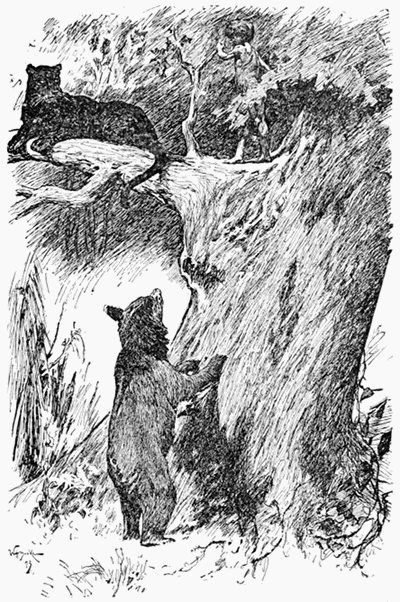
"My head is ringing like a bee-tree," said a
sullen voice over their heads, and Mowgli slid
down a tree-trunk, very angry and indignant,
adding, as he reached the ground: "I come for
Bagheera and not for thee, fat old Baloo!"
"That is all one to me," said Baloo, though he
was hurt and grieved. "Tell Bagheera, then, the
Master Words of the Jungle that I have taught
thee this day."
"Master Words for which people?" said Mowgli,
delighted to show off. "The jungle has many
tongues. I know them all."
"A little thou knowest, but not much. See, O
Bagheera, they never thank their teacher! Not
one small wolfling has come back to thank old
Baloo for his teachings. Say the Word for the
Hunting People, then,—great scholar!"
"We be of one blood, ye and I," said Mowgli,
giving the words the Bear accent which all the
Hunting People of the Jungle use.
"Good! Now for the Birds."
Mowgli repeated, with the Kite's whistle at
the end of the sentence.
"Now for the Snake People," said Bagheera.
The answer was a perfectly indescribable hiss,
and Mowgli kicked up his feet behind, clapped
his hands together to applaud himself, and jumped
on Bagheera's back, where he sat sideways,
drumming with his heels on the glossy skin and
making the worst faces that he could think of at
Baloo.
"There—there! That was worth a little
bruise," said the Brown Bear, tenderly. "Some
day thou wilt remember me." Then he turned
aside to tell Bagheera how he had begged the
Master Words from Hathi, the Wild Elephant,
who knows all about these things, and how Hathi
had taken Mowgli down to a pool to get the
Snake Word from a water-snake, because Baloo
could not pronounce it, and how Mowgli was
now reasonably safe against all accidents in the
jungle, because neither snake, bird, nor beast
would hurt him.
"No one then is to be feared," Baloo wound up,
patting his big furry stomach with pride.
"Except his own tribe," said Bagheera, under
his breath; and then aloud to Mowgli: "Have a
care for my ribs, Little Brother! What is all this
dancing up and down?"
Mowgli had been trying to make himself heard
by pulling at Bagheera's shoulder-fur and kicking
hard. When the two listened to him he
was shouting at the top of his voice: "And so I
shall have a tribe of my own, and lead them
through the branches all day long."
"What is this new folly, little dreamer of
dreams?" said Bagheera.
"Yes, and throw branches and dirt at old Baloo,"
Mowgli went on. "They have promised
me this, ah!"
"Whoof!" Baloo's big paw scooped Mowgli
off Bagheera's back, and as the boy lay between
the big fore paws he could see the bear was
angry.
"Mowgli," said Baloo, "thou hast been talking
with the Bandar-log—the Monkey People."
Mowgli looked at Bagheera to see if the panther
was angry too, and Bagheera's eyes were as
hard as jade-stones.
"Thou hast been with the Monkey People—the
gray apes—the people without a Law—the
eaters of everything. That is great shame."
"When Baloo hurt my head," said Mowgli (he
was still down on his back), "I went away, and
the gray apes came down from the trees and had
pity on me. No one else cared." He snuffled a
little.
"The pity of the Monkey People!" Baloo
snorted.
"The stillness of the mountain stream! The
cool of the summer sun! And then, man-cub?"
"And then—and then they gave me nuts and
pleasant things to eat, and they—they carried
me in their arms up to the top of the trees and
said I was their blood-brother, except that I had
no tail, and should be their leader some day."
"They have no leader," said Bagheera. "They
lie. They have always lied."
"They were very kind, and bade me come
again. Why have I never been taken among
the Monkey People? They stand on their feet
as I do. They do not hit me with hard paws.
They play all day. Let me get up! Bad Baloo,
let me up! I will go play with them again."
"Listen, man-cub," said the bear, and his voice
rumbled like thunder on a hot night. "I have
taught thee all the Law of the Jungle for all the
Peoples of the Jungle—except the Monkey Folk
who live in the trees. They have no Law. They
are outcastes. They have no speech of their own,
but use the stolen words which they overhear
when they listen and peep and wait up above in
the branches. Their way is not our way. They
are without leaders. They have no remembrance.
They boast and chatter and pretend
that they are a great people about to do great
affairs in the jungle, but the falling of a nut
turns their minds to laughter, and all is forgotten.
We of the jungle have no dealings with them.
We do not drink where the monkeys drink;
we do not go where the monkeys go; we do not
hunt where they hunt; we do not die where they
die. Hast thou ever heard me speak of the
Bandar-log till to-day?"
"No," said Mowgli in a whisper, for the forest
was very still now that Baloo had finished.
"The Jungle People put them out of their
mouths and out of their minds. They are very
many, evil, dirty, shameless, and they desire, if
they have any fixed desire, to be noticed by the
Jungle People. But we do not notice them even
when they throw nuts and filth on our heads."
He had hardly spoken when a shower of nuts
and twigs spattered down through the branches;
and they could hear coughings and howlings and
angry jumpings high up in the air among the thin
branches.
"The Monkey People are forbidden," said
Baloo, "forbidden to the Jungle People. Remember."
"Forbidden," said Bagheera; "but I still think
Baloo should have warned thee against them."
"I—I? How was I to guess he would play
with such dirt. The Monkey People! Faugh!"
A fresh shower came down on their heads, and
the two trotted away, taking Mowgli with them.
What Baloo had said about the monkeys was
perfectly true. They belonged to the tree-tops,
and as beasts very seldom look up, there was no
occasion for the monkeys and the Jungle People
to cross one another's path. But whenever they
found a sick wolf, or a wounded tiger or bear,
the monkeys would torment him, and would throw
sticks and nuts at any beast for fun and in the
hope of being noticed. Then they would howl
and shriek senseless songs, and invite the Jungle
People to climb up their trees and fight them, or
would start furious battles over nothing among
themselves, and leave the dead monkeys where
the Jungle People could see them.
They were always just going to have a leader
and laws and customs of their own, but they never
did, because their memories would not hold over
from day to day, and so they settled things by
making up a saying: "What the Bandar-log think
now the Jungle will think later"; and that comforted
them a great deal. None of the beasts
could reach them, but on the other hand none
of the beasts would notice them, and that was
why they were so pleased when Mowgli came
to play with them, and when they heard how
angry Baloo was.
They never meant to do any more,—the Bandar-log
never mean anything at all,—but one
of them invented what seemed to him a brilliant
idea, and he told all the others that Mowgli
would be a useful person to keep in the tribe, because
he could weave sticks together for protection
from the wind; so, if they caught him, they
could make him teach them. Of course Mowgli,
as a wood-cutter's child, inherited all sorts of instincts,
and used to make little play-huts of fallen
branches without thinking how he came to do it.
The Monkey People, watching in the trees, considered
these huts most wonderful. This time,
they said, they were really going to have a leader
and become the wisest people in the jungle—so
wise that every one else would notice and envy
them. Therefore they followed Baloo and Bagheera
and Mowgli through the jungle very
quietly till it was time for the midday nap, and
Mowgli, who was very much ashamed of himself,
slept between the panther and the bear, resolving
to have no more to do with the Monkey
People.
The next thing he remembered was feeling
hands on his legs and arms,—hard, strong little
hands,—and then a swash of branches in his
face; and then he was staring down through the
swaying boughs as Baloo woke the jungle with
his deep cries and Bagheera bounded up the
trunk with every tooth bared. The Bandar-log
howled with triumph, and scuffled away to the
upper branches where Bagheera dared not follow,
shouting: "He has noticed us! Bagheera
has noticed us! All the Jungle People
admire us for our skill and our cunning!" Then
they began their flight; and the flight of the
Monkey People through tree-land is one of the
things nobody can describe. They have their
regular roads and cross-roads, uphills and downhills,
all laid out from fifty to seventy or a hundred
feet aboveground, and by these they can
travel even at night if necessary.
Two of the strongest monkeys caught Mowgli
under the arms and swung off with him through
the tree-tops, twenty feet at a bound. Had they
been alone they could have gone twice as fast,
but the boy's weight held them back. Sick
and giddy as Mowgli was he could not help
enjoying the wild rush, though the glimpses of
earth far down below frightened him, and the
terrible check and jerk at the end of the swing
over nothing but empty air brought his heart
between his teeth.
His escort would rush him up a tree till he felt
the weak topmost branches crackle and bend
under them, and, then, with a cough and a
whoop, would fling themselves into the air outward
and downward, and bring up hanging by
their hands or their feet to the lower limbs of the
next tree. Sometimes he could see for miles and
miles over the still green jungle, as a man on the
top of a mast can see for miles across the sea, and
then the branches and leaves would lash him
across the face, and he and his two guards would
be almost down to earth again.
So bounding and crashing and whooping and
yelling, the whole tribe of Bandar-log swept
along the tree-roads with Mowgli their prisoner.
For a time he was afraid of being dropped;
then he grew angry, but he knew better than to
struggle; and then he began to think. The first
thing was to send back word to Baloo and Bagheera,
for, at the pace the monkeys were going,
he knew his friends would be left far behind. It
was useless to look down, for he could see only
the top sides of the branches, so he stared upward
and saw, far away in the blue, Rann, the
Kite, balancing and wheeling as he kept watch
over the jungle waiting for things to die. Rann
noticed that the monkeys were carrying something,
and dropped a few hundred yards to find
out whether their load was good to eat. He
whistled with surprise when he saw Mowgli being
dragged up to a tree-top, and heard him give the
Kite call for "We be of one blood, thou and I."
The waves of the branches closed over the boy,
but Rann balanced away to the next tree in time
to see the little brown face come up again. "Mark
my trail!" Mowgli shouted. "Tell Baloo of the
Seeonee Pack, and Bagheera of the Council Rock."
"In whose name, Brother?" Rann had never
seen Mowgli before, though of course he had
heard of him.
"Mowgli, the Frog. Man-cub they call me!
Mark my tra—il!"
The last words were shrieked as he was being
swung through the air, but Rann nodded, and
rose up till he looked no bigger than a speck
of dust, and there he hung, watching with his
telescope eyes the swaying of the tree-tops as
Mowgli's escort whirled along.
"They never go far," he said, with a chuckle.
"They never do what they set out to do. Always
pecking at new things are the Bandar-log.
This time, if I have any eyesight, they have
pecked down trouble for themselves, for Baloo is
no fledgling and Bagheera can, as I know, kill
more than goats."
Then he rocked on his wings, his feet gathered
up under him, and waited.
Meanwhile, Baloo and Bagheera were furious
with rage and grief. Bagheera climbed as he had
never climbed before, but the branches broke beneath
his weight, and he slipped down, his claws
full of bark.
"Why didst thou not warn the man-cub!" he
roared to poor Baloo, who had set off at a clumsy
trot in the hope of overtaking the monkeys.
"What was the use of half slaying him with
blows if thou didst not warn him?"
"Haste! O haste! We—we may catch them
yet!" Baloo panted.
"At that speed! It would not tire a wounded
cow. Teacher of the Law, cub-beater—a mile
of that rolling to and fro would burst thee open.
Sit still and think! Make a plan. This is no
time for chasing. They may drop him if we
follow too close."
"Arrula! Whoo! They may have dropped him
already, being tired of carrying him. Who can
trust the Bandar-log? Put dead bats on my head!
Give me black bones to eat! Roll me into the
hives of the wild bees that I may be stung to
death, and bury me with the hyena; for I am
the most miserable of bears! Arulala! Wahooa!
O Mowgli, Mowgli! Why did I not warn thee
against the Monkey Folk instead of breaking thy
head? Now perhaps I may have knocked the
day's lesson out of his mind, and he will be alone
in the jungle without the Master Words!"
Baloo clasped his paws over his ears and
rolled to and fro, moaning.
"At least he gave me all the Words correctly
a little time ago," said Bagheera, impatiently.
"Baloo, thou hast neither memory nor respect.
What would the jungle think if I, the Black
Panther, curled myself up like Ikki, the Porcupine,
and howled?"
"What do I care what the jungle thinks? He
may be dead by now."
"Unless and until they drop him from the
branches in sport, or kill him out of idleness, I
have no fear for the man-cub. He is wise and
well-taught, and, above all, he has the eyes that
make the Jungle People afraid. But (and it is a
great evil) he is in the power of the Bandar-log,
and they, because they live in trees, have no fear
of any of our people." Bagheera licked his one
fore paw thoughtfully.
"Fool that I am! Oh fat, brown, root-digging
fool that I am!" said Baloo, uncoiling himself
with a jerk. "It is true what Hathi, the Wild
Elephant, says: 'To each his own fear'; and
they, the Bandar-log, fear Kaa, the Rock Snake.
He can climb as well as they can. He steals
the young monkeys in the night. The mere
whisper of his name makes their wicked tails
cold. Let us go to Kaa."
"What will he do for us? He is not of our
tribe, being footless and with most evil eyes,"
said Bagheera.
"He is very old and very cunning. Above all,
he is always hungry," said Baloo, hopefully.
"Promise him many goats."
"He sleeps for a full month after he has once
eaten. He may be asleep now, and even were
he awake, what if he would rather kill his own
goats?" Bagheera, who did not know much
about Kaa, was naturally suspicious.
"Then in that case, thou and I together, old
hunter, may make him see reason." Here Baloo
rubbed his faded brown shoulder against the
panther, and they went off to look for Kaa, the
Rock Python.
They found him stretched out on a warm
ledge in the afternoon sun, admiring his beautiful
new coat, for he had been in retirement for the
last ten days changing his skin, and now he was
very splendid—darting his big blunt-nosed head
along the ground, and twisting the thirty feet of
his body into fantastic knots and curves, and licking
his lips as he thought of his dinner to come.
"He has not eaten," said Baloo, with a grunt
of relief, as soon as he saw the beautifully mottled
brown and yellow jacket. "Be careful, Bagheera!
He is always a little blind after he has
changed his skin, and very quick to strike."
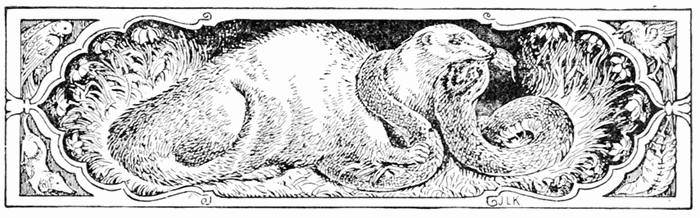
Kaa was not a poison snake—in fact he
rather despised the Poison Snakes for cowards;
but his strength lay in his hug, and when he had
once lapped his huge coils round anybody there
was no more to be said. "Good hunting!" cried
Baloo, sitting up on his haunches. Like all
snakes of his breed Kaa was rather deaf, and
did not hear the call at first. Then he curled up
ready for any accident, his head lowered.
"Good hunting for us all," he answered.
"Oho, Baloo, what dost thou do here? Good
hunting, Bagheera. One of us at least needs
food. Is there any news of game afoot? A doe
now, or even a young buck? I am as empty as
a dried well."
"We are hunting," said Baloo, carelessly. He
knew that you must not hurry Kaa. He is too
big.
"Give me permission to come with you," said
Kaa. "A blow more or less is nothing to thee,
Bagheera or Baloo, but I—I have to wait and
wait for days in a wood path and climb half a night
on the mere chance of a young ape. Pss naw!
The branches are not what they were when I was
young. Rotten twigs and dry boughs are they all."
"Maybe thy great weight has something to
do with the matter," said Baloo.
"I am a fair length—a fair length," said Kaa,
with a little pride. "But for all that, it is the
fault of this new-grown timber. I came very near
to falling on my last hunt,—very near indeed,—and
the noise of my slipping, for my tail was not
tight wrapped round the tree, waked the Bandar-log,
and they called me most evil names."
"'Footless, yellow earthworm,'" said Bagheera
under his whiskers, as though he were trying to
remember something.
"Sssss! Have they ever called me that?" said
Kaa.
"Something of that kind it was that they
shouted to us last moon, but we never noticed
them. They will say anything—even that thou
hast lost all thy teeth, and dare not face anything
bigger than a kid, because (they are indeed shameless,
these Bandar-log)—because thou art afraid
of the he-goats' horns," Bagheera went on sweetly.
Now a snake, especially a wary old python like
Kaa, very seldom shows that he is angry; but
Baloo and Bagheera could see the big swallowing
muscles on either side of Kaa's throat ripple
and bulge.
"The Bandar-log have shifted their grounds," he
said, quietly. "When I came up into the sun to-day
I heard them whooping among the tree-tops."
"It—it is the Bandar-log that we follow now,"
said Baloo; but the words stuck in his throat, for
this was the first time in his memory that one of
the Jungle People had owned to being interested
in the doings of the monkeys.
"Beyond doubt, then, it is no small thing that
takes two such hunters—leaders in their own
jungle, I am certain—on the trail of the Bandar-log,"
Kaa replied, courteously, as he swelled with
curiosity.
"Indeed," Baloo began, "I am no more than
the old, and sometimes very foolish, Teacher of
the Law to the Seeonee wolf-cubs, and Bagheera
here—"
"Is Bagheera," said the Black Panther, and his
jaws shut with a snap, for he did not believe in
being humble. "The trouble is this, Kaa. Those
nut-stealers and pickers of palm-leaves have
stolen away our man-cub, of whom thou hast
perhaps heard."
"I heard some news from Ikki (his quills make
him presumptuous) of a man-thing that was entered
into a wolf-pack, but I did not believe. Ikki
is full of stories half heard and very badly told."
"But it is true. He is such a man-cub as never
was," said Baloo. "The best and wisest and boldest
of man-cubs. My own pupil, who shall make
the name of Baloo famous through all the jungles;
and besides, I—we—love him, Kaa."
"Ts! Ts!" said Kaa, shaking his head to and
fro. "I also have known what love is. There
are tales I could tell that—"
"That need a clear night when we are all well
fed to praise properly," said Bagheera, quickly.
"Our man-cub is in the hands of the Bandar-log
now, and we know that of all the Jungle People
they fear Kaa alone."
"They fear me alone. They have good reason,"
said Kaa. "Chattering, foolish, vain—vain,
foolish, and chattering—are the monkeys.
But a man-thing in their hands is in no good
luck. They grow tired of the nuts they pick,
and throw them down. They carry a branch
half a day, meaning to do great things with it,
and then they snap it in two. That manling is
not to be envied. They called me also—'yellow
fish,' was it not?"
"Worm—worm—earthworm," said Bagheera;
"as well as other things which I cannot now say
for shame."
"We must remind them to speak well of their
master. Aaa-sssh! We must help their wandering
memories. Now, whither went they with thy
cub?"
"The jungle alone knows. Toward the sunset,
I believe," said Baloo. "We had thought
that thou wouldst know, Kaa."
"I? How? I take them when they come in
my way, but I do not hunt the Bandar-log—or
frogs—or green scum on a water-hole, for that
matter."
"Up, up! Up, up! Hillo! Illo! Illo! Look
up, Baloo of the Seeonee Wolf Pack!"
Baloo looked up to see where the voice came
from, and there was Rann, the Kite, sweeping
down with the sun shining on the upturned
flanges of his wings. It was near Rann's bedtime,
but he had ranged all over the jungle looking
for the bear, and missed him in the thick
foliage.
"What is it?" said Baloo.
"I have seen Mowgli among the Bandar-log.
He bade me tell you. I watched. The Bandar-log
have taken him beyond the river to the Monkey
City—to the Cold Lairs. They may stay
there for a night, or ten nights, or an hour. I
have told the bats to watch through the dark
time. That is my message. Good hunting, all
you below!"
"Full gorge and a deep sleep to you, Rann!"
cried Bagheera. "I will remember thee in my
next kill, and put aside the head for thee alone,
O best of kites!"
"It is nothing. It is nothing. The boy held
the Master Word. I could have done no less,"
and Rann circled up again to his roost.
"He has not forgotten to use his tongue," said
Baloo, with a chuckle of pride. "To think of
one so young remembering the Master Word for
the birds while he was being pulled across trees!"
"It was most firmly driven into him," said
Bagheera. "But I am proud of him, and now
we must go to the Cold Lairs."
They all knew where that place was, but few
of the Jungle People ever went there, because
what they called the Cold Lairs was an old
deserted city, lost and buried in the jungle, and
beasts seldom use a place that men have once
used. The wild boar will, but the hunting-tribes
do not. Besides, the monkeys lived there as
much as they could be said to live anywhere,
and no self-respecting animal would come within
eye-shot of it except in times of drouth, when
the half-ruined tanks and reservoirs held a little
water.
"It is half a night's journey—at full speed,"
said Bagheera. Baloo looked very serious.
"I will go as fast as I can," he said, anxiously.
"We dare not wait for thee. Follow, Baloo.
We must go on the quick-foot—Kaa and I."
"Feet or no feet, I can keep abreast of all thy
four," said Kaa, shortly.
Baloo made one effort to hurry, but had to sit
down panting, and so they left him to come on
later, while Bagheera hurried forward, at the rocking
panther-canter. Kaa said nothing, but, strive
as Bagheera might, the huge Rock Python held
level with him. When they came to a hill-stream,
Bagheera gained, because he bounded across
while Kaa swam, his head and two feet of his
neck clearing the water, but on level ground Kaa
made up the distance.
"By the Broken Lock that freed me," said
Bagheera, when twilight had fallen, "thou art no
slow-goer."
"I am hungry," said Kaa. "Besides, they
called me speckled frog."
"Worm—earthworm, and yellow to boot."
"All one. Let us go on," and Kaa seemed
to pour himself along the ground, finding the
shortest road with his steady eyes, and keeping
to it.
In the Cold Lairs the Monkey People were
not thinking of Mowgli's friends at all. They had
brought the boy to the Lost City, and were very
pleased with themselves for the time. Mowgli
had never seen an Indian city before, and though
this was almost a heap of ruins it seemed very
wonderful and splendid. Some king had built it
long ago on a little hill. You could still trace
the stone causeways that led up to the ruined
gates where the last splinters of wood hung to the
worn, rusted hinges. Trees had grown into and
out of the walls; the battlements were tumbled
down and decayed, and wild creepers hung out of
the windows of the towers on the walls in bushy
hanging clumps.
A great roofless palace crowned the hill, and
the marble of the courtyards and the fountains
was split and stained with red and green, and the
very cobblestones in the courtyard where the
king's elephants used to live had been thrust up
and apart by grasses and young trees. From the
palace you could see the rows and rows of roofless
houses that made up the city, looking like empty
honeycombs filled with blackness; the shapeless
block of stone that had been an idol in the
square where four roads met; the pits and dimples
at street corners where the public wells once
stood, and the shattered domes of temples with
wild figs sprouting on their sides.
The monkeys called the place their city, and
pretended to despise the Jungle People because
they lived in the forest. And yet they never
knew what the buildings were made for nor how
to use them. They would sit in circles on the
hall of the king's council-chamber, and scratch
for fleas and pretend to be men; or they would
run in and out of the roofless houses and collect
pieces of plaster and old bricks in a corner, and
forget where they had hidden them, and fight
and cry in scuffling crowds, and then break off to
play up and down the terraces of the king's garden,
where they would shake the rose-trees and
the oranges in sport to see the fruit and flowers
fall. They explored all the passages and dark
tunnels in the palace and the hundreds of little
dark rooms; but they never remembered what
they had seen and what they had not, and so
drifted about in ones and twos or crowds, telling
one another that they were doing as men did.
They drank at the tanks and made the water all
muddy, and then they fought over it, and then
they would all rush together in mobs and shout:
"There are none in the jungle so wise and good
and clever and strong and gentle as the Bandar-log."
Then all would begin again till they grew
tired of the city and went back to the tree-tops,
hoping the Jungle People would notice them.
Mowgli, who had been trained under the Law
of the Jungle, did not like or understand this
kind of life. The monkeys dragged him into the
Cold Lairs late in the afternoon, and instead of
going to sleep, as Mowgli would have done after
a long journey, they joined hands and danced
about and sang their foolish songs.
One of the monkeys made a speech, and told
his companions that Mowgli's capture marked a
new thing in the history of the Bandar-log, for
Mowgli was going to show them how to weave
sticks and canes together as a protection against
rain and cold. Mowgli picked up some creepers
and began to work them in and out, and the
monkeys tried to imitate; but in a very few minutes
they lost interest and began to pull their
friends' tails or jump up and down on all fours,
coughing.
"I want to eat," said Mowgli. "I am a
stranger in this part of the jungle. Bring me
food, or give me leave to hunt here."
Twenty or thirty monkeys bounded away to
bring him nuts and wild pawpaws; but they fell
to fighting on the road, and it was too much
trouble to go back with what was left of the fruit.
Mowgli was sore and angry as well as hungry,
and he roamed through the empty city giving the
Strangers' Hunting Call from time to time, but
no one answered him, and Mowgli felt that he
had reached a very bad place indeed.
"All that Baloo has said about the Bandar-log
is true," he thought to himself. "They have
no Law, no Hunting Call, and no leaders—nothing
but foolish words and little picking,
thievish hands. So if I am starved or killed
here, it will be all my own fault. But I must try
to return to my own jungle. Baloo will surely
beat me, but that is better than chasing silly
rose-leaves with the Bandar-log."
But no sooner had he walked to the city wall
than the monkeys pulled him back, telling him
that he did not know how happy he was, and
pinching him to make him grateful. He set his
teeth and said nothing, but went with the shouting
monkeys to a terrace above the red sandstone
reservoirs that were half full of rain-water.
There was a ruined summer-house of white
marble in the center of the terrace, built for
queens dead a hundred years ago. The domed
roof had half fallen in and blocked up the underground
passage from the palace by which the
queens used to enter; but the walls were made
of screens of marble tracery—beautiful, milk-white
fretwork, set with agates and cornelians
and jasper and lapis lazuli, and as the moon
came up behind the hill it shone through the
openwork, casting shadows on the ground like
black-velvet embroidery.
Sore, sleepy, and hungry as he was, Mowgli
could not help laughing when the Bandar-log
began, twenty at a time, to tell him how great
and wise and strong and gentle they were, and
how foolish he was to wish to leave them. "We
are great. We are free. We are wonderful. We
are the most wonderful people in all the jungle!
We all say so, and so it must be true," they
shouted. "Now as you are a new listener and
can carry our words back to the Jungle People
so that they may notice us in future, we will tell
you all about our most excellent selves."
Mowgli made no objection, and the monkeys
gathered by hundreds and hundreds on the terrace
to listen to their own speakers singing the
praises of the Bandar-log, and whenever a speaker
stopped for want of breath they would all shout
together: "This is true; we all say so."
Mowgli nodded and blinked, and said "Yes"
when they asked him a question, and his head
spun with the noise. "Tabaqui, the Jackal, must
have bitten all these people," he said to himself,
"and now they have the madness. Certainly
this is dewanee—the madness. Do they never
go to sleep? Now there is a cloud coming to
cover that moon. If it were only a big enough
cloud I might try to run away in the darkness.
But I am tired."
That same cloud was being watched by two
good friends in the ruined ditch below the city
wall, for Bagheera and Kaa, knowing well how
dangerous the Monkey People were in large
numbers, did not wish to run any risks. The
monkeys never fight unless they are a hundred
to one, and few in the jungle care for those odds.
"I will go to the west wall," Kaa whispered,
"and come down swiftly with the slope of the
ground in my favor. They will not throw themselves
upon my back in their hundreds, but—"
"I know it," said Bagheera. "Would that
Baloo were here; but we must do what we can.
When that cloud covers the moon I shall go to
the terrace. They hold some sort of council
there over the boy."
"Good hunting," said Kaa, grimly, and glided
away to the west wall. That happened to be the
least ruined of any, and the big snake was delayed
a while before he could find a way up the
stones.
The cloud hid the moon, and as Mowgli wondered
what would come next he heard Bagheera's
light feet on the terrace. The Black Panther had
raced up the slope almost without a sound, and
was striking—he knew better than to waste time
in biting—right and left among the monkeys,
who were seated round Mowgli in circles fifty and
sixty deep. There was a howl of fright and rage,
and then as Bagheera tripped on the rolling,
kicking bodies beneath him, a monkey shouted:
"There is only one here! Kill him! Kill!" A
scuffling mass of monkeys, biting, scratching,
tearing, and pulling, closed over Bagheera, while
five or six laid hold of Mowgli, dragged him up
the wall of the summer-house, and pushed him
through the hole of the broken dome. A man-trained
boy would have been badly bruised, for
the fall was a good ten feet, but Mowgli fell as
Baloo had taught him to fall, and landed light.
"Stay there," shouted the monkeys, "till we
have killed thy friend. Later we will play with
thee, if the Poison People leave thee alive."
"We be of one blood, ye and I," said Mowgli,
quickly giving the Snake's Call. He could hear
rustling and hissing in the rubbish all round him,
and gave the Call a second time to make sure.
"Down hoods all," said half a dozen low
voices. Every old ruin in India becomes sooner
or later a dwelling-place of snakes, and the old
summer-house was alive with cobras. "Stand
still, Little Brother, lest thy feet do us harm."
Mowgli stood as quietly as he could, peering
through the openwork and listening to the furious
din of the fight round the Black Panther—the
yells and chatterings and scufflings, and Bagheera's
deep, hoarse cough as he backed and
bucked and twisted and plunged under the heaps
of his enemies. For the first time since he was
born, Bagheera was fighting for his life.
"Baloo must be at hand; Bagheera would not
have come alone," Mowgli thought; and then he
called aloud: "To the tank, Bagheera! Roll to
the water-tanks! Roll and plunge! Get to the
water!"
Bagheera heard, and the cry that told him
Mowgli was safe gave him new courage. He
worked his way desperately, inch by inch,
straight for the reservoirs, hitting in silence.
Then from the ruined wall nearest the jungle
rose up the rumbling war-shout of Baloo. The
old bear had done his best, but he could not
come before. "Bagheera," he shouted, "I am
here! I climb! I haste! Ahuwora! The
stones slip under my feet! Wait my coming, O
most infamous Bandar log!"
He panted up the terrace only to disappear to
the head in a wave of monkeys, but he threw
himself squarely on his haunches, and spreading
out his fore paws, hugged as many as he could
hold, and then began to hit with a regular bat-bat-bat,
like the flipping strokes of a paddle-wheel.
A crash and a splash told Mowgli that Bagheera
had fought his way to the tank, where
the monkeys could not follow. The panther lay
gasping for breath, his head just out of water,
while the monkeys stood three deep on the red
stone steps, dancing up and down with rage,
ready to spring upon him from all sides if he came
out to help Baloo. It was then that Bagheera
lifted up his dripping chin, and in despair gave
the Snake's Call for protection,—"We be of one
blood, ye and I,"—for he believed that Kaa had
turned tail at the last minute. Even Baloo, half
smothered under the monkeys on the edge of the
terrace, could not help chuckling as he heard the
big Black Panther asking for help.
Kaa had only just worked his way over the
west wall, landing with a wrench that dislodged
a coping-stone into the ditch. He had no intention
of losing any advantage of the ground, and
coiled and uncoiled himself once or twice, to be
sure that every foot of his long body was in
working order.
All that while the fight with Baloo went on,
and the monkeys yelled in the tank round Bagheera,
and Mang, the Bat, flying to and fro, carried
the news of the great battle over the jungle,
till even Hathi, the Wild Elephant, trumpeted,
and, far away, scattered bands of the Monkey
Folk woke and came leaping along the tree-roads
to help their comrades in the Cold Lairs, and
the noise of the fight roused all the day-birds
for miles round.
Then Kaa came straight, quickly, and anxious
to kill. The fighting strength of a python is in
the driving blow of his head, backed by all the
strength and weight of his body. If you can imagine
a lance, or a battering-ram, or a hammer,
weighing nearly half a ton driven by a cool,
quiet mind living in the handle of it, you can
imagine roughly what Kaa was like when he
fought. A python four or five feet long can
knock a man down if he hits him fairly in the
chest, and Kaa was thirty feet long, as you
know. His first stroke was delivered into the
heart of the crowd round Baloo—was sent home
with shut mouth in silence, and there was no
need of a second. The monkeys scattered with
cries of "Kaa! It is Kaa! Run! Run!"
Generations of monkeys had been scared into
good behavior by the stories their elders told
them of Kaa, the night-thief, who could slip
along the branches as quietly as moss grows, and
steal away the strongest monkey that ever lived;
of old Kaa, who could make himself look so like
a dead branch or a rotten stump that the wisest
were deceived till the branch caught them, and
then—
Kaa was everything that the monkeys feared
in the jungle, for none of them knew the limits
of his power, none of them could look him in
the face, and none had ever come alive out
of his hug. And so they ran, stammering
with terror, to the walls and the roofs of the
houses, and Baloo drew a deep breath of relief.
His fur was much thicker than Bagheera's, but
he had suffered sorely in the fight. Then Kaa
opened his mouth for the first time and spoke
one long hissing word, and the far-away
monkeys, hurrying to the defense of the Cold
Lairs, stayed where they were, cowering, till the
loaded branches bent and crackled under them.
The monkeys on the walls and the empty houses
stopped their cries, and in the stillness that fell
upon the city Mowgli heard Bagheera shaking
his wet sides as he came up from the tank.
Then the clamor broke out again. The
monkeys leaped higher up the walls; they clung
round the necks of the big stone idols and
shrieked as they skipped along the battlements;
while Mowgli, dancing in the summer-house,
put his eye to the screenwork and hooted owl-fashion
between his front teeth, to show his
derision and contempt.
"Get the man-cub out of that trap; I can do
no more," Bagheera gasped. "Let us take the
man-cub and go. They may attack again."
"They will not move till I order them. Stay
you sssso!" Kaa hissed, and the city was silent
once more. "I could not come before, Brother, but
I think I heard thee call"—this was to Bagheera.
"I—I may have cried out in the battle," Bagheera
answered. "Baloo, art thou hurt?"
"I am not sure that they have not pulled me
into a hundred little bearlings," said Baloo,
gravely shaking one leg after the other. "Wow!
I am sore. Kaa, we owe thee, I think, our lives—Bagheera
and I."
"No matter. Where is the manling?"
"Here, in a trap. I cannot climb out," cried
Mowgli. The curve of the broken dome was
above his head.
"Take him away. He dances like Mao, the
Peacock. He will crush our young," said the
cobras inside.
"Hah!" said Kaa, with a chuckle, "he has
friends everywhere, this manling. Stand back,
Manling; and hide you, O Poison People. I
break down the wall."
Kaa looked carefully till he found a discolored
crack in the marble tracery showing a weak spot,
made two or three light taps with his head to get
the distance, and then lifting up six feet of his
body clear of the ground, sent home half a dozen
full-power, smashing blows, nose-first. The
screenwork broke and fell away in a cloud of dust
and rubbish, and Mowgli leaped through the
opening and flung himself between Baloo and
Bagheera—an arm round each big neck.
"Art thou hurt?" said Baloo, hugging him
softly.
"I am sore, hungry, and not a little bruised;
but, oh, they have handled ye grievously, my
Brothers! Ye bleed."
"Others also," said Bagheera, licking his lips
and looking at the monkey-dead on the terrace
and round the tank.
"It is nothing, it is nothing if thou art safe, O
my pride of all little frogs!" whimpered Baloo.
"Of that we shall judge later," said Bagheera,
in a dry voice that Mowgli did not at all like.
"But here is Kaa, to whom we owe the battle
and thou owest thy life. Thank him according
to our customs, Mowgli."
Mowgli turned and saw the great python's
head swaying a foot above his own.
"So this is the manling," said Kaa. "Very
soft is his skin, and he is not so unlike the
Bandar-log. Have a care, Manling, that I do
not mistake thee for a monkey some twilight
when I have newly changed my coat."
"We be of one blood, thou and I," Mowgli
answered. "I take my life from thee, to-night.
My kill shall be thy kill if ever thou art hungry,
O Kaa."
"All thanks, Little Brother," said Kaa, though
his eyes twinkled. "And what may so bold a
hunter kill? I ask that I may follow when next
he goes abroad."
"I kill nothing,—I am too little,—but I drive
goats toward such as can use them. When thou
art empty come to me and see if I speak the
truth. I have some skill in these [he held out
his hands], and if ever thou art in a trap, I may
pay the debt which I owe to thee, to Bagheera,
and to Baloo, here. Good hunting to ye all,
my masters."
"Well said," growled Baloo, for Mowgli had
returned thanks very prettily. The python
dropped his head lightly for a minute on Mowgli's
shoulder. "A brave heart and a courteous
tongue," said he. "They shall carry thee far
through the jungle, Manling. But now go hence
quickly with thy friends. Go and sleep, for the
moon sets, and what follows it is not well that
thou shouldst see."
The moon was sinking behind the hills and
the lines of trembling monkeys huddled together
on the walls and battlements looked like ragged,
shaky fringes of things. Baloo went down to
the tank for a drink, and Bagheera began to
put his fur in order, as Kaa glided out into the
center of the terrace and brought his jaws together
with a ringing snap that drew all the
monkeys' eyes upon him.
"The moon sets," he said. "Is there yet light
to see?"
From the walls came a moan like the wind in
the tree-tops: "We see, O Kaa!"
"Good! Begins now the Dance—the Dance
of the Hunger of Kaa. Sit still and watch."
He turned twice or thrice in a big circle, weaving
his head from right to left. Then he began
making loops and figures of eight with his body,
and soft, oozy triangles that melted into squares
and five-sided figures, and coiled mounds, never
resting, never hurrying, and never stopping his
low, humming song. It grew darker and darker,
till at last the dragging, shifting coils disappeared,
but they could hear the rustle of the
scales.
Baloo and Bagheera stood still as stone,
growling in their throats, their neck-hair bristling,
and Mowgli watched and wondered.
"Bandar-log," said the voice of Kaa at last,
"can ye stir foot or hand without my order?
Speak!"
"Without thy order we cannot stir foot or
hand, O Kaa!"
"Good! Come all one pace nearer to me."
The lines of the monkeys swayed forward
helplessly, and Baloo and Bagheera took one
stiff step forward with them.
"Nearer!" hissed Kaa, and they all moved
again.
Mowgli laid his hands on Baloo and Bagheera
to get them away, and the two great beasts
started as though they had been waked from a
dream.
"Keep thy hand on my shoulder," Bagheera
whispered. "Keep it there, or I must go back—must
go back to Kaa. Aah!"
"It is only old Kaa making circles on the
dust," said Mowgli; "let us go"; and the three
slipped off through a gap in the walls to the
jungle.
"Whoof!" said Baloo, when he stood under
the still trees again. "Never more will I make
an ally of Kaa," and he shook himself all over.
"He knows more than we," said Bagheera,
trembling. "In a little time, had I stayed, I
should have walked down his throat."
"Many will walk that road before the moon
rises again," said Baloo. "He will have good
hunting—after his own fashion."
"But what was the meaning of it all?" said
Mowgli, who did not know anything of a python's
powers of fascination. "I saw no more
than a big snake making foolish circles till the
dark came. And his nose was all sore. Ho! Ho!"
"Mowgli," said Bagheera, angrily, "his nose
was sore on thy account; as my ears and sides and
paws, and Baloo's neck and shoulders are bitten
on thy account. Neither Baloo nor Bagheera will
be able to hunt with pleasure for many days."
"It is nothing," said Baloo; "we have the
man-cub again."
"True; but he has cost us most heavily in
time which might have been spent in good hunting,
in wounds, in hair,—I am half plucked along
my back,—and last of all, in honor. For, remember,
Mowgli, I, who am the Black Panther, was
forced to call upon Kaa for protection, and Baloo
and I were both made stupid as little birds by
the Hunger-Dance. All this, Man-cub, came of
thy playing with the Bandar-log."
"True; it is true," said Mowgli, sorrowfully.
"I am an evil man-cub, and my stomach is
sad in me."
"Mf! What says the Law of the Jungle,
Baloo?"
Baloo did not wish to bring Mowgli into any
more trouble, but he could not tamper with the
Law, so he mumbled, "Sorrow never stays punishment.
But remember, Bagheera, he is very little."
"I will remember; but he has done mischief;
and blows must be dealt now. Mowgli, hast thou
anything to say?"
"Nothing. I did wrong. Baloo and thou
art wounded. It is just."
Bagheera gave him half a dozen love-taps;
from a panther's point of view they would hardly
have waked one of his own cubs, but for a seven
year-old boy they amounted to as severe a beating
as you could wish to avoid. When it was all
over Mowgli sneezed, and picked himself up
without a word.
"Now," said Bagheera, "jump on my back,
Little Brother, and we will go home."
One of the beauties of Jungle Law is that
punishment settles all scores. There is no nagging
afterward.
Mowgli laid his head down on Bagheera's back
and slept so deeply that he never waked when
he was put down by Mother Wolf's side in the
home-cave.
ROAD-SONG OF THE BANDAR-LOG
Here we go in a flung festoon,
Half-way up to the jealous moon!
Don't you envy our pranceful bands?
Don't you wish you had extra hands?
Wouldn't you like if your tails were—so—
Curved in the shape of a Cupid's bow?
Now you're angry, but—never mind,
Brother, thy tail hangs down behind!
Here we sit in a branchy row,
Thinking of beautiful things we know;
Dreaming of deeds that we mean to do,
All complete, in a minute or two—
Something noble and grand and good,
Won by merely wishing we could.
Now we're going to—never mind,
Brother, thy tail hangs down behind!
All the talk we ever have heard
Uttered by bat or beast or bird—
Hide or fin or scale or feather—
Jabber it quickly and all together!
Excellent! Wonderful! Once again!
Now we are talking just like men.
Let's pretend we are ... never mind,
Brother, thy tail hangs down behind!
This is the way of the Monkey-kind.
Then join our leaping lines that scumfish through the pines,
That rocket by where, light and high, the wild-grape swings.
By the rubbish in our wake, and the noble noise we make,
Be sure, be sure, we're going to do some splendid things!