I JUMPING JEHOSOPHAT
Kerchug, the leap frog, was all the time jumping.
He stood every morning on the edge of the pond
where he lived, and said to all the birds in the
trees above him: “Isn’t it wonderful how I can
jump?” Then all the birds would flap their wings and sing
a song which began, “Isn’t it a treat to see our leap frog jump
so far?”
One day Kerchug made a great big jump into the middle
of the pool, and then swam back to the stone from which he
always made his jumps. He waited for the birds to flap their
wings and to sing about his jumping, but not one of them took
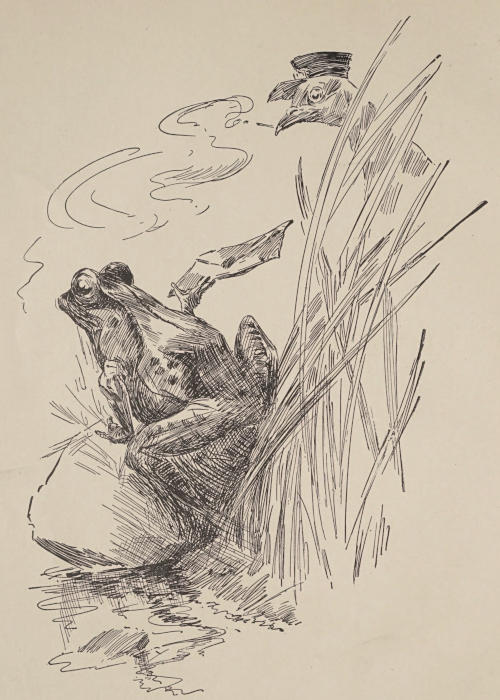
any notice of him. Instead of that, he found Carrier Pigeon
roosting on a log near the pool and looking very solemn.
“Wasn’t that a great jump?” asked Kerchug.
Carrier Pigeon shook his head, and took out from under
his wing a little paper envelope, which he gave to Kerchug.
Kerchug opened the letter and when he had looked at it he
turned white under the chin.
“Read it to me, Carrier Pigeon,” he said, “I’ve just come
out of the water, and my goggles are so damp that I can hardly
see anything.”
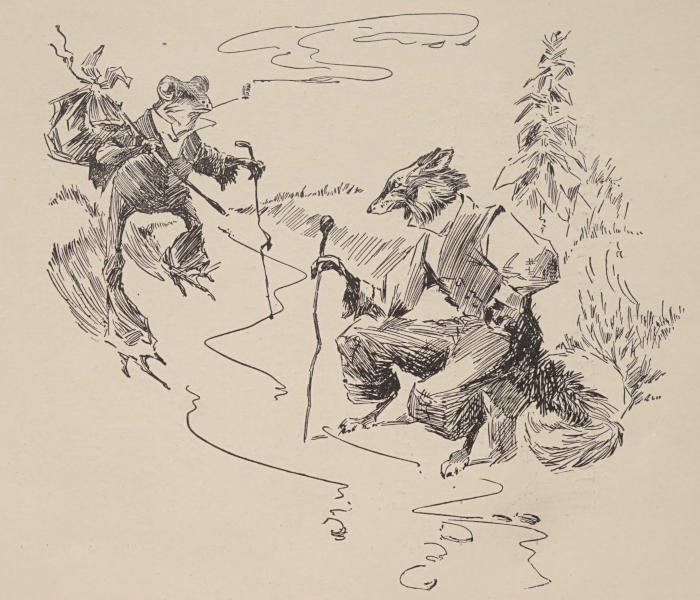
Sly Fox stops Kerchug from running away.
So Carrier Pigeon swelled out his chest and stood on one
leg and held the paper in his right claw as he read:
“I can leap further and higher and better than anything
which wears a speckled skin and goggles. If Kerchug is not a
coward he will come away from the water and hop right out
here in the wood and jump with me.
(Signed)
“Jumping Jehosophat.”
“Are his legs as long as mine?” asked Kerchug, looking
very hard at Carrier Pigeon.
“He had them curled under him when I saw him sitting
in the woods,” answered Carrier Pigeon, “and really I cannot
say.”
Kerchug, the leap frog, heard all the birds twittering and
whispering, up in the trees. He thought they were all laughing
at him, so he gulped and swallowed and then said that he
was very glad indeed to see Carrier Pigeon and that it was a
very fine morning.
“You might say to your friend,” he added, “that I must
have time to think this over, and you can come back in an
hour.”
“Very well,” answered Carrier Pigeon, “I’ll go back and
tell him.”
Kerchug and Sly Fox come.
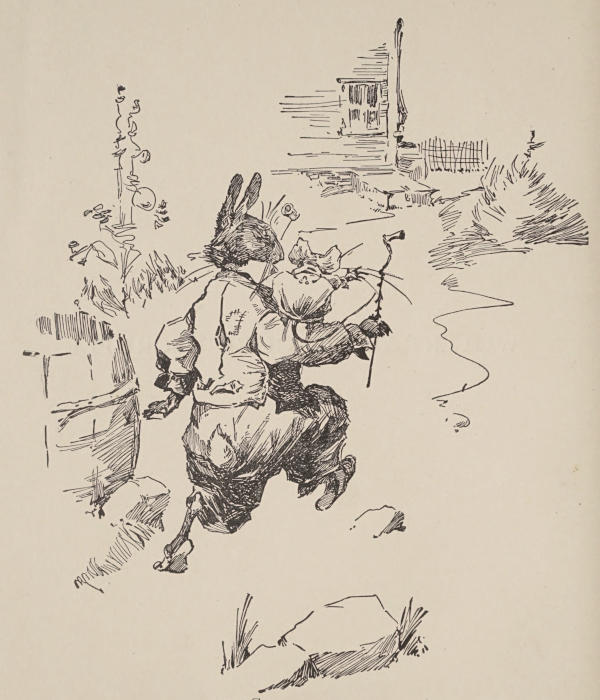
When Carrier Pigeon had gone, Kerchug put everything
which he had in a red bandana handkerchief and tied it up and
put the bundle on the end of a stick, which he rested on his
shoulder. Then he started for the bulrushes which grew along
side of the pool. He had not gone very far before he met Sly
Fox.
“Good morning, Kerchug, how is the jumping this morning?”
asked Sly Fox.
“Not very good,” answered Kerchug, “besides, I have
found that it is not a very healthy place to live around here.
The pool is so very damp, and you know that I cannot stand
malaria, so I have decided to move.”
“It seems to me,” said Sly Fox, “that you had better wait
until you have finished this affair with Jumping Jehosophat. I
am surprised that you should be afraid to jump with such an
awkward looking creature as he is.”
“But I am afraid that he can go further than I can,” replied
Kerchug.
“Don’t worry about that,” answered Sly Fox, “you just
leave that to me. You tell him that you will meet him to-morrow
morning.”
So Kerchug, the leap-frog, hid his bundle in the bulrushes
and marched back to the stone in front of the pool and croaked
for Carrier Pigeon to come back.
“Tell Jumping Jehosophat, whoever he is,” said he, “that
I’ll meet him to-morrow morning at 9 o’clock under the old oak
tree, and I will show him something about jumping.”
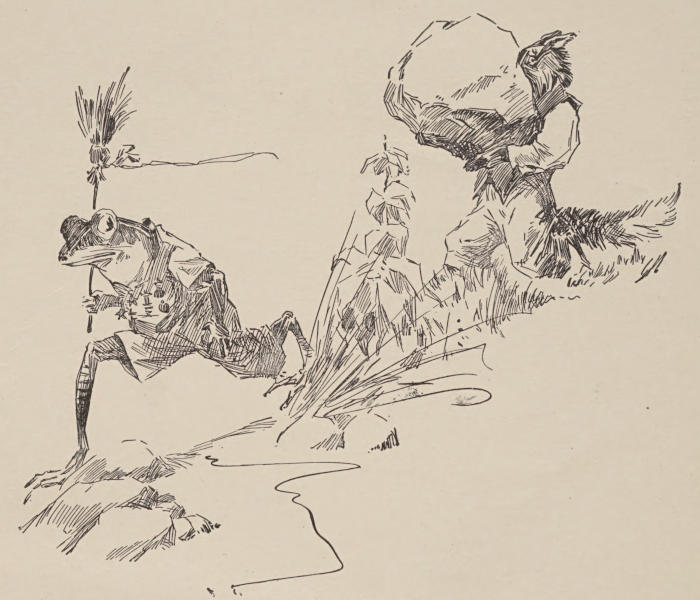
Jumping Jehosophat leaps with the Big Stone.
All the birds in the woods went the next morning to the
old oak tree. The branches of the tree were so full of birds
that some of them sagged way down. Under the tree the
ground was all hard and smooth. Jumping Jehosophat was
there waiting. He was certainly a queer animal. He had a
great big body and a little bit of a head. His hind legs were
long and strong and his front legs were no bigger than a rabbit’s.
As he stood up he was almost as tall as a man; his fur
was gray and he had funny little eyes which twinkled as he
talked. On his breast were at least a dozen medals for jumping.
He folded his arms and hopped about on his hind legs.
“Birds in the tree,” he said, “in me you see the great
Jumping Jehosophat, the bounding kangaroo. Because I jump
so high I got away from the circus. Now, then, where is that
miserable little speckled green thing that thinks it can jump?”
Nobody spoke for a long time and then Sly Fox came out
from behind the bushes, carrying a bulrush for a cane.
“Birds in the tree,” said Sly Fox, “the great and only
Kerchug, the only creature who is not afraid to leap both in the
water and on the dry land, has just finished his test, and is now
on his way to show how a truly great leap frog can jump.”
“There he is!” screamed all the birds up in the tree. And,
sure enough, there came Kerchug, all dressed up in green
tights, with spangles all over them. Sly Fox, who had gone
into the bushes to bring him out, came up behind him, carrying
a great, big stone.
“With this e-nor-mous stone,” said Sly Fox, “Kerchug
has just leaped 100 times, so as to get ready for some real
jumping. He will now wait until this poor and awkward
creature here has a chance to do the same, so that you will all
say that he has been fair.”
“O, that is easy!” said Jumping Jehosophat.
So the bounding kangaroo took the big stone in his little
arms and jumped up into the air 100 times.
“Now, then,” said Sly Fox, “we shall have the pleasure
of seeing who is the better jumper, Jumping Jehosophat, the
bounding kangaroo, or my little friend here, who leaps as well
on the dry land as in the wettest pool.”
Then Kerchug made a great, big jump, and Sly Fox
marked the place.
Jumping Jehosophat, who was all tired out and sore by
leaping when he carried the big stone, could only make a little
bit of a jump, and did not come within a foot of the place
where Kerchug had leaped. He was so ashamed that he ran
into the bushes and hid. So Kerchug, all covered with medals,
went back to his pool, hand in hand with his friend, Sly Fox,
and all the birds in the trees, as they flew away, cried out:
“What a wonderful jumper is our little friend Kerchug, the
leap-frog!”
II YELLOW LION AND HEDGEHOG’S SCRIBBLING
Hedgehog was always scribbling. He sat at his
desk in his house in the woods and wrote so much
that he hardly stopped to eat his meals. He had
quills stuck behind his ears, and whenever he
thought of anything which would make any of the beasts angry,
especially Yellow Lion, he wrote it down on a piece of birch
bark. For ink he used pokeberry juice.
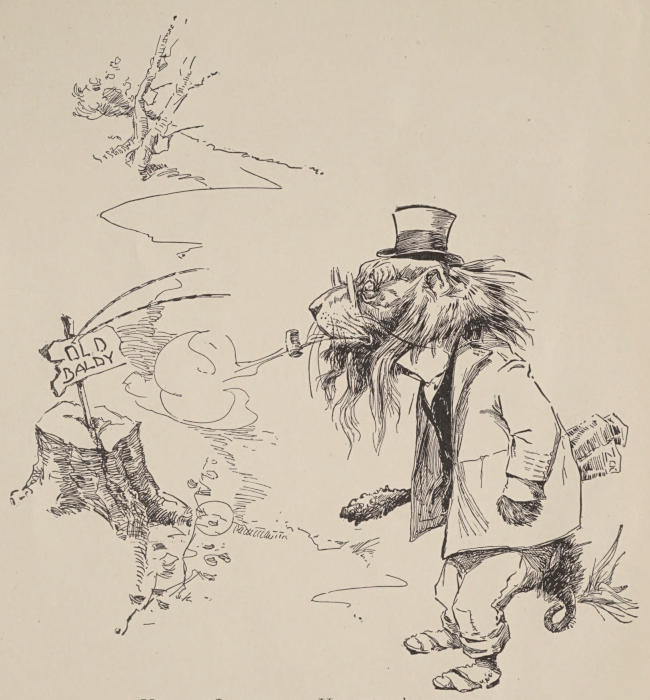
Yellow Lion awoke one morning and found a sign tacked
to the door of his house with one of Hedgehog’s quills. On
the sign was written:
“Lion, you are a big, yellow animal.”
“Who wrote that?” roared Yellow Lion. “I am no
more of an animal than he is.”
Everybody knows that Yellow Lion is very proud, for he
is the king of beasts. So Yellow Lion went out and sharpened
his claws on the trunk of a tree and started to get revenge for
the name that he had been called. He had not gone very far
before he saw another piece of bark tacked up to a tree with
one of Hedgehog’s quills. On it was written:
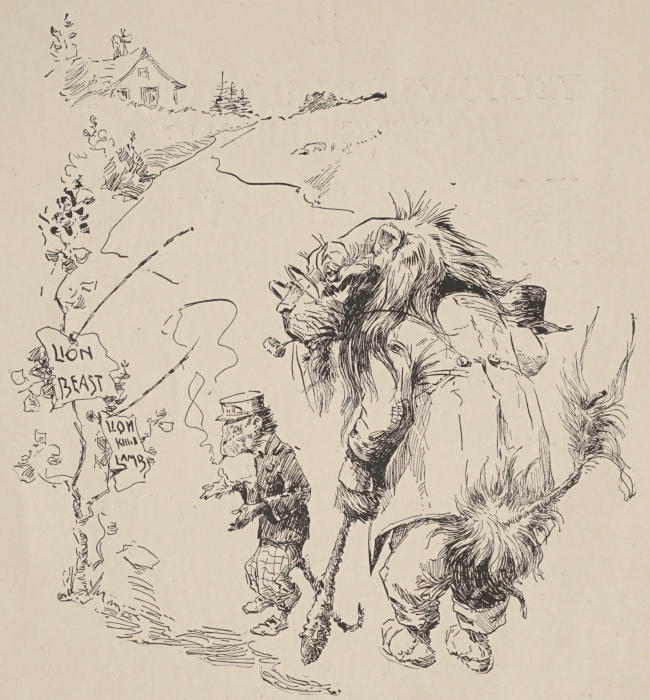
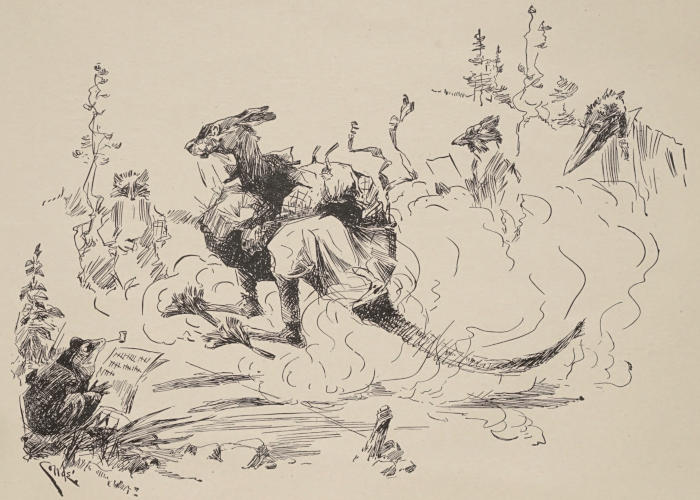
Little Monkey explains.
“Lions, take notice. The quill is mightier than the
claw.”
Yellow Lion picked off the sign and shook it between his
paws.
“The idea,” he said. “This is an insult. Just let me
find out who wrote that and there will be an awful time in this
jungle.”
He had only gone half a mile before he met Big Elephant.
“Elephant,” he roared; “whose writing is this?”
Big Elephant put on his glasses and picked up the piece
of bark and looked at it very carefully.
“Sometimes,” he said, “I write in my sleep. You know,
I used to write visiting cards with my feet, and since I stand
up when I am asleep maybe I write a little without knowing it.
I don’t remember this.”
“You are a foolish, old elephant,” roared Yellow Lion,
and he bounded away so angrily that he could hardly see. He
almost ran into Striped Tiger.
“Pardon me,” said Yellow Lion, for he had a great respect
for Striped Tiger.
“Don’t mention it,” answered Striped Tiger, showing his
white teeth. “What is this I hear about your mane?”
“Name,” replied Yellow Lion.
“O, well, it’s much the same,” purred Striped Tiger.
“The same letters. You come with me and I’ll show you
something that will make you feel very glad.”
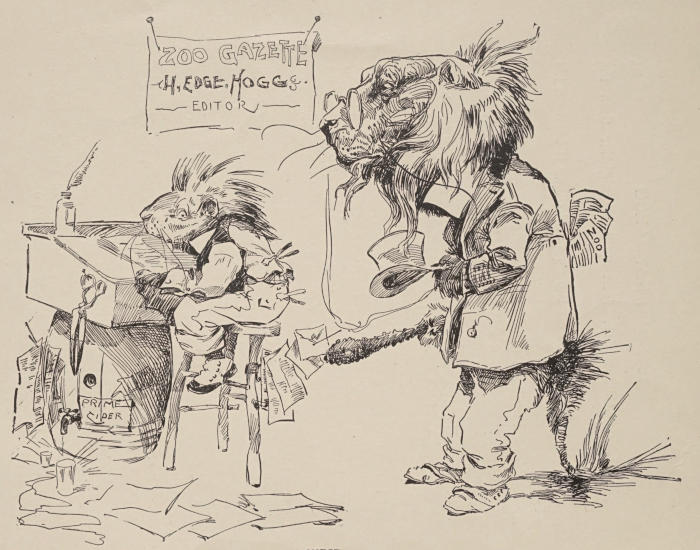
Hedgehog writing at his desk.
Striped Tiger winked at Big Elephant, who had just come
up, and all three walked through the jungle. Striped Tiger
led Yellow Lion to a large rock, on which was written:
“He has a mane which is rusty. He needs a haircut.”
“This is too much,” roared Yellow Lion.
“Ha! ha!” laughed somebody way up in the trees.
Yellow Lion looked up and saw Little Monkey swinging
along the tree tops by his tail. Little Monkey had a cap on
his head and a piece of birch bark and a quill under his arm.
“Come down!” roared Yellow Lion.
He talked so loud that Little Monkey was scared, and let
go his tail and fell to the ground. Yellow Lion picked him up
and shook him. On the piece of bark which Little Monkey had
was written, “A poor, innocent goat was killed. Ask Yellow
Lion.”
“Now I have you!” snarled Yellow Lion. “I’ll teach
you to write such things and put them up on trees.”
“Please, I’m only a messenger boy,” whimpered Little
Monkey. “Hedgehog wrote it.”
“I’ll not eat you up!” roared Yellow Lion, “if you will
take me to your master.”
So Little Monkey led Yellow Lion to Hedgehog’s house.
Yellow Lion went right into the room where Hedgehog was
writing at his desk.
“Hedgehog,” said Yellow Lion, “you have been calling
me names. You wrote that I had a mane—”
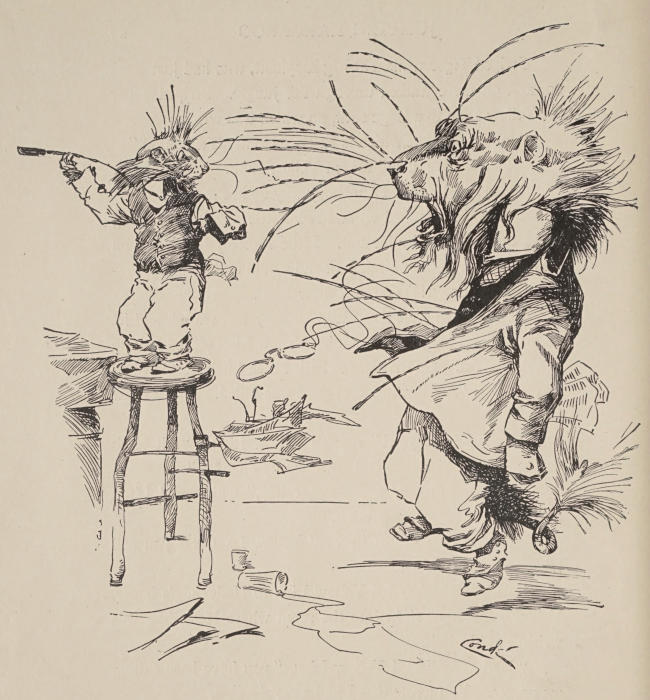
Hedgehog drives his quills.
“I thought that you had,” answered Hedgehog, in a
meek, little voice.
He was sitting on a barrel before his desk, and kept on
writing as hard as he could. He had sheets of bark all around
him, and his hands and face were all over pokeberry ink.
“That was all rusty. It is false,” continued Yellow Lion.
“Your mane looks as though it were real,” replied Hedgehog.
“You said I ought to have a haircut,” added Yellow Lion.
“Which one of your hairs,” sighed Hedgehog.
“Hedgehog,” roared Yellow Lion, “your time has come.
You miserable, little—”
“What did you say?” asked Hedgehog. “I am hard of
hearing.”
“Quill driver,” thundered Yellow Lion.
With that Hedgehog moved the back of his neck in such
a way that all the quills which were sticking behind his ears
came out like arrows shot from the bow. They stuck in the
face of Yellow Lion and made him jump and squeal and beg
for mercy. Yellow Lion ran out of the place with his paws
all over his face and the tears running down his cheeks.
“I may be a quill driver,” said Hedgehog, as he dipped a
quill in pokeberry juice, “but when I am writing I cannot
afford to be annoyed by big, yellow animals.”
III THE ANT’S AUNT GIVES A PICNIC
The ant’s aunt had to give a picnic, because she had
been invited to so many places by all her relatives,
she thought it was time to pay back some of the invitations.
“But it will be such a bother,” said the ant’s uncle, when
he heard about it.
“Don’t be foolish, now,” replied the ant’s aunt. “We
cannot go in society without going to some trouble.”
So the ant’s uncle said that it would be all right, for he
always said something of that kind when his wife talked about
giving a party.
He was sleeping early the next morning, when his wife
woke him and said: “Benjamin, Benjamin, did you remember
to get the lemons and the sugar?”
“No,” replied the ant’s uncle, as he rolled over again in
bed. “The grocery store was closed.”
“Then you will have to go into the kitchen of the man’s
house and get as much as you can carry before the cook gets
up.”
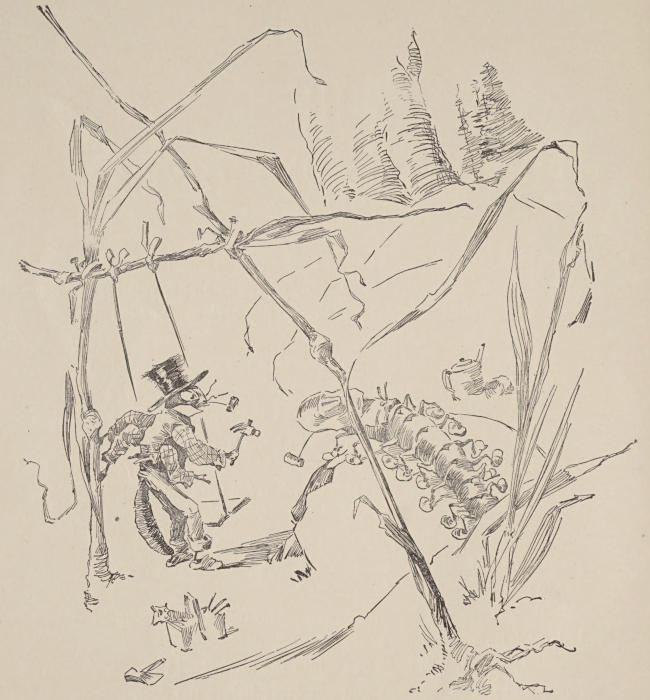
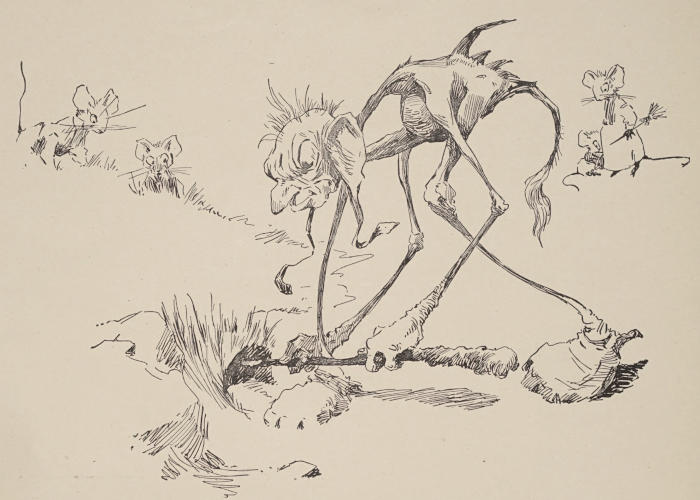
“Suppose you had a hundred toes!”
“The last time I was there,” muttered Benjamin, “I nearly
got blown up with the kerosene can.”
By the time the ant’s uncle got back to his house he found
more than a hundred ants of all kinds walking up and down
and carrying all kinds of provisions.
“You are very late,” said the ant’s aunt. “What did you
do about the swing, Benjamin? Did you stop and see the
spider about it?”
Benjamin had forgotten all about the swing, so he had to
go back to where the spider kept a shop, and he came back after
a while with a wheelbarrow loaded down with rope. The ant’s
aunt was lame, and she had to walk with a cane. She was at
the head of the picnic party and Benjamin, the ant’s uncle, came
last of all with his wheelbarrow filled with rope and baskets and
sugar and lemons and tubs and glasses and everything which
might be used on a picnic. The ants went to Deacon Jones’
woods, and as they got nearer, they heard all kinds of strange
noises. All the animals and all the birds came out to see the
picnic go by. The ants walked on until they came to a bare
spot in the middle of the woods, and there they stopped and put
down their bundles and baskets.
“This will be a nice place to set the table,” said the ant’s
aunt. “Now, Benjamin, while I am doing all the work, suppose
you go and put up the swing for the children.”
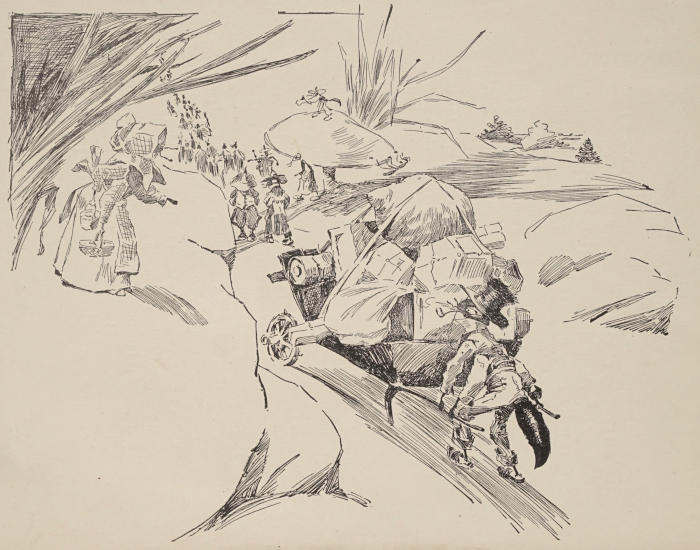
Uncle Ant and his wheelbarrow.
The ant’s uncle said something underneath his breath and
then he took the rope and the boards and things and put up 153
swings. He hurt his knee and sprained his back and cut his
fingers. He also stubbed his toes.
“You needn’t feel so badly about hurting your toes,” said
a centipede, who stopped to look, “suppose you had toes on 100
feet to stub, then you could afford to talk.”
The ant’s uncle returned to the place where the table was
being set. He threw his hat over on the grass and sat down,
saying, “I am very tired and a little rest would do me a great
deal of good.”
“Benjamin, Benjamin,” cried the ant’s aunt, “how could
you do such a thing?”
“Why, just you see what Uncle Benjamin did,” cried all
the small ants at once.
“You ought not to be so careless,” replied Benjamin,
“how was I to know that it was a custard pie? I thought it
was a nice cushion you put there for me.”
The ant’s uncle started to get his hat and walk away. He
had not gone very far before he became red in the face with
anger.
“Get off my hat,” all the ants heard him say, “how dare
you sit on a poor ant’s hat like that. Haven’t you any manners?”
“What is the matter, Benjamin?” asked the ant’s aunt,
picking up her cane and hobbling toward her husband.
“This miserable man,” yelled the ant’s uncle, “has the impudence
to sit down on my hat and he won’t get up.”
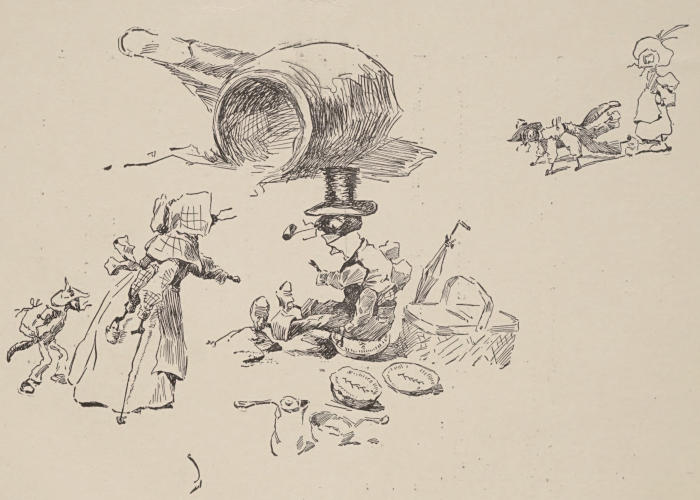
The Ant’s uncle thinks the custard pie is a cushion.
The man looked in the direction of Benjamin and then
yawned and got up and walked away.
“Benjamin, Benjamin,” cried the ant’s aunt, a few minutes
later, “little Betsy Ann has come back and she says that
nearly a dozen of the children started to climb a mountain and
the mountain got up and walked away. Won’t you please go
and try and find them?”
The ant’s uncle jammed his crushed silk hat down over his
eyes, picked up a big switch and went to find the children. He
walked and walked until he came to a place where a whole lot
of men and women were sitting in a circle while the mosquitos
ate them. The men and women were eating pickles and dry
sandwiches and trying to look happy. Uncle Benjamin hurried
down the middle of the tablecloth, calling, “Children,
children,” at the top of his voice. Everywhere he went he met
some of those miserable little children who had run away from
their own picnic. He found them sitting on the edge of a
sponge cake dangling their feet and kicking holes in the icing.
They were perched on loaves of bread and up on top of a plate
of sliced ham, they were playing hide and seek. Some of them
had climbed up into a great big tin reservoir. There were all
their clothes on the edge and they were having a swim.
“Didn’t I tell you not to go near the water?” asked Uncle
Benjamin, shaking his switch. “Now, where do I find you?”
“It isn’t water,” said all the children ants; “it’s lemonade.”
It took the ant’s uncle more than an hour to get all the
children together.
“Why don’t you come away from here?” he said.
“Don’t you hear all the men and women talking and saying
that it would be such a delightful place here if it were not for
those miserable ants?”
“They didn’t say a word,” replied the children, “until
you came.”
This made Uncle Benjamin so angry that he swung his
switch and chased all the children before him back to the place
where the table of the ants’ picnic had been spread. Way over
to one side was the ant’s aunt all alone. She had her handkerchief
to her eyes, and was crying as though her heart would
break.
“Why, what’s the matter?” asked Uncle Benjamin.
“What in the world has happened?”
“Why, can’t you see?” replied the ant’s aunt. “A miserable
man came this way and stepped right on the table, and
when he lifted up his foot everything was ruined.”
“Come on, children,” said Uncle Benjamin, “Let us all
go back to the men’s picnic. After he has treated us this way,
he deserves that we should tease him and all his family.”
That is the reason that, when men and women give picnics
all the ants in the neighborhood go and plague them.
IV THEIR FAT FRIEND
Gray Mouse and White Rabbit lived under the floor
of the barn and were very happy. The only
thing which ever bothered them was Small Dog.
They hated Small Dog worse than poison.
“Poison always stays in one place,” said Gray Mouse,
“but Small Dog is always jumping and digging. If he lives
around this barn we might as well go away. Why, the other
day he chased me right up to my front door, and if I had not
been quick with my latch key, I am afraid that he would have
jostled me very rudely!”
Then Gray Mouse stopped talking and nearly jumped out
of his skin. White Rabbit raised his ears and made his whiskers
tremble. Right over their heads they heard a noise like
thunder. Gray Mouse and White Rabbit ran up under the
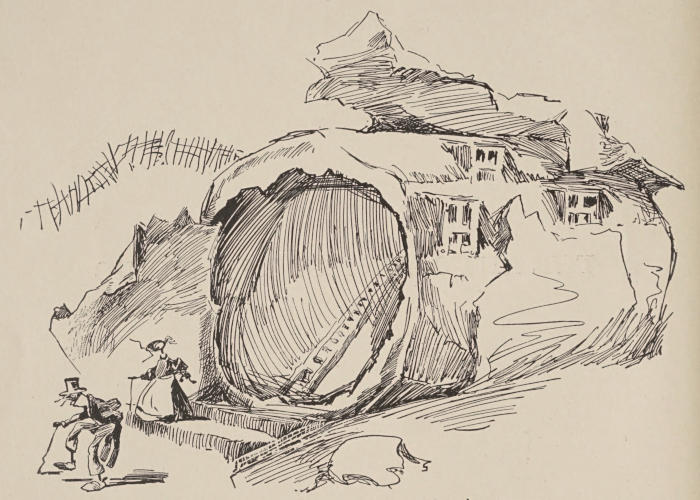
manger and peeped out. There they saw something which
looked like a big barrel placed on four piano legs. It had a
long pipe in front of it, four or five times bigger than the garden
hose, and this big pipe was swinging backward and forward.
“What’s that?” asked White Rabbit, resting his paw on
Gray Mouse’s arm.
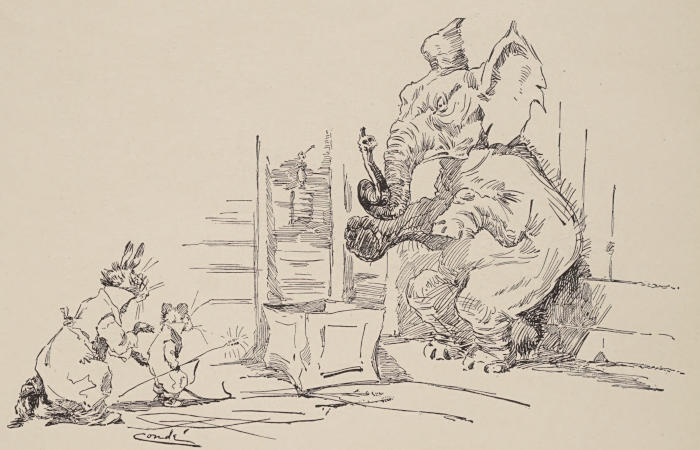
“Please, Mighty Mouse!”
“It looks to me,” answered Gray Mouse, “like an animal
which the man has in the parlor of his house, at least his legs
look like those of that poor beast. The man’s daughter boxes
the creature’s ears for two hours every morning, and although
he cries and cries she will not stop.”
“You do not know very much,” whispered White Rabbit.
“I heard the man say one morning that his little girl was
pounding the piano in the parlor, and this thing is not a piano
at all.”
Just then the creature winked his little eyes and made its
big ears go flop, flop.
“It seems to be alive,” said White Rabbit.
“Yes,” answered Gray Mouse, “and it looks a little bit
like me only he is bigger than Black Horse. What a funny
long nose he has! You speak to him, White Rabbit.”
“I’m too bashful,” replied White Rabbit, as he backed
away.
He caught hold of Gray Mouse and pushed him right
through the hole under the manger. Gray Mouse fell on the
ground in front of the strange animal. One of the big beast’s
feet kicked up the earth and covered up the hole out of which
Gray Mouse had come. Gray Mouse was so scared that he did
not know what to do. Besides he heard Small Dog snuffing
at the barn door and scratching with his paws.
“What in the world shall I do?” squealed Gray Mouse.
“Suppose Small Dog should get in? The door is not latched
and he could open it, with his sharp nose and his big paws.”
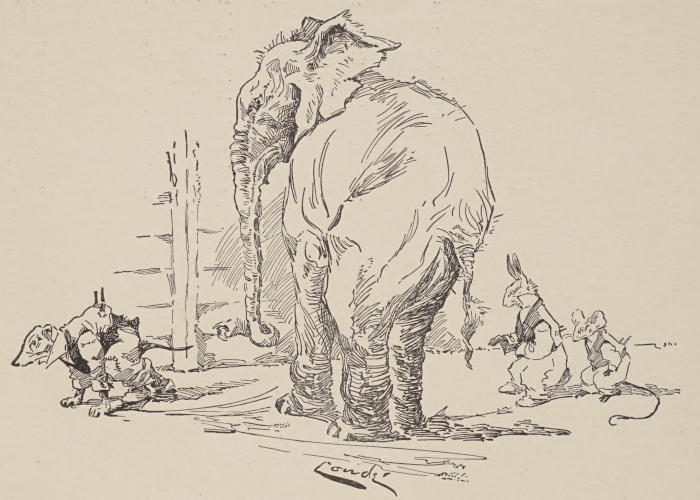
“I’ll break every bone in your body!”
Gray Mouse crouched down in a corner and trembled all
over.
“O, O,” he cried, “what shall I do?”
Then the big beast heard him and looked down, his eyes
opened wide and he hopped around on his great feet and made
a noise like a trumpet.
“Please, Mighty Mouse,” roared the big beast, “don’t
crawl up my trunk; please don’t bite my poor, little, tender ears.
Spare my life and I will always be your friend.”
Gray Mouse tried to stop trembling, for he saw that the
great beast was afraid of him. He stood up on his hind legs,
folded his arms, took a deep breath, and swelled out his chest.
“And who are you, sir?” squeaked Gray Mouse, “that
you dare to shake down the plastering of my house with your
clumsy feet?”
“Please, sir,” answered the big beast between his sobs, “I
am only a poor little elephant, who came in town with the circus,
and they put me here in your barn until it was time to
parade. I am sorry that I knocked down the plastering of your
house, and if you will have mercy on me I will come down there
and put it back again.”
“Don’t be afraid,” whispered White Rabbit, who had dug
away the earth from over the hole under the manger and had
come out behind Gray Mouse. “Whip him, Gray Mouse; here
is a straw; now give him a good beating.”
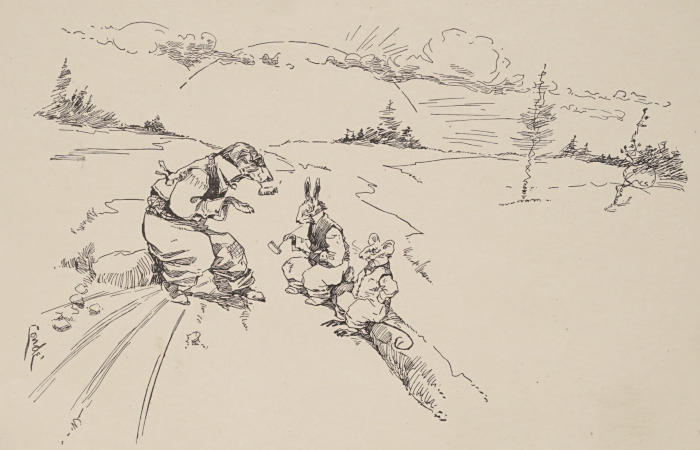
All three are very good friends.
Elephants are afraid of mice. So Gray Mouse, with his
paws all shaking, took the straw and walked toward the elephant.
He heard the hinges of the barn door creaking.
“Come away, Gray Mouse,” cried White Rabbit, “Small
Dog is coming.”
“I’ll let you alone on one condition, Elephant,” said Gray
Mouse, trying to be brave, although he was trembling so that
he could hardly hold the straw, “and that is when you see any
of my enemies trying to annoy me, that you teach him a good
lesson.”
Small Dog got the door open and came jumping with his
mouth wide open and his white teeth shining. Gray Mouse
and White Rabbit ran into the hole under the manger. The
Elephant, who feared nothing on earth except mice and flies,
for he had once killed a tiger, wound his trunk around Small
Dog. He lifted Small Dog up to the rafters and threw him
down on the ground so hard that all the bark went out of him.
“If you disturb my little friends again,” roared the Elephant,
“I’ll break every bone in your body.”
Small Dog walked on crutches for weeks after that, and
he has never annoyed White Rabbit and Gray Mouse in their
happy home. In fact, all three became very good friends and
many is the time I have seen them sitting out in the barnyard
smoking their corn-cob pipes.
V WHITE RABBIT’S CHEESE SCRUPLE
White Rabbit had so many scruples that sometimes
he could not sleep. He awoke one
night and came over to Gray Mouse’s bed
and pulled at the covers.
“Gray Mouse,” he whispered, “I have a scruple, and it
keeps me awake. I am afraid that it would not be right for
you to go to the Man’s house to-night just because there has
been a party, and there are so many good things lying around
within reach.”
“Who said anything about cake?” yawned Gray Mouse,
and he rolled over as if he were going to sleep again.
“Gray Mouse,” called White Rabbit, “I thought that I
ought to ask you. Do you think it would be wrong if I went
along with you and just took a look into the cellar to see if that
careless cook had forgotten to put away the carrots?”
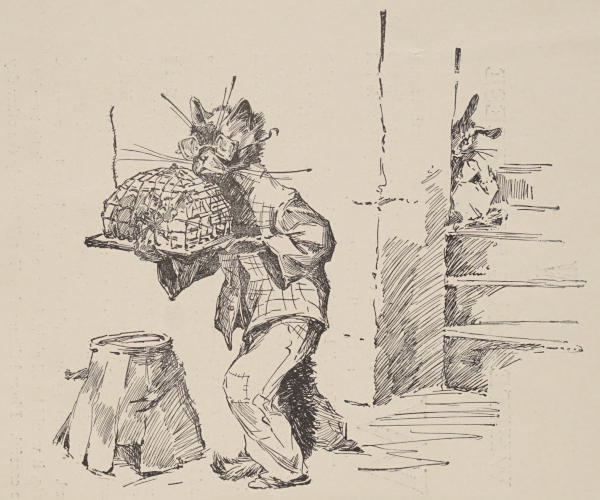
Green-Eyes gets the trap.
“Certainly not,” answered Gray Mouse, scrambling out of
bed. “Even if you should make a mistake and eat some carrots,
it would be all right, because it would teach that cook to
be careful. I heard the man’s wife tell her only the other day
that she was the most careless cook they had had for a week.
If I should find some cake, it would be well for me to eat as
much of it as I can, so as to keep the man’s children from
making themselves ill.”
So Gray Mouse and White Rabbit hurried out from under
the barn floor and went to the cellar of the man’s house,
laughing and jumping.
“What a pretty, little house,” said Gray Mouse, for in the
centre of the cellar floor was a little wire box with a funny door.
Gray Mouse and White Rabbit walked all around it.
“Why,” said Gray Mouse, “it has cheese inside of it.
Put in your paw, White Rabbit, and pull out that fine supper
for me.”
“No, thank you,” answered White Rabbit, “I have such a
scruple. That is toasted cheese inside of the little house, and
toasted cheese is what men call Welsh Rabbit. I will let you
know, Gray Mouse, that I am no cannibal. The door is open.
Why don’t you go in and get the cheese yourself?”
“You are not very obliging, White Rabbit,” replied Gray
Mouse, “but since you are so mean I think that I will get it
myself.”
So Gray Mouse walked into the wire house and tried to
carry away the cheese which was fastened on a little rod.
There was a click and the door of the wire house closed behind
Gray Mouse with a snap. Gray Mouse was in a trap which
the man had set for him.
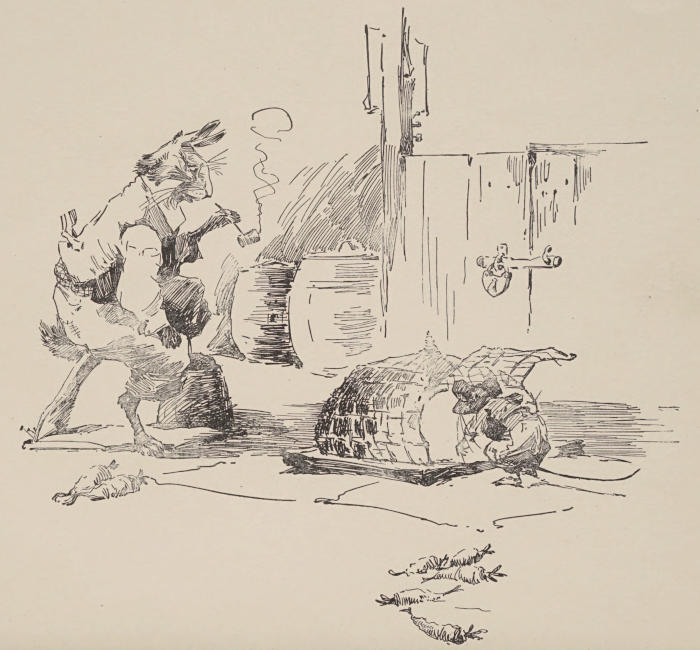
Gray Mouse goes into the trap.
“Help me out, White Rabbit,” shrieked Gray Mouse.
“Your jaws are larger than mine. Bite a hole in the side of
this house so I can come out!”
White Rabbit had chewed carrots and turnips and soft
things all his life, and it only set his teeth on edge when he
tried to cut a way for Gray Mouse out of the little wire
house.
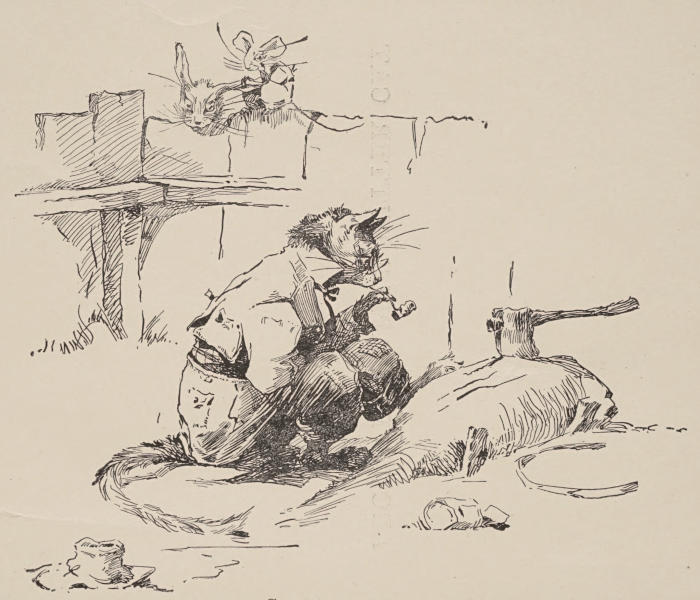
“Scat B-r-r-r,” came a noise, and old Green Eyes, the cat,
sprang from out behind a tub. White Rabbit jumped out of
reach.
“Ugh!” meowed Green Eyes to Gray Mouse, “I’ve got
a thief and I’m going to eat him.”
Green Eyes tried as hard as he could to get his paws
through the cage. One of his claws caught Gray Mouse in the
side and made the blood come. Green Eyes became very angry
when he saw that he could not reach Gray Mouse. He struck
the trap with his claws. He picked it up and gave it a good
shaking. He lifted it over his head and threw it down on the
floor as hard as he could. The trap rolled over and over and at
last rested bottom side up. That made the door, which had
been closed all this time, fall back. When Gray Mouse saw
that the door was open all he had to do was to jump right out
of the trap. He scuttled out of that cellar as fast as he could
and up at the top of the steps he met White Rabbit.
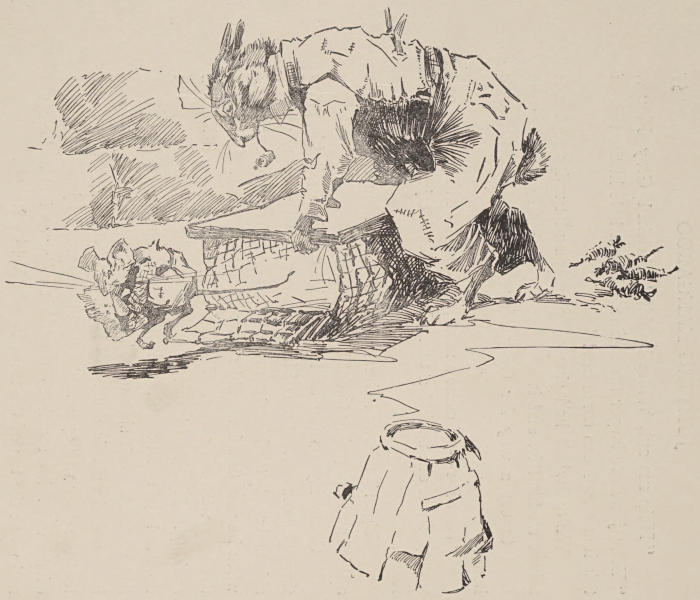
White Rabbit turns over the trap.
“It was very warm down there,” said White Rabbit, as
he saw Gray Mouse, “and you know that my fur is so thick
that I did not feel like staying down there any longer. It was
very bright of you to get out of that trap.”
Then White Rabbit and Gray Mouse went away to the
barn laughing and chuckling to themselves. They went back
to the house the next night.
“Now, then,” said White Rabbit, “you go into the trap,
Gray Mouse, and I will pretend that I am the cat.”
Gray Mouse went into the trap and helped himself to the
cheese, and when the door snapped he only laughed. Then
White Rabbit turned the cage over and the door fell back and
Gray Mouse crawled out again.
“That is very fine,” said White Rabbit. “If it had not
been for my cheese scruple it would never have happened. If I
had put my paw in there I could not have reached the cheese,
and besides that, you would not have had nearly so much fun.”
Gray Mouse and White Rabbit went every night and got
all the cheese in that trap and in all the traps around the house.
Gray Mouse took home so much cheese that he did not know
what to do with it, and White Rabbit feasted on carrots. They
paid no attention to Green Eyes at all. Whenever the cat
came after Gray Mouse, that saucy animal would get himself
caught in a trap and laugh at the cat. Gray Mouse and White
Rabbit grew bigger and stronger every day, and they could run
so fast that the cat could never catch them.
VI ABOUT THE APPLE BUTTER CAT
Green-Eyes, the cat, was very angry when he
found that the man thought that he could not catch
mice. He was afraid that he would be put out in
the kennel with the dog. He and the dog had
never been very good friends and he did not like the idea of being
in the same house with an animal with such sharp teeth and
such a harsh voice.
Green-Eyes used to sit up all night with his paw on his
head, saying, “Let me think.” The neighbors’ cats came out
on the back fence and made fun of Green-Eyes all night long.
“It’s too bad,” they meowed, “that you cannot see in the
dark. Why, you cannot even see a big white rabbit.”
Gray Mouse and his friend, White Rabbit, went every
night to the cellar of the man’s house, where they helped themselves
to cake and apple pie and cheese and carrots. Green-Eyes
heard the man say that it was time to drown that good-for-nothing
cat. He saw it was time for him to do something
to save his life, and so he kept on thinking and thinking.
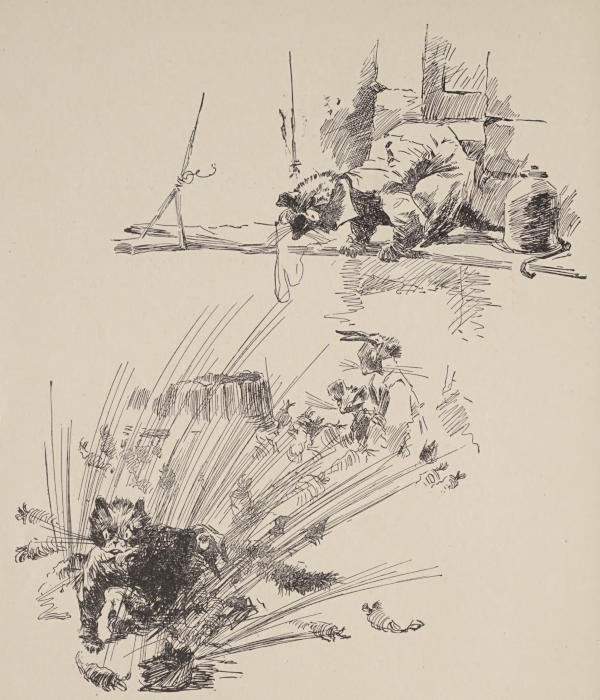
Patrick O’Possum pushes over the apple butter jar.
He crawled under a pile of carrots on the cellar floor one
night and the carrots fell all over and hid him all except
the tip of his tail. Then he waited for White Rabbit and Gray
Mouse.
Now, that night Patrick O’Possum went to visit Gray
Mouse and White Rabbit. He was a friend of Gray Mouse’s
cousin, Field Mouse, and whenever he went under the barn
floor, where Gray Mouse and White Rabbit lived, he was very
welcome.
“Gray Mouse,” asked Patrick O’Possum, “do you know
where I can get any good, sweet potatoes?”
Gray Mouse winked at White Rabbit and said that he
knew where there were sweet potatoes nearly a foot long and
so sweet that sugar tasted like vinegar compared to them. Patrick
O’Possum sighed and looked happy.
“I’ll take you to the next moonlight party I have,” he said,
“if you will show me where I can find those very fine sweet
potatoes.”
So Patrick O’Possum, Gray Mouse and White Rabbit
went running and hopping and laughing to the cellar of the
man’s house. Patrick O’Possum turned to Gray Mouse and
White Rabbit after he had taken a good look around the cellar,
and then he smiled, and smiled.

Retreat of the Apple Butter Cat.
“I like sweet potatoes very much,” he whispered as he
drew White Rabbit and Grey Mouse close to him, “but I would
not give a cent a bushel for all the carrots in the world. If I
had white fur and long ears I would rather eschew those carrots
over there than chew them.”
Then Patrick O’Possum poked Gray Mouse and White
Rabbit in the ribs and laughed inside. The sweet potatoes
were in a large swinging box near the pile of carrots. Patrick
O’Possum jumped up and got on top of the box. He took out
some sweet potatoes and tossed them down on the floor. White
Rabbit picked them up and carried them out of the cellar, while
Gray Mouse stood by. There was a long shelf above the
swinging box where the sweet potatoes were and on this shelf
were jars of jelly and jam and spiced watermelon and all kinds
of good things. At one end was a big jar of apple butter. After
Patrick O’Possum had thrown down all the sweet potatoes
that he wanted he crept along the shelf and gave the jar of apple
butter a hard push. It fell, struck the edge of the sweet potato
bin, broke all to pieces and apple butter and broken jar
and all fell right on top of the pile of carrots. There were the
queerest sounds which came out of that pile of carrots that you
ever heard. Green-Eyes meowed and cried and kicked and
arched up his back. He shook up that pile of carrots as though
there were an earthquake in the cellar. Then all covered over
with apple butter and little carrots and bits of broken crock,
he went up the cellar stairs yelling and screaming at every step.
“Did you ever see an Apple Butter Cat?”
White Rabbit and Patrick O’Possum picked up all the
sweet potatoes that they could carry and ran away to the barn.
Gray Mouse led the way. As they hurried along they got a
glimpse of the man who was coming down the hall in his night
clothes with a gun over his shoulder. Just as the White Rabbit,
the Gray Mouse and Patrick O’Possum scampered under
the barn floor, they heard bang-bang, from the porch of the
man’s house.
“That must have been a shot gun,” said White Rabbit, as
he stroked his whiskers and smiled.
“Um, um,” said Patrick O’Possum, “but these are good
sweet potatoes. This is more fun than a coon hunt.”
Green-Eyes never went back to the man’s house again.
Many of his friends thought that the man had shot him and
the next night out on the back yard fence, all the neighbors’ cats
met together and sang his funeral song. I think, though, that
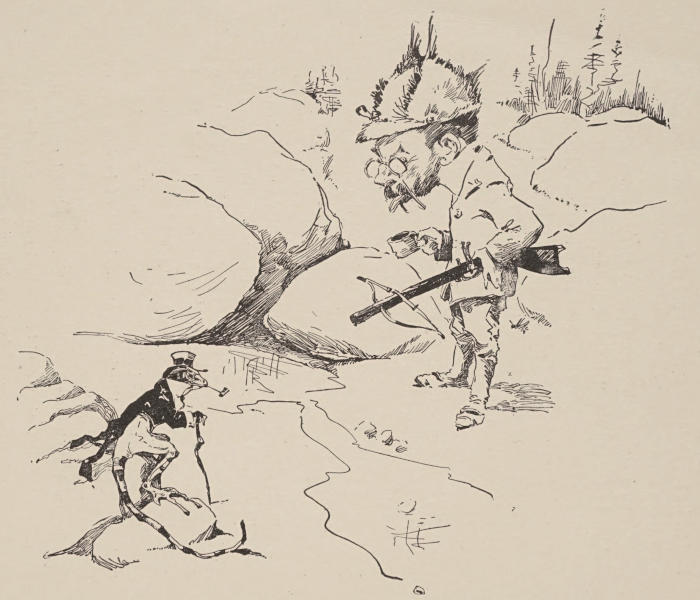
Green-Eyes was not killed. One day, when I was out hunting
in the woods, I stopped to take a drink at a little spring and a
funny, little lizard stood on the edge and said: “Excuse me,
Mr. Hunter, but did you ever see an apple butter cat?”
VII GRAY MOUSE’S RICH BROTHER
Gray Mouse was sitting on his front porch one afternoon,
when he heard a rumble of wheels and a
coach stopped before the door. It was the funniest
coach you ever saw, and it was drawn by four
tumblebugs all covered with silver harness. Two grasshoppers
sat on the box. One of them jumped down and opened
the door. Then a big, fat mouse, all dressed up and carrying
a cane with a gold head, got out and came up the steps of Gray
Mouse’s house.
“You don’t seem to know me,” said the fat mouse as he
clapped Gray Mouse on the back.
“Your ways are familiar,” answered Gray Mouse, “but
your face I do not remember at all.”
“Why, I am your long-lost brother, Church Mouse,”
squeaked that wealthy animal, “and I have just come back to
visit all my friends and relations.”
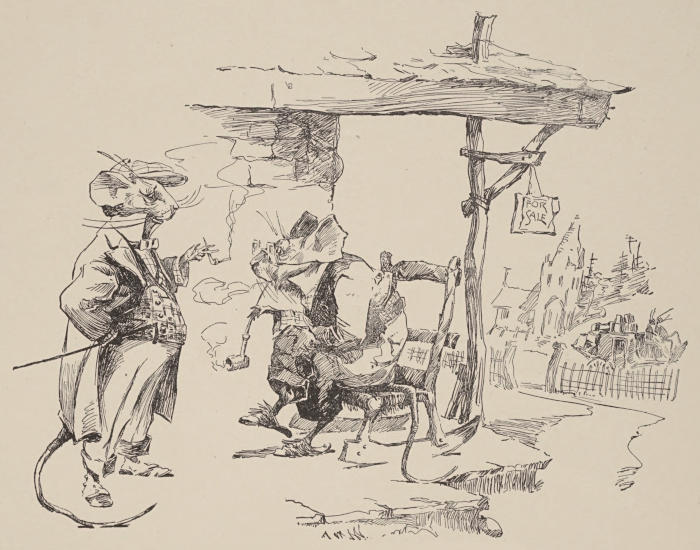
Church Mouse strutted up and down the porch, whirled
his cane and played with his watch chain. Gray Mouse was
sitting in his old rocking chair and he had on his shabbiest pair
of carpet slippers.
Adder asks what witch Church Mouse means.
“You need not be so proud,” said Gray Mouse. “I remember
the time when you did not have a piece of cheese with
which to bless yourself. Don’t put on any airs with your coach
and your old tumblebugs. I have not forgotten when you
lived in the church across the road, and were so poor that many
is the time you were glad to come over to my poor little house
for dinner.”
“You need not be cross,” replied Church Mouse, “I am
not proud, and to-morrow I shall bring you a very large
cheese.”
“I am very glad to see you,” said Gray Mouse, changing
his manners and smiling. “Now, tell me how did you get
so sleek and fat?”
Gray Mouse brought his best easy chair out on the porch,
and Church Mouse sat down in it and crossed his hands over
his stomach.
“Well, I was so poor,” began Church Mouse, “that many
is the time I have gnawed the backs of hymn books. One day
I was wondering how I was going to get along, and decided
to be a book agent. So I got Hedge Hog, who is clever with
quills, to write a book for me, called ‘The True History of the
Great Which What.’ Then I started out to sell it.
Yellow Lion inquires if there is anything in the book about him.
“Well, it was very hard work at first. Cochin, the chicken,
slammed the door of his coop right in my face. Chip
Munk chased me off his door mat, Snapping Turtle called me
names and bit off the end of my tail. Then I saw the Adder
and I said just as politely as I could: ‘Mr. Adder, I have here
the True History of the Great Which What.’
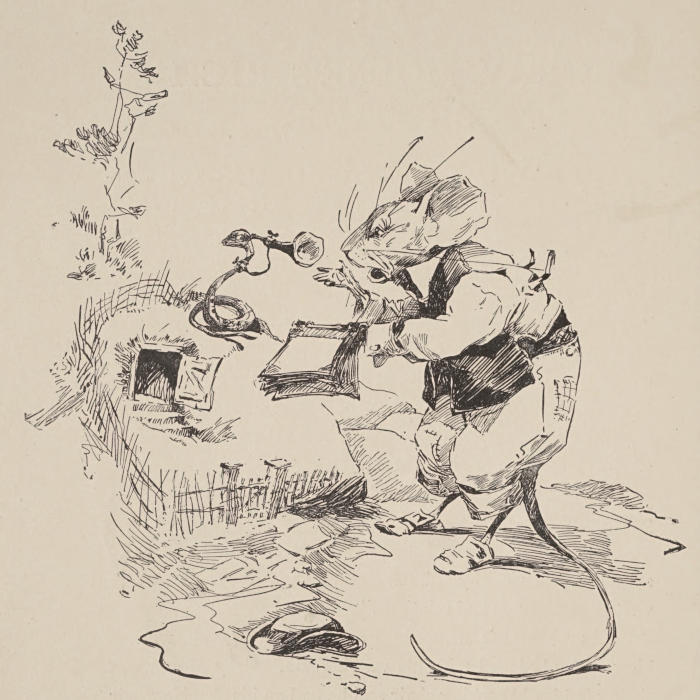
“‘What witch?’ asked Adder, who was as deaf as anything.
He had an ear trumpet, but I do not believe that the
trumpet helped him to hear any better.
“‘No witch,’ I answered.
“‘Norwich is in Connecticut,’ answered Adder. ‘That
is where I bought my ear trumpet.’
“‘I said Which What,’ said I.
“‘No,’ replied the Adder, ‘I do not need any dried apples
to-day.’
“I was so angry that I cried. I went to the wheat bin out
in Deacon Jones’ barn and there I met my old friend, Weevil.
“‘Of course,’ said Weevil, when I told him about my bad
luck, ‘you don’t sell books here because everybody is so intelligent.
You come with me to Asia and you will do far better.’
“So I stayed in the bin with Weevil. In a day or two, the
wheat was put in a wagon and taken to the railroad station.
Before long it arrived in New York. Then it was thrown
down hill into a ship and for days and days after that Weevil
and I knew nothing except the splash of waters and the tip, tip
of that great ship.
Gray Mouse says he is proud of his rich brother.
“We reached the place called Asia. As soon as I got a
chance I said good-by to Weevil and walked until I was in the
jungle. When you sell books it is a good thing to know somebody
who is big. Weevil told me to go the first thing and see
Yellow Lion. I heard Yellow Lion roaring among the trees
and I walked up to where he was sitting.
“‘Yellow Lion,’ I said very politely, ‘Yellow Lion, won’t
you please buy my book?’
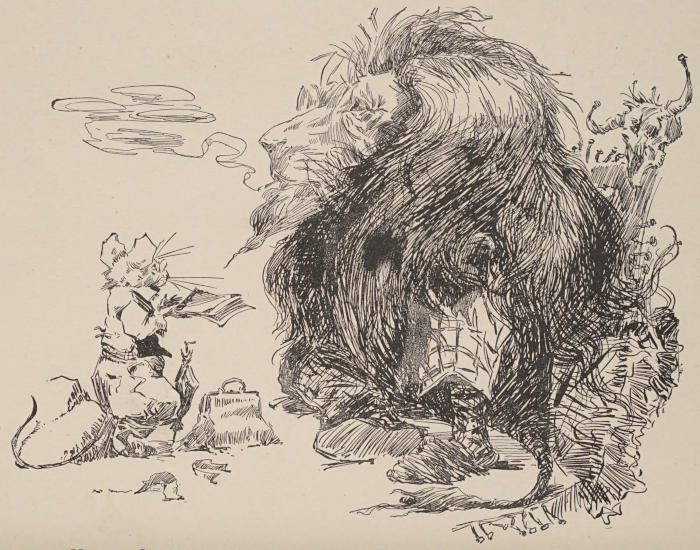
“‘Has it got anything about me in it?’ asked Yellow
Lion.
“‘No,’ I answered.
“‘Well, then, I have no time to talk to little animals like
you,’ said Yellow Lion. ‘You will oblige me by getting out
of my lair, or I shall step all over you.’
“‘Very well,’ I answered; ‘I do not wish to crowd you,
Yellow Lion; and I am not of a revengeful nature.’ So I stood
up straight, and looked very proud and angry.
“Two days after that I was walking through the jungle
when I heard a loud noise. I peeped through the bushes and
there I saw Yellow Lion lying under a hammock.
“‘Good morning,’ I said. ‘Seeing that you are so comfortable
in your nice, new hammock, I thought I would just
come and say how d’ye do.’
“‘You mean, little animal!’ roared Yellow Lion, ‘don’t
you see that the hunters have caught me in a net?’
“‘It is too bad,’ I answered, ‘that you are in a net, but it
is still worse to be in the jungle without a copy of “The True
History of the Great Which What.” In the little book which
I hold in my hand is told why the what is which and what the
what what said to the which who of the when did.’
“‘Stop, stop!’ roared Yellow Lion.
“‘Here is a chapter,’ said I, ‘which tells how a lion got
caught in a net and how a poor, little mouse in return for a
kindness cut the net with his sharp teeth and set the lion free.’
“‘What kindness?’ asked Yellow Lion.
“‘All that the lion did,’ I answered, ‘was to buy a book
which the mouse was selling.’
“‘I’ll take that book,’ said Yellow Lion. ‘I’ll take a hundred
of them—and when I get out I’ll make everybody else buy
one.’
“‘All right, Yellow Lion,’ said I.
“Then I gnawed the net, and Yellow Lion got away. The
king of beasts kept his word. I sold more than a million copies
of the book from that one sample, for Yellow Lion told all the
beasts that they must buy. That is how I became so rich.”
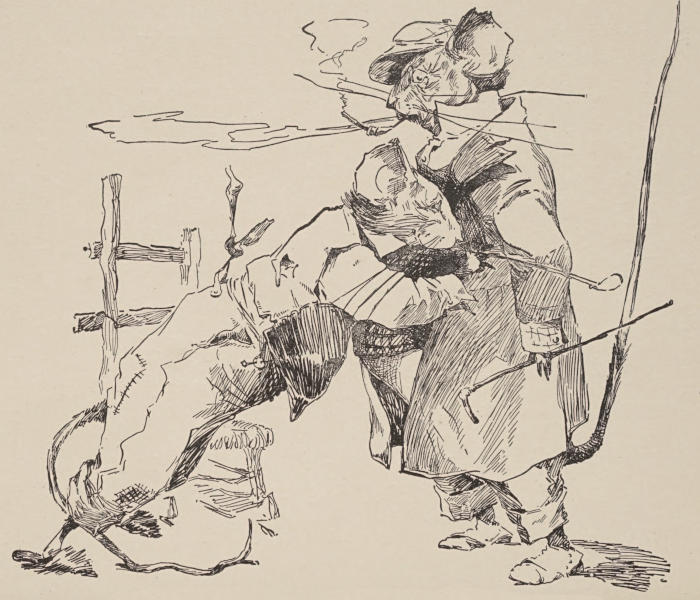
“You are certainly a clever little animal,” said Gray
Mouse, when Church Mouse had finished the story. “I am
very proud of my rich brother.”
VIII AT THE CHURCH MOUSE’S CIRCUS
Church Mouse had so much money after he came
back from India that he decided to start a circus.
“There is nothing,” said he, “which will
make so much money as a circus, for red lemonade
costs only half a cent a barrel and we sell it for five cents a
glass; and there is so very much money in selling candy at two
sticks for a cent apiece that I really think that I ought to start
a very fine circus.”
So he hired all the spiders he could find to make him a tent
and had Patrick O’Possum cut some very fine tent poles. He
pitched the tent right out in the middle of Deacon Jones’
meadow lot. He got Ugly Dog to sell tickets because nobody
would dare to give Ugly Dog any bad money. Ugly Dog was
such a good barker that all the animals and all the birds could
hear him as he said:
“Here, birds and animals, is your superior circus. Step
right up and see the fierce lion, brought from his native lair and
the great and only striped tiger which can eat a man without
asking by your leave. Come on, birds and animals, for this is
the only show on earth owned by a church mouse. Circus, menagerie
and hiphopadrome, all under one tent. Walk right up.”
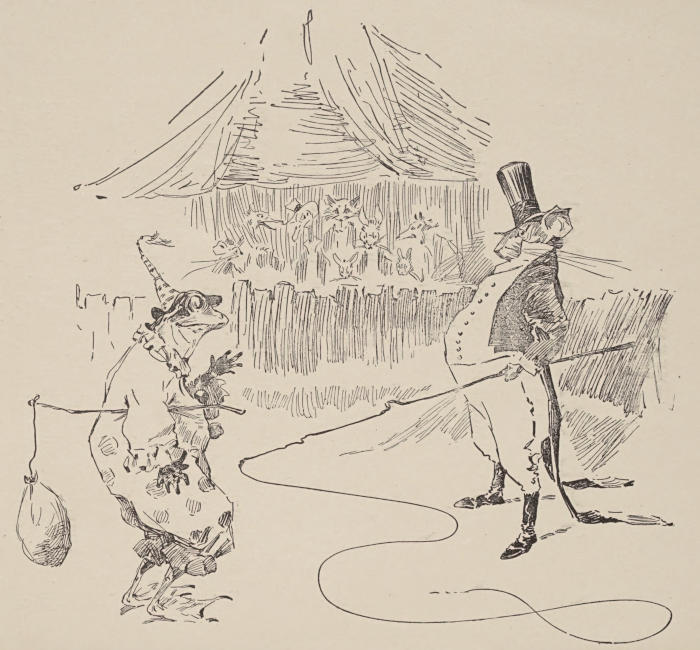
Clown Leapfrog’s joke.
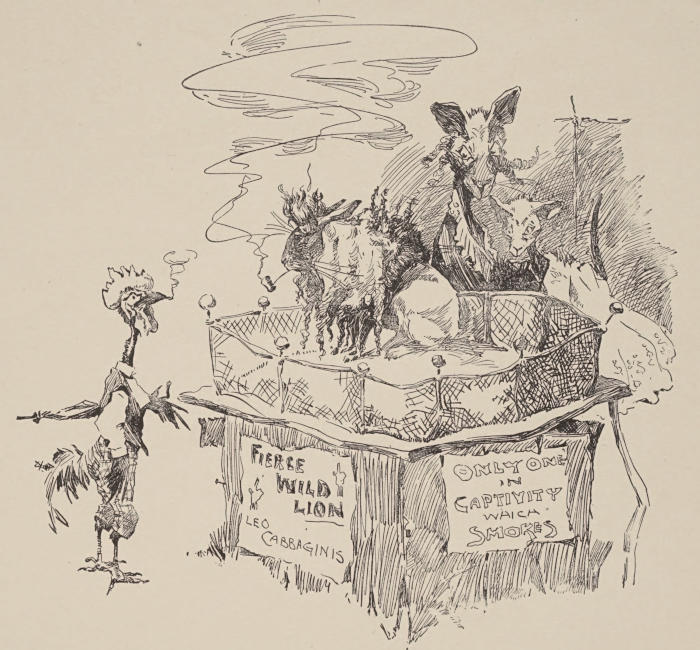
Church Mouse had tried to get a real live tiger, but he
found that he could not afford to pay for a tiger’s ticket all the
way from India, so he got his friend Field Mouse to put on
striped clothes and look very fierce and be the tiger. Mole was
the elephant and White Rabbit put some wool around his neck
for a mane and pretended that he was a lion. This circus was
held at night and the glow worms came in free on condition
that they would hang from the top of the tent and give all the
light that was needed.
Church Mouse had been so careful in arranging the circus
that when the animals came they thought it was the finest show
which they had ever seen. When they got to looking too closely
at anything and began to wonder if all lions were white and
had long ears, the lights would go out all at once and they had
to think about something else. Over in one corner was a little
musk rat in a tank and all the animals and all the birds, although
they thought that they had seen him before, believed
that he was a hippopotamus. The more they looked at him the
more they wondered, for he seemed like such a wonderful
animal.
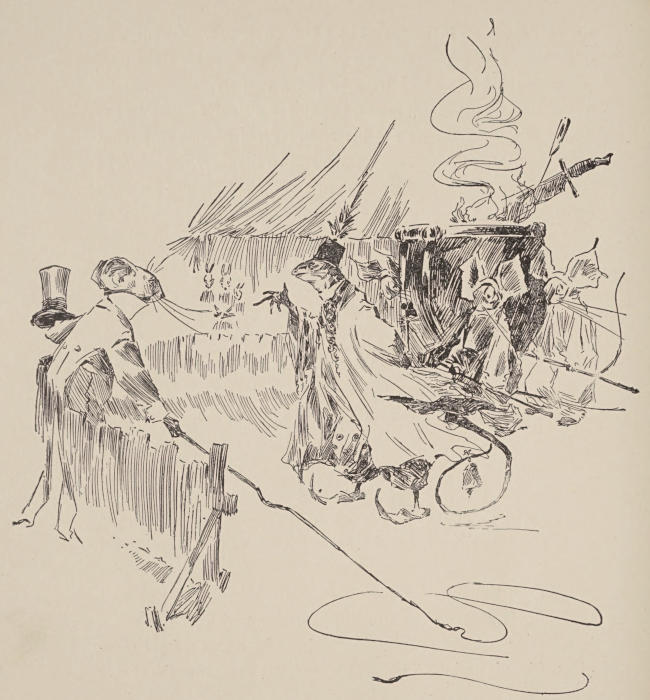
Salamander says he eats fire.
When the time for the circus came, all the birds and all
the animals gathered around the ring for which more than a
hundred ants had brought the sand. There was a loud clapping
of hands and the Tumblebug Brothers came into the centre
of the ring kissing their hands to the crowd and making a low
bow to everybody. They leaped up into the air and turned
somersaults and stood on their heads, and whirled around on
their backs. Every time they did anything wonderful all the
beasts and all the birds clapped their paws or shook their wings
and said: “Isn’t this a very fine show, indeed?”
Then about twenty ants, all dressed up in green, rolled two
great big balls into the middle of the ring. Each Tumblebug
took one of these balls, which was as big as he was himself, and
whirled it around and up and down, and then he lay on his
back and with his feet threw the ball clear up into the air and
caught it again. Then the Tumblebugs threw the balls back
and forth to each other.
Nimble Grasshopper came out, and he jumped clear over
the back of the make-believe elephant and the make-believe lion
and came right down again on his feet. Then Leap Frog came
stumbling out into the middle of the ring all covered over with
flour and with red paint on his face and a little bit of a white
pointed hat on his head.
“When is a mouse when it is spinning?” he asked.
All the animals and all the beasts looked at each other and
said: “Why, we don’t understand. When is a mouse when
it is spinning?”
Leap Frog looked all around, and then said: “What!
Give it up? Don’t know? Can’t guess? Too hard? Why,
it’s very easy indeed. The answer is, a paper of tacks.”
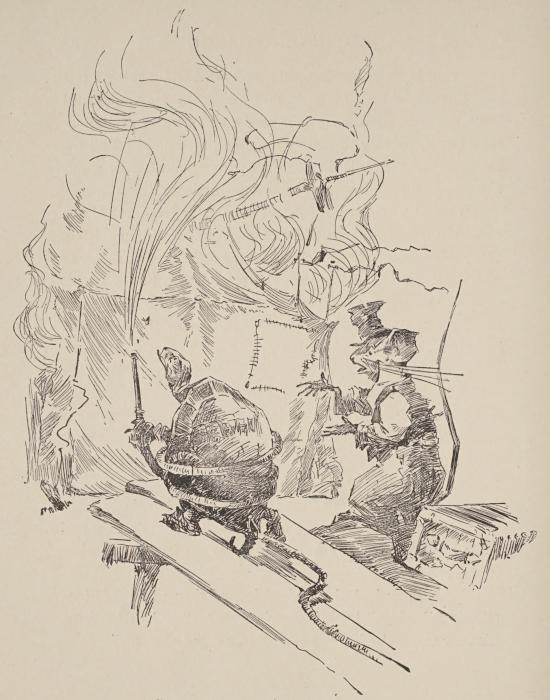
Church Mouse’s circus burns.
Then all the birds and all the animals laughed like anything.
“What a very good joke,” they said. “How very clever!
And isn’t it strange that we should never have thought of it
before?”
“Now, then,” said Church Mouse, who was all dressed up
in a long coat, and had a silk hat and a long whip. “As the
ring master of this show, I want to introduce my great and
good friend, Sig Salamander, who eats fire for breakfast instead
of oatmeal, and drinks his coffee boiling hot. He will
now do himself the honor of eating a red hot poker as though
it were a stick of molasses candy.”
Then Salamander came out, followed by four mice, carrying
a pan of coals.
“Everything that I have,” said Salamander, “must be red
hot. Once I ate some red pepper drops and ever since that
nothing has been too hot for me.”
He ate all sorts of fire, and then Wasp got up and said that
he did not think Salamander could stand everything hot, and
with this he gave him a sting.
Salamander ran away from the place, and as he turned to
go his feet kicked the pan of coals and sent them way up in the
air, until they set fire to the tent. All the beasts and all the
birds saw the flames above them, and they were nearly scared to
death. They scampered everyway that they could. They
knocked down the seats and kicked over the tent poles, upset the
animal cages and spilled the red lemonade. Before Church
Mouse knew what had happened his tent had all burned up, and
it was all that he could do to save his money and his boxes of
cheese. After it was all over he sat looking at the ruins, and
then said:
“It seems to me that I have made a great mistake. If I
ever have a salamander in a circus of mine again I will have
everybody who sees the circus a salamander, too.”
Although the tent had burned up, Church Mouse had
made so much money that he did not have to work any more.
He built a fine house, and every Sunday as you saw him sitting
in church under one of the pews you would never have believed
that he knew a single thing about circuses.
IX HOOT OWL INVENTS GOLF
The Bogey Man was so fond of playing golf that he
never had time to think of anything else. He
lived on oatmeal water and smoked a pipe filled
with cabbage leaves and chopped hay. Golf was
played in those days with one straight stick, and all you had to
do was to knock round stones over the meadow. The Bogey
Man was very careless, and he was always sending the golf
balls into the holes where the rabbits, field mice and snakes
lived. He played every day in Deacon Jones’ meadow lot.
He used to take his stick, when he lost the balls and pry into the
homes of the poor, little animals and snakes. In that way he
spoiled the walls and broke the parlor furniture.
One day, the Bogey Man put a ball on top of an ant’s
house, because he said he could strike it better. The roof of
the house fell in and the ant’s aunt was so badly hurt that she
never got over it.
“Something must be done,” said all the snakes and rabbits
and field mice and ants who lived in Deacon Jones’ meadow
lot.
They had a convention near the old stump in the middle
of the meadow, and the garter snake was the president.
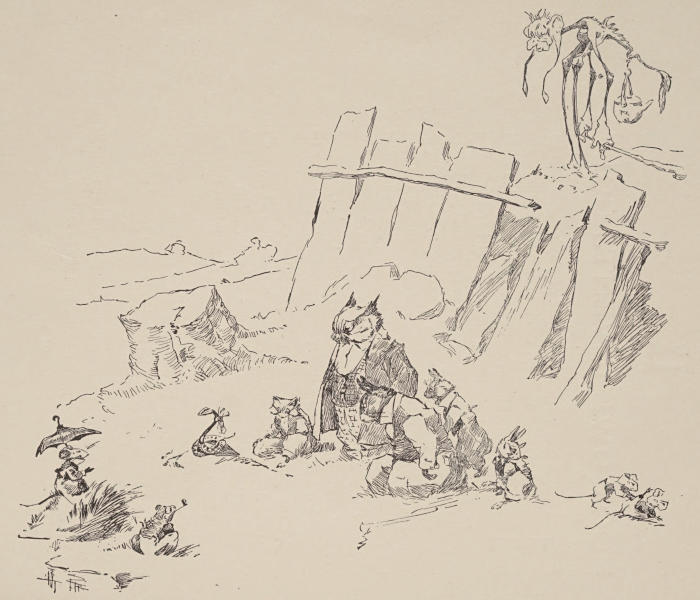
Field Mouse asks if the Bogey Man scares the children.
“Is this the person who always scares the children so?”
asked the field mouse.
“No,” replied the Hoot Owl, who was the wisest of birds.
“He is worse than that. He is the man who thinks that he
knows how to play golf.”
“Hoot Owl,” whispered the Garter Snake, “you and Sly
Fox must get rid of this terrible Bogey Man, who is all the
time poking around our houses and making us uncomfortable.”
When the Bogey Man went to play golf in the pasture
next day, he heard a hoarse voice away up in a tree.
“Hoot man, hoot!” said the voice. “It seems to me that
you really do not know how to play golf.”
The Hoot Owl came down from the tree all dressed up
in baggy, spotted clothes. He had a pipe in his beak and a big
club in one claw.
“I’ll let you know,” replied the Bogey Man, “that I have
had games with some of the very best players in the country,
and besides that I can talk Scotch better than you can.”
“Ho, ho,” answered the Owl, “my people said hoot before
there were any Scotchmen. I’ve come to show you how to
play the real game of golf.
“Follow me,” screamed the Hoot Owl.
He led the Bogey Man to a field which was all rough. The
rabbits and the field mice had been working all night making
holes everywhere they could.
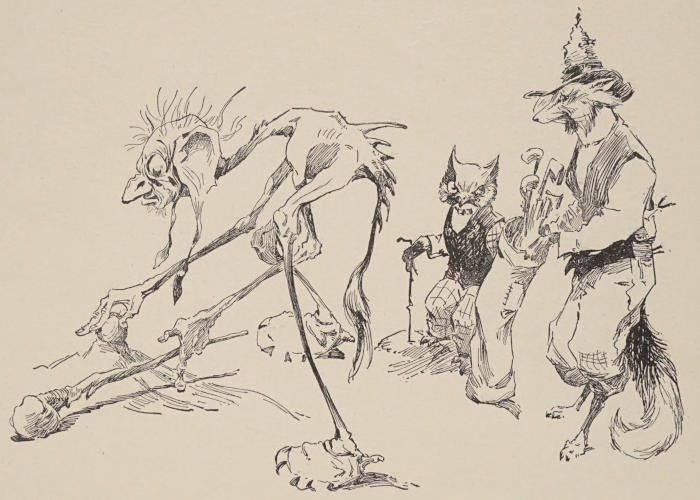
Hoot Owl says the Bogey Man is learning.
“Why, this is no place to play golf,” said the Bogey Man
as he took a big drink of oatmeal water.
“It’s fine,” said the Hoot Owl, “Isn’t it, Sly Fox?”
Sly Fox came up with a whole bagful of sticks with
twisted roots on the end of them. The Bogey Man had always
played with just one straight stick. Sly Fox had gone
into the woods, where he pulled up saplings and kept those
which had the funniest and the ugliest roots.
“Now, then,” said the Hoot Owl, “I guess that we are
all ready. Sly Fox, you can carry the clubs.”
The Hoot Owl and Sly Fox made the Bogey Man use all
of the queer kinds of sticks which they had brought. He had
to shove the balls into holes all over the field, and then he had
to spoon them out again with two or three kinds of clubs, and
then shove them over to another hole. As fast as he got
through with one club Sly Fox would take it away from him
and give him another which was more twisted and curved than
the one before.
“Isn’t he learning fast?” said the Hoot Owl to Sly Fox
with a wink.
“O, fine,” answered Sly Fox. “Golf players are born
and not made.”
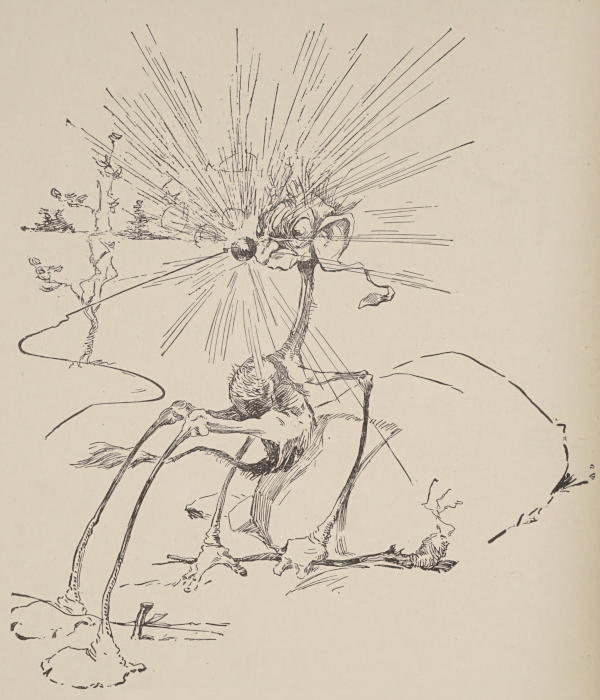
Bogey Man is hit by the returning golf ball.
Although the Bogey Man was very tired, he tried to look
happy, and said he never had so much fun in all his life. He
stumbled into pits and nearly sprained his ankle. He knocked
the balls into ponds and over big bumps in the meadows.
Nearly every time he struck a ball it would go out of sight.
Sly Fox tried to find it, but, somehow, he never could. Then
the Bogey Man had to pay Sly Fox twenty-five cents for a new
ball. Before the day was over Sly Fox had sold to the Bogey
Man the same ball 999 times. The Bogey Man’s hands were
all blistered, and his feet were wet, and his fine clothes were all
over mud. He sat down on a log and began to cry.
“I’m tired of running after those balls,” he said, “and I
have, boo-hoo boo-hoo—I have spent all my money buying
new ones.”
“That is too bad,” sighed Sly Fox. “I have an idea.”
So Sly Fox drove a tack into one of the balls, twisted a
long piece of string around it and then drove the tack way
down to the head.
“This string,” explained Hoot Owl, “is just as long as
the field. You hit the ball with the club and the ball can’t get
lost because it has a string tied to it.”
“That is very fine,” said the Bogey Man, wiping away
his tears and taking a big drink of oatmeal water. “I wish
you had thought about that before I bought those 999 balls.”
So they put the ball on the ground and gave the Bogey
Man the ugliest and biggest club that they could find.
“Hit it hard, Bogey Man,” said Sly Fox, and then he
stepped behind a tree.
“Yes, don’t be easy now,” screeched the Hoot Owl, and he
flew up into the branches of the tree and put on his glasses.
The Bogey Man swung the club and struck the ball as
hard as ever he could. The round thing went through the air
so fast that you could hear it sing and when it got to the end
of the field, it suddenly stopped. One end of the string was
fastened to a sapling. The string kept stretching and stretching,
until there was no more stretch in it and the ball fastened
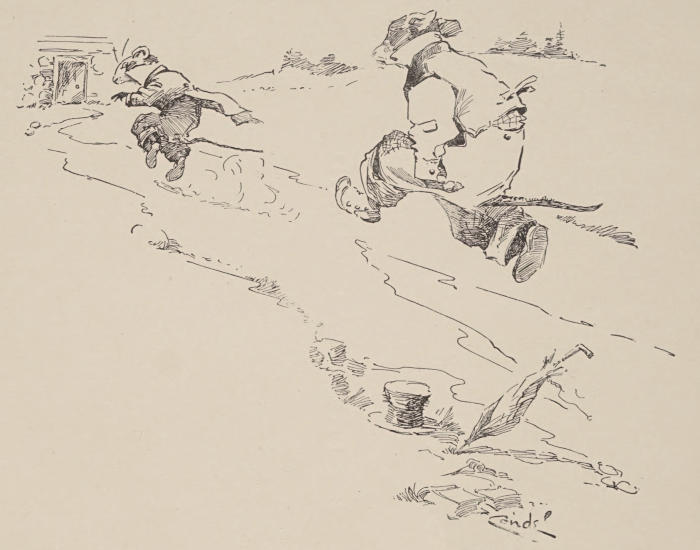
to the end of it came bounding back and struck the Bogey Man
so hard in the nose that it knocked him right over. The poor
Bogey Man dropped his club, and when he got on his feet again,
he went away as fast as he could. Since that he has never
been seen playing golf with anybody and the animals and
snakes in Deacon Jones’ wood are happy. Some men from the
city who saw Sly Fox and Hoot Owl playing thought it was
really a good game and they went back and taught other people
how to play it. Only instead of Sly Fox to find the balls they
hired good little boys called caddies who always find the balls,
no matter how far they go, and they never think of doing anything
so dishonest as to charge twenty-five cents for the same
ball over and over again.
X HOW UGLY DOG STOPPED THE CAR
Ugly Dog lived out in a place called New Jersey,
where the mosquitoes are always so busy that the
people never have time to think about getting old.
Near the house of his master there were two rails,
on which the Running Houses kept going up and down as
fast as they could. Every time a Running House went past
Ugly Dog went out and barked, for the very sight of it made
him angry. Before the Running Houses came, his master went
to the station in a buggy, and Ugly Dog always went along and
trotted back with the coachman. Now his master went alone,
and Ugly Dog had to stay at home.
He came out one morning just in time to see his master
get on the back steps of a Running House and wave good-by to
the children. Ugly Dog was never so angry in all his life.
He ran as hard as he could, and tried to jump on the Running
House so that he could go to the station with his master. Then
he heard two bells ring, and with a clicking and banging, Running
House was sliding away so fast that Ugly Dog could not
keep up with it. He ran until he nearly dropped on the
ground, and he barked until he was hoarse.
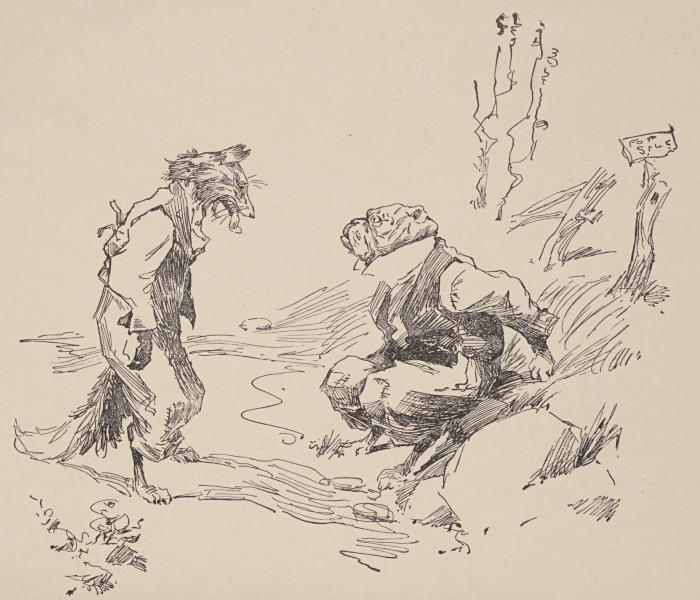
Ugly Dog complains to Sly Fox.
He crawled into the bushes at the side of the road and laid
down to rest. He was all covered with dust, and his eyes were
red and his tongue was hanging out.
“Well,” said Sly Fox, who had just come up through the
bushes, “You do not seem to be very happy this morning.
What is the matter?”
“I can’t go to the station any more,” growled Ugly Dog,
“because I can’t run fast enough to keep up with those miserable
little houses that go sliding away as soon as my master
gets on the back steps.”
“It seems to me,” said Sly Fox, “that for a dog that has
such a fine face you do not know very much. I understand
why it is that the Running Houses do not stop—you are not
polite enough to the man at the front door.”
“What am I to do?” asked Ugly Dog.
“O, that is very simple,” answered Sly Fox. “You must
be very particular about how you act. Nobody ever succeeds
unless he is polite and always says please. You know that I
am very wise, and if you only listen to me, you may never have
any more trouble.”
“I am all ears,” said Ugly Dog, folding his arms and looking
as humble as Jack Rabbit.
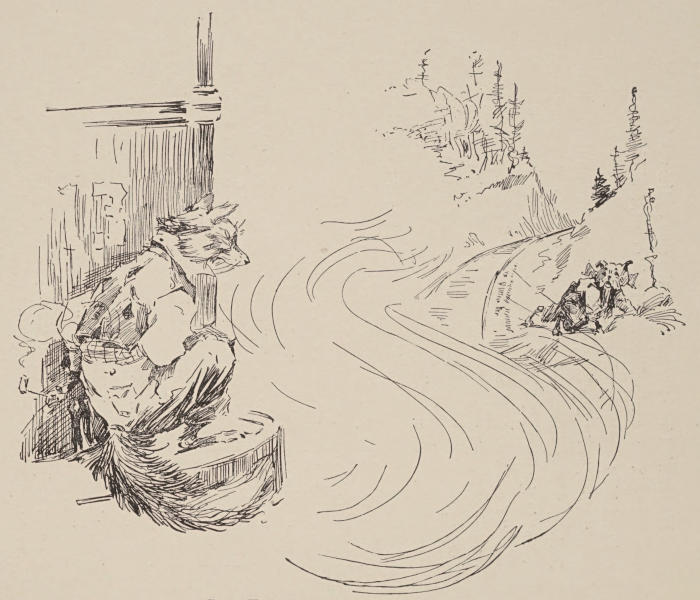
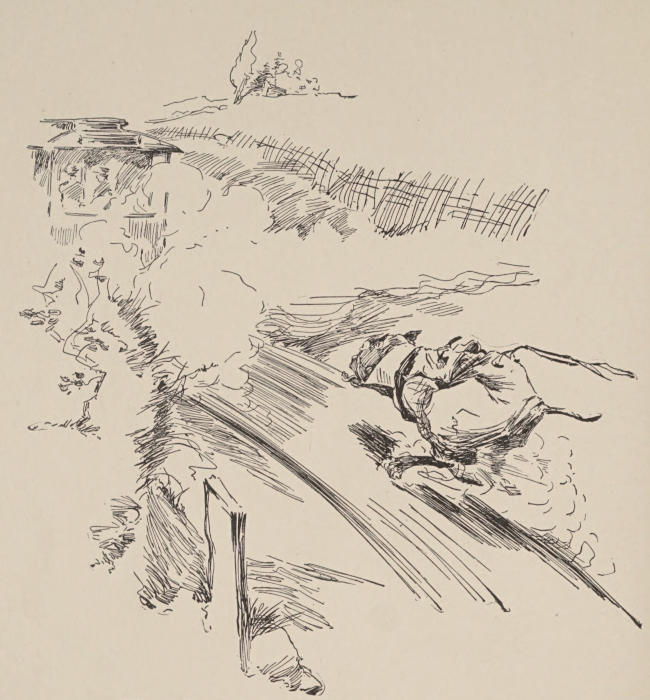
Sly Fox escapes on the car.
“Well, in the first place,” said Sly Fox, “the Running
Houses only stop when you wave your paw to the man at the
front door. Now, if I were you I would stand right in front of
the next one as it comes along and then I would make a low
bow and wave my paw. That is the way your master gets
them to stop.”
“I’ll do that,” said Ugly Dog, “just as soon as I get
rested. But how is it that you are all out of breath, too?”
“Well,” answered the Sly Fox, coughing in a funny sort
of a way and shuffling his feet around, “you know that I am a
doctor, and I was called in a hurry to see two little chickens
which had the croup in their crops.”
“Is that so?” asked Ugly Dog, “and are they better
now?”
“Those dear, little chickens,” answered Sly Fox, as he
stroked his white mustache, “will never be bothered by having
anything in their crops again.”
Just then there was a whirring sound way up the road and
Sly Fox jumped up.
“My friend,” he said, “I think that another Running
House is coming. If I were you I would hurry up and get
right in front of it.”
Ugly Dog got up on his feet and shook himself and
wagged his tail and smoothed out his hair.
“How do I look?” he asked.
“Fine,” answered Sly Fox. “If I were the man standing
on the front porch of any Running House I would stop in a
minute. Now you do just as I tell you, and I am sure that you
will never have any more trouble.”
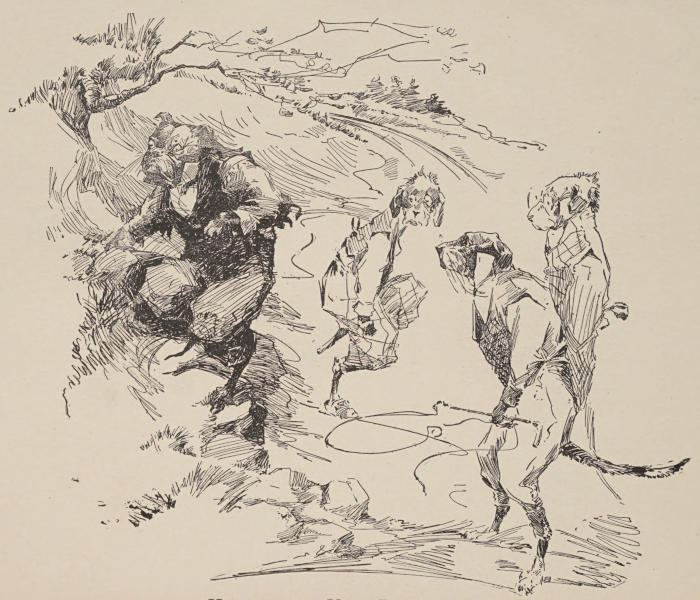
Hounds call Ugly Dog a rascal.
Ugly Dog went out in front of Running House, wagging
his tail and standing up on his hind legs and making bows all
the time. He waved one of his paws as Running House came
hurrying down the rail. The man at the front door began to
ring the bell as fast as he could and to yell at Ugly Dog.
“He sees you!” cried Sly Fox from behind the bushes.
Then the man turned a brass handle.
Running House began to go slower, but it did not stop.
The thing in front which looked like a scraper struck Ugly Dog
and sent him way up in the air, and he fell down at the side of
the road all in a heap. When he got on his feet again, he saw
the Running House going down the road as fast as it could,
and on the back step was Sly Fox, smoking a pipe and looking
very wise.
Just then there was a crackling of branches and a yelping
and a stamping. Through the bushes came men riding horses
and a pack of angry hounds.
“You are a rascal,” yelped the hounds. “You, Ugly Dog,
stopped the Running House so that Sly Fox could get away
from us!”
“I did no such thing,” whined Ugly Dog. “That mean
Fox played a trick on me.”
The hounds would not listen to him, but they chased him
to his kennel and gave him a good whipping. Ugly Dog did
not get over the hurting he got that day until the next month.
XI SLY FOX GETS HIS PICTURE TAKEN
Mole had a photograph gallery in Deacon Jones’
woods. One of the rooms was all dark, because
it was under the ground, and here he
spent nearly all his time making pictures come
on the glass plates. He was there so much that after a while
he could hardly see at all, so he had to get Ugly Dog to help
him. Ugly Dog was a good barker, and he stood out in front
of the photograph gallery all day, saying: “Step right up,
birds and animals and get your very fine pictures taken.”
Ugly Dog made so much noise, and talked so much about
the pictures, that nearly all the birds and animals ordered a
dozen photographs apiece. Silly Goose, Gray Mouse and Kerchug,
the leap-frog, were so pleased that each of them ordered
two dozen.
Ugly Dog was out in front of the photograph gallery,
barking one afternoon when he saw Sly Fox in the bushes coming
toward him. He and Sly Fox were not friends, and he
began to growl and snarl.
“Stop your noise,” called out the Mole, coming out of the
dark room. “You are shaking all the pictures down.”
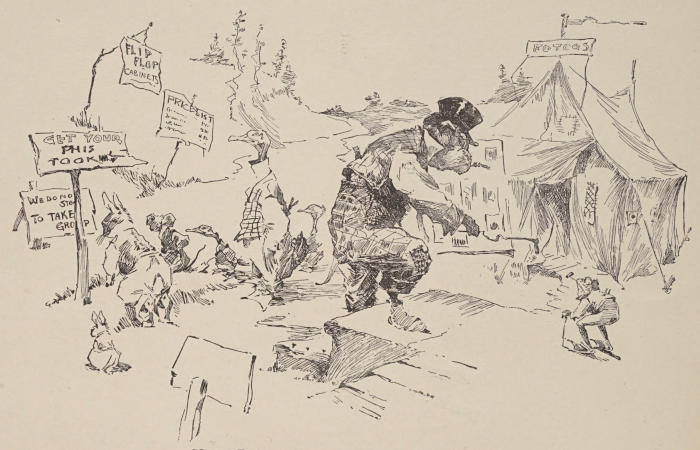
Ugly Dog tells the animals to step in.
“I can’t help it,” cried Ugly Dog, “Sly Fox made me
stand in front of the house which was running on two rails and
the front step knocked me over and nearly killed me.”
“Now you do what I tell you,” said Mole, “and you can
pay Sly Fox for that trick.”
So Mole and Ugly Dog went down into the dark room,
and Mole told Ugly Dog just what to do. Ugly Dog went
back and stood in front of the photograph gallery, and when
Sly Fox came up he made a low bow.
“Good morning, Sly Fox. Ha! Ha!” he said. “That
was such a very good joke. After the running house struck
me and I found myself lying in the road, I got up and laughed,
and laughed so hard that for weeks afterward I was sore all
over. You are such a very funny animal, and you look just as
funny as you are. Whenever I see that great, big, long, thin
neck of yours I can hardly help laughing.”
Sly Fox was very vain. He put his paw up to his neck
and felt it all over, and then said: “You are a very foolish
animal, Ugly Dog. Anybody can see that my neck is very
short and very graceful.”
“I don’t wonder that you do not care to have your
picture taken,” said Ugly Dog. “Silly Goose passed by here
only yesterday and ordered two dozen. I don’t suppose that
my partner, Mole, would care to risk his camera taking a picture
of one so ugly, anyway. It’s too bad that your tail is so
short and stubby.”
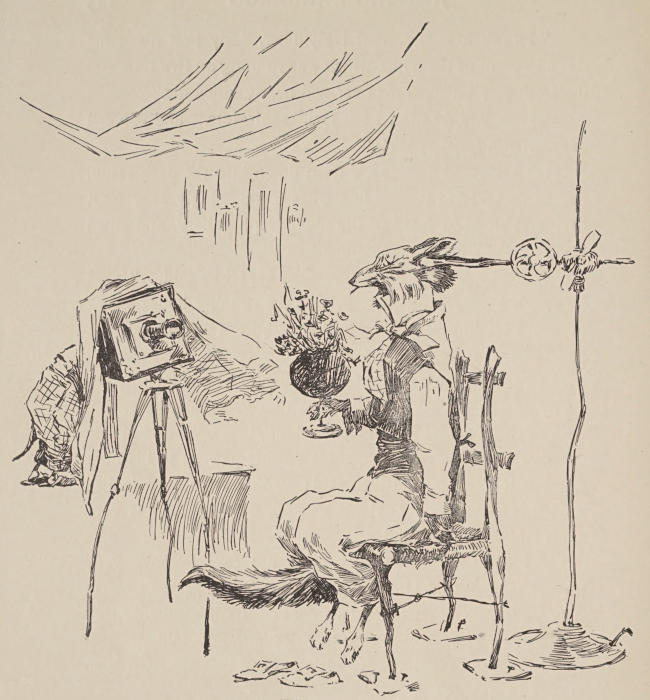
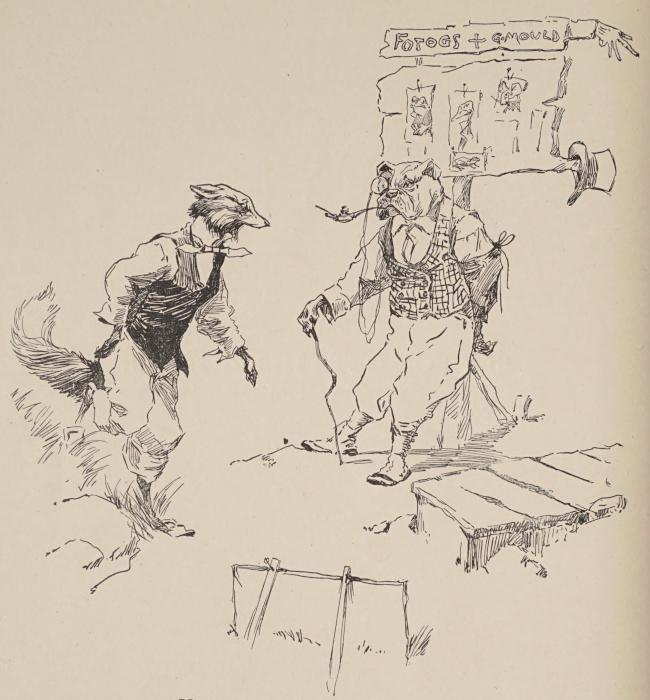
Sly Fox sits for his picture.
Now, Sly Fox was very proud of his long and bushy tail,
and when he heard what Ugly Dog said, he became red in the
face.
“It’s just as well,” said Ugly Dog, “that you do not take
a very good picture, for I hear that you have so little money
now that you could not afford to do so, anyway.”
Then Sly Fox shook his paw in Ugly Dog’s face.
“Take my picture right away,” he said, “and I’ll let you
know that I have money to pay for it. I shall wait here until
it is done.”
So Ugly Dog called down to his friend Mole, and Mole
came up with his camera.
“Sit right down on this stool,” said Ugly Dog.
Sly Fox sat down, and behind him Ugly Dog put a funny
kind of tongs passing to a long rod. He put the ends of the
tongs under Sly Fox’s ears and screwed them up real tight.
“That’s to keep your head still,” said Mole.
“Don’t you think that is a little bit too tight?” asked Sly
Fox, squirming around, for he was held so fast that he had
shooting pains in his head.
“Look pleasant, please,” grunted Mole, from under the
cloth which was over the camera.
“You must stay here for fifteen minutes,” added Ugly
Dog, very quietly.
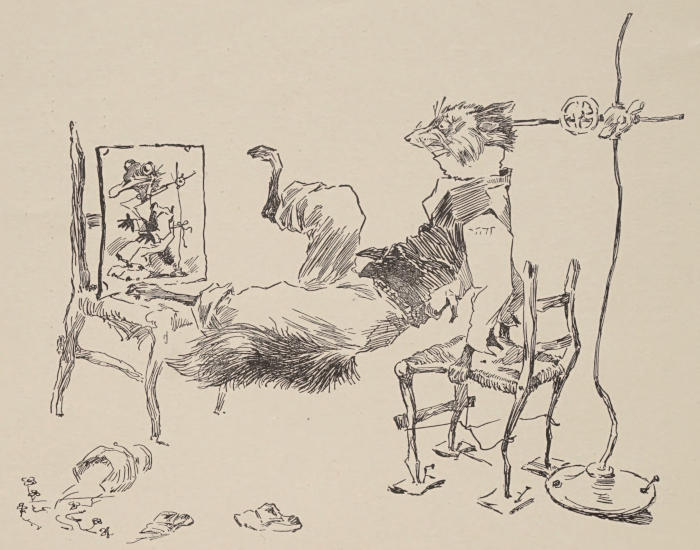
O, my! O, my! Take it away!
So Sly Fox stayed sitting there with a bouquet in his right
paw and trying to look pleasant, although the tongs about his
ears were so tight that his eyes stuck out, and he could hardly
keep his tongue from hanging down. Mole took the camera
back into the dark room, and, after awhile, he came out with a
photograph all finished.
“I’ll put it up right in front of you, Sly Fox,” said Ugly
Dog, “so that you can take a good look at it.”
As Sly Fox looked toward the photograph Ugly Dog
slipped up behind and gave the tongs another turn and then
jumped back into the bushes. When Sly Fox saw the picture
he raised his paws and said, “O, my! O, my! Take it away.”
It was such an awful picture that it would scare anybody to
look at it. Mole had placed pictures of different animals together
and had made one picture. There was a creature with
a long neck like Silly Goose’s, and a little stubby tail like Ugly
Dog’s, and a body like big Elephant’s. It had two feet which
looked like the goose’s, and two other feet which looked like
elephant’s feet.
“I don’t look like that?” cried Sly Fox.
“I just made your picture,” said Mole in a sleepy voice,
“and nobody can ever say that I ever took the wrong animal.
Isn’t your name Sly Fox?”
“O, yes,” replied Sly Fox, “but I am a very handsome
animal.”
“I can’t see that you are,” replied the Mole. “That is
your picture, and now you’ll have to pay for it.”
So Ugly Dog and Mole took pay for a dozen pictures and
put the photograph up just in front of Sly Fox, where he could
see it and could not reach it.
“Take it away. Take it away,” cried Sly Fox.
Ugly Dog and Mole went away to dinner and left Sly Fox
sitting in the chair snarling and crying. He stayed there for
two hours, until his friend Patrick O’Possum came along and
unscrewed the tongs and let him go. Ever since that Sly Fox
has not been nearly so proud of himself, and he has never
played another trick on Ugly Dog.
XII AT LITTLE MONKEY’S SWIMMING SCHOOL
Little Monkey lost his tail, and the other monkeys
made so much fun of him that he could not live
with them any more. He went away by himself
and fed on berries. He was sitting on the bank of
the river one day, when the earth gave way, and he fell in the
water. He swam out again, and as he did, he had an idea.
“I’ll start a swimming school,” said he. “I’ll teach all
the other animals to swim so that their lives will be saved if
they fall into the water.”
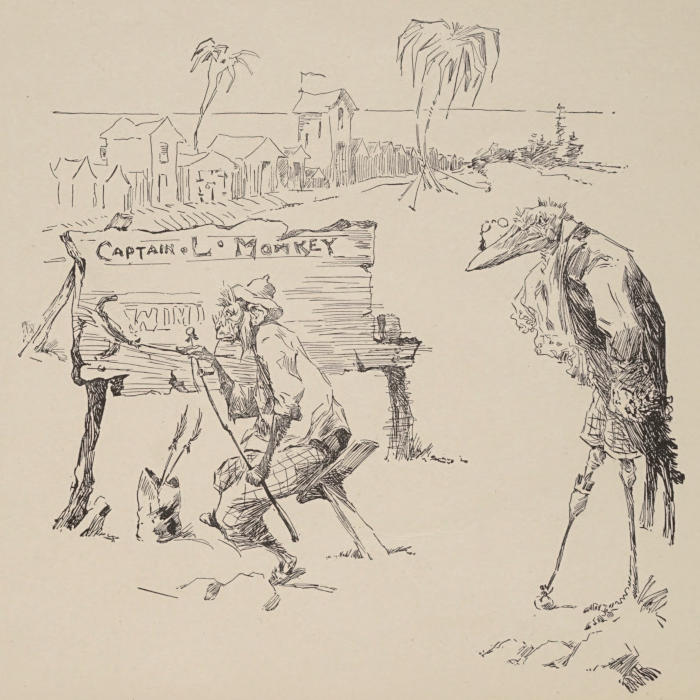
So Little Monkey built houses on the shore of the river
and put up a sign which read:
Captain L. Monkey,
Swimming Skule.
Bathing Suits to Hire.
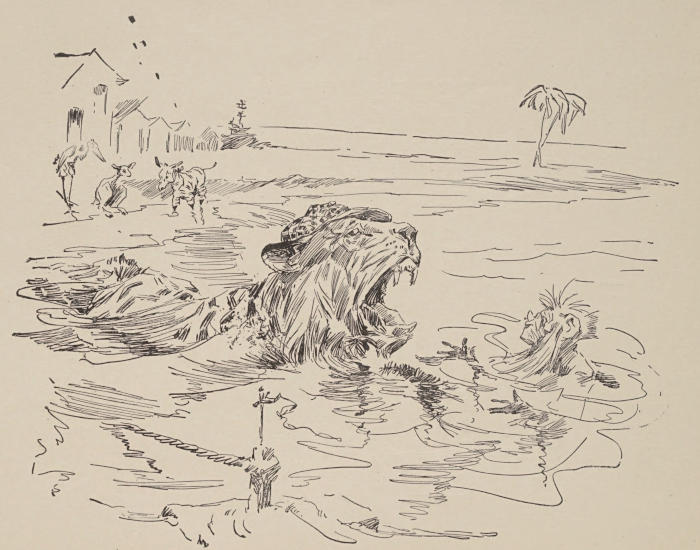
Tiger’s open mouth scares Little Monkey.
He had 100 bathing suits in sizes to fit any animal from a
mouse to an elephant. He hired the tailor bird to make new
suits as fast as the old ones wore out. Ben Crocodile was always
swimming around to save the lives of the animals who
swam out too far. Little Monkey put a raft away out in the
stream, where the animals could rest after they had swum as
long as they should.
When all the animals and all the birds heard that Little
Monkey had a swimming school they said: “How very fashionable!”
Some of them thought they could swim, but then it became
the style for all animals and birds to swim like little monkeys
without tails. Every afternoon, the beach in front of Little
Monkey’s bathing houses was filled by the jungle folk. All
those, who went in, hired bathing suits, and the tailor bird was
kept busy all day making new suits and mending the old ones.
Little Monkey wore a fine, gray suit, and he swam up and down
to teach the animals how to swim like a little monkey without
a tail.
Tiger and Zebra were great friends, and one afternoon
they went to Little Monkey’s swimming school.
“We want nice, new suits,” said Tiger.
Tailor Bird brought out two suits with yellow and black
stripes. Tiger and Zebra then had white hair, for this was
many years ago.
“They’re fine,” said Tailor Bird. “They fit like the
bark on the tree, and the colors are so new that they would be
ashamed to run.”
“What pretty suits,” Zebra and Tiger said at once.
They put on the bathing suits and sat down on the sand.
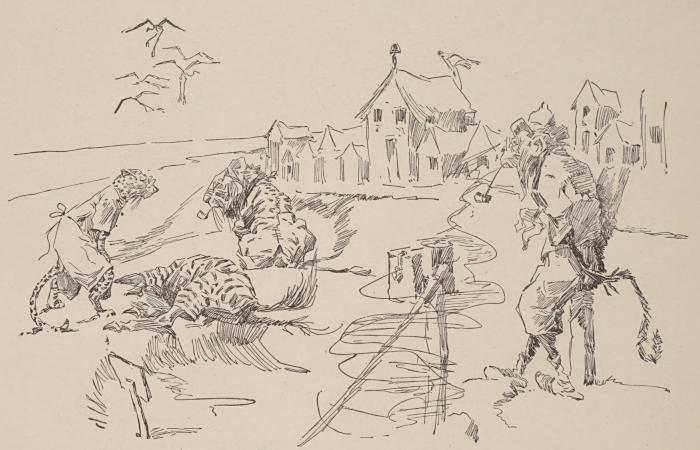
Tiger and Zebra make fun of Leopard’s spots.
“Why don’t you come in?” asked Heron, who had stayed
in the water until he was blue.
“We want everybody to see our fine, new suits,” answered
Zebra.
“Come on!” cried Little Monkey. “Bathing suits were
made to get wet.”
So Tiger and Zebra stepped into the water and followed
Little Monkey.
“Tiger,” cried Little Monkey, turning around, “you must
keep your mouth tightly shut.”
(Every time Tiger got near Little Monkey his mouth flew
open.) This made Little Monkey very nervous, for Tiger had
big, sharp teeth. When Tiger was not scaring Little Monkey,
Zebra was kicking the water over the poor, little animal, which
was doing his best to teach his pupils how to swim. The other
animals and birds got out of the water and sat upon the beach
and laughed and laughed at the fun which Tiger and Zebra
were having with Little Monkey.
Tiger and Zebra made believe that they were very awkward.
They were all the time catching Little Monkey around
the neck until his head was under water. Then when he came
up again with his ears and mouth all streaming, they would
say: “Noble Little Monkey, you have just saved our lives.”
They even got a little fish to swim under Little Monkey and
bite his toes. Little Monkey pretended not to be angry. All
the time, though, he was vexed, and he made up his mind that
he would pay back Tiger and Zebra for the mean way in which
they were treating him. He was all tired out, yet he kept
swimming, for he saw that something was happening which
would give him a fine revenge.
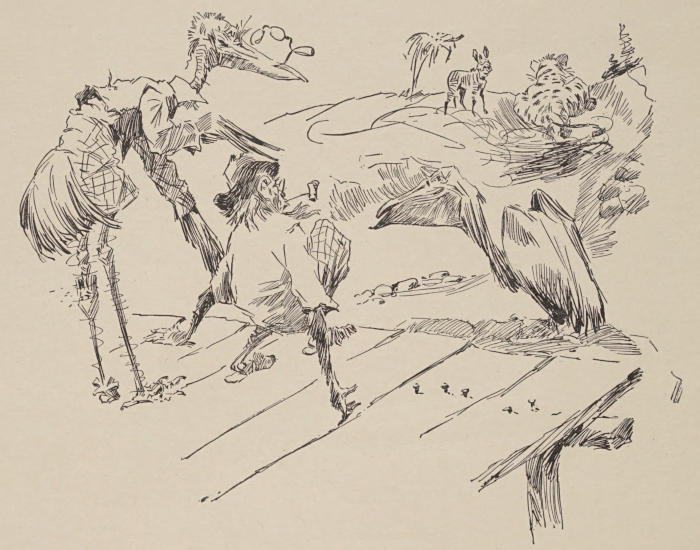
Tiger and Zebra run away ashamed.
“Tiger,” he said, “if you would keep your mouth from
being open so much, and Zebra, if you would not splash with
your feet, you both would become very fine swimmers. Don’t
bother to take off your bathing suits. Just sit in the sun and
when I teach Antelope how to dive I’ll give you another lesson.”
So Tiger and Zebra sat in the sun and told the other animals
about the great fun which they had had with Little Monkey.
Then they found somebody else to make fun for them.
Leopard, who was all spotted, came down to the beach.
“Ho, ho,” laughed Tiger, “did you ever see an animal in
a polka dot skin?”
“He, he, isn’t he gaily dressed,” neighed the Zebra, as he
grinned and looked around at the other animals.
“It is not every animal,” answered the Leopard, as he
came out dressed up in his white bathing suit, “who has the
good fortune to be born with a beautiful white skin. Many is
the time I have tried to change these polka dots for a plain
checked suit, but somehow I could never do it. I may be funny
but I never looked so queer as do two very mean animals who
are lying on this beach all dressed up in ugly, striped bathing
suits.”
Then Zebra and Tiger became angry. They got up and
took off their bathing suits and threw them at tailor bird.
Then all the birds and the animals laughed so hard that they
had to put their hands to their sides. Hyena laughed until he
rolled over and over on the beach.
“Hyena,” roared Tiger, “you are always laughing at
nothing. What is the matter with you?”
Hyena pointed with his paw. Tiger and Zebra looked at
themselves and found that their skins were all striped. The
color had come out of the new bathing suits and the sun had
dried it into their hair. Tiger and Zebra felt so ashamed that
they ran away. Ever since that day the beasts in the
jungle have always said Striped Tiger and Striped Zebra, and
it was not until the Spotted Leopard told me this story, that I
knew that those two animals were once as white as the Polar
Bear.
THE END