This art consists in bringing a certain number of cards
from the bottom of the pack to the top. I shall explain
the method of doing it, before proceeding further,
as many of the following recreations depend on the dexterous
performance of this manœuvre. Hold the pack of
cards in your right hand, so that the palm of your hand
may be under the cards. Place the thumb of that hand
on one side of the pack, the first, second, and third fingers
on the other side, and your little finger between
those cards that are to be brought to the top, and the
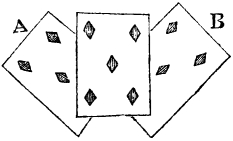
rest of the pack. Then place your left hand over the
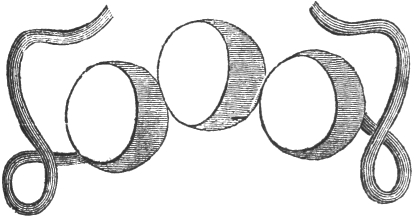
cards, in such a manner that the thumb may be at C,
and the fingers at B, according to the following
figures:—
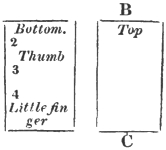
The hands and the two parts of the cards being thus
disposed, you draw off the lower cards, confined by the
little finger and the other parts of the right hand, and
place them, with an imperceptible motion, on the top of
the pack. It is necessary, before you attempt any of the
recreations that depend on making the pass, that you
can perform it so dexterously that the eye cannot distinguish
the motion of your hand; otherwise, instead of deceiving
others, you will expose yourself. It is also proper
that the cards make no noise, as that will occasion
suspicion. This dexterity is not to be attained without
some practice. It is sometimes usual to prepare a pack
of cards, by inserting one or more that are a small matter
longer or wider than the rest; and that preparation will
be necessary in some of the following recreations.
Have a pack in which there is a longer card than the
rest; open the pack at that part where the long card is,
and present the pack to a person in such a manner that
he will naturally draw that card. He is then to put it
into any part of the pack, and shuffle the cards. You
take the pack and offer the same card in like manner to
a second or third person; observing, however, that they
do not stand near enough to observe the card each other
draws. You then draw several cards yourself, among
which is the long card; and ask each of the parties if
his card be among those cards, and he will naturally
say yes, as they have all drawn the same card. You
then shuffle all the cards together, and, cutting them at
the long card, you hold it before the first person, so
that the others may not see it, and tell him that is his
card. You then put it again in the pack, and, shuffling
them a second time, you cut again at the same card, and
hold it in like manner to the second person; and so of
the rest.
If the first person should not draw the long card, each
of the parties must draw different cards; when, cutting
the pack at the long card, you put those they have drawn
over it, and, seeming to shuffle the cards indiscriminately,
you cut them again at the long card, and show
one of them his card. You then shuffle and cut again,
in the same manner, and show another person his card,
and so on; remembering that the card drawn by the
last person is the first next the long card; and so of the
others.
This recreation may be performed without the long
card, in the following manner: let a person draw any
card whatever, and replace it in the pack; you then
make the pass, and bring that card to the top of the pack,
and shuffle them without losing sight of that card. You
then offer that card to a second person, that he may
draw it, and put it in the middle of the pack. You make
the pass, and shuffle the cards a second time, in the
same manner, and offer the card to a third person; and
so again to a fourth or fifth.
You let a person draw any four cards from the pack,
and tell him to think of one of them. When he returns
you the four cards, you dexterously place two of them
under the pack, and two on the top. Under those at the
bottom you place four cards of any sort, and then, taking
eight or ten from the bottom cards, you spread them on
the table, and ask the person if the card he fixed on be
among them. If he say no, you are sure it is one of the
two cards on the top. You then pass those two cards
to the bottom, and, drawing off the lowest of them, you
ask if that is not his card. If he again say no, you take
that card up, and bid him draw his card from the bottom
of the pack. If the person says his card is among those
you first drew from the bottom, you must dexterously
take up the four cards that you put under them, and,
placing those on the top, let the other two be the bottom
cards of the pack, which you are to draw in the manner
before described.
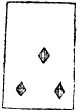
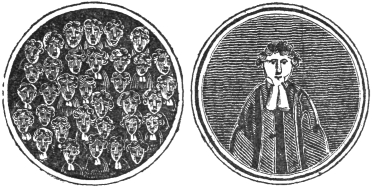
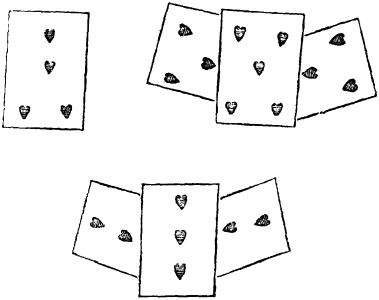
You must be prepared with two cards like the following:—
and with a common ace and five of diamonds. The five
of diamonds, and the two prepared cards, are to be disposed
thus:—
and, holding them in your hand, you say,—“A certain
Frenchman left fifteen thousand livres, which are represented
by these three cards, to his three sons; the two
youngest agreed to leave their 5000, each of them, in the
hands of the elder, that he might improve it.” While
you are telling this story, you lay the five on the table,
and put the ace in its place, and at the same time artfully
change the position of the other two cards, that
the three cards may appear as in the following figure:—
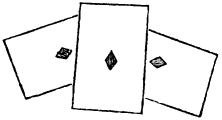
You then resume your discourse. “The eldest brother,
instead of improving the money, lost it all by gaming,
except three thousand livres, as you here see.” You
then lay the ace on the table, and, taking up the five,
continue your story. “The eldest, sorry for having lost
the money, went to the East Indies with these 3000, and
brought back 15,000.” You then show the cards in the
same position as at first. To render this deception
agreeable, it must be performed with dexterity, and
should not be repeated, but the cards immediately put
in the pocket; and you should have five common cards
in your pocket, ready to show, if any one should desire
to see them. Another recreation of this sort may be
performed with fives and threes, as follows:—
Make a ring large enough to go on the second or
third finger, in which let there be set a large transparent
stone, to the bottom of which must be fixed a small
piece of black silk, that may be either drawn aside or
expanded by turning the stone round. Under the silk
is to be the figure of a small card. Then make a person
draw the same sort of card as that at the bottom of the
ring, and tell him to burn it in the candle. Having first
shown him the ring, you take part of the burnt card,
and, reducing it to powder, you rub the stone with it;
and, at the same time, turn it artfully round, so that the
small card at bottom may come in view.
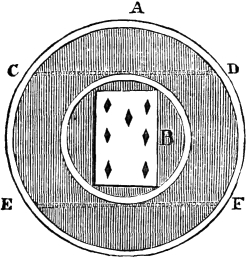
Provide a mirror, either round, like the following
figure,
or oval; the frame of which must be at least as wide as a
card. The glass in the centre must be made to move in
the two grooves, C D and E F; and so much of the silvering
must be scraped off as is equal to the size of a
common card. Observe that the glass be likewise wider
than the width of the card. Then paste over the part
where the quicksilver is rubbed off a piece of pasteboard,
on which affix a card that exactly fits the space,
which must at first be placed behind the frame. This
mirror must be placed against a partition, through
which are to go two strings, by which an assistant in the
adjoining room can easily move the glass in the grooves,
and consequently make the card appear or disappear at
pleasure.
Matters being thus prepared, you contrive to make a
person draw the same sort of card with that fixed to the
mirror, and place it in the middle of the pack: you then
make the pass, and bring it to the bottom: you then direct
the person to look for his card in the mirror, when
the confederate, behind the partition, is to draw it slowly
forward, and it will appear as if placed between the
glass and the quicksilver. While the glass is being drawn
forward, you slide off the card from the bottom of the
pack, and convey it away. The card fixed to the mirror
may easily be changed each time the experiment is performed.
This recreation may also be made with a print
that has a glass before it, and a frame of sufficient
width, by making a slit in the frame, through which the
card is to pass; but the effect will not be so striking as
in the mirror.
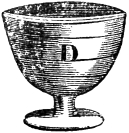
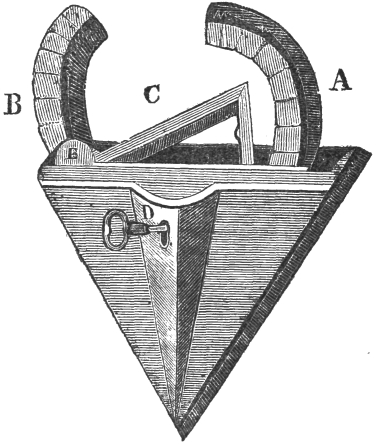
Place a vase of wood or pasteboard, like the following:—
A B, on a bracket L, to the partition M.
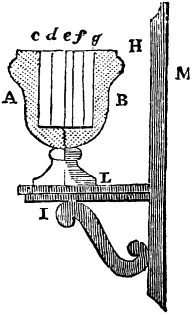
Let the inside of this vase be divided into five parts,
c, d, e, f, g; and let the divisions c and d be wide enough
to admit a pack of cards, and those of e, f, g, one card
only. Fix a thread of silk at the point H, the end of which,
passing down the division d, and over the pulley I, runs
along the bracket L, and goes out behind the partition
M. Take three cards from a piquet pack, and place one
of them in each of the divisions, e, f, g, making the silk
thread or line go under each of them. In the division c
put the pack of cards, from which you have taken the
three cards that are in the other divisions. Then take
another pack of cards, at the bottom of which are to be
three cards of the same sort with those in the three
small divisions, and, making the pass, bring them to the
middle of the pack, and let them be drawn by three
different persons. Then give them all the cards to shuffle,
after which place the pack in the division d, and tell the
parties they shall see the three cards they drew come,
at their command, separately out of the vase. An assistant
behind the partition then drawing the line with a
gentle and equal motion, the three cards will gradually
rise out of the vase. Then take the cards out of the
division c, and show that those three cards are gone from
the pack. The vase must be placed so high that the
inside cannot be seen by the company. You may perform
this recreation also without an assistant, by fixing
a weight to the end of the silk line, which is to be placed
on a support, and let down at pleasure, by means of a
spring in the partition.
Having previously looked at a card, bid the person
draw one, taking care to show him that which you know;
when he has it, let him put it at the bottom; let him
shuffle the cards, then look at them again, and, finding
the card, place it at the bottom; then cut them in half;
give the party that half which contains his chosen card
at the bottom, to hold between his finger and thumb, just
at the corner; bid him pinch them as tight as he can;
then striking them pretty sharply, they will all fall to the
ground, except the bottom one, which is the card he has
chosen. This is a very curious trick, and, if cleanly done,
is really astonishing. It may be accounted for from the
nature of the nerves, which are always more retentive
when any thing is attempted to be taken, either by force
or surprise.
Take a pack of cards, and look out the four knaves;
lay one of them privately on the top of the pack, and
the other three down upon the table, saying, “Here, you
see, are three knaves got together, about no good you may
be sure;” then lay down a king beside them, saying,
“But here comes the constable and catches them together:
‘Oh, says he, have I caught you? Well, the next time
I catch you together, I’ll punish you severely for all your
rogueries.’ ‘Oh,’ but say they, ‘you shan’t catch us
again together in haste;’ so they conclude to run three
several ways. ‘Well, I’ll go here,’ says one (so take
one of the knaves, and put him at the top of the pack).
‘And I’ll go here,’ says another (so put him at the
bottom). ‘Then I’ll go here,’ says a third (so put him
in the middle). ‘Nay,’ says the constable, ‘if you
run, I’ll make sure of one; so I’ll follow the first.’” Then
take the king and put him at the top, and let any one cut
the cards asunder two or three times; then deal, cut the
cards one by one, and you shall find three together, and
the constable with them.
Note.—This feat would be best done with a pack of
cards that has two knaves of that sort which you put in
the middle.
To do this, you must have the picture in your sleeve,
and, by a swift sleight, return the card, and fetch out the
picture with a back bending. The manner of doing this
is better learnt by frequent trials than can be taught by
many words. But, if you would do this feat, and yet
hold your hand straight and unmoved, then you must
peel off the spots or figure of a card, as thin as you can,
and just fasten it on the picture with something that will
make it stick a little; then, having shown the spots or
figure of the card, you may draw it off, and roll it up
with your thumb into a very narrow compass, holding it
undiscovered, between the inside of the thumb and the
ball of your fore-finger; and so produce the picture, to
the admiration of the beholders.
Take any number of cards, as ten, twelve, and then,
holding them with their backs towards you, open four
or five of the uppermost, and, as you hold them out
to view, let any one note a card, and tell you whether it
be the first, second, or third from the top; but you must
privately know the whole number of those cards you
took. Now shut up your cards in your hands, and take
the rest of the pack, which place upon them; then
knock their ends and sides upon the table; so it will
seem impossible to find the noted card, yet it may
easily be done, thus: subtract the number of cards you
held in your hand from fifty-two, the whole number in
the pack, and to the remainder add the number of the
noted card; so the same shall be the number of the noted
card from the top; therefore take off the cards one by
one, smelling to them till you come to the noted card.
When you have seen a card privately, or as though
you marked it not, lay the same undermost, and shuffle
the cards till your card be again at the bottom. Then
show the same to the bystanders, bidding them remember
it. Now shuffle the cards, or let any other shuffle them,
for you know the card already, and therefore may, at
any time, tell them what card they saw, which, nevertheless,
must be done with caution or show of difficulty.
If you can see no card, or be suspected to have seen
that which you mean to show, then let a bystander shuffle,
and afterwards take the cards into your own hands,
and, having shown them, and not seen the bottom card,
shuffle again, and keep the same cards as before you are
taught; and either make shift then to see it when their
suspicion is past, which may be done by letting some
cards fall, or else lay down all the cards in heaps, remembering
where you laid the bottom card; then see
how many cards lie in some one heap, and lay the flap
where your bottom card is upon that heap, and all the
other heaps upon the same; and so, if there were five
cards in the heap whereon you laid your card, then the
same must be the sixth card, which now you must throw
out, or look upon with suspicion, and tell them the card
they saw.
Lay three cards at a distance, and bid a bystander be
true, and not waver, but think on one of the three, and
by his eye you shall assuredly perceive which he thinks
on; and you shall do the like if you cast down a whole
pack of cards with the faces upwards, whereof there
will be few, or none plainly perceived, and they also
court cards; but as you cast them down suddenly, so
must you take them up presently, marking both his eyes
and the card whereon he looks.
Take a pack of cards, and let any one draw a card
that he likes best, and afterwards take and put it into
the pack, but so as you know where to find it at pleasure.
Then take a piece of wax, and put it under the
thumb-nail of your right hand, and thus fasten a hair
to your thumb, and the other end of the hair to the card.
Now spread the pack of cards open upon the table, and,
making use of any technical words or charms, seem
to make it jump on the table.
Take a nut or cherry-stone, and burn a hole through
the side of the top of the shell, and also through the kernel,
if you will, with a hot bodkin, or bore it with an
awl, and with a needle pull out the kernel, so as the
same may be as wide as the hole of the shell; then write
the name of the card on a piece of fine paper, and roll
it up hard. Put it into the nut or cherry-stone, and stop
the hole up with a little wax, and rub the same over with
a little dust, and it will not be perceived; then let some
bystander draw a card, saying, “It is no matter what
card you draw,” and, if your hands so serve you to use
the cards well, you shall proffer him, and he shall receive,
the same card that you have rolled the name of up
in the nut. Now take another nut and fill it up with
ink, and stop the hole up with wax, and then give that
nut which is filled with ink to some boy to crack, and,
when he finds the ink come out of his mouth, it will
cause great laughter. Many other feats of this kind may
be done, so as to keep the company in good humour.
Take a pack of cards and let any gentleman draw
one; then let him put it into the pack again, but be sure
where to find it again at pleasure; then shuffle the cards
again, and let another gentleman draw a card; but be
sure that you let him draw no other than the same card
as the other drew, and so do for ten or twelve, or as many
cards as you think fit; when you have so done, let another
gentleman draw another card, but not the same,
and put that card into the pack where you have kept the
other one, and shuffle them till you have brought both
the cards together; then showing the last card to the
company, the other will be considered a more wonderful
achievement.
A clever juggler will take four kings in his hand, and
apparently show them to the bystanders, and then, after
some words and charms, he will throw them down upon the
table, taking one of the kings away, and adding but one
other card; then taking them up again, and blowing upon
them, he will show you them transformed into blank cards,
white on both sides; then throwing them down as before,
with their faces downwards, he will take them up again,
and, blowing upon them, will show you four aces.
This trick is not inferior to any that is performed with
cards, and yet is very pretty.
To perform it, you must have cards made for the purpose,
half cards we may call them; that is, one half
kings and the other half aces; so, laying the aces one
over the other, nothing but the king will be seen, and
then, turning the kings downwards, the four aces will be
seen; but you must have two whole cards, one a king to
cover one of the aces, or else it will be perceived, and
the other an ace to lay over the kings, when you mean to
show the aces; then, when you would make them all
blank, lay the cards a little lower, and hide the aces,
and they will appear all white. The like you may make
of four knaves, putting upon them the four fives; and so
of the other cards.
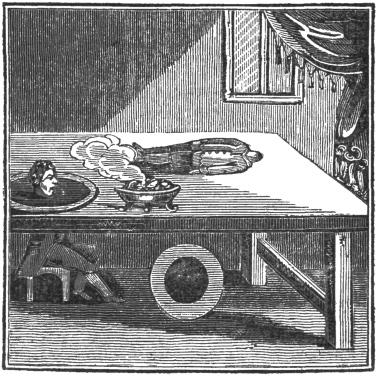
To do this, you must privately drop a little water or
beer, about the size of a crown-piece, upon the table
before which you sit; then rest your elbows upon
the table, so that the cuffs of your sleeves may meet, and
your hands stick up to the brims of your hat; in this
posture your arms will hide the drop of water from the
company; then let any one take the cards and shuffle
them, and put them into your hands; also let him set a
candle before you, for this trick is best done by candlelight.
Then holding the cards in your left hand, above
the brim of your hat, close up to your head, so that the
light of the candle may shine upon the cards, and holding
your head down, so in the drop of water, like a
looking-glass, you shall see the shadow of all the cards
before you. Now draw the finger of your right hand
along upon the card, as if you were feeling it, and then
lay it down. Thus you may lay down all the cards in
the pack, one by one, naming them before you lay them
down, which will seem very strange to the beholders,
who will think that you have felt them out.
Let any one take a card out of the pack, and note it;
then take part of the pack in your hand, and lay the rest
down upon the table, bidding him lay his noted card
upon them; then, turning your back towards the company,
make as though you were looking over the cards
in your hand, and put any card at the fore-side; and,
whilst your are doing this privately, wait till the cards are
laid out in heaps, to find what the bottom cards are. Bid
any one take four cards of the same number, viz. four aces,
four deuces, four trèys, and any other number not exceeding
ten (for he must not take court cards), and lay
them out; then take the remaining cards, if any such
there be, and divide their number by four, and the
quotient shall be the number of spots of the four cards;
if twelve cards remain, then on each bottom card are
trèys, and, if there be no remaining cards, then the four
bottom cards are aces.
Bid any one take the whole pack of cards in his hand,
and, having shuffled them, let him take off the upper
card, and, having taken notice of it, let him lay it down
upon the table, with its face downwards, and upon it
let him lay so many cards as will make up the number of
spots on the noted card, e. g. twelve. If the card which
the person first took notice of was a king, queen, knave,
or a single ten, bid him lay down that card with its face
downwards, calling it ten; upon that card let him lay another,
calling it eleven, and upon that another, calling it
twelve; then bid him take off the next uppermost card,
saying, “What is it?” Suppose it were a nine, laying it
down on another part of the table, and calling it nine,
upon it let him lay another, calling it ten; upon it another,
calling it eleven; and upon it another, calling it
twelve; then let him look on the next uppermost card:
and so let him proceed to lay them out in a heap, in all
respects as before, till he has laid out the whole pack;
but, if there be any cards at the last (I mean if there be
not enough to make up the last noted card twelve), bid
him give them to you; then, to tell him the number of all
the spots contained in all the bottom cards of the heaps,
do thus:—from the number of heaps subtract four, and
multiply the remainder by fifteen, and to the product
add the number of those remaining cards which he gave
you, if any did remain; but, if there were but four
heaps, then those remaining cards alone show the number
of spots sought.
Note.—You ought not to see the bottom cards of the
heaps, nor should you see them laid out, or know the
number of cards in each heap; it suffices if you know
the number of heaps and the number of the remaining
cards, if any such there be: and therefore you may
perform this feat as well standing in another room as
if you were present.—You must have a whole pack.
When any one has named what two cards he would
have come together, take the cards and say, “Let us see
if they are here or not, and, if they are, I’ll put them as
far asunder as I can;” then, having found the two cards
proposed, dispose them in the pack, and cause them to
come together.
This trick would seem much more strange, if, when you
have brought the proposed cards together, by laying
them in heaps, you lay the heap wherein the proposed
cards are at the bottom of the pack, and then shuffle the
cards; cut them asunder somewhere in the middle; thus
the proposed cards will be found together in the middle
of the pack, which will seem very strange.
A card is desired to be drawn, and the person who
chooses, is requested to tear off a corner, and to keep it,
that he may know the card; the card so torn is then
burnt to cinders, and a pistol discharged with gunpowder,
with which the ashes of the card are mixed.
Instead of a ball, a nail is put into the barrel, which is
marked by some of the company; the pack of cards is
then thrown up in the air, the pistol is fired, and the card
appears nailed against the wall. The bit of the corner
which was torn off is then compared with it, and is found
exactly to fit; and the nail which fastens it to the wall
is recognised by the persons who marked it.
Explanation.—When the performer sees that a corner
of the chosen card has been torn off, he retires, and
makes a similar tear on a like card. Returning, he asks
for the chosen card, and passing it to the bottom of the
pack, he substitutes expertly in its place the card
which he has prepared, which he burns instead of the
first. When the pistol is loaded, he takes it in his hand,
under the pretence of showing how to direct it, &c. He
avails himself of this opportunity to open a hole in the
barrel, near the touchhole, through which the nail falls
by its own weight into his hand: having shut this passage,
he requests one of the company to put more powder
and wadding into the pistol; whilst that is doing, he carries
the nail and card to his confederate, who quickly
nails the card to a piece of square wood, which stops a
space left open in the partition, but which is not perceived,
as it is covered with a piece of tapestry, similar
to the rest of the room; and by which means, when the
nailed card is put on, it is not perceived; the piece of
tapestry which covers it is nicely fastened on the one end
by two pins, and on the other a thread is fastened, one
end of which the confederate holds in his hand. As soon
as the report of the pistol is heard, the confederate draws
his thread, by which means the piece of tapestry falls
behind a glass; the card appears the same that was
marked, and with the nail that was put in the pistol.
It is not astonishing that the trick, being so difficult by
its complexity to be guessed at, should have received
such universal applause.
N. B. After the pistol has been charged with powder,
a tin tube may be slipped upon the charge, into which
the nail being rammed along with the wadding, by inclining
it a little, in presenting it to one of the spectators
to fire, the tube and contents will fall into the performer’s
hand, to convey to his confederate. If any one suspects
that the nail has been stolen out of the pistol, you persist
in the contrary, and beg the company at the next
exhibition to be farther convinced; you then are to show
a pistol, which you take to pieces, to show that all is
fair, without any preparation; you charge it with a nail,
which is marked by some person in confederacy with
you, or you show it to many people, on purpose to avoid
its being marked. In this case the card is nailed with
another nail; but, to persuade the company that it is
the same, you boldly assert that the nail was marked by
several persons, and you request the spectators to view
it, and be convinced.
Take twenty-one cards, and begin to lay them down
three in a row, with their faces upwards; then begin
again at the left hand, and lay one card upon the first,
and so on the right hand, and then begin at the left hand
again, and so go on to the right; do this till you have
laid out the twenty-one cards in three heaps, but, as you
are laying them out, bid any one think of a card, and,
when you have laid them all out, ask him which heap his
card is in; then lay that heap in the middle, between the
other two. Now lay them all out again into three heaps,
as before, and, as you lay them out, bid him take notice
where his noted card goes, and put that heap in the
middle, as before. Then, taking the cards with their
backs towards you, take off the uppermost card, and,
smelling to it, reckon it one; then take off another, and,
smelling to it, reckon it two; this do till you come to the
eleventh card, for that will always be the noted card
after the third time of laying them out, though you
should lay in this manner ever so often. You must
never lay out the cards less than three times, but as often
above as you please. This trick may be done by any
odd number of cards that may be divided by three.
When one has noted a card, take it and put it at the
bottom of the pack; then shuffle the cards till it comes
again to the bottom; then see what is the noted card,
which you may do without being taken notice of; when
you have thus shuffled the cards, turn them with their
faces towards you, and knock their ends upon the table,
as though you would knock them level; and, whilst you
are so doing, take notice of the bottom card, which you
may do without suspicion, especially having shuffled
them before; then, when you know the card, shuffle
them again, and give them to any of the company, and
let them shuffle them, for you know the card already,
and may easily find it at any time.
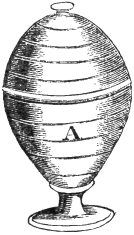
To do this wonderful feat you must have two sticks,
made both of one size, so that no person can know one
from another; one of these sticks must be made so as
to conceal a card in the middle, thus: you must have one
of your sticks turned hollow quite through, and then an
artificial spring to throw the card into the egg at pleasure.
The operation is thus:—Take and peel any card in the
pack, which you please, and roll it up. Now put it
into the false stick, and there let it lie until you have
occasion to make use of it. Now take a pack of cards,
and let any body draw one; but be sure to let it be the
same sort of card which you have in the hollow stick.
The person who has chosen it is now to put it into the
pack again, and, while you are shuffling them, let it fall
into your lap. Then, calling for some eggs, desire the
person who drew the card, or any other person in the
company, to choose any one of the eggs. When they
have done so, ask the person if there be any thing in it?
He will answer that there is not. Now take the egg in
your left hand, and the hollow stick in your right, and
then break the egg with the stick.
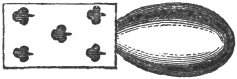
Having let the spring go, the card will appear in the
egg, to the great amazement of the beholders. Now be
sure to conceal the hollow stick, and produce the solid
one, which place upon the table for the examination of
those who are curious.
This is a little pasteboard figure which holds a bow,
with an arrow, which it shoots at the instant required, and
hits a paper placed opposite, on the top of a pedestal:
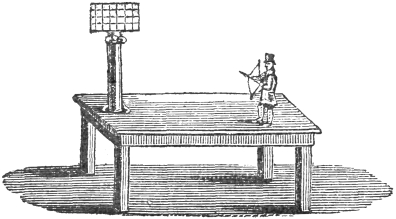
This paper is divided into several squares, which are
numbered, and the arrow flies and always hits the number
chosen by one of the company. The action of the
spring which impels it is restrained by a little pin,
which the confederate lets go at pleasure, by moving the
levers hid in the table; when you push this pin, the
arrow flies with rapidity to the paper, like the operation
of a lock of a musket, when you pull the trigger. In
placing the automaton on the table, you may place it in
such a manner that the arrow be directed towards one
of the circles numbered on the paper. To cause that
number to be chosen against which the arrow is pointed,
you must present to the spectator cards numbered, and
dexterously make him choose the number required,
which depends on peculiar address, that is scarcely possible
to be described by words; it may in general be said
to come under the following heads:—First, to put at the
bottom one of the cards to be chosen; secondly, to keep
it always in the same place, although you mix, or pretend
to mix, the cards; thirdly, to pass the card to the
middle, when you present the pack; fourthly, to pass
many cards before the hands of the spectator, to persuade
him that he may choose indifferently; fifthly, to
pass these same cards with such rapidity, that he cannot
take any but the card intended; sixthly, to slip complaisantly
into his hand the card you wish to be taken,
at the very moment when, the better to deceive him, you
beg of him graciously to take which card he chooses.