"The Joyful Wisdom," written in 1882, just before
"Zarathustra," is rightly judged to be one of
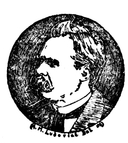
Nietzsche's best books. Here the essentially grave
and masculine face of the poet-philosopher is seen
to light up and suddenly break into a delightful
smile. The warmth and kindness that beam from
his features will astonish those hasty psychologists
who have never divined that behind the destroyer
is the creator, and behind the blasphemer the lover
of life. In the retrospective valuation of his work
which appears in "Ecce Homo" the author himself
observes with truth that the fourth book,
"Sanctus Januarius," deserves especial attention:
"The whole book is a gift from the Saint, and
the introductory verses express my gratitude for
the most wonderful month of January that I have
ever spent." Book fifth "We Fearless Ones,"
the Appendix "Songs of Prince Free-as-a-Bird,"
and the Preface, were added to the second edition
in 1887.
The translation of Nietzsche's poetry has proved
viiito be a more embarrassing problem than that of
his prose. Not only has there been a difficulty in
finding adequate translators—a difficulty overcome,
it is hoped, by the choice of Miss Petre and Mr
Cohn,—but it cannot be denied that even in the
original the poems are of unequal merit. By the
side of such masterpieces as "To the Mistral" are
several verses of comparatively little value. The
Editor, however, did not feel justified in making a
selection, as it was intended that the edition should
be complete. The heading, "Jest, Ruse and
Revenge," of the "Prelude in Rhyme" is borrowed
from Goethe.
PREFACE TO THE SECOND EDITION. — 1. — 2. — 3. — 4.
1
Perhaps more than one preface would be necessary
for this book; and after all it might still be doubtful
whether any one could be brought nearer to the
experiences in it by means of prefaces, without
having himself experienced something similar. It
seems to be written in the language of the thawing-wind:
there is wantonness, restlessness, contradiction
and April-weather in it; so that one is
as constantly reminded of the proximity of winter as
of the victory over it: the victory which is coming,
which must come, which has perhaps already
come.... Gratitude continually flows forth, as
if the most unexpected thing had happened, the
gratitude of a convalescent—for convalescence was
this most unexpected thing. "Joyful Wisdom":
that implies the Saturnalia of a spirit which has
patiently withstood a long, frightful pressure—patiently,
strenuously, impassionately, without
submitting, but without hope—and which is now
suddenly o'erpowered with hope, the hope of
health, the intoxication of convalescence. What
wonder that much that is unreasonable and
foolish thereby comes to light: much wanton
tenderness expended even on problems which
2have a prickly hide, and are not therefore fit to be
fondled and allured. The whole book is really
nothing but a revel after long privation and impotence:
the frolicking of returning energy, of
newly awakened belief in a to-morrow and after-to-morrow;
of sudden sentience and prescience of
a future, of near adventures, of seas open once
more, and aims once more permitted and believed
in. And what was now all behind me! This
track of desert, exhaustion, unbelief, and frigidity
in the midst of youth, this advent of grey
hairs at the wrong time, this tyranny of pain,
surpassed, however, by the tyranny of pride which
repudiated the consequences of pain—and consequences
are comforts,—this radical isolation, as
defence against the contempt of mankind become
morbidly clairvoyant, this restriction upon principle
to all that is bitter, sharp, and painful in knowledge,
as prescribed by the disgust which had gradually
resulted from imprudent spiritual diet and pampering—it
is called Romanticism,—oh, who could
realise all those feelings of mine! He, however,
who could do so would certainly forgive me
everything, and more than a little folly, boisterousness
and "Joyful Wisdom"—for example, the
handful of songs which are given along with
the book on this occasion,—songs in which a poet
makes merry over all poets in a way not easily
pardoned.—Alas, it is not only on the poets
and their fine "lyrical sentiments" that this
reconvalescent must vent his malignity: who knows
what kind of victim he seeks, what kind of monster
of material for parody will allure him ere long?
3Incipit tragœdia, it is said at the conclusion of this
seriously frivolous book; let people be on their
guard! Something or other extraordinarily bad
and wicked announces itself: incipit parodia, there
is no doubt...
——But let us leave Herr Nietzsche; what does it
matter to people that Herr Nietzsche has got well
again?... A psychologist knows few questions
so attractive as those concerning the relations of
health to philosophy, and in the case when he
himself falls sick, he carries with him all his
scientific curiosity into his sickness. For, granting
that one is a person, one has necessarily also the
philosophy of one's personality, there is, however, an
important distinction here. With the one it is his
defects which philosophise, with the other it is his
riches and powers. The former requires his philosophy,
whether it be as support, sedative, or
medicine, as salvation, elevation, or self-alienation;
with the latter it is merely a fine luxury, at best
the voluptuousness of a triumphant gratitude, which
must inscribe itself ultimately in cosmic capitals
on the heaven of ideas. In the other more usual
case, however, when states of distress occupy themselves
with philosophy (as is the case with all sickly
thinkers—and perhaps the sickly thinkers preponderate
in the history of philosophy), what will
happen to the thought itself which is brought
under the pressure of sickness? This is the important
question for psychologists: and here
experiment is possible. We philosophers do just
4like a traveller who resolves to awake at a given
hour, and then quietly yields himself to sleep: we
surrender ourselves temporarily, body and soul, to
the sickness, supposing we become ill—we shut, as
it were, our eyes on ourselves. And as the traveller
knows that something does not sleep, that something
counts the hours and will awake him, we also know
that the critical moment will find us awake—that
then something will spring forward and surprise
the spirit in the very act, I mean in weakness, or
reversion, or submission, or obduracy, or obscurity,
or whatever the morbid conditions are called, which
in times of good health have the pride of the spirit
opposed to them (for it is as in the old rhyme:
"The spirit proud, peacock and horse are the three
proudest things of earthly source"). After such
self-questioning and self-testing, one learns to look
with a sharper eye at all that has hitherto been
philosophised; one divines better than before the
arbitrary by-ways, side-streets, resting-places, and
sunny places of thought, to which suffering thinkers,
precisely as sufferers, are led and misled: one
knows now in what direction the sickly body and
its requirements unconsciously press, push, and
allure the spirit—towards the sun, stillness, gentleness,
patience, medicine, refreshment in any sense
whatever. Every philosophy which puts peace
higher than war, every ethic with a negative grasp
of the idea of happiness, every metaphysic and
physic that knows a finale, an ultimate condition
of any kind whatever, every predominating, æsthetic
or religious longing for an aside, a beyond, an outside,
an above—all these permit one to ask whether
5sickness has not been the motive which inspired the
philosopher. The unconscious disguising of physiological
requirements under the cloak of the objective,
the ideal, the purely spiritual, is carried on to an
alarming extent,—and I have often enough asked
myself, whether, on the whole, philosophy hitherto
has not generally been merely an interpretation
of the body, and a misunderstanding of the
body. Behind the loftiest estimates of value by
which the history of thought has hitherto been
governed, misunderstandings of the bodily constitution,
either of individuals, classes, or entire races
are concealed. One may always primarily consider
these audacious freaks of metaphysic, and especially
its answers to the question of the worth of existence,
as symptoms of certain bodily constitutions; and if,
on the whole, when scientifically determined, not a
particle of significance attaches to such affirmations
and denials of the world, they nevertheless
furnish the historian and psychologist with hints
so much the more valuable (as we have said) as
symptoms of the bodily constitution, its good or bad
condition, its fullness, powerfulness, and sovereignty
in history; or else of its obstructions, exhaustions,
and impoverishments, its premonition of the end,
its will to the end. I still expect that a philosophical
physician, in the exceptional sense of the
word—one who applies himself to the problem of
the collective health of peoples, periods, races, and
mankind generally—will some day have the courage
to follow out my suspicion to its ultimate conclusions,
and to venture on the judgment that in
all philosophising it has not hitherto been a question
6of "truth" at all, but of something else,—namely,
of health, futurity, growth, power, life....
It will be surmised that I should not like to take
leave ungratefully of that period of severe sickness,
the advantage of which is not even yet exhausted
in me: for I am sufficiently conscious of what I
have in advance of the spiritually robust generally,
in my changeful state of health. A philosopher
who has made the tour of many states of
health, and always makes it anew, has also gone
through just as many philosophies: he really
cannot do otherwise than transform his condition
on every occasion into the most ingenious posture
and position,—this art of transfiguration is just
philosophy. We philosophers are not at liberty
to separate soul and body, as the people separate
them; and we are still less at liberty to separate
soul and spirit. We are not thinking frogs, we
are not objectifying and registering apparatuses
with cold entrails,—our thoughts must be continually
born to us out of our pain, and we must,
motherlike, share with them all that we have in
us of blood, heart, ardour, joy, passion, pang,
conscience, fate and fatality. Life—that means
for us to transform constantly into light and flame
all that we are, and also all that we meet with;
we cannot possibly do otherwise. And as regards
sickness, should we not be almost tempted to ask
whether we could in general dispense with it? It
is great pain only which is the ultimate emancipator
of the spirit; for it is the teacher of the
7strong suspicion which makes an X out of every U[1], a true,
correct X, i.e., the ante-penultimate letter.... It is
great pain only, the long slow pain which takes
time, by which we are burned as it were with
green wood, that compels us philosophers to descend
into our ultimate depths, and divest ourselves
of all trust, all good-nature, veiling, gentleness, and
averageness, wherein we have perhaps formerly
installed our humanity. I doubt whether such
pain "improves" us; but I know that it deepens
us. Be it that we learn to confront it with our
pride, our scorn, our strength of will, doing like the
Indian who, however sorely tortured, revenges himself
on his tormentor with his bitter tongue; be it
that we withdraw from the pain into the oriental
nothingness—it is called Nirvana,—into mute,
benumbed, deaf self-surrender, self-forgetfulness,
and self-effacement: one emerges from such long,
dangerous exercises in self-mastery as another being,
with several additional notes of interrogation, and
above all, with the will to question more than ever,
more profoundly, more strictly, more sternly, more
wickedly, more quietly than has ever been questioned
hitherto. Confidence in life is gone: life
itself has become a problem.—Let it not be imagined
that one has necessarily become a hypochondriac
thereby! Even love of life is still possible—only
one loves differently. It is the love of a woman
of whom one is doubtful.... The charm, however,
of all that is problematic, the delight in the
X, is too great in those more spiritual and more
spiritualised men, not to spread itself again and
again like a clear glow over all the trouble of the
problematic, over all the danger of uncertainty,
and even over the jealousy of the lover. We know
a new happiness....
8
Finally, (that the most essential may not remain
unsaid), one comes back out of such abysses, out
of such severe sickness, and out of the sickness of
strong suspicion—new-born, with the skin cast;
more sensitive, more wicked, with a finer taste for
joy, with a more delicate tongue for all good
things, with a merrier disposition, with a second
and more dangerous innocence in joy; more
childish at the same time, and a hundred times
more refined than ever before. Oh, how repugnant
to us now is pleasure, coarse, dull, drab
pleasure, as the pleasure-seekers, our "cultured"
classes, our rich and ruling classes, usually understand
it! How malignantly we now listen to the
great holiday-hubbub with which "cultured people"
and city-men at present allow themselves to be
forced to "spiritual enjoyment" by art, books, and
music, with the help of spirituous liquors! How
the theatrical cry of passion now pains our ear, how
strange to our taste has all the romantic riot and
sensuous bustle which the cultured populace love
become (together with their aspirations after the
exalted, the elevated, and the intricate)! No, if
we convalescents need an art at all, it is another
art—a mocking, light, volatile, divinely serene,
9divinely ingenious art, which blazes up like a clear
flame, into a cloudless heaven! Above all, an art
for artists, only for artists! We at last know
better what is first of all necessary for it—namely,
cheerfulness, every kind of cheerfulness, my friends!
also as artists:—I should like to prove it. We now
know something too well, we men of knowledge:
oh, how well we are now learning to forget and not
know, as artists! And as to our future, we are not
likely to be found again in the tracks of those
Egyptian youths who at night make the temples
unsafe, embrace statues, and would fain unveil,
uncover, and put in clear light, everything which
for good reasons is kept concealed.[2] No, we have
got disgusted with this bad taste, this will to truth,
to "truth at all costs," this youthful madness in
the love of truth: we are now too experienced, too
serious, too joyful, too singed, too profound for
that.... We no longer believe that truth remains
truth when the veil is withdrawn from it: we have
lived long enough to believe this. At present we
regard it as a matter of propriety not to be anxious
either to see everything naked, or to be present at
everything, or to understand and "know" everything.
"Is it true that the good God is everywhere
present?" asked a little girl of her mother: "I
think that is indecent":—a hint to philosophers!
One should have more reverence for the shamefacedness
with which nature has concealed herself
behind enigmas and motley uncertainties. Perhaps
truth is a woman who has reasons for not
showing her reasons? Perhaps her name is Baubo,
to speak in Greek?... Oh, those Greeks! They
knew how to live: for that purpose it is necessary to
keep bravely to the surface, the fold and the skin;
to worship appearance, to believe in forms, tones,
and words, in the whole Olympus of appearance!
Those Greeks were superficial—from profundity!
And are we not coming back precisely to this
point, we dare-devils of the spirit, who have scaled
the highest and most dangerous peak of contemporary
thought, and have looked around us from
it, have looked down from it? Are we not precisely
in this respect—Greeks? Worshippers of forms,
of tones, and of words? And precisely on that
account—artists?
The Teachers of the Object of Existence.—Whether
I look with a good or an evil eye upon men, I find
them always at one problem, each and all of them:
to do that which conduces to the conservation of
the human species. And certainly not out of any
sentiment of love for this species, but simply
because nothing in them is older, stronger, more
inexorable, and more unconquerable than that
instinct,—because it is precisely the essence of our
race and herd. Although we are accustomed
readily enough, with our usual short-sightedness,
to separate our neighbours precisely into useful
and hurtful, into good and evil men, yet when we
make a general calculation, and on longer reflection
on the whole question, we become distrustful
of this defining and separating, and finally
leave it alone. Even the most hurtful man
is still perhaps, in respect to the conservation
of the race, the most useful of all; for he conserves
in himself or by his effect on others, impulses
without which mankind might long ago have languished
or decayed. Hatred, delight in mischief,
rapacity and ambition, and whatever else is called
evil—belong to the marvellous economy of the
conservation of the race; to be sure a costly, lavish,
32and on the whole very foolish economy:—which
has, however, hitherto preserved our race, as is
demonstrated to us. I no longer know, my dear
fellow-man and neighbour, if thou canst at all live to
the disadvantage of the race, and therefore, "unreasonably"
and "badly"; that which could have
injured the race has perhaps died out many
millenniums ago, and now belongs to the things
which are no longer possible even to God. Indulge
thy best or thy worst desires, and above all, go to
wreck!—in either case thou art still probably the
furtherer and benefactor of mankind in some way
or other, and in that respect thou mayest have
thy panegyrists—and similarly thy mockers! But
thou wilt never find him who would be quite
qualified to mock at thee, the individual, at thy
best, who could bring home to thy conscience its
limitless, buzzing and croaking wretchedness so
as to be in accord with truth! To laugh at
oneself as one would have to laugh in order to
laugh out of the veriest truth,—to do this the best
have not hitherto had enough of the sense of truth,
and the most endowed have had far too little
genius! There is perhaps still a future even for
laughter! When the maxim, "The race is all,
the individual is nothing,"—has incorporated itself
in humanity, and when access stands open to
every one at all times to this ultimate emancipation
and irresponsibility.—Perhaps then laughter
will have united with wisdom, perhaps then there
will be only "joyful wisdom." Meanwhile, however,
it is quite otherwise, meanwhile the comedy of
existence has not yet "become conscious" of itself,
33meanwhile it is still the period of tragedy, the
period of morals and religions. What does the
ever new appearing of founders of morals and
religions, of instigators of struggles for moral valuations,
of teachers of remorse of conscience and
religious war, imply? What do these heroes on
this stage imply? For they have hitherto been
the heroes of it, and all else, though solely visible
for the time being, and too close to one, has served
only as preparation for these heroes, whether as
machinery and coulisse, or in the rôle of confidants
and valets. (The poets, for example, have always
been the valets of some morality or other.)—It is
obvious of itself that these tragedians also work in
the interest of the race, though they may believe
that they work in the interest of God, and as
emissaries of God. They also further the life of
the species, in that they further the belief in life.
"It is worth while to live"—each of them calls
out,—"there is something of importance in this
life; life has something behind it and under it;
take care!" That impulse, which rules equally in
the noblest and the ignoblest, the impulse towards
the conservation of the species, breaks forth from
time to time as reason and passion of spirit; it
has then a brilliant train of motives about it, and
tries with all its power to make us forget that
fundamentally it is just impulse, instinct, folly and
baselessness. Life should be loved, for ...! Man
should benefit himself and his neighbour, for ...!
And whatever all these shoulds and fors imply,
and may imply in future! In order that that
which necessarily and always happens of itself and
34without design, may henceforth appear to be done
by design, and may appeal to men as reason and
ultimate command,—for that purpose the ethiculturist
comes forward as the teacher of design in
existence; for that purpose he devises a second and
different existence, and by means of this new
mechanism he lifts the old common existence off
its old common hinges. No! he does not at all
want us to laugh at existence, nor even at ourselves—nor
at himself; to him an individual is always
an individual, something first and last and immense,
to him there are no species, no sums, no noughts.
However foolish and fanatical his inventions and
valuations may be, however much he may misunderstand
the course of nature and deny its conditions—and
all systems of ethics hitherto have
been foolish and anti-natural to such a degree that
mankind would have been ruined by any one of
them had it got the upper hand,—at any rate, every
time that "the hero" came upon the stage something
new was attained: the frightful counterpart
of laughter, the profound convulsion of many individuals
at the thought, "Yes, it is worth while to
live! yes, I am worthy to live!"—life, and thou, and
I, and all of us together became for a while interesting
to ourselves once more.—It is not to be denied
that hitherto laughter and reason and nature have
in the long run got the upper hand of all the great
teachers of design: in the end the short tragedy
always passed over once more into the eternal
comedy of existence; and the "waves of innumerable
laughters"—to use the expression of
Æschylus—must also in the end beat over the greatest
35of these tragedies. But with all this corrective
laughter, human nature has on the whole been
changed by the ever new appearance of those
teachers of the design of existence,—human nature
has now an additional requirement, the very requirement
of the ever new appearance of such teachers
and doctrines of "design." Man has gradually become
a visionary animal, who has to fulfil one more
condition of existence than the other animals: man
must from time to time believe that he knows why
he exists; his species cannot flourish without periodically
confiding in life! Without the belief in
reason in life! And always from time to time
will the human race decree anew that "there is
something which really may not be laughed at."
And the most clairvoyant philanthropist will add
that "not only laughing and joyful wisdom, but also
the tragic, with all its sublime irrationality, counts
among the means and necessities for the conservation
of the race!"—And consequently! Consequently!
Consequently! Do you understand me,
oh my brothers? Do you understand this new
law of ebb and flow? We also shall have our time!
The Intellectual Conscience.—I have always the
same experience over again, and always make a
new effort against it; for although it is evident to
me I do not want to believe it: in the greater number
of men the intellectual conscience is lacking; indeed,
it would often seem to me that in demanding such
a thing, one is as solitary in the largest cities as in
the desert. Everyone looks at you with strange
36eyes, and continues to make use of his scales,
calling this good and that bad; and no one blushes
for shame when you remark that these weights are
not the full amount,—there is also no indignation
against you; perhaps they laugh at your doubt. I
mean to say that the greater number of people do
not find it contemptible to believe this or that, and
live according to it, without having been previously
aware of the ultimate and surest reasons for and
against it, and without even giving themselves any
trouble about such reasons afterwards,—the most
gifted men and the noblest women still belong to
this "greater number." But what is kind-heartedness,
refinement and genius to me, if the man with
these virtues harbours indolent sentiments in belief
and judgment, if the longing for certainty does not
rule in him, as his innermost desire and profoundest
need—as that which separates higher from lower
men! In certain pious people I have found
a hatred of reason, and have been favourably
disposed to them for it: their bad, intellectual
conscience still betrayed itself, at least in this
manner! But to stand in the midst of this rerum
concordia discors and all the marvellous uncertainty
and ambiguity of existence, and not to question, not
to tremble with desire and delight in questioning,
not even to hate the questioner—perhaps even to
make merry over him to the extent of weariness—that
is what I regard as contemptible, and it is this
sentiment which I first of all search for in every
one:—some folly or other always persuades me
anew that every man has this sentiment, as man.
This is my special kind of unrighteousness.
37
Noble and Ignoble.—To ignoble natures all noble,
magnanimous sentiments appear inexpedient, and
on that account first and foremost, as incredible:
they blink with their eyes when they hear of such
matters, and seem inclined to say, "there will, no
doubt, be some advantage therefrom, one cannot
see through all walls;"—they are jealous of the
noble person, as if he sought advantage by back-stair
methods. When they are all too plainly
convinced of the absence of selfish intentions and
emoluments, the noble person is regarded by them
as a kind of fool: they despise him in his gladness,
and laugh at the lustre of his eye. "How can a
person rejoice at being at a disadvantage, how can
a person with open eyes want to meet with disadvantage!
It must be a disease of the reason
with which the noble affection is associated,"—so
they think, and they look depreciatingly thereon;
just as they depreciate the joy which the lunatic
derives from his fixed idea. The ignoble nature
is distinguished by the fact that it keeps its
advantage steadily in view, and that this thought
of the end and advantage is even stronger than
its strongest impulse: not to be tempted to
inexpedient activities by its impulses—that is its
wisdom and inspiration. In comparison with
the ignoble nature the higher nature is more
irrational:—for the noble, magnanimous, and
self-sacrificing person succumbs in fact to his
impulses, and in his best moments his reason
lapses altogether. An animal, which at the risk
38of life protects its young, or in the pairing season
follows the female where it meets with death, does
not think of the risk and the death; its reason
pauses likewise, because its delight in its young,
or in the female, and the fear of being deprived
of this delight, dominate it exclusively; it becomes
stupider than at other times, like the noble and
magnanimous person. He possesses feelings of
pleasure and pain of such intensity that the
intellect must either be silent before them, or
yield itself to their service: his heart then goes
into his head, and one henceforth speaks of
"passions." (Here and there to be sure, the
antithesis to this, and as it were the "reverse of
passion," presents itself; for example in Fontenelle,
to whom some one once laid the hand on the heart
with the words, "What you have there, my dearest
friend, is brain also.") It is the unreason, or perverse
reason of passion, which the ignoble man despises
in the noble individual, especially when it concentrates
upon objects whose value appears to him
to be altogether fantastic and arbitrary. He is
offended at him who succumbs to the passion
of the belly, but he understands the allurement which
here plays the tyrant; but he does not understand,
for example, how a person out of love of knowledge
can stake his health and honour on the game.
The taste of the higher nature devotes itself to
exceptional matters, to things which usually do
not affect people, and seem to have no sweetness;
the higher nature has a singular standard of value.
Besides, it is mostly of the belief that it has not
a singular standard of value in its idiosyncrasies
39of taste; it rather sets up its values and non-values
as the generally valid values and non-values, and
thus becomes incomprehensible and impracticable.
It is very rarely that a higher nature has so much
reason over and above as to understand and deal
with everyday men as such; for the most part
it believes in its passion as if it were the concealed
passion of every one, and precisely in this belief
it is full of ardour and eloquence. If then such
exceptional men do not perceive themselves as
exceptions, how can they ever understand the
ignoble natures and estimate average men fairly!
Thus it is that they also speak of the folly,
inexpediency and fantasy of mankind, full of
astonishment at the madness of the world, and
that it will not recognise the "one thing needful
for it."—This is the eternal unrighteousness of
noble natures.
That which Preserves the Species.—The strongest
and most evil spirits have hitherto advanced mankind
the most: they always rekindled the sleeping
passions—all orderly arranged society lulls the
passions to sleep; they always reawakened the
sense of comparison, of contradiction, of delight
in the new, the adventurous, the untried; they
compelled men to set opinion against opinion, ideal
plan against ideal plan. By means of arms, by
upsetting boundary-stones, by violations of piety
most of all: but also by new religions and morals!
The same kind of "wickedness" is in every teacher
and preacher of the new—which makes a conqueror
40infamous, although it expresses itself more refinedly,
and does not immediately set the muscles in motion
(and just on that account does not make so infamous!).
The new, however, is under all circumstances
the evil, as that which wants to conquer,
which tries to upset the old boundary-stones and
the old piety; only the old is the good! The
good men of every age are those who go to the
roots of the old thoughts and bear fruit with them,
the agriculturists of the spirit. But every soil becomes
finally exhausted, and the ploughshare of
evil must always come once more.—There is at
present a fundamentally erroneous theory of morals
which is much celebrated, especially in England:
according to it the judgments "good" and "evil"
are the accumulation of the experiences of that
which is "expedient" and "inexpedient"; according
to this theory, that which is called good is
conservative of the species, what is called evil, however,
is detrimental to it. But in reality the evil
impulses are just in as high a degree expedient,
indispensable, and conservative of the species as
the good:—only, their function is different.
Unconditional Duties.—All men who feel that
they need the strongest words and intonations, the
most eloquent gestures and attitudes, in order to
operate at all—revolutionary politicians, socialists,
preachers of repentance with or without Christianity,
with all of whom there must be no mere half-success,—all
these speak of "duties," and indeed, always
of duties, which have the character of being unconditional—without
41such they would have no right
to their excessive pathos: they know that right
well! They grasp, therefore, at philosophies of
morality which preach some kind of categorical
imperative, or they assimilate a good lump of
religion, as, for example, Mazzini did. Because
they want to be trusted unconditionally, it is first
of all necessary for them to trust themselves unconditionally,
on the basis of some ultimate, undebatable
command, sublime in itself, as the ministers
and instruments of which, they would fain feel and
announce themselves. Here we have the most
natural, and for the most part, very influential
opponents of moral enlightenment and scepticism:
but they are rare. On the other hand, there is
always a very numerous class of those opponents
wherever interest teaches subjection, while repute
and honour seem to forbid it. He who feels himself
dishonoured at the thought of being the instrument
of a prince, or of a party and sect, or even of
wealthy power (for example, as the descendant of
a proud, ancient family), but wishes just to be
this instrument, or must be so before himself and
before the public—such a person has need of
pathetic principles which can at all times be
appealed to:—principles of an unconditional ought,
to which a person can subject himself without
shame, and can show himself subjected. All more
refined servility holds fast to the categorical imperative,
and is the mortal enemy of those who want to
take away the unconditional character of duty:
propriety demands this from them, and not only
propriety.
42
Loss of Dignity.—Meditation has lost all its
dignity of form; the ceremonial and solemn bearing
of the meditative person have been made a mockery,
and one would no longer endure a wise man of
the old style. We think too hastily and on the
way and while walking and in the midst of business
of all kinds, even when we think on the most
serious matters; we require little preparation, even
little quiet:—it is as if each of us carried about an
unceasingly revolving machine in his head, which
still works, even under the most unfavourable circumstances.
Formerly it was perceived in a person
that on some occasion he wanted to think—it was
perhaps the exception!—that he now wanted to
become wiser and collected his mind on a thought:
he put on a long face for it, as for a prayer, and
arrested his step—nay, stood still for hours on the
street when the thought "came"—on one or on
two legs. It was thus "worthy of the affair"!
Something for the Laborious.—He who at present
wants to make moral questions a subject of study
has an immense field of labour before him. All
kinds of passions must be thought about singly,
and followed singly throughout periods, peoples,
great and insignificant individuals; all their rationality,
all their valuations and elucidations of things,
ought to come to light! Hitherto all that has
given colour to existence has lacked a history:
where would one find a history of love, of avarice,
43of envy, of conscience, of piety, of cruelty? Even
a comparative history of law, as also of punishment,
has hitherto been completely lacking. Have
the different divisions of the day, the consequences
of a regular appointment of the times for labour,
feast, and repose, ever been made the object of
investigation? Do we know the moral effects of
the alimentary substances? Is there a philosophy
of nutrition? (The ever-recurring outcry for and
against vegetarianism proves that as yet there
is no such philosophy!) Have the experiences
with regard to communal living, for example, in
monasteries, been collected? Has the dialectic
of marriage and friendship been set forth? The
customs of the learned, of trades-people, of artists,
and of mechanics—have they already found their
thinkers? There is so much to think of thereon!
All that up till now has been considered as the
"conditions of existence," of human beings, and all
reason, passion and superstition in this consideration—have
they been investigated to the end?
The observation alone of the different degrees of
development which the human impulses have
attained, and could yet attain, according to the
different moral climates, would furnish too much
work for the most laborious; whole generations,
and regular co-operating generations of the learned,
would be needed in order to exhaust the points
of view and the material here furnished. The
same is true of the determining of the reasons
for the differences of the moral climates ("on what
account does this sun of a fundamental moral judgment
and standard of highest value shine here—and
44that sun there?"). And there is again a new labour
which points out the erroneousness of all these
reasons, and determines the entire essence of the
moral judgments hitherto made. Supposing all these
labours to be accomplished, the most critical of all
questions would then come into the foreground:
whether science is in a position to furnish goals for
human action, after it has proved that it can take
them away and annihilate them—and then would be
the time for a process of experimenting in which
every kind of heroism could satisfy itself, an
experimenting for centuries, which would put into
the shade all the great labours and sacrifices of
previous history. Science has not hitherto built
its Cyclopic structures; for that also the time will
come.
Unconscious Virtues.—All qualities in a man of
which he is conscious—and especially when he
presumes that they are visible and evident to his
environment also—are subject to quite other laws
of development than those qualities which are unknown
to him, or imperfectly known, which by
their subtlety can also conceal themselves from
the subtlest observer, and hide as it were behind
nothing,—as in the case of the delicate sculptures
on the scales of reptiles (it would be an error to
suppose them an adornment or a defence—for one
sees them only with the microscope; consequently,
with an eye artificially strengthened to an extent
of vision which similar animals, to which they
might perhaps have meant adornment or defence,
45do not possess!) Our visible moral qualities, and
especially our moral qualities believed to be visible,
follow their own course,—and our invisible qualities
of similar name, which in relation to others neither
serve for adornment nor defence, also follow their
own course: quite a different course probably, and
with lines and refinements, and sculptures, which
might perhaps give pleasure to a God with a divine
microscope. We have, for example, our diligence,
our ambition, our acuteness: all the world knows
about them,—and besides, we have probably once
more our diligence, our ambition, our acuteness;
but for these—our reptile scales—the microscope
has not yet been invented!—And here the adherents
of instinctive morality will say, "Bravo! He at
least regards unconscious virtues as possible—that
suffices us!"—Oh, ye unexacting creatures!
Our Eruptions.—Numberless things which
humanity acquired in its earlier stages, but so
weakly and embryonically that it could not be
noticed that they were acquired, are thrust suddenly
into light long afterwards, perhaps after the lapse of
centuries: they have in the interval become strong
and mature. In some ages this or that talent, this
or that virtue seems to be entirely lacking, as it
is in some men; but let us wait only for the
grandchildren and grandchildren's children, if we
have time to wait,—they bring the interior of their
grandfathers into the sun, that interior of which
the grandfathers themselves were unconscious.
The son, indeed, is often the betrayer of his father;
46the latter understands himself better since he has
got his son. We have all hidden gardens and
plantations in us; and by another simile, we are
all growing volcanoes, which will have their hours
of eruption:—how near or how distant this is,
nobody of course knows, not even the good God.
A Species of Atavism.—I like best to think of the
rare men of an age as suddenly emerging aftershoots
of past cultures, and of their persistent
strength: like the atavism of a people and its civilisation:—there
is thus still something in them to
think of! They now seem strange, rare, and extraordinary:
and he who feels these forces in himself
has to foster them in face of a different, opposing
world; he has to defend them, honour them, and rear
them to maturity: and he either becomes a great man
thereby, or a deranged and eccentric person, unless
he should altogether break down betimes. Formerly
these rare qualities were usual, and were consequently
regarded as common: they did not distinguish
people. Perhaps they were demanded and
presupposed; it was impossible to become great
with them, for indeed there was also no danger
of becoming insane and solitary with them.—It
is principally in the old-established families and
castes of a people that such after-effects of old
impulses present themselves, while there is no
probability of such atavism where races, habits,
and valuations change too rapidly. For the tempo
of the evolutional forces in peoples implies just
as much as in music; for our case an andante of
47evolution is absolutely necessary, as the tempo of a
passionate and slow spirit:—and the spirit of conserving
families is certainly of that sort.
Consciousness.—Consciousness is the last and
latest development of the organic, and consequently
also the most unfinished and least powerful of these
developments. Innumerable mistakes originate out
of consciousness, which, "in spite of fate," as Homer
says, cause an animal or a man to break down
earlier than might be necessary. If the conserving
bond of the instincts were not very much
more powerful, it would not generally serve as a
regulator: by perverse judging and dreaming
with open eyes, by superficiality and credulity,
in short, just by consciousness, mankind would
necessarily have broken down: or rather, without
the former there would long ago have been nothing
more of the latter! Before a function is fully formed
and matured, it is a danger to the organism:
all the better if it be then thoroughly tyrannised
over! Consciousness is thus thoroughly tyrannised
over—and not least by the pride in it! It is
thought that here is the quintessence of man; that
which is enduring, eternal, ultimate, and most
original in him! Consciousness is regarded as a
fixed, given magnitude! Its growth and intermittences
are denied! It is accepted as the "unity of
the organism"!—This ludicrous overvaluation and
misconception of consciousness, has as its result the
great utility, that a too rapid maturing of it has
thereby been hindered. Because men believed that
48they already possessed consciousness, they gave
themselves very little trouble to acquire it—and
even now it is not otherwise! It is still an
entirely new problem just dawning on the human
eye and hardly yet plainly recognisable: to embody
knowledge in ourselves and make it instinctive,—a
problem which is only seen by those who have
grasped the fact that hitherto our errors alone have
been embodied in us, and that all our consciousness
is relative to errors!
The Goal of Science.—What? The ultimate goal
of science is to create the most pleasure possible to
man, and the least possible pain? But what if
pleasure and pain should be so closely connected
that he who wants the greatest possible amount of
the one must also have the greatest possible amount
of the other,—that he who wants to experience the
"heavenly high jubilation,"[7] must also be ready to
be "sorrowful unto death"?(ref. same footnote) And it is so, perhaps!
The Stoics at least believed it was so, and they
were consistent when they wished to have the least
possible pleasure, in order to have the least possible
pain from life. (When one uses the expression:
"The virtuous man is the happiest," it is as much
the sign-board of the school for the masses, as
a casuistic subtlety for the subtle.) At present
also ye have still the choice: either the least
possible pain, in short painlessness—and after all,
socialists and politicians of all parties could not
honourably promise more to their people,—or the
greatest possible amount of pain, as the price of
the growth of a fullness of refined delights and
enjoyments rarely tasted hitherto! If ye decide
for the former, if ye therefore want to depress and
minimise man's capacity for pain, well, ye must
also depress and minimise his capacity for enjoyment.
In fact, one can further the one as well as
the other goal by science! Perhaps science is as
yet best known by its capacity for depriving man
of enjoyment, and making him colder, more
statuesque, and more Stoical. But it might also
turn out to be the great pain-bringer!—And then,
perhaps, its counteracting force would be discovered
simultaneously, its immense capacity for making
new sidereal worlds of enjoyment beam forth!
49
The Theory of the Sense of Power.—We exercise
our power over others by doing them good or
by doing them ill—that is all we care for!
Doing ill to those on whom we have to make our
power felt; for pain is a far more sensitive means
for that purpose than pleasure:—pain always asks
concerning the cause, while pleasure is inclined
to keep within itself and not look backward.
Doing good and being kind to those who are in
any way already dependent on us (that is, who
are accustomed to think of us as their raison
d'être); we want to increase their power, because
we thus increase our own; or we want to show
50them the advantage there is in being in our
power,—they thus become more contented with
their position, and more hostile to the enemies of
our power and readier to contend with them.
If we make sacrifices in doing good or in doing ill,
it does not alter the ultimate value of our actions;
even if we stake our life in the cause, as martyrs for
the sake of our church, it is a sacrifice to our
longing for power, or for the purpose of conserving
our sense of power. He who under these circumstances
feels that he "is in possession of truth,"
how many possessions does he not let go, in order
to preserve this feeling! What does he not throw
overboard, in order to keep himself "up,"—that is
to say, above the others who lack the "truth"!
Certainly the condition we are in when we do ill
is seldom so pleasant, so purely pleasant, as that
in which we practise kindness,—it is an indication
that we still lack power, or it betrays ill-humour
at this defect in us; it brings with it new dangers
and uncertainties as to the power we already
possess, and clouds our horizon by the prospect of
revenge, scorn, punishment and failure. Perhaps
only those most susceptible to the sense of power,
and eager for it, will prefer to impress the seal of
power on the resisting individual,—those to whom
the sight of the already subjugated person as the
object of benevolence is a burden and a tedium.
It is a question how a person is accustomed to
season his life; it is a matter of taste whether a
person would rather have the slow or the sudden,
the safe or the dangerous and daring increase of
power,—he seeks this or that seasoning always
51according to his temperament. An easy booty
is something contemptible to proud natures; they
have an agreeable sensation only at the sight of
men of unbroken spirit who could be enemies to
them, and similarly, also, at the sight of all not easily
accessible possession; they are often hard toward
the sufferer, for he is not worthy of their effort or
their pride,—but they show themselves so much
the more courteous towards their equals, with whom
strife and struggle would in any case be full of
honour, if at any time an occasion for it should
present itself. It is under the agreeable feelings
of this perspective that the members of the
knightly caste have habituated themselves to exquisite
courtesy toward one another.—Pity is the
most pleasant feeling in those who have not much
pride, and have no prospect of great conquests: the
easy booty—and that is what every sufferer is—is
for them an enchanting thing. Pity is said to
be the virtue of the gay lady.
What is called Love.—The lust of property and
love: what different associations each of these
ideas evoke!—and yet it might be the same impulse
twice named: on the one occasion disparaged
from the standpoint of those already possessing
(in whom the impulse has attained something of
repose, and who are now apprehensive for the
safety of their "possession"); on the other occasion
viewed from the standpoint of the unsatisfied
and thirsty, and therefore glorified as "good." Our
52love of our neighbour,—is it not a striving after new
property? And similarly our love of knowledge, of
truth; and in general all the striving after novelties?
We gradually become satiated with the old, the
securely possessed, and again stretch out our hands;
even the finest landscape in which we live for three
months is no longer certain of our love, and any
kind of more distant coast excites our covetousness:
the possession for the most part becomes smaller
through possessing. Our pleasure in ourselves
seeks to maintain itself, by always transforming
something new into ourselves,—that is just possessing.
To become satiated with a possession, that is
to become satiated with ourselves. (One can also
suffer from excess,—even the desire to cast away,
to share out, can assume the honourable name of
"love.") When we see any one suffering, we willingly
utilise the opportunity then afforded to take possession
of him; the beneficent and sympathetic man,
for example, does this; he also calls the desire for
new possession awakened in him, by the name of
"love," and has enjoyment in it, as in a new
acquisition suggesting itself to him. The love of
the sexes, however, betrays itself most plainly as
the striving after possession: the lover wants the
unconditioned, sole possession of the person longed
for by him; he wants just as absolute power over
her soul as over her body; he wants to be loved
solely, and to dwell and rule in the other soul as
what is highest and most to be desired. When
one considers that this means precisely to exclude
all the world from a precious possession, a
happiness, and an enjoyment; when one considers
53that the lover has in view the impoverishment and
privation of all other rivals, and would like to
become the dragon of his golden hoard, as the
most inconsiderate and selfish of all "conquerors"
and exploiters; when one considers finally that to
the lover himself, the whole world besides appears
indifferent, colourless, and worthless, and that he
is ready to make every sacrifice, disturb every
arrangement, and put every other interest behind
his own,—one is verily surprised that this ferocious
lust of property and injustice of sexual love should
have been glorified and deified to such an extent at
all times; yea, that out of this love the conception
of love as the antithesis of egoism should have been
derived, when it is perhaps precisely the most unqualified
expression of egoism. Here, evidently, the
non-possessors and desirers have determined the
usage of language,—there were, of course, always
too many of them. Those who have been favoured
with much possession and satiety, have, to be sure,
dropped a word now and then about the "raging
demon," as, for instance, the most lovable and most
beloved of all the Athenians—Sophocles; but Eros
always laughed at such revilers,—they were
always his greatest favourites.—There is, of course,
here and there on this terrestrial sphere a kind of
sequel to love, in which that covetous longing of
two persons for one another has yielded to a new
desire and covetousness, to a common, higher thirst
for a superior ideal standing above them: but who
knows this love? Who has experienced it? Its
right name is friendship.
54
Out of the Distance.—This mountain makes the
whole district which it dominates charming in
every way, and full of significance: after we have
said this to ourselves for the hundredth time, we
are so irrationally and so gratefully disposed towards
it, as the giver of this charm, that we
fancy it must itself be the most charming thing
in the district—and so we climb it, and are
undeceived. All of a sudden, it itself, and the
whole landscape around and under us, is as it were
disenchanted; we had forgotten that many a greatness,
like many a goodness, wants only to be seen
at a certain distance, and entirely from below, not
from above,—it is thus only that it operates. Perhaps
you know men in your neighbourhood who
can only look at themselves from a certain distance
to find themselves at all endurable, or attractive
and enlivening; they are to be dissuaded from self-knowledge.
Across the Plank.—One must be able to dissimulate
in intercourse with persons who are
ashamed of their feelings; they experience a
sudden aversion towards anyone who surprises
them in a state of tender, or enthusiastic and high-running
feeling, as if he had seen their secrets. If
one wants to be kind to them in such moments
one should make them laugh, or say some kind of
cold, playful wickedness:—their feeling thereby
congeals, and they are again self-possessed. But
I give the moral before the story.—We were once
55on a time so near one another in the course of our
lives, that nothing more seemed to hinder our
friendship and fraternity, and there was merely a
small plank between us. While you were just
about to step on it, I asked you: "Do you want
to come across the plank to me?" But then you
did not want to come any longer; and when I again
entreated, you were silent. Since then mountains
and torrents, and whatever separates and alienates,
have interposed between us, and even if we wanted
to come to one another, we could no longer do so!
When, however, you now remember that small
plank, you have no longer words,—but merely sobs
and amazement.
Motivation of Poverty.—We cannot, to be sure, by
any artifice make a rich and richly-flowing virtue
out of a poor one, but we can gracefully enough
reinterpret its poverty into necessity, so that its
aspect no longer gives pain to us, and we do not
make any reproachful faces at fate on account of it.
It is thus that the wise gardener does, who puts the
tiny streamlet of his garden into the arms of a
fountain-nymph, and thus motivates the poverty:—and
who would not like him need the nymphs!
Ancient Pride.—The ancient savour of nobility
is lacking in us, because the ancient slave is lacking
in our sentiment. A Greek of noble descent found
such immense intermediate stages, and such a
distance betwixt his elevation and that ultimate
56baseness, that he could hardly even see the slave
plainly: even Plato no longer saw him entirely.
It is otherwise with us, accustomed as we are to
the doctrine of the equality of men, although not
to the equality itself. A being who has not the
free disposal of himself and has not got leisure,—that
is not regarded by us as anything contemptible;
there is perhaps too much of this kind
of slavishness in each of us, in accordance with
the conditions of our social order and activity,
which are fundamentally different from those of
the ancients.—The Greek philosopher went through
life with the secret feeling that there were many
more slaves than people supposed—that is to
say, that every one was a slave who was not a
philosopher. His pride was puffed up when he
considered that even the mightiest of the earth
were thus to be looked upon as slaves. This
pride is also unfamiliar to us, and impossible; the
word "slave" has not its full force for us even in
simile.
Evil.—Test the life of the best and most productive
men and nations, and ask yourselves
whether a tree which is to grow proudly heavenward
can dispense with bad weather and tempests:
whether disfavour and opposition from without,
whether every kind of hatred, jealousy, stubbornness,
distrust, severity, greed, and violence do not
belong to the favouring circumstances without
which a great growth even in virtue is hardly
possible? The poison by which the weaker nature
57is destroyed is strengthening to the strong individual—and
he does not call it poison.
Dignity of Folly.—Several millenniums further
on in the path of the last century!—and in everything
that man does the highest prudence will be
exhibited: but just thereby prudence will have
lost all its dignity. It will then, sure enough, be
necessary to be prudent, but it will also be so
usual and common, that a more fastidious taste
will feel this necessity as vulgarity. And just as a
tyranny of truth and science would be in a position
to raise the value of falsehood, a tyranny of prudence
could force into prominence a new species of nobleness.
To be noble—that might then mean, perhaps,
to be capable of follies.
To the Teachers of Unselfishness.—The virtues of
a man are called good, not in respect of the results
they have for himself, but in respect of the results
which we expect therefrom for ourselves and for
society:—we have all along had very little unselfishness,
very little "non-egoism" in our praise of the
virtues! For otherwise it could not but have been
seen that the virtues (such as diligence, obedience,
chastity, piety, justice) are mostly injurious to
their possessors, as impulses which rule in them
too vehemently and ardently, and do not want
to be kept in co-ordination with the other impulses
by the reason. If you have a virtue, an
actual, perfect virtue (and not merely a kind of
58impulse towards virtue!)—you are its victim! But
your neighbour praises your virtue precisely on
that account! One praises the diligent man though
he injures his sight, or the originality and freshness
of his spirit, by his diligence; the youth is
honoured and regretted who has "worn himself
out by work," because one passes the judgment
that "for society as a whole the loss of the best
individual is only a small sacrifice! A pity that
this sacrifice should be necessary! A much greater
pity, it is true, if the individual should think differently,
and regard his preservation and development
as more important than his work in the service of
society!" And so one regrets this youth, not on
his own account, but because a devoted instrument,
regardless of self—a so-called "good man," has
been lost to society by his death. Perhaps one
further considers the question, whether it would not
have been more advantageous for the interests of
society if he had laboured with less disregard of
himself, and had preserved himself longer,—indeed,
one readily admits an advantage therefrom, but
one esteems the other advantage, namely, that a
sacrifice has been made, and that the disposition
of the sacrificial animal has once more been obviously
endorsed—as higher and more enduring. It is
accordingly, on the one part, the instrumental
character in the virtues which is praised when
the virtues are praised, and on the other part, the
blind, ruling impulse in every virtue, which refuses
to let itself be kept within bounds by the general
advantage to the individual; in short, what is
praised is the unreason in the virtues, in consequence
59of which the individual allows himself to
be transformed into a function of the whole. The
praise of the virtues is the praise of something
which is privately injurious to the individual; it is
praise of impulses which deprive man of his noblest
self-love, and the power to take the best care of
himself. To be sure, for the teaching and embodying
of virtuous habits a series of effects of virtue
are displayed, which make it appear that virtue
and private advantage are closely related,—and
there is in fact such a relationship! Blindly
furious diligence, for example, the typical virtue of
an instrument, is represented as the way to riches
and honour, and as the most beneficial antidote to
tedium and passion: but people are silent concerning
its danger, its greatest dangerousness. Education
proceeds in this manner throughout: it
endeavours, by a series of enticements and advantages,
to determine the individual to a certain mode
of thinking and acting, which, when it has become
habit, impulse and passion, rules in him and
over him, in opposition to his ultimate advantage,
but "for the general good." How often do I see
that blindly furious diligence does indeed create
riches and honours, but at the same time deprives
the organs of the refinement by virtue of which
alone an enjoyment of riches and honours is
possible; so that really the main expedient for
combating tedium and passion, simultaneously
blunts the senses and makes the spirit refractory
towards new stimuli! (The busiest of all ages—our
age—does not know how to make anything
out of its great diligence and wealth, except always
60more and more wealth, and more and more
diligence; there is even more genius needed for
laying out wealth than for acquiring it!—Well, we
shall have our "grandchildren"!) If the education
succeeds, every virtue of the individual is a
public utility, and a private disadvantage in respect
to the highest private end,—probably some psycho-æsthetic
stunting, or even premature dissolution.
One should consider successively from the same
standpoint the virtues of obedience, chastity, piety,
and justice. The praise of the unselfish, self-sacrificing,
virtuous person—he, consequently, who
does not expend his whole energy and reason
for his own conservation, development, elevation,
furtherance and augmentation of power, but lives
as regards himself unassumingly and thoughtlessly,
perhaps even indifferently or ironically,—this praise
has in any case not originated out of the spirit of
unselfishness! The "neighbour" praises unselfishness
because he profits by it! If the neighbour
were "unselfishly" disposed himself, he would
reject that destruction of power, that injury for his
advantage, he would thwart such inclinations in
their origin, and above all he would manifest his
unselfishness just by not giving it a good name!
The fundamental contradiction in that morality
which at present stands in high honour is here
indicated: the motives to such a morality are in
antithesis to its principle! That with which this
morality wishes to prove itself, refutes it out of
its criterion of what is moral! The maxim, "Thou
shalt renounce thyself and offer thyself as a
sacrifice," in order not to be inconsistent with its
61own morality, could only be decreed by a being
who himself renounced his own advantage thereby,
and who perhaps in the required self-sacrifice of
individuals brought about his own dissolution.
As soon, however, as the neighbour (or society)
recommended altruism on account of its utility, the
precisely antithetical proposition, "Thou shalt seek
thy advantage even at the expense of everybody
else," was brought into use: accordingly, "thou
shalt," and "thou shalt not," are preached in one
breath!
L'Ordre du Jour pour le Roi.—The day commences:
let us begin to arrange for this day the
business and fêtes of our most gracious lord, who
at present is still pleased to repose. His Majesty
has bad weather to-day: we shall be careful not
to call it bad; we shall not speak of the weather,—but
we shall go through to-day's business somewhat
more ceremoniously and make the fêtes somewhat
more festive than would otherwise be necessary.
His Majesty may perhaps even be sick: we shall
give the last good news of the evening at breakfast,
the arrival of M. Montaigne, who knows how to joke
so pleasantly about his sickness,—he suffers from
stone. We shall receive several persons (persons!—what
would that old inflated frog, who will be
among them, say, if he heard this word! "I am
no person," he would say, "but always the thing
itself")—and the reception will last longer than is
pleasant to anybody; a sufficient reason for telling
about the poet who wrote over his door, "He who
62enters here will do me an honour; he who does
not—a favour."—That is, forsooth, saying a discourteous
thing in a courteous manner! And perhaps
this poet is quite justified on his part in being
discourteous; they say that the rhymes are better
than the rhymester. Well, let him still make many
of them, and withdraw himself as much as possible
from the world: and that is doubtless the significance
of his well-bred rudeness! A prince, on
the other hand, is always of more value than his
"verse," even when—but what are we about? We
gossip, and the whole court believes that we have
already been at work and racked our brains: there
is no light to be seen earlier than that which burns
in our window.—Hark! Was that not the bell?
The devil! The day and the dance commence,
and we do not know our rounds! We must then
improvise,—all the world improvises its day. To-day,
let us for once do like all the world!—And
therewith vanished my wonderful morning dream,
probably owing to the violent strokes of the tower-clock,
which just then announced the fifth hour
with all the importance which is peculiar to it. It
seems to me that, on this occasion, the God of
dreams wanted to make merry over my habits,—it
is my habit to commence the day by arranging
it properly, to make it endurable for myself, and
it is possible that I may often have done this too
formally, and too much like a prince.
The Characteristics of Corruption.—Let us observe
the following characteristics in that condition of
63society from time to time necessary, which is designated
by the word "corruption." Immediately upon
the appearance of corruption anywhere, a motley
superstition gets the upper hand, and the hitherto
universal belief of a people becomes colourless and
impotent in comparison with it; for superstition is
freethinking of the second rank,—he who gives
himself over to it selects certain forms and formulæ
which appeal to him, and permits himself a right
of choice. The superstitious man is always much
more of a "person," in comparison with the religious
man, and a superstitious society will be one in
which there are many individuals, and a delight in
individuality. Seen from this standpoint superstition
always appears as a progress in comparison
with belief, and as a sign that the intellect becomes
more independent and claims to have its rights.
Those who reverence the old religion and the
religious disposition then complain of corruption,—they
have hitherto also determined the usage of
language, and have given a bad repute to superstition,
even among the freest spirits. Let us learn
that it is a symptom of enlightenment.—Secondly,
a society in which corruption takes a hold is blamed
for effeminacy: for the appreciation of war, and
the delight in war perceptibly diminish in such a
society, and the conveniences of life are now just
as eagerly sought after as were military and
gymnastic honours formerly. But one is accustomed
to overlook the fact that the old national
energy and national passion, which acquired a
magnificent splendour in war and in the tourney,
has now transferred itself into innumerable private
64passions, and has merely become less visible;
indeed in periods of "corruption" the quantity and
quality of the expended energy of a people is probably
greater than ever, and the individual spends
it lavishly, to such an extent as could not be done
formerly—he was not then rich enough to do so!
And thus it is precisely in times of "effeminacy"
that tragedy runs at large in and out of doors, it
is then that ardent love and ardent hatred are
born, and the flame of knowledge flashes heavenward
in full blaze.—Thirdly, as if in amends for the
reproach of superstition and effeminacy, it is customary
to say of such periods of corruption that
they are milder, and that cruelty has then greatly
diminished in comparison with the older, more
credulous, and stronger period. But to this praise
I am just as little able to assent as to that reproach:
I only grant so much—namely, that cruelty now
becomes more refined, and its older forms are
henceforth counter to the taste; but the wounding
and torturing by word and look reaches its highest
development in times of corruption,—it is now only
that wickedness is created, and the delight in wickedness.
The men of the period of corruption are
witty and calumnious; they know that there are
yet other ways of murdering than by the dagger
and the ambush—they know also that all that is
well said is believed in.—Fourthly, it is when
"morals decay" that those beings whom one calls
tyrants first make their appearance; they are the
forerunners of the individual, and as it were early
matured firstlings. Yet a little while, and this
fruit of fruits hangs ripe and yellow on the tree of
65a people,—and only for the sake of such fruit did
this tree exist! When the decay has reached its
worst, and likewise the conflict of all sorts of tyrants,
there always arises the Cæsar, the final tyrant, who
puts an end to the exhausted struggle for sovereignty,
by making the exhaustedness work for him.
In his time the individual is usually most mature,
and consequently the "culture" is highest and
most fruitful, but not on his account nor through
him: although the men of highest culture love to
flatter their Cæsar by pretending that they are his
creation. The truth, however, is that they need
quietness externally, because internally they have
disquietude and labour. In these times bribery and
treason are at their height: for the love of the ego,
then first discovered, is much more powerful than
the love of the old, used-up, hackneyed "fatherland";
and the need to be secure in one way or other
against the frightful fluctuations of fortune, opens
even the nobler hands, as soon as a richer and more
powerful person shows himself ready to put gold
into them. There is then so little certainty with
regard to the future; people live only for the day:
a condition of mind which enables every deceiver
to play an easy game,—people of course only let
themselves be misled and bribed "for the present,"
and reserve for themselves futurity and virtue.
The individuals, as is well known, the men who
only live for themselves, provide for the moment
more than do their opposites, the gregarious men,
because they consider themselves just as incalculable
as the future; and similarly they attach themselves
willingly to despots, because they believe
66themselves capable of activities and expedients,
which can neither reckon on being understood by
the multitude, nor on finding favour with them,—but
the tyrant or the Cæsar understands the rights
of the Individual even in his excesses, and has an
interest in speaking on behalf of a bolder private
morality, and even in giving his hand to it. For
he thinks of himself, and wishes people to think of
him what Napoleon once uttered in his classical
style—"I have the right to answer by an eternal
'thus I am' to everything about which complaint
is brought against me. I am apart from all the
world, I accept conditions from nobody. I wish
people also to submit to my fancies, and to take
it quite as a simple matter, if I should indulge in
this or that diversion." Thus spoke Napoleon
once to his wife, when she had reasons for calling
in question the fidelity of her husband.—The times
of corruption are the seasons when the apples fall
from the tree: I mean the individuals, the seed-bearers
of the future, the pioneers of the spiritual
colonisation and of a new construction of national
and social unions. Corruption is only an abusive
term for the harvest time of a people.
Different Dissatisfactions.—The feeble and as it
were feminine dissatisfied people have ingenuity
for beautifying and deepening life; the strong
dissatisfied people—the masculine persons among
them, to continue the metaphor—have the ingenuity
for improving and safeguarding life. The former
67show their weakness and feminine character by
willingly letting themselves be temporarily deceived,
and perhaps even by putting up with a little
ecstasy and enthusiasm on a time, but on the whole
they are never to be satisfied, and suffer from the
incurability of their dissatisfaction; moreover they
are the patrons of all those who manage to concoct
opiate and narcotic comforts, and just on that
account averse to those who value the physician
higher than the priest,—they thereby encourage
the continuance of actual distress! If there had
not been a surplus of dissatisfied persons of this
kind in Europe since the time of the Middle Ages,
the remarkable capacity of Europeans for constant
transformation would perhaps not have originated
at all; for the claims of the strong dissatisfied
persons are too gross, and really too modest to
resist being finally quieted down. China is an
instance of a country in which dissatisfaction on a
grand scale and the capacity for transformation
have died out for many centuries; and the Socialists
and state-idolaters of Europe could easily bring
things to Chinese conditions and to a Chinese
"happiness," with their measures for the amelioration
and security of life, provided that they could
first of all root out the sicklier, tenderer, more
feminine dissatisfaction and Romanticism which
are still very abundant among us. Europe is an
invalid who owes her best thanks to her incurability
and the eternal transformations of her sufferings;
these constant new situations, these equally constant
new dangers, pains, and make-shifts, have at
last generated an intellectual sensitiveness which is
68almost equal to genius, and is in any case the
mother of all genius.
Not Pre-ordained to Knowledge.—There is a purblind
humility not at all rare, and when a person
is afflicted with it, he is once for all unqualified
for being a disciple of knowledge. It is this in
fact: the moment a man of this kind perceives
anything striking, he turns as it were on his heel,
and says to himself: "You have deceived yourself!
Where have your wits been! This cannot be
the truth!"—and then, instead of looking at it and
listening to it with more attention, he runs out of
the way of the striking object as if intimidated,
and seeks to get it out of his head as quickly as
possible. For his fundamental rule runs thus: "I
want to see nothing that contradicts the usual
opinion concerning things! Am I created for the
purpose of discovering new truths? There are
already too many of the old ones."
What is Living?—Living—that is to continually
eliminate from ourselves what is about to die;
Living—that is to be cruel and inexorable towards
all that becomes weak and old in ourselves, and
not only in ourselves. Living—that means, therefore,
to be without piety toward the dying, the
wretched and the old? To be continually a murderer?—And
yet old Moses said: "Thou shalt not
kill!"
69
The Self-Renouncer.—What does the self-renouncer
do? He strives after a higher world,
he wants to fly longer and further and higher than
all men of affirmation—he throws away many things
that would burden his flight, and several things
among them that are not valueless, that are not
unpleasant to him: he sacrifices them to his desire
for elevation. Now this sacrificing, this casting
away, is the very thing which becomes visible in
him: on that account one calls him the self-renouncer,
and as such he stands before us,
enveloped in his cowl, and as the soul of a
hair-shirt. With this effect, however, which he
makes upon us he is well content: he wants to
keep concealed from us his desire, his pride, his
intention of flying above us.—Yes! He is wiser
than we thought, and so courteous towards us—this
affirmer! For that is what he is, like us,
even in his self-renunciation.
Injuring with one's best Qualities.—Our strong
points sometimes drive us so far forward that we
cannot any longer endure our weaknesses, and we
perish by them: we also perhaps see this result
beforehand, but nevertheless do not want it to be
otherwise. We then become hard towards that
which would fain be spared in us, and our pitilessness
is also our greatness. Such an experience,
which must in the end cost us our life, is a symbol
70of the collective effect of great men upon others
and upon their epoch:—it is just with their best
abilities, with that which only they can do, that they
destroy much that is weak, uncertain, evolving, and
willing, and are thereby injurious. Indeed, the
case may happen in which, taken on the whole,
they only do injury, because their best is accepted
and drunk up as it were solely by those who lose
their understanding and their egoism by it, as by
too strong a beverage; they become so intoxicated
that they go breaking their limbs on all the wrong
roads where their drunkenness drives them.
Adventitious Liars.—When people began to
combat the unity of Aristotle in France, and consequently
also to defend it, there was once more
to be seen that which has been seen so often, but
seen so unwillingly:—people imposed false reasons
on themselves on account of which those laws ought
to exist, merely for the sake of not acknowledging
to themselves that they had accustomed themselves
to the authority of those laws, and did not want
any longer to have things otherwise. And people
do so in every prevailing morality and religion, and
have always done so: the reasons and intentions
behind the habit, are only added surreptitiously
when people begin to combat the habit, and ask for
reasons and intentions. It is here that the great
dishonesty of the conservatives of all times hides:—they
are adventitious liars.
71
The Comedy of Celebrated Men.—Celebrated men
who need their fame, as, for instance, all politicians,
no longer select their associates and friends without
after-thoughts: from the one they want a portion
of the splendour and reflection of his virtues; from
the other they want the fear-inspiring power of
certain dubious qualities in him, of which everybody
is aware; from another they steal his reputation
for idleness and basking in the sun, because it
is advantageous for their own ends to be regarded
temporarily as heedless and lazy:—it conceals the
fact that they lie in ambush; they now use the
visionaries, now the experts, now the brooders, now
the pedants in their neighbourhood, as their actual
selves for the time, but very soon they do not
need them any longer! And thus while their environment
and outside die off continually, everything
seems to crowd into this environment,
and wants to become a "character" of it; they
are like great cities in this respect. Their repute
is continually in process of mutation, like their
character, for their changing methods require this
change, and they show and exhibit sometimes this
and sometimes that actual or fictitious quality on
the stage; their friends and associates, as we have
said, belong to these stage properties. On the other
hand, that which they aim at must remain so much
the more steadfast, and burnished and resplendent
in the distance,—and this also sometimes needs its
comedy and its stage-play.
72
Commerce and Nobility.—Buying and selling is
now regarded as something ordinary, like the art
of reading and writing; everyone is now trained
to it even when he is not a tradesman, exercising
himself daily in the art; precisely as formerly in
the period of uncivilised humanity, everyone was a
hunter and exercised himself day by day in the
art of hunting. Hunting was then something
common: but just as this finally became a privilege
of the powerful and noble, and thereby lost the
character of the commonplace and the ordinary—by
ceasing to be necessary and by becoming an
affair of fancy and luxury:—so it might become the
same some day with buying and selling. Conditions
of society are imaginable in which there will
be no selling and buying, and in which the necessity
for this art will become quite lost; perhaps it may
then happen that individuals who are less subjected
to the law of the prevailing condition of things
will indulge in buying and selling as a luxury of
sentiment. It is then only that commerce would
acquire nobility, and the noble would then perhaps
occupy themselves just as readily with commerce
as they have done hitherto with war and politics:
while on the other hand the valuation of politics
might then have entirely altered. Already even
politics ceases to be the business of a gentleman;
and it is possible that one day it may be found
to be so vulgar as to be brought, like all party
literature and daily literature, under the rubric:
"Prostitution of the intellect."
73
Undesirable Disciples.—What shall I do with
these two youths! called out a philosopher
dejectedly, who "corrupted" youths, as Socrates
had once corrupted them,—they are unwelcome
disciples to me. One of them cannot say "Nay,"
and the other says "Half and half" to everything.
Provided they grasped my doctrine, the former
would suffer too much, for my mode of thinking
requires a martial soul, willingness to cause pain,
delight in denying, and a hard skin,—he would
succumb by open wounds and internal injuries.
And the other will choose the mediocre in everything
he represents, and thus make a mediocrity
of the whole,—I should like my enemy to have such
a disciple.
Outside the Lecture-room.—"In order to prove
that man after all belongs to the good-natured
animals, I would remind you how credulous he
has been for so long a time. It is now only,
quite late, and after an immense self-conquest, that
he has become a distrustful animal,—yes! man is
now more wicked than ever."—I do not understand
this; why should man now be more distrustful and
more wicked?—"Because he now has science,—because
he needs to have it!"—
Historia abscondita.—Every great man has a
power which operates backward; all history is
74again placed on the scales on his account, and a
thousand secrets of the past crawl out of their
lurking-places—into his sunlight. There is absolutely
no knowing what history may be some
day. The past is still perhaps undiscovered in
its essence! There are yet so many retroactive
powers needed!
Heresy and Witchcraft.—To think otherwise
than is customary—that is by no means so much
the activity of a better intellect, as the activity of
strong, wicked inclinations,—severing, isolating,
refractory, mischief-loving, malicious inclinations.
Heresy is the counterpart of witchcraft, and is
certainly just as little a merely harmless affair,
or a thing worthy of honour in itself. Heretics
and sorcerers are two kinds of bad men; they
have it in common that they also feel themselves
wicked; their unconquerable delight is to attack
and injure whatever rules,—whether it be men or
opinions. The Reformation, a kind of duplication
of the spirit of the Middle Ages at a time when
it had no longer a good conscience, produced both
of these kinds of people in the greatest profusion.
Last Words.—It will be recollected that the
Emperor Augustus, that terrible man, who had
himself as much in his own power, and who could
be silent as well as any wise Socrates, became
indiscreet about himself in his last words; for
75the first time he let his mask fall, when he gave to
understand that he had carried a mask and played
a comedy,—he had played the father of his country
and wisdom on the throne well, even to the point
of illusion! Plaudite amici, comoedia finita est!—The
thought of the dying Nero: qualis artifex pereo!
was also the thought of the dying Augustus:
histrionic conceit! histrionic loquacity! And the
very counterpart to the dying Socrates!—But
Tiberius died silently, that most tortured of all
self-torturers,—he was genuine and not a stage-player!
What may have passed through his
head in the end! Perhaps this: "Life—that
is a long death. I am a fool, who shortened the
lives of so many! Was I created for the purpose
of being a benefactor? I should have given them
eternal life: and then I could have seen them dying
eternally. I had such good eyes for that: qualis
spectator pereo!" When he seemed once more
to regain his powers after a long death-struggle,
it was considered advisable to smother him with
pillows,—he died a double death.
Owing to three Errors.—Science has been furthered
during recent centuries, partly because it was hoped
that God's goodness and wisdom would be best
understood therewith and thereby—the principal
motive in the soul of great Englishmen (like
Newton); partly because the absolute utility of
knowledge was believed in, and especially the most
intimate connection of morality, knowledge, and
happiness—the principal motive in the soul of great
76Frenchmen (like Voltaire); and partly because it
was thought that in science there was something
unselfish, harmless, self-sufficing, lovable, and truly
innocent to be had, in which the evil human
impulses did not at all participate—the principal
motive in the soul of Spinoza, who felt himself
divine, as a knowing being:—it is consequently
owing to three errors that science has been
furthered.
Explosive People.—When one considers how
ready are the forces of young men for discharge,
one does not wonder at seeing them decide so
unfastidiously and with so little selection for this
or that cause: that which attracts them is the
sight of eagerness about any cause, as it were the
sight of the burning match—not the cause itself.
The more ingenious seducers on that account
operate by holding out the prospect of an explosion
to such persons, and do not urge their cause by
means of reasons; these powder-barrels are not
won over by means of reasons!
Altered Taste.—The alteration of the general
taste is more important than the alteration of
opinions; opinions, with all their proving, refuting,
and intellectual masquerade, are merely symptoms
of altered taste, and are certainly not what they
are still so often claimed to be, the causes of
the altered taste. How does the general taste
alter? By the fact of individuals, the powerful
77and influential persons, expressing and tyrannically
enforcing without any feeling of shame, theirhoc
est ridiculum, hoc est absurdum; the decisions, therefore,
of their taste and their disrelish:—they thereby
lay a constraint upon many people, out of which
there gradually grows a habituation for still more,
and finally a necessity for all. The fact, however,
that these individuals feel and "taste" differently,
has usually its origin in a peculiarity of their mode
of life, nourishment, or digestion, perhaps in a
surplus or deficiency of the inorganic salts in their
blood and brain, in short in their physis; they
have, however, the courage to avow their physical
constitution, and to lend an ear even to the most
delicate tones of its requirements: their æsthetic
and moral judgments are those "most delicate
tones" of their physis.
The Lack of a noble Presence.—Soldiers and their
leaders have always a much higher mode of comportment
toward one another than workmen and
their employers. At present at least, all militarily
established civilisation still stands high above all
so-called industrial civilisation; the latter, in its
present form, is in general the meanest mode of
existence that has ever been. It is simply the
law of necessity that operates here: people want
to live, and have to sell themselves; but they
despise him who exploits their necessity, and
purchases the workman. It is curious that the
subjection to powerful, fear-inspiring, and even
dreadful individuals, to tyrants and leaders of
78armies, is not at all felt so painfully as the subjection
to such undistinguished and uninteresting
persons as the captains of industry; in the employer
the workman usually sees merely a crafty,
blood-sucking dog of a man, speculating on every
necessity, whose name, form, character, and reputation
are altogether indifferent to him. It is probable
that the manufacturers and great magnates
of commerce have hitherto lacked too much all
those forms and attributes of a superior race, which
alone make persons interesting; if they had had
the nobility of the nobly-born in their looks and
bearing, there would perhaps have been no socialism
in the masses of the people. For these are really
ready for slavery of every kind, provided that the
superior class above them constantly shows itself
legitimately superior, and born to command—by its
noble presence! The commonest man feels that
nobility is not to be improvised, and that it is
his part to honour it as the fruit of protracted race-culture,—but
the absence of superior presence, and
the notorious vulgarity of manufacturers with red,
fat hands, brings up the thought to him that it is
only chance and fortune that has here elevated the
one above the other; well then—so he reasons
with himself—let us in our turn tempt chance and
fortune! Let us in our turn throw the dice!—and
socialism commences.
Against Remorse.—The thinker sees in his
own actions attempts and questionings to obtain
information about something or other; success
79and failure are answers to him first and foremost.
To vex himself, however, because something does
not succeed, or to feel remorse at all—he leaves
that to those who act because they are commanded
to do so, and expect to get a beating when their
gracious master is not satisfied with the result.
Work and Ennui.—In respect to seeking work
for the sake of the pay, almost all men are alike
at present in civilised countries; to all of them
work is a means, and not itself the end; on which
account they are not very select in the choice of the
work, provided it yields an abundant profit. But
still there are rarer men who would rather perish
than work without delight in their labour: the
fastidious people, difficult to satisfy, whose object
is not served by an abundant profit, unless the work
itself be the reward of all rewards. Artists and
contemplative men of all kinds belong to this rare
species of human beings; and also the idlers who
spend their life in hunting and travelling, or in
love affairs and adventures. They all seek toil
and trouble in so far as these are associated with
pleasure, and they want the severest and hardest
labour, if it be necessary. In other respects, however,
they have a resolute indolence, even should
impoverishment, dishonour, and danger to health
and life be associated therewith. They are not so
much afraid of ennui as of labour without pleasure;
indeed they require much ennui, if their work is to
succeed with them. For the thinker and for all
inventive spirits ennui is the unpleasant "calm"
80of the soul which precedes the happy voyage and
the dancing breezes; he must endure it, he must
await the effect it has on him:—it is precisely this
which lesser natures cannot at all experience! It
is common to scare away ennui in every way, just
as it is common to labour without pleasure. It
perhaps distinguishes the Asiatics above the Europeans,
that they are capable of a longer and profounder
repose; even their narcotics operate slowly
and require patience, in contrast to the obnoxious
suddenness of the European poison, alcohol.
What the Laws Betray.—One makes a great mistake
when one studies the penal laws of a people,
as if they were an expression of its character; the
laws do not betray what a people is, but what
appears to them foreign, strange, monstrous, and
outlandish. The laws concern themselves with the
exceptions to the morality of custom; and the
severest punishments fall on acts which conform to
the customs of the neighbouring peoples. Thus
among the Wahabites, there are only two mortal sins:
having another God than the Wahabite God, and—smoking
(it is designated by them as "the disgraceful
kind of drinking"). "And how is it with regard
to murder and adultery?"—asked the Englishman
with astonishment on learning these things. "Well,
God is gracious and pitiful!" answered the old
chief.—Thus among the ancient Romans there was
the idea that a woman could only sin mortally in
two ways: by adultery on the one hand, and—by
wine-drinking on the other. Old Cato pretended
81that kissing among relatives had only been made
a custom in order to keep women in control on this
point; a kiss meant: did her breath smell of wine?
Wives had actually been punished by death who
were surprised taking wine: and certainly not
merely because women under the influence of wine
sometimes unlearn altogether the art of saying No;
the Romans were afraid above all things of the orgiastic
and Dionysian spirit with which the women
of Southern Europe at that time (when wine
was still new in Europe) were sometimes visited,
as by a monstrous foreignness which subverted
the basis of Roman sentiments; it seemed to
them treason against Rome, as the embodiment
of foreignness.
The Believed Motive.—However important it may
be to know the motives according to which mankind
has really acted hitherto, perhaps the belief
in this or that motive, and therefore that which
mankind has assumed and imagined to be the
actual mainspring of its activity hitherto, is something
still more essential for the thinker to know.
For the internal happiness and misery of men
have always come to them through their belief in
this or that motive,—not however, through that
which was actually the motive! All about the
latter has an interest of secondary rank.
Epicurus.—Yes, I am proud of perceiving the
character of Epicurus differently from anyone else
82perhaps, and of enjoying the happiness of the
afternoon of antiquity in all that I hear and read
of him:—I see his eye gazing out on a broad
whitish sea, over the shore-rocks on which the
sunshine rests, while great and small creatures play
in its light, secure and calm like this light and that
eye itself. Such happiness could only have been
devised by a chronic sufferer, the happiness of an
eye before which the sea of existence has become
calm, and which can no longer tire of gazing at the
surface and at the variegated, tender, tremulous
skin of this sea. Never previously was there such a
moderation of voluptuousness.
Our Astonishment.—There is a profound and
fundamental satisfaction in the fact that science
ascertains things that hold their ground, and again
furnish the basis for new researches:—it could
certainly be otherwise. Indeed, we are so much
convinced of all the uncertainty and caprice of our
judgments, and of the everlasting change of all
human laws and conceptions, that we are really
astonished how persistently the results of science
hold their ground! In earlier times people knew
nothing of this changeability of all human things;
the custom of morality maintained the belief that
the whole inner life of man was bound to iron
necessity by eternal fetters:—perhaps people then
felt a similar voluptuousness of astonishment when
they listened to tales and fairy stories. The
wonderful did so much good to those men, who
might well get tired sometimes of the regular and
83the eternal. To leave the ground for once! To
soar! To stray! To be mad!—that belonged to
the paradise and the revelry of earlier times; while
our felicity is like that of the shipwrecked man
who has gone ashore, and places himself with both
feet on the old, firm ground—in astonishment that
it does not rock.
The Suppression of the Passions.—When one
continually prohibits the expression of the passions
as something to be left to the "vulgar," to coarser,
bourgeois, and peasant natures—that is, when one
does not want to suppress the passions themselves,
but only their language and demeanour, one nevertheless
realises therewith just what one does not
want: the suppression of the passions themselves,
or at least their weakening and alteration,—as the
court of Louis XIV. (to cite the most instructive
instance), and all that was dependent on it, experienced.
The generation that followed, trained
in suppressing their expression, no longer possessed
the passions themselves, but had a pleasant,
superficial, playful disposition in their place,—a
generation which was so permeated with the
incapacity to be ill-mannered, that even an injury
was not taken and retaliated, except with courteous
words. Perhaps our own time furnishes
the most remarkable counterpart to this period:
I see everywhere (in life, in the theatre, and not
least in all that is written) satisfaction at all the
coarser outbursts and gestures of passion; a certain
convention of passionateness is now desired,—only
not the passion itself! Nevertheless it will
thereby be at last reached, and our posterity will
have a genuine savagery, and not merely a formal
savagery and unmannerliness.
84
Knowledge of Distress.—Perhaps there is nothing
by which men and periods are so much separated
from one another, as by the different degrees of
knowledge of distress which they possess; distress
of the soul as well as of the body. With respect
to the latter, owing to lack of sufficient self-experience,
we men of the present day (in spite
of our deficiencies and infirmities), are perhaps all
of us blunderers and visionaries in comparison
with the men of the age of fear—the longest
of all ages,—when the individual had to protect
himself against violence, and for that purpose
had to be a man of violence himself. At that time
a man went through a long schooling of corporeal
tortures and privations, and found even in a certain
kind of cruelty toward himself, in a voluntary use
of pain, a necessary means for his preservation;
at that time a person trained his environment to
the endurance of pain; at that time a person
willingly inflicted pain, and saw the most frightful
things of this kind happen to others, without
having any other feeling than for his own
security. As regards the distress of the soul,
however, I now look at every man with respect
to whether he knows it by experience or by
description; whether he still regards it as necessary
to simulate this knowledge, perhaps as an indication
85of more refined culture; or whether, at the
bottom of his heart, he does not at all believe in
great sorrows of soul, and at the naming of them
has in his mind a similar experience as at the
naming of great corporeal sufferings, such as tooth-aches,
and stomach-aches. It is thus, however,
that it seems to be with most people at present.
Owing to the universal inexperience of both kinds
of pain, and the comparative rarity of the spectacle
of a sufferer, an important consequence results:
people now hate pain far more than earlier man
did, and calumniate it worse than ever; indeed
people nowadays can hardly endure the thought
of pain, and make out of it an affair of conscience
and a reproach to collective existence.
The appearance of pessimistic philosophies is
not at all the sign of great and dreadful miseries;
for these interrogative marks regarding the worth
of life appear in periods when the refinement
and alleviation of existence already deem the
unavoidable gnat-stings of the soul and body
as altogether too bloody and wicked; and in the
poverty of actual experiences of pain, would now
like to make painful general ideas appear as
suffering of the worst kind.—There might indeed
be a remedy for pessimistic philosophies and
the excessive sensibility which seems to me the
real "distress of the present":—but perhaps this
remedy already sounds too cruel, and would itself
be reckoned among the symptoms owing to which
people at present conclude that "existence is something
evil." Well! the remedy for "the distress"
is distress.
86
Magnanimity and allied Qualities.—Those paradoxical
phenomena, such as the sudden coldness
in the demeanour of good-natured men, the humour
of the melancholy, and above all magnanimity, as
a sudden renunciation of revenge or of the gratification
of envy—appear in men in whom there is
a powerful inner impulsiveness, in men of sudden
satiety and sudden disgust. Their satisfactions are
so rapid and violent that satiety, aversion, and
flight into the antithetical taste, immediately follow
upon them: in this contrast the convulsion of
feeling liberates itself, in one person by sudden
coldness, in another by laughter, and in a third
by tears and self-sacrifice. The magnanimous
person appears to me—at least that kind of
magnanimous person who has always made most
impression—as a man with the strongest thirst for
vengeance, to whom a gratification presents itself
close at hand, and who already drinks it off in
imagination so copiously, thoroughly, and to the
last drop, that an excessive, rapid disgust follows
this rapid licentiousness;—he now elevates himself
"above himself," as one says, and forgives his
enemy, yea, blesses and honours him. With this
violence done to himself, however, with this mockery
of his impulse to revenge, even still so powerful,
he merely yields to the new impulse, the disgust
which has become powerful, and does this just
as impatiently and licentiously, as a short time
previously he forestalled, and as it were exhausted,
the joy of revenge with his fantasy. In magnanimity
87there is the same amount of egoism as in revenge,
but a different quality of egoism.
The Argument of Isolation.—The reproach of
conscience, even in the most conscientious, is weak
against the feeling: "This and that are contrary
to the good morals of your society." A cold glance
or a wry mouth, on the part of those among whom
and for whom one has been educated, is still feared
even by the strongest. What is really feared there?
Isolation! as the argument which demolishes even
the best arguments for a person or cause!—It is
thus that the gregarious instinct speaks in us.
Sense for Truth.—Commend me to all scepticism
where I am permitted to answer: "Let us put it to
the test!" But I don't wish to hear anything more
of things and questions which do not admit of being
tested. That is the limit of my "sense for truth":
for bravery has there lost its right.
What others Know of us.—That which we know
of ourselves and have in our memory is not so
decisive for the happiness of our life as is generally
believed. One day it flashes upon our mind what
others know of us (or think they know)—and then
we acknowledge that it is the more powerful. We
get on with our bad conscience more easily than
with our bad reputation.
88
Where Goodness Begins.—Where bad eyesight can
no longer see the evil impulse as such, on account
of its refinement,—there man sets up the kingdom
of goodness; and the feeling of having now gone
over into the kingdom of goodness brings all those
impulses (such as the feelings of security, of comfortableness,
of benevolence) into simultaneous
activity, which were threatened and confined by
the evil impulses. Consequently, the duller the eye
so much the further does goodness extend! Hence
the eternal cheerfulness of the populace and of
children! Hence the gloominess and grief (allied
to the bad conscience) of great thinkers.
The Consciousness of Appearance.—How wonderfully
and novelly, and at the same time how
awfully and ironically, do I feel myself situated
with respect to collective existence, with my knowledge!
I have discovered for myself that the old
humanity and animality, yea, the collective primeval
age, and the past of all sentient being, continues to
meditate, love, hate, and reason in me,—I have
suddenly awoke in the midst of this dream, but
merely to the consciousness that I just dream, and
that I must dream on in order not to perish; just
as the sleep-walker must dream on in order not to
tumble down. What is it that is now "appearance"
to me! Verily, not the antithesis of any
kind of essence,—what knowledge can I assert of
any kind of essence whatsoever, except merely the
89predicates of its appearance! Verily not a dead
mask which one could put upon an unknown X,
and which to be sure one could also remove!
Appearance is for me the operating and living
thing itself; which goes so far in its self-mockery
as to make me feel that here there is appearance,
and Will o' the Wisp, and spirit-dance, and nothing
more,—that among all these dreamers, I also, the
"thinker," dance my dance, that the thinker
is a means of prolonging further the terrestrial
dance, and in so far is one of the masters of
ceremony of existence, and that the sublime consistency
and connectedness of all branches of
knowledge is perhaps, and will perhaps, be the
best means for maintaining the universality of the
dreaming, the complete, mutual understandability
of all those dreamers, and thereby the duration of
the dream.
The Ultimate Nobility of Character.—What then
makes a person "noble"? Certainly not that he
makes sacrifices; even the frantic libertine makes
sacrifices. Certainly not that he generally follows
his passions; there are contemptible passions.
Certainly not that he does something for others
and without selfishness; perhaps the effect of
selfishness is precisely at its greatest in the
noblest persons.—But that the passion which
seizes the noble man is a peculiarity, without his
knowing that it is so: the use of a rare and
singular measuring-rod, almost a frenzy: the feeling
of heat in things which feel cold to all other
90persons: a divining of values for which scales have
not yet been invented: a sacrificing on altars which
are consecrated to an unknown God: a bravery
without the desire for honour: a self-sufficiency
which has superabundance, and imparts to men and
things. Hitherto, therefore, it has been the rare
in man, and the unconsciousness of this rareness,
that has made men noble. Here, however, let us
consider that everything ordinary, immediate, and
indispensable, in short, what has been most preservative
of the species, and generally the rule in
mankind hitherto, has been judged unreasonable
and calumniated in its entirety by this standard,
in favour of the exceptions. To become the
advocate of the rule—that may perhaps be the
ultimate form and refinement in which nobility of
character will reveal itself on earth.
The Desire for Suffering.—When I think of the
desire to do something, how it continually tickles
and stimulates millions of young Europeans, who
cannot endure themselves and all their ennui,—I
conceive that there must be a desire in them to
suffer something, in order to derive from their
suffering a worthy motive for acting, for doing
something. Distress is necessary! Hence the cry
of the politicians, hence the many false, trumped-up,
exaggerated "states of distress" of all possible
kinds, and the blind readiness to believe in them.
This young world desires that there should arrive
or appear from the outside—not happiness—but
misfortune; and their imagination is already
91busy beforehand to form a monster out of it, so
that they may afterwards be able to fight with a
monster. If these distress-seekers felt the power
to benefit themselves, to do something for themselves
from internal sources, they would also understand
how to create a distress of their own, specially their
own, from internal sources. Their inventions might
then be more refined, and their gratifications might
sound like good music: while at present they fill
the world with their cries of distress, and consequently
too often with the feeling of distress in
the first place! They do not know what to make
of themselves—and so they paint the misfortune of
others on the wall; they always need others!
And always again other others!—Pardon me, my
friends, I have ventured to paint my happiness on
the wall.
To the Realists.—Ye sober beings, who feel yourselves
armed against passion and fantasy, and
would gladly make a pride and an ornament out
of your emptiness, ye call yourselves realists and
give to understand that the world is actually
constituted as it appears to you; before you alone
reality stands unveiled, and ye yourselves would
perhaps be the best part of it,—oh, ye dear images
of Sais! But are not ye also in your unveiled
condition still extremely passionate and dusky
beings compared with the fish, and still all too like
an enamoured artist?[8]—and what is "reality" to
an enamoured artist! Ye still carry about with
you the valuations of things which had their origin
in the passions and infatuations of earlier centuries!
There is still a secret and ineffaceable drunkenness
embodied in your sobriety! Your love of
"reality," for example—oh, that is an old, primitive
"love"! In every feeling, in every sense-impression,
there is a portion of this old love: and
similarly also some kind of fantasy, prejudice,
irrationality, ignorance, fear, and whatever else
has become mingled and woven into it. There
is that mountain! There is that cloud! What
is "real" in them? Remove the phantasm and
the whole human element therefrom, ye sober
ones! Yes, if ye could do that! If ye could
forget your origin, your past, your preparatory
schooling,—your whole history as man and beast!
There is no "reality" for us—nor for you either, ye
sober ones,—we are far from being so alien to one
another as ye suppose, and perhaps our good-will
to get beyond drunkenness is just as respectable
as your belief that ye are altogether incapable of
drunkenness.
96
Only as Creators!—It has caused me the greatest
trouble, and for ever causes me the greatest trouble,
to perceive that unspeakably more depends upon
what things are called, than on what they are.
The reputation, the name and appearance, the
importance, the usual measure and weight of
things—each being in origin most frequently
an error and arbitrariness thrown over the things
like a garment, and quite alien to their essence and
even to their exterior—have gradually, by the
belief therein and its continuous growth from
generation to generation, grown as it were on-and-into
things and become their very body; the
appearance at the very beginning becomes almost
always the essence in the end, and operates
as the essence! What a fool he would be who
would think it enough to refer here to this
origin and this nebulous veil of illusion, in order
to annihilate that which virtually passes for the
world—namely, so-called "reality"! It is only as
97creators that we can annihilate!—But let us not
forget this: it suffices to create new names and
valuations and probabilities, in order in the long
run to create new "things."
We Artists!—When we love a woman we have
readily a hatred against nature, on recollecting all
the disagreeable natural functions to which every
woman is subject; we prefer not to think of
them at all, but if once our soul touches on
these things it twitches impatiently, and glances,
as we have said, contemptuously at nature:—we
are hurt; nature seems to encroach upon
our possessions, and with the profanest hands.
We then shut our ears against all physiology, and
we decree in secret that "we will hear nothing
of the fact that man is something else than
soul and form!" "The man under the skin" is
an abomination and monstrosity, a blasphemy of
God and of love to all lovers.—Well, just as the
lover still feels with respect to nature and natural
functions, so did every worshipper of God and his
"holy omnipotence" formerly feel: in all that was
said of nature by astronomers, geologists, physiologists,
and physicians, he saw an encroachment on
his most precious possession, and consequently an
attack,—and moreover also an impertinence of
the assailant! The "law of nature" sounded to
him as blasphemy against God; in truth he would
too willingly have seen the whole of mechanics
traced back to moral acts of volition and arbitrariness:—but
98because nobody could render him this
service, he concealed nature and mechanism from
himself as best he could, and lived in a dream.
Oh, those men of former times understood how to
dream, and did not need first to go to sleep!—and
we men of the present day also still understand
it too well, with all our good-will for wakefulness
and daylight! It suffices to love, to hate, to
desire, and in general to feel,—immediately the
spirit and the power of the dream come over us,
and we ascend, with open eyes and indifferent
to all danger, the most dangerous paths, to the
roofs and towers of fantasy, and without any
giddiness, as persons born for climbing—we the
night-walkers by day! We artists! We concealers
of naturalness! We moon-struck and God-struck
ones! We dead-silent, untiring wanderers
on heights which we do not see as heights, but as
our plains, as our places of safety!
Women and their Effect in the Distance.—Have
I still ears? Am I only ear, and nothing else
besides? Here I stand in the midst of the
surging of the breakers, whose white flames fork
up to my feet;—from all sides there is howling,
threatening, crying, and screaming at me, while in
the lowest depths the old earth-shaker sings his aria,
hollow like a roaring bull; he beats such an earth-shaker's
measure thereto, that even the hearts of
these weathered rock-monsters tremble at the
sound. Then, suddenly, as if born out of nothingness,
99there appears before the portal of this hellish
labyrinth, only a few fathoms distant,—a great
sailing-ship gliding silently along like a ghost.
Oh, this ghostly beauty! With what enchantment
it seizes me! What? Has all the repose and
silence in the world embarked here? Does my
happiness itself sit in this quiet place, my happier
ego, my second immortalised self? Still not
dead, yet also no longer living? As a ghost-like,
calm, gazing, gliding, sweeping, neutral being?
Similar to the ship, which, with its white sails, like
an immense butterfly, passes over the dark sea!
Yes! Passing over existence! That is it! That
would be it!——It seems that the noise here has
made me a visionary? All great noise causes one
to place happiness in the calm and the distance.
When a man is in the midst of his hubbub, in the
midst of the breakers of his plots and plans,
he there sees perhaps calm, enchanting beings
glide past him, for whose happiness and retirement
he longs—they are women. He almost thinks that
there with the women dwells his better self; that
in these calm places even the loudest breakers
become still as death, and life itself a dream of life.
But still! But still! My noble enthusiast, there
is also in the most beautiful sailing-ship so much
noise and bustling, and alas, so much petty, pitiable
bustling! The enchantment and the most
powerful effect of women is, to use the language
of philosophers, an effect at a distance, an actio in
distans; there belongs thereto, however, primarily
and above all,—distance!
100
In Honour of Friendship.—That the sentiment
of friendship was regarded by antiquity as the
highest sentiment, higher even than the most
vaunted pride of the self-sufficient and wise, yea as
it were its sole and still holier brotherhood, is
very well expressed by the story of the Macedonian
king who made the present of a talent to a cynical
Athenian philosopher from whom he received it
back again. "What?" said the king, "has he then
no friend?" He therewith meant to say, "I honour
this pride of the wise and independent man, but
I should have honoured his humanity still higher
if the friend in him had gained the victory over his
pride. The philosopher has lowered himself in my
estimation, for he showed that he did not know
one of the two highest sentiments—and in fact the
higher of them!"
Love.—Love pardons even the passion of the
beloved.
Woman in Music.—How does it happen that
warm and rainy winds bring the musical mood
and the inventive delight in melody with them?
Are they not the same winds that fill the churches
and give women amorous thoughts?
Sceptics.—I fear women who have become old
are more sceptical in the secret recesses of their
101hearts than any of the men are; they believe in
the superficiality of existence as in its essence, and
all virtue and profundity is to them only the disguising
of this "truth," the very desirable disguising
of a pudendum,—an affair, therefore, of decency
and of modesty, and nothing more!
Devotedness.—There are noble women with a
certain poverty of spirit, who, in order to express
their profoundest devotedness, have no other alternative
but to offer their virtue and modesty: it is
the highest thing they have. And this present
is often accepted without putting the recipient
under such deep obligation as the giver supposed,—a
very melancholy story!
The Strength of the Weak.—Women are all skilful
in exaggerating their weaknesses, indeed they are
inventive in weaknesses, so as to seem quite fragile
ornaments to which even a grain of dust does
harm; their existence is meant to bring home to
man's mind his coarseness, and to appeal to his
conscience. They thus defend themselves against
the strong and all "rights of might."
Self-dissembling.—She loves him now and has
since been looking forth with as quiet confidence
as a cow; but alas! It was precisely his delight
that she seemed so fitful and absolutely incomprehensible!
He had rather too much steady weather
102in himself already! Would she not do well to
feign her old character? to feign indifference?
Does not—love itself advise her to do so? Vivat
comœdia!
Will and Willingness.—Some one brought a
youth to a wise man and said, "See, this is one
who is being corrupted by women!" The wise
man shook his head and smiled. "It is men," he
called out, "who corrupt women; and everything
that women lack should be atoned for and improved
in men,—for man creates for himself the ideal of
woman, and woman moulds herself according to
this ideal."—"You are too tender-hearted towards
women," said one of the bystanders, "you do not
know them!" The wise man answered: "Man's
attribute is will, woman's attribute is willingness,—such
is the law of the sexes, verily! a hard law for
woman! All human beings are innocent of their
existence, women, however, are doubly innocent;
who could have enough of salve and gentleness for
them!"—"What about salve! What about gentleness!"
called out another person in the crowd, "we
must educate women better!"—"We must educate
men better," said the wise man, and made a sign
to the youth to follow him.—The youth, however,
did not follow him.
Capacity for Revenge.—That a person cannot
and consequently will not defend himself, does
not yet cast disgrace upon him in our eyes; but
103we despise the person who has neither the ability
nor the good-will for revenge—whether it be
a man or a woman. Would a woman be able
to captivate us (or, as people say, to "fetter"
us) whom we did not credit with knowing how
to employ the dagger (any kind of dagger)
skilfully against us under certain circumstances?
Or against herself; which in a certain case might
be the severest revenge (the Chinese revenge).
The Mistresses of the Masters.—A powerful contralto
voice, as we occasionally hear it in the
theatre, raises suddenly for us the curtain on
possibilities in which we usually do not believe;
all at once we are convinced that somewhere in the
world there may be women with high, heroic, royal
souls, capable and prepared for magnificent remonstrances,
resolutions, and self-sacrifices, capable and
prepared for domination over men, because in
them the best in man, superior to sex, has become
a corporeal ideal. To be sure, it is not the intention
of the theatre that such voices should give
such a conception of women; they are usually
intended to represent the ideal male lover,
for example, a Romeo; but, to judge by my
experience, the theatre regularly miscalculates here,
and the musician also, who expects such effects
from such a voice. People do not believe in these
lovers; these voices still contain a tinge of the
motherly and housewifely character, and most of
all when love is in their tone.
104
On Female Chastity.—There is something quite
astonishing and extraordinary in the education of
women of the higher class; indeed, there is perhaps
nothing more paradoxical. All the world is agreed
to educate them with as much ignorance as possible
in eroticis, and to inspire their soul with a profound
shame of such things, and the extremest impatience
and horror at the suggestion of them. It is really
here only that all the "honour" of woman is at
stake; what would one not forgive them in other
respects! But here they are intended to remain
ignorant to the very backbone:—they are intended
to have neither eyes, ears, words, nor thoughts for
this, their "wickedness"; indeed knowledge here is
already evil. And then! To be hurled as with
an awful thunderbolt into reality and knowledge
with marriage—and indeed by him whom they
most love and esteem: to have to encounter love
and shame in contradiction, yea, to have to feel
rapture, abandonment, duty, sympathy, and fright
at the unexpected proximity of God and animal,
and whatever else besides! all at once!—There,
in fact, a psychic entanglement has been effected
which is quite unequalled! Even the sympathetic
curiosity of the wisest discerner of men does not
suffice to divine how this or that woman gets along
with the solution of this enigma and the enigma
of this solution; what dreadful, far-reaching suspicions
must awaken thereby in the poor unhinged
soul; and forsooth, how the ultimate philosophy
and scepticism of the woman casts anchor at this
105point!—Afterwards the same profound silence as before:
and often even a silence to herself, a shutting
of her eyes to herself.—Young wives on that account
make great efforts to appear superficial and thoughtless;
the most ingenious of them simulate a kind
of impudence.—Wives easily feel their husbands as
a question-mark to their honour, and their children
as an apology or atonement,—they require children,
and wish for them in quite another spirit than a
husband wishes for them.—In short, one cannot
be gentle enough towards women!
Mothers.—Animals think differently from men
with respect to females; with them the female is
regarded as the productive being. There is no
paternal love among them, but there is such a
thing as love of the children of a beloved, and
habituation to them. In the young, the females
find gratification for their lust of dominion; the
young are a property, an occupation, something
quite comprehensible to them, with which they
can chatter: all this conjointly is maternal love,—it
is to be compared to the love of the artist for
his work. Pregnancy has made the females gentler,
more expectant, more timid, more submissively
inclined; and similarly intellectual pregnancy engenders
the character of the contemplative, who
are allied to women in character:—they are the
masculine mothers.—Among animals the masculine
sex is regarded as the beautiful sex.
106
Saintly Cruelty.—A man holding a newly born
child in his hands came to a saint. "What should
I do with the child," he asked, "it is wretched,
deformed, and has not even enough of life to
die." "Kill it," cried the saint with a dreadful
voice, "kill it, and then hold it in thy arms for
three days and three nights to brand it on thy
memory:—thus wilt thou never again beget a child
when it is not the time for thee to beget."—When
the man had heard this he went away disappointed;
and many found fault with the saint because he
had advised cruelty, for he had advised to kill the
child. "But is it not more cruel to let it live?"
asked the saint.
The Unsuccessful.—Those poor women always fail
of success who become agitated and uncertain, and
talk too much in presence of him whom they love;
for men are most successfully seduced by a
certain subtle and phlegmatic tenderness.
The Third Sex.—"A small man is a paradox,
but still a man,—but the small woman seems to
me to be of another sex in comparison with well-grown
ones"—said an old dancing-master. A
small woman is never beautiful—said old Aristotle.
The greatest Danger.—Had there not at all times
been a larger number of men who regarded the
107cultivation of their mind—their "rationality"—as
their pride, their obligation, their virtue, and
were injured or shamed by all play of fancy and
extravagance of thinking—as lovers of "sound
common sense":—mankind would long ago have
perished! Incipient insanity has hovered, and
hovers continually over mankind as its greatest
danger: that is precisely the breaking out of inclination
in feeling, seeing, and hearing; the enjoyment
of the unruliness of the mind; the delight in
human unreason. It is not truth and certainty
that is the antithesis of the world of the insane,
but the universality and all-obligatoriness of a
belief, in short, non-voluntariness in forming
opinions. And the greatest labour of human beings
hitherto has been to agree with one another
regarding a great many things, and to impose
upon themselves a law of agreement—indifferent
whether these things are true or false. This is
the discipline of the mind which has preserved
mankind;—but the counter-impulses are still so
powerful that one can really speak of the future of
mankind with little confidence. The ideas of
things still continually shift and move, and will
perhaps alter more than ever in the future; it is
continually the most select spirits themselves who
strive against universal obligatoriness—the investigators
of truth above all! The accepted belief, as
the belief of all the world, continually engenders a
disgust and a new longing in the more ingenious
minds; and already the slow tempo which it demands
for all intellectual processes (the imitation
of the tortoise, which is here recognised as the rule)
108makes the artists and poets runaways:—it is in
these impatient spirits that a downright delight in
delirium breaks out, because delirium has such a
joyful tempo! Virtuous intellects, therefore, are
needed—ah! I want to use the least ambiguous
word,—virtuous stupidity is needed, imperturbable
conductors of the slow spirits are needed, in order
that the faithful of the great collective belief may
remain with one another and dance their dance
further: it is a necessity of the first importance
that here enjoins and demands. We others are the
exceptions and the danger,—we eternally need protection!—Well,
there can actually be something
said in favour of the exceptions provided that they
never want to become the rule.
The Animal with good Conscience.—It is not
unknown to me that there is vulgarity in everything
that pleases Southern Europe—whether it
be Italian opera (for example, Rossini's and
Bellini's), or the Spanish adventure-romance (most
readily accessible to us in the French garb of Gil
Blas)—but it does not offend me, any more than
the vulgarity which one encounters in a walk
through Pompeii, or even in the reading of every
ancient book: what is the reason of this? Is
it because shame is lacking here, and because the
vulgar always comes forward just as sure and
certain of itself as anything noble, lovely, and
passionate in the same kind of music or romance?
"The animal has its rights like man, so let it
run about freely; and you, my dear fellow-man,
109are still this animal, in spite of all!"—that
seems to me the moral of the case, and the
peculiarity of southern humanity. Bad taste has
its rights like good taste, and even a prerogative
over the latter when it is the great requisite, the
sure satisfaction, and as it were a universal language,
an immediately intelligible mask and attitude;
the excellent, select taste on the other hand has
always something of a seeking, tentative character,
not fully certain that it understands,—it is never,
and has never been popular! The masque is and
remains popular! So let all this masquerade
run along in the melodies and cadences, in the
leaps and merriment of the rhythm of these operas!
Quite the ancient life! What does one understand
of it, if one does not understand the delight in the
masque, the good conscience of all masquerade!
Here is the bath and the refreshment of the ancient
spirit:—and perhaps this bath was still more
necessary for the rare and sublime natures of the
ancient world than for the vulgar.—On the other
hand, a vulgar turn in northern works, for example
in German music, offends me unutterably. There
is shame in it, the artist has lowered himself in
his own sight, and could not even avoid blushing:
we are ashamed with him, and are so hurt because
we surmise that he believed he had to lower himself
on our account.
What we should be Grateful for.—It is only the
artists, and especially the theatrical artists who
have furnished men with eyes and ears to hear and
110see with some pleasure what everyone is in himself,
what he experiences and aims at: it is only
they who have taught us how to estimate the hero
that is concealed in each of these common-place
men, and the art of looking at ourselves from a
distance as heroes, and as it were simplified and
transfigured,—the art of "putting ourselves on the
stage" before ourselves. It is thus only that we
get beyond some of the paltry details in ourselves!
Without that art we should be nothing but fore-ground,
and would live absolutely under the spell
of the perspective which makes the closest and the
commonest seem immensely large and like reality
in itself.—Perhaps there is merit of a similar kind
in the religion which commanded us to look at the
sinfulness of every individual man with a magnifying-glass,
and to make a great, immortal criminal
out of the sinner; in that it put eternal perspectives
around man, it taught him to see himself
from a distance, and as something past, something
entire.
The Charm of Imperfection.—I see here a poet,
who, like so many men, exercises a higher charm
by his imperfections than by all that is rounded off
and takes perfect shape under his hands,—indeed,
he derives his advantage and reputation far more
from his actual limitations than from his abundant
powers. His work never expresses altogether
what he would really like to express, what he
would like to have seen: he appears to have had
the foretaste of a vision and never the vision
111itself:—but an extraordinary longing for this vision
has remained in his soul; and from this he
derives his equally extraordinary eloquence of
longing and craving. With this he raises those
who listen to him above his work and above all
"works," and gives them wings to rise higher than
hearers have ever risen before, thus making them
poets and seers themselves; they then show an admiration
for the originator of their happiness, as if
he had led them immediately to the vision of his
holiest and ultimate verities, as if he had reached
his goal, and had actually seen and communicated
his vision. It is to the advantage of his reputation
that he has not really arrived at his goal.
Art and Nature.—The Greeks (or at least the
Athenians) liked to hear good talking: indeed
they had an eager inclination for it, which distinguished
them more than anything else from
non-Greeks. And so they required good talking
even from passion on the stage, and submitted to
the unnaturalness of dramatic verse with delight:—in
nature, forsooth, passion is so sparing of words!
so dumb and confused! Or if it finds words, so
embarrassed and irrational and a shame to itself!
We have now, all of us, thanks to the Greeks,
accustomed ourselves to this unnaturalness on the
stage, as we endure that other unnaturalness, the
singing passion, and willingly endure it, thanks to
the Italians.—It has become a necessity to us, which
we cannot satisfy out of the resources of actuality,
to hear men talk well and in full detail in the most
112trying situations: it enraptures us at present when
the tragic hero still finds words, reasons, eloquent
gestures, and on the whole a bright spirituality,
where life approaches the abysses, and where the
actual man mostly loses his head, and certainly
his fine language. This kind of deviation from
nature is perhaps the most agreeable repast for
man's pride: he loves art generally on account of
it, as the expression of high, heroic unnaturalness
and convention. One rightly objects to the
dramatic poet when he does not transform everything
into reason and speech, but always retains a
remnant of silence:—just as one is dissatisfied with
an operatic musician who cannot find a melody
for the highest emotion, but only an emotional,
"natural" stammering and crying. Here nature
has to be contradicted! Here the common
charm of illusion has to give place to a higher
charm! The Greeks go far, far in this direction—frightfully
far! As they constructed the stage
as narrow as possible and dispensed with all the
effect of deep backgrounds, as they made pantomime
and easy motion impossible to the actor, and
transformed him into a solemn, stiff, masked bogey,
so they have also deprived passion itself of its deep
background, and have dictated to it a law of fine
talk; indeed, they have really done everything to
counteract the elementary effect of representations
that inspire pity and terror: they did not
want pity and terror,—with due deference, with
the highest deference to Aristotle! but he
certainly did not hit the nail, to say nothing
of the head of the nail, when he spoke about the
113final aim of Greek tragedy! Let us but look at
the Grecian tragic poets with respect to what most
excited their diligence, their inventiveness, and their
emulation,—certainly it was not the intention of
subjugating the spectators by emotion! The
Athenian went to the theatre to hear fine talking!
And fine talking was arrived at by Sophocles!—pardon
me this heresy!—It is very different with
serious opera: all its masters make it their business
to prevent their personages being understood.
"An occasional word picked up may come to the
assistance of the inattentive listener; but on the
whole the situation must be self-explanatory,—the
talking is of no account!"—so they all think,
and so they have all made fun of the words.
Perhaps they have only lacked courage to express
fully their extreme contempt for words: a little
additional insolence in Rossini, and he would have
allowed la-la-la-la to be sung throughout—and it
might have been the rational course! The personages
of the opera are not meant to be believed
"in their words," but in their tones! That is the
difference, that is the fine unnaturalness on account
of which people go to the opera! Even the recitativo
secco is not really intended to be heard as
words and text: this kind of half-music is meant
rather in the first place to give the musical ear a
little repose (the repose from melody, as from the
sublimest, and on that account the most straining
enjoyment of this art),—but very soon something
different results, namely, an increasing impatience,
an increasing resistance, a new longing for entire
music, for melody.—How is it with the art of
114Richard Wagner as seen from this standpoint? Is
it perhaps the same? Perhaps otherwise? It would
often seem to me as if one needed to have learned
by heart both the words and the music of his
creations before the performances; for without
that—so it seemed to me—one may hear neither
the words, nor even the music.
Grecian Taste.—"What is beautiful in it?"—asked
a certain geometrician, after a performance
of the Iphigenia—"there is nothing proved in it!"
Could the Greeks have been so far from this taste?
In Sophocles at least "everything is proved."
Esprit Un-Grecian.—The Greeks were exceedingly
logical and plain in all their thinking; they
did not get tired of it, at least during their long
flourishing period, as is so often the case with the
French; who too willingly made a little excursion
into the opposite, and in fact endure the spirit of
logic only when it betrays its sociable courtesy,
its sociable self-renunciation, by a multitude of
such little excursions into its opposite. Logic
appears to them as necessary as bread and water,
but also like these as a kind of prison-fare, as soon
as it is to be taken pure and by itself. In good
society one must never want to be in the right
absolutely and solely, as all pure logic requires;
hence, the little dose of irrationality in all French
esprit.—The social sense of the Greeks was far
less developed than that of the French in the
115present and the past; hence, so little esprit in their
cleverest men, hence, so little wit, even in their wags,
hence—alas! But people will not readily believe
these tenets of mine, and how much of the kind
I have still on my soul!—Est res magna tacere—says
Martial, like all garrulous people.
Translations.—One can estimate the amount of
the historical sense which an age possesses by the
way in which it makes translations and seeks to
embody in itself past periods and literatures.
The French of Corneille, and even the French of
the Revolution, appropriated Roman antiquity in a
manner for which we would no longer have the
courage—owing to our superior historical sense.
And Roman antiquity itself: how violently, and
at the same time how naïvely, did it lay its hand
on everything excellent and elevated belonging to
the older Grecian antiquity! How they translated
these writings into the Roman present!
How they wiped away intentionally and unconcernedly
the wing-dust of the butterfly moment!
It is thus that Horace now and then translated
Alcæus or Archilochus, it is thus that Propertius
translated Callimachus and Philetas (poets of
equal rank with Theocritus, if we be allowed to
judge): of what consequence was it to them that
the actual creator experienced this and that, and
had inscribed the indication thereof in his poem!—as
poets they were averse to the antiquarian,
inquisitive spirit which precedes the historical
sense; as poets they did not respect those essentially
116personal traits and names, nor anything
peculiar to city, coast, or century, such as its
costume and mask, but at once put the present
and the Roman in its place. They seem to us to
ask: "Should we not make the old new for ourselves,
and adjust ourselves to it? Should we not
be allowed to inspire this dead body with our soul?
for it is dead indeed: how loathsome is everything
dead!"—They did not know the pleasure of the
historical sense; the past and the alien was painful
to them, and as Romans it was an incitement to
a Roman conquest. In fact, they conquered
when they translated,—not only in that they
omitted the historical: no, they added also allusions
to the present; above all, they struck out the
name of the poet and put their own in its place—not
with the feeling of theft, but with the very
best conscience of the imperium Romanum.
The Origin of Poetry.—The lovers of the fantastic
in man, who at the same time represent the doctrine
of instinctive morality, draw this conclusion:
"Granted that utility has been honoured at all times
as the highest divinity, where then in all the world
has poetry come from?—this rhythmising of speech
which thwarts rather than furthers plainness of
communication, and which, nevertheless, has sprung
up everywhere on the earth, and still springs up,
as a mockery of all useful purpose! The wildly
beautiful irrationality of poetry refutes you, ye
utilitarians! The wish to get rid of utility in
some way—that is precisely what has elevated
117man, that is what has inspired him to morality and
art!" Well, I must here speak for once to please
the utilitarians,—they are so seldom in the right
that it is pitiful! In the old times which called
poetry into being, people had still utility in view
with respect to it, and a very important utility—at
the time when rhythm was introduced into
speech, the force which arranges all the particles
of the sentence anew, commands the choosing of
the words, recolours the thought, and makes it more
obscure, more foreign, and more distant: to be sure
a superstitious utility! It was intended that a
human entreaty should be more profoundly impressed
upon the Gods by virtue of rhythm, after
it had been observed that men could remember
a verse better than an unmetrical speech. It was
likewise thought that people could make themselves
audible at greater distances by the rhythmical
beat; the rhythmical prayer seemed to come
nearer to the ear of the Gods. Above all, however,
people wanted to have the advantage of the
elementary conquest which man experiences in
himself when he hears music: rhythm is a constraint;
it produces an unconquerable desire to
yield, to join in; not only the step of the foot,
but also the soul itself follows the measure,—probably
the soul of the Gods also, as people
thought! They attempted, therefore, to constrain
the Gods by rhythm and to exercise a power over
them; they threw poetry around the Gods like a
magic noose. There was a still more wonderful
idea, and it has perhaps operated most powerfully
of all in the originating of poetry. Among the
118Pythagoreans it made its appearance as a philosophical
doctrine and as an artifice of teaching: but
long before there were philosophers music was
acknowledged to possess the power of unburdening
the emotions, of purifying the soul, of soothing
the ferocia animi—and this was owing to the
rhythmical element in music. When the proper
tension and harmony of the soul were lost a person
had to dance to the measure of the singer,—that
was the recipe of this medical art. By means of it
Terpander quieted a tumult, Empedocles calmed a
maniac, Damon purged a love-sick youth; by
means of it even the maddened, revengeful Gods
were treated for the purpose of a cure. First of
all, it was by driving the frenzy and wantonness
of their emotions to the highest pitch, by making
the furious mad, and the revengeful intoxicated
with vengeance:—all the orgiastic cults seek to
discharge the ferocia of a deity all at once and
thus make an orgy, so that the deity may feel freer
and quieter afterwards, and leave man in peace.
Melos, according to its root, signifies a soothing
means, not because the song is gentle itself, but
because its after-effect makes gentle.—And not
only in the religious song, but also in the secular
song of the most ancient times the prerequisite is
that the rhythm should exercise a magical influence;
for example, in drawing water, or in rowing: the
song is for the enchanting of the spirits supposed to
be active thereby; it makes them obliging, involuntary,
and the instruments of man. And as often
as a person acts he has occasion to sing, every
action is dependent on the assistance of spirits:
119magic song and incantation appear to be the
original form of poetry. When verse also came to
be used in oracles—the Greeks said that the
hexameter was invented at Delphi,—the rhythm
was here also intended to exercise a compulsory
influence. To make a prophecy—that means
originally (according to what seems to me the
probable derivation of the Greek word) to determine
something; people thought they could determine
the future by winning Apollo over to their
side: he who, according to the most ancient idea, is
far more than a foreseeing deity. According as the
formula is pronounced with literal and rhythmical
correctness, it determines the future: the formula,
however, is the invention of Apollo, who as the
God of rhythm, can also determine the goddesses
of fate.—Looked at and investigated as a whole,
was there ever anything more serviceable to the
ancient superstitious species of human being than
rhythm? People could do everything with it:
they could make labour go on magically; they
could compel a God to appear, to be near at hand,
and listen to them; they could arrange the future
for themselves according to their will; they could
unburden their own souls of any kind of excess (of
anxiety, of mania, of sympathy, of revenge), and
not only their own soul, but the souls of the most
evil spirits,—without verse a person was nothing,
by means of verse a person became almost a God.
Such a fundamental feeling no longer allows itself
to be fully eradicated,—and even now, after millenniums
of long labour in combating such superstition,
the very wisest of us occasionally becomes the
120fool of rhythm, be it only that one perceives a
thought to be truer when it has a metrical form
and approaches with a divine hopping. Is it not
a very funny thing that the most serious philosophers,
however anxious they are in other respects
for strict certainty, still appeal to poetical sayings in
order to give their thoughts force and credibility?—and
yet it is more dangerous to a truth when the
poet assents to it than when he contradicts it!
For, as Homer says, "The singers speak much
falsehood!"—
The Good and the Beautiful.—Artists glorify
continually—they do nothing else,—and indeed
they glorify all those conditions and things that
have a reputation, so that man may feel himself
good or great, or intoxicated, or merry, or pleased
and wise by it. Those select things and conditions
whose value for human happiness is regarded
as secure and determined, are the objects of
artists: they are ever lying in wait to discover
such things, to transfer them into the domain of
art. I mean to say that they are not themselves
the valuers of happiness and of the happy ones,
but they always press close to these valuers with
the greatest curiosity and longing, in order
immediately to use their valuations advantageously.
As besides their impatience, they have also the
big lungs of heralds and the feet of runners, they
are likewise always among the first to glorify the
new excellency, and often seem to be those who
first of all called it good and valued it as good.
121This, however, as we have said, is an error; they are
only faster and louder than the actual valuers:—And
who then are these?—They are the rich and
the leisurely.
The Theatre.—This day has given me once more
strong and elevated sentiments, and if I could
have music and art in the evening, I know well
what music and art I should not like to have;
namely, none of that which would fain intoxicate
its hearers and excite them to a crisis of strong and
high feeling,—those men with commonplace souls,
who in the evening are not like victors on triumphal
cars, but like tired mules to whom life has rather
too often applied the whip. What would those
men at all know of "higher moods," unless there
were expedients for causing ecstasy and idealistic
strokes of the whip!—and thus they have their
inspirers as they have their wines. But what is
their drink and their drunkenness to me! Does
the inspired one need wine? He rather looks with
a kind of disgust at the agency and the agent which
are here intended to produce an effect without
sufficient reason,—an imitation of the high tide of
the soul! What? One gives the mole wings and
proud fancies—before going to sleep, before he
creeps into his hole? One sends him into the
theatre and puts great magnifying-glasses to his
blind and tired eyes? Men, whose life is not
"action" but business, sit in front of the stage
and look at strange beings to whom life is more
than business? "This is proper," you say, "this
122is entertaining, this is what culture wants!"—Well
then! culture is too often lacking in me, for this
sight is too often disgusting to me. He who
has enough of tragedy and comedy in himself
surely prefers to remain away from the theatre;
or, as the exception, the whole procedure—theatre
and public and poet included—becomes for him a
truly tragic and comic play, so that the performed
piece counts for little in comparison. He who is
something like Faust and Manfred, what does it
matter to him about the Fausts and Manfreds of
the theatre!—while it certainly gives him something
to think about that such figures are brought
into the theatre at all. The strongest thoughts and
passions before those who are not capable of thought
and passion—but of intoxication only! And those
as a means to this end! And theatre and music the
hashish-smoking and betel-chewing of Europeans!
Oh, who will narrate to us the whole history of
narcotics!—It is almost the history of "culture,"
the so-called higher culture!
The Conceit of Artists.—I think artists often do
not know what they can do best, because they are
too conceited, and have set their minds on something
loftier than those little plants appear to be,
which can grow up to perfection on their soil,
fresh, rare, and beautiful. The final value of their
own garden and vineyard is superciliously underestimated
by them, and their love and their insight
are not of the same quality. Here is a musician,
who, more than any one else, has the genius for
123discovering the tones peculiar to suffering, oppressed,
tortured souls, and who can endow even dumb
animals with speech. No one equals him in the
colours of the late autumn, in the indescribably
touching happiness of a last, a final, and all too
short enjoyment; he knows a chord for those secret
and weird midnights of the soul when cause and
effect seem out of joint, and when every instant
something may originate "out of nothing." He
draws his resources best of all out of the lower
depths of human happiness, and so to speak, out of
its drained goblet, where the bitterest and most
nauseous drops have ultimately, for good or for
ill, commingled with the sweetest. He knows the
weary shuffling along of the soul which can no
longer leap or fly, yea, not even walk; he has the
shy glance of concealed pain, of understanding
without comfort, of leave-taking without avowal;
yea, as the Orpheus of all secret misery, he is greater
than anyone; and in fact much has been added
to art by him which was hitherto inexpressible
and not even thought worthy of art, and which was
only to be scared away, by words, and not grasped—many
small and quite microscopic features of
the soul: yes, he is the master of miniature. But
he does not wish to be so! His character is more
in love with large walls and daring frescoes! He
fails to see that his spirit has a different taste and
inclination, and prefers to sit quietly in the corners
of ruined houses:—concealed in this way, concealed
even from himself, he there paints his proper masterpieces,
all of which are very short, often only one
bar in length,—there only does he become quite
124good, great, and perfect, perhaps there only.—But
he does not know it! He is too conceited to
know it.
Earnestness for the Truth.—Earnest for the truth!
What different things men understand by these
words! Just the same opinions, and modes of
demonstration and testing which a thinker regards
as a frivolity in himself, to which he has succumbed
with shame at one time or other,—just the same
opinions may give to an artist, who comes in
contact with them and accepts them temporarily,
the consciousness that the profoundest earnestness
for the truth has now taken hold of him, and that
it is worthy of admiration that, although an artist,
he at the same time exhibits the most ardent
desire for the antithesis of the apparent. It is thus
possible that a person may, just by his pathos of
earnestness, betray how superficially and sparingly
his intellect has hitherto operated in the domain of
knowledge.—And is not everything that we consider
important our betrayer? It shows where our
motives lie, and where our motives are altogether
lacking.
Now and Formerly.—Of what consequence is all
our art in artistic products, if that higher art, the
art of the festival, be lost by us? Formerly all
artistic products were exhibited on the great
festive path of humanity, as tokens of remembrance,
and monuments of high and happy moments.
One now seeks to allure the exhausted and sickly
125from the great suffering path of humanity for a
wanton moment by means of works of art; one
furnishes them with a little ecstasy and insanity.
Lights and Shades.—Books and writings are
different with different thinkers. One writer has
collected together in his book all the rays of light
which he could quickly plunder and carry home
from an illuminating experience; while another
gives only the shadows, and the grey and black
replicas of that which on the previous day had
towered up in his soul.
Precaution.—Alfieri, as is well known, told a
great many falsehoods when he narrated the
history of his life to his astonished contemporaries.
He told falsehoods owing to the despotism toward
himself which he exhibited, for example, in the
way in which he created his own language, and
tyrannised himself into a poet:—he finally found
a rigid form of sublimity into which he forced his
life and his memory; he must have suffered much
in the process.—I would also give no credit to a
history of Plato's life written by himself, as little as
to Rousseau's, or to the Vita nuova of Dante.
Prose and Poetry.—Let it be observed that the
great masters of prose have almost always been
poets as well, whether openly, or only in secret and
126for the "closet"; and in truth one only writes good
prose in view of poetry! For prose is an uninterrupted,
polite warfare with poetry; all its charm
consists in the fact that poetry is constantly avoided,
and contradicted; every abstraction wants to have
a gibe at poetry, and wishes to be uttered with a
mocking voice; all dryness and coolness is meant
to bring the amiable goddess into an amiable
despair; there are often approximations and reconciliations
for the moment, and then a sudden recoil
and a burst of laughter; the curtain is often drawn
up and dazzling light let in just while the goddess
is enjoying her twilights and dull colours; the
word is often taken out of her mouth and chanted
to a melody while she holds her fine hands before
her delicate little ears—and so there are a
thousand enjoyments of the warfare, the defeats
included, of which the unpoetic, the so-called
prose-men know nothing at all:—they consequently
write and speak only bad prose! Warfare
is the father of all good things, it is also the father
of good prose!—There have been four very singular
and truly poetical men in this century who have
arrived at mastership in prose, for which otherwise
this century is not suited, owing to lack of
poetry, as we have indicated. Not to take Goethe
into account, for he is reasonably claimed by the
century that produced him, I look only on Giacomo
Leopardi, Prosper Mérimée, Ralph Waldo Emerson,
and Walter Savage Landor, the author of Imaginary
Conversations, as worthy to be called masters of
prose.
127
But why, then, do you Write?—A: I do not
belong to those who think with the wet pen in
hand; and still less to those who yield themselves
entirely to their passions before the open ink-bottle,
sitting on their chair and staring at the paper. I
am always vexed and abashed by writing; writing
is a necessity for me,—even to speak of it in a
simile is disagreeable. B: But why, then, do you
write? A: Well, my dear Sir, to tell you in confidence,
I have hitherto found no other means of
getting rid of my thoughts. B: And why do you
wish to get rid of them? A: Why I wish? Do
I really wish! I must.—B: Enough! Enough!
Growth after Death.—Those few daring words
about moral matters which Fontenelle threw
into his immortal Dialogues of the Dead, were
regarded by his age as paradoxes and amusements
of a not unscrupulous wit; even the highest judges
of taste and intellect saw nothing more in them,—indeed,
Fontenelle himself perhaps saw nothing
more. Then something incredible takes place:
these thoughts become truths! Science proves
them! The game becomes serious! And we read
those dialogues with a feeling different from that
with which Voltaire and Helvetius read them, and
we involuntarily raise their originator into another
and much higher class of intellects than they did.—Rightly?
Wrongly?
128
Chamfort.—That such a judge of men and
of the multitude as Chamfort should side with
the multitude, instead of standing apart in philosophical
resignation and defence—I am at a loss
to explain, except as follows:—There was an
instinct in him stronger than his wisdom, and
it had never been gratified: the hatred against all
noblesse of blood; perhaps his mother's old and
only too explicable hatred, which was consecrated
in him by love of her,—an instinct of revenge from
his boyhood, which waited for the hour to avenge
his mother. But then the course of his life, his
genius, and alas! most of all, perhaps, the paternal
blood in his veins, had seduced him to rank
and consider himself equal to the noblesse—for
many, many years! In the end, however, he
could not endure the sight of himself, the "old
man" under the old régime, any longer; he got
into a violent, penitential passion, and in this state
he put on the raiment of the populace as his special
kind of hair-shirt! His bad conscience was the
neglect of revenge.—If Chamfort had then been
a little more of the philosopher, the Revolution
would not have had its tragic wit and its sharpest
sting; it would have been regarded as a much
more stupid affair, and would have had no such
seductive influence on men's minds. But Chamfort's
hatred and revenge educated an entire generation;
and the most illustrious men passed through his
school. Let us but consider that Mirabeau looked
up to Chamfort as to his higher and older self,
129from whom he expected (and endured) impulses,
warnings, and condemnations,—Mirabeau, who as
a man belongs to an entirely different order of
greatness, as the very foremost among the statesman-geniuses
of yesterday and to-day.—Strange,
that in spite of such a friend and advocate—we
possess Mirabeau's letters to Chamfort—this
wittiest of all moralists has remained unfamiliar
to the French, quite the same as Stendhal, who
has perhaps had the most penetrating eyes and
ears of any Frenchman of this century. Is it
because the latter had really too much of the
German and the Englishman in his nature for
the Parisians to endure him?—while Chamfort,
a man with ample knowledge of the profundities
and secret motives of the soul, gloomy, suffering,
ardent—a thinker who found laughter necessary
as the remedy of life, and who almost gave himself
up as lost every day that he had not laughed,—seems
much more like an Italian, and related by
blood to Dante and Leopardi, than like a Frenchman.
One knows Chamfort's last words: "Ah!
mon ami," he said to Sieyès, "je m'en vais enfin
de ce monde, où il faut que le cœur se brise ou se
bronze—." These were certainly not the words of
a dying Frenchman.
Two Orators.—Of these two orators the one
arrives at a full understanding of his case only
when he yields himself to emotion; it is only this
that pumps sufficient blood and heat into his brain
to compel his high intellectuality to reveal itself.
130The other attempts, indeed, now and then to do
the same: to state his case sonorously, vehemently,
and spiritedly with the aid of emotion,—but
usually with bad success. He then very
soon speaks obscurely and confusedly; he exaggerates,
makes omissions, and excites suspicion of the
justice of his case: indeed, he himself feels this
suspicion, and the sudden changes into the coldest
and most repulsive tones (which raise a doubt in
the hearer as to his passionateness being genuine)
are thereby explicable. With him emotion always
drowns the spirit; perhaps because it is stronger
than in the former. But he is at the height of his
power when he resists the impetuous storm of his
feeling, and as it were scorns it; it is then only
that his spirit emerges fully from its concealment,
a spirit logical, mocking, and playful, but nevertheless
awe-inspiring.
The Loquacity of Authors.—There is a loquacity
of anger—frequent in Luther, also in Schopenhauer.
A loquacity which comes from too great a store
of conceptual formulæ, as in Kant. A loquacity
which comes from delight in ever new modifications
of the same idea: one finds it in Montaigne. A
loquacity of malicious natures: whoever reads
writings of our period will recollect two authors in
this connection. A loquacity which comes from
delight in fine words and forms of speech: by no
means rare in Goethe's prose. A loquacity which
comes from pure satisfaction in noise and confusion
of feelings: for example in Carlyle.
131
In Honour of Shakespeare.—The best thing I
could say in honour of Shakespeare, the man, is
that he believed in Brutus and cast not a shadow
of suspicion on the kind of virtue which Brutus
represents! It is to him that Shakespeare consecrated
his best tragedy—it is at present still called
by a wrong name,—to him and to the most terrible
essence of lofty morality. Independence of soul!—that
is the question at issue! No sacrifice can
be too great there: one must be able to sacrifice
to it even one's dearest friend, though he be also
the grandest of men, the ornament of the world, the
genius without peer,—if one really loves freedom
as the freedom of great souls, and if this freedom
be threatened by him:—it is thus that Shakespeare
must have felt! The elevation in which he places
Cæsar is the most exquisite honour he could confer
upon Brutus; it is thus only that he lifts into
vastness the inner problem of his hero, and similarly
the strength of soul which could cut this knot!—And
was it actually political freedom that impelled
the poet to sympathy with Brutus,—and made him
the accomplice of Brutus? Or was political freedom
merely a symbol for something inexpressible? Do
we perhaps stand before some sombre event or
adventure of the poet's own soul, which has remained
unknown, and of which he only cared to speak
symbolically? What is all Hamlet-melancholy
in comparison with the melancholy of Brutus!—and
perhaps Shakespeare also knew this, as he
knew the other, by experience! Perhaps he also had
132his dark hour and his bad angel, just as Brutus had
them!—But whatever similarities and secret relationships
of that kind there may have been,
Shakespeare cast himself on the ground and felt
unworthy and alien in presence of the aspect and
virtue of Brutus:—he has inscribed the testimony
thereof in the tragedy itself. He has twice brought
in a poet in it, and twice heaped upon him such
an impatient and extreme contempt, that it sounds
like a cry,—like the cry of self-contempt. Brutus,
even Brutus loses patience when the poet appears,
self-important, pathetic, and obtrusive, as poets
usually are,—persons who seem to abound in the
possibilities of greatness, even moral greatness,
and nevertheless rarely attain even to ordinary
uprightness in the philosophy of practice and of
life. "He may know the times, but I know his
temper,—away with the jigging fool!"—shouts
Brutus. We may translate this back into the soul
of the poet that composed it.
The Followers of Schopenhauer.—What one sees
at the contact of civilized peoples with barbarians,—namely,
that the lower civilization regularly
accepts in the first place the vices, weaknesses,
and excesses of the higher; then, from that point
onward, feels the influence of a charm; and finally,
by means of the appropriated vices and weaknesses,
also allows something of the valuable influence of
the higher culture to leaven it:—one can also see
this close at hand and without journeys to barbarian
peoples, to be sure, somewhat refined and
133spiritualised, and not so readily palpable. What
are the German followers of Schopenhauer still
accustomed to receive first of all from their master:—those
who, when placed beside his superior culture,
must deem themselves sufficiently barbarous to be
first of all barbarously fascinated and seduced
by him. Is it his hard matter-of-fact sense, his
inclination to clearness and rationality, which often
makes him appear so English, and so unlike
Germans? Or the strength of his intellectual
conscience, which endured a life-long contradiction
of "being" and "willing," and compelled him to
contradict himself constantly even in his writings
on almost every point? Or his purity in matters
relating to the Church and the Christian God?—for
here he was pure as no German philosopher
had been hitherto, so that he lived and died "as
a Voltairian." Or his immortal doctrines of the
intellectuality of intuition, the apriority of the law
of causality, the instrumental nature of the intellect,
and the non-freedom of the will? No, nothing of
this enchants, nor is felt as enchanting; but
Schopenhauer's mystical embarrassments and
shufflings in those passages where the matter-of-fact
thinker allowed himself to be seduced and
corrupted by the vain impulse to be the unraveller
of the world's riddle: his undemonstrable doctrine
of one will ("all causes are merely occasional causes
of the phenomenon of the will at such a time and
at such a place," "the will to live, whole and
undivided, is present in every being, even in the
smallest, as perfectly as in the sum of all that
was, is, and will be"); his denial of the individual134("all lions are really only one lion,"
"plurality of individuals is an appearance," as
also development is only an appearance: he calls
the opinion of Lamarck "an ingenious, absurd
error"); his fantasy about genius ("in æsthetic
contemplation the individual is no longer an
individual, but a pure, will-less, painless, timeless
subject of knowledge," "the subject, in that it
entirely merges in the contemplated object, has
become this object itself"); his nonsense about
sympathy, and about the outburst of the principium
individuationis thus rendered possible, as the source
of all morality; including also such assertions as,
"dying is really the design of existence," "the
possibility should not be absolutely denied that
a magical effect could proceed from a person
already dead":—these, and similar extravagances
and vices of the philosopher, are always first
accepted and made articles of faith; for vices
and extravagances are always easiest to imitate,
and do not require a long preliminary practice.
But let us speak of the most celebrated of the
living Schopenhauerians, Richard Wagner.—It
has happened to him as it has already happened
to many an artist: he made a mistake in the
interpretation of the characters he created, and
misunderstood the unexpressed philosophy of
the art peculiarly his own. Richard Wagner
allowed himself to be misled by Hegel's influence
till the middle of his life; and he did the same
again when later on he read Schopenhauer's
doctrine between the lines of his characters, and
began to express himself with such terms as
135"will," "genius," and "sympathy." Nevertheless
it will remain true that nothing is more counter
to Schopenhauer's spirit than the essentially
Wagnerian element in Wagner's heroes: I mean
the innocence of the supremest selfishness, the
belief in strong passion as the good in itself, in a
word, the Siegfried trait in the countenances of
his heroes. "All that still smacks more of Spinoza
than of me,"—Schopenhauer would probably have
said. Whatever good reasons, therefore, Wagner
might have had to be on the outlook for other
philosophers than Schopenhauer, the enchantment
to which he succumbed in respect to this thinker,
not only made him blind towards all other philosophers,
but even towards science itself; his entire
art is more and more inclined to become the
counterpart and complement of the Schopenhauerian
philosophy, and it always renounces more
emphatically the higher ambition to become the
counterpart and complement of human knowledge
and science. And not only is he allured thereto
by the whole mystic pomp of this philosophy
(which would also have allured a Cagliostro), the
peculiar airs and emotions of the philosopher have
all along been seducing him as well! For example,
Wagner's indignation about the corruption of the
German language is Schopenhauerian; and if one
should commend his imitation in this respect, it
is nevertheless not to be denied that Wagner's
style itself suffers in no small degree from all the
tumours and turgidities, the sight of which made
Schopenhauer so furious; and that, in respect to
the German-writing Wagnerians, Wagneromania
136is beginning to be as dangerous as only some kinds
of Hegelomania have been. Schopenhauerian is
Wagner's hatred of the Jews, to whom he
is unable to do justice, even in their greatest
exploit: are not the Jews the inventors of
Christianity! The attempt of Wagner to construe
Christianity as a seed blown away from Buddhism,
and his endeavour to initiate a Buddhistic era in
Europe, under a temporary approximation to
Catholic-Christian formulas and sentiments, are
both Schopenhauerian. Wagner's preaching in
favour of pity in dealing with animals is Schopenhauerian;
Schopenhauer's predecessor here, as is
well known, was Voltaire, who already perhaps, like
his successors, knew how to disguise his hatred of
certain men and things as pity towards animals.
At least Wagner's hatred of science, which manifests
itself in his preaching, has certainly not
been inspired by the spirit of charitableness and
kindness—nor by the spirit at all, as is sufficiently
obvious.—Finally, it is of little importance what
the philosophy of an artist is, provided it is only a
supplementary philosophy, and does not do any
injury to his art itself. We cannot be sufficiently on
our guard against taking a dislike to an artist on
account of an occasional, perhaps very unfortunate
and presumptuous masquerade; let us not forget
that the dear artists are all of them something of
actors—and must be so; it would be difficult for
them to hold out in the long run without stage-playing.
Let us be loyal to Wagner in that
which is true and original in him,—and especially
in this point, that we, his disciples, remain loyal
137to ourselves in that which is true and original in us.
Let us allow him his intellectual humours and
spasms, let us in fairness rather consider what
strange nutriments and necessaries an art like his
is entitled to, in order to be able to live and grow!
It is of no account that he is often wrong as a
thinker; justice and patience are not his affair. It
is sufficient that his life is right in his own eyes,
and maintains its right,—the life which calls to
each of us: "Be a man, and do not follow me—but
thyself! thyself!" Our life, also ought to maintain
its right in our own eyes! We also are to
grow and blossom out of ourselves, free and fearless,
in innocent selfishness! And so, on the contemplation
of such a man, these thoughts still ring in
my ears to-day, as formerly: "That passion is
better than stoicism or hypocrisy; that straightforwardness,
even in evil, is better than losing
oneself in trying to observe traditional morality;
that the free man is just as able to be good as
evil, but that the unemancipated man is a disgrace
to nature, and has no share in heavenly or earthly
bliss; finally, that all who wish to be free must
become so through themselves, and that freedom falls
to nobody's lot as a gift from Heaven." (Richard
Wagner in Bayreuth, Vol. I. of this Translation,
pp. 199-200).
Learning to do Homage.—One must learn the
art of homage, as well as the art of contempt.
Whoever goes in new paths and has led many
persons therein, discovers with astonishment how
138awkward and incompetent all of them are in the
expression of their gratitude, and indeed how
rarely gratitude is able even to express itself. It
is always as if something comes into people's
throats when their gratitude wants to speak, so
that it only hems and haws, and becomes silent
again. The way in which a thinker succeeds in
tracing the effect of his thoughts, and their transforming
and convulsing power, is almost a comedy:
it sometimes seems as if those who have been
operated upon felt profoundly injured thereby, and
could only assert their independence, which they
suspect to be threatened, by all kinds of improprieties.
It needs whole generations in order merely
to devise a courteous convention of gratefulness;
it is only very late that the period arrives when
something of spirit and genius enters into gratitude.
Then there is usually some one who is the great
receiver of thanks, not only for the good he himself
has done, but mostly for that which has been
gradually accumulated by his predecessors, as a
treasure of what is highest and best.
Voltaire.—Wherever there has been a court, it
has furnished the standard of good-speaking, and
with this also the standard of style for writers.
The court language, however, is the language of
the courtier who has no profession, and who even in
conversations on scientific subjects avoids all convenient,
technical expressions, because they smack
of the profession; on that account the technical
expression, and everything that betrays the specialist,
139is a blemish of style in countries which have a
court culture. At present, when all courts have
become caricatures of past and present times, one
is astonished to find even Voltaire unspeakably
reserved and scrupulous on this point (for example,
in his judgments concerning such stylists as Fontenelle
and Montesquieu),—we are now, all of us,
emancipated from court taste, while Voltaire was
its perfecter!
A Word for Philologists.—It is thought that
there are books so valuable and royal that whole
generations of scholars are well employed when
through their efforts these books are kept genuine
and intelligible,—to confirm this belief again and
again is the purpose of philology. It presupposes
that the rare men are not lacking (though they may
not be visible), who actually know how to use such
valuable books:—those men perhaps who write such
books themselves, or could write them. I mean
to say that philology presupposes a noble belief,—that
for the benefit of some few who are always
"to come," and are not there, a very great amount
of painful, and even dirty labour has to be done
beforehand: it is all labour in usum Delphinorum.
German Music.—German music, more than any
other, has now become European music; because
the changes which Europe experienced through
the Revolution have therein alone found expression:
it is only German music that knows how to
140express the agitation of popular masses, the tremendous
artificial uproar, which does not even
need to be very noisy,—while Italian opera, for
example, knows only the choruses of domestics
or soldiers, but not "the people." There is
the additional fact that in all German music a
profound bourgeois jealousy of the noblesse can be
traced, especially a jealousy of esprit and élégance,
as the expressions of a courtly, chivalrous, ancient,
and self-confident society. It is not music like
that of Goethe's musician at the gate, which was
pleasing also "in the hall," and to the king as
well; it is not here said: "The knights looked
on with martial air; with bashful eyes the
ladies." Even the Graces are not allowed in
German music without a touch of remorse; it is
only with Pleasantness, the country sister of the
Graces that the German begins to feel morally
at ease—and from this point up to his enthusiastic,
learned, and often gruff "sublimity" (the Beethoven-like
sublimity), he feels more and more so. If we
want to imagine the man of this music,—well, let
us just imagine Beethoven as he appeared beside
Goethe, say, at their meeting at Teplitz: as semi-barbarism
beside culture, as the masses beside
the nobility, as the good-natured man beside the
good and more than "good" man, as the visionary
beside the artist, as the man needing comfort beside
the comforted, as the man given to exaggeration
and distrust beside the man of reason, as the
crank and self-tormenter, as the foolish, enraptured,
blessedly unfortunate, sincerely immoderate man,
as the pretentious and awkward man,—and altogether
141as the "untamed man": it was thus that
Goethe conceived and characterised him, Goethe,
the exceptional German, for whom a music of
equal rank has not yet been found!—Finally,
let us consider whether the present, continually
extending contempt of melody and the stunting of
the sense for melody among Germans should not
be understood as a democratic impropriety and an
after-effect of the Revolution? For melody has
such an obvious delight in conformity to law, and
such an aversion to everything evolving, unformed
and arbitrary, that it sounds like a note out of the
ancient European regime, and as a seduction and
re-duction back to it.
The Tone of the German Language.—We know
whence the German originated which for several
centuries has been the universal, literary language
of Germany. The Germans, with their reverence for
everything that came from the court, intentionally
took the chancery style as their pattern in all that
they had to write, especially in their letters, records,
wills, &c. To write in the chancery style, that was
to write in court and government style,—that was
regarded as something select compared with the
language of the city in which a person lived.
People gradually drew this inference, and spoke
also as they wrote,—they thus became still more
select in the forms of their words, in the choice of
their terms and modes of expression, and finally
also in their tones: they affected a court tone when
they spoke, and the affectation at last became
142natural. Perhaps nothing quite similar has ever
happened elsewhere:—the predominance of the
literary style over the talk, and the formality and
affectation of an entire people, becoming the basis
of a common and no longer dialectical language.
I believe that the sound of the German language
in the Middle Ages, and especially after the Middle
Ages, was extremely rustic and vulgar; it has
ennobled itself somewhat during the last centuries,
principally because it was found necessary to
imitate so many French, Italian, and Spanish
sounds, and particularly on the part of the German
(and Austrian) nobility, who could not at all
content themselves with their mother-tongue. But
notwithstanding this practice, German must have
sounded intolerably vulgar to Montaigne, and even
to Racine: even at present, in the mouths of
travellers among the Italian populace, it still sounds
very coarse, sylvan, and hoarse, as if it had originated
in smoky rooms and outlandish districts.—Now
I notice that at present a similar striving
after selectness of tone is spreading among
the former admirers of the chancery style, and
that the Germans are beginning to accommodate
themselves to a peculiar "witchery of sound," which
might in the long run become an actual danger to
the German language,—for one may seek in vain
for more execrable sounds in Europe. Something
mocking, cold, indifferent, and careless in the
voice: that is what at present sounds "noble"
to the Germans—and I hear the approval of
this nobleness in the voices of young officials,
teachers, women, and trades-people; indeed, even
143the little girls already imitate this German of the
officers. For the officer, and in fact the Prussian
officer is the inventor of these tones: this same
officer, who, as soldier and professional man possesses
that admirable tact for modesty which the
Germans as a whole might well imitate (German
professors and musicians included!). But as soon
as he speaks and moves he is the most immodest
and inelegant figure in old Europe—no doubt
unconsciously to himself! And unconsciously also
to the good Germans, who gaze at him as the man
of the foremost and most select society, and
willingly let him "give them his tone." And indeed
he gives it to them!—in the first place it is the
sergeant-majors and non-commissioned officers that
imitate his tone and coarsen it. One should note
the roars of command, with which the German
cities are absolutely surrounded at present, when
there is drilling at all the gates: what presumption,
furious imperiousness, and mocking coldness
speaks in this uproar! Could the Germans
actually be a musical people?—It is certain that
the Germans martialise themselves at present in
the tone of their language: it is probable that, being
exercised to speak martially, they will finally write
martially also. For habituation to definite tones
extends deeply into the character:—people soon
have the words and modes of expression, and finally
also the thoughts which just suit these tones!
Perhaps they already write in the officers' style;
perhaps I only read too little of what is at present
written in Germany to know this. But one thing
I know all the surer: the German public declarations
144which also reach places abroad, are not
inspired by German music, but just by that new
tone of tasteless arrogance. Almost in every
speech of the foremost German statesman, and
even when he makes himself heard through his
imperial mouth-piece, there is an accent which the
ear of a foreigner repudiates with aversion: but
the Germans endure it,—they endure themselves.
The Germans as Artists.—When once a German
actually experiences passion (and not only, as is
usual, the mere inclination to it), he then behaves
just as he must do in passion, and does not think
further of his behaviour. The truth is, however,
that he then behaves very awkwardly and uglily,
and as if destitute of rhythm and melody; so
that onlookers are pained or moved thereby, but
nothing more—unless he elevate himself to the
sublimity and enrapturedness of which certain
passions are capable. Then even the German
becomes beautiful. The perception of the height
at which beauty begins to shed its charm even
over Germans, raises German artists to the height,
to the supreme height, and to the extravagances of
passion: they have an actual, profound longing,
therefore, to get beyond, or at least to look beyond
the ugliness and awkwardness—into a better,
easier, more southern, more sunny world. And
thus their convulsions are often merely indications
that they would like to dance: these poor bears in
whom hidden nymphs and satyrs, and sometimes
still higher divinities, carry on their game!
145
Music as Advocate.—"I have a longing for a
master of the musical art," said an innovator to
his disciple, "that he may learn from me my ideas
and speak them more widely in his language: I
shall thus be better able to reach men's ears and
hearts. For by means of tones one can seduce
men to every error and every truth: who could
refute a tone?"—"You would, therefore, like to be
regarded as irrefutable?" said his disciple. The
innovator answered: "I should like the germ to
become a tree. In order that a doctrine may
become a tree, it must be believed in for a considerable
period; in order that it may be believed
in it must be regarded as irrefutable. Storms and
doubts and worms and wickedness are necessary
to the tree, that it may manifest its species and
the strength of its germ; let it perish if it is not
strong enough! But a germ is always merely
annihilated,—not refuted!"—When he had said
this, his disciple called out impetuously: "But I
believe in your cause, and regard it as so strong
that I will say everything against it, everything
that I still have in my heart."—The innovator
laughed to himself and threatened the disciple with
his finger. "This kind of discipleship," said he
then, "is the best, but it is dangerous, and not
every kind of doctrine can stand it."
Our Ultimate Gratitude to Art.—If we had not
approved of the Arts and invented this sort of cult
146of the untrue, the insight into the general untruth
and falsity of things now given us by science—an
insight into delusion and error as conditions
of intelligent and sentient existence—would be
quite unendurable. Honesty would have disgust
and suicide in its train. Now, however, our
honesty has a counterpoise which helps us to
escape such consequences;—namely, Art, as the
good-will to illusion. We do not always restrain
our eyes from rounding off and perfecting in
imagination: and then it is no longer the eternal
imperfection that we carry over the river of
Becoming—for we think we carry a goddess, and
are proud and artless in rendering this service. As
an æsthetic phenomenon existence is still endurable
to us; and by Art, eye and hand and above all the
good conscience are given to us, to be able to make
such a phenomenon out of ourselves. We must
rest from ourselves occasionally by contemplating
and looking down upon ourselves, and by laughing
or weeping over ourselves from an artistic remoteness:
we must discover the hero, and likewise the
fool, that is hidden in our passion for knowledge;
we must now and then be joyful in our folly, that
we may continue to be joyful in our wisdom!
And just because we are heavy and serious men
in our ultimate depth, and are rather weights than
men, there is nothing that does us so much good
as the fool's cap and bells: we need them in presence
of ourselves—we need all arrogant, soaring,
dancing, mocking, childish and blessed Art, in order
not to lose the free dominion over things which our
ideal demands of us. It would be backsliding for us,
147with our susceptible integrity, to lapse entirely into
morality, and actually become virtuous monsters
and scarecrows, on account of the over-strict
requirements which we here lay down for ourselves.
We ought also to be able to stand above
morality, and not only stand with the painful
stiffness of one who every moment fears to slip and
fall, but we should also be able to soar and play
above it! How could we dispense with Art for
that purpose, how could we dispense with the fool?—And
as long as you are still ashamed of yourselves
in any way, you still do not belong to us!
New Struggles.—After Buddha was dead people
showed his shadow for centuries afterwards in a
cave,—an immense frightful shadow. God is dead:
but as the human race is constituted, there will
perhaps be caves for millenniums yet, in which
people will show his shadow,—And we—we have
still to overcome his shadow!
Let us be on our Guard.—Let us be on our guard
against thinking that the world is a living being.
Where could it extend itself? What could it
nourish itself with? How could it grow and
increase? We know tolerably well what the
organic is; and we are to reinterpret the emphatically
derivative, tardy, rare and accidental, which
we only perceive on the crust of the earth, into the
essential, universal and eternal, as those do who
call the universe an organism? That disgusts me.
Let us now be on our guard against believing that
the universe is a machine; it is assuredly not constructed
with a view to one end; we invest it with
far too high an honour with the word "machine."
Let us be on our guard against supposing that
anything so methodical as the cyclic motions of
our neighbouring stars obtains generally and
throughout the universe; indeed a glance at the
152Milky Way induces doubt as to whether there are
not many cruder and more contradictory motions
there, and even stars with continuous, rectilinearly
gravitating orbits, and the like. The astral arrangement
in which we live is an exception; this
arrangement, and the relatively long durability
which is determined by it, has again made possible
the exception of exceptions, the formation of
organic life. The general character of the world,
on the other hand, is to all eternity chaos; not by
the absence of necessity, but in the sense of the
absence of order, structure, form, beauty, wisdom,
and whatever else our æsthetic humanities are
called. Judged by our reason, the unlucky casts
are far oftenest the rule, the exceptions are not the
secret purpose; and the whole musical box repeats
eternally its air, which can never be called a melody,—and
finally the very expression, "unlucky cast"
is already an anthropomorphising which involves
blame. But how could we presume to blame or
praise the universe! Let us be on our guard
against ascribing to it heartlessness and unreason,
or their opposites; it is neither perfect, nor beautiful,
nor noble; nor does it seek to be anything of
the kind, it does not at all attempt to imitate
man! It is altogether unaffected by our æsthetic
and moral judgments! Neither has it any self-preservative
instinct, nor instinct at all; it also
knows no law. Let us be on our guard against
saying that there are laws in nature. There are
only necessities: there is no one who commands,
no one who obeys, no one who transgresses.
When you know that there is no design, you know
153also that there is no chance: for it is only
where there is a world of design that the word
"chance" has a meaning. Let us be on our guard
against saying that death is contrary to life. The
living being is only a species of dead being, and
a very rare species.—Let us be on our guard
against thinking that the world eternally creates
the new. There are no eternally enduring
substances; matter is just another such error as
the God of the Eleatics. But when shall we be at
an end with our foresight and precaution! When
will all these shadows of God cease to obscure us?
When shall we have nature entirely undeified!
When shall we be permitted to naturalise ourselves
by means of the pure, newly discovered,
newly redeemed nature?
Origin of Knowledge.—Throughout immense
stretches of time the intellect has produced nothing
but errors; some of them proved to be useful and
preservative of the species: he who fell in with
them, or inherited them, waged the battle for himself
and his offspring with better success. Those
erroneous articles of faith which were successively
transmitted by inheritance, and have finally become
almost the property and stock of the human
species, are, for example, the following:—that there
are enduring things, that there are equal things,
that there are things, substances, and bodies, that
a thing is what it appears, that our will is free,
that what is good for me is also good absolutely.
It was only very late that the deniers and
154doubters of such propositions came forward,—it
was only very late that truth made its appearance
as the most impotent form of knowledge. It
seemed as if it were impossible to get along with
truth, our organism was adapted for the very
opposite; all its higher functions, the perceptions
of the senses, and in general every kind of sensation
co-operated with those primevally embodied, fundamental
errors. Moreover, those propositions became
the very standards of knowledge according to which
the "true" and the "false" were determined—throughout
the whole domain of pure logic. The
strength of conceptions does not, therefore, depend
on their degree of truth, but on their antiquity,
their embodiment, their character as conditions of
life. Where life and knowledge seemed to conflict,
there has never been serious contention;
denial and doubt have there been regarded
as madness. The exceptional thinkers like the
Eleatics, who, in spite of this, advanced and maintained
the antitheses of the natural errors, believed
that it was possible also to live these counterparts:
it was they who devised the sage as the man
of immutability, impersonality and universality of
intuition, as one and all at the same time, with
a special faculty for that reverse kind of knowledge;
they were of the belief that their knowledge was
at the same time the principle of life. To be able
to affirm all this, however, they had to deceive themselves
concerning their own condition: they had
to attribute to themselves impersonality and unchanging
permanence, they had to mistake the
nature of the philosophic individual, deny the force
155of the impulses in cognition, and conceive of reason
generally as an entirely free and self-originating
activity; they kept their eyes shut to the fact that
they also had reached their doctrines in contradiction
to valid methods, or through their longing for repose
or for exclusive possession or for domination. The
subtler development of sincerity and of scepticism
finally made these men impossible; their life also
and their judgments turned out to be dependent
on the primeval impulses and fundamental errors
of all sentient being.—The subtler sincerity and
scepticism arose whenever two antithetical maxims
appeared to be applicable to life, because both of
them were compatible with the fundamental errors;
where, therefore, there could be contention concerning
a higher or lower degree of utility for life;
and likewise where new maxims proved to be, not
in fact useful, but at least not injurious, as expressions
of an intellectual impulse to play a game
that was, like all games, innocent and happy.
The human brain was gradually filled with such
judgments and convictions; and in this tangled
skein there arose ferment, strife and lust for power.
Not only utility and delight, but every kind of
impulse took part in the struggle for "truths": the
intellectual struggle became a business, an attraction,
a calling, a duty, an honour—: cognizing and
striving for the true finally arranged themselves as
needs among other needs. From that moment,
not only belief and conviction, but also examination,
denial, distrust and contradiction became forces;
all "evil" instincts were subordinated to knowledge,
were placed in its service, and acquired the
156prestige of the permitted, the honoured, the useful,
and finally the appearance and innocence of the
good. Knowledge, thus became a portion of life
itself, and as life it became a continually growing
power: until finally the cognitions and those
primeval, fundamental, errors clashed with each
other, both as life, both as power, both in the
same man. The thinker is now the being in
whom the impulse to truth and those life-preserving
errors wage their first conflict, now
that the impulse to truth has also proved itself
to be a life-preserving power. In comparison with
the importance of this conflict everything else is
indifferent; the final question concerning the conditions
of life is here raised, and the first attempt
is here made to answer it by experiment. How
far is truth susceptible of embodiment?—that is
the question, that is the experiment.
Origin of the Logical.—Where has logic originated
in men's heads? Undoubtedly out of the
illogical, the domain of which must originally
have been immense. But numberless beings who
reasoned otherwise than we do at present, perished;
albeit that they may have come nearer to truth
than we! Whoever, for example, could not discern
the "like" often enough with regard to food, and
with regard to animals dangerous to him, whoever,
therefore, deduced too slowly, or was too circumspect
in his deductions, had smaller probability of
survival than he who in all similar things immediately
divined the equality. The preponderating
157inclination, however, to deal with the similar as
the equal—an illogical inclination, for there is nothing
equal in itself—first created the whole basis
of logic. It was just so (in order that the conception
of substance might originate, this being
indispensable to logic, although in the strictest
sense nothing actual corresponds to it) that for a
long period the changing process in things had to
be overlooked, and remain unperceived; the beings
not seeing correctly had an advantage over those
who saw everything "in flux." In itself every
high degree of circumspection in conclusions, every
sceptical inclination, is a great danger to life. No
living being would have been preserved unless the
contrary inclination—to affirm rather than suspend
judgment, to mistake and fabricate rather than wait,
to assent rather than deny, to decide rather than
be in the right—had been cultivated with extraordinary
assiduity.—The course of logical thought
and reasoning in our modern brain corresponds to
a process and struggle of impulses, which singly
and in themselves are all very illogical and unjust;
we experience usually only the result of the
struggle, so rapidly and secretly does this primitive
mechanism now operate in us.
Cause and Effect.—We say it is "explanation";
but it is only in "description" that we are in
advance of the older stages of knowledge and
science. We describe better,—we explain just as
little as our predecessors. We have discovered a
manifold succession where the naïve man and
158investigator of older cultures saw only two things,
"cause" and "effect," as it was said; we have perfected
the conception of becoming, but have not
got a knowledge of what is above and behind the
conception. The series of "causes" stands before
us much more complete in every case; we conclude
that this and that must first precede in order that
that other may follow—but we have not grasped
anything thereby. The peculiarity, for example, in
every chemical process seems a "miracle," the same
as before, just like all locomotion; nobody has
"explained" impulse. How could we ever explain!
We operate only with things which do not exist,
with lines, surfaces, bodies, atoms, divisible times,
divisible spaces—how can explanation ever be
possible when we first make everything a conception,
our conception! It is sufficient to regard science
as the exactest humanising of things that is
possible; we always learn to describe ourselves
more accurately by describing things and their
successions. Cause and effect: there is probably
never any such duality; in fact there is a continuum
before us, from which we isolate a few portions;—just
as we always observe a motion as isolated
points, and therefore do not properly see it, but
infer it. The abruptness with which many effects
take place leads us into error; it is however only
an abruptness for us. There is an infinite multitude
of processes in that abrupt moment which escape
us. An intellect which could see cause and effect
as a continuum, which could see the flux of events
not according to our mode of perception, as things
arbitrarily separated and broken—would throw aside
159the conception of cause and effect, and would deny
all conditionality.
The Theory of Poisons.—So many things have
to be united in order that scientific thinking may
arise, and all the necessary powers must have
been devised, exercised, and fostered singly! In
their isolation, however, they have very often had
quite a different effect than at present, when they
are confined within the limits of scientific thinking
and kept mutually in check:—they have operated
as poisons; for example, the doubting impulse, the
denying impulse, the waiting impulse, the collecting
impulse, the disintegrating impulse. Many
hecatombs of men were sacrificed ere these impulses
learned to understand their juxtaposition and
regard themselves as functions of one organising
force in one man! And how far are we still from
the point at which the artistic powers and the practical
wisdom of life shall co-operate with scientific
thinking, so that a higher organic system may be
formed, in relation to which the scholar, the physician,
the artist, and the lawgiver, as we know them
at present, will seem sorry antiquities!
The Extent of the Moral.—We construct a new
picture, which we see immediately with the aid
of all the old experiences which we have had,
always according to the degree of our honesty and
justice. The only events are moral events, even in
the domain of sense-perception.
160
The Four Errors.—Man has been reared by his
errors: firstly, he saw himself always imperfect;
secondly, he attributed to himself imaginary
qualities; thirdly, he felt himself in a false position
in relation to the animals and nature; fourthly, he
always devised new tables of values, and accepted
them for a time as eternal and unconditioned, so
that at one time this, and at another time that
human impulse or state stood first, and was ennobled
in consequence. When one has deducted
the effect of these four errors, one has also deducted
humanity, humaneness, and "human dignity."
Herd-Instinct.—Wherever we meet with a
morality we find a valuation and order of rank
of the human impulses and activities. These
valuations and orders of rank are always the
expression of the needs of a community or herd:
that which is in the first place to its advantage—and
in the second place and third place—is also
the authoritative standard for the worth of every
individual. By morality the individual is taught
to become a function of the herd, and to ascribe to
himself value only as a function. As the conditions
for the maintenance of one community have
been very different from those of another community,
there have been very different moralities;
and in respect to the future essential transformations
of herds and communities, states and societies,
one can prophesy that there will still be very divergent
161moralities. Morality is the herd-instinct in
the individual.
The Herd's Sting of Conscience.—In the longest
and remotest ages of the human race there was
quite a different sting of conscience from that of
the present day. At present one only feels responsible
for what one intends and for what one does,
and we have our pride in ourselves. All our professors
of jurisprudence start with this sentiment
of individual independence and pleasure, as if the
source of right had taken its rise here from the
beginning. But throughout the longest period in
the life of mankind there was nothing more terrible
to a person than to feel himself independent. To
be alone, to feel independent, neither to obey nor
to rule, to represent an individual—that was no
pleasure to a person then, but a punishment; he
was condemned "to be an individual." Freedom
of thought was regarded as discomfort personified.
While we feel law and regulation as constraint and
loss, people formerly regarded egoism as a painful
thing, and a veritable evil. For a person to
be himself, to value himself according to his own
measure and weight—that was then quite distasteful.
The inclination to such a thing would have
been regarded as madness; for all miseries and
terrors were associated with being alone. At that
time the "free will" had bad conscience in close
proximity to it; and the less independently a
person acted, the more the herd-instinct, and not
his personal character, expressed itself in his
162conduct, so much the more moral did he esteem
himself. All that did injury to the herd, whether
the individual had intended it or not, then caused
him a sting of conscience—and his neighbour likewise,
indeed the whole herd!—It is in this respect
that we have most changed our mode of thinking.
Benevolence.—Is it virtuous when a cell transforms
itself into the function of a stronger cell? It
must do so. And is it wicked when the stronger one
assimilates the other? It must do so likewise: it
is necessary, for it has to have abundant indemnity
and seeks to regenerate itself. One has therefore
to distinguish the instinct of appropriation,
and the instinct of submission, in benevolence,
according as the stronger or the weaker feels
benevolent. Gladness and covetousness are united
in the stronger person, who wants to transform
something to his function: gladness and
desire-to-be-coveted in the weaker person, who
would like to become a function.—The former
case is essentially pity, a pleasant excitation of
the instinct of appropriation at the sight of the
weaker: it is to be remembered, however, that
"strong" and "weak" are relative conceptions.
No Altruism!—I see in many men an excessive
impulse and delight in wanting to be a function;
they strive after it, and have the keenest scent
for all those positions in which precisely they
themselves can be functions. Among such persons
163are those women who transform themselves into
just that function of a man that is but weakly
developed in him, and then become his purse, or
his politics, or his social intercourse. Such beings
maintain themselves best when they insert themselves
in an alien organism; if they do not
succeed they become vexed, irritated, and eat
themselves up.
Health of the Soul.—The favourite medico-moral
formula (whose originator was Ariston of Chios),
"Virtue is the health of the soul," would, at least
in order to be used, have to be altered to this:
"Thy virtue is the health of thy soul." For there
is no such thing as health in itself, and all attempts
to define a thing in that way have lamentably
failed. It is necessary to know thy aim, thy
horizon, thy powers, thy impulses, thy errors, and
especially the ideals and fantasies of thy soul, in
order to determine what health implies even for thy
body. There are consequently innumerable kinds of
physical health; and the more one again permits
the unique and unparalleled to raise its head, the
more one unlearns the dogma of the "Equality of
men," so much the more also must the conception
of a normal health, together with a normal diet and
a normal course of disease, be abrogated by our
physicians. And then only would it be time to
turn our thoughts to the health and disease of
the soul and make the special virtue of everyone
consist in its health; but, to be sure, what appeared
as health in one person might appear as the contrary
164of health in another. In the end the great
question might still remain open: whether we could
do without sickness, even for the development of
our virtue, and whether our thirst for knowledge
and self-knowledge would not especially need the
sickly soul as well as the sound one; in short,
whether the mere will to health is not a prejudice,
a cowardice, and perhaps an instance of the subtlest
barbarism and unprogressiveness.
Life no Argument.—We have arranged for ourselves
a world in which we can live—by the
postulating of bodies, lines, surfaces, causes and
effects, motion and rest, form and content: without
these articles of faith no one could manage to live
at present! But for all that they are still unproved.
Life is no argument; error might be among the
conditions of life.
The Element of Moral Scepticism in Christianity.—Christianity
also has made a great contribution
to enlightenment, and has taught moral scepticism
in a very impressive and effective manner—accusing
and embittering, but with untiring
patience and subtlety; it annihilated in every
individual the belief in his virtues: it made the
great virtuous ones, of whom antiquity had no lack,
vanish for ever from the earth, those popular men,
who, in the belief in their perfection, walked about
with the dignity of a hero of the bull-fight. When,
trained in this Christian school of scepticism, we
165now read the moral books of the ancients, for
example those of Seneca and Epictetus, we feel
a pleasurable superiority, and are full of secret
insight and penetration,—it seems to us as if a child
talked before an old man, or a pretty, gushing girl
before La Rochefoucauld:—we know better what
virtue is! After all, however, we have applied the
same scepticism to all religious states and processes,
such as sin, repentance, grace, sanctification, &c., and
have allowed the worm to burrow so well, that we
have now the same feeling of subtle superiority and
insight even in reading all Christian books:—we
know also the religious feelings better! And it is
time to know them well and describe them well,
for the pious ones of the old belief die out also;
let us save their likeness and type, at least for the
sake of knowledge.
Knowledge more than a Means.—Also without
this passion—I refer to the passion for knowledge—science
would be furthered: science has hitherto
increased and grown up without it. The good
faith in science, the prejudice in its favour, by
which States are at present dominated (it was even
the Church formerly), rests fundamentally on the
fact that the absolute inclination and impulse has
so rarely revealed itself in it, and that science
is regarded not as a passion, but as a condition
and an "ethos." Indeed, amour-plaisir of knowledge
(curiosity) often enough suffices, amour-vanité
suffices, and habituation to it, with the afterthought
of obtaining honour and bread; it even suffices
166for many that they do not know what to do with
a surplus of leisure, except to continue reading,
collecting, arranging, observing and narrating; their
"scientific impulse" is their ennui. Pope Leo X.
once (in the brief to Beroaldus) sang the praise of
science; he designated it as the finest ornament
and the greatest pride of our life, a noble employment
in happiness and in misfortune; "without it,"
he says finally, "all human undertakings would be
without a firm basis,—even with it they are still
sufficiently mutable and insecure!" But this rather
sceptical Pope, like all other ecclesiastical panegyrists
of science, suppressed his ultimate judgment
concerning it. If one may deduce from his
words what is remarkable enough for such a lover
of art, that he places science above art, it is after
all, however, only from politeness that he omits to
speak of that which he places high above all science:
the "revealed truth," and the "eternal salvation of
the soul,"—what are ornament, pride, entertainment
and security of life to him, in comparison thereto?
"Science is something of secondary rank, nothing
ultimate or unconditioned, no object of passion"—this
judgment was kept back in Leo's soul: the
truly Christian judgment concerning science! In
antiquity its dignity and appreciation were lessened
by the fact that, even among its most eager
disciples, the striving after virtue stood foremost,
and that people thought they had given the highest
praise to knowledge when they celebrated it as the
best means to virtue. It is something new in
history that knowledge claims to be more than
a means.
167
In the Horizon of the Infinite.—We have left the
land and have gone aboard ship! We have broken
down the bridge behind us,—nay, more, the land
behind us! Well, little ship! look out! Beside
thee is the ocean; it is true it does not always
roar, and sometimes it spreads out like silk and
gold and a gentle reverie. But times will come
when thou wilt feel that it is infinite, and that
there is nothing more frightful than infinity. Oh,
the poor bird that felt itself free, and now strikes
against the walls of this cage! Alas, if homesickness
for the land should attack thee, as if there
had been more freedom there,—and there is no
"land" any longer!
The Madman.—Have you ever heard of the
madman who on a bright morning lighted a lantern
and ran to the market-place calling out unceasingly:
"I seek God! I seek God!"—As there were many
people standing about who did not believe in God,
he caused a great deal of amusement. Why! is
he lost? said one. Has he strayed away like a
child? said another. Or does he keep himself
hidden? Is he afraid of us? Has he taken a sea-voyage?
Has he emigrated?—the people cried
out laughingly, all in a hubbub. The insane man
jumped into their midst and transfixed them with
his glances. "Where is God gone?" he called out.
"I mean to tell you! We have killed him,—you
and I! We are all his murderers! But how have
we done it? How were we able to drink up the
168sea? Who gave us the sponge to wipe away the
whole horizon? What did we do when we loosened
this earth from its sun? Whither does it now
move? Whither do we move? Away from all
suns? Do we not dash on unceasingly? Backwards,
sideways, forwards, in all directions? Is
there still an above and below? Do we not stray,
as through infinite nothingness? Does not empty
space breathe upon us? Has it not become colder?
Does not night come on continually, darker and
darker? Shall we not have to light lanterns in
the morning? Do we not hear the noise of the
grave-diggers who are burying God? Do we not
smell the divine putrefaction?—for even Gods
putrefy! God is dead! God remains dead! And
we have killed him! How shall we console ourselves,
the most murderous of all murderers? The
holiest and the mightiest that the world has hitherto
possessed, has bled to death under our knife,—who
will wipe the blood from us? With what water
could we cleanse ourselves? What lustrums, what
sacred games shall we have to devise? Is not the
magnitude of this deed too great for us? Shall we
not ourselves have to become Gods, merely to seem
worthy of it? There never was a greater event,—and
on account of it, all who are born after us
belong to a higher history than any history
hitherto!"—Here the madman was silent and
looked again at his hearers; they also were silent
and looked at him in surprise. At last he threw
his lantern on the ground, so that it broke in
pieces and was extinguished. "I come too early,"
he then said, "I am not yet at the right time. This
169prodigious event is still on its way, and is travelling,—it
has not yet reached men's ears. Lightning
and thunder need time, the light of the stars needs
time, deeds need time, even after they are done, to
be seen and heard. This deed is as yet further
from them than the furthest star,—and yet they have
done it!"—It is further stated that the madman
made his way into different churches on the same
day, and there intoned his Requiem aeternam deo.
When led out and called to account, he always gave
the reply: "What are these churches now, if they
are not the tombs and monuments of God?"—
Mystical Explanations.—Mystical explanations
are regarded as profound; the truth is that they do
not even go the length of being superficial.
After-Effect of the most Ancient Religiousness.—The
thoughtless man thinks that the Will is the
only thing that operates, that willing is something
simple, manifestly given, underived, and comprehensible
in itself. He is convinced that when he does
anything, for example, when he delivers a blow,
it is he who strikes, and he has struck because
he willed to strike. He does not notice anything
of a problem therein, but the feeling of
willing suffices to him, not only for the acceptance
of cause and effect, but also for the belief that he
understands their relationship. Of the mechanism
of the occurrence and of the manifold subtle operations
170that must be performed in order that the
blow may result, and likewise of the incapacity
of the Will in itself to effect even the smallest part
of those operations—he knows nothing. The Will
is to him a magically operating force; the belief
in the Will as the cause of effects is the belief in
magically operating forces. In fact, whenever he saw
anything happen, man originally believed in a Will
as cause, and in personally willing beings operating
in the background,—the conception of mechanism
was very remote from him. Because, however, man
for immense periods of time believed only in
persons (and not in matter, forces, things, &c.),
the belief in cause and effect has become a fundamental
belief with him, which he applies everywhere
when anything happens,—and even still uses
instinctively as a piece of atavism of remotest origin.
The propositions, "No effect without a cause," and
"Every effect again implies a cause," appear as
generalisations of several less general propositions:—"Where
there is operation there has been willing,"
"Operating is only possible on willing beings."
"There is never a pure, resultless experience of
activity, but every experience involves stimulation
of the Will" (to activity, defence, revenge or retaliation).
But in the primitive period of the human
race, the latter and the former propositions were
identical, the first were not generalisations of the
second, but the second were explanations of the
first.—Schopenhauer, with his assumption that all
that exists is something volitional, has set a primitive
mythology on the throne; he seems never to
have attempted an analysis of the Will, because
171he believed like everybody in the simplicity and
immediateness of all volition:—while volition is
in fact such a cleverly practised mechanical process
that it almost escapes the observing eye. I set the
following propositions against those of Schopenhauer:—Firstly,
in order that Will may arise, an
idea of pleasure and pain is necessary. Secondly,
that a vigorous excitation may be felt as pleasure
or pain, is the affair of the interpreting intellect,
which, to be sure, operates thereby for the most part
unconsciously to us, and one and the same excitation
may be interpreted as pleasure or pain. Thirdly,
it is only in an intellectual being that there is
pleasure, displeasure and Will; the immense
majority of organisms have nothing of the kind.
The Value of Prayer.—Prayer has been devised
for such men as have never any thoughts of their
own, and to whom an elevation of the soul is unknown,
or passes unnoticed; what shall these
people do in holy places and in all important situations
in life which require repose and some kind of
dignity? In order at least that they may not disturb,
the wisdom of all the founders of religions, the
small as well as the great, has commended to them
the formula of prayer, as a long mechanical labour
of the lips, united with an effort of the memory,
and with a uniform, prescribed attitude of hands
and feet—and eyes! They may then, like the
Tibetans, chew the cud of their "om mane padme
hum," innumerable times, or, as in Benares, count the
name of God Ram-Ram-Ram (and so on, with or
172without grace) on their fingers; or honour Vishnu
with his thousand names of invocation, Allah with
his ninety-nine; or they may make use of the
prayer-wheels and the rosary: the main thing is
that they are settled down for a time at this
work, and present a tolerable appearance; their
mode of prayer is devised for the advantage of
the pious who have thought and elevation of their
own. But even these have their weary hours when
a series of venerable words and sounds and a
mechanical, pious ritual does them good. But supposing
that these rare men—in every religion the
religious man is an exception—know how to help
themselves, the poor in spirit do not know, and
to forbid them the prayer-babbling would mean
to take their religion from them, a fact which
Protestantism brings more and more to light. All
that religion wants with such persons is that they
should keep still with their eyes, hands, legs, and
all their organs: they thereby become temporarily
beautified and—more human-looking!
The Conditions for God.—"God himself cannot
subsist without wise men," said Luther, and with
good reason; but "God can still less subsist without
unwise men,"—good Luther did not say that!
A Dangerous Resolution.—The Christian resolution
to find the world ugly and bad has made the
world ugly and bad.
173
Christianity and Suicide.—Christianity made use
of the excessive longing for suicide at the time of
its origin as a lever for its power: it left only two
forms of suicide, invested them with the highest
dignity and the highest hopes, and forbade all
others in a dreadful manner. But martyrdom and
the slow self-annihilation of the ascetic were
permitted.
Against Christianity.—It is now no longer our
reason, but our taste that decides against
Christianity.
Axioms.—An unavoidable hypothesis on which
mankind must always fall back again, is, in the
long run, more powerful than the most firmly
believed belief in something untrue (like the
Christian belief). In the long run: that means
a hundred thousand years from now.
Pessimists as Victims.—When a profound dislike
of existence gets the upper hand, the after-effect
of a great error in diet of which a people has been
long guilty comes to light. The spread of Buddhism
(not its origin) is thus to a considerable extent
dependent on the excessive and almost exclusive
rice-fare of the Indians, and on the universal
enervation that results therefrom. Perhaps the
modern, European discontentedness is to be looked
174upon as caused by the fact that the world of our
forefathers, the whole Middle Ages, was given to
drink, owing to the influence of German tastes in
Europe: the Middle Ages, that means the alcoholic
poisoning of Europe.—The German dislike of life
(including the influence of the cellar-air and stove-poison
in German dwellings), is essentially a cold-weather
complaint.
Origin of Sin.—Sin, as it is at present felt
wherever Christianity prevails or has prevailed, is
a Jewish feeling and a Jewish invention; and in
respect to this background of all Christian morality,
Christianity has in fact aimed at "Judaising" the
whole world. To what an extent this has succeeded
in Europe is traced most accurately in the
extent of our alienness to Greek antiquity—a world
without the feeling of sin—in our sentiments even
at present; in spite of all the good will to approximation
and assimilation, which whole generations
and many distinguished individuals have not
failed to display. "Only when thou repentest is
God gracious to thee"—that would arouse the
laughter or the wrath of a Greek: he would say,
"Slaves may have such sentiments." Here a
mighty being, an almighty being, and yet a revengeful
being, is presupposed; his power is so
great that no injury whatever can be done to him,
except in the point of honour. Every sin is an
infringement of respect, a crimen læsæ majestatis
divinæ—and nothing more! Contrition, degradation,
rolling-in-the-dust,—these are the first and
175last conditions on which his favour depends: the
restoration, therefore, of his divine honour! If
injury be caused otherwise by sin, if a profound,
spreading evil be propagated by it, an evil which,
like a disease, attacks and strangles one man after
another—that does not trouble this honour-craving
Oriental in heaven; sin is an offence against him,
not against mankind!—to him on whom he has
bestowed his favour he bestows also this indifference
to the natural consequences of sin. God
and mankind are here thought of as separated,
as so antithetical that sin against the latter cannot
be at all possible,—all deeds are to be looked upon
solely with respect to their supernatural consequences,
and not with respect to their natural results: it is
thus that the Jewish feeling, to which all that is
natural seems unworthy in itself, would have things.
The Greeks, on the other hand, were more familiar
with the thought that transgression also may have
dignity,—even theft, as in the case of Prometheus,
even the slaughtering of cattle as the expression of
frantic jealousy, as in the case of Ajax; in their
need to attribute dignity to transgression and
embody it therein, they invented tragedy,—an art
and a delight, which in its profoundest essence
has remained alien to the Jew, in spite of all his
poetic endowment and taste for the sublime.
The Chosen People.—The Jews, who regard themselves
as the chosen people among the nations, and
that too because they are the moral genius among
the nations (in virtue of their capacity for despising176the human in themselves more than any other
people)—the Jews have a pleasure in their divine
monarch and saint similar to that which the French
nobility had in Louis XIV. This nobility had
allowed its power and autocracy to be taken from
it, and had become contemptible: in order not to
feel this, in order to be able to forget it, an unequalled
royal magnificence, royal authority and
plenitude of power was needed, to which there was
access only for the nobility. As in accordance
with this privilege they raised themselves to the
elevation of the court, and from that elevation saw
everything under them,—saw everything contemptible,—they
got beyond all uneasiness of conscience.
They thus elevated intentionally the
tower of the royal power more and more into the
clouds, and set the final coping-stone of their own
power thereon.
Spoken in Parable.—A Jesus Christ was only
possible in a Jewish landscape—I mean in one
over which the gloomy and sublime thunder-cloud
of the angry Jehovah hung continually. Here only
was the rare, sudden flashing of a single sunbeam
through the dreadful, universal and continuous
nocturnal-day regarded as a miracle of "love,"
as a beam of the most unmerited "grace." Here
only could Christ dream of his rainbow and
celestial ladder on which God descended to man;
everywhere else the clear weather and the sun
were considered the rule and the commonplace.
177
The Error of Christ.—The founder of Christianity
thought there was nothing from which men suffered
so much as from their sins:—it was his error, the
error of him who felt himself without sin, to whom
experience was lacking in this respect! It was
thus that his soul filled with that marvellous,
fantastic pity which had reference to a trouble that
even among his own people, the inventors of sin,
was rarely a great trouble! But Christians understood
subsequently how to do justice to their master,
and to sanctify his error into a "truth."
Colour of the Passions.—Natures such as the
apostle Paul, have an evil eye for the passions;
they learn to know only the filthy, the distorting,
and the heart-breaking in them,—their ideal aim,
therefore, is the annihilation of the passions; in the
divine they see complete purification from passion.
The Greeks, quite otherwise than Paul and the
Jews, directed their ideal aim precisely to the
passions, and loved, elevated, embellished and deified
them: in passion they evidently not only felt themselves
happier, but also purer and diviner than
otherwise.—And now the Christians? Have they
wished to become Jews in this respect? Have
they perhaps become Jews!
Too Jewish.—If God had wanted to become an
object of love, he would first of all have had to
178forgo judging and justice:—a judge, and even a
gracious judge, is no object of love. The founder
of Christianity showed too little of the finer feelings
in this respect—being a Jew.
Too Oriental.—What? A God who loves men,
provided that they believe in him, and who hurls
frightful glances and threatenings at him who does
not believe in this love! What? A conditioned
love as the feeling of an almighty God! A love
which has not even become master of the sentiment
of honour and of the irritable desire for vengeance!
How Oriental is all that! "If I love thee, what does
it concern thee?"[9] is already a sufficient criticism
of the whole of Christianity.
Frankincense.—Buddha says: "Do not flatter
thy benefactor!" Let one repeat this saying in a
Christian church:—it immediately purifies the air
of all Christianity.
The Greatest Utility of Polytheism.—For the
individual to set up his own ideal and derive from
it his laws, his pleasures and his rights—that has
perhaps been hitherto regarded as the most monstrous
of all human aberrations, and as idolatry in
itself; in fact, the few who have ventured to do this
have always needed to apologise to themselves,
179usually in this wise: "Not I! not I! but a God,
through my instrumentality!" It was in the marvellous
art and capacity for creating Gods—in polytheism—that
this impulse was permitted to discharge
itself, it was here that it became purified, perfected,
and ennobled; for it was originally a commonplace
and unimportant impulse, akin to stubbornness, disobedience
and envy. To be hostile to this impulse
towards the individual ideal,—that was formerly the
law of every morality. There was then only one
norm, "the man"—and every people believed that
it had this one and ultimate norm. But above
himself, and outside of himself, in a distant over-world,
a person could see a multitude of norms: the
one God was not the denial or blasphemy of the
other Gods! It was here that individuals were first
permitted, it was here that the right of individuals
was first respected. The inventing of Gods, heroes
and supermen of all kinds, as well as co-ordinate
men and undermen—dwarfs, fairies, centaurs,
satyrs, demons, devils—was the inestimable preliminary
to the justification of the selfishness
and sovereignty of the individual: the freedom
which was granted to one God in respect to other
Gods, was at last given to the individual himself
in respect to laws, customs and neighbours.
Monotheism, on the contrary, the rigid consequence
of the doctrine of one normal human being—consequently
the belief in a normal God, beside whom
there are only false, spurious Gods—has perhaps
been the greatest danger of mankind in the past:
man was then threatened by that premature state
of inertia, which, so far as we can see, most of the
180other species of animals reached long ago, as
creatures who all believe in one normal animal
and ideal in their species, and definitely translated
their morality of custom into flesh and blood.
In polytheism man's free-thinking and many-sided
thinking had a prototype set up: the power to
create for himself new and individual eyes, always
newer and more individualised: so that it is for
man alone, of all the animals, that there are no
eternal horizons and perspectives.
Religious Wars.—The greatest advance of the
masses hitherto has been religious war, for it proves
that the masses have begun to deal reverently with
conceptions of things. Religious wars only result,
when human reason generally has been refined by
the subtle disputes of sects; so that even the populace
becomes punctilious and regards trifles as
important, actually thinking it possible that the
"eternal salvation of the soul" may depend upon
minute distinctions of concepts.
Danger of Vegetarians.—The immense prevalence
of rice-eating impels to the use of opium
and narcotics, in like manner as the immense
prevalence of potato-eating impels to the use
of brandy:—it also impels, however, in its more
subtle after-effects to modes of thought and feeling
which operate narcotically. This is in accord with
the fact that those who promote narcotic modes of
thought and feeling, like those Indian teachers,
181praise a purely vegetable diet, and would like to
make it a law for the masses: they want thereby
to call forth and augment the need which they are
in a position to satisfy.
German Hopes.—Do not let us forget that
the names of peoples are generally names of
reproach. The Tartars, for example, according
to their name, are "the dogs"; they were
so christened by the Chinese. "Deutschen"
(Germans) means originally "heathen": it is thus
that the Goths after their conversion named
the great mass of their unbaptized fellow-tribes,
according to the indication in their translation
of the Septuagint, in which the heathen are
designated by the word which in Greek signifies
"the nations." (See Ulfilas.)—It might still be possible
for the Germans to make an honourable name
ultimately out of their old name of reproach, by
becoming the first non-Christian nation of Europe;
for which purpose Schopenhauer, to their honour,
regarded them as highly qualified. The work of
Luther would thus be consummated,—he who
taught them to be anti-Roman and to say: "Here
I stand! I cannot do otherwise!"—
Question and Answer.—What do savage tribes
at present accept first of all from Europeans?
Brandy and Christianity, the European narcotics.—And
by what means are they fastest ruined?—By
the European narcotics.
182
Where Reformations Originate.—At the time of
the great corruption of the church it was least of
all corrupt in Germany: it was on that account
that the Reformation originated here, as a sign
that even the beginnings of corruption were felt to
be unendurable. For, comparatively speaking, no
people was ever more Christian than the Germans
at the time of Luther; their Christian culture was
just about to burst into bloom with a hundred-fold
splendour,—one night only was still lacking; but
that night brought the storm which put an end
to all.
The Failure of Reformations.—It testifies to the
higher culture of the Greeks, even in rather early
ages, that attempts to establish new Grecian
religions frequently failed; it testifies that quite
early there must have been a multitude of dissimilar
individuals in Greece, whose dissimilar
troubles were not cured by a single recipe of faith
and hope. Pythagoras and Plato, perhaps also
Empedocles, and already much earlier the Orphic
enthusiasts, aimed at founding new religions; and
the two first-named were so endowed with the
qualifications for founding religions, that one cannot
be sufficiently astonished at their failure: they
just reached the point of founding sects. Every
time that the Reformation of an entire people
fails and only sects raise their heads, one may
conclude that the people already contains many
types, and has begun to free itself from the gross
183herding instincts and the morality of custom,—a
momentous state of suspense, which one is accustomed
to disparage as decay of morals and
corruption, while it announces the maturing of
the egg and the early rupture of the shell. That
Luther's Reformation succeeded in the north, is a
sign that the north had remained backward in comparison
with the south of Europe, and still had
requirements tolerably uniform in colour and kind;
and there would have been no Christianising of
Europe at all, if the culture of the old world of the
south had not been gradually barbarized by an
excessive admixture of the blood of German
barbarians, and thus lost its ascendency. The
more universally and unconditionally an individual,
or the thought of an individual, can operate, so
much more homogeneous and so much lower must
be the mass that is there operated upon; while
counter-strivings betray internal counter-requirements,
which also want to gratify and realise themselves.
Reversely, one may always conclude with
regard to an actual elevation of culture, when
powerful and ambitious natures only produce a
limited and sectarian effect: this is true also for the
separate arts, and for the provinces of knowledge.
Where there is ruling there are masses: where
there are masses there is need of slavery. Where
there is slavery the individuals are but few, and
have the instincts and conscience of the herd
opposed to them.
Criticism of Saints.—Must one then, in order to
have a virtue, be desirous of having it precisely
184in its most brutal form?—as the Christian saints
desired and needed;—those who only endured life
with the thought that at the sight of their virtue
self-contempt might seize every man. A virtue
with such an effect I call brutal.
The Origin of Religion.—The metaphysical
requirement is not the origin of religions, as
Schopenhauer claims, but only a later sprout from
them. Under the dominance of religious thoughts
we have accustomed ourselves to the idea of
"another (back, under, or upper) world," and feel
an uncomfortable void and privation through the
annihilation of the religious illusion;—and then
"another world" grows out of this feeling once
more, but now it is only a metaphysical world, and
no longer a religious one. That however which in
general led to the assumption of "another world"
in primitive times, was not an impulse or requirement,
but an error in the interpretation of certain
natural phenomena, a difficulty of the intellect.
The greatest Change.—The lustre and the hues
of all things have changed! We no longer quite
understand how earlier men conceived of the most
familiar and frequent things,—for example, of the
day, and the awakening in the morning: owing to
their belief in dreams the waking state seemed to
them differently illuminated. And similarly of the
whole of life, with its reflection of death and its
significance: our "death" is an entirely different
185death. All events were of a different lustre, for
a God shone forth in them; and similarly of all
resolutions and peeps into the distant future:
for people had oracles, and secret hints, and believed
in prognostication. "Truth" was conceived
in quite a different manner, for the insane could
formerly be regarded as its mouthpiece—a thing
which makes us shudder, or laugh. Injustice made
a different impression on the feelings: for people
were afraid of divine retribution, and not only of
legal punishment and disgrace. What joy was
there in an age when men believed in the devil
and tempter! What passion was there when
people saw demons lurking close at hand! What
philosophy was there when doubt was regarded as
sinfulness of the most dangerous kind, and in fact
as an outrage on eternal love, as distrust of everything
good, high, pure, and compassionate!—We
have coloured things anew, we paint them over
continually,—but what have we been able to do
hitherto in comparison with the splendid colouring
of that old master!—I mean ancient humanity.
Homo poeta.—"I myself who have made this
tragedy of tragedies altogether independently, in
so far as it is completed; I who have first entwined
the perplexities of morality about existence, and
have tightened them so that only a God could
unravel them—so Horace demands!—I have
already in the fourth act killed all the Gods—for
the sake of morality! What is now to be
done about the fifth act? Where shall I get the
186tragic dénouement! Must I now think about
a comic dénouement?"
Differences in the Dangerousness of Life.—You
don't know at all what you experience; you run
through life as if intoxicated, and now and then
fall down a stair. Thanks however to your intoxication
you still do not break your limbs: your
muscles are too languid and your head too confused
to find the stones of the staircase as hard as we
others do! For us life is a greater danger: we are
made of glass—alas, if we should strike against
anything! And all is lost if we should fall!
What we Lack.—We love the grandeur of Nature
and have discovered it; that is because human
grandeur is lacking in our minds. It was the
reverse with the Greeks: their feeling towards
Nature was quite different from ours.
The most Influential Person.—The fact that a
person resists the whole spirit of his age, stops it
at the door, and calls it to account, must exert an
influence! It is indifferent whether he wishes to
exert an influence; the point is that he can.
Mentiri.—Take care!—he reflects: he will
have a lie ready immediately. This is a stage in
187the civilisation of whole nations. Consider only
what the Romans expressed by mentiri!
An Inconvenient Peculiarity.—To find everything
deep is an inconvenient peculiarity: it makes one
constantly strain one's eyes, so that in the end
one always finds more than one wishes.
Every Virtue has its Time.—The honesty of
him who is at present inflexible often causes
him remorse; for inflexibility is the virtue of a time
different from that in which honesty prevails.
In Intercourse with Virtues.—One can also be
undignified and flattering towards a virtue.
To the Admirers of the Age.—The runaway priest
and the liberated criminal are continually making
grimaces; what they want is a look without a past.—But
have you ever seen men who know that their
looks reflect the future, and who are so courteous to
you, the admirers of the "age," that they assume a
look without a future.
Egoism.—Egoism is the perspective law of our
sentiment, according to which the near appears
large and momentous, while in the distance the
magnitude and importance of all things diminish.
188
After a Great Victory.—The best thing in a great
victory is that it deprives the conqueror of the fear
of defeat. "Why should I not be worsted for
once?" he says to himself, "I am now rich enough
to stand it."
Those who Seek Repose.—I recognise the minds
that seek repose by the many dark objects with
which they surround themselves: those who want
to sleep darken their chambers, or creep into
caverns. A hint to those who do not know what
they really seek most, and would like to know!
The Happiness of Renunciation.—He who has
absolutely dispensed with something for a long
time will almost imagine, when he accidentally
meets with it again, that he has discovered it,—and
what happiness every discoverer has! Let us be
wiser than the serpents that lie too long in the
same sunshine.
Always in our own Society.—All that is akin to
me in nature and history speaks to me, praises me,
urges me forward and comforts me—: other things
are unheard by me, or immediately forgotten. We
are only in our own society always.
Misanthropy and Philanthropy.—We only speak
about being sick of men when we can no longer
189digest them, and yet have the stomach full of
them. Misanthropy is the result of a far too eager
philanthropy and "cannibalism,"—but who ever
bade you swallow men like oysters, my Prince
Hamlet!
Concerning an Invalid.—"Things go badly with
him!"—What is wrong?—"He suffers from the
longing to be praised, and finds no sustenance for
it."—Inconceivable! All the world does honour
to him, and he is reverenced not only in deed but
in word!—"Certainly, but he is dull of hearing for
the praise. When a friend praises him it sounds to
him as if the friend praised himself; when an enemy
praises him, it sounds to him as if the enemy wanted
to be praised for it; when, finally, some one else
praises him—there are by no means so many of
these, he is so famous!—he is offended because
they neither want him for a friend nor for an enemy;
he is accustomed to say: 'What do I care for those
who can still pose as the all-righteous towards
me!'"
Avowed Enemies.—Bravery in presence of an
enemy is a thing by itself: a person may possess
it and still be a coward and an irresolute numskull.
That was Napoleon's opinion concerning
the "bravest man" he knew, Murat:—whence it
follows that avowed enemies are indispensable to
some men, if they are to attain to their virtue, to
their manliness, to their cheerfulness.
190
With the Multitude.—He has hitherto gone with
the multitude and is its panegyrist; but one day he
will be its opponent! For he follows it in the
belief that his laziness will find its advantage
thereby; he has not yet learned that the multitude
is not lazy enough for him! that it always presses
forward! that it does not allow any one to stand
still!—And he likes so well to stand still!
Fame.—When the gratitude of many to one
casts aside all shame, then fame originates.
The Perverter of Taste.—A: "You are a perverter
of taste—they say so everywhere!" B: "Certainly!
I pervert every one's taste for his party:—no party
forgives me for that."
To be Profound and to Appear Profound.—He
who knows that he is profound strives for clearness;
he who would like to appear profound to the multitude
strives for obscurity. The multitude thinks
everything profound of which it cannot see the
bottom; it is so timid and goes so unwillingly into
the water.
Apart.—Parliamentarism, that is to say, the public
permission to choose between five main political
191opinions, insinuates itself into the favour of the
numerous class who would fain appear independent
and individual, and like to fight for their opinions.
After all, however, it is a matter of indifference
whether one opinion is imposed upon the herd, or
five opinions are permitted to it.—He who diverges
from the five public opinions and goes apart, has
always the whole herd against him.
Concerning Eloquence.—What has hitherto had
the most convincing eloquence? The rolling of
the drum: and as long as kings have this at their
command, they will always be the best orators and
popular leaders.
Compassion.—The poor, ruling princes! All their
rights now change unexpectedly into claims, and
all these claims immediately sound like pretensions!
And if they but say "we," or "my people,"
wicked old Europe begins laughing. Verily, a
chief-master-of-ceremonies of the modern world
would make little ceremony with them; perhaps
he would decree that "les souverains rangent aux
parvenus."
On "Educational Matters."—In Germany an
important educational means is lacking for higher
men; namely, the laughter of higher men; these
men do not laugh in Germany.
192
For Moral Enlightenment.—The Germans must
be talked out of their Mephistopheles—and out of
their Faust also. These are two moral prejudices
against the value of knowledge.
Thoughts.—Thoughts are the shadows of our
sentiments—always, however, obscurer, emptier,
and simpler.
The Good Time for Free Spirits.—Free Spirits
take liberties even with regard to Science—and
meanwhile they are allowed to do so,—while the
Church still remains!—In so far they have now
their good time.
Following and Leading.—A: "Of the two, the
one will always follow, the other will always lead,
whatever be the course of their destiny. And yet
the former is superior to the other in virtue and
intellect." B: "And yet? And yet? That is
spoken for the others; not for me, not for us!—Fit
secundum regulam."
In Solitude.—When one lives alone one does
not speak too loudly, and one does not write too
loudly either, for one fears the hollow reverberation—the
criticism of the nymph Echo.—And all voices
sound differently in solitude!
193
The Music of the Best Future.—The first musician
for me would be he who knew only the sorrow of
the profoundest happiness, and no other sorrow:
there has not hitherto been such a musician.
Justice.—Better allow oneself to be robbed than
have scarecrows around one—that is my taste.
And under all circumstances it is just a matter
of taste—and nothing more!
Poor.—He is now poor, but not because everything
has been taken from him, but because he has
thrown everything away:—what does he care?
He is accustomed to find new things.—It is the
poor who misunderstand his voluntary poverty.
Bad Conscience.—All that he now does is excellent
and proper—and yet he has a bad conscience
with it all. For the exceptional is his task.
Offensiveness in Expression.—This artist offends
me by the way in which he expresses his ideas,
his very excellent ideas: so diffusely and forcibly,
and with such gross rhetorical artifices, as if
he were speaking to the mob. We feel always as
if "in bad company" when devoting some time
to his art.
194
Work.—How close work and the workers now
stand even to the most leisurely of us! The
royal courtesy in the words: "We are all workers,"
would have been a cynicism and an indecency
even under Louis XIV.
The Thinker.—He is a thinker: that is to say,
he knows how to take things more simply than
they are.
Against Eulogisers.—A: "One is only praised
by one's equals!" B: "Yes! And he who praises
you says: 'You are my equal!'"
Against many a Vindication.—The most perfidious
manner of injuring a cause is to vindicate it
intentionally with fallacious arguments.
The Good-natured.—What is it that distinguishes
the good-natured, whose countenances beam kindness,
from other people? They feel quite at ease
in presence of a new person, and are quickly
enamoured of him; they therefore wish him well;
their first opinion is: "He pleases me." With
them there follow in succession the wish to
appropriate (they make little scruple about the
person's worth), rapid appropriation, joy in the
possession, and actions in favour of the person
possessed.
195
Kant's Joke.—Kant tried to prove, in a way that
dismayed "everybody," that "everybody" was in
the right:—that was his secret joke. He wrote
against the learned, in favour of popular prejudice;
he wrote, however, for the learned and not for the
people.
The "Open-hearted" Man.—That man acts probably
always from concealed motives; for he has
always communicable motives on his tongue, and
almost in his open hand.
Laughable!—See! See! He runs away from
men—: they follow him, however, because he runs
before them,—they are such a gregarious lot!
The Limits of our Sense of Hearing.—We hear
only the questions to which we are capable of finding
an answer.
Caution therefore!—There is nothing we are
fonder of communicating to others than the seal
of secrecy—together with what is under it.
Vexation of the Proud Man.—The proud man is
vexed even with those who help him forward: he
looks angrily at his carriage-horses!
196
Liberality.—Liberality is often only a form of
timidity in the rich.
Laughing.—To laugh means to love mischief,
but with a good conscience.
In Applause.—In applause there is always some
kind of noise: even in self-applause.
A Spendthrift.—He has not yet the poverty of
the rich man who has counted all his treasure,—he
squanders his spirit with the irrationalness of the
spendthrift Nature.
Hic niger est.—Usually he has no thoughts,—but
in exceptional cases bad thoughts come to him.
Beggars and Courtesy.—"One is not discourteous
when one knocks at a door with a stone when the
bell-pull is awanting"—so think all beggars and
necessitous persons, but no one thinks they are in
the right.
Need.—Need is supposed to be the cause of
things; but in truth it is often only the effect of
the things themselves.
197
During the Rain.—It rains, and I think of the
poor people who now crowd together with their
many cares, which they are unaccustomed to conceal;
all of them, therefore, ready and anxious to
give pain to one another, and thus provide themselves
with a pitiable kind of comfort, even in bad
weather. This, this only, is the poverty of the
poor!
The Envious Man.—That is an envious man—it
is not desirable that he should have children;
he would be envious of them, because he can no
longer be a child.
A Great Man!—Because a person is "a great
man," we are not authorised to infer that he is a
man. Perhaps he is only a boy, or a chameleon
of all ages, or a bewitched girl.
A Mode of Asking for Reasons.—There is a mode
of asking for our reasons which not only makes us
forget our best reasons, but also arouses in us a
spite and repugnance against reason generally:—a
very stupefying mode of questioning, and properly
an artifice of tyrannical men!
Moderation in Diligence.—One must not be
anxious to surpass the diligence of one's father—that
would make one ill.
198
Secret Enemies.—To be able to keep a secret
enemy—that is a luxury which the morality even
of the highest-minded persons can rarely afford.
Not Letting oneself be Deluded.—His spirit has
bad manners, it is hasty and always stutters with
impatience; so that one would hardly suspect the
deep breathing and the large chest of the soul in
which it resides.
The Way to Happiness.—A sage asked of a fool
the way to happiness. The fool answered without
delay, like one who had been asked the way to the
next town: "Admire yourself, and live on the
street!" "Hold," cried the sage, "you require too
much; it suffices to admire oneself!" The fool
replied: "But how can one constantly admire
without constantly despising?"
Faith Saves.—Virtue gives happiness and a state
of blessedness only to those who have a strong
faith in their virtue:—not, however, to the more
refined souls whose virtue consists of a profound
distrust of themselves and of all virtue. After all,
therefore, it is "faith that saves" here also!—and
be it well observed, not virtue!
199
The Ideal and the Material.—You have a noble
ideal before your eyes: but are you also such a
noble stone that such a divine image could be
formed out of you? And without that—is not all
your labour barbaric sculpturing? A blasphemy
of your ideal!
Danger in the Voice.—With a very loud voice
a person is almost incapable of reflecting on
subtle matters.
Cause and Effect.—Before the effect one believes
in other causes than after the effect.
My Antipathy.—I do not like those people who,
in order to produce an effect, have to burst like
bombs, and in whose neighbourhood one is always
in danger of suddenly losing one's hearing—or
even something more.
The Object of Punishment.—The object of punishment
is to improve him who punishes,—that is the
ultimate appeal of those who justify punishment.
Sacrifice.—The victims think otherwise than the
spectators about sacrifice and sacrificing: but they
have never been allowed to express their opinion.
200
Consideration.—Fathers and sons are much more
considerate of one another than mothers and
daughters.
Poet and Liar.—The poet sees in the liar his
foster-brother whose milk he has drunk up; the
latter has thus remained wretched, and has not
even attained to a good conscience.
Vicariousness of the Senses.—"We have also eyes
in order to hear with them,"—said an old confessor
who had grown deaf; "and among the blind he
that has the longest ears is king."
Animal Criticism.—I fear the animals regard
man as a being like themselves, very seriously
endangered by a loss of sound animal understanding;—they
regard him perhaps as the absurd
animal, the laughing animal, the crying animal,
the unfortunate animal.
The Natural.—"Evil has always had the great
effect! And Nature is evil! Let us therefore be
natural!"—so reason secretly the great aspirants
after effect, who are too often counted among great
men.
201
The Distrustful and their Style.—We say the
strongest things simply, provided people are about
us who believe in our strength:—such an environment
educates to "simplicity of style." The
distrustful, on the other hand, speak emphatically;
they make things emphatic.
Fallacy, Fallacy.—He cannot rule himself;
therefore that woman concludes that it will be
easy to rule him, and throws out her lines to
catch him;—the poor creature, who in a short
time will be his slave.
Against Mediators.—He who attempts to mediate
between two decided thinkers is rightly called
mediocre: he has not an eye for seeing the unique;
similarising and equalising are signs of weak eyes.
Obstinacy and Loyalty.—Out of obstinacy he
holds fast to a cause of which the questionableness
has become obvious,—he calls that, however, his
"loyalty."
Lack of Reserve.—His whole nature fails to
convince—that results from the fact that he has
never been reticent about a good action he has
performed.
202
The "Plodders."—Persons slow of apprehension
think that slowness forms part of knowledge.
Dreaming.—Either one does not dream at all,
or one dreams in an interesting manner. One
must learn to be awake in the same fashion:—either
not at all, or in an interesting manner.
The most Dangerous Point of View.—What I
now do, or neglect to do, is as important for all
that is to come, as the greatest event of the past:
in this immense perspective of effects all actions
are equally great and small.
Consolatory Words of a Musician.—"Your life
does not sound into people's ears: for them you
live a dumb life, and all refinements of melody,
all fond resolutions in following or leading the
way, are concealed from them. To be sure you do
not parade the thoroughfares with regimental
music,—but these good people have no right to
say on that account that your life is lacking in
music. He that hath ears let him hear."
Spirit and Character.—Many a one attains his
full height of character, but his spirit is not adapted
to the elevation,—and many a one reversely.
203
To Move the Multitude.—Is it not necessary for
him who wants to move the multitude to give a
stage representation of himself? Has he not first
to translate himself into the grotesquely obvious,
and then set forth his whole personality and cause
in that vulgarised and simplified fashion!
The Polite Man.—"He is so polite!"—Yes, he
has always a sop for Cerberus with him, and is
so timid that he takes everybody for Cerberus,
even you and me,—that is his "politeness."
Without Envy.—He is wholly without envy, but
there is no merit therein: for he wants to conquer
a land which no one has yet possessed and hardly
any one has even seen.
The Joyless Person.—A single joyless person
is enough to make constant displeasure and a
clouded heaven in a household; and it is only
by a miracle that such a person is lacking!—Happiness
is not nearly such a contagious disease;—how
is that!
On the Sea-Shore.—I would not build myself a
house (it is an element of my happiness not to be
a house-owner!). If I had to do so, however, I
should build it, like many of the Romans, right
204into the sea,—I should like to have some secrets
in common with that beautiful monster.
Work and Artist.—This artist is ambitious and
nothing more; ultimately, however, his work is
only a magnifying glass, which he offers to every
one who looks in his direction.
Suum cuique.—However great be my greed of
knowledge, I cannot appropriate aught of things
but what already belongs to me,—the property of
others still remains in the things. How is it
possible for a man to be a thief or a robber!
Origin of "Good" and "Bad."—He only will
devise an improvement who can feel that "this is
not good."
Thoughts and Words.—Even our thoughts we
are unable to render completely in words.
Praise in Choice.—The artist chooses his subjects;
that is his mode of praising.
Mathematics.—We want to carry the refinement
and rigour of mathematics into all the sciences, as
far as it is in any way possible, not in the belief that
205we shall apprehend things in this way, but in order
thereby to assert our human relation to things.
Mathematics is only a means to general and
ultimate human knowledge.
Habits.—All habits make our hand wittier and
our wit unhandier.
Books.—Of what account is a book that never
carries us away beyond all books!
The Sigh of the Seeker of Knowledge.—"Oh, my
covetousness! In this soul there is no disinterestedness—but
an all-desiring self, which, by means of
many individuals, would fain see as with its own
eyes, and grasp as with its own hands—a self
bringing back even the entire past, and wanting
to lose nothing that could in any way belong to it!
Oh, this flame of my covetousness! Oh, that I
were reincarnated in a hundred individuals!"—He
who does not know this sigh by experience, does
not know the passion of the seeker of knowledge
either.
Guilt.—Although the most intelligent judges of
the witches, and even the witches themselves, were
convinced of the guilt of witchcraft, the guilt,
nevertheless, was not there. So it is with all
guilt.
206
Misunderstood Sufferers.—Great natures suffer
otherwise than their worshippers imagine; they
suffer most severely from the ignoble, petty emotions
of certain evil moments; in short, from doubt
of their own greatness;—not however from the
sacrifices and martyrdoms which their tasks require
of them. As long as Prometheus sympathises
with men and sacrifices himself for them, he is
happy and proud in himself; but on becoming
envious of Zeus and of the homage which mortals
pay him—then Prometheus suffers!
Better to be in Debt.—"Better to remain in debt
than to pay with money which does not bear our
stamp!"—that is what our sovereignty prefers.
Always at Home.—One day we attain our goal—and
then refer with pride to the long journeys we
have made to reach it. In truth, we did not notice
that we travelled. We got into the habit of thinking
that we were at home in every place.
Against Embarrassment.—He who is always
thoroughly occupied is rid of all embarrassment.
Imitators.—A: "What? You don't want to have
imitators?" B: "I don't want people to do anything
207after me; I want every one to do something
before himself (as a pattern to himself)—just as I
do." A: "Consequently—?"
Skinniness.—All profound men have their happiness
in imitating the flying-fish for once, and
playing on the crests of the waves; they think
that what is best of all in things is their surface:
their skinniness—sit venia verbo.
From Experience.—A person often does not know
how rich he is, until he learns from experience what
rich men even play the thief on him.
The Deniers of Chance.—No conqueror believes
in chance.
From Paradise.—"Good and Evil are God's
prejudices"—said the serpent.
One times One.—One only is always in the wrong,
but with two truth begins.—One only cannot
prove himself right; but two are already beyond
refutation.
Originality.—What is originality? To see something
that does not yet bear a name, that cannot
yet be named, although it is before everybody's
208eyes. As people are usually constituted, it is the
name that first makes a thing generally visible to
them.—Original persons have also for the most
part been the namers of things.
Sub specie aeterni.—A: "You withdraw faster
and faster from the living; they will soon strike
you out of their lists!"—B: "It is the only way
to participate in the privilege of the dead." A:
"In what privilege?"—B: "No longer having to
die."
Without Vanity.—When we love we want our
defects to remain concealed,—not out of vanity, but
lest the person loved should suffer therefrom.
Indeed, the lover would like to appear as a God,—and
not out of vanity either.
What we Do.—What we do is never understood,
but only praised and blamed.
Ultimate Scepticism.—But what after all are
man's truths?—They are his irrefutable errors.
Where Cruelty is Necessary.—He who is great is
cruel to his second-rate virtues and judgments.
209
With a high Aim.—With a high aim a person
is superior even to justice, and not only to his
deeds and his judges.
What makes Heroic?—To face simultaneously
one's greatest suffering and one's highest hope.
What dost thou Believe in?—In this: That the
weights of all things must be determined anew.
What Saith thy Conscience?—"Thou shalt become
what thou art."
Where are thy Greatest Dangers?—In pity.
What dost thou Love in others?—My hopes.
Whom dost thou call Bad?—Him who always
wants to put others to shame.
What dost thou think most humane?—To spare
a person shame.
What is the Seal of Liberty Attained?—To be
no longer ashamed of oneself.
For the New Year.—I still live, I still think; I
must still live, for I must still think. Sum, ergo
cogito: cogito, ergo sum. To-day everyone takes
the liberty of expressing his wish and his favourite
thought: well, I also mean to tell what I have
wished for myself to-day, and what thought first
crossed my mind this year,—a thought which ought
to be the basis, the pledge and the sweetening of
all my future life! I want more and more to
perceive the necessary characters in things as the
beautiful:—I shall thus be one of those who
beautify things. Amor fati: let that henceforth
be my love! I do not want to wage war with the
ugly. I do not want to accuse, I do not want even
to accuse the accusers. Looking aside, let that be
my sole negation! And all in all, to sum up: I
wish to be at any time hereafter only a yea-sayer!
Personal Providence.—There is a certain climax
in life, at which, notwithstanding all our freedom,
and however much we may have denied all directing
reason and goodness in the beautiful chaos
of existence, we are once more in great danger
of intellectual bondage, and have to face our
214hardest test. For now the thought of a personal
Providence first presents itself before us with
its most persuasive force, and has the best of
advocates, apparentness, in its favour, now when it
is obvious that all and everything that happens to
us always turns out for the best. The life of every
day and of every hour seems to be anxious for
nothing else but always to prove this proposition
anew; let it be what it will, bad or good weather,
the loss of a friend, a sickness, a calumny, the
non-receipt of a letter, the spraining of one's
foot, a glance into a shop-window, a counter-argument,
the opening of a book, a dream, a
deception:—it shows itself immediately, or very
soon afterwards as something "not permitted to
be absent,"—it is full of profound significance and
utility precisely for us! Is there a more dangerous
temptation to rid ourselves of the belief in the
Gods of Epicurus, those careless, unknown Gods,
and believe in some anxious and mean Divinity,
who knows personally every little hair on our
heads, and feels no disgust in rendering the most
wretched services? Well—I mean in spite of all
this! we want to leave the Gods alone (and the
serviceable genii likewise), and wish to content
ourselves with the assumption that our own
practical and theoretical skilfulness in explaining
and suitably arranging events has now reached its
highest point. We do not want either to think
too highly of this dexterity of our wisdom, when
the wonderful harmony which results from playing
on our instrument sometimes surprises us
too much: a harmony which sounds too well for
215us to dare to ascribe it to ourselves. In fact, now
and then there is one who plays with us—beloved
Chance: he leads our hand occasionally, and even
the all-wisest Providence could not devise any finer
music than that of which our foolish hand is then
capable.
The Thought of Death.—It gives me a melancholy
happiness to live in the midst of this confusion of
streets, of necessities, of voices: how much enjoyment,
impatience and desire, how much thirsty
life and drunkenness of life comes to light here
every moment! And yet it will soon be so still
for all these shouting, lively, life-loving people!
How everyone's shadow, his gloomy travelling-companion
stands behind him! It is always as in
the last moment before the departure of an emigrant-ship:
people have more than ever to say to
one another, the hour presses, the ocean with its
lonely silence waits impatiently behind all the
noise—so greedy, so certain of its prey! And all,
all, suppose that the past has been nothing, or a
small matter, that the near future is everything:
hence this haste, this crying, this self-deafening
and self-overreaching! Everyone wants to be
foremost in this future,—and yet death and the
stillness of death are the only things certain and
common to all in this future! How strange that this
sole thing that is certain and common to all, exercises
almost no influence on men, and that they are the
furthest from regarding themselves as the brotherhood
of death! It makes me happy to see that
216men do not want to think at all of the idea of death!
I would fain do something to make the idea of life
even a hundred times more worthy of their attention.
Stellar Friendship.—We were friends, and have
become strangers to each other. But this is as it
ought to be, and we do not want either to conceal
or obscure the fact, as if we had to be ashamed of
it. We are two ships, each of which has its goal
and its course; we may, to be sure, cross one
another in our paths, and celebrate a feast together
as we did before,—and then the gallant ships lay
quietly in one harbour, and in one sunshine, so
that it might have been thought they were
already at their goal, and that they had had one
goal. But then the almighty strength of our tasks
forced us apart once more into different seas and
into different zones, and perhaps we shall never
see one another again,—or perhaps we may see
one another, but not know one another again; the
different seas and suns have altered us! That we
had to become strangers to one another is the law
to which we are subject: just by that shall we
become more sacred to one another! Just by
that shall the thought of our former friendship
become holier! There is probably some immense,
invisible curve and stellar orbit in which our
courses and goals, so widely different, may be
comprehended as small stages of the way,—let us
raise ourselves to this thought! But our life is
too short, and our power of vision too limited for
217us to be more than friends in the sense of that
sublime possibility.—And so we will believe in our
stellar friendship, though we should have to be
terrestrial enemies to one another.
Architecture for Thinkers.—An insight is needed
(and that probably very soon) as to what is specially
lacking in our great cities—namely, quiet, spacious,
and widely extended places for reflection, places with
long, lofty colonnades for bad weather, or for too
sunny days, where no noise of wagons or of shouters
would penetrate, and where a more refined propriety
would prohibit loud praying even to the priest:
buildings and situations which as a whole would
express the sublimity of self-communion and
seclusion from the world. The time is past when
the Church possessed the monopoly of reflection,
when the vita contemplativa had always in the first
place to be the vita religiosa: and everything that
the Church has built expresses this thought. I
know not how we could content ourselves with
their structures, even if they should be divested
of their ecclesiastical purposes: these structures
speak a far too pathetic and too biassed speech, as
houses of God and places of splendour for supernatural
intercourse, for us godless ones to be able
to think our thoughts in them. We want to have
ourselves translated into stone and plant, we want
to go for a walk in ourselves when we wander in
these halls and gardens.
218
Knowing how to Find the End.—Masters of the
first rank are recognised by knowing in a perfect
manner how to find the end, in the whole as well
as in the part; be it the end of a melody or of a
thought, be it the fifth act of a tragedy or of a state
affair. The masters of the second degree always
become restless towards the end, and seldom dip
down into the sea with such proud, quiet equilibrium
as, for example, the mountain-ridge at Porto fino—where
the Bay of Genoa sings its melody to an end.
The Gait.—There are mannerisms of the intellect
by which even great minds betray that they
originate from the populace, or from the semi-populace:—it
is principally the gait and step
of their thoughts which betray them; they cannot
walk. It was thus that even Napoleon, to his
profound chagrin, could not walk "legitimately"
and in princely fashion on occasions when it was
necessary to do so properly, as in great coronation
processions and on similar occasions: even there he
was always just the leader of a column—proud and
brusque at the same time, and very self-conscious
of it all.—It is something laughable to see those
writers who make the folding robes of their periods
rustle around them: they want to cover their feet.
Pioneers.—I greet all the signs indicating that a
more manly and warlike age is commencing, which
will, above all, bring heroism again into honour!
219For it has to prepare the way for a yet higher age,
and gather the force which the latter will one day
require,—the age which will carry heroism into knowledge,
and wage war for the sake of ideas and their
consequences. For that end many brave pioneers
are now needed, who, however, cannot originate out
of nothing,—and just as little out of the sand and
slime of present-day civilisation and the culture of
great cities: men silent, solitary and resolute, who
know how to be content and persistent in invisible
activity: men who with innate disposition seek in all
things that which is to be overcome in them: men to
whom cheerfulness, patience, simplicity, and contempt
of the great vanities belong just as much as
do magnanimity in victory and indulgence to the
trivial vanities of all the vanquished: men with
an acute and independent judgment regarding all
victors, and concerning the part which chance has
played in the winning of victory and fame: men
with their own holidays, their own work-days, and
their own periods of mourning; accustomed to
command with perfect assurance, and equally ready,
if need be, to obey, proud in the one case as in the
other, equally serving their own interests: men
more imperilled, more productive, more happy!
For believe me!—the secret of realising the largest
productivity and the greatest enjoyment of existence
is to live in danger! Build your cities on the slope
of Vesuvius! Send your ships into unexplored
seas! Live in war with your equals and with
yourselves! Be robbers and spoilers, ye knowing
ones, as long as ye cannot be rulers and
possessor! The time will soon pass when you
220can be satisfied to live like timorous deer concealed
in the forests. Knowledge will finally stretch out
her hand for that which belongs to her:—she means
to rule and possess, and you with her!
Belief in Oneself.—In general, few men have
belief in themselves:—and of those few some are
endowed with it as a useful blindness or partial
obscuration of intellect (what would they perceive
if they could see to the bottom of themselves!).
The others must first acquire the belief for themselves:
everything good, clever, or great that they
do, is first of all an argument against the sceptic
that dwells in them: the question is how to convince
or persuade this sceptic, and for that purpose
genius almost is needed. They are signally dissatisfied
with themselves.
Excelsior!—"Thou wilt never more pray, never
more worship, never more repose in infinite trust—thou
refusest to stand still and dismiss thy thoughts
before an ultimate wisdom, an ultimate virtue, an
ultimate power,—thou hast no constant guardian
and friend in thy seven solitudes—thou livest
without the outlook on a mountain that has snow
on its head and fire in its heart—there is no
longer any requiter for thee, nor any amender with
his finishing touch—there is no longer any reason
in that which happens, or any love in that which
will happen to thee—there is no longer any resting-place
for thy weary heart, where it has only to find
221and no longer to seek, thou art opposed to any kind
of ultimate peace, thou desirest the eternal recurrence
of war and peace:—man of renunciation,
wilt thou renounce in all these things? Who
will give thee the strength to do so? No one has
yet had this strength!"—There is a lake which one
day refused to flow away, and threw up a dam at
the place where it had hitherto flowed away: since
then this lake has always risen higher and higher.
Perhaps the very renunciation will also furnish us
with the strength with which the renunciation itself
can be borne; perhaps man will ever rise higher
and higher from that point onward, when he no
longer flows out into a God.
A Digression.—Here are hopes; but what will
you see and hear of them, if you have not experienced
glance and glow and dawn of day in your
own souls? I can only suggest—I cannot do more!
To move the stones, to make animals men—would
you have me do that? Alas, if you are yet stones
and animals, seek first your Orpheus!
Love of Blindness.—"My thoughts," said the
wanderer to his shadow, "ought to show me where
I stand, but they should not betray to me whither I
go. I love ignorance of the future, and do not
want to come to grief by impatience and anticipatory
tasting of promised things."
222
Lofty Moods.—It seems to me that most men do
not believe in lofty moods, unless it be for the
moment, or at the most for a quarter of an hour,—except
the few who know by experience a longer
duration of high feeling. But to be absolutely
a man with a single lofty feeling, the incarnation of
a single lofty mood—that has hitherto been only a
dream and an enchanting possibility: history does
not yet give us any trustworthy example of it.
Nevertheless it could some day produce such men
also—when a multitude of favourable conditions
have been created and established, which at
present even the happiest chance is unable to
throw together. Perhaps that very state which has
hitherto entered into our soul as an exception, felt
with horror now and then, may be the usual condition
of those future souls: a continuous movement
between high and low, and the feeling of high and
low, a constant state of mounting as on steps, and
at the same time reposing as on clouds.
Aboard Ship!—When one considers how a full
philosophical justification of his mode of living
and thinking operates upon every individual—namely,
as a warming, blessing, and fructifying
sun, specially shining on him; how it makes him
independent of praise and blame, self-sufficient,
rich and generous in the bestowal of happiness
and kindness; how it unceasingly transforms the
evil to the good, brings all the energies to bloom
223and maturity, and altogether hinders the growth
of the greater and lesser weeds of chagrin and discontent:—one
at last cries out importunately: Oh,
that many such new suns were created! The evil
man, also, the unfortunate man, and the exceptional
man, shall each have his philosophy, his
rights, and his sunshine! It is not sympathy with
them that is necessary!—we must unlearn this
arrogant fancy, notwithstanding that humanity
has so long learned it and used it exclusively—we
have not to set up any confessor, exorcist, or
pardoner for them! It is a new justice, however,
that is necessary! And a new solution! And
new philosophers! The moral earth also is round!
The moral earth also has its antipodes! The antipodes
also have their right to exist! there is
still another world to discover—and more than
one! Aboard ship! ye philosophers!
One Thing is Needful.—To "give style" to one's
character—that is a grand and a rare art! He
who surveys all that his nature presents in its
strength and in its weakness, and then fashions it
into an ingenious plan, until everything appears
artistic and rational, and even the weaknesses
enchant the eye—exercises that admirable art.
Here there has been a great amount of second
nature added, there a portion of first nature has
been taken away:—in both cases with long exercise
and daily labour at the task. Here the ugly,
which does not permit of being taken away, has
been concealed, there it has been re-interpreted
224into the sublime. Much of the vague, which refuses
to take form, has been reserved and utilised
for the perspectives:—it is meant to give a hint
of the remote and immeasurable. In the end,
when the work has been completed, it is revealed
how it was the constraint of the same taste that
organised and fashioned it in whole or in part:
whether the taste was good or bad is of less
importance than one thinks,—it is sufficient that
it was a taste!—It will be the strong imperious
natures which experience their most refined joy
in such constraint, in such confinement and perfection
under their own law; the passion of their
violent volition lessens at the sight of all disciplined
nature, all conquered and ministering nature: even
when they have palaces to build and gardens to
lay out, it is not to their taste to allow nature to
be free.—It is the reverse with weak characters
who have not power over themselves, and hate
the restriction of style: they feel that if this
repugnant constraint were laid upon them, they
would necessarily become vulgarised under it:
they become slaves as soon as they serve, they
hate service. Such intellects—they may be intellects
of the first rank—are always concerned with
fashioning or interpreting themselves and their
surroundings as free nature—wild, arbitrary, fantastic,
confused and surprising: and it is well for
them to do so, because only in this manner can
they please themselves! For one thing is needful:
namely, that man should attain to satisfaction with
himself—be it but through this or that fable and
artifice: it is only then that man's aspect is at all
225endurable! He who is dissatisfied with himself is
ever ready to avenge himself on that account: we
others will be his victims, if only in having always
to endure his ugly aspect. For the aspect of the
ugly makes one mean and sad.
Genoa.—I have looked upon this city, its villas
and pleasure-grounds and the wide circuit of its
inhabited heights and slopes, for a considerable
time: in the end I must say that I see countenances
out of past generations,—this district is strewn with
the images of bold and autocratic men. They have
lived and have wanted to live on—they say so
with their houses, built and decorated for centuries,
and not for the passing hour: they were well
disposed to life, however ill-disposed they may
often have been towards themselves. I always see
the builder, how he casts his eye on all that is
built around him far and near, and likewise on
the city, the sea, and the chain of mountains; how
he expresses power and conquest in his gaze:
all this he wishes to fit into his plan, and in the
end make it his property, by its becoming a
portion of the same. The whole district is overgrown
with this superb, insatiable egoism of the
desire to possess and exploit; and as these men
when abroad recognised no frontiers, and in their
thirst for the new placed a new world beside the
old, so also at home everyone rose up against
everyone else, and devised some mode of expressing
his superiority, and of placing between himself and
his neighbour his personal illimitableness. Everyone
226won for himself his home once more by over-powering
it with his architectural thoughts, and
by transforming it into a delightful sight for his
race. When we consider the mode of building
cities in the north, the law and the general delight
in legality and obedience, impose upon us: we
thereby divine the propensity to equality and
submission which must have ruled in those builders.
Here, however, on turning every corner you find
a man by himself, who knows the sea, knows adventure,
and knows the Orient, a man who is averse
to law and to neighbour, as if it bored him to
have to do with them, a man who scans all that
is already old and established, with envious glances:
with a wonderful craftiness of fantasy, he would
like, at least in thought, to establish all this anew,
to lay his hand upon it, and introduce his meaning
into it—if only for the passing hour of a sunny
afternoon, when for once his insatiable and melancholy
soul feels satiety, and when only what is his
own, and nothing strange, may show itself to
his eye.
To the Preachers of Morality.—I do not mean
to moralise, but to those who do, I would give this
advice: if you mean ultimately to deprive the best
things and the best conditions of all honour and
worth, continue to speak of them in the same
way as heretofore! Put them at the head of your
morality, and speak from morning till night of the
happiness of virtue, of repose of soul, of righteousness,
and of reward and punishment in the nature
of things: according as you go on in this manner,
227all these good things will finally acquire a popularity
and a street-cry for themselves: but then
all the gold on them will also be worn off, and
more besides: all the gold in them will have
changed into lead. Truly, you understand the
reverse art of alchemy, the depreciating of the
most valuable things! Try, just for once, another
recipe, in order not to realise as hitherto the
opposite of what you mean to attain: deny those
good things, withdraw from them the applause of
the populace and discourage the spread of them,
make them once more the concealed chastities of
solitary souls, say that morality is something forbidden!
Perhaps you will thus win over for those
things the sort of men who are only of any account,
I mean the heroic. But then there must be
something formidable in them, and not as hitherto
something disgusting! Might one not be inclined
to say at present with reference to morality
what Master Eckardt says: "I pray God to deliver
me from God!"
Our Atmosphere.—We know it well: to him who
only casts a glance now and then at science, as
in taking a walk (in the manner of women, and
alas! also like many artists), the strictness in its
service, its inexorability in small matters as well
as in great, its rapidity in weighing, judging and
condemning, produce something of a feeling of
giddiness and fright. It is especially terrifying to
him that the hardest is here demanded, that the
best is done without the reward of praise or distinction;
it is rather as among soldiers—almost
228nothing but blame and sharp reprimand is heard;
for doing well prevails here as the rule, doing ill
as the exception; the rule, however, has, here as
everywhere, a silent tongue. It is the same with
this "severity of science" as with the manners and
politeness of the best society: it frightens the
uninitiated. He, however, who is accustomed to it,
does not like to live anywhere but in this clear,
transparent, powerful, and highly electrified atmosphere,
this manly atmosphere. Anywhere else
it is not pure and airy enough for him: he suspects
that there his best art would neither be properly
advantageous to anyone else, nor a delight to
himself, that through misunderstandings half of
his life would slip through his fingers, that much
foresight, much concealment, and reticence would
constantly be necessary,—nothing but great and
useless losses of power! In this keen and clear
element, however, he has his entire power: here he
can fly! Why should he again go down into those
muddy waters where he has to swim and wade and
soil his wings!—No! There it is too hard for us
to live! we cannot help it that we are born for the
atmosphere, the pure atmosphere, we rivals of the
ray of light; and that we should like best to ride
like it on the atoms of ether, not away from the
sun, but towards the sun! That, however, we
cannot do:—so we want to do the only thing that
is in our power: namely, to bring light to the earth,
we want to be "the light of the earth!" And for
that purpose we have our wings and our swiftness
and our severity, on that account we are manly, and
even terrible like the fire. Let those fear us, who
229do not know how to warm and brighten themselves
by our influence!
Against the Disparagers of Nature.—They are
disagreeable to me, those men in whom every
natural inclination forthwith becomes a disease,
something disfiguring, or even disgraceful. They
have seduced us to the opinion that the inclinations
and impulses of men are evil; they are the cause
of our great injustice to our own nature, and to all
nature! There are enough of men who may yield
to their impulses gracefully and carelessly: but
they do not do so, for fear of that imaginary "evil
thing" in nature! That is the cause why there is
so little nobility to be found among men: the
indication of which will always be to have no fear
of oneself, to expect nothing disgraceful from
oneself, to fly without hesitation whithersoever we
are impelled—we free-born birds! Wherever we
come, there will always be freedom and sunshine
around us.
Short-lived Habits.—I love short-lived habits,
and regard them as an invaluable means for
getting a knowledge of many things and various
conditions, to the very bottom of their sweetness
and bitterness; my nature is altogether arranged
for short-lived habits, even in the needs of its
bodily health, and in general, as far as I can see,
from the lowest up to the highest matters. I
always think that this will at last satisfy me
permanently (the short-lived habit has also that
230characteristic belief of passion, the belief in everlasting
duration; I am to be envied for having
found it and recognised it), and then it nourishes
me at noon and at eve, and spreads a profound
satisfaction around me and in me, so that I have
no longing for anything else, not needing to
compare, or despise, or hate. But one day the
habit has had its time: the good thing separates
from me, not as something which then inspires
disgust in me—but peaceably and as though satisfied
with me, as I am with it; as if we had to be
mutually thankful, and thus shook hands for
farewell. And already the new habit waits at the
door, and similarly also my belief—indestructible
fool and sage that I am!—that this new habit will
be the right one, the ultimate right one. So it is
with me as regards foods, thoughts, men, cities,
poems, music, doctrines, arrangements of the day,
and modes of life.—On the other hand, I hate
permanent habits, and feel as if a tyrant came
into my neighbourhood, and as if my life's breath
condensed, when events take such a form that permanent
habits seem necessarily to grow out of them:
for example, through an official position, through
constant companionship with the same persons,
through a settled abode, or through a uniform state
of health. Indeed, from the bottom of my soul I
am gratefully disposed to all my misery and sickness,
and to whatever is imperfect in me, because such
things leave me a hundred back-doors through which
I can escape from permanent habits. The most
unendurable thing, to be sure, the really terrible
thing, would be a life without habits, a life which
231continually required improvisation:—that would
be my banishment and my Siberia.
A Fixed Reputation.—A fixed reputation was
formerly a matter of the very greatest utility; and
wherever society continues to be ruled by the
herd-instinct, it is still most suitable for every
individual to give to his character and business
the appearance of unalterableness,—even when they
are not so in reality. "One can rely on him, he
remains the same"—that is the praise which has
most significance in all dangerous conditions of
society. Society feels with satisfaction that it
has a reliable tool ready at all times in the
virtue of this one, in the ambition of that one, and
in the reflection and passion of a third one,—it
honours this tool-like nature, this self-constancy,
this unchangeableness in opinions, efforts, and
even in faults, with the highest honours. Such
a valuation, which prevails and has prevailed
everywhere simultaneously with the morality of
custom, educates "characters," and brings all
changing, re-learning, and self-transforming into
disrepute. Be the advantage of this mode of
thinking ever so great otherwise, it is in any case
the mode of judging which is most injurious to
knowledge: for precisely the good-will of the knowing
one ever to declare himself unhesitatingly as
opposed to his former opinions, and in general to
be distrustful of all that wants to be fixed in him—is
here condemned and brought into disrepute.
The disposition of the thinker, as incompatible with
232a "fixed reputation," is regarded as dishonourable,
while the petrifaction of opinions has all the honour
to itself:—we have at present still to live under the
interdict of such rules! How difficult it is to live
when one feels that the judgment of many millenniums
is around one and against one. It is probable
that for many millenniums knowledge was
afflicted with a bad conscience, and that there must
have been much self-contempt and secret misery in
the history of the greatest intellects.
Ability to Contradict.—Everyone knows at present
that the ability to endure contradiction is a high
indication of culture. Some people even know
that the higher man courts opposition, and provokes
it, so as to get a cue to his hitherto unknown partiality.
But the ability to contradict, the attainment
of good conscience in hostility to the accustomed,
the traditional and the hallowed,—that is more than
both the above-named abilities, and is the really
great, new and astonishing thing in our culture, the
step of all steps of the emancipated intellect: who
knows that?—
A Sigh.—I caught this notion on the way, and
rapidly took the readiest, poor words to hold it fast,
so that it might not again fly away. And now it
has died in these dry words, and hangs and flaps
about in them—and I hardly know now, when I
look upon it, how I could have had such happiness
when I caught this bird.
233
What one should Learn from Artists.—What
means have we for making things beautiful, attractive,
and desirable, when they are not so?—and
I suppose they are never so in themselves!
We have here something to learn from physicians,
when, for example, they dilute what is bitter, or
put wine and sugar into their mixing-bowl; but we
have still more to learn from artists, who in fact,
are continually concerned in devising such inventions
and artifices. To withdraw from things
until one no longer sees much of them, until one
has even to see things into them, in order to see
them at all—or to view them from the side, and
as in a frame—or to place them so that they
partly disguise themselves and only permit of
perspective views—or to look at them through
coloured glasses, or in the light of the sunset—or
to furnish them with a surface or skin which is not
fully transparent: we should learn all that from
artists, and moreover be wiser than they. For
this fine power of theirs usually ceases with them
where art ceases and life begins; we, however, want
to be the poets of our life, and first of all in the
smallest and most commonplace matters.
Prelude to Science.—Do you believe then that
the sciences would have arisen and grown up if
the sorcerers, alchemists, astrologers and witches
had not been their forerunners; those who, with
their promisings and foreshadowings, had first to
234create a thirst, a hunger, and a taste for hidden and
forbidden powers? Yea, that infinitely more had
to be promised than could ever be fulfilled, in order
that something might be fulfilled in the domain of
knowledge? Perhaps the whole of religion, also,
may appear to some distant age as an exercise and
a prelude, in like manner as the prelude and preparation
of science here exhibit themselves, though
not at all practised and regarded as such. Perhaps
religion may have been the peculiar means for
enabling individual men to enjoy but once the
entire self-satisfaction of a God and all his self-redeeming
power. Indeed!—one may ask—would
man have learned at all to get on the tracks of
hunger and thirst for himself, and to extract satiety
and fullness out of himself, without that religious
schooling and preliminary history? Had Prometheus
first to fancy that he had stolen the light, and
that he did penance for the theft—in order finally
to discover that he had created the light, in that he
had longed for the light, and that not only man, but
also God had been the work of his hands and the
clay in his hands? All mere creations of the
creator?—just as the illusion, the theft, the Caucasus,
the vulture, and the whole tragic Prometheia of all
thinkers!
Illusion of the Contemplative.—Higher men are
distinguished from lower, by seeing and hearing
immensely more, and in a thoughtful manner—and
it is precisely this that distinguishes man from
the animal, and the higher animal from the
lower. The world always becomes fuller for him
235who grows up into the full stature of humanity;
there are always more interesting fishing-hooks,
thrown out to him; the number of his stimuli is
continually on the increase, and similarly the
varieties of his pleasure and pain,—the higher man
becomes always at the same time happier and
unhappier. An illusion, however, is his constant
accompaniment all along: he thinks he is placed
as a spectator and auditor before the great
pantomime and concert of life; he calls his nature
a contemplative nature, and thereby overlooks the
fact that he himself is also a real creator, and
continuous poet of life,—that he no doubt differs
greatly from the actor in this drama, the so-called
practical man, but differs still more from a mere
onlooker or spectator before the stage. There is
certainly vis contemplativa, and re-examination of
his work peculiar to him as poet, but at the same
time, and first and foremost, he has the vis creativa,
which the practical man or doer lacks, whatever
appearance and current belief may say to the
contrary. It is we, we who think and feel,
that actually and unceasingly make something
which does not yet exist: the whole eternally
increasing world of valuations, colours, weights,
perspectives, gradations, affirmations and negations.
This composition of ours is continually learnt,
practised, and translated into flesh and actuality,
and even into the commonplace, by the so-called
practical men (our actors, as we have said). Whatever
has value in the present world, has it not in
itself, by its nature,—nature is always worthless:—but
a value was once given to it, bestowed upon it,
236and it was we who gave and bestowed! We only
have created the world which is of any account
to man!—But it is precisely this knowledge that
we lack, and when we get hold of it for a moment
we have forgotten it the next: we misunderstand
our highest power, we contemplative men, and
estimate ourselves at too low a rate,—we are
neither as proud nor as happy as we might be.
The Danger of the Happiest Ones.—To have fine
senses and a fine taste; to be accustomed to the
select and the intellectually best as our proper and
readiest fare; to be blessed with a strong, bold,
and daring soul; to go through life with a quiet
eye and a firm step, ever ready for the worst as for
a festival, and full of longing for undiscovered
worlds and seas, men and Gods; to listen to all
joyous music, as if there, perhaps, brave men,
soldiers and seafarers, took a brief repose and
enjoyment, and in the profoundest pleasure of the
moment were overcome with tears and the whole
purple melancholy of happiness: who would not
like all this to be his possession, his condition! It
was the happiness of Homer! The condition of
him who invented the Gods for the Greeks,—nay,
who invented his Gods for himself! But let us not
conceal the fact that with this happiness of Homer
in one's soul, one is more liable to suffering than
any other creature under the sun! And only at
this price do we purchase the most precious pearl
that the waves of existence have hitherto washed
ashore! As its possessor one always becomes more
237sensitive to pain, and at last too sensitive: a
little displeasure and loathing sufficed in the end
to make Homer disgusted with life. He was
unable to solve a foolish little riddle which some
young fishers proposed to him! Yes, the little
riddles are the dangers of the happiest ones!—
Two Happy Ones.—Certainly this man, notwithstanding
his youth, understands the improvisation
of life, and astonishes even the acutest observers.
For it seems that he never makes a mistake,
although he constantly plays the most hazardous
games. One is reminded of the improvising masters
of the musical art, to whom even the listeners
would fain ascribe a divine infallibility of the
hand, notwithstanding that they now and then
make a mistake, as every mortal is liable to do.
But they are skilled and inventive, and always
ready in a moment to arrange into the structure
of the score the most accidental tone (where the
jerk of a finger or a humour brings it about), and
to animate the accident with a fine meaning and
a soul.—Here is quite a different man: everything
that he intends and plans fails with him in the long
run. That on which he has now and again set his
heart has already brought him several times to the
abyss, and to the very verge of ruin; and if he has
as yet got out of the scrape, it certainly has not
been merely with a "black eye." Do you think
he is unhappy over it? He resolved long ago
not to regard his own wishes and plans as of so
much importance. "If this does not succeed with
238me,"—he says to himself, "perhaps that will succeed;
and on the whole I do not know but that I am
under more obligation to thank my failures than
any of my successes. Am I made to be headstrong,
and to wear the bull's horns? That which constitutes
the worth and the sum of life for me, lies
somewhere else; I know more of life, because I
have been so often on the point of losing it; and
just on that account I have more of life than any
of you!"
In Doing we Leave Undone.—In the main all
those moral systems are distasteful to me which say:
"Do not do this! Renounce! Overcome thyself!"
On the other hand I am favourable to those moral
systems which stimulate me to do something, and
to do it again from morning till evening, and dream
of it at night, and think of nothing else but to do
it well, as well as it is possible for me alone!
From him who so lives there fall off one after the
other the things that do not pertain to such a life:
without hatred or antipathy, he sees this take leave
of him to-day, and that to-morrow, like the yellow
leaves which every livelier breeze strips from the
tree: or he does not see at all that they take leave
of him, so firmly is his eye fixed upon his goal,
and generally forward, not sideways, backward,
nor downward. "Our doing must determine what
we leave undone; in that we do, we leave undone"—so
it pleases me, so runs my placitum. But I
do not mean to strive with open eyes for my
impoverishment; I do not like any of the negative
239virtues whose very essence is negation and self-renunciation.
Self-control.—Those moral teachers who first
and foremost order man to get himself into his
own power, induce thereby a curious infirmity in
him,—namely, a constant sensitiveness with reference
to all natural strivings and inclinations, and
as it were, a sort of itching. Whatever may henceforth
drive him, draw him, allure or impel him,
whether internally or externally—it always seems
to this sensitive being, as if his self-control were
in danger: he is no longer at liberty to trust
himself to any instinct, to any free flight, but
stands constantly with defensive mien, armed
against himself, with sharp distrustful eye, the
eternal watcher of his stronghold, to which office
he has appointed himself. Yes, he can be great in
that position! But how unendurable he has now
become to others, how difficult even for himself
to bear, how impoverished and cut off from the
finest accidents of his soul! Yea, even from all
further instruction! For we must be able to lose
ourselves at times, if we want to learn something
of what we have not in ourselves.
Stoic and Epicurean.—The Epicurean selects the
situations, the persons, and even the events which
suit his extremely sensitive, intellectual constitution;
he renounces the rest—that is to say, by far
the greater part of experience—because it would be
240too strong and too heavy fare for him. The Stoic,
on the contrary, accustoms himself to swallow
stones and vermin, glass-splinters and scorpions,
without feeling any disgust: his stomach is meant
to become indifferent in the end to all that the
accidents of existence cast into it:—he reminds
one of the Arabic sect of the Assaua, with which
the French became acquainted in Algiers; and
like those insensible persons, he also likes well
to have an invited public at the exhibition of his
insensibility, the very thing the Epicurean willingly
dispenses with:—he has of course his "garden"!
Stoicism may be quite advisable for men with
whom fate improvises, for those who live in violent
times and are dependent on abrupt and changeable
individuals. He, however, who anticipates
that fate will permit him to spin "a long thread,"
does well to make his arrangements in Epicurean
fashion; all men devoted to intellectual labour
have done it hitherto! For it would be a supreme
loss to them to forfeit their fine sensibility, and
acquire the hard, stoical hide with hedgehog
prickles in exchange.
In Favour of Criticism.—Something now appears
to thee as an error which thou formerly lovedst as
a truth, or as a probability: thou pushest it from
thee and imaginest that thy reason has there
gained a victory. But perhaps that error was
then, when thou wast still another person—thou
art always another person,—just as necessary to
thee as all thy present "truths," like a skin, as it
241were, which concealed and veiled from thee much
which thou still mayst not see. Thy new life, and
not thy reason, has slain that opinion for thee:
thou dost not require it any longer, and now it
breaks down of its own accord, and the irrationality
crawls out of it as a worm into the
light. When we make use of criticism it is not
something arbitrary and impersonal,—it is, at least
very often, a proof that there are lively, active
forces in us, which cast a skin. We deny, and
must deny, because something in us wants to live
and affirm itself, something which we perhaps do
not as yet know, do not as yet see!—So much in
favour of criticism.
The History of each Day.—What is it that constitutes
the history of each day for thee? Look
at thy habits of which it consists: are they the
product of numberless little acts of cowardice and
laziness, or of thy bravery and inventive reason?
Although the two cases are so different, it is
possible that men might bestow the same praise
upon thee, and that thou mightst also be equally
useful to them in the one case as in the other.
But praise and utility and respectability may
suffice for him whose only desire is to have a good
conscience,—not however for thee, the "trier of the
reins," who hast a consciousness of the conscience!
Out of the Seventh Solitude.—One day the
wanderer shut a door behind him, stood still, and
242wept. Then he said: "Oh, this inclination and
impulse towards the true, the real, the non-apparent,
the certain! How I detest it! Why
does this gloomy and passionate taskmaster follow
just me? I should like to rest, but it does not
permit me to do so. Are there not a host of things
seducing me to tarry! Everywhere there are
gardens of Armida for me, and therefore there will
always be fresh separations and fresh bitterness
of heart! I must set my foot forward, my weary
wounded foot: and because I feel I must do this, I
often cast grim glances back at the most beautiful
things which could not detain me—because they
could not detain me!"
Will and Wave.—How eagerly this wave comes
hither, as if it were a question of its reaching something!
How it creeps with frightful haste into the
innermost corners of the rocky cliff! It seems that it
wants to forestall some one; it seems that something
is concealed there that has value, high value.—And
now it retreats somewhat more slowly, still
quite white with excitement,—is it disappointed?
Has it found what it sought? Does it merely
pretend to be disappointed?—But already another
wave approaches, still more eager and wild than
the first, and its soul also seems to be full of secrets
and of longing for treasure-seeking. Thus live
the waves,—thus live we who exercise will!—I do
not say more.—But what! Ye distrust me? Ye are
angry at me, ye beautiful monsters? Do ye fear
that I will quite betray your secret? Well! Just
243be angry with me, raise your green, dangerous
bodies as high as ye can, make a wall between me
and the sun—as at present! Verily, there is now
nothing more left of the world save green twilight
and green lightning-flashes. Do as ye will, ye
wanton creatures, roar with delight and wickedness—or
dive under again, pour your emeralds down
into the depths, and cast your endless white tresses
of foam and spray over them—it is all the same to
me, for all is so well with you, and I am so pleased
with you for it all: how could I betray you! For—take
this to heart!—I know you and your secret,
I know your race! You and I are indeed of one
race! You and I have indeed one secret!
Broken Lights.—We are not always brave, and
when we are weary, people of our stamp are
liable to lament occasionally in this wise:—"It is
so hard to cause pain to men—oh, that it should
be necessary! What good is it to live concealed,
when we do not want to keep to ourselves
that which causes vexation? Would it not be
more advisable to live in the madding crowd, and
compensate individuals for sins that are committed
and must be committed against mankind in general?
Foolish with fools, vain with the vain, enthusiastic
with enthusiasts? Would that not be reasonable
when there is such an inordinate amount of
divergence in the main? When I hear of the
malignity of others against me—is not my first
feeling that of satisfaction? It is well that it
should be so!—I seem to myself to say to them—I
244am so little in harmony with you, and have so
much truth on my side: see henceforth that ye be
merry at my expense as often as ye can! Here
are my defects and mistakes, here are my
illusions, my bad taste, my confusion, my tears,
my vanity, my owlish concealment, my contradictions!
Here you have something to laugh at!
Laugh then, and enjoy yourselves! I am not
averse to the law and nature of things, which is
that defects and errors should give pleasure!—To
be sure there were once 'more glorious' times,
when as soon as any one got an idea, however
moderately new it might be, he would think himself
so indispensable as to go out into the street
with it, and call to everybody: 'Behold! the
kingdom of heaven is at hand!'—I should not
miss myself, if I were a-wanting. We are none of
us indispensable!"—As we have said, however, we
do not think thus when we are brave; we do not
think about it at all.
My Dog.—I have given a name to my suffering,
and call it "dog,"—it is just as faithful, just as
importunate and shameless, just as entertaining,
just as wise, as any other dog—and I can domineer
over it, and vent my bad humour on it, as others
do with their dogs, servants, and wives.
No Picture of a Martyr.—I will take my cue
from Raphael, and not paint any more martyr
245pictures. There are enough of sublime things
without its being necessary to seek sublimity where
it is linked with cruelty; moreover my ambition
would not be gratified in the least if I aspired to
be a sublime executioner.
New Domestic Animals.—I want to have my
lion and my eagle about me, that I may always
have hints and premonitions concerning the amount
of my strength or weakness. Must I look down on
them to-day, and be afraid of them? And will
the hour come once more when they will look up
to me, and tremble?—
The Last Hour.—Storms are my danger. Shall
I have my storm in which I shall perish, just as
Oliver Cromwell perished in his storm? Or shall
I go out as a light does, not first blown out by
the wind, but grown tired and weary of itself—a
burnt-out light? Or finally, shall I blow myself
out, so as not to burn out!
Prophetic Men.—Ye cannot divine how sorely
prophetic men suffer: ye think only that a fine
"gift" has been given to them, and would fain have it
yourselves,—but I will express my meaning by a
simile. How much may not the animals suffer from
the electricity of the atmosphere and the clouds!
Some of them, as we see, have a prophetic faculty
with regard to the weather, for example, apes
246(as one can observe very well even in Europe,—and
not only in menageries, but at Gibraltar). But
it never occurs to us that it is their sufferings—that
are their prophets! When strong positive electricity,
under the influence of an approaching
cloud not at all visible, is suddenly converted
into negative electricity, and an alteration of the
weather is imminent, these animals then behave
as if an enemy were approaching them, and prepare
for defence, or flight: they generally hide
themselves,—they do not think of the bad weather
as weather, but as an enemy whose hand they
already feel!
Retrospect.—We seldom become conscious of the
real pathos of any period of life as such, as long
as we continue in it, but always think it is
the only possible and reasonable thing for us
henceforth, and that it is altogether ethos and not
pathos[10]—to speak and distinguish like the Greeks.
A few notes of music to-day recalled a winter and
a house, and a life of utter solitude to my mind,
and at the same time the sentiments in which I
then lived: I thought I should be able to live
in such a state always. But now I understand
that it was entirely pathos and passion, something
comparable to this painfully bold and truly comforting
music,—it is not one's lot to have these
247sensations for years, still less for eternities: otherwise
one would become too "ethereal" for this
planet.
Wisdom in Pain.—In pain there is as much
wisdom as in pleasure: like the latter it is one of
the best self-preservatives of a species. Were it not
so, pain would long ago have been done away with;
that it is hurtful is no argument against it, for
to be hurtful is its very essence. In pain I hear
the commanding call of the ship's captain: "Take
in sail!" "Man," the bold seafarer, must have
learned to set his sails in a thousand different ways,
otherwise he could not have sailed long, for the
ocean would soon have swallowed him up. We
must also know how to live with reduced energy:
as soon as pain gives its precautionary signal, it is
time to reduce the speed—some great danger,
some storm, is approaching, and we do well to
"catch" as little wind as possible.—It is true that
there are men who, on the approach of severe pain,
hear the very opposite call of command, and never
appear more proud, more martial, or more happy,
than when the storm is brewing; indeed, pain
itself provides them with their supreme moments!
These are the heroic men, the great pain-bringers
of mankind: those few and rare ones who need
just the same apology as pain generally,—and
verily, it should not be denied them! They are
forces of the greatest importance for preserving and
advancing the species, were it only because they are
opposed to smug ease, and do not conceal their
disgust at this kind of happiness.
248
As Interpreters of our Experiences.—One form of
honesty has always been lacking among founders
of religions and their kin:—they have never made
their experiences a matter of the intellectual conscience.
"What did I really experience? What
then took place in me and around me? Was my
understanding clear enough? Was my will
directly opposed to all deception of the senses,
and courageous in its defence against fantastic
notions?"—None of them ever asked
these questions, nor to this day do any of the
good religious people ask them. They have rather
a thirst for things which are contrary to reason,
and they don't want to have too much difficulty
in satisfying this thirst,—so they experience
"miracles" and "regenerations," and hear the
voices of angels! But we who are different, who
are thirsty for reason, want to look as carefully into
our experiences, as in the case of a scientific experiment,
hour by hour, day by day! We ourselves
want to be our own experiments, and our
own subjects of experiment.
On Meeting Again.—A: Do I quite understand
you? You are in search of something? Where,
in the midst of the present, actual world, is your
niche and star? Where can you lay yourself in
the sun, so that you also may have a surplus of
well-being, that your existence may justify itself?
Let everyone do that for himself—you seem to say,
—and let him put talk about generalities, concern
about others and society, out of his mind!—B: I
want more; I am no seeker. I want to create my
own sun for myself.
249
A New Precaution.—Let us no longer think so
much about punishing, blaming, and improving!
We shall seldom be able to alter an individual, and
if we should succeed in doing so, something else
may also succeed, perhaps unawares: we may have
been altered by him! Let us rather see to it that
our own influence on all that is to come outweighs
and overweighs his influence! Let us not struggle
in direct conflict!—all blaming, punishing, and
desire to improve comes under this category.
But let us elevate ourselves all the higher! Let
us ever give to our pattern more shining colours!
Let us obscure the other by our light! No! We
do not mean to become darker ourselves on his
account, like all that punish and are discontented!
Let us rather go aside! Let us look away!
A Simile.—Those thinkers in whom all the stars
move in cyclic orbits, are not the most profound.
He who looks into himself, as into an immense
universe, and carries Milky Ways in himself, knows
also how irregular all Milky Ways are; they lead
into the very chaos and labyrinth of existence.
Happiness in Destiny.—Destiny confers its greatest
distinction upon us when it has made us fight
250for a time on the side of our adversaries. We are
thereby predestined to a great victory.
In Media Vita.—No! Life has not deceived
me! On the contrary, from year to year I find it
richer, more desirable and more mysterious—from
the day on which the great liberator broke my
fetters, the thought that life may be an experiment
of the thinker—and not a duty, not a fatality, not
a deceit!—And knowledge itself may be for others
something different; for example, a bed of ease,
or the path to a bed of ease, or an entertainment,
or a course of idling,—for me it is a world of
dangers and victories, in which even the heroic
sentiments have their arena and dancing-floor.
"Life as a means to knowledge"—with this principle
in one's heart, one can not only be brave,
but can even live joyfully and laugh joyfully! And
who could know how to laugh well and live well,
who did not first understand the full meaning of
war and victory!
What Belongs to Greatness.—Who can attain to
anything great if he does not feel the force and
will in himself to inflict great pain? The ability
to suffer is a small matter: in that line, weak
women and even slaves often attain masterliness.
But not to perish from internal distress and doubt
when one inflicts great anguish and hears the cry
of this anguish—that is great, that belongs to
greatness.
251
Physicians of the Soul and Pain.—All preachers
of morality, as also all theologians, have a bad
habit in common: all of them try to persuade
man that he is very ill, and that a severe, final,
radical cure is necessary. And because mankind as
a whole has for centuries listened too eagerly to
those teachers, something of the superstition that
the human race is in a very bad way has actually
come over men: so that they are now far too ready
to sigh; they find nothing more in life and make
melancholy faces at each other, as if life were
indeed very hard to endure. In truth, they are
inordinately assured of their life and in love with
it, and full of untold intrigues and subtleties for
suppressing everything disagreeable and for extracting
the thorn from pain and misfortune. It
seems to me that people always speak with exaggeration
about pain and misfortune, as if it were
a matter of good behaviour to exaggerate here:
on the other hand people are intentionally silent
in regard to the number of expedients for alleviating
pain; as for instance, the deadening of it, or
feverish flurry of thought, or a peaceful position,
or good and bad reminiscences, intentions, hopes,—also
many kinds of pride and fellow-feeling which
have almost the effect of anæsthetics: while in the
greatest degree of pain fainting takes place of itself.
We understand very well how to pour sweetness
on our bitterness, especially on the bitterness of
our soul; we find a remedy in our bravery and
sublimity, as well as in the nobler delirium of submission
252and resignation. A loss scarcely remains
a loss for an hour: in some way or other a gift from
heaven has always fallen into our lap at the same
moment—a new form of strength, for example:
be it but a new opportunity for the exercise of
strength! What have the preachers of morality
not dreamt concerning the inner "misery" of evil
men! What lies have they not told us about the
misfortunes of impassioned men! Yes, lying is here
the right word: they were only too well aware of
the overflowing happiness of this kind of man, but
they kept silent as death about it; because it was
a refutation of their theory, according to which
happiness only originates through the annihilation
of the passions and the silencing of the will! And
finally, as regards the recipe of all those physicians
of the soul and their recommendation of a severe
radical cure, we may be allowed to ask: Is our
life really painful and burdensome enough for us
to exchange it with advantage for a Stoical mode
of life, and Stoical petrification? We do not feel
sufficiently miserable to have to feel ill in the
Stoical fashion!
Taking Things Seriously.—The intellect is with
most people an awkward, obscure and creaking
machine, which is difficult to set in motion: they
call it "taking a thing seriously" when they work
with this machine, and want to think well—oh,
how burdensome must good thinking be to them!
That delightful animal, man, seems to lose his good-humour
whenever he thinks well; he becomes
"serious"! And "where there is laughing and
253gaiety, thinking cannot be worth anything:"—so
speaks the prejudice of this serious animal against
all "Joyful Wisdom."—Well, then! Let us show
that it is prejudice!
Doing Harm to Stupidity.—It is certain that the
belief in the reprehensibility of egoism, preached
with such stubbornness and conviction, has on the
whole done harm to egoism (in favour of the herd-instinct,
as I shall repeat a hundred times!), especially
by depriving it of a good conscience, and bidding
us seek in it the true source of all misfortune.
"Thy selfishness is the bane of thy life"—so rang
the preaching for millenniums: it did harm, as we
have said, to selfishness, and deprived it of much
spirit, much cheerfulness, much ingenuity, and
much beauty; it stultified and deformed and
poisoned selfishness!—Philosophical antiquity, on
the other hand, taught that there was another
principal source of evil: from Socrates downwards,
the thinkers were never weary of preaching that
"your thoughtlessness and stupidity, your unthinking
way of living according to rule, and
your subjection to the opinion of your neighbour,
are the reasons why you so seldom attain to
happiness,—we thinkers are, as thinkers, the
happiest of mortals." Let us not decide here
whether this preaching against stupidity was more
sound than the preaching against selfishness; it
is certain, however, that stupidity was thereby
deprived of its good conscience:—these philosophers
did harm to stupidity.
254
Leisure and Idleness.—There is an Indian
savagery, a savagery peculiar to the Indian blood,
in the manner in which the Americans strive after
gold: and the breathless hurry of their work—the
characteristic vice of the new world—already
begins to infect old Europe, and makes it savage
also, spreading over it a strange lack of intellectuality.
One is now ashamed of repose: even
long reflection almost causes remorse of conscience.
Thinking is done with a stop-watch, as dining
is done with the eyes fixed on the financial
newspaper; we live like men who are continually
"afraid of letting opportunities slip." "Better do
anything whatever, than nothing"—this principle
also is a noose with which all culture and all
higher taste may be strangled. And just as all
form obviously disappears in this hurry of workers,
so the sense for form itself, the ear and the eye for
the melody of movement, also disappear. The
proof of this is the clumsy perspicuity which is now
everywhere demanded in all positions where a
person would like to be sincere with his fellows,
in intercourse with friends, women, relatives,
children, teachers, pupils, leaders and princes,—one
has no longer either time or energy for ceremonies,
for roundabout courtesies, for any esprit in conversation,
or for any otium whatever. For life in the
hunt for gain continually compels a person to
consume his intellect, even to exhaustion, in constant
dissimulation, overreaching, or forestalling:
the real virtue nowadays is to do something in a
255shorter time than another person. And so there
are only rare hours of sincere intercourse permitted:
in them, however, people are tired, and would
not only like "to let themselves go," but to
stretch their legs out wide in awkward style.
The way people write their letters nowadays is
quite in keeping with the age; their style and
spirit will always be the true "sign of the times."
If there be still enjoyment in society and in art,
it is enjoyment such as over-worked slaves provide
for themselves. Oh, this moderation in "joy" of
our cultured and uncultured classes! Oh, this
increasing suspiciousness of all enjoyment! Work
is winning over more and more the good conscience
to its side: the desire for enjoyment already calls
itself "need of recreation," and even begins to be
ashamed of itself. "One owes it to one's health,"
people say, when they are caught at a picnic. Indeed,
it might soon go so far that one could not yield to
the desire for the vita contemplativa (that is to say,
excursions with thoughts and friends), without self-contempt
and a bad conscience.—Well! Formerly
it was the very reverse: it was "action" that suffered
from a bad conscience. A man of good family
concealed his work when need compelled him to
labour. The slave laboured under the weight of
the feeling that he did something contemptible:—the
"doing" itself was something contemptible.
"Only in otium and bellum is there nobility
and honour:" so rang the voice of ancient prejudice!
256
Applause.—The thinker does not need applause
nor the clapping of hands, provided he be sure of
the clapping of his own hands: the latter, however,
he cannot do without. Are there men who could
also do without this, and in general without any
kind of applause? I doubt it: and even as regards
the wisest, Tacitus, who is no calumniator of the
wise, says: quando etiam sapientibus gloriæ cupido
novissima exuitur—that means with him: never.
Better Deaf than Deafened.—Formerly a person
wanted to have a calling, but that no longer suffices
to-day, for the market has become too large,—there
has now to be bawling. The consequence
is that even good throats outcry each other, and
the best wares are offered for sale with hoarse voices;
without market-place bawling and hoarseness there
is now no longer any genius.—It is, sure enough,
an evil age for the thinker: he has to learn to find
his stillness betwixt two noises, and has to pretend
to be deaf until he finally becomes so. As long as
he has not learned this, he is in danger of perishing
from impatience and headaches.
The Evil Hour.—There has perhaps been an
evil hour for every philosopher, in which he thought:
What do I matter, if people should not believe my
poor arguments!—And then some malicious bird
has flown past him and twittered: "What do you
matter? What do you matter?"
257
What does Knowing Mean?—Non ridere, non
lugere, neque detestari, sed intelligere! says Spinoza,
so simply and sublimely, as is his wont. Nevertheless,
what else is this intelligere ultimately, but just
the form in which the three other things become
perceptible to us all at once? A result of the
diverging and opposite impulses of desiring to
deride, lament and execrate? Before knowledge
is possible each of these impulses must first have
brought forward its one-sided view of the object
or event. The struggle of these one-sided views
occurs afterwards, and out of it there occasionally
arises a compromise, a pacification, a recognition
of rights on all three sides, a sort of justice and
agreement: for in virtue of the justice and agreement
all those impulses can maintain themselves
in existence and retain their mutual rights. We, to
whose consciousness only the closing reconciliation
scenes and final settling of accounts of these long
processes manifest themselves, think on that account
that intelligere is something conciliating, just and
good, something essentially antithetical to the
impulses; whereas it is only a certain relation
of the impulses to one another. For a very
long time conscious thinking was regarded as
thinking proper: it is now only that the truth
dawns upon us that the greater part of our
intellectual activity goes on unconsciously and
unfelt by us; I believe, however, that the impulses
which are here in mutual conflict understand
right well how to make themselves felt by
258one another, and how to cause pain:—the violent,
sudden exhaustion which overtakes all thinkers,
may have its origin here (it is the exhaustion of
the battle-field). Aye, perhaps in our struggling
interior there is much concealed heroism, but
certainly nothing divine, or eternally-reposing-in-itself,
as Spinoza supposed. Conscious thinking, and
especially that of the philosopher, is the weakest,
and on that account also the relatively mildest
and quietest mode of thinking: and thus it is
precisely the philosopher who is most easily misled
concerning the nature of knowledge.
One must Learn to Love.—This is our experience
in music: we must first learn in general to hear,
to hear fully, and to distinguish a theme or a
melody, we have to isolate and limit it as a life by
itself; then we need to exercise effort and good-will
in order to endure it in spite of its strangeness, we
need patience towards its aspect and expression,
and indulgence towards what is odd in it:—in the
end there comes a moment when we are accustomed
to it, when we expect it, when it dawns upon us
that we should miss it if it were lacking; and then
it goes on to exercise its spell and charm more
and more, and does not cease until we have become
its humble and enraptured lovers, who want it, and
want it again, and ask for nothing better from the
world.—It is thus with us, however, not only in
music: it is precisely thus that we have learned to
love all things that we now love. We are always
finally recompensed for our good-will, our patience,
259reasonableness and gentleness towards what is
unfamiliar, by the unfamiliar slowly throwing off
its veil and presenting itself to us as a new, ineffable
beauty:—that is its thanks for our hospitality. He
also who loves himself must have learned it in this
way: there is no other way. Love also has to be
learned.
Cheers for Physics!—How many men are there
who know how to observe? And among the few
who do know,—how many observe themselves?
"Everyone is furthest from himself"—all the "triers
of the reins" know that to their discomfort; and
the saying, "Know thyself," in the mouth of a God
and spoken to man, is almost a mockery. But
that the case of self-observation is so desperate,
is attested best of all by the manner in which
almost everybody talks of the nature of a moral
action, that prompt, willing, convinced, loquacious
manner, with its look, its smile, and its pleasing
eagerness! Everyone seems inclined to say to
you: "Why, my dear Sir, that is precisely my affair!
You address yourself with your question to him
who is authorised to answer, for I happen to be wiser
with regard to this matter than in anything else.
Therefore, when a man decides that 'this is right,'
when he accordingly concludes that 'it must therefore
be done,' and thereupon does what he has thus
recognised as right and designated as necessary—then
the nature of his action is moral!" But, my
friend, you are talking to me about three actions
instead of one: your deciding, for instance, that
"this is right," is also an action,—could one not
260judge either morally or immorally? Why do you
regard this, and just this, as right?—"Because my
conscience tells me so; conscience never speaks
immorally, indeed it determines in the first place
what shall be moral!"—But why do you listen to
the voice of your conscience? And in how far are
you justified in regarding such a judgment as true
and infallible? This belief—is there no further
conscience for it? Do you know nothing of an
intellectual conscience? A conscience behind your
"conscience"? Your decision, "this is right," has
a previous history in your impulses, your likes and
dislikes, your experiences and non-experiences;
"how has it originated?" you must ask, and afterwards
the further question: "what really impels me
to give ear to it?" You can listen to its command
like a brave soldier who hears the command of
his officer. Or like a woman who loves him who
commands. Or like a flatterer and coward, afraid
of the commander. Or like a blockhead who follows
because he has nothing to say to the contrary. In
short, you can give ear to your conscience in a
hundred different ways. But that you hear this or
that judgment as the voice of conscience, consequently,
that you feel a thing to be right—may
have its cause in the fact that you have never
reflected about yourself, and have blindly accepted
from your childhood what has been designated to
you as right: or in the fact that hitherto bread and
honours have fallen to your share with that which
you call your duty,—it is "right" to you, because
it seems to be your "condition of existence" (that
you, however, have a right to existence appears to
261you as irrefutable!). The persistency of your moral
judgment might still be just a proof of personal
wretchedness or impersonality; your "moral force"
might have its source in your obstinacy—or in
your incapacity to perceive new ideals! And to
be brief: if you had thought more acutely, observed
more accurately, and had learned more, you would
no longer under all circumstances call this and that
your "duty" and your "conscience": the knowledge
how moral judgments have in general always
originated, would make you tired of these pathetic
words,—as you have already grown tired of other
pathetic words, for instance "sin," "salvation," and
"redemption."—And now, my friend, do not talk to
me about the categorical imperative! That word
tickles my ear, and I must laugh in spite of your
presence and your seriousness. In this connection
I recollect old Kant, who, as a punishment for having
gained possession surreptitiously of the "thing in
itself"—also a very ludicrous affair!—was imposed
upon by the categorical imperative, and with that in
his heart strayed back again to "God," the "soul,"
"freedom," and "immortality," like a fox which
strays back into its cage: and it had been his strength
and shrewdness which had broken open this cage!—What?
You admire the categorical imperative in
you? This "persistency" of your so-called moral
judgment? This absoluteness of the feeling that
"as I think on this matter, so must everyone think"?
Admire rather your selfishness therein! And the
blindness, paltriness, and modesty of your selfishness!
For it is selfishness in a person to regard
his judgment as universal law, and a blind, paltry
262and modest selfishness besides, because it betrays
that you have not yet discovered yourself, that you
have not yet created for yourself any individual,
quite individual ideal:—for this could never be the
ideal of another, to say nothing of all, of every
one!——He who still thinks that "each would
have to act in this manner in this case," has not yet
advanced half a dozen paces in self-knowledge:
otherwise he would know that there neither are nor
can be similar actions,—that every action that has
been done, has been done in an entirely unique and
inimitable manner, and that it will be the same
with regard to all future actions; that all precepts
of conduct (and even the most esoteric and subtle
precepts of all moralities up to the present), apply
only to the coarse exterior,—that by means of them,
indeed, a semblance of equality can be attained,
but only a semblance,—that in outlook or retrospect,
every action is and remains an impenetrable affair,—that
our opinions of "good," "noble" and "great"
can never be demonstrated by our actions, because
no action is cognisable,—that our opinions, estimates,
and tables of values are certainly among
the most powerful levers in the mechanism of our
actions, that in every single case, nevertheless, the
law of their mechanism is untraceable. Let us
confine ourselves, therefore, to the purification of our
opinions and appreciations, and to the construction
of new tables of value of our own:—we will, however,
brood no longer over the "moral worth of our
actions"! Yes, my friends! As regards the whole
moral twaddle of people about one another, it is
time to be disgusted with it! To sit in judgment
263morally ought to be opposed to our taste! Let
us leave this nonsense and this bad taste to those
who have nothing else to do, save to drag the past
a little distance further through time, and who are
never themselves the present,—consequently to the
many, to the majority! We, however, would seek
to become what we are,—the new, the unique, the incomparable,
making laws for ourselves and creating
ourselves! And for this purpose we must become
the best students and discoverers of all the laws
and necessities in the world. We must be physicists
in order to be creators in that sense,—whereas
hitherto all appreciations and ideals have been
based on ignorance of physics, or in contradiction to
it. And therefore, three cheers for physics! And
still louder cheers for that which impels us to it—our
honesty.
Avarice of Nature.—Why has nature been so
niggardly towards humanity that she has not let
human beings shine, this man more and that man
less, according to their inner abundance of light?
Why have not great men such a fine visibility in
their rising and setting as the sun? How much
less equivocal would life among men then be!
Future "Humanity."—When I look at this age
with the eye of a distant future, I find nothing
so remarkable in the man of the present day as his
peculiar virtue and sickness called "the historical
sense." It is a tendency to something quite new
264and foreign in history: if this embryo were given
several centuries and more, there might finally
evolve out of it a marvellous plant, with a smell
equally marvellous, on account of which our old
earth might be more pleasant to live in than it has
been hitherto. We moderns are just beginning
to form the chain of a very powerful, future sentiment,
link by link,—we hardly know what we are
doing. It almost seems to us as if it were not the
question of a new sentiment, but of the decline of all
old sentiments:—the historical sense is still something
so poor and cold, and many are attacked by it
as by a frost, and are made poorer and colder by it.
To others it appears as the indication of stealthily
approaching age, and our planet is regarded by
them as a melancholy invalid, who, in order to
forget his present condition, writes the history of
his youth. In fact, this is one aspect of the new
sentiment. He who knows how to regard the
history of man in its entirety as his own history,
feels in the immense generalisation all the grief
of the invalid who thinks of health, of the old
man who thinks of the dream of his youth, of the
lover who is robbed of his beloved, of the martyr
whose ideal is destroyed, of the hero on the
evening of the indecisive battle which has
brought him wounds and the loss of a friend.
But to bear this immense sum of grief of all
kinds, to be able to bear it, and yet still be
the hero who at the commencement of a second
day of battle greets the dawn and his happiness,
as one who has an horizon of centuries before
and behind him, as the heir of all nobility, of all
265past intellect, and the obligatory heir (as the
noblest) of all the old nobles; while at the same
time the first of a new nobility, the equal of which
has never been seen nor even dreamt of: to
take all this upon his soul, the oldest, the newest,
the losses, hopes, conquests, and victories of mankind:
to have all this at last in one soul, and to
comprise it in one feeling:—this would necessarily
furnish a happiness which man has not hitherto
known,—a God's happiness, full of power and love,
full of tears and laughter, a happiness which, like
the sun in the evening, continually gives of its
inexhaustible riches and empties into the sea,—and
like the sun, too, feels itself richest when even
the poorest fisherman rows with golden oars! This
divine feeling might then be called—humanity!
The Will to Suffering and the Compassionate.—Is
it to your advantage to be above all compassionate?
And is it to the advantage of the sufferers when
you are so? But let us leave the first question for
a moment without an answer.—That from which
we suffer most profoundly and personally is almost
incomprehensible and inaccessible to every one else:
in this matter we are hidden from our neighbour
even when he eats at the same table with us.
Everywhere, however, where we are noticed as
sufferers, our suffering is interpreted in a shallow
way; it belongs to the nature of the emotion of
pity to divest unfamiliar suffering of its properly
personal character:—our "benefactors" lower our
value and volition more than our enemies. In
266most benefits which are conferred on the unfortunate
there is something shocking in the intellectual
levity with which the compassionate person
plays the rôle of fate: he knows nothing of all the
inner consequences and complications which are
called misfortune for me or for you! The entire
economy of my soul and its adjustment by "misfortune,"
the uprising of new sources and needs, the
closing up of old wounds, the repudiation of whole
periods of the past—none of these things which
may be connected with misfortune preoccupy the
dear sympathiser. He wishes to succour, and does
not reflect that there is a personal necessity for misfortune;
that terror, want, impoverishment, midnight
watches, adventures, hazards and mistakes are as
necessary to me and to you as their opposites, yea,
that, to speak mystically, the path to one's own
heaven always leads through the voluptuousness of
one's own hell. No, he knows nothing thereof. The
"religion of compassion" (or "the heart") bids him
help, and he thinks he has helped best when he has
helped most speedily! If you adherents of this
religion actually have the same sentiments towards
yourselves which you have towards your fellows,
if you are unwilling to endure your own suffering
even for an hour, and continually forestall all
possible misfortune, if you regard suffering and
pain generally as evil, as detestable, as deserving
of annihilation, and as blots on existence, well, you
have then, besides your religion of compassion, yet
another religion in your heart (and this is perhaps
the mother of the former)—the religion of smug ease.
Ah, how little you know of the happiness of
267man, you comfortable and good-natured ones!—for
happiness and misfortune are brother and sister,
and twins, who grow tall together, or, as with
you, remain small together! But now let us
return to the first question.—How is it at all
possible for a person to keep to his path! Some
cry or other is continually calling one aside: our
eye then rarely lights on anything without it
becoming necessary for us to leave for a moment
our own affairs and rush to give assistance. I
know there are hundreds of respectable and laudable
methods of making me stray from my course,
and in truth the most "moral" of methods!
Indeed, the opinion of the present-day preachers
of the morality of compassion goes so far as to
imply that just this, and this alone is moral:—to
stray from our course to that extent and to run
to the assistance of our neighbour. I am equally
certain that I need only give myself over to the
sight of one case of actual distress, and I, too,
am lost! And if a suffering friend said to me,
"See, I shall soon die, only promise to die with
me"—I might promise it, just as—to select for
once bad examples for good reasons—the sight of
a small, mountain people struggling for freedom,
would bring me to the point of offering them my
hand and my life. Indeed, there is even a secret
seduction in all this awakening of compassion, and
calling for help: our "own way" is a thing too
hard and insistent, and too far removed from the
love and gratitude of others,—we escape from it
and from our most personal conscience, not at all
unwillingly, and, seeking security in the conscience
268of others, we take refuge in the lovely temple of
the "religion of pity." As soon now as any war
breaks out, there always breaks out at the same
time a certain secret delight precisely in the
noblest class of the people: they rush with rapture
to meet the new danger of death, because they
believe that in the sacrifice for their country they
have finally that long-sought-for permission—the
permission to shirk their aim:—war is for them a
detour to suicide, a detour, however, with a good
conscience. And although silent here about some
things, I will not, however, be silent about my
morality, which says to me: Live in concealment
in order that thou mayest live to thyself.
Live ignorant of that which seems to thy age
to be most important! Put at least the skin of
three centuries betwixt thyself and the present
day! And the clamour of the present day, the
noise of wars and revolutions, ought to be a
murmur to thee! Thou wilt also want to help,
but only those whose distress thou entirely understandest,
because they have one sorrow and one
hope in common with thee—thy friends: and only
in the way that thou helpest thyself:—I want to
make them more courageous, more enduring, more
simple, more joyful! I want to teach them that
which at present so few understand, and the
preachers of fellowship in sorrow least of all:—namely,
fellowship in joy!
Vita femina.—To see the ultimate beauties in a
work—all knowledge and good-will is not enough;
269it requires the rarest, good chance for the veil of
clouds to move for once from the summits, and for
the sun to shine on them. We must not only
stand at precisely the right place to see this, our
very soul itself must have pulled away the veil
from its heights, and must be in need of an external
expression and simile, so as to have a support and
remain master of itself. All these, however, are
so rarely united at the same time that I am
inclined to believe that the highest summit of all
that is good, be it work, deed, man, or nature, has
hitherto remained for most people, and even for
the best, as something concealed and shrouded:—that,
however, which unveils itself to us, unveils
itself to us but once. The Greeks indeed prayed:
"Twice and thrice, everything beautiful!" Ah,
they had their good reason to call on the Gods,
for ungodly actuality does not furnish us with
the beautiful at all, or only does so once! I mean
to say that the world is overfull of beautiful things,
but it is nevertheless poor, very poor, in beautiful
moments, and in the unveiling of those beautiful
things. But perhaps this is the greatest charm of
life: it puts a gold-embroidered veil of lovely
potentialities over itself, promising, resisting,
modest, mocking, sympathetic, seductive. Yes,
life is a woman!
The Dying Socrates.—I admire the courage and
wisdom of Socrates in all that he did, said—and
did not say. This mocking and amorous demon
and rat-catcher of Athens, who made the most
insolent youths tremble and sob was not only the
270wisest babbler that has ever lived, but was just as
great in his silence. I would that he had also
been silent in the last moment of his life,—perhaps
he might then have belonged to a still higher
order of intellects. Whether it was death, or the
poison, or piety, or wickedness—something or
other loosened his tongue at that moment, and he
said: "O Crito, I owe a cock to Asclepios." For
him who has ears, this ludicrous and terrible "last
word" implies: "O Crito, life is a long sickness!"
Is it possible! A man like him, who had lived
cheerfully and to all appearance as a soldier,—was
a pessimist! He had merely put on a good
demeanour towards life, and had all along concealed
his ultimate judgment, his profoundest sentiment!
Socrates, Socrates had suffered from life! And
he also took his revenge for it—with that veiled,
fearful, pious, and blasphemous phrase! Had even
a Socrates to revenge himself? Was there a grain
too little of magnanimity in his superabundant
virtue? Ah, my friends! We must surpass even
the Greeks!
The Heaviest Burden.—What if a demon crept
after thee into thy loneliest loneliness some day
or night, and said to thee: "This life, as thou
livest it at present, and hast lived it, thou must
live it once more, and also innumerable times;
and there will be nothing new in it, but every
pain and every joy and every thought and every
sigh, and all the unspeakably small and great
in thy life must come to thee again, and all
in the same series and sequence—and similarly
271this spider and this moonlight among the trees,
and similarly this moment, and I myself. The
eternal sand-glass of existence will ever be turned
once more, and thou with it, thou speck of dust!"—Wouldst
thou not throw thyself down and gnash
thy teeth, and curse the demon that so spake?
Or hast thou once experienced a tremendous
moment in which thou wouldst answer him: "Thou
art a God, and never did I hear aught more
divine!" If that thought acquired power over
thee, as thou art, it would transform thee, and
perhaps crush thee; the question with regard to all
and everything: "Dost thou want this once more,
and also for innumerable times?" would lie as the
heaviest burden upon thy activity! Or, how wouldst
thou have to become favourably inclined to thyself
and to life, so as to long for nothing more ardently
than for this last eternal sanctioning and sealing?—
Incipit Tragœdia.—When Zarathustra was thirty
years old, he left his home and the Lake of Urmi,
and went into the mountains. There he enjoyed
his spirit and his solitude, and for ten years did
not weary of it. But at last his heart changed,—and
rising one morning with the rosy dawn, he
went before the sun and spake thus unto it: "Thou
great star! What would be thy happiness if thou
hadst not those for whom thou shinest! For ten
years hast thou climbed hither unto my cave: thou
wouldst have wearied of thy light and of the
journey, had it not been for me, mine eagle, and my
serpent. But we awaited thee every morning, took
272from thee thine overflow, and blessed thee for it.
Lo! I am weary of my wisdom, like the bee that
hath gathered too much honey; I need hands outstretched
to take it. I would fain bestow and
distribute, until the wise have once more become
joyous in their folly, and the poor happy in their
riches. Therefore must I descend into the deep,
as thou doest in the evening, when thou goest
behind the sea and givest light also to the nether-world,
thou most rich star! Like thee must I go
down, as men say, to whom I shall descend. Bless
me then, thou tranquil eye, that canst behold even
the greatest happiness without envy! Bless the
cup that is about to overflow, that the water may
flow golden out of it, and carry everywhere the
reflection of thy bliss! Lo! This cup is again
going to empty itself, and Zarathustra is again
going to be a man."—Thus began Zarathustra's
down-going.
What our Cheerfulness Signifies.—The most
important of more recent events—that "God is
dead," that the belief in the Christian God has
become unworthy of belief—already begins to cast
its first shadows over Europe. To the few at least
whose eye, whose suspecting glance, is strong enough
and subtle enough for this drama, some sun
seems to have set, some old, profound confidence
seems to have changed into doubt: our old world
must seem to them daily more darksome, distrustful,
strange and "old." In the main, however, one may
say that the event itself is far too great, too remote,
too much beyond most people's power of apprehension,
for one to suppose that so much as the report
of it could have reached them; not to speak of many
who already knew what had really taken place, and
what must all collapse now that this belief had been
undermined,—because so much was built upon it,
so much rested on it, and had become one with it:
for example, our entire European morality. This
lengthy, vast and uninterrupted process of crumbling,
destruction, ruin and overthrow which is now
imminent: who has realised it sufficiently to-day to
have to stand up as the teacher and herald of such
a tremendous logic of terror, as the prophet of a
period of gloom and eclipse, the like of which has
276probably never taken place on earth before?...
Even we, the born riddle-readers, who wait as it
were on the mountains posted 'twixt to-day and
to-morrow, and engirt by their contradiction, we,
the firstlings and premature children of the coming
century, into whose sight especially the shadows
which must forthwith envelop Europe should
already have come—how is it that even we, without
genuine sympathy for this period of gloom,
contemplate its advent without any personal
solicitude or fear? Are we still, perhaps, too
much under the immediate effects of the event—and
are these effects, especially as regards ourselves,
perhaps the reverse of what was to be
expected—not at all sad and depressing, but
rather like a new and indescribable variety of
light, happiness, relief, enlivenment, encouragement,
and dawning day?... In fact, we philosophers
and "free spirits" feel ourselves irradiated
as by a new dawn by the report that the "old
God is dead"; our hearts overflow with gratitude,
astonishment, presentiment and expectation. At
last the horizon seems open once more, granting
even that it is not bright; our ships can at last
put out to sea in face of every danger; every
hazard is again permitted to the discerner; the
sea, our sea, again lies open before us; perhaps
never before did such an "open sea" exist.—
To what Extent even We are still Pious.—It is
said with good reason that convictions have no civic
rights in the domain of science: it is only when a
277conviction voluntarily condescends to the modesty of
an hypothesis, a preliminary standpoint for experiment,
or a regulative fiction, that its access to the
realm of knowledge, and a certain value therein,
can be conceded,—always, however, with the restriction
that it must remain under police supervision,
under the police of our distrust.—Regarded
more accurately, however, does not this imply that
only when a conviction ceases to be a conviction
can it obtain admission into science? Does not
the discipline of the scientific spirit just commence
when one no longer harbours any conviction?...
It is probably so: only, it remains to be asked
whether, in order that this discipline may commence,
it is not necessary that there should already be a
conviction, and in fact one so imperative and
absolute, that it makes a sacrifice of all other
convictions. One sees that science also rests
on a belief: there is no science at all "without
premises." The question whether truth is necessary,
must not merely be affirmed beforehand,
but must be affirmed to such an extent that
the principle, belief, or conviction finds expression,
that "there is nothing more necessary than
truth, and in comparison with it everything else
has only a secondary value."—This absolute will
to truth: what is it? Is it the will not to allow
ourselves to be deceived? Is it the will not to deceive?
For the will to truth could also be interpreted
in this fashion, provided one includes under
the generalisation, "I will not deceive," the
special case, "I will not deceive myself." But
why not deceive? Why not allow oneself to be
278deceived?—Let it be noted that the reasons for the
former eventuality belong to a category quite different
from those for the latter: one does not want to
be deceived oneself, under the supposition that it
is injurious, dangerous, or fatal to be deceived,—in
this sense science would be a prolonged
process of caution, foresight and utility; against
which, however, one might reasonably make objections.
What? is not-wishing-to-be-deceived really
less injurious, less dangerous, less fatal? What do
you know of the character of existence in all its
phases to be able to decide whether the greater
advantage is on the side of absolute distrust, or
of absolute trustfulness? In case, however, of both
being necessary, much trusting and much distrusting,
whence then should science derive the absolute
belief, the conviction on which it rests, that
truth is more important than anything else, even
than every other conviction? This conviction
could not have arisen if truth and untruth had
both continually proved themselves to be useful:
as is the case. Thus—the belief in science,
which now undeniably exists, cannot have had
its origin in such a utilitarian calculation, but
rather in spite of the fact of the inutility and
dangerousness of the "Will to truth," of "truth at
all costs," being continually demonstrated. "At
all costs": alas, we understand that sufficiently
well, after having sacrificed and slaughtered one
belief after another at this altar!—Consequently,
"Will to truth" does not imply, "I will not allow
myself to be deceived," but—there is no other
alternative—"I will not deceive, not even myself":
279and thus we have reached the realm of morality.
For, let one just ask oneself fairly: "Why wilt
thou not deceive?" especially if it should seem—and
it does seem—as if life were laid out with a
view to appearance, I mean, with a view to error,
deceit, dissimulation, delusion, self-delusion; and
when on the other hand it is a matter of fact that
the great type of life has always manifested itself
on the side of the most unscrupulous πολύτροποι.
Such an intention might perhaps, to express
it mildly, be a piece of Quixotism, a little
enthusiastic craziness; it might also, however, be
something worse, namely, a destructive principle,
hostile to life.... "Will to Truth,"—that might
be a concealed Will to Death.—Thus the question,
Why is there science? leads back to the moral
problem: What in general is the purpose of morality,
if life, nature, and history are "non-moral"?
There is no doubt that the conscientious man in
the daring and extreme sense in which he
is presupposed by the belief in science, affirms
thereby a world other than that of life, nature,
and history; and in so far as he affirms this "other
world," what? must he not just thereby—deny
its counterpart, this world, our world?... But
what I have in view will now be understood, namely,
that it is always a metaphysical belief on which our
belief in science rests,—and that even we knowing
ones of to-day, the godless and anti-metaphysical,
still take our fire from the conflagration kindled
by a belief a millennium old, the Christian belief,
which was also the belief of Plato, that God
is truth, that the truth is divine.... But what if
280this itself always becomes more untrustworthy,
what if nothing any longer proves itself divine,
except it be error, blindness, and falsehood;—what
if God himself turns out to be our most persistent
lie?—
Morality as a Problem.—A defect in personality
revenges itself everywhere: an enfeebled, lank,
obliterated, self-disavowing and disowning personality
is no longer fit for anything good—it is
least of all fit for philosophy. "Selflessness"
has no value either in heaven or on earth; the great
problems all demand great love, and it is only the
strong, well-rounded, secure spirits, those who have
a solid basis, that are qualified for them. It makes
the most material difference whether a thinker stands
personally related to his problems, having his fate,
his need, and even his highest happiness therein;
or merely impersonally, that is to say, if he can
only feel and grasp them with the tentacles of cold,
prying thought. In the latter case I warrant that
nothing comes of it: for the great problems, granting
that they let themselves be grasped at all, do
not let themselves be held by toads and weaklings:
that has ever been their taste—a taste also which
they share with all high-spirited women.—How is
it that I have not yet met with any one, not even in
books, who seems to have stood to morality in this
position, as one who knew morality as a problem,
and this problem as his own personal need, affliction,
pleasure and passion? It is obvious that
up to the present morality has not been a problem
at all; it has rather been the very ground on
281which people have met, after all distrust, dissension,
and contradiction, the hallowed place of
peace, where thinkers could obtain rest even from
themselves, could recover breath and revive. I
see no one who has ventured to criticise the
estimates of moral worth. I miss in this connection
even the attempts of scientific curiosity,
and the fastidious, groping imagination of psychologists
and historians, which easily anticipates a
problem and catches it on the wing, without rightly
knowing what it catches. With difficulty I have
discovered some scanty data for the purpose of
furnishing a history of the origin of these feelings
and estimates of value (which is something different
from a criticism of them, and also something different
from a history of ethical systems). In an
individual case, I have done everything to encourage
the inclination and talent for this kind of history—in
vain, as it would seem to me at present. There
is little to be learned from those historians of
morality (especially Englishmen): they themselves
are usually, quite unsuspiciously, under the influence
of a definite morality, and act unwittingly
as its armour-bearers and followers—perhaps still
repeating sincerely the popular superstition of
Christian Europe, that the characteristic of moral
action consists in abnegation, self-denial, self-sacrifice,
or in fellow-feeling and fellow-suffering.
The usual error in their premises is their insistence
on a certain consensus among human beings,
at least among civilised human beings, with
regard to certain propositions of morality, and
from thence they conclude that these propositions
282are absolutely binding even upon you and me; or
reversely, they come to the conclusion that no
morality at all is binding, after the truth has
dawned upon them that to different peoples moral
valuations are necessarily different: both of which
conclusions are equally childish follies. The error
of the more subtle amongst them is that they
discover and criticise the probably foolish opinions
of a people about its own morality, or the opinions
of mankind about human morality generally; they
treat accordingly of its origin, its religious sanctions,
the superstition of free will, and such matters; and
they think that just by so doing they have criticised
the morality itself. But the worth of a precept,
"Thou shalt," is still fundamentally different from
and independent of such opinions about it, and
must be distinguished from the weeds of error
with which it has perhaps been overgrown: just
as the worth of a medicine to a sick person is
altogether independent of the question whether
he has a scientific opinion about medicine, or
merely thinks about it as an old wife would do.
A morality could even have grown out of an
error: but with this knowledge the problem of its
worth would not even be touched.—Thus, no one
has hitherto tested the value of that most celebrated
of all medicines, called morality: for which
purpose it is first of all necessary for one—to call it
in question. Well, that is just our work.—
Our Note of Interrogation.—But you don't understand
it? As a matter of fact, an effort will be
283necessary in order to understand us. We seek
for words; we seek perhaps also for ears. Who
are we after all? If we wanted simply to call ourselves
in older phraseology, atheists, unbelievers,
or even immoralists, we should still be far from
thinking ourselves designated thereby: we are all
three in too late a phase for people generally to
conceive, for you, my inquisitive friends, to be able
to conceive, what is our state of mind under the
circumstances. No! we have no longer the bitterness
and passion of him who has broken loose,
who has to make for himself a belief, a goal,
and even a martyrdom out of his unbelief! We
have become saturated with the conviction (and
have grown cold and hard in it) that things
are not at all divinely ordered in this world, nor
even according to human standards do they go on
rationally, mercifully, or justly: we know the fact
that the world in which we live is ungodly, immoral,
and "inhuman,"—we have far too long interpreted
it to ourselves falsely and mendaciously, according
to the wish and will of our veneration, that is to say,
according to our need. For man is a venerating
animal! But he is also a distrustful animal: and
that the world is not worth what we have believed
it to be worth is about the surest thing our distrust
has at last managed to grasp. So much
distrust, so much philosophy! We take good
care not to say that the world is of less value:
it seems to us at present absolutely ridiculous
when man claims to devise values to surpass
the values of the actual world,—it is precisely
from that point that we have retraced our steps;
284as from an extravagant error of human conceit and
irrationality, which for a long period has not been
recognised as such. This error had its last expression
in modern Pessimism; an older and
stronger manifestation in the teaching of Buddha;
but Christianity also contains it, more dubiously,
to be sure, and more ambiguously, but none the
less seductive on that account. The whole attitude
of "man versus the world," man as world-denying
principle, man as the standard of the value of
things, as judge of the world, who in the end
puts existence itself on his scales and finds it too
light—the monstrous impertinence of this attitude
has dawned upon us as such, and has disgusted
us,—we now laugh when we find, "Man and
World" placed beside one another, separated by
the sublime presumption of the little word "and"!
But how is it? Have we not in our very laughing
just made a further step in despising mankind?
And consequently also in Pessimism, in despising
the existence cognisable by us? Have we not
just thereby become liable to a suspicion of an
opposition between the world in which we have
hitherto been at home with our venerations—for
the sake of which we perhaps endure life—and
another world which we ourselves are: an inexorable,
radical, most profound suspicion concerning
ourselves, which is continually getting us Europeans
more annoyingly into its power, and could
easily face the coming generation with the terrible
alternative: "Either do away with your
venerations, or—with yourselves!" The latter
would be Nihilism—but would not the former
285also be Nihilism? This is our note of interrogation.
Believers and their Need of Belief.—How much
faith a person requires in order to flourish, how
much "fixed opinion" he requires which he does
not wish to have shaken, because he holds himself
thereby—is a measure of his power (or more plainly
speaking, of his weakness). Most people in old
Europe, as it seems to me, still need Christianity
at present, and on that account it still finds belief.
For such is man: a theological dogma might be
refuted to him a thousand times,—provided, however,
that he had need of it, he would again and
again accept it as "true,"—according to the famous
"proof of power" of which the Bible speaks.
Some have still need of metaphysics; but also
the impatient longing for certainty which at present
discharges itself in scientific, positivist fashion
among large numbers of the people, the longing
by all means to get at something stable (while
on account of the warmth of the longing the
establishing of the certainty is more leisurely and
negligently undertaken): even this is still the
longing for a hold, a support; in short, the instinct
of weakness, which, while not actually creating
religions, metaphysics, and convictions of all kinds,
nevertheless—preserves them. In fact, around all
these positivist systems there fume the vapours of
a certain pessimistic gloom, something of weariness,
fatalism, disillusionment, and fear of new
disillusionment—or else manifest animosity, ill-humour,
anarchic exasperation, and whatever there
286is of symptom or masquerade of the feeling of
weakness. Even the readiness with which our
cleverest contemporaries get lost in wretched
corners and alleys, for example, in Vaterländerei
(so I designate Jingoism, called chauvinisme in
France, and "deutsch" in Germany), or in petty
æsthetic creeds in the manner of Parisian naturalisme
(which only brings into prominence and
uncovers that aspect of nature which excites
simultaneously disgust and astonishment—they
like at present to call this aspect la vérité vraie),
or in Nihilism in the St Petersburg style (that
is to say, in the belief in unbelief, even to
martyrdom for it):—this shows always and above
all the need of belief, support, backbone, and
buttress.... Belief is always most desired, most
pressingly needed where there is a lack of will: for
the will, as emotion of command, is the distinguishing
characteristic of sovereignty and power.
That is to say, the less a person knows how to
command, the more urgent is his desire for one
who commands, who commands sternly,—a God, a
prince, a caste, a physician, a confessor, a dogma,
a party conscience. From whence perhaps it
could be inferred that the two world-religions,
Buddhism and Christianity, might well have had
the cause of their rise, and especially of their rapid
extension, in an extraordinary malady of the will.
And in truth it has been so: both religions lighted
upon a longing, monstrously exaggerated by malady
of the will, for an imperative, a "Thou-shalt," a
longing going the length of despair; both religions
were teachers of fanaticism in times of slackness
287of will-power, and thereby offered to innumerable
persons a support, a new possibility of exercising
will, an enjoyment in willing. For in fact fanaticism
is the sole "volitional strength" to which
the weak and irresolute can be excited, as a
sort of hypnotising of the entire sensory-intellectual
system, in favour of the over-abundant nutrition
(hypertrophy) of a particular point of view and a
particular sentiment, which then dominates—the
Christian calls it his faith. When a man arrives
at the fundamental conviction that he requires to
be commanded, he becomes "a believer." Reversely,
one could imagine a delight and a power of self-determining,
and a freedom of will whereby a spirit
could bid farewell to every belief, to every wish for
certainty, accustomed as it would be to support
itself on slender cords and possibilities, and to
dance even on the verge of abysses. Such a spirit
would be the free spirit par excellence.
The Origin of the Learned.—The learned man in
Europe grows out of all the different ranks and
social conditions, like a plant requiring no specific
soil: on that account he belongs essentially and
involuntarily to the partisans of democratic thought.
But this origin betrays itself. If one has trained
one's glance to some extent to recognise in a
learned book or scientific treatise the intellectual
idiosyncrasy of the learned man—all of them
have such idiosyncrasy,—and if we take it by
surprise, we shall almost always get a glimpse
behind it of the "antecedent history" of the
288learned man and his family, especially of the
nature of their callings and occupations. Where
the feeling finds expression, "That is at last
proved, I am now done with it," it is commonly
the ancestor in the blood and instincts of the
learned man that approves of the "accomplished
work" in the nook from which he sees things;—the
belief in the proof is only an indication of what
has been looked upon for ages by a laborious
family as "good work." Take an example: the
sons of registrars and office-clerks of every kind,
whose main task has always been to arrange a
variety of material, distribute it in drawers, and
systematise it generally, evince, when they become
learned men, an inclination to regard a problem
as almost solved when they have systematised it.
There are philosophers who are at bottom nothing
but systematising brains—the formal part of the
paternal occupation has become its essence to
them. The talent for classifications, for tables
of categories, betrays something; it is not for
nothing that a person is the child of his parents.
The son of an advocate will also have to be an
advocate as investigator: he seeks as a first consideration,
to carry the point in his case, as a
second consideration, he perhaps seeks to be in
the right. One recognises the sons of Protestant
clergymen and schoolmasters by the naïve assurance
with which as learned men they already
assume their case to be proved, when it has but
been presented by them staunchly and warmly:
they are thoroughly accustomed to people believing
in them,—it belonged to their fathers' "trade"!
289A Jew, contrariwise, in accordance with his
business surroundings and the past of his race,
is least of all accustomed—to people believing
him. Observe Jewish scholars with regard to this
matter,—they all lay great stress on logic, that
is to say, on compelling assent by means of reasons;
they know that they must conquer thereby, even
when race and class antipathy is against them, even
where people are unwilling to believe them. For
in fact, nothing is more democratic than logic:
it knows no respect of persons, and takes even the
crooked nose as straight. (In passing we may
remark that in respect to logical thinking, in
respect to cleaner intellectual habits, Europe is
not a little indebted to the Jews; above all the
Germans, as being a lamentably déraisonnable
race, who, even at the present day, must always
have their "heads washed"[11] in the first place.
Wherever the Jews have attained to influence, they
have taught to analyse more subtly, to argue more
acutely, to write more clearly and purely: it has
always been their problem to bring a people "to
raison.")
The Origin of the Learned once more.—To seek
self-preservation merely, is the expression of a state
of distress, or of limitation of the true, fundamental
instinct of life, which aims at the extension of power,
and with this in view often enough calls in question
self-preservation and sacrifices it. It should be
290taken as symptomatic when individual philosophers,
as for example, the consumptive Spinoza, have
seen and have been obliged to see the principal
feature of life precisely in the so-called self-preservative
instinct:—they have just been men
in states of distress. That our modern natural
sciences have entangled themselves so much with
Spinoza's dogma (finally and most grossly in
Darwinism, with its inconceivably one-sided doctrine
of the "struggle for existence"—), is probably
owing to the origin of most of the inquirers into
nature: they belong in this respect to the people,
their forefathers have been poor and humble persons,
who knew too well by immediate experience the
difficulty of making a living. Over the whole
of English Darwinism there hovers something of
the suffocating air of over-crowded England, something
of the odour of humble people in need and
in straits. But as an investigator of nature, a
person ought to emerge from his paltry human
nook: and in nature the state of distress does not
prevail, but superfluity, even prodigality to the
extent of folly. The struggle for existence is only
an exception, a temporary restriction of the will to
live; the struggle, be it great or small, turns everywhere
on predominance, on increase and expansion,
on power, in conformity to the will to power, which
is just the will to live.
In Honour of Homines Religiosi.—The struggle
against the church is most certainly (among other
things—for it has a manifold significance) the
291struggle of the more ordinary, cheerful, confiding,
superficial natures against the rule of the graver,
profounder, more contemplative natures, that is to
say, the more malign and suspicious men, who
with long continued distrust in the worth of life,
brood also over their own worth:—the ordinary
instinct of the people, its sensual gaiety, its "good
heart," revolts against them. The entire Roman
Church rests on a Southern suspicion of the nature
of man (always misunderstood in the North), a
suspicion whereby the European South has succeeded
to the inheritance of the profound Orient—the
mysterious, venerable Asia—and its contemplative
spirit. Protestantism was a popular
insurrection in favour of the simple, the respectable,
the superficial (the North has always been
more good-natured and more shallow than the
South), but it was the French Revolution that first
gave the sceptre wholly and solemnly into the
hands of the "good man" (the sheep, the ass, the
goose, and everything incurably shallow, bawling,
and fit for the Bedlam of "modern ideas").
In Honour of Priestly Natures.—I think that
philosophers have always felt themselves furthest
removed from that which the people (in all classes
of society nowadays) take for wisdom: the prudent,
bovine placidity, piety, and country-parson meekness,
which lies in the meadow and gazes at life
seriously and ruminatingly:—this is probably because
philosophers have not had sufficiently the
taste of the "people," or of the country-parson
292for that kind of wisdom. Philosophers will also
perhaps be the latest to acknowledge that the
people should understand something of that which
lies furthest from them, something of the great
passion of the thinker, who lives and must live
continually in the storm-cloud of the highest
problems and the heaviest responsibilities (consequently,
not gazing at all, to say nothing of
doing so indifferently, securely, objectively). The
people venerate an entirely different type of man
when on their part they form the ideal of a
"sage," and they are a thousand times justified
in rendering homage with the highest eulogies and
honours to precisely that type of men—namely,
the gentle, serious, simple, chaste, priestly natures
and those related to them,—it is to them that
the praise falls due in the popular veneration of
wisdom. And to whom should the people ever
have more reason to be grateful than to these men
who pertain to its class and rise from its ranks, but
are persons consecrated, chosen, and sacrificed for its
good—they themselves believe themselves sacrificed
to God,—before whom the people can pour forth its
heart with impunity, by whom it can get rid of its
secrets, cares, and worse things (for the man who
"communicates himself" gets rid of himself, and he
who has "confessed" forgets). Here there exists a
great need: for sewers and pure cleansing waters
are required also for spiritual filth, and rapid
currents of love are needed, and strong, lowly, pure
hearts, who qualify and sacrifice themselves for
such service of the non-public health department—for
it is a sacrificing, the priest is, and continues to
293be, a human sacrifice.... The people regard such
sacrificed, silent, serious men of "faith" as "wise,"
that is to say, as men who have become sages, as
"reliable" in relation to their own unreliability.
Who would desire to deprive the people of that
expression and that veneration?—But as is fair on
the other side, among philosophers the priest also
is still held to belong to the "people," and is not
regarded as a sage, because, above all, they themselves
do not believe in "sages," and they already
scent "the people" in this very belief and superstition.
It was modesty which invented in Greece
the word "philosopher," and left to the play-actors
of the spirit the superb arrogance of assuming
the name "wise"—the modesty of such monsters
of pride and self-glorification as Pythagoras and
Plato.—
Why we can hardly Dispense with Morality.—The
naked man is generally an ignominious
spectacle—I speak of us European males (and by
no means of European females!). If the most
joyous company at table suddenly found themselves
stripped and divested of their garments through the
trick of an enchanter, I believe that not only would
the joyousness be gone and the strongest appetite
lost;—it seems that we Europeans cannot at all
dispense with the masquerade that is called
clothing. But should not the disguise of "moral
men," the screening under moral formulæ and
notions of decency, the whole kindly concealment
of our conduct under conceptions of duty, virtue,
public sentiment, honourableness, and disinterestedness,
294have just as good reasons in support
of it? Not that I mean hereby that human
wickedness and baseness, in short, the evil wild
beast in us, should be disguised; on the contrary,
my idea is that it is precisely as tame
animals that we are an ignominious spectacle and
require moral disguising,—that the "inner man"
in Europe is far from having enough of intrinsic
evil "to let himself be seen" with it (to be beautiful
with it). The European disguises himself in
morality because he has become a sick, sickly,
crippled animal, who has good reasons for being
"tame," because he is almost an abortion, an imperfect,
weak and clumsy thing.... It is not the fierceness
of the beast of prey that finds moral disguise
necessary, but the gregarious animal, with its
profound mediocrity, anxiety and ennui. Morality
dresses up the European—let us acknowledge it!—in
more distinguished, more important, more conspicuous
guise—in "divine" guise—
The Origin of Religions.—The real inventions of
founders of religions are, on the one hand, to
establish a definite mode of life and everyday
custom, which operates as disciplina voluntatis, and
at the same time does away with ennui; and on
the other hand, to give to that very mode of life an
interpretation, by virtue of which it appears illumined
with the highest value; so that it henceforth becomes
a good for which people struggle, and under certain
circumstances lay down their lives. In truth, the
295second of these inventions is the more essential:
the first, the mode of life, has usually been there
already, side by side, however, with other modes of
life, and still unconscious of the value which it
embodies. The import, the originality of the
founder of a religion, discloses itself usually in the
fact that he sees the mode of life, selects it, and
divines for the first time the purpose for which it
can be used, how it can be interpreted. Jesus (or
Paul), for example, found around him the life of the
common people in the Roman province, a modest,
virtuous, oppressed life: he interpreted it, he put
the highest significance and value into it—and
thereby the courage to despise every other mode
of life, the calm fanaticism of the Moravians, the
secret, subterranean self-confidence which goes on
increasing, and is at last ready "to overcome the
world" (that is to say, Rome, and the upper classes
throughout the empire). Buddha, in like manner,
found the same type of man,—he found it in fact
dispersed among all the classes and social ranks of
a people who were good and kind (and above all
inoffensive), owing to indolence, and who likewise
owing to indolence, lived abstemiously, almost
without requirements. He understood that such a
type of man, with all its vis inertiae, had inevitably
to glide into a belief which promises to avoid the
return of earthly ill (that is to say, labour and
activity generally),—this "understanding" was his
genius. The founder of a religion possesses
psychological infallibility in the knowledge of a
definite, average type of souls, who have not yet
recognised themselves as akin. It is he who brings
296them together: the founding of a religion, therefore,
always becomes a long ceremony of recognition.—
The "Genius of the Species."—The problem of
consciousness (or more correctly: of becoming
conscious of oneself) meets us only when we begin
to perceive in what measure we could dispense with
it: and it is at the beginning of this perception
that we are now placed by physiology and zoology
(which have thus required two centuries to overtake
the hint thrown out in advance by Leibnitz).
For we could in fact think, feel, will, and recollect,
we could likewise "act" in every sense of the term,
and nevertheless nothing of it all would require
to "come into consciousness" (as one says metaphorically).
The whole of life would be possible
without its seeing itself as it were in a mirror: as
in fact even at present the far greater part of our
life still goes on without this mirroring,—and even
our thinking, feeling, volitional life as well, however
painful this statement may sound to an older
philosopher. What then is the purpose of consciousness
generally, when it is in the main superfluous?—Now
it seems to me, if you will hear my answer
and its perhaps extravagant supposition, that the
subtlety and strength of consciousness are always in
proportion to the capacity for communication of a man
(or an animal), the capacity for communication in
its turn being in proportion to the necessity for
communication: the latter not to be understood as if
precisely the individual himself who is master in
the art of communicating and making known his
297necessities would at the same time have to be
most dependent upon others for his necessities.
It seems to me, however, to be so in relation to
whole races and successions of generations: where
necessity and need have long compelled men to
communicate with their fellows and understand
one another rapidly and subtly, a surplus of the
power and art of communication is at last acquired,
as if it were a fortune which had gradually accumulated,
and now waited for an heir to squander it
prodigally (the so-called artists are these heirs, in
like manner the orators, preachers, and authors:
all of them men who come at the end of a long
succession, "late-born" always, in the best sense of
the word, and as has been said, squanderers by
their very nature). Granted that this observation
is correct, I may proceed further to the conjecture
that consciousness generally has only been developed
under the pressure of the necessity for communication,—that
from the first it has been necessary and
useful only between man and man (especially
between those commanding and those obeying),
and has only developed in proportion to its utility.
Consciousness is properly only a connecting network
between man and man,—it is only as
such that it has had to develop; the recluse
and wild-beast species of men would not have
needed it. The very fact that our actions,
thoughts, feelings and motions come within the
range of our consciousness—at least a part of them—is
the result of a terrible, prolonged "must"
ruling man's destiny: as the most endangered
animal he needed help and protection; he needed
298his fellows, he was obliged to express his distress,
he had to know how to make himself understood—and
for all this he needed "consciousness" first of all,
consequently, to "know" himself what he lacked,
to "know" how he felt and to "know" what he
thought. For, to repeat it once more, man, like
every living creature, thinks unceasingly, but does
not know it; the thinking which is becoming
conscious of itself is only the smallest part thereof,
we may say, the most superficial part, the worst
part:—for this conscious thinking alone is done in
words, that is to say, in the symbols for communication,
by means of which the origin of consciousness
is revealed. In short, the development of speech
and the development of consciousness (not of
reason, but of reason becoming self-conscious) go
hand in hand. Let it be further accepted that it
is not only speech that serves as a bridge between
man and man, but also the looks, the pressure and
the gestures; our becoming conscious of our sense
impressions, our power of being able to fix them,
and as it were to locate them outside of ourselves,
has increased in proportion as the necessity has
increased for communicating them to others by
means of signs. The sign-inventing man is at the
same time the man who is always more acutely
self-conscious; it is only as a social animal that man
has learned to become conscious of himself,—he is
doing so still, and doing so more and more.—As is
obvious, my idea is that consciousness does not
properly belong to the individual existence of man,
but rather to the social and gregarious nature in
him; that, as follows therefrom, it is only in relation
299to communal and gregarious utility that it
is finely developed; and that consequently each
of us, in spite of the best intention of understanding
himself as individually as possible, and of "knowing
himself," will always just call into consciousness
the non-individual in him, namely, his "averageness";—that
our thought itself is continuously as it
were outvoted by the character of consciousness—by
the imperious "genius of the species" therein—and
is translated back into the perspective of the
herd. Fundamentally our actions are in an incomparable
manner altogether personal, unique and
absolutely individual—there is no doubt about it;
but as soon as we translate them into consciousness,
they do not appear so any longer.... This is
the proper phenomenalism and perspectivism as I
understand it: the nature of animal consciousness
involves the notion that the world of which we can
become conscious is only a superficial and symbolic
world, a generalised and vulgarised world;—that
everything which becomes conscious becomes just
thereby shallow, meagre, relatively stupid,—a
generalisation, a symbol, a characteristic of the
herd; that with the evolving of consciousness there
is always combined a great, radical perversion,
falsification, superficialisation, and generalisation.
Finally, the growing consciousness is a danger,
and whoever lives among the most conscious
Europeans knows even that it is a disease. As
may be conjectured, it is not the antithesis of
subject and object with which I am here concerned:
I leave that distinction to the epistemologists
who have remained entangled in the
300toils of grammar (popular metaphysics). It is
still less the antithesis of "thing in itself" and
phenomenon, for we do not "know" enough to be
entitled even to make such a distinction. Indeed,
we have not any organ at all for knowing or for
"truth"; we "know" (or believe, or fancy) just as
much as may be of use in the interest of the human
herd, the species; and even what is here called
"usefulness" is ultimately only a belief, a fancy,
and perhaps precisely the most fatal stupidity by
which we shall one day be ruined.
The Origin of our Conception of "Knowledge."—I
take this explanation from the street. I heard one
of the people saying that "he knew me," so I
asked myself: What do the people really understand
by knowledge? What do they want when they seek
"knowledge"? Nothing more than
that what is strange is to be traced back to something
known. And we philosophers—have we
really understood anything more by knowledge?
The known, that is to say, what we are accustomed
to, so that we no longer marvel at it, the commonplace,
any kind of rule to which we are habituated,
all and everything in which we know ourselves to be
at home:—what? is our need of knowing not just
this need of the known? the will to discover in
everything strange, unusual, or questionable, something
which no longer disquiets us? Is it not
possible that it should be the instinct of fear which
enjoins upon us to know? Is it not possible that
the rejoicing of the discerner should be just his
301rejoicing in the regained feeling of security?...
One philosopher imagined the world "known"
when he had traced it back to the "idea": alas,
was it not because the idea was so known, so
familiar to him? because he had so much less fear
of the "idea"—Oh, this moderation of the discerners!
let us but look at their principles, and at
their solutions of the riddle of the world in this
connection! When they again find aught in things,
among things, or behind things, that is unfortunately
very well known to us, for example, our multiplication
table, or our logic, or our willing and desiring,
how happy they immediately are! For "what is
known is understood": they are unanimous as to
that. Even the most circumspect among them think
that the known is at least more easily understood than
the strange; that for example, it is methodically
ordered to proceed outward from the "inner world,"
from "the facts of consciousness," because it is the
world which is better known to us! Error of errors!
The known is the accustomed, and the accustomed
is the most difficult of all to "understand," that
is to say, to perceive as a problem, to perceive
as strange, distant, "outside of us."... The great
certainty of the natural sciences in comparison with
psychology and the criticism of the elements of
consciousness—unnatural sciences as one might
almost be entitled to call them—rests precisely on
the fact that they take what is strange as their
object: while it is almost like something contradictory
and absurd to wish to take generally what
is not strange as an object....
302
In what Manner Europe will always become "more
Artistic."—Providing a living still enforces even
in the present day (in our transition period when
so much ceases to enforce) a definite rôle on almost
all male Europeans, their so-called callings; some
have the liberty, an apparent liberty, to choose
this rôle themselves, but most have it chosen for
them. The result is strange enough. Almost all
Europeans confound themselves with their rôle
when they advance in age; they themselves are the
victims of their "good acting," they have forgotten
how much chance, whim and arbitrariness swayed
them when their "calling" was decided—and how
many other rôles they could perhaps have played:
for it is now too late! Looked at more closely, we
see that their characters have actually evolved out
of their rôle, nature out of art. There were ages in
which people believed with unshaken confidence,
yea, with piety, in their predestination for this very
business, for that very mode of livelihood, and
would not at all acknowledge chance, or the
fortuitous rôle, or arbitrariness therein. Ranks,
guilds, and hereditary trade privileges succeeded,
with the help of this belief, in rearing those extraordinary
broad towers of society which distinguished
the Middle Ages, and of which at all events one
thing remains to their credit: capacity for duration
(and duration is a value of the first rank on earth!).
But there are ages entirely the reverse, the properly
democratic ages, in which people tend to become
more and more oblivious of this conviction, and a
303sort of impudent conviction and quite contrary mode
of viewing things comes to the front, the Athenian
conviction which is first observed in the epoch of
Pericles, the American conviction of the present
day, which wants also more and more to become
an European conviction, whereby the individual is
convinced that he can do almost anything, that he
can play almost any rôle, whereby everyone makes experiments
with himself, improvises, tries anew, tries
with delight, whereby all nature ceases and becomes
art.... The Greeks, having adopted this rôle-creed—an
artist creed, if you will—underwent step
by step, as is well known, a curious transformation,
not in every respect worthy of imitation: they
became actual stage-players; and as such they
enchanted, they conquered all the world, and at last
even the conqueror of the world, (for the Graeculus
histrio conquered Rome, and not Greek culture, as
the naïve are accustomed to say....) What I
fear, however, and what is at present obvious, if we
desire to perceive it, is that we modern men are
quite on the same road already; and whenever man
begins to discover in what respect he plays a rôle,
and to what extent he can be a stage-player, he
becomes a stage-player.... A new flora and fauna
of men thereupon springs up, which cannot grow in
more stable, more restricted eras—or is left "at the
bottom," under the ban and suspicion of infamy—,
thereupon the most interesting and insane periods
of history always make their appearance, in which
"stage-players," all kinds of stage-players, are the
real masters. Precisely thereby another species
of man is always more and more injured, and in
304the end made impossible: above all the great
"architects"; the building power is now being
paralysed; the courage that makes plans for the
distant future is disheartened; there begins to be
a lack of organising geniuses. Who is there who
would now venture to undertake works for the
completion of which millenniums would have to be
reckoned upon? The fundamental belief is dying
out, on the basis of which one could calculate,
promise and anticipate the future in one's plan, and
offer it as a sacrifice thereto, that in fact man has only
value and significance in so far as he is a stone in a
great building; for which purpose he has first of all
to be solid, he has to be a "stone."... Above all,
not a—stage-player! In short—alas! this fact
will be hushed up for some considerable time to
come!—that which from henceforth will no longer
be built, and can no longer be built, is—a society
in the old sense of the term; to build this structure
everything is lacking, above all, the material.
None of us are any longer material for a society:
that is a truth which is seasonable at present!
It seems to me a matter of indifference that meanwhile
the most short-sighted, perhaps the most
honest, and at any rate the noisiest species of men
of the present day, our friends the Socialists, believe,
hope, dream, and above all scream and scribble
almost the opposite; in fact one already reads their
watchword of the future: "free society," on all
tables and walls. Free society? Indeed! Indeed!
But you know, gentlemen, sure enough whereof one
builds it? Out of wooden iron! Out of the famous
wooden iron! And not even out of wooden....
305
The old Problem: "What is German?"—Let us
count up apart the real acquisitions of philosophical
thought for which we have to thank German
intellects: are they in any allowable sense to be
counted also to the credit of the whole race? Can
we say that they are at the same time the work of
the "German soul," or at least a symptom of it, in
the sense in which we are accustomed to think, for
example, of Plato's ideomania, his almost religious
madness for form, as an event and an evidence of
the "Greek soul"? Or would the reverse perhaps
be true? Were they so individual, so much an
exception to the spirit of the race, as was, for
example, Goethe's Paganism with a good conscience?
Or as Bismarck's Macchiavelism was with
a good conscience, his so-called "practical politics"
in Germany? Did our philosophers perhaps even
go counter to the need of the "German soul"? In
short, were the German philosophers really philosophical
Germans?—I call to mind three cases.
Firstly, Leibnitz's incomparable insight—with which
he obtained the advantage not only over Descartes,
but over all who had philosophised up to his time,—that
consciousness is only an accident of mental
representation, and not its necessary and essential
attribute; that consequently what we call consciousness
only constitutes a state of our spiritual and
psychical world (perhaps a morbid state), and is far
from being that world itself:—is there anything
German in this thought, the profundity of which
has not as yet been exhausted? Is there reason
306to think that a person of the Latin race would
not readily have stumbled on this reversal of the
apparent?—for it is a reversal. Let us call to mind
secondly, the immense note of interrogation which
Kant wrote after the notion of causality. Not that
he at all doubted its legitimacy, like Hume: on
the contrary, he began cautiously to define the
domain within which this notion has significance
generally (we have not even yet got finished with
the marking out of these limits). Let us take
thirdly, the astonishing hit of Hegel, who stuck at
no logical usage or fastidiousness when he ventured
to teach that the conceptions of kinds develop out
of one another: with which theory the thinkers in
Europe were prepared for the last great scientific
movement, for Darwinism—for without Hegel there
would have been no Darwin. Is there anything
German in this Hegelian innovation which first
introduced the decisive conception of evolution
into science? Yes, without doubt we feel that
there is something of ourselves "discovered" and
divined in all three cases; we are thankful for it,
and at the same time surprised; each of these
three principles is a thoughtful piece of German
self-confession, self-understanding, and self-knowledge.
We feel with Leibnitz that "our inner
world is far richer, ampler, and more concealed";
as Germans we are doubtful, like Kant, about the
ultimate validity of scientific knowledge of nature,
and in general about whatever can be known
causaliter: the knowable as such now appears to us
of less worth. We Germans should still have been
Hegelians, even though there had never been a
307Hegel, inasmuch as we (in contradistinction to all
Latin peoples) instinctively attribute to becoming,
to evolution, a profounder significance and higher
value than to that which "is"—we hardly believe
at all in the validity of the concept "being."
This is all the more the case because we are not
inclined to concede to our human logic that it is
logic in itself, that it is the only kind of logic (we
should rather like, on the contrary, to convince
ourselves that it is only a special case, and perhaps
one of the strangest and most stupid). A fourth
question would be whether also Schopenhauer with
his Pessimism, that is to say the problem of
the worth of existence, had to be a German. I
think not. The event after which this problem
was to be expected with certainty, so that an
astronomer of the soul could have calculated the
day and the hour for it—namely, the decay of the
belief in the Christian God, the victory of scientific
atheism,—is a universal European event, in which
all races are to have their share of service and
honour. On the contrary, it has to be ascribed
precisely to the Germans—those with whom
Schopenhauer was contemporary,—that they delayed
this victory of atheism longest, and endangered
it most. Hegel especially was its retarder
par excellence, in virtue of the grandiose attempt
which he made to persuade us of the divinity of
existence, with the help at the very last of our
sixth sense, "the historical sense." As philosopher,
Schopenhauer was the first avowed and inflexible
atheist we Germans have had: his hostility to
Hegel had here its background. The non-divinity
308of existence was regarded by him as something
understood, palpable, indisputable; he always lost
his philosophical composure and got into a passion
when he saw anyone hesitate and beat about the
bush here. It is at this point that his thorough
uprightness of character comes in: unconditional,
honest atheism is precisely the preliminary condition
for his raising the problem, as a final and hardwon
victory of the European conscience, as the most
prolific act of two thousand years' discipline to
truth, which in the end no longer tolerates the
lie of the belief in a God.... One sees what has
really gained the victory over the Christian God—,
Christian morality itself, the conception of veracity,
taken ever more strictly, the confessional subtlety
of the Christian conscience, translated and sublimated
to the scientific conscience, to intellectual
purity at any price. To look upon nature as if it
were a proof of the goodness and care of a God;
to interpret history in honour of a divine reason,
as a constant testimony to a moral order in the
world and a moral final purpose; to explain
personal experiences as pious men have long
enough explained them, as if everything were a
dispensation or intimation of Providence, something
planned and sent on behalf of the salvation
of the soul: all that is now past, it has conscience
against it, it is regarded by all the more acute
consciences as disreputable and dishonourable,
as mendaciousness, femininism, weakness, and
cowardice,—by virtue of this severity, if by anything,
we are good Europeans, the heirs of Europe's
longest and bravest self-conquest. When we thus
309reject the Christian interpretation, and condemn
its "significance" as a forgery, we are immediately
confronted in a striking manner with the Schopenhauerian
question: Has existence then a significance
at all?—the question which will require a couple of
centuries even to be completely heard in all its
profundity. Schopenhauer's own answer to this
question was—if I may be forgiven for saying so—a
premature, juvenile reply, a mere compromise,
a stoppage and sticking in the very same Christian-ascetic,
moral perspectives, the belief in which had
got notice to quit along with the belief in God....
But he raised the question—as a good European,
as we have said, and not as a German.—Or did the
Germans prove at least by the way in which they
seized on the Schopenhauerian question, their
inner connection and relationship to him, their
preparation for his problem, and their need of it?
That there has been thinking and printing even
in Germany since Schopenhauer's time on the
problem raised by him,—it was late enough!—does
not at all suffice to enable us to decide in
favour of this closer relationship; one could, on
the contrary, lay great stress on the peculiar awkwardness
of this post-Schopenhauerian Pessimism—Germans
evidently do not behave themselves
there as in their element. I do not at all allude
here to Eduard von Hartmann; on the contrary,
my old suspicion is not vanished even at present
that he is too clever for us; I mean to say that as
arrant rogue from the very first, he did not perhaps
make merry solely over German Pessimism—and
that in the end he might probably "bequeathe"
310to them the truth as to how far a person could
bamboozle the Germans themselves in the age of
bubble companies. But further, are we perhaps
to reckon to the honour of Germans, the old
humming-top, Bahnsen, who all his life spun about
with the greatest pleasure around his realistically
dialectic misery and "personal ill-luck,"—was that
German? (In passing I recommend his writings
for the purpose for which I myself have used them,
as anti-pessimistic fare, especially on account of his
elegantia psychologica, which, it seems to me, could
alleviate even the most constipated body and soul).
Or would it be proper to count such dilettanti and
old maids as the mawkish apostle of virginity,
Mainländer, among the genuine Germans? After
all he was probably a Jew (all Jews become
mawkish when they moralise). Neither Bahnsen,
nor Mainländer, nor even Eduard von Hartmann,
give us a reliable grasp of the question whether the
pessimism of Schopenhauer (his frightened glance
into an undeified world, which has become stupid,
blind, deranged and problematic, his honourable
fright) was not only an exceptional case among
Germans, but a German event: while everything
else which stands in the foreground, like our
valiant politics and our joyful Jingoism (which
decidedly enough regards everything with reference
to a principle sufficiently unphilosophical:
"Deutschland, Deutschland, über Alles,"[12] consequently
sub specie speciei, namely, the German
species), testifies very plainly to the contrary. No!
311The Germans of to-day are not pessimists! And
Schopenhauer was a pessimist, I repeat it once
more, as a good European, and not as a German.
The Peasant Revolt of the Spirit.—We Europeans
find ourselves in view of an immense world of ruins,
where some things still tower aloft, while other
objects stand mouldering and dismal, where most
things however already lie on the ground, picturesque
enough—where were there ever finer
ruins?—overgrown with weeds, large and small.
It is the Church which is this city of decay: we
see the religious organisation of Christianity
shaken to its deepest foundations. The belief in
God is overthrown, the belief in the Christian
ascetic ideal is now fighting its last fight. Such a
long and solidly built work as Christianity—it was
the last construction of the Romans!—could not
of course be demolished all at once; every sort
of earthquake had to shake it, every sort of spirit
which perforates, digs, gnaws and moulders had
to assist in the work of destruction. But that
which is strangest is that those who have exerted
themselves most to retain and preserve Christianity,
have been precisely those who did most to destroy
it,—the Germans. It seems that the Germans do
not understand the essence of a Church. Are they
not spiritual enough, or not distrustful enough to
do so? In any case the structure of the Church
rests on a southern freedom and liberality of spirit,
and similarly on a southern suspicion of nature,
man, and spirit,—it rests on a knowledge of man,
312an experience of man, entirely different from what
the north has had. The Lutheran Reformation
in all its length and breadth was the indignation
of the simple against something "complicated."
To speak cautiously, it was a coarse, honest misunderstanding,
in which much is to be forgiven,—people
did not understand the mode of expression
of a victorious Church, and only saw corruption;
they misunderstood the noble scepticism, the luxury
of scepticism and toleration which every victorious,
self-confident power permits.... One overlooks
the fact readily enough at present that as regards
all cardinal questions concerning power Luther
was badly endowed; he was fatally short-sighted,
superficial and imprudent—and above all, as a
man sprung from the people, he lacked all the
hereditary qualities of a ruling caste, and all the
instincts for power; so that his work, his intention
to restore the work of the Romans, merely became
involuntarily and unconsciously the commencement
of a work of destruction. He unravelled, he tore
asunder with honest rage, where the old spider had
woven longest and most carefully. He gave the
sacred books into the hands of everyone,—they
thereby got at last into the hands of the philologists,
that is to say, the annihilators of every belief based
upon books. He demolished the conception of
"the Church" in that he repudiated the belief in
the inspiration of the Councils: for only under the
supposition that the inspiring spirit which had
founded the Church still lives in it, still builds it,
still goes on building its house, does the conception
of "the Church" retain its power. He gave back
313to the priest sexual intercourse: but three-fourths
of the reverence of which the people (and above
all the women of the people) are capable, rests on
the belief that an exceptional man in this respect
will also be an exceptional man in other respects.
It is precisely here that the popular belief in something
superhuman in man, in a miracle, in the
saving God in man, has its most subtle and insidious
advocate. After Luther had given a wife to
the priest, he had to take from him auricular confession;
that was psychologically right: but thereby he
practically did away with the Christian priest himself,
whose profoundest utility has ever consisted
in his being a sacred ear, a silent well, and a grave
for secrets. "Every man his own priest"—behind
such formulæ and their bucolic slyness, there was
concealed in Luther the profoundest hatred of
"higher men" and the rule of "higher men," as
the Church had conceived them. Luther disowned
an ideal which he did not know how to attain,
while he seemed to combat and detest the degeneration
thereof. As a matter of fact, he, the impossible
monk, repudiated the rule of the homines religiosi;
he consequently brought about precisely the same
thing within the ecclesiastical social order that
he combated so impatiently in the civic order,—namely
a "peasant insurrection."—As to all that
grew out of his Reformation afterwards, good and
bad, which can at present be almost counted up,—who
would be naïve enough to praise or blame
Luther simply on account of these results? He
is innocent of all; he knew not what he did.
The art of making the European spirit shallower,
314especially in the north, or more good-natured, if
people would rather hear it designated by a moral
expression, undoubtedly took a clever step in
advance in the Lutheran Reformation; and similarly
there grew out of it the mobility and disquietude
of the spirit, its thirst for independence, its belief
in the right to freedom, and its "naturalness." If
people wish to ascribe to the Reformation in the
last instance the merit of having prepared and
favoured that which we at present honour as
"modern science," they must of course add that it
is also accessory to bringing about the degeneration
of the modern scholar with his lack of
reverence, of shame and of profundity; and that
it is also responsible for all naïve candour
and plain-dealing in matters of knowledge, in
short for the plebeianism of the spirit which is
peculiar to the last two centuries, and from which
even pessimism hitherto, has not in any way
delivered us. "Modern ideas" also belong to this
peasant insurrection of the north against the colder,
more ambiguous, more suspicious spirit of the south,
which has built itself its greatest monument in the
Christian Church. Let us not forget in the end
what a Church is, and especially, in contrast to every
"State": a Church is above all an authoritative
organisation which secures to the most spiritual
men the highest rank, and believes in the power of
spirituality so far as to forbid all grosser appliances
of authority. Through this alone the Church is
under all circumstances a nobler institution than
the State.—
315
Vengeance on Intellect and other Backgrounds of
Morality.—Morality—where do you think it has
its most dangerous and rancorous advocates?—There,
for example, is an ill-constituted man, who
does not possess enough of intellect to be able to
take pleasure in it, and just enough of culture to
be aware of the fact; bored, satiated, and a self-despiser;
besides being cheated unfortunately by
some hereditary property out of the last consolation,
the "blessing of labour," the self-forgetfulness in
the "day's work"; one who is thoroughly ashamed
of his existence—perhaps also harbouring some
vices,—and who on the other hand (by means of
books to which he has no right, or more intellectual
society than he can digest), cannot help vitiating
himself more and more, and making himself vain
and irritable: such a thoroughly poisoned man—for
intellect becomes poison, culture becomes
poison, possession becomes poison, solitude becomes
poison, to such ill-constituted beings—gets at last
into a habitual state of vengeance and inclination
to vengeance.... What do you think he finds
necessary, absolutely necessary in order to give
himself the appearance in his own eyes of superiority
over more intellectual men, so as to give
himself the delight of perfect revenge, at least in
imagination? It is always morality that he
requires, one may wager on it; always the big moral
words, always the high-sounding words: justice,
wisdom, holiness, virtue; always the stoicism of
gestures (how well stoicism hides what one does not316possess!); always the mantle of wise silence, of
affability, of gentleness, and whatever else the
idealist-mantle is called in which the incurable
self-despisers and also the incurably conceited walk
about. Let me not be misunderstood: out of such
born enemies of the spirit there arises now and then
that rare specimen of humanity who is honoured
by the people under the name of saint or sage: it
is out of such men that there arise those prodigies
of morality that make a noise, that make history,—St
Augustine was one of these men. Fear of the
intellect, vengeance on the intellect—Oh! how often
have these powerfully impelling vices become the
root of virtues! Yea, virtue itself!—And asking
the question among ourselves, even the philosopher's
pretension to wisdom, which has occasionally been
made here and there on the earth, the maddest
and most immodest of all pretensions,—has it not
always been, in India as well as in Greece, above all
a means of concealment? Sometimes, perhaps, from
the point of view of education which hallows so
many lies, it has been a tender regard for growing
and evolving persons, for disciples who have often to
be guarded against themselves by means of the belief
in a person (by means of an error). In most cases,
however, it is a means of concealment for a philosopher,
behind which he seeks protection, owing to
exhaustion, age, chilliness, or hardening; as a feeling
of the approaching end, as the sagacity of the instinct
which animals have before their death,—they go
apart, remain at rest, choose solitude, creep into
caves, become wise.... What? Wisdom a means of
concealment of the philosopher from—intellect?—
317
Two Kinds of Causes which are Confounded.—It
seems to me one of my most essential steps and
advances that I have learned to distinguish the
cause of the action generally from the cause of
action in a particular manner, say, in this direction,
with this aim. The first kind of cause is a quantum
of stored-up force, which waits to be used in some
manner, for some purpose; the second kind of
cause, on the contrary, is something quite unimportant
in comparison with the first, an insignificant
hazard for the most part, in conformity with
which the quantum of force in question "discharges"
itself in some unique and definite manner: the
lucifer-match in relation to the barrel of gunpowder.
Among those insignificant hazards and lucifer-matches
I count all the so-called "aims," and
similarly the still more so-called "occupations" of
people: they are relatively optional, arbitrary, and
almost indifferent in relation to the immense
quantum of force which presses on, as we have
said, to be used up in any way whatever. One
generally looks at the matter in a different manner:
one is accustomed to see the impelling force precisely
in the aim (object, calling, &c.), according to
a primeval error,—but it is only the directing force;
the steersman and the steam have thereby been
confounded. And yet it is not even always the
steersman, the directing force.... Is the "aim,"
the "purpose," not often enough only an extenuating
pretext, an additional self-blinding of
conceit, which does not wish it to be said that the
318ship follows the stream into which it has accidentally
run? That it "wishes" to go that way, because it
must go that way? That it has a direction, sure
enough, but—not a steersman? We still require
a criticism of the conception of "purpose."
The Problem of the Actor.—The problem of the
actor has disquieted me the longest; I was uncertain
(and am sometimes so still) whether one could
not get at the dangerous conception of "artist"—a
conception hitherto treated with unpardonable
leniency—from this point of view. Falsity with a
good conscience; delight in dissimulation breaking
forth as power, pushing aside, overflowing, and
sometimes extinguishing the so-called "character";
the inner longing to play a rôle, to assume a mask,
to put on an appearance; a surplus of capacity for
adaptations of every kind, which can no longer
gratify themselves in the service of the nearest
and narrowest utility: all that perhaps does not
pertain solely to the actor in himself?... Such an
instinct would develop most readily in families of
the lower class of the people, who have had to pass
their lives in absolute dependence, under shifting
pressure and constraint, who (to accommodate
themselves to their conditions, to adapt themselves
always to new circumstances) had again and again
to pass themselves off and represent themselves as
different persons,—thus having gradually qualified
themselves to adjust the mantle to every wind,
thereby almost becoming the mantle itself, as
319masters of the embodied and incarnated art of
eternally playing the game of hide and seek, which
one calls mimicry among the animals:—until at last
this ability, stored up from generation to generation,
has become domineering, irrational and
intractable, till as instinct it begins to command
the other instincts, and begets the actor, the
"artist" (the buffoon, the pantaloon, the Jack-Pudding,
the fool, and the clown in the first place,
also the classical type of servant, Gil Blas: for in
such types one has the precursors of the artist,
and often enough even of the "genius"). Also
under higher social conditions there grows under
similar pressure a similar species of men. Only the
histrionic instinct is there for the most part held
strictly in check by another instinct, for example,
among "diplomatists";—for the rest, I should think
that it would always be open to a good diplomatist
to become a good actor on the stage, provided
his dignity "allowed" it. As regards the Jews,
however, the adaptable people par excellence, we
should, in conformity to this line of thought,
expect to see among them a world-historical
institution from the very beginning, for the rearing
of actors, a genuine breeding-place for actors; and
in fact the question is very pertinent just now:
what good actor at present is not—a Jew? The
Jew also, as a born literary man, as the actual
ruler of the European press, exercises this power
on the basis of his histrionic capacity: for the
literary man is essentially an actor,—he plays
the part of "expert," of "specialist."—Finally
women. If we consider the whole history of
320women, are they not obliged first of all, and above
all to be actresses? If we listen to doctors who have
hypnotised women, or, finally, if we love them—and
let ourselves be "hypnotised" by them,—what
is always divulged thereby? That they "give
themselves airs," even when they—"give themselves."...
Woman is so artistic....
My Belief in the Virilising of Europe.—We owe
it to Napoleon (and not at all to the French
Revolution, which had in view the "fraternity" of
the nations, and the florid interchange of good
graces among people generally) that several warlike
centuries, which have not had their like in past
history, may now follow one another—in short, that
we have entered upon the classical age of war, war
at the same time scientific and popular, on the
grandest scale (as regards means, talents and
discipline), to which all coming millenniums will
look back with envy and awe as a work of perfection:—for
the national movement out of which
this martial glory springs, is only the counter-choc
against Napoleon, and would not have existed
without him. To him, consequently, one will one
day be able to attribute the fact that man in Europe
has again got the upper hand of the merchant and
the Philistine; perhaps even of "woman" also,
who has become pampered owing to Christianity
and the extravagant spirit of the eighteenth
century, and still more owing to "modern ideas."
Napoleon, who saw in modern ideas, and accordingly
in civilisation, something like a personal
321enemy, has by this hostility proved himself one of
the greatest continuators of the Renaissance: he
has brought to the surface a whole block of the
ancient character, the decisive block perhaps, the
block of granite. And who knows but that this
block of ancient character will in the end get the
upper hand of the national movement, and will
have to make itself in a positive sense the heir and
continuator of Napoleon:—who, as one knows,
wanted one Europe, which was to be mistress of
the world.—
How each Sex has its Prejudice about Love.—Notwithstanding
all the concessions which I am
inclined to make to the monogamic prejudice, I
will never admit that we should speak of equal
rights in the love of man and woman: there are
no such equal rights. The reason is that man and
woman understand something different by the
term love,—and it belongs to the conditions of love
in both sexes that the one sex does not presuppose
the same feeling, the same conception of "love," in
the other sex. What woman understands by love
is clear enough: complete surrender (not merely
devotion) of soul and body, without any motive,
without any reservation, rather with shame and
terror at the thought of a devotion restricted by
clauses or associated with conditions. In this
absence of conditions her love is precisely a faith:
woman has no other.—Man, when he loves a
woman, wants precisely this love from her; he
is consequently, as regards himself, furthest removed
from the prerequisites of feminine love;
322granted, however, that there should also be men
to whom on their side the demand for complete
devotion is not unfamiliar,—well, they are really—not
men. A man who loves like a woman becomes
thereby a slave; a woman, however, who loves like
a woman becomes thereby a more perfect woman....
The passion of woman in its unconditional
renunciation of its own rights presupposes in fact
that there does not exist on the other side an equal
pathos, an equal desire for renunciation: for if both
renounced themselves out of love, there would
result—well, I don't know what, perhaps a horror
vacui? Woman wants to be taken and accepted
as a possession, she wishes to be merged in the
conceptions of "possession" and "possessed";
consequently she wants one who takes, who does
not offer and give himself away, but who reversely
is rather to be made richer in "himself"—by the
increase of power, happiness and faith which the
woman herself gives to him. Woman gives herself,
man takes her.—I do not think one will get
over this natural contrast by any social contract,
or with the very best will to do justice, however
desirable it may be to avoid bringing the severe,
frightful, enigmatical, and unmoral elements of this
antagonism constantly before our eyes. For love,
regarded as complete, great, and full, is nature, and
as nature, is to all eternity something "unmoral."—Fidelity
is accordingly included in woman's love,
it follows from the definition thereof; with man
fidelity may readily result in consequence of his
love, perhaps as gratitude or idiosyncrasy of taste,
and so-called elective affinity, but it does not
323belong to the essence of his love—and indeed so
little, that one might almost be entitled to speak
of a natural opposition between love and fidelity
in man, whose love is just a desire to possess, and
not a renunciation and giving away; the desire to
possess, however, comes to an end every time with
the possession.... As a matter of fact it is the
more subtle and jealous thirst for possession in the
man (who is rarely and tardily convinced of having
this "possession"), which makes his love continue;
in that case it is even possible that the love may
increase after the surrender,—he does not readily
own that a woman has nothing more to "surrender"
to him.—
The Anchorite Speaks.—The art of associating
with men rests essentially on one's skilfulness
(which presupposes long exercise) in accepting a
repast, in taking a repast in the cuisine of which
one has no confidence. Provided one comes to the
table with the hunger of a wolf everything is easy
("the worst society gives thee experience"—as
Mephistopheles says); but one has not got this
wolf's-hunger when one needs it! Alas! how difficult
are our fellow-men to digest! First principle:
to stake one's courage as in a misfortune, to seize
boldly, to admire oneself at the same time, to take
one's repugnance between one's teeth, to cram down
one's disgust. Second principle: to "improve" one's
fellow-man, by praise for example, so that he may
begin to sweat out his self-complacency; or to seize
a tuft of his good or "interesting" qualities, and
pull at it till one gets his whole virtue out, and can
324put him under the folds of it. Third principle:
self-hypnotism. To fix one's eye on the object
of one's intercourse, as on a glass knob, until, ceasing
to feel pleasure or pain thereat, one falls asleep
unobserved, becomes rigid, and acquires a fixed
pose: a household recipe used in married life and
in friendship, well tested and prized as indispensable,
but not yet scientifically formulated. Its
proper name is—patience.—
The Anchorite Speaks once more.—We also have
intercourse with "men," we also modestly put on
the clothes in which people know us (as such),
respect us and seek us; and we thereby mingle in
society, that is to say, among the disguised who
do not wish to be so called; we also do like all
prudent masqueraders, and courteously dismiss all
curiosity which has not reference merely to our
"clothes." There are however other modes and
artifices for "going about" among men and associating
with them: for example, as a ghost,—which
is very advisable when one wants to scare them,
and get rid of them easily. An example: a person
grasps at us, and is unable to seize us. That
frightens him. Or we enter by a closed door. Or
when the lights are extinguished. Or after we are
dead. The latter is the artifice of posthumous men
par excellence. ("What?" said such a one once impatiently,
"do you think we should delight in enduring
this strangeness, coldness, death-stillness
about us, all this subterranean, hidden, dim, undiscovered
solitude, which is called life with us, and
325might just as well be called death, if we were not
conscious of what will arise out of us,—and that
only after our death shall we attain to our life and
become living, ah! very living! we posthumous
men!"—)
At the Sight of a Learned Book.—We do not
belong to those who only get their thoughts from
books, or at the prompting of books,—it is our
custom to think in the open air, walking, leaping,
climbing, or dancing on lonesome mountains by
preference, or close to the sea, where even the paths
become thoughtful. Our first question concerning
the value of a book, a man, or a piece of music is:
Can it walk? or still better: Can it dance?...
We seldom read; we do not read the worse for that—oh,
how quickly do we divine how a person has
arrived at his thoughts:—whether sitting before an
ink-bottle with compressed belly and head bent
over the paper: oh, how quickly we are then done
with his book! The constipated bowels betray
themselves, one may wager on it, just as the atmosphere
of the room, the ceiling of the room, the
smallness of the room, betray themselves.—These
were my feelings as I was closing a straightforward,
learned book, thankful, very thankful, but also
relieved.... In the book of a learned man there is
almost always something oppressive and oppressed:
the "specialist" comes to light somewhere, his
ardour, his seriousness, his wrath, his over-estimation
of the nook in which he sits and spins, his hump—every
specialist has his hump. A learned book
also always mirrors a distorted soul: every trade
326distorts. Look at our friends again with whom
we have spent our youth, after they have taken
possession of their science: alas! how the reverse
has always taken place! Alas! how they themselves
are now for ever occupied and possessed by
their science! Grown into their nook, crumpled into
unrecognisability, constrained, deprived of their
equilibrium, emaciated and angular everywhere,
perfectly round only in one place,—we are moved
and silent when we find them so. Every handicraft,
granting even that it has a golden floor,[13] has
also a leaden ceiling above it, which presses and
presses on the soul, till it is pressed into a strange
and distorted shape. There is nothing to alter
here. We need not think that it is at all possible
to obviate this disfigurement by any educational
artifice whatever. Every kind of perfection is purchased
at a high price on earth, where everything
is perhaps purchased too dear; one is an expert
in one's department at the price of being also a
victim of one's department. But you want to have
it otherwise—"more reasonable," above all more
convenient—is it not so, my dear contemporaries?
Very well! But then you will also immediately
get something different: that is to say, instead
of the craftsman and expert, the literary man, the
versatile, "many-sided" littérateur, who to be sure
lacks the hump—not taking account of the hump
or bow which he makes before you as the shopman
of the intellect and the "porter" of culture—, the
littérateur, who is really nothing, but "represents"
327almost everything: he plays and "represents" the
expert, he also takes it upon himself in all modesty
to see that he is paid, honoured and celebrated in
this position.—No, my learned friends! I bless
you even on account of your humps! And also
because like me you despise the littérateurs and
parasites of culture! And because you do not
know how to make merchandise of your intellect!
And have so many opinions which cannot be expressed
in money value! And because you do not
represent anything which you are not! Because
your sole desire is to become masters of your craft;
because you reverence every kind of mastership and
ability, and repudiate with the most relentless
scorn everything of a make-believe, half-genuine,
dressed-up, virtuoso, demagogic, histrionic nature
in litteris et artibus—all that which does not convince
you by its absolute genuineness of discipline
and preparatory training, or cannot stand your
test! (Even genius does not help a person to get
over such a defect, however well it may be able
to deceive with regard to it: one understands this
if one has once looked closely at our most gifted
painters and musicians,—who almost without exception,
can artificially and supplementarily appropriate
to themselves (by means of artful inventions
of style, make-shifts, and even principles), the
appearance of that genuineness, that solidity of
training and culture; to be sure, without thereby
deceiving themselves, without thereby imposing
perpetual silence on their bad consciences. For
you know well enough that all great modern artists
suffer from bad consciences?...)
How one has to Distinguish first of all in
Works of Art.—Everything that is thought, versified,
painted and composed, yea, even built and
moulded, belongs either to monologic art, or to
art before witnesses. Under the latter there is also
to be included the apparently monologic art which
involves the belief in God, the whole lyric of prayer;
because for a pious man there is no solitude,—we,
the godless, have been the first to devise this invention.
I know of no profounder distinction in all the
perspective of the artist than this: Whether he
looks at his growing work of art (at "himself—")
with the eye of the witness; or whether he "has
forgotten the world," as is the essential thing in all
monologic art,——it rests on forgetting, it is the music
of forgetting.
328
The Cynic Speaks.—My objections to Wagner's
music are physiological objections. Why should I
therefore begin by disguising them under æsthetic
formulæ? My "point" is that I can no longer
breathe freely when this music begins to operate
on me; my foot immediately becomes indignant
at it and rebels: for what it needs is time, dance
and march; it demands first of all from music the
ecstasies which are in good walking, striding, leaping
and dancing. But do not my stomach, my
heart, my blood and my bowels also protest?
Do I not become hoarse unawares under its
influence? And then I ask myself what it is
really that my body wants from music generally.
329I believe it wants to have relief: so that all animal
functions should be accelerated by means of light,
bold, unfettered, self-assured rhythms; so that
brazen, leaden life should be gilded by means of
golden, good, tender harmonies. My melancholy
would fain rest its head in the hiding-places and
abysses of perfection: for this reason I need music.
What do I care for the drama! What do I care
for the spasms of its moral ecstasies, in which the
"people" have their satisfaction! What do I
care for the whole pantomimic hocus-pocus of the
actor!... It will now be divined that I am
essentially anti-theatrical at heart,—but Wagner on
the contrary, was essentially a man of the stage and
an actor, the most enthusiastic mummer-worshipper
that has ever existed, even among musicians!...
And let it be said in passing that if Wagner's
theory was that "drama is the object, and music is
only the means to it,"—his practice on the contrary
from beginning to end has been to the effect that
"attitude is the object, drama and even music can
never be anything else but means to that." Music
as a means of elucidating, strengthening and intensifying
dramatic poses and the actor's appeal to the
senses, and Wagnerian drama only an opportunity
for a number of dramatic attitudes! Wagner
possessed, along with all other instincts, the dictatorial
instinct of a great actor in all and everything,
and as has been said, also as a musician.—I once
made this clear with some trouble to a thorough-going
Wagnerian, and I had reasons for adding:—"Do
be a little more honest with yourself: we are
not now in the theatre. In the theatre we are only
330honest in the mass; as individuals we lie, we belie
even ourselves. We leave ourselves at home when
we go to the theatre; we there renounce the right
to our own tongue and choice, to our taste, and
even to our courage as we possess it and practise
it within our own four walls in relation to God and
man. No one takes his finest taste in art into the
theatre with him, not even the artist who works
for the theatre: there one is people, public,
herd, woman, Pharisee, voting animal, democrat,
neighbour, and fellow-creature; there even the
most personal conscience succumbs to the levelling
charm of the 'great multitude'; there stupidity
operates as wantonness and contagion; there the
neighbour rules, there one becomes a neighbour...."
(I have forgotten to mention what my enlightened
Wagnerian answered to my physiological objections:
"So the fact is that you are really not
healthy enough for our music?"—)
Juxtapositions in us.—Must we not acknowledge
to ourselves, we artists, that there is a strange
discrepancy in us; that on the one hand our taste,
and on the other hand our creative power, keep
apart in an extraordinary manner, continue apart,
and have a separate growth;—I mean to say that
they have entirely different gradations and tempi
of age, youth, maturity, mellowness and rottenness?
So that, for example, a musician could all
his life create things which contradict all that
his ear and heart, spoilt as they are for listening,
prize, relish and prefer:—he would not even require
331to be aware of the contradiction! As an
almost painfully regular experience shows, a
person's taste can easily outgrow the taste of
his power, even without the latter being thereby
paralysed or checked in its productivity. The
reverse, however, can also to some extent take
place,—and it is to this especially that I should
like to direct the attention of artists. A constant
producer, a man who is a "mother" in the grand
sense of the term, one who no longer knows or
hears of anything except pregnancies and child-beds
of his spirit, who has no time at all to reflect
and make comparisons with regard to himself and
his work, who is also no longer inclined to exercise
his taste, but simply forgets it, letting it take its
chance of standing, lying or falling,—perhaps such
a man at last produces works on which he is then
not at all fit to pass a judgment: so that he
speaks and thinks foolishly about them and about
himself. This seems to me almost the normal
condition with fruitful artists,—nobody knows a
child worse than its parents—and the rule applies
even (to take an immense example) to the entire
Greek world of poetry and art, which was never
"conscious" of what it had done....
What is Romanticism?—It will be remembered
perhaps, at least among my friends, that at first
I assailed the modern world with some gross
errors and exaggerations, but at any rate with hope
in my heart. I recognised—who knows from what
personal experiences?—the philosophical pessimism
332of the nineteenth century as the symptom of a
higher power of thought, a more daring courage
and a more triumphant plenitude of life than had
been characteristic of the eighteenth century, the
age of Hume, Kant, Condillac, and the sensualists:
so that the tragic view of things seemed to me the
peculiar luxury of our culture, its most precious,
noble, and dangerous mode of prodigality; but
nevertheless, in view of its overflowing wealth, a
justifiable luxury. In the same way I interpreted
for myself German music as the expression of a
Dionysian power in the German soul: I thought
I heard in it the earthquake by means of which a
primeval force that had been imprisoned for ages
was finally finding vent—indifferent as to whether
all that usually calls itself culture was thereby
made to totter. It is obvious that I then misunderstood
what constitutes the veritable character
both of philosophical pessimism and of German
music,—namely, their Romanticism. What is
Romanticism? Every art and every philosophy
may be regarded as a healing and helping appliance
in the service of growing, struggling life:
they always presuppose suffering and sufferers.
But there are two kinds of sufferers: on the one
hand those that suffer from overflowing vitality, who
need Dionysian art, and require a tragic view and
insight into life; and on the other hand those who
suffer from reduced vitality, who seek repose, quietness,
calm seas, and deliverance from themselves
through art or knowledge, or else intoxication,
spasm, bewilderment and madness. All Romanticism
in art and knowledge responds to the twofold
333craving of the latter; to them Schopenhauer as well
as Wagner responded (and responds),—to name
those most celebrated and decided romanticists who
were then misunderstood by me (not however to their
disadvantage, as may be reasonably conceded to
me). The being richest in overflowing vitality,
the Dionysian God and man, may not only allow
himself the spectacle of the horrible and questionable,
but even the fearful deed itself, and all the
luxury of destruction, disorganisation and negation.
With him evil, senselessness and ugliness seem as
it were licensed, in consequence of the overflowing
plenitude of procreative, fructifying power, which
can convert every desert into a luxuriant orchard.
Conversely, the greatest sufferer, the man poorest
in vitality, would have most need of mildness, peace
and kindliness in thought and action: he would
need, if possible, a God who is specially the God
of the sick, a "Saviour"; similarly he would have
need of logic, the abstract intelligibility of existence—for
logic soothes and gives confidence;—in
short he would need a certain warm, fear-dispelling
narrowness and imprisonment within optimistic
horizons. In this manner I gradually began to
understand Epicurus, the opposite of a Dionysian
pessimist;—in a similar manner also the "Christian,"
who in fact is only a type of Epicurean, and like
him essentially a romanticist:—and my vision has
always become keener in tracing that most difficult
and insidious of all forms of retrospective
inference, which most mistakes have been made—the
inference from the work to its author, from
the deed to its doer, from the ideal to him who
334needs it, from every mode of thinking and valuing
to the imperative want behind it.—In regard to all
æsthetic values I now avail myself of this radical
distinction: I ask in every single case, "Has hunger
or superfluity become creative here?" At the outset
another distinction might seem to recommend
itself more—it is far more conspicuous,—namely,
to have in view whether the desire for rigidity, for
perpetuation, for being is the cause of the creating,
or the desire for destruction, for change, for the
new, for the future—for becoming. But when looked
at more carefully, both these kinds of desire prove
themselves ambiguous, and are explicable precisely
according to the before-mentioned and, as it seems
to me, rightly preferred scheme. The desire for
destruction, change and becoming, may be the
expression of overflowing power, pregnant with
futurity (my terminus for this is of course the word
"Dionysian"); but it may also be the hatred of the
ill-constituted, destitute and unfortunate, which
destroys, and must destroy, because the enduring,
yea, all that endures, in fact all being, excites and
provokes it. To understand this emotion we have
but to look closely at our anarchists. The will
to perpetuation requires equally a double interpretation.
It may on the one hand proceed from
gratitude and love:—art of this origin will always
be an art of apotheosis, perhaps dithyrambic, as
with Rubens, mocking divinely, as with Hafiz, or
clear and kind-hearted as with Goethe, and spreading
a Homeric brightness and glory over everything
(in this case I speak of Apollonian art). It
may also, however, be the tyrannical will of a
335sorely-suffering, struggling or tortured being, who
would like to stamp his most personal, individual
and narrow characteristics, the very idiosyncrasy
of his suffering, as an obligatory law and
constraint on others; who, as it were, takes
revenge on all things, in that he imprints, enforces
and brands his image, the image of his torture,
upon them. The latter is romantic pessimism in
its most extreme form, whether it be as Schopenhauerian
will-philosophy, or as Wagnerian music:—romantic
pessimism, the last great event in the
destiny of our civilisation. (That there may be
quite a different kind of pessimism, a classical
pessimism—this presentiment and vision belongs
to me, as something inseparable from me, as my
proprium and ipsissimum; only that the word
"classical" is repugnant to my ears, it has become
far too worn; too indefinite and indistinguishable.
I call that pessimism of the future,—for it
is coming! I see it coming!—Dionysian pessimism.)
We Unintelligible Ones.—Have we ever complained
among ourselves of being misunderstood,
misjudged, and confounded with others; of being
calumniated, misheard, and not heard? That is just
our lot—alas, for a long time yet! say, to be modest,
until 1901—, it is also our distinction; we should not
have sufficient respect for ourselves if we wished
it otherwise. People confound us with others—the
reason of it is that we ourselves grow, we
change continually, we cast off old bark, we still
slough every spring, we always become younger,
336higher, stronger, as men of the future, we thrust
our roots always more powerfully into the deep—into
evil—, while at the same time we embrace
the heavens ever more lovingly, more extensively,
and suck in their light ever more eagerly with
all our branches and leaves. We grow like trees—that
is difficult to understand, like all life!—not
in one place, but everywhere, not in one direction
only, but upwards and outwards, as well as inwards
and downwards. At the same time our force
shoots forth in stem, branches, and roots; we are
really no longer free to do anything separately, or
to be anything separately.... Such is our lot, as
we have said: we grow in height; and even should
it be our calamity—for we dwell ever closer to
the lightning!—well, we honour it none the less
on that account; it is that which we do not wish
to share with others, which we do not wish to
bestow upon others, the fate of all elevation, our
fate....
Why we are not Idealists.—Formerly philosophers
were afraid of the senses: have we, perhaps, been
far too forgetful of this fear? We are at present
all of us sensualists, we representatives of the
present and of the future in philosophy,—not
according to theory, however, but in praxis, in
practice.... Those former philosophers, on the
contrary, thought that the senses lured them out
of their world, the cold realm of "ideas," to a dangerous
southern island, where they were afraid that
their philosopher-virtues would melt away like snow
in the sun. "Wax in the ears," was then almost a
337condition of philosophising; a genuine philosopher
no longer listened to life, in so far as life is music,
he denied the music of life—it is an old philosophical
superstition that all music is Sirens' music.—Now
we should be inclined at the present day to
judge precisely in the opposite manner (which in
itself might be just as false), and to regard ideas,
with their cold, anæmic appearance, and not even
in spite of this appearance, as worse seducers
than the senses. They have always lived on the
"blood" of the philosopher, they always consumed
his senses, and indeed, if you will believe me,
his "heart" as well. Those old philosophers were
heartless: philosophising was always a species of
vampirism. At the sight of such figures even as
Spinoza, do you not feel a profoundly enigmatical
and disquieting sort of impression? Do you
not see the drama which is here performed, the
constantly increasing pallor—, the spiritualisation
always more ideally displayed? Do you not
imagine some long-concealed blood-sucker in the
background, which makes its beginning with the
senses, and in the end retains or leaves behind
nothing but bones and their rattling?—I mean
categories, formulæ, and words (for you will pardon
me in saying that what remains of Spinoza, amor
intellectualis dei, is rattling and nothing more!
What is amor, what is deus, when they have lost
every drop of blood?...) In summa: all philosophical
idealism has hitherto been something like
a disease, where it has not been, as in the case of
Plato, the prudence of superabundant and dangerous
healthfulness, the fear of overpowerful senses,
338and the wisdom of a wise Socratic.—Perhaps, is it
the case that we moderns are merely not sufficiently
sound to require Plato's idealism? And we do not
fear the senses because——.
"Science" as Prejudice.—It follows from the
laws of class distinction that the learned, in so
far as they belong to the intellectual middle-class,
are debarred from getting even a sight of the really
great problems and notes of interrogation. Besides,
their courage, and similarly their outlook, does not
reach so far,—and above all, their need, which
makes them investigators, their innate anticipation
and desire that things should be constituted in such
and such a way, their fears and hopes are too soon
quieted and set at rest. For example, that which
makes the pedantic Englishman, Herbert Spencer,
so enthusiastic in his way, and impels him to
draw a line of hope, a horizon of desirability, the
final reconciliation of "egoism and altruism" of
which he dreams,—that almost causes nausea to
people like us:—a humanity with such Spencerian
perspectives as ultimate perspectives would seem
to us deserving of contempt, of extermination!
But the fact that something has to be taken by
him as his highest hope, which is regarded, and
may well be regarded, by others merely as a
distasteful possibility, is a note of interrogation
which Spencer could not have foreseen.... It is
just the same with the belief with which at present
so many materialistic natural-scientists are content,
the belief in a world which is supposed to have its
339equivalent and measure in human thinking and
human valuations, a "world of truth" at which we
might be able ultimately to arrive with the help
of our insignificant, four-cornered human reason!
What? do we actually wish to have existence
debased in that fashion to a ready-reckoner
exercise and calculation for stay-at-home mathematicians?
We should not, above all, seek to
divest existence of its ambiguous character: good
taste forbids it, gentlemen, the taste of reverence
for everything that goes beyond your horizon!
That a world-interpretation is alone right by which
you maintain your position, by which investigation
and work can go on scientifically in your sense
(you really mean mechanically?), an interpretation
which acknowledges numbering, calculating, weighing,
seeing and handling, and nothing more—such
an idea is a piece of grossness and naïvety, provided
it is not lunacy and idiocy. Would the
reverse not be quite probable, that the most superficial
and external characters of existence—its most
apparent quality, its outside, its embodiment—should
let themselves be apprehended first? perhaps
alone allow themselves to be apprehended?
A "scientific" interpretation of the world as you
understand it might consequently still be one of
the stupidest that is to say, the most destitute
of significance, of all possible world-interpretations:—I
say this in confidence to my friends the
Mechanicians, who to-day like to hobnob with
philosophers, and absolutely believe that mechanics
is the teaching of the first and last laws upon which,
as upon a ground-floor, all existence must be
340built. But an essentially mechanical world would
be an essentially meaningless world! Supposing we
valued the worth of a music with reference to how
much it could be counted, calculated, or formulated—how
absurd such a "scientific" estimate of music
would be! What would one have apprehended,
understood, or discerned in it! Nothing, absolutely
nothing of what is really "music" in it!...
Our new "Infinite."—How far the perspective
character of existence extends, or whether it have
any other character at all, whether an existence
without explanation, without "sense" does not
just become "nonsense," whether, on the other
hand, all existence is not essentially an explaining
existence—these questions, as is right and proper,
cannot be determined even by the most diligent
and severely conscientious analysis and self-examination
of the intellect, because in this
analysis the human intellect cannot avoid seeing
itself in its perspective forms, and only in them.
We cannot see round our corner: it is hopeless
curiosity to want to know what other modes of
intellect and perspective there might be: for
example, whether any kind of being could perceive
time backwards, or alternately forwards and backwards
(by which another direction of life and another
conception of cause and effect would be given).
But I think that we are to-day at least far from
the ludicrous immodesty of decreeing from our
nook that there can only be legitimate perspectives
from that nook. The world, on the contrary, has
341once more become "infinite" to us: in so far we
cannot dismiss the possibility that it contains
infinite interpretations. Once more the great horror
seizes us—but who would desire forthwith to deify
once more this monster of an unknown world in
the old fashion? And perhaps worship the unknown
thing as the "unknown person" in future? Ah!
there are too many ungodly possibilities of interpretation
comprised in this unknown, too much
devilment, stupidity and folly of interpretation.—also
our own human, all too human interpretation
itself, which we know....
Why we Seem to be Epicureans.—We are cautious,
we modern men, with regard to final convictions,
our distrust lies in wait for the enchantments and
tricks of conscience involved in every strong
belief, in every absolute Yea and Nay: how is this
explained? Perhaps one may see in it a good
deal of the caution of the "burnt child," of the
disillusioned idealist; but one may also see in it
another and better element, the joyful curiosity
of a former lingerer in the corner, who has
been brought to despair by his nook, and now
luxuriates and revels in its antithesis, in the unbounded,
in the "open air in itself." Thus there
is developed an almost Epicurean inclination for
knowledge, which does not readily lose sight of
the questionable character of things; likewise
also a repugnance to pompous moral phrases and
attitudes, a taste that repudiates all coarse, square
contrasts, and is proudly conscious of its habitual
342reserve. For this too constitutes our pride, this
easy tightening of the reins in our headlong impulse
after certainty, this self-control of the rider in
his most furious riding: for now, as of old we have
mad, fiery steeds under us, and if we delay, it is
certainly least of all the danger which causes us
to delay....
Our Slow Periods.—It is thus that artists feel,
and all men of "works," the maternal species of
men: they always believe at every chapter of their
life—a work always makes a chapter—that they
have already reached the goal itself; they would
always patiently accept death with the feeling:
"we are ripe for it." This is not the expression
of exhaustion,—but rather that of a certain
autumnal sunniness and mildness, which the work
itself, the maturing of the work, always leaves
behind in its originator. Then the tempo of life
slows down—turns thick and flows with honey—into
long pauses, into the belief in the long pause....
We Homeless Ones.—Among the Europeans of
to-day there are not lacking those who may call
themselves homeless ones in a way which is at once
a distinction and an honour; it is by them that my
secret wisdom and gaya scienza is expressly to be
laid to heart. For their lot is hard, their hope uncertain;
it is a clever feat to devise consolation for
them. But what good does it do! We children of
the future, how could we be at home in the present?
343We are unfavourable to all ideals which could
make us feel at home in this frail, broken-down,
transition period; and as regards the "realities"
thereof, we do not believe in their endurance. The
ice which still carries us has become very thin: the
thawing wind blows; we ourselves, the homeless
ones, are an influence that breaks the ice, and the
other all too thin "realities."... We "preserve"
nothing, nor would we return to any past age; we
are not at all "liberal," we do not labour for "progress,"
we do not need first to stop our ears to
the song of the market-place and the sirens of
the future—their song of "equal rights," "free
society," "no longer either lords or slaves," does
not allure us! We do not by any means think it
desirable that the kingdom of righteousness and
peace should be established on earth (because
under any circumstances it would be the
kingdom of the profoundest mediocrity and
Chinaism); we rejoice in all men, who, like ourselves,
love danger, war and adventure, who do
not make compromises, nor let themselves
be captured, conciliated and stunted; we count
ourselves among the conquerors; we ponder over
the need of a new order of things, even of a new
slavery—for every strengthening and elevation of the
type "man" also involves a new form of slavery.
Is it not obvious that with all this we must feel ill
at ease in an age which claims the honour of being
the most humane, gentle and just that the sun has
ever seen? What a pity that at the mere mention
of these fine words, the thoughts at the back
of our minds are all the more unpleasant, that we
344see therein only the expression—or the masquerade—of
profound weakening, exhaustion, age, and declining
power! What can it matter to us with what
kind of tinsel an invalid decks out his weakness?
He may parade it as his virtue; there is no doubt
whatever that weakness makes people gentle, alas,
so gentle, so just, so inoffensive, so "humane"!—The
"religion of pity," to which people would like
to persuade us—yes, we know sufficiently well the
hysterical little men and women who need this
religion at present as a cloak and adornment!
We are no humanitarians; we should not dare to
speak of our "love of mankind"; for that, a person
of our stamp is not enough of an actor! Or not
sufficiently Saint-Simonist, not sufficiently French.
A person must have been affected with a Gallic
excess of erotic susceptibility and amorous impatience
even to approach mankind honourably
with his lewdness.... Mankind! Was there
ever a more hideous old woman among all old
women (unless perhaps it were "the Truth": a
question for philosophers)? No, we do not love
Mankind! On the other hand, however, we are not
nearly "German" enough (in the sense in which the
word "German" is current at present) to advocate
nationalism and race-hatred, or take delight in the
national heart-itch and blood-poisoning, on account
of which the nations of Europe are at present
bounded off and secluded from one another as if
by quarantines. We are too unprejudiced for that,
too perverse, too fastidious; also too well-informed,
and too much "travelled." We prefer much rather
to live on mountains, apart and "out of season," in
345past or coming centuries, in order merely to spare
ourselves the silent rage to which we know we
should be condemned as witnesses of a system of
politics which makes the German nation barren
by making it vain, and which is a petty
system besides:—will it not be necessary for
this system to plant itself between two mortal
hatreds, lest its own creation should immediately
collapse? Will it not be obliged to desire
the perpetuation of the petty-state system of
Europe?... We homeless ones are too diverse
and mixed in race and descent as "modern
men," and are consequently little tempted to
participate in the falsified racial self-admiration
and lewdness which at present display themselves
in Germany, as signs of German sentiment, and
which strike one as doubly false and unbecoming
in the people with the "historical sense." We are,
in a word—and it shall be our word of honour!—good
Europeans, the heirs of Europe, the rich, over-wealthy
heirs, also the too deeply pledged heirs
of millenniums of European thought. As such,
we have also outgrown Christianity, and are
disinclined to it—and just because we have
grown out of it, because our forefathers were
Christians uncompromising in their Christian integrity,
who willingly sacrificed possessions and
positions, blood and country, for the sake of their
belief. We—do the same. For what, then? For
our unbelief? For all sorts of unbelief? Nay, you
know better than that, my friends! The hidden
Yea in you is stronger than all the Nays and
Perhapses, of which you and your age are sick;
346and when you are obliged to put out to sea, you
emigrants, it is—once more a faith which urges
you thereto!...
"And once more Grow Clear."—We, the generous
and rich in spirit, who stand at the sides of the
streets like open fountains and would hinder no
one from drinking from us: we do not know,
alas! how to defend ourselves when we should
like to do so; we have no means of preventing
ourselves being made turbid and dark,—we have
no means of preventing the age in which we live
casting its "up-to-date rubbish" into us, nor of
hindering filthy birds throwing their excrement,
the boys their trash, and fatigued resting travellers
their misery, great and small, into us. But we
do as we have always done: we take whatever
is cast into us down into our depths—for we
are deep, we do not forget—and once more grow
clear....
The Fool's Interruption.—It is not a misanthrope
who has written this book: the hatred of men costs
too dear to-day. To hate as they formerly hated
man, in the fashion of Timon, completely, without
qualification, with all the heart, from the pure love
of hatred—for that purpose one would have to
renounce contempt:—and how much refined
pleasure, how much patience, how much benevolence
even, do we owe to contempt! Moreover
we are thereby the "elect of God": refined contempt
is our taste and privilege, our art, our virtue
347perhaps, we, the most modern amongst the
moderns!... Hatred, on the contrary, makes
equal, it puts men face to face, in hatred there is
honour; finally, in hatred there is fear, quite a
large amount of fear. We fearless ones, however,
we, the most intellectual men of the period,
know our advantage well enough to live without
fear as the most intellectual persons of this age.
People will not easily behead us, shut us up,
or banish us; they will not even ban or burn
our books. The age loves intellect, it loves us,
and needs us, even when we have to give it to
understand that we are artists in despising; that
all intercourse with men is something of a horror
to us; that with all our gentleness, patience,
humanity and courteousness, we cannot persuade
our nose to abandon its prejudice against the
proximity of man; that we love nature the more,
the less humanly things are done by her, and
that we love art when it is the flight of the artist
from man, or the raillery of the artist at man, or the
raillery of the artist at himself....
"The Wanderer" Speaks.—In order for once to
get a glimpse of our European morality from a
distance, in order to compare it with other earlier
or future moralities, one must do as the traveller
who wants to know the height of the towers of
a city: for that purpose he leaves the city.
"Thoughts concerning moral prejudices," if they
are not to be prejudices concerning prejudices,
presuppose a position outside of morality, some
348sort of world beyond good and evil, to which
one must ascend, climb, or fly—and in the given
case at any rate, a position beyond our good and
evil, an emancipation from all "Europe," understood
as a sum of inviolable valuations which have
become part and parcel of our flesh and blood.
That one wants in fact to get outside, or aloft,
is perhaps a sort of madness, a peculiarly unreasonable
"thou must"—for even we thinkers
have our idiosyncrasies of "unfree will"—: the
question is whether one can really get there. That
may depend on manifold conditions: in the main
it is a question of how light or how heavy we
are, the problem of our "specific gravity." One
must be very light in order to impel one's will to
knowledge to such a distance, and as it were beyond
one's age, in order to create eyes for oneself for the
survey of millenniums, and a pure heaven in these
eyes besides! One must have freed oneself from
many things by which we Europeans of to-day are
oppressed, hindered, held down, and made heavy.
The man of such a "Beyond," who wants to get
even in sight of the highest standards of worth of
his age, must first of all "surmount" this age in himself—it
is the test of his power—and consequently
not only his age, but also his past aversion and
opposition to his age, his suffering caused by his
age, his unseasonableness, his Romanticism....
The Question of Intelligibility.—One not only
wants to be understood when one writes, but also—quite
as certainly—not to be understood. It is
349by no means an objection to a book when someone
finds it unintelligible: perhaps this might just have
been the intention of its author,—perhaps he did
not want to be understood by "anyone." A
distinguished intellect and taste, when it wants to
communicate its thoughts, always selects its hearers;
by selecting them, it at the same time closes its
barriers against "the others." It is there that all
the more refined laws of style have their origin:
they at the same time keep off, they create distance,
they prevent "access" (intelligibility, as we have
said,)—while they open the ears of those who
are acoustically related to them. And to say it
between ourselves and with reference to my own
case,—I do not desire that either my ignorance, or
the vivacity of my temperament, should prevent me
being understood by you, my friends: I certainly
do not desire that my vivacity should have that
effect, however much it may impel me to arrive
quickly at an object, in order to arrive at it at all.
For I think it is best to do with profound problems
as with a cold bath—quickly in, quickly out. That
one does not thereby get into the depths, that one
does not get deep enough down—is a superstition
of the hydrophobic, the enemies of cold water; they
speak without experience. Oh! the great cold
makes one quick!—And let me ask by the way:
Is it a fact that a thing has been misunderstood
and unrecognised when it has only been touched
upon in passing, glanced at, flashed at? Must
one absolutely sit upon it in the first place?
Must one have brooded on it as on an egg? Diu
noctuque incubando, as Newton said of himself? At
350least there are truths of a peculiar shyness and
ticklishness which one can only get hold of suddenly,
and in no other way,—which one must either take
by surprise, or leave alone.... Finally, my brevity
has still another value: on those questions which
pre-occupy me, I must say a great deal briefly, in
order that it may be heard yet more briefly. For
as immoralist, one has to take care lest one ruins
innocence, I mean the asses and old maids of both
sexes, who get nothing from life but their innocence;
moreover my writings are meant to fill
them with enthusiasm, to elevate them, to encourage
them in virtue. I should be at a loss to know of
anything more amusing than to see enthusiastic
old asses and maids moved by the sweet feelings
of virtue: and "that have I seen"—spake Zarathustra.
So much with respect to brevity; the
matter stands worse as regards my ignorance, of
which I make no secret to myself. There are hours
in which I am ashamed of it; to be sure there are
likewise hours in which I am ashamed of this
shame. Perhaps we philosophers, all of us, are
badly placed at present with regard to knowledge:
science is growing, the most learned of us are on
the point of discovering that we know too little.
But it would be worse still if it were otherwise,—if
we knew too much; our duty is and remains,
first of all, not to get into confusion about
ourselves. We are different from the learned;
although it cannot be denied that amongst other
things we are also learned. We have different
needs, a different growth, a different digestion: we
need more, we need also less. There is no formula
351as to how much an intellect needs for its nourishment;
if, however, its taste be in the direction of
independence, rapid coming and going, travelling,
and perhaps adventure for which only the swiftest
are qualified, it prefers rather to live free on poor
fare, than to be unfree and plethoric. Not fat, but
the greatest suppleness and power is what a good
dancer wishes from his nourishment,—and I know
not what the spirit of a philosopher would like
better than to be a good dancer. For the dance
is his ideal, and also his art, in the end likewise his
sole piety, his "divine service."...
Great Healthiness.—We, the new, the nameless,
the hard-to-understand, we firstlings of a yet
untried future—we require for a new end also a
new means, namely, a new healthiness, stronger,
sharper, tougher, bolder and merrier than any
healthiness hitherto. He whose soul longs to experience
the whole range of hitherto recognised
values and desirabilities, and to circumnavigate all
the coasts of this ideal "Mediterranean Sea," who,
from the adventures of his most personal experience,
wants to know how it feels to be a conqueror, and
discoverer of the ideal—as likewise how it is with
the artist, the saint, the legislator, the sage, the
scholar, the devotee, the prophet, and the godly
Nonconformist of the old style:—requires one
thing above all for that purpose, great healthiness—such
healthiness as one not only possesses, but
also constantly acquires and must acquire, because
one continually sacrifices it again, and must sacrifice
352it!—And now, after having been long on the
way in this fashion, we Argonauts of the ideal, who
are more courageous perhaps than prudent, and often
enough shipwrecked and brought to grief, nevertheless,
as said above, healthier than people would
like to admit, dangerously healthy, always healthy
again,—it would seem, as if in recompense for it
all, that we have a still undiscovered country before
us, the boundaries of which no one has yet seen,
a beyond to all countries and corners of the
ideal known hitherto, a world so over-rich in the
beautiful, the strange, the questionable, the frightful,
and the divine, that our curiosity as well as our
thirst for possession thereof, have got out of hand—alas!
that nothing will now any longer satisfy us!
How could we still be content with the man of
the present day after such peeps, and with such a
craving in our conscience and consciousness?
What a pity; but it is unavoidable that we should
look on the worthiest aims and hopes of the man
of the present day with ill-concealed amusement,
and perhaps should no longer look at them.
Another ideal runs on before us, a strange, tempting
ideal, full of danger, to which we should not like
to persuade any one, because we do not so readily
acknowledge any one's right thereto: the ideal
of a spirit who plays naïvely (that is to say
involuntarily and from overflowing abundance and
power) with everything that has hitherto been
called holy, good, inviolable, divine; to whom the
loftiest conception which the people have reasonably
made their measure of value, would already
imply danger, ruin, abasement, or at least relaxation,
353blindness, or temporary self-forgetfulness; the ideal
of a humanly superhuman welfare and benevolence,
which may often enough appear inhuman, for
example, when put by the side of all past seriousness
on earth, and in comparison with all past
solemnities in bearing, word, tone, look, morality
and pursuit, as their truest involuntary parody,—
but with which, nevertheless, perhaps the great
seriousness only commences, the proper interrogation
mark is set up, the fate of the soul changes,
the hour-hand moves, and tragedy begins....
Epilogue.—But while I slowly, slowly finish the
painting of this sombre interrogation-mark, and am
still inclined to remind my readers of the virtues of
right reading—oh, what forgotten and unknown
virtues—it comes to pass that the wickedest,
merriest, gnome-like laughter resounds around me:
the spirits of my book themselves pounce upon me,
pull me by the ears, and call me to order. "We
cannot endure it any longer," they shout to me,
"away, away with this raven-black music. Is it
not clear morning round about us? And green, soft
ground and turf, the domain of the dance? Was
there ever a better hour in which to be joyful?
Who will sing us a song, a morning song, so sunny,
so light and so fledged that it will not scare the
tantrums,—but will rather invite them to take part
in the singing and dancing. And better a simple
rustic bagpipe than such weird sounds, such toad-croakings,
grave-voices and marmot-pipings, with
which you have hitherto regaled us in your wilderness,
354Mr Anchorite and Musician of the Future!
No! Not such tones! But let us strike up something
more agreeable and more joyful!"—You
would like to have it so, my impatient friends?
Well! Who would not willingly accord with your
wishes? My bagpipe is waiting, and my voice
also—it may sound a little hoarse; take it as it is!
don't forget we are in the mountains! But what
you will hear is at least new; and if you do not
understand it, if you misunderstand the singer,
what does it matter! That—has always been "The
Singer's Curse."[14] So much the more distinctly can
you hear his music and melody, so much the better
also can you—dance to his piping. Would you like
to do that?...
355
APPENDIX SONGS OF PRINCE FREE-AS-A-BIRD — TO GOETHE. [15] — THE POET'S CALL. — IN THE SOUTH. [16] — BEPPA THE PIOUS. — THE BOAT OF MYSTERY. — AN AVOWAL OF LOVE ( during which, however, the poet fell into a pit ). — SONG OF A THEOCRITEAN GOATHERD. — "SOULS THAT LACK DETERMINATION."
357
"The Undecaying"
Is but thy label,
God the betraying
Is poets' fable.
Our aims all are thwarted
By the World-wheel's blind roll:
"Doom," says the downhearted,
"Sport," says the fool.
The World-sport, all-ruling,
Mingles false with true:
The Eternally Fooling
Makes us play, too!
358
As 'neath a shady tree I sat
After long toil to take my pleasure,
I heard a tapping "pit-a-pat"
Beat prettily in rhythmic measure.
Tho' first I scowled, my face set hard,
The sound at length my sense entrapping
Forced me to speak like any bard,
And keep true time unto the tapping.
As I made verses, never stopping,
Each syllable the bird went after,
Keeping in time with dainty hopping!
I burst into unmeasured laughter!
What, you a poet? You a poet?
Can your brains truly so addled be?
"Yes, yes, good sir, you are a poet,"
Chirped out the pecker, mocking me.
What doth me to these woods entice?
The chance to give some thief a trouncing?
A saw, an image? Ha, in a trice
My rhyme is on it, swiftly pouncing!
All things that creep or crawl the poet
Weaves in his word-loom cunningly.
"Yes, yes, good sir, you are a poet,"
Chirped out the pecker, mocking me.
Like to an arrow, methinks, a verse is,
See how it quivers, pricks and smarts
When shot full straight (no tender mercies!)
Into the reptile's nobler parts!
359Wretches, you die at the hand of the poet,
Or stagger like men that have drunk too free.
"Yes, yes, good sir, you are a poet,"
Chirped out the pecker, mocking me.
So they go hurrying, stanzas malign,
Drunken words—what a clattering, banging!—
Till the whole company, line on line,
All on the rhythmic chain are hanging.
Has he really a cruel heart, your poet?
Are there fiends who rejoice, the slaughter to see?
"Yes, yes, good sir, you are a poet,"
Chirped out the pecker, mocking me.
So you jest at me, bird, with your scornful graces?
So sore indeed is the plight of my head?
And my heart, you say, in yet sorrier case is?
Beware! for my wrath is a thing to dread!
Yet e'en in the hour of his wrath the poet
Rhymes you and sings with the selfsame glee.
"Yes, yes, good sir, you are a poet,"
Chirped out the pecker, mocking me.
I swing on a bough, and rest
My tired limbs in a nest,
In the rocking home of a bird,
Wherein I perch as his guest,
In the South!
360I gaze on the ocean asleep,
On the purple sail of a boat;
On the harbour and tower steep,
On the rocks that stand out of the deep,
In the South!
For I could no longer stay,
To crawl in slow German way;
So I called to the birds, bade the wind
Lift me up and bear me away
To the South!
No reasons for me, if you please;
Their end is too dull and too plain;
But a pair of wings and a breeze,
With courage and health and ease,
And games that chase disease
From the South!
Wise thoughts can move without sound,
But I've songs that I can't sing alone;
So birdies, pray gather around,
And listen to what I have found
In the South!
* * *
"You are merry lovers and false and gay,
In frolics and sport you pass the day;
Whilst in the North, I shudder to say,
I worshipped a woman, hideous and gray,
Her name was Truth, so I heard them say,
But I left her there and I flew away
To the South!"
361
While beauty in my face is,
Be piety my care,
For God, you know, loves lasses,
And, more than all, the fair.
And if yon hapless monkling
Is fain with me to live,
Like many another monkling,
God surely will forgive.
No grey old priestly devil,
But, young, with cheeks aflame—
Who e'en when sick with revel,
Can jealous be and blame.
To greybeards I'm a stranger,
And he, too, hates the old:
Of God, the world-arranger,
The wisdom here behold!
The Church has ken of living,
And tests by heart and face.
To me she'll be forgiving!
Who will not show me grace?
I lisp with pretty halting,
I curtsey, bid "good day,"
And with the fresh defaulting
I wash the old away!
Praise be this man-God's guerdon,
Who loves all maidens fair,
And his own heart can pardon
The sin he planted there.
362While beauty in my face is,
With piety I'll stand,
When age has killed my graces,
Let Satan claim my hand!
Yester-eve, when all things slept—
Scarce a breeze to stir the lane—
I a restless vigil kept,
Nor from pillows sleep could gain,
Nor from poppies nor—most sure
Of opiates—a conscience pure.
Thoughts of rest I 'gan forswear,
Rose and walked along the strand,
Found, in warm and moonlit air,
Man and boat upon the sand,
Drowsy both, and drowsily
Did the boat put out to sea.
Passed an hour or two perchance,
Or a year? then thought and sense
Vanished in the engulfing trance
Of a vast Indifference.
Fathomless, abysses dread
Opened—then the vision fled.
Morning came: becalmed, the boat
Rested on the purple flood:
"What had happened?" every throat
Shrieked the question: "was there—Blood?"
Naught had happened! On the swell
We had slumbered, oh, so well!
363
Oh marvel! there he flies
Cleaving the sky with wings unmoved—what force
Impels him, bids him rise,
What curb restrains him? Where's his goal, his course?
Like stars and time eterne
He liveth now in heights that life forswore,
Nor envy's self doth spurn:
A lofty flight were't, e'en to see him soar!
Oh albatross, great bird,
Speeding me upward ever through the blue!
I thought of her, was stirred
To tears unending—yea, I love her true!
Here I lie, my bowels sore,
Hosts of bugs advancing,
Yonder lights and romp and roar!
What's that sound? They're dancing!
At this instant, so she prated,
Stealthily she'd meet me:
Like a faithful dog I've waited,
Not a sign to greet me!
She promised, made the cross-sign, too,
Could her vows be hollow?
Or runs she after all that woo,
Like the goats I follow?
364Whence your silken gown, my maid?
Ah, you'd fain be haughty,
Yet perchance you've proved a jade
With some satyr naughty!
Waiting long, the lovelorn wight
Is filled with rage and poison:
Even so on sultry night
Toadstools grow in foison.
Pinching sore, in devil's mood,
Love doth plague my crupper:
Truly I can eat no food:
Farewell, onion-supper!
Seaward sinks the moon away,
The stars are wan, and flare not:
Dawn approaches, gloomy, grey,
Let Death come! I care not!
Souls that lack determination
Rouse my wrath to white-hot flame!
All their glory's but vexation,
All their praise but self-contempt and shame!
Since I baffle their advances,
Will not clutch their leading-string,
They would wither me with glances
Bitter-sweet, with hopeless envy sting.
Let them with fell curses shiver,
Curl their lip the livelong day!
Seek me as they will, forever
Helplessly their eyes shall go astray!
THE FOOL'S DILEMMA. — RIMUS REMEDIUM ( or a Consolation to Sick Poets ). — MY BLISS. — COLUMBUS REDIVIVUS. — SILS-MARIA. — A DANCING SONG TO THE MISTRAL WIND. [17]
365
Ah, what I wrote on board and wall
With foolish heart, in foolish scrawl,
I meant but for their decoration!
Yet say you, "Fools' abomination!
Both board and wall require purgation,
And let no trace our eyes appal!"
Well, I will help you, as I can,
For sponge and broom are my vocation,
As critic and as waterman.
But when the finished work I scan,
I'm glad to see each learned owl
With "wisdom" board and wall defoul.
From thy moist lips,
O Time, thou witch, beslavering me,
Hour upon hour too slowly drips
In vain—I cry, in frenzy's fit,
"A curse upon that yawning pit,
A curse upon Eternity!"
The world's of brass,
A fiery bullock, deaf to wail:
Pain's dagger pierces my cuirass,
Wingéd, and writes upon my bone:
"Bowels and heart the world hath none,
Why scourge her sins with anger's flail?"
366Pour poppies now,
Pour venom, Fever, on my brain!
Too long you test my hand and brow:
What ask you? "What—reward is paid?"
A malediction on you, jade,
And your disdain!
No, I retract,
'Tis cold—I hear the rain importune—
Fever, I'll soften, show my tact:
Here's gold—a coin—see it gleam!
Shall I with blessings on you beam,
Call you "good fortune"?
The door opes wide,
And raindrops on my bed are scattered,
The light's blown out—woes multiplied!
He that hath not an hundred rhymes,
I'll wager, in these dolorous times
We'd see him shattered!
Once more, St Mark, thy pigeons meet my gaze,
The Square lies still, in slumbering morning mood:
In soft, cool air I fashion idle lays,
Speeding them skyward like a pigeon's brood:
And then recall my minions
To tie fresh rhymes upon their willing pinions.
My bliss! My bliss!
Calm heavenly roof of azure silkiness,
Guarding with shimmering haze yon house divine!
Thee, house, I love, fear—envy, I'll confess,
367And gladly would suck out that soul of thine!
"Should I give back the prize?"
Ask not, great pasture-ground for human eyes!
My bliss! My bliss!
Stern belfry, rising as with lion's leap
Sheer from the soil in easy victory,
That fill'st the Square with peal resounding, deep,
Wert thou in French that Square's "accent aigu"?
Were I for ages set
In earth like thee, I know what silk-meshed net....
My bliss! My bliss!
Hence, music! First let darker shadows come,
And grow, and merge into brown, mellow night!
'Tis early for your pealing, ere the dome
Sparkle in roseate glory, gold-bedight
While yet 'tis day, there's time
For strolling, lonely muttering, forging rhyme—
My bliss! My bliss!
Thither I'll travel, that's my notion,
I'll trust myself, my grip,
Where opens wide and blue the ocean
I'll ply my Genoa ship.
New things on new the world unfolds me,
Time, space with noonday die:
Alone thy monstrous eye beholds me,
Awful Infinity!
368
Here sat I waiting, waiting, but for naught!
Beyond all good and evil—now by light wrought
To joy, now by dark shadows—all was leisure,
All lake, all noon, all time sans aim, sans measure.
Then one, dear friend, was swiftly changed to twain,
And Zarathustra left my teeming brain....
Wildly rushing, clouds outleaping,
Care-destroying, Heaven sweeping,
Mistral wind, thou art my friend!
Surely 'twas one womb did bear us,
Surely 'twas one fate did pair us,
Fellows for a common end.
From the crags I gaily greet you,
Running fast I come to meet you,
Dancing while you pipe and sing.
How you bound across the ocean,
Unimpeded, free in motion,
Swifter than with boat or wing!
369Through my dreams your whistle sounded,
Down the rocky stairs I bounded
To the golden ocean wall;
Saw you hasten, swift and glorious,
Like a river, strong, victorious,
Tumbling in a waterfall.
Saw you rushing over Heaven,
With your steeds so wildly driven,
Saw the car in which you flew;
Saw the lash that wheeled and quivered,
While the hand that held it shivered,
Urging on the steeds anew.
Saw you from your chariot swinging,
So that swifter downward springing
Like an arrow you might go
Straight into the deep abysses,
As a sunbeam falls and kisses
Roses in the morning glow.
Dance, oh! dance on all the edges,
Wave-crests, cliffs and mountain ledges,
Ever finding dances new!
Let our knowledge be our gladness,
Let our art be sport and madness,
All that's joyful shall be true!
Let us snatch from every bower,
As we pass, the fairest flower,
With some leaves to make a crown;
Then, like minstrels gaily dancing,
Saint and witch together prancing,
Let us foot it up and down.
370Those who come must move as quickly
As the wind—we'll have no sickly,
Crippled, withered, in our crew;
Off with hypocrites and preachers,
Proper folk and prosy teachers,
Sweep them from our heaven blue.
Sweep away all sad grimaces,
Whirl the dust into the faces
Of the dismal sick and cold!
Hunt them from our breezy places,
Not for them the wind that braces,
But for men of visage bold.
Off with those who spoil earth's gladness,
Blow away all clouds of sadness,
Till our heaven clear we see;
Let me hold thy hand, best fellow,
Till my joy like tempest bellow!
Freest thou of spirits free!
When thou partest, take a token
Of the joy thou hast awoken,
Take our wreath and fling it far;
Toss it up and catch it never,
Whirl it on before thee ever,
Till it reach the farthest star.
FOOTNOTES:
1. This means literally to put the numeral X instead of the
numeral V (formerly U); hence it means to double a number
unfairly, to exaggerate, humbug, cheat.—Tr.
2. An allusion to Schiller's poem: "The Veiled Image of
Sais."—Tr.
15. This poem is a parody of the "Chorus Mysticus" which
concludes the second part of Goethe's "Faust." Bayard
Taylor's translation of the passage in "Faust" runs as
follows:—
"All things transitory
But as symbols are sent,
Earth's insufficiency
Here grows to Event:
The Indescribable
Here it is done:
The Woman-Soul leadeth us
Upward and on!"
16. Translated by Miss M. D. Petre. Inserted by permission
of the editor of the Nation, in which it appeared
on April 17, 1909.
17. Translated by Miss M. D. Petre. Inserted by permission
of the editor of the Nation, in which it appeared
on May 15, 1909.
Transcriber's Note
The original spelling and punctuation has been retained.
Variations in hyphenation and compound words have been
preserved.