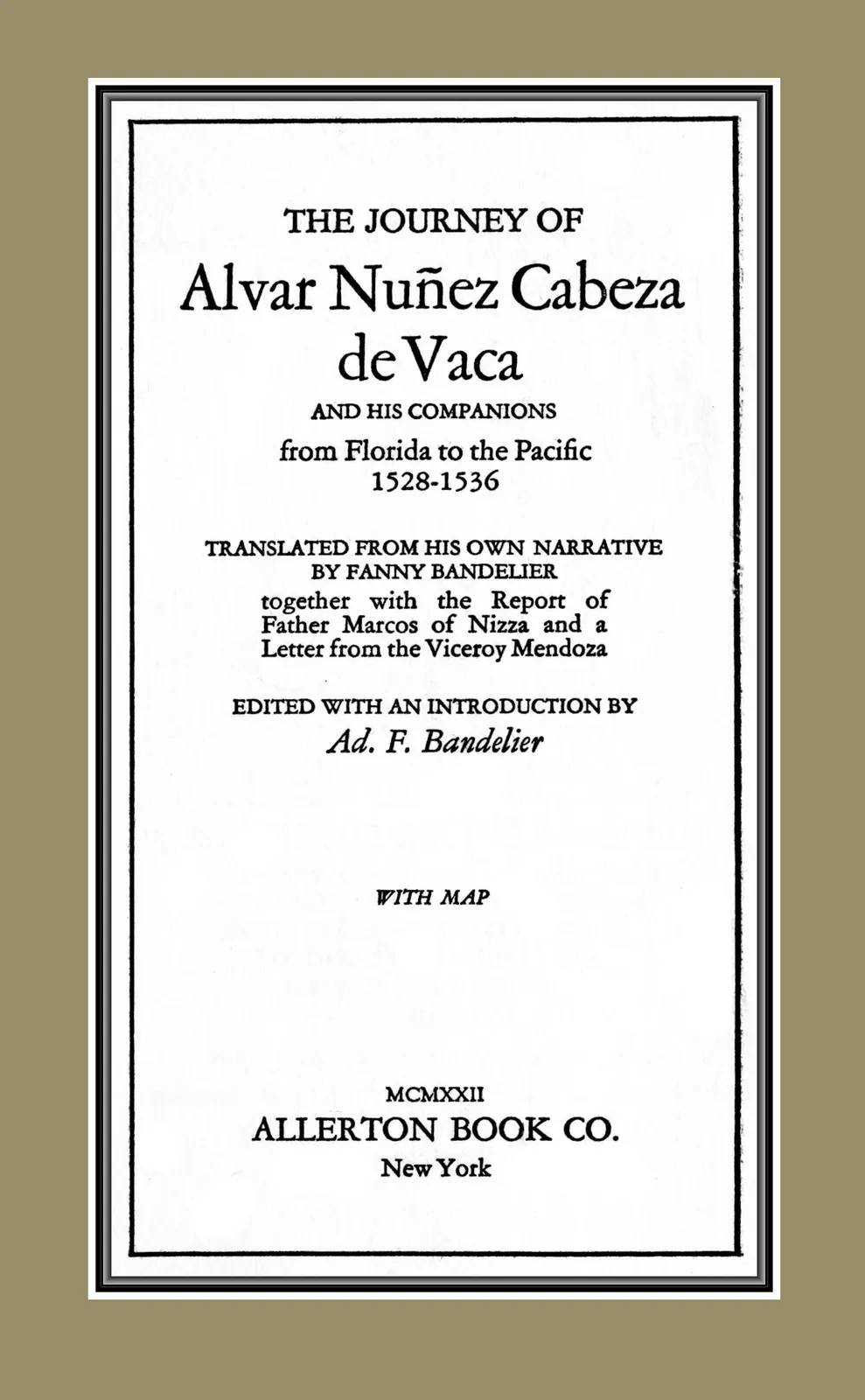
THIS volume offers the original narrative of the first white man to
cross North America. The remarkable journey of Alvar Nuñez Cabeza de
Vaca, Andrés Dorantes, Alonso del Castillo Maldonado, and the Moor
Estevanico, from Florida to Northwestern Mexico (Sonora and Sinaloa),
near the Pacific coast, antedates the expeditions of Coronado and De
Soto, whose histories have already been published in The Trail-Makers.
Nevertheless, it is proper to publish his narrative later. Compared with
either of them, the journey of Cabeza de Vaca and his companions is an
episode, important, but an incident brought about by a disastrous
failure. This history describes the only—and comparatively
meagre—results of the expedition undertaken by Pámfilo de Narvaez in
1527, and an outcome which had nothing more to do with Narvaez and his
ill-conducted scheme. Yet it is certain that the appearance of Cabeza
de Vaca and his fellow-sufferers at Culiacan, and their statements,
directed the attention of the Spanish authorities at the young city of
Mexico to the North more than the reports about the Seven Cities and the
raids which Nuño de Guzman had made in that direction. Nevertheless, the
importance of the story of Cabeza de Vaca must not be overestimated. A
perusal of the narrative shows that the forlorn wanderers were not—as
it has long been admitted—the “discoverers of New Mexico.” They never
saw, nor do they claim to have seen, any of the so-called “Pueblos.”
They only heard of them, in a more or less confused manner. On the
other hand, more precise than their information on this point is what
they said about the plains, their Indians; and it seems above all doubt
that the first knowledge of the American Bison, or Buffalo, is due to
their descriptions.
On the minds of the Spanish occupants of Mexico, especially on what may
be called the floating population (proportionately large at the time, as
everywhere in newly occupied countries), the impression of the feat
performed by the travellers and the tale of their unequalled sufferings
produced a much greater effect than on the authorities. The people saw
in their reports an outline for a possible advance into the unknown
beyond. The picture of the country traversed was, in the main, not
enticing, but the allusion to permanent settlements beyond the
unprepossessing plains was looked upon as full of promise. The outcome
was a moderate “excitement” among the adventurous and the idle, and this
excitement was ably taken advantage of by the Viceroy of New Spain, Don
Antonio de Mendoza.
This high functionary, as sagacious as he was cautious, regarded the
real merits of Cabeza de Vaca (who is the representative figure in the
whole episode) with reserve. On February 11th (old style), 1537, he
wrote to the Empress recommending Cabeza de Vaca and Dorantes (the
letter mentions Dorantes, but it was Castillo who went to Spain with
Cabeza de Vaca) to the benevolence of the monarch, in consideration of
“what they have done in it [this country] and suffered, and their
disposition to continue there and here, wherever they may be sent.” He
does not seem to attach more than a modest importance to the practical
results of their adventures. In that same letter he states that the
wanderers had already made a report to him on their journey, which
report he had sent to the Empress previously. It cannot be the one
contained in Oviedo’s Historia General y Natural de Indias (Edition of
1850, Vol. III, Lib. XXXV), since the latter was directed to the
Audiencia of Santo Domingo. There is a fragment of a Relacion attributed
to Cabeza de Vaca alone, without date, in Vol. XIV of the Documentos
Inéditos de Indias. It reads like a résumé, or condensation, of the
narrative presented in this volume. This fragment terminates abruptly at
the time when a meeting of Cabeza de Vaca and Dorantes was being
prepared. It is entitled, “Relacion de Cabeza de Vaca, tesorero que fué
en la conquista,” and preceded by a truncated copy of the directions
which the King issued to Cabeza de Vaca as “Factor” of the expedition.
Whether this document (noticed in the Index under a very misleading
title) is perhaps the first report mentioned in the letter of Mendoza
from February, 1537, I am unable to decide thus far, but there are some
indications favoring the supposition.
The influence which the return and reports of Cabeza de Vaca and
companions may have had upon the subsequent enterprise of Hernando de
Soto was, if any, but slight. The contract made with the latter by the
Crown on April 20, 1537 (Documentos de Indias, Vol. XXII, pp. 534 to
546: Capitulacion que se tomó con Hernando de Soto, para conquistar y
poblar desde el Rio de las Palmas hasta la Florida) does not permit any
conclusion on this point. The first report of the outcasts had probably
reached Spain before that time, but on August 15, of the same year,
Cabeza de Vaca was still at Lisbon. The statements of other survivors of
the expedition of Narvaez (mentioned at the close of our narrative as
having been met by Cabeza de Vaca in Mexico and in Spain) cannot have
been very encouraging to a fresh attempt at penetrating Florida. Still,
Soto tried to enlist the services of Cabeza de Vaca, but failed.
Of the biography of Cabeza de Vaca only such portions are well known as
relate to his career in America. It is also known that he was born in
Jeréz de la Frontera, in Spain, and hence was an Andalusian. His
father—according to Oviedo—was Francisco de Vera, son of the Spanish
Conqueror of the Canaries, Pedro de Vera. His mother was Teresa Cabeza
de Vaca, a native of Jeréz. Why he assumed the name of his mother in
place of his paternal appellative I am unable to state. The family of
Cabeza de Vaca bore, originally, the name Alhaja. They were simple
peasants until after the battle of Las Navas de Tolosa, on July 11,
1212, which the Kings of Castile, Aragon and Navarra gained over the
Moors. A few days before the battle, a shepherd by the name of Alhaja
offered to show the Christian forces a path by which they might
circumvent the mountain-passes held by the Moors in strong force. To
indicate it, he placed at the entrance of the defile the skull of a cow.
In recompense for this eminent service, Martin Alhaja, until then a
humble shepherd, was ennobled, and he changed his name into that of
Cabeza de Vaca (head of a cow, literally) in memory of the origin of his
improved social condition. Several of his descendants held comparatively
high positions, among them Don Pero Fernandez Cabeza de Vaca, elected
grand master of the order of Knights of St. James in 1383.
The career of Alvar Nuñez Cabeza de Vaca in America was particularly
unfortunate. After the disastrous termination of Narvaez’s expedition
and his (almost miraculous) return to Spain, he obtained as a reward for
his sufferings the position of Governor of the settlements on the La
Plata river, vacant since the death of Pedro de Mendoza. Reaching his
post in 1541, he soon became the object of sinister intrigues on the
part of his subordinates. The animosity against him broke out, in 1543,
in open revolt. He was seized and sent to Spain as a prisoner. His
(mild) captivity there lasted eight years. It is asserted that he lived
in Sevilla to an advanced age, and occupied, up to his demise (the date
of which I have not yet been able to find), an honorable and fairly
lucrative position.
Concerning the conduct of Cabeza de Vaca as Governor on the La Plata, or
Paraná, the opinions of eye-witnesses are divided. Some speak in his
favor; others, like the German Ulrich (or Huldreich) Schmiedel, of
Straubing, accused him of haughty demeanor towards his men and cruelty.
Oviedo, who knew him personally and conversed with him on the matter, is
non-committal. It seems likely that Cabeza de Vaca was an honest and
well-intentioned man, and he may have been a good subaltern but unfit
for superior command. Hence he proved a failure as soon as raised to a
position above the scope of his abilities.
Of the three companions of Cabeza de Vaca little is known. Andrés
Dorantes, who had been a captain with Narvaez, was the son of Pablo
Dorantes, a native of Gibraléon, Castilla. Maldonado was from Salamanca,
and the son of Doctor Castillo and Aldonza Maldonado. He is said to have
remained in Spain, whereas Dorantes stayed in Mexico, and entered, in
1538, into an agreement with the Viceroy for a journey of exploration to
the north or Sinaloa. It was never carried out. Lastly the “negro,”
Estevanico was an Arab Moor, from the town of Azamor, on the Atlantic
coast of Morocco. It is therefore not unlikely that he was not a negro
proper, but from one or the other of the tribes of the desert. His
subsequent fate is well known. As guide and advance scout of Father
Marcos, of Nizza, he became the victim of his own imprudence, or lack of
understanding of the differences in customs and beliefs between Indian
tribes far distant from each other.
It is well known that Cabeza de Vaca wrote two principal works, both of
which were published at Valladolid in 1555 by Francisco Fernandez de
Córdova. The first one of these two books is a second issue of the one
translated here. The other gives an account of his vicissitudes in
Paraguay and what is now the Argentine Republic, and bears the title of
Comentarios de Alvar Nuñez Cabeza de Vaca, Adelantado y Gobernador del
Rio de la Plata. The print from 1555 is the earliest known of the
Comentarios. Of the Naufragios here translated an earlier issue has
been found. Only two copies of it are known: One, which is perfect, is
at the Lenox branch of the Public Library of New York; the other,
somewhat damaged, at the British Museum. This oldest print of the
Naufragios is from 1542 and was published at Zamora. Its text has been
followed exclusively in this translation. The (reduced) photographic
reproductions of the title-pages of both editions and of the kolophon of
the first edition give an idea of the appearance of both of these books,
the extreme rarity of which makes it difficult for the general reader to
see them. Both are small quartos. The 1542 edition has no headings for
chapters, and this has been followed here.
Oviedo, who gives the text in full of the Letter handed to the Audiencia
of Santo Domingo by Cabeza de Vaca and Castillo when they touched that
port on their return to Spain, in 1537, has used the 1542 print for
comparison with that letter. The second edition appeared two years
before his death (which occurred in 1557), but it is manifest that he
did not use it.
Comparing the Letter to the Audiencia with the book of Cabeza de Vaca,
Oviedo inclines in favor of the former. He remarks: “But in a certain
way I hold the report of the three to be good and more clear than the
other one, which a single man made and has had printed,” &c. But Cabeza
de Vaca was one of the three who framed the Letter to the Audiencia, and
this document is merely a more concise narration than his book, and does
not, on important points, conflict with it. The latter was written in
Spain, when the author had leisure to recollect and to write. In a
foot-note I have alluded to the statement, made in the book, about
little bags filled with silver, which, Oviedo says, contained only mica.
This, however, he distinctly attributes to a misprint, not to a
misstatement by the author. On the whole, the difference between the
two documents is so slight that there has been no occasion to publish
the Letter to the Audiencia also.
Oviedo mentions Andrés Dorantes among the signers of the Letter, which
was, as he states, sent to the Audiencia at Santo Domingo from Havana.
Cabeza de Vaca affirms Dorantes remained at Vera Cruz, and thence went
back to Mexico. This is fully established by the communications of the
Viceroy, Mendoza, notwithstanding Herrera says he returned to Spain with
his companions. The objection may be removed, however, by supposing, as
is very likely, that the Letter was written in Mexico, when the three
were still together.
A very serious objection to the credibility of the three narratives,
however, arises from the fact that all are based upon recollections
only, and not upon journals or field-notes of any kind. It was, of
course, impossible for the outcasts, shifted and shifting from tribe to
tribe, to keep any written record of their trip. Many of their
descriptions are not, therefore, expected to be fully accurate.
At the end of the eight years of constant misfortune and suffering,
memory clings most to personal vicissitudes, and the narrative of these
does not appear exaggerated. The descriptions of the countries
traversed, superficial as they must be, still leave some recognizable
data, and so do the descriptions of plants and animals. It is
acknowledged that through Cabeza de Vaca the first knowledge of the
buffalo reached Europe, and his description of the hunchbacked cows,
while very brief, is quite accurate.
Descriptions of customs and habits of Indian tribes or bands, especially
of such as lived east of the Rio Grande, must of course be accepted with
proper reserve. Still, many may yet prove to be of ethnologic value. The
general picture of the condition of these tribes is very likely to be
exact, while, on the other hand, many details are probably misstated,
through having been misunderstood or superficially observed. It might be
worth while to make a special study of these ethnographic data and
compare them with whatever material of the kind has been placed on
record by subsequent explorers and narrators.
In the statements regarding the “faith cures” which the travellers claim
to have performed, and to which they attribute the success of their
desperate attempt to cross the continent, there is truth as well as
honest delusion. Indian medicine itself bases largely upon conceptions
of the kind, and empirical hypnotism plays a part in the performances of
their medicine-men. Cabeza de Vaca, unconsciously and by distinct
methods, imitated the Indian Shamans and probably succeeded, in at least
many cases, since the procedure was new and striking. That they
attributed their success to the direct aid of divine power was in strict
accordance with the spirit of the times and by no means to their
discredit. On the contrary, there is a commendable modesty in their
disclaimer of merits of their own. It should also not be forgotten that
men in their exceptional situation, without reasonable hope of
salvation, relentlessly persecuted by misfortune and the worst hardships
for many years, have their imagination finally raised to the highest
pitch, and exaggerations and misconceptions become therefore excusable.
There is no doubt that they sincerely believed their own statements. Not
only the times must be taken into account when judgment is passed, but
also the violent strain under which they labored for such a long period.
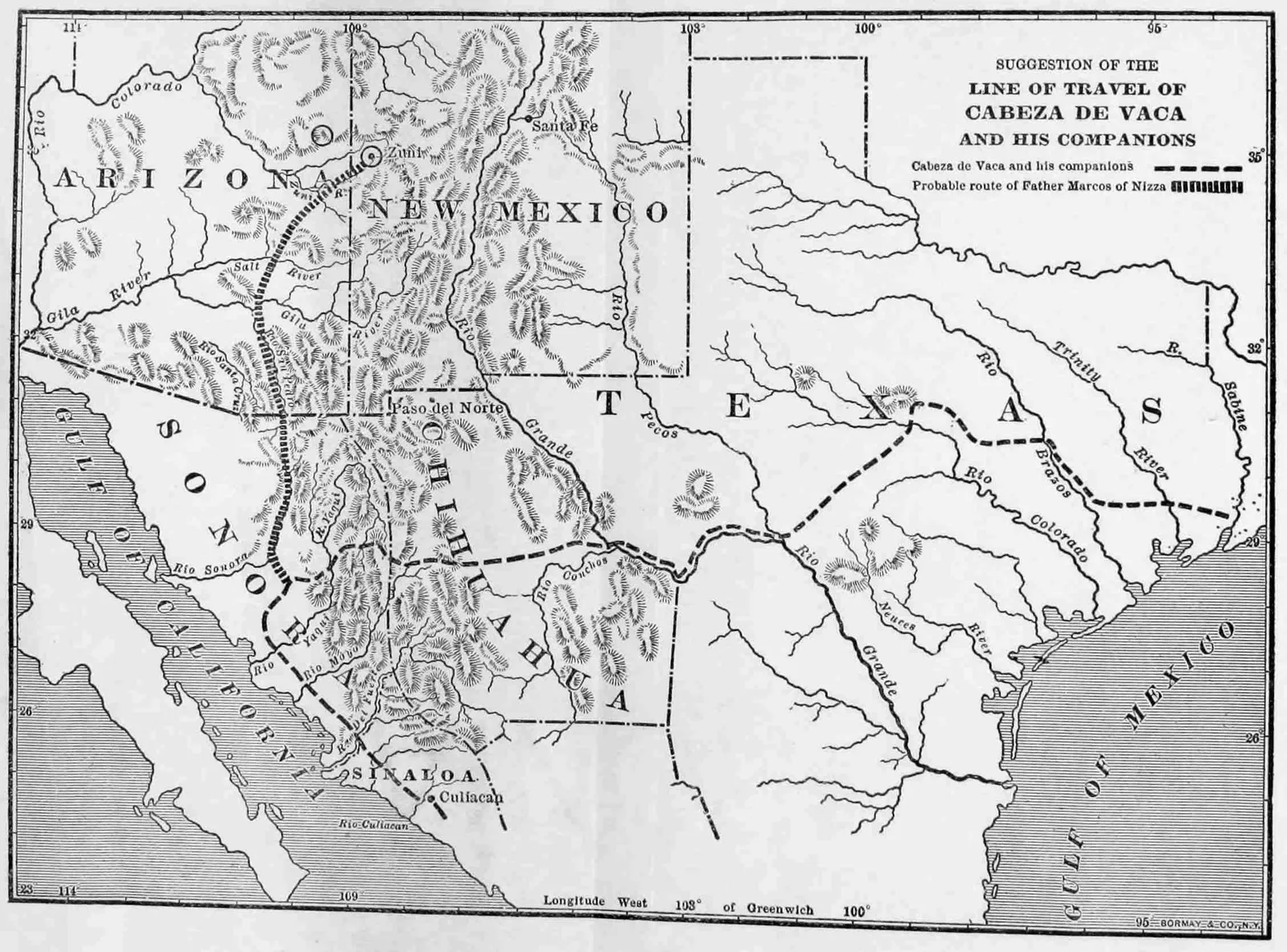
In regard to the route followed by the outcasts, there are but very few
ascertained points. Opinions vary so much that I shall not attempt to
trace the course of their wanderings except by referring to the
sketch-map appended. The route traced is a mere suggestion of possible
approximations, as stated on it. It will certainly be modified by the
results of investigations in the countries themselves, which I have not
been and am not able to carry on myself. It seems, however, that the
overland journey of the four began at some point west of the
Mississippi, and that they successively traversed the State of Texas and
the northern part of the Mexican Republic into central Sonora. It is not
likely they touched New Mexico, and they certainly never saw the New
Mexican pueblos, but heard of them in Sonora. Cabeza de Vaca therefore
but confirmed the few vague notions extant at his time about the
sedentary Indians of New Mexico, but was not the real discoverer of that
country.
The bibliography of the book of Cabeza de Vaca is soon told. In addition
to the two issues often mentioned—the Editio Princeps from 1542, and
the second of 1555—there are two more Spanish publications of it known.
The earliest is in Volume II of the Collection by Andrés Gonzales
Bárcia, Historiades primitivos de Indias, 1749. Its title is:
Naufragios y relacion de la Jornada que hizo á la Florida, con Pánfilo
de Narvaez.
The other is found in Volume II of the Historiadores primitivos de
Indias, by Enrique de Vedia. The title of this (the text of which was
taken from the Edition of 1555) reads: Naufragios de Alvar Nuñez Cabeza
de Vaca y Relacion de la Jornada que hizo á la Florida con el Adelantado
Pánfilo de Narvaez. It is well known that the two volumes of Vedia’s
reprints of older narratives and histories touching upon America form a
part of the voluminous collection entitled, Bibliotéca de Autores
Españoles, published at Madrid, and that the two volumes of Vedia were
printed in 1852.
An Italian version, under the title of Relation che fece Alvaro Nvnez
detto Capo di Vacca, di quello ch’ intervenne nell India all’ armata,
della qual era gouernatore Pamphilo Naruaez, dell anno 1527 fino all
1536, che ritorno in Sibilla con tu soli suoi compagni, is contained in
Volume II of the celebrated collection of travels and voyages by Gian
Battista Ramusio, Delle Navigatione è Viaggi, 1556, Venice.
Of English translations there have appeared thus far three: In Samuel
Purchas: His Pilgrimage, London, 1625-1626, Volume IX: Relation of
the fleet in India, whereof Pamphilus Naruaez was gouernor. The
Narrative of Alva Nuñez Cabeza de Vaca, translated by Buckingham Smith,
Washington, 1851. This translation is justly prized. A second edition of
it appeared at New York in 1871, edited by the late John Gilmary Shea.
Finally there is a paraphrase of the book in Tales of Old Travels,
Narrated by H. Kingsley, London, 1869.
In the French language there is the well-known translation by H. Ternaux
Compans in the first series of his collection: Voyages, Relations et
Mémoires originaux pour servir à l’Histoire de la Découverte de
l’Amérique. Date of publication, 1837. Title: Relation Vaca,
Adelantade et Gouverneur du Rio de la Plata.
A word yet touching the translation here given. The narrative of Cabeza
de Vaca is very difficult to translate for the reason, that the
criticism by Oviedo about its lack of clearness is too well founded.
Many parts of chapters and also whole chapters are so confused that it
is impossible to follow the original more than remotely, and
paraphrasing had to be resorted to. Even then, in several instances, the
meaning remains possibly somewhat obscure. It is as if the author, in
consequence of long isolation and constant intercourse with people of
another speech, had lost touch with his native tongue. There is less of
this in his later work, the Comentarios, written after a number of
years of uninterrupted intercourse with his countrymen.
AD. F. BANDELIER.
New York City, March 28, 1905.

TITLE PAGE OF EDITION OF 1555.
Reduced from original in Lenox Branch of N. Y. Public Library.
The Journey of Alvar Nuñez Cabeza De Vaca
ON the 27th day of the month of June, 1527,[1] the Governor Pánfilo de
Narvaez departed from the port of San Lucar de Barrameda, with authority
and orders from Your Majesty to conquer and govern the provinces that
extend from the river of the Palms to the Cape of the Florida, these
provinces being on the main land. The fleet he took along consisted of
five vessels, in which went about 600 men. The officials he had with him
(since they must be mentioned) were those here named: Cabeza de Vaca,
treasurer and alguacil mayor; Alonso Enriquez, purser; Alonso de Solis,
factor of Your Majesty and inspector. A friar of the order of Saint
Francis, called Fray Juan Gutierrez,[2] went as commissary, with four
other monks of the order. We arrived at the Island of Santo Domingo,
where we remained nearly forty-five days, supplying ourselves with
necessary things, especially horses. Here more than 140 men of our army
forsook us, who wished to remain, on account of the proposals and
promises made them by the people of the country. From there we started
and arrived at Santiago (a port in the Island of Cuba) where, in the few
days that we remained the Governor supplied himself again with people,
arms and horses. It happened there that a gentleman called Vasco
Porcallo, a resident of la Trinidad (which is on the same island),
offered to give the Governor certain stores he had at a distance of 100
leagues from the said harbor of Santiago.
The Governor, with the whole fleet, sailed for that place, but midways,
at a port named Cape Santa Cruz, he thought best to stop and send a
single vessel to load and bring these stores. Therefore he ordered a
certain Captain Pantoja to go thither with his craft and directed me to
accompany him for the sake of control, while he remained with four
ships, having purchased one on the Island of Santo Domingo. Arrived at
the port of Trinidad with these two vessels, Captain Pantoja went with
Vasco Porcallo to the town (which is one league from there) in order to
take possession of the supplies. I remained on board with the pilots,
who told us that we should leave as soon as possible, since the harbor
was very unsafe and many vessels had been lost in it. Now, since what
happened to us there was very remarkable, it appeared to me not
unsuitable, for the aims and ends of this, my narrative, to tell it
here.
The next morning the weather looked ominous. It began to rain, and the
sea roughened so that, although I allowed the men to land, when they saw
the weather and that the town was one league away, many came back to the
ship so as not to be out in the wet and cold. At the same time there
came a canoe from the town conveying a letter from a person residing
there, begging me to come, and they would give me the stores and
whatever else might be necessary. But I excused myself, stating that I
could not leave the ships.
At noon the canoe came again with another letter, repeating the request
with much insistency, and there was also a horse for me to go on. I gave
the same reply as the first time, saying that I could not leave the
vessels. But the pilots and the people begged me so much to leave and
hasten the transportation of the stores to the ships, in order to be
able to sail soon, from a place where they were in great fear the ships
would be lost in case they had to remain long. So I determined upon
going, although before I went I left the pilots well instructed and with
orders in case the south wind (which often wrecked the shipping) should
rise, and they found themselves in great danger, to run the vessels
ashore, when men and horses might be saved. So I left, wishing for some
of them to accompany me, but they refused, alleging the hard rain, the
cold and that the town was far away.
On the next day, which was Sunday, they promised to come, God helping,
to hear mass. One hour after my departure the sea became very rough and
the north wind blew so fiercely that neither did the boats dare to land,
nor could they beach the vessels, since the wind was blowing from the
shore. They spent that day and Sunday greatly distressed by two contrary
storms and much rain, until nightfall. Then the rain and storm increased
in violence at the village, as well as on the sea, and all the houses
and the churches fell down, and we had to go about, seven or eight men
locking arms at a time, to prevent the wind from carrying us off, and
under the trees it was not less dangerous than among the houses, for as
they also were blown down we were in danger of being killed beneath
them. In this tempest and peril we wandered about all night, without
finding any part or place where we might feel safe for half an hour.
In this plight we heard, all night long and especially after midnight, a
great uproar, the sound of many voices, the tinkling of little bells,
also flutes and tambourines and other instruments, the most of which
noise lasted until morning, when the storm ceased. Never has such a
fearful thing been witnessed in those parts. I took testimony concerning
it, and sent it, certified, to Your Majesty. On Monday morning we went
down to the harbor, but did not find the vessels. We saw the buoys in
the water, and from this knew that the ships were lost. So we followed
the shore, looking for wreckage, and not finding any turned into the
forest. Walking through it we saw, a fourth of a league from water, the
little boat of one of the vessels on the top of trees, and ten leagues
further, on the coast, were two men of my crew and certain covers of
boxes. The bodies were so disfigured by striking against the rocks as to
be unrecognizable. There were also found a cape and a tattered quilt,
nothing else. Sixty people and twenty horses perished on the ships.
Those who went on land the day we arrived, some thirty men, were all who
survived of the crews of both vessels.
We remained thus for several days in great need and distress, for the
food and stores at the village had been ruined also, as well as some
cattle. The country was pitiable to look at. The trees had fallen and
the woods were blighted, and there was neither foliage nor grass. In
this condition we were until the 5th day of the month of November, when
the Governor, with his four vessels, arrived. They also had weathered a
great storm and had escaped by betaking themselves to a safe place in
time. The people on board of the ships and those he found were so
terrified by what had happened that they were afraid to set to sea again
in winter and begged the Governor to remain there for that season, and
he, seeing their good will and that of the inhabitants, wintered at that
place. He put into my charge the vessels and their crews, and I was to
go with them to the port of Xagua, twelve leagues distant, where I
remained until the 20th day of February.
AT that time the Governor came with a brig he had bought at Trinidad,
and with him a pilot called Miruelo. That man he had taken because he
said he knew the way and had been on the river of the Palms and was a
very good pilot for the whole northern coast. The Governor left, on the
coast of Habana, another vessel that he had bought there, on which there
remained, as captain, Alvaro de Cerda, with forty people and twelve
horsemen. Two days after the Governor arrived he went aboard. The people
he took along were 400 men and eighty horses, on four vessels and one
brigantine. The pilot we had taken ran the vessels aground on the sands
called “of Canarreo,” so that the next day we were stranded and remained
stranded for fifteen days, the keels often touching bottom. Then a storm
from the south drove so much water on the shoals that we could get off,
though not without much danger.
Departing from there and arrived at Guaniguanico, another tempest came
up in which we nearly perished. At Cape Corrientes we had another, which
lasted three days. Afterward we doubled the Cape of Sant Anton and
sailed with contrary winds as far as twelve leagues off Habana, and
when, on the following day, we attempted to enter, a southerly storm
drove us away, so that we crossed to the coast of Florida, sighting
land on Tuesday, the 12th day of the month of April.[3] We coasted the
way of Florida, and on Holy Thursday cast anchor at the mouth of a bay,
at the head of which we saw certain houses and habitations of Indians.
ON that same day the clerk, Alonso Enriquez, left and went to an island
in the bay and called the Indians, who came and were with him a good
while, and by way of exchange they gave him fish and some venison. The
day following (which was Good Friday) the Governor disembarked, with as
many men as his little boats would hold, and as we arrived at the huts
or houses of the Indians we had seen, we found them abandoned and
deserted, the people having left that same night in their canoes. One
of those houses was so large that it could hold more than 300 people.
The others were smaller, and we found a golden rattle among the nets.
The next day the Governor hoisted flags in behalf of Your Majesty and
took possession of the country in Your Royal name, exhibited his
credentials, and was acknowledged as Governor according to Your
Majesty’s commands. We likewise presented our titles to him, and he
complied as they required. He then ordered the remainder of the men to
disembark, also the forty-two horses left (the others having perished on
account of the great storms and the long time they had been on sea), and
these few that remained were so thin and weak that they could be of
little use for the time. The next day the Indians of that village came,
and, although they spoke to us, as we had no interpreters we did not
understand them; but they made many gestures and threats, and it seemed
as if they beckoned to us to leave the country. Afterward, without
offering any molestation, they went away.
AFTER another day the Governor resolved to penetrate inland to explore
the country and see what it contained. We went with him—the commissary,
the inspector and myself, with forty men, among them six horsemen, who
seemed likely to be of but little use. We took the direction of the
north, and at the hour of vespers reached a very large bay, which
appeared to sweep far inland. After remaining there that night and the
next day, we returned to the place where the vessels and the men were.
The Governor ordered the brigantine to coast towards Florida in search
of the port which Miruelo, the pilot, had said he knew, but he had
missed it and did not know where we were, nor where the port was. So
word was sent to the brigantine, in case it were not found to cross over
to Habana in quest of the vessel of Alvaro de la Cerda, and, after
taking in some supplies, to come after us again.
After the brigantine left we again penetrated inland, the same persons
as before, with some more men. We followed the shore of the bay, and,
after a march of four leagues, captured four Indians, to whom we showed
maize in order to find out if they knew it, for until then we had seen
no trace of it. They told us that they would take us to a place where
there was maize and they led us to their village, at the end of the bay
nearby, and there they showed us some that was not yet fit to be
gathered. There we found many boxes for merchandize from Castilla. In
every one of them was a corpse covered with painted deer hides. The
commissary thought this to be some idolatrous practice, so he burnt the
boxes with the corpses. We also found pieces of linen and cloth, and
feather head dresses that seemed to be from New Spain, and samples of
gold.
We inquired of the Indians (by signs) whence they had obtained these
things and they gave us to understand that, very far from there, was a
province called Apalachen in which there was much gold.[4] They also
signified to us that in that province we would find everything we held
in esteem. They said that in Apalachen there was plenty.
So, taking them as guides, we started, and after walking ten or twelve
leagues, came to another village of fifteen houses, where there was a
large cultivated patch of corn nearly ready for harvest, and also some
that was already ripe. After staying there two days, we returned to the
place where we had left the purser, the men and the vessels, and told
the purser and pilots what we saw and the news the Indians had given us.
The next day, which was the 1st of May, the Governor took aside the
commissary, the purser, the inspector, myself, a sailor called Bartolomé
Fernandez and a notary by the name of Jerónimo de Albaniz, and told us
that he had in mind to penetrate inland, while the vessels should follow
the coast as far as the harbor; since the pilots said and believed that,
if they went in the direction of the Palms they would reach it soon. On
this he asked us to give our opinions.
I replied that it seemed to me in no manner advisable to forsake the
ships until they were in a safe port, held and occupied by us. I told
him to consider that the pilots were at a loss, disagreeing among
themselves, undecided as to what course to pursue. Moreover, the horses
would not be with us in case we needed them, and, furthermore, we had no
interpreter to make ourselves understood by the natives; hence we could
have no parley with them. Neither did we know what to expect from the
land we were entering, having no knowledge of what it was, what it might
contain and by what kind of people it was inhabited, nor in what part of
it we were; finally, that we had not the supplies required for
penetrating into an unknown country, for of the stores left in the ships
not more than one pound of biscuit and one of bacon could be given as
rations to each man for the journey, so that, in my opinion, we should
re-embark and sail in quest of a land and harbor better adapted to
settlement, since the country which we had seen was the most deserted
and the poorest ever found in those parts.
The commissary was of the contrary opinion saying, that we should not
embark, but follow the coast in search of a harbor, as the pilots
asserted that the way to Pánuco was not more than ten or fifteen leagues
distant and that by following along the coast it was impossible to miss
it, since the coast bent inland for twelve leagues. The first ones who
came there should wait for the others. As to embarking, he said it
would be to tempt God, after all the vicissitudes of storms, losses of
men and vessels and hardships we had suffered since leaving Spain, and
until we came to that place. So his advice would be to move along the
coast as far as the harbor, while the vessels with the other men would
follow to the same port.
To all the others this seemed to be the best, except to the notary, who
said that before leaving the ships they should be put into a harbor well
known, safe and in a settled country, after which we might go inland and
do as we liked.
The Governor clung to his own idea and to the suggestions of the others.
Seeing his determination, I required him, on the part of Your Majesty,
not to forsake the vessels until they were in a secure port, and I asked
the notary present to testify to what I said. The Governor replied that
he approved the opinion of the other officials and of the commissary;
that I had no authority for making such demands, and he asked the notary
to give him a certified statement as to how, there not being in the
country the means for supporting a settlement, nor any harbor for the
ships, he broke up the village he had founded, and went in search of the
port and of a better land. So he forthwith ordered the people who were
to go with him to get ready, providing themselves with what was
necessary for the journey. After this he turned to me, and told me in
the presence of all who were there that, since I so much opposed the
expedition into the interior and was afraid of it, I should take charge
of the vessels and men remaining, and, in case I reached the port before
him, I should settle there. This I declined.
After the meeting was over he, on that same evening, saying that it
seemed to him as if he could not trust anybody, sent me word that he
begged me to take charge of that part of the expedition, and as, in
spite of his insistency, I declined, he asked for the reasons of my
refusal, I then told him that I refused to accept, because I felt sure
he would never see the ships again, or be seen by their crews any more;
that, seeing how utterly unprepared he was for moving inland, I
preferred to share the risk with him and his people, and suffer what
they would have to suffer, rather than take charge of the vessels and
thus give occasion for saying that I opposed the journey and remained
out of fear, which would place my honor in jeopardy. So that I would
much rather expose of my life than, under these circumstances, my good
name.
Seeing that he could not change my determination, he had others approach
me about it with entreaties. But I gave the same answer to them as to
him, and he finally provided for his lieutenant to take command of the
vessels, an alcalde named Caravallo.
ON Saturday, the 1st of May, the day on which all this had happened, he
ordered that they should give to each one of those who had to go with
him, two pounds of ship-biscuit and one-half pound of bacon, and thus we
set out upon our journey inland. The number of people we took along was
three hundred,[5] among them the commissary, Father Juan Xuarez, another
friar called Father Juan de Palos and three priests, the officers, and
forty horsemen. We marched for fifteen days, living on the supplies we
had taken with us, without finding anything else to eat but palmettos
like those of Andalusia. In all this time we did not meet a soul, nor
did we see a house or village, and finally reached a river, which we
crossed with much trouble, by swimming and on rafts. It took us a day to
ford the river on account of the swiftness of its current. When we got
across, there came towards us some two hundred Indians, more or less;
the Governor went to meet them, and after he talked to them by signs
they acted in such a manner that we were obliged to set upon them and
seize five or six, who took us to their houses, about half a league from
there, where we found a large quantity of corn ready for harvest. We
gave infinite thanks to our Lord for having helped us in such great
need, for, as we were not used to such exposures, we felt greatly
exhausted, and were much weakened by hunger.
On the third day that we were at this place the purser, the inspector,
the commissary and myself jointly begged the Governor to send out in
search of a harbor, as the Indians told us the sea was not very far
away. He forbade us to speak of it, saying it was at a great distance,
and I being the one who most insisted, he bade me to go on a journey of
discovery and search of a port, and said I should go on foot with forty
people. So the next day I started with the Captain Alonso del Castillo
and forty men of his company. At noon we reached sandy patches that
seemed to extend far inland. For about one and a half leagues we walked,
with the water up to the knee, and stepping on shells that cut our feet
badly. All this gave us much trouble, until we reached the river which
we had crossed first, and which emptied through the same inlet, and
then, as we were too ill-provided for crossing it, we turned back to
camp and told the Governor what we had found and how it was necessary
to ford the river again at our first crossing in order to explore the
inlet thoroughly and find out if there was a harbor.
The next day he sent a captain called Valenzuela with sixty footmen and
six horsemen to cross the river and follow its course to the sea in
search of a port. After two days he came back, reporting that he had
discovered the inlet, which was a shallow bay, with water to the knees,
but it had there no harbor. He saw five or six canoes crossing from one
side to the other, with Indians who wore many feather bushes.
Hearing this, we left the next day, always in quest of the province
called Apalachen by the Indians, taking as guides those whom we had
captured, and marched until the 17th of June without finding an Indian
who would dare to wait for us. Finally there came to us a chief, whom an
Indian carried on his shoulders. He wore a painted deerskin, and many
people followed him, and he was preceded by many players on flutes made
of reeds. He came to the place where the Governor was and stayed an
hour. We gave him to understand by signs that our aim was to reach
Apalachen, but from his gestures it seemed to us that he was an enemy of
the Apalachen people and that he would go and help us against them. We
gave him beads and little bells and other trinkets, while he presented
the Governor with the hide he wore. Then he turned back and we followed
him.
That night we reached a broad and deep river, the current of which was
very strong and as we did not dare to cross it, we built a canoe out of
rafts and were a whole day in getting across. If the Indians had wished
to oppose us, they could have easily impeded our passage, for even with
their help we had much trouble. One horseman, whose name was Juan
Velazquez, a native of Cuéllar, not willing to wait, rode into the
stream, and the strong current swept him from the horse and he took hold
of the reins, and was drowned with the animal. The Indians of that chief
(whose name was Dulchanchellin) discovered the horse and told us that we
would find him lower down the stream. So they went after the man, and
his death caused us much grief, since until then we had not lost
anybody. The horse made a supper for many on that night. Beyond there,
and on the following day, we reached the chief’s village, whither he
sent us corn.
That same night, as they went for water, an arrow was shot at one of the
Christians, but God willed that he was not hurt. The day after we left
this place, without any of the natives having appeared, because all had
fled, but further on some Indians were seen who showed signs of
hostility, and although we called them they would neither come back nor
wait, but withdrew and followed in our rear. The Governor placed a few
horsemen in ambush near the trail, who as they (the Indians) passed,
surprised them and took three or four Indians, whom we kept as guides
thereafter. These led us into a country difficult to traverse and
strange to look at, for it had very great forests, the trees being
wonderfully tall and so many of them fallen that they obstructed our way
so that we had to make long detours and with great trouble. Of the
trees standing many were rent from top to bottom by thunderbolts, which
strike very often in that country, where storms and tempests are always
frequent.
With such efforts we travelled until the day after St. John’s Day, when
we came in sight of Apalachen, without having been noticed by the
Indians of the land. We gave many thanks to God for being so near it,
believing what we had been told about the country to be true, and that
now our sufferings would come to an end after the long and weary march
over bad trails. We had also suffered greatly from hunger, for, although
we found corn occasionally, most of the time we marched seven or eight
leagues without any. And many there were among us who besides suffering
great fatigue and hunger, had their backs covered with wounds from the
weight of the armor and other things they had to carry as occasion
required. But to find ourselves at last where we wished to be and where
we had been assured so much food and gold would be had, made us forget a
great deal of our hardships and weariness.
ONCE in sight of Apalachen,[6] the Governor commanded me to enter the
village with nine horsemen and fifty foot. So the inspector and I
undertook this. Upon penetrating into the village we found only women
and boys. The men were not there at the time, but soon, while we were
walking about, they came and began to fight, shooting arrows at us. They
killed the inspector’s horse, but finally fled and left us. We found
there plenty of ripe maize ready to be gathered and much dry corn
already housed. We also found many deer skins and among them mantles
made of thread and of poor quality, with which the women cover parts of
their bodies. They had many vessels for grinding maize.[7] The village
contained forty small and low houses,[8] reared in sheltered places,
out of fear of the great storms that continuously occur in the country.
The buildings are of straw, and they are surrounded by dense timber,
tall trees and numerous water-pools, where there were so many fallen
trees and of such size as to greatly obstruct and impede circulation.
THE country between our landing place and the village and country of
Apalachen is mostly level; the soil is sand and earth. All throughout it
there are very large trees and open forests containing nut trees,
laurels and others of the kind called resinous, cedar, juniper,
water-oak, pines, oak and low palmetto, like those of Castilla.[9]
Everywhere there are many lagunes, large and small, some very difficult
to cross, partly because they are so deep, partly because they are
covered with fallen trees. Their bottom is sandy, and in the province of
Apalachen the lagunes are much larger than those we found previously.
There is much maize in this province and the houses are scattered all
over the country as much as those of the Gelves. The animals we saw
there were three kinds of deer, rabbits and hares, bears and lions and
other wild beasts, among them one that carries its young in a pouch on
its belly as long as the young are small, until they are able to look
for their sustenance, and even then, when they are out after food and
people come, the mother does not move until her little ones are in the
pouch again. The country is very cold;[10] it has good pasture for
cattle; there are birds of many kinds in large numbers: geese, ducks,
wild ducks, muscovy ducks, Ibis, small white herons (Egrets), herons and
partridges. We saw many falcons, marsh-hawks, sparrow-hawks,
pigeon-hawks and many other birds.[11] Two hours after we arrived at
Apalachen the Indians that had fled came back peaceably, begging us to
give back to them their women and children, which we did.[12] The
Governor, however, kept with him one of their caciques, at which they
became so angry as to attack us the following day. They did it so
swiftly and with so much audacity as to set fire to the lodges we
occupied, but when we sallied forth they fled to the lagunes nearby, on
account of which and of the big corn patches, we could not do them any
harm beyond killing one Indian. The day after, Indians from a village on
the other side came and attacked us in the same manner, escaping in the
same way, with the loss of a single man.
We remained at this village for twenty-five days, making three
excursions during the time. We found the country very thinly inhabited
and difficult to march through, owing to bad places, timber and lagunes.
We inquired of the cacique whom we had retained and of the other Indians
with us (who were neighbors and enemies of them) about the condition and
settlements of the land, the quality of its people, about supplies and
everything else. They answered, each one for himself, that Apalachen was
the largest town of all; that further in less people were met with, who
were very much poorer than those here, and that the country was thinly
settled, the inhabitants greatly scattered, and also that further inland
big lakes, dense forests, great deserts and wastes were met with.
Then we asked about the land to the south, its villages and resources.
They said that in that direction and nine days’ march towards the sea
was a village called Aute,[13] where the Indians had plenty of corn and
also beans and melons, and that, being so near the sea, they obtained
fish, and that those were their friends. Seeing how poor the country
was, taking into account the unfavorable reports about its population
and everything else, and that the Indians made constant war upon us,
wounding men and horses whenever they went for water (which they could
do from the lagunes where we could not reach them) by shooting arrows at
us; that they had killed a chief of Tezcuco called Don Pedro, whom the
commissary had taken along with him, we agreed to depart and go in
search of the sea, and of the village of Aute, which they had mentioned.
And so we left, arriving there five days after. The first day we
travelled across lagunes and trails without seeing a single Indian.
On the second day, however, we reached a lake very difficult to cross,
the water reaching to the chest, and there were a great many fallen
trees. Once in the middle of it, a number of Indians assailed us from
behind trees that concealed them from our sight, while others were on
fallen trees, and they began to shower arrows upon us, so that many men
and horses were wounded, and before we could get out of the lagune our
guide was captured by them. After we had got out, they pressed us very
hard, intending to cut us off, and it was useless to turn upon them, for
they would hide in the lake and from there wound both men and horses.
So the Governor ordered the horsemen to dismount and attack them on
foot. The pursuer dismounted also, and our people attacked them. Again
they fled to a lagune, and we succeeded in holding the trail. In this
fight some of our people were wounded, in spite of their good armor.
There were men that day who swore they had seen two oak trees, each as
thick as the calf of a leg, shot through and through by arrows, which is
not surprising if we consider the force and dexterity with which they
shoot. I myself saw an arrow that had penetrated the base of a poplar
tree for half a foot in length. All the many Indians from Florida we saw
were archers, and, being very tall and naked, at a distance they appear
giants.
Those people are wonderfully built, very gaunt and of great strength
and agility. Their bows are as thick as an arm, from eleven to twelve
spans long, shooting an arrow at 200 paces with unerring aim. From that
crossing we went to another similar one, a league away, but while it was
half a league in length it was also much more difficult. There we
crossed without opposition, for the Indians, having spent all their
arrows at the first place, had nothing wherewith they would dare attack
us. The next day, while crossing a similar place, I saw the tracks of
people who went ahead of us, and I notified the Governor, who was in the
rear, so that, although the Indians turned upon us, as we were on our
guard, they could do us no harm. Once on open ground they pursued us
still. We attacked them twice, killing two, while they wounded me and
two or three other Christians, and entered the forest again, where we
could no longer injure them.
In this manner we marched for eight days, without meeting any more
natives, until one league from the site to which I said we were going.
There, as we were marching along, Indians crept up unseen and fell upon
our rear. A boy belonging to a nobleman, called Avellaneda, who was in
the rear guard, gave the alarm. Avellaneda turned back to assist, and
the Indians hit him with an arrow on the edge of the cuirass, piercing
his neck nearly through and through, so that he died on the spot, and we
carried him to Aute. It took us nine days from Apalachen to the place
where we stopped.[14] And then we found that all the people had left and
the lodges were burnt. But there was plenty of maize, squash and beans,
all nearly ripe and ready for harvest. We rested there for two days.
After this the Governor entreated me to go in search of the sea, as the
Indians said it was so near by, and we had, on this march, already
suspected its proximity from a great river to which we had given the
name of the Rio de la Magdalena.[15] I left on the following day in
search of it, accompanied by the commissary, the captain Castillo,
Andrés Dorantes, seven horsemen and fifty foot. We marched until sunset,
reaching an inlet or arm of the sea, where we found plenty of oysters on
which the people feasted, and we gave many thanks to God for bringing us
there.
The next day I sent twenty men to reconnoiter the coast and explore it,
who returned on the day following at nightfall, saying that these inlets
and bays were very large and went so far inland as greatly to impede our
investigations, and that the coast was still at a great distance.
Hearing this and considering how ill-prepared we were for the task, I
returned to where the Governor was. We found him sick, together with
many others. The night before, Indians had made an attack, putting them
in great stress, owing to their enfeebled condition. The Indians had
also killed one of their horses. I reported upon my journey and on the
bad condition of the country. That day we remained there.
ON the next day we left Aute and marched (all day) to the spot I had
visited on my last exploration. Our march was extremely difficult, for
neither had we horses enough to carry the sick, nor did we know how to
relieve them. They became worse every day, and our sufferings were
afflicting. There it became manifest how few resources we had for going
further, and even in case we had been provided we did not know where to
go; our men were mostly sick and too much out of condition to be of any
use whatever. I refrain from making a long story of it. Any one can
imagine what might be experienced in a land so strange and so utterly
without resources of any kind, either for stay or for an escape.
Nevertheless, since the surest aid was God, Our Lord, and since we never
doubted of it, something happened that put us in a worse plight yet.
Most of the horsemen began to leave in secret, hoping thus to save
themselves, forsaking the Governor and the sick, who were helpless.[16]
Still, as among them were many of good families and of rank, they would
not suffer this to happen unbeknown to the Governor and Your Majesty’s
officials, so that, when we remonstrated, showing at what an
unseasonable time they were leaving their captain and the sick and,
above all, forsaking Your Majesty’s service, they concluded to stay, and
share the fate of all, without abandoning one another. The Governor
thereupon called them to his presence all together, and each one in
particular, asking their opinion about this dismal country, so as to be
able to get out of it and seek relief, for in that land there was none.
One-third of our people were dangerously ill, getting worse hourly, and
we felt sure of meeting the same fate, with death as our only prospect,
which in such a country was much worse yet. And considering these and
many other inconveniences and that we had tried many expedients, we
finally resorted to a very difficult one, which was to build some craft
in which to leave the land. It seemed impossible, as none of us knew how
to construct ships. We had no tools, no iron, no smithery, no oakum, no
pitch, no tackling; finally, nothing of what was indispensable. Neither
was there anybody to instruct us in ship-building, and, above all, there
was nothing to eat, while the work was going on, for those who would
have to perform the task. Considering all this, we agreed to think it
over. Our parley ceased for that day, and everyone went off, leaving it
to God, Our Lord, to put him on the right road according to His
pleasure.
The next day God provided that one of the men should come, saying that
he would make wooden flues, and bellows of deerskin, and as we were in
such a state that anything appearing like relief seemed acceptable, we
told him to go to work, and agreed to make of our stirrups, spurs,
cross-bows and other iron implements the nails, saws and hatchets and
other tools we so greatly needed for our purpose.
In order to obtain food while the work proposed was in progress we
determined upon four successive raids into Aute, with all the horses and
men that were fit for service, and that on every third day a horse
should be killed and the meat distributed among those who worked at the
barges and among the sick. The raids were executed with such people and
horses as were able, and they brought as many as four hundred fanegas of
maize, although not without armed opposition from the Indians. We
gathered plenty of palmettos, using their fibre and husk, twisting and
preparing it in place of oakum for the barges. The work on these was
done by the only carpenter we had, and progressed so rapidly that,
beginning on the fourth day of August, on the twentieth day of the month
of September[17] five barges of twenty-two elbow lengths each were
ready, caulked with palmetto oakum and tarred with pitch, which a Greek
called Don Teodoro made from certain pines. Of the husk of palmettos,
and of the tails and manes of the horses we made ropes and tackles, of
our shirts sails, and of the junipers that grew there we made the oars,
which we thought were necessary, and such was the stress in which our
sins had placed us that only with very great trouble could we find
stones for ballast and anchors of the barges, for we had not seen a
stone in the whole country. We flayed the legs of the horses and tanned
the skin to make leather pouches for carrying water.
During that time some of the party went to the coves and inlets for
sea-food, and the Indians surprised them twice, killing ten of our men
in plain view of the camp, without our being able to prevent it. We
found them shot through and through with arrows, for, although several
wore good armor, it was not sufficient to protect them, since, as I said
before, they shot their arrows with such force and precision. According
to the sworn statements of our pilots, we had travelled from the bay, to
which we gave the name of the Cross, to this place, two hundred and
eighty leagues, more or less.
In all these parts we saw no mountains nor heard of any, and before
embarking we had lost over forty men through sickness and hunger,
besides those killed by Indians. On the twenty-second day of the month
of September we had eaten up all the horses but one. We embarked in the
following order: In the barge of the Governor there were forty-nine men,
and as many in the one entrusted to the purser and the commissary. The
third barge he placed in charge of Captain Alonso del Castillo and of
Andrés Dorantes, with forty-eight men; in another he placed two
captains, named Tellez and Peñalosa, with forty-seven men. The last one
he gave to the inspector and to me, with forty-nine men, and, after
clothing and supplies were put on board, the sides of the barges only
rose half a foot above the water. Besides, we were so crowded as to be
unable to stir. So great is the power of need that it brought us to
venture out into such a troublesome sea in this manner, and without any
one among us having the least knowledge of the art of navigation.
THAT bay from which we started is called the Bay of the Horses. We
sailed seven days among those inlets, in the water waist deep, without
signs of anything like the coast. At the end of this time we reached an
island near the shore. My barge went ahead, and from it we saw five
Indian canoes coming. The Indians abandoned them and left them in our
hands, when they saw that we approached. The other barges went on and
saw some lodges on the same island, where we found plenty of ruffs and
their eggs, dried, and that was a very great relief in our needy
condition. Having taken them, we went further, and two leagues beyond
found a strait between the island and the coast, which strait we
christened Sant Miguel, it being the day of that saint. Issuing from it
we reached the coast, where by means of the five canoes I had taken from
the Indians we mended somewhat the barges, making washboards and adding
to them and raising the sides two hands above water.
Then we set out to sea again, coasting towards the River of Palms.[18]
Every day our thirst and hunger increased because our supplies were
giving out, as well as the water supply, for the pouches we had made
from the legs of our horses soon became rotten and useless. From time to
time we would enter some inlet or cove that reached very far inland, but
we found them all shallow and dangerous, and so we navigated through
them for thirty days, meeting sometimes Indians who fished and were poor
and wretched people.
At the end of these thirty days, and when we were in extreme need of
water and hugging the coast, we heard one night a canoe approaching.
When we saw it we stopped and waited, but it would not come to us, and,
although we called out, it would neither turn back nor wait. It being
night, we did not follow the canoe, but proceeded. At dawn we saw a
small island, where we touched to search for water, but in vain, as
there was none. While at anchor a great storm overtook us. We remained
there six days without venturing to leave, and it being five days since
we had drank anything our thirst was so great as to compel us to drink
salt water, and several of us took such an excess of it that we lost
suddenly five men.
I tell this briefly, not thinking it necessary to relate in particular
all the distress and hardships we bore. Moreover, if one takes into
account the place we were in and the slight chances of relief he may
imagine what we suffered. Seeing that our thirst was increasing and the
water was killing us, while the storm did not abate, we agreed to trust
to God, Our Lord, and rather risk the perils of the sea than wait there
for certain death from thirst. So we left in the direction we had seen
the canoe going on the night we came here. During this day we found
ourselves often on the verge of drowning and so forlorn that there was
none in our company who did not expect to die at any moment.
It was Our Lord’s pleasure, who many a time shows His favor in the hour
of greatest distress, that at sunset we turned a point of land and found
there shelter and much improvement. Many canoes came and the Indians in
them spoke to us, but turned back without waiting. They were tall and
well built, and carried neither bows nor arrows. We followed them to
their lodges, which were nearly along the inlet, and landed, and in
front of the lodges we saw many jars with water, and great quantities of
cooked fish. The chief of that land offered all to the Governor and led
him to his abode. The dwellings were of matting and seemed to be
permanent. When we entered the home of the chief he gave us plenty of
fish, while we gave him of our maize, which they ate in our presence,
asking for more. So we gave more to them, and the Governor presented
him with some trinkets. While with the cacique at his lodge, half an
hour after sunset, the Indians suddenly fell upon us and upon our sick
people on the beach.
They also attacked the house of the cacique, where the Governor was,
wounding him in the face with a stone. Those who were with him seized
the cacique, but as his people were so near he escaped, leaving in our
hands a robe of marten-ermine skin, which, I believe, are the finest in
the world and give out an odor like amber and musk. A single one can be
smelt so far off that it seems as if there were a great many. We saw
more of that kind, but none like these.
Those of us who were there, seeing the Governor hurt, placed him aboard
the barge and provided that most of the men should follow him to the
boats. Some fifty of us remained on land to face the Indians, who
attacked thrice that night, and so furiously as to drive us back every
time further than a stone’s throw.
Not one of us escaped unhurt. I was wounded in the face, and if they had
had more arrows (for only a few were found) without any doubt they
would have done us great harm. At the last onset the Captains Dorantes,
Peñalosa and Tellez, with fifteen men, placed themselves in ambush and
attacked them from the rear, causing them to flee and leave us. The next
morning I destroyed more than thirty of their canoes, which served to
protect us against a northern wind then blowing, on account of which we
had to stay there, in the severe cold, not venturing out to sea on
account of the heavy storm. After this we again embarked and navigated
for three days, having taken along but a small supply of water, the
vessels we had for it being few. So we found ourselves in the same
plight as before.
Continuing onward, we entered a firth and there saw a canoe with Indians
approaching. As we hailed them they came, and the Governor, whose barge
they neared first, asked them for water. They offered to get some,
provided we gave them something in which to carry it, and a Christian
Greek, called Doroteo Teodoro (who has already been mentioned), said he
would go with them. The Governor and others vainly tried to dissuade
him, but he insisted upon going and went, taking along a negro, while
the Indians left two of their number as hostages. At night the Indians
returned and brought back our vessels, but without water; neither did
the Christians return with them. Those that had remained as hostages,
when their people spoke to them, attempted to throw themselves into the
water. But our men in the barge held them back; and so the other Indians
forsook their canoe, leaving us very despondent and sad for the loss of
those two Christians.
IN the morning many canoes of Indians came, demanding their two
companions, who had remained in the barge as hostages. The Governor
answered that he would give them up, provided they returned the two
Christians. With those people there came five or six chiefs, who seemed
to us to be of better appearance, greater authority and manner of
composure than any we had yet seen, although not as tall as those of
whom we have before spoken. They wore the hair loose and very long, and
were clothed in robes of marten, of the kind we had obtained previously,
some of them done up in a very strange fashion, because they showed
patterns of fawn-colored furs that looked very well.
They entreated us to go with them, and said that they would give us the
Christians, water and many other things, and more canoes kept coming
towards us, trying to block the mouth of that inlet, and for this
reason, as well as because the land appeared very dangerous to remain
in, we took again to sea, where we stayed with them till noon. And as
they would not return the Christians, and for that reason neither would
we give up the Indians, they began to throw stones at us with slings,
and darts, threatening to shoot arrows, although we did not see more
than three or four bows.
While thus engaged the wind freshened and they turned about and left us.
We navigated that day until nightfall, when my bark, which was the
foremost, discovered a promontory made by the coast. At the other end
was a very large river, and at a small island on the point I anchored to
wait for the other barges.
The Governor did not want to touch, but entered a bay close by, where
there were many small islands. There we got together and took fresh
water out of the sea, because the river emptied into it like a torrent.
For two days we had eaten the corn raw, and now, in order to toast it,
we went ashore on that island, but not finding any firewood, agreed to
go to the river, which was one league from there behind the point.
However, the current was so strong that it in no way allowed us to land,
but rather carried us away from the shore against all our efforts. The
north wind that blew off shore freshened so much that it drove us back
to the high sea, without our being able to do anything against it, and
at about one-half league from shore we sounded and found no bottom even
at thirty fathoms. Without being able to understand it, it was the
current that disturbed our soundings. We navigated two days yet, trying
hard to reach the shore. On the third day, a little before sunrise, we
saw many columns of smoke rising on the coast. Working towards these, we
found ourselves in three fathoms of water, but it being night did not
dare to land because, as we had seen so much smoke, we believed that
greater danger might be in wait for us there. We were unable to see,
owing to the darkness, what we should do. So we determined to wait until
morning.
When it dawned the barges had been driven apart from each other. I found
myself in thirty fathoms and, drifting along at the hour of vespers, I
descried two barges, and as I approached saw that the first one was that
of the Governor, who asked me what I thought we should do. I told him
that we ought to rejoin the other barge, which was ahead of us, and in
no manner forsake her, and the three together should continue our way
whither God might take us. He replied it was impossible, since the barge
was drifting far away into the sea, whereas he wanted to land, but that
if I wished to follow I should put the people of my barge at the oars
and work hard, as only by the strength of our arms the land could be
reached. In this he had been advised by a captain he had along, whose
name was Pantoja, who told him that if he did not land that day he would
not in six days more, during which time we would of necessity starve.
Seeing his determination, I took to my own oar and the other oarsmen in
my craft did the same, and thus we rowed until nearly sunset. But as the
Governor had with him the healthiest and strongest men, in no way could
we follow or keep up with him. Seeing this, I asked him to give me a
rope from his barge to be able to follow, but he answered that it was no
small effort on their part alone to reach the shore on that night. I
told him that since it was barely possible for us to follow and do what
he had ordained, he should tell me what he commanded me to do. He
answered that this was no time for orders; that each one should do the
best he could to save himself; that he intended to do it that way, and
with this he went on with his craft.[19]
As I could not follow him, I went after the other barge, which was out
at sea and waited for me, and reaching it I found it was the one of the
Captains Peñalosa and Tellez. We travelled together for four days, our
daily ration being half a handful of raw maize. At the end of these four
days a storm overtook us, in which the other barge was lost.[20] God’s
great mercy preserved us from being drowned in that weather.
It being winter and the cold very great, and as we had been suffering so
many days from hunger and from the injuries we received from the waves,
that the next day people began to break down, so that when the sun set
all those aboard of my barge had fallen in a heap and were so near dying
that few remained conscious, and not five men kept on their feet.
When night came the skipper and I were the only ones able to manage the
barge. Two hours after nightfall the skipper told me to steer the craft
alone, since he felt that he would die that same night. Thereupon I
stood at the helm, and after midnight went to see if the skipper was
dead, but he said that, on the contrary, he felt better and would steer
till daybreak. On that occasion I would have hailed death with delight
rather than to see so many people around me in such a condition. After
the skipper had taken the barge under his control I went to rest, very
much without resting, for I thought of anything else but sleep.
Near daybreak I fancied to hear the sound of breakers, for as the coast
was low, their noise was greater. Surprised at it, I called the skipper,
who said he thought we were near the shore. Sounding, we found seven
fathoms, and he was of the opinion that we should keep off shore till
dawn. So I took the oar and rowed along the coast, from which we were
one league away, and turned the stern to seaward.
Close to shore a wave took us and hurled the barge a horse’s length out
of water. With the violent shock nearly all the people who lay in the
boat like dead came to themselves, and, seeing we were close to land,
began to crawl out on all fours. As they took to some rocks, we built a
fire and toasted some of our maize. We found rain water, and with the
warmth of the fire people revived and began to cheer up. The day we
arrived there was the sixth of the month of November.
AFTER the people had eaten I sent Lope de Oviedo, who was the strongest
and heartiest of all, to go to some trees nearby and climb to the top of
one, examine the surroundings and the country in which we were. He did
so and found we were on an island, and that the ground was hollowed out,
as if cattle had gone over it, from which it seemed to him that the
land belonged to Christians, and so he told us. I sent him again to look
and examine more closely if there were any worn trails, and not to go
too far so as not to run into danger. He went, found a footpath,
followed it for about one-half league, and saw several Indian huts which
stood empty because the Indians had gone out into the field.[21]
He took away a cooking pot, a little dag and a few ruffs and turned
back, but as he seemed to delay I sent two other Christians to look for
him and find out what had happened.
They met him nearby and saw that three Indians, with bows and arrows,
were following and calling to him, while he did the same to them by
signs. So he came to where we were, the Indians remaining behind, seated
on the beach. Half an hour after a hundred Indian archers joined them,
and our fright was such that, whether tall or little, it made them
appear giants to us. They stood still close to the first ones, near
where we were.
We could not defend ourselves, as there were scarcely three of us who
could stand on their feet. The inspector and I stepped forward and
called them. They came, and we tried to quiet them the best we could and
save ourselves, giving them beads and bells. Each one of them gave me an
arrow in token of friendship, and by signs they gave us to understand
that on the following morning they would come back with food, as then
they had none.
THE next day, at sunrise, which was the hour the Indians had given us to
understand, they came as promised and brought us plenty of fish and some
roots which they eat that taste like nuts, some bigger, some smaller,
most of which are taken out of the water with much trouble.
In the evening they returned and brought us more fish and some of the
same roots, and they brought their women and children, to look at us.
They thought themselves very rich with the little bells and beads we
gave them, and thereafter visited us daily with the same things as
before. As we saw ourselves provided with fish, roots, water and the
other things we had asked for, we concluded to embark again and continue
our voyage.
We lifted the barge out of the sand into which it had sunk (for which
purpose we all had to take off our clothes) and had great work to set
her afloat, as our condition was such that much lighter things would
have given us trouble.
Then we embarked. Two crossbow shots from shore a wave swept over us, we
all got wet, and being naked and the cold very great, the oars dropped
out of our hands. The next wave overturned the barge. The inspector and
two others clung to her to save themselves, but the contrary happened;
they got underneath the barge and were drowned.
The shore being very rough, the sea took the others and thrust them,
half dead, on the beach of the same island again, less the three that
had perished underneath the barge.
The rest of us, as naked as we had been born, had lost everything, and
while it was not worth much, to us it meant a great deal. It was in
November, bitterly cold, and we in such a state that every bone could
easily be counted, and we looked like death itself. Of myself I can say
that since the month of May I had not tasted anything but toasted maize,
and even sometimes had been obliged to eat it raw. Although the horses
were killed during the time the barges were built, I never could eat of
them, and not ten times did I taste fish. This I say in order to explain
and that any one might guess how we were off. On top of all this, a
north wind arose, so that we were nearer death than life. It pleased Our
Lord that, searching for the remnants of our former fire, we found wood
with which we built big fires and then with many tears begged Our Lord
for mercy and forgiveness of our sins. Every one of us pitied not only
himself, but all the others whom he saw in the same condition.
At sunset the Indians, thinking we had not left, came to bring us food,
but when they saw us in such a different attire from before and so
strange-looking, they were so frightened as to turn back. I went to call
them, and in great fear they came. I then gave them to understand by
signs how we had lost a barge and three of our men had been drowned,
while before them there lay two of our men dead, with the others about
to go the same way.
Upon seeing the disaster we had suffered, our misery and distress, the
Indians sat down with us and all began to weep out of compassion for our
misfortune, and for more than half an hour they wept so loud and so
sincerely that it could be heard far away.
Verily, to see beings so devoid of reason, untutored, so like unto
brutes, yet so deeply moved by pity for us, it increased my feelings and
those of others in my company for our own misfortune. When the lament
was over, I spoke to the Christians and asked them if they would like me
to beg the Indians to take us to their homes. Some of the men, who had
been to New Spain, answered that it would be unwise, as, once at their
abode, they might sacrifice us to their idols.
Still, seeing there was no remedy and that in any other way death was
surer and nearer, I did not mind what they said, but begged the Indians
to take us to their dwellings, at which they showed great pleasure,
telling us to tarry yet a little, but that they would do what we wished.
Soon thirty of them loaded themselves with firewood and went to their
lodges, which were far away, while we stayed with the others until it
was almost dark. Then they took hold of us and carried us along
hurriedly to where they lived.
Against the cold, and lest on the way some one of us might faint or die,
they had provided four or five big fires on the road, at each one of
which they warmed us. As soon as they saw we had regained a little
warmth and strength they would carry us to the next fire with such haste
that our feet barely touched the ground.
So we got to their dwellings, where we saw they had built a hut for us
with many fires in it. About one hour after our arrival they began to
dance and to make a great celebration (which lasted the whole night),
although there was neither pleasure, feast nor sleep in it for us, since
we expected to be sacrificed. In the morning they again gave us fish and
roots, and treated us so well that we became reassured, losing somewhat
our apprehension of being butchered.
THAT same day I saw on one of the Indians a trinket he had not gotten
from us, and asking from where they had obtained it they answered, by
signs, that other men like ourselves and who were still in our rear, had
given it to them. Hearing this, I sent two Christians with two Indians
to guide them to those people. Very near by they met them, and they also
were looking for us, as the Indians had told them of our presence in the
neighborhood. These were the Captains Andrés Dorantes and Alonso del
Castillo, with all of their crew. When they came near us they were much
frightened at our appearance and grieved at being unable to give us
anything, since they had nothing but their clothes. And they stayed with
us there, telling how, on the fifth of that same month, their barge
stranded a league and a half from there, and they escaped without
anything being lost.
All together, we agreed upon repairing their barge, and that those who
had strength and inclination should proceed in it, while the others
should remain until completely restored and then go as best they could
along the coast, following it till God would be pleased to get us all
together to a land of Christians.
So we set to work, but ere the barge was afloat Tavera, a gentleman in
our company, died, while the barge proved not to be seaworthy and soon
sank. Now, being in the condition which I have stated—that is, most of
us naked and the weather so unfavorable for walking and for swimming
across rivers and coves, and we had neither food nor any way to carry
it, we determined upon submitting to necessity and upon wintering there,
and we also agreed that four men, who were the most able-bodied, should
go to Pánuco, which we believed to be nearby, and that, if it was God,
Our Lord’s will to take them there, they should tell of our remaining on
the island and of our distress. One of them was a Portuguese, called
Alvaro Fernandez, a carpenter and sailor; the second was Mendez; the
third, Figueroa, a native of Toledo; the fourth, Astudillo, from Zafra.
They were all good swimmers and took with them an Indian from the
island.
A few days after these four Christians had left, the weather became so
cold and tempestuous that the Indians could no longer pull roots, and
the canebrake in which they used to fish yielded nothing more. As the
lodges afforded so little shelter, people began to die, and five
Christians, quartered on the coast, were driven to such an extremity
that they ate each other up until but one remained, who being left
alone, there was nobody to eat him. Their names are: Sierra, Diego,
Lopez, Corral, Palacios and Gonzalo Ruiz. At this the Indians were so
startled, and there was such an uproar among them, that I verily believe
if they had seen this at the beginning they would have killed them, and
we all would have been in great danger. After a very short time, out of
eighty men who had come there in our two parties only fifteen remained
alive.
Then the natives fell sick from the stomach, so that one-half of them
died also, and they, believing we had killed them, and holding it to be
certain, they agreed among themselves to kill those of us who survived.
But when they came to execute it an Indian who kept me told them not to
believe we were the cause of their dying, for if we had so much power we
would not have suffered so many of our own people to perish without
being able to remedy it ourselves. He also told them there remained but
very few of us, and none of them did any harm or injury, so that the
best was to let us alone. It pleased Our Lord they should listen to his
advice and counsel and give up their idea.
To this island we gave the name of the Island of Ill Fate.[22] The
people on it are tall and well formed; they have no other weapons than
bows and arrows with which they are most dextrous. The men have one of
their nipples perforated from side to side and sometimes both; through
this hole is thrust a reed as long as two and a half hands and as thick
as two fingers; they also have the under lip perforated and a piece of
cane in it as thin as the half of a finger. The women do the hard work.
People stay on this island from October till the end of February,
feeding on the roots I have mentioned, taken from under the water in
November and December. They have channels made of reeds and get fish
only during that time; afterwards they subsist on roots. At the end of
February they remove to other parts in search of food, because the roots
begin to sprout and are not good any more.
Of all the people in the world, they are those who most love their
children and treat them best, and should the child of one of them
happen to die, parents and relatives bewail it, and the whole
settlement, the lament lasting a full year, day after day. Before
sunrise the parents begin to weep, after them the tribe, and the same
they do at noon and at dawn. At the end of the year of mourning they
celebrate the anniversary and wash and cleanse themselves of all their
paint. They mourn all their dead in this manner, old people excepted, to
whom they do not pay any attention, saying that these have had their
time and are no longer of any use, but only take space, and food from
the children.
Their custom is to bury the dead, except those who are medicine men
among them, whom they burn, and while the fire is burning, all dance and
make a big festival, grinding the bones to powder. At the end of the
year, when they celebrate the anniversary, they scarify themselves and
give to the relatives the pulverized bones to drink in water. Every man
has a recognized wife, but the medicine men enjoy greater privileges,
since they may have two or three, and among these wives there is great
friendship and harmony.
When one takes a woman for his wife, from the day he marries her,
whatever he may hunt or fish, she has to fetch it to the home of her
father, without daring to touch or eat of it, and from the home of the
father-in-law they bring the food to the husband. All the while neither
the wife’s father nor her mother enter his abode, nor is he allowed to
go to theirs, or to the homes of his brothers-in-law, and should they
happen to meet they go out of each other’s way a crossbow’s shot or so,
with bowed heads and eyes cast to the ground, holding it to be an evil
thing to look at each other or speak. The women are free to communicate
with their parents-in-law or relatives and speak to them. This custom
prevails from that island as far as about fifty leagues inland.
There is another custom, that when a son or brother dies no food is
gathered by those of his household for three months, preferring rather
to starve, but the relatives and neighbors provide them with victuals.
Now, as during the time we were there so many of them died, there was
great starvation in most of the lodges, due to their customs and
ceremonials, as well as to the weather, which was so rough that such as
could go out after food brought in but very little, withal working hard
for it. Therefore the Indians by whom I was kept forsook the island and
in several canoes went over to the mainland to some bays where there
were a great many oysters and during three months of the year they do
not eat anything else and drink very bad water. There is lack of
firewood, but great abundance of mosquitoes. Their lodges are made of
matting and built on oyster shells, upon which they sleep in hides,
which they only get by chance. There we remained to the end of April,
when we went to the seashore, where we ate blackberries for a whole
month, during which time they danced and celebrated incessantly.
ON the island I have spoken of they wanted to make medicine men of us
without any examination or asking for our diplomas, because they cure
diseases by breathing on the sick, and with that breath and their hands
they drive the ailment away. So they summoned us to do the same in order
to be at least of some use. We laughed, taking it for a jest, and said
that we did not understand how to cure.
Thereupon they withheld our food to compel us to do what they wanted.
Seeing our obstinacy, an Indian told me that I did not know what I said
by claiming that what he knew was useless, because stones and things
growing out in the field have their virtues, and he, with a heated
stone, placing it on the stomach, could cure and take away pain, so that
we, who were wiser men, surely had greater power and virtue.
At last we found ourselves in such stress as to have to do it, without
risking any punishment. Their manner of curing is as follows: When one
is ill they call in a medicine man, and after they are well again not
only do they give him all they have, but even things they strive to
obtain from their relatives. All the medicine man does is to make a few
cuts where the pain is located and then suck the skin around the
incisions. They cauterize with fire, thinking it very effective, and I
found it to be so by my own experience. Then they breathe on the spot
where the pain is and believe that with this the disease goes away.[23]
The way we treated the sick was to make over them the sign of the cross
while breathing on them, recite a Pater noster and Ave Maria, and pray
to God, Our Lord, as best we could to give them good health and inspire
them to do us some favors. Thanks to His will and the mercy He had upon
us, all those for whom we prayed, as soon as we crossed them, told the
others that they were cured and felt well again. For this they gave us
good cheer, and would rather be without food themselves so as to give it
to us, and they gave us hides and other small things. So great was the
lack of food then that I often remained without eating anything
whatsoever for three days, and they were in the same plight, so that it
seemed to me impossible for life to last, although I afterwards suffered
still greater privations and much more distress, as I shall tell further
on.
The Indians that kept Alonso del Castillo, Andrés Dorantes and the
others, who were still alive, being of another language and stock, had
gone to feed on oysters at another point of the mainland, where they
remained until the first day of the month of April. Then they came back
to the island, which was from there nearly two leagues off, where the
channel is broadest. The island is half a league wide and five long.
All the people of this country go naked; only the women cover part of
their bodies with a kind of wool that grows on trees. The girls go about
in deer skins. They are very liberal towards each other with what they
have. There is no ruler among them. All who are of the same descendancy
cluster together. There are two distinct languages spoken on the
island; those of one language are called Capoques, those of the other
Han. They have the custom, when they know each other and meet from time
to time, before they speak, to weep for half an hour. After they have
wept the one who receives the visit rises and gives to the other all he
has. The other takes it, and in a little while goes away with
everything. Even sometimes, after having given and obtained all, they
part without having uttered a word. There are other very queer customs,
but having told the principal ones and the most striking, I must now
proceed to relate what further happened to us.
AFTER Dorantes and Castillo had come back to the island, they gathered
together all the Christians, who were somewhat scattered, and there were
in all fourteen. I, as told, was in another place, on the mainland,
whither my Indians had taken me and where I suffered from such a severe
illness that, although I might otherwise have entertained some hope for
life, this was enough to take it away from me completely. When the
Christians learned of it they gave an Indian the robe of marten we had
taken from the cacique, as stated, in order that he should guide them to
where I was, to see me, and so twelve of them came, two having become so
feeble that they did not dare to take them along.
The names of those who came are: Alonso del Castillo, Andrés Dorantes
and Diego Dorantes, Valdivieso, Estrada, Tostado, Chaves, Gutierrez, an
Asturian priest; Diego de Huelva, Estevanico, the negro Benitez, and as
they reached the mainland they found still another of our men named
Francisco de Léon, and the thirteen went along the coast. After they had
gone by, the Indians with whom I was told me of it, and how Hiéronimo de
Alaniz and Lope de Oviedo had been left on the island.
My sickness prevented me from following or seeing them. I had to remain
with those same Indians of the island for more than one year, and as
they made me work so much and treated me so badly I determined to flee
and go to those who live in the woods on the mainland, and who are
called those from (of) Charruco.
I could no longer stand the life I was compelled to lead. Among many
other troubles I had to pull the eatable roots out of the water and from
among the canes where they were buried in the ground, and from this my
fingers had become so tender that the mere touch of a straw caused them
to bleed. The reeds would cut me in many places, because many were
broken and I had to go in among them with the clothing I had on, of
which I have told. This is why I went to work and joined the other
Indians. Among these I improved my condition a little by becoming a
trader, doing the best in it I could, and they gave me food and treated
me well.
They entreated me to go about from one part to another to get the things
they needed, as on account of constant warfare there is neither travel
nor barter in the land.
So, trading along with my wares I penetrated inland as far as I cared to
go and along the coast as much as forty or fifty leagues. My stock
consisted mainly of pieces of seashells and cockles, and shells with
which they cut a fruit which is like a bean, used by them for healing
and in their dances and feasts. This is of greatest value among them,
besides shell-beads and other objects. These things I carried inland,
and in exchange brought back hides and red ochre with which they rub and
dye their faces and hair; flint for arrow points, glue and hard canes
wherewith to make them, and tassels made of the hair of deer, which they
dye red. This trade suited me well because it gave me liberty to go
wherever I pleased; I was not bound to do anything and no longer a
slave. Wherever I went they treated me well, and gave me to eat for the
sake of my wares. My principal object in doing it, however, was to find
out in what manner I might get further away. I became well known among
them; they rejoiced greatly when seeing me and I would bring them what
they needed, and those who did not know me would desire and endeavor to
meet me for the sake of my fame.
My sufferings, while trading thus, it would take long to tell; danger,
hunger, storms and frost overtaking me often in the open field and
alone, and from which through the mercy of God, Our Lord, I escaped. For
this reason I did not go out trading in winter, it being the time when
the Indians themselves remain in their huts and abodes, unable to go out
or assist each other.
Nearly six years I spent thus in the country, alone among them and
naked, as they all were themselves.
The reason for remaining so long was that I wished to take with me a
Christian called Lope de Oviedo, who still lingered on the island. The
other companion, Alaniz, who remained with him after Alonso del Castillo
and Andrés Dorantes and all the others had gone, soon died, and in order
to get him (Oviedo) out of there, I went over to the island every year,
entreating him to leave with me and go, as well as we could, in search
of Christians. But year after year he put it off to the year that was to
follow. In the end I got him to come, took him away, and carried him
across the inlets and through four rivers on the coast, since he could
not swim. Thence we proceeded, together with several Indians, to an
inlet one league wide, very deep everywhere and which seemed to us, from
what we saw, to be the one called of the Holy Ghost.[24]
On the opposite shore we saw Indians who had come to meet those in our
company. They informed us that further on there were three men like
ourselves and told us their names. Upon being asked about the rest of
the party, they answered that all had died from cold and hunger and that
the Indians beyond had killed Diego Dorantes, Valdivieso and Diego de
Huelva wilfully, only because these had gone from one house to another,
and their neighbors with whom was now the Captain Dorantes, had, in
consequence of some dream dreamt by these Indians, killed Esquivel and
Mendez also. We asked them about those who remained alive, and they
said they were in a very sorry condition, as the boys and other Indians,
idlers and roughs, kicked them, slapped their faces and beat them with
sticks, and such was the life they had to lead.
We inquired about the country further on and the sustenance that might
be found in it. They said it was very thinly settled, with nothing to
eat, and the people dying from cold, as they had neither hides nor
anything else to protect their bodies. They also told us that, if we
wished to meet the three Christians about two days hence, the Indians
would come to a place about a league from there on the shore of that
river to feed on nuts. And to show us that what they said of the
ill-treatment of our people was true the Indians with whom we were
kicked and beat my companion. Neither did I remain without my share of
it. They threw mud at us, and put arrows to our chests every day, saying
they would kill us in the same way as our other companions. And fearing
this, Lope de Oviedo, my companion, said he preferred to go back, with
some women of the Indians in whose company we had forded the cove and
who had remained behind. I insisted he should not go and did all I could
to prevail upon him to remain, but it was in vain. He went back and I
remained alone among these Indians, who are named Guevenes, whereas
those with whom he went away were called Deaguanes.
TWO days after Lope de Oviedo had gone the Indians who kept Alonso del
Castillo and Andrés Dorantes came to the very spot we had been told of
to eat the nuts upon which they subsist for two months in the year,
grinding certain small grains with them, without eating anything else.
Even of that they do not always have, since one year there may be some
and the next year not. They (the nuts) are of the size of those of
Galicia, and the trees are very big and numerous.
An Indian told me that the Christians had come and that if I wished to
see them I should run away to hide on the edge of a grove to which he
pointed, as he and some of his relatives were to visit these Indians and
would take me along to the Christians. I confided in them and determined
to do it because they spoke a different language from that of my
Indians. So the next day they took me along. When I got near the site
where they had their lodges, Andrés Dorantes came out to look who it
was, because the Indians had informed him also that a Christian was
coming, and when he saw me he was much frightened, as for many days they
believed me to be dead, the Indians having told them so. We gave many
thanks to God for being together again, and that day was one of the
happiest we enjoyed in our time, and going to where was Castillo they
asked me whither I went. I told him my purpose was to go to a country of
Christians and that I followed this direction and trail. Andrés Dorantes
said that for many days he had been urging Castillo and Estevanico to go
further on, but they did not risk it, being unable to swim and afraid of
the rivers and inlets that had to be crossed so often in that country.
Still, as it pleased God, Our Lord, to spare me after all my sufferings
and sickness and finally let me rejoin them, they at last determined
upon fleeing, as I would take them safely across the rivers and bays we
might meet. But they advised me to keep it secret from the Indians (as
well as my own departure) lest they would kill me forthwith, and that to
avoid this it was necessary to remain with them for six months longer,
after which time they would remove to another section in order to eat
prickly pears. These are a fruit of the size of eggs, red and black, and
taste very good. For three months they subsist upon them exclusively,
eating nothing else.
Now, at the time they pluck this fruit, other Indians from beyond come
to them with bows for barter and exchange, and when those turn back we
thought of joining them and escaping in this way. With this
understanding I remained, and they gave me as a slave to an Indian with
whom Dorantes stayed. This Indian, his wife, their son and another
Indian who was with them were all cross-eyed. These are called
Mariames, and Castillo was with others, who were their neighbors,
called Iguaces.
And so, being here with them, they told me that after leaving the Island
of Ill-Fate they met on the coast the boat in which the purser and the
monks were going adrift, and that crossing the rivers, of which there
were four, all very large and very swift, the barges in which they
crossed were swept out into the sea, where four of their number were
drowned. Thus they went ahead until they had crossed the inlet, which
they did by dint of great efforts. Fifteen leagues from there they met
another of our parties, and when they reached there, already two of
their companions had died in sixty leagues of travel. The survivors also
were very near death. On the whole trip they ate nothing but crawfish
and yerba pedrera.[25]
At this, the last cove, they said they saw Indians eating blackberries,
who, upon perceiving the Christians, went away to another promontory.
While seeking a way to cross the cove an Indian and a Christian came
towards them, and they recognized Figueroa, one of the four we had sent
ahead from the Island of Ill-Fate, who there told them how he and his
companions had gotten to that place, where two of their number and one
Indian had died from cold and hunger, because they had come and remained
in the worst weather known. He also said the Indians took him and
Mendez.
While with them Mendez fled, going in the direction of Pánuco as best he
might, but the Indians pursued and killed him. So, as he (Figueroa) was
with these same Indians he learned (from them) that with the Mariames
there was a Christian who had come over from the other side and had met
him[26] with those called Guevenes; and that this Christian was
Hernando de Esquivel, from Badajoz, a companion of the commissary. From
Esquivel he learned how the Governor, the purser and the others had
ended.
The purser, with the friars, had stranded with their barge among the
rivers, and, while they were proceeding along the coast, the barge of
the Governor and his men came to land also. He (the Governor) then went
with his barge as far as the big cove, whence he returned and took his
men across to the other side, then came back for the purser, the monks
and the rest. He further told him that after disembarking, the Governor
revoked the powers he had given to the purser as his lieutenant, giving
the office to a captain that was with him called Pantoja.
The Governor did not land that night, but remained on his barge with a
pilot and a page who was sick. They had neither water nor anything to
eat aboard, and at midnight a northerner set in with such violence that
it carried the barge out into the sea, without anybody noticing it. They
had for an anchor only a stone, and never more did they hear of him.
Thereupon the people who had remained on land proceeded along the coast,
and, being much impeded by water, built rafts with great trouble, in
which they passed to the other side.
Going ahead, they reached a point of timber on the beach, where they
found Indians, who, upon seeing them approach, placed their lodges on
the canoes and crossed over to the other side of the coast, and the
Christians, in view of the season and weather, since it was in the month
of November, remained in this timber, because they found water and
firewood, some crawfish and other sea-food, but from cold and hunger
they began to die.
Moreover, Pantoja, who remained as lieutenant, ill-treated them. On this
Sotomayor, brother of Vasco Porcallo (the one from the Island of Cuba,
who had come in the fleet as Maestro de Campo), unable to stand it
longer, quarrelled with Pantoja and struck him a blow with a stick, of
which he died. Thus they perished one after another, the survivors
slicing the dead for meat. The last one to die was Sotomayor, and
Esquivel cut him up and fed on his body until the first of March, when
an Indian, of those who had taken to flight previously, came to look if
they were dead and took Esquivel along with him.
Once in the hands of this Indian, Figueroa spoke to Esquivel, learning
from him what we have told here, and he entreated him to go in his
company towards Pánuco. But Esquivel refused, saying he had heard from
the monks that Pánuco was in their rear, and so he remained, while
Figueroa went back to the coast where he formerly had been.[27]
ALL this account Figueroa gave after Esquivel’s narrative, and thus,
from one to the other, it came to me. Through it the fate of the whole
fleet will be learned and known, and what happened to every one in
particular. And he said furthermore that if the Christians would go
about there for some time they might possibly meet Esquivel, because he
knew that he had run away from the Indian with whom he was and gone to
others called Mariames, who were their neighbors. And, as I have just
said, he and the Asturian wished to go to other Indians further on, but
when those with whom they were found it out, they beat them severely,
undressed the Asturian and pierced one of his arms with an arrow.
At last the Christians escaped through flight, and remained with the
other Indians, whose slaves they agreed to become. But, although serving
them, they were so ill-treated, that no slaves, nor men in any condition
of life, were ever so abused. Not content with cuffing and beating them
and pulling out their beards for mere pastime, they killed three out of
the six only because they went from one lodge to another. These were
Diego Dorantes, Valdivieso and Diego de Huelva. The three remaining ones
expected to meet the same fate in the end.
To escape from that life Andrés Dorantes fled to the Mariames, and
they were the ones with whom Esquivel had been. They told him how
Esquivel stayed with them and how he fled because a woman dreamt he
would kill her son, and the Indians pursued and killed him. They also
showed Andrés Dorantes his sword, his rosary, his prayer book and other
things of his.
It is a custom of theirs to kill even their own children for the sake of
dreams, and the girls when newly born they throw away to be eaten by
dogs. The reason why they do it is (as they say) that all the others of
that country are their enemies with whom they are always at war, and
should they marry their daughters they might multiply so much as to be
able to overcome them and reduce them to slavery. Hence they prefer to
kill the girls rather than see them give birth to children who would
become their foes.
We asked them why they did not wed the girls among themselves. They
replied it was bad to marry them to their own kin, and much better to do
away with their daughters than to leave them to relatives or to enemies.
This custom they have in common with their neighbors, the Iguaces, and
no other tribe of that country has it. When they want to get married
they buy their wives from their enemies. The price paid for a woman is a
bow, the best to be had, with two arrows, and if he has no bow he gives
a net as much as a fathom in width and one in length. They kill their
own children and buy those of strangers. Marriage only lasts as long as
they please. For a mere nothing they break up wedlock.
Dorantes remained only a few days with those Indians and then escaped.
Castillo and Estevanico went inland to the Iguaces. All those people
are archers and well built, although not as tall as those we had left
behind us, and they have the nipple and lip perforated. Their principal
food are two or three kinds of roots, which they hunt for all over the
land; they are very unhealthy, inflating, and it takes two days to roast
them. Many are very bitter, and with all that they are gathered with
difficulty. But those people are so much exposed to starvation that
these roots are to them indispensable and they walk two and three
leagues to obtain them. Now and then they kill deer and at times get a
fish, but this is so little and their hunger so great that they eat
spiders and ant eggs,[28] worms, lizards and salamanders and serpents,
also vipers the bite of which is deadly. They swallow earth and wood,
and all they can get, the dung of deer and more things I do not mention;
and I verily believe, from what I saw, that if there were any stones in
the country they would eat them also. They preserve the bones of the
fish they eat, of snakes and other animals, to pulverize them and eat
the powder.
The men do not carry burdens or loads, the women and old men have to do
it, for those are the people they least esteem. They have not as much
love for their children as those spoken of before. Some among them are
given to unnatural vices. The women are compelled to do very hard work
and in a great many ways, for out of twenty-four hours of day and night
they get only six hours’ rest. They spend most of the night in stirring
the fire to dry those roots which they eat, and at daybreak they begin
to dig and carry firewood and water to their houses and attend to other
necessary matters. Most of these Indians are great thieves, for,
although very liberal towards each other, as soon as one turns his
head, his own son or the father grabs what he can. They are great liars
and drunkards and take something in order to become intoxicated. They
are so accustomed to running that, without resting or getting tired,
they run from morning till night in pursuit of a deer, and kill a great
many, because they follow until the game is worn out, sometimes catching
it alive. Their huts are of matting placed over four arches. They carry
them on their back and move every two or three days in quest of food;
they plant nothing that would be of any use.
They are a very merry people, and even when famished do not cease to
dance and celebrate their feasts and ceremonials. Their best times are
when “tunas” (prickly pears) are ripe, because then they have plenty to
eat and spend the time in dancing and eating day and night. As long as
these tunas last they squeeze and open them and set them to dry. When
dried they are put in baskets like figs and kept to be eaten on the way.
The peelings they grind and pulverize.
While with them it happened many times that we were three or four days
without food. Then, in order to cheer us, they would tell us not to
despair, since we would have tunas very soon and eat much and drink
their juice and get big stomachs and be merry, contented and without
hunger. But from the day they said it to the season of the tunas there
would still elapse five or six months, and we had to wait that long.
When the time came, and we went to eat tunas, there were a great many
mosquitoes of three kinds, all very bad and troublesome, which during
most of the summer persecuted us. In order to protect ourselves we
built, all around our camps, big fires of damp and rotten wood, that
gave no flame but much smoke, and this was the cause of further trouble
to us, for the whole night we did not do anything but weep from the
smoke that went to our eyes, and the heat from the fires was so
insufferable that we would go to the shore for rest. And when,
sometimes, we were able to sleep, the Indians roused us again with blows
to go and kindle the fires.
Those from further inland have another remedy, just as bad and even
worse, which is to go about with a firebrand, setting fire to the plains
and timber so as to drive off the mosquitoes, and also to get lizards
and similar things which they eat, to come out of the soil. In the same
manner they kill deer, encircling them with fires, and they do it also
to deprive the animals of pasture, compelling them to go for food where
the Indians want. For never they build their abodes except where there
are wood and water, and sometimes load themselves with the requisites
and go in quest of deer, which are found mostly where there is neither
water nor wood.
On the very day they arrive they kill deer and whatever else can be had
and use all the water and wood to cook their food with and build fires
against the mosquitoes. They wait for another day to get something to
take along on the road, and when they leave they are so badly bitten by
mosquitoes as to appear like lepers. In this manner they satisfy their
hunger twice or thrice a year and at such great sacrifice as I have
told. Having been with them I can say that no toil or suffering in this
world comes near it.
All over this country there are a great many deer, fowl and other
animals which I have before enumerated. Here also they come up with
cows; I have seen them thrice and have eaten their meat. They appear to
me of the size of those in Spain. Their horns are small, like those of
the Moorish cattle; the hair is very long, like fine wool and like a
peajacket; some are brownish and others black, and to my taste they have
better and more meat than those from here. Of the small hides the
Indians make blankets to cover themselves with, and of the taller ones
they make shoes and targets. These cows come from the north, across the
country further on, to the coast of Florida, and are found all over the
land for over four hundred leagues. On this whole stretch, through the
valleys by which they come, people who live there descend to subsist
upon their flesh. And a great quantity of hides are met with
inland.[29]
WHEN I had been with the Christians for six months, waiting to execute
our plans, the Indians went for “tunas,” at a distance of thirty leagues
from there, and as we were about to flee the Indians began fighting
among themselves over a woman and cuffed and struck and hurt each other,
and in great rage each one took his lodge and went his own way. So we
Christians had to part, and in no manner could we get together again
until the year following. During that time I fared very badly, as well
from lack of food as from the abuse the Indians gave me. So badly was I
treated that I had to flee three times from my masters, and they all
went in my pursuit ready to kill me. But God, Our Lord, in His infinite
goodness, protected and saved my life.
When the time for the tunas came we found each other again on the same
spot. We had already agreed to escape and appointed a day for it, when
on that very day the Indians separated us, sending each one to a
different place, and I told my companions that I would wait for them at
the tunas until full moon. It was the first of September and the first
day of the new moon, and I told them that if at the time set they did
not appear I would go on alone without them. We parted, each one going
off with his Indians.
I remained with mine until the thirteenth of the moon, determined to
escape to other Indians as soon as the moon would be full, and on that
day there came to where I was Andrés Dorantes and Estevanico. They told
me they had left Castillo with other people nearby, called Anagados,
and how they had suffered many hardships and been lost. On the following
day our Indians moved towards where Castillo was and were going to join
those who kept him, making friends with them, as until then they had
been at war. So we got Castillo also.
During all the time we ate tunas we felt thirsty. To allay our thirst we
drank the juice of the fruit, pouring it first into a pit which we dug
in the soil, and when that was full we drank to satisfaction. The
Indians do it in that way, out of lack of vessels. The juice is sweet
and has the color of must. There are many kinds of tunas, and some very
good ones, although to me all tasted well alike, hunger never leaving me
time to select, or stop to think which ones were better. Most of the
people drink rain-water that collects here and there, for, as they never
have a fixed abode, they know no springs nor established watering
places, although there are rivers.
All over the land are vast and handsome pastures, with good grass for
cattle, and it strikes me the soil would be very fertile were the
country inhabited and improved by reasonable people. We saw no mountains
as long as we were in this country. These Indians told us that further
on there were others called Camones, who live nearer the coast, and
that they were those who killed all the people that came in the barge of
Peñalosa and Tellez. They had been so emaciated and feeble that when
being killed they offered no resistance. So the Indians finished with
all of them, and showed us some of their clothes and weapons and said
the barge was still there stranded. This is the fifth of the missing
ones. That of the Governor we already said had been swept out into the
sea, the one of the purser and the monks was seen stranded on the beach
and Esquivel told us of their end. Of the two in which Castillo, I and
Dorantes were I have told how they sank close to the Isle of Ill-Fate.
TWO days after moving we recommended ourselves to God, Our Lord, and
fled, hoping that, although it was late in the season and the fruits of
the tunas were giving out, by remaining in the field we might still get
over a good portion of the land. As we proceeded that day, in great fear
lest the Indians would follow us, we descried smoke, and, going towards
it, reached the place after sundown, where we found an Indian who, when
he saw us coming, did not wait, but ran away. We sent the negro after
him, and as the Indian saw him approach alone he waited. The negro told
him that we were going in search of the people that had raised the
smoke. He answered that the dwellings were nearby and that he would
guide us, and we followed. He hurried ahead to tell of our coming. At
sunset we came in sight of the lodges, and two crossbow shots before
reaching them met four Indians waiting for us, and they received us
well. We told them in the language of the Mariames that we had come to
see them. They appeared to be pleased with our company and took us to
their homes. They lodged Dorantes and the negro at the house of a
medicine man, and me and Castillo at that of another. These Indians
speak another language and are called Avavares. They were those who
used to fetch bows to ours and barter with them, and, although of
another nation and speech, they understand the idiom of those with whom
we formerly were and had arrived there on that very day with their
lodges. Forthwith they offered us many tunas, because they had heard of
us and of how we cured and of the miracles Our Lord worked through us.
And surely, even if there had been no other tokens, it was wonderful how
He prepared the way for us through a country so scantily inhabited,
causing us to meet people where for a long time there had been none,
saving us from so many dangers, not permitting us to be killed,
maintaining us through starvation and distress and moving the hearts of
the people to treat us well, as we shall tell further on.
ON the night we arrived there some Indians came to Castillo complaining
that their heads felt very sore and begging him for relief. As soon as
he had made the sign of the cross over them and recommended them to God,
at that very moment the Indians said that all the pain was gone. They
went back to their abodes and brought us many tunas and a piece of
venison, something we did not know any more what it was, and as the news
spread that same night there came many other sick people for him to
cure, and each brought a piece of venison, and so many there were that
we did not know where to store the meat. We thanked God for His daily
increasing mercy and kindness, and after they were all well they began
to dance and celebrate and feast until sunrise of the day following.
They celebrated our coming for three days, at the end of which we asked
them about the land further on, the people and the food that there might
be obtained. They replied there were plenty of tunas all through that
country, but that the season was over and nobody there, because all had
gone to their abodes after gathering tunas; also that the country was
very cold and very few hides in it. Hearing this, and as winter and cold
weather were setting in, we determined to spend it with those Indians.
Five days after our arrival they left to get more tunas at a place where
people of a different nation and language lived, and having travelled
five days, suffering greatly from hunger, as on the way there were
neither tunas nor any kind of fruit, we came to a river, where we
pitched our lodges.
As soon as we were settled we went out to hunt for the fruit of certain
trees, which are like spring bittervetch (orobus), and as through all
that country there are no trails, I lost too much time in hunting for
them. The people returned without me, and starting to rejoin them that
night I went astray and got lost. It pleased God to let me find a
burning tree, by the fire of which I spent that very cold night, and in
the morning loaded myself with wood, took two burning sticks and
continued my journey. Thus I went on for five days, always with my
firebrands and load of wood, so that in case the fire went out where
there was no timber, as in many parts there is none, I always would have
wherewith to make other torches and not be without firewood. It was my
only protection against the cold, for I went as naked as a new-born
child. For the night I used the following artifice:
I went to the brush in the timber near the rivers and stopped in it
every evening before sunset. Then I scratched a hole in the ground and
threw in it much firewood from the numerous trees. I also picked up dry
wood that had fallen and built around the hole four fires crosswise,
being very careful to stir them from time to time. Of the long grass
that grows there I made bundles, with which I covered myself in that
hole and so was protected from the night cold. But one night fire fell
on the straw with which I was covered, and while I was asleep in the
hole it began to burn so rapidly that, although I hurried out as quick
as possible, I still have marks on my hair from this dangerous accident.
During all that time I did not eat a mouthful, nor could I find anything
to eat, and my feet, being bare, bled a great deal. God had mercy upon
me, that in all this time there was no norther; otherwise I could not
have survived.
At the end of five days I reached the shores of a river and there met my
Indians. They, as well as the Christians, had given me up for dead,
thinking that perhaps some snake had bitten me. They all were greatly
pleased to see me, the Christians especially, and told me that thus far
they had wandered about famishing, and therefore had not hunted for me,
and that night they gave me of their tunas. On the next day we left and
went where we found a great many of that fruit with which all appeased
their hunger, and we gave many thanks to Our Lord, whose help to us
never failed.
EARLY the next day many Indians came and brought five people who were
paralyzed and very ill, and they came for Castillo to cure them. Every
one of the patients offered him his bow and arrows, which he accepted,
and by sunset he made the sign of the cross over each of the sick,
recommending them to God, Our Lord, and we all prayed to Him as well as
we could to restore them to health. And He, seeing there was no other
way of getting those people to help us so that we might be saved from
our miserable existence, had mercy upon us, and in the morning all woke
up well and hearty and went away in such good health as if they never
had had any ailment whatever. This caused them great admiration and
moved us to thanks to Our Lord and to greater faith in His goodness and
the hope that He would save us, guiding us to where we could serve Him.
For myself I may say that I always had full faith in His mercy and in
that He would liberate me from captivity, and always told my companions
so.
When the Indians had gone and taken along those recently cured, we
removed to others that were eating tunas also, called Cultalchuches
and Malicones, which speak a different language, and with them were
others, called Coayos and Susolas, and on another side those called
Atayos, who were at war with the Susolas, and exchanging arrow shots
with them every day.
Nothing was talked about in this whole country but of the wonderful
cures which God, Our Lord, performed through us, and so they came from
many places to be cured, and after having been with us two days some
Indians of the Susolas begged Castillo to go and attend to a man who
had been wounded, as well as to others that were sick and among whom,
they said, was one on the point of death. Castillo was very timid,
especially in difficult and dangerous cases, and always afraid that his
sins might interfere and prevent the cures from being effective.
Therefore the Indians told me to go and perform the cure. They liked me,
remembering that I had relieved them while they were out gathering nuts,
for which they had given us nuts and hides. This had happened at the
time I was coming to join the Christians. So I had to go, and Dorantes
and Estevanico went with me.
When I came close to their ranches I saw that the dying man we had been
called to cure was dead, for there were many people around him weeping
and his lodge was torn down, which is a sign that the owner has died. I
found the Indian with eyes upturned, without pulse and with all the
marks of lifelessness. At least so it seemed to me, and Dorantes said
the same. I removed a mat with which he was covered, and as best I could
prayed to Our Lord to restore his health, as well as that of all the
others who might be in need of it, and after having made the sign of
the cross and breathed on him many times they brought his bow and
presented it to me, and a basket of ground tunas, and took me to many
others who were suffering from vertigo. They gave me two more baskets of
tunas, which I left to the Indians that had come with us. Then we
returned to our quarters.
Our Indians to whom I had given the tunas remained there, and at night
returned telling, that the dead man whom I attended to in their presence
had resuscitated, rising from his bed, had walked about, eaten and
talked to them, and that all those treated by me were well and in very
good spirits. This caused great surprise and awe, and all over the land
nothing else was spoken of. All who heard it came to us that we might
cure them and bless their children, and when the Indians in our company
(who were the Cultalchulches) had to return to their country, before
parting they offered us all the tunas they had for their journey, not
keeping a single one, and gave us flint stones as long as one and a-half
palms, with which they cut and that are greatly prized among them. They
begged us to remember them and pray to God to keep them always healthy,
which we promised to do, and so they left, the happiest people upon
earth, having given us the very best they had.
We remained with the Avavares Indians for eight months, according to
our reckoning of the moons. During that time they came for us from many
places and said that verily we were children of the sun. Until then
Dorantes and the negro had not made any cures, but we found ourselves so
pressed by the Indians coming from all sides, that all of us had to
become medicine men. I was the most daring and reckless of all in
undertaking cures. We never treated anyone that did not afterwards say
he was well, and they had such confidence in our skill as to believe
that none of them would die as long as we were among them.
These Indians and the ones we left behind told us a very strange tale.
From their account it may have occurred fifteen or sixteen years ago.
They said there wandered then about the country a man, whom they called
“Bad Thing,” of small stature and with a beard, although they never
could see his features clearly, and whenever he would approach their
dwellings their hair would stand on end and they began to tremble. In
the doorway of the lodge there would then appear a firebrand. That man
thereupon came in and took hold of anyone he chose, and with a sharp
knife of flint, as broad as a hand and two palms in length, he cut their
side, and, thrusting his hand through the gash, took out the entrails,
cutting off a piece one palm long, which he threw into the fire.
Afterwards he made three cuts in one of the arms, the second one at the
place where people are usually bled, and twisted the arm, but reset it
soon afterwards. Then he placed his hands on the wounds, and they told
us that they closed at once. Many times he appeared among them while
they were dancing, sometimes in the dress of a woman and again as a man,
and whenever he took a notion to do it he would seize the hut or lodge,
take it up into the air and come down with it again with a great crash.
They also told us how, many a time, they set food before him, but he
never would partake of it, and when they asked him where he came from
and where he had his home, he pointed to a rent in the earth and said
his house was down below.[30]
We laughed very much at those stories, making fun of them, and then,
seeing our incredulity they brought to us many of those whom, they said,
he had taken, and we saw the scars of his slashes in the places and as
they told. We told them he was a demon and explained as best we could
that if they would believe in God, Our Lord, and be Christians like
ourselves, they would not have to fear that man, nor would he come and
do such things unto them, and they might be sure that as long as we were
in this country he would not dare to appear again. At this they were
greatly pleased and lost much of their apprehension.
The same Indians told us they had seen the Asturian and Figueroa with
other Indians further along on the coast, which we had named of the
figs. All those people had no reckoning by either sun or moon, nor do
they count by months and years; they judge of the seasons by the
ripening of fruits, by the time when fish die and by the appearance of
the stars, in all of which they are very clever and expert. While with
them we were always well treated, although our food was never too
plentiful, and we had to carry our own water and wood. Their dwellings
and their food are like those of the others, but they are much more
exposed to starvation, having neither maize nor acorns or nuts. We
always went about naked like they and covered ourselves at night with
deer skins.
During six of the eighteen months we were with them we suffered much
from hunger, because they do not have fish either. At the end of that
time the tunas began to ripen, and without their noticing it we left and
went to other Indians further ahead, called Maliacones, at a distance
of one day’s travel. Three days after I and the negro reached there I
sent him back to get Castillo and Dorantes, and after they rejoined me
we all departed in company of the Indians, who went to eat a small
fruit of some trees. On this fruit they subsist for ten or twelve days
until the tunas are fully ripe. There they joined other Indians called
Arbadaos, whom we found to be so sick, emaciated and swollen that we
were greatly astonished. The Indians with whom we had come went back on
the same trail, and we told them that we wished to remain with the
others, at which they showed grief. So we remained with the others in
the field near their dwellings.
When the Indians saw us they clustered together, after having talked
among themselves, and each one of them took the one of us whom he
claimed by the hand and they led us to their homes. While with those we
suffered more from hunger than among any of the others. In the course of
a whole day we did not eat more than two handfuls of the fruit, which
was green and contained so much milky juice that our mouths were burnt
by it. As water was very scarce, whoever ate of them became very
thirsty. And we finally grew so hungry that we purchased two dogs, in
exchange for nets and other things, and a hide with which I used to
cover myself. I have said already that through all that country we went
naked, and not being accustomed to it, like snakes we shed our skin
twice a year. Exposure to the sun and air covered our chests and backs
with big sores that made it very painful to carry the big and heavy
loads, the ropes of which cut into the flesh of our arms.
The country is so rough and overgrown that often after we had gathered
firewood in the timber and dragged it out, we would bleed freely from
the thorns and spines which cut and slashed us wherever they touched.
Sometimes it happened that I was unable to carry or drag out the
firewood after I had gathered it with much loss of blood. In all that
trouble my only relief or consolation was to remember the passion of our
Saviour, Jesus Christ, and the blood He shed for me, and to ponder how
much greater His sufferings had been from the thorns, than those I was
then enduring. I made a contract with the Indians to make combs, arrows,
bows and nets for them. Also we made matting of which their lodges are
constructed and of which they are in very great need, for, although they
know how to make it, they do not like to do any work, in order to be
able to go in quest of food. Whenever they work they suffer greatly from
hunger.
Again, they would make me scrape skins and tan them, and the greatest
luxury I enjoyed was on the day they would give me a skin to scrape,
because I scraped it very deep in order to eat the parings, which would
last me two or three days. It also happened to us, while being with
these Indians and those before mentioned, that we would eat a piece of
meat which they gave us, raw, because if we broiled it the first Indian
coming along would snatch and eat it; it seemed useless to take any
pains, in view of what we might expect; neither were we particular to go
to any trouble in order to have it broiled and might just as well eat it
raw. Such was the life we led there, and even that scanty maintenance we
had to earn through the objects made by our own hands for barter.
AFTER we had eaten the dogs it seemed to us that we had enough strength
to go further on, so we commended ourselves to the guidance of God, Our
Lord, took leave of these Indians, and they put us on the track of
others of their language who were nearby. While on our way it began to
rain and rained the whole day. We lost the trail and found ourselves in
a big forest, where we gathered plenty of leaves of tunas which we
roasted that same night in an oven made by ourselves, and so much heat
did we give them that in the morning they were fit to be eaten. After
eating them we recommended ourselves to God again, and left, and struck
the trail we had lost.
Issuing from the timber, we met other Indian dwellings, where we saw two
women and some boys, who were so frightened at the sight of us that they
fled to the forest to call the men that were in the woods. When these
came they hid behind trees to peep at us. We called them and they
approached in great fear. After we addressed them they told us they
were very hungry and that nearby were many of their own lodges, and they
would take us to them. So that night we reached a site where there were
fifty dwellings, and the people were stupefied at seeing us and showed
much fear. After they had recovered from their astonishment they
approached and put their hands to our faces and bodies and afterwards to
their faces and bodies also. We stayed there that night, and in the
morning they brought their sick people, begging us to cross them, and
gave us of what they had to eat, which were leaves of tunas and green
tunas baked.
For the sake of this good treatment, giving us all they had, content
with being without anything for our sake, we remained with them several
days, and during that time others came from further on. When those were
about to leave we told the first ones that we intended to accompany
them. This made them very sad, and they begged us on their knees not to
go. But we went and left them in tears at our departure, as it pained
them greatly.
FROM the Island of Ill-Fate on, all the Indians whom we met as far as to
here have the custom of not cohabiting with their wives when these are
pregnant, and until the child is two years old.[31]
Children are nursed to the age of twelve years, when they are old enough
to gather their own food. We asked them why they brought their children
up in that way and they replied, it was owing to the great scarcity of
food all over that country, since it was common (as we saw) to be
without it two or three days, and even four, and for that reason they
nursed the little ones so long to preserve them from perishing through
hunger. And even if they should survive, they would be very delicate and
weak. When one falls sick he is left to die in the field unless he be
somebody’s child. Other invalids, if unable to travel, are abandoned;
but a son or brother is taken along.
There is also a custom for husbands to leave their wives if they do not
agree, and to remarry whom they please; this applies to the young men,
but after they have had children they stay with their women and do not
leave them.
When, in any village, they quarrel among themselves, they strike and
beat each other until worn out, and only then do they separate.
Sometimes their women step in and separate them, but men never interfere
in these brawls. Nor do they ever use bow and arrow, and after they have
fought and settled the question, they take their lodges and women and go
out into the field to live apart from the others till their anger is
over, and when they are no longer angry and their resentment has passed
away they return to the village and are as friendly again as if nothing
had happened. There is no need of mediation. When the quarrel is between
unmarried people they go to some of the neighbors, who, even if they be
enemies, will receive them well, with great festivities and gifts of
what they have, so that, when pacified, they return to their village
wealthy.
They all are warriors and so astute in guarding themselves from an enemy
as if trained in continuous wars and in Italy. When in places where
their enemies can offend them, they set their lodges on the edge of the
roughest and densest timber and dig a trench close to it in which they
sleep. The men at arms are hidden by brushwood and have their loopholes,
and are so well covered and concealed that even at close range they
cannot be seen.
To the densest part of the forest they open a very narrow trail and
there arrange a sleeping place for their women and children. As night
sets in they build fires in the lodges, so that if there should be spies
about, these would think the people to sleep there. And before sunrise
they light the same fires again. Now, ditches, without being seen or
discovered.
In case there are no forests wherein they can hide thus and prepare
their ambushes, they settle on the plain wherever it appears most
appropriate, surrounding the place with trenches protected by brushwood.
In these they open loopholes through which they can reach the enemy
with arrows, and those parapets they build for the night. While I was
with the Aguenes and these not on their guard, their enemies surprised
them at midnight, killing three and wounding a number, so that they fled
from their houses to the forest. As soon, however, as they noticed that
the others had gone they went back, picked up all the arrows the others
had spent and left and followed them as stealthily as possible. That
same night they reached the others’ dwellings unnoticed, and at sunrise
attacked, killing five, besides wounding a great many. The rest made
their escape, leaving homes and bows behind, with all their other
belongings.
A short time after this the women of those calling themselves Guevenes
came, held a parley and made them friends again, but sometimes women are
also the cause of war. All those people when they have personal
questions and are not of one family, kill each other in a treacherous
way and deal most cruelly with one another.
THOSE Indians are the readiest people with their weapons of all I have
seen in the world, for when they suspect the approach of an enemy they
lie awake all night with their bows within reach and a dozen of arrows,
and before one goes to sleep he tries his bow, and should the string not
be to his liking he arranges it until it suits him. Often they crawl out
of their dwellings so as not to be seen and look and spy in every
direction after danger, and if they detect anything, in less than no
time are they all out in the field with their bows and arrows. Thus they
remain until daybreak, running hither and thither whenever they see
danger or suspect their enemies might approach. When day comes they
unstring their bows until they go hunting.
The strings of their bows are made of deer sinews. They fight in a
crouching posture, and while shooting at each other talk and dart from
one side to the other to dodge the arrows of the foe. In this way they
receive little damage from our crossbows and muskets. On the contrary,
the Indians laugh at those weapons, because they are not dangerous to
them on the plains over which they roam. They are only good in narrows
and in swamps.
Horses are what the Indians dread most, and by means of which they will
be overcome.
Whoever has to fight Indians must take great care not to let them think
he is disheartened or that he covets what they own; in war they must be
treated very harshly, for should they notice either fear or greed, they
are the people who know how to abide their time for revenge and to take
courage from the fears of their enemy. After spending all their arrows,
they part, going each their own way, and without attempting pursuit,
although one side might have more men than the other; such is their
custom.
Many times they are shot through and through with arrows, but do not die
from the wounds as long as the bowels or heart are not touched; on the
contrary, they recover quickly. Their eyesight, hearing and senses in
general are better, I believe, than those of any other men upon earth.
They can stand, and have to stand, much hunger, thirst and cold, being
more accustomed and used to it than others. This I wished to state here,
since, besides that all men are curious to know the habits and devices
of others, such as might come in contact with those people should be
informed of their customs and deeds, which will be of no small profit to
them.
I also do wish to tell of the nations and languages met with from the
Island of Ill-Fate to the last ones, the Cuchendados. On the Island of
Ill-Fate two languages are spoken, the ones they call Capoques, the
others Han. On the mainland, facing the island, are others, called of
Charruco, who take their name from the woods in which they live.
Further on, along the seashore, are others, who call themselves
Deguenes, and in front of them others named those of Mendica.
Further on, on the coast, are the Quevenes, in front further inland
the Mariames, and following the coast we come to the Guaycones, and
in front of them inland the Yeguaces. After those come the Atayos,
and behind them others, called Decubadaos, of whom there are a great
many further on in this direction. On the coast live the Quitoles, and
in front of them, inland, the Chauauares. These are joined by the
Maliacones and the Cultalchulches and others called Susolas and
Comos, ahead on the coast are the Camolas, and further on those whom
we call the people of the figs.[32]
All those people have homes and villages and speak different languages.
Among them is a language wherein they call men mira aca, arraca, and
dogs xó.
In this whole country they make themselves drunk by a certain smoke for
which they give all they have. They also drink something which they
extract from leaves of trees, like unto water-oak, toasting them on the
fire in a vessel like a low-necked bottle. When the leaves are toasted
they fill the vessel with water and hold it over the fire so long until
it has thrice boiled; then they pour the liquid into a bowl made of a
gourd cut in twain. As soon as there is much foam on it they drink it as
hot as they can stand, and from the time they take it out of the first
vessel until they drink they shout, “Who wants to drink?” When the women
hear this they stand still at once, and although they carry a very heavy
load do not dare to move. Should one of them stir, she is dishonored and
beaten. In a great rage they spill the liquid they have prepared and
spit out what they drank, easily and without pain. The reason for this
custom, they say, is that when they want to drink that water and the
women stir from the spot where they first hear the shouts, an evil
substance gets into the liquid that penetrates their bodies, causing
them to die before long. All the time the water boils the vessel must be
kept covered. Should it be uncovered while a woman comes along they pour
it out and do not drink of it. It is yellow and they drink it for three
days without partaking of any food, each consuming an arroba and a half
every day.
When the women are ill they only seek food for themselves, because
nobody else eats of what they bring.[33]
During the time I was among them I saw something very repulsive, namely,
a man married to another. Such are impotent and womanish beings, who
dress like women and perform the office of women, but use the bow and
carry big loads. Among these Indians we saw many of them; they are more
robust than the other men, taller, and can bear heavy burthens.
After parting from those we had left in tears, we went with the others
to their homes and were very well received. They brought us their
children to touch, and gave us much mezquite-meal. This mezquiquez[34]
is a fruit which, while on the tree, is very bitter and like the carob
bean. It is eaten with earth and then becomes sweet and very palatable.
The way they prepare it is to dig a hole in the ground, of the depth it
suits them, and after the fruit is put in that hole, with a piece of
wood, the thickness of a leg and one and a half fathoms long they pound
it to a meal, and to the earth that mixes with it in the hole they add
several handfuls and pound again for a while. After that they empty it
into a vessel, like a small, round basket, and pour in enough water to
cover it fully, so that there is water on top. Then the one who has done
the pounding tastes it, and if it appears to him not sweet enough he
calls for more earth to add, and this he does until it suits his taste.
Then all squat around and every one reaches out with his hand and takes
as much as he can. The seeds and peelings they set apart on hides, and
the one who has done the pounding throws them back into the vessel,
pouring water over them again. They squeeze out the juice and water, and
the husks and seeds they again put on hides, repeating the operation
three or four times at every pounding. Those who take part in that
banquet, which is for them a great occasion, get very big bellies from
the earth and water they swallow.
Now, of this, the Indians made a great feast in our behalf, and danced
and celebrated all the time we were with them. And at night six Indians,
to each one of us, kept watch at the entrance to the lodge we slept in,
without allowing anybody to enter before sunrise.
When we were about to leave some women happened to come, that belonged
to Indians living further on, and, informing ourselves where their
abodes were, we left, although the Indians entreated us to remain a day
longer, since the place we wanted to go to was very far away, and there
was no trail to it. They showed us how the women who had just arrived
were tired, but that if we would let them rest until the next day, they
then would accompany and guide us. We left, nevertheless, and soon the
women followed with others of the village.
There being no trails in that country, we soon lost our way. At the end
of four leagues we reached a spring, and there met the women who had
followed us, and who told us of all they had gone through until they
fell in with us again. We went on, taking them along as guides.
In the afternoon we crossed a big river, the water being more than
waist-deep. It may have been as wide as the one of Sevilla, and had a
swift current. At sunset we reached a hundred Indian huts and, as we
approached, the people came out to receive us, shouting frightfully, and
slapping their thighs. They carried perforated gourds filled with
pebbles, which are ceremonial objects of great importance. They only use
them at dances, or as medicine, to cure, and nobody dares touch them but
themselves. They claim that those gourds have healing virtues, and that
they come from Heaven, not being found in that country; nor do they know
where they come from, except that the rivers carry them down when they
rise and overflow the land.
So great was their excitement and eagerness to touch us that, every one
wanting to be first, they nearly squeezed us to death, and, without
suffering our feet to touch the ground, carried us to their abodes. So
many crowded down upon us that we took refuge in the lodges they had
prepared for our accommodation, and in no manner consented to be feasted
by them on that night.
The whole night they spent in celebration and dancing,[35] and the next
morning they brought us every living soul of that village to be touched
by us and to have the cross made over them, as with the others. Then
they gave to the women of the other village who had come with their own
a great many arrows. The next day we went on, and all the people of that
village with us, and when we came to other Indians were as well
received as anywhere in the past; they also gave us of what they had and
the deer they had killed during the day. Among these we saw a new
custom. Those who were with us took away from those people who came to
get cured their bows and arrows, their shoes and beads, if they wore
any, and placed them before us to induce us to cure the sick. As soon as
these had been treated they went away contented and saying they felt
well.
So we left there also, going to others, by whom we were also very well
received, and they brought us their sick, who, after we had made the
sign of the cross over them, would say they were healed, and he who did
not get well still believed we might cure him. And at what the others
whom we had treated told they rejoiced and danced so much as not to let
us sleep.
After we left those we went to many other lodges, but thence on there
prevailed a new custom. While we were received very well everywhere,
those who came with us would treat those who received us badly, taking
away their belongings and plundering their homes, without leaving them
anything. It grieved us very much to see how those who were so good to
us were abused. Besides, we dreaded lest this behavior might cause
trouble and strife. But as we could not venture to interfere or punish
the transgressors, we had to wait until we might have more authority
over them. Furthermore, the sufferers themselves, noticing how we felt,
comforted us by saying we should not worry; that they were so happy at
seeing us as to gladly lose their own, considering it to be well
employed, and besides, that further on they would repay themselves from
other Indians who were very rich. On that whole journey we were much
worried by the number of people following us. We could not escape them,
although we tried, because they were so anxious to touch us, and so
obtrusive that in three hours we could not get through with them.
The following day they brought us all the people of the village; most of
them had one eye clouded, while others were totally blind from the same
cause, at which we were amazed. They are well built, of very good
physique, and whiter than any we had met until then. There we began to
see mountains, and it seemed as if they swept down from the direction of
the North Sea, and so, from what the Indians told us, we believe they
are fifteen leagues from the ocean.[36]
From there we went with the Indians towards the mountains aforesaid, and
they took us to some of their relatives. They did not want to lead us
anywhere but to their own people, so as to prevent their enemies having
any share in the great boon which, as they fancied, it was to see us.
And as soon as we would arrive those that went with us would sack the
houses of the others; but as these knew of the custom before our coming,
they hid some of their chattels, and, after receiving us with much
rejoicing, they took out the things which they had concealed and
presented them to us. These were beads and ochre, and several little
bags of silver.[37] We, following the custom, turned the gifts
immediately over to the Indians who had come in our company, and after
they had given these presents they began their dances and celebrations,
and sent for others from another village near by to come and look at us.
In the afternoon they all came, and brought us beads, bows, and other
little things, which we also distributed.
The next day, as we were going to leave, they all wanted to take us to
others of their friends, who dwelt on a spur of the mountains. They
said there were a great many lodges, and people who would give us much,
but, as it was out of our way, we did not want to go there, and
continued on the plain, though near the mountains, thinking them to be
not far from the coast. All the people there are very bad, and we
preferred to cross the country, as further inland they were better
inclined, and treated us better. We also felt sure to find the country
more thickly settled and with more resources. Finally, we did it
because, in crossing the country, we would see much more of its
particulars, so that, in case God our Lord should be pleased to spare
one of us and take him back to a land of Christians, he might give an
account of it.
When the Indians saw we were determined not to go whither they wanted,
they said that nobody lived where we intended to go, neither were there
tunas nor any other food, and they entreated us to tarry one day longer
with them, to which we consented. Two Indians were sent out to look for
people on our proposed route.
The next day we departed, taking many of them along, the women carrying
water, and so great had become our authority that none dared to drink
without our permission. After going two leagues we met the men sent out
in search of people, but who had not found any. At this the Indians
seemed to show grief, and again begged us to take the way of the
mountains, but we persisted, and, seeing this, they took mournful leave
of us and turned back down the river to their homes, while we proceeded
along the stream upwards.
Soon we met two women carrying loads. As they descried us they stood
still, put down their loads, and brought us of what these contained,
which was cornmeal, and told us that higher up on the river we would
meet with dwellings, plenty of tunas, and of that same meat. We left
them, as they were going to those from whom we had just taken leave, and
walked on until at sunset we reached a village of about twenty lodges,
where they received us with tears and deep sorrow. They already knew
that, wherever we arrived, the people would be robbed and plundered by
those in our company. But, seeing us alone, they lost their fear, and
gave us tunas, though nothing else. We stayed there over night.
At daybreak the same Indians we had left the day before surprised the
lodges, and, as the people were unprepared, in fancied security, and had
neither time nor place to hide anything, they were stripped of all their
chattels, at which they wept bitterly. In consolation, the robbers told
them that we were children of the sun, and had the power to cure or
kill, and other lies, bigger even than those which they invent to suit
their purposes. They also enjoined them to treat us with great
reverence, and be careful not to arouse our wrath; to give us all they
had and guide us to where there were many people, and that wherever we
should come to they should steal and rob everything the others had, such
being the custom.
After giving these instructions, and teaching the people how to behave,
they returned, and left us with these Indians, who, mindful of what the
others had said, began to treat us with the same respect and awe, and
we travelled in their company for three days. They took us to where
there were many Indians, and went ahead to tell them of our coming,
repeating what they had heard and adding much more to it, for all these
Indians are great gossipers and liars, particularly when they think it
to be to their benefit. As we neared the lodges all the inmates came out
to receive us, with much rejoicing and display, and, among other things,
two of their medicine-men gave us two gourds. Thence onward we carried
gourds, which added greatly to our authority, since they hold these
ceremonial objects very high.[38] Our companions sacked the dwellings,
but as there were many and they only few in number, they could not carry
away all they took, so that more than half was left to waste. Thence we
turned inland for more than fifty leagues, following the slopes of the
mountains, and at the end of them met forty dwellings.
There, among other things which they gave us, Andrés Dorantes got a big
rattle of copper, large, on which was represented a face, and which
they held in great esteem. They said it had been obtained from some of
their neighbors. Upon asking these whence it had come, they claimed to
have brought it from the north, where there was much of it and highly
prized. We understood that, wherever it might have come from, there must
be foundries, and that metal was cast in molds.[39] Leaving on the next
day, we crossed a mountain seven leagues long, the stones of which were
iron slags. At night we came to many dwellings, situated on the banks of
a very beautiful river.
The inmates of these abodes came to receive us halfways, with their
children on their backs. They gave us a number of pouches with
silver[40] and powdered antimony (or lead),[41] with which they paint
their faces, and many beads and robes of cow-skins, and loaded those who
came with us with all their chattels. These people ate tunas and
pine-nuts; there are in that country small trees of the sweet pine,[42]
the cones of which are like small eggs, but the nuts are better than
those of Castilla, because the husks are thin. When still green they
grind them and make balls that are eaten. When dried they grind the nuts
with the husks, and eat them as meal. And those who received us, as soon
as they had touched our bodies, returned to their houses on a run, then
came again, and never stopped running back and forth. In this way they
brought us a great many things for our journey.
Here they brought to me a man who, they told, a long time ago had been
shot through the left side of the back with an arrow, the head of which
stuck close to his heart. He said it gave him much pain, and that on
this account he was sick. I touched the region of the body and felt the
arrowhead, and that it had pierced the cartilage. So, with a knife, I
cut open the breast as far as the place. The arrow point had gotten
athwart, and was very difficult to remove. By cutting deeper, and
inserting the point of the knife, with great difficulty I got it out; it
was very long. Then, with a deer-bone, according to my knowledge of
surgery, I made two stitches. After I had extracted the arrow they
begged me for it, and I gave it to them. The whole village came back to
look at it, and they sent it further inland that the people there might
see it also.
On account of this cure they made many dances and festivities, as is
their custom. The next day I cut the stitches, and the Indian was well.
The cut I had made only showed a scar like a line in the palm of the
hand, and he said that he felt not the least pain.
Now, this cure gave us such fame among them all over the country as they
were capable of conceiving and respecting. We showed them our rattle,
and they told us that where it had come from there were a great many
sheets of the same (metal) buried,[43] that it was a thing they valued
highly, and that there were fixed abodes at the place. We believe it to
be near the South Sea, for we always heard that sea was richer (in
metal) than the one of the north.
After leaving these people we travelled among so many different tribes
and languages that nobody’s memory can recall them all, and always they
robbed each other; but those who lost and those who gained were equally
content. The number of our companions became so large that we could no
longer control them.
Going through these valleys each Indian carried a club three palms in
length. They all moved in a front, and whenever a hare (of which there
are many) jumped up they closed in upon the game, and rained such blows
upon it that it was amazing to see. Thus they drove the hare from one to
the other, and, to my fancy, it was the most agreeable chase that could
be thought of, for many a time they would come right to one’s hands;
and when at night we camped they had given us so many that each one of
us had eight or ten loads.[44] Those of the Indians who carried bows
would not take part, but went to the mountains after deer, and when at
night they came back it was with five or six deer for each one of us,
with birds, quails, and other game; in short, all those people could
kill they set before us, without ever daring to touch anything, even if
dying of hunger, unless we blessed it first. Such was their custom from
the time they joined us.
The women brought many mats, with which they built us houses, one for
each of us and those attached to him. After this we would order them to
broil all the game, and they did it quickly in ovens built by them for
the purpose. We partook of everything a little, giving the rest to the
principal man among those who had come with us for distribution among
all. Every one then came with the share he had received for us to
breathe on it and bless it, without which they left it untouched. Often
we had with us three to four thousand persons. And it was very tiresome
to have to breathe on and make the sign of the cross over every morsel
they ate or drank. For many other things which they wanted to do they
would come to ask our permission, so that it is easy to realize how
greatly we were bothered. The women brought us tunas, spiders, worms,
and whatever else they could find, for they would rather starve than
partake of anything that had not first passed through our hands.
While travelling with those, we crossed a big river coming from the
north and, traversing about thirty leagues of plains, met a number of
people that came from afar to meet us on the trail, who treated us like
the foregoing ones.
Thence on there was a change in the manner of reception, insofar as
those who would meet us on the trail with gifts were no longer robbed by
the Indians of our company, but after we had entered their homes they
tendered us all they possessed, and the dwellings also. We turned over
everything to the principals for distribution. Invariably those who had
been deprived of their belongings would follow us, in order to repair
their losses, so that our retinue became very large. They would tell
them to be careful and not conceal anything of what they owned, as it
could not be done without our knowledge, and then we would cause their
death. So much did they frighten them that on the first few days after
joining us they would be trembling all the time, and would not dare to
speak or lift their eyes to Heaven.
Those guided us for more than fifty leagues through a desert of very
rugged mountains, and so arid that there was no game. Consequently we
suffered much from lack of food, and finally forded a very big river,
with its water reaching to our chest. Thence on many of our people began
to show the effects of the hunger and hardships they had undergone in
those mountains, which were extremely barren and tiresome to travel.
The same Indians led us to a plain beyond the chain of mountains, where
people came to meet us from a long distance. By those we were treated
in the same manner as before, and they made so many presents to the
Indians who came with us that, unable to carry all, they left half of
it. We told the givers to take it back, so as not to have it lost, but
they refused, saying it was not their custom to take back what they had
once offered, and so it was left to waste. We told these people our
route was towards sunset, and they replied that in that direction people
lived very far away. So we ordered them to send there and inform the
inhabitants that we were coming and how. From this they begged to be
excused, because the others were their enemies, and they did not want us
to go to them. Yet they did not venture to disobey in the end, and sent
two women, one of their own and the other a captive. They selected women
because these can trade everywhere, even if there be war.
We followed the women to a place where it had been agreed we should wait
for them. After five days they had not yet returned, and the Indians
explained that it might be because they had not found anybody. So we
told them to take us north, and they repeated that there were no people,
except very far away, and neither food nor water. Nevertheless we
insisted, saying that we wanted to go there, and they still excused
themselves as best they could, until at last we became angry.
One night I went away to sleep out in the field apart from them; but
they soon came to where I was, and remained awake all night in great
alarm, talking to me, saying how frightened they were. They entreated us
not to be angry any longer, because, even if it was their death, they
would take us where we chose. We feigned to be angry still, so as to
keep them in suspense, and then a singular thing happened.
On that same day many fell sick, and on the next day eight of them died!
All over the country, where it was known, they became so afraid that it
seemed as if the mere sight of us would kill them. They besought us not
to be angry nor to procure the death of any more of their number, for
they were convinced that we killed them by merely thinking of it. In
truth, we were very much concerned about it, for, seeing the great
mortality, we dreaded that all of them might die or forsake us in their
terror, while those further on, upon learning of it, would get out of
our way hereafter. We prayed to God our Lord to assist us, and the sick
began to get well. Then we saw something that astonished us very much,
and it was that, while the parents, brothers and wives of the dead had
shown deep grief at their illness, from the moment they died the
survivors made no demonstration whatsoever, and showed not the slightest
feeling; nor did they dare to go near the bodies until we ordered their
burial.
In more than fifteen days that we remained with them we never saw them
talk together, neither did we see a child that laughed or cried. One
child, who had begun to cry, was carried off some distance, and with
some very sharp mice-teeth they scratched it from the shoulders down to
nearly the legs. Angered by this act of cruelty, I took them to task for
it, and they said it was done to punish the child for having wept in my
presence. Their apprehensions caused the others that came to see us to
give us what they had, since they knew that we did not take anything for
ourselves, but left it all to the Indians.
Those were the most docile people we met in the country, of the best
complexion, and on the whole well built.
The sick being on the way of recovery, when we had been there already
three days, the women whom we had sent out returned, saying that they
had met very few people, nearly all having gone after the cows, as it
was the season. So we ordered those who had been sick to remain, and
those who were well to accompany us, and that, two days’ travel from
there, the same women should go with us and get people to come to meet
us on the trail for our reception.
The next morning all those who were strong enough came along, and at the
end of three journeys we halted. Alonso del Castillo and Estevanico, the
negro, left with the women as guides, and the woman who was a captive
took them to a river that flows between mountains,[45] where there was
a village, in which her father lived, and these were the first abodes we
saw that were like unto real houses. Castillo and Estevanico went to
these and, after holding parley with the Indians, at the end of three
days Castillo returned to where he had left us, bringing with him five
or six of the Indians. He told how he had found permanent houses,
inhabited, the people of which ate beans and squashes,[46] and that he
had also seen maize.
Of all things upon earth this caused us the greatest pleasure, and we
gave endless thanks to our Lord for this news. Castillo also said that
the negro was coming to meet us on the way, near by, with all the people
of the houses. For that reason we started, and after going a league and
a half met the negro and the people that came to receive us, who gave
us beans and many squashes to eat, gourds to carry water in, robes of
cowhide, and other things. As those people and the Indians of our
company were enemies, and did not understand each other, we took leave
of the latter, leaving them all that had been given to us, while we went
on with the former and, six leagues beyond, when night was already
approaching, reached their houses, where they received us with great
ceremonies. Here we remained one day, and left on the next, taking them
with us to other permanent houses, where they subsisted on the same food
also, and thence on we found a new custom.
The people who heard of our approach did not, as before, come out to
meet us on the way, but we found them at their homes, and they had other
houses ready for us. They were all seated with their faces turned to the
wall, the heads bowed and the hair pulled over the eyes. Their
belongings had been gathered in a heap in the middle of the floor, and
thence on they began to give us many robes of skins. There was nothing
they would not give us. They are the best formed people we have seen,
the liveliest and most capable; who best understood us and answered our
questions. We called them “of the cows,” because most of the cows die
near there,[47] and because for more than fifty leagues up that stream
they go to kill many of them. Those people go completely naked, after
the manner of the first we met. The women are covered with deerskins,
also some men, especially the old ones, who are of no use any more in
war.
The country is well settled. We asked them why they did not raise maize,
and they replied that they were afraid of losing the crops, since for
two successive years it had not rained, and the seasons were so dry that
the moles had eaten the corn, so that they did not dare to plant any
more until it should have rained very hard. And they also begged us to
ask Heaven for rain, which we promised to do. We also wanted to know
from where they brought their maize, and they said it came from where
the sun sets, and that it was found all over that country, and the
shortest way to it was in that direction. We asked them to tell us how
to go, as they did not want to go themselves, to tell us about the way.
They said we should travel up the river towards the north, on which
trail for seventeen days we would not find a thing to eat, except a
fruit called chacan, which they grind between stones; but even then it
cannot be eaten, being so coarse and dry; and so it was, for they showed
it to us and we could not eat it. But they also said that, going
upstream, we would always travel among people who were their enemies,
although speaking the same language, and who could give us no food, but
would receive us very willingly, and give us many cotton blankets, hides
and other things; but that it seemed to them that we ought not to take
that road.
In doubt as to what should be done, and which was the best and most
advantageous road to take, we remained with them for two days. They gave
us beans, squashes,[48] and calabashes. Their way of cooking them is so
new and strange that I felt like describing it here, in order to show
how different and queer are the devices and industries of human beings.
They have no pots. In order to cook their food they fill a middle-sized
gourd with water, and place into a fire such stones as easily become
heated, and when they are hot to scorch they take them out with wooden
tongs, thrusting them into the water of the gourd, until it boils. As
soon as it boils they put into it what they want to cook, always taking
out the stones as they cool off and throwing in hot ones to keep the
water steadily boiling. This is their way of cooking.
After two days were past we determined to go in search of maize, and not
to follow the road to the cows, since the latter carried us to the
north, which meant a very great circuit, as we held it always certain
that by going towards sunset we should reach the goal of our
wishes.[49]
So we went on our way and traversed the whole country to the South Sea,
and our resolution was not shaken by the fear of great starvation, which
the Indians said we should suffer (and indeed suffered) during the first
seventeen days of travel. All along the river, and in the course of
these seventeen days we received plenty of cowhides, and did not eat of
their famous fruit (chacan), but our food consisted (for each day) of
a handful of deer-tallow, which for that purpose we always sought to
keep, and so endured these seventeen days, at the end of which we
crossed the river and marched for seventeen days more. At sunset, on a
plain between very high mountains, we met people who, for one-third of
the year, eat but powdered straw, and as we went by just at that time,
had to eat it also, until, at the end of that journey we found some
permanent houses, with plenty of harvested maize, of which and of its
meal they gave us great quantities, also squashes and beans, and
blankets of cotton, with all of which we loaded those who had conducted
us thither, so that they went home the most contented people upon earth.
We gave God our Lord many thanks for having taken us where there was
plenty to eat.
Among the houses there were several made of earth, and others of cane
matting; and from here we travelled more than a hundred leagues, always
meeting permanent houses and a great stock of maize and beans, and they
gave us many deer (-hides?) and blankets of cotton better than those of
New Spain. They also gave us plenty of beads made out of the coral found
in the South Sea; many good turquoises, which they get from the north;
they finally gave us all they had; and Dorantes they presented with five
emeralds, shaped as arrow-points, which arrows they use in their feasts
and dances.[50] As they appeared to be of very good quality, I asked
whence they got them from, and they said it was from some very high
mountains toward the north, where they traded for them with
feather-bushes and parrot-plumes, and they said also that there were
villages with many people and very big houses.
Among those people we found the women better treated than in any other
part of the Indies as far as we have seen. They wear skirts of cotton
that reach as far as the knee, and over them half-sleeves of scraped
deerskin, with strips that hang down to the ground, and which they clean
with certain roots, that clean very well and thus keep them tidy. The
shirts are open in front and tied with strings; they wear shoes.
All those people came to us that we might touch and cross them; and they
were so obtrusive as to make it difficult to endure since all, sick and
healthy, wanted to be crossed. It happened frequently that women of our
company would give birth to children and forthwith bring them to have
the sign of the cross made over them and the babes be touched by us.
They always accompanied us until we were again in the care of others,
and all those people believed that we came from Heaven. What they do not
understand or is new to them they are wont to say it comes from above.
While travelling with these we used to go the whole day without food,
until night, and then we would eat so little that the Indians were
amazed. They never saw us tired, because we were, in reality, so inured
to hardships as not to feel them any more. We exercised great authority
over them, and carried ourselves with much gravity, and, in order to
maintain it, spoke very little to them. It was the negro who talked to
them all the time; he inquired about the road we should follow, the
villages—in short, about everything we wished to know. We came across a
great variety and number of languages, and God our Lord favored us with
a knowledge of all, because they always could understand us and we
understood them, so that when we asked they would answer by signs, as
if they spoke our tongue and we theirs; for, although we spoke six
languages,[51] not everywhere could we use them, since we found more
than a thousand different ones. In that part of the country those who
were at war would at once make peace and become friendly to each other,
in order to meet us and bring us all they possessed; and thus we left
the whole country at peace.
We told them, by signs which they understood, that in Heaven there was a
man called God, by us, who had created Heaven and earth, and whom we
worshipped as our Lord; that we did as he ordered us to do, all good
things coming from his hand, and that if they were to do the same they
would become very happy; and so well were they inclined that, had there
been a language in which we could have made ourselves perfectly
understood, we would have left them all Christians. All this we gave
them to understand as clearly as possible, and since then, when the sun
rose, with great shouting they would lift their clasped hands to Heaven
and then pass them all over their body. The same they did at sunset.
They are well conditioned people, apt to follow any line which is well
traced for them.
In the village where they had given us the emeralds, they also gave
Dorantes over six hundred hearts of deer, opened, of which they kept
always a great store for eating. For this reason we gave to their
settlement the name of “village of the hearts.” Through it leads the
pass into many provinces near the South Sea, and any one who should
attempt to get there by another route must surely be lost, as there is
no maize on the coast, and they eat powdered fox-tail grass, straw, and
fish, which they catch in the sea in rafts, for they have no canoes. The
women cover their loins with straw and grass. They are a very shy and
surly people.
We believe that, near the coast, in a line with the villages which we
followed, there are more than a thousand leagues of inhabited land,
where they have plenty of victuals, since they raise three crops of
beans and maize in the year. There are three kinds of deer, one kind as
large as calves are in Castilla. The houses in which they live are huts.
They have a poison, from certain trees of the size of our apple trees.
They need but pick the fruit and rub their arrows with it; and if there
is no fruit they take a branch and with its milky sap do the same. Many
of those trees are so poisonous that if the leaves are pounded and
washed in water near by, the deer, or any other animal that drinks of it
burst at once.[52] In this village we stayed three days, and at a day’s
journey from it was another one, where such a rain overtook us that, as
the river rose high, we could not cross it, and remained there fifteen
days.
During this time Castillo saw, on the neck of an Indian, a little buckle
from a sword-belt, and in it was sewed a horseshoe nail. He took it from
the Indian, and we asked what it was; they said it had come from
Heaven. We further asked who had brought it, and they answered that some
men, with beards like ours, had come from Heaven to that river; that
they had horses, lances and swords, and had lanced two of them.
As cautiously as possible, we then inquired what had become of those
men; and they replied they had gone to sea, putting their lances into
the water and going into it themselves, and that afterwards they saw
them on top of the waves moving towards sunset.
We gave God our Lord many thanks for what we had heard, for we were
despairing to ever hear of Christians again. On the other hand, we were
in great sorrow and much dejected, lest those people had come by sea for
the sake of discovery only. Finally, having such positive notice of
them, we hastened onward, always finding more traces of the Christians,
and we told the Indians that we were now sure to find the Christians,
and would tell them not to kill Indians or make them slaves, nor take
them out of their country, or do any other harm, and of that they were
very glad.
We travelled over a great part of the country, and found it all
deserted, as the people had fled to the mountains, leaving houses and
fields out of fear of the Christians. This filled our hearts with
sorrow, seeing the land so fertile and beautiful, so full of water and
streams, but abandoned and the places burned down, and the people, so
thin and wan, fleeing and hiding; and as they did not raise any crops
their destitution had become so great that they ate tree-bark and roots.
Of this distress we had our share all the way along, because they could
provide little for us in their indigence, and it looked as if they were
going to die. They brought us blankets, which they had been concealing
from the Christians, and gave them to us, and told us how the Christians
had penetrated into the country before, and had destroyed and burnt the
villages, taking with them half of the men and all the women and
children, and how those who could escaped by flight. Seeing them in this
plight, afraid to stay anywhere, and that they neither would nor could
cultivate the soil, preferring to die rather than suffer such cruelties,
while they showed the greatest pleasure at being with us, we began to
apprehend that the Indians who were in arms against the Christians might
ill-treat us in retaliation for what the Christians did to them. But
when it pleased God our Lord to take us to those Indians, they respected
and held us precious, as the former had done, and even a little more, at
which we were not a little astonished, while it clearly shows how, in
order to bring those people to Christianity and obedience unto Your
Imperial Majesty, they should be well treated, and not otherwise.
They took us to a village on the crest of a mountain, which can be
reached only by a very steep trail, where we found a great many people,
who had gathered there out of dread of the Christians. These received us
very well, giving us all they had: over two thousand loads of maize,
which we distributed among the poor, famished people who had led us to
the place. The next day we dispatched (as we were wont to do) four
runners, to call together as many as could be reached, to a village
three journeys away; and on the next day we followed with all the people
that were at the place, always meeting with signs and vestiges where the
Christians had slept.
At noon we met our messengers, who told us they had not found anybody,
because all were hidden in the woods, lest the Christians might kill or
enslave them; also that, on the night before, they had seen the
Christians and watched their movements, under cover of some trees,
behind which they concealed themselves, and saw the Christians take many
Indians along in chains. At this the people who were with us became
frightened, and some turned back to give the alarm through the land that
Christians were coming, and many more would have done the same had we
not told them to stay and have no fear, at which they quieted down and
were comforted. We had Indians with us at the time who came from a
distance of a hundred leagues, and whom we could not induce to go back
to their homes. So, in order to reassure them, we slept there that
night, and the next day went further, and slept on the road; and the day
after those we had sent to explore guided us to where they had seen the
Christians. Reaching the place in the evening, we clearly saw they had
told the truth, and also, from the stakes to which the horses had been
tied, that there were horsemen among them.
From here, which is called the river of Petutan,[53] to the river which
Diego de Guzman reached, there may be, from the place where we first
heard of the Christians, eighty leagues; thence to the village where the
rain overtook us, twelve leagues; and from there to the South Sea twelve
leagues.[54] Throughout all that country, wherever it is mountainous, we
saw many signs of gold, antimony, iron, copper and other metals. Where
the permanent houses are it is so hot that even in January the air is
very warm. From there to the southward the land, which is uninhabited as
far as the Sea of the North, is very barren and poor. There we suffered
great and almost incredible starvation; and those who roam through that
country and dwell in it are very cruel people, of evil inclinations and
habits. The Indians who live in permanent houses and those in the rear
of them pay no attention to gold nor silver, nor have they any use for
either of these metals.
Having seen positive traces of Christians and become satisfied they were
very near, we gave many thanks to our Lord for redeeming us from our sad
and gloomy condition. Any one can imagine our delight when he reflects
how long we had been in that land, and how many dangers and hardships we
had suffered. That night I entreated one of my companions to go after
the Christians, who were moving through the part of the country pacified
and quieted by us, and who were three days ahead of where we were. They
did not like my suggestion, and excused themselves from going, on the
ground of being tired and worn out, although any of them might have done
it far better than I, being younger and stronger.
Seeing their reluctance, in the morning I took with me the negro and
eleven Indians and, following the trail, went in search of the
Christians. On that day we made ten leagues, passing three places where
they had slept. The next morning I came upon four Christians on
horseback, who, seeing me in such a strange attire, and in company with
Indians, were greatly startled. They stared at me for quite awhile,
speechless; so great was their surprise that they could not find words
to ask me anything. I spoke first, and told them to lead me to their
captain, and we went together to Diego de Alcaraz, their commander.[55]
After I had addressed him he said that he was himself in a plight, as
for many days he had been unable to capture Indians, and did not know
where to go, also that starvation was beginning to place them in great
distress. I stated to him that, in the rear of me, at a distance of ten
leagues, were Dorantes and Castillo, with many people who had guided us
through the country. He at once dispatched three horsemen, with fifty of
his Indians, and the negro went with them as guide, while I remained and
asked them to give me a certified statement of the date—year, month and
day—when I had met them, also the condition in which I had come, with
which request they complied.
From this river to the village called San Miguel, which pertains to the
government called New Galicia, there are thirty leagues.
Five days later Andrés Dorantes and Alonso del Castillo came with those
who had gone in quest of them. They brought along more than six hundred
Indians, from the village, the people of which the Christians had caused
to flee to the woods, and who were in hiding about the country. Those
who had come with us as far as that place had taken them out of their
places of concealment, turning them over to the Christians. They had
also dispatched the others who had come that far.
When they arrived at where I was Alcaraz begged me to send for the
people of the villages along the banks of the river, who were hiding in
the timber, and he also requested me to order them to fetch supplies.
There was no occasion for the latter, as the Indians always took good
care to bring us whatever they could; nevertheless, we sent our
messengers at once to call them, and six hundred persons came with all
the maize they had, in pots closed with clay, which they had buried for
concealment. They also brought nearly everything else they possessed,
but we only took of the food, giving the rest to the Christians for
distribution among themselves.
Thereupon we had many and bitter quarrels with the Christians, for they
wanted to make slaves of our Indians, and we grew so angry at it that at
our departure we forgot to take along many bows, pouches and arrows,
also the five emeralds, and so they were left and lost to us. We gave
the Christians a great many cow-skin robes, and other objects, and had
much trouble in persuading the Indians to return home and plant their
crops in peace. They insisted upon accompanying us until, according to
their custom, we should be in the custody of other Indians, because
otherwise they were afraid to die; besides, as long as we were with
them, they had no fear of the Christians and of their lances. At all
this the Christians were greatly vexed, and told their own interpreter
to say to the Indians how we were of their own race, but had gone astray
for a long while, and were people of no luck and little heart, whereas
they were the lords of the land, whom they should obey and serve.
The Indians gave all that talk of theirs little attention. They parleyed
among themselves, saying that the Christians lied, for we had come from
sunrise, while the others came from where the sun sets; that we cured
the sick, while the others killed those who were healthy; that we went
naked and shoeless, whereas the others wore clothes and went on
horseback and with lances. Also, that we asked for nothing, but gave
away all we were presented with, meanwhile the others seemed to have no
other aim than to steal what they could, and never gave anything to
anybody. In short, they recalled all our deeds, and praised them highly,
contrasting them with the conduct of the others.
This they told the interpreter of the Christians, and made understood to
the others by means of a language they have among them, and by which we
understood each other. We call those who use that language properly
Primahaitu, which means the same as saying Bizcayans. For more than
four hundred leagues, of those we travelled, we found this language in
use, and the only one among them over that extent of country.[56]
Finally, we never could convince the Indians that we belonged to the
other Christians, and only with much trouble and insistency could we
prevail upon them to go home.
We recommended to them to rest easy and settle again in their villages,
tilling and planting their fields as usual, which, from lying waste,
were overgrown with shrubbery, while it is beyond all doubt the best
land in these Indies, the most fertile and productive of food, where
they raise three crops every year. It has an abundance of fruit, very
handsome rivers, and other waters of good virtues. There are many
evidences and traces of gold and silver; the inhabitants are well
conditioned, and willingly attend to the Christians, that is, those of
the natives that are friendly. They are much better inclined than the
natives of Mexico; in short, it is a country that lacks nothing to make
it very good. When the Indians took leave of us they said they would do
as we had told them, and settle in their villages, provided the
Christians would not interfere, and so I say and affirm that, if they
should not do it, it will be the fault of the Christians.
After we had dispatched the Indians in peace, and with thanks for what
they had gone through with and for us, the Christians (out of mistrust)
sent us to a certain Alcalde Cebreros, who had with him two other
men.[57] He took us through forests and uninhabited country in order to
prevent our communicating with the Indians, in reality, also, to prevent
us from seeing or hearing what the Christians were carrying on.
This clearly shows how the designs of men sometimes miscarry. We went on
with the idea of insuring the liberty of the Indians, and, when we
believed it to be assured, the opposite took place. The Spaniards had
planned to fall upon those Indians we had sent back in fancied security
and in peace, and that plan they carried out.
They took us through the timber for two days, with no trail, bewildered
and without water, so we all expected to die from thirst. Seven of our
men perished, and many friends whom the Christians had taken along[58]
could not reach before noon the following day the place, where we found
water that same night. We travelled with them twenty-five leagues, more
or less, and at last came to a settlement of peaceable Indians. There
the Alcalde left us and went ahead, three leagues further, to a place
called Culiacan, where Melchor Diaz was chief Alcalde and the captain of
the province.[59]
As soon as the chief Alcalde became informed of our arrival, on the same
night he came to where we were. He was deeply moved, and praised God for
having delivered us in His great pity. He spoke to us and treated us
very well, tendering us, in his name, and in behalf of the Governor,
Nuño de Guzman, all he had and whatever he might be able to do. He
appeared much grieved at the bad reception and evil treatment we had met
at the hands of Alcaraz and the others, and we verily believe that, had
he been there at the time, the things done to us and the Indians would
not have occurred.
Passing the night there, we were about to leave in the morning of the
next day, but the chief Alcalde entreated us to stay. He said that by
remaining we would render a great service to God and to Your Majesty, as
the country was depopulated, lying waste, and well nigh destroyed. That
the Indians were hiding in the woods, refusing to come out and settle
again in their villages. He suggested that we should have them sent for,
and urge them, in the name of God and of Your Majesty, to return to the
plain and cultivate the soil again.
This struck us as difficult of execution. We had none of our Indians
with us, nor any of those who usually accompanied us and understood such
matters. At last we ventured to select two Indians from among those held
there as captives, and who were from that part of the country. These had
been with the Christians whom we first met, and had seen the people that
came in our company, and knew, through the latter, of the great power
and authority we exercised all through the land, the miracles we had
worked, the cures we had performed, and many other particulars. With
these Indians we sent others from the village, to jointly call those who
had taken refuge in the mountains, as well as those from the river of
Petlatlan, where we had met the Christians first, and tell them to come,
as we wished to talk to them. In order to insure their coming, we gave
the messengers one of the large gourds we had carried in our hands
(which were our chief insignia and tokens of great power).
Thus provided and instructed, they left and were absent seven days. Then
they came back, and with them three chiefs of those who had been in the
mountains, and with these were fifteen men. They presented us with
beads, turquoises, and feathers, and the messengers said the people from
the river whence we had started could not be found, as the Christians
had again driven them into the wilderness.
Melchor Diaz told the interpreter to speak to the Indians in our name
and say that he came in the name of God, Who is in heaven, and that we
had travelled the world over for many years, telling all the people we
met to believe in God and serve Him, for He was the Lord of everything
upon earth, Who rewarded the good, whereas to the bad ones He meted out
eternal punishment of fire. That when the good ones died He took them up
to heaven, where all lived forever and there was neither hunger nor
thirst, nor any other wants—only the greatest imaginable glory. But
that those who would not believe in Him nor obey His commandments he
thrust into a huge fire beneath the earth and into the company of
demons, where the fire never went out, but tormented them forever.
Moreover, he said that if they became Christians and served God in the
manner we directed, the Christians would look upon them as brethren and
treat them very well, while we would command that no harm should be done
to them; neither should they be taken out of their country, and the
Christians would become their great friends. If they refused to do so,
then the Christians would ill treat them and carry them away into
slavery.
To this they replied, through the interpreter, that they would be very
good Christians and serve God.
Upon being asked whom they worshipped and to whom they offered
sacrifices, to whom they prayed for health and water for the fields,
they said, to a man in Heaven. We asked what was his name, and they said
Aguar, and that they believed he had created the world and everything
in it.
We again asked how they came to know this, and they said their fathers
and grandfathers had told them, and they had known it for a very long
time; that water and all good things came from him. We explained that
this being of whom they spoke was the same we called God, and that
thereafter they should give Him that name and worship and serve Him as
we commanded, when they would fare very well.
They replied that they understood us thoroughly and would do as we had
told.
So we bade them come out of the mountains and be at ease, peaceable, and
settle the land again, rebuilding their houses. Among these houses they
should rear one to God, placing at its entrance a cross like the one we
had, and when Christians came, they should go out to receive them with
crosses in their hands, in place of bows and other weapons, and take the
Christians to their homes, giving them to eat of what they had. If they
did so, the Christians would do them no harm, but be their friends.
They promised to do as we ordered, and the captain gave them blankets,
treating them handsomely, and they went away, taking along the two
captives that had acted as our messengers.
This took place in presence of a scribe (notary) and of a great many
witnesses.
As soon as the Indians had left for their homes and the people of that
province got news of what had taken place with us, they, being friends
of the Christians, came to see us, bringing beads and feathers. We
ordered them to build churches and put crosses in them, which until then
they had not done. We also sent for the children of the chiefs to be
baptized, and then the captain pledged himself before God not to make
any raid, or allow any to be made, or slaves captured from the people
and in the country we had set at peace again. This vow he promised to
keep and fulfil so long until His Majesty and the Governor, Nuño de
Guzman, or the Viceroy, in his name, would ordain something else better
adapted to the service of God and of His Majesty.
After baptizing the children we left for the village of San Miguel,
where, on our arrival, Indians came and told how many people were coming
down from the mountains, settling on the plain, building churches and
erecting crosses; in short, complying with what we had sent them word to
do. Day after day we were getting news of how all was being done and
completed.
Fifteen days after our arrival Alcaraz came in with the Christians who
had been raiding, and they told the captain how the Indians had
descended from the mountains and settled on the plain; also that
villages formerly deserted were now well populated, and how the Indians
had come out to receive them with crosses in their hands, had taken them
to their houses, giving them of what they had, and how they slept the
night there. Amazed at these changes and at the sayings of the Indians
who said they felt secure, he ordered that no harm be done to them, and
with this they departed.—May God in His infinite mercy grant that
in the days of Your Majesty and under your power and sway, these people
become willingly and sincerely subjects of the true Lord Who created and
redeemed them. We believe they will be, and that Your Majesty is
destined to bring it about, as it will not be at all difficult.[60]
For two thousand leagues did we travel, on land, and by sea in barges,
besides ten months more after our rescue from captivity; untiringly did
we walk across the land, but nowhere did we meet either sacrifices or
idolatry. During all that time we crossed from one ocean to the other,
and from what we very carefully ascertained there may be, from one coast
to the other and across the greatest width, two hundred leagues.[61] We
heard that on the shores of the South there are pearls and great wealth,
and that the richest and best is near there.
At the village of San Miguel we remained until after the fifteenth of
May, because from there to the town of Compostela—where the Governor,
Nuño de Guzman, resided—there are one hundred leagues of deserted
country threatened by hostiles, and we had to take an escort along.
There went with us twenty horsemen, accompanying us as many as forty
leagues; afterwards we had with us six Christians, who escorted five
hundred Indian captives. When we reached Compostela, the Governor
received us very well, giving us of what he had, for us to dress in; but
for many days I could bear no clothing, nor could we sleep, except on
the bare floor. Ten or twelve days later we left for Mexico. On the
whole trip we were well treated by the Christians; many came to see us
on the road, praising God for having freed us from so many dangers. We
reached Mexico on Sunday, the day before the vespers of Saint James, and
were very well received by the Viceroy and the Marquis of the Valley,
who presented us with clothing, offering all they had. On the day of
Saint James there was a festival, with bull-fight and tournament.
After taking two months’ rest at Mexico I desired to come over to this
realm, but when ready to sail in October, a storm wrecked the vessel and
it was lost. So I determined to wait until winter would be over, as in
these parts navigation is then very dangerous on account of storms.
When winter was past, Andrés Dorantes and I left Mexico, during Lent,
for Vera Cruz, to take a ship there, but had again to wait for favorable
winds until Palm Sunday. We embarked and were on board more than fifteen
days, unable to leave on account of a calm, and the vessel began to fill
with water. I took passage on one of the ships which were in condition
to leave, while Dorantes remained on the first one,[62] and on the tenth
day of the month three craft left port.
We navigated together for one hundred and fifty leagues; afterwards two
of the ships dropped behind, and in the course of a night we lost track
of them. It seems that, as we found out later, their pilots and skippers
did not venture any further, and returned to port without giving us any
warning; neither did we hear any more from them. So we kept on, and on
the fourth of May reached the port of Habana, on the Island of Cuba,
where we waited until the second of June, still hoping for the other two
vessels to arrive. Then we left.
We were afraid of falling in with French craft that only a few days
before had captured three of ours.
At the altitude of the Island of Bermuda a storm overtook us, as is
quite usual in those parts—according to the people who are wont to
travel in them—and for a whole night we considered ourselves lost. But
it pleased God that, when morning came, the storm abated and we could
proceed on our way. Twenty-nine days after sailing from Habana we had
made eleven hundred leagues, said to be the distance from it to the
settlement of the Azores, and the next day we passed the island called
of the raven,[63] and met with a French vessel at noon. She began to
follow us, having with her a caravel taken from the Portuguese, and gave
us chase. That same evening we saw nine more sail, but at such a
distance that we could not distinguish whether they were of the same
nation as our pursuer, or Portuguese. At nightfall the Frenchman was but
a cannon-shot from our ship, and as soon as it was dark we changed our
course so as to get away from him. As he was close upon us he saw our
manœuvre and did the same, and this happened three or four times.
The Frenchman could have taken us then, but he preferred to wait until
daylight. It pleased God that, when morning came, we found ourselves, as
well as the French ship, surrounded by the nine craft we had seen the
evening before, and which turned out to belong to the Portuguese navy. I
thank Our Lord for having allowed me to escape from peril on land and
sea.
When the French saw it was the fleet of Portugal they released the
caravel, which was filled with negroes. They had taken it along in order
to make us believe they were Portuguese and to induce us to expect them.
On separating from the caravel the Frenchman told the skipper and pilot
we were French also, belonging to their own navy; then they put into
their vessel sixty oarsmen, and thus, by oar and sail, went away with
incredible swiftness.
The caravel then approached the galley warning its captain that both our
vessel and the other were French, so that when we came up to the galley
and the squadron saw it, believing us to be French, they cleared for
action and came to attack us. But when we were near enough to them we
saluted, and they saw we were friends. They had been deceived, suffering
the privateer to escape by means of his strategy in telling that we were
also French. Four caravels went in pursuit of him. Having come up with
the galley and presented our respects, the captain, Diego de Silveira,
asked where we came from and what we had on board. We told him from New
Spain, and that we carried silver and gold. He inquired how much it
might be, and the skipper informed him that we had about three hundred
thousand Castellanos. Thereupon the captain exclaimed: “Faith, you come
back very rich, although you have a bad craft and miserable artillery.
That dog of a French renegade has lost a fat morsel, the bastard! Now,
go ahead, since you escaped; follow me closely, and, God helping, I
shall lead you back to Spain.”
The caravels that had gone in pursuit of the French soon returned
because the latter sailed too fast for them and they did not want to
leave their squadron, which was escorting three ships loaded with
spices.
We reached the Island of Tercera,[64] where we rested fifteen days and
took in supplies, also waiting for another ship from India, with the
same kind of cargo as the three our fleet was escorting. At the end of
the fifteen days we sailed, all together, for the port of Lisbon, where
we arrived on the ninth of August, vespers of Saint Laurentius day, of
the year 1537.
And, in Testimony of, that what I have stated in the foregoing
narrative is true, I hereunto sign my name:
CABEZA de VACA.
The document which this is taken from was signed with his name and bore
the seal with his coat of arms.
Since, in the foregoing narrative, I have related the Journey, the
arrival at, and the departure from, the country, and return to this
realm, I now wish to tell also what happened to the ships and to the
people who remained on board of them. I have not said anything about
them as yet, for the reason that we heard nothing of their fate until
after our return, when we found many of the survivors in New Spain and
some here in Castile, through whom we learned everything that occurred
to them after we had forsaken the three vessels, one having been lost
previously on the wild coast.
These vessels were in great peril, and had on board a hundred persons
with few supplies. Among these people were ten married women, one of
whom had foretold the Governor many things that afterwards happened to
him.
When he marched inland she warned him not to go, as neither he nor any
of his company would return, and that, should any come back, God would
work miracles through him, as she felt sure that few, or none, would
escape. The Governor retorted that he and all who went with him expected
to fight and conquer many and very strange people and countries, so
that, while many would have to die in the conquest, he was sure, from
the accounts he had of the richness of the country, that the survivors
would be fortunate and become very wealthy. He entreated the woman to
tell him who it was that had acquainted her with the things, past and
present, of which she had spoken. She answered that in Castile a Moorish
woman from Hornachos had told her what she said to us before we left
there, all of which took place as predicted.
After the Governor had appointed for his lieutenant and commander of all
the vessels and their crews one Carvallo, a native of Cuenca de Huete,
we marched off, the Governor leaving orders that they embark at once and
proceed to Pánuco, hugging the coast always and keeping a lookout for
the port where, when found, they should wait for us.
At the time the people were embarking, some saw, and distinctly
overheard, the woman before mentioned saying to the other women that,
since their husbands had gone inland to affront such imminent peril,
they should not think of them any longer, but at once look for other
husbands; that she was going to do it, for her part. So she and the
others married, and lived with those that were on board the vessels.
The vessels set sail and went on, but did not find the port in the
direction they were proceeding, so they turned around and went back
where, five leagues further down from our landing-place, they struck the
harbor. It stretched inland for seven or eight leagues and was the one
we had already discovered and where we had found the boxes from Spain,
as told before, and where were the bodies of Christians. From this
harbor and along that coast the three vessels, together with one that
rejoined them from Habana and the brigantine, cruised in search of us
for nearly a year, and then, not finding us, they went to New Spain.
That harbor is the best on earth. It sweeps inland for seven or eight
leagues; the water is six fathoms deep at the mouth and five near the
shore; the bottom is mud, and there are no tides inside the bay, nor
heavy storms. There is space in it for many vessels, and it has many
fish. The distance from it to Habana, a Christian town on Cuba, is one
hundred leagues on a line from north to south. The breezes are constant,
and the trip is made from one place to the other in four days, because
the vessels go and come with little trouble.
And now that I have given an account of the ships, it may be well to
record also who those are and where from, whom it pleased God to rescue
from all these dangers and hardship. The first is Alonso del Castillo
Maldonado, a native of Salamanca and son of Doctor Castillo and Doña
Aldonza Maldonado. The second is Andrés Dorantes, son of Pablo Dorantes,
born at Béjar, but a resident of Gibraléon. The third is Alvar Nuñez
Cabeza de Vaca, son of Francisco de Vera and grandson of Pedro de Vera,
who conquered the Canarian Islands. His mother was called Doña Teresa
Cabeza de Vaca, and she was a native of Xerez de la Frontera. The fourth
was Estevanico, an Arab negro from Azamor.
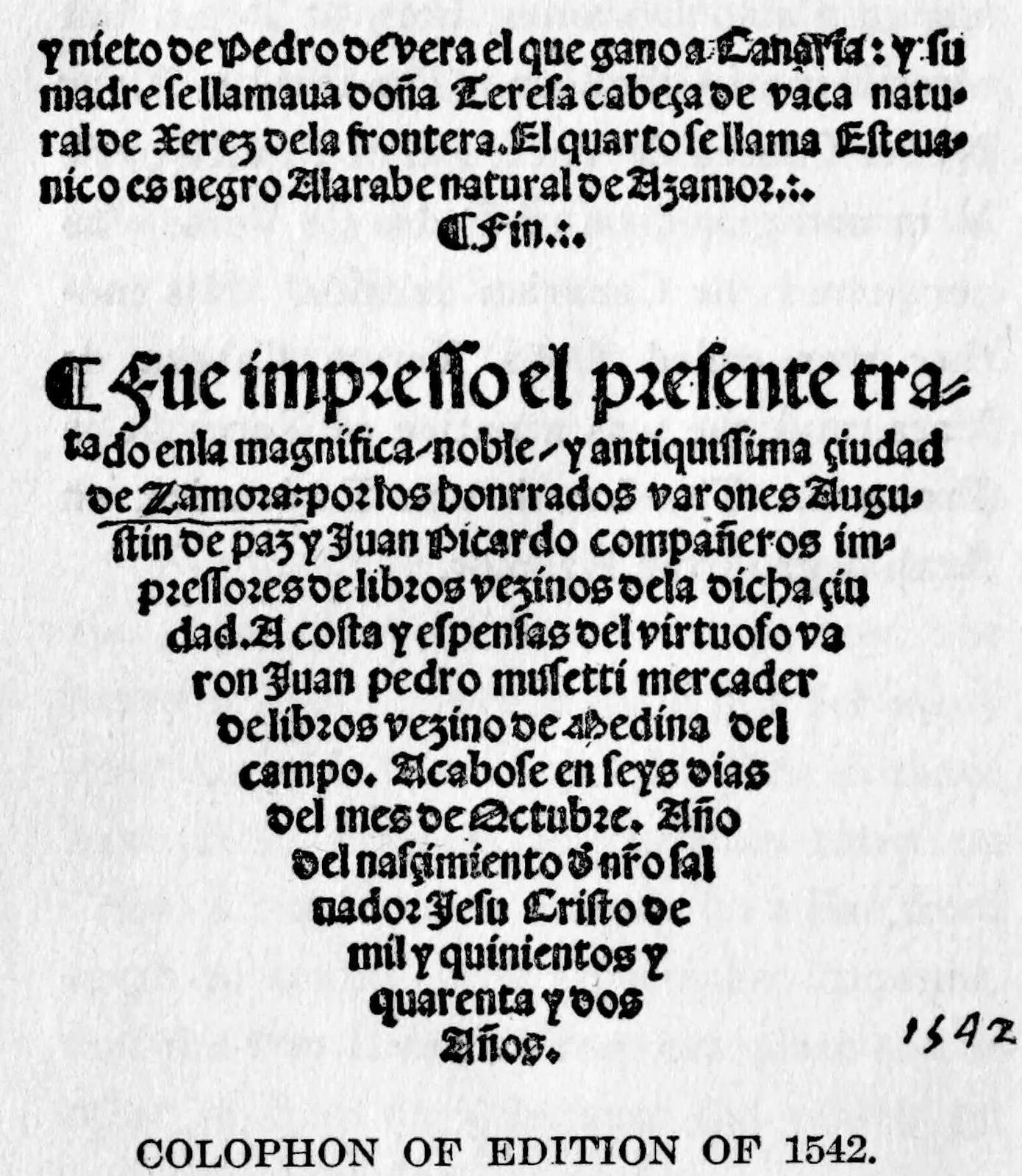
COLOPHON OF EDITION OF 1542.
Reduced from original in Lenox Branch of N. Y. Public Library.
LETTER OF MENDOZA AND REPORT OF FATHER MARCOS OF
NIZZA.—INTRODUCTORY NOTE.
IN order to furnish the reader the available data concerning the fate of
the two companions of Cabeza de Vaca, who remained in Mexico after his
return to Spain, it has been deemed proper to add the two documents
which follow. There is first a letter of the Viceroy Don Antonio de
Mendoza in which, as far as I am able to ascertain, the only (very
meagre) data concerning the subsequent career of Andrés Dorantes in
America are found. This is followed by the well-known report of Father
Marcos of Nizza on his expedition to Cibola (Zuñi), in which the Moor
Estevanico acted as his guide and perished. The text of the documents is
taken from the edition of 1810 of “Hackluyt’s Collection of the Early
Voyages, Travels, and Discoveries of the English Nation,” Vol. III., pp.
436 to 446. The translation is known to be quite indifferent, still the
main points are reliable and it fully serves the purpose, which is not
to furnish a critical study of Father Marcos of Nizza, and his
achievements, but simply to supply the information indicated, and, at
the same time, establish the logical connection of this narrative with
the “Journey of Coronado,” already presented in “The Trail-Makers.”
Ad. F. Bandelier.
A LETTER WRITTEN BY THE MOST HONORABLE LORD DON ANTONIO DE MENDOZA,
VICE-ROY OF NUEVA ESPANNA, TO THE EMPERORS MAIESTIE.
Of Certaine Noblemen Which Sought to Discover the End of the Firme
Land of Nueva Espanna Toward the North. The Arrivall of Vazquez de
Coronado with Frier Marco at S. Michael of Culiacan, with
Commission to the Governors of Those Partes, to Pacifie the
Indians, and Not to Make Them Slaves Any More.
IN the ships that went last from hence (whereof Michael de Usnago was
Admiral) I wrote into your maiestie, how I had sent two Franciscan
Friers to discover the end of this firme land, which stretcheth to the
North. And because their iourney fell out to greater purpose than was
looked for, I will declare the whole matter from the beginning. It may
please your Maiestie to call to mind how often I wrote unto your
Highnesse, that I desired to know the ende of this Province of Nueva
Espanna, because it is so great a countrey, and that we have yet no
knowledge thereof. Neither had I onely this desire; for Nunno de Guzman
departed out of this city of Mexico with 400 horsemen, and 14,000
Indians footemen borne in these Indias, being the best men and the best
furnished, which have bene seene in these parts; and he did so little
with them, that the most part of them were consumed in the enterprize
and could not enter nor discover any more then already was discovered.
After this the saide Nunno Guzman beeing Governour of Nueva Galicia,
sent Captaines and Horsemen foorth divers times, which sped no better
then he had done. Likewise the Marques de valle Hernando Cortez sent a
captaine with 2 ships to discover the coast: which 2 ships and the
captaine perished. After that he sent again 2 other ships, one of the
which was divided from her consort, and the master and certaine mariners
slue the captaine and usurped over the ship.
After this they came to an Island, where the Master with certaine
mariners going on land, the Indians of the Country slew them, and tooke
their boat: and the ship with those that were in it, returned to the
coast of Nueva Galicia, where it ran on ground. By the men which came
home in this ship, the Marques had knowledge of the countrey which they
had discovered: and then, either for the discontentment which hee had
with the bishop of Saint Domingo and with the Judges of this royal
audience in Mexico, or rather because of his so prosperous successe in
all things here in Nueva Espanna, without seeking any farther
intelligence of the state of that Island, he set forward on that voyage
with 3 ships, and with certaine footemen and horsemen, not throughly
furnished with things necessary; which fell out so contrary to his
expectations that the most part of the people which he carried with
him, dyed of hunger. And although he had ships, and a Countrey very
neere him abounding with victuals, yet could hee never finde meanes to
conquer it, but rather it seemed, that God miraculously did hide it from
him: and so he returned home without achieving ought else of moment.
After this, having heere in my company Andrew Dorantez, which is one of
those who were in the voyage of Panphilo Naruaez, I often was in hand
with him, supposing that he was able to doe Your Maiestie great service,
to imploy him with fortie or fiftie horses, to search out the secret of
those parts: and having provided all things necessary for his iourney,
and spent much money in that behalfe, the matter was broken off, I wot
not how, and that enterprise was given over. Yet of the things which
were provided for that purpose, I had left mee a negro, which returned
from the foresayde voyage of Naruaez with Dorantez, and certaine slaves
which I had bought, and certaine Indians which I had gathered together
who were borne in those North partes, whome I sent with Frier Marco de
Niça, and his companion a Franciscan Frier, because they had bene long
travelled, and exercised in those partes, and had great experience in
the affaires of the Indies, and were men of good life and conscience,
for whom I obtained leave of their superiours: and so they went with
Frances Vazquez de Coronado, governour of Nueva Galicia unto the Citie
of Saint Michael of Culiacan, which is the last Province subdued by the
Spaniards towarde that quarter, being two hundred leagues distant from
this Citie of Mexico. As soone as the governour, and the Friers were
come unto that Citie, hee sent certaine of those Indians which I had
given him, home into their Countrey, to signifie, and declare to the
people of the same, That they were to vnderstand, that your Maiestie had
commanded they should not hereafter bee made slaves, and that they
should not be afrayd any more, but might returne unto their houses, and
live peaceably in them, (for before that time they had bin greatly
troubled by the evill dealings which were used toward them) and that
your maiestie would cause them to be chastened, which were the causes of
their vexation. With these Indians about twentie dayes after returned
about 400 men; which coming before the governour said unto him, that
they came on the behalfe of al their countrey-men, to tell him, that
they desired to see and know those men which did them so great a
pleasure as to suffer them to returne to their houses, and to sow maiz
for their sustenance, for by the space of many yeres they were driven to
flee into the mountaines, hiding themselves like wild beasts, for feare
lest they should be made slaves, and that they and all the rest of their
people were ready to doe whatsoever should bee commanded them: whom the
governour comforted with good wordes, and gave them victuals, and stayed
them with him three or foure dayes wherein the Friars taught them to
make the signe of the crosse, and to learne the name of our Lorde Jesus
Christ, and they with great diligence sought to learne the same. After
these dayes hee sent them home againe, willing them not to be afraid,
but to be quiet, giving them apparel, beades, knives, and other such
like things, which I had given him for such purposes. The sayde Indians
departed very well pleased, and said, that whensoever hee would send for
them, they and many others would come to doe whatsoever he would command
them. The entrance being thus prepared, Frier Marco and his companion,
with the Negro and other slaves, and Indians which I had given him, went
forward on their voyage 10 or 12 dayes after. And because I had likewise
advertisement of a certaine Province called Topira situate in the
mountaines and had appointed the governour Vazquez de Coronado, that he
should use meanes to learne the state thereof: he supposing this to be a
matter of great moment determined himselfe to goe and search it, having
agreed with the said Frier, that he should returne by that part of the
mountaine, to meete with him in a certaine valley called Valle de los
Coraçones, being 120 leagues distant from Culiacan. The Governour
travelling into this province (as I have written in my former letters)
found great scarcity of victuals there, and the mountaines so craggy,
that he could finde no way to passe forward, and was inforced to returne
home to Saint Michael: so that as well in chusing of the entrance, as in
not being able to finde the way, it seemeth onto all men that God would
shut up the gate to all those, which by strength of humane force have
gone about to attempt this enterprise, and hath reveiled it to a poore
and bare-footed Frier. And so the Frier beganne to enter into the Land,
who because he found his entrance so well prepared, was very well
received; and because he wrote the whole successe of his voyage,
according to the instruction which I had given him to ondertake the
same, I wil not write any more at large, but send your Maiestie this
copy of all such things as he observed in the same.
A RELATION OF THE REVEREND FATHER FRIER MARCO DE NICA, TOUCHING HIS
DISCOVERY OF THE KINGDOM OF CEUOLA OR CIBOLA, SITUATE ABOUT 30.
DEGREES OF LATITUDE, TO THE NORTH OF NUEUA ESPANNA.
CHAPTER I.
Frier Marco de Niça Departeth from Saint Michael in the Province of
Culiacan, Standing in 24. Degrees of Northerly Latitude: and Coming
to the Towne of Petatlan, Receiveth Many Courtesies of the Indians
There. Departing from Thence, He Had Information of Many Islands,
and of a Great Countrey Inhabited with Civil People; He Cometh to
Vacupa: Where During His Aboad, He Heard Newes of Cevola, and of
the State of the 7 Cities, and of Other Provinces, and of the Rich
Islands of Perles, which Extend Northward Upon the Coast.
I FRIER MARCO DE NIÇA of the order of S. Francis, for the execution of
the instruction of the right honourable lord Don Antonio de Mendoça,
Vice-roy and captaine Generall for the Emperors Maiestie in New Spaine,
departed from the towne of S. Michael in the province of Culiacan on
Friday the 7. of March, in the yeere 1539. having for my companion Frier
Honoratus, and carying with me Stephan a Negro, belonging to Andrew
Dorantez, and certaine of those Indians which the sayde lord Vice-roy
had made free, and bought for this purpose: whom Frances Vazquez de
Coronado governour of Nueva Galicia delivered me, and with many other
Indians of Petatlan, and of the towne called Cuchillo, which is some 50.
leagues from Petatlan, who came to the valley of Culiacan, shewing
themselves to bee exceeding glad, because they were certified by the
Indians which had bin set free, whom the said governour had sent before
to advertise them of their libertie, that none of them from thenceforth
should be made slaves, and that no man should invade them, nor use them
badly; signifying onto them, that the Emperors Maiesty had willed and
commanded that it should be so. With the foresaid company I went on my
voyage vntil I came to the towne of Petatlan, finding all the way great
intertainment, and provision of victuals, with roses, flowers, and other
such things, and bowers which they made for me of chalke and boughs
platted together in all places where there were no houses. In this towne
of Petatlan I rested 3. dayes, because my companion Honoratus fell so
sicke, that I was constrained to leave him there behinde.
Then, according to my said instruction, I followed my iourney as the
holy Ghost did leade me, without any merit of mine, having in my company
the said Stephan the Negro, Dorantez, and certaine of the Indians which
had bin set at liberty, and many of the people of the countrey, which
gave me great intertainment and welcome in all places where I came, and
made mee bowers of trees, giving me such victuals as they had, although
they were but small: because (as they said) it had not rained there in 3
yeres, and because the Indians of this countrey sought means rather to
hide themselves, then to sowe corne, for feare of the Christians of the
Towne of S. Michael, which were wont to make in-roades even to that
place, and to warre upon them, and to carry them away captives. In all
this way, which may be about 25 or 30. leagues from that part of
Petatlan, I saw nothing worthy the noting, save that there came to seeke
me certaine Indians from the Island, where Fernando Cortez the Marques
of the valley had bin, of whom I was informed, that it was an Island,
and not firme land, as some suppose it to be. They came to yᵉ firme land
upon certaine rafts of wood: and from the maine to the island is but
halfe a league by sea, little more or lesse. Likewise certaine Indians
of another island greater then this came to visit me, which island is
farther off, of whom I was informed that there were 30. other small
islands, which were inhabited, but had smal store of victuals, saving 2.
which have maiz or corne of the countrey. These Indians had about their
necks many great shels which were mother of Pearle. I shewed them
pearles which I carryed with me for a shew, and they told me that there
were in the Islands great store of them, and those very great: howbeit I
saw none of them. I followed my voyage through a desert of 4 dayes
iourney, having in my company both the Indians of the islands and those
of the mountaines which I had passed, and at the end of this desert I
found other indians which marvelled to see me, because they had no
knowledge of any Christians, having no traffike nor conversation with
those Indians which I had passed, in regard of the great desert which
was between them. These Indians intertained me exceeding courteously,
and gave me great store of victuals and sought to touch my garments and
called me Hagota, which in their language signifieth A man come from
heaven. These Indians I advertised by my interpreter, according to my
instructions, in the Knowledge of our Lord God in heaven, and of the
Emperor. In these countries and in all places els by all wayes and
meanes possible, I sought information where any Countreys were of more
Cities and people of civilitie and onderstanding, then those which I had
found: and I could heare no newes of any such: howbeit they tolde mee,
that foure or five dayes iourney within the Countrey, at the foote of
the mountaines, there is a large and mightie plaine, wherein they tolde
mee, that there were many great Townes, and people clad in Cotton: and
when I shewed them certaine metals which I carryed with mee, to learne
what riche metals were in the Lande, they tooke the minerall of Golde
and tolde mee, that thereof were vesselles among the people of that
plaine, and that they carryed certaine round greene stones hanging at
their nostrilles, and at their eares, and that they have certaine
thinne plates of that Golde, wherewith they scrape off their sweat, and
that the walles of their Temples are covered therewith, and that they
use it in all their household vessels. And because this Valley is
distant from the Sea-coast, and my instruction was not to leave the
Coast, I determined to leave the discovery thereof ontill my returne; at
which time I might doe it more commodiously.
Thus I travelled three dayes iourney through Townes inhabited by the
sayde people, of whome I was received as I was of those which I had
passed, and came onto a Towne of reasonable bignesse, called Vacupa,
where they shewed mee great courtesies, and gave mee great store of good
victuals, because the soyle is very fruitfull, and may bee watered. This
Towne is fortie leagues distant from the Sea.
And because I was so farre from the Sea, it being two dayes before
Passion Sunday, I determined to stay there until Easter, to informe
myselfe of the Islandes, whereof I sayde before that I had information.
And so I sent certaine Indians to the Sea by three severall wayes whom I
commaunded to bring mee some Indians of the Sea-coast and of some of
those Islandes that I might receive information of them: And I sent
Stephan Dorantez the Negro another way, whom I commaunded to goe
directly northward fiftie or threescore leagues, to see if by that way
hee might learne any newes of any notable thing which wee sought to
discover, and I agreed with him, that if hee found any knowledge of any
peopled and riche countrey which were of great importance, that hee
should goe no further but should returne in person, or should sende mee
certaine Indians with that token which wee were agreed upon, to wit,
that if it were but a meane thing, hee should sende mee a White Crosse
of one handfull long; and if it were any great matter, one of two
handfuls long; and if it were a Countrey greater and better then Nueva
Espanna, hee should send mee a great crosse. So the sayde Stephan
departed from mee on Passion-sunday after dinner: and within foure dayes
after the messengers of Stephan returned vnto me with a great Crosse as
high as a man, and they brought me word from Stephan, that I should
forthwith come away after him, for hee had found people which gave him
information of a very mighty Province, and that he had certaine Indians
in his company, which had bene in the sayd Province, and that he had
sent me one of the said Indians. This Indian told me, that it was
thirtie dayes iourney from the Towne where Stephan was, vnto the first
Citie of the sayde Province, which is called Ceuola. Hee affirmed also
that there are seven great Cities in this Province, all vnder one Lord,
the houses whereof are made of Lyme & Stone, and are very great, and the
least of them with one lofte above head, and some two and of three
loftes, and the house of the Lorde of the Province of foure, and that
all of them ioyne one onto the other in good order, and that in the
gates of the principall houses there are many Turques-stones cunningly
wrought, whereof hee sayth they have there great plentie: also that the
people of this Citie goe very well apparelled: and that beyond this
there are other Provinces, all which (hee sayth) are much greater then
these seven cities. I gave credite to his speach because I found him to
bee a man of good vnderstanding: but I deferred my departure to follow
Stephan Dorantez, both because I thought hee would stay for mee, and
also to attend the returne of my messengers which I had sent vnto the
Sea, who returned vnto me upon Easter day, bringing with them certaine
inhabitants of the Sea-coast, and of two of the Islands. Of whom I
vnderstoode, that the Islandes above mentioned were scarce of victuals,
as I had learned before, and that they are inhabited by people, which
weare shelles of Pearles upon their foreheads, and they say that they
have great Pearles, and much Golde. They informed mee of foure and
thirtie Islandes, lying one neere vnto another: they say that the people
on the sea-coast have small store of victuals, as also those of the
Islandes, and that they trafficke one with the other upon raftes. This
coast stretcheth northward as is to bee seene. These Indians of the
Coast brought me certaine Targets made of Cow-hydes very well dressed,
which were so large, that they covered them from the head to the very
foote, with a hole in the toppe of the same to looke out before: they
are so strong, that a Crossebow (as I suppose) will not pierce them.
CHAPTER II.
He Hath New Information of the Seven Cities by Certaine Indians
Called Pintados, and of Three Other Kingdomes Called Marata, Acus,
and Totonteac, Being Countreys Very Rich in Turqueses and Hides of
Cattel. Following His Voyage Through Those Countries He Taketh
Possession Thereof for the Emperors Maiestie, and of the Indians Is
Much Honoured and Served with Victuals.
THE same day came three Indians of those which I called Pintados,
because I saw their faces, breasts and armes painted. These dwel farther
up into the countrey towards the East, and some of them border upon the
seven cities, which sayd they came to see mee, because they had heard of
mee: and among other things they gave me information of the seven
cities, and of the other Provinces, which the Indian that Stephan sent
me had tolde mee of, almost in the very same manner that Stephan had
sent mee worde; and so I sent backe the people of the sea-coast: and two
Indians of the Islands sayde they would goe with mee seven or eight
dayes.
So with these and with the three Pintados above mentioned, I departed
from Vacupa upon Easter Tuesday, the same way that Stephan went, from
whom I received new messengers with a crosse of the bignesse of the
first which he sent me: which hastened me forward, and assured me that
the land which I sought for, was the greatest and best countrey in all
those partes. The sayd messengers told mee particularly without fayling
in any one poynt, all that which the first messenger had tolde mee, and
much more, and gave mee more plaine information thereof. So I travelled
that day being Easter Tuesday, and two dayes more, the very same way
that Stephan had gone: at the end of which 3 dayes they tolde mee that
from that place a man might travell in thirtie dayes to the citie of
Ceuola, which is the first of the seven. Neither did one onely tell me
thus much, but very many; who tolde me very particularly of the
greatness of the houses, and of the fashion of them, as the first
messengers had informed me. Also they told me, that besides these seven
Cities, there are 3 other Kingdomes which are called Marata, Acus and
Tontonteac. I enquired of them wherefore they travelled so farre from
their houses: They said that they went for Turqueses, and Hides of Kine,
and other things; and that of all these there was great abundance in
this Countrey. Likewise I enquired how, and by what meanes they obtained
these things: They tolde me, by their service and by the sweat of their
browes, and that they went unto the first citie of the province which is
called Ceuola, and that they served them in tilling their ground, and in
other businesses, and that they give them Hydes of oxen, which they have
in those places, and turqueses for their service, and that the people
of this city weare very fine and excellent turqueses hanging at their
eares and at their nostrils. They say also, that of these turqueses they
make fine workes upon the principall gates of the houses of this citie.
They tolde mee, that the apparell which the inhabitants of Ceuola weare,
is a gowne of cotten downe to the foote, with a button at the necke, and
a long string hanging downe at the same, and that the sleeves of these
gownes are as broad beneath as above. They say, they gyrded themselves
with gyrdles of turqueses, and that over these coates some weare good
apparel, others hides of Kine very well dressed, which they take to bee
the best apparell of that countrey, whereof they have there great
quantitie. Likewise the women goe apparelled, and covered downe to the
foote. These Indians gave me very good intertainment, and curiously
enquired the day of my departure from Vacupa, that at my returne they
might provide me of foode and lodging. They brought certaine sicke
folkes before mee, that I might heale them, and sought to touch my
apparell, and gave mee certaine cow-hydes so well trimmed and dressed,
that by them a man might coniecture that they were wrought by civile
people, and all of them affirmed, that they came from Ceuola.
The next day I followed my iourney, and carrying with mee the Pintados,
I came to another Village where I was well received by the people of the
same: who likewise sought to touch my garments, and gave mee as
particular knowledge of the Lande aforesaide, as I had received of those
which mette mee before: and also tolde mee, that from that place
certaine people were gone with Stephan Dorantez, foure or five dayes
iourney. And here I found a great crosse, which Stephan had left mee for
a signe, that the newes of the good Countrey increased, and left worde,
that with all haste they should send mee away, and that hee would stay
for me at the ende of the first Desert that he mette with. Heere I set
up two Crosses, and tooke possession according to mine instruction,
because that the Countrey seemed better unto mee then that which I had
passed, and that I thought it meete to make an acte of possession as
farre as that place.
In this maner I travailed five dayes, alwayes finding inhabited places
with great hospitalitie and intertainments, and many Turqueses, and
Oxe-hides, and the like report concerning the countrey. Heere I
understood, that after two dayes iourney I should finde a desert where
there is no foode, but that there were certaine gone before to build mee
lodgings, and to carrie foode for me: whereupon I hastened my way,
hoping to finde Stephan at the ende thereof, because in that place hee
had left worde that hee would stay for mee. Before I came to the desert,
I mette with a very pleasant Towne, by reason of great store of waters
conveighed thither to water the same. Heere I mette with many people
both men & women clothed in Cotton, and some covered with oxe-hydes,
which generally they take for better apparell then that of cotton.
All the people in this village go in caconados, that is to say,
Turquesses hanging at their nostrilles and eares, which Turquesses they
call Cacona. Amongst others, the Lord of this Village came unto me; and
two of his brethern, very well apparrelled in cotton, who also were in
Caconados, each of them having his collar of Turquesses about his necke;
and they presented unto mee many wild beastes, as conies, quailes, Maiz
nuttes of Pine trees, and all in great abundance, and offered me many
Turqueses, and dressed Oxe-hydes, and very fayre vessels to drinke in,
and other things; whereof I would receive no whit. And having my garment
of gray cloth, which in Spaine is called çaragoça, the Lord of this
Village and the other Indians touched my gowne with their handes, and
tolde mee, that of such cloth there was great store in Tontonteac, and
that the people of that Countrey wore the same. Whereat I laughed, and
sayde that it was nothing else but such apparell of Cotton as they wore.
And they replyed: We would have thee thinke that we vnderstand, that
that apparell which thou wearest, and that which we weare are of divers
sortes. Understand thou, that in Ceulo all the houses are full of that
apparrell which we weare, but in Totonteac there are certaine litle
beasts, from whom they take that thing wherewith such apparell as thou
wearest is made. I prayed them to informe mee more playnely of this
matter. And they tolde mee that the sayde beastes were about the
bignesses of the two braches or spaniels which Stephan caryed with him,
and they say that there is great store of that cattell in Totonteac.
CHAPTER III.
He Entreth into a Desert, and the Indians Suffer Him to Want
Nothing Necessary. Following His Voyage, He Commeth into a Fertile
Valley, and Hath Certaine Knowledge Given Him (as He Had Before) of
the State of Ceuola, and of Totonteac; and That the Coast of the
Sea in 35. Degrees Trendeth Much to the Westward; and Also the
Kingdomes of Mavata and Acus.
THE next day I entered into the Desert, and where I was to dine, I found
bowers made, and victuals in abundance by a rivers side: and at night I
found bowers and victuals in like sort, and after that maner I found for
4 dayes travell: all which time the wildernesse continueth.
At the ende of these foure dayes, I entred into a valley very well
inhabited with people. At the first village there mette me many men and
women with victuals and all of them had Turqueses hanging at their
nostrils and eares, and some had collars of turqueses like those which
the Lord of the Village before I came to the Desert, and his two
brethern wore: saving that they ware them but single about their neckes,
and these people weare them three or foure times double, and goe in good
apparrell, and skinnes of Oxen: and the women weare of the said
Turqueses at their nostrils and eares, and very good wast-coates and
other garments. Heere there was as great Knowledge of Ceula, as in Nueva
Espanna of Temistitan, and in Peru of Cuzco; and they tolde us
particularly the maner of their houses, lodgings, streetes and
market-places, as men that had bene oftentimes there, and as those which
were furnished from thence with things necessary for the service of
their householde, as those also had done, which I already had passed. I
told them it was impossible that the houses should be made in such sort
as they informed mee, and they for my better vnderstanding tooke earth
or ashes, and poured water thereupon, and shewed me how they layd stones
upon it, and how the buylding grewe up, as they continued laying stones
thereon, vntill it mounted aloft. I asked them whether the men of that
countrey had wings to mount up unto those loftes; whereat they laughed,
and showed mee a Ladder in as good sort as I myselfe was able to
describe it. Then they tooke a Staffe and helde it over their heads, and
said that the lofts were so high one above another. Likewise heere I had
information of the woollen cloth of Totonteac, where they say are houses
like those of Ceuola, and better and more in number, and that it is a
great Province, and hath no governour. Here I onderstood that the coast
of the sea trended much toward the West; for vnto the entrance of this
first desert which I passed, the coast still stretched Northward; and
because the trending of the coast is a thing of great importance, I was
desirous to Knowe and see it; and I saw plainely, that in 35. degrees
the coast stretcheth to the West, whereat I reioyced no lesse, then of
the good newes within land, and so I returned back to proceede on my
iourney.
Through the foresayd valley I travailed five dayes iourney, which is
inhabited with goodly people, and so aboundeth with victuals, that it
sufficieth to feede above three thousand horsemen: it is all well
watered and like a garden: the burroughs and townes are halfe and a
quarter of a league long, and in all these villages, I found very ample
report of Ceuola, whereof they made such particular relation onto me, as
people which go yeerely thither to earne their living. Here I found a
man borne in Ceuola, who told me that he came thither, having escaped
from the governour or Lieutenant of the towne; for the Lord of these
seven Cities liveth and abideth in one of those townes called Ahacus,
and in the rest he appoynteth lieu-tenants under him. This townesman of
Ceuola is a white man of a good complexion, somewhat well in yeeres, and
of fame greater capacitie then the inhabitants of this valley, or then
those which I had left behind me. Hee sayde that hee would goe with mee,
that I might begge his pardon: and of him I learned many particulars: he
tolde me that Ceuola was a great Citie, inhabited with great store of
people, and having many streetes and marketplaces: and that in some
parts of this Citie there are certaine very great houses of five
stories high, wherein the chiefe of the Citie assemble themselves at
certaine dayes of the yeere. He sayeth that the houses are of Lyme and
Stone, according as others had tolde mee before, and that the gates, and
small pillars of the principall houses are of Turqueses, and all the
vessels wherein they are served, and the other ornaments of their houses
were of golde: and that the other sixe Cities are built like onto this,
whereof some are bigger: and that Ahacus is the chiefest of them. Hee
sayth that toward the Southeast there is a Kingdome called Marata, and
that there were woont to be many, and those great Cities, which were all
built of houses of Stone, with divers lofts: and that these have and doe
wage warre with the Lord of the seven Cities, through which warre this
Kingdome of Marata is for the most part wasted, although it yet
continueth and maintaineth warre against the other.
Likewise he saith, that the Kingdome called Totonteac lyeth toward the
West, which he saith is a very mightie Province, replenished with
infinite store of people and riches. And that in the sayde Kingdome they
weare woollen cloth like that which I weare, and other finer sorts of
woollen cloth made of the fleeces of those beastes which they described
before onto me: and that they are a very civile people. Moreover hee
tolde me, that there is another great Province and Kingdome called Acus;
for there is Acus, and Ahacus with an aspiration, which is the
principall of the seven cities: and Acus without an aspiration is a
Kingdome and Province of it selfe. He told me also, that the apparrel
which they weare in Ceuola is after the same maner as they before had
certified me, and that all the inhabitants of the Citie lie upon beddes
raysed a good height from the ground, with quilts and canopies over
them, which cover the sayde Beds: and hee tolde mee that hee would goe
with me to Ceuola and farther also, if I would take him with me. The
like relation was given vnto me in this towne by many others, but not so
particularly. I travelled three dayes iourney through this valley: the
inhabitants whereof made me exceeding great cheere and intertainment. In
this valley I saw above a thousand Oxe-hides most excellently trimmed
and dressed. And here also I saw farre greater store of Turqueses and
chaines made thereof, then in all places which I had passed; and they
say, that all commeth from the city of Ceuola whereof they have great
Knowledge, as also of the Kingdome of Marata and of the Kingdomes of
Acus and Totonteac.
CHAPTER IV.
Of a Very Great Beast with One Horne Upon His Fore-head; and of the
Courtesies which the Indians Shewed Frier Marcus of Niça, in His
Voyage. Also How Cruelly Stephan Dorantez and His Companions Were
Used Upon Their Arrivall at Ceuola, by the Lorde Thereof.
HERE they shewed me an hide halfe as bigge againe as the hide of a great
oxe, and tolde me that it was the skin of a beast which had but one
horne upon his forehead, and that this horne bendeth toward his breast,
and that out of the same goeth a point right forward, wherein he hath so
great strength, that it will breake any thing how strong so ever it be,
if he runne against it, and that there are great store of these beasts
in that Countrey. The colour of the hide is of the colour of a great
Goat-skin, and the haire is a finger thicke. Here I had messengers from
Stephan which brought me word, that by this time he was come to the
farthest part of the desert, and that he was very ioyful, because the
farther he went, the more perfect Knowledge he had of the greatnesse of
the countrey, and sent me word, that since his departure from me, hee
never had found the Indians in any lye; for even vnto that very place he
had found al in such maner as they had informed him and hoped that he
should find the like at his arrivall in the valley which he was going
vnto, as he had found in the villages before passed. I set up crosses
and used those acts and ceremonies, which were to be done according to
my instructions. The inhabitants requested me to stay here three or
foure days, because that from this place there were four days iourney
vnto the desert, and from the first entrance into the same desert vnto
the citie of Ceuola are 15 great dayes iourney more; also that they
would provide victuals, for me and other necessaries for that voyage.
Likewise they told me, that with Stephan the Negro were gone above 300
men to beare him company, and to carry victuals after him, and that in
like sort many of them would go with me to serve me, because they hoped
to returne home rich. I thanked them, and willed them to set things in
order with speede, and so I rested there three dayes, wherein I always
informed my selfe of Ceuola, and of as many other things as I could
learne, and called many Indians vnto mee, and examined them severally
and all of them agreed in one tale, and told me of the great multitude
of people, and of the order of the streetes, of the greatnesse of the
houses, and of the strength of the gates, agreeing altogether with that
which the rest before had told me. After three dayes many assembled
themselves to go with me, 30 of the principal of whom I tooke, being
very well apparrelled, and with chaines of turqueses, which some of them
weare five or sixe times double, and other people to cary things
necessary for them and me, and so set forward on my voyage.
Thus I entred into the second desert on the 9 of May, and travelled the
first day by a very broad and beaten way, and we came to diner vnto a
water, where the Indians had made provision for me; and at night we came
to another water, where I found a house which they had fully made up for
me, and another house stood made where Stephan lodged when he passed
that way, and many old cottages and many signes of fire which the people
had made that travelled to Ceuola by this way. In this sort I travelled
12 dayes iourney being alway well provided of victuals, of wild beasts,
Hares, and Partridges of the same colour and tast with those of Spaine
although they are not as big, for they be somewhat lesse. Here met us an
Indian the sonne of the chiefe man that accompanied mee, which had gone
before with Stephan, who came in a great fright, having his face and
body all covered with sweat, and shewing exceeding sadnesse in his
countenance; and he told mee that a dayes iourney before Stephan came to
Ceuola he sent his great mace made of a gourd by his messenges, as he
was always woont to send them before him, that hee might knowe in what
sort hee came onto them, which gourd has a string of belles upon it, and
two feathers one white and another red, in token that he demanded safe
conduct, and that he came peaceably. And when they came to Ceuola before
the magistrate, which the Lord of the citie had placed there for his
Lieutenant, they delivered him the sayde great gourd, who tooke the same
in his hands, and after he spyed the belles, in a great rage and fury he
cast it to the ground, and willed messengers to get them packing with
speed, for he knew well ynough what people they were, and that they
should will them in no case to enter into the citie, for if they did hee
would put them all to death. The messengers returned and tolde Stephan
how things had passed, who answered them that it made no great matter,
and would needes proceed on his voyage till he came to the citie of
Ceuola: where he found men that would not let him enter into the towne,
but shut him into a great house which stoode without the citie, and
straightway tooke all things from him which hee carried to truck and
barter with them, and certain turqueses, and other things which he had
received of the Indians by the way, and they kept him there all that
night without giving him meate or drinke, and the next day in the
morning this Indian was a thirst, and went out of the house to drinke at
a river that was neere at hand, and within a little while after he saw
Stephan running away, and the people followed him, and slewe certain of
the Indians which went in his company. And when this Indian saw these
things, he hid himselfe on the banks of the river, and afterward crossed
the high way of the desert. The Indians that went with me bearing these
newes began incontinently to lament, and I thought these heavie and bad
news would cost mee my life, neither did I feare so much the losse of
mine owne life, as that I should not bee able to returne to give
information of the greatnesses of that Countrey, where our Lord God
might be glorified: and streight way I cut the cords of my budgets which
I carried with me ful of merchandise for traffique, which I would not
doe till then, nor give anything to any man, and began to divide all
that I carried with mee among the principall men, willing them not to be
afraid, but to goe forward with me, and so they did. And going on our
way, within a dayes iourney of Ceuola wee met two other Indians of those
which went with Stephan, which were bloody and wounded in many places:
and as soone as they came to us, they which were with me began to make
great lamentation. These wounded Indians I asked for Stephan, and they
agreeing in all poynts with the first Indian sayd, that after they had
put him into the foresayd great house without giving him meat or drinke
all that day and all that night, they tooke from Stephan all the things
which hee carried with him. The next day when the Sunne was a lance
high, Stephan went out of the house, and some of the chiefe men with
him, and suddenly came store of people from the citie, whom as soone as
hee sawe he began to run away and we likewise, and foorthwith they shot
at us and wounded us, and certaine dead men fell upon us, and so we lay
till night and durst not stirre, and we heard great rumours in the
citie, and saw many men and women keeping watch and ward upon the
walles thereof, and after this we could not see Stephan any more, and
wee thinke they have shot him to death, as they have done all the rest
which went with him, so that none are escaped but we onely.
CHAPTER V. — FOOTNOTES:
The Situation and Greatnesse of the Citie of Ceuola, and How Frier
Marcus Tooke Possession Thereof and of Other Provinces, Calling the
Same The New Kingdomes of S. Francis, and How After His Departure
from Thence Being Reserved by God in So Dangerous a Voyage, He
Arrived at Compostella in Nueva Galicia.
HAVING considered the former report of the Indians, and the evill meanes
which I had to prosecute my voyage as I desired, I thought it not good
wilfully to loose my life as Stephan did; and so tolde them, that God
would punish those of Ceuola, and that the Viceroy when he should
understand what had happened, would send many christians to chastise
them: but they would not believe me, for they sayde that no man was able
to withstand the power of Ceuola. And herewith I left them, and went
aside two or three stones cast, and when I returned I found an Indian of
mine which I had brought from Mexico called Marcus, who wept and sayde
unto me: Father, these men have consulted to kill us, for they say, that
through your and Stephans meanes their fathers are slaine, and that
neither man nor woman of them shall remaine unslaine. Then againe I
divided among them certaine other things which I had, to appease them,
whereupon they were somewhat pacified, albeit they still shewed great
griefe for the people which were slaine. I requested some of them to goe
to Ceuola, to see if any other Indian were escaped, with intent that
they might learne some newes of Stephan; which I could not obtaine at
their handes. When I saw this, I sayd unto them, that I purposed to see
the citie of Ceuola, whatsoever came of it. They sayde that none of them
would goe with me. At the last when they sawe mee resolute, two of the
chiefe of them sayde they would goe with me; with whome and with mine
Indians and interpreters I followed my way, till I came within sight of
Ceuola, which is situate on a plaine at the foote of a round hill, and
maketh shew to bee a faire citie, and is better seated then any that I
have seene in these partes. The houses are builded in order, according
as the Indians told me, all made of stone with divers stories, and
flatte roofes, as farre as I could discerne from a mountaine, whither I
ascended to viewe the citie. The people are somewhat white, they weare
apparell, and lie in beds, their weapons are bowes, they have Emeralds
and other iewels, although they esteeme none so much as turqueses
wherewith they adorne the walles of the porches of their houses, and
their apparell and vessels, and they use them instead of money through
all the Countrey. Their apparell is of cotton and Oxe hides, and this is
their most commendable and honourable apparell. They use vessels of gold
and silver, for they have no other mettall, whereof there is greater
use and more abundance then in Peru, and they buy the same for turqueses
in the province of the Pintados, where there are sayd to be mines of
great abundance. Of other Kingdomes I could not obtaine so particular
instruction. Divers times I was tempted to goe thither, because I knewe
I could but hazard my life, and that I had offered unto God the first
day that I began my iourney: in the ende I began to bee afraid,
considering in what danger I should put my selfe, and that if I should
dye, the knowledge of this countrey should be lost, which in my
iudgement is the greatest and the best that hitherto hath beene
discovered: and when I tolde the chief men, what a goodly citie Ceuola
seemed unto mee, they answered me that it was the least of the seven
cities, and that Totonteac is the greatest and best of them all, because
it hath so many houses and people, and there is no ende of them. Having
seene the disposition and situation of the place, I thought good to name
that countrey El Nueva reyno de San Francisco: in which place I made a
great heape of stones by the helpe of the Indians, and on the toppe
thereof I set up a small slender crosse because I wanted meanes to make
a greater, and sayd that I set up that crosse and heape in the name of
the most honourable Lord Don Antonio de Mendoça Viceroy and Captaine
generall of Nueva Espanna, for the Emperour our Lord, in token of
possession, according to mine instruction. Which possession I sayd that
I tooke in that place of all the seven cities, and of the Kingdomes of
Totonteac, of Acus, and of Marata. Thus I returned with much more feare
then victuals, and went untill I found the people which I had left
behind mee, with all the speede that I could make, whome I overtooke in
two dayes travell, and went in their company till I had passed the
desert, where I was not made so much of as before: for both men and
women made great lamentation for the people which were slaine at Ceuola,
and with feare I hastened from the people of this valley, and travelled
tenne leagues the first day, and so I went daily eight or ten leagues,
without staying until I had passed the second desert. And though I were
in feare, yet I determined to go to the great plaine, whereof I said
before, that I had information, being situate at the foote of the
mountaines, and in that place I vnderstoode, that this plaine is
inhabited for many dayes iourney toward the East, but I durst not enter
into it, considering, that if hereafter wee shoulde inhabite this other
countrey of the seven cities, and the kingdomes before mentioned, that
then I might better discover the same, without putting my selfe in
hazard, and leaue it for this time, that I might give relation of the
things which I had now seene. At the entrance of this plaine I sawe but
seven Townes onely of a reasonable bignesse, which were a farre off in a
lowe valley beeing very greene and a most fruitfull soyle, out of which
ranne many Rivers. I was informed that there was much golde in this
valley, and that the inhabitants worke it into vessels and thinne
plates, wherewith they strike and take off their sweat, and that they
are people that will not suffer those of the other side of the plaine to
traffique with them, and they could not tell me the cause thereof. Here
I set up two crosses, and tooke possession of the plaine and valley in
like sort and order, as I did at other places before mentioned. And from
thence I returned on my voyage with as much haste as I coulde make,
untill I came to the citie of Saint Michael in the province of Culiacan,
thinking there to have found Francis Vazquez de Coronado governour of
Nueva Galicia, and finding him not there, I proceeded on my iourney till
I came to the citie of Compostella, where I found him. I write not here
many other particularities, because they are impertinent to this matter:
I only report that which I have seene, and which was tolde me concerning
the countreys through which I travelled, and of those which I had
information of.
Typographical errors corrected by the etext transcriber:
The Journey of Alvar Nunez Cabeza De Vaca> The Journey of Alvar Nuñez
Cabeza De Vaca {pg 1}
Governor Panfilo de Narvaez=> Governor Pánfilo de Narvaez {pg 1}
Letter was writen=> Letter was written {pg xvi}
the higest pitch=> the highest pitch {pg xviii}
a strone’s throw=> a stone’s throw {pg 45}
the squeeze and open=> they squeeze and open {pg 91}
places were they had slept=> places where they had slept {pg 168}
pp. 436 to 4446=> pp. 436 to 446 {pg 195}
anl Not to Make Them=> and Not to Make Them {pg 197}
Luquid-ámbar=> Liquid-ámbar {footnote #9; pg 26}
Marco de Nica=> Marco de Niça {pg 203}
Estévanico=> Estevanico {5x}