In the year 1912, the Pennsylvania Prison Society will
have completed a century and a quarter of its existence. It seems
opportune briefly to note some of the important features of the
work of this organization during the last 125 years. We are
fortunate in the possession of an unbroken series of records of
the transactions of this body from its first meeting in May, 1787,
to the present time.
In 1787 the conditions of the jails in Philadelphia were unspeakably
disgraceful. In one common herd there were kept by
day and by night prisoners of all ages, colors, degrees of crime,
and the sexes were not separated. No bedding was supplied and
unless the prisoner had means or friends, he slept on the ground
or bare floor. One loaf of bread constituted the daily ration.
Misconduct was punished by the branding-iron, the pillory, or by
the lash. Intoxicants were sold to all applicants who had money.
The keeper reaped a profit from all sales made to the inmates of
the prison. The death rate was enormous. No effort was made
to find any useful employment for the prisoners.
The Society early resolved that intoxicants must be forbidden
and that some form of employment must be found. They insisted
on segregation of the sexes, and also began to press for individual
separation in order that the penal institutions should not
become schools for crime. Within a very few years many reforms
were instituted. The death penalty which had been inflicted
for a score of crimes was abrogated except for murder in
the first degree. “Solitary confinement to hard labor” is still a
familiar phrase used by Judges in pronouncing sentence. In its
early years, the Society consistently and persistently urged the
adoption of a system of employment whereby each prisoner alone
in his cell should perform his task in some industrial pursuit. It
was never intended that the prisoners should be kept entirely secluded
from all human companionship, but that the officers should
see them frequently and that concerned visitors, under proper
supervision, should be allowed to talk with them and endeavor to
point them to the better way. This idea became known among
penologists as “The Pennsylvania System,” and was discussed
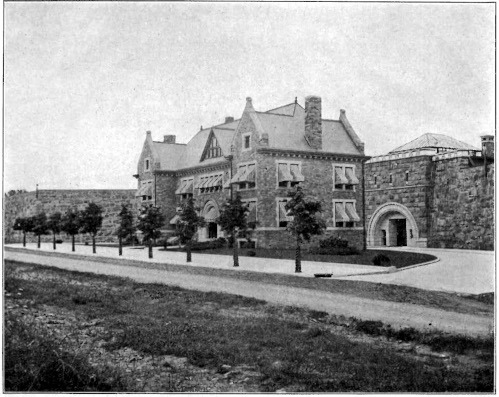
widely, both at home and abroad. The Eastern Penitentiary, on
Fairmount Avenue, formerly Coates Street, was built upon plans
largely suggested by this Society. Doubtless the separate system
was entirely carried out in 1829, when the prison was opened for
the reception of prisoners. But in the last half century, the number
of prisoners has exceeded the number of cells, so that the
officers of the prison have not been able to carry out this system
as originally planned. When this penitentiary was first constructed,
it was located on what was then known as Cherry Hill,
an eminence in the Northwest suburban district, and was surrounded
by farming land. That penal institutions should be located
in the country is, therefore, not a new proposition. Now
it is generally conceded that such institutions not only should be
located in the country, but that they should own and work a large
tract of land adjacent.
The first prisoner was received Oct. 25, 1829. The first report of the
Committee to visit the Eastern Penitentiary was made to the Acting Committee
on Nov. 11, 1829, and shows that there were two prisoners at that
time in the institution, one a white man from Chester Co., the other a
colored man from Delaware Co. By June 8, 1830, the number of prisoners
had increased to 25. The following extracts from the report of the Visiting
Committee, made in June, 1830, will prove interesting to those who are
familiar with the present conditions at the Penitentiary. “* * * The
best order prevails among the prisoners who are industriously, and it is
believed, profitably employed. Each is supplied with a soup-pan, washbasin,
brush, fine and coarse tooth comb, spoon, knife and fork, and every
week with a clean towel. Each prisoner is required to keep his room
clean and neat. * * * The food consists of half a pint of milk, mixed
in the same amount of hot water, bread made of rye and Indian meal
(one pound) for breakfast; for dinner one pint soup, three-fourths pound
meat, one-third pound bread; for supper one pint Indian mush and a half
gill molasses. * * * No conversation can take place between the
prisoners, and no communication from without be permitted. It has not
been found necessary to inflict any punishment so far, except in two cases:
in one case where a prisoner had neglected to keep his mess-pan clean,
he lost two meals; in another case, a prisoner who neglected his work was
for three days deprived of his meat. The principal trades are weaving
and shoemaking, trades which may be carried on in cells to advantage.
The health of the prisoners continues good.” The report is signed June
8, 1830, by the entire Visiting Committee consisting of David Weatherly
and James J. Barclay. Now after 80 years the supply of furniture is
practically the same, a table or stand being added. Sanitary arrangements
have been vastly improved, and the addition of a superior grade of homemade
wheat bread and coffee to the bill of fare has made a more palatable
menu.
Some forty years ago it was written that every advance in
the amelioration of convict prisons systems of discipline began in
Philadelphia. In the discussion of these problems The Pennsylvania
Prison Society took a conspicuous part. In 1856 the first
published criticism of the contract system, under which the labor
of the prisoners was sold for profit and to meet the prison expenses,
issued from Philadelphia. The criticism was received
with scorn and ridicule. Thoughtful students of humanitarian
measures began investigations in one State after another, with the
result that at the present time scarcely one State in the Union
maintains such a system. But while Pennsylvania has led the way
in many measures to reform the criminal and improve his condition,
some States have made more rapid progress in these directions.
Many States offer greater opportunities in their prisons for
industrial employment than we can show in Pennsylvania. Most
of the States have preceded us in the adoption of a Parole and a
Probation system for adult convicts.
In 1909, the Legislature of Pennsylvania enacted a law providing
for Probation for some classes of adult offenders, and also
for a Parole of criminals sentenced to the Penitentiaries of the
State under the conditions of an Indeterminate Sentence. Under
the Probation Act, the Courts have power to suspend the imposition
of the sentence and to place the defendant on Probation on
such terms and conditions as the Court may deem proper.
The Parole Law applied to the sentences of criminals sentenced
to the Penitentiary on and after June 30, 1909. Two
Members of The Pennsylvania Prison Society were very
active in framing this law and in securing its passage. The Legislature
of 1911 amended this law so as to render almost nugatory
some of the provisions of the law with regard to the Indeterminate
Sentence. The Chairman of our Committee on Legislation
has ably discussed this subject in an article published in the
Journal which was issued in November, 1911. The following
statistics, furnished by Parole Officer, John McKenty, of the
Eastern Penitentiary, show the operation of the law to the end
of the year 1911.
| Number paroled since the law was effective |
128 |
| Number returned for failure to fulfill requirement |
15 |
| Number not reporting |
3 |
| Number of those paroled who have received final discharge |
10 |
| Number on Parole December 31, 1911 |
100 |
| Percentage of success |
85.9% |
These figures compare quite favorably with the results reported
from other States in which this system has been for a
longer period in vogue.
Reports of the Members of the Acting Committee, appointed
to visit the Eastern Penitentiary, show that during the year 1911
6405 visits to prisoners have been made. Many unreported visits
have gladdened the prisoner in his lonely cell. Several of our
members participate in the Gospel services on the Sabbath.
One of the prisoners remarked to the Secretary that in his
opinion the work of visitation was the most important function of
the Society. This has been the most effective part of our work
from the first. Some of the men’s blocks are not visited so often as
would be desirable. The women’s block is said to be over-visited.
Several organizations have the privilege of sending visitors to
the twenty-seven women now incarcerated, and while visitors
are welcomed at suitable times and under proper conditions,
yet it is readily recognized that these prisoners of the women’s
block should have sufficient time to attend to their regular, but not
onerous, duties as assistants in various lines of domestic employment.
Under the management of Warden Robert J. McKenty,
the administration is to be commended. The discipline is firm,
but kindly, and so long as the privileges granted are not abused,
there is allowed a large amount of freedom within reasonable
limits. Hence, in this institution, the visitor may note an unusually
contented and orderly body of convicts.
The expense of supplying needy prisoners with clothing at
the time of their discharge from the Eastern Penitentiary has
been almost entirely borne by this Society since 1896. For the
six years prior to 1896, the Legislature appropriated on the average
of $2490.00 annually to the Society, which thereupon assumed
the expense of providing outfits for the prisoners at the time of
their release. In 1895, the Governor refused to sanction the
appropriation. No legislative grant of funds has been made since
that time to the Society. Our late Honorary Secretary, John J.
Lytle, who at that time was the General Secretary of the Society,
with untiring energy solicited contributions from benevolent citizens
to supply the prisoners when released with presentable
clothing. His whole heart was in this work and nobly did he
discharge what he deemed to be his duty to administer the charity
in which our Society had been, up to that time, assisted by the
State. We are still providing an outfit for discharged prisoners,
although this aid is supplied by legislative appropriation practically
in every other State of the Union. I append to this report a
schedule showing what provision is made for prisoners at the
time of their discharge from the various State Prisons. (See
page 38.)
During the year, 1911, the Secretary has furnished 370 men
at the time of their discharge from the Eastern Penitentiary
either with entire outfits, or with sufficient attire to make them
presentable.
The following list shows what garments have been given:
| Coats |
293 |
| Vests |
294 |
| Pants |
294 |
| Dress Shirts |
243 |
| Underclothing (pieces) |
474 |
| Hats |
332 |
| Suspenders, pairs |
326 |
| Neck-ties |
314 |
| Collars |
41 |
| Total number of garments |
2611 |
A few of the women on their discharge have been furnished
with suitable articles of apparel.
The administration of this charity is attended with peculiar
advantages. It is an important duty to visit the prisoners near
the close of their time of incarceration, and to learn from them
with regard to their hopes and fears. Then, if ever, they need
sympathetic attention. Many of them have friends or homes
ready to receive them, but there are others who need more than
a suit of clothes and a parting word of good wishes. We endeavor
to find employment for such as these unfortunate ones,
and, while in many cases we have succeeded, there is a remnant
who are not strong enough to face the temptations of the outer
world. Shall we not send such as these to a farm under control
of the State, where they will have opportunity to work in the
open air, and be retained in some kind of semi-detention until
they have made good?
Two members of the Acting Committee, who reside in Pittsburg,
have reported various visits and some Gospel service in the
Western Penitentiary.
In response to an inquiry with regard to the provision made
for the prisoners of that institution at the time of their discharge,
Warden John Francies writes as follows:
A. H. Votaw, Secretary,
The Pennsylvania Prison Society,
Philadelphia, Pa.
Dear Sir:—
Replying to your inquiry of Dec. 20, 1911, permit me to reply as
follows:—
1. With regard to money to prisoners on discharge.
This depends upon the distance the prisoner is going. If within a
radius of fifty miles, $5.00 is given. If outside the radius of fifty miles,
$10.00 is given.
2. With regard to clothing to prisoners on discharge.
The prisoner is given $10.00 worth of clothing as provided for in
appropriation by last session of Legislature.
3. Clothing supplied.
Suit complete, and furnishings, viz.: hat, shirt, shoes, hose, tie,
collar, etc.
Yours very truly,
John Francies, Warden.
At the last session of the Legislature of Pennsylvania, authority
was granted to remove this prison from Allegheny City
to some large tract of land amid healthier surroundings, and we
have learned that a site has been selected about eight miles from
Bellefonte in Centre county. Full opportunity will be afforded
here to test the out-door treatment.
Chaplain Miller, of the Western Penitentiary, has kindly
furnished the following statistics with regard to those paroled
from that institution:
| Whole number paroled |
100 |
| Number returnedd |
15 |
| Number not reportingd |
0 |
| Number of those paroled who have received final discharged |
1 |
| Number deceasedd |
2 |
| Number now on paroled |
82 |
| Percentage of successd |
85% |
The Committee appointed to visit the Philadelphia County
Prisons have been diligent in this service and the reports show
that 6100 visits have been made to the prisoners at Moyamensing
and Holmesburg.
The General Agent, Fred. J. Pooley, has assisted several
hundred at the time of their discharge with lodging, clothing,
railroad fares, and with articles to sell, while they are awaiting
more permanent employment. He has given help to a considerable
number in securing situations. The Door of Blessing has indeed
proved to be true to its name in giving help to the women at the
time of their discharge.
Our General Agent, Fred. J. Pooley, has found a large
field for service at the Central Police Station at City Hall. He
makes a special object to have interviews with those who have
had a preliminary hearing before Magistrates, and who have
been committed for trial before the Judges at City Hall. More
than a thousand letters has he written in behalf of those who have
been arrested in the last year. Very often he secures the release
of young prisoners by promptly communicating with parents
or relatives, who assume responsibility for the offender. Thus
many first offenders are turned from the error of their ways by
this timely attention, and escape the schooling in crime which
they would inevitably receive by further association with hardened
criminals. The work requires to be done with the utmost tact
and discretion, and several of the Magistrates have borne testimony
to the efficient service of our General Agent. He has
presented a more detailed report, an abstract of which will be
printed in the “Journal.”
Members of our Acting Committee have reported visits
to the prisons in Allegheny, Bucks, Chester, Delaware, Montgomery,
Monroe, Lancaster and Westmoreland and other counties.
With the passage of the proposed amendment to our Constitution,
providing for additions to the Acting Committee, it
will be possible to secure workers in other counties of the State,
who, we trust, will be of material assistance in collecting information,
and also in co-operating with us to secure measures to
ameliorate some of the evils of the present system. There are
very few county jails in the State whose construction and management
may be regarded as creditable. Some of the officials
are doubtless doing the best they can with the means at hand.
But the great majority of jails throughout the State have made
little progress in the last half century. “No prison without employment”
should be our campaign cry. It ought not to be impracticable
for a number of the smaller counties to unite in
the management of a prison farm to which petty offenders should
be sent. Such a farm should be self-supporting.
It should not be forgotten that the State of Pennsylvania
has at least two institutions which for some years have illustrated
the value and efficacy of farm life for prisoners. One
is the Huntingdon Reformatory, the other is the Allegheny Work
House at Hoboken.
Since our Journal for 1911 was issued so late in that year,
it gave opportunity to include in its contents an account of the
Proceedings of the American Prison Association, which met in
Omaha, Nebraska, in October, 1911. This report was prepared
by the secretary of the Society, who was appointed Delegate to
the Association. Deborah C. Leeds was also present at the
sessions of this body. In 1912, the Association will be held
in Baltimore, Maryland, and we hope a considerable number
of the members of our Society will attend its sessions.
By motion of the Acting Committee passed in June, 1911,
Dr. William C. Stokes was appointed Assistant to the Secretary.
His duties have been to assist in the clerical work of the
office, and especially to endeavor to increase the amount of
funds collected for the use of the Society. Since his appointment,
the office has been kept open during the greater part of the business
hours of each day, and we have felt there was an important
service in having the office accessible at all time to members
and visitors. Since June 21st, a Register for Visitors has been
kept, and the record shows that 417 visitors had registered to
December 31st from 35 States. A few foreign visitors were
received. Many of these visitors appear to appreciate information
about the work in which we are engaged, and they generally accept
some of our publications. We believe this opportunity to
present some features of our work will prove of some value.
During the year 1911, the Acting Committee lost by death
three of its members.
On Eighth Month 18, our beloved Honorary Secretary,
John J. Lytle, passed away from his residence at Moorestown,
N. J.
On Second Month, 15, Miss Mary S. Whelen, formerly
a very active and efficient member of the Active Committee,
died at her home in this city.
On Seventh Month 1, Robert P. Nicholson, a new, but deeply
interested, member died, as the result of an accident.
Appropriate notices of these valued members appeared in
our Journal of October, 1911.
In 1787, the labors of the Founders of our organization
were confined to the prisons of Philadelphia. It was but a few
years when they found it necessary, in order to accomplish certain
reformatory measures, to petition the Legislature for some
changes in, or additions to, the penal code. As time passed
their interest extended beyond the limits of Philadelphia, but
it was almost a hundred years after the founding of the Society
that its name was changed from “The Philadelphia Society
for Alleviating the Miseries of Public Prisons” to “The Pennsylvania
Prison Society.” Our interests are State-wide, and
in furtherance of this, the Membership of the Acting Committee
has recently been increased by the election of other interested
citizens residing in counties outside of Philadelphia, thus enlarging
the sphere of our influence. For many years, the Society
has had the valuable services on its Acting Committee of two
members from Pittsburg and several from counties adjacent to
Philadelphia, but closer relations with the prison work in all parts
of the State are much to be desired.
Our Master said, “I was in prison and ye came unto me.”
In the spirit of the Master, let us endeavor to impress in the
name of humanity, all well-disposed people everywhere to lend
a helping hand to their brothers and sisters who have been overtaken
by a fault.
On behalf of the Acting Committee,
Albert H. Votaw, Secretary.