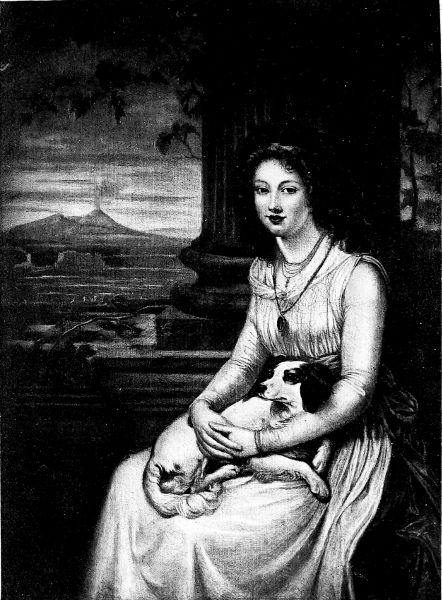
JOURNAL OF ELIZABETH LADY HOLLAND — FOOTNOTES:
In June 1791 I left England and went to Paris. During my stay the
King and Royal family escaped to Varennes, but were brought back. I
attended the debates in the National Assembly; I heard Robespierre
and Maury[1] speak. The Jacobin Club was then in embryo. I wanted to
hear a speech, and the Vicomte de Noailles during dinner promised
that he would gratify me by making one. He accordingly took me to the
box, and went into the Tribune and began an oration upon some subject
trivial in itself, but made important by the vehemence of his manner.
The Wyndhams[2] joined me at Paris; Mr. Pelham[3] was also there, and
several other English.
Towards July I went by the way of Dijon through the Jura Mountains to
Lausanne. I lived for three months at Mon Repos, a spot celebrated as
having been the residence of Voltaire and the scene of much theatrical
festivity; it was there he composed and represented many of his
chefs d’œuvre, Zaïre, I believe, among the number.[4] My
society was composed of a mixture of French and English to the utter
exclusion of the Swiss.
Gibbon had for several years withdrawn himself from the turbulence and
neglect of his own capital to share the quiet and enjoy the adulation
of the inhabitants of the Pays de Vaud. He was treated by them more as
a prince than as an equal. Whenever he honoured their goutées
with his presence every person rose upon his entrance, and none thought
of resuming their chairs till he was seated. His whim arranged and
deranged all parties. All, in short, were subservient to his wishes;
those once known, everything was adapted to them. The Sheffields,[5]
Trevors, Mr. Pelham, Duc de Guines,[6] Mde. de Juigné, and Castries.
I knew Tissot.[7] Having my residence at Lausanne I made frequent
excursions. I went through Geneva to the Valley of Chamouny, saw the
glaciers; and at a small village in the road stopped to look at General
Phiffer’s model of Mt. Blanc; it was curious but inferior to that
at Lucerne. Our party to Chamouny consisted of the Sheffields, Mr.
Pelham, and some others whose names I have forgotten.[8]
SWITZERLAND
Soon after my return to Lausanne I made a tour through Berne to
Lucerne. I was too great a coward to go upon the lake, therefore I
only saw the views from the bridge and the high ground near the town,
as I was too indolent to ascend Mount Pilate. The spot so celebrated
by the heroic and incredible exploits of Guillaume Tell I only knew by
drawings, as it is not to be seen but by going to the Lac des Quatre
Cantons. Phiffer’s model of the whole of Switzerland is wonderful;
it is an exact representation of every object, lakes, mts., rivers.
Such representation of countries would be useful for military posts. I
returned by Soleure, Neuchâtel, and Fribourg and Vevey to Lausanne.
Towards the middle or end of September I began a journey to Nice. I
stopped at Geneva a day or two, and went with the Messrs. Calandrin to
see Ferney; it was in a desolate, ruined state, and showed few marks
of taste or comfort. We followed the Rhône to L’Écluse, where soon
after that it loses itself for some miles underground. The road is
beautiful. Annecy, where Rousseau lived, I believe we passed. Lyons is
a magnificent city, two fine rivers and broad, well-built quays with
sumptuous houses. The manufacturers complained of the revolutionary
spirit which deprived them of orders and workmen.
From thence I followed the Rhône to the Pont St. Esprit. The bridge
is singular and ingenious. The rapidity of the river had thrown down
the preceding bridges owing to a strong current rushing with violence
against the piers: to obviate this the architect made the bridge of
this form. It has succeeded, and the building is permanent. The Pont
de Gard is a magnificent remnant of Roman grandeur; it fulfilled the
double purpose of bridge and aqueduct. Orange, on account of massacres
at Avignon, we could not see. There are fine remains of triumphal
arches and other military trophies, raised to the honour of Marius,
who there defeated the formidable host of Northern barbarians, the
Teutons and Cimbri, though upon recollection I think he fought them
in the present Venetian territory. Upon the road there are vestiges
of triumphal buildings, erected in the Middle Ages, if one may judge
by the clumsy taste. At Nismes, the amphitheatre and Maison Carrée.
The latter is beautiful, and being the first specimen of Grecian
architecture I had ever seen I was delighted with the richness and
proportion of the edifice. The amphitheatre is small, and disfigured
by the filth and closeness of the adjacent houses. Like St. Paul’s
in London, it is impossible to judge of its magnitude or graceful
structure, as no exterior view can be obtained.
Marseilles is charmingly situated; fine town, a forest of shipping,
busy quays; and the liveliness of the pretty Bastides, all white upon
the surrounding hills, is delightful. This was the first view I had of
the Mediterranean. The deep blueness of its waters and the constant
fulness of its shores struck me with increasing admiration, as I always
thought the variation of the tide was a defect; for pleasing as variety
is, uniformity is preferable to such change as the tide produces—mud
and stench.
NICE
Aix is a pleasing town. Crossed the Esterelles, a high ridge of granite
mts.; the passage was infested by banditti, and we were obliged to
take some maréchaussées to protect us. We passed without alarm
or interruption. Fréjus, the See of Fénelon, well deserves all the
disapprobation he bestows on it. Antibes, a gay pretty town; crossed at
Gué the torrent Var, and 4 miles after reached Nice. Some antiquaries
have supposed that the Var was the celebrated Rubicon, which once
passed was so fatal to the liberties of Rome.
I was left alone[9] at twenty years old in a foreign country
without a relation or any real friend, yet some of the least miserable,
I might add the most happy hours, of my life were passed there. I
lived with great discretion, even to prudery. I never admitted any
male visitors (except to numerous dinners), either in the morning or
evening, with the exception only of two—Dr. Drew, and a grave married
man, a Mr. Cowper. Drew used to spend the whole eve. with me, and give
me lectures on chemistry, natural history, philosophy, etc., etc. I
made frequent excursions about the neighbourhood, to Monaco, Villa
Franca, Monte Cavo, La Grotte de Chateauville, the convent of St. Pons,
old Cemenelium, etc.
In Feb. 1792 the Duncannons,[10] Dowr. Lady Spencer, Dss. of
Devonshire, came to Nice: my friendship begun there. I saw a Maltese
galley with some wretched Turkish slaves at the oar. The English
society was too numerous to be pleasant. I lived with a few only,—Dss.
of Ancaster, Ly. Rivers, Messrs. Ellis, Wallace, Cowper, etc. C.
Ellis[11] was a very old friend of mine; we were brought up for many
years absolutely together. As I had experienced such very cruel usage
from the unequal and ofttimes frantic temper of the man to whom I had
the calamity to be united, it was the wish of my mother, Lady Pelham,
Ly. Shelburne, and those I most respected, that I should never venture
myself in a journey alone with him, therefore as Mr. Ellis was going
part of the journey we meant to make, he joined our party. We also
conveyed an emigrant of the name of Beauval, an excellent, ingenious
young man.
Sunday, May the 6th, 1792.—Left Nice for Turin. We took the
road across the Col de Tende. Just above the Convent of St. Pons, we
crossed the torrent Paglione, from whence I took a farewell look at the
lovely plain of Nice. We dined at L’Escaleine, a small village prettily
situated in the mts. We wound for many hours the numberless traverses
of a steep and lofty mt., and at night reached Sospello, a tolerable
gîte.
7th.—Still among mts. Dined at Grandolla. Wretched inn at
Tende—no accommodation; only one room for us all.
On ye 8th the carriages were dismounted and carried over the Col de
Tende upon mules: I went over in a chaise à porteurs, so did my
child.
TURIN
Snow was melting very fast, and made the footing for the mules and
guides very insecure. We stopped at a small house at Borgo Limone as
one of the carriages was broken in getting it off the mule’s back.
11th.—Arrived at Turin. Ly. Duncannon and Dss. were already
arrived. In the evening I went to Trevor’s:[12] he was the English
Minister. A celebrated performer on the violin attempted to render by
sound the story of Werter; the imagination must have supplied
greatly to assist the effect. All that I could understand was the
scene where he shoots himself; the twang of the catgut made a crash,
which made one start, so it had that effect in common with the report
of a pistol. During my stay at Turin I attended chemical lectures at
Bonvoisin’s; had I been able to apply more I might under his care have
advanced considerably in information. Cte. Masin gave me a very fine
dinner. Before dinner he sent for one of the Professors, who exhibited
the cruel experiment upon a frog to prove animal electricity.
I went one morning with Ly. D., Dss. Devonshire, etc., to La Venesia
to be presented to the Prince and Princesse de Piémont.[13] She is
in person like her brother the King of France. Since the downfall of
the clergy in France she has constantly worn the dress of a Sœur
grise. They are both bigoted and superstitious. I had many pleasant
parties to Montcalieri, La Superga, the Colline, etc. The Vallentin
is a singular old château on the banks of the Po. It was built
by Christina, Dsse. de Savoie, one of the daughters of Henry IV. of
France. I made acquaintance for the first time with Mde. de Balbi.[14]
Previous to my leaving Turin we were surprised by the arrival of Ly.
Malmesbury[15] and G. Ellis.[16]
We left Turin on ye 10th June, 1792; our route was to Verona, and to
see Lago Maggiore in our way. We went to Arona that we might cross the
Ticino at Sesto, as there was a flood at Buffalora, the usual ferry.
Slept first night at Vercelli. After wading through very deep water for
a mile or two, caused by the overflowing of the lake, we reached, on
ye 12th, Arona, a small town charmingly situated on the lake. The next
day I summoned up courage and went upon the lake to see the Borromean
Islands. Just above the town of Arona stands the colossal statue of
St. Charles Borromeo, executed in 1650 by his family; it exceeds 100
ft. in height, allowing 64 for the figure and 46 for the pedestal.
This lake is longer than that of Geneva. The islands are beautiful.
The Isola Bella is the enchanted spot, on which the fairy palace and
gardens stand. Since the days of Circe and Armida nothing has equalled
the magic land, and little worthy of detention would be an Ulysses
and Rinaldo who could repine at seclusion in such a voluptuous abode.
The Palace is on an eminence, and pastures and terraces descend from
it to the water. Some of the apartments are made like grottoes and
are brought to the margin of the lake: without exaggeration it is a
spot apparently made by magic art. Prince Augustus[17] was seeing the
Palace. I there met with him for the first time. He is handsome and
well-bred.
1792 PAVIA AND MANTUA
13th.—Left Arona; crossed the Ticino and arrived very late at
Milan. The heat in the plains of Lombardy in the summer is intense; the
thermometer varied from 92 to 96 degrees Fahrenheit. The Litta family
live with princely splendour. The Csse. Maxe, celebrated in the annals
of European gallantry, was very civil, and showed me all that
was worthy of notice. Padre Pini, an old Barnabite monk, gave me many
good specimens, especially of his Adularia, a species of felspar he has
discovered. I went over to Pavia to see the celebrated Spallanzani:[18]
he is the great friend of Bonnet of Geneva, and he is the man who has
made some filthy experiments upon digestion.
Pavia is a curious old town, formerly the capital of the Lombard Kings,
and in more modern times the scene of the disaster of the French army,
and the captivity of its monarch. Francis ye 1st here became prisoner
to the unfeeling, politic Charles V. The Cathedral is a specimen of
very early Gothic, misshapen and clumsy. The Po and Ticino join near
the city. Great preparations among the emigrants of Coblentz for
marching into France.
22nd June.—Left Milan for Dresden. We skirted Lodi, famous
for its cheeses and deep sands. A violent thunderstorm came on at
Pizzighettone, where I stopped; and notwithstanding abuse and threats
I was resolved to stay and not risk my life and my child’s with hot
horses near a deep river during a heavy storm.
23rd.—Got to Mantua. The waters of the Mincio being suffered to
stagnate, the wells about Mantua are unwholesome and bad. The Palais
du T. [sic] is a pretty villa belonging to the ancient Princes
of Gonzaga. The walls are painted in fresco by Giulio Romano,
the best of Raphael’s scholars: the subject represents the ‘Battle of
the Giants.’ I looked around in vain for a beech tree under whose wide
spreading branches a Tityrus was wont to recline and amuse his little
lambkins with the soft notes of his pipe in the days of the Mantuan
Bard. Tho’ Vergil was born, one might doubt much if he was bred, here;
he seems to have described the pastoral manners of some happier soil of
Italy.
The party reached Verona on the 24th. ‘The town is
handsome; the bridge over the Adige very fine. The Corso
is very noble.’ They left again two days later, and at Ala
entered the Tyrol.
The entrance is through a narrow gorge, apparently opened by an
earthquake, and probably widened by the deep and rapid course of the
Adige. The mts. are not very high till Mt. Baldo, which does not exceed
a 1000 ft. Between Ala and Roveredo we passed among rocks that have
suffered some great convulsion; at a distance they resemble the ruins
of a demolished city. A calcareous mountain stood where the road now
passes; probably in one tremendous night when all the elements were
waging war, the loud rolling thunder and the forked lightning darting
upon this ill-fated spot, the earth trembled with the shock and the
side of the mountain was split and broken into a thousand pieces. The
falling of the mt., tho’ no history records the event, does not appear
to have happened at an early period. The fragments are still sharp and
angular. Owing to a fair at Trent we were forced to remain at Roveredo.
Since the league of Cambray Roveredo is no longer in the possession of
the Venetians.
1792 INNSPRUCK
27th.—The road from thence is through a tolerably well
cultivated country of vines and mulberries, thro’ which the Adige moves
along irregularly, sometimes slowly, at other times rapidly. The road
in many places is very narrow with a precipice to the river undefended
by a parapet. Monr. de Calonne was overturned into the river, and but
for the assistance of Messrs. Wallace and Ellis, in the year ’91, must
have been drowned.
After passing Neumarck, the travellers arrived at Brixen on
the 28th.
Brixen is prettily situated in a very fertile vale; vines and corn
appear in abundance. The hills are cultivated and a more genial soil
is the consequence. The churches and castles built on the tops of
craggy rocks along this valley are singularly romantic. The valley
is extremely populous, and the younger part of the inhabitants have
extremely pretty faces.
At Innspruck we were compelled to remain two nights, as we had not
the plea of being Aulic Counsellors or Ambassadors. It is a paltry
restriction on travellers that they must consent, unless privileged, to
remain eight and forty hours in Austrian territory—a sort of tax that
one must spend money in their dominions. In the principal church there
is a magnificent tomb erected to the memory of the Emperor Maximilian,
grandfather to Charles V. He was a complying, weak Prince, of whom
Abbé Raynal says in his Mémoires Historiques ‘Il n’inspirait
point de reconnaissance, quoiqu’il accordat presque tout qu’on lui
demandait: on sentait qu’il ne cherchait pas à obliger, mais qu’il ne
savait pas refuser.’ Near the town is a castle, the residence of the
Archduchess, Governor of the Tyrol; the arsenal contains a curious
collection of different suits of armour, which belonged to some of the
most celebrated of warriors. I went to a German play, the pantomime of
which, tho’ a deep tragedy, diverted me much, tho’ I did not comprehend
a word of the dialogue.
2nd July.—Took the road to Munich. Immediately on leaving the
town began ascending; slept at Wallensee, prettily situated among the
mts., near a small lake. The change of temperature was sensible:
thermometer in the morning at Innspruck was 75, at Wallensee fell to 59.
3rd July.—Large clumps of the spruce fir dotted over rich
plains and fertile hills, with a noble view of the mts. we were
quitting, made a view not altogether insipid.
The approach to Munich is not imposing; it denotes little of the
magnificence of a capital. The town is large and irregular; the houses
are more substantial and imposing than magnificent; many are thatched,
and those that are not have high roofs, gable ends, and garret windows.
I was labouring under such low spirits, that the prejudice I felt
against Munich was owing to the unhappiness I endured there.
Count Rumford,[19] an American of the name of Benjamin Thompson, was
the Prime Minister of Bavaria. He has made some excellent reforms in
the governt. of that country, and created many beneficial institutions
for the poor. He was very civil, and showed me with a degree of
minuteness, with which I could have dispensed, all his hospitals,
manufactures, etc. I was compelled to see what I did not wish, his
beloved, a Mde. Nogarolla.
Went from Munich to Ratisbon. Here I first hailed the Danube, a mighty
stream, the prince of rivers. I purchased a gun and pair of pistols of
the famous Kerkenrüyter to make a present to Mr. Pelham. The maker
told me he had sold to Col. Lennox the identical pair he used against
the Duke of York. It was scarcely fair to use such sure weapons.
LORD HENRY SPENCER
Reached Dresden in ye night of the 21st. We found a numerous society
of English, Lord H. Spencer,[20] Mr. Robt. Markham, Mr. Elliot,[21]
English Minister, Ct. Stopford, and afterwards Lds. Boringdon and
Granville Leveson-Gower. Ld. Henry was there on his way to Vienna,
whither he was to carry the compliment upon the accession of the
Emperor. He was then Secretary at the Hague under Ld. Auckland. His
abilities were spoken highly of; at Eton he was known as a poet in the
Microcosm.[22] His shyness embarrassed him, and rendered his
manner awkward. He was very witty, and possessed a superabundant stock
of irony. In short, he became ardently in love with me, and he was the
first man who had ever produced the slightest emotion in my heart.
I was received at Dresden with a degree of distinction that was highly
flattering. I would not go to Court; the Princesses sent a civil,
reproachful message, and begged me to see them en particulier at
one of their villas. I went, and an embarrassing circumstance occurred.
The Prince Antony, by some mistake, took me for Ld. Henry’s wife,
complimented him upon my beauty, agréments, etc., and concluded
by saying, ‘I see by your admiration and love for her you are worthy
to possess her.’ This said before ten people was too painful to bear.
Had I been very accessible to vanity on the score of person, I could
not have resisted the flattery I everywhere met with: dinners, fêtes,
etc., given to me; invitations sent to people on purpose to meet ‘La
charmante Miladi’; my dress copied, my manner studied.
The 2nd of August, 1792.—Very pleasant supper at the French
Minister’s, Baron de Montesquieu. The Duke of Brunswick’s Manifesto
filled everybody with astonishment and alarm for the lives and
liberties of the Royal family.[23] This rash and violent diatribe
against the Parisians was a precursor of an invasion of France.
Seventeen thousand of the Provincial troops were to be assembled on
ye 14th July at Paris, and it was said that if the Prussians, etc.,
advanced into the country, that the King would be conveyed to Blois;
then troops are supposed to be already destined to that service, and
the Parisians are already jealous of them.
In England, the Association of the Friends of the People alarm
the steady, and the example of France terrifies even the moderate
innovators.[24] The Association was formed without the participation
of Mr. Fox;[25] he never was consulted about it. On the contrary the
Association seemed determined against all advice, but most particularly
against his. Thinking people apprehend more from the superabundant
loyalty of the country than from its Democracy. There are to be
Addresses from all parts of the Kingdom, thanking the King for his
Proclamation and professing attachment to his Person and Governt.
Extremes are dangerous.
THE FRIENDS OF THE PEOPLE
Left Dresden in September; went by Prague to Vienna. I was much pleased
with my residence there; I was fêted enough to gratify the most
unbounded vanity. I went to Court; a separate private introduction to
the Emperor and Empress. Sir Robert Keith was the English Minister. The
Countess Thuron was the lady who went about with me. Made an excursion
to Presburg, the capital of Hungary. Ld. Henry was there. We parted on
September the 25th or 26th, not later.
From Vienna we went to Venice by the road of Gratz, thro’ Styria and
Carinthia. On our arrival at Venice Mr. Ellis was dangerously ill of
a putrid fever. He recovered by the care of a Jew doctor. We stayed a
short time after his recovery; went by way of Mantua to Parma. From
thence to Bologna and Florence. Mr. Ellis left us at Florence to return
to England. We went on by the road of Radicofani to Rome (where we
staid only two nights), then to Naples, which we reached about the 2nd
week in October.
As soon as I was a little rested after my journey I began to see
the wonderful environs, both of natural and artificial curiosities.
The English society was composed of many of my friends; the
Palmerstons,[26] Miss Carter, Sr. Charles Blagden, Dss. of Ancaster,
Ly. Plymouth with whom I became intimate. Soon came the Bessboroughs
(the old Father died), Ly. Spencer, Dss. of Devonshire, Ly. E. Foster,
Mr. Pelham. In January the French fleet came and menaced Naples with a
bombardment.[27] They were moored in front of my house on the Chiaia.
I was brought to bed of my son Henry, on ye 10th Feb., 1793. I made
my grossesse a pretext for staying at home in the evening. I
went out every morning to see the objects most worthy of notice, and
the evening I always passed with friends who came to see me, Drew,
Mr. Pelham, and Italinski,[28] a Russian who grew much attached to my
society.
ROAD TO PAESTUM
March 22nd.—We set off for Paestum. Our party consisted of
the Palmerstons, Miss Carter, a Mr. Poor (a very eccentric man), and
Mr. Pelham. About two miles from Pompeia the country begins to be
pretty, and we got more amongst the Apennines. The road is excellent,
it being made by ye King to go to a chasse of his at Eboli. La
Cava and Vietri are charmingly situated in their different styles;
the first has all the beauties of social life, small neat cottages
interspersed amongst vineyards, olives, and myrtles, upon the side of
a hill inclining towards a small torrent. The whiteness of the houses
contrasted with the verdure of spring vegetation in the foreground,
and the boldness of the scraggy rocks behind make a lovely picture and
fill the mind with pleasing sensations at the sight of comfort and
tranquillity, a lot that rarely befalls the peasantry of France and
England. There is an aqueduct traditionally called Abelard’s bridge;
why, the learned must determine, for I never knew that victim to love
left his native France. Vietri is situated upon a rock above the sea,
into which it abruptly ends; it commands a noble view of the bay of
Salerno. With a glass from hence one may discern the temples of Paestum
on the opposite coast. Salerno is a pretty little town upon the edge of
the sea; the detail of the country is charming. On the right side of
the bay is Amalfi, remarkable for being the spot where the Justinian
Code was discovered. The Cathedral at Salerno is curious; in it are
many sarcophagi brought by Robert Guiscard from Paestum, and various
columns of fine marble and granite, which are placed to form a corridor
in the court of the Cathedral, but being of different sizes the whole
has an awkward appearance. From Salerno ye country is less interesting;
excepting a few Baronial castles perched upon the tops of scraggy,
isolated rocks there is little worthy of notice.
At Eboli we were obliged to change our carriages for smaller ones on
account of the roads, which to Paestum were called abominable. We
crossed ye Sele in a ferry; it is a torrent frequently impassable. Here
the wretched inhabitants by their emaciated and squalid looks indicated
the beginning of the malaria. Their habitations were such that one
could easier imagine oneself in Siberia than in delightful Italy!
Delicious country! as their homes, if they deserve such an epithet,
were an exact counterpart of a Tartar hut. Circular mud walls raised
about three feet from the ground, thatched with reeds forming a conical
summit; the only aperture a door, which answered ye double purpose of
admitting the wretched owners and letting out the smoke, which was very
abundant from a fire lighted in the centre of the hut. But even in this
disconsolate dwelling there was an attempt to drive away the melancholy
which disease and penury must naturally inspire, for on one of the
poles which supported the roof and came across the interior of the
dwelling there hung a guitar. I persuaded one of the peasants to strike
it: I immediately perceived an illumination of joy upon the haggard
countenances of his auditors. Happy instrument! to suspend for a moment
the sensation of misery, and banish by its tones the anguish of want
from the breasts of the forlorn inmates. As we approached Paestum
the dreariness of the country quite oppressive; plains filled with
buffaloes, the most hideous of animals, stagnant ditches, and stinted
myrtles, were all the objects that met the eye.
PAESTUM
Paestum itself is situated in a plain about a mile from the sea,
dedicated to Neptune and built by ye Phoenicians about 250 years after
the foundation of Rome; 500 years before Christ. Near the amphitheatre
(which is much ruined) is the remains of a building with fluted columns
nearly as large as those of the temples, more upright marks still
existing of their bases; the capitals much worked in extraordinary
designs. Parts of the frieze lying about; figures of men from 24 to 30
inches high worked on the frieze between the triglyphs. The stone of
this building is more of the colour of grey limestone, and appears less
porous than that of which the temples are built, that is a stone
formed by incrustation of water. Paestum formerly was famous for roses,
the sweetness of which is celebrated by several of the Latin poets;
now alas! brambles and malaria have extinguished the fragrance of ye
rose.
Our accommodation was but indifferent: I slept upon a table, the
repelling points of which rather annoyed my limbs and would have
convinced Boscovitch,[29] had he been in my place, of the existence of
hard matter. However, I tried to sleep, tho’ its ancient inhabitants,
ye Sybarites, would not have rested, if the story is true that one
of them complained that a curled rose leaf destroyed their rest. The
first view I had of ye temples was in ye dusk of ye evening; their
appearance was majestic, but precisely what I had conceived them to be
from the drawings I had seen. They are the only remains in Italy of
early Grecian architecture. The Doric, to my taste, is too uneven. The
columns are squat and clumsy. The inhabitants are savage and
ignorant.
Fix’d like a plant on his peculiar spot,
To draw nutrition, propagate, and rot,
seems exactly their state. The cicerone assured us
that in one of the temples there was a prodigious treasure inaccessible
to men, as the Devil kept guard over it.
We saw the temples again in the morning, and then proceeded to Salerno,
where we slept. I walked upon the terrace before my window and enjoyed
the beauty of the night; the moon shone bright, which added to the
lulling sound of the waves filled me with every pleasing and melancholy
recollection. Tho’ separated by land and sea from some objects too
dearly cherished, yet I was tranquil. Prudence satisfied me that
all was for the best. I could not help casting an anxious thought
towards my dear father stretched upon a bed of sickness, perhaps to
rise no more, but the reflection of never having done anything that
could disturb his peace, or render his last moments painful from my
misconduct, was a relief that God grant my children may feel when they
think of me in a similar situation.
Delicious as Salerno is, yet like all the goods of this life it is
counterbalanced by a portion of evil, as half the year it is untenable
on account of the malaria. We dined in the Temple of Isis at Pompeia,
on which day I completed my 22nd year; so old and yet so silly.
On ye 1st of April, 1793, we set off for Beneventum, Lady Plymouth,[30]
Italinski, Mr. Pelham, and Mr. Swinburne. Aversa is the first town
of any consequence. The polichinello of the Neapolitan stage, which
resembles the harlequin of the Italian, derives its origin from this
town, and the dialect of this place belongs to him, as the Bergamesque
does to the harlequin—which harlequin is, bye the bye, a burlesque
on Charles Quint. Arienzo is the next town, only remarkable for the
strange costume of the women, their dress being only two aprons tied
behind and before, which leaves a considerable aperture on each side
equally unpleasant and indecent. The country is a dead flat to within
three miles of Arpaia.
AN ITALIAN MÉNAGE
Between Arienzo and Arpaia is the valley which is supposed to have
been the scene of the disgrace of the Romans, when they were compelled
by the Samnites to pass under ye yoke. The weather towards evening
grew bad, and we could not get out and examine the defiles with
the attention and accuracy Italinski required. The Marchese Pacca,
to whom we were recommended, received us with that hearty kind of
hospitality, which unfortunately for the good fellowship of society is
totally banished from our would be refined country. His time,
himself, and all he possessed, were at our disposal. The interior of
an Italian ménage I only knew from buffa opera; it is worth
seeing. Himself, his old palace, his antiquated volantes, his
equipages, his stubborn mules, all were sights. The old Marchesa was
also delightful, not to the eye, for she was hideous, nor to the ear,
for she squalled, nor to the nose, for she was an Italian; yet, from
her unbounded desire of pleasing, the tout ensemble created more
agreeable sensations than many more accomplished could have inspired,
as there is something infinitely gratifying to our predominant
sentiment of self-love to see another solicitous to please, even
tho’ the attempt should prove unsuccessful. Fruitless as it was, the
goodwill supplied the failure.
In consequence of the birth of a son to the Empress there was a
brilliant appartamente at the Queen’s.[31] I went with joy.
1st May.—The whole proceeding was conducted with the utmost
magnificence.
The post of ye 2nd brought the melancholy news of the death of one of
my warmest friends, poor Ly. Sheffield! She loved me most tenderly,
nor did the great disparity of years prevent me from returning with
cordiality her affection.
On ye fourth of May I went to see the celebrated miracle of the
liquefaction of the blood of St. Januarius.[32] The Duc de Sangro,
in whose house we saw the miracle, gave us afterward a ball. The
composition of the material puzzles the chemists. The miracle, such as
it is, requires the vigour and warmth of a young hand to reduce it from
its concrete state to fluidity.
Sunday, 5th May.—Prince Esterhazy, the Imperial Ambassador,
gave a splendid fête in honour of the young Archduke. The King, Queen,
and Prince Royal were present: the Queen came and sat by me the greater
part of the evening. She is lively and entertaining in conversation.
It was whispered about the room that the atrocious Marseillais were
marching upon Paris to destroy the Queen.
6th May.—Rode out as usual; a very pretty retired ride towards
the Camaldoli.
7th.—Infamously bad weather, which made us delay our project of
passing the day at Baia. We therefore confined ourselves within hail
(?) of land, and dined at Pollio’s villa upon Posilippo. We rowed by
the side of the charming Colline. The whole detail of the country is
delightful; the bright green of the vine contrasted with the brilliant
yellow of the tufa produces the most pleasing effect. Pollio’s villa is
on the East side of the Colline, from whence it commanded a fine view
of the chain of Apennines with the high point of St. Angelo lowering
above, the towns of Pompeia, Stabia, the promontory of Minerva, and
the whole of the bay including an oblique view of Capri. We attempted
to row round Nisida, but a threatening storm prevented us. We rowed to
the Porto Pavone, a lovely little harbour formed like a peacock’s tail,
which figure gave rise to the name. We dined at Pollio’s villa during
a violent thunderstorm. I conquered my fears and behaved with great
intrepidity.
BAIA
The next day we embarked at Pozzuoli for Baia. At Pozzuoli, a tolerable
statue of Tiberius, ornamented with bas-reliefs representing 14 cities
destroyed by an earthquake and restored by him; monster as he was
he could sometimes be betrayed into a good action. We passed Mons
Gaurus, on which grew the Falernian wine so much praised by Horace, who
either did not know what good wine was or the quality of the grape has
changed, as the wine it now yields has no claim to encomium. The next
summit is Monte Nuovo, raised by a terrible earthquake and eruption
out of the Lucrine Lake within the space of 24 hours; its elevation
destroyed a small town situated on its banks. The crater of Monte Nuovo
gives one a very good notion of a volcano: the hill composed of light
volcanic ashes which will soon become compact enough to be called tufa.
We passed by Nero’s baths and villa.
On landing at Baia, the first object is the Temple of Venus, an octagon
building; above it is a circular building dedicated to Mercury and
another to Diana, of which only half remains, like the section of a
building in architectural drawing. In the centre it had a cupola not
unlike the form of the Pantheon. The present castle of Baia is upon
the spot where Julius Caesar had a villa. Every atom of this once
favoured spot was either highly decorated with fine gardens, fountains,
porches, and terraces, or adorned with luxurious villas. Marius was
reproached in the Senate for living in a spot so much the seat of
pleasure. Sylla, Cicero, Lucullus, Pompey, Caesar, Hortensius, all had
villas. The baths of Nero are between Baia and the Lucrine Lakes; the
heat of the water is so great that an egg is boiled in two minutes. The
sand under the sea is so heated that one could not with convenience
hold it for any time. This all proves the vicinity of that powerful
agent so destructive to this beautiful country: hourly may one expect
some dreadful explosion that may perhaps lay the very spot I am now
on many hundreds of feet below its present level, or raise it to the
height of Vesuvius. The sea was rough, and the periodical storm came
on an hour later than the preceding day. It is singular the degree of
accuracy with which the people foretell the approach of bad weather,
and even the duration of it. We returned by land. We passed the ruins
of Cicero’s academic villa. How grand it must have been in its days
of splendour. Atticus procured from Greece the pictures and statues;
that they must have been excellent one cannot doubt, both from his fine
taste and the facility with which he could obtain the finest subjects.
We went next day from Pozzuoli to Misenum: Lady Spencer declined going
from a reason which I did not know till afterwards, or it doubtless
would have operated in retaining me, viz., the length of the sea
excursion, and the probability of a storm. The sea was very rough, and
I, of course, was very nervous. We passed through pieces of what are
called Caligula’s Bridge, but more likely to have been a mole beyond
which he carried a bridge of boats over which he rode to fulfil a
prophecy, which was, “That it was as unlikely that he should come to
the Empire, as that he should ride across the Bay of Baia on horseback.”
PLINY’S DEATH
We landed at Bacoli, a place which receives its name from the oxen
brought by Hercules from Geryon, King of Spain. Bacoli in Greek (if I
spell it right) signifies ox stall. Remains are shewn of a tomb
of Agrippina, Nero’s mother, but antiquaries say it has a stronger
resemblance to a theatre than to a sepulchre. We wandered amidst the
Elysian fields, but saw no blessed souls. All my gloomy cogitations at
the prospect of futurity, brought to my mind by the fiction of poets,
vanished at the sight of present danger, and the lowering black clouds
menaced a fierce storm. Nor was the threat in vain, for shortly it was
followed by the severest thunder, lightning, rain, and hail I had ever
witnessed. We crossed the Stygian Lake in the height of it, and Charon
might have expected some passengers for his infernal wherry. We landed
and dined upon the ruins of Misenum close to the port. It was from
this spot Pliny the elder beheld the burst of smoke from the mountain,
and even felt the cinders. What a magnificent but dreadful sight it
must have been. Unfortunately curiosity impelled him to approach
the yawning volcano; he endeavoured to land at Herculaneum, but was
prevented by the smoke and ashes, he tried Pompeia, and from thence
went to his friend Pomponius at Stabia, near which he was overwhelmed
and suffocated by the cinders. Near Misenum Tiberius breathed out his
gloomy soul.
The next day we made an excursion into the country on horseback to
see the Convent of the Camaldoli. Unfortunately the late hours of
Devonshire House are transferred to the Chiaia, so we did not begin our
expedition till six o’clock; when just as we arrived at the Convent
the last fiery rays sank behind the promontory of Circe. What a view
lay stretched at our feet! Objects that would rouse torpor itself, and
call forth the energy of the poet, philosopher, painter, historian. The
Campania Felix backed by the bold ridge of Apennines, with the Lake of
Patria, Linternum, etc., the distant islands of Ponza and Ventotene,
the nearer ones of Ischia and Procida, Baia, Misenum, Capri, and Cape
Minerva. I cannot enumerate all the grand and pleasing objects. We
exhausted the patience of two planets; the sun first shunned us, and
then palefaced Cynthia left us, before we got home.
I never in my life experienced the degree of happiness enjoyed: it was
the gratification of mind and sense. The weather was delicious, truly
Italian, the night serene, with just enough air to waft the fragrance
of the orange flower, then in blossom. Through the leaves of the trees
we caught glimpses of the trembling moonbeams on the glassy surface of
the bay; all objects conspired to soothe my mind and the sensations I
felt were those of ecstatic rapture. I was so happy that when I reached
my bedroom, I dismissed my maid, and sat up the whole night looking
from my window upon the sea.
This frolick was unusually absurd, as I was to go early with ye D. of
Devonshire, etc. to dine at Belvedere[33] with the King. I was ready at
seven, but ill and faint, and obliged to eat diavoloni to keep
alive. We arrived too late: the King waited an hour. The King
was very pleasant and conversable; he shewed us the whole manufactory,
the mechanical part I did not much comprehend. He was so gallant to
me that they joked and said I should be sent to Calabria, the common
way the Queen takes to remove her rivals, tho’ she allows him to
people his own colony of manufacturers. Before we quitted him he
insisted on our promising to dine at Carditello, and the Sunday after
at St. Leucio to see the wedding. From the Belvedere we went to the
English garden, which is very beautiful from being in many respects
unlike one. There is one of the prettiest thoughts for an ornament I
ever saw; a large building representing ancient baths, supposed to have
been dug out from a stratum of tufa which covered them. It is done with
the best taste and judgment possible, and is as complete a thing as can
be. I returned home at night more dead than alive from fatigue.
1793 VESUVIUS
The next day after, we went to the mountain. I invited poor Italinski.
I would not go higher than the Cross, that is, I would go no further
than my mule could carry me; the others went to the running lava. We
all wrote our names at the Hermitage, a retreat inhabited by a man
clothed in a holy garb,[34] but whom report says is not sanctified in
his deeds; many rendezvous are kept in his neat, trim cell, and but for
his paying he would be expelled from his nominal solitude.
Saturday was the last morning I passed in Naples. I quitted those
scenes of tranquil pleasure and harmless gratification with unfeigned
regret. But ah me! what can please or cheer one who has no hope of
happiness in life. Solitude and amusement from external objects is all
I hope for: home is the abyss of misery! I am but as a zero in society,
attached to none, belonging to none I esteem. We passed the evening
at Caserta with the Hamiltons; their house was not large enough to
hold us all, and I lodged in Hackhert’s[35] house. Mullady sang
Nina, Paisiello’s music; her vile discordant screaming took off
the whole effect of his simple melody.
On Sunday morning we went to the Belvedere to see the ceremony of the
St. Leucio marriages;[36] as I went with the Duchess I was, of course,
too late. They were over. The King as soon as he heard of our arrival
came and met us upon the perron, and conducted us upstairs,
where we found the Queen: her coming was an unexpected condescension
on her part. The sight of the manufacturers enjoying the Festival was
very pretty and gratifying. A thousand people were enjoying themselves
among their families in their gala clothes, dining under the prettiest
rustic arcades ornamented in the best possible taste: this number
all fed, even existing, by the bounty of the King, and each pouring
out the sincerest benediction upon him for his bounty. I wished this
picture of happiness of his own creation might excite the disposition
to extend the blessings of ease and security by encouraging industry in
Calabria and other parts of his dominions, where the wretched peasant
is ferocious from ignorance and sloth. He conversed with them with
familiarity, and enquired into their family details, all of which he
seemed perfectly acquainted with; scandal says their establishment
answers the double purpose of seraglio and nursery. The Queen was, as
she always is, very conversable and clever, but appears to have a most
impetuous temper. We dined at 12, a very good dinner, all off his own
farm; the wines were from his vineyard. The evening was not tedious,
tho’ long; she brought all her children to us and shewed off their
talents. At night the Court was illuminated, and the happy colonists
danced tarantulas. We stayed till the Queen withdrew about 10 o’clock.
She was very flattering in her compliments to me, and shook my hand
with cordiality; her reason for liking me that I had been at Vienna and
knew many of her old friends.
A ROYAL FARM
The next day we dined at Carditello with the King; it is a small
hunting palace in the centre of his farm. The dinner was served upon a
table of Merlin’s construction. No servants attend, but by pulling a
bell your plate is pulled down and a clean one sent up; so with the
dishes, and all you ask for. In short, it is exactly like a trap-door
at a theatre. He showed us all his cows, hogs, and pigs, and his
breed of stallions. He occasionally favours ladies with a sight of a
strange operation to be performed upon them before women; but this we
escaped. His carriages conveyed us to Capua, where we found our own.
The Devonshires went on to Rome. Some arrangements required my return
to Naples; Lady Plymouth drove me in her phaeton home.
The evening previous to my quitting Naples, 22nd May, I walked in
the Villa Reale after supper with Ly. Plymouth, Ld. Berwick,[37] and
Italinski. The latter was much dejected at my approaching absence,
and I really was affected by his sorrow, as he is not a man to say
lightly things he does not feel. He said when I went he should imitate
Mark Antony, who after his defeat retired to Alexandria and wrote
Timoleon [sic] over his door, thereby declaring he was
become a misanthrope. I was sorry at leaving Ly. P., because, tho’ I
am not very prudent, I think she is less so, and I might have kept her
out of the scrape she is on the brink of falling into, for Ld. Berwick
remains the whole summer. Lord Palmerston, comically enough, calls them
‘Cymon and Iphigenia,’ for till their attachment began Ld. B. was never
heard to speak: love roused him.
On the 23rd the Websters left Naples for Capua, ‘the
antidote to all pleasure at present from its filth and
dulness,’ and continuing their journey crossed the River
Garigliano.
The gayest scenes until Mola di Gaeta, the verdure, the festoons of
vines hanging between the trees, with the glow of a crimson sun sinking
into the Mediterranean. Upon my arrival at Mola I dined, and in the
evening was tempted by the beauty of the moon to row upon the sea
within the bay for a short time. Early in the morning, by seven, I
was again in the boat, and examined the extensive remains of Cicero’s
Formian Villa. The bath is the principal object; it is beautiful. It is
in a covered recess dans le fond d’un beau salon, with columns
on each side: adjoining to it there are many rooms, high and narrow,
and very like those at Pompeia. The fishponds are large.
I did not go to Gaeta, distant about three miles: I regretted the
impracticability of the disposition of him who invariably checks
all I wish to do. There are still preserved unburied the bones of
the Connétable de Bourbon, his adherents not venturing to inter in
consecrated ground one who had perished in a sacrilegious act. He
was killed in 1527, in the assault of Rome. Benvenuto Cellini in his
entertaining Life of Himself assumes the honour of marking him with his
scoppietto and killing him, but this glory rests upon
his own assertion. There are few characters in history more deserving
of compassion and indulgence than this high-spirited and unfortunate
Constable. The caresses and revenge of Louisa de Savoie offended and
urged him to be a traitor; the one he rejected (?), the other he
resisted. Thus he became her victim beyond her wishes, for by deserting
his country and adding infamy to his name, he deprived her of her hopes
of making him yield to her desires.
At the extremity of Mola, in a vineyard, they show a circular tower,
which is called the tomb of Cicero. Beyond it are many sepulchral
monuments on each side of the road, which is made on the Appian Way.
The ancients always placed their tombs on the highway, whence the
common inscription ‘Siste viator.’
JOURNEY TO ROME
Fondi and Terracina were the next places of interest on the
road.
The Turks under Barbarossa made a descent on Fondi. The prize they
coveted was the haughty beauty Julia di Gonzaga, wife of the Count
of Fondi. She escaped their designs by hiding amongst the rocks; in
revenge they pillaged and burnt the town, in 1534. From Fondi we
soon reached Terracina, the ancient Anxur. The situation is
remarkably gay and pleasing. The town is close upon the sea; just above
it rises an abrupt rock on which are the ruins of a Gothic palace
forming a very picturesque view. The islands appear very close. Ponza
is the largest and most celebrated.
Stopped at Gensano to make Mrs. Hippisley[38] and her sister, Mde.
Ciciaporcia, a visit. The road from Gensano to l’Aricia is most
beautiful, through thick woods of chestnut trees, rich in foliage,
and fine ilexes of an immense bulk. The freshness and luxuriance of
the spring in Italy is far beyond anything we can have a notion of in
England.
Just at the Villa Barberini we met Jenkins,[39] who came to meet me to
beg I would dine with the Devonshires, etc., at his villa at Castel
Gondolfo. The Villa Barberini stands upon the site of Domitian’s villa,
the remains of which are very great. Porticoes extending above a mile,
and substructions of three different rows serving as a terrace to
those above. The Lago di Albano is excessively pretty: it is formed
very evidently in the crater of a sunken volcano. Ly. Duncannon ill,
and obliged to stay at Jenkins’. Got to Rome rather late. Very good
lodgings at the English tailor’s in the Piazza di Spagna. Mr. Hippisley
came as soon as I arrived, and we walked about the streets. I became
impatient for daylight, and was so full of curiosity that I got no
sleep the whole night. I could only think of the moonlight peeps I had
enjoyed of the Coliseum, so stately, so awfully majestic.
On Sunday morning, 26th of May, I arose with alacrity, and under the
ciceroneship of old Morrison began my course of virtu. The first
place was the Colonna Palace.... Raphael, ‘Holy Trinity,’ for a
church at Perugia, mentioned in his life. Its pendant, the Gaspar
Poussin, is preferable to it in every respect. P. Veronese,
‘Venus and Cupid,’ in his very best manner.... Salvator Rosa,
‘St. John in the Wilderness.’ The idea is taken from Raffaelle’s at
Florence: the face is very ugly and mean, the whole figure mean. Naked
figures ought to elevate the subject and give an idea of sublimity
beyond any drapery. This St. John looks like a man stripped of his
clothes.
We dined with the Palmerstons. In the evening Morrison took us to the
top of the Capitol that we might have an idea of the topography of the
city and adjacent country. The view from thence is very grand.
VILLA BORGHESE
May 28th.—Went to see some drawings in the possession of a
Mr. Greaves, a person who accompanied Messrs. Berners and Tilson in
their expedition into Greece, Asia Minor, and Egypt. The drawings are
most accurately executed, and are assured to be faithful portraits.
It was the opinion of those gentlemen after minute examination that
the Pyramids are works of art, and not huge masses of rock polished
and shaped into their present form. They met a young man of the
name of Browne,[40] who flatters himself that he has discovered the
long-sought for Temple of Jupiter Ammon, situated in an oasis in the
dusts of Libya. He describes it as an oblong building like the cell of
a temple, ornamented inside with bas-reliefs of ram’s horns and the
other attributes of that Divinity. The remains inspire no idea either
of richness or badness. Cambyses was the last who attempted to explore
the sandy deserts in search of this splendid shrine; he and his army
perished in the enterprise. Mr. Browne is now at Alexandria learning
Arabic.
Mr. Hippisley dined with us and brought Count della Walsh, an earl made
by James III., the Palmerstons, etc. The same dreadful derangement. I
shall soon become mad myself if I much longer witness his paroxysms.
All human miseries must have a termination; this consoles, tho’ at 22,
it is a melancholy consolation. I am almost choked, suffocated by my
sorrow, I have sobbed myself sick, I must to bed.
The Villa Borghese is a most delicious spot just out of the city gates.
The gardens are crowded with buildings. The saloon is about the size of
that at Blenheim, fitted up recently in excellent taste, excepting that
gold tissue curtains are put in the niches behind the statues. In this
Hall is the famous bas-relief of the Dancing Hours. The Borghese
vase is here; the form is beautiful, but the sculpture is but moderate.
The Gladiator is the finest statue in Rome: his exertion is well
contrasted to the grace and composure of a pensive Muse, who is placed
near him.... It would be impossible to enumerate half or even a tenth
part of the different objects of my admiration.
The Devonshires are arrived, Ly. Bessborough ill, very ill. I met
there Santa Croce;[41] she is a singular woman of her age, as she even
possesses still some remains of beauty. She has contrived to attach to
her, without any share of cleverness, many distinguished men, Florida
Blanca, Bernis, Azara, etc. She was instrumental in assisting the Pope
to become pontiff. She speaks abominable French, and to this day calls
Bernis ‘Ma chère Cardinal.’
The Vatican.—First court built by Bramante, reviver of
architecture in Italy; the appearance too light. The museum is too
extensive to detail, and one is so over-powered by the beauties
of perfection that there is no leisure for accurate observation,
especially the first six times of going. The Laocoon is
terribly fine. Some have objected that he appears more occupied
by his own sufferings than in those of his children, but the only
expression is that of a man writhing in the last agonies of a painful
death. It is one of the finest specimens of the Greek school whilst
at its best, supposed about Alexander’s time. His pursuits in the
East left Greece in peace, and the arts flourished. The Apollo
deserves its reputation. It was found at Hadrian’s villa at Antium.
The Nile with 16 boys, very fine. Paris, with a Phrygian
bonnet on, reckoned very like me. There is in the gallery at
Florence a bust of Livia which is reckoned to bear a most striking
resemblance to me.[42]...
CARDINAL BERNIS
I dined with the Senator, upon the Capitol, in his palace. He is a
Rezzonico, nephew to the late Pope. Papal nepotism is suspicious.
He possesses a fine portrait of the late Pope,[43] done by Mengs; it
will bear comparison with many of the old pictures. The gold-flowered
curtain which forms the background is a tour-de-force to show
his skill in making a bad thing not spoil a good one, but it
offends the eye, and like most difficult things surprizes without
pleasing. I went often to see old Bernis,[44] a veteran in the school
of political intrigue and love. He is a phenomenon, for age has not
impaired his faculties or misfortune subdued his liveliness. He lodges
the Mesdames, aunts of the unfortunate Louis XVI. Madame Victoire[45]
is so strikingly like him that it makes one start, and a paralytic
affection, keeping her head perpetually moving, fills me with painful
sensations. I declined going into any society, that my time might not
be too much taken up, but I went occasionally to the Santa Croce’s.
Prince Augustus, a pleasing young man, very like the Prince of Wales.
Lady Augusta Murray had just ensnared him: she is reported to be with
child.[46] The Royalists have got Nantes, it is said.
My evening walks were delicious, wandering over the scenes of classical
events.
Vatican.—Went to see the pictures. Loggia di Raphaello. History
of Old and New Testament, executed by his scholars from his designs.
‘Lot’s wife turned into a pillar of salt, finely conceived: her
whole figure is a dead white,’ which sufficiently tells the story. A
Dutch painter would have made her a pillar of salt.
The Stanze were occupied after the assault of Rome by Bourbon’s
soldiers, and they treated the walls as they would have treated those
of the commonest barracks. On them may now be seen holes in which they
placed hooks to suspend their kettles, and the trace of smoke is even
visible. In the garden of the Vatican the Pope takes the only exercise
he can with decency; he rides early in the morning on a little ambling
mule. The extent of the building is prodigious; I have heard the number
of rooms called 7000, if not more.
Borghese Palace.—The best collection of Old Masters in Rome.
‘Virgin in the clouds’: the best Tintoret in Rome. Leonardo da
Vinci, known generally by his swarthy hue, sharp chins, high cheek
bones, and drawn-up mouths. ‘Adoration of the Shepherds,’ James
Bassano, good picture; he understood both perspective and
colouring. Titian sent his son to study under him; his green drapery
remarkably fine. There is always something homely and disgusting in
his compositions. A ‘Last Supper’ by him offends from unpardonable
anachronisms, as it generally consists of pickled herrings or Dutch
cheese.... Titian, ‘Holy Family’: fine, sober light. Modern
artists are too fond of contrasting their lights. The light of the sun
being yellow, all objects illuminated by it ought to partake of its
hue. A fine Andrea del Sarto, a very favourite painter of mine;
his outline is so soft and his expression exquisite.... The good
pictures are so numerous that it would require pages to enumerate them
all.
The Doria Palace, very fine mansion, and very full of fine
pictures.
ROMAN COLLECTIONS
4th June, 1793.—Villa Ludovici, on the Pincian Hill.
The collection consists chiefly of marbles.... Mars reposing,
I admired extremely, though it is not in the purest manner. The
figure represents the action (if it is not an Irishism) so well
of being perfectly at rest. A group called Papyrius and
his mother. The expression of inquisitiveness in the mother is
admirable; curiosity with a tender sort of maternal authority is
happily united. The expression of Papyrius is deficient. Pætus
and Arria, so called: a beautiful, expiring, languid figure: the
action of the man turning his head is well conceived. A fine ceiling by
Guercino.
Farnesina.—The ceiling of the hall is painted by Raphael, but
having suffered very much the ground or sky was painted by Carlo Marat
in order to give greater effect to the figures, in which it is supposed
that he has succeeded, but the contours of many of the figures have
suffered in the attempt. It represents the story of Cupid and Psyche.
Nothing can exceed the composition and variety of expression in most
of the groups. This ceiling and that at the Farnese would warrant a
decision that Raphael and A. Carracci are the first masters at Rome.
Capitol.—In the court there are many fragments of statues.
A statue of Julius Cæsar in the military dress. A group of a
lion devouring a horse; the flesh appears in the act of being drawn by
the teeth of the lion from the ribs. The countenance of the horse is
deficient; it does not express the anguish he should feel. A beautiful
bronze statue of the Boy picking out the thorn in his foot; a
simple action, very justly expressed. The Wolf belonging to the
Capitol, which Cicero mentions among the ominous portents as being
struck by lightning when the Republic was in danger. The traces are
still visible of the lightning upon it. Hecuba, very fine, the
exact portrait of a withered scold....
A fine collection of pictures. ‘The Sibyll,’ of Guercino,
the composition is not simple, the drapery clumsy. ‘Fortune,’ by
Guido, pretty subject, prettily treated, the colouring very
feeble. ‘St. Sebastian,’ by the same, and with the same defect;
the countenance placid and beautiful. An old witch, by Salvator
Rosa, which might be mistaken for a portrait of Lady Knight.[47]
In all the collections much escapes me, as I am always accompanied
by one whose impetuosity compels me to hasten from objects I would
willingly contemplate, and whose violence of temper throws me into
agitations that prevent me distinguishing the objects when they are
before me. Much as I endure now, yet it is infinitely more bearable
than formerly; experience and a better knowledge of the world makes
me laugh at menaces that used to terrify me out of my senses. These
threats have been again and again held out; they follow the slightest
difference of opinion between us.
The present reigning grievance is the being from home, and my
determined love for being abroad. The truth is I suspect some great
derangement in his affairs, as his means are not proportioned to his
expenses. Lady Palmerston, who abhors him and sees his conduct to me,
is remarkable for speaking well, even to a fault, of everybody; she
says that there are three people in the world who prove that the common
saying of, ‘None are so bad but have some portion of good,’ is not
true. The charming trio are Mrs. North, Duchess of Marlborough, and Sir
G. Webster.
TIVOLI
I set off alone with old Morrison to see Tivoli. I was to join Ly.
Bessborough, etc., there. Saw the ruins of Zenobia’s villa; Adrian’s
villa, which must have been the grandest work in his dominions; the
Temple of Vesta, which is in the garden of the inn; the cavern of
Neptune. In the morning early I set off upon a somarello to see
the Cascatelle. The villa of Mæcenas is a picturesque object above
them, but the present Pope is doing all to destroy it, as it is to be
converted into a gunpowder manufactory. A beautiful group of cypresses
in the gardens of Este.
I have omitted making notes of more than half the things I saw,
Pantheon, Castle of St. Angelo, etc., etc., without end.
On the 14th of June, 1793, we quitted Rome: our route was to Florence.
The Perugia road is not furnished with post horses, we therefore went
with vetturini, a very slow, wearisome mode of conveyance, but
not without its advantages in a pretty country. We crossed the Tiber on
the Milvian Bridge,[48] on which the ambassadors from the Allobroges
(Savoy) were arrested; and their papers seized discovered the Catiline
conspiracy. The Campagna on this side of Rome exhibits much variety of
hill and dale, but it is wretchedly cultivated. In ancient times it
was well shaded with groves and forests; towers and tombs and various
remains of Roman buildings are seen here. We crossed a bridge about
nine miles from Rome built upon a stratum of lava. We then ascended the
crater of a very large volcano, descended into it, and traversed it,
by an old house thrown down about five years ago by an earthquake. On
the right of the road to Monte Rosa are seen the remains of the Æmilian
Way, made by Paulus Æmilius after his conquest of Greece, about 150
years before the Christian era. Soracte we left greatly to the right;
it appears an isolated mountain in a plain.
About sunset I got out and walked: delicious evening. I partook of the
serenity around, tho’ my heart felt the want of some object to open
itself into; for in spite of my cold maxims of solitary comforts, I
often detect my wishes wandering to some imaginary happiness. I strive
to repress, but often feel, a strong desire to be dependent upon
another for happiness; but circumstanced as I am the thought must be
checked and selfish independence alone encouraged. The want of passion
in my constitution will always save me from the calamity of letting my
heart run away with my reason, but what will be my resource if both
head and heart accord in their choice? Hitherto the only foible I have
been drawn into was of too short a duration to be alarming; besides
absence interposed and drew me from a danger I might have fallen into
then, but could not now. A revolution has happened in my whole system;
my opinions are more formed, and tho’ I am conscious they retain still
a portion of absurdity, yet I have adopted some that will be useful.
SUNSET EFFECTS
We met an Abbé with his pupils, who advised us to take some water from
the neighbouring town, as the spring was famous for excellent water.
Nepe, the name of the town, showed itself through some trees; a fine
ruined tower covered with thick ivy peeped thro’ the festoons of vines,
a pretty foreground to the picturesque ruin. The tower is part of a
castle built by the Farnese family, now fallen into decay. The wealth
of that house has sunk into the Spanish branch of Bourbon; the vixen
Princess of Parma conveyed it by her marriage with Philip V. It is at
present vested in the King of Naples. A modern aqueduct, not unlike
the Pont du Gard. Charming view up the bed of a river, in which there
are large spacious caverns grown over with rich foliage. The contrast
of the luxurious verdure of the leaves with the bright yellow of the
soil produced a charming effect. This lovely prospect was terminated by
Soracte, rising majestically behind some tall elms; the purple tinge
from the last rays of the sinking sun was strongly dyed upon it. The
whole Western horizon glowed with its lustre—a more glorious sight
nature never yielded to the eye of man. I remember, one evening at
Dresden, being enraptured by the beauty of a pretty circumstance of
the two lights. One fine evening in August upon the bridge we walked
to enjoy the freshness: from the West the last rays of the sun were
darting upon the water, to which it had imparted its glowing tints;
on the other side the moon had risen from a pink cloud and her pale,
silvery light was beaming upon the glassy surface of the Elbe. There
could not be a more beautiful combination of lights.
Arrived at Civita Castellana at about nine o’clock. It is situated on
a steep rock, inaccessible on three sides. It is by some supposed to
have been the ancient city of Veii in Etruria. Alexander VI. built a
palace, which has more the appearance of a fortress than a habitation
in peaceful times.
I got up at half-past five to examine the bridge and castle. The
morning was delicious; the vapours were still low, but the genial beams
of the sun dissipated them shortly. The luxury of a fine morning at
that hour is very great, and has the additional charm of singularity
to me, as I sit up in melancholy solitude too late at night to be in
the habit of tasting the dews of the morning. Crossed the Tiber over
the Ponte Felice, the boundary of Latium. We soon got amongst the
hills, very beautifully covered to their summits with brushwood and
forest trees. At Terni we took calèches to see the cascade.
We first went to the top; in our way we passed the little village
Papigno, which in ’86 was very near demolished by an earthquake;
there were three shocks, which successively destroyed the houses and
church. From the top of the Monte del Marmore the fall is very grand;
it is reckoned the grandest in Europe and scarcely yields to that of
Niagara in America.[49] Caius[50] Dentatus, a Roman Consul, increased
the cataract by turning the waters from the country of Rieti into the
Lake Luco, by which the mass of water in the Velino was increased. We
saw several rainbows in the spray. The Velino like the Anio has the
property of incrustation, vulgarly called petrifying water. All
the roots of the trees are petrified by this deposition of selenite.
The Velino is very rapid. Just above the fall there is a ferry; two
intrepid Cappuccini would cross when the flood was roaring;
they paid the forfeit of their lives for their temerity. The stream
impelled the fragile bark to the brink, and they were dashed to pieces
speedily; their cowls, rosary, and patron saint could not save them.
We went to the foot of the mountain to look up at the cascade, a
magnificent sight. We rode upon somarelli through a delicious
grove of orange and lemon trees, and afterwards through a small wood
filled with nightingales. I was enchanted: the melody of the birds,
the tranquillity and perfume of the air, and the beauty of all the
objects around, suspended for a moment my habitual discontent, and
I felt even happy. We dined in a little wood of myrtle and ilex,
but when we assembled together the illusion of happiness vanished.
How far preferable is solitude to the society of those who are too
nearly connected to be objects of indifference. Love or hatred must be
bestowed upon habitual inmates! Alas! Alas! Would it were true what
I say in public, that my heart is shut to social affections. Every
occasion that calls forth épanchement proves the besoin I
have to belong to something that I can cherish. Mr. Hodges[51] travels
with us as far as Florence. He is a good-tempered, gentlemanlike man,
and full of readiness to do any little services; were he odious, I
should rejoice at the society of a tiers.
ST. FRANCIS
The road from thence begins to ascend the Apennines, and
oxen were hired at La Strettura. The travellers dined
at Spoleto, and crossed the river Trevi, ‘the ancient
Clitumnus,’ where ‘there is a singular temple, very
perfect, upon the margin of the rivulet; it is not in the
purest taste and is probably a fabric erected in the lower
ages.’ They reached Foligno late that evening.
Monday, 17th June.—The morning was so rainy that I imprudently
indulged in a prolonged nap, which threw us back on our journey. The
road lay through a rich and highly cultivated country, neither hilly
nor flat, abounding in trees. Assisi, the birthplace of the celebrated
St. Francis, whose fame is confined to the legend that records his
miracles, etc. At the age of 25 he, by his eloquence and example,
induced multitudes voluntarily to renounce the enjoyments of life and
enter a system of abstinence and self-denial in every shape. All the
mendicant orders owe their origin to him, as Franciscan is the generic
term for Capuchins, Carmelites, Carthusians, etc. There is a new church
built over his humble dwelling. We crossed a torrent over a very steep
bridge.
We reached this place (Perugia) very late. I had a letter to Mr.
Molloy, an Irish priest at St. Augustin: he was of use in showing me
the town. This was the birthplace of Pietro di Perugino, more known
by the works of his disciples than from his own merits. The town is
adorned by his first and finest works. In the Convent of St. Augustin
many paintings, but in a hard, stiff manner. Four heads in crayons,
by Raphael, charmingly executed. They preserve a letter from
Pietro di Perugino, written to the Prior of the Convent, begging him to
send him some grain: the writing is execrable, which tempted a wag to
write:—
Fu restaurator della pittura
Ma guastator della scrittura.
A fine view from the church of St. Peter’s out of the city walls. The
town is situated upon a very steep hill, and is exposed to the fury of
the winds.
Tuesday, 18th.—The road from Perugia to the Lake[52] very
rough; the jolts were insufferable.
A very fatiguing journey of 9 hours brought us to Comania, which is
composed of a few scattered houses at the foot of Cortona. Cortona
is en l’air, at the top of a high, bleak, black, desolate
hill composed of schistos interspersed with sandstone and mica.
Cortona is one of the most ancient towns in Etruria; there are still
slight remains of the Etruscan walls. We set off from Comania upon
somarelli. Our entry was in a grotesque style, a drunken
cicerone conducted us to a mad chanoine.
CELARI
Aforesaid chanoine, Celari, is the master academician of
Etruscan antiquities; he himself is the rarest and greatest curiosity
in the collection. In person he resembled Gil Perez,[53] but was
inferior in charms. His dress was characteristic of the oddity
of the wearer; a triangular hat squatted as flat upon his head as a
Prussian soldier’s and about as greasy and rusty, under which a cotton
night-cap vied in colour with it, jointly setting off the features of
a jaundiced, paralytic visage; his head tottering from disease and
imbecility. The rest of his person in unison with his upper story;
a dropsical paunch gave him an uncouth waddle, his scabby hands
disgusting from their leprous indication. A more disgusting assemblage
I never met with before in a single object. He showed nothing
remarkable but a bronze vase found in a sepulchre, a curious bas-relief
round the rim. When I escaped from his clutches, I went to a very
learned and civil advocate who has many chosen antiquities. A pretty
Cupid in terra cotta, a shield embossed with figures, elephants’ tusks
found at Trasimene probably Carthaginian, a medal of Porsena, etc., etc.
We were too late to see anything in the cathedral. I believe Pietro di
Cortona was disgusted with his native city, and preferred painting for
Roman palaces.
Very late when we set off in the morn. Road rough and uncomfortable.
We arrived at Arezzo at 12. I was in an agony for two hours and half
after my arrival, as my children did not come. I fancied every terrible
accident in the catalogue of travelling disasters, and had got into a
post calèche, alone, to set off and meet them, when, God
be praised, just as I was getting out of the town I met their carriage
and found them safe and well.
We could only reach St. Giovanni at night, June 19th; a most wretched
inn, one scarcely ever frequented but by pedestrians with their wallets
slung across their shoulders. The country to Florence through the
famous Val d’Arno very charming. Reached that beautiful tho’ gloomy
town on the 20th. The Tuscan heavy, massy, grand style of architecture
spreads a solemnity over the buildings, and the streets are not so
filled as those of Naples and Rome. I went in the eve. with Ly. E.
Foster and Ly. Hervey to the Opera. David[54] sang.
I saw there for the first time the celebrated Baron d’Armfeldt.[55] He
was the ami de cœur of the late King of Sweden.[56] Immediately
on his being wounded in the ball room he sent for d’Armfeldt, who was
not apprised of the assassination till he saw his friend and sovereign
weltering in his blood. The King said, ‘You, my friend, have been
wounded too often to be shocked at this, but it is hard upon a man who
never turned from an enemy to be wounded in the back.’ He attended his
last moments, and received every testimony of his regard and affection.
The —— was strongly attached to him; this rendered him obnoxious to
the Regent, who has exiled him by giving him credentials to all the
Italian states, with a Chargé d’affaires who is a spy upon his actions.
He wears the silver sword embroidered upon his coat under the order,
a badge the most flattering, as it is a testimony of good conduct
and popularity. To be entitled to it a man must have the unanimous
approbation of the whole army; a single soldier’s objecting invalidates
the choice of the others. He must have carried and raised a siege,
and won a battle; not above two men in Sweden possess it. His manners
are mild and gentle, his person is like a soprano. He seems to be a
great favourite with the Herveys.[57] T. P.[58] is here. D’Armfeldt is
toujours en fonction, as the eternal Princess of Sweden[59] is
frisking about.
D’ARMFELDT
21st.—I went with my friend Mr. Brand to see the Gallery, but
I was not in spirits to enjoy anything. I have received letters giving
me a melancholy account of my poor father’s illness. He wishes me to
return and see him. I am perplexed about my children. The weather is
too hot for them to travel; the youngest has not had the smallpox;
besides that, I like to have a pledge for my return. The Cascines very
pleasant of evenings. Ly. Elizabeth wishes Mr. Pelham to escort her and
the Duchess home. I think it is a bad thing for him, as he imputes his
late long illness entirely to the worry he suffered from both of them
in conducting them from Lausanne to Florence. I shall advise him to
refuse, and persuade him to go quietly with Swinburne, who will consult
his whims, and he, of course, not be impelled to consult the whimseys
of two capricious ladies.
22nd.—Staid at home the whole morning to write. Dined at Ld.
Hervey’s. D’Armfeldt and Prince Augustus at dinner there. The latter
is in a fidget to get to England, as Ly. Augusta is gone, and scandal
says is with child. Went in the evening to Mme. d’Albany.[60] She is
a Princess Stolberg, widow of the late Pretender; she lives in a state
of dubious intimacy with Alfieri, the great Sophocles of Italy. She
is lively and good-humoured. She told us some curious anecdotes about
Gaston,[61] the head of the Royalist party. She is anxious for the
restoration of the King, as she has lost immensely, indeed all that she
possesses; yet she does not fall into the violent strain of invective
she might be allowed to feel.
Sunday, 23rd.—I went to the Annunziata to see the fresco upon
the cloister walls by Andrea del Sarto, ‘Madonna del Sacco,’ a
fine picture, well grouped and coloured. In the evening Mr. Pelham set
off with Swinburne for Genoa to Turin. Notwithstanding Lord Hervey’s
enmity towards Manfredini,[62] I availed myself of my letters to him,
and the ceremony of a formal introduction to the Grand Duchess was
waived; in consequence of which, as there was a chariot race at which
their Royal Highnesses were present,[63] I went into their splendid
box and was graciously received. The Grand Duchess is an unfortunate
little being, both in figure and understanding; she is crooked,
lame, and unhealthy. Being designed for a cloister, her education
was neglected. Her extreme ugliness made her hateful to her mother,
the Queen of Naples, but upon the death of an elder sister who was
destined to be Empress the next succeeded to that rank, and this little
wretch took her intended place of Grand Duchess. When Leopold,
seeing how frightful she was, offered to send her back, the Grand Duke
refused, saying he could not mortify her so much. Her good nature has
conquered his disgust; her being with child has probably helped. He
rarely visits her apartment; but Manfredini compels him. The Grand Duke
is reserved and cold, his manner not near so good as his brother the
Emperor. The chariot race is a stupid sport; the form of the cars is
antique.
GRAND DUCHESS OF TUSCANY
24th.—The Portuguese Minister, M. de Lima, gave us a breakfast,
that we might see the ceremony of the Grand Duke receiving homage from
his subjects. I should like to have heard the deputies from Siena say,
‘Soumise par force’—galanterie de certaine part which I could
easily dispense with. Nothing more distressing than that species of
admiration that keeps one in a fever to bear, from the coarseness and
indelicacy of the manner. In the evening went to Prince Augustus’ with
Ly. Elizabeth to see the horse races—a stupid and a cruel sight. Went
with Ly. H. to see the pretty opera of I Due Gobbi.
I asked d’Armfeldt why he wore the white handkerchief tied round
his arm: I asked the meaning. When Gustavus made the revolution of
1772 he expected a popular insurrection, and he desired all those
who were his friends to take their handkerchiefs and fasten them on
their left arms; most everyone present did. An awful moment followed
after his declaring his intention of effecting a total change in the
Constitution, such as by levying taxes, abridging the power of the
aristocracy, and enlarging his own prerogative. He finished by saying,
‘I am either your prisoner or your King.’ A dead silence ensued. A
lieutenant and grey corporal exclaimed, ‘Le Suédois est loyal. Oui,
Sire, vous êtes le Roi’; the assembly applauded, and the revolution was
confirmed. After the acclamations had subsided, he enjoined a solemn
silence, ordered them to kneel, and uttered an extempore prayer of
thanksgiving for the great event. Hugh Elliot by a mad freak extricated
him out of a mauvais pas. He was at Gottenburg with a small
force, defenceless walls, and 6000 Danes approaching to make him
prisoner. Elliot, in his zeal, called out and told the Prince of Hesse
that unless he immediately withdrew his forces, he should in the name
of Great Britain declare war, send off couriers to bring a fleet to
bombard Copenhagen, and others to fetch 30,000 Prussians. This foolish
braggadocio frightened the poor Danes, and they slunk away.
The revolution is censured as being a direct violation of those oaths
the King took at his coronation. The whole power was lodged in the four
estates, Nobles, Citizens, Clergy, Peasantry. The kingly power was a
nullity; the Sovereign a phantom. The late King was in the early part
of his life in Paris, and Vergennes was supposed to have planned for
him the Revolution. Russia harassed him by perpetual wars; contrary to
her own practice, she espoused in his dominions the cause of liberty.
Rasoumoffsky was very active in aiding the malcontents, and, being
detected in bribing many who had leading voices in the Diet, he was
ordered to quit Stockholm immediately. Upon his objecting, he was told
that unless he went within twenty-four hours he should be made
to go on board an English vessel.
FLORENCE
D’Armfeldt told me a good many traits de chevalerie of Sir
Sidney Smith, alias Charles XII., who is now at Constantinople. If
d’Armfeldt’s stories may be relied on, his case is certainly a hard
one, but he speaks imprudently in accusing the Regent in the manner he
does. He evidently is in greater favour with the Court of Russia than a
loyal Swede ought to be.
25th.—I passed the morning with Fontana.[64] He is a remarkable
man, but below his reputation. The news is that the Royalists have been
defeated with great loss. The English have taken Tobago. The Comte
d’Artois is returned to Ham; he was not allowed to land in England,
as he could not be protected against his creditors. Dined at Lord
Hervey’s: Prince Augustus, etc. I preferred the quiet of my own room to
going to the Opera.
26th.—I went to the Museum. Fontana appointed me at ten.
The institution was founded by the Grand Duke Leopold, and placed
under the direction of Fontana. Thirty-eight rooms are filled with
objects in every branch of Natural History, Philosophy, Physics,
etc. The anatomical preparations in wax are very beautiful. The
small representations of the ravages of the plague at Messina are
admirably executed; the artist must have had a considerable portion of
sombre in his imagination.
I asked the real history of the tarantula, whether he thought there was
any foundation for the stories they tell in Calabria of its producing
such violent irritation that motion, such as dancing, relieves the
patient. He says such a malady exists, and is ascribed to the sting,
whereas it proceeds from the imagination of young people. Those who
suffer chiefly are adolescents, just at the period when the passions
begin to develop themselves and agitate the frame. Those who believe in
the reality of the disease tell the story of an incredulous bishop who,
resolved to convince the people of the absurdity of the story, exposed
his arm to the stings of five of these animals; the consequence was
that the bishop suffered like a layman, and the tambourine was called
to his relief to assist him cutting capers. Whether this dignified
prelate was imposed upon, or whether he thought the superstition
too valuable to eradicate, must remain a secret between him and his
confessor.
Bishop Burnet records a similar anecdote of Lord Lanesborough, who upon
the death of Prince George of Denmark requested an audience of Queen
Anne. He obtained it, and advised her Majesty to dissipate her chagrin
by dancing, as he had always found that to be a sovereign
remedy against bodily and mental affliction.
Fontana has made numberless experiments upon the poison of a viper.
It is a glutinous mass in which he has never discovered the noxious
ingredient; taken into the stomach, it is not prejudicial, it only
acts upon the nerves. He has published in several quarto volumes
his opinions on the subject. He entered into a long philosophical
dissertation on the vital principle. He has worms or eels in which life
is suspended, but he can bring them to existence. They came in diseased
corn from the Morea. He has drawn conclusions from his experiments
which prove too much for the Church to allow him to publish. He is an
apostle in the cause of atheism and democracy, hence it is not likely
he will make the world happier or wiser.
AFFAIRS IN FRANCE
In the evening I went to Lady Hervey’s instead of the Opera. D’Armfeldt
was, as usual, the hero of the conversation and of his own story. He
begs compassion so much that one is tempted to withhold it. The Regent,
by this post, has withdrawn 1800l. of his appointments; but why
does he expect favours of a man whom he accuses of an intention to
poison the young King? He told several stories that prove him dans
les bons principes for a soldier; he thinks every bullet has
its billet. He told of a young man skulking from fear behind an
ammunition waggon, yet killed by a random shot. He made great use of
this to encourage his men not to flinch.
News of a bloody battle near Quesnoy: 6000 French killed 4,000
Austrians.[65] How dreadful! This conflict will not close until Europe
is deluged with blood and society destroyed. The trial of Orleans,
or, as he ridiculously styles himself, Egalité, is about: the chief
accusation against him is his having voted for the King’s death. Bad
as that was, yet he did poignard à la gorge. Lyons is in revolt
against the Convention. The poor Royalists have been defeated in
Brittany.
27th June.—This fatal day seven years gave me, in the bloom
and innocence of fifteen, to the power of a being who has made me
execrate my life since it has belonged to him. Despair often prompts
me to a remedy within my reach. ‘To enjoy is to obey,’ to be wretched
is to disobey; if Providence interposes not for my relief, may I not
seek it? Nature is assisted to relieve us in our diseases—why not
to terminate those of the mind? My mind is worked up to a state of
savage exaltation, and impels me to act with fury that proceeds more
from passion and deep despair than I can in calmer moments justify.
Oftentimes in the gloom of midnight I feel a desire to curtail my
grief, and but for an unaccountable shudder that creeps over me, ere
this the deed of rashness would be executed. I shall leave nothing
behind that I can regret. My children are yet too young to attach me to
existence, and Heaven knows I have no close, no tender ties besides.
Oh, pardon the audacity of the thought!
28th June.—In the evening, Ly. Spencer, Duchess, and Ly.
Bessborough arrived. They came the Perugia road: rather discomposed at
finding T. P. gone, but it certainly was wise in him to decline the
embarrassment of a tedious, troublesome journey with them. I went to
the Opera; it was the last night of the Pergola.[66]
29th.—Drew dined with me. He seems half discontented
with his new friends. Supped with Ly. B. Three hundred cannon
are playing upon Valenciennes. St. Leger is with the D. of York,
and besieging it with the allied army. Marat has declared to the
Convention that Gaston is advancing to Paris; there are three Royal
armies, and more than half France has declared itself in a state of
counter-revolution. But these are but flying reports.
30th June, Sunday.—Dined at Ld. Hervey’s: he appeared much
agitated, probably at the prospect of his removal from this place,
as it will be impossible for Ministers to allow him to remain after
his behaviour to the Grand Duke. In those letters which he wrote
remonstrating against the exportation of grain from Tuscany to France
he calls the Grand Duke a fool and Manfredini a knave. I went to the
Opera with Lady B. and supped with her. She is much improved in
her walking; but what cures may not be received from this delicious
climate! She is to pass the summer at Lucca Baths.
D’ARMFELDT
1st July.—Lady Shelley has promised to take care of my
children; her husband, Dr. Stuart, is a very good physician. Ly.
Ann[67] is still invisible, at least to men. She is a frolicsome Irish
widow bewitched, very pretty, very foolish, and very debauched. The
French fleet is in force at Toulon: where is Ld. Hood? The Jacobin Club
here is in full exultation at the bad news from the allies.
Armfeldt told us that Anckarström, as he was conducting him to
execution, implored his pardon, saying he should die contented if
he could obtain that, as he was the person most injured, for in his
sovereign he lost a friend and a benefactor. The King refused to hear
the name of his murderer. Armfeldt had the command of an army in a
campaign against the Russians, in which service the King accompanied
him and shared the hardships of the common soldiers. There was a
victory obtained by the Swedes upon the ice. Dangers of every
sort surrounded them; the sun was very ardent and the ice was cracking
beneath the surface. The Swedes had a great advantage, their horses
being shod; the Russians had not taken the same precaution. Armfeldt
said that the King’s aide-de-camps, unless they died of the plague or
indigestion, need not fear death; they hid themselves in the moment
of peril. The King would never settle a plan for retreat, as he would
not allow it possible that he could be defeated. Such courage as
this is often ruinous to the country whose monarch is brave. Portugal
smarted from Sebastian’s[68] impetuosity; in vain his old generals
remonstrated, he listened to his ardour. On his landing at Ceuta,
the musicians, instead of striking up a cheerful air to encourage
the soldiers, played a solemn dirge: in superstitious times what a
contretemps! Besides this melancholy portent, he stumbled on a
corpse as he got out of his ship.
A fine ball in the evening at Lord Hervey’s: Mme. d’Albany introduced
me to Alfieri. I took a final leave of d’Armfeldt. I was sorry to bid a
farewell to my friends, but a very few months will bring us together, I
hope. La Flotte, the French Minister, was not invited to the ball: this
is a very marked insult at a neutral Court.
July 2nd, Tuesday.—I parted from my children this morning at
eleven. I have left them comfortable, established in a good house with
proper attendants, and Dr. Stuart and an Italian physician, Gianetti,
to take care of them. The day was delicious, ardent sun, deep blue sky,
everybody was gasping from the heat; I alone as cold as marble, but
inwardly warmed by the glowing sun.
CROSSING THE APENNINES
Prato is the first post, a pretty little town; put me in mind of
La Bonneville in Savoy. It is situated at the foot of a range of
calcareous hills forming the sides of a crater of considerable
extent. We continued in this plain till we reached Pistoja. The heat
being too intense to remain in the carriage, we stopped two hours at
Pistoja. Two miles from Pistoja we began ascending the high chain of
Apennines, which runs across Italy and divides it from Cisalpine Gaul,
or Lombardy. About half-way up the hill to the first post we stopped
to look back upon the valley. Florence, Pistoja, Prato, the Umbrino
meandering in the plain until it reaches the sea at Leghorn, made a
lovely coup d’œil. The project was to travel all night, but my
face pained me so much that by an extraordinary degree of complaisance
I was allowed to stop at St. Marcello, a delightful little inn.
Wednesday, July 3rd.—I was enchanted with the prettiness of
the environs of the inn: just opposite my window there is a steep
verdant bank shaded by tall cypress. The hills above are studded with
chestnut, ilex, beech, the wild cherry, and vast assemblage of pretty
trees. Passed through a neat town, to which our inn was a suburb. Kept
ascending for miles. A magnificent torrent roaring at our feet and
the sharp pinnacles of the Apennines springing above our heads. The
industry of the inhabitants is manifested by their cultivating every
little spot that is accessible to the foot of man, and success warrants
their enterprise, as the production is abundant, and the walls prop up
the little field.
These mountains must have afforded a secure asylum to those numerous
predatory bands which infested this delightful country in former days;
the bold robber might bid defiance to the vigilance of the Holy
Brother. Indeed, the wretched state of society about the Middle
Ages must have rendered travelling a service of danger, from the
perpetual wars between each petty State, the burdensome jurisdiction of
the barons, and the outrages committed by outlaws.
We dined at the post-house within 300 yards of the top of the mountain
which we had been crawling up all day. The summit is the boundary of
Tuscany and the frontier of the Modenese State. We began descending
this side of the mountains; much more beautiful than the other,
springs of very clear, cool water afford a delicious draught to the
exhausted, weary traveller. Torrents and cascades tumbling from the
heights between thick groves of pines down the sides of the mountains
till they reach the torrent in the valley, which is there called
the Scoltenna, but soon after changes its name and becomes the Panaro.
Snow is still lying in the crevices of the mountain; the rays of the
setting sun produce a pretty effect upon the white masses intermingled
with woods and sharp rocks. The chaussée in these States as fine
as any in Europe; indeed, except those in the Austrian dominions, I
believe no roads can be compared to those of Italy. The peasants work
in their agricultural toils armed—a sad memento of the terrors of
those times when such things were necessary. How dreadful that the most
useful members of the community were exposed, whilst labouring for the
benefit of mankind, to outrages that demanded self-defence!
At Barigazzo, a small volcano like Pietra Mala. A flame issues from the
ground and burns without having anything to feed on, till extinguished
either by a high wind or by water; it is used to burn lime. Muscovite
is found in large quantities in this mountain. To the S.-E. of the
village, upon the top of the mountain, a large lake, called Lago
Santo, because blessed by the Bishop of Lucca; it has most miraculous
properties. The night was heavenly: the splendour of the stars above
and the millions spangled upon the surface of the earth formed by the
Luccioli, produced a glittering scene that dazzled the eye; to add to
the brilliancy, a black cloud, distant in the horizon, emitted flashes
of bright lightning. The vivacity of the light almost too much. Such
must have been the splendour surrounding the God of Thunder when he
showed himself dans tous ses atours to the astonished eyes of
the curious Semele. We travelled all night and reached Modena at 5
o’clock in the morning.
THE PLAINS OF LOMBARDY
Thursday, 4th July.—I already feel the difference between the
heat of Lombardy and the refreshing breezes of Florence. I am just
going to see the Guercinos at the Palace. L’homme propose, Dieu
dispose, the custode was eating, drinking, or sleeping; I
could not gain admittance. Arrived at Parma about 6 o’clock. Slept
there. I saw Parma last October. The ‘St. Jerome,’ the ‘Madonna della
Scodella,’ the ceiling of a dome in a church, are some of the finest of
Correggio.
Marat has resumed his functions in the Convention. We crossed a dozen
ferries in the night, and reached Placentia soon after daybreak.
5th July.—Saw the Ducal Palace, the equestrian statue,
Cathedral, and St. Augustin. Alberoni was a native of this city.
Crossed the Po at the gates of the town. Very near meeting with an ugly
accident in getting out of the boat; the banks were steep, the mud very
deep, the carriage rolled considerably back into the water. Our cook
we were obliged to pass as a Swiss, Frenchmen being refused admittance
into the Milanese. Rice plantations and deep sands to Lodi. Arrived at
Milan at 12 o’clock. The Palmerstons, Sir Benjamin Thompson,[69] and
Sir C. Blagden here.
Saturday, 6th.—The heat unbearable; close suffocating feel,
like a hot day in England. Miss Carter and Sir Benjamin dined with
me. After dinner, instead of the custom of the country to take the
siesta, I took a long-winded discourse from Sir Benjamin upon politics,
happiness, morality, etc. He thinks Dumouriez was bribed by the
Austrians throughout his career. Saw my old acquaintance Csse. Maxe.
Her present cavaliere servente is her husband’s brother, and
her husband is the bon ami of his elder brother’s wife, the
Marchesina di Litta. One must learn not to stare at these connections
in Italy; they are not uncommon.
7th July, Sunday.—Left Milan at 10 o’clock. We intend, if the
Grand St. Bernard is free of snow and French, to cross it, and
get by that route into Switzerland. Crossed the Ticino at Buffalora;
it was very low compared to the floods of last year. Found letters
pressing us to stop at Château de Masin in the valley of D’Aost on
our way to the mountain. We shall there find the Trevors, T. P., and
Swinburne. We slept at Vercelli, for though it was not late when we
arrived, yet it was too far to Masin to attempt to reach it by their
supper hour.
8th.—Set off at 4 o’clock in the morning, changed horses at
Germano, and those horses conveyed us hither. This antique structure is
a baronial castle upon the summit of a high, isolated rock, overlooking
a rich plain in which the Dora Baltea meanders fantastically. To the
north is the entrance into the valley D’Aost, backed by the Alps,
among which is St. Bernard. To the east the Plain of Lombardy, with a
distant view of Milan. Villages, towns, lakes, rivers, hills, and all
the beauties of nature and art may be discovered from the lofty towers
of this venerable abode. This castle has undergone many sieges from the
French; before the introduction of gunpowder it was impregnable, and
even since its use it has held out. In 1554 Maréchal de Biron received
just under my bedchamber window the wound which made him a cripple for
life. The old walls in many places are loaded with the cannon balls
which have been poured by volleys into them. The room we dine in is
vaulted and bomb proof; the ceiling and cornices are decorated by the
arms of Masin quartered with those of the greatest families. I saw
those of Austria in several escutcheons.
CHÂTEAU DE MASIN
The Count Masin is a well-bred man of a certain age, hospitable, and
doing with dignity the honours of his house, where plenty and luxury
are united. He is proud of his high descent and alliances. He showed me
amongst the armorial bearings a stirrup with the motto ‘Ferme toi.’ An
ancestor of his in battle lost all his weapons, desperate he took his
stirrups and assaulted his antagonist, and his sovereign Lord in honour
of the achievement allowed him to take the quartering as an emblem of
his courage.
In the evening we drove about the alleys; high, clipped hedges on each
side defended us from the evening breeze, which in this high spot is
more than a breeze generally, but was this evening insufferably
hot, more from a stagnation in the air than from the positive degree
of heat. The doubts increase about the passage of the St. Bernard; at
all events we intend going to Aost. In the evening the letters from
Turin arrived. I had a letter from Ld. Henry,[70] and he writes out
of spirits; complains of solitude. He dislikes his appointment to
Stockholm. A courier saw Mayence in flames on the 27th June; if it has
fallen it will facilitate our journey up the Rhine.
We retired early to our rooms. My apartment was curious and
magnificent. It consisted of a bedroom, a dressing-room,
a receiving-room, besides accommodation near for my
valet-de-chambre and my maid. The bedroom is a bastion, which
makes inside a delightful circular room; a balcony goes round it, and
from the spot where I was this minute, from it down to the fosse, is
upwards of 100 feet. A private door opens upon a spiral staircase,
which carries one to the porte-de-secours. I dismissed my maid,
and sat me down to write, read, and think. The wind rose and made a
most furious noise in my chimney, and in the vaulted rooms beneath.
I could not help thinking that if an ancestor of Masin’s were to
appear and tell me some horrid tale of his unburied bones rotting in
a dungeon in the towers of the castle, a more hideous noise and crash
would not usher him in than what I have heard. In the midst of this
reflection I perceived upon the large glass on the left of me, and
which stands opposite to the doors of a long suite of apartments, all
open, a glimmering light, and I heard at the same moment a noise from
the rooms. I am no coward with respect to supernatural appearances,
but I was out of spirits, and the solitude of my situation apart from
the rest of the family contributed at that moment to give me a qualm.
I looked at the glass, and perceived the light stronger and some white
drapery flowing behind it. Pour le coup I trembled and hid my
face. A minute brought Swinburne with a night taper, in his dressing
gown, to my sight. I laughed at my fears. He came from Mrs. Trevor, who
was ill, to get some camphor julep from me. I locked my door and was
courageous enough to go to bed without rousing anybody.
Tuesday, 9th.—We were to have gone this morning, but our
journey is deferred. Passed the day pleasantly enough. Trevor went to
Turin to meet General Grenville. Mrs. Trevor crosses the mountain. We
shall, if it is possible for any of us to go across.
VAL D’AOST
How much I detest the prospect of a residence in England, even though
it be but for a few weeks; country, climate, manners, everything is
odious to me. Il faudra se résoudre à souffrir. Patience,
pazienza. Left the hospitable castle early in the morning. We
descended the steep hill, upon which rises majestically the castle,
into the plain towards Ivrea, an ancient fortified town distant only
five miles from Masin. The walls are now repairing, and the whole is
getting into a state of defence with the utmost expedition. The King of
Sardinia is now making a progress through this part of his dominions.
This costs him 25,000l. in useless pomp, and he receives
a subsidy from England of 200,000l. To the right a castle, very
picturesque in its situation, called Mont’alto; the hill upon which it
stands is composed of calcareous earth from whence the lime used in the
country is drawn.
We entered the Val d’Aost at a narrow pass at the Pont St. Martin,
an old bridge across the Dora. The weather was delicious, the change
of the climate very perceptible already. We dined at Donnaz, a small
village placed in an excavation of the rock, supposed by some to be
a work of the Romans. Our whole party met at dinner. Trevor defers
his return to Turin until he has seen us all well over the mountain,
as his interposition may be necessary to get us mules. Fort le Bard,
about half a mile from Donnaz, a strong mountain pass, assisted by art.
Nature has given it a rapid river and mountains; Vauban, ramparts and
cannon. The mode of training the vines is singular. They are trailed
upon a treillage horizontally placed upon stone pillars; they
are from 4 to 5 feet and even higher from the ground. It is admirably
adapted for catching the warmth of the sun. The valley is at the widest
half a mile, but it is generally narrower. The oxen are very fine, and
the manner of yoking them is very picturesque. We went on six miles
beyond where their party slept to Chatillon, where M. Regis gave us
very good accommodation in his house, and his company. He is a friend
of Masin, or rather a dependant. On the road I got out at Monjovet,
celebrated for fine steatites and garnets imbedded in quartz; I
obtained a few specimens.
The Piedmontese army are upon the Petit St. Bernard; the French are
at the foot of it by the Isère. Each army has not more than 3000 men.
The troops are very sickly, the hardships they have encountered are
incredible; the barracks are absolutely upon the top of the mountain, a
post which is not much benefited by the climate of August. Numbers are
in the hospital at Aost, and we are alarmed by hearing of an epidemical
disorder being among them.
Thursday.—Though the Trevors were six miles behind me, they
were diligent enough to pass me before even I was out of my bed. The
road from Chatillon lies by the Dora. The Dora Baltea is a rapid
torrent, which runs into the Po near Turin. The Isère rises on the
French side of the mountain, and finds its way into the Rhône. The
Dora comes raving with great impetuosity and swiftness—a just emblem
of time, that rushes forward and never is retarded. It gave me the
vapours to think of the many misspent hours I have irretrievably lost.
Half my time is spent in making resolutions to amend, but the precious
moments escape when to begin, for as some ancient poet says, ‘He that
leaves for to-morrow that may be done to-day is like the countryman
waiting upon the banks of the river to cross when the waters have run
by and left it dry.’ About five miles before we reached Aost we caught
a magnificent view of Mont Blanc; the whiteness of it was dazzling.
MT. ST. BERNARD
Aost or the Cité, as it is called here, is an ugly town. We
are lodged at the Baron d’Aviso’s. I have this instant heard that the
distemper is contagious, and that the master of this house is dying of
the epidemical fever. The intelligence is not pleasant, but I rejoice
at my children being out of the way. I am kept up from the melancholy
that surrounds me; the bell never ceases its doleful knell of death,
the muffled drums announce under my window a funeral, and the stir in
the room below where I sleep is a proof that the poor invalid is still
alive, though probably in anguish. We are advised against going out of
the house, a precaution that probably is very necessary. Mrs. Trevor
fears we may be obliged to pass another day here.
Friday.—The whole morning in making arrangements about mules;
at last the Commandant gave an order, and we have obtained some. The
price they ask is exorbitant, 70 louis for our carriages, both of which
are very light—one at least is. I have stolen some of the Baron’s
specimens of minerals; my conscience smites me almost for the plunder.
At six in the evening we set off for St. Remy. My journey there was not
pleasant as to my monture, for my own saddle was broken, and I
was, after shifting from pack saddles, etc., obliged to submit to be
chucked upon a sack of wheat on a bête-de-somme. The muleteer
considered me as a bale of goods entrusted to his care to convey
without damage, and so far thought of me, but not the least as to my
ease or comfort. As much as I could see of the scenery by daylight very
beautiful. La Cluse very pretty, but we did not reach St. Remy till
twelve o’clock, all tired and cold, and such an inn! But it did shelter
us from the bleak wind, and that was a point gained.
We set off at half-past five o’clock to cross the famous mountain
of St. Bernard. It has only been used by travellers since the Mont
Cenis has been shut up by the neighbourhood of the French. I went in
a chaise à porteurs. Our carriages were dismounted and placed
by piecemeal on mules. We began ascending from St. Remy. The mountains
are from their base bare and without much vegetation, the road so
embarrassed with snow that I thought it impracticable for the mules to
bring the carriage. Just above St. Remy there is a forest of larches,
which the inhabitants preserve with the most religious care, as their
own safety is interested in its preservation, for it protects them from
the avalanches or chûte des neiges, so fatal in these countries.
The path is very narrow and rugged; here and there immense blocks of
granite intercept the passage, difficult to be clambered over, but no
precipices to terrify and make the head giddy. Little torrents running
down like cascades, the snow in many places very soft, yielding readily
to the pressure of the men’s feet.
In about three hours from St. Remy I reached the Convent. The plain
on which it stands is about two acres in extent; a black-looking
lake adjoining it was frozen. Eternal snows surround this peaceful,
melancholy dwelling, but the warmest charity issues from the bosom of
its inmates. Distress is claim enough to rouse them to every action
of spirited humanity. On a rock close to the lake stood a temple to
Jupiter, dedicated, some say, by Hannibal in his passage across the
mountain. Numbers of ex-voto are found here, a proof that it
was considered as a perilous pass by the ancients. It is the highest
habitation in the old world. It is 1246 toises[71] above the level
of the sea. A strong sense of active benevolence can alone induce
men to abandon the charms of the habitable world for this triste
séjour. The clavandier or steward of the Convent offered us
every refreshment. I accepted willingly some strong wine, and wrapped
myself in eiderdown for a couple of hours. The fine dogs known for
their sagacity in seeking the bewildered traveller lost under a mass of
snow were not at home; they were ranging over the mountain.
MT. ST. BERNARD
I turned my back on Italy with regret. The men carried me backwards
down the mountain. The snow on this side very deep, and they waded
through it with great labour; they often fell, but I was neither hurt
nor frightened. My intrepidity is more owing to an indifference about
life than to natural courage. I have nothing to love, so life is not to
me invaluable. Half-way we stopped to look at the melancholy receptacle
for the bodies of those who perish on the mountains. There is only one
body; it has been exposed for a year, but the rarefaction of the air
was such that the putrefaction has not commenced. It was shrivelled,
but the features were perfectly distinguishable. The sun set. We
reached St. Pierre, a small village dependent on the monastery we had
just quitted. I lodged in the house of a curé at Liddès, where
I slept, who had formerly been a monk in the upper region, but growing
infirm he was rewarded with half-freezing. He said he lived a happier
life among the community than in solitude. The small house he has is
pretty and fantastically covered with some creeping plant over the
walls. Early in the morning I was awakened by the melody of the birds
and the fragrance of the plants; the sun shone into my bed by 5 o’clock.
On the 14th, early in the morning, I set off. The carriages were
put upon the wheels, but the baggage was conveyed on mules. The
roads exceed anything I ever beheld in point of danger. A narrow
corniche without a garde-fou, upon the brink of a
precipice of many hundred feet; in some places I am sure the fall would
have been 1500 perpendicular feet.
The Drance gushes with the violence and noise of a torrent in the
valley. Orsières is the first village; the houses are made of wood with
immense high treillages to dry beans upon them. The next village
was Sembrancher; about half a mile on this side of it the view is
delicious—I was quite enraptured. We got close to the Drance, whose
roar whitened its waters. We crossed it frequently; one of the bridges
was very old and weak; they persuaded me to get out and walk over
it. The valley is evidently opened by violence, as the angles of the
mountains on each side correspond exactly. The sublimity of the scenery
among these mountains inspires one with a notion of the grandeur of our
world, but this thought is still dissipated on a starlight night, for
then we behold what a speck we are in the creation—a twinkling orb
like them.
We dined at Martigny, the capital of the Valois, a dirty town abounding
in loathsome objects, crétins and bugs. The much celebrated
cascade of the Pisse Vache was in full beauty, but even so it is much
inferior to Tivoli and Terni. The Rhône is very fine and the adjacent
country beautiful; we crossed it over an old Roman Bridge at St.
Maurice. Just on this side of the bridge the Berne bear announced our
arrival into its territory.
Upon my coming into Bex I met Prince Hatzfeldt and my tiresome Scotch
lover, Mr. Douglas. We supped together at the inn, where I had a pretty
terrace to walk upon out of my bedroom.
Early in the morning, Tuesday, 16th, I set off in a char-a-bande
[sic] to see the salines of Bex. My compagnon de
voyage was, as usual, ill-disposed and sulky, and spared me the
torment of his company. I went into a subterranean gallery perforated
for 3000 feet under the mountain; the smell of the lamps made me sick,
and I was obliged to return without seeing the cylinder which is the
film (?) of rock salt. The salt springs are fully impregnated with the
saline matter.
LOST FRIENDS
Left Bex at one o’clock. Dined at Vevey. Hodges came out to meet us;
he brought me a packet of letters. My father continues ill, but less
dangerously so than by my former letters. The last time I was in Vevey
the Guiches dined with us in a pavilion belonging to the Count St.
Leger. Ludlow’s[72] house is on the skirts of the town; the little
rampart round it formerly planted with swivels is still to be seen.
He lived in perpetual dread of being taken by the Royalist party; he
was often fired at. I felt melancholy at the sight of Lausanne now,
deserted by all the cheerful band who had assisted in making me pass
cheerfully some of the pleasantest hours of my uncomfortable life.
Gibbon’s house is abandoned; he is in England. Poor Ly. Sheffield’s
apartment will never again contain her; she is no more. Mde. de Juigné
is again no more. All my friends are living in obscure poverty, or have
fallen in the field of battle. The English here are the Cholmondeleys,
the old Duchess of Ancaster, Ld. Morpeth, his friend who travels with
him, and various other English, and the son of an Irish bishop.
The events in Paris are still disgusting and bloody. Biron[73]
is impeached; the charge is having conducted the war with
insouciance. Those who know him say his disposition is to
do everything so, but he is humane and gentlemanlike. He preserved
all Lady Rivers’ goods, etc., when he entered Nice. Lord Beauchamp,
now Lord Yarmouth,[74] is at Frankfort upon some political mission;
hopes are entertained that it is to adjust a general Congress for the
termination of these horrid scenes. Ld. Porchester is made an earl,
as a reward for deserting Mr. Fox, whose party is breaking up apace;
some quit him from opinion, but most for the loaves and fishes which
are promised to them for their desertion. Mr. Fox’s debts are to be
paid by a subscription among his friends; he is to have an annuity
of 3000l. per annum. As he is not popular, people think it
a mean transaction, but formerly it was proposed as an honourable
one. Ld. Cholmondeley tells me that party runs very high in England,
disgustingly so.
I have heard that my dear children are well; Lady Shelley has written
me a satisfactory account of them. I went to Mde. Cerjat’s. She is very
unhappy about her sons; one is besieging Valenciennes. From her gardens
we saw across the lake to Evian, where the detested tricolor flag is
flying on the tree of liberty; we heard the drums distinctly.
18th, Thursday.—A small dinner at home, Hodges, etc. In the
evening I went to the poor Duchess’s, who has not, I fear, many weeks
to languish. Lord Morpeth[75] is clever, very handsome, and very
captivating. I see the Cholmondeleys[76] are trying to catch him
for Miss L.; he appears indisposed to the project. He is evidently
le mieux possible with Mde. A. If I were addicted to coquetry
I believe I could easily become her rival, but I never possessed a
particle of the vanity necessary to such a character, nor is there
anything in my eyes flattering in such proceedings. A pretty young
woman is always sure of as many lovers as she chooses, but to me
there would be more humiliation than glory in such a train.
MARAT’S DEATH
I dined at the Cholmondeleys; went to Casanova’s ball, and amused
myself the few days I passed at Lausanne. Marat has been assassinated
by a young woman of the name of Charlotte Corday. She obtained
admittance whilst he was in the bath and pleaded for some of the
deputies, who are in prison; she approached him, drew a poniard,
and stabbed him to the heart. She was immediately seized, and the
Convention are employed in devising new tortures for her. This death
will occasion some change in their measures, as Marat was an intrepid
villain who had attached a party to himself.
The news from Valenciennes is dreadful: in an escalade attempted by the
allies 6000 men perished.[77]
La Fayette is still at Magdebourg.[78] His confinement seems both hard
and unjust. The following lines are written by Lord Camelford:—
D’un fanatisme aveugle oser braver la ménace,
De ses vils oppresseurs oser punir l’audace,
Oser aimer son Roi, vouloir briser ses fers,
Protéger l’innocence, et dompter les pervers;
Au noirceur de l’intrigue opposer le courage,
La constance à la mort, le mépris à l’outrage.
Favras, ce sont là des crimes aujourd’hui,
Le supplice est pour toi, et le laurier pour lui!
Pour ce pâle tribun, le tyran et l’esclave,
Le chef et le jouet du parti qui le brave.
Conspirateur hardi, timide pour le bien,
Étouffant les remords qui germent dans son sein.
Ce Cromwell sans talents, ce Brutus de la Foire,
Qui par ses crimes au moins se consigne à l’histoire,
Qui sait fouler aux pieds les autels et les lois,
Ensanglanter le trône et le lit de ses Rois;
Par de lâches complots accabler l’innocence.
Ce sont là de nos jours les vertus de la France.
Poor La Fayette, it overdoes his errors. I believe he was compelled
to go beyond his wishes, for as Dr. Johnson somewhere says, ‘However
faction finds a man, it seldom leaves him honest.’
Dumouriez[79] went to England; immediately upon his arrival he informed
Ld. Grenville, and begged to know whether he might be permitted to
remain. Ld. G. told him he applied to the wrong person, as Mr. Dundas
was the proper one to address, but he would venture to assure him
permission would not be granted, and implied the sooner he went
the better.
I was extremely irritated to find a few miles from Lausanne that Mr.
Douglas had followed me. I knew that a timely check might rid me of his
company for the journey. I therefore stopped the carriage, spoke to
him with cold civility, and gave him a message to Ly. C., as I would
not allow him to suppose I could imagine that he meant to join me in
travelling. He looked embarrassed, took the rebuff, and returned back.
The Convention have satisfied themselves with ye guillotine for
Charlotte Corday. She behaved with the utmost intrepidity to the
last sad scene. Women have appeared at the Bar of the Convention
begging their infants might take the name of Marat, adding that they
renounced any other évangile than his works, all creeds but
the Constitution! Great reports of the success of the Royalist army;
it is said to be within sixteen leagues of Paris, but I confess, for
one, that I am incredulous, as the stories about it vary so much.
Nantes was in counter-revolution for thirty-six hours; Lyons is hostile
to the Convention, but the inhabitants are arrant Republicans. I
believe General Ferraris will defeat my wish of seeing the siege of
Valenciennes, as he will take it before I get thither.
STATE OF FRANCE
Slept at Avenches. There is a curious mosaic pavement, a vestige of it
belonging to the Romans. Ld. Northampton[80] has lived here for fifteen
years. The old town stood a mile further eastward. Some inscriptions
besides the tesselated pavement still remain, but the corroding effect
of time, and the still more destructive hand of man, have left little
to prove its former splendour.
24th July.—Set off at half-past seven o’clock. Just before we
entered the town of Morat we passed the chapel which contains the bones
of the Burgundians who fell on this spot in 1476; which finally closed
the long contests between the Swiss and the Duke of Burgundy. The awful
sight of these remains at once raises melancholy and pleasing thoughts,
for here were doomed to fall by the folly of a tyrant several thousands
of our species, and here also the courage arising from a true spirit of
liberty secured the independence of this country.
Charles the Bold was defeated at Grandson and at Morat. At this place
he lost the famous diamond, known since by the name of the Sancy
diamond. It was found on the field of battle by a Swiss soldier, who
sold it to a priest for a florin, who sold it again for half a crown.
It then fell into the hands of Antony, King of Portugal, and from him
the Baron of Sancy obtained it. This diamond afterwards served as a
pledge for a sum of money lent by the Swiss to Henry III. of France.[81]
We came here (Berne) at about two o’clock. This is the neatest,
dullest, coldest town I ever knew. I am sitting in a south room on the
24th of July, and I protest I am half frozen. This is the capital of
the canton, and is a far more magnificent city than might be expected
in a territory whose extent does not exceed much an English county.
It is situated on a hill, round which the Aar winds its course, and
protects the town from sudden surprise: it might easily be destroyed by
a bombardment from the surrounding hills that command it. The streets
are wide, clean, and well paved. The houses, like those in dear,
dear Italy, built on arcades, an admirable convenience for the foot
passengers in the rains of winter or the heats of summer. I think it
must fill the mind of a true John Bull with envy to see the town of
a province like this, or a small capital like Turin, surrounded with
public walks, extensive avenues, and magnificent approaches, whilst
their own metropolis can be approached only by shabby, narrow turnpike
roads. Ld. and Ly. Robert Fitzgerald live in the faubourgs; I shall
call upon them, and then pay my respects to the bears. I suffer
pain from the intense cold.
Leaving Berne at 9 o’clock on Thursday, July 25, the
travellers took the road to Hindelbank. Of the country Lady
Webster records:—
The soil continues the same; hills covered with firs and forest trees,
rich pasture, clean farming. As wood is more plentiful than stone,
houses are principally built of it; the projecting roofs are useful
for barns and outhouses, but for habitations of human creatures they
must be unwholesome by excluding the rays of the sun, and confining
the smoke of the wood fires. Every step that approaches me to England
lowers my spirits. Oh! how I abhor the thoughts of living in that
country. No friends, few relations!
THE SWISS CHARACTER
We slept at a little village the name of which I cannot write.
Set off at an early hour. The small Swiss inns are delightful, so
convenient, so well furnished with excellent provisions. The people are
passively civil, which is all one requires; they have neither
the cold neglect of a French inn, the indifference and clamour of an
Italian one, or the insupportable officiousness of an English one. The
Swiss have more junketing parties than any other people. Arrive
at any hour, day or night, and one finds the inns crammed and the
people stuffing their bellies.
We dined at Lutzburgh;[82] at the top of an isolated hill there is an
old castle, which commands the town. This route is better calculated to
please the farmer and the quiet landscape painter than the mineralogist
or poet. The country is flat and rich, and the scenes are pleasing and
tranquil: not a study for the pencil of a Salvator. About a mile from
Lutzburgh we entered the canton of Lucerne. The line of demarcation
between the Catholic and Protestant canton is more strongly marked by
the manners and habitations of the peasants, than by any fictitious
boundary prescribed by law. Poverty, dirt, and misery are the visible
attendants of the former, a manifest and glaring contrast to the
characteristics of the latter, where wealth, cleanliness and ease
abounds. The politician must explain the causes of this melancholy
difference between the adjoining countries.
The road led past Mellingen to Baden, where they passed
the night. ‘M. Barthelémy, formerly Secretary to the
Embassy in London and now Minister from France to the Swiss
Cantons, resides at this melancholy place.’
On July 27th they crossed the Rhine at Kaiserstuhl and went
on to Laufen.
Sunday, 28th.—Schaffhausen is a melancholy, triste
town. The tinkling of the bells of the church close to my room and the
abominable psalmody distracted my ears and shattered my nerves. I got
up many hours sooner than I intended, as rest was unattainable.
I like rather the bells of convents; there is something cheerful
in Catholicism, but these dull Protestants make religion frightful
in their way of following it. The nasal melody of these devout
Schaffhauseners, who are at this moment screaming themselves hoarse
to chant the praises of God, would have met with little mercy if the
heathen mythology were in force, as Apollo would have dispatched their
discordant souls to the regions below. We went to the proper place
to see the famous cataracts; they are tremendous, the noise is more
powerful than artillery could make, I believe. I think the fall is
about 100 feet. The river does not recover its stillness for some time
after the chute ruffles its waters.
RIVAL STREAMS
Monday, 29th.—Set off at 5 o’clock, and bid adieu to the clean
cottages and bold, craggy mountains of Switzerland. We were advised
against the Basle road, as it approaches so very near the French
frontier that we might unwillingly have seen some skirmishes. Here
the dwellings of the inhabitants resemble those of Lincolnshire, mud
walls, and the inhabitants as filthy as the ground they tread on.
The circle of Swabia is reckoned to be a fertile and well-cultivated
country and its population proves that its peasantry are well fed.
The hills are well covered with fir and oak, the remains of the old
Hercynian Forest that once overspread this part of Germany from the
Danube to the Rhine. The wild boar and the wolf are the only savage
animals that inhabit these regions. The clearing of the forest has very
much influenced the climate of Italy; Kirwan thinks by its destruction
Lombardy is become warmer. We crossed a ridge of sand hills; on the top
of them I observed the rills of water to run in different directions,
forming small rivulets to the north and south sides. These continue
their course from their original direction. A lively imagination might
fancy their lamentations at the impossibility of their ever meeting
again in their native country. ‘I go,’ says the northern drop, ‘to join
the slow-flowing Danube, and quench the thirst of the heavy-paced,
mechanical German, the proud, independent, but crushed Hungarian, and
the lazy, ignorant, slavish Turk. In my way I shall wash the walls of
Vienna, Presburg, and Belgrade, and then in company with the waters of
Poland and of Russia will try to live in harmony with the waters of the
Euxine Sea.’ ‘And I,’ says the merry southern drop, ‘will rush on to
the rapid Rhine, wash the coast of the brave and hardy Swiss, will then
avoid the once cheerful Frenchmen, and frisk down to the North Sea,’
and, if he is of my mind, will avoid the chalky coast of England.
Arrived at midnight at Pallingen; I slept in a billiard room, a
meuble neither ornamental, comfortable, nor useful.
Tuesday, 30th.—Hechingen, the first post from where we slept,
the seat of the King of Prussia’s family, the Counts of Hohenzollern.
They possess a small principality, the revenues of which are
7000l. per annum, yet the great Frederick was descended from a
younger branch of this petty prince. A lively Frenchman said, ‘Parbleu,
voilà un cadet qui a fait fortune.’ The castle stands upon a high and
steep hill. They tell a story of one of its princes seeing from its
terrace the rich country of Würtemberg, and saying, ‘What an addition
would the petit canton of Würtemberg be to the territory of
Hohenzollern.’ We dined there. Just entering Tübingen the country
pretty: woods inclining to a valley, watered by a little rill. Tübingen
appears to have been new built, but still in that terrible taste which
prevails all over Lower Germany. Black beams placed crossways and the
interstices filled up with plaster, high roofs, gable ends, and two
or three stories of garret windows in the roof; the whole gives a
mean appearance and disfigures a town as much as the style of English
architecture, though this has the superiority, as the houses have the
advantage of being spacious. A filthy, disgusting practice
prevails here, that of placing the dunghills precisely in front of
their houses. In the towns they are in a line with the bench before the
house, on which they sit smoking and regaling themselves after dinner;
in the villages, they are in the middle of the streets, and it requires
some skill in the postillions to steer safely between them. Beyond
Tübingen a noble forest of immense extent, part of the Hercynian; it is
full of fine oaks. I cannot make myself in the least understood in the
language of which Pope says:—
Language which Boreas might to Auster hold,
More rough than forty Germans when they scold.
I cannot connect two words so as to form the simplest sentence. We
reached Stuttgart at 12 o’clock at night.
Lord Mulgrave passed in his way to Milan: some official business
carries him. Custine is sent to the Abbey [sic], which is the
first step towards the scaffold.[83] Mayence fell on ye 25th.
31st July.—A Scotch gentleman of the name of Stuart, brother
to Mrs. Hippisley, showed me everything to be seen. The Academy, a
noble institution for young military. The Duke[84] was very extravagant
formerly, but he has adopted many salutary reforms. The palace is very
grand: it was made in his days of splendour. He has now abandoned
this place and Louisbourg[85] and lives totally at Hohenheim, a
château upon which he has also spent immense sums. His cruelty
is checked by his Duchess, a good woman; but his marriage with her was
a mésalliance.
FALL OF MAYENCE
Mayence surrendered upon capitulation: ye 22nd the Prussians marched
in. They endeavoured to persuade the Elector to return, but he was
afraid to trust himself among his loyal subjects. Beauharnais had a
bloody battle with the army of observation. He was trying to succour
Mayence: victory was wavering for some hours, but he did not attain
his object, consequently was defeated. We slept at Louisbourg about
twelve miles from Stuttgart; the palace and gardens are sumptuous, the
Opera house is the largest in Europe. Here in former times Vestris
and Noverre tripped upon the light fantastic toe to the admiration
and gawky imitation of the clumsy German. To-morrow we shall reach
Heidelberg.
1st August, Thursday.—Left Louisbourg at 6 o’clock. Heilbronn,
a free Imperial city, very dull, and declining; the Neckar runs by it.
Open corn country. I did not visit the Tun, so extolled for its size; I
passed a most restless night on account of the myriads of little white
bugs. Got to Mannheim at 12. The whole town is animated, a garrison
in the town of 6000 men, bodies of troops passing through, couriers
coming and going. All too evidently proves the vicinity to the seat of
war, but though a little alarming, yet one feels hurried on by
an interesting curiosity. The town is beautiful; large stone buildings,
fine wide streets, and all the objects cheerful and pleasing. The
Gallery contains many fine pictures, some charming Murillos; and
good Flemish artists have contributed. The Cabinet has some beautiful
specimens of mineralogy. At Valenciennes poor Tollemache[86] was killed
in the trenches. He is Ly. Bridget’s only son; a spent bomb struck
against his bowels and he expired the next day. We go to-morrow to
Mayence, which I expect to find a heap of ruins.
Saturday, Mannheim, 3rd August.—I have been reading the
sommation and articles of capitulation of Valenciennes. The
allies have accorded the garrison in it to return to France but to be
considered prisoners of war, with a promise that they will not serve
until they have been regularly exchanged for other prisoners.[87] It is
very unlikely that they should abide by this convention, and, to say
the truth, were I the Government of France they should not. Lord
Yarmouth told me a trait of French légèreté that amused
me. After the D. of York’s sommation there was a parley, during
which many people came out of the town. The first intimation the Duke
had that the terms were accepted was by the director of the Theatre
coming to ask what piece H.R.H. would order the next day.
THE SEAT OF WAR
We left Mannheim at 10. The Elector’s carriage went out of the same
gate with us; it was going to Turkheim to bring the King of Prussia
here. Turkheim is the capital of the States of the unlucky Count of
Leiningen who was seized in his palace by the Patriots, who keep him as
a hostage for Camus, Beurnonville, and the other deputies delivered by
Dumouriez to the Austrians. The road is all alive; troops, recruits,
baggage waggons, ammunition waggons, sick and wounded, stragglers,
cavalry, all proclaim the direful din of arms is at hand. At Worms we
were forced to stop; three long hours have we already waited, not a
horse to be had. The Cathedral is a large, ugly brick edifice, in which
a few months ago 3000 patriots lodged. During their predatory excursion
they levied hard contributions upon the townspeople to the amount of
12,000 florins.
4th August, Sunday.—Quitted Oppenheim at 6. Followed the course
of the Rhine: the roads almost destroyed by the quantity of heavy
artillery that had passed to the siege of Mayence. A long file of
ammunition waggons looked very pretty at a distance. I was gratified
with sight of pontoons to make a bridge. I shall become very
skilful in military tactics if I remain amidst the clangour of war.
A mile from Mayence upon the road a small fascine battery to
prevent succour getting to the city. The faubourgs totally destroyed,
not a house with a roof on it. Cortheim is a complete ruin; out of 180
houses and two churches not a vestige except the stones remain. The
works at Cassel, the other faubourg, are surprising. They were raised
by the French, who seemed as if they meant to fix there, as they had
begun to face the works with stone. A thick abattis remains
all round the fortifications still. The town is very much damaged:
the Cathedral is almost a heap of ruins, the front tower remains
tottering without an atom of roof. The Electoral Palace is converted
into a hospital where many victims to the folly and ambition of their
employers are languishing. La Favorita, a maison de plaisance
of the Elector, is razed to the ground. We drove to Cortheim. It was
a melancholy sight; scorched walls, fields of self-sown corn grown up
with weeds, unpruned vines trampled by cavalry, a houseless town, and
every symptom of desolation and solitude. During the siege the French
devoured horseflesh, and have consumed so many that they are really
scarce; we can get none to go on with. I talked with an émigré,
who seems well acquainted with many of my friends. His prejudices are
absurd; he is as violent against the first Assembly as he is against
the atrocious Convention.
5th of August, Frankfort.—The bridge of boats out of Mayence
would frighten a timid person to cross with frisky horses; ours did not
answer that description. We took the voiturins to Frankfort.
We met a troop of French prisoners, who looked more as if they were
going to take possession of the city than of its prisons. I sat up very
late from downright low spirits. I cannot bear up whenever I am alone;
there is a desponding feel that steals over my mind and prevents me
from occupying myself in any way. ‘La mort ne vient jamais à propos,’
someone says; I want to die, but I do not, and I shall die (most
likely) when I could dispense with it. The Maison Rouge, a vast pile of
buildings. The whole town has a bourgeois air about it. It has
not suffered by the French. I do not care if it does or not. Custine
only took one million of florins: they can bear much more squeezing.
It is said that the English fleet is at length in the Mediterranean: I
have heard the report so often that I doubt the truth of it.
KÖNIGSTEIN
6th August, Frankfort.—Obliged to stay dinner, as horses
were out of the question for some hours. The common route is by
Hattersheim, but we were advised to go by Königstein, as the other
had been destroyed to retard the progress of the French. The road we
went was dreadful; several times I thought the carriage would have
been overset. Obliged to sleep at this place (Königstein) for the old
reason—want of horses. This place has been destroyed by military rage;
the houses are burnt and gutted. The French maintained themselves
here two months against the allies, and then only yielded to famine.
It was quite touching to see some of the hoary sons of St. Francis
lamenting over the ruins of their solitary cells, their untenanted
convent, and degraded altars. The hill upon which the fortress stands
is isolated, and commands a fine view of the plain of the Rhine. The
French surrendered to the Russians. The common people detest their old
masters, and long for the return of their democratic friends, whose
principles are captivating to the lower classes: every man enjoys the
prospect of placing his humble cot on a level with the proud palace,
forgetting that the equality can only be maintained by lowering the
palace to the cot. My companion in a paroxysm threw the book I was
reading at my head, after having first torn it out of my hands.
7th August.—Set off at 7 from Königstein; the road insufferably
bad. Austrian soldiers marching from Linz into Brabant. One poor fellow
was lying on the ground roaring from the torture of a colic. I gave
him money, and as we were going the same road had him placed upon the
second carriage, that took him on till we overtook a baggage waggon: he
was a poor Croat not twenty years old. Slept at Montabaur.
8th August.—Passed through a noble forest of enormous extent.
Coblentz is charmingly situated upon the Rhine. We crossed the river
on a pont volant. The émigrés are no longer allowed to
remain in the town; this foyer of counter-revolution is at
present very dull and democratic. Just out of the town we crossed the
Moselle, which there falls into the Rhine. We followed the course
of the Rhine to Bonn, the country rich and populous. Just before we
entered Bonn, I was delighted at the sight of a very magnificent ruin
of a baronial castle, with a high tower, upon a solitary rock. We slept
at Bonn, which is now the residence of the Elector of Cologne, who is
the uncle of the Emperor.
9th August.—Stopped at Cologne, an ugly, dirty town; everything
looked black, houses, water, faces, trees. Road to Donningen[88] deep
sand and bad. Three miles from Dusseldorf crossed the Rhine, which is
very wide and begins to lose its transparency, on a pont volant.
The gates of Dusseldorf were shut, and we were compelled to take refuge
under a very comfortless roof; I lay upon the floor a prey to every
sort of vermin, bugs, spiders, earwigs—filthy. I never was really
annoyed at any gîte before this.
10th August.—The gallery contains some excellent pictures.[89]
Rubens, Vanderwerfs, and some Italian masters.
Twenty-five Vanderwerfs. Small cabinet pictures his finished,
detailed style suits, but he fails when he attempts history pictures.
His pendant to Raphael’s ‘St. John’ shows that he did not
understand effect; the figure of Magdalen looks like a
carving in ivory, and the hair like a flaxen wig. A game piece by
Sneiders, a single figure in it done by Rubens, a chef
d’œuvre. In general a picture painted by different hands either
fails in harmony or in composition, but not this one, as each are
perfect. Sneiders’ high finishing forced Rubens to give more force and
less glare. This picture makes one regret that Rubens had not always
some reason to paint in this energetic style. Two fine Boths.
Fine Berghem. The ‘Charlatan,’ by Gerard Dow, a
charmingly executed Dutch picture, as fine as the celebrated ‘Femme
Hydropique,’ by the same hand, at Turin. The evening was rainy, and the
weather very unpromising, but the whim was to go on, and on we went
to Furth. When we arrived there were no beds; I and my maid sat up in
a small room, and Sir G. and the servants slept as they could in the
carriages.
DUSSELDORF
Sunday.—In the road to Juliers there are works upon the road
made by the French whilst they were in possession of this country.
Juliers is an ugly town belonging to the Elector of Bavaria. At
Aix-la-Chapelle heard the melancholy tale of the Queen’s being sent to
the Conciergerie. Unhappy woman! there is little hope of peace for her
in this life. Gaston continues successful in Brittany. He appears to
rise by magic, suddenly he advances at the head of thousands, and then
as suddenly they dissolve into air. It is a pity the emigrants are not
sent to succour him, but I confess I begin to fear the liberal,
generous, and gallant Englishman looks at France with a mercantile,
suspicious eye. Slept at Aix-la-Chapelle.
12th August.—The road to Maestricht in a shocking state. The
town surrounded by works thrown up by the French when they besieged
it under Miranda, early in the year, while Dumouriez invaded Holland.
During the siege the émigrés worked the guns, and were as brave
as this nation have always been. The besiegers gave up the attack.
The strength of the town is prodigious. It was the work of Crehorne
[sic], a great military tactician; it now belongs to the Dutch,
always garrisoned by 8000 or 10,000 men. It is a pretty town, large,
well built, and paved. Dined at Maestricht, and should have reached
St. Trond, but want of horses compelled us to stop at Tongres.
13th.—Straight long avenues and fertile country. Stopped
at Louvain. In the courtyard saw English carriages, belonging to
some young men who are going to Italy, Mr. Amherst, Beauclerk, and
Cornewall. Near this town were fought the battles that expelled the
patriots from Flanders—Neerwinden and Louvain.
Bruxelles.—Found a budget of letters, from T. P. and my father.
Ld. H.[90] talks of coming to meet me; he can be absent from the Hague
only by stealth. Wrong as it will be, my inclination would get the
better of my reason if I had the measure to decide upon, but as I have
not, it must take its chance; only I do not think he can arrive
before I go. My children are perfectly well. Everything in this town is
as it was nine years ago, when I, a little harmless innocent,
used to meander among the groves of this delicious park. My father
lived a year at this pretty place when I was a very young performer in
life. I went to see the desolation made a few days ago by a dreadful
accident in the suburb. Some ammunition waggons, to the amount of eight
in number, suddenly blew up. The explosion was fatal to 100 persons; a
gentleman, lady, child, and three servants were travelling past, and
must have perished, as no vestige of them or their equipage remains.
Madame de Balbi very friendly to me; all the beau-monde of Paris
assembled here. Ld. Elgin[91] is the Minister here; he is bien
fat, civil like a Scotchman, but on the whole I liked him better
than I expected. Poor Ld. H. has a great prejudice against him. A
gossiping man, a Mr. Merrick, told me the scandal of London. He says
Carlo Dolce is annoyed at the violence of Mrs. Potiphar’s passion for
him: she is vehement even in public.
COUNT FERSEN
M. de Fersen, the lover of the unhappy Queen, came to see me. He is
tall and stately, and has the pretension in his manner of a favourite:
au reste, his devoted attachment to the Queen, even more in
her prison, makes him interesting. On the 6th of October he disguised
himself as a démocrate, and cried out with the mob, ‘Vive la
nation,’ merely that he might keep close to her carriage and protect
her from any personal violence. He planned their flight from Paris to
Varennes and rode postillion to the immense berlin; had his advice been
followed the whole family would have been safe.
I called upon Madame Ferraris; she thought me grown since Vienna.
Her husband is with the Duke of York. She says the Duke submits to
the advice of his generals very readily, but there are two different
stories upon that subject. I dined with Ld. Elgin, etc., and passed my
time pleasantly among the French.
Tuesday, 20th.—I rose in the morning fully persuaded that
I should sleep at Bruges. Ld. Elgin (who I have grown to like)
very good-humouredly did his utmost to facilitate my wish of
seeing Valenciennes. He gave us quantities of passports, and very
sullenly we set off. Saw A. St. Leger. He came over, as have
done many English, Mr. Windham, etc., to see the armies.
21st. Mons.—Passed over the plain where the dreadful battle of
Jemappes was fought, which obtained to Dumouriez the full possession of
Flanders. The plain is covered with newly made graves; no skeletons,
except those of a few horses were stretched about. The whole country
covered with waggons and ammunition. The feeding and clothing of a
great army requires skill and combination, to the full as much as
leading it on to combat. Just out of Quievrain we entered part of
old France. The corn was standing, and did not appear to be in
the least damaged. About a league from Valenciennes lies the wonderful
machinery that destroyed it, a magnificent park of artillery, with
immense magazines of balls, etc., guarded by a small party of Austrians
encamped. A pretty sight enough.
Valenciennes is in a deplorable state, many streets are quite
uninhabitable; scarcely a house standing that has not been shattered
by bombs. The streets are choked up with rubbish; beams of houses
half-burnt lying across. The quarter of the town through which we
passed first is the most destroyed; it was the part nearest to the
globes of compression.[92] The concussion occasioned by their
explosion finished what forty-two days incessant fire had begun. The
city walls and ramparts are crumbling from the shattering made in them
with ball. We were shown very exactly by an intelligent officer the
military posts, and the chief occurrences at them. The French went
into the fossée when they abandoned the hornwork; the allies
pursued them. The panic created by the explosion of the globes of
compression made the assault very little perilous. The danger was when
the French recovered themselves and found that all the mischief was
done, they might have blown up the hornwork, as by some oversight the
besiegers had not undermined them there. Sir John Shelley served as a
volunteer, and gained himself credit by his gallantry. In the camp of
Famars, close by, is a rude monument erected in honour of Dampierre,
the citizen general, who was killed. It consists of the tree of liberty
decorated with military trophies. If his fame does not survive the
effigies, it will be but short-lived, as they are withering already.
VALENCIENNES
The loss of bourgeoisie in the town during the siege is
calculated at about 2,500 men, women, and children. Thousands were
crammed into the vaults of the general hospital, and guards posted to
prevent them from going out that they might not by their complaints
and sufferings dispose the active bourgeoisie and the garrison
to yield. The house I am now in is above two-thirds of it untenable;
the walls are perforated with balls and bombs, and there is not from
top to bottom a whole pane of glass in the house. The appearance of
the inhabitants denotes what they must have suffered from famine,
confinement, terror, and the whole accompanying train of diseases. Yet
they regret the Carmagnols, and would to-morrow assist their return.
Mr. Hobart and Mr. Meyrick joined us at dinner; they brought news of
an engagement at Tourcoing, for the Duke of York was getting on to
Ypres without suspecting he could meet with any impediment from the
Camp de la Madeleine, but he found to his cost that he was
interrupted. His vanguard, composed of Dutch, were attacked and forced
to replier; the detachment of Guards sent to reinforce them were
defeated with the loss of 200; Colonel Bosville was killed, and many
others wounded.
Whilst I was walking on the ramparts at Valenciennes, an Austrian
grenadier intended to make a well-turned compliment by wishing I was
his wife for the sake of a fine race of grenadiers. I received a
similar compliment from one of his description at Prague. Mr. Hobart
laughed mightily at the Swager’s gallantry. When I look at the
scenes around and reflect that it is the deed of man to man, how far
more cruel does he appear than the lion or the tiger. We saw smoke from
Le Quesnoy; as it was invested we concluded it was a bombardment, but
as the trenches are not yet opened it could not be, therefore it must
have been the French employed in burning their suburbs! Prince Coburg
is before it.
22nd.—Quitted Valenciennes at 3 o’clock. All the villages
partake of the ruinous ravage of war. About a league is the superb
ci-devant Abbaye de Vicoing, which alternately belonged
to the allies and the French; there are breastworks and
embrasures in many parts round it. It serves now as a
garnison for Austrian hussars. Very near it are the Baths of
St. Amand, near which the English were unwarily surprised and beat
unmercifully from a masked battery. Every cottage that fronts the road
has its walls perforated for muskets. Poor wretched people! What a
condition is theirs! friend or foe must be equally to be dreaded by
them.
The road between St. Amand and Tournay was covered with baggage
waggons and troops. In the dark, about 8 o’clock, I had an alarm that
produced a sensation of terror far beyond any power of description to
express. Just upon the plain where the battle of Fontenoy was fought,
I saw about a quarter of a mile before me ten or twelve horsemen
gallop across the road and range themselves under the trees of the
avenue. They came from the French side of the road, and in the dusk
and indistinct manner in which I saw them more than satisfied me that
they were French hussars. I gave myself up for lost, and in an agony of
silent despair hid my head. We approached, when, lo!—my hussars proved
to be gleaners. The immense bulk of them on the horizon and their
quiet motion, aided by imagination, made me see an enemy instead of a
harmless band of suffering countrywomen. When we reached Tournay we
found the inn full of English soldiers. Lord Huntley in the house very
dangerously ill.
MOVEMENTS OF THE ALLIES
It is very true that the nearer one approaches the scene of action
intelligence becomes more imperfect and contradictory. Every other man
we met gave us a different account; some said the D. of York was at
Ypres, others that he was at Furnes, and yet it is possible that he
has been at neither place. We met the Dutch troops who ran away on the
18th; they are going to garrison towns, as they cannot be trusted in
the lines. At Menin I saw Colonel Doyle walking upon the Grande Place.
He has a deep wound in his arm and a contusion on his knee. An old
Dutch acquaintance of Pierrôt’s[93] caressed him, the greffier
Fagel’s son, a great friend of Ld. Henry’s. The officers advised
us against going on to Ypres, as a severe cannonade had been heard
that way the whole morning, but we must either have returned or gone
on: I felt queer, not to say frightened. We passed within
two miles of the French lines, and that is the distance for
half a dozen desperate hussars to gallop to plunder. We met a Mr.
Lodge, an Englishman; he has just left Furnes, near which the armies
are encamped, but he reported that they were filing off to lay siege
to Dunkirk. I hear the Cabinet of Vienna are displeased at the D. of
York’s terms of capitulation for Valenciennes, especially as he gave up
two of the deputies who had voted for the King’s death, and the troops,
they say, so far from abiding by their engagement of not serving again,
are hurrying down towards Dunkirk. At Ypres the Austrians brought in
twelve French prisoners, chiefly lads from 14 to 20; one of them was
quite a stripling, he had been a button-maker at Lyons, but was forced
to serve as a Volunteer. It is astonishing when we see their
troops how it is they contrive to fight so well, against the bravest
and best disciplined armies in the world. From Ypres the road to Furnes
is within 100 yards of the French territory. We went close to the
advanced Dutch pickets; their disposition to run away did not allow me
to rely much upon their protection. At Rousbrugge, a small village,
whilst we were in it, the drum beat to arms for an outpost being driven
in, and the alarm spread of the enemy. In an instant all the soldiers
turned out; a fine regiment called Loudohn Verts [sic].
At Furnes the town was so full that I was obliged to sit in the
carriage in the middle of the Grande Place, and had no prospect of
other shelter for the night. Fortunately, however, a charitable old
woman who kept a little tallow-chandler’s shop agreed to let me pass
the night in a little sandy parlour, that literally had no other
furniture than a walnut great chair and a cupboard decorated with
Delft cups. There was a bedroom, but to keep my companion from
becoming outrageously discontented I yielded it to him, and lay upon
blankets, etc. upon the floor. The room was really so small that when
I was extended my maid could not sit in the great chair; she therefore
passed the night in the carriage.
The evening was very agitating: we heard very plainly the roaring of
the cannon at Dunkirk; couriers were perpetually arriving with some
intelligence. The whole day had been passed in attempting to dislodge
the French from a wood just before the town. The news came of the death
of General Dalton and Col. Elde. At night I mounted the belfry of the
church; the light from the cannon at Dunkirk was very strong, no less
than five villages near it were in a blaze, the horizon was deeply dyed
with a mixture of deep red flames and smoke. I never passed a more
wretched night; the idea of the bloody tragedy near, the recollection
of the haggard countenances of the dying soldiers, and the possibility,
even probability, that many of my friends were expiring, made me so
nervous that I could not obtain a wink of sleep. I got up unrefreshed
and weary both in mind and body.
THE BRITISH CAMP
Major Doyle and all the officers I have seen express themselves with
discontent at the prospect of the campaign; they think the measure of
acting without the Austrians very injudicious.[94] They much doubt the
practicability of the capture of Dunkirk. With the utmost difficulty we
procured a vehicle, and with as much we waded through the deep black
sand to the British camp. The distance was about six miles in all.
The road is a high, narrow chaussée with the dunes between it
and the sea. The first encampment is that of the artillery, prettily
placed on each side of the canal. Thirteen dead horses lay stretched
upon the road, victims of the engagement of the day before; we were
obliged to stop till they were dragged away, to let the carriage pass.
It was just thereabouts where Dalton fell; he was endeavouring to take
a well-defended redoubt. The English camp is making; they only took the
ground yesterday. I slept in the tent of Capt. Cerjat, of the Blues.
I went to see the corpse of Dalton: he was lying on his side with one
pale hand upon his head and the other upon his bosom, great expression
of placid benignity on his countenance.
The Duke of York, on hearing of my arrival, sent to beg me to go to
his tent and dine with him at headquarters. I saw poor Malbrouk, who
was looking mighty well. I dined with the Duke; I felt odd being the
only female among such a party of men. All the staff dined with him.
The place we dined in was a large grange; his own tent he kept for his
private use. He is highly incensed against the D. of Richmond[95]
for not sending the ordnance, and to complete his vexation the
artillery officers at Ostend have sent down the canals the carriages
in one vessel, and the cannons in another, so that they do not arrive
together. His language of censure is unqualified, and he is never much
disposed to praise the D. of Richmond. After dinner I attended with
H.R.H. the funeral of Col. Elde: it is an affecting sight. I was at
first startled at the firing in platoons over the grave, but after the
first discharge I did not mind it. There was another English officer
buried, but I was low-spirited and would not go.
The Duke bid St. Leger show me the different camps, and sent me in one
of his light cabriolets. In the course of the drive we were overtaken
by the chaplain, who galloped and called as fast and as loud as he
could. It was to make us return, for we had passed by several hundred
yards the spot where a Hanoverian vedette had been killed by a
shell, a proof that we were within reach of danger. We returned as fast
as we could, and were grateful to him for his friendly interposition.
We got out and walked upon the dunes, but were speedily recalled, as
the vedette advised me not to venture, the French riflemen
being such excellent shots that I might be aimed at. I should not have
dreaded French cruelty to a woman, had I not the melancholy instance of
the poor Queen.
DUKE OF YORK’S KINDNESS
I went and sat some hours with the Duke in his tent; M. de Bouillé was
there. I heard a pattering noise, like rain, upon the canvas of the
tent, but the eagerness of M. de Langereau to tell news soon destroyed
that tranquil belief, for he came out of breath to say that the
outposts were fighting, and were driven in, and a general attack might
be expected. The Duke, who knew perfectly well what was going on, but
had prudently and considerately concealed it from me, was quite angry
at his indiscretion. I was panic-struck, and fairly clung to the Duke
for comfort: I have wondered since how he could endure my tiresomeness.
Whenever an officer whispered him and he gave an order I was in a
tremor, upon which he said nothing should be done but openly, and he
really gave his orders in a way that I might hear distinctly. He asked
me to give the watchword, which I declined, and he with great gallantry
gave Elizabeth and Success, or something to that purpose. The
firing continued, and to prevent me listening to every volley, he
ordered his band to strike up; they played till I went. He sent me an
escort of several light dragoons; I reached Furnes safely some hours
after midnight.[96]
Dover, 1st December, 1793.—Occupation and vexation prevented
me from keeping anything like a journal during the whole of my stay in
this odious country. I shall collect from memory all I can, whilst I
sit watching the weathercock, for we are detained here by adverse winds
and waves.
From Furnes we went to Ostend; we embarked with Messrs. Hobart and
Meyrick, and had a good passage of about twenty hours. Arrived at
Grenier’s Hotel on the 1st of September, and from thence went to
my father’s at Windsor. I had the happiness of finding him better,
tolerably cheerful, but very weak. After staying a few days with him, I
went to my little friends at Bignor,[97] all well, and happy to see me.
From thence I went to Stanmer, where I was received with cordiality;
Mr. Pelham was there, and of course enchanted at seeing me.
From thence I went across the country to Battle, that detested spot
where I had languished in solitude and discontent the best years of my
life. I lodged at the Deanery, as I had a superstitious feeling as to
passing another night within the same walls which confined me so long.
I saw without a particle of satisfaction all the well-known objects,
and felt restless until I got out of the place, for I felt half afraid
of being detained by some accident. I found Sheffield Place dreary
without my old friend; her corner and chair was occupied by her old
favourite, Gibbon. The whole family were affected at seeing me; towards
evening we grew more comfortable.
Gibbon came out with some of his very tedious witticisms. His joke was
that Lady Beauchamp[98] was the most unfortunate woman alive. She was
for a day or two wife to the most profligate man in the world, for she
was Lady Rochester; she then was wife to a traitor; and was finally
become an old German Countess, declared mistress to the King—the
Countess of Yarmouth.[99] All these changes arose from Lord Yarmouth
finding a difficulty in the choice of a second title upon his father’s
being made a Marquis.
IN ENGLAND
I went to Brightelmstone; the Prince chose to combler me with
every attention and civility. He gave me breakfast in his tent to show
me his regiment, of which he is extremely vain. In London I passed all
my mornings and evenings with the Duchess of Devonshire. In the morning
we attended chemical lectures from Higgins, and in the evening I passed
my time at Devonshire House.
I went to Court with Lady George Cavendish. The Queen spoke very
crossly when she heard I was going to return to Florence. The King
talked about Dunkirk and his son. I dined with Burke at Lady Elliot’s.
He was full of delight at the capture of Toulon, and burst forth in
a grand strain of eloquence at the prospect of our having again the
Cocarde blanche and the standard of royalty raised in one of the
chief cities of France. He said the allies were annoyed from a little
fort still held by the Republicans, but that once taken they should
become masters of the country. This fort was called the Heights of St.
Anne’s. ‘Aye,’ said he, ‘St. Anne’s is always in the way,’ alluding to
Mr. Fox’s opposition to the war, and his residence being at St. Anne’s
Hill, near Windsor.
I heard from Lord Henry, very miserable at not being able to catch me
anywhere on my return, but ordered to repair immediately to Stockholm.
Lord Sheffield consulted me about marrying. I recommended him to
marry Lucy Pelham; he begged me to sound T. P., who appeared much
pleased at the possibility of such an event.[100] I think it will
happen. Our parties at Devonshire House were delightfully pleasant.
Lady Melbourne[101] is uncommonly sensible and amusing, though she
often puts me in mind of Madame de Merteuil in the Liaisons
dangereuses. The Duke of Bedford is attached to her; he is quite
brutal from the brusquerie of his manner. He is magnificently
generous to his younger brothers, and indeed to all who are in
distress. He is decidedly with Mr. Fox, a circumstance that displeases
the staunch courtiers. Mr. Grey is the bien aimé of the Duchess;
he is a fractious, exigeant lover. Sheridan has lost his lovely
wife. We made friends; he did behave abominably to me without any
question two years ago. I lived also a good deal with the Duchess of
Gordon; supped with her, and went to the play. I was really very much
admired, improved in my manner, and a sort of fashion and novelty by
coming from abroad.
SIR GILBERT ELLIOT
My old acquaintance Sir Gilbert Elliot[102] is appointed joint
Commissioner with Lord Hood and General O’Hara for arranging all civil
concerns at Toulon and any other towns that may offer to put themselves
under ye protection of the English or allies.[103] This Commission has
occasioned much discussion. It is an event to engage the attention of
the public, for the surrender of Toulon and the fleet in the harbour
gave the allies the entire command of the Mediterranean, and it was
the first place in which the standard of royalty has been raised: for
at Valenciennes and other places that had been taken by force of arms,
there were no declarations in favour of any party or description of
that in France.
Sir Gilbert’s former connection with Mr. Fox exposes him to some
animadversion upon this occasion, for though I think myself
that every person ought to show a readiness to resist innovation, to
which Mr. Fox seems disposed to incline, yet such a disposition would
be manifested with equal, if not more effect by a disinterested
support of Ministers, than adding to that zeal the encumbrance
of office. Fox’s friends impute wholly to Sir Gilbert the rupture of
the Whig party, as he used the D. of Portland’s name in supporting an
opinion that went against Fox; from whence the schism sprung. The D. of
Portland assured Mr. Fox that Sir G. was not warranted by his consent
to quote what he did. Sir Gilbert, on the other hand, declares that
he was expressly desired to do so by the Duke. That there is a lie
somewhere is certain, but whether it is from the Duke or Sir Gilbert is
only known to themselves. Sir G.’s enemies say that it most probably
is in him, as the D. of Portland had his eldest son, Ld. Titchfield,
in the House, who had several times spoken the opinions of his father
from written instructions, and that in a point of so much importance he
would again have been employed in preference to Sir Gilbert, who had no
other connection with the D. of Portland than that of belonging to the
party as an adherent of Mr. Fox’s; and also that it was so advantageous
to Sir Gilbert to usurp the post of delegate from the D. of Portland,
as it gave him a weight in the House, and entitled him to a grateful
recompense from Ministers, in being the first to announce the
disapprobation of the D. of Portland to the scanty Opposition, a point
very material to them towards obtaining the public opinion, both in and
out of doors. Thus has the celebrated Whig party ended to the ruin of
Mr. Fox, and probably to the disadvantage of the country.
MR. GREY
Grey is a man of violent temper and unbounded ambition. His
connections were Ministerial, but on his return from abroad both
parties entertained hopes of him. His uncle, Sir Harry, is a rich,
old, positive, singular man, leads a retired life, but was always
eager upon politics, particularly against the Coalition—an infamous
thing, by-the-bye. His father, Sir Charles Grey,[104] is attached to
Government as a military man, and is intimately connected with Col.
Barré and Ld. Lansdown, who at that time supported the Ministry. Grey
was elected whilst abroad, therefore not pledged to any particular
party. The fashion was to be in Opposition; the Prince of Wales
belonged to it, and he then was not disliked; all the beauty and wit
of London were on that side, and the seduction of Devonshire House
prevailed. Besides, Pitt’s manner displeased him on his first speech,
whereas Fox was all conciliation and encouragement. Grey’s talents were
never fairly tried till the question about the Regency; the speeches he
had made before were prepared declamations. He had shown his powers
of debating. Fox’s illness prevented him from attending so constantly
as he would otherwise have done, and Grey was frequently obliged to
enter the lists with Pitt, and on that occasion he showed the strength
of his understanding and his powers as a Parliamentary speaker.
Notwithstanding this great success, Grey was not generally popular; his
manner was supercilious, and like his rival Pitt, they both considered
their abilities so transcendent that they seemed to despise experience,
and treated their elders with contempt and sarcasm. Grey had often
shown his ambition and impatient temper; he grew every day more violent
against Pitt, and in 1791 he brought forward his plan of Parliamentary
reform, conceiving it to be a measure that would be more peculiarly
distressing to Pitt than any other he could bring forward.[105]
Grey had contracted a great friendship with Lord Lauderdale, who is one
of those active, bustling spirits that will rather engage in perils,
and even mischiefs, than remain in a state of insipid tranquillity.
At a dinner at Lord Lauderdale’s, after having drunk a considerable
quantity of wine, a sort of roll of enlistment was signed, by which
they pledged themselves to bring forward the reform of Parliament. Lord
Lauderdale, Grey, Maitland, Francis, Courtenay, Piggott, and others
were of the party. This was the origin of the Friends of the People
or Association. Two or three attempts had been made for a reform;
ye first was by Lord Auckland, but his apostacy put an end to it. This
society was previously formed upon the same plan as that in which Pitt
took such a conspicuous line in the beginning of his political life, at
the Thatched House.
Grey was to make the motion for reform in the House of Commons, and was
weak and sanguine enough to imagine he was to have the same success;
but the times were different. Ye Administration was strong and popular,
and the extravagance of French patriots had alarmed all English ones,
and Pitt became as popular in resisting Grey’s motion for reform as
he had been some years before in proposing one himself. Pitt, who
knows what is called the people of England—a very different thing
from knowing mankind—better than anybody, did not rest here, but
determined to crush his rival by sounding a general alarm and issuing a
proclamation, which indirectly was levelled at Grey and the Friends
of the People. Grey was alarmed and vexed at the failure of this
scheme and the loss of popularity. Fox was professedly kept out of all
concern in this wild project, under a false and foolish idea, that if
it failed he would not be involved in any disgrace that might attend
its failure. However, when the motion was made and the discussion
upon the Proclamation was brought forward, Grey and his friends were
so over-powered in the House, that they were obliged to fly to Fox
for protection, and some of them, particularly Erskine and Sheridan,
excused themselves from any bad intention by saying they had professed
no more than Fox had done on other occasions, and were unfair enough to
say that though he had not signed his name with them, he had done more,
for he had pledged himself to the public to support their principles.
These debates and those which followed upon the progress of the French
Revolution and its effects on the minds of men in England, increased
the schism in the Whig party, which Pitt endeavoured to take advantage
of by proposing a coalition. Ld. Loughborough and Dundas were the
principal negotiators.
LEAVES ENGLAND
William Wyndham, by dint of frequent applications to Ld. Egremont to
get him a foreign employment, is named to Florence, in lieu of Ld.
Hervey. Frederick Hervey[106] is very unhappy at the suddenness and
mystery of the proceedings, and has set off to travel by day and night
to Florence. He is with us at this moment, and to the full as impatient
for a change of wind. I left town on the 29th of November, on Friday.
Although I was going to my children, yet I own I felt some severe pangs
at leaving behind me many to whom I am most sincerely attached.
30th.—Dined at Canterbury; Captain Thomas dined with us. Got
late to Dover. We hear so much of French privateers that we have sent
off an express to Admiral Peyton for a cutter to protect us.
Sailed on Monday, 2nd December, bad wind and bad day. Towards night the
sea grew rough and I grew frightened. After a blowing passage, we got
safe to Ostend in fifteen hours.
Tuesday, 3rd December.—Tormented by the impertinence and
exactions of the people at the Douane. Set off at five in the
evening, a winter night, for Bruges, which we reached with
difficulty very late at night.
Wednesday.—We dined at Ghent, arrived at Bruxelles at three
o’clock in the morning, cold and uncomfortable, and unnecessarily made
to travel at these hours. We could get no other accommodations but the
same bad ones we had before at the Belle Vue.
Thursday.—This place is crowded with people of my acquaintance,
the Cholmondeleys, etc. She is in a low state, and really affected
by the death of the Duchess,[107] who died at Lausanne. I passed the
evening there. Lord Yarmouth gave us some curious details about the
French prisoners; 4000 are marched into Hungary to work in the mines.
He declaimed against the obstinacy of the French who will not accede to
any cartel, although the Austrians have offered three French in
exchange for one Austrian.
The hatred between the soldiery is so great that in the hospitals the
sick will not share their food, or lie in the same room. He thinks
Toulon quite untenable. I went to supper at Ld. Elgin’s. Nobody would
credit that W. Wyndham was appointed Minister to Florence; ‘Comment
donc, ce petit polisson, ce petit Jacobin.’ He passed last winter here,
and belonged to the Jacobin Club at Paris, and was very much slighted
here. Ld. Elgin frankly told me he doubted my story, it was impossible
that such a man could be employed.
I had a long conversation with Ld. Malmesbury,[108] who is going to Ath
to meet the D. of York. I desired him to deliver my message, which was
from T. P., to say that he would obey his instructions in Parliament,
what to say about Dunkirk, etc. Ld. M.’s private opinion is that the
Duke’s friends ought to be silent, and leave Ministry to fight for
their own measures, as they alone can be responsible. Whether the
proposal originated with the Duke or at home is not material for his
public character. I saw Ld. Darnley,[109] he is less farouche
than he was. He has married Miss Bourke [sic]. I asked him how
the Dss. of G. let him escape her; he said he was naturally obstinate,
and the pains she took to prevent his marrying hastened it. He is going
to Berlin with Ld. M.
LORD MALMESBURY’S MISSION
Barnave is executed; I am disposed to be sorry, as he latterly showed
great humanity about the Queen. When condemned he spoke like a
philosopher, ‘Citoyens, la Revolution tue les hommes, mais la postérité
les jugera’; but he died like a coward, he scuffled when they tried
to fasten him to the fatal plank. Ld. Moira is sailed to take the
command of the army.[110] Lord Howe is out, and probably gone very far
to the westward, as a frigate was brought in that had been taken off
Ushant. Ld. Malmesbury thinks he shall not succeed in his attempts
to obtain La Fayette’s release. He has no instructions whatever
from Ministry, and all must be done through his own influence.
The Duchess of Devonshire suggested the measure to him: she did not
intend writing a letter herself to the Empress of Russia to beg her
interference on behalf of the poor captive, but all will be fruitless.
I went in the evening to the Baron de Breteuil’s.[111] He is in
excellent spirits, and very sanguine about Lord Moira’s expedition. He
praises d’Hervilly, who is the chief instigator of the scheme.
Saturday.—I had a narrow escape of being burnt in my bed last
night. A very strong smell of burning made me uneasy, and I examined
the room; upon taking up some of the floor we discovered that the beams
near the hearth were burnt to cinders.
I dined at Ld. Elgin’s. Just as the dinner ended Ld. Malmesbury
returned from Ath with Lord Herbert.[112] I went and passed the evening
in Ld. M.’s apartments; I wrote by a messenger just going off. It
was odd enough that Ld. Herbert sat tête-à-tête with me from 8
to 12. He joined with me in lamenting the Duke’s unpopularity, which
he ascribes partly to his ungracious manners, and partly to the bad
character of many who are about him. He is the first man I have yet
seen who seems to speak with candour about French armies, neither with
extravagant praise or censure: that they may be hated is fair, but no
military man can despise them.
Sunday.—Wrote letters home and saw company; dined at the
Cholmondeleys—very dull. Saw Prince Coburg at the play—a heavy hero.
Supped at Mde. de Balbi’s.
Monday.—Left Bruxelles. Slept the first night at St. Trond. Ld.
Darnley passed through and left me a letter from T. P.: there is no
official news of Lord Howe’s successes. The pavé is intolerably
rough; I could not hold a book to read in the carriage.
Saturday, 14th, Remagen.—Set off at 8 o’clock. Six hundred
Carmagnol prisoners had slept in the town, and quitted it about the
time we did. I never beheld more miserable objects; many of them were
boys of fifteen and sixteen years old, crying from cold and nakedness,
walking upon the hard flints barefooted; others, sick and wounded,
were huddled upon each other in small carts. I tried to convey them
some money, but the impitoyable Austrian corporal took all for
himself. Reached Coblentz to dine; uncommonly well lodged at the Hôtel
de Trèves. This place, which was enlivened a year ago by the residence
of the Prince and all Versailles, is now tranquil, even to dulness. The
situation of the town is pretty, and the fortress of Ebrenstein[113] is
finely placed.
A GERMAN ROAD
15th.—My early exertions seldom succeed: I was up in time to
rouse the lark. It was scarcely light when we got into the carriages,
but by the laziness of the people at the pont volant we did
not leave the city until 9 o’clock. Unfortunately, in quitting the
town we took the road to Nassau. I verily believe since the Creation
no four-wheeled carriage ever went upon such a road, unless Pluto
conveyed his reluctant bride in his infernal car, for it seems to lead
to his dominions only. The country is ugly; the want of population,
so unlike every other part of Germany, is remarkable. Since I saw
the Sussex downs I have seen nothing more disconsolate. Upon a bare
hill an immense flock of sheep were feeding; they relieved the eye
from the hopeless sterility around. The breed of sheep is remarkably
small; they are even less than those in Wales, and it equals the
Welsh mutton in flavour. After many hairbreadth escapes we at length
re-entered the habitations of men: we descended a very steep hill upon
a narrow road, which was very slippery nor had it the protection of
a garde-fou, till we came to a smart little town, charmingly
situated upon the Lahn and surrounded by fantastically shaped hills
covered to the summit either with vines, or what in summer must form
thick foliage.
Just entering Nassau there are ruins of two such picturesque castles!
How I longed for a pencil to sketch their mouldering walls ere the
rude blast of winter shall destroy their antique forms! Perhaps they
may have been the residence of a haughty baron with a proud line of
ancestry enough to make Dan Prior say:—
Can Bourbon or Nassau go higher?
But, alas! with the heroes he commemorates they are gone by. Their
ruined walls scarcely afford a shelter to a wretched goatherd and his
shaggy flock.
The night of the 15th was spent at Neustadt, and from
thence the road lay by Schwalbach to Mayence.
17th.—We determined to go on to Mannheim without resting, but
I believe the lot of rash determinations is to be controverted, for
before we reached Oppenheim, ye first post, the spring of my carriage
snapped, and I bumped into the town in that delabré’d state.
That place is now the Quartier-Général of some Prussian officer.
There are stores in abundance, and a bridge of pontoons across the
river for the facility of transporting the troops. We tied up the
springs and got to Worms.
18th.—Reached Mannheim early in the day. The fortifications
are put in the most trim state, the embrasures cut sharp and neat, the
walls new-faced, and the ditches filled. The prettiest toy in grown
life is the whole apparatus of military preparations, and I am not
astonished at all young sovereigns liking war. If they have any sense,
the evil is soon manifested, and they get cured by it. The Palatines
have made an alteration in their dress: the crinières to the
helmets were formerly white, but at the siege of Mayence when they
worked in the trenches at night the white betrayed them to the enemy.
Sir Benjamin[114] has certainly adopted many saving schemes in his
system, but he has dressed the Bavarian officers like paupers.
19th.—So fatigued from the roughness of the roads that I lay
down till dinner. The news from Toulon (if true) is very bad. The
French beat the allies in a sortie, killed many English, and made
prisoners of General O’Hara[115] and the Spanish Lieut.-Colonel.
Poor O’Hara will end his merry life under the guillotine, as the
savages will retaliate upon him the murder of one of the
deputies from the Convention or army commissioner taken in Toulon.
Ld. Moira and the emigrants are waiting at Jersey. It is yet a secret
where the descent is to be made in France. People are grumbling at Ld.
Howe’s inactivity. The garrison of Landau, so far from intending to
capitulate, replied to the summons, “Que les Français ne cèdent jamais.”
Met Mr. Nott, whom I formerly knew in Switzerland. He came with an
Irish Lord Longford; they are going to pass the winter at Neufchâtel.
Brucksal, 21st.—The roads extremely bad from Heidelberg. It was
merely perverseness that made us come on them, for we knew the road to
Heilbronn to be good.
THE ARMY OF CONDE
22nd.—Met 800 Austrians, fine strong men, though rather,
for Germans, undersized. The interesting and brave little army of
Condé have done wonders, but they are compelled to go into winter
cantonments. Three hundred gentlemen fell in the course of two
months, and nine out of one family are wounded. The Duc de Bourbon
distinguished himself, and his son, the Duc d’Enghien, proved himself
a worthy descendant of the grand Condé. Alas, what strange
vicissitudes in their fortunes! Reached the post before Stuttgart early.
23rd.—Detained at Stuttgart: the horses were all employed
with the army. The Duke of Würtemberg died since I was last here. His
successor[116] is wrangling with his excellent widow about jewels, etc.
The late Duke’s life would, if it were written, make an extraordinary
romance. His amours were numerous, and to make them notorious he made
the ladies who had received his homage appear at his Court in
blue shoes. Mr. Stuart read me some letters he has received from
France. The situation of the English at Nancy is quite deplorable. They
were much frightened about a month ago; there was an alarm about the
French; the inhabitants ran off. The finest old hock might have been
purchased for four florins a bottle.
23rd.—Left Stuttgart with the intention of reaching Ulm at
night; rather an arduous undertaking in December, without a moon, and
the distance of four and a half German posts. We travelled on
prosperously until eleven o’clock, when I proposed stopping, as I
suffered much pain from my chest in consequence of a blow, and it was
sore from a blister Farquhar had put on. But the fates were adverse
and such good fortune as rest was not my lot. Even though we
could not get post-horses, we set off with those belonging to some
peasants, poor wretched animals exhausted by the labour of the day; it
was really cruel to drag them out of their wretched shed, but it was as
hard almost upon me. The consequence was that they could hardly get on;
those to the servants’ carriage fell from weakness every five yards. At
the top of a bleak hill l’essieu of our chaise, from a violent
jolt, was broken. All hopes of advancing were useless, so we adopted
the only method of getting on: we got into the servants’ carriage and
left Josephe with the broken vehicle, and got on with the other as well
as we could to Ulm. A smart frost came on, and the road, which was
before soft mud, became a hard incrustation of ice. Got to Ulm at seven
in the morning.
The twenty-fourth of December I passed in my bed; as I only got into it
at eight o’clock in the morning, I thought myself entitled to a full
twenty hours’ repose.
From Ulm they took the road to Memmingen, which they
reached on the evening of the 25th.
A very neat, pretty town; the inhabitants are free and rich. The
aubergiste had lived seven years at Lyons. With tears in his
eyes he said upwards of forty of his friends had been guillotined.
KEMPTEN
The next night was passed at Kempten.
The town is odd and pretty, and I have a fancy that it resembles the
German towns in America and other colonies. Enclosures for cattle
between the houses like early settlers, and an air of frugality and
neatness throughout the whole. The houses in the neighbourhood are very
Swiss-like, being chiefly constructed of wood, with shingle roofs, on
which large stones are laid to prevent their being carried off by high
winds. So much wood grows in the country that the inhabitants employ it
in building their cottages and fencing their enclosures. The Bishop is
a Prince of the Empire, and assists at the Diet of Ratisbon. Flax grows
in the neighbourhood, and linen is manufactured. Much of what the soil
produces must be consumed by the inhabitants, as they have no navigable
rivers to transport their productions to a distance. Perhaps they are
happier without the facility of intercourse; for commerce introduces
luxuries, and they again create new wants, which to supply commerce
must be extended, and the love of gain soon destroys the love of ease.
This goes to the destruction of morality and that charming simplicity
of manners.
Passing Füssen, they entered the Tyrol, and reached
Innspruck on the 28th.
I have been very negligent in my journal; the intense cold benumbed
my faculties in the Tyrol. I was much shocked at Roveredo by hearing
rather suddenly of the death of the Duchesse de Polignac. She fell a
victim to her attachment to the Queen. Even her rivals—for enemies
she had none—admitted that her affection was most disinterested;
that she loved the person, not the dignity, of her unhappy friend.
The death of the King threw her into violent convulsions that brought
her into such a state of debility that three attempts to quit Vienna
were ineffectual. The murder of the Queen filled up the measure of
her grief: she sank under it, and only languished in horrible sorrow
a short time. She expired in the arms of Vaudreuil. At Vienna when I
saw her she gave me the idea of a person labouring under the weight of
woe, which she struggled to conceal that she might spare her friends
the anguish of seeing she suffered. She was lovely, features and
countenance perfect, figure short and not light; her manner simple and
serious, character rather grave. The brilliant situation her intimacy
with the Queen put her into was always repugnant to her inclinations,
and she oftentimes, and with sincerity, regretted that the difference
of rank prevented her the enjoyment of retired, unsuspected, and
unenvied friendship.
Upon the road we heard rumours of the capture of Toulon, but I could
not and would not credit them. However, at Trent it was confirmed with
many particulars. At Verona we found Ld. and Ly. Henry Fitzgerald;[117]
she was suddenly brought to bed there.
Hervey passed us in the night on his return; he carried back with him
the dispatches relating to the loss of Toulon. On the 18th the French
made a general attack; the outposts were abandoned, and the allies
forced to fly. In the evacuation 8000 of the inhabitants were saved and
conveyed to the combined fleets. Previous to their quitting the town a
train was laid to blow up the ships of war; many were destroyed, but
still many remain.
CAPTURE OF TOULON
Just beyond Mantua we met three English officers who had been at
Toulon, Messrs. Mathews, Wemyss, and Featherstone; they complained (as
all English officers do) of hard duty and bad commanders. They said,
what was likely to be true, that the retreat was ill-conducted, and
that not a fifth part of what might have been destroyed has perished.
O’Hara was taken prisoner from his own inactivity and despondency. He
was deceived in his expectations: everything at Toulon was represented
in the most favourable light—the valour, zeal, and unanimity of the
allies, the strength and excellence of the British forces, the loyalty
of the natives, etc. But how different was the truth! The allies all
quarrelling; the British army (if such a word is not a satire upon a
few hundreds) brave but refractory and headstrong, as they all are when
they have arms in their hands; the inhabitants so disaffected that at
every sortie great care was taken to prevent their shutting out the
allies whenever the Carmagnols gained an advantage; the peasantry equal
Republican; nor did the allies possess an inch beyond the glacis of the
town.
Florence, 10th January.—On the 8th of January I arrived here,
and found to my supreme delight both my dear children perfectly well.
Webby surprisingly improved. The baby is as perfect a lazzarone
as the Chiaia ever produced: in the first place, he has the appetite
and digestion of a Neapolitan. He is a nice child, but far from pretty.
I found no less than five letters cautioning me strongly against going
to Naples with the baby, as there rages in the town a malignant species
of smallpox, to which 7000 infants have fallen victims, and amongst
them poor Lady Plymouth’s infant.
In consequence of these warnings I have determined upon performing the
operation of inoculation here, and Dr. Gianetti did it this morning.
The consciousness of being under the same roof with my dear children
gives me a sort of tranquil delight, that my mind and spirits are quite
calm: I even feel happy. The siege of Landau is raised. The French are
successful everywhere, and will not be conquered by our vain taunts
and boasts; they verify what they say of themselves: ‘Que la France ne
sera jamais domptée, que par la France.’ This opinion is in the first
page of my political creed, hence I was sanguine when I heard they had
raised the standard of counter-revolution themselves.
The alarm here is very great; in the same proportion as that increases
so does hatred and contempt for the English, whom they justly accuse
of having compelled them to break their neutrality, and then promised
support.[118] Manfredini told me that England will cause the ruin of
Italy, whereas he could have saved it by temporising measures.
14th January, Florence.—The accounts from Paris make one
shudder. The guillotine is active, and hundreds daily perish by that
horrible machine of death. It is reported that a body of 25,000 men are
advancing to meet Lord Moira. In consequence of this intelligence, the
transports that came into Portsmouth are to sail immediately, and the
officers have received orders to re-embark. The army that had taken
possession of Noirmoutier have landed on the Continent and are marching
up the south side of the Loire. Prince Coburg is marching towards
Landrecies and Maubeuge to keep the army of the north in check.
DISSENSIONS AMONG ALLIES
Pondicherry is besieged and soon will fall into the hands of the
English.[119] No official account from the West Indies since the
first landing at St. Domingo.[120] It is said that the Spanish
proclamation is totally different from ours, in which they offer to
take the island for Louis XVII. The jealousy between the English and
Spaniards at Toulon was glaring, and violent enough to impede the
success of any undertaking that required mutual exertions. As far as
my feeble judgment carries me, I do not think the allies are taking
the most effectual means to obtain their object. The want of vigour
and consistency in our Ministry forces an opinion of their feebleness
upon the princes, and must make them distrust their intentions. The
declarations at St. Domingo and at Toulon are certainly very different,
and I hear that Lord Moira’s is different from either. He declares
in favour of monarchy, professing not to interfere in internal
arrangements, at the same time disclaiming that monarchy which was
established by that ‘Risible Constitution’ in 1789. Why call
that constitution risible which Lord Hood made in some
measure the ground of a negotiation at Toulon? This declaration Lord
Moira read at dinner at Portsmouth, together with a declaration from
the British Army to their confrères d’armes in Brittany.
The inoculation has not taken effect, therefore the poor baby is again
to undergo the operation. He is too pure to be corrupted.
Sunday, 19th January.—Ld. Hervey lives a good deal with me. He
seems to dislike his recall, and talks of going again into the Navy,
where, by-the-bye, he is very unpopular. W. Wyndham’s appointment is
not much relished, as the Court want a steady, reasonable man, disposed
to soothe matters, and, God knows, poor W. is not capable of filling
that post.
Ld. H. implies his love for Ly. B. I shut my ears, as I abhor those
sort of confidences.
24th January.—Caught a violent cold, which confined me to my
bed several days.
3rd February.—Henry has passed through the smallpox very
prosperously. The Austrians have been forced to abandon Fort St. Louis,
which they took in conjunction with the Prussians last November. In
less than eight days the French have regained the whole extent of
territory the allies fought for inch by inch for this whole campaign.
Pondicherry has surrendered, and shortly the French flag will not fly
in India. These distant successes alter very little the public opinion.
Great alarms are entertained about Flanders; the Carmagnols are
gathered in a point ready to invade it again.
LORD HOLLAND
Ld. G. Leveson-Gower[121] and Ld. Holland came here the day before
yesterday. The first I knew at Dresden. He is remarkably handsome and
winning; a year or two ago he created a great sensation at Paris,
when Ly. Sutherland introduced him as her beau beaufrère; she
also initiated him in the orgies of gambling, an acquisition he has
maintained. Les mauvaises langues de Paris said she was in
love with him; but that was a calumny. Ld. H. is not in the least
handsome; he has, on the contrary, many personal defects, but his
pleasingness of manner and liveliness of conversation get over them
speedily. He is just returned from Spain, and his complexion partakes
of the Moresco hue. He is now in better health. He has a very
complex disorder, called an ossification of the muscles in his left
leg. Fontana says it is a malady of which there are many instances in
the brute as well as the human race. It arises from the calcareous
and phosphoric matter, designed for the formation of the bones, being
deposited on the flesh and muscles. The original cause of the malady is
unknown, but it is probably from the weakness of the vessels destined
to secrete this substance from the blood. When the ossification becomes
general it is, of course, fatal. There are instances of the brain being
indurated. A dissolution of the bones is likewise a very dreadful
thing. La Condamine died of it.
They dined with us, as did Capt. Montgomery, a natural son of Ld.
Pembroke’s. We all went to the Cocomero, and returned here to supper.
Ld. H. quite delightful; his gaiety beyond anything I ever knew; full
of good stories. He seems bent upon politics, and, with his eagerness,
I think it is lucky he is out of the way of saying foolish, violent
things.
5th.—I went this morning to the Cabinet Physique with Fontana.
He showed me the details of his astonishing homme de bois. It is
composed of 3000 pieces of wood that take off from the surface; beneath
there are a variety of others which mark the veins, arteries, etc. In
all there are 250,000 different pieces of wood.[122] Prince Louis
d’Arenberg passed the evening with me; he is very amusing.
6th.—An order is published this day that expels all the French
domiciliated here who have arrived since the 15th January, 1793. The
pretext is a scarcity of corn, the price of which has been considerably
augmented since the great exportation to France last year. Fontana
dined with us; he tired me so much upon French politics that I quitted
the room from downright ennui. In the evening Ld. Hervey
brought Sir G. Elliot; they are just come from Leghorn. Sir G. was
shipwrecked in sight of port, but assistance was so near that no danger
ensued.[123] He was on his return to Toulon. He is trying to obtain
from this Government a permission to allow the poor Toulonese emigrants
to reside here.
12th Feb.—The Toulonese are permitted to reside in Tuscany.
The King’s speech is very warlike, though nothing declaratory about
the restoration of monarchy in France. The Duke of Portland supports
the war most strenuously. Mr. Windham withholds himself from office,
much as his friends urge him to accept a post that he may share the
responsibility of measures which he promotes and supports. This is the
stale plea of those who accept places and profess disinterestedness.
Windham, Tom Grenville, and Pelham, when I left England, called
themselves the Virtuous Triumvirate, and determined not to
take office, from the idea that they could more effectually serve
the Government by convincing the public that they quitted Opposition
merely from a conviction of the wisdom of maintaining the measures of
Administration than from the inducement of holding a place.
14th.—Surprise and embarrassment have completely overset
me. Oh! what vile animals men are, with headstrong passions. Now! I
have heard from the lips of one who affects morality and domestic
virtues maxims that would revolt all but the most depraved. ‘Pécher
en secret, n’est point pécher.’ I told him it savoured of his
Jesuitical education. His justification was that a singular combination
of events arose to create a passion, where, in truth, so little could
be expected in return. His long absence from home, perfect seclusion,
and the strong impression of delight at meeting a countrywoman who
brought back the remembrance of past scenes—this complicated feeling
made him deck the object who revived the recollection in glowing
colours, and in him created a violent and, I hope, a transitory
alienation from sense and propriety. Distress, awkwardness, and
good-nature united made me act like a fool, but I was obliged to be
peremptory latterly, as he proceeded to downright violence. One night
coming from the Pergola I was compelled to get out of the carriage to
avoid his pressing importunities. However, his last words were, ‘Be
kind and discreet.’ He is in great alarm at his wife’s knowing
this écart, as he affects great conjugal felicity.
THE RETREAT FROM TOULON
According to Sir G. Elliot’s account the retreat from Toulon must have
abounded with affecting situations of distress and wretchedness. In
the midst of the conflagration of the ships in the harbour, houses,
magazines, etc., three small boats heavily laden with women and infants
approached the Victory (Admiral Ld. Hood’s ship), near which
they tossed up and down in speechless agony, not daring to ask the
relief which they needed so much, but expressing their entreaties
with uplifted hands and deep groans. What anguish! A merciless enemy
behind, a vast expanse of dreary sea before, and not a friendly
shore to land upon. Although the ship was already filled by hundreds
of refugees, yet Sir Gilbert persuaded Ld. Hood to admit these. He
landed at Corsica, which he describes as being in a curious situation,
unlike any country in civilised Europe. The whole country up in arms,
without discipline or officers, yet alert and obedient. Paoli is their
chief, who without possessing any superior abilities has the talent
of conciliating and governing the people. His word is a decree, his
power patriarchal, a compound of sovereign and parental authority. The
natives have offered to put themselves under the protection of England,
and Sir G. is occupied in promoting this, as he wants to be made
Governor. They offer to expel the French if they can gain assistance.
They are a hardy, bold, and intrepid race, every Corsican esteeming
himself equal to his companions. This notion gives them a bold freedom,
especially when political affairs are discussed, when they look upon
themselves as entitled to be auditors at least.
I have again heard ——’s last words, ‘I love you, for my passions are
stronger than my reason: your being good, gentle, and handsome justify
me: for the sake of others be discreet.’ I will indeed! Rochefoucauld
lay upon my table: he opened it at the 514th maxim, which he observed
was fallacious, and gave himself as a contradictory proof, ‘On passe
souvent de l’amour à l’ambition; mais on ne revient guère de l’ambition
à l’amour.’
On February 15, 1794, the Websters left Florence on their
way to Rome, taking the road which passes Siena and Lake
Bolsena. After a stay of two days at Rome, they left on the
22nd for Naples.
LORD HOLLAND
Florence, June 10th.—Reached Naples on the 26th February.
Lodged at Severino’s. For the whole six or seven weeks I passed in
that lovely spot I had not activity enough to occupy myself in any
way but in lounging and talking. Ly. Bessborough and Ly. Spencer were
there. A numerous band of young Englishmen from college; gambling and
gallantry filled up the evenings and mornings. My favourite, Ld. G.
Leveson-Gower, used often to come to me in the evening, as I sat at
home a good deal on account of my grossesse and disliking the
card parties. His companion, Ld. Holland, is quite delightful. He is
eager without rashness, well bred without ceremony. His disposition
and turn of mind are reckoned very like his uncle, Mr. Fox: his manner
resembles his maternal uncle, Colonel Fitzpatrick. His politics are
warm in favour of the Revolution, and his principles are strongly
tinctured with democracy. It is the brilliant side, and apparently
the honest one; all young men are hit by it at first, but when they
see more of the world they cure of their honesty and love of liberty.
But he would lament with all the reasonable men should revolutionary
doctrines obtain in England, as he thinks the actual form of government
the best suited to the country. Though so zealous, he is totally
without any party rancour; in short, he is exactly what all must like,
esteem, and admire. His spirits are sometimes too boisterous, and may
occasionally overpower one, but he is good-humoured enough to endure a
reproof.
His bosom friend, Mr. Beauclerk,[124] is far from resembling him in any
one amiable point of view: he is silent and sulky, and when he opens
it is to tease his friend. I am told, however, that he is remarkably
sensible, good-humoured, and pleasing to those who know him, but this
must be taken upon trust, as he is the counterpart of Lord Burleigh in
The Critic. He is deeply in love with Ly. B., and abhors Ld.
Granville, who is his rival. I understand that I am odious to him;
je me venge in feeling as much against him as he possibly can
towards me. Mr. Marsh[125] is very sensible; he is one of the very few
rational beings I met with. I carried him to Italinski one day,
who was mightily pleased with his scholarship and conversation: he also
lived much with me. Ld. Morpeth improves the more he is known; I always
liked him.
I never saw Lady Ann Hatton before, and to my surprise found her in
company with Ly. Plymouth, who is the great retailer of anecdotes
against this slippery Hibernian, and whom she declared against
receiving. Her face is not regularly handsome, her figure enchanting,
an airy nymphlike form as youthful as a Hebe. She is, however, past
thirty considerably. Her sister, Ly. E. Monck, is divinely beautiful;
her head is angelic.
Ld. Digby[126] fell in love with Ly. Bruce, who only coquets with him.
He is good-humoured, and full of good useful sense. There was a bad lot
of drinking Irish, with Ld. Tyrone and Mr. Jefferies at their head,
but I knew little of them. Mr. Brand continues his belle amitié
for me, rather sentimentally tiresome when he gets upon that topic.
Italinski as usual. Drew delighted to see me. He is discontented with
the Bessboroughs. Ld. Berwick behaved shockingly to poor Ly. Plymouth:
she is very unhappy. He speaks to her and of her with the most
disrespectful familiarity. The Hamiltons were as tiresome as ever; he
as amorous, she as vulgar.
I made an excursion to Sorrento with Ld. Holland and Italinski: we
slept there. I was terrified at crossing the bay. On my return I was
foolish enough to get out of the boat on the Portici shore, and return
home in a calecino.
A book just published by Sir William Hamilton. He got Italinski to
correct the English, upon which Mr. North said, ‘He has made the Knight
as clear as day.’
Ld. Henry took his seat in Parliament, and made a maiden speech which
I hear from other quarters was esteemed very good. He said he was
terrified at the silence of the assembly. His friend Canning has
decidedly abandoned his patron and friend Sheridan, and is coming
into Parliament under the auspices of Mr. Pitt. Ld. H. regrets this
precipitation; though he of course likes him to act on his side, yet
he thinks the law would have been a more certain friend to him than
the favour of a Prime Minister. Wallace[127] has totally failed in
speaking, and his principles out-Herod Herod, for the Ministers could
not support him in some assertion he made as to the King’s power of
landing foreign troops without the consent of Parliament. This heresy
to the British Constitution was in consequence of some Hessians landing
from the Isle of Wight.
SOCIETY AT NAPLES
During my stay at Naples I went, as I was told, at the peril of my
life, to see Baron d’Armfeldt, who it seems is pursued by the Regent
of Sweden, the Duke of Sudermania. He is accused of having formed a
conspiracy to murder him, and obtain the keeping of the minor King’s
person. Be this as it may, he has been demanded of the Court of Naples
by that of Sweden formally to be delivered up as a fugitive rebel, but
the Queen is interested about him, and has him concealed. The Swedish
emissaries are active in their search, and have several times fired
at him, and once at a person getting out of his carriage, whom they
mistook for this supposed delinquent. The accusation is black, but the
truth of it uncertain. Ld. Henry laughs at me for calling him ‘The
Victim’: he is at Stockholm, and can judge of the story. I passed a
pleasant day at Cumæ with the Palmerstons. I took Italinski, Mr. Marsh,
and Ld. Holland in my carriage. We were joined by Count Rumford, etc.
At Rome, which I reached early in May, or, I believe, towards the
middle of April, I lived in the Villa di Matta, a charming situation
upon the Pincian Hill overlooking the city, and commanding a grand view
of the distant hills and Campagna. Almost the whole of our Neapolitan
set was there, with the exception of Lords Digby, Boringdon, G.
Leveson, who for reasons best known to themselves fled the enjoyments
of Italy to fulfil some dull, unimportant duties in England, where
nothing short of compulsion shall ever drag me.
‘SAL VOLATILE’
We all made an excursion to Tivoli, Bessboroughs, Ld. Grandison, and
the young men. I conveyed Ld. Holland, Mr. Marsh, and Beauclerk. We
lodged at a nobleman’s villa, took our own provisions and cook, and
passed our time with jollity. Lord Bessborough grew very cross, and
from a fit of jealousy about Mr. Beauclerk, compelled us all to return
to Rome, and disquieted our mirth. We got back late at night. I had
seen Tivoli the year before: a charming group of cedars in the garden
of the family d’Este. In the course of our evenings Ld. H. resolved
to make me admire a poet, of whom I had heard but little, Cowper: he
is excellent, and amply repaid the labour of reading many hundred
lines in blank verse, many of which are inharmonious. Mr. Marsh used
to read to me Murphy’s translation of Tacitus. A sharp fit of gout,
brought on by drinking Orvieto wine, did not increase the good temper
of my companion; decorum, not inclination, made me keep at home. My
evenings were agreeable; he, however, did not mar my comfort by
partaking of my tranquil society. Went out every morning with Ly. B.
Ld. Holland’s delightful spirits cheered us so much that we called him
sal volatile, and used to spare him to one another for half an
hour to enliven when either were melancholy.
I saw the Pope[128] give his benediction to a kneeling and believing
multitude. The sight was imposing. He is an excellent actor; Garrick
could not have represented the part with more theatrical effect
than his present Holiness. I was grievously disappointed at the
Miserere, the composition of Pergolesi, sung by differently
modulated voices in the Sixtine Chapel. The illumination of the great
cross inside St. Peter’s was very striking: the effect of the light
upon the monumental effigies raised the painful recollection of death,
the sombre of the objects and the locality inspired melancholy.
We went about to various chapels, where we found many a debauched fair
one in the comely attire of matronly humility, expiating in penance
and prayer many a dear sin, for the sole purpose of beginning a fresh
catalogue of the cherished crimes. I saw occasionally the old Santa
Croce, Cardinal Bernis, etc., etc., but Ly. Bessborough, Ld. Holland,
Messrs. Marsh, Brand, etc., were those I lived habitually with.
I became very eager to get to Florence, as I received an account from
Mrs. Wyndham of her arrival, and her being installed in her diplomatic
functions. I parted with regret from Ly. Bessborough, who is to return
by Loreto to England. I went the Perugia road to Florence, and arrived
late in the night at Florence.
My first impulse was to seek with eagerness my little friend, but to
my surprise I found her in a state of despondency that checked my joy.
She abhors the prospect of residing here, and looks back with regret to
England, and even to Bignor, which, whilst there, she detested. With
some difficulty I contrived to make my house tolerably comfortable.
It is a palace belonging to the family of Ginori, but not calculated
for English habits, as it contains only three fireplaces, and I
have not one of the three; my tormentor has one, the nursery and a
sitting-room the others. Lord Holland and Mr. Beauclerk passed a few
days here on their way to Venice. Ld. H. assured me he came merely to
make me a visit. The Palmerstons and Ly. Spencer came for a few days.
Sir G. Elliot came over from Corsica to pass a few days.
LORD WYCOMBE
On the twelfth of June I was brought to bed of a little girl,
christened by Mr. Penrose at Wyndham’s: her name is Harriet
Frances.[129] Lady Bessborough, Mrs. Wyndham, and Wyndham were the
sponsors. A few days before her christening Ld. Holland returned from
Venice; he came to await the arrival of Lord Wycombe,[130] who joined
him a few days after. Lord Wycombe is a very eccentric person. For
the welfare of himself and family it is to be hoped that his actions
are directly opposite to his sentiments; if not, he must be a scourge.
Ld. H. tells me that the ladies who live with Ld. Lansdown, Miss
Vernon[131] and Miss Fox, call him, ‘A Lovelace without his polish.’
His style of conversation is grand and declamatory, his humour
excellent. He is very gallant: he began by making love equally to me
and Mrs. Wyndham. We half thought of a project of playing him a trick,
and treating him as Mrs. Ford and Mrs. Page did the humorous knight,
but Ld. H. said it was playing with an edged tool.
The months of July, August, and September were passed very pleasantly.
Early in September I set off on a solitary expedition to see Lucca
Baths. I went through the town of Lucca, and arrived at the Baths
in time for dinner. I dined with Ly. Rivers: I got up early in the
morning, and went in a portantine to see the hills, etc. The
Prato Fiorito was too distant for a morning excursion; I went from
thence to ——, where I lodged in the house of a Marchese; they gave
me a very good supper, good bed, and received me with cordiality. I
spoke no Italian, and knew none of the party, which was very numerous;
however, I got through the evening tolerably. They must have thought me
a strange person, young, pretty, and alone, travelling merely to see
the quarries of Carrara! It was perhaps an odd freak.
I dined the next day at Massa. I had a letter to a descendant of the
Greek Emperor Paleologus, his name is Paleologo. He is a single man; to
avoid a tête-à-tête with a perfect stranger, the visit to whom
was whimsical in itself, I admitted my maid en tiers. I was in
high spirits and very jolly. I went in a chaise-à-porteurs into
the quarries at Carrara. They produce the finest marble after that
found at Paros. My royal Greek was very careful of me. He escorted
me through all difficulties, torrents, chasms, precipices, etc. Upon
the whole I expect he took me for an aventurière; indeed, he
well might, though my suite rather imposed upon him, for I went in my
own chaise, my maid with me, and on the seat my cook and a footman,
and André was on horseback. I am sure he thought there was something
mysterious, at least, about me.
I went from Massa to Pisa, where to my surprise I found Lords Wycombe
and Holland, and my farouche companion; they had not found a
favourable wind to cross to the Isle of Elba, and were on their return
to Florence. I walked about Pisa in the morning. It is a beautiful
town, and the quay has perhaps the advantage of Florence in beauty.
The Campo Santo, the Campanile, and the church are very beautiful.
The leaning tower is still a problem among the curious, whether its
deviation from the perpendicular was accidental or intentional.
Monsieur de la Condamine measured it with a plumb line, and found that
when let down from the top it touched the ground at the distance of
thirteen feet from the bottom of the tower.
VALLOMBROSA
Lord Wycombe read us a sonnet he had just composed; it was very
ingeniously written. I went to the famous Vallombrosa, a Benedictine
convent, about sixteen miles from Florence. The road for the last six
miles is through a thick forest of chestnut; the ascent is steep. The
monastery is placed on a verdant lawn round which the mountains form
an amphitheatre; the darkest pines surround the whole building, and
hanging woods of that tree only decorate the steep sides of the hills.
No woman is admitted within the convent walls; I dined at the Mill
House close to it. After dinner the Padre Abate and many of the
monks came out and joined us. He is a lively, middle-aged man, with
apparently little love of devotion and a strong love of pleasure.
In the month of October Lds. Wycombe and Holland went to Rome and
Naples; the latter was unwell, and wanted to consult with Dr. Thompson.
My tormentor went to Milan and Turin for some months. Mr. Amherst[132]
and Mr. Cornewall[133] stayed some time at Florence. The first is a
quiet, sedate young man, full of proprieties and all sorts of good
things. The latter is good-humoured and weak. Mr. A. fell in love with
me and Mrs. W.; he was most in love with the one he saw last. We went
to balls, and were very gay. I quitted my house in the Via Maggio, as
it was too cold for winter, and took a delicious residence within the
walls of the town, but in the midst of gardens called the Mattonaia or
Shuileries.[134] The fitting up of the house was magnificent; one room
cost four thousand sequins. It was made of rich japan, fine black and
gold, and the ornaments were appropriate and superb.
I read as usual a good deal. About that time, October, I
began to relish the Italian poets, particularly Ariosto. Read the
Pucelle in a castrated edition. Voltaire evidently imitates
the Orlando, especially in the beginning of his cantos; there
are some poetical descriptive passages quite good. Targioni gave me a
course of experimental chemical lectures.
I rode about the environs of Florence; nothing can be more lovely than
the villas. My children lived on Fiesole till about October.
... like the moon, whose orb
Through optic glass the Tuscan artist views
At evening, from the top of Fesolè.
[135]
Milton describes Tuscany often, and seems to feel a proper love for it.
They told me at Vallombrosa of his having resided several months within
their monastery, and of his having written Italian sonnets—bad enough
they were, the critics say.
Thick as autumnal leaves that strew the brooks
In Vallombrosa, where the Etrurian shades
High over-arched embow’r ...
Early in November Lords Wycombe and Holland returned from Rome. The
latter gave us a great ball on the 21st November (1794), the day he
came of age. Ld. Carmarthen and a few other English added novelty to
our parties. The Gallery afforded me a constant source of delight,
the Tribune, &c. About Christmas Sir G. W. returned from Milan. The
masquerading at the Carnival diverted me. In March, Ld. H., on my
birthday, wrote the following lines. ‘To a lady at Florence, on her
birthday, 1795.’[136]
I went to Vallombrosa alone to pass a day or two. I meant to live in
solitude. I lodged at the hospice of the Convent, a building
made for the accommodation of travellers, and used as a residence for
the sick monks during the rigour of the winter, but the overstrained
politeness of the Padre Abate defeated my projects of quiet.
He no sooner heard of my arrival than he came from the sequestered
cloister, and brought with him six or seven of the Fraternity to
keep me company; thus I never had a moment to myself, and was fairly
compelled to go to bed at seven o’clock to escape from their civilities.
The French have taken possession of Holland this winter, and compelled
the Stadtholder to fly to England with his family.[137] The terror of
the Republican arms spreads everywhere.
MR. VASSALL’S DEATH
I lost my poor father; a nobler, better man he has not left behind him.
Towards me he was always fond and affectionate. His only failings arose
from an excess of goodness. He was weak in character, as he idolised
my mother and was completely subjected to her dominion. His death puts
me into the possession of great wealth, upwards of ten thousand per
annum. Detestable gold! What a lure for a villain, and too dearly have
I become the victim to him.
My health was alarmingly bad, and I was liable to sudden and frequent
losses of blood. Not satisfied with Gianetti’s opinion Mrs. W. wished
me to get better advice, and as Dr. Thompson was at Rome I went there
to consult him in April.
As I had never seen the Spada Palace I determined upon seeing it, and
went with Ly. Plymouth and Amherst. The great ante-camera contains the
statue of Pompey, supposed to be the one at the pedestal of which Cæsar
fell, a retributive justice admired by superstition. In the gallery,
a charming Guido, the ‘Rape of Helen,’ beautiful colouring and
composition. It represents the moment of her flight from Sparta; Paris
is conducting her to the ship. She appears modest and apprehensive; he
bold and encouraging. Among the female attendants there are several
pretty faces, particularly one with a blue head-dress; also a pretty
figure of a Cupid in the corner. A ‘Death of Dido,’ by Guercino;
the agonies of death upon a lovely face finely rendered. The rest of
the picture bad, the sword thrust through the body is pitiful, but the
composition was sacrificed to pay this pitiful compliment to the Spada
arms.
Returned by the Siena road as I came. My health did not allow me to
engage in travelling, and to say the truth I made as much as I could
of that pretext, that I might not be forced to return to England, as
I enjoyed myself too much here to risk the change of scene. In May
Sir G. W. set off to England, as he affixed an importance to his own
appearance there that I own I did not strive to convince him against.
In June I set off with my children and Gely to Lucca Baths, where I had
taken Ly. Bessborough’s former habitation. The situation of the Baths
is pretty, but the heat in the middle of the day is intense, and at
sunset the cold and damp begin. It certainly is unwholesome, and I am
surprised at it being sought as summer residence either upon the score
of health or coolness.
J. Hoppner Pinx. 1793
Emery Walker Ph. sc.
Richard Vassall
QUARREL WITH WYNDHAM
Soon after I arrived Mrs. Wyndham came to make me a long visit. She
left her children at the Villa Careggi in Florence, a villa built by
Lorenzo di Medici, and inhabited by him until his death.[138] Mr.
Hodges came and resided in my house also. Soon after, Lords Wycombe and
Holland came and lived near. They dined and supped with me every day
regularly. I went to the illumination at Pisa, a festival in honour of
the patron saint of the city. I took up my abode at Wyndham’s at the
Baths of Pisa, about two miles from the town. Some trifling dispute
happened between us, which was not explained, and we have not yet
spoken and perhaps never may. From Pisa Mrs. W., Ld. H. and myself
went to Leghorn; we were lodged at Udney’s house, the consul’s. Lady
Elliot and family stayed at Lucca Baths. Wyndham came and had a serious
éclat with Mrs. W.; she behaved romantically, and what in a
novel would be called feelingly delicate, but like a very silly person
for her worldly concerns. She is determined to separate and quit him.
In July I set off from Lucca Baths to see Genoa, with Ld. H. and Mr.
Hodges. I left Gely with my children and their nurses. Slept the first
night at San Marcello, a small village upon the new road to Modena,
half-way up the Apennines. The second night at two posts beyond Modena,
and the third at Parma. Correggio’s ‘St. Jerome’ struck me this
time as far more beautiful than when I first saw it about three years
ago. Whether a more intimate acquaintance with the great masters had
taught me to appreciate their merits with more judgment, or that I
had not given myself much trouble in the examination of this charming
production I will not pretend to say, but I beheld it with all the
charms of novelty.
The last post to Genoa is beautiful; every step denotes the splendour
and riches of that tottering republic. Magnificent villas, ornamental
gardens, and thick population, the houses of the meaner class
intermingled with the stupendous habitations of a haughty aristocracy,
mark strongly the immense difference power and riches have placed
between them, they being wretched to an unusual degree of penury, most
of them being without the necessary accommodation of windows or glass.
The daily reinforcements arriving to the Austrians, the fair, and the
arrival of a Spanish flotilla, crowded the town so much that I found it
difficult to get a lodging; indeed the hotels were full, and we were
obliged to take up our quarters in a kind of restaurateur’s,
where lodgers never had been. Such a hell! Only two small garrets.
The Strada Balbi and the Strada Nuova are the finest streets in Europe,
from the stately palaces on each side and their not being disfigured
by any shabby dwellings. The style of architecture is not chaste, but
too much crowded with heavy ornaments. The roofs are high and filled
with garret windows, much in the taste of those buildings the style of
which was introduced into England by William III. The palaces of Genoa
are more like what one expects an Italian palace to be than any I have
ever seen in other parts of Italy—open corridors, porticoes, arcades,
terraces, fountains, orange groves, &c., &c.
The Durazzo Palace unites all these beauties in perfection.... There
was a dispute about the genuineness of the famous ‘M. Magdalen,’ by
Paolo Veronese;[139] the family in consequence bought the other
at Venice, and considering their own as the original, keep the other
rolled up. In the same street is the Palazzo Balbi, a spacious and
grand mansion, evidently declining from its past splendour. Many fine
pictures, a catalogue of which would be tedious.
GENOA
Genoa is not to be compared with Naples, and is superior to Nice; the
fanal has a pretty effect jutting into the sea. I stayed only
four days in Genoa, and set off with Mr. Hodges, &c., to go across the
Corniche to Sarzana in portantines. I lent my carriage to Ld.
Holland, who went round by Turin, and was to rejoin me at Lucca Baths.
Mrs. Wyndham joined me in a few days, as did Ld. Holland. Amherst
and Cornewall passed a few days at Lucca. Wyndham came over, and the
rupture with me was final; he would not make me a visit, but sent to my
maître d’hôtel for some dinner, a cavalier mode of proceeding
which I would not gratify him in, and he had no dinner, as there was no
inn, and provisions were scarce, unless provided beforehand.
The end of August I returned to the Mattonaia. Ld. H. had a set of
Maremma ponies, and used every evening to drive me out, either to the
Cascines or elsewhere. I went to see the Pratolino, a country house
belonging to the Grand Duke. There is an immense statue of The
Apennines, represented as an old man, a colossal figure. The
waterworks must have cost a prodigious sum, and, though contrary to the
present taste of gardening, I confess I admire the jets d’eau
and even the childish tricks which are made to catch and surprise the
unwary observer. I lived very much with Mde. d’Albany and Alfieri. Don
Neri Corsini, Fabroni, and a few others composed my society. Ld. H.
read to me Pope’s Homer, The Iliad. I was delighted with parts
of it, but the Odyssey I could not listen to.
Florence, October 4th, 1795.—The first and strongest sensation
one feels on entering Italy is the recollection of those historical
events that from childhood are impressed upon the mind, and those
classical sentiments that one strives both from vanity and taste to
bring back to memory; but when the turbulence of the imagination
subsides, and a long residence in the country familiarises one with
objects so attractive, modern Italy, her poets, historians, and
artists, arrest the attention very justly by the admiration to which
they are entitled. Florence of all places is the most calculated to
inspire a taste for the pursuit of modern literature. Every step
reminds one that it was the seat of the Medicis, which is synonymous
with the arts, the sciences, and taste; its splendid monuments and
useful works all evince the beneficence of those patrons and restorers
of literature....
I meant to have continued some anecdotes of the Medici, but I have
undergone too much affliction since writing the above. I was brought to
bed of a lovely boy in October, but owing to the neglect of the nurses
he fell into convulsions and died. Never shall I become mother to such
an infant. Lord Macartney[140] came and dined several times with me on
his way to Rome.
November 22nd, 1795.—Set off at one o’clock past midnight from
my house, the Mattonaia, to accompany Mrs. W. as far as Bologna, on
her way to Turin; Ld. H. went with us. The weather was coldish, but
when we got upon the Apennines amidst the snow it was insufferably
rigorous. The road was very rough, being spoilt by ye frosts and thaws.
We accomplished the journey in twenty-three hours and a half, arrived
at the Pellegrino, where Lord Wycombe was waiting to join our party.
BOLOGNA
As soon as I had refreshed myself with a few hours’ rest, I visited
the Zampieri Palace. It is undoubtedly the best and most valuable
collection here, not eked out like the others with trash.[141] ‘St.
Peter Weeping,’ by Guido, reckoned the first of his works and
the most faultless picture in Italy. It is in his strong manner, and
in the highest preservation. Two hoary-headed old men, one crying and
the other upbraiding, inspire but a small portion of interest, and
one is glad to quit this perfect picture to contemplate the
work of a more faulty painter, who, however, eludes that censure in
this charming composition. Abraham, in compliance with envious old
Sarah, dismisses his youthful handmaid Hagar and her son Ishmael:
Guercino. Agostin Caracci is nowhere so great as in his
mellow picture representing the ‘Woman taken in Adultery.’ A lovely
little Guido, ‘A Heavenly Concert,’ done when he was eighteen....
25th.—Ld. Holland and Mr. Wyndham set off for Turin. Lord
Wycombe, M. Gely, Webby, and myself remained at the Pellegrino. Lord W.
dined with me every day, and several learned Bolognese, among them a
lady who was reckoned a very good Greek scholar. She wrote an impromptu
Greek epigram upon me, but for aught I know it might be as old as Homer.
‘St. Agnes,’ in the chapel of the monastery of that name.[142] It
represents the martyrdom of that saint, but fails in the effect that
the principal object ought to produce. It is taken at the moment when
the executioner is plunging the sword into her bosom; the countenance
is insipidly livid, without the dignity of resignation nor the anguish
of pain. This group is not enough distinguished, as it falls in with
a heap of dead saints. Three women and a child form a pretty group on
the right-hand side. The upper part seems a separate composition, and
very likely is done by a scholar of Domenichino’s. Ld. Holland read me
a passage out of a letter from Charles Fox, from which it appears that
he reckons this picture almost the best in Italy, and the masterpiece
of Domenichino.
I visited all that was remarkable in the neighbourhood, and saw much
more than I did the first time I was there. I read the Tragedies
of Crébillon; the horrible subjects affected my imagination, and
several nights of restlessness and groundless terror I owe to their
perusal. He said to a friend who was lamenting the sombre of
his taste, that Corneille had exhausted all historical subjects, that
Racine had taken heaven, and l’enfer seul remained to him. Ld.
Wycombe left me the day before Ld. Holland returned from Turin. Ld.
Bristol,[143] with some wretched dependants, came to my inn; he dined
one day with me. He is a clever, bad man. He asked me to let him have a
copy of my picture, the one done by Fagan, and belonging to my friend
Italinski.[144] I hesitated much, and implied, without giving it, a
denial. He told me of Ly. Louisa Hervey’s marriage to Mr. Jenkinson, a
son of Ld. Hawkesbury’s.
On our return to Florence we met with some difficulties on account of
the deepness of the snow. When we got to Scaricar l’Asino, a small inn
used only by the vetturini, we found Gely missing; after great
anxiety for thirty-six hours on his account, he overtook us at the
Maschere.
A LITERARY COTERIE
I passed a delightful winter. About three times a week I had dinners,
to which I invited Fontana, Fabroni, Don Neri Corsini, Baldelli,
Fossombroni, Pignotti, Delfico, Greppi, besides the various English who
passed.
Fontana is a man known among the scientific of Europe; his chief work
is a treatise upon poisons. His political principles are suspected.
He is an intolerant atheist, and is as eager to obtain converts to
his own disbelief as bigots are to make proselytes to their belief.
Fabroni[145] is a physician, and a sort of rival to Fontana. Don Neri
Corsini[146] is the brother of the Prince of that name; he is a pupil
of Manfredini, and supporter of the Tuscan neutrality. He is accused
of being inclined towards the French faction. Fossombroni[147] is a
profound mathematician; he has given in a report full of learning
and science in favour of draining some parts of the Val d’Arno.
Pignotti[148] is a priggish little Abbé, attached to the House of
Corsini; his fables are well known and have much merit. Delfico[149]
is a Sicilian; he has written a dissertation upon the Roman law. His
conversation strongly savours of the new principles. Greppi[150] is
a Milanese. It was of his father that Arthur Young said as a public
collector of the revenue the course he took in that country conducted
him to wealth and titles, but would in England have brought him to the
gallows. He is a lively, mischievous man, full of laughable stories
against the governments he has lived under.
The evenings I generally spent at home. Ld. Holland used to read aloud.
He read me Larcher’s translation of Herodotus, a good deal of Bayle,
and a great variety of English poetry. Madame d’Albany’s society was
a pleasant relief from the sameness of the Italians. Alfieri, when he
condescended to unbend, was very good company.
Feb. 9th, 1796.—Set off with all my children, Gely, and
accompanied by Ld. H., to Rome, with the intention of seeing Loreto.
Slept the first night at Levane, dined the next day at Arezzo.
The effects of the recent earthquake were not so apparent as the
exaggerated accounts of it at Florence had taught us to expect; the
alarm had been great, the injury slight—indeed none but the fright
occasioned to some old nuns, who ran out of their convent, glad even
to see the world upon such terms. A few walls in the building were
split. I went to see the picture of the ‘Martyrdom of St. Donato,’ by
a young Aretin called Benvenuto,[151] who studies at Rome, and
is admired and protected by the old compère. The picture is
well coloured, but the artist is the most barefaced plagiarist, for
not content with taking from pictures, he has pilfered arms, legs, and
torsi from half the statues in Rome. Reached Rome 18th. Ly.
Plymouth had taken lodgings for me in ye Palazzo Corea (?), Strada
Pontifice.
STATUES IN ROME
The following day I went with Ly. Plymouth, Amherst, and Ld. H., to
see my old acquaintances in the Museum Clementinum. Even since last
year there are alterations in the dispositions of the statues. The
Laocoon seems even grander than ever. The Apollo is
always miraculous, though it may be criticised, but its defects are
mere artifices to give more spirit to the attitude, but nevertheless
are deviations from correct truth. The legs are allowed to be faulty,
if not of modern restoration. The new Antinous, discovered
by Hamilton, and destined for the D. Braschi’s [sic] Palace,
is among the finest things in Rome. It is of colossal size, and
almost perfect; the restorations are very judicious, particularly the
drapery. It is at present at Sposino’s, the sculptor, a man who has
made a lasting monument of Ld. Bristol’s bad taste, and the merit of
originality of thought is not his. Pitt is represented as the infant
Hercules strangling the serpents, the heads of which are the portraits
of Mr. Fox and Ld. North, the Coalition; Pitt’s head is of the natural
size upon the body of an infant. The whole performance is like some of
the uncouth decorations in the middle ages of our English cathedrals.
The idea was taken from a caricature. The English artists all to a man
refused to execute this puerile conceit. I went with Ly. Plymouth and
Amherst to Tivoli; we stayed a couple of days.
St. Peter’s contains a statue I never observed before, but which for
beauty is equal to any representation of female perfection; indeed,
the effect it produced upon an enraptured artist was such as to demand
drapery. The sculpture is not remarkable: the artist was Della
Porta, a scholar of M. Angelo’s.[152] There is also another female
saint whose cold charms roused to passion the imagination of a French
artist.
Ld. Macartney came, and Ld. H. and I saw a good deal of him. The
first day of March, 1796, I set off to go to Naples, merely to see my
friend Italinski. I conveyed Smith, the American, an ennuyeux,
in my carriage. Slept the first night at Velletri, and the second at
Terracina, where both on account of the measles which prevails at
Naples, and the want of passports for the French persons with me, I
left Gely and my two youngest children and my cook at the pretty inn,
and pursued my journey accompanied only by Smith, Hortense, and Webby.
The principal object of my excursion was to see my old friend
Italinski, who in consequence of the bad conduct and dismissal of Cte.
Golophin was appointed sole Chargé d’Affaires. I had the pleasure of
finding him well, and sincerely rejoiced to see me. The four days I
passed were totally with him. Ld. Bristol was there dangerously ill.
As soon as the physician declared him in danger he sent to Italinski
for my picture, adding that though he had refused him a copy, he could
not deny a dying man anything. Italinski was embarrassed, but sent the
picture. As soon as it came he had it placed upon an easel at the foot
of his bed, and round it large cires d’église, and for aught I
know to the contrary he may still be contemplating my phiz. What makes
this freak the more strange is, that it is not from regard to me, as he
scarcely knows me, and never manifested much liking to me; probably it
reminds him of some woman he once loved, and whose image occupies his
mind in his last moments.
VESUVIUS
The change in the figure of Vesuvius is very disadvantageous to it
in point of beauty. It is now lower than Somma, and the crater
is apparently flattened.[153] Torre del Greco presents a curious
spectacle, both to the naturalist and ye moralist. The stratum of fresh
lava has raised the coast near fifty feet above its former level. The
lava is of a peculiar texture, more charged with metallic particles
than any of the other strata from Vesuvius, though not equal in
specific gravity to that at Ischia. In many places it is still smoking,
and the cavities are filled by little beggars who seek warmth there.
After a fall of rain the evaporation is curious, for the density of the
atmosphere marks the course of the lava. The infatuation of the people
is wonderful; they prefer rebuilding upon that spot to accepting lands
offered by the King, and not content with that absurdity they add to
it by immediately commencing, and I actually saw myself a house just
finished, which was built within three inches (for I measured them) of
a hole from whence the smoke issued, and upon which I could not bear my
hand from the excessive heat. This surely is verifying that curious,
novel, and true maxim of Adam Smith’s, that every man believes to a
superstitious excess in his own good luck.
The collection of Capo di Monte has undergone various changes in the
disposition of the pictures. The Queen sent to desire I would visit
her at Caserta, but she told me the measles was in the palace among
her children. I therefore declined the honour, on account of exposing
Webby to the danger. I dined at Caserta with the Hamiltons. I found
Mullady altered, and Sir William seemed more occupied about
his own digestion than in admiring the graceful turn of her head.
I returned day and night from Naples to Albano, where I found Ld.
Holland and Mr. M. waiting for me. The next morning I went to see the
lake and the emissary. The emissary is an issue from the lake to
carry off the superabundant waters. It is perforated through the hill.
In the evening we drove through the villas at Frascati, and returned to
Rome.
I quitted Rome, and went back to Florence by the Siena road. Nothing
very remarkable occurred during my short stay at Florence. I set off
from thence on April ye 11th. I bid adieu to that lovely spot, where I
enjoyed a degree of happiness for a whole year that was too exquisite
to be permanent. Ld. Holland drove me in his phæton the first post to
Prato: he returned, and I pursued my journey upon the Modena road.
For some reason, unrelated in the text, Lady Webster seems
to have changed her route. On reaching Bologna, instead of
turning west to Modena, she took the road to Ferrara, which
she reached on April 18th.
RELICS OF ARIOSTO
Ferrara is but the skeleton of its former grandeur; it is now deserted
and thinly inhabited. The tomb of Ariosto naturally attracted my
veneration; it is in the Benedictine convent. The architecture of it
is bad, and the bust but moderately executed; it represents him very
much in the decline of life. His house, in which his grotto, chair,
and inkstand used to be shown, is now pulled down and destroyed by the
rapacity of the owner. The public library is small, and contains no
books of value. There they preserve the original manuscript of most of
the books of the Orlando, chair, and inkstand. The manuscript is
written by himself, and in the margin there are numberless emendations;
thus we discover that those verses that seem so easy and to flow
without exertion, are precisely those that have undergone the most
alteration. At the bottom of one of the pages I perceived written in
pencil:—
Vittorio Alfieri vede e vennerò.
18 Giugno, 1783.
He might venerate, but the harmony he can never imitate.
Early on ye 19th I set off and crossed the Po at Lagoscuro, and from
thence got to Rovigo, a dreadful road and two bad barques, one
over the canal Bianco, and the other across the Adigio. Rovigo, the
birthplace of Manfredini, a wretched, straggling town. We reached
Padua at night. I have been there before, but I possess a very faint
remembrance of the place. I have just heard that the unhappy phantom
of royalty, Louis XVIII., has been compelled to quit the Venetian
territory. I remained at Padua several days. Miss Bowdler and Lady
Herries lodged in the same hotel. Ld. Holland overtook me from Florence.
We went to the monastery of Praia, a rich Benedictine order. The
heat of the weather and badness of the road had fatigued us, and we
asked permission to enter the sacristy and refresh ourselves. The lay
brother, who is the porter, repulsed us with harshness, and refused us
admission within the walls, adding that water was the only hospitality
afforded by the monks. On my return to Padua I wrote a letter of
complaint to the Abbot, who answered it with civility, and promised to
reprimand the insolence of the porter.
I went the next evening to see the Villa Quirini, remarkable for
possessing some of the oldest Egyptian monuments in Europe if not
coeval with the Pyramids at least so Dancarville, the learned
antiquary, assured me. He pretends to be so much au fait of
them, that he even shows a mark made by a soldier of the army of
Cambyses; but the reveries of antiquaries are absurd. The French have
broken into the plain of Piémont by way of Nice, and have gained a
great victory over the Austrians. Buonaparti [sic] is the French
commander.
They left Padua on April 24, and took the road to Trieste.
From Trieste we went through Carniola, Carinthia, Styria, by way of
Laibach, Marburg, Gratz, and Bruck to Vienna. I stayed a few days only
at Vienna, dined at Sir Morton Eden’s,[154] and saw some of my old
acquaintances. Met Clairfait,[155] who seems a mild, gentlemanlike man.
From Vienna I went to Znaym, Iglau, across the famous field of battle
at Kolin, to Prague; from thence to Dresden. The two posts at Aussig
and Peterwald were just as bad as they were the last time I went. I met
Lady Plymouth at Dresden, and dined with ye Duchess of Cumberland.
From Dresden I went to Berlin; tiresome deep road through sands and
thin forests of pines. At Berlin I came in time to see a review. I
dined with Ld. Elgin,[156] and at his house I saw the celebrated Pitt
diamond,[157] brought from Paris upon sale. Hugh Elliot insisted upon
bearing me company to Hamburg. Great difficulty of accommodation at
Hamburg: the town so filled with emigrants. Went to see General
Dumouriez. I was afraid of crossing the Elbe to Harburg, so went up
where it was narrow. Went through Harburg and Stade to Cuxhaven:
detained there some days on account of contrary winds.
The 4th of June I quitted Hamburg. Crossed from Cuxhaven to Yarmouth in
six days and half. Came straight to London.
An interval of a year here takes place in the Journal,
which Lady Holland, to use her new name, again resumes in
July 1797.
HER MARRIAGE
My wretched marriage was annulled by Parliament on the 4th July. On
the fifth I signed a deed by which I made over my whole fortune to Sir
G. W., for our joint lives, for the insignificant sum of 800l.
Every mean device, every paltry chicane that could extort money from us
was had recourse to.
I was married at Rickmansworth Church by Rev. Mr. Morris to Lord
Holland, on July 6th, 1797. Sir Gilbert Affleck,[158] my father-in-law,
gave me away. As soon as the ceremony was over we went to Richmond,
where I found my mother and my son Henry. They came to this house the
next day and stayed a week. I was twenty-six years old. Ld. H. was
twenty-three. The difference in age is, alas! two years and eight
months—a horrid disparity. All his family behaved to me with the
utmost kindness; they came, those in town, and those in the country
wrote to me. I went to Bowood in July, where I met with his two aunts,
Misses Vernon, and his sister, Miss Fox; they were kind and cordial. In
the autumn I went to Margate.
Having a very bad memory, and many odd irregular half-hours, it has
occurred to me to assist the one and occupy the others by writing
down any events, conversations, anecdotes, etc., that may interest me
at the moment; and though my nature is too lazy to allow me to hope
that I can act up to anything like a systematic pursuit, yet whilst
the fit is upon me to be so employed, I will yield. As I care too
little about politics to talk of them, I certainly shall refrain from
discussing them upon paper, nevertheless this moment is critical and
anxious even to my indifference. The second negotiation is just broken
off;[159] hostilities beginning in Italy; Mr. Fox decidedly seceded
from Parliament, and the session on the point of opening; fresh taxes,
discontents, and the Dutch fleet destroyed.[160] My own individual
happiness is so perfect, that I can scarcely figure to myself a
blessing that I do not possess—indeed, the having such a companion
as I have is, in itself, everything without the accessories of other
advantages.
The 14th October (1797), Mr. Fox, D. of Bedford, etc., dined here, and
it was then finally concluded among them that none of the shattered
remains of their party should attend the meeting of Parliament. As
to the measure of secession there are many different opinions as to
its expediency; but all their discussions end in the loss of time and
temper, for Opposition are too unpopular to have anything left to hope
for, and the system of party is obsolete. It seems astonishing to me
that amidst the number of very able men who still rally round the
standard of Whiggism, not one should have discovered that the temper of
the country requires another species of resistance to Administration
than the old scheme of a regular Opposition with a Cavendish or a
Russell at its head. There is a bigotry in their adherence to their
ineffectual principles that borders upon infatuation.
MR. FOX
Mr. Fox appears sincerely to rejoice at the prospect of being able to
give himself up to those pursuits that amuse and, notwithstanding his
powers as a statesman, occupy him most. Literature, and especially
the metaphysics of grammar, and the cultivation of his plants, are
objects that engage the wonderful activity of his mind. He has lately
revived his Greek, and daily gets by heart a given number of lines in
Homer. Having seen so little of him, my opinion of him is chiefly taken
from public report and the very partial picture drawn by his nephew;
however, his very enemies admit that he possesses more estimable
qualities as an individual than falls to the share of scarcely any
other. Perhaps to a harsh observer his facility might be termed a
weakness and his good nature an indolent foible, but if extremes are
bad his bent is on the most amiable side. One cannot but regret that
such a man is lost to society, for so may his retirement at St. Anne’s
be called, and the habits of his life when there. Mrs. Armstead,[161]
I understand, possesses still those merits which, when united to the
attractions of youth, a degree of beauty, and much celebrity, placed
her above her competitors for the glory of ruining and seducing the
giddy youth of the day. She has mildness and little rapacity, but those
negative merits, when bereft of the other advantages, constitute but
an insipid resource in solitude. Besides, as she still retains the
immoderate love of expense which her former life led her into, she may
almost be called a pernicious connection, as disadvantageous for his
comfort as for his reputation; for after all that has passed, fresh
pecuniary embarrassments will be discreditable to him. But I have often
remarked that very superior men are easier satisfied with respect to
the talents of those they live with than men of inferior abilities.
Whether it springs from a movement of vanity, that they despair of
meeting an equal and are therefore contented with gentle accommodation,
or that they are conscious that they have little to learn, I cannot
determine, but the fact is certain.
GENERAL DUMOURIEZ
I do not mean to compare Dumouriez to Mr. Fox, but nevertheless I was
astonished to find, in a visit I made him (last June, ’96), that the
partner of his solitude was much the most trifling, insignificant
personage I had ever beheld. He was living in a wretched Westphalian
hovel or barn near Hamburg, with little money and less estimation, and
yet, contrary to what might have been imagined from his inordinate
ambition and vanity, happier (I believe) there surrounded by his brood
of well-disciplined ducklings than after the battle of Jemappes. I
never saw him but once, and that in a way that might have offended a
man less vain. Hearing from his relation, Chateauneuf, a bookseller
at Hamburg, that he lived in the neighbourhood, I proposed making
him a visit, that I might have the satisfaction of seeing one of the
most conspicuous characters that had flourished in the Revolution.
The motive excused the intrusion, and he was flattered. He is short
and fat, and in person very unlike a Frenchman, but the deficiency
in figure to prove him one is amply made up the moment he speaks. He
is full of vivacity, esprit, and agrément, expressing
himself pointedly and even energetically; and he may be very justly
placed among the best specimens that remain of the genuine character
of a Frenchman under the Monarchy. His pecuniary circumstances are
very narrow—he is going to publish a 4th edition of his works, from
which he hopes to obtain a maintenance. I believe he heartily repents
the unlucky adherence to the Constitution that causes him to be out of
his country, and prevents his rivalling Hoche and Buonaparte, for he
could not conceal the envy excited by their glories. He is a man of an
enterprising genius and undaunted courage, and would never incur the
satire of Mr. Burke’s application of the story of the two generals, one
of whom used to say upon a service of danger, ‘Allez, mes amis,’ and
the other, ‘Allons, mes amis.’ He would always be for the latter.
The unfortunate La Fayette and his family are just liberated from the
dungeons of Olmutz, and mean to embark at Hamburg for that country from
whence he imbibed those principles that have since deluged his country
with a sea of blood.[162] Whatever his errors might have been by
risking such a revolution merely to distinguish himself from the common
crowd of courtiers, or to try to practise the theory of virtue and
patriotism, his cruel captivity has extinguished rancour even in the
breasts of his bitterest enemies. M. de Bouillé,[163] in his Memoirs
just published, mentions his intentions as pernicious and his conduct
as weak, but never represents him as meaning evil; and upon the whole
the impression given is more that of pity than any other. Poor man!
his faults are expiated in his sufferings. His character is that of a
phlegmatic, cold-hearted man, with much vanity and slender abilities.
His cousin Bouillé is of a very different turn: he is quite the tête
chaude of the Royalists, full of that fougue and courage
peculiar to his nation. Misfortunes have softened his mind, and he
allows his reason to conquer his passion; he is candid and impartial
to others and himself. I believe him to be very zealous and honest.
I first became acquainted with him amidst the noise and tumult of a
camp. In ’93, returning from Italy to spend a few weeks in England,
I went from Bruxelles to see Valenciennes, which had just fallen,
and in that tour I made a visit to the Duke of York, who was then
besieging Dunkirk.[164] After dining at headquarters I attended the
funeral of General Dalton, who had been killed the day before on the
very spot over which I passed. The melancholy scene and the noise of
the artillery discharged upon those occasions quite overcame me, and I
declined attending the funeral that followed, of Col. Elde. The D. of
York very politely excused himself from returning to headquarters with
me, on account of his duty requiring his presence, but gave me to the
care of the Marquis de Bouillé, who accompanied me to the Duke’s tent.
Our conversation naturally fell upon those events in France in which he
had had the greatest share, and he gave me a very interesting narrative
of the King’s flight to Varennes, and the whole scheme as conceived by
him which he describes in his Memoirs. He finished with tears, showing
me his cordon bleu, which was part of his ill-fated Sovereign’s
wardrobe that had reached Luxembourg, and had been received by the
Marquis. He said it was the last and only relic he had of a master from
whom he had received favours that demanded his eternal gratitude and
tenderness.
M. DE BOUILLÉ
I saw him once afterwards at the Drawing-room, and upon my asking him
the name of a tall, gaunt, figure in the circle, he smiled at the
singularity of a foreigner showing to a native the Prime Minister of
the country: for the person was no less than Mr. Pitt himself. There
was afterwards a scheme in the city among the West India planters and
merchants for giving him a pension on account of his noble behaviour in
the islands during the last war. My poor father promised to subscribe,
but I left England, and by hearing no more of it I presume the affair
dropped.
Just before the departure of Lord M. from Lisle,[165] the Trevors, my
old friends, or rather intimate acquaintances, came through France. He
is in a sort of way driven from his post of Minister at Turin, as that
Court exhibited a curious jumble of bigotry and Jacobinism, which must
make a residence there awkward to a punctilious courtier like Trevor.
It was rather whimsical that the morning she visited me was the precise
one chosen by Mr. Fox to come from St. Anne’s, so the first object that
presented itself to her view upon entering the gallery was her old
admirer. Save a little blushing and stammering the old lovers conducted
themselves very ably. The malicious say nous autres femmes get
out of a scrape of that sort with great ease; this instance confirmed
the calumny, as she possessed the greatest portion of the sang
froid of the two.
Mrs. Trevor’s life has been singularly passed, and the latter part
judiciously, circumstanced as she was. She was the daughter of a rich
canon, and was married partly for her beauty and a little for her
wealth. Soon after her marriage she conceived a most insurmountable
disgust towards her husband. She was admired by Mr. F., and, flattered
by his preference, allowed great scandal. She detained him one night at
Ranelagh, whilst the House was assembled and waiting for him to speak
upon a motion he had made: this gave an éclat which perhaps she
did not dislike. But the moment came that was to separate her from
the fashion of London. Trevor’s foreign missions drew her upon the
Continent, where she has remained mostly for these last eighteen years.
The first thing she did was to live apart from him, and keep up a love
correspondence with him; hence to the world they appeared enamoured
of one another. She is a little mad, and parsimony is her chief turn.
She is good-natured, and a little clever. Trevor has no judgment and
slender talents. His foibles are very harmless, and his whole life has
been insipidly good. His ridicules are a love of dress coats,
volantes, and always speaking French. Au reste, he is
very like other people, only better.
LADY HAMPDEN
His sister-in-law, Lady Hampden,[166] is a woman of a most
extraordinary character, and a melancholy proof of how much we depend
upon others even for our virtues. Her father was the man who first
mentioned the present Queen to Lord Bute, and was employed by him
afterwards to arrange the business, and he was, by-the-bye, neglected
by the upstart Majesty merely because he knew the obscurity and poverty
of her native Court. Ly. H. was his only child, and was extremely young
and beautiful when first married. For ten years their marriage was
perfectly happy—the old Lord was living; they lived in retirement and
were poor. His death gave them riches, and the fond, domestic husband
was lost in the dissipated gambler. His house was amongst the first
where a faro bank was kept. Unfortunately this has become prevalent,
and many hold a share at those houses where every allurement is held
out to attract and seduce. It was in this country that a man first
dared to deal at faro without a mask, so infamous did they esteem the
office upon the Continent.
It would be a curious subject to investigate and write a book upon, to
trace back the little points and hazards upon which the fate of the
world, its manners and opinions, have depended. Had Carthage triumphed,
and Hannibal been a second Alexander, how different in all probability
would have been the genius and customs of the world! Commerce would
have stifled the glory of arms, and crushed the taste for the fine
arts. Their industry would have spread civilisation into the heart of
Africa, and that extent of country, now only a barbarous land, might
have satisfied the wants of society, and these miserable Northern
latitudes might still have been left to their Odins, their Druids,
their fogs, and their frosts. What a blessing to have been confined
to go no farther north than the Pyrenees! I may be justified in this
wish, whilst at the moment of making it I am wrapped up in flannels,
and roasting by a fire, to keep my blood in sufficient circulation
to carry on the economy of animal life. Another epoch that would have
operated even more powerfully upon the character of mankind and their
usages was the chance of the battle in France between the Saracens and
the Christians.[167] What would have been the effect had the former
succeeded? One good would have been certain, the human mind would
not have been priest-ridden as it is, and the fear of death would
have been checked and not encouraged. The worst part of the Christian
dispensation is the terror it inculcates upon a deathbed. The wisest
dread it; no person who is strictly brought up in the principles of
Christianity can ever thoroughly shake off the fear of dying. The
Catholics supply instances of this every day; from infancy to manhood
their minds are debased by superstition in every terrific shape. When
capable of reflecting they shake off their shackles, and become from
bigots atheists. So they live, but in fact the evil is but suspended; a
fit of illness throws them back into the bosom of credulity, and like
Gresset[168] they die in sackcloth.
The claims of the Romish Church are stronger upon the imagination than
those of the more purified sects of Protestants. The priests found it
so much to their interests to pervert the understanding, that the love
of power made them hold their empire beyond the grave—hence their
Purgatory.
EFFECT OF RELIGIOUS WARS
The Christian priests, with all their subtlety and policy, from vanity
gave the staff out of their own hands. Proud of the praise centred upon
them for being the preservers of learning, they weakly taught the
laity the valuable treasures they had preserved, and by enlightening
them the progress has been such as we see. Had they, like the priests
of Egypt, confined all knowledge to their own body, society would still
have been dependent upon them, and whilst there was no contention,
they might have been a harmless theocracy. Certainly during the
middle ages they were serviceable even to the cause of humanity, for
those very Crusades eventually benefited Europe. They drew forth many
turbulent spirits, who, had they remained at home, would have fallen
into intestine broils, and kept up the feudal governments. Whereas,
though two-thirds of the vast armies that issued out never returned,
yet the one-third that did introduced a taste for foreign productions
to which commerce became the consequence, and the manners of every
country in Europe by degrees softened and civilised. Yet this good they
did was severely bought by the horrors of the religious wars after
the Reformation in Germany when Gustavus Adolphus was called in. That
embraces a horrid period in the annals of history: it was an awful
struggle between reason and bigotry. Fortunately for the advantage
(perhaps) of mankind the former conquered to a degree, and but for
the absurd excesses which have disgraced morality in this French
Revolution, the cause of common sense would have completely succeeded.
But we are nearer a relapse into old errors than a reformation.
Had the Saracens been masters of Europe the lot of womankind would have
been but indifferent, for it is a very remarkable circumstance that all
the institutions in Southern countries are very degrading to the sex.
Morally and physically we are treated as beings of an inferior class,
and though it is not quite demonstrable that we are supposed to be
without a claim to immortality of soul, yet the reward is but trivial,
and we are excluded the Paradise of men. On the contrary, the natives
of the North hold even the feminine gender in respect, so great is
their veneration for us: they fought with us by their sides as tutelary
angels, and submitted to the government of a female chief. They called
the Sun the greatest luminary, to honour it with a feminine name, and
the moon, which is inferior, by a masculine one. This spirit melted
into chivalry, and it is to the preux chevaliers, the Arthurs,
the Orlandos, and the Round Table, that we owe our present situation in
society. However, the Saracens were a great and enlightened people, and
till lately literature and science have never fairly been grateful for
what they owe them, and half the world to this day even confound them
with those savages, the Turks. It is true that at first they fought
with the sword in one hand and the Alkoran in the other, but once
conquerors they cultivated the milder virtues. Where is there a better
government than that under the Caliphs in Spain? The University of
Granada educated our first literati, Friar Bacon, etc. It would
be endless to enter into their merits: Andrès,[169] a Spanish Jesuit
who lives at Mantua, has written an excellent book in Italian about
them.
HER EDUCATION
I have had so strange an education, that if I speak freely upon
sacred subjects it is not from an affectation of being an esprit
fort, but positively because I have no prejudices to combat with.
My principles were of my own finding, both religious and moral, for I
never was instructed in abstract or practical religion, and as soon
as I could think at all chance directed my studies; for though both
my parents were as good and as virtuous people as ever breathed, and
I was always an only child, yet I was entirely left, not from system,
but from fondness and inactivity, to follow my own bent. Happily for
me I devoured books, and a desire for information became my ruling
passion. The experiment of leaving a child without guidance or advice
is a dangerous one, and ought never to be done; for if parents will not
educate it themselves they should seek for those that will; but I do
not complain, as perhaps all is for the best in this instance, though
I should be bien autre chose if I had been regularly taught. I
never had any method in my pursuits, and I was always too greedy to
follow a thing with any suite. Till lately I did not know the
common principles of grammar, and still a boy of ten years old would
outdo me.
But I never look back upon the early period of my life, but I turn from
the picture with disgust. At fifteen, through caprice and folly, I was
thrown into the power of one who was a pompous coxcomb, with youth,
beauty, and a good disposition, all to be so squandered! The connection
was perdition to me in every way; my heart was good, but accustomed
to hear and see everything that was mean and selfish, I tried to shut
it to the calls of humanity, and used my reason to teach me to hate
mankind. Fortune smiled, and made me ample amends for seven or eight
years of suffering, by making me know the most favoured of her sons.
At Florence, in 1794, I began to think there were exceptions to my
system of misanthropy, and every hour from that period to this (’97),
which now sees me the happiest of women, have I continued to wonder and
admire the most wonderful union of benevolence, sense, and integrity in
the character of the excellent being whose faith is pledged with mine.
Either he has imparted some of his goodness to me, or the example of
his excellence has drawn out the latent good I had—as certainly I am
a better person and a more useful member of society than I was in my
years of misery.
November 1st, ’97.—The peace with Emperor and the Republic is
certain, and a guerre à mort between this island and all the
vast power of the brave, conquering French. How this country can get
out of the mauvais pas it is in remains to be seen. I think it
is, from the obstinacy and folly of the Government, lost, and that
completely by its own fault.
Le bien nous le faisons, le mal c’est la fortune;
On a toujours raison, le destin toujours tort.
Unjust as mankind is, it can hardly rest the blame of our destruction
upon Fortune.
À propos of the simple, philosophical La Fontaine, I either read
or heard a touching trait of his simplicity lately. He was wise enough
to despise money, and spent all he had from not knowing its value or
caring for its production. When reduced to nothing he lived with a
friend, who loved him and supplied the very few wants he had. This
friend died. One who had known La Fontaine at his house immediately
went to invite him to come and live with him. He met La Fontaine on the
road to his château, and upon hearing the invitation the poet
replied ‘J’y allais.’ The naïveté of his reply is very striking:
to a mind like his the accepting money was no dependence, he wanted it
not for luxuries, but for existence. He paints his own character in his
epitaph.
The King has been to see the Dutch prizes. It is supposed that the
extreme fuss that has been made about the victory proceeds from some
dirty politics of the King’s own, as much less was done for Ld. St.
Vincent, and his victory was more brilliant;[170] but Duncan is a
relation of Mr. Dundas’s and a Scotchman, and Ld. St. Vincent a member
of Ld. Lansdown’s, who though he never voted against the war yet he
never did for it, and it was known that his opinion went violently
against that of the Court—a crime the paltry Sovereign can never
pardon even in the most distinguished. So these rejoicings are meant
to mortify him. It is an odd circumstance that Ld. St. Vincent used to
sign ‘John Jervis’ for many months after the honour of the earldom had
been conferred upon him, and he only ceased using it upon its being
noticed from the Ministers. Indeed, some of the new creations might
well disgust him of a dignity rendered now so contemptible.
SIR GILBERT ELLIOT
Sir Gilbert Elliot was the man I used to esteem the most for integrity
and respectability among the Opposition. He is the son of a poor Scotch
baronet, who was one of the King’s men. He and his brother were sent
to Paris to be educated, and at the college he formed a friendship
with the celebrated Mirabeau, and some years afterwards, when Mirabeau
was tried for his life in England upon the accusation of having robbed
his servant, Sir G. and Mr. Burke appeared in a court of justice to
give testimony to his morals. Sir G. married a Miss Amyand (Lady
Malmesbury’s sister). He was a sycophant of Burke’s, and during the
Regency was as bitter against the poor mad King as his patron. All the
papers at that time were drawn up by him, and he is reckoned to be the
choicest writer of his own tongue since Addison. At the great crash
among the Opposition he is accused of having repeated conversations
falsely, and by so doing pledging each division to go further than
they intended. Each party tell a different story, but I cannot decide
upon the truth of the report. After the great schism Messrs. Windham,
Grenville, and Pelham agreed to remain out of office, and they called
themselves the ‘Independent Triumvirate.’ Sir G. E., by intrigue and
working upon W.’s vanity, persuaded him that his not having a share
of responsibility for the measures he supported was cowardly, and
worked upon him to go into office in ’94. Sir G. then got the foolish
commission to Toulon, and when that affair ended so ill, averse to
giving up the emoluments (the full pay of Ambassador) he and Ld. Hood
together hit upon that wild scheme of Corsica.
His display of domestic virtues reminded me of a saying of Saint-Foix,
who, talking of Lord A. said he was a crafty, hypocritical man, with
mœurs in his mouth and sin in his heart, and that his whole
system was artificial, that his wife was the same, and that even ‘les
petits enfants jouent aussi leurs rôles.’ His wife is a sprightly,
prating, gossiping woman, with a large share of vanity and a moderate
one of sense. She is the only woman I ever saw that Ld. H. absolutely
cannot endure.
The French made a lively sort of epigram against Santerre,[171] the
infamous brewer, who became General, and attended Louis XVI. to the
scaffold. The sting of it turns upon their popular liquor, ‘La bonne
bierre de Mars’:—
Ci-gît le Général Santerre,
Qui n’a de Mars que sa bierre.
The secession of Mr. Fox from his duty in Parliament is a subject of
great discontent to the Ministry, a strong proof that it has in part
the effect intended. It is believed that if he would attend, this
vexatious scheme for Assessed Taxes would be relinquished.
BOBUS SMITH’S MARRIAGE
A family event is upon the point of taking place, which surprised us
all when we heard of it, a union with Mr. S.[172] and Miss V.[173] In a
worldly point of view it is bad, as they will be excessively poor, but
the worst part is the great disparity of age; he is twenty-seven, she
is thirty-nine, twelve years upon the wrong side. I shall dwell upon
his character some time or other; and perhaps hers, though it has few
features beyond that of being good-hearted and well disposed.
I am most unusually dull! I heard a bon mot of Mr. Erskine’s
that I think is good. He was at dinner sitting between (May 17,’97) Mr.
Adam and Mr. Crewe. He was attacking Mr. A. for his constant opposition
to Parliamentary reform when in Parliament, and soliciting Mr. C. for
his vote for the reform which was then coming on. ‘What company I am
in!’ exclaimed Erskine, ‘a Crewe in mutiny, and an Adam
with original sin.’ The fleet was in mutiny at the Nore.
About the same time it was decided in a court of justice that an
affidavit must have a title. Erskine, while his adversary was pleading
for the necessity of the title, wrote in court these lines:—
In times like these when ’tis the vogue
To title every fool and rogue,
Up starts a perjured affidavit
And swears that he must also have it.
Lord Lauderdale dined here and mentioned having just left Ld.
Thurlow,[174] whose opinion he had asked about these Triple
Assessments;[175] he answered in his usual style of vehemence and
imprecation, ‘D—n seize the whole set of them; I look for
Bonaparte, and expect redress from him in London at the head of 100,000
men.’
It is said that Mr. Fox’s constituents insisted upon his
return to Parliament. He went there on the 13th of December and
made an incomparable speech;[176] there are those who still hope the
Minister will abandon the scheme, but as it is one of his own he
feels the greatest parental fondness for it, and will relinquish it
(if he should) with the greatest reluctance. I have just got from Ld.
Lauderdale[177] the copy of a curious letter written by Lord Moira to
be shown to Mr. Fox. It contains proposals for a motley Administration,
but I have not yet read the particulars.
LORD MOIRA
Lord M., had he lived in the days of Rochefoucauld, would have been
the character to have furnished that excellent observation that ‘La
gravité est un mystère du corps pour cacher les defauts de l’esprit,’
as upon the gravity of his deportment and the passive goodness of his
morals he has founded a sort of reputation that neither his abilities
or his conduct have entitled him to possess. An attachment to his
profession, which he imbibed from beholding the military discipline
of the Austrians, and a desire of distinguishing himself by entering
sooner that he might go to America, are the only brilliant points in
his character. Au reste, he is a conceited, solemn coxcomb,
with as much ambition as the coldness of his disposition allows.
Since the unpopularity of the P. of Wales he has been the only man
of distinction, either of rank or reputation, who has supported him.
He is his adviser, and certainly looks forward to being at the head
of affairs in this country after the King’s death, if not before.
His farewell speech to the English troops in Holland deserved very
severe reprehension, as much for the injudiciousness of inspiring
at that moment despondency, and for his vanity in implying that his
going was sufficient to cause it. He is a man of veracity, a quality
strictly necessary in him. It was his father who said he never used any
manure, or allowed his tenants to apply any other than what came from
silkworms. There are various other extraordinary stories of his, much
in the style.
His politics he conducts so that he may be in power with either side—a
shabby mode of proceeding, unless it is founded upon indifference to
both sides, and merely to secure safety in commotions; and even then
the safety of it is doubtful. Timidity in public life I own I despise,
for though I feel very lukewarm it is from the effect of circumstances
and reasoning, and not disposition; for were I to indulge my nature my
principles are à la hauteur de la révolution. I must either be
one of the greatest patriots or tyrants that have lived. But I dread
adding a spark to the flame already kindled in Ld. H.’s disposition;
for every change must be the worse for me, who already possess such
unalloyed happiness.
‘MONK’ LEWIS
Mr. Lewis,[178] who is known in the literary world by having written
a very popular romance called The Monk in which there are some
very pretty verses, has just given to the public a play not totally
without merit. He has borrowed very much from the literature of the
German, and his imagination, so schooled, is sometimes extravagant and
monstrous. It may not be very consistent with chaste taste to admit
that the German pleases, yet there are specimens that are sublime
and touching, though in general the great affectation there is of
simplicity and honour are more revolting than pleasing. The most
fascinating part of the new play is perhaps the acting, and the agency
of a most graceful female spirit, yet the two last acts may boast of
intellectual interest. I saw him to-day for the first time here. He
is little in person, rather ugly and shortsighted; upon the whole not
engaging, though better than I expected from the picture made of him to
me.
Lord Granville L.-Gower is going immediately to Berlin to congratulate
the young King upon his accession.[179] It will require the pen and
genius of another Mirabeau to describe and detect the intricacies
of the intrigues going on there. The monarch is represented to be
obstinate, weak, and unfeeling; the second brother, who died two
years past, was the one of the whole family most favoured by natural
endowments, though he may perhaps only share that reputation in common
with all princes who die prematurely. The D. of Brunswick is gone to
Berlin, according to report, to govern the King. If obstinacy and
folly are as much combined in his character as they say it is, the Duke
will find the undertaking as difficult as that he engaged in when he
invaded Champagne.
I passed a few days at Berlin in ’96, and was fortunate enough (for
I then thought it so) to arrive the day before a review; which, when
I had seen I found I had seen nothing. For, stunned by the noise,
choked with the smoke, and blinded by the dust, the four hours spent
upon the sandy plain were so many of bodily sufferance, and the only
instruction I derived was that a man may easily evade and play the part
I should in a battle, viz., run away and not be missed. Glad to
escape from a scene, disagreeable in itself, and made more detestable
by reflecting upon the intention of it, I went to a small house on a
cross-road, which was found filled with royal attendants, i.e.
a seraglio. Shortly after the unwieldy monster, for whose pleasures
they were assembled, appeared upon a horse of a proportionable size to
himself. After hearing their names he selected those he chose to have
follow him to Charlottenburg. The royal wish being signified, three
or four ascended a carriage that was in waiting, and the whole party,
accompanied by the famous Bischoffsverder and some other courtiers, set
off to engage in the most disgusting debaucheries that ever disgraced
a court. When he was dying he frequently asked of the physicians when
they thought it would be over with him, and expressed great impatience
for the moment of dissolution. This desire of death in a timid, bad man
was remarkable, for such a contempt of life was not in his character;
but it appeared that he firmly gave credit to the Illuminés, and
believed he should return within eight days to life in the form of a
handsome young woman. Some of his mistresses are under a suspicion of
having embezzled great sums, and the celebrated Mde. de Rietz[180] is
under confinement, and her goods, etc., confiscated—a paltry measure
for a Sovereign, for if the money was given, however injudiciously, it
is a reflection upon the memory of his parent, and is a shabby robbery.
Mde. de Rietz was the Pompadour of Berlin; no longer fit to please the
King she sought those that could. It is her daughter that Ld. Bristol
quarrelled with his son for not marrying last year.
FREDERICK WILLIAM II.
Ld. Malmesbury was to have gone to make the compliments, but most
likely Mr. Canning made him relinquish it for the sake of his young
friend; and Ld. M. did it more readily since the memento of mortality
he has lately had. His head is awry, and his whole appearance indicates
a universal shock.
Ld. H. made, on ye 10th of January, his debut in the H. of Lords, on
the subject of the Assessed Taxes.[181] He spoke well in his first
speech, but admirably in his reply. His speech was precisely what a
friend would wish: argumentative and simple, evidently not a studied
declamation, and such as a first opening should be, more because it
promised success than that it possessed it. I should have been sorry
to have heard it was eloquent, as almost all the speakers who have
begun pompously have stopped short, as for instance Ld. Hawkesbury,
Belgrave, and Mr. Canning. The wit and quickness of his reply is an
answer to those who probably would have ascribed to Mr. Fox his speech.
In answer to Lord Grenville’s repeated boasts of the excellence of the
Constitution, he said it reminded him of Prior’s lines:—
When Harlequin extolled his horse
Fit for the road, the chase, the course;
One fault he had, a fault indeed,
And what was that? His horse was dead.
He entered a protest, but by some unlucky misunderstanding the Duke
of Bedford did not sign it, and Ld. H. was too indolent to get the
signatures of the other peers who wanted to sign; and unfortunately
Ld. Oxford was the only person who signed with him. The Assessed
Taxes have passed, and there is besides a voluntary subscription
open for those who have money enough left to squander upon such an
absurd donation.[182] The Assessed Taxes add to us 1000l. and
fifty pounds besides the old assessment—a sum added to the annual
expenditure that compels us to exceed our income, and nothing but the
desperate state of affairs can make me look upon such a certainty as a
moderate calamity.
MR. GREY
Messrs. Grey, Tierney, and Erskine dined here last week. Grey was
placid in temper and pleasing in his manner, a contrast to the general
state of both, as he is usually irritable and supercilious. His heart
is warm and excellent, and those few who do not detest him love
him with great affection, but he is universally unpopular from the
offensiveness of his behaviour. He says he is dissatisfied with his
political conduct, and regrets having continued so long in Parliament
after seceding. He began his political career under the auspices of Ld.
Lansdown; the beauty and attraction of the Dss. of Devonshire drew him
to the party of which she was a most active partisan. His abilities and
connections secured him the flattery of the Whigs, and more seduced
by his heart than convinced by his reason, he became an adherent of
Mr. Fox’s. For many years he was discontented, for his ambition and
vanity have been checked and mortified, the first from the desperate,
unavailing opposition, and his vanity at being compared with Sheridan
and obliged to act in concert with him. His eloquence is more pleasing
and agreeable than forcible and deep; in private life he is very
respectable. He has married the Duchess of Devonshire’s relation, Miss
Ponsonby, a mild, insipid, pretty girl.[183] They are very happy, and
if he is satisfied it is no person’s business to express astonishment
at it.
Tierney[184] is a man of whom everybody believes something against, but
I could never discover upon what fact such a belief was founded, as he
has never committed any overt act. His birth is obscure, not to say
mean. He married a woman who brought him a fortune, which his extreme
parsimony will prevent him from squandering. He is shrewd and lively,
and has apparently a very bad opinion of mankind.
A person who was sent about two years ago to explore the interior
parts of Africa is just returned. He is a Scotchman of the name of M.
Park,[185] very much protected by Sir Joseph Banks, and esteemed a
man of veracity. He has neither fancy or genius, and if he does fib
it is dully. He has traced the Niger to its source about a 1000 miles
from the embouchure of the Senegal. He describes it as falling
into a vast mediterranean lake, from whence it probably issues, but
that he could not ascertain. He met with great difficulties, and was
frequently in danger of losing his life. In a Negro district he was
once imprisoned and condemned to death. The Queen saved his life by
proposing to preserve him as a curiosity for his complexion, but at
the expense of his sight. He escaped, however, that sacrifice. A Major
Houghton, who preceded him in the expedition, went laden with beads and
toys, hoping to engage the friendship of the inhabitants by his paltry
gifts. He succeeded for some time, but falling in with an intrepid,
rapacious people, to obtain all his riches they massacred him. This
man lived with the Negroes everywhere, shunning the Moors, whom he
represents as cruel and perfidious.
There is another adventurer wandering, whose history is remarkable, and
if what he says is true his discoveries are curious. A student in the
Temple of the name of Browne[186] allowed his imagination to be heated
by the perusal of Quintus Curtius, and became convinced that he could
discover the Temple of Jupiter Ammon. With all the ardour of youth
and the enthusiasm of a proselyte, he quitted England, and arrived at
Cairo without the smallest equipment for a laborious journey, or the
least knowledge in the Oriental languages. He there engaged with a
caravan, which was going across the deserts of Libya; after sixteen
days’ journey from Alexandria they arrived at a fertile, verdant spot,
insulated in the sands, conformable to the description given of the
oasis on which the famous temple was erected.
MR. BROWNE
Mr. B. has since returned to England, and received great encouragement
from the President. He is now learning Arabic and the languages that
will facilitate his future enterprises. It is hoped that he will be
de bonne foi, and really study the originals, and not do what
poor Savary[187] was accused of, who instead of deriving his knowledge
from the genuine sources, translated the history of a Caliphat from
a bad Latin version. A musty savant discovered the imposition
in an ingenious manner. In Savary’s history a certain town in Egypt
is described as having its market filled weekly with oil. Now as no
olives grow, and consequently no oil can be produced in such abundance
as to furnish a regular supply in that district, recourse was had to
other translations, and the identical one copied by Savary was found,
and the error in the text that had led him into the mistake, for there
olium was used for olus (oleris) cabbages! Thus
fell the glorious boast of Savary’s learning.
I have lately been reading a very entertaining book, not the less so
probably for being full of lies. It begins with a bouncer, viz., that
Henry VIII. put Wolsey to death for his strict adherence to the Pope.
The book is Leti’s Life of Sextus V., a pontiff whose history
both as a sovereign and a man is worthy of being recorded, though
the dignity of the first is degraded by cruelty, and the latter by
hypocrisy.
The King yesterday subscribed towards the exigencies of the State
and this ‘just and necessary war,’ 20,000l.! A scandalous and
contemptible proceeding. He has a million annually, besides having
Hanover, and most of his family provided for. The subscription goes on
tardily, and there is not above 100,000l. raised, although it
has been opened above ten days.
At length my wishes will be accomplished, and if life is granted to
me for a few years, nay months, I shall witness the downfall of the
detestable government of Rome! When this generation shall have passed
from the face of the earth and no living witnesses remain, posterity
will yield a reluctant belief to the testimony of history when it
shall unfold the story of the Papal sway. That priests have governed
without control the early history of every country shows, but then
the ignorance of the governed was proportioned to the dominion of
the governors; but that such a power should have lasted near four
centuries after the destruction of Constantinople, when the lights of
philosophy were diffused throughout Europe, appears incredible. The
truth of the existence of the governments, Venice and Rome, will ever
be problematical questions in future politics. Most will doubt, and for
the advantage of mankind it is to be hoped none will ever try to revive
experimentally their forms.
INTRIGUES IN ROME
This last commotion in Rome seems to have been a contrivance of the
French, aided by the inveterate enemy to the See, Azara, for all (the
Ambassador) Bonaparte’s steps in consequence appear to be the result of
a premeditated scheme.[188] Tho’ I abhor the treachery, yet I cannot
but applaud the effect, though it would be a prouder thing for ye human
mind if the holy jugglers had received their destruction from the
effort of reason, than by the common intrigue of an enemy. The King of
Naples, unlike a faithful son of the Church, has marched a large army
to seize a share of the tottering State, which the French will allow
him to keep until it answers their purposes to take it from him.
29th January, 1798.—Lord Lansdown, Misses Vernon and Fox,
Messrs Lewis, Jekyll,[189] and Beauclerk dined here. Ld. L. never dines
out, so his coming was a distinguished mark of favour. His character is
a monstrous compound of virtues and failings; the world has never done
him justice for his ample portion of the former. A simple, well-meaning
man once said, ‘What a pity ’tis that Mr. Fox has no private character,
and Ld. L. no public one.’ His temper is violent, and his disposition
suspicious; a man with whom it is impossible to live upon an equality,
as he expects a deference to his will that few are willing to yield
further than his rank and years demand. He is of a noble, generous
inclination when he can serve a friend, and all who have been connected
with him have felt his liberality in some shape or other. There are
those whose fortunes he has made and whose families he has provided for
with splendour even. His disputes with Ld. Wycombe ought not to prove
him unreasonable, for he has an eccentric and impracticable character
to deal with, who is to the full as suspicious as himself and as
jealous of control. The collision of two such dispositions frequently
kindles up a furious flame, but at the bottom each loves the other too
well for the rage to settle into permanent estrangement, but every
moment of each of their lives is embittered by interference on one part
and resistance on the other.
Ld. L., in his old age, surrounded with dignities and wealth, is
helpless, and more an object of pity than of envy. He has no friend.
Colonel Barré, who went through life with him, he has broken with; the
cause of their quarrel is a mystery. He loves the society of women,
and has lost two wives. His son, whom he meant to make a tool for his
ambition and to live over again in his political career, shuns the line
he designed him for, and is an alien to his country. The character of
his second son[190] is not yet developed. His home is a vast solitude,
and but for the three ladies must be insufferable. Old age and the
whole train of infirmities is coming on apace, and he must pass through
many wretched hours without hearing the tender, cheering voice of
friendship to soothe him. He always makes me melancholy, to fancy the
anguish he must at times endure. When he was in Ministry many of the
squibs of the day had compared him to the Jesuit Malagrida. Goldsmith,
with his usual simplicity, said to him, ‘I wonder, my Lord, at their
comparing you to Malagrida, for he was a very honest man.’
DUKE OF NORFOLK’S SPEECH
Nothing is talked of but the numerous meeting upon Mr. Fox’s
birthday,[191] and the extraordinary factious toast given by the Duke
of Norfolk, the more extraordinary as coming from him who is in general
a chicken-hearted, trimming sort of politician. He said, ‘Gentlemen,
about twenty years ago two thousand men (about the number in this
room) rallied round one honest man, Mr. Washington, to support their
liberties.’ Then, after expatiating upon their patriotism, he said,
‘I leave you to make the application, and shall propose the health
of Charles Fox.’ This seditious and, in my opinion, very improper
speech met with the most violent applause, which alarmed him, and in
a second discourse he tried to do it away by an explanation. This not
succeeding, he grew frightened, and the next day asked for a private
audience of the King, in which he expressed his loyalty, entreating
his Majesty in case of an invasion to put him forward in the post of
danger, adding that he should write a letter to all the officers of his
regiment recommending them to subscribe their mite towards the defence
of the country. He also had a contradiction to the speech inserted in
the papers, but this recantation has been of no service, for yesterday
he was dismissed from the colonelcy, and is to be suspended as Ld.-Lt.
of Yorkshire. It is said that he is so popular amongst his officers
that they will resign in consequence of his dismissal.
There is still a rumour of a change in Administration to be effected
by Ld. Moira and a party in the House of Commons headed by two Scotch
Sir Johns, Macpherson and Sinclair; the Prince y entre pour quelque
chose in the management of it. He sent a message last week to
Grey to know whether he had any objection to be reconciled (they
have not spoken for many years).[192] Grey answered very properly
that he had never presumed to imagine his R. H. supposed he would
venture to harbour resentment. He was then asked if he would receive
amicably the advances of the Prince. He replied, ‘He should always be
flattered by any notice or condescension.’ A dinner was proposed at
Mr. O’Byrne’s[193] (an Irish gambler’s), where each party met, and the
day passed in riot and drunkenness. Ld. Moira proposed to Mr. Grey to
contrive an interview with Ld. Lansdown. Grey said he would willingly
bring them together, and hoped as they agreed in opinion so they might
in conduct, but declined all further interference. During the time all
this was going on Ld. H. received frequent messages from the Prince,
intimating that he was coming here, and begged we would give him a
dinner; however he has never appeared.
WAKEFIELD’S PAMPHLET
March 1798.—Gilbert Wakefield,[194] known to the world as a
savant and editor of Lucretius, has just written a most violent
pamphlet in answer to one by Watson, the Bishop of Llandaff.[195]
The Bishop from being a patriot and Low Church man has suddenly
become an admirer of Ministers, and his book is in praise of the
Triple Assessments, and to recommend the subscribing for the defence
of the country. He rather implies that the Triple Assessments are
a divine idea. He compares the body politic in this country to a
well-constructed fabric that is to sink down to a degree, but the basis
of the structure will continue firm and unimpaired, so that the descent
will be equally felt by all the inmates, but without any shock. The
learned commentator takes the idea up facetiously, and describes with
some humour what the situation will be (and himself among the number of
the humblest) of those who inhabit the basement of the building, who
will, let the sinking be ever so gradual, soon be below the surface of
the earth; whilst his reverence and those in the upper stories will
find little if any debasement. The Bishop’s zeal is quickened, if not
created, by the mitre of Carlisle in perspective, of which he has a
promise whenever it becomes vacant.
On Thursday, 8th, Mr. Tierney came to Ld. H. to inform him of an
important circumstance, which he was desired by Grey and others to
communicate to him. It was that the P. of W. requested an interview
with the D. of Northumberland[196]; which he obtained of course
as soon as asked. He expressed great alarms about the state of the
country, chiefly arising from the desperate measures of the Ministers,
who were driving everything on with great violence. He said the King’s
mind was inveterate against the Opposition, especially towards Grey,
as he was the one about whom the greatest pains had been taken to
instil prejudices. That in a recent meeting of the Council it had been
resolved upon the first alarm of invasion that military law should
be proclaimed throughout the country, adding that he had seen the
instrument prepared and ready signed by H. M. He therefore entreated
the D. of N. to assemble a meeting of Fox’s friends, to propose to
them to endeavour to persuade Mr. Fox to agree to sign a declaration
protesting strict adherence to the King and Government, in which
declaration a specific reform might be stated. The D. of N. accepted of
the instructions, though giving it as his opinion that it would not be
a measure likely to be adopted or approved by Mr. Fox. It was totally
rejected by the whole party, but the meeting assembled to discuss upon
that declaration suggested the drawing up of another, viz., to declare
unanimously why Secession had been adopted, and why those who still
attended Parliament meant to secede—Tierney, Sheridan, and others; but
this scheme could not be effected, as every individual differed as to
principles and motives. So the affair died away.
HER HEALTH
About this period we were obliged to go to Bath on account of my
health. I had an alarming complaint in my stomach, the cause a total
debility, the effect a deathlike, icy coldness which suspended all the
functions of digestion, from which torpor nothing but the strongest
cordials could revive me. The physician (Dr. Parry) ventured upon a
bold remedy, and bled me: success warranted the undertaking and I
have been getting better ever since. Bath did me little or no good,
and after a stay of three weeks we returned on March ye 10th to this
delightful mansion.[197] The Duke of Leinster, who is attending his
dying wife at Bristol, came over to see Ld. H. and me.[198] He told
Ld. H. that if he could go to town and take his seat, he would leave
his proxy with him, as he meant it no longer to remain with Ld.
Fitzwilliam, although he had had it for twenty years. Ld. Fitz.’s
acceptance of the Ld.-Lieutenancy has lost him.[199]
April 1st, 1798.—Ld. Edward Fitzgerald is not apprehended;
Pamela[200] writes to his mother that she is tranquil about him,
knowing that he is au gré des vents et des flots.[201] The
report in town now is that they do not wish to take him, as they cannot
prove anything against him, but I would not, were I he, trust to such
vague assertions. It was believed he was in London; a Mr. Sheldon (a
Catholic) fancied he saw him in Lancaster Fields [sic], and with
a zeal becoming the fanatical politics of the day immediately went
to Burlington H. to apprise the noble spy, for in fact his Grace’s
department[202] is now but a bad imitation of that once headed in Paris
by the active and celebrated Le Noir. Of all the truly contemptible
public characters in England among the many, surely his Grace of
Portland stands the foremost; his friends even dare not say a word in
his behalf.
In the last month the D. of Bedford brought in his motion for the
removal of Ministers.
THE HAPPINESS OF HEALTH
Oh God! chance, nature, or whatever thou art, receive the grateful
thanks and prayers that flow from my heart in acknowledgment for the
health I now enjoy; a full week have I been free from suffering or
alarm. What are the gifts of fortune in comparison to the enjoyment
of health! Grant that it may continue, and that I may, whilst life
lasts, feel no other anguish than what is incidental to the gradual
decay of mortality. Let it be gradual, for I am too happy to bear
with equanimity the thought of being torn from the felicity of a life
replete with every blessing human nature is capable of relishing.
Formerly in the bitterness of sorrow I prayed for death; I looked to
it as a relief to a broken spirit, and when I viewed its approach with
indifference I imputed to philosophy that resignation and contempt,
which despair alone had caused. Now I am a coward indeed; a spasm
terrifies me, and every memento of the fragile tenure of my bliss
strikes a panic through my frame. Oh! my beloved friend, how hast thou
by becoming mine endeared the every-day occurrences of life! I shrink
from nothing but the dread of leaving or of losing thee, but alas! the
day must come:—
La Mort a des rigueurs à nulle autre pareilles;
On a beau la prier.
La cruelle qu’elle est se bouche les oreilles
Et nous laisse crier.
Le pauvre en sa cabane, où le chaume le couvre,
Est sujet à ses lois;
Et la garde qui veille aux barrières du Louvre
N’en défend pas nos Rois.
(
Trad. d’Horace, par Malherbe.[203])
May ’98.—He spoke upon the D. of Bedford’s motion, and his
praises were sounded everywhere. His manner is like his uncle’s. The
great features of his speaking are eagerness, quickness, and argument.
I saw a critique in a letter from an enemy, that said he was the
counterpart of his uncle—full of ability, spirit, and impetuosity,
presumption in reply, rashness in assertion, and arrogance in
conclusion. But it was an enemy.
At a supper after a great ball the other night at Burlington House,
Sheridan and Lewis got into a dispute, which the latter would have
decided by a wager, and said, ‘I lay you the profits of my play (which,
by-the-bye, Sheridan, you have not paid me).’ ‘I do not like high
wagers,’ replied S., ‘but I’ll lay you a small one, the worth of
it.’ The little author became as mute as a fish from the rebuff.
May 23rd.—Well may one ask the question, as Mr. Fox does in a
letter to Ld. H., whether Robespierre was worse than the present state
of things with regard to O’Connor. Poor fellow, there seems to have
been a refinement in their cruelty towards him at the moment.[204]
He endeavoured to get out of the place where as a criminal he had
been standing before his acquittal. The messengers jumped upon him.
A scuffle ensued, in which ye sabres that had been brought in in
evidence against them were used. O’Connor came forward, and as he saw
his fate was inevitable, made a most pathetic appeal to the feelings
of the court; he said that he did not fear death, which to him was far
preferable to the prospect of languishing in a dungeon. He entreated
Buller to interfere, and that if he was to endure the hardship of
another confinement, at least to allow him to be imprisoned with his
brother. Buller behaved with humanity, regretting that the court had no
power to interfere.
O’CONNOR’S ARREST
O’Coigly[205] behaved heroically; his countenance never changed whilst
the judge was passing sentence, except that he smiled ironically to
hear the heinousness of treason was said to be aggravated when it was
against so just and beneficent a Prince as the one who now graced the
throne. He took snuff, and bowed when all was over. The purport of the
paper was absurd to a degree. He is half enthusiast, half bigot. He did
himself an injury by confessing to a priest.
Very soon after I heard of O’Connor’s second arrest, when my heart was
full of pity and commiseration, came the sad intelligence of poor Ld.
Edward’s arrest. A personal misfortune could scarcely have grieved or
shocked one more, and though I should at all times feel strongly for a
man endowed as he is with every good and estimable quality, yet I felt
more acutely, because for the last month I have been intimately with
his mother and family and had witnessed their love and anxiety on his
account. Excellent woman, I fear if the business ends fatally for him,
it will not do less for her. He is the child of her heart, and the idol
of his family. The circumstances of his being seized are accompanied
with many awkward facts: the wounding the messengers, and even after
the warrant was shown, the resisting.
Mr. Fox came over to pass the day with the Duke of Leinster. He was
extremely agitated about Ld. E., and intends doing everything friendly,
such as going over to the trial (as does Ld. H.) to make a show of
friends and family; for a strong appearance in a man’s favour has its
effect upon a jury, especially where there are titles and celebrity.
Ld. Henry came to see him before he went. He was to have gone last
night, but he waited for an answer from the D. of Portland, to whom
he had applied for permission to see his brother. I can hardly think,
steeled as hearts are become, this request can be denied, but bad times
make bad men, and one can’t answer for one’s best friend.
The general want of common humanity, both for O’Connor and Ld. E., is
disgusting. Party opinions may, and always must, run high in critical
moments, but when things come to life and death, as in these cases,
one should think the speculatists might yield to the man, and pity
creep in and soften the rigour of the politician; but alas! I find
none made of penetrable stuff. Ld. Morpeth thinks O’Connor guilty
and unfairly acquitted, and is as violent against Buller as they are
against Eyre who acquitted Hardy and the others.[206] C. Ellis, who
does not allow himself to form an opinion, and if he could make the
effort would stifle the embryo of it did it not coincide with Canning’s
assertion, is naturally mild, but upon the cases of these unhappy men
his bitterness is wonderful. I put it to him fairly whether it did not
at the first hearing strike him to be a measure of unusual harshness.
He would not reply for some time, as he said it might make him commit
himself in a way he did not mean if taken as an A and B case; but if I
asked whether it was hard for O’Connor he should not hesitate to say
no, because the more cruel it was, the stronger was the proof of its
being necessary and he being guilty, as Ministers were incapable of
injustice. I told him that I regretted he had not lived in the middle
ages and given his faith to orthodox points, as he would have made
one of the firmest pillars of the Church, instead of being a milk and
water politician now. Mr. Fox was extraordinarily pleasant and full of
acute and judicious observations upon ye trial; he came and stayed here
twenty-four hours.
O’CONNOR’S TRIAL
June 10th.—Death has placed the gallant Ld. Edward beyond the
reach of his enemies. His confinement and illness and all the previous
transactions were accompanied with circumstances so disgustingly cruel,
that for the sake of the human character one feels almost inclined to
suppress ye details, but as it is essential for the unfortunate victim
that all should be known, I hope a faithful narrative will appear well
attested. It appears that he was sick with a bad sore throat, and lying
upon his bed, when Ryan fired at him through the door, burst it open,
and seized upon him. He naturally (as any man would) resisted, wounded
Ryan in the scuffle, and was seized himself by Swan and a file of
musketeers; not, however, until by repeated wounds he had himself been
disarmed. Those into whose custody he was placed were violent against
him, and did not attend to his wounds for twenty-four hours. As he
was carried to prison six persons separately attempted to rescue him,
and, as might be expected, perished in the endeavour; the man at whose
house he had been secreted, on the first impulse of honest zeal and
rage, flew with his drawn sabre upon the soldiers. He was seized and
hanged.[207]
Such was the winning character of poor Lord Edward that without
patronage, wealth, no very superior abilities, he had the faculty of
attaching men of all ranks to his person. He was universally beloved
both among his family and country and acquaintances. His loss has
brought forth more genuine, unfeigned tears of sorrow than would
perhaps the death of fifty other individuals, even in his own rank
of life, and taken out of a family as numerous. Ly. Edward was sent
out of the country upon his apprehension; it was notified harshly,
intimating that unless she obeyed speedily she would be arrested and
tried for her life, as Government could hang her from proofs they had
against her. She said she would stand ye trial, provided she might be
allowed to share the prison of her ever-to-be-lamented husband. This
was denied her, and she was compelled to set off with her two children,
one only a month old, to this country, with a passport limiting her
stay. Ld. Henry, upon his arrival in Dublin, was peremptorily refused
an interview with his brother. I shall not give the particulars of what
passed when he did see him, until I have heard it from himself, as he
returned last night. The D. of Richmond came forward in the warmest
manner. He had an audience with ye King, and laid before him the letter
he had written to Ld. Camden.[208]
LORD E. FITZGERALD’S DEATH
When the excellent Duchess set off full of hopes and anxiety, she was
overtaken at Coleshill, after travelling night and day to reach Dublin
as soon as possible. She bore the dreadful news with composure and
resignation. Lord Henry is in such an agitated state, that he cannot
yet see any of his family. His state of mind is violently affected by
the shock of seeing his dying brother perishing by wanton cruelty. Upon
his first application to see Ld. E. he was refused. On Saturday, the
2nd of June, Ld. E. was roused from sleep by an unusual noise under his
window; upon enquiring he was told that the military were in the act of
hanging a man just condemned by martial law. The man’s name was Clinch,
a friend and adherent of his. The effect upon his nerves was immediate;
he became raving mad, and a keeper from a madhouse was necessary to
attend him. The next day, the surgeons declared that the symptoms of
death were upon him.
The titled murderers, when they heard what had caused his approaching
dissolution, began to relent, and acceded to the prayers of Ld. Henry.
He was admitted with Ly. L. Conolly to see him; they found him almost
expiring, but even at that moment anxious to do what he knew would be
acceptable to the opinions of his mother and aunt. He entreated her to
read him the service for the dying.[209]
Upon Ld. H.’s[210] arrival at Holyhead he wrote a violent, reproachful
letter to Ld. Camden of such a nature that personal danger may be the
effect; no answer has yet been returned, and Ld. C. is upon ye point of
returning to England, so it remains to be seen whether another calamity
will overtake ye unfortunate family of Fitzgerald.
Upon ye Land Tax Ld. H. spoke, and I hear very well: ye subject was
dry.
The explosion has at length taken place in Ireland, civil war rages
with all its fury; the insurgents daily gain adherents and strong
posts.[211] Ld. Camden is recalled, and Ld. Cornwallis is to succeed
him, but not to conciliate. On Monday the D. of Leinster made a motion,
which was seconded by ye D. of Devonshire and others; Ld. H. spoke
remarkably well. The division would have been larger if the Opposition
Lords had been sent to in time. My friend Ld. Boringdon did as shabby
a thing as was ever done. He spoke against ye Bill for sending out ye
Militia, with much heat, and the very next day he voted as readily as
if it had been his own measure. Ld. Carlisle did the same thing, but he
is so hackneyed in shabbiness that one neither is surprised or angry.
But in a young man it is a bad debut.
THE PRINCE AND IRELAND
21st June,’98.—Yesterday H.R.H. came to dinner; all went off
well. He was so desirous of being civil that he was here exactly at
six; nobody hardly was arrived, and he seemed uneasy, fearful that
knowing he was coming many might refuse, but by half-past seven our
party was complete, except of Sheridan, who did not come till ten.
Grey, Tierney, Whitbread, D. of Norfolk, Ld. Suffolk, Bessboro’, J.
and W. Russell, D. of Leinster, Ld. R. Spencer, Mr. Erskine, Francis,
Adam, and several others. After dinner ye Prince declared that he was
willing to do everything that could serve the cause of Ireland, and
that if after mature consideration and consultation with Mr. Fox, it
was agreed that his going down to ye H. of Lords and making a motion
would be serviceable, he almost pledged himself to do it. Grey said
he applauded ye measure, and was of opinion that it would turn the
scale of the wavering loyalty of the Irish, but at the same time that
such a momentous step was discussing he thought it but honourable to
apprise H.R.H. that the consequences might be to him of ye utmost
importance, as it was probable attempts would be made to pass him by
in ye succession. After much argument and debating a meeting was fixed
for next Saturday, when ye whole will be finally settled. The D. of
Norfolk was comical in his serious manner of entreating ye Prince to
postpone all decision; ‘for,’ said he, ‘one is always betrayed into
some imprudences after a bottle of wine.’ It occurred to everybody that
he thought of his own toast which deprived him of his Ld.-Lieutenancy.
Ld. Suffolk[212] is ye strangest looking mortal; he had just come from
a two hours’ audience of the King, who did not reply a word to any of
his statements. He told ye King that the taking out of the Commons
so many new peers degraded ye Commons, without adding dignity to ye
Peers. The party broke up at 12, with very few more than a little gay.
Sheridan and ye D. of Leinster supped, ye first having lost his dinner.
Ld. Lansdown passed some days here; he is, I fear, breaking quite up.
His extraordinary son is still in Dublin, where his conversation has
procured him three spies who watch every action of his life. Great as
would be his eventual loss should Ireland by continuing the war waste
the country or become independent, I am convinced he delights in the
turmoil, because it furnishes events and matter for critical discussion.
When Grattan was taken up by mistake upon the arrestation of Mr.
Lawless, he was carried to the D. of Portland’s office and before
the Duke.[213] The meeting was humiliating on one side, as the
conversation that ensued to explain away the mistake was the first
communication that had arisen between them since the D.’s famous
letter to Mr. Ponsonby and the free party in Ireland, assuring them
that his principal reason for taking office (upon the breaking up
of Fox’s party) was that he might put his system of conciliation in
practice. There was a report that Grattan’s steward had been flogged
into confession that his master was a United Irishman. Somebody
expressed anxiety to Grattan about his returning, to which he replied,
‘I can have nothing to fear; I am not an opposer of all law; I do not
countenance torture, flogging, free quarters, and military law.’
I have read since Xmas the D. of Marlbro’s Apology, Burnet’s
History, ye XIII. Satire of Juvenal, Hearne’s
Travels into N. America, Smith on ye figure and complexion
of ye human species, Bancroft on dying, some desultory chemistry,
Roderick Random, Lazarillo de Tormes, Leti’s Life of
Sixtus V., various German and French plays, novels, and trash,
Cook’s Third Voyage, Wolf’s Ceylon, part of Ulloa’s
Voyage,[214] and some papers in ye memoirs of ye Exeter Society.
Frequent dippings into Bayle, Montaigne, La Fontaine, Ariosto. Read ye
three first books of Tasso; Ld. Orford’s works.
DUCHESS OF MARLBOROUGH
The Dss. of Marlborough’s vindication[215] is sure of being interesting
from ye high and distinguished characters who figure in the
piece—herself and sovereign. After reading her history one feels the
propriety of placing her name first. She seems to have been a haughty,
imperious dame, full of ambition and that love of power which she was
determined to wrest by terror; for it appears that she disdained the
meanness of intrigue, and when tottering in her favour submitted sooner
to disgrace than owe her power to flattery. Her dominion over the mind
of her mistress was that of an esprit fort sur l’esprit faible,
for feeble indeed was our narrow-minded Anne.
There are stories in the Spencer family, which confirm all that her
contemporaries said of the violence of her temper. She had uncommonly
fine hair which her husband admired: in a fit of passion, upon his
refusing her a request she made, she cut off her fine tresses and threw
them in his face. One of her daughters offended her beyond her powers
of pardoning; she immediately flew to a portrait of her which was near,
and smeared over the features with black paint, saying, ‘Now her face
is as black as her heart.’[216] Her grandson, the D. of M., ventured to
differ from her in politics, owing, it was reported, to the influence
of the first Ld. Holland, of whom she always used to say, ‘He is the
Fox who stole my goose.’ There is a letter or two of hers preserved
among the old correspondence of Ld. H. to him. The present Lord Spencer
owes his fortune to an adroit joke of his ancestor Jack Spencer,[217]
who recovered from her displeasure by jumping in at the window after
she had foiled his entering her doors; for this she left him as much
almost as she gave the D. of M. Her apology was written by Mallet or
Fenton;[218] she paid him several thousands for the work.
July 17.—Left Holland House to make a tour in the Highlands of
Scotland. As I was with child and Charles had not been inoculated, the
intended journey on the Continent was delayed. We arrived, on the 19th,
at York, which little Marsh had reached before us. We went that evening
to see the Cathedral, which is certainly both grand and spacious,
but inferior to any Gothic buildings I have seen. It is scarcely as
fine as Salisbury, and certainly not equal to that of Amiens. Those
in Italy again are in a different taste; that at Pavia is, I believe,
anterior to any we have in England. It is very ugly, and bears the
rugged marks of tasteless cost and unskilful labour. York is one of the
oldest cities in the island, and to a lover of Shakespeare all around
it is classical ground. The remains of the walls, the city gates, and
the ruins of an old nunnery near the river make it altogether a place
rather worth seeing.
CASTLE HOWARD
On ye 20th we went with Marsh to see Castle Howard.[219] The road lies
over bleak and dreary moors, which may have charms to a sportsman’s
eye, but can afford nothing but wearisome disgust to the traveller. The
château is a magnificent pile, surrounded with the appropriate
ornaments of woods and gardens, etc., but the sight of a country
residence inspires me with gloom. I feel escaped from some misfortune
when I get out of its precincts. The most conspicuous object by way
of decoration from the windows and terraces of the mansion is the
Mausoleum intended for the sepulchre of the family.
To my fancy I had as lief have my rooms hung round with death’s heads
and cross-bones, as behold in moments of recreation that perpetual
mementi mori [sic], and I have always entered into
the feelings that actuated Louis XIV. when he left St. Germains and
built Versailles, because the pleasantest apartments looked towards
St. Denis, the last resting-place of the Royal bones of ye Bourbons.
I never could approve the necessity of inculcating an eternal view
of death; we daily feel that it is inevitable from the frequent
derangement of our fragile bodies, and as it neither makes us wiser
or happier to be in expectation of the event and certainly embitters
enjoyments, I disapprove of the system. The opposite extreme is
ridiculous, and the great Empress of Russia showed her own littleness
in forbidding mourning and the sight of funerals, especially as she was
so prodigal of the lives of her subjects.
Almost all the principal apartments are decorated with a full-length
portrait of the pompous possessor in the most stately attitudes, in
robes of ye Peerage, Viceroyalty, and Knighthood, etc.; whereas his
wife, who was one of the prettiest women of her time, is only once
represented in a small picture, in which he, by-the-bye, is again the
principal object. Not to be scandalous, I could not, however, help
remarking the recherche of French luxury in the apartments
dedicated to the use of Ly. S., and called hers by name. We returned
and dined at York, and proceeded from thence to Knaresborough, where
we saw the Dripping Well, which is a small stream issuing from the side
of a calcareous hill. The water, like that at Terni, incrusts whatever
is exposed to its action with a calcareous texture around it, commonly
called petrifaction.
We got at night to Ripon. The next day we went to Fountains Abbey, the
sight of which highly gratified me. Nothing that I have seen in England
bears any comparison to the pleasure I received from seeing it. The
ruins are kept in such excellent preservation that in many points of
view one might give in to the illusion of its being still tenanted by
its venerable owners, and such is the superstitious awe inspired by
monastic gloom that I almost wished it were possible to indulge in a
serious mood. Old Jenkins, who lived and died in the neighbourhood of
the Abbey, and whose life closed with the century at the age of one
hundred and sixty-nine years, remembered the dissolution of the Abbey
and spoke with emotion of the élan it occasioned in the country.
He remembered a hundred and thirty years before being sent to the Abbey
to inquire how the Abbot was, and being ordered roast beef and wassel
in a Black Jack.
Travellers are carried to see Studley, but to me the eight miles would
have been tedious, as the beauties consist in bold views. Now to
a person glowing with admiration for the Alpine views of Switzerland,
Tyrol, etc., the insipid tinkling of a puny stream gurgling over a few
large pebbles could afford but slender room for admiration; therefore
I declined going. We intended going to Sunderland to see the iron
bridge,[220] but as we overtook Ld. Lauderdale upon the road we decided
upon pleasant conversation in preference to a curious sight, so we
stopped at Newcastle.
ALNWICK
The next day, 22nd., we saw the once proud seat of the Percies.
Alnwick, on the outside, revives the recollection of all one has heard
of baronial splendour, battlements, towers, gateways, portcullis, etc.,
immense courts, thick walls, and everything demonstrative of savage,
solitary, brutal power and magnitude. The late Duchess built
the present fabric upon the site of the primitive castle, but much
is from traditional guess. The inside corresponds but feebly with
the outward promise; the whole is fitted up in a tinsel, gingerbread
taste, rather adapted to a theatrical representation than a permanent
decoration. It must be an unpleasant residence, as comfort, nay,
even common convenience is sacrificed to preserve the appearance of
a fortress. At some distance upon the coast is seen the crestfallen
towers of Warkworth, the usual residence of the Percies, and from
whence Hotspur issued to return no more in his rebellion against the
ungrateful monarch. It is in that castle Shakespeare lays his scene in
the 2nd part of Henry IV., where Northumberland receives the
tidings of Hotspur’s untimely end. One custom, probably descended from
the earliest days of the glory of their house, is preserved at Alnwick.
When the Duke is willing to receive the visits of the neighbouring
gentry, a flag is hung upon the highest turret as a signal that he may
be approached. How far the democratic spirit that so generally pervades
all ranks submits to this aristocratical summons I know not.
On that night we slept at Berwick; the Tweed is wide and handsome. Its
width is more properly derived from the waters of the sea than from its
own mass of tributary streams. From thence to Edinburgh the road lies
along an elevated coast; the view of the sea is very pleasing. The
colour was blue, unlike the green and yellow streaks that disfigure the
muddy channel. I was gratified at quitting ye uniform features, both
of towns, villages, and country, that fatigue the eye in England; one
enclosure is like another, and when you have seen a street lined with
red-brick, three-windowed houses, you have seen the extent of their
architecture and the summit of their taste.
We reached Edinburgh on ye 23rd of July, 1798; lodged at Dumbreck’s
Hotel in the square. The singular contrast between the new and old town
is very striking; the situation of the Castle upon a high rock, the sea
views, etc., make the whole a delightful prospect. Holyrood House is
at the bottom of the eminence upon which the habitable residences are
now placed; the Royal apartments have been modestly fitted up for the
reception of the poor, vagrant Monsieur,[221] who is not only
compelled to seek an asylum in Great Britain, but is also necessitated
to keep within the precincts of the palace, as his royalty is of no
avail against his creditors. Report speaks well of his conduct. He is
affable in his manners, and resigned to the rigour of his lot. In the
upper apartments we were shown into those occupied by ye unfortunate
Mary; two or three moderate rooms were all she had, such as a private
gentlewoman in these days would be dissatisfied with.
Ld. Lauderdale joined us a few days after our arrival. From 23rd
to 31st of July we remained in Edinburgh. Ld. L. and Mr. Henry
Erskine[222] dined almost every day with us. The mornings we devoted
to seeing the town, and generally drove upon the Leith sands. Lewis and
Ld. Lorne,[223] Beddoes,[224] and some others I saw. Every morning we
had a prodigious concourse of visitors, the patriotic Scotchmen
thinking it a due homage to Mr. Fox to wait upon his nephew.
VOLNEY’S WORKS
Nov. 5th, 1798.—Bonaparte’s Egyptian campaign has brought every
book of travels into those countries into requisition. I have again
read with pleasure Volney’s account of Egypt and Syria. His work is
the more interesting, as it is imagined that his information has been
chiefly relied upon by the French, and that his observations serve as
guides to the expedition. He finishes his account of Egypt with a wish
that a revolution may take place there under the Govert. of a nation
friendly to the fine arts, and expressly implies that such an event
may not be so remote as we may possibly imagine. Ye Empress of Russia
took the prediction to herself, and upon some slight pretext gave him a
pension and an order, which he accepted and enjoyed. In the first years
of the democratic fury of the Revolution in France he returned both,
accompanied by an insolent letter.
The present speculations whether or not the French can maintain
themselves in those countries are curious.[225] The Ministerial people
assert the impracticability of their doing so, but their arguments
are chiefly founded upon the resistance they will meet with from
the Turkish army—a power that has hitherto been found ineffectual
against the ill-disciplined squadrons of their own Beys. Sickness and
ye want of wine and clothing are the chief obstacles to a permanent
establishment, but I hope and almost believe the skill of Bonaparte
will baffle even those inconveniences.
I have been shown under the strictest promise of secrecy copies
of several of the private letters that were intercepted after ye
engagement of the 1st of August.[226] There is only one from Bonaparte.
It places that extraordinary man in a far more amiable point of
view than I had seen him in before. It is to his brother,[227] to
whom he appears to be most tenderly attached; he describes himself
as disgusted with life and mankind, that at 29 he has exhausted the
attraits of ambition and glory, and that he has been deceived by
those he trusted most in. He says, ‘Le voile est levé,’ and that his
brother alone is left him to love, though he is unfortunate in being
compelled to love a person ‘dans tous les cas.’ He desires him to get
a small house in Burgundy, as his means are too slender for a large
establishment, and that he hopes to be in Paris in two months, and that
his ‘âme a besoin d’isolement.’
INTERCEPTED LETTERS
This letter would be unintelligible without the key of Beauharnais’
letter to his mother. After much affection, he says the General has
been triste for many days, but more so since an ‘entretien
particulier avec Berthier.’ His melancholy proceeds from ‘chagrins
domestiques,’ aggravated by stories told him by Berthier, who informed
him that Mde. Bonaparte had brought ‘Charles’ (who is he?) in her
carriage from Plombières to within three posts of Paris, and that she
had gone ‘au quatrième aux Italiens’ with him, and various other little
trifles amounting to ‘confirmation, strong as proofs in Holy Writ,’ to
a jealous mind. In short, it appears that Berthier has acted Iago, and
that the conqueror of Italy is as jealous as a Turk. The son-in-law
[sic] adds that the only difference in B.’s behaviour towards
him is a redoublement of kindness if possible. These letters are
not to be published; it perhaps would be as handsome if the Ministers
sent them to their respective addresses.
6th Nov., 1798.—Ld. H. has been laid up for 5 days by a very
severe fit of the gout. It is a hard thing to suffer thus before five
and twenty, and it is the more distressing as he lives at all times so
reasonably that diet can do little for him in future. Strong exercise
and frequent jaunts to a warm climate may mitigate future attacks.
General Fitzpatrick and Mr. Hare are staying with us a few days; we
have had the ladies constantly during this last week. In point of
society it is impossible to be better than ours—enough, and that of
the best sort, and yet not too numerous.
The scandalous world are occupied with Lady Abercorn’s adventures. Ld.
A.[228] seems to take the affair coolly and is inclined to behave
well. The first is a disappointment, as people hoped his pride would
be so galled that he would afford some sport to the wags, but he
wisely enough seems of the opinion of La Fontaine, ‘Quand on l’ignore,
ce n’est rien, et quand on le sait, c’est peu de chose.’ His absurd
vanity has made him more conspicuous than he could have been otherwise.
Before he married the lady in question he loved her. Some strange
fancy induced him to wish her to have the rank and title of an earl’s
daughter; he obtained it for her. Somebody asked Mr. Pitt how he would
grant so strange a request.[229] He said he thought himself lucky to be
let off so cheaply, for when he came, he looked so menacing and seemed
so big with an important demand, that he thought he meant to ask for
the Electoral vote for the Empire. (It was just upon Leopold’s death.)
Nov. 13th.—La Harpe is a pleasant, critical writer. Admirable
as Voltaire is, perhaps he is too servile in his admiration, and, like
a zealous friend he defends a weak part as eagerly as if it were a
perfection. One cannot but smile at his praise of Voltaire for a merit
he certainly did not possess, diffidence.[230] He attacks Piron
with severity and truth. Piron deserved every invective. It was best
using his own weapons against him, for his epigrams deserve more to be
reckoned scurrilous libels than witty satires. He determined to write
one every morning before breakfast against Voltaire. In the number some
must be good; those I have read are coarse abuse, full of jeers at
personal defects. They tell a reply of his to Voltaire which is neat.
They were at the theatre together at the first representation of one of
Voltaire’s plays which failed. In going out Voltaire asked Piron what
he thought of his piece, ‘Je pense que vous voudriez que je l’eusse
faite.’ His epitaph upon himself, when refused admittance among the 40
Academicians, is good:—
C’y gît, qui ne fut rien,
Pas même académicien.
STATE OF OPPOSITION
Nov. 20th.—To-day Parliament opens. Ld. H., tho’ still weak, is
gone down, and will, I believe, speak. In the Commons, Ld. Granville
makes his maiden oratorical essay. These sessions will be diverting to
a bystander. Tierney, notwithstanding his very superior abilities, is
more perplexed than any of them. He cannot stand ridicule, and dares
not alone without any support encounter the flings, as he calls
them, about O’Connor. Therefore he means to begin first, and declare
his error in having thought favourably of him; in short, to say he is a
rogue and deceived him. The world are so illiberal that a recantation
is more frequently ascribed to timidity than it is to candour. He will
not gain one convert, but will excite many laughers.
True it is that those who are adverse to Ministry are in a lamentable
plight. The discussion among Opposition and the crumbling of the whole
party placed them in a ludicrous situation, and the brilliant state of
the country, so contrary to their predictions, adds to the ridicule.
All opposition must be unpopular, for tho’ in the abstract the real
griefs exist, yet the immediate successes, both in Ireland
and against the French, efface the gloomy sight. The spirit of the
Constitution, I sincerely believe, is lost, and those who care about
political liberty must be contented and no longer struggle for what the
majority are disposed to yield up.
Tierney told me he was surprised to find Lord Moira, in spite of
his chevaleresque manner, at times betrayed into merriment.
He dined with him for the first time lately. Ld. M. told a story
that happened at his own house, to illustrate the excess of French
politeness. After dinner he proposed to the Duc de Luxembourg to
taste some excellent marasquin that had been sent him from the
Martinique. The Duke said, ‘Volontiers.’ The bottle was brought, and
a glass swallowed by ye D., upon whose countenance, however, there
appeared strong marks of disgust, tho’ he bowed assent to all that was
said in praise of the liquor. His silent approbation made Ld. M. taste
it, and, to his astonishment he found it was castor-oil; the butler had
mixed the bottles. Thus his good breeding saved his vomiting.
Dr. Brocklesby’s servant consumed a rare sort of castor-oil in making
the salad, and when the Doctor, tortured by the colic, asked the
relief, he was told he had eaten the last drop at dinner.
Jekyll told a story of Lord Kenyon[231] that is in character with his
notorious stinginess and meanness. A ruined barrister was selling off
his goods in his chambers in the Temple. The learned judge sent his
son to purchase bargains. In a corner he spied two dirty globes. He
asked what they were. ‘Oh,’ said the decayed lieut. of the law, ‘they
are good for nothing; they are old, and half the countries now known
are marked with lions and tigers as “Terra incognita.”’ ‘Never mind,’
replied the young K., ‘my father is not wise about new discoveries;
provided they are globes and have a Zodiac, they will do for him.’ Ld.
K., has a filthy trick of sniffing, instead of blowing his nose. Hare
said the Assessed Taxes have made him retrench his pocket-handkerchiefs.
MR. NICHOLL
There is a strange man in the House of Commons, who is distinguished by
being the particular object of the satire in the Anti-Jacobin
and having devoted himself most especially to Tierney during the last
sessions, a Mr. Nicholl. His opinions upon the state of Europe have
at least the merit of singularity. The Emperor of Russia imputes it
to shoe-strings and round hats; Dr. Ingenhousz to freemasonry; but
Mr. Nicholl ascribes all the disorders to the great families. ‘Aye,
Sir,’ said he to Tierney, ‘unless they are crushed nothing can be
done.’ He has explicitly protested to Tierney that unless he will bring
forward a motion to that effect, he must no longer count upon his
support. He called three times in one morning to obtain T.’s answer.
Each time, like Dick in The Confederacy, ‘I’ll call a coach,’
then, ‘I’ll call a coach,’ he declared he would retire to his farm,
and cultivate sour land. ‘I’ll go; I certainly will, Sir. These great
families, this oligarchy, destroy us, Sir. Yes, Sir, they oppress us.
Why look at them individually? Have they any single merit? Why, there
is Ld. Fitzwilliam, a flat retailer in dull prose of Burke’s poetical,
mad flights: has he not plunged us in this war? There’s Ld. Spencer
recovering from epilepsy, merely to squander thousands upon an early
edition. As to the house of Russell, Sir, Mr. Burke has handled them
properly. The Cavendishes, Sir, are so notoriously stupid that they
blunt satire; but see the head of them, Sir, the D. of Devonshire.
Sir, why, I assure you I am credibly informed, I have it from the
best authority, Sir, that he is a mere sensualist.’ (I wrote
this to Chatsworth. The Duke, who, in fact, was paying for this said
sensuality, laughed on his sick bed heartily.)
This shows the travers of the human mind. Nicholl’s
understanding has not kept pace with events. Sixty years ago, when he
first flourished in manhood, the cry might have had some foundation.
Sir Robert Walpole and the great Whigs did monopolise, from the
Cabinet down to the turnpikes’ keepers. But since Lord Chatham, and,
more particularly, his son’s Administration, the policy has been
to annihilate all family unions; indeed, there is not a man of the
Corresponding Society more bitter against the aristocracy than Pitt
and Canning are. Pelham has resigned the Secretaryship, and the gentle
Castlereagh, at the recommendation of Ld. Cornwallis, is to keep it as
a principal, no longer as locum tenens.[232]
I have been reading French literature of a desultory sort and in a
desultory way, both pernicious to the mind; for, by confusing the
memory, it destroys the powers of the understanding. I can speak from
experience, as I have completely obscured my faculty by too great an
avidity to read, or, rather, devour books, without any method in my
pursuits. My memory is seriously injured. I do not complain so much of
it, as I always bear in mind La Rochefoucauld’s sarcasm, that everyone
‘se plaint de la foiblesse de leur mémoire,’ but ‘personne de celle de
leur jugement.’
COUNT RUMFORD
Count Rumford, a celebrated man in the annals of science, is come
to England, but grievously disappointed at the reception he has met
with.[233] He is by birth an American. General Fox recollects his
coming down from the interior settlements to the English fort where
he commanded. The Indians had sacked his village, and he flew for
protection. He was a rude, gawky, Puritanical colonial schoolmaster,
astonished at seeing the number of brick houses, and delighted with
the splendour of the style of living in the garrison; but with
all his simplicity, he was slyly awake to his interest, for when he
claimed a reward for his loyalty he chose a district full of red oaks,
saying he loved picturesque views. It was a lucky coincidence of profit
and beauty. Red oaks are the only valuable timber in that country.
When he came to England he continued to ingratiate himself into Ld.
Sackville’s favour. He soon became, from private secretary, the most
confidential person about him. It was either on account of a quarrel
with, or at the death of, his patron, that he went upon the Continent
pour chercher fortune. He fell in at Munich with ye Elector, who
thought he might be useful in making reforms in his government. In the
course of a few years he was, in fact, the sovereign in Bavaria. His
establishments were excellent, and he may boast of having been of more
essential benefit to mankind than most of those who stand high in the
records of fame. He corrected the abuses which allowed an indolent,
starving beggary, and he fed and employed them all.
When I knew him at Munich he was in the zenith of success. Subsequent
to that period the Elector married; his interest clashed with that of
the young Electress. He solicited to be appointed Minister from thence
to this Court, and was. A quarter of an hour after he arrived, Canning
called upon him, and informed him that he was not to be received in
the diplomatic capacity: first, because he was an English subject, and
2ndly, because having been in the Secretary of State’s office, it was
contrary to the rules. He was horribly vexed, but the case admitted
of no appeal. He is going to America for a short time. Whatever his
failings may be, he is a most useful member of society, and mankind are
bound to revere him. His last publications, a theory upon heat, are
warmly combated.
Browne, the traveller, who excited my curiosity, is returned. I hope
to see him here one day soon. He has been into the interior parts of
Africa: his observations are said to be good, but are not yet made
public.
Lady E. Fitzgerald is returned to Hamburg. Her late husband’s family
are to subscribe towards making her up an income; two of her children
are left among the family.
La Fayette is labouring under great pecuniary embarrassments. Gen.
Fitzpatrick is making up among his friends ye sum of 3000l.:
it will principally fall upon himself, D. of Bedford, Whitbread, Ld.
Holland, and a few others. It is shabby in the Americans not to do
something for a man who deserved well of them, at least. I confess
there are many whose situation excite my compassion much more; but I
think we shall ourselves be soon among the number of ye distressed,
for the claims, applications, recommendations, etc., upon Ld. H. are
too numerous to be thought of with common patience; besides that, the
follies and extravagancies of those who ought to know better fall upon
him too.
Oh! my dear children, fond as I am of ye all, I had sooner at this
instant hear of your deaths, than that you should become gamesters
and spendthrifts. No, not even with the specious accompaniments of
a good head and temper, for of what avail is it to a parent that a
child possesses both, if their conduct is as abominable as that of the
vilest. If these walls could speak, how would they resound with the
bitter cries and tears of aged parents, distracted in their last few
years by the behaviour of good-hearted sons, but more especially
of one who is still renowned for an excellent heart. I know of two
good-hearted persons who have been, and still are, a curse to their
connections by bringing ruin and distress upon them.
LORD WYCOMBE
It is difficult to be in a more embarrassed situation with respect to
Ld. Lansdown than we are in. Ld. Wycombe is come to England, calls
here, and lives at Richmond, peremptorily refusing to see his father,
that he may, as he calls it, keep up a good understanding between
them. Mrs. W. is living at Richmond in a state of melancholy
and despair that borders upon intellectual derangement, refusing to
see anybody, even me. Wycombe’s behaviour to his father admits of
no apology. Slight and disregard towards a parent is at all times
a defenceless cause, but, under the present circumstances, far
beyond the power of an excuse. He has just obtained from him all he
wanted—independence, the sale of estates to pay off debts, and getting
rid of a borough, and now he will not even pay to a father that respect
due to his age and infirmities were he but a common acquaintance.
Ld. L., who has more travers in his understanding than most
men, and as many as his son,—et c’est tout dire, imagines
that Mrs. W. is a most artful, designing person, and that she is the
cause of Wycombe’s estrangement; that I, as her friend, assist in
the machinations; and that Ld. H. is a dupe to us both. He fancies
that I have great influence over Wycombe, and could persuade him to
call if I chose, as he knows I once made him go to Bath to see him.
Per contra, Wycombe believes that his father has what he calls
‘got me over,’ and that my entreaties that he should call upon him,
instead of arising from my own conviction of the propriety of them for
his character, are merely the effects of his father’s management. In
short, they are both so wrong-headed, and so far wide of the simple
truth, that I have resolved not to say another word. All I have done is
proceeded from my gratitude to Ld. L. for his good-nature to me, and
my regard for Wycombe. Ld. L., like all warm-hearted people, can never
suppose the error to be in the person he loves, and he always shifts
the fault to those he is connected with at the time. Wycombe’s conduct
is atrocious. He is revenging upon old age and infirmity the little
vexations he experienced in his youth.
Ld. L.’s notions upon many subjects are so extravagant that, unless
I had proofs about some of them, I could not possibly credit that
any person of common sense or knowledge of the world could entertain
them. He looks upon Mrs. Smith’s[234] marriage as a profligate
abandonment. What he admires is a woman of rank marrying her equal
whom she rather dislikes, and conquering a partiality to another, but
fulfilling all her duties scrupulously and punctiliously. Lady Warwick,
who is in that predicament, is his highest object of admiration.
Smith and he do not harmonise exactly; both lofty tempers, one claiming
a superiority the other is not disposed to yield to. He is a most
impracticable man to act with in politics. He has had the merit of
bringing forward many distinguished men, but from his complaints of
their desertion and ingratitude one perceives how much he exacts
dependence, and how unreasonable he is. He used always to complain
that though he voted with ye Opposition, yet they never told him what
they intended. Upon the breaking, or rather stoppage, of the Bank,
Messrs. Fox, Grey, and Sheridan went to him to concert measures for the
ensuing debate,[235] upon which he said, ‘I will tell you, gentlemen,
very fairly, my opinion, which has always been for publicity
and simplicity.’ With these two words they were obliged to be
contented and extract from them what meaning they could, if any they
had. One day, when Grey was talking confidentially to him, he burst out
suddenly, and said: ‘Aye, but I have had one, Mr. Grey, already slip
through my fingers.’ Grey was in a great rage; he meant Pitt.
MRS. SMITH
Mrs. S. is a superannuated, prudish beauty. She has survived her
attraits without perceiving their dereliction, and what seems
as odd, those about her are equally dim-sighted. Her sister, Ld. L.,
and even Miss Fox, speak of her charms as they might have done 15 years
ago. She is what a lively Frenchman called ‘demoiselle froide.’ She
has no conversation, and her understanding, like Ld. Burleigh’s, must
be taken upon trust, as she is too profound to open. Those who live
with her say she has wonderful capacity, but as it is known to only 2
or 3 persons, she must submit to the aspersion of being suspected of
great dulness. Au reste, I believe she is a good sort of person.
Her eagerness to marry Smith, and delight at having done so, betray
more warmth than by her cold exterior one may presume. She likes to be
suspected of feeling.
I suspect there is not a more inveterate lover of pleasure than
a well-matured prude; great prudery generally argues a more than
usual warmth of constitution. The wearer of prudery, being conscious
there is much to hide, falls into the extreme of reserve, whereas
a naturally-disposed person is not troubled with any forbidden
temptations, and appears lively and sprightly without fear of incurring
severe observations.
The rage for German plays still continues. The stage abounds with
them, and the press is loaded with translations, and some, in point
of morality, very questionable. One of the causes that create them in
Germany occasions their being relished here. The same dull apathy of
character that demands something extraordinary to rouse it subsists in
both countries, as we have nothing to boast on the score of liveliness
beyond the good, dull Germans.
The first German play I ever saw was at Innspruck. I did not understand
a word that was said, but the incidents diverted me as much as the
pantomime in a harlequin farce. Ye first four acts were crowded with
murders by poisoning, strangling, stabbing, occasional screams, starts,
and trapdoors; the fifth had all the solemn parade of bourgeois
death, the exposition of a corpse in a coffin, with all the relations,
just as Partridge would have them, crying around. But mark the
catastrophe. Just as the mournful attendants were going to assign the
apparently breathless heroine to her peaceful mansion, up she jumped,
to the great discomfiture of the surrounding parties, and to ye
admiration of the audience strutted about in her shroud.
The monstrous extravagancies of the German drama would not have been
endured at Paris. There they were refined enough to relish wit and
sentiment. The obtuse faculties of the German are incapable of tasting
the raillery of Molière or ye poetical harmony of Racine. Perhaps
something may be imputed to their political situation, for there the
limits or gradations are strictly preserved between the difft. classes,
and a bourgeois knows nothing of life but the dull diary of his
own. Therefore fiction and bloody ribaldry is not more extraordinary
or untrue to his comprehension than would be an ironical picture of
the manners of his superiors. Ye sphere of fiction and German nobility
are equally remote from his knowledge, one as the other. I do not
mean by this to justify the arrogance of a French Académicien,
who absolutely proposed the question, ‘Si un Allemand pouvait avoir
d’esprit.’
Louis Gauffier. pinx.
Emery Walker Ph. sc.
Elizabeth, third Lady Holland
1795
Ye theatre reminds me of a reply of Piron’s to Voltaire in coming
out from ye Semiramis, which had some nights before been
hissed. V. said: ‘You see, they have not hissed to-night.’ ‘Comment,
voulez-vous qu’on siffle quand on bâille.’
LORD G. LEVESON-GOWER
20th Nov.—Parliament met. Lord G. Leveson made his debut upon
the Address; he did it uncommonly well, and was praised by the good
judges on the opposite side to him. He is a man of mild, popular
manners; without great force of intellect, but sufficiently endowed to
distinguish himself and rise in politics. His family are accused of
worldly wisdom, and have an uncommon share of that indefinable, useful
quality, only to be rendered by the French word tacte. Ld. H.
spoke, but was discontented with himself. He said Ld. Lansdown’s speech
hampered him, for he did not like to contradict him, and yet he could
not agree, as it breathed praise to the Ministers. In it he said,
‘Rebellion and party are dead.’ Mr. Hare said he coupled them
like robbery and murder.
21st.—Lord H. completed his twenty-fifth year. His sister, Ld.
Ossory, General Fitzpatrick, Mrs. Crewe, Tierney, Hamilton, and Ld.
Boringdon dined. In the evening Ly. Bessborough and Ld. Morpeth, and
Ld. G. Leveson came; we were very merry.
I have been reading the Memoir, drawn up by the African
Association, of Mungo Park’s journey. It is curious, as it proves that
those who wrote 2000 years ago knew better the interior geography of
Africa than we do, altho’ for many centuries their assertions were
disbelieved.
Dec. 8th.—D’Alembert’s Éloges of the Académiciens
is full of excellent criticism, altho’ he was a mathematician,
and might be suspected of requiring in a poet more precision than
taste. That of Boileau is very entertaining; it not only contains
criticisms of his works, but is full of philosophical observations
upon human character and lively anecdotes. The title is disgusting.
An éloge implies a laboured panegyric upon the person who is
the object, but he has adopted it only in conformity to the usage of
ye French Academy, as, in fact, he has not spared Despréaux where a
lash was called for. The futile prophecy of Despréaux’s father about
him ought to serve as a lesson to parents not to indulge in predictions
favourable or the contrary with regard to the abilities and character
of their children. Who that has read Boileau can hear without a smile
that it was of him that his father said, ‘Pour celui-ci, c’est un
bon garçon qui ne dira jamais de mal de personne’? ‘On sent,’ says
d’Alembert, ‘à quelle médiocrité sans ressource un père croit son
fils condamné, quand il se borne à lui donner un éloge si modeste.’
Disgusted successively by jurisprudence and theology, he became a
poet; and as if to belie his father he began by being a satirist, and
by a trait of adroit flattery he converted into a friend the D. of
Montausier, the declared enemy of raillery.
Mr. Fox came and slept here on ye 4th December to attend the Whig Club.
He made a speech which has, if possible, added to his unpopularity. He
was, in a way, called upon by a man who talked of the deceptions of
O’Connor, to say something with regard to the evidence he gave at
Maidstone. What he said as to that point was liberal and manly, but
he unnecessarily added some sentences upon the application of those
principles of liberty (which he professed maintaining in common with
O’Connor) against the Governt. in Ireland. Very few of his friends
attended; Grey and ye D. of Bedford would not go, thinking that as they
did not take an active part in Parliament, it was wrong to do anything
out of it. Ld. H. wishes, if possible, to abolish the Whig Club, more
especially as the reason for which it was instituted subsists no
longer, as Mr. Fox has completely seceded.
GREY AND SECESSION
Grey is the man who is placed in the most awkward situation. He now
regrets the secession, yet to him, ye D. of Bedford, and Whitbread, is
it owing, but most especially to him. He was the first suggester of
it, and when Mr. Fox balanced (for he adopted the measure unwillingly,
and now thinks it was very injudicious) he urged it vehemently. At
present he is tired of inactivity, and wishes to attend, yet he feels
a difficulty in doing so after all he has declared upon its inutility;
besides that to the world it will always have the appearance of being
a most deceitful line of conduct, to have gotten Mr. Fox pledged to
absence, and then become a leader. Unless I knew him to be of an
honest, open, warm-hearted character, I should myself suspect a little
fraud, but I fully acquit him.
Grey, Tierney, Mr. Nicholl, and Francis dined here.
18th Dec.—The Jesuits, who kept in a register notes upon the
character and abilities of those whom they educated in order to govern
the world, said in the margin on Crébillon the father, ‘Enfant plein
d’esprit, insigne vaurien.’ He belied the prediction, as he was an
excellent man in private life. His early passion for poetry, especially
dramatic, disposed the judicious procureur, under whom he was
placed to study the law, to encourage his natural taste in cultivating
the Muses, instead of drudging through a mass of black-lettered folios.
His first piece was tolerably received, tho’ ‘le caustique Despréaux’
said it was the work of ‘Racine ivre.’ Sarcastic as he intended the
observation, it was flattering to a young author to have his name
in any way coupled with that of the harmonious Racine. Many years
afterwards he presented a tragedy to the theatre; it was objected to,
as being too harsh and not suited to the public taste, and they advised
him to adopt the style of Voltaire, which pleased everyone. He said,
‘Monsr. de Voltaire travaille en or moulu, et moi je jette en bronze.’
Rhadamiste is one, if not quite the best of his tragedies, tho’
it is rugged in its versification, and turgid in expressions. The
famous lines,
La Nature, marâtre en ces affreux climats,
Ne produit, au lieu d’or, que du fer des soldats,
are very fine, and have been happily imitated by
Goldsmith in his Traveller on Switzerland,
No product here the barren hills afford
But man and steel—the soldier and his sword.
On Sunday Marsh came. He intends staying a few days only.
He is one of the most excellent men I know, and one towards whom I feel
the most sincere friendship. The extreme simplicity of his character is
very delightful. With a very good understanding and great information
he is as unassuming as the most modest youth could be; but he has
some violent prejudices that are very diverting. They are chiefly
owing to the French Revolution. He has so great a dread of French
principles that he condemns everything that his ardent imagination
can torture into a tendency towards them. His fancy is so good-humoured
that it is more a scene of mirth than disputation when he gets upon the
subject of politics. Yesterday the Bessbro’s dined here, Ld. Boringdon,
and G. Leveson; Beauclerk came in ye evening and slept.
MR. CANNING
The Ministerialists praise Canning’s speech in reply to Tierney’s
motion[236] to the skies, but it is the fault of friends to overrate,
for as La Harpe says somewhere, ‘On affaiblit toujours tout ce qu’on
exagère.’ Canning is very lively, writes pretty verses, and has a good
deal of local wit, but I should suspect upon grave subjects
which require depth and argument he is a très petit monsieur.
The Opposition, who have not forgiven his desertion of them, exclaim at
the venality of his politics.[237] I think they are unjust in accusing
him of desertion, and he was wrong in point of judging the thing for
his own reputation to make a bargain so soon. It was hard upon him that
he was intimately connected with Sheridan, who chose to announce him to
the world as his élève in politics, and as a confirmation of his
principles, repeated strong expressions and youthful sallies of his,
saying that he should be pledged to Opposition before he was well of an
age maturely to decide. Principle, I believe, did not sway him much.
He found the party in a desperate, languishing state, himself full
of ambition and life, and that in that party he must have contented
himself with a very subaltern post; whereas the reputation that
Sheridan, in his over-zeal, had anticipated for him made him an object
worth getting to the others. He is, in his heart, the veriest Jacobin
there is, and would, if he were not in power, manifest his principles
in a most dangerous, innovating Opposition. He abhors titles, and the
aristocracy of hereditary nobility; the lowness of his own extraction
first made him envy, then wish to destroy, those whom chance has raised
above him. The worst part of his character is his love of intrigue and
management. He has made a little detached party out of the great party,
that peculiarly belong to him. Over them he exerts an almost despotic
sway, not only in their votes, but their opinions and conduct in the
minutest concerns, such as who they must see and live with.
In this little set there is a want of wit, and as the topics are
generally allusions to old jokes and practical witticisms that have
occurred among themselves, they are quite unintelligible in mixed
societies, where, unless the catch-word is known, two-thirds of the
company must see them laugh without feeling the smallest tendency to
share in their mirth. The Ellis’, Frere, Mr. Legge, Sneyd, Mr. Sturges,
Ld. G. Leveson, and a few others, complete the select squad. Ld.
Morpeth is of it also, but he wisely chooses to conduct himself without
being interfered with, so he is not quite one of ye Elect.
Charles Ellis’[238] marriage was a blow upon his power; he ventured
not only to fall in love, but to make his proposals without a previous
consultation with the young Cato, the authority of whose little senate
was infringed upon by such an overt act. There were fifty little
ridiculous circumstances about that marriage that made one laugh at
the time. The ceremony was absurdly pompous; carriages full of her
relations accompanied them to the church. As soon as the ceremony was
finished, the bride, who had, according to etiquette, been crying all
the time, was kissed round by the family to be wished joy. Ld. ——
went up and consoled her, saying ‘Do not be frightened any longer,
for now all is over,’ upon which the jokers say Ly. —— burst
out into a flood of tears, recollecting but too well that all
finished there with her, for Ld. —— has two projects, equally
impracticable, that of marching at the head of a victorious army to
Paris, and the other equally desperate, that of obtaining a son. It is
a bold undertaking in C. Ellis to marry a Hervey, for they still keep
up their strangeness of character that made a celebrated wit class
mankind under the generic appellation of men, women, and
Herveys.
LORD BRISTOL
That abominable, wicked old fellow, Lord Bristol, is still kept
prisoner at Milan.[239] I believe, even in his confinement, he has
contrived to make some miserable. He bribed his guards to let him
escape, and when the moment was ripe for flight, he was unable to
move, and several who were involved in his scheme were instantly shot
upon being detected. He is very clever and full of quickness and wit,
and his reply to Voltaire was not bad. He went to see him at Ferney.
Voltaire, who did not know his profligacy, and could not let the
opportunity go by of saying something distressing to an ecclesiastic,
stood upon his perron, and, pointing to a theatre on one side,
and to a temple dedicated to God on ye other side, said: ‘Où joue
t’on la plus grande farce?’ ‘C’est selon les auteurs,’ replied ye
Bishop. He called old, shrivelled Sr. Wm. Hamilton a piece of walking
verd-antique.
31st Jan., ’99.—At half-past seven on Friday morning, ye 18th
January, I was safely delivered of a nice little boy, who is going
on perfectly well. Mr. Croft attended me. He had passed 4 nights and
days in the house previous to the crash. Mrs. W. stayed, too, but was
obliged to go to her eldest child, who was ill. I was sufficiently
recovered by Sunday to receive company, and have every day since seen
all who have called.
Ld. H. is this day gone down to attend the H. of Lds. If Ld. Grenville
brings on the discussion of ye Union, he will speak.[240] Probably the
last proceedings in ye Irish Parlt. will deter Pitt from pressing the
measure here, altho’ it is one he pledged himself to most irrevocably,
and one he is strongly attached to from motives of ambition and vanity.
I shall say but little on ye subject, as it has so frequently worn out
my patience lately.
The conquest of lovely Naples is added to the proud list of Republican
triumphs. The Court have fled to Sicily on board of Nelson’s fleet. The
happy States of Tuscany will soon fall, and all Italy pass under the
despotic thraldom of the Directory.
SHERIDAN AND TIERNEY
Sheridan was expected to have made a capital speech in the H. of
Commons on the Union last week, but it was reckoned very inferior to
his usual style of excellence. He offended the seceders by announcing
that the standard of Opposition would soon be unfurled.[241] He
introduced it at the conclusion of an attack upon Ld. L., who had, he
said, ‘cut a clumsy caper over the grave of party.’ (In his speech at
the beginning of the session, he said, ‘Thank God, party is dead and
buried.’) He pursued a strain of irony, apparently levelled at Ld.
L., but, in fact, intended for Tierney, who had, in a late speech,
declared that he considered himself as an individual belonging to no
set of men. Sheridan said, he did not wonder party was denied, for it
required strong intellect to command, and great virtues to attach for a
man to become the leader of party, and great humility and sense to fall
as a subaltern into the ranks of party. Sheridan hates Tierney. That
hatred was roused at T.’s making a most excellent speech on ye Income
Bill. It was so good that everybody praised it. S. was at Brooks’s,
and was so incensed at the applause that he went to Tierney’s house,
whom he found just getting into bed, insisted upon seeing him, and then
said he was quite shocked to hear that a part of his speech had given
great offence, that part where he hinted at the necessity of squeezing
the corporations, who were ‘wallowing in wealth.’ This was said to
worry Tierney, who is weakly alive to all unpopularity. T. told me this
himself.
Ld. Lansdown is just returned from Bath. He was full of what Miss Fox
calls effusion to Ld. H., who had said that he regretted the
probability of their voting against each other upon the subject of the
Union. ‘Never mind,’ said Ld. L., ‘vote, speak against me, abuse me. Do
what you will. I should say, this is what I can’t hear, I can’t see;
I won’t see it. You are like my sons who can’t offend me, for I won’t
quarrel with them.’ In short, he was all tenderness and warmth.
Sheridan offended the Prince extremely in his last speech. I do not
know precisely what he said, but it was a quotation from Secretary
Cooke’s pamphlet. He certainly intended it as complimentary, but
it was not probably faithfully reported by P. Ernest to ye Prince,
and before S. could tell his own story, the Prince, with his usual
intemperance and violence, abused him, calling him ‘rogue, liar,’
etc. This mal-entendu will vex S. beyond measure, for he has
ever since the Regency courted the P., and anticipated in imagination
much influence in a future reign; besides that he has wished to be
considered as being as much the organ of the P. in the H. of Commons
as Ld. Moira is in the House of Lords. I have malignity enough in my
disposition not to feel much sympathy for his afflictions. He has
afflicted so much real distress upon others, and one being dear to
me, that I have not a spark of compassion to bestow. His defenders
(and their number is but slender) say that all his bad conduct has
proceeded from his struggling against the meanness of his origin and
the littleness of his means. He attempted to efface the first by
distinguishing himself, not only in the career of wit and politics, but
also in that of gallantry and fashion; for such was his lust of praise
that:—
Women and fools must like him or he dies;
The wond’ring Senates hung on all he spoke,
The Club must hail him Master of the Joke.
Enough if all around him but admire.
I shall note down a few anecdotes about him by-and-bye.
‘PRODIGY’ POLLEN
Ld. H. met at Sheridan’s, one day lately, Mr. Pollen, the man who
dreaded invasion for the sake of the chastity of the ladies: he
had never seen him before. Ld. H. was telling a story to prove the
openness of the Irish character, and how little suspicious they were
of trusting their lives to a person of tolerable character. The story
was told him by Ld. Wycombe as having happened to an acquaintance of
his—a Mr. Henry. A man arrested him in the streets, and, without much
prefatory discourse asked him if he would be of the Executive,
adding, he was a United Irishman, and was delegated by those sitting in
Dublin to ask him. Upon which Mr. Pollen immediately said: ‘The same
thing precisely occurred to me at Perth. A United Scotsman proposed
the same question, altho’ I was in my regimentals, and he knew I was
quartered with my regiment.’ The coincidence was remarkable, but tho’
Scotsmen are more wary than Irishmen, yet it was possible there might
be an indiscreet Scot. They then talked of poor Ld. Lauderdale, who
is dreadfully ill. His complaint is a horrid one, a local dropsy,
which he will not submit to have properly treated, upon which Mr.
P. said, ‘There are two modes of treating the disease: there is the
palliative and the radical. I first tried the palliative, but it
was troublesome, and ever since I used the radical I have felt no
inconvenience.’ Ld. H. said he began to stare at two such extraordinary
things having been mentioned, and that both should have happened to
him. He is not above 25 or 26, and that disorder is generally in old,
worn-out constitutions, and, if one may judge from Gibbon’s averseness
to mention the complaint, is not one that men are apt to boast of
having.... Ld. H. was all astonishment at these stories, but upon
inquiry he found Mr. Pollen’s nickname was ‘Prodigy’ Pollen.
Wednesday, 13th. Feb.—On Sunday, ye 10th, Mr. Hare[242] came to
pass a few days. On Wednesday Bor. and Amherst dined. On last Sunday
Hare returned. Grey and Tierney dined. Miss Fox stayed from Saturday to
Monday.
Hare was full of wit and pleasantry. I was expressing surprise that a
man so universally extolled for his conversation and talents should
not, to my taste, be pleasant, for the fact is, I never received the
smallest entertainment from Sheridan’s convivial abilities. Hare said
what is true enough, that before women he is always playing a game.
His forte is at a club over wine, and in debate. Among many things he
told us of a reply of S., in debate, to Dundas, who had asserted a
falsehood for a fact, and supported it by some well-known trite joke.
S. complimented the honble. gentleman upon his abilities, especially
upon possessing to a remarkable degree a retentive memory and
fertile imagination, but that those faculties unfortunately
were perverted, as his memory was directed to works of imagination,
and his imagination to facts. S. himself, however, is less tenacious
about facts than he ought to be. There is a story of his offering
some stories to Mr. Fox, to assist him in argument, but the latter,
who is very strict as to what he asserts, asked if they were well
authenticated, and, finding they depended upon report, declined using
them; upon which S. said, ‘He is so d——d surly about facts.’
S. was to have dined here on Sunday, but did not; probably to avoid
meeting Tierney and Grey, as he hates the former, and is displeased at
not being supported by the latter. His motion very nearly failed, as
nobody seconded it for full 10 minutes, and then an obscure man jumped
up and did it. All their squabbles are diverting, for as to any good
they can do, it is a farce to suppose any can be done. This Union,
they say, is to be carried at all risks. Ld. H. is gone this morning
to arrange with Ld. Fitzwilliam, but the subject is so tiresome, and
I have heard so much of it, that I cannot enter into the merits or
demerits of the case.
LEWIS’ VERSES
The ‘Monk’ Lewis consulted me whether he should dedicate his
translation of the 13th Satire of Juvenal to Mr. Fox. I said he would
take it as a compliment. It was published yesterday, but is not so good
as most of his other verses; 28 of the best lines are by Wm. Lamb,[243]
a rising genius, who is to dine here for the first time to-day. Those
imitations of Juvenal[244] by Ld. H. crept into the newspapers. I
was extremely frightened and got Mr. Hare, Tierney, etc., to exert
themselves to get the remainder suppressed, as I really feared Ld.
Minto’s being wrong-headed.
24th Feb.—I have contented myself with skimming carelessly
enough over Lewis’ paraphrase. The undertaking seems above his means,
and was done, as I understand, at the request of his father, who
was anxious that he should give a classical turn to his literary
reputation, as he laments his ballad and green-room tastes. Several of
the lines are wofully bad:—
From morn’s first languish to the death of day,—
but enough of what I have really found too dull to read
through.
I thought young Lamb pleasant, though supercilious, as he shut himself
up in his own thoughts as soon as he saw Ld. G., Morpeth, Boringdon. He
affects to hold them cheap for being Anti-Jacobins, an affectation he
has caught from ye D. of Bedford. On the following Sunday we had many
of the same party, with ye addition of the Bessboroughs, Canning, and
Frere. Wycombe, being present, annoyed Canning, and put him out of his
natural bias of ease and pleasantry. In the course of this week we had
several numerous parties of the Bessboroughs, Fish Crawfurd,[245] etc.,
etc., Hare, Fitzpatrick.
Sunday, 3rd March.—Jekyll, Hare, Tierney, and Fitzpatrick are
now in the house. They dined here. The latter has lost such a great
portion of his ill-gotten pelf in the same way as he acquired it, viz.,
at the gaming-table. There is no one poison in the human breast that
operates so powerfully to the exclusion of every good feeling, as that
of gambling. It produces misanthropy, meanness, and avarice, and I do
not know a real amateur and practitioner of the vice in favour of whom
an exception can be made. Hare has genuine, quick feelings, and his
sensibility has not been totally blunted; but I can hardly admit as an
apology for his inveterate pursuit of fortune at the Hazard table his
necessities. But I am perhaps illiberally intolerant; the example in
Ld. H.’s family, and the scandalous expedients a certain Duchess has,
to my knowledge, been able to bring herself to resort to, have inspired
me with horror and contempt for the class.
The news arrived to-day of Mr. Grenville’s safety.[246] The frigate
is lost, and 15 persons, but he and his suite got over the ice. As no
mails are come (14 now are due), the particulars are not known. It
will be highly gratifying when he hears how universal and sincere the
sorrow has been.
LORD LAUDERDALE
5th March,’99.—Mr. Fox is come here to-day to dine at the Whig
Club; he returns to sleep. Ld. Lauderdale is so much better that he
walks about. He told the D. of Bedford that, being kept awake one night
from pain, he diverted himself by composing a speech and a reply
for him upon the Union. ‘I can understand,’ said the Duke, ‘that you
may write a man’s speech for him, but how you can make a reply which
must notice points in the debate I cannot guess.’ ‘Why, the speech I
intend you shall make is calculated to put old Grenville into a rage;
he will get up and abuse you, and lug in France, French principles,
localities, and all the old story. Then you must answer him, and begin
by an apology to the House for the long speech you have been the
occasion of their hearing, as you know it must be very disagreeable
to the House; but that, for yourself, it is of no consequence, as you
are used to noise, for in your agricultural pursuits you are
accustomed to the bellowing of beasts.’ This is what Ld. L.
calls excellent raillery, and I only note it down as a specimen of
his talents in that line; no one so excellent as he is at a coarse
joke, but polished wit he not only cannot furnish, but is incapable of
relishing. Sheridan said, ‘Don’t tell Lauderdale, for a joke in
his mouth is no laughing matter.’
10th.—Mr. Fox dined at the Whig Club; in the speech he made
he did not supply materials for fresh attacks. We sat up very late
with him; his conversation is always instructive and entertaining. He
shuns politics as much as I could wish. Criticism, literature, and
observations upon character are ye chief topics. It is astonishing
what a storehouse of knowledge his mind is of every sort, from a fairy
tale up to a system of philosophy. A novel was mentioned, upon which
he launched forth upon a discussion on the different merits of the
novelists, in which he displayed as great a range of reading as a miss
who reads from a circulating library could do. He knows, in short,
every production of the sort that has appeared. He professed liking
fairy tales, romances, novels, etc. The only sort he admitted were
dull are the old French ones of Mlle. Scudéri—Le Grand Cyrus,
etc.—tho’ he made a few exceptions, especially for ye Princesse de
Cleves,[247] as well he might, for that is very pretty. He set off
early the next morning. Mrs. Armstead disapproves of his absence being
extended beyond the time she fixes.
On the 6th we dined at Lansdown House. Ld. L. received me with
cordiality. I hope his terrors of my machinations are
dissipated. Ld. Wycombe is gone to Ireland. Thursday.—Dined with
Mrs. Wyndham. Friday.—Lds. Bor. and Digby, Mr. Adderley and General
Fitzpatrick dined. Saturday.—Mrs. W.
Ld. and Ly. Macartney called this morn. It is the first time I have
seen him since his return from the Cape. He looks well, tho’ he
says he is confiscated. The climate of the Cape, he says, is
unfavourable to a gouty habit. He told me the people at the Cape
look upon Vaillant[248] as a vagrant, lying sort of a gentleman, who
undertook to describe places he never saw, and boast of friends he
never had: his secretary is going to publish his travels, and has
annexed an accurate map he made himself to the work.
LORD MACARTNEY
Ld. M. is remarkable for a retentive memory. He remembers the minutest
circumstance, tho’ I half-suspect he plays tricks, and frequently makes
his recollection dwell upon strange objects, that as you find he
remembers them, you may give him credit for knowing the commonest. When
he went Minister to Russia, Mr. Grenville, in giving him instructions
upon commercial arrangements, advised him to take the Navigation Act,
as it might be of service to him. ‘To avoid encumbering myself, as I
knew its use, I have learnt it by heart,’ and true it was he
could say every tittle. Louis XVIII. is remarkable for a strong memory;
when Ld. M. went to Verona, somebody said, ‘Ah! quels assauts de
mémoire il y aura entre eux.’
14th March.—Sunday. Dumont[249] came and slept. He has all the
good, and none of the bad qualities of a Génevois. A sarcastic
person might ask, ‘What are the good qualities of a Génevois?’
To be candid, I protest I know of none but their enthusiastic
admiration of Rousseau, and when I made that éloge of Dumont by
giving them to him, I meant in truth to say he was a Frenchman; for
all the agréments I bestow on him are the due of an amiable,
enlightened, polished homme de lettres of Paris.
Tuesday, we dined with Mrs. W. and went to the play: I found Lewis in
my box. Mrs. W. in her quaint manner asked him, ‘How he could have
such a horrid imagination with such a comical face?’ Thursday, Dr.
Ash and Mr. Moore dined here. To-day, the weather has been horrible,
and we have not seen a soul, but have stayed snugly alone at home. I
read two acts of Buonarotti’s Tancia. It is very difficult,
and to a foreigner has no merit but simplicity and poetry. Its wit
and truth are lost where the language and allusions are unknown, and
the names ideal; for the vera lingua Fiorentina, as spoken
by the peasants, is a distinct idiom from the common Italian, and
the proverbs are local, nor is it possible for a foreigner resident
in the country to obtain so exact a notion of the rustic manners of
the contadini, as to be able to judge of the justness of the
picture. I have been reading several of Hurd’s[250] Dialogues;
his style is frigid, and, though correct, insipid. It was of him and
Warburton that Dr. Parr said, ‘He has blundered into sublimity;
you have refined into littleness.’
22nd March.—On Friday, 15th, we had an uncommonly pleasant
party—Mrs. W., Lds. Mor., Bor., Thanet, General Fitz., Lord Robert,
Mr. Hare, and (by chance) little Lewis.
25th March,’99.—On Sunday, 17th, Ld. H. dined with Mr. Francis.
Mr. Marsh and Hamilton[251] dined here with me. At Francis’s they drank
a good deal of wine. The joke was to exhaust his cellar. It succeeded,
much to the mirth of Ld. Thanet, who is the promoter of all fun and
mischief. On Monday Ld. Bor., Misses Fox and Vernon came to sleep, and
some others.
DEBATE ON THE UNION
On Tuesday the House of Lds.; Miss Fox and I dined at home with Hodges
only. Ld. H. and Marsh went to the H. of Lds. The debate was upon the
Union. It was conducted, as Ld. Carlisle said, in a very gentlemanlike
manner, which in plainer language means dully. Ld. L. spoke. The tenor
of his speech was ambiguous, and none could judge how he would have
voted had the question come to a division. He deprecated the principle
of confiscation, and urged strongly the injustice of the Fitzgerald
Attainder Bill. He illustrated his argument by several political
cases, one of which the world say he intended for his own situation;
but he certainly did not. He said any of their Lordships might be
cursed with a Republican son, and by this system of confiscation their
grandchildren would be beggars. Ld. H. spoke, but out of good nature he
let the others speak before him, so that he was obliged to curtail his
arguments on account of the lateness of the hour. We did not get to bed
until 6 o’clock.
The next day we dined at Mr. Crawfurd’s. He had all our own friends
to meet us, Ld. and Ly. B., Mr. Canning, Ld. Mor., Bor., Amherst,
Ossory, and M. de Calonne.[252] The dinner was pleasant and cheerful;
the Fish said something slighting of Ld. Fitzwilliam,[253] which made
Ld. Bessborough redden, and Canning in his flippant way took it up,
but à force of winks, shrugs, and nods, we made them shift the
subject. ’ Canning had on that day left the Foreign Department for
a sinecure under Dundas in the Board of Control. I called on Ld. L.
for five minutes, then went to ye Dss. of Leinster, and afterwards
supped at Ld. Bessborough’s. On Thursday we dined alone. On Friday
Ld. Robert,[254] Ld. Granville, Sir Lionel Copley,[255] and Sir
Gilbert[256] dined. Sr. Lionel was, as usual, Jacobinical and tiresome.
His only merit in conversation (for in conduct he has many) is that he
surprises his audience by the extreme accuracy of his knowledge of all
the epochs in the Revolution, the stations of the armies, and the names
of the members of the different councils.
On Saturday (23rd) we had a very numerous party, and one person who
never came before, who diverted us all by his manner. I invited him, as
I knew him to be good-natured, and, therefore, likely to be of service
about my seeing my children. I knew him at the period of my solitary
confinement in Sussex: his name is Fuller. His vulgar bluntness excited
much mirth; he thought the laugh was raised by his waggery, so was
delighted. The others were Boringdon, G. Leveson, Lorne, Amherst,
Digby, Mr. Cornewall Lewis, Hamilton, Adderley, Marsh, and little
Lewis. The day went off extremely well. On Sunday we had Ld. Mor.,
Bor., G. Leveson, and some strange people, Don Roberto Gordon, Baron
de Baje, Mr. Hodges, American Smith,[257] etc., etc. Dr. Drew came to
stay; in the evening Ly. B. came. On Monday I was 28 years old!!! Alas!
Alas!
LORD LORNE
The Dss. of Leinster and family came yesterday to stay some days. She
is in very tolerable spirits and health. Mimi[258] is ill, but is to
come to-day. I was vexed at her not being here yesterday, because
Beauclerk is come on purpose to see her. I abhor the character of a
meddler, but I should be delighted at succeeding in bringing two such
delightful persons together. Ld. Lorne is a very old acquaintance
of mine. He is very handsome, well-made, and like a gentleman; his
manner is remarkably simple and unaffected, and tho’ his abilities are
not of the most brilliant order, yet he does not appear in the least
deficient. He has in his disposition an uncommon share of indifference,
almost to apathy, and tho’ in the possession of every requisite for
happiness, it does not appear that he enjoys anything.
26th March,’99.—Ld. Thanet[259] is in great alarm at
the approaching trial. He is indicted with Mr. Denis O’Brien,
Fergusson,[260] and Brown,[261] for attempting to rescue Arthur
O’Connor in the court at Maidstone. He is apprehensive of imprisonment,
and, indeed, it is generally thought he will be condemned to it. I
really do not believe he was at all riotous. The only strong fact
against him is his having said, when Judge Buller expressed surprise at
such an idle attempt being made, ‘Oh, he may as well have a run for it!’
Poor Ld. Edward’s little boy is here.[262] He is a remarkable child;
I cannot look at him without feeling strongly. His pretty manner and
liveliness saved the poor Dss.’s life; her whole mind is occupied with
him. When he was two years old, after eating heartily, he asked for
more. His maid told him he had had enough. ‘No, no, Eddy does not like
enough; Eddy likes too much,’ a sentiment he inherited from his poor
father, I fancy.
Mr. Dumont told us of a trick his friend Chauvet played a German Baron
at Geneva. The German came from the heart of Germany, ‘To adore,’ he
said, ‘le grand homme,’ and had brought letters of recommendation. It
struck Chauvet that it would be a good joke to make the Baron go away
without seeing Voltaire. Chauvet told him that the philosopher was so
pestered with visitors that, unless they were introduced by some of
his own friends, he did not receive them cordially. To make the story
short, he personated Voltaire, and put many ridiculous questions to the
Baron. One was, ‘M. le Baron, avez-vous lu mon histoire par Rollin?’
‘Avec le plus grand plaisir, Monsr.’
10th April,’99.—The good Dss., Mr. Ogilvie, and Eddy stayed
exactly a fortnight, Mimi and Ly. Lucy[263] till to-day. Mimi, indeed,
is still here till to-morrow. My wishes have succeeded. Mimi’s beauty
and charming character have captivated Beau. He has obtained consent.
The settlements are drawing, and their union will soon take place.
Their dispositions suit exactly, and I never saw a fairer prospect of
happiness than they have before them. She is uncommonly sensible, her
temper is mild, and her manner serene; altho’ cheerful, her turn is
rather serious. Her person is lovely, her complexion a clear brown,
black eyes, white teeth, and a very small head, a fine-shaped throat
and neck, pretty hands and feet, and, altogether, she is as beautiful
and fascinating as a woman can be. A very favourable proof of the
goodness of her understanding and temper is her being so beloved by
a numerous family, the interests of which must oftentimes jar. The
first week they were here we had a great deal of company, but as soon
as the love began, we confined our society to those in the house, and
then it was pretty large—Hamilton, Beau., Drew, Marsh, Miss Fox, Mr.
Adderley.[264]
A CHRISTENING PARTY
On Saturday, 30th March, we had the baby christened; an immense party
to dinner, Ld. and Ly. B., Ld. Duncannon, Ld. Ossory, G. Leveson, Sr.
Gilbert and my mother, ye Duke of Bedford, Miss Vernon, and all those
in the house. My mother, D. of B., and Lord Ossory stood for him. To
comply with the Dss. of L.’s wish he was called Stephen, so we have
now a Ste. Fox in the family. Marsh performed the ceremony; it was his
first clerical function. He is to come up for Beau.’s marriage. Ly.
Lucy is very clever, naturally very lively, but the loss of her brother
has affected her spirits; she is enthusiastic, and her affection for
him was worked up to a most romantic pitch. She was in his confidence,
and knew how deeply he was involved in that fatal business in Ireland;
any reference to the affair agitates her violently. At the time of
O’Connor’s trial at Maidstone (a few months after Ld. E.’s death) she
was at Goodwood; he being but too intimately connected with Ld. E.,
made her, of course, anxious about his fate: in short, she was ill.
Ye Duke of Richmond[265] worked up his imagination, and fancied her
grief arose from fear for O’Connor’s safety, she being in love with
him. He went to her in the most affectionate manner, and proposed,
if she would confide in him, to obtain O’Connor’s release, and assist
their marriage. She assured him she only felt the regard due to him as
a friend of her own and her brother’s. He is a strange, odd man. His
conduct to Ly. E. Foster is very unaccountable. He is always talking
and writing as if he intended to marry her, and yet the marriage is
not more advanced than it was two years ago. She came here the other
morning. As soon as ye Dss. of L. heard she was here, she immediately
begged to see her in her room, a thing that very much flattered Ly. E.,
and added to her hopes.
I have had very little time for reading: I have, however, contrived to
read something, half Bernier’s Travels into Hindostan, and about
as much of Pennant’s Hindostan, a part of a great work called
Outlines of the Globe.
LORD HOBART
12th April.—Mimi left us yesterday. Dumont dined with me, a
remarkable lively pleasant dinner. I reproached myself for being so
cheerful without Ld. H., for I never am completely so if he is away.
He went to the House of Lords; intended speaking, but was unwell. He
entered a protest, which stands a good chance of being erased, as Ld.
Auckland has found out that a sentence in it reflects upon the H. of
Lords.[266] I went in the evening to Dss. of L., and Ly. Bess. To-day
I had fifty visitors, among them Ld. Hobart.[267] He is pleasing,
sensible, and well-looking, the finest teeth possible. He exhibited
his high sense of a point d’honneur in marrying Mrs. Adderley.
When her husband died Ld. H. fulfilled the promise made in the warmth
of his heart, tho’ she was old, ugly, and vulgar. The heats of Madras
released him of his burdensome duty. About a year since she died. He is
very kind to her son, Mr. Adderley.
Ly. Bess., Morpeth, and Bor., dined here, very cheerful and
comfortable. The Hambro [sic] mail confirms the report of
Jourdan’s being beaten by the Austrians.[268] The Austrian troops are
very much attached to the Arch-Duke. Their cry is ‘Live Charles and
Francis!’ I had the happiness of seeing Webby three times, but by
stealth, at my mother’s; she insisted upon my hazarding an interview.
He was very affectionate. He seems clever, but is not handsome. He is
cold in his disposition, and taught by his father to be a boaster. He
is at Harrow. From my window I see the church; often do I sigh to be
nearer to him.
16th April, ’99.—On Saturday, ye 15th, I dined with Mrs. W.,
and in the evening went to the Opera with Mde. de Coigny.[269] On
Sunday Ld. H. dined with Ld. Thanet. Ld. Granville and Mr. Hamilton
dined with me, a pleasantish day. Monday, dined with
my mother, went to the play; Canning, etc.; very pleasant. To-day
Ld. and Ly. Bess. dined, Ld. John Townshend,[270] Ld. Morpeth, Mr.
Adderley. Hare was ill, and could not come. The General said it was
impossible—his constant reply when he refuses. Ld. John married
Mrs. Fawkener. He is one of the wittiest men there is; his verses are
excellent. Like the rest of his family he is mad; never enough to be
confined, but often very flighty. He is admirable at mimicking, not
only of a person’s manner, but invents a subject, and talks upon it as
they would. He did not shine particularly to-day. This morning I had a
prodigious levée; among the many were two new ones, Ld. Brooke[271] and
Sr. Watkin. The first is rather handsome, talkative, like his father,
but less tiresome, tho’ he promises a fair rivality. A few years of
baronial retirement at Warwick Castle, with the benefit of
his father’s loquacious society, will secure his inheritance of the
taste. Sr. Watkin[272] is a Grenville in person and manner all over
him; his tongue is immensely too big for his mouth, and his utterance
is so impeded by it that what he attempts to articulate is generally
unintelligible.
LORD MORPETH
Ld. Morpeth is perfect in person and manner; he has the air
noble without haughtiness, and his mirth is cheerful, not
boisterous. What Ld. Wycombe said of him is very descriptive, ‘He is
an excellent specimen of aristocracy.’ He has inherited a considerable
portion of his father’s love of fashion, but as it does not run away
with him, I see no fault in it, tho’ he sometimes allows his judgment
to be guided by it. His understanding is excellent; he is fond of
literature, and is reckoned a good scholar. He has rather too much
diffidence of his own abilities, and will frequently be silent, tho’
he has a strong opinion upon the subject discussed, unless he has
some established authority to support him. What he says is always well
expressed, with great neatness and precision. He seldom enters into
an argument at length, but his observations are invariably correct
and judicious. He is a chaste poet, and has written many very pretty
things. His passions are not strong; he can never enjoy the extreme of
delight, or suffer excess of sorrow. Not that he is deficient of right
feelings; he can be angry, but not vindictive. Lately he has given in
to a love of play, by which his temper is at times irritated. He is
exemplary as a son, and has such strong principles of honour that he
will excel in every station. He is very much attached to Ld. H.
Canning was very entertaining, he can be extremely so. I made him
repeat his parody upon Lewis’s Alonzo and Imogene. It is
comical, and goes very well with the music:—[273]
A Parson so grave and a Baron so bold
Conversed as the coach drove along;
Many stories they heard, many stories they told,
Parson Legge
[274] was the parson, his stories were old,
And ye Baron was Lord Boringdon.
There is more, but I forget it.
Ld. Lansdown came to see me yesterday. He looked very well, and
appeared more cordial to me than he has done since Ld. W.’s affairs
have worried him. There is certainly something very whimsical in my
situation with respect to him and Ld. W.; each suspect I prefer the
other, and both have taken an aversion to me on that account, for Ld.
W. is really so displeased with me that in his letters he never names
me, or does he write, as he used to do, frequently to me. Arduous would
be the attempt to decipher Ld. W.’s character. The most predominant
feature is the love of singularity. His success in that aim is most
favourably aided by his possessing innately a large portion of it. He
endeavours more to surprise than to please. His sarcastic humour is
excellent, the gravity of his manner sets off his wit. It is difficult
to ascertain whether he is in joke or earnest, and he frequently begins
seriously a conversation which his love of persiflage makes him end
ironically.
LORD MACARTNEY
21st April.—Wednesday, 17th, dined with the Dss. of Leinster;
went to the play. Returned here. Thursday, Lds. Digby, Kirkwall,[275]
and Mr. Adderley dined. Friday we dined alone, went to the play with
Mrs. Smith. Saturday we dined alone; went to the Opera. Smith dined
to-day. Lord Macartney came to see me; he has been very ill, seriously
so with gout, etc., etc. I asked him his opinion of Hastings, whether,
tho’ a tyrant, he administered the Government of India with ability. He
said his testimony would be that of an enemy, as they had quarrelled in
India upon the subject of the Nabob of Arcot; but his opinion of him
was that he was a man of violent passions, who would stop at nothing
where his avarice, ambition, and revenge could be satisfied; that, as
to his public conduct, had he not been recalled the English settlements
would have been ruined. He deprecated politics, and lamented Ld. H.’s
decided opposition, and quoted a maxim of Ld. H.’s grandfather’s
that no man ought to be in Opposition above six months, just to show
what his abilities could do, that he might be justly estimated. This
conversation reminded me of Hare’s story of Ld. Macartney’s reason for
not adhering to Mr. Fox. Hare asked him how it happened that, connected
as he had always been with the Fox family, he never was politically
united with them. He said he loved consistency, for if he had once
gone into Opposition, he must always have continued so. ‘Why, no,’
replied Hare; ‘if the Opposition got into power, maintaining their
principles, you would then not always be in Opposition.’ ‘No, no. Once
in Opposition, always in Opposition. I love uniformity.’ This was all
the answer he could extract from him.
Gilbert Wakefield pleaded again in person at the King’s Bench in
behalf of his pamphlet. He first compared himself to Paul pleading
before Festus, and throughout manifested a firm conviction that he was
a martyr to his principles, and endeavoured to show the heroism with
which he submitted to the persecution. In the course of his speech he
named Nero, Tiberius, and Polypheme. Ld. Kenyon, in the summing up,
said an English jury would not be browbeaten, notwithstanding all he
said about the Three Roman Emperors.
Tierney said he was expected at dinner where he dined, and that the
effect was comical when his apology came, giving for excuse his
imprisonment. Ld. Thanet is very apprehensive as the day approaches for
his trial.
The Dss. of Gordon[276] was laughing at Borino,[277] saying he
had sat by her for an hour talking of such strange things—morale and
physique, upon which Ld. H. said well enough that he certainly could
only comprehend half his discourse. C. Ellis came to see me, the
first time since his marriage. I thought there must have been something
extraordinary to keep him so long away, and Ly. B. let me into the
secret, the origin of which is Ly. Hawkesbury’s extreme prudery. She
is shocked at the thoughts of my knowing Mrs. Ellis, and I suppose C.
felt an awkward shyness at coming without naming her; but he need not
have been under any alarm on my account. It is difficult to affront or
mortify me. The first I hope my sense and temper will always avert,
and the second I am insensible to, as I know the singularity of my
position too well not to be blunted to all occurrences that otherwise
might humiliate. Prudery comes with an odd and questionable aspect from
a Hervey. Lord Bristol is full of wit and pleasantry. He is a great
admirer of Lady Hamilton,[278] and conjured Sr. W. to allow him to call
her Emma. That he should admire her beauty and her wonderful
attitudes is not singular, but that he should like her society
certainly is, as it is impossible to go beyond her in vulgarity and
coarseness.[279] So much so, that the Austrian Ambassador’s sarcasm is
excellent. After showing her attitudes, which she does by representing
the finest statues and pictures, he asked, ‘Et quand est-ce qu’elle
fera Miladi?’ Her vulgarity destroyed the illusion when I saw her
once. She had worked one’s imagination up to a pitch of enthusiasm
in her successive imitations of Niobe, Magdalen, and Cleopatra. Just
as she was lying down, with her head reclined upon an Etruscan vase
to represent a water-nymph, she exclaimed in her provincial dialect:
‘Doun’t be afeard, Sr. Willum, I’ll not crack your joug.’ I
turned away disgusted, and I believe all present shared the sentiment.
LADY HAMILTON
Her extreme beauty attracted the notice of Romney, the painter, in
London, who had her to sit as a model. Mr. Greville[280] took her into
keeping, and, finding she was tiresome, got rid of her by sending her
to Sr. Wm. to put her upon the Opera. Sr. Wm. was old and loving, and,
after living a short time with him, she persuaded him into marrying
her, which he did; and by so doing cut Mr. Greville out of the
inheritance he had long expected.
Sunday, 28th April.—Wednesday 24th, dined with Ly. B.; only Ld.
H. and myself; went to the play afterwards. On Thursday, 25th, we had
all the Anti-Jacobin wits to dinner, Ld. Hobart for the first
time; he is facetious and convivial. I liked him very much. Canning
made a good joke upon Borino’s comparing Mr. Adderley to an ostrich,
and enumerating the characteristics of that very foolish bird,
which did very well at first, but grew tiresome. It is the fault of
that set to wear a joke threadbare. We had Frere, the first time since
his appointment to Canning’s place.[281] Since favoritism is
à l’ordre du jour, I am rather glad he is a sharer, tho’ I
think he cannot make a good man of business. He is distrait and
poetical, and in lieu of writing a dispatch may be tempted to pen a
sonnet. Saturday, Marsh came. Ld. H. dined at the Royal Academy, and I
dined at L. House, Ld. L. being very kind and cordial. In ye evening
went to ye Dss. of L. On Sunday we had a large party here, Lds. B., M.,
L. G., Amherst, Adderley, etc., etc., and Bannister,[282] who was very
comical and burlesque. It being the eve of Mimi’s marriage, I slept at
Ly. Bessborough’s, that I might be ready in time for the wedding. I
invited my party to supper; the four gallants, the Dss. of Devonshire
came, and the Duke of Bedford. The change in former is painful to see;
scarcely has she a vestige of those charms that once attracted all
hearts. Her figure is corpulent, her complexion coarse, one eye gone,
and her neck immense. How frail is the tenure of beauty! Alas! too
true, too trite a saying. The next morning I went to the wedding; all
parties behaved with propriety. Ly. Pembroke[283] deemed it incumbent
on her to hatch up a whimper during the ceremony, but as it was
evidently a homage to her idol—decorum—it was received as such, and
affected none. The excellent Dss. felt the awful moment of separation.
The event took place in Harley Street, and afterwards the married pair
set off to Moneyhill. The whole of the Dss.’s family came here, dined,
and slept. Ld. Henry was one of their party; they all went to-day.
30th April.—Marsh made a proposal to Ly. Lucy, which she
accepted, but the Dss. rejected, on the score of there not being a
competency. In refusing him they know not the excellence they lose.
He is in himself a treasure, and his popularity will ensure him high
preferment; he is at the moment wretched, and goes to-morrow in
consequence of the unpleasantness of the circumstance.
MADAME DE COIGNY
Adderley came and sat with me some time; Ld. G. L. has a nonsensical
joke of his being smitten, mais je n’en crois rien. The old
compère[284] is quite reconciled to me; he has called twice to
see me. Nobody dined here but Mr. Morris, Mrs. Wyndham; and Mde. de
Coigny came in the evening.
Mde. de Coigny is remarkably witty; there are many of her bons
mots on record. This evening talking of Ly. Pembroke’s having
still beauty, she denied it by saying, ‘Apparemment Milord aime les
traditions.’ When young she was the rage in Paris; her voice is
horrible, worse even than Ly. Malmesbury’s. She said, ‘Je n’ai
qu’une voix contre moi, et c’est la mienne,’ an assertion not quite
true, as a wit seldom has a friend; at least, they sacrifice any for a
repartee. She lost a very intimate friend’s love by a sarcastic joke.
The Duchesse de Richelieu was a young, pretty woman, with red hair, and
her friend. At a petit souper it was remarked that ye Duchesse
was almost the only woman in Paris who had not been accused at least of
a galanterie, ‘C’est vrai, mais comme Samson elle trouve ses
forces dans ses cheveux.’
Mrs. Fitzherbert has never forgiven the opinion Mde. de C. entertains
of a conspicuous part of her person—an opinion she declared in her
reply to a person who observed that Mrs. F.’s neck was uncovered ‘et
qu’elle avait besoin d’un fichu.’ ‘D’un fichu! Point du tout, c’est une
culotte qu’il faudra.’
LORD THANET’S TRIAL
2nd May.—Yesterday little Marsh left us, with a heavy, aching
heart. Many visitors in the morning; my mother, Ly. Lucy, etc. to
dinner. Adderley, Ly. L. slept. The D. of Bedford and Ld. Thanet
called in their way back from St. Anne’s, where they had been to
consult with Mr. Fox upon the propriety of the measure suggested by
Erskine. The measure was that Ld. Thanet should write a letter to the
Attorney-General, declaring upon his honour that he was innocent of the
charge against him, etc., etc. Mr. Fox disapproved of that scheme, as
it seemed like begging mercy. The evidence was so contradictory that
even Kenyon, who is bitter against them, acknowledged in his summing
the difficulty of ascertaining exactly the truth. There is no doubt
whatever that Ld. T.’s activity was merely defensive, nor is there any
more that Sheridan’s evidence got him found guilty. When questioned
by Law,[285] S., instead of answering immediately, paused, and then
replied satisfactorily to the interrogation, but this silence of
several minutes previous to replying sufficed in the minds of the jury,
and it is allowed on all hands that their verdict proceeded from their
conviction that Sheridan was wavering between falsehood and truth,
and that the first triumphed. This was confirmed by Law, in a solemn,
impressive manner, repeating, ‘You will recollect, Mr. Sheridan, that
you are upon your oath.’ The sentence is to be given to-morrow,
and fine and imprisonment is expected, but to what amount and extent
depends upon their notion of punishing a peer for example sake. Ld.
H. and ye D. of Bedford are to be in court at eight, to give bail, in
case the sentence is deferred till next term. Fergusson they talk of
dis-barring. Those who were really the stimulators of the enterprise
were Sheridan himself and Dennis O’Brien. It is even a doubt whether
Fergusson was apprised of the scheme. S. was adroit enough to persuade
him to suppress in his defence the truth of a circumstance, that, as
it appeared in the charge, made against him. Just before the scuffle
F. leaned across the table to whisper to O’Connor; the truth of the
whisper was an endeavour to deliver unseen a note from S. to O’Connor,
the words of which were as follows: ‘As soon as sentence is passed,
leap over the bar, run to the right, and we will manage the rest.’ Had
this been stated F. might have escaped, but he was persuaded it would
have been unhandsome to invoke an unsuspected person; for so little was
S. supposed to have assisted, that in court he received thanks
from the Judges for having exerted himself to quell the disturbance.
S., since he gained such credit as a witness in the State trials (Horne
Tooke’s) by his wit and repartee, can never give a direct answer, and
is always more occupied how to gain applause by his reply than how to
serve those in favour of whom he is called.
The Brest fleet is out, and the alarm is great.[286]
Mlle. Clairon’s[287] Memoirs are published by herself. She
gives a few anecdotes of her own life, suppressing the unfavourable
truths of her very private history. Her remarks upon the
different parts she has acted are good, and show a great knowledge of
the art she professed. Her enthusiasm that it should be perfectioned is
entertaining.
8th May.—The Court would not accept any bail for Ld. Thanet.
Kenyon implied a reproach upon the Attorney-General for having worded
the indictment too favourably. He aggravated the heinousness of the
offence, and gave some hints about the specific punishment, which is
imprisonment for life, confiscation, and the loss of the right arm. It
is said the court have no discretionary power, and that the specific
punishment must be given, or one very slight. The first most probably
will be given for the disgrace of it, but there is no danger of its
being enforced; the King will remit the whole.
Ld. T. is now resident in the King’s Bench Prison. Mme. Bonawitz is
with him; his friends all visit him, so his time passes cheerfully.
If he has society and bonne chère he does not care much about
anything else. Mme. Bonawitz is a woman of whom I heard much when I was
at Vienna; she was of the second order of noblesse, and reckoned
rather pretty, and very gallant. She eloped with Ld. T. and came to
England with him. Gilbert Wakefield is also in ye K. B. till sentence
is given. His speech, nominally in mitigation of punishment, but, in
fact, as Bobus says, in aggravation of it, will probably have
secured him imprisonment for life. He is a singular being, of the most
primitive manners and uncouth conversation imaginable.
LORD THANET’S TRIAL
Ld. H. made a very good speech upon the case of a man[288] called up
and punished by the H. of Lords for a libel against the Bishop of
Llandaff. As soon as he had done speaking, Lord Kenyon came up to him
and said, ‘You must give me leave, my Lord, to shake hands with you;
I wish I could make a convert of you.’ ‘You would find that rather a
tough job,’ replied Ld. H. ‘Aye, I am afraid so, but I should like to
launch you from another slip.’
I dined on Saturday at Lansdown H.; Ld. H. dined with Mackintosh. I
took Tierney with me. Ld. L. was not offended, but on the contrary
seemed very much pleased. I saw Sheridan in the morning, and told him
all that was said about his evidence; he was in a great rage. Someone
at the theatre ran after him, to ask if algebra was not a language. ’
To be sure, an old language, spoken by an ancient people called the
Classics.’
May 18th.—We had a good deal of company in the course of last
week; the Bessbro’s dined, Ly. Anne,[289] etc. Lady Lucy came and
stayed several days. Mr. Adderley frequently dined and slept. I once
went to L. H.; very dull. Nothing very interesting occurred. Been ill
myself for 15 days with cold. Inoculated Ste., who has the smallpox
very badly, not dangerously, but suffers extremely; still at its
height. Misses Fox and Vernon came yesterday. Ld. G. Leveson and Ly. B.
came unawares; all parties annoyed at meeting. The French are beaten in
Italy; the French deputies to Rastadt murdered either by their escort
or the peasants,—a sad violation of good faith in either case.
22nd May, ’99.—Many of Ld. Thanet’s friends have recommended
that he should write a letter to the King to beg a pardon. Ld. H. is
averse to the measure, as is Tierney. I have persuaded the former
to keep out of the way, as he will with difficulty restrain himself
from delivering his opinion, and should it weigh in Ld. T.’s mind
sufficiently to make him regret the proposed scheme and circumstances
afterwards turn out harshly, the reflection of having been instrumental
in the making him adopt a line of conduct that might be unsuccessful
would be distressing. Ld. H. thinks it will be better to allow the
business to take its course, as the Attorney-General is almost pledged
to drop the prosecution if there is any chance that the specific
punishment will be given; as he has already declared his intention in
the drawing up of the indictment was to avoid the possibility of that
obsolete law being revived. Fergusson is determined against applying
for a pardon. He rather seems to enjoy the alarm of Ld. T., as he
thinks his Jacobinical associates in the Corresponding Society[290]
will admire his heroism and contrast it with Ld. T.’s anxiety; perhaps,
in truth, it may be a sort of triumph.
The horrible murder of the French Deputies returning from the Congress
of Rastadt to France has made a great sensation in the Republic.[291]
Their energy has gone, and nothing could have revived it, but some
outrage similar to the one committed. I do not think people here are
as much shocked as might have been supposed, which is singular, as
such a violation of the faith of nations ought to make a common cause.
The French have written an excellent address to all countries. I think
it is clear the Austrians sanctioned the robbery for the sake of the
papers, and the fury of the soldiers did the murder.
LORD THANET’S TRIAL
23rd May.—A letter from Ld. Thanet just come to say that
he has written to His Majesty to interpose against the specific
punishment. It has been graciously received, and it will be complied
with. He says he had so many intimations that such a step was expected
of him, that he thought it impossible not to do it. I sincerely rejoice
at his safety. Fergusson, I believe, has not applied; he is left to
stand the brunt of all the popular vengeance. I cannot but feel for
him. It has lately been told me confidentially that Sr. F. Burdett
would have been in the indictment, if Coutts had not availed himself of
his secret influence with the King.[292] He certainly was begged off.
On Saturday, 18th May, dined at L. House; afterwards went to the Opera.
On Sunday a large party here. Miss Fox and Ly. Lucy in the house. Went
to the play with Miss Vernon, Tierney, and Adderley. Tuesday, a dinner
at Ld. Robert Spencer’s for the Beaus. Wednesday, dined at the Smiths
to meet Mackintosh; afterwards, Ld. B.’s. Thursday, a great dinner
here, the Beauclerks, Bessbro’s, young Lords, etc. Went to a
masquerade at Mrs. Walker’s after. Friday, yesterday, dined at Ly. B.’s
early, to be in time for Sheridan’s play of Pizarro.
26th May.—Mackintosh[293] is the man who wrote a vindication
of the French Revolution in the beginning of it. He was then exclaimed
against as a furious Jacobin. Nay, two years ago he wished to come
here, and I refused seeing him on account of his principles, as I have
always dreaded this house becoming a foyer of Jacobinism, and
have invariably set my face against receiving all who are suspected
of being revolutionists, etc., etc. However, since M. has regained his
character, and is become a friend of Canning’s, etc., I admit him; and
he yesterday dined here with a numerous party—Ly. B. and Ly. Lucy, ye
young Lords, Sturges,[294] Newbolt, Adderley, etc. The conversation
was entertaining without great brilliancy. Mackintosh is delivering
public lectures at Lincoln’s Inn, upon the law of nature and the law of
nations. The objects are, first, to get money, and, nextly, to usher
himself into public notice as a man convinced of the fallacy of those
doctrines he lately laboured to establish. He manœuvres with dexterity
and tacte not too suddenly renouncing them. The lectures are
rather Scotch professorships; in his first he attacked with wit and
sarcasm Godwin’s metaphysics and all the new system of benevolence and
universal philanthropy.
HUSBAND AND WIFE
Jealous people always defeat their object; this was oddly exemplified
at the masquerade. The jealousy of a person’s wife suggested a sort
of half love, half confidence, that I am almost sure could never have
arisen but from that stimulus. I hope the fancy will subside, as I
shall lose, if it continues, a cheerful and frequent associate. Another
adventure, for which I warmly condemn myself for having allowed to
go on, has occupied me lately; half curiosity and half shame have
impelled me to continue what I ought to have checked. However, absence
will chill more than prudery, and that will take place in a few
days. Even that goût, I suspect, originated from the remark of
a third person—Ld. G. L. Gratified and blessed as I am in the full
possession of my dear husband’s love, these idle affairs afford little
or no gratification, and the very little they do proceeds from a sort
of vanity to find that his liking is not merely the effect of blind
partiality. The mystery I abhor, and my conscience frequently smites
me for having a thought, much more an action, unknown to Ld. H. But,
every circumstance well considered, I am satisfied by reason that I
ought not to disclose goûts passagers that are in themselves of
no importance, but become so as soon as communicated; and I have reason
to believe that many a woman has smarted from the mistaken point
d’honneur of revealing every occurrence without discrimination. The
principle is excellent, but ought to be modified with discretion, else
the effects may be pernicious to both parties.
I do not think the propriety of restraint is applicable to the husband
towards the wife. If I were to say so openly it would excite a smile,
and might be construed into licence for myself, tyranny to others;
but it is not for that reason. A woman may be so confiding in the
affection of her husband, that were he to impart an advance made to
him by another, mirth and contempt would be the only passion excited,
and if the woman happened to be her nominal friend, why, it would only
break the fragile link of female friendship; whereas, so delicate
are the feelings of men upon those occasions, that none could listen
with composure to the tale of love, his wife the heroine. Hatred and
estrangement would ensue, and a friend of some years’ standing would be
given up for the fancy of desire and the babbling of a woman.
30th May.—I prevailed upon Ld. H. to go to Court. Ld. Wycombe
crossed the street to Mr. Adderley, and said, ‘So Holland has been at
Court; that is owing to her Ladyship’s activity.’ Ld. L. went
into the country for a few days, and among some other clumsy jokes with
Mr. Tierney, such as the disappointment he would feel at my not
dining there, his own accommodating spirit in inviting us together,
etc., etc., ‘It’s quite strange, one cannot retire for a short time
without hearing such strange events. “Lord Holland has gone to Court,”
and “Sheridan has written a most loyal speech.”’ If there is anything
with regard to the Court remarkable, it is, as General Fitzpatrick
says, that Ld. H. had not been before. Miss Fox is, I believe,
displeased; it does not accord with her metaphysical, philosophical,
pure, philanthropic, etc., system of politics to reverence a Monarch.
The abstaining from going, as a measure, is perfectly contemptible. If
a man is in Opposition, he opposes the Ministers and Government, not
the King personally, and a peer diminishes his own consequence if he
does not support the dignity of the throne.
On Sunday we dined at Ld. Boringdon’s, a dinner made for me. The
Bessboroughs, ‘the Three,’ Adderley, etc. Jekyll was an interloper, and
offended me by his manner of talking of Fergusson’s being disbarred.
God knows, I have no liking to F. On the contrary, he is one I never
will allow to pass the threshold; but it is disgusting to hear a man
in calamity trampled upon, and shows a considerable want of delicacy
in Jekyll, one of the profession, discussing before F.’s enemies the
utility of expelling him the profession. After dinner I went for a
short time to the Duchess of Leinster’s; afterwards supped at Lady
B.’s; the Dss. of Devon., Ly. Elizabeth, and her own set.
MR. SHERIDAN
It has happened comically enough that Lady Lucy, who, by-the-bye, is
amorously disposed, has fallen in love with Mr. Adderley. The event of
the amour does not promise successfully for her, as he is in no ways
inclined to give a favourable ear to her passion, though probably,
like all persons beloved, his vanity would so far conquer his natural
good nature, that he would not object to her making a fool of herself
on his account. He wishes to stay longer than originally intended, but
he had better go, and probably will. T. perfectly ridiculous, quite
my shadow. Went on Monday to Pizarro, Sheridan and Tierney,
Adderley, etc. The first came into my box perpetually to explain
whenever there was a failure in the representation. I was surprised
at his eagerness, and glad to find that drinking has not so totally
absorbed his faculties, and that he is still sensible to fame. About
him my reason and impulse always are at variance; reflection convinces
me he ought to be despised for his private life and doubted for his
political, but whenever I see him, if but for five minutes, a sort
of cheerful frankness and pleasant wittiness puts to flight all ye
reasonable prejudices that I entertain against him.
Francis[295] diverted me excessively the other morning. I got up
unusually late, and, whilst at my toilet, I was told he had been in
the library some time. Ld. H. was still in bed, and as he is at times
amusing, I sent to say I would receive him as I dressed. He came to
my door, and there paused, saying, ‘Are you sure the person you sent
for was me? Can such a favour be intended me? What? Will
you really admit me into your private room?’ When I repeated
the invitation, he was delighted. He is very vain, and any distinction
quite turns his head, especially from people he rather calls great
folks. Ld. Ossory came soon, and asked what had happened to put Francis
into such spirits, as his eyes glistened with delight.
We yesterday dined with the General in his new house, early, that
we might be in time to see Pizarro; he is a very severe
critic. He censured much, and admired some parts; indeed, the most
phlegmatic censor must praise a good deal, however German rhapsody may
occasionally burst out. My box was full, Grey, Tierney, Whitbread,
Lds. Lorne, Bor., etc., and several who could not gain admittance.
There is a report, not very improbable as to truth, about, viz., that
Lord Lansdown is to marry Miss Coutts. There is very little doubt
that, as far as she and her connections are concerned, the alliance
will be anxiously sought for, but whether he will incur the risk and
ridicule is more doubtful. As far as my wishes go, I hope neither this
nor any other marriage will take place; his marrying will destroy his
system of living. The ladies, who now accommodate all their
arrangements for his convenience, will become more independent and
have more leisure. Love for Ld. H. and curiosity for our society will
throw them more constantly with us, and, tho’ I do not approve Ld.
Wycombe’s principle to the extent he urges it, that to maintain a good
understanding with his father he never will see him, yet I am convinced
that to keep well with friends you should not live too much with them;
for which reasons I deprecate the probability of long and frequent
visits, especially as one half of my male and female intimates are
placed at the top of Miss Fox’s black list, such as Ld. G. Leveson,
Tierney, Mrs. W., Ly. Bess., Ly. Plymouth, Canning, Frere, etc., etc.,
without end.
The Beaus. returned to Moneyhill. The only possible chance I foresee in
that ménage for disquietude, will be his indolent, shy habits,
which will rivet him more strongly to the country. The inclination for
retirement will be aided by a half jealousy, a propensity he is too
prone to; but children, qualms, and fright will soon diminish her power
and inclination to charm. Sr. Lionel[296] came and passed the day
here. His brother has married the ci-devant Ly. Abercorn. Ld. A.
behaved very shabbily; he chicaned about stocks and pounds sterling.
Sr. L. has been kind and friendly; tho’ he is rough and selfish, he is
capable of doing good-hearted actions. Ld. Hobart, Mr. Adderley came to
tell me, is to be married on Saturday; Miss Eden is the bride. She is
handsome and sensible.
AN OLD ACQUAINTANCE
A very old acquaintance called here yesterday: I regretted not seeing
him—Bob Markham,[297] a great friend of poor Ld. Henry’s[298] and
as much a lover as his friendship for his friend could allow. He is
married, and settled in Yorkshire. His chief merits are good-nature
and a willingness to oblige; his talents are moderate, for to say the
truth he is rather dull, but the strongest symptom I feel of age is
a strong partiality for those I have known in earlier days. A long
acquaintance is with me a passport to affection. This does not operate
to exclusion of new acquaintances, as I seek them with avidity; not
so much, however, for my own gratification, as from a notion that
mixing with a variety of people is an advantage to Ld. H., because
as he, thank God, lives constantly at home, unless I were active in
collecting fresh materials for society, he might be too apt to fall
into a click [sic], a calamity no abilities can fight against.
Ideas get confined, prejudices strong, and the whole mind narrowed to
the standard of your own set. Canning is an instance of the badness of
that plan; his jokes are local, and unless he ‘gives his little senate
laws’ he is silent. Mankind are formed to live together; the more they
mix with each other the better able a man is to judge them and conduct
himself; otherwise it becomes what a priest once said of the universal
truth, ‘Orthodoxy is my doxy.’
The Prince has given up Lady Jersey, and is now trying to renew with
Mrs. Fitzherbert. He ought to try and make his peace with heaven if he
has any account to settle, as he does not look long for this mortal
life.
Gilbert Wakefield was this day condemned to two years’ imprisonment in
Dorset jail. The sentence is severe; one cannot but regret severities
should fall upon a man of learning. The Editor of The Courier
was also sentenced to 6 months’ confinement and 200l. fine, for
calling ye Emperor of Russia a tyrant. He seems to have been a
fool to have been at the trouble of saying such a platitude; ’tis like
knowing that B follows A in the alphabet.
1st June,’99.—Lord Belgrave,[299] in consequence, as Lord King
says, of morality and the whole duty of man being the haut ton,
has taken up the Sunday newspapers, and on the score of their diverting
people from their duty on the Sabbath wants them suppressed. Sheridan,
who never lets an opportunity escape where an allusion can be made to
Ld. B.’s Greek, finding Lord B. wanted time before the division on
the motion, observed that the noble Viscount wanted it put off to the
Greek Calends. And of the war, when there came up petitions
from the country, Ld. Belgrave said that the signatures were not to be
depended upon, as he knew many places where boys at school were made to
sign—a scandalous proceeding. ‘Infamous,’ said Sheridan, ‘to take them
from their Greek.’
Hare, Fitzpatrick, Francis, Tom Sheridan,[300] Tierney, and, by chance,
my mother and Sr. Gilbert, dined here yesterday. Sheridan was to have
come, but was detained in the H. of Commons by Palmer’s business.
The wits and humourists were in high spirits; nothing could be
pleasanter. We were persuaded to go to Ly. Heathcote’s masquerade. Some
observations about me, jokes about Tierney and I conspiring together.
Ly. Cholmondeley, Dss. of Gordon, very cordial; stayed most of the time
by the Dss. Devon., Ly. Bessborough, Ly. Melbourne. Prince there, knew
me directly; looking dreadfully ill.
7th June.—On Saturday, 1st June, Canning, Bessbro’s, Ld.
Morpeth, Bor., G. Leveson, Adderley, Sturges, G. Ellis, etc.,
dined; rather pleasant. In the library I had, after dinner, a long
conversation with Canning. He expressed great satisfaction at acting
in concert with Ld. H. about the Slave Trade, and said, from the
pleasure that it gave him, he could judge how great it would be if they
always agreed. He talked a good deal of the folly of Whig principles
and the great families, etc. I thought I perceived, and that probably
arose from some circumstance that I knew of, from his inquiry as
to my politics, influence over Ld. H., etc., that he wanted rather
a confidential opening from me, but however I may wish, I did not
encourage it, as Ld. H. is too firmly attached to the obsolete doctrine
of Whiggism to be yet open to persuasion. On Sunday I had persuaded
Mr. Fox to come, but as the object was to make him meet Porson,[301]
and he was prevented coming, I sent an express to stop his leaving St.
Anne’s till Wednesday.
On Sunday Ly. Lucy came, Adderley, the Smiths, Hamilton, and
Mackintosh. After dinner they had a very metaphysical argument upon
infinity, etc., etc. On Monday Ld. H. went to the H. of Lords. Lady
Lucy returned home to be with the Duchess, as it was the melancholy
anniversary of poor Ld. E.’s death; only Miss Fox, Buonaiuti,[302]
Drew, and self at dinner. Tuesday, King’s birthday, a review by him of
the London Volunteer corps in the park. Tierney came, sat the whole
morn, reading to me. He selected nonsensical passages from old poets
applicable he declared to his own situation. I am afraid he will
annoy Mrs. T., if he continues his devoirs so obsequiously.
Instead of going home to prepare himself for the Budget, which was to
come on next day, he returned to dinner here. We had a lively party,
Ly. Lucy, Miss Fox, Capt. Murray, Lewis, Mr. Robinson, Drew, etc.,
Adderley. I had a violent headache. Wednesday, Mr. Fox came, Ld.
Robert, and the General came to meet him; the Smiths, etc., stayed. I
was obliged to go to the play, as I had promised to meet mother. The
King, etc., were there. Tierney, Adderley, Lewis, and Sheridan in my
box; came home and found Fox in delightful spirits. He went away the
next day early. I dined at two with Drew, and set off to see sights;
my shadow came with us. I sent him off to dine with his wife,
and went to Covent Garden. To-day, 7th June, Borino dined. I passed
great part of the evening and night in the garden; the weather is
delicious, and the nightingales in full vigour of song. I have not see
any of my own appendages to-day.
HARVEY ASTON
Harvey Aston[303] was killed in duel at Madras; it was the only one out
of the number he has fought in which he was in the right. He fought
successively with two of his officers, I believe, on the same day. A
man to try O’Byrne’s Irishisms asked gravely in which of the duels
was he killed, the first or second. ‘Aye, by my faith, I don’t know,’
replied O’Byrne. No man was ever more favoured by the ladies than H.
Aston. His figure was fine and manly, but to like him was a sensual
taste. Naturally good-humoured, he unfortunately was incessantly
fighting; he never was angry, but always provoked others. From what I
knew of him I should have described him as a vain, empty fellow; but
Mr. Adderley says he knew him at Madras, and occupation brought out his
understanding, and he was becoming an able and useful officer and man
of business.
The loan has been raised very favourably. Stocks have risen and are
expected to get to 60. Wickham’s[304] journey to Switzerland encourages
the hope of peace; falsely, I fear, as I collect from my Ministerial
friends that the hope of placing a King upon the throne in France is
revived with ardour. The Directory are tottering, but their fall will
only produce another revolutionary government, perhaps as bloody and
horrible as Robespierre’s.
The spring is very tardy, vegetation is now as it was in the first week
of May,’98; our garden is delicious. Drew and I have begun our lounging
drives in the Green Lane in the garden chair; I have spent many a
harmless, cheerful, instructive hour so. I have been out of spirits
at the approach of a crisis very painful to my feelings, but my duty
and justice compel me to it; I shall soon be obliged to dwell on the
particulars. Heaven knows the anguish I undergo; but the less I think,
the better armed with resolution shall I be for the event, let it take
place as it may.
Ld. Berkeley[305] has entered his pedigree to prove his marriage 14
years ago. He has had a public marriage subsequent to that period, 7
years since. The clergyman who married him is dead; the witness is
the lady’s brother, the register torn; in short, the story is dark
and, I suspect, fabricated by himself, but I cannot but wish he may
substantiate his pretence and prove his marriage.
H. H. 11th June,’99.—Yesterday sentence was given upon Ld.
Thanet and Fergusson. Considering the King’s answer to his letter, it
appears extraordinary that so harsh a judgment should be pronounced—a
year in the Tower, and a fine of 1000l.
On Saturday, 8th June, passed the morning very pleasantly in the
garden; many visitors. Dined at Lansdown House, went with my mother
to the Opera. Walked most part of the way home; the nightingales
delightful, weather serene. On Sunday our usual party of the Smiths;
besides them some odd people, such as Sir John Riddell, Mr. Gordon, Mr.
Douglas, the Bishop of Salisbury’s son. Also we had Adderley, Ly. Lucy,
Cornewall, Hamilton: stayed in the garden past midnight. The harper
played under the trees. Monday, my mother and Sr. Gilbert came to stay
some days with us. Misses Vernon and Fox came and stayed all night. Ld.
H. just gone down to the H. of Lords; the Russian subsidy. A note from
Ld. Thanet to say Bob Adair is to come in for Appleby.[306]
HER DAUGHTER HARRIET
19th June, 1799.—On this day my mother left me. During her stay
I disclosed an event that has incessantly occupied my mind for now 3
years. I restored to her father my little daughter Harriet,[307] who I
had concealed, pretending her dead.
When I left Florence in ’96 my situation was such that a final
separation with Sir G. W. was inevitable as soon as I returned to
England. The certainty of losing all my children was agonising, and I
resolved to keep one in my possession, and I chose that one who, from
her age and sex, required the tenderness of a mother. Besides, I was
undetermined whether I could bring myself to incur the éclat
and anxiety that would arise from my publicly avowing my situation,
and among the visionary schemes that passed in my mind there was one
I dwelt upon during my dejection with a sort of pleasure. It was to
retire and bury myself in some remote corner; what, then, would have
been the comfort of possessing such a little partner in my solitude?
In short, necessity has compelled me to give her up. Here I
will not disguise a feeling, whatever tournure for worldly
effect I may give the proceeding—nothing but the dread of discovery
and involving Ld. H. in a difficulty on her and my account could have
induced me voluntarily to relinquish all the schemes of happiness I had
promised myself in educating and possessing her. In short, my mother
avowed the whole transaction to Sir G. W., who immediately recollected
and acknowledged her; he behaved extremely well. I have dwelt so long
upon the subject since I have determined upon the avowal that my mind
is wearied, and I shall reserve further details. She was here with my
mother for two days, is now gone with her and Henry, and is without
exception by far the most lovely I ever beheld. She has all
the beauties I had when I was very pretty, and fewer blemishes. Her
complexion is fine; she has dimples, fine hair, and thick eyelashes,
open chest, flat back.
20th June.—The last week we had company. On Friday the Ladies
Fitzpatrick[308] dined here, Lds. Morpeth, Boringdon, Adderley,
Tierney, Amherst, and some others. Ld. Plymouth died: a great release
to his wife, who will be rewarded by marrying Amherst within the year.
His constancy is unparalleled. On Saturday alone; went quietly
to the Opera. Sunday, the event took place, and there was a sort of
scene at dinner: Smith, Miss Fox, Sydney Smith, Add., Wm. Lamb, Lewis.
LORD HOLLAND’S SPEECH
Ld. Holland’s speech upon the Russian subsidy was reckoned
excellent.[309] Ld. Grenville said it was the best he ever made, and
one or two traced a resemblance to his uncle’s manner. There is no
doubt that if he were to apply himself to a regular attendance in the
H. of Lords, he would distinguish himself as a first-rate speaker.
His power of mind is fully equal to excellence, but he is indolent,
and wants method in his arrangement; arguments crowd upon him whilst
speaking, and an overstock of matter makes him confused. On the 19th,
Sr. Lionel, Mr. Add., Murray, and Mr. Dumont dined with me. Ld. H.
dined with Mr. Wm. Smith. Yesterday (21st), Drew and I alone; Lord
H., House of Lords. About 8 Tierney came from the H. of Commons (with
Mr. Add.) after having made an excellent speech upon the state of the
finances of the country; it was so good that Pitt deferred replying
till Friday next, and ordered his statements to be printed. Canning
is desirous of bringing Add. into Parliament as a Treasury member,
and is now urging him to accept a seat for 1200l., to which he
will be recommended as a Ministerial man; the price is rather lower
than the common market traffic, but Add. judges the thing well, and
is disinclined to come in with a pledge of always voting their way.
He is not decided yet. A good post in India has not corrupted him;
he is young enough in politics to think he may long continue open
to conviction. The feeling is honest, but not durable. Canning will
be glad to attach him to himself, for tho’ he is the great decrier
of party, yet imperceptibly he is forming one of his own, Ellis’,
Freres,[310] Sturges, Microcosm Smith,[311] Leveson, and one or
two more, most of whom he has brought in himself.
Ld. Wycombe asked Tierney, ‘If he had heard the romance of our
friend at H. House.’ The story is very much talked of, but as it is
sure to be misrepresented, I had rather hear nothing of the fables
engrafted on it. I only feel I have renounced a darling child, and
my heart aches afresh when I think of the separation. She is so
captivating. With her I feel amused, with my others I feel gratified at
seeing them healthy and intelligent, but her winning manners convert
the duty of maternal attention into a positive enjoyment. I delight
in being with her, and think her society sufficient. Would to God I
were allowed to bring her up! To-day Ld. Digby and Ly. Bessbro’ dined.
We went into the garden after; stayed late. Adderley came to pass the
evening and sleep. He ought for his own comfort to go to Ireland—at
least, away, as he looks ill and is unhappy. I have been to blame. I
delay from awkwardness, and not knowing how to check the inclination.
I myself was checked from the dread of appearing to consider
the matter in serious light, and it has become more so to him than I
could have suspected. When not here he shuts himself up alone at home,
and reflects upon the foolishness of his own feelings, for foolish and
hopeless must any love to me be, circumstanced as I am, loving and
being beloved by the most delightful of men. I fear in my conduct I may
be accused of trifling with his feelings, but I solemnly protest I had
no such wish.
GENERAL FITZPATRICK
23rd June.—On Saturday Mr. Adderley took leave of us, previous
to his departure for Ireland. I was really touched at saying adieu. We
came afterwards to this place—Sunning Hill, a charming little spot in
Windsor Forest, which belongs to General Fitzpatrick; we remain till
to-morrow. Yesterday (Sunday) Ld. H. and ye General went to St. Anne’s;
Drew and myself stayed here reading and talking. Little Charles[312] is
come. This is the first excursion he ever made out of his nursery; he
is very tractable and happy.
To the tranquillity of this pretty retreat we owe many of those correct
and beautiful verses which the General has written. It is much to be
lamented that there is no collection made, as in point of wit and real
taste they are unequalled. His epigrams are excellent; the one upon Ld.
Carlisle’s subscribing 4000l. to the voluntary subscription[313]
just after he had distributed a political pamphlet for sixpence is
truly witty:—
My Lord subscribes four thousand pounds
Produced from rich domains,
While he for sixpence deals around
The produce of his brains.
Thus we the just proportion hit
Between his fortune and his wit.
On Pitt saying what he did not intend in the H. of
Commons, being drunk:—
The lying tongue, which t’other day
Proved Billy Pitt’s disaster,
Was so accustomed to betray,
That it betrayed its master.
On Hayley’s Triumphs of Temper[314]:—
Your nymph her temper keeps six cantos thro’,
By G—d that’s more than half your readers do.
SIR PHILIP FRANCIS
26th.—Yesterday, 25th, we left Sunning Hill; Ld. H. went round
by St. Anne’s. Mr. Secretary Windham invited him to dinner, where he
went, and met Charles Sheridan.[315] Mr. Francis dined with me. He was
pleased at being confidentially treated, as he called it. He is soured
against Mr. Fox for various reasons. Notwithstanding he boasts that
the violence of his temper prevents his being vindictive, because he
‘expectorates’ his bile at the moment; he yet retains a very settled
resentment against him. One of his griefs is that he was not summoned
to the meeting previous to the measure of secession. ‘Secession,
did I say, Madam? Dispersion I mean.’ Of Fox’s disposition, he
says he is a man of great ‘facility,’ but no ‘cordiality.’ Perhaps
the remark is not without point and justice. It is impossible to deny
Francis’s great cleverness. His vivacity and fine sense survived the
rolling over of many years and tens of years. His temper is irritable
to madness; indeed, he is more or less always in a passion, for if he
begins temperately the ardour of his imagination works him to rage
before his sentence closes. He has a remarkable facility in writing
all State Papers, Protests, Petitions, etc., etc. It was the desire
of displaying that talent that made him advise Ld. Thanet to write to
the King; at least, so those say who disapproved of the proceeding.
His great intimacy with Burke enabled him to judge of the motives that
actuated him to quarrel with Fox; he assured me the arrow was sped
long before the French principles became the test of morality and
virtue. They were a popular ground for attack, and upon them that venom
burst, which had been rankling in his breast since the Regency; for
at that period, in the partition of offices, etc., it appears Burke
asked something, either for himself or son, which Fox denied him. From
thence the enmity sprung, and was constantly fomented by a jealousy of
Sheridan and various other trivial occurrences that would have passed
unnoticed between sound friends, but were treasured up: ‘All his faults
observed, set in a note book, learn’d and conn’d by rote, to cast into
his (my) teeth.’
27th.—Instead of going to Cork, I found Add. still remaining;
he came Tuesday eve., and yesterday to dinner, and very imprudently did
not go to Eden Farm fête. This morning I went to the Tower; Ld. H. made
a visit to Ld. Thanet, whilst Drew and I saw the sights. Of the latter
none are worthy of notice, except the beasts, and those are very fine.
Ld. Thanet came down to the court to see me. He looks very well; the
confinement will be of service to his health, as he is perforce obliged
to live regularly with regard to hours and drinking, for the gates
shut at eleven. He is allowed to see whom he pleases and do precisely
as he likes, but not quit the precincts of the Tower. He has always
some company with him. It is very amiable in the D. of Bedford being so
attentive to him. He scarcely stays a week out of town on purpose that
he may visit him; there cannot be a better natured man.
27th.—To-day D. of Bedford and Ld. Boringdon dined here; stayed
late in the garden. Ld. B. stayed cozing with me very late. The Duke
has half a mind to attend the H. of Lords, but secession hangs
round his neck like a dead weight. He and Grey are the two who
repent the most; but as they were the two who urged Mr. Fox to it, a
dereliction from it in them would come with a bad grace. Indeed, in
Grey it would be suspicious, as it might be inferred he had got Fox out
of the way to make room for himself as leader. That D. of B. should be
unpopular is not marvellous. His manner to all is rude, and to
acquaintances must be intolerable; but exterior polish is immaterial
when the foundation is good, and with him it is respectable: no man
so just, so generous, so true.[316] The first may at times amount to
harshness, but the second never to ostentation, for with the slur of
penuriousness it may be asserted that his donations to friends and
family are unequalled by those reputed highly liberal. His veracity is
quite remarkable; to the most minute occurrence he applies a degree of
accuracy that is prolix: one would take upon trust what he convinces
you by proof is true. His understanding is good, and so is his
judgment, but he has given the latter into Ld. Lauderdale’s keeping too
much. It is notorious that the secession never would have been
dreamt of unless Ld. L. had not lost his election as one of the sixteen
Scotch peers, and he, being out of Parliament, determined to make those
who were in as null as himself.
NATURE OF THE SOUL
30th June.—On Friday, 28th, Ld. H. went to the Slave
business.[317] I dined at home with Drew and Mr. Adderley. When Ld.
H. returned they fell into a long metaphysical disquisition upon the
nature of the soul. Add. has applied himself to the examination of that
inquiry, and can reason fluently and technically upon those abstract,
incomprehensible points. He has adopted the Platonician doctrine of
spirit and matter, and conceives that spirit is a quality endued with
faculties indefinable, that it is a particle of celestial origin, and
secures to us immortality. The other two supported the old Epicurean
tenet (for after all those old fellows were the first who started the
systems which our modern philosophers appropriate to themselves) of
materialism, that life and intelligence were carried on by material
objects only, matter acting upon matter; in short, that to a fortuitous
concourse of atoms we owed being as we are. I have not the
capacity to follow thro’ a labyrinth of metaphysical sophisms; the
very little I could ever understand I had no sooner been convinced was
right than a new system proved to me it was fallacious, and this having
happened above once, I have determined not to trouble myself with
endless speculations that neither make one wiser nor happier.
Ld. Wycombe has neglected an eruption. He is under the care of Adair
and Hawkins, and is quite a cripple. This disease gives him an
opportunity of moralising upon the want of moral justice among mankind.
A pampered debauchee writhing under the gout, a malady brought on
by his own excesses, is an object of general pity; all hearts are in
union with his pangs and sympathetic with every twinge, whereas he says
a temperate, unoffending person who acquires accidentally a disease
conveyed by harmless, innocent contact, is shunned and treated with
disgust and contumely.
The D. of Bedford told a story of Ld. Lauderdale’s delight at reading
a passage in Arthur Young, who says the cattle, especially the sheep,
in Lincolnshire, are affected with a cutaneous disease upon their nose.
This, he says, is owing to their rubbing their snouts upon thistles.
‘Aye, to be sure,’ cried Ld. L., ‘we pull the thistles in Scotland
between our fingers, so we catch the itch.’
On Saturday I went to town and did many duties in the visiting way.
T. has made his wife low-spirited and unhappy by his foolish whimsies
about me. Ld. G. Leveson came to dinner accidentally on his way from
Winchester races; Mr. Adderley dined also. In the evening the Smiths
came. She looked, as usual, cold and starch. Nothing very interesting
in the conversation.
4th July.—Sunday, 30th June, Lds. Ossory and Macartney came;
the latter stayed 3 hours and 3 quarters. We drove up and down the
Green Lane in the whisky all the time; he declares that he has closed
his peregrinations, that he always said he would at 60. Mr. Richard
Penn[318] called to see me upon the score of an old acquaintance.
A FOOLISH SECRET
We had to dinner General Fitzpatrick, Mr. Charles Sheridan, Tierney,
Lord Ossulston,[319] Amherst, Mr. Weld, the Smiths, Hamilton. Adderley
came in the eve. for a little time. On Monday alone; went for a short
time to the play, sat with Mrs. Wyndham. On Tuesday Marsh arrived;
dined at Lord Digby’s, went in the evening to see Ld. Morpeth. On
Wednesday went to Boyle Farm to stay the day for the christening of
Lord Henry’s[320] youngest son. Lord Holland is his godfather; he is
christened Edward. Returned at night. To-day, July 4th, Adderley called
for a few minutes in ye morning. Marsh and I drove in the whisky after
dining alone with Ingenhousz.[321] Ld. H. at the House of Lords, from
which he is just returned, and is now at dinner with Lds. Bessbro’ and
Digby.
So many unpleasant observations have been made upon the frequency of
a person’s visits to this house, and the self-reproach I have felt
at having anything mysterious or hidden from Ld. H. was so great,
that I resolved to unburthen the foolish secret I had participated in
concealing (by allowing it to go on) by telling the whole affair to Ld.
H. A confidence in him is never misplaced; his head is so right, and
his heart, where I am concerned, so peculiarly indulgent that, delicate
as the nature of the subject is, I felt very little apprehension in
disclosing the whole. He considered the affair in a proper light,
by feeling more compassion than resentment. The circumstance that
brought the noticing it among Adderley’s friends to a crisis was the
following. Canning proposed to bring A. in for a Treasury Borough, and
he told me of the proposal that was made. I inadvertently deprecated
the patronage of Canning, alleging (by way of conversation, not for
influence) all the mortifying objections I conceived to subsist
against such dependence. Thus, what I said became a rule of conduct; he
rejected the offer. Canning, who is full of intrigue, was surprised,
and immediately conjectured that the refusal was from counter-movement,
and went so far as to hint something about Holland House politics, and
even particularising the quarter. Hence I, without caring five straws
for the business, was involved into the thick of it. Unluckily enough,
Tierney proposed a seat to him at Coventry, which he may be secure of
provided the Treasury won’t oppose, to ascertain which Canning was
consulted. Thus this last measure will confirm his opinion
of my interference. I also told Ld. H. of Tierney’s persecution; we
jointly laughed at his vain presumption, and imputed it to his opinion
of the depravity and corruption he believes exists among women of
fashion. I confess I feel sorry that Add. should allow a romantic love
to interfere with his happiness, for I sincerely credit it has done
so, tho’ I hope and believe it is rapidly abating. Be it as it may,
my mind is easier since I have shaken off all reserve about it with
Ld. H., for I have a superstitious dread of keeping a secret from
him. Mystery between those who love is dangerous; it may begin upon a
trifle, another trifle that may depend upon that may grow to involve
so much that one can never too soon prevent the possibilities of such
difficulties.
CHARLES SHERIDAN
Charles Sheridan is Sheridan’s elder brother; he was Secretary in
Sweden at the time of the revolution made by the late King in favour of
the people against the nobles. His history of that period is reckoned
very good and correct. The General told me that in coming here he
spoke strongly and freely with regard to the Union between Ireland
and this country, adding that he rejoiced at having an opportunity
of telling him his sentiments, as he did not like speaking openly in
mixed companies. This sounded cautious; but before dinner was over he
got into a long argument with Bobus, in which he not only displayed his
own opinion, but told that of all whom he had consulted with. He told
Bobus he would make an excellent lawyer, as he was disputatious.
He appears animated, and inclined to embellish his narrative by
imagination where dry facts would not bear him out.
Lord Ossulston is insignificant and diminutive in his appearance, and
aims at thinking and judging for himself. How far his understanding
warrants the attempt I cannot yet judge; I am rather disposed to think
favourably of him for the effort, as it is without arrogance.
I got into correspondence with Maurice,[322] the author of Indian
Antiquities, from reading his preface. I thought him poor and
neglected, and was willing by way of subscription to do something
for him; I did, and obtained him a few subscribers. His language
is diffuse, and his style unconnected, but the book is curious, as
it assembles curious facts from prolix, voluminous writers, which
otherwise I should never have got at.
6th July.—Ld. H. is said to have made a most excellent speech
on Thursday night on the Forfeiture Bill.[323] Last night he spoke on
the Slave business, but the Limitation Bill was rejected. Add. came and
dined. I bathed in ye evening; when I returned to the library after ye
bath he made me some compliments upon my person, freshness, etc. Being
previously resolved to say something upon the continuance of his love,
I thought the opportunity these observations offered as good as any.
I represented to him the impropriety of allowing himself to indulge
an inclination that could only end in vexation and annoyance; that to
him it had already been productive of unhappiness, by unsettling his
plans and inducing him to shun his friends; that to me, in a worldly
point of view, it was materially injurious, but that was a
secondary consideration compared to the effect that might be produced
upon Ld. H.’s mind, were any officious person to suggest to him that
his visits did not proceed from friendship to him, but from love
to me. I coloured as highly as I could the statement of the deplorable
consequences that might ensue if Ld. H. should become suspicious of
me—of me, I who owed him everything, more than a long life of
tenderness and acquiescence can repay. I diminished the possibility of
Ld. H.’s supposing it possible I could ever feel an abatement of love
for him, but noted the uneasiness he would suffer, first, at finding
his friend was acting ungenerously, and, 2ndly, at the possibility of
the world’s supposing I could encourage it; for, idolising me as he
does, he would think me incapable of deceiving him. He was agitated,
and absented himself sulkily till yesterday.
On Saturday Ld. Morpeth dined. Tierney came in ye eve.; he asked to
have a run for his horses, as the soil seemed likely to suit their
feet. Drew looked comical, and whispered me that it would suit him for
an excuse to come and see after them. On Sunday Ld. Digby dined and
stayed till ¼ past 12. He is a man who has not yet been fairly judged
by the world; he passes for a fool, but, if I have any discernment,
bien s’en faut. He has sound good sense, great shrewdness in his
understanding, tho’ downright in his manner, and I would as soon abide
by his opinion of a character or event as by that of a more refined
person. On Monday, yesterday, Add. dined; he is less annoyed, and
begins to see the advice I gave him as just and reasonable; he goes
the end of the week.
LORD DARNLEY
10th July.—Tuesday, 9th, Ld. Morpeth, G. Leveson, Digby,
Canning dined. Ld. H. brought Ld. Darnley[324] from the H. of Lords.
He had never been here before, tho’ I have known him for many years.
His father fancied himself made of glass, and imagined a particular
part of his person essential to sitting the most brittle; besides,
he had various other fancies. Ld. D. has one great merit for a great
man, excessive generosity; he has assisted with large sums, and even
annuities, young men of promising abilities in mean circumstances,
by which means they have got on in life, tho’ as yet he is too young
to see the entire advantage of his benevolence. The Dean of Christ
Church[325] has hurt him in his own judgment, and in that of the
world, by most disproportionate praise; he is himself intoxicated with
vanity, and the world, expecting much and finding but a modicum, have
fallen into the common extreme, and deny him any ability whatever.
Canning asked me whether his suspicions had fallen rightly when he
accused me of advising Add. to accept of the offer for Coventry. I
declared the truth, that I had nothing to do with it, and had only
heard him converse on the subject, but as it was one I felt little
interest about I did not even know the result. Ld. D. told with some
humour a remark of a Mr. W. Bootle or Boodle, who has written several
pamphlets and poems, and said with great naïveté that whatever people
might say of the profits of books, he knew better, as they did not
clear the expense they incurred. His brother used to come a good deal
last year; he had travelled into Arabia, Persia, etc. He looks like a
wild Arab.
On Wednesday, Tierney, Sr. Lionel, Mr. Adderley, and those who are
in the house. The news came on that day of Suwarrow’s victory over
the French.[326] The citadel of Turin seems evidently to have been
surrendered by treachery, as it was besieged but 3 days. If the skill
of Vauban can do no more, a clay fence à l’abri d’un coup de
main would be sufficient. One of the terms of the capitulation is a
tacit acknowledgment of bribery; the Governor who surrenders requires
a safeguard from the Austrians beyond the French posts, and he is to
remain as a hostage—both circumstances that denote fear.
I had a long walk upon the terrace with Tierney. I was in an eloquent
veine, and happily conveyed all I intended to express without
the rigorous exterior of forbidding prudery. I think I convinced him
his attentions offended and his hopes insulted me, that I was firmly
attached at home, and tho’ I felt at present no resentment towards
him, yet I should if his pretensions continued. On Thursday Ld. H.
dined at the Tower; Ld. T. is confined by a fit of the gout. Sheridan
was of their party; he is just come from ‘Peruvianising,’ that is from
the country. He is so delighted with Pizarro that his allusions
are taken from it in everything he says. He said ye 10th of July was
so delicious, something in the temperature so bewitching and tempting
to go astray and follow ye dictates of nature, that if he were to sit
in judgment upon a cause of gallantry, if the indictment stated it
as committed on ye 10th of July, he would go into the evidence, but
instantly bring in Guilty, by the visitation of God.
COUNT RUMFORD
In ye eve. I, Drew, and Marsh went to Astley’s, Ld. B., Ly. E. Foster,
and some of the girls; we had a very comfortable chat. Friday, Add.
and Cornewall and ourselves in ye house. Saturday we were alone;
reading Mr. Browne’s book, Travels into Africa. On Sunday Ct.
Rumford, Ld. G. Leveson, Adderley, and ourselves in the house. The
first was entertaining; he gave an account of some experiments going
on in France upon ye tanning matter, by which it is ascertained that
a larger quantity of it is contained in willow and some other aquatic
plants than in oak bark, and that it is even better, as there is less
of ye gallic acid, which consumes ye leather. His manner is soft and
plausible; it rather excites distrust, and perhaps more than his
intentions merit, but there is something suspicious in a kept-down
manner. Ld. G. is going to his regiment at Winchester. He praised me
for my behaviour to Add., approves of keeping friends, but checking the
progress of an attachment. He laughs at women’s dexterity in letting a
man in love down gently. He, Add., goes to Ireland immediately.
END OF THE FIRST VOLUME
PRINTED BY
SPOTTISWOODE AND CO. LTD., NEW-STREET SQUARE
LONDON
Transcriber’s Notes:
1. Obvious printers’, punctuation and spelling errors have been
corrected silently.
2. Some hyphenated and non-hyphenated versions of the same words have
been retained as in the original.
3. Where hyphenation is in doubt, it has been retained as in the
original.