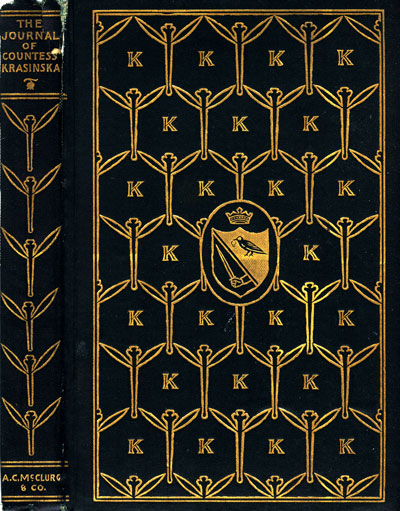
One week ago—it was Christmas day—my
honored Father ordered to be brought
to him a huge book, in which for many
years he has written with his own hand all
the important things which have happened
in our country; also copies of the notable
pamphlets, speeches, manifestoes, public
and private letters, occasional poems, etc.,
and having placed everything in the order
of its date, he showed us this precious collection
and read to us some extracts. I
was much pleased with his idea of recording
interesting facts and circumstances;
and as I know how to write pretty well in
Polish and in French, and have heard that
in France some women have written their
memoirs, I thought, "Why should not I try
to do something of the kind?"
So I have made a big copy-book by fastening
together many sheets of paper, and
I shall note down, as accurately as I am
able, everything which may happen to me
and to my family, and I shall also mention
public affairs as they happen, as far as I
may be acquainted with them.
To-day is New Year's Day and Monday,
a very proper season to begin something
new. I am at leisure; the morning Service
is finished, I am dressed and my hair is
curled; ten is just striking on the castle
clock, so I have two hours till dinner time.
Well, I begin.
I was born in 1742, so I am just past
my sixteenth birthday. I received at the
christening the name of Françoise. I have
heard more than once that I am pretty,
and sometimes looking in the mirror, I
think so myself. "One has to thank God,
and not to boast," says my gracious
Mother;
"it is He that hath made us and
not we ourselves." I have black hair and
eyes, a fair complexion and rosy cheeks.
I should like to be a little taller, but they
frighten me by saying I shall not grow any
more. I am descended from the not only
noble, but very old and illustrious family of
Korwin Krasinski. God forbid I should
ever tarnish the glorious name I am fortunate
enough to bear! on the contrary I
should like much to add to its fame, and I
am often sorry I am not a man, as I should
then have more opportunities.
The Count, my honored Father, and the
Countess, are so sensible of the grandeur
of the Korwin Krasinski family, and they
so often speak of it,—not only they, but our
courtiers and our guests as well,—and it is
thought by all to be such a great reproach
not to know precisely about our ancestors,
that we all have our heads full of that kind
of information. I can recite the genealogy
of the Krasinskis and the history of each
of them as perfectly as my morning prayer,
and I think that I should have more difficulty
in telling the names of our Polish
kings in chronological order than in telling
those of my ancestors. The pictures of
the most illustrious are in our hall,
[1]
but it would take too long to write about each of
them. The first of whom we know anything
was Warcislaus Korwin, from the old
Roman family of Corvinus, who, in the
eleventh century, came from Hungary to
Poland and was appointed the Hetman
(General-in-chief) of the army of King
Boleslaus II.
Having espoused a noble lady of the
name of Pobog, Korwin united his crest—a
raven holding a ring—to that of the
Pobogs—a hand grasping a sabre—and
such is still our cognizance. His grandson
was the first to take the name Krasinski,
that is, of Krasin, from an estate bestowed
upon him by the King as a reward for his
bravery; and from that time forward many
hetmans, castellans, woivodes,
[2] bishops, etc.,
made the Krasinski name famous in Polish
history.
One of them, Alexander, in this very
same Maleszow Castle where I am now
quietly writing, resisted so bravely a great
Tartar army, in one of its plundering excursions
from Asia, that the chief was
obliged to retreat; but before leaving, he
sent to the valorous castellan, as a token of
his admiration, the most precious thing he
possessed,—namely, a clock, of very simple
construction, it is true, but a great wonder
at that time. This curious relic, this gift
from an enemy,—and he a Tartar, more
accustomed to take than to give,—is still
preserved with great care in our family;
I have seen it but twice in my life, my
honored Father keeping it so carefully, and
I am sure he would not exchange it for ten
Paris clocks with all their chimes.
This valiant ancestor of mine was killed
in a war with Russia, and left no son. His
nephew John built in Warsaw a magnificent
palace in the Italian style, which is said to
be more beautiful than the King's Castle;
but I have not seen it, as I have never been
in our capital.
John's brother, Alexander, the castellan
of Sandomir, was my own grandfather. His
son, Stanislaus, the Staroste
[3] of Nova Wies
and Uscie, is my honored and beloved
Father; he married Angela Humiecka, the
daughter of the famous Woivode of Podole,
my honored and beloved Mother. But, to
my great sorrow, this line of the Krasinski
family will become extinct with the Count,
my Father, as he has four daughters, but
no son: Basia (a pet name for Barbara)
is the eldest; I am the second; then
comes Kasia (Katherine); and Marynia
(Mary) is the youngest.
The courtiers tell me often I am the
handsomest, but I am sure I do not see it;
we all have the bearing becoming young
ladies of high station, daughters of a Staroste;
we are straight as poplars, with complexions
white as snow and cheeks pink as
roses; our waists, especially when Madame
ties us fast in our stays, can be, as they
say, "clasped with one hand." In the
parlor before guests we know how to make
our courtesy, low or dégagé, according to
their importance; we have been taught to
sit quiet on the very edge of a stool, with
our eyes cast down and our hands folded,
so that one might think we were not able
to count three or were too prim even to
walk out of the room easily. But people
would think differently if they saw us on a
summer morning, when we are allowed to
go to the woods in morning gowns and
without stays, puffs, coiffures, or high-heeled
shoes: oh! how we climb the steep hillsides,
and run and shout and sing, till our
poor Madame is quite out of breath from
running and calling after us.
As yet I and my two younger sisters have
seldom left home: Konskie, the home of
our aunt, the Woivodine
[4] Malachowska,
whom we visit twice a year; Piotrowice,
where my honored Father, after his return
from Italy, built a beautiful chapel, like the
one in Loretto; Lisow, where stands our
parish church,—these bound all our experiences
in travelling. But Basia, as the eldest,
has already seen a good part of this
world: she has been twice to Opole, visiting
our aunt, the Princess Lubomirska,
Woivodine of Lublin, whom my Father
loves and venerates as a mother rather
than as an elder sister. Basia has spent
also one year in the convent of the Ladies
of the Visitation at Warsaw, and so, of
course, she knows more than any of us: her
courtesies are the lowest, and her manners
the most stately.
My honored Parents are thinking now of
sending me also somewhere to finish my
education; I am expecting every day to
see the carriage drive up to the door, and
then my gracious Mother will tell me to sit
beside her, and she will take me either to
Warsaw or to Cracow. I am perfectly
happy at home, but Basia liked the convent
very much, so I hope that I shall; and
then I shall improve in the French language,
which is now indispensable for a
lady; also in music and in dancing, and
besides that I shall see a great town, our
capital.
As I have not seen many castles besides
Maleszow, I cannot judge whether it is
pretty or not. I only know that I like it
very much. Some people think that our
castle, with its four stories and its four bastions,
surrounded with a moat full of water
crossed by a drawbridge, and situated
amidst forests in a rocky country, looks
rather gloomy, but I do not think so at all.
I am so happy here that I should like to
sing and dance all day long. I hear my
honored Parents complaining sometimes
that they are not quite comfortable here.
It is true that, although on each floor there
are besides the parlor, six large rooms and
four smaller ones in the bastions, we cannot
all be accommodated on the same
floor, as we are a very numerous family.
The dining-rooms are on the first, the
dancing hall on the second, and we girls
have to occupy the third floor. My honored
Parents are no longer young, and it
fatigues them to go up and down every
day, but for me these stairs are just my
delight! Often, when I have not yet all
my puffs on, I grasp the stair-rail and I am
down in one second without my foot once
touching the steps. Oh! it is such fun!
It is true our many guests may sometimes
be crowded a little in their sleeping
rooms, but nevertheless, they visit us often,
and I do not know that we could amuse
ourselves better in a more spacious palace.
I think the Maleszow Castle, if three times
as large, could not be more magnificent;
it is so gay and lively that the neighbors
often call it little Paris. We are especially
gay when winter comes; then the captain
of our dragoons does not lift up the drawbridge
until night, so many people are continually
driving in and out, and our court-band
has enough to do playing every day
for us to dance.
But I ought not to forget to speak about
the retinue of our Castle, which, in accordance
with the rank of my honored Parents,
is very numerous and stately.
There are two classes of courtiers,—the
honorary and the salaried ones, all alike
nobles, with the sword at their side. The
first are about twenty in number; their
duties are to wait in the morning for the
Count's entrance, to be ready for any service
he may require, to accompany him
when visiting or riding, to defend him in
case of need, to give him their voice at the
Diet, and to play cards and amuse him and
his guests. This last duty is best performed
by our Matenko (Mathias), the
fool or court jester, as the other courtiers
call him; but he does not at all deserve
that sobriquet, as his judgment is very
correct and his repartees are very witty.
Of all the courtiers he is the most privileged,
being allowed to speak whenever he
chooses and to tell the truth frankly.
To the honorary members of our court
belong also six girls of good family, who
live on the same floor with us under the
superintendence of our Madame, and also
two dwarfs. One of the latter is about
forty, but of the size of a four-year-old
child; he is dressed as a Turk. The other,
still smaller and very graceful and pretty,
is eighteen years old, and they dress him
as a Cossack. Sometimes, for sport, my
honored Mother orders him to be put on
the dinner table, and he walks about among
the bottles and the plates as easily as if he
were in a garden.
The honorary courtiers receive no pay,
almost all of them being the sons and
daughters of rather wealthy parents, who
send them to our castle for training in
courtly etiquette. The men receive, nevertheless,
provision for two horses, and two
florins
[5] weekly for their valets. These servants
are dressed, some as Cossacks, some as
Hungarians, and stand behind their masters'
chairs at meals. There is no special dinner
table for them, but they must be satisfied
with what their masters leave on their plates,
and you should see how they follow with a
covetous eye each morsel on its way from
the plate to the master's mouth! I do not
dare to look at them, partly from fear of
laughing, and partly out of pity.
The salaried courtiers are much more
numerous. They do not come to our table,
except the chaplain, the physician and the
secretary. The marshal and the butler
walk around the table watching if anything
is wanted; they pour the wine into the
glasses, often replenishing for the guests,
but only on feast days keeping the glass
full for the courtiers. The commissary,
the treasurer, the equerry, the gentleman
usher, the masters of the wardrobe, all dine
at the marshal's table. To tell the truth,
those who sit at our table have more honor
than profit, for they do not always have
the same kind of food that we have,
although it comes from the same dish.
For instance, when the meats are brought
in, there will be on the dish game or domestic
fowl on the top, and plain roast
beef, or roast pork, underneath. Each
course is brought on two enormous dishes,
and it seems almost impossible such heaps
could disappear; yet the last man served
gets often but scanty bits of food, and
whether there are four courses, as on
week days, or seven, as on Sundays, or
twelve, as on festivals, I do not remember
having seen anything left on our table.
The salaried courtiers receive quite high
pay, from three hundred to a thousand
florins annually, also provender for two
horses each, and the livery for their valets;
but then the Count expects them all to
present themselves well dressed. When
he is especially pleased with one of them
he rewards him generously, and every year
on the Count's birthday, rich presents in
dresses and money are distributed.
But this is not our whole retinue; there
are also the chamberlains,—young boys
from fifteen to twenty years of age, of noble
families, who perform a kind of novitiate in
our service. Their duties are to be always
in attendance, to accompany our carriage on
horseback, and to be ready for all kinds of
errands; thus if my honored Parents have
letters to be carried in haste, or presents
or invitations to be sent, they always send
the chamberlains. One of them, Michael
Chronowski, will finish his novitiate on
Epiphany, and then will come the ceremony
of liberation, which I shall describe
in its place.
As for other people belonging to our
retinue, it would be difficult to enumerate
them; I am sure I do not know how
many there are of musicians, cooks, linkboys,
cossacks, hostlers, valets, chamberlains,
and boy and girl servants. I know
only there are five different dinner tables,
and two stewards are busy from morning
till night, giving out the provisions for
the meals. Very often, especially when
fresh supplies are brought in, my honored
Mother is herself present in the storeroom;
she also keeps the keys of the
medicine closet, where spices, dainties, and
sweet liquors are kept. Every morning
the marshal brings to her the dinner and
supper menu, which she, with the advice
of my honored Father, either changes or
approves.
The arrangement of our day's occupation
is as follows: we rise at six o'clock
in summer, at seven in winter. All four of
us sleep in the same room with Madame,
and each has an iron bedstead with
curtains around it. Basia, as the eldest,
has two pillows and a silk coverlet; we,
the younger, have but one pillow and a
woollen blanket. Having said a French
prayer with Madame, we begin our lessons
at once. At first the chaplain taught us
the catechism, and with our tutor we
learned how to read and write in Polish;
but now he teaches only my two younger
sisters, for Basia and I study with Madame
only. We learn vocabularies, dialogues, and
anecdotes by heart from a text-book. At
eight we go downstairs to wish our honored
Parents good-morning and to have breakfast.
Then we go to the chapel, where,
after the mass, the chaplain reads Latin
prayers, which we all repeat after him
aloud. Returning to our room, we learn
German vocabularies, we write letters and
exercises, and Madame dictates to us the
verses of a French poet, Malesherbes. We
have a spinet and are taught to play upon
it by a German teacher, who directs our
orchestra; for this service he receives three
hundred florins annually. We all study
music and Basia plays not badly at all.
When our lessons are over we put on
wrappers and the coiffeur comes to dress
our hair, beginning with the eldest. This
is a long and often painful operation,
especially when he is inventing some new
coiffure. As my hair is the thickest and the
longest (it drags on the floor when I am
sitting before the dressing-table), it is on
my head that he generally makes his experiments.
It is true that he does make
very beautiful and wonderful coiffures;
for instance, the one I have to-day, is so
pretty, having a laisser aller effect: all
my hair is lifted up very high; half of it
is arranged in puffs on the top of the head,
and the other half falls in loose curls on
the neck and the shoulders; there must
have been at least a half-pound of powder
used in it. Our dressing takes two or
three hours, during which Madame reads
to us a new French book, the "Magasin
des Enfants" by Madame Beaumont.
At noon, at the Angelus bell, we go
down to dinner, and then, our honored
Parents allow us to remain with them for
the rest of the day. We sit generally two
hours at table; after that if the weather
is favorable we take a walk; if not, we
always have some needle-work on hand for
our church in Piotrowice. We sit at our
embroidery frames as long as we can see,
and when the lights are brought in, we
make netting or do some such light work.
There are always many wax tapers burning
in silver candelabra, and although they are
rather yellow, being home-made from our
own wax, they give a very bright light.
Supper is at seven, and afterwards the
evening is given to amusement. Sometimes
we play cards, "Marriage" or "Drujbart,"
and it is such fun to see the faces Matenko
makes, according as he gets a seven or a
trump!
Once a week a chamberlain goes to
Warsaw to bring the newspapers and letters,
and then the chaplain reads aloud the
"Gazette" and the "Courier." At times
my honored Father reads the old chronicles
to us; sometimes they are very dull, and
sometimes very interesting. During the
Carnival, there is seldom any reading, but
there are games, music, and dances. I
cannot imagine how they can amuse themselves
better at the court in Warsaw; how
can it be anywhere gayer than in our
Maleszow? Still, I should like so much,
if only out of curiosity, to have just a taste
of that court life. But what do I hear?
There is the noon bell! I must say the
Angelus in haste, see if my coiffure is in
order, and run downstairs, leaving for
to-morrow all that I intended to write
to-day.
Yesterday, I wrote about myself and my
home; to-day I want to write about my
country. I should not be a worthy Pole if
I were not interested in what happens in
my own land. People in our house talk
much about Poland, and I have always
listened attentively, but much more so
since I resolved to write this journal.
Our present king is Augustus III., Elector
of Saxony, son and successor of Augustus
II. On the seventeenth of this month,
it will be twenty-five years since the Bishop
of Cracow crowned him King of Poland
and Lithuania.
[6] It is said that he was
rather indifferent to the Polish crown, when
by his father's death the chance was opened
to him; but he was persuaded to become a
candidate by his wife, Marie Josephine,
daughter of the German Emperor Maximilian.
This royal lady was very much
beloved by the Poles: she had a very good
influence over the king, her husband, and
never meddled with any court intrigues;
she was charitable, beneficent, pious, a
good wife and a good mother, and fully
deserved to be called a model of feminine
virtues. She died in Dresden two years
ago, and I remember well the great sorrow
caused by the news of her death. In all
the churches there were grand funeral services,
also in our Piotrowice, and all the
poor people cried and lamented, having
lost in her a real mother. She had fourteen
children, of whom eleven are living:
four sons and seven daughters.
The king is said to be of a kindly but
rather weak character, and he has the
greatest confidence in his minister Brühl,
who in reality is the ruler both of Poland
and Saxony. It is said affairs are going
all wrong in Saxony, and not much better
in our country. I have often heard people
say: "We need a Frederic the Great, with
a strong head and an iron will;" and as
our king is old, they are all looking forward
and planning already for his successor.
There are two prominent candidates for
the throne: one is Stanislaus Poniatowski,
who was educated in France, spent four
years in Russia as the envoy of Poland,
and there became the favorite of the
Empress Catherine II. The other candidate
is Duke Charles, twenty-six years
old, the most beloved of the sons of
our present king. People say he has a
real gift for attracting all hearts to him; he
is very handsome, very stately in figure, and
very courteous in manner; and having
spent almost his whole life in Poland, he
knows our language perfectly. I have
heard so much of his good qualities that
my best wishes are for him, although
Poniatowski is my countryman.
This day will be a memorable one for Duke
Charles. A few weeks ago he was elected
Duke of Courland, which is a tributary of
Poland, and to-day occurs the "investiture,"
that is, the giving possession. The
king is so happy about the good fortune of
his beloved son, that he is said to look ten
years younger. What festivals there will
be in Warsaw! How I should like to be
there now, and to see the grand doings,
but especially to see the royal prince. We
shall, at least, drink his health here and
cry, "Long life to Duke Charles!"
Yesterday, just when we were drinking to
the health of the Duke of Courland, and
our band was doing its best, and our company
of dragoons were firing salutes,—at
that very moment the chamberlain, who
had been sent to Warsaw, returned with the
news that on account of the indisposition
of the duke, the ceremonies of the investiture
had to be postponed. "Bad omen,"
said Matenko; "as the mitre slips, so the
crown will slip." I felt like crying, but
there was no time for that, as many guests
were present; among others, the Woivode
of Craclaw, Swidinski, with his nephew
Father Albert, a Jesuit, whom my honored
Parents like and respect greatly. Basia is
his special favorite; he brought her a
rosary and a prayer book,—"La Journée
du Chrétien,"—and he spoke several times
to her at supper. But then, Basia is the
eldest; no wonder everybody pays most
attention to her.
The Woivode and Father Albert are
still here, and to-day the two sons of the
former are expected. I am very anxious
to know them, as they have both been educated
in France, at Luneville, at the court
of Stanislaus Leszczynski.
[7] This nobleman,
although his country has proved faithless to
him, tries to be useful to it, and he has always
some young Poles at his court, where
they receive the best education. The sons
of our first families court this great honor,
and there is not a better recommendation
for a young man than to say of him:
"He has been brought up in the court of
Luneville." He is sure then to be refined,
to speak French well, and to dance the
minuet gracefully; therefore all gentlemen
brought up at that court are great favorites
of the ladies. Oh! how curious I am to
see these two!
They arrived yesterday, but I cannot say
they are quite as I expected, especially the
elder, the Staroste of Radom. I thought I
should see a fine young cavalier, like the
Prince Cheri, so beautifully depicted
by Madame de Beaumont, but the Staroste
is not at all like him; first, he is
not very young,—he is about thirty; then
he is rather stout, and therefore, perhaps,
he is not fond of dancing. As to his Parisian
accent, I cannot judge about that, as
he did not say one French word, but mixes
his Polish and Latin quite as the old gentlemen
do. His brother, who is a colonel
in the king's army, pleased me a little
more; he has, at least, a fine uniform.
To-day, the ceremony of liberation of the
Chamberlain Chronowski will take place.
Besides that, as it is customary on Epiphany,
they are baking an enormous cake
with an almond in it, and whoever gets the
almond will be the Twelfth Night king or
queen. Oh! if it only came to me! A
crown would be put on my head and I
should have all the ordering of the dances;
then what dancing there would be! Still,
I think, there will be enough in any case,
for many guests are expected. Our old
butler, Peter, was muttering to himself this
morning that around the church in Piotrowice
there are said to be ever so many
coaches and curricles. Poor man! he is
expecting more work, so he grumbles;
but I feel my heart jumping, and my feet
are dancing already. How often in this
world the same thing brings trouble to one
and joy to another!
Well, yes, they did come, and many of
them are still here. Old Peter has two
wrinkles more on his forehead, but we
amused ourselves royally. Basia, not I,
was the queen, but it was just as well.
When at the end of the dinner the cake
was cut, Basia glancing at her piece became
red as a pink, and Madame, sitting next to
her, announced: "Mademoiselle Basia has
the almond!" Then all the people cried,
"Long live the queen!" and Matenko
added, smiling: "The almond is here, the
husband is near." Would it not be nice to
have a wedding in our house!
Decidedly I do not like the Staroste;
he is so grave! Yesterday he danced the
Polonaise only. He never looks at us
girls, nor speaks a word to one of us; he
converses with my honored Parents only,
or plays cards, or reads the "Gazette;" so,
really, I cannot find him very entertaining.
But I am forgetting to speak about
Michael Chronowski's liberation. Soon
after dinner we went to the banquet hall
with our guests, and all sat around in a large
circle, my honored Father in the middle,
on a higher chair. The folding doors were
thrown open, and the marshal with other
courtiers led in the young man, dressed no
more in livery, but in a rich Polish costume.
He knelt down before the Count,
who gave him a light blow on the cheek in
token that he has been novitiate boy here,
then a sword was fastened to his side and
his health was drunk in a cup of wine.
The Count made him a present of a purse
filled with gold, and of two horses which
were already waiting in the courtyard for
their new master. Invited to remain here
as a guest till the end of the carnival,
Chronowski accepted the invitation with
gratitude, and having saluted my honored
Parents and kissed the hands of all the
ladies, was admitted to our society and
danced with us the whole evening.
The prophecy of Matenko proved true,
for Basia will be married before the carnival
is over. Last night the Staroste Swidinski
asked my honored Parents for her
hand; they sent for her this morning, told
her about it, and the betrothal will take
place to-morrow. Basia came back in
tears to our room, telling us that she
dreaded the marriage, and would always
regret her old home, but that it was not
possible to refuse such a match, as both
our honored Parents wished it, and told
her she would be very happy. The Staroste
is, they say, a most honorable man,
religious, and of a kind disposition; his
family is also old and very wealthy. His
father has allotted him a large estate,
"Sulgostow," with a beautiful palace, and
the king has given him the appointment of
staroste with the expectation of being soon
named castellan. For a long time the
Woivode and Father Albert had been planning
this marriage, and they came here for
the purpose of effecting it.
And so we shall have a wedding here, in
Maleszow Castle, on the 25th of February,
at the very end of the carnival. Will there
not be dancing! Basia will become
Madame Starostine; only, it is a pity we
shall not be allowed to call her "Basia"
any more. I am very sorry to have written
about the Staroste as I did, but then
it is not I that is to marry him, and if he
pleases Basia, that is enough. She says
she has always been afraid of young men,
she likes serious ones better; and our honored
Mother tells her that those make the
best husbands. Perhaps so, but as for me
... well, it is of no use to think about it
at present.
Oh! but I must not forget: the investiture
of Duke Charles will certainly take
place in Warsaw to-day. Colonel Swidinski,
who knows him personally, has not
words enough to tell how charming he is.
I wonder if I shall ever see him.
The betrothal took place yesterday. In
the morning, when we came down, my
honored Mother gave Basia a skein of
tangled silk to wind.
[8] The poor girl, with
flushing cheeks, began the task, not daring
to look up from her work, for she knew
that all eyes, especially those of the Staroste,
were fixed upon her; and besides,
that mischievous Matenko was teasing her
without end, making all the people laugh.
After dinner, when she sat again before
her winding-frame, the Staroste came near
and asked in a voice loud enough for all to
hear: "May I believe that your ladyship's
will is favorable to my desires?" "The
will of my honored Parents," answered
Basia, with a trembling voice, "has ever
been a sacred law to me." And that was
the whole of the conversation between the
betrothed.
When the courtiers had left the room
and we were alone with our guests, the
Woivode and Father Albert arose, the
former taking by the hand the Staroste,
and standing before my honored Parents
he thus addressed them: "For a long
time my heart has been filled with the
most sincere affection and profound veneration
for the illustrious family of Korwin
Krasinski; for a long time I have desired
fervently that my modest name be united
with your glorious one, and I cannot
express the great satisfaction which I feel
in knowing that your Grace is willing to
grant me this favor. You have a most
honorable daughter, Barbara; I have this
son, Michael, who is my comfort and my
pride; are you willing to renew to-day
your promise to join this young pair for
their lifetime? Here is the ring which I
received on a like occasion from my
honored Parents, in order to give it to
my wife, who is, alas! no more in this
world, but who still lives in my heart. Will
you allow my son to offer it now to your
daughter as a pledge of a closer tie?"
Saying this he laid a costly diamond ring
on a little silver tray which Father Albert
was holding. The latter also made a
speech, but he used so many Latin words
that I could not make anything of it.
My honored Father rose and answered:
"I repeat now what I told you yesterday,
that I consent to the marriage of my
daughter with the most honorable Staroste;
I give her to him with my sincere blessing,
and I transfer to him all my rights as a
Father." "I do the same, and with my
whole heart," added my honored Mother.
"Here is a ring, the most precious jewel in
my house; my Father, the Woivode of
Podole, received it after his victory over
the Turks, from the hands of our late king,
Augustus II. This was my betrothal ring,
and I give it now to my eldest daughter,
with a Mother's blessing, and with a prayer
to the Almighty that she may be as happy
as I have been." She then placed on the
tray a ring with a very large diamond,
which, being raised, disclosed the miniature
of the late king.
"Basia! come here, my girl," said my
honored Father. She rose and advanced,
but was so confused and trembling that I
wonder how she ever reached the spot.
Father Albert blessed the rings, and gave
the first one to the Staroste, who, having
kissed my sister's hand, placed the ring on
her fourth finger; Basia, in her turn, gave
him the ring with the portrait, and had her
hand kissed once more. Then the Staroste
fell at the feet of my honored Parents,
thanking them, and calling God to witness
that he would do all in his power to make
their daughter happy; in the mean time
the Woivode kissed the trembling Basia on
the brow, while Father Albert and the
colonel paid her many fine compliments.
At the end my honored Father took a
large cup, filled it with old Hungarian wine,
and drank the young couple's health; and
all the gentlemen did the same.
The whole ceremony was so solemn and
so touching that I could not keep back my
tears. "Do not weep, Frances," said
Matenko, who still remained in the room
and for once was serious, "do not weep;
in less than one year it will be your ladyship's
turn." In one year? ... no, that
would be too soon, but in a few years,
perhaps....
Everybody in the house is now paying
so much attention to Basia! My honored
Parents kissed her on the cheek when she
wished them good-night, and all the people
are congratulating her and recommending
themselves to her, as many wish that she
would take them to her new court.
My honored Father brought out a bag
containing a thousand ducats, which he
gave my honored Mother for the trousseau,
and during several hours they discussed
together its details. To-morrow Mlle.
Zawistoska, a very respectable woman, who
has been brought up in our castle and will
be Basia's lady's maid, is going with the
commissary to Warsaw to make the necessary
purchases.
In our store-house there are four big
trunks with silver plate, one for each of us.
The Count ordered the one which is designed
for Basia to be opened; examined
each piece himself, and those which need
repairs or alteration are to be sent to
Warsaw.
The letters to announce the approaching
marriage are already being written, and the
chamberlains will take them to all parts of
Poland, to all relatives and friends, inviting
them to the wedding. But the most stately
of our courtiers, the equerry, will go to
Warsaw with letters to the king, the royal
princes, the primate, and the chief senators.
In these missives the Count gives
notice of his daughter's intended marriage,
but sends no invitations, as the presence of
those persons will depend upon their own
pleasure. Oh! if one of them, for instance
the Duke of Courland, should come here,
what grandeur would be added to the wedding;
but more probably they will send
their envoys only, who, in that case, receive
all the honors due to those they
represent.
The Staroste gave handsome tokens of
remembrance to each of us sisters. I
received a costly brooch with turquoises;
Mary, a ruby cross; Kasia, a Venetian
chain. Also he offered presents to my
honored Parents, which they deigned to
accept,—the Count, a golden cup; the
Countess, a work-box, in which all the implements
are of mother-of-pearl and gold. He
did not forget even our Madame, who
found this morning a lace shawl on her
bed; so she also highly praises our Polish
generosity.
Last night we had a grand supper. The
music was beautiful, the dragoons fired
salutes, and the captain gave to the guard
for a watchword the names Michael and
Barbara.
This morning there was given a great
hunting-party, for Basia's good luck, and
it was unusually successful; they brought
home one boar, two deer, four hinds, and
many hares. The boar was killed by the
Staroste himself, who laid his trophy at
Basia's feet. I have learned to-day what
a brave man the Staroste is. My honored
Father ordered for the hunters all the
horses from the stables, and among others
there was one, a great beauty, but very
wild; even the equerry does not dare to ride
him. The Staroste said, however, that he
would try him, and notwithstanding all the
remonstrances, he sat upon him with ease
and held him with such a clever and strong
hand that, in spite of all the animal's
prancing and jumping, he rode three times
around the castle. It was beautiful to see.
Basia turned pale at first, but when she saw
how he was able to manage the horse, and
when loud bravos began to resound, then
deep blushes covered her cheeks, especially
when all eyes turned towards her. By this
act the Staroste quite gained my favor;
one who is so brave and so strong, can be
pardoned even if he does not like to dance
the minuet. The Count presented the
horse to his future son-in-law, adding a rich
equipment and a groom; he deserved it.
To-morrow the Woivode and the Staroste
are going away, in order to prepare the
Sulgostow house for its new mistress.
During more than a week I have not
opened my diary, for we are very busy.
The afternoons and evenings are spent with
our guests, and the mornings are given to
work, as each sister wishes to make something
with her own hands for Basia's trousseau.
I am embroidering a dishabille with
flowers in lace-stitch, and I have to get up
very early in the morning and work even by
candle-light in order to be ready in season.
Mary is making a very pretty scarf; it will
have an arabesque embroidered on fine
muslin in dark silks and gold; Kasia is
knitting a cover for the dressing table; so
all the lessons are put aside, and even
Madame de Beaumont is forgotten.
From the early morning, my honored
Mother is busy, unlocking the trunks, the
drawers, and the cupboards,—taking out
linen, silks, furs, carpets, rugs, curtains, etc.
She has many things still remaining from
her own trousseau, and many others bought
later, as during all these years she has been
gathering all kinds of beautiful things for
our marriage outfits; really they are well
worth seeing. Sometimes she deigns to
call me to assist her, and it is quite touching
to see her anxiety to do right by each
of us; she divides all these treasures in
four portions, and sometimes she even asks
my honored Father and the chaplain to
give their opinion whether the shares are
quite of equal value.
A tailor and a furrier have come from
Warsaw, and there is so much to be done
that they will not have finished for a month.
Fortunately, almost all the linen is ready,
our sewing-girls having worked upon it for
these last two years, and now they are marking
it with blue cotton.
Basia wonders what she will do with all
the new dresses they are making for her;
until now we had never more than four at
the same time, two dark woollen ones for
every day, and two white ones, one in
cotton for Sundays, another in batiste for
great occasions. But my honored Mother
says that what is good enough for a young
girl would not be proper for a married
lady.
Basia has wound the tangled silk with
such patience that, although green, it has
not in the least changed its color; even
Matenko acknowledges that she is fit to be
married. She is now knitting from that
silk a purse for the Staroste by my honored
Mother's direction.
The equerry and the chamberlain are
gone with the invitations. On the 8th of
January the investiture of the royal prince
took place at last. The night before, my
uncle the Prince Lubomirski, Woivode of
Lublin, who is also the marshal to the royal
prince, gave a great ball; other festivals,
dinners, and balls followed for more than a
week. The new duke made a speech in
the Polish language, which pleased immensely;
he is now treated quite as a
crowned prince. In the "Courier" there
is a full account of the ceremonies. It
is very interesting; I should like to copy it
here, but I have not the time.
The Staroste arrived last night, and this
morning Basia found on her work-table two
large silver baskets with oranges and bonbons,
which she distributed among us and
our court ladies. Our work is progressing
rapidly and my négligé is half done.
Basia will be provided with feather-beds
from her own household, for to each of
us daughters has been allotted for many
years a certain number of geese and swans.
There is among the servants a poor, stupid
girl who is not able to do anything but
pluck the feathers, and each of us has a
separate barrel for feathers and a bag for
down. Basia, out of her share, will have
two feather-beds, eight big pillows filled
with goose-down, and four small ones of
swan's-down. The pillows will be made
of red silk, and the cases of Holland linen
lawn embroidered.
The Staroste stayed nearly a week and
departed yesterday; the next time he will
not go away alone, but Basia will go with
him. It seems to me quite impossible that
she will leave us and go alone with a man!
Basia's friendship and esteem for the
Staroste grows every day, although he
never speaks with her; all his conversation
is with my honored Parents, and all his attentions
are paid to them. They say it
ought to be so in an honorable courtship,
for is there a better way of gaining the
heart of the daughter than by pleasing the
Parents?
The wedding will be in three weeks; we
shall have new dresses as well as the court
ladies; all these will be Basia's gift.
Many of the invited guests have already
replied that they are coming, but the king
and the royal princes will send only their
envoys. It is doubtful, also, if my aunt,
the Princess Woivodine of Lublin will be
able to come, but she is much pleased
with Basia's choice, and she wrote a beautiful
letter with her blessing,—which made
my honored Father very happy.
I am hurrying with my embroidery, but
I must rise early and work by candle-light,
for my honored Mother is so gracious
toward me that she often wants my help
and service. Before this, only Basia, as
the eldest, was so fortunate, but now, my
honored Parents want me to have some
practice in order to take her place when
the Staroste takes her away. Twice already
I have had the key of the medicine
closet intrusted to me, and I really think
since then I have grown more serious.
The preparations for the wedding are
going on, and our visitors begin to arrive.
Almost all the guest-rooms are already occupied,
and the farm-house, the parsonage,
even the better peasant-cottages will be
wanted for the later comers. The cooks
and the confectioners are already preparing
all kinds of delicacies and sweetmeats
for the coming event.
To-day the beds have been sent to Sulgostow
and two enormous chests with mattresses,
pillows, carpets, curtains, etc. The
bedsteads are of carved oak with blue
covers, curtains, and canopies; on the four
corners there will be bunches of blue
and white ostrich-feathers. Almost every
moment Basia has good reason for embracing
the hands and the feet of our
honored Parents, they are so generous
toward her. The Count is writing with
his own hand, in a large book, the contents
of the trousseau, beginning with these
words:—
"Inventory of the wedding outfit which
I, Stanislaus Korwin Krasinski, Staroste of
Nova Wies, etc., etc., and Angela, born
Humiecka, my honored wife, are giving
to our eldest and beloved daughter Barbara,
promised in marriage to the honorable
Michael Swidinski, Staroste of Radom; and
imploring for this daughter of ours the
favor of Heaven, we bestow upon her our
parental blessing, in nomine Patri et
Filii et Spiritu Sancto. Amen." I should
like to copy here the whole inventory, but
first, I have no time, and secondly, I expect
to receive a trousseau like this sometime
myself, and what is still better, such a
blessing of my own.
Three days more and then the wedding.
The Staroste arrived yesterday; Basia
shook like a leaf when the chamberlain
brought him into the parlor. To-day we
are expecting the Woivode, Father Albert,
the colonel and the Woivodine Granowska,
sister of the Staroste, with her husband.
Basia is entering into a fine family,—all
religious and worthy people. The trousseau
is quite finished, and what has not already
been sent to Sulgostow is packed in
trunks, of which Mademoiselle Zavistoska
has the keys. Besides this mademoiselle,
Basia will take with her two young girls, her
goddaughters, well trained in all kinds of
needle-work, and as companion, one of
the six damsels who have been brought
up with us. When I am married I shall
take still more; I have already solemnly
promised three girls that they shall go
with me; one of them is the daughter of
our Peter. In his grateful joy, the old
man bowed to my feet, and for the first
time his forehead was free from wrinkles.
The wedding will be to-morrow. Our
guests are numberless, and all the envoys
are here. The king's envoy is the Secretary
Borch; that of the Duke of Courland,
his confidant the Castellanic
[9] Kochanowski,
a very handsome and polite cavalier; the
proverb is right: "As the master, so the
valet." I cannot possibly describe all
the others; they arrived, as if by appointment,
at the same hour yesterday, and their
entrance was quite imposing. Before every
one of them our dragoons presented arms,
while the cannons were firing and the
music playing. The greatest honors were
shown to the king's envoy; the Count,
having been informed of the hour of his
arrival, was waiting with head uncovered on
the drawbridge, and all our guests, courtiers,
and servants stood in a double row
up to the entrance door. As soon as the
secretary stepped on the bridge they all
shouted "Vivat!" and bowed low in
salutation.
To-day, in the presence of the whole
company, and before appointed witnesses,
the marriage contract was written, but I
do not know what it contains, as I have
not understood a single word of it. I
know only that the bride received many
beautiful presents: from the Staroste three
strings of oriental pearls; from the Woivode
a rich diamond cross and an aigrette with
diamond pendants; from the colonel an
enamelled watch and chain; from Father
Albert many relics; and from each relative
a souvenir. Basia can hardly believe that
all these riches belong to her; until now,
her only jewel, besides her betrothal ring,
was a small ring with the picture of the
Holy Virgin on it, and I am sure Basia
will not discard her old friend for all the
costly jewels which she now receives.
The maid has just brought my négligé,
washed and pressed; it looks very nice.
There are twenty-five different kinds of lace-stitch
in it; I am sure it will be becoming
to Basia.
All is over, and as Matenko says, "with
a hundred horses one could not catch
Mademoiselle Barbara any more;" she is
Madame Starostine. I have much to tell.
Yesterday, very early in the morning, we
rode to our parish church in Lisow, where
the bride and the bridegroom went to
confession and to communion. As it was
cold the bride wore a white cloak of brocade
silk, lined with white fox fur, and on
her head a long lace veil.
When we returned breakfast was served,
and soon afterwards the dressing of the
bride commenced; twelve noble ladies
headed by my honored Mother undertook
that important task. The dress was of
white satin, with watered silk stripes, a
frill of Brabant lace with silver ornaments
at the bottom, and a long train; a rosemary
bouquet fastened the front of the
corsage. On her head the bride wore a
rosemary wreath held in place by a gold
circlet on which was engraved the date of
the wedding and good wishes in rhyme.
According to the old Polish custom, my
honored Mother fastened in the wreath a
ducat with the date of Basia's birth-year,
and a bit of bread for good luck; she also
added to the above a lump of sugar in
order to sweeten the married life, which
they say has many difficulties. No jewels
were allowed, for it is said that for each
precious stone worn on the wedding day,
one has to pay afterwards with a vial of
tears. As it is, Basia has wept enough, so
that her eyes are red and swollen.
A little in advance, the bridesmaids went
downstairs; we were twelve, all dressed
in white, and the eldest of us was not
more than eighteen. The bridegroom with
twelve groomsmen met us at the door of
the parlor, and there we found all the
guests assembled. An enormous tray was
carried behind us, heaped with bouquets of
rosemary and orange sprays, each tied
with a white ribbon, which were destined
for the young ladies and bachelors present
at the wedding. To fasten on these bouquets,
each bridesmaid had a certain
number of gold and silver pins, and great
care was to be used in distributing the
different values according to the rank of
each person. The elderly ladies have
been teaching us for a long time about the
method we should follow in order not to
cause offence by giving the priority to persons
of lesser rank, and we were sure we
understood the lesson perfectly; but as soon
as we were in the hall, everything was forgotten.
At first, we began our task very
gravely, then we went on with a smile, and
finally we broke into laughter; many and
many mistakes were committed, but all
were pardoned, and our gaiety was so contagious
that soon the married people and
even the elderly ladies and venerable
gentleman,—none of whom have any right
to wear flowers on a wedding day,—all
wanted a bouquet. The first heap disappeared;
they brought a second tray full,
and a third one; we had no more gold or
silver pins, and had to use the ordinary
ones, but they were received just as well.
At the end everybody looked happy; all
had their bouquets, and the room was like
a garden.
But no, I am mistaken, not everybody
was happy,—Matenko stood sad in a corner;
although a bachelor he had received
no flowers, and he looked as if he did not
belong to the wedding party. I stepped
up to him, and he said in a low, grieved
voice: "I do not wonder that the other
young ladies have not thought of me,—but
Miss Frances, whom I have known as
a baby, whom, for so many years, I have
played with and amused, that she should
forget me! Well, I will not come to her
wedding, even if she marries a king's son!"
I knew that I blushed half pleased, but
was still more vexed at my forgetfulness.
I ran to the dressing-room, but there
was not one bouquet left, for my honored
Mother, hearing how the flowers were being
appropriated in the hall, took the remaining
ones for the ladies who were dressing
the bride and for herself. The greenhouses
were too far off to send there, and
I wanted, at any price, a bouquet for poor
Matenko. Suddenly a happy thought came
to my mind: I caught a piece of white
ribbon and returning hastily to the parlor,
took off my bouquet and gave half of it,
with the golden pin, to Matenko. He was
so pleased! "Franulka," he exclaimed,
"you are as kind as you are handsome!
I am sometimes a prophet; remember,
young lady, what I have said to you....
I shall keep these flowers till your wedding
day, and who knows with what title I shall
address you when giving them back?"
How strange! Notwithstanding all the distractions
of the day, his words are still
ringing in my ears; and here I am writing
about myself, when I ought to think only
about Basia.
To return to the wedding: the folding
doors were thrown open and Basia entered
timidly, surrounded by the elderly ladies.
The bridegroom approached and took her
by the hand, and the two knelt down
before my honored Parents, asking them
for their blessing; then they went with
the same request to us, to all the relatives,
guests, and the whole household present,
and there was not one person who did not
bless them with his whole heart and with
tears in his eyes.
The chapel door opened. Father Albert
put on a lace surplice, and standing before
the altar, called upon us to draw near.
The Secretary Borch as the king's representative,
and the Castellanic Kochanowski,
led the bride; Mademoiselle Malachowska
and I, as first bridesmaids, were directed to
lead the bridegroom. All the other people
went behind us, two by two, in such deep
silence that one could hear the rustle of
the silk dresses, even the tinkling of the
diamond aigrettes in the ladies' coiffures.
The altar was glittering with lights; a
carpet woven with golden threads covered
the steps, and on the highest were two
red velvet cushions with the coats of
arms of the two families, embroidered in
gold.
The young pair knelt down; the bridesmaids
were placed on the right side of the
altar; the groomsmen on the left; I held
a small gold tray with the wedding rings on
it, my honored Parents stood behind Basia,
the Woivode behind the Staroste. The
castle band in the choir played "Veni
Creator," after which Father Albert recited
an allocution, almost the whole in Latin,
and then he began to read the words of
the marriage vow. Basia, although in tears,
repeated distinctly enough: "I, Barbara,
take you, Michael, for my wedded husband,"
etc., but the Staroste pronounced the words
much louder. After the rings were exchanged
the married pair fell down at the
feet of my honored Parents and the Woivode's,
and were blessed again.
Then the marshal gave a sign; the band
in the choir and the Italian singers fetched
from Warsaw began a triumphal march,
accompanied by the discharge of cannons
outside, and when this was all over, and
silence re-established, the Count pronounced
a fine and very moving exhortation,
at the end of which Basia fell again at
his feet, sobbing; she tried to speak, but
not a word could she utter.
After mutual embracings, salutations, and
congratulations, Father Albert sprinkled us
with holy water, and presented a cross with
relics to be kissed. But he made a mistake,
giving it first to Madame the Castellan
Jordan before Madame Kochanowska,
mother of the duke's envoy. Fortunately,
my honored Mother noticed the error, and
begged the latter lady to lead the bridegroom
from the altar, and thus happily all
unpleasantness was avoided. The bride
was attended by the king's envoy, and
again, two by two, we returned from the
chapel. Soon afterwards the dinner was
announced. The tables in the banquet-hall
were arranged so as to form the letter
B; in the centre stood the result of the
fortnight's invention and labor of our
French confectioner,—an ell
[10]-high pyramid
representing the temple of Hymen,
where, amidst all kind of ornaments, allegorical
figures, and inscriptions, were the
coats of arms of the two families. There
were also many other devices on the
table, in silver baskets, vases, epergnes,
porcelain figures, etc.; it was so crowded
that our little dwarf could not have easily
walked on the table this time. It would
not be possible to enumerate all the courses
of the dinner, and as for the wine which
was drunk, I wonder if the butler himself
could give an account. Besides other
wines, they drank at that dinner a barrel of
wine which was called "Miss Barbara's
wine," which the Count, according to the
Polish custom, brought from Hungary in
the year of Basia's birth, and which had
been kept for her wedding day. Each of
us has such a barrel. Then they began the
toasts: first for Poland, then for the young
pair, then for the king, the Duke of Courland,
the royal princes, the primate, the
master of the house, the ladies, etc., each
accompanied with loud shoutings, hurrahs,
breaking of the glasses, with the music of
the band and the firing of cannons; altogether
there was such a tumult that I
think there will not be a greater one on
doomsday.
After dessert was served, and we thought
it was time to leave the table, the Count
gave a sign to the marshal, who brought in
a black leather box with brass ornaments,
which I had never seen before. My honored
Father opened it and took out a golden
cup embossed with precious stones
and shaped like a raven; then rising, he
announced with great solemnity that this
cup was a souvenir from the time of the
Corvins of Rome, and it had not been
taken from its box since the day of his
own wedding. The butler placed before
him a bottle covered with mould, containing,
as they said, wine a hundred years old.
The Count poured out the whole into the
cup, and lifting it cried: "Good luck to
the young pair!" The hurrahs began
anew, the music was louder than ever, the
cannons fired, every man drank that toast
in one draught, and after that we rose from
the table.
The daylight was gone already. The
lady-guests went to change their dresses,
but the bride and the bridesmaids remained
in the same toilets. About eight o'clock
the dances began. The bride opened the
ball with the king's envoy, and during the
whole evening danced in the first set. At
first there were grave polonaises, minuets,
and contra-dances, but by and by, the
gaiety increasing, we had the mazourkas
and the cracoviaks. The Castellanic
Kochanowski dances the cracoviak like an
angel; and according to the custom, when
he was in the first set he sang impromptu
verses, very witty and apropos.
At midnight the music stopped and the
"Cap" ceremony began. A stool was
placed in the middle of the room, the bride
sat down, and the bridesmaids began to
undo her hair, singing in plaintive voices
the old song: "Ah! we are losing you,
Basia." Then my honored Mother removed
the rosemary wreath and the Woivodine
Malachowska put in its place a big
lace cap. It seemed Basia was costumed
for fun, and I should have laughed had not
her eyes been overflowed with tears. The
cap is very becoming to her, which they
say is a sign that her husband will love her
very much. I am sure he will; he could
not help it, she is so good.
When this ceremony was over the bride
was ordered to dance the "drabant" with
the king's envoy, in honor of the reigning
family, who introduced that dance in our
country; after that, the music played again
a very solemn polonaise, and the bride
danced it with all the gentlemen present,
one after another, beginning with the
Woivode Swidinski, and ending with my
honored Father, who, having once paced
the ballroom with her, led her to the
Staroste and gave her to him, not only for
that dance, but for her whole lifetime.
This was the end of that night's entertainment
for us girls; my honored Mother
ordered us to go to bed, and the elder
ladies took the bride to the apartment reserved
for the young couple. Other married
and elderly people followed them, and
I was told there were still more speeches
in giving away the bride, returning of
thanks from the bridegroom, new toasts,
and all, that lasted very late into the
night.
I slept wonderfully after all the excitement,
and my feet are so rested that I am
quite ready for to-night's ball. I danced
mostly with the duke's envoy, the Castellanic
Kochanowski, who returned from
Luneville one year ago, and since then has
been with the duke. He speaks very
highly of his master; judging from the
confidant, the other must be really a
wonder.
I have not seen Basia yet, or rather
Madame Starostine, as my honored Parents
order us to call her. It seems so strange
not to have her in our room. I have inherited
her bed, her work-table, and all the
rights of the eldest daughter. They will
call me now "Mademoiselle Staroste," not
simply "Mademoiselle Françoise," or
"Franulka," as they did until now. It is
a very little compensation, but still....
We shall begin the dances very early
to-night, as it is the last Tuesday before
Lent, so we have to stop at midnight.
Ash Wednesday, what a pity! no more
dancing till next Carnival. Our guests
begin to depart: the king's envoy is gone,
the young married couple are going the
day after to-morrow, and we shall accompany
them as far as their home, for the
house-warming. The Staroste invited no
guests but his relations, as big parties are
not proper in Lent. I am very anxious to
see the new home of my dearest sister;
I cannot get accustomed to call her
"Madame Starostine," but it would not be
proper to speak to her otherwise, as even
my honored Parents always call her so.
She grew very grave from her wedding
day; the cap she is wearing and the robes
with long trains make her look several
years older; she is sad and speaks very
little; I am sure she grieves to leave her
home, and to go away with a man whom
she knows so little. It must be awful!
Last night we returned from Sulgostow.
I had a lovely time, but it is a pity not to
have Madame Starostine back with us.
Last Friday, before we started, she went
very early to our parish church in Lisow,
where she hung the half of a golden heart
as a token that the half of her own heart
will remain here. When she came back
home she went around the whole castle, as
if wishing to say good-bye to each corner,
then she took her farewell of all the people
in the household, and had a kind word for
everybody.
When we were finishing a hasty breakfast,
we heard loud crackings of the whip,
and a chamberlain entered announcing that
everything was ready for the journey. The
Staroste looked at his wife, and whispered
that it was time to set out. She fell then,
sobbing, at the feet of my honored Parents,
thanking them for all their favors that she
had received during the eighteen years of
her life, asking their pardon for all the
offences she might have committed, and
telling them that she wished nothing more
than to be henceforth as happy as she had
been. For the first time in my life I saw
the Count crying; oh! how they blessed
her! it did one's heart good to hear it, and
there was not a person in the room whose
eyes were dry.
We went to the bridge, but the captain
ordered it to be lifted, and refused to let
the bride go away until the Staroste gave
him a ring as a token that he would bring
her back again. The carriages of the
Staroste were splendid,—a closed carriage
painted yellow, lined with red damask,
with seats for two persons, a landau with
four seats, a coach, and several curricles.
The horses were beautiful, especially six
white ones drawing the yellow carriage in
which the young couple were seated by
themselves; behind them came the carriages
with the women, and we came last.
Madame Staroste sobbed so loud that we
could hear her. Many courtiers and peasants
followed the carriage, crying and
blessing her. She gave them all the money
she had with her, and the Staroste threw
silver pieces bountifully.
At each halting-place where we stopped
everything was prepared for our arrival:
the floors were covered with rugs, the
tables laid, and the waiters dressed in livery.
On the following evening we reached
Sulgostow. The Woivode and Father
Albert started on ahead of us, in order to
receive the bride in her new home. At
the frontier of the property the peasants
stopped the carriage of the young pair and
offered bread and salt; one of the oldest
men made a speech, followed by loud
shouts of "Long live!" and when we
entered the gate a company of hussars,
whom the Staroste keeps in his court, fired
salutes. Before the entrance door, the
Woivode stood, with the whole court, and
all of them gave the heartiest welcome to
their new mistress. When we entered, the
Staroste brought his wife a big bundle of
keys, placing thus the whole house under
her direction. From the following morning
Madame Starostine took the management,
and it was really wonderful how
everything seemed easy to her and went
smoothly; but, as the eldest of us, she
was accustomed for many years to assist
my honored Mother in her household
duties.
Sulgostow looks quite different from
Maleszow. It is a palace, not a castle, but
still it is very grand and gay; the retinue
is numerous, the house well provided, and,
what is best, all the people seem so very
happy to have my sister there.
For the first time in my life I tasted
coffee in Sulgostow. My honored Parents
do not like this fashionable beverage,
which was introduced recently to Poland;
they say that it spoils the complexion, so
it is never served in our house. But the
people in Sulgostow like it exceedingly,
and the Staroste begged permission for me
to drink a small cup of it.
It was rather melancholy to come back,
although the Castellanic Kochanowski, who
accompanied us on horseback, tried his
best to entertain me. The young man has
been invited to Sulgostow, as a former
comrade of the young Swidinski at Luneville,
but he is much younger than they are.
In society they call him a "charmer,"
and really he deserves the title; what then
must be the duke, his master!
I have had no time yet to look about
me in Maleszow, as we arrived late in the
evening, and the first thing I did to-day
was to begin to write, but I am sure it will
seem very sad here for a time.
I guessed right, it is desolate without
my dearest sister; the castle seems void as
if she had taken away all the life with her.
My honored Parents also miss her very
much, for she, as the eldest daughter, was
more with them, and she was so clever!
I try my best to take her place, but I know
neither how to fill the Count's pipe as well
as she did, nor to assort the colors for my
honored Mother's embroidery. And then
she was so thoughtful, never forgetting anything,—just
the reverse of me. We talk
of her constantly. To-day a chamberlain
will be sent to Sulgostow with compliments
and inquiries about my dear sister's health,
and there was almost a fight among the
young men, all of them wanted so much
to go.
The Castellanic has departed, and for
the last three days we have had no visitors
but two begging friars from a neighboring
convent.
I have laughed but once. My honored
Mother had distributed all of Basia's
dresses among our waiting-ladies and maids,
and last Sunday, as by a tacit understanding,
each of them appeared wearing a part
of Basia's former attire: one had a skirt,
another a cape or a waist, etc. Matenko
looked around and sighed heavily. "What
is the matter?" we asked. "I am grieved,"
he answered, "to see the property of the
late Miss Barbara so scattered." We began
to laugh, but were reproved by the Count,
who quoted the old proverb: "Quiet at
table as in church."
Something quite new and unexpected
happened to me yesterday. When we
came down at noon, I saw the Castellanic
Kochanowski, who was standing with the
Count in a window's embrasure, talking so
eagerly that he did not see us entering. I
could not hear their conversation, but my
ear caught the last words, spoken with
some emphasis by my honored Parent:
"Yes, sir, you will soon hear about the final
resolution." Having said this he whispered
a word to my honored Mother, who made
a sign to the marshal and gave him a
secret order. The dinner was served, the
Castellanic sat opposite to me, and then I
observed how elegantly he was dressed,—a
velvet coat all embroidered, a white satin
waistcoat, lace frills at his shirt, lace
ruffles, and a coiffure as fresh as from a
bandbox. He never was so lively and
brilliant, and he mixed such beautiful
French with his Polish, and looked really
charming. The dinner was longer than
usual; we waited a while for the roast, and
when they brought it in, I saw my Castellanic
changing his color and growing
pale. I looked at the dishes; I saw a goose
with black gravy,
[11] and then I guessed all.
I did not dare to lift my eyes; queer
thoughts were whirling in my head. I remembered
the lively cracoviaks and graceful
minuets, the elegant seat on horseback, the
fine French conversation, the beautiful
compliments, and I felt a pang in my
heart. I had not the courage to touch the
dish; my honored Parents refused it also,
and but for the end of the table the dishes
would have been untouched. Matenko
was the first to help himself, and looking at
his plate said aloud: "Well, it is rather a
hard morsel, but still, it will be digested."
I thought that was disagreeable of him.
It seemed to me that we stayed ages at
table. Finally the Count gave the sign to
rise, and as we were saying our "benedicite"
I saw the Castellanic stealing away,
and he did not appear again.
When the courtiers had withdrawn, my
honored Parents called me from my work,
and the Count spoke thus: "Mademoiselle,
to-day the Castellanic Kochanowski asked
for your hand. Although his lineage is
noble and ancient, and his fortune considerable,
nevertheless we did not think it
was a suitable match. First, the Castellanic
is very young; he has no position of his
own, and is called only by the title of his
deceased father; secondly, he did not set
about the matter in the proper way. He
asked no notable person to speak for him,—he
came by himself, made his declaration
at once, and wanted an immediate
reply, which he received unreservedly. We
do not doubt, Frances, that you are of the
same opinion." Having said this, without
waiting for my answer, he bade me
return to my work.
Well, thinking it over, certainly I am of
the same opinion as my honored Parents,
as well by duty as by my own conviction;
but to be quite sincere, I do not find fault
with the Castellanic because he is young
and spoke for himself, but because he is
nothing by himself. A "castellanic"?
that is not enough for me, and I do not
think a castellan would be too much. In
any case, I have not the slightest desire to
be married yet, I am happy as I am; for
several days after our return from Sulgostow
I felt rather sad, but now I feel merry
again and life is before me. Marriage puts
an end to all expectations; a married
woman knows who she is and who she shall
be until her death, and I like so much to
dream! When I sit at my embroidery
frame, or at my netting, my thoughts are
always travelling far and fast; all the things
I have ever read come back to my mind;
I share the fate of all the heroines of
Madame de Beaumont, Madame de La
Fayette, and Mademoiselle de Scudéry; and
it seems to me that I am destined to adventures
similar to theirs. Basia often scolded
me for these fancies, but her habits of
thought were quite different from mine.
She often told me that she never brooded
over her future, and never thought of the
husband to come, except at her prayers,—for
it must be said that with the beginning
of the sixteenth year, by the direction of
our honored Mother, we have to add to our
every-day prayer the request for a "good
husband." Basia thought it was a very
right thing to ask God that the one who is
to take the place of our Father and Mother,
and with whom we have to live till our
death, should be good, but it never occurred
to her to wonder what he would be, and
where and when she should meet him. She
always said: "There will be time enough to
think of him when he comes." And she was
right; she got such a good and sensible
man. She wrote to my honored Parents
that, but for being homesick for Maleszow,
she would be the happiest woman in this
world. One can see that she loves the
Staroste more and more, and that she is
quite satisfied with her lot. Who knows?
perhaps I should also be happy in such a
position. In any case, my honored
Parents were right in refusing the Castellanic;
I am very sorry that the poor fellow
has been disappointed, but I hope that, as
Matenko says, he will digest the hard
morsel.
Yesterday, when we were just going to
supper, there arrived quite unexpected but
very agreeable guests: my aunt the Princess
Woivodine of Lublin and her husband.
They could not come to the wedding, for
the Woivode, being the Duke of Courland's
marshal, was obliged to remain in Warsaw;
but as the duke is now away, they came
here to offer their congratulations. The
arrival of such eminent guests gave new
life to our castle. The Count is overjoyed;
he loves and worships his sister. They
have not been here for five years; in the
mean time I have grown from a child to a
young lady, and they were very much
astonished at the change. Really, they
spoke so much about my comeliness that I
felt quite shy and uncomfortable. The
Prince Woivode said quite seriously that, if
I appeared in Warsaw, I should eclipse
Mademoiselle Wessel, Madame Potocka,
and the Princess Sapieha,—the three belles
of Warsaw. The princess said that I
need only hold myself more erect, to be
more dignified, and to have more worldly
polish, and then I should be perfect. Never
in my life have I heard such compliments,
and I was never aware that I was so
handsome. I observed how my honored
Father's countenance brightened at hearing
these praises, but as for my gracious
Mother, she called me this morning to her
room and admonished me severely not to
give credit to all these fine words, which
she said were only court civility.
I am sure they are making plans for me.
I should like so much to know about it. I
was so excited that I could not sleep well
last night, dreaming most extraordinary
things. It is true that I heard many curious
and amusing things which the prince
and his wife related. My honored Parents
wanted me to leave the room with my
sisters as usual at nine, but the Prince
Woivode pleaded for me to stay till the
end of the evening; thus I heard all about
Warsaw, the court, the balls, and the festivals
attending the investiture of the duke,
and many praises of this prince, who I hope
will one day be the King of Poland. I
felt happy; he is my hero, and I am sure
he will be a great man. Shall I ever meet
him?
The Prince Woivode and his wife departed
half an hour ago. They wanted to
set out yesterday, but the Count ordered
the wheels to be taken from their carriages,
and persuaded them that it was not safe
to begin a journey on Monday, which is
known as an unlucky day. During the
whole time they were very gracious to me,
and advised my honored Parents to send
me to a boarding-school in Warsaw, in
order to finish my education. For some
time a French lady, Madame Strumle, has
conducted a school for young ladies in
Warsaw; before this they were educated in
convents only. This school has a great
reputation. The daughters of the first
families are sent there to study and to be
taught good manners, and the Prince Woivode
thinks I should there acquire all the
accomplishments which I lack. But my
honored Parents prefer the Ladies of the
Visitation, and certainly a convent is the
most proper place. Well, I do not know
how all this will end, but I feel uneasy and
absent-minded; I do not understand what
I am reading; my work is not so well done
as before; I feel as if something extraordinary
were going to happen.
We are going to Warsaw! We are going
the day after to-morrow. I do not
know yet where I shall be placed, but in
any case I shall not come back soon, as my
gracious Mother ordered all my clothes to
be packed, and two of her dresses were
made over for me. My honored Parents
were unexpectedly called to Warsaw on business
about an inheritance from our cousin
Vincent Krasinski, who died childless and
left a great fortune. They take me with
them and I feel so very happy! As we
have to stop at Sulgostow, I shall see my
dearest sister. She has just returned from
a very agreeable trip, having visited with
the Staroste all his relations, friends, and
neighbors; she was welcomed and admired
everywhere. Now she will stay at home,
and is very much pleased with that prospect.
She is going to be a perfect house-keeper;
the old Woivode Swidinski wrote
about her with such enthusiasm and gratitude
that both my honored Parents cried
with pleasure over the letter. Such tears
are a blessing!
I can hardly believe that I am in that
celebrated school of Madame Strumle; I
entered it yesterday. It was not very hard
work to persuade my honored Father to
abandon the prospect of a convent for me,
as he relies much on the Princess Woivodine's
judgment, and I must say I am glad
of it, as, in the secret of my heart, I did not
care much for the convent.
On our way to Warsaw we stopped at
Sulgostow. Madame Starostine looks gay
and happy, and how she welcomed us!
She remembered everything my honored
Parents liked; all their favorite dishes and
delicacies were prepared; everything appeared
to be there for their own pleasure;
and she seemed so happy to serve them in
her own house! I heard my honored
Mother saying to the Staroste that the marriage
made Basia better than ever. "No,"
he answered, "such she was from the beginning
when I received her from your hands.
God bless her!" One can see how dearly
he loves her; and she respects him and
obeys him as if he were her Father. She
manages her house perfectly, and knows
how to receive guests, and what to say to
everybody; she is quite an accomplished
woman. My honored Parents were not
very willing to go away from Sulgostow, but I
must confess I was very anxious to get to
Warsaw, and I welcomed the letters which
made us proceed on our journey. I was
right to be anxious about my coming here,
for here I shall become an accomplished
woman. I want to be distinguished. Therefore
I will not lose one moment, and henceforth
I will not think of the future or dream
of it, but will study hard and learn all that
I can.
Yesterday my honored Mother took me
to the Cathedral, where I went to confession
and communion, and prayed that the
knowledge that I shall get here may do me
good and honor.
When I feel a little more at home here
I will write about everything. Now I am
bewildered. I was accustomed to see
around me well-known faces and rooms, but
here I know nobody; everything seems
strange.
I am getting acquainted with my new
home. I like Madame Strumle very much.
She is a very dignified lady, and very
gracious to me. Certainly it is not as
grand and lively here as in Maleszow, but
still it is comfortable and even gay. Some
things seem to me strange, but amusing
and quite new. For instance, there are no
valets, not one man-servant in the house;
dinner is brought and served by women!
We are about twenty young girls, all from
the best families and all very young. My
honored Parents, after having visited the
school, were well satisfied that young girls
could not be better cared for and instructed
in a convent. Madame carries
the key of the entrance door in her own
pocket; nobody can come in or go out
without her knowledge, and but for the
few old teachers, one could forget how the
face of a man looks. No male cousins,
not even brothers, are allowed to pay their
visits. Once the dancing teacher asked
leave for the young Potockis, who are at
the Jesuit college, to come here and
practise the contra-dances with their sisters,
but Madame Strumle would not hear of
it. "Those gentlemen," she said, "are the
brothers of two of my pupils, but not of
the others, so I cannot allow them to
come."
I have a teacher for the French language,
another for German, others for dancing,
drawing, artistic embroidery, and music.
There is a beautiful harpsichord; not a
spinet as in Maleszow,—it has five and a
half octaves. Some of the young ladies
can play polonaises, not only by ear but
from a music-book. The teacher assures
me that in less than six months I shall be
able to do as well,—it is true that I had
a little instruction in Maleszow. I am now
only drawing some small patterns for embroideries,
but before the end of my education,
I must learn enough to be able to
paint with colors a dead tree, on one
branch of which is a wreath of flowers with
the initials of my honored Parents, to whom
I shall offer my work as a token of gratitude
for the education I have received.
The young Princess Sapieha, who has been
here for one year, is just painting such a
tree, and I feel quite jealous of her skill
whenever I look at her work. What a fine
effect mine will have when hung in our
parlor hall!
The dancing-master, besides the minuets
and contra-dances, is showing us how to
walk and to courtesy; until now I knew
only one way of courtesying, but I hear
there are several varieties,—one before the
king; another before the royal princes, still
another for other dignitaries or their wives.
I asked to be taught first the courtesy
for the duke: some day, perhaps, I shall
salute my hero.
My gracious Mother came once to see
me. They are having much trouble with
the affairs of the inheritance.
The lessons and studies take all my time
from morning till night, but I do not complain,
for I want to learn much. I must
say that on the first days I felt a little
bewildered; the incessant scoldings and
admonitions, the iron cross which was
put on my back to hold me erect, the
machine in which we have to stand for an
hour, in order to make our feet straight,—all
this was not quite to my taste.
After Basia's departure, I grew to be
quite a young lady; the proposal of the
Castellanic, the compliments and the whisperings
of the Prince Woivode made
my thoughts travel far away,—I began to
think I was quite a personage; but here
I am again treated like a child. Madame
Strumle even ordered me to stop the
prayer for obtaining a good husband,
and to ask for good knowledge instead.
Really, one cannot think of anything else
here.
I have not opened my journal for two
weeks, but the days are going on each so
like the others that I have nothing to
relate, and I am thinking now what I shall
write down to-day. My honored Parents
will leave soon. The Princess Woivodine
deigned to pay me a visit, and found that I
stood straighter; Madame is very kind, my
comrades very agreeable; that is all I know.
Really, I hardly believe I am in Warsaw, for
I know much less about public affairs than
I knew in Maleszow, and I see none of the
grand persons whom I sometimes met there.
My eyes have not once beheld the king.
The duke is away, and they do not expect
him back soon.
If I were to pass my whole life in
school, my journal would soon be ended.
There is nothing to write about; and it is
a pity, for I may forget the Polish language.
I never use it but when writing my diary
or letters to my honored Parents or talking
to my little maid; on all other occasions
I use French.
They say that I have made great progress
in my studies, and the Princess Woivodine,
who has not seen me for one month,
finds that I have grown much and that I
have now a very good carriage. Really,
I am the tallest of all the girls in the
school, and my waistband does not measure
quite an ell.
Now when the weather is so beautiful,
the sky so blue and the trees green, I feel
often a kind of sadness coming over me.
I wish I were a bird! I would then
spread my wings and fly away, far away
from the cage. But there is no help for
it; I must stay here on Bednarska Street,
the ugliest in all Warsaw, they say. But
next year, if God grants me life, things
will be different.
I see that when one is busy the days
pass quickly, even in school. I could not
believe my eyes when looking now in the
calendar, in order to put the date in my
journal, I found out that for seven weeks I
had not opened my book. But this day
will be forever memorable to me: I received
this morning, for the first time in
my life, a letter addressed directly to me.
The dearest and kindest Madame Starostine
gave me that surprise, and wrote my
full name on the envelope. So now they
know at the Post-office that there is a
"Mlle. la Comtesse Françoise Krasinska"
in Warsaw. I felt like dancing for joy
when I received that letter, and I will keep it
with its envelope as an eternal souvenir.
Madame Starostine is in good health,
very happy, and so gracious as to send me
out of the income from the garden, which
the Staroste leaves to her own disposal,
four golden ducats with which I may do
just as I please. It is the first money I
have ever owned, and it seems to me that
I could buy all Warsaw with it. I have
been planning ever so many ways to spend
it: first, I wished to give a golden ring as
a keepsake to each of the young ladies,
my school-mates, but Madame told me
that I had just money enough to buy four
rings and no more. Then I wanted to get
for Madame a mantle in blond lace, and
again I was told that it would cost fifty
ducats at least. Finally I decided thus:
I shall send one ducat to the Cathedral,
in order to have a Mass said before the
miraculous image of Christ, with the desire
that the affairs of my honored Parents
turn out according to their wishes,
and also that Madame Starostine be always
as happy as she is now. The second
ducat I shall change into small coin and
distribute among the house servants; and
with the other two ducats I shall give a
little banquet next Sunday. There will be
ices, cake, also coffee which we never
taste here. Madame has already given
me permission to use my money in that
way, but the young ladies know nothing
about the surprise. May the Lord grant
his best benediction on Madame Starostine
for the great pleasure she has given me.
My education is progressing rapidly. I
am playing several quadrilles and minuets
from a book. In a few weeks I shall begin
to paint the dead tree with the garland,
and I am also embroidering, in cross-stitch,
a hunter with his gun and a dog. I read
much, and write from dictation, or copy
whole pages from French books, and I
begin to talk in French more easily than in
Polish. As for dancing, the teacher says
that there is not in Warsaw a better dancer
than I; but perhaps he flatters me.
Sometimes I go to see the Prince Woivode
and the princess, but only in the
morning when they are alone. I always
hear very agreeable things about myself,
especially from the Prince Woivode, who
wishes me out of school; but the princess
and also my honored Parents say that I
must wait until winter. Alas! it is only
July. Will that winter ever come?
Winter has come and the moment for
leaving school is near. What a different
kind of life I shall soon begin! Only God
knows when I shall return to Maleszow, for
the Prince Woivode and the princess graciously
urged my honored Parents to let
them keep me for the winter and bring
me out in society. The permission was
granted and so I shall stay in Warsaw. I
am rather sorry to leave Madame Strumle
and the young ladies, but the joy of becoming
acquainted with that world of which I
have so often heard and dreamt, is still
stronger than my regrets. I shall soon
see the king and the royal princes, as I
shall be presented at court; the Duke of
Courland is expected soon.
This day begins a new life for me. In
the morning the Princess Woivodine came
to take me away, and in her presence I
said good-bye to Madame Strumle and my
school-mates. I could not help crying,
although I have been wishing so long for
that moment. On our way we stopped at
church, but I could not pray; my thoughts
were too wandering.
I am settled now. My relations live on
the street called the "Faubourg de Cracovie."
Their palace is not very large,
but extremely handsome and elegant; from
the rear the view extends over a large
garden to the river Vistula. I am occupying
a pretty room which must be especially
agreeable in summer, because there is a
balcony leading into a little garden; on
one side are the apartments of the princess,
on the other is my maid's room.
A tailor has already been to take my
measure and he seemed surprised at the
smallness of my waist. He will make several
dresses for me, but I do not know
what they will be; the princess ordered
them herself, and she inspires me with
such awe, not to say fear, that I do not
dare to ask her about anything. The Prince
Woivode intimidates me less, although he
is a man; he has gentle manners and
seems to like me. I regret that he is not
here at present; he went to meet the
Duke of Courland at the frontier.
To-morrow we are going to pay visits.
The princess will introduce me to all the
first families here. I feel a little afraid and
nervous.
I have three good things to write to-day.
The Duke of Courland arrived yesterday;
the Prince Woivode returned with him
and greeted me as if I were his own
daughter, and the visits are over. In
some houses such as the primate's, the
French and Spanish envoys', and some
others, the princess only left small cards
with her name and title on them.
Among the visits I remember best was
the one to the Princess Lubomirska, née
Princess Czartoryska, the sister-in-law of
the Woivode. She is the leading woman
among the young set, and affects everything
French. I observe that here the more
fashionable the house, and the younger the
hostess, the more one hears French; as
the old men sprinkle their conversation
with Latin, so the young do with French.
But in the salon of Madame Woivodine of
Russ, the conversation was only in Polish.
She is an elderly and very stately lady, and
she pleased me immensely. I met there
her only son, a fine cavalier, who paid me
many agreeable compliments, and I think
I enjoyed that visit most.
I enjoyed also the visit at Madame
Poniatowska's, the widow of the Castellan
of Cracow. She is a very remarkable
woman and talks with great eloquence.
She was giving a reception on that day, in
honor of her son Stanislaus who had returned
from St. Petersburg, and of whom
it is said secretly that he may become
King of Poland. I watched him intently,
but I cannot say that he pleased me,
although I acknowledge that he is handsome,
and has grand manners, I should
say royal.
Another good visit was at Madame
Rzevuska's, where we found her husband,
the Woivode of Podolie. I was very glad
to see him, as I had often heard from my
honored Father about his adventures when
a child; how he was brought up among
peasant boys and tramped barefoot as they
do, and thus grew tough and fearless. He
is over fifty now, but looks young and vigorous.
He is said to be also extremely
learned. The Prince Woivode told me
that he writes beautiful tragedies.
We went also to Madame Bruhl's, the
wife of the minister and special favorite of
the king; although he is neither liked nor
respected by anybody, she is received
everywhere, and called upon, as she is a
very refined lady. Our next call was upon
Madame Soltyk, the widow of the Castellan
of Sandomir. She introduced us to her son
Stanislaus, a boy of nine years, but gallant
as a young cavalier; the elderly ladies were
not yet seated, when he brought a chair for
me, paying me a compliment, and Madame
Castellan said that he was always enraptured
with pretty faces and black eyes. She also
was very enthusiastic about my looks, and
to tell the truth, everywhere they spoke
about my beauty,—sometimes in a whisper,
but I heard it as well. But then I never
have been dressed so beautifully, even at
Basia's wedding. I had a dress of white
brocade with wide flounces of gauze, a
court train of turquoise blue, and pearls in
my hair.
I should have been quite satisfied with
those visits, if I had met the Duke of
Courland anywhere. I started from home
with that hope, but I was disappointed.
After his long absence he spends his days
now with his father, and has not yet been
seen out of the royal castle. It is quite
natural; I myself have been so often homesick
for my honored Parents, especially
when in school. But soon the carnival
will begin; there will be balls and assemblies
without end. The duke goes everywhere,
and he likes dancing very much, the
Woivode says, so I am sure to meet him.
My wishes have been fulfilled, how much
fulfilled! Not only have I seen the duke,
but I talked with him; I not only talked
with him but ... but will it not be too
bold to write down that which I would not
dare to whisper to anybody, what I do not
dare to believe myself, what perhaps I only
dreamed of? Well! no, I did not dream,
I am sure of that; I always know very well
when I please any one. And then is there
anything extraordinary, since God has
made me handsome, and everybody acknowledges
it, that the duke looked at me
with the same eyes as other people? The
same eyes?—was there not in his eyes
something more than in others?...
But everything ought to be set down in
order. Yesterday morning the Princess
Woivodine had me called to her and spoke
thus: "To-night, as on the last night in
the year, there is generally a ridotto, which
means a masked ball. All the best people,
even the king and the royal princes go to
it; and you, mademoiselle, will come with
us, dressed as the 'Goddess of the Sun.'"
I was delighted and I kissed the princess'
hand. Soon after dinner they began to
dress me in a costume quite different from
the usual, being without powder or hoops.
The princess told me very earnestly that
although such a dress was not decent at all,
and that a woman would ruin her reputation
if she wore it on any other occasion,
still she hoped that by the expression of
my face, and my demeanor, I would make
up for the deficiency of my costume.
Obeying her instructions I tried to look
very dignified, and I think I succeeded, for
I heard people at the ball asking, "Who is
that queen in disguise?" Now, when I
think of it I feel uneasy; perhaps in that
costume I was prettier than on other days....
In any case I certainly looked quite
different. My hair, thoroughly cleansed
from powder, fell in loose curls over my
neck and shoulders; my dress of white
gauze was clasped with a golden band at
the waist; on my breast I wore a golden
sun, and over my head a long, flowing veil,
which enveloped me like a cloud. I did
not recognize myself when after dressing I
was allowed to look in a mirror. Perhaps
others would not recognize me as I am
now....
The ballroom was almost full when we
entered. I felt dizzy, seeing such a crowd
of people, so diversely and handsomely
dressed, with and without masks, in ordinary
and extraordinary costumes. I did not
know which way to turn my eyes, and what
to look at first.
Suddenly a murmur arose in the crowd.
Some voices said, "The Duke of Courland,"
and surrounded by a group of handsome
and richly dressed young men, there he
was. I knew him at once, although his
costume did not differ much from those of
the others; but his stature, his large blue
eyes, extremely soft, and his charming
smile made him different from every body
else. I gazed at him as long as he did not
see me, but when our eyes once met I
could not look at him any more, for I
always met his glance. I saw him inquiring
about me,—and of whom? Of the
Prince Woivode! I noticed the pleasant
smile when he learned who I was, and he
at once approached the princess, greeting
her in a most charming voice. After the
first compliments were over, the princess
took my hand, and introduced me as her
niece.
I do not know at all how I bowed,
but I fear it was not that special courtesy
which the dancing-master taught me.
Neither do I know what the duke said to
me; I only remember that he opened the
ball with the princess, and danced the
second polonaise with me. Then when he
talked, to my great surprise, I answered
without any embarrassment. He inquired
about my honored Parents, about Madame
Starostine, and her wedding. I wondered
how he knew so well about everything,
when I recollected that the Castellanic
Kochanowski was his favorite. The good
boy has not only "digested the goose with
the black gravy," but he gave the duke the
best report of us all. "He praised you
much, but not half enough," said the
duke. I heard many other nice things
during that dance and the following ones,
for the duke invited me for almost all the
minuets and quadrilles, and talked to me
all the time.
When at midnight they fired the cannon
as a sign of the beginning of the new year,
he said to me, "I shall forever remember this
night; it is not only a new year, it is the
beginning of a new life for me." And how
many clever comparisons about my costume!
(Only, it does not sound as well in
any other language as in French.) "It
was not the gold on my breast which was
the sun, but rather my eyes; their glance
lighted an eternal fire in the heart, etc.,
etc." Finer compliments could not be
found in the novels of Mademoiselle de
Scudéry or Madame Lafayette.
Can all that be only sham, courtly civility?
It is a pity I cannot ask anybody
about it, but I am afraid of the princess,
and I cannot ask the Prince Woivode; it
would not be proper to talk about those
things to a man. I feel too much left to
myself; one week ago I was a school-girl
among books and teachers, and to-day I
am playing a part in the world of which I
know nothing. But in about ten days
Basia is coming here; she is so wise she
will enlighten me. I am so very happy
thinking that she will come. I have not
seen that dearest sister of mine for three
quarters of the year, but I know that she is
more and more happy, more and more beloved
by her husband.
When shall I see the duke again? Will
he recognize me in my every-day dress?
I have seen the duke, I have seen him
twice, and I am laughing now at that childish
anxiety I had, wondering if he would
recognize me. Why, I should always know
him, no matter how well disguised he
might be.
I just finished writing my journal on New
Year's day, when the Prince Woivode came
to my room. "Françoise," he said, "you
surpassed all our expectations; your demeanor
at the ball yesterday was perfect,
and it pleased generally, even the most
notable persons. I have just returned from
the Castle, where we went with the senators
and ministers to pay our New Year's
compliments to his Majesty. His Royal
Highness the Duke of Courland approached
me, and declared that he had
never seen anybody like you, and that if it
were not for the etiquette of the court,
which requires him to spend the New Year's
day with the king, he would come to pay
you his respects in person." I felt my
cheeks growing red when I heard these
flattering words, but the prince seemed not
to notice it, and went away leaving me with
my thoughts.
And so I shall meet the duke, not only
at the balls, but in this very house! "He
has never seen anybody like you." These
words are still sounding in my ears, as if
somebody were repeating them constantly.
I was so gay at dinner that the princess
had to reproach me several times. After
dinner we went again to pay some visits,
but we left the carriage only twice, as all
the people were out for the same purpose.
We met in the streets, the carriages
stopped, sometimes several of them at one
time, and cards were exchanged amid much
laughing, noise, and confusion. In the
evening it was still gayer when the pages
and the torch-bearers were moving about
with their lights and brilliant uniforms.
There were even several accidents, but we
fortunately arrived safe. We returned
home quite late. I went to sleep at once,
being very tired, but queer dreams flitted
through my head.
The following day at noon, when I sat
with the princess in the drawing-room, beginning
a new piece of work on the frame,
the chamberlain announced: "His Royal
Highness the Duke of Courland." The
princess rose quickly, and hastened to
meet him at the entrance. I, in the first
moment wanted to run away, but my wish
to see him was still stronger than my timidity,
and I stayed. As soon as he entered
he approached me and inquired about my
health. I answered distinctly, although I
felt very much embarrassed, and when he
sat near my working-frame, I had sufficient
command of myself to thread at once some
very fine needles with rather coarse silk, in
spite of my trembling hands.
He praised my skill; stayed about half
an hour, and although he talked most with
the princess, still he found an opportunity
to say many amiable things to me. I
could thus ascertain that my different dress
did not change me in his eyes. He departed
saying that he hoped to see us the
same evening at the ball. I heard then
that the Marquis d'Argenson, the French
ambassador, was giving a ball to which I
was to go.
What a reception it was! Why, Basia's
wedding was nothing in comparison. And
how highly educated are all these people
in Warsaw! Whenever they open their
mouths it is to compliment, but the duke's
compliments surpass them all. He could
not talk with me as much as at the bal-masqué,
neither did I answer as boldly.
But then I was no longer the Goddess of
the Sun, and besides, it always happened
that somebody was standing near us as if
to listen to what we were saying. I do not
like it; it is not nice, especially in well-bred
people, to be inquisitive.
The princess is in high spirits; she was
the only elderly lady with whom the duke
danced last night. The Prince Woivode is
more gracious to me than ever, but he
seems to avoid any questions from me or
counselling me in any way. I look forward
with growing impatience to my dear
sister's coming.
During the whole of yesterday, the duke,
the balls, all my dreams, everything went
from my mind; all my thoughts were with
my sister, although I have not seen her
yet. She arrived yesterday morning and
was taken suddenly ill. The princess hastened
at once to her house, but I was not
allowed to go. I spent the whole day in
the most dreadful anxiety, and sent to three
churches to have masses said. At last,
after midnight the princess returned with
the news that Basia was as well as could be
expected, and that she had a little daughter.
This morning I begged on my knees to be
allowed to go there, but they said it would
not be proper, and that I should have to
wait several weeks. The Staroste came
here for one moment, very happy to be a
father. The little girl is, they say, beautiful.
If they would only let me see her!
She will be named Angela in honor of my
gracious Mother.
This morning the duke sent his congratulations
and best wishes for the little
grand-niece. Oh! I am longing to see my
sister.
Basia is still in bed, but the news from
her and her little daughter is the best.
I have seen the duke once only; he was
away hunting with the king, but yesterday
he appeared unexpectedly and stayed
over an hour. How good he must be, and
how he loves his father! He spoke about
the late queen, his mother, with tears in
his eyes. One can see also that he loves
Poland, and that he has a most noble and
valiant heart. Everything I ever heard of
him is true; he is not praised even enough;
one cannot well describe the charm of his
voice, his sweet smile, and the look of his
blue eyes, so deep and so soft! I do not
wonder that the Russian empress was
charmed with him,—that he carried away
the hearts of the Courland people; and I
shall not be surprised if after his father's
death, Poland calls him to the throne.
And he likes me!... Sometimes I think
that it cannot be. Still, yesterday his eyes
told me that so plainly; and not only his
eyes, but some of his words too, and the
Prince Woivode also seems to think so.
The princess made me feel a little sad
when, at table, she said, with some meaning,
it appeared to me, that "many women
have already pleased the duke" and that
the last one he sees always seems to him
the most beautiful. But how childish I am!
how should that trouble me?
Am I the only pretty woman in this
world? In my eyes the three Warsaw
belles, Mademoiselle Wessel, the Countess
Potocka, and the Princess Sapieha are without
any comparison more handsome than
I. And what is more, they know how to
enhance their beauty, which is an art quite
unknown to me. The duke says that that
is my great charm, but it seems to me that
my complexion is quite eclipsed by theirs.
Especially at the ball in the French embassy
Madame Potocka was ravishing, and the
duke danced with her twice. Well, what
right have I to be displeased with that?
I ought to be quite pleased now! At the
ball of the Woivode of Russ, last Thursday,
the duke danced only with me. On Friday
he called here again. Yesterday he
sent us by his aide-de-camp an invitation for
a new Italian opera, "Semiramide," given
in the court theatre, and there he devoted
himself exclusively to me. There I was
also presented to the king, who was very
gracious and inquired about both my
honored Parents. Still more, the Staroste
came here an hour ago announcing that
the duke wished to stand godfather to the
little Angela, and desires me to be the godmother,—me,
nobody else; he insisted
upon that.
The christening will be magnificent, in
the royal Collegiate Church. There were
to be more couples invited to assist, but
out of respect to the duke the honor will
be left solely to him; the others will only
be witnesses of the ceremony. Many of
the most distinguished persons will be invited.
The whole of Warsaw will talk
about the affair, and certainly the "Courier"
will describe it, and our two names
will stand there together.
What will Madame Strumle and the
young ladies in the school say to that, and
my honored Parents, and all the people in
Maleszow, and the good Matenko? I am
sure he will say that it is because of his
predictions.
Oh, that Matenko! how often his words
come to my mind. He is responsible for
all my troubles; but for his hints no foolish
notions would have entered my head. As
it is, I do not feel two days alike: sometimes
the happy thoughts crowd around
me, life seems full of hope, and I hardly
know that there is an earth under my feet;
then suddenly everything seems to fade,
and my heart feels heavy and so sad!
For instance, to-day when I was so enraptured
at the news of the christening, the
princess mentioned,—I do not know why,—that
the law of the Church forbids the
godparents to marry each other, and I
shuddered.
But what makes me feel really happy is
that at last I shall see my dearest sister.
After the christening we go to her house.
The ceremony took place yesterday and
I have seen Basia, who looks beautiful, although
she has grown a little thin and pale.
She is always as good as an angel, and as
happy as a queen.
The duke begged that the little girl be
named after me, but Basia was firm in her
first purpose; and she was right, for this
honor was due to our gracious Mother.
Thus the little girl was christened "Angela;"
she is a dear little thing, and she cried during
the whole ceremony, which is a good
sign that she will live to be aged. It was
the first time in my life that I stood as godmother;
I did not know how to hold the
baby, so the duke had to help me. It
seemed so queer to stand with him before
the altar surrounded by so many people,
and to write down my name next to his in
the large book. Perhaps it was to this
event that Matenko's predictions referred.
Everybody is congratulating me on the
great honor which befell me. The duke
is still more attentive than before, and a
little more familiar; he calls me "my beautiful
partner," and the little girl is always
"our little Angela." He presented handsome
gifts to Madame Starostine and to
me, and threw handfuls of gold among the
attendants and the poor in the church.
I for my part could not do so much, but
the little embroidered christening robe, my
gift to Angela, has cost me more than a few
hours' work.
But I forget to speak about an important
affair. The topic of conversation in
Warsaw has for some time been a hunting
party which the Prince Jerome Radzivill,
the Hetman of the Lithuania army, is preparing
for the pleasure of the king and the
duke. He is spending thousands in order
to make a grand display, and has had the
game brought from the forests of Lithuania,
over 500 miles away. The fête will be to-morrow;
the weather is fine and the sleighing
excellent. The duke wished to drive
his "partner," and it shall be so. The four
Warsaw belles—for I am counted now as
the fourth—will go in one sleigh, and the
duke will be our driver. All four will
have costumes alike, but of different colors,—long
velvet coats, tight at the waist,
trimmed with sable, and small caps with
fur to match. The Countess Potocka has
selected blue, the Princess Sapieha dark
green, Mademoiselle Wessel marroon, and
I shall wear dark crimson.
It is a pity Basia will not see all this, but
she is so happy with her little Angela that
she does not care for anything else.
I have never in my life seen anything
so magnificent as this hunting party. We
started at nine o'clock in the morning. One
could not possibly count all the horses and
sleighs which were assembled before the
king's castle, but ours was the handsomest
of all, and we followed first after the king.
The duke, in a hunting costume of green
velvet, looked superb!
We had a long drive far beyond the
Church of the Holy Cross, to Ujazdow.
There, coming down the hill on which is
built the city of Warsaw, is a large field
usually planted with wheat.
[12] This field
was enclosed by a fence with a gate, ornamented
with escutcheons, devices, and inscriptions.
In the middle stood an iron
kiosk into which the king and the duke
entered. Near the kiosk was a space covered
with bear-skins for the most notable
men, and further on, an amphitheatre with
an iron railing for the ladies. The whole
place looked like a forest, for except a
space left around the kiosk, the ground was
covered with big pine-trees planted for the
occasion. In the background, one saw the
hills covered with a throng of spectators.
As soon as we arrived and took our seats
the trumpets and the horns gave the signal,
and the hunters of the Prince Radzivill let
the wild beasts loose from the enclosure.
There were bears, deer, wild boars and
wolves; the trained dogs chased them
toward the kiosk, and one cannot describe
the howling and the roaring of the wild
animals, the barking of the dogs, the shrieking
of the ladies, and all the noise which
ensued. The king himself shot three wild
boars; the duke killed much game, and
fought a bear with the spear, a proof of
great strength and skill. The skin of that
bear was presented to me for a rug.
The hunt lasted until four o'clock in the
afternoon; we had a lunch served to us
during that time. There were perhaps a
hundred hunters and game-keepers of the
Prince Radzivill, all dressed in red livery
and armed with guns and pikes.
This entertainment was given in honor
of the anniversary of the coronation of the
king; for the same purpose there will be a
ball to-night given by the Marshal of the
Crown, Bielinski.
The ball was splendid. The duke was
very gay and happy, as on that day he received
a diamond-star order from the king.
I danced a great deal and my feet are aching;
but I am sorry that I spoke of it, for
now I shall have to stay at home and rest
for ten days. The princess fears that the
incessant dancing and late hours will injure
my health; really, my cheeks have become
rather pale.
We received letters from Maleszow. My
honored Mother deigned to write to me
herself, recommending earnestly that I be
prudent about my health and that I take
the greatest care of my reputation, so as to
give no cause for the slightest reproach for
frivolity. She says that I ought not to
believe all the compliments I may hear,
that often a young girl is called a belle
through some passing fancy, not because
her beauty really deserves it; and that it
sometimes spoils her whole life, for her
head is turned, her expectations aim too
high, and she may be forsaken and laughed
at in the end. I am sure that will never
be the case with me. My ambition may
be ever so high, but nobody shall know
about my disappointment if it comes.
Still I could not help crying when I read
that letter; I carry it with me and often
read it over. Happy is the young girl who
never leaves her parents' home! I often
regret the old Maleszow Castle.
At last the ten days of my retirement
are over. There were four balls during
that time, and one of them a bal-masqué,
where I was to appear in a Scotch quadrille
with the three other belles. But no
entreaties of the duke or others could make
the princess relent; when she has said
anything she never changes her decision.
I was sorry to miss the balls, but no
one looking at me would have guessed it.
It is true that the duke came here often,
and praised my patience and courage so
much that it was a great comfort. The
hours spent in his company are delightful.
He talks about Saint Petersburg, or Vienna,
where he also spent some time; he describes
the good people in Courland; and
he always knows how to put in a word the
meaning of which, I think, escapes all other
ears but mine.
How well he knows the bad affairs of our
country! It is only through respect to his
father that he does not dare to speak about
them openly. What a good king he would
make! The princess says that his extreme
amiability has a particular aim,—to gain partisans
for the future,—and that if he were
elected king, he would perhaps not even
look at us. I do not believe it. I can see
plainly that the princess is not in favor of
him; she would like rather to see a Lubomirski
on the throne.
To-night there will be an entertainment
at the Ladies Canonesses'; a very agreeable
house and much frequented. This
order was founded by the Countess Zamoyska,
in imitation of the Ladies' Chapter
House of Remiremont in Lorraine. It is
said that it originated from the pity the
countess felt for a young girl of a noble
family, who was to be married in spite of
her dislike and even despair. She was an
orphan and had no inclination for the convent
life, but her high birth forbade her
accepting a situation, so she was obliged to
marry, merely for a home. In order to
give a shelter to other homeless Polish girls,
where they could lead a Christian life and
be free to marry according to their liking,
the countess bought Maryville, a large
building once belonging to the Jesuits, and
had it altered into small apartments, with a
common dining-room and large reception-parlors;
she endowed it and also completed
an adjoining chapel, erected by the Queen
Mary Kasimir, the wife of John Sobieski, in
memory of his victory over the Turks near
Vienna in 1685.
There are eleven canonesses and the
abbess. In order to be elected, the young
girls must be fifteen years old, and prove
their nobility for six generations on both
parents' sides. They are addressed with
the title of "Madame."
Thank God, the carnival is over! I see
that one can grow tired even with entertainments.
There have been so many during
the last weeks that I felt in a continual
whirl. I could do nothing, nor think of anything
else but dresses, visits, assemblies,
and other festivities. At first such a life
seems amusing, but by and by one feels
disheartened, and in my life I have never
known such tedious hours as those I passed
in the last fortnight. And yet so many
people think that I am so very happy, and
they envy me.
How beautiful the Countess Potocka
looked at the ball last night, dressed as a
sultana! She was the queen of the ball,
and danced the whole evening. I danced
only the first polonaise; I hurt my foot and
refused all the invitations. Toward the end
the duke came to ask me for a dance, but
I did not care to dance then. Thank God,
the carnival is over!
A few words in haste: I am going unexpectedly
to Sulgostow. There was nothing
said about it yesterday when the Staroste
and Basia came to take their leave, but
this morning the Prince Woivode came to
my room and said that my sister and her
husband begged me to go with them; that
I shall have a good rest there and probably
see my honored Parents, so I ought to go.
I believe that all the prince's advice tends
to my good, so I did not hesitate, but I
am sorry the duke does not know anything
about it. Perhaps he will not mind
it at all; perhaps he will not even notice it,
as there are so many pretty women in Warsaw;
and the Countess Potocka, she does
not go away.
I returned two days ago. My diary was
forgotten here in my desk, so I could not
write in Sulgostow. I was away a fortnight,
but it seemed much longer. My honored
Parents are expected in Sulgostow in a few
days, but the Prince Woivode, who came
for me, did not want to wait even a few
hours; we were almost flying on the road,
with fresh horses waiting at each station,
and we reached Warsaw in one day. The
duke came the following morning; he
looked pale, almost ill. He gave me to
understand that it was my sudden departure,
without saying good-bye, which made him
feel so badly. He said almost bitterly that
"a friend deserves better treatment." I
am sorry now that I went away, and to
be sincere, I was sorry for it more than
once during that fortnight, but the Prince
Woivode says that it was for the best. I must
confess that often I do not understand
him at all, but I obey him blindly, for I
feel that he is interested in my future.
The princess greeted me very graciously.
In Sulgostow I spent most of the time
petting the little Angela, and embroidering
a cushion for the Christ's chapel, in order
to propitiate Heaven in a certain direction,
which I do not dare to name here. I
worked assiduously; it seemed to me that
every stitch made the fulfilment of my
wishes nearer, and now my work is finished.
They celebrated with great magnificence
the anniversary of Basia's wedding in Sulgostow.
How many changes in this one
year!
Yesterday was one of the most pleasant
days I can remember. The duke was as
gay and charming as at the beginning of
our acquaintance. He came here first in
the morning, but only for a moment, as he
was going to a hunt with the king; then in
the evening, when we did not expect him
at all, he ran in,—I think he walked, as no
carriage was heard,—and he stayed a few
hours. He is freer now to leave the castle,
as his two brothers, Albert and Clement, are
in Warsaw, and they keep the king company.
The Duke Clement is said to be very
good and religious, and he is to enter the
Church. It is quite right that the king,
having several sons, wishes to give one of
them to the service of God, but it is as
well that it was not the lot of the Duke of
Courland.
Although it is Lent, I have a delightful
time; the duke runs in as often as he can
leave the Castle. He says that he rests
here from the etiquette of the court. But
to-morrow will be the end of all the worldly
pleasure. The princess has a few rooms
kept for her in the Convent of the Holy
Sacrament, and every year, before Easter,
she secludes herself for eight days in order
to be well prepared for confession. All
the ladies do the same, and I naturally
shall accompany the princess. During
eight days we shall see only priests and
nuns; we shall read only religious books,
and work for the Church or the poor.
Our retirement is over, Easter confession
is made, and I feel so free in my mind and
so quiet in my heart! I had an excellent
confessor, Father Bodue; he is all the
fashion, as he is French, but even in spite
of fashion I would always choose him for
my director. He is a saint, and he is so
wise! We had many and long conversations
with him. He knew so well how to
speak to my heart and make it humble and
full of contrition, he was so convincing
when speaking of the voidness of the things
of the world and the dangers of it, that
really there were moments when I wanted
to leave everything and become a sister of
charity in his hospital. I was just pacing
my little cell thinking earnestly about it,
when my maid entered and whispered that
she saw one of the duke's hunters passing
near the convent. My devout thoughts
were thus scattered and I could not grasp
them again.
Still, Father Bodue told me also that one
can be saved as well in the world when
living virtuously, and that such a life is still
more meritorious, as it is more difficult.
Why, then, should I shrink from it?
I really regret that this week is over,
although we lived in perfect seclusion.
To-day we shall see everybody, as we are
going to the Castle for the ceremonies of
Holy Thursday.
Easter is over. I cannot say that those
days were unpleasant, but the quietude of
thought and heart of one week ago, they
are mine no more. Moreover, my conscience
has more than one thing to reproach
me for, so soon after my most
earnest resolves!
For instance, that as early as Holy Thursday
I was guilty of a dreadful piece of
vanity! Was such a thing ever heard of?
It occurred thus: when I was to put on
my mourning-dress, as is the custom in
holy week, the princess entered my room
followed by two maids carrying a magnificent
gown of white satin with a long transparent
veil, a wreath of white roses for my
hair, and a bouquet for my corsage. I was
amazed, but the princess explained that on
Holy Thursday after Mass, said in the
chapel of the Castle, the king and all the
assemblage go to a large room where
twelve poor men are sitting at table, and
the king, in imitation of Christ's humility,
washes their feet and serves them at dinner.
During this ceremony, one of the society
young ladies is to make a collection for
the poor. The king himself appoints the
young lady; this time he named me, and
promised to give the collected money to
Father Bodue for his hospital, which is being
built. I felt overcome with joy hearing
this, but it was not because of the poor or
Father Bodue; it was simply vanity. I
saw myself, not in a heavy black and unbecoming
dress, but clad in white, I alone
among all the other women,—and thus
the handsomest of all! It was wicked, but
my conscience feels better now for having
confessed it here.
The collection was extremely successful;
I had over five thousand ducats. The
Prince Charles Radzivill alone, saying "My
love!
[13] one has to give something to such
a fair lady," tossed down five hundred gold
pieces, so that the tray bent.
At first I felt rather timid, my knees were
shaking at each low courtesy which I had
to make before every person, but by and
by I grew bolder, and on that day the
lessons of my dancing-master proved to be
really useful. The marshal of the court
accompanied me telling the names of the
persons we were approaching, and when
the tray grew too heavy he emptied it into
a bag carried by the king's page.
My ears were filled with compliments.
The duke told me that it was fortunate
that I begged for money, not for hearts,
as every man would have to give me his.
"I would never ask for such a thing," I
answered; "for who would value a heart
begged for?" He seemed pleased with
my answer,—I wonder how he could
imagine that I should think otherwise.
A woman to beg for a heart—even of the
king himself,—why! it would be a shameful,
base thing. To accept it, when it is
offered to her, earnestly and honorably,
that is another thing.
But again my thoughts are wandering.
To return to my narrative; the ceremony
of the washing of the feet was very touching.
I have still before my eyes the king
as he was bending over the feet of the
poor old men, and as he stood behind their
stools at dinner. Moreover, our Augustus
III., although no longer young, is very
handsome and stately, and everything he
does is done in a proper manner. The
Duke Charles is quite the likeness of his
father.
On Good Friday, we went, dressed in
deep mourning, to visit the Holy Sepulchre.
We were in seven churches, saying in each
of them five Paters and five Aves in honor
of the five wounds of Christ; in the cathedral
I knelt one hour before the holy
Sacrament.
On Saturday evening there was a grand
"Resurrection Service" in the cathedral;
the music by the court orchestra was
admirable.
The Easter table in our house was
sumptuous, and until yesterday the tables
remained covered with all kinds of meat
and pastry.
[14] Who would have thought one
year ago, when, on the third day after my
arrival at the boarding-school, I was sitting
at the poor Easter table feeling very melancholy—who
would have guessed then that
one year later I would eat an Easter egg
with the Duke of Courland?
He seemed to have grown thin; it is
perhaps because of the long fast. We
also have not had any meat for forty days,
and neither butter nor milk during the
holy week; everything was cooked with
oil, and on Friday we fasted the whole day.
I did not mind it at all, but for a man it
must be different. Yesterday I was looking
anxiously at him: I thought he would
not notice it, as he was talking with
the Prince Woivode, but he thanked me
afterwards for my solicitude. I felt quite
ashamed; how careful a young girl ought
to be, not only of her words, but even of
her eyes!
We leave Warsaw to-morrow. The
Prince Woivode and his wife are going to
their estate "Opole," and they take me
with them. My honored Father wrote a
letter to the princess saying that she may
keep me as long as she is not tired of me.
I hope that will never be; I endeavor to
please her as well as I can, and I feel the
greatest awe of her. If I ever live to be
old I wish to have her dignity of demeanor;
even the duke is afraid of her.
I am glad that I am not yet going to
Maleszow. I have it in my head that I
ought not to return there just as I was, and
if I arrived now there would be no change.
No change? Oh! yes, there is a great
change, but not the one I mean. Yet,
things cannot stay long as they are now,
something must take place. Will it be
yes, or no? I shall not be surprised if it
is yes, and in the other case—well, I will
not bend my head, even if my heart break.
It sounds like riddles, but if when I think of
him I am afraid that some one may guess
my thoughts, how could I write more
plainly? As it is I have already said too
much; it is better to stop and put my book
under lock and key.
We have been here for nearly a week;
the place is pretty, but I do not feel very
cheerful, and nothing seems to go right.
The trees ought to become green, but they
are as black as in mid-winter; it ought to
grow warm, and it is still cold. I wanted
to begin some embroidery, but I have not
the necessary silks; I wished to play, but
the harpsichord is most dreadfully out of
tune, and they have to send to town for
the organist. There is a large library, but
the princess has the key of it, and I am
afraid to ask her for it. The prince has
bought some new French books, the works
of Voltaire, the most celebrated author in
France; he paid, before my eyes, six
golden ducats for a few volumes, and not
very large ones; but the princess does not
allow me to read them. What is still
worse, there arrived, just fresh from Paris,
a novel which is all the rage, the "Nouvelle
Héloïse," written by a certain M.
Rousseau. I took the book eagerly in my
hand, but the author says in the introduction,
"No mother will allow her daughter
to read this book," and the princess most
sternly forbade it to me.
I had still another disappointment yesterday;
the physicians in Warsaw ordered
the princess to ride horseback for her
health; she laughed at them, saying that
she would never do it, but the Prince
Woivode believed their advice good, and
he bought a beautiful mare, quite gentle,
which was brought here. The princess
very reluctantly consented to ride a little
in the garden, but I, who am not afraid of
horses, was just dying to learn how to ride,
and I said so yesterday. I got a terrible
scolding; the princess said that such an
exercise would be quite indecent for a
young lady, and I had to give up all my
plans,—such beautiful plans, of riding and
hunting with—well, with some one.
There are many people coming here to
pay their respects to the prince, who is
the Woivode of this province, but they are
not very interesting. The one person
whom I like to see is the Prince Martin
Lubomirski, the first cousin of the Woivode,
but much younger, and whom I have
already met in Warsaw. He owns the
earldom of Janow, which is not far from
here, and he has invited us very eagerly to
pay him a visit; I hope we shall go. The
princess always finds something to censure
in him, but I like him very much; he talks
most agreeably, and is a great friend of the
Duke of Courland.
We have been here two days, and the
Prince Martin announced from the very
first that he would not let us go away soon.
I do not think there can be found anywhere
a host more generous, gay, and hospitable
than the Prince Martin. The
princess says that he sows his money broadcast
as though he expected it to grow. He
has now a new scheme on foot: they are
cutting a road through a beautiful forest near
the castle,—from my window I can see
the magnificent trees fall under the axes of
at least a hundred workmen,—and at the
end of the road they are building a small
palace, but in such haste that it seems to
grow under one's eyes. There is a wager
between the Prince Martin and the Prince
Woivode that the building will be ready in
four weeks, and I am sure the younger
prince will be the winner. The whole
forest is to be enclosed with a hedge and
serve as a preserve. Men have been sent
to distant places to bring deer and bears,
besides the game which is found around
here. There is some mystery about all
that hasty work; I wonder what it is!
This place is beautiful indeed. The old
and majestic castle stands upon a hill
above the Vistula, and commands a most
admirable view over picturesque villages,
forests, and the winding river. The halls
and rooms are innumerable, the furniture
rich and elegant, and the gallery of portraits
is said to be the finest in the country.
But my room seems to me the most
charming of all; it is in a high tower, and
it makes me feel like the heroine of a
novel. From each of the three windows
is a different view, each beautiful, but I sit
most near the window looking towards the
little palace, the progress of the work
going on there interests me so very much.
On the walls of my room is Olympus
painted in fresco. "Venus lui manquait,
mais il la possède maintenant," said Prince
Martin, gallantly, when he brought me in.
I rose before the sun, and I must have
looked like a ghost when I glided through
the large halls, on my way to the gallery of
portraits.
The Prince Martin, following the example
of our ancestors, who kept with great
care the pictures of their most illustrious
members, and the memory of their great
deeds, determined to gather all such souvenirs
of the Lubomirski family in one
room. He brought from Italy a skilful
painter, also called in the help of a very
learned man, who knew all about the Polish
history, and after long researches and debates
the plan was carried out in 1746;
as the inscription above the door testifies.
The princess says it is a pity that all these
portraits and pictures are not painted in
oil on canvas instead of "in fresco," as
they never can be removed, and it is more
difficult to take care of them. In any case
the gallery, as it is now, is superb.
Yesterday after dinner our host brought
us in and explained the meaning of the
large paintings, relating the facts and the
anecdotes about them. It was so interesting
that I decided to get up very
early this morning, before the house was
awake, and come here alone to look again
at the pictures, and write about some of
them.
The first picture represents the three
brothers Lubomirski, young and handsome
men, who in the presence of the king, and
many lords and witnesses, are dividing the
inheritance of their father. Two scriveners
are writing the deed upon a roll of parchment,
and this document, dating from
1088, was the first historical title-deed
known in Poland; it is still in existence,
and the family are very proud of it.
After that picture, comes a row of portraits
of stately men and great warriors,
which I must pass over. Then I see a
painting representing a chapel, where,
before a miraculous image of the Virgin, a
baby is being weighed, and the other scale
is covered with gold pieces. One Prince
Lubomirski, being childless, made a vow
that if a son were born to him he would
offer to the Church its weight in gold, and
he kept his promise.
Farther on, I see a nun on her deathbed,
with a halo round her head; sick
people touch her garments and are healed;
it was Sophy Lubomirska, who in the sixteenth
century was renowned for her
sanctity.
On the other wall is represented an
amusing scene: Among young damsels at
work stands a pretty little girl in a very
uncomfortable position, as her foot is tied
to the leg of the table. Her aunt, who has
punished her thus for some mischief, is
sternly looking at her. But the naughty
little Christina has grown to be a young
lady, and in the following picture we see
her kneeling before the altar in her room,
her beautiful eyes full of ecstasy; she has
just pricked her finger with a golden
needle, and gathering her blood on a
pen, she writes down her determination always
to lead a saintly life. She kept her
word; married to Felixe Potocki, she was
as famous for her virtues as for her beauty.
All her accomplishments, her rare talent
for music, her great skill in handiwork,
were given to God's service. She adorned
His churches, composed and sang verses
to His glory, founded several convents, and
her charitable deeds were innumerable.
Her own confessor wrote her life and called
her a saint.
Next come the portraits of her two
brothers. First, Stanislaus, an eminent
writer, surnamed the "Polish Solomon,"
is surrounded with books, and Fame
crowns him with a laurel wreath. The
second, Jerome, famous for his valor, is
represented with the King Sobieski, when
after the victory near Vienna they are
examining the flag of Mahomet, captured
from the Turks; in the distance the Polish
army can be seen occupying the Turkish
camps.
Then I stop at a large picture representing
a very exciting adventure. In a forest
covered with snow, a man is fighting with
a bear, who seems to have the better of
him, when from behind a woman in a
hunting costume approaches, and holds
two pistols to the animal's ears; in the
background a horse is seen running away
with a sleigh. The story runs thus: A
Princess Lubomirska, who was very fond of
horses, was returning one day from a hunting
party, with only one servant, when an
infuriated bear sprang upon them. The
frightened horse threw over the little sleigh
and ran away with it, and the two people
were left to the fury of the beast. The
faithful servant having only said, "Your
Grace, remember my wife and children,"
threw himself forward to meet the bear,
who was advancing on his hind legs, and
give his mistress time to run away. But
the courageous Pole did not leave the
brave man to perish; drawing two pistols
from her belt, she stepped from behind
and shot the bear on the spot.
But I hear the Prince Martin talking
to his dogs, which he loves and pets as
if they were children; his greyhounds are
famous in the whole country. It is time
to stop and run back to my tower.
We went to Opole, and returned here
again, urged by Prince Martin to see the
villa finished; he won the wager. I asked
him to-day why he wanted another house,
and he answered smiling, "For your ladyship's
sake." What does he mean?
The duke is here! And, oh!—I can
hardly believe it,—he loves me! He
loves me so much that he could stay no
longer without seeing me, and the two
princes, to please him, thought to build the
villa and to give hunting parties, in order
to bring him near the object of his affection.
It is fortunate that it was dark
when he appeared yesterday. Everybody
would have seen how I blushed, and he
himself might have read in my eyes more
joy than I ought to have shown. How
will all this end? Until now I feigned
not to understand the hidden meaning of
his words. I tried most carefully to conceal
my feelings toward him; shall I be
able to do it any longer, especially here,
where I shall see him so often,—live almost
under the same roof?
I cannot express the state that my heart
and head are in. I see before me either a
destiny so grand that I am afraid to think
of it, or so dark and miserable that I
shiver. What ought I to do? I would
rather die than ask the princess; she said,
not later than to-day, that the woman who
would believe in the love of the duke
would be simply mad, and that his wife
would be most unhappy. The Prince
Woivode visibly shuns any confidence.
I am betrothed. Is it really true? I,
Frances Krasinska, I shall be Duchess of
Courland, and perhaps one day something
more!
To-day we went to the little palace.
The princess made a false step mounting
the stairs, and was obliged to stay in the
room with her companion, and we four
went to the park. The Prince Martin
stopped to show the Woivode some preparations
for the hunt, but the duke said
he preferred to walk, and took my arm.
He was silent for awhile, which seemed
strange, as he generally talks a great deal.
At last he asked me if I would never be
willing to understand for whom and for
what he had come here. I tried to answer,
calmly, that I knew him to be a lover of
hunting, and that there promised to be
great sport. Then he put aside all metaphors,
and said plainly that he came for
my sake, "and to find his whole life's happiness."
I was stunned, it came so suddenly;
but I composed myself and said:
"Monsieur le Duc, are you forgetting who
you are, and what you may be one day?
You must look for a wife among the royal
daughters." "You are my queen!" he
exclaimed; "you, who first by your beauty
have charmed my eyes, and afterwards by
your modesty and virtues have won my
heart. I am used to having women run to
me as soon as I have spoken one word.
But you, although you loved me perhaps
more than any one of them, you shunned
me; I could only guess what you were
feeling. You are worthy of the first throne
in the world. If I wish to be one day
King of Poland, it is in order to put a
crown on that beautiful brow of yours."
How can I believe that all that was not
merely a dream!
I stood silent; no words could pass my
lips. Then the two princes drew near us.
"I take Heaven and you for witnesses,"
said the duke, turning to them, "that I
will never marry any other woman but the
Countess Françoise Krasinska. For reasons
easily understood, I wish my decision
kept secret until the time comes, and I
am sure of your loyalty and discretion."
The princes saluted; they said something
about the great honor and their faithfulness;
they whispered in my ear, "You are
worthy of it," and withdrew.
I stood as yet in a dream, but at last I
had to answer to the affectionate words;
I had even to confess that I loved him
much, and had done so for a long time.
Should I not have made that avowal to my
future husband? My husband! No, it
cannot be true. But then, what means
the exchanged ring on my finger? I had
from Basia a little golden snake-ring which
she gave me at my last visit; the duke
had observed it, and ordered a similar one
with the words "for ever" engraved inside;
he put it on my finger and took
mine for himself. The trees and the birds
were the only witnesses of that silent betrothal.
But these rings were not consecrated;
a Father's hand had not given me
away, nor a Mother bestowed her blessing.
Oh! yes, now I believe that all is true, for
I feel hot tears on my cheeks.
One week has passed, a week of such
bliss! To-day for the first time, I was
struck with the thought that my happiness
might fly away. The Dukes Clement and
Albert arrived here on Thursday; the hunt
took place on Friday and Saturday, and
they leave this afternoon; perhaps he
also will have to go soon! How could I
have so totally forgotten about it? Perhaps
I had not time to think of what
would come next, the days are so full—not
only with my heart's content, but also
with the duties of the lady of the house;
the princess is confined to her room, as her
foot has grown worse, and I have had to
take her place. Or perhaps I did not want
to think at all and spoil my happiness.
Now I can think of nothing else but that
departure. What will it be when he has
gone? With what thought shall I awake
in the morning? For whom shall I want
to dress? What shall I do with the whole
day when he is not here!
I looked out of the window toward the
villa, and saw a white handkerchief waving
from the balcony; it is the "good-morning"
he sends me every day. How early
he is,—it is not yet six o'clock! Now I
see a rider galloping along the road. It
cannot be he! No, it is his favorite
hunter who brings me flowers, a message
every day from him. Oh! no, my
anxiety was premature; I have not heard
yet that he was going away; we may have
another happy week, and a third, and perhaps
a fourth,—why did I fret?
My forebodings were right; he is going.
A special courier came last night with the
king's order that he return at once. I
saw him this morning; I shall see him
again in half an hour, when he will come
to say good-bye, and then when shall we
meet again?
Two weeks have passed. Two couriers
brought me short notes under the Prince
Woivode's seal; but what is a letter, written
words, for two people who have been accustomed
to talk to each other for hours,
who knew each other's thoughts without
even using any words, only looking into
each other's eyes. He left me his miniature,
a fairly good likeness, but it has always
the same expression; I have a better
portrait of him in my heart. I do not
answer his letters; it is hard, but I was
positive when I told him that until we
were married he would not receive a
single written word from me. I think my
hand would be paralyzed if I wrote a letter
without the knowledge of my aunt and my
honored Parents, and I will keep my word,
although God knows how much it costs.
How long the days seemed when he
was gone! I felt in a kind of lethargy,
caring for nothing, without will or desire
to do anything. I was aroused by a very
sad occurrence: the princess' health grew
worse, her foot swelled, and the doctor for
whom they sent to Warsaw declared her
to be in a critical condition. I cannot
express what I felt during the three days
of uncertainty. Notwithstanding all that
the duke and the princes have said to
quiet my conscience, I know very well that
my silence about what has happened is an
offence toward her. From the very beginning
I planned and lived in hopes that
the day would come when I should confess
my involuntary fault to her, and to
my honored Parents, explaining how everything
happened, how I could not help it,
and I was sure I would be pardoned.
But during those three days of danger my
hopes might at any moment have been
crushed, and then what would have become
of me? How could I live without having
her forgiveness? It came to my mind
also that my honored Parents are no
longer young, and an unexpected illness
may come to them, and I felt utterly
desperate.
The Lord be praised and thanked!
The princess is better, and we had good
news from Maleszow; both my honored
Parents are in excellent health.
But it is time to return to the princess;
she likes to have me near her, and now I
feel most happy at her bedside when I
can do something for her.
The princess felt so much better in
health and strength that we returned here
the day before yesterday. I left Janow
with regret; after all, the remembrance
of the happy hours spent there is the
strongest.
In his last letter the duke frightened
me, writing that he will be obliged to go
to his dukedom of Courland, and that he
is puzzling his brain as to how he shall see
me before he leaves. How long those
months will be! But his sufferings are
worse to me than my own. Several guests
arrived here from Warsaw, and spoke about
the change that everybody notices in him;
he does not look well, he is sad, and avoids
society. People find me also changed and
looking pale. I would not care, but when
I hear the princess explaining that it is
on account of the trouble and care I took
of her during her illness, then my conscience
makes me feel miserable.
One moment of bliss, and it is gone;
he has been here, but only for one hour.
He left Warsaw last Wednesday, as if to
go to Courland, but as soon as he was out
of town, he left his equipage and turned
south instead of going north; now he is
travelling day and night to meet his court
at the frontier. I saw him such a short
time, that I cannot realize it was not all a
dream. He came disguised as one of his
hunters; nobody recognized him but the
prince and myself, but nobody ought to
have recognized him. He implored me
with tears in his eyes to write to him, and
it was perhaps fortunate that he could not
stay longer, for it was hard to resist those
tears.
Three months is the shortest time for
his stay in Courland; how many weeks,
and days, and hours in three months!
I have not opened my book for two
months; they passed as everything passes
in this world, but that they were sad it is
needless to say. One month more to wait.
In each letter the duke assures me he
will be here in October. To-day I was
so glad at seeing some dry leaves on the
ground in the garden; I thought it might
already be October. We shall go to Warsaw
ere long; the princess has forgotten
that she was ever ill.
I had great trouble lately,—a proposal
of marriage, and a splendid match, as they
say. The princess, who from the time of
her illness is kinder to me than ever, arranged
everything, acting in concert with
my honored Parents, and never a doubt
arose in her mind that I might object. It
was extremely painful to me to destroy her
plans, to incur her just anger, to hear her
reproaches, and especially her innuendoes
concerning the duke. It was also very
difficult to write to my honored Parents,
not knowing what excuses to make for my
refusal. My honored Mother deigned to
answer me. "The Parents who allow
their daughter to leave their guidance,"
she writes, "cannot be very much surprised
if she does not obey their wishes."
Could I ever have foreseen that what I
called the height of happiness could have
thrown me into such a depth of misery!
We have been in Warsaw for several
days. With what joy I approached the
city! Here I shall see him again; he is
coming on October 1st, that is, in one
week. If it was not for that hope, life here
would be intolerable. Those visits and
receptions which seemed so amusing are
now a trial. I think everybody is reading
my secret in my eyes, and that all my
acquaintances are laughing at me, especially
the women. Yesterday one of them
made me so nervous with her inquiries and
her false solicitude that my tears were
quite near,—in the presence of at least
fifty people. But the Prince Woivode took
pity upon me and came to my rescue; he
is always so good, only he does not believe
in my sorrow and troubles, and calls them
"childishness."
He arrived and is well; I have seen
him, but before much company, and when
my heart was leaping to meet him I had
to stand still and wait until he entered and
saluted the Prince Woivode, and then to
make the low courtesy as etiquette requires.
No matter; as long as he is here
and well, everything seems more cheerful,
and all will be well.
My God! what a promise have I given
one hour ago! The fourth of November,
when will it be? It is the birthday of the
duke, and as a gift he wants my hand.
He said that he will doubt my affection if
I refuse. The Prince Woivode also pleaded
for him, and I said "yes," before I realized
that I had no right to do it without the
knowledge and permission of my honored
Parents. But I will not marry without
their consent; I said that I must write to
them, or otherwise I would rather enter a
convent. At last the duke submitted and
promised to add a postscript to my letter.
Here my pride received a shock; is it not
the young man who ought to humbly ask
the Parents for their daughter's hand?
Yes, but not a royal prince. For the first
time, I felt the difference in our rank,—that
it is he who does me a favor in marrying
me. But it is too late for any regrets; my
word is given.
A chamberlain of the Prince Woivode
has gone to Maleszow with the letters.
The duke said that my letter was too
humble, but I thought it was his postscript
which was too royal. What will the answer
be? My life is in suspense until then. I
had the happy thought to ask if the curate
of Maleszow could not come to give the
wedding blessing; it would at least be
somebody from my home. The Prince
Woivode promised to have him come, and
he will also obtain the necessary papers.
My honored Parents consent and give
their blessing, but it is not such an affectionate
blessing as they gave Basia when
she was to be married, and it is just, for I
do not deserve it. The duke expected a
separate letter for himself; as there was
none, he felt a little offended and talked
with the Prince Woivode about the pride
of the Polish seigneurs. No matter, it is a
relief to think that they know everything;
it is as if a stone were lifted from my heart.
They promise to keep the secret until the
duke releases them. One sees in their
letter some surprise, even satisfaction at
such an alliance, but there is also, especially
in the words of my dear Mother, a
kind of affectionate reproach which pierces
my heart. She writes, "If you are unhappy,
you cannot ascribe your misfortune
to us; if you find felicity in your decision,
for which I shall never stop praying the
Lord, your Parents will rejoice over you,
but not as much as over their other children,
as you have not allowed them to
share in making your happiness." I cried
so much over these words that they are
almost illegible.
The curate will come, and in six days I
shall be a bride. I cannot believe it;
there are no preparations for the wedding,
everything around me is so quiet and
every-day-like.
One week before Basia's wedding, what
was there not in Maleszow! If at least
I could see the duke often, but sometimes
two, and sometimes three days pass
without my seeing him. He fears to
awaken the suspicion of the king, and still
more that of Brühl; therefore he avoids me
at receptions, and does not appear here as
often. I feel so lonesome with nobody to
confide in or ask for any advice. Even
my little maid is to be sent away, and a
married woman, whom the Prince Woivode
knows, but I have never seen, is to take
her place. I do not even know how to
dress for the wedding; I asked the prince,
and he answered, "As every day."
What a strange occurrence! I am making
the grandest marriage in Poland, and
my shoemaker's daughter will be more
dressed on her wedding day than I on
mine.
Married! One hour ago, before the
altar, before God, we swore to each other
faith and love until death. What a terrible
wedding! At five o'clock in the morning
the Prince Woivode knocked at my door.
I was quite dressed, we went out stealthily;
at the gate the duke and Prince Martin
were waiting for us. It was quite dark,
the wind blew fiercely; we walked to the
church, as a carriage would have made a
noise. It was not far, but I should have
fallen several times, if the duke had not
supported me. At the door of the church
the good curate met us. The church was
dark and silent as a grave; at a side altar
two candles were lighted; no living soul
but the priest and the sacristan. Our steps
resounded on the flagstones as in a cavern.
The ceremony did not last ten minutes,
and then we hastened away as if pursued.
The duke brought us to the gate, and the
Prince Martin had to compel him to go
away. I had my every-day dress on, not
even white, only I hastily put a bit of
rosemary in my hair. Yesterday, remembering
Basia's wedding, I prepared for
myself, with tears, a golden coin, a piece of
bread, and a lump of sugar, but in my
haste I forgot to take them this morning.
Now I am again in my room, alone.
Nobody is blessing or congratulating me,
the whole house is asleep, and if it were
not for the wedding ring, which I shall
soon have to take off and hide, I could
not believe that I have returned from my
wedding, that I am a married woman, that
I am his forever.
I was not going to write in this book
any more; I saw no use for it, as the friend
I have won for my life had all my thoughts
confided to him. But cruel destiny has
separated us, and I open my book again
to relate the sorrowful event. In the days
of happiness, if they ever come, it will be
agreeable perhaps to read over the accounts
of the past misfortunes, although I
do not think the most perfect bliss could
ever wipe them out of my memory.
Six weeks have passed since the day of
our wedding. Nobody has guessed what
happened. My new maid swore to the
Prince Woivode on the crucifix that she
would be silent on whatever she may know.
Our meetings and interviews, managed by
the Woivode, were kept perfectly secret.
I was still Mademoiselle la Comtesse
Krasinska to everybody. The duke, in
order to be ready for any sign from the
Prince Woivode, pretended illness and did
not leave the castle, but in the end he was
obliged to appear in society, and paid a
visit to the princess. It was the first time
I saw him in public; I could not control
my emotion, which was perceived by the
princess. After his departure, she overwhelmed
me with reproaches, scoldings,
and warnings. Sure of my innocence, I
answered perhaps too boldly, and imprudently
made her understand that it was
not a mere flirtation between the duke
and me. On the following day, the princess
was very much agitated; the duke
came again, and knowing he could not see
me on that day in private, he had written
a short note, which he discreetly slipped
into my work-basket,—but not discreetly
enough for the watchful eye of the princess.
As soon as he was gone, she seized
the basket, and when she read the inscription
on the note, "Pour ma bien aimée,"
her wrath burst forth in the most dreadful
and offensive words. I heard myself called
the shame, the blot on the Krasinskis'
name. I heard that I would send my
Father and Mother to the grave. "But
now," she added, "this low intrigue shall
be ended. I have written to Brühl, telling
him that honesty and honor are more to
me than my family ties, and I feel it to be
my sacred duty to let him know that the
duke is in love with you, and that he must
do what he thinks best to stop this unlawful
affection. So at this moment the king
himself is perhaps informed of your mad
scheme, and of your shame." "There is no
shame," I answered, "I am his wife." As
soon as I uttered these words I realized
what I had done in revealing the secret,
but it was too late. The princess was
amazed. I fell at her feet and confessed
everything; there was nothing else to be
done. I implored her pardon, and begged
her in the name of God to keep the secret
to herself. She seemed surprised, but not
soothed; she compelled me to rise from
her feet, saying that it was not a proper
position for a lady of my standing. She
asked to be pardoned for having often
treated me not according to my dignity, of
which she was unaware; but she did not
allow me to kiss her hand, and under the
pretence that her house was not good
enough for a duchess, perhaps the future
Queen of Poland, she gave at once the
orders for my departure. I controlled
myself so that not one disagreeable word
fell from my lips, and I shall always be
thankful to the Lord for it; the princess is
my aunt, and I shall never forget the care
she has bestowed upon me during so many
months.
I did not know at all where I was to go.
Fortunately some one happened to mention
Sulgostow. The marshal, who came to
take the orders, heard it, and the news
spread in the house that I was going to
spend Christmas with my sister. Glad of
the suggestion, I confirmed it. I wrote a
letter to the duke, in care of the princess,
in which I told him about the necessity of
letting my sister know the truth, and in
less than two hours, in a closed carriage
with my maid, I was travelling fast, not
knowing what was to become of me. I
reached Sulgostow in such a confused state
of mind that when Basia saw me and
heard the disconnected sentences,—that
the princess sent me away from her house,
that I was innocent, that the duke was
my husband,—she was so frightened that
she wanted to call for help, and to send
for the doctor; she was sure that I was insane.
No news yet from Warsaw!
I received a letter from the duke (I
think I shall never call him otherwise).
He is in despair about my departure, angry
with the princess, and much afraid of Brühl
discovering everything. I am leaving Sulgostow;
the happiness of my sister makes
my lot still more miserable. I love her
with my whole heart, and I pray God that
she may always be as happy, but this comfortable
home, the attention her husband's
family pay to her, the many tokens of
affection from our honored Parents, the
little Angela who is so fond of her mother,
and of whom her father is so proud,—all
this stabs my heart when I compare her
fate with mine. I will go to Maleszow.
When I shall hear the words of forgiveness
from the lips of my honored Parents, and
they embrace me, I shall perhaps feel
more tranquil. Perhaps the year begun
with them will be as happy as those that I
spent under their roof, when a gay and
careless girl.
I have been here for several days, but I
am not any happier. My honored Parents
greeted me in such a strange manner. I
wanted to throw myself at their feet, and I
would have felt better for it, but they did
not allow it. The Count bowed low to
me as if I were a stranger; even now he
will not sit next me, and he gets up when
I enter the room. This homage paid to
my new title is grievous to my heart. At
the first dinner he whispered in my ear,
"I could under the pretence of testing,
order a bottle of 'Miss Frances' wine.' I
am sorry not to taste it at the first dinner,
but the custom requires that the first cup
be emptied by the father, and the second
by the bridegroom; any other order is
considered a bad omen. But will that
happy moment ever come?" he added, so
sadly that I was hardly able to restrain my
tears. Oh! that dinner was for me a real
suffering; everybody seemed to be under
some constraint; even Matenko was not up
to his standard. The Count winked at
him to make him tell some jokes, but they
were not a success.
He is a sharp fellow, Matenko. Yesterday
he entered my room mysteriously,
when I was alone, and kneeling on both
knees, with an expression which was half
droll and half melancholy, he drew from
his vest a little bunch of dried leaves tied
with a white ribbon and a golden pin in it.
I could not at first make out what he
meant when he said, "I am sometimes a
prophet." Then I recollected the bouquet
from Basia's wedding. I ran after Matenko,
who still on his knees was retreating toward
the door, and put in his coat a diamond
pin I had received from the duke. Neither
of us said a word, but both perhaps thought
that if it was strange that his joking prophecy
was fulfilled, how much more strange
it was that its fulfilment failed to satisfy
my expectations. When I think how I
dreamed about my return to Maleszow
after my wedding! What royal presents
and surprises there would be for everybody!
Even each of the peasant-women
was to receive a new cap, the girls bright
ribbons, and what entertainments and banquets
were to be given to all! And here
I return to my paternal home after nearly
two years of absence, and bring no gifts to
any one. When Basia came home from
the convent she had a little surprise for
everybody, although she had no more
money than I; but she had leisure of time
and mind, and with her own hands she
prepared the little trifles which were valued
so much. How could I do it?
Here my beloved Mother interrupted
my writing. She came into my room carrying
heavy bundles of costly silks, laces,
and jewels, and laying them down on the
chairs she said rather timidly: "I have
brought here a part of the things which are
destined for each of our daughters; I
would have brought more, but nothing
seems to me good enough. I have been
talking to my honored husband; he will
sell a few villages in order that when the
happy moment comes, and the marriage
is announced to the world, our second
daughter may receive an outfit in accordance
with her high rank." Moved to tears,
I wanted to embrace her knees, but she
did not permit me, and was still making
excuses for the "miserable presents," as
she called them.
Oh no! I cannot stand all this. I will
return to Sulgostow. There are too many
eyes fixed on me here, too many exclamations
about how pale I look. My dear
little sisters are asking continually, "Why
are you not married yet?" or, "When will
you marry?" Even the old servants ask me
the same questions. Yesterday the three
girls whom I promised to take to my court,
came to see me. Old Peter brought his
daughter himself; it was so painful to send
them away. How astonished they will be
if they hear that am I married, but cannot
take them, for my husband is a son of the
king!
I found no letter here from the duke. I
am dreadfully anxious; perhaps he is ill,
or the king is informed about everything,
and does not let him write. If the Prince
Woivode were in Warsaw he would let me
know, but he left a few days before me and
probably has not yet returned.
The farewell of my honored Parents was
more tender than their reception, but the
best moments I spent were in Lisow, where
I went to visit our curate. I found him
planting spruce-trees in his garden, and he
allowed me to plant one in the cemetery
near the church.
[15]
I leave a sad souvenir
behind me, but I am not gay myself. I
heard kind and comforting words from the
good Father, and went away with more
courage. If only I had news that the
duke is quite well!
New trials and new sufferings during
these past days! Will there be any kind
of grief which I have not experienced?
On Saturday when we were going to
dinner we heard the postilion's horn before
the palace; the door opened and Borch,
the minister of the king, entered the hall.
I knew at once the purpose of his coming,
and I trembled like a leaf, but he pretended
that he wanted to pay his respects
to the Staroste and Madame Starostine, at
whose wedding he had the honor to be
present. He played this part during the
whole dinner, but when it was over he
asked me for a moment of private conversation,
and then told me at once that
Brühl and he were informed of all that had
happened, but to them the marriage of the
duke was a mere joke; that a wedding
without the knowledge of the parents, and
not blessed by the pastor of the parish, is
void, and can be annulled without any
difficulty.
In the first moment I believed his words
and felt doomed and helpless, but God had
mercy upon me, and suddenly my mind
was cleared. I considered whose representative
was before me; I felt sure that
the Prince Woivode would not have countenanced
an illegal marriage; I was aware
that upon my firmness in that moment
depended the future of my whole life; and I
replied as follows: "It is wrong of Minister
Brühl, and it is wrong of you who speak for
him, to want to deceive a woman who is not
yet eighteen years old; but I am not so ignorant
as you may imagine," I continued, while
he was listening in blank amazement,—"I
know that our marriage is valid; it was
consecrated by the curate of my parish
before two witnesses, and with the consent
of my Parents. Yes, there is the divorce,
but the signature of both parties is necessary
for it, is it not so? and neither prayers
nor threats will obtain mine or the duke's
signature." Borch was confounded. On
the following day, however, he tried to
secure my signature by offering me a large
donation, and when that failed he wanted
at least my promise that, if the duke gave
his consent to the divorce, I should not
withhold mine. I gave that promise in
writing; I am sure of my husband's faith
and love.
Here ends the journal of Françoise
Krasinska. Continual sorrows and misfortunes
took away her strength, and her
wish to write about them any more. The
most painful of her trials was the inconstancy
of her husband, and the apprehension
of the divorce with which she was
threatened more than once. After the
early death of her parents, the homeless
young woman led a wandering life for several
years, between her sister Barbara's,
her aunt's the Princess Lubomirska (who
could not remain angry very long with her
favorite niece), and convents in Warsaw
and in Cracow. Her fickle husband returned
to her from time to time, but their
marriage was still kept secret, under the
pretence of sparing the old king the shock.
Furthermore, the visions of a brilliant future
which the young girl once nourished vanished
one after the other; as Matenko had
predicted, the mitre and the crown both
slipped away. Count Biron became Duke
of Courland, and after the death of Augustus
III., Stanislaus Poniatowski was elected
King of Poland.
The family of the late king moved to
Saxony. Then the Duke Charles wrote a
most tender letter to his wife, asking her
forgiveness for the past, and imploring her
to come to Dresden, where, he wrote, he
would publicly call her his wife, and he
would devote his whole life to her happiness,
in order to redeem the years of her
beautiful youth spent in wandering and
humiliation. Although she had longed
for this moment for years, she did not
yield at once to her husband's request.
Her heart wished perhaps otherwise, but
her self-respect commanded her to await
at least a second invitation. She had not
long to wait; letter followed letter, and
every word breathed the most tender affection,
and news came that under this suspense,
the duke's health began to give
way. Convinced at last of the sincerity of
his re-awakened attachment, the young
duchess, surrounded by a numerous retinue
sent from Dresden to accompany her, left
her native country; and from that time she
lived in Saxony, not in the splendor once
dreamed of, but in a happy home. Her
husband now clung to her with all the passion
of a young lover; her little daughter,
Marie Christine, their only child, promised
to be as beautiful as her mother, and
numerous friends, among others the Empress
Maria Theresa, who was very fond
of her, and bestowed upon her the estate
of Landscrown, surrounded the "handsome
Pole" with affection and admiration.
But she never forgot Poland and her
relatives, nor lost the hope of living there
once again. The numerous letters written
to her sisters, her goddaughter Angela,
the Princess Lubomirska, and others, are
still kept by the family and show her deep
affection and solicitude for them and her
country. She did not live to a great age,
having died in 1796; and as if to prove
his deep attachment, her husband survived
her only a few months.
Their daughter, Marie Christine, married
Charles de Carignan, Duke of Savoy,
and had two children,—a daughter, Elizabeth
Françoise, married to the Archduke
Regnier, King of Lombardy-Venice, and
second cousin of the present Emperor of
Austria; and a son, Charles Albert, the
father of Victor Emmanuel, and of the
Duke of Genoa, the latter being the father
of Marguerite, the "Pearl of Savoy."
Thus both the King and Queen of Italy
are the great-great-grandchildren of Françoise
Krasinska.
THE END.