Lorna returned to Fossato feeling as if she had passed through a great
crisis. The short week-end and its revelation seemed to have added years
to her life. She had never been a typical specimen of "sparkling
girlhood," but her new knowledge made her more sedate than ever. It
brought her both gain and loss: gain in the fact that she now shared her
father's confidence, and could help him to bear his heavy burden, and
loss in the sense of a yet wider division between herself and her
schoolmates. She realized now, only too bitterly, why her father so
persistently shunned all English people. It would surely have been
better to have placed her at an Italian school than among girls of her
own nationality. Lorna, naturally morbid and over-sensitive, shrank yet
deeper into her shell, and became more sphinx-like than ever. Her one
bright spot at the Villa Camellia was her devotion to her buddy. Half a
dozen other girls had at various periods tried to "take Lorna up," but
all had promptly dropped her, declaring that they could not get any
further, and that she was a solitary "hermit-crab." Irene, after one or
two ventures, realized that Lorna was utterly reserved and
uncommunicative, but was content to continue the friendship on a
one-sided basis, giving confidences, but receiving none in return. She
was a little laughed at in certain quarters on the subject of her chum.
"Hope you like crab sauce."
"We're tickled to bits at the pair of you."
"It won't last long."
"Shall we give you an oyster-opener for a birthday present?"
"You've got the champion chestnut-bur of the school—aren't you full of
prickles?"
"Go on!" smiled Irene calmly. "I've been teased all my life by my
brother, so I'm pretty well bomb-proof. Say just what you like. I'm sure
I don't care."
It really did not trouble Irene that Lorna should cling to this habit of
closeness. She had so many affairs of her own in which to be interested.
She had spent a glorious half-term holiday with her family in their flat
at Naples, and was delighted to describe every detail of her
experiences. She chatted about her relations till Lorna knew Mr. and
Mrs. Beverley and Vincent absolutely well by hearsay, though she had
never met them in the flesh. The accounts of their doings gave her a
peep of home life such as she had not hitherto realized.
"Lovely to be you," she ventured once.
"You must come and see us," replied Irene impulsively. "I'll get Mother
to ask you some day. Don't look so scared. They wouldn't eat you. Don't
you like paying visits? Oh well, of course, if you don't want to come I
won't worry you. No, I'm not offended. Why should I be? Let everybody
please herself is my motto. Oh, don't apologize, for it really doesn't
matter in the very least! I'd far rather people were frank and said what
they thought."
"I'm going with you to Pompeii to-morrow at any rate," said Lorna. "I'm
glad they've put us both down together for that excursion."
It was part of the educational scheme of Miss Rodgers and Miss Morley
that the girls should be taken to certain places of interest in the
neighborhood. They were carefully prepared in class beforehand, so that
they should thoroughly understand what they were going to see. All the
school studied Greek and Roman history, and since Christmas there had
been special lectures by Miss Morley on the buried city of Pompeii,
illustrated by lantern-slides. But photography, however excellent, is a
poor substitute for reality when the latter can be obtained. Had the
Villa Camellia been situated in England or America no doubt the pupils
would have considered those views a tremendous asset to their history
class, but being in the near neighborhood of Naples they were able to
"go one better," and have actual expeditions to Pompeii itself. A dozen
of the girls, personally conducted by Miss Morley, were to start on
Thursday, take their lunch, and make a day of it. Most of those chosen
were comparative newcomers to the school, or for some reason had not
done the excursion before, so it would be a fresh experience to nearly
all of them. Six seniors and six members of the Transition made up the
party, with little Désirée Legrand tagged on at the last as a mascot,
because Stella and Carrie had pointed out that twelve pupils and one
mistress would make thirteen at table if they had tea together, and
though Miss Morley had scoffed at such ridiculous superstition, she took
Désirée all the same to break the possible bad luck. They had the
satisfaction of assembling in the hall for the start exactly as their
companions were filing into classrooms.
"Got your nose-bag?" asked Delia, indicating her lunch satchel. "It
wouldn't do to leave those behind. I always feel famished when I'm out
sightseeing. Hope I shan't eat my lunch before the picnic. Renie, it's
no use lugging that camera with you. You won't be allowed to take any
photos inside the ruins, so I warn you."
"Miss Morley's taking hers," objected Irene, loath to relinquish the
object in question.
"Miss Morley has a special government permit to sketch or photo in
Pompeii. Nobody may take the slightest snap-shot or drawing without.
I've been once before, so I know, Madam Doubtful. You'll see ever so
many officials will ask to look at Miss Morley's ticket. Why? Because
the place would get choked up with artists I suppose. And also they
want to sell their own photos. You'll be pestered to buy post-cards
outside the gates."
"I'd adore to get just one or two snaps," persisted Irene. "I won't take
this big camera, but I'll slip my wee one inside my pocket, and see if I
find a chance."
"Are you ready, girls?" came Miss Morley's voice from the porch, and the
waiting thirteen formed into double line and marched.
They were to go by the electric tram from Fossato to Castellamare, from
which it was only a comparatively short drive to Pompeii. The jogging,
jolting, little tramcar ran along the coast, linking up several towns
and villages and conveying people intent on either business or pleasure.
There were many visitors anxious to make the excursion to-day, but the
contingent from the Villa Camellia had posted themselves by the statue
of Garibaldi in the square, and scrambled for the car as soon as it
arrived, boarding it with three hatless Italian girls, two women with
orange baskets, a sailor carrying a little boy, and a stout old padre,
who apologized prettily for pushing.
"We did those folks from the Hotel Royal," chuckled Delia, sitting on
Irene's knee for lack of further accommodation. "Did you ever see a tram
fill up quicker? I'm afraid I'm heavy. I know I'm an awful lump. We'll
take it in turns, and I'll nurse you after a while. I call this rather
priceless. Everybody's good-tempered even if they do hustle. They don't
seem to mind people treading on their toes. It's infectious. I catch
myself smiling, and I'd jolly well frown as a rule if any one yanked a
basket into my back."
"I think it's the climate," remarked Irene. "In a London tram most faces
don't look too cheerful, but with this sky overhead people are simply
chirping like crickets. It's like a perpetual summer holiday."
The car was rattling along the steep coast road through miles of
glorious scenery. On the left was an ultramarine sea, with white-sailed
boats, and to the right lay cliffs and olive groves. Some of the trees
were covered with catkins, and others had already burst into green leaf;
gorgeous yellow genistas clothed the hillsides, and the banks were
dappled with blue borage and marigolds. There were so many things to
look at from either window of the tram; goats were feeding along the
crags, and a gray businesslike battle-ship was wending its way across
the harbor in the direction of Naples. They passed through several small
towns or villages, getting a vivid impression of the lives of the
inhabitants, who, on sunny days, seemed to do much of their domestic
work out of doors, and to peel potatoes, wash salads, cook on charcoal
braziers, sew, mend shoes, make lace, and pursue many other vocations on
the pavements in front of the houses, and so far from being disturbed by
onlookers, would smile and even wave friendly hands at the strangers on
the tramcar.
"That darling old soul in the green apron blew me a kiss," chuckled
Delia. "She looks as happy as a queen, though she's probably living on
about ten cents a day."
"Did you see them dressing the baby on the pavement?" squealed Stella.
"They were winding it round and round in yards of bandages exactly
like old Italian pictures. I didn't know it was done nowadays."
"Oh! Look at the carts drawn by bullocks."
"And the lamb with its fleece all combed out and tied with blue
ribbons."
"That's because it's Mid-Lent."
"Don't you see the baby donkey? There! Quick!"
In her efforts to watch everything at once Delia craned her neck through
the window of the car and away went her school hat, sailing over a
bridge and down into a deep ravine below, lost forever so far as she was
concerned, as the tram certainly would not stop and wait while she
searched for it.
"You've come down a peg in life, old sport, that's all," laughed Carrie.
"In Italy wearing a hat is a sign of gentility. No work-girl ever has
one on her head even on Sundays. I offered a cast-off of mine to the
bonne at a hotel once, and she eyed it longingly, but said she daren't
wear it if she took it, her friends would think it such swank."
"What do they have on in church then?" asked Delia.
"Handkerchiefs, of course. Every Neapolitan has one handy to slip round
her head at the church door. It must save millinery bills."
"And they all have the most beautiful hair. Hello! Here we are at the
terminus. What a crowd of beggars. They look like brigands waiting to
pounce on us. Help!"
Once out of the shelter of the tramcar the girls made the unpleasant
discovery that in Italy begging is not forbidden, but quite a recognized
profession with certain of the poorer classes. They were immediately
surrounded by a ragged rabble, some of whom exhibited sores or other
unsightly afflictions to compel compassion, and all of whom held out
dirty hands and persistently clamored for money. The blind, the halt,
and the maimed were there, evidently regarding tourists as their
legitimate prey, and bent upon claiming all the charity they could get.
"Don't give them anything," commanded Miss Morley, anxiously keeping her
little flock in tow, and shepherding them towards the piazza where the
carriages could be hired. "Just say Niente, and shake your heads. Hold
a safe hand on your purses and stick together. Don't get separated on
any account."
With considerable difficulty they forced their way across the square,
and thankfully took refuge in several waiting landaus, whose drivers,
feeling sure of their patronage, promptly raised their terms high above
the ordinary tariff. It was only after much bargaining on the part of
Miss Morley that they consented to fix a reasonable sum for the
excursion to Pompeii.
"Miss Morley talks Italian like a native, so they can't 'do' her,"
rejoiced Stella proudly. "Aren't they the absolute limit? No, I don't
want to buy a comb, or corals, or brooches, or post-cards, or anything.
They seem to think we're made of money. Why can't they let us alone?
There, thank goodness, we're off at last and can leave the whole
persuasive crew of them behind us!"
The five-mile drive from Castellamare was part of the fun of the
excursion, but Pompeii was, of course, the main object, and there was
much excitement when they at last drew up at the great iron gate. Miss
Morley bought tickets for the party, and they were assigned a guide, a
smiling Italian of superlative politeness, bearing a badge with the
number 24 upon it.
"I asked for one who could speak English, but they're all out with other
visitors," explained Miss Morley. "Never mind. It's a good opportunity
of testing your Italian, and I can interpret if you don't understand."
In spite of the lantern-slides which they had previously been shown, the
girls had come with varying expectations of what they were to see. Some
imagined they would walk into a Roman city exactly as it stood when
buried by the ashes of the great eruption of a.d. 79; others thought
there would be a few interesting things peeping up here and there amid
mounds of cinders. None had imagined it would be so large.
As a matter of fact the remains are simply the bare ruins of a town
destroyed by burning ashes, which have been extricated from the rubbish
accumulated during more than seventeen centuries. The paved streets and
the roofless and broken walls of the houses still remain, with here and
there some building that by a fortunate chance escaped, either in whole
or in part, the general catastrophe, and suffice to show the general
style and beauty of the Græco-Roman architecture of the first century.
The guide marshaled his party along, pointing out to them the various
objects of interest that had been excavated, the beautiful marble
drinking-fountain, the marble counters of the shops, identical with
those still used in Southern Italy, the wine jars of red earthenware,
the hand-mills for grinding corn, the brick ovens, or the vaults where
wine had been stored. They went into the site of the ancient market, and
the Forum and several temples, and walked up long flights of steps and
admired rows of broken columns, and saw the public swimming-baths with
their tasteful wall decorations and the niches where the bathers had
placed their clothes, and they admired the law-courts, and marveled at
the great theater that had been wont to hold five thousand spectators.
The general impression was one of utter desolation. The mighty ruins lay
in the bright Italian sunshine, and, close above, Vesuvius frowned over
the scene, as if still watching the result of his deadly handiwork. Who
had lived in those blackened fire-swept houses, and walked in those
grass-grown streets? It was difficult to imagine the busy thronging
crowds that once must have peopled all these silent haunts, where the
only signs of life were the little green lizards that darted over the
crumbling walls.
Certain of the best houses were railed round and kept carefully locked,
and inside these could be seen what was left of the domestic life of
civilized Pompeii. The girls enjoyed looking at the rooms in the Casa
Dei Vettii, with the exquisite paintings of cupids still left upon the
scarlet walls, they laughed at the quaint mosaic of the chained dog with
its warning Cave Canem (Beware of the dog!), and they went into
ecstasies over the lovely little statue of the Dancing Faun and some
terracottas of Venus and Mercury. One link with the past was left in the
fact that a few of the houses still preserved the names and even the
portrait-busts of their former owners.
"My! Doesn't he look boss of the place still? I wonder if I ought to
leave my visiting card for him," declared Delia, staring at the green
marble representation of Cecilius Giscondis, a banker by profession.
The others laughed. They had all been feeling rather oppressed, and were
glad to break the ice.
"I'm so tired, I should think we must have walked miles," groaned Lorna.
"And I'm on the point of famishing," protested Irene, slapping her
lunch-bag with a resounding smack.
Miss Morley turned round at the sound, and possibly caught the remark,
for she spoke hastily to the guide, then suggested that the girls should
sit in a row on a fallen column and consume their provisions.
"You all need a rest and something to eat now. Then we'll go on with our
sightseeing, and have tea at the restaurant when we've finished," she
decreed.
Never were ham sandwiches and oranges so acceptable. Viewing ruins may
be extremely interesting, but it is a highly fatiguing occupation, and
Delia at least had reached the stage of the over-burdened camel.
"I guess I don't like anything b.c. It's too depressing. Give me Paris!"
she declared tragically.
"Cheer up, old sport!" consoled Irene. "I'm going to take a snap-shot of
some of us when the guide isn't looking. You shall be in it. You'd like
to send some prints to your friends in America, wouldn't you?"
"Rather! They'd burst with envy to see me photographed inside Pompeii.
Where are you going to take us? I've finished my lunch. Let's get busy
quick, before the guide comes round the corner."
Delia was prancing with eagerness. She flitted about like a butterfly,
bent on choosing the best position for the desired snap-shot. Blanche,
Mabel, and Elsie came hurrying up anxious to join the group, and fixed
themselves in elegant poses.
"Oh, I can't put in such a crowd," objected Irene. "You block out the
whole of the view. I only want Delia and Lorna, and yes, I'll have
Désirée, but nobody else. Please clear out of the way."
"Well, really!"
"You mean thing!"
"We don't want to be in your old photo!"
Irene had felt cross and was possibly impolite, but she was not prepared
for the Nemesis that descended upon her head. She had just congratulated
herself that Blanche, Mabel, and Elsie had beaten a retreat and that she
had been able to take her snap-shot so successfully, when who should
make his unwelcome appearance but the guide, catching her in the very
act of winding on her film. He sighed sorrowfully, and spread out his
hands with a dramatic Italian gesture.
"Signorina! Non e permesso!" he objected.
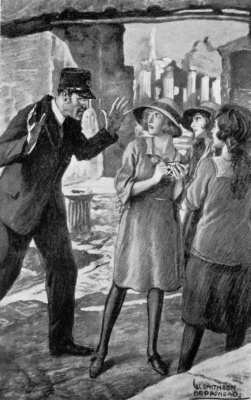 "'SIGNORINA! IT IS NOT PERMITTED!'"
—Page 105
"I'm awfully sorry. I won't do it again, really," murmured Irene,
cramming the little camera back into her pocket.
But this apology did not content No. 24. He very courteously, but quite
firmly, insisted upon temporarily confiscating the prohibited article.
Miss Morley, who hurried up at the sound of the altercation, took the
side of the authorities.
"Who brought a camera? Irene! You knew it was not allowed. Yes, you
must let the guide have it. He'll give it back to you at the gate. I
hope there won't be any trouble about it. I believe you can be fined. It
was very naughty of you to do such a thing."
Much crestfallen Irene retired into the rear of the party, and bewailed
the fate of her snap-shots.
"It was hard luck the guide should pop round the corner that exact
minute," she groaned.
"Mabel fetched him," squeaked Désirée. "I could see over the railing,
and I watched her go. She was mad that you wouldn't put her in the
photo."
"What a sneaking trick to play. She's the meanest girl. I wouldn't
have told about her. I hope No. 24 won't take the spool out of the
camera, because there are three undeveloped snaps of the Villa Camellia
on it, and I shall be wild if I lose them. He couldn't be so heartless.
If I only knew Italian better I'd try and coax him."
The guide had obligingly waited while the girls ate lunch, but he now
waxed impatient, and hurried his party on to the House of Pansa. This
must have been quite a palatial residence, and showed such perfect
examples of the arrangement of the various rooms in a Roman mansion that
they lingered a long time looking at the atrium, the tablinum, the
peristyle, and the kitchen with its curious mosaics of snakes. Now,
though it was all very interesting, it was certainly tiring, and some of
the girls grew weary of listening to the guide's descriptions in Italian
or Miss Morley's explanations.
"I'm bored stiff," confessed Delia, in a whisper, linking on to Irene's
arm. "If I have any more information crammed into my head it will burst.
I know quite enough about ancient customs already. All I can say is I'm
thankful I'm living now instead of then. Renie, if you love me, take me
out of ear-shot of Miss Morley and let me chatter and frivol."
"Poor old sport!" laughed Irene. "Let's slip away and take another turn
round the garden while the guide finishes haranguing. I'm out of friends
with him since he stole my camera. He doesn't deserve anybody to listen
to him. I've a few chocs left in this package. You shall have some to
cheer you up. They're modern at any rate."
"You mascot!" murmured Delia. "Stella says I'm a Goth, but why need I
like old things? Did the Pompeians take their schoolgirls to look at
buried Greek cities, or were they satisfied with their own times? How
soon do you think we shall have tea? These chocs have saved my life, but
I'm longing for bread and butter and buns."
"Why, we haven't finished lunch very long."
"I ate more than half of mine in the carriage, so I hadn't much left.
Hello! Where have the others been? I didn't know there was a way up
there."
The rest of the party were clattering down a flight of wooden steps with
many expressions of admiration for what they had seen at the top.
"Perfectly beautiful! The finest view of all," purred Miss Morley.
"Renie and Delia, didn't you go up? You silly girls. You've missed a
treat. No, I'm afraid we can't wait now. The guide is anxious to take us
on. We haven't seen the House of Sallust yet or the Street of Tombs. I
want to ask him whether they've been doing any more excavations near the
Herculaneum Gate."
Miss Morley, deep in conversation with No. 24, passed on, in the full
belief that all her flock were following behind her. Irene and Delia,
however, were determined to have just one peep at the view from the top
of the wall, so both made a dash up the wooden staircase. From here
there was a glorious prospect of the entire city with its arches and
columns and broken temples, its cypress trees, and its somber background
of smoking mountain. They could see exactly the way they had come from
the entrance, and could tell which was the Street of Fortune and which
the Street of Abundance. It was so fascinating that they lingered rather
longer than they intended.
"They'll be waiting for us," ventured Irene at last.
"Oh, bother! So they will," exclaimed Delia, rushing down prepared for a
scolding.
But the others had not waited. They had all simply walked on, and the
custodian had locked the gate behind them. It was fast closed, and no
amount of shaking would move it.
"We're shut in," gasped Irene. "Where's the porter? He ought to be
somewhere about with the key."
The custodian, quite oblivious of the fact that anybody had been left
inside the House of Pansa, was reading a newspaper and eating bread and
garlic under his wooden shed farther down the street, where he would
remain till the next guide came along with a party and requested
admission. So he did not hear, though the girls thumped and called and
made a very considerable noise. They were both horribly frightened.
"Shall we have to stay here all night?"
"I'd be scared to death."
"Think of the spooks!"
"Why the whole place must be simply chock-full of ghosts after
sunset."
"Couldn't we jump from the wall?"
"I wish I'd never come. Oh, I hate things b.c.! I shall have fits in a
minute."
Fortunately for Delia's nerves they were not kept long in durance vile.
Lorna very soon discovered the loss of her buddy, drew Miss Morley's
attention to the matter, and the whole party hastened back to look for
them. The custodian was fetched from his wooden shelter and unlocked the
door, loudly disclaiming any responsibility on his part, and blaming the
guide.
"It's your own fault," scolded Miss Morley. "You really must keep with
the party. I can't have any of you wandering off alone. You can't expect
me to count you every time we come out of a building. I put you on your
parole not to get separated again."
"We won't indeed, indeed! We don't like being lost," promised the
delinquents earnestly.
Everybody, including the Principal, was very tired by this time, and not
altogether sorry when the guide finished his tour of the ruins, and
conducted them safely back again to the entrance.
"It's glorious, but you want days to see it in, instead of only a few
hours," sighed Phyllis.
"And cast-iron backs and legs," agreed Sybil. "I shall enjoy thinking it
over when I'm home, but I'm ready to drop at the present moment."
"What about my camera?" asked Irene anxiously.
The guide had not forgotten it; he produced it from his pocket,
and—perhaps in consideration of the tip he had received from Miss
Morley—he did not confiscate the spool, but handed it over intact with
a polite gesture and a cryptic smile.
"Grazie molto—molto!" murmured Irene, which meant "Thanks awfully,"
and was one of the very few Italian phrases which she knew.
Everybody was extremely glad to adjourn to the restaurant, where tea had
been ordered for their party, and a table reserved for them. The big
room was full of visitors and rather noisy; a band of musicians in the
center rendered Neapolitan songs to an accompaniment of mandolins and
guitars, and occasionally the audience joined the choruses. The
performance was not of the highest quality, but it was tuneful and
interesting to those who had not before heard the folk-songs of Southern
Italy. After tea the girls made a rush to buy post-cards and other
mementoes of Pompeii, which were on sale in a room next to the
restaurant, and would have spent half an hour over their purchases had
not Miss Morley collected her flock and insisted on a homeward start.
Poor little Désirée slept all the way back in the tramcar, with her head
on Stella's shoulder, and most of the party were in much more sober
spirits than when they had started. All felt, however, that it was a
never-to-be-forgotten experience.
"I'd adore to go again sometime," ventured Lorna, clasping a model of a
Pompeian lamp, which her chum had given her for a souvenir.
"So would I," agreed Irene. "Miss Morley calls this 'part of our
education,' and I think it's a very sensible way of teaching things. I
hope she'll take us to other places."
"You'll get Vesuvius if your conduct sheet is all right."
"Oh, lovely! I'd rather go there than even to Pompeii."
"The same this child," chipped in Delia. "Renie, I guess you and I will
have to shake ourselves up and reform for a week or two. We were in Miss
Morley's black book to-day, and if we don't take care we shall be left
out of the next excursion."
"I'll be an absolute saint," promised Irene. "You'll see me sprouting
wings. I'm going to draw a physical map of the world and mark in all the
principal volcanoes, and then show it to Miss Morley. She'll think it so
brainy of me and be so glad I'm interested in the subject. She'd really
feel I ought to see Vesuvius after that."
"You schemer! It's not a bad idea though, and perhaps I'll do the same,
though I hate drawing maps. Hello! Is this the piazza? I'd no idea we'd
got back to Fossato so soon. Yes, it's been a 'happy day,' but I feel
all I want now is supper and bed."