THE JOHNSTOWN DISASTER WHICH ECLIPSED HISTORY.
A DEATH-DEALING DAM.
Hundreds upon Hundreds of People
Swept Away by the Flood.
There is not one chance in a million that the Conemaugh river
would ever have been heard of in history had it not been for its
action on Friday evening, May 31.
The Conemaugh river is, or rather was, a simple little stream
that meandered through Northwestern Pennsylvania and made glad
by its peaceful murmurings those who dwelt by its bankside, or bore
tokens of affection in the way of pleasure-seeking picnickers, moonlight
parties or across-stream excursionists upon its placid bosom. It
was one of those inoffensive creeks, termed by courtesy a river, that
the Hudson river of the East, the Mississippi of the Middle or the
Red river of the West might call a stripling.
There are times when even the still, small voice arises in its
might and asserts its supremacy, and the wee small river of Conemaugh
did that self-same thing on Friday evening, May 31. All
along the banks of the listless, yet ever flowing, little alleged river
the farmers were preparing for their anticipated harvests; the fishermen
of the section—amateur fishermen indeed, for they were only
equal to the fish—small and incomplete as was the Conemaugh, such
as you and I, reader, who took pleasure in flinging their worm-crowded
hooks into the stomach of a log and then going home for
more bait; bonny fairies, brisk young tillers of the soil, toilers, and
seeming-tired miners, these and all other human concomitants that go
to make up such a quiet, thriving bailiwick dwelt in the locality.
And so went on the listless life of the denizens of the Conemaugh
Valley, nestling at the foot of the Allegheny range.
Snuggling in the cosiest nook, right where no prying reporter or
trout-fishing President ever bent his way was Johnstown. The word
“was” is used advisedly, Johnstown is no more. At four o’clock on
the fateful day all was serene. At six o’clock all was desolation and
destruction.
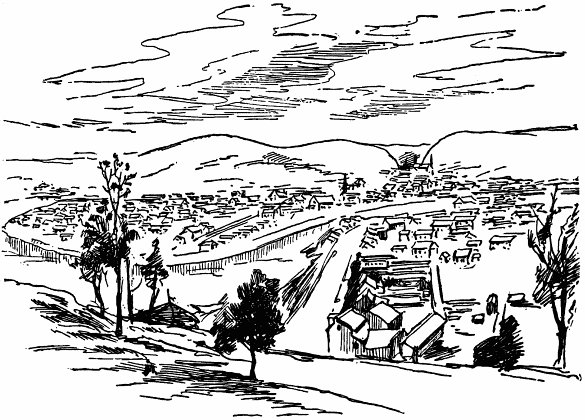
THE OLD JOHNSTOWN.
The “big dam” had broken and the little brooklet had burst its
sides for very glee at being dubbed a creek, and was making itself
known in history. The Brooklyn Theatre holocaust, with its dead
three hundred, paled into insignificance. The Mud Run and Reading
disasters had to take a back seat.
“Let me alone for horror,” murmured the Conemaugh, “and I’ll
get there!”
It did get there.
Right above Johnstown on the self-same Conemaugh, or rather
where the North Fork glides into that erstwhile inoffensive stream,
was a reservoir.
The reservoir is on the site of the old lake, which was one of the
feeders of the Pennsylvania Canal. It is the property of a number
of wealthy gentlemen in Pittsburgh, who formed themselves into the
corporation, the title of which is the South Fork Fishing and Hunting
Club. This sheet of water was formerly known as Conemaugh Lake.
It is from two hundred to three hundred feet above the level of
Johnstown, being in the mountains. It is about three and one-half
miles long and from a mile to one and one-fourth miles in width, and
in some places it is 100 feet in depth. It holds more water than any
other reservoir, natural or artificial, in the United States. The lake
has been quadrupled in size by artificial means, and was held in check
by a dam from 700 to 1,000 feet wide. It was 90 feet in thickness at
the base, and the height was 110 feet. The top has a breadth of over
twenty feet.
From what could be ascertained by the writer, the reservoir-banks
had not been considered absolutely safe by the people of the big and
growing town. The reservoir was an artificial rather than a natural
lake. The art came in when the South Fork Club, a corporation of
gentlemen, took charge of the reservoir and dammed it. The South
Fork Club had the dam inspected once a month by the Pennsylvania
Railroad engineers, and their investigation showed that nothing less
than some convulsion of nature would tear the barrier away and
loosen the weapon of death. The steady rains of the past forty-eight
hours had increased the volume of water in all the small mountain
streams, which had already been swelled by the lesser rains earlier in
the week. At this time it was evident that something in the nature of
a cloudburst must have occurred just before the waters broke through
the embankment.
Then the water came.
It came with a rush that astonished the natives.
There was a low murmuring at first, and then a rushing, hissing
noise; then crevices appeared in the dam side. Then the embankment
gave away, and onward rushed the torrent. It meant death and
destruction to the fairest country on God’s footstool. Johnstown became
a City of the Dead, and the once pleasant valley was the Valley
of Death.
Only those who were on the spot at the time can or could tell of
the terrible scenes that ensued, and even they could not depict them
in their real colors. It would take the pen of a mightier than human
hand to indite the story, and a brush of a heaven-inspired artist to delineate
the action. All was desolation, death and destruction.
Men, women and children, animals, houses, furniture, were swept
on the hell-bent waters!
All through Cambria came the flood. Then on to Cooperdale.
Frantic mothers, with children born and unborn were compelled to
flee, and then had to succumb to the deluge. The cruel, on-rushing
tide had nothing in its instincts humanitarian. The death-tide rolled
onward and suckling babes were swept from their mother’s breasts
even as if the King of Old had proclaimed.
So on to St. Florence in Fairfield—well-named. The people at
Ninevah and the quiet, easy-going folk of the cruel-river towns
counted their losses by hundreds.
“Ten thousand dead,” was the announcement that came over
the wires.
The effect can never be told. Centuries may come and go, but
no century can make its mark in the history of time like that of the
Nineteenth, with its aide, the Conemaugh.
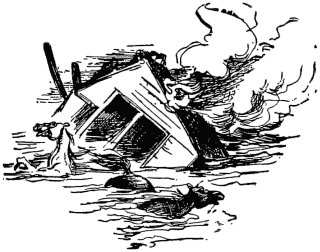
MIDST FIRE AND FLOOD.
Hundreds upon hundreds of lives were lost. The number cannot
even be approximated, for in such regions there are always
innumerable people—what the careless world calls its floating population—who
would not be missed or accounted for until the Judgment
roll is called.
Even on Monday, three days after the horror, mothers meandered
about frantically begging that their children might be returned to
them, and men with hearts brushed tears from their eyes and endeavored
to make them believe that their dear ones had been rescued.
Children pleadingly prayed that they might be saved, but the cruel,
ever onward-rushing flood gathered them in and swept them onward.
To add to the horror the Johnstown Bridge, as if to add terror
to terror and to make confusion worse confounded, swept from its
approaches and precipitated the horror-stricken multitude into the
torrent. An overturned stove in a dwelling inaugurated a conflagration.
Nearly a hundred people were literally burned to death,
thus adding holocaust to the far more preferable death by drowning.
Scarcely had the news of the terrible disaster been sent abroad
than the alert newspapers had their commissioners speedily on their
way to the scene.
Only the most meagre accounts had been given to the public for
the reason that every mode of communication via telegraph or train
had been cut off.
When the newspaper representatives reached Johnstown the scene
was a pitiable one. The former town was a swamp. Debris was
piled here, there and everywhere, and the pestilential stench from the
dead bodies was next to unbearable.
The scene beggars description.
Even the trained newspaper men turned their eyes aside and
held their nostrils. Corpses everywhere. Dank corpses at that, with
glazed, fishy eyes and sloppy wet hair, that made the onlooker feel
aweary, and not over anxious to handle.
In a single hole, after the waters had passed by, one hundred
and fifty bodies were found. Just imagine it! Two hours before
these one hundred and fifty souls were alive, but there they were,
huddled together as if they had been congregated for the purpose
which had asserted itself.
East Conemaugh was almost depopulated, and Franklinborough,
on the north of Johnstown, was entirely swept away. Mineral Point,
between Johnstown and the viaduct, was blotted out of existence. If
any of the six hundred souls that formerly resided there are alive,
the reporters could not find them. Ninevah, just below the Conemaugh
furnace, is a city of corpses. Indeed, from South Fork to
Bolivar and for a distance of a dozen miles or so the banks of the
old-time river are literally strewn with corpses.
After the death-dealing current had gone on the work of tallying
began. It will never be ended.
Then the fiends in human shape began their ghoulish work of
robbing the dead. Summary punishment was dealt out to some of
them. A vigilance committee, hastily organized, ran a score of them
into the river, and that was the end of them.
At five o’clock on Monday evening hundreds upon hundreds of
citizens are arriving upon the scene. Coffins are coming in by the
carload, and the result of philanthropic and necessary aid began to
pour in.
More relief is needed.
The best story of the horror can be gathered from the tale of an
eye-witness, C. W. Linthicum. Said he:
“My train left Pittsburgh Friday morning for Johnstown. The
train was due at Sang Hollow at 4.02, but was five minutes late.
“At Sang Hollow, just as we were about to pull out, we heard
that the flood was coming. Looking ahead up the valley, we saw an
immense wall of water thirty feet high raging, roaring, rushing
toward us.
“The engineer reversed his engine and rushed back to the hills
at full speed, and we barely escaped the waters. We ran back three
hundred yards and the flood swept by, tearing up tracks, telegraph
poles, houses and trees.
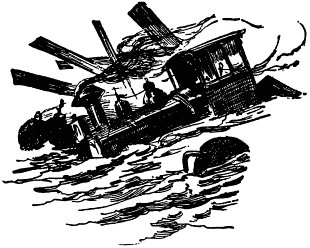
A STEAM HORSE WRECKED.
“Superintendent Pitcairn was on the train. We all got out and
tried to save the floating people. Taking the bell-cord, we formed a
line and threw the rope out, thus saving seven persons.
“We could have saved more, but many were afraid to let go the
debris. It was an awful sight. The immense volume of water was roaring
along, whirling over huge rocks, dashing against the banks
and leaping high in the air, and this seething flood was strewn with
timber, trunks of trees, parts of houses, and hundreds of human
beings, cattle and almost every animal.
“The fearful peril of the living was not more awful than the
horror of hundreds of distorted, bleeding corpses whirling along the
avalanche of death.
“We counted 107 people floating by and dead without number.
A section of roof came by, on one of which were sitting a woman
and a girl.”
Other tales by eye-witnesses confirm the fact that the horror has
never been excelled by anything of its kind in history.
Indeed, it will never perhaps be known what the real extent of
the awful calamity is.
Johnstown, with its former population of ten thousand or thereabouts,
was almost entirely swept away when the awful floods came,
and many of the villages between that point and Nineveh are things
of the past so far as life is concerned. Indeed the whole valley is a
veritable Valley of the Shadow of Death.
So great was the crush of the wreckage, debris and dead bodies,
at some points along the valley that dynamite had to be used, thus
adding to the horror of the scene.
Nineveh is twenty-three miles below Johnstown, yet a large number
of the bodies found at Nineveh were those of former residents of
Johnstown, who had been swept that great distance down the valley
to their death.
There are incidents where bodies were carried a hundred miles
and there deposited.
A relation of some of the real facts, circumstances and scenes
and incidents of the terrible disaster would be considered Munchausenish
by the majority of our readers, but some of them were miraculous.
Here is one. S. H. Klein, a New Yorker, had a queer experience.
He was at the Merchants’ Hotel and he worked like a
beaver during the trying times of Friday night and Saturday morning,
aiding in the rescue of no less than sixty persons from the floating
debris. Among these were the Rev. Mr. Phillips, his wife and two
children. Mr. Phillips is a stalwart man and when the flood struck
his house he fled to the roof with his family. Presently the house
floated and the sturdy dominie placed his wife and two children on a
table. Then he got under the table, and, letting it rest with its
precious burden on his head, arose to his feet. As the house floated
down on the tide it grazed the hotel building, and Mr. Klein and
others assisted in hauling the imperilled parson and his family into
an upper window of the hotel.
Here are other incidents: The story of the mishap to the day
express train at Conemaugh bridge is developing slowly through the
efforts of the railway authorities to obtain definite information. Of
the 300 passengers on the train, all but eight seem to be accounted
for, and it is believed that these eight are lost. They are Bessie
Bryan, daughter of Mahlon Bryan of Philadelphia, and her companion,
Miss Paulson of Pittsburgh; Mrs. Easley, Rev. Mr. Goodchild and
Robert Hutchinson, of Newark, N. J.; Andrew Leonard, Mrs. J.
Smith and Chris Meisel, manager of the Newark baseball club.
Miss Bryan was a delicate young woman. She was returning
from a Pittsburgh wedding with Miss Paulson. They had been preceded
the night before by the bridal couple, who were to be guests
at the Bryan home at Germantown. They rode in the Pullman car,
and did not get out quickly enough. Fearing that they could not
reach the hill where the other passengers took refuge, they returned
towards the car, but before they had reached it the waters caught
them and carried them away.
Miss Rose Clarke, a beautiful and well-known young lady, the
daughter of a very prominent citizen, had a remarkable experience.
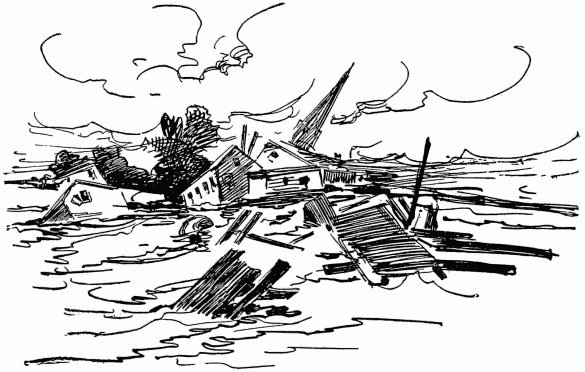
A SECTION OF JOHNSTOWN NOW.
“When the water rose,” she said, “we were all at home. It
drove us from floor to floor, and we had just reached the roof when
the house started. It went whirling toward the bridge, struck it, and
went down. Mother, my little sister and I all caught on another roof
that was just above the water, but father and my little brother went
down with the house. Father’s face was towards us as he sank. He
shouted goodby, and that was the last. Just then my little sister lost
her hold and she followed father and brother. Then mother called
out that she was going to drown. I got to her and raised her head
out of the water. My head rested on a sawlog and a board protected
me from the other timbers. Some rescuers came running down the
bridge and saw us. I made them take mother out first and
meantime I struggled to get out of the timbers, but they closed
in on me.
“The more I struggled the tighter they held me. The fire was
just behind me, and I could feel its heat. By the time the men had
carried mother to the bank the fire was so fierce they could hardly
get back. When they did reach me they could not get me out, for
my foot was fast between a saw log and a piece of timber. Then
they ran for tools. The fire kept sweeping on before the breeze from
up stream. I had almost resigned myself to an awful death when
some other men braved the fire and reached me. They began chopping
and sawing. One blow of an axe cut off a drowned man’s hand.
The men tied a rope around me. How they got me out finally I
scarcely know. My kneecap was almost cut off. When the current
sucked my father down he caught me by the foot; that is what dragged
me so far into the timbers.”
Miss Clarke and her mother are both badly injured. Some of
the men who rescued the young lady were Slavs.
Miss Mamie Brown was caught in the timbers in almost the
same way as Miss Clarke, near the bank. The fire was coming on
towards her, and the would-be rescuers had been driven back. Finally
John Schmidt braved the dangers and rescued her. Father Trautwein,
of St. Columbia’s church, who witnessed Schmidt’s brave conduct,
said if any man is a hero Schmidt is that man.
As has been written dynamite had added its horror to the sixty-acre
mass of wrecked buildings, railroads, streets and human beings
that lie above the railroad bridge. A half dozen times on the afternoon
of June 6, the heavy thunder of the huge cartridges was heard
for miles around, and fragments of the debris flew high in the air,
while at a distance the crowd looked on in dreadful sorrow at the
thought of the additional mangling that the remains of the hundreds
of bodies still buried in the mass were bound to undergo. There was
little complaint, however, even on the part of those who have relatives
or friends buried there, for the work of the past few days has shown
how futile was the idea that anything but an explosive could effectually
break up and remove the compact mass.
All that hundreds of men have been able to do has amounted to
nothing more than a little picking around the edges. Even the dynamite
is doing the work slowly. The surface of the mass about where
it was used is upheaved and washed about a bit, but the actual progress
is, so far as can be seen, very small. It will be a week before
the gorge can be opened even now. Meanwhile a proposition is being
discussed not to open it at all, but to bury it deep, and by filling in to
raise the level of the whole city.
There has been an unpleasant feeling between rival committees
of citizens, and at a meeting held in Johnstown on Tuesday the
whole matter was settled by the resignation of Chairman Moxham, of
the old relief committee, and the appointment in his place of J. B.
Scott, of Pittsburgh, who is also chairman of the local relief committee
in that city. It is believed that this will be an additional guarantee
to the country of fairness and impartiality in the disbursement of
the funds.
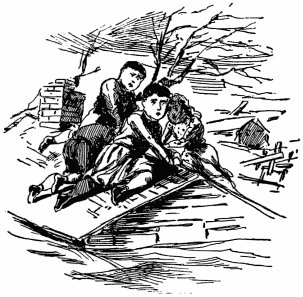
“WHERE’S MAMMA.”
Gen. Hastings has made an estimate than the number of proven
deaths will reach 5,000 and that the total will be 8,000. Besides the
bodies which are dug up in this city, scores are brought in daily in
wagons and carts from places down the river, where they have been
washed ashore. The number of the unknown increases as the passage
of time increases the difficulty of identification, and Gen. Hastings’
estimate is considered extremely low. The abject destitution is now
believed to be confined to Johnstown and the knots of towns immediately
surrounding it. South Fork is now in railroad communication
with Altoona, and whatever is needed for people there and at Mineral
Point and other adjacent places can come in from that direction until
railroad and other routes can be opened up the valley from here.
The towns are small and the proportion of deaths smaller than here.
The chief labor of the living is still the burying of the dead.
Their sole dependence for support is upon the charity of the country,
a charity, be it said, that is proving as ready as the occasion is pressing.
The immediate daily necessities of the suffering people are being
met by trainloads of provisions and clothing that come in from all
directions. The money available is being used to employ the idle in
clearing away the debris, exhuming the dead from their hiding places,
and generally in making Johnstown, to an extent, an inhabitable place
once more for those of its people who have further need of homes
above ground. What has been done and can be done with the money
already in hand is a trifling beginning, but already the place shows the
effects of the gangs of laborers who have been set to pulling down
damaged buildings, removing and burning the bodies of animals and
other offensive debris, and doing whatever else seemed most immediately
necessary for the health and well being of the place.
From the morgue in the Fourth Ward school-house 350 bodies
have been buried, and more are taken to the Grove Hill Cemetery
every hour. They are buried there singly, if identified, and in rows
and narrow trenches, one on top of the other, if not. The scenes at
the different relief agencies, where food, clothing and provisions are
given out on the order of Citizens’ Committee, are extremely interesting.
These are established at the Pennsylvania Railroad depot, at
Peters’ Hotel, in Adams street, and in each of the suburbs.
At the depot, where there is a large force of police, the people
were kept in files, and the relief articles were given out with some regularity,
but at such a place as Kernsville, in the suburbs, the relief
station was in the upper story of a partly wrecked house.
The yard was filled with boxes and barrels of bread, crackers,
biscuits and bales of blankets. The people crowded outside the yard
in the street, and the provisions were handed to them over the fence,
while the clothing was thrown to them from the upper windows.
There was apparently great destitution in Kernsville.
“I don’t care what it is only so long as it will keep me warm,”
said one woman, whose ragged clothing was still damp this morning.
The stronger women pushed to the front of the fence and tried to
grab the pieces of clothing which came from the windows, but the
people in the house saw the game and tossed the clothing to those in
the rear of the crowd. A man stood on a barrel of flour and yelled
out what the piece of clothing was as it came down.
At each yell there was a universal cry of “That’s just what I
want. My boy is dying: he must have that. Throw me that for my
poor wife.” and the like of that. Finally the clothing was all gone,
and there was some people who didn’t get any. They went away bewailing
their misfortune. The fortunate ones were gleeful.
Thousands upon thousands of dollars are being telegraphed here
hourly, yes, every minute, for the relief of the bereaved. New York
has come to the front nobly with over $200,000, and Brooklyn, Philadelphia,
Chicago and other cities, and, indeed, nearly every town and
village in the country has sent its quota of relief funds.
A word should be said right here regarding the cause of the disaster.
The South Fork Fishing Club is held chiefly responsible. The
broken dam shows that it was simply a pile of dirt and rubble
dumped across a stream between two hills that formed the banks of
the reservoir. When the water began to break through this dam everything
had to give way, causing a torrent sixty feet high to rush onward
toward the doomed valley.
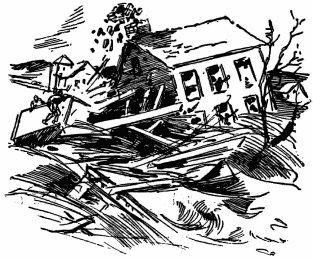
DOWN WITH THE TIDE.
The dam was built many years ago to create a reservoir for use
as a feeder to the Pennsylvania Canal. The builders placed in the
forty-foot space at the bottom, where the creek ran, five huge pipes,
each as large as a hogshead. These were covered by an arch of
massive masonry, and were arranged to be opened or closed by levers
in a tower that was built in the centre of the dam.
These five big pipes were calculated to be large enough to carry
off all surplus water that could ever be poured into the lake above
and which could not escape by the regular exit, which was a sluiceway
around one corner of the dam at a level of eight or ten feet
below the top. This sluiceway was really a new stream, the water
passing off through it finding its picturesquely winding course down
the hillside and running with the stream again some distance below
the dam. The sluiceway and waste gates never failed to do the work
for which they were designed, and there is no reason to suppose that
they would have failed to do so at the present time and for the future
had they been maintained as the builders contemplated.
When the Pennsylvania Canal was abandoned the dam became
useless, and was neglected. The tower in which the machinery
managing the waste gates is located is said to have fallen into ruin a
few years ago.
The lake was then leased by the Pittsburgh Sportsman’s Association.
Engineer Fulton, of the Cambria Iron Company made an
inspection of it and pronounced it dangerous. The Association set
out, they declared, to improve and strengthen it.
They did cut off two feet from the top of the dam, and may
have strengthened it in some respects; but either because the waste
gates were so damaged that to repair them would have been an
expensive job, or, for the other reason mentioned, that the fish would
escape by the waste gates, everyone who lives near says the gates
were permanently stopped up. The present appearance of the wreck
of the dam indicates the truthfulness of the story. There are remnants
of the waste gate masonry, but there is no indication that they
have been of any practical use for a long time.
Another awful day has come and gone, and as the work of unearthing
the bodies goes bravely on, scenes and incidents have been
more heartrending, if possible, than those of the previous days.
It is now a pretty well settled fact that at least 12,000 souls were
washed downward to destruction, desolation and death. It may be
more.
The destruction of property is already estimated at over $30,000,000,
but the returns are not yet all in by any means.
Up on the hillsides are whole camps of shrieking, crying, groaning
and moaning men, women and children, nearly naked, and
almost absolutely without sustenance. Willing hands are aiding and
assisting them by all means in their power, but these means are
extremely limited.
Thousands upon thousands, upon thousands again of dollars
from the charitably disposed through the country have been sent here,
and the money is being used as best it can. What is more necessary,
however, are large quantities of food and clothing.
The readers of this story can best appreciate this fact when it is
told that there is not a store of any consequence left in this place,
or, indeed, anywhere in the vicinity. The committee in charge of the
financial part of the work is in despair at the enormous extent of the
task before it, and to-day issued an appeal to the official authorities
and the financial organizations of the country to designate a commission
to take charge of the work.
Disease consequent upon the reaction after the excitement and
hardships of the past week threatens to make sad inroads into the
portion of the population that still remains alive. The condition of
the ruins, filled with dead bodies, menaces a still more serious situation,
which is being delayed, providentially, by the continued cool
weather. Danger hangs over the unhappy town from another source.
The presence of nearly ten thousand laboring men, half of them
gathered at random from the idle classes in other parts of the country,
and divided by race and other prejudices, threatens to lead to rioting
and disorder beyond the power of the military now on hand to quell.
Liquor has been introduced among these men surreptitiously and
trouble is feared. Very strict regulations are enforced. The whole
city is surrounded by a guard of soldiers, and more troops are under
orders in Pittsburgh, ready to come here at once if needed. An effort
is being made to cut off, as far as possible, the means of entrance to
the city, so as to keep away the crowds. The number of passenger
trains has been reduced to the lowest possible number, and no tickets
to Johnstown are sold except upon a permit from the Relief Committee
at Pittsburgh.
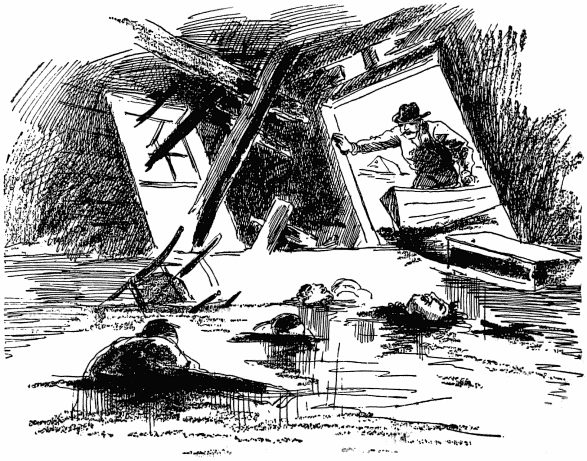
IN THE DEATH TRAP.
The feeling against the Pittsburgh association that owns the lake
and dam that caused the calamity grows more intense the more the
truth about the dam becomes known. The disclosure of the fact that
the dam was simply a heap of dirt with loose stone facings, instead of
a structure of solid masonry, and that the waste gates had been closed
up by the association, which was printed in a Pittsburgh paper the
other morning, made a sensation here, and threatens to bring the
matter to a head. Criminal prosecution is freely talked of, but it is
thought that it will be difficult to sustain a case, even in courts as
prejudiced as those in Cambria county will be against the dam owners.
The men are rich and responsible, however, and the liability of civil
action is generally believed to be complete. If they should be held
liable in civil suits for damages, it is probable that many, if not all of
them, will be financially ruined. There is an abundance of evidence
that the owners were frequently warned by old residents in the neighborhood
of the dam that it was becoming weaker and getting into a
more dangerous condition all the time.
One fact alone, as to the dam, ought to convict the dam owners
of negligence. The stone face that went up each side of the dam
was not continued across the top. In order to maintain a wagon
road there the top of the dirt heap had merely been leveled off and
left in its natural condition. It was a moral certainty that if the water
even rose so high as to go over the top of the dam it would wash it
out. With the water washing over the dirt top of the dam, the rock
facing would amount to no more, as a source of strength, than a
sheathing of cardboard. To have covered the top of the dam with a
substantial course of stone capping, arched, or in some other way
arranged to offer as little resistance as possible to the passage of the
water, would have spoiled the wagon road, but it might have saved
the dam.
Better opinion will no doubt prevail, and unless something new
transpires later another scene of devastation will be averted.
En passant, to show the power of the voluminous flood, these
incidents of the awful day are related:
The morning of June 6 the wreck of an express train was unearthed.
The baggage of Miss Annie Chism, of Nashville, Tenn.,
was found. She was a missionary on her way to Brazil for the
Women’s Foreign Missionary Society of the Methodist Church.
Among her effects was a Bible, and in it was a message to be
filed at Altoona and addressed to the Methodist concern at No. 20
East Tenth street, New York, announcing that she was on the train.
Her watch, some money and a Greek Testament were also found. It
is evident that many lives were lost on this train, more than at first
supposed.
The whole train affair is still a mystery. At least the passengers
have not so far been found and located. The body of a nicely-dressed
lady was found yesterday which was so decomposed as to be unrecognizable.
The effects of Miss Chism were sent to Altoona.
There was a small riot at the labor camp one morning on account
of a lack of food and of utensils for cooking. Mr. Flinn, who is at
the head of the labor bureau, told the men it was impossible to get
things down from the railroad, but that this would be remedied as
soon as possible.
He also said that they did not want men who expected to live on
the fat of the land, and that this was principally a work of charity,
even though the men were paid for their work.
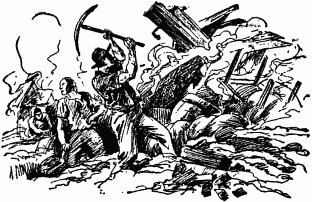
MINING FOR THE DEAD.
A few minutes after this, as Mr. Flinn was drinking some black
coffee and eating some hard crackers and cheese, two workmen came
up to him and commenced to complain because they did not have
soup and meat.
This enraged Mr. Flinn and after telling them that he thought
he was used to as good as they were, he ordered the guards to take
the men out of town and not permit them to come back again.
This seemed to have the desired effect and there was no more
trouble.
It had been known for several days that the Rev. J. A. Ranney
and the parents of Mrs. Charles Harly, of Delhi, Ind., were on one of
the ill-fated trains overtaken by the flood in Conemaugh Valley, and
no tidings could be received from them.
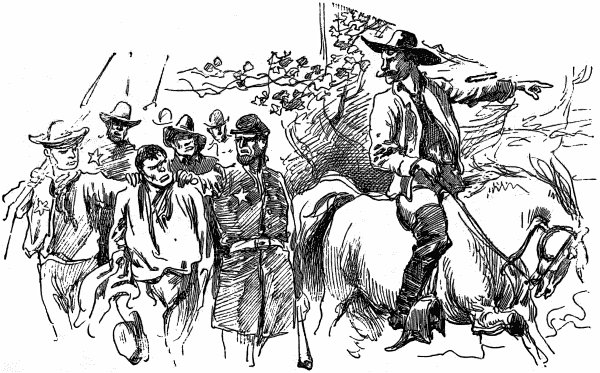
THE ARREST OF THE HUNS FOR ROBBING THE DEAD.
Word comes that Mr. Ranney has arrived home. He telegraphs:
“Mrs. Ranney and I were on the train at Conemaugh when the flood
came. The occupants of our car rushed for the door, where Mrs.
Ranney and I became separated. She was one of the first to jump,
and I saw her run and disappear behind the houses in sight. Before
I could get out the deluge was too high, and with a number I remained
in the car. Our car was lifted up and dashed against a car
loaded with stone, and was badly wrecked, but most of the occupants
were saved. As far as I know all who jumped from the car lost their
lives. The rest of the train was swept away. I searched for days
for Mrs. Ranney and could find no trace of her. I think she perished.
The mind cannot conceive the awful sight presented when we
first saw the danger. The approaching wall of water looked like
Niagara, and huge engines were caught up and whirled away as if
they were mere wheelbarrows.”
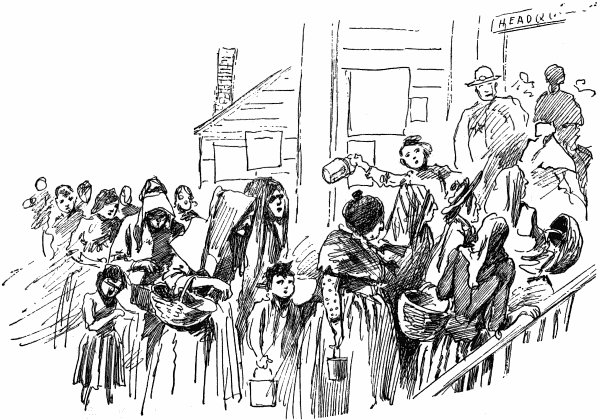
SEEKING RELIEF AT HEADQUARTERS.
Here is another telegram: “Mrs. Susan Stonebraker with her
three children, arrived at Camden Station, Baltimore, Md., from
Johnstown this afternoon, and was met by her brothers.
“We lived at Millville, just across the stream from Johnstown,”
she said. “When the water rose higher and higher we sought safety
at a neighbor’s. Soon after the water struck us with full force, and I
am sure some of the occupants of the house were drowned. Soon
after we all took planks and floated down the stream, as the waters
rose so high in the house that we thought it unsafe to remain. I saw
babies in cradles floating along, and one floated down as far as Allegheny
City, about eighty miles, where it was rescued. Our house
was the first to be dashed against the stone bridge, and immediately
after we were swept against it on our boards. I must have seen at
least a thousand persons drowned. We stayed on the wreck from
3:30 on Friday afternoon until after 3 on Saturday morning, when we
were rescued. My husband, Joseph H. Stonebraker, had several ribs
broken, and is now in the hospital. Before we were rescued the
wreck took fire, and had we remained a short time longer we would
have been lost.”
Word comes from Steubenville, O., to this effect: Mrs. Frank
Davis and her two children have arrived home from Johnstown with
the body of her husband who was employed there. Mrs. Davis and
her children went to visit him last week and stayed at the house of a
friend named Hamilton, where Davis boarded. During Friday water
came into the house, and all were busy moving things to the upper
floors. When the deluge came they were in the third story, and the
house was carried against a brick block and was partly broken up,
but stuck fast.
Davis’ foot got crushed in between the timbers and he was held
fast. Every effort was made to release him, but to no avail. With
one child clinging to her neck and the babe on her shoulders, Mrs.
Davis worked desperately, but the fastened foot could not be extricated,
and the water continued to rise. How this woman must have
suffered! Pangs of the most horrible death couldn’t be worse. Men
dived down into water to see what held the foot. The water reached
Davis’ mouth and he held back his head.
Mrs. Davis laid down her babe in the water and pulled with renewed
energy. The water came up to her husband’s nose, and while
with brave energy she attempted to rescue, she never lost sight of her
children, who at times she held above her head to keep them from
drowning. Then the roof was taken off the building, the floor lifted
up and floated down against another building, where it lodged, and
Mrs. Davis and her children were rescued.
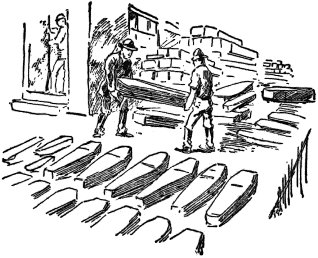
IN A MORGUE.
Other scenes of a like nature could be told and as usual in such
cases there was a hero of heroes present, a self-sacrificing young man,
who nearly lost his own life in his efforts to save those of his fellows:
Hundreds of lives were saved by this second Paul Revere, by
name John G. Parke, and hundreds more would probably have escaped
violent death if the warning had been heeded. It is not exaggeration
to call young Parke a hero. He is an engineer. He saw
that the South Fork dam must go, and jumping into the saddle, he
dashed down the valley at terrific speed, shouting out his warning:
“The dam! The dam is breaking. Run for your lives!” When
he arrived at South Fork station, Parke sent a telegraphic message to
Johnstown, two miles below, warning the inhabitants of the town of
the coming disaster. He sent his message fully an hour before the
flood came. When the water was almost upon him Parke fled to the
mountains.
Too modest to speak of his actions in this regard, young Mr.
Parke was prevailed upon to tell what he knew about the breaking of
the dam. Said he:
“On Thursday night the dam was in perfect condition, and the
water was not within seven feet of the top. At that stage the lake
is nearly three miles long. It rained very hard Thursday night, I
am told, for I slept too soundly myself to hear it, but when I got
up Friday morning I could see there was a flood, for the water was
over the drive in front of the club house and the level of the water
in the lake had risen until it was only four feet below the top of
the dam. I rode up to the head of the lake and saw that the woods
were boiling full of water. South Fork and Muddy Run, which
emptied into the lake were fetching trees, logs, cut timber, and stuff
from a sawmill that was up in the woods in that direction. This
was about 7.30 o’clock. When I returned, Col. Unger, the president
of the club, hired twenty-two Italians, and a number of farmers
joined in to work on the dam. Altogether thirty men were at
work. A plough was run along the top of the dam, and earth was
thrown on the face of the dam to strengthen it. At the same time
a channel was dug on the west end of the dam to make a sluiceway
there. There was about three feet of shale rock through which
it was possible to cut, but then we struck bed rock that it was impossible
to get through without blasting. When we got the channel opened,
the water soon scoured down to the bed rock, and a stream 30 feet
wide and 3 feet deep rushed out on that end of the dam, while the
weir was letting an enormous quantity on the other end. Notwithstanding
these outlets, the water kept rising at the rate of about 10
inches an hour.
“By 11.30 I had made up my mind it was impossible to save
the dam, and getting my horse I galloped down the road to South
Fork to warn the people of their danger. The telegraph tower is
a mile from the town, and I sent two men there to have messages
sent to Johnstown and other points below. I heard that the lady
operator fainted when she sent off the news, and had to be carried
off. The people at South Fork had ample time to get to the high
grounds, and they were able to move their furniture, too. In fact,
only one person was drowned at South Fork, and he while attempting
to fish something from the flood as it rolled by. It was just 12 o’clock
when the telegraph messages were sent out, so that the people of
Johnstown had over three hours’ warning.
“As I rode back to the dam I expected almost every moment to
meet the lake coming down on me, but the dam was still intact,
although the water had reached the top. At about 1 o’clock I
walked over the dam. At that time the water was three inches
deep on it, and was gradually eating away the earth on the outer face.
As the stream rolled down the outer face it kept wearing down the edge
of the embankment, and I saw it was merely a question of time. I then
went up to the club house and got dinner, and when I returned I
saw a great deal more of the outer edge of the dam had crumbled
away. The dam did not give away. At a rough guess I should
say that there was 60,000,000 tons of water in that lake, and the pressure
of that mass of water was increased by floods from two streams
pouring into it, but the dam would have stood it could the level of the
lake have been kept below the top of the dam. But the friction of
the water pouring over the top of the dam gradually wore it
away from the outer face until the top became so thin that it gave
away.
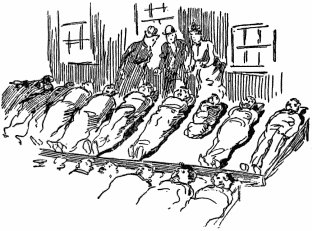
IDENTIFYING THE REMAINS.
“The break took place at 3 o’clock. It was about ten feet wide
at first and shallow, but now that the flood had made a gap, it grew
wider with increased rapidity, and the lake went roaring down the
valley. That three miles of water was drained out in forty-five
minutes. The downfall of those millions of tons was simply irresistible.
Stones from the dam and boulders in the river bed were
carried for miles.”
Perhaps the most heartless story in the annals of any city has
been told to-day of this unfortunate place. To charge extortionate
prices for food, as many of the people in the surrounding villages
did when the hungry survivors asked them for bread, was cruel
enough. This is an oft-told tale in the presence of such calamities
as this; but probably never before did vampires seek to use such a
terrible misfortune as this to ruin the souls, to try and lure the
orphans of the valley to the dens of vice.
Supt. Hines, the chairman of the Committee on Transportation,
is authority for the story that for the past two days two women of
Pittsburgh have been here offering homes in that city to young girls
who have been left without any protectors. Their object was not suspected
at first, but subsequently they were recognized, and it became
evident that their intention was to take girls away to their own places
of iniquity in the Smoky City. It is not known whether any of the
unfortunate maidens fell into the trap, as the two women became
frightened and left this scene of desolation. Supt. Hines was terribly
angered at this exhibition of utter heartlessness, and declared after he
had tried in vain to find them that had he laid his hands on them
they would have had a ducking in the Conemaugh before they got
away. It is related here that women of the same class have been
seen around the depots in Pittsburgh on the arrival of trains from
here waiting to see if they could not gain possession of the poor
victims who were going into the city to begin life anew in a strange
place.
To-day it is reported that a young lad, Eddie Fisher, has committed
suicide after spending a week in brooding over the loss of his
entire family, and that an unknown woman suddenly became insane
in the street and had to be removed to a hospital. It is impossible to
verify either of these stories, but they are thought to be true, though
no information could be had about them at headquarters.
New stories of incidents of the flood are heard every day, and
probably will continue to be told for weeks to come, but certainly the
most touching of any that have yet been narrated is that of the
Frohnheiser family. The father was a well-known workman in the
Cambria Iron Works, and lived with his wife, two little girls and a
son in a cottage, which was washed away. The mother and elder
daughter were lost, but the father managed to crawl from the room
with the other two children through a rent made by the flood in the
roof. He reached down after his boy and told him to come near to
him, but the lad answered: “It is no use, papa, you can’t save me,
I’m too far away. Save Katie, she is near to you.” Now the little
girl had her leg broken by being jammed in between some furniture,
and she cried: “You can’t save me, papa, for my leg is caught.
Save him or cut my leg off and get me out.” The boy also asked
the father to give him a pistol and he would shoot himself, but just
then the house, which had been floating down stream, suddenly struck
high ground and fell over on its side. The father landed unhurt, and
the two children were thrown out on the hillside. The boy was unhurt
and the little girl is now in the hospital doing quite well.
In order to prevent the spread of the pestilence which is feared,
fires were late last night started among the wreckage. Thus, in
order to save valuable remaining lives, it has been deemed necessary
to destroy by the other fearful element the festering debris, even if
the bodies underneath have to be cremated with it. It is the only
manner in which the health of the locality can be sustained.
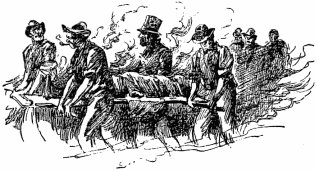
THE THREE HUNDREDTH BODY.
If Johnstown suffered, Cambria City was almost entirely wiped
out. The work of repairing the wreck in this place will be short, as
the flood did the most of it. Nowhere in all the fifteen-mile course
of the fearful torrent was the surface of the earth swept more clean
than in that place. Cambria City was a borough organized separately
from Johnstown, and lying below it on the opposite side of the river.
It began just below the railroad bridge, and extended for a mile down
the river. The Conemaugh below the bridge makes a long curve
from the mountains, and a flat a mile long, with a curving front half
a mile wide at its widest point, is left. Cambria City was built upon
this flat. There were 600 houses and about 3,000 inhabitants. Most
of the houses were small frame buildings very lightly built. There
were a few large stores, a small brick brewery, street car lines, electric
lights, and other substantial improvements above ground.
The plan of the town in a general way, was of four broad streets
running across the flat lengthwise, with numerous cross streets at
right angles. The first wild dash of the flood, when its advance
wave was shattered against the bridge, was turned aside into the
Cambria Iron Works, across the river from Cambria City. Passing
through these from end to end, the outer half of the flat upon which
Cambria City was built lay straight before it. The flood with a front
of twenty feet high, bristling with all manner of debris, struck straight
across the flat, as though the river’s course had always been that
way. It cut off the outer two-thirds of the city with a line as true
and straight as could have been drawn by a surveyor. On the part
over which it swept there remains standing but one building, the brewery.
With this exception, not only the houses and stores, but the
pavements, sidewalks and curbstones, and the earth beneath for several
feet, is washed away so that the water mains are laid bare. The
pavements were of cinders from the iron works, a bed six inches thick,
as hard as stone and with a surface like macadam. Over most of the
washed-out portions of the city not even the broken fragments of
these pavements are left. Along the edge of the river much of the
land was made ground built up of these cinders. The mass of them
was so great, and the surface afforded so little hold for the flood, that
the land here is two or three feet higher than further inland, where
the ground yielded easier. But even here the water left its mark.
Beside the sweeping away of all buildings upon the surface of the
land itself, the hard cinder mass is torn, split and corrugated, as if
chiseled and cut by some convulsion of nature.
Of the 600 houses of Cambria City nearly 400 stood upon the
part of the flat which the first rush of the flood covered. If all the
debris, not only of the houses, but of logs, timber and other driftwood
that the flood left upon that mile long short cut across the bend in
the river, were piled into a heap it would not make a mass as large as
a single one of all the buildings swept away. There are not half a
dozen wheelbarrow loads of earth or sand left upon the surface of the
flat. The rush of the water left nothing on top except the heavy
rocks and stones, and these were tossed about so thickly that they
cover the whole surface, distributed as though some volcano had
covered the earth with a shower of rocks.
Aside from the few logs and timbers left by the afterwash of the
flood there is nothing remaining upon the outer edge of the flat, including
two of the four long streets of the city, except the brewery
mentioned before and a grand piano. The water marks on the
brewery walls show that the flood reached twenty feet up its sides,
and it stood on a little higher ground than the buildings around it at
that. Jacob Greener, the owner, with his family and workmen—nine
men and two women in all—were caught in the building by the flood.
They took refuge in the attic over the store-room and were saved.
The brewery was completely wrecked and will have to be torn down,
but the main walls remained standing. The piano was built by
Christie & Son, New York, and was numbered 6,609. Its legs are
gone and its cover is missing. The keys seem a little out of order,
and two or three of the wires are broken.
Of the 200 houses that were not swept away by the short cut of
the flood across the flats, there are not half a dozen that are uninjured.
Fully half of them are wrecked completely. The value of those that
can be repaired would not pay for the cost of removing the others.
As far as property is concerned, it would have been cheaper if the
flood had made its clean sweep over the whole of Cambria City. It
would surely have done so had not the bridge checked it and turned
it aside.
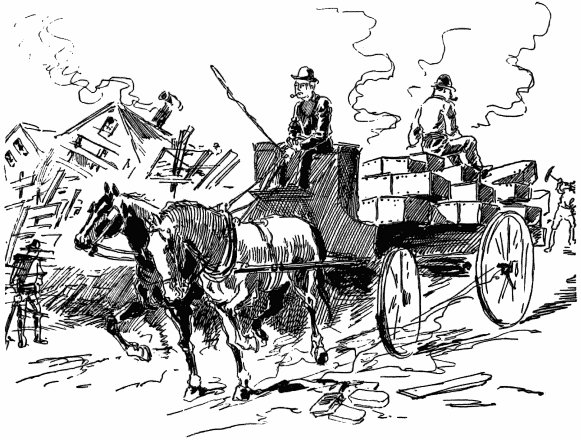
DEATH’S HARVEST CART.
The death rate among these fragile frame buildings was horrible.
The borough authorities estimate the loss of life at 1,100. Almost
750 bodies have already been recovered and brought to the morgue.
It is not probable that Cambria City will be rebuilt, at least for a long
time. The expense of preparing that rocky plain for building would
be enormous. There is not a street left or any landmark by which to
determine the location of lots, except the water mains through one or
two streets. The part of the town still in existence will probably be
put in order and maintained, but the broad flat will doubtless remain
a rocky desert for a long time to come.
And all the time all along the valley the work of recovering the
dead goes on with undiminished vigor, and as the workmen become
accustomed to the terrible scenes they apply themselves more diligently
to their duty and labor with a system that produces rapid
results.
The great number of bodies not identified seems incredible.
Some of these bodies have lain in the different morgues for four days.
Thousands of people from different parts of the State have seen them,
yet they remain unidentified. At Nineveh they are burying all the
unidentified dead, but in the morgues in this vicinity no bodies have
been buried unless they were identified. There are at present thirty
unidentified bodies at the Fourth ward school house.
These bodies have been lying there for the past three days, and
in that time at least forty thousand people have viewed them, but no
one has identified them, and they have nothing in their clothing to
indicate who they are. During the past twenty-four hours sixty
bodies were embalmed and taken from this place. This morning five
bodies were brought in.
But to enumerate would be too great a task, when reports of additional
bodies being found are constantly coming in from all points
along the valley.
Judge Advocate Rogers, of Gov. Beaver’s staff, this morning
decided an important question which arose by the discovery of forty
barrels of whiskey in a building on Main street. Adjt.-Gen. Hastings
was disposed to confiscate it as a safeguard, according to a section
in the military code which prohibited the sale of liquor within the
limits of a military camp. Judge Advocate Rogers ruled that it was
private property, and a licensed dealer had a right to sell liquor. Besides,
it was not a military camp, but a posse comitatus, the militiamen
doing police duty.
Last evening employees of Lutz & Son unearthed ten barrels of
beer from the cellar of a building on Main street. The body of a
man was found close beside it. The driver was bringing his capture
away when Major Samuel Hastings arrested him. Adj’t-Gen. Hastings
knocked in the head of a barrel and let the beer run into the
street. Under orders it was all destroyed.
“You will not be paid for the beer,” said Gen. Hastings to the
owners.
Among the bodies recovered in Kernville yesterday was that of
a young woman richly attired, wearing diamond rings and a gold
watch marked “J. J. L. to E. J. L.” The remains were taken to the
chapel on the hill.
It is said that many cases of fever and diphtheria and pneumonia
are being concealed from the people here for fear a panic may seize
the workers, and if that should happen now probably no firm or people
would attempt to touch the work here perhaps for months. Disinfectants
of all kinds are being freely used by the car load, and, in
addition to this, a score of blazing piles in every direction shows that
the purifying element of fire is being applied as rapidly as possible
for the safety of the living.
Work was resumed to-day in the shops of the Cambria Iron
Company’s mammoth steel mill, and the repairs to the building are
being made with remarkable rapidity. The damage to the buildings
has been stated, but the machinery was only slightly damaged. The
blast furnaces were not hurt at all, and will be in operation as soon as
a supply of coke can be obtained. There is some coke on
hand, but it is too small an amount to begin with. The most
serious loss to the firm was the destroyed papers, letters, order
books, etc.
The members of secret societies on the Conemaugh Valley fared
unusually well. The junior O. U. A. M. are very strong here, having
a membership of 1,200. Out of this number only nine lives were lost.
Most of them lost their homes, but all have employment and expect
to be on their feet again in a short time. The committee from Pittsburgh
and Allegheny established headquarters in the upper end of
the town and relieved the wants of all who applied. The councils
responded, not only very liberally, but promptly.
The Independent Order of Heptasophs had a membership of
eighty-five, and lost but two. None of their members are in want,
and the committee sent to distribute provisions and clothing have returned
home. They had more than enough.
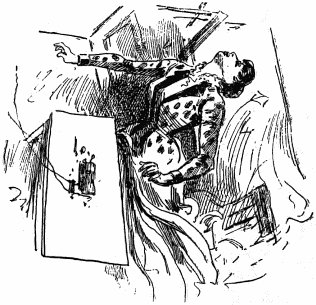
A TELEGRAPH OPERATOR’S DEATH.
The Independent Odd Fellows had a membership of 506 here,
and out of that number lost seventy-nine. The distressed members
are being well cared for.
It is not known how many of the Masonic Order are lost, although
a prominent Mason says they are few, and the survivors are being
royally provided for by the relief committee of that fraternity.
A trap was laid for the crook undertaker who was robbing the
bodies in the Fourth ward morgue. A female was brought in, and before
it was dressed for burial a diamond ring was placed upon one of
her fingers, and the pseudo undertaker was assigned to take charge of
the body. He was detected in the act of stealing the jewelry, and
was promptly arrested by the chief of police, who immediately took him
to Ebensburg. The officials refuse to give the name of the man.
About forty bodies were recovered to-day up to 3 p. m., but of
these only three were recovered at the bridge.
Chalmer L. Dick, the ghouls’ nemesis, bid good-by to this ill-fated
town last night. He will hereafter reside in Mount Pleasant.
Already twenty barrels of embalming fluid have been consumed,
aggregating 800 gallons. It requires from half a pint to a quart for
each corpse.
A Masonic relief committee has been organized and solicits aid
for distressed Free Masons and their families. Remittances should be
made by New York or Pittsburgh drafts to the order of Col. John F.
Linton, treasurer, or Wm. F. Myer, secretary. Knights of the Mystic
Chain are requested to forward all subscriptions to the Supreme Recording
and Corresponding Scribe, box 321, Pittsburgh.
Fifteen bodies were received at the Fourth ward morgue, of which
seven were unidentified, as follows: James Murray, of Philadelphia;
William Marshall, Johnstown; Mrs. J. J. Llewellyn, Johnstown; Jas.
Dillon, Somerset; Marion Root, Johnstown; Miss Annie McKinstry,
Mrs. McKinstry and Jessie Hipp, Johnstown. At the Pennsylvania
Railroad morgue six bodies were received, and two identified as E. M.
Thomas and Howard J. Roberts, cashier First National Bank, Johnstown.
At the Presbyterian Church morgue ten bodies were received,
and one identified as Sheriff John Ryan, of Johnstown.
At 10.30 p. m. forty-seven bodies were discovered in a hole on
the site of the Hurlbut House. They are supposed to be the bodies
of guests.
The number of persons who have so far registered is 20,110.
The population of Johnstown and the neighborhood effected by
the flood is about 35,000. The registration of 20,110 leaves almost
15,000 to be accounted for. It is not claimed that those who have not
registered are dead, for many had left the town before the system of
registration began, and it is safe to say that 8,000 people have left.
Among the most interesting relics of the flood is a small gold
locket found in the ruins of the Hurlbut House yesterday. The locket
contains a small curl of dark brown hair and has engraved on the inside
the following remarkable lines; “Lock of George Washington’s
hair, cut in Philadelphia, while on his way to Yorktown—1781.” Mr.
Benford, one of the proprietors of the house, says that the locket was
the property of his sister, who was lost in the flood, and was presented
to her by an old lady in Philadelphia, whose mother had herself cut
the hair from the “Father of his Country,” and there is no doubt
that the statement is reliable.
Up Stony Creek Gap, above the contractors, the United States
army engineers began work yesterday under command of Capt.
Sears, who is here as the personal representative of the Secretary of
War. The engineers, Capt. Bergland’s company from Willett’s Point
and Lieut. Biddle’s company from West Point arrived last night,
having been since Tuesday on the road from New York. Early this
morning they went to work to bridge Stony Creek, and unloaded and
launched their heavy pontoons and strung them across the streams
with a rapidity and skill that astonished the natives, who had mistaken
them, in their coarse, working uniforms of overall stuff, for a fresh
gang of laborers. The engineers, when there are bridges enough laid,
may be set at other work about town. They have a camp of their
own on the outskirts of the place. There are more constables, watchmen,
special policemen and that sort of thing in Johnstown than in
any three cities of its size in the country. Naturally there is great
difficulty in equipping them. Badges were easily provided by the
clipping out of stars from pieces of tin, but every one had to look out
for himself when it came to clubs. Everything goes, from a broomstick
to a baseball bat. The bats are especially popular.
“I’d like to get the job of handling your paper here,” said a
young fellow to a Pittsburgh newspaper man.
“You’ll have to get some newsman to do it anyhow, for your old
men have gone down, and I and my partner are the only newsmen in
Johnstown above ground.”
The newsdealing business is not the only one of which something
like that is true.
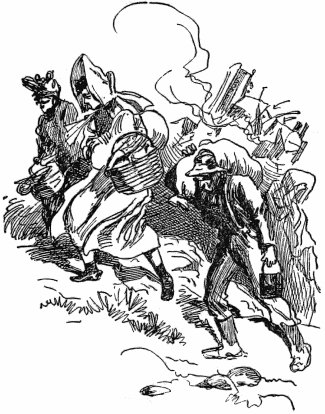
HURRYING TO THE HILLS.
There has been great scarcity of cooking utensils since the flood.
It not only is very inconvenient to the people, but tends to the waste
of a great deal of food.
The soldiers are growling bitterly over their commissary department.
They claim that bread and cheese and coffee is about all
they get to eat.
The temporary electric lights have now been strung all along the
railroad tracks and through the central part of the ruins, so that the
place after dark is really quite brilliant seen from a distance, especially
when to the electric display is added the red glow in the mist
and smoke of huge bonfires.
Anybody who has been telegraphing to Johnstown this week and
getting no answers would understand the reason for the lack of answers
if he could see the piles of telegrams that are sent out here
by train from Pittsburgh. Four thousand came in one batch on Thursday.
Half of them are still undelivered, and yet there is probably
no place in the country where the Western Union Company is doing
better work than here. The flood destroyed not only the company’s
offices, but the greater part of their wires, in this part of the country.
The office they established here is in a little shanty with no windows
and only one door, which doesn’t close, and it handles an amount of
outgoing matter daily that would swamp nine-tenths of the city offices
in the country. Incoming business is now received in considerable
quantities, but for several days so great was the pressure
of outgoing business that no attempt was made to receive any
dispatches.
The whole effort of the office has been to handle press matter,
and how well they done it is shown by the amount of matter received
from there that the daily papers have been publishing every day.
The rush of press matter has been slacking a little now, and in a day
or two private messages will probably be going back and forth with
reasonable promptness. But there will be no efficient delivery service
for a long time. The old messenger boys are all drowned, and the
other boys who might make messenger boys are also most of them
drowned so that the raw material for creating a service is very scant.
Besides that, nobody knows nowadays where anyone else lives, and
it is almost impossible to deliver private messages at all.
The amateur and professional photographers who have overrun
the town for the last few days came to grief yesterday. A good
many of them were arrested by the soldiers, placed under a guard,
taken down to the Stony Creek, and set to lugging logs and timber.
Among those arrested were several of the newspaper photographers,
and these Gen. Hastings ordered released when he heard of their arrest.
The others were made to work for half a day. They were a mad and
disgusted lot, and they vowed all sorts of vengeance. It does seem
that some notice to the effect that photographers were not permitted
in Johnstown should have been posted before the men were arrested.
The photographers all had passes in regular form, but the soldiers refused
to even look at these. Were not it that Gen. Hastings is a candidate
for Governor the reporters expect that they would be the ones
to be arrested next.
More sightseers got through the guards at Bolivar last night, and
came to Johnstown on the last train. Word was telegraphed ahead,
and the soldiers met them at the train, put them under arrest, kept
them over night and this morning they were set to work in clearing
up the ruins.
The special detail of workmen who have been at work looking up
safes in the ruins and seeing that they were taken care of report that
none of the safes have been broken open or otherwise interfered with.
The committee on valuables report that quantities of jewelry and
money are being turned daily into them by people who have found
them in the ruins. Often the people surrendering this stuff are evidently
very poor themselves. The committee believes that as a general
thing the people are dealing very honestly in this matter of
treasure trove from the ruins.
Three carloads of coffins was part of the load of one freight train
this afternoon. Coffins already are scattered everywhere about the
city. Scores of them seem to have been set down and forgotten.
They are used as benches, and even, it is said, as beds.
One enterprising man has opened a shop for the sale of relics of
the disaster, and is doing a big business. Half the people here are
relic cranks. Everything goes as a relic, from a horseshoe to a two-foot
section of iron pipe. Buttons and little things like that, that can
easily be carried off are the most popular.
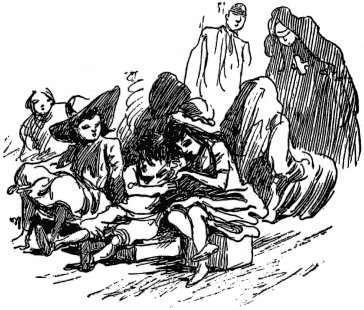
MADE ORPHANS BY THE FLOOD.
Grandma Mary Seter, aged 83 years, a well known character in
Johnstown, who was in the water until Saturday, and who, when
rescued, had her right arm so injured that amputation at the shoulder
was necessary, is doing finely at the hospital, and the doctors expect
to have her around again before long.
There has not been a photographer seen about the place to-day.
The experience of the nine who were arrested and set to work on the
ruins yesterday has scared off the rest.
Out of the twenty-five Chinamen in Johnstown only three escaped
the flood. Vice-President Frank Thompson, of the Pennsylvania
Railroad, arrived to-day on his special locomotive, having opened a
way through from Harrisburg to Pittsburgh. He is now going to
push east over the main line as rapidly as possible. It is not likely
that the line will be opened for three or four days yet.
A woman made insane by the loss of her husband and all her
children has been wandering about the edge of the gorge this afternoon,
moaning and shrieking incessantly. She is one of several
women who have been thus affected by their affliction. For a continuation
of this terrible calamity see Police Gazette each week.
LIFE AND BATTLES
——OF——
JAKE KILRAIN
CHAMPION PUGILIST OF THE WORLD, AND HOLDER OF
THE “POLICE GAZETTE” DIAMOND BELT.
WITH PORTRAITS of PROMINENT PUGILISTS
This book is Superbly Illustrated with
Numerous Artistically Executed Pen
Sketches and Wood Engravings
drawn on the Spot by the
“POLICE GAZETTE” SPECIAL ARTIST.
——ALSO——
PORTRAITS OF SOME OF THE LEADING SPORTING MEN
Of America and England,
PRICE, BY MAIL, - 25 CENTS.
RICHARD K. FOX, Publisher,
Franklin Square, New York.
HISTORIC CRIMES.
Being a Complete, Graphic and Thrilling Narrative
—OF THE—
KILLING OF P. BARTON KEY
—BY—
MAJOR GENERAL SICKLES.
THE NOTORIOUS MURDER OF DR. PARKHAM
—BY—
PROF. WEBSTER,
IN BOSTON, MASS.
The Brutal Slaughter of the Dearing Family,
NEAR PHILADELPHIA.
The Celebrated Case of Mrs. Cunningham,
DR. BURDELL’S ALLEGED MURDERESS.
And Other Startling and Mysterious Crimes.
PROFUSELY ILLUSTRATED.
Price by Mail, 25 cents.
RICHARD K. FOX, Publisher,
Franklin Square, New York.