A pretty brown cottage, so small that the vines
have no need to hurry themselves in climbing
over it, but take plenty of time to creep along the
eaves, to peep in at the windows, and even to stop
and weave bowers over the doorways. Two “Baldwin”
trees shade one end of the cottage, a silver-oak
the other. In its rather narrow front-yard grow
damask rose-bushes, sweet syringas, and a snowball-tree.
In one corner of this front-yard a running-rose,
called a “pink prairie-rose,” climbs to the cottage-roof,
where it has delightful times with the honeysuckle
and woodbine. On either side, and round about
and far away, lie broad green meadows, apple-orchards,
fields of waving corn, and many a sloping, sunny hill-side,
on which the earliest wild flowers bloom. Ah! it
must be a pleasant thing to live where one can watch
the fields grow yellow with dandelions and buttercups,
or white with daisies, or pink with clover; where sweet-scented
honeysuckles peep in at one window, roses at
another, and apple-blossoms at another; where birds
sing night and morning, and sometimes all the day.
Between the hours of seven and eight, one lovely
morning in June, there might have been seen, turning
the corner of Prairie-rose Cottage, two travellers on
horseback, each of whom carried a huckleberry-basket
on his arm. These two travellers were of just the same
age,—four years and ten months. The horses they
rode were of the kind called saw-horses, or, as some
call them, wood-horses. Both names are correct, because
they are made of wood, and wood is placed upon
them to be sawed.
Our young travellers were twin-brothers, and were
named—the one, Jimmy Plummer; the other, Johnny
Plummer. They were dressed exactly alike, and they
looked exactly alike. Both had chubby cheeks, twinkling
eyes, small noses, and dark, curly hair. Both
wore gray frocks belted round with leather belts, and
both belts were clasped with shining buckles. Their
collars were white as snow. Their trousers were short,
leaving off at the knee, where they were fastened with
three gilt buttons. Their stockings were striped, pink
and gray; the gray stripe being much wider than the
pink. Their boots were button-boots. Their hats
were of speckled straw; and in the hat-band of each
was stuck a long, narrow, greenish feather, which
looked exactly like a rooster’s feather. Their whip-handles
were light blue, wound round with strips of
silver tinsel; and at the end of each lash was a snapper.
Their bridles were pieces of clothes-line.
The travellers were bound to Boston, so they said, to
buy oranges. It was hard work to make those horses
of theirs go over the ground. There isn’t very much
go in that kind of horse: they are sure-footed, but not
swift. But there was a great deal of make go in the
two travellers. They jerked that span of horses, they
pushed them, they pulled them, they made them rear
up, they tumbled off behind, they tumbled off the sides,
they pitched headforemost, but still did not give up;
and at last came to Boston, which was, so they made
believe, on the outside cellar-door.
And, as they were playing on the cellar-door, the
funny man came along, and began to feel in his pockets
to see what he could find.
“Halloo, Jimmyjohns!” he cried. “Don’t you want
something?”
Jimmy and Johnny Plummer were best known in the
neighborhood as “the Jimmyjohns.” And it seemed
very proper their being called by one name; for they
looked, if not just like one boy, like the same boy twice
over, so that some members of their own family could
hardly tell them apart. They were always together:
what one did the other did, and what one had the other
had. If one asked for pudding four times, the other
asked for pudding four times; and when one would
have another spoonful of sauce, so would the other.
And it was quite wonderful, everybody said, that, in
playing together, they were never known to quarrel.
People often tried to guess which was Jimmy, and
which was Johnny; but very few guessed rightly.
The funny man felt in every one of his pockets, and
found—a piece of chalk. The Jimmyjohns laughed.
They had seen him feel in every one of his pockets
before, and knew that nothing better than chalk, or
buttons, or tack-nails, would come out of them.
“Now,” said the funny man, “I’m going to guess
which is Jimmy, and which is Johnny. No, I can’t
guess. But I’ll tell you what I will do. I’ll turn up a
cent. There it goes. See here: if it turns up head,
this sitting-down boy’s Jimmy; tail, he’s Johnny.
Now then. Pick it up out of the grass. Head? Yes,
head. Then this sitting-down boy’s Jimmy. Right?
Are you sitting-down boy Jimmy?”
“No, sir. Johnny.”
“Johnny? How do you know you are Johnny?”
Johnny laughed, looked down, turned up the corner
of his frock, and showed there a bit of red flannel,
about the size of a red peppermint, stitched on the
wrong side. Mrs. Plummer, it seems, had put red
flannel peppermints on Johnny’s clothes, and blue flannel
peppermints on Jimmy’s, so that each could tell his
own.
The funny man passed on, but had hardly gone ten
steps before he turned, and said to the Jimmyjohns,
“Why don’t you go a-rowing?” They answered,
because they had no boat. He told them Dan took a
tub for a boat. Then they said they had no water.
The funny man was just at that moment stepping over
the fence; but he answered back, speaking very loud,
“Dan plays grass is water.”
The Jimmyjohns looked at each other.
“Ask him what oars Dan takes,” said Johnny.
“You ask him too,” said Jimmy.
So they called out both together, “What oars does
Dan take?” And then, the funny man being by that
time far along the road, they scampered to the fence,
scrambled up, leaned over the top-rail, and shouted
loud as they could, “What oars does Dan take?”
The funny man turned, held one hand to one ear to
catch the sounds, and shouted back, speaking one word
at a time, “Can’t—hear—what—you—say!”
“What—oars—does—DAN—T-A-K-E?” bawled
the Jimmyjohns, holding on to the last word as long as
their breath lasted.
“Takes—brooms! Dan—takes—BROOMS!”
the funny man bawled back; then walked away quite
fast.
That was what it sounded like; but in reality it was
pretty Banty White saying to her chickens, “Hurry
back! Danger! Boys! Dreadful danger!”
Madam Banty White kept house under a tub at the
back of the house; and it was her tub which was going
to be the boat.
“Over she goes!” cried Jimmy, giving it a knock.
“Cluck, cluck, cluck! Cluck, cluck, cluck! Cluckerty
cluck!” clucked Madam Banty. “Run for your lives!
For your lives!”
“Sister, sister, sister!” shouted the Jimmyjohns.
Annetta Plummer, six years old and almost seven,
was often called “Sister,” and sometimes “Sissy
Plummer.” Hearing the shouts, sister ran to the
window, calling out, “What do you want, you little
Jimmies?”
Then curly-headed, three-years-old Effie trotted to
the window, stood on her tiptoes, and shouted with her
cunning voice, “What oo want, oo ittle Dimmeys?”
“Throw down two brooms. Quick’s you can!”
“Little boys must say ‘Please,’” said Annetta.
“Ittel—boys—say—‘Pease,’” repeated Effie.
“Please, please, please, please!” shouted the Jimmies.
Then, “Oh, dear! Oh! ma! Oh, dear! Ma!
ma! Oh! Oh, dear! oh, dear!” in quite a different
tone.
All the people came running to the window. “Who’s
hurt? What’s the matter? Oh, they’ve tumbled down!
they’ve tumbled down!”
The flour-barrel was at the bottom of it all. In their
hurry to get the brooms, the Jimmies climbed on a
flour-barrel which lay upon its side. It rolled over,
and they rolled over with it. It is plain, therefore,
that the flour-barrel was at the bottom of it all.
The poor Jimmyjohns cried bitterly, and the tears
ran streaming down. Still they were not hurt badly,
and the crying changed to kissing much sooner than
usual. To explain what this means, it must be told,
that when the Jimmies were little toddling things, just
beginning to walk, they were constantly tumbling down,
tipping over in their cradle, or bumping heads together;
and Mrs. Plummer found that the best way to stop the
crying at such times was to turn it into kissing. The
reason of this is very plain. In crying, the mouth flies
open; in kissing, it shuts. Mrs. Plummer was a wonderful
woman. She found out that shutting the mouth
would stop its crying, and to shut the mouth she contrived
that pretty kissing plan, and at the first sound of
a bump would catch up the little toddlers, put their
arms round each other’s necks, and say, “Kiss Johnny,
Jimmy; kiss Jimmy, Johnny.” And that was the
way the habit began. They had not quite outgrown it;
and it was enough to make anybody laugh to see them,
in the midst of a crying spell, run toward each other,
their cheeks still wet with tears, and to see their poor
little twisted, crying mouths trying to shut up into a
kiss.
But now must be told the sad fate of Banty White’s
tub. Alas for poor Banty! Nevermore will she gather
chicks under its roof.
Mrs. Plummer, it seems, allowed the Jimmies to take
her third-best broom and the barn broom to row with.
“Let’s go way over there, where there’s some good
grass,” said Jimmy.
“So I say,” said Johnny. “How shall we get her
over?”
“Take the reins,” said Jimmy.
“Oh, yes! so I say,” said Johnny.
The reins were then taken from the horses, and tied
to one tub-handle. The brooms were tied to the other
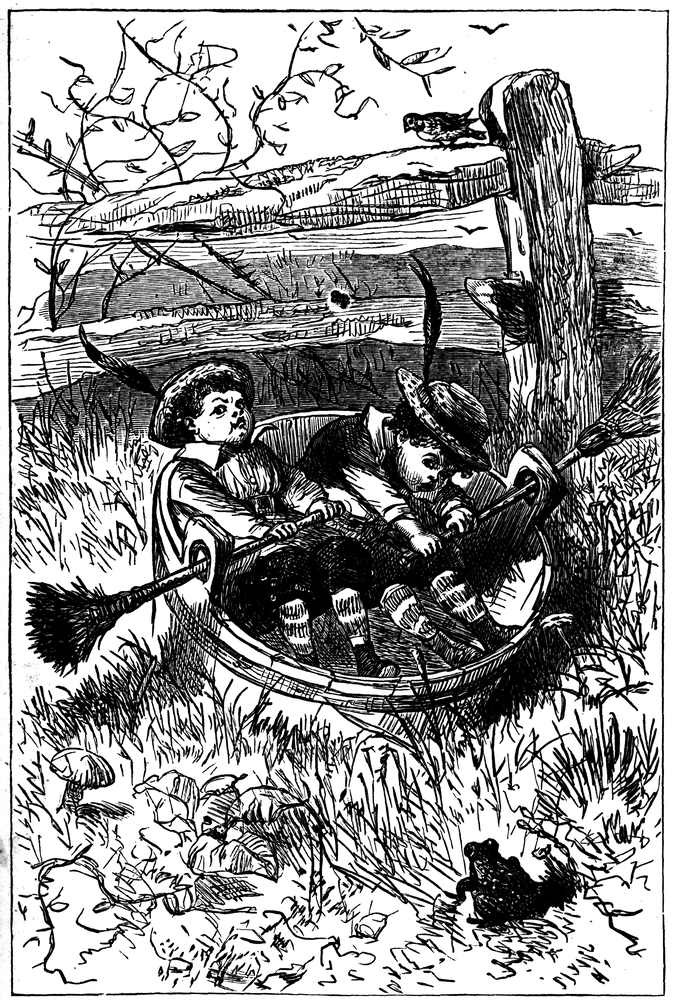
tub-handle, and so dragged behind. The Jimmies
hoisted the tub over the fence into the field of “good
grass,” squeezed themselves inside, put the broom-handles
through the tub-handles, and began to row.
After rowing a while, and finding “she didn’t go
any,” they thought they would try to find Dan, and
ask him how he “made her go.” So the tub was
hoisted over the fence again, and the brooms tied on
for another pull. Both took hold of the reins; and then
away they ran along the road, up hills and down hills,
to find Dan.
“How easy she goes!” cried Johnny at last as
they were rounding a corner.
Both turned to look, and, oh! what did they see?
Alas! what did they see?—two hoops, pieces of wood
scattered along the road, and the brooms far behind.
The tub had fallen apart, and the hoops that bound it
were rolling away.
The brothers Plummer stood still and gazed. It was
all they could do.
“And now won’t it be a tub any more?” Johnny
asked at last very soberly.
“I—don’t—I guess so,” said Jimmy. “Maybe
pa can tub it up again.”
Each boy took an armful of the pieces (leaving one
that neither of them saw), hung a hoop over his shoulder,
and in this manner turned to go home, dragging
the brooms behind.
But, finding themselves quite near aunt Emily’s,
they went that way, and made a call at the house. And
very good reasons they had for doing so. One reason
was a puppy; one reason was a gold-fish; but the
sweetest reason of all was aunt Emily’s gingerbread.
CHAPTER II. THE SAD FATE OF “POLLY COLOGNE.”
HIGH times at Prairie-rose Cottage,—high times
indeed! For there is cousin Floy Plummer on
her tiptoes; and there is little Effie Plummer hurrying
with might and main to climb to the top of the bureau;
and there are the twins, the Jimmyjohn Plummers,
scrambling both at once into the baby’s dining-chair,
tumbling over the back like one boy, then dividing at
the bottom and going up again like two boys: and all
these trying to pinch Annetta Plummer’s ears, and to
pinch them seven times too; for Annetta Plummer is
seven years old this very day.
Ever since morning, a little girl may have been seen
holding two hands to two ears, scampering up stairs
and down stairs, dodging into dark corners, behind
doors, behind curtains, behind people, racing through
the garden, hiding among the currant-bushes, among
the grass, among the waving corn, in the barn, in the
hen-house, up the apple-tree, up the ladder; and always
have gone some of the pinchers after her, with seven
pinches apiece in their thumbs and fingers. And now,
will climbing that table save Miss Seven-year-old?
Hark! Rover is barking outside! O Rover! don’t
you know any better than to bark at the party,—Annetta’s
birthday-party? Look at old Bose, and learn
how to behave. Old Bose never barks at company;
and he is six times bigger than you are, you little,
noisy, capering, frisky, frolicsome Rover! Now the
Jimmyjohns run to call off their dog. “Here, Rover!
Here, ere, ere, ere! Rove, Rove, Rove!”
And now the company have come in, and have taken
off their things, and have told Mrs. Plummer how their
mothers do, and have sat down quietly in a row of
chairs. Seven of them,—seven bright faces so rosy
and sweet! seven heads of hair so smooth or so curly!
seven pairs of tidy boots, best ones, perhaps,—who
knows but brand-new? The Jimmyjohns, too, have on
their new, slippery, smooth-bottomed button-boots; and
that was the reason of their falling down while they
stood almost still, or rather more than half still, watching
the seven little girls sitting in a row.
Ten minutes later. All out on the green spot, where
it is shady, playing “Little Sally Waters sitting in the
sun.” Josephus the baby (called Josephus while waiting
for his real name) stays in his baby-carriage, hearing
them sing, watching the ring go round, laughing,
crowing, patting cakes by the dozen. When the Jimmies
choose the one that they love best before they
close their eyes to rest, Rover rushes into the middle,
barking, leaping high, as if he, too, were going to kiss
the one that he loved best.
Fifteen minutes later. They are playing “Pretty
fair maid.” Dear, dear! what a charming singsong
goes with this play! What a lively, chirruping tune!
“Pretty fair maid, will you come up, will you come up,
will you come up, to join us in our dances.” “And
now we’ve got the Queen of May, the Queen of May,
the Queen of May, to join us in our dances.” And
then the last part, “Green grow the rushes O! Never
mind the blushes O!” Ah! who would not be a little
girl at a party, singing “Pretty fair maid” on the
green spot?
Half an hour later. All out in the orchard, playing
“keep house.” They divide themselves into “families.”
There is one very large flat rock in the orchard,
also several hollow places where rocks have been dug
out. Two of the “families” take each a hollow to
live in; a third “keeps house” on the rock, a fourth
under a haycock. Oh, what good times! Only two
families can have “fathers,” because there are only
two boys. The other “fathers,” cousin Floy says,
have gone to Boston. Cousin Floy manages this play.
She is ten years old, and knows how. Cousin Floy
goes in to coax Mrs. Plummer for some things in which
to dress up the “fathers” and “mothers.” She says
it will do if the heads look like fathers’ and mothers’
heads, and no matter about the clothes. Mrs. Plummer
lends two head-dresses, also ribbons and laces.
Grandmother Plummer lends a cap and black ribbon.
Who’ll be the “grandmother,” I wonder. Minnie
Lowe, the little girl with the flossy curls. Oh, what a
cunning grandmother!—Down, Rover, down! What!
barking at your grandmother, you saucy little puppy?
“Ha, ha! He, he! Ha, ha! He, he! Ho, ho!”
And who wouldn’t laugh at seeing Jimmy Plummer in
a high dicky, black whiskers, and tall hat? The hat
touches his shoulders behind. Ah! that is better.
Cousin Floy has taken off the hat, and put on a great
deal of black hair pulled from an old cushion; yes, a
great deal,—as much as a quarter of a peck. It rises
high on his head, and—What ails Rover? Ha, ha!
Pretty good! Rover doesn’t know Jimmy!
Well, well, well! Grandfather forever! They are
going to have Johnny a grandfather! Cousin Floy is
covering his head with cotton-wool for white hair.
Now she gives him a cane. Now go on the spectacles.
Now she is—doing—something—I cannot—see—what.
Oh, yes, yes, yes! putting a hump under his
frock, between his shoulders, to give him a stoop. Bark
away, Rover! Who wouldn’t bark at a cotton-wool
grandfather?
Annetta has been in to the house, and is bringing out
all her rag-babies. To be sure; for now there can be a
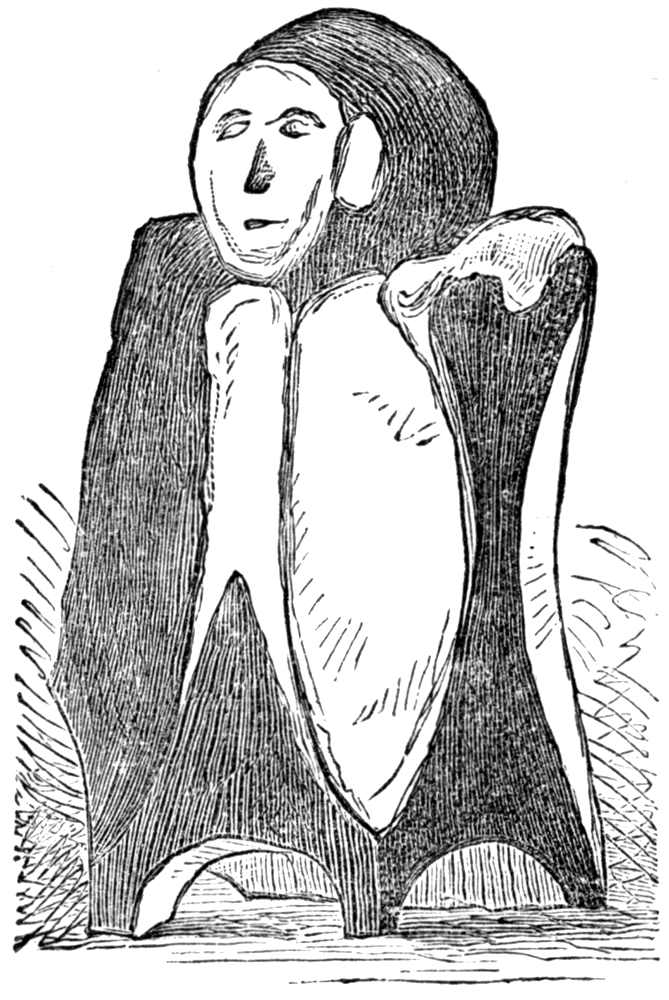
baby in every family. One of these is very large, and
has a face as big round as a pint porringer; but the
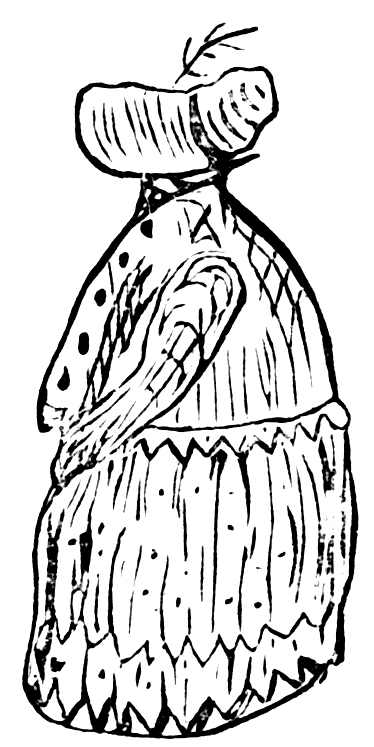
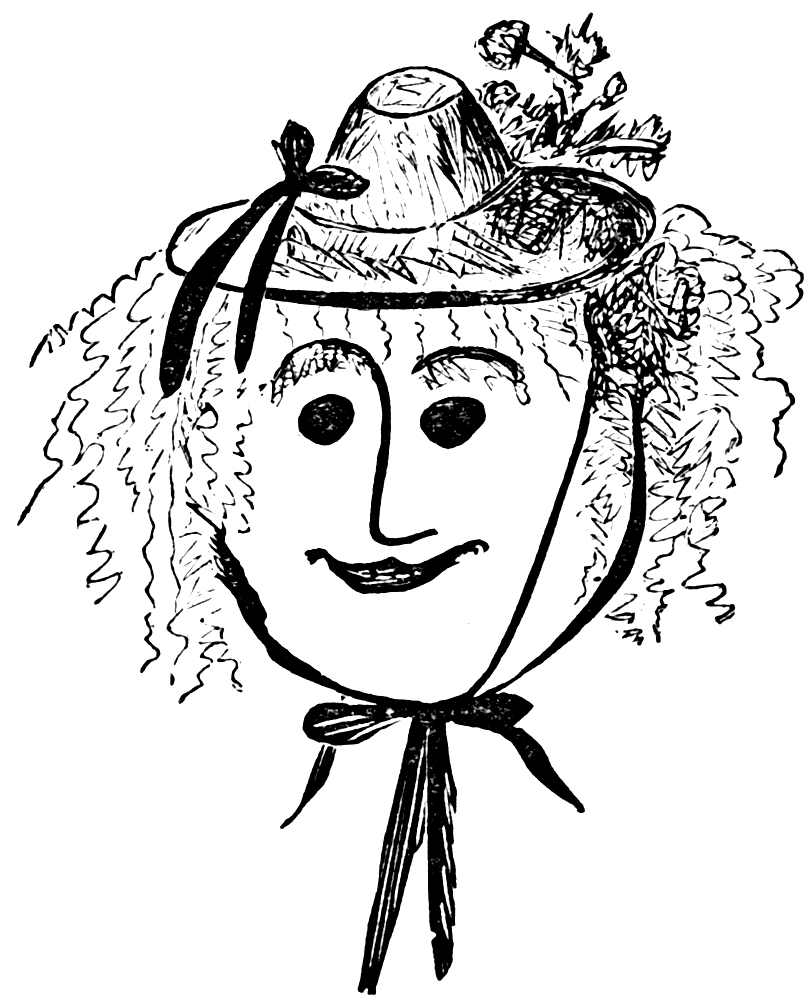
others are quite small. The large one is named Joey
Moonbeam. This is a true picture of Joey Moonbeam,
copied from her likeness
now hanging in Annetta
Plummer’s baby-house.
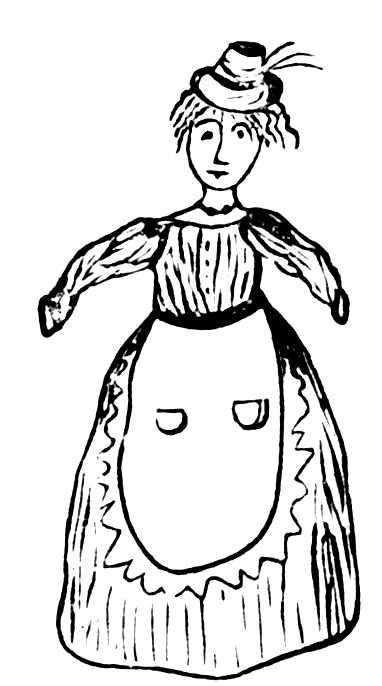
The largest of the small
rag-babies is named Dorothy
Beeswax. She is a
little taller than a knitting-needle.
This is a true picture
of Dorothy Beeswax.
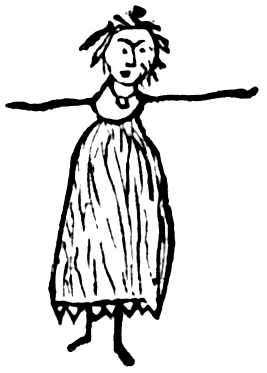
The next largest is Betsey
Ginger. The next is Jenny
Popover. The next is Eudora N. Posy.
The “N.” stands for Nightingale.
The next is Susan Sugarspoon. This
is a true picture of Betsey Ginger.
Susan Sugarspoon, and Jenny Popover,
and Eudora N. Posy, have not had their
pictures taken yet. The smallest of
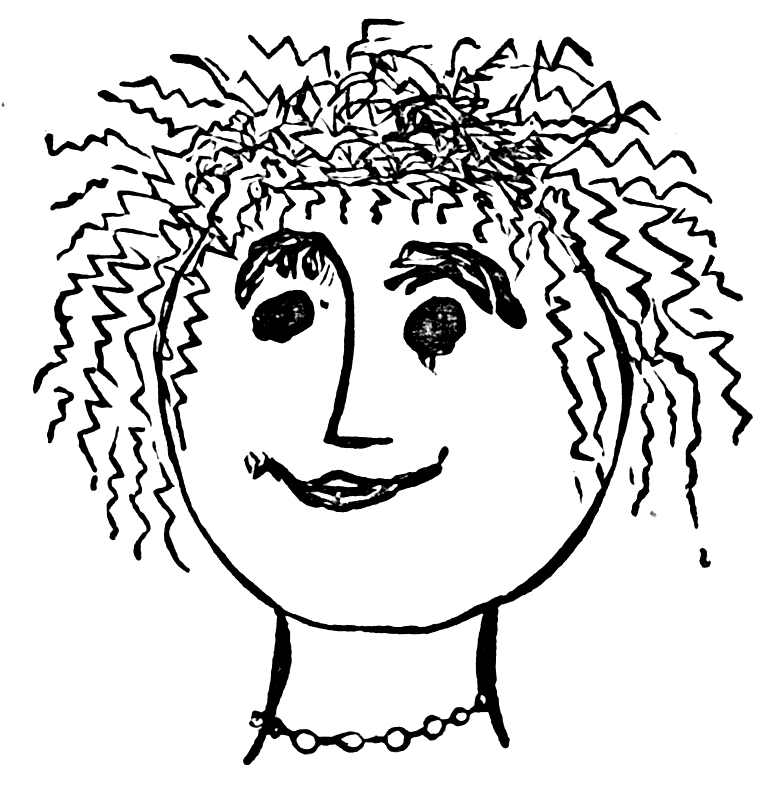
all is Polly Cologne,—the
smallest, the prettiest,
and the cunningest.
Her cheeks are painted pink, and
she wears a locket.
Her hair is of flax-colored
floss-silk, while
the hair of all the others
is stocking-ravellings.
She is the baby of the
baby-house, and this is her true and exact picture.
Polly Cologne has feet; but the others stand on their
stiff petticoats.
Now comes Mrs. Plummer, with seed-cakes for the
housekeepers to play supper with; and behind her comes
cousin Floy, bringing cinnamon-water, and dishes from
the baby-house. The cinnamon-water is in four phials.
Each phial has in it sugar, and also rose-leaves.
What are the children laughing and whispering about?
and why do they look at little Fanny Brimmer in such
a way? Mrs. Plummer has called Annetta aside with
one or two others, and is asking why they do so.
“Because,” whispers little Lulu, “Fanny picked out—the
biggest—seed-cakes—that had the most—sugar-plums—on
the tops.”
Mrs. Plummer tells them, speaking very low, that
perhaps Fanny did not know it was selfish to do so;
that her mother might never have told her. “Selfish
girls,” says Mrs. Plummer, “should be pitied, not
laughed at; and besides, perhaps every one of you may
be selfish in some other way.”
Half-past four o’clock. What is going on now? Oh!
I see. The “family” at the rock are having a party,
and to this party have come the “families” from the
hollows and the haycock.—No, Rover, you were not
invited. Down, sir!—down!
The supper is laid out on the rock. The cinnamon-water
is poured into the cups, each cup holding half a
thimbleful. Grandfather Johnny and grandmother
Minnie sit at the head, and father Jimmy at the foot;
while the mothers with their little girls fill the room between.
The mothers wear head-dresses. The little
girls wear dandelion-curls, and curls of shavings. Only
one of the babies is allowed to come to the table, and
that is Polly Cologne. The others sit on the floor, and
play with their playthings. Joey Moonbeam can come
to table, because she is big enough. They call Joey
Moonbeam a little girl three years old, that cannot walk,
because she has had a fever. Polly Cologne seems to
be a pet among all these mothers and little girls. They
all want to hold her. Why, by their talk, one might
suppose she was a live baby. Hear them. “O little
darling!” “Just as cunning!” “Dear ’ittle baby!”
“Did zee want some payzings?” “Tum to oor mozzer,
oo darling!” “Do let me hold her!” “No, let
me, let me!” “Me!” And so she is passed from one
to another, and kissed and stroked and patted, and
talked to. Really the birthday-party is having a good
time. Ah! who would not be a little girl playing supper
on a rock, out among the apple-trees, and sipping
cinnamon-water?
But, dear, dear! what is the matter? Why do they
all jump down in a hurry, and scream and shout, and
run after Rover? What! Polly Cologne? Rover gone
off with Polly Cologne in his mouth? Yes, Rover has.
There he goes, scampering away, and all the children
after him, calling, “Here, here, ere, ere, ere! Back,
sir! back!” The Jimmyjohns slip with their smooth-bottomed
boots, and down they go; and off go wigs,
whiskers, and all! Now they’re up again, shouting to
Rover, “Here, Rover!—here, Rover! Drop it, drop
it! Rove, Rove! Come back!”
But Rove won’t hear, and won’t come back. He’s
out of the orchard, across the meadow, over the brook;
and now—and now he has gone into the woods! Oh,
dear, dear!
Four days later. Orchard, wood, brook, and meadow
have been searched; but the lost is not yet found.
Annetta is quite sad. She has put away Polly
Cologne’s every-day locket and every-day clothes, and
blue silk sun-bonnet, because it made her feel badly to
see them.
Dear little Polly Cologne, where are you now? Lost
in the woods? And are the Robin Redbreasts covering
you over with leaves? Perhaps naughty Rover
buried you up like a meat-bone in the cold, damp
ground, or dropped you in the brook,—and, alas!
you could never swim ashore. Did those bright-spotted
trout eat you? or did you float away to the sea?
Perhaps you did float away to the sea. Perhaps you
are now far out on the mighty ocean, where the
wild winds blow, and there, all alone, toss up and
down, up and down, on the rolling waves; or perhaps
the waves and the winds are at rest, and the
sea is smooth like a sea of glass, and you lie quietly
there, with your pink cheeks turned up to the sky.
Or the mermaids may take you down into their sea-caverns
all lined with rose-colored shells, and sing you
sweet songs till your hair turns green. Or who knows
but you may float away to Northland, and be picked up
on shore by the little funny, furry Esquimaux children?
Oh, if you should be frozen solid in an iceberg there!
But it may be you have drifted down to the sunny
islands of the South, where the people have few clothes,
no houses, no schools; and then some little, half-naked,
dusky child may pick you up from among the
coral and sea-shells, and show you to its mother, and
say, “Mother, where do this kind of folks live?” And
its mother, not having studied geography, may say,
“Oh! in a wonderful country close by the moon.”
Yes, let us hope that Polly Cologne has been wafted
to those sunny summer-lands of the South, where
oranges grow, and prunes, and bananas; where the
palm-tree waves, and geraniums grow wild; where the
air is balmy; where snow never comes, nor ice, nor
frost; where bright-winged birds warble in the groves;
where trees are forever green, and flowers bloom
through all the year.
CHAPTER III. AN ACCOUNT OF THE JIMMYJOHNS’ LITTLE AFFAIR WITH THE GULLS.
In this story will be given a true and exact account
of the Jimmyjohns’ affair with the gulls; also of
the manner in which Jimmy was turned out of the little
red house at the sea-shore. The account will begin at
the time of their leaving home. It will explain the
reason of their going, and will, in fact, tell every thing
that happened to them just exactly as it happened.
Mr. Plummer, their father, had bought some salt
hay at a place called Stony Point, near the sea-shore.
One day he sent Ellis Payne with the ox-cart to finish
making the hay and bring it home. Mr. Plummer told
Ellis Payne that he himself should be riding that way
about noontime, and would carry him a warm dinner.
He started just after eating his own dinner. Ellis
Payne’s was put up in a six-quart tin pail. It being
Saturday, Mr. Plummer took the Jimmyjohns along.
Their mother said they might play at Stony Point till
Ellis Payne came home, and then ride back on the hay.
Mr. Plummer was going to the mill.
Now, the road turned off to the mill a short distance
before reaching Stony Point; and Mr. Plummer, to
save time, told the Jimmyjohns they might jump out
there, and carry the pail to Ellis Payne, and he would
keep on to the mill, and then he could take in the
funny man. The funny man was just turning up that
same road. He stopped to have a little fun with the
twins; jumped them out of the wagon; tried to guess
which was which, and, when told, turned them round
and round, to mix them up; then tried to guess again,
and would have tossed up a cent, and said, “Heads,
this is Jimmy,—tails, this is Johnny,” as he sometimes
did, only that the horse seemed in somewhat of a
hurry.
Mr. Plummer showed the little boys a scraggy tree
which grew on the edge of a bank, near the shore;
and told them they would see the oxen as soon as they
turned the corner where that tree grew. One took
hold on one side of the pail, and the other on the
other; and in that way they walked along the shore,
keeping pretty close to the bank. It took them only
about five or ten minutes to reach that tree; and, when
the corner was turned, they saw the oxen plainly, but
could not see Ellis Payne. They kept on, walking
more slowly, the way being more stony, and at last
came to the oxen. Ellis Payne was not there. The
reason of his not having been there is as follows: Two
fields away from the shore stood a small red house all
alone by itself, in which lived an old woman with her
young grandson. The young grandson fell from a
chamber-window, and broke his collar-bone bone; and
the old woman ran to the shore, screaming for help;
and Ellis Payne left his work, and went to find out
what was the matter.
The Jimmyjohns, seeing some oxen farther along the
shore, thought perhaps those first oxen were not the
right ones, and so kept on to those other ones. They
turned down, and walked quite near the water, picking
up pretty pebbles as they went along, and now and
then a cockle-shell, or a scallop, or purple muscle.
Some of the shells were single; others in pairs, which
could be opened like crackers. They had a reason
for picking up the scallops and muscles, which there
is no time to mention here; though, after all, perhaps
it may as well be told. Annetta Plummer was
going to have a party, and she had not enough scalloped
shells to bake her cakes in. The cockles were
for Effie to put in her arm-basket. The Jimmyjohns
picked up enough of all kinds to fill their pockets; then
took off their hats, and filled those. By that time they
had come to the spot where the oxen had stood. But
no oxen were there then, and no man: so there was
nothing better to do than to play in the sand, and sail
clam-shell boats in the little pools. It was a warm
day; the water looked cool; and the little Jimmies, as
they beheld the rippling waves, felt just like wading in.
So it was off with shoes, and off with stockings, roll up
trousers-legs, and away and away, with a run, and a
shout, and a dash, and a splash, and a spatter. A little
distance out from the shore there was a high rock, not
so very, very high,—just the right height to give them
a good seat; and they sat down there, feet in the
water, heads together, looking down into the water,
watching the fries darting swiftly hither and thither.
It is just here that the gull part of the story comes
in. Gulls are large sea-birds. They live upon fish,
and they are their own fishermen. Some may call this
the funny part of the story, though those who are ever
in such a story may not call it the funny part.
The white-winged gulls were flying about. It is a
common thing, at sea-side places, to see gulls flying
about, and skimming over the water. Sometimes they
dip in their bills and take a fish. The Jimmyjohns sat
looking down, keeping very still, so as not to scare the
fries away. Just what the gulls thought of them no
one knows, and it can never be known; for there is no
way of finding out gulls’ thoughts, which is a pity: it
would be so curious to know just what they do think
about, and how they think it! Perhaps those that
belong to this story thought the two Jimmyjohns were
two great fishes, exactly alike; or perhaps they thought
hair would be good to line nests with. But, whatever
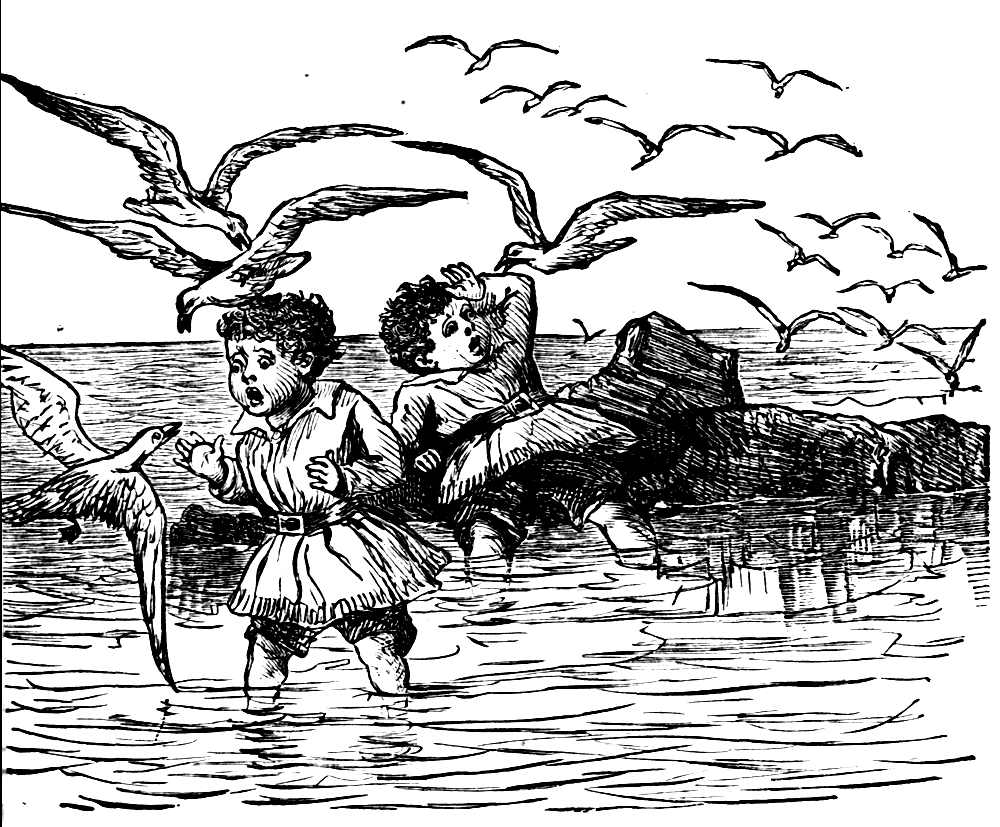
they thought, this is what they did: They flew down
swift and sudden upon the boys’ heads, flapped their
great wings in their faces, clawed their hair, beat them
with their beaks. The little fellows screamed, jumped,
fell down, scrambled up, ran, fell down, then up again;
got to the shore some way; ran over the sand, over the
pebbles, over the stones, over the rocks, across wet
grass, up a bank, through a field, screaming all the
time as if the gulls were chasing them every step of
the way. But no doubt the gulls had been just as
much frightened as the boys; for they had flown away
faster than they came, out of sight, far over the sea.
The Jimmies sat down on the grass, in the warm sunshine,
and rubbed their bruises, and counted the cuts
in their feet. Johnny’s left knee was lame, and the
heel of the other foot had been badly cut by a piece of
clam-shell.
By this time it was quite late in the afternoon. The
boys began to feel hungry, and talked of going to get
the pail, and eating some of the dinner. One guessed
it would be stealing to do that, and the other guessed
it would not be stealing. At last they agreed to go
and get their hats and shoes and stockings and the
pail, and find Ellis Payne, and ask him to give them
a little piece of his gingerbread.
It was pretty hard work going back over those sharp
stones, and that coarse, stubbed grass, barefoot. To
be sure, they came that way; but they were frightened
then, and only thought of the gulls. That grass—why,
its edges were so sharp, it seemed as if little knives
were cutting into their feet! They walked on their
heels, on their toes, on the sides of their feet, almost
on the tops of them sometimes, and so hobbled along
slowly,—rather too slowly; for, by the time they
reached the shore, somebody had been there before
them, and taken all their things. What body? Why,
a body you have heard of before; a body that has
done great mischief; a body that had carried off
bigger things than six-quart tin pails; a body that is
said to get furious at times, and to do then the most
terrible things. Have you never heard of a body of
water called the mighty ocean? That was it. The
mighty ocean rushed up that pebbly shore, and swallowed
up hats, shoes, stockings, dinner-pail, dinner,
and all. To speak in plain words, the tide had risen,
and covered them.
The Jimmies never thought of that until a man
came along—a man with a horse-cart—and told them.
“Why,” said he, “no use looking: the tide has
carried them off.”
When the man had gone, the boys went up from the
water to look for Ellis Payne. Johnny’s heel was in
such a state, he could only use the toes of that foot;
and, in going over the sharp stones, he cut the ball
of the same foot, so that he could not step with it at
all; and, when they came to the stubbed grass that cut
like little knives, he held up one foot, and hopped on
the other; and, getting tired of that, he walked on his
knees. Jimmy laughed at him, but, in the midst of
his laughing, cried out, “Ou, ou!” and was glad
enough to come down upon his own knees. And so
they went on a while; but finding knee-walking hard to
do, and apt to make knee-walkers roll over, they tried
hand-walking and knee-walking both, which is all the
same as crawling.
And now comes that part of the story where Jimmy
was turned out of a house.
While those boys had been picking up shells, and
playing in the sand, and wading, and watching the
fries, and running away from gulls, and drying their
clothes in the sun, and counting their cuts, and hobbling
up and down the shore, the sun had been sinking
lower and lower and lower; and Ellis Payne had
finished making the hay, and gone home with it. It
is sad to think how hungry Ellis Payne must have
been! The boys were hungry too; and that may have
been the reason why they went toward the little red
house. It stood two fields away from the shore, as
has already been stated. When they reached the last
field, Johnny lay down in the grass, close by a row of
wild-plum bushes, and cried. He said he could not
walk any more. Jimmy said he would go into that
house; and, if any woman gave him any thing, he would
bring Johnny some. But when he reached the house
he was too bashful to open the door, and staid in
the wood-shed quite a long time, till he saw a woman
go in.
After Jimmy had been gone a few moments, Johnny
heard a noise of some one walking near; and soon an
old woman came out from behind the bushes, with
some leaves in her hand. She went close to Johnny,
and asked him what he was lying there for, bareheaded.
Johnny told her he had a lame knee and a sore heel,
and he couldn’t walk.
“Don’t tell me that!” said she. “Didn’t I just
see you running across the field?”
“No—ma’am—’twasn’t—I,” sobbed Johnny.
“Don’t tell me! don’t tell me!” cried the old
woman; and she walked off, picking now and then a
leaf as she went. The leaves were plantain-leaves
for the bruises of her little grandson, who had fallen
out of the chamber-window. The boy she saw running
across the field was Jimmy.
When that old woman had finished picking leaves,
she went back into the house; and hardly had she
spread the leaves out on the table, when Jimmy put
his head in at the door slowly, then his shoulders,
then the rest of himself.
THE JIMMYJOHNS AND THE GULLS.
“What do you want here?” cried the old woman.
“Didn’t you tell me you couldn’t walk?”
“No—ma’am,” Jimmy answered, frightened almost
out of his breath.
“Oh! oh! oh! what a big story-teller you are!”
cried the woman. “Off with you!—quick too! I
don’t want such a boy as you are in my house with
my little Sammy.”
By the time she had got as far as “my little Sammy,”
Jimmy was out of the house and at the first pair
of bars; and, being in a terrible fright, he ran back to
Johnny as fast as he could go.
Johnny was sitting there, hugging somebody. What
body? Not a body of water is meant this time, but
a lively, loving, frisking, barking little body, named
Rover. And close behind came Mr. Plummer. When
Ellis Payne came home without the Jimmyjohns, Mr.
Plummer put the horse into the light wagon, and took
Rover, and went to look after them.
CHAPTER IV. THE JIMMYJOHNS’ SAILOR-SUITS.
This chapter will tell why Mrs. Plummer had to
sew very odd-looking patches on the Jimmyjohns’
sailor-suits. It will also tell what boy cut holes in
those sailor-suits, and why he cut them, and when;
and will show, that, at the time it was done, the three
boys were in great danger.
It was on a Monday morning that people first took
notice that the Jimmies’ trousers were patched in a
curious manner. Johnny was carrying the new dog,
and Jimmy was taking hold of Johnny’s hand. After
Rover was lost, the twins had a new dog given them,
named Snip. He was the smallest dog they ever saw:
but he was a dog; he was not a puppy. Mr. Plummer
brought him home in his pocket one day, two
weeks after Rover went away. It was Rover, you
know, that ran off with poor little Polly Cologne.
People talked so much to him about this piece of mischief,
that at last he began to feel ashamed of himself;
and, as soon as Polly Cologne’s name was mentioned, he
would slink into a corner, and hide his head. One day
Annetta showed him an apron that poor little Polly
used to wear,—it was a bib-apron,—and said to him,
“St’boy! Go find her! Don’t come back till you find
her!”
The bib-apron was about three inches long. Rover
caught it in his mouth, and away he went, and—did
not come back. They looked for him far and near;
they put his name in the newspapers; but all in vain.
The apron was found sticking to a bramble-bush, about
a mile from home; but nothing could be seen or heard
of Rover. There was a circus in town that day, and
he might have gone off with that. Perhaps he was
ashamed to come back. Little Mr. Tompkins, the
lobster-seller, thinks the dog understood what Annetta
said, and that he may be, even now, scouring the
woods, or else sniffing along the streets, peeping into
back-yards, down cellar-ways, up staircases, in search
of poor Polly Cologne.
Mr. Tompkins was among the very first to notice the
sailor-suits. He met the twins that morning as he
was wheeling along his lobsters, and quickly dropped
his wheelbarrow, and sat down on one of the side-boards.
Being a small, slim man, he could sit there
as well as not without tipping the wheelbarrow over.
Mr. Tompkins wore short-legged pantaloons and a
long-waisted coat. The reason of this was, that he had
short legs and (for his size) a long waist. His coat
was buttoned up to his chin. His cap had a stiff visor,
which stood out like the awning of a shop. He had a
thin face, a small nose, small eyes, and a wide mouth;
and he wore a blue apron with shoulder-straps.
“What’s happened to your trousers, eh?” asked
little Mr. Tompkins. His way of speaking was as
sharp and quick as Snip’s way of barking. “Say,
what’s happened to your trousers?”
The trousers were patched in this way: Jimmy’s
had a long strip on the left leg: Johnny’s had a round
patch above each knee, one being much farther up than
the other.
“Oh, yes! I see,—I see how it is,” said Mr.
Tompkins. “Your mother did that so as to tell you
apart. Oh, yes! Yes, yes! Very good! Johnny
Shortpatch, Jimmy Longpatch; or Jimmy Shortpatch,
Johnny Longpatch,—which is it?”
“She didn’t do so for that,” said Johnny, and then
Jimmy after him. Johnny was commonly the first to
speak.
“She didn’t?” cried Mr. Tompkins: “then what
did she do so for?”
“Perhaps to tell which is good, and which is naughty,”
said a lady who had stopped to look on.
Then the butcher’s boy stepped up, and he wanted
to know about the trousers. Then a woman looked
out of the window, and she wanted to know about the
trousers. Then a great black dog came up, and he
smelt of the trousers, which made Snip snap his
teeth. Then came a flock of school-children, and they
had something to say. “Halloo!” “What’s up?”
“What’s the matter with all your trousers?” “Hoo,
hoo!” “How d’ye do, Mr. Patcherboys?”
Now, the truth was, that Amos Dyke cut holes in
those trousers with his jack-knife. It happened in this
way: The Jimmies, the Saturday before that Monday,
started from home to spend a cent at Mr. Juniper’s
store. They had, in the first place, two cents; but one
was lost. They got those two cents by having a show
in the barn. The price for going in to see the show
was four pins. The Jimmies sold the pins to the funny
man. He gave a cent for sixteen straight ones, but
would take no crooked ones at any price. Sometimes
the Jimmies tried to pound the crooked ones straight
on a stone. Their pins, that Saturday, came to nearly
a cent and three-quarters; and the funny man made it
up to two. Jimmy let his fall on the barn-floor; and
Johnny, in helping him find it, hit it accidentally with
his toe, and knocked it through a crack. Then Mrs.
Plummer said they would have to divide between them
what was bought with the other cent.
The little boys left home to go to Mr. Juniper’s store
at half-past two o’clock in the afternoon, taking Snip
with them. Probably, if they had not taken him with
them, all would have been well.
In passing a garden, they looked through the pickets,
and saw a kitten racing along the paths. Snip was
after her in a moment.
“Now, you stay and take care of Snip,” said Johnny
to Jimmy, “and I’ll go spend the cent, and bring your
half here.” And just so they did. Jimmy found Snip,
and then went along to a shady place under a tree; and
there he climbed to the top rail of a fence, and sat down
to wait.
Johnny went round to Mr. Juniper’s store, and asked
for a cent roll of checkerberry lozenges. Mr. Juniper
had no cent rolls of lozenges; but he had striped candy,
and some quite large peaches, which he was willing,
for reasons known to himself, to sell for a cent apiece.
Johnny felt so thirsty, that he longed to bite of a
peach: so he bought one, and turned back towards the
garden. Having no knife to cut it with, he ate off his
half going along; and this tasted so good, that he could
hardly help eating Jimmy’s half. But he only nibbled
the edges to make them even.
Turning a corner, he spied Jimmy, and jumped over
into a field, so as to run across by a short cut. In the
field he met Amos Dyke. Amos Dyke is a large boy,
and a cruel boy. He likes to hurt small children who
cannot hurt him.
Amos Dyke knocked Johnny’s elbow with a basket
he was carrying, and made him drop the half-peach in
the grass. Then Johnny began to cry.
“Now, if you don’t stop crying, I’ll eat it,” said
Amos, taking up the half-peach, and setting his teeth
in it.
“Oh! don’t you! don’t! give it to me! it’s Jimmy’s
half!” cried Johnny. Amos took two bites,
and then threw away the stone. The stone was all
there was left after the two bites were taken. Johnny
cried louder than before.
“Here! stop that! stop that!” some one called
out from the road. It was Mr. Tompkins the lobster-seller.
“Stop!” cried Mr. Tompkins. “Let that
little chap alone! Why don’t you take one of your
own size?”
The fact is, that Amos Dyke never does take one of
his own size. He always takes some little fellow who
can’t defend himself.
Just about this time the funny man came along with
his umbrellas under his arm. The funny man is an
umbrella-mender. Then Amos Dyke, seeing that two
men were looking at him, whispered to Johnny, “Hush
up! Quick! Don’t tell! Come down to the shore,
and I’ll let you go graping with me in a boat. I’ll
run ahead and get the oars, and you go get Jimmy.”
The boat was a row-boat. Johnny sat at one end,
and Jimmy at the other. Amos Dyke sat in the middle,
and rowed. Before starting, he fastened a tall stick at
the stern of the boat, and tied his handkerchief to it,
and called that the flag.
They rowed along-shore, then off beyond the rocks,
then in-shore again, and farther along, for nearly a mile,
to a place called “High Pines,” and there landed.
The grapes grew in the woods, on the top of a steep,
sandy cliff as high as a high house. Twice, in climbing
this cliff, did the little Jimmies slide down, down, down;
twice was poor Snip buried alive; and many times were
all three pelted by the rolling, rattling stones.
They reached the top at last, and found Amos
already picking grapes. He told them, that, if they
would pick for him, he would give them two great
bunches. The grapes were of a kind called sugar-grapes,
light-colored, fragrant, and as sweet as honey.
Amos told the little boys not to eat while they were
picking. When he had filled his basket, he borrowed
the Jimmies’ pocket-handkerchiefs, and tied some up in
those. They were their “lion” pocket-handkerchiefs:
each had in its centre a lion, with a b c’s all around
the lion. Amos gave the Jimmies two great bunches
apiece. He then hid the basket and two small bundles
behind a bush, and they all three went to find a thick
spot. When they found the thick spot, Amos, not
having any thing else to pick in, took off his jacket, and
filled both sleeves. Then he borrowed the Jimmyjohns’
jackets, and filled the four sleeves. Then he
filled his own hat and the Jimmyjohns’ hats.
As it grew later, the wind breezed up, and the Jimmies
began to feel cold. Amos had long pantaloons
and a vest; but the Jimmies’ little fat legs were bare,
and they had no vests: they only had thin waists, and
their trousers were rolled up.
It began to sprinkle, and Amos said it was time to
go. They went back for the basket and two small
bundles, but were a long time in finding the bush, on
account of the bushes there looking so much alike.
They did find it, though; or rather Snip found it. The
Jimmies took one apiece of the bundles, and wanted to
take more; but Amos was afraid they might lose some
of the grapes. Perhaps he knew pretty well how they
would reach the foot of the cliff; perhaps he knew
pretty well that they would begin slowly, and that
the sliding sands would take them along so fast they
couldn’t stop themselves, and would land them at the
bottom in two small heaps.
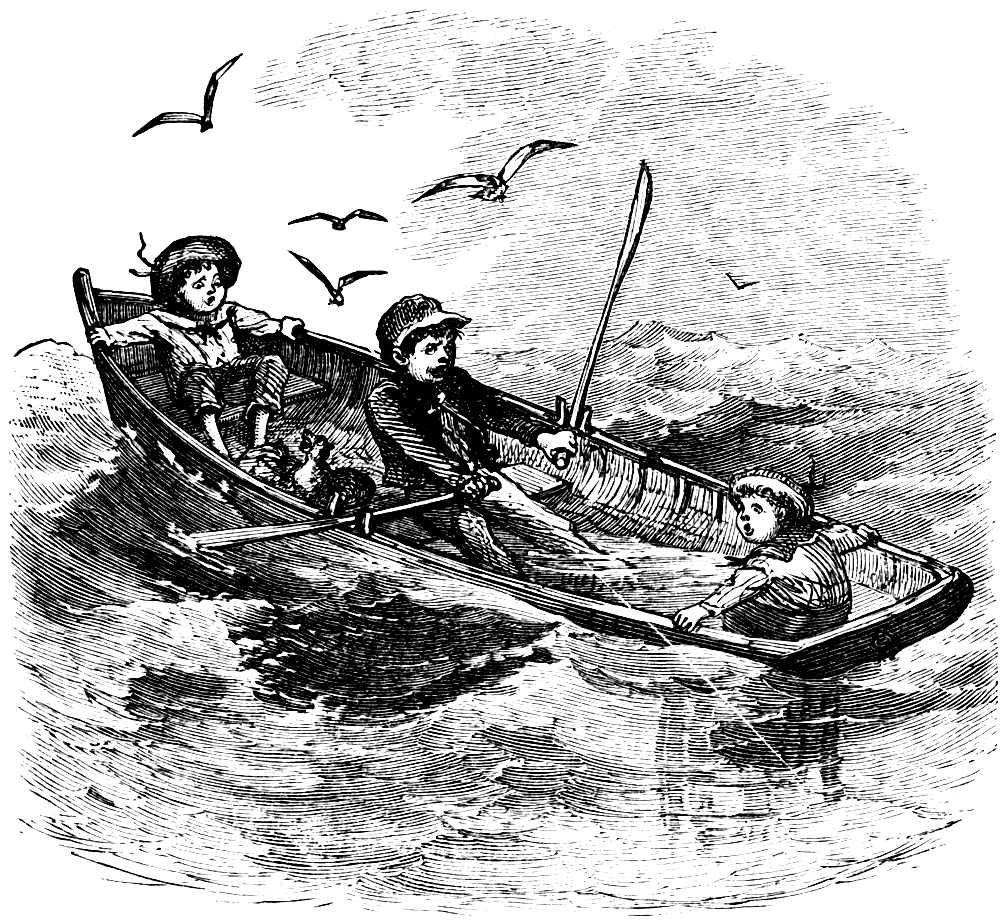
Now about the row home. Such a time as they had!
There was no rain to speak of; but the wind blew hard,
and this made the sea very rough,—so rough that the
boat pitched up and down, and sometimes took in water.
Amos told the Jimmies to hold on by the sides. They
were seated at the ends, as before, and, by stretching
their arms apart, could take hold of each side, and did
so. Amos put on his own hat, and let them have theirs,
but said it wouldn’t do to stop to empty the jacket-sleeves.
The grapes from the hats were emptied into
the bottom of the boat. Snip was in the bottom of
the boat too. As there was no one to hold him, he
lay down on the Jimmyjohns’ jackets.
And there he did mischief. The boat, it seems,
was an old, leaky boat, and the leaks were not well
stopped. Snip pulled out with his teeth, and chewed
up, what had been stuffed into the cracks; and, before
they knew what he was about, the water had begun to
come in, and was wetting their feet and all the things
in the bottom. The wind took their hats off, and blew
the flag away. They caught their hats, and held them
between their knees. Amos began to look sober.
The little boys, half crying, held fast by the sides of
the boat, saying over and over, “Oh, I want to go
home!” “I want to see mother!”
This was the time when the trousers were cut. “I
must cut pieces out of your trousers,” said Amos,
“and stop the leaks, or we shall be drowned. Mine
are too thick cloth.”
“THE LITTLE BOYS, HALF CRYING, HELD FAST BY THE SIDES OF THE BOAT.”
He took out his jack-knife as quick as ever he could,
and cut pieces from their trousers, and stuffed the
pieces into the cracks. Even this did not wholly keep
the water from coming in: so, just as soon as they
got past the rocks, Amos steered the boat to the land;
and there he pulled her up, the Jimmyjohns pushing
behind.
By this time it was after sunset. Amos emptied
all the grapes, except those in his basket, out upon the
ground behind a log, and covered them with dry seaweed.
He let the Jimmies have a part of what were
in their handkerchiefs. They all started then to walk
along the sands. As the jackets were too wet to be
worn, each boy carried his own on his arm. The Jimmies
took turns in carrying Snip. In this manner they
walked for nearly a quarter of a mile to the place they
started from. There were two men coming down
toward the water. As soon as Amos saw those two
men, he ran away; for one was Mr. Plummer, and the
other was the umbrella-man. The umbrella-man, it
seems, had told Mr. Plummer that he saw his little
boys in the field with Amos Dyke, and had come to
help him find them.
Mrs. Plummer sat up very late that Saturday night.
CHAPTER V. A LEAF FROM A LITTLE GIRL’S DIARY.
I am going to put some things about Effie in my
diary; and this is the reason why I am going to put
them in: My mother says, when Effie is a great girl
she will like to read some of the things she did and
said when she was three years old. And so will the
Jimmyjohns when they grow up; and so I shall put in
some of their things, too, when I have done putting in
some of Effie’s things. The Jimmyjohns are my little
brothers, both of them twins, just alike.
One time, Effie wanted to be dressed up in her best
clothes to go up in the tree and see the sun-birds. She
thinks that the tops of the trees are close up to the
place where the sun is, and that makes her call birds
sun-birds. And she thinks the birds light up the stars
every night. My mother asked her, “What makes
you think the birds light up the stars every night?”
and Effie said, “Because they have some wings to fly
high up.”
My father brought me home a pudding-pan to make
little puddings in. It doesn’t hold very much: it holds
most a cupful. And Joey Moonbeam is going to have
a party; and, when she does, my mother is going to
show me how to make a pudding in it. Joey Moonbeam
is my very great rag-baby. She has got a new
hat. I made it. Cousin Hiram says he is going to
draw a picture of it on Joey Moonbeam’s head in my
diary before she wears it all out. Betsey Ginger is
going to have some new clothes to wear to Joey Moonbeam’s
party; and
Dorothy Beeswax is
going to have one new
arm sewed on. Susan
Sugarspoon, and Eudora
N. Posy, and Jenny
Popover, are not
careful of their clothes,
and so they cannot
have some new ones.
N. stands for Nightingale.
Dear little Polly
Cologne was the very
smallest one of them
all. She was the baby
rag-baby. She was just as cunning, and she had hair
that wasn’t ravellings. It was hair; and all the others
have ravellings. Her cheeks were painted pink. She
had four bib-aprons, and she had feet. We don’t
know where she is. Rover—that little dog that we
used to have—carried her off in his mouth, and now
she is lost. Rover went away to find her when I told
him to, and he did not come back. We don’t know
where Rover is. We think somebody stole him, or else
he would be heard of. We feel very sorry. He was a
good little dog. My father says he was only playing
when he carried her off.
I love all my rag-babies. I love Snip, but not so
much as I do Rover. I love dear little baby-brother.
I love the Jimmies, both of them. I love Effie, and
I love my mother, and my father, and grandma Plummer.
I don’t love aunt Bethiah. Aunt Bethiah does
not love little girls. When little girls have a pudding-pan,
aunt Bethiah says it is all nonsense for them to
have them. My mother said I might have raisins in
my pudding. I like to pick over raisins. Sometimes
my mother lets me eat six when I pick them over, and
sometimes she lets me eat eight. Then I shut up my
eyes, and pick all the rest over with them shut up, because
then I cannot see how good they look. Grandma
Plummer told me this way to do. Effie is not big
enough. She would put them in her arm-basket. She
puts every thing in her arm-basket. She carries it on
her arm all the time, and carries it to the table, and up
to bed. My mother hangs it on the post of her crib.
When she sits up to the table, she hangs it on her chair.
One time, when the Jimmies were very little boys,
they picked up two apples that did not belong to them
under Mr. Spencer’s apple-tree, and ate a part. Then,
when they were eating them, a woman came to the
door, and said, “Didn’t you know that you mustn’t
pick up apples that are not your own?” After she
went in, the Jimmies carried them back, and put them
down under the tree in the same place again.
I am going to tell what Effie puts in her arm-basket.
Two curtain-rings, one steel pen she found, some spools,
some strings, one bottle (it used to be a smelling-bottle),
my father’s letter when he was gone away, a
little basket that Hiram made of a nutshell, a head
of one little china doll, Betsey Beeswax sometimes,
and sometimes one of the other ones, a peach-stone
to plant, a glass eye of a bird that was not a live
one, and a pill-box, and a piece of red glass, and pink
calico, and an inkstand, and her beads, and a foot of a
doll. One time it got tipped over when we played
“Siren.” Mr. Tompkins was in here when we played
“Siren.” He looked funny with the things on. Cousin
Floy told us how to play it. The one that is the
siren has to put on a woman’s bonnet and a shawl,
and then go under the table, and then sing under
there, and catch the ones that come close up when they
run by. I caught Hiram’s foot. Hiram was so tall,
he could not get all under. Cousin Floy stood up in a
chair to put the bonnet on him. My father did not
sing a good tune: it was not any tune, but a noise.
My mother did, and cousin Floy did too. Mr. Tompkins
squealed. Mr. Tompkins could get way under.
The one that is caught has to be the siren. Soon as
the siren begins to sing, then the others go that way to
listen, and go by as fast as they can. The siren jumps
out and catches them. My father got caught. He did
not want to put on the bonnet; but he did. He did not
sing a bad tune like Hiram’s, but a pretty bad one.
He made it up himself. My mother told Hiram that
sirens did not howl. When Johnny was caught, Jimmy
went under there too, and had another bonnet; and
they both jumped out together to catch. The tune the
Jimmies sung was,—
“Toodle-doo was a dandy cock-robin:
He tied up his tail with a piece of blue bobbin.”
Effie was afraid to go under. Her arm-basket got upset,
and made her cry. Snip flew at Hiram when Hiram
caught Johnny. He went under, too, when they went
under, and barked most all the time. I was the one
that got caught the most times, and so then I had to
be judged; and I chose cousin Floy for my judge, and
she judged me to tell a story.
We are going to have pumpkin for dinner. Joey
Moonbeam’s party is going to be a soap-bubble party.
When Clarence was the siren, he sang,—
“Hop, hop, hop!
Go, and never stop.”
Sometimes Clarence stops to play with us when he
comes here. My mother says he is a very good boy.
His father is dead: his mother is sick; so is his little
brother. He has got two little brothers and two little
sisters. They do not have enough to eat. He comes
here to get the cold victuals my mother has done using.
CHAPTER VI. A LITTLE GIRL’S STORY.
Mrs. Plummer holding “Josephus,” and Mr.
Plummer, and grandma Plummer, and Hiram, take
seats in the row, and play they are little children like
the rest, waiting to hear the story. Hiram, sometimes
called “the growler,” sits on a cricket, his long legs
reaching across a breadth and a half of the carpet.
Annetta seats herself in front of the row.
“Shall I make it up true, or ‘fictisher’?” she asks.
Annetta’s true stories tell of things which have really
happened. The “fictishers” are usually one solid mass
of giants. In fact, her hearers have had so many and
so very monstrous giants lately, that they can’t stand
any more, and ask that Annetta shall “make it up
true” this time; though, of course, what is true can’t
be made up.
“Well, if I make it up true,” says Annetta, “I shall
make it about the Jimmyjohns.” (The Jimmies, who
are seated together in the row, look very smiling at
this.) “All be very quiet,” Annetta goes on, “and
keep in the row. Mr. Growly must not interrupt so
much as he does most every time, because it’s every
word true.
“Once there were two little twinnies named the Jimmyjohns,
just as big as each other, and just as old, and
just alike. And one day, when Joey Moonbeam was
going to have a soap-bubble party, Annetta (me; but I
mustn’t say me, you know)—Annetta wanted to make
a pudding in her little pudding-pan, and her mother said
she might. And her mother gave her some grease, so
it needn’t stick on, and told how many teaspoonfuls of
sugar to take, and milk and cracker, and twenty currants
(because currants are smaller than raisins are).
And one egg was too many for such a little one, and
she couldn’t think what to tell about that: and Mr.
Growly said humming-birds’ eggs would be the right
size for such a little one; and he asked the Jimmyjohns
if they would chase some humming-birds home and get
their eggs, and they said ‘Yes.’ But he was only funning
with them. And he took a little red box with
white on top of it, that used to be a pill-box, out of
Effie’s basket—she let him—for them to put the eggs
in when they found any, and put two white sugar-lumps
in the box; and their mother said, when they found the
eggs, they could eat the sugar-lumps up, and put the
eggs in there.
“And first they went behind the syringa-bush; and,
when one came, they said, ‘Sh!’ and began to crawl
out. But Johnny tried to stop a sneeze’s coming; and
so that sneeze made a funny noise in his nose, and
scared it away.
“And first it went to the sweet-peas; and then it
flew to some wild rose-bushes over the fence, and then
to some other places. And they chased it everywhere
it went. And then it flew across a field where there
was a swamp; and, when they came to the swamp, they
couldn’t find it anywhere. And they saw a boy there,
and that boy told them maybe it flew over the hills.
Then they went over the hills, and it took them a great
while. And pretty soon there came along a little girl,
and her name was Minnie Gray; and she came to pick
flowers in a basket for another girl that was sick, and
couldn’t go out doors to smell the sweet flowers. And
she asked them where they were going; and they said
to find humming-birds’ eggs for Annetta to put in her
pudding, because Joey Moonbeam was going to have a
soap-bubble party. And they asked her if she knew
where humming-birds laid their eggs, and she said
she guessed in a lily; and they asked her where any
lilies grew, and she said in her mother’s front-yard;
and they asked her if they might go into her mother’s
front-yard and look, and she said they might. Then
they went over to Minnie Gray’s house, and went into
her mother’s front-yard, and looked in every one of the
lilies, but couldn’t find one. And pretty soon they
saw the funny man, that mends umbrellas, coming out
of a house with some umbrellas that he had to mend;
and he asked them where they were going, and they
said to find some humming-birds’ eggs for Annetta to
put in her pudding that she was going to make in her
pudding-pan, because Joey Moonbeam was going to
have a soap-bubble party. And they asked him if he
knew where to look for them, and he said they’d better
climb up in a tree and look. Then he went into
another house; and then they climbed up into Mr.
Bumpus’s apple-tree and looked, and couldn’t find any;
and Mr. Bumpus’s shaggy dog came out and barked,
and Mr. Bumpus’s boy drove him away; and a limb
broke with Johnny, and so he fell down, and it hurt
him, and made him cry.
“And Mr. Bumpus called the dog, and told them to
never climb up there and break his limbs off any more.
And then they went along; and pretty soon the funny
man came out of another house, and asked them if they
had found any humming-birds’ eggs, and they said ‘No.’
Then he told them butterflies laid theirs on the backs
of leaves: so they’d better go and look on the backs of
leaves, and see if humming-birds did so. So they went
into a woman’s flower-garden, and turned some of the
leaves over, and looked on the backs of them; and a
cross woman came out and told them to be off, and not
be stepping on her flower-roots. And the funny man
was coming out of a house way long the road; and,
when they came up to him, he asked them if they’d
found any, and they said ‘No.’ Then he laughed; and
he told them that mosquitoes stuck their eggs together,
and let them float on the water in a bunch together, and
they’d better go over to the pond and look there. So
they went over to the pond, and he sat down to wait;
and they went and looked, and came right back again,
and said they didn’t see any. Then he told them water-spiders
laid theirs in water-bubbles under the water,
and he said they’d better go back and look again. So
they went back and paddled in the water, and couldn’t
see any eggs in any of the bubbles, and got their shoes
and stockings very muddy with wet mud. And, when
they went back, there was another man talking with the
funny man; and that other man told them that ostriches
laid eggs in the ground for the sun to hatch them out,
and they’d better go dig in the ground. The funny man
and that other man laughed very much; and they went
away after that. And then the Jimmies got over a
fence into a garden, because the ground was very soft
there, and began to dig in the ground; and, when they
had dug a great hole, a man came up to them, and scolded
at them for digging that hole in his garden, and he
made them dig it back again. And I’ve forgot where
they went then. Oh, I know now!”
“Up on the hill!” cry the Jimmies both together.
“Oh, yes! I know now. Then they went up on the
hill; and there was a boy up there, and that boy told
them maybe humming-birds had nests in the grass, just
like ground-sparrows. But they could not find one;
and, when they were tired of looking, they sat down on
the top of the hill. And by and by Mr. Bumpus came
along, and his wife (that’s Mrs. Bumpus); and she
asked them if they had seen Dan (that’s Dan Bumpus),
and they said ‘No.’ Then she said she and Mr.
Bumpus were going to a picnic, and Dan was going.
And she said they were going by the new roadway;
and she asked them if they would wait there till Dan
came, and tell Dan to go by the new roadway. And
they promised to wait, and tell Dan. So they waited
there a very long time, and didn’t want to stay there
any longer; but they did, so as to tell Dan what they
said they would. And then it was most noon; and
Johnny said he was hungry, and Jimmy said he was
too. The funny man saw them sitting up on top of
the hill; and he went up softly and got behind some
bushes when they didn’t see him, and looked through.
And one of them wanted to go home; and the other
one said, ‘’Twon’t do, ’cause we must tell Dan what
we said we would.’ So they waited ever so long. And
the one that had the red box took it out and opened it;
and both of ’em looked in, and one of ’em asked the
other one if he s’posed their mother would care if they
ate up the sugar; and the other said mother told them
they might eat the sugar-lumps when they found the
eggs: so they didn’t know what to do. And, while
they were looking at it, they heard a great humming
noise in among the bushes. Then they crawled along
toward the bushes, softly as they could, to see what
was humming there. And they didn’t see any thing at
first: so they crawled along and peeped round on the
other side, and there they saw something very strange.
They saw an old broken umbrella all spread open, and
a green bush hanging down from it, and they saw the
feet of a man under the bush; and the humming came
from behind that umbrella. The funny man was behind
there humming, but they didn’t know it; and he
was looking through a hole. And, when they crawled
up a little bit nearer to see what made that humming
noise, he turned round with the umbrella, so they could
not see behind that umbrella; and, every time they
crawled another way, he turned round so they could
not see behind that umbrella; and when they began
to cry, because they felt scared, he took down the umbrella,
and that made them laugh.
“The baker was coming along the new road; and the
funny man stopped him, and bought two seed-cakes of
him for the Jimmies. And he told them they needn’t
wait any longer for Dan, for Dan had gone by another
way, riding in a cart. Then he came home with the
Jimmyjohns; and, when they got most to the barn, they
saw me—no, I mean saw a little girl named Annetta
(but it was myself, you know); and the funny man put
up his old umbrella, and began to hum; and he told her
to hark, and hear a great humming-bird hum; and that
made me—no, made the little girl laugh. And she
wanted him to keep humming; and she went in and
told the folks to all come out and see a great big humming-bird.
So the folks came out, and he kept moving
the old umbrella so they couldn’t see who was humming
behind there. And when they tried to get behind him,
so as to see who was humming there, he went backward
up against the barn; but one of them went in the barn
and poked a stick through a crack and tickled his neck,
and that made him jump away. Then Annetta’s father
said he knew where there was a humming-bird’s nest.
Then they all went across a field to some high bushes;
and Mr. Plummer lifted up the little children so we
could look in; and there we saw two very, very tiny,
tiny white eggs, about as big as little white beans. The
Jimmies wanted Annetta to take them to put in her
pudding; but the funny man said they’d better not.
He said he had read in a story-book, that, if you ate
humming-birds’ eggs, you would have to hum all your
life forever after. And so,” said Annetta, looking at
the row from one end to the other, “the pudding never
got made in the pudding-pan for Joey Moonbeam’s
soap-bubble party.”
CHAPTER VII. THE BAD LUCK OF BUBBY CRYAWAY.
The Jimmyjohns are never happy when their faces
are being washed. Perhaps it is no more than
right to tell the whole truth of the matter, and confess
that they cry aloud at such times, and also drop tears
into the wash-basin; which is a foolish thing to do,
seeing there is then water enough already in it.
One morning, as little Mr. Tompkins, the lobsterman,
came wheeling his wheelbarrow of lobsters up to
the back-door of the cottage, he met the Jimmyjohns
scampering off quite fast. After them ran Annetta,
calling out, “Come back, come back, you little Jimmyjohn
Plummers!” Effie, standing in the doorway,
shouted, “Turn back, turn back, oo ittle Dimmydon
Pummers!” Mrs. Plummer, from the open window,
cried, “Boys, boys, come and be washed before you
go!” Hiram said nothing; but, by taking a few steps
with those long legs of his, he got in front of the runaways,
and turned them back, making motions with his
hands as if he had been driving two little chickens.
Mr. Tompkins took one under each arm, and presented
them to Mrs. Plummer. Mrs. Plummer led them into
another room. Strange sounds were heard from that
room; but, when the ones who made those sounds were
led back again, their rosy cheeks were beautiful to see.
Mr. Tompkins sat with a broad smile on his face. He
seemed not to be noticing the two little boys, but to be
smiling at his own thoughts: and, the while he sat
thinking, the smile upon his face grow broader, his
eyes twinkled at the corners, his lips parted, his shoulders
shook; there came a chuckle, chuckle, chuckle, in his
throat; and then he burst out laughing.
“I was thinking,” said he, “of a boy who—thinking
of a boy I used to know a long time ago, down in
Jersey, who—who tried to get rid of a small wetting,
and got a big one. I shall have to tell you about that
smart chap: I knew him very well. He was afraid to
have his face washed, even when he had grown to be
quite a large boy; and also afraid to have his hair cut.
Sometimes in the morning, when his mother forgot to
shut the windows before she began, people would burst
into the house, asking, ‘What’s the matter? Anybody
tumbled down stairs, or out the chamber-window, or got
scalded, or broken any bones?”
“Why, did he cry as loud as that?” asked Annetta.
“Oh, yes! and pulled back, and twisted his shoulders,
and turned his head the wrong way. I can tell
you it was hard work getting him ready to go out in
the morning. The boys called him ‘Bubby Cryaway.’
They were always watching for chances to wet him.
If he passed near a puddle, splash would come a great
stone into the water! When he staid out after sunset,
they would begin to shout, ‘Better go in, Bubby: the
dew’s a-falling!’ Sometimes they called him ‘Dry-Goods.’
“But this is what I was laughing about. One morning
he thought he would start out early, before his
sisters said any thing about washing his face, or cutting
his hair. They had then been coaxing him for
a long, long time to have his hair cut. So he crept
down the back-stairs, and across the back-yard, and
through a back-alley, which took him into the worst-looking
street in town. Here he met a fellow named
Davy Bangs. Davy Bangs’s mother kept a little shop
in that street: I’ve bought fish-hooks of her many’s the
time. Davy Bangs asked him if he were going to the
circus. He said ‘No:’ he hadn’t any money. Davy
Bangs asked him why he didn’t catch frogs, and sell
them to the circus-riders. He asked Davy if the circus-riders
would buy them.
“‘Yes, and be glad to,’ said Davy. ‘They eat the
hind-quarters: that’s what makes ’em jump so high.
And if you’ll go over to Dutch Meadows,’ said Davy,
‘to that little swamp they call Duck Swamp, you can
dip up frogs with a dip-net; and, if you want a dip-net,
I’ll lend you our old one.’
“He went and got Davy Bangs’s old dip-net, and was
hurrying along the streets with it, when a ragged country-boy—who
had come in to the circus, I suppose—cried
out,—
“‘Halloo, little fisherman! The man that keeps the
furniture-store wants you.’
“Bubby turned back and found the furniture-store,
and went in; and there he stood, waiting, waiting,
waiting, till at last a workman ordered him off. As he
was walking away, he saw the country-boy grinning at
him from around a corner, and shouted,—
“‘The man didn’t want me! Now, what did you say
that for?’
“‘I thought he’d want your hair to stuff cushions
with!’ cried the boy, and then ran off.”
“Now, I think that was mean enough!” said Annetta.
“Pray, Mr. Tompkins, go on,” said Mrs. Plummer.
“I want to hear what happened to the little fisherman.”
“Plenty of things happened to him,” said Mr. Tompkins.
“He had to run so fast, to make up for waiting,
that he stumbled over cellar-doors, and tumbled down
half a dozen times, besides bumping against everybody
he met. When he came to Dutch Meadows, he turned
down a lane, thinking there might be a short cut that
way to Duck Swamp. This lane took him past the
house of a Mr. Spleigelspruch.” Here the chuckling
sound came into Mr. Tompkins’s throat again; and
presently he burst into a hearty laugh.
“Now, do please tell us; then we can laugh; but now
we can’t,” said Annetta.
“I will,” said he. “I’ll tell—I’ll tell—he, he, he,
he, he!—I’ll tell right away. That Mr. Spleigelspruch
was a Dutchman,—a short, fat, near-sighted,
cross old Dutchman. His wife took in washing. His
wife’s sister, and his wife’s sister’s sister-in-law Winfreda,
lived in another part of the same house, and they
took in washing too. Winfreda was poor, and the other
woman made her do all the hardest jobs of work. Mr.
Spleigelspruch got his living by selling eggs, poultry,
and garden-stuff, and by raising the uncommon kinds
of fowls,—fowls which brought high prices. He was
troubled a good deal by boys coming around there,
chasing his hens and stealing his eggs, and trampling
on the clean clothes spread out on the grass. I suppose
that was what made him so cross.”
“And did that old cross man touch that boy?” asked
Johnny Plummer.
“I should think he did touch that boy!” said Mr.
Tompkins. “Yes, yes, yes!—he, he, he, he!—I’ll
tell you how it was. Just as the boy got to Mr. Spleigelspruch’s,
a dozen or more people came running down
the lane, screaming, ‘Elephant, elephant!—the elephant’s
a-coming!’ There wasn’t a word of truth in
this story. A few boys in town had shouted, ‘The
elephant’s coming!’ meaning he was coming with the
circus: and some folks who heard them thought
the elephant had got away from his keeper; and they
shouted and ran, and this made others shout and run,
and this made others, and this made others; so that
there was great confusion. Carriages were upset, windows
smashed in, children jostled about; and some of
the people were so scared, they ran out of town away
past Mr. Spleigelspruch’s.
“Now, on this very day,” continued Mr. Tompkins,
looking more and more smiling, “Mr. Spleigelspruch
had received from his cousin in Germany, Mr. Lockken,
a pair of very rare fowls called the ‘eagle-billed robin-fowl.’
They were very uncommon fowls indeed. The
rooster was different from common roosters in three
ways,—in the tone of its voice, in the hang of its tail-feathers,
and in the shape of its bill. Its bill was
shaped very much like an eagle’s bill. Mr. Lockken
had taken great pains to improve the tone of voice.
This kind of thing is something which nobody else
ever did; at least, nobody that I ever heard of.
“‘If I can only cause to be sweet the voices of the
crowers,’ Mr. Lockken in Germany wrote to his cousin,
Mr. Spleigelspruch, ‘it will be then like to having so
many monster robins about our door-yards. Then
shall I make my fortune.’
“Mr. Lockken began on a kind of fowl called ‘the
eagle-billed fowl,’ and tried experiments upon those for
a number of years; keeping almost every thing that he
did a secret, of course. It was said that he shut up the
chicks, as soon as they were hatched, in a large cage of
singing-birds. He tried a good many kinds of food,
oils especially, mixed in a good many ways; and at
last—so he wrote his cousin, Mr. Spleigelspruch—he
did get a new kind of crowers. Their voices were
not quite as musical as robins’ voices, he said; but
they were remarkably fine-toned. He called them the
‘eagle-billed robin-fowl.’ Mr. Spleigelspruch bought
the first pair of these fowls which were for sale, and paid
fifty dollars for them; and there was the expense of
getting them over here besides. They arrived, as I
said just now, on the very day I have been speaking of;
and, as the place where they were to stay was not quite
ready, they were put, for a short time, in a barrel near
a board fence, quite a little way from the back-yard.
Mr. Lockken said in his letter, that, for the first year,
it would be better for them to be kept as far out of
hearing of the common kinds of crowers as was
possible.
“Now, that chap with his dip-net, when those people
yelled so about the elephant, jumped over the board
fence in a hurry, and happened to jump right down
upon that barrel, and knocked it over. He hit another
barrel at the same time, and let out a duck,—some curious
kind of South-sea duck, I think; but that wasn’t
so much matter. When he came down, why, over went
the barrel, and over went he, right into the duck-pond;
and out flew the eagle-billed robin-fowls. Mr. Spleigelspruch
was busy, some ways off, getting their place
ready. The first that he knew of the matter, a woman
who lived in the next house screamed to him that somebody
was stealing his fowls. He saw a boy running,
and gave chase. He didn’t know then that his fowls
had got away. The boy tried to get out of sight, and
ran so fast he didn’t mind where he was going, and so
ran over some clean clothes spread out on the grass.
Mr. Spleigelspruch’s wife and his wife’s sister, and his
wife’s sister’s sister-in-law Winfreda, came out with
their brooms in a terrible rage. The wife’s sister
caught hold of him, and the wife held him fast. There
was a tub near by, which had some rinsing-water in it;
and they dropped him into that, and held him down
with their brooms, and sent Winfreda to the pump for
more water. They said they would souse him. Mr.
Spleigelspruch came up, bawling,—
“‘Stop thief! Police! Hold him! Rub him! Give
it to him! Drub him! Scrub him!’
“He caught up Winfreda’s broom, but didn’t use
it long; for in a minute that same woman ran into the
yard, screaming, ‘They’ve got away!—your new fowls
have got away!’ Then they all left the boy, and ran to
catch the fowls. When Winfreda came back with the
water, she behaved kindly to the boy. Winfreda had
lived a hard life, and that made her know how to pity
other folks. Bringing the water along, she thought to
herself (so she told the boy afterward),—
“‘Suppose I had married in my young days, and suppose
I had now a little grandson, and suppose he were
treated like that boy,—oh, how badly I should feel!’
“She took him out of the water; she made him go
up stairs and get between the blankets of her own bed;
she fed him with broth; she hung his clothes on the
bushes to dry; she borrowed another suit for him; and
she let him out into the street through a place where
there was a board loose in the fence. Next day his
father took the clothes back, and changed them. The
fowls had just been found in a swamp. It was thought
that some country-people coming in to circus caught
them the day before and carried them off, and that the
fowls afterwards got away. They probably staid in the
swamp all night, and that might have been the means
of their death; though it might have been the sea-voyage,
or change of air, or home-sickness: we can’t
tell. They didn’t live very long after that.”
“And didn’t he get some more?” Annetta asked.
“No. The cousin in Germany died; and his fowls
were not attended to; and a disease got among them,
and carried them off. Mr. Spleigelspruch told me the
whole story after I grew up.”
“What a pity,” said Hiram, “that those musical
fowl couldn’t have spread over the country! ’Twould
be a fine affair to have all the roosters singing in the
morning, instead of making the kind of noises they do
make. ’Twould be like an oratorio.”
“To be sure,” said Mrs. Plummer. “And I wish,
for my part, that boy had staid at home. I suppose
he has grown up by this time. It is to be hoped that
he washes his face, and also that he doesn’t forget poor
Winfreda.”
“Oh, no!” said Mr. Tompkins, stepping out, and
taking up the arms of his wheelbarrow,—“oh, no! I
don’t forget Winfreda. I send her lobsters every
spring.”
“You, you! what do you send her lobsters for?”
asked Mrs. Plummer and Hiram, both speaking at once.
Mr. Tompkins trundled his wheelbarrow along pretty
fast, laughing away to himself; and, when he got beyond
the yard, he looked over his shoulder at them as
they stood in the doorway, and called out, “I was the
boy!”
CHAPTER VIII. WHAT MADE MR. TOMPKINS LAUGH.
One afternoon, when the Jimmyjohns were playing
in the back-yard, Mr. Doty, the funny man as we
sometimes call him, came jogging along. When he
saw the little boys, he stopped, and began to push his
hat up on one side, and to scratch his head, and to
twinkle the corners of his eyes. Then he began:—
“Oh! you’re out here, so you are. What are you
doing?”
“Making a flow,” they answered, looking up from
the mud and water in which they stood.
“Hem! well, why don’t you go somewhere?”
“Ma won’t let us.”
“Won’t she? Oh, no, she won’t! will she? Well,
hem! Why don’t you have a party?”
“’Tisn’t our birthday yet!” cried Johnny, hopping
up and down with the pump-handle.
“Well, why not have a cocoanut-party?”
“We haven’t got any cocoanut.”
“Oh! I’ll find a cocoanut” (holding up one). “See
here! Where are you going so fast?”
“To ask ma!” they shouted, running in doors.
The funny man’s eyes twinkled, and up went his
hand to scratch his head again. Presently they popped
their heads out, and asked,—
“When shall we have it?”
“Have it now,” said Mr. Doty.
“Have it now,” they told their mother.
“Where?” asked Mrs. Plummer.
“She says, ‘Where?’” shouted the Jimmies.
“Out here on the grass,” said Mr. Doty.
“Out here on the grass,” the Jimmies repeated.
“Who’s to be invited?” asked Mrs. Plummer.
“Who’s to be invited?” asked the Jimmies.
“Well—hem! Invite—anybody,” said Mr. Doty.
“I’ll come: that makes one.”
“And I’ll make two,” cried Annetta, looking out
of the window.
“What is it?—a party?” asked Hiram, stepping
down from a high wood-pile with his long legs. “Oh,
I’ll come! I’ll make three and a half. What kind of
a party is it?—a birthday-party?”
“Oh, no, indeed!” said Mr. Doty. “Nothing of
that sort. ’Tis a cocoanut-party.”
Just then little Effie came trotting along with her
arm-basket.
“Can you come to our party?” asked Mr. Doty.
“No, I tan’t tum,” said Effie very soberly.
“What! not come to a cocoanut-party?” cried Hiram.
“No, I tan’t, tause my tittens’ eyes haven’t tum
opened ’et,” said Effie.
“Ask the Jimmyjohns to wait till your kittens’ eyes
come open,” said Hiram.
Little Effie went close to the Jimmies, looked up in
their faces, and said, “Dimmydons, will oo wait till my
tittens’ eyes tum opened?”
The Jimmies laughed; and so did another little fellow
who was then coming out of the house. This was
Clarence,—a poor boy who came every day with his
basket to get what food was to be given away. Some
people called him “the little gentleman,” because he
had very good manners.
“Do you want to stay to the party?” Mr. Doty
asked Clarence.
“If the Jimmyjohns will let me,” he said.
“Yes, yes, you may come!” they shouted.
“Can’t cousin Floy be invited?” asked Annetta.
“She’s here playing with me.”
“By all means,” said Hiram. “And there’s Mr.
Tompkins: maybe he’ll come to the party.”
Mr. Tompkins, the lobster man, had dropped his
wheelbarrow, and come to look over the fence.
“Mr. Tompkins can’t leave his lobsters,” said Mr.
Doty.
“Party?—yes, yes; always go to parties; boy’ll
mind wheelbarrow,” said Mr. Tompkins in his short,
quick way. “When is it going to begin?”
“Right off,” said Mr. Doty.
“What do you do first?” asked Hiram.
“Set the table,” said Mr. Doty.
“The girls must set the table,” said Hiram.
“Where is it?” asked cousin Floy.
“There it is: don’t you see it?” Hiram was pointing
to a wagon-body which lay there without its wheels.
He turned it upside down. “There’s your table,”
said he.
After the pieces of cocoanut were placed on the
table, Mr. Doty told the Jimmyjohns to ask their ma if
she didn’t want to come to their party.
“I am longing to come,” cried Mrs. Plummer, appearing
at the door. “I have thought of nothing else
ever since it was first mentioned. Would baby disturb
the party, do you think?”
“Not at all,” said Hiram. “Pray invite Josephus.”
“I wish some of you would be kind enough to bring
him out,” said Mrs. Plummer. “He is fastened in his
straw chair.”
“I will,” said Hiram.
Hiram brought out Josephus, then a rocking-chair,
and then some common chairs for Mr. Doty and Mr.
Tompkins. The children ran in for crickets. Snip
capered after the Jimmies every step they took, and
came near being trodden on.
There were seventeen sat down to table,—twelve
that were in plain sight, and five that could not be seen
very plainly. The twelve who were in plain sight were
Mr. Doty, Mr. Tompkins, Mrs. Plummer, Josephus,
Hiram, cousin Floy, Annetta, Effie, Clarence, Jimmy,
Johnny, and Snip. The five who could not be seen
very plainly were the cat and her four kittens. These
were invited on Effie’s account, and came in their own
private box.
Just as the cocoanut was being passed round, Mr.
Plummer appeared from the orchard, and asked what
was going on.
“A party!” shouted the children.
“Well,” said Mr. Plummer, “I must say that it is
rather strange that I have not been invited!”
“Won’t you come? Oh, do come!” the children
called out.
“In my own yard too!—very strange indeed!”
said Mr. Plummer.
“But won’t you come?”
“I haven’t had any invitation.”
“Take one; do come!” they shouted.
Mr. Plummer laughed, and went and sat down on a
roller-cart close by Josephus.
“Will the party be done right away after supper?”
asked Hiram as they all nibbled cocoanut.
“Oh, not so soon!” cried Annetta.
“It hasn’t lasted five minutes,” said Mrs. Plummer.
“Play charades; do, please do!” cried Floy. “I
went to a real party last night, and they played charades.
One charade was ‘Mother Goose.’”
“How do you play it?” asked Annetta.
“Oh, easy enough! Somebody has to be ‘mother;’
and then somebody has to be ‘goose;’ and then somebody
has to be ‘Mother Goose,’ and say, ‘Sing song
a sixpence, pocketful of rye.’”
“I speak not to be the ‘goose!’” cried Hiram.
“Who’ll be ‘mother’?” asked cousin Floy.
“You be ‘mother,’” said Annetta.
“Well, I’ll be ‘mother,’” said cousin Floy. “Who’ll
be my little girl? There must be a little girl to keep
coming in, and saying ‘Mother,’ and asking me for
things.”
“I’ll be little girl,” said Hiram.
“Hoo, hoo! he, he! you don’t know how! you’re
too tall!” shouted the children.
“Oh, yes! I know how. Come, Floy, let’s get ready.”
And away they went into the house.
In about five minutes cousin Floy came out, dressed
in Mrs. Plummer’s things,—shawl, bonnet, and skirt,—and
with a serious face took her seat in a chair which
had been placed upon the wagon. Then came Hiram,
with Floy’s hat on, the elastic under his chin. For a
sack he had turned his coat, which was lined with red,
wrong side out; and he had pinned a shawl around his
waist in a way which made it look like a dress-skirt.
Floy told him he must keep coming in to ask her
something, and must call her “mother” every time.
He did just as she had told him. He trotted out of
the house and back, taking little short steps, asking a
question each time, and imitating the voice of a small
child.
“Mother, may I have a cent?” “Mother, may I
go out to play?” “Mother, may I wear my new
shoes?” “Mother, may I make corn-balls?” “Mother,
may I have a doughnut?”
At each question the “mother” would shake her
head very soberly, and say, “No, my daughter;” or,
“Not at present, my daughter.”
“Good!” cried Mr. Tompkins,—“very good for
‘mother’! Now who’s going to be ‘goose’?”
“I will,” said Clarence.
“Come, then,” said Floy. “If cousin Hiram will
help me, I’ll dress you up for ‘goose’ in the way they
dressed up their ‘goose’ last night.”
Hiram and Floy took Clarence into the house, and
got an old light-colored calico dress of Mrs. Plummer’s,
and held it bottom up, and told Clarence to step in, and
put his legs through the sleeves. Next they gathered
the bottom of the skirt around his neck, keeping his
arms inside. Then they tied a thin pocket-handkerchief
over his head, covering face and all. Then they
fastened a tin tunnel to the front side of his head, and
called that the “bill of the goose;” and then pinned
on two feather fans for wings, and hung a feather duster
on behind for a tail. Floy told him he must stoop far
over, and go waddling around, pecking with his bill
like a goose.
The instant the “goose” appeared, all the people
began to laugh: and when they saw it waddling around
in the grass, pecking with its bill as if it were pecking
at little bugs, they fairly shouted; some crying out,
“Oh, what a goose!—oh, what a goose!” Josephus
shouted too, and made his feet fly and his hands fly,
and patted cakes enough for his supper. Snip barked,
and ran this way and that way; keeping away from the
“goose,” though.
The next thing was to put the two words together,
and act “Mother Goose.”
“Mr. Tompkins,” said Mr. Doty, “why don’t you
be ‘Mother Goose’?”
“I don’t believe Mr. Tompkins could keep from
laughing,” said Hiram.
“Oh, yes, I could! I could keep from laughing,”
said Mr. Tompkins; “but my nose is too short.”
“That Mother Goose’s nose last night,” said Floy,
“had wax on it to make it long.”
“Nice way that,” said Hiram. “But, Mr. Tompkins,
are you sure you can keep from laughing?”
Hiram had a reason for asking this question.
“Oh, yes! perfectly, perfectly sure,” said Mr. Tompkins.
“Make me laugh, I’ll pay forfeit.”
Mr. Tompkins was so eager to show that he could
keep from laughing, that he agreed to pay any kind of
forfeit, and to dress in any kind of way.
Hiram took him into the house, and dressed him.
First he lengthened out his nose with a piece of warm
wax; then he tied a handkerchief over his head for a
cap (for a cap-border he pinned on some strips of
newspaper); and then he put a large round cape over
his shoulders. A black shawl served for a skirt. When
all this was done, he told Mr. Tompkins that he might
sit down in the house and wait a few moments. He
had a reason for telling him that.
Cousin Floy, a little while before, when the “goose”
was being dressed, told Hiram of a way by which one
of the actors was made to laugh at the “real party”
she went to; and Hiram thought it would be fun to try
it with Mr. Tompkins.
So, while Mr. Tompkins was sitting down to wait a
few moments, they went into another room, and got a
pillow, and dressed it up to look like an old woman.
First they tied a string around the pillow, near one
end, to make a head. On one side of this head they
marked eyes, nose, and mouth with a piece of charcoal.
Then they took a waterproof, stuffed out the sleeves for
arms, and put that on the pillow-woman. Then they
went up into grandma Plummer’s room, and borrowed
an old cap, black bonnet, and spectacles, and put
those on.
When the pillow-woman was ready, Floy ran and
told them all to be sure and not laugh loudly when they
saw what was coming, for fear Mr. Tompkins might
hear them. The pillow-woman was then taken out by
Hiram, and seated in a chair among the other people.
He introduced her to them as “Mrs. Mulligachunk.”
He pinned together the wrists of her stuffed arms, and
let them drop in her lap, and placed a bundle on them
to cover the place where there should have been hands.
The bundle was tied up in a handkerchief. Then he
placed a pair of shoes just where they would seem to
be her feet, stood an umbrella by her side, and tipped
her head back just a little; so that, when Mr. Tompkins
should be standing on the wagon, she would appear
to be looking him in the face.
“Come, Mother Goose!” cried Hiram; and Mr.
Tompkins, in his funny rig, walked from the house,
took his stand upon the wagon, and with a very sober
face began:—
“Sing a song a sixpence, pocketful of rye;
Four and twenty blackbirds baked into a pie:
When the pie was opened, the birds be”—
At that moment his eye fell upon “Mrs. Mulligachunk.”
She sat there in a row with the others, and
seemed to be listening just the same as anybody. The
people, who were all on the watch, burst out laughing;
and Mr. Tompkins had to laugh too, in spite of all he
could do.
Hiram sprang up. “Mother Goose,” cried he, “let
me introduce you to Mrs. Mulligachunk.”
Mother Goose replied by taking off her things, and
throwing them at Mrs. Mulligachunk.
Then Hiram asked the Jimmies if they didn’t want
to take Mrs. Mulligachunk to ride.
“Yes, yes! yes, yes!” they shouted.
Hiram then put Mrs. Mulligachunk into the roller-cart,—bundle,
umbrella, and all. The Jimmies caught
hold of the handle, and away they ran like two smart
little ponies, Snip barking behind with all his might.
Mr. Tompkins was about to follow; when Annetta
and cousin Floy suddenly called out, “Forfeit, forfeit!
You’ll have to be judged!”
Mr. Tompkins gave his penknife for a forfeit.
“Then judge me quick!” said he; “for I must be
going.”
“To dance a jig!” cried Hiram.
“To tell a story!” cried cousin Floy.
“Yes, yes! that’s it!” cried Annetta.
“Oh, no! no, no! take too long,” said Mr. Tompkins.
But Mr. Plummer and Mrs. Plummer, and all the
rest, kept shouting, “Story, story, story!”
“Well, well, story ’tis,” said Mr. Tompkins; “a
small one, though.”
And then Mr. Tompkins began to tell a small story
about a hen named Teedla Toodlum, who lived in a far-away
country,—the name of which country was so
strange, that not one of the people could remember it
five minutes afterward. In the next chapter you shall
have Mr. Tompkins’s story.
CHAPTER IX. MR. TOMPKINS’S SMALL STORY.
“It must be a small one,” said Mr. Tompkins.
“Oh, yes! we’ve agreed to that,” said Mr.
Plummer.
Mr. Tompkins then asked if they were willing it
should be merely a hen-story.
“We’ll take the vote on that,” cried Hiram. Then,
turning to the company, he said,—
“Ladies and gentlemen, it is known to you that our
friend Mr. Tompkins has paid his forfeit, and that he
has been judged to redeem it by telling a story. It was
no more than right for him to pay a forfeit; for he
laughed at a quiet old lady who never did him any
harm, and treated her in an unkind manner. Mr.
Tompkins now wishes to know if his small story may
be merely a hen-story. All who are willing that Mr.
Tompkins’s small story shall be merely a hen-story
please to say ‘Ay.’”
“Ay, ay, ay, ay!” was shouted many times by
young and old; and, what with the shouting and the
laughing and the hand-clapping, there was such a racket
as set Snip a-barking at the top of his voice. Josephus
crowed, and made his feet fly, and patted cakes,
and tossed them up so high, that he nearly threw himself
over backward. The cat hopped out of her private box,
her tail standing straight in the air: and it is more than
likely that the kittens’ eyes came open with wonder;
which would have been a very great wonder indeed,
seeing that the nine days were not much more than
half over.
Mr. Tompkins then told the following short and simple
story, which was written down upon the spot by the
only person present who had a lead-pencil:—
There was once a hen who talked about another hen
in a not very good way, and in a not at all friendly
way. The hen she talked about was named Phe-endy
Alome. Her own name was Teedla Toodlum. They
both belonged to a flock of white hens which lived in
the far-away country of Chickskumeatyourkornio.
Now, the one that was named Teedla Toodlum went
around among the other hens, making fun of Phe-endy
Alome on account of her having a speckled feather in
her wing. She told them not to go with Phe-endy
Alome, or scratch up worms with her, or any thing, because
Phe-endy had that speckled feather in her wing.
One of the hens that Teedla Toodlum talked to in
this way was deaf, and therefore could not hear very
well. She had become deaf in consequence of not
minding her mother. It happened in this way: A tall
Shanghai roost-cock crowed close to her ear when she
was quite small; when, in fact, she was just hatched
out of her shell. She had a number of brothers and
sisters who came out at almost the same time. The
Shanghai stood very near, and in such a way that his
throat came close to the nest, and he crowed there.
The chicks wanted to put their heads out from under
their mother, and see who was making such a noise.
Their mother said,—
“No, no, no! Keep under! You might be made
deaf: I’ve heard of such a thing happening.”
But one chick did put her head out, and close to the
Shanghai’s wide-open throat too, and when he was
crowing terribly.
Then her mother said,—
“Now I shall punish you: I shall prick you with my
pin-feathers.”
And the chick was pricked, and she became deaf besides;
so that, when she grew up, she hardly could
hear herself cackle. And this was the reason she could
not understand very well when the hen named Teedla
Toodlum was telling the others that the hen named
Phe-endy Alome had a speckled feather in her wing.
One day, the hen named Teedla Toodlum scratched
a hole in the sand beneath a bramble-bush, and sat
down there, where it was cool; and, while she was
sitting there, a cow came along at the other side of the
bramble-bush, with a load of “passengers” on her
back. The cows in the country of Chickskumeatyourkornio
permit the hens to ride on their backs; and,
when a great many are on, they step carefully, so as
not to shake them off. In frosty weather they allow
them to get up there to warm their feet. Sometimes
hens who have cold feet fly up and push off the others
who have been there long enough.
The cow passed along at the other side of the bush,
and by slipping one foot into a deep hole which was
hidden with grass, and therefore could not be seen,
upset the whole load of passengers. She then walked
on; but the passengers staid there, and had a little
talk together,—after their own fashion, of course.
The deaf one happened to be among them; and, seeing
that the others were having great sport, she wanted to
know what it was all about. Upon this the others—those
of them who could stop laughing—raised their
voices; and all began at once to try to make her understand.
And this is what they said:—
“Think of that goose of a hen, Teedla Toodlum,
telling us not to go with Phe-endy Alome because Phe-endy
Alome has a speckled feather in her wing, when
at the same time Teedla Toodlum has two speckled
feathers in her own wing, but doesn’t know it!
Teedla Toodlum was listening, and heard rather more
than was pleasant to hear. She looked through the
bramble-bush, and saw them. Some had their heads
thrown back, laughing; some were holding on to their
sides, each with one claw; and some were stretching
their necks forward, trying to make the deaf one understand,
while the deaf one held her claw to her ear
in order to hear the better.
“Ah, I feel ashamed!” said Teedla Toodlum to
herself. “I see now that one should never speak of
the speckled feathers one sees in others, since one can
never be sure that one has not speckled feathers one’s
self.”
“Why, that’s the way our cow does!” cried the
Jimmyjohns as soon as Mr. Tompkins had finished.
“What! talks about speckled feathers?” asked
cousin Floy.
“No: lets hens stay on her back.”
“Her parents, or grandparents, or great-grandparents,
then,” said Mr. Tompkins, “probably came
from Chickskumeatyourkornio.”
FLOWERS WAKING UP.
“It must be that spring has
come,” said the Pansy,
“or I should never feel so uneasy,
and so very wide-awake.
I’ve a great mind to put my
head up out of the ground, and
see. Hark! Yes, there are
the birds. They are calling to
the flowers. ‘Awake!’ they
say, ‘awake, and come forth!
There’s nothing to be afraid of
now; for Old Winter has gone
away. He can’t hurt you any
more. Violet! Snowdrop!
Pansy! Don’t stay down there
any longer.
We little
birds are
lonesome
without you.’
Yes, birds,
we are coming,
and that right soon; for it is quite time the spring
work was a-doing; and as old Goody Grass says, if
some of us do not spring up, there will be no spring
at all.
“Ah, how charming to breathe fresh air, and to be
in the light! Why, I feel all alive, all astir! This
warm sunshine thrills me through and through. ’Twas
very dismal down there; but how light and cheerful it
is up above! And here are all our old neighbors;
come to spend the summer, I hope. Dear Violet,
I’m so glad to see you! When did you come up?”
“Only just this moment, Pansy. When the birds
began to call, I felt that we ought to start immediately.
It is really very pleasant to be awakened by music;
pleasant, too, to meet old friends once more. And,
oh, how good it is to be alive! I have just your feelings,
and cannot keep myself quiet. What is the
charm that works upon us so?”
“I believe,” said Pansy, “that the great shining
sun up there has something to do with it, in a way we
don’t understand.—Ah! Neighbor Snowdrop, how do
you do? No doubt, being so early a riser, you were
one of the very first upon the ground.”
“Why, yes,” said Snowdrop, “I do make a practice
of coming early. It seems as if the birds should
have some one to welcome them back: it must be
hard work singing to bare ground, after what they’ve
been used to at the South. And, besides, my dreams
were so unpleasant, that I was really glad to shake
them off. Probably I slept too near the surface; for
the terrible uproar above ground disturbed me, even in
my sleep. I dreamed that a mighty giant was striding
about, shaking the world to pieces; that he stamped
upon the flowers; and was so cruel to the trees as to
make them groan dreadfully. Once I half awaked,
and shuddered, and said to myself, ‘Oh! what can
be going on overhead?’ then fell asleep again, and
dreamed that the whole beautiful earth was covered
with something white and cold, and that a voice said,
‘Go up through the snow!’ to which I answered, ‘Oh!
I’m afraid to go alone.’
“When I awoke, the voice seemed still saying, ‘Go
up!’ Then I remembered the birds, and came, but came
trembling; for the cold white snow was truly here, and
I feared that dreadful giant might be real also. My
good friends, did you have no bad dreams? and were
you not disturbed by the tumult?”
“Not at all,” said Pansy. “When our mother told
us the good Summer who loved us had gone, and that
there was a dreadful old Winter coming, who would
growl and pinch and bite, and that we’d better keep
our heads under cover, then I went to sleep, and slept
soundly. I haven’t heard any thing of all this rowdedow
you say has been going on overhead, but, on the
contrary, have had very charming dreams. I dreamed
of being in a place where the sky was made up of the
most beautiful colors,—purple, yellow, pale gold, and
straw-color; and there were purple and yellow rainbows
reaching down from the sky to me. At last I
awoke, and heard the birds calling. Wasn’t that
pretty? Now, little Violet, what did you dream?”
“In my dreams,” said the Violet, “the sky was all
over blue,—a deep, beautiful blue. And I can’t tell
you how it was,—the dream was a strange one,—but,
while it lasted, this blue seemed to fall upon me,—to
fall gently, as the dew falls; and with the blue came a
delightful perfume. It was a very sweet dream.”
“Now I slept here quite accidentally,” said a young
Sunflower, starting up; “but I, too, had my dreams. I
dreamed of seeing something round and bright and
glorious moving across the sky,—something which I
so worshipped, so longed to be like, that, wherever it
went, I never failed to turn towards it; and, in return
for my worship, this glorious object sent me down floods
of its golden light.”
“As for me,” said a Damask Rose-Bush, “I haven’t
been to bed at all, but have slept standing; and in
my dreams the sky was the color of the east just before
sunrise, and every object seemed bathed in its lovely
light. There was a fragrance, too, in the air about
me, and whispers, very faint whispers, which sounded
like this,—‘Love, love, love!’ and there were little
winged boys hovering around.”
“Now I,” said the Woodbine, “slept leaning against
the house, and my dreams were chiefly of climbing.
Nothing would satisfy me but getting higher. And
really the dream seems to have meant something. I
have strange sensations: I feel active, restless. What
has got into me, I wonder. It must be the sap. Well,
here I go!”
The other dreams seemed to have meant something
too: for the Snowdrop bore a flower the color
of snow,—a pale, trembling blossom, that looked as
if it were afraid old Winter would come back, and have
a grab at it yet; and the Pansy’s flower was of the
wondrous hues she dreamed of,—purple, yellow, and
straw-color; the Violet’s was blue, and shed around
it a delicious perfume, like that which in her dream
came down with the blue from the heavens.
The Sunflower grew up very tall, and produced a
flower which always turned to the sun, from the time
of his rising in the east to his setting in the west, and
thus drew into itself such floods of golden light, that
at last this devoted flower came to resemble somewhat
the sun it worshipped.
The buds of the Damask Rose were used by lovers
when they wished to tell their love in the most beautiful
way; and no doubt they and those who received them
heard whispers in the air like those the Rose-Bush
dreamed of; and if they did not see the little winged
boys,—why, they might have been there, for all that.
As for the Woodbine, it climbed till the house-top
was reached, and, at last accounts, was still creeping
up the roof.
THE LITTLE PULLWINGER’S DREAM.
“You must know, children,” said uncle Joe, “that I
have taken great pains to collect dreams. Whenever
strange ones or funny ones are told me, I write
them down in this ‘dream-book.’ Some of them would
make you laugh till the tears ran out of your eyes. It
is really curious what singular things do come to us in
dreams,—such wonders! such jumbles! such sillinesses!
and yet they all seem right enough when we are
dreaming them.
“Now, there was little Barnabas Springer, who
dreamed he was ploughing with an ox on the sea-shore,
(of all places in the world to be ploughing!) and that
the ox made a stifled, ‘rumble-grumble’ sound in its
throat several times. He dreamed, that, when they
reached the end of the furrow, he saw standing there a
tall lady, whose head—now mind this—was set on in
such a way that her face came over her right shoulder;
and that this tall lady spoke to him in a loud voice, like a
person scolding,—
“‘Barnabas Springer! that ox was trying to tell
you to say “Gee” to him, so that he might “gee,”
and not wet his feet.’
“Now, ‘gee’ means ‘turn to the right,’ and the tall
lady’s face looked over her right shoulder; and, when
Barnabas woke up, he was lying on his right side, with
his eyes, nose, and mouth in the pillows: all of which
is something to think of.
“Then there was my pet niece Susie dreamed she
was her own kitten, trying to catch her own canary-bird,
and that she understood every thing the bird said
in his flutterings, and just what his feelings were. The
poor child cried herself awake, and no wonder.
“But among the strangest of the strange ones in
this collection,” said uncle Joe, opening his dream-book,
“is that of Jimmy, my little nephew. He
dreamed he was a fly, and that he talked with a sorrowful
butterfly (which died in the dream), and with a
bluebird, and also with a curious being who wore five
tall black-and-white plumes,—one in his hat, and two
on each shoulder. The curious being also wore a cow’s
horn, standing in front of his hat; for which reason he
was called the ‘Great Head-Horner.’
“He had ten ‘helpers.’ These helpers had each
one plume, but no horn. Their plumes stood up
straight, in the middle of the crowns of their tall hats.
You will hear about them presently; for I have the
whole dream written down here, just as Jimmy told it
to me, dialogue-fashion.
“It happened in this way: One summer afternoon
Jimmy had been doing something naughty (you will
find out what it was by and by); and his mother, after
talking with him, read to him a story about a boy who
had done the same thing, and other things somewhat
like it. She also told some true stories of cruel men
whom she had known, and read several short pieces of
poetry on the same subject.
“Now that I have spoken the word ‘cruel,’ I may as
well say that Jimmy had been tormenting insects in
ways which it would give me pain to tell, and give you
pain to hear, and that the men of whom his mother
spoke had been cruel to dumb animals.
“While she was talking, three or four officers in
uniform passed by. I mention these things in order
that you may the better account for Jimmy’s curious
dream.
“Jimmy fell asleep during the reading of the verses,
and dreamed of being in a strange place, where he saw
close beside him a large golden-spotted butterfly. He
dreamed that it was a moaning, sighing, sorrowing butterfly,
and—what seemed more strange—that it spoke
to him, and called him a fly; and, stranger yet, that he
thought, for a time, he was a fly, though he felt like
himself all the while. Even this, however, is not so
strange as the rest.
“In the dream-dialogue I call Jimmy by his true
name, because, as he said, he felt like himself. You
will observe that the sorrowful butterfly begins.”
Butterfly.—Speak to him; ask him not to do it, dear,
pretty fly!
Jimmy.—You are not talking to me, butterfly, are
you?
Butterfly.—Yes, fly, I am talking to you.
Jimmy.—But I am not a fly, butterfly: I am a boy,
a Jimmy.
Butterfly.—You are a fly, and this will prove it. Can
a boy hear butterfly-talk, and know the meaning of it?
Jimmy.—But if I were a fly, butterfly, I could fly.
Butterfly.—So you can fly, fly. Flap, and try!
“He flapped in his dream, flew up, then flew down.”
Jimmy.—But if I were a fly, butterfly, I could crawl
on the wall.
Butterfly.—You can. Flap again, fly; fly to the
wall, and crawl!
“He flapped in his dream, flew to the wall, and
crawled.”
Butterfly.—Now do you believe you are a fly?
Jimmy.—Yes, butterfly: I am a fly, and I am a
Jimmy; I am a Jimmy-fly.
Butterfly.—Oh, oh, oh! Help, he comes!
Jimmy.—Who comes?
Butterfly.—The giant. Ask him not to do it, dear,
good fly! See, see the sharp rod! I tremble, I quiver!
Jimmy.—What will he do with it, butterfly?
Butterfly.—He will run it through my body. Oh,
dear! oh, dear!
Jimmy.—Why don’t you fly away?
Butterfly.—The window is shut. Do, do speak to
him!
Jimmy.—A fly cannot talk to a giant.
Butterfly.—But you can buzz to him. A poor butterfly
cannot even buzz. See, he comes near!
Jimmy.—That is not a giant: that is only a boy.
Butterfly.—Oh, it is a giant! Won’t you, won’t
you, buzz to him?
Jimmy.—What shall I buzz to him?
Butterfly.—Buzz that I want to live; that I long to
live.
Jimmy.—What shall I buzz that you want to live for?
Butterfly.—To rock in the lily-bells.
Jimmy.—What else?
Butterfly.—To float up and down, up and down, all
the summer-day.
Jimmy.—What else?
Butterfly.—For the honey of the flowers.
Jimmy.—What else?
Butterfly.—And for their fragrance. Flower fragrance
is the breath of life to a butterfly. Buzz all this
to him. Quick! Ah, too late, too late! Oh, oh, oh!
Jimmy.—Will it take a great while to die?
Butterfly.—A very great while. (Gasps for breath.)
Oh, oh, dear! Cruel, cruel, cruel giant!
“The Jimmy-fly flies up to the ‘giant’s’ ear, and
tries to buzz ‘Cruel, cruel, cruel!’
“A great hand strikes him off. He gets lost in the
air; and when, after a long time, he finds his way back,
the golden-spotted butterfly is almost dead. It takes
no notice of any thing around, but murmurs, faintly
and more faintly, of ‘clover, bees, honey, perfume,
roses, mossy banks, lily-bells, dewdrops, humming-birds,’
and so passes away in a pleasant butterfly
vision.
“The Jimmy-fly flies up again, and buzzes in the
giant’s ear, as well as he can, ‘Cruel, cruel, cruel!’
“The window is opened, and he is driven out. He
flies to a tree near by, where sits a bluebird. The bird
appears frightened, and-utters cries of distress.”
Jimmy.—Bluebird, what troubles you so?
Bluebird.—There’s a gun below. It will kill me!
Oh, if I could only live!
Jimmy.—It is strange. The butterfly wished the
very same thing. Now, what do you want to live for,
bluebird?
Bluebird.—Why, to sing with the other birds, and
to swing on the boughs; to take care of my little
birdies, and to spread my wings, and fly away and
away over the treetops; also to go South with the
summer. Oh, but we birds have rare sport then!
Have you heard of the sunny South? Do you know
that we go where the orange-trees bloom? We find no
frost there, but sunshine always, and flowers, and a
mild air. And then the fun of going all together! We
sing, we fly races in the sky, we follow the leader. Ah!
a bird’s life is a happy life, and—
“A gun has been fired.
“The Jimmy-fly flies down, and finds the bird on
the ground, gasping for breath. Its bright eyes are
closed. Its head fails on its breast. One little flutter
of the wings,—dead! The bluebird will never
sing again, nor swing on the boughs, nor fly away
and away over the treetops, nor go South with the
summer.
“And here enters into the dream the curious being
spoken of just now, namely, the ‘Great Head-Horner,’
or captain, with his five tall black-and-white plumes,—one
in his hat, and two on each shoulder. Behind
him, in single file, all keeping step, march his ten
helpers.”
Captain (in a loud voice).—Halt! Here is the boy.—Boy,
step this way!
Jimmy.—I am not—a boy. I am—a—a—fly.
Captain.—Ha, ha! He says he is a fly. Ha,
ha! Pass it along.
“It passes along the line, each helper saying to the
next,—
“‘Ha, ha! He says he is a fly. Ha, ha! Pass it
along.’”
Captain.—If he is a fly, why doesn’t he fly?
“All repeat this, one after the other, ‘If he is a fly,
why doesn’t he fly?’ till the noise of so many voices
sounds like the bumbling of hoarse bumble-bees.
“Jimmy flaps his arms, but cannot rise.
“A laugh passes along the line.”
Captain.—Which are you now,—fly, or boy?
Jimmy.—I think—I am—a boy.
Captain.—He thinks he is a boy: we think he is a
pullwinger-boy. Wheel about, my helpers.—Boy,
these are my first company of helpers.—Wheel about,
my helpers; form a hollow square around the boy;
take him to the great “Bondenquol;” let him see
what is being done there!
“Jimmy is now taken to the great ‘Bondenquol.’”
Captain.—First company of helpers, begin your
work: bring in the abusers of dumb animals. (The
ten helpers march out.)
Captain.—Helper No. 1, enter!
“Enter helper No. 1, driving before him a red-faced
man who is harnessed to a wagon in which is a
load too heavy for him to draw. Wagon moves slowly:
man pulls with all his might. Helper No. 1 strikes him
with a whip: man cries out, tries to move faster, but
cannot. Another blow: he groans, quivers, bends
himself nearly double.
“Meantime other helpers have come in at other
doors, each driving a man who is trying to draw a
load heavy beyond his strength. The helpers use
their whips. The men suffer pain: some of them are
lame; some blind; some are half starved, and so weak
that their joints tremble. The great ‘Bondenquol’
resounds with shrieks and groans.”
Jimmy (to the captain).—What are they hurting
those men for?
Captain.—To let them know how whip-blows feel.
Those are the cruel: they abuse dumb animals. Do
you know, that, were horses not dumb, whoever passes
along the street would hear shrieks and groans worse
than those you are now hearing? But come. You are
waited for.—Boy-punishers, roll the wall.
“The heavy wall moves along on rollers. The noise
of this, together with fright at the prospect of being punished,
woke Jimmy from his sleep. A wagon loaded
heavily with coal was passing the house. It was this
which waked him. It came to a steep place in the road.
The horses could scarcely move. The driver swore at
them. He took his whip, and laid on the blows,—terribly
hard blows!
“Jimmy ran out.
“‘Oh, don’t, Mr. Driver!’ he cried. ‘Please stop
whipping the poor horses! You don’t know how it
hurts!’
“The driver could hardly tell what to make of it to
be spoken to in that way, and by a boy.
“‘And do you know?’ he asked.
“‘Yes, yes!’ cried Jimmy. ‘I dreamed all about it.’
“The driver seemed more puzzled than ever. He
stood still, looked down at Jimmy; and at last said he,—
“‘Well, to please you, I’ll stop.”
THE BARREL-MAN LOOKING AT HIS POSSESSIONS.—FROM A SKETCH BY THE BARREL-MAN HIMSELF.
HOW THE BARN CAME FROM JORULLO. — TOLD BY THE FAMILY STORY-TELLER.
It was not a new story; indeed, it was hardly a story
at all: but the children liked the family story-teller’s
way of telling it and of acting it out. The family story-teller
made a big matter of that barn-moving. He put
in words enough to describe an earthquake, or a West-India
hurricane, or a volcano pouring out red-hot melted
lava, or a steamboat bursting her boiler and blowing
herself up. He also wanted plenty of room in which
to fling his arms about, and shake his fists, and make
other kinds of motions, so as to act out what was done,
and especially what the oxen-drivers did.
“Oh, yes!” the family story-teller said, taking a
leap into the middle of the floor: “I’ll tell how the
barn came from Jorullo. All keep quiet. The story
is going to begin now. One morning the barrel-man—a
collector of barrels—went forth from his house by the
back-door; and there he stood with folded arms (like
this), looking at all his carts, wheelbarrows, barrels,
haystacks, garden-tools, and many other things. And
he said, ‘Behold, I have carts, wheelbarrows, barrels,
haystacks, garden-tools, and many other things,
but have no roof whereunder to shelter them.’ And he
said, ‘Behold, in Jorullo there stands a barn,—a brown
barn, a right goodly barn. This barn will I buy. And
I will get oxen (horned oxen with their drivers) and
horses, and moving-men with their stout wheels,
and timbers, and great iron chains; and the timbers
shall be raised upon the wheels, and the barn shall be
raised upon the timbers, and the oxen shall draw, and
the wheels shall roll, and the barn shall come from
Jorullo; and in that will I shelter my carts, barrels,
wheelbarrows, haystacks, garden-tools, and many other
things.’
“And he sent round about into all the country; and
there came twenty oxen, and horses besides, with their
drivers, from South Stromriffe and Smithersville and
Mt. Lob and Trilerbite Four Corners; and the Paxhamborough
moving-men came with their stout wheels, and
their timbers, and their great iron chains; and the
timbers were raised upon the wheels, and the barn was
raised upon the timbers. Then the drivers began to
shout, and flourish their whips (like this): ‘Get up
there!’ ‘Gee!’ ‘Haw!’ ‘Come along!’ ‘Hi, hi,
hi!’ ‘What’re ye ’bout?’ The horses and oxen began
to draw with mighty strength; the wheels began to roll;
and the barn began to move from Jorullo.
“And first they came to a telegraph-wire, and there
they stopped. ‘Take down that telegraph-wire!’
shouted the head moving-man, ‘and let it stay down
till the barn passes by.’ Then out came the ladders,
and up climbed the men, and down came the telegraph-wire.”
“And out jumped a cat!” cried one of the little
boys.
THE BARREL-MAN CUTS THE BRANCHES, AND THE OWNER
COMPLAINS.
“Yes, out jumped a cat from the barn-window, with
a kitten in her mouth. She thought ’twas time to move
into some other building. She went back to Jorullo
and left her kitten, and came back and jumped in at
the same window just as they were going to start again.
‘Ready!’ cried the head moving-man. Then the
drivers began to shout, and flourish their whips (like
this): ‘Come along here!’ ‘Haw!’ ‘Whoa!’ ‘Go
on!’ ‘Gee!’ ‘Get up there!’ ‘What ye ’bout there?’
The horses and oxen began to draw with mighty
strength; the wheels began to roll; and the barn
moved on.
“And next they came to a railroad-crossing, and
there they stopped. Across the way was a signboard;
and on the signboard were capital letters, ‘LOOK
OUT FOR THE ENGINE WHEN THE BELL
RINGS.’ ‘Take down that signboard!’ shouted the
head moving-man, ‘and let it stay down while the barn
passes by.’ Then out came the ladders, and up
climbed the men, and down came the signboard.”
“And out jumped the cat again!” cried the same
little boy.
“To be sure, out jumped the cat again, with another
kitten in her mouth, and ran. She had farther to go
this time; and, before she got back, the head moving-man
called out, ‘Ready!’ Then the drivers began to
shout, and flourish their whips (like this): ‘Move along
now!’ ‘What are ye doin’ there!’ ‘Hi, hi!’ ‘Get
up!’ ‘Go on!’ ‘Haw!’ ‘Haw!’ ‘Keep a-movin’!’
The horses and oxen began to draw with mighty
strength; the wheels began to roll; and the barn
moved on.
“And next they came to a great oak-tree, whose
limbs overhung the road, and there they stopped.
‘Chop off a few of those limbs!’ shouted the head
moving-man. Then out came the ladders, and up went
the men with their hatchets; and crack, snap! went the
limbs. Soon ran somebody from a little house a long
distance off, bawling away, and shaking his fists, ‘What
you doin’ up there? Stop chopping; stop chopping!
I’ll make you pay damages!’—‘All right! I’ll pay
damages!’ cried the head moving-man; and just then
the cat came back, and jumped in at the window. The
drivers began to shout, and flourish their whips (like
this): ‘Come up!’ ‘Gee!’ ‘Gee, I say!’ ‘Come
along!’ ‘Whoa!’ ‘Back!’ ‘Get up now!’ ‘Hawbuck!’
‘Mind there!’ ‘Hi, hi, hi!’ ‘Now go ’long!’
The horses and oxen began to draw with mighty
strength; the wheels began to roll; and the barn
moved on.
“At home, Hepsy Bacon and another woman, Sophrony
by name, sat at the chamber-window, peeling
potatoes. They had come to help the barrel-man’s
wife get the dinner ready; for the Paxhamborough
moving-men, and all the oxen-drivers from South
Stromriffe and Smithersville and Mt. Lob and Trilerbite
Four Corners, must have their dinners. And the
barrel-man had said, ‘Watch out from the chamber-windows;
and, when the barn comes in sight, put
your potatoes in the pot.’
“Three great dinner-kettles were set boiling on the
stove, besides tea-kettles, frying-pans, stew-pans, sauce-pans,
coffee-pots, tea-pots, and many other things.
THE HORSES AND THE OXEN APPEAR IN SIGHT.
“At two o’clock the great brown barn came in sight,
with all the horses and oxen and drivers, and a crowd
of men and boys and dogs following on. Then ran
Hepsy Bacon and Sophrony, and dropped into the pot
their peeled potatoes, along with the meat, cabbages,
parsnips, squashes, turnips, carrots, rye-dumplings, and
many other things; and the table was set with plates,
spoons, cups, saucers, forks, knives, napkins, tumblers,
and many other things.
“At half-past two the great brown barn came rolling
past the windows, with all the twenty oxen (twenty
horned oxen) and horses (horses with tails), and
crowds of men, and drivers cracking their whips, and
boys shouting, and dogs barking, and a grand hurrah
all round. The barrel-man’s lame horse whinnied and
ran; the cow mooed and ran; the geese squawked and
ran; the turkeys gobbled and ran; the old pig grunted
and ran; the little pigs squeaked and ran; the hens
cackled and ran; the two cats mewed and ran, and one
jumped up on the house; the dogs barked; while
Hepsy Bacon and Sophrony, with their long necks out
the window, waved white handkerchiefs. When the
barn stopped, out leaped the cat that came from Jorullo,
with another kitten in her mouth. The boys
hooted her,—‘Meauw, meauw!—’st, ’st!—quish!
pr—rr—rr—rr—rr!’—and back she went again.
Somebody chased her in, and found she had one kitten
there besides the one in her mouth.
“When every thing was ready, the men came in to
dinner,—tall men, short men, fat men, lean men, dark
men, light men, young men, old men, curly-haired men,
straight-haired men, men with shaggy coats, men with
butchers’ frocks, men with bruised hands, men with
bad coughs, men with pains in their shoulders, all
tired, and all very hungry; for they had eaten nothing
since early in the morning, and had walked all the way
from their homes in South Stromriffe, Smithersville,
Mt. Lob, Paxhamborough, and Trilerbite Four Corners.
The barrel-man’s wife and Hepsy Bacon filled
up the dishes as fast as they were emptied; and Sophrony,
with the coffee-pot in one hand and the teapot
in the other, asked each one, ‘Tea, or coffee, sir?’
“One poor sickly man who was troubled with a very
bad cough was asked to stay all night, so that he needn’t
take anymore cold; and Hepsy Bacon and Sophrony
made for him in the frying-pan a cough-medicine of
molasses and castor-oil and pepper and sugar and
butter and vinegar, and many other things.
“Next morning there were four kittens in the barn.
That cat must have gone all the way back to Jorullo in
the night, and brought those others, one at a time.
“And now, children,” said the family story-teller in
conclusion, “stand around—little and big, old and
young—while I show you the beautiful, graphic, and
animated drawings which the barrel-man made himself
on the very day that the barn came down from Jorullo.”
THE FOURTEEN HUNGRY MEN SIT AROUND THE TABLE; AND SOPHRONY SAYS, “TEA, OR COFFEE, SIR?”
A POTATO STORY WHICH BEGINS WITH A BEAN-POLE.
The family story-teller, being asked to tell one of
his “ten-minute” stories, said, “If it will content
you, I will tell you a Potato story which begins with a
Bean-Pole.
“Once there was a Bean-Pole which was stuck into
the ground by the side of a Potato-Hill.
“‘Dear me!’ cried a young Cabbage, growing near,
‘what a stiff, poky thing that is! and of no earthly
use, standing there doing nothing.’
“But very soon a Scarlet-Bean, running about in
search of something to climb upon, found this same
Bean-Pole.
“‘All right!’ cried the happy little Bean. ‘You
are the very thing I want. Now I’ll begin my summer’s
work.’
“‘Well, to be sure!’ cried young Cabbage. ‘Every
thing comes to some use at last. But who would have
thought it!’
“The Scarlet-Bean was a spry little thing. She ran
up that pole just as easy! Being of a lively turn, she
began, at last, to make fun of the Potato-Plant.
“‘How sober you are!’ said she. ‘Why don’t you
try to brighten up, and look more blooming?’
“The poor Potato-Plant, though doing her best,
could only show a few pale blooms.
“‘You don’t mean to call those things flowers?’
cried the frisky Bean. ‘Just look at my beautiful
blossoms!’ And she held up a spray of bright scarlet.
“The Potato-Plant kept quiet.
“‘What stupid, useless things those Potato-Plants
are!’ said young Cabbage; ‘and how much room they
take up!’
“Summer passed. The Bean began to fill her pods,
and proud enough she was of them.
“‘Why don’t you do something?’ she cried to the
Potato-Plant down below. ‘Only see what I’ve done!
There’s a summer’s work for you!’ And, sure enough,
she had hung her full pods all up and down the pole.
“‘Yes, why don’t you do something?’ cried Cabbage.
‘Your summer is gone, and nothing done.
Can’t you come to a head? Any thing but idleness!’
“The Potato-Plant still kept quiet: but when digging-time
came, and the hill was opened, and the pile
of ‘Long Reds’ appeared, her neighbors could hardly
believe their senses.
“‘Dear me! what a surprise!’ cried the Bean. ‘So
we can’t always tell by appearances.’
“‘I declare!’ cried Cabbage. ‘Then you were
doing something all that time! But how could I know?
There’s that Bean: she hung her pods up high, so
that everybody could see. Well, well, well! After
this, I’ll always say of a plant which makes but little
show, “Wait: potatoes inside there, maybe.”’
“There are a great many Scarlet-Beans among the
people I know,” said the family story-teller, “and
some Potato-Plants too, and perhaps a few young Cabbage-Heads.”
THE WAY MRS. MACGARRET’S TEA-PARTY WAS BROKEN UP.
Mrs. MacGarret was an attic cat, and lived in
the garret; but Mrs. O’Cellary lived in the cellar.
Mrs. MacGarret had three children, and Mrs. O’Cellary
had three children. Mr. MacGarret had gone away,
and so had Mr. O’Cellary. Mrs. MacGarret’s children
were all of an age, and Mrs. O’Cellary’s children were
all of an age. The names of the MacGarret children
were Spotty MacGarret, Tabby MacGarret, and Tilly
MacGarret. The O’Cellary children were named, the
first, Dinah O’Cellary, after its mother; the second,
Thomas O’Cellary, after its father; while the third was
called Bengal Tiger O’Cellary, after one of their grand-relations.
One day Mrs. MacGarret said to her children, “My
dears, I have decided to have company this afternoon.
I shall invite Mrs. O’Cellary and her family. Behave
well, or you will be punished. At supper eat the poorest,
and give the best to the company. Be very quiet,
and never interrupt. That you may look your best,
I shall put up your tails in curl-papers. Now, don’t
cry if I pull some.” And they shut their mouths
tight, and never uttered a sound.
“Good children!” said Mrs. MacGarret. “Now
you may go down and invite the company.”
“What, in curl-papers!” cried Spotty. “Oh, not
in curl-papers!” cried Tabby. “You can’t mean in
curl-papers!” cried Tilly.
“True,” said their mother: “you can’t go in curl-papers.
I’ll step down myself.”
“But we’re afraid to stay alone!” cried Spotty and
Tabby and Tilly. “Don’t go!” “Don’t go!”
“Don’t go!” And each held up her fore-paw, and
begged and prayed and wept.
“Poor darlings!” said Mrs. MacGarret: “how can
I leave you? Now, if we were but good friends with
Mr. Rat, how easily he could do the errand! for
yonder rat-hole leads to the cellar straight.”
“Can’t you speak down to her?” asked Spotty. “I
think you might speak down,” said Tabby. “Do
speak down!” cried Tilly.
“To be sure,” said Mrs. MacGarret: “of course I
can. ’Tis often done in hotels. What smart children
you are!”
Then Mrs. MacGarret spoke down, and invited Mrs.
O’Cellary and her family to tea at seven o’clock; and
Mrs. O’Cellary answered up that they would be most
happy.
At quarter before seven the curl-papers were taken
out.
“Charming!” cried Mrs. MacGarret. “All stand
in a row, that I may see. Charming! Don’t move!”
At seven o’clock Mrs. O’Cellary arrived with all her
children, and two young cousins who were paying her
a visit: and, as it was a grand occasion, supper was
laid out on a black leather trunk bordered with brass
nails; and nothing could have been more elegant.
Now, this was what Mrs. MacGarret set before them
for supper: first, mouse; second, scraps; third, codfish
dried; fourth, squash in the rind, brought up from the
kitchen in the dead of the night. Mrs. MacGarret
lamented that she was out of milk; but their saucer was
licked dry at dinner, and the milkman had not been
round. But the company all said they seldom took
milk, and that every thing was lovely. The talk was
very entertaining, being mostly about the boldness of a
mouse, who would peep out of his hole at them, but
who popped back again the minute they stirred. They
also talked much of the bad boy. A new little whip
had been given him, and travelling through the passages
was really quite unsafe.
“We were in great danger coming up, I assure
you,” said Mrs. O’Cellary.
“Very great danger, ma’am,” said Thomas.
“We ran for our lives, ma’am,” said Bengal T.
“Be not so forward to speak in older company,”
whispered Mrs. O’Cellary.
After supper a neighbor dropped in from the next
attic, bringing her children; and there was a very
merry party; and all would have gone well but for
Tabby MacGarret, who did not do the right thing.
This is how it happened.
All the mothers sat down on a spinning-wheel to
have a cosey talk, and the children had great sport
with the funny little mouse. First he would peep out
of his hole, and wink at them; and, when they all jumped
for him, he would dodge back again; and the next thing
they knew his little black eyes would be peeping out
from another hole. Then they would jump again. But
he always popped back just in time.
“Now do come out, mousey, and play with us,”
they said.
Said mousey, “I like this better.”
Now, Mrs. MacGarret had given the children all that
was left at supper to divide among themselves. They
chose one to divide it; and Tabby MacGarret was the
one chosen. Pretty soon Spotty saw her clap something
under her paw in a very private way; and, guessing
that all was not right, she stepped softly round
behind, and just bit the end of her tail. This made
Tabby lift up her paw, and then—they all saw! She
had taken the best piece for herself!
Such a time as there was! “O shame!” “Shame!”
“Shame!” cried Spotty and Tommy and Dinah; and
“Shame!” cried Bengal Tiger O’Cellary. And they
all hissed and sputtered; and Tabby ran down the
garret-stairs with all the others after her, and all
the mothers behind. The bad boy was standing in the
passage with his new whip; and he snapped it and
cracked it till they were frightened out of their
wits, and scampered to hide where best they could.
And it was in this way that Mrs. MacGarret’s tea
party was broken up.
GETTING UP IN THE WORLD.
“Mother, do butterflies remember when they were
worms and caterpillars?” inquired Natty.
“What puzzling questions you children do ask!”
said his mother. “The idea never entered my head.
You must ask your uncle Joe.”
“Uncle Joe,” asked Natty, again, “do butterflies
remember when they were worms and caterpillars?”
“Why, no!” said uncle Joe. “I should say not,
if all stories are true.”
“What stories do you mean, uncle Joe?”
“I am thinking now,” said uncle Joe, “of a story
I once heard, which perhaps you will like to hear.
Yes? Then I will tell it.
“A poor tired worm was one day crawling slowly
along the ground, seeking for food; while above her
happy insects darted through the air, their bright wings
flashing in the sunlight.
“‘Alas!’ sighed the worm, ‘what a toilsome life
is ours! We move only by great labor, and, even
with that, can never travel far. Kept near the damp
ground, liable at any moment to be crushed, toiling up
and down rough stalks, eating tough leaves,—for it is
only now and then we find a flower,—oh, it is truly a
wearisome life!
“‘Yet none seem to pity our sorrows. Those proud
insects flitting overhead,—the miller, the butterfly,
the dragon-fly, the golden bumble-bee,—they never
notice us. Oh, but life goes well with them! Flying
is so easy! Wherever they wish to be, they have only
to spread their wings, and the summer wind bears them
on. Dressed gayly, at home with all the flowers, living
on sweets, seeing fine sights, hearing all that is to be
heard, what care they for us poor plodders? Selfish
creatures, they think only of themselves. Now, for my
part, if I had wings, and could move about so easily,
I would think sometimes of the poor worms down below
who cannot fly. I would bring them now and then
a sip of honey, or a taste of something nice from the
flower-gardens far away. I would come down and speak
a kind word; tell them something good to hear; in
short, be friendly. Oh, if one only had wings, how
much good one might do! But these selfish creatures
never think of that.’
“Not long afterward, this complaining worm was
changed into a butterfly. Spreading her light wings,
she passed the happy hours in flitting from field to field,
rocking in the flower-cups, idling about where the sunshine
was brightest, sipping where the honey was sweetest.
Oh! a right gay butterfly was she, and no summer
day ever seemed too long.
“One morning, while resting upon an opening rosebud,
she saw below her a couple of worms, making their
slow way over the ground.
“‘Poor creatures!’ she said. ‘Life goes hard with
them. Dull things, how little they know! It must be
stupid enough down there. No doubt their lives could
be brightened if proper means were taken. Some few
pleasures or comforts might be given them; and I hope
this will be done. If I were not so busy—but really
I haven’t a moment to spare. To-day there is a rose-party,
and all the butterflies are going there. To-morrow
the sweet-pea party comes off, and all the
butterflies are going there. Next day the grasshoppers
give a grand hop, and at sundown there will be a
serenade by the crickets. Every hour is occupied.
The bumble-bees and hornets are getting up a concert.
Then there is a new flower blossoming in a garden far
away, and all are flying to see it. The two rich butterflies—Lady
Golden-Spot and Madame Royal-Purple—have
arrived in great state, and they will expect great
attentions. The bees have had a lucky summer, and,
in honor of these new arrivals, have promised to give a
grand honey-festival, at which the queen herself will
preside. The wasps are on the police; and they will,
I trust, keep out the vulgar. The gnats and mosquitoes
have formed a military company, called the Flying
Militia, which will serve, if needed. It is to be hoped
that no low creatures, like the two creeping along below,
will intrude themselves. Poor things! If I had the
time, I really would try to do something for them; but
every sunny day is taken up, and stirring out in the wet
is not to be thought of.
“‘Besides, one meets with so much that is not pleasant
in mixing with low people. Their homes are not
always cleanly: I might soil my wings. And, if once
taken notice of, they will always expect to be. Why
make them dissatisfied? They are well enough off as
they are. Perhaps, after all, it is my duty not to
meddle with them: in fact, I have no doubt of it.
“‘Here comes Miss Gossamer. Welcome, Miss Gossamer!
All ready for the rose-party? How sweetly
you look! Wait one moment till I have washed my
face in this dew-drop: the sun has nearly dried it up
while I have been pitying those mean worms below
there. It is folly, I know, to thus waste the time; but
my feelings are so tender! I actually thought of calling!
What would Lady Golden-Spot think, or Madame
Royal-Purple? Have you seen them pass? They are
sure to be there. Do you suppose they will take notice
of us? If they don’t, I shall be perfectly wretched.
Come, dear Miss Gossamer, one more sip, and then
away!’”
THE STORY OF FLORINDA.
A party of small cousins were spending New-Year’s
at grandma Bowen’s; and, while waiting
for tea, they begged her to tell them the story of Florinda,—some
because they had never heard it, others
because they had. The old lady was more than willing.
“Yes,” said she, “we Bowens ought to keep
alive the memory of Florinda, the faithful hired girl;
and I will tell you the story just as your grandfather
told it to me, and just as his grandfather told it to him,
and as his grandfather told it to him. Your grandfather’s
grandfather’s grandfather remembered Nathaniel
Bowen very well; and his father—Nathaniel Bowen’s
father, the first Mr. Bowen of all—came over
from England in the bark ‘Jasper’ more than two
hundred years ago. He brought his family with him,
and they settled in this very place where we live now.
The country was covered with woods then. Indians,
buffaloes, deer, wolves, and foxes had it pretty much
to themselves.
“But, if I am going to tell the story,” continued the
old lady, suddenly raising her voice, and sitting straight
in her chair, “there is something to be done first, so
that we may seem to see just how they lived in those
days. For instance, carry out the furniture, and the
stove, pictures, carpet (make believe, you know); then
tear the house down, leaving only this one room, and
let this one room pass for that one-roomed hut. But
knock away lath and plaster: the walls must be made
of logs; the same overhead. Cut square holes for
windows, and hang wooden shutters inside (one of the
square holes may have four small panes of glass);
cover the others with oiled paper (there was no glass
made in this country then). Let a stone chimney run
up through the logs overhead at one end; and at the
other end a ladder, leading to a loft: the fireplace
must be very large. And now, to furnish the hut,
bring in a bed, a meal-chest, a large, heavy clothes-chest,
a spinning-wheel, a bench or two, and a few
chairs. Can you see that hut now?”
“And the stumps!” cried some of the listeners,
who knew the whole story.
“Yes, dears,” said the old lady, looking pleased,
“and some stumps of trees, sawed off short, for the
children to sit on.
“There was one house beside in the valley, and only
one, and that belonged to a man named Moore. It
stood nearly an eighth of a mile off in that direction”
(pointing). “Four miles off in that direction” (pointing
the opposite way), “at the Point, called then
Mackerel Point, there were some dozen or twenty
houses, a store, and a mill. There was no road between
here and the Point: there was only a blind pathway
through the woods. Those woods reached hundreds
and hundreds of miles.
“When Mr. Bowen had lived in this country a little
more than a year, his wife died, leaving three children,—Philip,
not quite eleven years old; Nathaniel, six;
and Polly, three: and to take care of these children,
and to keep his house, he hired a young girl named
Florinda LeShore, who came over from England as servant
in some family. This Florinda was born in France;
but she had spent the greater part of her life in England.
She was only fifteen years old,—rather young to take
the care of a family. There were so few whites in this
country then, however, that Mr. Bowen was glad to
get even a girl fifteen years old. I suppose he little
thought she would be the means of saving the lives
of two of his children.
“Florinda hired out to Mr. Bowen some time in
November. On the 29th of December, as Mr. Bowen
and Mr. Moore were saddling their horses to go to the
store for provisions, word came that they must set out
immediately for a place about fifteen miles off, called
Dermott’s Crossing, to consult with other settlers as
to what should be done to defend themselves against
the Indians; for there were reports that in some neighborhoods
the Indians were doing mischief.
“So the two men turned their horses’ heads in the
direction of Dermott’s Crossing. It was woods most
of the way; but they knew the general direction of the
bridle-path, and thought they should make good time,
and be back by noon of the next day. Florinda
baked corn-meal into thin cakes, and put the cakes and
some slices of bacon into the saddle-bags along with
corn for the horses. The men were to return by way of
the store, and bring provisions.
“Two days and two nights passed, and they
had neither come, nor sent any message. By that
time there was not much left to eat in either house.
Florinda and the children slept both nights at Mrs.
Moore’s. Mr. Bowen said it would be better for them
to sleep there. He did not fear any actual danger
(the Indians in this neighborhood had never been troublesome
at all): still, in case any thing should happen,
Mrs. Moore’s house was much the safer of the
two. It was built of heavy timbers; and its doors were
oak, studded with spikes. The Indians never attacked
a strong house like that, especially if it were guarded
by a white man with fire-arms. Mrs. Moore was a
feeble woman. She had two little children; and her
brother was then living with her,—a young man named
David Palmer, at that time confined in doors on account
of having frozen his feet badly.
“On the second morning, Philip begged Florinda to
let him take his hand-sled and go to the store and
get some meal and some bacon for themselves and
Mrs. Moore. Florinda felt loath to let him go. It
was a long distance: there was snow in the woods, and
no track. But Philip said that he wasn’t afraid: the
oldest boy ought to take care of the family. And at
last Florinda said he might go: indeed, there seemed
no other way; for, unless he did, they might all starve,
especially if there should come on a heavy snow-storm.
“Philip had a hand-sled made of barrel-staves. He
took this hand-sled, and took a shovel to dig his way
through the open places where the snow would be
drifted. Mrs. Moore had him start from her house,
because she wanted to be sure he was well wrapped
up. She, as well as Florinda, felt badly about his
going. There was danger that he would lose his way;
and there were other dangers, which neither of them
liked to speak of. He left home in good spirits, about
nine o’clock in the morning, on the thirty-first day
of December, promising to be back before evening.
“Florinda spent the day in spinning and in other
work for the family. As soon as it began to grow
dark, Mrs. Moore sent her little boy over to inquire.
Florinda sent word back that Philip had not come, but
that she expected him every minute, and that she
should wait until he did come before going over to
Mrs. Moore’s.
“After the boy had gone back, Florinda barred the
door, and shut all the window-shutters but one. She
left that open, so that Philip might see the firelight
shining through. The children began to cry because
Philip was out all alone in the dark woods; and Florinda
did every thing she could to take up their minds.
Nathaniel told afterward of her rolling up the cradle-quilt
into a baby for little Polly, and pinning an apron
on it; and of her setting him letters to copy on the
bellows with chalk. He said she tied a strip of cloth
round his head to keep the hair out of his eyes when
he bent over to make the letters. He remembered her
telling them stories about the people in France, of their
out-door dancings and their grape-pickings; and that, to
amuse them, she took from her clothes-box a spangled
work-bag that was made in France; and then took out
a funny high-crowned cap her mother used to wear,
and put the cap on her own head to make them laugh;
and that, when little Polly wanted a cap too, she twisted
up a handkerchief into the shape of a cap for her;
and he remembered her stopping her wheel very often
to listen for Philip. He always spoke of Florinda, as
a sprightly, bright-eyed girl, who was pleasing both
in her looks and her manners.
“At last little Polly fell asleep, and was placed on
the bed. Nathaniel laid his head on Florinda’s lap,
and dropped asleep there, and slept till she got up to
put more wood on. It was then nearly twelve o’clock.
He woke in a fright, and crying. He had been dreaming
about wolves.
“In the midst of his crying there came a tap at the
door. Florinda made no answer. Then a voice said,
‘’St, ’st’ Still she made no answer. Then the
voice said softly, ’Florinda!’ It was the young man
David Palmer, Mrs. Moore’s brother. He had crawled
all the way from the other house to see if they were
safe, and ask if they would not come over. Florinda
said no; that it would soon be morning; that she had
plenty of work to do, and that she was not afraid: the
Indians had always been kind to the family, and the
family to them. The young man told her that what
had happened in far-off neighborhoods might happen
there; that, at any rate, the window-shutter ought to be
shut to keep the light from shining out, in case any
Indians passed through the woods; and that, when
Philip got within half a mile of the house, he could
keep his course by the brook. Florinda closed the
shutter. He pointed to a knot-hole in the shutter, and
she hung a shawl over it. Then he dried his fur
mittens a few minutes longer at the blaze, and went
back to stay with his sister.
“When the young man had been gone a little
while, Nathaniel climbed up and looked through the
knot-hole, and told Florinda he saw a fire in the
woods. Florinda said she thought not; that maybe it
was the moon rising; and kept on with her spinning. By
and by he looked again, and said he did see a fire, and
some Indians sitting down by it. Florinda left her
wheel then, and looked through, and said yes, it was
so. She kept watch afterward, and saw them put out
the fire, and go away into the woods toward the Point.
She told Nathaniel of this, and then held him in her
arms and sang songs, low, in a language he could not
understand. By this time the night was far spent.
“On the back-side of the hut, near the fireplace,
there had been in the summer a hole or tunnel dug
through to the outside under the logs. It was begun by
a tame rabbit that belonged to Nathaniel. The rabbit
burrowed out, and got away. The children at play dug
the hole deeper and wider, and it came quite handy in
getting in firewood. This passage was about four feet
deep. They called it the back doorway. When winter
came on, it was filled up with sand and moss. Florinda
thought it well to be prepared for any thing which might
happen; and therefore she spent the latter part of that
night in taking the filling from the back doorway. The
outer part was frozen hard, and had to be thawed with
hot water. When this was done, she took the work-bag
out of her clothes-box, and put into it Mr. Bowen’s
papers and the teaspoons (among the papers were
deeds of property in England). Little Polly waked
and cried, and both children complained of being
hungry. There were a few handfuls of meal left.
Florinda baked it into a cake, and divided it between
them. She said a great deal to Nathaniel about taking
care of little Polly; told him, that, if any bad Indians
came to the door, he must catch hold of her hand, and
run just as quick as he could, through the back way,
to Mrs. Moore’s. Her chief care, then and afterward,
seemed to be for the children. And, when danger
came in earnest, she made no attempt to save herself:
her only thought was to save them.
“While she was talking to Nathaniel in the way
I have said, they heard a step outside. It was then a
little after daybreak. Some one tapped at the door;
and a strange voice said, ‘A friend; open quick!’
She opened the door, and found a white man standing
there. This white man told her that unfriendly Indians
were prowling about to rob, to kill, and to burn
dwelling-houses, and that several were known to be in
that very neighborhood. The man was a messenger
sent to warn people. He could not stop a moment.
This was on the morning of the 1st of January. As
soon as the man had gone, Florinda double-barred the
door, raked ashes over the fire, put on her things and
the children’s things, and got ready to go with them
over to Mrs. Moore’s. She made up several bundles;
gave one to each of the children, and took one herself.
But, before starting, she opened the shutter a crack,
and looked out; and there she saw two Indians coming
toward the door. She flung down her bundle; snatched
the children’s away from them; hung the work-bag
round Nathaniel’s neck, whispering to him, ‘Run, run!
you’ll have time; I’ll keep them out till you get away!’
all the while pulling at the clothes-chest. He heard the
Indians yell, and saw Florinda brace herself against
the door, with her feet on the chest. ‘Run, run!’
she kept saying. ‘Take care of little Polly! don’t
let go of little Polly!’
“Nathaniel ran with little Polly; and on the way
they met the young man, David Palmer, creeping along
with his gun. He had got the news, and had come
to tell Florinda to hurry away. Just at that moment
he heard the yells of the Indians, and the sound of
their clubs beating in the door. David Palmer said
afterward, that it seemed to him he never should reach
that house: and, when he had almost reached it, his
gun failed him; or rather his hands failed to hold it.
He started without his mittens; and his fingers were
stiff and numb from creeping over the frozen snow.
“He threw the gun down, and went on just as fast
as a man could in such a condition, and presently saw
two Indians start from the house, and run into the
woods, dropping several things on the way,—stolen
articles, some of which were afterward found. He
listened a moment, and heard dogs barking; then crept
round the corner of the house. The door had been cut
away. Florinda lay across the chest, dead, as he
thought; and indeed she was almost gone. They had
beaten her on the head with a hatchet or a club. One
blow more, and Florinda would never have breathed
again. David Palmer did every thing he could do to
make her show some signs of life; and was so intent
upon this, that he paid no attention to the barking of
the dogs, and did not notice that it was growing louder,
and coming nearer every moment. Happening to glance
toward the door, he saw a man on horseback, riding
very slowly toward the house, leading another horse
with his right hand, and with his left drawing something
heavy on a sled. The man on horseback was
Mr. Moore. He was leading Mr. Bowen’s horse with
his right hand, and with the other he was dragging Mr.
Bowen on Philip’s hand-sled.”
“Philip?” cried two or three. “Did he come?”
“No,—yes; that is, he came at last. He had not
come, though, at the time of their finding his sled.
Mr. Moore found the sled, or rather Mr. Moore’s
dog found it, as they were riding along. Those two
men had a good reason for staying away; though such
a reason can hardly be called good. Coming home from
Dermott’s Crossing, Mr. Bowen was taken sick. They
knew of a house a mile or two out of the way, and
went to it. There was nobody there. The family had
left on account of the Indians; but Mr. Moore found
some means of getting in.
“Just as soon as Mr. Bowen was able to be bound
to his horse, and carried, they set out for home, but
had to travel at a very slow pace. When they had
almost reached home, Mr. Moore’s dog, in racing
through the woods, stopped at a clump of bushes; and
there he sniffed and scratched and yelped, and made a
great ado. Then Mr. Bowen’s dog did the same. Mr.
Moore hitched the horses, and went to see, and found
Philip’s sled among the bushes, with a bag of meal on
it, and a shoulder of bacon. Mr. Bowen being then
weary and faint, and much travel-bruised, Mr. Moore
put the bag of meal and the bacon on the horse, then
covered the sled with boughs, and laid Mr. Bowen on
top of them, and drew him along. It was supposed that
the barking of those dogs frightened away the Indians.
“Philip himself left the sled under those bushes.
That day he went to the Point, he had to wait for corn
to be ground, which made him late in starting for home.
He heard a good many reports concerning the Indians,
and thought, that, instead of keeping in his own
tracks, it would be safer to take a roundabout course
back; and, by doing this, he lost his way, and wandered
in the woods till almost twelve o’clock at night, when
he came out upon a cleared place, where there were
several log-huts. The people in one of these let him
come in and sleep on the floor, and they gave him a
good meal of meat and potatoes. He set out again between
four and five in the morning, guided by a row of
stars that those people pointed out to him.
“A little after daybreak, being then about a quarter
of a mile from home, in a hilly place, he thought he
would leave his sled, the load was so hard to draw,
and run ahead and tell the folks about the Indians.
So he pushed it under some bushes; and then, to mark
the spot, he took one of his shoe-strings, and tied one
of his mittens high up on the limb of a tree.”
“One of his leather shoe-strings!” cried some of
those who knew the whole story.
“Yes, my dears,” said the old lady, looking pleased
again, “one of his leather shoe-strings; and then he
ran toward home. Just as he came to the brook he
heard some strange sounds, and climbed up into a
hemlock-tree which overhung the brook, to hide out of
sight, and to look about. He lay along a branch listening,
and presently saw Nathaniel, with the work-bag
around his neck, hurrying toward the brook, leading
little Polly, and was just going to call out, when he
caught sight of three Indians, standing behind some
trees on the other side, watching the two children.
Little Polly was afraid to step on the ice. She cried;
and at last Nathaniel made her sit down and take hold
of a stick, and he pulled her across by it. Philip moved
a little to see better, and by doing this lost sight of
them a moment; and, when he looked again, they were
both gone. He heard a crackling in the bushes, and
caught sight of little Polly’s blanket flying through the
woods, and knew then that those Indians had carried
off Nathaniel and little Polly; and, without stopping to
consider, he jumped down and followed on, thinking, as
he afterward said, to find out where they went, and tell
his father. Philip was a plucky fellow, as you will find
presently. His pluck brought him into danger, though;
and, if it had not been for an Indian woman of the
name of Acushnin, he might have lost his life in a very
cruel way. This woman, Acushnin, lived in a white
family when a child. She had a son about the age of
Philip. It was perhaps on account of both these reasons
that she felt inclined to save him. But I must
not get so far ahead of my story.
“Philip, by one way or another, kept on the trail of
those Indians the whole day. Once it was by finding
the stick that little Polly dropped; once it was by
seeing a shred of her blanket; another time it was by
coming across a butcher-knife the Indians had stolen
from some house: and he had wit enough to break a
limb or gash a tree now and then, so as to find his way
back; also to take the bearings of the hills. When the
Indians halted to rest, he had a chance to rest too.
“At last they stopped for the night in a sheltered
valley where there were two or three wigwams. He
watched them go into one of these, and then he could
not think what to do next. The night was setting in
bitter cold. The shoe he took the string from had
come off in his running; and that foot was nearly
frozen, and would have been quite if he had not tied
some moss to the bottom of it with his pocket-handkerchief.
The hand that had no mitten was frozen. He
had eaten nothing but a few boxberry-plums and boxberry-leaves.
It was too late to think of finding his
way home that night. He lay down on the snow; and,
as the Indians lifted the mats to pass in and out, he
could see fires burning, and smell meats cooking. Then
he began to feel sleepy, and, after that, knew nothing
more till he woke inside of a wigwam, and found two
Indian women rubbing him with snow. They afterwards
gave him plenty to eat. He did not see Nathaniel
and little Polly: they were in another wigwam.
There were two Indians squatting on the floor, one
of them quite old. Pretty soon another came in;
and Philip knew he was one of those that carried off
the children, because he had Florinda’s work-bag hanging
around his neck. He thought, no doubt, from seeing
it on Nathaniel’s neck, that there was the place to
wear it. Philip suffered dreadful pain in his foot and
hand, but shut his mouth tight, for fear he might groan.
He said afterward, when questioned about this part of
his story, that he was not going to let them hear a white
boy groan.
“It was probably from seeing him so courageous
that they decided to offer him to their chief’s wife
for adoption. It was a custom among them, when a
chief’s wife lost a male child by death, to offer her
another, usually a captive taken in war, for adoption.
If, after seeing the child offered in this way, she refused
to adopt him, he was not suffered to live.
“Now, one of those two squaws in the wigwam, the
older one, was the Acushnin I spoke of just now; and
she felt inclined to save Philip from being carried to
Sogonuck, which was where the chief lived: so next
morning before light, when the Indians all went off
hunting, she sent the other squaw out on some errand,
and then told Philip in broken English what was going
to be done with him, and that it would be done in two
days; and told him in a very earnest manner, partly by
signs, that he must run away that very morning. She
bound up his foot; she gave him a moccasin to wear on
it; she gave him a bag of pounded corn and a few strips
of meat. Philip had found out that the Indians supposed
him to be a captive escaped from another party;
and he thought it would be better not to mention Nathaniel
and little Polly, but to get home as quick as he
could, and tell people where they were.
“When the young squaw came in, the old one set
her at work parching corn, with her back to the door;
then made signs to Philip, and he crept out and ran.
After running a few rods, he came unexpectedly upon a
wigwam: this made his heart beat so that he could
hardly breathe. There was a noise of some one pounding
corn inside; and, when that stopped, he stopped;
and, when that went on, he went on, and so crept by.
“As soon as it began to grow light, he kept along
without much trouble, partly by means of the signs on
the trees: but as he got farther on, there being fewer
of these signs (because they came so swift that part of
the way), he took the wrong course,—very luckily, as
it proved; for by doing so he fell in with two men on
horseback, and one of these carried him home.
“As they came near the house, Philip saw by the
chimney smoke that there was some one inside, and
began to whistle a certain tune.
“Up to this time, Mr. Bowen had not been able to
shed a tear; but, the moment he heard that familiar
whistle, he fell down on the floor, and cried like a little
child.
“Florinda seemed dull, stupid, indifferent, and scarcely
noticed Philip at all. It was found that she had no
clear recollection of any thing that took place after
Mr. Bowen’s going to meet the council. Indeed, even
after she was her own self again, she never could wholly
recall the events of those few days; which was, perhaps,
quite as well for her.”
“And did those two ever get found?” asked a small
listener.
“Yes. Philip described the place; and that very
night a party was sent out, which captured the Indians,
and brought back Nathaniel and little Polly.”
“And the work-bag, and the papers, and the teaspoons?”
“Yes, all. Florinda had half the teaspoons. She
was married, not many years after all this happened,
to David Palmer; and Mr. Bowen gave them to her
for a wedding-present. Mr. Bowen did a great deal
for Florinda, as well he might. One of those spoons
has come down in the Palmer family, and is now owned
by Mr. Thomas Palmer of Dermotville.
“And here is one of those that Mr. Bowen kept,”
continued the old lady, going to a corner cupboard, and
holding up a small, thin, slim teaspoon, very oval in
the bowl, and very pointed at the handle. “This was
given to your grandfather’s grandfather’s grandfather
by Mr. Nathaniel Bowen himself. Nathaniel Bowen
was your ancestor. Your grandfather’s grandfather’s
grandfather remembered him very well, as I told you
at the beginning. You may be sure that this story is
every word true; for the Palmer family have it in writing,
copied from the account which David Palmer wrote
down at the time it happened.”
THE HOUSE THAT JACK BUILT.
OH! Jack was the fellow who lived long ago,
And built him a house, as you very well know,
With chimneys so tall, and a cupola too,
And windows set thick, where the light could go through.
And this is the house that Jack built.
Now, Jack he was so tender-hearted and true,
He loved every dear little childling that grew.
“The old folk can do very well without me,
And I’ll be the friend of the children,” quoth he.
So away in his store-room he stored up a heap
Of corn-bags well filled, full seven yards deep;
While ranged very near them, in beautiful show,
Were a great many corn-poppers, set in a row.
And this is the corn that lay in the house that Jack built.
And a blazing red fire was ever kept glowing
By a great pair of bellows that ever kept blowing;
And there stood the children, the dear little souls!
A-shaking their corn-poppers over the coals.
Soon a motherly rat, seeking food for her young,
Came prying and peeping the corn-bags among.
“I’ll take home a supply,” said this kindest of mothers:
“My children like corn quite as well as those others.”
And this is the rat, &c.
Run quick, Mother Rat! Oh, if you but knew
How slyly old Tabby is watching for you!
She’s creeping so softly! pray, pray do not wait!
She springs! she has grabbed you!—ah, now ’tis too late!
And this is the cat, &c.
THE CAT THAT CAUGHT THE RAT.
Too late! yes, too late! All your struggles are vain:
You never will see those dear children again!
All sadly they sit in their desolate home,
Looking out for the mother that never will come.
When Pussy had finished, she said with a smile,
“I think I will walk in the garden a while,
And there take a nap in some sunshiny spot.”
Bose laughed to himself as he said, “I think not!”
Just as Puss shuts her eyelids, oh! what does she hear?
“Bow-wow!” and “Bow-wow!” very close at her ear.
Now away up a pole, all trembling, she springs;
And there on its top, all trembling, she clings.
And this is the dog, &c.
Said Bose to himself, “What a great dog am I!
When my voice is heard, who dares to come nigh?
Now I’ll worry that cow. Ha, ha, ha! Oh, if she
Should run up a pole, how funny ’twould be!”
THE DOG THAT WAS TOSSED.
Poor Bose! You will wish that you’d never been born
When you bark at that cow with the crumpled horn.
’Way you go, with a toss, high up in the air!
Do you like it, old Bose? Is it pleasant up there?
And this is the cow, &c.
Now, when this old Moolly, so famous in story,
Left Bose on the ground, all bereft of his glory,
She walked to the valley as fast as she could,
Where a dear little maid with a milking-pail stood.
And this is the maiden, &c.
THE COW WITH THE CRUMPLED HORN.
Alas! a maiden all forlorn was she,
Woful and sad, and piteous to see.
With weary step she walked, and many a sigh:
Her cheek was pale; a tear bedimmed her eye.
She sat her down with melancholy air
Among the flowers that bloomed so sweetly there,
And thus with clasped hands she made her moan:—
“Ah me!” she said; “ah me! I’m all alone!
THE MAIDEN ALL FORLORN.
In all the world are none who care for me;
In all the world are none I care to see;
No one to me a kindly message brings;
Nobody gives me any pretty things;
Nobody asks me am I sick or well;
Nobody listens when I’ve aught to tell;
Kind words of love I’ve never, never known:
Ah me!” she said, “’tis sad to be alone!”
Now up jumps the man all tattered and torn,
And he says to the maiden, “Don’t sit there forlorn.
Behind this wild rose-bush I’ve heard all you said;
And I’ll love and protect you, you dear little maid!
For oft have I hid there, so bashful and shy,
And peeped through the roses to see you go by:
I know every look of those features so fair;
I know every curl of your bright golden hair.
My garments are in bad condition, no doubt;
But the love that I give you shall never wear out.
Now, I’ll be the husband, if you’ll be the wife;
And together we’ll live without trouble or strife.”
And this is the man, &c.
Thought the maid to herself, “Oh, what beautiful words!
Sweeter than music, or singing of birds.
How pleasant ’twill be thus to live all my life
With this kind little man, without trouble or strife!
If his clothes are all tattered and torn,—why, ’tis plain
What he needs is a wife that can mend them again.
And he brought them to such sorry plight, it may be,
’Mong the thorns of the roses while watching for me!”
And, when this wise maiden looked up in his face,
She saw there a look full of sweetness and grace.
THE MAN ALL TATTERED AND TORN.
’Twas a truth-telling face. “Yes, I’ll trust you,” said she.
“Ah, a kiss I must take, if you trust me!” quoth he;
“And, since we’re so happily both of a mind,
We’ll set off together the priest for to find.”
Now hand in hand along they pass,
Tripping it lightly over the grass,
By pleasant ways, through fields of flowers,
By shady lanes, through greenwood bowers.
The bright little leaves they dance in the breeze,
And the birds sing merrily up in the trees.
The maiden smiles as they onward go,
Forgotten now her longing and woe;
And the good little man he does care for her so!
He cheers the way with his pleasant talk,
Finds the softest paths where her feet may walk,
Stays her to rest in the sheltered nook,
Guides her carefully over the brook,
Lifts her tenderly over the stile,
Speaking so cheerily all the while!
And plucks the prettiest wild flowers there
To deck the curls of her golden hair.
Says the joyful maid, “Not a flower that grows
Is so fair for me as the sweet wild rose!”
Thus journeying on by greenwood and dell,
They came at last where the priest did dwell,—
A jolly fat priest, as I have heard tell;
A jolly fat priest, all shaven and shorn,
With a long black cassock so jauntily worn.
And this is the priest, &c.
“Good-morrow, Sir Priest! will you marry us two?”
“That I will,” said the priest, “if ye’re both lovers true.
But when, little man, shall your wedding-day be?”
“To-morrow, good priest, if you can agree:
At the sweet hour of sunrise, when the new day
Is rosy and fresh in its morning array,
When flowers are awaking, and birds full of glee,
At the top of the morning, our wedding shall be.
And, since friends we have none, for this wedding of ours
No guests shall there be, save the birds and the flowers;
And we’ll stand out among them, in sight of them all,
Where the pink-and-white blooms of the apple-tree fall.”
“Od zooks!” cried the priest, “what a wedding we’ll see
To-morrow, at sunrising, under the tree!”
Next morning, while sleeping his sweetest sleep,
The priest was aroused from his slumbers deep
By the clarion voice of chanticleer,
Sudden and shrill, from the apple-tree near.
“Wake up, wake up!” it seemed to say;
“Wake up, wake up! there’s a wedding to-day!”
And this is the cock that crowed in the morn,
That waked the priest all shaven and shorn,
That married the man all tattered and torn,
That kissed the maiden all forlorn,
That milked the cow with the crumpled horn,
That tossed the dog, that worried the cat, that caught the rat that ate the corn that lay in the house that Jack built.
“GOOD-MORROW, SIR PRIEST! WILL YOU MARRY US TWO?”
A LITTLE GUESS-STORY.
“O mother, look up!—look up in the sky! away,
’wa—y up there! Oh! isn’t a kite a pretty sight?
Now it only looks like a speck of something. I wonder
where it comes from.”
“Yes, Nannie, I think it is a pretty sight; and no
doubt the owner of it thinks so too. I wish we could
see him. Let’s guess about him: what do you say to
that? Let’s play we could follow the string down,
down, down, away down behind yonder hill, till we
come to the boy at the other end.”
“Oh, yes, mother! You guess about him, please.”
“I will try, Nannie. Ah, there he is! I’ve found
the little fellow! He lies in the grass, flat on his
back, paste on his hands, I think, and on his trousers
too. The buttercups are thick about him,—bright
yellow buttercups; but the dandelions are turning
white.”
“Why do you shut up your eyes, mother?”
“Because I can guess prettier things with my eyes
shut. The little boy holds fast to his kite-string.
There’s a row of lilac-bushes near, and an apple-tree—a
beautiful apple-tree—all in bloom; cherry-trees and
pear-trees too, white as snow. I wish we were there,
Nannie. A little brook goes dancing by all so gayly!
Happy little brook, to be dancing so merrily on among
the flowers! and happy little boy, to be lying there
listening to its song, and smelling the apple-blossoms,
with the south wind blowing over him! The clover-tops
and the cool green clover-leaves come close to his
cheeks,—his round, rosy cheeks; and there’s a little
buttercup right under his chin, seeing for itself whether
he loves butter or not.”
“And does he?”
“Yes, he loves butter. And now he has picked a
dandelion-ball, and is blowing it to see—hold fast to
your string, my boy!—to see if his mother wants him.
Three blows.”
“Do they all blow off?”
“No, not all: a few stay on.”
“Then she doesn’t want him.”
“No, his mother doesn’t want him quite yet. He
can lie there a little while longer, and watch his kite,
and smell the flowers, and hear the birds sing. I wish
I were a little boy lying in the grass.”
“How lovely is your little guess-boy, mother?”
“Oh! quite lovely, quite lovely. He has brown wavy
hair, and bright eyes, and a right pleasant, laughing
face. Two cunning pussy-flowers come close down, and
tickle his ear.—Be careful, little guess-boy! don’t let
the string slip. That kite is too good to lose. Great
pains you took to make its frame light and smooth and
even; worked hard with newspapers and paste; the
tail was a trouble; the bobs got tangled: but that’s all
over now.”
“What is your little guess-boy’s name, mother?”
“His name?—let me think. Ah! his name is Ernest.
Now Ernest turns his head; now he smiles;
now he whistles.”
“And what is he whistling for?”
“I think, his dog. Yes, yes! there he comes,—a
noble shaggy fellow, leaping, frisking, bounding. Ernest
calls, ‘Ranger, Ranger, Ranger! here, Ranger!’”
“How noble is Ranger, mother?”
“Very noble. Oh! he’s a splendid fellow!—a
knowing, good-natured fellow. Now he comes bounding
on. The boy laughs, and lets Ranger lick his face
all over.
“‘Now down!’ he says,—‘down. Ranger, down,
down, sir!’ Good dog: he lies down by Ernest, and
winks his eyes, and snaps at the flies and the bumble-bees.”
“O mother! what is your little guess-boy doing to
his kite? It snakes; it pitches: oh, it is falling
down!—blowing away!”
“My poor little boy! Perhaps a bumble-bee startled
him: it flew right in his eye, I’ve no doubt,
and made him let go. How he runs! Too late, my
boy: your kite is gone, and will never return,—never,
never!”
“Where has it gone, mother?”
“Far, far over the woods: now it falls into the
river, and the river will float it away to the sea.”
“Can you see it go floating along?”
“Yes: it floats along by green banks where willow-trees
are growing.”
“Please don’t open your eyes yet. Can’t you see
some little guess-children coming to pick it out?”
“Perhaps I can. Now it gets tangled in the roots of
a tree; now on it goes again; now it stops behind a
rock. Yes, there are some little guess-girls, little frolicking
guess-girls, coming to the bank of the stream.”
“Do they see it?”
“Yes; but they can’t reach. Take care, you little
thing with a blue dress ruffled round the bottom! you
are bending too far over. Ha, ha, ha!”
“What are you laughing at, mother?”
“Why, there’s a little bareheaded one tugging a long
bean-pole. She’ll never do any thing with that. Now
they throw stones. One hits; another hits. There
goes the kite; and there goes the bean-pole; and
there—dear, dear!—no; but she did almost tumble in.
On, on floats the kite,—on to the sea.
“There’s a little boat coming, rowed by two children.
They steer for that odd thing which floats upon
the water. ‘What is it?’ they ask. An oar is reached
out, and a kite-frame picked up,—nothing but a frame:
the paper is soaked away.”
“And what has become of Ernest, mother? Is he
lying down there now, smelling the blossoms, and hearing
the brook go?”
“Ah, yes, poor little boy! he has lain down again
among the buttercups; but I think he is not listening
to the brook, nor smelling the apple-blossoms. I think
he is crying. His head is turned away, and his face
hidden in the grass.
“Now Ranger comes again, but not, as before, leaping
and bounding; not frisking, and wagging his tail.
Oh, no! he looks quite solemn this time. Dogs know
a great deal. Ranger understands that something bad
has happened. He puts his head close down, and tries
to lick the boy’s face. Now he gets his nose close
up to Ernest’s ear, as if he were whispering something.
What is he whispering, I wonder. Poor Ernest!
he seems very sad; and no wonder. Any boy
would to lose a kite like that.
“But he jumps up; he smiles, and looks almost
happy. Something good must have been whispered to
him either by Ranger or by his own thoughts.”
“What was it, mother?”
“I think it was, ‘Don’t cry for lost kites; don’t
cry for lost kites! Run home and make another; run
home and make another!’”
“And will he?”
“I think so: I think he will. Yes, there he goes!
He runs through the grass, leaps the brook, springs
over the fence, whistling to Ranger all the while. Ranger
is so glad, he barks and bounds like a crazy dog.
“There’s the house; and there’s his mother, looking
out of the window, very glad to see her boy, if
some of the dandelion feathers did stay on. I hope
she’ll find some more newspapers for him, and let him
make more paste on her stove.”
“O mother! please let’s go take a walk and find the
little guess-boy, and see him make his kite.”
THE LITTLE BEGGAR-GIRL.
One day, when uncle Joe could think of no story to
tell, he read to the children one which he had borrowed
from a friend, and which was entitled “The Little
Beggar-Girl.” The story was as follows:—
There were once two beggar-children, named Paul
and Nora. Paul was ugly and cross; but Nora was
so sweet-tempered, that nothing could make her speak
an unkind word. She had beautiful eyes, and her hair
was of a golden brown. These children had no home,
and not a single friend in the world. On pleasant nights
they slept in a market-cart; but, if it was rainy, they
crept underneath. It was their business to wander
about the city, begging whatever they could.
One day Paul found an old basket with the handle
gone. “Now,” said he, “we will go into the bone
business.”
“And then won’t you beat me any more?” said
Nora.
“Not if you mind me,” said Paul, “and beg something
nice for me every day. What have you got
there?”
THE LITTLE BEGGAR-GIRL.
Nora showed him some bits of bread and dry cake, a
chicken-bone, and a bunch of grapes, which an old
gentleman had given her because her eyelashes were
like those of his dear little grandchild who had died
years before.
“Why didn’t you get more grapes?” said Paul.
“I could eat twenty times as many. Here, you may
have three, and the whole of that chicken-bone.”
Nora threw her arms about his neck, and said, “O
Paul, how good it is to have a brother! If I didn’t
have you, I shouldn’t have anybody.”
That night they crept under the cart; for it was rainy.
But first they covered the ground with some old straw.
“How good it is to have a cart over us,” said Nora,
“and straw to sleep on!” But Paul bade her stop
talking; for he was tired.
After he was asleep, Nora crept out to pay a visit to
her window. She called it her window. It was on the
back-piazza of a nice house. The curtains hung apart
a little, leaving a crack; and every night she paid a
visit here to watch the undressing and putting to bed
of a little girl.
She could see the laughing face as it peeped through
the long, white night-gown, and the rosy toes as they
came out of their stockings. She could see the little
girl’s arms holding tight around the mother’s neck,
and the mother’s arms holding tight her little girl. She
could also both see and hear the kisses; and, by putting
her ear close to the window, could sometimes catch the
very words of the evening hymn. Nothing seemed to
her half as beautiful as this; for it was the only singing
of that kind she had ever heard.
But on this particular night she dared not stay long
at the window; for Paul had said they must start out of
the city by daybreak to look for bones, and had bade her
go to sleep early. She only waited to see the little girl’s
hair brushed, and then to see her spat the water about
in the wash-bowl.
After creeping under the cart, where Paul was sleeping,
she put out her hands to catch the rain-drops, and
washed her face. Molly the rag-picker had given her
an old comb she had found in a dirt-barrel, and a faded
handkerchief. For these she had given a bit of cake.
To be sure, the cake was dry, and required a stone to
break it; but it contained two plums; and, when Molly
made the trade, she was thinking of her little lame boy
at home. And so Nora sat up in the straw, and combed
out her pretty hair. It was long (for there was no one
to cut it), and of a most lovely color. To tell the truth,
there was not a child in all the street whose hair was
half as beautiful.
“I cannot be undressed,” she thought, “because I
have no night-clothes; and I cannot be kissed or sung
to sleep, because I have only Paul. And Paul—he
couldn’t; oh, no! Paul doesn’t know the way; but I
can do this.”
And, while thinking such thoughts as these, she
combed out her long hair just as she had seen the little
girl’s mother do; and, by tying the three-cornered handkerchief
under her chin, she kept it smooth.
The next morning they set forth at sunrise to search
for bones, swinging the basket between them.
“How bright the sun shines!” said Nora: “now
our clothes will dry.” And, when they were out of the
city, she said, “No matter for shoes now, Paul, the grass
is so soft.”
“You are always being pleased about something,”
said Paul. “Anybody would think you had every thing
you want.”
Nora was still for a moment; and then she said, “Oh,
no, Paul! I want one thing a great deal: I think
about it every night and every day.”
“What is it?” said Paul. “Can’t you beg for one?”
“No,” said she, “I couldn’t.”
“Why don’t you tell?” said Paul, speaking crossly.
“I don’t like to say it,” said Nora.
“Tell,” said Paul, giving her a push, “or I’ll strike
you.”
Nora crept up close to him, and whispered, “I want
somebody to call me darling.”
“You’re a ninny,” said Paul: “you don’t know
any thing. I’ll call you darling. Darling, hold up the
basket.”
“But that isn’t real,” said Nora: “you don’t know
the right way; and the darling isn’t in your eyes,—not
at all. Yesterday I met a little girl,—as little as
I. Her shoes were pretty, and a kind lady was walking
with her; and, when they came to a crossing, the
lady said, ‘Come this way, my darling;’ and it was in
her eyes. You couldn’t learn to say it right, Paul; for
you are only a brother, and can’t speak so softly.
Did we two have a mother ever, Paul?”
“To be sure we did!” said Paul: “she used to rock
you in the cradle, and tell me stories. I wasn’t but
four then: now I’m eight, and most nine.”
“Was she like Molly?” asked Nora.
“Not a bit! her face was white, and so were her
hands,—jolly white. She used to cry, and sew lace.”
“Cry?—a mother cry? What for?”
“Can’t say; hungry, maybe. Sometimes father hit
her. But stop talking, can’t you? I want to run down
this hill: catch hold.”
As they were walking along the road, at the bottom
of the hill, breathing fast from running so hard,
they met a wicked-looking man, whose whiskers were
black and very heavy. His nose was long, and hooked
over at the end. He had a short-waisted coat with a
peaked tail. He laughed almost every time he spoke.
When he saw Paul and Nora, he said, “Where are
you going, children?—going to take a walk? He,
he, he!”
“To pick up bones,” said Paul. “I know a man
that buys them.”
“I’ll buy your bones,” said the man, “and give you
a good price for them. My shop is in this yellow
brick house. Come this evening; come about eight;
come to the back-door. Is this your little sister?”
“Yes,” said Paul.
“Well, bring your sister. I like your little sister.
He, he, he! Good-morning, and good-luck to you.”
Then he patted Nora’s head, and went away, laughing,
“He, he, he!”
It was hard work for Nora, walking far out of town,
and climbing fences, looking for bones which had been
thrown out, or hidden by dogs; and many times they
were driven away by cross servants.
“It’s all your fault,” said Paul. “You are always
peeping in at windows. If you don’t stop it, I’ll strike
you.”
“I only want to see what the little girls do,” said
Nora. “They go up the steps, and the door shuts;
and then, when I can’t see them any more,—then
what do they do, Paul?”
“How should I know?” said Paul. “Can’t you
stop talking, and give me something to eat? What
have you got?”
Nora showed him all her broken bits, and then untied
the corner of her handkerchief. There were a few pennies
tied up there, given her by a lady who was pleased
with her pleasant face. “What shall we do with these,
Paul?” said she.
“Well,” said Paul, “I think—I think I’ll buy a
cigar. I never had a cigar.”
“To be sure!” said Nora: “a boy ought to have
a cigar.”
And, while Paul smoked his cigar, she sat upon a
stone near by, watching the smoke. He leaned back
against a tree, puffing away, with his feet crossed high
up on a rock. Nora was so pleased!
“How glad I am I’ve got you!” said she. “If I
didn’t have you, I shouldn’t have anybody. When I
grow up, maybe I’ll be your mother, and give you good
things.”
“You’re a little fool!” said Paul. “Stop your talk
now, and go look for more bones. There’s no need of
both of us sitting idle.”
“Oh, my feet ache so!” said Nora. But she minded
Paul, and went searching about till he called her to go
back to the city.
The walk back was so tiresome, that Nora almost
dropped down from weariness. “O Paul!” said she,
“my hands are too little; and they are sore, and my
feet are too. I can’t hold on. Oh! it’s going, Paul!
it’s going!”
Paul gave her a blow across the shoulders. “There!”
said he. “Let that basket go down again, will you?
Hurry up! Who wants everybody staring?”
Nora’s bare feet were bleeding, her arms ached, and
her shoulders smarted where his hand came down.
She was so little!—so very little! Poor thing! she did
her best.
Upon reaching the yellow brick house, Paul and Nora
walked directly in at the back-door, as they had been
told. The wicked-looking man came to meet them,
and took them into a room very low in the walls, and
hung round with bird-cages. In these cages were
canary-birds,—a great many canary-birds; also Java
sparrows and mocking-birds. The room smelt strong
of soap. In a door leading to the next apartment there
were two squares of glass set: through this small window
they could see a man’s face, tipped a little backwards,
which the hand of another man was covering
with soap-foam. By this they knew it must be a barber’s
shop.
The wicked-looking man took Nora by the hand, and
said, as he placed her in a chair, “All right, my little
lady,—he, he, he! All right, my little beauty! I want
to cut off your hair.”
“Oh, no! oh, no!” said Nora; and she covered
her head with both hands.
“Oh, yes! oh, yes!” said the man. “I won’t charge
you any thing,—not a penny: cheap enough,—he, he,
he!” The wicked-looking man wanted Nora’s beautiful
hair to make up into curls, such as ladies buy.
He came close up with his shears.
“Oh, I want it, I want it!” said Nora, beginning to
cry.
“Let the man have it, can’t you?” said Paul.
“Oh, I can’t let him! I can’t, I can’t!” said Nora,
sobbing.
“Why not? what’s the use of it?” said Paul.
“Oh!” said Nora, “because—because—I like it.
And I have no boots, and no night-clothes, and nobody
to lead me; and so—and so—I want it.”
“I’ll tell you what I’ll do,” said the man. “I’ll
give you something for it. What do you want most?—he,
he, he! Think now. Isn’t there any thing you
want most?”
“Yes, sir,” said Nora; for she remembered what
she had told Paul in the morning.
“Well,” said the man, “I thought so. What is it?
Say.”
“I don’t like to speak it,” said Nora.
“Don’t like to? Why?”
“Because,” said Nora, sobbing, “you haven’t—it
seems like—as if you couldn’t.”
Paul burst out laughing. “She wants somebody to
call her darling,” said he.
“To call her what?”
“To call her darling.” And then he burst out
laughing again; and the man raised both hands, and
put up his shoulders, and burst out laughing, and they
both laughed together.
At last the man took a walk round among his bird-cages,
and said, “Come, I’ll tell you what I’ll do: I’ll
give you a bird. If you’ll give me your hair, I’ll give
you a bird.”
“A live one?” asked Nora.
“Yes, a live one. And, besides that, your hair will
grow: then you will have both.”
“Will it sing?” asked Nora.
“When he’s old enough,” said the man. “And
here’s a little basket to keep him in. It used to be a
strawberry-basket. I’ll put some wool in it. It looks
like a bird’s nest. I’ll hang it round your neck with this
long string. There, how do you like that?—he, he, he!”
He hung it around her neck. The bird looked up
into her face with its bright little eyes. Nora put down
her lips, and kissed it. Then she looked up at the man,
and said faintly, “I will.”
The man caught up his great shears, and in less than
five minutes Nora’s hair lay spread out upon the table.
She turned away from it, weeping.
But Paul pulled her roughly along; and she soon
dried her tears by saying over to herself, “It will
grow; it will grow. And I have two now,—the bird
and Paul. Before I had but one,—Paul: now two,—Paul
and the bird, the bird and Paul,—two.”
For a whole week after this, Nora could think of
nothing but her bird. It was lame. The man had
cheated her: he had given her a bird that would not
sell. But Nora loved it all the better for this. She
would sit on the curb-stone, and let it pick crumbs from
her mouth. While she was walking about, the bird
hung from her neck in its little basket. Nights, she let
it sleep in her bosom.
Very often, ladies and gentlemen passing along the
street would stop when they saw her feeding her bird.
They seemed to think it a very pretty sight. Or if
people met her walking, the basket hanging around her
neck, with the bird’s head peeping out, they would turn
and say, “Now, isn’t that cunning?”
But one day, at the end of the week, Paul came from
fighting with some boys: they had beaten him, and
this had made him mad and cross. Nora had begged
nothing very nice that day. He called her lazy, and
came behind, as she was feeding her bird, and knocked
it upon the pavement.
“There!” said he: “now you will do something.”
The bird was killed. Nora caught it to her bosom,
and sobbed out, “O Paul! my little bird! O Paul!”
Then she lay down upon the pavement, and cried
aloud. Paul ran off, and presently a policeman came
and ordered her up.
Nora had now lost her only comfort: no, not her
only comfort; for she could still watch the little girls
walking with beautiful ladies; and could still listen,
standing upon the back-piazza, to the singing of evening
hymns. And one day she discovered something
which gave her great joy.
Without knowing that she could, without meaning to
try to sing, she herself sang. At first it was only a
faint, humming noise: but she started with pleasure;
for it was the very tune in which the lady sang hymns
to her little girl. She tried again, and louder; then
louder still; and at last cried out, “O Paul! it’s just
the same! it’s just the same! I didn’t think I could!
How could I, Paul?—how did I sing?”
That was a hard summer for Nora. They had to go
every day out of town: and wearisome work it was,
climbing fences, and walking over the rough ways;
and very few pennies did they get.
When winter came, they fared still worse. Nora
begged a few clothes for herself and Paul; but all they
could get were not enough to prevent them from suffering
with cold. On nights when they had not even a penny
apiece to pay for a place on the floor in some filthy garret
or cellar, they piled up what old straw the cartmen
would give them, and crept under that, in the best place
they could find.
One very cold evening, when they had no shelter, Paul
said, “Now to-night we shall surely freeze to death.”
“Oh, no!” said Nora: “I know where there are such
heaps of straw! A man came and emptied a whole bedful
on a vacant lot just back of a church.”
And when it grew dark they brought bundles of this
straw, and made a bed of it in an archway under the
church.
“Now, if we only had something for a blanket!”
said Paul: “can’t you beg something for a blanket?”
“Oh, no!” said Nora; “it is so cold! Let me stay
here.”
“Go, I tell you,” said Paul.
“Oh! I don’t want to beg in the evening,” said
Nora.
“You shall go,” said Paul; and he gave her a push.
Then, as he grew very cross, she said, “I’ll try,
Paul,” and ran off in the dark.
It was a bitter cold night: the sharp wind cut through
her thin garments like a knife. Men stamped to keep
their feet from freezing. Ladies hid their faces behind
their furs. Scarcely any one spoke; but all went hurrying
on, eager to get out of the cold.
“None of these people have anything to give me
for a blanket,” thought little Nora.
She ventured to beg at a few houses: but the servants
shut the doors in her face; and she could hear them
answer to the people above stairs, “Only a beggar-girl.”
For all it was so cold, Nora could not pass the window
of the back-piazza without looking in for a moment.
The curtain was partly drawn aside. No one
was in the room; but through the door she could see
another larger room, brilliantly lighted. There were
wax candles burning, and a bright fire was blazing in
the fireplace. There were vases of flowers upon the
table, and the walls were hung-with large pictures in
shining gilt frames. Around the fire many people were
seated, and the little girl was there kissing them all
good-night. Nora could see them catch her up in their
arms. One gave her a ride on his foot, another gave
her a toss in the air, and one made believe put her in
his pocket; and to every one the little girl gave a kiss
on both cheeks.
Then her mother led her into the room where Nora
had so many times watched the going to bed; and Nora
saw, as she had often seen before, the white shoulders
catch kisses when the dress slipped off, then the bright
face peep through the night-gown and catch a kiss, and
the little rosy feet put up to have their toes counted.
Then there were huggings, and showers of kisses; and
the little girl was laid in her crib, and blankets tucked
close about her.
Next came the evening hymn, which the mother sang,
sitting by the crib. Poor little Nora was almost benumbed
with cold; but this singing was so sweet, she
must stop just a few moments longer. Wrapping her
thin shawl tightly about her, she stood bending over, her
ear close to the window, that not a note might be lost.
And soon, almost without knowing it, she, too, was
singing. But, as Nora had never learned any hymns,
she could only sing what was in her mind: “Nora is
cold; Nora has no blanket; Nora cannot kiss any
mother.”
She sang very softly at first; but her voice would
come out. It grew louder every moment; and this so
delighted her, that she forgot where she was, forgot
the cold, forgot every thing except the joy of the music.
And, when the tune ran high, her voice rang out so loud
and clear, that a policeman came toward the gate; and
then Nora was frightened, and ran away. She ran back
to the place where Paul was lying. He was asleep now.
She crept in among the straw, and sat there shivering,
looking up at the stars. She looked up at the stars:
but she was thinking of the good-night kisses in the
lighted room around the fireside, and of the little girl
lying asleep in her crib, with the loving mother watching
near; and the more these pleasant thoughts passed
through her mind, the more lonely and sorrowful she
felt.
“O Paul!” she whispered, “if I didn’t have you,
I shouldn’t have anybody in the world. Good-night,
Paul.” She put her arms softly around him, stroked his
hair, and then tucked her thin shawl closely about him,
just as the lady had tucked the blankets about her little
girl, and kissed him. “Good-night, Paul,” she whispered
again.
Then she leaned her head upon his shoulder, and began
to sing, but very softly, lest some one should hear.
She sang of the blazing fire, of the candles burning, of
the flowers, of the pictures, of the undressing, of the
kisses, of the sleeping child, and then of other little
children walking in the streets, led by beautiful ladies.
Then it seemed as if she herself were one of these
little girls. In her dream, she, too, was dressed in gay
clothes, warmed herself by glowing fires, or was led
along sunny streets by a gentle lady: and all the
while she seemed to keep on singing; and everybody—the
loving mothers and the pretty children—sang
with her, until the whole air was filled with music. Her
little bird, too, seemed to be there, and was singing
with the rest: he came and nestled in her bosom.
Then in this beautiful dream she found herself sitting
alone, clothed in white garments, in the midst of a soft,
silvery light. A river rolled at her feet, beyond which
hung, like a veil, a thin, shining mist. It was from behind
this mist that the light was shed about her. Still
the music kept on, but far more loud and sweet. It
came from beyond the river; and she heard a voice in
the air, saying, “Come and sing with the angel-children.”
Then she arose, and stood gazing like a lost child, not
knowing how to cross the stream. But instantly a
smile spread over her face; for she saw standing near,
upon a bridge of flowers, a lady, in whose face were
exceeding beauty and sweetness. She stretched forth
to Nora her hands, saying in gentlest tones, “Come
this way, my darling.” And Nora trembled with joy,
and smiled still more brightly; for the countenance of
the lady was beaming with love, and the darling was
in her eyes as she clasped to her bosom her own dear
little child.
At early dawn a policeman found Paul lying in the
straw asleep; and leaning upon his shoulder was the
face of his little sister, stiff and cold in death. But
the smile of joy was still there, and was witnessed by
hundreds that day; for a great many people came to
see the little frozen beggar-girl who had passed from
her life of sorrow with so sweet a smile.
One of these persons, after hearing the policemen,
beggar-woman, and others tell what they knew of
Nora’s life, took one long look at her face as she lay
there like a child smiling in its sleep; then went home
and wrote the above story of the Little Beggar-Girl.
WIDE-AWAKE.
Da, da, da! Don’t sing “By-lo” anymore, nor
rock harder, nor tuck in the blankets, nor cover
my eyes up, nor pat, nor sh— me: it really makes me
laugh; for I’m awake,—wide-awake! Shut up peepers?
put my little heddy down?—not a bit. Go to
s’eepy?—no, I’m going to waky: I am awaky; I see
you; I see red curtains, see pictures, see great doggy.
Haven’t had my nap out? When would it be out?
I should like to know that; yes, I should like to know
when a baby’s nap would be out. Haven’t you swept,
and watered your plants, and made the bed, and seen
to dinner, and taken out your crimps, and more? Pudding?—yes,
now you want to make the pudding, and
then the salad, and then the Washington pie, and then
run out a minute. I know: don’t tell me. A baby’s
nap is never out, never, never, so long as any thing is
to be done.
But I am awake, and I’m coming out of this right
off. Drink not ready?—why not? I ask why not,
when you knew ’twould be called for? But no: that
must be left. And when you see my eyes wide open,
and me pulling myself up with my two hands,—you not
offering to help,—then you call out, “Get baby’s drink
ready!” Who knows but the fire is out, or the bottle-stopper
lost!
But ’tis plain enough you thought I’d sleep all day.
Yes, you’d like that. You wouldn’t? Oh, I know; I
know! Don’t you always say, “Too bad baby’s waked
up”? Why don’t you get some other kind?—get a
rag baby, or gutta-percha, or a wooden one, with its
eyes screwed down, or that doesn’t have any! Swap
me off; I’m willing; I’d rather than to be in the way:
or else I’ll lay my little heddy down and go to s’eepy,
and never, never, open eyes again. You’d be sorry?—then
why don’t you take me?
There, that’s it,—da, da, da! “Now laugh, look
glad!” I like that. Kiss me; hug hard; call me
“lovey-dovey;” call me “precious;” call me
“honey sweet;” trot me; cuddle me; tell “Little
Boy Blue;” sing a pretty song.
Will I walk a little? Oh, yes! and glad to. I’ve
crept long enough. Stand me up against the wall:
now smooth down the carpet; now take things out of
the way; now hold up something pretty, and I’ll walk
to it. Your thimble?—no, you’ll cheat: you won’t
let me have it. Not the rattle: I’m too big for that, I
hope! String of spools?—no, I’ve done with spools.
Fruit-knife?—well, yes, I’ll come for the fruit-knife.
Now, one, two, three, four steps up to mother. Da,
da! kiss, kiss, kiss! sweet as sugary candy!
Now will I sit on the floor and have the pretty
things?—Yes: but bring them all,—blocks, soldiers,
ninepins, Noah’s ark, Dinah, and Jumping-Jack, and
hammer and clothes-brush and pans and porringers,—every
thing; I want every thing.
Oh, I’m left alone! Why didn’t she shake a day-day,
so I could cry? I don’t want these anymore:
I’d rather get up: I’ll creep to something, and get up,—creep,
creep, creep. I’ll get up by this. What is
this funny thing, so soft and so warm? Now I’ll pull
up; now I’m almost up. Oh! it moves; it growls;
’tis slipping out; ’tis going off! down I come again!
Oh! wo, wo, wa, wa, wo, wa! Why doesn’t somebody
hear me cry?
Away I go—creep, creep, creep—to the rocking-chair.
Now pull up by this,—up, up, up; most up;
way up,—da, da, da! But it shakes!—oh, oh!
down I come again!—oh, wo, wa, wo, wa, wo, wa!
Why doesn’t somebody come?
Creep, creep, creep. What is this so tall, and so
black, and so shining? Oh! this will do: let me catch
hold. Now pull: but it bends; it won’t hold up. Oh!
’tis nothing but a rubber-boot. Away I roll over!
Oh! wa, wa, wa, wo, wa! Why doesn’t somebody
come? Oh! where have I rolled? where is this? how
dark it is! I’ve rolled under the table. Let me get
out,—creep, creep, creep. Ha! there’s something!—the
table-cloth: I’ll pull up by this.
But I don’t go up. It’s coming down. Oh, my
head! What’s dropping down?—-work-basket, dominos,
glass tumbler, scissors, pin-cushion, knitting-work,
hooks and eyes, buttons. Oh, here’s the fun! Now
I’ll get pins; now I’ll pull the needles out; now I’ll
put things in my mouth!—da, da, da!
REASONS WHY THE COW TURNED HER HEAD AWAY. — REPORTED BY A BARN-SWALLOW.
“Moolly cow, your barn is warm: the wintry
winds cannot reach you, nor frost nor snow.
Why are your eyes so sad? Take this wisp of hay.
See, I am holding it up! It is very good. Now you
turn your head away. Why do you look so sorrowful,
Moolly Cow, and turn your head away?”
“Little girl, it makes me sad to think of the time
when that dry wisp of hay was living grass; when
those brown, withered flowers were blooming clover-tops,
buttercups, and daisies, and the bees and butterflies
came about them. The air was warm then, and
gentle winds blew. Every morning I went forth to
spend the day in sunny pastures. I am thinking now
of those early summer-mornings,—how the birds sang,
and the sun shone, and the grass glittered with dew;
and the boy that opened the gates,—how merrily he
whistled! I stepped quickly along, sniffing the fresh
morning-air, snatching at times a hasty mouthful by
the way: it was really very pleasant. And, when the
bars fell, how joyfully I leaped over! I knew where
the grass grew green and tender, and hastened to eat it
while the dew was on.
“As the sun rose higher, I sought the shade; and at
noonday I lay under the trees, chewing, chewing, chewing,
with half-shut eyes, and the drowsy insects humming
around me; or perhaps I would stand motionless
upon the river’s bank, where one might catch a breath
of air, or wade deep in to cool myself in the stream.
And when noontime was passed, and the heat grew
less, I went back to the grass and flowers.
“And thus the long summer-day sped on,—sped
pleasantly on; for I was never lonely. No lack of company
in those sunny pasture-lands! The grasshoppers
and crickets made a great stir, bees buzzed, butterflies
were coming and going, and birds singing always. I
knew where the ground-sparrows built, and all about
the little field-mice. They were very friendly to me;
for often, while nibbling the grass, I would whisper,
‘Keep dark, little mice! don’t fly, sparrows! boys are
coming!’
“No lack of company; oh, no! When that withered
hay was living grass, yellow with buttercups, white
with daisies, pink with clover, it was the home of myriads
of little insects,—very, very little insects. Oh!
but they made things lively, crawling, hopping, skipping
among the roots, and up and down the stalks,
happy, full of life, never still; and now not one left
alive. They are gone!—that pleasant summer-time is
gone! Oh these long, dismal winter-nights! All day
I stand in my lonely stall, listening, not to the song of
birds, or hum of bees, or chirp of grasshoppers, or the
pleasant rustling of leaves, but often to the noise of
howling winds, hail, sleet, and driving snow.
“Little girl, I pray you don’t hold up to me that
wisp of hay. In just that same way they held before
my eyes one pleasant morning a bunch of sweet-clover,
to entice me from my pretty calf.
“Poor thing! She was the only one I had; so gay
and sprightly, so playful, so frisky, so happy! It was
a joy to see her caper, and toss her heels about, without
a thought of care or sorrow: it was good to feel her
nestling close at my side; to look into her bright, innocent
eyes; to rest my head lovingly upon her neck.
“And already I was looking forward to the time when
she would become steady and thoughtful like myself;
was counting greatly upon her company of nights in the
dark barn, or in roaming the fields through the long
summer-days: for the butterflies and bees, and all the
bits of insects, though well enough in their way, and
most excellent company, were, after all, not akin to
me; and there is nothing like living with one’s own
blood relations.
“But I lost my pretty little one. That bunch of
sweet-clover enticed me away. When I came back,
she was gone. I saw through the bars the rope wound
about her; I saw the cart; I saw the cruel men lift
her in. She made a mournful noise: I cried out, and
thrust my head over the rail, calling in language she
well understood, ‘Come back!—oh, come back!’
“She looked up with her round, sorrowful eyes, and
wished to come; but the rope held her fast. The man
cracked his whip; the cart rolled away: I never saw
her more.
“No, little girl, I cannot take your wisp of hay: it
reminds me of the silliest hour of my life,—of a day
when I surely made myself a fool. And on that day,
too, I was offered by a little girl a bunch of grass and
flowers.
“It was a still summer’s noon. Not a breath of air
was stirring. I had waded deep into the stream, which
was then calm and smooth. Looking down, I saw my
own image in the water; and I perceived that my neck
was thick and clumsy; that my hair was brick-color,
and my head of an ugly shape, with two horns sticking
out much like the prongs of a pitchfork. ‘Truly, Mrs.
Cow,’ I said, ‘you are by no means handsome.’
“Just then a horse went trotting along the bank.
His hair was glossy black. He had a flowing mane, and
a tail which grew thick and long. His proud neck was
arched, his head lifted high. He trotted lightly over
the ground, bending in his hoofs daintily at every footfall.
Said I to myself, ‘Although not well-looking, it
is quite possible that I can step beautifully, like the
horse: who knows?’ And I resolved to plod on no
longer in sober cow-fashion, but to trot off nimbly and
briskly and lightly.
“I waded ashore, climbed the bank, held my head
high, stretched out my neck, and did my best to trot
like the horse, bending in my hoofs as well as was possible
at every step, hoping that all would admire me.
“Some children gathering flowers near by burst into
shouts of laughter, crying out, ‘Look, look, Mary,
Tom! What ails the cow? She acts like a horse.
She is putting on airs. Clumsy thing! her tail is like
a pump-handle. Oh! I guess she’s a mad cow.’ Then
they ran, and I sank down under a tree with tears in
my eyes.
“But one little girl staid behind the rest; and, seeing
that I was quiet, she came softly up, step by step, holding
out a bunch of grass and clover. I kept still as a
mouse. She stroked me with her soft hand, and said,—
“‘O good Moolly Cow! I love you dearly; for my
mother has told me very nice things about you. You
are good-natured, and we all love you. Every day you
give us sweet milk, and never keep any for yourself.
The boys strike you sometimes, and throw stones, and
set the dogs on you; but you give them your milk just
the same. And you are never contrary, like the horse;
stopping when you ought to go, and going when you
ought to stop. Nobody has to whisper in your ears
to make you gentle, as they do to horses: you are
gentle of your own accord, dear Moolly Cow. If you
do walk up to children sometimes, you won’t hook; it’s
only playing: and I will stroke you, and love you
dearly.’
“Her words gave me great comfort; and may she
never lack for milk to crumb her bread in! But, oh!
take away your wisp of hay, little girl; for you bring to
mind the summer-days which are gone, and my pretty
bossy that was stolen away, and also—my own folly.”
TWO LITTLE ROGUES.
SAYS Sammy to Dick,
“Come, hurry; come, quick!
And we’ll do, and we’ll do, and we’ll do!
Our mammy’s away;
She’s gone for to stay:
And we’ll make a great hullabaloo!
Ri too, ri loo, loo, loo, loo!
We’ll make a great hullabaloo!”
Says Dicky to Sam,
“All weddy I am
To do, and to do, and to do.
But how doeth it go?
I so ittle to know:
Thay, what be a hullabawoo?
Ri too, ri loo, woo, woo, woo!
Thay, what be a hullabawoo?”
“Oh! slammings and bangings,
And whingings and whangings,
And very bad mischief we’ll do:
We’ll clatter and shout,
And pull things about;
And that’s what’s a hullabaloo!
Ri too, ri loo, loo, loo, loo!
And that’s what’s a hullabaloo!
“Slide down the front-stairs,
Tip over the chairs,
Now into the pantry break through;
We’ll take down some tinware,
And other things in there:
All aboard for a hullabaloo!
Ri too, ri loo, loo, loo, loo!
All aboard for a hullabaloo!
“Now roll up the table
Far up as you’re able,
Chairs, sofa, big easy-chair too;
Put the poker and vases
In funny old places:
How’s this for a hullabaloo?
Ri too, ri loo, loo, loo, loo!
How’s this for a hullabaloo?
“Let the dishes and pans
Be the womans and mans:
Everybody keep still in their pew!
Mammy’s gown I’ll get next,
And preach you a text.
Dicky, hush with your hullabaloo!
Ri too, ri loo, loo, loo, loo!
Dicky, hush with your hullabaloo!”
As the preacher in gown
Climbed up, and looked down
His queer congregation to view,
Said Dicky to Sammy,
“Oh, dere comes our mammy!
Se’ll thcold for dis hullabawoo.
Ri too, ri loo, woo, woo, woo!
Se’ll thcold for dis hullabawoo!”
“O mammy! O mammy!”
Cried Dicky and Sammy,
“We’ll never again, certain true.”
But with firm step she trod,
And looked hard at the rod:
Oh, then came a hullabaloo!
“Boohoo, boohoo, woo, woo, woo!”
Oh, then came a hullabaloo!
THE BELATED BUTTERFLY. — [MORNING.] — [EVENING.]
Am I awake? am I alive? Then it was true, after
all. Aunt Caterpillar told me, that if I would
cover myself over, and lie stock-still, and go to sleep,
I should wake up a beauty. She said I should no
longer creep, but should fly like the birds; and I do.
She said I would never need to chew leaves any more,
but might feed upon sugar of roses, and sip honey from
the flowers. She said I should have beautiful wings of
purple and gold. And it is every word true.
Now I’m flying. Oh, glorious! This floating in the
air—oh, what a joy it is! Good-by, you little worms!
Here I go up, up, up,—a trifle dizzy, that is to be expected
at first,—higher, higher. Good-morning, Mr.
Bluebird! We have wings, haven’t we? Down,—no, I
will not touch the earth: I will rock in this lily, brush
the dew from the mignonette, breathe the perfume of
the heliotrope, and rest in the heart of this damask-rose.
What sweet rest! How soft these rose-leaves are!
Let me nestle close,—close. But I grow faint with the
perfume, and must be off,—off to the hills, where sweetbrier
and wild roses grow. Cousin Moth says she goes
there every day. Oh the joy of flying! Up, down; up,
down; up, down; now rest, now float, now sip, now
rock, now away, away!
Here are the tall blue meadow-flowers. I’ll stay
a while with them. How long it used to take me, with
my eighteen legs, to creep thus far! Whom have we
here? What mean, dull fly is this? and why should he
have wings? What!—keep company with me? You?
Impossible! Have you noticed who I am, pray? or are
you asleep? Look at my brilliant wings! I am a Butterfly,
born in the purple. Of some use?—dear me! of
what use could such as you be to such as I? Upon my
word, I pity you; but all can’t be Butterflies, or go in
company with Butterflies. Please don’t follow, I should
feel so mortified! Good-by! Now for a long, long
flight over the meadows!
The hills, at last,—the breezy hills! Ah! good bees,
have you come too? and you poor little wee grasshoppers!
Dear humming-bird, isn’t it jolly? Why don’t
you sing? You don’t know how?—what a pity! But
you can hum. Oh this charming sweetbrier! and here
are wild-roses: now we’ll have a merry time among
the wild-roses, and play in the fragrant sweet-fern.
Lost, lost, lost! I wandered too far among the hills.
Who will show me the way home? My home is in the
flower-garden: will no one show me the way? Oh
this frightful darkness! Where is the beautiful daylight
gone? The evening dews are cold and damp. My
wings droop from weariness. The night-winds chill
me through. Ugly creatures are abroad, and strange
sounds fill the air. I see no flowers; hear no singing
of birds, no chirping of insects, no humming of bees.
Where are you, little bees?
Oh, this dreary, dreary night! Shivering with cold, I
fly hither and thither, but never find my home. I am a
poor lost Butterfly. Who will pity a poor lost Butterfly?
What dreadful sounds!—“Juggulp, juggulp, juggulp!”
Away, quick! “Juggulp, juggulp.” Oh, dear!
oh, dear! Now something just hit me! Again! Some
horrid monster!—a bat, perhaps. Cousin Moth said,
“Beware of bats; for they will eat you up.” I shall
die with fright. I know, I know, I shall die with fright.
My wings can scarcely move,—my fine purple wings!
Will the dear warm sun never shine again? Cousin Moth
told me of so many dangers, and never even mentioned
getting lost. Alas! must I die here all alone, breathe
my last breath in this terrible place? Better that some
boy had caught me in his hat; that I had been choked
with a match, stuck on a pin, or put under a glass, than
to drop down here in the cold, gasping, quivering, and
die all alone.
Who comes? Can I believe my own eyes? Is that a
light? Ho! a fly with a lantern! How quick he darts!
Stop there, you with a lantern!
It is the very same mean fly I met this morning.
Good fly, best creature, charming insect! I pray you
light me home. Do you know where the flower-garden
is? You do? that is my home. My lodgings are among
the damask-rose-leaves. I am a poor belated Butterfly.
I lost my way; staid very long with the sweetbrier, and
never thought the daylight would go.
You will light me home? That’s a dear fly! Your
name is Firefly? What a sweet name! But how fast
you go! Please don’t dart so quick, because I cannot
follow; for my wings are very, oh! very tired. Slower,
slower, that’s a kind firefly! Now we go nicely on.
What will you take for your lamp? Won’t sell? But
you will forget, I hope, our morning conversation.
Perhaps, though, so little a fly can’t remember so long.
You can remember? Then what a kind, forgiving creature
you are! I shall certainly speak well of you to my
friends. Call on me almost any time,—that is, almost
any evening,—and we’ll go out together. We have
come a very long way, and should now be near home.
Yes, the air is so fragrant here, that I am sure we have
nearly reached the flower-garden. I smell the perfume
quite plainly. We are passing over mignonette; that
is the breath of sweet-pea; now the bed of pinks is
beneath us; here must be the honeysuckle-bower;
here is balm; here is lavender; and here’s the smell of
the damask-rose.
Now thanks and good-by, my friend. I shall need
you no longer: the fragrance will guide me to bed.
Good-night, little fly!
I do think it is very strange, and say so, now he
is out of hearing, that such mean-looking little flies
should have lamps to carry, while we Butterflies, who
would light up so beautifully, and are so much superior
to them, should be obliged to do without.
THE MAPLE-TREE’S CHILDREN.
A maple-tree awoke at spring-time, shivering in
the east winds. “O mother Nature!” she said,
“I tremble with cold. Behold my limbs ugly and bare!
The birds are all coming back from the south, and I
would look my best. They will soon be building their
nests. Oh, a bird’s nest does make a tree so pleasant!
But, alas! they will not come to me, because
I have no leaves to hide them.”
And kind mother Nature smiled, and presented her
daughter Maple with such multitudes of leaves!—more
than you could count. These gave beauty to the tree,
besides keeping the rain out of the birds’ nests; for
birds had quickly come to build there, and there was
reason to expect a lively summer. A right happy
Maple-Tree now was she, and well pleased with her
pretty green leaves. They were beautiful in the sunlight;
and the winds whispered to them things so sweet
as to make them dance for joy. A pair of golden-robins
had a home there, and thrushes came often. Sunshine
and song all day long! Or, if the little leaves
became hot and thirsty in the summer’s heat, good
mother Nature gave them cooling rain-drops to drink.
A happier Maple-Tree could nowhere be found.
“Thanks, thanks, mother Nature,” she said, “for
all your care and your loving-kindness to me.”
But, when autumn came with its gloomy skies and its
chilling winds, the Maple-Tree grew sad: for she heard
her little leaves saying to each other, “We are going
to die; we are going to die!”
People living near said, “Hark! Do you hear the
wind? It sounds like fall.” Nobody told them it was
the leaves all over the forest, moaning to each other,
“We are going to die; we are going to die!”
“My dear little leaves!” sighed the Maple-Tree.
“Poor things, they must go! Ah, how sad to see them
droop and fade away!”
“I will make their death beautiful,” said kind mother
Nature; and she changed their color to a scarlet,
which glowed in the sunlight like fire.
And everyone said, “How beautiful!” But the
poor Maple-Tree sighed, knowing it was the beauty of
death.
And one cold October morning she stood with her
limbs all bare, looking desolate. The bright leaves lay
heaped about her.
“Dear, pretty things,” she said, “how I shall miss
them! they were such a comfort! And, how ugly I
am! Nobody will enjoy looking at the Maple-Tree
now.”
But presently a flock of school-girls came along,
chatting away, all so cheerily, of ferns, red berries, and
autumn-leaves.
“And I think,” said one, “that there’s a great
deal of beauty in a tree without any leaves at all.”
“So do I,” said another. “Just look up through
yonder elm! Its branches and boughs and twigs make
a lovely picture against the sky.”
“When my uncle came home,” said a third, “he
told us that some of the people in the torrid zone perfectly
longed to see a forest without leaves.”
And, thus chattering, the lively school-girls passed
on.
“Ah!” sighed the Maple-Tree, “this will at least
be pleasant to dream about.”
For she already felt her winter’s nap coming on. If
she could but have staid awake, and heard what her
little leaves said to each other afterwards down there
on the ground!
“Dear old tree! She has taken care of us all our lives,
and fed us, and held us up to the sun, and been to us a
kind mother; and now we will do something for her.
We will get under ground, and turn ourselves into food
to feed her with; for she’ll be sure to wake up hungry
after her long nap.”
Good little things! The rains helped them, and the
winds,—in this way: The rains beat them into the
ground, and the winds blew sand over them; and there
they turned themselves into something very nice for
the old Maple-Tree,—something good to take.
THE WHISPERER.
Uncle Joe, being “stumped” by the children to
tell a story about a birch-tree, began as follows:—
“There was once a lovely princess who had a fairy
for a godmother. This young princess was slender,
graceful, and very fair to behold. She usually dressed
in green, green being her favorite color.
“This pretty creature would have been a great favorite
but for her troublesome habit of whispering. She
had always some wonderful news, or seemed to have,
which everybody must hear privately: so no wonder
that she came to be known, at last, by the name of
‘The Whisperer.’
“Now, this conduct was very displeasing to the old
fairy, who, being of a hasty temper, would often become
angry, and scold and threaten her; though, when
good-natured, she would smile most pleasantly upon
her, and drop gold in her path.
“The princess, as may be imagined, liked to see
herself well dressed; and every year she saved up the
gold which her godmother had dropped, and spun and
wove herself a fine golden mantle. The fairy was quite
willing to find her in gold to spin; and all would have
gone well, only for the habit above mentioned; which
habit, I will say in passing, was very strong upon her
in breezy weather.
“But one day the old lady, who, as has been remarked,
was of rather a hasty turn, became so provoked,
that she lost all patience with the whisperer,
and, touching her with her wand, changed her, quick as
thought, to a slender green tree.
“‘Now stand there and whisper to the winds!’
cried the angry fairy.
“And sure enough she did. The pretty, graceful
tree did stand and whisper to the winds ever after, but
always saved up sunshine enough through the long
summer-days to weave for itself a golden mantle, and,
when decked in that, was as pleased as a tree could be
to see itself so fine.
“And that’s the way, so I’ve been told,” said uncle
Joe, laughing, “that birch-trees began. Go into the
woods any time when there’s a light breeze stirring,
and you may hear them whispering, whispering, whispering.
They never fail, however, to save up sunshine
enough through the long summer-days to weave for
themselves fine golden mantles. But these fine golden
mantles are sure to be spoiled by a rough old king who
comes this way every year, storming and raging, and
making a great bluster. He gives them white ones
instead; but they are not as pretty.
“Say, my little children, do you know who this old
king is?”
A STRANGER IN PILGRIM-LAND, AND WHAT HE SAW.
The town of the Pilgrims—how often, in my far-off
Western home, have I read its story, and the story
of the stout-hearted who sailed across the sea to this
very spot, then a wilderness, two hundred and fifty
years ago!
And I have come at last to visit the town of my
dreams; have actually set my foot upon its “holy
ground.” This hill, planted thick with graves, is the
ancient “Burial Hill.” Sitting among its mossy headstones,
I look far across the bay to the cliffs of Cape
Cod, where, before landing here, some of “The Mayflower’s”
crew went ashore to get firewood. Just below
me lies the town, sloping to the sea. Vessels sail in and
out, and little boats skim over the water like white-winged
birds. How can they skim so lightly over the
hallowed waters of Plymouth Bay! Far less swiftly
sped that “first boat,” laden with passengers from
“The Mayflower.”
Two hundred and fifty years ago!—let me use for
a while, not my real eyes, but my other pair, the eyes
of my mind, my “dream eyes,” and see, or make
believe that I see, this place just as it looked then.
And now I will suppose the town has vanished. No
streets, no houses, no sail upon the sea. Stillness
reigns over the land and over the dark waters of the
bay.
A ship enters the harbor. Why should a ship come
sailing to these desolate shores? A hundred and one
passengers are on board. They have come three thousand
miles, have been tossed upon the ocean one hundred
days and nights; and now they find no friends to
welcome them. Not a house, nor a single white person,
in all this vast wilderness. What will they do—these
men, women, and children—in so dreary a place?
Can they keep from freezing in this bitter cold?
A boat puts off from the ship. Row, row, row.
Nearer and nearer it comes. But how will they land?
Will the sailors jump out, and pull her up high and dry?
Ah! to be sure, there is a Rock, and the only one to be
seen along the shore. They steer for that. And now
I see Elder Brewster, their first minister, and Gov.
Carver, their first governor, and Capt. Miles Standish,
their first soldier, and Mary Chilton, the first woman
who stepped upon the Rock. Now the boat goes back,—back
for another load.
Where can all these people live? Out of doors this
wintry weather? Let me see what they will do.
They cut down trees to build houses. First a
“common house” is built; then the one hundred and
one people are divided into nineteen families, and
begin to construct nineteen log-huts, each family working
upon its own. These are set in two rows, and are
placed near together, on account of the Indians. The
two rows form a street, which runs from a cliff by the
water’s edge part way up this hill.
Now the goods are being brought ashore,—bales,
boxes, farming-tools. And there is a cradle. They
will need that to rock little Peregrine White in. A
baby has been born on the passage, whom they named
“Peregrine,” because he was born during their peregrinations,
or travels.
More goods are landed, such as beds, bedding,
dinner-pots, dishes, pewter platters, spinning-wheels;
and the nineteen families go to house-keeping, and begin
New England.
What will they eat, I wonder. Why, some catch
fish; some dig clams; others hunt. There comes a
hunting-party, which brings, among other game, an
eagle. Will they really eat it?—eat the “American
eagle”! Yes, they do, and declare that it tastes
“very much like a sheep.” But it was not the
“American eagle” then.
Soon to these nineteen families come sickness and
death. In December, six people die; in January,
eight; in February, seventeen; in March, thirteen.
Scarcely half remain. They bury their dead with bitter
tears, but raise no stones above them. A crop of
corn is sown over the graves, that the Indians may
not know how few are left alive.
And, now that spring has come, “The Mayflower”
must go back to England. Will none return by this
only chance? Is there not even one feeble woman who
would rather go home and live an easy life? No.
For freedom’s sake they came, and for freedom’s sake
they will remain. Not one goes back in “The Mayflower.”
They climb the hill, this very hill, and watch her
as she sails away,—this very hill! I see them standing
around me; see their pale faces; see eyes, dim
with tears, following each turn of the ship. Now she
is but a speck: now she is gone, and they are left
alone. Behind them stretches the wilderness, away,
and away, and away, across the continent; before
them, three thousand miles of ocean. Slowly and
sadly they descend the hill to that cluster of huts,
and the life of toil goes on.
And now I will use my real eyes, and go down to
view the town,—a quaint old town, with narrow,
crooked streets, yet quite a populous old town, numbering
its seven or eight thousand. The Indians used
to hold their feasts upon that hill at the right; and
clam-shells are still to be found buried in the soil
upon its western side. At the foot of this hill runs
Town Brook, where Gov. Carver made a treaty with
the Indian chief Massasoit. Massasoit came down the
hill with a train of sixty Indians, but crossed the brook
with only twenty. They were nearly naked, painted,
oiled, and adorned with beads, feathers, and fox-tails.
Capt. Miles Standish with a few of his men marched
them into a hut, where were placed “a green rug, and
some cushions which served as thrones.” The governor
then marched in to the music of drums and trumpets.
He kissed Massasoit, and Massasoit kissed him.
The Indians “marvelled much at the trumpet.”
Now I walk down into that street which was first laid
out, and divided into lots for the nineteen families. It
is a short street, leading to the sea; and on the right, at
the lower end, may be seen the site of the first house.
On the left is the hill upon which the Pilgrims made
that early graveyard, planting it over with corn. It
was then a cliff overhanging the sea: now a street
runs along at its foot, on the outer side of which are
wharves and storehouses. I am glad that these last
are by no means in good repair; glad that, standing
near the Rock, they have the grace to look old and gray
and weather-beaten.
Farther and farther on I go. Soon shall my longing
eyes behold that sacred Rock “where first they trod.”
Ah, how many times have I fancied myself sitting
upon its top, gazing off with my other pair—my dream
eyes—at “The Mayflower,” watching the coming of
the crowded boat, almost reaching out my hand to the
fair Mary Chilton!
But where is it? I must be near the spot; but where
is the Rock? Here comes a boy. “My young friend,
can you show me the way to the Rock?” Boy points
to a lofty stone canopy. “Is it possible?” I exclaim:
“all that hewn out of Forefathers’ Rock?” Boy
smiles, takes me under the canopy, and points to a
square hole cut in the platform. “There ’tis: Forefathers’
Rock’s ’most all underground.” I look down
at the enclosed rocky surface, less than two feet square;
then with a sigh stagger against the nearest granite
column. “Sick?” boy asks. “Oh, no! only a fall—down
from a rock. The one in my mind was so
high!”—“’Nother piece of it out at Pilgrim Hall,”
boy remarks.
I inquire my way to that Pilgrim Hall. Here it is;
and here, right in front, lies the precious fragment,
surrounded by an iron fence, and marked in great
black letters “1620.”
Now I am going into the hall to see the Pilgrim
relics, some of which were brought over in “The Mayflower.”
On the wall of the ante-room hangs Lora Standish’s
sampler, wrought in silks of divers colors, bright enough
two hundred and fifty years ago, no doubt, though,
alas! all faded now. Using again my dream eyes, I
behold the fair young girl, intent on learning “marking-stitch,”
bending over the canvas, counting the
threads, winding bright silks; her cheeks as bright
as they. Little thinks she how many shall come centuries
after to view her work. Underneath the alphabet
are stitched these lines, which with my real eyes I
read:—
“Lora Standish is my name.
Lord, guide my hart, that I may doe thy will;
Also fill my hands with such convenient skill
As may conduce to virtue void of shame;
And I will give the glory to thy name.”
In this same ante-room I find the two famous old
arm-chairs that came over in “The Mayflower,” one of
which belonged to Elder Brewster, and the other to
Gov. Carver.
This ante-room on the right contains an ancient spinning-wheel,
also some bones and a kettle dug from an
Indian grave. The kettle was found placed over the
Indian’s head. Here, too, are many very old books.
Now I enter the large hall, sit for half an hour before
an immense painting,—of the Landing,—and am
shown two large cases with glass doors. In one of
these is a great round-bottomed iron dinner-pot, once
belonging to Miles Standish. The handle, which has a
hinge in its centre, lies inside. Using my other pair,
my dream eyes, I see this big pot hanging over a big
blazing fire, pretty Lora tending it; while the gallant
captain stands near, polishing his sword. To guess
what is cooking in the pot I get this hint from an old
ballad of those times:—
“For pottage and puddings and custards and pies
Our pumpkins and parsnips are common supplies.
We have pumpkin at morning, and pumpkin at noon:
If it was not for pumpkin, we should be undoon.”
And as for what they drank with their dinner,—
“If barley be wanting to make into malt,
We must be contented, and think it no fault;
For we can make liquor to sweeten our lips
Of pumpkins and parsnips and walnut-tree chips.”
The captain was polishing his sword, I said; and
here it lies inside. Need enough it has of polish now!
And here is one of his great pewter plates. Poor Lora
Standish, with a pile of those to wash and to wipe and
to scour!
Whose spoon? “Elder Brewster’s,” the label says,—a
dark iron spoon with a rounded bowl (a bit nipped
off the edge) and a short handle. A spoon suggests
“chowder;” and no doubt this one often carried that
delicious food to the lips of the elder: for what says
the ballad?—
“If we’ve a mind for a delicate dish,
We go to the clam-bank, and there we catch fish.”
And, speaking of spoons, they used stout forks in
those days. Here is one a foot long, with a short
handle, and two prongs very wide apart,—certainly
not made to eat peas with!
That inlaid cabinet on the upper shelf must have
been a pretty thing in its day. It belonged to Peregrine
White, and came to him, so the label says, from
his mother,—just as likely as not a present to her
from Mr. White in their courting-days, and used to
keep his love-letters in: who knows? With my other
pair I can see the rosy English girl sitting alone by
her cabinet. Its little drawers of letters are open, and
with a smile and a blush she reads over the old ones
while awaiting the new. I wonder if any fortune-teller
ever told her that she would sail over the seas to dwell
in a wilderness, and that she would be the first New-England
mother,—the first bride too; for, after Mr.
White’s death, she married Mr. Edward Winslow, the
third governor; and their wedding was the first one in
the colony. Yonder, among other portraits, hangs
that of Mr. Winslow. On the top of this relic-case is
a flaxen wig worn by one of the Winslow family, and
underneath it is Mr. White’s ivory-headed cane.
What is this sealed up in a bottle? Apple-preserve,
made from the apples of a tree which Peregrine White
planted. Think of apple-preserve keeping so long!
On one of these shelves inside I see dingy old
Bibles; also the spectacles with which they were read,
looking as if they could almost see without any eyes
behind them. There is an ancient Dutch Bible, with
brass studs and clasps, and an English one, open at
the titlepage, “Imprinted at London by Robert Barker,
printer to the King’s most excellent Majestie.”
And—is it possible? can this really be? yes, there it
is in black and white—John Alden’s Bible! O John!
you young rogue, I’ve read in a poem what you did!—made
love to Priscilla Mullins, when Capt. Miles
Standish was going to ask her to be his second wife,
and sent you to do the errand for him. Naughty,
naughty youth! But Priscilla knew pretty well the
feelings of your heart, John, and knew very well the
feelings of her own, or she would never have dared to
ask that question, so famous in story, “Why don’t you
speak for yourself, John?” Mr. Longfellow has told
us all about your wedding; and how, when taking
home the bride,
“Alden the thoughtful, the careful, so happy, so proud of Priscilla,
Brought out his snow-white steer, obeying the hand of his master,
Led by a cord that was tied to an iron ring in his nostrils,
Covered with crimson cloth, and a cushion placed for a saddle.
She should not walk, he said, through the dust and the heat of the noonday.”
Little Mehitable Winslow’s shoes may also be seen
here,—stiff, clumsy, black, cunning, peaked things
they are, with their turned-up toes; likewise old
pocket-books, dishes, a spur, a gourd-shell, a lock
taken from the house of Miles Standish, and various
articles besides.
Cross over now to the other case. What little ship
is that on top? Ah! a model of “The Mayflower.”
I am glad to see a model of “The Mayflower.” By no
means a clipper ship was she.
INDIAN DOLL.
This case contains mostly Indian relics, such as
tomahawks, kettles, mortars, pestles, axes, all made of
stone; also a string of
“wampum,” or Indian
money, which is simply
shells, polished and
rounded. And here, of
all things in the world!
is an Indian doll, made
of—I don’t know what;
perhaps hardened clay.
It is a clumsy-looking
thing for a toy. I see
plenty of Indian arrows,
and up there on the
highest shelf a sort of
helmet labelled King
Philip’s cap. The genuineness
of this relic is
doubted. King Philip was a famous Indian warrior,
who gave the whites a deal of trouble, until at last Col.
Church caught him in a swamp. Col. Church was a
mighty man to catch Indians. He used to complain,
though, that they sometimes slipped out of his hands,
because, on account of their going nearly naked, “there
was nothing to hold on by but their hair.” King Philip
was caught at last, though, by this valiant Col. Church;
and, if anybody doesn’t believe it, why here is his own
pocket-book, marked “Col. Benjamin Church;” and
here is the very gun-barrel of his gun.
Now one last look, and then for a walk to find those
“sweet springs of water” and “little running brooks”
on account of which the Pilgrims settled in this spot.
Good-by, precious relics! and good-by, you old arm-chairs
wherein sat those men of blessed memory!
“Their greeting very soft,
Good-morrow very kind:
How sweet it sounded oft,
Before we were refined!
Humility their care,
Their failings very few.
My heart, how kind their manners were
When this old chair was new!”
DRAMAS AND DIALOGUES.
THE GYPSIES.-A MAY-DAY DRAMA.
CHARACTERS.
Lady Caroline.Flora, little daughter ofLady Caroline.
Margery, her maid, an elderly person. Elsie, a young
girl in attendance uponFlora. Tramp, dressed as an old
gypsy-man. Tramp’s Wife, dressed as an old gypsy-woman.
Tramp’s Daughter Peg, dressed as a gypsy-girl. Tomkins,
a showman. A Blind Fiddler, old and gray. GirlsandBoys, who dance the May-dance, and sing May-songs.
Scene I.—Lady C.reclining in arm-chair. EnterMargerywith vase of flowers.
Lady C. How beautiful, Margery! Did little Flora
help you gather them?
Margery. Yes, my lady. Miss Flora—why, Miss
Flora, she do frisk about so, pulls Elsie here, and then
there,—“Now this flower, Elsie!” and “Now this
nice one, Elsie!” That be a most wonderful child,
my lady: she be playful like a kitten, and gentle, too,
like a pet lamb.
Lady C. (anxiously). Ah! already I regret having
given her permission to go with Elsie to the green.
But she longed so to see the May-dances!
Margery. Oh, never fear, my lady! There isn’t
anywhere a faithfuller little maid than Elsie: she will
not let Miss Flora out of her sight. But nobody could
wish Miss Flora out of sight, she is such a little angel.
Indeed and in truth, my lady, in all the world can’t be
found a child sweet-tempered like her.
Lady C. Oh, do not call her an angel, good Margery!
call her a lamb or a kitten, if you will, or even
a squirrel, but never an angel.
(Children’s voices outside. EnterFlora, singing and
skipping. Elsiefollows quietly.)
Flora. O mamma! see her wreaths and garlands,
and the white dress she has on for the May-day dances!
Doesn’t she look lovely, mamma?—oh, just as lovely as—oh,
I don’t know!
Lady C. (smiling). Indeed she does, my dear. Elsie,
do all the lassies wear white?
Elsie. Yes, my lady, white, with right gay garlands.
Flora. Good-by, mamma: it is time to go now.
(Goes to her mother.)
Lady C. O Elsie! will you take good care? She
never went far from me before. I shall be very anxious!
Elsie. Yes, indeed, my lady, I will take great care.
Flora. And I will stay with Elsie, and be so good!—oh,
just as good as—oh, you can’t think!
(A company of singers heard outside, as if passing at
a distance.)
Flora (skipping, and clapping hands). Oh, hark,
mamma! do hark to the May-songs! Come, Elsie,
quick! Good-by, mamma!
Lady C. (embracing her). Good-by, darling! good-by!
[Exit F. and E.
Margery. I must see to their lunch-baskets.
[ExitMargery. Curtain falls.
Scene II.—Pretended gypsies seated in a tent, or on the
ground.Old Womancounting over silver, Old Manlooking on. He is dressed in old, ill-fitting clothes.Womanhas a black handkerchief wound about her
head, shabby dress, blue stockings, and something
bright around her neck.
Man. Wal, old Beauty Spot, how many d’ye count?
Woman. Eight spoons, six forks, five thimbles, one
cup.
Man. Is that all we’ve took on this beat?
Woman. Not by somethin’! Look ye here, dad!
(Holds up a ladle.)
Man (delighted). Now you be the beater! (Rubs
his hands.) Let’s take a look. (Examines it.) Real,
is’t? But where’s Peg?
Woman. Off on her tramps about the grand house
yonder. Owner’s away: nobody left but my lady and
servants. Never a better time, daddy.
Man. Nor a better day. Tompkins will set up his
show tent. Everybody stirring. Pockets to pick,
fortunes to tell!
Woman (rubbing her hands). Lads and lassies dancing
on the green, old uns looking on, nobody taking
care of the spoons’n the house.
Man (slapping her on the shoulder). We’re in luck,
old woman,—in luck! (EnterPeg, dressed in red bodice,
black skirt, red stockings, light blue handkerchief on
her head, pinned under her chin.) Here comes Peg,
now. Wal, my Nimble Fingers, any game to-day?
Peg (takes a few articles from her pocket). Not
much now, dad, but some a-coming, if you an’ her
(points toWoman) be up to it.
Man (earnestly). What’s that?
Peg. Oh! a nice little job.
ManandWoman (earnestly). Speak out, gal.
Peg. Wal, you see I walked in through the park,
and along by the hedge-row, and into the kitchen-garden,
thinkin’ to go boldly in at the back-door, as you
told me, to ask for cold bits.
Both (bending eagerly forward). Yes.
Peg. But jest when I got my mouth open to say,
“Charity for my poor sick mother”—
Both. Wal?
Peg. Why, a servant ordered me off.
Man. An’ what then?
Peg. Why, then I turned to come away. But next
I sees—
Woman. Sees what?
Peg. Somethin’ in our line.
Both (impatiently). Tell away, can’t yer?
Peg. Sees my lady’s child a-walkin’ out with her
maid.
Woman. Wal, what o’ that?
Peg. You keep quiet, an’ I’ll tell; jest you keep
on a-interruptin’, an’ I’m mum’s a fish.
Man (toWoman). Hush up, now, can’t yer? (ToPeg.) Sees what?
Peg. I seed as how little miss was a-dressed out in all
her finery,—her velvet, an’ her silks, an’ gold beads an’
bracelets. (Clasps throat and wrists.) Very good things
to have. (Old couple nod approvingly at each other.)
Man. Mebby they be (holding up old bag); but
how be they a-goin’ to jump in this ’ere?
Peg. There ye go agin a-interruptin’.
Woman (toMan). Hush up, dad! Let the gal
speak, can’t yer?
Peg. Then I watches to find out where wud they be
a-goin’ ter (old couple nod to each other), an’ I sees
’em take the path down by the hedge-row. So I creeps
along softly, a-tiptoe, on t’other side, just like this
(shows how she crept along), a-peepin’ through.
Woman (rubbing her hands together). Sharp gal
you be, Peg.
Man (toWoman). Keep still; don’t bother her.
Peg. When they goes down on the grass to rest, I
goes down too, on t’other side, ye know, to rest,—so.
(Sits down.)
Man (laughing). Yes, yes: so ye did. Poor little
gal, wasn’t used to trampin’!
Woman (toMan). Gabble, gabble, gabble! The
gal’ll never git done.
Man. Tell away, Peg.
Peg. I listens, an’ I finds little miss is a-goin’ with
her maid to see the dances. There, I’ve started the
game: let’s see ye foller it up.
(Old couple sit in silence for a few moments, turning
over the silver.)
Man (thoughtfully). ’Tis deep water; but I sees
through.
Man. Tomkins’s show draws all the crowd, missy
among ’em.
Peg. Go on, dad.
Man (rising). They two, missy and maid, stands
agapin’ at it,—so. (Imitates.) You creeps in between,—so.
(Imitates.) I stays outside.
Peg. Yes, yes!
Man. In the middle of it I gets myself knocked
down outside, and groans and roars, “Help, help!
thieves! murder!”
Woman (eagerly). Then everybody’ll run.
Man. Then everybody’ll run. Peg catches hold o’
little miss, runs her off. I say, “I’ll take care of
yer.” Neat job, hey? (Rubs hands.)
Peg (briskly). Then I’ll lend her some of my clothes,
’cause they’s better for her, you know, an’ help her eat
what’s in the buful basket; an’ she’ll be my little sister,
an’ she’ll tramp with us (rises) an’ our merry,
merry crew. (Sings. Old couple join in chorus, and
all keep time with feet and hands.)
Oh! we’re a merry gypsy crew, Roaming all the country thro’,
Plenty to eat and little to do, Roaming thro’ the wildwood. Sing ri fa la li
lu li oh! Plenty to eat and little to do, Roaming thro’ the wildwood.
Want and care we never know:
Sun may shine, or winds may blow;
All the same we come and go,
Roaming through the wildwood.
Sing ri fa la li lu li oh!
Plenty to eat, and little to do,
Roaming through the wildwood.
Scene III.—EnterFloraandElsie, hand in hand.
Both have flowers; andElsiecarries a pretty lunch-basket.
Flora. What pretty flowers there were in that
meadow! Why, I wanted every one!
Elsie. Then we’d have to fetch a wagon to carry
them home in, I guess.
Flora. A wagonful of flowers! What would mamma
say to that, I wonder?
Elsie. All the vases together wouldn’t half hold
’em.
Flora. Then I’d put them in my little crib, and
have them for my bed.
Elsie. Margery wouldn’t spread her white sheets
on such a bed as that.
Flora. But I could take flowers for bed-clothes,
and smell them all night. Oh! what a—(stops suddenly,
and listens). I hear music. Hark! (Music heard
faintly, as if afar off.) O Elsie! they’re coming,
they’re coming! Hark! don’t you hear the singing?
Elsie. Yes (looking in the direction of the music):
they’re marching this way.
(Singing comes gradually nearer, until the chorus is
heard outside. Enter a procession of girls and boys,
blind fiddler following. Boys are dressed in white
trousers, with bright or striped jackets, flowers at the
button-hole; girls in white, with garlands. All
march round the stage, singing; then either eight or
sixteen of them form a circle for dancing the May-dance.
At intervals, in some pretty figure, the
dancers pause, and sing a May-song, in which all
join. Dancing ends with a march, which is interrupted
by a girl rushing in from the show.)
Song (briskly, to “The Poacher’s Song,” or any lively tune).
We come, we come, with dance and song,
With hearts and voices gay;
We come, we come, a happy throng;
For now it is beautiful May.
We’ve lingered by the brookside
To find the fairest flowers;
We’ve rambled through the meadows wide
These sunny, sunny hours.
(All move round.)
Chorus.
Oh! we’ll dance and sing around the ring
With footsteps light and gay;
Oh! we’ll dance and sing around the ring;
For now ’tis the beautiful May.
Girl (rushing in). Oh, come! do come and see
the show! ’Tis the funniest show!
All together. Where? where? (Pressing about
her.)
Girl (pointing). Over yonder by the wood. Only
a penny. Come!
All together (or nearly so). Yes: let’s go!
Come! Only a penny? We’ll all go!
(All rush out, ElsieleadingFlora. Curtain falls.)
Scene IV.—Tomkins, in flashy costume, preparing
for the show. There should be several objects, supposed
to be statues or animals, covered with white
cloth. The animals may be boys in various positions.
The coverings will not be removed, as the show
is to be interrupted.Tomkinsmoves about, peeping
under the coverings, dusting the statues, patting and
quieting, and perhaps feeding, the animals. He holds
in one hand a string which is attached to one of them.
EnterTom Thumband hisBride, arm in arm, followed
by his aged parents and maiden aunt. (Five
little children must be dressed up to represent these.)Tomkinshelps them to a high platform at the back
part. Old lady is knitting a doll’s stocking. Enter
crowd of May-dancers, Pegamong them. She tries
several times to separateFlorafrom Elsie while
they are listening toTomkins, and finally succeeds.
(This scene may easily be lengthened by adding other
figures to the show, such as a giant, or curious animals,
&c.)
Tomkins (arranging the spectators, speaks rapidly).
Stan’ reg’lar, ladies and gentlemen, stan’ reg’lar, and
let the tall ones look over the short ones; for if the
tall ones don’t git behind the short ones, and the short
ones gits behind the tall ones, then how’s the short
ones a-goin’ to look over the tall ones? Ladies and
gentlemen, I have the honor to show you the only ’xhibition
of the kind on record. On this ’casion ’tis not a
talkin’ ’xhibition. Six talkin’ ’xhibitions they’ve done
to-day. Do I want ’em to die on my ’ands? Do I
want to close their ’xpiring eyes, an’ say—an’ say—farewell,
my dears? No. Let ’em live to d’light the
world, an’ to ’dorn—to ’dorn—my ’xhibition. (The
animal gets uneasy.Tomkinsjerks the string.) Sh—sh—!
your time’ll come when the Thumbs is all done.
Ladies and gentlemen, you see before you the descendants
of the real Tom Thumb, who lived in story-books
a thousand years ago. Their grandfather far removed
was carried in his master’s waistcoat-pocket, and swallowed
by a cow. (Animal steps. He pulls the string.)
Sh—sh! They would speak to the audyence: but six
talkin’ ’xhibitions they’ve done to-day; an’ their healths
must be looked to, as their constitootions compares
with their sizes, and ’tis very nat’ral they’d be short-breath’d.
The old lady, as you see, is knittin’ a stockin’
for her grandchild that lives in Siam. The old
gentleman takes his pinch of snuff, an’ would smoke
his pipe, but—ladies present. The maiden aunt is
neat about her dress; and that’s why she’s smoothin’
out the wrinkles, and rubbin’ off mud-spots. Tom
Thumb is very fond of his bride; an’ you won’t think
strange of his strokin’ her curls, an’ lookin’ at her face
in admiration. (Animals move a little.) But my an’mals
is uneasy, and I must also proceed to uncover the
statuarys. Thumb family may march round and take
their leave. (They march round and go out, each
turning at the door to salute the audience.) I will now
proceed to uncover the famous, unheard-of, wonderful
animal called—(Deep groans heard outside. “Help!
thieves! murder!”) Don’t be uneasy! (All rush
out.Pegruns off with Flora.)
[Curtain falls.
Scene V.—Lady Carolinereclining in her chair.
She rings a bell. EnterMargery.
Lady C. You may bring that round table nearer to
me, Margery: Miss Flora and I will take our tea together.
What a treat it will be for her!
Margery (bringing the table). Yes, my lady.
(Spreads cloth.)
Lady C. She will be eager to tell all that has
happened, and I shall be just as eager to hear. (Margeryfetches plates, &c.) Bring her small china mug,
Margery (she likes that best); and bring her low rocking-chair.
Margery. Yes, my lady. The little dear will be
so tired! (Brings the things.)
Lady C. Place the chair near me. Is the supper
all ready? What an appetite the little traveller will
have to-night!
Margery. Every thing is ready, my lady.
Lady C. And fetch her slippers lined with down.
They will be soft to her tired feet. Ah, how many steps
those feet have taken since she kissed me good-by!
(Margerybrings slippers, and places them in front
of the chair.) So. That is right. Now that all is
ready, how long seems every moment! Margery, go
stand by the upper window, and bring me word when
you catch the first sight of them coming along by the
hedge-row.
Margery. I will, my lady. I’ll watch, and not
leave the window,—not for one single moment.
[ExitMargery. Curtain falls.
Scene VI.—Trampand hisWife. Old bags, bundles,
and baskets lying about.Manis binding an old
shoe to his foot with a strip of cloth. Foot is on
the shoe, not in it.Womanis picking over rags of
different colors.
Woman. Wal, ole man, here we bees agin. ’Tis a
year ago this blessed day since Peg ’ticed the little gal
from Tomkins’s show.
Man. ’Twouldn’t ha’ been a year, mammy, only
we got no news o’ the reward. Fifty guineas, an’ no
questions asked. Wal-a-day! Many’s the weary
tramp we’s had that we needn’t a’.
Woman. An’ many’s the trinket I’ll buy.
Man. Now, ole Beauty Spot, you don’t git the
spendin’ o’ that gold!
Woman. I don’t! Wal, we’ll see! I don’t, do I?—humph!
Man. But where’s Peg? Meet us by this wood,
she said. An’ ’tis past the time set. She must a’
reached the hall two days agone.
Woman. If I’d a’ had my say, the child should ha’
been sent by some other body; but Peg she would go
along.
Man. ’Tis a marcy an’ she don’t git fast under
lock an’ key.
Woman. Wal, the child’s back to where she belongs;
an’ lucky she be; for our Peg, that be a great deal too
smart for us, will go to mind every crook o’ that young
un’s finger, an’ worse’n that. Now I’ll tell ye. I
harked one night, late it was, with the stars all so
bright, we inside the tent, they two out, nobody stirring,
no noise, only corn rustlin’ a-near us, an’ a little
matter of a breeze in the trees; an’ what does I hear?
Why, that young ’un a-tellin’ our Peg about the
angels, an’ more besides, an’ what good was, an’ what
wicked was. Does I want a gal o’ mine to hear the
like? No, I doesn’t. Peg ain’t the gal she was
(shaking her head). No, no! She ain’t up to half
the smart tricks. (EnterPeg.)
ManandWoman. The money! The gold, the
gold! Where’s the gold?
Peg. The lady wants to see you at the hall.
Both. Ha!
Woman. Be we fools?
Man. She wants, does she?—ha, ha! She wants!—he,
he, he!
Peg. I want, then. And the gold is ready for you
there.
Woman. What be we a-goin’ to the hall for?
Peg. She has a favor to ask.
Woman. Yes: the favor o’ shuttin’ us up.
Peg. The favor o’ lettin’ me be servant to Miss
Flora. (Womannods toMan.)
Man. Have more sense, gal.
Woman. O Peg! an’ would ye go from us, an’ to
be a slave?
Man (picking up bundles). ’Tis all a trap to nab
us.
Peg. No, there be no trap.
Woman. An’ what use of our seein’ the lady?
Peg. She be loath to keep anybody’s child without
consent. The little un begs me stay; an’ I must.
Woman (entreatingly). Don’t, Peg! Let her go.
She ben’t one o’ our sort.
Peg. I can’t; an’ the truth must be spoken to ye.
I’m tired o’ trampin’, tired o’ beggin’ an’ thievin’, an’
skulkin’ about; an’, what’s more, I can’t lose sight
o’ her.
Woman (sorrowfully). O Peg! An’ how could the
little un bewitch ye so?
Peg. I can’t tell that. How can I tell what makes
me pine for a sight o’ her sweet face, an’ why ’tis that
the sound o’ her sweet voice touches me here (places
hand on her heart), an’ why ’tis I weep when she tells
me of the angels and holy things? Will ye go, or no?
(Moves towards door.)
MantoWoman (confidentially). Between you
an’ me, I’d sooner have Peg there. Don’t ye see?
(Claps hand on her shoulder.) Many’s the nice bit
she’ll help us to, or a silver penny, or a spoon.
Woman. That she won’t. An’, if she’d do’t, ain’t
we got money enough wi’ all that gold? I’d sooner
keep my gal. (Folds arms, and looks down sorrowfully.)
But ’twon’t be for long. (Looks up more cheerfully.)
Peg’ll come back to us. She’ll soon pine for
the sweet woods agin’. (Ties up her bundles.)
Man (contemptuously). Enough!—enough gold!
(Picks up baskets.) What can the old gal mean?
Enough money?—ha, ha, ha! Enough!—he, he, he!
[Curtain falls.
Scene VII. (chiefly a tableau).—Lady C.sits with
her arm roundFlora. Margeryarranging the furniture.
Enter gypsies, conducted byPeg. Lady C.,
at sight of them, shudders, and turns away. Margerykeeps them at a distance.
Margery. Stand back, stand back! Don’t ye see
my lady almost faints at sight of ye? (Music, heard
afar off, comes gradually nearer.)
Lady C. (listening). What music do I hear, Margery?
Margery. ’Tis the May-party, my lady. They
come to welcome Miss Flora back with a cheerful song.
Lady C. Bid them enter, Margery.
(Margerygoes to the door. Enter May-party and
blind fiddler. They are arranged byMargery.
Gypsies watch the proceedings,—Old Gypsyleaning
on his staff with both hands; Old Woman, rather
sullen, stands with folded arms. Pegmoves softly
along, and sinks upon the floor nearFlora. Elsieis among the singers, but stands silent with downcast
looks. Margerymotions for the young people to
sing, and, when they begin, holds corner of apron to
her eyes.)
Closing Song.
Home again, home again!
All her wanderings o’er;
At home, sweet home again, to dwell
With loving friends once more!
Flowers, show your fairest hues,
Make the meadows gay;
Dear little birds, oh I carol forth
Your sweetest songs to-day.
Chorus. For home again, home again,
Her weary wanderings o’er,
At home, sweet home again, she dwells
With loving friends once more.
[Curtain falls.
A DECEMBER CHARADE.—(FAREWELL.) — FOOTNOTES:
First Syllable: Fare.
CHARACTERS.
JoeandNed, two young clerks from the city. Joeis in
rough sea-clothes,—tarpaulin hat, stout boots, trousers tucked
in; carries cod-lines, oil-clothes, and a rope-handled bucket.
Nedis in gentleman’s fishing-costume; wears broad-brimmed
straw hat, carries reed pole, lunch-basket, &c. They enter from
opposite doors.
Joe. How fares ye, Ned? Been a-fishing? So’ve I.
Let’s sit down on the bank here and talk it over.
(Throws himself down.Nedspreads out his handkerchief,
then seats himself upon it.)
Ned (affectedly, and with a sigh). Ah, well! or,
rather, ah, ill! Another day of vacation gone. Already
the store—the busy, crowded, everlasting store—looms
up before me. Customers seem beckoning me
away. I hear, methinks, the rustle of cambrics mingling
with the rustling of the leaves, and—and—
Joe. And the birds sing out “Cash, cash!” don’t
they? O fiddle-de-dee! the store is fifty miles off,—fifty
miles; and six days! Another day gone?—well,
don’t fret for that. Didn’t you get enough for it?
Now, I never fret about letting a piece of goods go, if
I get the worth of it.
Ned. Really, Joseph, I don’t see what selling goods
has to do with the subject.
Joe. Why, you’ve let your day go. Old Time took
it. He buys up a good many of ’em; but he pays.
You got the value of your article: you took your pay
in taking comfort. Fair trade enough.
Ned. Well, you may talk; but the day is gone, and
it will never return (sighs).
Joe. But, if we live till to-morrow, there’ll another
one come: leastways, I hope so; for I’ve a plan
ahead. (Earnestly.) I’ll do it: I will! I certainly
will, dogs or no dogs,—unless the sea dries up; and
then I’ll walk. But how was river-fishing?
Ned. Oh, fair! that is to say, reasonably fair, for
the first attempt.
Joe. Fine day you had.
Ned.Charming day. In the morning we rowed up
stream, with Nature smiling all around us,—of course
I mean the dewy fields, sprinkled with flowers; and
anon we glided through the leafy woods, where the
birds sang melodiously. All was fair and lovely.
Joe. Having fair wind’s the main thing: the rest
is well enough. So you made an all-day trip of it?
Ned. Yes: a really charming little excursion, and
the presence of the fair sex—hem!
Joe. Made it still more really charming. Yes, I
know. They usually have their charms about them.
Ned. Exactly. And at noon we landed, and spread
our repast under the shade of a spreading oak, and
there partook of cold chicken, sandwiches, and fruits.
At the hour of sunset, with a fair wind, and with now
and then a song, we floated calmly down the stream.
Joe. All serene. Now I took it in the rough.
See! Borrowed real sea-clothes, and sailed on the
briny sea. Jingoes, if ’twasn’t sport off the Ledge!
Ned. Seasick?
Joe. Hem! Well, little rily doubling “Hook’s
Pint:” soon over it, though, and relished my lunch—oh,
hugely! None of your chicken-fixin’s; real fishermen’s
fare,—sea-biscuit dipped in the sea.
Ned. Barbarous fare, I should call that.
Joe. Not a bit. Oh, yes! I’m mistaken: good
many bits. Fish bit lively, and old skipper chowdered
’em right out o’ the water: then we got into a school
o’ mackerel, and so brought in quite a fare of fish. If
we’d only landed on that island—But I mean to
(rubbing his hands), dogs or no dogs. What the
dogs do I care! Let ’em yelp!
Ned. Of what island are you speaking?
Joe. “Maiden Island” some call it. Skipper said
’twas oftener called “The Isle of Dogs.”
Ned. Why are these names given to it?
Joe. Because there is a maiden there, of course,
and dogs abound. But I’ll land (rubbing his hands
excitedly). I’ll attack the fort. “Let dogs delight,”
and so forth.
Ned. I’m curious to hear more of this isle of the
sea.
Joe. Listen, then, and I’ll tell you a true story:
only it hasn’t any end to it yet. But I’ll make an end
(earnestly),—I’m resolved upon that,—unless an
earthquake swallows it up.
Ned. Swallows up the end!
Joe. The island.
Ned. Can’t you explain? (In a pet.)
Joe. Oh, yes! Explain?—certainly. Now hark.
In the middle of the sea—that is, off in the harbor—stands
a lonely isle; and on that isle stands a hut; and
in that hut dwells a stern old fisherman; and that stern
old fisherman owns a fair daughter; and, on account
of the island being flooded with admirers, he has defended
it with dogs, manned it with dogs.
Ned. Really! Now that isn’t quite fair in the old
gentleman.
Joe. Fair? Of course it isn’t! But I’ve got a
plan. I’ll land: I certainly will, if every dog had
as many heads as—now, what was that dog’s name
that barked down in that dark place?—no matter; and
if every head had as many mouths, I’ll land. “Faint
heart never won fair lady.”
Ned. But what if they all fly at you?
Joe. Then I’ll fly at them. (Sings.)
“Let dogs delight
To bark and bite.”
(Slight noise of rain heard.)
Ned (rising hastily). We shall be caught in the
shower. (Going.) Come.
Joe (rising slowly). Oh, let it rain, let it rain!
Better chance of fair weather to-morrow.
Ned (passing out). But will you? will you really
dare?
Joe. Yes: none but the brave deserve the fair!
[Exeunt both.
(Rain may be made by dropping peas in a tin pan behind
the scenes.)
Second Syllable: Well.
Scene.—Out of doors. Tools lying about.Mr.
Benson, a dark-whiskered Yankee, in working-clothes
and overalls, is at work on a pump. The pump is a
man or boy incased in brown paper. He is topped
by a bandbox-cover, or by any thing which will bear
resemblance to the capping of a wooden pump. One
arm is used for the pump-handle: the other, as far
up as the elbow, represents the spout. A small tub
should be put underneath. There must be a large
bottle of water hid in the coat-sleeve, with the thumb
pressed over its mouth for a stopper. At the proper
time, the water is allowed to run out. (This operation
should be first practised in the ante-room.)
WhileMr. Bensonis at work, Squire Reedenters.
He is well dressed; has gray whiskers, tall hat, and a
cane; is a little pompous and condescending.
Squire Reed. Well, Benson, how do you prosper?
Always at work, hey? What! covered up your well?
Mr. Benson. Yes, and got in a pump (works the
handle); but ’twon’t draw. Something’s the matter.
Squire R. I’m very sorry; not sorry the pump
won’t draw, but sorry to lose the well,—sorry, I mean,
to lose it out of the landscape. It was a very striking
feature, with its long sweep.
Mr. B. Wal, to tell the truth, it did go agin my
feelings. We’d got used to seeing it. My gran’ther
dug it and stoned it up; and I’ve hoisted up a good
deal o’ water out of it since I was boy, counting washing-water
and all. But then ’twas a heap o’ trouble.
(Works the handle.) Why don’t the critter draw?
Squire R. How did it trouble you?
Mr. B. (resting on the pump). Oh! things kept
falling down it. I’d be out in the field, working, you
know; and ’twould be all the time, “Mr. Benson, this
thing’s tumbled down the well, and that thing’s tumbled
down the well.” Then I’d leave, and run; and maybe
’twould be my little gal’s doll, or bub’s hat, or clean
clothes off the line. And all the neighbors wanted to
hang their things down it to keep cool. Course it put
us out; but course we didn’t like to speak: so we
had to say, “No trouble at all, no trouble at all;”
though ’twasn’t true, you know.
Squire R. Very true; that is, it wasn’t very true.
Mr. B. And then ’twas a master place to c’lect
young folks together, as ever was. First the gals
would come with their pails, and stand talking; then
the beaux would come, ’specially about sundown.
Says I to my wife, “Guess I’ll break up that haunt.”
(Pumps with short quick stroke.) But this new-fangled
thing won’t draw a mite.
Squire R. Let me try. (Pumps slowly, with long
stroke.)
Mr. B. Yes, you work it, and I’ll pour in water to
fetch it. (Lifts the cover a little, and pretends to pour in
water from a pitcher; then seizes the handle, and works
it with quick, jerking motion.) Any thing run out?
Squire R. (stooping a little). I don’t see any
thing.
Mr. B. (examining the spout). Dry as a grasshopper.
(EnterMr. Downing, a tall man, with green spectacles
and wide red cravat. Has a rod in his hand, and
walks with solemn air.)
Mr. D. (toMr. B.very stiffly). Good-morning, sir.
I understand you have a pump that doesn’t work well.
Mr. B. Exactly: that’s just what I’ve got.
Mr. D. (solemnly). I am a pump-doctor.
Squire R. (with a condescending smile). That is to
say, I suppose that you can cure a pump, and make it
well.
Mr. B. (laughing). Oh, don’t make mine well!
It’s been well once.
Mr. D. If you will place your pump in my hands,
sir, I will pledge myself that it shall give satisfaction.
Squire R. That is to say, give water.
Mr. B. Here, take it right into your hands: now
let’s see what ’twill give.
Squire R. How do you cure, sir?
Mr. D. (solemnly). By circles and opposite electricities.
Shall I proceed?
Mr. B. Yes, proceed to begin: don’t wait.
Squire R. That is, begin first, and then proceed.
Mr. B. And, if the job’s well done, you shall be
well paid.
Mr. D. I shall require, gentlemen, a little assistance
from both of you.
Squire R. (glancing down at his clothes and his
hands). Of what nature, sir?
Mr. B. Oh, yes! I’m willing to take hold: course
you’ll take little something off the price.
Mr. D. No labor, no actual labor, will be required
of you. My system involves only circles and opposite
electricities. In the first place, it will be necessary
to ascertain whether your electrical currents are opposite.
Mr. B. Well, how will you do it?
(Mr. D.brings in an old-fashioned flax-wheel, or some
yarn-winders, or any thing that can be made to turn
round. After solemn preparation, he whirls this rapidly
for a minute or two.)
Mr. D.toSquire R. Have the kindness, now, sir,
to touch lightly the circumference of this machine.
(Squire R.touches, and hops away with a loud cry,
dropping his cane.)
Mr. D.toMr. B. Now you, sir. (Mr. B.hesitates.)
Don’t be afraid: it is quite harmless.
(Mr. B.touches, and, with a scream, gives a leap in
the opposite direction, rubbing his arms, and looking
frightened.)
Mr. D. All is well. The electrical conditions are
fulfilled: the one sprang to the east, the other to the
west.
Mr. B. (glancing at the machine, and rubbing his
arm). Mighty powerful!
Mr. D. (solemnly). I shall now proceed, gentlemen,
to describe two circles around the well. (Marks out
two circles with his rod.) Will you please to advance?
(Squire R.walks towards the pump.)
Squire R. Sir, this appears somewhat like trifling.
Mr. D. That depends upon yourself, sir. To the
light-minded, serious matters appear light. I deal with
the truths of science. (ToMr. B.) Will you come
nearer, sir?
Mr. B. (advancing cautiously). No danger, I hope;
no witchcraft?
Mr. D. Not the slightest. I will now work the
handle. You two, being fully charged, will stand at
opposite points (placing them), and proceed to revolve
silently in these circles,—you, sir (toSquire R.),
revolving in the external orbit, and you, sir (toMr.
B.), in the internal: at your third conjunction, water
will gush forth. (Works the handle slowly. The
others walk as directed. At their third meeting, water
streams out. They step back.)
Squire R. (lifting both hands). Marvellous! most
wonderful!
Mr. B. Wal, I declare! Be you a wizard? I
hope—I hope it’s Christian doings.
Mr. D. (with a smile, and wave of the hand). What
you have witnessed, gentlemen, is merely a new triumph
of science.
Mr. B. (with a sigh of relief). I’m glad it’s science:
I was afraid ’twas witchcraft. Send in your bill,
stranger. (Pumps.) I’m all in a heap. Science!
Mr. D. Permit me to inform you, sir, that witchcraft
is science; only science doesn’t know it. Good-morning,
gentlemen (takes his machine): I have business
farther on. Have the goodness to accept my
card (presenting it).
Squire R. (following). Will you allow me to accompany
you, and give me the pleasure of your conversation?
Mr. D. With pleasure, sir. (They move to the
door.)
Squire R. Good-day, neighbor. I’m rejoiced that
your troubles are over. “All’s well that ends well.”
Mr. B. My well ends pump.
[Curtain drops.
Whole Word: Farewell.
It being December, there may be a Farewell Address
from the Old Year to the children. This Old Year
may be represented by a trembling old man, with white
locks and beard, leaning on his staff,—the staff to be
a portion of a leafless bough. He should carry a pack
on his back, marked on each end “’77;” and, as a
wholly pathetic character is not desirable, he may be
plentifully labelled with the same figures. White hair
and beard can be made of cotton-wool or yarn, or both;
and dipping the ends in a solution of alum will give
them a frosty or icy appearance.
Address.
Dear Children,—Do you know who I am? My
name is ’77. Good-by. I am going now; yet very
few of you will mourn for that. Are you not already
wishing me away, longing for the young, bright New
Year? You know you are.
Oh, I remember well when I was myself a young,
bright New Year! A Happy New Year, they called
me: and so I was; for then you all liked me. You
had longed for my coming; you cheered me; you
hurrahed; you shouted for joy; for I came bringing
gifts and good wishes.
Ah! that is all changed now. Now that I am old,
and have little left to give, you are willing to turn me
off for another. Such ingratitude is hard to bear. It
is that which has bleached my locks, and chilled me to
the heart; for I have given you the very best I had.
Think, now. Look back,—away back to the time when
I was in my prime. Did I not give you those lovely
spring children of mine? Don’t you remember my
young April, so tender, so full of feeling, laughing and
crying in a breath? She brought the crocuses and violets,
but seemed too bashful to offer them. And do
you so soon forget my pretty, smiling May, with her
apple-blossoms and her singing-birds? My June
brought you green carpets inlaid with buttercups and
daisies, and her warm-hearted sisters gave you all their
beautiful flowers.
And then my later children, how generous they were!
how free of their gifts? Think of all the apples they
gave you; think of the abundance of ripened grain,—grain
which will last till the new friend that is
coming shall be able to furnish more. And fortunate
that it is so; for let me tell you that it will be a long
time before this young upstart, this inexperienced New
Year, can do much for you in the way of providing.
But, although I have done my very best, you are impatient
to see me off. Now, why this haste? Why
treat me so coldly? When once gone, you will see me
no more. Other friends leave you in sadness to return
in joy; but I go, never to return.
And in this pack I carry all the joys and the merry
times of ’77: you can never have them back again.
Do you grieve for that? Take comfort, then, in the
thought that I carry, also, all the sorrows of ’77.
But there is something which cannot be taken away,—memory.
All the days and hours of ’77 are in this
pack; but the memory of them remains. Be thankful;
for if memory, too, could be carried away,—why, then,
in looking back, what a dreary blank there would be!
Well, children, I am going. Good-by! Do you
wonder that I go off so smilingly? ’Tis because Old
Santa Claus—dear, jolly Old Santa Claus—comes to
cheer me in these last days. Ah, were it not for him,
how gloomy would these last days be! But it is not
permitted me to be sad. He comes with his jingling
of bells, and his mirth, and his “Merry, merry Christmas!”
and so, thanks to him, I leave you with a
smiling face.
And now farewell forever! But when young ’78
comes, happy and bright, laden with good wishes, and
rejoicing your hearts with his beautiful gifts, look back,
I pray you, and bestow one thought upon poor old ’77.
Scene.—Inside of room. When the curtain rises, a
young sailor is seen taking leave of his mother.
Both are standing. Her head is slightly turned
away; her right hand is clasped in his. With the
left she holds a handkerchief to her eyes, as if weeping.
Her little boy stands near, holding by her dress,
and looking up in the sailor’s face. His playthings
are scattered on the floor. Faint noise of singing
heard, as if in the distance: it is the singing of sailors,
and seems to come nearer and nearer, and very
near. Sailor presses the mother’s hand in both of
his; catches up his little brother, and kisses him;
then rushes out. Mother sinks down, as if overcome
with grief, and sits with face bowed upon both hands.
Little boy looks out at the door. Singing grows fainter
and fainter, and dies away in the distance, while curtain
falls slowly.
[1] If preferred, the pantomime may be substituted for the Old-Year’s
Address.
THE LITTLE VISITORS.—A PLAY FOR YOUNG CHILDREN.
CHARACTERS.
Agnes, aged six or seven. Lulu, aged six or seven. Bel,
aged four or five. Dan, aged eight or nine. Benny, aged
ten or eleven.
Scene.—A common room.Agnessits with many dolls
and other playthings about her. Bennyis reading, the
other side of the room. Dansits near him, catching
flies on the table.
(EnterLuluandBel, with dolls all in out-door rig.)
Agnes (jumping up, and clapping hands). Oh, goody,
goody! Did your mothers say you might come?
Lulu (speaking quickly). Yes, my mother said I
might; and then I teased Bel’s mother, and she said
yes.
Agnes (clapping hands). Oh, I’m so glad! (Helping
take off their things.) How long can you stay? Can
you stay to supper?
Lulu. I can’t stay without I’m invited, mother said.
Bel. My mother said to come home when the table
had begun to be set. I’ve got my new boots on (looking
down), and I stepped in the mud with ’em.
(Dan, in catching a fly, knocks downBenny’sbook.)
Benny (picking it up). What are you trying to do?
Lulu. We saw a cow, and ran across the street;
and Bel stepped in the mud (wiping it off Bel’s boots).
Bel. ’Twas a hooking cow.
Benny. Ho! run for a cow! ’Fore I’d run for a
cow!
Dan (swooping off a fly). It doesn’t take much to
scare girls.
Benny (finding his place). I know it: anybody
could do that.
Agnes.He couldn’t scare us; could he, Lulu?
Benny. Don’t you believe I could make you run?
Boo, boo! (Jumps at them.)
Lulu. Oh, we sha’n’t run for that!
Benny. Just wait a little while; and, if I can’t scare
you, then I’ll treat.
Agnes (indignantly). Do you believe he could, Lu?
Lulu. I know he couldn’t. What will you treat us
to?
Dan. I’ve got him (looks carefully in his hand).
Why, I haven’t got him! Where is he? Oh, I see!
(HitsBenny’sshoulder.)
Benny (starting up). You’ve driven away this fly.
(Goes out to disguise himself.Dangoes on swooping
flies off of table; girls step back to where the dolls are.)
Agnes. Now let’s play something.
Lulu. So I say. Let’s play school.
Bel. But there wouldn’t be enough scholars.
Dan (coming forward with ruler). I’ll be the schoolmaster.
Silence! Take your seats. Study your
books. Can’t have any recess. You must all stay
after school. (Girls laugh.Dangoes back to his flies.)
Lulu. Let’s play mother, I say.
Agnes. You be the mother?
Lulu. No, you be the mother, and I’ll be your little
girl, and Bel be my little sister.
Agnes. Well, I’ll run up and get some of my mother’s
things to put on, and you two can be seeing my
dollies. (Agnesgoes out.)
Dan (stepping forward). I’ll be the one to introduce
them. (Takes up each doll as it is named.) This is
Miss Cherrydrop, named for her red cheeks; but some
say they’re painted, and not real. She’s got a new
round comb and a—a sontag.
Bel. Oh, that isn’t a sontag! ’tis a breakfast-shawl.
Dan. Well, never mind. Here is Miss Patty Troodledum;
very proud, so they say, because her dress is
spangled. When Aggy thinks too much of her new
clothes, mother says, “Ah! who have we here? Miss
Patty Troodledum?” Sit down there, Miss Patty.
And this is the young sailor-boy, just home from sea.
There’s the star on his collar, and his Scotch cap.
Jack, take off your cap, and make a bow to the ladies.
His mother fainted away with joy at seeing him, and
hasn’t come to yet: here she is. (Takes up old faded
shabby doll.) But here is somebody very grand.
Now, who do you think came over in the ship with the
sailor-boy?
Lulu. The captain.
Dan. Of course. But I mean passenger.
Lulu. Who was it?
Dan. Mademoiselle De Waxy, right from Paris.
Lulu. Oh, she’s a beauty! Don’t touch her, Bel!
Dan. Oh, no! Miss De Waxy mustn’t be touched.
Miss De Waxy keeps by herself, and never speaks a
word to the others, because they can’t talk French.
Miss De Waxy, before she came over, thought all the
American dolls were dressed in wild beasts’ skins.
See, this is her fan, bought in Paris; and this is her
gold chain. (Lays her carefully by.)
Bel. And who are all these little ones? (Pointing
to row of small dolls.)
Dan. Those are the children just come from school,
waiting for their lunch. See this cunning one! She
doesn’t know O yet: she’s in the eleventh class.
Lulu. And who is that old one with that funny cap
on?
Dan. Oh, this! (Taking up large old rag-doll.)
Why, this is—this is old Nurse Trot. Poor old woman,
she’s got a lame back, and she’s all worn out tending
so many children; but she never complains, nor
sheds a tear.
Bel. Oh, she’s got a bag on her arm!
Dan. Her snuff-box is in that. The sailor-boy
brought it home from sea to her. (Takes out the box,
opens it, takes pinch of snuff, sneezes. The others
sneeze.) Best of snuff! And he brought her these
new spectacles (tries them on her): now she can see
as well as ever she could.
Lulu. How came this one’s arm off?
Dan. Why, that is poor Tabitha. She broke her
arm sweeping out the baby-house; and it had to be
taken off at the shoulder.
Bel. Where did she get that clean apron?
Dan. That checked apron? Let me see. That
came, I think—oh! that was made at the doll’s sewing-school.
Lulu. Look, Bel: here’s a blind one! (Takes up
doll with eyes gone.)
Bel. Oh! isn’t that too bad?
Dan. Yes, she’s blind; totally blind. She became
so by trying to sleep with her eyes open. Dolls know
better now. They shut their eyes when they lie down,
and go off to sleep like live folks.
Lulu. Oh, see this one! she’s all spoiled.
Dan. Yes: she was spoiled having her own way.
Fell down when she was told to stand up, and broke
her cheek. Doctors were sent for; but they couldn’t
do any thing. She ought to have that face tied up.
Where’s her pocket-handkerchief? Here it is. Now,
isn’t that a beauty? Aggy says the sailor-boy brought
it home to her from China. There, now her face is tied
up, she won’t get cold. Do you see this pretty girl
with the pink dress and curly hair? She is to be the
wife of the sailor-boy. These two sit close together
all the time, waiting for their wedding-day. The wedding-cake
is ordered. See how smiling they look!
and no wonder. I will tell you who is invited to the
wedding; but you mustn’t tell. First, all the— Oh!
here comes Aggy. Wait till by and by.
(EnterAgnes, dressed up in her mother’s clothes, with
gay head-dress.)
Lulu (laughing). Oh, what a good mother! What’ll
your name be?
Agnes. Mrs. White. (Tiptoes up at the glass,
twists and turns, arranges bows, strings, collar, &c.)
This is the way mother does.
Dan. Shall I be the father, and do the way father
does?
All the Girls. Oh, yes, yes! Do!
(Dangoes out. Agneswalks stiffly to a chair, speaks
to the children very soberly.)
Agnes. Children (unfolding aprons), come and let
me put on your sleeved aprons.
LuluandBel (whining). I don’t want to.
Agnes (stiffly). Little girls must think mother
knows best. Come, mind mother. (Sleeved aprons
are put on.) Now, children (speaking slowly), I am
going to have company this afternoon; and you must
be very good children. What do you say when a gentleman
speaks to you? (Children stand with folded
hands.)
LuluandBel. Yes, sir; no, sir.
Agnes. What do you say when a lady speaks to
you?
LuluandBel. Yes, ma’am; no, ma’am.
Agnes. And, if they ask you how you do, don’t
hang your head down, and suck your thumbs, so, but
speak this way (with slight bow and simper),—“Very
well, I thank you.” Now let me hear you say it.
Children (imitating). Very well, I thank you.
Agnes. And what do you say at the table?
Bel.Please give me some more jelly.
Lulu. Please may I be excused, when we get up.
Agnes. That is right. And, if anybody asks you
to sing, you must be willing, and sing them one of
your little songs. What one do you like the best?
Lulu. “Gone Away.”
Agnes. I think you’d better sing it over with me,
to be sure you know it. (All three sing a song, Agnesbeginning.)
GONE AWAY. Tune,—“Nelly Bly.”
I know a pretty little maid,
And Sally is her name;
And, though she’s far away from me,
I love her just the same.
Sally is a darling girl,
A darling girl is she:
Her smile so bright is a happy sight
I’d give the world to see.
Upon my lovely Sally’s lips
The sweetest kisses grow.
Oh! if I had her by my side,
She’d give me some, I know.
Sally is a darling girl,
A darling girl is she:
Her smile so bright is the happiest sight
In all the world to me.
I have not seen my little girl
This many and many a day:
I hope she’ll not forget me in
That land so far away.
Sally is a darling girl,
A darling girl is she:
Her smile so bright is a happy sight
I’d give the world to see.
Agnes (slowly). Very well. Now sit down, dears,
and play with your playthings, and don’t disturb
mother. Mother’s going to make a new head-dress.
(Takes lace, flowers, ribbons, from work-basket. Children
sit down and play with blocks, dishes, &c.)
(Danenters, dressed as father, with tall hat, dicky,
black whiskers, cane, &c.)
Agnes. Children, be quiet. Your father’s coming.
(Danwalks in with stately air, seats himself, crosses
foot over the other knee, tips back a little, takes out pipe,
pretends to smoke.)
Dan. That’s the way father does.
(Children get each other’s things, and make believe
quarrel.)
Lulu. That’s mine.
Bel. I say ’tisn’t.
Lulu. I say ’tis.
Bel. Mother, see Lu!
}
Both together.
Lulu. Mother, see Bel.
(Children’s blocks tumble down with great noise. They
get each other’s.)
Lulu. Mother, won’t you speak to Bel?
Bel. Mother, Lu keeps plaguing.
Dan (sternly). Silence, children!
Agnes (knock heard at the door). Bel, you may
go to the door.
(Belgoes to the door, and runs back really frightened.)
Bel. Oh, there’s an old beggar-man there! I’m
scared of him! (Begins to cry.)
(Enter beggar-man very slowly. He is shockingly
dressed; stoops; is humpbacked; carries a cane; has
whiskers and hair, which, with a slouched hat, nearly
cover his face. Girls are really frightened, and, huddling
close together, whisper.)
All the Girls. Who is it? I’m scared! Let’s
run! Come quick! (Girls run out.)
Dan (jumping up). Good for you, Ben! I knew
they’d be scared.
Benny (throwing off disguise). Hurrah! let’s chase!
No treat, no treat!
Dan. Come on, come on! (They run out.)
THE BIRD DIALOGUE.
SPEAKERS.
Mary.
Edith.
Eva.
Frederic.
Debbie.
Caroline.
Minnie.
Arthur.
Dora.
Hittie.
Joe.
Johnny.
Gussie.
[Mary, Caroline, Debbie, and Dora are the largest
among the girls; Minnie and Eva the smallest. Frederic
and Joe are the largest boys: Johnny is the smallest.]
Scene.—A schoolroom. Tables and chairs are placed
around, upon which are books, slates, a globe, &c.
Maps are hung upon the walls. A group of scholars
assembled, waiting for school to begin.MaryandHittieare sitting together, Mary’sarm aroundHittie. Johnnystands whittling. Gussieis seated,
with open book in hand, twirling a teetotum. Debbiestands with sack on, holding and occasionally swinging
her hat by one string. Carolinesits with slate
and arithmetic before her. Edithis seated with an
open atlas. Fredericleans back a little in his chair,
sharpening lead-pencils for the others, which he hands
them at intervals. Dorais at work on tatting.
Arthurstands, and is winding a ball, unravelling
the yarn from an old stocking. Joesits at work on
the hull of a little boat. Minnieis sitting on a low
stool, with a bunch of flowers, which she is arranging
in different ways. Evais also on a low stool,
nearDoraandCaroline. These various occupations
are introduced to avoid stiffness. They should
not be kept up constantly, but left off and resumed
occasionally, in an easy, careless way. Confused
talking and noise heard behind the curtain. Curtain
rises.
Mary (as if continuing a conversation). Now, I
should rather be a robin. He sings so pretty a
song! Everybody likes to hear a robin sing. I don’t
believe even a boy would shoot a robin.
Johnny. Course he wouldn’t!
Minnie. Robin redbreasts covered up the two little
childuns when they got lost in the woods.
Caroline. And they don’t do like other birds,—live
here all summer and have a good time, and then
fly off and leave us. They stay by.
Gussie. How do you know that?
Caroline (or any one that can sing). Oh! I’ve
heard. They stay in swamps and barns, waiting for
spring. Don’t you remember? (Sings.)
“The north-wind doth blow, and we shall have snow;
And what will the robin do then, poor thing?
He will sit in the barn, and keep himself warm,
And hide his head under his wing, poor thing!”
(Others join in the song, one or two at a time; and, at
the close, all are singing.)
Mary. Yes: he comes up close to our back-door
and eats the crumbs, and perches on the apple-tree
boughs. Mother says it seems as if he were one of
the family.
Debbie. Now, I should a great deal rather be a
swallow, and fly away. Then I could fly away down
South where the oranges grow, and figs and sugar-cane,
and see all the wonderful sights; and I’d go to
the beautiful sunny islands away over the seas.
Johnny. You’d get tired, maybe, and drop down
into the water.
Joe. No. He’d light on vessels’ topmasts: that’s
the way they do.
Debbie. ’Twould be a great deal better than living
in a barn all winter.
Dora. Oh, this morning I saw the prettiest bird I
ever saw in all my life! Oh, if he wasn’t a pretty
bird! Father said ’twas a Baltimore oriole. Part of
him was black, and part of him red as fire. Oh, he
was a beauty! If ever I am a bird, I’ll be an oriole!
Arthur. Uncle Daniel calls him the fire hangbird.
Frederic. That’s because his nest hangs down
from the bough like a bag.
Caroline. Don’t you know what that’s for?
Where they first came from, ’way down in the torrid
zone, they build their nests that way, so the monkeys
and serpents can’t get their eggs.
Arthur. I’ve got a hangbird’s egg.
Edith. Do they have red eggs? (Boys smile.)
Fred. No: black-and-white. Father calls him the
golden-robin.
Caroline. I’ll tell you what I’d be,—a mocking-bird.
And I’ll tell you why: because a mocking-bird
can sing every tune he hears. It does vex me so when
I hear a pretty tune, and can’t sing it! Sometimes I
remember one line, and then I can’t rest till I get the
whole. Mother says I ought to have been born a
mocking-bird.
Fred. Of course, Caroline would want to carol.
(Groans and “O Fred!” by the crowd.)
Caroline. Mother says he can whistle to the dog,
and chirp like a chicken, or scream like a hawk, and
can imitate any kind of a sound,—filing, or planing,
or any thing.
Mary. And he can sing sweeter than a nightingale.
Arthur. I’d be a lark; for he goes up the highest.
Fred. He has a low enough place to start from.
Caroline. I know it,—’way down on the ground,
’mongst the grass.
Debbie. No matter what a low place he starts from,
so long as he gets up high at last. Don’t you know
Lincoln?
Joe. I know what I would be,—some kind of a
water-fowl: then I could go to sea.
Johnny. You’d better be a coot.
Fred. Or one of Mother Carey’s chickens.
Joe. No. I’d be that great strong bird, I forget
his name, that flies and flies over the great ocean, and
never stops to rest, through storms and darkness right
ahead. He doesn’t have to take in sail, or cut away
the masts. I’d be an albatross!—Guss, what do you
think about it?
Guss. Well, I think I’ll be an ostrich: then I can
run and fly both together.
Arthur. And you wouldn’t be afraid to eat things.
Guss. That’s so! They swallow down leather,
stones, old iron; and nothing ever hurts them.
Debbie. I heard of one swallowing a lady’s parasol.
Johnny. But they’d pull out your feathers.
Guss. No matter! The girls need them for their
hats.
Johnny. I know what I’d be. I’d be an owl:
then I could sit up nights.
Hittie. You’d be scared of the dark!
Johnny. ’Twouldn’t be dark if I were an owl.
Mary. Can’t you play enough daytimes?
Johnny. Oh! daytime isn’t good for any thing.
They have all the fun after we’ve gone to bed,—I and
Charlie.
Fred. ’Twon’t do for little boys to hear every
thing that goes on.
Guss. You little fellers are apt to make a noise, and
disturb us.
Hittie. Mother says, if I weren’t a chatterbox, I
could stay up later. I’ll choose to be a parrot; for
parrots can talk just when they want to, and have blue
wings, and green wings, and red and yellow, and all
colors.
Edith. I should rather be a canary-bird, ’cause
they have sponge-cake and sugar-lumps every day.
Hittie. Oh, I wouldn’t be a canary-bird, shut up in
a cage!
Dora. I should rather live on dry sticks.
Minnie. My mamma’s got a canary-bird; and he
sings, and he’s yellow.
Hittie. Parrots are the prettiest.
Mary. Why doesn’t somebody be a flamingo? He
is flame-colored.
Arthur. I should think some of you girls would
want to be a peacock.
Debbie. Now, what do you say girls for? Boys
think as much of their new clothes as girls do.
DoraandMary. Just as much!
Fred. I know who seems like a peacock,—Nannie
Minns. I saw her stepping off the other day just as
proud!—about seventeen flounces, and yellow kids,
and yellow boots, and curls and streamers!—first looking
at her dress, and then at her boots, and then at her
gloves, and then at her curls,—this way. (Imitates
Nannie Minns’s walking.)
Debbie. Well, if some girls are peacocks, so are
some boys hawks. I saw that great Joshua Lowe
come pouncing down among a flock of little boys yesterday,
and do every thing he could think of to ’em,
just to show he could master them.
Mary. And, if you want a crow-fighter, take Andy
Barrows: he’s always picking a quarrel.
Dora. I know it. I’ve heard him. “Come on!”
he says,—“come on: I’ll fight ye!”
Caroline. I think, as a general thing, girls behave
better than boys. What do you think about it, little
Minnie? You don’t say much.
Minnie (looking up from her flowers). I’d be a
humming-bird.
Edith. She thinks you’re talking about birds.
Caroline. And what would you be a humming-bird
for?
Minnie. ’Cause they’re so pretty, and so cunning!
Hittie. So they are, Minnie.
Minnie. And they keep with the flowers all the
time, and eat honey.
Arthur. They eat the little mites of insects as
much as they do honey.
Edith. My brother found a humming-bird’s nest.
Oh, the inside of it was just as soft as wool! and
little bits of white eggs, just like little bits of white
beans.
Dora (looking atEva, and taking her hand). Now,
here’s a little girl sitting still all this time, and not
saying a word.
Caroline. I know it. Isn’t she a dear little girl?
(Stroking her hair.)
Mary. She ought to be a dove, she’s so gentle and
still.
Debbie. You dear little pigeon-dove, what bird
would you be?
Eva (looking up). Sparrow.
Mary. You would? And what would you be a
sparrow for?
Eva. ’Cause my mamma said not a sparrow falls
to the ground.
(The girls look at each other.)
Debbie (softly). Isn’t she cunning?
MaryandDora (softly). I think she’s just as cunning
as she can be.
Joe. Fred hasn’t said what he’d be yet.
Fred. Eagle. He’s the grandest of all. He can
fly right in the face of the sun.
Johnny. Eagles can beat every other bird.
Joe. Of course, Fred wouldn’t be any thing short
of an eagle.
Fred. No: nor any thing short of the American
eagle.
All the Boys. Three cheers for the American
eagle!
All together. Hurrah, hurrah, hurrah!
(Curtain falls. Or, if there be no curtain, a boy
rushes in to tell them the organ-man is coming, and
they all rush out.)
SHOPPING.—A DIALOGUE FOR THE VERY LITTLE ONES.
CHARACTERS.
Clerk.
Old Lady.
Mrs. Highfly.
Annie.
Celia.
Mr. Jones.
Scene.—A shop. Tables are placed at one end of
the stage to represent counters. Upon these are displayed
toys, confectionery, boxes, or any thing which
will indicate a shop. Advertisements of patent medicines
and of other things might be hung up. White
pebbles may pass for sugar-plums. Sticks whittled
out and colored will do for sticks of candy. A little
boy of seven or eight may be dressed up to represent
a smart clerk or storekeeper (with a pen behind his
ear). The other actors should be younger.CeliaandAnnie, two very little girls, enter at one end of
the stage.
Celia. O Annie! did your mother give you a cent?
Annie. Yes. See! (Holds it out.)
Celia. Want me to go with you to spend it?
Annie. Yes, come. There’s the shop.
Celia. Will you let me taste?
Annie. If you won’t taste very big.
Celia. I will only take just a little teenty teenty
mite. (They cross over.)
Annie. Here’s the shop.
Clerk. Well, my little girls, what will you have?
Celia. She wants to spend her cent.
Clerk. That’s right. This is the place.
Annie. I want a stick of candy.
Clerk. Red candy?
Annie. No, sir. Mamma says white candy is best
for little girls.
(Clerkwraps stick of candy in paper, and takes the
cent. Little girls walk away, hand in hand.AnnieletsCeliataste. CeliaandAnniego out.)
Mrs. Highfly. Have you any canary-seeds? I
wish to get some for my bird.
Clerk. We have all kinds of flower-seeds, ma’am.
Mrs. Highfly. Those won’t do. Have you nice
prunes?
Clerk. We don’t keep prunes. We have some
very nice squashes, ma’am. (Takes long-necked squash
from behind the counter.)
Mrs. Highfly. What do you ask?
Clerk. Six cents a pound.
Mrs. Highfly. I’ll take half a one. My family is
quite small.
Clerk. Can’t cut it, ma’am. It sells by wholesale.
Mrs. Highfly. I’ll try some other store.
[ExitMrs. Highflyin displeasure.
(Enter niceOld Lady, dressed in black; white cap-frill
shows under her bonnet: she carries a work-bag, and
wears spectacles (without glasses); makes a little
courtesy.)
Old Lady. Good-morning, sir. I’ve come to town,
and I want to buy some sugar-plums for my grandchildren.
Clerk. Large or small kind?
Old Lady. Which are the best?
Clerk. Large ones are better for large children,
and small for the small ones.
Old Lady (counts her fingers). Let me see.
There’s Sarah Emeline and Polly and Jemima and John
Alexander and Hiram,—five. I’ll take five cents’
worth, mixed. (Takes out from her bag five old-fashioned
cents.)
Clerk. Yes’m. (Attempting to wrap them in
paper, Old Ladywatching him.) ’Twill come to just
five cents.
Old Lady (opening bag). Drop them right in here.
(Clerkdrops them in.)
[ExitOld Lady.
(EnterMr. Joneswith tall hat, overcoat or dress-coat,
cane, stand-up dicky, &c.)
Clerk. Good-morning, sir. Wish to trade to-day?
Mr. Jones. I wish to buy some toys for my children.
Clerk. How old are your children?
Mr. Jones. All ages.
Clerk. Would you like a whip, sir? (Shows one,
snapping it.)
Mr. Jones. Well, a whip isn’t a very good thing to
have in the house.
Clerk. Would you buy a ball? These will every
one bounce. (Shows various kinds.)
Mr. Jones. No, sir. I’m about tired of setting
glass.
Clerk. These are warranted not to break windows.
But here’s a trumpet. A trumpet is a very pleasing
toy. (Shows one, blowing it.)
Mr. Jones (with a wave of the hand). Don’t show
me any thing that will make a noise.
Clerk. How would a hoop suit you? (Showing
one.)
Mr. Jones. I couldn’t think of spending money for
hoops. A barrel-hoop drives just as well.
Clerk. Have they got marbles?
Mr. Jones. Yes, plenty. My Sammy got one in
his throat, and came very near being choked.
Clerk. Try a jumping-jack. (Holds one up, pulling
the string.)
Mr. Jones. Oh! they’d soon break the string.
Clerk. How would a knife please them? (Shows
one.)
Mr. Jones. Well enough. But they’d be sure to
lose it, or cut themselves. Jemmy’s got six fingers
tied up now.
Clerk. Are they supplied with boats? (Showing
one.)
Mr. Jones. I never let my children sail boats, for
fear of their being drowned.
Clerk. How is it about a kite?
Mr. Jones. Kites are likely to blow away.
Clerk. Perhaps you’d like something useful.
Mr. Jones. My children don’t like useful things.
Clerk. Here’s a good hatchet. (Shows hatchet.)
Mr. Jones. They’d hack my fruit-trees.
Clerk. A hammer?
Mr. Jones. Nails would be driven in everywhere.
Clerk. Buy a doll for your little girl. (Shows doll.)
Mr. Jones. She has a houseful now.
Clerk. A silver thimble?
Mr. Jones. A pewter one does as well to lose.
Clerk. You are a hard customer, sir.
Mr. Jones. Not at all. Your wares don’t suit me.
Clerk. We expect a new lot of toys in soon.
Mr. Jones (going). I’ll call again. Good-morning.
Clerk. Good-day, sir.
[ExitMr. Jones.
Note.—If the part of the clerk is too long for one small boy
to remember, another one dressed as the storekeeper, with gray
whiskers and wig (made of curled hair), might come in and
take his place when Mr. Jones enters. In this case the clerk
should sit down and look over his account-books, and appear
to write. If the conversation with Mr. Jones is too long, part
of it may be omitted; and, if the articles mentioned are not at
hand, others may be substituted.
MAY-DAY INDOORS; OR, THE YOTOPSKI FAMILY’S REHEARSAL. — Transcriber’s Notes
CHARACTERS.
Arthur, William Tell. Ned, the Tyrant. Tommy, Tell’s
Son. George.Caroline, Lucy, Anna, Polly, Kate.
Girls are dressed in white, with bright sashes, and have little
flags.Georgehas a larger flag.
Scene.—Room in residence ofNed, Polly, andTommy. Lunch-baskets, &c., on chairs.Pollysits, holding her hat, shawl, and sack. Tommyis
seated on the floor, playing with marbles. Ned, a
much larger boy, leans over a chair-back.
Ned (dolefully). We shall have to give it up, Polly.
No May-party to-day. (Goes to window.)
Polly (earnestly). Oh! don’t you think the clouds
will blow over?
Ned. The whole sky will have to blow over. It’s
all lead-color.
Polly (sighing). Oh, dear, dear, dear!
(Voices heard outside. Enter, with a rush, Caroline,
Lucy, Anna, Kate, George, andArthur, with baskets,
tin pails, &c. The boys’ hats are trimmed with
evergreen, the girls’ with wreaths and posies. The
girls have baskets of flowers.Tommyleaves off playing
with his marbles to watch the new-comers.)
George (throwing down a long coil of evergreen).
Here we come!
Lucy (almost out of breath, and speaking fast).
Yes, here we come, pell-mell! It’s going to pour!
Caroline (speaking just asLucyfinishes). Oh, how
we have hurried! I felt a great drop fall on my nose.
Anna (speaking just asCarolinefinishes). And
think of our dresses!—span-clean white dresses!
Kate (speaking just asAnnafinishes). No procession
to-day!—no dancing around the May-pole!
(Arthurthrows up his hat, and catches it. Georgedoes the same.)
Lucy. They got all that evergreen to trim the
May-pole; and George brought his flag.
Ned. If it had only been pleasant to-day, I’d have
let it rain a week afterward.
George (stepping to the window). There!—it
pours! It’s lucky we hurried.
Polly. Now all of you stay here and keep May-day
with us (clapping hands). Do, do!
Caroline. Will your mother like it?
Polly. I’ll go ask her. (Runs out.)
Ned. Anyway, you can’t go till it holds up.
(Girls go to the window.)
Arthur. That may not be for a week. (EnterPollyin haste.)
Polly. She says we may do any thing but make
’lasses-candy.
Ned. The last time we made it, father said he
found some in his slipper-toes.
(Girls take off hats and shawls, which, with baskets,
&c., are placed in a corner. Some take seats with
some confusion; others remain standing.)
Arthur. Now what shall we do with ourselves?
Ned. Let’s get up an entertainment. Tickets ten
cents; grown folks, double price.
Kate. So I say; and call ourselves a “troupe,”
or a “family,” or something.
George. Something that has a foreign sound.
Arthur. How would “Yotopski” do?
Caroline, Lucy, andAnna. Splendid!
Anna. Let’s call ourselves “The Yotopski Family.”
Lucy. But what shall we have for our entertainment?
Polly. I think tableaux are perfectly splendid.
Anna. Oh, I’ll tell you! Have the kind that winds
up.
George. Why, all entertainments wind up when
they are done.
Anna. I mean, have each one wound up with a
key, and then they move.
Arthur. She means Mrs. Jarley’s Wax-works.
Ned. All right. We’ll have the winding kind.
Caroline. What wax-works shall we have?
Ned. We might have William Tell shooting the
apple, for one.
Tommy. I’ve seen that! ’Twill take three to do
that,—Mr. Tell, and his son, and the cross tyrant.
George. And the apple makes four.
Anna. Who’ll be Mr. Tell?—you, Ned?
Ned. No; I’d rather be the cross tyrant: I feel
just right for that. Arthur’ll be Mr. Tell.
Arthur. Oh, yes! I’ll be Mr. Tell; and Tommy
can be the boy. (Tommymoves toward the door.)
Where are you going, Tommy?
Tommy (going out). After my bow’n’arrow.
Lucy (bringing an apple from her basket). Here’s
the apple.
Caroline. What shall we do for a feather? Mr.
Tell’s hat must have a feather.
Kate. Twist up a piece of newspaper. (TurnsArthur’shat up at one side, and fastens it with a
twist of paper, left open at the top.) There you have
it! And Polly’s sack, turned wrong side out, will do
for a tunic.
(Arthurputs on hat and sack. Sack is lined with a
bright color, or with different colors.)
Polly. He ought to have a wide sash.
Lucy (taking off hers). Here, take mine!
Polly. Not that kind of a sash!
Anna. Oh, that won’t do!
Caroline. It should be a scarf.
Ned (tying sash at the side, aroundArthur’swaist).
Oh! never mind, we’re only rehearsing.
Lucy. How must the cross tyrant be dressed?
Who knows?
Anna. The tyrant I saw had a cape hung on one
shoulder. A shawl will do for that. (Brings shawl,
whichNedhangs over his left shoulder.) Now, what
must he wear on his head?
Lucy. I should think a tyrant ought to wear a tall
hat.
Polly (going). I’ll get father’s.
Anna (toPolly). And something bright to put on
it. I remember that part plainly.
George (calling afterPolly). And something long,
for a sword. (ExitPolly.)
Caroline. If the boys do that, can’t we girls make
ourselves into wax-works?
Anna. Let’s be a May-day wax-work, singing and
dancing round a May-pole.
George. I’ll be the pole.
Caroline. But you’re not long enough.
George (mounting a chair). Now I am!
Girls (laughing and clapping). Oh, yes; oh, yes!
He’ll do! Trim him up; trim him up!
Ned (toGeorge). Yes. Come down and be
trimmed up.
(Georgesteps down, stands erect, arms close to his
body. Girlshand garlands. Nedwinds them
aroundGeorge.)
Kate. Shall we hoist the flag?
Ned. Oh, yes! bring the flag. And here’s a
string (taking ball of string out of pocket) to fasten it
on with. (Nedfastens the flag-stick toGeorge’shead
by winding the string around, then helps him mount
the chair.) Three cheers for the flag! Now,—One,
two, three! (All cheer and clap.)
(EnterPollywith an old hat and a poker.)
Polly. Won’t this hat do? Mother can’t have
father’s good one banged about.
George. Oh! that’s good enough. We’re only rehearsing.
Did you get something bright?
(Nedputs on hat.)
Polly (taking out yellow bandanna handkerchief).
Mother said this was quite bright.
Anna. Why, I meant something shiny, like a clasp,
or a buckle.
Kate. No matter: we’re only rehearsing.
(Nedties handkerchief round the hat, so that the corners
hang down.)
Polly (hands the poker). Here’s your sword.
That’s the longest thing I could find.
(All laugh.Nedseizes poker, and strikes a military
attitude. EnterTommywith bow and arrow.)
Tommy. Where shall I stand up?
Arthur. Come this way (leadsTommyto one side
the stage; Nedfollows). Ned, you must scowl and
look fierce. Tommy, fold your arms, and stand still
as a post.
(Puts apple onTommy’shead, and takes aim with
bow and arrow.)
Tommy. Oh, I’m afraid! Look out for my eyes!
The arrow might go off!
Arthur. I’ll put the apple in the chair.
(Tommystands motionless. Arthuraims at apple in
the chair. Nedstands by with drawn sword; then
all three resume their former position.)
Kate. Now, we girls must stand around the May-pole
(they gather around the pole). Who’ll wind?
The Girls. You, you, you!
Polly. What a little circle! I wish we had more
girls.
Kate. So do I. (ToAnna.) How shall I wind
up the wax-works?
Anna. The ones I saw all stood on a string, and
the string led to a box; and, when the box was wound
up, the wax-works began to act their parts. A door-key
will do to wind with.
Kate. We’ll manage in the same way.
(Lays a long string on the floor, passes it under the
feet of the wax-works, and drops the end of it in a
work-box upon the table.)
Arthur. Don’t you think you girls ought to be
holding your posies, and your flags, and your flower-baskets,
and wearing your wreaths? They’ll make
your wax-work look handsomer.
Caroline. So they will.
(Girls get their posies, little flags, and baskets, take
wreaths from hats, and put them on their heads.)
Anna. You must take a key, and pretend to wind
up the machinery. What song shall we sing?
Lucy. “The merry month of May” is perfectly
splendid.
Caroline. I wonder if we know the words. Let’s
try. (They sing a May-song.)
Kate. That’s a good song. Now then! All
ready! Stand in your places (gets the door-key).
Arms folded, Tommy! When I’ve done winding up,
Arthur will begin to take aim, Ned will begin to scowl
and to hold up his sword, and you girls will begin to
sing and dance around. Can’t you hold your hands
high, so the flowers and flags will show? (Girls raise
their hands.) That’s prettier. Now all stand just as
still as real wax-works till the machinery is wound up;
then begin. We’ll play, that, when I throw up my
handkerchief, the curtain falls. Now!
(Katewinds the machinery, the actors remaining quiet.
When the winding stops, they begin to perform their
parts. When the dancers have danced twice around
the circle, Katethrows up her handkerchief.)
(Curtain falls.)
(If desirable, more singing and dancing can be introduced
under pretence of practising.)
pg 185 Changed: the air is so fragant here to: the air is so fragrant here
Click on the play button to hear the music (in MP3 format) and on the [Download XML] link
to download the notation. As of the date of posting, these links to
external files will work only in the HTML version of this e-book.
The music files are the music transcriber's interpretation of the printed
notation and are placed in the public domain.