BY REUBEN GOLD THWAITES
Doubtless Norse vikings, venturing far southward
from outlying colonies in Iceland and Greenland,
first coasted New France, and beached their sturdy
ships on the shores of New England. But five centuries
passed without result, and we cannot properly
call them pioneers of American civilization. Columbus
it was, who unlocked the eastern door of the
New World. Five years later, John Cabot, in behalf
of England, was sighting the gloomy headlands
of Cape Breton. Cortereal appeared in the neighborhood,
in 1501, seeking lands for the Portuguese
crown. About this time, at intervals, there came to
Newfoundland certain Norman, Breton, and Basque
fishers, who, erecting little huts and drying-scaffolds
along the rocky shore, sowed the first seed of that
polyglot settlement of French, Portuguese, Spanish,
and English which has come down to our day almost
uninterruptedly. By 1511, these fishermen
appear to have known the mainland to the west;
for on the map of Sylvanus, in his edition of Ptolemy,
that year, we find a delineation of the "Square
Gulf," which answers to the Gulf of St. Lawrence.
In 1520, Fagundus visited these waters for the Portuguese,
and four years later Verrazano was making
for the French an exploration of the coast between
North Carolina and Newfoundland. Whether or not
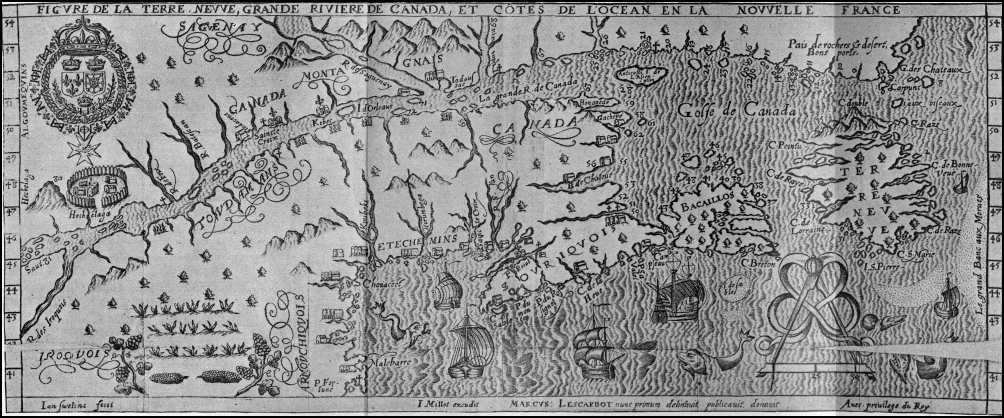
Cartier (1535) was the first to sail up the St. Lawrence
"until land could be seen on either side," no man can
now tell; apparently, he was the first to leave a record
of doing so. Progress up the river was checked by
Lachine Rapids, and he spent the winter on Montreal
Island.
France and Spain were just then engaged in one
of their periodical quarrels, and adventurers were
needed to fight battles at home, so that it was six
years before any attempts were made to colonize the
river-lands to which Cartier had led the way. In
1541, a Picard seigneur named Roberval, enjoying
the friendship of Francis I., was commissioned as
viceroy of the new country beyond the Atlantic, with
Cartier as his chief pilot and captain-general, and a
choice selection of jail-birds for colonists. Cartier
started off before his chief, built a fort at Quebec,
and, after a long and miserable winter, picked up a
quantity of glittering stones which he took to be
gold and diamonds, and gladly set sail for home.
Tradition has it that Roberval met him near the
mouth of the river, but was unable to induce him to
return to his cheerless task of founding a state in an
inhospitable wilderness, with convicts for citizens.
Roberval, however, proceeded to Quebec with his
consignment of prison dregs, and throughout another
protracted winter the flag of France floated from the
little intrenched camp which Cartier had planted on
the summit of the cliff. Roberval's principal occupation
appears to have been the disciplining of his
unruly followers, a work in which the gibbet and
the lash were freely employed. He also essayed explorations
up the river; but the rude task was not to
his liking, and, with what remained of his battered
band, he followed Cartier to France.
It is commonly said that Canada was abandoned by
the French between the going of Roberval and the
coming of Champlain. But, though little was done
toward colonizing on the St. Lawrence, Newfoundland
was by no means neglected. Its fishing industry
grew apace. The rules of the Church, prescribing
a fish diet on certain holy days, led to a large
use of salted fish throughout Catholic Europe; and,
by 1578, full a hundred and fifty French vessels
alone, chiefly Breton, were employed in the Newfoundland
fisheries, while a good trade with the mainland
Indians, as far south as the Potomac, had now
sprung up. The island colony proved valuable as a
supply and repair station for traders and explorers,
and thus served as a nucleus of both French and
English settlement in America.
It is difficult for us of to-day to realize that, at any
time in the world's history, enlightened folk should
have thought good colonists could be made out of
the sweepings of the jails and gutters of the Old
World. But in the sixteenth and seventeenth centuries
that delusion was quite generally entertained by
would-be founders of states across sea; it required
the lessons of more than a hundred years of disastrous
experiments to teach discerning men that only
the best of the middle class and the masses, can successfully
plant a new community in the wilderness.
The experiences of Cartier and Roberval on the St.
Lawrence, and of Laudonnière in Florida (1564),
were of no avail in influencing governmental policy
at Paris. In 1590, the Marquis de la Roche was sent
out with the usual dissolute crew to succeed Roberval
as the king's agent on the banks of the St. Lawrence.
Leaving part of his ill-favored gang on the
desert Sable Isle, off Nova Scotia (where early in the
century Baron de Léry had vainly attempted to
plant a colony), La Roche set forth to explore the
mainland for a site. A wild storm blew his vessels
to France, and the wretched skin-clad survivors of
the band which he had left behind were not rescued
until thirteen years had elapsed. Their tale of horror
long rang in the ears of France.
In 1600-1603, Chauvin and Pontgravé made successful
trading voyages to the St. Lawrence. Samuel
de Champlain was one of the party which, in the
latter year, followed in Cartier's track to Montreal.
The same season, a Calvinist, named De Monts, was
given the vice-royalty and fur-trade monopoly of
Acadia, and in 1604 he landed a strangely-assorted
company of vagabonds and gentlemen on St. Croix
Island, near the present boundary between Maine
and New Brunswick; but in the spring following
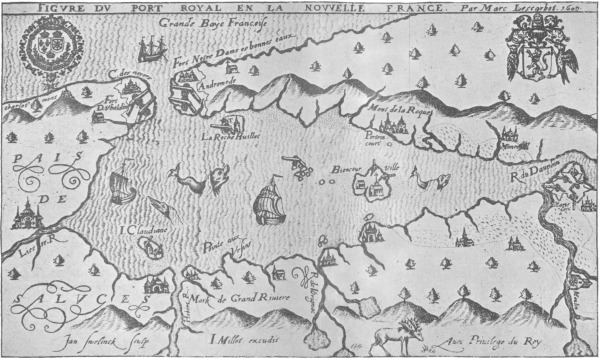
they settled at Port Royal, near where is now Annapolis,
Nova Scotia, thus planting the first French
agricultural settlement in America. Five years later,
Champlain reared a permanent post on the rock of
Quebec, and New France was at last, after a century
of experiments, fairly under way.
Various motives influenced the men who sought
to establish French colonization in America. The
ill-fated agricultural colony of the Huguenots in
Florida (1562-68), was avowedly an attempt of Admiral
Coligny to found an enduring asylum for
French Protestants. The enterprise of New France,
on the other hand, was the outgrowth of interests
more or less conflicting. Doubtless the court had
deepest at heart the kingly passion for territorial aggrandizement;
next uppermost, was the pious wish
to convert heathen nations to the Catholic faith, explorers
like Cartier being authorized to discover new
lands "in order the better to do what is pleasing to
God, our Creator and Redeemer, and what may be
for the increase of his holy and sacred name, and of
our holy mother, the Church;" the desire for pelf,
through the agency of the fur trade, and the possibility
of the discovery of precious metals, gave commercial
zest to the undertaking, and to many was
the raison d'être of the colony; and lastly, was the almost
universal yearning for adventure, among a people
who in the seventeenth century were still imbued
with that chivalric temper which among Englishmen
is assigned to the Middle Ages. The inner
life of New France, throughout its century and a
half of existence, was largely a warring between
these several interests.
Missionaries came early upon the scene. With
the Calvinist De Monts were Huguenot ministers for
the benefit of the settlers, and Catholic priests to
open a mission among the savages, for the court had
stipulated with him that the latter were to be instructed
only in the faith of Rome. But no missionary
work was done, for the colony was through
several years on the verge of dissolution, and the
priests became victims of scurvy. Poutrincourt, who
held under De Monts the patent for Port Royal, did
nothing to further the purposes of the court in this
regard, until 1610, when, admonished for his neglect,
he brought out with him a secular priest, Messire
Jessé Fléché, of Langres, who on June 24, "apparently
in some haste," baptized twenty-one Abenakis,
including the district sagamore, or chief. The account
of this affair, which Poutrincourt sent in triumph
to France, is the initial document in the present
series.
On the twelfth of June, 1611, there arrived at Port
Royal, at the instance of King Henry IV., two Jesuit
fathers, Pierre Biard and Ennemond Massé. They
were, however, not favorably received by Poutrincourt
and his followers; they found great practical
difficulties in acquiring the Indian languages and
made slight progress in the herculean task to which
they had been set. To them, came the following
year, a lay brother, Gilbert du Thet, who was soon
dispatched to the head of the order, in France, with
an account of the situation. In the spring of 1613,
he returned, in company with Father Quentin. The
little band of missionaries had no sooner established
themselves at the new French colony on Mt. Desert
Island, than the latter was attacked and dispersed by
the Virginian Argall. Du Thet was killed in the
fight, Massé was, with other colonists, set adrift in a
boat, and Biard and Quentin were taken to Virginia,
to be eventually shipped to England, and thence
allowed to return into France. Several of the earlier
documents of our series have to do with this first
and apparently unfruitful mission of the Jesuits to
Acadia.
In 1615, Champlain thought the time ripe for the
institution of Indian missions upon the St. Lawrence,
a spiritual field hitherto neglected, and introduced
to Quebec four members of the fraternity of
Récollets, the most austere of the three orders of
Franciscans; these were Fathers Denis Jamay, Jean
d'Olbeau, and Joseph le Caron, and a lay brother,
Pacifique du Plessis. To D'Olbeau was assigned
the conversion of the Montagnais of the Lower St.
Lawrence; Le Caron went to the Hurons, or Wyandots,
in the vast stretch of forested wilderness west
of the Ottawa River, and before the coming of autumn
had established a bark chapel in their midst;
Jamay and Du Plessis remained in the neighborhood
of Quebec, ministering to the colonists and the
wandering savages who came to the little settlement
for purposes of trade or sociability, or through fear
of scalp-hunting Iroquois. For ten years did these
gray friars practice the rites of the church in the
Canadian woods, all the way from the fishing and
trading outpost of Tadoussac to the western Lake of
the Nipissings. Barefooted, save for heavy wooden
sandals, coarsely clad in gown and hood, enduring
in a rigorous climate, to which they were unused, all
manner of hardships by flood and field, they were
earnestly devoted to their laborious calling in a time
when elsewhere the air of New France was noisy
with the strife of self-seeking traders and politicians.
Yet somehow their mission seemed without important
result. Even less successful was the enterprise
of some fellow Récollets, who, in 1619, began
independent work among the French fishermen and Micmacs
of Nova Scotia, New Brunswick, and Gaspé,
but were forced in 1624, after many disasters, to
abandon their task, three of them joining the party at
Quebec.
The little band on the St. Lawrence, although thus
reinforced, felt impelled, in 1625, to invite the powerful
aid of the Jesuits, who in the face of great odds
were just then holding most successful missions in
Asia, Africa, and South America. In response to
the call, three fathers of the black gown came to
Quebec this year,—Massé, who had been of the old
Acadian mission, Charles Lalemant, and that giant
among them, in both stature and deeds, Jean de
Brébeuf. Immediately the work began to broaden,
but the records of the dual mission do not give
evidence of many converts,—a few Huron youth
taken to France, and there instructed and baptized,
being the chief gains. The wandering habits of
the Indians were not favorable to persistent instruction
of the young, and adults were unwilling to
commit themselves to the new doctrine, even when
not openly opposed to its promulgation. The summer
months were usually spent by the missionaries
at Tadoussac, Quebec, and Three Rivers, where
trading parties from the tribes were wont to assemble;
and, when the latter scattered for their winter
hunts, the missionaries accompanied them, sharing
the toils, dangers, and discomforts of the movable
camps, and often suffering much from positive abuse
at the hands of their not over-willing hosts.
The settlements of Port Royal and Quebec were at
this time wretched little hamlets of a few dozen huts
each, surrounded by a palisade, and these fell an easy
prey to small English naval forces (1628-29). With
their fall, ended the slender mission of the Récollets
and Jesuits, who were in triumph carried off to England.
For a few months, France did not hold one foot
of ground in North America. But as peace had been
declared between France and England before this conquest,
the former received back all of its possessions,
and the inevitable struggle for the mastery of the
continent was postponed for four generations longer.
With the release of Canada to France, in 1632, the
Jesuits were by the home authorities placed in sole
charge of the spiritual interests of both settlers and
Indians, and the history of their greatest missions begins
at this time. On the fifth of July, there landed
at Quebec, Fathers Paul le Jeune and Anne de Nouë,
and a lay brother named Gilbert. Le Jeune was the
superior, and at once devoted himself to learning the
language and customs of the savages, and so studying
the enormous field before him as intelligently to
dispose of his meagre forces.
The existence of rival tribes among the Red
Indians of North America, was, perhaps, the most
formidable obstacle in the path of the missionaries.
It has always been impossible to make any hard-and-fast
classification; yet the Indians presented a considerable
variety of types, ranging from the Southern
Indians, some of whose tribes were in a relatively
high stage of material advancement and mental
calibre, down to the savage root-eaters of the Rocky
Mountain region. The migrations of some of the
Indian tribes were frequent, and they occupied overlapping
territories, so that it is impossible to fix the
tribal boundaries with any degree of exactness.
Again, the tribes were so merged by intermarriage,
by affiliation, by consolidation, by the fact that there
were numerous polyglot villages of renegades, by
similarities in manner, habits, and appearance, that
it is difficult even to separate the savages into
families. It is only on philological grounds that
these divisions can be made at all. In a general way
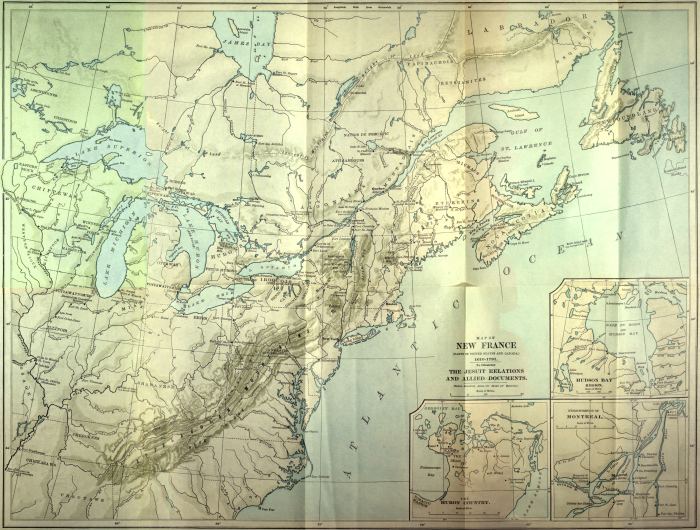
we may say that between the Atlantic and the Rockies,
Hudson Bay and the Gulf of Mexico, there were
four Indian languages in vogue, with great varieties
of local dialect:
I. The Algonkins were the most numerous, holding
the greater portion of the country from the unoccupied
"debatable land" of Kentucky northward
to Hudson Bay, and from the Atlantic westward to
the Mississippi. Among their tribes were the Micmacs
of Acadia, the Penobscots of Maine, the Montagnais
of the St. Lawrence, the ill-defined tribes of
the country round about Lake St. John, and the
Ottawas, Chippewas, Mascoutens, Sacs, Foxes, Pottawattomies,
and Illinois of the Upper Lakes. These
savages were rude in life and manners, were intensely
warlike, depended for subsistence chiefly on
hunting and fishing, lived in rude wigwams covered
with bark, skins, or matted reeds, practised agriculture
in a crude fashion, and were less stable in
their habitations than the Southern Indians. They
have made a larger figure in our history than any
other family, because through their lands came the
heaviest and most aggressive movement of white
population, French or English. Estimates of early
Indian populations necessarily differ, in the absence
of accurate knowledge; but it is now believed that the
number was never so great as was at first estimated
by the Jesuit fathers and the earliest English colonists.
A careful modern estimate is, that the Algonkins
at no time numbered over 90,000 souls, and
possibly not over 50,000.
II. In the heart of this Algonkin land was planted
the ethnic group called the Iroquois, with its several
distinct branches, often at war with each other. The
craftiest, most daring, and most intelligent of North
American Indians, yet still in the savage hunter state,
the Iroquois were the terror of every native band
east of the Mississippi, before the coming of the
whites, who in turn learned to dread their ferocious
power. The five principal tribes of this family—Mohawks,
Oneidas, Onondagas, Cayugas, and Senecas,
all stationed in palisaded villages south and east
of lakes Erie and Ontario—formed a loose confederacy
styled by themselves and the French "The Long
House," and by the English "The Five Nations,"
which firmly held the waterways connecting the
Hudson and Ohio rivers and the Great Lakes. The
population of the entire group was not over 17,000—a
remarkably small number, considering the active
part they played in American history, and the control
which they exercised through wide tracts of wilderness.
Related to, but generally at war with them,
were the Hurons of Canada, among whom the
Jesuits planted their earliest missions. Champlain,
in an endeavor to cultivate the friendship of his
Huron and Algonkin neighbors, early made war on
the Iroquois, and thus secured for New France a
heritage of savage enmity which contributed more
than any other one cause to cripple its energies and
render it at last an easy prey to the rival power of
the English colonies.
III. The Southern Indians occupied the country
between the Tennessee River and the Gulf, the Appalachian
Ranges and the Mississippi. Of a milder
disposition than their Northern cousins, the Cherokees,
Chickasaws, Choctaws, Creeks, and Seminoles
were rather in a barbarous than in a savage state;
by the time of the Revolution, they were not far behind
the white proprietors in industrial or domestic
methods, and numbered not above 50,000 persons.
With them, this story of the Jesuit missions has little
to do; the Louisiana mission, an offshoot of that of
New France, did faithful work here, but the documentary
result was neither as interesting nor as prolific,
and necessarily occupies but small space in the
present series.
IV. The Dakotah, or Sioux, family occupied for
the most part the country beyond the Mississippi.
They were and are a fierce, high-strung people, genuine
nomads, and war appears to have been their chief
occupation. The Jesuits worked among them but in
slight measure, on the waters of the Upper Mississippi;
they met this family, chiefly in the persons
of the Winnebagoes, one of their outlying bands,
which at the time of the French occupation was resident
on and about Green Bay of Lake Michigan, at
peace and in confederacy with the Algonkins who
hedged them about.
The mission of the French Jesuits to these widely-scattered
hordes of savages forms one of the most
thrilling chapters in human history. It is impossible,
in this brief Introduction, to attempt anything
more than the barest outline of the theme; Rochemonteix,
Shea, and Parkman have told the story in
detail, from differing points of view, and with these
authorities the student of the following documents in
the case is presumed to be familiar. A rapid summary
of results will, however, be useful; and this we
may best obtain, at the expense of occasional repetition
of narrative, by following the fortunes of the
pioneers of the Cross through the several district
missions into which their work was naturally divided.
This mission was chiefly in Maine and Acadia, and
on Cape Breton Island. The Abenakis (or Abnakis)
were a strong but mild-mannered Algonkin tribe,
settled in villages or cantonments; but, like others of
their race, in the habit of taking long semi-annual
journeys,—each winter to hunt, and each summer to
fish. We have seen that the French Jesuits, Biard
and Massé, were in the field as early as 1611, soon
after the establishment of Port Royal; their predecessor
being the secular French priest, Fléché, who
had been introduced to the country by Poutrincourt,
the patentee. Biard and Massé met with many discouragements,
chiefly the opposition of Poutrincourt's
son, Biencourt (sometimes called Baron St. Just),
who had been left in charge of the colony. Nevertheless
the missionaries learned the native language,
and made many long journeys of exploration, one of
Biard's trips extending as far as the mouth of the
Kennebec. They were later joined by a lay brother,
Du Thet, and by Fathers Quentin and Lalemant.
Joining the new French colony on Mt. Desert Island,
in the spring of 1613, the establishment was almost
immediately destroyed by the Virginian Argall. In
the skirmish, Du Thet was killed.
In 1619, a party of Récollets, from Aquitaine,
began a mission on St. John River, in Acadia, but
five years later, as we have seen above, abandoned
the task, the survivors joining the Quebec mission of
their order. Other Récollets were in Acadia, however,
between 1630 and 1633, and later we have
evidence of a small band of Capuchins ministering
to French settlers on the Penobscot and Kennebec;
but it is probable that they made no attempt to convert
the natives.
A Jesuit mission was founded on Cape Breton in
1634, by Father Julian Perrault; and a few years
later, Father Charles Turgis was at Miscou. Other
missionaries soon came to minister to the Micmacs,
but for many years their efforts were without result;
and sickness, resulting from the hardships of the
situation, caused most of the early black gowns to
retreat from the attempt. Finally, an enduring
mission was established among these people, and,
until about 1670, was conducted with some measure
of success by Fathers Andrew Richard, Martin de
Lyonne, and James Fremin. About 1673, the Récollets
took up the now abandoned work, occasionally
aided by secular priests from the Seminary of Quebec,
and Jesuits, until at last the Micmacs from Gaspé
to Nova Scotia were declared to be entirely converted
to the Catholic faith.
Father Gabriel Druillettes, of the Jesuit mission at
Sillery, near Quebec, went to the Kennebec country
in 1646, invited thither by converted Abenakis who
had been at Sillery, and during visits, extending
through a period of eleven years, was more than
ordinarily successful in the task of gaining Indian
converts to Christianity. In 1650, he made a notable
visit to the Puritans of Eastern Massachusetts, during
which was discussed the proposed union between
New France and New England, against the Iroquois.
Upon the final departure of Druillettes in 1657, the
Abenakis were but spasmodically served with missionaries;
occasionally a Jesuit appeared among
them, but the field could not be persistently worked,
owing to the demands upon the order from other
quarters. The fathers now sought to draw Abenaki
converts to Sillery, and later to St. Francis de Sales,
at the falls of the Chaudière, which soon became almost
exclusively an Abenaki mission.
In 1688, Father Bigot, of this mission, again entered
the field of the Kennebec, at the same time that
Rev. Peter Thury, a priest of the Quebec Seminary,
opened a mission on the Penobscot, and the Récollet
F. Simon gathered a flock at Medoktek, near the
mouth of the St. John. They were in time aided
and succeeded by others: the Jesuits being Julian
Binneteau, Joseph Aubery, Peter de la Chasse,
Stephen Lauverjeat, Loyard, and Sebastian Rale;
the death of Rale, the greatest of them all, at the
hands of New England partisans in the border strife
of 1724, is a familiar incident in American history.
Jesuits succeeded to the Penobscot mission in 1703,
and with great zeal, but amid continual hardships
and discouragements, carried on the principal work
among the Abenakis until the downfall of New
France in 1763. The majority of the Kennebec converts,
however, emigrated to the mission of St. Francis
de Sales, and from there frequently went forth
upon avenging expeditions against the New England
borderers.
This was centered at Tadoussac, and ministered to
the Montagnais, Bersiamites, Porcupines, Oumaniwek,
Papinachois, and other tribes of the Lower St. Lawrence
and the Saguenay. Tadoussac had, from the
earliest historic times, been a favorite harbor and
trading-station for the French; for, being at the
junction of two great rivers, it was convenient as a
place of assembly for the natives of the lower country.
The first priests in the district had said mass
there; but it was not until 1640 that a Jesuit mission
was formed by Father Jean du Quen, its sphere of
influence soon reaching to the upper waters of the
Saguenay, Lake St. John, Hudson Bay, and the coast
of Labrador. Du Quen was actively assisted by
Charles Meiachkwat, a Montagnais convert, who
erected the first chapel, became a catechist, and made
extended tours through the neighboring tribes. In
time, there were associated with Du Quen, Fathers
Buteux and Druillettes. Protracted missionary tours
were made by them, with results which were considered
satisfactory as compared with other missions;
although they had serious difficulties to contend with,
in the prevalent intemperance which the fur trade introduced
among the natives, the belief in dreams,
the laxity of morals, and the wiles of medicine-men,
or sorcerers, as they were called by the Jesuits.
For the first few years, the missionaries spent
their winters in Quebec, ministering to the colonists,
and each spring went down to Tadoussac to meet the
summer trading parties; but greater persistency of
effort was deemed desirable, and thereafter, instead
of returning home in the autumn, they followed the
Indians upon their winter hunts, and in the course of
these wanderings endured the usual privations and
hardships of traveling camps. Bailloquet, Nouvel,
Beaulieu, Albanel, De Crépieul, Dalmas, Boucher,
Peter Michael Laure, and Jean Baptiste Labrosse,
are other names of Jesuit fathers who at different
periods were engaged upon this toilsome mission.
In 1670, Tadoussac was almost deserted, owing to
Iroquois raids and the ravages of smallpox; the Montagnais
and kindred tribes were in hiding, through
the vast country between Lake St. John and Hudson
Bay. They were still followed by their devoted
shepherds, whom no hardship could discourage. The
following year, Crépieul began a mission on Hudson
Bay, and here in 1694 his auxiliary Dalmas was
killed. Laure (1720-37) left us a monument of his
labors in a Montagnais grammar and dictionary. Labrosse,
the last of his order at Tadoussac, instructed
many of his flock to read and write, and left a legacy
of native education, which has lasted unto the present
day; he lived and taught long after his order
had been suppressed in New France, and died at Tadoussac
in 1782.
These included the several missions at Quebec,
Montreal, Three Rivers, Sillery, Bécancourt, and St.
Francis de Sales, which were designed for the wandering
Montagnais of the district, those Algonkins of
the West who could be induced to come and settle on
the lower waters, and in later years such Abenakis of
Acadia and Maine as sought an asylum upon distinctively
French soil.
We have seen that Récollets were first at Quebec,
ministering both to colonists and Indians, and that, in
1625, they invited the Jesuits to aid them. In 1629,
the joint mission came to a close through the surrender
of Quebec to the English. When the mission
was reopened in 1632, Jesuits alone were in charge,
their operations being at first confined to the neighboring
Montagnais, although they soon spread
throughout the entire Canadian field. In 1658,
Bishop Laval founded the Seminary of Quebec,
whereupon the Jesuits resigned their parishes among
the colonists, and thereafter confined themselves to
their college and the Indian missions. In addition to
their parish work, the priests of the seminary conducted
missions in Acadia, Illinois, and on the lower
Mississippi.
The year following the return of the Jesuits to
Canada, Father Buteux, of that order, began his
labors at Three Rivers, which was a convenient gathering-place
for the fur trade. The village was frequently
raided by Iroquois, but remained until the
fall of New France one of the prominent centers of
missionary influence. The efforts of Buteux, which
lasted until his death at the hands of Iroquois in
1652, met with considerable success. His custom,
like that of the other missionaries, was to be present
at the French posts during the annual trading
"meets," and when the savages returned to the wilderness,
to accompany some selected band. In thus
following the nomadic tribes, he made some of the
longest and most toilsome journeys recorded in the
annals of the Society of Jesus, and shared with his
flock all the horrors of famine, pestilence, and inter-tribal
war.
It was soon realized by the missionaries that but
meagre results could be obtained until the Indians
were induced to lead a sedentary life. Their wandering
habit nullified all attempts at permanent instruction
to the young; it engendered improvidence and
laziness, bred famine and disease; and the constant
struggle to kill fur-bearing animals for their pelts
rapidly depleted the game, while the fur trade
wrought contamination in many forms. Missionary
efforts were at first conducive to the interests of the
fur trade, by bringing far-distant tribes within the
sphere of French influence; but so soon as the Jesuit
sought to change the habits of the natives, to cause
them to become agriculturists instead of hunters,
and to oppose the rum traffic among them, then the
grasping commercial monopoly which controlled the
fortunes of New France, and was merely "working"
the colony for financial gains, saw in the Jesuit an
enemy, and often placed serious obstacles in his path.
In pursuance of the sedentary policy, and also to
protect the wretched Montagnais from Iroquois war-parties,
the Jesuits, in 1637, established for them a
palisaded mission four miles above Quebec, at first
giving it the name St. Joseph, but later that of Sillery,
in honor of Commander Noël Brulart de Sillery,
of France, who had given ample funds for the founding
of this enterprise. Here were at first gathered
twenty of the Indians, who began cultivation of the
soil, varied by occasional hunting and fishing trips,
which the missionaries could not prevent. The little
town slowly grew in importance, both Algonkins and
Montagnais being represented in its population.
Three years later, nuns opened a hospital at Sillery,
for the reception of both French and Indian patients,
and thus greatly added to the popularity of
the mission. But in 1646 the nuns removed their
hospital to Quebec; a few years later, the church and
mission house were destroyed by fire; disease made
sad havoc in the settlement; the thin soil became exhausted
through careless tillage; Iroquois preyed
upon the converts, until at last the Algonkins almost
entirely disappeared; and although their place was
taken by Abenakis from Maine and Acadia, until the
attendance became almost solely Abenaki, the enterprise
waned. In 1685, it was abandoned in favor of St.
Francis de Sales, a new mission established at the
falls of the Chaudière River, not far from the St. Lawrence.
Beyond a monument of later days, to the memory
of Fathers Massé and De Nouë, whose names are
prominently connected with this work, nothing now
remains to mark the site of the old Sillery mission.
From St. Francis, the mission work began to spread
into Maine. Of its character and extent there, mention
has already been made. St. Francis achieved a
certain measure of prosperity, as Indian missions go.
It became in time a source of serious trouble to the
New England borderers, for many a French and Indian
war-party was here fitted out against the latter,
during the series of bloody conflicts which marked
the three-quarters of a century previous to the fall
of New France. Finally, in September, 1759, Maj.
Robert Rogers descended upon the village with his
famous rangers, and in retaliation pillaged and
burned the houses, and killed "at least two hundred
Indians." New France soon after fell into the hands
of the English, and, the Jesuits being suppressed, we
hear little more of St. Francis de Sales.
In 1641, the missionary settlement of Montreal was
founded by Maisonneuve. The Jesuits were the
first resident clergy, and soon began mission work
among the neighboring Indians and those who resorted
thither from the valleys of the Lower St. Lawrence
and the Ottawa. Soon, however, the Sulpitians,
established in Paris by the Abbé Olier, one of
the Society of Montreal, took charge of the mission
on Montreal Island, which in after years was moved
to the Sault au Récollet, and thence to the Lake of
the Two Mountains, where there was gathered a polyglot
village composed of Iroquois, Algonkins, and
Nipissings. Upon the opening of the English
régime, the Jesuit and Récollet missions were suppressed,
but those of the Sulpitians were undisturbed,
so that this mission at the lake is the oldest now extant
in Canada.
Among the Algonkins of the Ottawa River (or
Grande Rivière), no permanent missions were attempted
by any of the orders. Long the chief highway to
the West, the river was familiar to travelling missionaries,
who frequently ministered to the tribesmen
along its banks, either at the native villages or during
the annual trading councils at the French posts of
Montreal, Three Rivers, and Quebec.
At the time of the advent of the French, the
Hurons (or Wyandots), allied in origin and language
to the Iroquois, numbered about 16,000 souls, and
dwelt in several large villages in a narrow district
on the high ground between Lake Simcoe and Georgian
Bay of Lake Huron. Their dwellings were
bark cabins, clustered within stoutly-palisaded walls,
and near each fortified town were fields of corn,
beans, pumpkins, and tobacco. Agricultural in habit,
keen traders, and in the main sedentary, these semi-naked
savages made short hunting and fishing expeditions,
and laid up stores for the winter. They were
better fighters than the Algonkins around them, yet
were obliged gradually to withdraw northward and
westward from Iroquois persecution, and during the
period of the Jesuit missions were almost annihilated
by the latter. To the southwest, across a wide stretch
of unpopulated forest, were the allies and kindred of
the Hurons, the Tionontates, called also Petuns, or
Tobacco Nation, a term having its origin in their
custom of cultivating large fields of tobacco, which
commodity they used in a wide-spread barter with
other tribes. To the southeast of the Petuns, west
of Lake Ontario and on both sides of the gorge of
Niagara, were the peaceful Atiwandaronks, who, being
friends alike of Iroquois, Algonkins, and Hurons,
were known as the Neutral Nation. To the eastward
of the Neutrals, strongly intrenched in the interlocking
basins of the Genesee and the Mohawk,
lay the dread confederacy of the Iroquois, who in
time were to spread like a pestilence over the lands
of all their neighbors.
The intelligence and mobility of the Hurons rendered
the early prospects for missionary effort among
them more promising than with the rude and nomadic
Algonkins. But while at first the missionaries
of New France were well received, the innate savagery
of these people in time asserted itself. Their
medicine-men, as bitterly fanatical as the howling
dervishes of the Orient, plotted the destruction of
the messengers of the new faith; the introduction
of European diseases was attributed to the "black
gowns;" the ravages of the Iroquois were thought to
be brought on by the presence of the strangers; the
rites of the church were looked upon as infernal incantations,
and the lurid pictures of the Judgment,
which were displayed in the little forest chapels,
aroused unspeakable terror among this simple people;
finally, an irresistible wave of superstitious frenzy
led to the blotting out of the mission, accompanied
by some of the most heart-rending scenes in the
history of Christian evangelization.
It will be remembered that in 1615 the Récollet
friar, Joseph le Caron, made his way into the far-away
country of the Hurons, but returned in the following
year, having learned much of their language and customs.
Five years later, another of his order, William
Poulin, took up the weary task, being joined in 1623 by
Fathers Le Caron and Nicholas Viel, and the historian
of the Récollet missions, Brother Gabriel Sagard. All
of them soon left the field, however, save Viel, who
alone, amid almost incredible hardships, attained some
measure of success; but in 1625, when descending the
Ottawa to meet and arrange for co-operation with the
Jesuit Brébeuf, at Three Rivers, he was willfully
drowned by his Indian guide in the last rapid of Des
Prairies River, just back of Montreal. Such is the
origin of the name of the dread Sault au Récollet.
In 1626, the Jesuits Brébeuf and Anne de Nouë,
having received some linguistic instruction from Récollets
who had been in the Huron field, proceeded
thither, with a Récollet friar, Joseph de la Roche
Daillon, to resume the work which the Récollets had
abandoned. Daillon attempted a mission to neighboring
Neutrals, but, being roughly handled by
them, rejoined his Jesuit friends among the Hurons.
Two years later, he returned to Quebec, having been
preceded by De Nouë, who found it impossible to
master the difficult language of their dusky flock.
Brébeuf, now left alone, labored gallantly among
these people, and, winning the hearts of many by
his easy adoption of their manners, gathered about
him a little colony of those favorably inclined to his
views. He was recalled to Quebec in 1629, arriving
there just in time to fall into the hands of Louis
Kirk, and be transported to England.
When Canada was restored to France, by the
treaty of St. Germain, the Jesuits were given sole
charge of the Indian missions, but it was 1634 before
the Huron mission could be reopened. In September,
Brébeuf, Antoine Daniel, and Davost returned
to Brébeuf's old field, and commenced, in the large
town of Ihonatiria, the greatest Jesuit mission in the
history of New France. Others soon joined them.
Additional missions were opened in neighboring
towns, some of the strongest of these being each
served by four fathers, who were assisted by laymen
donnés, or given men; while in the cultivation of
the soil, and the fashioning of implements and utensils
both for the fathers and for the Indians, numerous
hired laborers, from the French colonies on the St.
Lawrence, were employed in and about the missions.
Charles Garnier and Isaac Jogues, with their attendants,
made a tour of the Petun villages; other Jesuits
were sent among the Neutrals; and even the Algonkins
as far northwestward as Sault Ste. Marie were
visited (1641) by Raymbault and Jogues, and looked
and listened with awe at the celebration of the mass.
In 1639, there was built, on the River Wye, the fortified
mission house of St. Mary's, to serve as a center
for the wide-spread work, as a place for ecclesiastical
retreat for the fathers, and a refuge when enemies
pressed too closely upon them.
The story of the hardships and sufferings of the
devoted missionaries, as told us by Rochemonteix,
Shea, and Parkman, and with rare modesty recorded
in the documents to be contained in this series, is
one of the most thrilling in the annals of humanity.
Space forbids us here to dwell upon the theme. No
men have, in the zealous exercise of their faith,
performed hardier deeds than these Jesuits of the
Huron mission; yet, after three years of unremitting
toil, they could (1640) count but a hundred converts
out of a population of 16,000, and these were for the
most part sick infants or aged persons, who had died
soon after baptism. The rugged braves scorned the
approaches of the fathers, and unmercifully tormented
their converts; the medicine-men waged continual
warfare on their work; smallpox and the Iroquois
were decimating the people.
Jogues was (1642) sent down to the colonies for
supplies for the missions, but with his Huron companions
was captured by an Iroquois war-party, who
led them to the Mohawk towns. There most of the
Hurons were killed, and Jogues and his donné, René
Goupil, were tortured and mutilated, and made to
serve as slaves to their savage jailers. Finally Goupil,
a promising young physician, was killed, and
Jogues, being rescued by the Dutch allies of the
Mohawks, was sent to Europe. Supplies thus failing
them, the Huron missionaries were in a sad
plight until finally (1644) relieved by an expedition
to the lower country undertaken at great hazards by
Brébeuf, Garreau, and Noël Chabanel. The same
season, Francis Joseph Bressani, attempting to reach
the Huron missions, had been captured and tortured
by Mohawks; like Jogues, he was rescued through
Dutch intercession and sent back to Europe, but both
of these zealots were soon back again facing the cruel
dangers of their chosen task.
A temporary peace followed, in 1645, and the hope
of the Jesuits was rekindled, for they now had five
missions in as many Huron towns, and another
established for Algonkins who were resident in the
Huron district. But in July, 1648, the Iroquois attacked
Teanaustayé, the chief Huron village, and
while encouraging the frenzied defense Father Daniel
lost his life at the hands of the enemy. He was
thus the first Jesuit martyr in the Huron mission,
and the second in New France,—for Jogues had been
tortured to death in the Iroquois towns, two years
before. The spirit of the Hurons was crushed in
this bloody foray; large bands, deserting their
towns, fled in terror to seek protection of the Petuns,
while others made their way to the Manitoulin
Islands of Lake Huron, and even as far west as the
islands of Green Bay and the matted pine forests of
Northern Wisconsin. Here and there a town was
left, however, and one of the largest of these, called
St. Ignatius by the Jesuits, was stormed by a thousand
Iroquois, March 16, 1649. The three survivors
fled through the woods to neighboring St. Louis,
where were Brébeuf, now grown old in his service
of toil, and young Gabriel Lalemant. Bravely did
they aid in defending St. Louis, and administering
to wounded and dying; but at last were captured, and
being taken to the ruined town of St. Ignatius were
most cruelly tortured until relieved by death. Early
in November, Fathers Garnier and Chabanel met
their death in the Petun country, the former at the
hands of Iroquois, the latter being killed by a Huron
who imagined that the presence of the Jesuits had
brought curses upon his tribe.
The missions in the Huron country were now entirely
abandoned. A few of the surviving Jesuits
followed their flocks to the islands in Lake Huron;
but in June, 1650, the enterprise was forsaken, and
the missionaries, with a number of their converts,
retired to a village, founded for them, on the Island
of Orleans, near Quebec. This settlement being in
time ravaged by the Iroquois, a final stand was made
at Lorette, also in the outskirts of Quebec, which
mission exists to this day.
The great Huron mission, which had been conducted
for thirty-five years, had employed twenty-nine
missionaries, of whom seven had lost their lives
in the work. This important field forsaken, many
of the missionaries had returned to Europe disheartened,
and apparently the future for Jesuit missions
in New France looked gloomy enough. The
Iroquois had now practically destroyed the Montagnais
between Quebec and the Saguenay, the Algonkins
of the Ottawa, and the Hurons, Petuns, and
Neutrals. The French colonies of Quebec, Three
Rivers, and Montreal, had suffered from repeated
raids of the New York confederates, and their forest
trade was now almost wholly destroyed. In this hour
of darkness, light suddenly broke upon New France.
The politic Iroquois, attacked on either side by the
Eries and the Susquehannas, and fearing that while
thus engaged their northern victims might revive
for combined vengeance, sent overtures of peace to
Quebec, and cordially invited to their cantonments
the once detested black gowns.
Champlain had early made enemies of the Iroquois,
by attacking them as the allies of his Algonkin neighbors.
This enmity extended to all New France,
and lasted, with brief intervals of peace, for over
half a century. We have seen that Jogues was the
first of his order (1642) to enter the Iroquois country,
as a prisoner of the Mohawks, the easternmost of the
five tribes of the confederacy. Two years later, Bressani,
while on his way to the Huron missions, was also
captured by the Mohawks, passed through a similar
experience of torture, was sold to the Dutch, and
transported back to France, and, again like Jogues
resumed his hazardous task of attempting to tame the
American savage. During the first peace (May,
1646), Jogues, now in civilian costume, paid a brief
visit to his former tormentors on the Mohawk, this
time conveying only expressions of good-will from
the governor of New France. His political errand
accomplished, he returned to Quebec; but in August
was back again, with a young French attendant
named Lalande, intent on opening admission among
the Iroquois. Meanwhile, there had been a revulsion
of sentiment on their part, and the two Frenchmen
had no sooner reached the Mohawk than they
were tortured and killed.
During an Iroquois attack upon Quebec, seven
years later (1653), Father Joseph Anthony Poncet
was taken prisoner by the marauders and carried to
the Mohawk, where he suffered in the same manner
as his predecessors; but his captors being now desirous
of a renewal of peace with the French, spared
his life, and sent him back to Quebec with overtures
for a renewal of negotiations. Early in July, 1654,
Father Simon le Moyne was sent forth upon a tour
of inspection, and returned to Quebec in September,
with glowing reports of the fervor of his reception
by both Mohawks and Onondagas. It was determined
to rear a mission among the latter, and thither
(1655),—a four weeks' voyage,—proceeded Claude
Dablon and Peter Mary Joseph Chaumonot; while,
to appease the jealous Mohawks, Le Moyne at the
same time reopened a brief but unprosperous mission
among that tribe.
At first, Dablon and Chaumonot had high hopes of
their Onondaga enterprise; but mistrust soon arose
in the minds of the natives, and Dablon found it
necessary to proceed to Quebec and obtain fresh
evidences of the friendship of the French. He returned
in the early summer of 1656, accompanied by
Fathers Francis Le Mercier, superior of the Canadian
mission, and René Ménard, two lay brothers, and a
party of French colonists under a militia captain,
who designed founding a settlement in the land of
the Iroquois. By the close of the year, the work
was in a promising stage; a number of Christianized
Hurons, who had been adopted into the confederacy,
formed a nucleus for proselyting, several Iroquois
converts had been made, and all five of the tribes
had been visited by the missionaries.
Fathers Paul Ragueneau and Joseph Imbert
Dupéron, who had been sent out from Quebec in
July, 1657, to assist the Onondaga mission, reached it
only after many perils en route; for meanwhile,
there had been a fresh Iroquois uprising against the
Hurons and Ottawas, in which Father Leonard Garreau
lost his life near Montreal, and the entire confederacy
was soon in an uproar against the white allies
of its ancient enemies. The intrepid Le Moyne
joined the party in November, and in the following
March (1658), on learning that all of the French had
been condemned to death, the entire colony stole
away in the night, and reached Montreal only after a
long and hazardous voyage. The great Iroquois mission,
which had promised so happily and cost so
much in blood and treasure, was now thought to be
a thing of the past.
There was, however, still another chapter to the
story. In the summer of 1660, after two years of
bloody forays against New France, a Cayuga sachem,
who had been converted at Onondaga, came to Montreal
as a peace messenger, asking for another black
gown to minister to the native converts and a number
of French captives in the Iroquois towns. Once
more, Le Moyne cheerfully set out upon what seemed
a path to death; but he passed the winter without
molestation, and in the spring following was allowed
to return to Canada with the French prisoners.
It was five years later (1665), before the government
of New France felt itself sufficiently strong to
threaten chastisement of the raiding Iroquois, who
had long been making life a torment in the colonies
on the St. Lawrence. The Oneidas, Onondagas,
Cayugas, and Senecas sued for peace; but the Mohawks
were obstinate, and their villages were wasted
by fire until they too asked for mercy and the ministrations
of the Jesuits. Fathers James Fremin,
James Bruyas, and John Pierron were sent out in
1667; later, they were assisted by Julian Garnier,
Stephen de Carheil, Peter Milet, and Boniface, so
that by the close of 1668 a mission was in progress in
each of the five cantonments. A few notable converts
were made, among them Catharine Tegakouita,
known as the "Iroquois saint;" Catharine Ganneaktena,
an Erie captive who afterwards founded a
native mission village on the banks of the St. Lawrence;
the head-men Assendasé, Kryn, and Soenrese.
But a great success was never possible; here as elsewhere,
the vices and superstitions of the tribesmen
were deep-rooted, and they had not yet reached a
stage of culture where the spiritual doctrines of
Christianity appealed strongly, save to a few emotional
natures. The converts were subjected to so many
annoyances and dangers, that isolation was thought
essential, and there was established for them opposite
Montreal the palisaded mission of St. Francis Xavier;
this settlement, fostered by the French as a buffer
against Iroquois attack on the colonists, was subsequently
removed to Sault St. Louis, and is known in
our day as Caughnawaga. This mission, and that
of the Sulpitians on Montreal Mountain—later removed
to the neighboring Lake of the Two Mountains,—and
at Quinté Bay, were frequently recruited
by Iroquois Christians, who were carefully instructed
by the missionaries in the arts of agriculture and the
rites of the church.
This depletion of the Iroquois population alarmed
the sachems of the confederacy. To please them,
Governor Dongan of New York, himself a Catholic,
introduced to the Five Nations three English Jesuits,
who sought in vain to counteract the movement.
The French did not abandon the Iroquois mission-field
until 1687, when the rising power of the English
obliged them to withdraw from the country. We have,
however, glimpses of occasional attempts thereafter to
revive the work, Bruyas being on the ground in 1701,
joined the following year by James de Lamberville,
Garnier, and Le Valliant, and later by James d'Hue
and Peter de Marieul. The entire party were again
driven from the cantonments in 1708, De Marieul being
the last of his order to remain on duty.
Thereafter, the Jesuits were chiefly devoted to
their mission at Caughnawaga, whither many Iroquois
retreated before the inroads of Dutch and English
settlers who were now crowding upon their
lands. When the black gowns were at last expelled
from New France, secular priests continued their
work among the remnants of those New York Indians
who had sought protection by settling among the
French colonists on the St. Lawrence.
This embraced the tribes beyond Lake Huron,—the
Chippewas at Sault Ste. Marie, the Beavers, the Crees,
the Ottawas and refugee Hurons on Lake Superior,
the Menomonees, Pottawattomies, Sacs, Foxes, Winnebagoes,
Miamis, Illinois, and those of the Sioux who
lived on or near the banks of the Mississippi. The
Ottawas were the first Indians from the upper lakes
to trade with the French, hence that vast district became
early known as the country of the Ottawas.
The Huron mission was the door to the Ottawa
mission. Jogues and Raimbault were with the Chippewas
at Sault Ste. Marie in 1641; but it was nineteen
years after that (1660), before they were followed
by another Jesuit, the veteran Father Ménard, who
accompanied an Ottawa fleet up the great river of
that name, through Lake Huron and the Sault, and
on to Keweenaw Bay, where he said the first mass
heard on the shores of the northern sea. After a
wretched winter on that inhospitable coast, spent in
a shanty of fir boughs, with savage neighbors who
reviled his presence, he proceeded inland intent on
ministering to some Hurons who had fled from Iroquois
persecution to the gloomy pine forest about the
upper waters of Black River, in what is now Wisconsin.
In August, 1661, he lost his life at a portage,
thus being the first martyr upon the Ottawa mission.
Four years later, Claude Alloüez set out for Lake
Superior, and reaching Chequamegon Bay in October
(1665), built a little chapel of bark upon the southwest
shore of that rock-bound estuary,—the famous
mission of La Pointe. His flock was a medley,
Hurons and Algonkins here clustering in two villages,
where they lived on fish, safe at last from
the raging Iroquois, although much pestered by the
wild Sioux of the West. For thirty years did Alloüez
travel from tribe to tribe, through the forests
and over the prairies of the vast wilderness which a
century later came to be organized into the Northwest
Territory, and established missions at Green
Bay, Sault Ste. Marie, on the Miami, and, with Marquette,
among the Illinois at Kaskaskia.
Later, there arrived on the scene Fathers Louis
Nicholas, James Marquette, Dablon, Louis André,
Druillettes, Albanel, and others. The field of the
Northwest seemed at first, as did the Huron mission,
highly promising. The missionaries were everywhere
greeted by large audiences, and much curiosity
was displayed concerning the rites of the church;
but, as usual, the nomadic habits of the Indians rendered
instruction difficult. The fathers, with great
toil and misery, and subject to daily danger and insult,
followed their people about upon long hunting
and fishing expeditions; and even when the bands
had returned to the squalid villages, life there was
almost as comfortless as upon the trail. Among the
donnés and the Jesuit coadjutor brothers were skillful
workers in metal, who repaired the guns and utensils
of the natives, and taught them how best to obtain
and reduce the ore from lead and copper deposits.
We have evidence that the copper region of Lake
Superior was at times resorted to by the lay followers
and their Indian attendants, to obtain material for
crucifixes and for the medals which the missionaries
gave to converts; and in the lead mines centering
about where are now Dubuque, Iowa, and Galena, Ill.,
the missionary attendants and Indians obtained lead
for barter with French fur-traders, who, like the soldiers
of the Cross, were by this time wandering all
over the Northwest.
Marquette had succeeded Alloüez at La Pointe, in
1669; but it was not long before the Hurons and
Ottawas of Chequamegon Bay foolishly incurred the
fresh hostility of the Sioux, and the following year
were driven eastward like autumn leaves before a
blast. Marquette established them in a new mission,
at Point St. Ignace, opposite Mackinaw; and it was
from here that, in 1673, he joined the party of Louis
Joliet, en route to the Mississippi River. The St.
Ignace mission became the largest and most successful
in the Northwest, there being encamped there,
during Marquette's time, about 500 Hurons and 1,300
Ottawas. The interesting story of Marquette, a familiar
chapter in American history, will be fully developed
in the documents of this series; and we shall be
able to present for the first time a facsimile of the
original MS. Journal of his final and fatal voyage
(1674), which is preserved among the many treasures
of the Jesuit College of St. Mary's, in Montreal.
After the suspension of the publication of the
Relations, in 1673, we obtain few glimpses of the Ottawa
mission, save in the occasional references of
travelers. The several local missions in the district
were, in the main, probably more successful than those
in any of the other fields of endeavor. La Pointe,
Green Bay; St. Ignace (later Mackinac), Sault Ste.
Marie, St. Joseph's, and Kaskaskia became the most
important of them all; and at some of these points
Catholic missions are still maintained by Franciscan
friars and secular priests, for resident French Creoles
and Indians. The uprising of the Foxes against
French power, which lasted spasmodically from
about 1700 to 1755, greatly hampered the work of the
Jesuits; they did not, during this period, entirely absent
themselves from the broad country of the Ottawas,
but conversions were few and the records slight.
There was, for a time, governmental attempt to
supplant the Western Jesuits with Récollets. Several
friars were with La Salle, who had a great antipathy
to the disciples of Loyola,—Father Hennepin's
adventures belong to this period of Récollet effort,
his colleagues at Fort Crèvecœur being Brothers
Ribourde and Membré; but their mission closed with
the Iroquois repulse of the French from Crèvecœur,
and the consequent death of Ribourde. When La
Salle retired from the region, Alloüez resumed the
Illinois mission of the Jesuits; and soon after there
arrived upon the ground Fathers Gravier, Marest,
Mermet, and Pinet, who, because of the more docile
character of the tribes collectively known as the
Illinois,—Kaskaskias, Cahokias, Peorias, and Tamaroas,—found
here a relatively fruitful field. In
time, French settlements grew up around the
palisaded missions, intermarriages occurred, and the
work flourished for many years. Black gowns visited
the prosperous Illinois towns as late as 1781, when
the death of Father Meurin closed the work of his
order in the Northwest.
The Jesuit Marquette was in Louisiana in 1673,
but established no mission. Nine years later, Membré,
of the Récollets, accompanied La Salle into the
region, and instructed natives as far down the Mississippi
as the mouth; and with La Salle at his death
were Anastasius Douay, of the Récollets, and the
Sulpitian Cavalier. In 1698, Francis Jolliet de Montigny
and Anthony Davion, priests of the Seminary
of Quebec, established missions on the Yazoo, among
the Natchez, and elsewhere in the neighborhood; to
their aid, soon came others of their house,—St. Côme,
Gaulin, Fonçault, and Erborie, who labored until
about 1710, when, St. Côme and Fonçault being
killed by roving Indians, the survivors retired to the
North. The Jesuit Du Rue accompanied Iberville
into the country in 1699-1700, followed by De
Limoges and Dongé, of his order, their work continuing
until about 1704.
In 1721, Father Charlevoix reported that but two
priests were then in Louisiana, one at Yazoo and
another in New Orleans; at the latter post, a chaplain
of some sort was established throughout the French
régime. Capuchins and Jesuits were both admitted to
Louisiana, in 1722, the former to serve as priests to
the French of the country, chiefly at New Orleans
and Natchez, while the Jesuits were restricted to the
Indian missions, although permitted to maintain a
house in the outskirts of New Orleans. It was not
long before the Illinois mission became attached to
Louisiana, and missionaries for that field usually entered
upon their work by way of the New Orleans
house. Missions were maintained in the villages of
the Arkansas, Yazoo, Choctaws, and Alibamons; but
the uprising of the Indians in the Natchez district,
in 1727, led to the fall of these several missions, together
with that of French colonies above New Orleans.
Father Du Poisson was killed by savages at
Natchez, where he was temporarily supplying the
French settlers in the absence of their Capuchin friar;
Souel fell a victim to the Yazoos, at whose hands
Doutreleau narrowly escaped destruction. However,
the Jesuits did not despair, but soon returned to the
Lower Mississippi, where they continued their labors
until about 1770, although the order had in 1762 been
suppressed in France.
The Louisiana mission of the Jesuits, while producing
several martyrs, and rich in striking examples
of missionary zeal, has yielded but meagre documentary
results; few of the papers in the present series
touch upon its work, and indeed detailed knowledge
thereof is not easily obtainable. Severed from Canada
by a long stretch of wilderness, communication
with the St. Lawrence basin was difficult and spasmodic,
and in the case of the Jesuits generally unnecessary;
for, having their own superior at New Orleans,
his allegiance was to the general of the order
in France, not to his fellow-superiors in Quebec and
Montreal. The several missions of New France played
a large part in American history; that of Louisiana,
although interesting, is of much less importance.
A few explorers like Champlain, Radisson, and Perrot
have left valuable narratives behind them, which
are of prime importance in the study of the beginnings
of French settlement in America; but it is to
the Jesuits that we owe the great body of our information
concerning the frontiers of New France in the
seventeenth century. It was their duty annually to
transmit to their superior in Quebec, or Montreal, a
written journal of their doings; it was also their duty
to pay occasional visits to their superior, and to go
into retreat at the central house of the Canadian
mission. Annually, between 1632 and 1673, the
superior made up a narrative, or Relation, of the most
important events which had occurred in the several
missionary districts under his charge, sometimes
using the exact words of the missionaries, and sometimes
with considerable editorial skill summarizing
the individual journals in a general account, based in
part upon the oral reports of visiting fathers. This
annual Relation, which in bibliographies occasionally
bears the name of the superior, and at other times of
the missionary chiefly contributing to it, was forwarded
to the provincial of the order in France, and,
after careful scrutiny and re-editing, published by
him in a series of duodecimo volumes, known collectively
as The Jesuit Relations.
The authors of the journals which formed the basis
of the Relations were for the most part men of trained
intellect, acute observers, and practised in the art of
keeping records of their experiences. They had left
the most highly civilized country of their times, to
plunge at once into the heart of the American wilderness,
and attempt to win to the Christian faith the
fiercest savages known to history. To gain these
savages, it was first necessary to know them intimately,—their
speech, their habits, their manner of
thought, their strong points and their weak. These
first students of the North American Indian were
not only amply fitted for their undertaking, but none
have since had better opportunity for its prosecution.
They were explorers, as well as priests. Bancroft
was inexact when he said, in oft-quoted phrase,
"Not a cape was turned, not a river entered, but a
Jesuit led the way." The actual pioneers of New
France were almost always coureurs de bois, in the
prosecution of the fur trade; but coureurs de bois, for
obvious reasons, seldom kept records, even when
capable of doing so, and as a rule we learn of their
previous appearance on the scene only through
chance allusions in the Relations. The Jesuits performed
a great service to mankind in publishing
their annals, which are, for historian, geographer,
and ethnologist, among our first and best authorities.
Many of the Relations were written in Indian
camps, amid a chaos of distractions. Insects innumerable
tormented the journalists, they were immersed
in scenes of squalor and degradation, overcome
by fatigue and lack of proper sustenance, often
suffering from wounds and disease, maltreated in a
hundred ways by hosts who, at times, might more
properly be called jailers; and not seldom had savage
superstition risen to such a height, that to be seen
making a memorandum was certain to arouse the
ferocious enmity of the band. It is not surprising
that the composition of these journals of the Jesuits
is sometimes crude; the wonder is, that they could
be written at all. Nearly always the style is simple
and direct. Never does the narrator descend to self-glorification,
or dwell unnecessarily upon the details
of his continual martyrdom; he never complains of
his lot; but sets forth his experience in phrases the
most matter-of-fact. His meaning is seldom obscure.
We gain from his pages a vivid picture of life in the
primeval forest, as he lived it; we seem to see him
upon his long canoe journeys, squatted amidst his
dusky fellows, working his passage at the paddles,
and carrying cargoes upon the portage trail; we see
him the butt and scorn of the savage camp, sometimes
deserted in the heart of the wilderness, and
obliged to wait for another flotilla, or to make his
way alone as best he can. Arrived at last, at his
journey's end, we often find him vainly seeking for
shelter in the squalid huts of the natives, with every
man's hand against him, but his own heart open to
them all. We find him, even when at last domiciled
in some far-away village, working against hope to
save the unbaptized from eternal damnation; we
seem to see the rising storm of opposition, invoked
by native medicine-men,—who to his seventeenth-century
imagination seem devils indeed,—and at last
the bursting climax of superstitious frenzy which
sweeps him and his before it. Not only do these
devoted missionaries,—never, in any field, has been
witnessed greater personal heroism than theirs,—live
and breathe before us in the Relations; but we
have in them our first competent account of the Red
Indian, at a time when relatively uncontaminated by
contact with Europeans. We seem, in the Relations,
to know this crafty savage, to measure him intellectually
as well as physically, his inmost thoughts as
well as open speech. The fathers did not understand
him from an ethnological point of view, as
well as he is to-day understood; their minds were
tinctured with the scientific fallacies of their time.
But, with what is known to-day, the photographic reports
in the Relations help the student to an accurate
picture of the untamed aborigine, and much that mystified
the fathers, is now, by aid of their careful journals,
easily susceptible of explanation. Few periods
of history are so well illuminated as the French
régime in North America. This we owe in large
measure to the existence of the Jesuit Relations.
What are generally known as the Relations proper,
addressed to the superior and published in Paris,
under direction of the provincial, commence with Le
Jeune's Brieve Relation du Voyage de la Nouvelle-France
(1632); and thereafter a duodecimo volume, neatly
printed and bound in vellum, was issued annually
from the press of Sebastien Cramoisy, in Paris, until
1673, when the series was discontinued, probably
through the influence of Frontenac, to whom the
Jesuits were distasteful. The Relations at once became
popular in the court circles of France; their
regular appearance was always awaited with the
keenest interest, and assisted greatly in creating and
fostering the enthusiasm of pious philanthropists,
who for many years substantially maintained the missions
of New France. In addition to these forty
volumes, which to collectors are technically known as
"Cramoisys," many similar publications found their
way into the hands of the public, the greater part of
them bearing date after the suppression of the Cramoisy
series. Some were printed in Paris and Lyons
by independent publishers; others appeared in Latin
and Italian texts, at Rome, and other cities in Italy;
while in such journals as Mercure François and Annuæ
Litteræ Societatis Jesu, occasionally were published letters
from the missionaries, of the same nature as the
Relations, but briefer and more intimate in tone.
It does not appear, however, that popular interest
in these publications materially affected the secular
literature of the period; they were largely used in
Jesuit histories of New France, but by others were
practically ignored. General literary interest in the
Relations was only created about a half century ago,
when Dr. E. B. O'Callaghan, editor of the Documentary
History of New York, called attention to their
great value as storehouses of contemporary information.
Dr. John G. Shea, author of History of the
Catholic Missions among the Indian Tribes of the United
States, and Father Felix Martin, S. J., of Montreal,
soon came forward, with fresh studies of the Relations.
Collectors at once commenced searching for
Cramoisys, which were found to be exceedingly
scarce,—most of the originals having been literally
worn out in the hands of their devout seventeenth-century
readers; finally, the greatest collector of
them all, James Lenox, of New York, outstripped
his competitors and laid the foundation, in the Lenox
Library, of what is to-day probably the only complete
collection in America. In 1858, the Canadian government
reprinted the Cramoisys, with a few additions,
in three stout octavo volumes, carefully edited
by Abbés Làverdière, Plante, and Ferland. These,
too, are now rare, copies seldom being offered for sale.
The Quebec reprint was followed by two admirable
series brought out by Shea and O'Callaghan respectively.
Shea's Cramoisy Series (1857-1866), numbers
twenty-five little volumes, the edition of each of
which was limited to a hundred copies, now difficult
to obtain; it contains for the most part entirely
new matter, chiefly Relations prepared for publication
by the superiors, after 1672, and miscellaneously
printed; among the volumes, however, are a few
reprints of particularly rare issues of the original
Cramoisy press. The O'Callaghan series, seven in
number (the edition limited to twenty-five copies),
contains different material from Shea's, but of the
same character. A further addition to the mass of
material was made by Father Martin, in Relations
Inédites de la Nouvelle-France, 1672-79 (2 vols., Paris,
1861); and by Father Carayon in Première Mission des
Jésuites au Canada (Paris, 1864). In 1871, there was
published at Quebec, under the editorship of Abbés
Laverdière and Casgrain, Le Journal des Jésuites, from
the original manuscript in the archives of the Seminary
of Quebec (now Laval University). The memoranda
contained in this volume,—a rarity, for the
greater part of the edition was accidentally destroyed
by fire,—were not intended for publication, being of
the character of private records, covering the operations
of the Jesuits in New France between 1645 and
1668. The Journal is, however, an indispensable complement
of the Relations. It was reprinted by a
Montreal publisher (J. M. Valois) in 1892, but even
this later edition is already exhausted. Many interesting
epistles are found in Lettres Édifiantes et Curieuses,
écrites des Missions Étrangères, which cover the Jesuit
missions in many lands, between the years 1702 and
1776; only a small portion of this publication (there
are several editions, ranging from 1702-1776 to 1875-77)
is devoted to the North American missions.
American historians, from Shea and Parkman down,
have already made liberal use of the Relations, and
here and there antiquarians and historical societies
have published fragmentary translations. The great
body of the Relations and their allied documents, however,
has never been Englished. The text is difficult,
for their French is not the French of the modern
schools; hence these interesting papers have been
doubly inaccessible to the majority of our historical
students. The present edition, while faithfully reproducing
the old French text, even in most of
its errors, offers to the public for the first time, an
English rendering side by side with the original.
In breadth of scope, also, this edition will, through
the generous enterprise of the publishers, readily be
first in the field. Not only will it embrace all of the
original Cramoisy series, the Shea and O'Callaghan
series, those collected by Fathers Martin and Carayon,
the Journal des Jésuites, and such of the Lettres Édifiantes
as touch upon the North American missions,
but many other valuable documents which have
not previously been reprinted; it will contain, also,
considerable hitherto-unpublished material from the
manuscripts in the archives of St. Mary's College,
Montreal, and other depositories. These several
documents will be illustrated by faithful reproductions
of all the maps and other engravings appearing
in the old editions, besides much new material
obtained especially for this edition, a prominent
feature of which will be authentic portraits of many
of the early fathers, and photographic facsimiles of
pages from their manuscript letters.
In the Preface to each volume will be given such
Bibliographical Data concerning its contents, as seem
necessary to the scholar. The appended Notes consist
of historical, biographical, archæological, and miscellaneous
comment, which it is hoped may tend to
the elucidation of the text. An exhaustive General
Index to the English text will appear in the final
volume of the series.

 "
"