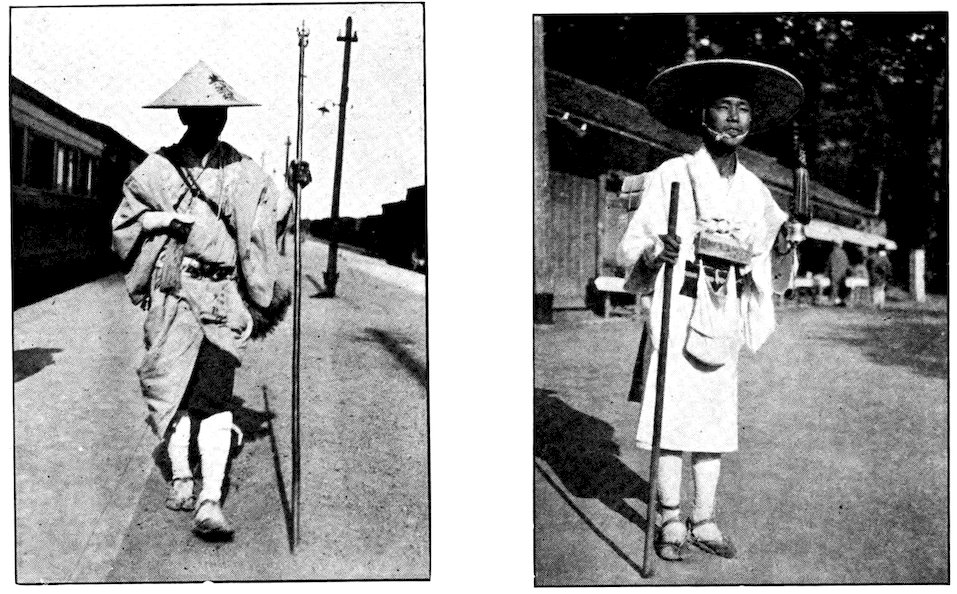
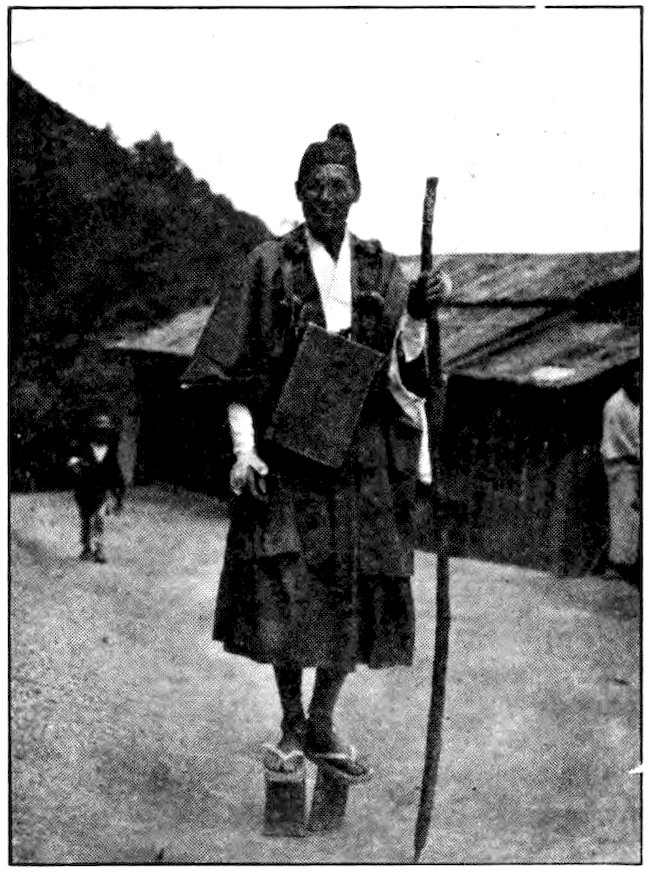
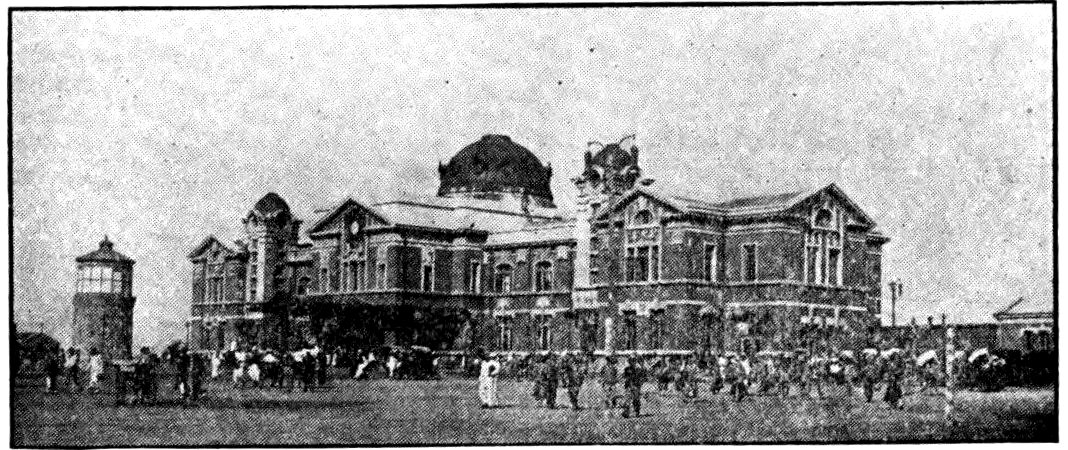
New original cover art included with this eBook is granted to the public domain.
TRAVELS IN MANY LANDS
BY
HARRY A. FRANCK
WITH MANY ILLUSTRATIONS, LARGELY FROM PHOTOGRAPHS BY THE AUTHOR
F. A. OWEN PUBLISHING COMPANY
DANSVILLE, NEW YORK
Copyright, 1927
F. A. OWEN PUBLISHING COMPANY
Travels in Many Lands—The Japanese Empire
PRINTED IN THE UNITED STATES OF AMERICA
FOREWORD
The very best way to give boys and girls a clear idea of just
what life is to their brothers and sisters of other lands is to
take them through those lands. If they cannot go in person
(and of course few can), a well-written story of travel will
be a valuable substitute for personal experience.
To be of educational value to the reader, a book of travel
must first of all be authentic. It must have been written by
one who knows at first hand the things about which he writes.
A superficial knowledge gained by flitting through a country
along its main traveled routes is not sufficient to enable a writer
to tell a complete story about it.
Among the notable travelers of our time, probably none
has more thoroughly covered many countries than Harry A.
Franck, the author of this book. His travels have not been
mere sight-seeing tours. He has gone into the out-of-the-way
places and lived in the homes of the common people, to study
their habits and manner of living. He has visited their temples
and schools. He has learned something of their language and
talked with them on all manner of subjects so as to become
familiar with their views of life.
From boyhood, Harry Franck had a desire to know about the
great outside world. In 1900, during his first summer vacation
while attending the University of Michigan, he set out,
with only $3.18 in his pocket, to see something of Europe. He
worked his way across the ocean on a cattle-boat, visited the
principal cities of England, then Paris and the Exposition that
was being held there. He signed as an “able seaman” for the
return trip and reached Ann Arbor for the fall term, only two
weeks late.
Mr. Franck worked his way through college and intended to
make teaching his profession, but that first European trip
gave him an appetite for more travel. When he was graduated,
he started out, with only enough money to buy supplies for his
camera, to work his way around the world—which he did in
sixteen months. After this trip he wrote “A Vagabond Journey
Around the World,” which is regarded as one of the most remarkable
books of the kind ever published. Since then he has
written many other volumes telling of his experiences.
During more than twenty years of travel, Mr. Franck has
covered half a hundred countries. He has journeyed 50,000
miles on foot and at least an equal distance by primitive native
methods. In gathering material for this volume and for “China”
(in the same series), he traveled for two and a half years
through the Far East. He often endured hardship and faced
danger to give the world the truth about the Oriental lands.
This book may be given to children as supplementary geographical
reading with the assurance that every statement is
based on actual facts gained by recent travel. The world to-day
is not what it was even a decade ago. Conditions, customs, the
very people themselves have changed; some greatly, some
slightly. A book of this kind to be really helpful must reflect
these changes. The author, having recently returned from the
Orient, is able to write and show pictures of the Far East as it
now is. Mr. Franck carries equipment for taking the best
possible pictures and most of the illustrations in this volume
are from photographs taken by him personally, often under
conditions that involved difficulty and sometimes danger.
As children read this book on the Japanese Empire, we feel
sure they will be impressed with the fact that the people of the
whole world are one great family; that what affects one nation
affects all nations to a greater or less extent. They will
realize that while certain lands may seem “backward” to us
who enjoy the conveniences of Western civilization, we are indebted
to them for many things that have made our civilization
possible. For example, the compass, which was essential
to the development of navigation and which, as improved by
the Italians, enabled Columbus to make his great voyage of discovery,
was invented by the Chinese nearly 4000 years ago.
Children, like adults, must be led to see that people everywhere
have their virtues and ambitions, their trials and hardships,
and that the misfortune or the prosperity of one country is reflected
in other countries far away.
Knowledge of these facts should prompt us to work for the
peace and well-being of all peoples, particularly through the
channel of our schools. In this connection, Payson Smith, Commissioner
of Education for Massachusetts, has aptly said:
“Education in all lands should lead the youth to recognize those
interests which are common to humankind, to magnify the virtues
which all men hold in common, to minimize those differences
and distinctions which divide, and to interpret the history
of race and nation in those terms that are helpful to world
progress as well as to national self-respect.”
Acknowledgment is made also to the South Manchuria Railway
Company, New York, for their kindness in providing the illustrations
used on the following pages: 213, 242, 244, 245, 247, 248, 249, 250, 253.
CONTENTS — CHAPTER I WESTWARD TO THE FAR EAST — My Son Loses a Birthday
For five days we had been rolling across the
United States in a Pullman car, on our way to the
opposite side of the globe. We might have set out
from New York across the Atlantic, changing steamships
in some European port and going the whole distance
by water. But we had decided to see our own
country first, and after our long journey across the
continent, here we were at last rumbling into the city
of Seattle.
The Pacific Ocean was spread before us. Perhaps
more people sail from San Francisco than from
Seattle in crossing this largest body of water on the
globe, but the farther north one crosses, the shorter is
the trip. If you will look at your school globe you
will see why ships can reach Japan more quickly
from Puget Sound than from the Golden Gate.
Mother Earth’s waistline, the Equator, is the greatest
distance around the world (east and west), and the
nearer to it one is, the longer the distance. So you will
understand how we saved a few days on our journey
to Asia by sailing from Seattle; but it hardly paid, for
we had winter weather in April, all the way across.
12How limitless the sea about us seemed morning
after morning! It was not hard to realize that this
body of water, which often does not live up to its
name (Pacific means “peaceful”), is greater in area
than all the land on the globe. And we were on our
way to the largest piece of land on the earth, the
continent of Asia. Years ago, I went eastward to
the Far East. In returning to America, I crossed the
Pacific as a sailor on a sailing vessel and we were
more than a month without a glimpse of anything
but the sea and sky. My journey home seemed long
indeed.
On this trip westward we did not see another
ship for more than a week, to say nothing of sighting
land. Then one morning we saw north of us to
starboard (the right-hand side of the ship as one
faces the bow) what looked like a great motionless
iceberg. The Japanese “boy” who tended our cabin
and waited on us at table called it “American country,”
and he was right. For it was one of the Aleutian
Islands, a great string of which stretch southwestward
from Alaska and, like it, belong to the
United States. Yet it was a whole week since we
had sailed from Seattle, thinking we had left our
native land behind. If we had gone from San Francisco
we should have seen other islands belonging to
us, the Hawaiian group. There we should have
stopped for a day, and enjoyed a delightful run
ashore in a garden spot of the tropics. But only
seals, and now and then a few fishermen in the summer
time, or navy men flying across the Pacific, think
13it worth while to land on the Aleutian Islands, so
closely does each resemble a glacier or a mountaintop
emerging from the sea.
The rest of the trip was the same, day after day,
except for one curious incident. My son, who was
born on a British steamer in the Caribbean Sea, lost
his second birthday! When a ship westbound crosses
what is called the international date line, it must
move its clocks forward twenty-four hours, so to
speak. Otherwise its calendar will not agree with
the calendar of Asia. It happened that we crossed
the international date line on Tuesday evening,
April 24, and when my son woke up next morning it
was Thursday, the 26th! His birthday, the 25th,
had disappeared without a trace, a cake, or a candle,
and if he lives to be a hundred he will have had
only ninety-nine birthdays. Had we been traveling
eastward instead of westward, he might have had
two birthdays—two April 25’s—for in that case the
ship, on reaching the international date line, would
have added a day to fit the calendar of the western
hemisphere.
14
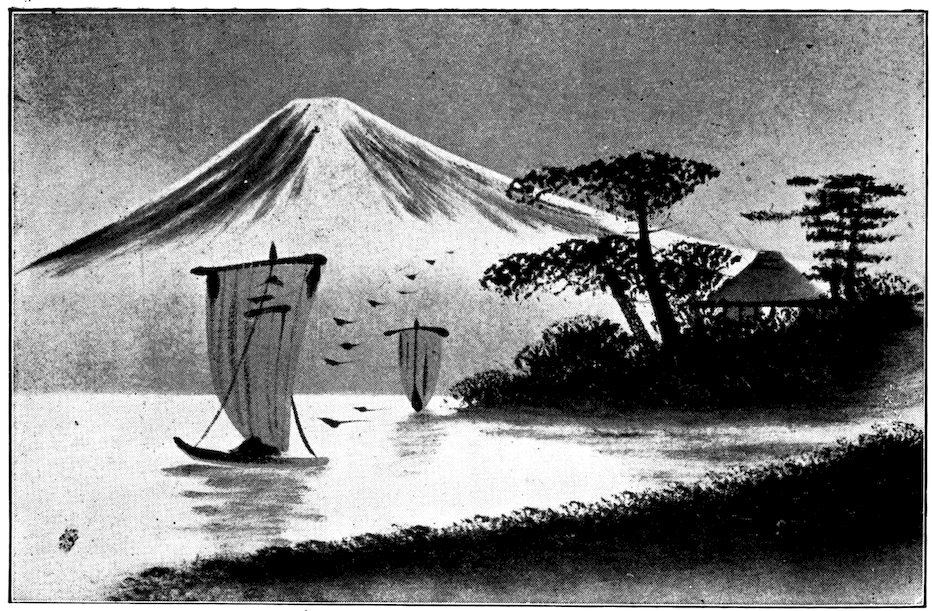
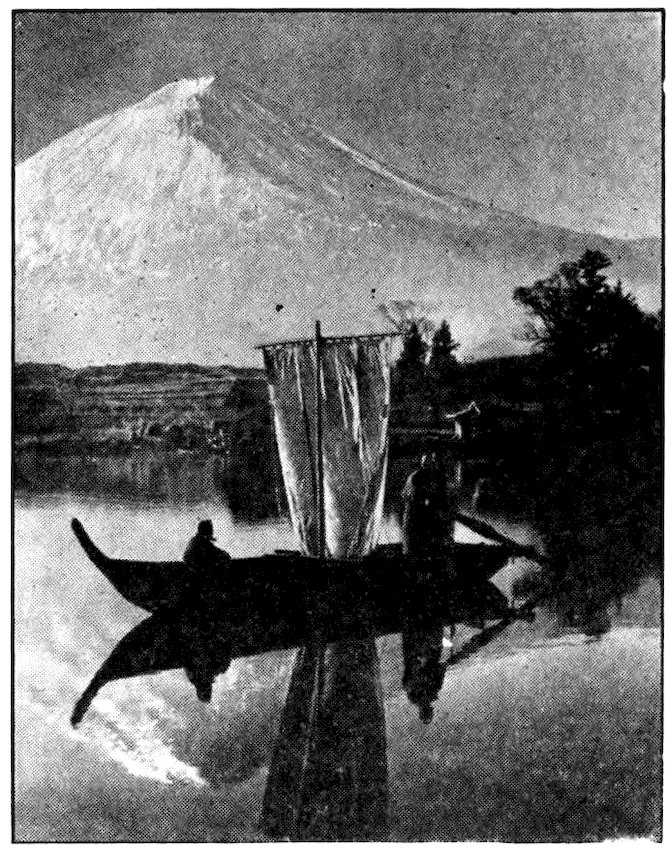
Japanese artists delight to paint the sacred mountain Fujiyama.
Another week and we sighted Japan, the eastern
edge of the great continent of Asia which contains
almost one-third the land and fully one-half the
people of the earth, a continent larger than both the
Americas plus all other land in the western hemisphere.
It was not really the continent of Asia, of
course, that we saw growing ever larger on the horizon
15ahead. It was merely one of the islands off its
eastern coast—just as Bermuda, the Bahamas, and
the West Indies lie off the coast of the United States.
These islands stretching along the coast of Asia,
however, are not like most of the West Indies politically,
for instead of being colonies of other nations,
they form an independent empire.
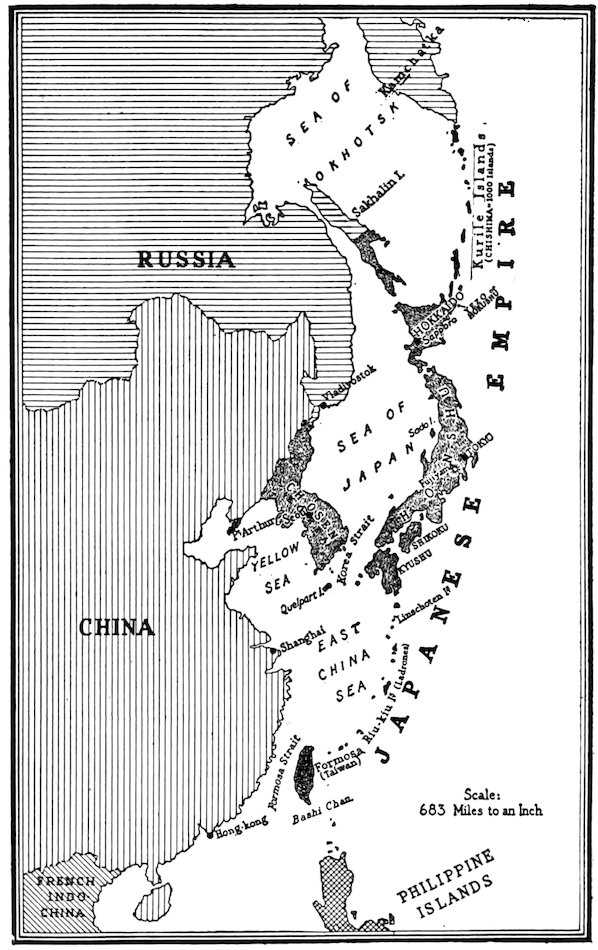
Japan has often been called a great string of
pearls flung down along the western side of the
Pacific. The Japanese have a legend that their islands
were formed of water dropped from the spear
of Izanagi, one of their gods. Scientists explain the
islands in a way much easier to believe, saying that
they are the tops of ancient volcanoes. According
to them Japan is a great mountain chain rising from
very deep water. These mountain tops that are islands
stretch all the way from the climate of Greenland
in Sakhalin to that of Cuba in Formosa, a sort
of stepping stone to our Philippines. Some of the
“pearls” are large, some of the others are very small,
mere rocks on which no one lives. The Kuriles hang
like a necklace from the peninsula of Kamchatka,
and the Riu Kiu or Ladrones connect the southern
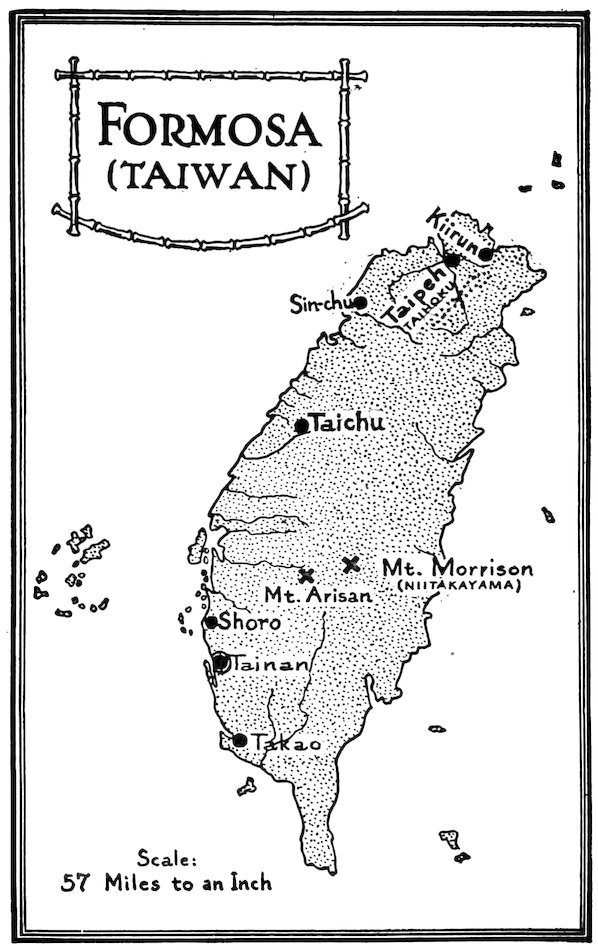
end of old Japan with Formosa, which also belongs
to the Empire now. If we could count them all we
should find nearly three thousand islands!
Yet all of them together do not give room enough
for the sixty million people who live on them. Besides,
being the tops of mountains, only a small part
of the islands of Japan can be cultivated. But for
the same reason they have many forests, nearly all
16minerals, countless mountain streams to furnish water
power, and beautiful scenery almost everywhere.
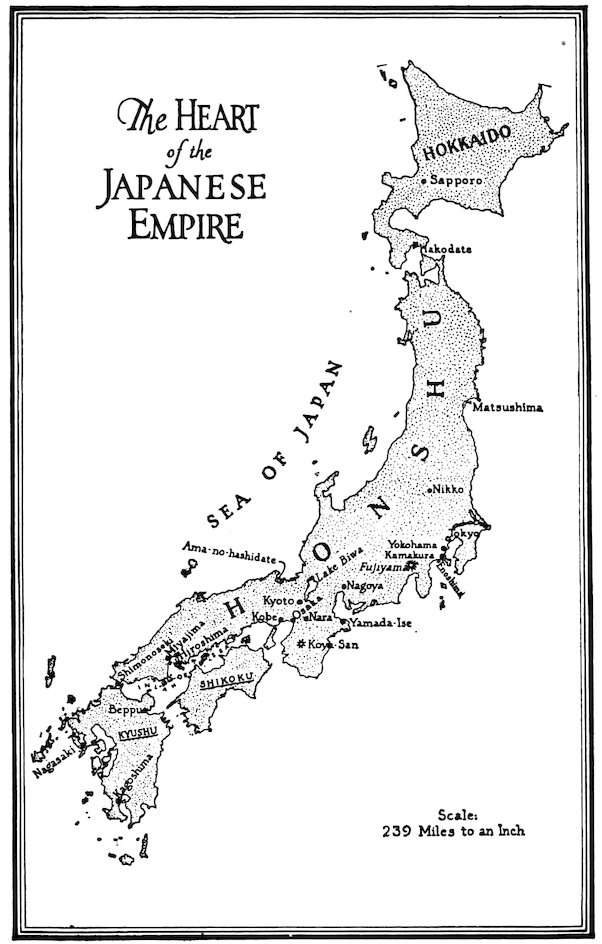
The most important of all the islands that make
up Japan is Honshu, on which at least half the Japanese
live. North of it, where the winters are cold
and snow often caps the mountains, is the second
largest island, called Hokkaido, Yezo, or Hokushu.
South of Honshu come two middle-sized islands,
Kyushu and Shikoku, and after that the islands
dwindle down through all sizes to those mere uninhabited
rocks in the sea which make Japan the most
broken-up country in the world.
How Japan got its present name is interesting.
Once the country was called Yamato, but centuries
ago a Chinese emperor sent a man there to look
for medicine or the elixir of life or something of the
sort. As the emperor did not know what name to
give it, he had to say Jrr-pen, which would be translated
as “native of the sun” or “place the sun
comes from.” Gradually the Japanese themselves
adopted this new name for their country, and to-day
they write those characters for it which in their language
are pronounced Nippon. So it is natural that
Japan should be called the “land of the rising sun,”
and that its national flag should be a white banner
bearing a red sun, either round or with rays.
CHAPTER II WE LAND AND GO TO TOKYO — Great Changes in Two Years — The Rickshaw — Japanese Railways — A Touch of The West
17
No matter by which route one crosses the Pacific,
he is almost sure to land first in Yokohama. It is
the chief doorway to Japan, at least from the west.
Only about fifty years ago it was not much more than
a fishing village. But here the American Commodore
Matthew C. Perry landed in 1854, and since then it
has become one of the world’s great ports. For more
than two hundred years before that Japan had been
a tightly closed country. Some unfortunate impressions
gained of Western people and their ways had
made the Japanese Government decide that it would
be best to have nothing whatever to do with the rest
of the world. So no Japanese were allowed to go
abroad, and no foreigners were permitted to land in
Japan, except a few traders from Holland, who were
kept much like prisoners on a little island in Nagasaki
harbor.
18
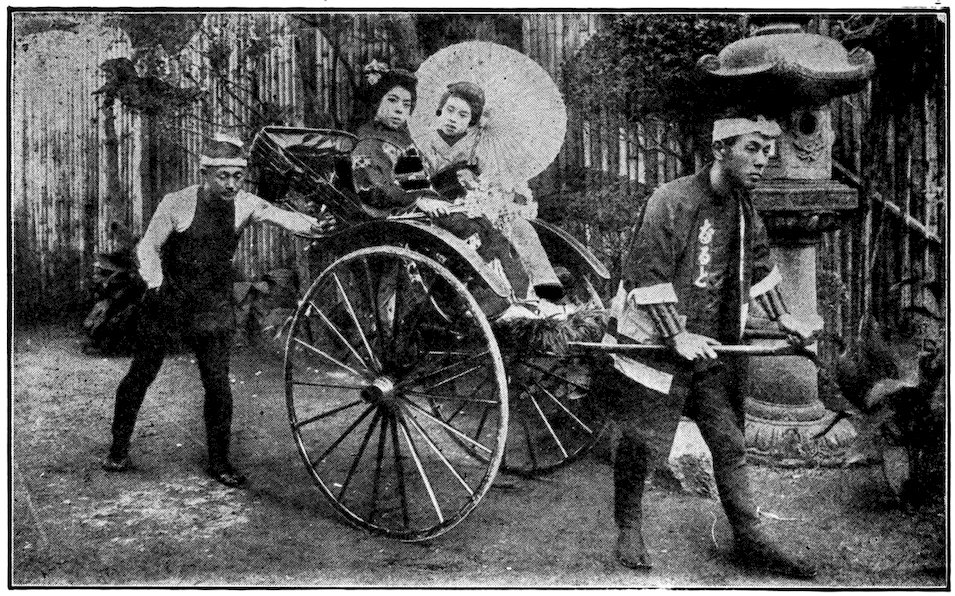
Two Japanese girls may ride together quite comfortably in a rickshaw.
But sometimes it was impossible for foreigners not
to land in Japan. There might be a storm at sea, or
American fishermen on the ocean might have to stop
at one of the Japanese islands to get drinking water.
It was not right that these seamen, forced to land in
the island empire, should be treated as criminals,
sometimes even executed. So the United States Government
19sent Commodore Perry, first with a few
ships, the next year with a whole fleet, to try to persuade
the Japanese to make a treaty with us. The
Japanese were asked to allow Americans to trade
with them, and to promise that they would treat
properly any of our sailors who happened to land on
their shores. To show the Japanese what the outside
world had learned since Japan had shut its doors,
Commodore Perry brought and set up on the beach
of Yokohama a whole railway train, though of almost
toy size. The curious Japanese used to sit on the top
of the cars for a ride, in order to try out this strange
invention. The Commodore showed them many other
interesting things. Finally the treaty was signed that
opened Japan again to the outside world, and to-day
it has railways and other Western conveniences, and
foreigners of any nation now travel as safely in Japan
as at home.
About the only reason for not landing first in Yokohama
after crossing the Pacific would be because it
had been destroyed, and that is exactly what happened
to that great port at noon on September 1,
1923. A sudden earthquake, followed by a great
fire, almost completely destroyed the city in an hour
or two, and for some time after that ocean steamers
went right past, and made Kobe their first port of
call. There have often been earthquakes followed by
fires in Japan, but this one that fell upon all the
region about Tokyo Bay on that late summer day was
not merely the worst Japan had ever known but has
been called “the greatest disaster in history.” How
20many thousands of people were crushed or otherwise
killed in the thousands of buildings that fell, never
will be exactly known. Hundreds of people were
saved by the American and British ships in the harbor;
thousands of others rushed away into any open
space they could reach, while the ground was still
heaving like a sea under their feet. For days, in fact
weeks, afterward the people who remained had to
live as best they could among the tumbled ruins, and
eat whatever the government and other agencies
could get to them. For days there was not even water.
All the water-mains had been broken, and all
sorts of diseases broke out among the houseless survivors.
The Japanese government finally announced
that 192,000 people had been killed by the earthquake,
in one way or another. Some people claim
there were many more than that. Among those
killed were the American consul and his wife and
most of the other American residents of Yokohama,
as well as foreigners of many other countries.
I have been through Japan three times, the first
and last visits twenty years apart. But of all changes
I have seen, those in Yokohama—between a year before
the earthquake and a year after it—were the
greatest. The big modern city had become a large
scattered village of low wooden houses, almost
shacks. Eight-story buildings of brick and stone
were either gone entirely or were smoke-blackened
shells half filled with heaps of bricks and what had
21once been office walls and furniture. Even the big
foreign steamship lines now had offices in little low
wooden buildings such as the people were using for
houses and shops.
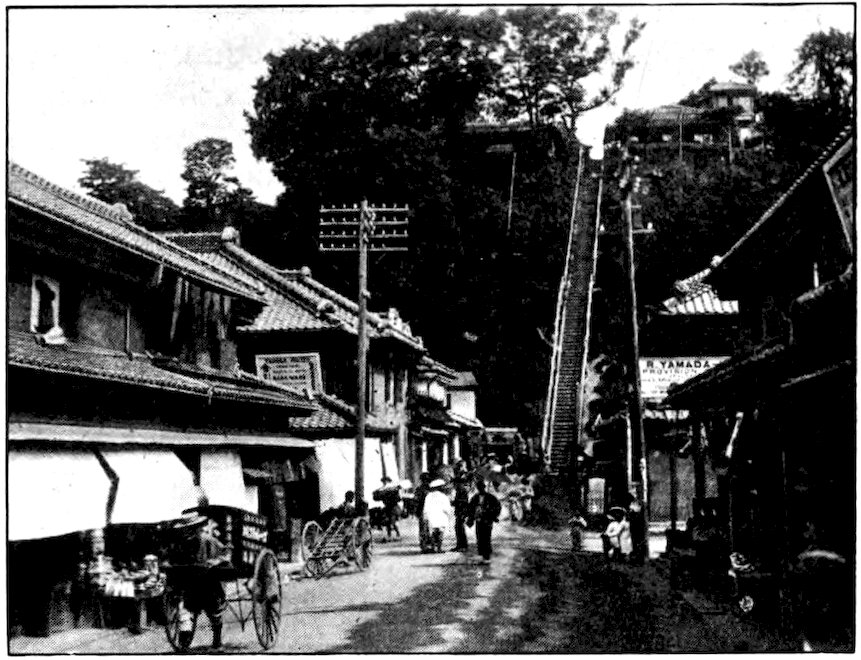
The 101 steps of Yokohama, at the top of which is the 101-Step Tea House. From this height Commodore Perry viewed the city at the time he was successful in having Japan opened to the world.
Funny as well as terrible things happened during
that great earthquake. For instance, an American
lady who had been out shopping was just taking a
bath before lunch when the crash came. Her house
fell down, and she went sliding, still in the bathtub,
down the slope of the Bluff (the higher part of
Yokohama, where nearly all foreign residents live),
landing at the edge of the bay unhurt but much
embarrassed.
22I once had an amusing experience on that same
Bluff. It was during my first trip around the world,
back in 1905, just after I finished my college course.
In those days I was a sailor looking for a ship. I
was wandering along the Bluff, among the several
streets of big foreign houses, when I discovered that
I was lost and did not know the way back to the
harbor. I stepped into one of the many neat little
police stations that are to be found all over Japan, to
inquire the way. But I did not know a word of Japanese,
and the courteous policemen knew no English.
To-day thousands of Japanese speak our language,
and I now know enough of theirs to ask a
simple question. But that time we were “stumped.”
Then suddenly the head policeman picked up the
queer looking Japanese telephone and called a
number. When he got it, he handed the instrument
to me. Someone at the other end asked me in English,
though with a Japanese accent, what I wanted.
Later I learned that he was the chief interpreter at
police headquarters down in the main city. I explained
my trouble, and he asked me to hand the
telephone back to the police sergeant beside me.
Then he explained to him, in Japanese, what I had
come for, and a policeman was sent to show me the
way back to the harbor.
But this time we were landing in Yokohama instead
of leaving it. We found the great harbor
really a part of the large bay of Tokyo, and filled with
all kinds of steamers from many countries. A Japanese
doctor looked at all of us for signs of illness, since
23of course no one with a contagious disease could be allowed
to enter the country. Then polite Japanese
customs officers examined our baggage, to see if we
were bringing in anything that should pay duty. For
some reason apples are not allowed to be brought
in. Perhaps it is because up in the island of Yezo
the Japanese themselves raise many good apples
(which came originally from American seed). My
little boy is very fond of apples, so we had stocked
up at Seattle, but the customs officers took away our
last half dozen. Yet Japanese returning from California
were allowed to bring in whole crates of
oranges.
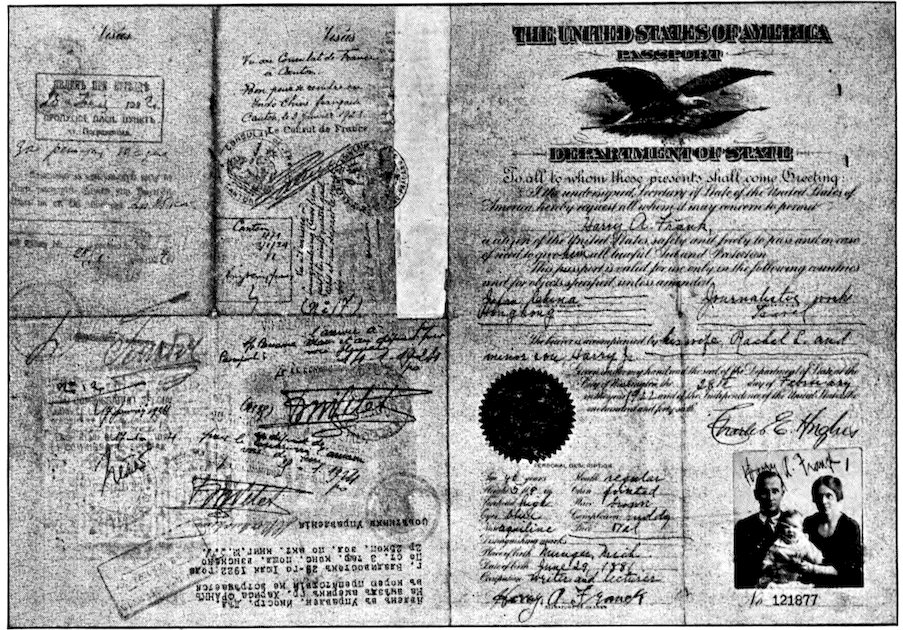
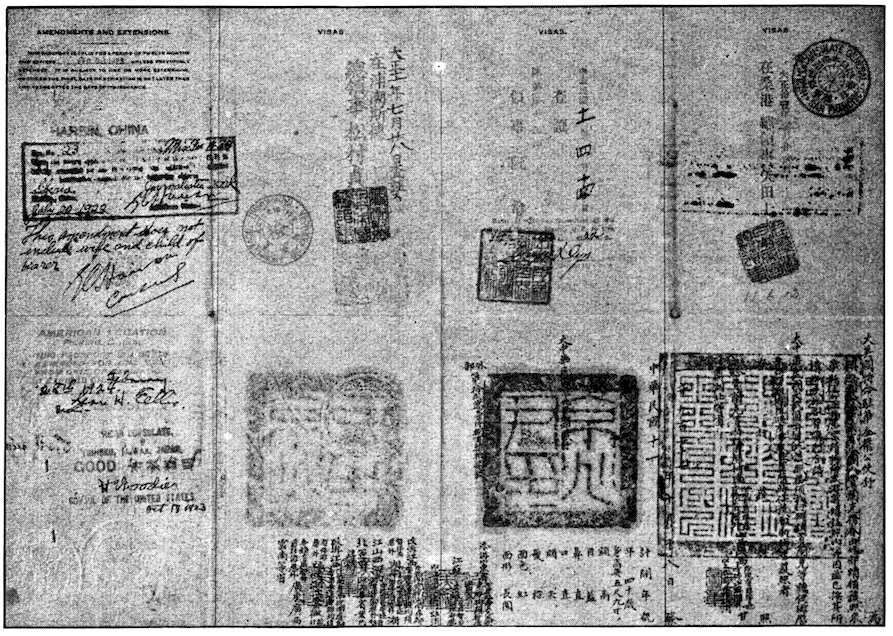
Our passports were soon stamped, and then we
were free to go anywhere we liked in Japan. The
only thing we must not do, besides the things one
should not do in any land, was to take photographs
anywhere near forts. I recalled how near I had
come to having my camera taken away from me
years before in Nagasaki because I did not then
know that rule.
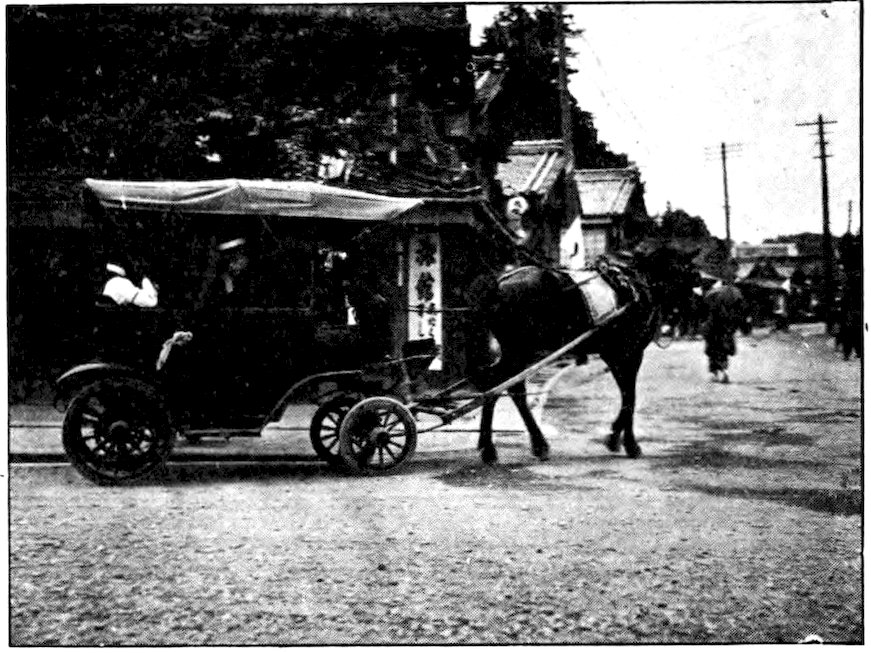
There were automobiles, and even a few queerlooking
horse-carriages waiting for passengers, but
we preferred to take rickshaws. At first it seems
very strange to ride behind a human steed, to be
able to talk to your horse and, instead of using reins,
tell him which way to go or when to stop. But the
traveler in the Far East soon gets used to it, for
wherever he lands he is sure to find a crowd of men
24with these queer carriages rushing forward to offer
their services.
Fourth and first pages of our passport, signed by Charles E. Hughes, Secretary of State.
25
Second and third pages of our passport. The visas were stamped in many different colors.
26
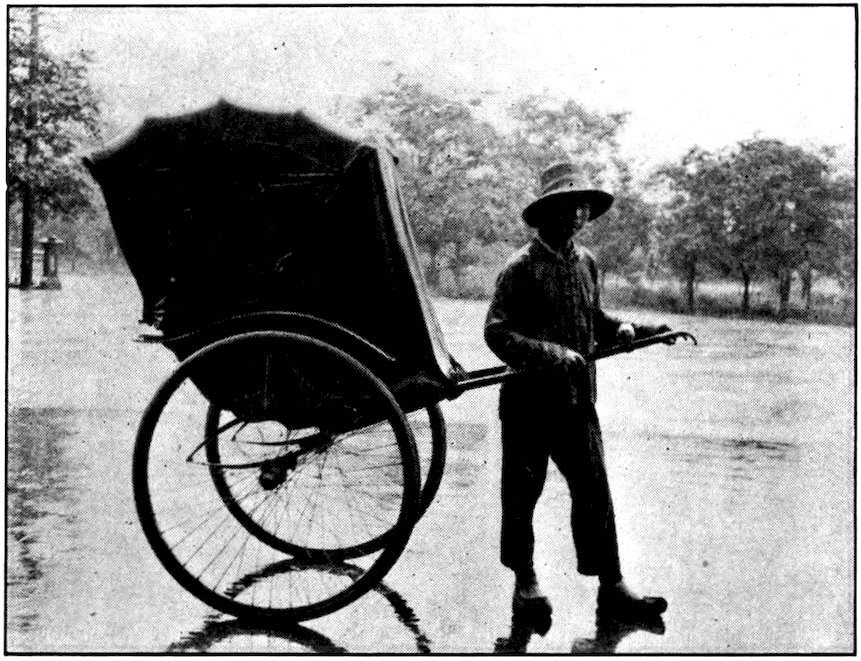
When it rains, the rickshaw is a very handy vehicle, for it can pick you up at the very door and keep you as dry as a limousine, though the poor runner may get soaked before your trip is done.
“Jinricksha,” the rickshaw’s full name, means “manpower
carriage.” The kuruma, as the Japanese still
more often call the rickshaw, is something like the
little sulkies to which trotting horses are hitched. It
has wire wheels and pneumatic tires, the wheels
much larger and the tires much smaller than those
of an automobile. The shafts between which the
man runs are, naturally, shorter than those for a
horse; there is a comfortable seat wide enough for
one person or even for an adult and a child, and a
27top that can be raised and lowered. The kurumaya,
or rickshaw-man, usually wears a black jacket like
a smock, reaching to his knees, and long tight trousers,
ending in black cloth shoes or slippers with a
separate compartment for the big toe. When the
weather is very warm, his sunburned legs are bare
and his feet are simply thrust into sandals made of
rice-straw.
The rickshaw is not a Japanese or even an Oriental
invention. It was originated by an American
missionary. His wife, who was an invalid, found it
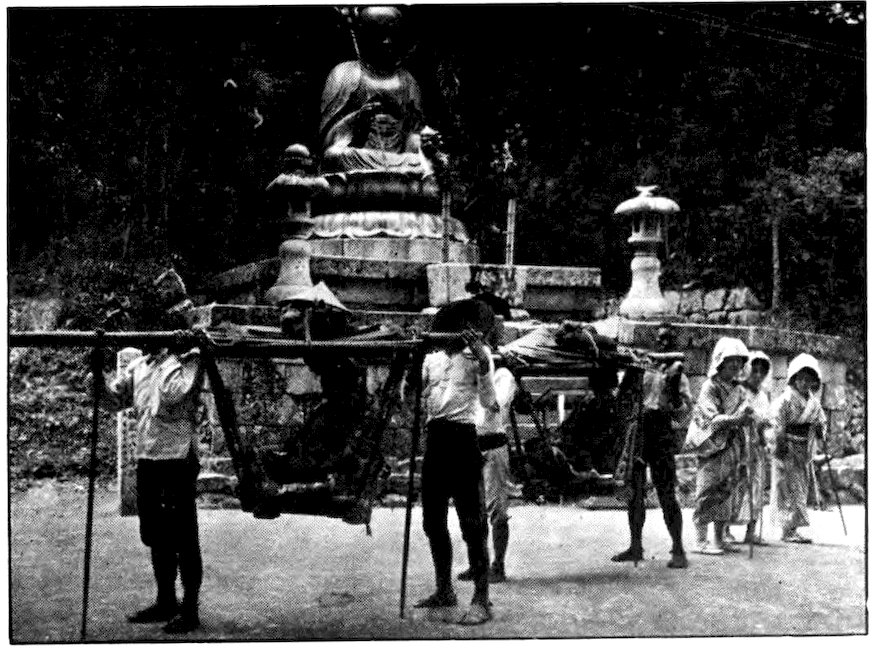
painful to ride in a kago, or seat between two poles
on men’s shoulders, such as Japanese used in olden
days. So he arranged a kind of enlarged baby-carriage
in which she could be pushed or pulled, and
from this has developed the rickshaw that has
spread over much of Asia and some of Africa. The
man from the Western world is reminded of this
origin during his first few rides in one of these vehicles.
He feels very much as if he were being
wheeled about in a baby-carriage. But he quickly
finds that the rickshaw is very comfortable and convenient.
Its rubber tires and the soft-shod feet of
the runner make it almost noiseless; it will take him
through narrow streets and into many places where
a horse-carriage or an automobile could not go. In
time he may even become fond of “widin’ man,” that
is, “riding man,” as my small son began calling this
means of travel soon after we reached Japan.
28
Yet most of us from the West never get so used to
it that we are not rather sorry for the men who have
29to play horse to earn their living. Even in Japan,
where they do not run very fast and are so well paid
that it costs more to cover the same distance in a
kuruma than in an automobile, they often cannot do
this hard work for more than eight or ten years. In
China, where there is so much competition among
the millions of rickshaw coolies that they have to
run very fast indeed to keep their customers, and
where their pay is pitifully low, many of them do
not last even that long. There are other dangers in
rickshaw running, especially in Japan. For there
the roads often go up or down steep hills, and the
runner with a passenger heavier than himself is
sometimes injured by the kuruma’s running away
with him or overturning upon him. When the
Prince of Wales was in Japan a few years ago he
put one of his companions in a rickshaw and started
to play rickshaw-man. But the street in Nikko
where he tried this new occupation became steeper
and steeper as he neared the bottom, and the Prince
was lucky to get off with only a broken rickshaw.
Wise people do not go to foreign countries just to
see ports, for ports are never as different from the
rest of the world as the country itself. The people
who live in seaports meet so many foreigners that
they acquire foreign ways. If one wishes to know
something about the real people and their country,
he must travel inland, far from the places where
ocean steamers dock.
30Soon we were on our way to Tokyo, the Japanese
capital. There are swift electric and steam trains
between Yokohama and Tokyo, leaving a very Western-looking
station every fifteen minutes or half-hour
during the day and much of the night. We
might have gone by automobile, perhaps by trolley,
even by rickshaw if we had had plenty of time to
spare. We chose the train. The railway cars reminded
us a little of the toy train that Commodore
Perry took with him when he opened Japan to the
outside world. The cars were not only small compared
to those in America, but they were drawn by
a small engine that had no bell and seemed to
screech rather than whistle. The Japanese copied
their railways mostly from those of England, yet unlike
the typical European railway “carriage” their
cars are not divided into compartments with two
doors to each compartment. Each car is a single
room, like our own, with a door at either end. In
the third class, where most of the Japanese ride,
there are hard wooden seats, set crosswise, with a
central aisle, as on our trains. In second and first
class, in which most foreigners and the more
wealthy Japanese travel, there is one seat along each
side of the car, as in old-fashioned street cars.
On these long upholstered seats we saw Japanese
business men, professors and government officials,
dressed almost exactly as such men would be in
America or Europe. But many of the passengers
31were in the costumes of their own country. Almost
never did we see a Japanese woman dressed in
European fashion, though the Empress and the
ladies of the Court dress that way on important public
occasions. The women in our car had on long
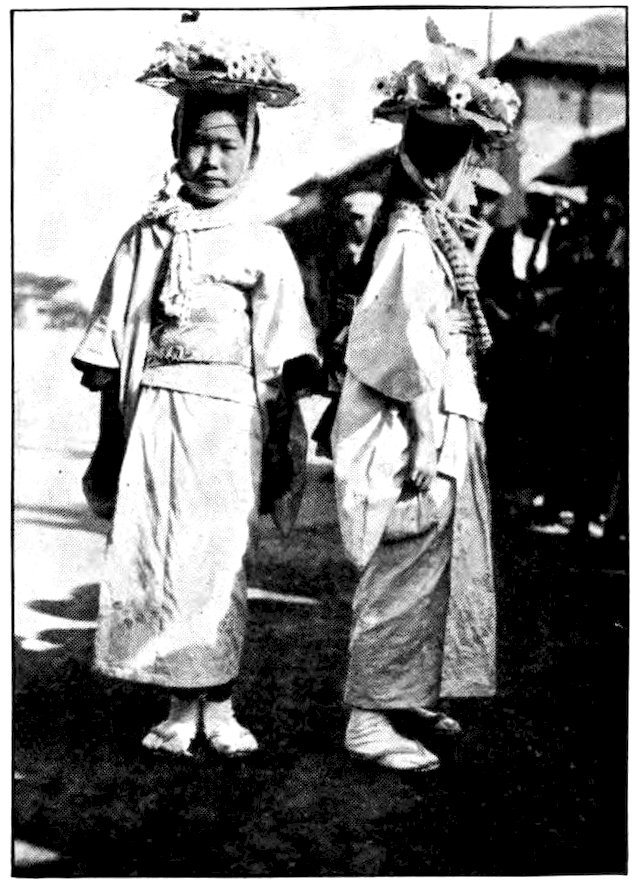
kimonos, some of silk, richly embroidered, with the
obi, a great sash of bright colors, wrapped about
their waists and fastened behind in a bow so enormous
that it looked like a sofa pillow. Their jet-black
hair was done up in a very elaborate manner,
and they wore no hats. Many of the men also wore
kimonos, with a sash belt in place of the obi, and the
little boys and girls were dressed much like their
elders, though in brighter colors.
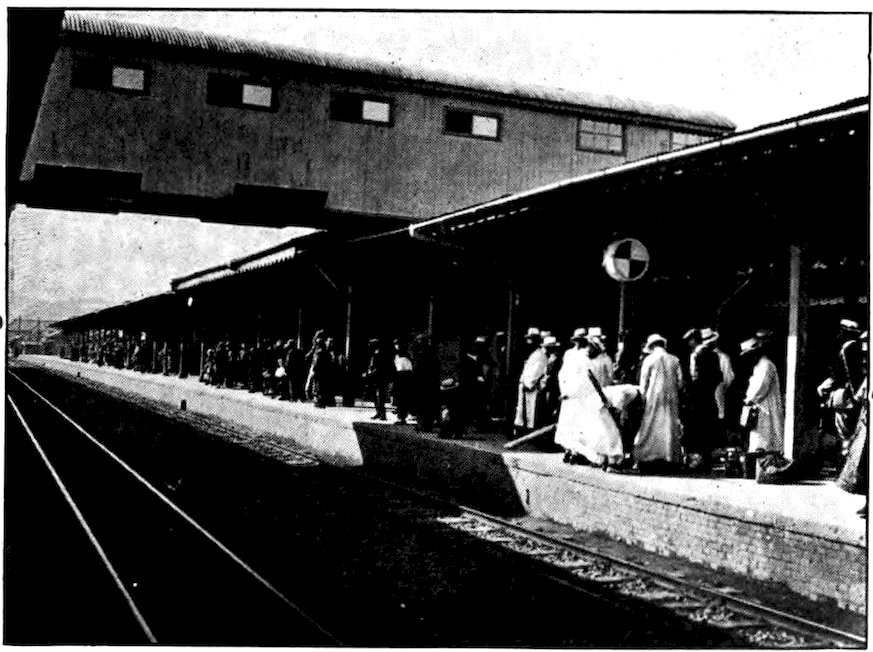
A railway station in Japan, showing how closely such places resemble our own stations. Passengers cross the tracks by the covered bridge. The men in white are Koreans.
32All these men, women and children stepped out
of the wooden sandals worn in place of shoes, and
squatted on the long seat with their stockinged feet
drawn up under them. The long seat close to the
side of the car is more convenient for them than for
us of the Western world, for when they wish to look
out, they simply kneel with their faces to the windows,
their feet and legs under them. Even some of
the men in European dress take off their shoes. Beneath
the seats are two long lines of shoes and geta,
or wooden sandals, waiting until their owners want
them again. When passengers are ready to leave, those
having the native footwear simply step into their clogs
(held by a cord passing between the big toe and the
other toes) and away they scrape.
Until we got used to it, perhaps the queerest thing
about being in Japan was to realize that now it was
we who were the foreigners, instead of those who
would have been so in our country. We were objects
of curiosity to these almond-eyed, yellow-faced
people who to us seemed queerly dressed. If you
were like some foreigners in Japan, you might think
that the Japanese were sorry not to be like you, that
they would prefer to be American or English or
French. But you would soon find that they are just
as proud of being Japanese as you are of being
American, and that they would not change any
more than you would. You can see that this is just
as it should be, for the people of every country
should think of it as better than any other—and strive
to make it better still.
33
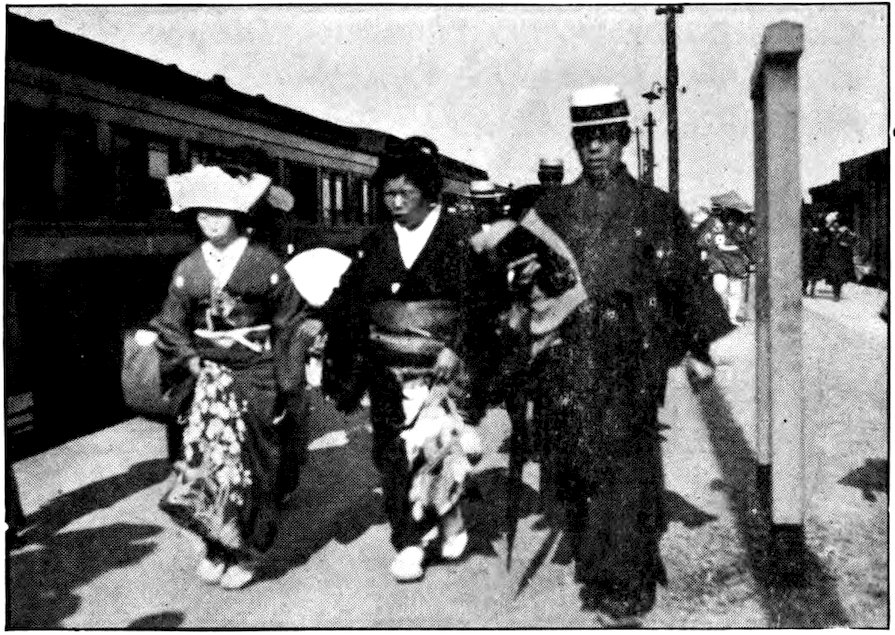
A bride being taken by her mother to her future husband. She wears a white headdress and keeps to the old customs and costume, even though she rides in a very up-to-date train.
As we looked out the train windows we noticed
that Japan had copied many things from the West.
There were big warehouses and factories and scores
of telegraph lines carried on several rows of poles,
such as one would see in America or Europe. To be
sure, the bright green rice fields were not like our
fields, and certainly the men and women were very
different in appearance from those we had seen
working in American fields as we raced across the
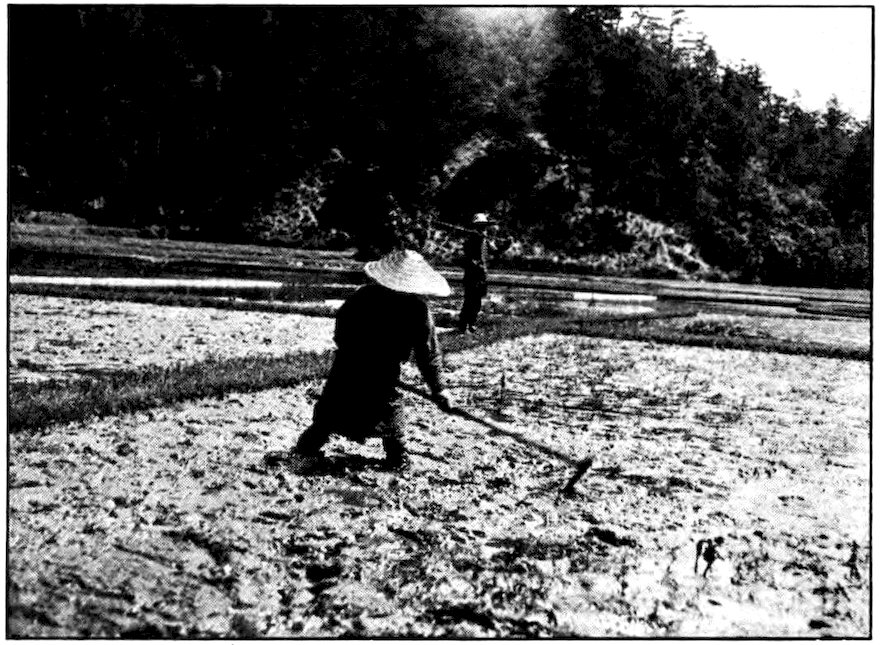
continent. They wore great straw or woven-reed
hats that looked like parasols without handles.
Their kimonos or smocks were pulled up about their
waists and tucked into their belts, and their bare
legs were often knee-deep in the muddy fields as
34they hoed or weeded the growing rice. Women
work in the fields as much as the men. There were
many villages of small thatched houses and some
orchards in which the trees seemed strangely tiny.
We noticed that some of the trees were trained on a
trellis so as to form a shady roof over summer houses
or verandas.
The trip was swift, however. In less than an
hour we found ourselves racing between unbroken
rows of little houses, some of them dark with age,
since they had seldom been painted. Big western
buildings rose about us again, we stopped at a suburban
station or two, and suddenly we reached the
huge stone Shimbashi Station of Tokyo. Outside its
entrance rows of automobiles and scores of rickshaws
were waiting, and before and around us were
the sights and sounds of a big city. It was almost
bewildering, even to us who were quite used to traveling
in foreign lands.
CHAPTER III LIFE IN THE JAPANESE CAPITAL — The Imperial Palace — The Japanese Government — An Interesting Experience — Japanese Stores and Streets
35
Although it is one of the great cities of the
world, with more than two million people,
Tokyo is mostly a low, flat city. The people long
thought that by building very small houses they
would not suffer so much from the frequent earthquakes.
But in the great disaster of 1923 it was the
American-style buildings, of stone or brick with
steel frames, that stood up best. Even if the little
wooden houses were not overthrown by the earthquake,
they were quickly devoured in the great fire
that followed it.
We saw many signs of the earthquake in Tokyo,
as in Yokohama. Whole sections of the city were
still gleaming new, because the hundreds of little
unpainted wooden houses in it had so recently been
rebuilt. In places only the charred walls of big
stone or brick buildings remained. But Tokyo was
not so completely destroyed as its port, and much of
the city looked quite as it had on an earlier visit.
Perhaps because they are so used to fires and earthquakes,
the Japanese had quickly restored their capital
after the great calamity. Certainly it was surprising
to see how much of the city was rebuilt only
a year later.
36The streets of the Japanese capital have rougher
pavements than our own, and no sidewalks. The
people simply walk in the street itself, mingling with
the hundreds of rickshaws and the many automobiles,
which, we noticed, are almost all American; the
Japanese do not seem to make motor cars. Trolley-cars
run everywhere, but these we found more uncomfortable
than in our American cities. They are
small and short, so that they bob about a good deal.
The hard wooden seats are not easy to sit on—but the
cars are so crowded that most of the passengers have
to stand up anyway. Besides, whenever it rains, as it
does often in Tokyo, the car floors become covered with
mud carried in by the passengers’ wooden clogs.
However, it is always delightful to travel by rickshaw,
or even on foot when the sun is bright and
the sky clear. In wandering about the city, we saw
tall, slender towers high above everything else,
with what seemed to be policemen peering out of
them. Our Japanese friends told us these were
places from which to watch for fires, somewhat like
the lookouts of our forest rangers. It is a question
whether a fire could burn faster in one of our great
forests than in these patches of thousands of little
wooden houses that the fire-watchers of Tokyo look
down upon day and night. We came across several
big parks, with many splendid trees, and one of
them was a sea of pink cherry blossoms. Japan is a
beautiful place indeed during cherry-blossom time
in the spring, and the people have many festivities.
Once I was there in the autumn, when the chrysanthemums
37were in bloom, and in the midst of these big
bright blossoms another festival was held.
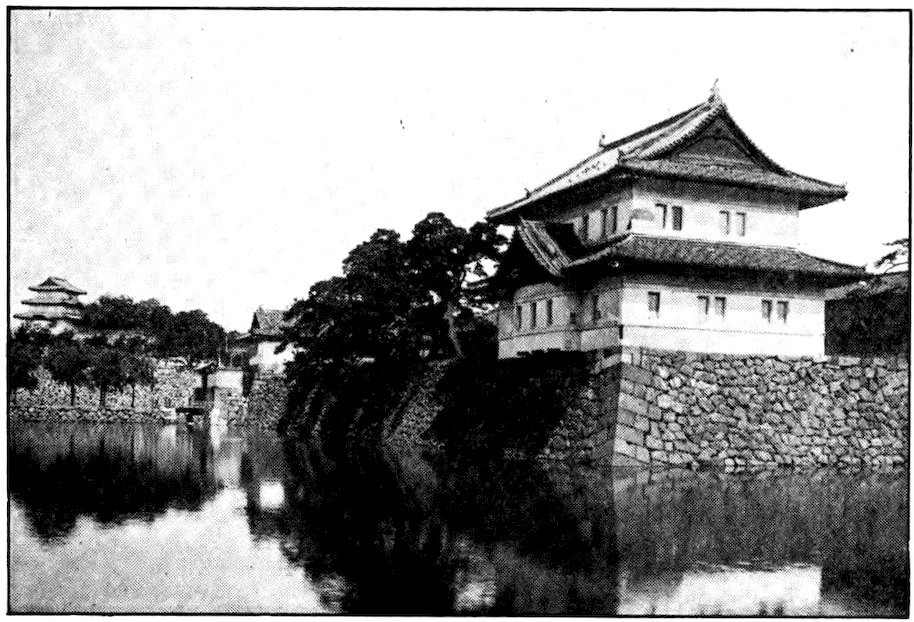
The moat, walls, and watch towers of the imperial palace at Tokyo.
The Emperor’s palace, within its two moats
and walls in the center of the city, is not open to
anyone who wishes to visit it. Not only foreigners
but the Japanese themselves have to wait for a
formal written invitation to visit even the grounds.
Such invitations are sometimes sent for lawn festivals.
As Emperor Yoshihito was ill for some years
before his death in 1926, his eldest son, Crown Prince
Hirohito, was a leader in state and social affairs even
before succeeding to the throne. Hirohito once made
a trip around the world, the first future Emperor
38of Japan to leave his native land. He visited
New York, and a few other American cities; but he
is said to feel much more at home within the walls of
the imperial palaces. The people of Japan greatly
honor their Emperor. Most of them, in fact, consider
him sacred, descended from the Japanese gods,
and worship him in their temples and schools. He is
so holy to them that the common people cannot call
him anything more familiar than “Mikado,” which
means “honorable gate”; that is, the gate of the palace
or of the palace grounds.
The earthquake, however, had no such queer notions,
and it did some damage in the palace grounds
as well as outside. We saw workmen rebuilding a
part of the great outer wall that had been overthrown.
The moats about the imperial grounds are
broad, and the water seems to be deep, though lilies
and other flowers blossom on the surface of it at certain
seasons. The walls are massive, made of large
stones carefully set together; and the grassy slopes
beyond them show that crowds are never allowed to
intrude upon the imperial household. In the olden
days, when guns were unknown in fighting, these
moats and walls were a real protection to the Emperor.
Now he must depend more on his big modern
army, and the respect his people have for him.
One can hardly be in the capital of any country
without wondering just how it is governed. Except
that it is hard to imagine the Japanese having a
39president in place of their sacred Mikado, there are
many things about the government similar to our
own, though it is even more like the British Government.
The two Houses of Parliament resemble our
Congress, and the Cabinet has very nearly the same
officers as ours, except that they are called Ministers
instead of Secretaries. Back of all the other parts
of the government, and not often seen, is a small
group of wise old men called the “elder statesmen,”
who have much power.
The common people of Japan do not have as
much to do with governing their country as our people
do with governing ours, but they are gradually
gaining in influence. Recently nearly all men were
given the right to vote, and there are some who believe
that before many years the women, too, will be
allowed to go to the polls. That would be a great
change indeed from the day, hardly three-quarters
of a century ago, when Commodore Perry came to
Japan. Then there was a feudal system, like that in
Europe in the Middle Ages, and the ordinary people
had very few rights. The lords, who were called
daimyos, had divided the country up among them,
and ruled it with their samurai, a caste of men who
could never be anything but soldiers. The Emperor
was then considered too sacred even to rule, and was
kept shut up in his palace in another part of Japan,
while the shogun, or head of the Japanese army,
was the real ruler. The people had nothing whatever
to do with the government except to obey the
laws and pay very heavy taxes.
40
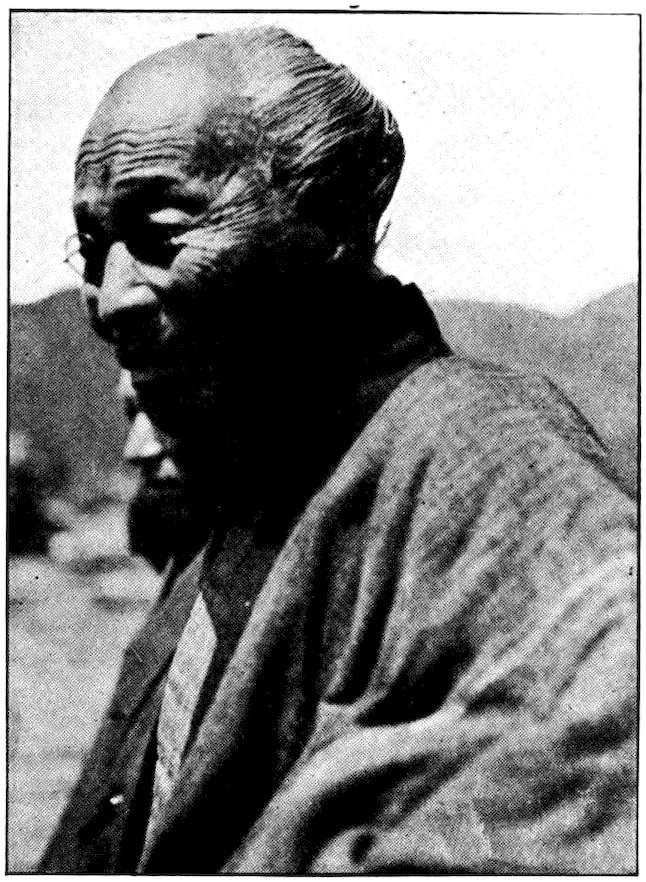
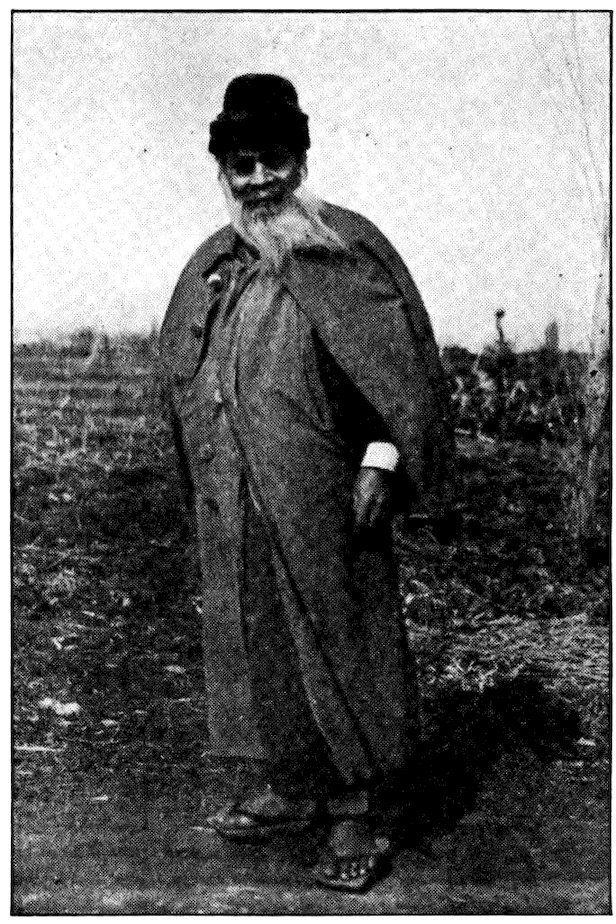
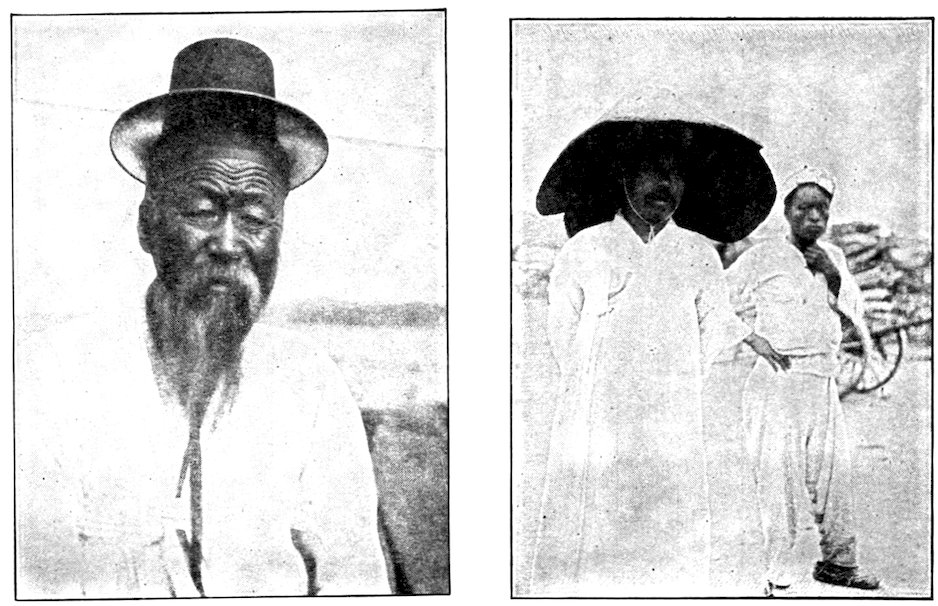
A venerable Japanese man, wearing his hair in the style of olden days.
Roaming about Tokyo, and later about the rest of
the Empire, we often saw things to indicate that the
government of Japan is a very good one. Its army
and navy look just as well disciplined and equipped
as our own or any in Europe. Its postal system is
quite as efficient as any other. In the streets of the
capital we sometimes saw the postmen in their blue
cotton uniforms and straw sandals, running from
house to house, or from one corner mail box to another,
in their hurry to get all their work done. In
Tokyo and the other cities, and sometimes out in the
41country, we saw policemen in spotless uniforms who
did their duty seriously and efficiently. In fact, all
the Japanese who work for the government are very
diligent, for they consider that they are working for
their sacred Mikado.
I had quite a long experience with the policemen
of Japan at the time of the war between Japan and
Russia. Toward the end of that war I landed in
Nagasaki on my way homeward in a trip around the
world. As I had been earning my way, much of it as
a sailor, I suppose I must have looked like a suspicious
character to the Japanese police. To make
things worse, I was wearing an old khaki uniform,
and as I had little money I set out to walk through
the country, or at least through the main island.
Nearly every policeman I met seemed to take me
either for a Russian spy or an escaped prisoner of
war, and during my thirty-six days in the country I
was arrested forty-eight times!
But the situation was not as bad as this sounds,
for the Japanese police are courteous as well as efficient.
If I went out to see the sights of a city, to
visit a temple or take a train, or started into the
country on foot, a policeman was almost sure to step
up to me and tell me by signs that I was under arrest.
But he did not shake a club at me or drag me
off by force to the police station. (Japanese policemen
do not carry clubs, anyway, but short swords.)
Instead, he would trail along beside or behind me
42until he met another policeman, and then one of
them would run off to the police station while the
other stayed with me. By and by the man who had
gone away would come back with a police interpreter,
who would read questions in English to me
out of a little book, pronouncing the words very
queerly. As soon as he found that I could speak English,
he took my word for it that I was an “Amerikajin,”
or American man, and would apologize for
having troubled me. Yet perhaps within half an
hour another policeman would start following me,
and the whole thing would happen over again.
Several times policemen in civilian clothes trailed
me from one town to another, and once I walked
forty-six miles in a single day in an attempt to tire
out the man who was following me. But even then
he continued to be polite, and the country people
who crowded around me, although believing I was
a Russian, never tried to do me any harm. Only
once during these forty-eight arrests did the police
stop me from going where I wished. That time they
insisted that I get off a train before they would let it
start, and kept me in the station waiting-room until
the interpreter came; and when he came he apologized.
I suppose most Americans visiting Tokyo are more
interested in the people and their streets, shops, and
homes than in the Mikado and his palace. I am sure
we were. Most of the stores are small, like the
43houses, and open wide on the street, for the front
wall is pushed aside like a great door during the day
and evening. The floor is raised two or three feet
above the ground and is covered with grass mats;
and on this the shopkeepers squat, whether they are
attending to customers or writing up their accounts.
They have tiny little desks, without legs, to write
upon. Their wooden sandals are left on the ground
before the shop. Generally the customers stand in
the street at the edge of the shop floor and do their
buying there. If they go inside, they also step out
of their sandals and walk about or squat on the mat-covered
floor in their stocking feet. The stockings
are always mitten-shaped, and usually they reach
only to the ankle.
There are also some big department stores in
Tokyo, one or two of them several stories high. In
these also the floors are covered with mats, or are
as highly polished as a piano, and Japanese customers
leave their clogs at the door. There, as in our
check rooms, boys or girls take care of them. When
a foreigner, or a Japanese in American dress, comes
in, the employees cover his shoes with cloth overshoes
so that he may walk about without soiling or scratching
the floor. These department stores are very neat,
and as orderly as a museum. Nearly all their goods,
of course, are Japanese, but the stores themselves are
just as up-to-date as our own, even having interpreters
who speak English.
The streets of Tokyo have their own special noise,
which is not like the noise of our cities. As nearly
44everyone wears geta, or wooden clogs, the scrape of
these on the pavements raises a great din wherever
there is a crowd. When it rains, nearly everybody
carries an umbrella, usually one made of waterproof
paper. In order to keep their feet out of the water
and mud, the people put on higher and higher wooden
clogs, so that in very bad weather they all look as
if they were walking on stilts. The high clogs seem
very awkward and a foreigner could hardly walk in
them at all; but nearly all Japanese prefer them to
shoes. The rickshaw-men and those who draw carts
or canal boats, not being able to carry umbrellas,
wear raincoats or capes made of grass or palm
leaves, and splash along barefoot or in straw sandals.
When rain does not settle the dust, the streets of
Tokyo are sprinkled by hand. They swarm with
people who would look very strange indeed in the
streets of our own country. Hawkers run about
shouting strange words to attract customers. The
newsboys of Tokyo run too, but instead of calling out
the names of their papers they wear a cluster of
bells that jingle as they trot, and everyone knows
what they have for sale. But, unlike many other
cities we were to see before leaving Asia, the Japanese
capital has telephones and telegraph stations,
plenty of electric light, and other things which Westerners
expect in a big busy city.
CHAPTER IV LIVING WITH THE JAPANESE — A Japanese Meal — How They Sleep in Japan — Up with the Sun — Japanese Hotels — A Scarcity of Furniture — All Expect Tips
45
When my family and I reached Tokyo, the largest
hotel in the city had recently burned down.
Since there are few “foreign” hotels in the capital,
and many foreigners had come for the cherry-blossom
season, we could not get a room. Fortunately
I had a letter of introduction to a Japanese business
man, and when he had telephoned to every foreign
hotel he could think of, without success, he asked
one of his employees to give us lodging. The man
sent word to his wife that we were coming, and by
and by we were taken to our host’s home in the
merchant’s automobile.
The house was in Ushigome-ku, one of the most
densely populated wards in the Japanese capital.
It was much like the homes of thousands of his
neighbors, resembling a large wooden box with a
tile roof, and set back from the street in a pretty little
garden. Across the front of it was a veranda,
raised about two feet above the ground and carpeted
with grass mats, like those in the Japanese shops.
When we approached, the whole family came out
to the edge of the veranda to greet us. There was the
old grandmother, the wife, and three children, all
dressed in kimonos and in their stocking feet. Even
46the man, who had hurried home ahead of us, now
wore a kimono. For, while many of the business
men of Japan, and the government officials, wear
European clothing at their offices, they change to
their more comfortable native costume when they
get home in the evening. All the family stood in a
row and bowed very low to us several times, each
time rubbing their thighs with their hands, which is
a form of Japanese politeness. We had to sit down
on the edge of the veranda and take off our shoes.
To go into a Japanese house with shoes on is very
bad manners indeed. We were ashamed to find that
there was a hole or two in our stockings. That never
happens among the Japanese, for they know that the
feet of their stockings will be seen by other people
many times a day. When we had left our shoes on
the ground along the edge of the veranda, we went
inside.
Downstairs this family had a small living room
with a wooden floor. In it were a foreign table and
chairs, contrary to the Japanese custom. Bowls of
sweetmeats—candied fruits, preserved ginger, and
other Japanese delicacies—were set before us. The
family were very kind, but as we could not talk to
them we had to do the best we could with signs.
The Japanese do not often use signs, and they had
hard work understanding ours. If we pointed at a
thing, they might come and examine the finger we
were pointing with, rather than notice what we were
pointing at. Our little boy became very restless and
wanted to run about the house. But we had to stop
47him, because all the inside walls were made of paper
and he might have run through them.
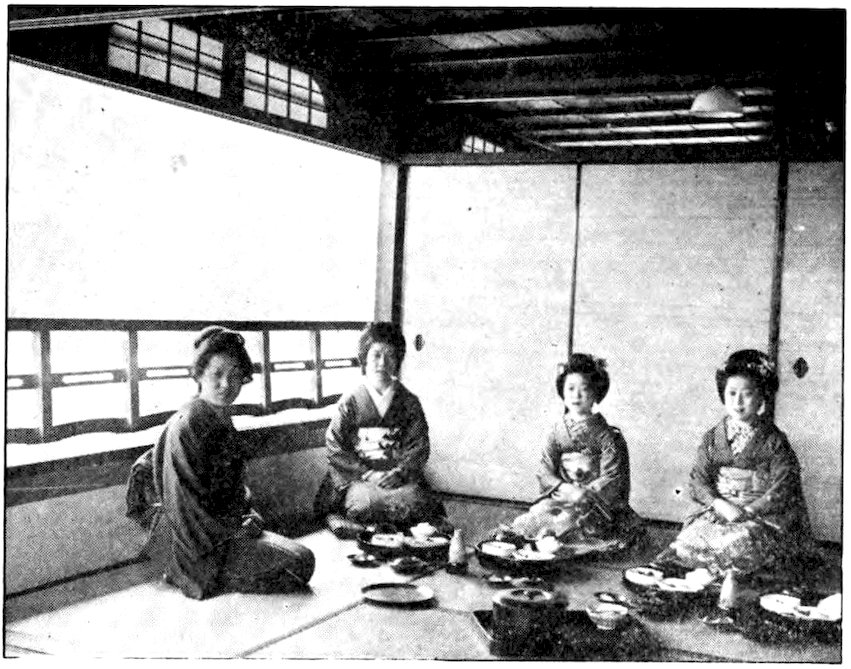
Japanese ladies in their best dress gathered about the tea service or dinner, which is always eaten on the floor.
By and by we were taken to our room upstairs,
reached by a very steep and narrow stairway. It
was large enough for a dozen people, yet there was
not a single piece of furniture in it, nor anything
else! The floor was covered with thick, soft grass
matting, the walls were of rice paper on little wooden
frames, and the ceiling looked quite frail. On
some of the walls bamboos and flowers and birds
were painted. These surroundings interested us, but
we were all hungry and we looked forward eagerly to
supper.
48
Presently a servant girl entered noiselessly with
three cushions and laid them on the floor. We were
expected to kneel on these instead of sitting on
chairs. Quite a time went by, and then the girl appeared
again, carrying a little table, with legs hardly
a foot high. Before long she slipped in a third
time and brought us food. There was a small wooden
tub with a cover, which she placed on the floor
beside the table. On the table itself she put several
dishes of strange looking food and, kneeling down
beside us, began to serve our dinner. When she
took the cover off the wooden tub we saw that it was
full to the brim of steaming hot rice. She ladled
some of this into three bowls, using a wooden scoop,
and set them before us. There was no sugar, no
milk, no water, no salt and pepper, no butter, no
bread; and there were no knives, forks, or spoons.
Instead, we were each given two slender sticks, like
long lead-pencils. Fortunately we also had a utensil
made of porcelain that looked something like a
spoon, or our small boy, at least, might not have
been able to eat at all.
We were supposed to begin with bowls of soup,
an almost raw egg in each. Then we had stewed
seaweed, black beans that rolled around as we tried
to pick them up one at a time with the chopsticks,
and several other things that were not at all like our
American food. The pickled raw fish we simply
could not eat. Our distaste for this dish amused the
servant. She kept filling our rice-bowls from the
49wooden tub every time we had eaten a few mouthfuls
of the soft but almost dry rice. The Japanese
often eat five or six bowls of rice at a meal, and the
servant could not understand our small appetite for
what in Japan takes the place of bread. If you have
been used to bread all your life you will be surprised
to find how hard it is to eat a meal without it. There
is some rather poorly baked bread in Japan, but outside
the foreign hotels not many people eat it.
In time we became quite used to Japanese food,
and liked some of it, especially the omelets that are
not very different from ours. But that evening I am
afraid we went to bed rather hungry, in spite of the
kindness of our hosts. It was a long time before we
got to bed, too, and to tell the truth what we finally
lay down on were not really beds at all. The servant
carried out all the food, all the dishes, and even the
table. While we squatted rather forlornly in the
middle of the big bare room, my son fell asleep, with
his head on his cushion.
To pass the time we stepped to the half-open paper
wall at the back and looked across the garden
and a little gorge behind the house, upon the crowded
ward of Ushigome. Hundreds of electric lights
shone among the thousands of little wooden houses,
especially along the streets lined with shops. There
a great crowd seemed to be moving back and forth,
for we could hear the scraping of thousands of geta,
mingling together like a great chorus. Later I went
out to one of the shopping streets and found it completely
filled with Japanese, all in their native costumes,
50from one side of open shop-fronts to the
other, so that it looked like an endless river of people
flowing back and forth.
Photo from Keystone View Co., Inc., of N. Y.
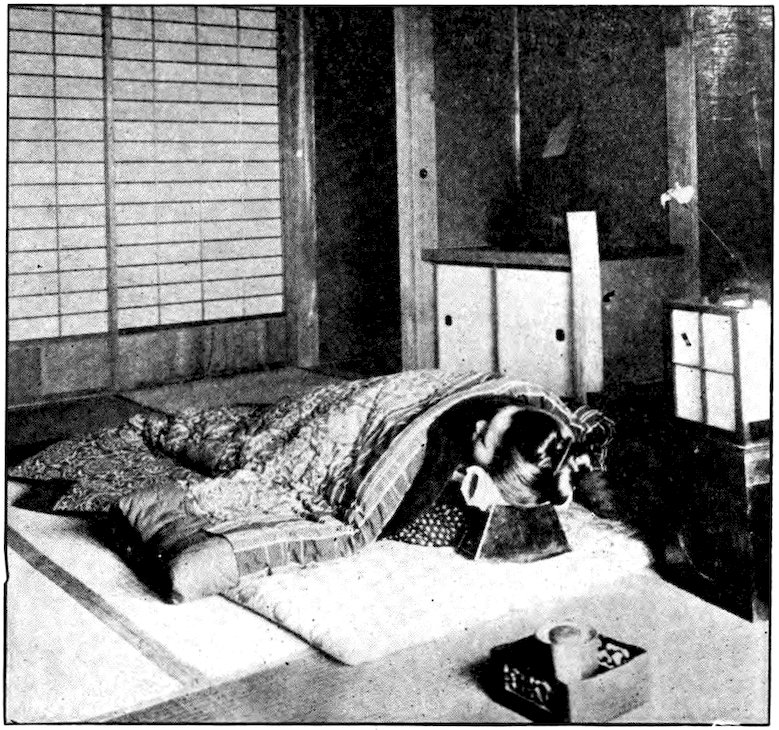
A Japanese bedroom, which will be a living room in the daytime. The bed consists of quilts laid on the mat-covered floor, with a pillow as hard as a brick to protect the women’s hair-dress.
But at last the servant came in again, this time
bringing a huge armful of thick quilts. She laid
these, one on top of another, on the floor, and placed
at one end of the pile three hard little bags that
51seemed to be filled with dry beans. These we were
expected to use as pillows. The Japanese are so
fond of hard pillows that many of them use wooden
ones. Then she put up a huge mosquito-net, fastening
its corners to the corners of the room, which was
almost completely filled with it. Before she had
quite finished, however, the grandmother came in
and ordered her to take all the quilts out again.
Though we could not understand the old lady’s
words, we made out from her actions and her voice
that she was scolding the servant for having given
guests from far-off America cotton quilts instead of
the best silk ones. The girl then brought beautiful
silk-covered quilts and made the bed all over again.
The grandmother gave us to understand that
there was a bathroom downstairs, and I decided to
have a bath before retiring. I found a long narrow
room, with a wooden floor containing several little
tubs. One side was taken up by a large square
wooden tank filled to the brim with steaming water
and almost five feet deep. This water was heated
by a fire under the tank, beneath the house, and it
was so hot that I nearly scalded a foot when I started
to step into it. The Japanese like their baths
very hot, and they get used to bathing in water
which an American could hardly dip his hands in.
Their way of bathing is to fill one of the little wooden
tubs with hot water from the tank, soap and scrub
themselves thoroughly, rinse, and then get into the
tank and soak until they look as if they had been
boiled. When the soaking is finished, the bather
52pours cold water over himself with another of the
little wooden basins, and dries and dresses himself.
Several persons may use the tank at the same time,
but we do the same thing in our swimming pools.
When I returned to our room it seemed very
“stuffy.” I found that the servant had closed all the
paper walls, and also the sliding wooden walls on
the outside of the house. These wooden walls are
made of many sections, and during the day are kept
in narrow spaces partitioned off for them at the
corners of the house. At night everything is shut as
tight as a drum, for the Japanese think it is not good
for the health to let night air into a sleeping-room.
I noticed that the bright electric light hanging from
the ceiling had not been turned off and remembered
that most Japanese do not like to sleep in complete
darkness. There are many people like that, in all
lands, just as there are millions who shut out the night
air when they sleep.
As our family’s likes and dislikes were the opposite,
I turned off the light and found a way to open
the wooden outer wall. But our hosts must have
been watching, afraid, perhaps, that some harm
would come to us under their roof. For I had hardly
dropped asleep when I heard someone come in, close
the wall again, and turn on the light. I saw it was
the grandmother. Two or three times more I
switched off the light and let in some air, but the
worried old lady would not let us run such risks. At
last I took the electric bulb out of its socket, and she
finally seemed to understand that we did not like to
53sleep in a lighted room. But I could not find any
way to persuade her to let the night air come in, and
we therefore had a very restless sleep.
We were not allowed to lie abed late in the morning.
Almost before daylight, we were awakened
by a great banging and slamming, and found the
servants opening the outer walls and putting them
away section by section in the places for them at the
corners of the house. The shoji, or paper walls,
were also opened all about us, and we felt so embarrassed,
lying on the floor in the center of the
open house, that we quickly rose and dressed. The
tub of steaming rice, and some other food much like
that of the evening before, was brought in, and we
did our best to breakfast on a meal that was not in
the least like the one we would have had at that
hour at home. It was delightful now to sit on the
soft mats and cushions—for the servant had carried
off the quilts and beanbags that had formed our bed—and
look out into the garden, its flowers and
shrubs brilliant in the sunshine, a bird here and there
gaily singing.
We decided that there are pleasant and unpleasant
things in every land. When I am asked in which
of the many countries I have visited I would prefer
to make my home, I answer that I would like to
take certain things from this country, and that country,
and other countries, and put them all together
into one that would have only pleasant features and
54no unpleasant ones. Some of the nice things I
would borrow from Japan. For instance, it seems
very good to leave one’s shoes, with all the dust and
mud of the street, at the door rather than to bring
them into the house. Frail paper walls are fine
when a bright sun is shining through them, or when
they can be opened wide on a pretty garden. But it
is not so pleasant to have to be careful all the time
not to put your hand or your elbow through the wall
of the house! It is convenient to be able to fold one’s
bed and lay it away out of sight during the day, and
furniture sometimes is a bother. Still, one would
like a few bureau drawers and closets and hooks, instead
of having to hang everything on the floor, so
to speak. Those of us who have not been trained to
it from childhood find it rather difficult, also, to
squat on our haunches on a cushion instead of sitting
in a chair. When the average American man stands
up in a Japanese house he feels enormous, like Gulliver
among the Lilliputians. Perhaps the most unpleasant
thing about Japanese living, to us of the
western hemisphere, is that there is never any privacy
about it. Nobody knocks and there are no
doors to lock. Anyone in the house may push aside
the walls of your room and leave it no room at all!
Someone may even walk into the bathroom when
you are taking a bath! The Japanese think nothing
of being seen without their clothing, perhaps because
they have lived all these centuries in paper
houses, with sliding walls. Then, too, the houses are
seldom quiet. You can hear everyone else every
55time he moves or speaks. So, though the Japanese
are not a noisy race, seldom quarreling and not much
given to chatter, people who mind noise will not enjoy
living in a Japanese house.
We never again lived in the home of a wholly
Japanese family, but in traveling about the country
I stopped in many a Japanese hotel or inn that was
quite like that Tokyo home. The hotels for foreigners
in Japan are stone or brick or wooden buildings
such as we have in America. I always feel sorry,
however, for the traveler through the Japanese Empire
who stops only in these, living much as he would
at home. He misses a great deal that is interesting
by not staying in genuine Japanese inns, which he
would find not at all bad when he got used to them.
The typical Japanese hotel is a building much
like one of the family homes, except that it is larger.
It has the same sliding paper walls, the same
wooden outer walls that can be pushed aside during
the day. The floors are covered with mats, the
chairs are cushions and the beds are quilts piled one
on top of another. As in the home, the electric
lights are kept blazing all night and not a crack is
left for the night air.
Let us suppose that we have just stepped off the
train in some Japanese city where there is no foreign
hotel, or that we have decided to stay at a Japanese
inn. We might call the city Hiroshima, since that is
where all that is to follow first happened to me,
56many years ago. As I was weary of sitting still on
the train, I declined the offers of the half hundred
rickshaw-men at the station, and walked to the
hotel. I knew I should have to depend on the sign
language there, but I thought I could manage it.
The front of the hotel I chose was wide open, with a
raised, mat-covered floor the whole length of it. I
had hardly stepped up to this when the hotel owner
or manager, several young men who seemed to be
his assistants, and half a dozen servant-girls ran forward
noiselessly and all began bowing to me, over
and over again. They were all smiling, for it is a
part of Japanese politeness to show only a happy
exterior, no matter how sad one may be.
This time my shoes, and the geta of the other
guests, were put into a kind of closet near the door;
perhaps to prevent their being stolen, for of course
there are thieves in Japan, as in every other country.
The room to which I was taken upstairs was very
much like that in the home of our Tokyo hosts.
Along one side of it was a little veranda overhanging
a large and busy street of the town. On the
opposite side was another veranda, above a pretty
little courtyard which was completely surrounded
by the hotel. In this courtyard there were dwarf
pine trees and other small trees trained into strange
shapes, a little fountain with its jet of water flashing
in the sunshine and, of course, many flowers and
some birds.
In Japanese hotels there are no dining rooms.
Each guest has his dinner served in his room, at any
57hour he likes. When he wants it, he merely claps
his hands together three times, and a nesan, or
“older sister,” appears. That is merely a polite
Japanese name for the hotel servant. She falls on
her knees, bows her head almost to the floor matting,
and then goes to bring the dinner.
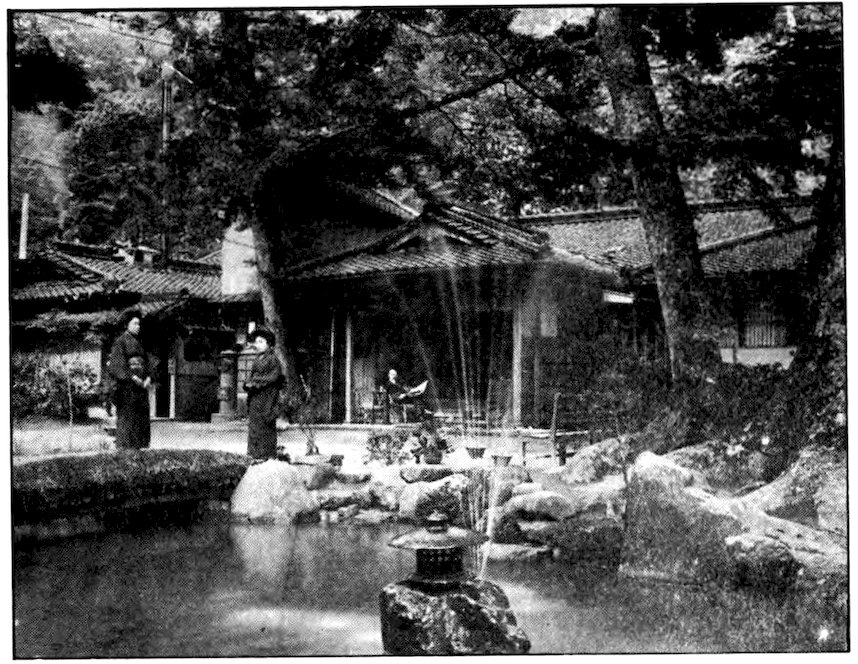
Many Japanese homes, as well as hotels, parks and other public places, have little ponds, fountains, evergreen trees, flowers, lanterns, and other things to beautify them. This is the garden of the hotel at Miyajima. (See Chapter XI.)
The food and the way it was served were much
the same in that Hiroshima inn as in the Tokyo
home. The servant-girl kept filling my rice-bowl
before it was half empty, and as soon as I had drunk
my tea from the little cup without a handle, she
58poured out more. This time there was no seaweed,
but there were pickled radishes and lily bulbs, and
a kind of salad made of the heart of a small palm
tree. One or two of the hot dishes were so much
like some we have in American restaurants that they
hardly looked strange at all. All the food was
brought on a little lacquered tray, except of course
the tubful of steamed rice. Then the dining service
was whisked away again, and the quilt bed was
made up.
There is little more furniture in a Japanese inn
room than in one at a home. Sometimes there is a
kind of clothes rack, and a curious wooden thing
upon which to rest your elbow while you squat on a
floor cushion. Possibly there is a tiny writing desk
without legs. If it is cold, the servant will bring in a
hibachi. This is a big brass vase or a square wooden
box, filled half with ashes and half with glowing
charcoal, which takes the place of a stove in heating
a Japanese room. The Japanese have no furnaces,
and their houses have no chimneys. Yet all except
the more southern islands of the empire have real
winters, with snow and ice. Having only these poor
little charcoal burners, the people would suffer
severely from the cold if it were not for another custom.
As the weather becomes colder and colder,
they put on more and more cotton-padded kimonos
one outside another, so that in midwinter the Japanese
look like a much fatter race than they do in summer.
59Even so, their costumes, their paper houses,
and many of their customs are not suitable for wintertime.
This fact has made some scientists think
that the Japanese must originally have come from
islands farther south, where it is always summer.
Before turning off the light in my hotel room at
Hiroshima, and crawling into my stack of quilts, I
noticed that the paper walls were painted not merely
with trees and flowers and birds, but with several
upright rows of Japanese letters. These were sacred
texts or moral sayings taken from the classics, or
perhaps pretty poems, all meant to make the guest
feel more comfortably surrounded. In the morning
the usual early noises wakened me, for the Japanese
do not believe in sleeping late, though they often
doze during the day.
When a guest in a Japanese hotel pays his bill, he
must remember that everyone who has in any way
served him expects a tip, not even excepting the
owner or manager himself. Guests in Japanese inns
often pay out as much in presents to the people who
have waited on them as they do for the night’s lodging
and food. The inn people will all be there to
wish the traveler good-by, just as they welcomed
him, all standing in a row at the door, bowing low
and rubbing their thighs politely. In olden times no
guest ever left a yadoya, or Japanese inn, without
also being given a present. It might be a fan, a
small towel with a bit of Japanese scenery painted
60on it, or a brightly colored yard of cloth for carrying
small articles in the way they often are carried in
Japan. But things have grown so expensive in
Japan, just as they have in other countries, that now
the innkeeper can hardly afford to give a departing
guest any souvenir more expensive than a tissue-paper
napkin or a painted card. Yet he cordially invites
the guest to come again.
There are some things about Japanese hotels
with which a fussy person can find fault. There are
a few things that are very annoying. But of one
thing the guest may be sure—there will be no indifference
shown him by the hotel people. All,
from the manager to the coolie or nesan who tries to
help him take his bath, will do their best to serve
him perfectly, foresee his wants, and keep cheerful
and smiling in his presence. Therefore one does not
begrudge the tips.
CHAPTER V THE JAPANESE AT WORK AND PLAY — A Display of Toys — The Schools of Japan — The Use of the Abacus — Fencing and Jiu-jitsu — Other Games — The Wrestlers of Japan — Wrestling in a Queer Way
61
When we landed in Japan from our voyage
across the Pacific, huge, gaily colored paper fish
were flying like banners in the breeze above thousands
of houses. Some were in clusters; some were
so large that they might have been taken for whales.
When we inquired, we learned that they were displayed
in honor of the boys. In Japan each person
does not have an individual birthday, but certain
dates in the year are considered the anniversary of
everyone, no matter on what particular day each
was born. A Japanese baby born in December is
said to be two years old in January, because it was
regarded as a year old as soon as it was born and
everyone is considered to be a year older each New
Year’s Day. But the birthday celebrations of the
girls are in March and those of the boys in May.
Therefore, as it was now May, every family with a
boy, especially a new baby boy, flew a paper fish in
his honor.
This fish is supposed to be the carp, though the
big paper things, swollen out with the wind that
blows in from the sea, sometimes look as much like
pickerel or bullheads. The carp is a sturdy fish,
which fights its way even up high waterfalls, and is
62not easily discouraged. Therefore it is regarded by
the Japanese as a symbol of courage. They think,
quite properly, that all boys should be as brave and
persevering as the carp.
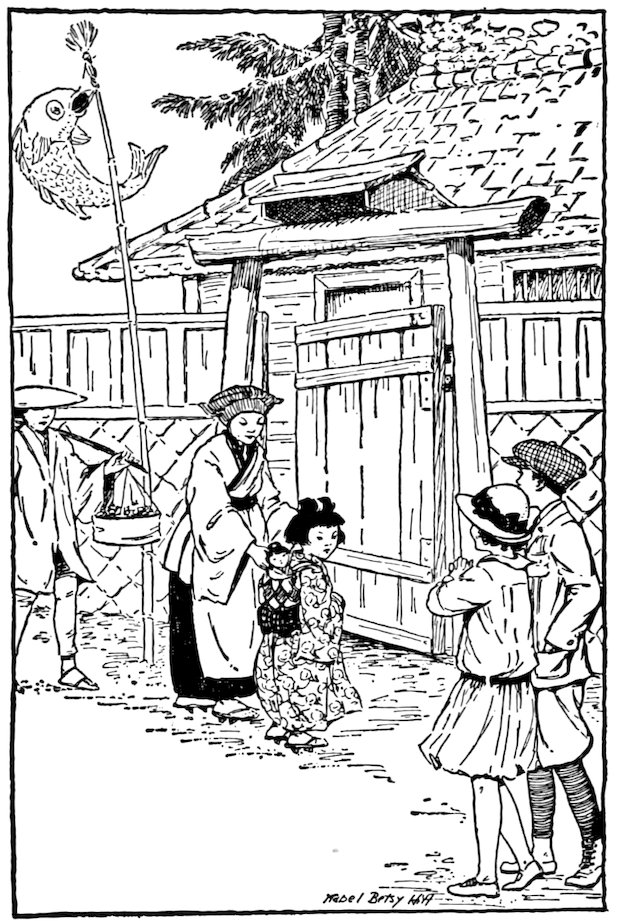
During the Boys’ Festival, every family in which there is a boy honors him by flying a paper fish.
63
If we had gone into some of the houses over which
the fish were flying, we should have found all sorts
of toys and boyish treasures laid out to make the
boys happy. The Japanese are great makers of
toys. There are whole shops given over entirely to
playthings, most of them very gay in color. Because
they are more easily broken than our toys, the boys
become more careful of them. The usual reason for
their flimsiness is that they are sold very cheaply.
Some of the things that are laid out on the “fifth day
of the fifth moon,” as the Boys’ Festival is called, are
very old, for they are handed down from father to
son, sometimes for many generations. Most of the
toys are military ones, such as soldiers, weapons and
flags. The Japanese have always been warriors,
and every boy is expected to become a soldier, if
necessary, and fight for the Mikado. As it is not
much more than half a century since the Japanese
began to dress, equip, and drill their armies like
those of America and Europe, many of the old toys
represent the curious armor, swords, and gaily
dressed generals of the ancient days.
At the Girls’ Festival in March, dolls take the
place of the paper fish. This time all the dolls in the
house, some of them old ones that have been used
for many generations, are set out. They remain for
three days, and the girls pretend to feed them three
times a day. Some of the dolls represent the Mikado
and the Empress and the royal princes. These are
especially honored.
64
No one can be long in Japan without seeing groups
of children on their way to school. Every child in
that country is expected to stay in school at least until
he finishes what we would call the grammar grades.
Girls in school do not wear kimonos, as they do at
home, but skirts, jackets, long stockings, and usually
leather shoes like ours. On their way to and from
school they wear hats, although at other times they
do not.
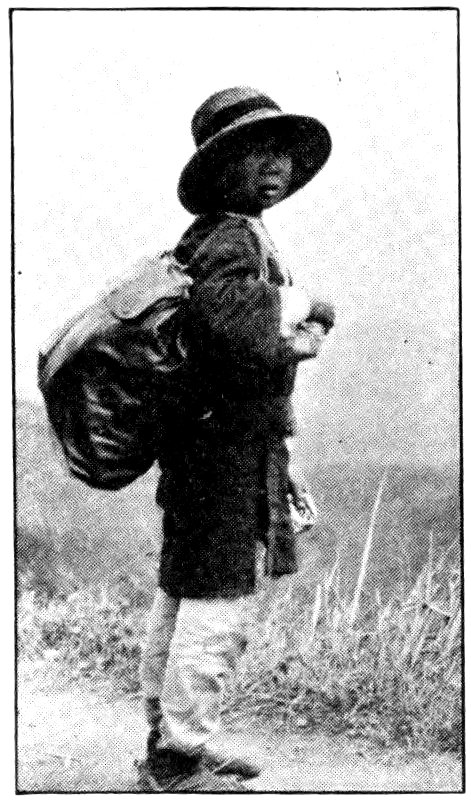
Boys and girls both carry their books and other
school things in knapsacks held by a strap over one
shoulder. If a pupil came to school carrying books
under one arm, or swinging them from a strap, he
would be scolded by the teacher and perhaps be punished.
Because the Japanese are a very orderly people
and like things done in an almost military way,
the boys and girls on their way to school remind one
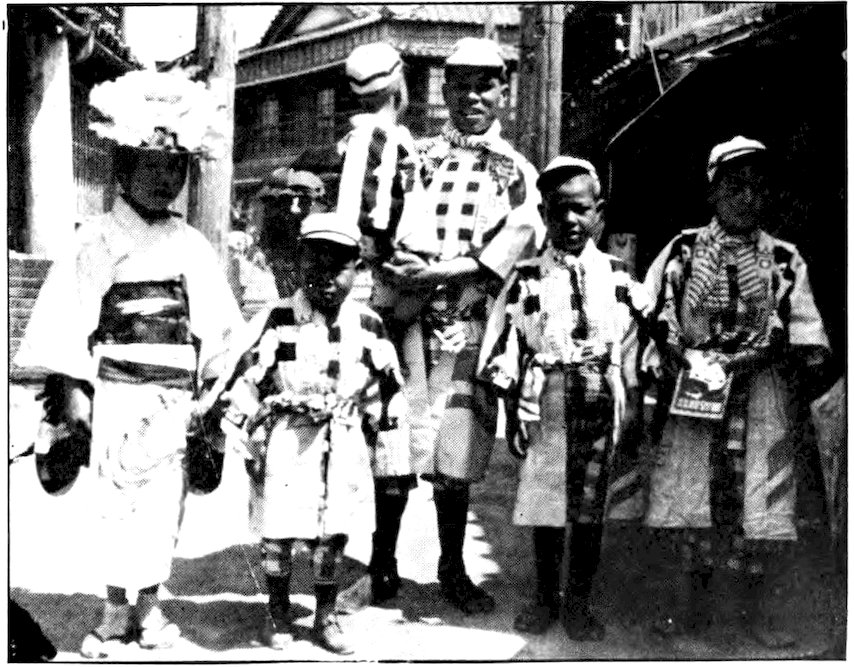
of squads of soldiers. The boys often wear a kind of
uniform, of dark cloth in cold weather and usually
white during the summer. But whether or not they
wear a complete uniform, almost every schoolboy,
from the first grade to the last year at the university,
has a uniform cap, something like those of our policemen,
or of the officers of our navy. The teachers, who
are nearly always men, also often have a kind of uniform.
In some parts of the empire the teacher wears
a sword, but this is only a sign that he is an officer of
the Mikado. (You will find pictures of Japanese pupils
and a teacher in Chapters XII and XIII.)
65
Photo from Maude W. Madden
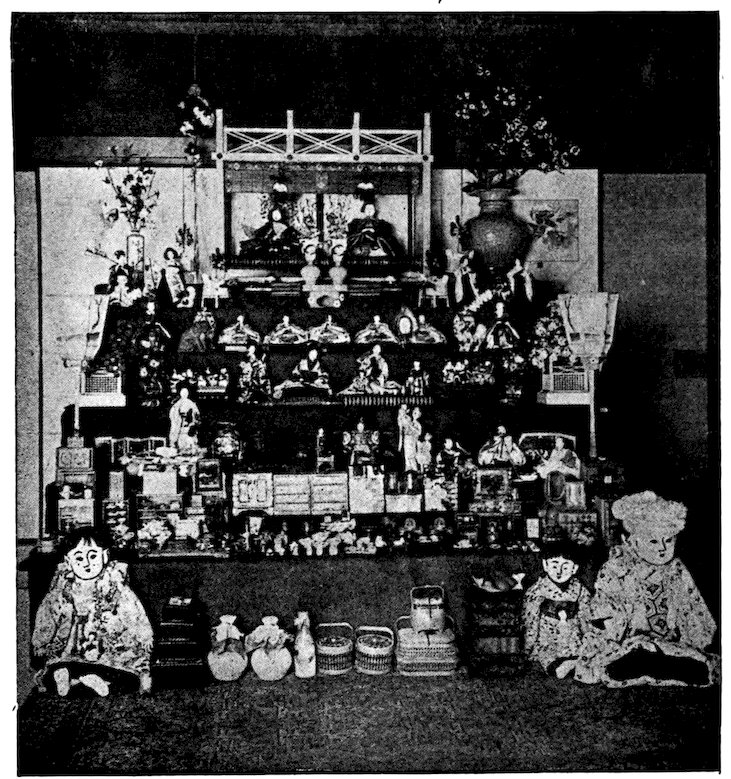
Suppose we call the little Japanese girl who owns these dolls Haru-ko San. They are mostly ancestral dolls (she calls them O-hina-sama), with the Emperor and Empress at the top under the canopy, and lower down courtiers, court musicians and others. On the lowest shelf is probably such a figure as a maiden carrying a water pail to remind Haru-ko San of household duties. And on the floor are three ordinary “play” dolls, which perhaps she really loves best, for the others must not be played with. The ancestral dolls are often dressed in handsome brocaded robes, and may cost a great deal. They are kept very carefully so that once a year, in March when the Doll Festival occurs, they may all be brought out and displayed. With them are shown the lacquered chests, kimono racks, trays, tables, and vases that the ancestral dolls would need for housekeeping. These too are very beautiful.
66In the olden days Japanese schools were very different
from our own. Then the pupils studied very much
as many Chinese boys still do. That is, they all
squatted on the floor, rocked back and forth, and shouted
at the top of their voices the words they were trying
to learn. These words were taken from the old
Japanese or Chinese classics, the ancient books of the
Far East. Even small children were expected to learn
long sentences and sometimes whole pages from solemn
volumes either of poems or of morals, resembling sermons.
When they learned to write, it was by holding
sheets of tissue paper in the hand and painting upon
them with a little brush made of camel’s hair.
The Japanese school children still write with such
a brush, but they also learn to use a pen and even the
typewriter. In the schools, more than anywhere else,
we can see the influence our Western world has had on
Japan. In all the cities big stone and brick buildings
that look almost as if they had been brought bodily
from America are filled with school children. There
are benches and desks, blackboards and chalk boxes.
The lessons are on many different subjects, just as in
our schools, and not merely the old classics. Nor do
the children any longer shout their lessons and memorize
long passages. They learn to read much as
American children do, though it takes them longer,
and no wonder! Japan still has the written language
of the Chinese, with every word represented by a very intricate
sign, instead of separate letters that can be
made up into all kinds of words. In place of an alphabet
of twenty-six letters, the poor Japanese pupil has
67to memorize hundreds, and later thousands, of these
queer drawings. It is easier to write these with a little
brush than with a pen. Gradually, however, the Japanese
are getting away from the difficult Chinese
signs. In place of them they use much simpler ones
called cana, which look something like our shorthand.
Much of what now appears in Japanese newspapers
and other popular publications is printed in cana.
These lines, which to us look so odd, would mean a great deal to a Japanese child. Together, they make a poem on “Spring,” which was written on thin paper with a little brush and handed in by a schoolgirl as an exercise in penmanship. The girl was a pupil of an American teacher in Japan, Mrs. Maude W. Madden. You will be interested to know that this “writing” received a prize. Here is the poem, in English:
When Spring comes
And her flowers I see,
With the mists of the fields
My cares vanish away.
68
The study of arithmetic in Japanese schools is still
very different from what it is in ours. That is because
even grown-up people of Japan do not do their
figuring with pencil and paper but on the abacus or
soroban. This has a frame like that of a slate. In
place of the slate, however, there are stiff wires running
from one side of the frame to the opposite side
and on these wires little wooden balls are strung like
beads. When a Japanese schoolboy, or a Japanese
merchant or business man, wishes to add or subtract,
to multiply or divide, he moves these balls back and
forth skillfully until he finds his answer. He has to
think, of course, when he is doing a sum, just as we do.
But the balls show the result of each operation and he
does not write it down. He gets the answer quickly.
Keystone View Co.
Japanese schoolboys are very fond of flying kites. Do you see the “rising sun” of Japan on these kites?
69The soroban, or calculating-board, as it is sometimes
called, is used not only in Japan, but all over
China, and even in Russia. The Russians have much
larger ones, as if the little wooden balls of the Japanese
and Chinese were not large enough for their
bigger fingers. It is amusing to see how helpless the
people of any of these lands are when they are asked
to do even a simple exercise in arithmetic with pencil
and paper. But then, you can imagine that an American
professor of mathematics would not do any better
if he were told to add or subtract on one of these
frames that the Orientals find so simple.
After reading, writing, and arithmetic have been
learned, the upper classes in Japanese schools go on
much as ours do. There are laboratories, and lectures,
and oral and written recitations, and mid-term and
final examinations. There are gymnasiums, too, for
the Japanese believe as throughly in building up strong
bodies as did the ancient Spartans. I am reminded of
the Spartans because that is what the Japanese are
trained to be. A boy is not expected to cry out, no
matter how much he is hurt. Nor, for that matter, is
a girl expected to cry. All through life the people show
themselves cheerful, however they may feel. To let
one’s face show suffering or sorrow is regarded as
bad manners.
70
Japanese youths become quite expert as baseball players in spite of their hampering costume.
One of the oldest forms of exercise in Japan is
fencing. Japanese fencers do not use thin, slender
foils such as are common in Europe and America.
When the Japanese schoolboy goes to the gymnasium
for a fencing lesson, he puts heavily padded garments
about his head and shoulders and a kind of armor
about his waist. He wears thick gloves with padded
gauntlets reaching to the elbows
and a mask much like that of a
baseball catcher. All this protection
takes danger out of the sport,
though to see two boys at it you
would hardly think so. Instead of
the steel sword of ancient Japan,
each boy is armed with a bamboo
shaped like a sword. With this
each tries to strike the other as
often as possible over the padded
head or neck, on the wrists, or in
the ribs. That is because in real
fighting those would be the most
vital places. The players dodge
and shuffle back and forth on their
straw sandals or bare feet, thrusting
and striking at each other, and
parrying as many blows as possible.
The bamboo swords make a
terrific noise every time they
strike. To add to the uproar, the
masked fighters howl fierce warlike cries of olden days
as they leap about. This is an excellent form of exercise,
because it gives the boys both agility and
strength. Not only in the schools, but in the army and
71navy and in young men’s clubs and other organizations,
fencing is part of the training and recreation.
Even more common is what the Japanese call jiu-jitsu.
Almost every man in Japan knows how to use
this ancient form of self-defense. It is not boxing and
it is not wrestling, though it sometimes looks like both.
Jiu-jitsu is the art of knowing just when and how to
use slight strength in a way to make a stronger opponent
defeat himself. Suppose a large clumsy boy
tried to bully a small agile boy. The small boy, if he
had been trained in this Japanese science of tricks,
would know just when to give the big boy a pull or a
push that would make him sprawl. Or if the small
boy, at just the right moment, were to twist the arm
or the neck or the back of the big fellow, the latter
might find himself down before his greater strength
could help him. After the defeat of great Russia by
little Japan in 1905, some people called that a case of
jiu-jitsu among nations.
Other games and exercises on Japanese playgrounds
and gymnasium floors are more like our own. Schoolboys
and university students play some football, though
it is rather the English game of soccer than ours.
During the last few years baseball has come to be
quite a favorite sport among students in Japan. One
of the universities in Tokyo held the baseball championship
of the Far East for several years, defeating
even the American teams sent out there to play. Its
72team, in fact, came to America, and won about as
many games as it lost. As they are small and sinewy
and quick on their feet, it is natural that the Japanese
should be good baseball players.
Before we leave the schools we must not forget to
mention the military games and drilling given to all
the boys, and sometimes to the girls, by their gymnasium
instructors. Because Japan has been a nation
of soldiers for many centuries, it is natural that these
instructors should often be men from the army. Then
there is swimming. Every boy and girl in Japan is
expected to learn to swim, which of course is an excellent
idea, especially for a people that live on islands.
I have seen a whole class in a pond or a little
lake in a Japanese city park. The swimming teacher
stands at the edge of the pool giving his lesson very
much as he would at a desk. Pupils who have not
yet learned to swim well wear red caps, and go only
a little way out into the pond. The teacher can see
them easily, and quickly help anyone in danger of
drowning. The children who have learned to swim
wear white bathing-caps, and are allowed to swim as
far out into the little lake as they wish. The Japanese
will not graduate a pupil until he or she learns to swim.
There is little if any boxing or prize fighting in
Japan. But wrestling is an ancient Japanese sport,
and the men who become best at it are as popular as
champion boxers are in the United States. All other
73games played by the Japanese are for amateurs, but
the wrestlers are professionals—that is, they make a
business of wrestling. In fact, they are in a class by
themselves, quite separate from the rest of the people.
This difference is quickly seen, for though the Japanese
as a whole are small, wiry people, the wrestlers are
enormous men, often six feet tall and heavily built.
Not only are they easily recognized by their great size,
but they have special marks on their kimonos and they
wear their hair long. Before the coming of Commodore
Perry, all Japanese men let their hair grow to its
full length and did it up in a topknot at the back of the
head. To-day a man with long hair is usually a
wrestler, and in a crowd of modern Japanese he looks
like someone brought back from ancient times.
A group of Japanese wrestlers strolling between bouts. They are aggressive beings, who look down upon the ordinary people.
Great wrestling matches are held in Tokyo twice
74a year. We had arrived at the time of the spring
games, and managed to get seats quite close to the
ring. This was a raised platform, made of what
seemed to be bags filled with sand or earth. (Perhaps
if it were made of wood the wrestlers would be
more likely to get hurt.) It stood in the center of an
enormous auditorium that was shaped much like a
circus tent. Hundreds of rows of seats, rising from
the platform in the center, surrounded it. There
were a number of boxes partitioned off for parties.
Japanese wrestling pavilions remind one a little of an American circus tent. The banners or signs advertise the attractions.
The wrestling lasts from morning until late at
night. During the evening, or even in the afternoon
when the best wrestlers get together in the finals,
the auditorium is packed with spectators. Then the
uproar must be great, for even with a smaller audience
75there was as much excitement as at one of our
Big League baseball games. Many of the audience
seemed to stay all day and evening, for tea and food
were constantly being brought them from little
restaurants and booths around the edge of the arena.
The first two men to step into the ring were large,
but they seemed small by comparison with those who
came later. The bouts are arranged just as they are
in our boxing rings, starting with the less important
wrestlers and working up to the biggest and most
famous ones. When he first stepped into the ring each
wrestler had his hair very carefully oiled and combed
and tied in its topknot, and he wore what looked like a
big apron, made of thick, costly cloth and gorgeously
embroidered in gold and bright colors. These
aprons, which are a symbol of the vocation and
highly prized, were taken off, and the wrestlers
stepped toward each other clothed only in a stout pair
of trunks and a heavy belt.
The Japanese way of wrestling is quite different
from our own. As soon as the referee had given the
signal, the two men began raising first one leg and
then the other, bringing each foot down on the earth-bag
floor with a great stamp. They did this so many
times that they suggested angry bulls pawing the
earth. Then each took some salt and threw it about
him in the ring, for they have a superstition that they
cannot win a wrestling bout unless they do this.
Finally each crouched with his knuckles on the
76ground, in the position of “On your mark!” Instead
of pitching into each other at once, however, they remained
perfectly motionless, staring at each other,
for some time. Then they shifted about, stamping
their bare feet some more, but still did not lay hands
on each other. In Japanese wrestling, starting properly
and getting the right holds are considered
more important than the wrestling itself. Several
pairs of these men spent five, six, even ten minutes
crouching and eyeing each other and shifting about,
and sometimes hardly that many seconds in actual
wrestling when once they had come to grips.
When they finally did begin, we understood why
it is more necessary for Japanese wrestlers to be
heavy than to be muscular and well trained. The
men usually grasped each other by the trunks they
wore or by the belt. There was a sharp, swift tugging
and pushing, with a loud slap now and then as
one struck the bare skin of the other with his open
hand. Suddenly the bout would be over, for the
instant one man makes the other fall inside the ring
or touch a foot or a hand outside it, he has won.
Therefore the man who is heaviest and bulkiest and
hardest to move has the advantage. In spite of their
weight, however, the wrestlers are very hard, for
they train by beating themselves against posts, and
by similar forms of exercise.
To be the greatest wrestler in Japan is much like
being the champion heavyweight boxer of America.
The best wrestlers make large sums of money, and
as they are men who give more attention to their
77physical than to their mental training, they do not
always use good sense in spending it. Groups of
them may sometimes be seen strutting about town as
if they thought themselves very much above the ordinary
people. But when they are in the ring they
always instantly obey the referee, even though he is
armed only with an old-fashioned fan.
The ticket booth of a wrestling pavilion. Contrast the garb of the ticket seller, squatting, with that of the two patrons. Western hats and caps seem to be popular even though the kimono may not be discarded in favor of coat and trousers.
CHAPTER VI JAPANESE EVENINGS — Playing in a Way All Their Own — The Popular Movies — The Japanese Do No Kissing — The Geisha Girls of Japan — A Tea-House Dinner
78
Every land has evening entertainments of some
kind. In Japan people go to theatres, including
the movies, and attend banquets in tea houses where
there are geisha singers. Plays in the theatre, however,
often begin at noon and last until midnight.
One evening a Japanese friend took me to the
Meiji-za, a great theatre of Tokyo. First of all we
had to check our shoes at the door, as we might our
hats and coats in America. To reach our box we went
up a passageway covered with grass or reed matting.
It was quite a different box from those in American
theatres, for it was only about a foot deep, and in
place of chairs there were half a dozen cushions on
the matting-covered floor. We sat down cross-legged
on these and looked about us. Most of the house
was filled with long, shallow inclosures divided by
what looked like low, narrow benches, and the floor
sloped gently toward the stage. But the hundreds of
people who were watching the play did not sit on the
benches. They all squatted in the shallow inclosures,
and used the benches as tables. The aisles, instead
of being lower than the seats, were wooden runways
raised above them. Boys in bare feet, or wearing
foot mittens, ran noiselessly back and forth along
79these aisles, carrying tea and rice and other kinds
of food and sweetmeats to the spectators. Many of
the people sat in family groups, men, women, and
children, sipping tea and eating with chopsticks while
they watched the actors.
All the actors were men, but some of them played
women’s roles. They were dressed in strange and
gorgeous costumes, such as are never seen now in real
life in Japan. The Japanese have a different taste in
plays from that of Western peoples. They do not
seem to like plays on modern, everyday subjects, but
prefer the stories of ancient times. Probably that is
the reason the actors do not look or act or speak like
the people of to-day. If a Japanese actor walked out
upon the stage in ordinary clothing, and spoke as he
would talk on the street or in his house, he would be
considered a very poor actor, or no actor at all. There
are now a few theatres in Japan where plays of modern
life are given, but nearly all the people prefer the
old kind.
Instead of speaking in his everyday voice, each
actor tries to talk deep down in his chest, so that he
sounds like a giant down a well. When the part he is
playing becomes very exciting, as during a fight with
another character, he may roar like a lion. If he is
playing the part of a woman, or a comic role, he turns
and talks with a falsetto screech that suggests a boy
whose voice is changing. To foreigners all this seems
very queer indeed, but the Japanese think it is just the
thing to do, and the more a man roars or screeches
the more he is applauded. When they are pleased, the
80people do not clap their hands, and of course they
cannot stamp their feet. Instead they shout louder
and louder words that mean “Good!” or “Well done!”
In the play we saw, there were battles on the stage,
with many generals in ancient costumes and much
waving of strange old flags. Soldiers armed with
spears and other ancient weapons, and dressed as
Japanese soldiers were a thousand years ago, swept
back and forth across the bare boards. There was
almost no scenery. A paper arch set up in the middle
of the stage was supposed to represent the gate of a
city encircled by a great stone wall, and half a dozen
sticks represented a forest. Sometimes the actors
ran back and forth along the raised aisles, still reciting
in their strange voices. Several times two of
them, or even whole bands representing samurai
(ancient warriors), fought with swords out on the
runways, right over the heads of the audience. The
spectators did not seem to mind this at all, but continued
to sip tea and eat food from little bowls.
No audience ever gave better attention, however,
for all the eating and drinking. When rival bands of
warriors fought, the people watched every movement
of their swords, and shouted with excitement
when one man or another pretended to be killed. In
our plays such a man would have lain where he had
fallen until the curtain came down. But here there
was no curtain, and the dead man merely got up and
walked off the stage. The play that seemed to affect
81the audience most was one having a scene between a
small boy and his father, who had promised to let
himself be killed for the Emperor. There was much
blowing of noses all over the house, and many of the
spectators were almost crying out loud. Yet the play
was very old, and had been given so often that probably
every one in the audience knew what it was all
about and what would be the ending of it. When one
play was over, another began immediately. In one of
the great theatres of Tokyo there is a revolving stage,
so that the instant one set of actors finishes playing
another group is swung around before the audience.
But I did not enjoy these strange plays as much as the
Japanese audience did, and after watching them for
a couple of hours we went out, recovered our shoes,
and took a rickshaw home.
The Japanese like old stories in their movies also.
Passing along one of the theatre streets of Tokyo, or
of Osaka, the second largest city of Japan, you would
see long rows of posters. But instead of showing
modern people in everyday dress, using telephones
and automobiles, the posters are pictures of actors in
ancient costumes, with strange old weapons. Men,
you can see, have played the women’s parts in the film,
and even in the picture you can make out that the actors
had their faces painted white, as do those on the
stage. Nowadays one hears occasionally of a Japanese
screen actress, but it will be a long time before
many enter that field.
82If you went into one of these motion-picture
houses with the gay posters and Japanese lanterns
before it, you probably would not understand much of
the picture. The titles, being in Japanese, you could
no more read than you could read hen tracks in the
sand. Besides, the story of those ancient days in
Japan, with the queer customs and point of view the
Japanese then had, would be very different from any
American story. Yet probably it would be as familiar
to the Japanese children in the audience as the
story of Washington crossing the Delaware is to you,
and they would understand it even if there were no
titles at all.
Those same children, however, have almost as hard
a time understanding the kind of film-stories Americans
know so well as we would to understand theirs.
There are now quite a number of Japanese makers of
their own kind of motion pictures. But often, when
there are not enough films on hand to fill out the evening,
the manager puts on an American film or two.
So thousands of Japanese children have seen our
American movie stars. Since few of the audience
can read the English titles of these films, a man usually
stands at one side of the darkened stage and
shouts out the story in Japanese as it goes along. But
perhaps he also cannot read English, and is not very
sure what some of the action in the picture means.
In many little ways Americans act quite differently
from Japanese, and all such things are puzzling to a
Japanese audience when it sees them on the screen.
For instance, the Japanese do not shake hands, but
83bow up and down to each other, rubbing their thighs.
So the small boys in the audience wonder what in the
world the strange people in this picture mean by
grabbing one another by the hand. Perhaps they are
going to wrestle! But no, they are smiling at each
other, and look very friendly, and before long they
let go, without either one having tried to throw the
other.
In Japan a man and woman, if well bred, do not
speak to each other on the street; a wife would not
take her husband’s arm in public and they certainly
would not kiss each other good-by at the railway
station. The Japanese do not kiss, anyway; a mother
shows affection for her child by rubbing her cheek
against his, and even that she does not do when
strangers are looking. So you can imagine how odd
American or European films seem to the Japanese,
especially to the boys and girls, or to those grown-ups
who have never traveled in other countries or read
much about the ways of other people. Of all the
motion pictures America sends abroad, the Japanese,
and a great many other foreign peoples, seem to like
best the Wild West films in which there is much horseback
riding across rough and mountainous country.
Perhaps this is because such films are easy to understand,
as well as because any people as sturdy as the
Japanese like what we sometimes call red-blooded
action. It is interesting to know that such films are as
popular in Japan as they are in America.
84
Keystone View Co.
Geisha girls in their gay costumes on their way to entertain guests.
When a Japanese business man wishes to entertain
a client from another city, he does not invite him
home to dinner, nor even to his club. Instead, he
offers him an expensive
meal at a restaurant
or tea house, and
has several geisha,
or “accomplished persons,”
in to help amuse
his guest. The geisha
are a class of women
who sing and dance
and play on instruments
such as the koto
and samisen, perform
the elaborate tea ceremony
that has come
down from olden
times in Japan, and do
other things of that
kind. Although they
are, in a way, actresses,
they do not appear
on the stage, but at
evening parties. The
Japanese business
man would almost certainly
not bring his
wife or daughters with him to the dinner he had arranged.
He would, however, have at least one geisha85to do nothing but wait upon his guest, to pour out his
tea or wine, help him to choose the best food from what
the regular waiting-girls of the restaurant brought,
and so on. Others would arrange the flowers, squat
on their cushions and thrum the samisen, sing the
queer music of Japan; some, probably the youngest
and most lively, would dance.
The same man who had his employee take us into
his house invited my wife and me to a tea-house dinner
in our honor. There were of course polite servants
at the door to take our shoes, as well as our
hats and coats. Soon we were all kneeling on cushions
in a very fine room ten or twelve mats square,
as the Japanese would say, and with beautiful paintings
on the oiled paper walls. Three young women,
in much more gay and costly kimonos than one sees
on the streets or in the homes, at once began making
us comfortable. They had their jet-black hair done
up in the elaborate Japanese fashion, like a great
Russian wool cap, with a few flowers in it. They
showed much surprise at and interest in my wife, for
Japanese wives do not come to dinners given for their
husbands, and it seemed very strange to them that
foreign women could. They stared a great deal, for
that is not considered impolite in Japan, and they
asked many questions about the foreign clothes that
looked so queer to them. They wished to know whether
there were geisha in America also, and were very
curious about all our customs.
86While we ate, the oldest girl played and sang, the
other two serving us tea and food. The head geisha
acts as hostess, and does her best to make her guests
enjoy the evening. When the two younger ones began
to dance, their dancing was not what we would call by
that name at home. They moved slowly back and
forth, squatted, bowed down to the ground, rose
again, slipped to and fro across the matting in their
foot-mittens, opened and closed and waved and turned
a fan that each held in her hand. When it was time
for us to go, all three saw us to the door, and kneeled
to touch their hair to the floor as a way of saying
sayonara, the Japanese good-by. Though we had not
seen him do so, we knew that our host had given, or
would give, them plenty of money for their evening’s
entertainment. For though they had smiled and acted
all the time we were there as if they were high-class
ladies who took great pleasure in entertaining us,
they make a business of hospitality.
Girls who are to become geisha begin their training
early, often when they are eight or ten. There are
training schools for them, where they are usually
taken by their parents. The head of the school pays
for everything, but the geisha girl must pay him back
after graduation. It is often ten years or more before
she has earned enough to be out of debt for her training
and can begin to give money to her parents. The
Japanese hold their fathers and mothers in great
honor, and most of the girls who become geisha do so
either to save their parents from supporting them or
in order to be able to take care of their parents in old
87age. So, under the smiles and the cheerful exterior of
the geisha who sings or dances for you, there may be
deep sorrow. When their youth is gone and they are
no longer attractive to hosts and guests, some of the
geisha marry and go back to their native village;
others become head geisha, and help in the training
and managing of the younger ones.
One of the favorite actors of the Japanese stage, in his most famous role. In Japan, the old national legends are played over and over, year after year, and the people never tire of them.
CHAPTER VII I TRAVEL INTO THE NORTH — On the Way to Hokkaido — A Western City in Japan — Sweets for the Boys and Girls — Long Distances in a Small Country
88
We took the train out of Tokyo one morning
and started for the big northern island of Yezo,
or Hokkaido. My wife and little boy went only as far
as Nikko, because traveling in Yezo is not very comfortable.
Nikko is one of the sacred cities of Japan,
and a very beautiful place besides. It is among high
hills, about five hours by train from Tokyo, and is
surrounded by evergreen forests. Some of the trees
are hundreds of years old, and those called the cryptomeria
are enormous, reminding one of our California
redwoods. There is an old road leading to Nikko that
runs for twenty miles between rows of these great
trees. Their branches, arching high above it, make
it seem like the aisle of a cathedral.
About three hundred years ago Nikko was chosen
as the burial place of the warrior who founded the
Tokugawa dynasty. The Japanese, who consider him
one of their greatest heroes, have made a god of him.
About his tomb have been built many splendid temples,
to which thousands of pilgrims come every year.
The temples are set back against the wooded hills
across a little river from the town of Nikko. A red
lacquered bridge crosses this river, but no one except
the Mikado is allowed to use it. For ordinary people
89there is a simpler bridge. Hundreds of stone steps
lead up to the temples, which are on different levels,
so that at the topmost a person is high above the town.
The temples are made of wood, with tile roofs, but are
so wonderfully carved and painted that it is hard to
believe the materials are so simple.
This sacred red lacquered bridge across the small stream between the town of Nikko and the temple and monastery grounds to which thousands of Japanese pilgrims come every year, is opened only for the emperor or Mikado, an ordinary bridge for ordinary people being available near by.
All sorts of strange Japanese gods, of wood and
stone and bronze, gaze placidly at the pilgrims who
come to pray and the tourists who come to see the
wonders of Nikko. One of the most famous things
there is a frieze with three stone monkeys on it. One
has its hands over its eyes, another over its ears, and
90the third over its mouth. They point a moral, which
is, “See no evil, hear no evil, speak no evil.” That, of
course, would be a good motto for any people. The
Japanese hold these temples and tombs in such reverence
that, though the public is allowed to go anywhere
in them, not a thing has been stolen or even damaged
in hundreds of years.
The scenery of Japan is beautiful almost everywhere,
and the ride from Nikko to the northern end
of the largest island is through very attractive country.
On the way I stopped
to visit Matsushima, as
most travelers do and
should. Matsu means
“pine trees” and shima
means “islands.” The
journey by small boat
among the scores of little
islands covered with evergreens
will be remembered
all one’s life. The
Japanese call Matsushima
one of the four scenic
wonders of their country.
When we found this ugly stone man of long ago in Nikko, my naughty son called him “Dada”—though how much he resembles me you can easily guess.
91
A Shinto priest in full regalia before one of the great temples of Nikko.
But because I like best
to see places that few
other people have seen, I
was very much on the
alert when, next morning,
a not very comfortable Japanese steamer carried me
across Volcano Bay to the big northern island. Not
one in a hundred foreign travelers in Japan ever sees
it. As I could see three volcanoes smoking, it was easy
to understand why the Japanese had given this bay
its name. Hakodate, where we landed, was similar to
other Japanese cities, but the train soon carried me
away into a country that was quite different from the
older and better known parts of Japan. Here it was
still cold at the end of May, though most of the Empire
92was having summer weather. Instead of the rice fields
the traveler sees everywhere on the main and southern
islands, Hokkaido grows corn and potatoes. I saw
corn shocks like those of the United States still standing
in the fields. In some places spring plowing had
already begun, and shaggy little horses were doing the
work—a contrast to the little rice fields of the south,
where men and women with hoes wade in mud up to
their knees. Herds of cattle, hardly ever seen in the
rest of Japan, gave the landscape still more the appearance
of America.
A quiet corner among the temples of Nikko, sacred city north of Tokyo. Here thousands come in pilgrimage every year, yet they never do the buildings any harm, because they consider them holy.
Sometimes, however, the train went along the edge
of the sea, and then I realized that I was still in Japan.
The towns were crowded collections of small, poorly
93made huts, the kind of houses that might do well
enough farther south, but too flimsy for the long, cold
winters of the big northern island. The Japanese do
not like very cold weather, any more than they do
the tropics, so Hokkaido has not nearly so many inhabitants
for its size as the old and more familiar part
of Japan. The efforts of the government to persuade
people to go to Hokkaido where land is plentiful have
not entirely succeeded.
The poor villages along the seacoast could not only
be seen but could be smelled from the train. For the
inhabitants live almost entirely from fishing, and
there were thousands upon thousands of herring, split
in two and hung on lines to dry. But we were soon
back in an American landscape again, sometimes with
hills that reminded me of New England. Gradually,
high mountains, their tops and sometimes their whole
sides covered with snow, began to surround us. Some
of these mountains were so high that their peaks
were lost in the clouds, and there was one almost as
symmetrical as Fujiyama, the famous “peerless mountain”
of the main island of Japan. But while Fujiyama
is known the whole world round, this close
rival is unknown even to most Japanese, because no
poets have sung about it and no steamship lines have
advertised it.
It was evening when I reached Sapporo, capital of
the northern island. That city, too, reminded me of
my own country, and I soon realized why. When the
94Japanese Government decided to induce people to migrate
from the crowded part of the country to thinly
populated Hokkaido, they employed American experts
to help them. Some of these laid out the capital with
streets that are wide and straight, with American
street cars along them.
There are sidewalks, and rows of trees between
them and the roadway, clapboard houses with shingled
roofs, an agricultural college copied, even to its baseball
field and cinder track, after that of Massachusetts,
and many other reminders of our own land. Paper
walls are not used. Instead of carrying their babies
in a kind of hammock on their backs, most of the Japanese
women of Sapporo use baby carriages. Many
even do their hair almost in American fashion, instead
of in the elaborate Japanese style, which costs so much
in both time and money. American apples grow almost
as well near Sapporo as at home, and that can
hardly be said of any other place in the Orient.
To be sure, there are still many Japanese customs
left in Sapporo. There are rickshaws, and two or
three Shinto temples; and perhaps as many of the men
still wear kimonos as have adopted Western clothing.
One scene which I saw was very Japanese indeed.
Several new buildings were being put up, and when
the framework was finished each had to be blessed by
Shinto priests, according to old custom, before the
work could go on. The carpenters had erected a platform
along the rafters, and had placed several flags
and banners bearing Japanese text above and about
them. A Shinto priest, with a shaven head and a
95garb that reminded me of a gaudy dressing gown,
climbed up to this platform and held a kind of church
service. The workmen helped him, like altar boys,
and all the children and most of the grown people in
the city formed a congregation down in the streets
below.
The streets of Sapporo, capital of the northern island, Hokkaido, are quite American, though the rickshaw and the native style of street-sprinkler, and Japanese shops, are still in vogue there.
There was good reason for the children being there,
I soon found. For when the more solemn part of the
ceremony was over and the priest had climbed down
to go to another building ready to be blessed, the men
left on the platform opened sacks of Japanese candy
and began throwing it in handfuls to the crowd below.
96There must have been at least two bushels of sweets
thrown down upon us. The throwers seemed to want
everyone to have a share, for when I let the children
near me catch all the pieces that came our way, two
of the workmen began throwing at me alone until I
had caught and eaten some. Evidently they wanted
everyone present to feel grateful so that all would wish
the building and its owner good luck. Besides the
candy for everyone, there was one valuable present
for whoever in the crowd was most agile and lucky.
It was a silk kimono, but as that could not be thrown
to us like the candy without being torn to bits, a
wooden ticket with a Japanese character written on
it was used instead. The owner of the building himself
threw this, after smilingly making a speech to the
applauding throng below; and the scramble for it in
the dusty street was very much like what a football
game would be if all the spectators should come down
from the stands and take part.
Small as Japan seems on the map of the world, I
rode another whole day by train northward from Sapporo
without coming to the end of the island. Farther
north still there are smaller and smaller islands. Some
of the smallest of these islands are not inhabited at
all, and the others have only little villages of fishermen.
Since Japan’s war with Russia, the Japanese have
also owned the southern half of the slender island
of Sakhalin, long considered a part of Siberia. There
97are many minerals in it, as well as plenty of farming
land, and the Russian Government seems willing to
lease the rest of the island to the Japanese. But if the
Japanese dislike cold weather so much that they have
left even Hokkaido as thinly settled as our western
prairies, it is easy to see why only a few fishermen
and miners, with the shopkeepers and others who
cater to them, have left the comfortable if crowded
part of Japan for this still colder island. Hokkaido
is no farther north than Maine or Minnesota, but Sakhalin
is as snowbound during the long winters as
northern Canada.
CHAPTER VIII AMONG THE “HAIRY” AINU — Queer Customs of the Ainu — An Amusing Occurrence
98
The most interesting thing about Hokkaido or
Yezo, the big northern island of Japan, is that it
is the home of the Ainu. This primitive race are not
at all like the Japanese. No one knows exactly where
they came from. They have no written language of
their own and therefore all that is known about their
history is in the form of legends and traditions told
by father to son, or mother to daughter. The Ainu
were living in almost all the islands of Japan when
the Japanese came up from the south, or wherever it
was they came from, and conquered them.
If you see an Ainu and a Japanese side by side, the
Ainu looks larger and stronger, with features more
like our own. He does not have almond-shaped eyes.
But his race was no match for the Japanese. They
were like prize fighters or football players who have
trained only their bodies and given little attention to
their minds. While the Japanese were studying and
becoming more and more civilized, the Ainu were improving
only their muscles, so that when the clash
came they were almost helpless against the more clever
invaders.
Hundreds of years ago the Japanese drove them entirely
off the main island, and now Japanese settlers
99are crowding them still higher into the hills of the cold
northern island, planting the fertile lowlands themselves.
So you find hamlets, clusters of huts, of the
Ainu among the uncultivated hills, and in places along
the seacoast of Hokkaido, and sometimes even on the
Kuriles and Sakhalin. In a way they are treated by
the Japanese as we treat the Indians on our reservations;
but they are left more to shift for themselves.
An Ainu house, thatched with straw, looks very primitive. The children look primitive too, but very likely they are just as happy as if they lived in a more civilized way.
I visited several Ainu villages during my journey
through Hokkaido. You can tell them as far off as
you can see them, because the houses are different
from those of the Japanese. The walls are usually
100made of reeds, almost like cornstalks, set upright and
bound together with poles. The roof is made of coarse
straw, and generally put on in thick layers overlapping
one another, so that at a distance it seems to be covered
with huge shingles. Inside, there is no floor, only
the earth, and few beds or other furniture. There
may be a small garden about the house, tended by the
women more often than by the men. However, the
men are good fishermen, and groups of them could be
seen mending their nets and big trays woven like baskets,
which are used for the drying of fish. The Ainu
men are brave hunters, often using only spears, or
knives, or bows and arrows to kill the big savage
brown bears that inhabit the forests of Yezo. Curiously
enough, they not only kill and eat bears but worship
them. Their religion is a very simple one, a kind
of nature-worship, such as the traveler often finds
among people who have always lived out of doors. A
part of their worship is to put a bear cub in a crude
log cage before the house and fatten it at the same
time that they worship it, finally killing it for a great
religious feast and putting another cub in its place.
This curious tribe is often called the “hairy” Ainu
and sometimes the “white men of Japan.” Though
their features are heavy and their noses blunt, some
scientists think that they are really Caucasians, like
us, rather than Mongolians, like the Japanese and
Chinese. But we would hardly call them white men,
though a few generations of living indoors and using
soap and hot water might make a great difference.
Nor did they seem to me especially hairy. To be sure,
101the old men all had long thick beards, but such beards
used to be popular among old men in America. The
young Ainu seem to be sensitive about this reputation
for hairiness, and most of them now shave, and dress
like the Japanese. But to their Japanese conquerors,
who, like the Chinese and other Mongolian neighbors,
hardly have any need for a razor, these primitive
bearded men seem very hairy.
Ainu fishermen mending their trays for drying fish.
I was not nearly so much surprised by the beards
of the Ainu men as by the long mustaches of the
women! For hundreds of years it has been an Ainu
custom to tattoo the faces of the girls, especially on
the upper lip. It is said that kitchen soot is used for
this, along with some native dye that gives it a bluish
color, so that by the time she marries, the Ainu girl
102has a blue mustache flaring up at the ends in a very
jaunty way. Sometimes there is a little tattooed
beard on the lower lip also, and blue decorations on
other parts of the face and body. But the Ainu girls
seem to be giving up this interesting custom, and even
the old women often hold a corner of their garments
across their faces to hide their mustaches from the
stranger.
Here is an Ainu who has welcomed Japanese ways and adopted some of the clothing introduced from Europe and America.
103
The Ainu, especially the old chiefs, have some very
ceremonial ways. If the visitor knows how to win the
friendship of primitive people, he may persuade the
chiefs to put on their elaborate tribal robes instead
of the commonplace, everyday garments they seem
to have taken partly from the Japanese and partly
from the Western world. The women have gaudy costumes
that include huge beads and queer earrings.
When the men visit one another and engage in formal
conversation, they spread a grass mat, take off their
sandals, and squat with their feet in front of them, not
on their heels, like the Japanese. When they meet,
they show politeness by stroking their beards and rubbing
their own palms together.
The Ainu are decreasing so rapidly that scientists
fear they will soon disappear entirely. Their miserable
straw huts without floors are not suitable dwellings
for the long, cold Hokkaido winters. They have
no doctors, and when a man, or even a child, falls ill
they do nothing but wrap him in a blanket and let
nature cure him if it can. The typical Ainu are disappearing
also because many of them have intermarried
with the Japanese, and their descendants
have some of the qualities of each race. But the chief
cause of their decrease is that they drink too much
hard liquor.
Anyone who gives or sells liquor to our Indians is
likely to be severely punished; but the Japanese do not
take so serious an attitude toward strong drink. Their
Indians, as we might call the Ainu, drink on every
104possible occasion. Drinking is a part of the ceremonial
at weddings, funerals and religious feasts.
The drink is usually sake, or Japanese rice-whiskey,
and for the ceremonies there are very elaborate
wooden cups, with a thin flat stick to keep the beard
and long mustache out of the way, reminding us of
the “mustache cups” that used to be given our bearded
grandfathers at Christmas and on their birthdays.
The men drink slowly, but as they also drink often
and usually for long periods, they do themselves much
harm.
The women are not allowed to drink, at least during
ceremonies; besides, they have very little time for
such things, because they have to do almost all the
work, except hunting and fishing. In some parts of
Hokkaido they still make the ceremonial garments of
elm bark, weaving and embroidering it to look like
cloth. But most of the Ainu now wear cheap Japanese
cotton, and are losing many of their picturesque
customs.
The Ainu did not seem at all savage, but rather
friendly. It would have been hard for me to realize
that they are really savages, had it not been for a certain
experience with one of their chiefs. I had been
wandering most of the afternoon about a large village,
taking photographs. Some of the people ran away at
sight of my camera, and some merely stared at it as if
wondering what that strange little machine could be.
But many people in other parts of the world act in
105the same way. Either they do not know what photography
is or they are afraid that anyone who gets a
picture of them on a film can do them harm by hurting
the picture.
The old Ainu chief who later threatened to strike me with a plow, standing before a typical Ainu house roofed with overlapping layers of thatch.
Suddenly an old chief who must have been a very
strong man indeed in his prime, came running down
one of the sandy lanes that take the place of streets in
an Ainu village. A small boy who had been following
me made a queer noise that was part grunt and part
shriek, as if he were trying to warn me of trouble. I
106had already photographed this old man, so I could not
imagine what had made him angry, unless perhaps he
had just discovered what my camera was. He walked
up to me and thrust his face so close to mine that I
could feel his breath and see the separate hairs in his
great bushy snow-white beard and his long uncut
locks. His liquid black eyes, which reminded me of
the eyes of a wild animal, were blazing with rage. He
did not seem to know a word of Japanese, so the little
I knew of that language did not help me to find out
what he was angry about. In a great bass voice that
could be heard all over the village, he shouted something
in his own tongue, which, of course, I could not
understand.
Apparently he was ordering me to do something,
and became more and more angry because I did not
do it. Suddenly he ran to a house near by and picked
up a plow! It was merely a wooden plow, with no iron
about it, yet it was heavy for all that. But this sturdy
old man lifted it high above his head in one hand and
acted as if he were about to strike me with it. Because
it makes any American feel cowardly to run
away, I stood my ground, half turning to close the
camera before he could break it, ready to dodge if the
plow began to descend. The chief was shrieking like
a true wild man, quite different from the angry tones
of civilized races. Yet he had perhaps been somewhat
tamed by being all his life under the rule of the Japanese,
for instead of striking me he merely continued
to flourish the plow. Finally he threw it down and
grasped me by my coat lapel.
107I tried to pull away, but his grip was like that of a
tiger’s claw. I caught him by one thumb and gave it
a quick twist, as boys in a quarrel sometimes do. He
grunted with pain and let go. As I walked away, he
continued to bellow, with most of the people of the
village gazing at us from their doorways. Savages
are like children in many ways, and this one acted so
much like a boy who wanted to fight but was afraid
to do so because the teacher might catch him at it,
that I could not help laughing.
Generally the Ainu are such simple, kindly people,
even though the Japanese do call them “barbarians,”
that I was sorry not to be able to understand and obey
the old chief. I had no desire to offend this ancient
leader of a much abused yet very likable race. But
you will agree with me that no one likes to have a plow
waved over his head.
CHAPTER IX WESTWARD HO! — Through an Interesting Country — The Rice Harvest — How Silk is Obtained — Manufacturing in Japan
108
Back once more in Tokyo, we took an express train
westward. We might have traveled by automobile,
though the bridges of Japan are small and the roads
not very good, or we might even have gone by rickshaw.
But the part of Japan west of the capital is
quite modern, with many trains, and large cities, and
so many telegraph wires on several rows of poles along
the way that you wonder how they can all be needed.
Most travelers to Japan know this part of the country
along the Tokaido, the route between the new and the
old capital. There you are much more likely to meet
people from your own land than in the northern or
the southern islands.
As we wanted to see everything worth seeing we
had to stop often. There was Kamakura, for instance,
a pleasant little town with a sea beach, not far from
Yokohama. It is famous all over the world because
of its great bronze Buddha, so large that even grown
men look like Lilliputians beneath it. Then we had a
very pleasant day strolling on the island of Enoshima.
The Japanese, living on larger islands, are very fond
of this tiny one at the shallow edge of the Pacific.
Many thousands come to visit its temples and shrines
cut in the rock and to wander along its streets of
109booths, shaded by arbors. Women as well as men
keep the little open-front shops, and sell religious
trinkets and all kinds of Japanese things to eat. When
we saw, down on the rocky edge of the little island,
fishermen busy at their calling, we were reminded that
Japan, with its thousands of miles of seacoast and its
many bays and gulfs, is perhaps the greatest fisherman’s
country in the world. No wonder the Japanese
almost always eat fish with their rice and very seldom
taste meat.
The Daibutsu, or great bronze Buddha at Kamakura, not far from Tokyo, is one of the sights of Japan.
110Some of you might have been more interested in
Nagoya than we were. It is a big industrial city, with
modern factories and great mills into which thousands
of workmen pour every morning and out of which they
pour every evening. While we were glad to know that
Japan is as up-to-date in her factories as other modern
countries, naturally we did not care much about seeing
the same sort of things that we could see at home.
We were more interested in the ancient castles of
Nagoya, and in the men who hauled boats along her
canals by poles over their shoulders.
Japanese women as well as men work in the deep slime of the rice fields, wearing a parasol-hat made of last year’s rice-straw.
111
Plowing in southern Japan. Domestic animals are so rare in Japan that this peasant is in luck to have one to help him prepare his rice field. Most of his neighbors have to do the work by hand, with the help of their wives and children.
Yet as we rode on westward through endless rice
fields, with tea bushes climbing some of the hills, and
mulberry orchards for the silkworms between, we
were forced to realize that Japan is a great industrial
and commercial country, as well as a land of delightful
scenery and quaint customs. Especially when we
reached Osaka we saw how modern it had become.
Not only is Osaka the second largest city in Japan,
but there are only three cities in the United States
that are larger. Its factory chimneys belching smoke
and its docks heaped with imports and exports, its
noise and its rush, made us feel almost as if we were
in Chicago or Pittsburgh. But we had only to step
into a rickshaw, or stroll along Theatre Street, with
its rows of strange posters before the many movie
112houses, to recall that we were still in Japan. Just a
little farther on is Kobe, the greatest port of Japan,
which is also quite modern, and rather ugly.
Generally the sheaves are brought in on the backs of men or women in Japan, but this peasant near Beppu in the southern island of Kyushu is wealthy enough to own a young steer.
As we looked out of the car windows on our journey,
we noticed that the peasants do not live at all like our
farmers. There are no houses standing alone on their
own farms. Even the country people are crowded together
in villages. That is because land that can be
cultivated is precious in mountainous Japan, and the
mouths to be fed are many. So the people build their
villages on hillsides or rocky ridges—anywhere within
reach of their fields—so as not to waste useful land.
The fields are so small compared to ours that American
113farmers would probably consider them gardens. On
this largest island there are a great many farmers and
not much fertile land for any one owner. Yet because
of the cold they do not like to go to the northern islands
where there is much more room.
A Japanese usually threshes his rice by beating out the heads on a stone in the little courtyard of his house. Then the grain is winnowed by throwing it up into the air with a wooden scoop, and finally it is spread out on grass mats to dry in the sun. So the Japanese peasant really earns his “daily rice.”
Since his farm is so small, the Japanese peasant
usually has no animals to help him work it. We seldom
saw a horse or an ox. Most of the farmers, both men
and women, were wading about their fields, up to
their knees in water and mud, working with hoes or
with bare hands. The planting and weeding of rice
can perhaps best be done by hand. As rice is almost
the only crop, and it is so thirsty a plant that it must
114be covered with water all the time it is growing, most
of the country looks like a great shallow lake, or as if
the rains had been so heavy that all but the hills had
been flooded.
After it has been threshed by beating the heads out on a stone, and winnowed by throwing it up in the wind, the rice of Japan is laid out on grass mats to dry in the sunshine.
If we were to come back through Japan a couple of
months later, we should find the fields no longer flooded
but waving with a yellow grain that would remind us
of wheat. By June or July the rice is ripe, and then
it is no longer thirsty. But the peasants of Japan do
not use reapers or binders, any more than they do
tractors and threshing machines. When the proper
day comes, the farmer and his wife, even his older
115children, go out into the little field with curved sickles
hardly a foot long and cut down the rice handful by
handful. As for planting, in Japan and throughout the
Far East every sprig of rice is set out by hand. Bundles
of half-grown rice from crowded seed beds are
thrown out into the flooded fields, to be poked into the
soft earth stalk by stalk. By the time we had seen
thousands of miles of rice fields in Japan and the
countries on the mainland, all planted in the same way,
we realized that the country people of eastern Asia
can hardly be called lazy.
Water runs this old mill for hulling rice, in the country district near Beppu, the “Hot Springs” of Kyushu. A small stream flows into the paddles or boxes of the crude homemade wheel and turns the mill-stone.
When the rice has been cut by hand and tied into
bundles, the Japanese peasant still has much hard
work to do. He has no wagon on which to bring the
116grain home, and he will be luckier than most of his
neighbors if he has one little horse or even a cow over
whose back he can hang a few bundles. Most Japanese
farmers, bent nearly double as they toil across the
fields to the communal village, bring in the sheaves on
their own backs. Sometimes the farmers let their
wives carry the heavy burden. Then comes the
threshing, but with no engine, no threshing machine,
no neighbors or hired men to help. The Japanese
peasant threshes his rice by catching a handful of it
at a time by the butts and beating the heads off on a
round stone or other good striking-block. The paddy,
or unhulled rice, thus beaten out is then swept up with
a broom on the bare hard earth of the threshing
ground. It is winnowed by throwing it into the air
with a shovel, so that the wind will blow away the
chaff, and then it is spread on grass mats to dry in the
sun. Finally it has to be hulled, by another laborious
process. The Japanese peasant works harder for his
daily rice than most of us do for our daily bread.
On the hillsides, where rice cannot grow, one sees
women who appear to be picking berries. Closer examination
shows that there are no berries at all on
the waist-high bushes, planted so carefully in parallel
hedges, but that the women are picking the leaves,
and stuffing them into sacks at their waists. Recalling
what is one of the most important exports from
Japan to the United States, one suddenly realizes that
these women are all picking tea. It is easy work,
surely, compared to wading in the rice fields, with the
water throwing the blazing sunshine into their faces.
117
Photo from Maude W. Madden
Big trays made of straw matting are filled with silkworm cocoons. The cocoons desired for breeding purposes are picked out and put on another tray. The others go into a pot of boiling water to prepare them for having the silk unreeled.
A Japanese journey at the right season will show
men and women, boys and girls, picking other leaves,
this time from small trees. If one follows them home,
he will find the people feeding the leaves to worms.
Whole buildings are filled with crudely made trays, set
one above another on racks, and in the trays are quantities
of great whitish worms. They are very hungry
worms, all eating the mulberry leaves as ravenously
as a healthy baby drinks from its bottle. The tiny
eggs from which the worms are hatched are laid on
the bamboo shelves covered with sheets of coarse
paper. Especially at the time of hatching, the temperature
must be carefully controlled. Japan has
grown so modern that a thermometer is now generally
118used; but in olden times a man stripped off his clothes
and entered the room naked to test the heat. This is
still done on the Asiatic mainland. By and by, when
they have eaten their fill of mulberry leaves, the worms
will begin to spin a sort of house about themselves—a
cocoon we call it—in which to sleep, and if left alone
they would, some day, suddenly burst out as butterflies.
But these worms will never reach that stage.
While they are sleeping snugly in their winter coat,
someone will throw them into boiling water and begin
to unwind the fine tough threads of the cocoons. Thus
we get our silk, much of which comes from Japan. In
Japan the dead worms are usually thrown away, but
in China they are eaten, being considered a great
delicacy.
Photo from Maude W. Madden
The silk as it is unwound from the cocoons is first rewound on large reels, then onto smaller ones. If it is to be used as thread, it is wound on spools, if as embroidery silk, it is made into skeins. If it is to be used in weaving, it is wound on great bobbins ready for the factory machines. In this picture the woman is rereeling onto small reels.
119
The Japanese make coarse brown paper out of rice-straw by soaking and then rolling it out into sheets spread on boards set upright, as in this case, or sometimes on smooth banks of earth.
120
A Japanese saw-mill, the common way of making lumber not only in Japan but in Korea and China. It takes days to saw up one large timber.
Besides the employees in her great modern factories,
and her hard-working peasants, Japan has millions of
village craftsmen. That is, in almost every village
larger than a mere farm hamlet, men and boys, and
often women and girls too, make many things by hand,
just as they have done for centuries. Here we see a
wood carver making jewel-boxes, or miniature figures
of people. He squats on his heels on a mat, perhaps
with no front wall between him and the crowd clacking
up and down the narrow street outside in their
wooden geta. Farther on, a number of men and boys
are making paper lanterns, pasting the paper over
little ribs of split bamboo, and painting figures and
characters on them. Even the paper is probably made
121of bamboo, and certainly it is made by hand. In many
villages of Japan the chief occupation of the people is
to shave bamboo strips as fine as hair, soak the shavings
in water, and roll them out into sheets like our
brown wrapping paper. These sheets, still soaking
wet, are then laid on walls or upright boards, until
they are dried and ready for use. Small or large,
delicate or massive, the things made by Japanese
craftsmen are so well done that we marvel at the
dexterity of their fingers no less than at their endless
oriental patience.
CHAPTER X SOME HOLY PLACES OF JAPAN — Famous Temples of Kyoto — Shinto Temples — A Great Celebration — Hauling Logs for the Temple — Pilgrims to Koya-san — Entertained by Buddhist Priests
122
The Japanese go to church quite as much as do most
other peoples. In their case, however, it is really
to the temple, for while there are thousands of Japanese
Christians, there are more than a hundred and
fifty times as many who are not Christians. Sunday
is not different from any other day in the temples of
Japan. On certain days of the year special celebrations
or festivals bring larger crowds, but most temples have
their worshipers every day of the week. Very seldom
is there anything like a sermon, or what we would
call a service, and hymns are not sung.
Instead, the Japanese boy or girl who goes to a temple
finds priests in long robe-like kimonos, generally
with shaven heads, sitting or strolling in various parts
of the great building. They sell prayers written on
tissue paper, and other religious things which the
worshipers may want to buy. Sometimes they do hold
a kind of service, at which they chant. But such a
service is usually for themselves, with few if any in
the “congregation.” Each worshiper himself calls
upon the gods, which are represented by great gaudy
images, some of them gigantic. In many of the temples
there are wooden slats in the floor before the altar.
The man or woman, and even the child, who is
123about to pray to one of these gods claps his hands
three times to call the god’s attention, drops a copper
coin between the slats into the hollow underneath, and
then bows low several times and goes away, perhaps
to pray to another god farther on.
Most of the Japanese are Buddhists or Confucianists,
that is, followers of the Hindu philosopher Buddha,
or the Chinese philosopher Confucius, who lived thousands
of years ago. But they are also nearly all Shintoists,
seeing no reason why they should not have two
religions. Shintoism is really patriotism turned into
a religion. The Mikado or Emperor is called the Son
of Heaven, and many of the Japanese still believe that
their ruler is descended from the gods. Just how
sacred they hold their Mikado is shown by the proclamation
issued in Formosa, the most southern island
of Japan, when Crown Prince Hirohito, who became
Emperor in 1926, stopped there. The people were
ordered:
Not to get sick and start an epidemic during the imperial
visit.
To fly the Japanese flag from every building along
the Prince’s route.
To dress neatly, to wear their stockings and geta, to
take off their hats when the procession was passing,
and not to use spyglasses or look down upon
the Prince from upstairs or any other elevation.
Kyoto, which means “western capital,” as Tokyo
means “eastern capital,” has the finest temples in
124Japan. No one who visits the Japanese at home should
fail to see that splendid city of sacred buildings; and
you may be sure we did not. For all its size, it is a
quiet, gentle city, that center of the Buddhist faith in
Japan. Formerly the mikados lived there, and travelers
are allowed to visit the imperial palace, now seldom
used. A great wall and moat surround it, and
there are large gardens with many trees and flowers.
The palace itself is also large, though much simpler
than we expect emperors’ palaces to be. The floors
are covered with thick mats, like any other Japanese
floor, and on the paper or frail wooden walls are
painted bamboos and trees and flowers, with birds
here and there. Even the room where the Emperor
or the Crown Prince sleeps when he comes to Kyoto
contains nothing that Westerners would consider
furniture.
Within the grounds of the finest of Kyoto’s temples.
125But the temples, some of them with one great tile
roof above a lower one, are the chief sights of Kyoto.
In them are some of the most artistic things in Japan—big,
richly colored statues of the gods, or of the disciples
of Buddha. These disciples correspond to the
saints in the Christian religion. The altars of carved
wood, the great pillars, the brightly colored yet restful
interiors, are all worth going a long way to see, and
we were tempted to stay longer than we should. There
are gnarled pine trees, spreading cherry trees said to
be hundreds of years old, thousands of goldfish swimming
in the sacred ponds. All in all, the ancient capital
is a place where the days seem to slip past without
regrets.
Not far from Kyoto there is a mountain river with
many rapids down which it is great sport to shoot, in
little boats cleverly handled by expert Japanese boatmen.
Nor should one leave the region of the city of
magnificent temples without a trip to Lake Biwa, returning
by canal. This canal runs straight through
a mountain, and for nearly half an hour you can
imagine yourself in the heart of the earth, or in a
gigantic watermain, riding along as smoothly and
pleasantly as if on an outdoor river.
My small son still remembers Nara, another city
of pine forests and many temples, an hour or two by
train south of Kyoto. Nara is noted for its tame deer,
and one of these in a playful mood bowled the boy over
and gave him the scare of his young life. It is forbidden
126to harm the pretty brown deer of Nara in any
way, for they are considered sacred. Up in the shaded
hills of Nara is one of those enormous bells that are
to be found among the temples of Japan. I cannot
tell you just how many tons it weighs, but it is so
large that half a dozen of you could crowd together inside
it. This bell is rung by striking it with a great
pole, like the mast of a ship, suspended horizontally
beside it, and its boom can be heard for many miles in
every direction.
In Nara the sacred deer run everywhere about the town. They have been so carefully protected and are so well treated that they are as tame as pet dogs.
By accident I came to Yamada-Ise, the Shinto center
of Japan, just in time for a great celebration that
127takes place only once in twenty-one years. I could
hardly have waited around for the next celebration if
I had missed this one. Many thousands of pilgrims
were already there and thousands more were arriving
on the trains. In general, the Japanese are great
travelers, often going on pilgrimages to their holy
places. Even school children go on pilgrimages, and,
far from trying to stop them, the government helps
them by offering very low excursion rates on the railroads.
The rulers of Japan are wise in considering
travel an important part of education.
The Shinto temples of Yamada-Ise are made of
wood, and in theory they are rebuilt every twenty-one
years. The thousands of pilgrims had come to
see, and take part in, this important ceremony. Those
who had come on foot, as true pilgrims are supposed
to do, were washing their weary feet in wooden tubs
in the many small inns. In the street in front of these
inns, and in the shops selling food and sacred relics,
were men who acted like “barkers” at our American
fairs, all shouting for customers at the top of their
voices. You can imagine what an uproar there was
in this placid village that had suddenly become an
overcrowded city.
The holy city of Yamada-Ise is divided into twenty-one
wards, and the people of each division vie with
those of the other wards in doing all they can for the
rebuilding ceremony. Each ward makes a great cart
with solid wooden wheels on which to haul logs from
the river to the temples that are to be rebuilt or repaired.
I came upon one of these soon after I arrived,
128a cart so heavy that it seemed to crush the
cobblestones in the streets. A huge rope, nearly a
quarter of a mile long, was attached to it, and on this
nearly all the inhabitants of the ward were pulling.
First there were little girls, then larger girls, then little
boys and larger boys, then hundreds of men, pulling
for all they were worth. Yet even so the cart moved
very slowly. It was gaily decorated, but not yet loaded,
for the logs were still down on the bank of the
river on which they had been floated from the imperial
forests farther upstream.
One of the many sacred timbers at Yamada-Ise, each carried on a huge cart, and pulled by the united strength of many men.
That evening each ward paraded with a great float.
In some of them men and women and children stood
129motionless, grouped in tableaux. In others there were
musicians, playing and singing as they were pulled
along; or sometimes they were only pretending to be
pulled along as they walked inside the float. The
musicians and those in the tableaux wore costumes
such as were worn in Japan hundreds of years ago.
In the morning nearly all the people of the town, but
especially the boys and girls, appeared in queer, gay
garments. Some of the girls had big baskets of flowers
on their heads in place of hats. Most boys carried
one of the symbols of Shintoism, a stick with a bundle
of torn papers attached to one end of it—somewhat
resembling a feather duster.
A family in the town of Yamada-Ise dressed up for the celebration which takes place there every twenty-one years.
There are two great shrines, miles apart, at
130Yamada-Ise, each with many old and new temples
among great pine and cryptomeria forests. Just inside
the outer gates of the most important shrine flows
a sacred river, and every pilgrim stops to wash in it
before going on to the temples. These are huge structures,
made entirely of wood. In a way Shintoism
holds forests sacred, and the Japanese are very wise
in conserving their great woods. When the forests begin
to thin out, trees from nurseries are brought and
replanted. This shrine at the base of a mountain was
in a park of immense trees, bigger than any we have
outside California. Because superstitious Japanese
believe that the bark of these trees is a protection
against evil spirits, the government has erected tree
guards, similar to those in our parks, but made of bamboo
splints instead of wire. These make it difficult
for pilgrims to injure the trees.
The temples must not be painted, and the builders of
new ones must follow the old architecture. For this
reason, not only the aged and weather-blackened temples
but the gleaming new ones just built look very old-fashioned
indeed. In one of the temples there was a
sacred horse. Once you have seen how scarce horses
are and how much horse-work the Japanese peasant
has to do himself, you do not wonder that many Japanese
almost worship them. But the pilgrims did not
bow down before this horse, or do any of the other
things which the more superstitious Hindus do before
their sacred bulls. They only halted to buy and feed
him a penny’s worth of beans, much as you might offer
peanuts to a monkey or an elephant at the zoo. I wonder
131if travelers from far-off lands who see Americans
doing that suppose we worship elephants and
monkeys.
Two girls of Yamada-Ise, the sacred Shinto city of Japan, dressed for the great log-hauling festival. Their hats are covered with real flowers.
When I got back to the town of Yamada itself early
that afternoon the great festival was at its height.
Each ward had taken its ponderous cart down to the
river, stripped off all the decorations, and loaded one
of the logs for the rebuilding of the temples. These
132great logs are of hinoki wood, cut in the imperial forests,
and they are considered so sacred that they were
all wrapped in grass mats to keep them from being
injured. Not only the carts but even the people pulling
them had done away with their finery and looked
very serious and determined. The small girls and
boys, who might have been more hindrance than help,
were no longer pulling. But all the larger boys and
young men in the ward were tugging at the great rope.
Clouds of dust surrounded them. Sweat poured down
their grimy faces. The great carts ground over the
cobblestones, groaning under
their heavy loads. The crowd
of people was so great that
policemen had to drive them
back often—and those same
policemen tried to prevent me
from taking photographs.
At the foot of the sacred mountain of Koya-san this Japanese boy asked for the job of carrying my baggage to the top, thus earning a yen, worth about half an American dollar.
Finally each cart was
dragged into the grounds of
the second most important
shrine of Yamada-Ise, and
the pullers could lie down on
their backs and rest. But the
next day and the next would
be the same, for this ceremony
lasts a full week. Then the
pilgrims recede, like a retreating
tidal wave, and leave the
village of Yamada to twenty-one
more years of quiet.
133
Not very far away from sacred Yamada-Ise is another
very holy place. It is Koya-san, or as we might
say “Mount Koya,” at the top of which is the most venerated
shrine of Buddhism in Japan. I climbed the
mountain on foot, along with hundreds of pilgrims.
But those who do not like three or four hours of steady
climbing have to be carried up in a sort of hammock
swung from a big bamboo pole that is carried on two
men’s shoulders. Most of the pilgrims walked, but the
more wealthy ones at least hired a porter to carry their
baggage. There were many of these porters, women
and boys as well as men, ready for such a job anywhere
along the foot of the mountain.
Japanese women reaching the top of the long climb to the sacred Buddhist shrine of Koya-san, in kagos, or mountain chairs borne on the shoulders of stout coolies.
134
Two pilgrims to Koya-san. The one on the left has just arrived by train at the foot of the sacred mountain and is about to begin the ascent. The pilgrim on the right has equipment consisting of a staff with bell, a sack for food, and a box of sacred images. See how well the hats protect their wearers from the sun.
135Before I finished my pilgrimage to Koya-san I
found that there were all kinds of people among the
pilgrims—doctors, professors, business men from
Osaka, steamship managers from Kobe. But you
could hardly have guessed it from their appearance,
for they all wore queer pilgrim costumes that made
them look like peasants on a holiday. On every little
piece of projecting ground along the mountain road
stood a tea house or an outdoor restaurant, where
climbers could rest in the cool breeze and look down
upon the great carpet of rice fields far below.
Beggars sat here and there asking for charity.
Some of them were badly crippled or had dreadful
diseases, but they were not so unfortunate as thousands
we saw later along the way to pilgrimage places
in China. Some of them were comedians, and tried
to win coppers by amusing the pilgrims. One fellow
wearing white fingerless “mitts” had slung around
his neck a great wooden box with a coin-slot in it, and
walked on geta so high as to be almost like stilts.
Before I reached the top of the mountain I had
made friends with some pilgrims from Osaka, and
not far from the summit we were all met by a young
Buddhist priest, who invited us to come to his monastery.
Formerly no women were allowed to enter
Koya-san; they had to say their prayers and turn
back from the ancient gate. Now women are gaining
more freedom in Japan, and the two in our party
went on to the monastery with us.
136The rooms where we were invited to take off our
shoes and squat on cushions were much like those of
a good Japanese hotel. In fact, some of the monasteries
of Koya-san might be considered hotels, for
though the monks invite pilgrims to be their guests
they expect them to pay. After a very good Japanese
dinner, which of course I had to eat with chopsticks,
two of the young priests took us on a tour of the place.
There were many aged temples, rather different from
the Shinto temple at Yamada-Ise. Some of them contained
wonderful examples of old Japanese art.
There were tapestries, paintings, illuminated texts,
carvings by a famous man named Unkei who lived
hundreds of years ago. But most of the summit of
Koya-san is a great cemetery. It did not look much
like our cemeteries. Not only are Japanese tombstones
different from ours, but most of these had been
standing since long before our forefathers came to
America. So, of course, they were blackened with
time, and some looked ready to drop of old age.
Every great man of old Japan, from mikados to
famous monks and priests, has a tomb at Koya-san.
This does not mean that they all are buried there, but
that in memory of each a tomb has been erected under
the great cryptomeria trees. Since even the ordinary
Japanese likes the idea of having some reminder of
himself in this sacred spot after his death, a Kotsu-do,
or “Hall of Bones,” is provided where every year a
bone, or perhaps only a lock of hair, of each of thousands
of dead Japanese is thrown. Thus they also
have a share in the great national Buddhist graveyard
137beside the remains of the monk who founded this
sanctuary of Koya-san nearly eleven hundred years
ago.
One of the beggars on the climb to Koya-san wore a strange costume and high geta having one support instead of two, in order to appeal to the charitable.
But life is not all funereal at the great cemetery of
Koya-san. The young monks in my temple had their
jokes and their games, much like youths in other parts
of the world. One of them was the tennis champion
of all Koya-san; for there were a number of tennis
courts among the monasteries. The young monks
were very friendly, too, and sat, or rather squatted,
138with me in my room until bedtime, telling me stories
in the little English that some of them knew.
Next morning, however, they were very solemn
during the early service that I had been invited to attend.
Dressed in their most religious robes they
paraded with the older monks round and round an
altar, some of them ringing bells and all of them
chanting old Buddhist texts. Sometimes they all sat
down on their heels before the altar, and then got up
and slowly marched around it again. There were only
a few pilgrims at this ceremony, and toward the end
of it their names were called out one by one and each
stepped up to the altar and sprinkled a pinch of incense
into a bowl where more incense was burning.
If I understood the explanation of one of the young
monks who spoke a little English, these pilgrims were
saying prayers for the souls of their ancestors.
Then we had breakfast back in my room, and half
a dozen of the younger monks put on their sandals
and went with me to the beginning of the road down
the mountain. During the ceremony and in the guest
rooms they had, of course, been in their stocking feet.
They all bowed low and bade me sayonara (good-by),
and then shook hands in our Western fashion. This
“strange foreign custom,” as it naturally seems
to the Japanese, made several of them giggle with
amusement. But as I made my way down through the
splendid forest toward the rice field plain below, I
could not help wondering if American boys would
have been as kind and hospitable to a stray Japanese
traveler who visited one of our out-of-the-way villages.
CHAPTER XI WESTERN AND SOUTHERN JAPAN — On Foot Through the Mountains — Kyushu Island
139
Those who leave the beaten track of foreign travelers
through Japan, that is, the main route between
Nikko and Nagasaki, find that the Japanese
are generally polite but have great curiosity. Sometimes
they are angry at Americans, as when we pass
laws to keep them from migrating to our country,
and then they are not so courteous to us for a few
weeks. In the ports and large cities, where many
foreigners are seen, some of the Japanese men and
boys are rude. But perhaps that is partly the fault
of foreigners, who sometimes forget that visitors in
another people’s country should be as careful as if
they were visiting in another person’s home.
Most of the time the Japanese of all classes show
great courtesy to travelers and to one another. It
is very interesting to see a group of them bidding a
friend good-by at a railway station. As the train
starts they bow low, all together, so many times that
they make you think of a field of wheat with strong
gusts of wind blowing over it. Often when I have
been walking through parts of Japan where foreigners
are seldom seen, a whole village would leave its
work or its play to crowd about me. The inhabitants
were merely curious, without any intention of being
140rude. Many of the boys and girls, and sometimes
even a few of the men and women, would follow me
out into the country. It made me feel like the Pied
Piper of Hamelin!
This queer vehicle is called a basha. In out-of-the-way parts of Japan it is still the most rapid and aristocratic means of conveyance.
But that was long ago, and now the Japanese
everywhere are a little more familiar with foreigners.
Yet crowds often surrounded us on our later
trips. They might be only schoolboys, in their uniform
caps and queer plaid kimonos. Nearly every
pupil in the high schools of Japan wishes to learn
English, and they are not so bashful or diffident
about it as many American boys and girls are in
practising a foreign language they are studying.
They take every opportunity to learn more English
141by trying out, on any foreigner they see, what they
have learned in school. So we were often surrounded,
even on railway platforms, by boys who were
speaking English slowly and often poorly, yet
who did not give up even when the others giggled
at their efforts. On the whole perhaps the Japanese
are less bashful than we are. Or it may be that they
are so much more eager to learn that they swallow
their bashfulness. We were also often surrounded
because of our small boy, for many Japanese have
never seen a foreign child. The fact that his hair is
very blond doubtless increased the size of the crowds,
because many Japanese seem to think that only jet-black
hair is real.
A happy crowd of Japanese children near the great torii of Miyajima.
143
Walking is a pleasant and a profitable way to
travel almost anywhere, but particularly in Japan,
that empire of mountainous islands. One especially
beautiful section, about in the center of Honshu, the
largest island, is called the “Japanese Alps.” If
ever you go to Japan, do not forget to spend a few
days tramping in those splendid forested mountains,
inhabited by simple, good-hearted people. Another
delightful walking trip is to roam about the base of
Fujiyama, the “Peerless Mountain,” so dear to the
Japanese that they almost worship it. On a clear
day the traveler may see that perfect snow-capped
cone even before he reaches Yokohama, and behold
it all the way to Kyoto, perhaps, though it often
hides its head in the clouds for weeks at a time. It
is hard work, yet very much worth while, to climb to
the top. That, however, can only be done in midsummer,
when the snow cap is not so deep.
Whether you ride or walk along the shore of it, or
take a steamer through it, you will always remember
the Inland Sea of Japan. It is a great stretch of
blue water, dotted with islands and sailboats, between
the western end of Honshu, the largest island,
and Shikoku, the fifth largest island of Japan. One
of the most beautiful sights along it is Miyajima, a
144kind of holy village, with a wonderful old torii, or
Japanese square arch, standing out in the sea at high
tide but on land at low tide. Miyajima is one of the
“Great Sights” of Japan. First and foremost among
these is of course Fujiyama. The others are Matsushima,
those pine-tree islands off the coast in the Bay
of Sendai, and Ama-no-hashidate, on the western coast
of the biggest island. The name of this last one
means “Bridge to Heaven.” There is a Japanese
legend that the god Izanagi stood on this “bridge”
when he shook from his spear the drops of water
that turned solid and became the islands of Japan.
It is really a narrow pine grove on a sand bar, and
the Japanese make it look like a bridge to heaven by
stooping down and gazing at it between their outspread
legs. The name of Ama-no-hashidate and
the legend show how imaginative are the Japanese.
The Inland Sea of Japan at Miyajima, showing the famous torii reflected in the water at high tide. The picture on page 142 is a nearer view and gives a good idea of the great size of this religious arch of which the Japanese are so proud.
145
My son at the Japanese shrine in the garden of the native hotel at Beppu, where there are natural hot baths for everyone.
Most foreign travelers in Japan either do not see
Kyushu, the big southern island, at all or they hurry
across it to or from Nagasaki. We spent more than
two weeks on it. At Beppu, celebrated for its hot
mineral baths, using water from a near-by volcano,
we found a hotel where we could live in a little
Japanese “annex” set in a garden of flowers and
pine trees, with the privilege of bathing in a great
tank of naturally hot water and of eating in the foreign-style
146main building. You can always have your
bath as hot as you like at Beppu, without heating it.
Thousands of Japanese go there every year to soak
themselves in the hot water or hot mud from the
volcano and cure themselves of rheumatism and
other ailments. In places the peasants do not have
cooking stoves, for they have only to set their kettles
over steaming fissures in the rocks. There are many
of these natural hot baths in Japan, because it is a
mountainous country with many volcanoes. Next to
going on religious pilgrimages, the Japanese travel
most to such “water cures” as Beppu.
I think the new railway down the eastern side of
Kyushu is finished now, but when I traveled over it
there were still half a dozen tunnels to be dug in the
great granite mountains. Railroad travel in Japan
sometimes seems like a succession of smoky tunnels.
I had to bump along a bad road in an old Ford between
the two parts of the line that were running.
In this part of Japan there were many little rice
fields laid out like shelves or stairs on the terraced
hills. The blue sea looked so like a great mirror
whenever we caught sight of it that it seemed as if
a steamer or sailboat would scratch it.
147
In Kagoshima, southernmost city of Japan proper, the work horses wear elaborate harnesses, gaily decorated in red and gold. Perhaps the owners are more pleased with such display than the horses are.
There is another and older railway line down the
other side of Kyushu, and both that and the new one
end at the famous old city of Kagoshima. For centuries
this was the most southern Japanese city, and
it was there that St. Francis Xavier, the first Roman
Catholic missionary to Japan, landed centuries ago,
before Japan turned hermit and shut itself off from
the outside world for more than a hundred years.
There also, according to Japanese legend, the divine
couple from whom the emperors of Japan descended,
landed to found the great empire of Nippon.
Queerly enough, though Kagoshima was the
first place to welcome foreigners, or at least Westerners,
it was there that the last stand was made
against copying the modern Western world. The
148Satsuma lords of Kagoshima who opposed the other
rulers of the country in this matter were defeated,
and committed suicide. But their rebellion is completely
forgiven now, and statues of the greatest of
them, in ancient shogun costumes, rise among the
trees and ponds in the hillside park of Kagoshima.
Looking across Nagasaki, one of the best known cities of Japan, which is built on a number of hills.
As a city Kagoshima was hot and dusty, now that
May was almost over, and many of its people went
nearly as naked as the Hindus. What made it seem
still hotter was that the volcano island of Sakurajima
out in its harbor was smoking as if there were
a great furnace beneath it. Kyushu is so far south
that great quantities of bamboo grow there. That
149most useful plant, which sometimes shoots up a foot
in twenty-four hours, is one of the best friends Japan
has. If I merely listed the things the Japanese make
of bamboo, I could cover several pages.
At Nagasaki, Japanese women as well as men work in loading coal onto ships. Two passengers on my ship were so curious that I had to include them in the picture—partly.
Even though one leaves Kyushu by another way,
one should not fail to visit Nagasaki, its principal
port. It is not only a pretty city among its many
wooded hills, but it has a very interesting history.
During all the years that Japan was closed to the
outside world, a few Hollanders were allowed to live
on a tiny island in Nagasaki harbor and trade with
the Japanese. They could not go anywhere else in
150Japan, and only the merchants who had business
with them could visit their little island, which is
now just a commonplace part of downtown Nagasaki.
So they sat and smoked their pipes with
Dutch patience, waiting for the day when they would
be rich enough to go back to Holland. Though it is
many years since Japan opened its doors to the outside
world, the children of Nagasaki still call any
foreigner they see, “Horando-san,” that is, “Mr. Hollander.”
The traveler who goes in or out of Nagasaki on a
steamer will probably see one of the strangest sights
in Japan. There is so much coal in the island of
Kyushu that even our American warships on the
way to or from the Philippines stop there for it. But
as Nagasaki still has no modern coal chutes, the coal
all has to be loaded by hand. There are almost as
many women as men among the hundreds of workers
who swarm down to the ship that is to be loaded.
They look like human ladders on the gangways, for
when the barges arrive the coal is passed in baskets
from one person to another, over their heads, and the
empty baskets are thrown down upon the barge
again. With a dozen of these lines all working as
fast as possible, the air seems to be full of baskets,
and the workers get so thoroughly covered with coal
dust that you might almost think they were negroes.
CHAPTER XII FORMOSA, JAPAN’S TROPICAL ISLAND — A Tempest in a Teapot — A Modern City in an Old Country — A Hot Meal in Wooden Boxes — Who Likes “Aisucureemu”?
151
Although it is very old, the Japanese Empire is
still growing. In 1895 the Japanese had a war
with China, and before they would make peace they
forced the Chinese to give them the largest island belonging
to that ancient country. Perhaps they thought
that as their empire was entirely made up of islands
they could govern this one better than the Chinese had
done. The truth is that the Chinese had not governed
it very well, and in many ways its people are better
off under the Japanese.
I have already told you how the Japanese took the
lower half of the island of Sakhalin from the Russians.
That was ten years after they obtained the
largest Chinese island. Later I shall explain how in
1910 they added a whole country. So you see the
Japanese Empire has been growing even during our
own days.
If only our legs were long enough, we could use the
string of little Japanese islands the Spaniards named
the Ladrones (“Robbers”) as stepping-stones from
Kyushu to Formosa. But as they are not, we are
more likely to find a steamer for Formosa sailing from
Nagasaki than from Kagoshima. The Portuguese
gave Formosa the name we know it by; it is their
152word for “beautiful.” The Japanese also at first
called it “beautiful island,” in their language Takasagoshima;
but now they call it by its Chinese name
of Taiwan, or “Terraced Bay.”
153
Beautiful things are sometimes hard to manage,
and this egg-shaped island, about as large as Massachusetts,
and in one place barely a hundred miles from
the coast of China, has given the Japanese plenty of
trouble. In fact it has always had a troubled history.
The Portuguese and the Dutch fought over it; the
Dutch quarreled about it with the Chinese; a great
Chinese pirate captured it; the United States ruled it
once for a year; and now the Japanese are not finding
it easy to control. Half in the tropics and half in the
temperate zone (the Tropic of Cancer crosses the middle
of it), Formosa is full of mountains, jungles, and
savages. The mountains are heaped up until the topmost
is reached in Mt. Morrison, which the Japanese
call Niitakayama, 14,270 feet in height. This is the
highest point in the Japanese Empire, almost as high
as our Mt. Rainier. When an island reaches such a
height as this it means that most of it is very mountainous.
At first sight of it from the sea I was not
surprised that at least two different races called it
“Beautiful Island.”
Though Takao at the southern end of the island has
a fine harbor, and there are a few other ports, almost
everyone who comes to Formosa lands at Kiirun on
the northern end. There is a saying that it rains in
154Kiirun four hundred days a year! I passed through
it twice without seeing a drop of rain; still, I did not
stay twenty-four hours either time, so perhaps the
saying is almost true. The Japanese have made Kiirun,
which the Chinese call Keelung, a very modern
port, with wide paved streets and big brick buildings,
landing wharves and drydocks. But what surprises
the traveler still more perhaps, especially if he comes
from China, so backward in such things, is to find
that there are fourteen passenger trains a day to the
capital, eighteen miles away.
Taipeh or Taihoku, capital of Formosa, is sometimes
called the most modern city in Japan. After
the Japanese took the island, they tore down the old
Chinese slums and anything else they did not like, and
rebuilt the city according to the latest ideas. They
could not have rebuilt a city of old Japan so well, for
the owners of houses and shops would have kept them
from tearing down as much as they wished. Taipeh
has wide, straight streets, crossing one another at
right angles. They are well paved, and most of them
are lined by fine trees or parks. Down in the business
section the sidewalks are covered with arcades
built out from the shops. In so hot a country it is
very pleasant to be able to stay in the shade while
shopping among the modern Japanese stores. Besides
a great government building, there are museums and
banks, excellent school buildings, a botanical garden,
modern water supply and sewers, and many other
155things to prove that the people of Formosa have
gained much by being taken over by the Japanese.
Taipeh, or Taihoku, capital of Formosa, is very up-to-date under the Japanese; in fact, with its wide business streets lined by arcades, it is called the most modern city in Japan.
There are no street cars in Formosa, but good Japanese
railways run the whole length of the island.
Several trains every day cover the 257 miles from the
northern to the southern port between daybreak and
dark. The trains are like those elsewhere in Japan,
for all are government owned. The first and second
class cars have upholstered benches along the sides,
the third class have hard wooden ones arranged like
the seats in our trains. The Japanese remain polite
even down here in their hottest island. At the door
of each car the guard or conductor takes off his hat,
bows, and says he is sorry to trouble the honorable
156passengers to show him their tickets. Now and then
a train boy comes through, but he is not the kind of
train boy we have in the United States, for he has
nothing to sell. Instead he keeps the cars always
clean by using a broom and dustpan, sometimes a
sprinkling can, and collecting rubbish left by passengers.
In Japan the people who sell things to passengers
are not on the trains but on the station platforms.
Boys in green caps or bearing other signs of their
business, march back and forth past the train windows,
selling tea, hot milk, fruit, rice cakes, California
raisins, native jams and doughy candy, cigarettes,
beer, newspapers and magazines, and especially
O bento. Among Japanese travelers the “honorable
bento” takes the place of our dining cars. It is a
package of two very thin wooden boxes, one containing
hot rice and the other several kinds of Japanese
food, such as fish, raw or cooked, omelet, beans, pickled
bamboo, and many other things familiar in Japan.
With this package comes a fresh pair of chopsticks,
not quite broken in two, so that we know no one can
ever have used them, and between them (“like the
baby between mamma and papa,” the Japanese sometimes
say) a toothpick! The Japanese consider a
toothpick very necessary after a meal. There are
paper napkins, too, and once you get used to the food
of Japan and learn to use the chopsticks you will enjoy
one of these station meals.
157
Some of the words used by the Japanese for modern
things are taken from our own language. If we listen
closely we may be able to understand what the
boys on the platform mean by “matchee,” “tabako,”
“see-dare,” “beeru,” and “aisucureemu!” On the important
station platforms there are long rows of washbasins
with towels. The names of all stations are
written on large signboards in English as well as in
Japanese. These same signboards tell the distance
to the last and to the next station and mention, also
in English, all the places of interest that can be seen
near by. In this respect Japanese railroads are more
enterprising than our own.
Formosan schoolgirls jumping the rope between classes, in the yard of a former Confucian temple that the Japanese have made over into a school.
On the way south we shall see the famous old city
of Tainan, capital of the Dutch and then of the Chinese
158pirate leader, and a dozen or more other cities and
large towns, all made very clean and modern by Japanese
rule. Perhaps we shall find some Confucian
temples made over into schools, and here and there an
old city gate standing as a kind of monument of
Chinese times, the wall having been torn down. We
may even catch glimpses of Japanese and Formosan
boys and girls, with their leather book sacks on their
backs or over a shoulder, going to school in the same
kind of uniforms the school children of old Japan
wear during the hotter months.
Japanese schoolboys in Formosa, in the uniforms most Japanese pupils wear, with the sacks in which they carry their books.
159
Japanese girls on their way home from school in Formosa. They wear much the same uniform as the girls in Japan proper, and like the boys they carry their books in orderly knapsacks.
More interesting than the towns, perhaps, are the
country scenes along the way. There are fields of
sugar cane as well as rice; many banana plants show
their huge leaves and big purple blossoms; tropical
bamboos as big as trees wave their plumes lazily in
the breeze. The country women are dressed so much
like the men that we can hardly tell them from their
husbands. Descended from Chinese immigrants, perhaps
several generations back, they have the Chinese
women’s custom of wearing trousers. But there is no
foot-binding among the women of Formosa; that
dreadful custom the immigrants left behind. The
women along the way are therefore able to work side
by side with the men, carrying loads on poles across
their shoulders and pushing cars of country produce
160on tiny railroads that run toward the mountains.
Some of the women in the train, especially on the hard
benches of third class, have their hair done up in a
very elaborate fashion, as if trying, not very successfully,
to imitate the ceremonial hair dressing of Japanese
ladies or of geisha.
Educated Formosan youths. They had been members of the same class in school in one of the interior towns, and had come together for a reunion.
After we have passed Kagi and the signboard that
marks the Tropic of Cancer, we find many of the people
chewing betelnut. It is not really that, though
that is the name by which we call it in Europe and
America. It is really the nut of the very slender arec
palm and the leaf of the betel vine that climbs it,
mixed with a little lime. Betelnut chewing is common
161among both men and women in the oceanic part of
Asia.
All day long we notice that the government railways
of Formosa stay close to the seacoast and on level
ground. The fact is that the Japanese have modernized
only the flat fringe of the country. Here there
are modern towns and railways and roads and capable
police, and all the other usual evidences of civilization.
But the three-fourths of the island which piles
into the sky in great forest-covered mountain ranges
is much as it was before the Japanese came; in fact,
much as it was thousands of years ago. Among the
foothills there are the Hakkas, a kind of Chinese people,
who plant and cultivate, like the real Chinese of
the lowlands. But among the mountains live the wild
tribes that were there when Formosa was all a wilderness.
It is these that make beautiful Formosa so
troublesome to the Japanese. In order to find out what
the problem is, suppose we leave the tame level coast
lands and climb into the mountains. There is a little
risk involved, as you shall see, but we know that
genuine travel, like any other real accomplishment,
has its toils and its dangers.
CHAPTER XIII JAPAN’S WILD MEN — A Campaign Against Head Hunters — Fencing in the Wild Men — My Trip to a Camphor Camp — Civilizing the Savages — How Camphor Is Obtained
162
No one knows surely the origin of the wild tribes
living in the forest-covered mountains of Formosa.
Scientists think they are of the Malay race and came
centuries ago from other islands farther south. Perhaps
they are related to the wilder tribes of the
Philippine Islands. Some people, indeed, believe that
the Formosan tribes were originally of the same race
as the Japanese, but that they got lost in the mountains
and remained savages while the others, led by
the ancestors of the Mikado, went on to less mountainous
islands and became the civilized Japanese of
to-day. It is true that if you dress one of the wild
men of Formosa in Japanese clothes even a Japanese
can hardly tell him from one of his own people.
Because of this possible race connection the Japanese
should have a double desire to civilize the Formosan
natives. The principal reason, however, for looking
after them is to prevent their interfering with something
very important to Japan. There are all kinds
of tropical trees in the great crumpled-up part of
Formosa, but one of them is more important than all
the others—the camphor tree. You may know that
moth balls contain camphor, but did you know that
six million pounds of camphor are used every year in
163making celluloid, two million in perfumery, a million
in drugs, and several million in other ways? When
you discover that the world uses twelve million pounds
of camphor every year for these various purposes,
and then find that Formosa produces nine of those
twelve million pounds, you will see why the Japanese
were forced to tame the savages.
The camphor trees grow only in the mountains.
There are a few single trees down on the narrow flat
edge of the island, just as there are a few huge ones
about the temples of China. But in order to get even
thousands of pounds of camphor, to say nothing of
nine million pounds every year, the Japanese had to
send their camphor gatherers high up into the mountains.
There the wild men used to attack them; even
now they sometimes descend upon a camphor camp
and kill the workmen or destroy the simple machinery.
For this reason the Japanese were forced to start
a regular campaign against the wild tribes. The
worst of them are head-hunters, like some of the people
living in the wilder parts of the Philippines. The
various tribes have had wars among themselves for
centuries, and when they kill a man they carry home
as a souvenir to prove their bravery, not his scalp,
but his whole head! At home the savage lays his
enemy’s skull away in his “skull shelf.” This is made
of flat pieces of stone and has many pigeon-holes,
somewhat like the boxes at the post office. In former
times at least, the man who had the most skulls was
164considered the bravest, and became chief of the tribe.
The Japanese have sent soldiers into the mountains
to destroy the skull shelves, but some of them still
remain.
It is only the men and boys who hunt heads, but the
women and girls are partly to blame. No girl will
marry a youth until he has gone out and killed at
least one man and brought home his head. So the
young Formosan who falls in love must hide in the
woods along the “guard line” of the Japanese, and
stay there until he can shoot a tame Formosan or a
Japanese or some savage of another tribe than his
own. Then he can march home in triumph, knowing
he will no longer be treated as a child by his tribe
or (particularly) by the lady of his choice.
The guard line is a wide cleared strip through the
forest, with sentry posts and provision houses at intervals,
and in some places with barbed wire fences
that can be charged with a deadly electric current.
When the Japanese first tried this scheme of fencing
in the wild men among their high mountains, several
head-hunters were killed by the electrified wires. But
savages are not fools—they can learn by experience
even if they do not go to school—and those of Formosa
soon found that it was dangerous to touch the
wire fences. They have for many generations built
very clever bamboo bridges across the torrents and
chasms of their mountains, so now they build a stile
over the electrified fence, or dig a tunnel under it, and
165still occasionally take a head on the other side. No
one knows how many they take inside their inclosure.
The head-hunting savages of Formosa build their houses of flat slabs of stone.
When I was in Formosa, not long ago, the government
records showed that thirteen heads had been
taken during that year, not counting those the head-hunters
took from one another. Two of the victims
were Japanese. The others were savages who had
submitted to the new rulers and were allowed to live
outside the guard line, or descendants of Chinese immigrants
who lived among the foothills or down on
the flat edges of the island. No one has ever heard
of the Formosan savages taking the head of a white
man. Whether this is because they do not consider
166the white race enemies or merely because a white man
has never come near enough to risk his head, we are
not sure. So far no American or European has volunteered
to go inside the guard line to find out.
As a matter of fact, the Japanese would not allow
the traveler to risk his life among the savages, even
if he wished. There are so few white people in Formosa
that it is easy for the government to keep track
of them all, and before the traveler can even visit a
camphor camp he must get permission from the foreign
office in Taipeh. It is hard to believe that the wild
tribes are so close to the capital of the island that if
they had field glasses they could almost make out the
despised tame people down in the streets. The places
where one is allowed to go into the mountains are all
farther south. Up Arisan, a mountain peak almost
as high as Mt. Morrison, runs a cog-wheel railroad
that brings down valuable timbers from the interior.
But as the savages are now almost tamed in that
region, I obtained permission to go instead to a camphor
camp farther north.
Early in the morning a servant came to me in the
Japanese inn room where I had spent the night and
said that my “train” was waiting at the door. I
found it to be a little wooden platform about five feet
square, mounted on wheels made to run on a track.
A kind of chair was fastened on it. This is what the
Japanese call “first class” travel on the little narrow-gauge
railways that run up into the foothills. The
167main purpose of these railways is to take supplies to
the camphor camps and bring down the camphor products.
The same car without a chair is called “third
class” and is used by the natives, who pay much less
than a white man.
My “engine” was a stout coolie, one of the tame
immigrant Chinese people of the coast, who ran behind
and pushed the car, now and then jumping on
and riding a little when there was a down grade. For
two hours he trotted across an almost flat plain, nearly
all planted with rice. Then came a village that
must have been a division point, for there I changed
“locomotives.” Farther on, where it became more and
more hilly, I had two “engines,” just as our trains do
in going through the Rocky Mountains. Sometimes
a man and his wife, dressed so much alike that it was
hard to tell them apart, pushed at the same car. Now
and then we met other push-cars, nearly all loaded
with freight. They were shooting down the mountain
side with a man clinging to a kind of baseball bat used
as a brake. As it was a single-track railway, we were
in danger of being hit before a descending car could
stop. Because I was a first-class passenger, the cars
we met all had to be lifted off the track to let me pass,
unless they were so heavily loaded that it was impossible,
or were coming down the mountain side so fast
that we had to snatch our car off to avoid a wreck.
It made me think of the difference between the inhabitants
to see the lower hillsides covered with tea
bushes in such exact rows as to look as if the landscape
had been tombed with a gigantic comb; while
168the mountain tops reminded me of the savages’ uncombed
mats of hair. But the tea plantations from
which the famous Formosa tea comes are not so exciting
as the camphor camps higher up, both because
tea is grown in many more parts of the world than
camphor is, and because it is only at the camphor
camps that there is any danger.
A tea plantation in the Formosan foothills. The tea bushes are planted in long even rows, up among the hills that are too steep and high for rice, yet not high enough for head-hunters.
It was after noon when I reached the camphor camp,
a large village of several hundred people. Most of
them had once been savages, but having surrendered
to the Japanese they were allowed to live outside the
electrified guard line. As fast as a new village promises
to give up its head-hunting and behave, the guard
line is moved beyond it, so that the savage territory
is gradually becoming smaller.
169
A Japanese teacher and his class of mountain savages. The fathers of the children were all once head-hunters, and some still are. The teacher wears a sword because he is an officer of the Mikado. The man on the teacher’s right was in the same class, the first grade, as his own small son who stands in front of him.
In this camp there was a kind of boarding school
for savages. Of the forty or fifty children of wild men
who attended it, nearly all lived in a row of wooden
huts on the edge of the school field. The chief Japanese
teacher wore a white military uniform and
carried a sword, and evidently he was very busy, for
he had not shaved in a week. The boys and girls were
dressed in Japanese school costumes—dark skirts
over gay kimonos; but not all the pupils were boys
and girls, though this was a primary school. Some
of the men and women savages who could no more read
170and write than their children could, had come to school
also. In a single class there were boys of ten and men
of twenty; and in what we would call the first grade
a man and his little six-year-old son were both learning
their Japanese letters out of the same book.
A Japanese official who kindly asked me to stay with
him while I remained in the village went out with me
later to see some of the wild men. Most of the afternoon
the rain poured in torrents. The paths to the
savages’ houses were narrow trails up steep mountains,
and downpours of rain covered them with mud as
slippery as ice. Besides, Formosa is far enough south
to be very warm during the day, even if the nights
are cold high up in the mountains. So this was not
an easy trip. At last we came, soaking wet and
smeared with mud, to some one-room huts built entirely
of flat stones, with a crude slate roof on top.
Some of the tamer savages, who worked for the Japanese
in the camphor stills, were quite friendly. They
even joked with us, and offered us the long pipes with
tiny bowls that both the men and the women smoked.
These particular savages had completely surrendered,
sending their children to the Japanese schools and
themselves working at gathering camphor. Some become
so tame that they go down to the cities, even to
Taipeh the capital, and become rickshaw-pullers.
Not far beyond we found some untamed men. But
they did not dare do us any harm, because they were allowed
on the Japanese side of the guard line only on
the understanding that if they started any trouble
the Japanese and Formosan soldiers would treat them
171like wild animals. The Japanese like to have a few
of the wild men at a time visit their camphor camps,
and even the cities down on the plains if they can be
coaxed that far from home. For they hope in that
way to get word to the people of the mountains that
they will have an easier life if they submit to the new
rulers. But there is something in the black eyes of
those visitors which makes one feel that they would
like to take a few heads back home with them.
Real wild men of the head-hunting tribes of the Formosan highlands. They looked as if they would not mind taking a head or two home with them, but before being allowed outside the electric-wired guard line put up by the Japanese, they had promised to behave in a civilized manner.
172
A brick-kiln in Formosa. The bricks made here are much the same as in southern China, no doubt because the Formosan lowlanders are almost all descended from Chinese immigrants. The bricks are larger than ours, dull gray in color, and rather soft.
Nothing would have been more interesting than to
have gone on up into the mountains, if the Japanese
had allowed it. As they would not, nothing was left
but to see how camphor is gathered. Camphor trees
have become very large during the centuries when
only the savages lived among them. Now they are
chopped down, to be cut up into little chips with a
small scoop-shaped ax. These chips are put in bags
and carried down to the push-car railway, from which
part are transferred to a steam railway and taken to
the capital. Sometimes the camphor is distilled in the
field, that is, in towns like this one I was visiting. I
saw stills roughly made of mud and bricks and looking
like Chinese brick-kilns. In these the chips are boiled,
173and the liquid that comes from them is run through
bamboo pipes to be cooled. This colorless camphor oil
is put in tins or cans like those in which American
gasoline and kerosene come to Asia, and is shipped
down to Taipeh.
Camphor is a government monopoly in Formosa.
Therefore no one can sell either camphor chips or
camphor oil to anyone except to the government officials
in the capital. The Japanese Government puts
whatever price it sees fit on the nine million pounds of
camphor furnished to the world every year. So you
see it has been worth while for the Japanese to take
over the island which the Chinese ruled so badly.
Whatever else the visitor to Formosa may see or miss,
he should not fail to go through the warehouses of the
Monopoly Bureau in Taihoku, containing tons of
snow-white camphor in great bins. While he wonders
how men can shovel the stuff back and forth all day
in air that seems filled with the pungent odor of millions
of moth balls, he will realize why Formosa is so
important a part of the Japanese Empire.
174
CHAPTER XIV KOREA OR CHOSEN — American Trains in a Far-away Land — Countryside and City — Seoul, the Capital City — Funeral Customs
175
Though her specialty is islands, Japan now has a
large slice of the continent of Asia in her empire.
During her war with Russia she found that the peninsula
we usually call Korea was a “convenient springboard”
from which her enemies could jump upon old
Japan. Also the Koreans, who were formerly a part
of the great Chinese Empire, had a very corrupt government.
So the Japanese decided that it would be
safer for themselves, and perhaps better for the
Koreans, if they took charge of the peninsula. First
they called it a “protectorate,” and left the old Korean
Emperor on his throne in Seoul, requiring him to reform
his government so as to be more like their own.
But in 1910 the Emperor was deposed and the Japanese
made Korea a part of their own empire, with a Japanese
governor-general as the chief ruler.
From Shimonoseki, at the western end of the largest
Japanese island, it was a comfortable one-night
trip by a big Japanese steamer across to Fusan, at
the southern end of Korea. We found this latest addition
to the empire very different from the rest of
Japan. The Koreans in some ways resemble the Japanese
and in others the Chinese, yet they are enough
different from either to be quickly recognized. Moreover,
176their costumes and customs and indeed the landscape
of their peninsula are quite new to one who has
been traveling through Japan.
Instead of the little Japanese trains with long upholstered
seats on either side of the cars, Korea has
regular American trains. Hearing the loud whistle
of a locomotive made in Philadelphia, so different
from the screeching little engines of Japan proper,
we could almost imagine ourselves back home again.
But the people in the train, and the scenes that raced
past the windows, were not a bit American. Korea
is a land of villages that look like clusters of great
mushrooms, for their roofs are thatched with rice
straw. There are a few cities, and in them many
buildings have tile roofs and resemble the houses of
China. The continental part of the Japanese Empire,
almost as large as its biggest island, yet only
about half as large as our similar peninsula of Florida,
has a very much greater population. Most Koreans
are peasants living in villages near their fields; so you
can understand why those mushroom villages are so
numerous.
It was June now, and the sun beat down from a sky
without the least little cloud in it, upon almost endless
rice fields. The Koreans grow cotton and tobacco also,
and some wheat, millet, and barley in the northern
part of their peninsula. But we might have fancied,
seeing these fields hour after hour, that they grew
nothing but rice. If we could have seen the peasants
177eating their dinners we might have formed the same
impression, for the great mass of the people eat very
little except rice.
There were almost no trees to break the sun-flooded
rice lands. One of the weaknesses of the old Korean
Government was that it let the people cut down all the
trees. Knowing that the loss of forests means that
there will be both droughts and floods, the Japanese
protected theirs, so that they not only have much
finer scenery than either Korea or China but they
possess the water supply so necessary for growing
food. In Formosa they even replant camphor trees
to take the place of those they cut down. In Korea
the Japanese have started tree nurseries, like those
of Germany, and in time they hope to have the peninsula
well forested again.
One thing about Korea that strikes every traveler
from America or Europe is the scarcity of real roads.
Before the Japanese came, there were only trails in
most parts of the peninsula, so that travelers had to
go on foot or horseback, and produce on animals’ or
men’s backs or on wheelbarrows. Now the Japanese
are building modern roads, but they are not very good
road-builders, and floods in a treeless country quickly
fill the rivers and tear out the bridges. We did not
see an automobile all day long, and very few other
vehicles. Later I found that Fords sometimes run
to towns at a distance from the railway. But even
those often have hard work getting over the rough
178earth roads, and have to be ferried across rivers where
bridges have been washed out or have never existed.
Two Korean salesmen on the streets of Seoul. The one on the left has a load of firewood (small branches of evergreen trees), which he has brought to the market-square on the back of his patient bull. The peddler on the right has chickens to sell. The fowls are carried in a network frame or cage which has legs so that it may be set down when a customer is found. The roosters crow as if they enjoyed the ride.
179
A Japanese woman (in front) and a Korean woman (behind) in the streets of Seoul show rather different costumes.
We rode ten hours on our American train, reaching
Seoul, the capital of Korea, only as the sun set. Yet
this city is in the middle of the country, and it takes
even longer by train to get to the northern boundary.
Once Seoul had a great wall all around it, like the cities
of China. But the Japanese do not believe in city walls.
They know those old walls that were once so useful in
180warfare are of no use whatever against the great guns
of to-day. Moreover, they say the Koreans cannot
fight unless behind walls, and naturally they would not
want their new subjects to have any advantage in
case of a possible attempt to drive the Japanese out
of the peninsula. So the picturesque walls of old
Seoul have all been torn down. Some of the great
ornamental gates have been left, but only as monuments.
Those who came to Seoul fifteen or twenty years
ago found the streets very narrow, and deep either in
mud or in dust, depending on the weather. Even rich
people went about the city on foot or on horseback,
or perhaps in sedan-chairs, and it took them hours to
get from one part of town to another. Some of these
quaint little streets are still left; but there are many
wide paved streets now, with automobiles, and electric
street cars running from one end of town to the other.
The Koreans like to sleep during the hottest part of
the day in summer, and they can sleep almost anywhere,
with the ground as a bed and a brick as a pillow.
When the street cars first came, Koreans who
wanted a nap thought the high rails made a fine pillow,
and some of them were killed by the cars. All
that is changed now, and Seoul is a busy and quite a
modern city.
181
Beneath this famous old kiosk of Seoul, with the lines of monkeys in tile running along its four ridge-poles, there is a monument on a great stone turtle. The turtle, which means long life to Koreans and Chinese, is often seen as a monument or as the pedestal of a carved slab of granite.
Yet one still finds much that is picturesque in the
capital. The palaces of the former rulers, where the
deposed Emperor (who has since died) lived even after
the Japanese took his power away from him, are very
gaudy buildings, with flaring tiled roofs, inside high
walls with ornamental wooden gates. Quaint old
temples filled with statues of gods and demons in all
the colors of the rainbow still peer out from among
the low houses and from groves on the surrounding
hillsides. But the big modern government buildings
of the Japanese overshadow the old palaces, and when
you climb a hill and look down upon Seoul you will be
much less likely to see the temples than the bulking
red brick churches built by Christian missionaries.
The mythological stone animals of the old Korean city
are not nearly so conspicuous as the big new wheel-shaped
prison built by the Japanese, and the once
182sacred Temple of Heaven is now an ice-cream pavilion
in the garden of the best Japanese hotel!
Sometimes we heard in the streets those weird
sounds which the Koreans think are music, and looked
out to see a funeral passing. The Korean hearse has
no wheels but is carried on men’s shoulders. Although
some of the mourners now may ride in rickshaws,
most of the people behind the hearse are on foot. At
least half of them are men and boys hired to carry
the many strange things that must go in a Korean
funeral procession. They are dressed in red and green
and other gaily-colored garments, sometimes rather
worn and dirty, which belong to the director of the
funeral rather than to those who are wearing them.
Once I followed one of these queer funerals out over
the hills. When it had left the city it moved more
and more slowly. Some of the mourners and other
followers dropped out and went back home. Far out
among the rice fields the rest of the procession sat
down for a while to rest, and then went on again, the
queer music still howling and squeaking and banging.
In former days the Koreans buried their dead
wherever the “wise men” who make that their business
told them to, so that the hills about Seoul are covered
for miles and miles with little green knolls. But now
the Japanese allow them to bury only in certain places,
and are inducing some to follow the old Buddhist custom
of burning corpses. Many of these processions
end at an ugly brick building with a tall chimney,
183looking like a little factory lost among the green hills.
There the bodies are cremated.
Korean hearses are made so that they can be taken
apart. After each funeral, those in the procession
wander back to Seoul by short-cuts over the high hills,
the pallbearers each carrying a part of the bier, and
laughing, chatting, and smoking their little pipes. In
among the hills there are little monasteries, where
Korean Buddhist monks with shaven heads lead rather
an idle existence, though they pray often before their
gaudy wooden and plaster gods. Here and there is a
royal tomb, quite different from the simple grass-covered
and often unmarked graves of ordinary people.
There was one of these royal tombs on the trail
we sometimes followed from the city to the home of
the missionaries with whom we lived beyond the hills.
First, behind a wooden memorial arch, there was a
great cut-stone platform with two or three stone steps
leading up to it. Part of this was covered by a small
wooden temple topheavy with its great tile roof. It
is here that the spirit of the little dead prince who is
buried farther back is supposed to make its home.
But we could see, through the torn paper panes that
took the place of glass in the doors and windows of
the temple, that there was nothing but a dirty bare
floor inside.
Higher up on the grassy hill, a hundred yards from
the temple, was the green mound of the grave itself.
It was several times as large as the grave mounds of
ordinary Koreans. There was a high gravestone,
with a few words in Chinese characters and a top
184that looked like a roof, or a hat. Around the grave
stood the guardians of the dead prince, all badly made
of stone. There were two horses, two sheep, two
queer things supposed to be lions, and several other
pairs of protectors. The most imposing and best made
were two stone mandarins, or high officials, in long
robes and high headdresses, who gazed kindly at the
grave of the little prince, without ever taking their
eyes off it from one year’s end to another.
Such strange stone figures as these guard a royal grave in Korea.
Back of the grave was a semicircular brick wall,
such as the Koreans think protects the dead against
evil spirits coming from the north; and surrounding
the place was an old pine forest, with a caretaker’s
house set in the edge of it. The Koreans, who have destroyed
their trees nearly everywhere else, are very
careful of the sacred groves.
CHAPTER XV HOW THE PEOPLE OF KOREA DRESS — Always “Spick and Span” — Queer Hats
185
Sometimes, returning to Seoul from over the hills,
we stopped at a shaded spot to look down upon
and listen to the city which spread far and wide in
the valley below. Did you realize that different cities
have different voices, just as people do? Seoul’s voice
is rather quiet, except that there is a constant rat-a-tat,
rat-a-tat, reminding one of an automobile engine
with too much carbon in its cylinders. You can hear
that rat-a-tat all day long, Sundays almost as much
as week days, more or less of it even at night—not
only in Seoul but all over Korea, wherever many people
live. I am sure it will surprise you to learn that this
noise is made by the women ironing clothes! The
ironing is done not with flatirons but with sticks that
look like small baseball bats.
Among grown-up Koreans, the everyday clothes are
white, in winter as well as in summer. In the islands
of Japan and in China to wear white means that one
is in mourning, and this used to be the case in Korea.
But because the Korean people were expected to mourn
for three years not only after a member of their family
had died, but after the death of each royal person,
the wearing of white came to be habit with them.
(Now, for mourning, the Koreans wear a light brown
186coarse cloth.) In winter the white garments are
padded with cotton, like our quilts. Children, especially
girls, sometimes have bright garments of green,
pink, and other gay colors. But their parents and
other adults almost always dress in white—farmers
as well as city dwellers. If it were not for variety
provided by their hats, and by the dress of Japanese
and foreigners, a Korean crowd would look like a
snowdrift.
This is the way the women and girls iron clothes in Korea. You can hear the pounding of these small baseball bats or policemen’s billies in any town day or night.
White clothes are so easily soiled that a great deal
of washing is necessary. The Korean housewife does
not care so much about her own appearance as she
does about her husband’s. When he goes out into the
street, to squat on his heels with his cronies and smoke
his pipe, she would be ashamed if his long coat and his
baggy trousers were not at least as clean as those of
187her neighbors’ husbands. So every day you will find
her down at the bank of the river, or at the edge of
some little pond, washing clothes by pounding them
with a flat stick like the Englishman’s cricket bat.
The dull thump-thump of this pounding is not so noticeable
as the rat-a-tat of ironing, but it is just as familiar
a sound in Korea.
Wash day in Korea. Korean women wash their clothes, and especially those of their husbands, by beating them with wooden paddles on flat stones on the bank of some stream or pond.
Most of the white clothing of the Koreans is made
of what we call grass cloth—woven from the fibers of
a kind of wild pineapple leaf. I do not suppose it is
really easier to iron this cloth by folding it over a
roller and beating it, but the Korean woman still
clings to her bats when she could have flatirons if she
wanted them.
188Although the national dress is not one of the really
important things about any country or people, travelers
are almost sure to notice strange costumes first.
They could not help doing so in Korea, for in some
ways the Koreans dress more oddly than any other
people on earth. In summer many of the men keep
their thin white garments away from the body by
wearing rattan underwear! They have an undergarment
shaped like our vests, long detached cuffs,
and a high collar much like the ruffs worn in Queen
Elizabeth’s day, all
made of splints, loosely
woven. Japanese
and foreigners who
have tried this basket
underwear say that it
is very cool, but I did
not try it.
Sometimes the Korean costume does not quite meet in the middle, though it must be snowy white if the wearer is not to be considered a very low person, indeed.
The very loose white
trousers, which may
be bound close about
the ankles with black
bands, are covered by
a long garment called
the turamaggie. It
is the tails of this that
probably give the Korean
wife the most
washing and ironing
to do, for whenever
the husband squats
189down to gossip with his neighbors he spreads the turamaggie
out behind him without always picking a clean
spot. The women wear a very short waist and a long
skirt that is pulled up under the arms. Formerly all
the better class women covered themselves from head
to foot in a great white cloak out of which only an eye
peeped as they made their way through the streets.
Some of the country boys of Korea still wear their hair long and in a braid, as all men formerly did until they were married, when it was put up in a topknot.
I have left to the last the most astonishing part of
the Korean costume,
the hat. The women
do not wear any, except
sometimes a kind of
straw parasol when
working in the rice
fields. The boys, we
notice, often have their
hair cut. But that is a
very recent custom,
brought in by the Japanese
and foreigners.
A few years ago no boy
in Korea ever thought
of letting anyone cut
his hair, and in the
country districts he
often does not yet.
Many a Korean mother
has wept and many a
father has been very
190angry when a son, returning either from Japanese public
school or from one of the schools of the Christian
missionaries, has appeared with short hair.
The old Korean on the left is wearing the horsehair hat which most men in Korea still wear, in the belief that it will protect their topknots from evil spirits. The Korean on the right, by wearing a big straw or bamboo-splint hat, shows that he has lost a relative within three years. In Western lands, the parallel of this custom is the wearing of mourning veils by women who have recently been bereaved.
191So precious was the braid of hair once worn by all
Korean men and boys, and still very general among
the men, that a special hat was contrived to protect it.
As soon as he was engaged to be married, often by the
time he was fifteen, the Korean boy’s braid was twisted
into a tight knot four or five inches high, standing upright
on his head. At the same time a wide black band
was placed so tightly about his head that at first the
boy had an all-day headache. This band is not something
to put on in the morning and take off at night or
indoors. It is put on “for keeps,” and the great majority
of Korean men wear one to the day of their
death.
Over the topknot which many Korean men still have
goes a funny little skull cap, and above that a hat
shaped much like the high silk hat that Western men
wear with formal evening dress. But the Korean
“plug” hat is much too small for the head and has to
be held on by a string under the chin. Both it and the
skull cap are made of loosely woven horsehair, so that
they look like fly traps made of mosquito screening.
There is a narrow brim on the hat, not wide enough to
shade the face. Most Korean faces are burned a deep
brown by the cloudless summer sun, especially those of
the men and women who toil in the rice fields.
The fact is that the Korean hat is not for the same
purpose as our hats. It is worn merely to protect
that precious topknot from the evil spirits which, according
192to the Koreans, are always flying through the
air, though they cannot be seen. If he were to hear a
radio, I am sure the Korean peasant would believe
the sounds came from those unseen spirits. Since the
hat is a horsehair screen, the topknot can always be
seen, so that the owner need never worry about its
safety. Many Korean men, especially of the cities, now
have short hair, but most of them go on wearing the
queer hat, just as we keep up old customs after the
reason for them is forgotten.
You can easily imagine how queer it looks to see
farmers who are wading up to their knees in the paddy-fields,
or threshing their rice with flails much like ours,
or carrying a load on their backs on a wooden framework
called a jicky, dressed in white clothes topped by
a high black hat. Yet they are seen all over Korea.
The white garments and the “plug” hat are worn even
by a blacksmith at his forge and by the teacher of the
old fashioned Korean school at his desk. In fact,
Korean men become so used to these hats that they
wear them even while they sleep, pillowing their heads
on a brick or a stone that does not interfere with them.
There are other queer hats in Korea, though few
by comparison. When a man is in mourning, he wears
a hat much like a bushel basket, clear down over his
face, so that others shall not see his grief, which is
supposed to last for three years. The farmers sometimes
wear another hat almost as big, as a protection
against the blazing summer sun. Until a few years
ago, the girls of some parts of the peninsula were supposed
to hide their faces modestly under immense
193hats. When entering a church they used to pile up
these hats outside, covering the ground about the
building. At the other extreme in size, is the rainy
day hat-parasol, yellow in color and about as big as a
quart jar, though cone-shaped. Every Korean man
carries one of these, folded up to the size of a ruler,
and whenever rain threatens to ruin his precious horsehair
hat he slips this tiny waterproof parasol over it.
The rest of him does not matter, for the thin white
garments will soon dry out again.
If it rains the least bit, out comes the yellow waterproof hat-parasol which the Korean man carries folded up.
CHAPTER XVI HOW THE KOREANS LIVE — Some Contrasts — Korean Food — Interesting Street Scenes — Koreans as Christians
194
If the peninsula of Korea were moved to the western
hemisphere it would stretch from Massachusetts
to North Carolina. So of course there are differences
in its climate. But on the whole it is very cold in
winter and very hot in summer. Sometimes there are
heavy rains and often severe droughts. Once, toward
the end of July, when we were still living over the
hills from Seoul, the rains were so heavy that all the
lower part of the capital, along the Han River, was
flooded, and we could get to town or to the railroad
only by wading, sometimes up to our knees, in mud and
water.
In a great many ways the Koreans are a sort of
halfway people between the Japanese and the Chinese.
This is especially true of their homes, which are
not well adapted to the climate. The Chinese have
chairs, but Koreans squat on the floor like the Japanese.
Their wooden floors are raised above the ground,
again like the Japanese, but they are covered with a
kind of heavy varnished brown paper, instead of the
thick straw mats of Japan. At one end is the kitchen,
with a very crude mud-brick stove and oven, and in
place of a chimney a flue carries the heat and smoke
under the house and out at the other end. This device,
195which is used also in the north of China, warms
the floor, and as the Koreans sleep on the floor, like
the Japanese, it keeps them warmer than if they
used the little charcoal-burning hibachi of the Japanese.
Foreigners, however, sometimes wake up on
a Korean floor dreaming that they are on top of a
stove. In summer this scheme is not at all good. Of
course it is just as necessary to cook in summer as in
winter, and the flue from the kitchen keeps right on
heating the floor-bed and the house when they are already
too warm without it. Perhaps that is why we
saw so many Koreans sleeping out on their porches,
or sitting up talking at all hours of the night. Whatever
the reason, Koreans are regular nighthawks.
The interior of a Korean house. The floor, raised above the ground, is covered with heavy paper. Koreans take off their shoes in the house, as do Japanese.
196
If grandfather and grandson are too old or too young to work in the fields, they can at least be baby-carriages.
Korean babies, like those of Japan and China, are
not put into cribs or cradles but are tied to the back
of mother, grandfather, or a small brother or sister.
So they learn to sleep under any conditions, even while
the mother is going about her work in the rice field
or house or hurrying along the road. Naturally, when
they grow up they can sleep anywhere, at any time.
They do not have to have a soft bed and a dark, quiet
room with everything just right, as most Americans
do. Korean mothers do not send their children to bed
with the chickens. They do not seem to care when the
youngsters go to sleep, or when they get up. We
197often saw children suddenly lie down on the floor under
everyone’s feet and go soundly to sleep, and almost as
often we heard them talking in the middle of the night.
It may be, too, that the curious
old Korean custom of
making the men stay home
after the city gates were
closed at nightfall and allowing
only the women to go
out after that gave the
Koreans the habit of gossiping
so much when other people
would be sleeping.
A Korean washerwoman takes her son along to the stream where she will beat out her clothes on the rocks. Carrying burdens on the back or on the head is easy for Koreans.
The houses of the Koreans
are small, one-story cabins
of from three to five rooms.
They are generally half as
wide as they are long, with
no doors or windows in the
back wall. The better-class
houses have sliding walls,
as in Japan, so that the
whole house can quickly be
made into one room, or the whole front of it can be
opened when the weather is fine. But the dwellings
are more solidly built than those of the Japanese,
stones and mud, or mud bricks, often being used in
construction. More wooden than paper walls are used.
When he enters his house the Korean steps out of his
198shoes, or rather his slippers. These slippers turn up
at the toe in a way that makes one think of a Venetian
gondola. For rainy weather and mud the Koreans
have, in place of the Japanese geta, boat-shaped
wooden shoes, much like a Hollander’s. The carver, in
making these, leaves on the bottom two stilts several
inches high to lift the wearer above the mud.
For all their white garments, the Koreans are not
so clean as the Japanese, though they are cleaner than
the Chinese. As they have no bathrooms in their
houses, or even in their public inns, the daily bath of
the Japanese still seems very strange to them. In
olden times they were careful to bathe on a certain
day every year, because it was part of a religious
ceremony, and I am afraid there are some who even
now do not take baths at other times.
Just as the children of Korea sleep anywhere, and
at any time, so they eat anything and everything.
Mother never seems to worry about the smallest infant
getting the colic. Babies not old enough to walk
munch cucumbers or turnips or anything else they get
their hands on. Foreigners often do not enjoy Korean
food. First of all there is rice, boiled soft but eaten
almost dry, as in Japan and China. Like his neighbors
the Korean eats with chopsticks, but he uses a flat
spoon for his rice. His various vegetables are not
very different from our own, but he prepares them in
styles we might not like. Fish, cooked in several
199queer ways, is eaten by everyone who can afford it,
and the mass of Koreans probably eat more meat than
the Japanese do.
A jar store in Seoul. The Koreans use a great many brown earthenware jars of all sizes, especially for preserving their kimchee, a kind of Korean sauerkraut, made of turnips, cabbages, and other vegetables. This is put up every fall and eaten with great relish during the winter.
Brittle sheets of seaweed cooked in oil, black lettuce,
pickled vegetables, hot red peppers, and some other
things that do not even have a name in our language
are found on the Korean table—or, more exactly, floor—along
with such familiar vegetables as celery and
green onions. Koreans hardly use sugar at all. In
place of salt they are very fond of chang, a sauce
made from pressed and fermented soya beans. Most
Koreans dip every chopstickful of food in a bowl of
this on the way to the mouth. Unlike both the Japanese
200and the Chinese, they do not often drink tea,
but they like plain water or water in which barley or
millet has been cooked. Some of them are rather too
fond of sool, an intoxicating drink made of rice. It
corresponds to the sake of Japan and the chiuh of
China.
Market day in a town of interior Korea brings out strange displays of all sorts of new and second-hand wares.
It is always interesting to wander along the streets
of Seoul, or the other large cities of Korea. Not only
are there always many strangely dressed people constantly
passing in rickshaws or on foot, but all the
queer things they wear and eat and use are displayed
in the long rows of shops. As in most of the Orient,
the shops have no front walls, at least during the day
201and evening, when they are open for business. The
stroller can see, and handle too, if he likes, the wooden
mud-shoes and horsehair hats, the tiny chests of
drawers bound in brass, the great brown jars for
pickling vegetables, and the thousand and one other
queer Korean things that are offered for sale. If it is
one of the old-fashioned shops that are still most common,
the shopkeeper and his clerks will probably be
squatting on the varnished-paper floor, just as they
would in their homes. But nowadays there are also
many quite modern Japanese stores.
This is a shop and factory of Korean “plug” hats, such as nearly all the married men in the peninsula still wear. The horsehair from which these strange transparent hats are made is kept in rolls until it is needed.
The Koreans, like the Ainu, are larger than the
Japanese who have conquered them, but they are a
202more simple and childlike people. Until the Japanese
put a stop to it, their favorite game was throwing
stones. Two gangs or two villages would line up
against each other, much like American boys in a
snowball battle, and throw stones until one side or the
other was driven off. The women picked up stones
and piled them in heaps where the men could reach
them, and often these battles became so savage that
men were not only seriously hurt but sometimes
killed. You might think that with all this practice for
generations, perhaps centuries, the Koreans would
make good baseball players. Possibly they will some
day, but at present they are not nearly so clever at it
as the Japanese.
Korean coolies carrying grain to a ship in one of the most important harbors of the country keep track of their loads by getting a little bamboo stick as a tally on each trip.
203In his readiness to make and laugh at jokes, the
Korean is more like the Chinese than the Japanese, although
you cannot make him laugh as easily or as
heartily as you can the hard-working people of China.
But one little story will show that he is born with a
sense of humor. An American missionary stepped
off the train in Seoul and, having an appointment
somewhere soon, looked at his watch. It was a large,
old-fashioned watch which had been given to the missionary
by his grandfather years before. Near by was
a Korean boy with a jicky on his back. Immediately
the boy backed up to the missionary and with a very
solemn face asked him if he did not want the watch
carried!
The Korean girls who entertain dinner parties by
singing and dancing are called keesang, but they are
not so well trained as the Japanese geisha, and the custom
seems to be rather dying out. Now there are the
movies, a Y. M. C. A. building (given by an American),
and other modern attractions to draw the young
men of Seoul away from the keesang entertainments.
Another class that is disappearing are the old women
whom we would call sorceresses, since they pretend to
drive sickness out of children and evil spirits out of
insane people—by dancing and shrieking and waving
swords and spears and other weapons about them.
The building of modern hospitals by the Japanese and
by American and British missionaries has brought
medical care to take the place of sorcery.
204
The Korean coolie fastens a jicky, something like an artist’s easel, on his back, to carry loads. This one is armed with a fan to ward off sunstroke.
There are now many Christian churches in Korea
and thousands go to them every Sunday as regularly
as people do in the United States. Some think the
Koreans are converted to Christianity more easily
than the Japanese or the Chinese because they are
sad and troubled at their country’s loss of independence.
Others say the Koreans are easily led by kindness,
and still others, especially the missionaries, claim
that Christianity appeals to them as the true faith as
soon as they learn about it.
205
Korean girls leaving church. The American and British missionaries have had much success in Korea, and great numbers of the people go to church every Sunday, in their snow-white garments. Little girls may have garments of green, red, and other gay colors.
A Korean church service is very interesting, even
if you cannot understand the language in which the
foreign missionary or the native pastor in his snow-white
garments is speaking. There are no chairs or
other seats. Everyone sits on the floor. Behind the
pulpit or along the walls beside it there may be one
or two wooden benches, but these are for the few
foreigners in the congregation. The Korean men
keep their hats on, for it is nowhere the custom in
Asia to uncover the head indoors. They do look odd
in those bonnet-like little hats of theirs and their
white garments, as they squat, gazing up very solemnly
206at the preacher. They alone are solemn. Hungry
babies cry and squirm until they are fed, and small
boys and girls play and whisper and even run about
over the legs of the audience. This is not because
they are naughty, but because the Koreans have had
so many centuries of wandering through temples and
saying their own prayers to the gods, that they do not
know how to act in the way we think appropriate to a
church. Besides, any child could be excused for becoming
tired of squatting on the floor to listen to a
long sermon, perhaps by a foreigner with a dreadful
accent. But the Koreans are anxious to do as the
missionaries wish. They have women in their
churches whose business it is to run after scampering
boys and girls and make them squat down again and
behave themselves.
CHAPTER XVII KOREA UNDER JAPANESE RULE — Two Names for Each Town — Some Japanese Improvements
207
Those of us who travel often wonder about the
names by which we know countries and cities.
Where do they come from? If you mentioned the name
Korea to a Korean he would have no idea what you
were talking about, unless he had studied English
in school. It seems that centuries ago the word
“Korai” was used for a while, but even that meant
only a part of the peninsula. Our custom of calling
all the people Koreans is much like that of the South
Americans in calling all of us in the United States
“Yankees,” even those who live in Virginia or Texas.
The real name of the country is Chosen, which means
“The Land of Morning Calm.” That has been the
correct name of the peninsula for hundreds of years,
yet the Japanese are having a hard time getting the
rest of the world to accept it.
The Koreans themselves and the foreigners in
Korea—who are mostly missionaries—have much
trouble about names. This has come about in a curious
way. The Koreans have a very old civilization.
Most of that civilization they got from the Chinese,
and much of it they passed on to the Japanese, centuries
ago. Therefore all three of these peoples have
the same written language, made up of the queer
208Chinese characters that you all have seen. Each
character means one particular thing, but as there
are no letters in it there is no way of telling by looking
at it how it should be pronounced. So the
Koreans, and the Chinese, and the Japanese all pronounce
those characters to suit themselves, and while
they can write to one another they cannot talk to one
another at all. It is very amusing to see a Japanese
and a Korean, or a Chinese and an Annamese (from
French Indo-China), talking to each other by pretending
to write characters with a forefinger in the
palms of their hands. In fact many a Japanese servant
tries to talk that way to Americans who cannot
understand his spoken words.
Now when the Japanese came to Korea they found
each city and town with a name of one or two Chinese
characters. But the Koreans pronounced those characters
one way and the Japanese quite another. So
each race continues to give them its own pronunciation,
and the names in the Japanese time-tables are
often so entirely different from those by which the
Koreans and the missionaries know the same places
that the poor traveler might easily lose himself entirely.
Thus the Japanese call Seoul “Keijo”; Chemulpo
is “Jinsen” to them; Song-do is “Kaijo,” and
so on through every city and town and province in the
peninsula. I once asked an old American missionary
if he had ever been in Heijo. “Never heard of it,” he
209replied. “Oh, come!” I could not help saying; “it
is the second largest city in Korea.” “Oh,” exclaimed
the missionary, “you mean Pingyang! Why of course,
I have lived there most of my life.”
It is hardly flattering to us to know that the ancient
nations of the Far East did not at all want to be introduced
to us upstart people of the West. Japan,
Korea, even China, had to be pried open like oysters
before they would have anything to do with Occidentals
(that is, Westerners). You remember that it
was our Commodore Perry who induced Japan to
open her ports to American trade and travelers in 1854.
Well, it was the United States again that opened
Korea to the world, by the Treaty of Chemulpo, as recently
as 1883. It is not strange if in some ways the
Koreans are still more different from the rest of the
world than are the Japanese. Chosen was shut up so
long and so thoroughly that it was once known as the
Hermit Kingdom. There was a time when foreigners
were not welcome. But nowadays they can travel
anywhere in the peninsula just as safely as in their
own country, more safely in fact than in some American
cities after dark. The Koreans may not love the
Japanese, and some of them may even dream of driving
out the conquerors and regaining their independence,
but they are learning so much about good government
that they would never again allow themselves
to be ruled as corruptly as they were under the old
emperors. They know more about sanitation, too, and
about reforesting their treeless hills, and they realize
how much better it is to have good schools than bad.
210The Japanese have done some foolish things in
Korea, just as we have in our island possessions.
They tried, for instance, to force the Korean men to
cut off their topknots. The Japanese now admit this
was a mistake. What does it matter, after all, how
people wear their hair? To many foreigners it seems
just as unnecessary for the Japanese to try to make
all Koreans Shintoists, building Japanese temples and
torii (square arches of evergreen logs) all over the
peninsula. For while Shintoism means patriotism,
loyalty to the Mikado, it is also a religion. Religion
cannot be forced upon people, and patriotism is not
worth much if there is no feeling behind it. You
stand up and take off your hat when “The Star-Spangled
Banner” is played because you respect and
love your country, not because a policeman might arrest
you if you did not.
Many Koreans already realize that Japanese rule
has done them much good. They have good railroads,
some good highways and bridges, modern streets,
courts, and schools. Japanese and Korean policemen
keep order in even the small towns. In Korea the
Japanese find good commercial opportunities for their
own people, but it should be said, in fairness, that
the Koreans themselves now have better opportunities
and are in less danger of being robbed of what they
earn than they were under their old corrupt imperial
government.
211
An old-fashioned Korean school is a sad place. The boys sit on the floor and rock back and forth reciting the classics, which they do not understand, from dawn until dark, while the teacher drowses or smokes, and the flies swarm.
The difference between old Korea and the Chosen
of Japan can quickly be seen in the two kinds of schools
in the peninsula. You would be greatly interested to
see one of the old-fashioned Korean schools, but you
would certainly be glad you did not have to try to
get an education there. Some such schools are still
left, for a few old fathers in every large town think
their boys should study the way they once did. These
schools are miserable little hovels, with dirty floors
and walls, swarming with flies in summer and bitterly
cold in winter. The teacher squats at one end of the
room, with a row of boys on the floor on either side.
(Girls do not need an education, say old-time Koreans.)
212The boys come as soon as it is daylight and usually
stay until dark, seven days a week, with sometimes
no recess at all. Each has a tissue-paper book filled
with those intricate Chinese characters which it takes
so many years to learn. The books are not on subjects
such as American boys are interested in, but are
ancient Chinese classics, older than our Bible. Yet
the teacher does not teach them; he merely squats at
the end of the room, smoking his long pipe and sometimes
dozing off to sleep. The boys rock back and
forth, each one shouting at the top of his voice the
characters before him. They may all be shouting
different ones, and most of the pupils may not know
what the characters mean. The only requirement is
to keep on shouting. If the deafening chorus dies
down for a moment, the teacher wakes up and rushes
at the boys with a stick until they begin to shout
again.
You can hear one of these old-time Korean schools
blocks away. Is it any wonder that the boys who
came out into the sunlight for me to photograph them
looked pale and tired, and bewildered with the constant
uproar in which they were expected to learn?
Every week or every month each boy must bring the
teacher some money, for the town does not pay him,
and the teacher must have something with which to
buy his rice and tobacco and a new white grass-cloth
suit now and then.
The Japanese schools in Korea, in contrast, are big
modern brick buildings. They have seats and desks,
and laboratories and gymnasiums, and the teaching is
213very much as it is in your own schools. It is true
that the Japanese have not yet built enough such
schools to care for all the Korean children who want
to attend. These have to take what room is left after
the Japanese boys and girls are provided for. The
language of the classes is Japanese, too, rather than
Korean. For these reasons the American and British
missionaries insist that they also be allowed to
have schools for the Koreans. The Japanese, however,
are building more and more modern schools, the
teachers being paid by the government, and they say
that the time will come when all Korean children will
have the same educational opportunities as the Japanese
children.
The primary school at Antung, built and owned by the South Manchuria Railway.
CHAPTER XVIII COUNTRY TRIPS IN KOREA — Rural Customs
214
One morning I left Seoul with an American missionary
who had lived for more than ten years in a
small Korean town far from the railroad. He had a
Ford, but we were not sure we would ever reach his
home in it. I have already mentioned that although
the Japanese are trying to give Korea good modern
roads they are not very expert road builders. Besides,
the soil of Korea is a kind of half sand that
does not stand up well under wheels or rains and in
many places there is no stone near by.
It must be very disheartening to try to build good
roads in Chosen, for in the rainy season whole treeless
hillsides are sometimes washed away in a few hours,
leaving no sign of a road that took long to construct.
More than once my missionary friend had been compelled
to leave his Ford and walk home. After I had
seen at close range some of the bridges of Korea, I was
not surprised that they are so often destroyed. Many
of them were merely logs covered with branches and
earth or sod, and even those of concrete usually had
flimsy wood and earth foundations. The rivers in
this mountainous country, rising several feet in a few
hours, tear out such bridges easily. We saw some
bridges which, although still standing, were left without
215approaches, the river having washed away the
bank on each side. Such bridges are not of much use
to the automobile traveler!
This is the Korean way of carrying water, with the help of the Standard Oil Company! In the Orient cans are used for every purpose after the kerosene shipped in them has been sold. The frame on the back is what the Koreans call a jicky.
During the day we crossed several rivers by crude
ferries. The Ford would snort its way down through
deep sand and out upon what looked like an old raft
trying to be a boat. If the front wheels did not run
off the far end of the ferry, or if our weight did not
ground the odd craft, we would begin to crawl across
stream, pushed by two or three countrymen using
long bamboo poles. Then up the other bank we would
216snort through the sand. Sometimes we barely missed
sliding off into the water between the ferry and the
shore.
There are so few automobiles on the country roads
in Korea that many of the people, especially the
women and children, began to run as soon as they
heard us coming. Some of them became so confused
as our strange machine rushed down the road toward
them that they dodged back and forth in front of the
car like scared chickens, until we had to stop entirely.
But automobiles are becoming more and more familiar
to the country people of Korea and before long, no
doubt, they will be taken for granted.
One of the many ways of irrigating the rice-fields of Korea is to hang a huge wooden spoon from a framework and have a man—or a woman—scoop up water all day long, carrying it from a lower field to a higher one.
Some Koreans, however, run in front of a moving
train or automobile on purpose. They think that an
217evil spirit is always pursuing them and trying to do
them harm, and that if they dodge in front of a moving
vehicle the spirit will either attach itself to the
people in the vehicle or become confused and lose
track of the man or woman it has been pestering.
Down in the island of Haiti off our southeastern coast
the black people often do the same thing for the same
purpose; and sometimes I wonder if the foolish boys
in our cities who dodge in front of moving cars are
risking their lives in order to get rid of their evil
spirits.
Unlike the Japanese, the Koreans use flails similar to ours to thresh their rice, after which it is thrown up in the air with a wooden scoop so that the wind can blow away the chaff.
Foreigners who travel through Korea often go home
thinking that the Koreans are lazy. But those who
live among them for years (missionaries, for example)
218do not think so at all. It is true that in the cities
you see many men squatting in the streets in their
snow-white garments (making you think of penguins
on a rocky coast) to dream and smoke or gossip with
their fellow loafers. Some of these men are yangban,
that is, nobles or officials under the old corrupt government,
who learned to loaf while in government employ,
and who now have no work anyway. The Japanese
Government pensioned many of them, so that
they are supported, and the others probably could not
keep a job even if they could find one.
In preparation for rice-cutting, this Korean man is sharpening his sickle on a stone. Notice his topknot.
The man who thinks Korean workmen and farmers
are lazy, just because he sees some of them taking a
nap in the daytime, or because they do not rush around
in the hot summer months, need only work with them
219for a day to find he is wrong. Would you think it
easy work to drive a bull hitched to a plow through
rice fields, knee deep, or claw all day long in the mud
at the roots of the rice plants, with the lukewarm
water throwing into your face the reflection of the sun
that pours its rays down on your back? Or would
you call the man lazy who carries on his back, sometimes
all day long, a load weighing seventy or eighty
pounds?
“The plowman homeward plods his weary way,” Korean fashion, carrying the plow and driving his unburdened ox before him.
In June the peasants were spreading over their fields
the oak leaves they use as fertilizer. But now in early
July most of them were transplanting rice. Bundles
of young rice, about six inches high, were carried
from the seed-beds and thrown out into the flooded
fields. As the roots are heavier, each bundle landed
220right side up, and everywhere men and women, sometimes
a dozen of them in a row, were moving slowly
across the fields, transplanting the grasses one by one.
As land is precious in so crowded a country, most of
the peasants plant beans on top of the little mud dikes
separating the flooded paddy-fields. One hears frogs
croaking and sees a beautiful white bird called the
ibis stepping about in the water on its long legs, looking
for frogs to eat.
Shoeing a bull in Korea. The Koreans use big bulls and tiny stallions as their chief beasts of burden. In addition they have their own backs, and now some Fords. The author remembers his father, who was a blacksmith and horseshoer in his younger days, shoeing oxen in Michigan in much this manner.
221
A Korean method of bringing in the sheaves. The carrying basket is made of bamboo splints.
No, you could not call the Korean peasants lazy,
even if some of them do carry a fan while working in
the fields. One of the hardest jobs in raising rice is to
get enough water to flood the fields, and on this trip
I saw all sorts of schemes of irrigation. One man had
what looked like an enormous wooden soup spoon suspended
on a framework, and all day long he spooned
the water from a lower field that was too wet into an
upper field that was too dry. How amused an American
farmer would be by the sight of three men instead
of one using a shovel to dig a ditch! One man held the
shovel and thrust it into the ground, and the other two
222lifted out the shovelful of earth by ropes tied to the
handle. But I have seen that in Syria, way over on the
other side of Asia.
Grinding grain in Korea. The young ox marches round and round under the circular thatched roof, drawing a huge stone roller which is smaller at one end than at the other so that it will keep its place on the platform on which the grain—in most of Korea rice—is spread.
It made me think of Gray’s “Elegy” to see a Korean
farmer carrying his big wooden plow home at night
on his own shoulders and driving his unloaded ox before
him. The Koreans are noted for the kindness
they show their bulls and the little stallions which
are their only draft animals. In the middle of the day
we often had to stop suddenly because a man lay
asleep in the middle of the road. Others slept on the
paddy-dikes and in all sorts of positions that we should
have found very uncomfortable. But to make up for
223this midday nap they begin work at the first peep of
dawn and do not stop till the last flicker of twilight.
I am sure you would have laughed with me to see men
in the rice fields who, though naked to the waist, still
wore their precious “plug” hats. Their skins were
burned by the sun to the color of brown shoes. It
was amusing also to see the village blacksmiths, in
the missionary’s home town, dressed in white and
squatting on their heels as they heated their irons in
the forge.
The village blacksmith in Korea squats at his forge in white garments, his topknot neatly done up on top of his head, and sometimes with his black “plug” hat on.
Beside the road near the town there were stone
monuments like gravestones with little roofs over them.
224Some of these were in honor of magistrates who formerly
ruled the village. Although the Chinese characters
on the stones tell those who can read the language
that they were erected by the people “out of gratitude,”
the truth is that often the magistrate was a
thieving rascal who forced the people to contribute
money for a monument to him after misruling them
for years. Other stones were in honor of “virtuous
widows,” that is, wives who had refused to marry
again after their husbands died and who spent most
of their time weeping for them or praying for their
souls. In Korea and China such grief is considered
one of the highest virtues, but how dismal we should
find it to have so sad a person in the house!
When crops begin to ripen, watch towers spring up all over Korean fields. The old man stays here every night (and most of the day) in order to guard the fields against crop-thieves.
225
An American carpenter would find the Korean adze awkward, for it is so much more crudely made than his own.
The missionary and his Ford were not going back
to Seoul for a month or two, so I returned by autobus.
It seems strange to think of anything so up-to-date in
the ancient land that a few years ago was the Hermit
Kingdom, but the autobus has come to stay. To see
one piled full of Koreans in their native costumes
looks queer indeed. The worry and hurry that make
many people old before their time in our own land are
rare in Korea. When we broke down, once in climbing
a rocky mountain ridge and once in getting off a
miserable old ferry, the Korean men did not show any
signs of being angry because they were losing time.
226Instead they climbed out of the car and went to squat
at the roadside until we were ready to go on again,
placidly smoking their long-stemmed pipes.
Do you wonder that we sometimes had trouble in crossing a river on such a ferry as this?
Later in the summer, when I made another trip
across Korea, I noticed that a great many little watch towers
had sprung up over the fields. It seems that
when the vegetables and fruit begin to ripen thieves
come in the night. So the peasants build a platform
on bamboo poles, eight or ten feet high, and put a
thatch roof over it and sometimes straw walls around
it. From up there they can see all over their fields
and also catch the cool breezes. Sometimes a whole
family sleeps in one of these tiny houses, one member
sitting up to watch. The Koreans are much afraid of
spirits, especially of those which they think fly
227about at night. So one of the persons in each watch-tower
usually pounds on the edge of it every few minutes
all night long, to frighten the spirits away. It is
a very weird experience to walk across country in
Korea long after midnight, as I once did, and hear the
thump, thump, thump from dozens of little watch towers
scattered all about in the darkness.
A Korean gentleman, in his flowing white turamaggie, enjoying practice in archery.
228
Above: The living room of a Korean monastery, showing the drum which calls the monks to their prayers. Below: Korean gods, gilded and garbed in bright colors, in a monastery.
CHAPTER XIX THE DIAMOND MOUNTAINS AND NORTHWARD — The Scenery and Temples of Kongo-san — Wonderful Mountain Scenery — From Seoul Northward
229
Korea is quite a mountainous country, though not
so much so as Formosa, or perhaps even old Japan.
But it has one cluster of mountains that are considered
more picturesque and beautiful than any others in the
Japanese Empire. Yet few travelers through Korea
see Kongo-san—the Diamond Mountains, we might
call them in English—for they are far over on the
eastern coast of the peninsula, many miles from the
main railway line.
The branch line to Gensan, however, will bring you
quite near them. You can either get off at a town along
the way, taking a Ford or a rickshaw from there or
traveling on your own feet, or you may go on to the
end of the line, as I did, and catch a queer little Japanese
coasting steamer down the edge of the peninsula.
In either case you will soon find yourself in the midst
of ancient Buddhist monasteries.
If the Diamond Mountains were in China, probably
there would be coolies waiting to carry visitors all
about them in chairs; and certainly if they were in
Japan hundreds of tourists would come to them every
year. But the Koreans do not like to carry people,
and only those who are very good climbers and walkers
can get about Kongo-san at all.
230I had the good luck to find a coolie to carry my baggage,
however, and one who not only was good company
but who could keep up with me. I happened to
have only four days to spare, and it takes eight or ten
to make the circuit of the mountains properly, so we
had to move rapidly. I was very sorry for this, because
nothing would have pleased me more than to be
free to wander for a month through that wonderful
cluster of mountains which so few people ever see.
Looking up a valley in the Diamond Mountains of Korea, where nature shows striking beauties that even the camera tries in vain to picture adequately.
Many centuries ago, when the Buddhist faith came
231from India across China to Korea, the kings of Chosen,
as it was called even in those early days, all helped
the priests and monks to build monasteries and temples
in this fantastic group of peaks on the eastern
coast. Later many of the buildings were burned, and
as they are made entirely of wood a great many have
simply fallen away in decay. But there are still dozens
of quaint old structures tucked away in all sorts
of queer places among the mountains. The region has
become the holy land of Korean Buddhists.
Needle-pointed peaks of the Diamond Mountains. Photographs give but a poor idea of how wonderful these mountains are.
232
I wish I could describe the steep trails of Kongo-san,
its raging mountain torrents, the narrow log
bridges over great chasms, so that you could get some
idea of how hard it was to visit all its most important
places in four days. But I should be still more pleased
if I could picture to you the beautiful forests piled into
the sky all about those trails, the great stone cliffs
rising high on either side of the rushing streams.
Some of those cliffs are carved with gigantic figures
that have been there more than a thousand years.
The little finger of one such Buddha was longer than
my coolie was tall.
One of the many beautiful old temples or monasteries scattered through the Diamond Mountains (Kongo-san). They are made entirely of wood, but are richly painted and decorated.
233In the ancient temples, with their upturned roof
corners and their gaudy wooden gods, live monks who
take care of visitors, even foreigners. Perhaps they
are really glad to see outsiders, for though they have
tried to get away as far as possible from the rush
and troubles of the world, they must sometimes long
for a bit of news from it. Especially in winter, when
snow makes it impossible to enter or leave the mountains,
the monks can imagine themselves on quite another
planet. I saw great piles of firewood ready for
the next winter, and other supplies were hidden away
in the storerooms and in the queer denlike kitchens.
This kitchen of a Buddhist monastery in Kongo-san (the Diamond Mountains) is made of stones and mud, like all Korean kitchens, yet it seems to be satisfactory for cooking the food of the monks, of whom there are thousands scattered through these beautiful mountains. The monks eat no meat.
234But now it was summer; pilgrims came every day,
and sometimes a foreign traveler. We had to eat just
the same food as the monks. Although they are not allowed
by their religion ever to eat meat, you would be
surprised to see how many appetizing dishes their
cooks can prepare entirely from vegetables. The
Korean style of bed, however, which is nothing but
the floor, without even the thinnest mattress on it, you
would probably not find so pleasant. I certainly did
not. Often, too, I was awakened by the ringing of
gongs and the pounding of drums, for the monks have
services every few hours during the night as well as
during the day. I think they actually sleep more in the
daytime than at night.
The young monks of a monastery in the Diamond Mountains are fond of tennis.
235
These huge figures were carved in solid rock in the Diamond Mountains of Korea many centuries ago. They are connected with the Buddhist religion, of which Kongo-san is a sanctuary.
I have seen many mountains, in many parts of the
world, but I do not remember any that have such
hundreds of marvelous peaks as Kongo-san. Most of
them are of granite so clear that it looks like white
marble. Some are piled up in dozens of sharply
pointed steeples; some have the form of strange animals;
some look like the skyscrapers of New York in
236ruins. Wonderful as they are, the highest is only
three or four thousand feet above the level of the sea,
which is not very high as mountains go. But climbing
them was almost like going up the side of a hundred-story
building, with each brick and window ledge
sharpened to a needle point. When I got down to
earth again hardly enough of my clothing was left to
be worth throwing away.
Going through the Diamond Mountains the author carries his coolie’s load for awhile, in order to see how the Korean jicky feels on the back.
Small Japanese steamers run from Gensan on up the
coast, touching at several little ports, and sometimes
going on to Vladivostok in Russian Siberia. From one
237of those ports a little railway line goes almost to the
northern frontier. Along this, between the Japanese
Empire and Russia, stretches a great range, which
the Koreans call the Ever White Mountains. Even
during the hot Korean summers their tops are always
covered with snow. In the heavy forests on their sides
there are many wild animals, such as great hunters
like to track. Antelope and foxes you expect to find
in such a place, and also bears, perhaps even leopards.
But it seems strange that in so cold a region there
should also be fierce man-eating tigers.
A fencing match in Seoul, at a Japanese school.
238
Looking across Song-do or Kaijo, once a capital of Korea, now a typical medium-sized town, having many more roofs smoothly thatched of rice-straw than tile roofs which cost so much more.
If we had time to stop, we should find many interesting
things in the cities and towns and villages on
the long railway journey northward from Seoul into
China. There is Song-do, for instance, formerly the
capital, with the foundations of ancient palaces scattered
for miles about it. Comparatively speaking,
Seoul is very young; it has been the capital only since
a hundred years before Columbus crossed the Atlantic.
Song-do, or Kaijo, is also famous for its gin-seng.
This is a plant the root of which the Chinese and
Koreans consider very valuable as medicine. As it
takes seven years to grow, and must be protected from
239the direct rays of the sun during most of that time,
the people have built endless rows of tiny gin-seng
sheds. The train passes mile after mile of these on
either side of the ancient capital.
A tennis game with wooden rackets in the back streets of Song-do, one of the several former capitals of Korea.
At some stations there are great bales of silk cocoons.
The people of the surrounding villages, especially
the women and children, will throw these into
boiling hot water, unwind the fine threads which the
worm inside spent so much time in weaving into a
nest for itself, and finally will eat the worm itself.
Of all the cities north of the capital the most important
is Pingyang. That also was once the capital, but now
it has more factory chimneys than loafing ex-officials.
There are more clipped heads and fewer topknots than
240in Seoul, and there do not seem to be so many “plug”
hats. Among the many long streets of shops in Heijo,
as the Japanese call Pingyang, I saw a great many
knitting machines, making stockings and similar
things. The workers still wind their thread on queer
little bamboo wheels such as were used hundreds of
years ago; but it was a very up-to-date sound that
came from those knitting machines, clashing away in
hut after hut. It made one feel that perhaps Korea
will soon be one of the modern manufacturing nations
of the world, as Japan proper has become. In some
ways this will be fortunate and in some unfortunate.
Winding thread in a machine-fitted stocking factory of Pingyang, second largest city of Korea and formerly a capital of the “Land of Morning Calm.” Though the stockings are now made by machinery, and the town sounds very busy as you make your way through the streets, the thread is still wound in the old-fashioned way, by hand.
241Farther north there are fields of corn and of millet,
then fields of kaoliang, much like the sorghum of our
own South. Two or three large towns slip past, but
they are so much like the other towns of Korea that
we do not lose much by not stopping. Then suddenly
we come to the great Yalu River. Here the Russians
and Japanese had one of their bloodiest battles during
the war of 1904–05. Huge rafts of logs from the
forests on the slopes of the Ever White Mountains
come floating down the Yalu on their way to China.
But the most interesting thing about this big stream,
wider than the Connecticut River, is that it is the
boundary line between Japan and China. Manchuria
on the other side of it is as Chinese as Chosen is Japanese.
The traveler is startled at the suddenness of
the change from one people to another. The white
garments and “plug” hats disappear as quickly as if
a fog were to sweep them from view, and dirty Chinese
streets, along which hobble women in bound feet,
spring up to give us a hint of the sights to be seen
in the ancient land of China.
242
The Central Circle of Dairen, surrounded by handsome buildings, reminds one of a European city. This view shows the Yamato Hotel.
CHAPTER XX JAPAN’S RENTED TERRITORY — A Railroad on the American Model
243
Although the Japanese Empire of to-day really
ends in the middle of the Yalu River between
Korea and Manchuria, Japan has a lease on another
piece of territory on the continent. In order to understand
the position of Japan in Manchuria, which the
Chinese call their “Three Eastern Provinces,” we must
look a little into recent history.
In 1904, as I have mentioned before, Japan had a
war with Russia. Before that, Russia was very powerful
in northeastern Asia. It had forced China to let
a Russian railroad be built the whole length of Manchuria,
from a Siberian junction to the southern end
of Manchuria. The Russians already had a Far Eastern
port at Vladivostok, but as that freezes up completely
for about half the winter they desired a Pacific
port that could be used all the year round. This the
railway down through Chinese territory was intended
to provide. At the southern point of Manchuria, on
what is known as the Liaotung Peninsula, the Russians
had built a commercial city and ocean port, which they
called Dalny, and not far from it a fortress city named
Port Arthur. Other European powers did similar
things on Chinese territory, so Russia was not so
bold in this matter as you might think.
244Russia was beaten by Japan in the war between
them. The treaty ending that war (which, by the way,
was made at Portsmouth, New Hampshire, with the
assistance of our President Roosevelt) turned over to
Japan all the rights and properties of Russia in the
southern half of Manchuria. In theory the Liaotung
Peninsula had only been rented to Russia by China,
and the lease went to the Japanese.
Dairen is called the gateway to Manchuria. It has one of the finest harbors in the Far East and ranks next to Shanghai as a trading port. About 6,000,000 tons of merchandise are handled annually on its wharves.
The Japanese have given the two former Russian
cities new names. Port Arthur they officially call Riojun,
though it is very generally spoken of still as Port
Arthur. Dalny they renamed Dairen. Both the cities
have been greatly improved by the Japanese. Dairen,
especially, is now one of the best-built cities of the Far
East. From its central circle, with radiating cement
245walks, trees and shrubbery, and the statue of a famous
Japanese, the streets extend in every direction,
like those of Washington. Some of the government
buildings, banks, hotels, and business structures look
as if they had been brought from a handsome European
city. The smaller buildings, stores, and homes
are much better than those in most of China, or indeed
in the average city of Japan proper. The well-paved
streets are kept clean, and the police maintain
as nearly perfect order as in any large city elsewhere.
Several steamship lines run from Dairen to other ports, one of the longest lines being to Shanghai across the Yellow Sea. It is no hardship to wait for a boat in such a pleasant room as this at the Dairen wharves.
But it is especially down along the wharves that we
see how important Dairen is to the Japanese. There
are long rows of docks just as up to date as any in the
United States or Europe. All the products of Manchuria
may be seen there, being loaded into Japanese
246steamers by huge cranes under the most modern methods.
Our attention is likely to be attracted first by
great soya bean cakes that look like grindstones.
Chinese coolies carry these, one at each end of their
supple shoulder poles, from the warehouses to the
dock-side, and whole steamers are loaded with them.
The cakes, which consist of the pulp or residue of soya
beans from which the oil or edible part has been
squeezed in huge presses, are used for fertilizer, especially
in the southern half of China. Sometimes the
beans themselves are sent to Dairen in bags like those
in which we ship wheat. Whole acres may be covered
with such bags, stacked higher than a man’s head.
The Uses of Soya Beans
247
Soya beans, which form one of the great staple food products of Korea and Manchuria, are stored in mat-rush bins that look somewhat like our silos.
As may be seen from the table on page 246, the
soya bean has a great variety of uses. It is one of
the most important products of Manchuria.
Since 1905, the Japanese have established excellent
industrial schools in Dairen, an experimental laboratory,
a big glass factory, and many other features of
modern civilization that are found in few parts of
China. Most of the common labor in this great port
city is done by the Chinese, while the skilled workmen
are mainly Japanese.
Over at Port Arthur life moves a little more slowly,
at least in times of peace. Perhaps when Japan is at
war that is as busy and bustling a place as Dairen, for
248it is a fortified city, as well as the center of government
of the leased territory. During the war with Russia
great battles took place all about it, and some of the
old fortresses and underground galleries that were
broken down by Japanese shells are still kept as they
were at the end of the war. Tourists go there not
only to see the ruins but to bathe at the fine beaches
near by. We found the ocean water very comfortably
warm as early as May. Japan has scattered monuments
to her war heroes far and wide over the hills
about Port Arthur. As in the case of other Japanese
fortified places no photography is allowed anywhere
in or near the city.
Near Dairen, at Shakako, are the great car and locomotive shops of the South Manchuria Railway. In this engine erecting shop, great traveling cranes pick up locomotives as if they were toys.
249The Japanese have not rebuilt the houses and streets
of Port Arthur as much as they have those of Dairen.
In Port Arthur we may still stop in hotels built by the
Russians, and see many a home that is just as the
former occupants left it. Instead of electric street
cars there are rickshaws. But there are automobiles
too. Under the rather stern Japanese government,
the rickshaw runners are much more orderly than those
in Chinese territory usually are.
An embroidery class in a girls’ school at Mukden, maintained by the South Manchuria Railway. It is plain that bobbed hair has not yet become popular in Manchuria.
In traveling northward from the end of Liaotung
Peninsula, we shall find other Japanese towns, even
though, in a sense, we are then in China.
250
Terraced open-cut coal mines at Fushun, showing tracks on different levels. Elsewhere in this region are mines deep in the ground. There are estimated deposits of 1,200,000,000 tons of bituminous coal.
251
The South Manchuria Railway, which extends as
far as Changchun, has a branch from the Korean border,
and one from Port Arthur. These join at Mukden,
and also connect there with the Peking-Mukden
line. This road is more like our American railroads
than almost any other line in Asia. It has the same
width track as ours; the engines come from locomotive
factories like ours, and the trains are very American,
even to sleeping and dining cars.
The Japanese run the railroad without outside help,
except for Chinese laborers. They have big shops,
at Mukden and other places along the line, where they
not only repair engines and cars but build new ones on
the American model. The Japanese who come to Manchuria
must find railroad travel there much stranger
than Americans do. The equipment is certainly in
great contrast to the little trains, with screeching engines
and lengthwise seats, that are found in Japan
proper.
A strip of land along the South Manchuria Railway
is held by Japan to protect it. Wherever there is a
station of any size, a Japanese town has grown up close
to the railroad, with perhaps an old walled Chinese city
back of the modern development. At Mukden, the
capital of Manchuria, for instance, we must cross
nearly three miles of Japanese city, built in the European
style, before we come to the walls of the old
Chinese city in which the Manchu emperors ruled before
they conquered China. Many Japanese soldiers,
252with their red cap-bands and very modern rifles, may
be seen along the whole length of the railroad.
A branch line from Mukden runs out to the coal
mines of Fushun, which are also Japanese. These are
queer looking mines, for instead of going down into
the earth in deep shafts, the miners dig the coal out
of great quarries open to the sky. Some of these coal
quarries, their terraced sides reminding one of a huge
stadium, are so large that long coal trains run back and
forth in them. Some of the coal is used as fuel by
the trains of the South Manchuria Railway and by
the Japanese factories and institutions along the line;
and some of it is sent to Japan on ships calling at
Dairen. The miners who do the actual digging are
Chinese, but Japanese hold all the higher positions.
In many Japanese towns along the railway there
are Shinto temples, tea houses, and most of the other
things found in Japan itself. Now and then Japanese
actors come to give plays in the theaters, and
groups of fat Japanese wrestlers match their weight
and skill in temporary buildings made of boards and
mats.
The signs at the railway stations are in English as
well as in Japanese, just as they are in Japan proper.
English, indeed, is the most important language, next
to that of the country itself, throughout most of the
Far East. It makes us rather proud to find that our
language is really a kind of world language, much more
useful the world over than any other tongue. But
when we come to Changchun, where the Japanese part
of the railway ends and the Russian part begins, our
253English is much less useful. From there on, the station
signs are in Russian and Chinese, and it is about
as easy for us to read one as the other. So when we
reach Changchun, in traveling through the Japanese
Empire, we rather naturally turn back to Mukden and
take the Chinese railway westward toward the Great
Wall of China and on to Peking. For if the empire of
modern Japan is full of interest to the traveler and
important to the world at large, the great land of
China is no less so.
The big station at Mukden where the traveler takes the Chinese railway westward toward Peking, and bids good-by to the Japanese Empire.
PRONUNCIATION LIST
255
Symbols of Webster’s New International Dictionary used in indicating sounds.
abacus (ăb’a-kus)
Ainu (ī’noo)
Ama-no-hashidate (ä-mä-nŏ-hä-shē-dä’tā)
Arisan (ä-rē-sän’)
Beppu (bĕp’poo)
Biwa (bē’wä)
cana (kä’nä)
chang (jäng)
Changchun (chäng’choon’)
Chemulpo (chē-mul’pō)
Chishima (chē’shē-mä)
chiuh (jē-yoo’)
Chosen (chō-sĕn’)
cryptomeria (krĭp’tō-mē’rĭ-ä)
daimyos (dī’myōs)
Dairen (dī’rĕn’)
Dalny (däl’y’-nĭ)
Enoshima (ā-nō’shē-mä)
Formosa (fôr-mō’sä)
Fujiyama (foo’jē-yä’mä)
Fusan (foo’sän’)
Fushun (foo’shoon’)
geisha (gā’shä)
Gensan (gĕn’sän’)
geta (gä’tä)
gin-seng (jĭn’sĕng)
Hakkas (hä’käs’)
Hakodate (hä’kō-dä’tĕ)
Han (hän)
Heijo (hē-jō’)
hibachi (hē-bä’chē)
hibochi (hē-bō’chē)
hinoki (hē-nō’kē)
Hiroshima (hē’rō-shē’mä)
Hokkaido (hōk’kī’dō)
Hokushu (hō-koo’shoo)
Honshu (hŏn-shoo’)
Horando-san (hō-rän’dō-sän)
Izanagi (ē-zä-nä’gē)
Jinsen (jïn’sēn)
jiu-jitsu (joo’jǐt’soo)
Kagi (kä’-gē’)
kago (kä’gō)
Kagoshima (kä’gō-shē’mä)
Kaijo (kī’jō)
Kamakura (kä-mä’koo-rä)
Kamchatka (käm-chät’kä)
kaoliang (gou-lē-äng’)
Keelung (kē’loong’)
keesang (kē-säng’)
Keijo (kā’jō)
Kiirun (kē-ē-roon’)
kimchee (kïm-chē)
256Kobe (kō’bē)
Kongo-san (kôn-gō-sän’)
Korea (kō-rē’ä)
koto (kō’tō)
Kotsu-do (kōt-soo-dō’)
Koya-san (kō-yä-sän’)
Kuriles (koo’rǐlz)
kuruma (koo’roo-mä)
kurumaya (koo-roo-mä’yä)
Kyoto (kyō’tō)
Kyushu (kyoo-shoo’)
Ladrones (lä-drōnz’)
Liaotung (lē-ou’toong’)
Matsushima (mät’soo-shē’mä)
Mukden (mook’dĕn’)
Meiji-za (mā-jē-zä’)
Mikado (mĭ-kä’dō)
Miyajima (mī-yä’jē-mä)
Nagasaki (nä’gä-sä’kē)
Nagoya (nä’gō-yä)
nesan (nā-sän’)
Niitakayama (nē-ē-tä-kä-yä’-mä)
Nikko (nēk’kō)
obi (ō’bĭ)
Osaka (ō-zä’kä)
Pingyang (pĭng’yäng’)
Riojun (rē-yō’joon)
Riu Kiu (rē-oo’kyoo’)
sake (sä’kĕ)
Sakhalin (sä’kä-lyēn’)
Sakurajima (sä-koo-rä-je’mä)
samisen (săm’ĭ-sĕn)
samurai (sä’moo-rī’)
Sapporo (säp’pō-rō)
Satsuma (sät’soo-mä)
sayonara (sä-yō-nä’rä)
Seoul (sĕ-ool’)
Shakako (shä-kä’kō)
Shikoku (shē’kō-koo)
Shimbashi (shĭm-bä’shē)
Shimonoseki (shē’mō-nō-sā’kē)
shogun (shō’goon’)
shoji (shō’jē)
Song-do (sông-dō’)
sool (sool)
soroban (sō’rō-bän’)
Taihoku (tī-hō’koo)
Tainan (tī’nän’)
Taipeh (tī’pā)
Taiwan (tī-wän’)
Takao (tä’kou)
Takasagoshima (tä-kä-sä-gō’shē-mä)
Tokaido (tō-kī’dō)
Tokugawa (tō-koo-gä’wä)
Tokyo (tō’kē-ō)
torii (tō’rē-ē)
turamaggie (too-rä-mä’gē)
Unkei (un-kā’)
Ushigome-ku (oo’shē-gō-mä-koo’)
Vladivostok (vlä’dyĭ-vŏs-tôk’)
yadoya (yä-dō’yä)
Yalu (yä’loo’)
Yamada-Ise (yä-mä’dä-ē’sā)
yangban (yäng’bän)
Yezo (yĕz’o)
Yokohama (yō’kō-hä’mä)
TRAVELS IN MANY LANDS
A series of Geographical Readers
for Intermediate Grades,
written by Harry A. Franck
and published by F. A. Owen
Publishing Company:
The Japanese Empire
China
Mexico and Central America
Others in preparation
✥
Books by Mr. Franck published by
The Century Company:
A Vagabond Journey Around the World
Four Months Afoot in Spain
Tramping Through Mexico, Guatemala and Honduras
Zone Policeman 88
Vagabonding Down the Andes
Working North from Patagonia
Vagabonding Through Changing Germany
Roaming Through the West Indies
Glimpses of Japan and Formosa
Wandering in Northern China
Roving Through Southern China
East of Siam (French Indo-China)
TRANSCRIBER’S NOTES
Fixed typos; non-standard spelling and dialect retained.