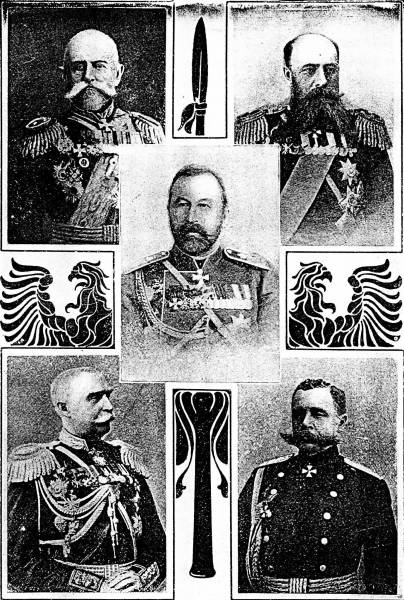
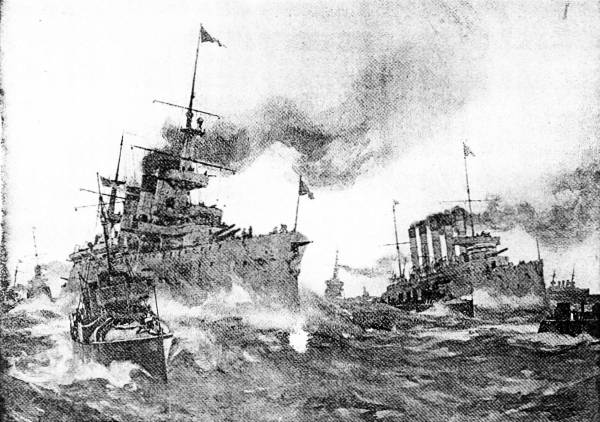
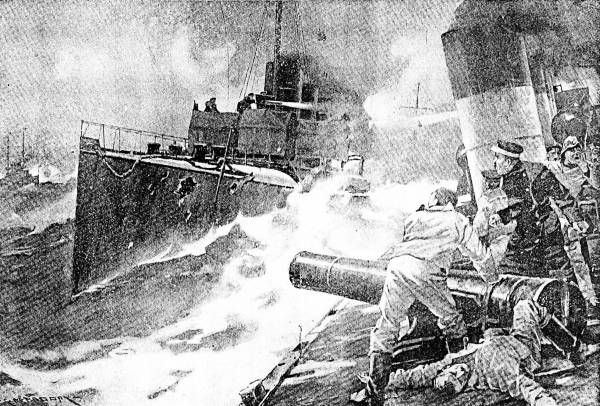
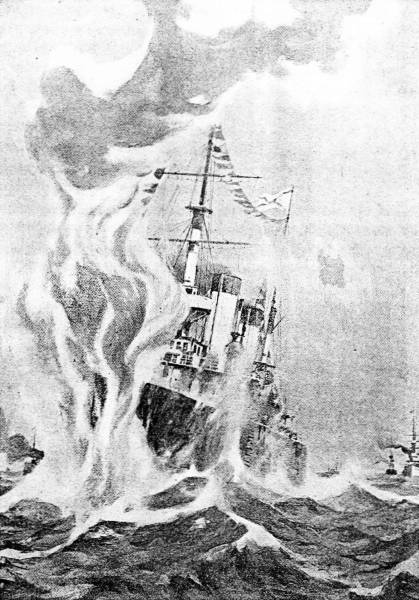
Battle of the Japan Sea—Fleet Russia's Last Hope—Tragedy of the North Sea—Reaches
Asiatic Waters—On the Eve of the Struggle—Russians in Double
Line—Borodino First to Go Down—Russians in Full Flight—Admiral
Nebogatoff Surrenders—Togo's Reports of the Battle—Rozhdestvensky a
Prisoner—Searching Sea for Remnants—Japan's Loss Only 424 Men—Your
Utmost for the Empire—Russian Line Enveloped—Destroyers Took Last
Thrust—As Sailors Saw the Battle—Blowing up the Izumrud—The News
Reaches Russia—Russian Story of Disaster—Why Russians Were Defeated.
Battle of the Japan Sea
The Japanese-Russian war has added many pages of
awe-inspiring achievement to the vast volume of
the world's valorous records of land and sea.
Notable, among all of the amazing array, ever
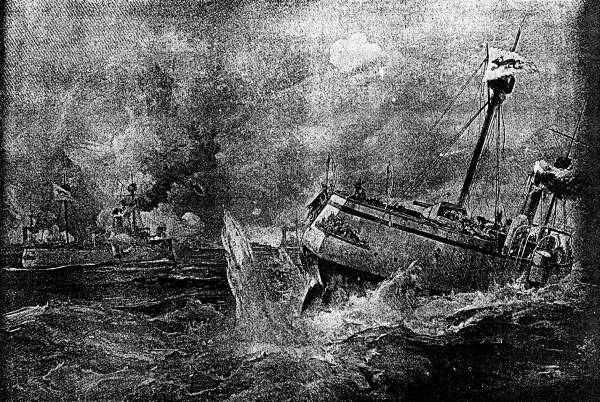
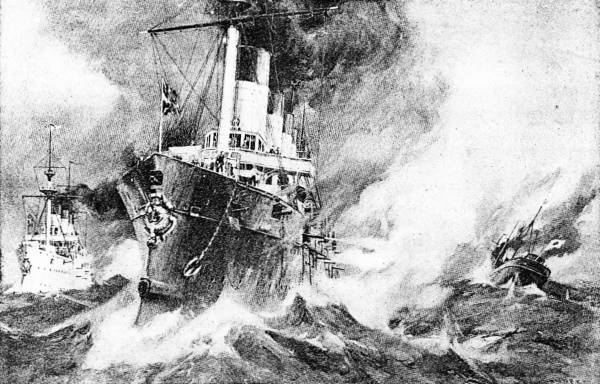
will stand the naval battle of the Sea of Japan, fought
in the Straits of Korea, Sunday, May 28; Monday, May
29, and continuing as a pursuit on Tuesday, May 30,
1905. Russia's enormous armada of thirty-seven fighting
ships, and one hundred ships in all, had been sent to
the Far East to recover command of the sea from Japan,
which had been won from her in the naval
campaign of 1904, when the Russian Port
Arthur fleet had been destroyed and the
Russian Vladivostok squadron had been weakened to a helpless condition.
The result was overwhelming victory for Japan, achieved
at the cost to Russia of the annihilation of her entire armada. No
naval battle of history equals this in the enormous power of the
fighting array; none exceeds it in the degree of its decisiveness.
Trafalgar, a hundred years earlier, affords the only possible parallel,
and Trafalgar, for a century the world's greatest naval struggle, was
outdone.
The story begins eight months before these thrilling events in
the Straits of Korea, when the Russian fleet, variously called the
Baltic Fleet and the Second Pacific Fleet, sailed from Cronstadt, in
the Baltic, on its 20,000 mile journey, around Africa and by way
of the Indian Ocean to the Orient.
Fleet Russia's Last Hope
The fleet represented every available Russian warship. A half
dozen others, too old for active service or still in course of building,
were left in Russian waters, the Czar deciding
to leave the home shores practically
unprotected after securing a secret agreement
with Germany, which amounted to
a temporary offensive and defensive alliance. The fighting strength
of the squadrons included seven battleships, two armored cruisers,
six cruisers, with a full complement of torpedo boat destroyers, a
fleet equal, on paper, to the entire available navy of Japan, and in
some aspects stronger than any Japan could hope to muster. Supreme
command of the armada was entrusted to Vice-Admiral
Rozhdestvensky, with three divisional commanders, Vice-Admiral
Volkersham, Rear Admiral Nebogatoff, and Rear Admiral Enquist.
The ultimate task of the fleet was to regain mastery of the sea from
Japan, in undisputed possession by reason of having destroyed the
Russian Pacific squadrons at Port Arthur and Vladivostok. Vladivostok,
Russia's sole remaining port in the Orient, was the destination.
From that point it was intended to assail Japan on the sea; to
interrupt her transport service, which was vital to her army then
in the midst of a victorious campaign, 300 miles from the sea, in the
heart of Manchuria, and thus cripple and harass the Island Empire
until no other course than to sue for peace would be open to her.
The task was enormous; so vastly difficult, indeed, that until the
actual departure of the fleet few, anywhere, believed that such a plan
was seriously contemplated. Even when departure had been made,
experts rather held to the view that Russia, herself, meant to ask
for peace and was merely making a demonstration that might be
counted on to modify Japan's demands.
Tragedy of the North Sea
The voyage had hardly been begun when an incident occurred,
which has been already narrated, and which astonished the entire
world and nearly led to war between Russia
and Great Britain. In the North Sea,
at the point known as the Dogger Bank,
the Russian vessels encountered the
Gamecock fishing fleet from Hull, England. The Russian admiral
mistook some of the trawlers for torpedo boats and ordered his
vessels to fire. One fishing boat was sunk and two men were killed,
others being badly wounded.
For some days the excitement in England was intense, and
British official documents published later on showed that the two
countries were on the point of war, but the crisis was ended by an
agreement to refer the incident to an international naval tribunal.
This board of inquiry met in Paris, and after a long investigation
reported that the Russian contention that hostile torpedo boats were
present when the firing took place was not justified. Rozhdestvensky,
however, was acquitted of the charge of conduct unbecoming a
sailor, and the incident was ultimately closed by the payment of a
large money indemnity by Russia.
The Dogger Bank affair caused some delay to the Russian
ships, though not nearly as much as Englishmen expected. After
leaving the Straits of Gibraltar the fleet divided, one division, under
Admiral Rozhdestvensky, proceeding by way of the Cape of Good
Hope and the other, under Admiral Vollkersham, going via the Suez
Canal. Rozhdestvensky had with him most of the battleships and
Voelkersam the majority of the cruisers.
Both squadrons proceeded very slowly, and the reports from
time to time regarding their whereabouts were of the most puzzling
character. On January 1, however, Rozhdestvensky reached Madagascar,
and there he awaited the cruiser squadron. The long time
spent there led to renewed assertions that the Admiralty at St.
Petersburg would never order the fleet to the Far East. In the
middle of March, however, reports were printed that the Russians
had sailed. These reports were denied, and then repeated, and at
length it was definitely established that the Baltic fleet had sailed.
Fleet Reaches Asiatic Waters
Nothing more was heard of it till April 8, when the news came
that the fleet had passed Singapore and was in the China Sea. On
entering the China Sea, Admiral Rozhdestvensky
sailed directly to Kamranh Bay,
on the coast of Indo-China, in French
territorial waters. The prolonged stay of
the fleet resulted in a vigorous protest from Japan to France, back
of which was the possibility that Japan would invoke the Anglo-Japanese
alliance, calling upon Great Britain to compel respect of
neutrality by France. France, in addition to instructing her representatives
in Indo-China to demand that the Russians leave territorial
waters, forwarded the protest to Russia.
On the Eve of the Struggle
Admiral Rozhdestvensky, on the eve of the great struggle, had
dismissed every unnecessary ship. More than a half hundred colliers
and supply ships, which had accompanied
the fleet or had met it in the China Sea,
were dismissed after the last ton of coal
had been stored on the big fighting ships.
| THE RUSSIAN FLEET. |
| |
|
Displace- |
I. H. P. |
Nominal |
Gun |
Weight of |
| Name |
ment |
|
speed |
protection |
broadside |
|
—Tons. |
|
—Knots. |
—In. |
fire—Lbs. |
| |
| Kniaz Suvaroff |
13,516 |
16,800 |
18.0 |
11.6 |
4,426 |
| Alexander III |
13,516 |
16,800 |
18.0 |
11.6 |
4,426 |
| Borodino |
13,516 |
16,800 |
18.0 |
11.6 |
4,426 |
| Orel |
13,516 |
16,800 |
18.0 |
11.6 |
4,426 |
| Oslabya |
12,674 |
14,500 |
19.0 |
10.5 |
2,672 |
| Sissoi Veliky |
8,880 |
8,500 |
16.0 |
12.5 |
3,186 |
| Navarin |
9,476 |
9,000 |
16.0 |
12.5 |
3,404 |
| |
| ARMORED CRUISERS. |
| |
| Dmitri D'skoi |
5,893 |
7,000 |
15.0 |
12.2 |
444 |
| Admiral Nakhimoff |
8,500 |
9,000 |
19.0 |
6.0 |
944 |
| |
| PROTECTED CRUISERS. |
| |
| Oleg |
6,675 |
19,500 |
23.0 |
4.0 |
872 |
| Aurora |
6,630 |
11,000 |
20.0 |
4.5 |
632 |
| Svietlana |
3,828 |
8,500 |
20.0 |
4.0 |
476 |
| Almaz |
3,285 |
7,500 |
19.0 |
184 |
| Jemtchug |
3,200 |
17,000 |
24.0 |
184 |
| Izumrud |
3,200 |
17,000 |
24.0 |
184 |
| |
| THE JAPANESE FLEET. |
| |
| Asahi |
15,000 |
15,000 |
18.0 |
14.6 |
4,232 |
| Shikishima |
15,000 |
15,000 |
18.0 |
14.6 |
4,232 |
| Mikasa |
15,000 |
16,000 |
18.0 |
14.6 |
4,232 |
| Fuji |
12,300 |
13,000 |
18.0 |
14.6 |
4,005 |
| |
| ARMORED CRUISERS. |
| |
| Tokiwa |
9,750 |
18,000 |
21.5 |
6.6 |
1,779 |
| Asama |
9,750 |
18,000 |
21.5 |
6.6 |
1,779 |
| Yakumo |
9,850 |
16,000 |
20.0 |
6.6 |
1,679 |
| Azuma |
9,436 |
17,000 |
21.0 |
6.6 |
1,679 |
| Idzuma |
9,800 |
15,000 |
24.7 |
6.6 |
1,779 |
| Iwate |
9,800 |
15,000 |
24.7 |
6.6 |
1,779 |
| Kasuga |
7,853 |
14,000 |
20.0 |
6.6 |
1,686 |
| Nisshin |
7,853 |
14,000 |
20.0 |
6.6 |
1,606 |
| |
| PROTECTED CRUISERS. |
| |
| Takasago |
4,300 |
15,500 |
24.0 |
4-1/2 |
804 |
| Kasagi |
4,784 |
15,500 |
22.5 |
4-1/2 |
804 |
| Itsukushima |
4,277 |
5,400 |
16.7 |
11.4 |
1,260 |
| Hashidate |
4,277 |
5,400 |
16.7 |
11.4 |
1,260 |
| Matsushima |
4,277 |
5,400 |
16.7 |
11.4 |
1,260 |
| Naniwa |
3,727 |
7,120 |
17.3 |
|
1,200 |
| Takishibo |
3,727 |
7,120 |
17.3 |
|
1,200 |
| Atkitsushima |
3,150 |
8,400 |
19.0 |
|
380 |
| Nitaka |
3,420 |
9,500 |
20.0 |
|
466 |
| Tsushima |
3,420 |
9,500 |
20.0 |
|
466 |
| Suma |
2,700 |
8,500 |
20.0 |
|
335 |
| Akashi |
2,700 |
8,500 |
20.0 |
|
335 |
| Idzumi |
3,000 |
6,000 |
18.0 |
|
335 |
From the Saddle Islands, a thousand miles stretched away to Vladivostok.
Coal and stores for the dash there were on every ship.
Then prows were turned northward, there was a full day when
nothing was known of the Russians. Then came this word, that
the great destiny-laden armada was sighted approaching Admiral
Togo's lair in the Straits of Korea. Forty-eight hours more, and
the Japanese admiralty was electrified by the characteristically modest
announcement from Japan's great naval captain:
"The main force of the Russian second and third fleets is nearly
annihilated. Please feel assured of it."
Between lies a tale marvelous for brilliancy, valor, daring, for
all that is spectacular and awe-inspiring in war; for all that spells
glory to the victor; for all that defeat, disaster, can mean to the
beaten and crushed. In brief, of Russia's seven battleships, five
had been sunk, and two, captives, were flying the flag of the victor;
Of the mighty array of cruisers, all but four were at the bottom
of the sea. Of the destroyers, three were afloat. In the harbor of
Vladivostok were a single unarmored cruiser, and these three
destroyers, the sorry fragments of the armada that reached this
destination for which the flower of Russia's European squadron had
set out. Sixty hours after the battle three armored cruisers, the
Aurora, Oleg and Jemtchug, laden with wounded, riddled with shot
and shell, crept into the harbor of Manila, there to be interned, with
their officers, Admiral Enquist among them. As a climax to the
victory, Admiral Rozhdestvensky was a prisoner, badly wounded,
and in the care of Japanese physicians in the naval hospital at Sasebo.
Admiral Volkersham was dead. He had fallen in the first havoc-working
broadside from the Japanese fleet. Admiral Nebogatoff
was a prisoner. Without a fight he had surrendered two battleships
and two coast defense ironclads, with the result that after the battle
that had annihilated the Russian fleet, the Japanese fleet was even
more powerful than when it cleared decks for action.
The Russian fleet had, in truth, sailed into Admiral Togo's
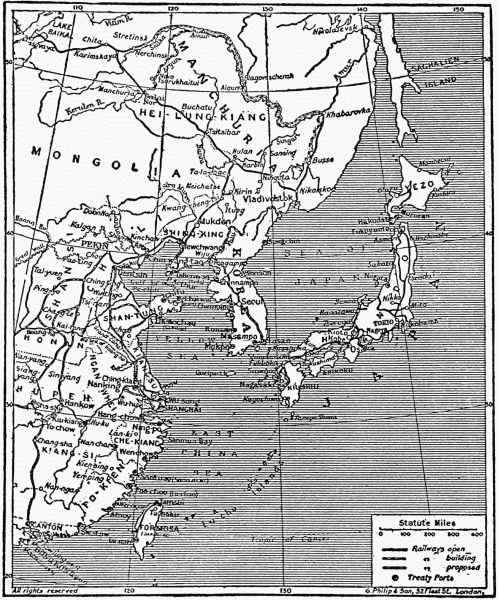
lair. The Straits of Korea lie between Japan and Korea, and are
an average of one hundred miles wide. Half way across rise the
Tsu Islands, which Japan has fortified until they are a veritable
Gibraltar. Only twenty-five miles wide is the Tsushimi Channel or
Strait, between Tsu Island and the Japanese coast.
Under Guns of the Forts
So narrow indeed is the water that as the Russian ships were
pressed eastward toward Tsu Island the forts there got range of
the battleships and sank the Oslabya.
Togo's base was at Masampho, on the
Korean coast. Thousands of Japanese
knew this fact, but so deeply was the necessity for secrecy appreciated
by all classes of the islanders that throughout the nine months
of waiting the entire world never had the slightest intimation of
the point from which Japan's defensive blow would be struck. The
general impression was that Formosa, the southernmost of the
Japanese archipelago, would be chosen. This opinion was fostered
by show of activity there and by various orders calculated to mark
this spot as of especial significance in the campaign. When Rozhdestvensky
had traversed the Straits of Formosa without opposition
and had reached the China coast north of there, Russians even
rejoiced, declaring that their admiral had outwitted the Japanese
by eluding their trap. Meantime Togo waited. His position
enabled him to meet the enemy should the direct route to Vladivostok
via the Straits of Korea and the Sea of Japan be chosen, or he was
in position to sail northward to intercept the Russians should
Rozhdestvensky decide to go further eastward into the Pacific, circle
Japan, and finally approach Vladivostok by La Pelouse or another
of the channels between the northern islands of the Japanese archipelago.
When Rozhdestvensky headed north from the China coast
toward the Straits of Korea he fell in with the plan of battle to meet
which the whole genius of the Japanese admiral had been preparing.
Only one detail failed to agree with what Togo had expected. He
believed that the Russians would shun the narrow channel east of
Tsu Island, nearer Japan, and would traverse the western channel
between Tsu Island and Korea. In the latter event the blow would
have been dealt by a dash from Mesampho. As it happened, the
fleet had only to round the northern promontory of Tsu Island and
fall upon the Russians in the most disadvantageous position that
could have been found in all of the waters of the Orient.
The strength of the fleets as they approached on that fateful
Saturday morning may be shown in tabular form. The chief units
are here given. In addition, there were twelve torpedo boat destroyers
with the Russian fleet and a veritable swarm of destroyers and
torpedo boats with the Japanese fleet. Nevertheless, the armada,
with practically twice the number of Japanese battleships, would,
on paper, have advantage over a large fleet, made up so largely
of lighter vessels.
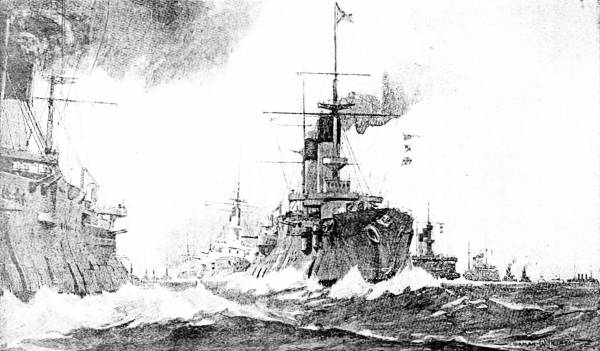
Russians in Double Line
The Russian fleet advanced in a double line, the battleships on
the side away from the Japanese coast; the inner line, nearer Japan,
made up of cruisers and light craft. Admiral
Togo swung northward of Tsu
Island, then turned sharply toward the
southeast, thus moving parallel to the
line of bows of the Russian ships, opening the broadsides of all of
his ships, while through practically all of the first day's battle the
Russians had only available bow and forward guns, a manœuvre
which eliminated enough of the effectiveness of the Russian battleships
to give Togo an advantage despite his weakness in these
floating fortresses.
It had been planned that the initial attack should be made by
the giant twelve-inch guns of the Japanese big ships, and that under
cover of this bombardment the torpedoers and destroyers should
dash for the leading Russian ships and attempt to throw the enemy's
column into confusion.
The commanders of the torpedoing flotilla had previously been
summoned and had been notified in a few words by the admiral of
the desperate service that was required of them and of the small
chance of any of them reporting again for duty.
They were told, in fact, that it was a simple case of sacrifice,
and they accepted it so willingly that the admiral found it difficult
to detail a torpedo reserve in case the first division failed in its task.
Until sunset the heavy guns of the Japanese battleships and
the ten-inch battery of the cruiser Kasuga roared and fired at the
oncoming Russians, while the Russian guns roared in reply.
Borodino First to Go Down
First of the Russian battleships in line behind the protected
cruiser Jemtchung was the 13,000-ton Borodino, and these two soon
showed that they were receiving the brunt
of the shelling. The cruiser Nakhimoff,
in the van of the Russian port column,
was also observed to be in distress, and
then, the sun having set and the quick-setting darkness having come,
the torpedoes were sent out under cover of a still heavier cannonade.
The flotilla formed into two divisions, one heading for the battleship
column of the Russians and the other for the cruisers.
The searchlights of the Russian fleet threw out their great
beams and their small gun batteries swept the sea but the swift
hornets of the sea went wallowing and buzzing on their way. They
circled and swept, and then came the dull roars and heaving fountains
that told that the torpedoes had been loosed from their tubes
and were doing their deadly work.
Again and again came the roars, and as the Japanese searchlights
swept across the field of fight and then went out it was seen
that the great battleship Borodino was sinking; that the protected
cruiser Svietlana was a wreck; that the battleship Alexander III had
gone; that the two armored cruisers Dimitri Donskoi and Nakhimoff
were out of the fighting. A far-sailing shell had also reached and
sunk the supply ship Kamchatka. Thus ended the first day's fight.
Russians in Full Flight
In the darkness of the night of Saturday, May 27, the shattered
Russian fleet reformed as well as it might, and once more took up
its despairing run for the Sea of Japan
and the haven of Vladivostok.
Hanging on to the already beaten enemy,
an easy matter with his faster ships, Togo picked up the
Russians all of Saturday night with his searchlights, occasionally
sending a long-distance shell toward one of the shadowy hulls that
were racing to get through the straits.
But just as Togo had selected his fighting ground for working
out one chapter of the tragedy, so now he chose the scene of the
second day's fighting.
To the northeast of Osino Island lies a dangerous little archipelago
known as the Liancourt Rocks, and with his battleships and
heavily armored cruisers the Japanese admiral stood out in crescent
form across the Korean Strait and drove the enemy toward this dangerous
running.
Keeping together in some semblance of order, five Russians,
consisting of the battleships Nicolai I and Orel and the coast defence
vessels Senyanin and Apraxine and the protected cruiser Izumrud,
were heading bravely for the Sea of Japan. Seeing a possibility
of their escape, Togo, who was personally conducting the pursuit,
signaled to close in and attack.
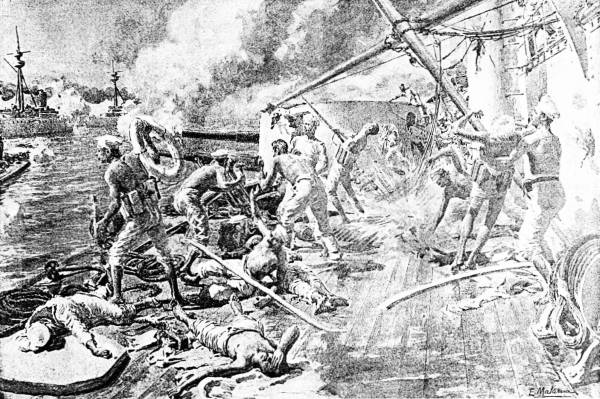
With their forward turrets blazing and roaring, the Japanese
squadron dashed on. The Russians replied vigorously for a time,
but the gunnery of the Japanese was too deadly and accurate; shells
were carrying death and destruction into the fleeing five, and the
fight went out of the Russians.
Admiral Nebogatoff Surrenders
One after another flew surrender signals, the Japanese ceased
firing, and the Nicolai I, Orel, Senyanin and Apraxine were added
to the Mikado's navy. Only the Izumrud
got away. Fleeter than her sisters, she
steamed boldly to the northwest. But she
was doomed. Swift pursuing Japanese
cruisers followed, hurling after her tons of metal, much of it taking
effect. The end came when the Russian ship, entering Vladimir
Bay, went fast on a reef. The Russian captain blew up the ship.
So practically ended the second day's fight, and here again the
apparently impossible happened—Togo's captains all reported, "No
damage to men or ships."
Togo's captains, had, however, other things to report, for while
the main force of the combined squadron was hammering the four
Russians into subjection off the Liancourt Rocks others of the
cruisers were chasing scattered Russian ships, while still others were
completing the work of destruction around Osino Island. Two
special service ships and a destroyer were captured, and so was the
armored cruiser Monomach, but she foundered soon after transference
of flags.
And there were prisoners to report, 3,000 of them, including
the unhappy Nebogatoff, while up and down the seas the fight
between pursued and pursuer still went on.
Battles at sea are necessarily fought away from the eyes of
neutral observers. The active participants are unable to know of
more than the immediate scene of the drama in which their own
ship is engaged. Even the admiral of the fleet is unable to see all
that occurs. Hence detailed, continuous accounts of such occurrences
rarely, if ever, are written until years later the disconnected
stories of here one, there another, can be assembled, corrected, dovetailed.
Sufficient time has not elapsed since this remarkable battle
to permit of such assembling of facts. But both Japanese and
Russians have told of individual experiences. These have a
graphic interest, coming hot from the scene of the great events
which, perhaps, a more finished narrative might lack. First in
interest, come the actual reports from the admiral himself. Few
great fighters have been men of fewer words than this Togo. His
reports, and, indeed, all of the Japanese reports, have been in marked
contrast to the elaborate, verbose messages sent to the Emperor
of Russia.
The story of the battle, as told by Admiral Togo, follows:
First report, received morning May 27:
Togo's Reports of the Battle
"Immediately upon the receipt of report that Russian squadron
was in sight our combined squadron started for attack. Weather
is fine to-day, but with heavy seas."
Second report, received night May 27:
"Combined squadron attacked Russian
squadron to-day near Okinoshima (southeast
of Tsushima) and defeated it, sinking at least four ships and
inflicting heavy damage upon others. Damage to our ships is insignificant.
Our destroyer and torpedo flotillas delivered attack after
sunset."
Third report, received Monday, May 29.
"Main force of our combined squadron continued pursuit since
the 27th, and attacked (28th) near Liancourt Rocks (northeast of
Okinoshima) a squadron consisting of Nicolai I (battleship), Orel
(battleship), Senyanin, Apraxin and Izumurud. Izumurud fled
while remaining four vessels surrendered. No damage to our ships.
According to statements of prisoners, vessels sunk in engagement
May 27 were Borodino (battleship), Alexandre III (battleship),
Jemtchug and three other ships. Rear Admiral Nebogatoff and
about 2,000 other Russians were taken prisoners."
The following are damages suffered by enemy in addition to
those given above since commencement of battle, as reported by
commanders not under immediate command of Togo and by observation
stations:
Sunk—Admiral Nakhimoff, Dmitri Donskoi, Svietlana, Admiral
Usakoff, Kamchatka, Irutshush and three destroyers.
Vladimir Monomach, foundered after capture. One special
service ship, whole name unknown, and one destroyer captured.
Russian losses definitely known so far may be classified as follows:
Two battleships, one coast-defence ship, five cruisers, two
special ships, three destroyers were sunk; two battleships, two coast-defence
ships, one special service ship, one destroyer were captured.
It is not yet clear whether three vessels, as stated by prisoners to
have been sunk, are included or not in above list. There are more
than 1,000 prisoners, besides 2,000 taken by main force of combined
squadron.
"The naval engagement is still in progress, so that it will take
some time before the final results can be known."
Fourth report from Togo received afternoon, May 30:
"The main force of our combined fleet, upon accepting surrender
of the remaining Russian main force near Liancourt Rocks, in
the afternoon of May 28, as already reported, stopped pursuit, and
while engaged in the disposition of surrendered ships found in a
southwestern direction the Admiral Ushakoff, a coast defence ship.
Thereupon Iwate and Yakumo were immediately dispatched in pursuit
and invited her to surrender, but she refused and was sunk at
6 P. M. Her crew of over 300 men were rescued.
"Cruiser Dimitri Donskoi was also found in the northwestern
direction at 5 P. M. and was immediately overtaken and was fired
upon vigorously by our fourth division and second destroyer flotilla.
"She was attacked that night by the second destroyer flotilla,
and the next morning was found aground on the southeastern shore
of Urleung Island, off the Korean coast.
Rozhdenstvensky a Prisoner
"Our destroyer Sazanami captured, toward the evening of May
27, in the south of Urleung Island, the Russian destroyer Biedovy,
wherein were found Admiral Rozhdestvensky
and another admiral, both severely
wounded, together with eighty Russians,
including staff officers from the flagship
Kniaz Suvaroff, which was sunk at 5.29 P. M. on May 27. They
were all taken prisoners.
"Our cruiser Chitose, while cruising to the northward on the
morning of May 28, found and sunk another Russian destroyer.
Our cruiser Niitaka and destroyer Murakumo attacked also at noon
on May 28 a Russian destroyer, which finally went aground.
"According to various reports hitherto received and statements
of prisoners, the result of the battle from May 27 to May 29, is as
follows:
"Prince Suvaroff, Alexander III, Borodino, Dimitri Donskoi,
Admiral Nachimoff, Monomach, Zemtchug, Admiral Ushakoff, one
converted cruiser and two destroyers sunk.
"Nicolai I, Orel, Admiral Apraxine, Admiral Senyavin and
destroyer Biedovy captured. According to the prisoners, the Osliabia
sunk about 3 P. M., and the Navarin also was sunk.
"Almaz, on May 27, was observed in a disabled and sinking
condition, but her final fate is yet unknown.
"The full particulars regarding the injury to our ships are not
yet in hand, but as far as I could ascertain none was seriously
injured, all being still engaged in operations. The whole casualties
are not yet ascertained. Casualties of first division are a little over
four hundred. Prince Yorhito is in excellent health; Admiral Misu
slightly wounded, May 27.
"Fifth report, received the afternoon of May 30:
"Loss of Osliabia, Navarin, confirmed. Sissoi-Veliki also definitely
reported to have sunk on the morning of May 28.
"Official statement of Russian losses so far as ascertained:
Following six battleships sunk: Prince Suvaroff, Imperator, Alexander
III, Borodino, Osliabia, Sissoi-Valiki and Navarin.
"Following five cruisers sunk: Admiral Nachimoff, Dimitri
Donskoi, Vladimir, Monomach, Svietlana and Zemtchug.
"Coast defence ship Admiral Ushakoff sunk.
"Two special service ships, Kamchatka and three destroyers
also sunk.
"Two battleships, Orel and Imperator, Nicolai I; two coast
defence ships, General Admiral Apraxine and Admiral Senyanvin,
and one destroyer, Biedovoy, captured.
"Thus Russians lost altogether twenty-two ships, the aggregate
tonnage whereof amounting to 153,411 tons, besides cruiser Almaz,
suspected to have sunk.
"Later reports from the different divisions of the fleet engaged
in the naval battle of May 27 show as follows:
Havoc Among Battleships
"The Russian battleship Oslabya was heavily damaged in the
early part of the fight on Saturday, going
down at 3 o'clock in the afternoon.
"The first Russian vessel sunk was the
battleship Sissoi Veliky.
"The armored cruisers Admiral Nakhimoff and Vladimir Monomach,
after being in the general engagement during the daytime,
were still further damaged by torpedoes during attacks by night,
and were eventually completely disabled. They drifted into the
vicinity of Tsu Islands, where they were discovered on Sunday
morning, May 28, by the auxiliary cruisers Shilano, Yawata, Tainan
and Sado, which were about to capture them, but they all sank.
"The crews of our auxiliary cruisers rescued 915 of the crew
of the sunken Russian ships.
"The battleship Navarin was torpedoed four times after sundown
on Saturday, May 27, and sunk. The survivors of the
Navarin's crew confirm the story of her destruction.
"The cruisers Niitaka and Otawa discovered the Russian cruiser
Svietlana at 9 o'clock on Sunday morning in the vicinity of Chappyan
Bay and immediately attacked and sunk her. The commander
of the Niitaka reports the fact.
"It is suspected that the Russian cruisers Almaz and Aurora
were sunk by torpedoes on the night of May 27.
"The former report includes the statement that the Russian
cruiser Jemtchug was sunk, but as yet this remains unconfirmed, and
the cruiser's name has been excluded from the revised list of Russian
vessels destroyed.
"Judging from this and former reports, the enemy's main
strength, consisting of eight battleships destroyed or captured, three
armored cruisers and three coast defence ships destroyed or captured,
with the second-class cruisers and other vessels destroyed, the
enemy's fighting power is thus annihilated.
"Later reports show that during the night of May 27 our
torpedo boats, numbered 34, 35 and 69, were sunk by the enemy's
fire. Comrades rescued the majority of their crews. Besides the
above, there was no damage worth reporting. No warship nor
destroyer suffered any loss of fighting or navigating power.
Searching Sea for Remnants
"We anticipated a heavy loss of life, but find that our casualties
were comparatively slight. They do not
exceed 800 killed and wounded. The casualty
reports will be rendered as speedily
as possible in order to reassure families
and friends.
"Nearly the whole strength of both combatants met in battle,
and the area of the fighting was very wide.
"The first day proved foggy, and even without the smoke and
fumes resulting from the battle it was impossible to see five miles.
Consequently, during the day it was impossible to locate or observe
all the ships under my command. Moreover, the fighting having
lasted two days, and the ships of my command being scattered for
the purpose of chasing and attacking the enemy, some having received
special orders after the battle, it is impossible to collect and
frame any detailed report covering the whole battle at the same
time."
Admiral Togo telegraphed, May 30, as follows:
"The ships sent northward to search for Russian ships returned
yesterday. The cruisers Iwate and Yakumo and other vessels sent
southward to find Russian ships, returned to-day. They thoroughly
searched the Shanghai course from Tsushima and vicinity, but on
both sides found no trace of the Russians."
Admiral Shimamura, on board the cruiser Iwate, reports:
"During the battle on May 27, at 3.07 P. M., the cruiser Iwate
vigorously attacked the protected cruiser Jemtchug at a distance of
3,000 metres. The Jemtchug sank in one minute. The loss of the
Jemtchug is, therefore, confirmed.
"During the engagement fire broke out on the Jemtchug and
smoke concealed the hull of the vessel. Consequently the remainder
of our fleet were unable to see the ship."
Admiral Togo gave this list of casualties, surprisingly small
even to himself, for he had estimated his losses as 800 men.
Japan's Losses Only 424 Men
"The Japanese losses in the battle of the Sea of Japan were 113
officers and men killed and 424 officers and men wounded. The
completion of the revised list shows that
the losses were fewer than the original
estimates. The flagship Mikasa was the
heaviest loser, losing 63 killed and
wounded. The losses were distributed among the ships of the fleet
as follows: Mikasa, 63; Adzuma, 39; Shikishima, 37; Asashi, 31;
Fuji, 28; Idzuma, 26; Nisshin, 27; Otowa, 26; Kasaga, 26; Tsushima,
19; Asama, 15; Naniwa, 17; Tokiwa, 15; Yakumo, 11; Chitose,
6; Idzumi, 10; Kasaga, 9; Hashidate, 5; Niitaka, 4."
The casualties on the destroyers and the torpedo boats were 87.
Commander Togo was wounded on the Adzuma.
Admiral Togo concluded his series of reports with this absolutely
accurate statement of the ships that had escaped, in the main
a remarkable feat, when the conditions of alternating fog and sunshine
and the natural confusion among the Russians is taken into
account.
"The Russian vessels present in the recent battle which were not
sunk or captured and which are unaccounted for are," Togo's report
adds, "the protected cruisers Oleg, Aurora, Izumrud and Almas,
three transports, two torpedo boat destroyers and one towboat.
During the battle the Oleg and Aurora were within range of our
third and fourth squadrons and were on fire. They may have
escaped, but it will take time to restore their fighting power."
A Japanese officer described the battle more connectedly in the
following words:
Your Utmost for the Empire
"At 5.30 Saturday morning a wireless message, reading, 'The
enemy's squadron is in sight,' reached the naval base. This message
was transmitted to all our ships by the
flagship, with instructions to get ready
for action. Our squadron left their rendezvous
and headed for the eastern channel
off Tsushima. Our men seemed to be filled with new inspiration,
and were eager for the long-delayed fight to begin.
"When Tsushima was sighted to the southwest the sea was
rough and the torpedo boats were forced to run for the shelter of
the island. Our third fighting squadron, with the Takashiho to port,
reconnoitred the Russian course, and at 11.30 A. M. informed the
main squadron by wireless telegraph that the Russian ships were
passing into the east channel, whereupon our main squadron, changing
its course somewhat to the southward, came in sight of Okinshima
at 1 o'clock in the afternoon. The third division arrived
later and joined the main squadron. The first and second divisions,
accompanied by the destroyer flotilla, changed to a westerly course,
while the third division and the fourth destroyer flotilla headed
slightly eastward.
"During the manœuvre the Russian flagship appeared to the
southward, at 1.45 o'clock. The Russians steamed up in double column.
The fleet was numerous, but no living being was visible. The
Russian ships seemed to be in good order. Our ships hoisted the
flag of action, the Mikasa signaling: 'The defence of our empire
depends upon this action. You are expected to do your utmost.'
Our men seemed to silently weigh the significance of this signal.
Russian Line Enveloped
"Our first and second divisions turned to the Russians' starboard,
while the third division kept in close touch with the preceding
two divisions. With the Japanese ships
proceeding in this order, it was 2.13
o'clock when the Russians opened fire.
The first two shots fell short of our line,
and it was some minutes later before we commenced firing. Then
the battle was on, with firing from both sides. Our destroyers kept
on the port side of the main squadron, and in this formation we
pressed the Russians against the coast of Kiushiu, and they were
obliged to change their course to the east.
"We so manœuvred our ships as to have their bows parallel
to the north side of the Russian line. The Mikasa, of our first
division, which had been leading, changed to the rear of the line,
while the Kasuga headed the line. The engagement now became
very fierce. The Borodino was seen to be on fire. A little later the
Russians headed west, and we changed our course accordingly.
Five ships of our second division concentrated their fire on the
Borodino. Our first division now began firing vigorously, proceeding
parallel with the Russian line, and as we began to press against
the head of the Russian line our third division veered to the Russian
rear, thus enveloping their ships.
"The engagement proceeded hotly. Our second division followed
a course parallel with the northern side of the Russians, and
this movement completed the envelopment. The Russian ships were
seen trying to break through, and our destroyer flotilla intercepted
their new course. This state of envelopment continued until the
following day, with the ships at varying distances. Thus enclosed
on all sides, the Russians were helpless and powerless to escape the
circle.
Destroyers Took Last Thrust.
"Previous instructions had been given the destroyers and torpedo
boats to attack the Russian ships. Following instructions, the
fifth destroyer flotilla advanced against a
Russian ship, upon which the second
division had been concentrating its fire,
signaling, 'We are going to give the last
thrust at them.'
"The Russian ship continued to fight, and seeing the approaching
torpedo boats, directed its fire on them. Undaunted, our destroyers
pressed forward, the Chitose meantime continuing its fire. The
torpedo flotilla arrived within 200 metres of the Russian ship and
the Shiranus fired the first shot. Two other torpedo boats fired one
each. The Shiranus received two shells, but the other boats were
not damaged. The Russian ship was sunk.
"Sundown saw the battle raging furiously. Our shells were
evidently telling on the Russians, who showed signs of confusion.
Our fifth torpedo flotilla, after destroying the Borodino, followed
in the wake of our second division, the signal reading, 'Something
like the Russians' submarines have been sighted. Attack them.'
"The flotilla followed and located the object, which proved to
be a sinking ship with its overturned bottom showing. Thirty survivors
clung to the wreck, crying for assistance. Firing ceased
with the approach of darkness.
"According to orders previously given for a torpedo attack after
dark, all the destroyer flotilla, dividing into two squadrons, proceeded
to attack the Russians during the whole night. The Russians
frustrated the first and second attacks with searchlights. A third
attempt was carefully made, and the Yugiri sank a ship of the
Borodino type, and also hit others. During the night the Russians
continued to move, and we preserved our enveloping movement
some distance from the Russian position. The Russian ships headed
northeast after daybreak, hoping to reach Vladivostok. Our officers
and men were determined that not a ship should escape, and resolved
not to relax their efforts until they had succeeded in either sinking
or capturing every Russian ship.
"Our ships always kept ahead of the Russians. The battle
was resumed at 9 o'clock Sunday morning, twelve miles east of
Chiyupyon Bay, and lasted all day. Here the Russians suffered
their heaviest losses. They seemed unprepared to repel night attacks.
During our first night attack the Russians showed nine searchlights
and frustrated the attacks, but clearly gave us the location of the
fleet, which brought success later."
Still another version has been supplied by Japanese tars, as follows:
As Sailors Saw the Battle
"At dawn on Saturday our squadron left its rendezvous and
advanced through the Tsushima Channel. At 2.08 in the afternoon
we sighted the Russian fleet. Gradually
closing in, we found the Kniaz Souvaroff
leading the line, with the Borodino, the
Alexander III, the Orel, the Osliabia and
the Navarin following in the order named. The Nicolai I brought
up the rear. Parallel to this line we observed five cruisers. After
them came the special ships and torpedo boat destroyers. We counted
thirty-two Russian ships in all.
"Our fleet, with the battleship Mikasa leading, proceeded
toward the Russians in vertical line formation. The Souvaroff
opened fire first and then suddenly turned, reversing her course.
Almost simultaneously the Mikasa opened fire with her big guns,
and thus the curtain rose on the great sea battle. The hostile fleets
gradually closed in toward each other, exchanging a vigorous fire.
The armored cruiser Asama approached within 3,000 metres of the
Russian fleet and carefully observed its action.
"After a short but fierce fight the Admiral Oushakoff's deck
was observed to be ablaze, and the ship left the line. By 4.30 in
the afternoon the Russian line was disordered and its fire slackened.
The Borodino and Kamchatka had been disabled and soon sank.
The Borodino continued to fire bravely until the ship was submerged.
"The Japanese fleet continued to maintain enveloping positions
from sundown until dawn. Sunday morning opened misty, but the
weather soon cleared, and the search for the remnants of the Russian
fleet was begun. Five Russian ships were discovered in the
vicinity of Liancourt Island, and they were immediately surrounded.
One, supposed to be the Izumrud, escaped at full speed. The remaining
four offered no resistance, and hoisted the Japanese flag
over the Russian colors, apparently offering to surrender. Captain
Yashiro, commanding the Asama, started in a small boat to ascertain
the real intentions of the Russians, when Admiral Nebogatoff
lowered a boat and came on board the Asama, where he formally
surrendered. The prisoners were distributed among the Japanese
ships, and prize crews were selected to take possession of the captured
vessels."
The Capture of Rozhdestvensky
To have destroyed the Russian armada was, of itself, an amazing
feat; but to have captured the commander-in-chief, and to have
compelled the surrender of an admiral of
the line, add vastly to the glory of Togo.
The story of Rozhdestvensky's capture
is dramatic.
The destroyers, Kasumi, Usugumo, Sazanami and Kagerou,
were ordered to attack the Russian warships on the night of May
27 and were steaming ahead when they suddenly encountered a
number of Russian ships. The Kasumi narrowly avoided a collision
with a Russian cruiser, the closeness of which seems to have saved
the destroyers from being damaged by the heavy fire which the
Russians directed on them.
During the Russian attack the vessels forming the destroyer
flotilla divided. The Sazanami and Kagerou continued the search
for Russian ships throughout the night, and in the morning discovered
two torpedo boat destroyers. One of them steamed away, but
the other was unable to do so. On approaching the latter the Japanese
discerned a white flag flying from the foremast and the Red
Cross flag astern. She proved to be the Bedovi with Admiral Rozhdestvensky
and his staff on board. The Bedovi signalled that her
engines were damaged, and that she was short of coal and water.
An armed guard was sent on board the Bedovi to receive her surrender.
The Russians requested the Japanese not to remove Admiral
Rozhdestvensky and the other officers on account of their wounds,
and the Japanese complied, with the understanding that the guard
would shoot Rozhdestvensky in the event of the delay leading to a
meeting with Russian ships, thus running the danger of his recapture.
The Sazanami ran a line to the Bedovi and began to wing her.
The line parted twice. In the morning the Sazanami met the Japanese
cruiser Akashi, which convoyed the two destroyers to Sasebo.
During the trip the destroyers encountered heavy seas, and their
decks were awash during part of the time.
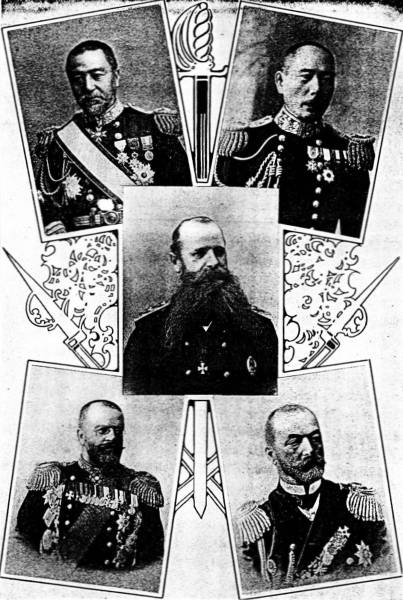
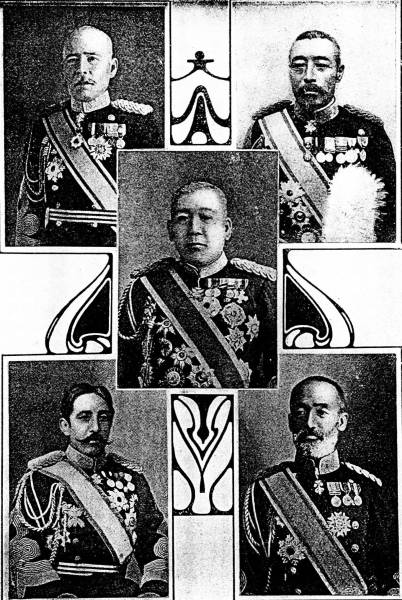
Chiefs of Japan's Fleet
Thirty naval commanders participated in the battle of the Japan
Sea. Vice Admiral Togo was commander-in-chief, leading the
first squadron. Vice Admiral Kamamura
was in command of the second squadron,
and Rear Admiral Kataoka led the third
squadron.
The chiefs of staff in the order named were Admiral Kato
and Captains Fujii and Saito. The commanders of the squadron
divisions were Vice Admirals Dewa, Uriu and Mitsu, acting as rear
admirals under Vice Admiral Togo, Captains Yamada, Shimamura,
Taketomi and Kokura.
Blowing Up the Izumrud
The fate of the cruiser Izumrud is a chapter of itself in the
story of the battle. Baron Ferzen, her captain, with survivors of the
ship's crew, reached Vladivostok on June
1 and sent a report, which, in addition to
confirming the disaster to the entire fleet,
told the fate of his own ship. The Baron
reported that before dark, on May 27, the Osliabya, Alexander III
and Borodino had been sunk, and the Kniaz Souvaroff, the Kamtchatka
and the Urel had been seriously damaged and were lost to
sight. The command then devolved on Rear Admiral Nebogatoff.
In the evening the Nikolai I, the Orel, the General Admiral
Apraxine, the Admiral Seniavin, the Admiral Oughakoff,
the Sissoi Veliky, the Nevarin, the Admiral Nakhimoff, and the
Izumrud sailed northeastward, the latter being charged to transmit
orders to the battleships. Two other cruisers were cut off from the
fleet and were not again seen.
The battleships, steaming at fourteen knots, were repeatedly
attacked by the Japanese torpedo boats, especially at the extremities
of the line.
At dawn it was ascertained that the battleship division consisted
of the Nikolai I, the Orel, the General Admiral Apraxine and
the Admiral Seniavin.
At sunrise, May 28, smoke from the Japanese ships reappeared
on the horizon, whereupon the admiral gave orders for increased
speed. The Admiral Seniavin and the General Admiral Apraxine
dropped behind.
Toward 10 o'clock, the Japanese fleet appeared first to port and
then to starboard, while the cruiser division manœuvred behind the
Russians to starboard. Baron Ferzen's
account continues:
Flight Ends in Disaster
"I was cut off from the squadron and
finding it impossible to rejoin it resolved to make for Vladivostok.
I put on full speed and the enemy's cruisers came on in pursuit.
Owing to the insufficiency of my coal supply and the certainty of
meeting the enemy's cruisers, I subsequently altered my course for
Vladimir Bay, where I arrived on the night of May 29. At 1.30
o'clock next morning, in pitch darkness, the Izumrud ran full on a
reef at the entrance of the bay. Having only ten tons of coal and
seeing that it would be impossible to again float my vessel, I ordered
the crew ashore and blew up the Izumrud to prevent her falling into
the hands of the enemy. Ten of my sailors were wounded in the
battle, but the officers and the rest of the crew are all safe."
The News Reaches Russia
Intimations of the extent of the disaster first reached Russia
through foreign telegrams. The emperor and naval officials hoped
against hope that their own advices would
bring some ray of comfort. It was hoped
that a portion of the fleet might reach
Vladivostok strong enough to aid in protecting
the fortress against attack from the sea.
One unprotected cruiser and three torpedo boat destroyers were
all of the splendid fleet that ever were to reach Vladivostok. The
cruiser Almaz, which by reason of her lack of protective sheathing
had been ordered by Rozhdestvensky to flee in event of battle, got
through the Japanese lines with a minimum of damage, though well
scarred by shots that had reached her by chance. Captain Chagir,
her commander, speedily communicated with the emperor at St.
Petersburg through Lieutenant General Linevitch, commander-in-chief
in the Far East. This was the message:
"The cruiser Almaz has arrived at Vladivostok. Her commander
reports as follows:
"'On May 27, Vice Admiral Rozhdestvensky's fleet in the Tsu
Strait engaged the Japanese in battle. During the day we lost the
battleships Kniaz Souvaroff, Borodino, Osliabya, and the cruiser
Ural. The battleship Alexander III was seriously damaged at the
start of the battle.
"'After the separation of the cruiser Almaz from the fleet the
battle was renewed in the darkness. The result of the night battle is
not known.'"
The Almaz was cut off from the fleet and reached Vladivostok.
"Supplementary reports of the commander of the Almaz, forwarded
by the post commandant at Vladivostok, state that the
transport Kamtchatka was seriously damaged."
"The Almaz had Lieutenant Mochalin and four sailors killed
and ten sailors wounded. There is no news as to those who were
saved or those who perished on the sunken warships."
The arrival of the Almaz has thus been described by an eye
witness at Vladivostok:
The Almaz, which arrived at her anchorage here Monday evening,
May 29, bore scars of the battle. Her mizzen mast was shot
away, and one of her smokestacks was pierced by a cannon shot.
But the Grozny, though engaged for several hours in a running
fight at short range with a large Japanese destroyer, showed no signs
of the fray. After her commander, Captain Andriffski, had been
wounded, and an officer and three men had been killed, the Grozny
succeeded in sinking her opponent with a luckily placed shot, and
reached Vladivostok without further adventure.
For two days Vladivostok had been buzzing with rumor and
excitement. The fact that a battle between the rival fleets was
imminent, if Rozhdestvensky was not already at hand-grips with
Togo, was made known through telegrams from Europe, and when
it was learned Monday morning that a Russian cruiser had been
sighted off Askold Island, headed for the harbor, the city was filled
with the wildest reports of every nature.
Story of Russian Survivors
The inhabitants clustered in the streets, thronged the waterside
or climbed the frowning hills overlooking the harbor for a better
view. Finally, toward 6 o'clock in the
evening, a graceful cruiser with two
snowy-white stacks, shot in view at the
entrance to the Golden Horn and rounded
to an anchorage beneath the bristling guns of the curving promontory.
From afar the broken stump of her mizzen-mast and a shot
hole showing black upon the white paint of one stack indicated that
the cruiser had encountered the Japanese. As the anchor chain rattled
in the hawse holes the vessel wreathed itself in smoke—it was
an admiral's salute in honor of Rear Admiral Von Jessen. Scarcely
had the boom of the last cannon begun to echo from the surrounding
hills when Von Jessen's flagship, the cruiser Rossia, answered the
salute, and a minute later the guns of the fortress took up the cannonade.
Excitement beyond description seized the thronging spectators,
who, with frantic "huzzas," tossed high their caps.
Citizens embraced each other and danced jubilantly upon the
pier, while the crews of the ships in the harbor joined in wild
cheering.
In a thrice the boats were dropped from the davits, and in a
moment the officers of the cruisers and torpedo boats in the harbor
and the military officials from the fortress were swarming on board
the Almaz to learn news of the fight.
Saw Flagship Go Down
The story was short. According to the officers of the Almaz,
the fleet under Rozhdestvensky met the Japanese in the Straits of
Korea, near Tsu Island, and the opposing
fleets immediately closed in.
Being lightly armored, the Almaz, as
had been expected by Admiral Rozhdestvensky
before the battle, separated itself from the main fleet at the
first opportunity and headed for Vladivostok soon after the commencement
of the action, but not too soon to observe that the losses
on both sides in the titanic combat were great.
Early in the battle an officer of the Almaz, while watching
Rozhdestvensky's flagship, the battleship Kniaz Souvaroff, for a signal,
saw the flagship shudder from stem to stern, as if under a blow
from a gigantic hammer, and hesitate in her course, while the waves
rose high from her armored sides. Then she commenced to list
and sink.
The officers believe that the debut of the submarine boat as an
effective agent in naval warfare, or perhaps a large mine caused the
disaster to the Kniaz Souvaroff. The damage, however, was so
extensive that the flagship soon went down, leaving the deck officers
and many of the crew struggling in the waves.
One of the Russian torpedo boats, either the destroyer Buiny
or the Bravi, ran in and picked up a number of the swimmers, one
of whom was recognized through a glass as Admiral Rozhdestvensky.
Under a grueling attack by the Japanese warships, aided by
torpedo boats, mines and submarines, the Borodino, Osliabia and
Ural were placed out of action and followed the flagship to the
bottom.
The fog, which had raised and lowered intermittently during
the morning, began to settle down again, and the distance of the
Almaz, which now succeeded in disengaging herself in the combat
from the struggling ships, made it difficult for her to see clearly.
The arrival of the Grozny on the following day was marked by
the same scenes of excitement as those which characterized the
advent of the Almaz. The wounded commander of the destroyer,
Captain Andriffski, confirmed the details given by the officers of the
Almaz. He described his combat as a running fight, in which the
Grozny was engaged for several hours, finally sinking the pursuing
Japanese destroyer.
Russian Story of Disaster
From this and further fragmentary reports the Russians pieced
together a story of the disaster. They figure that Admiral Togo,
with his main squadron, must have lain
somewhere off the coast of Korea, while
Admirals Kamimura and Uriu held their
squadrons further north to head off the
Russian vessels which might get through Togo's lines or be prepared
to bar the entrance to the Straits of Tsugaru in case the Russians
should be reported moving up the east coast of Japan. When
Togo's scouts reported that Admiral Rozhdestvensky was heading
for the eastern channel of the Straits of Korea the Japanese Admiral
steamed around the northern part of the Tsu Islands, and came upon
the Russians steaming in double column, with the cruisers to port.
Togo enjoyed the great advantage of tactical position when he
opened fire, having the lightest of the Russian ships between him
and Rozhdestvensky's heavier vessels, thus smothering the fire of
the latter. Besides, Togo was able to use all his broadsides, whereas
the sternmost ships of the Russian columns, coming on in line ahead
formation, could probably only with difficulty use any guns at all.
When Sunday morning came the Russian fleet was divided.
The faster and stronger division, under Rozhdestvensky, was met
by Kamimura and Uriu, while the slower division, under Nebogatoff,
renewed the fight with Togo. With some of the scattered
Russian units it was a case of save himself who can. In the running
fight the Japanese enjoyed the advantage of superior speed, enabling
them to concentrate their fire and bring every crippled Russian ship
to bay. Admiral Nebogatoff's battered remnant surrendered off
Liancourt Rocks, while Rozhdestvensky, with the best remaining
battleships, fought on for the honor of the Russian navy.
Torpedo attacks were the feature of the Japanese program,
which more surely than anything else brought disaster. Torpedo
boats in night attacks launched their deadly missiles within a hundred
yards of their Russian targets. They completely encircled
the Russian ships, swarming like angry hornets. Much of the sweeping
character of the victory will ultimately be traced to these comparatively
tiny craft, fighting under the shower of shells being hurled
from the big guns of the battleships and cruisers far away.
Summarizing scattered reports, the results of the battle may be
accurately stated to be annihilation for Russian sea power in the
Far East. Thirty-seven Russian warships of all classes entered
the Korean Straits. Of these, three, a cruiser, and two destroyers,
reached Vladivostok; three armored cruisers reached Manila; two
battleships and two coast defence ships were captured and were
taken to Sasebo; one destroyer, found helpless at sea, was towed to
Shanghai; leaving a total of twenty-six ships that were sent to the
bottom, five of them battleships. The Russian loss in life reached
a total of 6,500 men, one admiral and ten captains among them.
The loss to Russia in gold amounted to $75,000,000. Japan's loss
in ships was three torpedo boats and a few more than 400 men.
Experts the world around failed to find adequate explanation for
this amazing disparity. As summarized at Tokio, these are reasons
which in part contributed to Admiral Rozhdestvensky's defeat:
Why the Russians Were Defeated
"First. An imperfect reconnaissance and incomplete, faulty
and misleading intelligence.
"Second. An imperfect battle formation,
which indicated that Rozhdestvensky
did not expect to meet Togo off Tsushima.
"Third. The weather, the direction of
the wind and the sunlight were unfavorable to the Russians, Togo
having the sun behind him and firing with the wind, while the
Russians had the sunlight in their eyes and fired against the wind.
"Fourth. The Russians wasted their ammunition and eventually
their supply ran short. It is believed that the surrender of
Nebogatoff was necessary because his ammunition had been expended.
"Fifth. The marked inferiority of the Russian gunnery."
Japan Honors Togo
Japan hailed Togo as the nation's hero. A popular subscription
will raise to him a giant lighthouse on
lofty Tsu Island, commanding the sea
for a radius of eighty miles, the area
through which the battle was waged.
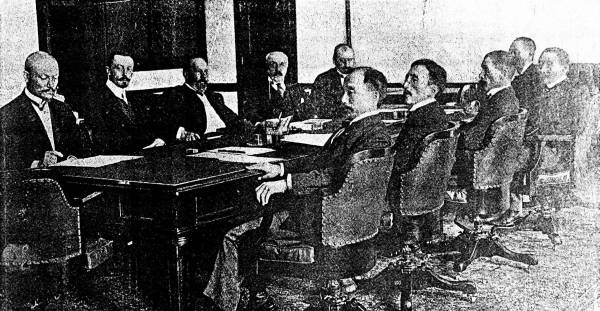
PEACE ENVOYS IN SESSION AT PORTSMOUTH.
Copyrighted by Brown Bros., New York, 1905.
The Russians, from left to right are C. Berg, M. Pokotiloff, M. Witte, Baron Rosen and M. Nabokoff. The Japanese from left to right are Mr. Adatchi, Mr. Otchiai, Baron Komura, Minister Takahira and Mr. A. Sato.
CHAPTER XX.
Aftermath of the Victory of the Sea of Japan—The World Hopes that Peace
Will Result—The President of the United States Takes the Initial Step—Meantime
the Japanese Decline an Armistice—Operations Begun for the
Seizure of Saghalien Island—Japanese Landing Parties Successful—Russians
Continue Flight After Series of Conflicts—Japanese Take Chief Town
of Island, Alexandrovsk, July 25—Flight of Russians and Pursuit Continued—Governor
of Island and Remainder of Garrison Surrender to
Japanese, July 30—Russia and Japan Accept President's Proposal to Meet
and Discuss Terms of Peace—America Chosen as Scene of Meeting—Envoys
Named—Portsmouth, N. H., Selected as Scene of Meeting—Russian
and Japanese Envoys Formally Received by the President at Oyster Bay,
August 5—Sessions of Peace Conference Begin at Portsmouth, August 9—Conference
Adjourns Without Achievement, August 18—President Begins
Effort to Effect Compromise, August 19—Japan Withdraws Demand for
Indemnity and Other Demands on Which There Had Been a Deadlock,
August 29—Announcement Made That Peace is Assured—Work of Drafting
Treaty Begun—Peace Treaty Signed—The Treaty of Peace.
A wave of awe went 'round the word when the full effects
of the Battle of the Sea of Japan were realized. Russia
stood before the world in the light of a thoroughly vanquished
nation. On land her armies had been invariably
defeated in a series of battles of stupendous magnitude. Her
original Asiatic fleet had been annihilated. Her last great effort to
stem the victories of Japan, the sending of a vast Armada to the
Orient, had resulted in complete annihilation of that fleet. The
nations forgot to grieve for the thousands slain in the hope that
this last crowning disaster to Russia would bring what every civilized
land had desired for months—an end to the titanic war.
President Takes Initiative
While this was the universal wish it remained for the President
of the United States to take the
initiative. The fact that, with the exception
of a minor campaign for the possession
of the Island of Saghalien, off
the Siberian coast, this was really the closing chapter of the war,
has added a brilliant feat to the annals of American diplomatic
achievements and has placed the name of Theodore Roosevelt
eternally among those of the famous benefactors of humanity.
Japanese Take Saghalien
As has been said, one minor martial enterprise remained for
the Japanese. Saghalien Island, blanketing the coasts of Siberia for
a distance of 700 miles, had been secured by Russia from Japan
by a treaty partaking, it was claimed by the Japanese, the nature of
a coercive measure. Among the objects for which the Japanese
had entered upon the war were to secure permanent fishing rights
in the waters along the Siberian coast and the recession of Saghalien
Island to her. The seizure of this Island, too, was a necessary
corollary of a land and sea campaign against Vladivostock,
which would have been the next step in her military campaign had
not the war come to an end. There was little surprise, therefore,
when the Tokio government, while giving consent to a proposal
that the belligerent nations meet to talk of peace, refused to consent
to an armistice. Possession of Saghalien Island was still to
be gained. The Japanese campaign began when a landing was
effected on the East coast of the Island
on July 8. The Russian garrison numbered
8,000 men and while there were
defensive works of some strength at a
number of points, the defenders were helpless before the advance
of the invaders. The campaign amounted to a half dozen engagements,
mere skirmishes, when compared with the battles of the
Manchurian campaign. The Russians made a brave defence, but
lost position after position and the subjugation of the Island was
completed on July 30, when the Russian Governor and 3,500 men
surrendered "in the name of humanity." Five days previously the
Japanese had occupied Alexandrovsk, the chief town of the Island
and co-operative naval forces were disposed so that the escape of
the garrison from the Island to the mainland was impossible. The
slaughter of the entire force of the defenders could have been the
only result of continued resistance. The Japanese announced the
organization of a civil administration of the Island the moment
the surrender had been completed, and were thus in possession of
what was actually Russian territory. This fact was important to
the Japanese from several standpoints. The Island is rich in minerals,
it is the centre of the vast fishing industry of the North
Pacific and has strategic value on account of its position with regard
to the entire Siberian littoral. More important than any of
these circumstances, however, was the fact that it had been soil
over which flew the Russian flag. The Japanese contemplated
making a demand for indemnity at the forthcoming peace conference.
Precedent demanded that there should have been the occupation
of territory to make valid such a claim. The occupation of
Saghalien gave this necessary basis for the indemnity demand
which, ultimately was presented and only withdrawn when it became
apparent that the war must go on unless Japan withdrew her claim.
But the conquest of Saghalien marked the last of actual warfare
between Japan and Russia. President Roosevelt had sent an
identical note to Japan and Russia on June 8, calling upon each, in
the name of humanity, to meet to discuss terms of peace and the
whole Saghalien campaign had gone on while, following this request,
diplomatic machinery had been slowly at work preparing the
way for the peace conference. The rest of the story of the Japan-Russia
War has to do with the events which finally called permanent
truce to the long struggle and caused a million fighting men
and their auxiliaries to turn their faces from the rugged plains of
Manchuria, where thousands on thousands had given their lives
for their Emperors and their Fatherlands.
Preparing for Peace Parleys
Russia's acceptance of the President's invitation reached Washington
on June 12, two days after Japan had announced her assent.
A ripple was caused by difficulty
in choosing a place for the meeting.
Russia preferred an European capital.
Japan would not consent to any that
could be named. Russia ultimately yielded the point, and on June
15, with the consent of both of the belligerents, Washington was
named, and a day within the first ten days of August was accepted
for the assembling of the envoys. The Czar named Sergius Witte,
greatest statesman of the Empire, to head the peace delegation, with
Baron Rosen, Russian ambassador at Washington, as his associate.
The Mikado named Baron Komura as chief of the Japanese delegation,
and as his associate, Mr. Takahira, Japanese Minister to
the United States. Accompanying each was a suite of a dozen
secretarys, legal and military experts and interpreters. On July
11, the President named Portsmouth, N. H., Navy Yard as the
actual place of meeting. It was feared that Washington, under the
torrid conditions usually prevailing there in mid-summer, would
prove a too uncomfortable place for the guests of the nation to
spend the weeks that must necessarily be consumed in the negotiations.
The Japanese envoys and their suite reached New York on
July 25. M. Witte, the chief Russian envoy, arrived in New York
with his suite on August 2, and was joined by Baron Rosen, his
associate. Both the Japanese and the Russian delegations were informally
presented to the President at his summer home at Oyster
Bay, N. Y., prior to the formal reception of the two peace missions
which took place on the President's yacht, the Mayflower, in Oyster
Bay on August 5. The President, in a toast to which no reply was
given, expressed the hope that a "just and lasting peace" might
be arranged. The envoys and their suites were conveyed in warships
to Portsmouth, reaching that city on August 7. The envoys
were formally welcomed by United States officials and the Governor
of the State of New Hampshire. The Hotel Wentworth, on
an island off the mainland was made their place of residence. The
newly constructed general stores building in the Navy Yard, which
had been elaborately fitted up with every possible convenience, was
designated as the scene of the sessions.
The Japanese Terms
The first meeting of the envoys was held on August 9. The
Japanese terms were presented in twelve sections, as follows:
I. Recognition of Japan's "preponderating
influence" in Korea.
II. Mutual obligations to evacuate
Manchuria, Russia to retrocede to China
all special privileges.
III. Japanese obligations to restore the sovereignty and administration
of China in Manchuria.
IV. Mutual obligations to respect the territorial and administrative
integrity of China and the principle of the "open door."
V. The cession of the Island of Saghalien.
VI. The surrender of the Russian leases in the Liaotung
Peninsula, including Port Arthur, Dalny and the Blonde and Elliott
Islands.
VII. The cession of the branch of the Chinese Eastern Railroad
from Harbin southward.
VIII. The retention by Russia of that portion of the railroad
line through northern Manchuria connecting the Transsiberian road
with Vladivostock.
IX. The reimbursement of Japan for the war—commonly
spoken of as the indemnity.
X. The surrender of Russian warships which have been interned
in neutral ports during the war.
XI. The limitation of Russia's naval forces in the Pacific.
XII. The question of fishing rights of Russia and Japan off
the Siberian coast.
Japan Makes Peace Possible
These demands, one by one, were discussed by the envoys.
It developed that Russia absolutely refused to grant an indemnity,
to surrender warships interned in Chinese and American ports,
or to cede to Japan the Island of Saghalien. Whatever hope of
compromise there seemed to be with regard to the other questions
at issue it was regarded as absolutely essential to the signing of a
treaty of peace that Russia should yield on the subject of indemnity.
The President's efforts were directed toward accomplishing this result
under some other name than indemnity. It was proposed to
arrange for the payment of the amount demanded as a purchase
price for Saghalien, or for the railway rights over which Japan had
become master. No compromise would be listened to by the Czar,
"Not a kopeck for indemnity," was the phrase of M. Witte, and
there was no yielding. By shrewd diplomatic manœuvring the
Russian envoy had placed Japan in a position which meant that
were the war to be continued it would be upon the responsibility
of Japan and for the sole reason that money must be had. The
Tokio government, after long discussion, decided upon a magnanimous
course, which at once won the encomiums of the whole civilized
world. She yielded every point in dispute, gave up her demand
for indemnity, gave up half of Saghalien,
gave up her claim upon the interned
warships and, though triumphantly
victorious in every step of
the war, accepted terms of peace dictated by the nation
she had conquered, and this "in the name of humanity."
Russia had won the victory on the face of it, but the historian will
credit to Japan the greater and the real victory, a victory of vast
moral and humanitarian significance.
The glad news went out to the world on August 29, that the
envoys had agreed upon every point and that a treaty of peace would
forthwith be drafted. To Prof. Maartens, the famous authority
of international law and to Mr. Dennison, an American, long an
adviser of the Japanese Foreign Office, was assigned the task of
actually drafting the treaty in accord with the general agreement
that had been reached by the envoys. Their work was speedily
accomplished and the "Treaty of Portsmouth" brought to an end
this struggle that had cost hundreds of thousands of lives, billions
of dollars and had completely changed the status of political power
in the Far East.
The treaty of peace was finally signed at Portsmouth, N. H.,
on September 5, 1905; Sergius Witte and Baron Rosen signed for
Russia, while Baron Komura and Mr. Takahira signed for Japan.
It was signed by the Emperors of Russia and Japan and made public
October 16, 1905.
TEXT OF THE TREATY.
The text of the treaty is as follows:
The Emperor of Japan, on the one part, and the Emperor of all the Russias,
on the other part, animated by a desire to restore the blessings of peace
to their countries, have resolved to conclude a treaty of peace, and have for
this purpose named their plenipotentiaries, that is to say, for his Majesty the
Emperor of Japan, Baron Komura Jutaro, Jusami, Grand Cordon of the Imperial
Order of the Rising Sun, his Minister for Foreign Affairs, and his Excellency,
Takahira Kogoro, Imperial Order of the Sacred Treasure, his Minister
to the United States, and his Majesty the Emperor of all the Russias
his Excellency Sergius Witte, his Secretary of State and President of the
Committee of Ministers of the Empire of Russia, and his Excellency Baron
Roman Rosen, Master of the Imperial Court of Russia, his Majesty's Ambassador
to the United States, who, after having exchanged their full powers,
which were found to be in good and due form, have concluded the following
articles:
ARTICLE I.
There shall henceforth be peace and amity between their Majesties the
Emperor of Japan and the Emperor of all the Russias, and between their respective
States and subjects.
ARTICLE II.
The Imperial Russian Government, acknowledging that Japan possesses in
Korea paramount political, military and economical interests, engages neither
to obstruct nor interfere with measures for guidance, protection and control
which the Imperial Government of Japan may find necessary to take in Korea.
It is understood that Russian subjects in Korea shall be treated in exactly
the same manner as the subjects and citizens of other foreign Powers; that is
to say, they shall be placed on the same footing as the subjects and citizens
of the most favored nation. It is also agreed that, in order to avoid causes
of misunderstanding, the two high contracting parties will abstain on the Russian-Korean
frontier from taking any military measure which may menace the
security of Russian or Korean territory.
ARTICLE III.
Japan and Russia mutually engage:
First.—To evacuate completely and simultaneously Manchuria, except the
territory affected by the lease of the Liaotung Peninsula, in conformity with
the provisions of the additional article 1 annexed to this treaty, and,
Second.—To restore entirely and completely to the exclusive administration
of China all the portions of Manchuria now in occupation, or under the
control of the Japanese or Russian troops, with the exception of the territory
above mentioned.
The Imperial Government of Russia declares that it has not in Manchuria
any territorial advantages or preferential or exclusive concessions in the impairment
of Chinese sovereignty, or inconsistent with the principle of equal
opportunity.
ARTICLE IV.
Japan and Russia reciprocally engage not to obstruct any general measures
common to all countries which China may take for the development of
the commerce or industry of Manchuria.
ARTICLE V.
The Imperial Russian Government transfers and assigns to the Imperial
Government of Japan, with the consent of the Government of China, the lease
of Port Arthur, Talien and the adjacent territory and territorial waters, and
all rights, privileges and concessions connected with or forming part of such
lease, and it also transfers and assigns to the Imperial Government of Japan
all public works and properties in the territory affected by the above-mentioned
lease.
The two contracting parties mutually engage to obtain the consent of the
Chinese Government mentioned in the foregoing stipulation.
The Imperial Government of Japan, on its part, undertakes that the proprietary
rights of Russian subjects in the territory above referred to shall be perfectly
respected.
ARTICLE VI.
The Imperial Russian Government engages to transfer and assign to the
Imperial Government of Japan, without compensation and with the consent of
the Chinese Government, the railway between Changchunfu and Kuanchangtsu
and Port Arthur, and all the branches, together with all the rights, privileges
and properties appertaining thereto in that region, as well as all the coal
mines in said region belonging to or worked for the benefit of the railway.
The two high contracting parties mutually engage to obtain the consent of the
Government of China mentioned in the foregoing stipulation.
ARTICLE VII.
Japan and Russia engage to exploit their respective railways in Manchuria
exclusively for commercial and industrial purposes and nowise for strategic
purposes. It is understood that this restriction does not apply to the railway
in the territory affected by the lease of the Liaotung Peninsula.
ARTICLE VIII.
The Imperial Governments of Japan and Russia with the view to promote
and facilitate intercourse and traffic will as soon as possible conclude a separate
convention for the regulation of their connecting railway services in
Manchuria.
ARTICLE IX.
The Imperial Russian Government cedes to the Imperial Government of
Japan in perpetuity and full sovereignty the southern portion of the Island
of Saghalin and all the islands adjacent thereto and the public works and properties
thereon. The fiftieth degree of north latitude is adopted as the northern
boundary of the ceded territory. The exact alignment of such territory
shall be determined in accordance with the provisions of the additional article
II annexed to this treaty.
Japan and Russia mutually agree not to construct in their respective possessions
on the Island of Saghalin or the adjacent islands any fortification or
other similar military works. They also respectively engage not to take any
military measures which may impede the free navigation of the Strait of La
Perouse and the Strait of Tartary.
ARTICLE X.
It is reserved to Russian subjects, inhabitants of the territory ceded to
Japan, to sell their real property and retire to their country, but if they prefer
to remain in the ceded territory they will be maintained and protected in the
full exercise of their industries and rights of property on condition of submitting
to the Japanese laws and jurisdiction. Japan shall have full liberty to
withdraw the right of residence in or to deport from such territory of any
inhabitants who labor under political or administrative disability. She engages,
however, that the proprietary rights of such inhabitants shall be fully
respected.
ARTICLE XI.
Russia engages to arrange with Japan for granting to Japanese subjects
rights of fishery along the coasts of the Russian possession in the Japan, Okhotsk
and Bering Seas.
It is agreed that the foregoing engagement shall not affect rights already
belonging to Russian or foreign subjects in those regions.
ARTICLE XII.
The treaty of commerce and navigation between Japan and Russia having
been annulled by the war the Imperial Governments of Japan and Russia engage
to adopt as a basis for their commercial relations pending the conclusion
of a new treaty of commerce and navigation the basis of the treaty which
was in force previous to the present war, the system of reciprocal treatment
on the footing of the most favored nation, in which are included import and
export duties, customs formalities, transit and tonnage dues and the admission
and treatment of agents, subjects and vessels of one country in the territories
of the other.
ARTICLE XIII.
As soon as possible after the present treaty comes in force all prisoners
of war shall be reciprocally restored. The Imperial Governments of Japan
and Russia shall each appoint a special commissioner to take charge of the
prisoners. All prisoners in the hands of one Government shall be delivered
to and be received by the commissioner of the other Government or by his duly
authorized representative in such convenient numbers and at such convenient
ports of the delivering State as such delivering State shall notify in advance
to the commissioner of the receiving State.
The Governments of Japan and Russia shall present each other as soon
as possible after the delivery of the prisoners is completed with a statement
of the direct expenditures respectively incurred by them for the care and maintenance
of the prisoners from the date of capture or surrender and up to the
time of death or delivery. Russia engages to repay to Japan as soon as possible
after the exchange of statement as above provided the difference between
the actual amount so expended by Japan and the actual amount similarly
disbursed by Russia.
ARTICLE XIV.
The present treaty shall be ratified by their Majesties the Emperor of
Japan and the Emperor of all the Russias. Such ratification shall be with as
little delay as possible, and in any case no later than fifty days from the date
of the signature of the treaty, to be announced to the Imperial Governments
of Japan and Russia respectively through the French Minister at Tokio and
the Ambassador of the United States at St. Petersburg, and from the date
of the latter of such announcements this treaty shall in all its parts come into
full force. The formal exchange of ratifications shall take place at Washington
as soon as possible.
ARTICLE XV.
The present treaty shall be signed in duplicate in both the English and
French languages. The texts are in absolute conformity, but in case of a
discrepancy in the interpretation the French text shall prevail.
SUB-ARTICLES.
In conformity with the provisions of articles 3 and 9 of the treaty of
peace between Japan and Russia of this date the undersigned plenipotentiaries
have concluded the following additional articles:
SUB-ARTICLE TO ARTICLE III.
The Imperial Governments of Japan and Russia mutually engage to commence
the withdrawal of their military forces from the territory of Manchuria
simultaneously and immediately after the treaty of peace comes into operation,
and within a period of eighteen months after that date the armies of the two
countries shall be completely withdrawn from Manchuria, except from the
leased territory of the Liaotung Peninsula. The forces of the two countries
occupying the front positions shall first be withdrawn.
The high contracting parties reserve to themselves the right to maintain
guards to protect their respective railway lines in Manchuria. The number of
such guards shall not exceed fifteen per kilometre and within that maximum
number the commanders of the Japanese and Russian armies shall by common
accord fix the number of such guards to be employed as small as possible
while having in view the actual requirements.
The commanders of the Japanese and Russian forces in Manchuria shall
agree upon the details of the evacuation in conformity with the above principles
and shall take by common accord the measures necessary to carry out the evacuation
as soon as possible, and in any case not later than the period of eighteen
months.
SUB-ARTICLE TO ARTICLE IX.
As soon as possible after the present treaty comes into force a committee
of delimitation composed of an equal number of members is to be appointed
respectively by the two high contracting parties which shall on the spot mark
in a permanent manner the exact boundary between the Japanese and Russian
possessions on the Island of Saghalin. The commission shall be bound so far
as topographical considerations permit to follow the fiftieth parallel of north
latitude as the boundary line, and in case any deflections from that line at
any points are found to be necessary compensation will be made by correlative
deflections at other points. It shall also be the duty of the said commission to
prepare a list and a description of the adjacent islands included in the cession,
and finally the commission shall prepare and sign maps showing the
boundaries of the ceded territory. The work of the commission shall be subject
to the approval of the high contracting parties.
The foregoing additional articles are to be considered ratified with the ratification
of the treaty of peace to which they are annexed.
In witness whereof the respective plenipotentiaries have signed and affixed
seals to the present treaty of peace.
Done at Portsmouth, New Hampshire, this fifth day of the ninth month of
the thirty-eighth year of the Meijei, corresponding to the twenty-third day of
August, one thousand nine hundred and five. (September 5, 1905.)
Transcriber's Note:
Names, italicized phrases, and
inconsistencies in capitalization and hyphenation have been left as printed.
Otherwise, obvious typographical errors, punctuation errors, and inconsistencies in the punctuation
of sidenotes and captions have been corrected.
Illustrations have been moved so that they do not break up paragraphs, thus the
page number of the illustration might not match the page number in the List of
Illustrations. Links in the List of Illustration lead to the images.
On page 278, "Commander-inChief" has been changed to "Commander-in-Chief" ("During
the months which had elapsed since the arrival of the Russian Commander-in-Chief
at the seat of war").
On page 373, "silhouttes" has been changed to "silhouettes" ("two long dark
silhouettes, emitting quantities of smoke and evidently steaming at high speed").
On page 374, "silhouttes" has been changed to "silhouettes" ("two long,
dark silhouettes emitting quantities of smoke").
On page 427, "(9)" has been changed to "(10)" ("(10) Wounds inflicted by modern
arms heal readily").
On page 433, "mobility" has been changed to "immobility" ("the inexorable grasp
of the Manchurian winter had fallen upon them and frozen them into immobility").
On page 458, "unrecord" has been left as printed ("continued under these unrecord
of the actual campaign").
On page 507, "tht" has been changed to "the" ("General Oku avoided the Russian right
centre just left of the railroad").
On page 518, "Russians resistance" has been changed to "Russian resistance"
("Thereupon the Russian resistance was redoubled in fury").
On page 537, counts of ships have been left as printed.