This tie-up contains in its principle the foundation of all the others. Three
methods are in common use, which we will now explain.
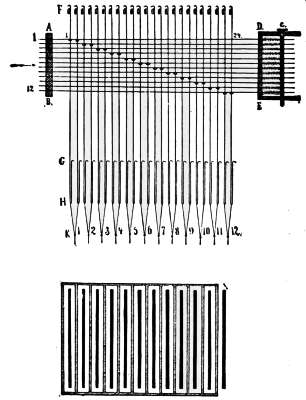
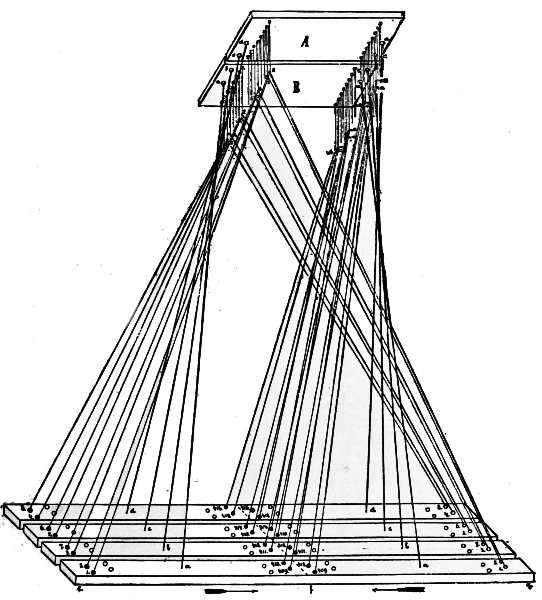
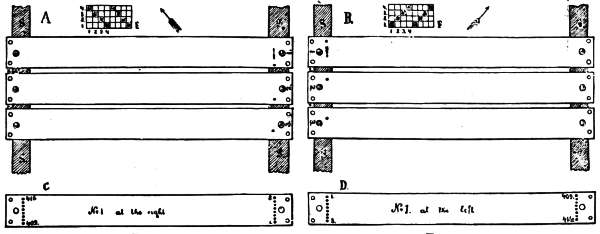
This tie-up is represented in Fig. XXV.
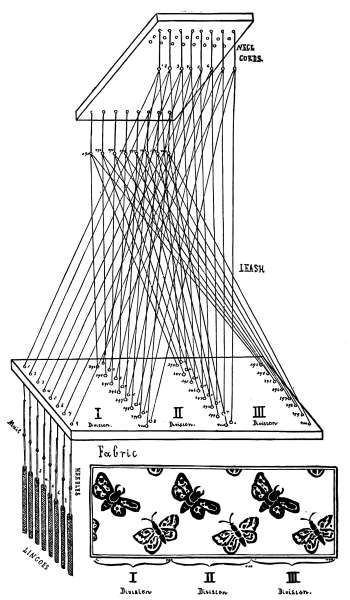
Fig. XXV.
As mentioned in the heading of this article, the Jacquard harness, or the
leashes, are fastened to the machine in rotation from front to rear, the threading of
the comber-board being done from rear to front. The comber-board is in three
divisions. The machine used for illustrating is a 400 Jacquard 8-row machine, and
the comber-board used is also 8 rows deep. This method of tying-up of the
leashes forms what is technically known as “open harness.” As the drawing is
designed to explain a 400 machine, 8 rows drawn in the comber-board, also 8 rows
deep, one row in height of the cylinder will equal one row in depth on the comber-board.
In examining the illustration the eye must follow the line connecting the
numbers on the neck-cords to the corresponding numbers near the holes on the
comber-board. If this be done, the tie-up will readily explain itself. It will also
explain the method of procedure if
a machine is used containing a different
number of needles and hooks,
and a comber-board having as many
rows in depth as there are griffe-bars
in the machine. For example,
a 600 machine, with 12 griffe-bars,
needs for this tie-up a comber-board
12 rows deep; and a 200 machine,
with 8 griffe-bars, requires a comber-board
8 rows deep, etc., etc.
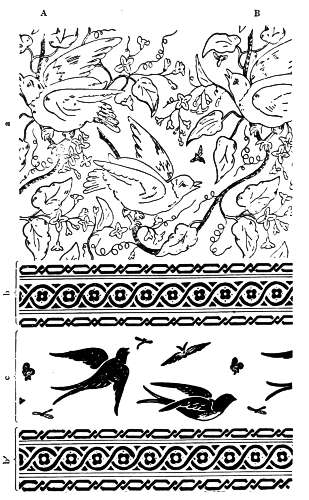
Fig. XXVI.
The drawing shows a comber-board
with 3 divisions, each division
furnishing one harness-cord to each
neck-cord, making in all three harness-cords
to every neck-cord. The
same tie-up will apply should the
drawing contain a different number
of divisions. The illustration shows
only the first and last rows of each
division in the comber-board, and
also the first and last rows of neck-cords.
The design below the drawing
represents a damask fabric to be
executed on this tie-up, requiring
the whole number of needles for one
repeat of the pattern of 400 threads.
In designing for these tie-ups it is
necessary to arrange the design
to repeat itself in the number of
needles that will be used in producing
the fabric. The first and last threads must connect with each other, without
interruption, forming a continuous design over all the divisions. Thus we find, in
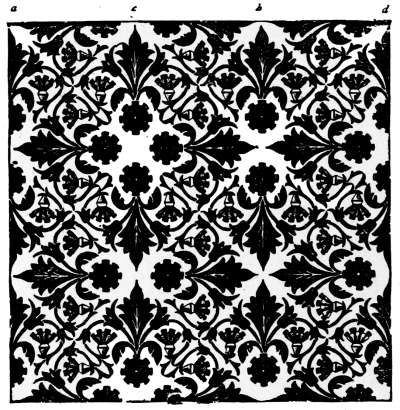
fabric design of a damask towel, Fig. XXVI., the repeat (division) from A to B.
In the centre of the design marked a, and the main part of the border marked c, we
find one repeat; whereas borders b and b´ repeat 8 times.
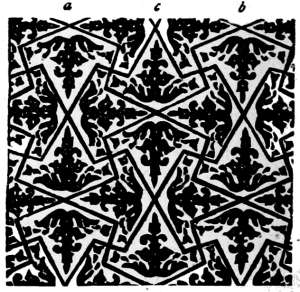
In the fabric illustrated by design, Fig. XXVII., again a damask towel, the
repeat, or one division, is also indicated by A to B. The centre of the fabric, a,
repeats twice in one division; borders b and b´ repeat four times in the same distance;
whereas the main design of the border indicated by c requires one complete division.
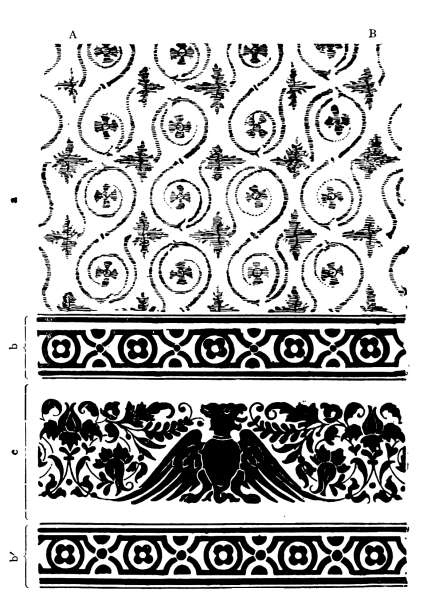
Fig. XXVII.
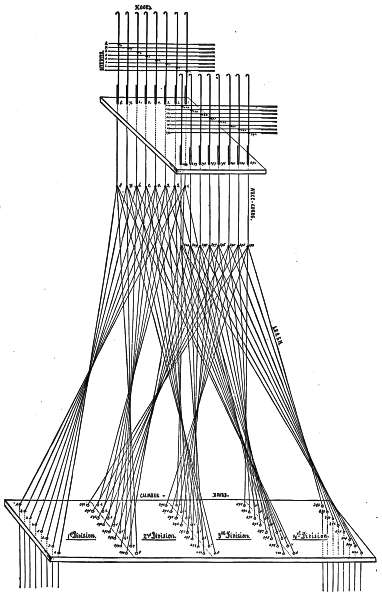
Fig. XXVIII.
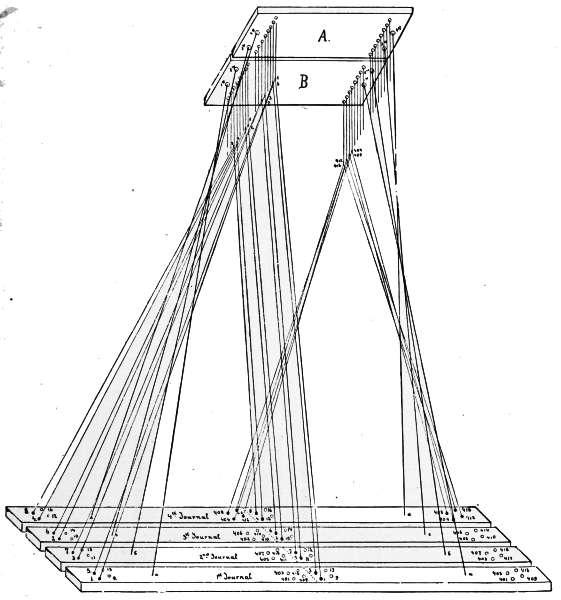
This is the second method for the straight-through tie-up, and is illustrated in
Fig. XXVIII. The Jacquard harness is fastened to the machine, at the neck-cords,
from rear to front. The threading of the comber-board is also from rear to front.
In this method the work of attaching the leashes to the neck-cords is commenced in
the rear instead of the front of the machine, thus giving a different view and
arrangement of the tie-up. This disposition of the threads is called a “sectional
harness arrangement.”
The illustration shows a 400 Jacquard or 8-row machine, in connection with an
8-row deep comber-board, with one row in the comber-board requiring a
corresponding row on the face of the cylinder. It will also explain the method of
procedure with this tie-up in Jacquard machines with comber-boards of different sizes.
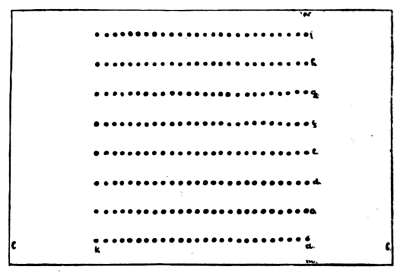
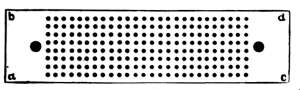
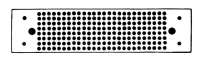
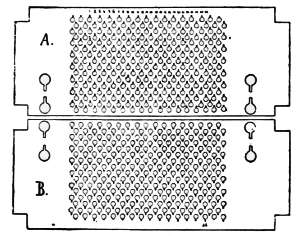
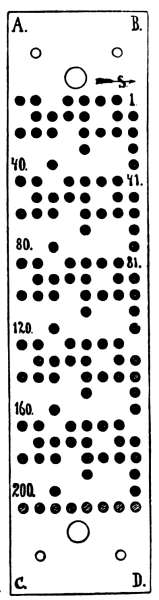
Fig. XXIX. represents the perforated board at the bottom of the machine
through which the neck-cords pass, attaching the leash to the neck-cords. The first
row, containing neck-cords numbered 1, 2, 3, 4, 5, 6, 7, and 8, and the 50th row,
containing those numbered 393, 394, 395, 396, 397, 398, 399, and 400, are the only
ones shown in Fig. XXVIII. illustrating the tie-up. The comber-board is divided
into four sections; hence, the drawing, as represented in Fig. XXVIII., calls for a
fabric with 1600 ends in width. 400 ends, or any number dividing into 400, can be
used for the repeat of the pattern. The method followed in the illustration may be
applied to any size of Jacquard machine, and also to any required number of
divisions in the comber-board.
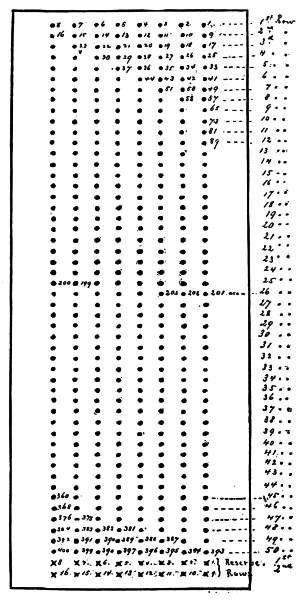
Fig. XXIX.
In ascertaining the number of
hooks or needles for one repeat of
the design, determine accurately if
the repeat of the weave employed
for binding the ground or the figure
divides evenly into this number.
For example, take bottom board,
Fig. XXIX., calling for 400 hooks
and 400 needles. Suppose the
ground weave to be an 8-leaf satin,
and the design to repeat once in
the 400 hooks. 400 ÷ 8 = 50
repeats, showing an equal division
But suppose a 12-leaf satin is used;
it is obvious that 12 is not an even
factor of 400, as the division shows
a remainder of 4. To dispose of
this remainder two methods are
open:
First. Omit last 4 ends and use
only 396 hooks, a multiple of 12,
giving 33 repeats; or,
Second. Add 8 hooks from the
reserve rows, elsewhere previously
alluded to, thus increasing the number
to 408, which is also a multiple
of 12, giving 34 repeats.
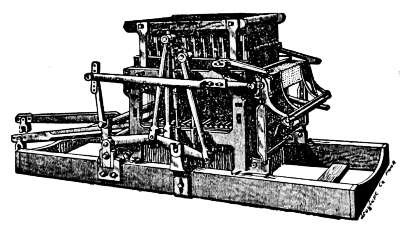
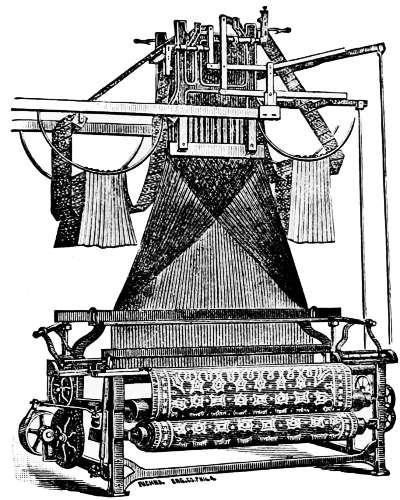
The English system, which is
widely used, has the Jacquard machine
so adjusted upon the loom as
to have the cylinder lengthways,
running in the same direction as
the comber-board; or, what is the
same thing, running in the direction of the width of the fabric. [See Fig. XXX.]
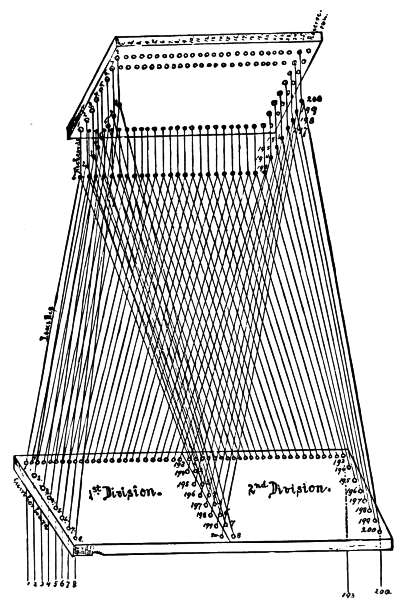
Fig. XXX.
The 8 hooks of one cross-row (one hook from each of the 8 griffe-bars) run in the
direction from the cloth beam towards the warp beam. Having the same number of
rows in depth, in comber-board as there are griffe-bars, one may readily see the
advantages of this tie-up. The first row in depth of the comber-board contains
harness-cords from neck-cords 1 to 8. The second row deep of comber-board
contains harness-cords from neck-cords
9 to 16, finishing each division
on the last (25th) row, with
harness-cords from neck-cords
193 to 200.
Should we have a 600 machine,
with 12 rows, the comber-board
would also have 12 rows,
as the 600 machine contains 12
griffe-bars. The first row of the
comber-board receives the harness-cords
from Nos. 1 to 12;
the second row from Nos. 13 to
24, and so on, finishing on the
last (50th) row of comber-board
with 589 to 600.
This method of arranging the
tying-up of the Jacquard harness
is based upon the necessity for
producing patterns having a
larger number of warp-threads
than the Jacquard used has needles.
The principle to be observed
is found in producing
small effects which repeat themselves
in the general design.
The number of cords for the leashes depends upon the frequency with which
these repeats occur. Fabrics with stripe effects offer greater opportunities for
reducing the number of hooks and needles than other designs. Fig. XXXI.
illustrates such a design with its tie-up, using a 400 Jacquard machine with 8 rows.
The pattern shows four distinct effects, as follows:
- A, requiring rows 1 to 16, inclusive; or harness-cords 1 to 128, inclusive.
- B, requiring rows 17 to 21, inclusive; or harness-cords 129 to 168, inclusive.
- C, requiring rows 22 to 34; or harness-cords 169 to 272, inclusive.
- D, requiring rows 35 to 50; or harness-cords 273 to 400, inclusive.
- In this fabric we find 2 full repeats of the design: first, E to F;
second, E´´ to
F´´, thus requiring two divisions in the comber-board, as indicated by the vertical
line between F and E´´.
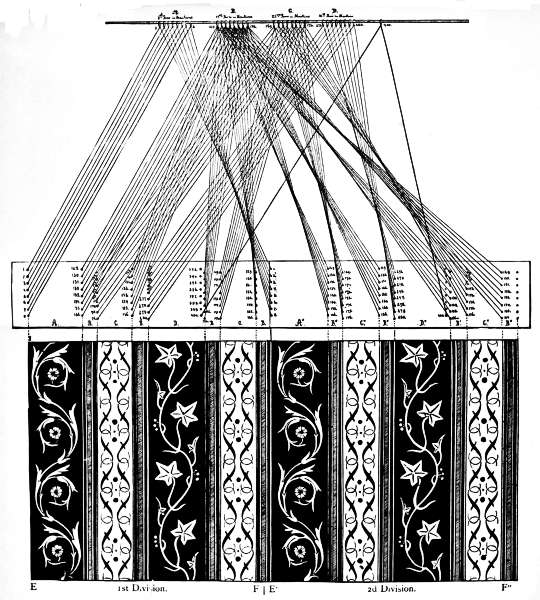
Fig. XXXI.
The next subject to consider is the different arrangement of repeated effects in
one division. Commence at the left-hand side of the fabric sketch with effect A,
which repeats only once in one pattern or one division. The illustration shows two
divisions, and also that each hook of rows 1 to 16, inclusive, in the first division can
be connected with each hook of rows 1 to 16, inclusive, in the second division, because
these rows produce the same effect in the design, which repeats itself in these two
places. This connection forms what is technically called a leash, and it will always
be found that for every harness-cord a leash contains, there will be found a repeat in
the design to correspond.
Effect B is repeated four times in the design, or in each division. By having
two divisions for the illustration we find that to produce the necessary repeats in
the design each hook of rows 17 to 21, inclusive, requires 8 harness-cords to each
leash.
Effect C repeats twice in one pattern or one division. Having two divisions for
the illustration, each hook of row 22, including row 34, requires 4 harness-cords to
each leash.
Effect D repeats once in pattern, once in division. This will give a result
similar to A, two divisions, row 35, including row 50, with two harness-cords to each
leash. This tie-up illustrates the first row of every effect, and also the last leash,
400.
Adding the number of warp-threads in the full repeat of the pattern, we have:
| Effect A = | 128 threads. |
| Effect B = | 40 threads. |
| Effect C = | 104 threads. |
| Effect B = | 40 threads. |
| Effect D = | 128 threads. |
| Effect B = | 40 threads. |
| Effect C = | 104 threads. |
| Effect B = | 40 threads. |
| | ---- |
| | 624 threads. |
Or, in other words, we are producing with a “straight-through tie-up for repeated
effects” on a 400 Jacquard machine, a design, which would require a 600 machine on
a common straight-through tie-up, including the two reserve rows, or 624 needles;
in other words, a saving is made of 224 needles in one full repeat of the pattern.
In designing for looms tied up for similar styles, the repeats of effects must be
kept in mind. The general style of every design may be changed, but the
arrangement of the repeated effects cannot be altered without changing the entire
Jacquard harness.
As mentioned in the beginning of this work, every Jacquard machine contains
two reserve rows, which may be used for various purposes. One of the purposes
to which these rows are frequently put is the enlargement of the design of the
fabric by using harness on the front of the comber-board, technically known as
“front harness.” For example, in damask table-cloths, we may use the Jacquard
harness for producing the border of the fabric. The centre part may be produced
with front harness, forming a checkerboard, or some similar effect. This process
may be reversed by designing the
centre of the table-cloth for the Jacquard
harness, and the border for the
front harness.
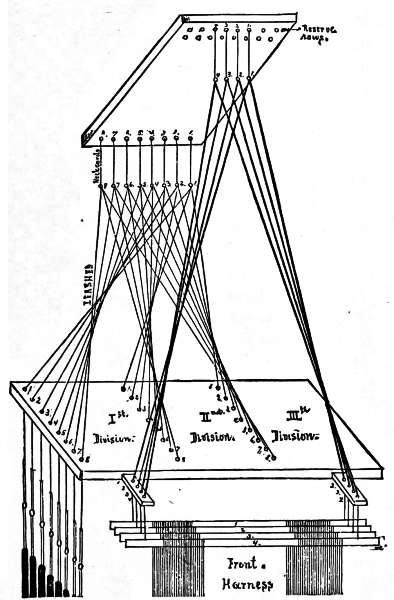
Fig. XXXII.
A third method is to design part
of the centre and part of the border
for the Jacquard harness, the other
parts being designed for the front
harness. This tie-up is also used to
a great extent in the manufacture of
dressgoods, etc., where stripe effects
produced by the front harness, alternate
with floral or geometrical designs
produced by the Jacquard harness.
In Fig. XXXIII. the centre of a
table-cloth cover is shown to further
illustrate this method of tying-up.
One-half of the width of the design is
for the Jacquard harness; the other
half is for the front harness. To produce
the required checkerboard effect
these front harness are used here in
two distinct sets.
The 1st set = 5 harness, working
on the 5-leaf satin warp for face,
alternating with the
2d set = 5 harness, working on
the 5-leaf satin filling for face.
If only 8 front harness should be used for the design, we should have the
- 1st set = 4 harness, working on the 4 harness broken twill warp for face.
- 2d set = 4 harness, working on the 4 harness broken twill filling for face.
Set 1 to alternate with set 2 to form the check. Care must be taken that the
number of checks formed by the front harness are evenly arranged to the figured
part of the fabric. For example, Fig. XXXIII., in the front harness part of the
design shows 5 warp checks and 5 filling checks in one row, = 10 checks.
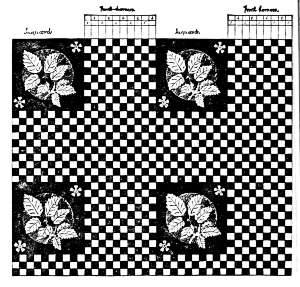
Fig. XXXIII.
Suppose 10 front harness are used and 20 warp-threads allowed for each check;
then 20 × 10 = 200 warp-threads, all used for effects by the front harness.
This requires 200 warp-threads
for figure effects
to be used by the Jacquard
harness.
The repeat of the pattern
is therefore 400 warp-threads,
which is produced
by straight-through tie-up,
front harness attached,
with 200 hooks and needles
for FIGURE PART of the
design, plus 10 hooks and
needles for CHECKERBOARD
PART of the fabric taken
from the 16 hooks and
needles of 2 reserve rows,
leaves 6 hooks and needles
for selvedge, etc.
As previously stated,
the front harness may be
used for dressgoods fabrics.
In this way the design
may be enlarged to any required extent.
Fig. XXXII. illustrates this method, using an 8-row Jacquard machine, with
4 front harness adjusted, in common use for the manufacture of dressgoods fabrics,
damasks, etc.
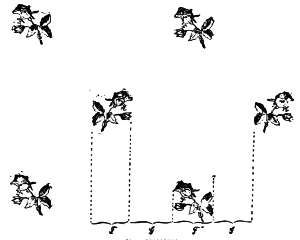
Fig. XXXIV.
Fig. XXXIV. shows a fabric
designed for dressgoods forming
an all-over-set pattern. In this
design parts F and F´´ must
be executed with the Jacquard
leashes; parts G and G can be
executed with front harness. For
example: parts F and F´´ require
each 100 hooks, the ground part
to be woven in 4 harness broken
twill. We find the answer as to
number of warp-threads in the
repeat and number of hooks required
for weaving as follows:
| F | = |
100 threads. |
| G | = |
100 threads (because covering the same distance as F in part of the fabric.) |
| F´´ | = |
100 threads |
| G | = |
100 threads |
| | | ---- |
| | | 400 warp threads in repeat. |
| |
| F | = | 100 hooks. |
| F´´ | = | 100 hooks |
| | | ---- |
| | | 200 hooks for figure. |
| | | 4 hooks for weaving the ground, front harness. |
| | | ---- |
| | | 204 hooks required to weave design, Fig. XXXIV.,
repeating with 400 warp-threads. |
The centre tie-up, also called the point tie-up, has for its purpose the
enlargement of the design in fabrics such as table-covers, dressgoods, etc. This
tie-up resembles in its principle that of a common
point-draw on the harness-loom. After drawing
from front to rear once straight through the
entire set of harness, draw from rear to front
and repeat. The only difference between
harness-work and Jacquard work is in the fact, that with harness we commence to
draw in from the first harness straight through to the last, A to B, and back again,
B to C; but with the Jacquard tie-up on this method this is arranged through the
threading of the comber-board, having a straight-through leasing of the heddles and
drawing in of the warp.
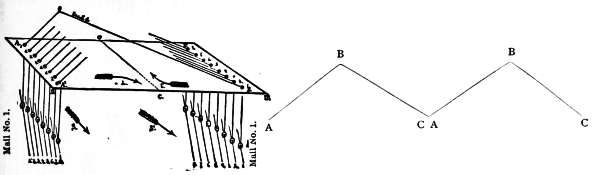
Fig. XXXV.
In Fig. XXXV. there is a clear illustration given of the principle of the centre
tie-up on an 8-row comber-board A, A´, B, B´. In laying out the comber board, it
must be divided by the line C, C´, into two equal parts, D, C, and C, D´. In the part
A, A´, C, C´, of the comber-board, we commence threading with leash 1 at the left-hand
rear corner, running in succession towards the centre, as indicated by the
arrow on this part of the comber-board.
In part B, B´, C, C´, the threading begins in the opposite corner, to the right-hand
in front, with number 1 leash, threading in rotation the number of leashes from
the front towards the rear, as again indicated on the figure by an arrow. After
leasing and threading the harness, No. 1 leash will contain in its two mails the first
and the last of the warp-threads, as indicated in Fig. XXXV. by the numbers, and
the rotation by the arrows, S and S´.
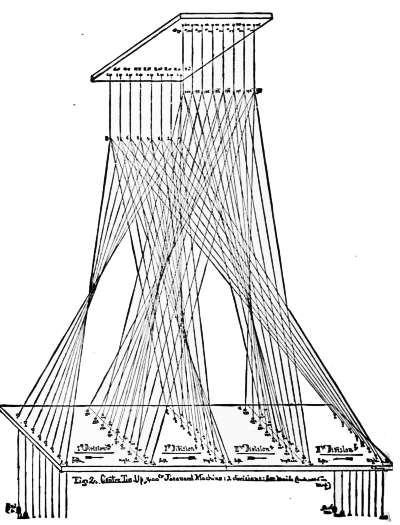
Fig. XXXVI.
Fig. XXXVI. represents
this centre or point tie-up applied
to a 200 Jacquard machine;
comber-board, 8 rows
deep; two full divisions; A, B,
the first division; B, D, the
second division; C and C´ forming
the centre in each division.
This machine will, if tied-up in
this manner, produce a design
requiring 400 warp-threads.
We must arrange the design
for this tie-up so as to repeat
forwards and backwards respectively
in the centre. Such
a design will run upwards at a
given angle to a definite point,
then it will return by the same
angle in an opposite direction
until it reaches the base from
which it originally started.
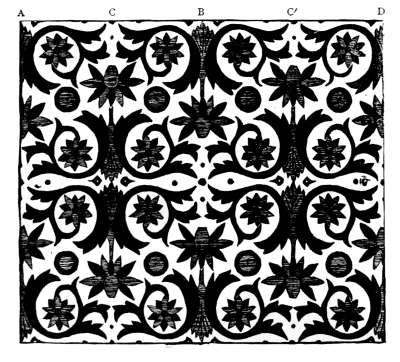
Fig. XXXVII.
In this manner design,
Fig. XXXVII., is constructed.
A, B, C, C´, D, correspond with
the same letters used in Fig.
XXXVI.; hence, it will readily
explain itself, as well as the
method to be observed in designing
for this kind of tie-up.
The design runs straight
through from A to C, and repeats
itself backwards from C
to B, finishing at B the first
full division.
B-C´ equal A-C,}
C´-D equal C-B,} forming the second division.
Any changes as to different
sizes of machines, rows deep
of comber-board, or number of
divisions, must be executed
upon the principle explained
in this article.
A.—For fabrics requiring for their centres a straight-through tie-up and for their
borders a point tie-up, one-half division of it for each border.
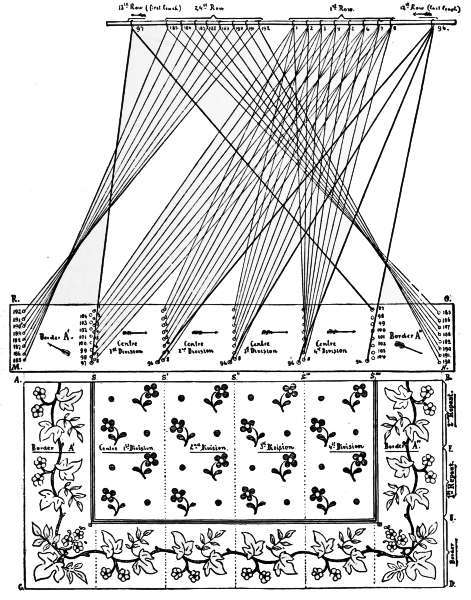
Fig. XXXVIII.
These tie-ups are used to a great extent for napkins, handkerchiefs, scarfs, and
similar damask fabrics, in which the centre part of the fabric is worked on the straight-through
method; the borders on each side on the point tie-up, repeating equally from
centre towards the selvedge. In the other two borders to be woven at the beginning
and the end of the fabric, the same principle is observed, thus producing four corner
squares, only two of which need be designed, as the other two repeat through the
arrangement of the tie-up, which must repeat equally towards both sides of the
border at the connecting places.
Fig. XXXVIII. illustrates this method of tying-up a 200 machine, using 192
hooks and needles, equal to 24 long rows of a regular 8-row deep machine. The
machine is divided into two sections, as follows:
| Needles 1 to 96 for the 1st section or centre. |
| Needles 97 to 192 for the 2d section or the border. |
| 4 repeats of centre, |
= 4 x 96 = 384 | ends. |
| 2 repeats of border, one for each side, |
= 2 x 96 = 192 | ends. |
| ---- | |
| 576 | ends in fabric,
not including selvedge. |
The drawing represents four divisions for the centre, hence four harness-cords
for each leash. The border, having only two repeats in the fabric, will contain
only two harness-cords to one leash. In
the drawing the first full row of the machine
is indicated, which is equal to the first
row deep of every centre division; containing
harness-cords 1, 2, 3, 4, 5, 6, 7, and 8.
We also show (heavy line) the last centre
leash, No. 96 being the last hook of row 12
of the machine. The borders A´ and A´´ are
from the same design, but the figure runs in
an opposite direction in each one, as indicated
by the arrows in the comber-board above.
Border A´ commences with harness-cord from
leash 192, ending with harness-cord from
leash 97, near the centre design. Border A´´
commences with harness-cord from leash 97,
near the centre design, ending with harness-cord
from leash 192 near the selvedge. The great difficulty to be overcome in
arranging these patterns for the loom is in the union of the two tie-ups, the straight-through
and the point.
As previously stated, the borders A´ and A´´ are made with the point tie-up, while
the remainder of the borders are made with the straight-through tie-up. The combination
of these two tie-ups occurs in the corner squares of the border, and the
arrangement must be such as will permit the two sides of the corner patterns to
properly unite with the design for the balance of the border.
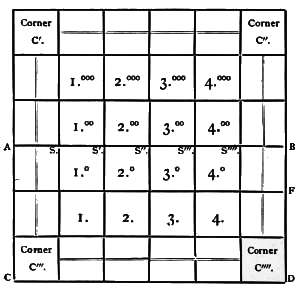
Ground plan for above fabric: Letters A, C, D, B, F, correspond to same letters
as used on the outside of fabric design. S, S´, S´´, S´´´, S´´´´, also correspond for
centre division.
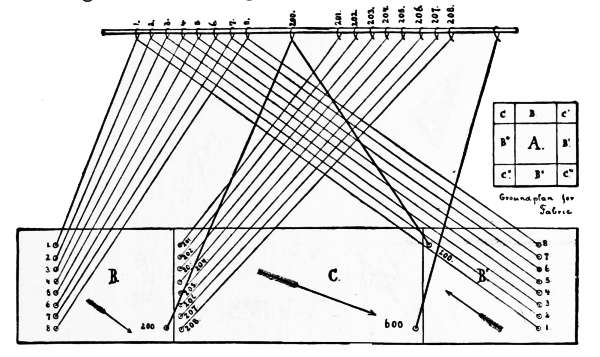
Fig. XXXIX.
For the purpose of giving a correct comprehension of the foregoing explanation
of tying-up, but under a different arrangement, Fig. XXXIX. was designed for a
600 machine, having the same arrangement of the borders, viz.: point tie-up, using
one-half division for each side; the centre a straight tie-up, but employing only
one repeat. The following particulars will explain the entire procedure:
200 needles and hooks are used for borders, point tie-up, once through, equals
1/2 division for each border. [See letters B and B´ on comber-board.]
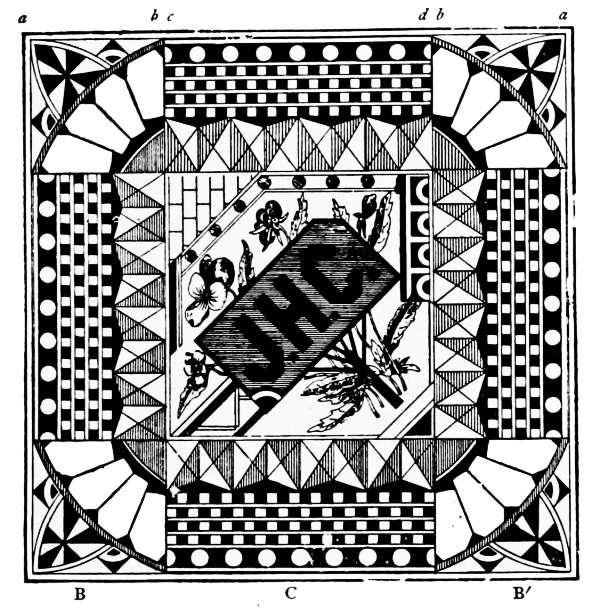
Fig. XL.
400 needles and hooks are used for centre, straight tie-up, one repeat. [See
letter C on comber-board.]
| 200 ends for each border, | = | 400 warp-threads. |
| 200 ends for centre, | = | 400 warp-threads. |
| | ---- |
| | 800 warp-threads. |
In the ground plan of the fabric A is the centre; B, B´, B´´, B´´´, borders;
C, C´, C´´, C´´´, corners.
Fig. XL. is a fabric design executed on this principle: a to b, border; c to d,
centre; b to a, repeat of the first border.
B.—For fabrics requiring for their centres a straight-through tie-up, and for
their border on point tie-up one full division for each border.
This arrangement of both foundation tie-ups resembles the preceding. The
only difference is found in employing the full division of the centre or point tie-up
for each border instead of the half division.
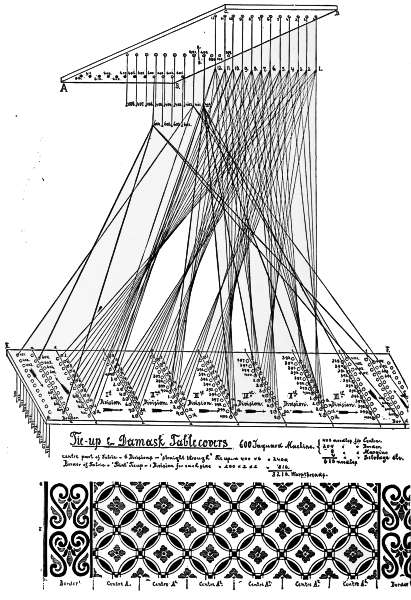
Fig. XLI.
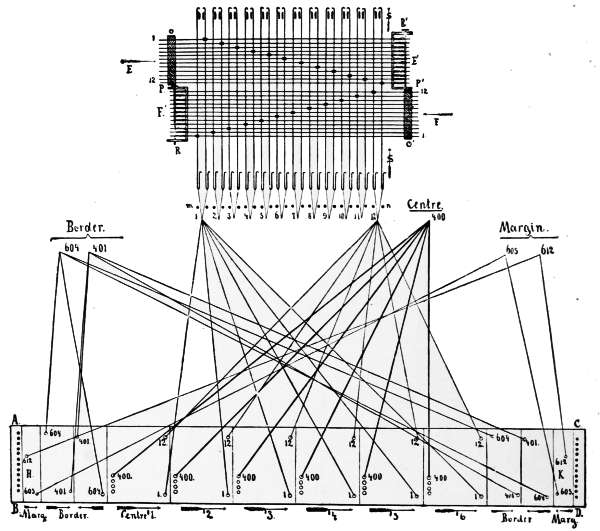
Fig. XLI. illustrates this method of tying-up adjusted to a 600 Jacquard
machine. The centre of the fabric requires 400 needles and hooks in 6 repeats or
divisions, or 400 × 6 = 2400 warp-threads. The border calls for 204 needles and
hooks, point tie-up, one full division for each side, or 204 × 2 x 2 = 816 warp-threads.
The arrangement of margin and selvedge, as applied on each side, is explained
separately through ground plan of comber-board by fig. XLII. The margin calls for
8 needles and 8 hooks in machine, 6 repeats of same for each side, or 96 warp-threads.
The selvedge is formed by 2, 4 or 8 needles, (working plain), and has
24 heddles for each side or 48 selvedge-threads in warp. These selvedge ends may,
if preferred, be drawn two ends in one heddle. By adding these different systems
of threads we find:
| Centre | = | 2400 warp-threads. |
| Borders | = | 816 warp-threads.
(814 if point drawn only once.) |
| Margin | = | 96 warp-threads. |
| Selvedge | = | 48 warp-threads. |
| | ----- |
| | 3360 threads in warp. |
For the centre part of the fabric, needle and hook 1 to 400 are used.
For the border part of the fabric, needle and hook 401 to 604 are used.
For the margin part of the fabric, needle and hook 605 to 612 are used.
Leaving one complete row of the reserve to use for selvedge, etc., if required.
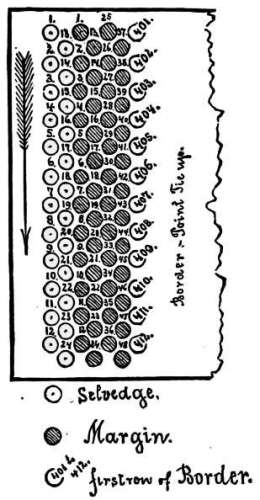
Fig. XLII.
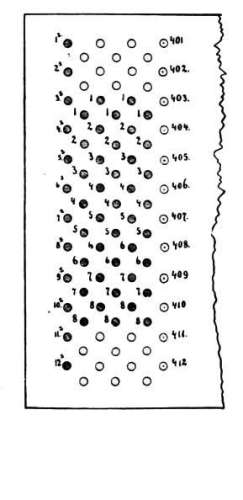
Fig. XLIII.
In drawing, Fig. XLI., we only illustrate centre and border of the tie-up, so as not
to confuse the eye by too many lines, and, as mentioned at the beginning, employed
Fig. XLII. for illustrating the ground plan for selvedge and margin. In selvedge
and margin the harness-cords are indicated by consecutive numbers, thus:
Margin, 1 to 48.
Selvedge, 1 to 24.
When threading margin in comber-board:
1, 9, 17, 25, 33, 41, call for the same leash.
2, 10, 18, 26, 34, 42, call for the same leash.
3, 11, 19, 27, 35, 43, call for the same leash.
4, 12, 20, 28, 36, 44, call for the same leash.
5, 13, 21, 29, 37, 45, call for the same leash.
6, 14, 22, 30, 38, 46, call for the same leash.
7, 15, 23, 31, 39, 47, call for the same leash.
8, 16, 24, 32, 40, 48, call for the same leash.
Leashes in centre part of fabric, 1 to 400 call for 6 harness-cords.
Leashes in border part of fabric, 401 to 604 call for 14 harness-cords.
Leashes in margin part of fabric, 605 to 612 call for 12 harness-cords.
Leashes for selvedge if using 4 hooks, 613 to 616 call for 12 harness-cords.
This tie-up is the one most frequently employed in the manufacture of damask
table-covers. Not only will drawings and explanations lead to a thorough
understanding of the procedure, but they will also readily show the great variety of
textile fabrics to which the principle of this tie-up may be applied.
Fig. XLIII. illustrates the margin arranged 8 threads for each row, and 5
rows or 40 threads for each side. The selvedge in this drawing is illustrated
by one complete row of 12 double threads for each side. The selvedge and
margin holes are all represented shaded. The selvedge is marked S in addition
to the number. The five margin rows are indicated each by figures 1 to 8. The
nearest row of border is also represented, being numbered 401 to 412,
corresponding to Fig. XLI. This method of using only 8 rows of the 12-row deep
comber-board is extensively used in fabrics of a common texture, employing an
8 harness satin for the margin as weave, which repeats once for each row in
comber-board. Besides, a great advantage results from being able to tie-up 8 leashes
threaded 8 rows deep in comber-board to the 8 hooks in 1 row of the machine,
which the weave calls for.
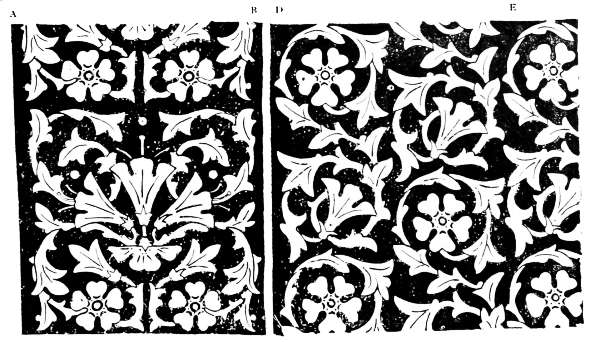
Fig. XLIV.
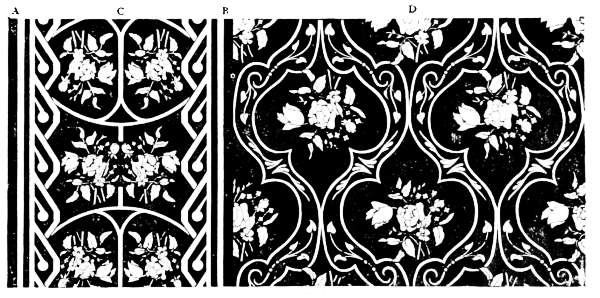
Fig. XLV.
Fig. XLIV. and Fig. XLV. represent designs for fabrics executed on this
method of tying-up.
Fig. XLIV.—A to B = border, C the centre.
B to D = margin, between centre and border.
D to E = 1 repeat of the centre, 6 times over in width of fabric.
Fig. XLV.—A to B = border, C its centre.
B to D = centre, 6 times over in width of fabric.
C.—For fabrics having the centre for straight-through, with the border for
straight-through and point tie-ups, (half divisions), combined.
Fig. XLVI.
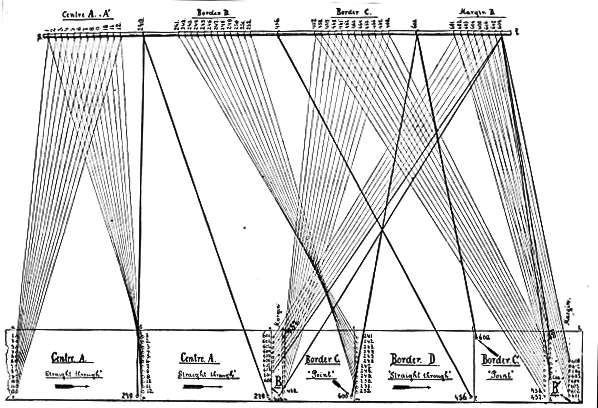
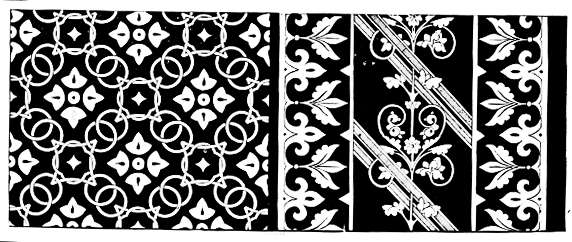
Fig. XLVII.
This method of tying-up is illustrated in Fig. XLVI., and the fabric produced in
Fig. XLVII. With this method of tying-up is usually introduced an extra margin for
the purpose of separating the ornamentation of the design, so as to permit of a clearer
definition. This is tied-up on 8 needles and hooks, situated between border and
centre, (24 ends) shown at margin B in the design. The centre of the fabric, (two
divisions only illustrated out of ten actually used), is tied-up on the straight-through
method, requiring for its working, harness-cords 1 to 240. The border has
the point tie-up in half sections; these half sections have a straight-through tie-up
design in its centre. Harness-cords 241 to 456 are used for the straight-through
section, and 457 to 600 for the point tie-up section. The margin is produced by
harness-cords 601 to 608, leaving 16 needles and hooks of the machine unemployed,
which may be used for selvedge or other purposes. The drawing of this tie-up and
fabric illustrates only the right-hand side. The complete design requires, in
addition to the borders and margins, 10 divisions or repeats in the centre. The
figure shows only two of these repeats and border and margins of one side. The
number of ends in the fabric is found as follows:
| Centre, | 10 × 240 | = |
2400 ends. |
| Border, |
{point, 4 × 144 = 576}
{straight, 2 × 216 = 432} |
= | 1008 ends. |
| Margin, |
{between border and centre, 24 × 2 = 48}
{between border and selvedge, 48 × 2 = 96} |
= | 144 ends. |
| Selvedge, not indicated in drawing of tie-up, |
= | 48 ends. |
| | ----- |
| | 3620 ends in warp. |
Number of harness-cords required for each leash:
Leashes 1 to 240 = 10 cords to 1 leash.
Leashes 241 to 456 = 2 cords to 1 leash.
Leashes 457 to 600 = 4 cords to 1 leash.
Leashes 601 to 608 = 18 cords to 1 leash.
Selvedge leashes, if worked by 4 needles and hooks, = 12 cords to 1 leash.
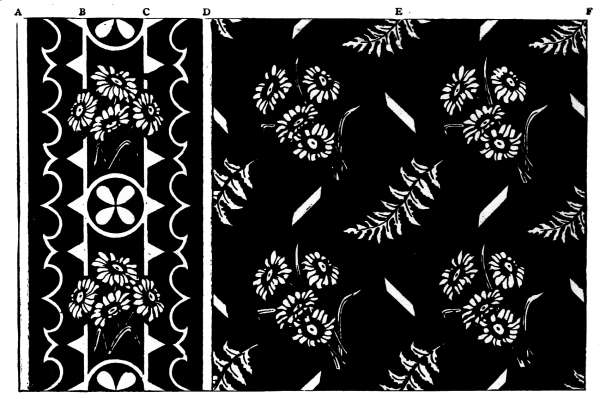
Fig. XLVIII.
Fig. XLVIII., on page 42, illustrates another fabric design to be executed on
this method of tie-up.
| A to D = Border |
{ A to B = point tie-up with C to D.
{ B to C = straight-through part. |
| D to E = Centre, |
first repeat, division, for straight-through. |
D.—For fabrics composed of the straight-through tie-up for centre; the point
tie-up, half divisions, and the point tie-up, full divisions, for borders.
This method of tie-up is used to a great extent in the manufacture of damask
napkins, containing in its centre the monogram of hotels, restaurants, or private
names. This effect is produced by floating the filling.
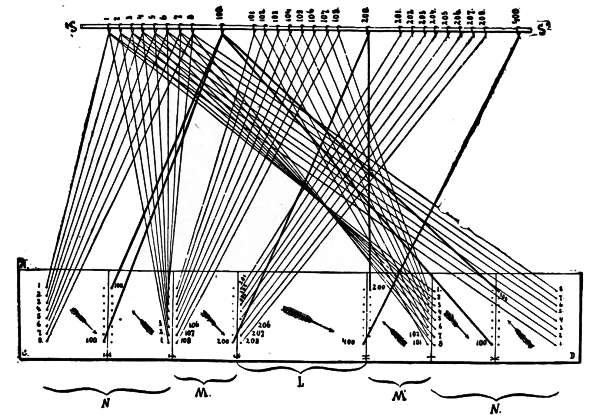
Fig. XLIX.
In this manner, we find tie-up, Fig. XLIX., and fabric sample, Fig. L., executed,
using for explanation a 400 Jacquard machine, certainly very low texture for these
fabrics. In case of a higher texture being necessary, each effect must be proportionally
increased. The machines most generally used for this class of fabrics are of
the 900-1200 denomination.
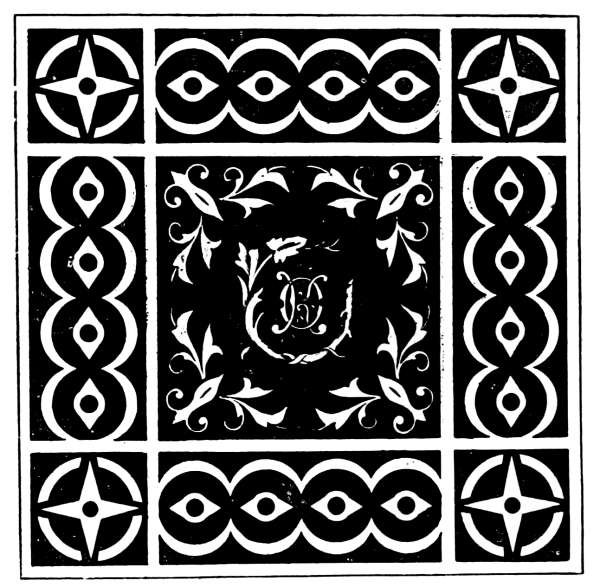
Fig. L.
Taking the present tie-up into consideration, we find the centre for forming the
monogram, containing 200 harness-cords tied-up straight-through the borders on
each side of the monogram, is executed on the point tie-up, one-half section for
each side, taking 100 needles and hooks, or harness-cords. The outside border on
each side is executed on the point tie-up, using one complete division of it for each
side; and in addition, 100 harness-cords for the working. Adding these various
divisions of the harness-cords gives the number of warp-threads as follows, viz.:
| Border, N, |
100 needles on point |
= 200 threads, (199 if omitting
the point
the second time). |
| Border, M, |
100 needles on straight |
= 100 threads. |
| Centre, L, |
200 needles on straight |
= 200 threads. |
| Border, M´, |
100 needles on return |
= 100 threads. |
| Border, N´, |
100 needles on point |
= 200 threads, (199 if omitting
the double point.) |
| | ----
800 threads. |
For number of harness cords to each leash we find:
Needles and hooks, 1 to 100 = 4 cords to each leash.
Needles and hooks, 101 to 200 = 2cords to each leash.
Needles and hooks, 201 to 400 = 1 cord to each leash.
Fig. LI. illustrates a fabric, damask table-cover, to be executed on the same
principle.
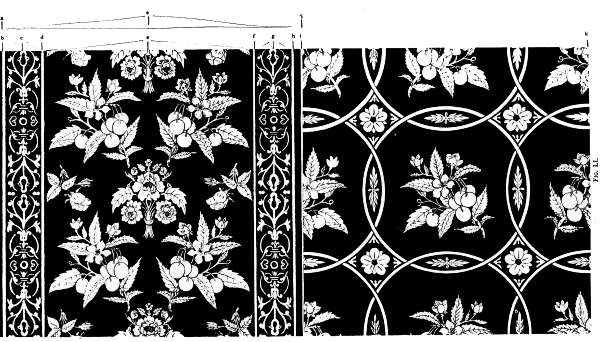
Fig. LI.
| Margin = a to b and h to i. |
| Border |
{ small = |
{b to c and return c to d} Point. |
| {f to g and return g to h} |
| { main = |
d to e and return e to f Point. |
| Centre = 1st division i to k, straight-through. |
This fabric can also be executed on the tie-up explained through Fig. XLI., as
follows:
Border = a to i on point tie-up, e for centre or point.
Centre = 1st division i to k, straight-through.
E.—Mixed Tie-up.
Containing in one repeat of the design the straight-through tie-up and
the point tie-up, one full division, for the centre; the point tie-up, in half
divisions, repeating once through on each side of the fabric, to make the border.
These arrangements of tie-ups are used to a great extent in the manufacture of
damask fabrics of every denomination.
The principle of using mixed tie-ups, Fig. LII., is found in the necessity of
producing large designs, containing varied effects, with a proportionally smaller
Jacquard machine. Under whatever management the straight-through and the
point tie-ups are combined, their principle remains undisturbed. Every time we
arrange a Jacquard loom on a mixed tie-up, we must consider that any subsequent
design must be arranged with reference to the same principle as the one in use,
otherwise the work must all be rearranged, which would have to be done even for
the smallest change in the number of ends for each effect.
Fig. LII.
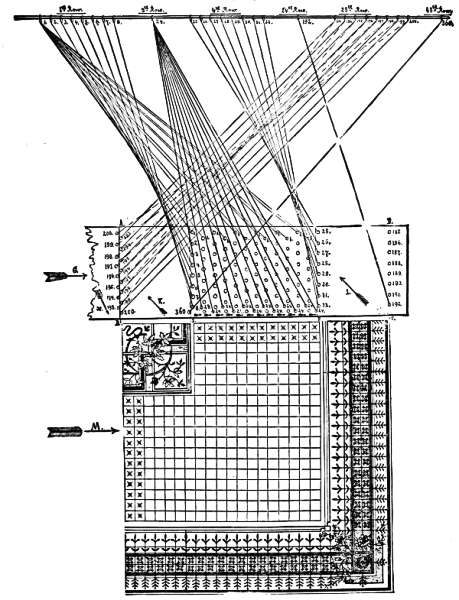
Fig. LIII.
Take for illustration a damask fabric, Fig. LIII., handkerchief, bureau scarf,
art square, etc. The details given will make the work quite plain:
Part of comber-board from A to B, or D to C, illustrates one-half of the board
and procedure of tying-up. The design below also shows only one-half of the
fabric. Arrow, G, near comber-board, and arrow, M, near fabric, are placed to
indicate the direction in which a repeat is obtained. The fabric will form its centre
at D, repeating towards each border and selvedge. This is illustrated in the
comber-board by the 1-row deep, outside of line A, D. Harness-cords indicated
by dotted lines. The threading of this last mentioned row, as well as the threading
of the half division of the point tie-up, is indicated by arrows H and K, forming the
centre by means of harness-cords 193 and 193. The straight-through tie-up part of
the fabric is found between E and F, containing 12 repeats in the centre, and also
the same number in the lower border. In the comber-board is illustrated this
arrangement, repeating the first row, containing harness-cords 1, 2, 3, 4, 5, 6, 7, 8,
twelve times, and the last hole of the third row containing harness-cord No. 24,
twelve times. On the bottom of the comber-board these 12 repeats are indicated
by 12 small arrows between parts E to F.
The first row in the first division of the straight-through tie-up is completely
threaded; the other eleven have only the harness-cord from leash 1, as indicated; this
is done so as not to confuse the eye with too many lines. The border of the fabric
is arranged for harness-cords 25 to 192 on the point tie-up, having one-half division
on each side. Arrow L indicates the right-hand border. The border on the left
requires the same harness-cords which are threaded in comber-board from right to
left; hence the borders of the fabric contain the same design repeating from the
centre towards the selvedge.
At the beginning we stated that the use of mixed tie-ups made it possible to
employ a smaller size Jacquard machine for large designs containing various
effects. The following analysis of Fig. LII. shows very clearly how this is done.
Number of warp-ends in one complete repeat in width of the fabric:
Border, right-hand, = 168 threads.
Centre, straight-tie, = 288 threads.
Centre, point-tie, { = 168 threads.
{ = 168 threads.
Centre, straight-tie, = 288 threads.
Border, left-hand, = 168 threads.
-----
1248 ends warp in fabric.
Number of needles required to produce the design:
Border, = 168 needles.
Centre on straight-tie, = 24 needles.
Centre on point-tie, = 168 needles.
360 needles required for producing the complete design, thus saving the
difference between 1248 and 360, or 888 needles; all of which is
accomplished through the use of the mixed tie-up.
Number of harness-cords required for each leash:
Leashes 1 to 24 contain 24 cords for one repeat of the entire design. Leashes
25 to 360 contain 2 cords for one repeat of the entire design. It is not always
practicable to reduce the effects in a design to the lowest possible number of
needles. On account of the changes in styles, it is best to arrange these tie-ups with
a view to giving as much opportunity as possible to the designer. In the present
tie-up experience teaches that it will be more advantageous to arrange the straight-through
tie-up either for 6 divisions to 48 ends each, or 4 divisions to 72 ends each.
360 needles, as figured at the beginning, require a 400 machine, or, counting reserve
rows, 416 needles; hence we can, without disadvantage, increase 360 needles to 384
or 408, which will give a greater scope, if required, to make a new design.
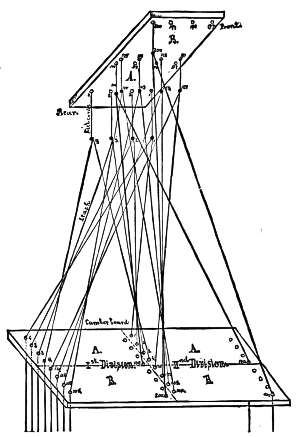
Fig. LIV.
This tie-up, Fig. LIV., is used on fabrics having two different kinds of warp,
which, as a rule, are of different colors. One of these warps is shown working
at B in the comber-board, and also at the bottom-board. The other warp employed
for the figure effect is shown working at A. Fabrics that are made on this
tie-up can also be made on the common straight-through; but the work of designing
and card stamping will be largely increased. In the illustration all the figure-threads,
and also all the threads
used for the weave (binder-threads)
can be designed without
interruption to each other. The
breaking off of the figures is thus
avoided, a thing quite impossible
where the regular straight-through
tie-up is used. The drawing given
herewith represents this straight-through
tie-up in sections applied
to a 200 Jacquard machine. The
reserve rows are omitted. The
machine and the comber-board, it
will be observed, are divided into
two even parts. In one part, the
rear of A, of the comber-board
we thread only in the leashes
from needles 1 to 100, and in the
other part, front of B, from needles
101 to 200. Hence, the first
row of the comber-board contains
leashes 1 to 4 and 101 to 104; the
second row will contain leashes 5 to
8 and 105 to 108; the third row will
contain leashes 9 to 12 and 109 to
112, and so on, each division finishing
on the last row (25th) with
leashes 97 to 100 and 197 to 200.
The leasing of the threads is
always done by alternately threading
the harness-cords of section
A with section B. Hence, first
thread of the warp draws in first
mail of leash No. 1; second thread
of the warp draws in first mail of
leash No. 101; third thread of the
warp draws in first mail of leash
No. 2; fourth thread of the warp
draws in first mail of leash No. 102.
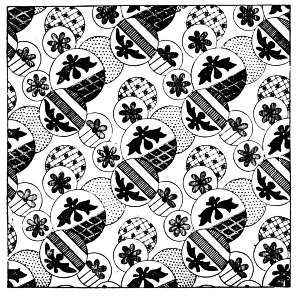
Fig. LV.
Fig. LV., a fabric design for
cloaking for straight-through tie-up
in two sections. A, face warp,
black silk; B, back warp, black
cotton.
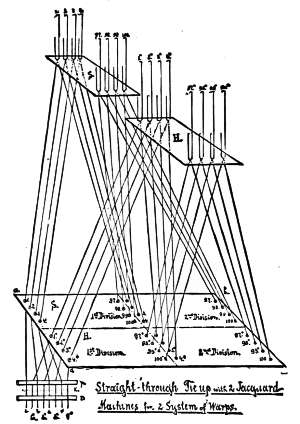
Fig. LVI.
Sometimes two or more machines are employed in producing fabrics having
two systems of warps; each machine working on its own system. In this manner
Fig. LVI. is executed, representing a straight-through tie-up arranged for two
Jacquard machines, S and H, in which the warp is drawn in the Jacquard harness as
follows: one end from machine S, one end from machine H. For explanation two
100 Jacquard machines are used for the purpose of simplifying the arrangements of
laying out and threading the comber-board. A larger Jacquard machine for the
illustrations would require more leashes, and the explanation would be more difficult.
The comber-board, a, b, c, d, is divided into two equal parts, S and H. Each
part containing the harness-cord for one machine only. The drawing of the tie-up is
arranged for two divisions, and also readily
explains any tie-up for more divisions.
The leasing of the Jacquard harness,
K, is arranged (as illustrated in the drawing
by leash-rods p and r) to commence as
follows:
1st end: harness-cord fastened to No.
1 needle of machine, S; 2d end to No. 1º
needle of machine, H; 3d end to No. 2
needle of machine, S; 4th end to No. 2º
needle of machine, H; 5th end to No. 3
needle of machine, S; 6th end to No. 3º
needle of machine, H; 7th end to No. 4
needle of machine, S; 8th end to No. 4º
needle of machine, H.
These eight ends, forming the first
complete row of the comber-board, will
use the first row of both machines; the
second row of the comber-board will use
the second row of both machines; and so
on, until every row of the comber-board,
with corresponding row of the Jacquard
machine, is taken up. In the drawing we
have indicated, as usual, besides the first row, the last row of the machine and the
comber-board; or, in other words, we show the threading of
Warp end 193: harness-cord fastened to No. 97 needle of harness S.
Warp end 194: harness-cord fastened to No. 97º needle of harness H.
Warp end 195: harness-cord fastened to No. 98 needle of harness S.
Warp end 196: harness-cord fastened to No. 98º needle of harness H.
Warp end 197: harness-cord fastened to No. 99 needle of harness S.
Warp end 198: harness-cord fastened to No. 99º needle of harness H.
Warp end 199: harness-cord fastened to No. 100 needle of harness S.
Warp end 200: harness-cord fastened to No. 100º needle of harness H.
Fig. LVII.
This method of using two Jacquard machines, on the principle explained, is
employed on Jacquard looms for dressgoods figured with an extra warp, on upholstery
goods, and similar textile fabrics.
Fig. LVII. shows a fabric design for a curtain, to be executed on the straight-through
tie-up in two sections.
To explain, take the regular
upholstery fabric tie-up known as
“petty point,” on a 600 machine
12 rows in depth. 600 ÷ 12 = 50
+ 2 rows reserve = 52 rows in
width. We find used—
| 1 | row for selvedge. |
| 10 | rows for binders (B). |
| 41 | rows for figure (A). |
| --- | |
| 52 | rows. |
41 (rows figure) × 12 (needles
for one row) = 492 needles to be
used for figure.
10 (rows binder) × 12 (needles
for one row) = 120 needles to be
used for binder.
Suppose we have four divisions
in loom, hence, four harness-cords
to one leash, for the figure
section, or 492 × 4 = 1968 ends of
warp used for figure. 1968 threads
of figure warp require the same
number of threads of ground warp,
which must be divided by 120, the
number of needles and hooks set
apart for it in the machine, or—as
each needle and hook carries one
leash—120 leashes. 1968 ÷ 120 = 16 repeats; and 48 leashes, or four rows in the
machine, must each have 17 harness-cords carrying 816 threads; and 72 leashes, or
six rows in the machine, must each have 16 harness-cords carrying 1152 threads,
= 1968.
This tie-up (the character of which is indicated in Fig. LVIII.) is used for textile
fabrics having two distinct warps in part of the fabric, and a single warp in the
remainder, for ground only. It will readily be seen in the drawing which explains this
tie-up that one part of the fabric will have to contain more ends of warp per inch than
the other, as the figuring is done with an extra warp upon the regular ground cloth.
The number of ends of ground warp per inch will, as a general rule, be the same
throughout the fabric. In Fig. LVIII., explaining this method of tying-up, the texture
is twice as high in the figure stripe as in the ground part of the fabric. If 40
ends of warp per inch are used for the ground, 80 ends per inch must be used in the
figured part, B to C, B´ to C´.
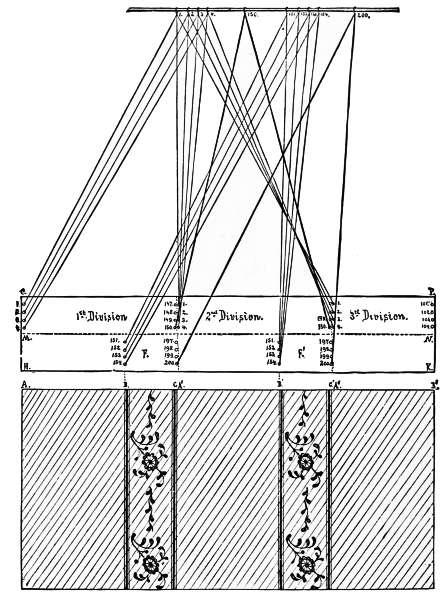
Fig. LVIII.
A 200 machine is used in the illustration, divided as follows:
150 needles for the ground over the entire fabric, A to B´´.
50 needles for the figure effects, B to C, and B´ to C´.
The comber-board, therefore, must be arranged accordingly, (2-2/3 divisions in
drawing executed). The depth of the comber-board is divided into two parts:
H, M, N, K, the first; M, N, O, P, the second. The first contains leashes fastened
to neck-cords attached to needles 151 to 200, or the figure part, F and F´; the
second contains leashes fastened to neck-cords attached to the needles 1 to 150, or
the ground part for the entire fabric. In the drawing of lines showing the harness-cords
of the Jacquard harness we have only indicated:
A. The ground part, leashes Nos. 1, 2, 3 and 4 in rotation, and No. 150. This
last leash of the ground warp we have indicated by a heavy line.
B. For the figure part, needles 151 to 200 are used. Leashes 151, 152, 153,
154, are indicated in rotation, also the leash operated by hook 200; this latter one
being also lined more distinctly than the others.
These explanations readily show how to adapt the tying-up for any textile fabric
made upon this principle to any number Jacquard machine.
The straight-through tie-up in three sections, which is illustrated by drawings,
Figs. LIX. and LX., is largely used in the manufacture of fancy plushes and velvets,
and also in the construction of any other kinds of fabrics in which the face is figured
in three systems of warps, or in two systems of warps for the face and one system
for the binder.
If it were required, these fabrics could be made on the straight tie-up, (Figs.
XXV., XXVIII. and XXX.), but, as will readily be seen, they may be worked to
much better advantage, both for designing and card-stamping, upon the method
shown here.
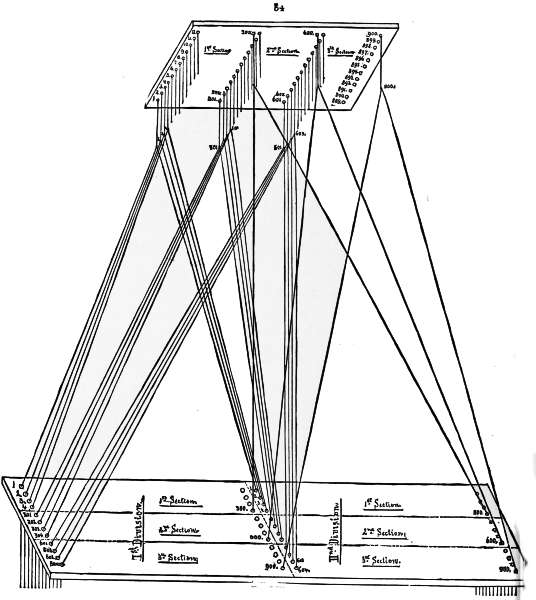
Fig. LIX.
Fig. LIX. illustrates the method of adjusting the leashes to the neck-cords and
threading the comber-board. In the example, we use for describing the method a
900 Jacquard machine, and follow the English system for placing it on the loom.
The machine is divided into three sections: Section 1, using hooks and needles 1 to
300; Section 2, using hooks and needles 301 to 600; Section 3, using hooks and
needles 601 to 900, leaving the two reserve rows (generally found in every machine)
out of the illustration.
The comber-board is divided into two divisions lengthways, (but the same method
must be observed if more than two divisions are used), and also into three sections
in its depth. The number of sections in the comber-board must correspond to the
number of sections in the machine.
The threading of the machine is done from the rear towards the front, and from
the left towards the right. The threading of the comber-board is done in a corresponding
manner. 300 ends for each section in one division, divided by 4 rows deep
each section, making 75 cross-rows. Threading of the Jacquard harness is as follows:
| No. 1 | from Section 1, white. |
| 301 | from Section 2, shaded. |
| 601 | from Section 3, black. |
| 2 | from Section 1, white. |
| 302 | from Section 2, shaded. |
| 602 | from Section 3, black. |
| 3 | from Section 1, white. |
| 303 | from Section 2, shaded. |
| 603 | from Section 3, black. |
| 4 | from Section 1, white. |
| 304 | from Section 2, shaded. |
| 604 | from Section 3. black. |
| 5 | from Section 1, white. |
| 305 | from Section 2, shaded. |
| 605 | from Section 3, black. |
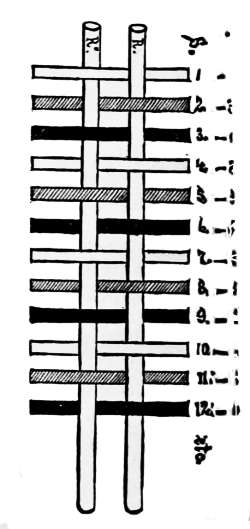
Fig. LX.
And so on; all of
which are shown
separately in Fig.
LX.
R and R´´ are for the two-lease strings; S, the successive order of threads;
S´´, the number of leashes. Hooks and needles correspond with drawing A. White
warp-threads indicate section 1; shaded warp-threads, section 2; black warp-threads,
section 3. The fine lines in Fig. LIX. indicate the leashes for the first
row deep of the comber-board; the heavy lines indicate the last leash for each
section.
Fig. LXI. illustrates a fabric designed for this tie-up. The various small star
effects are arranged on the principle of the 5-leaf satin.
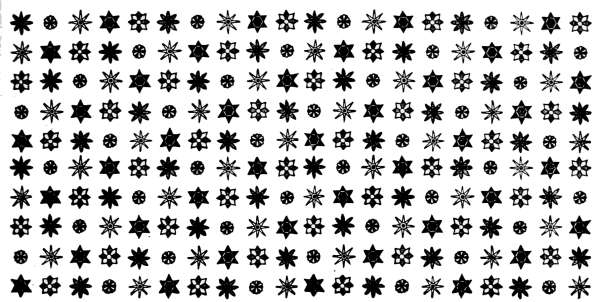
Fig. LXI.
This method of tying-up Jacquard looms shows the point tie-up applied to the
three-section arrangement, on the same principle as the straight-through in
paragraph VIII.
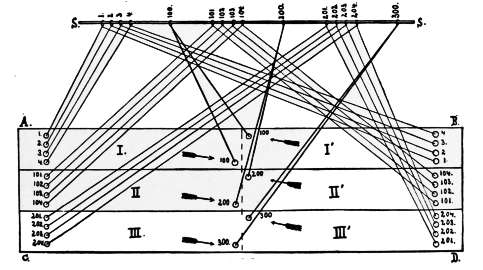
Fig. LXII.
Fig. LXII. shows the comber-board divided into three distinct sections, marked
I., II. and III. For explanation, take a 300 machine; allow 100 needles and hooks
for each section, distributed as follows: Section I., 1 to 100; Section II., 101 to 200;
Section III., 201 to 300. Each section contains 200 warp-threads; and the complete
division of three sections, 600 threads. The threading of three sections, illustrated
in Fig. LX., is applied to the present tie-up, as follows:
| 1st end, from section | I., | attached to No. 1 | harness-cord. |
| 2d end, from section | II., | attached to No. 101 | harness-cord. |
| 3d end, from section | III., | attached to No. 201 | harness-cord. |
| 4th end, from section | I., | attached to No. 2 | harness-cord. |
| 5th end, from section | II., | attached to No. 102 | harness-cord. |
| 6th end, from section | III., | attached to No. 202 | harness-cord. |
| 7th end, from section | I., | attached to No. 3 | harness-cord. |
| 8th end, from section | II., | attached to No. 103 | harness-cord. |
| 9th end, from section | III., | attached to No. 203 | harness-cord. And so on. |
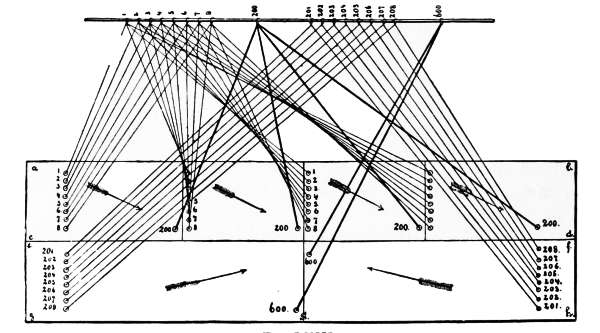
Fig. LXIII.
This tie-up illustrates the point tie-up and the straight-through combined on the
two-section system. In Fig. LXIII., a 600 machine is used for illustration; the
comber-board being divided into two parts: a, b, c, d, for No. 1 section; e, f, g, h,
for No. 2 section.
No. 1 section requires the use of needles and hooks 1 to 200 on the straight-through
principle, four divisions, taking 800 warp-threads.
No. 2 section requires the use of needles and hooks 201 to 600 on the point
principle, one division, taking 800 warp-threads. The two sections thus use 1600
warp-threads in one repeat.
The threading of the harness is as follows: 1-201, 2-202, 3-203, etc., ending
with 200-201.
This tie-up, as well as any changes in the arrangement and the number of needles,
(but not changed in its principle), is used for double color figures of warps of large
design, with a small all-over figure effect (No. 1 section) for the ground. Fig.
LXIV. is executed on this tie-up.
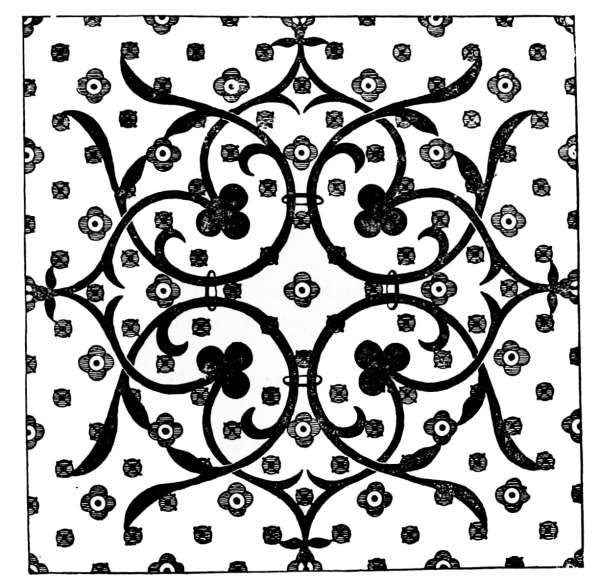
Fig. LXIV.
Fig. LXV. shows 384 needles and hooks of the Jacquard machine, threaded in
four sections in comber-board, A, B, C, D. The threading of comber-board is as
follows:
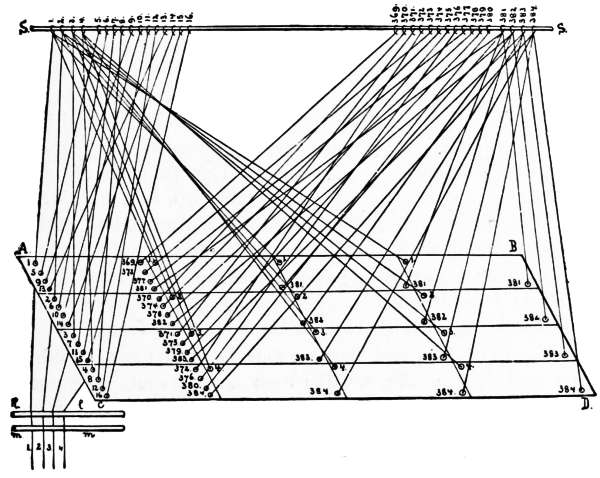
Fig. LXV.
1st, No. 1 leash in section 1.
2d, No. 2 leash in section 2.
3d, No. 3 leash in section 3.
4th, No. 4 leash in section 4.
5th, No. 5 leash in section 1.
6th, No. 6 leash in section 2.
7th, No. 7 leash in section 3.
8th, No. 8 leash in section 4.
9th, No. 9 leash in section 1.
And so on. The threading of the harness is explained below the comber-board,
l and m indicating the leash-strings; and warp-threads 1, 2, 3, 4, from leashes 1, 2,
3, 4, are indicated as threaded.
384 times 4 divisions make 1536 warp-threads.
Tying-up of Jacquard looms with extra compound harness, consists in applying
two separate systems of harness in the loom. The warp-threads, after having
passed through the Jacquard harness, are passed through harness in front. Each
system of harness performs special duty, although they are both working the same
warp. The Jacquard harness is used for forming the general design on a large
scale; the second harness divides this pattern into detail, (twills, satins, or any
other desired weave). The above tie-up is necessary in the manufacture of rich
damasks and similar fabrics, where a large number of warp-ends is required, with a
correspondingly small number of picks per inch. Suppose a damask fabric to contain
300 ends warp per inch, with only 75 picks per inch; or in the proportion of 4 to 1.
Now, to employ this principle of making four ends warp equal to one filling, the
size of the design would be produced in the fabric, but the richness, and also the
fineness, of the face of the fabric would be entirely lost. To prevent this it should
be the object of the designer to keep the fine warp-threads entirely on the surface,
to interweave the proportion of ends varying between warp and filling (as in
example above, four warp-threads) separately. This principle of textures requires
the compound harness to be attached; or, in other words, a machine must be used
which is capable of raising not only every alternate thread, but every third, fourth,
or eighth thread, if required, for the formation of the body of the cloth.
Fig. LXVI. illustrates as plainly as possible the principle of tying-up to do this
work, using a 100 Jacquard machine for figuring, comber-board threaded in three
divisions, four heddles to each leash, eight compound harnesses.
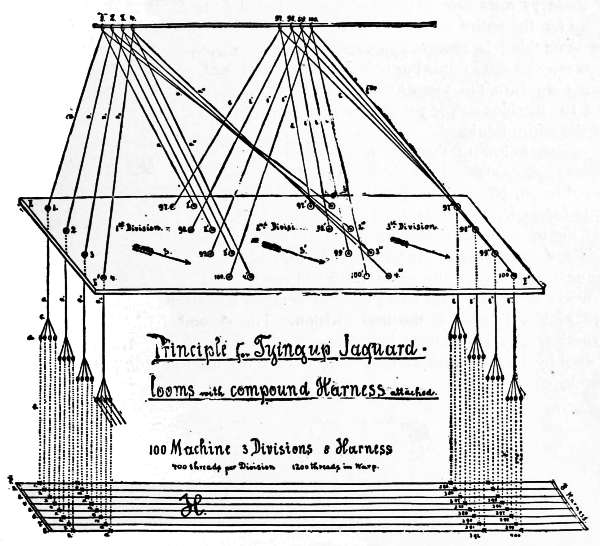
Fig. LXVI.
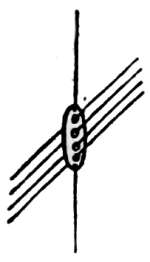
Fig. LXVII.
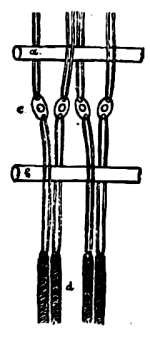
In the tying-up of Jacquard harness four heddles to one leash are generally
used, as illustrated at c, in Fig. LXVI.; each heddle containing one warp-thread.
Fig. LXVII. shows the arrangement of these four warp-threads, when using only
one heddle to each leash, but in which the mail contains four eyes. This method
is less frequently employed. Instead of using a 100 machine, as in Fig. LXVI.,
A 200 machine (straight-through) will require 800 warp-threads for each division.
300 machine (straight-through) will require 1200 warp-threads for each division.
400 machine (straight-through) will require 1600 warp-threads for each division.
600 machine (straight-through) will require 2400 warp-threads for each division.
900 machine (straight-through) will require 3600 warp-threads for each division.
1200 machine (straight-through) will require 4800 warp-threads for each division.
To change the tie-up principle from the straight-through method to the point
method, taking a 1200 machine using four heddles per harness-cord,
9600 warp-threads will be required for each division for repeat of
pattern.
This little example plainly shows the great advantage of this
method of tying-up looms for making the finest damasks, etc.
To explain the general method of this tie-up, commence with
Fig. LXVI., which represents a 100 machine, three divisions, four
heddles to one leash, eight compound harnesses.
It will not be necessary to explain the threading of the comber-board, as
this is always done on the same plain principles. The four heddles of the first
row deep of comber-board emerge below the board at the beginning of the
first division, marked a, a´, a´´, a´´´. The first row deep in comber-board in the first
division, and the last row deep in comber-board in the third division only are shown;
but as these two rows also indicate the first and last rows in the Jacquard machine,
and as the principle of a, a´, a´´, a´´´, and b, b´, b´´, b´´´, has to be observed in every one
of these 75 rows deep in width of comber-board E´ to E´´ taken, it will explain the
tie-up for the entire number. At c, in leash a, four distinct heddles are adjusted;
the same thing is repeated in every one of the eight
leashes extended in drawing below the comber-board,
giving in return, thus: four heddles and three divisions
in a 100 machine = 4 × 3 × 100, or 1200 warp-threads
for the entire fabric.
Now, following the first heddle downwards on
leash 1, a, c, marked on drawing, d, (indicated by
dotted lines), No. 1 harness of the compound harness,
H, is reached. The cross X on this harness indicates
that the warp-thread drawn through mail fastened on
heddle, d, must also be drawn through No. 1 harness;
the next heddle from the same leash will reach No. 2
harness; and so on until No. 4 harness is taken up, which will finish No. 1 harness-cord
of No. 1 leash in the first division. The second harness-cord, a´, will use
harness 5, 6, 7, 8; the third harness-cord, a´´, will use harness 1, 2, 3, 4, over again,
as used by a; the fourth harness-cord, a´´´, will use harness 5, 6, 7, 8, over again, as
used by a´.
Continue in this manner until leash 100 in the first division on harness 5, 6, 7, 8,
is finished. The second and third divisions strictly repeat the first.
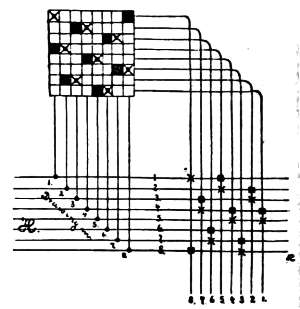
Fig. LXVIII.
Fig. LXIX. represents the side elevation for Fig. LXVI. In both of these
drawings some of the letters and figures correspond, as follows: harness-cords
a, a´, a´´, a´´´, in first row deep of comber-board, E, E´. H shows compound harness
set 1, 2, 3, 4, 5, 6, 7, 8; figures 1, 2, 3, 4, on top of comber-board represent the
first row deep from the front elevation in drawing.
New letters: B, the warp-beam; Z, the lease of the warp formed by rods, Z´
and Z´´; O, the distance between the Jacquard harness and compound harness set, H.
D, the shed, as formed in loom when weaving. For illustration of this shed
pick No. 7 in Fig. LXVIII., shows that leashes 2 and 3, or a´ and a´´, are raised at
the same time. Leashes 1 and 4, or a and a´´´, are not raised.
The principle of forming the shed for picking the shuttle will be more
particularly explained later on by Figs. LXX. to LXXV.
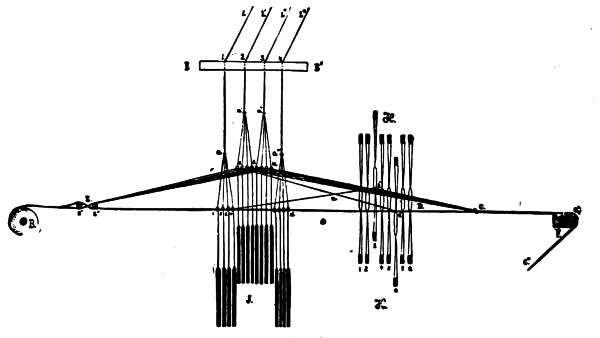
Fig. LXIX.
At c, in Fig. LXIX., the beginning of the shed is shown; also the last woven
part of the fabric, c, c´, c´´, which is indicated as passing around the breast-beam, F.
L, L´, L´´, L´´´, indicate leashes 1, 2, 3, 4, extending to the Jacquard machine
towards neck-cords 1, 2, 3, 4.
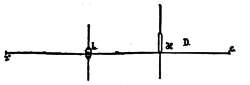
Fig. LXX.
Fig. LXX. represents a warp-thread forming
the bottom part of a shed. Mail, L, and harness,
H, occupy a position similar to that of mail and
harness for warp-thread passing through No. 1
heddle of leash a, and harness 1 in Fig. LXIX.
Warp-thread No. 2, passing through leash a, and harness 2, in Fig. LXIX. is the same.
Warp-thread No. 4, passing through leash a, and harness 4, in Fig. LXIX. is the same.
Warp-thread No. 13, passing through leash a´´´, and harness 5, in Fig. LXIX. is the same.
Warp-thread No. 15, passing through leash a´´´, and harness 7, in Fig. LXIX. is the same.
Warp-thread No. 16, passing through leash a´´´, and harness 8, in Fig. LXIX. is the same.
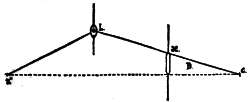
Fig. LXXI.
Fig. LXXI. shows a warp-thread forming part
of the top shed by raising the leash; hence mail, L,
is shown raised. The compound harness is supposed
to be resting, which allows the warp-thread
to slide up to the height of the required size of
shed. This figure illustrates plainly the following
warp-threads in Fig. LXIX.
Warp-thread No. 5, passing through leash a´, and harness 5, in Fig. LXIX. is the same.
Warp-thread No. 7, passing through leash a´, and harness 7, in Fig. LXIX. is the same.
Warp-thread No. 8, passing through leash a´, and harness 8, in Fig. LXIX. is the same.
Warp-thread No. 9, passing through leash a´´, and harness 1, in Fig. LXIX. is the same.
Warp-thread No. 10, passing through leash a´´, and harness 2, in Fig. LXIX. is the same.
Warp-thread No. 12, passing through leash a´´, and harness 4, in Fig. LXIX. is the same.
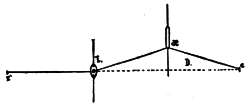
Fig. LXXII.
Fig. LXXII. illustrates the side view of a
warp-thread where the hook of the Jacquard is not
raised; hence, the mail remains in its resting place.
Following the warp-thread towards c, the compound
harness is shown raised, thus forming part
of the top of a shed. This figure is designed to show the passage of the warp-thread
through mail No. 3 of leash a, and harness No. 3, in Fig. LXIX.
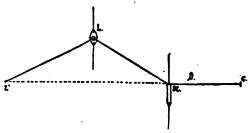
Fig. LXXIII.
Fig. LXXIII. illustrates a thread forming part
of a lower shed. In the drawing the mail is raised,
but at the same time the heddle of harness is lowered,
compelling the thread to rest on the bottom
of the lay. This figure is designed to show warp-thread
passing through mail No. 6, of leash a´,
and harness No. 6, in Fig. LXIX.
Fig. LXXIV. is a side view of a thread forming the upper part of a shed where
mail and harness have been raised the same as in Fig. LXIX., the warp-thread
passing through mail No. 11 of leash, a´´, and harness No. 3.
Fig. LXXV. illustrates mail not raised and harness down. This change is not
necessary in Fig. IV.; the warp-thread forming the lower part of the shed.
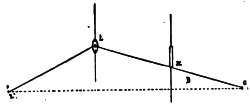
Fig. LXXIV.
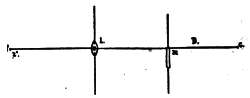
Fig. LXXV.
In Figs. LXX. to LXXV. the following letters correspond with the same letters
in Fig. LXIX.: Z´´, nearest lease-rod to Jacquard harness; D, shed for picking
shuttle; C, starting point of shed or last woven place of fabric.
The eyes of these heddles are much longer than those of common heddles.
They must be sufficiently long to allow the six movements illustrated in Fig. LXX. to
LXXV., hence the height of these heddle eyes will influence the height of the shed.
For working compound harness a separate small witch-loom is generally used,
thus saving, to a great extent, the Jacquard cards. In this manner the ground
may be easily altered without changing any cards, it being only necessary to change
the small set of cards on the witch-loom controlling one repeat of the body weave for
the harness. The number of picks for the harness can also be readily adjusted to
one change in the Jacquard figure without disturbing the cards of any consequence.
For example: in manufacturing a damask fabric, suppose four harness picks make
one change of figure in the Jacquard machine, and it is necessary to reduce these
four picks to one change of figure, on account of having to use some heavier filling,
or other similar reason; this alteration can be easily made when using two separate
machines.
Fig. LXXVI.

The number of harness used is regulated by the weave required for raising, and
the weave required for lowering.
The number of harness may vary to a large degree, as we may
use any suitable weave from the 4-leaf twill up to the 16-leaf satin. As
a general rule, for fine damasks we use the 8-leaf satin, requiring 8
harness.
Fig. LXXVII.

Filling Weave as
raised in the upper
shed by harness.
Fig. LXXVIII.

Warp Weave to
interweave in lower
shed through harness.
There are three distinct positions for the harness:
1st, centre; 2d, up; 3d, down.
Fig. LXVIII., p. 60, illustrates the 8-leaf satin combining
filling and warp up in one design.
Fig. LXXIX.
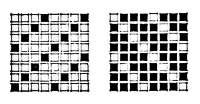
A. Filling up. B. Warp up.
Fig. LXXX.
5-Leaf Satin.
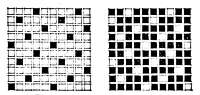
Filling. Warp.
A great variety of combinations
of different weaves for this class of
textile fabrics exist. It is only
necessary to illustrate a few more
examples to guide us in finding the
principles underlying these changes.
Fig. LXXXI.
7-Leaf Satin.
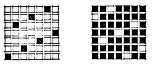
Filling. Warp.
Fig. LXXXII.
8-Leaf Satin. 8-Harness
Broken Twill.
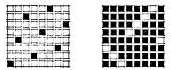
Filling. Warp.
Fig. LXXXIII.
8-Leaf Satin. 8-Harness
Fancy Twill.
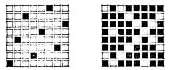
Filling. Warp.
Fig. LXXIX. is an example of warp and filling, binding in a 4-leaf twill. Both
systems are illustrated for a clear understanding: [X] Fig. A, indicates the raising
of the harness for forming the upper part of the shed; □ Fig. B, indicates the rotation
of drawing warp-threads from the upper shed into the lower shed. Drawing-in draft
is for 4-harness (straight).
Fig. LXXXIV.
10-Leaf Satin. 10-Leaf Satin.
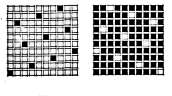
Filling. Warp.
Fig. LXXXV.
10-Leaf Satin. 5-Harness Satin.
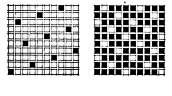
Filling. Warp.
Fig. LXXXVI.
12-Harness Satin.
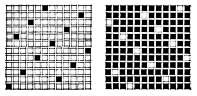
Filling. Warp.
Gauze fabrics are produced by a separate system of weaves, which have the
peculiar characteristic of warp-threads not lying parallel to each other. One kind of
this warp is called the “douping warp” or “whip-threads;” these are twisted around
the ground-warp. The ground-threads, as well as the whip-threads, which work
together, must be drawn into one dent.
Jacquard gauze can be worked in various ways; for example: One whip-thread
against one or more ground-threads. More than one whip-thread against one or
more ground-threads.
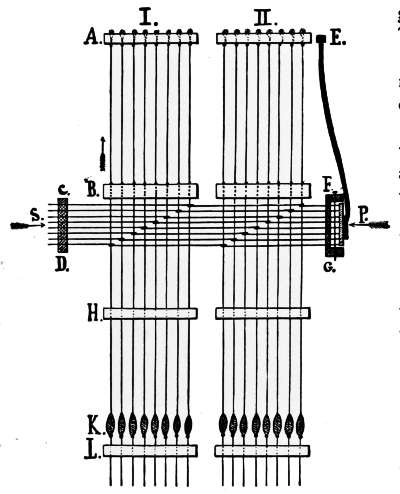
There are two methods of tying-up for gauze fabrics: 1st. A tie-up in which the
doups are worked by one, two, three or four shafts in front of the Jacquard harness.
2d. A tie-up in which the gauze figuring is done all over the fabric, requiring each
doup to be arranged for working separately. If the ground-threads and whip-threads
are worked from the same Jacquard machine, the latter must be divided into two
sections: 1st section for the ground-threads with ground heddles; 2d section for the
whip-threads with standard heddles.
If a fabric contains the gauze in the form of a stripe, arranged one end ground
and one end whip, the same number of hooks are required for the ground and whip-threads
of each section, and an extra dead harness must be employed; but if this
arrangement of one end ground and one end whip must form figures, then the
ground and whip-threads must form the first section, and the whip-threads alone the
second section. In this case the second section requires only half as many hooks as
the first; and for the same reason, if we are forming figures with two ground-threads
and one whip-thread, the first section will contain three times as many hooks
as the second, etc. Very often two whip-threads are used for twisting, in which
case they must be drawn together in the doup. If several whip and ground-threads
are drawn into one reed they usually work independently at first on a regular weave;
following this is the gauze weave formed by a certain number of whip-threads raised
either on the left or right of the ground-threads contained in the same dent. This
movement brings into operation the second section of the machine containing the
harness-cords for the standard heddles. The technical terms for these various
combinations are: single-thread gauze, double-thread gauze, triple-thread gauze, etc.
The tie-up most generally used requires two-thirds of the needles for ground
heddles and one-third of the needles for standard heddles; hence, if using a 200
machine we find: 128 needles and hooks for the ground heddles, and 64 needles
and hooks for the standard heddles. [See Fig. LXXXVII., p. 65.]
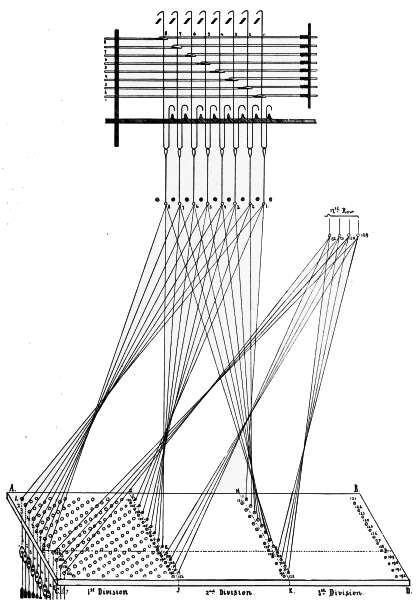
Fig. LXXXVII.
The comber-board is divided into two sections. The rear part (2/3) is used for
the ground, the front part (1/3) is used for the standard.
Thread the warp into the ground heddles in the same manner as a common
straight-through tie-up. Then take the first left-hand thread of the warp and draw
it through the doup. The next two warp-threads draw above the first one on the
left-hand side of the same doup. These three warp-threads must be drawn together
in one dent. After drawing the first pair in one dent, leave one, two, or more dents
empty, according to the fabric. The 4th, 5th and 6th warp-threads, also each
subsequent pair, are threaded the same as the first.
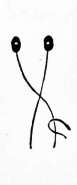
Fig. LXXXVIII.
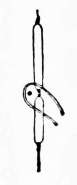
Fig. LXXXIX.
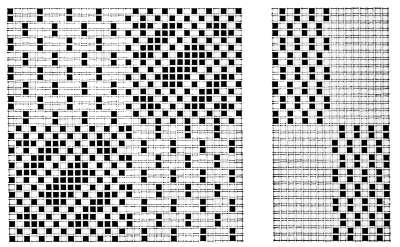
Fig. XC.
Figs. LXXXVIII. and LXXXIX. are designed for illustrating this point. The
lingoes for the doups are about one-half the weight of those used for the ground
heddles.
Fig. XC. represents a fancy gauze to be executed in this manner.
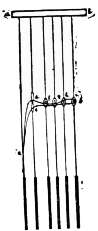
Fig. XCI.
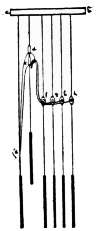
Fig. XCII.
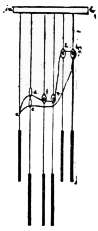
Fig. XCIII.
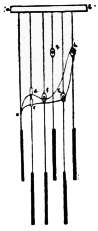
Fig. XCIV.
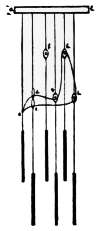
Fig. XCV.
Fig. XCI. represents the threading of the harness for a gauze fabric: f, g, first
and second warp-thread, over the doup; h, i, third and fourth, through the doup.
Figs. XCII. and XCIII. illustrate the two movements of the harness in the
gauze weave.
Figs. XCIV. and XCV. illustrate the movements of the harness in the regular
weave: a, b, represents the comber-board; c, the place where the doup is fastened
to the dead harness; d, e, the standard heddle; f, g, h, i, the mails of the common
heddles.
The following are the fourteen different movements that might be required in
regular weaving. The figures show the number of threads up and the number
down, thus:  equal first warp-thread up; second, third, and fourth down.
| 1. |
| = f up. |
| 2. | 
| = g up. |
| 3. | 
| = h up, doup raised. |
| 4. | 
| = i up, doup raised. |
| 5. | 
| = f and g up. |
| 6. | 
| = g and h up, doup raised. |
| 7. | 
| = h and i up, doup raised. [Illustrated by Fig. XCIII.] |
| 8. | 
| = f and h up, doup raised. [See Fig. XCV.] |
| 9. | 
| = f and i up, doup raised. |
| 10. | 
| = g and i up, doup raised. [See Fig. XCIV.] |
| 11. | 
| = f, g, and h up, doup raised. |
| 12. | 
| = g, h, and i up, doup raised. |
| 13. | 
| = f, g, and i up, doup raised. |
| 14. | 
| = f, h, and i up, doup raised. |
These fourteen different movements cover all the possible changes in regular
weaving. The movement (7) illustrated in Fig. 8, in addition to forming the regular
weave, is also necessary to the formation of the gauze weave.
These few explanations clearly show the great variety of effects possible for the
designer; for he can figure with the regular method of weaving, and can also figure
gauze weaving to exchange with regular weaving, forming a separate design on the
fabric.
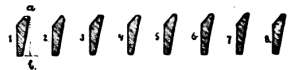


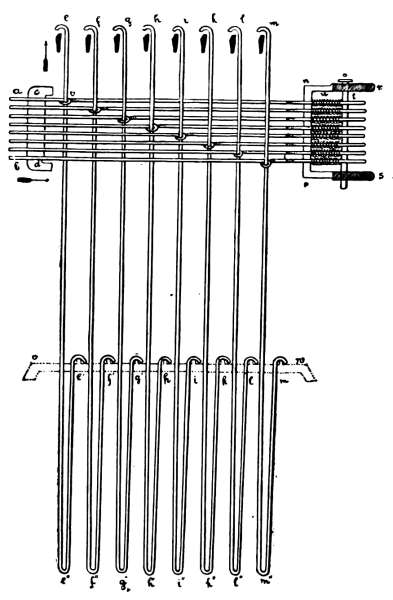
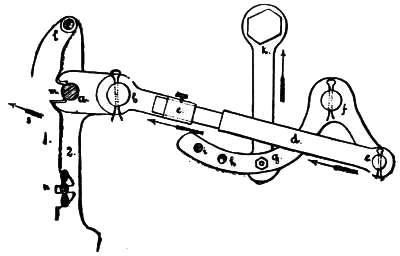
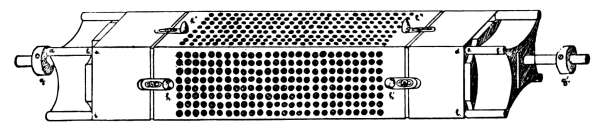

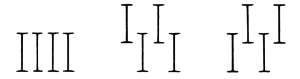
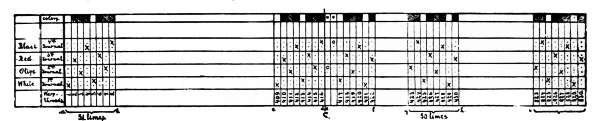
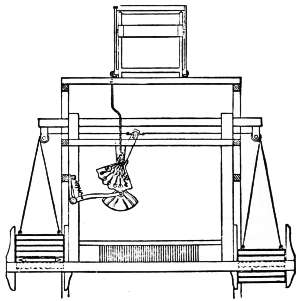
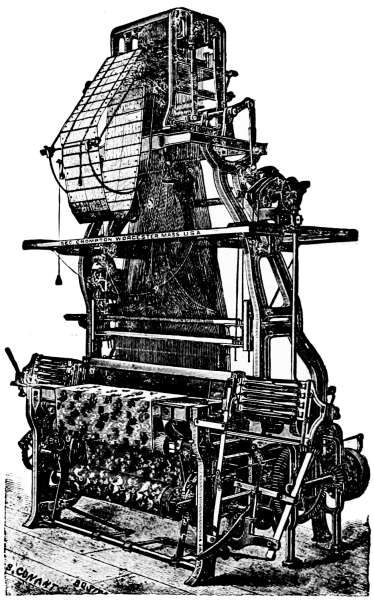
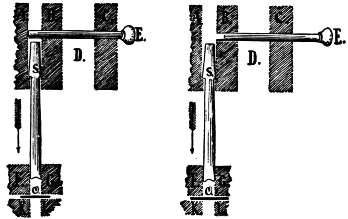
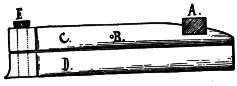
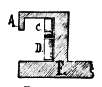
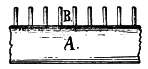






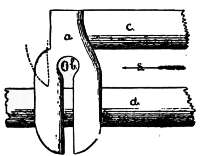
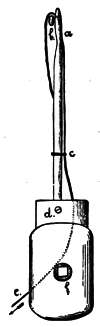
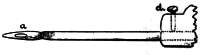
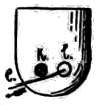

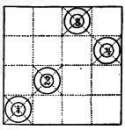
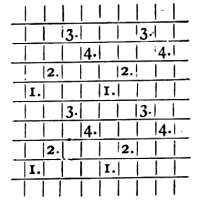
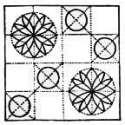
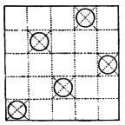
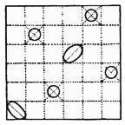
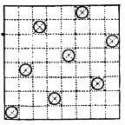
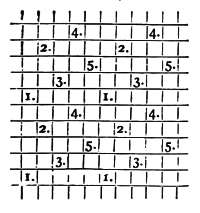
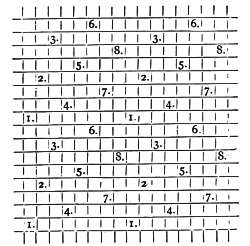
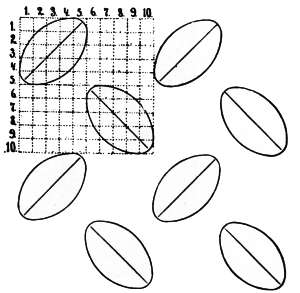
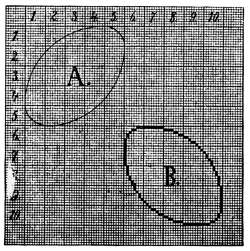
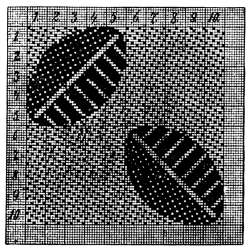
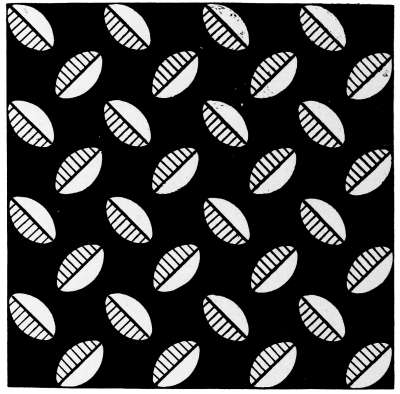
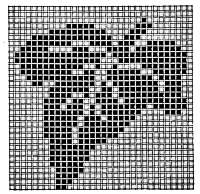
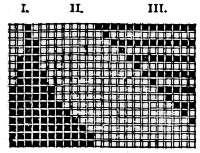
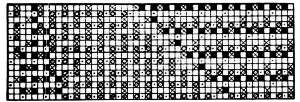


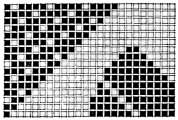
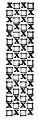
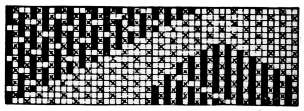
 twill,
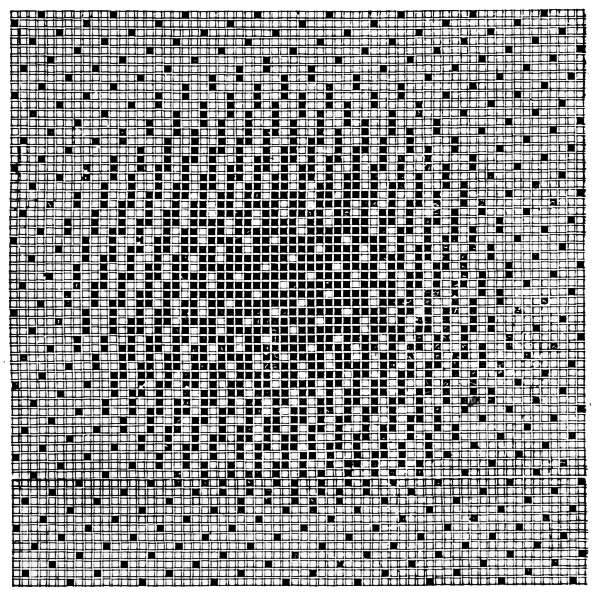
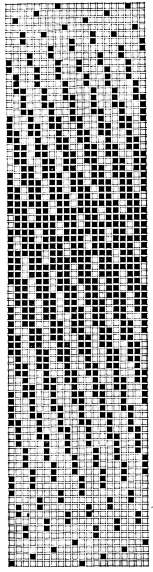
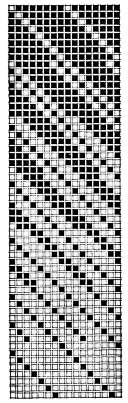
 ,
to warp for face
 , and back again
to filling for face.
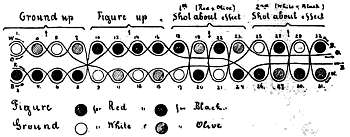
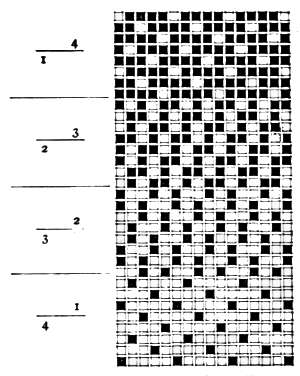
 eight harness twill,
shaded from the filling for face to the warp for face effect;
the change occurring every eight picks.