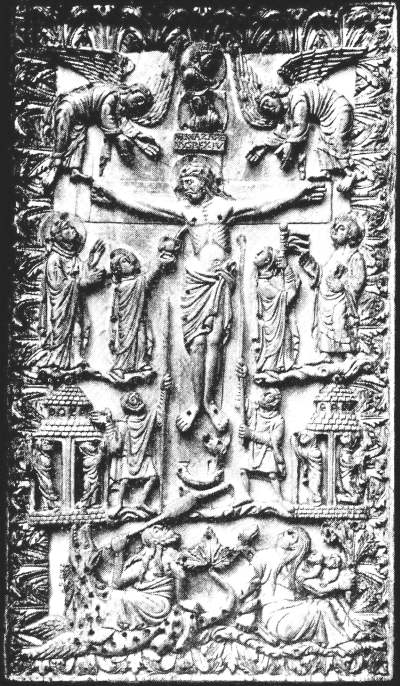
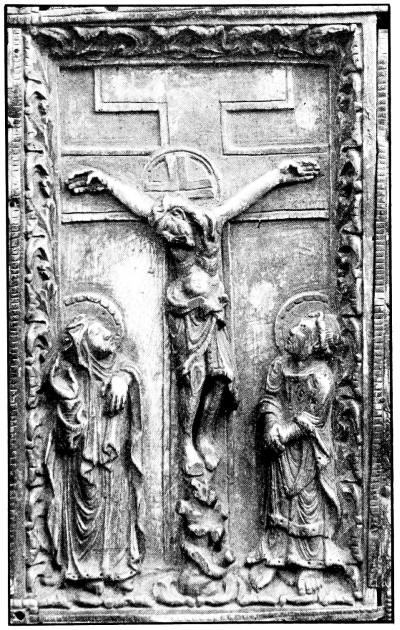
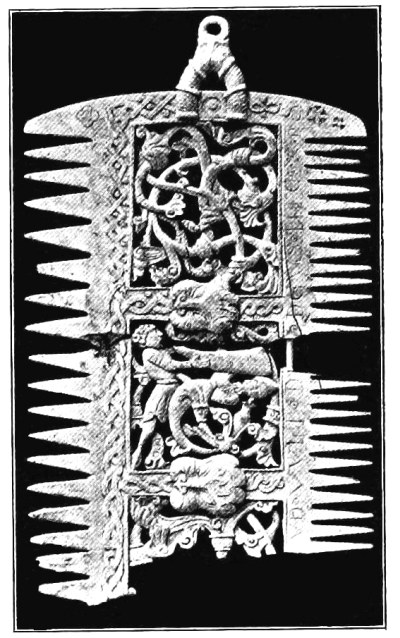
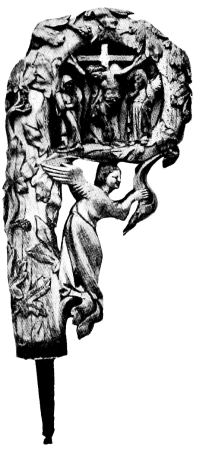
At the end of the last chapter it was shown how the Church had
preserved a large number of consular diptychs, either unchanged or
altered to suit Christian iconography. To that list must be added
several ivory carvings with religious subjects, yet so closely
connected with the class of Private Diptychs, that it is more than
probable that they also have undergone transformation.
The most important among these are a fragmentary panel in the Museo
Civico at Bologna and the celebrated Ivory Book of Rouen Cathedral.
On the Bologna fragment is the figure of a bearded man of heavy type,
in a well designed but poorly executed robe; he clasps a roll in his
left land and beneath his neatly sandalled feet is a stool, always
a mark of honour, in the side of which is a deepened space with the
name “Petrus” rudely inscribed. Above, in the broken pediment, is a
niche with the bust of a bearded man, labelled “Marcus.” The whole is
surrounded by a handsome ovolo moulding, as are also the panels of the
Rouen Book Cover, which may be of a slightly later date, but they
must both be placed early in the sixth century. The Rouen carvings
represent St. Peter and St. Paul, without a doubt, for they are
already of that iconographical type which had become fixed by the end
of the preceding century, St. Paul with a bald head and long pointed
beard, and St. Peter with thick hair and a round curling beard; but
it is very likely that the figures on both the Bologna and Rouen
tablets were originally intended for authors or poets as on the
series of complimentary diptychs.
The architecture lends credence to this theory, the cannelated
columns and pediment flanked by so-called “doves,” being much the
same as that on the various sixth century diptychs. The drapery too,
has been copied from good models, that of St. Peter, with the right
arm buried in the folds of his toga, is in imitation of the famous
Lateran Sophocles. Another proof of alteration is the manner in which
he holds a narrow key in a grasp wide enough to contain a roll as
large as that in the Bologna fragment.
There is a diptych in Tongres Cathedral,[8]
which has a history carrying it back to the ninth century. The names
of the Bishops of Tongres from 855-959 being engraved on the back.
It evidently belongs to the large class of ivories of mixed
Latino-Byzantine origin. The vine scroll border, the flat relief
and rather grooved working of the draperies, also the peculiar
stockings and oriental shoes are all features of this class. St. Paul
raises his hand to bless in the Greek manner, with only two fingers
extended. The interpretation of this gesture is variously given, many
say it is symbolical of the dual nature of Our Lord and of the Trinity.
Byzantine, equally with Italian art, sprang from the last floraison
of Roman Art, and grew up at Constantinople, the New Rome, but much
modified by Greek and Syrian influences. At first the culture of the
two Empires was so linked together, that it is the merest shade which
distinguishes Roman Art in the East and West. The division widens,
and the two branches stretch out, one, the purely Latin, soon to
wither and almost perish, and the other to grow into that spreading
tree of Byzantine Art, whose branches have scattered fruit in every
part of Europe and the Levant.
The latest bloom on the purely Latin branch, before it commenced
to decay, included ivories of singular beauty, as the splendid
casket at Brescia and the famous Carrand diptych in the Bargello at
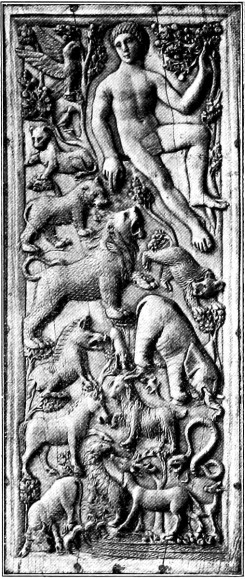
Florence (Figs. 5 and 6). This carving is of superb finish, worthy
of the beautiful Bacchante diptych, though the design is less purely
classical. The first leaf represents Adam in the Earthly Paradise,
engaged in naming the animals, the figure is thoroughly Greek, and the
treatment closely resembles an Orpheus scene, though the curiously
crimped hair and heavy hands and feet betray a decline in art.
The animals show delightful touches of first-hand observation,
the worrying attitude of the little dog, who, forgetting he is in
Paradise, is just going to bark at the dignified goat below. The
droop of the bull’s head as he grazes by the side of the Four Rivers
is very natural, though the artist still adheres to the rather dry
technique of animal portrayal in ancient art. These animals may be
compared with those on the diptych of Bourges, which are scattered
over the background in much the same way, but with less defiance
of perspective, as they are supposed to be leaping in the act of
fighting.
The object of much controversy is another fine Earthly Paradise
carved on the back of an Areobindus diptych in the Louvre (No.
13). It is divided into registers by irregular lines of herbage;
above are Adam and Eve and the Serpent, next come a series of weird
mythological creatures, and then follow serried ranks of animals,
fabulous and otherwise. Molinier declares it cannot be later than
the sixth century, and connects it with the Bargello diptych, but
there is a real difference in the feeling and technique of the
animals, and a bizarre element, quite foreign to the matter-of-fact
and straightforward methods of ancient art. In the opinion of de
Linas and Graeven, the carving was added in the early periods of the
Italian Renaissance, and the former points out a connection with the
carvings on the façade of Orvieto Cathedral.
ALINARI PHOTO.]
[BARGELLO, FLORENCE
6. DIPTYCH WITH THE EARTHLY PARADISE
AND SCENES FROM THE LIFE OF ST. PAUL
Italian, fifth century
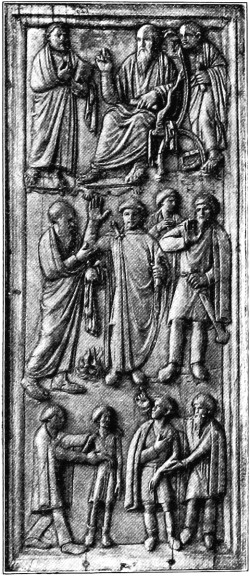
The second leaf of the Bargello diptych is covered with three rows of
exquisitely carved and well characterized figures. The top row may
represent the meeting of Paul and Barnabas with Peter at Damascus.
The next shows Paul at Malta, shaking the viper into the fire (Acts,
xviii. 3), and remaining unhurt, to the surprise of Publius, governor
of the island, who stands by dressed as a man of rank in a chlamys
embroidered with a segment and fastened by a rich fibula. The soldier
with the strange sleeved fur coat hung over his shoulders is probably
one of the governor’s guard. At the bottom we see the healing of the
father of Publius, who lay sick of a fever.
The Lipsanoteca, or large ivory casket in the Museo Civico at
Brescia, is a fine work of early Christian sculpture, and has far
more connection with antiquity than with the early development
of the art of the Middle Ages. But it is difficult to pass it by
undescribed, as it gives the early types of so much that is met again
in later art. Molinier classes it among the sixth century ivories of
mixed style. But Westwood points out that the mingling of subjects
from the Old and New Testament histories, and the small size given
to some of them as border pieces, show the precise treatment of many
early sarcophagi, also the classical nature of many of the details
point to an early date, and he attributes it at latest to the fourth
century, with which date Graeven entirely agrees.
The casket has a frieze of fifteen heads in medallions, and in the
narrow borders are the symbolical Types of Old Testament history.
The large central scenes are from the New Testament, showing Christ
as the Good Shepherd at the Gate of the Fold, and several of the
miracles which became so popular on the Italo-Byzantine ivories,
including the rarer scene of the Raising of Jairus’s daughter,
which has many features in common with the Raising of Tabitha on
one of a series of three most interesting little plaques in the
British Museum, notably in the treatment of the long waving hair of
the attendant women. On the flat lid the Cycle of the Passion is most
fully illustrated, but stops short with the scene in the Prætorium
before the sad representation of the Crucifixion.
The great similarity between the art of the Eastern and Western
divisions of the Roman Empire has already been mentioned, and it is
this similarity which causes considerable difficulty in classifying
the early ivories. The three British Museum plaques just referred to
as having a close connection in the scene of the Raising of Tabitha
to the Brescia casket, which is undoubtedly of Western origin, have
also a strong resemblance to the first half of a diptych now in the
Trivulzio Collection at Milan, both in the dress of the soldiers, and
in the crouching figure of one of the Holy Women, which are almost
identical on the two ivories. Molinier considers the Trivulzio tablet
to be purely Constantinopolitan, but Graeven produces good evidence
for connecting it with Latin sculpture.
This tablet is divided into two scenes from the first Easter
Morn, the startled soldiers by the tomb of Christ, and the Angel
appearing to the two Maries. The proportions are on the whole good,
though inclining to the dumpiness peculiar to the reliefs on the
sarcophagi. There are other details which betray the influence of
these sculptures. The half opened door of the tomb is found on pagan
coffins, and the dress of the soldiers, with the strange round
headgear, rather like a cook’s cap, is often characteristic of the
Jews, and is found on several of the sarcophagi. In the British
Museum plaques the Israelites who stoop down to drink of the water
from the rock wear exactly the same dress, treated in exactly the
same manner, even to the ends of the chlamys, which fly out in rapid
movement.
This dress is also found in a Codex (No. 286) at Corpus Christi
College, Cambridge, and again on another set of plaques in the
British Museum, which belonged to a casket, and are of a deep
reddish colour. On these plaques the types of the Holy Women are
the same as those on the Trivulzio tablet, and the crouching women
in the Raising of Tabitha in the British Museum set of three. The
Crucifixion (Fig. 7) belongs to the coloured set, and is the earliest
representation known, excepting that on the carved wood doors of St.
Sabina at Rome, which were made by Greek workmen for Pope Celestin
(432-440), and the two conceptions have much in common in modelling
and pose.
It should be noticed that the titulus is written only in Latin.
A most important proof of the Latin origin of these ivories is the
finely cut honeysuckle moulding which surrounds the door of the
tomb in the Trivulzio tablet, and which is found both on the diptych
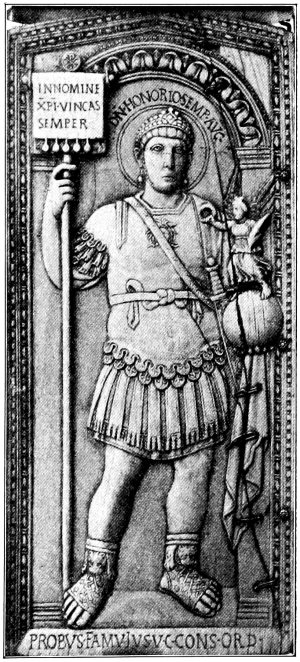
of Probianus (Fig. 2) and on that of the Nicomachi family (No. 58).
The tablet has another close connection with the Probianus diptych
in the division of the surface into two tiers by the border, and the
recognition of the existence of three dimensional space, by grouping
the figures firmly on the ground. This knowledge was soon forgotten,
and the figures on sculptures of scarcely later date float about
one over the other without the artist being in the least troubled
by the problem of the depth of inclosed space. The close connection
with these diptychs points to an early date, probably not later than
the first decades of the fifth century. The dividing border[9]
is very common in Carlovingian ivories, and is, perhaps, one reason why
Westwood and Stuhlfauth attribute the Trivulzio plaque to that epoch,
but a comparison of the “space” arrangement, imperfect as it is, with
any Carlovingian ivory, clearly shows the superiority of the more
ancient work.
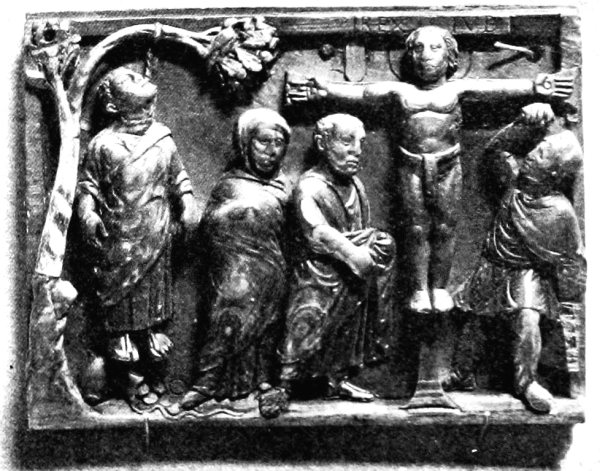
DR. GRAEVEN PHOTO.][BRITISH MUSEUM
7. THE CRUCIFIXION
Italian, commencement of fifth century
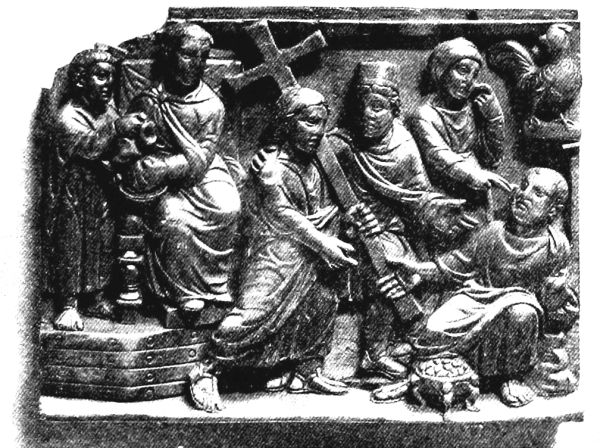
DR. GRAEVEN PHOTO.][BRITISH MUSEUM
8. CHRIST LEAVING THE PRÆTORIUM
Italian, commencement of fifth century
After this time angels were rarely represented without wings; the
absence of wings makes the beautiful nimbed angel on the Trivulzio
plaque quite indistinguishable from the figures of Christ on the
British Museum plaques with the Passion. It is interesting to note,
just about the end of the fourth century, the earliest representation
of the symbolism of the Apocalypse in the presence of the Bull of
St. Luke and St. Matthew’s Angel. The round shape of the tomb, with
the raised tiled roof, is a difficult point, it appears to be the
germ of the elaborate circular edifice with a cupola which became
such a feature in purely Byzantine Art; but there were many circular
tombs[10]
in Rome for the artist to copy, and the huge round mass of
the Mausoleum of Hadrian consisted of a drum, raised on a square
basis, and decorated with columns and statues in a rather similar
manner to the tomb on the fine Byzantine plaque with the Ascension,
in the Munich Museum.
Thus we find the two sets of plaques in the British Museum and the
Trivulzio tablet closely connected with each other and in touch with
the Brescia casket. The workmanship is not so good on the smaller
pieces, but on the whole the drawing is fairly correct, the drapery
well designed and falling in few and soft folds over the rather
chubby forms; and the whole technique is very different from the
unyielding draperies and the too minute details of the consular
diptychs.
Sculpture in ivory prospered, while that in marble declined. The
fashion of sculptured marble sarcophagi had almost died out in the
sixth century; but the Latin types and traditions were carried on
by a series of carved pyxes, till they gradually merged in the
Latino-Byzantine Art.
These pyxes are little circular boxes made in Italy, and dating
practically from the fifth and sixth centuries. Many were of pagan
origin, and decorated with mythological subjects, some being used for
the toilet requisites of Roman ladies; and others were, doubtless,
accerae, or boxes for holding incense for heathen worship, such
as we see in the hand of the lovely Bacchante on the diptych of the
Symmachi family in the Victoria and Albert Museum. Afterwards
they found a place in Christian liturgy, being used to hold the
Reservation of the Host.
The most ancient and beautiful pyx of Christian origin is in the
Berlin Museum. It was probably carved in the fifth century from good
antique models; on it, Christ, posed like Probianus on his diptych,
and represented as a beardless youth, is teaching the Apostles. St.
Peter and St. Paul (who usually takes the place of Judas among the
twelve) are seated at His feet. The apostle on the right of Christ
raises his hand, just in the manner of a consul about to throw the
mappa. On the other side is a very beautiful figure of Abraham
sacrificing Isaac. The style is so completely that of the sarcophagi
that when the design is drawn as a flat strip it could easily be
mistaken for one. In the Bargello there is a well-carved pyx with a
lively picture of the Angel appearing to the Shepherds, who, with
their rough short garments and thick crooked sticks are typical
antique figures and very like Joseph’s brothers on the Throne of
Maximian (Fig. 13). We also find on the Throne the strange basket
chair in which the Virgin sits. The onward rush of the Magi, as they
bear gifts to the Infant Saviour, is a very favourite motive in
Byzantine Art. Their barbaric costume, of trousers and short girdled
shirt, surmounted by a Phrygian cap, traces back all through ancient
Greek Art, and, minus the cap, is still the summer dress of the
Russian peasant.
A pyx in the Musée de Cluny (Fig. 9) is of interest, giving some of
the same series of miracles that are found so repeatedly at this
period, both in carvings and in the mosaics. The Healing of the
Paralytic, who carries his bed, Restoring sight to the man born
blind, the Woman of Samaria, the Raising of Lazarus, and the ever
popular whale scenes from the Life of Jonah (Fig. 10).
The minds of the early Christians seemed turned away from the
scenes of Christ’s Passion and Death, and only dwelt on His human
relations as a Teacher and Healer, and on His glorious position as
“Pantocrator,” Ruler of All. A great triumphal joy seems to break out
in the glowing mosaics of the earlier basilicas, and again and again,
Christ, the Mighty, the Ruler, is represented in enormous size on the
glittering walls, and not a trace of His sufferings, which formed the
chief theme of later art.
In the series of miracles Christ is nearly always represented is a
young beardless man, with a slight smile, the hair sometimes cut
short in Roman fashion, but more often at this period with clustering
curls. This younger, or “Ideal” type is, perhaps, slightly the
earlier, and we find it in the catacomb frescoes and the most ancient
mosaics and sarcophagi. The so-called “Portrait” type of Christ, as
a Nazarene, with long hair and beard and a grave face, tending to
severity was employed at the same time and sometimes side by side in
the same decoration, as in the Ivory Book of St. Lupicien, and the
mosaics of S. Vitale at Ravenna, both sixth century. In each case
He is figured as Pantocrator, this type being invariably bearded in
Byzantine Art. On some few sarcophagi He is also represented with a
beard.
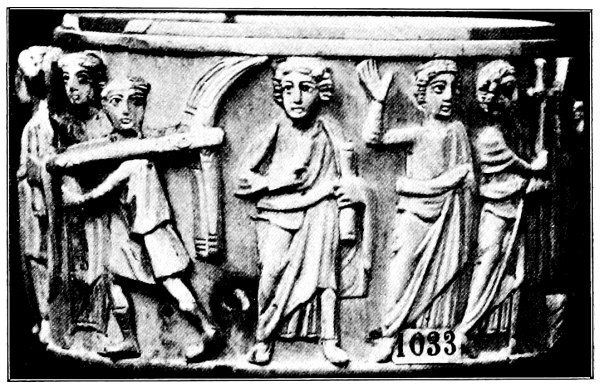
[MUSÉE DE CLUNY, PARIS
9. PYX, CHRIST RAISING THE PARALYTIC
Italo-Byzantine, sixth century
Early in the third century there had been a sharp struggle about
the appearance of Our Lord; many sided with Tertullian, making Him
of abject form, others with Jerome and John Chrysostom declared He
conquered souls by His beauty. The latter opinion prevailed, as it
agreed with the existing traditions of the beauty of the Immortals.
It is interesting to note that during this controversy no actual
portrait was referred to, all the so-called portraits of Our Lord
being of later date.
Fig. 10 is typical of a large group of ivory carvings of mixed
origin. These book covers and the later pyxes are closely allied to
the scenic pieces on the Throne of Maximian, though the technique is
inferior, some being of very rough workmanship.
The arrangement of these panels is like that of the five-piece
consular diptych mentioned in the last chapter, only the vertical
side panels are divided into two pieces by a border. The three
important examples of this kind of book cover are: this single panel
from S. Michele di Murano, now in the Ravenna Library, the two panels
of the Book of St. Lupicien, in the Bibliothèque nationale at Paris,
and the pair lately discovered by Dr. Strzygowski in the Patriarchal
Library at Etschmiadzin on the slopes of Mount Ararat.
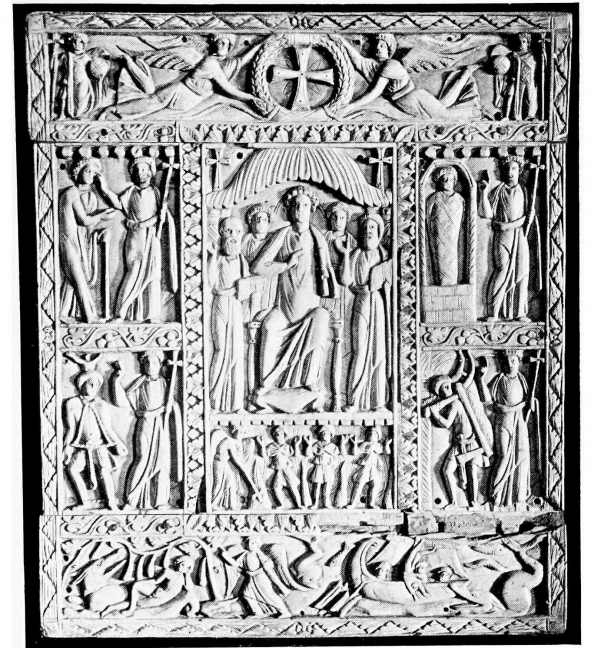
ALINARI PHOTO.][MUSEUM, RAVENNA
10. COVER OF A BOOK OF THE GOSPELS,
FROM S. MICHELE DI MURANO
Italo-Byzantine, sixth century
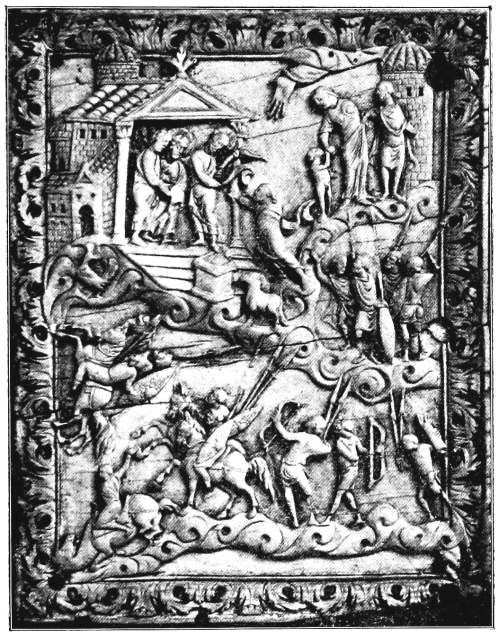
The figures on the Murano panel are long and slight, and the
modelling, though very barbarous, does round off to the background.
Above are the well-known group of flying angels supporting a garland.
These figures in the course of time have gone through a whole cycle
of changes; starting from the flying Erotes who so commonly support
the portrait of the deceased on Roman sarcophagi, they became clothed
and elongated, as we see them here, and at last stripped and chubby
again we find them on the tombs of the Medici, while their grown-up
relations hover over many an Italian picture and sculpture. The
peculiar dumpy dolphin is an interesting specimen of longevity,
going through more than two thousand years of life from the Choragic
Monument at Athens to a London Drinking Fountain without changing a
line. The surprised gesture of the accompanying disciple (Fig. 9),
and of the Three Children in the Fiery Furnace (Fig. 10), is another
of those delightful conventions that meet us at every turn in this
most naïve group of sculptures. We meet it again in the St. Lupicien
panels, which are very similar, but nearer in technique to the scenes
on the Throne of Maximian. The subjects vary little, but instead of
Jonah there is a charming picture of the Woman of Samaria standing
by the well. The figure of Christ seated in the central panel is old
and bearded, and it so closely resembles the St. John Baptist on
the Throne (Fig. 12) that, except for the large cruciform nimbus,
it might be taken for that saint. The workmanship is coarse and the
hands are terribly large and ill drawn.
The drawing on the Etschmiadzin Book Cover, which is in the same
style as St. Lupicien, is still more incorrect, the legs and arms
of the flying angels being quite detached and merely placed in the
drapery at suitable angles. The modelling is even worse, and goes
in many places sheer down to the background from a surface covered
with grooved lines. Yet the figure of the youthful Christ is not
unpleasing, with the wide smooth face so characteristic of early
Byzantine art. The pose, with fingers raised to teach or bless, is
taken directly from the Roman official type, and should be compared
with the diptych of Probianus. The Virgin is accompanied by two
angels, who, though without wings, can be recognized by their pointed
diadems, which have been inherited by the angels in Italian painting.
There are a number of ivories of a double character, strongly
influenced by Byzantine art yet not so closely allied to the Ravenna
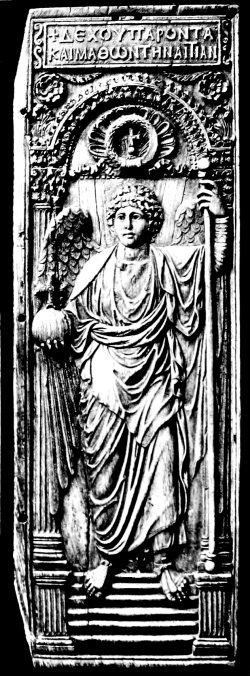
Throne as those already mentioned. The magnificent angel in the
British Museum should probably be classed among these (frontispiece).
It is the first half of a diptych of unusual size, and though the
drapery is a little unmeaning in places, still it is good, and
with the rich architecture and the thickly feathered wings, forms
a splendid whole. There is nothing to compare with it in the sixth
century for firmness of design; yet the tendency to fullness in the
face and the wealth of detail are signs of lateness, and it can
hardly be dated with any certainty before the last years of the fifth
century. The first half of the Greek inscription reads, “Receive
these things that are present and learning the cause—”. It is
sad to see how soon this fine type was debased and moon faces and
unstructural forms became the order of the day.
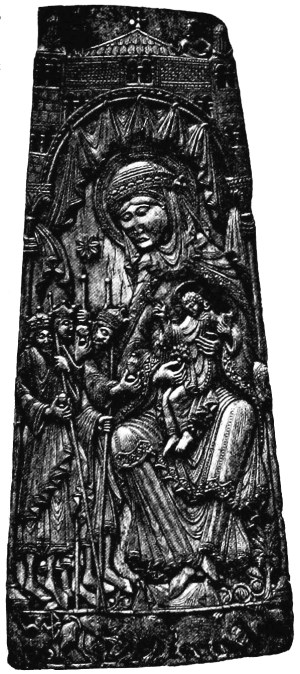
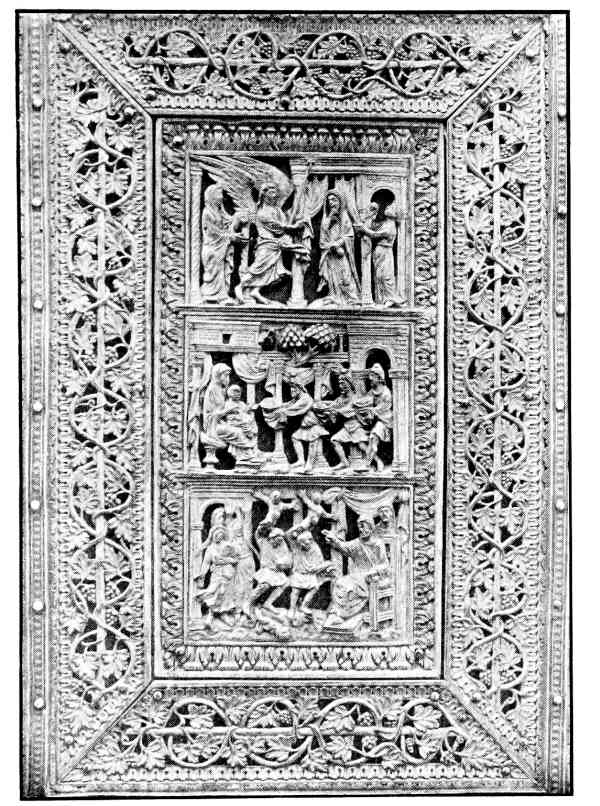
A beautiful book cover in the Bibliothèque nationale at Paris (Fig. 11)
came from the Cathedral of Metz, where it had been for centuries
a model to the Carlovingian and German craftsmen. The pure design
and justness of the movements, together with the generous folds of
the drapery, all denote a close study of the fine work of antiquity;
yet the complication of the design and the exaggerated fineness of
the carving, which is pierced right through, show how far the work
is from the simplicity of ancient art. The Italian craftsman had
still individuality enough to resist the Byzantine influence in some
things. The Virgin is draped like a Roman lady, and Herod has not yet
donned the dress of a Byzantine functionary, as on the later ivories
where court etiquette reigns supreme.
The artist of the Milan book covers had not so much strength, and
has succumbed still more to Byzantine influence. These panels have
been enriched at a later date by a jewelled lamb and cross. Much of
the dress and detail is still Latin, but he draws his inspiration
from the apocryphal gospel of Nicodemus, and represents the Virgin
receiving the Divine message, not in her own house but by the side of
a stream, from which she is drawing water in a tall vase.
The three plaques of the casket of Werden (now in the Victoria and
Albert Museum) belong to this series; there are the same rushing
figures of the Magi, bearing strange gifts on flat dishes, and the
Virgin also stands by the stream. A curious survivor of paganism
is present at the Baptism of Our Lord, the allegorical figure of
Jordan, not by any means a modest accessory, but a large muscular
figure, proudly comparing his fine shoulders with the rather meagre
proportions of the sacred figures. Decidedly the Christian artists
preferred the Spirit to the Flesh, and the era of elongated figures
and champagne bottle shoulders was soon to commence.
A. GIRAUDON PHOTO.][BIBLIOTHÈQUE NATIONALE, PARIS
11. COVER OF A BOOK OF THE GOSPELS, WITH
THREE SCENES FROM THE NATIVITY
Italo-Byzantine, sixth century
Milan Cathedral possesses another ivory carving too important to be
passed over, which Molinier and Graeven attribute to this period in
contradiction to Labarte, who declares it to be Italian Carlovingian
of the ninth century, but the design is too closely connected with
the series just under discussion for it to be possibly of later date
than the sixth century. The two leaves of the diptych are crowded
with active little figures, all intent on the business in hand. It
should be noted that though the angel by the tomb is almost identical
with that on the Trivulzio tablet, the guards are differently dressed,
having the crested helmet and mailed tunic of antique Roman soldiers.
The separation of the two schools had become complete when the
plaque in the Munich Museum was carved, probably well on in the
sixth century. It is unmistakably Byzantine; in the lower half the
Holy Women visit the Tomb, whilst above, there is a fine figure of
Christ ascending to heaven; He rises with a powerful impetus, and the
whole scene is far superior in vigour to the later representations.
There is an interesting plaque in the Liverpool Museum, on which the
Carlovingian craftsman has closely imitated the grouping of the Holy
Women and the soldiers round the tomb.
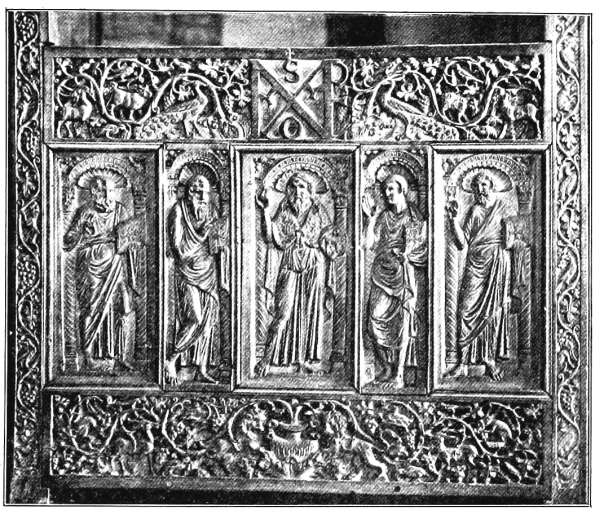
The glory of the ivory craft is at Ravenna, the magnificent Throne of
St. Maximian, bishop of that city from 546-553.
L. RICCI PHOTO.][CATHEDRAL, RAVENNA
12. FRONT OF THE THRONE OF MAXIMIAN
Italo-Byzantine, sixth century
This cathedra or episcopal chair is entirely covered with carved
ivory, and has been treasured in the Cathedral for more than fourteen
centuries. The throne was made in the sixth century, during that
period of great artistic activity, when Justinian was engaged in
beautifying Constantinople and the other great cities of his Empire.
The new Church of St. Sophia was being decorated in the most gorgeous
manner. The old chroniclers tell of gold and silver doors, and six
doors of carved ivory; so the custom of overlaying large surfaces
with ivory plaques was not an innovation. The bishop ordered his
Throne and set it up at a time when Ravenna was still an important
centre, and yearly adding to the number of its beautiful buildings.
S. Vitale, newly finished and decorated with the celebrated mosaic
portraits of Justinian and Theodora, was consecrated by St. Maximian
himself, who is pictured on the walls by the side of the Emperor.
Yet, in spite of all this encouragement, art, and sculpture in
particular, had already commenced that steady decline to the
period of comparative stagnation which, as Professor Krumbacher,
the well-known Byzantine scholar, says, affected not only art but
literature, and lasted nearly two hundred years, from about 650 to
850. The decline can be traced in the mosaics at Ravenna; those in S.
Vitale are not so good as those in the tomb of Galla Placidia, while
the decoration of the Baptistery is the most ancient and the best.
The Throne is most precious as an exception, showing really artistic
work in a period when originality was rare. The height is one yard
fourteen inches, the seat being flanked by two panels rising above it
and forming the arms; the front is entirely filled in by the large
panel with five saints, the back is high and semi-circular, the top
being arched. At the junction of the side panels, with the front and
back, are upright posts, which form the feet, and rising slightly
above the level of the panels are capped by flattened balls; these,
and the strips of ivory which divide the back into little scenes, are
carved with the most decorative vine scrolls, growing out of vases of
classical shape, and peopled with a whole world of animals leaping in
and out amid the leaves and bunches of grapes.
These borders show real progress and the adoption of new oriental
ideas. The animated scroll work is often found on the Eastern
textiles of this period, which must have formed objects of constant
trade. The Koptic tombs on the Nile Delta[11]
have yielded a numerous collection of contemporary textiles with
beautifully woven patterns in much the same style. The vine from
being a popular pagan decoration became closely connected with the
Christian religion.
The carving of the wide borders on the back, if rather summary,
attains the largeness of treatment as of sculpture in marble. The
actual manual work on the Throne varies somewhat, and is probably the
work of different artizans, Byzantine or Italian, but there can be
little doubt that the whole was the work of one master mind.
The Five Saints on the front panel are of noble design and most
carefully carved, but lacking in spontaneity. Each stands under the
familiar round arch, and the scallop shell is arranged as a kind of
halo behind each head.
The grand figure of John the Baptist stands in the middle of the Four
Evangelists, among whom we are tempted to recognize St. Peter and St.
Paul, but this resemblance is probably owing to the artist’s poverty
of types. Above, in the border, flanked by two peacocks of evident
Syrian origin, is the monogram of the saint, which reads
Maximianus episcopus.
The plaques on the side panels deal with the life of Joseph, and
those on the back have scenes from the life of Christ. The latter
were twenty-four in number, but only seven remain, four inside
and three out. Some of these are carved on each side, and all are
bordered with a narrow and much debased Greek bead and lozenge
moulding, which is an additional help in the identification of the
straying pieces. One of these lost plaques is now in the collection
of Count Stroganoff at Rome; it represents on one side “the Entry
into Jerusalem,” and on the other “the Nativity,” with an additional
incident in the withering of the hand of the incredulous attendant,
Salome, which is recounted in the apocryphal gospels. The type of
Joseph in this scene is just the low-browed, bullet-headed type of the
Greek wrestler, and must have been borrowed from some ancient sculpture.
L. RICCI PHOTO.][CATHEDRAL, RAVENNA
13. PANEL FROM THE THRONE OF MAXIMIAN
Italo-Byzantine, sixth century
In the scene of the Annunciation the Virgin sits in a high-backed
chair of basket-work, just like that on the Bargello pyx, with the
Visit of the Magi. She is spinning, as described in the apocryphal
gospels, and beside her stands a basket for her wool.
The plaque, with the Virgin riding on an ass, is not the flight into
Egypt, but the journey to Bethlehem just before the Child was born,
and the languid attitude of the Virgin as she leans in weakness on
the shoulder of Joseph, is rendered with much feeling.
The Baptism of Christ is peculiarly interesting as it gives an
insight into the early types of this subject. The Holy Spirit in the
form of a dove flies headlong downwards, and Christ is represented
as a little naked child, and beside him, leaning on an urn is the
personification of the River Jordan. Another remnant of pagan
tradition is found in the winged and bearded genius of Sleep, who
stands by Pharaoh’s couch in the “Dream Scene.” This figure also
appears on a plaque in the Early Christian Room at the British
Museum, which is decorated with scenes from the life of Christ, the
strange bearded angel being present at the baptism. There is a very
interesting ivory in the same room, a pyx representing the Martyrdom
of St. Menas, which has another peculiarity in common with the
carvings on the Throne, in the elaborate and curiously embroidered
blouse worn by the executioner, which is like that worn by Joseph in
the house of Potiphar.
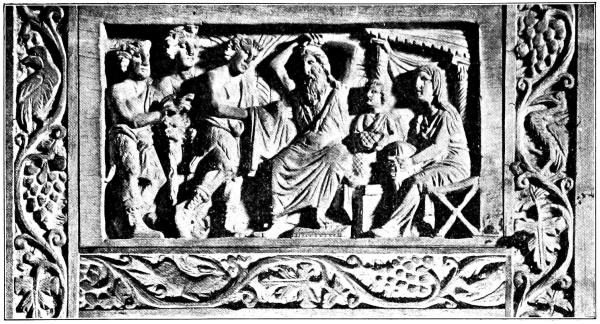
The scenes from Joseph’s life are more deeply carved than the others,
the figures are wonderfully characterized, the oriental faces of the
Egyptians are framed in long plaits, like the Egyptian hair dressing
on the monuments, which is even now to be seen on the Upper Nile. All
these reliefs are a curious mixture of close observation of nature
and servile imitations of classical types. The woman present at
the sale of Joseph, holds her hand in her veil like many a stately
figure in Roman art, but the meeting of Joseph with his old father is
quite modern in its emotional force, the old man tremblingly totters
forward into the arms of his stalwart young son, and one cannot help
feeling irritated at the bystanders’ conventional gestures as they
gaze on such a touching scene. Jacob’s wild distress (Fig. 13) is
terribly realistic, and the contrasted stony despair of the bereaved
Rachel is most dramatic. Rachel appears in other presentments of this
subject, but the Bible narrative mentions her death some time before.
The provenance of this great monument is a very thorny question,[12]
many writers notice the strongly marked oriental characteristics, and
some infer that it was imported from Alexandria, which then had a
flourishing school of artists and craftsmen. St. Maximian certainly
visited Alexandria before he was made bishop, and he may afterwards
have ordered the Throne to be made there, or brought over Alexandrian
workmen. There is every reason to believe the story that the Emperor
Heraklius brought over a carved ivory throne from Alexandria in
the beginning of the next century. The difficulty of adopting this
Alexandrian theory lies in the existence of an Italo-Byzantine school
in Italy, which is proved by the number of pyxes and book covers,
which seem to show nearly every step between the old Latin and the
almost entirely Byzantine art of the Ravenna Throne. Of course many
of these may have been influenced by the carvings on the Throne, but
many are undoubtedly of earlier date. Any way, with the acceptance
or rejection of this theory stands or falls the European origin of
several other most important ivories: first and most important, the
much-discussed Berlin diptych, representing on one leaf Christ as a
middle-aged man, very similar in type to the John Baptist (Fig. 12),
and on the others the Virgin, attended by wingless angels;
Schmirnoff, by close examination of the border, which has been
partially cut away, believes he has discovered the remains of a
monogram similar to that on the front panel of the Throne. Also the
plaque with the Baptism of Christ, in the British Museum, the
Tongres diptych, the “Bateman” diptych, and one or two others which
are closely related in style.
Reference was made to an ivory throne brought from Alexandria to
Constantinople by Heraklius (610-641). This throne was ultimately
placed in the Cathedral at Grado, and the legend grew up that it was
actually the episcopal throne of St. Mark, who was the first Bishop
of Alexandria.
In the Castello at Milan there are a series of five plaques dealing
with the subject of St. Mark’s mission to Alexandria and Cyrene, as
told in the Acts of St. Mark; there is every probability that they
belonged to the throne of St. Mark in Grado, which appears to have
been more or less perfect in the sixteenth century, but is reported
by a later writer to be entirely stripped of its decoration. The
Milan reliefs are of a very distinctive technique, the drapery being
marked by rib-like folds, usually in couples, and the type of face is
refined, though over elaborated. They are earlier than the time of
Heraklius, and probably date from the sixth century.
Three scattered plaques are unmistakably connected with this series;
St. Peter dictating the Gospel of St. Mark, with a winged figure
behind, in the Victoria and Albert Museum; The Raising of Lazarus
in the British Museum, and The Annunciation, in the Trivulzio
Collection at Milan. The two last are more delicately carved, but
the striking similarities of pose and drapery, and the same violent
perspective of the architecture, make it almost certain that they are
from the same atelier, if not by the hand of the same craftsman.
Two ivories of a totally different style seem to belong to the next
century, but their dates are still a matter of doubt. One is a plaque
in the Treasury of Trèves Cathedral, deeply undercut and full of
little figures and details. Westwood says it represents the arrival
of the Holy Coat to that very Cathedral.[13]
The relic is in a casket held by two ecclesiastics, who sit in a
gorgeous car drawn by a pair of horses. The procession is led by the
Emperor Constantine and received at the church doors by his mother,
Helena, who holds a cross in memorial of her journey to Jerusalem to
fetch the True Cross. In the background is the Porta Nigra, and the
nave of a basilica showing an apse.
Unfortunately, there is no proof of this attractive theory, though
the building in the background does resemble the Porta Nigra (still
existing at Trèves) and the basilica there has a very similar apse;
but all Roman architecture imperfectly depicted looks much alike,
every basilica has an apse, and it is not recorded how long the ivory
has been in the Treasury at Trèves. Thus we must be reconciled to
call it by an indeterminate name. It is certainly Byzantine, and most
probably about the seventh century.
If possible there is still greater uncertainty about the second
ivory, which is also of an architectural character and has lately
been acquired by the Louvre authorities. It is without doubt
Byzantine, and represents the conventional type of St. Paul,
preaching to a distinguished and eager crowd. The relief of the ivory
is very deep, and there is a certain boldness in the treatment of the
mass of the crowd, also the city which towers over head, is of a very
real structure and seems intended for some actual city.
Comparing the round arched buildings with the types of architecture
on the sixth and seventh century mosaics, Molinier and Saglio
attribute this ivory to the same period, but Schlumberger cannot
believe it to be more ancient than the tenth century. The deep red
colour is the remnant of the purple stain, which was probably still
further enriched by gilding.
With few exceptions, it has been the common practice to colour
ivories as well as statues, and though much at variance with our
modern taste (which is founded on a mistaken appreciation of the tint
of marble from which the colour has faded), it must have greatly
enhanced the effect, especially in the smaller objects which enter
almost into the province of bijouterie.
In the eighth century the iconoclastic[14]
troubles commenced; the movement was at first one of real reform,
the charge of idolatry which had been brought against the Greek
Christians by their Mahometan neighbours was not without foundation,
but unfortunately the love of images was deeply rooted in the heart
of the people, who transferred to these little pictures and images
the same homage they had paid to their local protecting deities in
pagan times.
A powerful party, always a minority, gained the ear of the Emperor
Leo III., the Isaurian (717-741), a man of low birth, who had raised
himself to his high station by sheer merit on the field of battle,
and though he has been bitterly abused by his enemies, he appears to
have been quite above the average of imperial character, which, it
must be confessed, did not reach an overpoweringly high level.
This man, having subdued his country’s enemies in the East, turned
his active mind to the annihilation of the unhappy artists and all
their works. At first his measures were moderate, the removing
of pictures out of reach of the lips of the worshippers; but
superstition was so deeply rooted that an abortive revolt broke
out, instigated by the monks, who, besides being the most strenuous
advocates for images, were also the chief manufacturers.
This rebellion was easily suppressed, but it provoked severer
measures, an edict was promulgated that all images were to be
destroyed, and the painted walls of the churches to be covered
with plaster. All opposition was punished by a rapid crescendo
of penalties, by imprisonment, mutilation and excommunication.
More revolts followed, Leo became still more angry, and the next
thing we read of is the destruction by fire of the great Library
of Constantinople, guards and all, by order of the Emperor. The
guards were not a matter of importance, as a violent death one way
or other was of small moment in those most unpleasant times; but
the manuscripts were an irreparable loss, almost as terrible as the
burning of the Alexandrian Library by the Mahometans, only a hundred
years before, and for the same unreasonable reason.
These struggles continued, with less or more violence, for nearly 150
years; the choleric Leo was succeeded by his still more violent son,
Constantine V. who, according to the opposite party (which contained
all the chroniclers), was closely related to the Evil One, but he
certainly had great energy, and was probably not so black as he was
painted. He continued the work of his father with great vigour, and,
it must be added, considerable cruelty.
Sometimes there was comparative calm, as when the Empress Irene
seized the reins of government from her unhappy son, Constantine VI.,
in 797, and issued an edict of tolerance. She was a wonderful woman,
and lived in imperial state for many years, against all law, human
and divine; for she was many bad things, besides being a woman, and
as such, debarred from government. Among her schemes was an alliance
with Charlemagne, to whom she offered her hand; the offer was not
accepted, and soon after she was exiled to Lesbos by another usurper,
who, being a violent iconoclast, immediately restored all the
oppressive laws. With delightful readiness the ecclesiastical General
Councils promulgated decrees for, or against, the cult of images,
according to the taste of the ruling power.
Theophilus, the last of the iconoclastic emperors, was a great
builder of churches and palaces, and none of the iconoclasts went
to the length of forbidding the introduction of the human form, and
reducing decoration to geometrical motives and scroll work, as is the
case of Arabian art.
Theophilus was succeeded by his widow, the Empress Theodora, who
governing in the name of her infant son Michael III., promptly
reversed all the edicts of her husband and his predecessors, and
endeared herself to the Greeks, by the restoration of their beloved
images, and the final defeat of the iconoclastic party, which was
accomplished about 842.
Though there was a sensible difference after this movement, still it
is easy to exaggerate its influence on Byzantine art. The edicts of
the Emperor were not always carried out to the letter, except,
perhaps, in the capital city, and even there the smaller objects were
secreted, and women, always conservative, clung to their lares
and penates, keeping up the old observances as much as possible.
Many an obstinate monk took pride and pleasure in setting the law at
defiance, carving little diptychs with the decoration on the inner side,
so that they could be folded together and slipped away in safety.
[VICTORIA AND ALBERT MUSEUM, LONDON
14. OLIPHANT
Oriental-Byzantine, ninth and tenth centuries
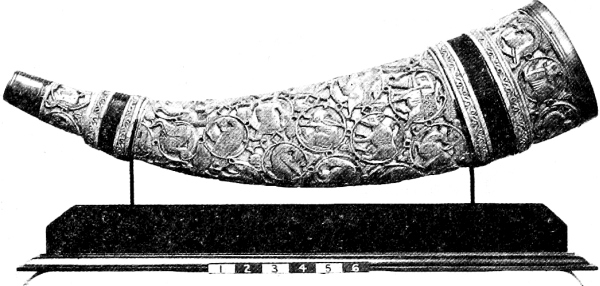
The civil art went on uninterruptedly, and in such a luxurious city
the objects of secular use must have been very rich and varied.
A large series of caskets have come down to us, preserved in the
treasuries of churches as shrines for the relics of saints, also
large oliphants, or complete tusks, hollowed out and thickly covered
with linked patterns of strongly oriental style; these were first
imported from the East and afterwards imitated more or less exactly
by Byzantine craftsmen. In early ritual they were used as horns
to announce the commencement and the end of the Mass, and also to
contain relics, and it was the latter use which brought them in
such numbers to the West. The miniaturists, also, continued their
art, copying and illustrating texts of Homer and Virgil and other
classical writers.
The iconoclastic movement, though lasting a century and a quarter,
had no permanent effect in checking the natural development of art.
In fact, the greater impetus given to the civil art had rather
the effect of purifying the Byzantine style by constant reference
to the antique, and prepared the way for the Renaissance of the
tenth century. Byzantine art is still so little known that it is
probable that many ivories now classed in the tenth may belong to the
preceding century.
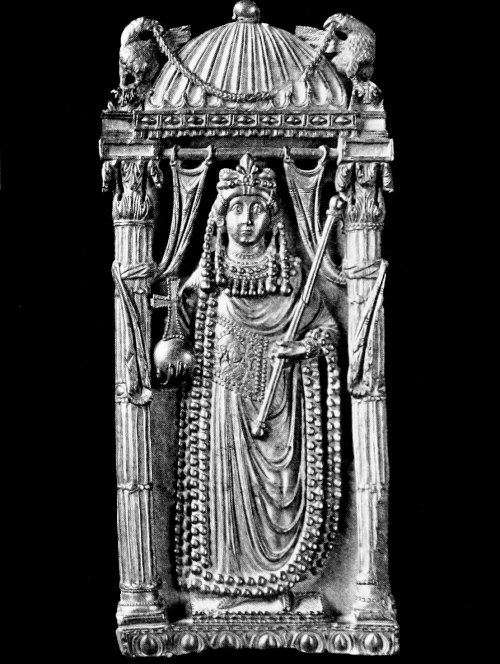
Molinier attributes even the Vienna and Bargello diptych (Fig. 5)
to the mid iconoclastic period, to that lull in the storm during the
reign of the Empress Irene (end of eighth century), whose portrait
he considers it to be. This ivory, though more probably of the sixth
century, has some slight likeness in the wide face and full neck to
the two busts of Christ and the symbolic angel of St. Matthew in the
Library, Ravenna (the eagle of St. John is in the Victoria and Albert
Museum). These must be classed with another ivory of this period in
the Louvre, a figure of Christ standing under a richly decorated
arch, but the low forehead and staring eyes, with the pompous
attitude, in imitation of the beautiful British Museum angel, make it
positively ridiculous.
Another plaque in the Berlin Museum, the only dated ivory of the
ninth century, represents an emperor being crowned by the Virgin,
and bears the name of a “Basileus Leo.” The early emperors of this
name are too ancient, and the last three were rabid iconoclasts, so
that brings it to the Emperor Leo VI., crowned in 886. Unfortunately
this work, which should be most useful for comparison, is of rough
technique, and evidently a provincial production, for no craftsman of
the great metropolis could have produced such uncultivated work, even
on the morrow of the iconoclastic crisis.
We owe to the series of secular caskets most of our knowledge of
this transitional period. They do not appear to have been articles
of great luxury and were usually made of bone and sometimes
indifferently carved. The fashion continued for several hundred
years, and side by side with these secular caskets we have others
decorated with scenes from Old Testament history, which, though very
few in number at first, become more frequent as time goes on. The
religious caskets have many details in common with the secular, but
draw their inspiration from a different source.
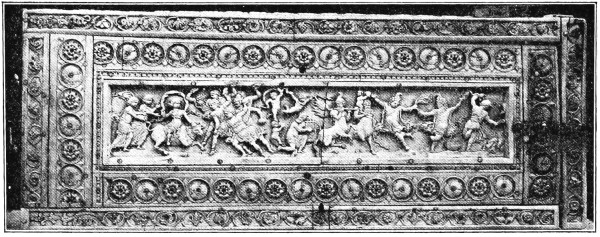
There is great similarity in the design of the secular caskets, the
box itself being made of wood and covered with ivory plaques. The
lids are either in the shape of a truncated pyramid, and hinged,
or flat and sliding into grooves. The decoration consists of an
elaborate border surrounding either long scenic plaques, as in the
Veroli casket in the Victoria and Albert Museum (Fig. 15),
or more often little squares containing a single figure (Bargello, etc.). The
borders show strong oriental influence, and invariably consist of
ringed rosettes connected by a pointed leaf; these rosettes sometimes
alternate with coin-like medallions, and there are occasionally
additional bands of varying pattern, as on the Volterra casket
(late Spitzer Collection) at the Musée de Cluny.
The subjects are a proof of the still lingering power of classical
antiquity, and of the infiltration of oriental designs. They are
either taken from ancient myths (often very imperfectly understood
by the adaptor), or from scenes in the hippodrome or circus
(Volterra); perhaps also from the statues, part of the Grecian loot
that Constantine had brought from Rome to decorate his new city.
[VICTORIA AND ALBERT MUSEUM, LONDON
15. THE VEROLI CASKET
Byzantine, ninth and tenth centuries
Most of these caskets are composed in the gayest frame of mind;
on the beautiful ivory Veroli casket the little loves, on the
light fantastic toe, dance to the harping of poor, melancholy, old
Polyphemus, who is compelled to cease his solitary lament and play
hornpipes and jigs for the benefit of wild Bacchantes, who whirl
round and round till their drapery is tossed out like foam. It is
amusing to see these same ladies on the casket at Cividale, no longer
carved with delicate finish, but angular and rough, the drapery
flying out like wire, and the development of the muscles rivalling
that of a prima ballerina.
The maker of the Pirano casket in the Vienna Museum imitated the
Veroli in many things, as the putti and the panther, and the group
of Mars caressing Venus under the chin, in the good old-fashioned
Brescia diptych way, also the peculiar treatment of the hair in tiny
knobby ringlets, which is found again on the Bologna casket, and
on two most interesting plaques in the British Museum. One plaque
represents Christ freeing the Souls in Hades, and the other
The Nativity. On the first there is a group of little child-souls
with polished round muscles and knobby hair, also the hair of the
angels in both the scenes is of the same character, the rest of
the technique has little to distinguish it from the so-called X-XI
century type; but the conception of the subject is not the ordinary
stereotyped one of later years, and those few peculiarities of style
have such a marked connection with the Veroli casket, that Graeven
considers it likely that they both came from the same atelier, and
may, perhaps, be dated about the middle of the ninth century.
Before pointing out the various similarities between these secular
caskets, and those with religious subjects, it would be well to
inquire into the ancestry of the separate styles.
The classical designs on the secular caskets are more completely
conventionalized than would be the result of direct imitation of
antique originals by later craftsmen; and the coin-like borders give
a clue to finding out what were their actual models. They must have
been inspired by the repoussé designs on gold and silver plate,
it being a very common practice, in all ages, to insert coins round the
edges of precious vessels. The peculiar tapering ankles and delicate
wrists are another proof of some other technique intervening between
the marble sculpture and the ivories. The tendency of marble to crack
if exposed to too great a weight, led to a sturdiness in all detached
forms, and not even in the bronze statues are such exaggeratedly
slender extremities to be found.
Ancient records often tell of large masses of plate being presented
to churches in the West. A single gift to St. Germain at Auxerre
in the seventh century, consisted of one hundred silver vessels,
including two great dishes decorated with reliefs from the Æneid, and
a third with the “Rape of Europa,” and having Greek inscriptions.
If there was such a mass of plate in the West, the richness of
Constantinople in gold and silver vessels must have been simply
fabulous. The descriptions of the Byzantine chroniclers, and the
figures given of the Venetian share in the sack of Constantinople by
the Crusaders in 1204, are astounding.
The silver casket at Anagni forms a connecting link; it is the same
shape and style as the ivory caskets, and the little silver reliefs
are mounted in the same manner with border strips.
The caskets with religious subjects are derived from the miniatures
in ancient and contemporary manuscripts, as has been abundantly
proved by the complete correspondence of existing plaques and
miniatures. The Victoria and Albert Museum possesses an excellent
example in the strip of ivory, with Joshua receiving envoys from
the people of Gibeon, which is taken almost line for line from two
miniatures in the famous Joshua Roll in the Vatican Library; except
that in the translation of the painting into sculpture, certain
details had to be simplified, and the serried ranks of Joshua’s
soldiers were reduced to a faithful copy of the forward group.
A tiny plaque in the Grüne Gewölbe at Dresden is another instance
of this connection with the manuscripts. It is one of two surviving
portions of a casket decorated with the life of Joseph, and is
directly inspired by the wonderful Genesis codex at Vienna. This
codex is especially interesting as showing the artist’s delight in
scenes of domestic affection; the picture, which coincides with the
ivory carving, illustrates the departure of Joseph to get news of his
brethren. His father with a stately gesture bids him go, and as he
goes he turns to kiss his little brother Benjamin, who follows him a
little way. The sculptor has taken the moment of the kiss, and the
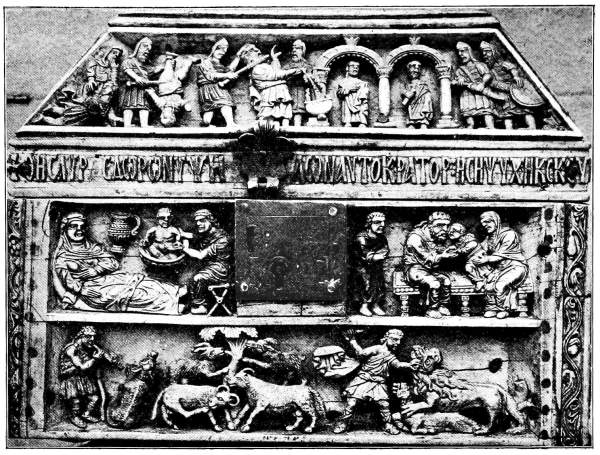
gentleness of the action is like the little domestic scene on the
casket in the Museo Kircheriano at Rome (Fig. 16).
DR. H. GRAEVEN PHOTO.][MUSEO KIRCHERIANO, ROME
16. FRONT OF A CASKET. SCENES FROM THE LIFE OF DAVID
Byzantine, ninth century
The carvings on this casket give a graphic account of the early life
and adventures of David, and are most probably derived from some
lost manuscript of the Book of Samuel. The active little figures are
exceedingly droll, and it is difficult not to think that a little
of the gay secular spirit had crept into these more sober scenes.
The lamb which sits up and begs while David pipes is particularly
engaging. The front side of the sloping lid is given up to most
tragic scenes. The Massacre of the Innocents, and the Murder of
Zachariah, the High Priest, “killed between the temple and the
altar.” The inscription tells us that the casket was intended as a
marriage gift to a Basileus and Basilissa from another wedded pair,
the portraits all being on the top.
The various details which the two series of caskets have in common,
prove they belong to the same period. On the Veroli casket
(Fig. 15), the group of men stoning the bull which bears
away Europa corresponds with a miniature in the Joshua Roll, which depicts the
stoning of the captive people of Achan. The rosette border is also
found on a twelfth century casket with half-length figures of saints
in the Bargello. On some of these caskets the plaques are decorated
with designs taken bodily from Oriental textiles and carvings; the
smaller Volterra casket in the Musée de Cluny is a case in point,
and it has the additional charm of an openwork border of maple leaves
on a gilt background.
Some writers call these caskets Italo-Byzantine because a large
number have been found in the treasuries of Italian cathedrals, but
their ancestry is thoroughly Byzantine. It is not impossible that
some few examples were made in the West, as several stone reliefs
have been found in Venetia, clearly dating from the first decade
of the eleventh century, and ornamented with the same classical
subjects, confused in the same way with foreign elements, and
surrounded by the customary rosette border, and which are most
probably copies of these Byzantine fancy goods.
The Throne of St. Peter in the apse of his church in Rome, is made
up in the same way with little plaques representing the Labours
of Hercules and other purely pagan subjects. The ivory carvings
belong to two periods, one, admittedly, of the ninth century when the
Throne was restored, and the others are traditionally supposed to
date from the lifetime of the apostle. It was inclosed 200 years ago
in a hideous casing, and no close examination is permitted. If this
chair is really of great antiquity, even if not so early as the first
century, it would be a great support to Venturi’s assumption that all
these secular caskets belong really to classical antiquity, and are
of late Roman origin. There is a beautiful casket in the Cathedral
of Troyes, of the tenth or eleventh century, which was sent back by
Garnier de Traisnel, Bishop of Troyes, and Almoner to the Crusaders.
Garnier died in the East, but sent home his share of the spoil from
Constantinople. It is stained a rich purple and evidently belonged to
the Basileus, who is depicted on horseback.
The Golden Age of Byzantine Art commences about the beginning of the
tenth century, and, roughly speaking, coincides with the rule of
the great Macedonian dynasty, a period when the warrior emperors,
usurpers or otherwise, kept the invading barbarians at bay.
The Byzantine chroniclers expatiate at great length on the
unparalleled luxury of the Court and how the “Sacred Palace” was
filled with art treasures; and they also tell us that Constantine
VII., Porphrygenitus (911-959), was an enthusiastic amateur, and
even employed his “sacred” fingers in carving and painting beautiful
objects; it was about the only thing he did do, for the government
was entirely taken out of his hands by a series of usurpers who were
nominally his colleagues.
Ivory carving was only one small portion of this great stream of
decorative work, but an important part, as there was practically no
sculpture in stone. In the new basilica at Constantinople were some
animals carved on the marble fountains, and a few inferior
bas-reliefs have been found in the Crimea and Mount Athos, but
the technique is merely an enlargement of the tiny reliefs, with
a complete loss of that delicacy and loving finish which is the
greatest charm of the ivory craft.
The number of examples of carved ivory during the tenth and eleventh
centuries is so great that it is most difficult to make a selection.
The Reliquary of the True Cross in the Franciscan Church at Cortona
is valuable for comparison with other carvings of the tenth century,
for it is dated by an inscription mentioning the Basileus Nicephorus,
Conqueror of the Barbarians, who can be no other than Nicephorus
Phocas (963-969). The reliquary is divided in the usual manner
into four compartments by the arms of the great central crucifix,
and owing to the shallowness of the space the figures are not so
disproportionately tall as was mostly the case. In the research for
dignity and reverence the figures became less and less earthly, the
shoulders sloping away to nothing, and a growing tendency crept in to
exaggerate the height out of all proportion; also the calm expression
on the delicate oval faces grew more and more solemn, till on some of
the later ivories it is positively lugubrious. Yet the quiet grace
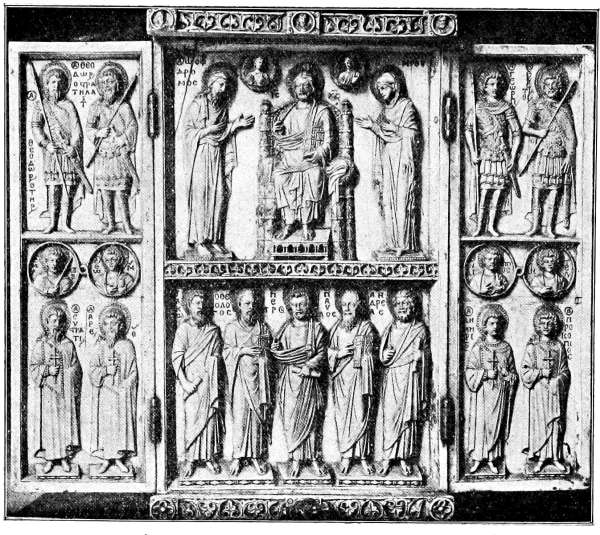
and exquisite dignity of a figure like that of the Virgin on the
Harbaville Triptych (Fig. 17), is hardly to be found in
the finest Italian art. The pose of this figure and that of John the Forerunner,
Πρόδρομος, are almost identical with those on the Cortona Reliquary;
the Virgin’s gesture of adoration is simple and spontaneous, and it
is only when it is repeated by St. John that the balance of the
pattern becomes too exact and pains the eye. The figure of Christ,
grandly posed on the highbacked throne, is the type of nearly every
other representation of the Saviour throughout the whole period
(cf. Fig. 19) and traces back directly to the Roman official
diptychs. The drapery is elegant and well considered, though the folds have
a hard flatness in spite of the soft finish of the technique. The
features inherit much from the antique, the well-cut brow and deeply
set eyes, but the noses have increased in length and have that
slight curve at the tip which is so characteristic, and becomes
so pronounced, in later Byzantine Art. The fine heads, framed in
their rugged mane of hair, are very picturesque, but there is such
a strong family likeness among them, that it is quite refreshing to
meet a bald forehead like that of St. Paul or St. John Theologus,
here represented as an aged man and not as the beardless stripling
of Western art. Above all, it is the hands and the well-proportioned
muscular feet, which show the power of the real artist escaping
from the conventionality of his subject. On the back of the panel
he has freed himself entirely from the spell of classical antiquity
and drunk deeply of new oriental ideas, creating a most decorative
design, illustrating the “Triumph of the Cross,” which rises,
ornamented with roses, above the flowering earth, stretching up to
the skies, which are thickly covered with stars, and bear the Greek
inscription Jesus Christ Victorious. Two tall cypresses, tightly
bound by the symbolical vine and by ivy, bow before it, whilst from
the ground spring small trees and reeds, among which wild animals run
in and out.
A. GIRAUDON PHOTO.][LOUVRE, PARIS
17. TRIPTYCH D’HARBAVILLE
Byzantine, tenth century
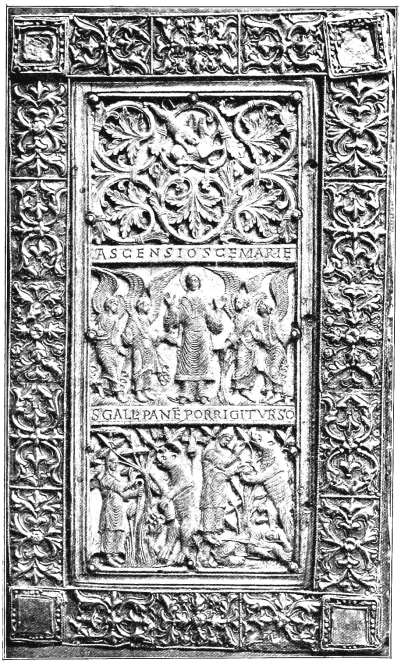
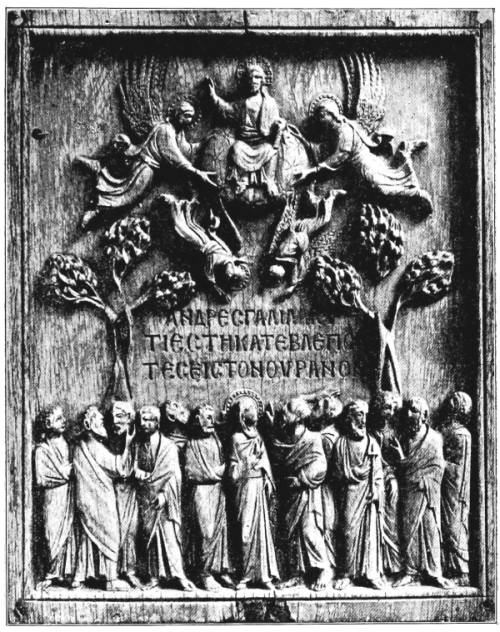
The trees may be contrasted with the fruitful olives on the Bargello
plaque of the Ascension (Fig. 18). The composition of this
scene is grand in character, in spite of its small size, and there is great
freedom of movement in the lower group, each pose being cleverly
characterized; the grouping is scarcely freer in the Italian
conception of this subject, and the upraised hand of the apostle
on the Virgin’s left is to be seen, centuries later, in the famous
“Assumption of the Virgin” by Titian. There are many other plaques
with scenic pictures. The elaborate carving of the Death of the
Virgin is still fixed to the Bamberg Missal, which belonged to
Cunigunda, wife of the Emperor Henry II. (1002-1028). The scene is
crowded, and takes place under a richly pierced canopy. Christ holds
the Infant Soul of the Virgin, whilst two angels with veiled hands
fly down to receive it.
Perhaps the most beautiful of all these pictorial sculptures is a
diptych now unfortunately divided. Each leaf has two scenes, the
first, representing the Holy Women kneeling before the risen Christ
and the Resurrection, is at Dresden, while the other, with the
Crucifixion and the Deposition, is in the Provincial Museum at
Hanover. The various scenes are treated with much freedom, and the
proportions are excellent. It is enough to glance at the appalling
length of the two Maries in a twelfth century plaque with the
Resurrection (Bargello) to realize how much we have to be thankful
for in the earlier periods.
DR. H. GRAEVEN PHOTO.][BARGELLO, FLORENCE
18. ASCENSION
Byzantine, eleventh century
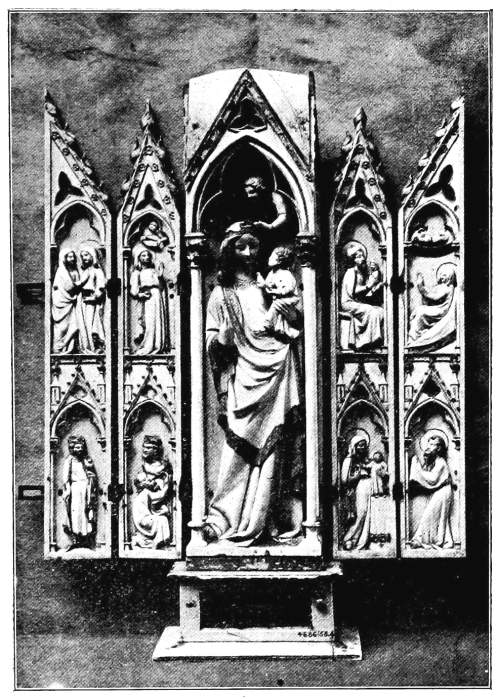
There are a large number of triptychs[15]
all more or less of the Harbaville school. A fine one at the Louvre
of Christ and St. Theodore has lost the second wing, and of
another still finer one, only the splendidly carved wings remain,
widely separated now, one being in Vienna and the other in the Doge’s
Palace at Venice. Several of these little shrines inclose a group of
the Virgin and Child, the two most beautiful being in the Episcopal
Museums of Utrecht and Liège. Count Strogonoff in his interesting
collection at Rome has a particularly fine seated Virgin and Child.
The whole pose is most pleasing and the Infant Christ on her knee
has a far more childish face than usual, the Holy Child being more
often like a little man, raising his hand to bless with exaggerated
dignity. But the ineradicable love of ostentation and luxury leads
the artist to diminish the importance of a really dignified figure
by adding a mass of gigantic and over-decorated accessories, and the
legs of the throne are wrought with more exactitude than he bestows
on the robe of the central figure.
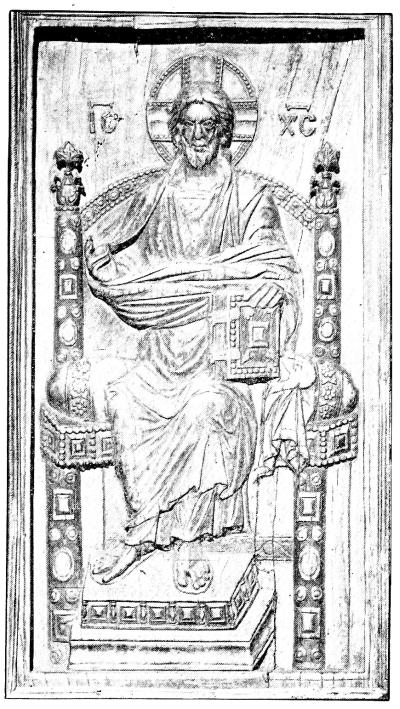
G. ROSSI PHOTO.][TRIVULZIO COLLECTION, MILAN
19. CHRIST ENTHRONED
Byzantine, eleventh century
There are many other interesting ivories in this fine collection,
which even contains one of the lost plaques from the Throne of
Maximian. Among them is a noble figure of Christ Teaching which
might well correspond to the John Baptist at Liverpool, one of
the gems of the Mayer Collection. John bears a roll with the text
commencing, “Behold the Lamb of God,” which would refer to the
Christ on the opposite leaf of a diptych. The Liverpool Museum also
possesses a fine triptych, with Christ on the Cross, the Virgin and
St. John. This is a type which seized the imagination of the German
people, who constantly repeated it, losing, perhaps, in technique,
but gaining in vigour and expression, as will be seen on referring to
Fig. 24.
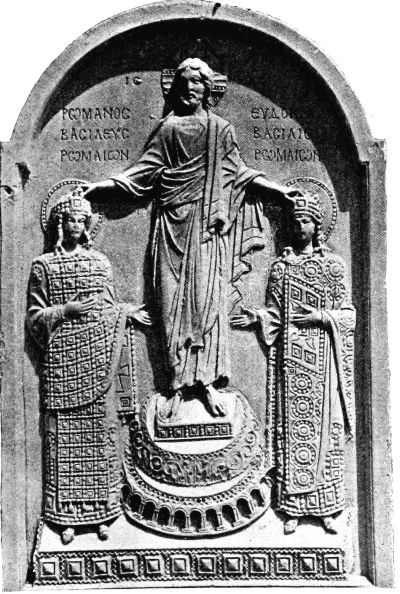
The plaque in the Cabinet des Médailles of the Bibliothèque
nationale, Paris (Fig. 20), is a fitting end to an account
of the ivories of the Byzantine Renaissance. It represents the Emperor
Romanus IV. and the Empress Eudoxia being crowned by Christ. It is
doubly interesting, as through its certain date (the Emperor’s reign
only lasting four years 1067-1071), we can compare it with earlier
work, as the Cortona Reliquary or the Harbaville triptych (Fig. 17),
and see that after more than a hundred years the art had not
changed for better or worse. This plaque is also interesting from its
artistic value, which is very high, the figure of Christ being one of
the finest in the whole range of Byzantine ivory carving. We can see
that the artist was perfectly capable of rendering drapery in a soft
and pliant manner, yet the tyranny of the court etiquette compelled
him to envelope the Basileus and Basilissa in the stiffest of
sheaths, covered with a regular mosaic of jewels; and to pay honour
to the Saviour he was obliged to place under His feet that triple
platform of hideous device.
A. GIRAUDON PHOTO.][CABINET DES MÉDAILLES,
BIBLIOTHÈQUE NATIONALE, PARIS
20. ROMANUS IV. AND EUDOXIA CROWNED BY CHRIST
Byzantine, eleventh century
“The composition of the figures is not the invention of the painters,
but the law of tradition of the Catholic Church.” These are the
words of a decree of the Nicene Council in the eighth century, and
it is not surprising that these compositions, settled on theological
grounds were inclined to be unvarying and hieratic, the wonder is
that they have so many artistic qualities. Another bond for the
unfortunate artist was a certain work called “A Guide to Painting,”
in which minute regulations are laid down for every detail of form
and colouring. It does not appear to have been in force till after
this period of renaissance, but a strict adherence to these formulæ
is, without doubt, the reason why it is practically impossible to tell
a nineteenth from a twelfth century mosaic by reference alone to style.
This great stream of art and culture went on uninterruptedly, no
matter what were the palace intrigues or the sudden changes of
government. One winter night a great cry is raised, the Emperor,
the brave general whose glorious campaigns had enabled the city to
increase its wealth and commerce a thousandfold, had been slain,
foully murdered by order of his wife and his ancient friend. Yet
there is no revolt among the people; what is it to them? A few
dangerous partizans are killed, and later a few of the hired
murderers, and the wife in question, are offered up to the Church in
expiation of the usurper’s crime. In the evening Nicephorus Phocas
is Emperor, and by the next morning John Zimisces is crowned and
reigning in his stead. Both the emperors were good generals, and
could keep the barbarians at bay, and, for the matter of that, they
were both flagrant usurpers, the rightful sovereigns, Basil and
Constantine, being kept half prisoners in the palace, while their
so-called colleagues ruled the country; and if freedom from invasion,
wealth, and munificent patronage of the arts are signs of good
government, then these usurpers were pattern rulers. This was by no
means the case with Basil II., who, at the mature age of sixty flung
off the tutelage of his colleagues and plunged into a wild career of
conquest, earning for himself not only the title of “Destroyer of the
Bulgarians,” but the hearty hatred of his subjects at home and in the
provinces.
With Basil we must leave the Byzantine Empire, which had reached its
apogee of political power and art production. It was centuries before
the internal decay made itself felt, but the great edifice never
recovered the shock of the invasion and sack of Constantinople by the
Crusaders in 1204, and falling bit by bit before the attacks of the
Mahometans, finally fell an easy prey to the Seljuk Turks in 1453.