WHEN you come to Scilly you naturally land first upon St. Mary’s
Island, for there is the quay, where the steamer from England unloads
her passengers and cargo.
You may or you may not on first arriving feel capable of appreciating
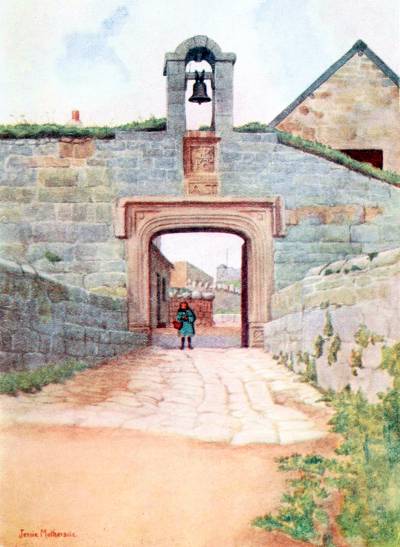
the picturesqueness of the stone walls and gateway of the quay, with
Star Castle appearing on the hill behind; but through this gateway you
must pass in order to enter the town. The pier now in use has only
been built just over seventy years, and was lengthened twenty years
ago; yet already again the sand is silting up against it, and making
it less serviceable.
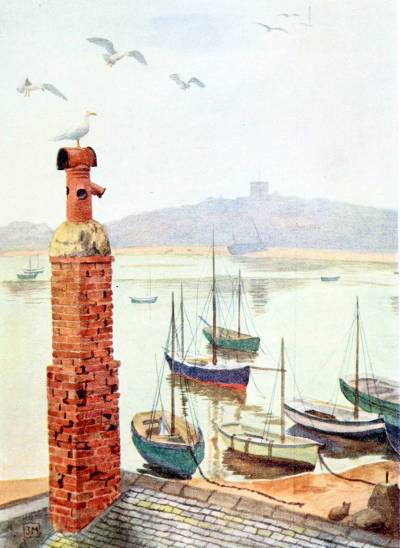
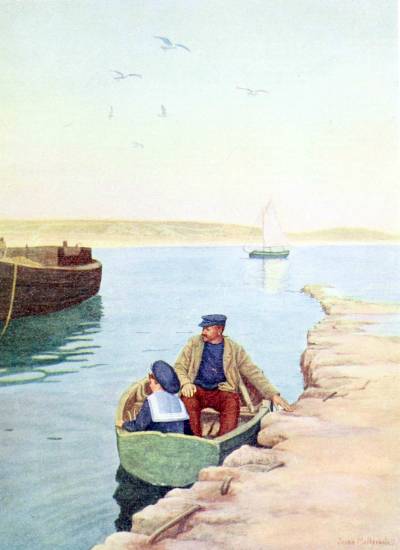
From the pier you can see the houses of Hugh Town stretching in a long
line round the curve of St. Mary’s Pool, the back walls of many of
them rising straight out of the sea, if it happens to be high-water of
a spring-tide.
This Hugh Town on St. Mary’s Island is the metropolis, port, and
shopping centre of the little archipelago, and, generally speaking,
the hub of the Scillonian universe. Formerly the presence of the fort
behind it gave it yet another kind of importance, and made it the
centre of the military as well as of the civil life. It is built
chiefly on the narrow sandy neck which unites the promontory of the
“Heugh” or “Hugh” (now better known as Garrison Hill) to the rest of
the island.
Over and over again the prophets of evil have foretold that one day
there would come some big sea and wash the little town away. Several
times in days gone by the sea has entered the houses, carrying off the
furniture, and driving the inhabitants to the upper floors; the waves
have even swept across the isthmus from Porth Cressa to St. Mary’s
Pool; but the banks have been raised since then, so still the little
town stands, and the inhabitants seem to entertain no fears for their
safety. The houses were built when the people feared foreign foes more
than they feared the sea, so they clustered close under the shelter of
Garrison Hill and Star Castle that crowns it.
The formation of Hugh Town is of necessity strictly determined by the
shape of the land on which it is built. There is a group of houses
just under Garrison Hill; and then a narrow, winding street runs the
length of the sandy strip between the two bays, with a few short
branch-streets where there happens to be room. As the isthmus widens
out to join the main island the principal street also widens and
divides into two branches, one of which soon ends in the country road
leading to “Old Town” (of which more anon), and the other follows for
a short distance the curve of St. Mary’s Pool, but also soon becomes a
country road, and leads into the heart of the island.
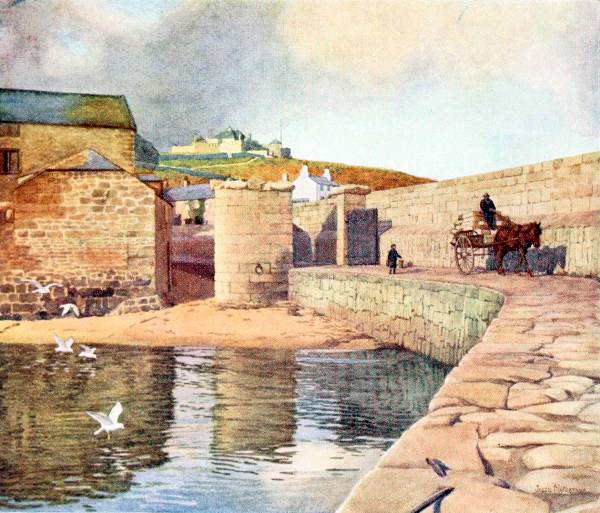
THE ENTRANCE TO HUGH TOWN, FROM THE OLD PIER
It has been suggested that the Hugh, which gives its name to the town,
was once, like Plymouth Hoe, the station for the “huer,” who stands on
high places to indicate to fishermen by a particular “hue” or cry the
approach and direction of shoals of fish; and that the Gugh, a similar
promontory connected with St. Agnes, is a corruption of the same word.
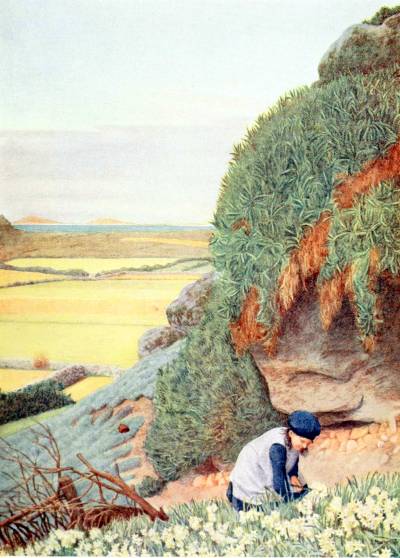
At the fork of the main street there is an open space known as “The
Parade,” because it was there that the soldiers used to drill. When
the garrison no longer existed this space was used as a dumping-ground
for salvage from wrecks, and for years it looked like an untidy
shipwright’s yard, with all manner of appurtenances and portions of
ships laid out to be sold by auction. In the houses on all the islands
you may often come across relics of the wrecks; perhaps a lock from a
cabin-door, or even a whole door; and sometimes the partition between
two rooms will show clear signs of a nautical origin. “The
inhabitants,” says Lieutenant Heath, “have wreck-furniture of various
kinds sent them by the hand of Providence.”
Now the centre of the Parade is a grass-plot, surrounded by shrubs and
beds of flowers, and is dignified by the name of “The Park.”
Nearly all the houses in Scilly are built of the grey granite of which
the islands are formed. They are generally roofed with tiles or slate,
to which a hoary appearance is given by the addition of a coat of
cement as an extra protection against the weather. The old way of
roofing was with thatch, tied on with ropes, crossed in a chessboard
pattern and fastened to iron or wooden pegs driven into the chinks of
the stone walls a little way below the eaves. This was necessary to
keep the roof from being blown away. Still here and there in Hugh
Town, and more frequently in Old Town and on the off-islands, these
picturesque thatched cottages are to be seen.
Duke Cosmo, to whom a thatched roof was quite unknown in his native
Italy, was much impressed by those he saw in Scilly, but he altogether
misunderstood their construction! He says: “The house-roofs are
nothing but a simple mat, spread over the rafters, drawn tight all
round, and fixed firmly to the top of the walls.”
On one of the off-islands there is a very primitive device for
weighting down the slate roof of a chapel by the sea—just a stout
rope thrown across the ridge, and tied at each end to a large mass of
granite on the ground, with sods placed underneath the rope at the
sharp edges to prevent its being cut.
It is said that formerly the houses of Hugh Town were built of turf
with thatched roofs; but once in the summer, when all the men were out
at sea, a fire broke out and the town was burned to the ground; so
since then the houses have been built of stone.
The streets of Hugh Town are lighted with oil lamps, for which the
necessary funds were partly raised by means of a concert. The
inhabitants paid for music, and they got illumination into the
bargain! These lamps are not burned in the wasteful way to which we
are accustomed in London and elsewhere. I asked a Scillonian, half in
fun, whether they always kept their lamps alight as late as
half-past nine. He replied in sober earnest: “Oh no, only if there is
no moon; and on clear moonlight evenings we do not light them at
all.”
But though the lights are put out early, the lamp-lighter is (to use a
mixed metaphor) no cut-and-dried automaton, bound with red tape, and
devoid of human feelings. If he sees you returning home as he goes his
round, he will wait to see you safely indoors before letting the
velvet dark drop down like a veil over the streets.
Not far from the quay a steep little hill bordered by trees leads up
to the Garrison, which is entered through a strong stone gateway.
Above it hangs a bell, used formerly when there was no public clock,
to announce the time of day. There is a tablet beneath the bell with
the inscription “G.R. 1742. F.G.” Lower down are two larger initials,
“A.T.,” those of Abraham Tovey, the master-gunner, under whose
direction the works were constructed, and who, being the “man on the
spot,” saw to it that his memory should be kept green by letters of a
larger size than those which commemorated the King and the Governor.
Star Castle, on the top of Garrison Hill, is not a very imposing
building. Its name, which used to be “Stella Mariæ” (Star of Mary), is
derived from the star-like plan of its projecting bastions, which
surround a dwelling-house with corresponding projections. The walls
are loopholed for musketry at every possible point, ninety-six
loopholes altogether. Above the entrance are the initials of Queen
Elizabeth, “E.R.,” and the date, “1593,” when the Castle was built.
Prisoners from the mainland have been confined here from time to time;
Dr. Bastwick, of Colchester, in 1637, by order of the Star Chamber,
for writing against the Church and Government; in 1655 John Biddle,
the Unitarian, was sent to Scilly by Cromwell to keep him out of the
way of his persecutors, and allowed a pension of 10s. a week; and in
1681 seven “Popish priests” were removed thither from Newgate.
It is a very beautiful walk round Garrison Hill—a walk of which one
can never tire. Heath compares it to “the Mall at St. James’s, where
people walk for health and amusement”; but to the Nature-lover the
Mall is dull indeed compared with Garrison Hill. The circuit can
easily be made in half an hour, for the distance is not more than a
mile and a half; and yet in that short time a sight of nearly all the
islands, and a good idea of their relative position, can be obtained.
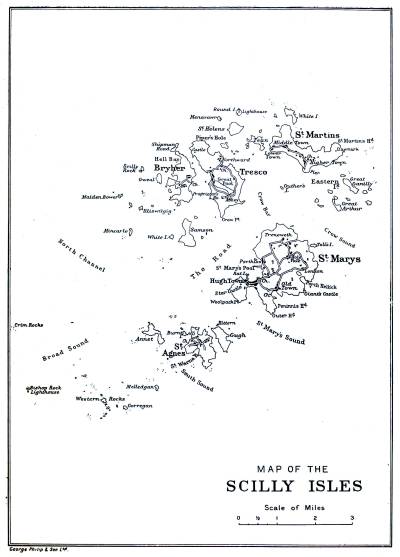
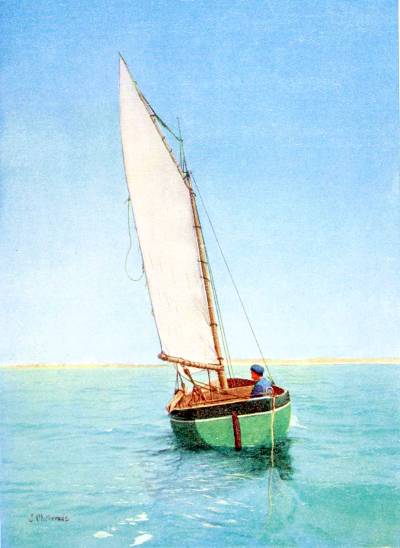
From the north one looks down on St. Mary’s Pool, full of brown-sailed
fishing-boats in the early summer, and never without a sprinkling of
craft, large or small, upon its bosom. Beyond the Pool, to the right,
may be seen the country-side of St. Mary’s, and following on, one
after the other from east to west, St. Martin’s Isle; Tean; St.
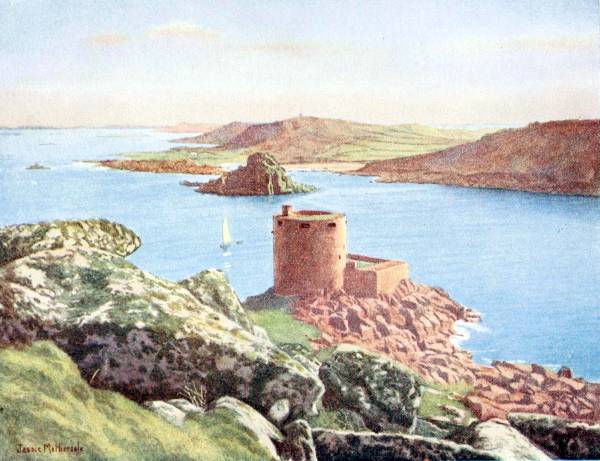
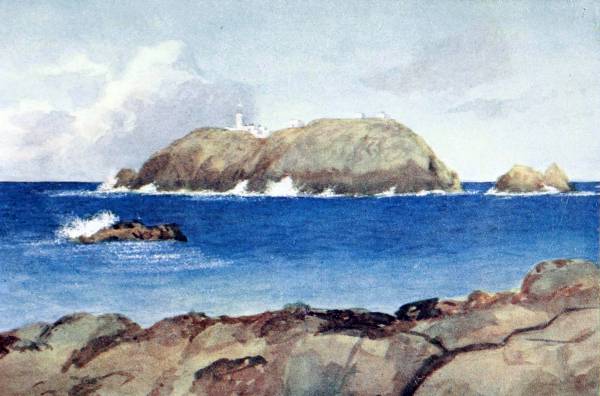
Helen’s, with the lighthouse tower of Round Island showing over its
head; the wooded slopes of Tresco, and Cromwell’s Castle low down on
its western shore, clearly visible across three miles of sea; green,
hilly little Bryher; and the twin peaks of Samson.
As one bears round to the west and south-west, there are St. Agnes,
and Annet, and the grim rocks of the western archipelago, with the
white foam ever, even in the calmest weather, playing round their
feet, and flying over their heads. On clear days the waves may be seen
leaping up the slender shaft of the Bishop Lighthouse, more than five
miles away.
On the south there is the illimitable ocean; and as the east side is
reached there come into sight, first the rocky head of Peninnis, and
then the curve of Porth Cressa, overlooked by Buzza Hill and the
ruined windmill that crowns it. A little farther on, and the massive
walls of the Garrison reach their highest, and are draped and
curtained with mesembryanthemum; while beneath their shelter there are
orchards full of fruit-trees, carpeted with daffodils; and one can see
the columns of blue smoke rising from the chimneys of Hugh Town, which
lies below.
In making the circuit of the hill we have kept our eyes fixed seaward
all the way; but if we turn towards the hill itself we see that almost
everywhere it is afire with gorse: and sorely it tempts me to tell
again the oft-told tale of Linnæus and Putney Hill!
The gorse is one of the great glories of the islands; it grows on
almost every open down, and on the slope of almost every hill. On a
calm summer’s day, when the hot sun brings out the sweet and heavy
odour, and the drowsy hum of myriads of bees, garnering their store
from the golden blossoms, mingles with the gentle lapping of the sea
upon the shore, then Scilly becomes a veritable land of the
lotos-eaters, and one feels content to do no more than lie upon a
slope of springy heather, and “watch the crisping ripples on the
beach, and tender curving lines of creamy spray.”
It is only since the latter part of the sixteenth century that Hugh
Town has become the capital of the islands. Before that time there was
another town whose houses clustered round the Castle of Ennor, a mile
away from the present capital. The village that now remains is known
as Old Town, and the bay on which it stands as Old Town Bay.
There is a tradition that when Old Town was the chief town of St.
Mary’s, and when the chief landing-place of the island was in this
bay, the monks levied a toll on all persons landing, and a chain was
stretched across from Tolman Head to bar their entrance until the toll
had been paid.
Great complaints were made to Richard, Earl of Cornwall, of the burden
of this charge, which was levied even on priests and pilgrims, and on
every fisherman when he came in with his catch. In answer to these
complaints the Earl came himself, disguised as a pilgrim; and being
refused entrance, he leaped over the chain, and in the heat of his
anger struck the Prior who had thwarted him a mortal blow. The old
priest with his last breath called down vengeance on his murderer, and
to this curse was attributed the gradual decay of Old Town and its
castle.
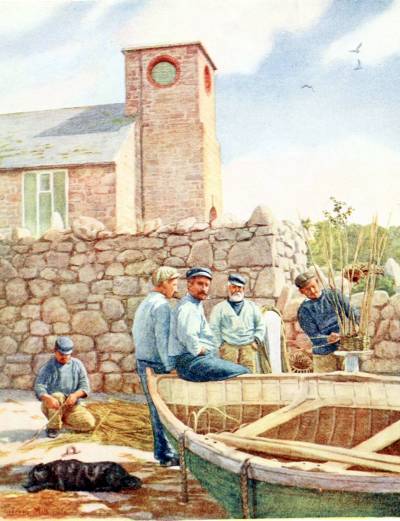
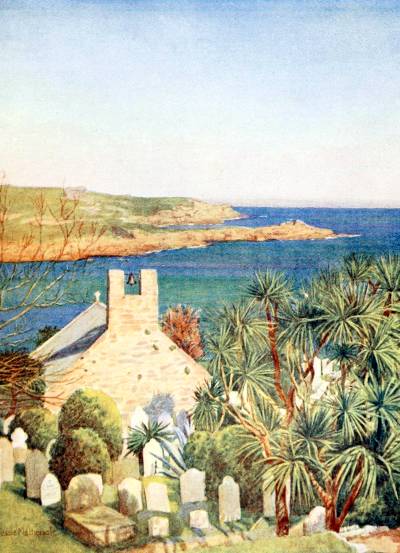
A portion of the old church near Old Town is still standing, but it
now serves chiefly as a mortuary chapel. It dates from very early
times, for there is a Norman arch at one end; and it was used,
although sadly in want of repair, until a new church was built in Hugh
Town in 1838. This little churchyard by the blue waters of Old Town
Bay is still the burial-ground of St. Mary’s, and contains sad
memorials of many wrecks. The graves are overshadowed by dracæna
palm-trees, and round them grow aloes and euonymus-shrubs, all symbols
by their evergreenness of the immortality of the soul; while the
elm-trees which look so dead and lifeless now, but which will soon
burst into fresh life at the touch of Spring, remind us of the old
story which is ever new, and speak to us of the hope of resurrection.
Of the Castle of Ennor, which was built probably by the Earls of
Cornwall under the Norman kings, and where, as we know, Ranulph de
Blankminster lived six hundred years ago, scarce one stone is left
upon another. From Hugh Town one comes to all that is left of it by a
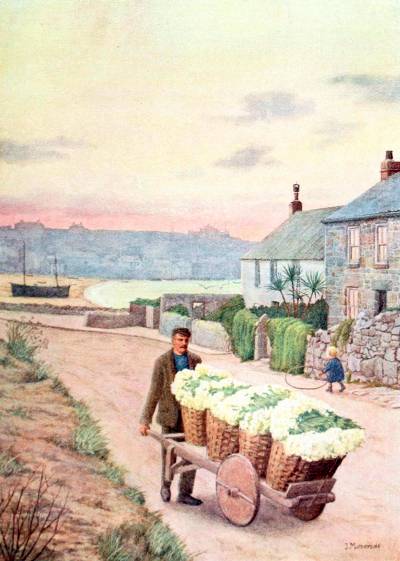
road bordered (as most roads are in Scilly) by flower-fields on the
right and on the left; past masses of fragrant wallflowers and beds of
sweet violets, until the curve of Old Town Bay is reached, with the
houses of Old Town grouped together at its farther end.
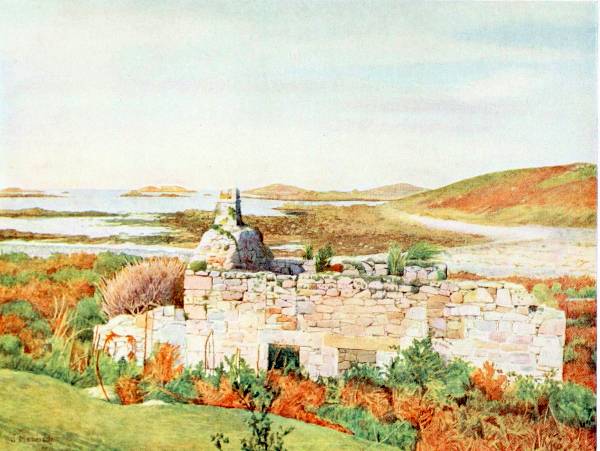
The Castle Rocks rise steeply from the midst of the houses, and up
them one must clamber. There is nothing whatever to show what was the
original way of entrance into the fortress, but probably it was on the
east side, where the ground slopes up more gently. On the north and
west the approach would be impossible, for there a mass of solid
granite rises boldly from the plain below.
When Leland visited the islands, somewhere about 1539, this castle was
a “moderately strong pile,” but it is said that many of the stones
were carried away for the building of Star Castle, later in the same
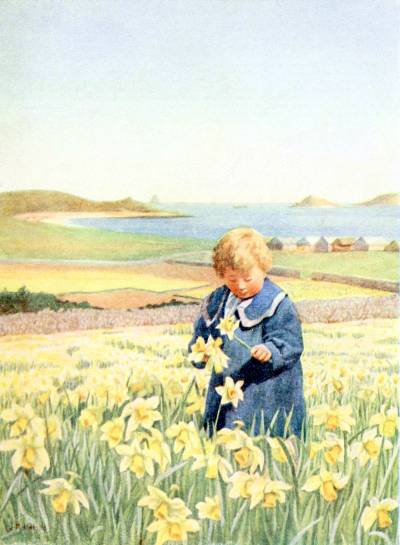
century. Now the pile of rocks, and the slopes leading up to the
rocks, are all covered with vegetation, beds of narcissi and
daffodils, sheltered by veronica hedges, and large patches of
carnations, not yet in flower; while mesembryanthemum ramps all over
the place, covering nearly every bit of wall and uncultivated ground,
and pouring itself down in thick cascades of green from the topmost
summit of the Castle Rocks.
From half-way up can be seen, spread out beneath, field upon field of
yellow daffodils, stretching away across the island almost as far as
to Porth Mellin; and beyond the streak of blue sea are the twin hills
of Samson.
It is very quiet and peaceful up here, and yet if one sets oneself to
listen, numberless sounds may be heard, so many that it is difficult
to disentangle them.
There is the gentle plash of the waves on the sands of Old Town Bay
behind; the shrill cry of the gulls, sounding for all the world like
the clamour of children let loose from school; the distant panting
of the fussy little motor-boat which takes the trawlers out to sea;
the lowing of cattle in the neighbouring farmyard, with pigs and
poultry joining in the chorus; the twitter and rustle of birds in the
veronica hedge; the liquid love-song of a thrush as he puts the
important question, “Will you, will you, will you?” and answers
it himself with a sudden change of note, “She will, she will, she
will.” And lying beneath and all around all other sounds are the
myriad gentle murmurs of the Spring, that wondrous stirring and
pulsation of life which can be felt but cannot be defined. And now a
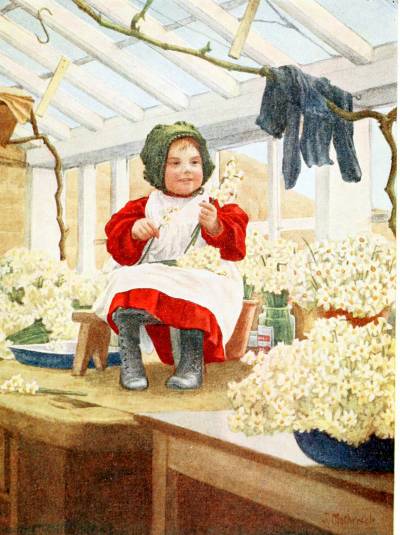
human note breaks in upon the rest. From a cottage near by there rises
the song of a little girl, mingling with the clatter of cups and
saucers as she washes up the breakfast-things, because mother is busy
in the tying-shed.
“With smiles of peace and looks of love
Light in our dwellings we may make,”
shrills the childish voice; and so on through every verse to the end,
till she finishes with a quaintly quavering and long-drawn-out,
“A-a-amen.”
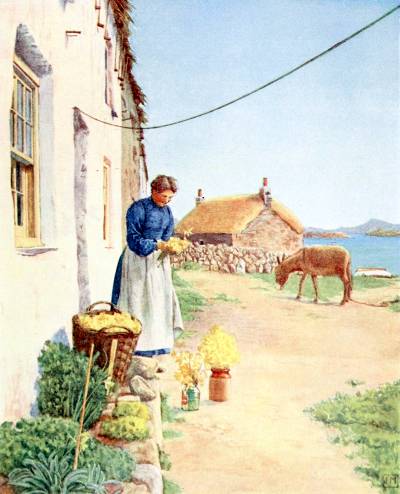
PICKING FLOWERS BY THE CASTLE ROCKS
There is a very human legend which connects this old Castle with the
convent that is said to have stood in Holy Vale.
The story runs that the Earl of Cornwall once had a young and
beautiful ward, whom he kept shut up in the Castle of Ennor in charge
of an ancient duenna. No one knew who the lovely girl was, but she was
thought to be of noble birth.
There was a page in attendance at the Castle; and it is not to be
wondered at if the hearts of this young pair, isolated as they were
from others of their age and station, were drawn together by a mutual
attraction.
Signs of this did not escape the lynx-eyes of the ancient dame, and
she straightway sent a message to the Earl in Cornwall by the hands of
the page, who little knew that he was the bearer of that which sealed
his own fate and that of her he loved. He was detained on the
mainland, and made an esquire in the Earl’s following, while she was
ordered to be sent at once to the convent of Holy Vale.
She remained sad and silent during the year of her novitiate, taking
interest in nothing except the tending of a rose-bush, which she made
her special care. When the time came for her to take the vows, she
mysteriously disappeared from the chapel where she was keeping
midnight vigil, and was seen no more until, many years later, she was
found in that same chapel, lying dead before the altar, with no sign
of age upon her pure face, and with a cluster of roses in her bosom.
Her lover is said to have been killed in battle many years before.
There is still a rose-tree growing up between the stones at Holy Vale,
which the children used to look upon as the bush of Sister Mary.
There are no remains of the convent at Holy Vale, and there is only
tradition to tell us that it ever existed. Whitfeld, writing in 1852,
does indeed speak of the top of a freestone arch which he saw there,
covering the entrance of a pig-sty, and which he supposes to have been
a relic of the ancient monastic buildings. It is a beautiful sheltered
spot, the most sheltered in the island, hidden away in a hollow, and
surrounded by tall trees. Two farm-houses lie close together in the
valley, near to a pond of fresh water under the trees; and on every
side there are the fields of flowers, now the chief produce of the
farms.
One of the pioneers of the flower industry, Mr. Mumford, used to live
at Holy Vale.
The other, Mr. William Trevellick, lived at Rocky Hill on St. Mary’s
until his death, in 1910, and was always ready to show his beautiful
gardens to any one who wished to see them. Rows of palm-trees grow
along the hedges at Rocky Hill, and form the boundary lines. “Look
well at this,” Mr. Trevellick used to say. “It is not often that you
will see in the British Isles a field surrounded by palm-trees.” He
dearly loved his garden, and spent most of his time there. The robins
knew him so well that even in summer-time at his call of “Dick, Dick”
they would come and eat from his hand the food he kept ready for them
in his capacious pockets.
Mr. Trevellick was also keenly interested in antiquities, and had
collected at Rocky Hill a number of relics of the past of every
description—ancient stone querns, quaint gaily-coloured figureheads
from wrecks, Parliamentary cannon-balls, and a Druid trysting-stone,
through the hole in which lovers used to clasp their hands when they
plighted their troth. This last is in two halves, both of which had
been built into a stone hedge; the second half was not discovered till
many years after the first, and if you know anything of antiquarians,
you can picture the joy with which its discovery was hailed! It was a
day’s work to pull down the stone hedge, to secure the treasure, and
then to build the wall up as before.
It was always a matter of great interest to Mr. Trevellick that an
old Roman road runs through the Rocky Hill gardens, the large, evenly
laid paving-stones showing very few signs of their age.
St. Mary’s Island is supposed to be nine miles round, but I would defy
any one to restrict his first walk round it to nine miles. One is sure
to be decoyed into many a By-path Meadow—but not of the kind in which
there lurks a Giant Despair!
For beauty-spots are to be found in such plenty on St. Mary’s that it
would be impossible to name them all. I have already spoken of the
gorse-covered Garrison Hill, which is itself a little nest of
beauty-spots. So in its way is Peninnis, “head of the island,” that
wild and rugged peninsula which juts out between Porth Cressa and the
Old Town Bay, and is sometimes thought to be the most beautiful part
of St. Mary’s. It is strewn and scattered all along its coast with
rocks and boulders of immense size, and of endless variety of form. I
have already referred to two of these, which go by the names of the
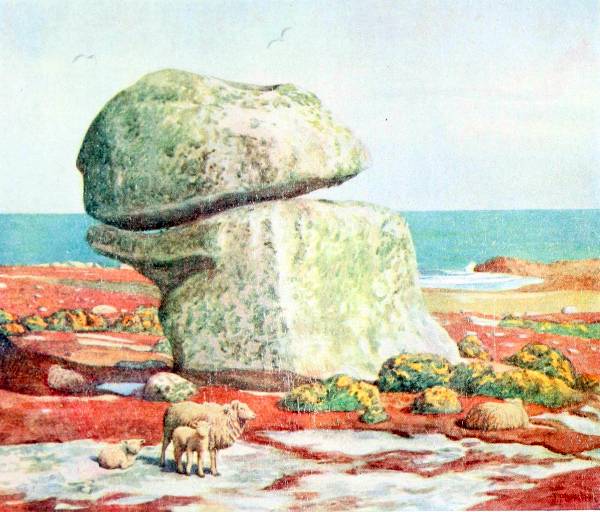
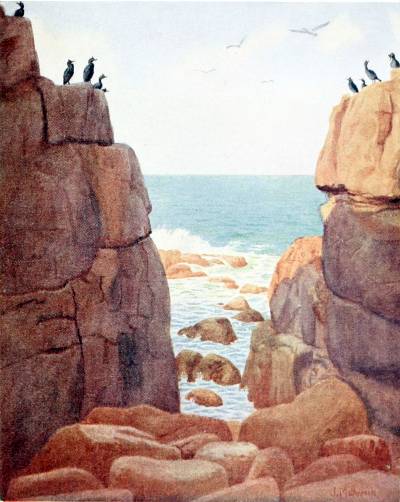
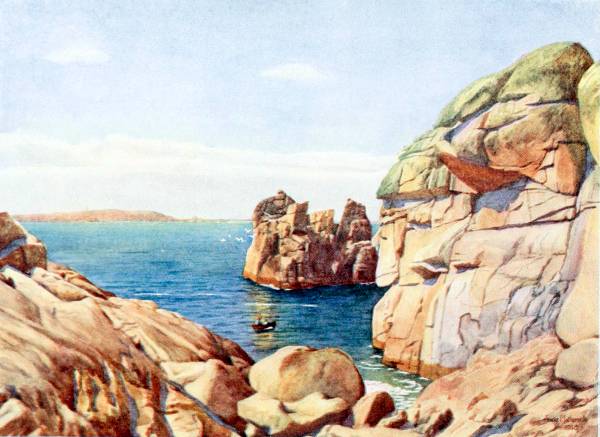
Pulpit and the Tooth. Close to the Tooth, on the head of Peninnis,
there rises from the sea a huge rock, which is known as the Monk’s
Cowl, from the fancied resemblance of the summit to a hooded head.
From this point there is one of the finest views of the many-coloured
rocks, covered here and there with shaggy grey-green lichen, standing
boldly out of the sea or tumbled about in every direction, and with
the little island of St. Agnes bordering the horizon. During a big
storm the waves will dash right over the top of the Monk’s Cowl, and
will swish along the top of the down behind it, before retreating in
cascades of foam.
Not far away, hidden amongst a mass of other rocks, is the largest
logan-stone in Scilly, which is estimated to weigh 313-1/2 tons. It is
at least 15 feet high, and forms one side of a cavity, known as
“Sleep’s Abode.” It can easily be rocked by two or three persons
together, but was only discovered to be a logan-stone in 1893, when a
man who was leaning against it in a high gale, felt it moving gently
to and fro beneath him.
A small iron lighthouse has recently been erected on Peninnis, to take
the place of the St. Agnes Tower, which has been declared
superannuated.
The rugged coast-line of Peninnis may be followed, past the Pulpit
Rock, to where the ground slopes down towards the Old Town Bay, on the
shores of which will be seen the old church, partly hidden in
palm-trees.
There are many other spots on St. Mary’s which are well worth a
visit. There is the beautiful, peaceful bay known as Porth Hellick,
almost closed across its mouth by a reef of rocks, so that when the
sea is raging without it may be quite calm in the bay. But peaceful as
it looks, it has now and again seen some sad sights.
MONK’S COWL ROCK, ST. MARY’S
It was here that the body of Sir Cloudesley Shovel was washed up, and
found, but not recognised, by a soldier and his wife, who gave the
great Admiral a nameless grave in the sand of the seashore. Later the
body was dug up, and identified by means of a ring on one finger; and
now it is buried, as all the world knows, in Westminster Abbey. But it
is said that the hollow in the sand would never fill up, and the grass
would never grow again over the place where the grave had been. Within
recent years two blocks of quartz have been placed to mark the spot.
There was another remarkable happening at Porth Hellick in 1840. A
vessel was found on the rocks, bottom upwards, by some farmers
gathering seaweed for manure. One of them thrust his hand into a hole
in her side, and was terrified to feel it grasped from within. This
capsized vessel had entombed four men for three days and nights! They
were crouched close together under the keel, with the water up to
their waists. They had tried to cut a hole in the hull for the sake
of getting air, but fortunately their knife broke, for the confined
air alone prevented the vessel from sinking altogether.
Some pilot-boats had taken her in tow the previous afternoon, and
brought her in towards the islands; but having no suspicion that she
bore a living freight, they had abandoned her on account of bad
weather.
Porth Hellick may be reached from Old Town over Sallakee Downs,
following the line of the wild and rocky coast, and then past Giant’s
Castle, the ruined remains of one of those ancient “cliff-castles,”
such as are common on the Cornish coast.
The beautiful bay with its sandy beach comes upon one with quite a
surprise, when first from the top of the downs its shimmering blue
waters are seen.
Or it may be approached another way, through the undulating
flower-fields of Sallakee Farm, past the whitewashed farm-house and
its gnarled pollard elm-trees, and along a narrow lane whose hedges in
summer are sweet with honeysuckle and pink with campion. This lane
will bring one right out on the low grassy moorland which borders the
bay.
Porth Hellick is the mouth of a valley which cuts into the island at
this point, and in which lies the pond of the Upper Moors, the largest
expanse of fresh water on St. Mary’s, surrounded by marshy ground
grown with reeds, and the home of many water-fowl.
Overhanging the bay there is a fine carn of rocks, known as Dick’s
Carn, also called “The Loaded Camel,” from its shape.
The rocky ramparts of the isle begin again immediately beyond the bay,
with a wild confusion of mighty boulders, trembling on the brink of
precipices, or poised upon the grassy slope, as if ready at any moment
to crash into the seething waters. Here one may listen to the booming
of Nature’s guns, as the sea thuds into the caverns it has hollowed
out for itself.
And then, farther to the north, there is Toll’s Island, in Pelistry
Bay, at low water joined to the main island, like the Gugh of St.
Agnes, by a narrow strip of white sand, which is covered at high tide
by the waves. Here, if one is young enough for such employ, one may
build on the sand Hugh Towns in miniature, with Toll’s Island to
represent Garrison Hill, and then watch the waves creeping, creeping
slowly up on either side until they meet and embrace, and mingle and
merge into one even flow over the ruins of the sand-houses. Or one may
seek for shells on the sandy strip, and small as is the hunting-ground
the variety is infinite—deep golden yellow, coral-pink, purple, and
blue. There are remains of an old battery on the island, “Pellew’s
Redoubt,” so called after the captain who commanded in Scilly during
the last French War.
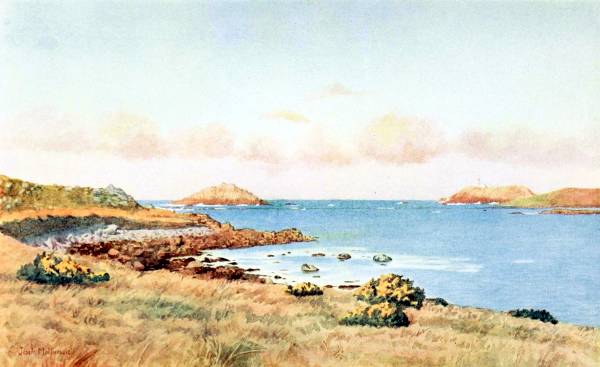
Here, as everywhere, there are flowers. The daffodil-fields run down
close to the sea, and the little lane leading to Toll’s Island blazes
with gorse on either side, so that the blue waters of the bay are seen
set in a frame of gold.
Watermill Bay is another beauty-spot, with no watermill, but only a
tiny stream trickling down to the sea, through the midst of bracken
and bramble.
I must not try to describe it all, or I would tell of the lovely walk
along the west coast of St. Mary’s, where the golf-links are, whence
one can look back on Hugh Town, which from here seems to be a slender
thread linking Garrison Hill with the main island.
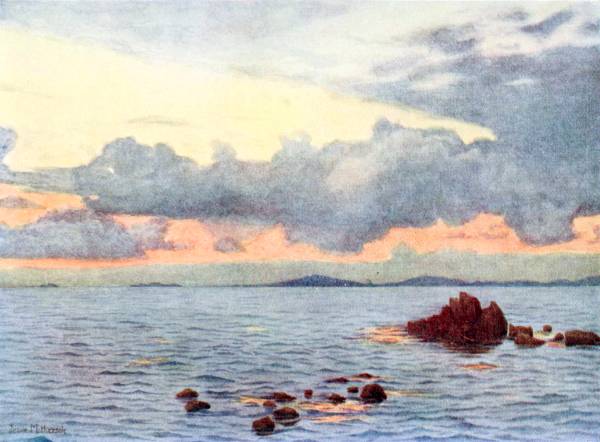
And I would tell you, if I could, of the gorgeous, indescribable
sunsets, which turn sea and sky into flaming fire, and cast a magic
glow over the land, bewitching and glorifying even commonplace
things, and making each little distant island a fairy palace of
enchantment, to which one longs to sail.
But long, long before it could be reached the illusion would have
faded, the sun would have set, and no enchanted palace would be found,
but only a barren rock set in a dangerous sea, with the darkness
gathering around.