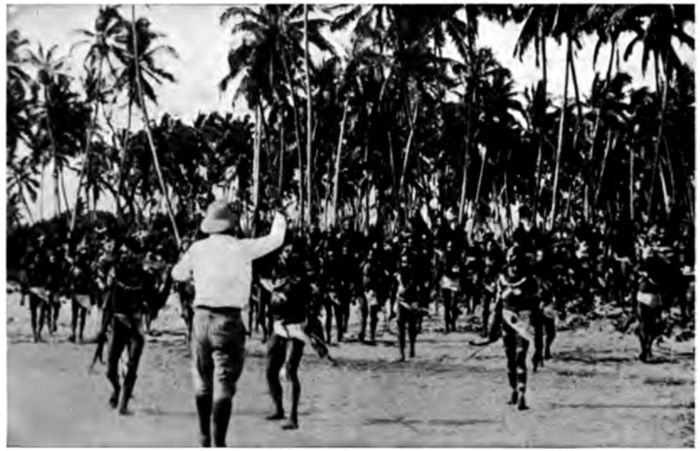
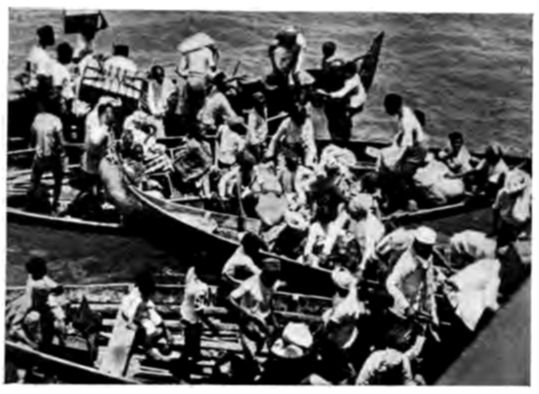
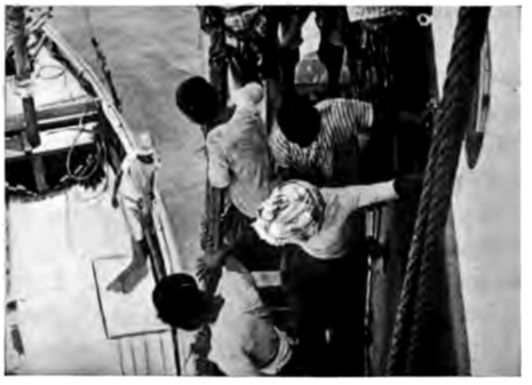
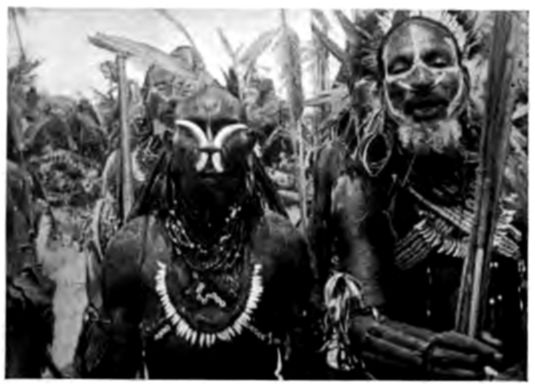
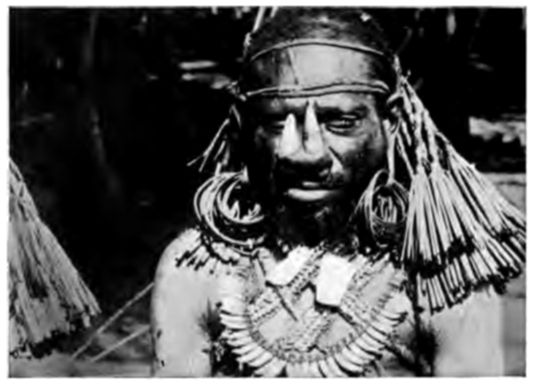
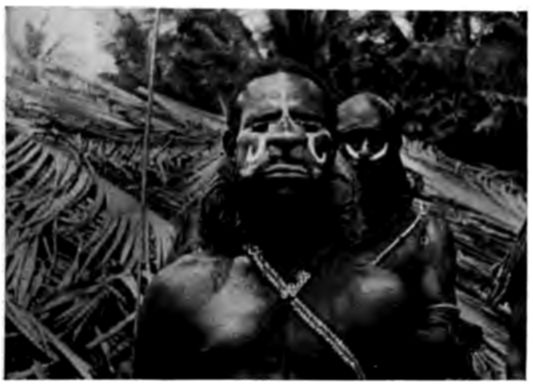
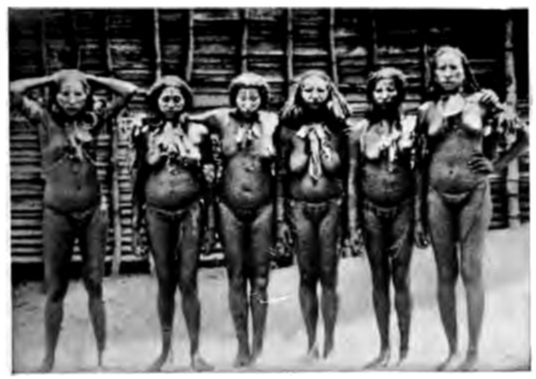
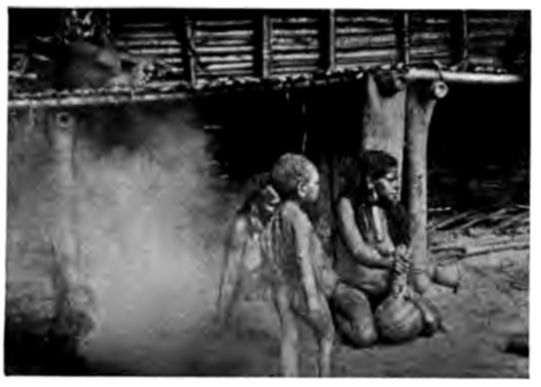
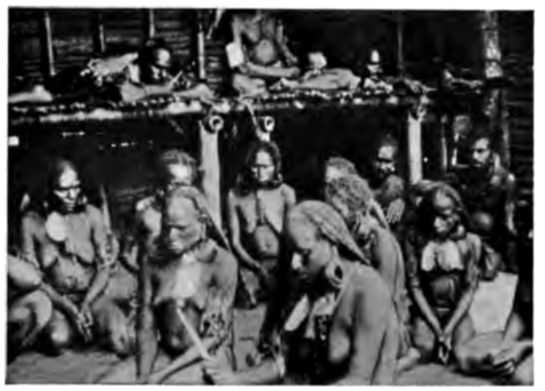
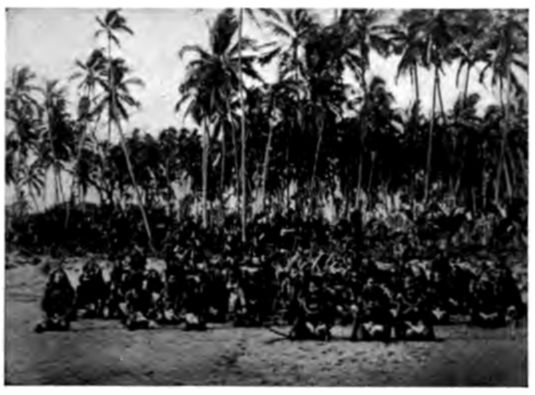
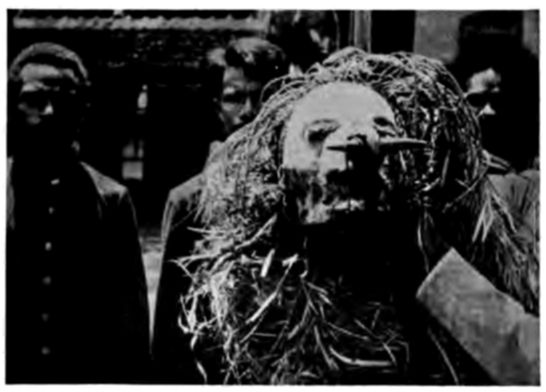
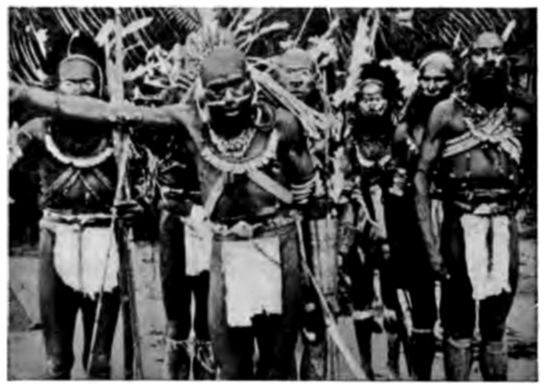
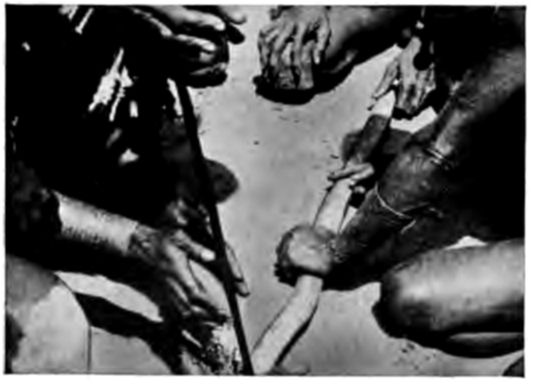
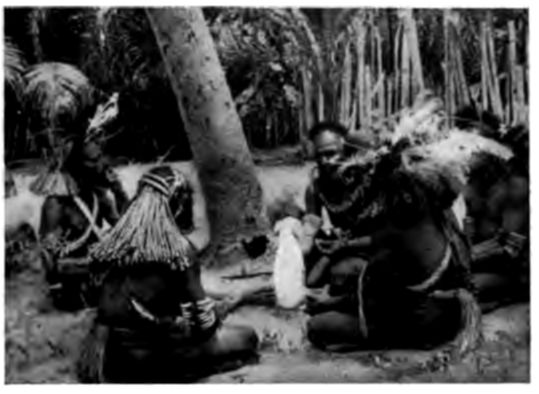
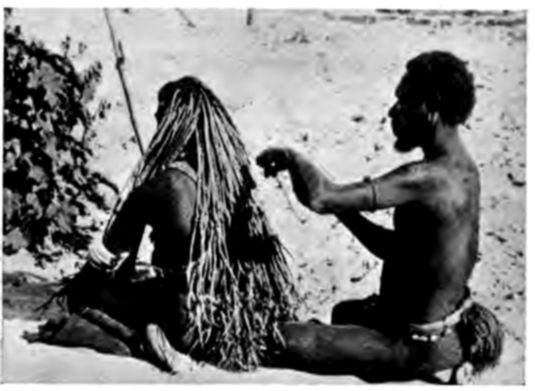
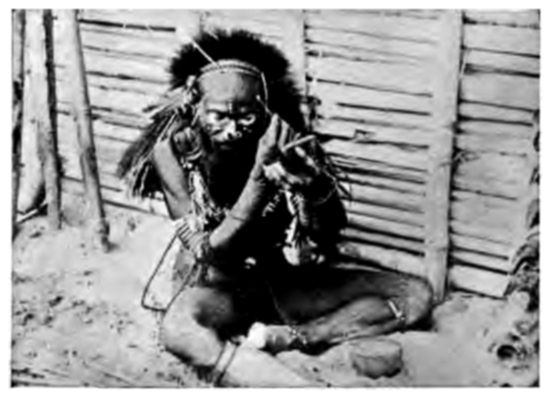
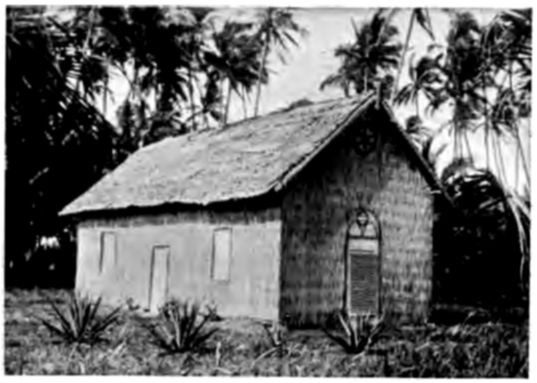
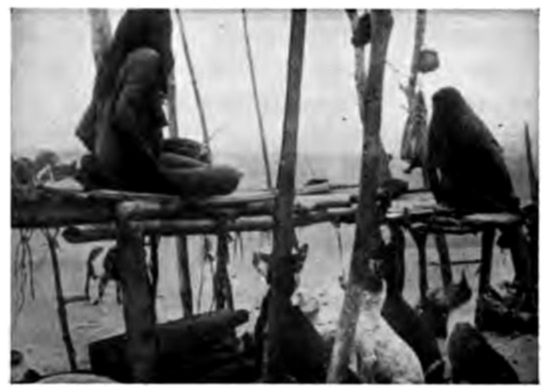
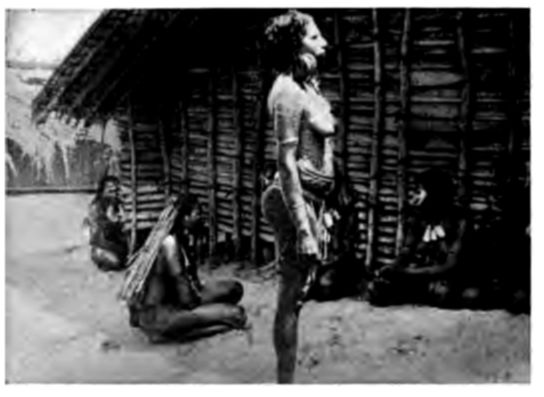
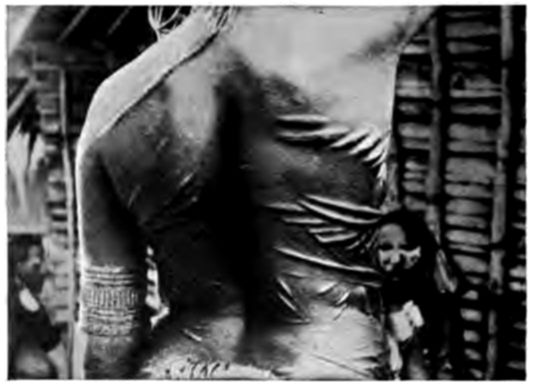
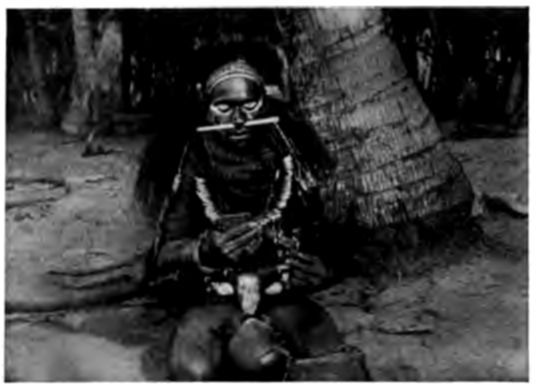
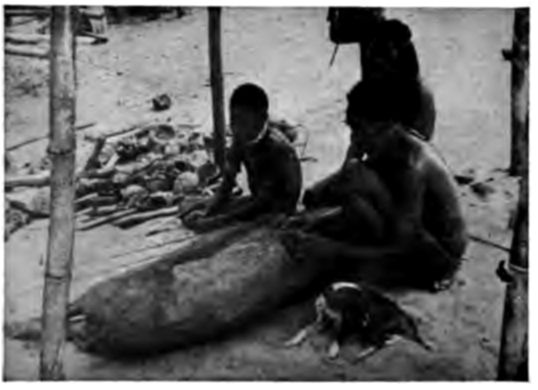
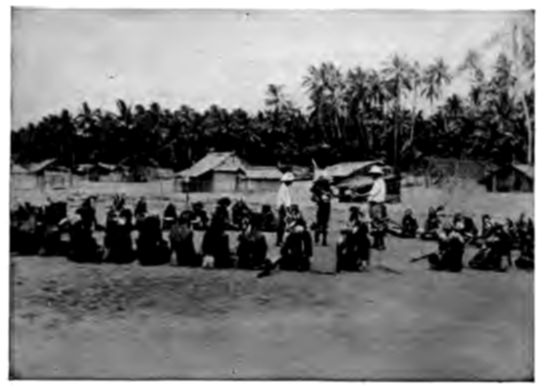
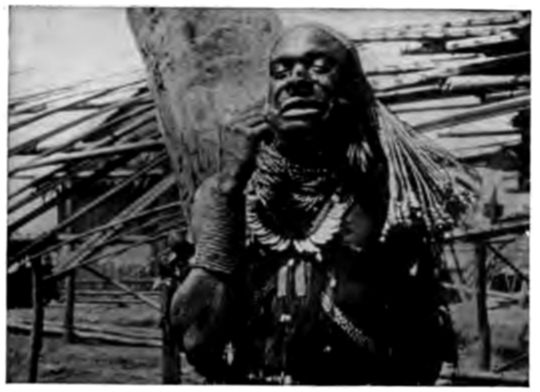
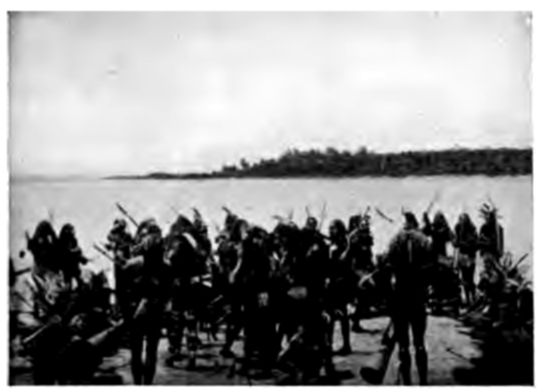
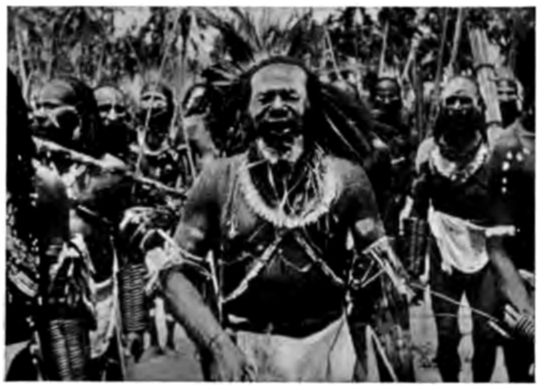
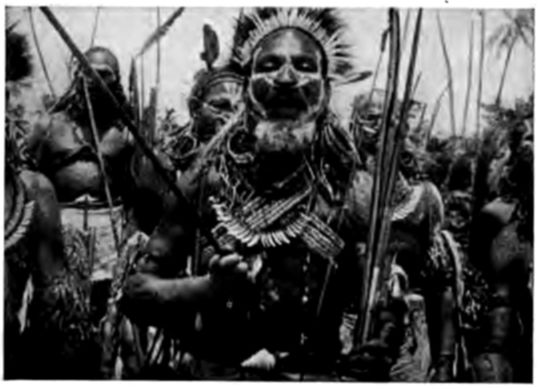
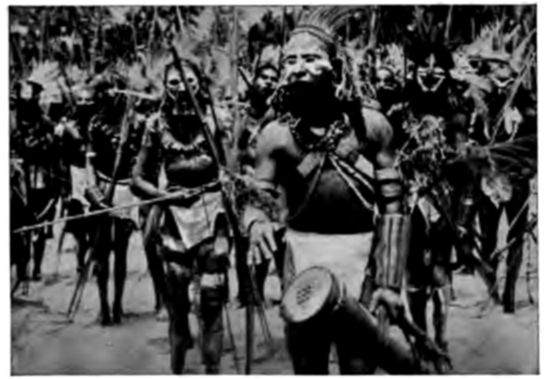
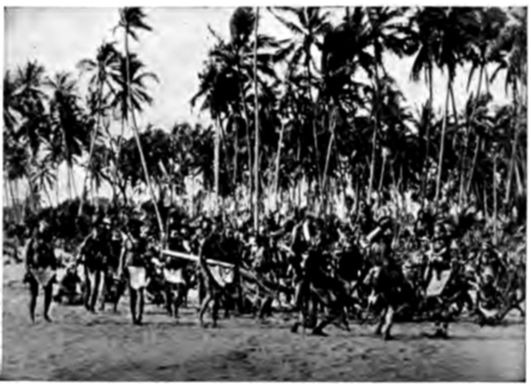
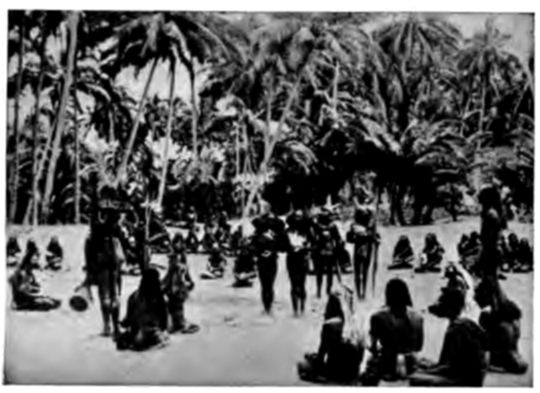
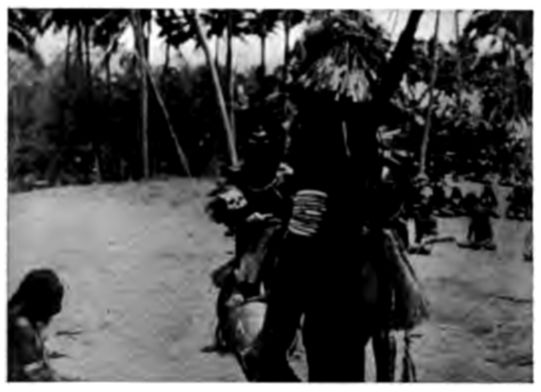
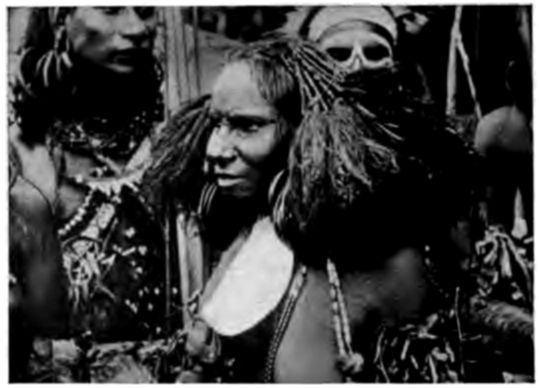
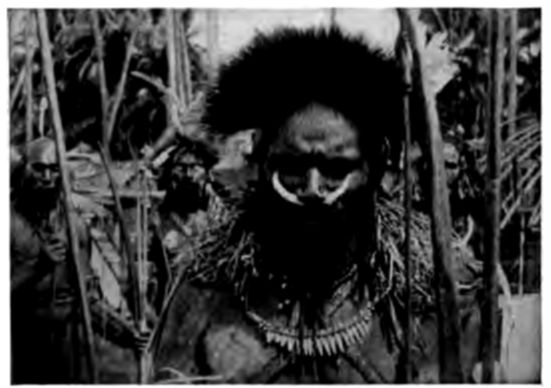
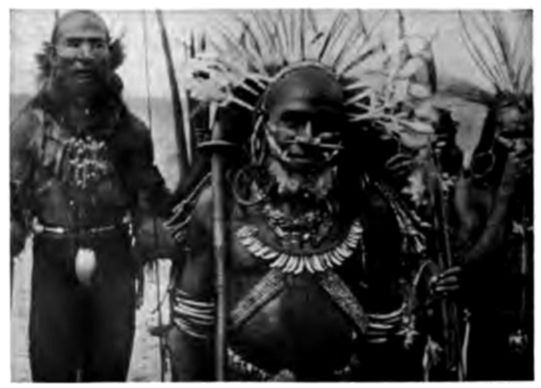
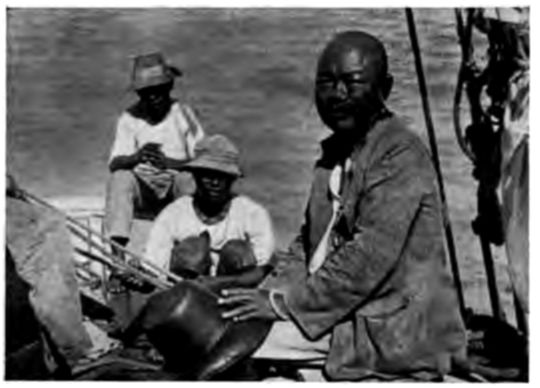
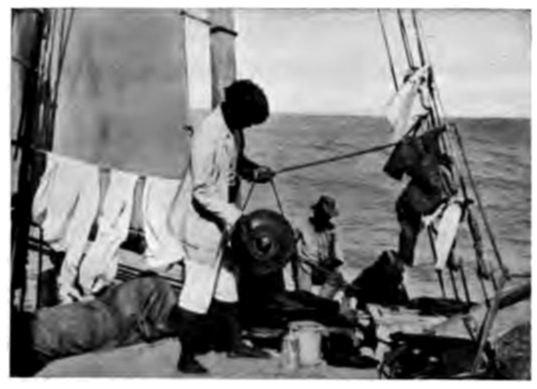
The drums are tuned in a peculiar manner. Having no strings fastened to the heads with which to tighten them, they place small lumps of resin mixed with clay on the heads to produce the desired sound
Two bells tinkles within the master’s cabin,
and the quartermaster on the bridge repeats
the announcement of nine o’clock with two
strokes upon the bronze bell near his station at
the wheel. It is sailing-time. The townspeople
have turned out en masse to bid us farewell, and
the open spaces on the new concrete wharf are
ablaze with color. The chatter of a thousand
voices comes to us as we stand upon the deck
looking down on the scene. Every one seems
happy. The great whistle on the ship’s funnel,
after a preliminary gargling of its throat, shatters
the tranquil air with a peremptory warning.
The screw churns up a maëlstrom beneath the
overhanging stern, and we swing out into the
channel amid a storm of adieus spoken in a
4dozen tongues. We are off for the land of the
cannibal Kia Kias,—the Isle of Vanishing Men.
As the ship gathers way, Amboina, spice-scented
“Ambon,” drops into the mists of the
morning and we look around the deck for company.
We are alone. Then we remember the
information given us by the First Officer yesterday.
We are the only first-cabin passengers on
board, this trip. Few people find their way to
the Isle of Vanishing Men. It offers little to
the business man. The commercial traveler
never goes there. Merauke, our destination, has
but five white inhabitants, and their wants are
few. One steamer a month carries to them the
things they need and the mail from home.
We shall spend our time for the next few days
in lazy languor, playing an occasional game of
chess with the chief engineer, chatting now and
then with the very amiable captain, or, as one
learns to do in the Indies, just draping ourselves
over most comfortable steamer chairs and daydreaming
for hours on end. The air is like silk.
The piping falsetto of the deck-hands as they
sing at their work lulls one into reverie, and life
5glides by with a smoothness that takes no count
of time.
There comes the day when the captain greets
us at breakfast with the news that we shall
arrive this evening. As he selects from the
heaped platter of sliced sausage his favorite
variety he tells us that we shall sight land at one
this afternoon. We are agog with excitement.
The cannibals are not far away now. We ply
him with questions and as he spreads his bread
with marmalade he tells us of the Kia Kias and
what their name means. To be kikied, he avers,
is to be eaten; the natives are eaters of men;
hence the name.
He regales us with reminiscences of his
former visits to the island and roars with merriment
as he relates how on one voyage a few
months ago he was accompanied by his wife.
The natives thronged the little wharf, clad in
their birthday suits, to witness the arrival of the
ship. Some of them were allowed on board,
where they were awed by the marvels of the
white man’s great proa. The captain’s wife was
6the first white woman they had ever seen, and
one of the natives—a son of a chief, by the
way,—became enamored of her. He immediately
offered the captain two fine pigs for her.
The captain refused the offer, saying it was not
enough. The man withdrew, his brow wrinkled
with deep thought. He left the ship and was
lost in the throng that strained the underpinning
of the little wharf. Two hours later he
returned, accompanied by several of his friends.
Each of these carried a pig trussed up with
rattan hobbles. He had sold his wife and three
daughters for five pigs and was raising his ante,
so the captain’s story ran, and was much put out
when he learned that the price offered was still
inadequate.
The lady in question was the object of so
much attention from the well-meaning if somewhat
amorous natives that she found it expedient
to retire to the privacy of her husband’s
cabin, whence she was able unseen to observe
the visitors.
The little saloon in which we breakfast overlooks
7the main deck and the men there are making
ready the winches and rigging preparatory
to the unloading of cargo manifested for
Merauke. Their work interrupts the captain
in his narrative, for the rumbling remonstrances
of the rusty machines make the morning hideous.
We hasten to the upper deck, where
after doing our customary half-mile constitutional
we busy ourselves with the packing of our
dunnage.
This will take us an hour and we look forward
to a comfortable snooze before tiffin. By that
time, or shortly after, the coast-line of New
Guinea will have risen to view out of a murky
horizon in the northeast. There is nothing to
do until then. Our letters to those at home will
not be written until the very last moment before
the steamer sails, for we shall want to describe
Merauke in them. It will be two months before
the steamer calls again. In those two months
we shall have visited the tribes living far from
the little trading-station of Merauke and its very
friendly population of five whites, many Chinese,
8a few Malays, and a hundred or so Kia
Kias. The missionaries have brought these last
from the interior and they live outside the town
in kampongs or villages, the nearest of which is
an hour’s walk from the dock.
The chief engineer—who, by the way, is a real
character and something of a philosopher—disarranges
our plans for forty winks. He has
spent about forty-three years on the ships that
ply the waters of the Indies, and has many tales
to tell; for he loves to relive his earlier days,
when the native girls were more beautiful to him
than now. With the on-march of years the enervating
climate and the demoralizing life of the
kampongs have exacted a toll, and the overdrafts
he made in those never-to-be-forgotten
times have been collected in full by the Bank of
Nature.
The old roué boasts of his conquests among
the golden-skinned vahines of the Southern
Islands and tells us now with shocking candor
of the doubtful virtues of Nasia, an old flame
of his who lived in Ambon. He sees her now
9and then in Saparoea, where she is the reputable
wife of a half-caste government employee.
To the native, marriage means that respectable
status which permits of clandestine meetings
with the wife, censured only by the husband.
All others aid and abet the liaison, for does it
not furnish delightful gossip in an otherwise
somnolent community? He tells of a night
when he and his chief (he was second engineer
then) went in company with some others to a
kampong back of Dobo in the Arus and proceeded
to kiss all the girls in sight. The girls
must have taken kindly to the demonstration,
for they unearthed “square-face” gin in plenty
and with dances and what not regaled the white
Tuans (masters) until the east turned from
violet to rose.
We cannot find it in our hearts to censure the
chief, for the “custom of the country” has made
its insidious way deep into his soul and has
warped his point of view. One has to spend
much time in the Indies fully to appreciate how
this can be. Here life is stripped of many
10superfluities and conventions and love of life
and of love become paramount factors. He
shakes his head at what he calls our “Long
Hair” ideas and tells us we should have brought
with us two girls from Ambon, to keep house for
us while we are in New Guinea. The Ambonese
girls, he tells us, are much more comely than the
Kia Kia girls.
“Wait till you see Reache’s girl in Merauke,”
he says; “or the Controlleur’s up the coast,—Nona
is her name. She came from Ambon.
She is nineteen and as saucy a little trinket as
you’d ever want to see.” Thereupon the chief
laughs immoderately.
Seeking further information on the subject,
we question him regarding certain eventualities
had we made “temporary” matrimonial arrangements
such as he recommends, and he
waves a deprecating hand at us.
“Don’t worry about that,” he says. “When
you get ready to leave ’em give ’em a new sarong,
a little money, a ticket home, and they’ll bless
you forever and maybe cry a little into the
11bargain because they hate to lose a good
thing. In a week or two, though, they will be
deep in a new affair and they’ll forget. Don’t
let them fall in love, though, or they might get
nasty. Best way is to tell ’em you’re going
about ten minutes before you leave. It saves a
lot of powwow an’ palaver. Otherwise it’ll
cost you twice as much to save your face.”
The chiming of eight bells closes the engineer’s
dissertation, as he stands watch until four
in the afternoon. He leaves us reluctantly, for
he regards us as babes in the woods who need
much assistance and advice in this very interesting
but usually taboo subject. Mayhap he is
right, but, as the Englishman says, “We’ll
muddle through somehow.” Somehow we can’t
quite divest ourselves of our “old-fashioned”
ideas.
While we talk over the chief’s code of morals,
we wonder about many things. The sort of life
he has led has been led by many white men, for
four hundred years, in the Indies and every one
seems happy and contented. True, there are
12many brown-skinned people with blue eyes and
just as many fair-skinned ones with warm, dancing
eyes of sloe black, but on the lips of each and
every one of these there is a smile. They seem
to know no trouble. The warm air makes us
drowsy. Tiffin isn’t till one-thirty: why not
take that snooze we planned for?
CHAPTER II The Paradise-Hunter
13
It is four o’clock in the afternoon. The ship’s
launch is wallowing toward the wharf, carrying
with it ourselves and two of the ship’s
officers. Moh—our Javanese boy, cook, majordomo,
and general nuisance—is busily engaged
in gathering our barang together, preparatory
to getting it ashore. No one ever thinks of calling
baggage anything but “barang” after a few
months in Malay waters. We just must show
our command of the vernacular and thereby escape
classification as common tourists.
As we near the wharf a motley crowd greets
us with a variety of expressions. The throng
is composed for the most part of Malay-speaking
Javanese or Ambonese, but here and there
one sees pajama-clad Chinese and over there
near the godown, or warehouse, is the white-clad
14figure of a white man. He is approaching us
rapidly. We scramble up the rickety, slippery
stairway to the dock and find ourselves in a
chattering gang who clamor to be allowed to
carry our barang to the passangrahan or resthouse,
which in these Dutch possessions is the
only shelter available to the stranger. It is maintained
by the Government for this purpose and
in it one finds every convenience, but one must
supply one’s own servants and food.
We arrange with a Chinaman, who seems to
be a sort of “straw boss” of the coolies, for the
transfer of our luggage, and dismiss the matter
from our minds. He will care for it and will
not worry us, for the whole bill will not be over
two guilders, or about sixty cents. There are
twenty-two pieces to be moved. If we cared to
argue the matter out we might get the job done
for one guilder, but it’s too warm for an argument.
The white-clad figure is close to us now. He
evidently is worried about the arrival of something
or other that he expects the boat to bring
15him. He does not notice us, but goes directly to
the ship’s officer who is giving orders to the men
lightering the cargo ashore. They engage in an
animated but good-natured conversation. Farther
down the dock a scuffle is taking place. The
crowd thins out rapidly, and we can glimpse
the combatants now and then between the intervening
onlookers. They are slashing at each
other with knives and whole-souled abandon.
They are Malay stevedores. From the lower
end of the mole a grotesque native policeman
espies the affray and shouts to the battlers to
desist,—this with wild waving of his arms and
dire threats of punishment. His shrill admonitions
do not seem to have the desired effect, and
he suddenly projects himself (that is the only
word for it) in the general direction of the mêlée.
His old navy cutlass flashes in the waning sunlight
as he draws it with a great flourish and
comes bouncing down the wharf. The scabbard
disconcertingly inserts itself between his legs and
he performs an absurd contortion to regain his
footing. By miraculous intervention of Providence
16he maintains his footing and arrives.
Smack! smack! and the belligerents depart in
opposite directions. The policeman’s cutlass
has accomplished its purpose. The fighters
have been spanked into peace with the flat of
the blade.
As the pair separate a gentle voice beside us
is raised in soft-toned remonstrance. It is directed
toward the misguided policeman. “Gad,
man!” it says, “don’t stop ’em; let ’em fight.”
Then turning to us, the speaker continues, “I
just love to see the blood fly.” Our jaws drop.
We turn to scan the ferocious one and look him
over in amazement. Before us is a little man
of somewhat uncertain age, clad largely in a
huge Vandyke that rambles in a casual fashion
over his face. His voice is soft, soft as a girl’s,
and his eyes as we look into them lose their bloodthirsty,
anticipatory glint, and sparkle with
kindliness and good-fellowship.
Malays bringing on board their varied possessions
As the last of the praus was cleared of baggage they clustered on the gangway, shouting adieus
17He extends his hand, a hand wrinkled and
seamed like a last-year’s apple and brown as a
claro from Sumatra. “My moniker’s Reache,”
he tells us, and we tell him our names. He continues:
“You are Americans, eh? Well, put ’er
there! I like the way you fellows handled the
railroad situation in France. Here for long?
Wait: stay here a moment while I see the mate
there, and I’ll take you over to the club for a
drink. We’ll spin a yarn and get acquainted.
Can’t spin a yarn or get chummy sudden, ’less
there’s some square-face in sight; that’s solid.
Back in a minute.”
As we watch him go we smile. So there is a
club in Merauke! Five white men,—and a club!
It is proper. Where there is a club there must
be a bar. The barkeeper draws a salary, after
a fashion. He must be kept awake to lend an
air of liveliness to the institution, so the members
foregather of an evening and sing raucously in
the wee sma’ hours expressly for that purpose.
True, the club is but a palm-thatched edifice
with a slightly corrugated floor and reputation;
nevertheless it is a club. Nondescript furniture
ungraces its airy spaciousness and mud-wasps’
nests now and then fall upon one’s head as some
18fly-hungry chick chack lizard carelessly dislodges
them, but it is still “The Club.” It being “The
Club,” one must always remember to wear his
coat therein, for the etiquette of fleshpots is
brought to this land of the stewpots and observed
with due reverence. No matter how deep in
his cups the superior white man may be, he must
never appear at “The Club” in negligée. It
isn’t done.
The native may wander in the simmering heat
of midday clad in what approximates nothing,
but the Tuan, being superior even when most
satisfyingly inebriated, to maintain his proper
dignity must wear at all times a coat over his
regulation soft-collared shirt. Of course we
Americans are not really bound to do this, for
our many eccentricities are passed over without
undue comment. When one of those who really
“belong” does make some allusion to one of
our—what shall I say?—indecorums, one of his
fellows offers the all-sufficient excuse or explanation,
“Oh, he’s American.” This always suffices;
and, too, it is said as though the speaker
19expected as much and would have been disappointed
otherwise. And despite all this they
like us. They really like our devil-may-care
expediency, and I think secretly envy us. In
this they “have nothing on us,” though, for it
seems to be a human tendency to envy something
in the other fellow.
Reache joins us in a few moments, and we are
soon ensconced in rather rickety chairs on the
veranda of the club. Between tumblerfuls of
square-face gin and long draws at an excellent
Dutch cigar, he entertains us with tales of bird-of-paradise
hunting, which avocation he follows
somewhat successfully. He now and then makes
our flesh creep with a particularly hair-raising
recital delivered somewhat in this fashion:
“You fellows know, I guess, what I’m here
for. It’s paradise. Not the country, no! The
country is hell and no mistake, but the birds,—that
is what I go after, and get, too. I outfitted
in Moresby and when I got my hunters together
and plenty of petrol for the launch I headed for
the upper Diegul. It’s way up in the interior
20where we get the best birds. It’s bad country
up there, and no mistake, for the natives have
a little habit of lunching off one another when
pig becomes scarce. The governor warned me
that I was taking my life in my hands, but I
don’t know any one else’s hands I’d rather have
it in, so I went inside. My crew of hunters was
as ripe a gang of cutthroats as one would wish
to see and they tried cutting a few didoes among
themselves, but after I’d knocked a couple of
them cold they took to behaving and I let things
go at that.
“You want a gang like that for hard going.
They’re necessary. The only way to keep them
happy is to give them plenty of work or, what
they like best, plenty of scrapping. Then they
haven’t time to brood over differences of opinion
amongst themselves. I loaded a couple of
bushels of shells like that nigger out there has on.
They wear them for pants. One shell and Mr.
Cannibal is all dressed up. Well, I use those
shells for currency. One first-class shell which
costs me about ten cents Dutch money buys a
21bird-of-paradise skin that is worth twelve hundred
guilders a cody,—that is, twenty skins,—or,
as it figures out in real money, forty dollars
a skin. It’s a fair margin of profit.” Here
Reache grins and absorbs another tumblerful of
square-face.
“Well,” he continues, “we went inside,—I,
seven shooters, and some other Moresby boys for
packers. Soon we had all the shooting and trading
we wanted. Everything went all right for
a time and there was no trouble with the natives.
I gave them one nice shiny shell for one prime
skin and they were as pleased as possible. The
trouble started over some fool thing that one of
my boys said or did to one of the native women
and soon matters began to tense up a little.
There was a Chinese outfit inside, too, that were
doing some trading and they tried to take advantage
of the natives. They gummed the game
that season. The natives stood for the Chinamen
for a time, but pretty soon the old women of
the tribe called all the younger women and girls
aside and told them that the men were taboo till
22the Chinamen were put out of the way, and as
usual the younger ones agreed to what the old
women said. (They always have their way.)
One fine evening the Kia Kias had a little
dinner-party to celebrate the resumption of
domestic felicity attendant upon the demise of
the Chinese.
“The Chinamen were the guests of honor.
They had been roasted to a turn. Next day I
visited the place and when I saw the kampong
clearing I knew what had happened. This piece
of jade was the only thing left of the Chinamen
that I could see. The rest was eaten. I took
this from one of the children, who was playing
with it. My gang were pretty sore about it.
I don’t think it was on account of the Chinese,
particularly, but because they had missed a good
scrap, and they began to grouch. The next day
one of the natives came to the launch with a
couple of skins. Ula was working on the engine.
The rest of my gang were all away in
the jungle, shooting. The skins were a little
ruffled up, but I think what made Ula angry
23was the fact that the native had on a pair of
Chinese trousers.
He never collected for the skins, for Ula
picked up a spanner that he’d been working on
the engine with and tapped him with it. Then
he tossed him into the kalee alongside to drift
down the stream for the crocodiles to dine on.
“The other natives all cleared out and that
night we heard them singing and beating drums
in the jungle near their kampong. There was
trouble in the air. My boys began to rifle the
barang for some heavier shells and a couple of
them built a big fire in the center of our clearing.
About ten in the evening one of them had
walked out across the circle of the firelight to
throw on some more wood, when he stopped,
straightened up, and then collapsed in a heap.
“I jumped for my gun. A Kia Kia ten-foot
spear had finished him. A minute later hell
broke loose. The natives did a queer thing for
them. They rushed us. Man, it was a beautiful
fight! There was a sick sort of a moon trying
to see what was going on and the fire gave us
24a little light, so we just lined up along the bank
of the kalee and let them come. Ula was a bird
of a fighter. I’ve never seen more methodical
slaughter. He and I were lying a little apart
from the rest and as each bunch of howling
painted devils came for us across the clearing
we would let them have it.
“They shot clouds of arrows at us, but as we
were lying down in the tall grass they all went
high, though some of them whizzed by uncomfortably
close. When they ran out of arrows
they came at us with stone-headed clubs and we’d
let them have what was in our twelve-gauges at
thirty feet. It was bang! bang! bang! along
the bank of that kalee, like a clay-pigeon trap
match.
The prison-yard in Merauke, New Guinea
25“Before long I noticed that things were pretty
quiet over to my left where the rest of my boys
were, and I rose up to look. As I did so I heard
Ula grunt, “Look out!” and I swung around
just in time to stop a burly Kia Kia who was
planning to do me with a stone club that would
have killed an elephant. Then Ula went down.
They were coming at me from both sides, for I
could see the grass moving slowly where they
were sneaking up on me. I reached into my
pocket to get some more shells and got the shock
of my life. I had shot my last one. My gun
was empty. There was nothing to do but get
away, and I turned toward the spot on the bank
where the launch was tied. I had taken maybe
a dozen steps toward it when I heard a couple of
plumps from the engine and then she caught on
and got to hitting regular.
“I rose up from the shelter of the tapa grass
and made time toward the sound. Ammed, the
only one of the boys left, had started the kicker
and was pulling out. He saved my bacon that
night. We didn’t waste any time in getting
down the river,—just kept going.”
Reache turns and shakes his head. While his
hand gropes for the bottle of square-face he sighs
and concludes, “I lost some fine guns that night.”
We look at each other in speculation. The story
sounds all right, but— “Ah, here he comes!” exclaims
Reache. “Here comes the Controlleur.”
26Reache rises and goes to the railing of the veranda
and calls to a brown-skinned, black mustached,
military-looking fellow. After a moment’s
conversation the Controlleur comes in
with Reache, greets us cordially, and tells us
that he has the passangrahan ready for us.
The Resident in Ambon has sent a letter by
our steamer, telling of our coming, and has
ordered things done for us. It is the way these
kindly Dutch officials always treat the visitor.
The Controlleur informs us—much to his embarrassment,
however—that there is a government
charge of what equals thirty-four cents a
day for our accommodation. Much as he regrets
it, he says, there are no exceptions to this rule.
We drown his embarrassment with a liberal
libation of Reache’s square-face and, escorted by
both of our new friends, go to inspect our quarters.
We shall be here in Merauke several days
before proceeding up the coast, so we must be
very comfortable, they say.
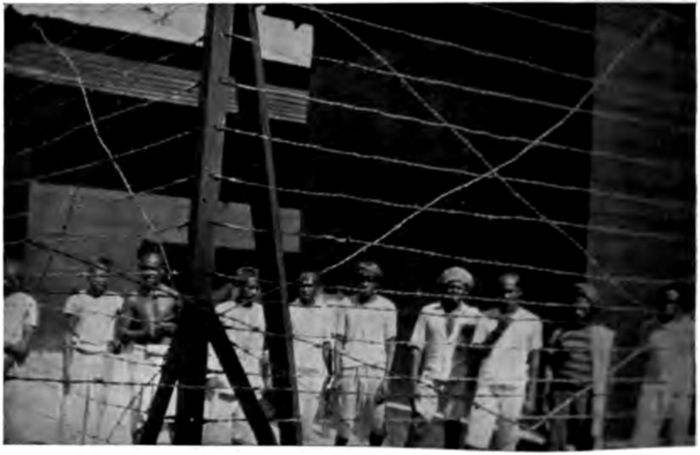
As we near the passangrahan we take note of a
group of sheet-iron buildings surrounded by a
27high wire fence. It is the jail and watching us
intently are a score of prisoners. As we look
in their direction they break into smiles and call
to us in Malay. They are asking us to secure
them for additional servants during our stay
and, noting our surprise at this, the Controlleur
assures us that he will loan us all the help we
want. Later he makes good his word, for he
sends several of the prisoners over to the resthouse
where we have taken up our abode. They
are accompanied by a native sergeant, who sits
in the shade all day, smoking. He never bothers
about what the prisoners are doing and they
dutifully report to him at meal-times. In the
evening, when their house-cleaning and grass-cutting
are over, they line up and return to the
jail. We even send them on errands, which
they do conscientiously but not at all hastily.
The Controlleur and Reache leave us—to get
our things straightened out, they say—and
promise to call again to-morrow. They also say
that we must meet the other Europeans who
are connected with the little trading-company.
28We shall not be able to see the Assistant Resident
on business until the steamer sails, we are
informed, for he has many reports to forward to
his chief in Ambon. These are always made up
at the last moment and the rush is terrible. The
assistant is even now writing the first of the two.
One of them is to tell the chief that Merauke is
still in New Guinea, and the other that we have
arrived and are being well cared for. He must
rest from this labor for a day; then he will receive
us with the formality due the distinguished guest.
He will inquire with solicitous concern as to our
health, and what we most desire to do, and will
grant our every wish, after due deliberation.
Things of such weighty nature as our coming on
a little friendly visit must be treated with painstaking
consideration. It is too warm to decide
too much in one day, for then judgment might
be erroneous, and—oh, well! why talk business
when there is so much else to talk about? There
hasn’t been a stranger in Merauke for months,
and we can’t blame them, can we? No! We
shall let the purpose of our coming go hang, and
29just sit down and be entertained for the best part
of a week. They will enjoy it almost as much
as we, so why not?
At the passangrahan we find that Moh has dinner
ready. He shows us where the bath-house
is and we go there and revel in the cool splashing
of the water upon our perspiring bodies. The
mode of bathing, here, is new to us, but we feel
we shall come to like it. The bath-house is
exactly like all others found throughout the
Dutch East Indies. It is placed right alongside
the cook-house, which is detached from the
main bungalow, that the heat and smell of cooking
may not invade the domain of the Tuan.
Within the palm-thatched room are several
great jars of rain-water, a wooden grid to stand
upon, and a tin dipper of gallon size. One
drenches himself from head to foot, lathers thoroughly,
then sluices down with more gallons and
the bath is complete. It is quick, easy, and exhilarating.
We are told not to try it much after
nightfall, however, unless we wish to be eaten
alive. There are cannibalistic mosquitos here
30that will charge en masse, drive in their lances,
and bear you away in chunks. They are nocturnal
in their habits and we are profoundly
thankful that this is so, for at night one sleeps
behind a protecting klambu or mosquito curtain
which completely enshrouds the bed. There
one falls into slumber secure from their attacks
and lulled by their incessant droning. Now
and then some persistent fellow manages to find
entrance and one becomes aware of a more shrill
note in the general hum that increases in pitch
until it is punctuated with a hesitant quaver
followed by a red-hot stab,—upon almost any
spot, but generally on the temple, where it
accomplishes most. This is the occasion of two
things. The first, a hunting-expedition with a
lighted wax taper, which ends in the incineration
of the intruder, and an angry determination to
murder Moh the very next morning for leaving
an opening in the folds of the net. Justly or
unjustly, Moh always serves as scapegoat. He
thrives on it.
Dinner over, we hunt up a tin cigar box to
31serve as an ash-tray and take it to bed with us.
It is too early to go to sleep and too mosquito-y,
if I may use the term, to be up and around. In
New Guinea one hides from these pests as soon
as darkness falls. Moh, though he has a leather
skin, builds a great smudge of cocoanut husks.
The smoke of it makes him weep and gasp, but
he persists in his friendly gossip with a man
from Java lately come to Merauke, telling him
the latest news and of his latest wife. The
other listens with sparkling eyes and rapt attention
to Moh’s description.
CHAPTER III The Kampong
32
To-day the assistant is resting. The
steamer is gone. We shall go hunting
adventure on our own. Four miles inland there
is a kampong where live about fifty Kia Kias.
As the day is warm we will put on the lightest
clothing we have and go there. We cannot
miss the way, for the only road of which the
country boasts passes the place. It leads to a
deceased missionary’s little plantation about
three miles farther on.
Each of the men has perforated the septum of his nose to permit inserting a pair of boar-tusks
A pair of alligator-teeth make a wonderful nose-ornament
33The last building we pass on our way through
the outer fringes of the little town is a rambling
whitewashed structure. It is the government
hospital. We must see this place, for in it they
are striving to save the Vanishing Men. We
are met at the little office door by a nurse in
modest white. She is the only one on duty now,
for nurses are hard to obtain in this out-of-the-way
corner of our old footstool. She is half
white and half Chinese. She speaks five languages
fluently, we find, for as we converse with
her she lapses into French now and then, with
sprinklings of Malay and Dutch. It is a habit
linguists have, for they find finer shades of
meaning in varied tongues. Her English is
perfect and we take for granted the purity of
her Pekinese, for she tells us she was born in the
Celestial Empire.
In the wards she shows us the patients in her
care. Here we find the curse of civilization
stalking like a grim specter. Statistics, she informs
us, give the Kia Kias fourteen years more
to live. Once the race numbered a hundred
thousand, but now with the coming of the
strangers the venereal scourge is upon them and
their ill-nurtured bodies cannot withstand the
heroic treatment necessary for successfully combating
the disease. The mere confinement in
the hospital kills some of them.
34Before the coming of the strangers they were
a healthy race that thrived and prospered.
True, they ate one another, but their diet seemed
to agree with them. It was the greatest
pleasure they got out of life. These dinner-parties
are taboo now and the poor devils within
reach of the punishing whites have nothing for
which to live. They are a race without ambition,
lacking zest of life, and seek excitement in
excesses that take toll of hundreds where the
roasting-pit claimed but a comparative few.
In early days there was tribal organization,
which was necessary for survival. Now they
live in less dread and great sloth, their idleness
breeding indulgence in the only thing left to
them, unrestricted sensuality. True, the tribes
that live in the remote fastnesses of the jungle
still maintain the old customs and they are contaminated
only slightly with the scourge; still,
it has found them.
With mixed emotions we leave the hospital.
The advice of the engineer comes to us with new
significance. Every ship or schooner that plies
35the islands has been freighted with the scourge,
gathered from the four winds and brought here.
Then come the missionaries further to darken
the sky, for do they not lift hands, eyes raised
askance, at the naked savage and force him to
don clothes? The childlike and untutored natives
do not know that in rain-soaked clothing
there lurks a menace. Their naked skins shed
the water and they never become chilled, but
those whom the missionaries have clothed are
one and all subject to pulmonary troubles that
are making further inroads on the race.
The road winds into the jungle where the
silence is absolute. A mile from town it has
dwindled to a mere foot-path. As we brush the
close-growing shrubs that border it, we dislodge
clouds of midges and mosquitos which, with the
moist heat and the perspiration that soaks us,
become intolerable. However, we have set out
for the kampong, and shall go there.
After an interminable hour, we come to a
clearing where we find a palm-thatched shack.
Three naked children are sprawling on the
36ground, chattering baby talk. They do not
notice our approach until we are close to them,
but as we say “hello” they bounce to their feet
and disappear in the bush with wild cries of
alarm. They are just like any of the wild
things that live in the jungle. We laugh at
their sudden fear and call to them to return,
while their mother inside the shack peeps furtively
at us through a crevice in the wall.
Evidently she is not much frightened, for she
comes to the door and greets us with, “Tabe,
Tuans,” the stock greeting of the Malay-speaking
native. She is clad in her birthday clothing,
as naked as on her natal day save for a heavy
necklace of shells wound twice around her neck.
She approaches us with easy grace, wholly unconscious
of her nudity. Though she wears no
covering whatever, she is clothed, for the dignity
with which she moves and her utter lack of self-consciousness
form a garment that drapes her
pleasingly.
Enormous nose-tubes of bamboo which entirely close the nostrils, making breathing possible only through the mouth
The women wear in many cases a tiny breech-clout, but no other covering
37Going to a pile of cocoanuts beside the shack,
she selects two which she opens with a deft
stroke of a heavy broad-bladed knife. These
she gives us, with a smile and a sinuous, almost
coquettish lifting of the hip as she stretches her
arm to hand them to us. Bidding us wait, she
disappears inside the shack, emerging in a
moment with two Chinese enameled cups which
she offers us. We thank her, but prefer to
drink the cool water of the nuts from the shell.
The brown-skinned urchins, upon seeing their
mother in friendly conversation with the strangers,
return to the clearing and eye us with
wonder and some distrust. They are on their
little toes, so to speak, watching for the slightest
suspicious movement, ready to fly to the protective
jungle. Their big sloe eyes grow wistful
as we offer them some pennies and their mother
reassures them, finally overcoming their fears
and bringing them to the place where we are
crouched upon our haunches with hands outstretched.
They reach out, snatch the pennies,
and are gone, whereupon the mother shrieks
with merriment. While we are laughing over
the little comedy a boy of possibly eighteen
38years, naked as his mother, comes from the
thicket with some more cocoanuts, which he
tosses on the pile by the shack. He looks inquiringly
at us and his mother directs him to
guide us to the kampong, which is set back off
the path a few rods.
The sound of laughter and some one singing
in full-voiced baritone greets us as we near the
kampong. A man is singing a Kia Kia melody
that sounds as though he were ill. He finishes
the song as we enter the narrow opening in the
kampong wall and all the natives in sight gaze
at us for a fraction of a second, paralyzed with
surprise and fright.
The spell is broken the moment we step inside
and they leap en masse for the exit in the rear of
the kampong and wedge there in a ludicrous
struggle of arms and legs. Somehow they
force their way through the opening and the enclosure
is deserted except for a few old women
too old to get away.
Our presence in the kampong is resented by
the canine population, which gathers before us
39in a semicircle and howls in great anguish of
spirit. Soon a dusky form slithers in through
the exit, to be followed by several more, and all
stand grouped at a respectful distance, eyeing
us closely. They are women, startlingly nude.
As they come to no harm at our hands, the men
take heart and return singly till all the inmates
of the kampong are again at home. After a
silent study of us the men evidently realize that
we are harmless, for they break into loud laughter,
which is taken up by the women, and come
toward us to make us welcome. The women
gather around and, though laughing uproariously,
seem friendly enough.
We are in a real cannibal village, and, as it is
our first, we are somewhat curious about it.
We start in by examining the natives and note
the curious decorations with which they adorn
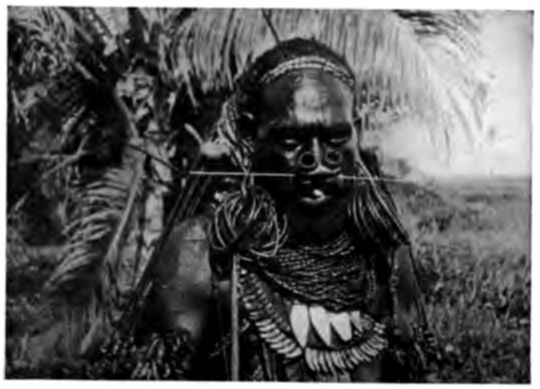
themselves. Each of the men has perforated
the septum of his nose to permit of inserting a
pair of boar tusks or pig knuckles. This of
course interferes with his breathing, so he has
cut two vertical openings through the sides of
40the nose through which the air whistles at each
inhalation. The faces of all the men are besmeared
with paint, which they make from
colored earths they gather and grind into a fine
powder.
The ears of both men and women are perforated
in the lower part of the lobes, which,
by reason of the many heavy brass rings with
which they are weighted, hang down well upon
the neck, some of them even touching the shoulders.
All wear necklaces of shell, with sometimes
a variation in the shape of varicolored
seeds sewn upon pieces of trade cloth. The
men wear no loin-cloth, but those of family wear
a grotesquely inadequate substitute comprised
of a shell and a string of bark fiber. The
women in many cases wear a tiny breech-clout
of twisted fiber scarcely bigger than the palm of
one hand, a triangular patch that because of its
color and texture does not seem to exist. Many
of them seem to be sufficiently happy without
even this pretense at clothing and in no way
conscious of their nakedness. Among those
41under the age of twenty of both sexes there is no
attempt at covering.
We are as much objects of curiosity to them
as they to us and while we have been studying
them they have been picking us to pieces. The
women pluck at our silk shirts and try to peep
inside, doing it gently, however, for fear of arousing
our anger. They are like a throng of
curious, happy children and now and then one
of the younger women will burst into shrieks of
laughter at some sally of her mates and run a
few steps away, where she leaps up and down
in exuberance of spirits.
They move like graceful animals, each muscle
rippling under its sheathing of dark bronze with
a freedom and smoothness that makes us envy
them their unrestrained ease. Here are no
bloated abdomens, no pinched-in waists. They
have never seen corsets. Their bodies and
limbs are clean-lined and well rounded and
they walk haughtily erect.
In response to our inquiries as to their shelters
they extend us a laughing invitation to visit
42them and lead us to the low thatched shelves that
run around the enclosure, which forms their
back wall. Supported upon low legs of bamboo
is a long platform which completely encircles the
kampong. There are no partitions of any kind
to screen from view the various intimacies of
family life. One may sit upon the platform
and see whatever transpires in the homes of the
entire kampong. In fact, these people live entirely
on a community basis, and there are no
secrets.
Johnny woos Milly, or whatever their names
may be, with little regard for the others and
may live with her for some time without censure
before he finally decides that marriage is the
proper thing. If he finds her to his liking he
may inform the rest that he will keep her, and
that is all there is to it. There is no scandal, for
all know everything. Gossip there is in plenty,
but that is when some member plays hookey and
visits another kampong with too much regularity.
Conduct of this sort is frowned upon, but
not punished except by the hookee’s—what shall
43I call her?—sparring partner, who if she learns
of the situation may take the offender to task.
But such is life even in our own land of Wednesday
evenings and cabarets.
Our hosts bring cocoanuts, which they open
for us to drink from, and offer us food. We
drink, but, strange to say, are not hungry. Our
cigarettes are received with marked approval,—so
marked, in fact, that they are snatched from
us by the package the moment we pass out the
first one. They take it for granted that we
want them to have them and do not wish to put
us to the trouble of distributing them. They do
this themselves, after the fashion of ten dogs
after one bone, but with surprising good nature.
They love tobacco, which they get from the
ubiquitous Chinese or Malay traders. Having
no paper with which to make cigarettes, they
generally eat the tobacco, but some roll the
coarse shag in pandanus leaves, making cigars
which would put to sleep even confirmed smokers
like us.
The hours pass swiftly and we hear a pattering
44on the dry palm-leaves above us. The sky is
overcast and we have four miles of humid going
ahead of us. After an afternoon spent in lolling
around with our new friends we hear the call
of the bath-house, and we bid them adieu,—for
the present without reluctance.
If these are the good Kia Kias,—in contact
with whites more or less, for they live beneath
the shadow of the assistant’s authority,—we
wonder what the tribes in the interior are like.
“Well,” we tell ourselves, “we shall see them
soon now. Next week at this time we shall be
among them, alone and far from the arm of the
white man’s law.”
A long platform which entirely encircles the kampong
During the day the men occupy the sleeping-benches, while the women sit upon the sandy floor of the shacks
CHAPTER IV The Assistant and the Nautilus
45
The whitewashed buildings of the government
headquarters reflect the sunlight
with an intolerable glare as we swing up the
path from the road. At the door of the assistant’s
office we are greeted by an obsequious
Ambonese in regulation white. His trousers
are very short, though whether by design or because
of repeated shrinkings, I am not prepared
to say. On his head he wears a batik turban one
corner of which seems to flirt with us in feminine
coquettishness as he bows and scrapes. The
“Residentee” is awaiting our pleasure, he informs
us. From the cool semi-darkness of the office
comes a voice in soft Malay telling the man to
show the Tuans in, and forthwith we enter.
After the terrific glare of out-of-doors we grope
46momentarily, but our eyes soon accommodate
themselves to the grateful dimness and we see
before us a little brown-skinned man of some
forty years, with bristling mustachios, extending
a friendly hand.
He is filled with the importance of the occasion.
Are we well? Do we like Merauke?
Are we sufficiently comfortable in the passangrahan?
Have we recovered from the ennui of
our long voyage? He showers us with solicitation
as to our welfare and immediately we feel
that we are among friends. It is a habit that
these foreign officials have, to make one at home
upon the instant.
Greetings over and assurance given that all
is as it should be, we, running true to American
form, get down to business. This is distinctly
painful to the “Residentee,” for as yet we are
not really acquainted. He lifts his hands in
remonstrance and exclaims, “Ah, these Americans!”
and shakes his head as though nonplussed
at our bustling impetuosity. “Hurry,
hurry, hurry!” he remarks audibly, but really to
47himself; then to us: “You must slow down over
here or you will not last; the heat, it is too
much.” He tells us this with a sage-like shake
of his head.
His desire to please, however, outweighs his
scruples against talking business in the first ten
minutes of an acquaintance and he asks us what
he can do for us, in the manner of one who will
give anything yet secretly fears that he may be
asked the impossible. These Americans, you
know, think that just anything can be done. A
wave of the hand and presto, it is!
What we want is really a good deal, so, taking
a fresh grip on our nerve and with a deep breath
to go on, we request in a low, dulcet voice: “The
loan of the government schooner and crew for a
few weeks. We are very much interested in the
Kia Kias and should like to study them in their
homes, far away from outside influences. Will
you be so kind as to let us have the schooner for
a trip around the western end of the island,
where the really wild tribes live?”
The Assistant heaves a sigh of relief. “What
48could be easier!” he exclaims. His slim brown
hand taps a bell on the desk before him and a
“boy” of fifty slides into adamantine immobility
beside the doorway of the sanctum. In a few
terse words the captain of the Nautilus is summoned.
It seems that our little Assistant is
something of a martinet with his men. When
within range of his eye they straighten up with
ramrod stiffness. In his domain his word is
law; rather, he is the law.
Ula, skipper of the Nautilus, has been lounging
in the shade of the Chinese toko, or general
store, near the dock. The toko is but a few rods
from the Assistant’s office, and the man sent for
the skipper readily finds him. The two enter
together and stand at attention while the Assistant
delivers himself of a long harangue in
Malay that flows in so rapid a stream that our
unaccustomed ears catch only a small part of it.
Ula does not seem inordinately happy over the
prospect. From the mention of prampoen and
the assistant’s angry tone as Ula utters the word,
we gather that he has a new sweetheart who is
49occupying his time at present. The conversation
dies away in a moment, and the Assistant
later tells us that Ula wanted to know whether
he might take the girl with him to finish his
courting.
Ula departs disconsolately for the schooner.
The Assistant has ordered it made ready for us
to-morrow morning. He waves a deprecating
hand at our effusive thanks and says that he is
only sorry that he cannot do more for us. He
asks us about America, meaning the United
States, and we chat for an hour. As the time
for his siesta draws near we rise to go, for in the
islands one must never interfere with another’s
midday sleep; it isn’t done.
Before we take leave of the obliging little man
he asks us to be permitted as an especial favor
to ship a party of five Kia Kias up the coast
a little distance on “our” schooner. They are
some natives that have just finished a one-month
term in the local hoosgow or jail. The
offense was trivial. There had been a disagreement
in their village with a visitor and when
50the argument ended the visitor was deceased.
“We have to check them a little,” remarks the
Assistant. “We could not fix the blame exactly,
so we gathered up three men who were implicated
and two of them brought their wives.”
After further assurances on the part of the
Assistant that the natives shall in no way interfere
with our convenience on the schooner, and
from us many expressions of our gratitude, we
depart. As we walk down the sweltering roadway
along the riverfront we congratulate ourselves
on the success of the interview. The
Nautilus will save us many heartbreaking miles
of grueling jungle travel.
In the passangrahan Moh has a “rice-taffle”
ready for us. Rice-taffle! No wonder these
Dutch gentlemen indulge in an all-afternoon
siesta! Every noon—rice-taffle! A tremendous
bowl of rice, chicken cooked in four or five different
ways,—boiled, fried, roasted, and I don’t
know how to describe the others,—two or three
varieties of fish; a peppery soup-like sauce with
which to drench the heaped-up contents of the
51platter, and a dozen different sweetmeats, condiments,
and garnitures. It is so good that one
invariably overeats and repletion, together with
the sultry heat of midday, brings a drowsiness
that makes bed welcome. Even the ever-businesslike
Chinese closes his toko and sleeps until
four o’clock. At that hour, or shortly after,
every one wakes up and the splashing in the bath-house
is prodigious. The evening coolness brings
the hour of the promenade and the streets and
byways are gay with the varicolored sarongs
that the Malay women affect. The men come
forth in suits of white drill fresh from the dhobie
and saunter along with cigarettes aglow, leading
by the hands naked kiddies for whom they
have a very genuine fondness.
Many of the little girls of, say, three to six
years wear, suspended from a single cord
around their plump little loins, a pendant that
serves both as covering and ornament. This usually
takes the form of a gold or silver heart of
possibly three-inch length and proportionate
width. It is amusing to watch a group of these
52innocents at play. Sometimes a small girl’s
heart becomes displaced, and hangs unnoticed
for a time upon her hip. This is not at all disconcerting
to her or to her infant male companions.
When she discovers the disarrangement
of this sole article of her apparel she will
stop play and readjust it with the utmost unconcern
and charming naïveté. Play is then resumed.
Her manner is precisely that of one of
our high-school girls who pauses between sets
in tennis to powder her nose.
As we pass the people in the promenade, all
from elders down to the little naked tots, greet
us with “Tabe, Tuan,” and the elders smile in
fond amusement at their offsprings’ baby lisping
of the greeting. We like the Malays very much;
and the Chinese, too, for they are always pleasant
to us.
CHAPTER V We’re Off!
53
High tide at nine to-day! On the Nautilus
the crew are shortening up on the
anchor chain, for the rusty old hook has been
buried in the river mud for two months. We
sail at full tide, which enables us to skirt the shore
of the western flats and save much time in getting
out to sea.
Moh has superintended the moving of all our
effects to the little schooner while we have been
in the trading-company’s store making some
eleventh-hour purchases of tobacco and tin mirrors
for the natives and cigars for ourselves.
The three white men in charge bid us Godspeed,
after many admonitions to take care of ourselves
and warnings not to trust the Kia Kias too far.
Grouped in a little knot upon the veranda of the
54store, silent, they sadly watch us depart. We,
too, hate to say good-by; we have had some
pleasant chats with them.
We go directly to the schooner, anxious to take
up the trail to adventure. Ula is waiting for us
beside the wharf in the tiny dinghy. As we drop
into it it sinks with our weight so that the gunwale
is scarcely three inches above water and we
have visions of making the short trip to the
Nautilus each for himself, swimming. Nothing
more serious than the shipping of a few gallons
of the muddy river water happens, however, and
we arrive alongside the Nautilus, in high spirits,
though with feet and legs soaked. We probably
shall be much wetter than this before the trip is
over, is the cheering thought that comes to us.
As we clamber up over the schooner’s low rail
we scan the deck. Up forward are our five ex-convicts.
Their brief sojourn in the hoosgow
has quieted them down a bit and they are not
particularly effusive in their greetings. In fact,
they don’t even notice us, but sit huddled together
just back of the anchor winch with dirty
55bark-cloth blankets thrown over their heads. We
go forward to look them over and they return our
gaze with a half-conciliatory, half-annoyed expression
that makes us grin.
Our grin seems to be taken as an assurance of
good-will, for they in turn smile slightly and one
of the women bursts out in a hearty laugh. From
that moment we “belong.” Ula seems anxious
to get under way and comes stumbling forward
with two of the crew. Most of our barang is
still on deck, awaiting our orders concerning its
disposal, and over this the trio have some difficulty
in making their way. The dinghy further
complicates matters, for it has been hoisted and
deposited edge up beside the rail. One of the
crew jumps upon it, as the easiest way, and runs
over it, balancing like a tight-rope walker on the
narrow rolling edge of the thing as though it were
a solid sidewalk. His pride takes a fall, however,
for as he jumps from it he finds insecure
footing where the water from the dinghy has
made the deck slippery and falls flat, to the huge
delight of our friends the criminals.
56The boys hoist the sail on the foremast and
the Nautilus swings around to break out the
anchor. This done, Ula snaps a sharp command
in Malay to the boys in the bow, who seize the
rusty handles of the winch and slowly bring the
old mud-hook to the surface. How they accomplish
this is a mystery, for at every turn one of
the handles of the winch slips on the shaft, while
Ula tries to tighten it with wedges of wood
driven into the handle socket.
Our Kia Kia friends are very much interested
in the proceedings and gather closely around.
This gets on Ula’s nerves to such an extent that
he unceremoniously kicks the men out of the way,
which they do not seem to resent particularly;
they sit down again out of harm’s way, but keep
up a lively flow of comment. Ula is much disgusted
with them and the glances he gives them
make us wonder if they are going to enjoy their
trip home.
The town is fast dropping into the hazy distance,
and save for the chatter of the crew and
the natives, and now and then the thumping
57splash of a husky comber against the bow, all is
silent. Moh places our dunnage below in the
tiny saloon. He carries the groceries down last,
for he will have to cook all of our meals there.
The crew cook theirs over a sort of fireplace
built right on deck, just aft of the foremast.
After inspecting the saloon, which contains two
sleeping-bunks, we decide to sleep on deck. The
atmosphere of the saloon is hard to describe.
It is hot and stuffy and a strong smell of bilge-water
comes from beneath the floor. No, it isn’t
possible to sleep there. Moh grins when we tell
him to place our cots on deck.
We clear the mouth of the river and swing outward
on a long tack, for the wind is coming dead
against us. This will make the up-coast trip
slow, but what care we? We have plenty of
time and then we may always console ourselves
with the thought, “Well, maybe something will
happen.” As we swerve into the trough of the
sea the Nautilus begins to roll and a groan comes
from the Kia Kias on the forward deck. They
are experiencing their first case of seasickness
58and seem very wretched indeed. I have been
told that seasickness is wholly mental and that
babies are never sick at sea because they have no
fear of being so, nor any knowledge of how others
are affected. The poor savages by the foremast
seem to refute this theory, for though they are
grown-ups, they can have had no previous experience
of the sea, having come from far inland,
and it is not likely that they have ever discussed
seasickness. They succumb one by one until
all are down.
Moh walks by with a stony glare in his eye, as
though all were not right with him, and later
becomes a delicate robin’s-egg green around the
gills, but he continues at work with a never-say-die
expression that wins our admiration. Moh
is all right, we whisper to ourselves; he’s game,
anyway.
The day wears on, the only diversion being
when Ula calls to the men to tack. He is sitting
beside us in the stern with the tiller ropes in
hand. Now and then we attempt to break the
monotony by taking a turn at steering, and
59silently flatter ourselves that we are doing it as
skilfully as he. But Ula now and then casts
a critical glance aloft and finally takes the ropes
from us. A slight tug at one or the other of
them and the sails fill, catching all the wind which
we have been missing. There is an amused grin
on Ula’s face. Moh is asleep on the deck in the
shade of the low saloon bulkhead. The sea is
very calm and the sky cloudless except for a few
low-hanging clouds which fringe the horizon in
the west. The easy swells lull us into slumber,
from which we are roused—after what seems
only ten minutes but is really two hours—by
Moh, who is calling us to makanan. This is the
Malay word for dinner and is, I believe, the first
word of the language learned by the traveler.
He has unpacked our camp table and set it
on the deck. Our meal consists of canned goods
brought from the good old U. S. A. We purchased
a two-months’ supply of them in Java
and Moh is delighted, for all he has to do to cook
them is to put a great bucket of water on the
fire, dump the cans into it, and, when it has
60boiled a sufficient length of time, fish them out
and open them. He is thrifty, too, for he saves
the hot water in the bucket to wash the dishes
with.
We have made only one mistake in picking out
our dishes: we purchased aluminum cups. Every
time we essay a mouthful of hot coffee—and Moh
serves it piping hot—there is a sputter and the
air becomes lurid with imprecations. It is astonishing
how hot those metal cups can get. Every
time we burn our lips on them Moh looks up
with a terrified, wondering expression, as though
in doubt as to whether we are berating him as a
cook or what. The Malay does not understand
the soul-satisfaction the white man gets from
swearing. He must have some specific object
upon which to vent his feelings and his invectives
invariably take the form of some terrible expression
such as “Babi kow,” meaning “You pig,” or
some similarly outrageous figure of speech.
Compared with our most conservative epithets
the vocabulary of the Malay is singularly amateurish.
61While Moh clears away the debris of the evening
meal we stoke up the old briers and watch
the sunset. In the Indies this is usually one of
the events of the day. Shortly after nightfall,
which comes in these latitudes with surprising
rapidity, we peel off our clothes and stretch out
on our cots with no other covering than our pajamas.
The sky is a diamond-studded canopy
above us,—blue velvet, unfathomable in depth.
We shall be sound asleep when the moon rises
and shall probably miss that, though it is almost
worth waiting for. Above us, but a little to the
south of the zenith, hangs the Southern Cross,
which resembles somewhat a broken kite,—one
of those two-sticked kites of boyhood that was
diamond-shaped and had one bowed stick. We
fall asleep trying to count the stars in one of the
constellations. As I drop off I wonder drowsily
if it will rain before morning. If it does! Oh,
well, what matter? We can change to dry pajamas.
Ula is still on duty at the tiller when we drift
into slumber. He has a bottle of cognac beside
62him for company, and for solace, too, we imagine.
He must have hated to leave his lady-love with
the courting just begun. He knows full well
that there are many other Ulas in her vicinity
who will do their best to keep her from pining
while he is away. In all probability, though,
should he find that in his absence another has
taken his place, he will be just as content with
her next older sister. It really doesn’t matter
much.
Six bells. The air is stifling. There is a loud
drumming sound over and around us. As we
come wide awake we realize what the matter is.
The Nautilus was headed for a heavy squall and
Ula called Moh, who, rather than waken us,
simply spread a heavy tarpaulin over us to protect
us from the rain. It was the smothering
and not the storm that roused us. How he got
the covering spread without disturbing us we
shall never know. We rise up on our elbows
and peer out from under it. The rain is coming
down in torrents. Ula is still at the tiller. His
63clothes stick to him and the water is running in
a steady stream from the turned-down brim of his
brown straw hat. He has tied it upon his head
with a string passed underneath his jaw. His
water-soaked figure is ludicrous and we burst into
laughter. Ula apparently enjoys the situation,
himself, and does not seem to mind the wetting.
The bottle of cognac is still beside him,
so he won’t get cold. His capacity for liquor is
a matter of great pride to him; it is the envy of
his fellows and the subject of much discussion
among them.
Like all tropical storms, the squall passes soon
and we are able to toss off the heavy “tarp.”
Under it the heat is terrific. We wonder how
the Kia Kias up forward are faring, but are not
sufficiently interested to go there and find out.
If Ula and the crew can stand it, they should be
able to. A thorough soaking will do them good,
for it is only with rain that their bodies are ever
moistened. They have a constitutional dislike
for water, even as a beverage. For drink they
are quite content with the milk of the cocoanut,
64the meat of which forms a large part of their
diet.
After the squall the air is cool and deliciously
sweet. The breeze comes again and fills the
dripping sails which have been hanging limp and
motionless. Some of the crew are clustered
around the fireplace, cooking fish. They spit
them upon slivers broken from one of our packing-cases
and toast them over the open fire. Moh
is squatted among them and seems to be quite
at home. Occasional words drift to us, indicating
that the topic of discussion is the usual one,—the
virtues of their respective women. This
is a subject that the Malay never seems to tire
of. In the kampongs the women talk likewise
of the men. Having nothing else to occupy
their thoughts, no business or serious occupation,
naturally they are interested chiefly in one
another and they discuss with the utmost candor
subjects of which the European never speaks.
We listen, and are properly shocked at some
of the things said which bring forth bursts of
delighted laughter from the listeners; nevertheless
65we cock our ears so as not to miss any of
them. One of the boys is telling how well his
sweetheart dances and he gives a demonstration
which to us is lewd in the extreme and occasions
uproarious laughter. His companions slap him
on the back and urge him to continue, but he
shakes his head in refusal when Ula calls to him
to come and show the Tuans, meaning us. This
breaks up the party, for they believed us to be
asleep. They are very reserved in the presence
of the stranger, for they sense that their ways
are not ours.
It is only upon ripe acquaintance that the male
native will speak of his family affairs to the white
man, though the women seem to be always ready
to gossip.
When the whispering begins again Ula looks
at us and grins. He wags his head as though
to say, “It’s too bad, for he is very funny, but
I can’t make him do it.” We are just as well
satisfied, and we turn over to our sleep. Ula has
just tossed the empty cognac bottle over the
side, where it bobs away into the darkness in a
66wabbly dance. The idle thought drifts through
my mind that I should like to cork up some wild
message in that bottle on the chance of its being
picked up. But white men who could read it
seldom visit this lonely coast.
We are the first to come in years, except the
few “paradise-hunters.” Some of these have
taken the paradise away with them, while others,
seeking the one kind of paradise, have found another
and have remained after having served as
the pièce de résistance of some gastronomic function.
CHAPTER VI Shipwrecked among Cannibals
67
The days have flown almost uncounted.
Our native passengers left us several days
ago, after we had passed a large river which it
was impossible for them to cross on account of
its width and depth. They had refused to go
home on foot, for this would have necessitated
their traversing unfriendly territory they knew
to be dangerous in the extreme.
Landing on the other side of the river, they
were among tribes more or less friendly to their
own and stood an excellent chance of reaching
home in safety.
Their absence was welcome, for they had reduced
the tiny forward deck to the condition of
a pigsty. Once dining their stay on board two
of them tried to get friendly with us and came aft
68like children encroaching on forbidden ground,
but Ula made their stay one of exceedingly short
duration. In fact, they didn’t stay at all. They
didn’t even pause, for as they stepped around
the saloon-deck combing Ula spied them and
with a well-directed heave of a large wooden
thole-pin snatched from its socket on the rail
sent them scurrying back to their end of the ship.
Five minutes after we had landed them they
disappeared in the mystic silence of the jungle,
anxious to gain the safety of their familiar
haunts.
We remained on shore for an hour to stretch
our legs, for the close quarters on the Nautilus
make some sort of exercise necessary. We wandered
up-river for a little distance and saw,
floating in the shallows near the shore, seven or
eight basking crocodiles which slowly sank from
view as we approached. Many funny little fish,
with heads like frogs and fins in front like short
fore legs, flopped and jumped about on the
muddy flats the receding tide had left. We
watched them for some minutes and laughed
69hugely at the antics of the fiddler-crabs fighting
and trying to drag one another into their respective
holes, where the victor could eat his unfortunate
neighbor in peace, secure from interruption.
Upon our return to the schooner we found
Ula holding aloft an almost empty cognac bottle.
Upon his face there was a look of sorrow, for this,
it seemed, was the very last of his once plentiful
stock. After carefully measuring the contents
with a speculative eye, he came to the conclusion
that the remaining fluid was sufficient for only
one more drink and raised the bottle to his
lips. The cognac disappeared in one long swallow,
and Ula dropped the empty bottle over the
rail as though he were parting from his last
friend. This was as it should be, for of late he
had begun to show the effects of quarts previously
imbibed. He seemed able to stand one
or two, but many bottles drunk in rather quick
succession were making themselves felt.
Though he was fairly steady on his feet, his
eyes told the tale and his tongue had become
70noticeably thick. That evening he came to us
and requested that we let him start on the stock
we carry in our medicine kit. Of course we
refused, and he sulkily returned to the stern
sheets in disconsolate dejection. Later Ula was
seized with a brilliant idea. His system craved
alcohol. He must have it, he told himself. The
compass of the Nautilus held nearly a pint of
grain alcohol. His face lighted with anticipation
and before we realized the meaning of his fumbling
with the instrument he had unscrewed the
top and had drained the raw spirits to the last
drop. It was a draft to kill a mule and probably
would have ended him, but his tortured stomach
refused to retain it. Enough of it stayed down,
however, to reduce Ula to the most satisfying
state of inebriation he had ever experienced. He
became very friendly and most anxious to please,
while we just looked at each other. There was
nothing to be done. We thanked Providence
that there was no more of the stuff within his
reach and turned away from him in disgust.
That was just an hour or so ago, and we have
71been sitting reading while the Nautilus slipped
through the water smoothly, as though she were
commanded by a skipper who was the soul of
sobriety. There is land to starboard, a mile or
two away, one would judge, and over there a
little distance ahead we see smoke coming from
the jungle. It is the first sign of native life we
have seen since leaving Merauke. After a hurried
discussion we ask Ula what the place is, but
he is foolishly drunk and we cannot make out
what he says, so we decide for ourselves and tell
him to head for the shore as we wish to visit the
place. Ula swings over the tiller obligingly, and
we move at a lively clip across the wind toward
the place.
We shall go ashore and investigate the kampong
and, if it interests us, move our camping-outfit
there and settle down for a few days.
Moh brings up our cameras and guns while the
crew unfasten the dinghy from its place beside
the rail. We go below, to load some fresh rolls
into the kodaks, where the light is not so strong.
Five minutes pass while we are engaged in this
72undertaking and speculation as to what kind of
kampong we shall find, when suddenly there is
a terrific shock, a rending, crunching sound, and
we pick ourselves up from the saloon floor and
gaze blankly at each other, for the fraction of a
moment speechless with consternation. The
cause of the crash is self-evident. We are on
a reef.
From beneath the floor comes the gurgle of a
torrent of water which is pouring into the
Nautilus through a gaping hole in her bottom.
We are high upon a submerged reef of rocky
coral, shipwrecked among cannibals! What the
tribe is that lives on shore and how friendly it is
remain to be seen. The moment is one of those
deadly potential eternities that either make one
lose all self-control or become cold sober. Luckily,
we are not of the hysterical type and our first
thought is to get our guns, food, and cameras
to a place of safety on shore. The schooner
may slide off the reef into deep water at any
moment, and then we shall be in a pickle.
Working like mad, we begin heaving our possessions
73up on deck, and I go up to see that it
is properly stowed in the dinghy. The crew are
working like demons, and Ula, sobered by the
catastrophe, has ordered the men to get the anchor
hooked into the reef and the chain drawn
taut to hold us there.
I take command and order some of the men to
get the dinghy overside, and into it we pack
all that it will hold. It is sent ashore, and five
trips are necessary to transport the whole of our
outfit. We go ashore with the third load to see
that it is properly cared for. There is a high
surf running, and in order to get the dinghy
through it without soaking the baggage we have
to jump overboard into waist-deep water and
help steer it through the breakers. The barang
is piled up just above the reach of the incoming
surges, but the tide seems to be rising.
It is necessary to get the stuff higher up, out
of reach of the water, and we bend our energies
in that direction. The beach seems to be deserted,
and we wonder whether or not the natives
have discovered our presence. We are soon to
74be informed as to this, for suddenly we hear a
guttural grunt and an explosive, “Uhumen! [Go
away!]” coming from the fringe of tall tapa
grass that fringes the beach. We gaze in startled
surprise in the direction of the sound and
even as we look there spring, like mushrooms,
from the thick grass a long row of black heads
which seem to number hundreds.
We stop work for the moment and stand in
indecision, facing the watching line of feather-crowned
heads. Three of the natives rise from
their crouching position and advance toward us,
waving their arms and shouting, “Uhumen!”
From their menacing manner it is evident that we
are de trop, that they wish us to depart. This
is out of the question, for our only means of conveyance
is at least temporarily on the rocks. A
rapid calculation tells us that we are about three
hundred miles from the town of Merauke. To
walk to it is out of the question, also, for we
could not carry sufficient provender, together
with our expensive equipment, to sustain us during
the journey. We are between the hammer
75and the anvil. The only solution of the difficulty
is to make friends with the natives.
The best way to do this is to assert ourselves
immediately, to show ourselves masters of the
situation. If we allow the natives to take the
initiative, things will go hard with us. They
have all seen white men before, or, if not, have
heard much about them and fear them.
We must seem to justify that fear. As the
three Kia Kias draw near to us we beckon to
them and, pointing to the barang, tell them
sternly in Malay, to carry it up out of reach
of the tide. The middle one draws himself up
proudly at this and again points to the wreck
of the Nautilus, saying, “Uhumen!” Again we
indicate the barang and order it carried up the
beach. The others in the grass have risen now
and are watching intently but in silence the action
of their chiefs.
The first rule in dealing with the native is
never to allow him to disobey the orders of a
white man, and we have given an order. It
must be carried out. Once more we command
76them to move the barang, stepping close to the
middle chief, who seems to be in authority. He
refuses for them all. The time for action has
come. He receives a forceful blow on the point
of his jaw; without a sound he goes down. His
six-foot body stretches out full-length on the
sand, lies quiet for the moment; then, his senses
slowly returning, he rises painfully and, cowering
before us, goes to the pile of barang, selects
the lightest of the pieces, carries it to a spot we
designate, and deposits it there. Then he turns
to the others and calls to them to come and assist
him with the work.
We do not understand the meaning of his
words and as a precautionary measure draw our
Colt “forty-fives,” ready for an emergency. The
automatics can speak a rapid language. Spears
and war-clubs are not much of a match for them.
We know the natives will not stand against
firearms. At the first bark of the heavy pistols
they would disappear into the jungle, never to
return.
Moh seems to have vanished and we turn to
77look for him. There he is, standing so close
behind us that he is like our shadow. His face
is positively green. Poor devil! he is scared
speechless! With the safe stowage of our equipment
we stop to consider for a moment. The
spot we are now on is well above the reach of
the tide and will make an admirable camp site.
It is far enough from the thick-growing cocoanuts
to render us safe from surprise attack. We
decide to pitch the tents here.
Since our first show of authority the natives
have withdrawn to a discreet distance and are
seated cross-legged in the sand, intently watching
our preparations for camp-making. They
are chattering volubly among themselves, though
whether in anger or not, we cannot tell. Among
our boxes we come to a carton of coarse shag
tobacco which has been broken open and the idea
comes that it might not be amiss to make them
a little present as a sort of friendship offering.
We gather up an armful of the little blue
packages and walk toward the savages slowly.
They all rise to their feet as we approach; they
78are not quite sure of our intentions, and are ready
to fly at the first sign of trouble. That unceremonious
chastening of their chief in the face of
terrific odds has instilled in them a wholesome
awe of us.
Conversation is difficult, for we do not speak
their language. After a time, however, we seem
to make our intentions understood, and a smile
appears on the faces of some of them, here and
there, as the light of comprehension bursts upon
them. These in turn tell their fellows, and soon
broad smiles wreathe the faces of all, even including
the sober face of the chastened one. Their
manner becomes almost affable and we walk
slowly around the semicircle, passing to each a
package of the shag. None of them thank us,
except with their eyes, but all of them immediately
devote their attention to the packets, tearing
them open and stuffing whole mouthfuls of
tobacco into cavernous cheeks that distend in
funny pouch-like roundness, reminding us of the
monkeys we saw six months ago on the sacred
island in the Queen River in Borneo.
79With the gift of the tobacco we seem to have
acquired membership in their clan and they
cluster around us in apparent friendliness, much
to our discomfort. One and all are besmeared
with rancid cocoanut-oil mixed with various
earth pigments, and the odor is terrific. This
will never do, we tell ourselves, and we motion
them to withdraw a little. They are obedient
and return to the place where they were sitting
before. They are about twenty yards from the
spot where the boys are erecting the tents. This
is a sufficient distance for comfort, so we take up
pieces of driftwood and, beginning at the grass-line
of the beach, draw a circle in the sand
around the tents. This, we inform them by
means of signs, is the dead-line and none may
pass it without permission. They all nod in comprehension.
Moh regards us with reverential awe. They
cannot be kept too far away to suit him. He
knows better than we that the Kia Kias are not
to be trusted too far. They may be friendly one
moment and the very next turn upon one unaware.
80He tells us so, and with the warning
comes the adjurations of our friends in Merauke.
A little precaution will not be amiss, we decide,
and our rifles are placed within reach, ready for
instant use. Our automatics are our constant
companions. Somehow, though, it all seems unnecessary.
We have done, and intend them, no
wrong.
The incoming tide is playing havoc with the
Nautilus. Great combers are breaking over her
rail on the weather side and she is careening
drunkenly, her masts canted over at a sharp
angle. Ula and the men depart for her, to salvage
what they can before she slides off the reef
into deep water.
When they return they bring two bags of
water-soaked rice which they have rescued from
the schooner’s hold. They report that she is a
total loss and can never be saved. The coral has
torn a gaping hole in her bottom and the planking,
including the keelson, is crushed beyond repair.
The outlook is not pleasant. When we
ask Ula how soon some Malay trading-schooner
is likely to happen along, he cheerfully informs
us that this is the storm season and that one may
not make this part of the coast for months.
Seated at a discreet distance, watching our camp-making intently
There had been a disagreement in the village
81We look at each other blankly for a moment
and then laugh. We were looking for adventure,
weren’t we? Well, we have it. We shall have
ample time to study the cannibals at home. Our
opportunity could not be better, but we wonder—Oh,
well, when in doubt—dine!
Moh is nonplussed at our decision. To dine
we must have water. Where to get it worries
him. He has visions of himself going to some
lonely water-hole back in the jungle, with stealthy
Kia Kias creeping up on him, mouths watering
in anticipation, to jerk him hence. His face
is positively pitiful as he looks at us and says:
“Tuan, ini tida ayer minum. [Master, there
is no drinking-water.]”
We allay his fears, for we tell him that we will
go with him to find it, and, taking one of the
natives for a guide, we set out to find it. It is
always plentiful in the jungle, for there are
numberless little brooks threading the deep
82silences of the thickets not far from the shore-line.
A hundred yards from the camp we come upon a
small stream from which we fill the buckets, and
Moh soon has dinner under way. As night
falls we mount guard in turns of four hours on
and four off. We are under constant attack
while on duty, for the mosquitos swarm upon
us in clouds. With the help of veils, gloves, and
choking smudge we worry through our respective
watches.
Moh does not sleep at all the first night, but
sits in the drifting smoke of the burning cocoa
husks in downcast self-commiseration. We cannot
quite make out why he left happy Java to
come on a fool trip like this. He thinks all
Americans are crazy, for they do not seem to
know fear. He keeps the coffee-pot working
for us and fills the lamp once when the gasolene
runs low. The mantle-lamp, hanging between
the tents and the forest, throws a white glare
over the camp site. We are burning it for two
reasons: it lights up the jungle approach to
the camp and draws the myriad insects to its
83killing heat in swarms. Thus we shall be warned
of the approach of danger and at the same time,
to some extent, rid of the pests. When on guard
we keep in the shadow of a board from a packing-case
placed between us and the lamp, so that
the light may not blind us with its glare.
The murmur of the surf seems to whisper to
us of lurking dangers and the night is eery with
unaccustomed sounds that come from the jungle.
As the breeze stirs the fronds of the cocoas they
rasp together. Now and then a falling nut
thumps to the ground with startling abruptness.
Each sound is magnified by our nervous expectancy,
until the night becomes hideous with
sounds and the grotesque shadows the ferns cast
in the lamplight move weirdly to and fro like
creeping savages. More than once we sit bolt
upright with rifles tightly clutched as some
shadow takes on a human shape or moves slowly
toward us. The rising moon casts a wan half-light
over the scene, for it is in its last quarter.
The scene is one of indescribable beauty and
never-to-be-forgotten tensity. Even the crew of
84the Nautilus are crouched around a tiny smudge
of their own, wide awake and silent. The air
is surcharged with an electric expectancy; the
darkness a malign mantle of doubt. How the
hours drag, and how we wish for dawn?
Those who failed to get a package came to the dead-line and asked for one
They may be friendly at one moment and turn upon one the very next
CHAPTER VII We Establish Diplomatic Relations
85
Shall we ever forget that sunrise and how
the glow in the east chased the pregnant
shadows? Never! We are not afraid, that is,
afraid in the usual sense of the term. If the
natives had attacked us we should have joyously
risen to the occasion and put Mr. Colt to the
fore to argue for us. It was the suspense
we minded. Those things which we can see
and gage with our full consciousness never bother
us. It is the unseen and mysterious that we
dread. When one does not know what to expect,
nor from which direction the danger may come,
it is the nerve tension, the high-keyed alertness,
that saps the system of its reserve stamina and
makes the goose-flesh crawl along the spine at
the slightest unidentified sound. It is the intangible,
the unseen, the insidious stealthy
86danger that creeps upon one unawares, that
strikes in the dark where one is unable to strike
in return, that make the night vigil nerve-racking.
Genial old Imagination creates dangers
that do not exist. Dawn is welcome to the
watcher, always, but doubly so when one is literally
between covetous devils and the deep sea.
To control, one must gather things into the
grip of one’s own hands. One must take the
initiative; therefore, we shall go early this morning
to the kampong. We are just making
ready the things we shall need while away from
camp when there drifts to us on the fresh breeze
a wild cadence which quickens the pulse.
Whether it is war-cry or song of welcome we do
not know, but it sounds ominous to our unaccustomed
ears, at any rate. Our heads pop out
from the tents concerto, much like those of the
impossible policemen of the movies, and our
eyes pop also at what we see. In the distance
comes the gang. They are making their way
toward our camp with considerable esprit de
corps, weapons wildly waving and throats roaring.
87This will bear looking into, we feel, and
the Colts are loosened tentatively in their holsters.
As the savages draw near we heave a
sigh or two of relief, for we realize that this at
least is not The Moment.
Those who are not yelling at the top of their
leather lungs are laughing and they come to a
walk as they approach our sacred demesne.
Obedient to our instructions of yesterday, they
halt at the furrow in the sand that marks the
limits of our arm’s-length hospitality and stand
there like a throng of spoiling-for-something
children. We advance to meet them and they
chatter volubly at us and hold out their hands
as though demanding something. One of them,
who evidently has heard the Malay traders name
the weed in his own tongue, asks—or, rather,
shouts,—“Rocco!” which is Malay for “tobacco.”
It is the old familiar “rush act” that they are
giving us and we are too much relieved at their
unwarlike attitude to refuse them.
The open carton is dragged out with despatch
and each of the natives is presented with one
88blue package. The black men cavort around
like a lot of exuberant school-boys while awaiting
their turn to receive the little present.
Finally they begin to cluster too close and as the
task of distributing the tobacco becomes difficult
and contact with greasy, smelly arms and clutching
hands inevitable, we toss the remaining
packets over the heads of the nearer ones and
there ensues a wild scramble.
Many of them lose out in the mêlée and must
do without, while many have received two portions.
Those who fail to get any come to the
dead-line and with hands outstretched ask for
some, but this we refuse. They must be taught
decorum. They hang around for a time and
finally drift away in the direction of the kampong,
where their more successful brothers have
gone. Some of them seem to be much put out,
and we turn over in our minds the advisability
of calling them back and giving each a package
of tobacco. A moment’s consideration, however,
convinces us that this would be an admission
of weakness and would be taken advantage
89of later. When the white man has concluded a
matter he must let the native know that it is
settled for all time.
When the last of the cannibals has departed
and we reenter our tent to conclude our preparations
for the visit to the kampong we encounter
Moh. With the coming of the howling crew
of savages he dived into the tent to hide, and he
now crawls from beneath a cot as nearly white
as his olive skin will permit.
Moh believed this to be his last hour on earth
and he tried to prolong the agony by hiding.
He is speechless with fright, for he could hear
the racket outside the tent, but could not see
what was transpiring. Never, never again will
he leave his fair home in Java to go adventuring
with Americans! His cup is brimming over
and his voice, when it returns, quavers in a falsetto
ecstasy of trepidation. As a fighting-man,
Moh is a good cook. That suffices.
Our march to the kampong is one of many
thrills. The natives whom we believed to have
returned to the village have simply withdrawn
90to the screening jungle and from its cover watch
us with none too friendly interest. They do
not like the idea of our visit, for their women
are in the village and they are not sure that
we may not take a liking to some of them and
carry them off. This has been done in times
past by other white men in other kampongs and
for all we know may have been done right here.
Our purpose in coming to their country is, of
course, inexplicable to the savages and necessarily
we are objects of great distrust.
Now and then we see shadows flitting noiselessly
from tree trunk to thick-growing shrubbery
as they follow our course and twice we
encounter stalwart warriors standing like sentinels
near the pathway as though disdainful of
concealment. These, as we smilingly address
them, merely grunt a non-committal reply and
glower at us through narrowed lids. As we
pass them they withdraw into the undergrowth,
to travel silently abreast of us but well out of
sight.
When we finally step out of the dimness of
91the jungle into the clearing of the kampong we
find an apparently deserted village. News of
our coming has preceded us, and all the inhabitants
are hiding indoors. One glance down the
little street shows us that the kampong is different
from the one we visited at Merauke. This
one consists of five low shacks each of which is
tenanted by several families, and it has no enclosing
wall. Each house is similar to its neighbor
and measures roughly, one would say, fifty
feet in length by twenty in width. The side
walls must be seven or eight feet in height and
the roof rises to a ridge about fifteen feet above
the ground. Centrally located in the street end
of the house is the only door of which it boasts,
and perched above and around this dark opening
are grisly reminders of deceased foemen who
have passed beyond via the roasting-pit. Over
each of the doorways hang the skulls of several
human beings, interspersed with those of crocodiles
that the braves of the household have killed
in their hunting-excursions.
Before the first of the shacks a short, forked
92sapling is planted and from each of the lopped-off
branches of the fork there grins at us in loose-jawed
mockery a sun-bleached reminder that
the Kia Kias are a people of perverted taste.
As we near the entrance of this dwelling we are
greeted by a savage whom we do not remember
having seen before. He is clad in the conventional
nothingness, but is adorned with the gayest
of feathered headgear. He carries two
throwing-spears and a dainty stone mace that
would cause complete anæsthesia in an elephant.
That stone war-club in the hands of a boy of
sixteen would spoil a whole day for us, if he
could wield it, but in the hands of the six-foot
savage who fashioned it for real use it is positively
ruinous.
The black man greets us with a grunt. That
grunt may mean anything, we tell ourselves, and
proceed to translate it as one of friendliness and
welcome. By means of the sign language we
endeavor to convey the fact that we are come
as friends and are paying our duty call in return
for the kindly interest shown us only this morning.
During our Delsarte exercises others of
the clan approach to gaze at us with suspicious
eyes, and Moh, who carries the cameras and a
box of tin trinkets intended for the women,
draws closer to our heels.
We made presents of tin jewelry to the natives, but what they wanted was tobacco
Feathered head-dresses moving through the tall grass told us of the natives watching our progress toward the kampong
93Evidently our meaning becomes clear to them,
for they unbend a little and a smile flits over
some of the paint-besmeared visages that now
surround us. We have come to make some
presents to the women, for they rule the kampongs,
but just now they are nowhere in sight.
We ask for them, and loud chatter ensues. At
first the men seem a little dubious as to our intentions,
but by showing them a package of tobacco
and indicating that they have already tasted of
our generosity we make them understand that
we merely wish to present the women with a
token of our good-will.
One of the crowd is despatched by the chief to
round up the timorous females and after some
delay they appear, huddled in a hand-holding
group, at the other end of the village, which end
they firmly refuse to leave. It is beneath the
94dignity of a white man to go to the native, so
we simply stand and wait, though with apparent
annoyance. The chief—or, as they call him,
kapala kampong—senses that we are somewhat
miffed at the reluctance of the women and takes
things into his own hands. Turning toward the
women, he bellows to them to come immediately.
The commands of the chief in matters of this
kind seem to carry some weight, for the women
saunter in our direction, trying to appear coyly
indifferent, but probably scared. Finally, when
they have entered the circle of men which opens
to receive them, we break the silence and turn
to Moh with a request for the box of trinkets.
In it are gold-washed bracelets and chains that
glitter enticingly in the sunlight, and we expect
the women to break into cries of extreme delight
when we open it. We are not a little surprised,
as we display the contents, at the utter lack of
enthusiasm; even when we go so far as to place
the necklaces upon them, the women merely
regard the trinkets with mild curiosity.
Our little coup de maître has fallen flat, so to
95speak. One of the dusky damsels relieves the situation
for us. She is inclined to be forward,
but this we do not think of censuring, for it saves
the day. She says in very good Malay, “Ada
rocco?” It is tobacco they want. Luckily, we
have a little with us and when it is distributed
among the ladies, who immediately fill their
mouths with it, diplomatic relations are opened.
They seem ready to entertain almost any
proposal, within reason, that we may make. We
seize the opportunity to impress upon them that
as long as we are their guests and are treated
as such, each member of the tribe will receive
his or her daily ration of tobacco. All this palaver,
carried on as it is in the sign language, takes
time, but the savages seem to catch our meaning
with increasing facility. Yes, we are getting
along famously. We even essay the making of
a photograph or two, but the cameras are
regarded with suspicion, so we desist and let the
matter rest until we shall have become better
acquainted. There will, no doubt, be plenty of
time for picture-taking.
96With a sweeping gesture, we indicate the rest
of the kampong, and the chief, not to be outdone
in generosity, gives us the key to the city by
means of an all-embracing wave of his arm.
This is as it should be, and we thank him, with
a “we-expected-as-much” air, and proceed to inspect
the entire place. In fact, the only one of
us who does not seem to be quite at ease is Moh.
He is having a bad day.
Twice we encounter stalwart warriors standing like sentinels, as though disdainful of concealment
The body is placed in a sitting position after being gaily decorated for the funeral
CHAPTER VIII We Take up Quarters in the Kampong
97
Our first visit has turned out so well and
the natives seem so friendly that there
seems to be no reason why we should not move
camp so as to be near them and thus save a long
hike through the jungle every time we wish to
see them. A walk through the jungle is the
occasion of a fight with mosquitos, particularly
at this time of year, February, which is the beginning
of the rainy season. With the assistance
of several of the younger men we transfer our
belongings from the beach to the kampong and
settle down for a long visit. This kampong is
as good as any to study the natives in and the
inhabitants seem fairly trustworthy.
Our tent is placed, this time, between two of
the large family shacks, and after a day or two
98we begin to feel quite at home. The natives do
not interfere with us, and as we are careful not
to impose upon them, all is well. The first night
of our stay in the kampong is one of sadness for
the natives, we find, for one of their very old
men has passed away in its course. He has been
ailing a long time, they tell us, and it has
surprised them all that he should last so long.
They are very much like civilized people in the
affection they appear to feel for any sick or ailing
member of their immediate family.
We stumble upon a Kia Kia mourning party
quite unexpectedly. When one of these people
dies the body is placed in a sitting posture in the
spot where death overtook him, if that is in the
house, and his nearest relatives decorate him with
fresh paint and feathers. There is no wailing
while the body is kept in the house. One or two
members of his family hold a vigil beside him
and fan the flies away, while others go to the
burial ground to prepare the grave. This is
usually about six feet deep, but as the body must
be placed within it seated there is a shelf built
99two feet from the bottom on which the deceased
rests. When the grave is ready—and its preparation
may consume three or four days—the
body is transferred to it with much solemnity.
The grave is not filled with earth, but a framework
covered with a heavy thatch of palm-leaves
is placed over the dead and the earth is piled to
a depth of two feet on that. As the body is
lowered into the grave the relatives begin a
quavering chant and all present seem to feel
deeply the loss of their kinsman.
They surround their burial places with strong
fences, for if any one were to walk across a grave
he must inevitably break through its thin, ill-supported
top, which would be disconcerting, to
say the least. One of our neighbor’s pigs, an
exceptionally large and heavy one, one day
wanders into the cemetery and, judging from the
howl of wrath that ensues, raises havoc in the
graveyard. At any rate, when the noise has
quieted down, the pig is dead, and for some
reason it is buried in the grave it has just despoiled.
100The death of the old man casts a gloom over
the entire kampong and for a few days we leave
the inhabitants to their own devices. The few
kodak pictures we have snapped aroused their
resentment to such an extent that we have decided
discretion to be the better part of destitution.
We fill diaries, these days, with notes of happenings
observed from a discreet distance.
One of the things that comes to our notice is
the way the women gather cocoanuts. When
the family larder is low, one of the men will call
the attention of one of the women to the fact and
she dutifully prepares to replenish the stock.
Her preparations are interesting. It is a considerable
distance straight up in the air to the
crown of a full-bearing cocoanut-palm, and the
nuts cluster well up in the lower fronds about
forty feet from the ground. The tapering trunk
offers a good grip for the legs and one could
climb it easily by simply clasping the legs about
it after the fashion of our own boyhood, but the
Kia Kia has a method all his own.
The native climbs a cocoanut-palm in a series of humps and stretches, like a giant inch-worm
Making fire. A piece of hard wood is rotated by hand while in contact with a softer piece
101When about to ascend the trunk, the woman
first gathers a bunch of long grass which she
twists into a rope and ties snugly about her
ankles. This done, the feet are placed against
the trunk of the palm, with the soles gripping
it, while the grass binding on the ankles serves as
the fulcrum of a lever of which the lower leg
forms the long end. The legs are bowed outward
so that with set muscles a surprising grip
is obtained. With the feet in this position, the
arms grasp the trunk and lift the body upward
six or eight inches and the legs are drawn up to
a higher position. In this manner the native
proceeds upward like a great inch-worm, in a
series of humps and stretches. When the top
is reached one hand only is clasped around the
trunk, while the other twists the nuts off their
stems. This is done by merely grasping the
lower surface of the nut and rotating it until the
fibers of the stem are broken. The nut is then
allowed to drop to the ground, where it lands
with a thud and a bounce that make one shudder
at the thought of what it might do were it to
land squarely upon one’s head. When a sufficient
102number of ripe nuts are gathered, the
woman descends the trunk much as she climbed
upward, though this seems to be a more arduous
undertaking. Apparently, however, this is due
to fatigue rather than to the actual difficulty of
climbing down, for these people have no stamina
and seem to tire quickly.
The cocoanut supplies both food and drink to
the Kia Kia. True, he eats many other things,
but the flesh of this fruit is the great staple, the
others being sago cake, surf-fish, wild pig, bush
kangaroo, and “long pig” (human flesh), the use
of each being in ratio to the order named. When
a Kia Kia is thirsty he goes to the pile of nuts
beside the house and selects one that appeals to
him, walks to a shady place, and leisurely sits
down. He places the nut between his feet,
which are drawn well against the body, and with
a deft blow of his stone war-club breaks the thick
husk at the small end of the nut. This he grips
in his teeth and peels off, holding the nut between
his palms, with his elbows raised. After the
husk is removed one blow of the club opens the
103end of the nut and the cool water is attainable.
The Kia Kias do not drink. That is, they do
not drink in the sense that we use the term.
When a Kia Kia desires water, he wants it in
sufficient volume to wet his throat and stomach
at one and the same instant, so he simply throws
back his head, opens his gullet, and without
swallowing lets the fluid run in and down. It
goes down in one continuous stream. Nowhere
in the world can one see a similar operation. It
is absolutely unique and all Kia Kias have the
same drinking—let us call it technique.
Their sago is prepared in a simple manner.
The palm from which the starch is derived is
indigenous to their jungles, and we are told that
one large trunk of, say, two-foot thickness and
twenty-foot length will supply food for four
persons for a year. When sago is to be prepared
a palm is felled and the pithy center is scraped
from it, macerated with pestles, and soaked in
water. The water dissolves the starch content
and, when evaporated, leaves the starch ready
for immediate consumption.
104The moist starch is molded into cakes which
are dried bone-dry, and in this form it seems to
keep indefinitely. In preparation for eating, the
cake is simply softened with water and toasted
over a fire until cooked sufficiently to suit the
individual taste. With the exception of the
surf-fish, the other articles of Kia Kia diet are
seldom eaten except on some special occasion, as
at a feast. The surf-fish are gathered with each
full tide, but of course only the natives on the
sea-coast get these. They are always cooked,
never eaten raw. In fact, the Kia Kias eat
everything but cocoanut cooked, and even cook
that sometimes.
The heads of enemies, both animal and human,
are kept as trophies denoting the prowess of the
hunter or warrior. Boar tusks are made into
armlets, and the greatness of a hunter is easily
determined by the number of these that adorn
his arms. In the case of a human enemy the
head is severed from the body and smoked after
the brains have been removed. It is kept carefully,
within the house of the man who collected
105it, until the ravages of time and multitudinous
insects have removed the last remaining traces of
dried flesh from it, and it then becomes a mural
decoration for the house or graces the doorway
of the shack. In the case of the human enemy
the body is always eaten; that is, when the
feast can be compassed with no great danger of
news of the orgy coming to the ears of the punishing
white men who rule the country. These
feasts are becoming increasingly infrequent, but
cannibalism still exists and perhaps a dozen cases
yearly are brought to the attention of the authorities.
For each of the cases that come to the
notice of the Assistant in Merauke there are
many that never come to light, for the natives
have held them in great secrecy of late.
The skulls of deceased foemen sometimes
litter up the place to such an extent that the
children play with them as with toys, and one
little black rascal—the son of the chief, by the
way—seems to take a particular delight in hearing
his mother describe the affrays in which his
father collected them. We are so fortunate as
106to get a snap-shot of her entertaining the youngster
in this way, and later secure one of the
little shaver trying to pile them one upon the
other, like one of our kiddies at play with building-blocks.
He is so engrossed in his attempt
to balance them that he fails to notice that we
are taking his picture.
As the savages have no matches, they obtain
fire in a crude but very practical way. It takes
several of them to do it, for they do not care to
exert themselves much. In a piece of soft, very
dry wood they make a small indentation into
which they insert the point of a thin, round stick
of ironwood or similar hard, close-grained wood
three or four feet in length. Holding the stick
between the palms of their hands, they rotate it
rapidly, meanwhile pressing it into the softer
wood, the pulverized fiber of which finally ignites
from the friction. When the wood dust is smoldering,
small bits of dried tinder are piled
around it and the whole is blown gently into
flame. The operation consumes about twenty
107minutes and on account of this and the labor involved
their household fires are seldom allowed
to go out; but a supply of the soft wood is kept
on hand for use in an emergency.
The Kia Kias are extremely lazy, we find; in
many little ways they show that they will not
exert themselves in the slightest if they can
avoid doing so. If one of them is walking along
and happens to see something lying on the
ground that he desires, will he stoop to pick it
up? Never! He simply grasps the object between
his great and second toe and raises the foot
to his hand, and he does it gracefully, never losing
his poise or missing his stride.
On an afternoon, shortly after the heat of midday,
the men gather in the shade of the cocoas
back of the kampong to discuss the latest scandal
or politics. Inasmuch as the kapala kampong,
or chief, holds his position solely by the sufferance
of the others, or possibly because of some
trait of natural leadership inherent in him,
changes in administration frequently occur.
These are in the main caused by the chief’s forming
108a liaison with the wife or daughter of another
influential member of the tribe without giving
sufficient remuneration. Then the fight is on.
It takes the form of lengthy diatribes by the injured
party and much muckraking. The daily
papers (the ladies) drop in to listen at first and
then monopolize the conversation, as is the general
custom elsewhere. They settle the argument,
for they get in the last word. Here in
Kia Kia Land the women literally “run the
ranch.” It behooves the aspirant for leadership
to stand well with them, for in the end it is their
will that is done. The only thing that the
women have not been successful in is to make
the men work. They often make them fight,
but it is much easier for them to do the chores
themselves than to try to force the men to do
them. Hence, all Kia Kia men are gentlemen
of leisure.
One little fellow takes great delight in hearing his mother describe the battles in which his father collected his trophies
After the heat of midday the men gather in the shade to discuss the latest scandal or politics
109As the heat is almost intolerable under our
tent, we, too, withdraw to the grateful shade of
the fringe of the jungle, and they clear a
space for us most genially. There is a little
group of them sitting on our left. What they
are doing is very interesting. They are eating
dried mud. That’s it,—just plain dried mud.
We hardly believe it when first it comes to our
notice, but upon close examination—and invitation,
too, to join them—we find it to be true.
The dirt is a sort of heavy yellow clay, of which
they have several large chunks. From time to
time one or another of them breaks off a portion
and crumbles off pieces the size of a thimble
which he munches with apparent relish. The
dogs, of which there are many, sit within the
circle of the group and with hungry eyes watch
the proceedings. They refuse the clay if it is
offered them, but continue to gaze at their masters
just as though they thought the men were
fooling them and were in reality eating something
palatable to the canine taste.
The clay is washed down with copious drafts
of cocoanut water taken a pint at a—well, “irrigation”
is the only word that seems to suit the
process. In response to our stumbling inquiries
as to why they eat dirt, they indicate that it is
110bagoose, or good for them. We come to the
conclusion that it must supply some mineral substance
otherwise lacking in then diet.
Some of the men are busy with their toilets.
They are all fops when it comes to personal
appearance. Several of them are sitting upon
their haunches or with outstretched legs, with
the inner lid of a Malay tobacco-box held upright
for a mirror, busy with a lip-stick of bamboo
upon which is smeared a mixture of lime and
water. This they spread on in layers of varying
thickness; or, if the whim strikes them, they will
besoot their already dusky skin with black and
outline thereon circles composed of white dots
and red lines. One dandy, who has been leisurely
fashioning a rattan handle for a stone
war-club head, pauses in his labor and from the
wicker basket or gauntlet on his arm—which, by
the way, is his only pocket—takes a small pouch
of kangaroo hide containing his war-paint.
This is yellow ochre in its native state. Breaking
off a fragment of it, he pulverizes it between
his palms, then, with the powder heaped equally
111in each hand, bends over in the manner of one
about to wash the face and briskly rubs the color
over his entire face and neck. The surplus he
blows off by protuding the lower lip and exhaling
forcibly. His exertion over the club handle
evidently started the perspiration and this is his
method of powdering his nose.
One Beau Brummel whom we dub “Little
Playmate” for lack of a better name, because he
is really such a hideous sample of humanity,
seems to have some difficulty with his breathing
and has removed his nose tubes to inspect his
nose. The tubes are slightly over an inch in
diameter, but the facility with which he reinserts
them in the widely distended sides of the nostrils
makes evident the fact that he could wear even
larger ones without serious discomfort.
The majority of the women are down at the
beach, for it is high tide and the surf-fish are
close inshore. The women will bring in many
of these queer little fellows, which have an odd
habit of puffing themselves up like tightly distended
rubber balloons the minute they are
112taken from the water. They are of a bright-blue
color when freshly caught, but the delicate
hues soon fade, after death, to a somber olive.
These fish are considered a delicacy by all of the
Malay-speaking peoples, and the Polynesians,
too.
As soon as the women return the company in
the grove will break up and all will repair to
their respective shacks, where they will gather
around the fires and roast the fish on spits, eat
their sago cake, and at the same time pet the
dogs and pigs which wander in and around the
family circles, as much at home, and quite as welcome,
as any one present. In the waning sunlight
of late afternoon these simple groups
engaged in homely intercourse at their frugal
meals are a pleasing sight. The leaping flames
of the firelight cast a ruddy glow over their
naked forms, bringing into relief the rugged
contours of their torsos and faces. As the evening
creeps upon them they drift away, one by
one, to the smoke-filled shacks, where the
smudge protects them from the mosquitos. By
the time darkness has come they are all inside,
where they gossip and carry on for an hour or
two before finally falling off to sleep.
Eating mud! That’s it, just plain, dried mud
“Little Playmate” readjusts his nose-tubes
113Our own meals Moh serves beneath the
protecting klambu, which encloses within its
spacious tent-like interior our camp table and
several folding-chairs. The large gasolene
lamp, which is a continual source of wonder
to the natives, lights the camp with almost
daytime brilliance, and we doubly enjoy our
dinner in the cool, refreshing air of early evening.
During the month of February it grows dark
shortly after six in Kia Kia Land. As we
are continuing the night sentry duty, which entails
somewhat broken slumber, the one of us
who takes second watch turns in after an after-dinner
pipe, while the other mounts guard and
for want of better company talks to Moh until
that worthy has finished with the dishes. His
fears are slowly diminishing, which fact we
ascribe in part to the eyes one of the dusky maidens
has cast upon him. We have, however,
114stopped the incipient affair with threats of dire
punishment. Moh has a large respect for our
ability to punish and dutifully refrains from
returning the amorous glances of the charmer,
who finds it convenient to pass the cook-tent
every now and then. To complicate matters,
she speaks a little Malay. As we keep Moh
near us at all times, there is little to fear and we
warn him of how her Kia Kia “husband” will
prepare him for the roasting-pit without interference
from us. Moh tells us volubly how
much he loves his bagoose prempuan in Jahwa
(Java), and we listen with amused tolerance.
The Malay does not live that is not susceptible
to the charms of the gentler sex, and Moh is no
exception.
There is a young moon, and as it rises from
the palms that fringe the point that stretches
seaward on the left of our camp the dogs gather
in what seems to be an indignation meeting.
Their howling makes the night hideous. There
must be fully a hundred in the pack and each is
trying to outdo the others in the most soul-rasping,
115blood-curdling oratorio imaginable. This
is a nightly occurrence whenever there is a moon
and is one of the things that linger long in the
memory. In no other place in the world, it
seems to us, have we ever heard the equal of
these Kia Kia dogs. Their howls might be the
wails of long-departed spirits in mourning over
their untimely demise and subsequent place
upon the menu.
CHAPTER IX The Story of the Swiss Scientist
116
With the passing of the days our hosts
forget the gloom caused by the death
of the old man and resume their usual laughing,
care-free demeanor, much to our relief. They
spend hours in the shade of our tent, during
which time we pick up many of their words,—enough,
in fact, to enable us to converse in a
limited way with them. Curiously intermingled
with the pure words of their somewhat limited
vocabulary are many of either pure Malay or
Malayan derivation, and the presence of these,
we find, helps us greatly.
The hairdresser plaits long strands of raffia into the kinky wool of the Kia Kias
The shiny inner surface of a Malay tobacco-box serves them as a mirror
117By writing all their words down phonetically
and setting the meaning beside them, we are
able to study the language, which is a surprisingly
simple one. They have no writing and
their means of counting is limited to the ten
digits. All reckoning is done upon the fingers
and when they run out of fingers they are hard
put to it to continue. However, if the reckoning
runs up to, say, thirty or forty, they count one
another’s fingers and remember the names of
those individuals included in the calculation.
The task of remembering more than four participant
pairs of hands would be beyond the power
of their intellects.
At Merauke we heard of the death, under mysterious
conditions, of a Swiss scientist who came
to study these people about three years ago.
With the memory of this incident fresh in our
minds, we inquire casually concerning the white
man reputed to have been eaten by them, but
are met with blank looks or glances of suspicion.
Between ourselves, we decide that if it is
humanly possible to do so we will find the remains
of the unfortunate man, a martyr to
scientific progress, and send his bones to his
institution in Switzerland. The demeanor of the
natives makes us sure that they have guilty
knowledge of his death, at least.
118Pursuing the matter further, and after having
won the confidence of one of the middle-aged
men—whom, by the way, we have christened
“Intelligence”—we secure an admission that the
man died in this very locality, though by what
means Intelligence will not divulge. After a
good deal of discussion, and deep cogitation on
his part, Intelligence agrees to bring all the older
men of the kampong to a conference in the afternoon,
to discuss ways and means of finding the
desired bones, which he says he thinks were
buried somewhere in the jungle. He is very
reticent, for he says the Tuan at Merauke sent
soldiers to find the white man and killed many
men when he found that the white man was dead.
The only thing that moves Intelligence to admit
as much as he does is our story of how the man’s
friends at home mourned his loss and how greatly
they desire to have his bones to inter properly,
according to the customs of their tribe.
Intelligence leaves us, his head bowed in
thought. The situation is a grave one and our
story of the great mourning caused by the poor
119scientist’s death, coming so shortly after the
death of a member of the tribe, sits heavily upon
him. With all their savage characteristics, these
primitive men seem to have within them the milk
of human kindness. They are creatures of impulse.
While they are debating the thing among
themselves, we go for a short excursion in the
environs of the camp. In the course of conversations
with Intelligence we have learned that
in this neighborhood a Jesuit missionary formerly
held forth, but that he, also, died, about
the same time that the Swiss lost his life. This
is interesting, and we are reminded that these
people who have been so very cordial to us are
really eaters of men and will bear watching.
Our attitude toward them is one of firm superiority
tempered with kindliness, but we are ever
watchful for any signs of treachery. As long
as the tobacco holds out our relations with them
probably will be amicable enough. There is no
danger of their trying to take it by force when
it is given them gratis daily, and of course they
120do not know that our supply is not inexhaustible.
As we stroll along a scarcely discernible path
that threads the jungle the mosquitos begin their
accustomed attack, and we are thankful to reach
a tiny clearing on which the creepers and obliterating
growths of the primeval jungle are fast
encroaching. When we finally get clear of the
thicket and round a large clump of young cocoas,
there appears to our astonished eyes a neat palm-thatched
structure surmounted with a cross.
This, then, is the former missionary’s little
church, in which he gave up his life while trying
to bring the light to these benighted people.
For his pains he was eaten.
The door of the little building is closed,
though not latched, and the windows are all
tightly shut. We go inside and with eyes straining
in the darkness try to make out the details
of the interior. Everything is just as the poor
man left it. Nothing has been touched. The
soldiers who came to the place to avenge both
121his death and that of the scientist ordered that
the natives whom they spared keep away from
the place upon pain of another raid, and the
black men have declared the place taboo. The
church is tenanted now by countless bats, whose
noisome bodies render the air fetid with their
odor and whose wings almost touch us as they
wheel to and fro, roused from their slumber
by the opening of the door. Their squeaking
remonstrance at being thus disturbed makes the
place eery,—like some abode of evil spirits of the
nether world,—and we beat a hasty retreat to
the sunlight of the clearing outside.
We sit down to rest a moment on a fallen
trunk a few yards from the church and try to
imagine the emotions of the man who, with total
sacrifice of self, came alone to these people to do
them only good according to his lights, and who
in turn suffered the extreme penalty at their ungrateful
hands. What his last thoughts on earth
must have been and what he said are part of our
conjectures. We find ourselves wondering if he
122was strong enough to say with his last expiring
breath, “Father, forgive them; for they know not
what they do.”
Mixed with our anger at the Kia Kias as we
gaze upon the mute witness to their murderous
proclivities, however, there comes pity for their
ignorance, and we tell ourselves that their crime
was due to savage ignorance and a natural
hunting-instinct for the animal food their bodies
crave. Man-eating is their custom, and this is
their country, and it is reasonable to expect that
some lives must be sacrificed before they can be
shown the error of their way,—error in our eyes,
but not in theirs to whom the land belongs. We
whites have become so accustomed to taking that
which we desire from those not gifted with the
power for sheer conquest which our cultural progression
has produced and which gives us our
feeling of superiority to others, that, filled with
self-importance, we must needs seek lands afar
belonging to others, farm them regardless of the
owners’ remonstrances, and then add insult to
injury by punishing these owners for continuing
123in their age-old practices. There are two sides
to the question. True, there is no doubt that
our civilization is the better,—for us. They have
not found it so for them. Laurence Hope has
said the Creator, after molding One, sublimely
perfect, “doubtless in some idle moment mixed
the forces that fashioned me.”
Our kodaks perpetuate the little church for us
and we leave it with no regret, for it does not
engender the most pleasant of thoughts. When
we return to camp, we find that our intermediary,
Intelligence, has arranged for the conference
earlier than was expected, and that the
others are ready to gather at our pleasure.
There is no time like the present, so we tell him
to summon his clan that we may start the powwow.
We place our chairs under the shade of the fly
at the rear of our tent and soon the older men
begin to drift toward us. They seat themselves
in a semicircle facing us and at a distance of ten
or fifteen feet. When all are seated, Intelligence
begins a long harangue,—a torrent of
124words which fall from his lips so fast that they
are wholly unintelligible to us. His discourse
is received coldly by some of his fellows, but one
or two—those who have seemed most friendly to
us—take kindly to our plan, judging from the
expression on their faces.
A hot debate ensues. After several hours of
earnest palaver in which we take no part, Intelligence
turns to us and signifies that he would
like us to speak on the subject. This we do,
assuring them that the Dutch Government has
no part in our plan, and that if they will deliver
the bones of the Swiss to us we will guarantee
that no punishment whatever shall befall the
members of the community. We draw as vivid
a picture of the scientist’s grieving relatives as
is possible with our limited vocabulary, and at
length prevail upon the savage assembly to
promise to bring the poor man’s bones to camp
upon the morrow.
The deserted Jesuit mission which formerly was the pride and hope of its unfortunate builder
In the early evening the women sit around on the copra-drying platforms and watch the sunset
125Our apparent victory, has not, however, been
achieved without the exchange of some very
black looks among several of the Kia Kias.
There are still a few who remain firm in their
belief that this is some trick of the white man’s to
make them incriminate themselves. Upon the
decision of the majority to hand over the remains
to the white men, the meeting breaks up
and all but Intelligence leave for their respective
quarters. He lingers to tell us that he, himself,
will bring the bones in to-morrow afternoon.
So grateful are we that we present him with a
shiny trade hatchet and an American trench
mirror. He departs with many thanks.
The request we have made has caused a stir in
the kampong and the accustomed afternoon
meeting in the shade of the grove back of the
village does not take place. A few of the
younger people gather there for their usual enjoyment
of one another’s society, but the elders
are all grouped about their doorways, earnestly
discussing something. Now and then speculative
glances in our direction tell us that we are
the chief topic of conversation. Moh is distinctly
uneasy.
In the very outer fringe of the grove, and
126directly back of our tent, there is a little knot
of young men and women who are apparently
very much interested in something which is
screened from our view by the intervening bodies
of the watchers. We do not wish to miss anything
unusual, so we hasten over to see what is
taking place. From the extreme absorption of
the onlookers and the absence of the laughter and
gaiety which usually attend these gatherings we
know that something of moment is under way.
An amazing sight greets our eyes. Lying at
full length upon the ground is a young woman
of perhaps eighteen years, undergoing what must
be the most exquisite torture. Ah, what woman
will not endure to be in fashion! At work upon
her quivering body is an ancient crone, who with
a sharpened piece of shell is cutting deep cicatrices
in the flesh of the abdomen. The girl
undergoing the operation is bearing with stoic
courage the pain it must cost her, though her
face twists and her muscles contract in a spasmodic
tremor each time the old woman gashes
her. The artist is cutting a scar pattern, which
127is the highest type of personal adornment these
people know. The cuts are made diagonally
underneath the skin and to a depth of a full quarter
of an inch, so that as each is made there is a
flap of skin turned up which varies from a thin
edge to a thickness equal to the full depth of the
cut.
The poor girl looks as if she regrets having
asked that the thing be done, but, having started,
is afraid of ridicule unless she goes through with
it. The others gaze upon her with varying expressions.
Some of the very young girls are
palpably envious, while those whose bodies are
similarly adorned are commiserating in demeanor;
they know the pain the girl is suffering.
The men look on with indifference, though they
offer suggestions now and then as to how to enhance
the beauty of the design. As each cut is
made, a handful of dirt is scooped up from the
ground and rubbed well into the wound, care
being taken to fill the cut to its fullest depth.
Eight cuts have been made when the girl decides
that she can stand no more at the present
128and the old woman desists after carefully patting
the edges of the wounds and applying broad,
fresh green leaves to them as a dressing. These
are held in place by thongs of kangaroo hide
bound around the body. The purpose of the
dirt rubbed into the wounds is to make them
fester and thereby raise the great wales that are
so admired by the Kia Kias.
As the girl rises stiffly to her feet, the men
present look at us with approbative grins and
nod their satisfaction. The decoration of this
particular girl promises well, for the old woman
who has been doing the work is acknowledged to
be an artist at it, and one of the girls whose
scars have long since healed displays those upon
her body, calling to our attention proofs of the
fine technique. She obligingly poses for our
cameras and in return for her kindness we
present her with an extra allowance of tobacco.
They are very proud of the scar-patterns
The weals caused by the infection of the cuts sometimes stand out nearly an inch from the surrounding flesh
CHAPTER X Our Consolation Prize
129
In our land the advent of a new member of
the household is usually the occasion of much
todo. There are many whispered conferences
and grave speculations as to the advisability of
this or that, and in many cases Mother is summoned
as mistress of ceremonies. Wife’s sister
also may attend and shuffle you unceremoniously
out of the way of the trained nurse that bustles
by, redolent of some carbolic derivative, and
utterly unconscious of your existence. You
who thought that you were in some remote way
interested, and at least partly responsible for the
commotion, are thrown temporarily into the discard
and sometimes permanently so.
This is not the case in Kia Kia households.
There is no trained nurse. There is no anæsthetic.
Father’s feelings are not ruffled, for
130he may at the moment be putting on his last coat
of ochre or having his hair re-dressed. Indeed,
the farrowing of the family sow is of greater
moment, for the little pigs may be eaten, while
the new human arrival may not. True, after the
child is born, it is the object of much affection,
but its actual advent is a matter that concerns
the mother only. In rare cases, we find, some
friend of her own sex does attend, but this is by
no means the rule.
A young woman who we know is about to become
a mother has just passed our tent on her
way into the jungle. She is going there alone.
Something in her demeanor tells us that this is to
be the natal morning of a new member of the
tribe and the other women’s calls to her, as she
wends her way up the pathway, are significant.
We question Intelligence, who is fast becoming
our instructor in things Kia Kia, and he describes
to us the method by which these savage mothers
bring their offspring into the world. With them
nature takes its natural course. There have been
no displacements of internal organs in these
131women of the wilds, as there has been in our
women who wear tight corsets and destroy the
natural poise of the body and loins with high-heeled
shoes.
When the woman we have just seen arrives at
a place she has prepared the day previous, where
she knows she will be left severely alone, she
merely lies down and awaits her labor. When
the new little being has entered the big outside
world in its natural, unassisted way, and the
proper time has come, it is the mother who handles
the only instrument used in the case,—a
sharp sea-shell. She tenderly wraps the child
in broad leaves to protect its tender skin from
insects, and within an hour, or at most two, after
the actual birth she returns proudly to the kampong,
carrying the little one, which is the object
of much attention from then on.
As Intelligence finishes his description one of
his friends comes to the tent and tells him that
he is wanted elsewhere. Without excuse or
good-by, he rises and follows his friend away,
leaving us for the time being to our own devices.
132The women of the shack nearest our tent are
engaged in making attaps. These are the thatch
coverings with which the natives roof their homes.
The process is an interesting one and merits
description. Several bundles of cocoanut fronds
have been gathered, and it is from these that the
women make the rain-proof roof sections. The
midrib of each of the fronds is stripped of the
narrow sagittate leaves, split to render it less
thick and bulky, and cut into lengths of approximately
four feet. The leaves are then taken
one by one and after being bent over the split
midrib are sewn upon it with fibers stripped from
the stiff outer skin of the rib. As the fronds
selected have leaves nearly thirty inches long, the
section of attap when complete is about fourteen
inches wide and is as long as the stick which
holds it together and supports it in position when
put to use. The leaves overlap one another and
in consequence the attaps will shed the hardest
of the hard rains for which these latitudes
are noted. Not only are they admirable shelter
from inclement weather, but they are a great
protection from the tropical sun which beats
fiercely during most of the year upon these
shores. Nature is kind to these people, for their
every want is supplied by her from a vast storehouse
close at hand.
The men occupy their time with revision of their toilets, rather than in doing the chores
Sarah
133An interested observer of the making of the
attaps is the ample Sarah, the wabbly-fleshed
sow that resides in our neighbor’s shack. We
call her Sarah, for that is the closest approximation
our language affords to her real name as
pronounced by the natives.
Sarah finally decides that enough attaps have
been completed for the nonce and with porcine
indifference to the plans of others deposits herself
with many wheedling grunts directly in front
of one of the older women and also upon the
attap she is finishing. The woman roars with
laughter. She calls the attention of the others
to Sarah’s appropriation of the spot and Sarah
adds to the conversation several louder grunts,
as though demanding attention. The woman
slaps Sarah fondly upon her swelling ham and
proceeds to perform the operation that the big
134creature has come to enjoy. Taking a short
piece of one of the midribs, she scratches Sarah’s
back, which brings from the sow grunts of grateful
approval.
Moh has struck a deal with one of the women
whereby we are kept supplied with cocoanuts,
which formerly were brought to us daily but of
late have been coming in decreasing numbers.
He gives in return for five cocoanuts one empty
tomato can or a canned-corn tin. He has an eye
to business and the girl who made eyes at him
a few days ago is now his customer. Judging
from his very businesslike attitude toward her,
he has discovered something unattractive about
her. A young and very fearsome Kia Kia
spends a great deal of his time in her company.
Our safety razors are a great curiosity to the
men, who shave in what to us would be a most
unpleasant way. They pluck their beards with
tweezers made of brass, of which there are several
pairs in the kampong. These are relics of
former visits of Malay traders who come to the
coast during the calm season. When we shave,
135there invariably cluster around, to watch the
operation, a group of wondering men who shake
their heads as though the ways and implements
of the white men were beyond their comprehension.
Our shoes are a source of amusement to
them, for they cannot understand why one should
wish to incase the feet in such stiff, unyielding
contraptions. Our other clothing they admire
greatly, and one of them proudly wears one of
our discarded shirts. The typewriter is a continual
source of wonder, for they sense the use to
which it is put and are awed by it as much as
by anything that we possess.
Though it is midday, it suddenly grows dark
and we go outside the tent, where just a little
while ago the glare was almost blinding. The
entire sky is overcast, and we see that we are to
taste of a regular tropical storm,—the first, in
fact, that we have experienced since landing.
The wind is moaning through the palms in rapidly
rising key, and the surf not far distant is
pounding upon the beach with a menacing roar.
As the wind rises the natives scurry around,
136gathering up their belongings, and the children
take to cover with cries of alarm. Even the
dogs slink through the little openings in the house
fronts that are cut for their especial use and in
a surprisingly short space of time the kampong
is deserted.
We make a hurried examination of the guy-ropes
of our tent and tighten some of those that
are loose.
The wind is fast becoming a hurricane and if
it were not for the shelter of the surrounding
palms the tent would be blown flat in an instant.
As it is, however, it stands the tempest pretty
well. The rain bursts upon us without warning,
obliterating from view the grove behind the
tent. The cocoas are thrashing wildly to and
fro in a frenzy that makes us wonder how they
stand it. The torrential rain floods the kampong,
which for a few moments resembles a lake
in which the houses are entirely surrounded with
water. A terrific peal of thunder follows one
of the most vivid of lightning-flashes and above
the drumming patter of the rain and the howling
of the wind we hear the shrieks of the frightened
children in the shack next to us.
The kapala kampong presents us with human skulls, the highest token of their esteem
A young and very fearsome Kia Kia spends a great deal of his time with her
137The thirsty soil drinks up the moisture rapidly,
and soon after the rain ceases, which is
scarcely ten minutes from the time the storm
broke, the ground is free of puddles. The air
is cool and refreshing and there is a clean smell
in it that is invigorating. The sun comes out
again and the rain-washed palms take on a
brighter green, as though some accommodating
painter had touched them up anew.
Our tent has shed the water perfectly, and we
and our belongings are as dry as one could wish.
Shortly after the storm we have a visitor. It
is Intelligence. He brings with him our gifts of
yesterday. These he tenders us with downcast
countenance, telling us at the same time that he
cannot find the bones of the Tuan.
His abject sorrow at disappointing us is evidence
that he has met with utter failure, though
from what cause we are not sure. Very likely
it is on account of the opposition encountered
from the other natives. As we feel that his efforts
138in our behalf merit some token of our
appreciation, we tell him that he may keep the
articles and he withdraws, anxious to get away
and cover his chagrin. Our hopes of securing
the remains of the Swiss must be abandoned.
Our disappointment is to be tempered, however,
for in a short time signs of life are evident
in the spaces before the houses and we note that
drums are being tuned, feathered ornaments
donned, and an air of expectancy pervades the
village. We recognize the signs as preparations
for a feast, and the loud squealing of a pig, ending
abruptly, somewhere back of the house, is
conclusive evidence that a jollification is planned.
Shortly before nightfall a delegation of natives
waits upon us and requests that we follow them
to the beach. This we do, wondering the while
what is in progress; but as the men are most
friendly in their behavior, we feel sure that whatever
it is, it is planned for our entertainment.
Arriving at the beach, we find the men of the
kampong assembled and as we step from the
palms they raise their voices in a chant of welcome.
139With all the wild savagery of the scene
it is strangely thrilling. As we approach they
spread out and arrange themselves in a large
circle around a forked stick from which hang
two human skulls. We are led to the center of
the circle where, after an impressive speech by
the kapala kampong, we are presented with the
skulls. These are a token of highest esteem and
we accept them as such,—and, too, as a sort of
consolation prize for our disappointment of an
hour ago. Moh snaps a picture of the ceremony
for us, but remarks when returning the kodak:
“Tuan, ini gamber tida biak, Sahya korang
preska brapa, Tuan. [Master, this picture is
not good; I do not know how, Master.]”
As it turns out, however, Moh got the picture.
CHAPTER XI The Feast
140
The presentation of skulls is but the prelude
to a great entertainment. It has
been planned for our especial benefit. As a
sort of opening chorus and introductory number,
we are entertained with the Kia Kia song of
welcome as the circle of witnesses to the skull-presentation
ceremony breaks up.
The medicine man—who, by the way, is
supposed to hold communion with the spirits that
every native believes inhabit the jungle—leads
in the opening number, which is an ensemble of
all the adult males of the kampong. He is
attended by two others, who circle around him
with heads bowed, rattling castanets made of the
great pincers of the crayfish with which the coast
abounds. These have a sound which reminds
one of the never-to-be forgotten but hard-to-describe
warning of the diamond-back crotalus
or rattlesnake of America.
The circle breaks up and a dance takes place for our entertainment
They sang for us at the top of their leather lungs
141The medicine man is grotesque with his barbaric
adornments. Surmounting his head and
securely fastened to his ordinary headdress, is
a fish carved of wood, of a light pithy variety.
The fish is nearly two feet in length and though
its general color is white, the markings representing
its fins and eyes are in red. As the
man walks it bobs up and down in a funny way
as though nodding its approval of the ceremony.
While the medicine man and his feather-bedecked
attendants perform their dance with extreme
gravity, the others who are at some distance in
the background, nearer the water’s edge, stride
up and down the beach in close formation, singing
at the top of their lungs a refrain that seems
to be a continuous repetition of perhaps a dozen
notes.
They walk briskly ten or twelve yards past
the little group of three in the foreground and
then reverse, those who had been in the rear now
becoming the leaders, and walk an equal distance
142to the other side of the medicine man. Meanwhile,
the song goes on and the castanets
continue their dry, menacing rattle. We watch
them for a space of ten minutes, but after that
the dance begins to grow monotonous. The
thump of the drums keeps up with mechanical
precision the even rhythm of the walking-dance.
The performance becomes a bore. While the
dance is still in progress we leave the beach to
return to the camp. Once warmed up, as they
now are, they will continue to dance without interruption
for hours. As the older men become
fatigued they will drop out and younger ones
take their place. When they have rested sufficiently,
they will return, and so the dance goes
on.
While the men are dancing the women are
not idle. The fires are burning brightly in the
kampong and over them the girls are roasting
fish and sago cakes, while three women are carefully
turning the pig that squealed this afternoon,
in a pit dug for the purpose of roasting
143him according to their method. The pit is filled
with red-hot stones, we find upon examination,
and the odor that rises from the place makes us
hungry. We begin to wonder how we can refuse
to partake of his porkship, for we know that
they will surely offer us some of the meat. That
pig, like all their others, has been too careless in
its diet to suit us as food, no matter how delicious
the cooking may smell. In order that we may
have some semblance of an excuse to refuse the
meat we order Moh to watch the roasting and
have our dinner ready to serve the moment the
pig is ready for the natives. We can then plead
satiety without hurting their feelings.
As it happens, we are able to evade the issue
gracefully, for the women take the food to the
dancers on the beach, where they line up and
receive it upon broad palm-leaves the women
provide for the purpose. When all have eaten,
the dancing is resumed. A great fire is built on
the sand and the dance goes on in its light,—the
most savage scene imaginable. Though our
144hosts began the party in our honor, now all are
joining in for the sheer pleasure it gives them,
with no thought of us.
After our dinner we go down and watch them
for an hour before turning in. As the excitement
heightens the affair becomes a wild orgy
in which all participate, and we beat a hasty
retreat to the chaste seclusion of our tent, there
to conjure sleep in the midst of this most unholy
uproar.
Long into the night the mad festival continues,
until one by one the participants drop out from
utter exhaustion and make their way to the
shacks, where they gossip in loud tones, much to
our annoyance.
The sun is overhead when the natives emerge
the next day. Unaccustomed to violent exercise
such as that of the night before, some of them
wearily drag themselves to the shade of the
groves with the air of persons trying to show
signs of animation merely to save their friends
the trouble of a funeral.
Long into the night the mad festival continues. To exert themselves in any productive occupation to a like extent would kill them
The drums are tuned in a peculiar manner. Having no strings fastened to the heads with which to tighten them, they place small lumps of resin mixed with clay on the heads to produce the desired sound
145The women seem to be absolutely fagged out,
and their feet drag as they prepare food for the
men. There is little to interest one in the kampong
to-day, but later on, when the heat of midday
is past, the women gather in groups to
prepare wady, the fermented drink of the Kia
Kias. Its preparation is neither nice nor sanitary.
The female of the species being more
deadly than the male, the women macerate in
their mouths the ingredients of the drink, to extract
the juices. For the killing mixture that
produces wady, they chew up cocoanut meat,
certain roots and leaves they gather in the jungle,
and the acrid outer husk of the cocoanut.
This juice mixed with saliva is diluted with
water and stored in gourds. It is allowed to
ferment, enough sago starch being added to aid
the process. After the mixture has stood a day
or two in the heat of the sun, it has sufficient
“kick” to floor a mule. While the wady is ripening
the kampong rests and visitors from a distant
kampong drop in to attend the coming wady
party, for an invitation has been sent them by
messenger.
146While the feast was in progress there seems
to have developed a real love-affair between two
members of the community. They have decided
that they are for each other and that henceforth
they will live together. The decision is a
momentous one, for it involves a ceremony so
utterly incomprehensible to the white man that
we are aghast at its unbridled license.
According to Kia Kia ideas, a woman, to
remain true to her husband, must have removed
from her mind any desire for male companionship
other than his. She therefore must submit herself
to every man of her tribe before the marriage
is recognized. This ceremony is made the occasion
for an orgy, and though the participants are
severely punished by the Dutch officials when
discovered, it is still in vogue clandestinely.
It is due to this that many of the women
prefer to remain single and free to choose.
Those who undergo the frightful ordeal are never
molested, we are told. Indeed, it is said that
two out of every five women succumb after such
an experience. Preparations are in progress for
147the ceremony, which is to take place this evening,
and the bride is even now adorning herself with
feathered finery and besmearing her dusky body
with oil and paint. After night has settled
down, all the natives repair to a clearing where
the drums are calling and a huge fire is built.
The occasion is one of merriment and the ceremony
continues far into the night.
The day that the wady is ready the natives
gather in the shade for the express purpose of
becoming thoroughly and most comfortably inebriated.
As the liquor begins to take effect
they dance and sing. While they dance more
wady is given them, until they are overcome and
perforce must stagger away and lie down. Soon
they fall asleep, not to waken until late the next
day, when they experience the most depressing
of “mornings after.” By this time the wady is
all gone, and, too, there is no ice-water! After
a wady party of this kind the men do not fully
recover for days, for the stuff is almost paralyzing
in its effect.
CHAPTER XII The Head Dance
148
It seems that while the wady party was in
progress something occurred that aroused
the ire of one or two of the older women of
the kampong. The visitors who came to partake
of the cup that cheers partook of something
else, not on the program, and this occasioned
a great deal of discussion, conducted mainly by
the wife of the injured party.
A very fine stone club turned up missing, so
to speak, and the family wealth was thus greatly
depleted. While the loss is of moment, the men
are inclined to pass the matter over, but this is
not the case with the women. Things have been
going too smoothly of late, and they desire some
real diversion. The feast just held has served
but to whet their appetite for excitement and
they demand that the men go to the other kampong
and either secure the stolen club, which
took so many weary hours in the making, or
collect other indemnity. At the threat that all
the women will hold themselves aloof until the
demand is obeyed, the men go on what purports
to be a friendly visit and actually do return two
days later with the stolen club.
The Dutch officials punish them severely for indulging in these practices
The Head Dance. Two girls begin it by slowly walking up and down in the center of the circle of onlookers
149Our interest is aroused, and Intelligence is
questioned as to what would have happened had
the thieving member of the neighboring tribe
failed to return the weapon. In the course of
his long-winded reply he tells us many things of
interest.
His description of the fights in which he has
taken part, himself, and the manner in which the
Kia Kia warrior goes after “long pig,” is given
so naïvely that it is a pity one cannot repeat it
in Intelligence’s inimitable way.
When pig is scarce and there has been no
fresh meat in the kampong for a long time, he
says, the old women begin to whine and complain
that the hunters are no good, and if they are
unable to bring in meat after a long, hard hunting-trip,
150the women gather in a clearing and
make wady. When the wady is ready the men
are called to the clearing and each receives a
small portion, but not enough to make him at
all hilarious. The younger women then gather
in the center of the circle of men, who are sitting
cross-legged around the edge of the open space,
and dance.
At first the dancing is done quietly, merely
to amuse the men, and some of the younger men
beat the drums and sing. The men under the
stimulating influence of the wady join in, singing
at the top of their voices, their bodies swaying
to and fro to the time of the music. When
all are singing, the old women, who have been
waiting for the party to reach this stage, bring
from the houses all the smoked human heads
that they have on hand, decorated with bird-of-paradise
feathers for the occasion. These they
give to the youngest and most comely of the
dancers, although in some cases the old women
themselves swing into the moving throng, and,
after marching up and down with measured tread
151for a time, finally break into a wild dance, swinging
the heads in their hands.
They screech and scream the praises of their
warrior ancestors and reproach the men present.
As the dance goes on they grow hysterical, and
it becomes a frenzied whirl of twisting, contorting
women, who swing around the circle and
thrust into the men’s faces the heads they carry,
upbraiding them for their laziness and inability
to bring in meat for their women. They again
threaten the men with total exclusion from all
intercourse with themselves and with promises
and cajolery seek to rouse them from their
apathy.
Here and there in the circle are a few men
who by their tense attitude and sparkling eyes
show the women that their interest is awakened.
The women play up to these and by means of
blood-curdling screeches and much waving of the
grisly trophies excite the men to the point where
they leap to their feet and join the dance. Some
of them take the heads themselves and endeavor
to stir in their fellows a like spirit of enthusiasm.
152One by one the others respond to the appeal,
until all are dancing in a twisting, milling mass
of yelling savages. When this point is reached
the old women bring the weapons from the houses
and the scene becomes one of the wildest, most
barbaric imaginable. More wady is given the
men, and they gradually muster up enough
courage to take to the war-path.
This does not mean that they go boldly forth
to attack their enemies; it means only that they
have decided to have a feast the main attraction
of which will be the bodies of as many victims as
they can collect without undue risk to themselves.
The procedure is to bedeck themselves
in their finest fashion and visit a kampong remote
from their own. They choose one which
lies on the far side of one or two others with
which they themselves are friendly. When they
pass through these kampongs they tell their
neighbors that they are going hunting and in no
manner hint at their real errand.
Upon arrival at the kampong selected for their
visit, they stroll in from the jungle as though
153tired out from a not very successful hunting-excursion
and, being hospitable, their hosts immediately
prepare food and places for them to
rest. Friendships are struck up and two or
three days are loitered away while the lay of the
land is being observed. Two or three victims—who
live in shacks remote from the main houses
of the village, as a rule—are selected, and the
final plans are laid. One or two of the visiting
tribe strike up a friendship with the victims and
go with them to their shacks at night, ostensibly
to gossip and sleep. A signal is arranged: the
cry of a nightbird or a song by one of their own
men, purposely awake and watching with some
of his fellows by the fireside, is the usual indication
that all is ready.
When the silence tells those on guard that
their hosts are all asleep, the signal is given; the
visitors who are feigning sleep rise cautiously
and, with weapon ready, each suddenly wakens
his intended victim. Aroused from a deep slumber,
the poor fellow usually wakes with some sort
of exclamation or cry. At the first word
154spoken the stone-bitted war-club descends with
terrible finality and the victim lapses into a
slumber from which he never wakens. The
deed is done quietly, with every precaution taken
to guard against the awakening of the rest of the
kampong. In many instances several small
shacks have been erected for the convenience of
the visitors and the victims are lured into these
to be murdered.
Some of the girls of the place may take a
liking to the visitors, in which case there may be
one or two men and a like number of girls in the
shacks of the strangers. The result is the same,
and girls are highly prized, as Intelligence tells
us that they are more tender than the men. In
fact, he says that there is no morsel that equals
the left shoulder-blade of a ten- or twelve-year-old
girl. Immediately upon killing their victims,
the visitors stealthily remove the bodies
from the kampong, and in the concealing darkness
of the jungle decapitate them. After
trussing up the bodies upon bamboo poles for
ease in carrying them, they depart in haste for
155their own kampong, taking a circuitous route to
avoid other kampongs between them and home.
The head of each victim is the property of him
who delivered the fatal blow, and the murderer
struts into his family circle very proud of his
success. While the men were away the women
have prepared the roasting-pit for the bodies that
they know will be brought.
The pits in which the bodies are roasted are
dug well away from the kampong as a rule, and
are filled with alternate layers of wood and
stones. By the time the wood is all burned away
the stones are intensely hot, and they are kept
so with a great fire built over them, until the
warriors return. After all ornaments such as
necklaces and bracelets have been removed, the
bodies are placed in the pits without further
preparation, upon bars of ironwood or some
similar hardwood which keep them from actual
contact with the red-hot stones, and covered with
green palm-branches and a layer of earth to exclude
the air.
When the roasting is completed, the time required
156being dependent upon the number of
stones in a pit and the age of the victim, the
pits are opened and the bodies eaten. The choicest
pieces go to the men who have done the
killing and the rest are divided equally among
the remaining inhabitants of the village. All
partake of the feast, from the youngest infant
able to masticate solid food to the oldest member
of the tribe. The dogs come in for their share
and as a rule are given the bones to squabble
over, though occasionally some of these are kept
to be made into ornaments.
Intelligence tells us that one bagoose laki laki
(good man) will satisfy the hunger of ten
persons, but adds with a smile that it is better to
have enough babi panjang (long pig) so that
one body need be divided among only five or six.
All the flesh is consumed at one sitting and after
the feast is over the place is usually cleaned up
and the pits covered carefully with earth and
brush to hide the evidence of guilt, for the feasters
are sure that sooner or later they will be
visited by members of other kampongs who are
curious to learn whether or not they know anything
of the disappearance of certain people of
Kampong Sangase or Watambi, or whatever the
name may be.
Under the influence of the wady, exhilarated by the wild dance, the men finally take part
They again threaten the men with total exclusion from all intercourse with their families
157With the coming of dawn in the kampong the
hunting-party visited, there is weeping and wailing
when the absence of the visitors together with
their victims is discovered. The men vow vengeance
and make a warlike showing, and even
venture a short distance into the jungle, where
they gather and discuss the situation. They will
remain there a while and upon returning to the
kampong they will tell wild tales of how they
chased their visitors many miles but could not
overtake them.
The matter, by reason of their cowardice and
utter inability to bring themselves to engage in
open warfare, finally passes into the limbo of
forgotten things, although in time some of their
bravest may go on a round of a few kampongs
to see if anything can be learned regarding the
tribe responsible for the outrage. If they identify
the guilty tribe, they may lie in ambush for
158some lone member hunting in the neighborhood
of his own kampong and murder him. This is
the most common course followed in reprisal.
In fact, a large percentage of the cannibal feasts
are thus inspired.
Absorbed in the chase of wild pig or other
game, the hunter often enters the preserves of
another tribe, and if he is discovered he more
often than not disappears. It is for this reason
that the men hunt only when driven to it by the
women or when game is plentiful within reasonable
distance of their own village.
We ask Intelligence the reason for waking the
victim up before killing him rather than simply
striking him while asleep. For a moment he
ponders, for putting things so that we can understand
him taxes his powers of narration. He
finally makes us understand that the purpose is
to obtain a name for the next male child born in
the hunting-party’s kampong, for the first word
spoken is bestowed on the infant. Intelligence
himself was named in that manner, he tells us.
His Kia Kia name is Geki. He promises to
159show us the skull of the unfortunate man who
supplied it. Probably the “namee” falls heir to
the skull of the man responsible for the christening,
though this is only conjecture on our part.
CHAPTER XIII A Kangaroo Hunt
160
The men of the kampong are planning a
kangaroo hunt in the lowlands not far distant
from the kampong. They say the hunt
will take two days and that if we wish to go with
them it will be necessary to make provision ourselves
for our food and shelter. They, of course,
sleep in rude palm-leaf lean-tos and subsist on
their staple sago cake. The prospect of witnessing
a kangaroo drive fills us with enthusiasm,
and with all speed we prepare to accompany
them. Early the next morning we set
out with a light outfit and enough food for two
days. By dint of much coaxing and promises of
much tobacco we have persuaded three of the
young men of the tribe to carry our barang.
This man confessed to having eaten many human beings. To estimate the number accurately was beyond his power of reckoning
The sharp-edged stone war-club in the hands of such men as these makes quick work of a victim
161The way leads up the coast for about ten miles
and thence into the jungle through swampy
tangles of tapa grass to a point three miles from
the ocean. Here we strike camp, and after a
hurried meal the hunters go out to reconnoiter.
There are kangaroos in the vicinity; in the
course of our hike into the swampy region we
see several of the timid creatures, which turn
at sight of us and bound away to the protection
of the thickets. They are a very small variety
of kangaroo and not at all like the giant bush
animal of Australia. The kangaroos of New
Guinea seldom reach a height of over three feet
when standing erect.
About seventy of the natives have come to
participate in the hunt and these soon take to
the jungle, where they make their way silently
to points which form a semicircle a mile in radius.
The center of this half-circle is a swamp
where the water is a foot or so in depth and the
rushes scarce. It is to this place the natives will
drive the little animals when the hunt begins in
the morning.
With the earliest signs of dawn the men are
162up and stirring. A hasty breakfast concluded,
they spread out and start slowly toward the
swamp, beating the brush and thickets with flails
and at the same time shouting at the top of their
voices. In this manner they slowly drive the
game before them, though at first the jungle
seems to be deserted, so wary are the animals.
As the men advance and the circle closes up
we see now and then swift-moving dun-colored
objects bounding ahead of us through the half-light
of the jungle. The men on the right and
left of us nod their satisfaction, for there seems to
be a good-sized herd of kangaroos enclosed
in the converging human trap. Now and then
one of the animals tries to break through the
line, but it is almost invariably headed off and
driven back into the thickets ahead.
The men, as the line approaches the swamp,
are scarcely six yards apart and within this close-drawn
ring are nearly a hundred of the animals.
The ground has become increasingly marshy, and
soon we are wading ankle-deep in water. As
we break through the last thicket the open
163swamp is disclosed to view. Here an exciting
scene greets our eyes.
Entirely surrounded by a cordon of naked,
yelling savages are a hundred kangaroos leaping
and bounding here and there in the swamp, trying
to escape the advancing line of men. Their
splashing is prodigious, and because of their leaping
this way and that there seem to be many
more of them than there really are. Their
frightened little cries appeal to our sympathies
and we drop out of the line, not caring to engage
in the coming slaughter.
The Kia Kias soon get within striking-distance
and in a very short time the excitement
is over. Many of the animals escape, much
to our satisfaction, but when the toll of the hunt
is taken there are sixty of them stretched out on
a strip of dry ground which caps a low rise beside
the swamp. The natives are wild with joy at
their success, for they tell us that in their last
drive they succeeded in catching only twelve
animals.
Grasping the kangaroos by their powerful
164hind legs and carrying them dangling down their
backs from the shoulders, the natives set out on
the return to the kampong. Unaccustomed to
the bearing of burdens, they stop for rest
frequently and it is late in the afternoon when
we enter the kampong. Here the women greet
us with great joy, for their stomachs will be full
for a long time to come. While immediate preparations
are made for roasting some of the
animals, the men prepare to cure the remainder
by drying and smoking them.
Strangely enough, there is no attempt to save
or cure the skins, and when we question the savages
regarding this, they shake their heads.
They have no use for them, they say, and let it
go at that. Wearing no clothes, they do not
require the skins for bodily covering and the only
use they have for leather is for covering the
heads of their drums, for which purpose they invariably
use pigskin. A few of the women save
narrow strips of the hide, from which they
will make the seed-decorated bandoleers that
some of them affect, but this is the only use to
165which they seem to put the skin of the kangaroo.
Yet, properly tanned, it would make admirable
leather, for it is as soft as kid.
The dogs make short work of the many skins,
eating them hair and all and disgorging the
balled-up hair later. The men save some of the
leg bones, from which they make nose ornaments,
but in the main the dogs get these also.
It is surprising how the dogs fatten up after one
of these feasts. Between feasts one can count
every rib and the poor creatures are so gaunt
that it would seem an act of mercy to put them
out of their misery. Nature never intended
dogs to exist on a diet consisting mainly of cocoanut.
After a feast, however, the dogs drag
themselves around with stomachs bulging. In a
few days, and until the bones and meat are quite
gone, their hair is sleek and shiny and in contrast
to their former appearance they are positively
fat.
The men and women gorge themselves exactly
as the dogs do, with the result that there is little
activity in the kampong until the meat is entirely
166consumed. They then fall back on their staple
diet until such time as the women can prevail
upon the men to go on another excursion.
The natives generously offer us two of the
kangaroos to vary our diet of tinned goods, but
the little animals seem so much like things to be
petted rather than eaten that we thank our hosts
warmly and tell them that, inasmuch as we have
plenty of our own kind of food and they have so
little, we could not think of taking their meat
from them. The excuse passes muster with
them and they do not press the matter, much to
our satisfaction; for at times it becomes awkward
to explain certain things which to us are a
matter of course.
CHAPTER XIV The Bird of Paradise
167
Shortly after the kangaroo hunt there
come to the kampong two Chinese, with
a party of Moresby boys, who are making
their way to the coast and Merauke, where they
can dispose of the skins of the birds of paradise
they have taken. The Chinese are of the typical
trader class and appear prosperous, for their
watch-chains are very heavy and of pure gold,—not
the red gold we know, but the twenty-two-karat
metal of the Orient.
Their advent causes a stir in the kampong, for
the moment the dogs give warning of the
approach of strangers the natives all dive into
the shacks, to peer furtively through the crevices
until assured the visitors mean them no harm.
The Chinese enter the kampong boldly and, espying
our camp, come to greet us immediately; and
168as the Chinaman is always hail fellow well met,
we invite the men in and give them a cup of tea.
Moh is most happy to serve them and beams
upon them as he passes the tea.
They seem much surprised to find two white
men here and question us regarding the purpose
of our visit, thinking at first, doubtless, that we
are on the same errand as they. They cannot
comprehend how we two Americans can find recreation
and amusement in coming to this Godforsaken
spot, putting up with untold hardship
and inconvenience merely to meet and study the
lives of the Kia Kia savages. The Chinese is
first, last, and always a business man and bends
all his energies toward succeeding in his business.
The Moresby boys immediately take up their
abode with Ula and the crew of the Nautilus,
who are camped near the kampong, and we make
the Chinese comfortable in a spare tent, where
they spread their mats and prepare to stay a day
or two to rest.
They have been successful in their hunting and
have nearly sixty codies, or twelve hundred of
169the skins, though they have been in the interior
only since last May. The skins, well preserved in
arsenic, are done up in parcels. There is a small
fortune in the proceeds of their season’s hunting
and they are most happy at their success, though
they of course do not boast of it. It is not the
Chinaman’s way to wax exuberant over anything.
Win or lose, his face never changes
expression.
In the course of the evening our visitors tell
us in perfect Malay—they speak only a word or
two of English—of the manner of hunting their
beautiful quarry. The habits of the birds are
most interesting. They also tell us something
which is news to us. We had supposed that the
restrictions placed upon the importation of the
skins into America were due to the possibility of
the species becoming extinct, but the hunters tell
us that this is not the case. They say that only
the male birds in full plumage are taken and that
the bird never attains his fullest plumage until
after the second bird-mating season. This being
the case, it would seem that there is no danger of
170extinction, and the Chinese seemed to think that
the ruling was unjust.
The method of hunting the birds is odd and
requires much patience. When the locality they
frequent is located, search is made for the dancing-tree.
This is usually an immense bare-limbed
tree that towers above the surrounding
jungle. When such a tree is found it is watched
for several mornings to see if the birds come to it,
and if this is the case, a blind is constructed well
up in its branches where the hunters can hide
from the sight of the birds but are within easy
bow-shot of them. Two bowmen will ascend to
this masking shelter, two or three hours before
dawn, and lie in wait for the birds that they know
will come with the first rays of the rising sun.
The trees surrounding the large one fill with
female birds, come to witness the dancing of the
males who strut and dance on the bare branches
of the large tree. The hunters lie in wait in
their blind until the tree is literally filled with
the gorgeous male birds.
The birds become so engrossed in their strutting
171and vain showing-off to the females that the
hunters are able to shoot them down one by one
with the blunt arrows used for this purpose.
The large round ends of the arrows merely stun
the birds, which fall to the ground and are picked
up by men below.
Frequently the hunters are able to kill two
thirds of the birds before the others take alarm
and fly away. The skins, as they are gathered,
are washed in arsenic soap and packed away in
bundles of twenty. The washing shrinks a skin
so that the true proportions of the bird are lost:
the head is large in relation to the rest of
the body, but with the removal of the skull it
shrinks to such an extent that it seems to be
exceedingly small.
The skin is taken for the gorgeous plumes
which spring from the side of the bird and are
seen on the live bird only when he is strutting or
in flight. It is a matter of interest that the nests
of the birds, and consequently their eggs, are
never found, and large prices have been offered
for a specimen of each. Among the hunters
172there seems to be a general belief that only one
bird is reared at a time, though this is only conjecture.
On the morrow the hunters gather some surf-fish
as a welcome change in their diet and, after
smoking these a little and drying them after the
Chinese fashion, depart on the last long leg of
their trip to Merauke. We tell them in response
to their invitation to accompany them that we
are quite content here and will await the coming
of the next trading Malay who happens along.
The trip through the jungle with our multitudinous
effects offers no inducements to us.
CHAPTER XV The Coming of the Burong Mas
173
Kampong days melt into one another
with such indolent smoothness that the
weeks slide into months without tally. Were it
not for the calendar that hangs on the wall
of the tent our count of them would be entirely
lost. The simple routine life of the natives of
the kampong, except for the diversions we have
seen, becomes monotonous and boredom grips
us.
It is a week since our yellow brethren left us
with much ado and genial wishes for our welfare.
They are well on their way by this time. Some
of our own boys from the Nautilus accompanied
them, for they had through some misdeeds become
persona non grata with our hosts. On the
beach there is a heavy surf rolling, for some
distant storm at sea has raised a great swell, and
174dozens of Medusæ and other ocean polyps have
been thrown up by the waves, to die in the fierce
rays of the sun.
While we are walking along beside the thundering
surf inspecting these,—a sort of natural-history
lesson for want of more engrossing occupation,—a
glance seaward gives us a thrill.
Far out upon the horizon, almost hull down, is
a schooner. It seems to be headed in our direction.
She is the first sign of life we have seen
at sea since our arrival here, and our minds are
instantly filled with conjecture as to her destination.
“Will she touch here?” we ask each other.
We hasten back to the kampong to tell the
natives of the schooner and also to see if they
know anything about her. She may be, we
think, a boat that customarily touches at this
place to trade. Upon seeing the schooner, which
is momentarily drawing nearer, the natives
chatter excitedly, finally making us understand
that she will not come here, but will undoubtedly
touch at a kampong farther up the coast where
much copra or dried cocoanut meat, purchased
175from the natives with trade tobacco, will be taken
on. The schooner is tacking and, even as we
watch, takes a slant across the wind. The other
kampong is fifteen miles to the westward. If
we can get there in time to intercept the schooner
before she has taken on her cargo and left, there
is a good chance that we can get back to Merauke
on her and catch the steamer to Java.
A steamer is due to leave Merauke for civilization
in four days, according to our calendar.
There is no time to lose. Instantly we make up
our minds to take that schooner back. This will
necessitate our packing up our equipment immediately
and transporting it fifteen miles in the
broiling heat of midday, plowing through the
soft beach sand. It is a large order to undertake
in the tropics. When we tell the natives of our
decision they shake their heads gravely and say
it cannot be done.
However, we strike camp in a jiffy and soon
have our equipment snugly done up in thirty-
and forty-pound bundles. The next problem
is to secure the assistance of the natives, for without
176their aid the trip will be impossible. At
first they are most unwilling to accompany us,
but when we tell them that they are going
whether they like it or not, and make a show of
becoming nasty, they decide not to arouse our
anger and gather round to load the bundles on
their backs. Each tries to select the lightest of
the bundles, and there ensues a great squabble
among them. There are nearly sixty pieces of
barang to be carried, and of course this requires
a like number of men. We settle the squabble
by telling all the men to take their bundles to a
clear place on the sand and lay them down.
When they have done this, we line them up and
pick out the strongest-looking of them to carry
the heavier pieces, so that the weaker and the
very old ones will not be overburdened. It is
not alone a sense of justice that prompts us in
this, though, for were we to overload the weaker
ones they would lag behind the rest and thus
delay our march.
The skipper is a jolly fellow with a countenance that beams good nature, mixed with a shrewdness that speaks of business ability
He beats a gong briskly and chants a prayer in Malay, while the rest of the crew add their prayers to his petitions
177Before going we distribute part of our remaining
tobacco among the women, who have come
to like us and appear sad over our sudden leave-taking.
The rest we will give to our carriers
when they leave us at the other kampong. With
one of us white men in the lead to set the pace
and the other bringing up the rear to spur on
the laggards, we hasten away at a pace that soon
starts the perspiration in streams. Moh walks
along in the middle of the procession, happier
than he has been since leaving Java. He has
visions of his lady-love in Soerabaya greeting
him with outstretched arms. He feels sure of
her fidelity; for does she not know that he is
well paid by the Tuans, and that his pockets will
be well lined with guilders?
The remaining crew of the Nautilus also come
with us, and are rather useful, for they proudly
tote our guns. They, too, are happy, as they
are anxious to return to their homes. Abreast
of us is the schooner, still tacking up the coast.
It seems at first as though she were slowly crawling
ahead of us, but as the hours drag on we
see that we are holding our own, and we even
stop once for refreshment and to rest the weary
178natives, who are beginning to show signs of playing
out. Some of them stagger a little as they
come to a halt where we are piling the barang.
After the period of rest is over they shoulder
their burdens and the long file is again under
way. The sky becomes overcast when we are
on the last four-mile stretch and still an hour
from our destination. We welcome the cloudiness,
for the heat has been terrific. With the
clouds comes a rain-storm which soaks us to the
skin, but which washes off the perspiration and
is gratefully cooling. Once our spirits fall as we
near the kampong. The schooner tacks again,
which seems to indicate that she is going out to
sea and does not intend touching at the place at
all. There is excited comment from the natives
at this and we indulge in a little soul-satisfying
invective, until we see that the manœuver is
simply to enable the boat to pass a mud-bar over
which the tide is breaking. As the schooner
swerves and heads directly for the village, we
cheer loudly and urge the lagging Kia Kias to
179greater speed, that we may arrive at the place
ahead of her dinghy.
We just make it, for the men drop their
burdens as the crew of the schooner land through
the surf. We go forward to meet the skipper
of the craft and find him to be a Chinese who
greets us affably. To our inquiry if he intends
returning to Merauke he replies that he will after
loading on five piculs of copra. We tell him
that we wish to return with him and he looks
at our pile of barang and shakes his head. After
a little mental calculation he says that he cannot
accommodate us unless we wish to leave some of
our belongings for a later trip. At this we firmly
shake our heads, and we finally strike a bargain
by chartering his whole schooner for ourselves.
The copra he leaves for a later trip.
We tell him that we must be in Merauke in
time to catch the steamer for Java. Again he
shakes his head and with a glance at the sky
says, “Angin tida baik [The wind is not good.]”
While this conversation has been under way, our
180bearers have cast themselves wearily down upon
the sand, and as the natives of the kampong drift
down to the beach they rise and try to slink away
to the village, where they can hide from further
work. Moh calls our attention to this just in
time, and we order them back to their burdens.
The schooner is lying about three hundred yards
from the high-tide mark and with the receding
tide is canting slowly on her side. She is
aground in the mud of the river mouth.
The best way to load her with our barang is
to have the men wade out and put the stuff
directly on her. This they do after some remonstrance,
and then our work is over. Tired out
from the long hike in the heat, we go aboard
immediately and change to dry, clean clothes
while Moh prepares our dinner. The Kia Kias
receive the remaining tobacco, five packages each,
with cries of glad surprise, and it touches us to
hear them singing to us while, tired as they are,
they dance farewell to us up and down the beach.
With all their faults, they have hearts and can
181come truly to like one who treats them with
consideration and kindliness.
High tide is at eleven, the skipper tells us,
and we must of necessity wait for it. The crew
are all on shore, visiting in the kampong, from
which there drifts to us the sound of merrymaking.
A thump now and then warns us of
the incoming tide, and soon the schooner’s decks
begin to level up as she straightens to an even
keel. At half-past ten o’clock the skipper comes
aboard with the crew and preparations are made
for getting under way. The skipper is a jolly
fellow with a rotund countenance beaming with
good nature mixed with shrewdness that speaks
of his business ability. He has driven a hard
bargain with us for the charter, he thinks, but
could he but know it, we would have paid him
double without rancor. In fact, we offer a prize
or bonus for himself and the crew if they land
us in Merauke in time to catch our steamer.
The kampong is in utter darkness when we
finally weigh anchor and glide out from the
182shadow of the point beneath which it nestles.
Only the mournful howling of a dog bids us
farewell, for the natives have all turned in.
There is a fair breeze, and with low contented
murmurings the wavelets lap the cutwater of
the schooner.
Morning dawns on a glassy sea. There is
not a breath of air stirring. The sails hang
motionless. The hours speed by with no change
in the motion of the schooner. As the situation
begins to get on our nerves and we contemplate a
two-months’ stretch in Merauke, we anxiously
question the skipper as to the probability of
the calm enduring. He gives us little hope
and we descend to the depths of gloom. The
crew are gathered up forward around the typical
sheet-iron fireplace, cooking rice and fish.
When they have finished their meal one of them
worms his way below and emerges later with a
large gong. He is about to call the attention
of the wind spirits to our plight and beseech
them to favor us so that the bonus can be
collected. He beats the gong briskly and chants
183an invocation in Malay, while the rest of the
crew add their prayers to his. We look upon
the proceeding with cynical indifference, but,
much to our surprise, even while the men are still
chanting and the gong booming, a cool breath
fans our faces and the sail above us bellies out
tentatively. At this the crew redouble their
efforts and soon a spanking breeze is sending us
slithering through the surges in fine style.
The crew look at us with great pride in their
gods, and an expression of, “Your gods cannot
do that.” It is a coincidence, we tell ourselves,
but underlying our skepticism is a lurking wonder
if after all there is not something in their
faith. Only once on the voyage to Merauke
does the breeze lessen. As the sails flap in the
falling breeze, the gong and the chant are
again brought to the fore, with instant results.
The thing is a little uncanny and the skipper
assures us that when they are beset with danger,
in a storm, they call to the spirits in the same way
and always with the desired results.
At noon of the second day out we espy ahead
184the great red buoy that marks the channel within
the river of Merauke. As we turn the point
to enter the broad river a welcome sight greets
us. Our steamer is just coming abreast of the
town, having arrived a few hours ahead of time.
To-night we shall sleep in a snow-white stateroom,—between
clean sheets.
THE END
TRANSCRIBER’S NOTES
Silently corrected typographical errors.
Retained anachronistic and non-standard spellings as printed.