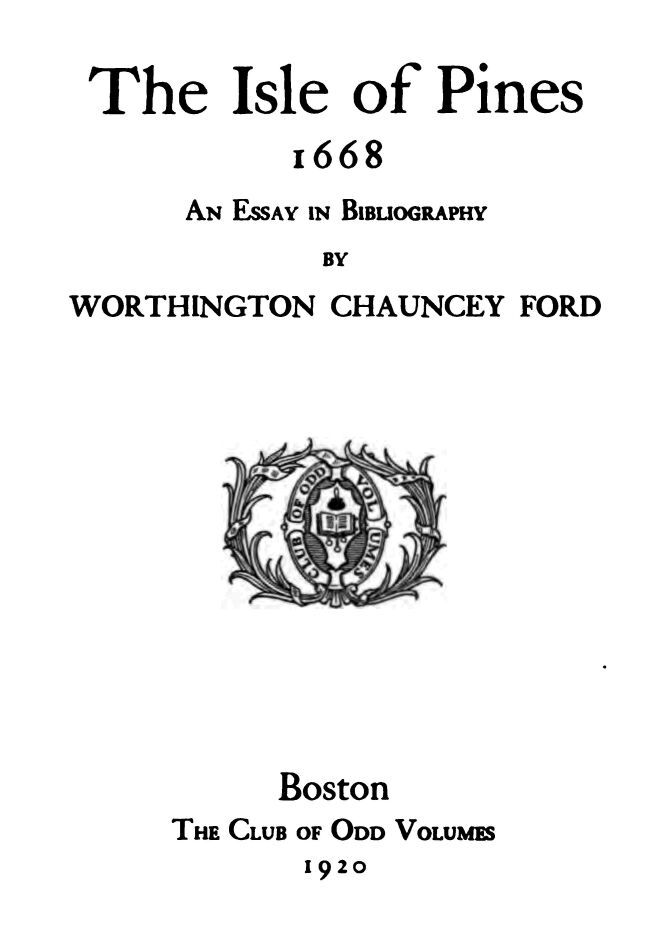
A True Relation of certain English persons, Who in the dayes of Queen
Elizabeth making a Voyage to the East India, were cast away, and wracked
on the Island near to the Coast of Australis, and all drowned, except one
Man and four Women, whereof one was a Negro. And now lately Ann Dom. 1667,
A Dutch Ship driven by foul weather there, by chance have found their
Posterity (speaking good English) to amount to ten or twelve thousand
persons, as they suppose. The whole Relation follows, written, and left by
the Man himself a little before his death, and declared to the Dutch by
His Grandchild.
The scene opens in Cambridge, Massachusetts, in the year 1668, where in one of the
college buildings a contest between two rival printers had been waged for
some years. Marmaduke Johnson, a trained and experienced printer, to whose
ability the Indian Bible is largely due, had ceased to be the printer of
the corporation, or Society for the Propagation of the Gospel in New
England, but still had a press and, what was better, a fresh outfit of
type, sent over by the corporation and entrusted to the keeping of John
Eliot, the Apostle. Samuel Green had become a printer, though without
previous training, and was at this time printer to the college, a position
of vantage against a rival, because it must have carried with it
countenance from the authorities in Boston, and public printing then as
now constituted an item to a press of some income and some perquisites. By
seeking to marry Green's daughter before his English wife had ceased to
be, Johnson had created a prejudice, public as well as private, against
himself.{1}
1 Mass. Hist Soc. Proceedings, xx. 265.
Each wished to set up a press in Boston itself, but the General Court,
probably for police reasons, had ordered that there should be no printing
but at Cambridge, and that what was printed there should be approved by
any two of four gentlemen appointed by the Court. It thus appeared that
each printer possessed a certain superiority over his rival. In the matter
of types Johnson was favored, as he had new types and was a trained
printer; but these advantages were partially neutralized by indolence and by
Green's better standing before the magistrates.{1}
In England the excesses of the printing-press during the civil war and
commonwealth led to a somewhat strict though erratically applied
censorship under the restoration. A publication must be licensed, and the
Company of Stationers still sought, for reasons of profit, to control
printers by regulating their production. The licensing agent in chief was
a character of picturesque uncertainty and spasmodic action, Roger
L'Estrange, half fanatic, half politician, half hack writer, in fact half
in many respects and whole only in the resulting contradictions of purpose
and performance. On one point he was strong—a desire to suppress
unlicensed printing. So when in 1668 warrant was given to him to make
search for unauthorized printing, he entered into the hunt with the zeal
of a Loyola and the wishes of a Torquemada, harrying and rushing his prey
and breathing threats of extreme rigor of fine, prison, pillory, and stake
against the unfortunates who had neglected, in most cases because of the
cost, to obtain the stamp of the licenser.{2}
New England was at this time England in little, with troubles of its own;
but, having imitated the mother country in introducing supervision of the
press, it also started in to investigate the printers of the colony, two
in number, seeking to win a smile of approval from the foolish man on the
throne. With due solemnity the inquisition was made. Green could show that all
then passing through his press had been properly licensed.
     1  See the chapters on Green and Johnson in Littlefield,
     The Early Massachusetts Press, 197, 209.

     2  L'Estrange was called the "Devil's blood hound." Col. S.
     P., Dom. 1663-1664, 616.
Johnson, less fortunate, was caught with one unlicensed piece—"The
Isle of Pines." A fine of five pounds was imposed upon him, as effectual
in suppressing him as though it had been one of five thousand pounds. He
could now turn with relish to two books then on his press, "Meditations on
Death and Eternity" and the "Righteous Man's Evidence for Heaven;" for
Massachusetts Bay, with its then powerful rule of divinity without
religion, or religion without mercy, held out small hope of his meeting
such a fine within the expedition of his natural life. But he made his
submission, petitioned the General Court in properly repentant language,
acknowledged his fault, his crime, and promised amendment{1} The fine was
not collected, and the principal result of the incident was to further the
very natural union of Johnson and Green, but with Johnson as the lesser
member in importance.
No copy of Marmaduke Johnson's issue of the "Isle of Pines" has come to
light in a period of 248 years. It might well be supposed that the
authorities caught him before the tract had gone to press, and so snuffed
it out completely. Our sapient bibliographers have dismissed the matter in
rounded phrase: "'The Isle of Pines' was a small pamphlet of the Baron
Munchausen order, which in its day passed through several editions in
England and on the Continent,"{2} a description which would fit a hundred
titles of the period. In July, 1917, Sotheby announced the sale of a
portion of the Americana collected by "Bishop White Kennett (1660-1728)
and given by him to the Society for the Propagation of the Gospel in
Foreign Parts."
     1  The petition it in Littlefield, i. 248.

     2  Mats. Hist. Soc. Proceedings, xi. 247.
Lot No. 113 was described as follows:
[Neville (Henry)] The Isle of Pines, or a late Discovery of a fourth
Island in Terra Australis, Incognita, being a True Relation of certain
English persons who in the dayes of Queen Elizabeth, making a Voyage to
the East Indies, were cast away and wracked upon the Island, wanting
the frontispiece, head-line of title and some pagination cut into, Bishop
Kenneths signature on title. sm. 4to S. G. for Allen Banks, 1668.
The pamphlet was sold, I am told, for fourteen shillings,{1} and resold
shortly after to a New York bookseller for fifty-five dollars. He was
attracted by the imprint, which read in full, "London, by S. G. for
Allen Banks and Charles Harper at the Flower-Deluice
near Cripplegate Church." The general appearance of the pamphlet
was unlike even the moderately good issues of the English press, and the
"by S. G." not only did not answer to any London printer of the day,
except Sarah Griffin, "a printer in the Old Bailey,"{2} but was in form
and usage exactly what could be found on a number of the issues of the
press of Samuel Green, of Cambridge, Massachusetts.
     1 The sale took place July 30, 1917.

     2  Only once does her name occur in the Term Catalogues,
     when in February, 1673, the prints George Buchanan'
     Psalmorum Davidis Paraphrasis Poetica, which told for two
     shillings a copy. Samuel Gellibrand was not a printer but a
     bookseller, with a shop "at the Ball in St. Paul's
     Churchyard."
On comparing the first page of the text of his purchase with the same page
of an acknowledged London issue of the "Isle of Pines" in the John
Carter Brown Library,{1} the bookseller concluded that the two were
entirely different publications.
An expert cataloguer connected with one of the large auction firms of New
York then took up the subject. After a study of the tract he became
assured that it could only have been printed by Samuel Green, of
Cambridge, and he brought forward facts and comparisons which seemed
conclusive and for which he deserves much credit. It was a clever bit of
bibliographical work. With such an endorsement as to rarity and quality
the pamphlet was again put to the test of the auction room. The cataloguer
stated his case in sufficient fulness of detail and the first page of the
text was reproduced.{2} Naturally the discovery sent a little thrill
through the mad-house of bibliography. The tract was knocked down for $400
to a bookseller from Hartford, Connecticut, presumably for some local
collection. The incident would have passed from memory had it not been for
one of those accidents to which even the amateur bibliographer is liable.
     1  No. 5 in the Bibliography, page 93, infra.

     2  Nuggets of American History, American Art Association,
     November 19, 1917. The Isle of Pines was lot 142, and was
     introduced by the words, "Cambridge Press in New England."
     The catalogue was prepared by Mr. F. W. Coar.
In the bitter days of the winter of 1917-18 the working force of the
Massachusetts Historical Society was contracted into one room—the
Dowse Library—where was at least a semblance of warmth in the open fireplace.
One afternoon, when I had finished my work and the others had left, I
picked up the catalogue of the Dowse Library and began idly to turn over
its leaves. Incidentally, that catalogue is characteristic of the older
methods of the Society. As is known to the elect, no book in the Dowse
Library can ever leave the room in which it now rests, and of the
catalogue twenty-five copies were printed and never circulated. If the
library had been left in the Dowse house in Cambridgeport, its existence
and contents could not have been more successfully hidden from the world.
While reading the titles in a very casual way, my eye was caught by one
which gave me a start. It read:
Sloetten (Cornelius van). The Isle of Pines; or a Late Discovery of a
Fourth Island in Terra Australis Incognita. London, printed by G. S. for
Allen Banks, 1668. With a New and Further Discovery of the Isle of Pines,
1668; and a duplicate of the Isle of Pines. 1 vol. small 4to, calf supr.,
gilt leaves. A most interesting, rare, and valuable work.
Even against the Editor of the Society the Dowse books are kept behind
lock and key, though he is not under more than ordinary suspicion. So I
was obliged to wait till the next day before my curiosity could be
satisfied. I then found a thin volume, less than one-third of an inch in
thickness, containing two copies of this very tract which the auction
expert had identified as an issue of the "Isle of Pines" by Green, and a
London issue of a second part of the "Isle of Pines," with the name of
Cornelius Van Sloetten, as author. For more than fifty years this little
volume had reposed in this well-known yet almost forgotten library, and no
one had suspected or questioned the nature of its contents.
For full fifty years it had been in the care and at the call of Dr. Samuel
A. Green, who claimed to be an expert on New England imprints of the
seventeenth century, and one of the great wishes of whose life had been to
establish his descent from this very printer, Samuel Green. Two copies
within the same covers, of a tract long sought and of which only a single
example had come to light in two centuries and a half—was not that
alone something of a bibliographical coup?
I read two of the pieces—one of the Green issues and the second part
as printed in England—making a few notes for future use. On
returning to the matter some weeks later I found to my annoyance that
every reference to the Green tract but one was wrong as to the page. Cold,
haste, or weariness will account for a single or possibly two errors of
reference, but to have a whole series—except one—go wrong
pointed to failing eyes or mind. Very much put out, I read the tract a
second time and corrected the page references, carefully checking up the
result. Some days after I again took up the matter, and in verifying my
first quotation found that I had again put down the wrong page number, and
was surprised to find that the correct page was the one I had first given.
This proved to be the case in all the references—except one. A book
which could thus change its page numbering from week to week was bewitched—or
I was careless. It occurred to me to compare the two copies of the tract
as published by Green. The title-pages were exactly alike—not
differing by so much as a fly speck, but one copy contained ten pages of
text and the other only nine.
More than that, the general style and the types were quite different One was printed
in a well-known broad but somewhat used type, such as could be seen in
Green's printing, and the other in a finer font with much italic. There
was no possibility of confusing the two issues. Only one conclusion was
possible. I had in this volume the publication by Green, and the original
issue by Marmaduke Johnson, but with Green's title-page. So for we seem to
rest upon solid ground. It may be surmised that Green set up his "Isle of
Pines" in rivalry to Johnson, but did not incur the discipline of the
authorities; or that he had set it up and also took over Johnson's
edition, using his own title-page; and in either case it is possible that
a simple subterfuge, the imprint, "by S. G. for Allen Banks and Charles
Harper," a London combination of publishers, caused the tract to escape
the attention of the examining local censors. Here was another step in
developing the history of this tract—the discovery of one of
Johnson's issues, except for the title-page. So far as the American
connection is concerned, it only remains to discover a Johnson issue with
a Johnson title-page, for in his apology and submission to the General
Court he states that he had "affixed" his name to the pamphlet.
The European connection is also not without interest, for the skit—the
first part of the "Isle of Pines," published without name of author—had
an extraordinary run.
In 1493 a little four-leaved translation into Latin of a Columbus letter announcing the discovery of
islands in the west—De insulis nuper inventis—ran over Europe,
startling the age by a simple relation which proved a marvellous tale as
taken up by Vespuccius, Cortes, and a host of successors.{1} For a century
the darkness of a new found continent slowly lifted and the record was
collected in Ramusio, in De Bry, in Hulsius, and in Hakluyt, never felling
treasuries of the wonderful, veritable schools for the adventurous.
Another century had shown that, so fer from decreasing in greatness and in
opportunities, the field of discovery had not begun to be tested, and in
the summer of 1668 a new island—the Isle of Pines—was flashed
before the London crowd, and proved that the flame of quest with danger
was still burning. A new island! The interest was international, for
nations had already long fought over the old discovered lands.
     1  The intelligent industry of Mr. Wilberforce Eames has
     identified eleven issues of the letter of Columbus, printed
     in 1493, in Barcelona, Rome, Basle, Paris, and Antwerp; and
     twelve issues of the Novus Mundus of Vespucci us, printed
     in 1504, in Augsburg, Paris, Nuremberg, Cologne, Antwerp,
     and Venice. An earlier and even more extraordinary
     distribution of a letter of news is that of the letter
     purporting to be addressed by Prester John to the Emperor
     Manuel, which circulated through Europe about 1165. "How
     great was the popularity and diffusion of this letter,"
     writes Sir Henry Yule, "may be judged in some degree from
     the fad that Zarncke in his treatise on Prester John gives a
     list of close on 100 mss. of it Of these there are eight in
     the British Museum, ten at Vienna, thirteen in the great
     Paris Library, and fifteen at Munich. There are also several
     renderings in old German verse." The cause of this
     popularity was the hope offered by the reported exploits of
     Prester John of a counterpoise to the Mohammedan power.
     Encyclopaedia Britannica, 11th ed., xxii. 305.
An even greater contest was being waged for commerce, and with the
experience of Spain in gathering the precious metals from new found lands, every
discovery of hitherto uncharted territory opened the possibility of wealth
and an exchange of commodities, if rapine and piracy could not be
practised. The merchant was an adventurer, and politics, quite as much as
trade, controlled his movements; for the line between trader, buccaneer,
and pirate faded away before conditions which made treaties of no
importance and peaceful relations dependent upon an absence of the hope of
gain. A state of war was not necessary to prepare the way for attack and
plunder in those far distant oceans, and the merchantman sailed armed and
ready to inflict as well as to repel aggression, only too willing to
descend upon a weaker vessel or a helpless settlement of a power which had
come to be regarded as a "natural enemy." So in Holland and in Germany the
leaflets containing the story of the Isle of Pines were received with
mingled feelings, exciting a desire to share in the possible benefits to
be gained or extorted from natives of the new lands, or from those who had
the first opportunity to exploit a virgin territory. On the first receipt
of those leaflets merchants held back their vessels about to sail, to
await more definite information on this fourth island of the Terra
Australis incognita.
An examination of the known issues of the tract proves this interest and
offers an almost unique study in bibliography; for I doubt if any
publication made in the second half of the seventeenth century—even
a state paper of importance, as a treaty—attained such speedy and
widespread recognition. A list of the various issues will be found in an
appendix: it only remains to call attention to a few of the many novelties
and variant characteristics of the editions.
In June and July, 1668, four tracts on the Isle of Pines from the same pen
were licensed and published in London, which may for convenience be
designated the first and second parts of the narrative, and the two parts
in continuation. From London the tract soon passed to Holland, which had
ever been a greedy consumer of voyages of discovery, for the greatness of
that nation depended upon the sea, at once its most potent enemy and
friend.{1} Three Dutch editions have been found, the earliest in point of
time being that made by Jacob Vinckel, of Amsterdam.
     1 Holland was the centre of map publication as the twenty
     yean before 1668 saw the issue of atlases by Jansson, Blaeu,
     Mercator, Doncker, Cellarius, Loon, Visscher, and Goos, all
     published at Amsterdam. Phillips' list for this period gives
     atlases published elsewhere—those of Boissevin (Paris,
     1653), Lubin (Paris, 1659), Nicolosi (Rome, 1660), Dudley
     (Florence, 1661), Du Val (Paris, 1662), Jollain (Paris
     1667), Cluver (Wolfen-bûttel, 1667?) and Ortelius (Venice,
     1667).
His second title is an exact translation of the second title of the London
first part. This version, however, omitted an essential part of the
relation. The London second title is also that of the issue made at
Amsterdam by Jacob Stichter, being the Vinckel version, word for word, and
almost line for line, but the type used is the gothic, and the spelling of
words is not the same. Further, Stichter was possessed of some imagination
and decorated his title-page with a map of a part of the island, showing
ranges of hills, a harbor or mouth of a river, with conventional
soundings, and two towns or settlements. As each of these issues contains
only eight pages of text, the first London part only was known to the
publishers. The third Dutch edition was put out by Joannes Naeranus, at
Rotterdam, and in a foreword he gives the following reason for issuing the
tract:
To the Reader A part of the present relation is also printed by Jacob
Vinckel at Amsterdam, being defective in omitting one of the principal
things, so do we give here a true copy which was sent to us
authoritatively out of England, but in that language, in order that the
curious reader may not be deceived by the poor translation, and for that
reason this very astonishing history fall under suspicion. Lastly, admire
God's wondrous guidance, and farewell.
His publication contains twenty pages of text, and is not an accurate
translation of the English tract in parts, but rather a paraphrase of the
text. To make the confusion the greater, he expressly states on the title-page
that he used a copy received from London, and gives the London imprint
which will fit only the first London part. For "by S. G." appears only on
the title-page of that part.
From Amsterdam and under date July 19, 1668, a summary of the earlier
Dutch issue with two paragraphs of introduction was sent to Paris, and was
printed in a four-page pamphlet by Sébastien Marbre Cramoisy, the king's
printer, whose name is so honorably connected with the Jesuit Relations—stories
as remarkable as any offered in the "Isle of Pines" and of immeasurable
value on the earliest years of recorded history in our New England. Even
this summary, thus definitely dated, offers problems. The location of the
island is given in general terms in the half-title as "below the
equinoctial line," and in the text as in "xxviii or xxix degrees of
Antartique latitude." Nowhere in the first London part is either location
used, and in the second London part, which bears nearly the same date as
the Cramoisy summary—July 22—twenty degrees of latitude is
given. The writer of the summary thus allowed himself some freedom.
A second French edition, without imprint, contains eleven pages and is a
translation of the first London part, paraphrased in sentences, but on the
whole a close rendering of the English text There never was a title-page
to this issue—the first page having the signature-mark A—yet
with eleven pages only, it would seem fit that a title-page
should round out the twelve for the convenience of printing.
The Italian issue, made by Giacomo Didini, in Bologna and Venice, is a
literal translation of Cramoisy's publication, and bears the same date, at
Amsterdam, July 19, 1668. The original probably came from Paris, though it
is possible that some Dutch merchant in Amsterdam sent a circular letter
on the discovered Isle to his correspondents in Paris and Venice. It is
unsafe to conjecture in such matters, for an Amsterdam issue may yet be
found which will give, word for word, the French and Italian versions. Our
ignorance on the press of the continent of those times, and especially the
want of files of "corantos," or news sheets, close a wide field of
research to the American inquirer. The catalogue of the British Museum
gives 1669 as the probable year of issue. I see no good reason for
rejecting 1668 as the more probable year. If the tract could go from
London to Cambridge, in New England, in three months, it could pass from
Amsterdam to Italy, by land or by sea, in an equal time.
From Holland the relation also penetrated the German states, finding ready
welcome and arousing eager curiosity. Hippe regards the tract issued by
Wilhelm Serlin, at Frankfort on the Main, as the first of the German
publications, and, being translated from the Dutch, he shows that the
translator used both the Amsterdam and the Rotterdam publications.{1} The
Hamburg version claimed to be derived from the English original, but it
followed closely the Serlin translation from the Dutch with modifications
which might have been drawn from the London tract. An edition not
mentioned by Hippe or identified by any bibliographer is in the John
Carter Brown Library, and opens with the statement that it is translated
from the English and not from the Dutch. It closely follows the text of
the London first part. Very likely it is the edition found at Copenhagen,
if the similarity of titles offers an indication of the contents. South
Germany obtained its information from France, and while neither of the two
issues avowedly translated from the French gives the place of publication,
the fact that one is in Munich and the other in Strassburg offers some
reason to conjecture that they came from the presses of those cities. The
Munich issue is for the most part a summary of what was in the first
London issue, and, if translated directly from a French version, must have
been from one not now located, for it is different from those in the list
in this volume. Of the Strassburg text, Hippe states that it follows the
Rotterdam pamphlet Finally, at Breslau is what calls itself a complete
publication of the combined parts from a copy obtained from London, but it
is more probably based upon the Dutch translations printed in Amsterdam
and Rotterdam, with additions drawn from the English.{2}
     1  Hippe, 11.

     2  On these German issues Hippe is full, but I have given
     only what is needed to identify them.
One of the strangest uses made of the narrative of Pine is to be found in
Schoeben's translation into German of Jan Mocquet's "Voyages en Africque,"
etc., a work of some estimation which had already twice been published in
France and once in a Dutch translation before Schoeben printed his edition
in 1688. As pages inserted quite arbitrarily in Mocquets compilation,
Schoeben gave Pine's story in full, with a paragraph of introduction which
not a little abuses the truth while giving an additional color of truth.
He asserted that while kept at Lisbon by the Dutch blockade, he was thrown
much in the company of an Englishman, one of the Pine family, who were all
regarded as notable seamen. From this man, then awaiting an opportunity to
sail for the West Indies, our author heard a very strange story of the
origin of the Pines, a story then quite notorious at Lisbon. Then follows,
with some embroidery, a version of the Neville pamphlet, which is not like
any German translation seen by me, but so full as to extend over ten pages
of the volume. It ends with a reiteration of the wholly false manner in
which this story had been obtained. So bold an appropriation of the
narrative, with a provenience entirely new and as fictitious as the story
itself, and its bodily inclusion by an editor in a work of recognized
merit, where it is between two true recitals, cannot be defended.{1}
     1 Mocquet's work originally appeared in Rouen in 1645, and a
     Dutch translation was published at Dordrecht in 1656. A
     second French issue, apparently unchanged in text, was put
     out at Rouen in 1665, and in 1618 Schoeben's edition,
     printed at Lûneberg by Johann Georg Lippers, preceded by
     eight years an English translation made by Nathaniel Pullen.
     The Pine tract appears, of course, only in Schoeben's
     volume.
The tract passed to Cambridge, Massachusetts, before or early in
September, and it would indeed be interesting to know how and through whose hands it
passed before reaching Marmaduke Johnson—to his undoing. Hezekiah
Usher was the only bookseller in Boston at the time, and possibly his son,
John, may have been associated with him. They ordered what they desired
from London booksellers and publishers, and may have received voluntary
consignments of publications from London. That would be a somewhat
precarious venture, for nothing could be more different than the reading
markets in Boston and in London, especially in the lighter products of the
press. Had it come through the Ushers, the title-page might state that it
had been printed "by M. J. for Hezekiah Usher," but in that event Usher
would have suffered for not obtaining the needed license. The probability
is that Johnson was alone responsible and was tempted by the hope of gain.
These were all contemporary issues, coming from the press within six
months of the first appearance of the tract in London. So startling a
popularity, so widely shown, was a tribute to the opportunity rather than
to the contents of the piece. And the European interest continued for a
full century. In Germany it was included in a number of collections of
voyages, in Denmark it was printed in 1710 and 1789, and in France Abbé
Prévost took it for his compilation of 1767 on discoveries. The English
republication of 1778 has peculiar interest, for it was due to no other
than Thomas Hollis, the benefactor of the library of Harvard College, who
saw more in the tract than can now be recognized, and induced Cadell to
reprint it.
In the absence of any positive objection, the conclusion of the auction
expert—that the S. G. imprint was one of Samuel Green of Cambridge,
Massachusetts—remained unquestioned. But a study of editions and of
the chronological sequence of the English issues offers a decided negative
to such a conclusion. The first part was licensed June 27, 1668. Van
Sloetten dated the second part July 22, 1668, and the issue of the
combined parts was licensed five days later, July 27. In the space of just
four weeks all three trads were licensed, and the actual publication must
have occurred within the same period of time. Such had been the start
obtained by the first part that on the continent it was used for reprint
and translation, almost to the neglect of the second part, and, as we have
seen, most of these translations appeared before the end of 1668. Now the
tract was not known in Massachusetts until discovered by the inquest on
printers in September, and a S. G. or Samuel Green edition could hardly
have come from the press before October, even if not delayed by the
proceedings against Johnson. Yet on die title-page of the Dutch
translation issued at Rotterdam in 1668, the printer states at length that
it is from a copy from London, by S. G. for Allen Banks and Charles
Harper, in the Lily near Cripplegate Church, and in his note "To the
Reader" he expressly repeats that he obtained a copy of the work from
London, in order to correct a faulty issue by another Dutch printer.
If S. G. was Samuel Green, we must suppose that one of his Cambridge
issues was shipped to Rotterdam in time to be translated and reprinted before
the end of the year. In point of time the thing could be done, but in
point of probability it was impossible. Apart from his own statement,
there were a thousand to one chances in favor of the Dutch printer
obtaining the pamphlet from London; there were ten thousand chances to one
against his getting it from Massachusetts. I reject the supposition that
this was a Cambridge imprint for that reason alone.
Additional evidence hostile to the claim may be adduced. The copy of the
first tract in the British Museum is the S. G. for Banks and Harper.{1}
1 It is erroneously described as "an abridgment."
No other London imprint is to be found there or in the larger libraries of
England. Of the three other copies located, that sold at audion (the White
Kennett copy) and that in the Massachusetts Historical Society came direct
from England, and the actual provenance of the copy in the New York
Historical Society is not known. It belonged to Rufus King, long United
States minister near the court of St James's, and is bound with other
tracts under a general title of "Topographical Collection, Vol. I." The
binding, Mr. Kelby tells me, is American. There is no mark to show when or
where King obtained the pamphlet, and the Society did not receive it until
1906. That Rufus King belongs as much to Massachusetts as to New York is
too slight a foundation on which to erect a claim that this particular
tract was of Massachusetts origin.
In no case, therefore, can an American setting to any one of the four
known copies of the S. G. "Isle of Pines" be established.{1} The probabilities
are all against Samuel Green. The incident is a good example of the danger
of giving play to the imagination on an appearance of a combination of
fads cemented by interest.
Thus disappears from our memory the certain identification of the S. G.
pamphlet as an early issue of the press in Cambridge, and with it goes my
identification of the Johnson pamphlet with the S. G. title-page—a
veritable pipe dream. It might be urged that as White Kennett was
collecting on America, it would be more than probable that he would have
had an American issue; but his own catalogue of 1713 describes the
nine-page tract, and that is our London edition. I might claim still that
my Johnson was a Johnson, with a London title-page; but the typographical
adornment on the first page of its text is just the same as the adornment
on the first page of the London issue—three rows of fleur-de-lys,
thirty-seven in each row, and the same kind of type characters.{2}
     1 Lowndes indexes it under George Pine, and describes a
     nine-page trait—probably the one now in the British Museum.
     He quotes a sale of a copy in it 60 (Puttkk) for £4.10s. He
     indexes the combined parts under Sloetten, and notes a copy,
     with the plate, sold in the White Knights sale for 1s..

     2  To attempt to reason from types or rule of thumb
     measurements, however suggestive, leads to indefinite
     conclusions. For example, the width of the type page of the
     S. G. issue of the first part is exactly that of the English
     issue of the second part, but the former has 33 tines to the
     page and the latter a a. The width of the page in the
     variant S. G. issue is narrower and there are 38 and 39
     lines to the page. But in the London second part the width
     of page varies by a quarter of an inch. We have Marmaduke
     Johnson's issue of Paine's Daily Meditations y issued in
     1670 in connection with S. G. The ornamental border of
     fleur-de-lys is entirely different from those in the S. G.
     Isle of Pines. A copy of Johnson's issue of Scottow's
     translation of Bretz on the Anabaptists, printed in 1668,
     the very year of the Isle of Pines, shows a different foot
     of italics from that used in the Isle of Pines variant,
     yet the roman characters in the two pieces seem identical,
     and the width of page is exactly the same.
So I bid farewell to my theory, and can only congratulate myself
on having cleared one point—the London issue—and on having
introduced a new confusion by the discovery of a second London issue with
an identical title-page, a problem for the future to solve. I much doubt
if a true Johnson issue will ever be found, for I believe the action of
the authorities prevented its birth.
In the library of Mr. Henry E. Huntington is a London issue of which I do
not find another example. It contains sixteen pages, and the title-page
gives neither printer's name nor place of publication. It may be the first
issue, or it may be a later re-issue of the tract, for the type,
especially the italic, is better than that in the S. G. issue. The
punctuation also is more carefully looked after, and the whole appearance
suggests an eighteenth century print. As the original was duly licensed,
there was no reason to suppress the names of printer or booksellers. Nor
could the contents of the piece call out controversy or hostility from any
political faction or religious following. It was proper for the author to
omit his name from the publication, if he desired to remain unknown; but
the publisher, having the support of the licenser, had every reason to
advertise his connexion with the tract, although he could not have
anticipated so ready an acceptance by the public. While I place the
Huntington pamphlet first in the bibliography, I am more inclined to
regard it as a publication made at a later time.
The English edition of thirty-one pages in the John Carter Brown Library,
with an engraved frontispiece,{1} offers still further proof that the S.
G. issue was made in London. In place of being entirely different from the
S. G. tract, it is precisely the same so far as text is concerned. For it
is nothing more than the two parts combined, but combined in a peculiar
manner. The second part was opened at page 6 and the first part inserted,
entire and without change of text{2} This insertion runs into page 16,
where a sentence is inserted to carry on the relation: "After the reading
and delivering unto us a Coppy of this Relation, then proceeded he on in
his discourse." The rest of the text of the second part follows, and pages
27-31 of the combined parts seem to be the very type pages of pages 20-24
of the second part{3} In this sandwich form one must read six pages before
coming to the text of the first part, and a careless reader, comparing
only the respective first pages, would conclude that a pamphlet of
thirty-one pages could have no likeness to one of nine.
     1  The plate in the copy in the John Carter Brown Library
     does not belong to that issue, but is inserted in so clumsy
     a manner as to prevent reproduction. The same plate is found
     in a copy of the ten-page S.G. issue in the library of Mr.
     Henry E. Huntington, and to all appearances belongs to that
     issue.

     2   The last sentence on page 6 of the second part read:
     "Then proceeded he on in his discourse saying," and there
     are no pages numbered 7 and 8, although there is no break in
     the text, the catch-word on page 6 being the first word on
     page 9. In the combined parts, the last words on page 6
     constitute a phrase: "which Copy hereafter followeth."

     3 The only change made is in the heading of the Post-script,
     which was wrongly printed in the second part as "Post-
     script." On page 26 of the combined parts the words "except
     burning" were inserted, not appearing in the second part.
On typographical evidence it is safe to assume that the three pieces came
from the same press, and to assert that the second part and the combined
parts certainly did. The initials S. G. are found only on the first part.
The imprints of the three parts agree that the booksellers or publishers
handling the editions were Allen Banks and Charles Harper. The first part
gives their shop as the "Flower-De-luice near Cripplegate Church," the
second part as the "Flower-de-luce" as before, and the combined parts as
"next door to the three Squerrills in Fleet-street, over against St.
Dunstans Church." The church is still there, with more than two centuries
of dirt and soot marking its walls since Neville wrote, and Chancery and
Fettar Lanes enable one to place quite accurately the location of the
booksellers' shop. Only three times do the names of Banks and Harper
appear as partners on the Stationers' Registers,{1} and they separated
about 1671, Banks going to the "St Peter at the West End of St Pauls." If
any judgment may be drawn from their publications after ceasing to be
partners, Banks leaned to light literature and may have been responsible
for taking up the "Isle of Pines." Yet Harper was Neville's publisher in
1674 and in 1681, a fact which may indicate a personal relation.{2}
     1 Eyre and Rivington, ii. 386, 388, and 410.

     2 Sec page 34, infra.
By some curious chance this little pamphlet has come to be classed as
Americana. Bishop Kenneth's Catalogue may have been the source of this
error, leading collectors to believe that the item was a true relation of
an actual voyage, and possibly touching upon some phase of American
history or geography. The rarity of the pamphlet would not permit such a
belief to be readily corrected. The existence also of two Isles of Pines
in American waters may have aided the belief.
One of these islands is off the southwestern end of Cuba. On his second
voyage, Columbus had sailed along the south coast of Cuba, and June
13,1494, reached an island, which he named Evangelista. Here he
encountered such difficulties among the shoals that he determined to
retrace his course to the eastward. But for that experience, he might have
reached the mainland of America on that voyage. The conquest of the island
of Cuba by Diego Velasquez in 1511 led to its exploration; but geographers
could only slowly appreciate what the islands really meant, for they were
as much misled by the reports of navigators as Columbus had been by his
prejudice in favor of Cathay.
Toscanelli's map of the Atlantic Ocean (1474) gives many islands between
Cape Verde and the "coast of spices," of which "Cippangu" is the largest
and most important.{1}
     1  This map, as reconstructed from Martin Behaim's globe, is
     in Scottish Geographical Magazine, 1893.
On Juan de laCosa's sea chart, 1500, Cuba is fairly drawn, with the sea to
the south dotted with islands without names. In a few years the mist
surrounding the new world had so far been dispelled as to disclose a quite accurate detail
of the larger West Indian islands{1} and to offer a continent to the west,
one that placed Cipangu still far too much to the east of the coast of
Asia.{2} An island of some size off the southwest of Cuba seems to have
been intended at first for Jamaica, but certainly as early as 1536 that
island had passed to its true position on the maps, and the island to the
west is without a name. Nor can it be confused with Yucatan, which for
forty years was often drawn as an island. On the so-called
Wolfenbuttel-Spanish map of 1525-30 occurs the name "J. de Pinos,"
probably the first occurrence of the name upon any map in the sixteenth
century. Two other maps of that time—Colon's and Ribero's, dated
respectively 1527 and 1529—call it "Y de Pinos," and on the globe of
Ulpius, to which the year 1542 is assigned, "de Pinos" is clearly marked.
Bellero's map, 1550, has an island "de pinolas." Naturally, map-makers
were slow to adopt new names, and in the numerous editions of Ptolemy the
label St Iago was retained almost to the end of the century.{3} On the
Agnese map there are two islands, one named "S. Tiago," the other "pinos,"
which introduced a new confusion, though he was not followed by most
geographers until Wytfliet, 1597, gave both names to the same island—"S.
Iago siue Y de Pinas"—in which he is followed by Hondius, 1633.{4}
Ortelius, 1579, adopts "I Pinnorum," while Linschoten, 1598, has "Pinas," and Herrera, 1601,
"Pinos."
     1  The Agnese Atlas of 1529 may be cited as an example.

     2   See, for example, the so-called Stobnicza [Joannes,
     Stobnicensis] map of 151a, and the Ptolemy of 1513
     (Strassburg).

     3  Muenster, 1540. Cabot, 1544, and Desceller, 1546, give "Y
     de Pinos."

     4  Mr. P. Lee Phillips, to whom I am indebted for references
     to atlases of the time, also supplies the following:
     Lafreri, 1575 (?) "S. Tiagoj" Percacchi, 1576, "S. Tiago;"
     Santa Cruz, 1541, "Ya de Pinosj" and Dudley, 1647, "I de
     Pinos." Hakloyt (iii. 617) prints a "Ruttier" for the
     West Indies, without date, but probably of the end of the
     sixteenth century, which contains the following; "The
     markes of Isla de Pinos. The Island of Pinos stretcheth it
     selfe East and West, and is full of homocks, and if you
     chance to see it at full sea, it will shew like 3 Islands,
     as though there were divers soundes betweene them, and that
     in the midst is the greatest; and in rowing with them, it
     will make all a firme lande: and upon the East side of these
     three homocks it will shewe all ragged; and on the West
     side of them will appeare unto you a lowe point even with
     the sea, and oftentimes you shall see the trees before you
     shall discerne the point."
When the name given by Columbus was dropped and by whom the island was
named "de Pinos" cannot be determined.
Our colleague, Mr. Francis R. Hart, has called my attention to a second
Isle of Pines in American waters, being near Golden Island, which was
situated in the harbor or bay on which the Scot Darien expedition made its
settlement of New Edinburgh. The bay is still known as Caledonia Bay, and
the harbor as Porto Escoces, but the Isla de Pinas as well as a river of
the same name do not appear on maps of the region. The curious may find
references to the island in the printed accounts of the unfortunate Darien
colony.
The Isle of Pines could thus be found on the map as an actual island in
the West Indies; but the "Isle of Pines" of our tract existed only in the
imagination of the writer. The mere fact of its having been printed—but
not published—in Cambridge, Massachusetts, does not entitle it to be
classed even indirectly as Americana, any more than Bunyan's Pilgrim's
Progress or Thomas à Kempis could be so marked on the strength of their having a
Massachusetts imprint Curiosities of the American press they may be, but
they serve only as crude measures of the existing taste for literature
since become recognized as classic.
The dignified Calendar of State Papers in the Public Record Office,
London, gravely indexes a casual reference to the tract under West Indies,
and the impression that the author wrote of the Cuban island probably
accounts for the different editions in the John Carter Brown Library, as
well as for the price obtained for the White Kennett copy. No possible
reason can be found, however, for regarding the "Isle of Pines" in any of
its forms as Americana.
Thus far I have been concerned with externals, and before turning to the
contents of the tract itself in an endeavor to explain the extraordinary
popularity it enjoyed, something must be said of the author—Henry
Neville. Like most of the characters engaged in the politics of England in
the middle of the seventeenth century, he has suffered at the hands of his
biographer, Anthony à Wood,{1} merely because he belonged to the opposite
party—the crudest possible measure of merit For the odium
politicum and the odium theologicum are twin agents of
detraction, and the writing of history would be dull indeed were it not
for the joy of digging out an approximation to the truth from opposing
opinions. Where the material is so scanty it will be safer to summarize
what is known, without attempting to pass finally upon Neville's position
among his contemporaries.
1 Athenæ Oxoniemses (Bliss), iv. 413.
The second son of Sir Henry Neville, and grandson of Sir Henry Neville
(1564?-1615), courtier and diplomatist under Elizabeth and James I, Henry
Neville was born in Billing-bear, Berkshire, in 1620. He became a commoner
of Merton College in 1635, and soon after migrated to University College,
where he passed some years but took no degree. He travelled on the
continent, becoming familiar with modern languages and men, and returned
to England in 1645, to recruit for Abingdon for the parliament Wood states
that Neville "was very great with Harry Marten, Tho. Chaloner, Tho. Scot,
Jam. Harrington and other zealous commonwealths men." His association with
them probably arose from his membership of the council of state (1651),
and also from his agreement with them in their suspicions of Cromwell,
who, in his opinion, "gaped after the government by a single person." In
consequence he was banished from London in 1654, and on Oliver's death was
returned to parliament December 30,1658, as burgess for Reading. An
attempt to exclude him on charges of atheism and blasphemy failed.
He was undoubtedly somewhat closely associated with James Harrington, the
author of "Oceana," and was regarded as a "strong doctrinaire republican."
He was a member of the club—the Rota—formed by Harrington for
discussing and disseminating his political views, a club which continued
in existence only a few months, from November, 1659, to February, 1660;
but its name is embalmed in one of Harrington's essays—"The Rota"—published
in 1660, and extracted from his "Art of Law-giving," which was itself an abridgment of
the "Oceana."
At this time, says Wood, Neville was "esteemed to be a man of good parts,
yet of a factious and turbulent spirit." On the restoration he "sculk'd
for a time," and, arrested for a supposed connection in the Yorkshire
rising of 1663, he was released for want of evidence against him, retiring
from all participation in politics. For twenty years before his death he
lived in lodgings in Silver Street, near Bloomsbury market, and dying on
September 20, 1694, he was buried in the parish church of Warfield,
Berkshire. By his wife, Elizabeth, daughter of Richard Staverton of
Warfield, he had no issue.{2} In his retirement he found occupation in
political theory. He translated some of the writings of Machiavelli, which
he had obtained in Italy in 1645, and published some verses of little
merit.
     {1} Wood.

     {2}  Dictionary of National Biography, XL. 259.
It cannot be said that a reading of Neville's productions before 1681
raises him in our estimation, it certainly does not give the impression of
a man of letters, a student of government, or even a politician of the
day. There is always the possibility in these casual writings of a purpose
deeper than appears to the reader of the present day, of a meaning which
escapes him because the special combination of events creating the
occasion cannot be reconstructed. The "Parliament of Ladies," which was
published in two parts in 1647, has little meaning to the reader, though
they appeared in the year when the Parliament took notice of the "many
Seditious, False and Scandalous Papers and Pamphlets daily printed and
published in and about the cities of London and Westminster, and thence
dispersed into all parts of this Realm, and other parts beyond the Seas, to the great
abuse and prejudice of the People, and insufferable reproach of the
proceedings of the Parliament and their Army."{1}
To write, print, or sell any unlicensed matter whatsoever would be liable
to fine or imprisonment, and to whet the zeal of discovery one-half of the
fine was to go to the informer. Every publication, from a book to a
broadsheet, must bear the name of author, printer, and licenser. Neither
of Neville's pamphlets of 1647 conformed to the requirements of this act,
which is not, however, positive evidence that they did not appear after
the promulgation of the law. Suppression of printing has proved a
difficult task to rulers, even when supported by public opinion or an
army. The Stationers' Registers show that the "Parliament of Ladies" and
its sequel were not properly entered; nor do they contain any reference to
Neville's "News from the New Exchange," issued in 1650.{2}
Nine years passed before he printed a pamphlet which marked his break with
Cromwell—"Shuffling, Cutting, and Dealing in a Game of Picquet."{3}
     1  Acts and Ordinances of the Interregnum, i. 1021. Though
     dated September 30, the act was entered at Stationers' Hall
     September 19. Eyre and Rivington, i. 276.

     2  It was reprinted in 1731.

     3  It is in the Harleian Miscellany, v. 298, and a copy of
     the meanly printed original is in the Ticknor Collection,
     Boston Public Library.
This little pamphlet was put out in the poorest dress possible, bespeaking
a press of meagre equipment, and a printer without an idea of the form
which even the leaflet can assume in skilful hands. Without imprint,
author's name, or any mark of identification, it indicates a secret
impression and issue—one of the many occasional pamphlets which appeared at the time from
"underground" shops which least of all wanted to be known as the agent of
publication. Neville either avowed the authorship or it was traced to him,
and the displeasure of Cromwell and banishment from London followed.
In 1681 he printed "Discourses concerning Government," which was much
admired by Hobbes, and even Wood admits that it was "very much bought up
by the members [of parliament], and admired: But soon after, when they
understood who the author was (for his name was not set to the book), many
of the honest party rejected, and had no opinion of it" A later writer
describes it as an "un-Platonic dialogue developing a scheme for the
exercise of the royal prerogative through councils of state responsible to
Parliament, and of which a third part should retire every year."{1}
Reissued at the time under its better known title—"Plato
Redivivus"{2}—it was reprinted in 1742,{3} and again by Thomas
Hollis in 1763.
     1  Dictionary of National Biography, XL. 259.

     2  Plato Redivivus, or A Dialogue concerning Government:
     wherein, by Observations drawn from other Kingdoms and
     States both ancient and modern, an Endeavour is used to
     discover the politick Distemper of our own; with the Causes
     and Remedies. The Second Edition, with Additions. In Octavo.
     Price 2s. 6d. Printed for S. I. and sold by R. Dew. The Term
     Catalogues (Arber), 1.443—the issue for May, 1681. The
     initials S. I. do not again occur in the Catalogues, and R.
     Dew is credited with only two issues, both in May, 1681,
     neither giving the location of his shop. The tract called
     out several replies, such as the anonymous Antidotum
     Brittanicum and Goddard's Plato's Demon, or the State
     Physician Unmasked ( 1684).

     3  A copy is in the Library Company, Philadelphia.
His translations from Machiavelli are not so easily traced, nor is any
explanation possible for his having delayed for nearly thirty years
publication of evidence of his admiration for the Florentine politician.
He was not alone in desiring to make the Italian political moralist better
known, for translations of the "Discourses" and "The Prince," with "some
marginal animadversions noting and taxing his [Machiavelli's] errors," by
E. D.{1} was published in a second edition in November, 1673, but I do not
connect Neville with that issue. In the following year the connection of
Charles Harper's name with the "Florentine History" suggests Neville, as
does a more ambitious undertaking of the "Works," first fathered by
another London bookseller, but with which Harper was concerned in 1681:
The Florentine History, in Eight Books. Written by Nicholas Machiavel,
Citizen and Secretary of Florence: now exactly translated from the
Italian. In Octavo. Price, bound, 6s. Printed for Charles Harper, and J.
Amery, at the Flower de luce, and Peacock, in Fleet street.{2}
The Works of the Famous Nicholas Machiavel, Citizen and Secretary of
Florence. Containing, 1. The History of Flornce. 2. The Prince. 3. The
Original of the Guelf and Ghibilin Factions. 4. The life of Castrucio
Castraceni. 5. The murther of Vitelli, etc., by Duke Valentine. 6. The
State of France. 7. The State of Germany. 8. The Discourses of Titus
Livius. 9. The Art of War. 10. The Marriage of Belphegery a Novel.{3}
     1  Edward Dacres.

     2  The Term Catalogues (Arber i. 18—the issue for November
     25,1674.) It was entered at Stationers' Hall, June 20,
     1674, "under the hands of Master Roger L'Estrange and Master
     Warden Mean" with the statement that the translation was
     made by "J. D. Gent."

     3  This novel wa added by Starker to a translation of novels
     by Gomez deQueverdoy Villegas published in November, 1670.
     The name of the printer suggests a connection with Neville.
11. Nicholas Machiavel's Letter in Vindication of himself and his Writings.
All written originally in Italian; and from thence newly and faithfully
Translated in English. In Folio. Price, bound, 18s. Printed for J. Starkey
at the Mitre in Flret street near Temple Bar.
[Same Title.] The Second Edition. Printed for J. Starkey, C. Harper, and
J. Amery, at the Miter, the Flower de luce, and the Peacock, in Flret
street. Folio. Price, bound, 16s.{1}
     1  The Term Catalogues (Arber) i.199—the issue for
     February, 1675. Entered at Stationers' Hall, February 4,
     1674-75, "under the hands of Master Roger L'Estrange and
     Master Warden Roycroft," with the statement that the
     translation was made by "J.B. Salvo iure cuilibet." The
     resort to L'Estrange in both instances is suggestive. 2  Ib
     453—the issue for June, 1681. "The Works of that famous
     Nicholas Machiavel" is announced in the Catalogues, June,
     1675, for publication by R. Boulter, in Cornhill, and at the
     same price of 18s., but I doubt if Neville had anything to
     do with that translation.
It may be admitted that questions of government were eagerly discussed in
the seventeenth century. It was only needed to live under the Stuarts and
to pass through the Civil War and Protectorate to realize that a
transition from the divinely anointed ruler to a self-constituted governor
resting upon an army, and again to a trial of the legitimate holder of
royal prerogative, offered an education in matters of political rule which
naturally led to a constitutional monarchy, and which could not be
equalled in degree or lasting importance until the American colonies of
Great Britain questioned the policy of the mother country toward her all
too energetic children. Hobbes' "Leviathan, or the Matter, Form and Power
of a Commonwealth, Ecclesiastical and Civil," appeared in 1651, a powerful
argument for absolutism, but cast in such a form as to make the writer an
unwelcome adherent to royalty in exile.
In 1652 Filmer published his "Observations concerning the Original of
Government," one of a series of tracts, completed by his "Patriarcha,"
printed after his death, which has made him a prophet of the extreme
supporters of the divine origin of kingship. These are only examples of
the political discussion of the day, and to them may be added Harrington,
whose "Oceanan" appeared in 1656.{1} It satisfied no party or faction, and
a second edition was not called for until 1700, when other writings of the
author were added. This compilation was, in 1737, pirated by a Dublin
printer, R. Reilly, who added Neville's "Plato Redivivus;"{2} but the
third English edition (1747), issued by the same printer who made the
second edition, omitted Neville's tract.
     1  Entered at Stationers' Hall by Livewell Chapman,
     September 19,1656. Eyre and Rivington, ii. 86.

     2  Bibliotheca Liudeusianat ii. 4228.
"The Isle of Pines" was Neville's fifth publication, issued nine years
after his fourth, a political tract: "Shuffling, Cutting and Dealing in a
Game of Picquet" Like most titles of the day, that of "The Isle of Pines"
did not fail in quantity. It was repeated word for word, except the
imprint, on the first page of the text. Briefly, the relation purports to
have been written by an Englishman, George Pine, who at the age of twenty
shipped as book-keeper in the India Merchant, which sailed for the
East Indies in 1569.
Having rounded the Cape of Good Hope and being almost within sight of St.
Lawrence's Island, now Madagascar,{1} they encountered a great storm of
wind, which separated the ship from her consorts, blew many days, and
finally wrecked the vessel on a rocky island. The entire company was
drowned except Pine, the daughter of his master, two maid-servants, and
one negro female slave. They gathered what they could of the wreckage, and
Pine and his companions lived there in community life, a free-love
settlement By the four women he had forty-seven children, and in his
sixtieth year he claimed to have 565 children, grandchildren, and
great-grandchildren. It was from one of his grandchildren that the Dutch
ship received the relation. Apart from the title-page, the entire tract is
occupied by the story of George Pine, from whom the island took its name.
In 1667, or ninety-eight years after Pine was wrecked, the Dutch captain
estimated that the population of the island amounted to ten or twelve
thousand persons. Methuselah, with his years to plead for him, might boast
of such breeding, but in ordinary man it is too near the verminous, the
rat, the guinea-pig, and the rabbit, to be pleasant.
     1 It was the Island of St. Laurence of James Lancaster's
     Voyage, 1593. Hakluyt, Principall Navigations, vi. 401.
The publication must have attracted attention at once, for before the end
of July Neville put forth a second part, "A New and further Discovery of
The Isle of Pines," which purported to be the relation of the Dutch
captain to whom the history of Pines had been confided. It is an unadorned
story such as might have been gathered from a dozen tales in Hakluyt or
Purchas, and is interesting only in giving the name of the Dutch captain—Cornelius
Van Sloetton—and the location of the supposed island—longitude
76° and latitude 20°, under the third climate—which places it to the
northeast of Madagascar. Almost immediately after the publication of the
second part it was combined with the first part, as already described, and
published late in July or early in August Cornelius Van Sloetton, as he
signed himself in the second part, became Henry Cornelius Van Sloetten in
the combined issue.
It was Pine's relation which received the greatest attention on the
continent, and that was chiefly concerned in describing his performances
in populating the island. It was therefore with only a mild surprise that
I read in one of those repulsively thorough studies which only a German
can make, a study made in 1668 of this very tract, "The Isle of Pines,"
the assertion that Pines, masquerading as the name of the discoverer and
patriarch of the island, and accepted as the name of the island itself,
was only an anagram on the male organ of generation—penis. On one of
the German issues in the John Carter Brown Library this has also been noted
by a contemporary hand.{1} Such an interpretation reduces our tract to a
screaming farce, but it closely suits the general tone of other of
Neville's writings, which are redolent of the sensual license of the
restoration. To this I would add an emendation of my own. The name adopted
by Neville was Henry Cornelius van Sloetten. It suggests a somewhat
forcible English word—slut—of doubtful origin, although forms
having some resemblance in sound and sense occur in the Scandinavian
languages.
1 Christian Weise, Prof. Polit, in augusteo in A. 1685.
Such interpretations seem to fit the work better than that of a German
critic, who sees in the book a sort of Utopia, a model community, or an
exhibition in the development of law and order. Free love led to license,
maids were ravished, and the complete promiscuity of intercourse disgusted
Pine, who sought to suppress it by force and, in killing the leader of a
revolt, a man with negro blood in his veins, to impose punishments for
acts which he had himself done. The ground for believing that Neville had
any such purpose when he wrote the book is too slight to be accepted. In
1668 the author had no call to convey a lesson in government to his
countrymen by any means so frankly vulgar and pointless as the "Isle of
Pines." If Neville had intended such a political object, a phrase would
have sufficed to indicate it. No such key can be found in the text, and
there is nothing to show that, politician as he was, he realized that such
an intimation could be drawn from his paragraphs.
To assume, therefore, that so carefully hidden a suggestion of a model
republic could have aided the circulation of the pamphlet at the time, or at
any later period, is to introduce an element unnecessary to explain the
vogue of the relation. It passed simply as a story of adventure, and as
such it fell upon a time when a wide public was receptive to the point of
being easily duped. Wood asserts that the "Isle of Pines," when first
published, "was look'd upon as a mere sham or piece of drollery; "{1} and
there are few contemporary references to the relation of either Pine or
Van Sloetten, and those few are of little moment If the seamen, who were
in a position to point out discrepancies of fad in the story, made any
comment or criticism, I have failed to discover them.
1 Athenæ Oxomiensis (Bliss), iv. 410.
Neville himself freely played with the subject, and it is strange that he
did not excite some suspicion of his veracity among his readers. He had
told in his first part of a Dutch ship which was driven by foul weather to
the island and of the giving to the Dutch the story of Pine. His second
part is the story of the Dutch captain, sailing from Amsterdam,
re-discovering the Isle of Pines, and returning home—that is, to
Holland. Yet Neville for the combined issue, and presumably only a few
days after giving out the first part, composed two letters from a merchant
of Amsterdam—Abraham Keek—dated June 29 and July 6, saying
that the last post from Rochelle brought intelligence of a French vessel
which had just arrived and reported the discovery of this very island, but
placing it some two or three hundred leagues "Northwest from Cape Finis
Terre," though, he added with reasonable caution, "it may be that there
may be some mistake in the number of the Leagues, as also of the exact
point of the compass from Cape Finis Terre."
Keek offered an additional piece of geographical information, that "some
English here suppose it maybe the Island of Brasile which have been so oft
sought for, Southwest from Ireland."{1} The first letter of Keek is dated
five days after the licensing of the first part of the "Isle of Pines,"
and the second sixteen days before the date of Sloetten's narrative. It is
hardly possible that Neville could have been forgetful of his having made
a Dutch vessel responsible for the discovery and history of Pine, and it
is more than probable that he took this means of giving greater
verisimilitude to the Isle of Pines, by bringing forward an independent
discovery by a French vessel. However intended, the ruse did not
contribute to such a purpose, as the combined parts did not enjoy as wide
a circulation as the first part.
1 See page 53, infra.
On the continent a German, who knew the tract only as translated into
German through a Dutch version of the English text, and therefore
imperfectly, gave it serious consideration, and had little difficulty in
finding inconsistencies and contradictions. Some of his questions went to
the root of the matter. It was a Dutch ship which first found the Isle of
Pines and its colony; why was not the discovery first announced by the
Dutch? Piece by piece the critic takes down the somewhat clumsily
fashioned structure of Neville's fiction, and in the end little remains
untouched by suspicion. No such examination, dull and labored in form, and
offering no trace of imagination which wisely permits itself to be
deceived in details in order to be free to accept a whole, could pass
beyond the narrow circle of a university.
As an antidote to the attractions of Neville's tract it was powerless, and
to-day it remains as much of a curiosity as it was in 1668, when it was
written. Indeed, a question might be raised as to which tract was less
intentionally a joke—Neville's "Isle of Pines," or our German's
ponderous essay upon it? At least the scientific ignorance of the
Englishman, perfectly evident from the start, is more entertaining than
the pseudo-science of the German critic, who boldly asserts as impossible
what has come to be a commonplace.{1}
     1   Das verdachtige Pineser-Eylandd, No. 29 in the
     Bibliography. It it dedicated to Anthonio Goldbeck,
     Burgomaster of Altona, and the letter of dedication b dated
     at Hamburg, October 26, 1668.
Hippe calls attention to the geography of the relation as not the least
interesting of its features, for the neighborhood of the Island of
Madagascar was used in other sea stories as a place of storm and
catastrophe. "The ship on which Simplicissimus wished to return to
Portugal, suffered shipwreck likewise near Madagascar, and the paradisiac
island on which Grimmelshausen permits his hero finally to land in company
with a carpenter, is also to be sought in this region. In precisely the
same way the shipwreck of Sadeur,{1} the hero of a French Robinson Crusoe
story, happens on the coast of Madagascar, and from this was he driven in a southerly
direction to the coast of the southern land."
     1  La Terre Australe commue, a romance written by Gabriel de
     Foigny (pseud. J. Sadeur), describing the stay of Sadeur on
     the southern continent for more than thirty-five years, The
     original edition, made in Geneva in 1676, is said to contain
     "many impious and licentious passages which were omitted in
     the later editions." Sabin (xviii. 220) gives a list of
     editions, the first English translation appearing in 1693.
     It is possible that the author owed the idea of his work to
     Neville's pamphlet.
In most of the older surveys of the known world America counts as the
fourth part, naturally coming after Europe, Asia, and Africa. Even that
arrangement was not generally accepted. Joannes Leo (Hasan Ibn Muhammad,
al-Wazzan), writing in 1556, properly called Africa "la tierce Partie du
Monde;" but the Seigneur de la Popellinière, in his "Les Trois Mondes,"
published in 1582, divided the globe into three parts—1. Europe,
Asia, and Africa; 2. America, and 3. Australia. A half century later,
Pierre d'Avitz, of Toumon (Ardèche), entitled one of his compositions
"Description Générale de l'Amérique troisiesme partie du Monde," first
published in 1637.{2} The expedition under Alvaro de Mendana de Nevra,
setting sail from Callao, November 19, 1567, and steering westward, sought
to clear doubt concerning a continent which report had pictured as being
somewhere in the Pacific Ocean. The Solomon Islands rewarded the
enterprise, and with New Guinea and the Philippines completed a connection
between Peru and the continent of Asia. There had long existed, however, a
settled belief in the existence of a great continent in the southern
hemisphere, which should serve as a counterpoise to the known lands in the
northern.
1 A copy is in the Boston Athenaeum.
The geographical ideas of the times required such a continent, and even before
the circumnavigation of Africa, the world-maps indicated to the southward
"terra incognita secundum Ptolemeum,"{1} or a land of extreme temperature
and wholly unknown.{2} The sailing of ships round the Cape of Good Hope
dissipated in some degree this belief but it merely placed some distance
between that cape and the supposed Terra Australia which was now extended
to the south of America, separated on the maps from that continent only by
the narrow Straits of Magellan, and stretching to the westward, almost
approaching New Guinea.{3}
     1  As on the Ptolemy, Ulm, 1482.

     2  As in Macrobius, In Sommium Scipionis Expositio, Brescia,
     1483. 3  See the map of Oronce Fine, 1522, and Ortelius,
     Orbis Terrarum 1592. 4  The "Quiri Regio" was long marked on
     maps as a continent lying to the south of the Solomon
     Islands.

     3  This was first republished at Augsburg in 1611; in a
     Latin translation in Henry Hudson's Descriptio ac
     Delimeatis, Amsterdam, 1612, in Dutch, Verhael van seher
     Memorial, Amsterdam, 1612; in Bry, 1613, and shortly after
     in Hulsius; in French, Paris, 1617; and in English, London,
     1617. I give this list because even so interesting an
     announcement of a genuine voyage did not have so quick an
     acceptance as Neville's tract with almost the same title.
Such an expanse of undiscovered land, believed to be rich in gold,
awakened the resolution of Pedro Fernandez de Queiros, who had been a
pilot in the Mendafia voyage of 1606. By chance he failed in his object,
and deceived by the apparent continuous coast line presented to his view
by the islands of the New Hebrides group, he gave it the resounding name
of Austrialia del Espiritu Santo, because of the King's title of Austria.
On the publication of his "Relation" at Seville in 1610, the name was
altered, and he claimed to have discovered the "fourth part of the world,
called Terra Australis incognita." Seven years later, in 1617, it was published in
London under the title, "Terra Australia incognita, or A new Southerne
Discoverie, containing a fifth part of the World." It is obvious that
geographers and their source of information—the adventurous sea
captains—were not agreed upon the proper number to be assigned to
the Terra Australis in the world scheme. Even in 1663 the Church seemed in
doubt, for a father writes "Mémoires touchant l'établissement d'une
Mission Chrestienne dans la troisième Monde, autrement apellé la Terre
Australe, Méridionale, Antartique, & I connue."{1} That Neville even
drew his title from any of these publications cannot be asserted, nor do
they explain his designation of the Isle of Pines as the fourth island in
this southern land; but they show the common meaning attached to Terra
Australis incognita, and his use of the words was a clever, even if
not an intentional appeal to the curiosity then so active on continents
yet to be discovered.
     1  Printed at Paris by Claude Cramoisy, 1663. A copy is in
     the John Carter Brown Library. In 1756 Charles de Brosse
     published his Histoire des Navigations aux Terres Australes
     from Vespuccius to his own day, which was largely used by
     John Callender in compiling his Terra Australis Cogmta,
     1766-68.
Another volume, however, written by one who afterwards became Bishop of
Norwich, may have been responsible for the conception of Neville's
pamphlet. This was Joseph Hall's "Mundus Alter et Idem sive Terra
Australis ante hac semper incognita longis itineribus peregrini Academici
nuperrime lustrata." The title says it was printed at Frankfort, and the
statement has been too readily accepted as the fact, for the tract was
entered at Stationers' Hall by John Porter, June 2, 1605, and again on August 1, 1608.{1} The
biographer of Bishop Hall states that it was published at Frankfort by a
friend, in 1605, and republished at Hanau in 1607, and in a translated
form in London about 1608. It is more than probable that all three issues
were made in London, and that the so-called Hanau edition was that entered
in 1608. On January 18, 1608-09, Thomas Thorpe entered the translation,
with the address to the reader signed John Healey, who was the
translator.{2} This carried the title: "The Discovery of a New World, or a
Description of the South Indies hitherto unknown."{3} It is a satirical
work with no pretense of touching upon realities. Hallam wrote of it: "I
can only produce two books by English authors in this first part of the
seventeenth century which fall properly under the class of novels or
romances; and of these one is written in Latin. This is the Mundus Alter
and Idem of Bishop Hall, an imitation of the later and weaker volumes of
Rabelais. A country in Terra Australis is divided into four regions,
Crapulia, Virginia, Moronea, and Lavernia. Maps of the whole land and of
particular regions are given; and the nature of the satire, not much of
which has any especial reference to England, may easily be collected. It
is not a very successful effort."{4}
     1  Stationers' Registers (Arber), in. 291, 386.

     2  Ib. 400. Healey made an "exceptionally bad" translation
     of St. Augustine's De Civitate Dei, which remained the only
     English translation of that work until 1871.

     3  In the Bodleian Library is a copy of the translation with
     the title, The Discovery of a New World, Tenterbelly,
     Sheeland, and Fooliana, London, n.d.

     4  Introduction to the Literature of Europe, 2d éd., II.
     167.
While a later critic, Canon Perry, says of it: "This strange
composition, sometimes erroneously described as a 'political romance,' to
which it bears no resemblance whatever, is a moral satire in prose, with a
strong undercurrent of bitter jibes at the Romish church, and its
eccentricities, which sufficiently betray the author's main purpose in
writing it. It shows considerable imagination, wit, and skill in latinity,
but it has not enough of verisimilitude to make it an effective satire,
and does not always avoid scurrility."{1} Like Neville's production, the
satire was misinterpreted.
The title of Neville's tract also recalls the lost play of Thomas Nash—"The
Isle of Dogs"—for which he was imprisoned on its appearance in 1597,
and suffered, as he asserted, for the indiscretion of others. "As Actaeon
was worried by his own hounds," wrote Francis Meres in his "Palladis
Tamia," "so is Tom Nash of his Isle of Dogs." And three years later, in
1600, Nash referred in his "Summers Last Will" to the excitement raised by
his suppressed play. "Here's a coil about dogs without wit! If I had
thought the ship of fools would have stay'd to take in fresh water at the
Isle of Dogs, I would have furnish'd it with a whole kennel of collections
to the purpose." The incident was long remembered. Nine years after Nash's
experience John Day published his "Isle of Gulls," drawn from Sir Philip
Sidney's "Arcadia."{2}
     1  Dictionary of National Biography, xxiv. 76.

     2  I take these facts from Sir Sidney Lee's sketch of Nash in
     the Dictionary of National Biography, XL. 107.
I would apologize for taking so much time on a nine-page hoax did it not
offer something positive in the history of English literature. It has long
been recognized as one of the more than possible sources of Defoe's
"Robinson Crusoe." It is truly said that the elements of a masterpiece
exist for years before they become embodied, that they are floating in the
air, as it were, awaiting the master workman who can make that use which
gives to them permanent interest Life on an island, entirely separated
from the rest of mankind, had formed an incident in many tales, but
Neville's is believed to have been the first employment by an English
author of island life for the whole story. And while Defoe excludes the
most important feature of Neville's tract—woman—from his
"Robinson Crusoe," issued in April, 1719, he too, four months after,
published the "Further Adventures of Robinson Crusoe," in which woman has
a share. It would be wearisome to undertake a comparison of incident;
suffice it to say that the "Isle of Pines" has been accepted as a
pre-Defoe romance, to which the far greater Englishman may have been
indebted.
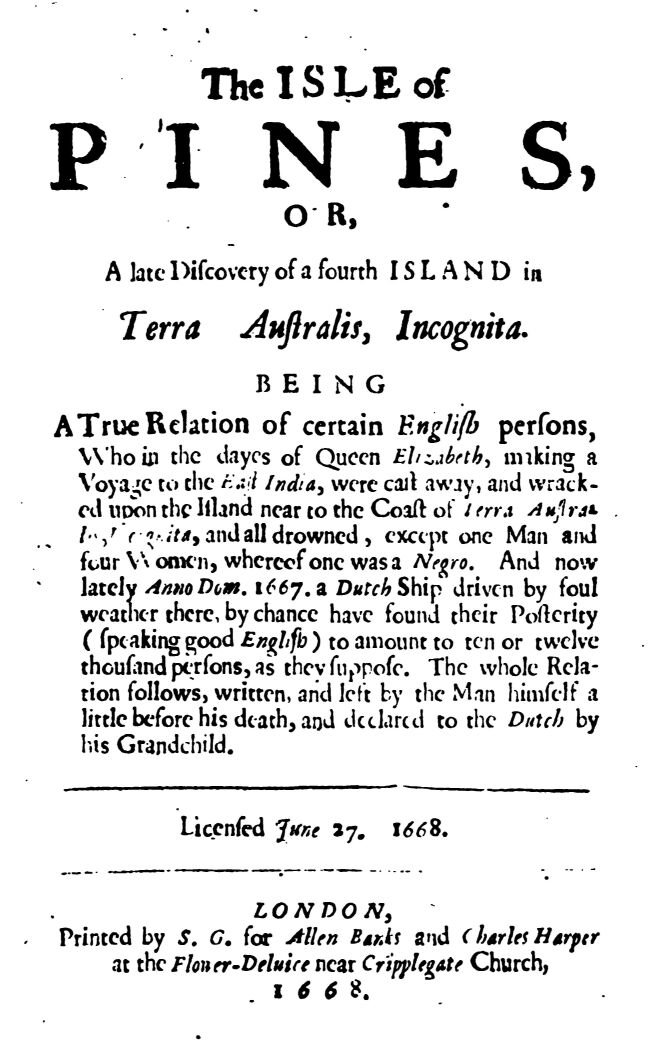
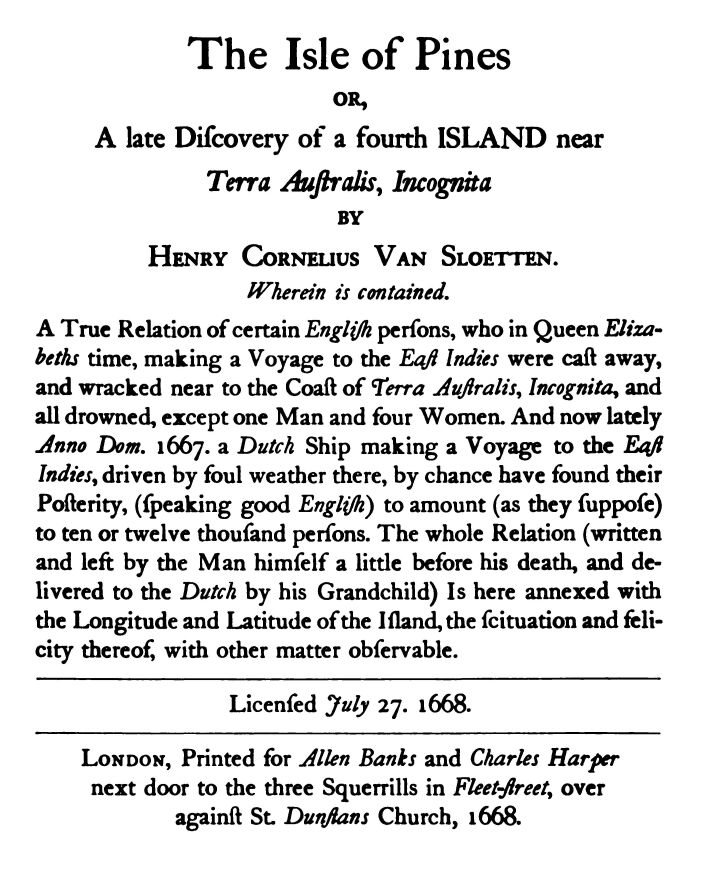
A True Relation of certain English persons, who in Queen Elizabeths
time, making a Voyage to the East Indies were cast away, and wracked
near to the Coast of Terra Australis, Incognita, and all drowned, except
one Man and four Women. And now lately Anno Dom. 1667. a Dutch Ship
making a Voyage to the East Indies, driven by foul weather there, by
chance have found their Posterity, (speaking good English) to amount (as
they suppose) to ten or twelve thousand persons. The whole Relation
(written and left by the Man himself a little before his death, and
delivered to the Dutch by his Grandchild) Is here annexed with the
Longitude and Latitude of the Island, the situation and felicity
thereof, with other matter observable.
Licensed July 27. 1668.
London, Printed for Allen Banks and Charles Harper next door to the
three Squerrills in Fleet-street, over against St Dunstans Church, 1668.
Two Letters concerning the Island of Pines to a Credible person
in Covent Garden.
IT is written by the last Post from Rochel, to a Merchant in this City,
that there was a French ship arrived, the Mailer and Company of which
reports, that about 2 or 300 Leagues Northwest from Cape Finis Terre,
they fell in with an Island, where they went on shore, and found about
2000 English people without cloathes, only some small coverings about
their middle, and that they related to them, that at their first coming
to this Island (which was in Queen Elizabeths time) they were but five
in number men and women, being cast on shore by distress or otherwise,
and had there remained ever since, without having any correspondence
with any other people, or any ship coming to them. This story seems very
fabulous, yet the Letter is come to a known Merchant, and from a good
hand in France, so that I thought fit to mention it, it may be that
there may be some mistake in the number of the Leagues, as also of the
exact point of the Compass, from Cape Finis Terre; I shall enquire more
particularly about it. Some English here suppose it may be the Island of
Brasile which have been so oft sought for, Southwest from Ireland, if
true, we shall hear further about it; your friend and Brother, Abraham
Keek.
Amsterdam, July the 6th 1668.
IT is said that the Ship that discovered the Island, of which I hinted
to you in my last, is departed from Rochel, on her way to Zealand,
several persons here have writ thither to enquire for the said Vessel,
to know the truth of this business. I was promised a Copy of the Letter
Amsterdam, June the 29th 1668, that came from France, advising the discovery of the
Island above-said, but its not yet come to my hand; when it cometh, or
any further news about this Island, I shall acquaint you with it,
Your Friend and Brother,
A. Keck.
{{1 }} Discovered Near to the Coast of Terra Australis Incognita, by
Henry Cornelius Van Sloetten, in a Letter to a friend in London,
declaring the truth of his Voyage to the East Indies.
SIR,
I Received your Letter of this second instant, wherein you desire me to
give you a further account concerning the Land of Pines, on
which we were driven by distress of Weather the last Summer, I also
perused the Printed Book thereof you sent me, the Copy of which was
surreptiously taken out of my hands, else should I have given you a
more fuller account upon what occasion we came thither, how we were
entertained, with some other {{2 }}circumstances of note wherein that
relation is defective. To satisfie therefore your desires, I shall
briefly yet sully give you a particular account thereof, with a true
Copy of the Relation it self; desiring you to bear with my blunt
Phrases, as being more a Seaman then a Scholler.
April the 26th 1667. We set sail from Amsterdam, intending for the
East-Indies; our ship had to name the place from whence we came, the Amsterdam
burthen 350. Tun, and having a fair gale of Wind, on the 27 of May
following we had a sight of the high Peak Tenriffe belonging to the
Canaries, we have touched at the Island Palma, but having endeavoured it
twice, and finding the winds contrary, we steered on our course by the
Isles of Cape Ferd, or Insula Capitis Viridis, where at St. James's we
took in fresh water, with some few Goats, and Hens, wherewith that Island doth
plentifully abound.
June the 14. we had a sight of Madagascar, or the Island of St
Laurence, an Island of 4000 miles in compass, and scituate under the
Southern Tropick; thither we steered our course, and trafficked with
the inhabitants for Knives, Beads, Glasses and the like, having in
exchange thereof Cloves and Silver. Departing from thence we were
incountred with a violent storm, and the winds holding contrary, for
the space of a fortnight, brought us back almost as far as the Isle Del
Principe; during which time many of our men fell sick, and some dyed,
but at the end of that time it pleased God the wind favoured us again,
and we steered on our course merrily, for the space of ten days: when
on a sudden we were encountered with such a violent storm, as if all
the four winds together had conspired for our destruction, so that the
stoutest spirit of us all quailed, expecting every hour to be devoured
by that merciless element of water, sixteen dayes together {{3 }} did
this storm continue, though not with such violence as at the first, the
Weather being so dark all the while, and the Sea so rough, that we knew
not in what place we were, at length all on a sudden the Wind ceased,
and the Air cleared, the Clouds were all dispersed, and a very serene
Sky followed, for which we gave hearty thanks to the Almighty, it being
beyond our expectation that we should have escaped the violence of that
storm.
At length one of our men mounting the Main-mast espyed fire, an evident
sign of some Countrey near adjoyning, which presently after we
apparently discovered, and steering our course more nigher, we saw several
persons promiscuously running about the shore, as it were wondering and
admiring at what they saw: Being now near to the Land, we manned out our
long Boat with ten persons, who approaching the shore, asked them in our
Dutch Tongue What Eyland is dit? to which they returned this Answer in
English, "that they knew not what we said." One of our Company named
Jeremiah Hanzen who understood English very well, hearing their words
discourst to them in their own Language; so that in fine we were very
kindly invited on shore, great numbers of them flocking about us,
admiring at our Cloaths which we did wear, as we on the other side did
to find in such a strange place, so many that could speak English and
yet to go naked.
Four of our men returning back in the long Boat to our Ships company,
could hardly make them believe the truth of what they had seen and
heard, but when we had brought our ship into harbour, you would have
blest your self to see how the naked Islanders flocked unto us, so
wondering at our ship, as if it had been the greatest miracle of Nature
in whole World. {{4 }}
We were very courteously entertained by them, presenting us with such
food as that Countrey afforded, which indeed was not to be despised; we
eat of the Flesh both of Beasts, and Fowls, which they had cleanly
drest, though with no great curiosity, as wanting materials, wherewithal
to do it; and for bread we had the inside or Kernel of a great Nut as
big as an Apple, which was very wholsome, and found for the body, and
tasted to the Pallat very delicious.
Having refreshed our selves, they invited us to the Pallace of their
Prince or chief Ruler, some two miles distant off from the place where
we landed; which we found to be about the bigness of one of our ordinary
village houses, it was supported with rough unhewn pieces of Timber, and
covered very artificially with boughs, so that it would keep out the
greatest showers of Rain, the sides thereof were adorned with several
forts of Flowers, which the fragrant fields there do yield in great
variety. The Prince himself (whose name was William Pine the
Grandchild of George Pine that was first on shore in this Island)
came to his Pallace door and saluted us very courteously, for though he
had nothing of Majesty in him, yet had he a courteous noble and
deboneyre spirit, wherewith your English Nation (especially those of the
Gentry) are very much indued.
Scarce had he done saluting us when his Lady or Wife, came likewise
forth of their House or Pallace, attended on by two Maid-servants, the
was a woman of an exquisite beauty, and had on her head as it were a
Chaplet of Flowers, which being intermixt with several variety of
colours became her admirably. Her privities were hid with some pieces
of old Garments, the Relicts of those Cloaths (I suppose) of them which
first came hither, and yet being adorned with Flowers those very rags
seemeth beautiful; and {{5 }} indeed modesty so far prevaileth over all
the Female Sex of that Island, that with grass and flowers interwoven
and made strong by the peelings of young Elms (which grow there in
great plenty) they do plant together so many of them as serve to cover
those parts which nature would have hidden.
We carried him as a present some few Knives, of which we thought they
had great need, an Ax or Hatchet to fell Wood, which was very acceptable
unto him, the Old one which was cast on shore at the first, and the only
one that they ever had, being now so quite blunt and dulled, that it
would not cut at all, some few other things we also gave him, which he
very thankfully accepted, inviting us into his House or Pallace, and
causing us to sit down with him, where we refreshed our selves again,
with some more Countrey viands which were no other then such we tasted
of before; Prince and peasant here faring alike, nor is there any
difference betwixt their drink, being only fresh sweet water, which the
rivers yield them in great abundance.
After some little pause, our Companion (who could speak English) by our
request desired to know of him something concerning their Original and
how that people speaking the Language of such a remote Countrey, should
come to inhabit there, having not, as we could see, any ships or Boats
amongst them the means to bring them thither, and which was more,
altogether ignorant and meer strangers to ships, or shipping, the main
thing conducible to that means, to which request of ours, the courteous
Prince thus replyed.
Friends (for so your actions declare you to be, and shall by ours find
no less) know that we are inhabitants of this Island of no great
standing, my Grandfather being the first that ever set foot on this
shore, whose native Countrey was {{6 }} a place called England,
far distant from this our Land, as he let us to understand; He came
from that place upon the Waters, in a thing called a Ship, of which no
question but you may have heard; several other persons were in his
company, not intending to have come hither (as he said) but to a place
called India, when tempestuous weather brought him and his
company upon this Coast, where falling among the Rocks his ship split
all in pieces; the whole company perishing in the Waters, saving only
him and four women, which by means of a broken piece of that Ship, by
Divine assistance got on Land.
What after passed (said he) during my Grandfathers life, I shall show
you in a Relation thereof written by his own hand, which he delivered to
my Father being his eldest Son, charging him to have a special care
thereof, and ashuring him that time would bring some people or other
thither to whom he would have him to impart it, that the truth of our
first planting here might not be quite lost, which his commands my
Father dutifully obeyed; but no one coming, he at his death delivered
the same with the like charge to me, and you being the first people,
which (besides our selves) ever set footing in this Island, I shall
therefore in obedience to my Grandfathers and Fathers commands,
willingly impart the same unto you.
Then stepping into a kind of inner room, which as we conceived was his
lodging Chamber, he brought forth two sheets of paper fairly written in
Englishy (being the same Relation which you had Printed with you at
London) and very distinctly read the same over unto us, which we
hearkened unto with great delight and admiration, freely proffering us a
Copy of the same, which we afterward took and brought away along with
us; which Copy hereafter followeth.{1}
1 Here begins the first part of the tract.
A Way to the East India's being lately discovered by Sea, to the {{7 }}
South of Affrich by certain Portugals, far more safe and profitable
then had been heretofore; certain English Merchants encouraged by the
great advantages arising from the Eastern Commodities, to settle a
Factory there for the advantage of Trade. And having to that purpose
obtained the Queens Royal Licence Anno Dom. 1569. 11. or 12. Eliz.
furnisht out for those parts four ships, my Master being sent as Factor
to deal and Negotiate for them, and to settle there, took with him his
whole Family, (that is to say) his Wife, and one Son of about twelve
years of age, and one Daughter of about fourteen years, two
Maidservants, one Negro female slave, and my Self, who went
under him as his Book-keeper, with this company on Monday the third of
April next following, (having all necessaries for Housekeeping when we
should come there), we Embarqued our selves in the good ship called the
India Merchant, of about four hundred and fifty Tuns burthen,
and having a good wind, we on the fourteenth day of May had sight of
the Canaries, and not long after of the Isles of Cafe Vert or Verd,
where taking in such things as were necessary for our Voyage, and some
fresh Provisions, we stearing our course South, and a point East, about
the first of August came within sight of the Island of St Hellen, where
we took in some fresh water, we then set our faces for the Cape of Good
Hope, where by Gods blessing after some sickness, whereof some of our
company died, though none of our family; and hitherto we had met with
none but calm weather, yet so it pleased God, when we were almost in
fight of St. Laurence, an Island so called, one of the greatest in the
world, as Marriners say, we were overtaken and dispersed by a great
storm of Wind, which continued with luch violence {{8 }} many days,
that losing all hope of safety, being out of our own knowledge, and
whether we should fall on Flats or Rocks, uncertain in the nights, not
having the least benefit of the light, we feared most, alwayes wishing
for day, and then for Land, but it came too soon for our good; for
about the first of October, our fears having made us forget how the
time passed to a certainty; we about the break of day discerned Land
(but what we knew not) the Land seemed high and Rockey, and the Sea
continued still very stormy and tempestuous, insomuch as there seemed
no hope of safety, but looked suddenly to perish. As we grew near Land,
perceiving no safety in the ship, which we looked would suddenly be
beat in pieces: The Captain, my Master, and some others got into the
long Boat, thinking by that means to save their lives, and presently
after all the Seamen cast themselves overboard, thinking to save their
lives by swimming, onely myself my Masters Daughters, the two Maids,
and the Negro were left on board, for we could not swim; but those that
left us, might as well have tarried with us, for we saw them, or most
of them perish, our selves now ready after to follow their fortune, but
God was pleased to spare our lives, as it were by miracle, though to
further sorrow; for when we came against the Rocks, our ship having
endured two or three blows against the Rocks, (being now broken and
quite foundred in the Waters), we having with much ado gotten our
selves on the Bowspright, which being broken off, was driven by the
Waves into a small Creek, wherein fell a little River, which being
encompassed by the Rocks was sheltered from the Wind, so that we had
opportunity to land our selves, (though almost drowned) in all four
persons, besides the Negro: when we were got upon the Rock, we could
perceive the miserable Wrack to our great terrour, I had in my {{9 }}
pocket a little Tinder-box, and Steel, and Flint to strike fire at any
time upon occasion, which served now to good Purpose, for its being so
close, preserved the Tinder dry, with this, and the help of some old
rotten Wood which we got together, we kindled a fire and dryed our
selves, which done, I left my female company, and went to see, if I
could find any of our Ships company, that were escaped, but could hear
of none, though I hooted, and made all the noise I could; neither could
I perceive the foot-steps of any living Creature (save a few Birds, and
other Fowls). At length it drawing towards the Evening, I went back to
my company, who were very much troubled for want of me. I being now all
their stay in this lost condition, we were at first afraid that the
wild people of the Countrey might find us out, although we saw no
footsteps of any, not so much as a Path; the Woods round about being
full of Briers and Brambles, we also stood in fear of wild Beasts, of
such also we saw none, nor sign of any: But above all, and that we had
greatest reason to fear, was to be starved to death for want of Food,
but God had otherwise provided for us, as you shall know hereafter;
this done, we spent our time in getting some broken pieces of Boards,
and Planks, and some of the Sails and Rigging on shore for shelter; I
set up two or three Poles, and drew two or three of the Cords and Lines
from Tree to Tree, over which throwing some Sail-cloathes, and having
gotten Wood by us, and three or four Sea-gowns, which we had dryed, we
took up our Lodging for that night altogether (the Blackmoor being left
sensible then the rest we made our Centry) we slept soundly that night,
as having not slept in three or four nights before (our fears of what
happened preventing us) neither could our hard lodging, fear, and
danger hinder us we were so over wacht. {{10 }}
On the morrow, being well refresht with sleep, the winde ceased, and the
weather was very warm; we went down the Rocks on the sands at low water,
where we found great part of our lading, either on shore or floating
near it. I by the help of my company, dragged most of it on shore; what
was too heavy for us broke, and we unbound the Casks and Cherts, and,
taking out the goods, secured all; so that we wanted no clothes, nor any
other provision necessary for Housekeeping, to furnish a better house
than any we were like to have; but no victuals (the last water having
spoiled all) only one Cask of bisket, being lighter than the rest was
dry; this served for bread a while, and we found on Land a sort of fowl
about the bigness of a Swan, very heavie and fat, that by reason of
their weight could not fly, of these we found little difficulty to kill,
so that was our present food; we carried out of England certain Hens and
Cocks to eat by the way, some of these when the ship was broken, by some
means got to land, & bred exceedingly, so that in the future they
were a great help unto us; we found also, by a little River, in the
flags, store of eggs, of a sort of foul much like our Ducks, which were
very good meat, so that we wanted nothing to keep us alive.
On the morrow, which was the third day, as soon as it was morning,
seeing nothing to disturb us, I lookt out a convenient place to dwell
in, that we might build us a Hut to shelter us from the weather, and
from any other danger of annoyance, from wild beasts (if any should
finde us out: So close by a large spring which rose out of a high hill
over-looking the Sea, on the side of a wood, having a prospect towards
the Sea) by the help of an Ax and some other implements (for we had all
necessaries, the working of the Sea, having cast up most of our goods)
I cut down all the straightest poles I could find, and which were
enough {{11 }} for my purpose, by the help of my company (necessity
being our Master) I digged holes in the earth setting my poles at an
equl distance, and nailing the broken boards of the Caskes, Cherts, and
Cabins, and such like to them, making my door to the Seaward, and
having covered the top, with sail-clothes strain'd and nail'd, I in the
space of a week had made a large Cabbin big enough to hold all our
goods and our selves in it, I also placed our Hamocks for lodging,
purposing (if it pleased God to send any Ship that way) we might be
transported home, but it never came to pass, the place, wherein we were
(as I conceived) being much out of the way.
We having now lived in this manner full four months, and not so much as
seeing or hearing of any wild people, or of any of our own company, more
then our selves (they being found now by experience to be all drowned)
and the place, as we after found, being a large Island, and disjoyned,
and out of fight of any other Land, was wholly uninhabited by any
people, neither was there any hurtful beast to annoy us: But on the
contrary the countrey so very pleasant, being always clothed with green,
and full of pleasant fruits, and variety of birds, ever warm, and never
colder then in England in September: So that this place (had it the culture,
that skilful people might bestow on it) would prove a Paradise.
The Woods afforded us a sort of Nuts, as big as a large Apple, whose
kernel being pleasant and dry, we made use of instead of bread, that
fowl before mentioned, and a sort of water-fowl like Ducks, and their
eggs, and a beast about the size of a Goat, and almost such a like
creature, which brought two young ones at a time, and that twice a
year, of which the Low Lands and Woods were very full, being a very
harmless creature and tame, so that we could easily {{12 }} take and
kill them: Fish, also, especially Shell-fish (which we could best come
by) we had great store of, so that in effect as to Food we wanted
nothing; and thus, and by such like helps, we continued six moneths
without any disturbance or want.
Idleness and Fulness of every thing begot in me a desire of enjoying the
women, beginning now to grow more familiar, I had perswaded the two
Maids to let me lie with them, which I did at first in private, but
after, custome taking away shame (there being none but us) we did it
more openly, as our Lusts gave us liberty; afterwards my Masters
Daughter was content also to do as we did; the truth is, they were all
handsome Women, when they had Cloathes, and well shaped, feeding well.
For we wanted no Food, and living idlely, and seeing us at Liberty to do
our wills, without hope of ever returning home made us thus bold: One of
the first of my Comforts with whom I first accompanined (the tallest and
handsomest) proved presently with child, the second was my Masters
Daughter, and the other also not long after fell into the same
condition: none now remaining but my Negro, who seeing what we did,
longed also for her share; one Night, I being asleep, my Negro, (with
the consent of the others) got close to me, thinking it being dark, to
beguile me, but I awaking and feeling her, and perceiving who it was,
yet willing to try the difference, satissied my self with her, as well
as with one of the rest: that night, although the first time, she proved
also with child, so that in the year of our being here, all my women
were with child by me, and they all coming at different seasons, were a
great help to one another.
The first brought me a brave Boy, my Masters Daughter was the youngest,
she brought me a Girl, so did the other {{13 }} Maid, who being
something fat sped worse at her labour: the Negro had no pain at all,
brought me a fine white Girl, so I had one Boy and three Girls, the
Women were soon well again, and the two first with child again before
the two last were brought to bed, my custome being not to lie with any
of them after they were with child, till others were so likewise, and
not with the black at all after she was with child, which commonly was
at the first time I lay with her, which was in the night and not else,
my stomach would not serve me, although she was one of the handsomest
Blacks I had seen, and her children as comly as any of the rest; we had
no clothes for them, and therefore when they had suckt, we laid them in
Mosse to sleep, and took no further care of them, for we knew, when
they were gone more would come, the Women never failing once a year at
least, and none of the Children (for all the hardship we put them to)
were ever sick; so that wanting now nothing but Cloathes, nor them much
neither, other than for decency, the warmth of the Countrey and Custome
supplying that Defect, we were now well satissied with our condition,
our Family beginning to grow large, there being nothing to hurt us, we
many times lay abroad on Mossey Banks, under the shelter of some Trees,
or such like (for having nothing else to do) I had made me several
Arbors to sleep in with my Women in the heat of the day, in these I and
my women passed the time away, they being never willing to be out of my
company.
And having now no thought of ever returning home, as having resolved
and sworn each to other, never to part or leave one another, or the
place; having by my several wives, forty seven Children, Boys and
Girls, but most Girls, and growing up apace, we were all of us very
fleshly, the Country so well agreeing with us, that we never ailed any
thing; {{14 }} my Negro having had twelve, was the first that left
bearing, so I never medled with her more: My Masters Daughter (by whom
I had most children, being the youngest and handsomest) was most fond
of me, and I of her. Thus we lived for sixteen years, till perceiving
my eldest Boy to mind the ordinary work of Nature, by seeing what we
did, I gave him a Mate, and so I did to all the rest, as fast as they
grew up, and were capable: My Wives having left bearing, my children
began to breed apace, so we were like to be a multitude; My first Wife
brought me thirteen children, my second seven, my Masters Daughter
fifteen, and the Negro twelve, in all forty seven.
After we had lived there twenty two years, my Negro died suddenly, but I
could not perceive any thing that ailed her; most of my children being grown, as
fast as we married them, I sent them and placed them over the River by
themselves severally, because we would not pester one another; and now
they being all grown up, and gone, and married after our manner (except
some two or three of the youngest) for (growing my self into years) I
liked not the wanton annoyance of young company.
Thus having lived to the fiftieth year of my age, and the fortieth of
my coming thither, at which time I sent for all of them to bring their
children, and there were in number descended from me by these four
Women, of my Children, Grand-children, and great Grand-children, five
hundred sixty five of both sorts, I took off the Males of one Family,
and married them to the Females of another, not letting any to marry
their sisters, as we did formerly out of necessity, so blessing God for
his Providence and goodness, I dismist them, I having taught some of my
children to read formerly, for I had left still the Bible, I charged it
should be read once a moneth at {{15 }} a general meeting: At last one
of my Wives died being sixty eight years of age, which I buried in a
place, set out on purpose, and within a year after another, so I had
none now left but my Masters Daughter, and we lived together twelve
years longer, at length she died also, so I buried her also next the
place where I purposed to be buried my self, and the tall Maid my first
Wife next me on the other side, the Negro next without her, and the
other Maid next my Masters Daughter. I had now nothing to mind, but the
place whether I was to go, being very old, almost eighty years, I gave
my Cabin and Furniture that was left to my eldest son after my decease,
who had married my eldest Daughter by my beloved Wife, whom I made King
and Governour of all the rest: I informed them of the Manners of
Europe, and charged them to remember the Christian Religion, after the
manner of them that spake the same Language, and to admit no other; if
hereafter any should come and find them out.
And now once for all, I summoned them to come to me, that I might
number them, which I did, and found the estimate to contain in or about
the eightieth year of my age, and the fifty ninth of my coming there;
in all, of all sorts, one thousand seven hundred eighty and nine. Thus
praying God to multiply them, and lend them the true light of the
Gospel, I last of all dismist them: For, being now very old, and my
sight decayed, I could not expect to live long. I gave this Narration
(written with my own hand) to my eldest Son, who now lived with me,
commanding him to keep it, and if any strangers should come hither by
chance, to let them see it, and take a Copy of it if they would, that
our name be not lost from off the earth. I gave this people (descended
from me) the name of the ENGLISH PINES, George Pine being
my {{16 }} name, and my Masters Daughters name Sarah English, my two
other Wives were Mary Sparkes, and Elizabeth Trevor, so their severall
Defendants are called the ENGLISH, the SPARKS, and the TREVORS, and the
PHILLS, from the Christian Name of the Negro, which was Philippa, she
having no surname: And the general name of the whole the ENGLISH PINES;
vvhom God bless vvith the dew of Heaven, and the fat of the Earth,
AMEN.{1}
1 Here ended the first part.
After the reading and delivering unto us a Coppy of this Relation, then
proceeded he on in his discourse.
My Grandfather when he wrote this, was as you hear eighty yeares of age,
there proceeding from his Loyns one thousand seven hundred eighty nine
children, which he had by them four women aforesaid: My Father was his
eldest son, and was named Henry, begotten of his wife Mary Sparkes, whom
he apointed chief Governour and Ruler over the rest; and having given
him a charge not to exercise tyranny over them, seeing they were his
fellow brethren by Fathers side (of which there could be no doubt made
of double dealing therein) exhorting him to use justice and sincerity
amongst them, and not to let Religion die with him, but to observe and
keep those Precepts which he had taught them, he quietly surrendred up
his soul, and was buried with great lamentation of all his children.
My father coming to rule, and the people growing more populous, made
them to range further in the discovery of the Countrey, which they found
answerable to their desires, full both of Fowls and Beasts, and those
too not hurtful to mankinde, as if this Country (on which we were by
providence cast without arms or other weapons to defend our selves, or
offend others,) should by the same providence be so inhabited as not to
have any need of such like weapons of destruction wherewith to preserve
our lives. {{17 }}
But as it is impossible, but that in multitudes disorders will grow, the
stronger seeking to oppress the weaker; no tye of Religion being strong
enough to chain up the depraved nature of mankinde, even so amongst them
mischiefs began to rise, and they soon fell from those good orders
prescribed them by my Grandfather. The source from whence those
mischiefs spring, was at first, I conceive, the neglect of hearing the
Bible read, which according to my Grandfathers proscription, was once a
moneth at a general meeting, but now many of them wandring far up into
the Country, they quite neglected the coming to it, with all other means
of Christian instruction, whereby the sence of sin being quite lost in
them, they fell to whoredoms, incests, and adulteries; so that what my
Grandfather was forced to do for necessity, they did for wantonness; nay
not confining themselves within the bound of any modesty, but brother
and sister lay openly together; those who would not yield to their lewd
embraces, were by force ravished, yea many times endangered of their
lives. To redress those enormities, my father assembled all the Company
near unto him, to whom he declared the wickedness of those their
brethren; who all with one consent agreed that they should be severely
punished; and so arming themselves with boughs, stones, and such like
weapons, they marched against them, who having notice of their coming,
and fearing their deserved punishment, some of them fled into woods,
others passed over a great River, which runneth through the heart of our
Countrey, hazarding drowning to escape punishment; But the grandest
offender of them all was taken, whole name was John Phill, the second
son of the Negro-woman that came with my Grandfather into this Island.
He being proved guilty of divers ravishings & tyrannies committed
by him, {{18 }} was adjudged guilty of death, and accordingly was
thrown down from a high Rock into the Sea, where he perished in the
waters. Execution being done upon him, the rest were pardoned for what
was past, which being notified abroad, they returned from those Defait
and Obscure places, wherein they were hidden.
Now as Seed being cast into stinking Dung produceth good and wholesome
Corn for the Indentation of mans life, so bad manners produceth good and
wholesome Laws for the preservation of Humane Society. Soon after my
Father with the advice of some few others of his Counsel, ordained and
set forth these Laws to be observed by them.
1. That whosoever should blaspheme or talk irreverently of the name of
God should be put to death.
2. That who should be absent from the monethly assembly to hear the
Bible read, without sufficient cause shown to the contrary, should for
the first default be kept without any victuals or drink, for the space
of four days, and if he offend therein again, then to suffer death.
3. That who should force or ravish any Maid or Woman should be burnt to
death, the party so ravished putting fire to the wood that should burn
him.
4. Whosoever shall commit adultery, for the first crime the Male shall
lose his Privities, and the Woman have her right eye bored out, if after
that she was again taken in the act, she should die without mercy.
5. That who so injured his Neighbour, by laming of his {{19 }} Limbs,
or taking any thing away which he possesseth, shall suffer in the same
kind himself by loss of Limb; and for defrauding his Neighbour, to
become servant to him, whilst he had made him double satisfaction.
6. That, who should defame or speak evil of the Governour, or refuse to
come before him upon Summons, should receive a punishment by whipping
with Rods, and afterwards be exploded from the society of the rest of
the inhabitants.
Having set forth these Laws, he chose four several persons under him to
see them put in Execution, whereof one was of the Englishes, the
Off-spring of Sarah English; another of his own Tribe, the Sparks; a
third of the Trevors, and the fourth of the Phills, appointing them
every year at a certain time to appear before him, and give an account
of what they had done in the prosecution of those Laws.
The Countrey being thus settled, my father lived quiet and peaceable
till he attained to the age of ninety and four years, when dying, I
succeeded in his place, in which I have continued peaceably and quietly
till this very present time.
He having ended his Speech, we gave him very heartily thanks for our
information, assuring him we should not be wanting to him in any thing
which lay in our powers, wherewith we could pleasure him in what he
should desire, and thereupon preferred to depart, but before our going
away, he would needs engage us to see him, the next day, when was to be
their great assembly or monethly meeting for the celebration of their
Religious Exercises.
Accordingly the next day we came thither again, and were courteously
entertained as before, In a short space there was gathered such a
multitude of people together as made us to {{20 }} admire; and first
there were several Weddings celebrated, the manner whereof was thus.
The Bridegroom and Bride appeared before him who was their Priest or
Reader of the Bible, together with the Parents of each party, or if any
of their Parents were dead, then the next relation unto them, without
whose consent as well as the parties to be married, the Priest will not
joyn them together; but being satissied in those particulars, after
some short Oraizons, and joyning of hands together, he pronounces them
to be man and wife: and with exhortations to them to live lovingly
towards each other, and quietly towards their neighbors, he concludes
with some prayers, and so dismisses them.
The Weddings being finished, all the people took their places to hear
the Word read, the new married persons having the honour to be next unto
the Priest that day, after he had read three or four Chapters he fell to
expounding the most difficult places therein, the people being very
attentive all that while, this exercise continued for two or three
hours, which being done, with some few prayers he concluded, but all the
rest of that day was by the people kept very strictly, abstaining from
all manner of playing or pastimes, with which on other dayes they use to
pass their time away, as having need of nothing but victuals, and that
they have in such plenty as almost provided to their hands.
Their exercises of Religion being over, we returned again to our Ship,
and the next day, taking with us two or three Fowling-pieces leaving
half our Company to guard the Ship, the rest of us resolved to go up
higher into the Country for a further discovery: All the way as we
passed the first morning, we saw abundance of little Cabbins or Huts of
these inhabitants, made under Trees, and fashioned up with boughs,
grass, {{21 }} and such like stuffe to defend them from the Sun and
Rain; and as we went along, they came out of them much wondering at our
Attire, and standing aloof off from us as if they were afraid, but our
companion that spake English, calling to them in their own Tongue, and
giving them good words, they drew nigher, some of them freely
proffering to go along with us, which we willingly accepted; but having
passed some few miles, one of our company espying a Beast like unto a
Goat come gazing on him, he discharged his Peece, sending a brace of
Bullets into his belly, which brought him dead upon the ground; these
poor naked unarmed people hearing the noise of the Peece, and seeing
the Beast lie tumbling in his gore, without speaking any words betook
them to their heels, running back again as fast as they could drive,
nor could the perswasions of our Company, assuring them they should
have no hurt, prevail anything at all with them, so that we were forced
to pass along without their company: all the way that we went we heard
the delightful harmony of singing Birds, the ground very fertile in
Trees, Grass, and such flowers, as grow by the production of Nature,
without the help of Art; many and several sorts of Beasts we saw, who
were not so much wild as in other Countries; whether it were as having
enough to satiate themselves without ravening upon others, or that they
never before saw the sight of man, nor heard the report of murdering
Guns, I leave it to others to determine. Some Trees bearing wild Fruits
we also saw, and of those some whereof we tailed, which were neither
unwholsome nor distasteful to the Pallate, and no question had but
Nature here the benefit of Art added unto it, it would equal, if not
exceed many of our European Countries; the Vallyes were every where
intermixt with running streams, and no question but the earth {{22 }}
hath in it rich veins of Minerals, enough to satisfie the desires of
the most covetous.
It was very strange to us, to see that in such a fertile Countrey which
was as yet never inhabited, there should be notwithstanding such a free
and clear passage to us, without the hinderance of Bushes, Thorns, and
such like fluff, wherewith most Islands of the like nature are pestered:
the length of the Grass (which yet was very much intermixt with flowers)
being the only impediment that we found.
Six dayes together did we thus travel, setting several marks in our way
as we went for our better return, not knowing whether we should have the
benefit of the Stars for our guidance in our going back, which we made
use of in our passage: at last we came to the vast Ocean on the other
side of the Island, and by our coasting it, conceive it to be of an oval
form, only here and there shooting forth with some Promontories. I
conceive it hath but few good Harbours belonging to it, the Rocks in
most places making it inaccessible. The length of it may be about two
hundred, and the breadth one hundred miles, the whole in circumference
about five hundred miles.
It lyeth about seventy six degrees of Longitude, and twenty of
Latitude, being scituate under the third Climate, the longest day being
about thirteen hours and fourty five minutes. The weather, as in all
Southern Countries, is far more hot than with us in Europe; but what is
by the Sun parched in the day, the night again refreshes with cool
pearly dews. The Air is found to be very healthful by the long lives
{{23 }} of the present inhabitants, few dying there till such time as
they come to good years of maturity, many of them arriving to the
extremity of old age.
And now speaking concerning the length of their Lives, I think it will
not be amisse in this place to speak something of their Burials, which
they used to do thus.
When the party was dead, they stuck his Carkass all over with flowers,
and after carried him to the place appointed for Burial, where setting
him down, (the Priest having given some godly Exhortations concerning
the frailty of life) then do they take stones (a heap being provided
there for that purpose) and the nearest of the kin begins to lay the
first stone upon him, afterwards the rest follows, they never leaving
till they have covered the body deep in stones, so that no Beast can
possibly come to him, and this first were they forced to make, having no
Spades or Shovels wherewith to dig them Graves; which want of theirs we
espying, bestowed a Pick-ax and two Shovels upon them.
Here might I add their way of Christening Children, but that being
little different from yours in ENGLAND, and taught them by GEORGE PINES
at first which they have since continued, I shall therefore forbear to
speak thereof.
After our return back from the discovery of the Countrey, the Wind not
being fit for our purpose, and our men also willing thereto, we got all
our cutting Instruments on Land, and {{24 }} fell to hewing down of
Trees, with which, in a little time,(many hands making light work) we
built up a Pallace for this William Pines the Lord of that Countrey;
which, though much inferiour to the houses of your Gentry in England.
Yet to them which never had seen better, it appeared a very Lordly
Place. This deed of ours was beyond expression acceptable unto him,
load-ing us with thanks for so great a benefit, of which he said he
should never be able to make a requital.
And now acquainting him, that upon the first opportunity we were
resolved to leave the Island, as also how that we were near Neighbours
to the Countrey of England, from whence his Ancestors came; he seemed
upon the news to be much discontented that we would leave him, desiring,
if it might stand with our commodity to continue still with him, but
seeing he could not prevail, he invited us to dine with him the next
day, which we promised to do, against which time he provided, very
sumptuously (according to his estate) for us, and now was he attended
after a more Royal manner than ever we saw him before, both for number
of Servants, and multiplicity of Meat, on which we fed very heartily;
but he having no other Beverage for us to drink, then water, we fetched
from our Ship a Case of Brandy, presenting some of it to him to drink,
but when he had tasted of it, he would by no means be perswaded to touch
thereof again, preferring (as he said) his own Countrey Water before all
such Liquors whatsoever.
After we had Dined, we were invited out into the Fields to behold their
Country Dauncing, which they did with great agility of body; and though
they had no other then only {{25 }} Vocal Musick (several of them
singing all that while) yet did they trip it very neatly, giving
sufficient satisfaction to all that beheld them.
The next day we invited the Prince William Pines aboard our Ship, where
was nothing wanting in what we could to entertain him, he had about a
dozen of Servants to attend on him he much admired at the Tacklings of
our Ship, but when we came to discharge a piece or two of Ordnance, it
struck him into a wonder and amazement to behold the strange effects of
Powder; he was very sparing in his Diet, neither could he, or any of his
followers be induced to drink any thing but Water: We there presented
him with several things, as much as we could spare, which we thought
would any wayes conduce to their benefit, all which he very gratefully
received, assuring us of his real love and good will, whensoever we
should come thither again.
And now we intended the next day to take our leaves, the Wind standing
fair, blowing with a gentle Gale South and by East, but as we were
hoisting of our Sails, and weighing Anchor, we were suddenly Allarm'd
with a noise from the shore, the Prince, W. Pines imploring our
assistance in an Insurection which had happened amongst them, of which
this was the cause.
Henry Phil, the chief Ruler of the Tribe or Family of the Phils, being
the Offspring of George Pines which he had by the Negro-woman; this man
had ravished the Wife of one of the principal of the Family of the
Trevors, which act being made known, the Trevors assembled themselves
all together to bring the offender unto Justice: But he knowing his
crime to be so great, as extended to the loss of life: fought to defend
that {{26 }} by force, which he had as unlawfully committed, whereupon
the whole Island was in a great hurly burly, they being too great
Potent Factions, the bandying of which against each other, threatned a
general ruin to the whole State.
The Governour William Pines had interposed in the matter, but found his
Authority too weak to repress such Disorders; for where the Hedge of
Government is once broken down, the most vile bear the greatest rule,
whereupon he desired our assistance, to which we readily condescended,
and arming out twelve of us went on Shore, rather as to a surprize than
fight, for what could nakedness do to encounter with Arms. Being
conducted by him to the force of our Enemy, we first entered into
parley, seeking to gain them rather by fair means then force, but that
not prevailing, we were necesitated to use violence, for this Henry
Phill being of an undaunted resolution, and having armed his fellows
with Clubs and Stones, they sent such a Peal amongst us, as made us at
the first to give back, which encouraged them to follow us on with great
violence, but we discharging off three or four Guns, when they saw some
of themselves wounded, and heard the terrible reports which they gave,
they ran away with greater speed then they came. The Band of the Trevors
who were joyned with us, hotly pursued them, and having taken their
Captain, returned with great triumph to their Governour, who fitting in
Judgment upon him, he was adjudged to death, and thrown off a steep Rock
into the Sea, the only way they have of punishing any by death, except
burning.
And now at last we took our solemn leaves of the Governour, and
departed from thence, having been there in all, the space of three
weeks and two dayes, we took with us good store of the flesh of a Beast
which they call there Reval, being {{27 }} in taste different either
from Beef or Swines-flesh, yet very delightful to the Pallate, and
exceeding nutrimental. We took also with us alive, divers Fowls which
they call Marde, about the bigness of a Pullet, and not different in
taste, they are very swift of flight, and yet so fearless of danger,
that they will stand still till such time as you catch them: We had
also sent us in by the Governour about two bushels of eggs, which as I
conjecture were the Mards eggs, very lusious in taste, and strenthening
to the body.
June 8. We had a sight of Cambaia, a part of the East Indies, but; under
the Government of the great Cham of Tartary here our Vessel springing a
leak, we were forced to put to Chore, receiving much dammage in some of
our Commodities; we were forced to ply the Pump for eighteen hours
together, which, had that miscarried, we had inevitably have perished;
here we stai'd five dayes mending our Ship, and drying some of our
Goodss and then hoisting Sail, in four days time more we came to
Calecute.
This Calecute is the chief Mart Town and Staple of all the Indian
Traffique, it is very populous, and frequented by Merchants of all
Nations. Here we unladed a great part of our Goods, and taking in
others, which caused us to stay there a full Moneth, during which
space, at leisure times I went abroad to take a survey of the City,
which I found to be large and populous, lying for three miles together
upon the Sea-shore. Here is a great many of those persons whom thy call
Brackmans, being their Priests or Teachers whom they much reverence. It
is a custome here for the King to give to some of those Brachmain, the
handelling of his Nuptial Bed; for which cause, not the Kings, but the
Kings sisters sons succeed in the Kingdom, as being more certainly
known to be of the true Royal blood: And these sisters of his choose
what Gentleman they {{28 }} please on whom to bestow their Virginities;
and if they prove not in a certain time to be with child, they betake
themselves to these Brachman Stalions, who never fail of doing
their work.
The people are indifferently civil and ingenious, both men and women
imitate a Majesty in their Train and Apparel, which they sweeten, with
Oyles and Perfumes: adorning themselves with Jewels and other Ornaments
befitting each Rank and Quality of them.
They have many odd Customs amongst them which they observe very
strictly; as first, not knowing their Wives after they have born them
two children: Secondly, not accompanying them, if after five years
cohabition they can raise no issue by them, but taking others in their
rooms: Thirdly, never being rewarded for any Military exploit, unless
they bring with them an enemies Head in their Hand, but that which is
strangest, and indeed most barbarous, is that when any of their friends
falls sick, they will rather chuse to kill him, then that he should be
withered by sickness.
Thus you see there is little employment there for Doctors, when to be
sick, is the next wan for to be slain, or perhaps the people may be of
the mind rather to kill themselves, then to let the Doctors do it.
Having dispatched our business, and sraighted again our Ship, we left
Calecute, and put forth to Sea, and coasted along several of the Islands
belonging to India, at Camboia I met with our old friend Mr. David
Prire, who was overjoyed to see me, to whom I related our Discovery of
the Island of Pines, in the same manner as I have related it to you; he
was then but newly recovered of a Feaver, the Air of that
place not being agreeable to him; here we took in good store of Aloes,
and some other Commodities, and victualled our Ship for our return home.
{{29 }}
After four dayes failing we met with two Portugal Ships which came from
Lisbon, one whereof had in a storm lost its Top-mast, and was forced in
part to be towed by the other. We had no bad weather in eleven dayes
space, but then a sudden storm of Wind did us much harm in our
Tacklings, and swept away one of our Sailors off from the Fore Castle.
November the sixth had like to have been a fatal day unto us, our Ship
striking twice upon a Rock, and at night was in danger of being fired by
the negligence of a Boy, leaving a Candle carelesly in the Gun-room; the
next day we were chafed by a Pyrate Argiere, but by the swiftness of our
Sails we out ran him. December the first we came again to Madagascar,
where we put in for a fresh recruit of Victuals and Water.
During our abode here, there hapned a very great Earthquake, which
tumbled down many Houses; The people of themselves are very Unhospitable
and Treacherous, hardly to to be drawn to Traffique with any people; and
now, this calamitie happening upon them, so enraged them against the
Christians, imputing all luch calamities to the cause of them, that they
fell upon some Portugais and wounded them, and we seeing their
mischievous Actions, with all the speed we could put forth to Sea again,
and sailed to the Island of St. Hellens.
Here we stayed all the Chrismas Holy-dayes, which was vere much
celebrated by the Governour there under the King of Spain. Here we
furnished ourselves with all necessaries which we wanted; but upon our
departure, our old acquaintance Mr. Petrus Ramazina, coming in a Skiff
out of the Isle del Principe, or the Princes Island, retarded our going
for the space of two dayes, for both my self and our Purser had
Emergent business with him, he being concerned in those Affairs of
which I wrote to you in April last: Indeed we cannot but {{30 }}
acknowledge his Courtesies unto us, of which you know he is never
sparing. January the first, we again hoisted Sail, having a fair and
prosperous gail of Wind, we touched at the Canaries, but made no
tarriance, desirous now to see our Native Countrey; but the Winds was
very cross unto us for the space of a week, at last we were savoured
with a gentle Gale, which brought us on merrily; though we were on a
sudden stricken again into a dump; a Sailor from the main Mast
discovering five Ships, which put us all in a great fear, we being
Richly Laden, and not very well provided for Defence; but they bearing
up to us, we found them to be Zealanders and our Friends; after many
other passages concerning us, not so much worthy of Note, we at last
safele arrived at home, May 26. 1668.
Thus Sir, have I given you a brief, but true Relation of our Voyage,
Which I was the more willing to do, to prevent false Copies which might
be spread of this nature: As for the Island of Pines it self, which
caused me to Write this Relation, I suppose it is a thing so strange as
will hardly be credited by some, although perhaps knowing persons,
especially considering our last age being so full of Discoveries, that
this Place should lie Dormant for so long a space of time; Others I
know, such.
Nullifidians as will believe nothing but what they see, applying that
Proverb unto us, That travelers may lye by authority. But Sir, in writing
to you, I question not but to give Credence, you knowing my disposition
so hateful to divulge Falsities; I shall request you to impart this my
Relation to Mr. W. W. and Mr. P. L. remembring me very kindly unto them,
not forgetting my old acquaintance, Mr. J. P. and Mr. J. B. no more at
present, but only my best respects to you and your second self I rest,
Yours in the best of friendship,
Henry Cornelius Fan Sloetten.
July 22. 1668.{{31 }}
ONE thing concerning the Isle of Pines, I had almost quite forgot, we
had with us an Irish man named Dermot Conelly who had formerly been in
England, and had learned there to play on the Bag-pipes, which he
carried to Sea with him; yet so un-Englished he was, that he had quite
forgotten your Language, but still retained his Art of Bagpipe-playing,
in which he took extraordinary delight; being one day on Land in the
Isle of Pines, he played on them, but to see the admiration of those
naked people concerning them, would have striken you into admiration;
long time it was before we could perswade them that it was not a living
creature, although they were permitted to touch and feel it, and yet are
the people very intelligible, retaining a great part of the Ingenuity
and Gallantry of the English Nation, though they have not that happy
means to express themselves; in this respect we may account them
fortunate, in that possessing little, they enjoy all things, as being
contented with what they have, wanting those alurements to mischief,
which our European Countries are enriched with. I shall not dilate any
further, no question but time will make this Island known better to the
world; all that I shall ever say of it is, that it is a place enriched
with Natures abundance, deficient in nothing conducible to the
sustentation of mans life, which were it Manured by Agriculture and
Gardening, as other of our European Countries are, no question but it
would equal, if not exceed many which now pass for praiseworthy.
FINIS.