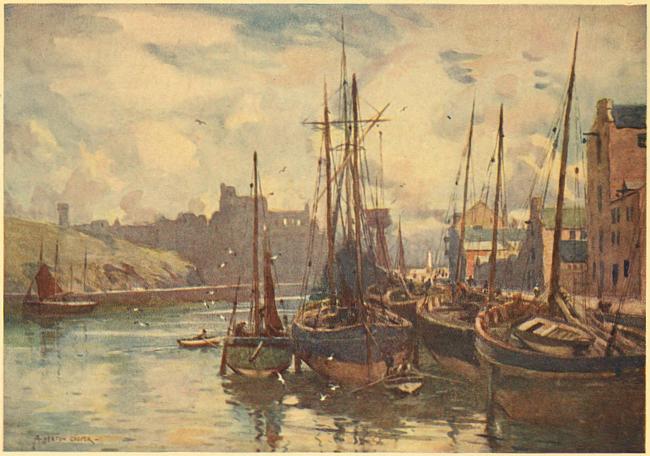
Pedestrians who wish to go north-eastward
from Peel to Ramsey have a choice of two very
different kinds of way. The first of these is the
great highroad, which, after the first two miles
or so, runs side by side with the little narrow-gauge
railway, and passes in succession the
villages of Kirkmichael, Ballaugh, and Sulby.
The second is to follow the highway to Douglas
to a point past St. John's, where a lane turns up
to the left in the direction of Greeba Mill; and
thence, climbing on to the moor, to follow the
long line of hill-tops over the summits of Greeba
Mountain, Slieau Ruy, Lhargey Ruy, Colden,
Beinn-y-Phott, Snaefell, Clagh Ouyre, and North
Barrule, till we drop again to sea-level at the
quays of Ramsey Harbour. To those who love
hills, and scrambling over hills, this is probably
by far the best walk in the island; but the
writer, to be honest, has never had the luck to
take it, though he has viewed the chief Manx
summits at more or less close quarters. A little
beyond the point where one quits the road to
Peel, Greeba Castle is conspicuous on the green
hill slope, with the lately repaired ruin of St.
Trinian's Chapel, lonely in the fields, on the left
just beyond it. This last is now treasured as a
public possession; for Man has displayed a
solicitude for the protection of its old monuments
that England would do well were it tardily to
copy. Unhappily it has been found necessary to
cut down the graceful ash trees that are said
formerly to have sheltered its ruined walls.
Greeba Castle, as is well known, is the Manx
home of the novelist, Mr. Hall Caine, whose
Deemster and Manxman have done so much to
popularize Man in the public imagination. Those
who ignore the fells, and cling to the highroad,
may make one or two good deviations. The
first of these is to follow the Douglas road as far
as Tynwald Hill, and thence turn north towards
Kirkmichael by the side of the little River Neb,
which flows from the recesses of Glen Helen. This
last is one of the best known and most favourite
glens in the island, and is really very pretty—more
one can hardly claim for it—always provided
that we have luck enough to visit it at a
time when it is not overrun by hordes of Douglas
"trippers." The writer has only been in February,
when there was not even a custodian to
exact the usual fee that is demanded for admission.
It is said to get its name from the
daughter of a former owner, who built what is
called the Swiss Cottage—always a name of disastrous
omen—and planted a million trees. Many
of these last were burnt down some twenty years
ago or more; and others had been devastated by a
tremendous storm that took place not long before
the writer's visit. It is still, however, a charming
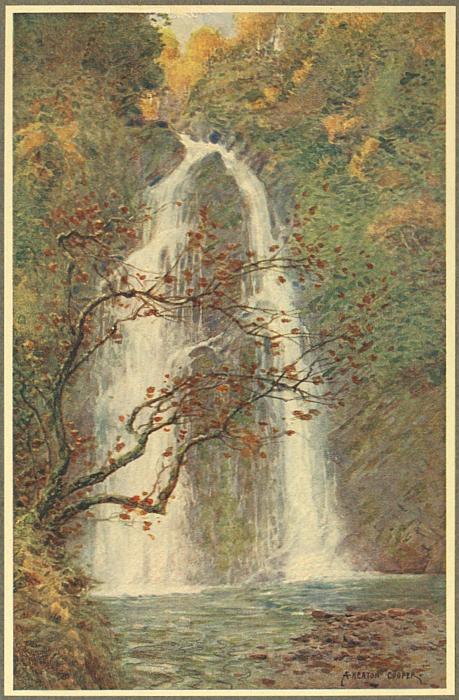
woodland walk to follow up the dell to the
Rhenass Fall towards its head, where the stream
descends over mossy crags in a theatre of deep
seclusion. This is the end of the orthodox glen;
but by climbing above the fall on the open hillside
and penetrating the upland valley that lies
between Colden (1,599 feet) and Sart Fell (l,560
feet), we soon begin to get among the mountains.
Possibly, however, this digression involves some
trespassing; and trespass in Manx law—I write in
utter ignorance—may perhaps be invested with
pains and penalties that do not surround it in
England! Another good digression from the
main highroad may be made by quitting it at
Ballaugh, and proceeding through the Curraghs
by way of Jurby and Andreas. The Curraghs
is the flattest part of the island, and is formed of
alluvial deposits. Ballaugh old church at any rate
is picturesque outside; and two other churches
in this dull corner of the island—Andreas and
Bride—have each at least a brace of ancient
crosses. Of these old Manx crosses we hope
soon to say something more, when treating of the
grand collection on the south side of the graveyard
at St. Maughold. Of Manx ecclesiology
there is nothing to be said: it is patently without
interest or value. Peel Cathedral, we have
seen, has a little genuine thirteenth-century work,
and Braddon old church, like Jurby, is pleasant
enough to look on. Moreover, a skilled eye will
doubtless detect traces of mediaevalism in many
a featureless edifice that might seem at first the
uncomely product of the soulless eighteenth
century. But not even the best of the seventeen
old parish churches—and that, perhaps, is St.
Maughold—is likely to hold the archaeologist
long, or help to fill his note-book. Even the
pre-Conquest chapel at Peel can hardly be called
an exception; it is simply a matter of four bare
walls, quite without instructiveness or feature.
But whether the visitor proceed from Peel to
Ramsey by highroad, with or without digressions,
or resolve to make a day of it by boldly crossing
the fells, he ought not to fail, in any event, before
quitting the neighbourhood of Peel, to pay a
visit to the famous Tynwald Hill, of which
notice has already been shortly taken in passing.
This lies to the left of the main road from Peel
to Douglas, from which it is plainly visible, just
before entering the village of St. John's. In
itself it is quite inconspicuous—merely like a
flattened round barrow, with a second, smaller
round barrow, also flattened, on the top of it; but
the spot is one of immense suggestiveness, as well
as of great existing political interest. Every new
Manx law that has passed the House of Keys,
and received the royal assent, is here promulgated
in the open air on July 5 in each year. The
ceremony begins with a service in the adjoining
church; and everyone then adjourns to the
famous hillock—the Governor (who is now Lord
Raglan), the House of Keys, the Deemsters, the
Bishop, and the people. This rite is a genuine
antiquity that has come down uninterruptedly
from old time, not a mere artificial attempt at
archaeological revival, like the Dunmow Flitch,
in Essex—to compare small things with great.
Here, in short, as its very name implies, is perhaps
the last survival in Europe of out-of-door mass
legislation—the living representative of a now
almost vanished order that has left its traces in
place-names over much of Scandinavian Great
Britain. Dingwall, in Ross, which is virtually the
same word; Thwing, high up on the Yorkshire
Wolds; Laughten-en-le-Morthen (Laughten-in-the-Moor-Thing),
in the extreme south of the
same county; Thingwald, in the Cheshire Wirral;
Tinwald Hill, near Dumfries—all point indisputably
to the same phonetic origin—the Norse
tinga (to speak)—and all indicate alike the former
place of meeting of some more or less important
kind of tribal assembly. In Norway, Canon
Isaac Taylor reminds us, to the present day, the
Parliament is called the Storthing, or Great
Council. As to the constituents of this vastly
old assembly, readers of Mr. Hall Caine will not
need to be reminded that the two Deemsters are
the chief judges of the island. The House of
Keys, which corresponds with the English House
of Commons, consists of twenty-four members,
elected by a franchise that includes female suffrage.
Man, however, still retains the equivalent
of the English House of Lords; though its
"Council" is not hereditary in character, but
consists of such officials as the Bishop, the Archdeacon,
the Deemsters, the Attorney-General,
and others. The presence in this body of ecclesiastical
dignitaries reminds one of the constitution
of the States of Jersey and Guernsey, in both of
which the rectors of the historic parishes of the
Channel Islands sit as of right at the seat of
legislation. Indeed, the constitutions of all three
countries—free States within a State—and their
peculiar relation to England, are worthy of
curious scrutiny and close comparative study.
On the present occasion we propose to make
our way from Peel to Ramsey by neither of the
two alternatives that have briefly been sketched
above. We propose, on the contrary, to take a
composite route—partly through the lowland,
but mostly over hill—which will introduce
us alike to Kirkmichael, and Bishop's Court
beyond it, and carry us over the top of Snaefell—provided
always that it be autumn, spring, or
winter, and that the electric tramway is not running.
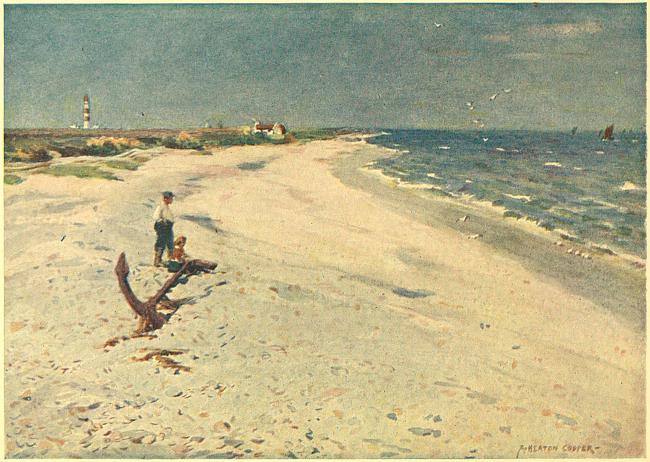
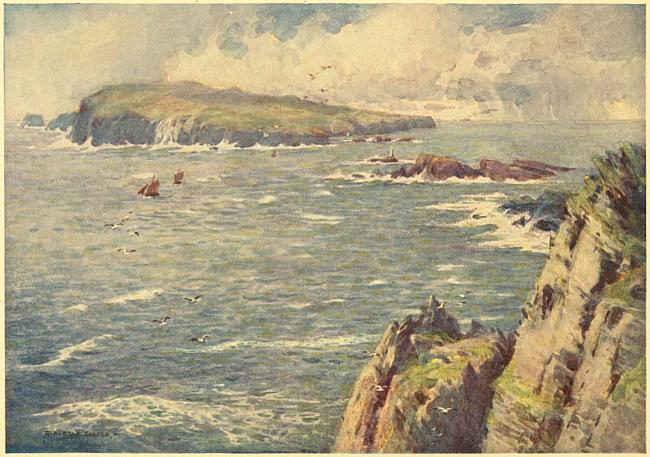
A BREEZY MORNING AT POINT OF AYRE.
The northern extremity of the Isle of Man with its lighthouse.
From Peel to Kirkmichael we either
follow the highroad, which is never very far
from the sea, or else take the roundabout route by
Tynwald Hill and Glen Helen. Kirkmichael
itself is a hard-featured little village stretching in
a single, long street along the main road to
Ramsey, and distant half a mile from the sea.
Luckily, so far, it has escaped the blight of
"development," and has plenty of character and
local Manx colour. The church was rebuilt in
1835—no need to state in what style—but a
fragment of its predecessor remains on the east of
the graveyard. Near this is the tomb of Bishop
Thomas Wilson (d. 1755), with an inscription
by his son, "Who in obedience to the express
Commands of his worthy Father, Declines giving
him the Character He so justly Deserved. Let
this island speak the Rest." There is a portrait
of Bishop Wilson—no doubt sufficiently fanciful—in
Mr. Hall Caine's Deemster, where he appears
as the good native Bishop. Wilson, however,
was really a Cheshireman, having been born at
Burton-in-Wirral in 1663; and was educated as
a sizar at Trinity College, Dublin, where he was
a contemporary of the saturnine Jonathan Swift.
In 1692 he was appointed domestic chaplain to
the ninth Earl of Derby, and tutor to his son,
which determined the whole after course of his
life. The Stanleys at this time were no longer
"Kings of Man," but they still possessed
authority almost regal. "In the year 1393 the
Earl of Salisbury sold to Sir William le Scroop,
afterwards Earl of Wiltshire, the Isle of Man,
with the title of King, and the right of being
crowned with a golden crown." In 1406, after
some intermediate dealings with which we need
not here concern ourselves, the island (still carrying
with it, no doubt, the right to "the golden
round") passed to Sir John Stanley, who died in
1414; and with the Stanleys it continued till it
passed by the marriage of an heiress to the Atholl
Murrays in 1736. The regal title, however, had
been dropped by the second Earl of Derby
(d. 1521), "as he preferred being a great lord to
being a petty King." The famous island arms
(Gules three legs in armour embossed and conjoined
at the thighs proper, spurred and garnished,
or) still figure among the many quarterings of
the house of Stanley. They may also be found
on old work in connection with buildings with
which the Stanleys had presumably something to
do—on the west front, for example, of the
fifteenth-century tower of Bidstone Church in
Cheshire, and on a misericorde in Manchester
Cathedral.
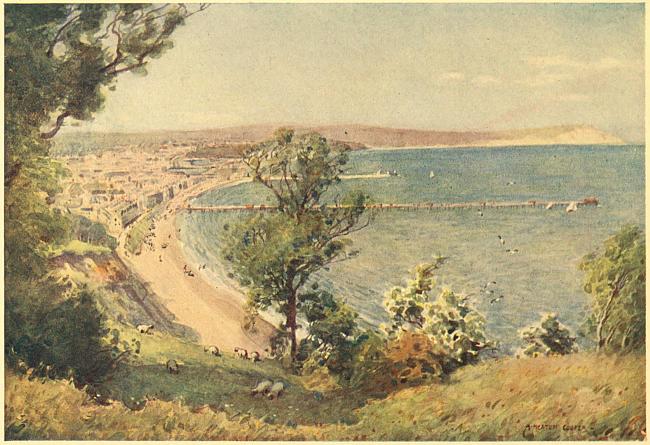
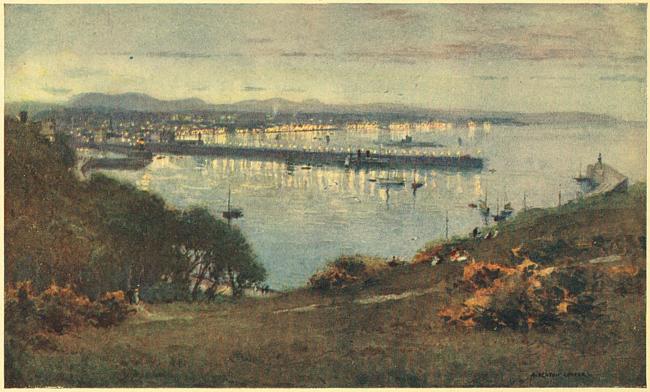
RAMSEY BAY, LOOKING NORTHWARD.
Ramsey is the second town in size in the island and like Douglas
faces East.
Among the many other prerogatives
that the ninth Earl of Derby still retained as Lord
of Man was the strange one of appointing its
Bishop. The last Bishop, Baptist Levinz, had
died in 1693, and for some strange reason no
successor had been appointed. It is said that at
last William III. threatened to take the appointment
into his own hand, and the Earl was thus
compelled to make his tardy election. It fell on
Thomas Wilson, who was consecrated at the
Savoy in 1698. Wilson from the first set his
face against corruption, and administered his
diocese with firmness and good-nature. He
seems, in fact, in his remote island diocese, to
have played a part in some ways not dissimilar to
that which was played by the "admirable
Walker" in the Furness parish of Seathwaite.
"He soon became 'a very energetic planter' of
fruit and forest trees, turning 'the bare slopes'
into 'a richly-wooded glen.' He was an equally
zealous farmer and miller, doing much by
his example to develop the resources of the
island. For some time he was 'the only
physician in the island'; he set up a drug-shop,
giving advice and medicine gratis to the poor.
Against the then besetting sin of pluralism
Wilson turned a face of steel; twice he refused
the offer of the rich living of Badsworth, in the
West Riding, which twice his patron offered
him, because he disapproved of non-resident incumbents.
His deep practical piety is manifest
from his two posthumous books, Maxims of Piety
and Christianity and Sacra Privata. But perhaps
the best-known episode in his long episcopate of
more than fifty-seven years—he died at the patriarchal
age of ninety-three—was his imprisonment
in Castle Rushen for refusal to pay a fine. In 1722
he had suspended the Governor's chaplain for
administering the Communion to the Governor's
wife, she being then in some sense excommunicate,
and for sanctioning false doctrine. Mulcted
for this interference in a sum of £50, Wilson and
his two Vicars-General elected to go to prison
rather than submit to the tyranny of an authority
that they held to be usurped. Wilson, indeed,
seems to have endeavoured to maintain in the
Isle of Man a system of moral discipline similar
to that the decay of which is deplored in
the Commination Service. His practice, however,
was tolerant; the Quakers are said to
have 'loved and respected him'; Roman
Catholics not infrequently attended his services;
whilst Dissenters, since permitted to stand, or sit,
at the Communion, were content to kneel at the
altar-rails like ordinary church-folk. To burial
inside the walls of a church he exhibited strong
abhorrence; and provision was expressly inserted
in his will that his own body should be interred
in the graveyard." A similar repulsion was
entertained by Dr. Wynne, a former resident of
Mold, in Flintshire, whose sentiments have
found public expression, if I recollect rightly, in
his epitaph, composed by himself. In this case,
unfortunately, by a curious irony of fate, a subsequent
extension of the chancel to the east has
since brought his grave within the compass of
the church.
In the lych-gate on the east side of Kirkmichael
Churchyard are preserved several of
those fine old crosses, though more or less in
fragments, that form the chief archaeological
glory of Man, and are now tended with such
laudable care. Something of these is said on a
later page. The Bishop's Palace at Bishop's
Court, a long mile to the north from the end of
the village, has been the residence of the Bishop
from at least the thirteenth century, and probably
for very much longer. The bishopric of Sodor
and Man was founded, according to tradition, as
early as the fourth century, when Amphibalus is
reported Bishop in 360; but all its early history
is difficult and obscure. Originally it comprised,
not merely Man, but also the Scottish
Hebrides (Southern Isles, or Sudreys, as opposed
to the Northern Islands, i.e., the Shetlands and
Orkneys); but the latter were necessarily severed
when the island was wrested from the Scots in
the reign of Edward III. Thomas (d. 1348),
or William Russel (d. 1374), may approximately
be considered as the first solely Manx
Bishop; but the ancient title of Sodor still forms
part of their official title, just as the Kings of
England still continued to quarter the fleur-de-lys
of France long after Mary had lost Calais.
Bishop's Court, however, is a little out of the
way for those who wish to cross the hills from
Kirkmichael to Ramsey. Nor does the place
indeed exhibit any interest for the archaeologist,
though the Bishop's private chapel is at present
used as a kind of pro-cathedral for the diocese.
From Kirkmichael Village there is a track—that
for part of the distance is no track—almost
directly due east, which passes between Slieau
Dhoo (1,139 feet), on the north, and Slieau
Fraoghane (1,602 feet), on the south, and ultimately
drops into the head of Sulby Glen at the
bottom of the western slopes of Snaefell.
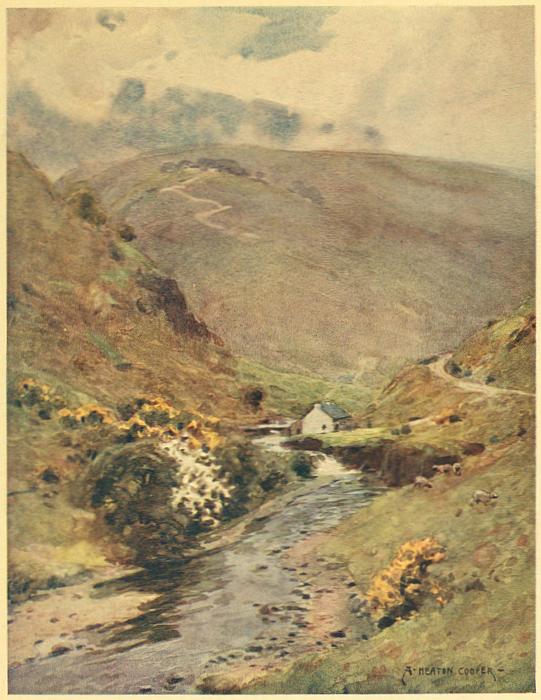
SULBY GLEN AND SNAEFELL.
Snaefell is the chief height in the island (2034 ft.)
It is now possible to ascend almost to the
summit by an electric railway from Douglas.
Or the visitor may retrace his steps toward Glen Helen
as far as the chapel at Baregarrow, passing on the
left the Hill of Reneuriling, sometimes called
Cronk Urleigh, or Eagle Mount, which is said
to have been the original Tynwald Hill of the
island. At Baregarrow a lane turns away to the
left, and winds up along the southern slopes of
Sart Fell (1,560 feet). Whichever route be taken,
as we penetrate the hills we realize more and
more the real nature of Manx mountains. The
central chain of hills extends for about twenty
miles from Bradda Head, a sea-cliff (766 feet), in
the south-west, to North Barrule (1,842 feet), in
the north-east, thus forming a true axis to the
island. The range is interrupted, not exactly in
the middle, but more towards the south, by the
great lateral valley that pierces it completely from
sea to sea, and through which run road and rail
between Peel and Douglas. South of this great
glen the highest summit is South Barrule (1,565
feet); but north of it comes a cluster of much
higher hills, the culminating point of which is
Snaefell (2,034 feet). These hills are built of
slate, like the hills of Cumberland and North
Wales, but there all analogy ceases. Snowdon
and Scafell Pike are convulsed masses of broken
rock, whose black nakedness is not always scantily
clothed with a coverlet of bracken, or wiry grass,
or sloppy bog-moss. From the foot of the sheer
crags extend long acres of scree-shoot, and the
hills are further torn in every direction by the
deeply furrowed channels of the torrents. In
Man the hill slopes are everywhere smooth, and
modelled in regular contours; they are clad, no
doubt, with moor, and sodden in places with wet,
but crag, and scree, and rock, are almost wholly
absent. They have even less ferocity than Skiddaw;
and Skiddaw, in addition, boasts a splendid
"double-front," and a bold black top that excited
the enthusiasm of even the town-loving "Elia."
What little rock they exhibit is confined chiefly
to the sides of one or two glens—Sulby Glen, for
instance, which is quite the finest in the island—and
to the beds of mountain streams; but none
of this is terrific.
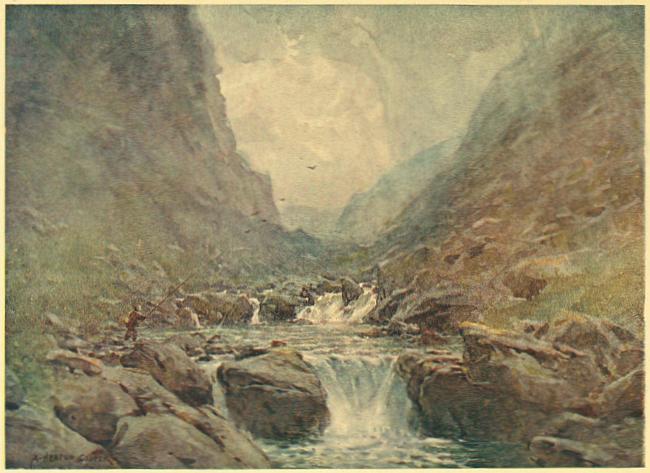
GLEN MAYE.
One of the picturesque little glens with which the island
abounds. It is near Peel, on the western side.
The truth indeed is this, that
this central range of Man, though akin to Westmoreland
and Carnarvonshire in its actual make
of rock, is altogether aloof from them in all
tangible characteristics. This is not to dispraise
the hills of Man, but only to rescue them from
the ignominy of an obvious, but quite unfair,
comparison. Manx mountains, in fact, though
thus composed of slate, have really much more
resemblance to the limestone hills of Yorkshire.
They have no pretensions to rank with the
best; but, judged by themselves, they are quite
satisfactorily noble. We are likely, indeed, to
appreciate them all the better, just because
we do not approach them in a mood of too
exalted expectation. On the whole they are
less dull than the Cheviots; and even the
Cheviots are full of all kinds of delightful surprises.
Moreover, as we win higher among the moorlands
by the lane that climbs from Baregarrow,
we realize more and more that charm of all-round
seascape that distinguishes these hills above all
compeers, and gives them their imperishable
charm. The wonderful extent of the view from
Snaefell was noted down as long ago as the
"spacious times of great Elizabeth." Thus,
Camden says quite truly: "In medio montibus
densius attolitur, e quibus aeditissimus Sceafell,
unde sudo coelo Scotia, Anglia, and Hibernia
prospici possit"—that is, England, Scotland, and
Ireland—and Wales must be added—can all be
seen from the top on a clear day. Drayton, in
his Polyolbion (Canto xxvii.), has just the same
remark translated into poetical diction:
Her midst with mountains set, of which, from Sceafel's height,
A clear and perfect eye, the weather being bright
(Be Neptune's visage ne'er so terrible and stern),
The Scotch, the Irish shores, and th' English may discern.
"In clear weather," says Mr. Baddeley, "not
only is the 'tight little island' itself mapped out
beneath the eye, with the exception of a strip of
the coast here and there, but Scotland is plainly
visible, from the Mull of Kintyre to beyond
Dumfries; Ireland is represented by the Mourne
Mountains; England by the giants of the Lake
District; and even Wales shows up, with the
Peak of Snowdon, the 'Carnedds'—Dafydd and
Llewelyn—and the range extending thence, Penmaenmawr
to the Great Orme, with, maybe, the
Clwydian range, in cloud-like outline, far away
in the south-east. The nearest point of England
to Snaefell is St. Bees Head, 38 miles distant;
of Scotland the Whithorn Promontory, 30 miles;
of Ireland the entrance to Strangford Lough,
36 miles; and of Wales the northern coast of
Anglesey, 56 miles; Scafell is 50 miles away;
Merrick, the highest Scottish mountain south of
Edinburgh and Glasgow, 60; Slieve Donard, the
highest in the North of Ireland, 60; and Snowdon,
80."
The lane by which we are now travelling,
though sufficiently rough-and-tumble, is one over
which it is possible to push a bicycle; the writer
himself has done it. It is not, in fact, the least
strange feature of these Manx hills that they are
thus traversed by high-level roads—not actually,
indeed, climbing to the tops of the mountains,
but winding in and out among them not far below
their summits. One of these, between Douglas
and Ramsey, and immediately under the shadow
of Snaefell itself, has been engineered, I fancy, of
quite recent years. One is reminded a little of
the many new upland roads that the French are
now constructing in Auvergne among the mountains
of Mont Dore. Climbing along the south
breast of Sart Fell, with the Rhenass stream
below us on the right (which flows ultimately
down Glen Helen), we come presently to the
slight col between the valleys of the Rhenass and
the Sulby, just before surmounting which the
heavy, dome-like top of Snaefell starts suddenly
up through the nick of the pass, with its castellated
hotel on its summit. The electric rail from
Laxey—a hideous double line—almost completely
encircles the bare, flattened cone of the hill as it
winds round it in gradual ascent, exactly in the
fashion in which the line from Clermont-Ferrand
(though this is served by an ugly
monster that vomits out volumes of smoke) winds
up the Puy de Dôme, almost like the peel of an
orange. It must be pleaded, however, in excuse
of the tram-road up Snaefell—if any plea may be
heard to extenuate its bare existence—that at least
it has not scarred harsh lines round the hill, as is
the case with its central French rival—lines that are
plainly visible, on a reasonably clear day, eighteen
miles away, or thereabouts, from the top of the Puy
de Sancy. The view now opens on the left into the
head of Sulby Glen—more properly Glen Mooar,
the Big Glen—the strength of which lies further
to the north, where it deepens beyond the inn at
Tholt-y-Wilt. This is usually reckoned the
finest in the island, and has certainly best pretensions
to recognized mountain grandeur—if any
spot, indeed, in the whole of the Isle of Man
may properly be styled either mountainous or
grand. Hereabouts, in succession, two rough
roads turn down, to the south, to Injebreck, deep
in the green valley between Colden and Carraghan
(1,520 feet), and the terminus of a good
driving-road from Douglas. Neither can be
ridden on a bicycle, and one at least, when we
descended it—but we speak of now two years ago—was
rapidly being swept away by the fury of
mountain torrents. Thus Injebreck is practically
a cul-de-sac, secluded in the greenest of dale-heads;
and those who are lucky enough to drop
down into it, as the writer dropped down, just
towards sunset on a mild February evening, with
nearly a score of croaking ravens circling above
his head, will reckon it perhaps the most beautiful
spot in the island, and one that still remains
entirely unspoilt, serene in the possession of its
pleasant rustic graces.
Injebreck, however, on our present route, must
be kept for another day: for the moment we
keep the level, round the north face of Beinn-y-Phott
(1,772 feet), till we fall into the great
high-level route already referred to as running
from Douglas to Ramsey. This, at the point of
junction, is crossed by a gate the closing of which
is enforced by the threat of legal penalties—a
timely reminder that the law of Man is not
always co-extensive with the law of England.
Beinn-y-Phott itself is a prominent summit that
perhaps displays more character than most of its
sister peaks. After all, it may be true that the
names of Manx mountains present greater interest
than Manx mountains themselves. Snaefell, of
course, is the "hill of snow"—exactly the equivalent
of familiar Snowdon (there are said to be
two Snaefells in Iceland). Cronk-ny-Irey-Lhaa,
on the other hand, which drops so splendidly
into the sea between Glen Maye and Port Erin
(there is a second hill of the same title in the
north division of the island), is said to mean the
"Hill of the Rising Sun," and bears witness to
conditions and an altitude less rigorous.
From the point where our rough cart-track
joins the great high-level road between Douglas
and Ramsey we turn north-eastward along this
latter, between Snaefell and Clagh Ouyre (1,808
feet). Snaefell itself is easily climbed, if the conditions
be really propitious, by diverging to the
left up the gentle hill-slope at almost any point
we like after crossing the electric tramway.
Hereabouts, on our right, we look down into the
deep glen, disfigured by a lead-mine, which ends
on the sea at Laxey. A little beyond this, when
Snaefell is now behind us, and growing smaller
in the distance, the eye begins to measure the
profound and solemn depths of green and pastoral
Glen Auldyn. The elevation is maintained till
quite near Ramsey, when we plunge down
suddenly from our mountain heights by a drop
of unexpected and startling abruptness. Of
Ramsey I have little to say: there seems little
to say about it. It is said to look charming when
approached from the sea, but the charm must
soon vanish on landing. Down by its quays it is
just a little harbour, with the usual local colour
of a place that lives by shipping and fishing. Of
the parts of the town that live by visitors there is
little to be said for good or for evil.