CHAPTER I INTRODUCTORY
THE
ISLAND OF STONE MONEY
Although old-time Pacific whalers and missionaries, both of them,
let us hope, from kindly motives of rendering the islanders happy,
introduced two unfortunate attendants of western civilization—alcohol
and diversity of faiths—nevertheless the natives of The Caroline
Islands have retained the greater part of their original primitive
beliefs, and recently, under admirable German rule, have perforce
abandoned alcohol. Wherefore they are become an exceedingly pleasant
and gentle folk to visit; this is especially true of the natives of the
island of Uap or Yap, the most westerly of the group. Like all other
primitive people (it hurts one’s feelings to call them savages or even
uncivilized,—one is too broad and the other too narrow) they are
shy at first, either through mistrust or awe, but, let acquaintance
and confidence be once established, and they are good company and
benignantly ready to tolerate, even to foster condescendingly, the
incomprehensible peculiarities and demented foibles of the white-faced
visitor.
When I visited The Caroline Islands in 1903, there was but one small
steamer, of a German trading company, which, about five times a year,
links these little worlds with our great one, and the people which it
brings from the uttermost horizon must seem to the natives quite as
wonderful as beings from Mars might seem to us; we at least can discern
the little point of light from which our Martian visitors might come,
and can appreciate the size and distance of another world, but to the
man of Uap, whose whole world in length and breadth is but a day’s
walk, the little steamboat emerges from an invisible spot, out of the
very ocean.
After a whole month of tossing and rolling and endless pitching on the
tiny, 500-ton steamer, Oceana, plying between Sydney and The
Marshall and Caroline Islands and Hong-Kong, we were within one night’s
sail of the little island of Uap,—a mere dot on our school maps. Here
I intended to remain for nearly two months and await the return trip of
the steamer. The five short stops which the steamer had made at other
enchanting, alluring islands had been veritable hors-d’œuvres
to whet the appetite, and while drinking in the beauty of my last
sunset from the deck of the copra-laden little steamer, with the sea
the colour of liquid rose leaves and the sky shaded off in all tints
of yellow, orange, green, blue, mauve, and rose-color, I was thrilled
by the thought that I was soon to enjoy again the earthy perfume of
damp groves of palm, the pungent odor of rancid coconut oil, and the
scent of fires of sappy wood, whereof all combined compose the peculiar
atmosphere of the palm-thatched houses of Pacific Islanders. I expected
to be awakened on the following morning by the sudden change from
tossing on the open sea to the smooth gliding of the vessel through the
waters of the calm lagoon, and with that delicious smell of land and of
lush vegetation. Instead of this, however, in the gray of dawn, I was
instantly aroused by the clang of the captain’s signal to the engine
room, ringing first “stop” and then “full speed astern.” I jumped from
my berth to the deck and looked into a thick, impenetrable fog that
utterly hemmed us in. From every side an ominous roar of breakers rose
above the thump of the engines. The fog lifted; there were the reefs
and breakers distant not a hundred and fifty feet dead ahead of us;
then down came the fog and off we backed, only to find that the reefs
encircled us completely. Even before the glow on the light and fleecy
clouds which formed the ineffable beauty of the sunset had faded, heavy
clouds had arisen; by midnight the sky was inky black with no star
to guide our course. The captain thus fell a victim to the strong,
variable currents, characteristic of these waters, which are indeed
but one of the many varieties of thorns which hedge these Sleeping
Beauties of the ocean; these had been responsible for our being hurried
on much faster than the log could show, and here we were almost on top
of the reef, two hours ahead of time, with the land hidden behind an
impenetrable veil.
Our situation was like a fever-dream, wherein vague but fatal dangers
threaten, and, strain as we may, we are unable to open our eyes. The
fog had been like a great eyelid, raised and lowered just long enough
to give us one fleeting glimpse, and no more, of fatal peril, while the
thunder and hissing swish of the breakers were like the deadly warnings
of a rattlesnake before it strikes. Then, of a sudden, again the dense
fog lifted completely, and the land seemed verily to rise out of the
sea, and we found ourselves directly in front of the very entrance to
the harbour with the channel of deep-blue water almost running out to
meet us. Five minutes more of fog and we should have been pounding
helplessly on the reefs with the garden gates impenetrably closed.
I mention this only to give the hint that were the gates wider open
and less dangerously ajar, “trade’s unfeeling train” would have long
ago wholly overrun these imprisoned little lands and dispossessed the
aboriginal “swain.”
Yap, or rather Uāāp, with a prolonged broad ā, the pronunciation
invariably used by the natives, means, in their old language, I was
told, “the Land,” which, I suppose, exactly meant to the
aborigines—the whole world. Uap is, as I have said before, the
westernmost of The Caroline group, and lies about nine degrees north of
the equator. It is not an atoll, but the result of volcanic upheaval;
it is encircled, nevertheless, by coral reefs from three to five miles
wide, and has, at about the middle of the southwestern coast, a good
harbour in Tomil Bay.
To recall very briefly the general history of this group of islands:
They have been known to the civilized world since 1527, when they were
discovered by the Portuguese; a hundred and fifty years later they
were annexed by Spain and named in honour of Carolus II. At the close
of the Spanish-American war the whole group was purchased from Spain by
Germany for the sum of $3,300,000, and since then under judicious and
enlightened government has steadily improved in productiveness.
The natives of Uap, in number from five to six thousand, are of
that perplexing type known generally as Micronesian, which covers a
multitude of conjectures. The natives of each island have certain
characteristics of form and features which make relationship to natives
of other islands or groups of islands a possibility; but, on the other
hand, there are such differences in language, in customs, in manner
of living, that it is well-nigh impossible to state, with any degree
of certainty, what or whence is the parent stock or predominant race.
By way of generalization merely, and not as deciding the question,
let me say that the people of Uap are of the Malayan type,—a light
coffee-coloured skin; hair black and inclined to wave or curl, not
crinkly, like the Melanesian and African; eyes very dark brown, almost
black; cheek bones rather high and noses inclined to be hooked, but
not prominent. In this last feature they resemble other Polynesians
and the Melanesians of New Guinea and The Solomon Islands. They are
not as tall nor, on an average, as strongly built as the natives of
Samoa, Fiji, or Tahiti. Since the sale of intoxicants and gunpowder has
been prohibited, except to the trustworthy chiefs, they are gentle,
docile, and lazy; formerly, under the very lax rule of Spain they were
exceedingly troublesome and frequently made raids upon the Spanish and
German traders, and were continuously at internecine war.
Personal details are generally uninteresting; it therefore suffices
to say that I was received most kindly by the little colony of white
people who live upon the island, consisting of the resident doctor,
then acting as Governor; the postmaster; the manager—an American—of
The Jaluit Trading Company; and four Spanish and German copra traders.
I was most hospitably entertained by Herr Friedlander, one of these
copra traders, and, in point of residence, the oldest white trader on
the island. With a courteous friendliness for which I shall be always
grateful, he invited me to lodge with him at his little copra station
in Dulukan, where I could be all the time in close touch with the
natives; not only was he always ready to act as my interpreter, but
was also at every turn unwearied in his kindness and devotion. I had
expected and hoped to share the home life in the houses of the natives,
as I had done in Borneo, but the village life and the home life of the
people of Uap differ so widely from those of the Borneans that I found
it would be better by far to stay in Herr Friedlander’s comfortable
little pile-built house and visit the natives, or get them to visit me.
As soon as the Oceana had discharged her cargo and departed on
her way to Hong-Kong, we set our sail of matting in Friedlander’s
native-built copra barge, which was fairly loaded to the gunwales with
my luggage and photographic outfit, and glided through green aisles of
mangrove and over the glassy blue and green water of the lagoon to the
southern end of the island where lies the delightful, scattered little
village of Dulukan.
CHAPTER II NATIVE HOUSES
The island is divided into districts, more or less defined, which are
the remnants of former days when these districts marked the division
into hostile tribes; but now, under one government, these separate
districts are but little regarded as tribal divisions, and within them
the houses are scattered indiscriminately in small groups. Such a thing
as a village street or even a road between rows of dwellings nowhere
exists; there is, therefore, nothing of what we would call village
life, when
“all the village train, from labour free,
Led up their sports beneath the spreading tree.”
The large “bachelor houses,” to be sure, are adequate meeting places
for the men, but the poor neglected women have no common ground where
the heart-easing and nutritious gossip of the day may be exchanged.
In the coconut groves, which form a broad band along the coast all
round the island, each house is surrounded by a neatly-swept clearing,
and this little lawn, if that can be called a lawn which is devoid of
grass, is brightened here and there by variegated crotons, suggestive
of the neatness of the Uap housewife, and affording an attractive
playground of chequered shade under the lofty palms. The houses are
always built upon a platform, about two and a half to three feet high,
of masses of coralline rock, which look like huge pieces of pumice
stone; when first taken from the water this soft lime-like rock lends
itself admirably to being smoothed and fashioned with the primitive
implements of the natives. The platform is made level on top by filling
in with rubble and earth or with a covering of large flat stones. This
loosely built foundation is, I suppose, to serve the same purpose as
the high piles whereon tropical houses are usually built, namely, to
keep the floor, which is also the domestic bed, as high and dry as
possible above the level of the ground, which at times is deluged with
rain in the usual tropical abundance. Well constructed houses have
a broad and long foundation platform, whereon is built a second stage
just large enough to be covered by the house; the lower and larger
then serves as a broad uncovered veranda round at least three sides of
the building. The cornerposts for the framework are embedded in the
upper dais of stone so that the occasional typhoons which sweep the
island and level even the coconut palms may not carry away the whole
structure. Every beam and stanchion is mortised to its fellow and bound
with innumerable lashings of twine made from the fibre of coconut
husks; not a nail is used and scarcely a peg.
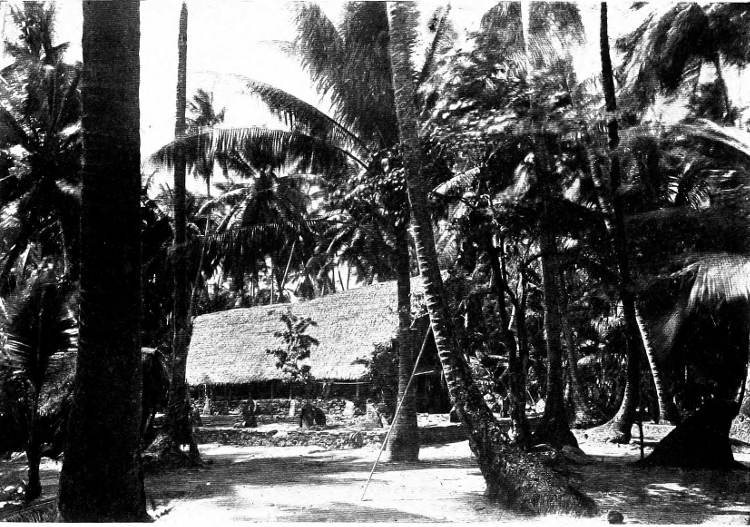
A NATIVE RESIDENCE
In the little yards or clearings about the houses and on the larger
broad platform of stones whereon the houses are built, all that there
is of village life goes on; here guests are received and entertained,
councils of the wise held, and news passed round. It is decidedly bad
manners for any visitor to enter a house, except by special invitation,
no matter how intimate a friend he may be. Very often, to add to
comfort, upright stones are imbedded in the lower platform to serve as
back rests when sessions of the councils happen to be prolonged or the
orator prosy. A matting of bamboo grass, or else panels of interwoven
fronds of the coconut palm form the side walls of the house; security
and secrecy, it must be remembered, are hardly necessary in such
small communities, where all are acquaintances, and every article of
household use or of luxury is almost as well known to everybody as to
the actual owner; stolen goods are not marketable and thefts are quite
rare, except, of course, of coconuts that happen to fall unexpectedly
and temptingly from a neighbour’s tree.
The interior of the house is neither bright nor cheerful; it is not
strange, therefore, that there is but little indoor life. The eaves
of the palm-thatched roof overhang so far that they almost touch the
level of the floor and all the light and air come through the doorway,
or through one or two panels in the wall which are occasionally raised
like shutters and held by a wooden hook suspended from the rafters.
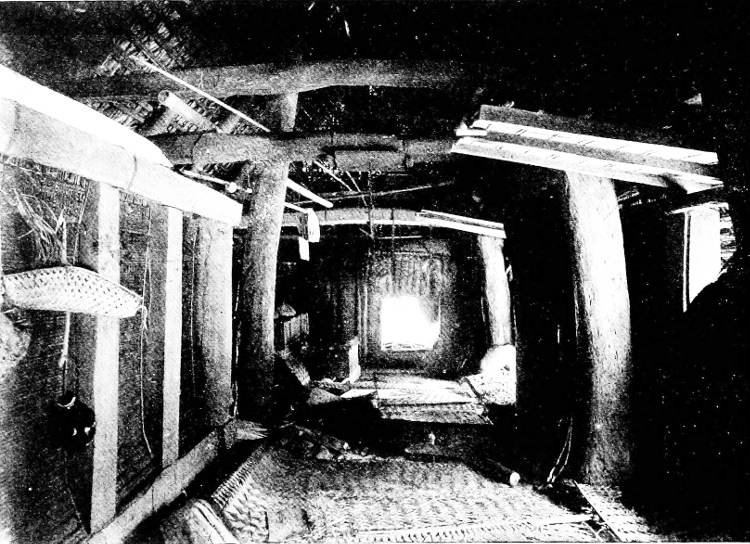
A RICH MAN’S HOUSE. ON THE RIGHT IS A FINE WHITE “FEI,”
AND, HANGING FROM THE RAFTER IN FRONT OF THE DOOR, A BANANA FIBRE MAT
How any dust at all can collect on a small island in mid-Pacific is a
mystery; nevertheless, every article in a Uap house is coated deep with
cobwebs and fine dust. This is also the case, however, in the houses of
all Pacific Islanders that I have ever visited, and is possibly due to
absence of chimneys and abundance of smoke.
There is always in private houses in Uap an inner room or corner,
screened off from the common room, where the owners of the house sleep
at night. This little sleeping-room is totally dark except for what
little light may filter through the walls or under the eaves. There
is, of course, no second story to the houses, except a general storage
place under the rafters, on top of the cross beams, where any article,
not in daily use, such as a leaky canoe, a ragged fish net, a broken
spear, etc., is tucked away.
I have groped my way through many a Uap house, of course with the full
permission of the owner, rummaging in every dark corner in search of
articles of ethnological interest, but only once or twice was my search
rewarded. The owners did not seem to object in the slightest degree
to my curiosity, and after giving me liberty to poke and pry to my
heart’s content, they stood by smiling and good-naturedly answering my
questions as to the names and uses of everything. They knew well enough
that I should not find what they considered their really valuable
possessions, which were probably hidden away in the darkness of the
inner chamber, and were sure moreover that whatever I found that I
wanted would be paid for by many a stick of “trade” tobacco.
It was near a scattered collection of houses such as these that, on a
cloudless afternoon in February, I landed at Friedlander’s charming
little copra station. He is married to a native of Guam, a convert
to the Roman Catholic faith, but not to the western method of living
and style of house; so Friedlander has built for her a home to her
liking, bare of all furniture, except mats on the floor, and with an
open hearth for cooking and for the comforting circulation of smoke
throughout the house, or rather room; here she lives “shut up in
measureless content” with her select circle of native friends, together
with a sprinkling of elderly relatives, which seems to be an inevitable
household element in the Orient.
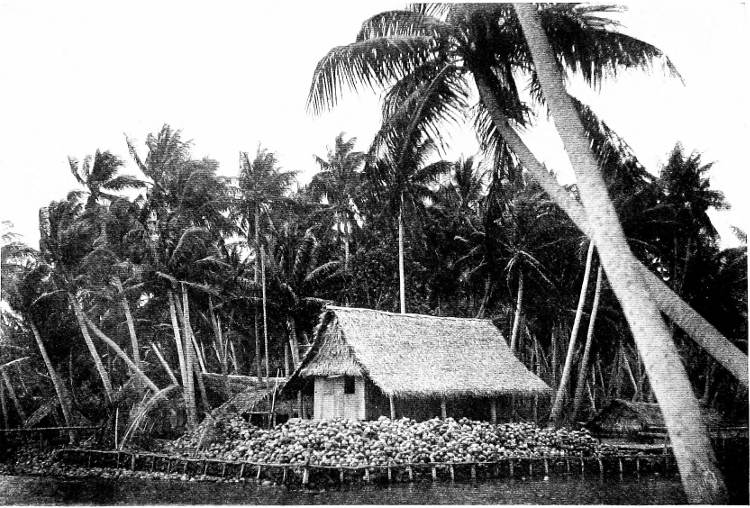
HOUSE OF A COPRA TRADER
My host and I, however, put up at his own little house built within
the same compound, on piles six feet high and furnished with two
comfortable cot-beds, tables, and chairs. The whole house is about
twenty feet long by ten wide and constructed as openly as possible,
with roof and walls of palm-leaf thatch, for coolness’ sake. This is
also his office where he transacts business, such as the purchase of
coconuts or the payment for the manufacturing of copra. Copra, by the
way, is made by cutting out the meat of ripe coconuts and placing it on
screens to dry in the sun. When thus dried, it is exported to Europe,
where the oil is expressed and used in the manufacture of fine soaps.
After my luggage had been carried up from the little jetty of rough,
spongy, coral blocks to the house, about twenty feet away, and while
Friedlander was busy with his group of natives, settling accounts for
coconuts delivered during his absence, and with unpacking his boxes of
new articles of trade, I strolled forth to take a preliminary survey of
my field, provided with a note-book wherein were certain useful phrases
in the Uap tongue which I was anxious to put to the test.
The compound about Friedlander’s several houses was quite deserted;
everybody had gathered about the master to watch the unpacking and
drink in with open ears and gaping mouths every syllable that fell from
his lips; and, of course, to ask innumerable irrelevant questions. The
declining sun cast long bands of orange light between the gray and
mossy-green trunks of the palms, and the sandy earth of the well-swept
little compound was rippling with the flickering shadows of the
over-arching coconut fronds. There was no song nor twitter of birds;
the only sound was the murmur of voices from the crowd within the
house, and from a little inlet beside the deserted husking sheds came
a rhythmical swish of innumerable coconut husks floating there in an
almost solid mass. I turned out of the bamboo wicket gate eager for
exploration, and, feeling very much
“Like some lone watcher of the skies,
When a new planet swims into his ken,”
I became suddenly aware, however, of the drollest, coffee-coloured,
curly-headed, little seven-year-old girl gazing at me with solemn black
eyes, awestruck and spellbound. The expression of those wide open eyes,
framed all round in long black lashes, was awe, fear, and curiosity
mingled; her hands, prettily and delicately shaped, not overly clean,
were pressed one upon the other on her little bare chest as if to
quell the thumpings of fright, and, whether from astonishment or by
nature, her glossy black curls stood up in short spirals all over her
head. She was such a typical, little, wild gingerbread baby, that I
could not avoid stopping at once to scrutinize her as earnestly as she
scrutinized me. Although she was the only one of her kind in sight, she
stood her ground bravely and betrayed nervousness only in the slight
digging of her little stubby brown toes in the sand as if she were
preparing a good foothold for a precipitate dash. As I looked down
upon her, the bunchy little skirt of dried brown grasses and strips
of pandanus leaves, her sole garment, gave her the appearance of a
little brown imp just rising out of the ground. I thought I detected
a slight turning movement in those nervous little feet, so for fear
of frightening her into the headlong dash, I looked as benignant,
unconcerned, and unsurprised as I could, and turned down the path
outside the fence toward the first house in sight. With no particular
objective point I followed one of the wide, native-built paths
constructed of sand, finely-broken shells, and decomposed coral, and,
inasmuch as they dry off almost instantly after a heavy shower, they
are excellently devised for rainy seasons. These footpaths (there
is not a cart in the community) extend from one end of the island to
the other and branch off toward all the principal settlements; many
of the smaller branches are, however, constructed with no great care
and consist merely of a narrow paving of rough coral and stone, well
adapted for tough bare feet, but not for stiff, slippery, leather soles.
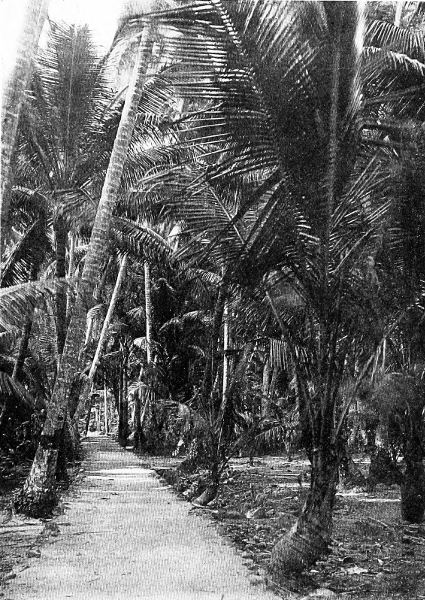
A NATIVE-MADE PATH
The road past Friedlander’s Station at Dulukan is one of the main
thoroughfares and well kept up; down this I turned, with the long vista
before me of gray, sun-flecked road, overarched by the cloistered
fronds and bordered by the slanting stems of coconut palms, with here
and there spots of bright color from variegated crotons and dracænas. I
was lost in admiration of the beauty of it all and was still thinking
of my first encounter with an island-born elf, when I heard the patter
of tiny feet behind me, and turning, saw again the little jungle baby
trotting close after me. Curiosity had spurred on her valour to conquer
discretion, and now she stood close beside me, and, with a sidelong
glance, smiled coyly and inquiringly, showing a row of white baby
teeth set rather far apart. I too smiled in return at the droll little
figure, and, not having my Uap Ollendorf at my tongue’s end, I said
in English “Come along, little elf, and take a walk.” The spell was
broken; I became to her a human being with articulate speech, and not
a green-eyed demon. At once there issued forth in a childish little
treble a stream of higgledy-piggledy words, and then she wistfully
waited for a reply. The Uap vernacular failed me, so I simply shook my
head despairingly. Then I heard her say distinctly one of my note-book
phrases, Mini fithing am igur? “What’s your name?” This I could
answer and she tried hard to repeat the name I gave; after several
ineffectual struggles, she looked up consolingly, and patting her chest
with her outspread hand, and nodding her head each time to emphasize
it, she reiterated “Pooguroo, Pooguroo, Pooguroo,” clearly intimating
that this was her own name. Here then was all the formal introduction
necessary, so we two sauntered down the path together, she keeping
up a constant chatter and patter, while pointing toward houses here
and there in the open grove of palms. I think she was telling me the
name of every house-owner in the neighbourhood and the whole of his
family history and also his wife’s, but I was restricted to “Oh’s”
and “Ah’s” and grunting assents; but all distinction of race or age
vanished and here I gained my first little friend, staunch and true,
among the people of Uap. I never found out who she was, further than
that she was Pooguroo; she was always on hand when anything was astir,
and always proved a fearless little friend among the children; but
who her parents were, or where her home, I never knew. Adoption, or
rather exchange of children at an early age, is so common that it is a
wise father that knows his own child. To the mind of the Uap parents
children are not like toothbrushes whereof every one prefers his own;
they are more or less public property as soon as they are able to run
about from house to house. They cannot without extraordinary exertion
fall off the island, and, like little guinea-pigs, they can find food
anywhere; their clothing grows by every roadside, and any shelter, or
no shelter, is good enough for the night. They cannot starve, there
are no wild beasts or snakes to harm them, and should they tear their
clothes, nature mends them, leaving only a scar to show the patch;
what matters it if they sleep under the high, star-powdered ceiling
of their foster mother’s nursery, or curled up on mats beneath their
father’s thatch? There is no implication here that parents are not fond
of their children; on the contrary, they love them so much that they
see their own children in all children. It is the ease of life and its
surroundings which have atrophied the emotion of parental love. Has
not “too light winning made the prize light?” When a father has merely
to say to his wife and children “Go out and shake your breakfast off
the trees” or, “Go to the thicket and gather your clothes,” to him the
struggle for existence is meaningless, and, without a struggle, the
prizes of life, which include a wife and family, are held in light
esteem. Parental love, by being extended to all children, becomes
diluted and shallow. Is it not here then, in an untutored tropic
island, that the realization is to be found of the Spartan ideal?
Somebody’s children are always about the houses and to the fore in
all excitements, and never did I see them roughly handled or harshly
treated. As soon as they are old enough they must win their own way,
and, if boys, at a very early age, they make the pabai or
failu—the man’s house—their home by night and day, sharing the
cooked food of their elders, or living on raw coconuts, and chewing
betel incessantly.
CHAPTER III BACHELORS’ HOUSES
One of the most noteworthy features of Uap life are the large houses
known as failu, when situated on the coast, and pabai,
when built inland beyond the belt of coconut groves. These houses are
found in all Uap villages, and pertain exclusively to the men, be
they married or single; herein councils are held, and the affairs of
the community are discussed, free from all intervention of women; and
here, too, men and boys entertain themselves with song and dance, in
which, under the plea that it would not be decorous for women to join,
a desire may be detected to escape feminine criticism. A failu
or pabai is frequently years in building; the men do not
wait, however for its final completion and ceremonial opening before
occupying it, but often make it their home even should no more than
the framework and roof be finished. Every post, every beam is selected
with extremest care, so that all its natural curves and angles
may be used without further shaping. No nails, and, indeed, very few
pegs are used to hold the beams together; each beam is attached to
another by mortising, and then literally thousands of yards of cord,
made from the fibre of coconut husks, are used to bind the joints. The
lashings of this brown kaya cord furnish excellent opportunities
for ornamentation; wherefore, with tropical lavishness and Oriental
contempt for the expenditure of time, the main posts, for four or five
feet below the cross beams, are often bound with cords interlaced
into beautiful basket patterns and complicated knots; where the
slanting supports of the thatched roof meet the side walls there is a
continuous, graceful band of interwoven cords, where each knot has its
own peculiar designation and invariable position.
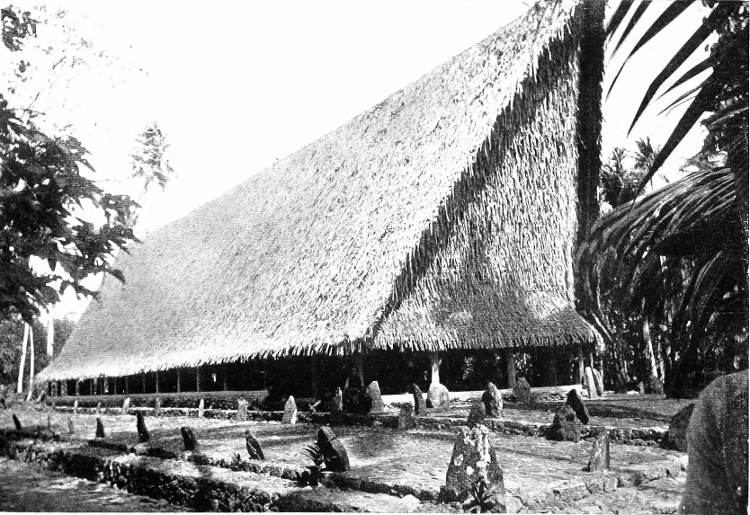
A “PABAI,” OR MEN’S CLUB-HOUSE
When, after years of fitful labor, one of these club-houses is finally
complete, a feast is spread and dances are performed in front of the
structure, to which all, including even the women, for the nonce, are
invited; the house is then and there given a name, and new fire is
started in the fireplace by means of the fire drill, the most primitive
method of obtaining fire known in Uap. Thereafter this failu or
pabai belongs exclusively to the men, and no women, with but one
exception, dare set foot within its precincts.
During the fishing season every fisherman, while plying his craft, lies
under a most strict taboo. Wherefore, one very important use of the
failu, or “house on the shore,” possibly its primitive cause, is
to provide a place of seclusion for the tabooed fishermen during their
intervals of rest. After three or four days and nights of hard work in
boats on the open sea outside the lagoon, the fishermen return to the
failu to distribute their haul of fish and to repair damages to
their boats and nets. Whether the sea has been calm or stormy, they are
always an exhausted crew; their meat and drink have consisted almost
exclusively of coconuts, and their quarters have been extremely cramped
in the long, narrow, out-rigger canoes. Not for these poor wretches,
however, are the refreshing comforts of home when, weary and worn,
they return to recuperate; an inexorable, rigorous taboo enshrouds
them until the last hour of the six or eight weeks of the fishing
season. During their brief seasons of needful rest, not a fishermen
dare leave the failu or, under any pretext whatsoever, visit his
own house; he must not so much as look on the face of woman (with one
exception) be she his own, or another’s, mother, wife or daughter. If
the heedless fisherman steal but a glance, flying fish will infallibly
bore out his eyes at night. They may not even join in song or dance
with the other men of the failu in the evening, but must keep
strictly and silently apart; nor may their stay-at-home companions
mingle with them; and, worst of all, until the fishing season is over
and past, they can have none of a fisherman’s prerogative of endlessly
expatiating on the unprecedented size and weight of the fish that they
have missed,—tantum religio potuit suadere malorum.
It is truly impressive to see large fishing canoes come in after a
cruise; they carry twenty or more men, and have often experienced
extremely rough weather for craft which, according to our ideas, are so
unwieldy, and unstable. In their management they can be paralleled only
by the vessel provided by the “Bellman” in the “Hunting of the Snark,”
where at times it was not at all out of the ordinary for the bow to get
mixed up with the rudder. Inasmuch as the whole balance of the boat
depends upon the out-rigger, it would never do, of course, to have the
large, heavy sail, bearing the weight of the wind, on the opposite side
of the boat; consequently, when sailing up in the wind, where tacking
is necessary, instead of putting about or jibing, the crew assemble
and, lifting the mast with all the rigging, carry it bodily from the
bow to the stern, where it is stepped anew; the stern then becomes
the bow, and the man at the helm has to scramble quickly to the other
end of the boat to find out which way he is going. Of course, such
a liberty never can be taken with the mast and rigging under any
other than a very mild breeze; consequently, in rough weather there
is nothing for it but to keep on one course until the wind abates, or
else take in all sail and drift. Herein lies one of the causes which
accounts, I think, for the mixture of inhabitants throughout Polynesia
and Micronesia; canoes full of helpless fishermen have been known to
drift from The Gilbert and Marshall Islands a thousand miles or more;
from the very centre of The Carolines down to the northern coast of
New Guinea and The Solomons. Is it any wonder then that the return of
a canoe full of friends, fathers, and husbands, who, for the common
good, have ventured forth on the vasty deep, far beyond the sight of
their little world, should be hailed, as it always is by the simple
islanders, with emotions almost akin to awe? Even to us it seems little
short of a miracle, when we reflect that this return is effected
without compass or sextant. It is not strange, therefore, that the
lives of these venturers should be hedged about with peculiar laws and
mysterious restrictions, as if they were beings apart from the common
herd, and superior.
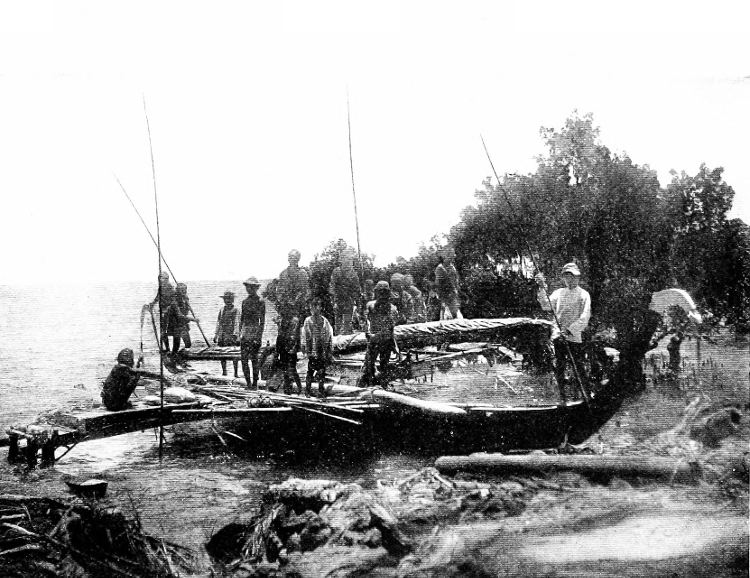
RETURN FROM A FISHING CRUISE ON THE OPEN SEA
A canoe is usually sighted long before it turns into the entrance to
the lagoon, and then the members of the failu stand or squat on
the stone platform at the seaward end of the house and quietly watch
the slow approach of their daring comrades. When they are within a half
a mile or so of the shore where the water is shoal and thickly sown
with many protruding treacherous boulders,—the remains of ancient
fish-weirs,—the mast with its sail of matting is unstepped and stowed;
the canoe is then guided on its tortuous way with poles and paddles.
The approach is slow and silent; there is no shouting, no outward
excitement; it has all the solemnity of a religious ceremony; the
waiting crowd on the shore is hushed or converses in subdued whispers;
the great, unwieldy canoe moves slowly onward with all the dignity of a
majestic ocean liner coming into port. As soon as the bow touches the
shore, the fishermen at once disembark and silently march up into the
failu, leaving two members of the crew to protect with matting
the painted figureheads of conventionalized frigate birds, at the bow
and stern; and, after unloading the fish, to take the canoe to its
mooring nearby.
I once went into a failu immediately after the fishermen had
returned; the whole interior aspect of the house was changed; more than
two-thirds of the floor was partitioned off into little stalls or pens
made of matting of green coconut fronds with the leaves interwoven.
The sides of the little pens were just high enough to permit the
occupants when sitting down to look over and see what was going on;
if they wished to be unseen, they had only to lie down. Possibly,
these partitions are not so much for seclusion as to prevent any one
from stepping over the legs of the sleeping fishermen, a terribly
ill-omened accident, and sure to bring misfortune on the sleeper. The
other members of the failu were gathered together at the inland
end of the house, and were either at their usual trifling occupations,
or mending fine cast-nets, or fashioning from a section of bamboo a
box for powdered lime, that indispensable adjunct to betel chewing;
some young dandies, or oofoof, as they are termed, were grouped
about a little heap of glowing embers, which they had raked together
for cheerfulness’ sake, and, also, to save the expense of innumerable
matches for their cigarettes; they were humming in unison one of their
unintelligible and unmusical songs. It was probably either etiquette or
taboo, but no one seemed to be paying any attention to the fishermen,
who seemed to be, in fact, absolutely ignored ever since their arrival.
These poor, tired men were each installed, and the whole floor
looked like a gigantic wasp’s nest, with every cell-cap off, and
demure grubs just sticking their heads out. After all their hard,
self-sacrificing work at sea to provide food for the community, they
are literally imprisoned till the time arrives for them to sail again;
they are not allowed to go further inland than the inland side of the
house, and if their mothers, wives, or daughters bring any gift, or
wish to talk to them, the women must stand down near the shore, with
their backs turned toward the house; then the men may go out and speak
to them, or, with their backs turned to them, receive what has been
brought, and return at once to their prison.
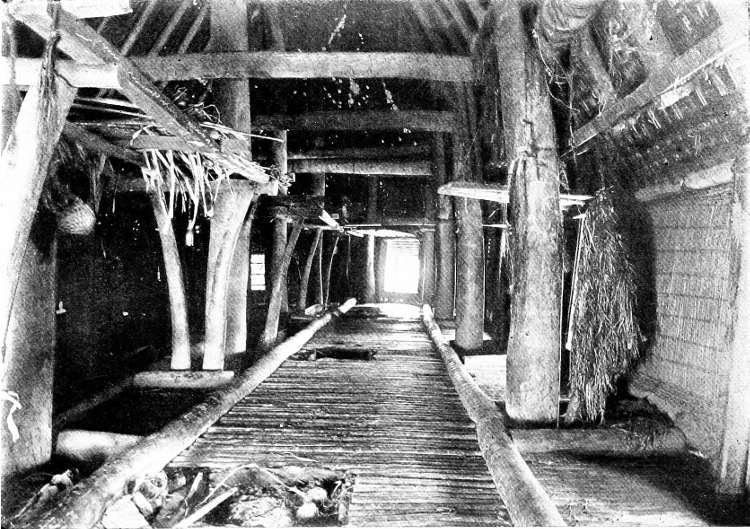
A “FAILU”; THE DIVISIONS ON EITHER SIDE ARE SLEEPING
QUARTERS
The fish are displayed on the stone platform in front of the house, or
on stands of bamboo or palm, and are then apportioned to the families
of the fishermen, or to purchasers from the district. Payment is
made in shell money or in the stone money-wheels peculiar to Uap. A
feature of this barter, which speaks much for the ingrained honesty
of these people, is that the money is deposited on the ground near
the failu, possibly several days before the fishermen return;
no one ever attempts to steal it, or lay false claim to it; there it
remains, untouched and safe, until the owner receives the fish. The
strings of pearl-shell money and the stone wheels received in payment
for the fish, become the property of the failu, and are expended
for such purposes only as will benefit the whole house, namely, the
purchase of new canoes, rigging, nets, etc., or else reserved to pay
the heavy indemnity which must invariably be paid for the theft of a
new mistress, or mispil.
The custom of having one mistress common to all the members of the
failu, is merely a form of polyandry, which reveals in a
striking degree a noteworthy characteristic of the men of Uap, namely,
a complete freedom from the emotion of jealousy. In every failu
and pabai there lives a young woman, or sometimes two young
women, who are the companions without preference to all the men of the
house; I was assured repeatedly, moreover, that this possession of a
wife in common never awakens any jealous animosity among themselves in
the breasts of the numerous husbands. A mispil must always be
stolen by force or cunning, from a district at some distance from that
wherein her captors reside. After she has been fairly, or unfairly,
captured and installed in her new home, she loses no shade of respect
among her own people; on the contrary, have not her beauty and her
worth received the highest proof of her exalted perfection, in the
devotion, not of one, but of a whole community of lovers? Unlike a
prophet, it is in her own country and among her own kith and kin that
she is held in honour. But in the community where she is an alien,
her social rank is gone. None of the matrons in the district of her
failu, who live at home with their husbands and children, will
have any social intercourse with her. By the men, whether in her
failu or out of it, the mispil is invariably treated with
every consideration and respect; no unseemly actions may take place in
her presence, and all coarse language is scrupulously avoided when she
is within hearing; nevertheless, owing to her station, she is permitted
to hear and see the songs and dances, from which other women are barred.
If, by chance, a preference of one lover over another become
observable, no blame whatever is attached to her, but the favourite is
quietly told that, in the opinion of the whole house, he must retire,
or possibly leave the failu for a while and live with friends in
another district.
The mispil’s food, and her luxuries, such as tobacco and betel
nut, are supplied by the men, and she is never required to work in the
taro fields, as are the wives and daughters of the district.
At quite a distance, in the bush behind the failu, a little
house is built for her sole use when she wishes to be secluded; here
she occupies her time in making new skirts for herself of leaves, and
during her sojourn in her little home, known as tapal, the men
sedulously place her food near by, but dare not so much as take one
step within the enclosure around her house.
The men of the failu treat their mispils with far more
respect and devotion than is generally shown by the men outside to
the wives of their own household. The mispils are absolutely
faithful to the men of their failu or pabai, regarding
themselves as unquestionable property, having been sought and captured
at the risk of men’s lives, and paid for withal in costly pieces of
stone money.
They are by no means kept as prisoners; as soon as the excitement over
their capture has abated in their own village, they are at full
liberty to return home and visit their family and friends, and they
always return willingly and voluntarily to the failu.
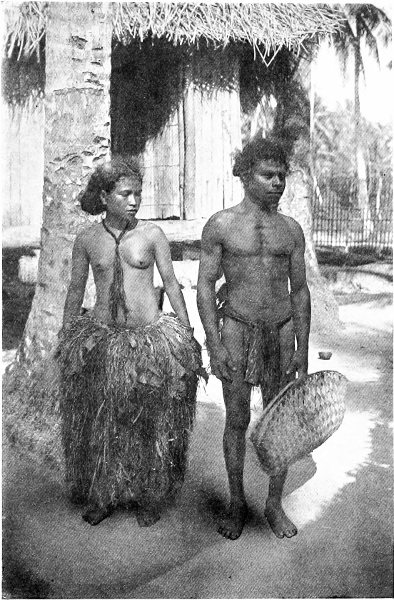
MAN AND WIFE OF THE “PIMLINGAI,” OR SLAVE CLASS
In ancient times,—which were probably no further removed than the
last generation, history in these islands does not usually date much
further back than the memory of the oldest inhabitant,—when there
were many districts at constant war with each other and the high-born
nobles were divided into two tribes, the ulun-pagel and the
bultreh-e-pilun, the capture of a mispil was always
accompanied by bloodshed and enduring feuds; but, nowadays, since
abstinence from alcohol has cooled their brains, and they all regard
themselves as really one people (with the exception of the tribe of
slaves known as Pimlingai), the seizure of a young girl to
fill the office of mispil is reduced to little more than a
commonplace burglary; nay, it is almost always furtively prearranged
with the chief of the district, inasmuch as it is to him that the
parents appeal for redress. If certain captors,—or shall we say
burglars,—have already made choice of a victim from his district as
their future mispil, it might be difficult, if not impossible,
for him to prevent them from carrying out their design, but, inasmuch
as he is fully assured that they are prepared to pay a good round sum
in shell money and stone money by way of indemnity, he contrives,
nowadays, by means of this bribe to salve the wounds of a disrupted
family and dispel all thoughts of a bloody retaliation. Nevertheless,
the whole proceeding is still carried out with the greatest possible
secrecy and stealth.
With Friedlander’s help, as interpreter, I elicited from an intelligent
young fellow named Gamiau, the following account of the capture of
Lemet, the mispil of Dulukan. Gamiau, the leader of the party,
was a quiet, serious, young fellow, about eighteen or twenty years
old; foremost in dance and song, and, consequently, admired by his
companions for the fertility of his poetic and acrobatic resources. He
was not tall, but well built, with a skin as smooth as velvet, which
seemed to stretch tightly over the muscles underneath like a brown kid
glove. He was sitting cross-legged on the floor of our little house
one evening when no one else was present, and, taking intermittent
puffs at his cigarette of “Niggerhead” tobacco rolled in a fragment of
palm-leaf, gave us this somewhat disjointed account of the theft of a
mispil.
“Lemet, our mispil, is a daughter of Pagel of Libenau, who is a
brother of the chief of Bugol in the Rul district. We had not decided
upon her or any other girl before we started out, but we had heard that
the girls of Bugol were all pretty.
“About twenty of us from the failu of Dulukan stocked a canoe
with all sorts of trade and set out for Bugol; we knew that the chief
there would help us if we took plenty of presents to him, so we put
in a good stock of reng [a species of turmeric used as an
ornamental dye], several strings of flat pearl shells, and one large
and very high priced fei [stone money]. When we reached Bugol,
we separated, so that no one should suspect that we were after a girl,
and, having given our presents to the chief, we waited there two months
and a half enjoying ourselves, but all the time on a furtive look-out
for a mispil for our failu, but we could not make a
choice.
“Then word came to us that we had better go to Rul, a short distance
away, so that no one would suspect our plans; in this place we waited
eighteen days until word came again to us from the chief of Bugol that
he had selected a girl for us, and we were to move across the bay
to Tomil, and build a house in the mangroves by the shore and wait
till his messengers came. So we went, and, after a night and a day,
two Bugol men came. Early, early in the morning, before daylight,
six of us and the two Bugol men paddled very noiselessly over to
Libenau. We left the canoe and four of our men in it near the shore,
and I,—Gamiau,—and Fatufal and the Bugol men went ashore. Without
speaking a word, the Bugols led us through the underbrush and finally
pointed out the house, and whispered that we would find the girl asleep
all by herself in a little hut at the end of her father’s house.
We crept up very, very softly, peeped in, and there we saw her, sound
asleep, stretched out on her mat with nothing over her. Then we jumped
in suddenly and one of us held her arms, and the other kept his hand
tight over her mouth so that she could not cry out, and, just as she
was, we carried her back to the canoe and paddled quickly down to Aff
where the other men were waiting. When we got there, one of us stole a
skirt from a house nearby, for she had no clothes. On the way home we
stopped at Rul and gave two beautiful shells to the Chief, because Rul
is really the head of the whole district. The girl cried a little, and
seemed very sad while she was in the canoe, but now, after two months,
she is as happy as can be and has never once attempted to leave us.”
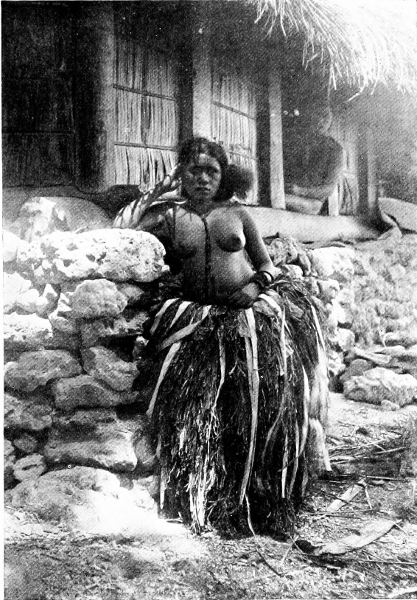
LEMET. A “MISPIL”
Haec fabula docet that the example set by young Lochinvar has
still its genial modifications in Uap, and that, although the Bugol
bride may not be so compliant as the Netherby, yet the stealing of a
mispil is not now an exploit wholly devoid of romance, nor of a
spice of danger. A haunting suspicion will obtrude, however, that the
girl had been privately “coached” by the chief, and that her family
had been paid her equivalent in several good shells and were discreet
enough to keep out of the way, and make the course of love run as
smooth as possible. Be it added that the members of the failu
who venture on these expeditions are always thereafter admired as
heroes.
In dress the mispil is in no wise distinguished from other
women, except by tattoo marks on her hands and legs. In this tattooing
there seems to be, however, no set pattern, and the designs are not so
elaborate as lasting, and, since it is not the custom for any other
women to be thus ornamented, I found it occasionally possible to
decipher on hands and legs of highly respectable, albeit wrinkled and
shrivelled, old grandmothers, a former chapter in their history when
to them all the world was young and they were the cynosure of every
eye in a failu. This is explained by the fact that should a
mispil prove enceinte, the duty devolves on one of the
men of the failu to take her as his wife, build a house for
her, and bring up his own separate family. Here again, the remarkable
scheme of social relations and of morality, by which these people live,
renders such a compulsory marriage perfectly adjustable and by no
means a disgrace. The wife of my excellent friend, Lian, the Chief of
Dulukan, showed the ineffaceable and unmistakable tell-tale tattoo on
her hands and legs, and both he and she held their social heads very
high in the community.
Verily, it does seem that even in austere eyes this feature of the
failu loses half its immorality in losing all its grossness.
CHAPTER IV COSTUME AND ADORNMENTS
There is apparently no formal initiation into a failu; when
very young the boys wander in and out of it continually; and, if
they please, may even sleep there; thus they gradually glide into an
accepted fellowship, and, when about ten or eleven years old, may
join the men as associates in the adult dances. At about this same
age the young boys are known as petir, and may wear but one
loin-cloth (or none at all). The next promotion is two loin-cloths,
the second longer than the first little scrap, and more elaborately
interlaced; they are now known as pagul. The adult man is
called pumawn, and wears, first, a loin-cloth; then over this
a long rope of thin strips of pandanus leaves and grasses known as
kavurr; next, to add a touch of color, a bunch of the same
material, stained red, is tucked in at the side and so looped that it
hangs down in front over the loin-cloth.
The badge of a freeman, distinguishing him at once from a slave,
is an ornamental comb in the knot of hair on the top of his head.
One of the Ulun-pagel, the aristocratic tribe, assured me in
the most emphatic terms that he would instantly attempt to kill a
Pimlingai or “slave” should he meet one wearing such a comb.
This comb, albeit of no great intrinsic value, is, therefore, the
essential feature of male attire. It is made merely of fifteen or
twenty narrow strips of bamboo, about eight inches long, sharpened at
one end, with shorter, slightly wedge-shaped pieces inserted between
each strip four or five inches from the sharpened ends, whereby
the teeth of the comb are kept apart; the upper ends are now bound
together with ornamental lashings of coconut fibre. A simple form,
but nevertheless deemed foppishly elegant, is that wherein the strips
of bamboo are fastened together with a peg run through at about the
middle; the strips are then slid past each other like the ribs of a
fan; these broad, unpointed, upper ends lend themselves admirably to
such decoration as the insertion of bright leaves of croton, tufts
of cotton, strips of pandanus, etc. In one of my first attempts at
photographing with a cinematograph camera, many yards of the narrow
film, which, when undeveloped looks like stiff yellow ribbon, were
spoiled; with exasperation, and, I fear, imprecations, I cut this
worthless film ruthlessly from the little sprocket wheels which carry
it through the camera, and tossed it away. No princely gift could I
have devised which would have been received with more exuberant delight
than these worthless strips of film; to Uap eyes they happened to be
just of the most fascinating shade of yellow, and to the Uap nostril
they possessed a peculiar and ravishing perfume; and as a supreme grace
they vibrated like serpents when inserted in combs and caught by the
breeze; in a trice every head was wreathed with coils like Medusa’s and
every face was radiant with smiles.
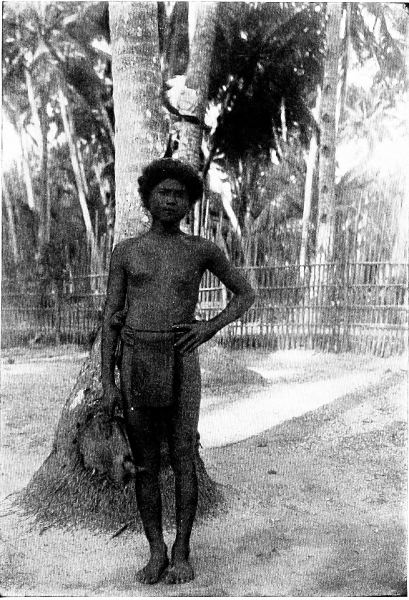
WAIGONG, A BOY OF SIXTEEN OR SEVENTEEN
Other male ornaments consist of earrings, necklaces, bracelets, and
armlets. Mutilations of nose or of lips are not in fashion; earlobes,
however, being appendages not ornamental and by no means useful, are
always, the world over, responsive to improvement at the behest of
beauty. They are not neglected in Uap. Both boys and girls have the
earlobes pierced and stretched at an early age,—at about the tenth or
twelfth year,—but this mutilation is never stretched to the extent
that it is in the island of Ruk (in the central Carolines), nor as it
is in Borneo, where the lobe is so elongated that it becomes a mere
loop of skin drooping below the shoulders. The Uap men and women are
satisfied with a simple hole through the lobe, about three-fourths
of an inch in diameter, just about large enough for the insertion of
bright leaves or flowers or a tuft of cotton. After an incision is made
with a piece of sharpened coconut shell, a roll of leaves of a plant,
which they call maluek,[1] is at once inserted. This leaf, and
this leaf only, must be used; to it is ascribed peculiar properties
both of stretching and healing; it must be first warmed over the
fire, then soaked and softened in coconut oil, rolled up tightly and
pushed through the wound. As soon as this plug becomes loose, it is
renewed, and an additional leaf added until the hole is of sufficient
size and is healed. The boys grin and bear the suffering without any
protection for their poor swollen and inflamed ears, which, after the
fourth or fifth day, certainly look exceedingly painful; but the girls
are allowed to wear protectors made of the halves of a coconut shell,
held in place by strings attached to the upper edges, passing over the
head, and strings from the lower edges, tied under the chin. These
shells are stained a bright yellow with a turmeric, already mentioned,
known as reng. Another and a smaller hole, just about large
enough for the stem of a flower is often made in the rim of the ear
a little above the larger hole in the lobe; this is designed for no
particular ornament, but merely supplements the larger one when the
latter is completely filled with earrings and bouquets; a white and
yellow flower of Frangipanni, or the spray of a delicate little orchid,
growing on coconut trees, greatly enhances the charm when waving
above red and green crotons and a pendant of pink shell. Women do not
in general affect manufactured earrings; they cling more to natural
effects of leaves and flowers. The men’s ear ornaments consist of short
loops of small glass beads, whereto is attached a piece of pink or
white shell usually cut in a triangular shape, with each edge about
an inch in length; this is pendant from the loop of beads about three
inches below the ear. The triangular shape is, in general, obligatory,
inasmuch as the shell from which it is cut has this one sole patch of
rosy pink near the umbo. This shell is exceedingly rare on the shores
of Uap; consequently, these pink pendants are highly valued and owned
only by the wealthy families who part with them reluctantly, and only
at an exorbitant price. Other pendants of less value are made from any
fine white shell, or of tortoise-shell; any man may wear these who has
patience enough to scrape the shells to the proper shape. Still another
variety of ear ornament is a piece of thin tortoise-shell, about a
third of an inch wide, bent into the shape of a U; this is hooked in
the lobe of the ear, and from the outer open ends are suspended little
strings of beads. In default of other ornament the men will insert
anything with gay colors; my cinematograph film, whenever I happened to
discard it, was sure to be seen for the next two or three days either
fluttering from combs or passed through loops and coiled about the ears.
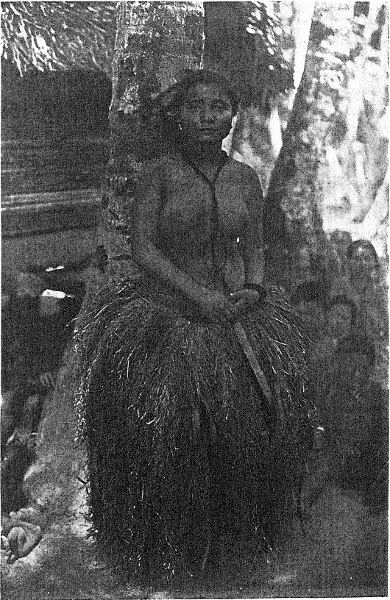
FULL DRESS OF A HIGH-CLASS DAMSEL
Ordinary necklaces, worn by all the common folk, are made of thin
discs of coconut shell or tortoise-shell, about a quarter of an inch
in diameter, and strung closely and tightly together, interspersed
at intervals with similar discs of white shell, so that they make a
flexible cord which coils like a collar rather tightly about the neck.
One of the most highly prized possessions of the men is, however, a
necklace of beads made of the same rose-coloured shell whereof they
make their ear pendants. In each shell of superior quality there is
of the pink or red portion only enough to make one good bead about an
inch and a half long by half an inch wide and an eighth of an inch
thick; such a bead is usually strung in the middle of the necklace
among others graded off from it in size, on both sides, merging
into oblong pieces about half an inch long, of the same breadth and
thickness as the bead in the centre; then, finally, follow discs about
one sixteenth of an inch thick. One day, a chief, named Inifel, with
a suite of followers from his district of Magachpa, at the northern
end of the island, paid us a visit; for an old man, his features bore
as treacherous and malevolent a stamp as ever I saw; he scowled at
everything and everybody from under his shaggy grizzled eyebrows, with
a piercing gleam at once suspicious and sinister; he was magnificent in
adornment, however, with a thauei,—a red-shell necklace,—of
surpassing splendour, composed throughout of exquisite red shell beads
of the very largest size, except where, at intervals of every seven or
eight red beads, there followed one of pure white. So satanic were his
looks that I did not dare even to hint at the purchase of so gorgeous a
prize, lest he should propose my soul, or my shadow, by some devilish
contract, as the price. These strings of shell beads are usually about
three feet long, and hang far down on the chest. Beyond question
they are exceedingly beautiful, especially when set off by the dark,
burnished livery of a tawny skin.
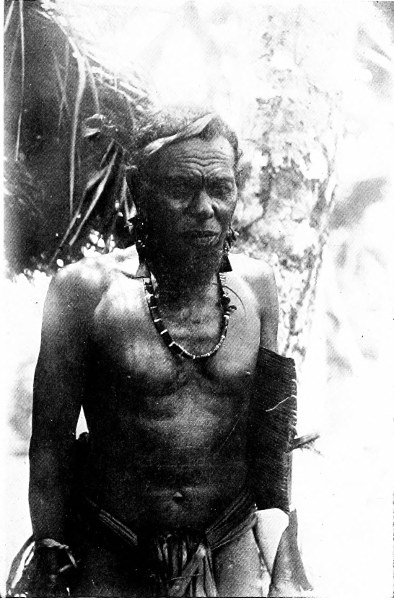
INIFEL, A TURBULENT CHIEF; ON HIS LEFT ARM IS A LARGE
WHITE BRACELET, MADE FROM A CONCH SHELL; ABOUT HIS NECK A HIGHLY
VALUABLE NECKLACE
A report of these red shell ornaments had reached me by rumour before
I came to Uap, and I had been assured that it was utterly impossible
to buy one; hence it was, naturally of course, the one thing I set my
heart on possessing; wherefore I caused it to be widely known that I
was prepared to pay a good round price for a red necklace, and I begged
old Ronoboi, one of my first acquaintances among the nobility, not
only a Chief, but also a powerful soothsayer, or mach-mach, to
strain every nerve to procure one for me. He shook his grave head
dubiously, saying he would try, but had no hope whatever of success.
Later, I saw some thaueis that were truly excellent, but the
owners would not listen to a syllable of sale, and seemed even to doubt
that a white man existed with wealth enough to purchase a perfect one.
After several rebuffs in my attempts to buy these enviable “jewels”
from wearers who looked otherwise impecunious enough, I found out that
these necklaces were actually loaned, at interest, and were not the
disposable property of the wearer, who, for work or services performed,
was privileged to strut about, thus adorned, for a certain number of
days, with that delicious glow around the heart, whether civilised
or savage, which the consciousness of being well-dressed invariably
bestows. In fact, the thauei, in Uap, is a medium of exchange,
and is not often parted with outright, but loaned out; the interest on
the loan is to be paid for in labour. After three weeks of eager and
zealous endeavour, I succeeded at last in obtaining a very inferior
string of merely round discs, but I had to pay for it the staggering
sum of thirty marks ($7.50); when the owner delivered it to me, he
exclaimed, “There now, you have the price of a murder; offer that to
a man and tell him whom you want killed, and it’s done!” Not until
the very day I left the island did I get a really fine thauei;
after almost tearful pleadings on my part, old Ronoboi, possibly by a
good deal of hook and probably by a good deal more crook, persuaded
one of his subjects and eke believers in the awful mysteries of
mach-mach, to part with a prized heirloom, which the dear old
chief and wizard solemnly and secretly brought to me. I gave him a
double handful of silver mark pieces; this seemed to hush effectually
the “still, small voice;” furthermore, can a king do wrong? and the
necklace is mine!
The only other ornaments that the men wear are armlets and bracelets
of shell or of tortoise-shell. These are made simply by cutting a
narrow section from the base of one of the large conical sea-shells
and breaking out all the inner whorls; the ring thus formed is then
slipped over the arm and worn above the elbow or wrist. I noticed none
that was carved or decorated; they were merely smoothed and polished.
The tortoise-shell bracelets are plain, broad bands which, after
softening in hot water, are bent around the wrists, where they fit
tightly, leaving the ends about three fourths of an inch apart, so that
they may be sprung off the arm, and need not be slipped over the hand.
These tortoise-shell ornaments are usually engraved with a few parallel
lines running round them.
One peculiar shell bracelet, much affected by old men, is made of a
large, white conical sea-shell, whereof the base and all the interior
spirals have been cut away; this is worn like a cuff on the wrist
with the big end upward. It seems incredible that they can get their
hands through so small an opening, but in some way they do squeeze
them through. One of my particular friends, Fatumak by name, of whom I
shall speak later, told me that, once upon a time, a man from Goror,
at the southernmost point of the island, tried to go up to the land
of departed spirits,—Falraman,—but he never reached his
destination, although he saw many marvelous things, and brought back to
the Chiefs extraordinary novelties; among them, these shell cuffs, and
chickens.
CHAPTER V SONGS AND INCANTATIONS
That I might obtain permanent records of their songs and incantations,
I carried with me a large-sized phonograph, with all needful
appliances. With much relish I anticipated the consternation of the
natives when they saw and heard a box whence issued a living human
voice and music played by all sorts of instruments.
In order to introduce them to it with due paralysing effect, I made
a selection of band music and several songs in English; with these I
intended to charm them before requesting them to speak or sing into
that embarrassing, expressionless metal horn. Experience had taught
me, however, the impossibility of foretelling the fashion in which
untutored minds will accept such miracles, and I was not altogether
unprepared to have their bewilderment find expression in a shower of
well-directed coconuts at the first bars of “Lead kindly light” or
other soothing, peaceful hymns. But what was my unexpected amazement
and infinite chagrin, when the audience I had gathered displayed not
the faintest interest in the performance beyond the sight of the
revolution of the little wax cylinder. A living, human voice, singing
a sweet English love-song, and issuing from a brass horn attached to a
machine, was, to them, not half as awesome as the whirling wheels and
the buzz of clock-work; some of the audience actually turned away in
indifference, if not in disgust, and went off to resume their work of
husking coconuts.
Completely crestfallen, I ventured to ask one man when the tune was
finished what he thought of it; “An all right sort of tom-tom”
was his careless and patronizing reply. (Tom-tom is an adopted
word which they apply to cheap musical boxes,—in fact to any variety
of musical instrument,—introduced many years ago by whalers and
copra traders.) Friedlander himself was astounded at their mortifying
indifference, and suggested very justly that it was probably
because the words meant nothing to them, and that the phonograph was
to them only another form of hurdy-gurdy. A human voice uttering
incomprehensible sounds had to them no more meaning than the beating of
a tin pan.
Cast down, but not utterly discouraged, I tried a second song by a
melodious female voice, but this fell just as absolutely flat as the
former. As a final and desperate resource, I put on a blank roll and
the recording needle, and then induced one of the youths to speak a few
native words into the horn, and immediately ground off a reproduction
of his very words. The effect was magical! The audience forgot to
breathe in awed silence! Their eyes dilated! Their jaws fell! And
they began repeating after the instrument the words of their very own
language, in the boy’s very own voice, now issuing from the bottom
of the horn! Was the boy himself imprisoned there? For five or six
seconds after the voice ceased, they remained silent, looking from
one to another, and then—then they burst into peals and peals of
screaming laughter, clamourously and vehemently imploring me to repeat
it. Of course I complied. The coconut huskers dropped their work and
hurried back helter-skelter, to hear a little machine that after only
a minute’s acquaintance could talk as well as they could themselves!
The conquest was complete! Thereafter I had no difficulty whatsoever
in finding volunteers to sing or repeat set speeches. The miracle of
a “tom-tom that talked and sung” was assured, and its success
unbounded!
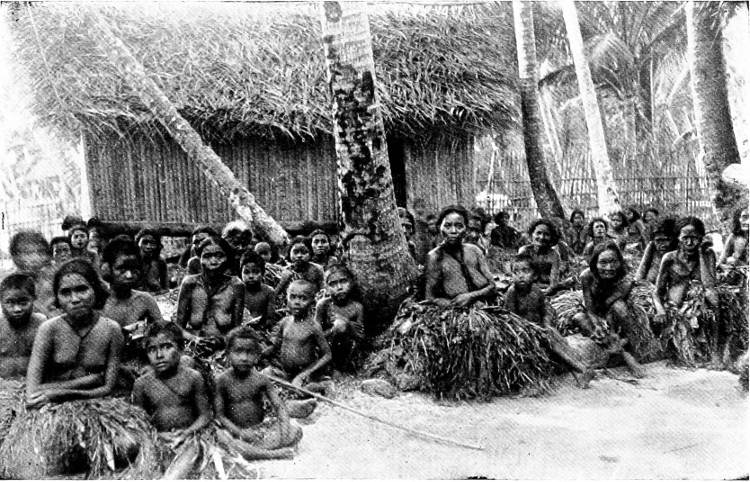
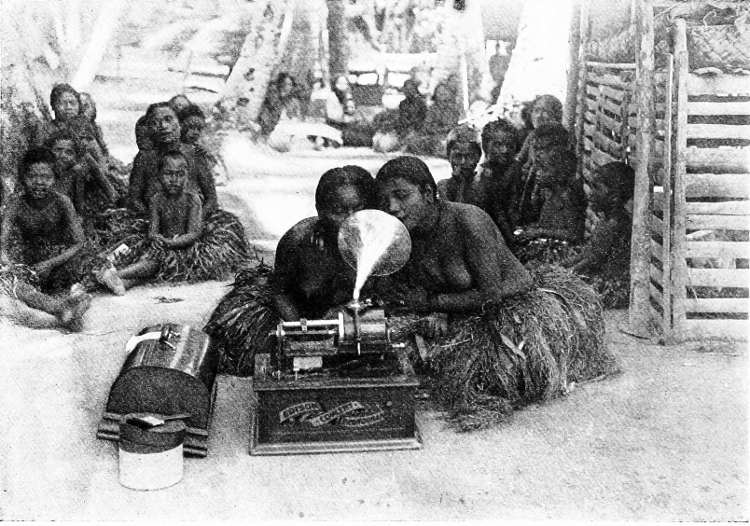
A PHONOGRAPHIC MATINÉE
At my first and second exhibition men alone happened to be present. A
request then came to me from the women, through Friedlander’s wife,
that I should give them an exhibition, to which, as they were shy,
no men should be admitted. Accordingly, kind-hearted Friedlander had
one of his copra storehouses cleared,—it was a little house on low
piles, with walls and floor of bamboo slats, about twenty feet long
and ten feet wide. At one end I set up my phonograph, and the audience
duly gathered in bunches and bundles,—I use the words advisedly,
so enormous and expansive are the skirts of dried grasses and leaves.
The hall was filled to overflowing. But in a house of bamboo the walls
and floor have many a chink, and I think I may truly say there was no
single crevice without its outside ear. I tried the same experiment
with the women as with the men, and first of all I gave them an
English song; and precisely the same result followed; the performance
emphatically bored them, and they conversed with each other and pointed
to the different parts of the machine as if the entertainment was yet
to begin. But the native song, that I gave them next, awed them into
silence in a trice; with dilated eyes they scrutinised me wonderingly,
before, behind and on every side, to see that there was no living man
concealed who was the real singer. The silence, however, lasted but
a minute, and was then broken by shouts of delighted laughter, and
thereupon followed such a commotion and eager shifting of places to get
a nearer view of the mystery, that I really expected every minute that
the whole audience, myself included, would crash through the frail
floor to the ground below. The rows of jet black teeth on a broad grin
from ear to ear, seemed to darken the room. During the intermission,
while I was putting on another record, cigarettes burned hard and fast
to brace up the nerves for another thrill. After two or three men’s
songs, I asked for a song from the women; they were reluctant and
very shy, but finally they induced two young girls to sing a duet,
which they said is wont to be sung at funerals, setting forth the good
qualities of the deceased and the intense grief of the survivors. It
must have been the identical tune that the original “old cow died
on,” so monotonous, so lugubrious, so discordant was it. Evidently
the débutantes had not assisted at many funerals; they frequently
made awkward pauses and looked around despairingly until kind friends
prompted them loudly. It did not turn out to be a good record, but it
served to interest the women intensely, and render them anxious to hear
their own voices as others hear them.
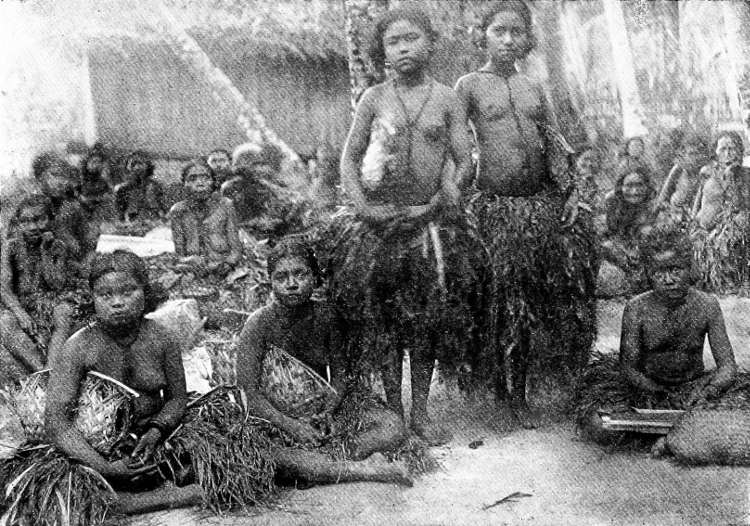
FOUR DAMSELS WHO SANG INTO THE PHONOGRAPH
Thereafter the fame of the tom-tom-ni-non,—the “talking
tom-tom,”—spread all over the island. I think that eventually I
must have been visited by every human being in Uap, from babies in arms
to hoary age,—everything that could creep, walk, or hobble. From far
and near there came crowds so insistent that almost every day I had to
give a session in the morning for the men, and a select session for the
women in the afternoon, but I no longer crowded them into the little
copra house; open air exhibitions were perfectly satisfactory.
It was intensely interesting to watch their expression as they
recognised the words of a familiar song, or speech, and knew the
speaker’s voice. There was one particular chant, sung for me by three
men from the adjacent failu, which Lian, the chief, cautioned me
not to play for the women; it was quite as well they should not hear
it. Pleased with this unexpected display of refinement, I assured him
at once that I would do my best to comply with his request. At that
early stage of my knowledge of their song-language the songs were all
so much alike, and the tunes so completely indistinguishable one from
another, that one afternoon, in my innocency, before I was aware, the
forbidden song was droning away on the phonograph, and I was awakened
to my oversight by the “nods and becks and wreathèd smiles” of the
women before me; but I had gone too far to retreat. I glanced up and
saw Lian at a little distance off, standing in the doorway of our
house. He was both smiling and scowling, but from his position at one
side he was watching keenly the women’s faces while they were listening
to that mysterious song. There were also a few other men standing
further off behind the rows of women who were sitting cross-legged on
the ground. The women’s eyes danced with merriment and, as soon as the
song was recognized, a suppressed giggle went round the audience and
they turned to one another with up-lifted brows and wide open eyes,
with a sort of “did-you-ever!—no-I-never” expression; it evidently
diverted them, so I submitted to fate. Lian still stood watching, and I
saw his lips repeating each word; then came several bars of the song
which gave forth nothing but a low humming, with plaintive cadences.
The women all cast their eyes on the ground, laughing, but ashamed to
laugh. Lian gave a foolish, sickly smile and, shaking his head weakly,
retreated into the obscurity of the house; the men in the background
could not suppress two or three loud guffaws, and then, stooping down
to hide their embarrassment, busied themselves at once with splitting
the husks of some coconuts.
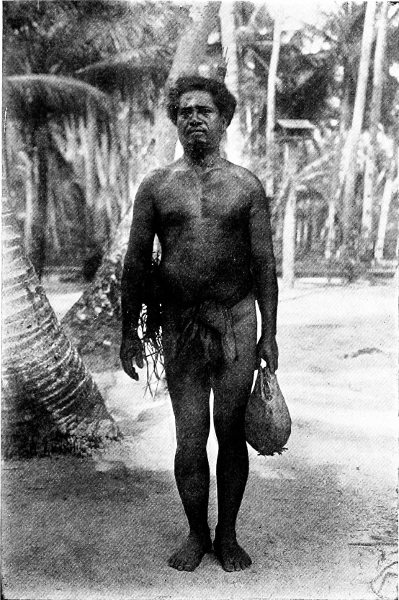
LIAN, CHIEF OF DULUKAN
I had, indeed, quite innocently proved a marplot, and suffered the
women to hear one of the secret songs of the failu. The combined
questioning of Friedlander and myself failed to elicit its meaning, or
why the men should have been so particularly anxious to keep it from
the women’s ears. We never could get any further explanation than that
it was “merely one of the songs sung only in the failu.”
An odd feature of all their songs and incantations is that they are
not in the modern Uap language at all, nor in a language used by the
people in any other island. They say it is the primitive language of
Palalagab, the ancient name of Uap, and they use these words when they
compose a new song. It is, however, impossible to extract any meaning,
or, rather, any literal meaning out of these mere strings of words;
they translated them for us into modern Uap, but this yielded merely a
collection of what seemed to be absolutely disconnected and irrelevant
statements. They usually began with an appeal for attention, such
as “Hear what we have been doing;” “Listen to what we are saying,”
or “Open your ears to hear;” then follow immediately one after
another, such sentences as “Brave men, all the same as devils, make a
mach-mach for good weather at sea”—“When we go in a canoe and
see a bird, we say we are near to land, when we see a fish, we say we
are near to land”—“Listen to what we young boys dreamt about”—“We all
got in a canoe;” etc.
These are the sentences of a song which Tomak, a high-class man, sang
into the phonograph and then told us proudly that he himself composed
it, but he could give us no more than the above sentences translated
into modern Uap, and he was unable to say what meaning he intended
to convey. This same incomprehensible language is, of course, a
heaven-sent boon to the mach-mach men; luckily nobody, not even
themselves, can tell what they are talking about.[2]
Powerful spells may be purchased and learned from the mach-mach
men for large sums; at times they are heirlooms and pass on from
father to son or younger brother. Since they must all be transmitted
by word of mouth, is it surprising that they should become at last
mere nondescript jargon? It is not, however, beyond possibility
that the wizards understand these random sentiments and disjointed
sentences; they are experts at reading between lines, and what to us
is the merest platitude, becomes in their ears a lyric overflowing
with sentiment. Nay, is it not even so with the Japanese whom we have
lately learned to admire in the arts of peace as well as of war, and
especially in Painting, Poetry’s twin sister? There flits across my
memory the following Japanese “Poem” consisting of these three lines
and no more:
“At the time of being far away!
If the moon were a looking-glass!
Delightful!”
To a Japanese this is all sufficient to conjure up a picture of two
lovers sundered by cruel fate, each happy in the thought that both are
gazing at the same moon and longing for the moon’s mirror to reflect an
image of the beloved face, while the “Delightful” at the close has all
the convincing emphasis of the “Assuredly” in the Koran.
Indeed it is not straining probability too far to suggest that a Uap
song, which was thus translated for me:—
“I have a canoe,
I will stick to you like a burr,
I have lost my mind.”
may, to the languishing Uap youths or lovelorn maids
express all the tenderness of Lover’s
“What would you do, love, if I were going,
With white sail flowing,
The seas beyond?” etc.
In both songs we have a limitless expanse of seas, and eternal fidelity
(how full is the image of a “burr” with its side glance of annoying
persistence!). It is in the last line, however, that the Uap song bears
the palm, and rises to a height of self-knowledge rarely attained by
poets, of all men, and beyond all praise in its open confession of what
is patent to all.
Let no one hereafter cast a slur on Uap poetry,—least of all those who
admire Emily Dickinson, that belated Uap poetess, who would have been
hailed as a Sappho had she been born under the palms of The Carolines.
CHAPTER VI DANCE AND POSTURE SONGS
I was extremely desirous of taking a moving picture of one of their
dances, and, accordingly, promised the natives of our district that if
they would perform a really good, genuine dance, and hold it outside
of the failu, in the bright light of day, they should have all
the tobacco they could smoke for many days and a lavish feast of their
favourite tinned meats, sardines, salmon, boned chicken, etc., all
to be had in Friedlander’s Emporium. But little did I dream at what
expense I was to get my wish. There are two affiliated failus,
both within a hundred yards of Friedlander’s house, and, the nights
being almost as light as day under the full moon, rehearsals for the
dance and song took place in the cool night outside the failu,
and lasted far on toward dawn. It took at least a week of rehearsals,
and I am afraid poor Friedlander deeply anathematised the unmelodious,
howling, explosive nights I was responsible for, at peaceful Dulukan.
The singers punctuate the end of each verse or stanza with a loud
clap produced by bending the left arm at the elbow, and holding it
across the chest, then the right hand with the fingers and thumb held
together and the palm bent so that it is cup-shaped, is clapped down
sharply over the bend of the left arm, and produces, when skilfully
done, a report nearly as loud as a pistol. When this is performed
simultaneously by thirty or forty men and boys, it wakes the echoes,
and everything else that is trying to get a wink of sleep.
At last the momentous day for the dance dawned, and I urgently begged
the performers to be ready before noon so that I could get the best
possible light under the thick palm trees. By eight o’clock in the
morning they were all busy and bustling near the failu, donning
their costumes and having head-dresses renovated and elaborated; and I
adjusted my five-hundred feet of film ready for an exceptional show; my
camera was all set up to begin at a moment’s notice. Ten o’clock came,
and they were still busy. The day wore on to eleven o’clock; still came
the threadbare answer that they were not nearly ready, but would surely
be fully decked out by noon, or a little after.
Noon found them still as excited as bees about to swarm and preparing
long strips of pandanus leaves or of the bast of Hibiscus for their
costumes, collecting white chicken-feathers, bits of cotton wool or
pieces of paper for their combs, and practising the steps of their
dance. The hours came and passed; one o’clock; two o’clock; three
o’clock; and not until near five o’clock in the afternoon did they
pronounce themselves ready.
I had refrained from bothering them with too many requests to hurry; it
would have been not only absolutely useless, but I desired to be sure
that they were really completely satisfied with themselves and would
therefore enter into the spirit of the dance with animation, and not
with that resigned mien implying “of course, since you insist.”
At last they filed out from behind the failu and burst in all
their glory upon my aching sight; they had been fully nine hours most
busily and incessantly dressing and I could not, after the closest
scrutiny, detect that they had done anything more than dab on their
foreheads and cheeks a few streaks of white paint with the lime from
their betel baskets, and decorate their combs with streamers of
pandanus leaves and yellow stained paper, and tie bands of narrow palm
fronds round both knees and their right elbows (only the right elbows,
so as not to interfere with the punctuation). They walked with exultant
pride and supreme self-consciousness to the front of the failu
where there was a good open space, and there sat down cross-legged in
one long straight line, the little boys, or petir, at one end;
the youths, or pagul, in the middle; and the proficient adults,
or pumawn, at the other end; all arranged according to size and
age.
These dances, or rather posture-songs, are to the natives like
theatrical performances or grand opera; the rumour of this performance
had spread near and far, and for several hours an audience of a
hundred or more men, women, and children had waited patiently and
expectantly, smoking innumerable cigarettes and chewing many a pound of
betel nut.
Out of consideration for the “ladies” the first number on the
programme was, paradoxical as it may seem, a sitting-down dance or
“tsuru.” This song-dance is the only one that is considered
proper for the women to witness and hear. As well as I could make out,
it is a dramatic narration of adventures of heroes in canoes at sea,
or dramatic legends of the Kan or devils who control the lives of
men. While the men sing in unison, with the higher voices of the boys
in accord making it slightly harmonious, they wave their arms about,
sometimes as though rowing with paddles, sometimes as though repelling
foes, but most of the time merely accompanying the cadences of the song
with graceful, waving motions of the wrists; no weapons, neither sword,
spear, nor shield, were used.
This posture-dance belongs to the same class as those to be seen in
Japan, Anam, Siam, the Malay States, and Java. The dancers do not
move from their sitting position; every now and then they make a loud
clap, on the bend of their elbows with the palms of their hands, and
apparently the stanza is finished. Several times they seemed merely to
take a rest between songs and, without rising, begin another; possibly
it was only another verse or chapter of the same narrative; I had no
one to interpret or explain it to me.
The audience of women was scattered in groups in the coconut grove
at a respectful distance from the failu, while the men pushed
forward close to the performers; they were all as fixedly attentive as
if witnessing the intricate plot of a problem play, and the performers
were equally absorbed in their parts, never even smiling nor hesitating
for a moment in the perfect rhythm of their song and the accompanying
movements of their arms. Even down to the small boys at the end of the
line, the gestures were identical and as synchronous as the steps and
body-swing of a troop of soldiers.
After several verses, or songs, a loud, high shout proclaimed the end
of the sitting-down dance, and the performers arose and sauntered
off into the failu, or out of sight on the other side of it,
to repair whatever damage might have been done to their costumes by
their exertions or by the wind. The announcement that a “standing-up
tsuru” was about to be performed, caused a lively stir among
the women; the greater part of them really did retire to the houses
nearby or wandered off in the side paths to their own homes, but
quite a number merely moved off a short distance deeper in the grove
and sat down again upon the ground, albeit with their backs turned;
others sought conveniently stout coconut trees behind which they hid
themselves and took surreptitious peeps at the forbidden dances. I
think their conduct was not considered downright reprehensible, but
only a little “fast,” verging on immodest; the men knew perfectly well
that these women were watching them and even twitted them about it, so
that several of the younger ones, who were a little too conspicuous,
broke from their ostrich-like hiding places and ran giggling to another
equally insufficient shelter at a greater distance.
The standing-up tsuru is performed chiefly by the younger men,
who filed out from the failu and took up a position in a long
line, shoulder to shoulder, in front of it.
Truly they were a fine looking lot, clean of limb, and smooth and
glistening of skin from their recent exertions in the sitting
tsuru; the brisk sea breeze fluttered the plumes of grass and
feathers in their hair, and the shifting glints of the declining sun
seemed to keep them in a continual barbaric shower of golden spangles.
They arranged their positions with much care to avoid interference
with one another, and then began a sort of marking-time movement with
their feet, and at the same time clapping their hands at about the
rate of ninety to a hundred beats a minute. This they kept up in an
exceedingly uninteresting, dispirited manner, as it seemed to me, for
a long while, in reality, I suppose, for about three minutes; then one
of them, I think it was Gamiau, the strong-voiced maker of phonograph
records, started the song in a high-pitched head-toned voice, and the
others all joined in and the dance became fast and furious; they waved
their arms from side to side; they stepped forward and stepped back;
they twisted and turned to right and to left; they dropped on one knee,
and swayed the body like a Spanish dancer. Then up on their feet again,
and then down on hands and knees, and up on their feet again, almost in
less time than it takes to tell it. All the while the song continued
uninterruptedly; and the motions of arms, body, and legs seemed to
italicise emphatic words and keep time with the metre. I failed
completely to unravel what it was all about; either they could not,
or perchance, would not, translate it into modern Uap. It is barely
possible that its impropriety is a tradition purely, which has survived
after the full meaning of the ancient phrases is lost. This strenuous
dance lasted but five or six minutes and then wound up with a loud and
prolonged howl, a vigorous stamping of feet, and a salvo of elbow-claps.
It was evidently humourous, for at several points the native audience
laughed loudly, but the performers never smiled, on the contrary,
they maintained an earnest, sometimes even a ferocious and hostile
expression.
During the dance, tobacco was free to the spectators, and after it,
a liberal supply to all hands and mouths was distributed; this, and
also a goodly pile of tins of provisions of all descriptions made the
evening pass busily and gaily. Although my especial interest in the
dance faded with the sunlight, theirs did not; they had practised the
several dances long and faithfully and were not minded to subside into
humdrum life and doff all gorgeousness so rapidly. Throughout the
livelong night I heard at intervals the minor drone of their voices,
the clapping of hands as the dances were renewed, and the resounding
punctuation of the elbow-claps.
CHAPTER VII MONEY AND CURRENCY
In a land where food and drink and readymade clothes grow on trees
and may be had for the gathering, it is not easy to see how a man can
run very deeply in debt for his living expenses,—for which, indeed,
there need be no barter, and if no barter, there is no need for any
medium of exchange. In fine, as far as mere existence is concerned in
Uap, there is no use for money. But nature’s readymade clothes, though
useful, are not ornamental, and the soul of man, especially of woman,
from the Equator to the Poles, demands personal adornment. And like all
adornments, polished shells, tortoise-shell, variegated beads, etc.,
demand labour in the making. Here then the simple-hearted natives of
Uap, who never heard of Adam Smith nor of Ricardo, or even if they
should hear of them would care no more for them than for an English
song from the phonograph, have solved the ultimate problem of
Political Economy, and found that labour is the true medium of exchange
and the true standard of value. But this medium must be tangible and
enduring, and as their island yields no metal, they have had recourse
to stone; stone, on which labour in fetching and fashioning has been
expended, and as truly a representation of labour as the mined and
minted coins of civilisation.
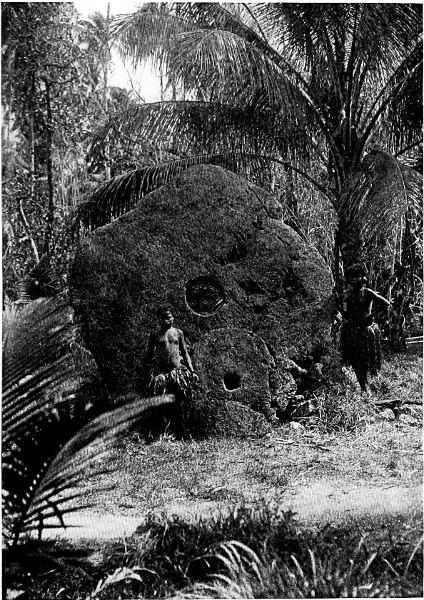
THE LARGEST “FEI” ON THE ISLAND
This medium of exchange they call fei, and it consists of large,
solid, thick, stone wheels, ranging in diameter from a foot to twelve
feet, having in the centre a hole varying in size with the diameter
of the stone, wherein a pole may be inserted sufficiently large and
strong to bear the weight and facilitate transportation. These stone
“coins,” if I may so call them, are not made on the Island of Uap, but
were originally quarried and shaped in Babelthuap, one of The Pelao
Islands, four hundred miles to the southward, and brought to Uap by
some venturesome native navigators, in canoes and on rafts, over the
ocean by no means as pacific as its name implies; and, with the stones
safely landed, these navigators turned speculators, and, with arguments
as persuasive as those of the most glib book-agent, induced their
countrymen to believe that these “novelties” were the most desirable
things to have about the house. Of course, the larger the stone the
greater its worth, but it is not size alone that is prized; the
limestone, of which the fei is composed, to be of the highest
value, must be fine and white and of close grain. It is by no means any
large stone, however skilfully fashioned, from The Pelaos that will be
accepted as a fei; it is essential that a fei be made of
this particular variety and quality of limestone.
After having been stored in houses, out of sun, wind and rain, the
fei present a white, opaque appearance, somewhat like quartz,
but not so translucent nor of so fine a grain; when by luck it happens
that a man’s wealth outgrows the capacity of his house, his money is
then stored outside, and, thus exposed to tropical weather, its colour
changes to a dirty gray, somewhat like sandstone, and the surface
becomes rough and covered with moss and lichen. As far as purchasing
power goes, this does not, however, detract from its value; this
“unearned increment” can be readily scraped off and the quality of
the stone and its diameter, on which depends its value, be no whit
diminished. I saw several æsthetic possessors of stone money polishing
their wealth and cheerfully chipping away at their riches, thereby
plainly evincing that they did not deem the acquisition of moss
desirable for rolling stones.
Fei are cut as nearly circular as primitive resources permit,
and through their centre a hole is cut whereof the diameter is, roughly
speaking, about one sixth of the total diameter; this hole is, as I
have said, for the insertion of a pole sufficiently strong to bear the
weight of the wealth upon the shoulders of men when passed as currency.
The smaller, more portable “coins,” used for the purchase of fish from
the failu, or of pigs from the wealthy chiefs, slope from the
centre in one or two step-like gradations; wherefore, if at the centre
they are six or eight inches thick, they are but an inch and a half,
or two inches thick at the periphery. Their diameter, and, therefore,
their value, is measured in spans, which in Uap means the stretch of
the index finger and thumb.
In front of a failu there are always many fei, which are
thus displayed as evidence of the industry and wealth of the inmates;
they are acquired by the hard work of members either on fishing
expeditions or by their labour in building houses for the villagers.
Another noteworthy feature of this stone currency, which is also an
equally noteworthy tribute to Uap honesty, is that it is not necessary
for its owner to reduce it to possession. After concluding a bargain
which involves the price of a fei too large to be conveniently
moved, its new owner is quite content to accept the bare acknowledgment
of ownership and without so much as a mark to indicate the exchange,
the coin remains undisturbed on the former owner’s premises.
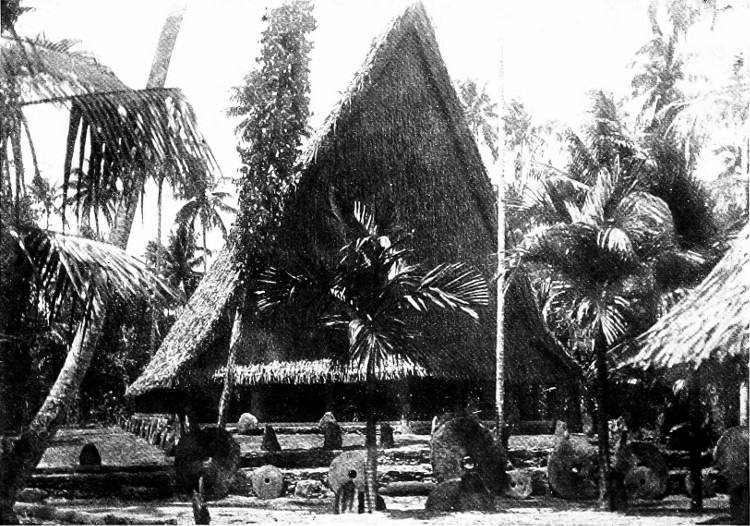
STONE MONEY BELONGING TO THE “FAILU”
My faithful old friend, Fatumak, assured me that there was in a
village nearby a family whose wealth was unquestioned,—acknowledged by
every one, and yet no one, not even the family itself, had ever laid
eye or hand on this wealth; it consisted of an enormous fei,
whereof the size is known only by tradition; for the past two or
three generations it had been, and at that very time it was lying at
the bottom of the sea! Many years ago an ancestor of this family, on
an expedition after fei, secured this remarkably large and
exceedingly valuable stone, which was placed on a raft to be towed
homeward. A violent storm arose and the party, to save their lives,
were obliged to cut the raft adrift, and the stone sank out of sight.
When they reached home, they all testified that the fei was
of magnificent proportions and of extraordinary quality, and that it
was lost through no fault of the owner. Thereupon it was universally
conceded in their simple faith that the mere accident of its loss
overboard was too trifling to mention, and that a few hundred feet of
water off shore ought not to affect its marketable value, since it
was all chipped out in proper form. The purchasing power of that stone
remains, therefore, as valid as if it were leaning visibly against the
side of the owner’s house, and represents wealth as potentially as the
hoarded inactive gold of a miser of the middle ages, or as our silver
dollars stacked in the treasury at Washington, which we never see nor
touch, but trade with on the strength of a printed certificate that
they are there.
There is one undeniable advantage in this form of weighty wealth among
people whose houses are as fragile as those in Uap:—when it takes
four strong men to steal the price of a pig, burglary cannot but prove
a somewhat disheartening occupation. As may be supposed, thefts of
fei are almost unknown.
There are no wheeled vehicles in Uap and, consequently, no cart roads;
but there have always been clearly defined paths communicating with the
different settlements. When the German Government assumed the ownership
of The Caroline Islands, after the purchase of them from Spain in
1898, many of these paths or highways were in bad condition, and the
chiefs of the several districts were told that they must have them
repaired and put in good order. The roughly dressed blocks of coral
were, however, quite good enough for the bare feet of the natives;
and many were the repetitions of the command, which still remained
unheeded. At last it was decided to impose a fine for disobedience on
the chiefs of the districts. In what shape was the fine to be levied?
It was of no avail to demand silver or gold from the chiefs,—they
had none,—and to force them to pay in their own currency would have
required, in the first place, half the population of the island to
transport the fines; in the second place, their largest government
building could not hold them; and finally, fei, six feet in
diameter, not having been “made in Germany,” were hardly available as
a circulating medium in the Fatherland. At last, by a happy thought,
the fine was exacted by sending a man to every failu and
pabai throughout the disobedient districts, where he simply
marked a certain number of the most valuable fei with a cross
in black paint to show that the stones were claimed by the government.
This instantly worked like a charm; the people, thus dolefully
impoverished, turned to and repaired the highways to such good effect
from one end of the island to the other, that they are now like park
drives. Then the government dispatched its agents and erased the
crosses. Presto! the fine was paid, the happy failus resumed
possession of their capital stock, and rolled in wealth.
Fei are not prized merely because they are old, nor have they
any sanctity as the legendary work of gods or ancient heroes. This
was proved by an enterprising Irish-American copra trader, who, while
living in Uap, carried on for many years a brisk, profitable trade by
sending a schooner to The Pelaos with several natives, experts in all
the essentials of fei. There the stones were quarried, properly
shaped, and the schooner returned with a full cargo of genuine wealth,
which was given in exchange for tons of dried coconut and bèche-de-mer.
The exchangeable value of fei seems to depend largely upon the
eagerness of buyer and seller at the time of trading. Fatumak gave
me, however, the following valuations, which possibly are a little
high,—he was intelligent and a dear old fellow, but close-fisted
to a degree, and his avaricious soul would no doubt have insisted,
when trading, upon the very highest value. A three span fei of
good whiteness and shape ought to purchase fifty “baskets” of food—a
basket is about eighteen inches long and ten inches deep, and the food
is taro roots, husked coconuts, yams, and bananas;—or, it is worth
an eighty or a hundred pound pig, or a thousand coconuts, or a pearl
shell measuring the length of the hand plus the width of three fingers
up the wrist. I exchanged a small, short handled axe for a good white
fei, fifty centimetres in diameter. For another fei,
a little larger, I gave a fifty pound bag of rice—a somewhat
extortionate price, but then the good, close-fisted Fatumak was not
on hand to bargain for me. I was told that a well-finished fei,
about four feet in diameter, is the price usually paid either to the
parents or to the headman of the village as a compensation for the
theft of a mispil.
For “small change” the people of Uap use flat pearl-shells, also
obtained from The Pelaos. The smaller shells, about five inches in
diameter, are always strung on a cord of plaited kaya twine at
intervals of about five inches apart, with a cowrie in the middle of
each interval; seven shells, thus strung, constitute what is known as a
botha-ayar. The shells may be trimmed along the sides, but the
thin edge facing the hinge must be always left intact, and a small hole
is drilled only through the umbo, or base of the shell, whereby it is
strung on the cord. The value of the shells is always computed by their
width from the hinge to the opposite thin edge; to mutilate this edge
is as depreciatory of its value as the boring of a hole in a coin is in
our currency.
Charles Lamb reckons it as one of the choicest blessings to do good
in secret and to have it found out in public. From this blessing a
philanthropist in Uap is shut off; no alms can there be given in
secret; there is there no keeping the left hand from knowing what the
right hand doeth; for open, trumpet-tongued proclamation, the ponderous
fei and the jangling shells are as efficient as a housetop.
Likewise, there can be no pocket-money in Uap,—even granting the
pockets.
Next higher in value to the botha-ayar is the single large
pearl shell, called yar-nu-betchrek; it, too, may be trimmed
at the sides, but the thin outer edge is always left in its natural
state, no matter how chipped and ragged. To the hinge of the shells is
attached a stiff loop of kaya twine which serves as a handle and
also as a means of hanging them up out of harm’s way. Their value is
estimated by measuring them on the arm from the finger-tips; a shell
having a diameter of about an average hand’s length is worth one entire
botha-ayar, every width of a finger beyond this almost doubles
the value. Four of them are always placed upon the corpse of a notable
man or woman before it is removed to the grave; whereof two are the
perquisites of the undertakers, who are always of the slave class; the
remaining two are buried with the corpse to pay for food on the journey
to Falraman, the Uap heaven.
These shells are never used as ornaments, although they are often
exceedingly beautiful and sometimes measure ten or twelve inches in
diameter. They are money pure and simple.
Next in value to the yar-nu-betchrek comes the umbul, a
sacred mat of banana fibre. A mystery shrouds the umbul; the
manufacture of them is a lost art; they are believed to have been
made by the primeval ancestors of the present race. As far as I could
ascertain, they are about five feet wide (their length I do not know),
and woven of extremely fine and soft shreds of banana leaf, with
loose ends left sticking out all over them, almost like fur. I never
saw one unrolled; they are always kept rolled up and enclosed in a
case of matting; the umbul itself is never exposed nor seen.
Some day, should a curator of “The Free Museum of Science and Art” in
Philadelphia, unroll the umbul which I brought away from Uap, I
hope that he will either correct or corroborate my description, which,
I admit, is founded only on hearsay.
Umbuls vary somewhat in the diameter of the roll, but very
little in the width; when they are used by way of exchange, their value
is computed according to its diameter measured in spans of index and
thumb, or deh. They are ordinarily valued as equivalent to the
largest size of yar-nu-betchrek, or a good white fei,
three deh in diameter.
The red shell necklaces, or thauei, might be also enumerated as
currency. Their owners, however, rarely, if ever, sell them outright,
but, as payment for work or labour done, permit their use for stated
periods. This I discovered when trying to buy one, as I have already
mentioned. Many men wore them but refused to part with them at any
price; they could not; they had merely bought the privilege of pranking
themselves up for a while. I did, however, obtain, as I have already
said, an excellent thauei through the kindness of old Ronoboi,
who paid for it, so he averred, ten botha-ayar, or seventy pearl
shells.
Between traders and natives the medium of exchange is the ripe coconut,
from which copra is made; they have in general agreed upon a rough
standard of values for the articles most commonly in demand; for
instance: the price of a large pilot biscuit is three coconuts; a
stick of “nigger-head” tobacco, together with a box of Japanese safety
matches, is worth six coconuts. The most extravagant deal I heard of
was negotiated by that same royal old Ronoboi, who paid twenty thousand
coconuts for a cooking stove, “made-in-Germany,” of thin sheet-iron.
He was absolutely shut up in measureless content with his bargain, and
vowed he was going to make bread in it; doubtless the kind of bread he
will bake in it will, if possible, augment his content, but he will be
forced either to begin or end with a new set of teeth and a rejuvenated
digestion.
CHAPTER VIII UAP FRIENDSHIPS
A good method of learning a language, where there is neither
dictionary, textbook, nor grammar, is to begin, in the primary class,
with the children. Accordingly, to the children I devoted my earliest
attention; in the guise of a playmate, I let them unwittingly instruct
me. One game, with its marvellous amplifications, I found to be
exceedingly popular: our nursery game of cat’s-cradle. It is, indeed, a
game and pastime not only of the children, but also of youths, maidens,
matrons, and old men. All were familiar with figures which, at first
made my head swim by their intricacy and the lightning rapidity of the
wriggling brown fingers. I was already familiar with one or two figures
which I had learned from a delightful paper in The Journal of the
Anthropological Institute, by my friend, Dr. A. C. Haddon, and I
was keen for more.
My first lesson came from the hands of Kakofel, the young daughter of
Lian, Chief of Dulukan. Curly-headed, little Pooguroo was my earliest
and most faithful friend; and Kakofel came next. Her father brought her
with him, or rather she trudged after in his train, the first morning
after Friedlander and I arrived at his village. We were busy getting
our various “traps” ready for the day’s work; Friedlander with his
merchandise, and I with my photographic outfit, when Lian, a handsome
man with a somewhat negroid face, but light in colour, solemnly
ascended the ladder and silently squatted cross-legged on the floor a
short distance from the door. Directly behind him a closely cropped
little head arose; at first, just on a level with the threshold; next,
there cautiously peered forth a pair of wide open, wondering, snappy
black eyes, framed all round in long, jet-black lashes, making the
whites look larger and whiter; then uprose a little brown body girdled
with a straggly skirt of dried leaves hanging down to the knees; last
of all two little brown legs, and lo, there stood Kakofel! She
immediately seated herself cross-legged beside her father, conveniently
near the doorway, however, in readiness for an instant retreat down the
ladder at a second’s notice. Not a word did the dignified, impassive
Lian utter; Friedlander took no notice of him, and I, like “Br’er
Rabbit,” kept on saying nothing. Greetings are not “good form” in
Uap, and nowhere is it diplomatic to blurt out at once the object of
a visit. A row of little brown heads, following Kakofel’s example,
now appeared on the level of the threshold, but remained there,
motionless, like little tropical cherubim with the wings moulted. Of
course, Lian had his betel basket with him, and so did Kakofel, and the
embarrassing pause was bridged by the preparation of a bolus, which
they both performed mechanically, while their eyes narrowly examined us
and every corner of the room. The little maid was about twelve years
old, an exceedingly round and healthy little body for one brought up
on coconuts; according to the Uap standard of beauty, the little girl
gave promise of a highly attractive future belle.
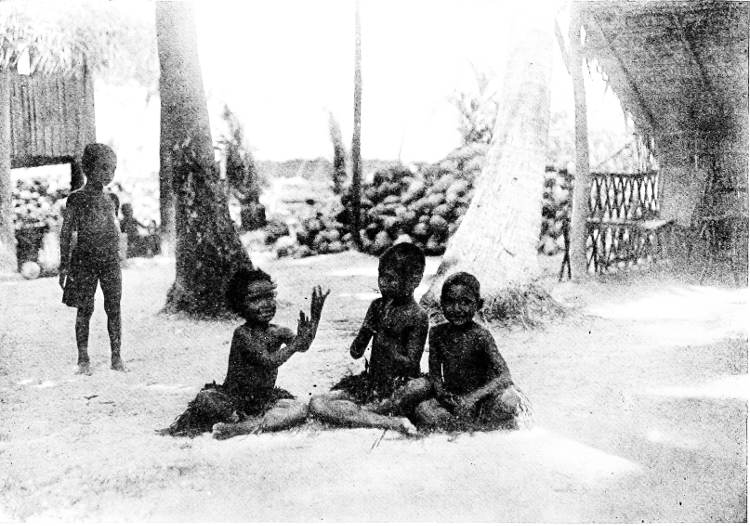
GURUNGEN. MATENAK. POOGUROO.
“GAGAI,” OR CAT’S CRADLE
At length Lian spoke, and just as though he were of the highest
culture and fashion, began with the weather and the prospects of
rain, just then much needed for the coconut trees and the tanks, or
rather water holes, on the island; then, of course, the next subjects
broached were coconuts, copra, and trade; I could not understand what
was said, but Friedlander, always courteous and kind, included me
in the conversation by translating from time to time. The peculiar
appearance of the little damsel’s cheeks was, however, what I was most
anxious to have explained. She looked as if she were suffering from
an extraordinarily severe attack of mumps combined with jaundice. At
the earliest opportunity I begged my host to permit me to ask by what
mysterious malady she had been attacked; and I extended my hand to
touch the strange excrescences; she shrank back timidly with a little
cry and her feet darted for the first rung of the ladder; thereupon
all the cherubim instantly disappeared. I at once tried to make
amends by stepping back a few paces; her father then explained that
what I had mistaken for mumps were merely the halves of a coconut
shell worn to protect her poor, little ears, which had been recently
punched in conformity with the feminine fashions of Uap. These shell
protectors had been scraped smooth and powdered thickly with saffron,
or reng-reng, an ornamental cosmetic in universal use and the
stain had been so smeared over the little girl’s neck and cheeks that
the skin and shells were all the same colour.
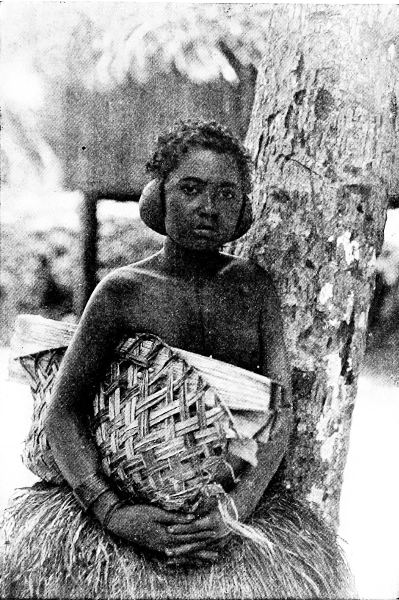
KAKOFEL, THE DAUGHTER OF LIAN, WITH COCONUT SHELLS TO
PROTECT HER RECENTLY PERFORATED EARS
When she saw, however, that my interest was friendly, she loosened
the strings that held the coconut shells in place and showed me, as
a special favour, her terribly swollen ears, whereof the lobes had
been punctured and a wad of oily green leaves, as thick as a dentist’s
thumb, inserted in the wound to keep it from closing up. Her spirits
were not, however, in the least depressed by her afflictions, and after
I had, as a fair exchange, displayed to her some elaborate Japanese
tattooing on my arms and she had contributed to it many smudges of
black and yellow from her inquisitive fingers, we became excellent
friends. To change the subject, I produced a string and inquiringly
showed her one of my cat’s-cradle figures. She watched my awkward
movements with open-mouthed wonder and then, taking the string, made a
figure, which she called melāng,—coral,—representing a stalk
of coral with two side branches; of course, I was eager to learn it,
and in my attempts I increased my vocabulary with several words or
phrases,—dakafel, meaning “not right,”—kafel, “all
right,” and piri amith, “very painful,” which I was told to say
when she nearly twisted my fingers out of joint in forcing them through
tight loops or in hooking them over each other at impossible angles.
Manigil, “excellent, very good” was the last word I learned.
By this time the cherubim had dispelled both their fears and the
illusion, by crawling up stealthily and sitting down on the floor near
us. Of course, little Pooguroo was there close beside me, and gave a
smile meaning “we’re old friends, aren’t we?” In a few minutes they
were all at cat’s-cradle, competing with each other in making the
figures rapidly and grunting at me for applause. Before this first
lesson was over, Lian, the chief, became so lost in watching us that
he stopped talking copra, and, taking the string from his daughter,
tried to show off his own skill in some wonderful pattern, but he was
so shaky with a palsy of his hands, that his efforts were vain and his
disrespectful daughter jeered at his failure, and in high glee shouted
“dakafel! dakafel!” until he gave it up and, with a provoked
smile, flung the string at her merry little face and resumed his talk
about trade.
Kakofel was the tomboy of Dulukan; there was no mischief afoot that
she was not in it, and where the boys were making the most noise and
playing the roughest games, there was Kakofel, always in the midst,
and her rippling laughter, ending in a prolonged high note, was always
distinguishable above the others. But I grieve to say our friendship
did not last long; it was my inadvertent rudeness that caused the
breach. One resplendent moonlight night, the shouting of boys and the
shrill screams of little girls playing in the coconut grove seemed to
be more boisterous than usual, and Kakofel’s voice frequently rose high
above the rest. Friedlander and I strolled forth to see what was going
on, and were astonished to see firebrands flying in all directions,
scattering trails of sparks, like comets. “Hang the little imps,”
shouted Friedlander, “they’re at their fiendish fire-game again!” They
had built a fire of dried coconut husks which smoulder slowly, and,
armed with these glowing embers, were hiding behind coconut trees,
awaiting a chance to launch the fiery missile at some unwary playmate.
Friedlander was not concerned for the blisters on tough little hides,
but he was justly fearful lest a misdirected brand might lodge on the
thatch of his storehouses. Off he dashed into the darkness, hurling
broadcast some awful Uap words; the pyrotechnic display fell at once
to earth, and the shouts and laughter died away in the patter of little
bare feet and the rustle of grass skirts. Like wild animals they knew
how to run to cover, and in a trice the grove was still and dark and
silent, as at midnight, and deserted; merely the persistent embers,
that kept on glowing where they had been dropped, were left to tell of
the escapade.
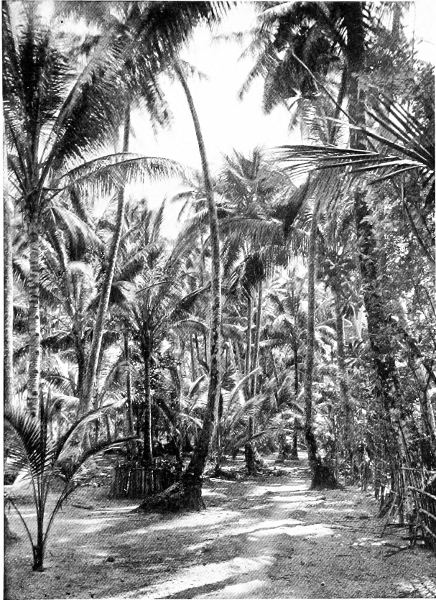
COCONUT GROVE
But Friedlander was rendered so anxious over the risk to his
“go-downs,” stored full with several months’ accumulation of copra,
that when he became convinced that it was impossible to run to earth
the will-o’-the-wisps, he strode over to the failu, where
several men and boys were still sitting around a fire, and there
vented his wrath upon them, assuring them that if they didn’t restrict
those little devils, and especially that little “Kakofel Kan” (that
is: “that little demon of a Kakofel”), whom he suspected by
her tell-tale laughter to be the ring-leader, he would hold them all
responsible for any damage by fire, and would confiscate their largest
and whitest fei till the loss was made good.
Their eyes and mouths opened wide in astonishment and, when his
harangue was concluded, several of them jumped up and started out in
the darkness to catch and chastise the culprits; as well might they
have attempted to catch the frigate bird that soared over the house the
day before.
By the next morning Friedlander’s rage and anxiety had subsided and the
night’s adventure had apparently faded from his memory, as all other
annoyances of his life always vanished whenever his lighter with a full
load of coconuts pulled up to the jetty. While I was tinkering at my
cinematograph or my camera, I glanced up and happened to see Kakofel
sauntering toward me, swinging in one hand her inseparable betel
basket, and in the other holding the white spongy heart of a sprouted
coconut, known as “būl, which is about the size of an apple and
of the consistency of pith, but with a very pleasant, sweet taste,
and a favourite delicacy with children. The process of munching this
būl, from time to time, eclipsed and disarranged the sweet and
innocent smile with which she saluted me as she approached. There was,
of course, her usual accompaniment of small boy and girl-satellites
and when she stood at my side, I shook my finger at her and said in
the merest joke, “Hullo, Kakofel Kan!” Her expression changed in a
flash! She stopped short, the smile vanished, her eyes opened wide, as
she stared at me, with an expression of almost horror on her face; the
half eaten būl dropped from her hand, she turned quickly, and
with one backward glance at me over her shoulder, ran swiftly out of
the enclosure and up the path toward her home, her little brown legs
swinging out sideways from the knees, as, in native, girlish fashion
she turned her toes in to get a better grip upon the loose sand. That
was almost the last I ever saw of Kakofel; nothing would induce her to
come near me again; when the phonograph was played to large audiences,
she was present, but always in the furthest row of listeners, and often
sitting solemnly alone outside the light bamboo fence; when I caught
her eye and smiled, she responded with a stony stare, and turned away;
if I called to her, she paid not the slightest attention, except to
quicken her pace to a run. Indeed, she was a mournful loss in my circle
of small friends; she was always a merry little thing; a wonderful
adept at cat’s-cradle, and a patient, although derisive, teacher.
However deeply I may have wounded Kakofel’s feelings, her mother by
no means shared the affront; for she was always the first to arrive
and the last to leave whenever a phonograph “recital” was on hand;
moreover, she invariably managed to secure a seat as near as possible
to the instrument, whence she could command the best singers to come
forward to sing or speak into the brass horn; I usually dropped three
or four imported cigarettes in her lap by way of thanks. She was not
what even an ecstatic imagination could describe as beautiful, but she
had a gentle, plaintive expression, and this rueful look was emphasised
by a droop at the left corner of her mouth caused by the loss of all
her teeth on that side. She was extremely thin, every bone of her chest
stood out almost in alto-relievo, but she seemed, withal, to be very
cheerful and, whenever the phonograph showed off well its power of
mimicry to some surprised new-comer, she emitted “the loud laugh that
speaks the vacant mind.” The dim blue tattoo marks on the back of her
hands and on her legs bore witness that in her youth she had been the
fêted belle of some failu, before Lian took her to himself as
wife. I once paid her a visit when she happened to be busy boiling some
dal (yams), and lak (taro), for the midday meal, and she
showed me all over her kitchen by allowing me to thrust my head within
the doorway. It was merely a little outhouse of palm leaf close beside
their large house and only about six feet long, by three or four wide;
the floor was really neatly swept up, although the thatching of the
sides and rafters was well coated with soot. The fireplace was a large
iron bowl,—purchased of course, from Friedlander,—banked up in a
mound of sand; in this the fire was built, without any draught, and
over it an iron tripod, whereon was hung another iron bowl in which
the food was cooking. She had to sit by and watch the fire constantly
because, as she explained, it was exceedingly ill-omened for a spark
to fly out and lie burning on the floor, so while the fire burned
brightly, she must be close at hand to push back embers that might
fall, and to catch flying sparks.
The little house wherein the women cook their own food is called
pinfi, meaning “woman’s fire,” and is always for their exclusive
use; no man can eat food cooked in utensils that have been used in
preparing food for a woman, and I doubt if a man would use even the
same fire; I know that they will not light a cigarette from the same
ember or match that a woman uses; this is true even of husband and
wife. Once, at Friedlander’s instigation, to make a test, I picked
some areca nuts out of a woman’s betel basket as if to examine them,
and then in an absent-minded manner, dropped them into the basket of a
man who had seen me take them from the woman; instantly he snatched
them out of his basket and flung them from him as if they had been
live coals. I questioned Lian about this custom; he admitted that
nothing would induce him to eat food prepared in a woman’s bowl or
chew a betel nut that had been in a woman’s basket. He assured me
solemnly that it would inevitably bring ill luck or sickness. When
I visited Lian’s wife, all utensils used in the preparation of her
husband’s food were in a small vestibule or antechamber near the door
of the house, and there also was the fireplace used exclusively for
him. This taboo, as I suppose it may be termed, does not, however,
prevent a husband from eating voraciously of the food which his poor
wife, slaving over the fire (in the tropics too!), has cooked for her
high and mighty lord;—here is just where the charming flexibility of
the taboo is in evidence. The ill omen attached to the flying sparks
is devised to frighten poor women into taking care lest they set the
house on fire; and, by the way, it is, indeed, almost miraculous that
they do escape daily, nay hourly conflagrations, even with this dread
omen hanging over them. In the first place, their skirts are composed
of four or five layers of dried leaves and strips of bast, and are
so voluminous and distended that they stand out all round the body,
outrivalling the old-fashioned hoopskirts; even when sitting down, the
women are surrounded by a mound of veritable tinder. In the second
place, they are for ever striking matches to light their cigarettes,
nay, worse even, they carry about with them for the sake of economy
the glowing husk of a coconut, and neither to matches nor husk do
they give the slightest heed, striking the one recklessly over their
own skirts or absent-mindedly resting the other against the skirts of
their neighbour. Yet in spite of this utter recklessness never did I
see a skirt catch fire, although I confidently awaited it every time
they assembled to hear the phonograph. When the female audiences had
dispersed after these exhibitions, Friedlander’s neatly swept little
compound was wont to look like a threshing-floor, so covered was it
with fragments of pandanus leaves, the relics of female attire. One
month at longest is the life of a woman’s dress; then the old skirt is
burned and a brand-new one plaited, with no tedious fittings at the
dressmaker’s, nor depressing bills to pay.
When dressed in their best for visits or feast days, the women don
skirts prettily decorated with wide strips of pandanus leaves bleached
for the purpose and stained a bright yellow with reng, and about
the waist-band are inserted brightly variegated leaves of croton.
The effect is, indeed, extremely pretty on the background of their
smooth, brown skin. The women do not, as a rule, adorn themselves
with necklaces or other ornaments; some, who do not work very hard in
the taro patches, wear bracelets of coconut shell or tortoise-shell,
and sometimes finger rings of the same material. The long strips of
hibiscus bast, stained black, which they all wear knotted about their
necks after they have come to maturity, seems to take the place of all
other finery. This cord, known as marafá, must be always worn
by a woman, young or old, when she is away from her home; to be seen
in the open air without it would be as immodest and disgraceful as to
appear without any clothes at all. Within the dwelling house, however,
it may be discarded with perfect propriety.
Standards of beauty vary so widely among different races, from the fat,
round-faced beauties alleged to predominate in Turkish harems, to the
thin oval-faced belles of Japan, and to the long-eared, black-toothed
maidens of Borneo, that I was anxious to learn what in masculine eyes
of Uap constituted feminine beauty. One day, after a phonograph recital
for the men, fifteen or twenty from different parts of the island
lingered behind to watch the putting of the tom-tom in its box;
I then took the opportunity of asking them who, in their opinion, was
the prettiest girl of all they knew on the island. They seemed to take
a great interest in the discussion which followed, and several girls
were named and their charms discussed and compared, but finally a
unanimous voice was given to Migiul the mispil of Magachagil,
in the south of Uap. Their good taste may be verified by turning to her
photograph on the opposite page.
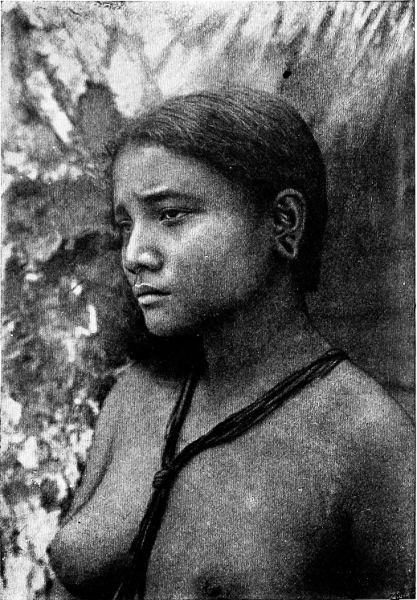
MIGIUL, A “MISPIL”
Migiul was a frequent visitor at Friedlander’s house, being an intimate
friend of his wife, and whenever she came to visit her parents, who
lived close by in Dulukan, she spent the greater part of the day
gossiping in Mrs. Friedlander’s cosy little home and learning to speak
the Marianne Island language. She was an exceptionally bright girl,
about seventeen or eighteen years old, with a sad, plaintive expression
and a soft, gentle voice,—a universal favourite with the women, and
the admiration of all the men. Nor was this all. Her reputation as
a ballad singer was widespread, hence she was pushed forward on all
occasions when a new song “record” was to be made, and seemed modestly
conscious of her proficiency; I cannot honestly affirm, however, that
I sympathised with her admirers in their ecstasy over her high or low
notes, which to my dull, untrained ears too closely resembled, in all
seriousness, the cry of a cat in agony. Notwithstanding her peculiar
position in that small community, there was no trace of boldness in
her demeanour; her voice in speaking was always low, “an excellent
thing in woman;” she never obtruded herself, but retreated quickly to
the background when she had finished her song; in fact, she was the
personification of unstudied, innate femininity. This may be surely
accepted, whether among primitive people or amid the conventionalities
of modern society, as a high standard of refinement and an essential
element of a thorough lady. Poor little Migiul, according to the
exactest code of propriety is in her own eyes and in those of all her
Uap world, a thoroughly blameless, moral girl.
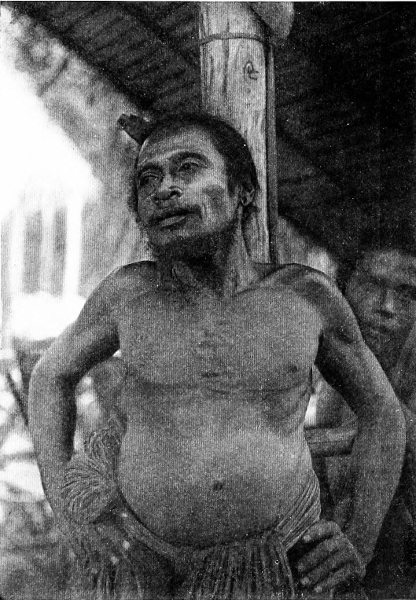
FATUMAK
Of all my friends among the men, old Fatumak, the mach-mach
or soothsayer, was the most faithful, the most intelligent, and,
consequently, to me, invaluable. In his youth he had fallen from a
coconut tree and so injured his spine, that he was permanently deformed
and had a dwarf-like figure with a pronounced distortion. One
evening, when he had been rehearsing to Friedlander and myself some of
the legends of Uap, I asked him how it was that he knew so much; he
said he had heard these stories from the old people when he was a boy,
and then he added, pointing to a long row of notches on the handle of a
little adze that he always carried:—“Those marks, each one,—one moon;
twenty-eight moons after I fell, I lay in my house; no one to talk to;
I think and think over everything; I talk to myself; I remember these
stories. Some I think true; some I think foolish.” This had been his
school,—two years of solitary self-communion, and during this time he
had pondered on the problems of nature and the human mind, and solved
them in his simple primitive way, to his own satisfaction. He emerged
a wise man among his own people and endowed, as they believed, with
prophetic foresight. He was ready with an answer to every question
and made his living by interpreting omens and telling fortunes by
mysterious combinations of knots in Bei leaves.
His house, wherein he lived quite alone, never having taken to himself
a wife, was a veritable magpie’s nest, so full was it of odds and ends
of every description, piled in corners or suspended from rafters,
mostly discarded rubbish from the houses of Spanish or German traders.
It was enclosed by an open fence of bamboo, fairly well built but
naturally flimsy; in this fence there stood a gate which at night
and invariably in the absence of the owner, was kept closed with a
ponderous, rusty padlock, although a single, slight push would have
been enough to throw the whole fence flat; indeed, I doubt that anyone
hurrying along on a dark night and happening to stumble into Fatumak’s
fence, would have been aware of it, or recognized any difference
between it and other obstructive patches of thick undergrowth; but
it was a great comfort to the old fellow to feel that “fast bind”
ought to mean “fast find.” In the house his most valued possessions,
such as bits of brass wire, nails, beads, extra blades for his adze,
empty baking-powder boxes, the key-board of an ancient accordion, and
innumerable other articles calculated to set a Uap’s “pugging tooth on
edge,” were kept secure in a large tin biscuit-box, whereof the top
had been cut on three sides, and the third side served as a hinge. He
had contrived to punch holes through this lid and the side of the box,
and through them he had inserted the hasp of another padlock almost
as unwieldy as the one on his front gate. I think that after locking
it he had lost the key,—the corners of the lid looked as if they had
been bent upward to extract what he wanted without disturbing the lock;
in fact, it was through these openings that I was able to examine the
treasures of this safe.
The old man,—I call him old, but I doubt that he was over fifty,
yet seemed older because of his deformed body and his quiet, sedate,
and thoughtful bearing,—had a pleasant, pensive face, with somewhat
negroid features, a broad flat nose and thick re-curving lips; his
hair, just beginning to show grey, was, however, wavy and curly, with
no trace of the wool of African negroes or of Papuans. He smiled
easily and took good humouredly the chaff which we constantly poked at
him for his thrifty devices, which closely verged on miserliness, and,
occasionally, for the prices he charged poor unfortunates who invoked
his skill in foretelling the future. He was not able, on account of
his misshapen back, to paddle his own canoe, but he had constructed
a raft of palm stems and bamboos, which he called his “barco,” after
the Spanish, and many a time I saw him start off in the early morning
to make his rounds of fortune-telling, poling his “barco” up the
coast in the shallow lagoon, and return again in the evening with his
decks almost awash with ripe coconuts,—his fees for consultation
collected on the spot. His method of foretelling the future by means of
bei leaves, he himself believed in implicitly, and invariably
became serious and reserved if we alluded to it lightly. Many a time
when he was squatting beside us as we ate our lunch or dinner at a
little table in the yard under the palms, he would be called aside by
an anxious client to interpret some mysterious combinations of knots
which had been tied at random in strips of palm leaf. There are only
a favoured few who know the hidden significance of marriages of the
kan or demons, indicated by these knots, and this knowledge
is kept sacredly secret and never revealed until the father, at the
approach of death, discloses it to his son; thus it is handed down from
generation to generation.
On several occasions I noticed these consultations with Fatumak, but
had no idea of their meaning; I supposed that the tying of knots in a
strip of leaf was mere frivolity to fill up the time. One day, however,
a seeker for truth happened to sit close beside me and I heard him
earnestly talking to himself, or to the knots, as each one was tied;
when the four strips were finished, he adjusted them carefully in
his hand and showed them to Fatumak, who merely glanced at them and
murmured a reply. This was repeated several times; then the man arose
and went away contented. Of course, I asked Fatumak what it all meant
and he informed me that the man wished to find out whether or not a
friend of his, in the northern end of Uap, who was very sick, was going
to get well; the answers had been favourable.
Whoever wishes to consult the omens in this manner provides himself
with eight or ten strips of green palm leaf, preferably the narrow
leaves of the coconut, and in the presence of the soothsayer, proceeds
to tie at random in each strip a series of single knots about a half
inch apart, not counting the knots as he ties them, but all the time
murmuring to himself the question which he wishes answered. When
four strips bear many knots thus tied, he takes the first strip and,
counting off the knots by fours, beginning at the broad end of the
leaf, catches the strip between his thumb and the base of the index
finger of the right hand in such a way that all the knots which are
over an even division by four, stick up above the back of the hand. On
the second, third and fourth strips he counts off the knots in the same
way, and catches them in turn between the index and middle finger,
the middle finger and ring finger, and the ring finger and little
finger, thus leaving the uneven number of knots sticking up close to
the knuckles. If there happens to be, on any strip, an even number
of fours, then four knots are left projecting. The seer then reads
the omen from the combinations of knots in the two pairs of strips,
composed of the thumb and index strip, and the index and middle finger
strip for one pair; and the middle and ring finger strip, and the ring
and little finger strip for the other. Each pair signifies a different
kan, or demon, and it is in accordance with the union of these
kan, that the omens are good or bad. As may be seen, there are
sixteen combinations of the number of knots possible in each pair;
consequently, there are sixteen valuable kan which assist at
this form of mach-mach. For instance, the thumb strip may have
four knots left over and the index strip have two, this is the sign
that the female kan, Vengek, is present for one; the middle
finger strip may have one and the ring finger strip have three knots
left projecting above the knuckles, this is the sign that Nebul, a male
kan, is associating with Vengek, and this indicates a certain
answer according to the drift of the question; which would be also
affected by the appearance of Vengek or Nebul in the first or second
pair of knots, the time of day, conditions of the weather and many
other influences, which Fatumak declared it would be useless to tell
me, as I could not possibly understand them all. I had made the grave
error of showing too rapid a comprehension of one of the mysteries of
the art when he was giving me the signs of the various kan,
their sex, and to whom they were married. This is the list, as he gave
it to me, before explaining anything about sex or marriage among the
kan:
- 3 and 3—Thugalup
- 3 and 1—Languperran
- 1 and 4—Wunumerr
- 4 and 4—Sayuk
- 1 and 1—Thilibil
- 2 and 2—Nagaman
- 3 and 4—Trunuwil
- 1 and 2—Saupis
- 2 and 1—Navai
- 3 and 2—Fawgomon
- 1 and 3—Nebul
- 2 and 3—Musauk
- 2 and 4—Namen
- 4 and 2—Nafau
- 4 and 3—Vengek
- 4 and 1—Liverr
Of course, he had to give a practical demonstration of each
combination, he could not carry the numbers in his head; and when
he had finished the last one, Liverr, he vouchsafed the additional
information, while the knots were still between his fingers, that this
kan was a woman and was married to Wunumerr. This led me to ask
about the next to the last, Vengek; this also proved to be a woman,
married to Trunuwil; the next, Nafau (four-and-two) also a woman and
married to Namen (two-and-four),—this gave me the key,—the descending
numerical combinations were women and they were married to their
ascending reverse combinations.
Three-and-two would be a woman and married to two-and-three;
three-and-one the wife of one-and-three, etc., etc. Foolishly exultant
over my guessing these combinations, I forestalled Fatumak in telling
off the remaining combinations and named the husbands and wives; he
first eyed me with astonishment, and then became unmistakably provoked
and sullen. But my pride had its fall; I could not determine the
even combinations of four-and-four, three-and-three, two-and-two,
and one-and-one, so I had to appeal to his superior knowledge again;
whereupon he told me rather gruffly that four-and-four was the chief
Sayuk, and his lesser half was Nagaman (two-and-two), and one-and-one
was their son Thilibik, and three-and-three was the bachelor youth
Thugalup; and then he added that I might be very clever and guess just
as shrewdly about the Bei, but that I would never know any more than
what he had just told me, and that no white man could ever understand
it; we had our glasses that looked beyond the sight of man into the
distance, but the men of Uap had Bei wherewith they could see things
that had not yet happened that were beyond the thoughts of man. With
that he gathered up his betel basket and solemnly walked away. I had
lost for ever a golden opportunity by my vanity,—but I incline to
think it was somewhat pardonable.
I did learn, however, a little more about the mach-mach, or
momok men, from the chief, Ronoboi, also a noted seer and
dealer in charms. Those who practice the art must be aged widowers, or
widows, from whose lives all thoughts of love for the opposite sex have
vanished; they may never eat food that has been prepared the previous
day; they must always be scrupulously careful that the “quids” of betel
nut, which they have finished chewing, are destroyed either by fire or
by throwing them into the sea, where no profane hands can find them and
thereby work charms (consequently their betel basket is provided with
an extra compartment wherein the exhausted “quids” are deposited to
await their destruction); the parings of their nails and the hair cut
from their head must likewise be burned or thrown into the sea; if they
spit upon the ground, they must always wipe it out with the foot. All
this is done so that no counter spells may be worked against them. The
aim of the regulation in regard to warmed-over food is, we may surmise,
that no stale food shall be proffered as a compensation for their
fortune-telling or, possibly, it may be to avoid the risk of poisons.
Whoever takes counsel of the Bei, must himself make the knots in the
strips of palm leaf and hold them in his right hand. He cannot force
his fortune by pre-arranging the combinations of kan; there are
so many controlling circumstances, of which only the soothsayer has
knowledge, that it would be futile for any one to try to deceive the
Fates.
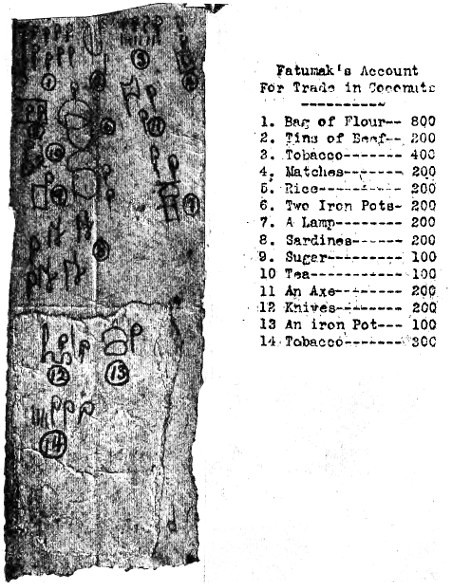
Fatumak’s Account
For Trade in Coconuts
—————
| 1. Bag of Flour |
800 |
| 2. Tins of Beef |
200 |
| 3. Tobacco |
400 |
| 4. Matches |
200 |
| 5. Rice |
200 |
| 6. Two Iron Pots |
200 |
| 7. A Lamp |
200 |
| 8. Sardines |
200 |
| 9. Sugar |
100 |
| 10 Tea |
100 |
| 11 An Axe |
200 |
| 12 Knives |
200 |
| 13 An iron Pot |
100 |
| 14 Tobacco |
300 |
Fatumak bore me no grudge for trying to pry too curiously into his art;
he came to visit us again the next day; all was forgiven and he was as
genial as ever. It happened that on this particular occasion he had
come to settle his accounts with Friedlander for goods to be received
in return for coconuts rendered. He was always most accurate in his
dealings and seemed to remember so exactly the number of coconuts
representing the value of each article which he had been promised, that
Friedlander fairly marvelled at his memory, until one day he discovered
that the old man had invented a cipher for all the articles of
trade and for the quantities of coconuts. In this cipher he drew up
his accounts with a lead pencil on any old scrap of paper that he
could find, and then proudly read them off to Friedlander. The signs
were always the same and were perfectly intelligible to the writer, no
matter how long a time had elapsed since they had been written. On the
opposite page is a photograph of one of his accounts, which I preserved
after it had been settled; the various entries have been numbered and
translated. Some of them are merely pictographs, such as the axe, and
the iron pots, but others need explanation. I asked him the meaning of
the mark indicating a package of tea, and he explained that when tea
was given to him it was always in a little piece of paper, and that the
little round object represented the bundle, and the crooked line at the
top was the twist he gave to the ends of the paper to keep it secure.
The sign which he used for boxes of sardines is puzzling; Fatumak did
not explain it, but it looks as if the wavy twist on the right side of
the figure is meant to represent the strip of tin which is twisted off
with a key when these cans are opened; whence he got the sign also for
a hundred coconuts he could not explain, but it was always the same and
perfectly legible to him.
The people of Uap use a decimal system having separate words for
twenty, thirty, forty, fifty, but sixty is six-tens, seventy,
seven-tens, etc.; and again, uncompounded words for one hundred and one
thousand. This may seem trivial to note, but I found a decimal system
among the Miri Nagas of Upper Assam, in India; they counted, however,
only to ten, and then repeated; they had no terms for eleven, twelve,
thirteen, etc., nor for twenty. When they reached ten, a stick or
pebble was placed beside them on the ground as a record of the tens.
Fatumak’s cipher or system of sign writing elevates him at once
head and shoulders above the most advanced and intelligent of his
fellow-countrymen, who, for the greater part, have barely emerged from
the stone age; in fact, adzes of sharpened shell are still to be found
in almost all the houses of the old families, and the old men can
distinctly remember these primitive implements in daily use by their
parents and grand-parents.
In sooth Fatumak was a most lovable old character, uncomplaining under
the discomforts of his deformity, always ready to impart and anxious to
receive information, and never obtrusive or presuming, as is so often
the failing of natives of these islands when they find that a stranger
is interested in them.
CHAPTER IX RELIGION
One evening when old Fatumak appeared to be in a philosophical mood and
Friedlander was at hand as a kind interpreter, a favourable opportunity
seemed present to ask the reader of the future to turn back the pages
of his memory and tell what he knew of the dim and misty past,—when
and how and by whom this fair little tropical world was created. After
the question was put to him, he sat silent for a while, with his eyes
cast down fixedly on a fresh bolus of betel nut, for the various
condiments whereof he was rummaging in his betel basket on the floor
beside him. When the mixture was duly spread out upon the green leaf of
wild pepper, to add the last supreme touch, he took up his bamboo box
of powdered lime, holding it between his thumb and middle finger and,
tapping it meditatively with his forefinger, shook out a sprinkling of
lime through the small hole in the bottom; then he lovingly folded
the leaf over its contents, and throwing his head back and rolling up
his eyes, crammed the bolus far back in his cheek, then in a somewhat
muffled voice at length replied, “There are many strange stories
about those times, but I think they are all untrue, yet what I am now
about to tell you I know is just what really happened.” He leaned
back against the door post and ruminated quietly, while Friedlander
explained to me what had just been said, and then Fatumak resumed, with
the following story, which I give without the frequent interruptions:
“Long, long ago when there was nothing but sea and sky, and no land,
there was a large piece of driftwood like the trunk of a coconut palm
floating on the waves; on the under side of it was a great barnacle,
and out of this came the first woman, and she lived in the water and
never went up on top of the huge log. Very soon she had a daughter,
whom she warned that on no account was she to go up on top of the log.
The daughter’s curiosity was, however, too much for her and when it
was low tide and the bottom of the sea came up to meet the log, she
crept up on top, and a gal tree [hibiscus] grew down from the
sky and stuck fast to the log and held it in one place. When she got up
into the air and daylight, she found that the driftwood was inhabited
by all sorts of devils (kan) that hover about on the surface of
the sea, and they were all clothed, but she was not. As soon as the
clothed devils of the sea caught sight of her and saw that she was not
like themselves and was naked, they killed her and preserved her body
in salt.
“Very soon the mother missed her daughter and came up to look for her
and found only her dead body preserved in salt. Then Yalafath, the
ruler of Falraman (Heaven), was sorry for her and commanded the
kan who had killed her to work a charm that would bring her to
life again. When this was accomplished, Yalafath gave to the mother and
daughter packages of sand and yams and told them to go over the sea and
scatter the sand and plant the yams, but to return to the driftwood
and the gal tree in seven days without fail. So they set out
and did as they were told, but enjoyed it so much that they completely
forgot when the seven days were up. Yalafath was very, very angry and
sent a rat after them, telling him to eat up all the yam plants. When
the mother and daughter saw their plants destroyed, they came to their
senses and remembered the promise, so they hurried back to ask pardon
of Yalafath. He forgave them and sent them a cat to kill the rat. Then
he commanded the daughter to marry the kan who had first killed
her and brought her to life again, and he gave them a large canoe with
a sail, and they travelled everywhere and found that where the sand
had been scattered in piles there were the high lands and mountains,
where white people lived and they had everything they wanted. Where
the sand had been scattered broadcast were the low coral islands. The
dark people are the children of that kan and the daughter of the
barnacle woman, but white people are children of kans for they
go everywhere in the big ships that Yalafath has given them, and they
take everything, even coconuts and sand, from the dark people.”
This narrative does not seem to me to bear the stamp of antiquity. In
the first place, cats are of comparatively recent introduction on the
island, probably from some of the whaling vessels which frequently
traded there fifteen or twenty years ago. In the second place, the
reference to the white man taking away the coconuts and even the
sand from the dark people is an allusion to a copra-trader who,—so
Friedlander told me,—a few years ago cast anchor in the Tomil harbour,
and, after discharging his cargo, found that there was not enough dried
copra to give him proper ballast, so he had to fill one of his holds
with sand-ballast; this the natives could not understand and thought
that even the very soil of their island was valuable to the strange
white people. I have, nevertheless, given the story as it was told,
although it may be merely the offspring of Fatumak’s imagination and
tinged with his belief in the ruling of man’s actions by a superior
being and a company of subordinate demons.
There are no set forms of religious observance in Uap, but they believe
that there is in the sky overhead an abode of departed spirits; it
is supposed to be a large house, known as Falraman, and over
it presides Yalafath, the creator of the world, who is a kind but
rather unsympathetic god; nevertheless, if, in distress, prayers are
offered to him, he intervenes and overrules the horde of evil demons.
Falraman is precisely like any large house in Uap, and the
spirits of men and women who go there assume the same bodily shape
that they had in this life, but it is only the “thinking-part,” or
tafenai, that really goes. The tafenai of children also
go to Falraman, but whether or not they grow old is not known
to mortals. The tafenai of stillborn children, however, never
get into Falraman; all they know is how to cry; therefore they
stay in the ground where they have been buried and cry incessantly
for their mothers. After a tafenai has been long enough in
Falraman to have the mortal “heaviness” and earthly odour wear
off, it goes back to its former dwelling place in Uap and it is then
known as an athegith, but is invisible to mortal eyes. If a
tafenai find that it had not been befittingly honoured at
burial, it brings sickness to the household and will not desist until
its dead body has been laid away with due lamentations and funeral
songs, and the mach-mach man has pronounced a charm exhorting it
to desist. It is the tafenai trying to escape out of the body
that makes a person ill, and all the charms said over sick people are
exhortations to the tafenai to remain; when a man is delirious,
his tafenai has left his body and it may or may not be enticed
to return.
One day, an unfortunate, feeble-minded epileptic, of decidedly negroid
type, with thick lips and wild-staring, restless eyes, came with others
of the people to Friedlander’s house to hear a phonograph recital;
the excitement evidently brought on an attack, and he suddenly gave
the symptomatic wild shriek of epileptics and fell to the ground
with violent contortions. The bystanders made not the least attempt
to help him, but stood about shouting with laughter at his writhings.
The fit soon passed off, and he was again on his feet, walking about
with a dazed air, and a following of heartless, jeering little boys.
I asked Fatumak if he knew what was the matter with the poor fellow,
and, in a tone implying that it was a childish question, he answered,
“Oh, yes, he is just a foolish sort of a fellow who has a wandering
tafenai which floats around with the wind, and when it strikes
him he falls to the ground and struggles with it.”
When a man sleeps, his tafenai escapes and wanders about playing
all manner of queer pranks; in the morning when he awakes, it is the
tafenai creeping back into his body through the nostrils that
rouses him, wherefore a man so often wakes up sneezing or coughing.
“A wise man has his tafenai in his head; a fool has it in his
belly,” said Fatumak.
Yalafath, who is the supreme deity and has the general supervision
of mankind, has attributes benignant indeed, but of a lukewarm
character, negative rather than positive; herein, however, in this
benignity, feeble though it be, he is unparalleled in the theology
of the Borneans or of the Naga Hill tribes of Upper India, where all
deities are malevolent. Of the numerous lesser deities, there is Luk,
the god of the tsuru, or dance; Nagadamang is bold and aids
the athegiths in their vengeance; Marapou, who sends the wind
and rain and causes storms at sea; Begbalel, who looks after the taro
fields and makes or mars the crops; Kanepai is always present at dances
to make men so giddy that they must have water poured on their heads
before they recover and can go on with the dance, but Bak is the real
god of the Tsuru; Nagadamang is the god of war, and when he is heard
growling, war is sure to follow; if he knocks at a house-post, sickness
results. Muibab is also a god of war; the frigate-bird, sacred to him,
bears his name. Boradaileng punishes the tafenai of bad men
by thrusting them into a pit of fire. To be bad enough to deserve
this punishment, a man must have been guilty of cutting down trees
or coconut palms on another man’s land. Of course, the sea, sky, and
earth teem with invisible demons who are accountable for every natural
phenomenon or misfortune.
Fire came to the people of Uap through the god Derra (lightning), who
came down and struck a large hibiscus tree at Ugutam, a slave village
at the northern end of the island. A woman, whose name is unrecorded,
begged the god for the fire; he gave her some and showed her how to
bake an earthen pot. When the fire died out, he taught her how to
obtain more by means of the fire-drill, and told her that fire in a new
house must always be started in this manner, and for it only the wood
of the hibiscus tree should be used, moreover this wood must be cut
with shell knives or shell axes, neither iron nor steel must touch it.
Lusarer taught them, in days gone by, how to make the sacred mats or
umbul, of which I have already spoken; they are never used,
nor even unwrapped, but pass from father to son as sacred heirlooms
hanging from the rafters to attest the wealth and respectability of the
family.
I could not discover that sacrifices or offerings were ever made to
the gods, but in the enclosures about the houses I frequently noticed
a palm-leaf basket hanging to one of the trees or bushes in front of
the house; in these baskets there were invariably pieces of coconut
that appeared to have been scorched or partly roasted, also some broken
egg-shells and some dried leaves, probably of the wild pepper. Repeated
questioning failed to bring out an explanation of these baskets,
further than that they were hung out merely in sport; often the
house-owners professed absolute ignorance of their existence, and said
it was no doubt some childish game. They were, however, so universal
that I am convinced they bore a meaning that the people did not wish to
disclose.
While uttering incantations to cure sickness or to drive away the
athegiths, the wizard waves a wand of palm-leaves, with which
from time to time he touches the sick person. When wind and waves are
to be lulled at sea, he uses as a talisman the sharp, barbed spine
from the tail of the stingray; standing in the bow of the canoe he
flourishes this dagger-like talisman above his head as he shouts
out the mystic words, stabbing at the invisible god who has brought
on the bad weather, “shooing” him off, as if he were a chicken or a
trespassing dog. This incantation is known as momok nu flaifang.
Another occasion on which the services of the mach-mach are
invoked, is the naming of a child, which takes place ten days after
its birth, when for the first time it is brought to its father’s
house from the tapal, or small secluded house in the “bush,”
whereto prospective mothers retire on the first symptoms of labour. On
the ninth day after birth, a carrying basket is made for it, and the
mother carries it to a small house adjoining the family house; here
the mother and child must remain over night. On the following day the
mach-mach receives it in its father’s house, and, touching it
on the head with leaves from the heart of a coconut palm, he exhorts
Yalafath to protect the child and see that it is never hungry and never
sick, and, by waving the leaves of the life-giving coconut over it,
chases away evil demons of misfortune. The chosen name, usually that
of some near relative, either living or dead, is then given to the
child, which up to this time has been called sugau, if a boy,
or ligau, if a girl. The ceremony of naming a child is known as
momok nu sumpau.
For all these services the mach-mach, who is apparently in no
way regarded as a priest, but merely as a wise man and an exorcist, is
paid either in shell money, or coconuts, and baskets of yams or taro.
It is in this fashion that good old Fatumak makes his comfortable
living and is enabled to trade so lavishly with Friedlander for
products from the white man’s country where the barnacle woman and her
daughter deposited the sand in heaps.
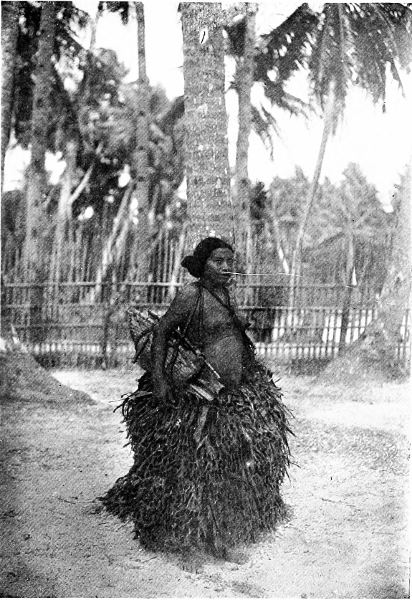
THE MODE OF CARRYING BABIES; THE SOLE OF THE BABY’S FOOT
MAY BE SEEN AT THE END OF THE HAMPER
CHAPTER X PERCEPTION OF COLOUR
It must be indeed a strange world to live in where black, blue, and
green are identical in colour; yet apparently it is in such a world
that the men of Uap live. As far as the colour of their heads and hands
is concerned, they might as well be Jumblees, whose heads, according to
Edward Lear “were green and whose hands were blue;” to them such freaks
would not be amiss; for all I could make out, the verdant coconut
frond, the azure sky, and their own dark bodies are all of one colour.
To them blue and green are only lighter shades of black; the word
rungidu is applied to all three.
One day, to test their perception of colours, I painted squares in
my note-book of every colour in my paint box; on asking many men the
names of the colours, I learned from the answers of all, that only
black, red, yellow, orange, and white had distinctive names; all the
shades of blue and green were ignored; or, occasionally, they would say
a deep blue was the colour of the deep sea, and light green was the
colour of young coconut leaves, but in the abstract these colours were
both rungidu. The carmine was at once picked out as rau;
emerald green, ultramarine blue, and black were all rungidu,
chrome yellow was reng-reng, orange was mogotrul, and
white (the blank paper) was vetch-vetch; the white foam of the
breakers was known as uth.
They were never at loss in naming or distinguishing the colour, and
gave such qualifying adjectives as “mouldy” colour; “dirty” colour;
“close to the colour of blood;” the strangest and most poetic was an
adjective applied to rose madder, which one man said was a “lazy”
colour. When asked to explain, he replied: “When a man feels sleepy and
lazy and rubs his eyes, he sees this colour.”
Among women, however, I found that some did recognize blue and green as
separate colours, and gave distinctive names to them.
CHAPTER XI TATTOOING
A desire to add to Nature’s scanty endowments of beauty, seems to
be one of our earliest endeavours, after we have shed our fur and
abandoned the arboreal abodes of our four-handed and conservative
brothers. Whether, or not, we have in every instance, succeeded in
improving on Nature’s unadorned charms must remain pretty much a matter
of taste.
The fashion of elaborate tattooing, which seems to have been prevalent
among the men of the past generation in Uap, is at present decidedly on
the wane. There are still some few middle-aged men who proudly display
a complete suit of tattooing, but I am afraid that they are looked upon
by the dandies of the day somewhat in the same light as the wearer of a
frilled shirt-front and lace cuffs would be regarded by the exquisites
of our own day,—just a tinge of respect for old age but a devout
thankfulness that such fashions are not the demand of this enlightened
and superior era.
Fifteen or twenty years ago the tattooing on the men of Uap covered the
greater part of their bodies from the nape of the neck to the calves
of the legs. To be beautiful and in fashion one had indeed to suffer,
especially as no such delicate instruments as steel needles could be
employed to convey the pigment beneath the skin; the bone of a sea fowl
or of a fish is to the present day the only material that may be used
to puncture the skin, and it takes a quite vigourous blow to drive
these dull points through a skin that has been hardened and thickened
by constant exposure to sun and to salt water.
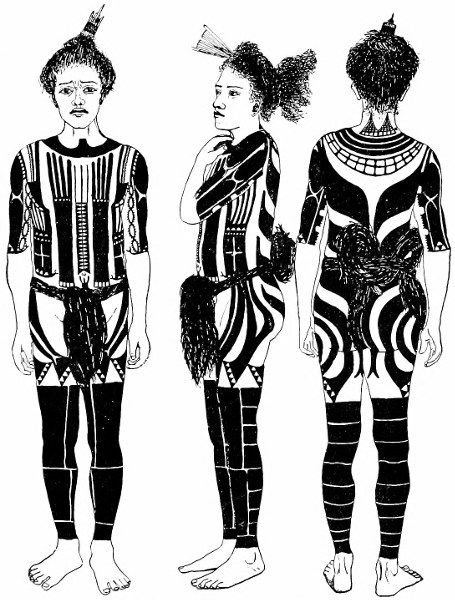
THE TATTOOING OF THE MEN OF FASHION. THIS IS NOT
UNIVERSAL AMONG THE MEN OF THE PRESENT DAY.
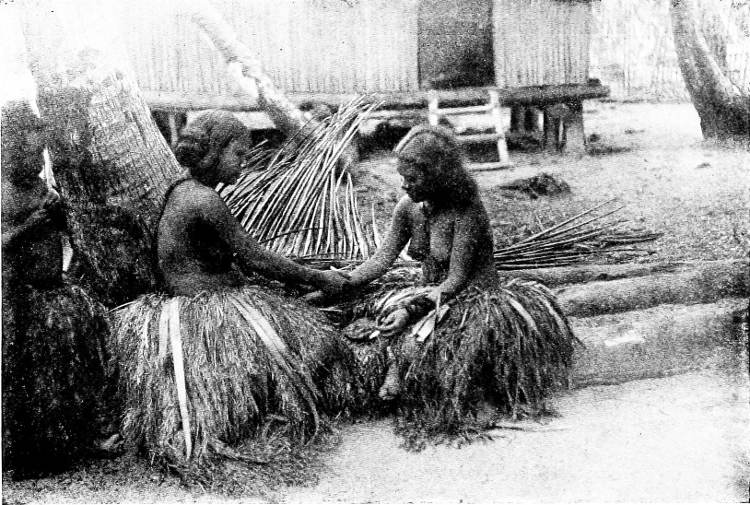
TATTOOING
I was unable to find any evidence that this elaborate tattooing was a
badge of superiority, or that it was done for any other object than
adornment; the only distinction that it seemed to confer was that
it proved that the person thus ornamented was a free man; the slave
class or Pimlingai are strictly prohibited from tattooing their bodies
and, as I have mentioned before, from wearing combs in the knot of
hair worn on the top of the head. The custom of tattooing was never
prevalent among the women, except those who had been captured from
other communities to be companions for the men in the Failu or Pabai;
they were tattooed on the backs of their hands and on their legs as a
lasting reminder, when they had married respectably and had lost their
youthful charm in bringing up a family, that once they had been like
the lilies of the field and a thing of beauty, but, sadly indeed, not a
joy forever.
The middle-aged men who now show the elaborate and extensive tattooing,
say that the fashion was introduced from the island Mukamuk, lying
about seventy miles to the northward of Uap. Men from this island
once long ago drifted down to Uap and taught both the men and women
how to tattoo. In those early days only the warriors were allowed to
ornament their legs with the pattern known as “Thilibetrak,” but
since serious battles have ceased between the people of neighbouring
districts, the restriction has been ignored and now if these
patterns adorn the legs it is only to be ultra fashionable and to
prove more charming in the eyes of the fair sex. The “Ngol”
or representations of sharks, some say, are to protect the wearers
from attacks from these fish while swimming in the lagoon, but others
maintain that these patterns are chosen solely because the shark is
the king of fish, and fish are such important items of the food supply
of the island. Götau is the native name for the art, and women
are usually the artists during long nights and lazy days in the Pabai
or the Failu. Colouring material is obtained from a mixture of the
soot from burning coconut oil and the milk of the coconut and a little
water. This somewhat sticky mixture is dabbed on the skin, using a
pointed stick as a pencil or brush to mark the outline of the pattern
and the colouring matter is then driven under the skin by means of
a needle or graver shaped like a rake,—that is with the teeth at a
right angle to the handle,—the blade being made of a segment about an
inch long from the wing bone of the frigate bird (in default of that
the wing bone of an ordinary fowl) at one end of which six sharp
little teeth have been cut and pointed by means of a leaf of bamboo
grass which, owing to the amount of silicon therein contained, makes
an excellent whetting material. This blade is bound at right angles to
a wooden handle about five inches long. In making the punctures in the
skin this handle is struck with a wooden beater and the sharp teeth
carry the ink through the outer layers of epidermis. From a very slight
acquaintance with the operation I can nevertheless say truthfully
that it is quite painful, and almost every puncture of the needle is
followed by an oozing of blood.
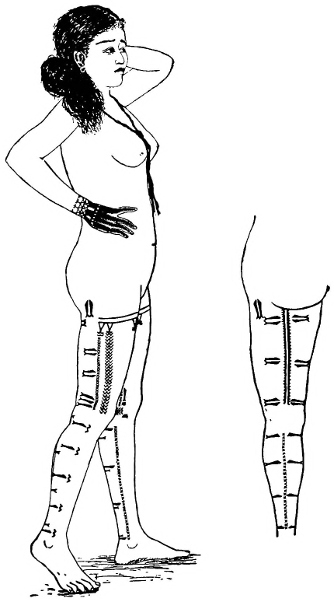
USUAL TATTOO MARKS OF A MISPIL
I tried in vain to get photographs of the well-tattooed men and women,
but with any but orthochromatic plates no trace of the patterns appears
on the negative; I made careful sketches, however, both of the old
fashioned tattooing of the men and the designs to be found on the
Mispils of the present day, as examples of Uap art, since this is
almost the only form of decorative delineation practiced by them.
CHAPTER XII BURIAL RITES
During my stay in Dulukan, Mafel, one of the most popular and respected
men of the district, was slowly dying of a malignant cancer of the
face, which was destroying his lower jaw and penetrating deep into
his throat. Day by day we had reports of his courageous and patient
suffering, and of the devotion to him of his only daughter, Gyeiga,
who never left his side, doing everything in her power to minister to
his needs, trying to give him food, and fanning him night and day to
keep the swarms of mosquitoes and flies from annoying him as he lay
propped up on his mat spread on the hard floor. He had been treated
for some weeks in the government hospital at the other end of the
island, but when he found he was gradually becoming worse, he begged
to be taken back to his own home where he could see his friends and
pass away quietly; he was carried thither and the skill of all the
most renowned mach-machs was invoked to dispel the demons of
disease and enlist Yalafath’s sympathy and protection in behalf of the
patient sufferer. In spite of all their energetic efforts, however,
slow starvation reduced him to a mere skeleton, and finally word was
brought to us early one morning that poor Mafel’s tafenai had
wandered away from him in the night and had gone to Falraman.
The devotion of Gyeiga did not cease, even then; she still sat by the
side of the repulsive corpse, fanning untiringly, and wailing forth
some disjointed snatches of a death song, wherein were recounted the
good qualities and kindnesses of him who had been indeed a father to
her; the dirge was constantly interrupted with a refrain—O Mafel, O
garfuku,—“O Mafel, O poor one!”
A messenger was immediately dispatched to the far-northern end of the
island to notify Mafel’s uncle, Livamadai, his nearest relative, an
important chief and momok man; on him rested the decision as to
whether the body should be buried on the following day, or kept two
or three days longer. To defer the funeral is a tribute of honour to
the corpse; haste in burial affords the chance of a visitation from the
athegith, wherefrom sickness and mishaps surely follow.
Old Livamadai, toothless, bald, and bent in the knees, hobbled down the
next day and decided that the following day, or the third day after
death, would be a delay sufficient to show respect to Mafel’s remains.
Poor Gyeiga had one more weary night of vigil; they said she never left
the side of the body and took barely a mouthful of food or a wink of
sleep all those three long days and nights. The atmosphere of the house
was truly unbearable; I went to ask her if I might come to the funeral,
and if she had any objection to my taking some photographs, and, after
expressing my deep sympathy and receiving her willing permission, I
retired as quickly as I possibly could from that inexpressibly noisome
and dark house of death.
On the following day there was a constant procession passing our house
on the way to the funeral; each person bearing a gift for the corpse,
usually strings of pearl-shell money or single large shells; some of
the wealthy and liberal friends brought a fei of such size that
it required two men to carry it.
I went to the house with Fatumak a little after noon; they said that
Mafel probably would not be buried until late in the day.
When we arrived at the house I noticed that the space about it,
enclosed by a fence of light bamboo, was occupied by women only;
Fatumak explained to me that he would have to leave me at the entrance,
if I intended to go in; it was against custom for any, except women and
the slave class, to enter the yard of a dead man’s house while his body
was unburied; of course, I, as a foreigner, would not be restricted.
I set up my camera and focussed it on that side of the house where they
would probably break through the walls to bring out the body,—through
a doorway it is never carried, it inevitably brings ill luck to the
living inmates,—then I rejoined Fatumak just outside the fence to
watch and wait and ask questions. It was evident from the number of
presents deposited at one end of the yard, beyond the group of guests,
that Mafel had been very popular and that his friends were wealthy, and
lavish withal, both in money and sympathy. “Yes,” whispered Fatumak,
“Mafel was truly a fine man; we all liked him; those presents will be
pretty nearly all returned after he is buried; they bring them to show
their sorrow, but it is always expected that they will get them back
again.”
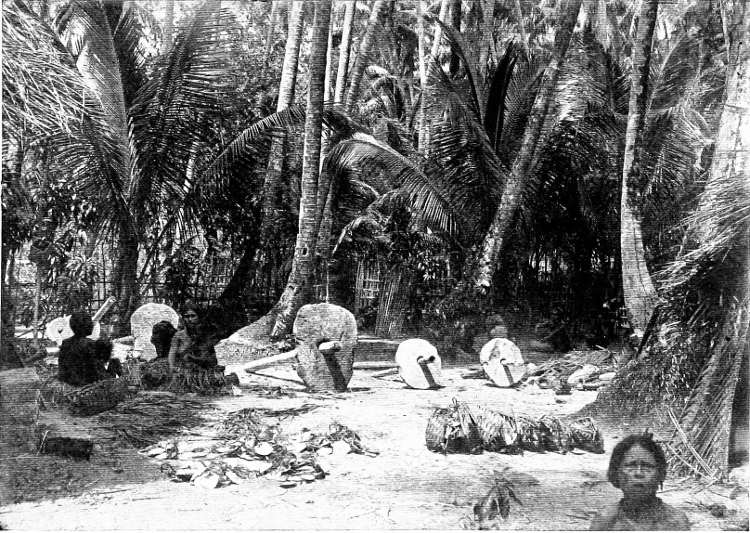
FUNERAL GIFTS OF STONE MONEY AND PEARL SHELLS
The women, in groups about the yard, had all brought their work with
them, and, sitting cross-legged on the ground, from time to time, in
subdued funereal whispers wherein sibilants always seem to predominate,
they gossipped with one another and kept their fingers busy, some
by plaiting little pouches to hold cigarettes and tobacco, some by
repairing their leafy skirts, and others by making new betel baskets;
but all were solemn and subdued in the presence of death and sorrow.
It was one of those gorgeous, lazy, tropical days when the very air
is idle and a sabbath stillness holds everything; there was not even
the hum of an insect or the piping of a seagull to break the quiet,
and only every now and then was there a breath of air strong enough
to make the palm leaves rustle softly. Once, the silence was rudely
broken by the thud of a ripe coconut falling to the ground, which for
a brief period diverted the solemn contemplation of death to thoughts
of commerce. A hush brooded over everything, even the irrepressible
“tomboy” Kakofel, sat demurely beside a group of women, rolling a
store of cigarettes for herself; Fak-Fintuk, Libyan, Gumaon and the
other obstreperous boys were, for once, unseen. The presents consisted
of six or more good sized fei of fine quality, six or seven
baskets full of shell money, and numerous single strings of the same;
really quite a fortune. All gifts were deposited with a good deal of
display by the donors at one end of the yard in front of the house;
for this service they were allowed to enter the yard, but were
expected to withdraw as soon as their offering had been deposited and
duly appreciated. After an hour or more waiting, five very solemn
men of the Pimlingai tribe filed into the yard and sat down quietly
in the background; then there was a little stir among the women as
they shifted their positions to get a better view of the side of the
house whence the funeral procession was to set out, and after a short
pause,—for no move must be made suddenly, the Pimlingai brought
forward a litter of bamboo poles covered with matting of woven coconut
fronds. This they carried into the house and on it they placed the
emaciated body of Mafel with his knees drawn up and tied together
and his hands folded across his body. The side wall of the house of
reeds and matting was taken down and through the opening the litter
bearing the corpse brought out and placed upon the ground. Gyeiga’s
chant grew louder and louder within the house and was no longer a mere
sing-song, but a passionate wail of sorrow, when, accompanied by
her two sisters-in-law (I think), she followed the litter out of the
house and took her place beside it on the ground. The eyes of all three
women were streaming with tears, but Gyeiga was the only one who wept
aloud. The Pimlingai again retreated to the background, and Gyeiga,
sitting cross-legged beside the corpse, placed two large pearl shells
upon his chest, talking to him in a pleading, plaintive voice and
looking directly in his horribly disfigured face. The old women in the
listening and sympathising crowd, from time to time seemed to mutter
an approval of her sentiments, and the wrinkled, parchment cheeks of
many of them were wet with tears. Then she arose and brought two more
equally fine shells from the house and placed them on top of the others
with another short speech to the corpse. As soon as this was done,
the Pimlingai came forward and wrapped the matting completely round
the body, leaving only the top of the head bare. Two of them picked
up the burden and the third placed a pole on their shoulders and to
this tied the sides of the litter so that the weight was distributed
evenly between their shoulders and arms. They wheeled around and
rapidly walked out through an opening in the bamboo fence back of the
house; Gyeiga and her two chief mourners and three or four other women
followed, wailing loudly.
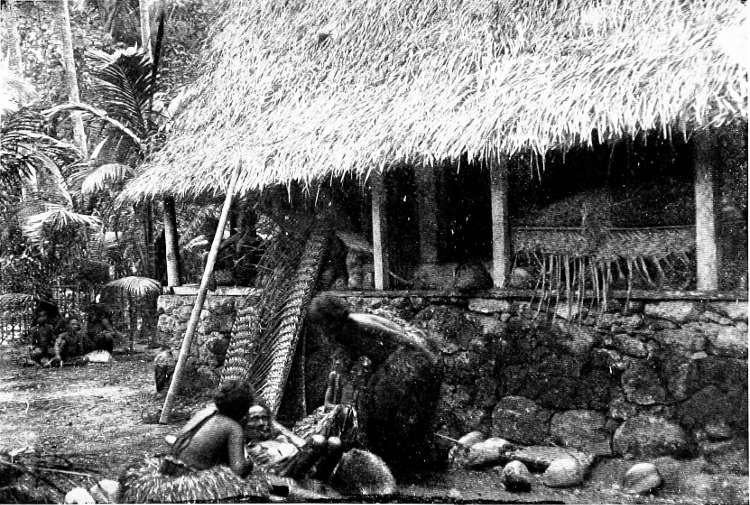
GYEIGA PLACING TWO PEARL SHELLS ON HER FATHER’S CORPSE
With Vincenti (Friedlander’s Christianised servant from Guam) I
followed after them, barely able to keep up with their rapid pace
over the slippery and irregular boulders of stone and coral with
which the side paths of the island are paved. The wailing was kept up
continuously by the different members of the party; when one became
tired, the next took it up, and so on, until each had wailed in turn,
and then Gyeiga began anew.
In and out we wound through jungle paths, now overarched with
grey-green bamboos, now hemmed in with hedges of tall, variegated
crotons; past small clusters of houses where the people stared to see
a funeral party followed by a staggering leather-shod white man and a
lad with a queer looking box on a stick over his shoulder. Then down
to the flat lands, past the taro patches and plantations of yams, and
through a deserted tapal, or village, of small houses used as
a maternity-ward,—strange place for a funeral procession to invade.
There were no inmates at that time in the little houses except numerous
small grey lizards with brilliantly blue tails, that darted in all
directions like little electric sparks in the sunshine on the thatched
sides of the houses.
We seemed to double on our tracks and zig-zag hither and thither, until
at length we passed through a Pimlingai village where three or four
more women and eight or ten children of the village silently joined the
procession. A short distance beyond this village, the men bearing the
litter turned off the path directly into the thick undergrowth, and
pushing through after them, we came out into a clearing about a hundred
feet in diameter. At one side there were several young coconut palms
just sprouting above the ground and scattered here and there were low
mounds and piles of moss-covered stones, six or eight perhaps in all,
graves of those who had gone before. The Pimlingai put down the litter
bearing the last remains of Mafel close to one of these mounds, which
appeared to have been very recently made and whereon still rested the
decaying remnants of a similar litter; they told me afterward it was
the grave of his wife who had died only a few months before.
As soon as the litter rested upon the ground, Gyeiga sat down beside
it and tenderly unfastened the matting which covered the body and once
more exposed it to view, and with a palm leaf began again her untiring
fanning and low wailing, constantly repeating “O Mafel! O my poor one!”
The Pimlingai disappeared for a minute or two in the thick jungle and
undergrowth, and then emerged with long poles sharpened at one end with
which they proceeded to loosen the ground at the far side of the litter
with its half reclining corpse.
The chief mourners who had accompanied Gyeiga set to work plaiting
rough baskets or hampers of coconut fronds, and in these the loose
earth was gathered up in handfuls by the Pimlingai, and piled to one
side or carried off and scattered in the jungle. After making these
baskets, the women busied themselves collecting stones and flat pieces
of coral rock wherewith to line and to cover the grave.
While this was going on, the women and children, twenty-five or
more, who had joined the procession at the last Pimlingai village,
sat silently, quite far off at the opposite side of the graveyard;
I was trying to get my camera in position so as to get a view of
the grave-diggers, but the only available spot placed them directly
between me and the declining sun, so I was forced to refrain from the
attempt. While I was testing my position, I frequently heard the female
spectators of the Pimlingai whispering Tokota, Tokota, the name
by which I was known to them. It was an attempt at “Doctor,” which
they had heard Friedlander call me. Glancing up, I noticed one of the
women looking at me and making motions up and down her arm. Then I
comprehended that they wanted to see the Japanese tattooing there. I
went over to her and, having rolled up my sleeves, received a liberal
palming and rubbing; amazed at the various colours, she and the others
could not believe they were not mere paint which a vigorous rub, aided
by moisture from the tongue, would remove. The sight of a Japanese
carp tattooed on the calf of my leg called forth such loud expressions
of admiration, that I was afraid I was sadly interfering with the
proprieties of the mournful occasion, so I drew up my stockings and
hastily retired.
When the grave was dug out about two and a half feet deep, by three
feet long, and eighteen inches wide, the Pimlingai lifted Mafel on
the mat whereon he rested and placed him in the grave, with his head
toward the setting sun. Before putting any earth over him, one of the
Pimlingai took, as payment for their labours, two of the pearl shells
that had been placed upon the corpse; the other two were buried with
him; he must not arrive empty handed in Falraman.
As soon as the body was placed in the grave the wailings of Gyeiga
and her chief mourners were redoubled, and over and over again they
bade him goodbye and reiterated “O Mafel! O my poor one!” When the
grave was nearly filled in, a sprouting coconut was planted at the
head and banked round with earth and lumps of coral. It was to provide
food for Mafel on his journey to Falraman, and also to furnish
oil not only for light, but also for his hair; a coconut is always
thus planted at the head of a corpse,—witness the young trees in the
graveyard. Slabs of stone and coral were piled up all about the grave
for a distance of two feet, and earth tightly packed in the crevices,
so that the big lizards,—“monitors,” the only large reptile on the
island,—should not disturb the body.
Until the last block of stone and handful of earth was placed on the
grave, Gyeiga and the mourners never ceased wailing; but the very
minute that all was finished and patted down, they ceased abruptly.
Gyeiga wiped away her tears, lit a fresh cigarette and disappeared in
the jungle.
It was too dark for photographs, so I packed up my camera and,
following Vincenti, I too plunged into the undergrowth, and in an
incredibly short time, as it seemed, was in Dulukan. I learned that the
route we had followed to the graveyard was as circuitous as could be
devised, and that this was always the custom in the burial of people
of importance; a poor man is hurried as quickly as possible to his
grave, but a wealthy man is taken past as many houses as possible and
in a roundabout way, so that the grief of his relatives may be seen and
heard far and wide.
On questioning Fatumak after the burial, I found that the manner
of death has much to do with the position in which the body is
interred; if a man dies of an ordinary disease or of old age, he
is buried with his head to the west and his knees drawn up, as in
Mafel’s case; if he dies in battle, he is buried with his head to the
north and his legs and body are perfectly straight; if he dies of a
cough,—consumption,—he is buried with his knees drawn close to his
breast, and with his face looking downward. The graves, as a rule,
are very modest little mounds in the quiet seclusion of the bush near
some Pimlingai village, but when a great chief dies, a large platform
of flat stones, such as the houses are built on, is constructed over
the grave, and the departing tafenai is speeded on its way to
Falraman with feasting and dancing.
Such is life and death on the happy little island of Uap; at least as I
saw it in a two months’ residence; they are delightful people to visit
now that Germany exerts a truly paternal care over them and perpetuates
their naturally mild temper by strictly prohibiting the introduction of
alcohol among them.
When, early one morning, I sailed away from Dulukan in Friedlander’s
barge bound for Tomil Bay, to meet the steamer and depart for Sydney,
all my friends were on hand to see me off,—Migiul and Lemet, who had
contributed to my collection of tattoo marks and cat’s-cradle figures;
Lian, who had helped in many ways to get specimens for my collection;
Tomak, of the strong voice, who had contributed many a song on the
phonograph; Gamiau, who had been foremost in getting up the dance; even
Kakofel, whose sensitive feelings I had grievously wounded by calling
her “Kakofel Kan,” was there, but she stayed in the background and only
stared when I shook her hand for goodbye. Little Pooguroo, my earliest
and faithfullest wee friend, stood on the very extremity of the jetty,
her little brown body glistening in the warm light of the rising sun,
and her large black eyes following me wonderingly as we were gradually
poled out into the channel of the lagoon.
Just as we made the first turn and Dulukan had faded from sight, we
met good old Fatumak on his “barco;” he shouted to me a few of the
auspicious phrases which are used to fisherman as they set out to sea,
and I shouted back to him goan e gup! which means “I am going,
but I shall return,”—a phrase of courtesy when one leaves a party of
friends and expects to return before long,—it about corresponds to
“Auf Wiedersehn.” Indeed the words were uttered in all sincerity. Who
would not wish, at least for a season, to renew, “through the verdurous
glooms” of the tropics, a life as simple, as equable, as hospitable as
that which I received at the hands of the natives of Uap.
UAP GRAMMAR — VOCABULARY
Only a few days before my departure from Uap, I received through
the kindness of Padre Cristobal de Canals, a grammar, written in
Spanish, of the language of the island. The small volume of a hundred
and forty-four pages bears the following title: Primer Ensayo de
Grammatica de la lengua de Yap (Carolina Occidentales) con un Pequeno
Diccionario y varias Frases en forma Diálogo. Por un Padre Capuchino,
Misionero de aquellas islas. Manila. Imprenta del Collegio de Santo
Tomas, á cargo de D. Gervasi, Memije, 1888.
In a short preface the Padre tells us that the modest treatise is the
work of a residence in the island of Uap of about a year.
It is almost needless to remark that when a language has never been set
forth in writing, its forms and even its pronunciation are as shifting
as the sands of a beach. The only object of those to whom it is native
is to understand and be understood. Let these two ends be gained, and
all the accidents of grammar are superfluous and pronunciation will
fall under no critic’s condemnation. That this is true as regards
pronunciation, sufficient proof is come under my own observation; in
the twenty years that elapsed between the date of the Padre’s grammar
and my sojourn in the island, the pronunciation showed marked variation
between that recorded in the Grammar and that current in the island
when I visited it.
Furthermore, it may be noted, I fear, that the Padre, in certain cases,
especially in the conjugations of verbs, failed to observe that what he
assumes to be a variation in structure decided enough to constitute a
separate conjugation, is, after all, merely a change due to euphony, or
due to a colloquial contraction, as we find it in all languages, such
as, for instance, we have in English in our familiar haven’t,
where, of course, n’t is not a part of the verb.
In these circumstances I have deemed it wisest to set forth the
Etymology and Syntax in the briefest and most concise way, and trust
to phrases and the vocabulary as supplemental to the mother wit of the
traveller in his communications with the simple-minded natives of this
truly charming island, and I am bound to add that the novice will never
find there severe critics of grammatical or linguistic blunders.
It is to be borne in mind that the language of Uap belongs, certainly
to a large degree, to the Agglutinating Group; and, possibly, the
more intimate our familiarity with it, the more distinctly we should
recognize as compounds words, which we now regard as simple, and
analyze them into their component parts. For instance, the definite
article “the” is faré; “those,” fapi; “those two,”
fagali. Here fa is evidently a root and the affix
pi we know to be the sign of the plural, but the meanings of
ré and gali are lost.
There are no grammatical genders, that is, there are no affixes,
suffixes, or terminations to indicate genders, but pumawn, man,
and pin, woman, follow the noun when sex is to be emphasized. We
have the same poverty in English in expressing the gender of certain
animals, such as: she-wolf, he-goat, she-bear, etc.
There appears to be no Indefinite Article, and for even a Definite
Article there seems to be no very great use. It is as follows, for all
genders:
| Singular |
faré |
the |
| Plural |
fapi |
those |
| Dual |
fagali |
those two |
Examples: The man—faré pumawn; the
woman—faré pin; the house—faré naun; the
men—fapi pumawn; the women—fapi pin; the two
women—fagali pin; etc.
The second syllable of the plural fapi is also used to express
the plural, e.g., the children—pi abetir; the people in
a village—pi u binau.
Before going further into the maze of Uap words and their arrangement
in sentences I am impressed with the advisability of quoting from
Professor Basil Hall Chamberlain’s “A Hand-Book of Colloquial Japanese”
(page 11) in order to give an excuse and to ask pardon for giving a
comparison and classification of one of these Far Eastern languages in
terms used in the grammars of the other side of the world.
“A word as to the parts of speech in Japanese. Strictly speaking
there are but two, the verb and the noun. The particles or
‘postpositions’ and suffixes, which take the place of our
prepositions, conjunctions, and conjugational terminations, were
themselves originally fragments of nouns and verbs. The pronoun
and numeral are simply nouns. The true adjective (including the
adverb) is a sort of neuter verb. But many words answering to
our adjectives and adverbs are nouns in Japanese. Altogether our
grammatical categories do not fit the Japanese language well.
They have only been adhered to in this work in so far as they
may serve as landmarks familiar to the student.”
PRONOUNS
The PERSONAL PRONOUNS are igak—I, igur—thou,
tsanem—he, she or it. Igak is thus declined:
Singular:
| Nominative |
igak |
I |
| Genitive and ablative |
rak |
of me |
| Dative |
gufanei |
for me |
| Accusative and dative |
ngok |
me; to me |
A curious refinement is to be noted in the dual and plural of this
first personal pronoun; each possesses two inflections, namely,
one conveying the ordinary idea of duality or plurality, such as
gadou—we two, and gadad—we; and a second conveying
the idea that the present company is alone referred to and that all
others are excluded. For instance, gadou u Rul means simply
“we two men of Rul,” but should the two men be joined by a third whom
they did not wish to be included in the pronoun, the phrase would be
gomou u Rul, that is, “we two men, and we two men alone, of
Rul.” Thus, also, should a man happen to address the assembled people
of his district, he would say: Gadad pi u Rul, i.e., “We
the people of Rul,” but if he wished to express the idea that he refers
to their own district, to the exclusion of all others, he would say,
Gomad pi u Rul.
The two numbers, dual and plural, of the first person, are thus
declined:
| Dual nominative |
gadou |
we two |
| Genitive and ablative |
rodou |
of us two, with us two |
| Dative |
n̄ḡadafanou |
for us two |
| Accusative |
n̄ḡodou |
us two; to us two |
Dual (Exclusive Form):
| Nominative |
gomou |
we two only |
| Genitive and ablative |
romou |
of or with us two only |
| Dative |
kufanu |
for us two only |
| Accusative |
n̄ḡomou |
us two only |
Plural:
| Nominative |
gadad |
we |
| Genitive and ablative |
rodad |
of us; or, with us |
| Dative |
n̄ḡadafaned |
for us |
| Accusative and dative |
n̄ḡodad |
us; or, to us |
Plural (Exclusive):
| Nominative |
gomad |
we only |
| Genitive and ablative |
romad |
of us; or, with us only |
| Dative |
goufaned |
for us only |
| Accusative and dative |
n̄ḡomad |
us only; or, to us only |
The second person is thus declined:
Singular:
| Nominative |
igur |
thou |
| Genitive and ablative |
rom |
of thee; or, with thee |
| Dative |
mufanei |
for thee |
| Accusative and dative |
n̄ḡom |
thee; or, to thee |
Dual:
| Nominative |
gumu |
you two |
| Genitive and ablative |
romu |
of or with you two |
| Dative |
mufanu |
for you two |
| Accusative and dative |
n̄ḡomu |
you two, or to you two |
Plural:
| Nominative |
gumed |
you |
| Genitive and ablative |
romed |
of you, or with you |
| Dative |
mufaned |
for you |
| Accusative and dative |
n̄ḡomed |
you, or to you |
The third person:
Singular:
| Nominative |
tsanem, fanem |
he, she, it |
| Genitive and ablative |
rok |
of or with him, her, it |
| Dative |
fanei |
for him, her, it |
| Accusative and dative |
n̄ḡak |
him, her, it, or to him, her, it |
Dual:
| Nominative |
galitsanem |
they two |
| Genitive and ablative |
rorou |
of, or with the two |
| Dative |
rafanou |
for the two |
| Accusative and dative |
n̄ḡorou |
them two, or to the two |
Plural:
| Nominative |
pitsanem |
they |
| Genitive and ablative |
rorad |
of them, or with them |
| Dative |
rafaned |
for them |
| Accusative and dative |
n̄ḡorad |
them, or to them |
Demonstrative pronouns are of three kinds, namely, personal,
impersonal (i.e., relating to things animate and inanimate), and
partitive (i.e., relating to parts or pieces of objects). The
personal demonstrative pronouns are:
Singular:
| tsanei, or anei |
this |
| [The abbreviation, anei, apparently, is only for euphony.] |
| tsanir, or anir |
that |
| tsanem, or anem |
that yonder |
| fatsa |
that far off, unseen, out of sight |
Dual:
| galitsanei, or galianei |
these two |
| galitsanir, or galianir |
those two |
| galitsanem, or galianem |
those two yonder |
Plural:
| pitsanei, or pianei |
these |
| pitsanir, or pianir |
those |
| pitsanem, or yad |
those yonder |
Impersonal demonstrative pronouns, referring to animals and
things: binei—this; binir—that; binem—that
yonder; tinei—these; tinir—those; tinem—those
yonder.
Partitive demonstrative pronouns: kinei—this piece
of; kinir—that piece of; kinem—that piece yonder of.
Tsikinei (if the piece is very small); tsikinega (if the
piece is very large).
The POSSESSIVE PRONOUN, when applied to anything which has
no relation to our body, is the genitive of the personal pronoun,
placed after the noun: purpur rak—my hat; naun rom—thy
house; ton rok—his hatchet; mad romad—our clothes;
domunemun romed—your food; uelduk rorou—the field of
those two.
The possessives of nouns signifying parts of the body, or things
relating to or proceeding from it, are formed as follows: the noun
loses its last letter, when this is an i, and sometimes the last
syllable, when it happens to be ngin, and then the last syllable
of the genitive of the personal pronoun is used as a possessive suffix.
For the first or second person singular, the suffix is -ak or
-ek for the first person, -am or -em for the
second person. I cannot, however, detect any rule whereby the vowel
should be changed, nor can any rule be given for the third person.
Examples: lungai—mouth; lungak—my
mouth; lungam—thy mouth; lungan—his mouth;
lunga-dad—our mouths; lunga-med—your mouths;
lunga-rad—their mouths; lolugei—head;
lolugek—my head; lolugem—thy head, etc.
Relative Pronouns.—The idea of relation is expressed by the
particle ni. Thus, faré abetir ni ior—the child that
cries; nu ni keb—rain that falls.
By means of this ni, is formed the interrogative mini,
which may be placed either before or after the noun. Thus, mini
igur—who art thou? mini e romed—which of you? pianir
mini—who are those women?
The following interrogative particles are used for animals and
inanimate objects: mang—what? benin̄ḡan—which one?
tinin̄ḡan—which ones? Galinin̄ḡan—which of those two?
When mini precedes a demonstrative personal pronoun, beginning
with a consonant, and mang precedes a neuter demonstrative
pronoun, they are followed by the particle e. Thus, mini
e tsanei—who is this person? mang e binei—what is this
(thing or animal)?
The INDEFINITE PRONOUNS are the following: tareb, or
tab—one, the one; be—the other; dari—no one, no
thing. Thus, tareb e pumawn ni keb—the man who comes; bine e
naun, naun ku bë—this house is the house of the other man;
dari pumawn u naun—there is no man at home.
VERBS
There is no substantive verb. The past, present, and future state
must be gathered from the drift of the sentence. Its place is filled,
however, by two particles ni and e; of which we have
already had examples. Thus, faré māāb ni bin—the door is open;
matsalabok e naun—clean is the house.
N. B. After the three personal pronouns, these particles are omitted.
Thus, igak alid—I am dirty; igur matsalabok—thou
art clean; tsanem fel—he is good. They are also omitted in
negative sentences when dagathi, not, is used. Thus, dagathi
alid—it [is] not dirty; dagathi Tomak—it [is] not Tomak;
faré abetir dagathi fel—the child [is] not good; faré gatu
dagathi baga—the cat [is] not large. When, however, for the sake
of emphasis, the predicate precedes the subject, then these particles
are used. Thus, dagathi fel e abetir—it is not a good child;
dagathi baga e gatu—it is not a large cat.
“It is,” “there is,” “there are,” are sometimes expressed by
kabai. Thus, kabai u nifi—it is in the fire; kabai
bȯȯr wu—there are many betel nuts.
When kabai is used in the sense of “to have,” it is followed by
the genitive of the possessor. Thus, kabai debdeb rak—I have a
box; kabai piri olum rok—he is very cold.
“Not to be,” and “not to have,” when referring to inanimate objects,
or to the dead, are expressed by dari. Thus, dari e lugud
rok—I have no cigarette; dari e morau—there is no [ripe]
coconut.
When they refer, however, to animate objects, dari may be also
used, but likewise demoi (sing.), darmei (dual), and
darmed (plural). Thus, pumawn demoi u mu—the man is not
in the canoe; fouap darmei fakam ni fel—yesterday your two
children were not good; darmed fapi abetir u naun—the boys are
not in the house.
In the little Spanish and Uap Grammar, of which I have already
spoken, and to which I wish always to express my obligation, though I
have by no means followed it, verbs are divided into six conjugations,
and paradigms of all are given. For reasons which are to me sufficient,
this division appears too elaborate, and a little arbitrary in dealing
with an unwritten language, which varies from generation to generation.
Inasmuch as there is no Uap literature and the only object in learning
the language is for the purpose of conversation, I think it better,
to judge by my own experience, to learn these various inflections from
phrases and a vocabulary, rather than to memorize page after page of
paradigms. Accordingly, the conjugation of only one verb is here given,
merely to show the general inflection,—premising that there are, what
we might naturally expect, only three tenses: the present, past and
future. Thus, we may conjugate non, to speak, where non
is not an infinitive, but merely a root:
Present Tense
| Singular |
 |
gu-non |
I speak |
| mu-non |
thou speakest |
| be-non |
he speaks |
| Plural absolute |
|
da-non-ad |
we all speak |
| da-non-ed |
you all speak |
| da-non-od |
they all speak |
| Plural restrictive |
|
gu-non-ad |
we alone speak |
| mu-non-ad |
you alone speak |
| ra-non-ad |
they alone speak |
| Dual absolute |
|
da-non-ou |
we two speak |
| Dual restrictive |
|
gu-non-ou |
we two alone speak |
| mu-non-ou |
you two alone speak |
| ra-non-ou |
they two alone speak |
Perfect Tenses
| Singular |
|
kogu-non |
I spoke, I have spoken |
| komu-non |
thou hast spoken |
| i-non, or ke-non |
he spoke, he has spoken |
| Plural absolute |
|
kada-non-ad, -ed, -od |
we, you, they, all spoke |
| Plural restrictive |
|
kogu-non-ad |
we alone spoke |
| komu-non-ad |
you alone spoke |
| kara-non-ad |
they alone spoke |
| Dual absolute |
|
kada-non-ou |
we two spoke |
| Dual restrictive |
|
kogu-non-ou |
we two alone spoke |
| komu-non-ou |
you two alone spoke |
| kara-non-ou |
they two alone spoke |
Future Tense
| Singular |
|
baigu-non |
I shall speak |
| baimu-non |
thou shalt speak |
| bai-non |
he shall speak |
| Plural absolute |
|
baida-non-ad, -ed, -od |
we, you, they, will speak |
| Plural restrictive |
|
baigu-non-ad |
we alone will speak |
| baimu-non-ad |
you alone will speak |
| baira-non-ad |
they alone will speak |
| Dual absolute |
|
baida-non-ou |
we two will speak |
| Dual restrictive |
|
baigu-non-ou |
we two alone will speak |
| baimu-non-ou |
you two alone will speak |
| baira-non-ou |
they two alone will speak |
Imperative
| Singular |
|
mu-non |
speak thou |
| n̄ḡe-non |
let him speak |
| Plural |
|
mu-non-ad |
you speak |
| n̄ḡara-non-ad |
let them speak |
| Dual |
|
mu-non-ou |
you two speak |
| n̄ḡara-non-ou |
let those two speak |
| Past participle |
|
ken-non |
spoken |
It is not to be supposed that these hyphens are observable in the
spoken language. “In forming the dual from the plural,” says the
Padre, “it is to be observed that it is necessary to change only the
suffix ad into on wherever it occurs. It may be noticed
also that the difference in the tenses is marked by the prefix to the
root and its prefix in the present tense and not by the termination:
the prefix ke or ka (ke gu-non) for the present
perfect and preterite, and bai (bai gu-non) for the
future.”
ADVERBS
There is a certain class of words, which in Uap, but not
in English, serve as adverbs, as follows: baiu or
bau—where, or wherein; urai—here; uara—there;
uaram—yonder; ulang—above; ubut—below;
butsugur—near; uen—outside; urun̄ḡin or
ebinau—everywhere; utoluk—in the middle; lan̄ḡin
(lang-u-in)—inside; dekem (dek-u-em) on the top
of; tan̄ḡin (tang-u-in)—underneath, below.
It will be noticed that in all these words the vowel sound
of u is present. When this vowel sound is doubled it
conveys the idea of “from,” as follows: uuroi—from here;
uuro—from there; uurom—from yonder; uubut—from
below; uulang—from above; uubutsugur—from near;
uubutorel—from far; uulan̄ḡin—from inside;
uuen—from outside.
The interrogation bau, or danduu, or darduu may be
used, as meaning, whither does the road lead to such and such a house
or village.
Again the prefix n̄ḡa means “toward.” Thus n̄ḡan—toward
where; n̄ḡarai—toward here; n̄ḡara—toward there;
n̄ḡaram—toward yonder; n̄ḡalang—toward above;
n̄ḡabut—toward below; n̄ḡalangin—toward inside;
n̄ḡauen—toward outside.
Time is expressed adverbially, thus: dain—when (if used
of future events); uin—when (if used for past events);
man̄ḡial—at what time (of to-day); kakarom—before;
fouperen̄ḡan—two days ago; foupelen—day before
yesterday; fouap—yesterday; doba, diri—to-day;
tsine—now; kabul—to-morrow; lan̄ḡilat—day after
to-morrow; dukuf—three days hence; kanin̄ḡek—four days
hence (by prefixing ka to the cardinal numbers (see below),
after and including the number four, the idea is conveyed of so many
days hence; thus, kaärgak—ten, days hence); bai-non,
baibiid—afterward; baikatabots—soon, immediately;
foun̄ḡan—last night; fouepnep—night before last;
kaforombots—not long ago; kaargon—from the beginning;
kakarom-ni-kakarom—formerly (see degrees of comparison, below);
pirieiai—often; tamathath—seldom.
Again, there is a class of words indicative of modes or manner,
which more closely than others resemble our adverbs; such as
fel, kefel—well; felnifel—very well (see
degrees of comparison, below); kirifel,—most perfectly;
bikireb—badly; tsidiri—instantly; papai—soon,
quickly; soath—slowly; arragon—thus, in this
manner (if used interrogatively, in what manner? how? we have
uargon) tarebarragon—as, the same as; susun,
ued—equally; urungin-e-ran—continually.
ADJECTIVES
Adjectives are used adverbially. Thus: botsu—little;
raau—abundant; boör—many; biltsilits—few;
also, piri—very; dari—nothing; bots—something;
kaiuk—enough.
Affirmative and negative particles are as follows: hu,
hei—yes; dan̄ḡai—no; riul—really;
arragon—it is so; iya—it is that; sorom—you
are right; riul-ni-riul—most certainly; dari—there
is no; dakori—there is no more; dagathi—it is not;
auna—perhaps.
Degrees of comparison are not indicated by any inflection of the
adjective; where, however, the idea of superiority or of increase is to
be expressed, the particle ko is used as the comparative degree,
thus: bilibithir solap ko abetir—the old man is more skillful
than the youth; baut ren, tomal e kobre—wood is lighter than
iron.
The superlative is expressed either by prefixing ri before
an adjective, or by a repetition of the adjective connected by
ni. As thus: ri-manigil—most excellent; manigil ni
manigil—most excellent; pachijik ni pachijik—very very
small; riguchigur—the nearest.
PREPOSITIONS AND POSSESSIVES
Of prepositions n̄ḡa is used where we use “to,” denoting
tendency.
Ni corresponds to our genitive defining the material, as,
debdeb ni kobre—box of iron; naun ni ren—house of wood.
When, however, a partitive genitive is intended, ne represents
“of,” as logoru eduk ne merau—two baskets of coconuts.
Nu expresses our genitive of origin, as fak nu
Tomak—child of Tomak; mokuf nu Uap—flower of Uap.
Ku is used for our possessive genitive, when the thing possessed
is inanimate, but when animate, then e is used. Thus: thauei
ku pumawn—necklace of the man; otofin ku pin—charcoal
of the woman; gatu e olakem—cat of your brother; babi e
Pilun—pig of the Chief.
CONJUNCTIONS
The conjunctions are as follows:
| n̄ḡe |
and |
| reb |
also |
| dagathi |
neither, nor |
| fa |
either, or |
| ma |
but |
| ya |
because |
| n̄ḡe |
so that |
CARDINAL NUMBERS
| 1 |
reb, tareb |
| 2 |
rub, logoru |
| 3 |
adolib |
| 4 |
anin̄ḡek |
| 5 |
lal |
| 6 |
nel |
| 7 |
medelib |
| 8 |
meruk |
| 9 |
mereb |
| 10 |
argak |
| 11 |
argak n̄ḡe tareb |
| 12 |
argak n̄ḡe logoru |
| 14 |
ragak n̄ḡe anin̄ḡek |
| 20 |
r’liu |
| 21 |
r’liu n̄ḡe tareb |
| 30 |
agiei |
| 33 |
agiei n̄ḡe adolib |
| 40 |
anin̄ḡargak |
| 50 |
uguem |
| 55 |
uguem n̄ḡe lal |
| 60 |
nelargak |
| 70 |
medelibargak |
| 80 |
merukargak |
| 90 |
merebargak |
| 100 |
raȧi |
| 200 |
rum raȧi |
| 202 |
rum raȧi logoru |
| 300 |
adolib mere ai |
| 500 |
lal mere ai |
| 1000 |
buyu |
Ordinal numbers are not used. We have, however, mon—first, in
the front; toluk—in the middle; uoriel—last, lastly.
Ordinal numbers are not in reality lacking; yai—time, when
joined to the cardinal numbers by the article e provides
them. Thus: tareb-e-yai—once; logoru-e-yai—twice;
adolib-e-yai—thrice; etc.
It remains only to add a reference to the curious word mere,
which, to quote the words of the Padre, “is constantly heard and is
a necessary adjunct in speaking the language colloquially. It may be
placed at the beginning of any speech and before any noun or verb in
a sentence; it is especially useful in orations, being placed before
ideas which are interpolated and which explain or connect the whole
account.
“Example: Tsine mere keb e Ronoboi, mere Lian
denang!—Now there comes Ronoboi and Lian doesn’t know he’s coming!
“This sentence would be perfectly correct without mere, but
strength and eloquence are added by putting it in these two places.”
MEASUREMENTS
Terms used for small measurements:
| Deh |
a span of index finger and thumb |
| Bogul |
the width of the four fingers together |
| Rif-e-rif |
the width of the back of the hand |
| Beridiri |
the stretch of the arms, a fathom |
TIME
Terms used in denoting the time of day:
| Kakatabul-ni-kakatabul |
dawn |
| Galaial |
early morning |
| Kakatabul |
about eight o’clock |
| Misi n̄ḡijik |
about ten or eleven o’clock |
| Misi |
noon |
| Kathik |
one o’clock |
| Kapal |
about three o’clock |
| Gaunauruk |
late afternoon |
| Kainep |
night time |
| Lukunalang |
midnight |
ENGLISH—UAP
PRONUNCIATION OF VOWELS AND CONSONANTS
- a as in hat.
- ā as in father.
- e as in pen.
- ë as in the French le, barely audible at the end of a word.
- i as in ill, always short.
- o as in pot.
- ō as in only.
- u as in plum. Initial U never has the sound of y preceding as in
unicorn.
- ū as in plume.
- ụ as the oo in foot.
- ei as ey in they.
- ai as the i in sigh.
- oi as oy in boy.
- au as ow in how.
- aw as in awning.
- n̄ḡ like the ng in singer, when there is a hard sound as in finger or
anger it is indicated by ngg.
- ṯẖ as in thin.
- ch as in charred.
The other consonants are pronounced as in English.
| Above |
Ulang (when motion or action is implied—n̄ḡalang;
when at rest—deken). |
| Abrasion |
Gatsal. |
| Abscess |
La. |
| Abundant |
Raau. |
| Accustomed, to become |
Matsem. |
| Afraid of |
Tamadek, Rus. |
| After a long time |
Baibiid. |
| Afternoon |
Gaunaruk (equivalent also to ‘au revoir’). |
| Afterwards |
Bainem. |
| Against |
Deiken. |
| Again |
Sulungai. |
| Alive |
Daorem. |
| All |
Awning. |
| Alone |
Go. |
| Also |
Er, Reb. |
| Always |
Urun̄ḡin-e-ran. |
| Angle |
Tabethung. |
| Angry, to become |
Dur. |
| Ankle |
Artsip-u-ei. |
| Another |
Be. |
| Ant (black) |
Apergok. |
| Ant (red) |
Kith. |
| Areca nut |
Wu. |
| Arm |
Pei, Paei. |
| Arrangement |
Ulu ulek. |
| As |
Tarebarragon. |
| Ashes |
Auat. |
| Ask, to |
Ning. |
| Axe |
Tou. |
| Axilla |
Talilifui, Talibei. |
| Bachelor |
Mutrubil. |
| Bachelor-house |
Pabai, Failu. |
| Back, the |
Keiru. |
| Back-bone |
Niu-u-keiru. |
| Bad |
Kareb. |
| Badly |
Bikireb. |
| Bad man |
Balbalean. |
| Balance, to |
Thik, Ethik. |
| Balance, to (with the hand) |
Urukruk. |
| Bamboo |
Mor, Puu. |
| Banana |
Pau. |
| Banana fibre mat |
Umbul. |
| Basket (semi-circular, for carrying betel nut, etc.) |
Wai. |
| Bat |
Magilao. |
| Bathe, to |
Maluk. |
| Battle |
Tsam, Mal. |
| Be, to |
Kabai, Per. |
| Bear, to (give birth) |
Gergil. |
| Beard |
Rob. |
| Beater for tattoo needle |
Daiow. |
| Beautiful |
Pidorang. |
| Because |
Ya. |
| Become tired, to |
Magar. |
| Before (time) |
Kakarom. |
| Before (a little while) |
Kafarom bots. |
| Begin, to |
Tungui. |
| Begone! |
Kesi! |
| Belch |
Lokar. |
| Below |
Ubut. |
| Belly |
Nei. |
| Belt used by women when dancing |
Tugupiai. |
| Betel nut |
Wu. |
| Big |
Baga. |
| Bigamist |
Tuguru. |
| Bird |
Artsé. |
| Bite, to |
Kad. |
| Bitter |
Mugunin. |
| Black |
Run̄ḡidu. |
| Blind |
Malamit. |
| Blood |
Artsa. |
| Bloom, to |
Kaf. |
| Blow, to |
Thoi. |
| Blue |
Rungidu; Kalungalung (a word used by women). |
| Boat |
Barko (Spanish), Mu. |
| Body |
Daon̄ḡin. |
| Boil, to |
Ligil. |
| Bone |
Il. |
| Book (writing, paper) |
Babir. |
| Bore, to |
Koruf. |
| Bowels |
Giligan. |
| Box |
Debdeb. |
| Branch |
Pan̄ḡin. |
| Break, to |
Pirdi, ming, pilk. |
| Breast |
Tẖuṯẖ, aṯẖuṯẖ. |
| Bring, to |
Fek. |
| Brother |
Olak, Foger. |
| Brother-in-law |
Uetsuma. |
| Burn, to |
Ek, Methir. |
| Bury, to |
Kenikaiak. |
| Burying-ground |
Taliu. |
| Bush |
Gerger. |
| Butterfly |
Burok, Tololobei. |
| Button |
Artsip-ne-mad. |
| Calf of leg |
Tungun-e-ei. |
| Call |
Pinning. |
| Calm |
Kefalaiefu. |
| Cancer |
Rabun̄ḡek. |
| Captain (nautical) |
Ulian. |
| Carry, to |
Buek. |
| Carve |
Meiloi. |
| Cat |
Gatu. |
| Cat’s-cradle |
Gagai. |
| Caterpillar |
Goroman̄ḡamang. |
| Centipede |
Ouol. |
| Center |
Toluk. |
| Certainly (truly) |
Riul. |
| Chant |
Tam, Tiam. |
| Charcoal |
Otofin. |
| Charm |
Momok. |
| Cheek |
Lin̄ḡilin̄ḡi. |
| Chest, the |
Ν̄ḡurun̄ḡ-e-rek. |
| Chew, to |
Min̄ḡieng. |
| Chicken |
Numen. |
| Chief, a |
Pilun. |
| Child |
Fak, Betir. |
| Chilliness |
Ulum. |
| Chin |
Uotsrei. |
| Chop, to |
Toi. |
| Cigarette |
Lugud. |
| Clay |
Bar. |
| Clean |
Matsalabok. |
| Close, to |
Ning. |
| Clothing |
Mad. |
| Cloud |
Kalemulang. |
| Coconut (young one) |
Tob. |
| Coconut (soft and milky) |
Otsup. |
| Coconut (ripe) |
Merau. |
| Coconut-grove |
Niu, Aniu. |
| Coconut leaf (dried) |
Ul. |
| Cold |
Garubeb, Olum. |
| Cold (corrhyza) |
Misilipik. |
| Collar |
Liguin. |
| Comb |
Arouei. |
| Combat |
Tsam. |
| Come, to |
Ub. |
| Companion |
Olak. |
| Complaint |
Gil, Egil. |
| Compound (enclosure) |
Def. |
| Content |
Felfel anuk. |
| Coral |
Malang. |
| Cord |
Ao, Tal. |
| Corpse |
Iam. |
| Corpse (from violence) |
L’dou. |
| Count, to |
Keëk. |
| Crackling (slight noise) |
Ketsop. |
| Crooked |
Bụgụbụg. |
| Crowd, a |
Kensuk. |
| Cry, to |
Ior. |
| Cry out, to |
Tolul. |
| Crystal |
Kerek. |
| Curious |
Tseb-e-tseb. |
| Custom |
Matsem, Ethin. |
| Cut, to |
Thap. |
| Cut, a (with a knife) |
Muth. |
| Dagger (bamboo) |
Murugil. |
| Damage |
Giliu. |
| Damage (personal injury) |
Gosur, Denen. |
| Dance |
Tsuru. |
| Dandy |
Ufuf. |
| Darkness |
Lumor. |
| Dash, to |
Kaniloi. |
| Dawn |
Uots, Kiots, Kakatabul-ni-kakatabul. |
| Day |
Ran. |
| Day-after-to-morrow |
Lan̄ḡilad. |
| Day-before-yesterday |
Foupelan. |
| Daylight |
Ran. |
| Deep sea |
Rigurr. |
| Delicate |
Don̄ḡon̄ḡoi. |
| Desire, to |
Botsogu. |
| Destroyed |
Keputh-e-puth. |
| Die, to |
Moriar. |
| Difficult |
Moma Momau. |
| Diligent |
Patak. |
| Dirty |
Alid. |
| Discoverer |
Fal. |
| Disgust |
Sunogor. |
| Disobedient |
Bodak, Bergel. |
| Dispute |
Pūpūan. |
| Distance |
Malaf. |
| Ditch |
L’ra. |
| Do, to |
Flak. |
| Do not |
Dari. |
| Doctor |
Taflai. |
| Dog |
Pelis. |
| Doll |
Ūlūlūpei. |
| Don’t know |
Dāmānāng. |
| Door |
Māb. |
| Doubled |
Bụgụbụg. |
| Doze |
Tsutsu. |
| Drag, to |
Böoi, Nag. |
| Draw from the mouth |
Thuak. |
| Dreams |
Likai. |
| Drink, to |
Num. |
| Drip, to (drops) |
Gaf. |
| Drizzle |
Fol. |
| Drown, to. |
Lumots. |
| Dry |
Mororei, Murubidi. |
| Ear |
Tali, Yuentali (the outside ear). |
| Early morning |
Kakatabul. |
| Earth |
Bụt. |
| Earthen jar |
Athip. |
| Earthworm |
Elolei. |
| Easy |
Mom. |
| Eat |
Koi. |
| Egg (fowl’s) |
Fak-e-numen. |
| Elbow |
Bungun-u-pei. |
| Elder |
Beilel, the elder or senior—Ν̄ḡigak |
| Ember |
Karagufin. |
| End (conclusion) |
Mus. |
| Enemy |
Togor. |
| Enough |
Tsotsol, Kaiuk. |
| Entire |
Pulo. |
| Entrails |
Giligan. |
| Equally |
Susun, ued. |
| Escape |
Mil. |
| Evil-doer |
Balbaleän. |
| Exceed |
Räau. |
| Excellent |
Manigil. |
| Excrement |
Tar. |
| Express, to |
Oudi. |
| Expect (await) |
Beṯẖon. |
| Extinguish |
Tẖang. |
| Extremity |
Taban̄ḡuin. |
| Eye |
Lanei utei, Lanimit. |
| Eyebrows |
Uathụn̄ḡin. |
| Eyelids |
Mudthar, n̄ḡanimit. |
| Face |
Au Utei, Lanimit. |
| Fall, to |
Dol. |
| Fallen, stretched on the ground |
Kethik. |
| Fallen to the ground |
Keptsa-n̄ḡa-but. |
| False |
Bōar. |
| Far off |
Otorel. |
| Fasten by tying |
Mak. |
| Fat |
Suksuk-dao. |
| Father, (my, your, his) |
Chitim, Chitimak, Chitimam, Chitimangen. |
| Father-in-law |
Weituma. |
| Fathom |
Beridiri. |
| Fear |
Tamadak, Beiok. |
| Feather |
Ụl. |
| Few |
Biltsilits. |
| Fibrous heart of coconut |
Būl. |
| Field |
Tedilai. |
| Field, a cultivated |
Uelduk. |
| Fillet of flowers |
Teliau. |
| Filthy place |
Tsum. |
| Finger |
Guli-pei. |
| Finish |
Mus, dakori (no more). |
| Fire |
Nifi. |
| First |
Mon. |
| Fish |
Nik. |
| Fish, to |
Fita. |
| Fish-hook (wooden) |
Lam. |
| Fish Weir (bamboo) |
Ets. |
| Fish Weir (stone) |
Thagol. |
| Flames |
Taoromrom. |
| Flat |
Tamilang. |
| Flesh |
Ufin. |
| Flexible |
Bụgụbụg. |
| Flint |
Agan, Liok. |
| Float, to |
Pes. |
| Flow, to |
Pōok. |
| Flower |
Mokuf. |
| Fly, a |
Lol. |
| Food |
Gagan, Tomunemun. |
| Food in Falraman (Heaven) |
Ν̄ḡirin̄ḡir. |
| Fool, foolish |
Māāi, Alili. |
| Foot |
Arifirif-u-ei. |
| For |
Fana. |
| Force, to |
Ginin̄ḡirin̄ḡin. |
| Forehead |
Pere. |
| Forest, a grove |
Tolomol. |
| Four days hence |
Kanin̄ḡek. |
| Fowl |
Numen. |
| Fraud, a |
Saban-e-ban. |
| Fresh |
Garubeb. |
| Friend |
Olak, Foger. |
| Fright |
Gin. |
| From above |
Uulang. |
| From below |
Uubut. |
| From far |
Uubutorel. |
| From inside |
Uulan̄ḡin. |
| From near |
Uuguchigur. |
| From yonder |
Uurom. |
| From the beginning |
Kaargon. |
| Fruit |
Uaman̄ḡin. |
| Fruit tree |
Kakei. |
| Fuel |
Gan. |
| Gall |
Athibon. |
| Get, to |
Kel. |
| Get up (from sleep) |
Suon. |
| Ghost |
Athegith. |
| Girl (before puberty) |
Urgot. |
| Give, to |
Pi. |
| Go! |
Man; I go—Gowan. |
| God (Christian) |
Lios. |
| God (Uap Creator) |
Yalafath. |
| Good |
Fel, Kafel, Nifel. |
| Grandfather |
Tun̄ḡin. |
| Grandson |
Tun̄ḡin. |
| Grass |
Pan. |
| Grave, a |
Tsabok. |
| Green |
Run̄ḡidu, light green—Run̄ḡidu-melalai, Merialan. |
| Grief |
Beior. |
| Groan, to |
Beior. |
| Ground |
Bụt. |
| Grow, to |
Beilel. |
| Grown up |
Beilel. |
| Gums |
Iguii. |
| Gun |
Buyots. |
| Hair of head |
Pih. |
| Hair on the body |
Bunë. |
| Half |
Barba. |
| Halt |
Matsuri. |
| Hand |
Arifirif-u-pei. |
| Handle |
Kol. |
| Handsome (man) |
Pitsoai. |
| Hang, to |
Tining. |
| Happy |
Brir, Birir. |
| Hard |
Bagel. |
| Hat |
Purpur. |
| Hatchet |
Tou. |
| Have, to |
Kabai. |
| He |
Tsanem, Fanem. |
| Her |
Ν̄ḡak (acc.) Her (possessive)—rok. |
| Head |
Lolugei. |
| Hear |
Run̄ḡak. |
| Heavy |
Tomal. |
| Heel |
Uerielen-u-ei. |
| Hence (from here) |
Uuroi. |
| Here |
Uroi. |
| Hide, to |
Mith. |
| High |
Botolang. |
| Hill |
Oburei. |
| Him |
Ν̄ḡak. |
| His |
Rok, or the suffix —in̄ḡen. |
| Hit with the fist |
Goi, Tugui. |
| Hither |
Nairai. |
| Hole in the ear lobe |
Lanilii, lii. |
| Home |
Oagon, Ted. |
| Hook |
Lam. |
| Hope |
Bedṯẖon. |
| Hot |
Gauel, Tsogou. |
| House |
Naun. |
| How |
Uargon. |
| Hunger |
Bilik. |
| Hungry |
Kei. |
| Husband |
Figerin̄ḡen, Len̄ḡin. |
| Husk |
Keru. |
| Husk of coconut |
Agapat. |
| I (pronoun) |
Igak. |
| Idle |
Malamal. |
| If |
Ni. |
| Image |
Fon. |
| Imitate |
Giloi reb. |
| Immediately |
Katabots, Baikatabots. |
| Impossible |
Dabiok. |
| In |
Ū. |
| Incantation |
Momok. |
| Inclined |
Sumrumor. |
| Ink used in tattooing |
Būloth. |
| Inclose, to |
Lang, Kamelang. |
| Inside |
Fethik. |
| Instantly |
Tsidiri. |
| Intelligent |
Boloan, Solap. |
| Interior |
Lan̄ḡuin. |
| Iron |
Kobrë. |
| Island |
Don̄ḡots. |
| It |
Tsanem, fanem, n̄ḡak. |
| Its |
Rok. |
| Jest |
Gosogos. |
| Joke |
Mōning, Makarkar. |
| Jump |
Oth. |
| Just |
Foyen. |
| Key |
Kei, or—Ki. |
| Kitchen |
Pinfi. |
| Knee |
Bagun-ei. |
| Kneel, to |
Rogobuk. |
| Knife |
Yar-ni-matsif (shell knife). |
| Knots used for beam-lashings |
Giible, Refungirich. |
| Know, to |
Manang. |
| Knuckles |
Lebuk. |
| Ladder |
Falafal. |
| Lagoon |
Makef. |
| Large |
Baga. |
| Lashings |
Mitsibitsi. |
| Last |
Uriel, Tomur. |
| Last night |
Foungan. |
| Late |
Mitri, Mitimit. |
| Laugh, to |
Minimin. |
| Leaf |
Aran. |
| Leave, to |
Pak. |
| Left hand |
Gilai. |
| Leg |
Ei. |
| Lemon |
Gurgur-morets. |
| Less |
Baiun. |
| Liberal |
Bogol. |
| Lie, a |
Palfalegin, Belep, Bepelan. |
| Light with fire |
Methir. |
| Light with flint |
Liok. |
| Light (lamp) |
Magal. |
| Light (in weight) |
Baut, Sabaut. |
| Like this (thus) |
Arragon. |
| Lime |
Uetch, or—Vetch. |
| Limit |
Mathil. |
| Lips |
Wanlung-e-lun̄ḡai, Edodei. |
| Little (quantity) |
Biltis, Botsu. |
| Little (size) |
Pachijik. |
| Live, to |
Daorem. |
| Lobster |
Somening. |
| Lock of hair |
Otsen. |
| Long |
Uonu. |
| Look for, to |
Gaiogei. |
| Lose |
Mul. |
| Loud |
Bagel. |
| Louse (of the body) |
Bugau. |
| Louse (of the head) |
Ienuk. |
| Love (noun) |
Taoreng. |
| Love, to |
Runguy. |
| Low in stature |
Botabut. |
| Low place or ground |
Tapining. |
| Low tide |
Këei. |
| Lower, to (from a position higher than the ground) |
Lu. |
| Lower, to (from the level of the ground) |
Lok. |
| Maggot |
Fak-u-lut. |
| Man |
Pumawn. |
| Mankind |
Gidi. |
| Manner |
Mit. |
| Many |
Boōr. |
| Mark |
Ayol. |
| Married |
Kabai-len̄ḡin. |
| Master |
Suon. |
| Mat |
Tsop. |
| Matches |
Mases. |
| Meal, a |
Tomunemun, Gagan. |
| Mean |
Matsisi. |
| Measurement |
Fol. |
| Meat |
Ufin. |
| Medicine |
Flai. |
| Meet, to |
Petan̄ḡai, Mafeng. |
| Memory |
Laninii. |
| Metal |
Kobrë. |
| Mid-day |
Misi. |
| Middle |
Toluk. |
| Middle of the morning |
Aganelai. |
| Milk |
Laguen-e-ṯẖuṯẖ. |
| Milk of coconut |
Lingir. |
| Mine, my |
Rak, or suffix—ak, ek, ik, ok, uk,
for parts of the body or pertaining thereto. |
| Miser |
Botebil. |
| Mistaken |
Dakafel, Dabikan. |
| Mixed |
Tabang. |
| Molars |
Ν̄ḡalen niga. |
| Money |
Metsaf, Fei. |
| Moon |
Pul. |
| Moribund |
Ubụtsia. |
| More |
Bots. |
| Morning |
Kabul. |
| Mosquito |
Neng. |
| Mother |
Chitin. |
| Mouldy |
Peṯẖathou. |
| Mountain |
Bebugul. |
| Moustache |
Buldui. |
| Mouth |
Lungei, Lugunei. |
| Move |
Mithemith. |
| Much |
Piri. |
| Mucus |
Mosul. |
| Muscle |
Kanakalei. |
| My, mine |
Rak, or suffix—ak, etc. — see Mine. |
| Nail (finger) |
Kuyun̄ḡunpei. |
| Name |
Fithing. |
| Nape of neck |
Beligin. |
| Navel |
Tẖei. |
| Near |
Guchigur. |
| Neck |
Ligin. |
| Neck cord (woman’s) |
Marafa. |
| Necklace |
Tsrua, Thauei. |
| Net |
Kef. |
| New |
Bech. |
| Night |
Nep, Kainep; midnight—Lukunalang. |
| Night before last |
Fouepnep. |
| Nipple |
Lanuautan-e-ṯẖuṯẖ. |
| No |
Dan̄ḡai, Aha. |
| No more |
Dakori. |
| Nobody |
Dare. |
| Noon |
Misi. |
| Nose |
Pethun̄ḡui. |
| Nostril |
Lani-Pethun̄ḡui. |
| Not |
Dagathi. |
| Not long ago |
Kaforombots. |
| Not, do |
Dari. |
| Nothing |
Dari. |
| Oath, an |
Pufathin. |
| Odor |
Bon. |
| Of |
Ni, Ne, Nu, E, Ku, Ko. |
| Offence |
Denen. |
| Offspring |
Fak. |
| Often |
Pirieiai. |
| Oil |
Gep-e-gep. |
| Old (ancient) |
Kakadai. |
| Old man |
Bilibithir. |
| On the contrary |
Ketibuli. |
| One |
Tareb, Tab. |
| One or other |
Tamathath. |
| Open |
Bin. |
| Open up |
Fal. |
| Or |
Fa. |
| Order |
Ulu-ulek. |
| Order (command) |
Meluol, Thinbots. |
| Other, the |
Bë. |
| Our |
Rodad. |
| Out-rigger |
Tham. |
| Outside |
Uen. |
| Paddle |
Yap. |
| Paint, to |
Matsei. |
| Pain, painful |
Bamith, Amith. |
| Palm of the hand |
Lanipei. |
| Palm-tree |
Yu. |
| Panic |
Rus. |
| Papaia |
Babai. |
| Paper |
Babir. |
| Pardon, to |
Nak. |
| Part, portion |
Lai. |
| Path |
Uua. |
| Patience |
Igumper. |
| Pay, to |
Fodth. |
| Penurious |
Matsitsi. |
| People |
Gidi. |
| Perfectly |
Kirifel. |
| Perhaps |
Auna. |
| Picture |
Fon. |
| Pierce, to |
Koruf. |
| Pig |
Babi. |
| Pig-sty |
Tsum. |
| Pinch |
Kakail. |
| Pineapple |
Ν̄ḡon̄ḡor. |
| Pit |
L’ou, Mot. |
| Place |
Taguil. |
| Plant |
Niung. |
| Play |
Gosogos. |
| Point, a |
Ν̄ḡualeng. |
| Point, to, toward |
Peluon ko, n̄ḡa. |
| Pool |
L’ou. |
| Poor |
Garfuku. |
| Portion, Part |
Lai. |
| Positively |
Riul-ni-riul. |
| Possible |
Raiok. |
| Pouch |
Bel. |
| Pound, to |
Pirdi. |
| Precious |
Manigil. |
| Pregnant |
Dian. |
| Pretty |
Falefan. |
| Price |
Peluon. |
| Property |
Tafen. |
| Pull against |
Pak. |
| Pupil of eye |
Tir-u-moro. |
| Pure |
Matsalabok. |
| Put, to |
Tai. |
| Put on clothes |
Un. |
| Question |
Fith. |
| Quick |
Papai. |
| Raft |
Fofod. |
| Rain |
Nu. |
| Rain, to |
Keb-e-nu. |
| Rat |
Boro. |
| Raw |
Kakalin. |
| Ray |
Uluts. |
| Recompense |
Peluon. |
| Recognize |
Poōī. |
| Red |
Raurau. |
| Relative |
Olak. |
| Repentance |
Kokal-n̄ḡa-nug. |
| Return |
Sul. |
| Revolve |
Tseltsel. |
| Reward |
Fodth. |
| Rib |
Ayong. |
| Rich |
Birbir, Metsaf, Abanen. |
| Right-hand |
Matau. |
| Ring |
Luou. |
| Rise |
Tulang. |
| Roast |
Fek. |
| Rob |
Lingau. |
| Robber |
Mororo. |
| Rope |
Gafi. |
| Roof |
Tsigii. |
| Root |
Liken̄ḡin. |
| Rotten |
Orur. |
| Round |
Sililibui. |
| Roundabout |
Eror. |
| Sad |
Kebutsen. |
| Sail |
Lai. |
| Salt |
Sawl. |
| Sand |
Ayan. |
| Satisfied |
Fas. |
| Scar |
Fadth. |
| Scissors |
Petsok. |
| Scratch |
Kerker. |
| Scream |
Tolul. |
| Sea |
Adai. |
| See |
Gi, Tsan̄ḡar. |
| Seed |
Outsen. |
| Seldom |
Tamathath. |
| Separate |
Ueruer, Mederek. |
| Sew, to |
Up. |
| Shade |
Tagulul. |
| Shadow |
Fon. |
| Shame |
Tamara. |
| Shark |
Ν̄ḡol. |
| Sharp taste |
Makadkad. |
| She |
Tsanem, Fanem. |
| Shell of coconut |
Le. |
| Shell money |
Yar-nu-betchrek. |
| Shell (pearl) |
Yar, Ayar, Botha ayar—shell money. |
| Shell (tridachna) |
Abul. |
| Short |
Bongots ongots. |
| Shoulder, to |
Fel-n̄ḡa-pon. |
| Shoulder |
Poi. |
| Sick |
Lili. |
| Similar |
Bụtsụgụr. |
| Sing |
Adafel. |
| Sister-in-law |
Yenen̄ḡin. |
| Sit, to |
Per. |
| Skein |
Otsen. |
| Skilful |
Solap. |
| Skin |
Witan dawei, Ieltsen, Keru. |
| Skirt |
Ong. |
| Skull |
Lo. |
| Sky |
Tharami. |
| Slanted |
Sumrumor. |
| Slave |
Pimlingai. |
| Sleep |
Tsutsu. |
| Sleep, to |
Mol, Tsutsu. |
| Slow |
Sathoath, Tẖoath. |
| Small |
Pachijik, Botsu, Biltis. |
| Smell, a |
Bon. |
| Smell, to |
Mamori-e-bon. |
| Smoke |
Ath. |
| Smooth |
Tamilang. |
| Sneeze |
Uen̄ḡith. |
| Snore |
Liguil. |
| So |
Arragon. |
| Sole of foot |
Laniei. |
| Son |
Fak pumawn. |
| Song |
Adafel. |
| Soon |
Baikatabots. |
| Sore, a |
Rabun̄ḡek. |
| Soul |
Ian, Tafenai. |
| Sour |
Mugunin. |
| Sour fruit |
Tebil. |
| Span (index and thumb) |
Dëh. |
| Sparing |
Melik. |
| Spark |
Bep-e-nifi. |
| Speak |
Non. |
| Spear |
Dilak. |
| Spill |
Pȯȯk. |
| Spin, to |
Finath. |
| Spit |
Madthu. |
| Spittle |
Ν̄ḡibotch. |
| Sprout, a |
Nuf. |
| Stain, stained |
Alid. |
| Stand, to |
Tulang, Michibii. |
| Star |
Tuf. |
| Statue |
Fon. |
| Steal, to |
Koerin. |
| Steal openly |
Leek. |
| Stiff |
Bergel. |
| Stomach |
In. |
| Stone |
Malang. |
| Stone money |
Fei. |
| Stop |
Matsuri. |
| Stop, to |
Dugil. |
| Straight |
Ketugul, Biluū. |
| Stream |
Lul. |
| Strength |
Ergel. |
| Stretch, to |
Maāp. |
| Strike |
Toi. |
| String |
Ao, Tal. |
| Strongly |
Bagel. |
| Sufficient |
Makil. |
| Sugar cane |
Kaiuk. |
| Summon |
Pinning. |
| Sun |
Ayal. |
| Suspend |
Gutining. |
| Swallow |
Ful. |
| Sweat |
Athu. |
| Sweet |
Makil. |
| Sweep, to |
Olagui. |
| Swim, to |
Nong. |
| Swollen |
Kedthu. |
| Tail |
Potson. |
| Take away |
Buek, Machuri. |
| Take off clothes |
Luf-e-mad. |
| Talk |
Non, Ok. |
| Taro |
Dal, Kamot. |
| Taste |
Lamen. |
| Tattoo |
Gotau. |
| Tattoo needle |
Galis. |
| Teach |
Fil. |
| Tear in strips |
Sesei. |
| Tears |
Lu. |
| Thank you |
Kamagar. |
| That person |
Tsanir, Anir. |
| That animal or thing |
Binir. |
| That person yonder |
Tsanem, Anem. |
| That animal or thing yonder |
Binem. |
| That far off person |
Fatsa. |
| The |
Farë. |
| Thee |
Ν̄ḡom. |
| Them |
Ν̄ḡorad. |
| Them (two persons) |
Ν̄ḡoru. |
| Thence |
Uuro. |
| There |
Uara. |
| These |
Pitsanei, Pianei. |
| These two |
Galitsanei, Galianei. |
| These (animals) |
Tinei. |
| They |
Pitsanem. |
| They (two) yonder |
Galitsanem, Galianem. |
| Thick |
Bedibak. |
| Thicket |
Gerger. |
| Thief |
Mororo. |
| Thigh |
Kalakal ei. |
| Thin |
Bugulifith. |
| Thine |
Rom. |
| Thing |
Ananen. |
| This person |
Tsanei, Anei. |
| This animal or thing |
Binei, tinei. |
| Thither |
Ν̄ḡara. |
| Thorn |
Il. |
| Those (near) persons |
Pitsanir, Pianir. |
| Those two (near) persons |
Galitsanir, Galianir. |
| Those (near) animals |
Tinir. |
| Those (yonder) persons |
Pitsanem, Yad. |
| Those animals or things yonder |
Tinem. |
| Those two (yonder) |
Galitsanem, Galianem. |
| Thou |
Igur. |
| Three days hence |
Dukuf. |
| Throat |
Taliginai. |
| Throw down |
Thik. |
| Thunder |
Derra. |
| Thus |
Arragon. |
| Tie (fasten) |
Mak. |
| Tie up |
Mak n̄ḡalang. |
| Tieing together |
Mitsibitsi. |
| To (dat. & obj.) |
Ko. |
| To (towards) |
Ν̄ḡa. |
| To (infin. & in order to) |
Ν̄ḡe. |
| Tobacco |
Tamako. |
| To be |
Per. |
| To-day |
Doba, Tsediri. |
| Toe |
Buguliei. |
| Toe nail |
Kuyun̄ḡun ei. |
| To-morrow |
Kabul. |
| Tongue |
Athei, Yomon olun̄ḡai. |
| Tooth |
Ν̄ḡuol. |
| Tortoise |
Darao. |
| Touch, to |
El. |
| Toward above |
Ν̄ḡalang. |
| Toward below |
Ν̄ḡabut. |
| Toward inside |
Ν̄ḡalangin. |
| Toward outside |
Ν̄ḡauen. |
| Towards yonder |
Ν̄ḡaram. |
| Tree |
Ren. |
| Trouble |
Domomu. |
| Trunk of tree |
Ren guin. |
| Tumor |
Lod, Madus. |
| Tune |
Yai. |
| Turbid |
Barnar. |
| Turn around |
Pin̄ḡak. |
| Turn to one side |
Kesigire. |
| Twilight |
Faniel. |
| Ugly |
Fogu, Magagan, Bulak. |
| Uncover |
Fal. |
| Under |
Tan̄ḡin. |
| Unequal |
Bithilthil. |
| Unfasten |
Gothagathei. |
| Untie |
Pithik. |
| Until |
Fin. |
| Up |
Ν̄ḡalang. |
| Urine |
Fi. |
| Us only |
Ν̄ḡomad. |
| Us two |
Ν̄ḡodou. |
| Us two only, |
Ν̄ḡomou. |
| Vain |
Ufuf. |
| Valiant |
Madan̄ḡadan̄ḡ-komal. |
| Value |
Kuyun̄ḡun. |
| Vegetable |
Uelduk. |
| Vein |
Ν̄ḡutsei. |
| Very |
Piri; very good—felnifel. |
| Village |
Tagil, Binau. |
| Voice |
Lunn̄ḡun. |
| Vomit |
Fud, Ν̄ḡorok. |
| Waist-cloth |
Tẖu. |
| Wait a little |
Mininum. |
| Waken |
Od. |
| Walk (to take a) |
An, Tseltsel seinian. |
| Wall |
Tsam, Mal. |
| War belt |
Tsagal. |
| Water (sea) |
Adai, Dai. |
| Water (fresh) |
Ran. |
| Water from coconut |
Lin̄ḡir. |
| We |
Gadad. |
| We two |
Gadou. |
| We two only |
Somu. |
| We (all of us) |
Gomad. |
| Weak |
Don̄ḡon̄ḡoi, Oroporopek. |
| Wear, to |
Buek. |
| Weave |
Lifith. |
| Weep, to |
Ior. |
| Well (good) |
Kafel. |
| Wet |
Garda, Meiogo. |
| What? |
Manga? |
| When |
Baifinë. |
| When (in the past) |
Uin. |
| When (during the day) |
Mangial. |
| When (in the future) |
Dȧin. |
| Where |
Uu. |
| Where? |
Bau? Bain? |
| Wherefor |
Ν̄ḡe-dii. |
| Which? |
Mini. |
| Which (relative) |
Ni; (neuter objects)—Tinin̄ḡan. |
| Which of those two objects |
Galinin̄ḡan; which one (neuter object)—benin̄ḡan. |
| Whistle |
Felagur. |
| White |
Vetch-vetch, Uth. |
| Whither |
Danduu, darduu, n̄ḡan. |
| Who? |
Mini? |
| Who (relative) |
Ni. |
| Why? |
Manga fan? |
| Wife |
Len̄ḡin, Figir. |
| Wild |
Malaboch. |
| Wind (breeze) |
Nifeng, Maäb. |
| Wind-pipe |
Kon̄ḡlugunai. |
| Wing |
Pon. |
| Wish, to |
Dak. |
| With |
Ko. |
| Within |
Lan̄ḡgin. |
| Woman |
Pin. |
| Woman’s house |
Tapal. |
| Woman of the Failu |
Mispil. |
| Wood |
Ren. |
| Word |
Thin, Athin. |
| Work |
Moruel. |
| Wound, to |
Li. |
| Wound, a |
Malad. |
| Wrist |
Ulul-u-pei. |
| Wrong |
Dakafel. |
| Wronged |
Gudor. |
| Yam |
Deok, Lak. |
| Yawn |
Guloua. |
| Year |
Duu. |
| Yellow |
Mogotrul, Ren̄ḡren̄ḡ, Bụt. |
| Yes |
Hu, Hei. |
| Yesterday |
Fouap. |
| Yonder |
Uaram. |
| You |
Igur; plural—Gumed; dual—Gumu. |
| Young (offspring) |
Fak. |
| Younger (or junior) |
Ν̄ḡijik. |
| Your |
Rom. |
VOCABULARY
UAP-ENGLISH
| Abanien |
A thing, an object. |
| Abetir |
A boy. |
| Abul |
The large tridachna shell. |
| Adafel |
To sing, a song. |
| Adai |
Sea water, the ocean. |
| Agabui |
Leaf of “buyo,” wild pepper. |
| Agan |
Flint. |
| Agapat |
Husk of coconut. |
| Alid |
A stain, stained, dirty. |
| Alili |
Foolish, a fool. |
| Amith |
Pain, painful. |
| An |
To go for a walk. |
| Anei |
This. |
| Anem |
That yonder. |
| Anir |
That. |
| Aö |
String, rope. |
| Ap |
To transfer. |
| Apergok |
Black ant. |
| Arragon |
So, thus, as, like. |
| Aran |
A palm leaf. |
| Ararragon |
So, thus, as, like. |
| Arifirif-ū-ei |
Foot. |
| Arifirif-ū-pei |
Hand. |
| Arouei |
Comb. |
| Artsa |
Blood. |
| Artsë |
A bird. |
| Artsip-ne-mad |
A button. |
| Artsip-ū-ei |
Ankle. |
| Aṯẖ |
Smoke. |
| Athegiṯẖ |
A ghost. |
| Aṯẖei |
The tongue. |
| Aṯẖibon |
Gall. |
| Aṯẖip |
An earthen jar. |
| Athū |
Sweat. |
| Au |
To fall to the ground. |
| Aüna |
Perhaps. |
| Aüat |
Ashes. |
| Au-ūtei |
The face. |
| Awning |
All, every. |
| Ayal |
The sun. |
| Ayan |
Sand. |
| Ayār |
Mother of pearl. |
| Ayong |
A rib. |
| Babai |
Papaia. Tree. |
| Babir |
Book, writing-paper. |
| Baga |
Big, large. |
| Baibiid |
After a long time. |
| Bainon |
Afterward. |
| Baikatabots |
Soon, immediately. |
| Baiū |
Where. |
| Baiūn |
A lie. |
| Balbalëan |
Bad man, an evildoer. |
| Bamith |
Pain, painful. |
| Bār |
Clay. |
| Bārba |
Half. |
| Bārūār |
Turbid. |
| Bau |
Where. |
| Baut |
Light, not heavy. |
| Bë |
Another, the other. |
| Bedthon |
To hope, expect. |
| Bei |
Strips of palm leaf used in fortune telling. |
| Beilel |
Elder. |
| Beiok |
Fear, alarm. |
| Bëior |
To groan. |
| Belep |
A lie. |
| Beliligin |
Nape of neck. |
| Benin̄ḡan |
Which one (neuter object). |
| Bepelau |
A lie. |
| Berber-reën |
The colour of red earth and salt water, Indian red. |
| Bergel |
Loud, harsh, obstinate, inflexible. |
| Beridiri |
A fathom. |
| Betir |
Young boy, a child. |
| Bilik |
Hunger. |
| Biltis |
A little, less. |
| Bilsiltis |
A few. |
| Bilūū |
Straight. |
| Binau |
A village. |
| Binei |
This (animal or thing). |
| Binem |
That yonder (animal or thing). |
| Bikireb |
Badly. |
| Binir |
That (animal or thing). |
| Bōār |
False. |
| Bōdak |
Disobedient. |
| Bōgul |
The width of the fingers, used in small measurements. |
| Bolōan |
Intelligent. |
| Bon |
Odour, smell. |
| Boör |
Many. |
| Bōrō |
A mouse. |
| Bōtha-ayar |
A string of shell money (ayar—a shell). |
| Botōar |
Deep. |
| Bots |
More. |
| Botsu |
A little. |
| Botsōgou |
Inclination, to desire. |
| Bōtsugur |
Near. |
| Brir, Birir |
Happy, rich. |
| Būek |
To carry. |
| Būgun ei |
Knee. |
| Bụgụbụg |
Doubled, twisted, flexible. |
| Buliel |
A little girl. |
| Būloth |
Ink used in tattooing. |
| Būluk |
Ugly. |
| Būrok |
Butterfly. |
| Bụt |
The ground. |
| Bụtsụgūr |
Similar, like. |
| Chitimam |
Your father. |
| Chitimak |
My father. |
| Chitiman̄ḡin |
His father. |
| Chitinam |
Your mother. |
| Chitinak |
My mother. |
| Chitinin̄ḡen |
His mother. |
| Dabikan |
Mistaken. |
| Dabiok |
Impossible. |
| Dagaṯẖi |
Not. |
| Dain |
When (referring to future). |
| Daiow |
Stick used to tap the needle in tattooing. |
| Dak |
To wish. |
| Dakafel |
Wrong, mistaken. |
| Dakori |
No more. |
| Dal |
Taro (kaladium). |
| Damanang |
Don’t know. |
| Dandūū |
Whither. |
| Dan̄ḡai |
No. |
| Darao |
A turtle. |
| Dardūū |
Whither. |
| Darë |
No one, nobody. |
| Dari |
Do not, nothing. |
| Dawn̄ḡin |
The body. |
| Dawrem |
To live, alive. |
| Debdeb |
A box. |
| Def |
A house lot, a yard. |
| Dëh |
A span of index and thumb. |
| Deiken |
Against. |
| Deken |
Above, over. |
| Denen |
Personal injury, offence. |
| Deṛṛa |
Thunder. |
| Dian |
Pregnant. |
| Dilak |
Spear. |
| Diri |
To-day. |
| Djritr |
Dracoena. |
| Dōba |
Now, to-day. |
| Dol |
To fall. |
| Don̄ḡon̄ḡoi |
Weak, delicate. |
| Don̄ḡots |
Island. |
| Dōmōmou |
Trouble. |
| Dōmunemun |
Food. |
| Dugil |
To stop. |
| Dukuf |
Three days hence. |
| Dụr |
To become angry. |
| Dūū |
A year. |
| E |
Of. |
| Ebinau |
Everywhere. |
| Edodei |
Lips. |
| Egal |
A complaint. |
| Ek |
To burn. |
| El |
To touch. |
| Elōlei |
Earthworm. |
| Er |
Also. |
| Eran |
Day. |
| Ergel |
Strength. |
| Erieh |
Vermillion. |
| Erōr |
Roundabout. |
| Ethik |
To balance. |
| Ethin |
Custom. |
| Ets |
Stone fish-weir. |
| Fa |
Or. |
| Fadth |
A scar. |
| Fagali |
Those two. |
| Failu |
Men’s house,—on the shore. |
| Fak |
A child, offspring. |
| Fak-e-numen |
An egg. |
| Fak-ū-lụt |
Maggot. |
| Fal |
To uncover. |
| Falafal |
Ladder, steps. |
| Falafalegin |
A lie. |
| Fana |
For. |
| Fanei |
For him, her, it. |
| Fanem |
He, she, it. |
| Faniel |
Twilight. |
| Fapi |
Those. |
| Farë |
The. |
| Fas |
Satisfied. |
| Fatsā |
That (person) far off. |
| Fei |
Stone money. |
| Fek |
To bring. |
| Fel |
Good. |
| Felagar |
To whistle. |
| Fel-e-fan |
Pretty, good looking. |
| Felfel anuk |
Happy, content. |
| Fel-n̄ḡa-pon |
To shoulder. |
| Felnifel |
Very good. |
| Fethik |
Inside, within. |
| Fi |
Urine. |
| Figerin̄ḡen |
Wife, husband. |
| Fil |
To teach. |
| Finath |
To spin. |
| Fita |
To fish. |
| Fithing |
Name. |
| Flai |
Medicine. |
| Flak |
To do, to make. |
| Fodth |
To pay, to reward. |
| Fōfod |
A raft. |
| Fōger |
Friend, companion. |
| Fōgū |
Ugly. |
| Fol |
A drizzle. |
| Fon |
Image, picture, shadow. |
| Fouap |
Yesterday. |
| Fouepnep |
Night before last. |
| Foun̄ḡanan |
Last night. |
| Foupelan |
Day before yesterday. |
| Fouperen̄ḡan |
Two days ago. |
| Foyen |
Just. |
| Ful |
To swallow. |
| Gadad |
We. |
| Gadou |
We two. |
| Gaf |
Drops of liquid. |
| Gagai |
“Cat’s-cradle.” |
| Gagan |
Food. |
| Gaiogei |
To search, look for. |
| Galianem, Galitsanem |
Those two persons yonder; the two. |
| Galitsanei |
These two persons. |
| Galianir, Gautsanir |
Those two persons. |
| Galinin̄ḡan |
Which of those two (animals or inanimate objects). |
| Galis |
Tattooing instrument. |
| Gan |
Fuel. |
| Garda |
Wet. |
| Garfūkū |
Poor, unfortunate. |
| Garūbeb |
Cold, fresh. |
| Gatsal |
Wounds, abrasions. |
| Gatū |
A cat. |
| Gauel |
Hot. |
| Gaunauruk |
Afternoon, at parting, means—au revoir. |
| Gep-e-gep |
Oil. |
| Gergal |
To give birth to. |
| Gerger |
A bush, a thicket, a branch. |
| Gi |
To see. |
| Gidi |
People, men, mankind. |
| Giible |
Knots used in lashing beams of a house. |
| Gil |
A complaint. |
| Gilai |
Left hand. |
| Giligan |
Bowels, entrails. |
| Giliu |
Personal injury, damage. |
| Giloi reb |
To imitate. |
| Gin |
Fright. |
| Go |
Alone, only. |
| Goi |
To hit with the fist. |
| Gomad |
We (exclusive). |
| Gomou |
We two only. |
| Goroman̄ḡaman̄ḡ |
A caterpillar. |
| Gosogos |
A laugh, a joke, a game. |
| Gotau |
Tattooing. |
| Gothagathei |
To unfasten. |
| Gotruk |
The croton. |
| Goufaned |
For us only. |
| Gowan |
I go, I am going. |
| Gūchigụr |
Near. |
| Gūdūr |
Wronged, injured. |
| Gūfanei |
For me. |
| Gūmed |
You (plural). |
| Gūmū |
You two. |
| Gūlip-ai |
Finger. |
| Gūloua |
To yawn. |
| Gūlun̄ḡlun̄ḡ |
Blue (a term used by women). |
| Gūrgūrmorets |
A lemon. |
| Hei |
Yes. |
| Hū |
Yes. |
| Iam |
A corpse. |
| Ian |
A ghost. |
| Ienūk |
Head-louse. |
| Igak |
I (personal pronoun). |
| Igūii |
The gums. |
| Igumper |
Patience. |
| Igur |
You, thou. |
| Il |
A bone. |
| In |
The stomach. |
| Iōr |
To cry. |
| Iya |
It is that; yes, just so. |
| Kaargon |
From the beginning. |
| Kabai |
To have. |
| Kabai len̄ḡen |
Married. |
| Kabul |
To-morrow morning (a salutation on parting for the night). |
| Kad |
To bite. |
| Kaërin |
To steal. |
| Kafel |
Good, well, all right. |
| Kaforombots |
Not long ago. |
| Kainep |
Night time. |
| Kaiuk |
Enough, sufficient. |
| Kakadai |
Old. |
| Kakail |
To pinch. |
| Kakarom |
Before, formerly. |
| Kakatabụl |
Early morning. |
| Kakatabụl-ni-kakatabụl |
Daybreak. |
| Kakei |
A fruit tree. |
| Kakolin |
Raw. |
| Kalakal ei |
The thigh. |
| Kalemulang |
A cloud. |
| Kamagar |
Thank you. |
| Kamot |
Taro, kaladium. |
| Kanakalei |
Muscle. |
| Kaniloi |
To dash. |
| Kanin̄ḡgek |
Four days hence (see Grammar). |
| Karagufin |
An ember, red hot. |
| Kareb |
Bad. |
| Keb-e-nū |
It rains. |
| Kebụtsen |
Sad. |
| Këei |
Low tide. |
| Këek |
To count. |
| Kef |
A net. |
| Kefalaiefu |
Calm. |
| Kei |
Hungry. |
| Keiru |
Back. |
| Kel |
To get. |
| Ken̄ḡuin |
The trunk of a tree. |
| Kenikaiak |
To bury. |
| Kensuk |
A crowd. |
| Keptsa-n̄ḡa-but |
Dropped to the ground. |
| Kerek |
Crystal. |
| Kerker |
A scratch. |
| Kerū |
A husk. |
| Kesigiri |
To turn to one side. |
| Keṯẖik |
Fallen stretched on the ground. |
| Ketibūli |
On the contrary. |
| Ketsop |
A crackling, a slight noise. |
| Ketugul |
Straight. |
| Kinei |
This piece of. |
| Kinem |
That piece of. |
| Kinir |
That piece yonder of. |
| Kiots |
Dawn. |
| Kirifel |
Perfectly. |
| Ko |
To (used before personal pronouns or names in the indirect objective case; ex.: Munon ko Tomak—tell
it to Tomak. Also used in comparisons). |
| Kōbrë |
Iron, metal. |
| Koi |
To eat. |
| Kōkal-n̄ḡa-nug |
Repentance. |
| Kol |
A handle. |
| Kong lūgūnai |
The inside of the throat. |
| Koruf |
To bore. |
| Kū |
Of. |
| Kụf |
To bloom, to blossom. |
| Kufanu |
For us two only. |
| Kūyūn̄ḡun |
Value. |
| La |
An abscess. |
| Laguen-e-ṯẖuṯẖ |
Human milk. |
| Lai |
A portion, a part. |
| Lai |
A sail. |
| Lam |
A fish-hook (wooden). |
| Lamen |
To taste. |
| Lanei-ūtei |
The eye. |
| Lāng |
To enclose, to twist. |
| Lān̄ḡat |
Wild pepper. |
| Lān̄ḡei |
The mouth. |
| Lān̄ḡgin |
Within, the interior. |
| Lān̄ḡilat |
Day after to-morrow. |
| Lanilii |
Hole in lobe of ear. |
| Lanipei |
Palm of hand. |
| Lanimit |
The eye. |
| Laninii |
Memory. |
| Lanuautan-e-ṯẖuṯẖ |
A nipple. |
| L’dou |
A corpse. |
| Lë |
Shell of coconut. |
| Lebuk |
Knuckles. |
| Lëek |
To steal. |
| Len̄ḡin |
Wife, or husband. |
| Li |
To wound. |
| Lifith |
To weave. |
| Ligil |
To boil. |
| Ligin |
The neck. |
| Liguin |
A close necklace, a collar. |
| Likai |
Dreams. |
| Liken̄ḡin |
A root. |
| Lili |
Sick. |
| Lin̄ḡau |
To rob. |
| Lin̄ḡilin̄ḡi |
The cheek. |
| Lin̄ḡir |
Coconut milk. |
| Liok |
Light with flint and steel. |
| Lō |
The skull. |
| Lod |
A tumor. |
| Logoru |
Two. |
| Lok |
To lower from the level of the ground. |
| Lōkar |
To belch. |
| Lol |
A fly. |
| Lolūgei |
The head. |
| Lou |
A pit, a hole. |
| L’ra |
A ditch. |
| Lū |
To lower from a place above the level of the ground. |
| Lu |
Tears. |
| Lụgụd |
A cigarette. |
| Lụgunei, Lụngei |
The mouth. |
| Lul |
A stream, a brook. |
| Lūmor |
Darkness. |
| Lūmots |
To drown. |
| Lun̄ḡei, Lugūnei |
The mouth. |
| Lun̄ḡụn |
The voice. |
| Lüou |
A ring. |
| Māāb |
A door, a gate. |
| Māāi |
Foolish, a fool. |
| Māāp |
To stretch. |
| Machuri |
Take away. |
| Mad |
Clothing. |
| Madan̄ḡadan̄ḡ-kō-mal |
Valiant. |
| Madthu |
To spit. |
| Madụs |
A tumor. |
| Mafeng |
To meet, to encounter. |
| Magagan |
Ugly. |
| Magal |
Fire-light, lamp-light. |
| Magar |
To become tired. |
| Magilao |
A bat. |
| Mak |
To tie, to fasten. |
| Makadkad |
A sharp taste. |
| Makef |
Inside the reefs, the lagoon. |
| Makil |
Sweet, sugar-cane. |
| Mal |
A wall. |
| Malabots |
Wild, savage. |
| Malad |
A wound. |
| Malaf |
Distance. |
| Malamal |
Idle, lazy. |
| Malamit |
Blind. |
| Malāng |
A stone, coral. |
| Maluk |
To bathe. |
| Man |
To go. |
| Manāng |
To know. |
| Mān̄ḡā |
What? |
| Mān̄ḡāfan |
Why? |
| Mān̄ḡial |
When? At what time? |
| Mānigil |
Excellent, precious. |
| Marafā |
Neck-cord worn by adult women. |
| Mases |
Matches. |
| Matau |
Right hand. |
| Mathil |
Limit. |
| Matsalabok |
Clean, clear, pure. |
| Matsei |
To paint. |
| Matsem |
To become accustomed, a custom. |
| Matsitsi |
Mean, penurious. |
| Matsūri |
Hold up! Stop! |
| Mederek |
Separate, separable. |
| Meiōgō |
Wet. |
| Melik |
Dried, parsimonious. |
| Meloi |
To carve, to engrave. |
| Meluol |
An order, a command. |
| Merau |
Ripe cocoanuts. |
| Merup |
A shell for scraping taro. |
| Methir |
To burn, to light with fire. |
| Metsaf |
Money, riches. |
| Michibii |
To stand up. |
| Ming |
To break. |
| Min̄ḡieng |
To chew. |
| Mil |
To flee, to escape. |
| Mini |
Who? Which? |
| Minimin |
Laughter. |
| Mininum |
By-and-by, wait a little. |
| Misilipik |
Corrhyza, a cold object. |
| Mispil |
A woman of the Failu. |
| Mit |
Class, form, manner. |
| Miṯẖ |
To hide. |
| Miṯẖemiṯẖ |
To move. |
| Mitri |
Lateness, delay. |
| Mitsibitsi |
Lashing tying together. |
| Mōgotrul |
Dark yellow. |
| Mōkụf |
A flower. |
| Mol |
To sleep, to lie down. |
| Mom |
Easy. |
| Mōmā |
Difficult. |
| Momau |
Difficult. |
| Momok |
A charm, incantation. |
| Mon |
First. |
| Mon̄ḡol |
A woman of the Failu. |
| Mor |
Grass, bamboo. |
| Moriar |
To die. |
| Mororei |
Dry, crisp, arid. |
| Mororo |
A robber, thief. |
| Moruel |
Work, toil. |
| Mosul |
Mucus. |
| Mot |
A pit, a well, a hole. |
| Mu |
A canoe. |
| Mū |
To finish. |
| Mūfaned |
For you (plural). |
| Mūfanei |
For thee. |
| Mūfanū |
For you two. |
| Mūgūnin |
Bitter, sour. |
| Mụl |
To lose. |
| Mūrūbidi |
Dry, crisp. |
| Mūrūgil |
A dagger (of bamboo). |
| Mụs |
End, finish, conclusion. |
| Mụth |
A cut by a knife or axe. |
| Mūtrūbil |
A bachelor, unmarried person. |
| Nag |
To drag. |
| Nak |
To pardon. |
| Naun |
A house. |
| Ne (ni, nu) |
Of. |
| Nei |
Belly. |
| Neng |
Mosquito. |
| Nep |
Night. |
| Ν̄ḡa |
To (motion towards). |
| Ν̄ḡabut |
Toward below. |
| Ν̄ḡadafaned |
For us. |
| Ν̄ḡadafanou |
For us two. |
| Ν̄ḡak |
Him, her, it (acc.). |
| Ν̄ḡālāng |
Above (motion upwards). |
| Ν̄ḡālān̄ḡin |
Toward the inside. |
| Ν̄ḡālen niga |
Molar teeth. |
| Ν̄ḡārā |
Thither. |
| Ν̄ḡārai |
Hither, toward here. |
| Ν̄ḡāram |
Toward yonder. |
| Ν̄ḡauen |
Toward the outside. |
| Ν̄ḡë |
To (infinitive mood), for the purpose of. |
| Ν̄ḡe dii |
Wherefore. |
| Ν̄ḡibots |
Spittle. |
| Ν̄ḡigak |
The elder; Ν̄ḡijik, the younger (of persons). |
| Ν̄ḡirin̄ḡir |
Food which Yalafath provides in Falraman; it lasts forever. |
| Ν̄ḡōdad |
Us, to us (acc. or dat.). |
| Ν̄ḡōdou |
Us two. |
| Ν̄ḡok |
Me, to me (acc. or dat.). |
| Ν̄ḡol |
A shark. |
| Ν̄ḡom |
Thee, to thee (acc. or dat.). |
| Ν̄ḡōmad |
Us only, to us only (acc. or dat.). |
| Ν̄ḡōmed |
You, to you (plur. acc. or dat.). |
| Ν̄ḡōmou |
Us two only. |
| Ν̄ḡōmu |
You two, to you two (acc. or dat.). |
| Ν̄ḡon̄ḡor |
Pineapple. |
| Ν̄ḡōrad |
Them, to them (acc. or dat.). |
| Ν̄ḡōrok |
To vomit. |
| Ν̄ḡōrou |
Them (two), to them (two) (acc. or dat.). |
| Ν̄ḡualen, Ν̄ḡuol |
A tooth. |
| Ν̄ḡūaleng |
A point. |
| Ν̄ḡūrụng-e-rek |
The chest. |
| Ν̄ḡụtsei |
A vein. |
| Ni |
If. |
| Nifel |
Good. |
| Nifeng |
The wind. |
| Nifi |
Fire, flint and steel. |
| Nigup |
Tobacco. |
| Nik |
Fish. |
| Ning |
To ask, to beg, to close. |
| Niu-u-keiru |
The backbone. |
| Niụng |
To plant. |
| Non |
To speak, to talk. |
| Non̄ḡ |
To swim. |
| Nū |
Rain. |
| Nụf |
A sprout of a plant. |
| Nụm |
To drink. |
| Nụmen |
A fowl. |
| Oagon |
Home. |
| Oburei |
Hill. |
| Od |
To waken. |
| Ok |
To talk, to speak. |
| Olagui |
To sweep. |
| Olak |
Brother, friend, cousin. |
| Olum |
Cold. |
| Ong |
Woman’s skirt. |
| Orōporōpek |
Weak. |
| Orụr |
Rotten. |
| Oth |
To jump. |
| Otōfin |
Coal, charcoal. |
| Otōrel |
Far off. |
| Otsen |
Skein of thread, lock of hair. |
| Otsụp |
Coconut (soft). |
| Oụdi |
To squeeze out. |
| Ouol |
Centipede. |
| Outsen |
Seed. |
| Pabai |
Bachelor’s house (inland). |
| Pachijik |
Small. |
| Pak |
To leave. |
| Pan |
Grass. |
| Pān̄ḡin |
A branch. |
| Papai |
Quick. |
| Patak |
Diligent. |
| Pau |
Banana. |
| Pei (or paei) |
The arm. |
| Pelis |
A dog. |
| Peluon |
Price, recompence. |
| Peluon kō, or n̄ḡa. |
Point at. |
| Pemon |
The chest. |
| Per |
To be. |
| Përë |
Forehead. |
| Pes |
To float. |
| Petan̄ḡai |
To meet. |
| Pethụn̄ḡui |
The nose. |
| Petsok |
Scissors. |
| Pi |
To give. |
| Pidōrang |
Beautiful (woman). |
| Pih |
Hair of head. |
| Pilun |
A chief. |
| Pimlin̄ḡai |
A slave. |
| Pin |
A woman. |
| Pinfi |
Kitchen, house where women cook. |
| Pin̄ḡek |
To turn around. |
| Pinning |
Call, summon. |
| Pir |
To sit. |
| Pirdi |
To pound, to break. |
| Piri |
Very, much. |
| Pirieiai |
Often. |
| Piṯẖik |
Untie. |
| Pitsanei |
These persons. |
| Pitsanem |
They, those persons yonder. |
| Pitsanir |
Those persons (near). |
| Pitsoai |
Handsome (man). |
| Poi |
Shoulder. |
| Pon |
Wing of a bird. |
| Pōok |
To flow, to spill. |
| Potson |
A tail. |
| Pụfeṯẖin |
An oath. |
| Pụl |
The moon. |
| Pụlo |
Entire. |
| Pumawn |
Man, male. |
| Pūpūan |
To argue, to dispute. |
| Purpur |
A hat. |
| Pụū |
Bamboo. |
| Raau |
To exceed, abundant. |
| Rabun̄ḡek |
A cancer, a large sore. |
| Rafaned |
For them. |
| Rafanou |
For them (two). |
| Raiok |
Possible. |
| Rak |
Of me, my. |
| Ran |
Water (fresh). |
| Raurau |
Red. |
| Reb |
Also. |
| Rëen |
Colour. |
| Refun̄ḡirich |
Knots used in lashing beams together. |
| Ren |
A tree, wood. |
| Ren̄ḡren̄ḡ |
Yellow, saffron used as cosmetic. |
| Ren̄ḡren̄ḡ malalai. |
Dark yellow, orange. |
| Rif-e-rif |
The width of the hand, used in measurements. |
| Riul |
Truly, really. |
| Riul-ni-riul |
Positively. |
| Rob |
The beard. |
| Rōdad |
Of us, with us. |
| Rōdou |
Of us two. |
| Rōgobụg |
To kneel. |
| Rok |
Of him, his, her, its. |
| Rom |
Thy, thine, yours, of thee. |
| Rōmad |
Of us, or with us only. |
| Rōmed |
Of you, or with you. |
| Rōmou |
Of us, or with us. |
| Rōmu |
Of you (two), or with you (two). |
| Run̄ḡak |
To hear. |
| Run̄ḡidu |
Black, blue, green. |
| Run̄ḡiu |
To love. |
| Rus |
Panic, to fear much. |
| Saban-e-ban |
Fraud, swindler. |
| Sabaut |
Light, not heavy. |
| Saṯẖaoṯẖ |
Slow. |
| Sawl |
Salt. |
| Seinian |
To take a walk. |
| Sesei |
To tear in strips. |
| Sōath |
Slowly. |
| Sōlap |
Skilful, intelligent. |
| Sōmening |
A lobster. |
| Sōrom |
You are right, that’s right. |
| Sūksụk dao |
Fat, corpulent. |
| Sul |
To return. |
| Sulun̄ḡai |
Again, to repeat. |
| Sụmrūmōr |
Slanted, inclined. |
| Sunogōr |
Disgust, nausea. |
| Sụon |
Master. |
| Sūsụn |
Equally. |
| Tab |
One, the one. |
| Tabang |
Mixed. |
| Taban̄ḡūin |
End, extremity. |
| Tabeṯẖung |
A right angle. |
| Tafen |
Property, kingdom. |
| Tafenai |
The soul, to think. |
| Taflai |
Doctor. |
| Tagalụl |
Shade. |
| Tagil |
Village. |
| Tagūil |
Place, position. |
| Tai |
To put, to place. |
| Tal |
A string. |
| Tali |
The ear. |
| Talibei |
Arm-pit, axilla. |
| Taliginai |
Throat, neck. |
| Taliu |
Burying ground. |
| Tam |
Funeral chant. |
| Tamadak |
To fear. |
| Tamako |
Tobacco. |
| Tamara |
Shame. |
| Tamaṯẖaṯẖ |
One or another, seldom. |
| Tamilang |
Smooth, flat. |
| Tan̄ḡin |
Under, below. |
| Taoreng |
Love. |
| Taoromrom |
Flames. |
| Tapal |
Woman’s house. |
| Tapiung |
Low, low position. |
| Tar |
Excrement. |
| Tareb |
One. |
| Tareb arragon |
Like, as. |
| Tebil |
A sour fruit. |
| Ted |
Home. |
| Teliau |
A fillet of flowers. |
| Tẖam |
An out-rigger. |
| Tẖang |
To extinguish. |
| Tẖap |
Cut with a knife. |
| Tẖarami |
The sky. |
| Tẖauei |
Red shell necklace. |
| Tẖei |
The navel. |
| Tẖoath |
Slow. |
| Tẖik |
To throw down, to tumble. |
| Tẖinbots |
Order, command. |
| Tẖoi |
To blow. |
| Tẖū |
Waist cloth. |
| Tẖūak |
To take out of the mouth. |
| Tẖugal |
Bamboo fish weir. |
| Tẖuṯẖ |
The breast. |
| Tinei |
These (animals or things). |
| Tinem |
Those (animals or things) yonder. |
| Tinin̄ḡan |
Which ones (animals or inanimate objects). |
| Tinir |
Those (animals or things). |
| Tinning |
To suspend. |
| Tir-ū-moro |
Pupil of eye, eyeball. |
| Tob |
Young coconut. |
| Tōgar |
Enemy. |
| Toi |
To chop, to strike. |
| Tōlolobei |
Butterfly. |
| Tolōmol |
The jungle. |
| Tolụk |
Centre, middle. |
| Tolul |
To scream, to cry. |
| Tōmal |
Heavy. |
| Tōmunemūn |
Food. |
| Tōmūr |
Last. |
| Tou |
Hatchet. |
| Tsabok |
A grave. |
| Tsagal |
A war-belt. |
| Tsam |
A wall, a combat. |
| Tsanem |
That, he, she, it. |
| Tsan̄ḡar |
To see. |
| Tsanei |
This. |
| Tseb-e-tseb |
Curious. |
| Tsediri |
To-day. |
| Tseltsel |
Take a walk, to revolve, to roll. |
| Tsidiri |
Now, instantly. |
| Tsigii |
Roof. |
| Tsikinega |
This very large piece of. |
| Tsikinei |
This very small piece of. |
| Tsine |
Now. |
| Tsōgou |
Hot. |
| Tsop |
Mat of palm leaf. |
| Tsotsol |
A cough. |
| Tsrua |
Necklace. |
| Tsum |
Pig-sty, a filthy place. |
| Tsūrū |
A dance. |
| Tsūtsū |
To doze. |
| Tụf |
A star. |
| Tūgūi |
To hit with the fist. |
| Tūgūpiai |
Woman’s dancing belt. |
| Tūguru |
A bigamist. |
| Tūlāng |
To stand, to rise. |
| Tun̄ḡin |
Grandfather, grandson. |
| Tun̄ḡui |
To begin. |
| Tungun-e-ei |
Calf of leg. |
| Ū |
In. |
| Ūaman̄ḡin |
Fruit. |
| Ūara |
There. |
| Ūaram |
Yonder. |
| Ūargon |
How, in what manner. |
| Ūathun̄ḡin |
Eyebrow. |
| Ụb |
To come. |
| Ūbụt |
Below. |
| Ūbụtsia |
About to die. |
| Ūed |
Equally. |
| Ūeldụk |
A vegetable, a sown field. |
| Ūen |
Outside. |
| Ūerialen-e-ei |
The heel. |
| Ūerūer |
Separate, to separate. |
| Ūetch |
Lime. |
| Ūetsuma |
Brother-in-law. |
| Ūfin |
Flesh, meat. |
| Ūfūf |
Vain, a dandy. |
| Ūin |
When (past time). |
| Ụl |
A feather, leaf of cocoanut palm. |
| Ūlāng |
Above. |
| Ūlian |
Captain of a ship. |
| Ūlūlūpei |
The wrist, a doll. |
| Ūlūm |
Chilliness, internal cold. |
| Ūlụts |
A ray of light. |
| Ūlūūlek |
Order, discipline. |
| Ụmbụl |
Banana fibre mat. |
| Ụn |
To dress up. |
| Ūonū |
Long. |
| Ūots |
Dawn. |
| Ūotsrei |
The chin. |
| Ụp |
To sew. |
| Ụrgot |
A girl before puberty. |
| Ūriel |
The last. |
| Ūroi |
Here. |
| Ūrụkrụk |
To balance with the hand. |
| Ūrūn̄ḡin |
Everywhere. |
| Ūūrn̄ḡin-e-ran |
Every day. |
| Ụṯẖ |
White, like foam. |
| Ūtōlụk |
In the middle. |
| Ūū |
Where. |
| Ūūa |
A path. |
| Ūubụt |
From below. |
| Ūubụtōrel |
From far. |
| Ūubụtsūgụr |
From near. |
| Ūuen |
From outside. |
| Ūulāng |
From above. |
| Ūulān̄ḡin |
From inside. |
| Ūurō |
Thence. |
| Ūuroi |
From here. |
| Ūurom |
From yonder. |
| Vetch-vetch |
White (like paper). |
| Wai |
Old fashioned betel basket of semi-circular shape. |
| Witandawei |
The skin. |
| Wū |
Betel nut. |
| Ya |
Because. |
| Yad |
Those (yonder) persons. |
| Yai |
A tune. |
| Yalafath |
God of Creation. |
| Yan |
A soul. |
| Yap |
A paddle. |
| Yar |
Shell (mother-of-pearl). |
| Yār-ne-matsif |
Shell knife. |
| Yār-nu-betchrek |
Large shell money. |
| Yenen̄ḡin |
Sister-in-law. |
| Yōmon ulun̄ḡai |
The tongue. |
| Yū |
A palm tree. |
| Yūentali |
The ear (the outside ear). |
Who art thou?—Igur Mini?
I am a man of Uap—Igak pumawn nu Uap.
What is thy name?—Mini fithin̄ḡam igur?
My name is Lemet—Fithin̄ḡak e Lemet.
Who is that man who is coming?—Mini e tsanir ni keb?
He is one of my brothers—Tareb Ōlakek.
What is your brother’s name?—Mini e fithin̄ḡan ōlakem?
He is named Ronoboi—Fithin̄ḡan e Ronoboi.
Whence dost thou come?—Mụb ūū?
Where do you (plural) come from?—M’bad ūū?
Where do you two come from?—M’bou ūū?
Where is that one coming from?—Keb ūū tsanem?
Where are they coming from?—R’bad ūū pitsanem?
I am coming from my house—-Gụp ū naun rak.
We are coming (or come) from Rul—Gụpad ū Rul.
We (two) come from the stream—Gụpou ū lul.
He is coming from the sea—Keb ū madai.
They come from a little island which is near—R’bad u tareb e
don̄ḡots ni kabai bōtsugur.
Where art thou going alone?—Ν̄ḡa man e n̄ḡan gōgūr?
Where are you going?—Ν̄ḡa maned e n̄ḡan?
Where is he going?—Ν̄ḡa yane n̄ḡan e tsanem?
Where are they going?—Ν̄ḡa ranöd n̄ḡan e pitsanem?
I have come from the house and I go to Goror—Kōgụp ū naun, n̄ḡe
gwan n̄ḡa Goror.
We are going to the cemetery—Gwanad n̄ḡa taliu.
He is going to fish—Tsanem këan kō fita.
Those people are going to see the plants—Pitsanem karanöd n̄ḡe
kibots e ūelduk.
This one is not going because he is afraid—Tsanei dabiyan ya
tamadak.
Of whom art thou afraid?—Tatamadak kō mini?
I am very much afraid of the dead—Gūtamadak e piri ko iam.
What dost thou want?—Man̄ḡa gadak?
I want nothing—Dāri Dāri!
I want water because I am thirsty—Gedak e ran ya kōgum n’ran.
What does he say?—Mān̄ḡā baiok e tsanir?
What is the name of that?—Mān̄ḡā fithin̄ḡan tinei?
What is this for?—Mān̄ḡā kaflak ka tinei?
Art thou alone or with others?—Gōgūr fa gūmed e boör?
Art thou alone or are there two?—Gōgūr fa gumou e bë?
We are many—Gōmad e boör.
We are two—Gōmou e bë.
I am going to sleep—Gwan n̄ḡe gụtsūtsū.
Come thou—Moi n̄ḡarai.
Come you two—Marrou n̄ḡarai.
Come you—Marred n̄ḡarai.
I do not know—Dakōnāng.
Call all the people—Pinning awning e gidi.
When wilt thou return?—Dain baimusūl?
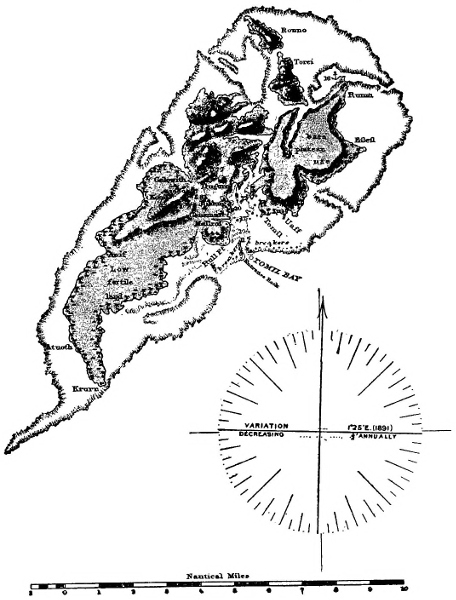
UAP ISLAND. ENTRANCE ROCK, LAT. 9° 28′ 3″ N., LONG. 138°
4′ 46″ E.