ARREST, ESCAPE, AND RECAPTURE.
High price of Provisions—Holland Lindsay’s Family—The
arrest—Captain Hill—Appearance before Colonel Bradfute at
Fulton—Arrest of Benjamin Clarke—Bradfute’s Insolence—General
Chalmers—The clerical Spy—General Pfeifer—Under
guard—Priceville—General Gordon—Bound for Tupelo—The Prisoners
entering the Dungeon—Captain Bruce—Lieutenant Richard Malone—Prison
Fare and Treatment—Menial Service—Resolve to escape—Plan of
escape—Federal Prisoners—Co-operation of the Prisoners—Declaration
of Independence—The Escape—The Separation—Concealment—Travel on
the Underground Railroad—Pursuit by Cavalry and Bloodhounds—The
Arrest—Dan Barnes, the Mail-robber—Perfidy—Heavily ironed—Return
to Tupelo.
At this time—May and June, 1862—all marketable commodities were
commanding fabulous prices; as a lady declared, it would soon be
necessary, on going to a store, to carry two baskets, one to hold the
money, and the other the goods purchased. Flour was thirty dollars per
barrel, bacon forty cents per pound, and coffee one dollar per pound.
Salt was nominally one hundred dollars per sack of one hundred pounds, or
one dollar per pound, but there was none to be obtained even at that
price. Ladies were compelled to dispense with salt in their culinary
operations; even the butter was unsalted. Cotton-cards, an article used in
every house at the South, the ordinary price of which is fifty cents per
pair, were selling at twenty-five dollars per pair, and wool-cards at
fifteen dollars per pair, the usual price being thirty-eight cents. All
the cotton used in the manufacture of home-made cloth, is carded into
rolls upon these cotton-cards, which are brought from the North, there
being not a single manufactory of them in the South. When the supply on
hand becomes exhausted, the southern home manufacture of cloth must cease,
no one as yet having been able to suggest a substitute for the
cotton-card. There are only three factories in Mississippi, which must
cease running as soon as their machinery wears out, as the most important
parts of the machinery in those factories are supplied from the North. The
people are fully aware of these difficulties, but they can devise no
remedy, hence the high price of all articles used in the manufacture of
all kinds of cloths. All manufactured goods were commanding fabulous
prices. On the occupation of the county by Federal troops, goods could be
obtained at reasonable prices, but our money was all gone, except
Confederate bonds, which were worthless. Planters who were beyond the
lines of the retreating army had cotton, but many of them feared to sell
it, as the Rebels professed to regard it treason to trade with the
invaders, and threatened to execute the penalty in every case. As there
was no penalty attached to the selling of cotton by one citizen of
Mississippi to another, some of my friends offered to sell me their cotton
for a reasonable price.
I was solicited also to act as their agent in the purchase of commodities.
I agreed to this risk, because of the urgent need of my friends, many of
whom were suffering greatly for the indispensable necessaries of life. I
thought it was better that one should suffer, than that the whole people
should perish. By this arrangement my Union friends would escape the
punishment meted out to those who were found guilty of trading with the
Yankees; if discovered, I alone would be amenable to their unjust and
cruel law, and they would thus save their cotton, which was liable to be
destroyed at any moment by a dash of rebel cavalry. I now hired a large
number of wagons to haul cotton into Eastport and Iuka, that I might ship
it to the loyal States. On the 2d of June the wagons were to rendezvous at
a certain point; there were a sufficient number to haul one hundred bales
per trip. I hoped to keep them running for some time.
On the first of June I rode to Mr. Holland Lindsay’s on business. I had
learned that he was a rabid secessionist, but supposed that no rebel
cavalry had come so far north as his house since the evacuation of
Corinth. Mr. Lindsay had gone to a neighbour’s. His wife was weaving; she
was a coarse, masculine woman, and withal possessed of strong prejudice
against all whom she did not like, but especially the Yankees. I sat down
to await the arrival of her husband, and it was not long before Mrs.
Lindsay broached the exciting topic of the day, the war. She thus vented
her spleen against the Yankees.
“There was some Yankee calvary passed here last week—they asked me if
there wos ony rebels scoutin round here lately. I jest told em it want
none of ther bizness. Them nasty, good for nothin scamps callen our men
rebels. Them nigger-stealin, triflin scoundrels. They runs off our
niggers, and wont let us take em to Mexico and the other territories.”
I ventured to remark, “The Yankees are mean, indeed, not to let us take
our negroes to the Territories, and not to help catch them for us when
they run off.”
The emphatic us and our nettled her, as none of the Lindsays ever
owned a negro, being classed by the southern nabobs as among the poor
white trash; nor did I ever own a slave. Her husband, however, had once
been sent to the Legislature, which led the family to ape the manners, and
studiously copy the ultraism of the classes above them. Mrs. Lindsay
became morose. I concluded to ride over and see her husband.
On my way I met a member of Hill’s cavalry. He halted me, inquired my name
and business, which I gave. He said that, years ago, he had heard me
preach, and that he was well acquainted with my brothers-in-law, who were
officers in the Rebel army. He informed me that his uncle, Mr. Lindsay,
had gone across the field home, and that he himself was on his way there.
I returned with him, but fearing arrest, my business was hastily attended
to, and I at once started for my horse. By this time one or two other
cavalry-men rode up. I heard Mrs. Lindsay informing her nephew that I was
a Union man, and advising my arrest. When I had reached my horse, Mr.
Davis, Lindsay’s nephew arrested me, and sent my horse to the stable.
After supper, my horse was brought, and I was taken to camp. Four men were
detached to guard me during the night. They ordered me to lie down on the
ground and sleep. As it had rained during the day, and I had no blanket,
I insisted upon going to a Mr. Spigener’s, about fifty yards distant, to
secure a bed. After some discussion they consented, the guards remaining
in the room, and guarding me by turns during the night. The next morning I
sought Captain Hill, and asked permission to return home, when the
following colloquy ensued.
“Are you a Union man?”
“I voted the Union ticket, sir.”
“That is not a fair answer. I voted the Union ticket myself, and am now
warring against the Union.”
“I have seen no good reason for changing my sentiments.”
“You confess, then, that you are a Union man?”
“I do; I regard the union of these States as of paramount importance to
the welfare of the people inhabiting them.”
“You must go to head-quarters, where you will be dealt with as we are
accustomed to deal with all the abettors of an Abolition government.”
A heavy guard was then detached to take charge of me, and the company set
off for Fulton, the county seat of Ittawamba county, Mississippi, distant
thirty miles. After going about ten miles, we halted, and two men were
detached to go forward with the prisoners, a Mr. Benjamin Clarke and
myself. Our guards were Dr. Crossland, of Burnsville, Tishomingo county,
Mississippi, and Ferdinand Woodruff. They were under the influence of
liquor, and talked incessantly, cursing and insulting us, on every
occasion, by abusive language. They detailed to each other a history of
their licentious amours. We halted for dinner at one o’clock, and being
out of money, they asked me to pay their bill, which I did, they promising
to refund the amount when they reached Fulton. This they forgot to do.
On our arrival at Fulton, we were taken into the office of the commander
of the post, Colonel Bradfute. My fellow-prisoner was examined first.
Woodruff stated that they had played off on Mr. Clarke—calling on him,
as he was plowing in the field, stating that they were Federal soldiers.
They asked Clarke what were his political views. He replied that he always
had been a Union man—had voted the Union ticket, and would do it again,
if another election were held; that he hated the secession principles, and
would enlist in the Federal army as soon as he got his crop in such a
condition that his family could attend to it. On hearing this statement,
Bradfute became very angry, swearing that Clarke ought to be taken out and
shot then, but that a few days’ respite would make but little difference.
Said he, addressing the guards, had you hung Clarke, you would have saved
us some trouble, and have done your country good service. The Colonel,
turning round, glared upon me with eyes inflamed with passion and liquor,
and thus addressed me:
“Are you a Union man too?”
“I am, sir. I have never denied it.”
“Where do you reside?”
“I consider Rienzi my home, but have been staying for some time at my
father-in-law’s, in the south-eastern part of Tishomingo county.”
“What is your father-in-law’s name?”
“Mr. Alexander Paden.”
“I know the old gentleman and his three sons. They are all in the
Confederate service. They are brave men, and have done some hard fighting
in our cause. How happens it that you look at matters in a different light
from your relatives?”
“I am not guided in my opinions by the views of my friends.”
“What is your profession?”
“I am a minister of the gospel.”
“I suppose, then, that you go to the Bible for your politics, and that you
are a sort of higher-law man.”
“My Bible teaches, ‘Let every soul be subject to the higher powers, for
there is no power but of God; the powers that be, are ordained of God.
Whosoever, therefore, resisteth the power, resisteth the ordinance of God;
and they that resist shall receive to themselves damnation.’ I have seen
no reason for resistance to the government under which we have, as a
nation, so long prospered.”
“I command you to hush, sir; you shan’t preach treason to me, and if you
get your deserts you will be hung immediately. Have you ever been within
the Federal lines?”
“I have, sir.”
“At what points?”
“At Rienzi and Iuka.”
“When were you at Iuka?”
“On last Saturday.”
“Had the Federals a large force at that place, and who was in command?”
“They have a large force, and Generals Thomas and Steadman are in
command.”
“That is contrary to the reports of our scouts, who say that there are but
two regiments in the town. I fear you are purposely trying to mislead us.”
“General Steadman has but two regiments in the town, but General Thomas is
within striking distance with a large force.”
“What was your business in Iuka?”
“I went there to pay a debt of fifty dollars which a widow owed, as she
wished it to be paid in Confederate money before it became worthless.”
“Have you a Federal pass?”
“I have none with me, but I have one at home.”
“How does it read?”
“It was given by General Nelson, and reads thus: ‘The bearer, Rev. John H.
Aughey, has permission to pass backward and forward through the lines of
this division at will.’”
“Where were you born?”
“I was born in New Hartford, Oneida county, New York.”
“Yankee born,” said the Colonel, with a sneer; “you deserve death at the
rope’s-end, and if I had the power I would hang all Yankees who are among
us, for they are all tories, whatever may be their pretensions.”
“My being born north of the nigger-line, Colonel, if a crime worthy of
death, was certainly not my fault, but the fault of my parents. They did
not so much as consult me in regard to any preference I might have
concerning the place of my nativity.”
Woodruff, one of my guards, now informed the Colonel that I was a spy,
and, while the Confederates were at Corinth, had, to his certain
knowledge, been three times at Nashville, carrying information. I told
Woodruff that his statement was false, and that he knew it; that I had
never been at Nashville in my life. General Chalmers, who was present, and
Colonel Bradfute, at the conclusion of the examination, spent fifteen or
twenty minutes in bitterly cursing all Yankees, tories, and traitors, as
they termed us. All the conversation of the rebel officers was interlarded
with the most horrid profanity. General Chalmers, in speaking, invariably
called me the clerical spy. We were placed under guard, and sent to
Brooksville, ten miles distant, the head-quarters of General Pfeifer.
Immediately after our arrival, we were soundly berated by General Pfeifer,
and then sent out to the camp, half a mile from the town, where we were
placed under guard for the night, in a small plot of ground surrounded by
a chain. We had no supper, and no blankets to sleep on. Our bed was the
cold ground, our covering the blue canopy of heaven. The next morning we
were started, without breakfast, under a heavy guard, numbering fourteen
cavalry, to Priceville, six miles west of Brooksville. Priceville was
named in honour of General Sterling Price, or rather the little village
where he encamped had its name changed in his honour. When we reached
Priceville we were taken to the head-quarters of General Jordan, and
immediately brought into his presence. After reading the letter handed to
him by one of the guard, he said, looking sternly at me,
“You are charged with sedition.”
I asked him what sedition meant, to which he replied:
“It means enough to hang you, you villanous tory!”
He also asked me where I was born. My reply was, in the State of New York,
near Utica, in Oneida county.
“Then you doubly deserve death,” said he.
“As to the guilt of my nativity,” said I, “it is not my fault, for I could
not have helped it if I had tried. But I glory in my native State. She has
never done anything to disgrace her. She never repudiated her just debts,
nor committed any other disgraceful act.”
“Well, you ought to have staid there, or have gone back when Mississippi
seceded.”
“Give me an opportunity, and I will go instanter.”
“The first going you will do, will be to go to hell, where, if the devil
had his due, you would have been long ago; and before you leave us, we
will give you a free ticket to the shades infernal.”
“Thank you for your kind offer to give me a free pass to the infernal
regions. I did not know before that you were the devil’s ticket-agent. You
have me in your power, and may destroy my life; but when you have done
that, there is no more that you can do.”
Very little was said to my fellow-prisoner, Clarke. A few curses for a
traitor, tory, &c., was about all. We were now placed under guard, and
conducted to Tupelo, and after visiting the provost-marshal’s office and
the office of the commander of the post, whose names were Peden and Clare,
we were committed to the Central Military Prison. As we entered, Captain
Bruce and Lieutenant Malone (two gentlemen who had been elected to those
offices by their fellow-prisoners) received us with a cordial greeting.
Captain Bruce thus addressed us:
“Welcome, gentlemen, thrice welcome. I am rejoiced to see you at my hotel.
We are now doing a land-office business, as the large number of my
boarders, whom you see, will testify. We have numerous arrivals daily,
whilst the departures are very few, giving evidence that all are satisfied
with their treatment. The bill of fare is not very extensive. In these war
times we must not expect the luxuries of life, but be content with the
necessaries. It is true, we cannot furnish you with coffee, or molasses,
or sugar, or salt, or beef, or vegetables; but we have something more
substantial—we have flour, rather dark in colour, to be sure, but people
must not be squeamish. The boarders are required to do their own cooking,
as they could otherwise have but little exercise; we consider it a
sanitary measure, exercise being indispensable to health. We furnish the
boarders, also, with meat—none of your lean meat, either, but fat
middling, with a streak of lean in it. The Bible promises the righteous
that their bread shall be given, and their water sure; but we go beyond
the promise, and give not only bread (or rather the flour to make it) and
water, but also fat, strong meat. What room will you be pleased to have?”
I replied, that as they seemed to be crowded, I would choose number 199.
“Well,” said the Captain, “it shall be prepared. Lieutenant Malone, have
room number 199 fitted up for the reception of these gentlemen.”
Lieutenant Malone replied, that the room designated would be fitted up in
style for our reception. He asked us if we had dined.
“No,” replied Clarke; “we have not tasted food since yesterday at noon,
when the Parson paid for his own dinner and the dinner of the guards. We
asked for something to eat, but were as often refused, and now we are in a
starving condition.”
“I pity you,” said Malone, laying aside his facetious style; “you shall
have something to eat as soon as it can be cooked.”
He then went to some of the prisoners, and set them to cooking, and we
were soon furnished with the best repast the poor fellows could supply.
We entered the prison July 3d, 1862, at two o’clock, P. M. Our prison was
a grocery-house, its dimensions about twenty-five by fifty feet. When we
were incarcerated, there were about seventy prisoners in the building,
whites, mulattoes and negroes. The prison was filthy in the extreme, and
filled with vermin; even our food was infested with them. No brooms were
furnished us, and we could not sweep the floor. No beds were furnished,
and we were compelled to lie upon the floor, with no covering, and
nothing but the hard planks beneath us.
Several times a day officers would come in and order a specified number of
men to go and work, under a strong guard. We were made to clean the
streets, roll barrels, and clean the hospital; but our own prison we were
not permitted to clean. Every kind of drudgery, and the most menial
services, were imposed upon us.
The crimes charged upon the prisoners were desertion, trading with the
Yankees, adhesion to the United States government or Unionism, acting as
spies, refusing Confederate bonds, and piloting the Yankees. The crime of
the negroes and mulattoes was endeavouring to escape on the underground
railroad from Dixie land and the Iron Furnace. These remained till their
masters were informed of their arrest, and came for and released them. On
the evening preceding our imprisonment, two prisoners had been led out and
shot, and I soon learned that this was no unusual occurrence. Nearly
every day witnessed the execution of one or more of us. Those who were
doomed to die were heavily ironed. In some cases, however, those who were
not in fetters were taken out and shot or hanged, often with no previous
warning; though sometimes a few hours warning was given.
Our privations were so great from a want of proper food and water—for the
scanty amount of water furnished us was tepid and foul—and from a lack of
beds, cots, couches, or something better than a filthy floor whereon to
sleep, that I resolved to attempt an escape at the risk of my life. I felt
confident that I could not long survive such cruel treatment. As soon as
my arrest was known to the thirty-second Mississippi regiment, encamped in
the suburbs of Tupelo, the colonel, major, adjutant, and one of the
captains called upon me. This regiment was raised in Tishomingo county,
one of the companies, the Zollicoffer Avengers, being from Rienzi, where I
had been for years proprietor and Principal of the Rienzi Female Seminary.
The daughters of many of the officers of this regiment had been educated
at this Seminary during my superintendence. Some of these officers had
expressed themselves under great obligations to me, for the thorough,
moral, mental, and physical training of their children while under my
care. As proof of this, I have their own statements, as published in the
public journals of the day. Owing me a debt of gratitude, as they
professed, could I expect less than the manifestation of deep sympathy for
me in my sad condition—confined in a gloomy dungeon, deprived of the
comforts, yea, even the necessaries of life, menaced and insulted by the
officers in whose power I was? Whatever may have been my hopes, they were
doomed to be blasted. These summer friends, so obsequious in my
prosperity, conversed for a while on indifferent topics, never alluding to
my condition, and as I did not obtrude it upon their attention, they left,
promising to call again. I said, “Do so, gentlemen; you will always find
me at home.” Adjutant Irion, as he passed out, asked Lieutenant Malone
what the charge was against me. Malone replied that I was charged with
being a Union man. The adjutant said, in a bitter and sarcastic tone, that
I should never have been brought to Tupelo, but on my arrest should have
been sent to hell from the lowest limb of the nearest tree.
Having determined to escape at all hazards, I sought out an accomplice, a
compagnon de voyage; that person was Richard Malone; his piercing eye,
his intellectual physiognomy, led me to believe that if he consented to
make the attempt with me, our chances for escape would be good. I drew
Malone to one side, and covertly introduced the matter. He soon got my
idea, and drawing from his pocket a paper, showed me the route mapped out
which he intended to pursue, as he had for some days determined to escape,
or die in the attempt. He was charged with being a spy, and there was
little doubt that they would establish his guilt by false testimony. We
went out now under every possible pretext. We no longer shunned the guard
who came to obtain prisoners to do servile labour. Our object being to
reconnoitre, in order to learn where guards were stationed, and to
determine the best method of escape through the town after leaving the
prison. During the day we made these observations: that there were two
guards stationed at the back door, who were very verdant; that they would,
after relief, come on duty again at midnight; that there was a building on
the south side of the prison, extending beyond the prison and beyond the
guards; that the moon would set about eleven o’clock, P. M.; that there
were no guards stationed on the south side of the prison during the day;
that one of the planks in the floor could be easily removed; and that
there were several holes, when we were once under the floor, by which
egress might be made either on the north or south side; that the coast was
probably clearest in the direction of a corn-field some two hundred yards
distant in a northwest direction.
At four o’clock P. M., our plan was fully matured. At midnight, (the moon
being down, and the verdant guards on duty) we would raise the plank, get
under the floor, and myself in the advance, make our exit through one of
the holes on the south side of the jail, then crawl to the building, some
fifteen feet distant, and continue crawling till we passed the guards;
then rise and make our way as cautiously as possible, to a point in the
corn-field, a short distance in the rear of a garment which was hanging
upon the fence. The one who first arrived must await the other. A signal
was agreed upon, to prevent mistake. If the guards ordered us to halt, we
had resolved to risk their fire, our watchword being, Liberty or death!
About this time the prisoners chose me their chaplain by acclamation.
During the day, we made known our intention of escaping to several
fellow-prisoners, who promised us all the assistance in their power. All
the prisoners who knew of the matter, earnestly desired our escape, and
co-operated with us in effecting it. Clarke and Robinson begged us to take
them along, averring there was no doubt that they would be shot. Malone
told them that no more than two could go together; that if they wished to
escape, they could make the attempt half an hour after us, which they
agreed to. Clarke, however, came to me, and desired me to take him along,
as he would rather go with us than with Robinson. He had a wife and five
small children dependent on him for support, and if he perished, they must
perish too. I consulted Malone, but he would not agree to have Clarke go
with us. Three would be too many for safety, and he doubted whether Clarke
had sufficient nerve to face the glittering bayonet, or tact enough to
pass through the camps without detection. He might commit some blunder
which would endanger our safety. I informed Clarke that the arrangement
made, in which he and Robinson were to go together, must be adhered to. He
begged me, by all that was sacred, to take him along. But Malone was
inexorable, and I thought it best to acquiesce in his judgment.
Night drew on apace. Thick darkness gathered around us, and murky clouds
covered the sky, as we sat down with the Federal prisoners to our scanty
allowance. While partaking of our rude fare, Malone thus spoke:
“This day is the 4th of July, 1862, the anniversary of our patriot
fathers’ declaration of independence of British tyranny and oppression.
They had much to complain of. They suffered grievous wrongs and cruel
bondage. But eighty-six years ago to-day they declared themselves to be a
free and independent people, who would rather die than be again enslaved.
Of what worth was their declaration if they had remained inactive?
Supineness would not have saved them. But trusting in our God, who gives
success to the righteous cause, they imperilled their lives, they hazarded
their fortunes, and with untiring energy and sleepless vigilance they
contested to the bitter end against all efforts to deprive them of their
inalienable rights. Success crowned their efforts, and they rid themselves
of tyrants’ chains. We (I allude to my friend, Parson Aughey, and myself,)
degenerate sons of these noble sires, have suffered wrong, nay, gross
outrage. Citizens of the sunny South, guilty of no offence whatever, not
even of constructive crime, we are immured in a loathsome dungeon,
deprived of the comforts of life, separated from our families, and
suffered to have no communication with them; dragging out a miserable
existence, which an ignominious death on the scaffold must soon end. We,
therefore, John H. Aughey and Richard Malone, in view of these accumulated
wrongs and outrages, solemnly swear before High Heaven, and in presence of
these witnesses, that we will be free, or perish in the attempt. Appealing
to the God of liberty, of truth, and of righteousness, for the rectitude
of our motives and the justness of our cause, we commit ourselves into his
hands, and implore his protection amid the dangers through which we are
about to pass, and humbly pray that he will give us success, and restore
us speedily to our families and friends, and to the enjoyment of our
inalienable rights, life, liberty, and the pursuit of happiness.”
Grasping the Lieutenant by the hand, I consented to this Declaration of
Independence of rebel thraldom. We gave our respective addresses to our
friends, who promised, that if they were ever liberated, and we were
killed by the guards, they would write to our families, informing them of
the manner of our death.
About ten o’clock, Malone raised the plank, and I went under to
reconnoitre. I remained under the floor about ten minutes, having learned
that there were no guards patroling the south side of the house, as we
feared might be the case after night. We had learned, from observation,
that there were none during the day. Just at the noon of night, we heard
the relief called. Malone and I endeavoured to find the prisoners who were
to raise the plank, but not being able readily to do so, we raised the
plank ourselves, and both got under without difficulty. Malone getting
under first, was, contrary to agreement, compelled to take the lead. As he
was passing out, he made considerable noise. To warn him of the danger, I
patted him on the back. Reaching back, he gave my hand a warm pressure, to
assure me that all was right, and passed out. I followed, and reached the
designated point in the corn-field in about half an hour, having to use
the utmost precaution, and in some cases to pass the guards by crawling in
a serpentine manner. When I arrived, I gave the preconcerted signal, but
Malone was nowhere to be seen. I waited for him two hours at least, when I
was compelled to seek my safety alone.
Not being able to meet with my friend, I regarded as a great misfortune,
because, after reaching a point ten miles north of Tupelo, he would be
familiar with the country. I had frequently passed through the town on the
railroad, but knew nothing of the country through which I must travel.
Somewhat depressed in spirits at the loss of my compagnon de voyage, I
resolved to reach my family by the safest and most practicable route.
Still in the midst of camps, I had considerable difficulty in making my
way out of them. When I thought that this had been effected, I found that
day was brightening in the east. Looking around for some place to hide, I
soon found a dense, though small thicket, in which I secreted myself as
covertly as possible. Having slept but little since my arrest, I
endeavoured to compose myself to slumber, and partially succeded; but soon
the noise and confusion of soldiers passing and re-passing near, awoke and
alarmed me. I soon learned that I was near a camp, and that the soldiers
had found a suitable place for bathing in a creek which ran within thirty
yards of my place of concealment. There were two paths by which they
reached the creek. On one, they passed within fifteen feet of me; on the
other, within six or seven. About nine o’clock, I heard the booming of
cannon all around me, proceeding from the different camps. The soldiers
who passed me stated, in their conversation, that the cannon were firing
in honour of a great victory obtained over General McClellan, in Virginia.
According to their statement, his whole army, after a succession of
losses, during eight days’ fighting, had been completely annihilated, and
that Stonewall Jackson would be in Washington city before the close of the
week.
The day passed slowly away. At one time two soldiers came within a few
feet of me in search of blackberries, but passed out without detecting me.
At another time two soldiers sat down to converse, so near that their
lowest tones were distinctly audible. One informed the other that he had
been in town in the morning, and had learned that the Clerical Spy,
Parson Aughey, and a fellow by the name of Malone, had broke jail, but
that they would soon be brought in, as a company of cavalry had been put
on their track, with a pack of bloodhounds. Soon after this, one of them
arose and struck a bush several times, which seemed to be but a very short
distance above my head. I thought that he had discovered me, and was about
to rise and run, when I heard him say to his companion, that he had
attempted to kill a very large snake, which had escaped to the bushes. I
began to feel somewhat uncomfortably situated when I learned that I was in
close proximity to a large snake, though I would have preferred meeting
with an anaconda, boa-constrictor, rattlesnake, or even the deadly cobra
di capello, rather than with those vile secessionists thirsting for
innocent blood.
I thought this 5th of July was the longest day I had ever known. The sun
was so long in reaching the zenith, and so slow in passing down the steep
ecliptic way to the occident. The twilight, too, seemed of endless
duration. But as all long days have had an end, so had this. The stars
came glittering one by one. I soon recognised that old staunch and
immovable friend of all travellers on the underground railroad, the
polar-star.
Rising from my lair, I was soon homeward bound, guided by the north-star
and an oriental constellation. Plunging into a dense wood I found my rapid
advance impeded by the undergrowth, and great difficulty in following my
guiding stars, as the boughs of the great oaks rendered them invisible, or
dimly seen. Fatigued, hungry, and sleepy, I at length lay down at the foot
of a large swamp-oak tree, intending to take a nap, and then rise and
pursue my journey. When I awoke the sun was just rising. I arose filled
with regret for the time I had lost. Though somewhat refreshed by my
sound sleep, yet I was very hungry and almost famished with thirst.
After travelling about half a mile I came to a small log-house on a
road-side. Feeling sick and faint, I resolved to go to the house to obtain
water, and, if I liked the appearance of the inmates, to reveal my
condition and ask for aid. Upon reaching the house I met the proprietor,
but did not like his physiognomy. He looked the villain; a sinister
expression, a countenance revealing no intellectuality, except a sort of
low cunning, bore testimony that it would be foolish to repose confidence
in the possessor of such villanous looks. I asked for water, intending to
drink and leave. He pointed to the bucket; I drank and bade him good
morning, and turned to leave. I had proceeded but a few steps, when I was
ordered, in a stentorian tone, to halt. On looking round, I saw a soldier
within a few steps, presenting a double-barrelled gun; another soldier was
standing near, heavily armed. I asked by what authority he halted me. To
which he replied:
“I know you, sir; I have heard you preach frequently. You are Parson
Aughey, and you were arrested and confined in prison at Tupelo. I was in
Lowrey’s regiment yesterday, and learned that you had broken jail; and
now, sir, you must return. My name is Dan Barnes. You may have heard of
me.”
I had indeed heard of him. He had been guilty of robbing the United States
mail, had fled to Napoleon or Helena, Arkansas, where he was arrested,
brought back, and incarcerated in jail at Pontotoc, and confined there for
nearly a year. As the evidence against him was positive, he would have
been sent to the penitentiary; but, fortunately for him, at this juncture
Mississippi seceded. There being then no United States officers to execute
the laws, he was liberated, and soon after joined the army.
After breakfast, which I paid for, Barnes called me to one side, and told
me that he felt sorry for me, and would afford me an opportunity of
escaping, if I would pay him a reasonable sum. He had been in a tight
place himself, and would have been glad had some friend been near to aid
him. He named two hundred and forty dollars as the reasonable sum for
permitting me to escape. After getting my money, their horses were
saddled, and telling me he was playing-off on me, said I must go to
General Jordan’s head-quarters at Priceville, to which place he and Huff,
the proprietor of the log cabin, conducted me.
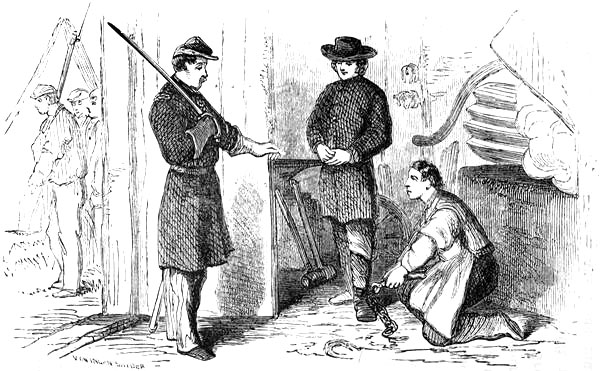
On my arrival, General Jordan ordered me to be put in irons, and placed
under guard. I was taken to a blacksmith’s shop in the town, the General
accompanying the guard, and heavy iron bands were put around my ankles,
and connected by a chain. The bands were put on hot, and my boots were
burnt in the operation. The blacksmith seemed averse to the order, and
only obeyed it upon compulsion. The General stood by, and saw that it was
well done. “Iron him securely—securely, sir,” was his oft repeated order.
The ironing caused me much pain. My ankles were long discoloured from
the effects of it.
“I was taken to a blacksmith’s shop, and heavy iron bands put around my ankles.” Page 104.
After my manacles were put on, I was taken back to Tupelo by Barnes and
another guard. On my arrival, the commander of the post and the Provost
Marshal were filled with joy. Barnes gave them the history of the arrest,
stating that I had attempted to bribe him; that he listened to my
proposition with indignation, and when he had got the money, performed
what he regarded his duty. The commander replied that all the property of
traitors was theirs, and that he did right in deceiving me, after
accepting the bribe. He also recommended Barnes for promotion for his
heroic and patriotic act in arresting me. (Perhaps it secured for him a
captaincy.) The following colloquy now took place between the commander of
the post, the Provost Marshal, and myself:
“Why did you attempt to leave us?”
“Because, sir, your prison was so filthy, and your fare so meagre and
unwholesome, that I could not endure it long, and live.”
“Parson, you know the Bible says, the wicked flee when no man pursueth,
but the righteous are as bold as a lion. You must have been guilty of
crime, or you would not have tried to escape.”
“I may have been guilty of the offence charged against me, and yet
innocent of real guilt.”
“You shall never be taken back to the prison you left, rest assured of
that. Did any of the prisoners know of or aid you in your escape?”
“No, sir; none of them knew anything about it.”
“Are you telling the truth?”
“I am.”
“Where is Malone?”
“I never saw him after I left the building.”
“He cannot escape; the cavalry are after him, and he will be brought in
soon, dead or alive.”
“Why did you attempt to bribe Barnes?”
“It was his own offer. I knew that his cupidity was great, and thought it
no harm to accept his offer. If Barnes had his deserts, he would now be
hard at work in the penitentiary.”
“Did the jury that tried him, acquit him?”
“No. The secession of Mississippi saved him. I refer you to Colonel Tison,
who is in Tupelo, for the particulars. He being marshal of North
Mississippi, arrested Barnes, and knows all about it. He found on his
person the evidence of his guilt, the money and checks stolen when he
robbed the mail.”
“Parson, you will not be immediately executed, but you will, without
doubt, hang in a week or two, so that, if you have any word to send your
family, you have permission to do so.”
“May I write a letter to my wife?”
“You may, and I will see that it is forwarded to her.”
I sat down and wrote a letter, a very common-place letter, to my wife,
inserting, occasionally, a word in phonography, which, taken in
connection, read thus: “If possible, inform General Rosecrans or Nelson of
my arrest.” While inspecting the letter, Lieutenant Peden noticed the
phonography, and asked me to read it. I read it thus: “My dear wife, I
hope to be at home soon. Do not grieve.” This letter they never sent. It
was merely an act of duplicity on their part, to obtain some concession,
which might be used against me. The guard, receiving orders, now conducted
me to a hotel, and placed me in a small room, two guards remaining inside,
and two at the door outside, with orders to shoot me if I made the least
attempt at escape. I remained in this room only a few hours, after which I
was taken to my old prison. As I entered, my old friends, the prisoners,
crowded around me, and Captain Bruce addressed me in his facetious manner.
In prison, his wit had beguiled many a tedious hour. His humour was the
pure Attic salt.
“Parson Aughey, you are welcome back to my house, though you have played
us rather a scurvy trick in leaving without giving me the least inkling of
the matter, or settling your bill.”
I replied: “Captain, it was hardly right; but I did not like your fare,
and your beds were filled with vermin.”
“Well, you do not seem to have fared better since you left, for you have
returned.”
“Captain, my return is the result of coercion. Some who oppose this
principle when applied to themselves, have no scruples in enforcing it
upon others.
“No rogue e’er felt the halter draw,
With good opinion of the law;”
is an old saw, and the truth of proverbs is seldom affected by time. I am
your guest upon compulsion; but remember, I will leave you the first
opportunity.”
Upon hearing this, an officer present swore that when I again left that
building, it would be to cross the railroad, (the place of execution.)
The prisoners gathered around me, and I related to them my adventures.
They then informed me of what had transpired during my absence. Clarke was
taken out of prison to guide a cavalry company in search of me. Clarke
informed me that they scoured the country, and then went to my
father-in-law’s; and after searching the premises, returned, believing
that I had gone due north towards Rienzi, in which direction another
company had been despatched. On their return, Clarke was remanded to jail.
At roll-call—seven o’clock, A. M., we were missed. The cavalry were
immediately sent in pursuit. All the guards on duty during the night were
put under arrest. Our method of escape was soon discovered, and the guards
were released, as they were not at fault. A large number of spikes were
hammered in the floor, the guards were doubled, and greater vigilance
enjoined. The prisoners were questioned, strictly and individually, to
learn whether any of them knew of our intention to escape, or had rendered
us any assistance. They all positively denied any knowledge of the matter.
They asked me whether I had given the officers any information about their
knowledge of our designs, and coöperation in effecting them. I replied
that I had positively denied that any except Malone and myself were privy
to our plans.
I may state here that it is difficult to justify a falsehood. We ought to
utter truth always, without exaggeration or prevarication, leaving
consequences with God. We should do right without regard to results, for
with consequences we have no business; but in this case the temptation to
utter an untruth was great. These wicked men, thirsting for my blood, had
no right to make me criminate myself or my coadjutors. It would have been
wrong for me to give them the information they desired. Truth is too
precious for a secessionist, thirsting for innocent blood. Had I refused
to answer, they would have suspected that some of my fellow-prisoners
aided us, and would have either forced me to tell who they were, or would
have hanged me instantly for my refusal. If I had given information, and
criminated those who had befriended us, they would have been severely
punished, and I have been guilty of the basest ingratitude; I would have
been shunned by the prisoners, and regarded as one of the meanest of men,
one of the veriest wretches in existence; I could never again ask nor
expect aid in a similar attempt to save myself from a violent death.