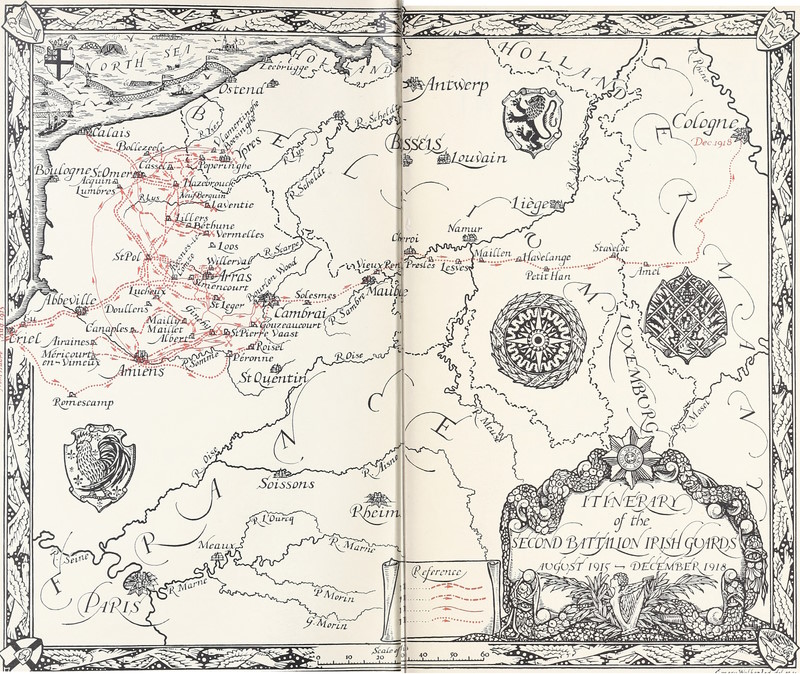
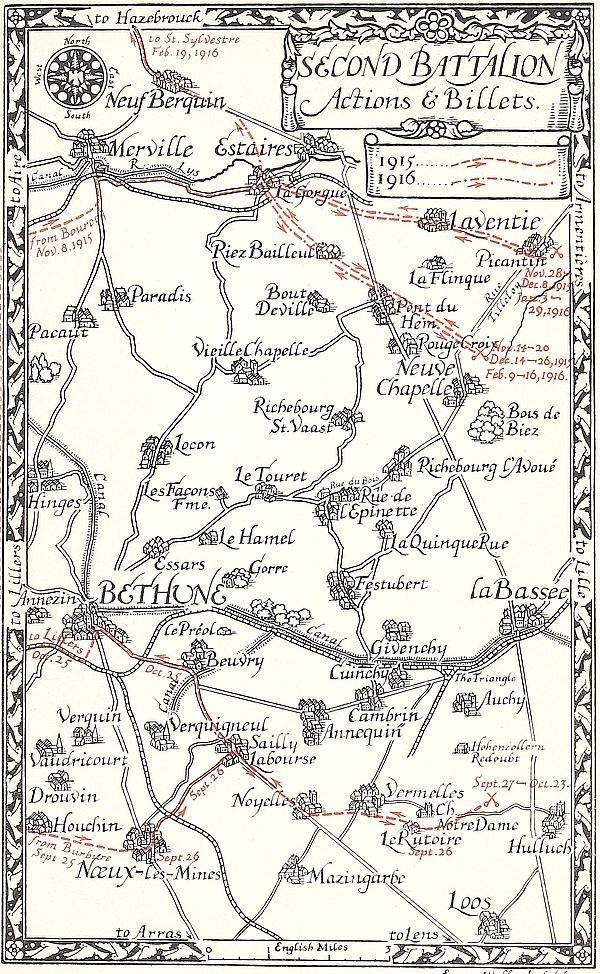
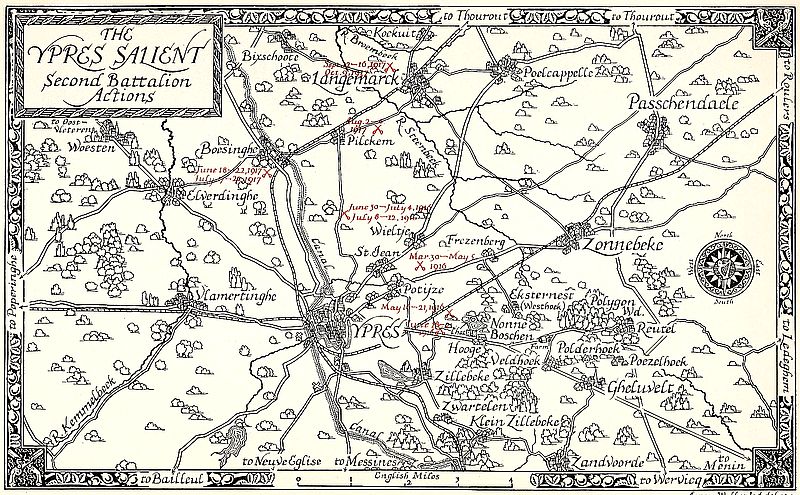
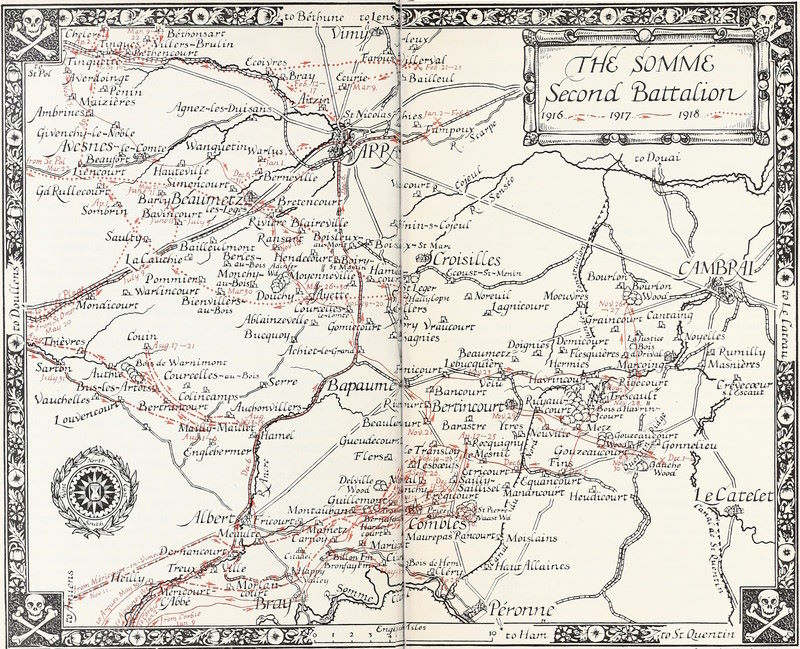
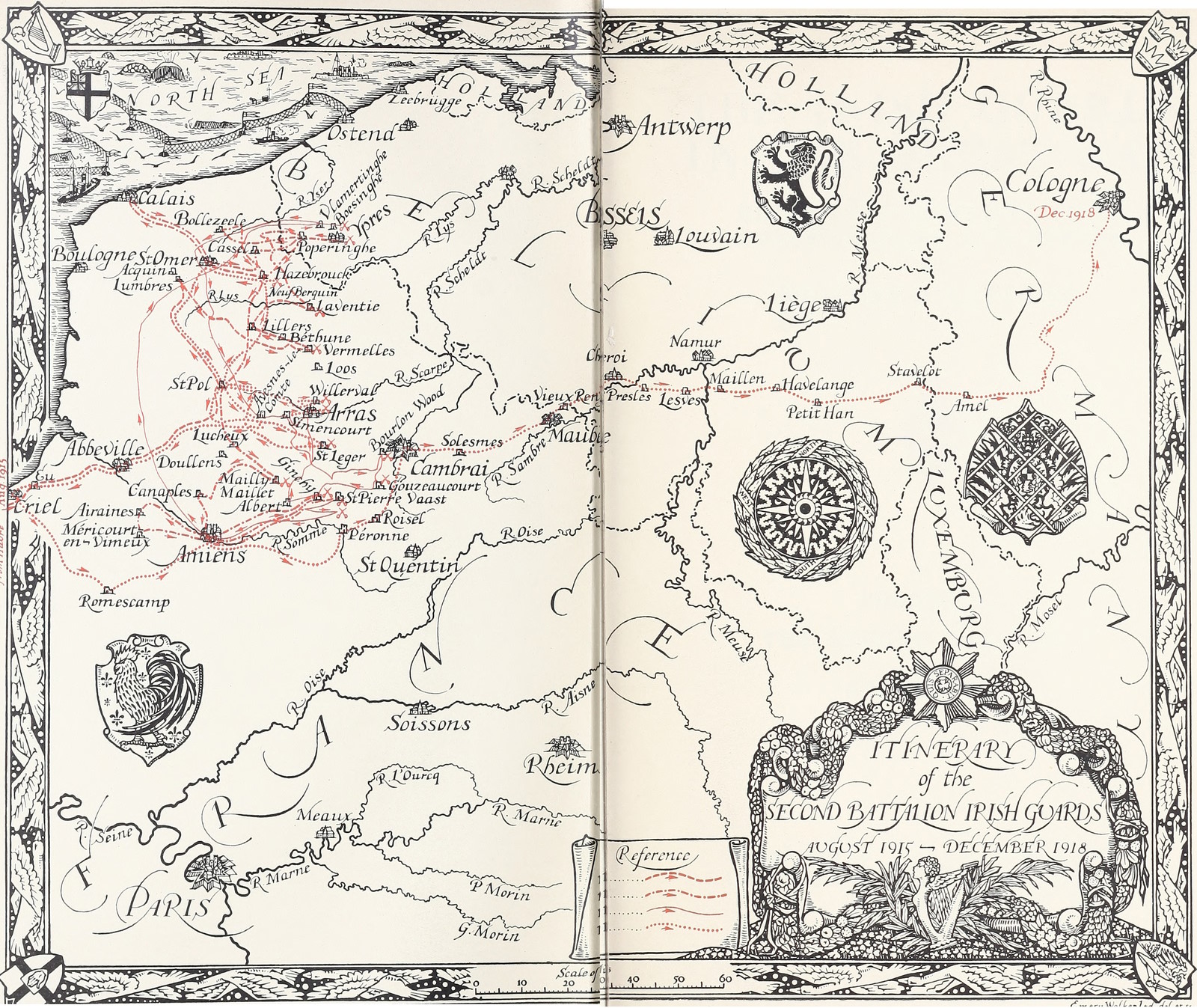
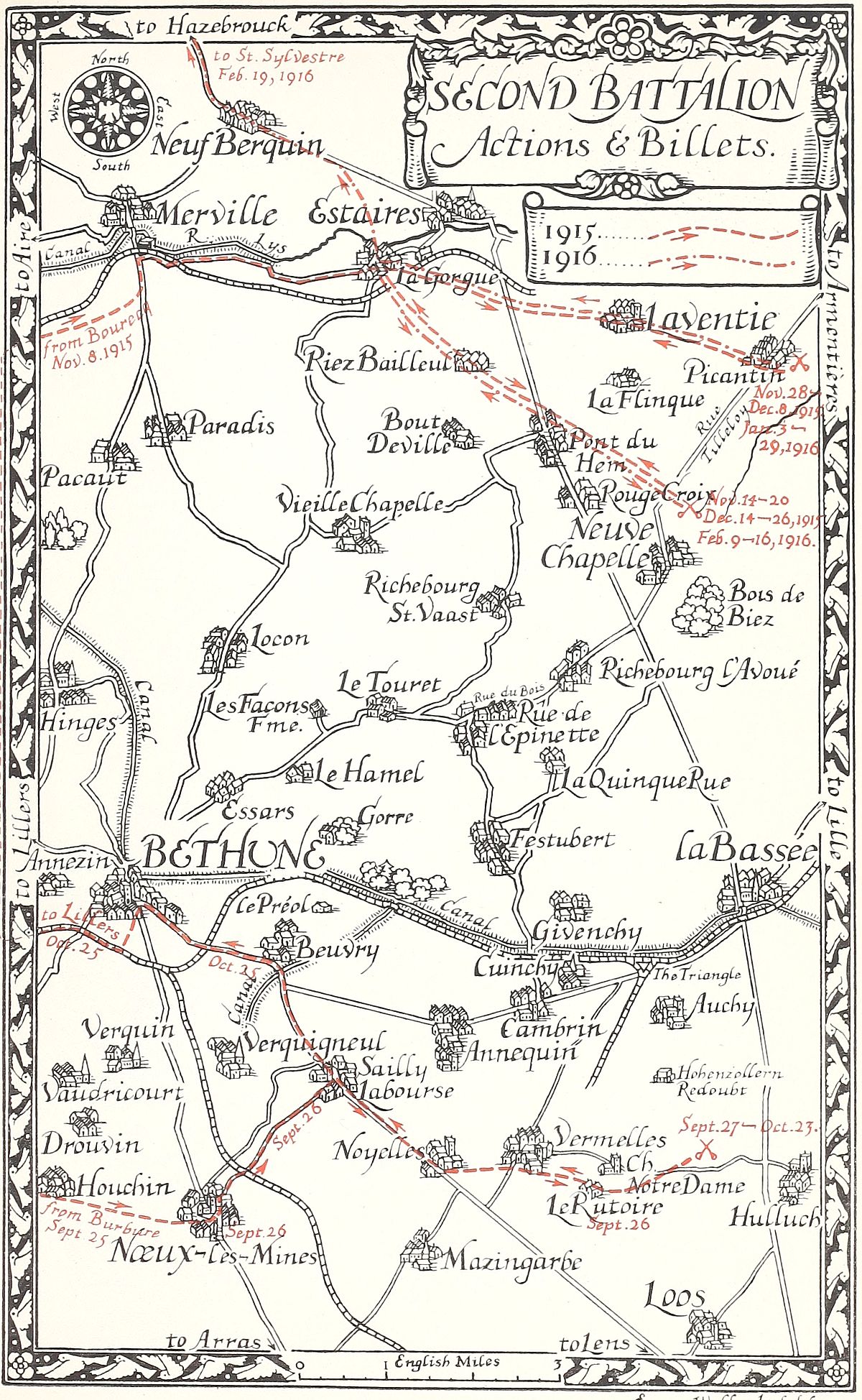
1915 LOOS AND THE FIRST AUTUMN — Loos — The Hohenzollern and Trench Work — A Raid — A Rest and Laventie
Officially, the formation of the 2nd Battalion of the
Irish Guards dates from the 15th July 1915, when it
was announced that His Majesty the King had been
“graciously pleased to approve” of the formation of two
additional Battalions of Foot Guards—the 4th Grenadier
Guards, and the 2nd Battalion Irish Guards, which
was to be made up out of the personnel of the 2nd (Reserve)
Battalion. And, officially, on July 18 that
formation took place. But those who knew the world
in the old days, and specially the busy part of it that had
Warley Barracks for its heart, know that the 2nd Battalion
was born in spirit as in substance, long ere the
authorities bade it to be. The needs of the war commanded
it; the abundance of the reserves then justified
it; and, though Warley Barracks had been condemned
as unfit for use by the Honourable the East India Company
a trifle of fifty odd years ago, this was not the
hour to stand on ancient tradition. So the old, crazy
barracks overflowed; the officers’ damp and sweating
dog-kennels were double-crammed; and, by sheer good-will
and stark discipline, the work went forward to the
creation. Officers and men alike welcomed it, for it
is less pleasing to be absorbed in drafts and driblets by
an ever-hungry 1st Battalion in France, than to be set
apart for the sacrifice as a veritable battalion on its own
responsibility, with its own traditions (they sprang up
immediately) and its own jealous esprit-de-corps. A
man may join for the sake of “King and Country” but
he goes over the top for the honour of his own platoon,
company, and battalion; and, the heart of man being
what it is, so soon as the 2nd Battalion opened its eyes,
the first thing that it beheld was its 1st Battalion, as an
elder brother to measure its stature against in all things.
Yet, following the ancient mystery of all armies, there
were not two battalions, but one regiment; officers and
men interchangeable, and equally devoted to the battalion
that they served for the time, though in their
deeper minds, and sometimes confessing it, more
devoutly attached to one or the other of the two.
By summer of ’15 the tide of special reserve officers
was towards its flood, and the 2nd Battalion was largely
filled by them. They hailed from every quarter of the
Empire, and represented almost every profession and
state of life in it, from the schoolboy of eighteen to the
lawyer of forty odd. They had parted long ago with
any delusion as to the war ending that year or the next.
The information that came to them by word of mouth
was not of the sort dispensed in the Press, and they
knew, perhaps a little more than the public, how inadequate
were our preparations. One and all they
realised that humanly speaking, unless fortune favoured
them with permanent disablement they were
doomed men; since all who recovered from their wounds
were returned to the war and sooner or later despatched.
He was lucky in those days who survived whole for
three months; and six without hurt was almost unheard
of. So the atmosphere of their daily lives, underneath
the routine and the carefully organised amusements
that the world then offered to its victims, had an unreality,
comparable in some degree, to the elaborately
articulated conversation and serious argument over
utterly trivial matters that springs up among officers in
that last hour of waiting under the thunder of the preliminary
bombardment before the word is given that
hoists all ranks slowly and methodically into a bone-naked
landscape.
Lieut.-Colonel the Earl of Kerry, M.V.O., D.S.O.,
who commanded the reserve and whose influence over
the men was unbounded, began the work of making the
2nd Battalion, and, later on, Major G. H. C. Madden
was recalled from duty in France to be its senior
major. Captain the Hon. T. E. Vesey was the first
adjutant and, with a tight hand which was appreciated
afterwards, showed all that young community how to
take care of itself. It was a time for understanding
much and overlooking little. “Or else,” as the sergeants
explained, “ye’ll die before ye’ve killed a Jerry.”
On the 27th of July, Major and Brevet-Lieut.-Colonel
the Hon. L. J. P. Butler took over command,
and on August the 6th the Battalion with full transport,
and packs, paraded as such for its first route-march, of
sixteen miles in the flat country, filled with training
troops, that lies round Warley. The weather was very
hot, nor did that officer who had bethought him to fill
his “full pack” with a full-blown air-cushion, take much
reward of his ingenuity when his unlucky fraud betrayed
him by bursting almost under the adjutant’s
eye. Men said that that was their real introduction to
the horrors of war.
They were inspected on the 10th August by Major-General
Sir Francis Lloyd, commanding the London
District who, after the usual compliments on their
physique and steadiness, told them they were due for
France in a few days. Lord Kitchener came down and
addressed them on the 13th of the month, was photographed
with a group of all the officers of the 2nd Battalion
and Reserve Battalions, and expressed his belief
that they would be a credit to the Guards Division then,
as we know, being formed in France.
On the 16th they left Brentwood Station, that has
seen so many thousands depart; and that evening were
packed tightly at Southampton in the Anglo-Canadian
and the Viper. Duly escorted by destroyers, for the
seas were troubled by submarines, both ships tied up at
Havre in stillness and strange “foreign” smells at midnight.
The city and its outskirts for miles round had
long since been turned wholly to the monotonous business
of expediting troops and supplies; and the camps
that ringed it spread and linked on almost daily. The
French were used, now, to our armed Empire at large
flooding their streets. Wonder and welcome had
passed. No pretty maids met them with wine or garlands,
and their route inland to their work was as worn
and smooth as the traffic-burnished metals from Brentwood
to the sea. But the country and its habits were
new to all those new hands, trained in a strict school; and
it filled them with joy to behold the casual manner in
which a worn and dusty French sentry was relieved
while they were marching to their first wonderful camp
outside the city.
They entrained for Lumbres on the 18th August and
were bidden, next day, to march to billets at Acquin, a
little village on a hill-side a few miles from St. Omer,
in a fold of the great Sussex-like downs. It is a place
both steep and scattered, cramped and hot, and when
the air-war was in full swing had its small share of
bombs intended for Army Headquarters at St. Omer,
and the adjacent aerodromes. The men were billeted in
barns forty and fifty at a time which, specially for a new
battalion, was rather unhandy, as offering many ups
and downs and corners, which afford chances for delays
and misunderstandings. But it was to be their first and
only experience of comfort for any consecutive time,
and of French life a little untouched by war. They
most deeply enjoyed the simple kindliness of the
village-folk, and the graceless comments of the little
sharp-faced French children at the halting attempts of
the Irish to talk French; the glimpses of intimate
domestic days, when sons and brothers of their hosts,
returned on a few days’ leave from far-away battlefields
in the Argonne or beyond, were shown with pride
to the visitors who were helping the villagers to cart
their corn—“precisely as our own sons would have
done.” They talked, too, with veterans of ’70 met in
the fields and at the cafés, who told them in set and
rounded phrases that war was serious. And the
French men and women upon whom they were billeted
liked them well and remembered them long. Said one,
years after, with tears in the eyes: “Monsieur, if you
drew a line in the air and asked those children not to
cross it, it was as a wall to them. They played, monsieur,
like infants, without any thought of harm or unkindness;
and then they would all become men again,
very serious—all those children of yours.”
So things were gracious and kindly about them in
that little village where every one had suffered loss, and
was making their resolute, curt, French best of it; and
the 2nd Battalion settled down to an eleventh-hour
course of instruction in everything that the war of that
day might call for—except, it may be, how to avoid
their own cavalry on the march.
The historic first meeting between the 1st and 2nd
Battalions took place on the 30th August on a march
out to St. Pierre, when the units of the different Guards
Brigades were drawing in together for combined work
preparatory to the Battle of Loos. The veterans of
the 1st were personal in their remarks, deriding the
bright cap-stars of the 2nd Battalion, and telling them
that they would soon know better than to advertise their
rank under fire. The 2nd Battalion Diary notes a
point that the 1st, doubtless through delicacy, omits—that
when the merry gathering under the trees in the
field was at an end, after dinner, the 2nd Battalion fell
in and marched off the ground “before the critical eyes
of their older comrades, and the 1st followed.” No
fault was found, but it was a breathless business, compared,
by one who took part, to the performances of
rival peacocks. (“There was not any one else, that we
considered; but we knew that, if we put a foot wrong
that parade in front of them we’d be in the road to hear
tell of it the rest of our lives.”) And it was on this
great day, too, that the Rev. Father Knapp joined as
R.C. Chaplain to the Battalion, and thereafter proved
himself as far forward on all fields as any of the rest of
his brethren.
They began to learn something about service conditions
when, on the 1st September, they joined up with
their Brigade, the 2nd Guards Brigade, and shared a
wet day of advancing, on parallel roads, with three
Guards Brigades, for practice at coming up into the
line. Otherwise, they dug trenches by day and night,
developed, more or less, their own system of laying
them out in the dark, and their brigade’s idea of storming
trenches with the help of bombers who had had very
little practice with the live bomb; and kept their ears
open for any news about conditions on the front. The
“smoke-helmets” issued on the eve of the Battalion’s
departure from England were new also. Many of the
talc eye-pieces had cracked in transit, and had to be replaced,
and the men instructed how to slip them on
against time. This was even more important than the
“attack of villages,” which was another part of their
curriculum at Avroult, Wismes, Wavrans, Tatinghem,
Wisques, Dohem, and the like in that dry autumn
weather that was saving itself to break filthily at Loos.
On the 5th September, knowing extremely well what
they were intended for, after battalion drill, Lieut.-General
Haking, commanding the Eleventh Corps, addressed
all the Officers of the 2nd Guards Brigade at
the 1st Coldstream Mess at Lumbres. The summary
is set down in the Diary with no more comment than
three exclamation points at the end.
He told them that an attack on the German lines was
close at hand; that the Germans had but forty thousand
men at the selected point to oppose our two hundred
thousand; and that behind their firing-line and supports
were only six divisions as a reserve to their whole
western front. This may or may not have been true
at the time. What follows has a more direct bearing,
perhaps, on the course of events, so far as the Battalion
was concerned. General Haking said that almost
everything depended on the platoon leaders, and “he instructed
them always to push on boldly whenever an opportunity
offered, even at the expense of exposing and
leaving unguarded their flanks.” Hence, perhaps, the
exclamation points. From the civilian point of view
the advice seems hardly safe to offer to a battalion of
at least average courage a few days before they are to
meet singularly well-posted machine-guns, and carefully
trained bombers.
Ceremonial drill of the whole of the 2nd Guards
Brigade followed the next day, when they were inspected
by Major-General the Earl of Cavan, marched
past in column of double platoons, returned to line in
mass, complimented on their appearance and so forth,
after which, in the evening the C.O. of the Battalion
with General Feilding (1st Guards Brigade) Captain
Viscount Gort (B.M. 1st Guards Brigade), and
Colonel Corry commanding the 3rd Grenadier Guards,
went off in a car to “see the country south-east of
Béthune.” This was not a sector that improved on acquaintance;
and in the days that followed all senior
officers looked at and pondered over the unwholesome
open scarred ground over which “the greatest battle in
the history of the world,” as General Haking said, was
to take place. Meantime, among the drills held at
Acquin appear orders, presumably for the first time,
that every one was to fire ten rounds “from his rifle
while wearing his smoke-helmet.” The result on the
targets of this solitary experiment is not recorded; but
it takes some time for a man to get used to sighting
through dingy talc eye-pieces. Nor is it likely to be
known in this world whether the “six young officers”
who attended riding-school just before the march
towards Loos, derived much benefit from their instruction.
They moved on the evening of the 22nd September
and marched to Dohem where they picked up their
Brigade Headquarters and some other units, and
thence, next day, in heavy rain to billets in Linghem.
General Haking delivered another speech at the Corps
Conference on the 24th, explaining the broad outlines
of the “greatest battle, etc.” which at that moment was
opening. He dwelt specially on the part to be played
by the Eleventh Corps, as well as the necessity for
speed and for the use of reserves. It may have occurred
to some of his hearers that they were the reserves,
but that speed was out of the question, for the roads
were clotted with cavalry, and there did not seem to be
any great choice of those “parallel roads” on which they
had been exercised, or any vast crush of motor-buses.
When they got away from Linghem on the early morning
of the 25th and marched with their brigade to Burbure
and Haquin, they enjoyed continuous halts, owing
to the cavalry going forward, which meant, for the
most part, through them, and the wounded of the battle
being brought back—all on the same road. They
billeted (this was merely a form) at Haquin “very wet
and tired” about one on the morning of the 26th, having
been on their feet standing, marching, or variously
shifted about, for twenty odd hours. The men’s breakfasts
were issued at half-past four that same dawn “as
there was a possibility of an early move.”
No orders, however, came, the world around them
being busied with the shifting phases of the opening of
Loos, which had begun with an advance at some spots
along the line, and at others was hung up among wire
that our two or three hours’ bombardment did not seem
to have wholly removed. The 2nd Guards Brigade,
then, waited on at Haquin till shortly after noon, and
moved via Nœux-les-Mines, Sailly-Labourse, Noyelles,
and Vermelles, large portions of which were then standing
and identifiable, to trenches in front of Le Rutoire.
Here the German lines had been driven back a little,
and Captains Alexander and Hubbard commanding the
two leading companies of the Battalion were sent on to
look at them in daylight. The results of the Captains’
adventure, when it is recalled that one set of trenches,
at the best of times, looks remarkably like another, and
that this was far from being a good time, were surprisingly
satisfactory. “There was no one to tell them
exactly which trenches were to be taken over, but, from
instructions given on the map, and in consultation with
the 1st Scots Guards who had to occupy ground on their
right, they arranged which set of them to inhabit.
Owing to congestion of roads, and having to go across
much broken country, etc., it was nearly midnight before
the Battalion got into the selected spot—an old line
of captured German trenches in front of Lone Tree.”
This, as is well known to all regimental historians, was a
mark of the German guns almost to the inch, and, unfortunately,
formed one of our dressing-stations. At
a moderate estimate the Battalion had now been on foot
and livelily awake for forty-eight hours; the larger part
of that time without any food. It remained for them
merely to go into the fight, which they did at half-past
two on the morning of the 27th September when they
received “verbal instructions to push forward to another
line of captured German trenches, some five hundred
yards, relieving any troops that might happen to be
there.” It was nearly broad daylight by the time that
this disposition was completed, and they were much impressed
with the permanence and solidity of the German
works in which they found themselves, and remarked
jestingly one to another, that “Jerry must have
built them with the idea of staying there for ever.” As
a matter of fact, “Jerry” did stay within half a mile of
that very line for the next three years and six weeks,
less one day. They had their first hint of his intentions
when patrols pushed out from Nos. 2 and 3 Companies
in the forenoon, reported that they were unable to get
even a hundred yards ahead, on account of rifle-fire.
Men said, long afterwards, that this was probably
machine-gun fire out of the Bois Hugo; which
thoroughly swept all open communications, for the
enemy here as elsewhere had given ground a little without
losing his head, and was hitting back as methodically
as ever.
The attack of their Brigade developed during the
course of the day. The four C.O.’s of the Battalions
met their Brigadier at the 1st Grenadier Guards Headquarters.
He took them to a point just north of Loos,
whence they could see Chalk-Pit Wood, and the battered
bulk of the colliery head and workings known as
Puits 14 bis, together with what few small buildings still
stood thereabouts, and told them that he proposed to
attack as follows: At half-past two a heavy bombardment
lasting for one hour and a half would be delivered
on that sector. At four the Second Irish Guards
would advance upon Chalk-Pit Wood and would
establish themselves on the north-east and south-east
faces of it, supported by the 1st Coldstream. The 1st
Scots Guards were to advance echeloned to the right
rear of the Irish, and to attack Puits 14 bis moving
round the south side of Chalk-Pit Wood, covered by
heavy fire from the Irish out of the Wood itself. For
this purpose, four machine-guns of the Brigade
Machine-gun Company were to accompany the latter
battalion. The 3rd Grenadiers were to support the
1st Scots in their attack on the Puits. Chalk-Pit Wood
at that time existed as a somewhat dishevelled line of
smallish trees and brush running from north to south
along the edge of some irregular chalk workings which
terminated at their north end, in a deepish circular
quarry. It was not easy to arrive at its precise shape
and size, for the thing, like so much of the war-landscape
of France, was seen but once by the men vitally
concerned in its features, and thereafter changed outline
almost weekly, as gun-fire smote and levelled it
from different angles.
The orders for the Battalion, after the conference and
the short view of the ground, were that No. 3 Company
(Captain Wynter) was to advance from their trenches
when the bombardment stopped, to the southern end of
Chalk-Pit Wood, get through and dig itself in in the
tough chalk on the farther side. No. 2 Company
(Captain Bird), on the left of No. 3, would make for
the centre of the wood, dig in too, on the far side, and
thus prolong No. 3’s line up to and including the Chalk-Pit—that
is to say, that the two companies would hold
the whole face of the Wood.
Nos. 1 and 4 Companies were to follow and back up
Nos. 3 and 2 respectively. At four o’clock the two
leading companies deployed and advanced, “keeping
their direction and formation perfectly.” That much
could be seen from what remained of Vermelles water-tower,
where some of the officers of the 1st Battalion
were watching, regardless of occasional enemy shell.
They advanced quickly, and pushed through to the far
edge of the Wood with very few casualties, and those,
as far as could be made out, from rifle or machine-gun
fire. (Shell-fire had caught them while getting out of
their trenches, but, notwithstanding, their losses had
not been heavy till then.) The rear companies pushed
up to thicken the line, as the fire increased from the
front, and while digging in beyond the Wood, 2nd
Lieutenant Pakenham-Law was fatally wounded in
the head. Digging was not easy work, and seeing that
the left of the two first companies did not seem to have
extended as far as the Chalk-Pit, at the north of the
Wood, the C.O. ordered the last two platoons of No. 4
Company which were just coming up, to bear off to the
left and get hold of the place. In the meantime, the
1st Scots Guards, following orders, had come partly
round and partly through the right flank of the Irish,
and attacked Puits 14 bis, which was reasonably stocked
with machine-guns, but which they captured for the
moment. Their rush took with them “some few Irish
Guardsmen,” with 2nd Lieutenants W. F. J. Clifford
and J. Kipling of No. 2 Company who went forward
not less willingly because Captain Cuthbert commanding
the Scots Guards party had been adjutant to the
Reserve Battalion at Warley ere the 2nd Battalion was
formed, and they all knew him. Together, this rush
reached a line beyond the Puits, well under machine-gun
fire (out of the Bois Hugo across the Lens-La
Bassée road). Here 2nd Lieutenant Clifford was shot
and wounded or killed—the body was found later—and
2nd Lieutenant Kipling was wounded and missing.
The Scots Guards also lost Captain Cuthbert, wounded
or killed, and the combined Irish and Scots Guards
party fell back from the Puits and retired “into and
through Chalk-Pit Wood in some confusion.” The
C.O. and Adjutant, Colonel Butler and Captain Vesey
went forward through the Wood to clear up matters,
but, soon after they had entered it the Adjutant was
badly wounded and had to be carried off. Almost at the
same moment, “the men from the Puits came streaming
back through the Wood, followed by a great part of the
line which had been digging in on the farther side of it.”
Evidently, one and a half-hour’s bombardment,
against a country-side packed with machine-guns, was
not enough to placate it. The Battalion had been
swept from all quarters, and shelled at the same time, at
the end of two hard days and sleepless nights, as a first
experience of war, and had lost seven of their officers in
forty minutes. They were re-formed somewhat to the
rear along the Loos-Hulluch road. (“Jerry did himself
well at Loos upon us innocents. We went into it,
knowing no more than our own dead what was coming,
and Jerry fair lifted us out of it with machine-guns.
That was all there was to it that day.”) The watchers
on the Vermelles water-tower saw no more than a slow
forward wave obscured by Chalk-Pit Wood; the spreading
of a few scattered figures, always, it seemed, moving
leisurely; and then a return, with no apparent haste in
it, behind the wood once more. They had a fair idea,
though, of what had happened, and guessed what was to
follow. The re-formed line would go up again exactly
to where it had come from. While this was being arranged,
and when a couple of companies of the 1st
Coldstream had turned up in a hollow on the edge of
the Loos-Hulluch road, to support the Battalion, a
runner came back with a message from Captain Alexander
saying that he and some men were still in their
scratch-trenches on the far side of Chalk-Pit Wood,
and he would be greatly obliged if they would kindly
send some more men up, and with speed. The actual
language was somewhat crisper, and was supplemented,
so the tale runs, by remarks from the runner addressed
to the community at large. The demand was met at
once, and the rest of the line was despatched to the near
side of the Wood in support. The two companies of
the Coldstream came up on the left of the Irish Guards,
and seized and settled down in the Chalk-Pit itself.
They all had a night’s energetic digging ahead of them,
with but their own entrenching tools to help, and support-trenches
had to be made behind the Wood in case
the enemy should be moved to counter-attack. To
meet that chance, as there was a gap between the supporting
Coldstream Companies and the First Guards
Brigade on the left, the C.O. of the 2nd Battalion
collected some hundred and fifty men of various regiments,
during the dusk, and stuffed them into an old
German communication-trench as a defence. No
counter-attack developed, but it was a joyless night that
they spent among the uptorn trees and lumps of unworkable
chalk. Their show had failed with all the
others along the line, and “the greatest battle in the history
of the world” was frankly stuck. The most they
could do was to hang on and wait developments. They
were shelled throughout the next day, heavily but inaccurately,
when 2nd Lieutenant Sassoon was wounded
by a rifle bullet. In the evening they watched the 1st
Coldstream make an unsuccessful attack on Puits 14 bis,
for the place was a well-planned machine-gun nest—the
first of many that they were fated to lose their strength
against through the years to come. That night closed
in rain, and they were left to the mercy of Providence.
No one could get to them, and they could get at nobody;
but they could and did dig deeper into the chalk,
to keep warm, and to ensure against the morrow
(September 29) when the enemy guns found their
range and pitched the stuff fairly into the trenches
“burying many men and blowing a few to pieces.”
Yet, according to the count, which surely seems inaccurate,
they only lost twenty dead in the course of the
long day. The 3rd Guards Brigade on their right, sent
in word that the Germans were massing for attack in
the Bois Hugo in front of their line. “All ranks were
warned,” which, in such a situation, meant no more than
that the experienced among them, of whom there were a
few, waited for the cessation of shell-fire, and the inexperienced,
of whom there were many, waited for what
would come next. (“And the first time that he is
under that sort of fire, a man stops his thinking. He’s
all full of wonder, sweat, and great curses.”) No attack,
however, came, and the Gunners claimed that their
fire on Bois Hugo had broken it up. Then the Brigade
on their left cheered them with instructions that Chalk-Pit
Wood must be “held at all costs,” and that they
would not be relieved for another two days; also, that
“certain modifications of the Brigade line would take
place.” It turned out later that these arrangements
did not affect the battalions. They were taken out of
the line “wet, dirty, and exhausted” on the night of the
30th September when, after a heavy day’s shelling, the
Norfolks relieved them, and they got into billets behind
Sailly-Labourse. They had been under continuous
strain since the 25th of the month, and from the 27th to
the 30th in a punishing action which had cost them, as
far as could be made out, 324 casualties, including 101
missing. Of these last, the Diary records that “the
majority of them were found to have been admitted
to some field ambulance, wounded.” The number of
known dead is set down officially as not more than 25,
which must be below the mark. Of their officers, 2nd
Lieutenant Pakenham-Law had died of wounds; 2nd
Lieutenants Clifford and Kipling were missing, Captain
and Adjutant the Hon. T. E. Vesey, Captain Wynter,
Lieutenant Stevens, and 2nd Lieutenants Sassoon and
Grayson were wounded, the last being blown up by a
shell. It was a fair average for the day of a debut, and
taught them somewhat for their future guidance.
Their commanding officer told them so at Adjutant’s
Parade, after they had been rested and cleaned on the
2nd October at Verquigneul; but it does not seem to
have occurred to any one to suggest that direct infantry
attacks, after ninety-minute bombardments, on
works begotten out of a generation of thought and
prevision, scientifically built up by immense labour and
applied science, and developed against all contingencies
through nine months, are not likely to find a fortunate
issue. So, while the Press was explaining to a puzzled
public what a far-reaching success had been achieved,
the “greatest battle in the history of the world” simmered
down to picking up the pieces on both sides of
the line, and a return to autumnal trench-work, until
more and heavier guns could be designed and manufactured
in England. Meantime, men died.
The Battalion, a little rested, and strengthened by
four officers from the 1st Irish Guards (Lieutenant and
temporary Captain FitzGerald, Lieutenants Rankin
and Montgomery, and 2nd Lieutenant Langrishe) as
well as a draft of a hundred men under Lieutenant
Hamilton, was introduced to the trenches on the 3rd
October, when they moved to Vermelles and hid themselves
in the ruins and cellars of as much as the enemy
had allowed to remain of it. It was an unpleasant experience.
The following comment covers it, and the many
others of the same sort that followed: “We was big men
for the most part, and this creeping and crawling in and
out of what’s left of houses, was not our ways of living.
Maybe some of the little fellows in the Line would have
found it easier. And there’s a smell to that kind o’
billet worse than graves—a smell off the house-plaster
where it lies, and the wall-paper peelin’ off the walls,
and what’s in the sand-bags that we build acrost the
passages an’ the sculleries, ye’ll understand, and the
water on the floors stinkin’ and rottin’. Ye hear it
drip like dhrums through ceilings in the night. And ye
go in an’ out of them dark, stinkin’ places always
stoopin’ an’ steppin’ on bits o’ things. Dead houses
put the wind up a man worse than trenches.”
Next day they were turned down into the multitude
of trenches, established or in the making, which lay between
Vermelles and the great Hohenzollern redoubt
that swept every line of approach with its sudden fires.
They were led out (October 5) at dusk across a muddy
field beside a dead town, and entered that endless communication-trench
called Central Boyau, whose length
was reckoned by hours. It led them to the line held by
the East Yorks Regiment and two companies of the
K.O.Y.L.I. they were relieving. Men forget much,
but no man of any battalion ever forgets his first introduction
to the stable, deadly fire-line, as distinguished
from the casual field-trench. An hour or so before they
moved off, a 5.9 burst in a ruined cottage where all the
Battalion Staff was sitting, and might well have destroyed
the sergeant-major, drill-sergeants and signallers,
etc. The only casualty, however, was one pioneer
killed, while the officers of the Battalion Staff in the
next mound of ruins escaped unhurt.
Then began the slow and repeatedly checked sidle
in the dusk, of single men up Central Boyau, which was
also a thoroughfare for other units falling, tripping,
and cursing among festoons of stray telephone wires.
From Vermelles to their trenches was a mile and a
quarter. They began at seven at night and completed
the relief at six in the morning. Not much shelling
greeted them, but the darkness was “tickled up,” as
one man put it, with bullets from all angles, and while
No. 3 Company was settling in to reserve trenches
just at the point of grey dawn, 2nd Lieutenant Hine
showed himself by getting up on to the parapet, and was
shot through the head at once, probably by a sniper.
Over and above the boy’s natural fearlessness, by which
he had already distinguished himself at Loos (for he
had helped Captain Alexander to hold the men in
Chalk-Pit Wood after the failure of Coldstream
attack on Puits 14 bis), he was utterly convinced he
would not be killed in the war. Others of his companions
had presentiments of their own death more than
once, and yet survived to the end with nothing worse
than a wound or gassing. It may be worth noting, as
far as this sort of information goes, that a man who
felt that he was “for it” on the eve of an engagement
was seldom found to be wrong. Occasionally, too, it
would come over a man in the trenches that that day
or night would be his last. Indeed the very hour would
sometimes forespeak itself as with an audible voice,
and he, chosen, would go forward to the destined spot—so
men have said who saw it—already divorced from
this world.
But at the beginning, before nerves wore down, there
was hope and interest for every one. The enemy had
probably learned of the fresh material before them, for
they filled the day of the 6th October with alternate
whizz-bangs and large-size H.E. howitzers; the crack
and gravel-like smash of the small stuff alternating
with the grunt, vomit, and stamp of the Jack Johnsons.
Every one was hit by the flying dirt, and well-nigh
choked by the stench, and some officers visiting the
front line had their first experience of crawling in cold
blood across bits of broken trench, where the débris of
corpses was so mingled with the untidy dirt that one
could not be sure till later what hand or foot had met.
It struck some of the young officers as curious that they
were not more impressed. Others were frankly sick;
while others found that the sights lifted from them the
dread fear of being afraid which waits at every generous
man’s shoulder. But they all owned, according
to their separate temperaments, that they were quite
sufficiently frightened for working purposes, and so—went
on with their work.
Between the 5th and the 7th October the Battalion
lost one officer (2nd Lieutenant Hine) and six other
ranks killed and twenty-one wounded. Their trenches
were moderately good, and had been regularly used,
and they discovered dug-outs here and there, which enabled
some of them to doze lying down instead of
propped against the side of a trench full of moving men.
This was great luxury to them, though their revolvers
punched holes in their hips and their boots drew like
blisters. The more imaginative wrote home that the
life was something like camping out. The truthful
merely said that they were having an interesting time,
and gave their families peace. There was no need to
explain how their servants brought them up their meals,
dodging, balancing, and ducking along a trench as the
fire caught it, or how, even while the hungry youngsters
waited and watched, both food and servant would be
wiped out together, with a stretch of the parapet under
which they had decided to eat.
Just where the Battalion lay, our front line was two
hundred yards from the enemy—too far for hand-bombing,
but deadly for artillery and machine-gun work.
Our artillery was declared to be more numerous and
powerful than the German, which generally showered
our supports and reserves with shrapnel, while machine-guns
kept down the heads of the front line with small-arm
fire. Orders had been issued at that moment that
recesses should be built, at twenty-five yard intervals
in our fire-trench parapets, for mounting gas-cylinders,
and the Battalion worked at this new fatigue under
the direction of an Engineer Officer, Lieutenant
Ritchie. The recesses meant nothing in particular, but
gave people a pleasant feeling that there was abundance
of gas somewhere in the background. They
were regularly shelled, but, mankind being infinitely
adaptable, had come in the few days of this new life
to look on it as almost normal, and to alleviate it with
small shifts and contrivances. “I think,” says one of
the beginners, “that in those days we were as self-centred
as a suburban villa-residence. The fact of
not being able to put your head up without having a
shot through it kept us from worrying about our neighbours.”
Their first experience of external trouble in
their underground world began on the afternoon of the
8th October, when loud bombing and shelling broke
out two battalions down the line to the right, and some
one from the 3rd Grenadiers came charging round the
traverses asking for all available bombers, because the
Germans had got into their line and were making rather
a hash of things. Bombers were accordingly sent,
though their experience with the live bomb was limited,
and the two companies on the right got to work on sand-bags
to bulkhead their right flank in case of a break
through. No one really thought that they would be attacked,
possibly for the reason that such a thing had
not happened to them personally before. “You see,
we had lost count of time—even of the days of the week.
Every day seemed as long as a year, and I suppose we
considered ourselves like aged men—prisoners of Chillon,
you know. We didn’t think anything could happen.”
On that occasion they were correct. The riot
died down and they fell back into normal night routine,
every second man in the fire-trench on sentry, every
fifth man in support seventy or eighty yards behind,
and relief every hour; one officer sitting, between
rounds, on one particular spot of the fire-step (so that
every one knew where to find him), discussing life,
death, Very lights, and politics with his C.S.M. and
at intervals peering over the parapet; another officer
pervading the support-trench where bayonet charges are
supposed to be supplied from, and where the men
grumble that they are always set to make fancy improvements.
Meantime, the dim dark on every hand
is marked with distant pin-pricks and dots, or nearer
blurs or blasts of fire, that reveal the torn edges of the
shell-holes like wave-crests of a petrified ocean. Yet,
after a few nights, the men in the front line said their
chief difficulty was to avoid dozing off “because there
was nothing to do.”
They lost three killed and nineteen wounded from
all causes between the 7th and 8th October, but completed
the recesses for the gas-cylinders, and cleaned
out an indescribably old trench, needed for future
operations, of its stale corpses mixed with bomb-boxes.
While this delicate job was in progress, the enemy
started shelling that section with high explosives and
shrapnel. They had to shift twenty boxes of bombs
under, first, a particular and next a general bombardment,
which was connected with a German attack a
little farther down the line. Their relief came that
same day, on the 12th October, after their first full
week in the trenches. It was not a cheerful affair.
Three battalions were involved in the chaos, as far as
the 2nd Irish Guards was concerned. What befell
the rest of their Brigade may be left to the imagination.
A reconnoitring party of the 1st Monmouths—four
officers and eight other ranks—turned up at a quarter
past five to look over the Irish Guards’ trenches before
their own men came. They were sitting just outside
Battalion Headquarters when a 5.9 killed one of the
officers and three of the other ranks, wounded the three
other officers, and buried the whole party. The Diary,
rightly regardful of the interests of the Battalion, observes:
“Another lucky escape for our Battalion H.Q.
Staff. For this was the spot in the trench normally
occupied by the senior drill-sergeant and all the orderlies.”
Even so, the Monmouths were the only relieving
unit that had any idea where they were or what
they were to take over. The others, the 4th and 5th
Leicesters, lost themselves on the way and wandered
blasphemous among trenches. “The consequent confusion
was deplorable.” The Battalion were chaperoning
themselves and others from half-past ten to a quarter
past four in the morning. Then began the mile and
a half of nightmare-like crawl up the seven-foot-deep
communication-trench, whose sides took strange Egyptian-desert-like
colours in the dawn-light, and whose
bends and windings bewildered all sense of direction.
They shuffled in file behind each other like migrating
caterpillars, silently except for the grunt and jerk of a
tired man slipping in mud, and whispers along the echoing
cut bidding them always “close up.” They were all
out, in every way, at five o’clock. The relief had begun
at eight. After this, they marched three or four
hours to billets at Vaudricourt and Drouvin, within
sound but out of reach of the guns, where they dropped
and slept and shaved and washed, and their officers were
grateful to pig down, six together, on the floor of a
loft, and none troubled them till four in the afternoon
when they were ordered to parade “clean.”
Only two nights were allowed for rest and refit, during
which time a draft of fifty men under Lieutenant
Kinahan joined, and the Battalion bombers were “organised”
(they had not thrown very well lately) and
made up to eight per platoon. That was on the 14th
October. Next morning the Brigadier called up the
C.O.’s of all four battalions and instructed them that
every bomber was, as far as possible, to be given the
chance of throwing a live bomb before going into the
trenches again. He added that “again” meant next
morning. On the morning of the 15th October, then,
each one of those one hundred and twenty-eight organised
bombers did, at practice, throw one live bomb.
Says the Diary, without even a note of exclamation:
“With the knowledge, experience, and confidence thus
gained, they had to face trained German bombers a
few days later.” They might have had to face them
that same evening when they took over some Brigade
Reserve trenches, directly behind those of their first
tour, from the 7th and 8th Sherwood Foresters; but
they were merely shelled as they settled in, and the
bombing fell farther down the line. Their new trenches
were dirty and badly knocked about, but, by some obscure
forethought or other, well provided with small
and fairly safe dug-outs which gave cover to almost all.
Though they were heavily shelled their first two days,
and many direct hits fell on the parapet itself, and
many men were buried, only two were killed outright
and thirty-two wounded. The sensation of being
pinned, even when one has one’s head above ground,
by a weight of pressing earth, added to natural speculation
as to whether the next shell may complete the
burial, is a horror that returns to a man in his dreams,
and takes the heart out of some even more than
dysentery. (“There’s something in being held tight
that makes you lose hold of yourself. I’ve seen men
screamin’ and kickin’ like wired hares, and them no
more than caught by one leg or two. ’Tis against Nature
for a man to be buried with his breath in him.”)
On the 18th October they relieved the 1st Coldstream
in the front line on the west face of Hohenzollern redoubt,
which, were there choice, might be reckoned the
very warmest sector of all the neighbourhood. Both
battalions knowing their business, the relief was effected
in two and a half hours under heavy shelling without
casualty, though the Irish lost two killed and three
wounded in the earlier part of the day. Their new
position ran without definite distinction, except sand-bagged
barricades, into the German system, and one
might at any time crawl into nests of enemy sentries
and bombers. This, again, was a fresh experience to
them. Loos had been clean-cut in its boundaries.
Their week in Left and Right Boyau from the 8th to
the 15th October had not led to undue intimacies with
anything worse than Jack Johnsons, but now they were
promised a change of methods. Since the great break-through
had failed that was to carry our triumphant
arms to Lille, the authorities seemed to attach immense
importance to the possession of a few score yards of
enemy trench, commanded, when won, by a few thousand
yards of other trenches, and were willing to expend
much blood upon the captures. Doubtless there was
deep design at the back of the detailed work, but, from
the point of view of those who had to carry it through,
it was a little wearisome. They were warned that
bombing attacks would be the order of the day, and on
the 10th October their Brigadier visited them and, as
a preliminary, ordered that a trench should be run to
connect Guildford Street, on the left of the redoubt as
they faced it, with West Face Trench, a matter of some
“sixty yards over ground fully exposed to hostile fire
at a range of sixty yards.” In this manner, then, was
the trench dug. Beginning in the dark at eight o’clock
2nd Lieutenant A. Pym, with a party of No. 1 Company,
crept out of West Face, Lance-Sergeant
Comesky leading, and the whole chain crawling behind
him “extended” (on their stomachs) along the line to be
dug. They had noted the bearing very carefully in the
daytime, and a party in Guildford Street under 2nd
Lieutenant T. Nugent were trying to help them to keep
it, in a subdued tone. One must not shout when there
are rifles and machine-guns, hands on triggers, fifty
yards away. As the party lay they dug and scratched,
first with their entrenching implements, and then with
picks and shovels passed along the line; and Lance-Sergeant
Comesky, the curve of whose labouring back
in the darkness was their guide, had to keep his direction
through broken wire, what had been broken men, shell-holes,
and the infinite tangle and waste of war. The
Irish have some small reputation for digging when there
is need. They dug that night as not even the 1st Battalion
had dug, and when light came the new trench was
four and a half feet deep, and the sole casualty was
Lance-Sergeant Comesky, slightly wounded. They
had been suspected and “slated” by machine-gun fire
in their direction from time to time, but were not actually
located till they were well down. As a point of
vantage the new line had its defects. By daylight no
periscope could live there half a minute ere it was
knocked to shivers by rifle-fire.
Meantime a couple of little reconnaissances had been
sent out. Private Horton (he had already shown his
gifts in this direction), “supported by a corporal and
another man,” made his way along an old blown-in
trench that ran up the centre of the mass of the Hohenzollern
works, till he heard Germans talking at the far
end of it, and so reported. The second reconnaissance
by Lance-Sergeant G. McCarthy and Private Kingston
of No. 2 Company explored along another blown-in
trench to the left of Private Horton’s line, which, before
our guns had wrecked it, had been a continuation
of West Face Trench and had run into Little Willie
of unsavoury reputation, which latter in its turn trended
almost due north into the German works. They found
this trench barricaded just at its junction with Little
Willie, were fired on by a German sentry, and came
away. So far good. The Brigadier’s instructions next
morning were for a night-attack to be made along both
these trenches which lay parallel to each other; for
barricades to be run up at the far end of the lengths
gained; and, later, the two points to be joined up by a
fresh cut. This, it was hoped, would pinch out about
fifty yards of occupied German trench opposite the one
which had been dug that night by 2nd Lieutenants A.
Pym’s and Nugent’s party from Guildford Street to
West Face. What might arrive after that was a question
of luck, comparable to ferreting in a populous
warren. The Battalion spent the day under shell-fire
that killed one man and wounded nine, in making arrangements
for bombs and sand-bags for the barricades,
and decided that the chain of men working up the
trenches, which barely allowed one and a half men
abreast, should consist of two bombers, two riflemen;
two bombers and two riflemen again; and four men to
carry spare bombs. These were to drive the enemy
back and hold them while new barricades were being
built in the annexed territory. Then would come an
officer and four more bombers to “hold the new barricade
in event of the leading bombers being rushed
while it was being built, then two men to build the barricade;
then a chain of riflemen at two-yard intervals
reaching back to the point of departure who would
pass up more bombs or sand-bags as need arose,” and
would clean up the old trench along which our advance
was made, “so as to give us free access to our new barricade
in daylight.” It is to be borne in mind
that, at that time, the bombers of the 2nd Irish Guards
had thrown just one live bomb apiece at training.
(“We went in great dread of our rear-ranks that night.
A bomb’s no thing—more than fixed bayonets—to go
capering up trenches with at anny time. And the first
time least of all.”)
The attack was confided to No. 4 Company (Captain
Hubbard), who chose 2nd Lieutenants T. F.
Tallents and Hamilton for the left and right attacks
respectively. They led out at one in the morning, very
carefully, for the men were cautioned to stalk the enemy
as much as possible, but the moment they were discovered,
to rush him back up the trench. So he had to be
listened for in the dark, with a sky full of noises overhead.
As soon as “contact had been obtained”—that
is to say, as soon as the first crack of a bomb and the
yell that accompanies it were heard down the cutting—the
Very lights were sent up for a signal for our guns
and the troops on either side to annoy and divert.
Bombing affairs of the year ’15 were on the most simple
lines and unaccompanied by barrage. The left attack,
when it had toiled some sixty yards from its starting-point,
met a party of German bombers. What followed
was inevitable. “Our bombers, who had never
had an opportunity of throwing more than one live
bomb each at training, were easily out-classed by the
German bombers, and they were all either killed,
wounded, or driven back immediately on to 2nd Lieutenant
Tallents.” He was coming up twenty or thirty
yards behind them, and had just reached some old
smashed girders that had been part of a bridge or a
dug-out, and back to this tangle the attack was driven.
There a stand was made for a while by Tallents and
two privates, Higgins and Brophy, till Brophy was
killed and the officer and other private wounded. The
Germans bombed their way on down to the barricades
whence the attack had been launched, and for twenty
minutes it was touch and go whether the Irish could
hold it even there. All this while Tallents, though
wounded, headed the resistance, urged the men to
strengthen the barrier, and then got atop of it, “so as to
make a longer or more accurate shot with a bomb.”
Bombs ran short, as they usually do on such occasions;
the bombers were down and between men’s feet among
the wreckage. 2nd Lieutenant Coxon, who was sending
up fresh men and bombs as best he might over
broken ground in darkness down blind trappy trenches,
indented on Battalion Headquarters for more, and the
1st Coldstream whirled their bombers in till, by means
that no one can quite recall, the German rush was stayed
long enough for a steady supply of munitions to arrive.
This was about four in the morning, after a couple of
hours of mixed rough-and-tumble that had died out for
the moment to snaps of rifle-fire round corners, and the
occasional glare of a bomb lobbed over some cover in the
obstructed trench. Tallents had kept his place at the
barrier all the time, and, at what turned out to be the
psychological moment, launched a fresh attack down
the trench, headed by Lance-Corporals J. Brennan and
C. Anstey and backed by Lance-Corporal Cahill. It
gave time for the men behind to further strengthen
the defence, while more bombs were coming up. Then
Tallents collapsed and “was removed to the dressing-station,”
and 2nd Lieutenant F. Synge was sent up to
relieve him. He was hit in the head almost at once,
but remained at his post, and “never relaxed his efforts
to get the position consolidated and tenable,” until he
too was withdrawn to the dressing-station after dawn.
By this time the barricade was completed, and the communication-trench
back to the main body was sufficiently
cleared to enable work to be continued in daylight.
The smooth official language, impersonal as the account
of an operation in a medical journal, covers up
all the horror and sweat of the night, the desperate
labour with anything that came to hand to make good
the barrier, the automatic measurements of time and
space as the struggle up the trench swayed nearer or
farther, as well as the unspeakable absurdities that
went sometimes with the very act and agony of a man’s
death between the feet of his comrades. The things
that cannot be recorded are those that are never forgotten.
(“And a man can go missing in such kind of
doings more easy than anything except direct hits from
heavy stuff. There’s everything handy scraped up
against a barricade that will stop a bullet, and in the
dark how can one see or—what does one care? Bits
of all sorts, as the saying is. And a man will take the
wrong turn in a trench and then three or four bombs on
him, and that shakes the side of it, the like of deep
drains. Then the side all shuts down on what’s left,
ye’ll understand, and maybe no living thing’ll come
that way again till the war’s end. No! There will
not be much left over to a bomber that’s missing.”)
The right attack, commanded by Captain Hubbard,
which was down the old blown-in trench that ran
straight towards the centre of the Hohenzollern, was a
much tamer affair than the left. The enemy were not
struck till our advance was some eighty yards up the
cut. They fell back after a few bombs had been exchanged,
and our men were able to build a new barricade
across the trench fifty yards from their starting-point,
with no serious opposition. Their chief difficulty
was to clear the newly gained stretch of the hideous
mess that choked it, and forced them into the open where
the bullets were coming from three sides at once. The
men are described as “slow” in settling to this navvy-work,
which, considering their distractions, was quite
possible. Dawn caught them “with just enough cover
to enable them to continue work in a crouching position,
and before very many hours of daylight had passed they
made it all good.” But their officer, 2nd Lieutenant
Hamilton, was shot through the jaw while he was superintending
the work (it is impossible to direct and give
orders without standing up) and he died an hour later.
He was buried on the afternoon of the same day at the
lonely, flat little cemetery of Vermelles, which is now
so full of “unknown British soldiers killed in action.”
As the expert has already pointed out, “there’s not
much left over to a bomber that’s missing.”
The total loss in the night’s fray was Hamilton
killed, Tallents and Synge wounded, and about sixty
other ranks killed, wounded, and missing. The net
gain was a few score yards of trench, of which the enemy
held both ends, with a “No Man’s Land” on either
flank of about as far as one could throw a bomb over
a barricade. In front, not a hundred yards off, a most
efficient German trench with lavish machine-guns sniped
them continuously between the breathing-spaces of our
shell-fire. Our own big stuff, bursting on and near
that trench, shook and loosened the sides of our own.
The entire area had been fought over for months, and
was hampered with an incredible profusion, or so it
struck the new hands at the time, of arms, clothing, and
equipment—from shreds, wisps, and clods of sodden
uniforms that twist and catch round the legs, to loaded
rifles that go off when they are trodden on in the mud
or prised up by the entrenching tools. The bottom and
sides of the cuts were studded with corpses whose limbs
and, what was worse, faces stuck out of the mixed offal,
and were hideously brought to light in cleaning up.
However, as one youngster wrote home triumphantly,
“I was never actually sick.”
The affair could hardly be called a success, and the
Battalion did not pretend that it was more than a first
attempt in which no one knew what was expected of
them, and the men were not familiar with their weapons.
On the evening of the 21st October they were relieved
by the 1st Coldstream, and were grateful to go
into Brigade Reserve in the trenches beside the Vermelles
railway line, where they were out of direct contact
with the enemy and the nerve-stretching racket of
their own artillery shelling a short hundred yards ahead
of them. (“The heavies are like having a good friend
in a fight behind your back, but there’s times when he’ll
punch ye in the kidneys trying to reach the other
fella.”) They were put to cleaning up old communication-trenches,
and general scavenging, which, though
often in the highest degree disgusting, has a soothing
effect on the mind, precisely as tidying out a room
soothes a tired woman. For the first time in a month
the strain on the young Battalion had relaxed, and since
it was their first month at the front, they had felt the
strain more than their elders. They had a general impression
that the German line had been very nearly
broken at Loos; that our pressure upon the enemy was
increasingly severe; that their own artillery were much
better and stronger than his, and that, taking one thing
with another, the end might come at any moment.
Since there were but a limited number of Huns in the
world, it was demonstrable that by continually killing
them the enemy would presently cease to exist. This,
be it remembered, was the note in the Press and the
public mind towards the close of 1915—the War then
redly blossoming into its second year.
As to their personal future, it seemed to be a toss-up
whether they would be kept to worry and tease Huns in
trenches, or moved off somewhere else to “do something”
on a large scale; for at the back of the general
optimism there lurked a feeling that, somehow or other,
nothing very great had been actually effected. (Years
later the veterans of twenty-five, six, and seven admitted:
“We were a bit young in those days, and,
besides, one had to buck up one’s people at home. But
we weren’t quite such fools as we made ourselves out to
be.”)
They were taken away from that sector altogether on
the 23rd October, marched to Noyelles, thence to
Béthune on the 25th, where they entrained for Lillers
and billeted at Bourecq. This showed that they had
done with the chalk that does not hide corpses, and
that the amazing mud round Armentières and Laventie
would be their portion. At that date the Battalion
stood as follows, and the list is instructive as showing
how very little the army of that epoch had begun to
specialise. It was commanded by Lieut.-Colonel Hon.
L. Butler; Adjutant Captain (temporary) J. S. N.
FitzGerald; Transport Officer Lieutenant C. Moore;
Bomb Officer 2nd Lieutenant R. E. Coxon; Quartermaster
2nd Lieutenant J. Brennan. Companies: No.
1, Captain Witts, Lieutenant Nugent, 2nd Lieutenant
Pym; No. 2, Captain (temporary) Parsons, 2nd Lieutenants
Hannay and James; No. 3, Captain (temporary)
R. Rankin, Lieutenant Montgomery, 2nd
Lieutenant Watson; No. 4, Captain (temporary)
Hubbard, Lieutenant Kinahan, 2nd Lieutenant Brew.
Drafts of eighty-five men in all had come in since they
went into Brigade Reserve, and Captain Alexander,
who had been sick with influenza and fever for the past
fortnight, during which time the 1st Battalion had demanded
him urgently, went over to it as Temporary
C.O. and Temporary Major.
So they settled down at Bourecq, which in peace time
has few merits, and devoted themselves to eating and
to talking about food between meals. In the trenches
they had not eaten with discrimination. Out of them,
they all demanded variety and abundance, sweets, solids,
and savouries devoured at any hour, and sleep unlimited
to settle it all.
Lord Cavan came on the last day of the month and
addressed them as their Divisional Commander; which
meant a parade in wet weather. He congratulated
them on their fine work of the preceding fortnight
(the trench-affairs round Hohenzollern) and on “the
fine fighting spirit which had enabled them to persevere
and accomplish their task in spite of an initial rebuff.”
(“He knew as well as we did that if we hadn’t hoofed
the Hun out of the trench the Hun would have hoofed
us,” was one comment.) He assured the Battalion that
the lives unfortunately lost in the undertaking had not
been lost in vain, and that it was only by continually
harassing him that we would eventually defeat the German.
He said that the Battalion had begun well, and
he only wished for it that it might do as well as the 1st,
“than which no finer example of a Guards Battalion
existed.” “And that,” said one of those who were
young when the speech was made, and lived to be very
old and wise, “was at a time when we had literally no
troop railways, and relatively no artillery. And they
told us we were going to break through every time we
had cleared fifty Jerries out of a front-line trench!”
Two Lewis-guns, which were then new things, had
been supplied to the Battalion, and teams were made
up and instructed in the working by 2nd Lieutenant
Hannay, while the Bomb Officer, 2nd Lieutenant
Coxon, had his bombing-teams out daily, and it is recorded
that on one afternoon the bombers of Nos. 1
and 2 Companies, thirty-two in all, threw fifty
live bombs at practice. Then it rained drearily and
incessantly for days and nights on end, and there was
nothing to do but to eat and attend lectures. A fresh
draft of fifty men turned up. Second Lieutenant
Keenan, who had been sick, and 2nd Lieutenant Synge,
who had been wounded in the bombing attack, rejoined
a few days before they marched with the 2nd Guards
Brigade to new billets at La Gorgue in mud. Here
they had huge choice of mixed discomforts, for the
whole sad landscape was sodden with autumn rain.
They were to take over from the 60th Brigade at Laventie
a peaceful semi-flooded sector, with every promise,
for which they were not in the least grateful, of
staying in that part of the world the winter long.
The seasonal pause had begun when men merely died
without achieving visible result, even in the Press. The
C.O.’s and Adjutants of the Brigade, accompanied
by the Brigadier-General, made wet and melancholy reconnaissances
to their destined stamping ground—an
occasion when every one is forgiven for being in the
worst of tempers. The one unpardonable offence was
false and bustling optimism. The Battalion’s line ran
from Winchester road on the left to South Moated
Grange on the right, all “in very bad order owing to
the recent rain.”
Next day, the 12th November, the medical officer
and the four company commanders were added to the
reconnaissance parties. (“It was like going into a cold
bath, one toe at a time. And I don’t see how looking
at it for a week in advance could have made it any
better.”) Wet days followed the wet nights with Hunnish
precision. A wretched Lieutenant (Montgomery)
was sent out like Noah’s dove to “arrange the route for
leading his company in,” the communication-trenches
being flooded; and on the 14th November, after Divine
Service, the men were paraded in billets and “rubbed
their feet with anti-frostbite grease preparatory to going
into the trenches.” It seems a small matter, but the
Battalion had been in the way of hearing a good deal
about the horrors of the previous winter in the Ypres
Salient, when men were forbidden to stand for more
than twelve hours at a time belly-deep in water without
relief—“if possible.” (“That foot-greasing fatigue,
with what the old hands told us was in store, put the
wind up us worse than Loos. We was persuaded
we would be drowned and frost-bit by whole platoons.”)
They paraded that afternoon and marched down to
their dreary baptism. Boots—“gum, thigh, long”—had
been supplied limitedly to the companies, and they
changed into them in a ruined cottage behind the lines,
leaving their marching boots to be picked up on return.
“Thus some men were able to wade without getting
wet,” says the Diary. It was not so with others. For
example, the whole of No. 3 Company was taken along
one thoroughly flooded communication-trench half-way
up their thighs. A platoon of No. 2 was similarly
treated, only their guide lost his way, and as all the support-trenches
were flooded, 2 and 3 had to be packed
in the fire-trenches. Nos. 4 and 1 got off without a
complete soaking, and it is pathetic to see how the Battalion,
to whom immoderate and omnipresent dampness
was still a new thing, record their adventures in detail.
But it was not so much water as the immensely sticky
mud that oppressed them, with the consequent impossibility
of being able to lie down even for a moment.
Then it froze of nights. All which are miseries real as
wounds or sickness.
They were kept warm for the whole of their tour
by repairing the fallen parapets. Shelling was light
and not important, but some shrapnel wounded Captain
G. Hubbard, and enemy snipers killed three and
wounded six men in the forty-eight hours. When the
Coldstream relieved them on the evening of the 16th
November, which they did in less than four hours, they
felt that they could not face the flooded communication-trenches
a second time, and made their way home
across the open in the dark with no accident. Avoidable
discomfort is ever worse than risk of death; for,
like the lady in the Ingoldsby Legends, they “didn’t
mind death but they couldn’t stand pinching.”
On relief, they went into Brigade Reserve in close
billets near Rouge Croix, No. 1 Company furnishing
an officer and platoon as garrison for the two posts
Rouge Croix East and West. Life was reduced to
watching the rain drive in swathes across the flat desolation
of the land, improving billets under the supervision
of the Engineers, which is ever a trial, and
sending parties to flounder and dig in the dark at new
works behind the firing-line.
Snipers on both sides began to find each other’s range
and temperament, and “put in good work” according
to their lights and opportunities. The enemy developed
a taste for mining, and it was necessary to investigate
by patrol some craters that appeared spottily
on the Battalion’s front, and might hide anything.
The Germans met these attempts with grenades (minenwerfers
not being yet in existence), which fell short;
but their burst and direction gave our rifles their line.
The days passed with long, quiet intervals when one
caught the drawing scrape of a spade or the thicker
note of a hammer on revetting stakes—all difficult to
locate exactly, for sound runs along trenches like water.
A pump would gurgle, a bucket clink, or a shift of the
rare sunlight sparkle on some cautiously raised periscope.
That crumb of light drawing a shot from an
over-keen watcher, half a dozen single shots would answer
it. One or other of the four Battalion Lewis-guns
would be moved to spray the sector of tumbled dirt
which it commanded. In the midst of the stuttered
protest, without whoop or wail of warning, a flight
of whizz-bangs would call the parapet to order as emphatically
as the raps of the schoolmaster’s cane silence
the rising clamour of a class-room. The hint would be
taken, for none were really anxious to make trouble,
and silence would return so swiftly that, before the
spades had ceased repairing the last-blown gap in the
head-cover, one heard the yawn of an utterly bored
private in the next bay fretting under his kit because
there was no possibility of sneaking a “lay down.”
It was pettifogging work for both sides, varied with
detestable cleaning out “the height of the muck,” wrestling
with sodden sand-bags and throwing up breast-works
on exposed ground, so that men might smuggle
themselves along clear of the flooded communication-trenches.
The first idea of raiding on a system was born out of
that dull time; the size of the forces is noteworthy.
On the 20th November, a misty day when things were
quiet, the C.O.’s of the two front-line Battalions (3rd
Grenadiers and 2nd Irish Guards) together with the
commandants of artillery brigades and batteries in
the vicinity were assembled “to select passages to be
cut by artillery fire at certain places, and for these to
be kept constantly open, while raids one or two companies
strong paid surprise visits to the German lines,
killing or capturing and returning.” Three such places
were thus chosen on the brigade front, one of which was
in the line of the centre company of the 2nd Irish
Guards. Having neatly laid out that much trouble
for their successors, they were relieved by the 3rd Coldstream,
marched to billets at La Gorgue and came into
Divisional Reserve at 10.30 P. M. They expected, as
they were entitled to, a long night in the Girls’ School
which they occupied. But, for reasons which have
long since passed with dead policies, it was important
that the late Mr. John Redmond, M.P., should inspect
them next morning. So their sleep was cut and they
and their 1st Battalion marched a mile out of La
Gorgue, and hung about for an hour on a muddy road
in morning chill, till Mr. Redmond, blandly ignorant of
his deep unpopularity at the moment, walked down the
lines and shook hands after the manner of royalty with
each officer. One of these chanced to be an ex-R.I.C.
who, on the last occasion they had met, was engaged in
protecting Mr. Redmond from the attentions of Mr.
O’Brien’s followers in a faction-fight at Mallow. Mr.
Redmond did not remember this, but the tale unholily
delighted the Battalion, on their way to Divine Service
afterwards.
Lieutenant T. Nugent left them on the 21st November
to join the 1st Battalion with a view to appointment
as Adjutant. This was a season, too, when a little
leave might be counted on as within the possibilities.
Nothing was breathed about it officially, but hopeful
rumours arose that they were likely to be in billets well
back of the firing-line for the next few weeks. The
mere chance of five or six days’ return to real life acts as
unexpectedly as drink or drugs on different temperaments.
Some men it fills with strenuous zeal. Others
it placates so that the hardiest “bad character” can take
advantage of them; and there are yet those who, fretting
and yearning beneath the mask of discipline, are hardly
fit to approach on light matters till their date for
home has been settled. Moreover, one’s first service-leave
is of a quality by itself, and in those days was
specially precious to parents and relatives, who made
themselves cling to the piteous belief that the War
might, somehow, end at any moment, even while their
beloved was safe with them.
Bomb practice was taken up seriously while at La
Gorgue, and the daily allowance of live bombs increased
to sixty. Drums and fifes had been sent out from the
Regimental Orderly-Room, together with a few selected
drummers from Warley. The Battalion promptly increased
the number from its own ranks and formed a
full corps of drums and fifes, which paraded for the
first time on the 23rd November, when they exchanged
billets with the 1st Coldstream at Merville. The first
tune played was the Regimental March and the second
“Brian Boru,” which goes notably to the drums. (In
those days the Battalion was overwhelmingly Irish in
composition.) Captain the Hon. H. R. Alexander,
who had been in hospital with influenza for a week, rejoined
on the 23rd as second in command.
Merville was a mixed, but not too uncomfortable,
experience. The Battalion with the rest of the Guards
Division was placed temporarily at the disposal of the
Forty-fifth Division as a reserve, a position which meant
neither being actually in the trenches nor out of them.
They were beyond reach of rifle-fire and in a corner not
usually attended to by artillery. There was a roof to
the officers’ mess, and some of the windows did not lack
glass. They ate off tables with newspapers for cloth
and enjoyed the luxury of chairs. The men lived more
or less in trenches, but were allowed out, like well-watched
poultry, at night or on misty mornings. All
this was interspersed with squad drill, instruction, baths,
and a Battalion concert; while, in view of possibilities
that might develop, Captain Alexander and the four
company commanders “reconnoitred certain routes
from Merville to Neuve Chapelle.” But every one
knew at heart that there was nothing doing or to be
done except to make oneself as comfortable as might
be with all the blankets that one could steal, at night,
and all the food one could compass by day. Leave
was going on regularly. Captain and Adjutant
J. S. N. FitzGerald left on the 26th for ten days and
Lieutenant A. Pym took over his duties. When adjutants
can afford to go on leave, life ought to be easy.
Then they shifted to Laventie in a full blizzard, relieving
the 2nd Scots Guards in Brigade Reserve.
Their own Brigade, the 2nd, was taking over from the
3rd Guards Brigade, and Captain Alexander, who not
unnaturally caught a fresh attack of influenza later,
spent the afternoon reconnoitring the trenches which he
would have to occupy on the 28th. The No Man’s
Land to be held in front of them was marsh and ditch,
impassable save when frozen. It carried no marks in
the shape of hedges or stumps to guide men out or back
on patrol, and its great depth—three hundred yards in
places from wire to wire—made thorough ferreting most
difficult. In this war, men with small-arms that carried
twenty-eight hundred yards, hardly felt safe unless
they were within half bow-shot of their enemy.
The Battalion’s entry into their forlorn heritage was
preceded by a small house-warming in the shape of an
artillery bombardment on our side. This, they knew,
by doleful experience, would provoke retaliation, and
the relief was accordingly delayed till dark, which
avoided all casualties. Their general orders were to
look out for likely spots whence to launch “small enterprises”
against the enemy. It meant patrols wandering
out in rain and a thaw that had followed the stiff
frost, and doing their best to keep direction by unassisted
intellect and a compass. (“Ye’ll understand that,
in those days, once you was out on your belly in that
muck, ye knew no more than a babe in a blanket. Dark,
wet and windy it was, with big, steep, deep ditches waiting
on ye every yard. All we took of it was a stiff neck,
and all we heard was Jerry gruntin’ in his pigstye!”)
A patrol of No. 4 Company under Lieutenant Brew
managed to get up within ear-shot of the German wire
on the night of the 29th, crossing a drain by a providential
plank. While they lay close, listening to the Huns
hammering stakes in their trenches, they saw a German
patrol slip home by the very bridge which they themselves
had used. Hope ran high of catching the same
party next night in the same place, but it rained torrentially,
and they found it impossible to move a man out
across the bog. They spent their time baling their own
trenches as these filled, and were happy to wade only
ankle-deep. But their professional lives were peaceful.
Though the enemy shelled mechanically at intervals not
a soul was even wounded when on the 30th November
they came back for the short rest in billets in Laventie.
On their return to the “Red House” where they relieved
the 1st Coldstream on the 2nd December, their
night patrols discovered, apparently for the first time,
that the enemy held their front line very thinly and their
support in strength. As a matter of later observation,
it was established that, on that sector, the front line
mostly withdrew after dark and slept at the back till
our unsympathetic guns stirred them up. Our custom
seemed always to crowd the front line both with men
and responsibility.
The main of the Battalion’s work was simple
aquatics; draining off of waters that persisted in running
uphill, and trying to find the bottom of fluid and
unstable ditches where things once lost disappeared for
ever. They had not yet seen a man choking in mud,
and found it rather hard to believe that such things
could happen. But the Somme was to convince them.
The organization of the Front evolved itself behind
them as time passed, and batteries and battalions came
to understand each other. Too much enemy shelling
on a trench led to a telephone-call, and after a decent
interval of from two to six minutes (the record was one
minute fifty-five seconds) our batteries would signify
their displeasure by a flight of perhaps thirty shells at
one drench, or several separate salvoes. As a rule that
was enough, and this, perhaps, led to the legend that
the enemy artillery was weakening. And, with organisation,
came the inevitable floods of paper-work
that Authority insists on. There was a conference of
the four C.O.’s of the Brigade on the subject on the 6th
December, where suggestions were invited for “reducing
correspondence” and “for saving company
officers as much as possible,” which seemed, like many
other conferences, to have ended in more paper-work
and resolutions on “the importance of keeping a logbook
in the trenches by each company officer.” The
logbook handed over by every company commander to
his relief is essential to the continuity of trench-war life,
though nine tenths of the returns demanded seemed
pure waste.
Yet there is another point of view. (“Looking back
on it, one sees that that everlasting having to pull yourself
together to fill in tosh about raspberry jam, or how
men ought to salute, steadies one a good deal. We
cursed it at the time, though!”)
On the 7th December, patrols reported the enemy
with full trenches working on their front-line wire, upon
which our artillery cut it up, and the enemy turned out
in the evening to repair damages. The local Battery
B, 76th Brigade R.F.A., was asked “to fire again.”
They fired two salvoes at 10.15 P. M., and two more one
hour later. One Lewis-gun of No. 1 Company “also
fired at this point.” So simple and homœopathic was
war in that age!
On the 8th their sister battalion took over from them
at Red House, in a relief completed in ninety minutes,
and the drums of the 1st Battalion played the companies
through Laventie, while the drums of the 2nd
played them into billets at La Gorgue. For the first
time since they had been in France all the officers of
both battalions messed together, in one room, for all
the time that they were there; and, as supplies from
friends at home were ample and varied, the tales of
some of the meals at La Gorgue endure to this day.
The system of the Guards’ company training always
allowed large latitude to company officers as long as
required results were obtained; and they fell back on it
when bombers and Lewis-gun teams were permanently
added to the organization. With the reservation
that bombing-practice with live bombs was only to take
place under the battalion bombing officer, company
commanders were made entirely responsible for the
training both of their bombers and Lewis-gunners. It
made an almost immediate difference in the handiness
and suppleness of the teams, and woke up inter-company
competition. The teams, it may have been
pointed out, were surprisingly keen and intelligent.
One officer, finding a nucleus of ex-taxi drivers among
his drafts, treated the Lewis-gun as a simple internal-combustion
engine, which simile they caught on to at
once and conveyed it in their own words and gestures
to their slower comrades.
On the 12th December, the Battalion was paraded
while the C.O. presented the ribbon of the D.C.M. to
Lance-Corporal Quinn for gallantry in Chalk-Pit
Wood at the battle of Loos, that now seemed to all of
them a century distant.
On the 14th they moved to a more southerly sector to
take over from the Welsh Guards, and to pick up a
company of the 13th R.W. Fusiliers; one platoon
being attached to each company for instruction, and
the Fusiliers B.H.Q. messing with their own. There
is no record what the Welshmen thought of their instructors
or they of them, except the fragment of a tale
of trench-fatigues during which, to the deep disgust of
the Irish, who are not loudly vocal by temperament,
“the little fellas sang like canary-birds.”
Their new lines, reached across mud, from Pont du
Hem, were the old, well-known, and not so badly
looked-after stretch from North Moated Grange Street
to Erith Street at the lower end of the endless Tilleloy
Road which faced south-easterly towards the Aubers
Ridge, then held by the enemy. The relief was finished
without demonstrations beyond a few shrapnel launched
at one of the posts, Fort Erith.
On the 15th 2nd Lieutenant Brew went out with a
patrol to investigate some mine-craters in front of the
German firing-line and found them empty, but woke up
an enemy machine-gun in the background. Other
patrols reported like slackness, but when they tried to
take advantage of it, they met the same gun awake, and
came home upon their bellies. The ground being so
flat, however, the German machines could not get well
down to their work of shaving the landscape, and fifteen
inches will clear a prostrate man if he lies close. A
snipers’ team had been organised, and the deep peace of
that age may be seen from the fact that, at the end of a
quiet day, the only claim put in was for “one victim
who was passing a gap between two mine-craters.”
They were relieved by the 1st Coldstream on the 16th
December and went into billets, not more than two
miles back, at Pont du Hem and La Flinque Farm,
with scattered platoons and single officers holding posts
in the neighbourhood of the Rue du Bacquerot. A
draft of forty-seven men, which should have been fifty,
turned up that same day. The odd three had contrived
to mislay themselves as only men on draft can, but were
gathered in later with marvellous explanations at the
tips of their ready tongues. Officers sent out from
Warley also got lost en route, to the wrath of company
commanders clamouring for them. One writer home
complains: “it seems that they are waylaid by some unknown
person at the base and sent off for quite long
periods to take charge of mysterious parties which dig
trenches somewhere unknown.” This was the origin,
though they knew it not at the Front, of the divisional
entrenching battalion—a hated and unpopular necessity.
On the 18th December, Captain Eric Greer joined on
transfer from the 3rd Reserve Battalion as Second
in Command, and a couple of companies (Nos. 1 and
2) had to start the relief at Winchester Farm by daylight.
The authorities had ordered the trenches should
be kept clear that evening for a number of gas-cylinders
to be placed in the parapets. It meant running the
heavy cylinders up a light, man-power railway to the
front line, when they were slung on poles, carried to the
recesses that had been dug out for them, and there
buried beneath sand-bags. (“There was all sorts and
manners of gadgets made and done in those days. We
was told they was all highly scientific. All us Micks
ever took by any of them was fatigues. No! We did
not like them gas-tanks.”)
The next day a shell lit within five yards of a recess
apparently stocked with extra gas-tanks. The officer
of No. 2 Company at once telephoned for retaliation.
“After a slight lapse during which the gunners shelled
our trench, and were told by the O.C. No. 2 that that
was not exactly what he wanted, the retaliation was
quite satisfactory.” They could easily count the
number of shells that fell in those days and piously
entered them in the company logbooks.
Here follows an appreciation, compiled at first-hand,
of their surroundings, and the methods by which they
kept themselves more or less dry. “Drains are a very
difficult problem as there is probably only a fall of three
feet in as many miles behind the line. The system is
that the men drain the water in the actual trenches or redoubts
into a drain slightly in rear. Then there are a
number of drains, two or three per company-area, running
straight back. Three men are told off to these and
do nothing but patrol them, deepening and clearing
where necessary.... From about two hundred yards
in rear, the R.E. take and run off the water by larger
drains and ditches already in existence into a river some
miles in rear. At least that is the theory. The line is
now wonderfully dry to live in as the profuse supply of
trench-boards has made an enormous difference. Thus
men can walk dry-shod up Winchester Street, our main
communication-trench, on a path of floor-boards built
up on piles over, perhaps, three feet of water. Of
course, it hits both ways, as you are taken out of the
water, but also out of the ground above your waist, and
parapets must be built accordingly.... The front
line, which is also the only one, as the labour of keeping
it habitable absorbs every available man, is composed
of a sand-bag redoubt about seven or eight feet high,
and very thick. It is recessed and traversed. About
ten or fifteen yards in rear runs the ‘traffic trench,’ a
boarded path which sometimes runs along the top of
black slime, and sometimes turns into a bridge on piles
over smelly ponds. Between the redoubt and traffic-trench,
rising out of slime, are a weird collection of
hovels about three feet high, of sand-bags and tin.
They are the local equivalents of ‘dug-outs’—cover
from rain but not from shells. Everywhere there are
rats.”
Having added gas to their local responsibilities, they
suffered from the enthusiasms of the specialists attached
to, and generals who believed in, the filthy
weapon. As soon as possible after the cylinders, which
they feared and treated with the greatest respect, were
in position, all the talk was of a real and poisonous gas-attack.
They were told on the 19th December that
such a one would be launched by them on the first night
the wind should favour it, and that their patrols would
specially reconnoitre the ground that, by the blessing of
fortune, the gas would waft across. Then the moon
shone viciously and all special patrols were ordered off.
On the 20th the Gunner Officer, Major Young, paid
a breakfast call, with the pleasant news that he was
going to open an old repaired gap in the enemy wire,
and cut two new ones, which, on the established
principle of “throwing stones at little brother,” meant
the infantry would be “retaliated on.” He did it.
The C.O.’s of the Battalion and the 1st Coldstream, and
the Brigade-Major, made a most careful periscope reconnaissance
of the ground, with particular attention to
the smoking gaps that Major Young had blasted, and
arranged for a joint reconnaissance by the 1st Coldstream
and 2nd Irish Guards for that very evening.
The two subalterns told off to that job attended the conference.
Second Lieutenant Brew, who had gifts that
way, represented our side, for the affair naturally became
an inter-regimental one from the first, and 2nd
Lieutenant Green the Coldstream. That afternoon
everybody conferred—the brigade commanders of the
2nd and 3rd Guards Brigade, with their Staffs, all four
C.O.’s of the 2nd Brigade, and the C.O. of the 1st
Welsh Guards; and between them they arranged the
attack in detail, with a simplicity that in later years
almost made some of the survivors of that conference
weep when they were reminded of it. The gas was to
be turned on at first, while machine-guns and Lewis-guns
would make a joyous noise together for five
minutes to drown the roar of its escape. The artillery
would start heavy fire “at points in rear” simultaneously
with the noisy gas. At five minutes past Zero
machine-guns would stop, and the artillery would slow
down. But thirty-five minutes later they would
“quicken up.” Three quarters of an hour after Zero
“gas would be turned off,” and, five minutes after that,
the attacking parties would start “with gas-helmets on
their heads but rolled up” and, penetrating the enemy’s
second line, would “do all possible damage before returning.”
Then they arranged to reassemble next day,
after inspecting the ground. The Battalion was
relieved that same evening by the 1st Coldstream, whom
they expected to have for their confederates in the attack,
and lay up at Pont du Hem.
On the 21st December, Brew, who had been out the
night before reconnoitring with Green of the Coldstream,
started on yet another investigation of the
enemy wire at 3 A. M. They got right up to the wire,
were overlooked by a German patrol, and spotted by a
machine-gun on their way home. “But they lay down
and the bullets went over them.” There was another
conference at Winchester House in the afternoon,
where all details were revised, and the day ended with a
message to the troops who would be called upon, that
the “attack had been greatly modified.”
On the 22nd December the notion of following up the
gas by a two-company attack was washed out, and the
assailants cut down to a select party, under the patient
but by now slightly bewildered Brew, of bombers and
bludgeoneers, who were to enter the German trench
after three quarters of an hour of mixed gas and
artillery, “collect information and do all possible
damage.” If the gas and guns had produced the
desired effect, five more bombers and bludgeonists, and
a machine-gunner with one crowbar would follow as a
demolishing-party, paying special attention to telephones,
the bowels of machine-guns and, which was
really unkind, drains. The R.E. supplied the bludgeons
“of a very handy variety,” and everything was
present and correct except the favouring breeze.
(“And, all the while, ye’ll understand, our parapet
stuffed with these dam gas-tanks the way they could be
touched off by any whizz-bang that was visiting there,
and the whole Brigade and every one else praying the
wind ’ud hold off long enough for some one else to have
the job of uncorking the bottle. Gas is no thrick for
beginners!”)
They called the attack off once more, and the Battalion,
with only one night left of their tour, in which to
“uncork the bottle,” wired to the 1st Coldstream at Pont
du Hem, “Latest betting, Coldstream 2 to 1 on (T.
and O.) Irish Guards, 6 to 4 against.” Back came the
prompt answer, “Although the first fence is a serious
obstacle, it should not take more than twenty-four hours
with such fearless leapers. Best luck and a safe return.
No betting here. All broke. We think we
have caught a spy.” He turned out to be a perfectly
innocent Frenchman “whose only offence was, apparently,
that he existed in the foreground at the
moment when a bombing-school, some miles in rear,
elected to send up some suspicious blue lights.”
On the 23rd December, after a very quiet night, an
entirely new plan of attack came in from an unnamed
specialist who suggested that the gas (words cannot
render their weariness of the accursed thing at this
stage!) should be let off quite quietly without any
artillery fire or unusual small-arm demonstration, at
about four in the morning, when the odds were most of
the enemy would be asleep, and that of those on duty
few would ever have heard the sound of escaping gas.
As the expert noted, “It requires a quick decision and a
firm determination to give an alarm at 4 A. M., unless one
is certain that it is not a false alarm, especially to a
Prussian officer.” The hope was that the slow-waking
and highly-to-his-superiors-respectful Hun would be
thus caught in his dug-outs. The artillery would, gas
or no gas, only give a general warning, and the suggested
barrage (the first time, oddly enough, that the
word is employed in the Diary) in rear of the enemy
trenches would prevent his reserves from coming up
into the gas-zone, “where there is always a chance that
they may be gassed in spite of their gas-helmets.” So
all the commanders held yet another conference, and
agreed that the gas should be loosed at 4.30, that the
barrage in the rear should be abandoned and a bombardment
of the enemy’s parapet substituted for it, and
that no patrols should be sent out. The companies
were duly warned. The wind was not. The enemy
spent the day shelling points in the rear till our guns
retaliated on their front line, which they returned by
shelling our parapet with small stuff. One piece they
managed to blow in, and turned a machine-gun on the
gap. They also made one flooded dug-out a shade less
habitable than before. The wind stayed true south all
night, and the rain it brought did more damage to the
hovels and huts than any enemy shells; for the Chaplain
and the Second in Command were half buried by “the
ceiling of their bedroom becoming detached. The calamity
was borne with beautiful fortitude.” (Even a
second in command cannot express all his sentiments
before a Chaplain.)
Christmas Eve was officially celebrated by good
works; for the Battalion, its gas still intact, was warned
to finish relief by eight o’clock, because, for the rest of
the night, our guns would bombard German communication-trenches
and back-areas so as to interfere as
much as possible with their Christmas dinner issues.
The 1st Coldstream filed in, and they filed out back to
their various billets and posts at Pont du Hem, La
Flinque Farm, and the rest. Christmas Day, their first
at the front, and in the line, was officially washed out
and treated as the 25th of December, dinners and festivities
being held over till they should be comfortably
settled in reserve. Some attempts at “fraternisation”
seem to have been begun between the front-line trenches
in the early morning, but our impersonal and impartial
guns shelled every moving figure visible, besides
plastering cross-roads and traffic lines at the back.
Lieut.-Colonel McCalmont, Lord Desmond FitzGerald,
and Captain Antrobus rode over from the 1st Battalion
for lunch, and in the afternoon Lord Cavan spoke
to the officers of his approaching departure from the
Guards Division to command the Fourteenth Corps; of
his regrets at the change, and of his undisguised hopes
that the Guards Division might be attached to his new
command. “He finished by telling us that we were
following in the steps of our great 1st Battalion,
which, as he has told the King and Sir Francis Lloyd,
was as fine a battalion as ever trod.” Then there was
a decorated and becandled Christmas tree brought out
from England by Captain Alexander, which appeared
at dinner, and, later, was planted out in the garden at
the back of the mess that all might admire. Likewise,
No. 1 Company received a gift of a gramophone, a concertina,
and mouth-organs from Miss Laurette Taylor.
The Irish take naturally to mouth-organs. The
gramophone was put under strict control at once.
On boxing day, the whole 2nd Guards Brigade were
relieved by the 1st Brigade, and went back out of reach
of the shells to Merville via La Gorgue, passing on the
road several companies of the 1st Battalion on their
way to relieve the 1st Scots Guards. (“When the like
of that happens, and leave is given for to take notice of
each other, ye may say that the two battalions cheer.
But ’tis more in the nature of a running roar, ye’ll understand,
when we Micks meet up.”)
Merville billets were thoroughly good, and the
officers’ mess ran to a hard-worked but quite audible
piano. Best of all, the fields around were too wet for
anything like drill.
The postponed Christmas dinners for the men were
given, two companies at a time, on the 28th and 29th,
whereby Lieutenant Moore, then Acting Quartermaster,
distinguished himself by promptitude, resource,
and organisation, remembered to his honour far beyond
mere military decorations. At the eleventh hour,
owing to the breweries in the back-area being flooded,
there was a shortage of beer that should wash down the
beef and the pounds of solidest plum-pudding. “As
it would have been obviously preferable to have had
beer and no dinners to dinners and no beer, Lieutenant
Moore galloped off to Estaires pursued by a
waggon, while the Second in Command having discovered
that some of the Eleventh Corps (it is always
sound to stand well with the corps you hope to join)
also wanted beer, promised to get it for them if supplied
with a lorry, obtained same and bumped off to
Hazebrouck. Lieutenant Moore succeeded in getting
500 litres in Estaires and got back in time.” So all was
well.
Festivities began a little before two, and lasted till
eight. They sat at tables and ate off plates which they
had not done since leaving England. Food and drink
are after all the only vital matters in war.
The year closed with an interesting lecture on the
principles of war, delivered at La Gorgue, which dealt
with the “futility of ever surrendering the initiative,”
and instanced some French operations round Hartmannsweillerkopf
on the Alsace front, when a German
general, heavily attacked, launched a counter-attack
elsewhere along the line, forcing his enemy to return to
their original position after heavy loss. Another example
from the German gas-attack on St. Julien, when
the English confined themselves to desperately attacking
the captured section, whereby they only lost
more men instead of counter-attacking farther down
the ridge. This led to the conclusion that “to sit passively
on the defensive with no idea of attacking was so
fatuous as not to be worth considering as an operation
of war.” At present, said the lecturer, we were on the
defensive, but purely to gain time until we had the men
and materials ready for a great offensive. Meantime
the correct action was to “wear down the enemy in
every way.” Whence the conclusion that the attitude
of the Guards Division for the past seven weeks had
been eminently proper; since our guns had bombarded
“all the time,” and had cut the German wire in many
places, so that the enemy never knew when he would
be attacked. Further, our troops had thrice entered
his trenches, besides twice making every preparation
to do so (when, finding he was ready, we “very rightly
abandoned the enterprise”). Not once, it was shown,
had the enemy even attempted to enter our trenches.
In fact, he was reduced “to a state of pulp and blotting-paper.”
The lecture ended with the news that our
motor-buses and lateral railways could concentrate one
army corps on any part of the British front in twenty-four
hours, and two corps in forty-eight. Also that
the Supreme Command had decided it was useless to
break through anywhere on a narrower front than
twenty kilometres.
And on this good hearing the year ’15 ended for
the 2nd Battalion of the Irish Guards; the War, owing
to the lack of men and material which should have been
trained and prepared beforehand, having just two
years, ten months, and eleven days more to run.
PRINTED IN GREAT BRITAIN BY EMERY WALKER LTD., LONDON
1916 SALIENT AND THE SOMME — The Salient for the First Time — After Hooge — The Raid of the 2nd July — The Somme — Ginchy — Mud-Fighting on the Somme
The mild and rainy weather loosed floods on all the
low-lying fields round Laventie. The 2nd Guards
Brigade relieved the 3rd in the Laventie sector, and
the 2nd Battalion Irish Guards marched seven miles
in wind and wet from La Gorgue, of the battered little
church, to its old ground and old routine—first at the
north end of Laventie where it took over Dead End,
Picantin, and Laventie East posts, from the 4th Grenadiers;
and, on the evening of the 3rd January, into
the well-kept trenches beyond Red House. They relieved
the 1st Coldstream here, and their leading company,
in column of route behind Red House, lost six
men on the road from a savage, well-timed burst of
H.E. One man had an extraordinary double escape.
A fragment of shell first hit his ammunition which exploded,
leaving him, for some absurd reason, unhurt.
Even as he was trying to find out what had happened,
a big shell dove directly under his feet, and, as he said,
if it had burst “they wouldn’t have found the nails to
my boots.” But it plumped harmlessly in the muddy
ground. The same kind Providence looked after the
orderly-room kitten. Her faithful orderly was carrying
the little lady up to war on rats, when two blind
shells pitched, one on each side of him.
An unexpected diversion turned up in the front
line in the shape of a cinema operator who unlimbered
his camera on the parapet behind the sand-bags and
took pictures of our guns shelling enemy wire a hundred
yards ahead. Then he demanded “scenes in the
trenches,” which were supplied him, with all the Irish
sense of drama, but, as local opinion thought, a little
too much “arranged.” Notably one picture of a soldier
tending a grave. An officer correspondent writes
grimly, “We have quite enough work digging graves
to mind about tending them.” The film duly appeared
in the halls and revues, sometimes before the eyes of
those who would never again behold in life one particular
face there.
It turned out a quiet tour of duty; the two lines were
so close together that much shelling was inexpedient,
and snipers gave no trouble. So all hands were free
to attend their own comforts, notably the care and discharge
of drains. The R.E. who, contrary to popular
belief, sometimes have bowels, had added wooden floors
to many of the little huts behind the redoubts. Company
Headquarters were luxurious, with real windows,
and even window-curtains; the slimy trenches were
neatly boarded over and posted, and men went about
their business almost dry-shod. It was, as we know, the
custom of those parts that, before entering the line,
troops should dump their ankle-boots at a farm-house
just behind Red House, and go on in the long trench
boots. For no earthly reason that the Irish could arrive
at, the Hun took it into his methodical head one
night to shell their huge boot-dump where, as a matter
of course, some regimental shoemakers were catching
up with repairs. The shoemakers bolted like ferreted
rabbits, and all the world, except those whose boots
were buried, laughed at them. So long as a man comes
through it alive, his agonies and contortions in the act
of dodging death are fair game.
On the nights of the 4th and 5th January they began
to engineer the detail of a local raid which marked
progress in the art. Patrols went out from each company
in the front line to hunt for weak places. The
patrol from the right company worked to within fifteen
yards of the enemy, got into boggy ground, noisy with
loose wire, listened an hour to the Germans working
and talking, and came back. The right centre company
patrol slopped up a ditch for a full furlong, then
ran into a cross-ditch fifteen feet wide, with a trip-wire
(the enemy disliked being taken unawares), and also
returned like the dove of old. Similarly the left-centre
patrol, which found more ditch and trip-wires leading
them to a singularly stout section of trench where two
Germans looked over the edge of the parapet, and the
general landscape was hostile. The left company had
the luck. It was an officer’s patrol commanded again
by 2nd Lieutenant Brew. Their crawl led them along
a guiding line of willows, and to within six feet of a
salient guarded by a three-foot wire belt. But a few
yards farther down, they came across a gap our guns
had made—not clean-cut, but easy enough, in their
opinion, to “negotiate.” As far as men on their bellies
could make out, the line seemed held by sentries at
wide intervals who, after the manner of single sentries,
fired often at nothing and sent up lights for the pleasure
of seeing their support-line answer them. (“As we
was everlastingly telling the new hands, the fewer there
are of ye annywhere, the less noise should ye be after
making annyhow. But ’tis always the small, lonely,
miserable little man by himself that gives forth noises
like large platoons.”) Then they were relieved by the
1st Coldstream, and their Acting C.O. (Captain Eric
Greer) was instructed to produce a scheme for a really
good raid from the left of their line on the weak place
discovered. The Coldstream would attend to it during
their tour, if the Irish furnished the information.
Greer worked it out lovingly to the last detail. Three
riflemen and three bombers were to lead off on the right,
and as many on the left followed by a “killing and
demolition party,” armed with bludgeons, of an officer
and eight other ranks. A support party of one N.C.O.
and five other ranks, with rifles and bayonets, and a connecting
party of two signallers with telephones and
four stretcher-bearers brought up the rear of what the
ribald afterwards called “our mournful procession.”
It was further laid down that a wire-cutting party (and
the men hated wire-cutting) would “improve the gap
in the enemy’s wire” for the space of one hour. The
raiders were to work quietly along the line of the
providential willows till they found the gap; then would
split into two gangs left and right, and attend to the
personnel in the trench “as quickly and silently as possible,
never using bombs when they can bayonet a man.”
The rest were to enter afterwards, and destroy and remove
all they could find. “If possible and convenient,
they will take a prisoner who will be immediately passed
back to our trench by the supporting-party. Faces
to be blacked for the sake of ‘frightfulness,’ mutual
recognition, and invisibility,” and electric torches carried.
The officer in charge was to be a German linguist,
for the reason that a prisoner, hot and shaken at the
moment of capture, and before being “passed back”
was likely to exude more information than when cold
and safe in our own lines.
There was nothing special on at the Front just
then; and the 2nd Battalion and the Coldstream discussed
and improved that raid at every point they could
think of. One authority wanted a double raid, from
left and right fronts simultaneously, but they explained
that this particular affair would need “so much quietness”
in combined stalking that it would be “inconvenient
to run it on a time schedule.” Then our guns
were given word to cut wire in quite other directions
from the chosen spot which was no more to be disturbed
till the proper time than a pet cover. That was on the
7th January. On the night of the 8th the Twentieth Division
on their left announced that they were “going
to let off gas” at 2 A. M., and follow up with a raid.
The Battalion had to stand to arms, stifling in its respirators,
during its progress; and by the glare of the
enemy’s lights could see our gas drifting low in great
grey clouds towards the opposite lines. They observed,
too, a number of small explosions in the German side
when the gas reached there, which seemed to dissipate
it locally. The enemy guns were badly served, opening
half an hour late and pitching shell in their own wire
and trenches, but they hardly annoyed the Battalion
at all. The affair was over in a couple of hours.
(“There is nothing, mark you, a man hates like a division
on his flank stirring up trouble. Ye know the
poor devils have no choice of it, but it looks always as
if they was doing it to spite their neighbours, and not
Jerry at all.”)
But the pleasure of the Twentieth Division was not
allowed to interfere with the business of their own private
raid. Before the gas was “let off” 2nd Lieutenant
Brew again chaperoned two scouts of the Coldstream
to show them the gap in the wire in case they cared
to try it on their tour. It was found easily and reported
to be passable in single file.
But, as they said wrathfully afterwards, who could
have guessed that, on the night of the 10th, after the
Coldstream’s wire-cutting party had worked for two
hours, and their raiders had filed through the gap, and
met more wire on the parapet which took more time to
cut—when they at last dropped into the trench and
searched it for three long hours they—found no sign
of a German? The Coldstream’s sole trophies were
some bombs, a box of loaded M.G. belts, and one
rocket!
When they relieved the Coldstream on the 11th
January, they naturally tried their own hand on the
problem. By this time they had discovered themselves
to be a “happy” battalion which they remained
throughout. None can say precisely how any body of
men arrives at this state. Discipline, effort, doctrine,
and unlimited care and expense on the part of the
officers do not necessarily secure it; for there have
been battalions in our armies whose internal arrangements
were scandalously primitive, whose justice was
neolithic, and yet whose felicity was beyond question.
It may be that the personal attributes of two or three
leading spirits in the beginning set a note to which the
other young men, of generous minds, respond: half
a dozen superior N.C.O.’s can, sometimes, raise and
humanise the soul of a whole battalion; but, at bottom,
the thing is a mystery to be accepted with thankfulness.
The 2nd Battalion of the Irish Guards was
young throughout, the maker of its own history, and
the inheritor of the Guards’ tradition; but its common
background was ever Warley where they had all first
met and been moulded—officers and men together. So
happiness came to them and stayed, and with it, unity,
and, to use the modern slang, “efficiency” in little things
as well as big—confidence and joyous mutual trust that
carries unspoken through the worst of breakdowns.
The blank raid still worried them, and there may
have been, too, some bets on the matter between themselves
and the Coldstream. At any rate 2nd Lieutenant
Brew reappears—his C.O. and the deeply interested
battalion in confederacy behind him.
On the night of the 11th of January, Brew took
out a small patrol and entered the German trench that
they were beginning to know so well. He re-cut the
wire, made a new gap for future uses, explored, built
two barricades in the trench itself; got bogged up
among loose wire, behind which he guessed (but the
time was not ripe to wake up that hornet’s nest)
the German second line lay, and—came back before
dawn with a periscope as proof that the trench was
occupied by daylight. “The enterprise suffered from
the men’s lack of experience in patrolling by night,” a
defect that the C.O. took care to remedy.
As a serious interlude, for milk was a consideration,
“the cow at Red House calved successfully. Signallers,
orderlies, and others were present at the accouchement.”
Doubtless, too, the orderly-room kitten kept
an interested eye on the event.
In the afternoon the Brigadier came round, and the
C.O. and the 2nd Lieutenant discussed a plan of the
latter to cross the German line and lie up for the day
in some disused trench or shell-hole. It was dismissed
as “practical but too risky.” Moreover, at that moment
there was a big “draw” on hand, with the idea of getting
the enemy out of their second line and shelling as they
came up. The Battalion’s private explorations must
stand over till it was finished. Three infantry brigades
took part in this game, beginning at dusk—the
Guards on the left, the 114th Brigade in the centre,
and the left battalion of the Nineteenth Division on
the right. The 114th Brigade, which was part of the
Thirty-eighth Division, had just relieved the 1st Guards
Brigade. Every one stood to arms with unlimited
small-arm ammunition handy, and as daylight faded
over the enemy’s parapets the 114th sent up a red
rocket followed by one green to mark Zero. There was
another half minute to go in which a motor machine-gun
got overtilted and started to gibber. Then the
riot began. Both battalions of the 2nd Guards Brigade,
the left half-battalion of the 114th Brigade, and
the left of the Nineteenth Division opened rapid fire
with rifles, machine-, and Lewis-guns. At the same
time, our artillery on the right began a heavy front
and enfilade bombardment of the German line while
our howitzers barraged the back of it. The infantry,
along the Winchester Road, held their fire, but simulated,
with dummies which were worked by ropes, a
line of men in act to leave the trenches. Last, the artillery
on our left joined in, while the dummies were
handled so as to resemble a second line attacking.
To lend verisimilitude to an otherwise bald and unconvincing
narrative, the guns on the right lifted and
began shelling back-lines and communication-trenches,
as though to catch reinforcements, while the dummies
jigged and shouldered afresh on their energetic ropes.
The enemy took the thing in quite the right spirit. He
replied with rifle-fire; he sent up multitudes of red
lights, which always soothed him when upset; and his
artillery plastered the ground behind our centre with
big shells that could be heard crumping somewhere in
the interior of France till our own guns, after a ten
minutes’ pause, came down once more. Over and above
the annoyance to him of having to rush up supports
into the front line, it was reasonable to suppose that
our deluges of small-arm stuff must have done him some
damage. “The men were all prepared and determined
to enjoy themselves, the machine-gunners were out to
show what a lot of noise they could really make, and
the fire must have been infinitely uncomfortable for
German quartermaster-sergeants, cookers, and others,
wandering about behind the line with rations—if they
walk about as much as we do. One of the companies
alone loosed off 7000 rounds, including Lewis-guns,
during the flurry.”
They were back at La Gorgue again on the 13th
January, in divisional rest; the 3rd Guards Brigade
relieving them. While there the C.O. launched a
scheme for each subaltern to pick and train six men
on his own, so as to form the very hard core of any
patrols or bombing-parties he might have to lead hereafter.
They were specially trained for spotting things
and judging distance at night; and the tales that were
told about them and their adventures and their confidences
would fill several unprintable books. (There
was an officer who did not so much boast as mount,
with a certain air, a glass eye. One night, during patrol,
he was wounded in the shoulder, and brought in
by his pet patrol-leader, a private of unquestioned
courage, with, by the way, a pretty taste for feigning
abject fear when he wished to test new men with whom
he was working in No Man’s Land. He rendered first
aid to his officer whose wound was not severe, and then
invited him to “take a shquint” at the result. The
officer had to explain that he was blind on that side.
Whereupon, the private, till the doctor turned up, drew
loud and lively pictures of the horror of his wife at
home, should it ever come to her knowledge that her
man habitually crawled about France in the dark with
an officer “blinded on the half of him.”)
They rested for nearly a fortnight at La Gorgue,
attended a lecture—“if not instructive, at least highly
entertaining”—by Max Abbat, the well-known French
boxer, on “Sport and what England had done for
France,” and had a regimental dinner, when ten of the
officers of the First Battalion came over from Merville
with their brigadier and the Staff Captain, and Lieutenant
Charles Moore who had saved the Battalion
Christmas dinners, looked after them all to the very end
which, men say, became nebulous. Some one had been
teaching the Battalion to bomb in style, for their team
of thirty returned from Brigade Bombing School easy
winners, by one hundred points in the final competition.
(“Except that the front line is mostly quieter and always
more safe, there is no differ betwixt the front
line and Bombing School.”)
They went back into line and support-billets on the
26th relieving the 3rd Guards Brigade; and the Battalion
itself taking over from the 1st Grenadiers on the
Red House sector, Laventie. Apparently, the front
line had been fairly peaceful in their absence, but they
noted that the Grenadier Headquarters seemed “highly
pleased to go,” for the enemy had got in seven direct
hits that very day on Red House itself. One shell had
dropped in “the best upstairs bedroom, and two through
the roof.” They took this as a prelude to a Kaiser’s
birthday battle, as there had been reports of loyal and
patriotic activities all down that part of the line, and
rumours of increased railway movement behind it. A
generous amount of tapped German wireless lent colour
to the belief. Naturally, Battalion Headquarters at
Red House felt all the weight of the war on their unscreened
heads, and all hands there, from the adjutant
and medical officer to the orderlies and police strengthened
the defences with sand-bags. A battalion cannot
be comfortable if its headquarters’ best bedrooms are
turned out into the landscape. No attacks, however,
took place, and night patrols reported nothing unusual
for the 26th and 27th January.
A new devilry (January 28) now to be tried were
metal tubes filled with ammonal, which were placed
under enemy wire and fired by electricity. They called
them “Bangalore torpedoes” and they were guaranteed
to cut all wire above them. At the same time, dummies,
which had become a fashionable amusement along
the line, would be hoisted by ropes out of our trenches
to the intent that the enemy might be led to man his
parapets that our guns might sweep them. It kept the
men busy and amused, and they were more excited when
our snipers reported that they could make out a good
deal of movement in the line in front of Red House,
where Huns in small yellow caps seemed to be “rolling
something along the trench.” Snipers were forbidden
to pot-shot until they could see a man’s head and shoulders
clearly, as experience had proved that at so long
a range—the lines here were full two hundred yards
apart—“shooting on the chance of hitting half a head
merely made the enemy shy and retiring.” One gets
the impression that, in spite of the “deadening influence
of routine” (some of the officers actually complained
of it in their letters home!) the enemy’s “shyness,” at
that moment, might have been due to an impression
that he was facing a collection of inventive young fiends
to whom all irregular things were possible.
They went into brigade reserve at Laventie on the
30th of the month, with genuine regrets, for the trenches
that they had known so long. “We shall never be as
comfortable anywhere else,” one boy wrote; and the
C.O. who had spent so much labour and thought there
lifts up a swan-song which shows what ideal trenches
should be. “Handed over in November in a bad state,
they are now as nearly perfect as a line in winter can
be. The parapets are perfect, the fire-steps all wooden
and in good repair. The dug-outs, or rather the little
huts which answer to that name in this swampy country,
their frameworks put up by the engineers and sand-bagged
up by the infantry, are dry and comfortable.
The traffic-trench, two boards wide in most places, is
dry everywhere. Wherever trench-boards ran on sand-bags
or mud they have been painted and put on piles.
The wire in front of the line is good.”
They were due for rest at Merville, farther out of
the way of fire than La Gorgue, for the next week or
so, but their last day in Laventie was cheered by an
intimate lecture on the origin, nature, and effects of
poison-gas, delivered by a doctor who had seen the early
trials of it at Ypres. He told them in cold detail how
the Canadians slowly drowned from the base of the
lung upwards, and of the scenes of horror in the ambulances.
Told them, too, how the first crude antidotes
were rushed out from England in a couple of
destroyers, and hurried up to the line by a fleet of motor
ambulances, so that thirty-six hours after the first experience,
some sort of primitive respirators were issued
to the troops. The lecture ended with assurances that
the ’15 pattern helmets were gas-proof for three quarters
of an hour against any gas then in use, if they were
properly inspected, put on and breathed through in the
prescribed manner.
Their only diversion at Merville was a fire in the
local chicory factory close to the messes. Naturally,
there was no adequate fire-engine, and by the time that
the A.S.C. turned up, amid the cheers of the crowd
whom they squirted with an extincteur, the place was
burned out. “When nothing was left but the walls
and some glowing timbers we heard, creeping up the
street, a buzz of admiration and applause. The crowd
round the spot parted, and in strode a figure, gaunt
and magnificent, attired in spotless white breeches, black
boots and gaiters, a blue jacket and a superb silver
helmet. He was the Lieutenant of Pompiers, and had,
of course, arrived a bit late owing to the necessity of
dressing for the part. He stalked round the ring of
urban dignities who were in the front row, shook each
by the hand with great solemnity, stared gloomily at
the remains of the house and departed.”
There was no expectation of any imminent attack
anywhere, both sides were preparing for “the spring
meeting,” as our people called it; and leave was being
given with a certain amount of freedom. This left
juniors sometimes in charge of full companies, an experience
that helped to bring forward the merits of
various N.C.O.’s and men; for no two company commanders
take the same view of the same private; and
on his return from leave the O.C. may often be influenced
by the verdict of his locum tenens to give more
or less responsibility to a particular individual. Thus:
Locum Tenens. “I say, Buffles, while you were away,
I took out Hasken—No, not ‘Bullock’ Hasken—‘Spud’—on
that double-ditch patrol, out by the dead rifle-man.
He didn’t strike me as a fool.”
Buffles. “Didn’t he? I can’t keep my patience
with him. He talks too much.”
L. T. “Not when he’s outside the wire. And he
doesn’t see things in the dark as much as some of ’em.”
(Meditatively, mouth filled with fondants brought from
home by Buffles.) “Filthy stuff this war-chocolate
is.” (Pause.) “Er, what do you think? He’s lance
already.”
Buffles. “I know it. I don’t think he’s much of a
lance either. Well ...”
L. T. “Anyhow, he’s dead keen on night jobs.
But if you took him once or twice and tried him....
He is dead keen.... Eh?”
Buffles. “All right. We’ll see. Where is that dam’
logbook?” Thus the matter is settled without one
direct word being spoken, and “Spud” Hasken comes
to his own for better or for worse.
On the 7th February, they were shifted, as they had
anticipated, to the left of the right sector of the divisional
front, which meant much less comfortable
trenches round Pont du Hem, and badly battered Headquarters
at Winchester House. They relieved the 1st
Coldstream in the line on the 9th, and found at once
plenty of work in strengthening parapets, raising
trench-boards, and generally attending to their creature
comforts. (“Never have I known any battalion in the
Brigade that had a good word to say for the way the
other battalions live. We might all have been brides,
the way we went to our new housekeepings in every
new place—turnin’ up our noses at our neighbours.”)
And while they worked, Headquarters were “briefly
but accurately” shelled with whizz-bangs. On the 11th
February the pace quickened a little. There was mining
along that front on both sides, and our miners from
two mines had reported they had heard work going on
over their heads only a hundred and twenty yards out
from our own parapets. It might signify that the
enemy were working on “Russian saps”—shallow mines,
almost like mole-runs, designed to bring a storming
party right up to our parapets under cover. The
miners were not loved for their theories, for at midnight
along the whole Battalion front, pairs of unhappy
men had to lie out on ground-sheets listening for any
sound of subterranean picks. The proceedings, it is
recorded, somewhat resembled a girls’ school going to
bed, and the men said that all any one got out of the
manœuvres was “blashts of ear-ache.” But, as the
Diary observes, if there were any mining on hand, the
Germans would naturally knock off through the quietest
hours of the twenty-four.
In some ways it was a more enterprising enemy
than round the Red House, and they felt, rather than
saw, that there were patrols wandering about No Man’s
Land at unseemly hours. So the Battalion sent forth
a couple of Lewis-gunners with their weapon, two
bombers with their bombs, and one telephonist complete
with field telephones. These, cheered by hot drinks,
lay up a hundred yards from our parapets, installed
their gun in an old trench, and telephoned back on prearranged
signals for Very lights in various directions
to illumine the landscape and invite inspection. “The
whole scheme worked smoothly. In fact, it only wanted
a few Germans to make it a complete success.” And
the insult of the affair was that the enemy could be
heard whistling and singing all night as they toiled at
their own mysterious jobs. In the evening, just as the
Battalion was being relieved by the Coldstream, a defensive
mine, which was to have been exploded after
the reliefs were comfortably settled in, had to go up
an hour before, as the officer in charge, fearing that the
Germans who were busy in the same field might break
into his galleries at any moment, did not see fit to wait.
The resulting German flutter just caught the end of the
relief, and two platoons of No. 1 Company were soundly
shelled as they went down the Rue du Bacquerot to
Rugby Road. However, no one was hurt. The men
of the 2nd Battalion were as unmoved by mines as were
their comrades in the 1st. They resented the fatigue
caused by extra precautions against them, but the possibilities
of being hoisted sky-high at any moment did
not shake the Celtic imagination.
While in Brigade Reserve for a couple of days
No. 1 Company amused itself preparing a grim bait to
entice German patrols into No Man’s Land. Two
dummies were fabricated to represent dead English soldiers.
“One, designed to lie on its back, had a face
modelled by Captain Alexander from putty and paint
which for ghastliness rivalled anything in Madame Tussaud’s.
The frame-work of the bodies was wire, so
they could be twisted into positions entirely natural.”
While they were being made, on the road outside Brigade
Headquarters at Pont du Hem, a French girl
came by and believing them to be genuine, fled shrieking
down the street. They were taken up to the front
line on stretchers, and it chanced that in one trench
they had to give place to let a third stretcher pass. On
it was a dead man, whom no art could touch.
Next night, February 15, between moonset and dawn,
the grisliest hour of the twenty-four, Lieutenant Pym
took the twins out into No Man’s Land, arranging
them one on its face and the other on its back in such
attitudes as are naturally assumed by the old warped
dead. “Strapped between the shoulders of the former,
for the greater production of German curiosity, was
a cylinder sprouting india-rubber tubes. This was intended
to resemble a flammenwerfer.” Hand- and
rifle-grenades were then hurled near the spot to encourage
the theory (the Hun works best on a theory)
that two British patrols had fought one another in error,
and left the two corpses. At evening, the Lewis-gun
party and a brace of bombers lay out beside the kill,
but it was so wet and cold that they had to be called
in, and no one was caught. And all this fancy-work,
be it remembered, was carried out joyously and interestedly,
as one might arrange for the conduct of private
theatricals or the clearance of rat-infested barns.
On the 16th they handed over to the 9th Welsh of the
Nineteenth Division, and went back to La Gorgue for
two days’ rest. Then the 2nd Guards Brigade moved
north to other fields. The “spring meeting” that they
talked about so much was a certainty somewhere
or other, but it would be preceded, they hoped, by a
period of “fattening up” for the Division. (“We knew,
as well as the beasts do, that when Headquarters was
kind to us, it meant getting ready to be killed on the
hoof—but it never put us off our feed.”) Poperinghe,
and its camps, was their immediate destination, which
looked, to the initiated, as if Ypres salient would be the
objective; but they had been promised, or had convinced
themselves, that there would be a comfortable “stand-easy”
before they went into that furnace, of which their
1st Battalion had cheered them with so many quaint
stories. Their first march was of fifteen miles through
Neuf and Vieux-Berquin—and how were they to know
what the far future held for them there?—to St. Sylvestre,
of little houses strung along its typical pavé.
Only one man fell out, and he, as is carefully recorded,
had been sick the day before. Thence, Wormhoudt on
the 22nd February, nine miles through a heavy snow-storm,
to bad billets in three inches of snow, which gave
the men excuse for an inter-company snowball battle.
The 1st Battalion had thankfully quitted Poperinghe
for Calais, and the 2nd took over their just vacated
camp, of leaky wooden huts on a filthy parade-ground
of frozen snow at the unchristian hour of half-past seven
in the morning. On that day 2nd Lieutenant Hordern
with a draft of thirty men joined from the 7th Entrenching
Battalion. (“All winter drafts look like sick
sparrows. The first thing to tell ’em is they’ll lose their
names for coughing, and the next is to strip the Warley
fat off ’em by virtue of strong fatigues.”) They were
turned on to digging trenches near their camp and practice-attacks
with live bombs; this being the beginning
of the bomb epoch, in which many officers believed, and
a good few execrated. At a conference of C.O.’s of the
Brigade at Headquarters the Brigadier explained the
new system of trench-attack in successive waves about
fifteen yards apart. The idea was that if the inevitable
flanking machine-gun fire wiped out your leading wave,
there was a chance of stopping the remainder of the
company before it was caught.
A lecture on the 1st March by the Major-General
cheered the new hands. He told them that “there was
a great deal of work to be done in the line we were
going into. Communication-trenches were practically
non-existent and the front parapet was not continuous.
All this work would have to be done by the infantry,
as the Divisional R.E. would be required for a very
important line along the Canal and in front of the town
of Ypres.” One of the peculiarities of all new lines and
most R.E. corps is that the former is always out of condition
and the latter generally occupied elsewhere.
Their bombing-practice led to the usual amount of
accidents, and on the 2nd March Lieutenant Keenan
was wounded in the hand by a premature burst; four
men were also wounded and one of them died.
Next day, when their Quartermaster’s party went
to Calais to take over the 1st Battalion’s camp there,
they heard of the fatal accident at bomb-practice to
Lord Desmond FitzGerald and the wounding of Lieutenant
Nugent and Father Lane-Fox. They sent
Captains J. S. N. FitzGerald and Witts, and their Sergeant-Major
and Drum-Major to FitzGerald’s funeral.
On the 6th March they entrained at Poperinghe
for Calais, where the whole Brigade lay under canvas
three miles out from the town beside the Calais-Dunkirk
road. “The place would have been very nice,
as the Belgian aviation ground, in the intervals of
dodging the Belgian aviators, made a fine parade and
recreation ground, but life in tents was necessarily
marred by continued frost and snow.” More intimately:
“The bell-tents are all right, but the marquees
leak in the most beastly manner. There are only
a few places where we can escape the drips.”
Here they diverted themselves, and here Sir Douglas
Haig reviewed them and some Belgian artillery, which,
as it meant standing about in freezing weather, was no
diversion at all. But their “Great Calais First Spring
Meeting” held on Calais Sands, in some doubt as to
whether the tide would not wipe out the steeple-chase
course, was an immense and unqualified success. Every
soul in the Brigade who owned a horse, and several who
had procured one, turned out and rode, including
Father Knapp, aged fifty-eight. There were five races,
and a roaring multitude who wanted to bet on anything
in or out of sight. The Battalion bookmaker was a
second lieutenant—at home a barrister of some distinction—who,
in fur coat, brown bowler of the accepted
pattern, and with a nosegay of artificial flowers in his
buttonhole, stood up to the flood of bets till they overwhelmed
him; and he and his clerk “simply had to
trust to people for the amounts we owed them after
the races.” Even so, the financial results were splendid.
The mess had sent them into the fray with a capital
of 1800 francs, and when evening fell on Calais
Sands they showed a profit of 800 francs. The star
performance of the day was that of the C.O.’s old
charger “The Crump,” who won the steeple-chase held
an hour after winning the mile, where he had given away
three stones. His detractors insinuated that he was
the only animal who kept within the limits of the very
generous and ample course laid out by Captain Charles
Moore. There followed a small orgy of Battalion and
inter-Battalion sports and amusements—football competitions
for men and officers, with a “singing competition”
for “sentimental, comic, and original turns.”
Oddly enough, in this last the Battalion merely managed
to win a consolation prize, for a private who beat
a drum, whistled, and told comic tales in brogue. It
may have been he was the great and only “Cock” Burne
or Byrne of whom unpublishable Battalion-history relates
strange things in the early days. He was eminent,
even among many originals—an elderly “old soldier,”
solitary by temperament, unpredictable in action,
given to wandering off and boiling tea, which he drank
perpetually in remote and unwholesome corners of the
trenches. But he had the gift, with many others, of
crowing like a cock (hence his nom-de-guerre), and
vastly annoyed the unhumorous Hun, whom he would
thus salute regardless of time, place, or safety. To this
trick he added a certain infinitely monotonous tom-tomming
on any tin or box that came handy, so that it
was easy to locate him even when exasperated enemy
snipers were silent. He came from Kilkenny, and
when on leave wore such medal-ribbons as he thought
should have been issued to him—from the V.C. down;
so that when he died, and his relatives asked why those
medals had not been sent them, there was a great deal
of trouble. Professionally, he was a “dirty” soldier,
but this was understood and allowed for. He regarded
authority rather as an impertinence to be blandly set
aside than to be argued or brawled with; and he revolved
in his remote and unquestioned orbits, brooding,
crowing, drumming, and morosely sipping his tea, something
between a poacher, a horse-coper, a gipsy, and a
bird-catcher, but always the philosopher and man of
many queer worlds. His one defect was that, though
difficult to coax on to the stage, once there and well
set before an appreciative audience, little less than military
force could haul “Cock” Byrne off it.
They celebrated St. Patrick’s Day on the 14th March
instead of the 17th, which was fixed as their date for
removal; and they wound up the big St. Patrick dinners,
and the Gaelic Football Inter-company Competition
(a fearsome game), with a sing-song round a bonfire
in the open. Not one man in six of that merry
assembly is now alive.
They marched out of Calais early on the 17th March,
through Cassel, and Major the Hon. A. C. S. Chichester
joined on transfer from the 1st Battalion as Second in
Command. Poperinghe was reached on the afternoon
of the 18th, a sixteen-mile march in suddenly
warm weather, but nobody fell out. The town, crowded
with troops, transport, and traffic of every conceivable
sort, both smelt and looked unpleasant. It was bombed
fairly regularly by enemy planes, so windows had long
since ceased to be glazed; and at uncertain intervals a
specially noxious gun, known as “Silent Susy,” sent
into its populated streets slim shells that arrived unfairly
before the noise of their passage. But neither
bombs nor shells interfered with the cinemas, the “music
hall,” the Y.M.C.A. or other diversions, for every one
in “Pop” was ipso facto either going into the Salient
or coming out, and in both cases needed the distraction
of the words and pictures of civilised life. They lay
there for a few days, and on the 26th March about
midnight, in a great quiet, they entered Ypres, having
entrained, also with no noise whatever, from Poperinghe.
The Diary, rarely moved to eloquence, sets
down: “It was an impressive sight not to be forgotten
by those who were present, as we threaded our way
through the wrecked and shattered houses. Those of
the Battalion who knew it before had not seen it since
the dark days of November ’14, when with the 1st Battalion
they played their part in the glorious First Battle
of Ypres, a fight never to be forgotten in the annals
of the Irish Guards.”
PRINTED IN GREAT BRITAIN BY EMERY WALKER LTD., LONDON
The impression on the new hands, that is, the majority
of men and officers, struck in and stayed for years
after. Some compared their stealthy entry to tip-toeing
into the very Cathedral of Death itself; and declared
that heads bowed a little and shoulders hunched,
as in expectation of some stroke upon the instant. Also
that, mingled with this emotion, was intense curiosity
to know what the place might look like by day. (“And
God knows Ypres was no treat to behold, then or after—day
or night. The way most of us took it, was we
felt ’twas The Fear itself—the same as meeting up
with the Devil. I do not remember if ’twas moonlight
or dark when we came in that first time. Dark it
must have been though, or we felt it was, and there
was a lot of doings going on in that darkness, such as
Military Police, and men whispering where we was to
go, and stretchers, and parties carrying things in the
dark, in and out where the houses had fallen by lumps.
And there was little blue lights showing here and there
and around, and the whole stink of the Salient, blowing
back and forth upon us, the way we’d get it up
our noses for ever. Yes—and there was transport on
the pavé, wheels going dam’ quick and trying, at the
same time, not to make a noise, if ye understand.
“And I remember, too, voices out of holes low down
betwixt the rubbish-heaps. They would be the troops
in cellars over against the Cloth Hall, I expect. And
ye could hear our men breathing at the halts, and the
kit squeaking on their backs, and we marching the way
we was striving not to break eggs. I know I was.”)
At the time no one seemed to have noticed the peculiarity
of the Salient, which, like Verdun, appears at
night surrounded by a ring of searchlights and artillery;
so that on going forward one feels as though one were
altogether cut off from the rest of the front, a target
open to every fire.
They were welcomed on the morning of the 27th
March by three shells well and truly placed, one after
the other, in the courtyard of the Convent where Battalion
H.Q. stood. Six N.C.O.’s and men were wounded,
of whom Sergeant McGuinn died a few hours later.
This was the prelude to a night-long bombardment from
a battery evidently told off for the job, which opening
at eleven kept it up till ten of the morning of the 28th,
when it ceased, and the remainder of the day was quiet.
One must remember that the enemy used Ypres through
the years as their gunnery school officers’ training-ground.
The 29th March was also a quiet day for the Battalion.
There was, naturally, no walking about, or any
distraction from the wonder where the next blast of fire
would choose to fall, a sensation of helplessness which is
not good for the nerves. They were the right Reserve
Battalion of the Right Brigade, which, elsewhere, would
have been equivalent to being in the front line, but
Ypres had its own scale of sufferings. They worked
quietly on repairs from dusk till the first light of dawn
in their trenches beyond the Canal. From daylight to
dusk again they lay up in dug-outs for the most part,
and all fires that showed smoke were forbidden. But a
race accustomed to peat can miraculously make hot tea
over a few fragments of ammunition-boxes or a fistful
of stolen coke, even in the inner bowels of a sealed dug-out.
Any signs of life were punished by visits from
observation-planes or a shelling from one flank or the
other; for the enemy commanded practically all their
trenches, and this implied a constant building and repair
of traverses and blindages. It took them three
hours to relieve the 1st Coldstream in the front line on
the night of the 30th March, and during relief the reserve
trench which was being taken over by No. 4 Company
under Captain Eric Greer (he had reverted to
Company Officer on Major Chichester’s arrival as
Second in Command) was shelled and badly knocked
about. There were only eight men wounded, however,
and the company was “perfectly cool throughout.”
(“When you know ye may be for it every minute, you
can not be more frightened than frightened. The same
as getting drunk, I think. After a while—dead-drunk
ye get, and dead-drunk ye stay. Ah, but they was genteel
trenches and pleasant-spoken Jerries down at Laventie
where we’d come from, in front of Red House and
all!”)
The last day of March brought them for one breathless
half-hour the heaviest shelling they had yet undergone;
but it ended, as so many such outbursts did, in
nothing but a few slight wounds, and a searching of the
Menin road by night with big stuff that roared and
rattled on what remained of the tortured stones. One
could always know when Ypres city had been shelled
afresh, by the pools of blood on the pavé in the raw
morning or some yet undisposed-of horse which told
that the night-hawking processions of the transport
had caught it once again. Their daily lives in the front
and reserve line were dark, confined, and unsavoury.
One officer was ill-advised enough to pry into the vitals
of his dug-out. (“When I arrived, it did not look so
bad, as the floor was covered with sand-bags as usual.”)
A strong-stomached orderly turned in to remove a
few. He found no less than six layers of them, progressively
decaying; then floor-boards of a fabulous
antiquity, and last the original slime of ’14’s corruption.
It was neglectful, but men who may be blown out of
this life any hour of the twenty-four do not devote
themselves to the continuities of house-cleaning.
In Ypres city that spring not one single building
was habitable, though many of them still retained the
shapes of human dwellings. The Battalion messes
were all underground in cellars, a couple of which, with
a hole knocked through the dividing walls, make a good
anteroom; but their sole light came from a small
window which also gave passage to the stove-pipe. A
tired man could doze down there, in gross fuggy
warmth and a brooding stillness broken only by the
footsteps of small parties moving without ostentation
till the triple whistle of the aeroplane-watchers sent feet
scurrying loudly to cover.
Those who have known of both terrains say Verdun
Salient, by reason of its size, contours, and elevation was
less of a permanent tax on the morale than the flatness
and confinement of Ypres. One could breathe in
certain spots round Verdun; look out over large
horizons from others; and solid, bold features of landscape
interposed between oneself and the enemy. The
thickness and depth, too, of all France lay behind for
support. In the Salient it was so short a distance from
Calais or Boulogne that one could almost hear the
Channel threatening at one’s back, and wherever
wearied eyes turned, forwards or flank wise, the view
was closed by low, sullen rises or swells of ground, held
and used in comfort and at leisure by an established
enemy.
They reckoned time in the trenches by the amount of
shelling that fell to their share. A mere passage of
big stuff overhead seeking its butts in the town did not
count any more than excited local attacks to left or
right of the immediate sector; and two or three men
wounded by splinters and odds-and-ends would not
spoil the record of “a quiet day.” Occasionally, as the
tides and local currents of attack shifted, our guns behind
them would wake up to retaliation or direct punishment.
Sometimes the enemy’s answer would be immediate;
sometimes he accepted the lashing in silence
till nightfall, and then the shapeless town would cower
and slide still lower into its mounds and rubbish-heaps.
Most usually a blow on one side or the other would be
countered, it seemed to the listeners in the trenches between,
exactly as in the prize-ring. But the combatants
were heavy-, middle-, and light-weight guns,
and in place of the thump of body blows, the jar and
snap of jabs and half-hooks, or the patter of foot-work
on the boards, one heard the ponderous Jack Johnsons
arrive, followed by the crump of the howitzers, and then
the in-and-out work of field artillery quickening to a
clinch, till one side or the other broke away and the
silence returned full of menaces of what would happen
next time “if you hit my little brother again.” A local
and concentrated shelling of the Battalion’s second line
one day, which might have developed bloodily, was
damped down in three minutes, thanks to a telephone
and guns that worked almost simultaneously. Nobody
but themselves noticed it in the big arena.
Suddenly on the morning of the 9th April (it was
due, perhaps, to some change of troops on the front)
the enemy snipers and machine-guns woke up; and
Lieutenant Kinahan, a keen, well-trusted, and hard-working
officer, was shot through the head by a sniper,
and died at once. By next day, Captain Greer of No.
4 Company had the pleasure to report that his C.S.M.’s
little party of snipers had “accounted” for the killer.
Sniping on that front just then was of a high order, for
the local enemy had both enterprise and skill, with rifle
and bomb.
Their trenches were a little below the average of those
parts, that is to say, almost impossible. A consoling
local legend had it, indeed, that they were so vile that a
conference of generals had decided to abandon them,
but that, hearing the Guards Division were under orders
for the Salient, forebore, saying: “We’ll put the
Guards in ’em and if they can’t make ’em decent we’ll
give ’em away to Jerry.” And in addition to repairs
and drainage (“County Council work,” as one sufferer
called it) there were the regular fatigues which, as has
been pointed out many times, more than any battle
break down and tire the body and soul of the soldier.
Here is one incidental, small job, handed out as all in a
night’s work. The officer speaks. “It was particularly
beastly. We were supposed to make a dummy
machine-gun emplacement for the enemy to shell. I
took forty men to meet the R.E. officer at a pleasant
little rendezvous ‘two hundred yards north-west from
Hell Fire Corner.’ Of course, we were sent to the
wrong place to look for that Sapper; and, of course, the
Boche was shelling the road on both sides of us. That
was about half-past nine. Then we drew our stuff to
carry up. There were two sheets of iron, each 12 by 6,
and any quantity of sand-bags, shovels, and timber.
We had to travel a mile and a half by road, then up a
communication-trench, and then a few hundred yards
across the open. That was all. Well, it took four men
to carry each of those cursed pieces of iron on the level,
open road. You couldn’t get ’em up a trench at all.
But we hung on to ’em, and about one o’clock we had
covered the road-bit of the journey and were half-way
from the road to the place where we had to build our
blasted dummy. Then we got on to ground absolutely
chewed up by shell-holes and old trenches. You
couldn’t go a foot without falling. When we’d
struggled a bit longer with those sheets, we simply had
to chuck ’em as unshiftable; and make the best dummy
we could of sand-bags only. Imagine two parties of
four tottering Micks apiece trying to sweat those tin
atrocities across that sort of country! And then, of
course, a mist got up and we were lost in the open—lovely!—and
our guide, who swore he knew the way,
began to lead us round in circles. The R.E. and I
spotted what he was doing, because we kept an eye on
the stars when we could see ’em. So, after any amount
of bother, we all got home. There were bullets flying
about occasionally (that’s part of the job), and we ran
into some shelling on our way back at four in the morning
when the Huns could see. But what I mean to say
is that if it hadn’t been for those two dam’ sheets which
weren’t really needed at all, a dozen men could have
done the whole business straight off. And that was
just one small fatigue!”
Nothing of all this worried the morale of the men.
They took it all as a part of the inexplicable wonder of
war, which orders that the soldier shall do what he is
told, and shall stay where he may be put.
A platoon was being inspected that month in Ypres.
Suddenly shelling opened some distance off, at first, but
methodically drawing nearer to dredge the town, till at
last the shrapnel burst almost directly overhead. The
men stood rigidly to attention without moving a muscle,
till the officer gave them orders to take cover. Then
they disappeared into the nearest cellar. Later on, it
occurred to the officer that the incident “though commonplace
was not without its interesting aspect.”
They lay at Poperinghe in divisional rest from the
13th till the 19th April, during which time Lieutenant
Nutting, and 2nd Lieutenant Reford from the 11th
Notts and Derby Regiment, joined for duty. Thence
they shifted over to camp near Vlamertinghe in Brigade
Reserve as left Battalion of the left Brigade.
On the 21st April Lieutenant R. McNeill joined, and
on the 24th they went into the line to relieve the 1st
Coldstream in the left sector—as unpleasing a piece of
filth as even the Salient could furnish. Five days before
their entry it had been raided and blown in, till it
was one muddled muck-heap of wreckage and corpses.
Front-line repairs, urgently needed, could only be
effected in the dark; traffic- and communication-trenches
had to be spasmodically cleaned out between
“crumps,” and any serious attack on them during their
first turn would have meant ruin.
The enemy tried a bombing raid on the night of the
28th-29th, which was beaten off, without casualty, by
our bombs, rifles, and machine-guns. Nothing worse
overtook them, and the bill for their five days’ turn was
one man killed and ten wounded, of whom three did not
quit duty. But the mere strain was poisonous heavy.
They handed over thankfully to their opposite number,
the Coldstream, on the 29th, and lay up in Ypres Gaol.
“The prison is a fine example of the resistance to shell-fire
of brick walls if they are thick enough.” Verdun
forts, at the far end of the line, were learning by now
that the best and thickest stone-facings fly and flake beneath
the jar of the huge shell that the enemy used
against them, while ancient and unconsidered brick-work
over deep earth cores, though it collapses into
lumps hardly distinguishable from mould, yet gives protection
to the men in the galleries beneath.
May-Day at Ypres opened with “a good exhibition”
of German shooting. The enemy spent the whole day
shelling the water-tower—a metal tank on a brick pedestal—close
to the prison. Every shell fell within fifty
yards, till the sole object that escaped—for a while—was
the tower itself. The “weather being hot and dry,”
some of our officers thought good to bathe in the Canal,
but, not being water-towers, found it better to come out
before a flight of “crumps” found them. Looking back
upon this, one of the bathers counted that bath as his
own high-water mark of heroism. (“There were things
in the Canal, you know.”)
They went up on the 2nd May, relieving the Coldstream
in the same evil sector, and the enemy machine-guns
filling the dark with bullets as effectively as and
more cheaply than artillery, killed one of our corporals
and wounded a couple of the Coldstream. A hint of the
various companies’ works shows what they had to contend
with nightly. No. 2, which held the right front
line “where enough of the trench had been already reclaimed
to accommodate the whole company” (it was
not superior accommodation), borrowed two platoons
from No. 1 and worked till dawn at finishing a traffic-trench
behind the blown-in front and at making parapets
till “by morning it was possible to get all along
this trench, even with a good deal of crawling.” No. 4
were out wiring a post against flank and rear attack.
It stood out in a wilderness of utterly smashed trenches,
which fatigue-parties from the reserve battalions dealt
with, by the help and advice of the Sappers, and constructed
a new trench (Wieltje Trench) running out
on the left flank of the weak and unsupported Wieltje
salient. Here was another desert of broken trenches,
linked by shallow or wet sketches of new ones. No. 3
Company worked at its own trench, and at the repair
of Cardoen Street which “had recently been blown in in
several places.” An improved trench could be walked
along, without too much stooping. Unimproved
dittoes demanded that men should get out and run in
the open, steeple-chasing across wreckage of tinware
and timber, the bramble-like embraces of stray wire-ends,
and that brittle and insecure foothold afforded by
a stale corpse, while low flights of machine-gun bullets
hastened their progress, or shrapnel overhead hunted
the party as hawks hunt small birds in and out of
hedges. The labour was as monotonous and barren to
perform as it seems to record; but it made the background
of their lives and experiences. Some say that,
whatever future war may bring forth, never again can
men be brought to endure what armed mankind faced in
the trenches in those years. Certain it is that men,
nowadays, thinking upon that past, marvel to themselves
that they could by any means have overcome it at
the time, or, later, have put it behind them. But the
wonder above all wonders is that, while they lived that
life, it seemed to them sane and normal, and they met it
with even temper and cool heads.
On the 3rd May, Major Chichester, who had been
suffering for some time from the effects of a wound by
a H.E. that burst within a few feet of him, had to go
sick, and Captain E. B. Greer was left temporarily in
command. Their own Commanding Officer, the Hon.
L. J. P. Butler, who had come out with them at the first
and taken all that the Gods had sent since, was on the
5th May translated to the command of a Kitchener
Brigade. Here is a tribute of that time, from within
the Battalion, where they were not at all pleased by the
calls of the New Army for seasoned brigadiers.
“Butler, more than any other man, has made this Battalion
what it is. Also we all love him. However, I
am glad he has got a less dangerous job. He is too
brave a man ever to be safe.”
On that same day they were relieved and went into
one of the scattered wooden camps near Brandhoek for
a whole week, which was spoiled by cold weather and
classes in wiring under an R.E. corporal attached to
them for that purpose. (“We were not clever with our
hands at first go-off, but when it came to back-chat and
remarks on things, and no officers near, begad there was
times when I could have pitied a Sapper!”)
By the 12th May the Battalion was in reserve, their
Brigade in the line, Major P. L. Reid had assumed
command and Lieutenant F. Pym and 2nd Lieutenants
A. Pym and Close had joined. Then they began again
to consider raids of a new pattern under much more
difficult conditions than their Laventie affairs. The
2nd Grenadiers and the 1st Coldstream were to do the
reconnoitring for them, and “live Germans were badly
needed for purposes of intelligence.” The authorities
recommended, once more, two simultaneous raids symmetrically
one from each flank. Their C.O. replied, as
at Laventie, that live Germans meant stalking, and
wished to know how it was possible to stalk to a time-table,
even had the ground been well reconnoitred, and
if several nights instead of one, and that a relief-night,
had been allowed for preparations. Neither of the raids
actually came off, but the projected one on the left flank
ended in a most typical and instructive game of blind-man’s
buff. The idea was to rush a German listening-post
known to be held just north of the railway line
on the left of Railway Wood, and the point of departure
for the Coldstream reconnoitring patrol had been from
a listening-post of our own, also on the railway. The
patrol’s report was perfectly coherent. They had left
our listening-post, gone up the railway line, turned half
right, crawled fifty yards, found German wire, worked
along it, discovered a listening-post “empty but obviously
in recent use,” had hurried back, recrossed the
railway about a hundred yards above our own listening-post,
and fifty yards to the north of their crossing had
noted the outline of another German listening-post
where men were talking. (It is interesting to remember
that the entire stage of these tense dramas could
almost be reconstructed in a fair-sized garden.) This
latter, then, was the post which the Battalion was to attack.
Accordingly, they rehearsed the play very carefully
with ten men under Lieutenant F. Pym, who had
strict orders when they should rush the post, to club the
Germans, “trying not to kill them (or one another).”
They were to “collar a prisoner and hurry him back if
well enough to walk,” and, incidentally, as illustrating
the fashion of the moment, they were all to wear “brown
veils.”
With these stage-directions clear in their mind, they
went into the line on the 16th May, after a quiet relief,
and took over from the Coldstream the sector from
Railway Wood, the barricades across the railway, the
big dug-out which had been an old mine, under Railway
Wood, and disposed their reserves near Hell Fire
Corner and the Menin road. It was ground they knew
and hated, but since they had last eaten dirt there, our
own listening-post, which had been the point of departure
for the Coldstream patrol, on whose reports
the raid would be based, had been withdrawn one hundred
and fifty yards down the railway line. Apparently
no one had realised this, and the captain
(Platt) of the Coldstream Company, who had this
sector when the 2nd Irish Guards relieved, had been
killed while out wiring a couple of nights before. Consequently,
that patrol had reconnoitred inside our own
front; had mistaken our own wire for the German, had
followed it to one of our own disused posts, and had
seen and heard a listening-post of the 2nd Grenadiers
which they, quite logically, assumed to be German and
reported as such. Everything fitted in like a jigsaw
puzzle, but all was based on a line which had been
shifted—as the Battalion perceived the moment they
took over the sector. So there was no attack with clubs
and brown veils by the 2nd Irish Guards on the 2nd
Grenadiers’ listening-post then, or afterwards, and the
moral of the story was “verify your data.” (“No
living man could tell from one day to the next—let
alone nights—which was our line and which was Jerry’s.
’Twas broke an’ gapped and turned round every way,
and each battalion had its own fancy-trenches dug for
to make it worse for the next that took over. The
miracle was—an’ how often have I seen it!—the miracle
was that we did not club each other in the dark every
night instead of—instead of when we did.”)
The Battalion went on, sadly, with its lawful enterprises
of running wire and trench from the high ground
under Railway Wood toward the shifted barricade on
the railway itself; and digging saps to unstable mine-craters
that had, some way or other, to be worked into
their ever-shifting schemes of defence. All this under
machine-gun fire on bright nights, when, as the cruel
moon worked behind them, each head showing above
ground-level was etched in black for the snipers’
benefit. On their right flank, between their own
division and the Canadians, lay a gap of a quarter of
a mile or so, which up till then had been imperfectly
looked after by alternate hourly patrols. (“And in the
intervals, any Germans who knew the way might have
walked into Ypres in quest of souvenirs.”) It had to
be wired and posted, and, at the same time, a huge, but
for the moment dry, mine-crater directly in front of the
right company’s shattered trench, needed linking up
and connecting with another crater on the left. Many
dead men lay in the line of that sap, where, at intervals,
enemy rifle-grenades would lob in among the sickened
workers. The moonlight made the Germans active as
rats every night, and, since it was impossible to wire the
far sides of the craters in peace, our people hit upon the
idea of pushing “knife-rests”—ready wired trestles—out
in the desired direction with poles, after dark. Be
it noted, “This is a way, too much neglected, of wiring
dangerous places. Every description of ‘puzzy-wuzzy’
can be made by day by the eight company wirers,
and pushed out. Then on the first dark night,
a few metal pegs and a strand or two of wire passed
through the whole thing, makes an entanglement that
would entangle a train.” (The language and emotions
of the fatigue-parties who sweated up the unhandy
“knife-rests” are not told.) Half the Battalion were
used to supply the wants of the other half; for rations
and water could only creep to within a couple of hundred
yards of Hell Fire Corner, where the parties had
to meet them and pack them the rest of the way by
hand. The work of staggering and crawling, loaded
with sharp-angled petrol-tins of water along imperfect
duck-boards, is perhaps a memory which will outlast all
others for the present generation. “The fatigues kill—the
fatigues kill us”—as the living and the dead knew
well.
On the 18th May they were drenched with a five
hours’ bombardment of 4.2’s and “woolly bears.” It
blew in one of their trenches (West Lane) and killed
two men and wounded an officer of the Trench Mortar
Battery there. But the height of the storm fell, as
usual, round Hell Fire Corner, never a frequented
thoroughfare by daylight, and into an abandoned
trench. “They could hardly have put down so much
shell anywhere else in our line and have got so small a
bag. Only one man in the company was wounded.”
The race is not always to the swift, nor the battle to the
strong; but a battalion that works strenuously on its
parapets and traffic-trenches gets its reward, even in the
Salient in ’16. Battalion Headquarters, always fair
target for a jest, is derided as taking “a severe fright
from a shell that pitched twenty yards away, but it was
an obvious error in bowling, and was not repeated.”
Our guns fired throughout the next day, presumably in
retaliation, but, like all troops in trenches, the Battalion
had no interest in demonstrations that did not directly
affect their food and precious water-tins. They were
relieved on the 21st of May by the 6th Oxford and
Bucks of the Twentieth Division, and went off to camp
near Proven for ten days’ Corps Reserve, when “almost
the entire Battalion was on fatigue, either building
military railways or cleaning up reserve-lines of
trenches.”
On the 1st June they moved out of that front altogether,
to billets at the back of Wormhoudt fourteen
miles away, and thence on the next day, June 2, to
Bollezeele westward, while the enemy were making
their successful attack on the Canadians at Hooge.
(“Have ye noticed there is always trouble as soon as
you come out of the line; or, maybe, being idle you pay
the more attention to it. Annyway, the minute we was
out of it, of course Jerry begins to play up and so
Hooge happened, and that meant more fatigue for the
Micks.”) Meantime, they were in “G.H.Q. Reserve”
for a fortnight, busy on a rehearsal-line of English and
German trenches which the R.E. had laid down for
them to develop. Our G.H.Q. were thinking of the
approaching campaign on the Somme. The enemy
were intent on disarranging our plans just as our guns
were moving southward. Hooge was their spoke in
our wheel. It came not far short of success; for it
pinned a quantity of shellable troops to weak ground,
directly cost the lives of several thousands of them and
added a fresh sore to the Salient’s many weaknesses in
that it opened a fortnight’s fierce fighting, with consequent
waste, as well as diversion, of supplies. While
that battle, barren as the ground it won and lost, surged
back and forth, the Battalion at Bollezeele gained a
glory it really appreciated by beating the 3rd Grenadiers
in the ring, six fights out of nine, at all weights.
Specially they defeated Ian Hague (late heavy-weight
champion of England) whom Corporal Smith of the
Battalion settled “on points.” There would be time
and, perhaps, warning to attend to Death when He
called. Till then, young and active life was uppermost,
and had to be catered for. Indeed, their brigadier remarked
of the social side of that boxing entertainment
that “it reminded him of Ascot.”
But at the back of everything, and pouring in hourly
by official or unofficial word, was the news of the
changing fortunes of Hooge. Would that postpone or
advance the date of the “spring meeting,” not in the
least like Ascot, that they had discussed so long?
Whichever way war might go, the Guards would not be
left idle.
On the evening of the 13th June the order came
“telling us that we would move up next day to Hooge
and take over a section of the line from a Canadian
brigade.” They went off in motor lorries, and by the
evening of the 15th the Battalion was once more in the
packed Infantry Barracks of Ypres where the
Canadian officers made Battalion Headquarters their
guests till things could be sorted out. Our counter-attack
of the 13th June had more or less come to rest,
leaving the wrecked plinths of the houses of Hooge, and
but very little more, in the enemy’s hands, and both
sides were living on the last edge of their nerves.
Proof of this came on the night of the 16th, when the
Battalion in barracks was waiting its turn. An SOS.
went up in the dark from somewhere north of the
Menin road, that stony-hearted step-mother of calamity;
some guns responded and, all in one instant, both
sides’ artillery fell to it full-tongued, while “to make
everything complete a gas-signal was given by one of
our battalions. A terrific bombardment ensued.
Later in the night, the performance was repeated, less
the gas-alarm.”
The explanation was as simple as human nature.
Both sides had taken bad knocks in the past fortnight.
Both artilleries, largely increased, were standing by
ready for trouble, and what else could one expect—save
a detonation? But local rumour ran that the whole
Gehenna had been started by one stray ration-party
which, all communication-trenches being blown in, was
toiling to the front line in the open and showed against
the sky-line—quite enough, at that tension, to convince
the enemy that it was the head of a fresh infantry attack.
The rest came of itself: but the gas-alarm was
the invention of the Devil himself. It upset the dignity
of all the staffs concerned, for the Brigadier himself,
the H.Q. Staff of the Coldstream as well as the C.O.
and company officers of the 2nd Irish Guards who
were visiting preparatory to taking over the sector,
found themselves in one tiny room beneath a brick-kiln,
all putting on their helmets at once, and, thereafter, all
trying to explain their views of the crisis through them.
Some have since compared that symposium to a mass-meeting
of unemployed divers; others to a troupe of
performing seals.
They relieved the 1st Coldstream, very quietly, on the
night of the 18th June in an all but obliterated section
of what had been the Canadians’ second line and was
now our first, running from the Culvert, on the Menin
road, west of Hooge, through Zouave Wood, and into
the north end of Sanctuary Wood. Four to eight
hundred yards lay between them and the enemy, who
were settling down in the old Canadian front line across
the little swampy valley. The left of the Irish Guards’
sector was, even after the Coldstream had worked on it
for three days, without dug-outs, and blown in in places,
but it offered a little cover. Their right line, for nearly
half a mile, was absolutely unrecognizable save in a few
isolated spots. The shredded ground was full of buried
iron and timber which made digging very difficult,
and, in spite of a lot of cleaning up by their predecessors,
dead Canadians lay in every corner. It ran
through what had once been a wood, and was now a
dreary collection of charred and splintered stakes, “to
the tops of which, blown there by shells, hung tatters of
khaki uniform and equipment.” There was no trace of
any communication-trenches, so companies had to stay
where they were as long as the light lasted. Battalion
H.Q. lived in the brick-kiln aforementioned, just west
of the Zillebeke road, and company commanders
walked about in the dark from one inhabited stretch to
the next, trusting in Providence. So, too, did the
enemy, whom Captain Alexander found, to the number
of six, ambling promiscuously in the direction of Ypres.
They challenged, he fired, and they blundered off—probably
a lost wiring-party. In truth, neither front
line knew exactly where the other lay in that chaos; and,
both being intent upon digging themselves in ere the
guns should begin again, were glad enough to keep still.
Our observation-parties watched the Germans as they
crept over the ridge at dusk and dropped into the old
Canadian line, where their policies could be guessed at
from the nature of the noises they made at work; but no
one worried them.
On the 20th June an unlucky shell pitched into No. 1
Company, killing three, wounding two, and shocking
five men; otherwise there was quiet, and their brigadier
came round the support-trenches that day and complimented
all hands on their honesty as craftsmen. As he
said, it would have been easy for them to have slacked
off on their last night in a position to which they were
not returning, whereas they had worked like beavers,
and so the battalion which relieved them (the Royal
Canadian Regiment resting at Steenvoorde since
Hooge where it had lost three hundred men) found good
cover and fair wire all along the sector. The Canadians
were late, for their motor-buses went adrift somewhere
down the road, and the Battalion only “just caught the
last train” out of Ypres and reached camp near Vlamertinghe
at dawn on the 21st June.
It had been a strange interlude of ash-pits and
charnel-houses, sandwiched between open-air preparations,
for that always postponed “spring meeting.”
No troops are the better for lying out, unrelieved by
active reprisals, among shrivelled dead; and even the
men, who love not parades, were pleased at a few days
of steady barrack-square drill, when a human being
walks and comports himself as though he were a man,
and not a worm in the mire or a slave bound to bitter
burdens and obscene tasks. At Vlamertinghe they
found, and were glad to see him, Captain FitzGerald,
recovered after three weeks’ sickness in England, and
joyfully back before his time; and Lieutenant R.
McNeill, who had acted as Adjutant, returned to the
command of No. 2 Company in the absence of Captain
Bird, gone sick. They were busied at Battalion H.Q.
with the preparation of another raid to be carried out on
the night of the 2nd July “as part of the demonstration
intended to occupy the attention of the Germans in this
locality while more important events were happening
elsewhere.” Lieutenant F. Pym, a bold, daring, and
collected officer, was chosen to command the little
action, and each company sent up eight volunteers and
one sergeant, from whom thirty men and one sergeant
were finally picked and set to rehearsing every detail.
On the 28th June they moved up to within four miles
of the front and lay at Elverdinghe—two companies
and Battalion H.Q. in the château itself, where they
were singularly comfortable, and two in the canal
bank, in brick and sand-bag dug-outs. It was true
that all furniture and pictures had gone from the
château with the window-glass, and that swallows
nested in the cornices of the high, stale-smelling rooms,
but the building itself, probably because some trees
around blocked direct observation, was little changed,
and still counted as one of the best places in the line for
Brigade reserves. Their trenches, however, across the
battered canal presented less charm. The front line
was “dry on the whole,” but shallow; the support quite
good, but the communication-trenches (it was the Battalion’s
first experience of Skipton Road) were
variously wet, blown in, swamped, or frankly flooded
with three feet of water. Broken trenches mean
broken companies and more work for company commanders,
but some of the platoons had to be scattered
about in “grouse butts” and little trenches of their own,
a disposition which tempts men to lie snug, and not to
hear orders at the first call.
All through the 1st of July our guns bombarded their
chosen front with the object of cutting, not too ostentatiously,
the wire where our raid was going to take place,
and of preparing the way on the right for an attack by
the 3rd Guards Brigade on a small German salient that
had to be reduced. The enemy answered with a new
type of trench-mortar shell, nine inches in diameter,
fired from a rifled mortar of high trajectory at a
thousand yards’ range. The shock and smash of it
were worse than a 5.9, and did much damage to Nile
Trench, but caused no casualties. The 2nd July was
the day for the raid itself, and just as Battalion Headquarters
were discussing the very last details, an urgent
message from Brigade Headquarters came in to them—“Please
hasten your report on pork and bean rations.”
The notion was that our 18-pounders and 4.5 hows.
with a couple of trench-mortars, would open heavily at
twenty minutes to ten. Ten minutes later, the Stokes
mortars were to join in. At ten the guns would lift
and make a barrage while the Stokes mortars attended
to the flanks of the attack. It was a clear evening, so
light, indeed, that at the last minute the men were told
to keep their jackets on lest their shirts should betray
them. (It was then, men said later, that the raid
should have been postponed.) Everything was quite
quiet, and hardly a shot was being fired anywhere, when
the party lined up under Lieutenant F. Pym. Our
bombardment opened punctually, but drew no answer
from the enemy for ten minutes. Then they put down
a barrage behind our front line, which was the origin of
all the trouble to come. At the last minute, one single
unrelated private, appearing from nowhere in particular,
was seen to push his way down the trench, climbing
over the raiders where they crouched waiting for the
life-or-death word. Said an officer, who assumed that
at the least he must bear vital messages: “Who are
you?” “R.F.A. trench-mortar man, sir,” was the
reply. Then, “Where the devil are you going?”—“Going
to get my tea, sir.” He passed on, mess-tin in
hand, noticing nothing that was outside of his own immediate
show; for of such, mercifully, were the armies
of England.
Meantime the enemy barrage increased on Nile
Trench, and the front trenches began to gap badly.
There was still light enough to give a good view of
the German parapets when our raiders went over the
top, and several machine-guns opened on them from the
enemy second line. This was a bad kick-off, for, with
our leading raiders out in the open, it would have been
murder to have held the rest back. They all went on
into the barrage and the machine-gun fire, and from that
point the account of what actually, or supposedly, happened
must, as usual, be collected from survivors. The
whole attack seems to have reached the German wire
which was “well cut in places.” Here our men were
checked by machine-gun fire (they probably ran up to
the muzzles of them) and some bombing. They
stopped and began to bomb back. Pym rushed forward
through the leading men, jumped into the trench,
landed in an empty German bay, shouting to them to
follow, turned left with a few men, reached the door of
a machine-gun dug-out with its gun in full blast, broke
in, found two men at work, knocked one of them off
the gun and, with the help of Private Walshe, made him
prisoner. Our bombers, meantime, had spread left and
right, as laid down, to hold each end of the captured
section, but had further to block a communication-trench
which entered it about the middle, where the
enemy was trying to force his way in. It is difficult
to say whether there was not an attack on both flanks
as well. At any rate, a general bomb-scuffle followed,
in which our men held up the enemy and tried to
collect prisoners. The captured section of trench only
contained one dead and five living. One of these
“proved unmanageable and had to be killed.” Four
were hurried back under escort for samples, but two
of these were killed by their own shell-fire on the road.
The R.E. officer looked round, as his duty was, to
find things to demolish, but the trench was clean and
empty. He was hit twice, but managed to get back.
Three gas-experts had also been attached to the expedition.
Two of them were wounded on the outward
run. The third searched the trench but found no trace
of gas engines. Some papers and documents were
snatched up from the dug-outs, but he who took charge
of them did not live to hand over. The barrage grew
heavier; the machine-gun fire from the enemy second
line never ceased; and the raiders could see the home-parapet
going up in lumps. It was an exquisitely balanced
choice of evils when, at about ten past ten, Lieutenant
Pym blew his horn for the withdrawal. A
minute or two later, men began to trickle over our parapet
through the barrage, and here the bulk of the
casualties occurred. Our guns ceased fire at twenty
past ten, but the enemy battered savagely at our front
line with heavies and trench-mortars till eleven. The
result was that “the front line, never very good, became
chaotic, and the wounded had to be collected in undamaged
bays.” It was hopeless to attempt to call the roll
there, so what raiders could stand, with the two surviving
prisoners, were sent up to Brigade Headquarters
while the wounded were got across the open to Lancashire
Farm and the trolley-line there. Pym was
nowhere to be found, and though some men said, and
honestly believed, that they had seen him re-enter our
lines, he was not of the breed which would have done
this till he had seen the last of his command out of the
German trenches. He may have got as far as the German
wire on his way back and there, or in that neighbourhood,
have been killed; but he was never in our
trench again after he left it. Others, too, of that luckless
party bore themselves not without credit. For
example, a signaller, name not recorded, who laid his
telephone wire up to the trench across No Man’s Land
and had it cut by a shell while he was seeking for Lieutenant
Pym. On his return he came across a man shot
in the legs, and bore him, under heavy shell and machine-gun
fire, to our wire which was not constructed
for helpless wounded to get through. The signaller
dropped into the trench, calling on Sergeant O’Hagan,
a busy man that night, for stretcher-bearers, but these
had all been hit. The Sergeant suggested that he
should telephone to Battalion Headquarters and draw
some from there. The telephonist—perhaps because
a doctor rarely uses his own drugs—preferred to put
the case directly to a couple of men in No. 2 Company,
at the same time indicating the position of the wounded
man, and those three handed him down into the very
moderate safety that our front line then offered. And
again, when Sergeant Austen, the sergeant of the raid,
was hit and fell in German wire, one of the raiders
stayed with him awhile, and finally dragged him to our
line, with the usual demand for bearers. This time they
were all busy, but he found Lieutenant F. Greer and
that officer’s servant, whom he had led forth, and “in
spite of heavy machine-gun fire,” they brought in the
Sergeant. Unluckily, just at the end of the German
bombardment, Lieutenant Synge was very badly hit
while in the front line. The raid had been a fair, flat,
but heroic failure, due, as most men said, to its being
loosed in broad daylight at a fully prepared enemy.
Outside the two prisoners, nothing, not even a scrap
of paper, was gained except the knowledge that the
Battalion could handle such affairs as these in their day’s
work, put it all equably behind them, and draw fresh
lessons for fresh to-morrows. (“We lost one dam’
good officer, and more good men than was worth a
thousand Jerries, but, mark you, we might have lost just
that same number any morning in the front line, as we
have lost them again and again, under the expenditure
of half a dozen, maybe one, shell the devil happened to
be riding that time. And them that it took would
never have had even the exercise, let alone the glory, of
all them great doings of ours. So, ye see, everything
in war is good luck or bad.”)
Their brigadier had a little talk with the raiding-party
next day on the Canal Bank, when he made much
of them, and told them that he was very pleased with
“their gallant behaviour under adverse circumstances.”
It was gratifying, because they had done all that they
could. But after every raid, as indeed after every action,
there follows interminable discussion from every
point of view of every rank, as to the “might-have-beens”—what
would have happened had you been there,
or they been here, and whether the bay where the raid
wrecked itself against the barricade none suspected
might have been turned by a dash across the top, in the
pauses of the shifting and returning overhead machine-gun
fire. The messes discuss it, the estaminets where
the men talk pick up those verdicts from the mess-waiters
and go over them again and again; the front
line scratches diagrams on the flank of sand-bags with
bits of burned stick, and the more they explain, argue,
and asseverate, the deeper grows the confusion out of
which the historian in due time weaves the accepted
version—at which all who were concerned scoff.
The 4th July was a quiet day after a bombardment
the night before that had further enlarged the gap of
untenable trench which the furious reprisals for the
raid had created. They spent their hours repairing
damage as much as possible till they were relieved by
the 1st Coldstream, and a half of them got into billets
at Elverdinghe Château, and the rest in Canal Bank.
By this time the enemy had begun to turn their attention
to the château, in spite of its screening trees, and
were in the habit of giving it a daily ration of whizz-bangs,
which disturb drill-formations. Troops of the
Division being fairly thick on the ground, one morning’s
work (July 7) managed to wound two machine-gunners
of the 1st Coldstream and another of the 1st
Irish Guards.
On the 5th July Major C. A. Rocke arrived and
took over the duties of Second in Command. On the
7th Captain R. McNeill left the Battalion sick, and
Lieutenant R. Nutting took over command of No. 2
Company.
On the 8th they moved up to their old position, relieving
the 1st Coldstream across the canal without
casualties, three companies in the front line that had
been a little repaired since their raid, and the fourth
(No. 2) in support in Nile Trench. Three quiet days
and nights followed, when they could work undisturbed.
On the 11th July a happy party was chosen to attend
the 14th July celebrations at Paris. The adjutant,
Captain J. S. N. FitzGerald, commanded them, all six,
and their names were: Drill-Sergeant Harradine, Sergeants
Reid, Glennon, and Halpin, and Privates Towland
and Dunne. Rumour, which respects naught, said
that they were chosen with an eye to the credit of the
Battalion at any inter-allied banquets that might be
obligatory, and that they did not fail. On the 12th,
after a quiet night, forty large-size shells were sent into
Canal Bank, as retaliation, they presumed, for some
attentions on the part of our 9.2’s, the afternoon before.
The Battalion was unhurt, but the 1st Scots
Guards had several casualties. Their tour ended next
day without trouble, and they were back by Elverdinghe
Château for two days’ light and mostly ineffective
shelling preparatory to their move on the 15th
July to Camp P. some three miles north of Poperinghe.
During this time, 2nd Lieutenant Mylne arrived and
was posted to No. 4 Company, and 2nd Lieutenants
C. Hyne and Denson to No. 2 Company. Second
Lieutenant Hordern also rejoined and was posted to
No. 1. Every one understood, without too much being
said, that that sector would see them no more till after
the great “spring meeting,” now set for the autumn,
which many believed would settle the war. It was a
small interlude of “fattening up” before the Somme,
which included Battalion sports and company-drill competitions.
There was, too, a dinner on the anniversary
of the raising of the Battalion, 16th of July, when General
Ponsonby dined with the Battalion. (In those
ancient days men expected everything in the world except
its disbandment as soon as war should be over.)
On the 18th July Captain J. S. N. FitzGerald and
his detachment returned from Paris after one joyous
week, and took over the adjutancy again from the
second in command; and Captain Greer, who had
sprained his ankle badly during the raid, was sent down
to the base for cure.
It is noted that on the 21st Captain Lord Castlerosse,
wounded in the far-off days at Villers-Cotterêts
with the 1st Battalion, joined the Battalion from G.S.
Ninth Corps. The wild geese were being called in
preparatory to their flight for the Somme.
It began in the usual way, by definite orders to relieve
a battalion in the front line. These were countermanded
next day and, the day after, changed to orders
to move to Bollezeele, where on the 25th they “received
a great welcome from the inhabitants,” doubtless for
old sakes’ sake. Then came the joining up of the last
subalterns, and three days’ steady route-marching to
toughen tender feet. Lieutenant Montgomery rejoined,
and was posted to No. 2 Company, and, with
him, 2nd Lieutenant Budd; Lieutenant Brew, not without
experience in raiding, also arrived and was posted
to No. 4 Company. This finished the tale, and on
the 29th, the last Sunday of the month, they cleared
personal accounts at mass and Church of England services;
and on the 30th marched out to Esquelbecq,
where they entrained all together, with their first-line
transport, and were shifted, via Hazebrouck, Berguette,
and St. Pol, to Petit Houvain five miles south of the
latter town, or, broadly speaking, from the left to the
right of the British line. That small trip lasted till
evening, after which they marched fourteen miles to
Lucheux on the Grouches River above Doullens, into
a new world of camps and hutments, at midnight. The
Diary says—on such points diaries are always particular,
because it touches the honour of company officers—“the
Battalion marched splendidly, only six men having
to be carried for the last few miles. These were
mostly old or previously wounded men.” And the
month of July ends with the words, “There is nothing
to record.”
There was, perhaps, not so very much after all.
The battle of the Somme had been in full blaze now
from Maricourt to Hébuterne and Gomiecourt, for
one month; and after the expenditure of no one had
time to count how many men, our front from Ovillers-la-Boisselle
to Fricourt and below Montauban had been
advanced in places to the depth of three miles on a front
of ten. It was magnificent, for the whole of the Press
said so; and it was also extensively advertised as war.
From Ovillers-la-Boisselle to the north the German
line, thanks to its clouds of machine-guns, had not
been shifted by our attack, and the Battalion came, for
the time being, under the orders of the Twenty-fifth
Division (7th Brigade) which lay against the southern
shoulder of the Gomiecourt salient just where the
sweeping bare uplands break back to the valley of the
Authies. They were turned in to dig trenches on the
sector, four or five miles from their bivouac in the little
wood to the south of Mailly-Maillet. They left the
crowded Lucheux camp in lorries at three on the afternoon
of the 1st August (“In those days we knew we
were for it, but we did not know what the Somme was
going to be”), reached bivouac at eight, marched to
their trenches and came back at daybreak with one
N.C.O. and four men wounded. It was a most gentle
introduction to the scenes of their labours. The enemy
were using shrapnel mostly part of the 3rd August;
2nd Lieutenant Hordern was dangerously and eight
men were slightly wounded by one shell while at work.
Second Lieutenant Vaughan joined on this date and
was posted to No. 2 Company. Whether, as some said,
the authorities did not know what to do with them for a
few days, or whether they were part of a definite scheme
of attack, no one cared. The machine had taken possession
of their lives and fates, and as they went from
trench to bivouac and back again they could both see
and hear how extremely little a battalion, or for that
matter a brigade, mattered in the present inferno. The
fortnight’s battle that had opened on the 14th of July
had finished itself among erased villages and woods that
were already all but stumpage, while the big guns were
pounding the camps and bivouacs that held our reserves,
and one stumbled on old and fresh dead in the most unlikely
and absurd places.
On the 6th August their turn ended, and they came
back, for a couple of days, to the 2nd Guards Brigade
in the Bois du Warnimont hutments—none too good—outside
Authie. Here His Majesty the King visited
them on the 9th August, and, after three “quiet” days
spent in reconnoitring the trenches in front of Mailly-Maillet
and Auchonvillers, the Battalion on the 13th relieved
the 1st Coldstream in the front line.
It was a featureless turn of duty, barring some minenwerfer
work by the enemy once or twice in the dawns,
which affected nothing.
They were relieved by a battalion of the K.O.Y.L.I.
on the 15th, and hutted in the wood near Mailly-Maillet.
Here began their more specialised training
for the work that lay ahead of them. It included everything
that modern warfare of that date could imagine,
from following up drum-barrages at twenty-five yards’
distance, to the unlovely business of unloading ammunition
at railheads.
Domestically, there were not many incidents. Captain
E. B. Greer rejoined from the base on the 15th
August. The Second in Command and the Adjutant
went sick on the 18th and 19th respectively. (These
ranks are not in the habit of noticing their personal
complaints when regimental life is crowded. They
were back in ten days.) Second Lieutenants Lysaght
and Tomkins arrived from the base on the 30th, and
2nd Lieutenant Zigomala on the 31st August.
One little horror of a life where men had not far
to look for such things stands out in the record of
preparations that went on through the clangour and
fury of the Somme around them. On a windy Sunday
evening at Couin, in the valley north of Bus-les-Artois,
they saw an observation-balloon, tethered near their
bivouacs, break loose while being hauled down. It
drifted towards the enemy line. First they watched
maps and books being heaved overboard, then a man
in a parachute jumping for his life, who landed safely.
“Soon after, something black, which had been hanging
below the basket, detached itself and fell some three
thousand feet. We heard later that it was Captain
Radford (Basil Hallam). His parachute apparently
caught in the rigging and in some way he slipped out
of the belt which attached him to it. He fell near
Brigade Headquarters.” Of those who watched, there
was not one that had not seen him at the “Halls” in the
immensely remote days of “Gilbert the Filbert, the
Colonel of the Nuts.”
Before the end of the month, they had shifted from
their congested camp near Bus-les-Artois to Méricourt
under Albert, which they reached circuitously by train,
and there lay in Corps Reserve. The weather was
against drills. It rained almost every day, and they
slipped and swore through their rehearsals, wave-attacks,
and barrage-huntings across the deepening mud.
On the 9th September, at Happy Valley, they had
their first sight of the tanks, some thirty of which
were parked, trumpeting and clanking, near their camp.
At that date the creatures were known as “creepy-crawlies”
or “hush-hush birds” and were not as useful
as they learned to become later. Then came the Battalion’s
last dispositions as to the reserve of officers, who
were to be held till needed with the first-line transport.
The C.O., Lieut.-Colonel Reid, was down in hospital
with pukka trench-fever and a temperature to
match, and Lieutenant Nutting, sick with dysentery,
had to be sent to England. Lieutenant Dollar, who
had rejoined a few days before on recovery of the same
disease, Captain Greer, and Lieutenant Brew represented
the Reserve, and even so (for the Somme was
merciless throughout) Captain Witts, who had fallen
ill at Carnoy, had to change places with Lieutenant
Brew. Captain Alexander had rejoined the Battalion
after two days’ (jealously noted as “three nights”)
Paris leave.
The field-wastage began at once. They relieved the
4th Grenadiers on the evening of the 12th September
in the new, poor, and shallow trenches dug a few
days before, as our troops had worked their way into
the German system, in the salient east of Ginchy; but
ere that relief was completed, 2nd Lieutenant Zigomala
and ten men had been wounded. Next day saw forty
casualties from shrapnel and snipers, and 2nd Lieutenant
Vaughan and several men in No. 1 Company
were killed by a single shell. The enemy, well aware
of what was intended, did all that they could to cripple,
delay, and confuse, and waste the men and material on
our side. Their chief reliance was their “pocketed”
machine-guns with which the whole ground was peppered;
and their gunners’ instructions, most gallantly
obeyed, were, on the withdrawal of any force, to remain
and continue killing till they themselves were killed.
Consequently it was necessary at frequent intervals
to hunt up these pests by hand rather as one digs out
wasps’ nests after dark.
On the night of the 13th September, it fell to the
lot of the Battalion to send out No. 2 Company upon
a business of this nature—machine-guns in a strong
trench on their right. After a bombardment supposed
to have cut the wire, the company had to file across
a stretch of the open Ginchy-Morval road, and there
were enfiladed by machine-gun fire which killed 2nd
Lieutenant Tomkins, who had joined less than a fortnight
before, and wounded a good many of the men.
This was while merely getting into position among the
cramped trenches. Next, it was discovered that our
bombardment had by no means cut enough wire, and
when the attack was launched, in waves of two platoons
each, undisturbed machine-guns in a few dreadful minutes
accounted for more than three quarters of the little
host. Almost at the outset, Lieutenant Montgomery
was killed close to our own parapet, and those who were
left, under 2nd Lieutenant Hely-Hutchinson, lay down
till they might crawl back after dark. That wiped out
No. 2 Company, and next day, its thirty survivors were
sent back to the first-line transport—a bleak prelude
to the battle ahead. But it passed almost unnoticed in
the failure of an attack launched at the same time by
the 71st and 16th Infantry Brigades in the direction
of Leuze Wood. Names of villages and salient points
existed beautifully on such maps as were issued to the
officers, and there is no doubt that the distances on these
maps were entirely correct. The drawback was that
the whole landscape happened to be one pitted, clodded,
brown and white wilderness of aching uniformity, on
which to pick up any given detail was like identifying
one plover’s nest in a hundred-acre bog.
But the idea of the battle of the 15th September was,
as usual, immensely definite. Rawlinson’s Fourth
Army was to attack between Combles and Martinpuich
and seize Morval, Lesbœufs, Gueudecourt, and Flers;
the French attacking at the same time on the right,
and the Reserve Army on the left. Immediately after
our objective had been won the cavalry would advance
and, apparently, seize the high ground all round the
Department, culminating at Bapaume. The work of
the Guards Division, whose views of cavalry at that
particular moment are not worth reproducing, was to
support the cavalry “on the above lines.” The 2nd
Guards Brigade would take the right of the attack on
Lesbœufs; the 1st the left, with the 3rd Brigade in
Reserve, and the 71st Infantry Brigade on the right
of the 2nd Guards Brigade. The 3rd Grenadiers and
1st Coldstream were respectively right and left leading
battalions, with the 1st Scots Guards and the 2nd Irish
Guards as right and left supporting battalions; each
advancing in four waves of single rank; two machine-guns
accompanying each leading battalion and four
each the supporting ones. Three other machine-guns
were to bring up the rear flanked, on either side, by two
Stokes mortar-guns. The Brigade’s allotted front was
five hundred yards to the north-east of Ginchy, and
since the normal enemy barrage between Guillemont
and Ginchy was a thing to be avoided if possible, they
were assembled east of the latter village and not behind
it. Their objectives were duly laid down for them in
green, brown, blue, and red lines on the maps, or as one
young gentleman observed, “just like a game of snooker
except that every one played with the nearest ball as
soon as the game began.” But every one understood
perfectly the outlines of the game. Their predecessors
had been playing it by hundreds of thousands since the
1st of July. They knew they would all go on till they
were dropped, or blown off the face of the earth.
They dug themselves in on the night of the 14th
in shallow trenches about ten paces apart, a trench to
each wave which was made up of two half companies.
The 2nd Irish Guards having expended one (No. 2)
company on the 13th September, their No. 3 Company
was distributed between Nos. 1 and 4 who accordingly
went over in two enlarged waves.
The Brigade lost hardly a man from enemy bombardment
during the long hours that passed while waiting
for the dawn. At six o’clock on the 15th our heavies
opened; and, as far as the 2nd Brigade was concerned,
brought down the German barrage exactly
where it was expected, between Guillemont and Ginchy,
which, by German logic, should have been crowded with
our waiting troops. Thanks, however, to the advice
of Major Rocke and Captain Alexander as to the
massing-point, that blast fell behind our men, who thus
lived to progress into the well-laid and unbroken machine-gun
fire that met them the instant they advanced.
Their first objective (green line) was six hundred yards
away through the mists of the morning and the dust
and flying clods of the shells. A couple of hundred
yards out, the 3rd Grenadiers and 1st Coldstream came
upon a string of shell-holes which might or might not
have started life as a trench, filled with fighting Germans,
insufficiently dealt with by our guns. This
checked the waves for a little and brought the Irish
storming into the heels of the leading line, and as the
trench lay obliquely across the advance, swung the whole
of the 2nd Brigade towards the left, and into the 1st
Brigade, who had already met a reasonable share of
trouble of their own. Indeed, during this first advance,
one party of the 2nd Irish Guards, under Major Rocke
and Lieutenant G. Bambridge and 2nd Lieutenant
Mylne found themselves mixed up among the men of
the 1st Battalion. Moreover, the attack of the Sixth
Division which was taking place on the right of the 2nd
Guards Brigade had been held up, and it seemed as
though the whole of the machine-gun fire from the low
fortified quadrilateral dominating that end of the line
was sweeping like hail into the right of the 2nd Guards
Brigade. This still further, though they were not
aware of it at the time, turned them towards the left.
The Battalion, without landmarks to guide, did what
they could. Under Captain Alexander and 2nd Lieutenant
Greer, the Germans in the first unexpected
trench were all accounted for. Greer also shot down
and put out of action an enemy machine-gun, and the
thinned line went on. There had been instructions, in
Brigade Orders, as to the co-operation of nine tanks
that were to assist the Guards Division that day and
would, probably, “start from each successive line well
in advance of the attacking troops.” Infantry were
warned, however, that their work “would be carried out
whether the tanks are held up or not.” It was. The
tanks were not much more in evidence on that
sector than the cavalry which, cantering gaily across
the shell-holes, should have captured Bapaume; and
long before the Brigade were anywhere near their first
objective, companies and battalions were mixed up, in
what with other troops would have been hopeless confusion;
but the Guards are accustomed to carry on
without worrying whether with their own units or not.
In due time, and no man can say what actually happened
outside his own range of action, for no man saw
anything coherently, their general advance reached the
German trench which was their first objective. Its
wire had not been cut properly by our guns, and little
gasping, sweating parties dodged in and out and round
the wings of it, bombing enemies where they sighted
them. There were many Germans, too, in the shell-holes
that they overpassed who fired into their backs,
and all the while from their right flank, now wholly in
the air, came the lashing machine-gun fire of the
quadrilateral which was so effectively holding the Sixth
Division. So the wrecked trench of the first objective
was, as one man said, “none too bad a refuge even if
we had to bomb ourselves into it.”
They tumbled in, as they arrived, about a hundred
and twenty of all units of the Brigade with Captain
Alexander of the Battalion, Captain F. J. Hopley, 3rd
Grenadiers, Lieutenant Boyd-Rochfort, Scots Guards,
Lieutenant M. Tennant, Scots Guards, attached to the
machine-guns, and 2nd Lieutenants Greer and Lysaght,
of the Battalion. A few minutes later Colonel Claude
de Crespigny of the 2nd Grenadiers of the 1st Brigade
arrived with about fifty men. They had fairly lost the
rest of their Brigade in the dust and smoke, and had
fetched up, fragmentarily, among the 2nd Brigade, at
what was fast becoming a general rendezvous. Finding
that the first objective still needed a great deal more
combing out, the mixed parties of officers and men
divided and began to bomb left and right along the
trench. Then Colonel Godman of the Scots Guards
appeared (it was all one whirling vision of breathless
men and quickly passing faces), and took over general
command of the Brigade. With him were Lieutenant
Mackenzie and Captain the Hon. K. Digby, the adjutants
of the 1st Scots Guards and 1st Coldstream; while
Captain FitzGerald, Lieutenant Keenan, and 2nd Lieutenant
Close of the Battalion were bombing and taking
prisoners up an offshoot of the trench in the direction of
Lesbœufs. The Germans who had fought so well
among the shell-holes did not seem to be represented
here for they surrendered with ease. Their own people
machine-gunned them so purposefully as they scuttled
towards our lines that sometimes they bolted back to
the comparative decency of the trench whence they had
been digged.
Meantime the situation did not clear itself. The
uncut wire of the first objective and the general drift
of the whole attack to the left had made a gap between
the two front battalions of the 2nd Brigade’s attack,
that is to say, the 3rd Grenadiers and the 1st Coldstream.
A party of a hundred of the former battalion
were pushed up into it, and seem to have disappeared
into the general maelstrom. At the same time, the
3rd Grenadiers were trying to get touch with the Sixth
Division, on their sorely hammered right. Major
Rocke, Lieutenant Bambridge, and 2nd Lieutenant
Mylne and their party of the 2nd Irish Guards, were
far out towards the left where the 2nd Brigade’s advance
had outrun that of the 1st, so much that the
1st Coldstream’s left flank was in the air and there was
a gap between the two brigades. Here Major Rocke’s
party found Colonel Guy Baring (he was killed a little
later) commanding the 1st Coldstream, and at his suggestion
formed a defensive flank on the left of the Coldstream
until the 1st Brigade drew level. This precaution
was rewarded by a satisfactory bag estimated
at over two hundred Huns who, being incommoded by
the 2nd Brigade’s action, were trying to slip through
the gap between the two brigades and escape round
the rear of the 2nd Brigade, and who were mostly killed
by small-arm fire.
More men kept dribbling in to the first objective
trench from time to time (“Like lost hounds, only
they’d been fighting every yard of their way home”),
and the remnants of the battalions of the Brigade were
sorted out and apportioned lengths of trench to hold.
Thus: “Grenadier Guards, 60 on the right; Scots
Guards, 60 next; Irish Guards, 40 next; Coldstream
Guards, 10, on the left in touch with the 1st Brigade,”
or, at least, as far as any touch could be made. The
fighting, of course, continued all round them, and various
parties devoted themselves to this as need arose.
Everything was in the air now, left and right flanks together,
but the Guards Division, as an extremely mixed
whole, had pushed forward and taken the ground it
had been ordered to take, while the enemy, attacking
here, bombing there, and bolting across the shell-holes
elsewhere, seemed to be desirous to pull out of action
and break away towards Bapaume. Our guns, of
which the fighting infantry were unconscious at the
time, had helped them towards this decision. There
was some question and discussion in the trench as to
whether they should now push on to their second objective
or whether our artillery would, as originally
laid down, bombard that before a fresh move. But
signs of German withdrawal across the bare down and
the sight of some of their field-guns trotting back suggested
a sporting chance of pushing on towards Lesbœufs,
which Captain Ian Colquhoun of the Scots
Guards and Captain Lyttelton of the 3rd Grenadiers
thought worth taking. Their view was shared by
Major Rocke, Captain Alexander, and Lieutenant
Mylne of the Battalion, so between them they amassed
some hundred men and went out nearly half a mile into
an unoccupied trench in a hollow, with standing crops
in front. Here they halted and sent back demands
for reinforcements. As they were utterly detached
from an already detached force, they might as well have
indented for elephants. The day went on, and the
enemy, realising that our push had come to an end, began
to steal forward in small bodies which first outflanked
and then practically surrounded the detachment.
At last a whole company, hidden in the tall crops, made
a rush which should have killed or captured every one
in the position. Somehow or other—and again no
coherent account was ever rendered, but it was probably
due to our controlled rapid fire—they failed. Our
men fought their way out and back to the main body
with surprisingly few casualties; and the enemy excitedly
following them, came under a limited but well-directed
machine-gun fire from the main trench. The
Diary enters it as “a weak attack from Lesbœufs
easily driven off, Lieutenant M. Tennant doing good
work with his machine-gun which was well placed on
the right.” But nothing is more difficult than to dissect
and sift out the times and the values of linked or over-lapping
episodes throughout one desperate day, where
half a dozen separated detachments are each profoundly
certain that they, and they alone, bear the
weight or turn the tide of the local war. The minuteness
of the field of action adds to the confusion, when
one remembers that the distance from Ginchy to Lesbœufs
was about the extreme range of a service rifle
and that the whole of that day’s work had won them
about eight hundred yards. For that advance they
had paid three hundred casualties among the men, and
the following officers: Captain Parsons, Lieutenants
Purcell and Walters, both the latter attached to the
machine-gun company, killed; Major Rocke, Lieutenant
Brew (seriously), and 2nd Lieutenants M. R.
FitzGerald, Mylne, and Cutcliffe Hyne wounded. In
addition 2nd Lieutenants Vaughan and Tomkins, and
Lieutenant Montgomery had been killed in the preliminary
work on the 13th September. A total of six
officers dead and five wounded.
A partially successful attempt on a German trench
ahead of them by a battalion of the Durham Light Infantry
a little after dark brought the very long day
to an end. The night was quiet, while some units of
the Twentieth Division came up and dug themselves
in outside their parapet in readiness for the fresh attack
which was to begin the next morning. Men could
not help admiring, even at the time, the immense and
ordered inhumanity of the system that, taking no count
of aught except the end, pushed forward through the
dead and the débris of war the fresh organisations
which were to be spent next day as their predecessors
had been. (“Atop of it all, when a man was done
with he felt that he was in the road of the others. The
same with the battalions. When they was used they
was heaved out of the road like a broke lorry, and only
too glad of it. But, as I was saying, when we was
expended, we all felt ashamed of blocking the traffic
with our wounds and our carcases. The only fun for
us afterwards was telling them that came up what was
awaiting them. But they knew—they knew it already!”)
The 16th September was an almost continuous bombardment
of whizz-bangs and 5.9’s on the trench where
they still lay; but in the intervals of the shelling men
kept turning up and reporting themselves with tales of
adventure and extremity among the shell-holes outside.
They were relieved a little before midnight and left their
battered lair eighty-eight strong, via Ginchy, Guillemont,
and Trônes Wood for the Citadel, which, when
they reached their total, had been increased by strays
to one hundred and six. Lieutenant Bainbridge, eminently
capable of looking after himself and his party,
turned up later with another sixty. Next day, the
weary work of re-making the Battalion began. Lieutenant
Dollar had to be sent down to hospital with a
return of the dysentery from which he had reported
himself recovered. This further reduced the few available
officers on their feet. A draft of a hundred and
fifty men came in. By absorbing the still effective
digging-platoon into the active line, a battalion of four
companies of a hundred each was put together and
turned out for the next week in the Carnoy mud to
drill under new company commanders.
The second move of the Guards Division opened
on the 25th September, and this time the ball was with
the 1st Battalion. The work on the 15th of the month
had carried the Fourteenth Division’s front on to the
naked ridge towards Morval and Lesbœufs where it
had been held, but without advance, for the past ten
days. Now brigade orders came “to renew the attacks”
over what remained untaken of the ground.
“The Guards Division will capture Lesbœufs. The
1st Guards Brigade will attack on the right, the 3rd
on the left,” while the Fifth Division was to attack
Morval on the right of the Guards Division and the
Twenty-First Division (62nd Brigade) would take
Gueudecourt on the left. The 2nd Guards Brigade
would be in reserve; and the Battalion hoped, as men
may who know what war means, that they would not be
needed. Nor were they till the evening of the 26th
September, when they moved from Trônes Wood and
its dead, to relieve the 1st Battalion, used and broken
for the second time in ten days, the day before, with the
2nd Grenadiers who “after the attack on Lesbœufs
had dug themselves in to the east of that town.”
Cæsar himself does not equal the sublime terseness of
the Diary. All their world from the King downwards
was to crown them with praise later on, but in the meantime
reliefs must be orderly conducted and touch must
be kept through the shell-tormented darkness with the
battalions on either side, while they themselves settled
in the reeking front line under certainty of vicious bombardment
and the possibility of suddenly launched
counter-attack. They were shelled all that night from
their relief on and throughout the next day (the 27th)
“by every type of shell, but mostly by 5.9’s.” In the
afternoon when it became necessary to help an attack
on their left by launching a creeping barrage from in
front of Lesbœufs towards Le Transloy, the enemy
retaliated with a barrage on the Battalion’s front that
blew the line in in several places. They received the
same attentions on the 28th, and this in an uptorn isolated
land where water was scarce; but, on their demand,
retaliation arrived in the shape of heavies and
some aeroplanes. “This had the effect of stopping the
enemy’s fire completely except for a few whizz-bangs.”
For the rest of the day they merely took their share
of the general necessary shellings on a vast and disputed
front. Men grow quick to differentiate between
the punishment they should accept without complaint,
and the personal direct “hate” which sets the newly
strung telephones buzzing to Brigade Headquarters for
the guns. But, even so, it is said, a hypnotic sense of
helplessness comes over troops which are being shelled
continuously, till sometimes they will sit and suffer, the
telephone under their hand, while parapets fly up and
fall down on them. Yet, one single small casualty may
break that spell as suddenly as it was cast, and the whole
line, grumbling and uneasy, wants to know whether
their artillery are dead too.
The 1st Coldstream relieved them late at night and
without one single casualty on the 28th September,
and they lay up in bivouac in Trônes Wood on the 30th,
their old C.O., Colonel, now General, Butler lunched
with them in the Headquarters dug-out, where they
compared experiences. The 3rd Londons relieved
them, and an enemy aeroplane bombed them, but without
effect, on their way back to camp in Carnoy Valley;
and four officers, Lieutenant Gunstone and 2nd
Lieutenants Heard, Crawford, and Black, arrived on
that uneventful day. Naturally, in a district alive
with troops, German aeroplanes did all the harm they
could in our back-areas, and nothing will persuade harried
infantry on the ground that our aircraft are properly
protecting them. A draft of fifty men came in
on the 1st October, a Sunday, and on the 2nd they withdrew
altogether with the Division out of the battle for
intensive training. Their own camp was Méricourt-en-Vimeux
west of Amiens, but—more important than
all else—the leave-season opened.
It was an ordinary month of the ordinary work demanded
by the war conditions of the age. Steady drill
was the background of it, and specialist classes for
Lewis-gunners, bombers, intelligence, and gas filled
the hours, varied by night and day outpost and wire
work as well as map-reading for officers. Company
commanders, whose men were taken from lawfully ordained
parade, swore and complained, and not without
justification; for the suave, un-get-at-able shirker has a
much better chance of evading the burdens of mere battalion
routine when every one is a “specialist,” than
when, as a marching unit, he is under the direct eye of
his own unimaginative N.C.O.’s. (“There was times,
if you will believe me, when we was sorry for platoon
sergeants. What with this and that and the other
special trick, every mother’s son of us Micks had the excuses
of his life to his hands all the time.”) Hence the
disgraceful story of the sergeant who demanded
whether “those somethinged spe-shy-lists” could “lend
him as much as three wet-nurses, just to make a show
with the platoon.”
Rewards began to come in. Captain Harvey, their
M.O., was awarded the Military Cross for a little more
than the usual bravery that a doctor has to exhibit in the
ordinary course of his duty, and 2nd Lieutenant Greer
received the same honour for, incidentally, dealing with
enemy machine-guns in the advance of the 15th. General
Feilding, on the 6th, also distributed ribbons of
medals won, and said what he thought of the work of
the Guards Division during the previous month. The
formal acknowledgment of the commander of the
Fourth Army (General Rawlinson) arrived on October
17. He said that the “gallantry and perseverance of
the Guards Division in the battles of the 15th and 25th
were paramount factors in the success of the operations
of the Fourth Army on those days.” Of the 15th September,
specially, he observed, “The vigorous attacks of
the Guards in circumstances of great difficulty, with
both flanks exposed to the enfilade fire of the enemy, reflect
the highest credit on all concerned, and I desire to
tender to every officer, N.C.O., and man, my congratulations
and best thanks for their exemplary valour on
that occasion.” They knew that they had not done so
badly, though every one above the rank of drummer
could say now how it could have been done much better;
but the official word was grateful to those who had lived,
and cheering for those about to die.
On the 23rd October they route-marched to a fair
field south of Aumont with their cookers and their
water-carts (all the Division more or less was being
trained in that neighbourhood), met their 1st Battalion,
dined well together, and embarked on a football match
which the 1st won by two goals to nothing. “The men
thoroughly enjoyed meeting each other, and spent a
very happy day.” It might be a Sunday-school that
the Diary describes, instead of two war-used battalions
drawing breath between engagements.
H.R.H. the Duke of Connaught was to inspect the
Division on the 1st of November, which meant rehearsals
for the ceremonial—a ritual of value for retaining
a hold on “specialists,” and taken advantage of by
company officers and N.C.O.’s who held that it did
men no harm to disport themselves occasionally in slow
time with a properly pointed foot. The rain and
break-up of autumn made training very difficult, but,
the Diary notes, though many denied it at the time,
“We endeavoured to make every man a bomber rather
than to concentrate on the production of a number
of specialists.” The inspection rewarded the trouble
taken—there was nothing their sternest critics could lay
a finger on—and at the end of it, those officers and men
who had won decorations in the war lined up before the
Duke who addressed them. Méricourt days ended with
a Battalion dinner in the 1st Battalion billets at Hornoy
to General Butler, their old commandant whose brigade
was in rest near by. Somehow the memory of
such dinners remains with the survivors long after more
serious affairs, as it seemed then, have faded. (“It’s
a curious thing that, on those occasions, one was drunk
before one sat down—out of sheer good-fellowship, I
suppose, and the knowledge that we were all for it, and
had all come through it so far. The amount of liquor
actually consumed has nothing to do with the results.
I’ve put away four times as much since Armistice and
only got the deuce of a head.”)
On the 10th and 11th of November
the Division returned to school. They were to take over a stretch of
the Fourteenth Corps’ front near Gueudecourt and Lesbœufs.
For tactical purposes the Division was now
divided into two “groups” of six battalions each. The
right group was made up of the 1st Guards Brigade as
a whole, with the 1st Coldstream and the 2nd Irish
Guards additional. The left was the 3rd Guards Brigade
plus the 3rd Grenadiers and the 1st Scots Guards,
so that the 2nd Brigade was absorbed for the while.
The Battalion left Méricourt-en-Vimeux “with considerable
regret” for it was good billets and was packed
into a large fleet of French motor-buses, many of which
were driven by Senegalese—“an example of the Frenchman’s
ability in saving up their men. A particularly
engaging ape was the conductor of the officers’ bus.
He was fed by the adjutant on chicken legs which he
greatly appreciated and entirely devoured. He appeared
to speak no word of any human language.”
Medals should have been awarded for this affair; to be
driven forty miles by Senegalese chauffeurs is an experience
deadly almost as warfare. Méaulte, their destination,
was then an “entirely unattractive town.”
Gangs of Hun prisoners shovelled mud from roads a
foot deep in grey reeking slime. Every road was
blocked with limbers and lorries that offered no way
to the disgusted infantry wedged up impatiently behind
them. Their billets were crowded and bad, and
they regretted the flesh-pots of Méricourt while they
cleaned them or froze in tents beside the Carnoy-Fricourt
road where they kept warm by trying to make
roads out of frosty mud.
Mud, filth, cold, exposure, and the murderous hard
work necessary to mere existence, were their daily and
nightly fare from now on. It must be duly set down
for that reason, and that the generations to come may
judge for themselves what the war of a people unprepared,
against a race that had made provision for
war, cost in the mere stage-setting and scene-shifting
of actual warfare.
On the 18th November they were shifted from their
chill tents at “Mansell Camp” to Camp A, only four
miles off, at Trônes Wood. The roads which were not
roads and the traffic that was trying to treat them as
such, made this a matter of three and a half hours’
continuous marching, mainly in single file. They found
themselves at last in dark and pouring rain, hunting
across a morass for holes in the ground inadequately
covered with pieces of tarpaulin and five hundred yards
away from any firm foothold. This was the “camp.”
The cookers frankly dared not leave the road and the
men had to flounder across the bog to get their teas.
For that reason, the next day being fine and all hands,
“thoroughly wet and uncomfortable,” they “sang loudly
as they slopped about in the mud.”
Their wholly unspeakable front line was five miles
distant from this local paradise. You followed a duck-board
track of sorts through Trônes Wood, between
ghastly Delville and the black ruins of Ginchy, and
across the Ginchy ridge where the chances of trouble
thickened, through a communication-trench, and thereafter
into a duck-boarded landscape where, if you were
not very careful, the engulfing mud would add you to
its increasing and matured collection of “officers and
other ranks.” These accidents overcome, you would
discover that the front line was mud with holes in it.
If the holes were roundish they were called posts; if
oblong they were trenches with names, such as Gusty
Trench and Spectrum Trench. They connected with
nothing except more mud. Wiring peered up in places,
but whether it was your own or the enemy’s was a
matter of chance and luck. The only certainty was
that, beyond a point which no one could locate, because
all points were wiped out by a carpet-like pattern of
closely set holes, you would be shelled continuously
from over the bleak horizon. Nor could you escape,
because you could never move faster than a man in a
nightmare. Nor dared you take cover, because the
mud-holes that offered it swallowed you up.
Here, for instance, is what befell when No. 1 Company
went up to relieve a grenadier company on the
night of the 19th November. They started at 3 P. M. in
continuous mud under steady shelling. Only three out
of their four platoon guides turned up. The other had
collapsed. Ten men were hit on the way up; a number
of others fell out from sheer exhaustion or got stuck
in the mud. The first man who set foot in the front-line
trench blocked the rest for a quarter of an hour,
while four of his comrades were hauling him out. This
was five hours after they had begun. The two Lewis-guns
and some stragglers, if men hip-deep in mud and
water can straggle, were still unaccounted for. Lance-Sergeant
Nolan brought them all in by hand at three in
the morning under shell-fire. Then they were heavily
shelled (there was hardly any rifle-fire), and three men
were wounded. Luckily shells do not burst well in
soft dirt. It was Private Curran’s business to shift two
of them who were stretcher-cases to Battalion Headquarters
one mile and a half distant. This took two
relays of eight men each, always under shell-fire, and
Curran’s round trip was completed in nine hours.
When they were relieved by the soft-spoken Australians,
on the evening of the 21st, they spent the whole of
the night, from 8 P. M. to 6 A. M., getting back to camp,
where it is not surprising that they arrived “utterly
exhausted.” Owing to an orderly losing his way, one
isolated trench or hole held by Sergeant Murphy, Lance-Sergeant
Nolan and seven men, was not relieved, and
they stayed on for another twenty-four hours. No. 2
Company, a few hundred yards away, were fairly dead
to the world by the time they had worked their way
to their line, which possessed, nominally, a trench and
some posts. The trench was a gutter; their posts had
no protection at all from shells, and when they arrived
they found that no sand-bags had been sent up, so they
had nothing to work with. They also spent their time
pulling men out of the mire. Supervision of any sort
was impossible. It took the officer three hours to get
from the left to the right of his short line. The posts
could not be reached by daylight at all, and during
bombardments of the trench “it often seemed as though
what little there was must disappear, and (the Battalion,
as we know, was mostly new hands) the coolness
of the young N.C.O.’s was invaluable in keeping up
the spirits of the men.” There was one time when a
sergeant (Lucas) was buried by a shell, and a brother
sergeant (Glennon) “though he knew that it meant
almost certain death” went to his aid, and was instantly
killed, for the enemy, naturally, had the range of their
own old trenches to the inch. To be heroic at a walk is
trying enough, as they know who have plowtered behind
the Dead March of a dragging barrage, but to
struggle, clogged from the waist down, into the white-hot
circle of accurately placed destruction, sure that if
you are even knocked over by a blast you will be slowly
choked by mud, is something more than heroism.
Equally, to lie out disabled on an horror of shifting mud
is beyond the sting of Death. One of our corporals on
patrol heard groaning somewhere outside the line. It
proved to be a grenadier, who had lain there twenty-four
hours “suffering from frost-bite and unable to
move.” They saved him. Their stretcher-bearers were
worn out, and what sand-bags at last arrived were inadequate
for any serious defence. “We were fighting
purely against mud and shells, as the German infantry
gave us no trouble.” When No. 2 was relieved at the
same time as No. 1 Company, they dribbled into camp
by small parties from two till ten in the morning, and
three of the men never turned up at all. The Somme
mud told no tales till years later when the exhumation
parties worked over it. The Australians, of whom it is
reported that the mud dragged every national expletive
out of them by the boots, relieved the Division as a whole
on the 22nd November, and, pending the new arrangements
for taking over more of the French line, the
Guards were transferred first to a camp between Carnoy
and Montauban, which for those parts was fairly comfortable.
At all events, the huts though stoveless were
water-tight, and could be “frowsted up” to something
like warmth. For ten days they worked, two days out
of three, on the Carnoy-Montauban road in company
with a labour battalion surnamed “The Broody Hens,”
owing to their habit of scuttling at the very last moment
from under the wheels of the multitudinous lorries.
“On off days we made paths through the mud for
ourselves.” But these were dry, and by comparison
clean.
The trench-line taken over by the Guards Division
ran, roughly, from Morval to Sailly-Saillisel (locally
“Silly-Sally”) when their groups were split into two
(right and left) sections. The right, to which the Battalion
was attached, was made up of themselves, their
sister battalion, and the 2nd Grenadiers. A spell of
hard winter weather had frozen the actual trenches
into fairly good condition for the minute, but there
were no communications, nor, as they observed, much
attempt at fire-steps. The French trusted more to
automatic rifles—the battalions the Irish relieved had
thirty-two each—and machine-guns than to infantry,
and used their linesmen mainly as bombers or bayoneteers.
Accommodation was bad. When not on
tour, two companies were billeted in old dug-outs that
contained the usual proportion of stale offences, on the
west side of Combles; one in cellars and dug-outs in
the town itself; and one in dug-outs in Haie Wood
three thousand yards behind the front. Their front
line ran along the east edge of the obliterated village,
their support a hundred yards or so behind it through
the mounds of brick and earth of the place itself, while
the reserve company lay up in mildewy dug-outs in
a chalk quarry three quarters of a mile back. (One
peculiarity of the Somme was its most modestly inconspicuous
cave-dwellings.) For the rest, “The whole
area was utterly desolate. West of the village, rolling
ground, the valleys running east and west a waste of
mud with shell-holes touching one another. Here and
there the charred stumps of trees. Equipment, French
and German, dotted the ground, and rifles, their muzzles
planted in the mud, showed where, in some attack,
wounded men had lain. The village was just mounds
of earth or mud and mere shell-holes.” Later on even
the mounds were not suffered to remain, and the bricks
were converted into dull red dust that in summer blew
across the dead land.
The Battalion was not in position till the 11th December,
when it relieved the 2nd Grenadiers after three
or four days’ rain which wiped out what communication-trenches
had been attempted, and pulped the front
line. As to the back-breaking nature of the work—“Though
the first company (on relief) passed Haie
Wood about 4 P. M. it was 11.30 before they had floundered
the intervening 3000 yards.” One of the grenadiers
whom they relieved had been stuck in the mud
for forty-three hours. Unless the men in the trenches,
already worn out with mud-wrestling to get there, kept
moving like hens on hot plates, they sank and stuck.
(“It is funny, maybe, to talk about now, that mud-larking
of ours; but to sink, sink, sink in the dark and
you not sure whether they saw ye or could hear you,
puts the wind up a man worse than anything under
Heaven. Fear? Fear is not the word. ’Twas the
Somme that broke our hearts. Back, knees, loins,
acrost your chest—you was dragged to pieces dragging
your own carcase out of the mud. ’Twas like red-hot
wires afterwards—and all to begin it again.”)
A mystery turned up on the night of the 12th December
in the shape of a wild-looking, apparently
dumb, Hun prisoner, brought before Captain Young
of the Support Company, who could make naught of
him, till at last “noticing the likeness between his cap
and that affected by Captain Alexander”[1] he hazarded
“Russky.” The prisoner at once awoke, and by sign
and word revealed himself as from Petrograd. Also
he bolted one loaf of bread in two counted minutes.
He had been captured at Kovel by the Huns, and
brought over to be used by them to dig behind their
front line. But how he had escaped across that wilderness
that wild-eyed man never told.
They got back on the 13th December to a hideous
tent-camp near Trônes Wood. Thence, thoroughly
wet, they were next day solemnly entrained at Trônes
Wood, carted three miles by train to Plateau and
thence, again, marched two more to Bronfay. There,
done to the last turn, chilled to the marrow, and caked
with mud, they found the huttage allotted them already
bursting with a brigade of artillery. Short of turning
out themselves, the gunners did their kindest to
help the men dry and get their food, while the various
authorities concerned fought over their weary heads;
some brilliant members of the Staff vowing that the
camp intended for them had not even been built; which
must have been vast consolation to the heavy-eyed, incurious
sick, of whom there were not a few after the
last tour, as well as to the wrathful and impeded cooks
and sergeants. They got their sick away (the Adjutant,
Captain, J. S. N. FitzGerald and Lieutenant
D. Gunston among them), and somehow squashed in
all together through another day of mere hanging about
and crowded, cold discomfort, which does men more
harm and develops more microbes than a week’s blood
and misery.
On the 16th December they returned afoot through
eight miles of snow-storm to “some of the most depressing
scenery in Europe.” The “men had had but
little rest and few of them had got any of their clothes
in the least dry.” But they were left alone for one
blessed night at Combles and Haie Wood in their
cellars and their dug-outs, and they slept where they
lay, the stark, corpse-like sleep of men too worn out
even to mutter or turn.
Except that shelling was continuous over all back-areas
and approaches, the enemy as a fighting force
did not enter into their calculations. Or it might be
more accurate to say, both sides were fighting ground
and distance. The sole problem of the lines was communication;
for every stick, wire, and water-tin had to
be backed up by brute bodily labour across the mud.
All hands were set to laying trench-boards from the
support and reserve-lines and Haie Wood. Without
these, it had taken two and a half hours to carry a load
eight hundred yards. With them, the same party
covered the same distance under an equal burden in
twenty minutes. The enemy used their prisoners and
captives for these ends. Ours were well tended, out
of harm’s range, while His Majesty’s Foot Guards
took their places. The front line—they relieved the
2nd Grenadiers there on the 17th—was “mere canals of
mud and water with here and there a habitable island.”
The defences had been literally watered down to a
string of isolated posts reached over the top across
stinking swamp, and the mounds and middens called
parapets spread out dismally and collapsed as they
tinkered at them.
All dirt is demoralising. The enemy’s parapets had
melted like ours and left their working-parties exposed
to the waist. Since the lines were too close to be shelled
by either artillery, the opposing infantry on both sides
held their hands till there grew up gradually a certain
amount of “live and let live,” out of which, but farther
down the line, developed attempts at fraternisation,
and, in front of the Guards, much too much repair
work and “taking notice” on the part of the enemy.
The Hun never comprehends unwritten codes. Instead
of thanking Heaven and the weather for a few
days’ respite, he began to walk out on the top of his
mounds and field-glass our wire. Therefore, on the
19th December, the dawn of a still freezing day, two
obviously curious Germans were “selected and shot”
by a sniper who had been detailed for that job. “The
movement then ceased,” and doubtless our action went
to swell the wireless accounts of “unparalleled British
brutalities.”
Their next tour, December 23, which included Christmas
Day, saw them with only seven officers, including
the C.O. and the Acting-Adjutant, Lieutenant Denson,
fit for duty. Captain Bambridge and Lieutenant
Hely-Hutchinson had to be left behind sick at the Q.M.
stores in Méricourt, and two officers had been detached
for special duties. The M.O. also had gone
sick, and those officers who stood up, through the alternations
of biting frost and soaking thaw, were fairly
fine-drawn. Whether this was the vilest of all their
war Christmases for the Battalion is an open question.
There was nothing to do except put out chilly wire and
carry stuff. A couple of men were killed that day and
one wounded by shells, and another laying sand-bags
round the shaft of a dug-out tripped on a telephone
wire, fell down the shaft and broke his neck. Accidents
in the front line always carry more weight than
any three legitimate casualties, for the absurd, but
quite comprehensible, reason that they might have
happened in civilian life—are outrages, as it were, by
the Domestic Fates instead of by the God of War.
The growing quiet on the sector for days past had
led people to expect attempts at fraternisation on
Christmas. Two “short but very severe bombardments”
by our artillery on Christmas morning cauterised
that idea; but a Hun officer, with the methodical
stupidity of his breed, needs must choose the top of his
own front-line parapet on Christmas Day whence to
sketch our trench, thus combining religious principles
with reconnaissance, and—a single stiff figure exposed
from head to foot—was shot. So passed Christmas of
’16 for the 2nd Battalion of the Irish Guards. It had
opened with Captain Young of No. 1 Company finding,
when he woke in his dug-out, “a stocking stuffed with
sweets and the like, a present from the N.C.O.’s and
the men of his company.”
They were relieved by the 1st Battalion on Christmas
night, but returned on the 29th to celebrate New Year’s
Day by bailing out flooded trenches and slapping back
liquid parapets as they fell in. The enemy had most
accurately registered the new duck-board tracks from
the support-lines, and shelled the wretched carrying-parties
by day and night. (“If you stayed on the
track you was like to be killed; if you left it, you
had great choice of being smothered.”) The Acting-Adjutant
(Lieutenant Denson) and the Bombing Sergeant
(Cole) attended a consultation with the Brigade
Bombing Officer on the morning of the 30th at Support
Company’s Headquarters in the Quarry. Business
took them to the observation post in the wreckage of
the church; and while there, the enemy opened on the
support-line. They tried to get to the support company’s
dug-out; but on the way a shell pitched in
among them, wounding the Brigade Bombing Officer
(Lieutenant Whittaker), the Sergeant and Lieutenant
Denson. The other two were able to walk,
but Denson was hit all over the body. Hereupon
Lieutenant Black and his orderly, Private Savage,
who were in the Support dug-out, ran to where he
lay, and, as they lifted him, another shell landed almost
on them. They did not dare to risk taking
Denson down the nearly vertical dug-out stairs, so
Private Savage, with a couple more men from No. 3
Company, in case of accidents, carried him on his back
six hundred yards to the dressing-station. Thrice in
that passage their track was blown up, but luckily
none of the devoted little party were hit. To be hunted
by shell down interminable lengths of slimy duck-board
is worse than any attempt on one’s life in the
open, for the reason that one feels between the shoulder-blades
that one is personally and individually wanted
by each shouting messenger.
Another escaped prisoner, C.S.M. J. B. Wilson of
the 13th East Yorks, managed to get into our lines
that night. He had been captured at Serre on the
13th November, and had got away from a prisoners’
camp at Honnecourt only the night before. He covered
sixteen kilometres in the darkness, steered towards the
permanent glare over the front, reached the German
line at dawn, lay up in a shell-hole all through the day
and, finally, wormed across to us by marking down an
N.C.O. of ours who was firing some lights, and crawling
straight on to him. Seeing his condition when he
arrived, the achievement bears out the Diary’s tantalisingly
inadequate comment: “In private life he was a
bank accountant, and seemed to be very intelligent as
well as a man of the greatest determination. We fed
him and warmed him before sending him on to Haie
Wood whence an ambulance took him to Brigade H.Q.”
So the year ended in storm and rain, the torn, grey
clouds of the Somme dissolving and deluging them as
they marched back to Maltz Horn camp, across an insane
and upturned world where men of gentle life, unwashen
for months at a stretch, were glad to lie up in
pigsties, and where ex-bank-accountants might crawl
out of shell-holes at any hour of the hideous twenty-four.
1917 RANCOURT TO BOURLON WOOD — The German Withdrawal — Fatigues on the Somme — Third Ypres and Boesinghe — Bourlon Wood
The new year changed their ground, and, if possible,
for the worse. It opened with black disappointment.
They were entrained on the evening of the 2nd January
for Corbie in a tactical train, whose tactics consisted in
starting one hour late. On the two preceding days the
Germans had got in several direct hits on its rolling
stock; so that wait dragged a little. But they were
uplifted by the prospect, which some one had heard or
invented, of a whole month’s rest. It boiled down to
less than one week, on the news that the Division would
take on yet another stretch of French line. There was
just time to wash the men all over, their first bath in
months, and to attend the divisional cinema. By this
date Lieutenant Hanbury had joined, the adjutancy
was taken over by Captain Charles Moore, Lieutenant-Colonel
P. L. Reid had to go down, sick, and the command
of the Battalion had devolved on Major E. B.
Greer.
By the 10th January they were at Maurepas, ready
to move up next day via Combles and Frégicourt into
their new sector, which lay the distance of one divisional
front south of the old Sailly-Saillisel one. It lay on
the long clean-cut ridge, running north from Rancourt,
to which the French had held when they were driven
and mined out of St. Pierre Vaast Wood, facing the
north-west and west sides of that forest of horrors. It
was of so narrow a frontage that but one brigade at a
time went into the line, two battalions of that brigade
up to the front, and but one company of each battalion
actually to the front-line posts. These ran along the
forward slope of the ridge, and were backed by a
sketchy support-line a hundred yards or so on the reverse
with the reserve five or six hundred yards behind
it. “Filthy but vital” is one description of the sector.
If it were lost, it would uncover ground as far back as
Morval. If held, it screened our ground westward almost
as far as Combles. (Again, one must bear in
mind the extreme minuteness of the setting of the picture,
for Combles here was barely three thousand yards
from the front line.)
The reports of the Eighth Division who handed it
over were not cheering. The front-line posts had been
ten of ten men apiece, set irregularly in the remnants
of an old trench. The only way to deal with them was
to dig out and rebuild altogether on metal framings,
and the Sappers had so treated four. The other six
were collapsing. They needed, too, a line of efficient
support-posts, in rear, and had completed one, but
wire was scarce. All support and reserve trenches were
wet, shallow, and badly placed. A largish dug-out a
hundred yards behind the front had been used as Battalion
Headquarters by various occupants, German and
French, and, at one stage of its career, as a dressing-station,
but it seemed that the doctors “had only had
time to pull upstairs the men who died and dump them
in heaps a few yards away from the doorway. Later,
apparently, some one had scattered a few inches of dirt
over them which during our occupation the continual
rain and snow washed away. The result was most
grisly.” The French have many virtues, but tidiness
in the line is not one of them.
The whole situation turned on holding the reverse
of the ridge, since, if the enemy really meant business,
it was always open to him to blow us off the top of it,
and come down the gentle descent from the crest at
his ease. So they concentrated on the front posts and
a strong, well-wired reserve line, half-way down the
slope. Luckily there was a trench-tramway in the sector,
running from the Sappers’ dump on the Frégicourt
road to close up to the charnel-house-ex-dressing-station.
The regular trains, eight trucks pushed by
two men each, were the 5, 7, and 9 P. M., but on misty
days a 3 P. M. might also be run, and of course trains
could run in the night. This saved them immense
backaches. (“But, mark you, the easier the dam’ stuff
gets up to the front the more there is of it, and so the
worse ’tis for the poor devils of wiring-parties that has
to lay it out after dark. Then Jerry whizz-bangs ye
the rest of the long night. All this fine labour-saving
means the devil for the Micks.”)
The Germans certainly whizz-banged the working-parties
generously, but the flights as a rule buried themselves
harmlessly in the soft ground. We on our side
made no more trouble than could be avoided, but worked
on the wire double tides. In the heat of the job, on the
night of the 11th January, the Brigadier came round
and the C.O. took him out to see Captain Alexander’s
party wiring their posts. It was the worst possible
moment for a valuable brigadier to wander round front
lines. The moon lit up the snow and they beheld a
party of Germans advancing in open order, who presently
lay down and were joined by more. At eighty
yards or so they halted, and after a short while crawled
away. “We did not provoke battle, as we would probably
have hurt no one, and we wanted to get on with
our wiring.” But had the Brigadier been wasted in a
mere front-line bicker, the C.O., not to mention Captain
Alexander, would have heard of it.
By the time that the 1st Coldstream relieved them
on the 14th January, the Battalion had fenced their
private No Man’s Land and about six hundred yards
of the line outside the posts, all under the come-and-go
of shell-fire; had duck-boarded tracks connecting some
of the posts; systematised their ration- and water-supply,
and captured a multitude of army socks whereby
companies coming down from their turn could change
and be dry. Dull as all such detail sounds, it is beyond
question that the arrangement and prevision of domestic
works appeals to certain temperaments, not only among
the officers but men. They positively relish the handling
and disposition of stores, the fitting of one job
into the next, the race against time, the devising of
tricks and gadgets for their own poor comforts, and all
the mixture of housemaking and keeping (in which,
whatever may be said, the male animal excels) on the
edge of war.
For the moment, things were absurdly peaceful on
their little front, and when they came back to work
after three still days at Maurepas, infantry “fighting”
had become a farce. The opposing big guns hammered
away zealously at camps and back-areas, but along that
line facing the desolate woods of St. Pierre Vaast there
was mutual toleration, due to the fact that no post
could be relieved on either side except by the courtesy
of their opponents who lay, naked as themselves, from
two hundred to thirty yards away. Thus men walked
about, and worked in flagrant violation of all the rules
of warfare, beneath the arch of the droning shells overhead.
The Irish realised this state of affairs gradually—their
trenches were not so close to the enemy; but on
the right Battalion’s front, where both sides lived in
each others’ pockets, men reported “life in the most
advanced posts was a perfect idyll.” So it was decided,
now that every one might be presumed to know
the ground, and be ready for play, that the weary game
should begin again. But observe the procedure! “It
was obvious it would be unfair, after availing ourselves
of an unwritten agreement, to start killing people without
warning.” Accordingly, notices were issued by the
Brigade—in English—which read: “Warning. Any
German who exposes himself after daylight to-morrow
January 19 will be shot. By order.” Battalions were
told to get these into the enemy lines, if possible, between
5 and 7 A. M. They anticipated a little difficulty
in communicating their kind intentions, but two heralds,
with three rifles to cover them, were sent out and told
to stick the warnings up on the German wire in the
dusk of the dawn. Now, one of these men was No.
10609 Private King, who, in civil life, had once been
policeman in the Straits Settlements. He saw a German
looking over the parapet while the notice was being
affixed, and, policeman-like, waved to him to come
out. The German beckoned to King to come in, but
did not quit the trench. King then warned the other
men to stand by him, and entered into genial talk.
Other Germans gathered round the first, who, after
hesitating somewhat, walked to his side of the wire.
He could talk no English, and King, though he tried
his best, in Chinese and the kitchen-Malay of Singapore,
could not convey the situation to him either. At
last he handed the German the notice and told him to
give it to his officer. The man seemed to understand.
He was an elderly person, with his regimental number
in plain sight on his collar. He saw King looking at
this, and desired King to lift the edge of his leather
jerkin so that he in turn might get our number. King
naturally refused and, to emphasise what was in store
for careless enemies, repeated with proper pantomime:
“Shoot! Shoot! Pom! Pom!” This ended the palaver.
They let him get back quite unmolested, and
when the mirth had ceased, King reported that they all
seemed to be “oldish men, over yonder, and thoroughly
fed up.” Next dawn saw no more unbuttoned ease or
“idyllic” promenades along that line.
As the days lengthened arctic cold set in. The tracks
between the posts became smears of black ice, and shells
burst brilliantly on ground that was as pave-stones to
the iron screw-stakes of the wiring. One shell caught
a carrying-party on the night of the 20th January,
slightly wounding Lieutenant Hanbury who chanced
to be passing at the time, and wounding Sergeant
Roddy and two men. The heavies behind them used
the morning of the 21st to register on their left and
away to the north. By some accident (the Battalion
did not conceive their sector involved) a big shell landed
in the German trench opposite one of their posts, and
some thirty Huns broke cover and fled back over the
rise. One of them, lagging behind the covey, deliberately
turned and trudged across the snow to give himself
up to us. Outside one of our posts he as deliberately
knelt down, covered his face with his hands and
prayed for several minutes. Whereupon our men instead
of shooting shouted that he should come in. He
was a Pole from Posen and the east front; very, very
sick of warfare. This gave one Russian, one Englishman,
and a Pole as salvage for six weeks. An attempt
at a night-raid on our part over the crackling snow was
spoiled because the divisional stores did not run to the
necessary “six white night-shirts” indented for, but only
long canvas coats of a whitey-brown which in the glare
of Very lights showed up hideously.
A month of mixed fatigues followed ere they saw
that sector again. They cleaned up at Morval on the
22nd, and spent a few days at the Briquetterie near
Bernafay Corner, where three of the companies worked
at a narrow-gauge line just outside Morval, under
sporadic long-range shell-fire, and the fourth went to
Ville in divisional reserve. The winter cold ranged
from ten to twenty degrees of frost in the Nissen huts.
Whereby hangs this tale. The mess stove was like
Falstaff, “old, cold, and of intolerable entrails,” going
out on the least provocation. Only a few experts knew
how to conciliate the sensitive creature, and Father
Knapp, the R.C. chaplain, was not one of them. Indeed,
he had been explicitly warned on no account whatever
to attempt to stoke it. One bitter morning, however,
he found himself alone in the mess with the stove
just warming up, and a sand-bag, stuffed with what
felt like lumps of heaven-sent coal, lying on the floor.
Naturally, he tipped it all in. But it was the mess
Perrier water, which had been thus swaddled to save
it from freezing—as the priest and the exploding stove
found out together. There were no casualties, though
roof and walls were cut with glass, but the stove never
rightly recovered from the shock, nor did Father Knapp
hear the last of it for some time.
From the close of the month till the 19th of February
they were in divisional reserve, all together at Ville
in unbroken frost. While there (February 1), Lieutenant
F. St. L. Greer, one of the best of officers and
the most popular of comrades, was wounded in a bombing
accident and died the next day. In a battalion as
closely knit together as the 2nd Irish Guards all losses
hit hard.
Just as the thaw was breaking, they were sent up to
Priez Farm, a camp of elephant huts, dug-outs and
shelters where the men were rejoiced to get up a real
“frowst” in the confined quarters. Warriors do not
love scientific ventilation. From the 16th to the 25th
February, the mud being in full possession of the world
again, they were at Billon, which has no good name,
and on the 25th back at St. Pierre Vaast, on the same
sector they had left a month before. Nothing much
had been done to the works; for the German host—always
at its own time and in its own methodical way—was
giving way to the British pressure, and the Battalion
was warned that their business would be to keep
touch with any local withdrawal by means of patrols
(Anglice, small parties playing blind-man’s buff with
machine-gun posts), and possibly to do a raid or two.
But it is interesting to see that since their departure
from that sector all the ten posts which they had dug
and perspired over, and learned to know by their numbers,
which automatically come back to a man’s memory
on his return, had been re-numbered by the authorities.
It was a small thing, but good men have been killed
by just such care.
They watched and waited. The air was full of
rumours of the Germans’ shifting—the home papers
called it “cracking”—but facts and news do not go together
even in peace. (“What annoyed us were the
newspaper reports of how we were getting on when we
weren’t getting on at all.”)
The Twenty-ninth Division on their left were due
to put in a two-Battalion attack from Sailly-Saillisel
on the dawn of the 28th February, while the battalion
in the front line was to send up a smoke-screen to distract
the enemy and draw some of his barrages on to
themselves. So front-line posts were thinned out as
much as possible, and front companies sent out patrols
to see that the Hun in front of them was working happily,
and that he had not repaired a certain gap in his
wire which our guns had made and were keeping open
for future use. All went well till the wind shifted
and the smoke was ordered “off,” and when the Twenty-ninth
Division attacked, the tail of the enemy barrage
caught the Battalion unscreened but did no harm. A
heavy fog then shut down sarcastically on the whole
battle, which was no success to speak of. Through it
all the Battalion kept guard over their own mouse-holes
and the gap in the wire. Sudden activities of
our guns or the enemies’ worried them at times and
bred rumours, all fathered on the staff, of fantastic victories
somewhere down the line. They saw a battalion
of Germans march by platoons into St. Pierre Vaast
Wood, warned the nearest artillery group, and watched
the heavies searching the wood; heard a riot of bombing
away on their left, which they put down to the situation
at Sailly-Saillisel (this was on the 1st of March), and
got ready for possible developments; and when it all
died out again, duly sent forth the patrols, who reported
the “enemy laughing, talking, and working.”
There was no sign of any withdrawal there.
On the 6th March, in snow and frost, they took over
from the 1st Coldstream a new and unappetising piece
of front on the left which the Coldstream had taken
over from the Twenty-ninth Division. It consisted of
a line of “about twelve so-called posts which were practically
little more than shell-holes.” The Coldstream
had worked like beavers to get them into some sort of
shape, but their predecessors had given the local snipers
far too much their head; and the long, flat-topped ridge
where, under an almost full moon, every moving man
offended the sky-line, was as unwholesome as could be
desired. The Coldstream had lost six men sniped the
night before their relief, and it was impossible to reach
two of the posts at all. Another post was practically
untenable, as the enemy had direct observation on to it,
and one sniper who specialised in this neighbourhood
had accounted for fourteen men in one tour. The Battalion
settled down, therefore, to fire generously at anything
that fired. It was noisy and, maybe, wasteful,
but it kept the snipers’ heads down.
PRINTED IN GREAT BRITAIN BY EMERY WALKER LTD., LONDON
On the 7th March it was clear that the troops in
front of them had been replaced by a more cautious
and aggressive enemy. So the Battalion turned a
couple of their most untenable posts into listening-posts,
occupied by night only, and some one suggested that
the new artillery which had just come in behind them
might put down a creeping barrage for the greater
discouragement of snipers. They cleared out a post or
two first, in anticipation of stray shots, and lost one
man killed and one wounded; but when the barrage
arrived it was weak and inaccurate. Guns need time to
learn to work in well with their brethren ahead, and the
latter are apt to be impatient when they think they are
being experimented on.
Not till towards mid-March did the much-written-of
German “crack” affect their chilly world. The C.O.’s
of the battalions conferred at Brigade Headquarters
on the 13th to discuss the eventuality, and in the middle
of it the Major-General came in and announced there
was good reason to think that the retirement in front
of them would begin that night. In which case, so
soon as scouts had reported that the enemy trenches
were held very lightly or had been abandoned (“But
Jerry never abandoned his dam’ machine-guns till we
was on top of ’em”), two patrols from each company in
the front line, of an officer and twelve men apiece, would
go forward on schedule time and occupy. They would
be followed by the two front companies, who would
make good the enemy’s old front and support lines.
With two battalions in the front line to draw from,
this made a force of four companies, all of whom were
to be under the command of the Senior Lieut.-Colonel
in the battalions engaged. He would be known as
“O.C. Situation Centre,” and would issue all orders,
acting as in command of an advanced guard. But the
two reserve companies of the battalions in line would
be with the main body of the brigade and would not
move without the Brigadier’s direct orders. In other
words, no one was to be drawn into anything like a
vulgar brawl. And on the 14th March, from a hill
near by, a vast fire could be seen far off, which was
Péronne a-burning. That same afternoon the enemy
began shelling their own front line along the western
edge of St. Pierre Vaast Wood. The situation betrayed
itself. An officer’s patrol out from the 1st
Scots Guards reported the enemy gone from in front.
Whereupon the battalions in the line, the 2nd Irish
Guards and the 1st Coldstream, moved out cautiously
at dusk and established themselves partly in the first
of the enemies’ abandoned trenches, with supports,
more or less, in our old front line. When their relief
came it was a pitch-black night, and the Coldstream had
pushed out some patrols into bits of the German trench
beyond the chaos of No Man’s Land, who, naturally,
did not even themselves know where in France they
might be, but had to be discovered and relieved just the
same, which took the relieving battalion till two o’clock
in the morning. At three o’clock the C.O. of the 2nd
Irish Guards—Colonel E. B. Greer—was warned that
“Situation Centre”—the two advanced companies who
were to beat out hidden snipers—would be formed at
7 A. M. By the accident of Lieut.-Colonel Godman of
the Scots Guards being sick, it fell to Greer to command
that advanced force. Captain Alexander took
our two forward companies, and Captain Sir Ian Colquhoun
the two companies of the Scots Guards. The
general advance was to begin all along the divisional
front at 10 A. M. By that hour the German shelling
was intense. They used 5.9’s and larger, as they were
firing from a long way back. The trouble for the 2nd
Irish Guards companies developed almost at once on
their left, where their patrol was fired at by machine-guns
from a German trench on the edge of the wood.
Their own 1st Battalion, trying to push out of Sailly-Saillisel,
was hung up, too—they heard and saw it—for
the same reason. The Division could have driven
through at the cost of fairly heavy casualties, but nothing
was to be gained by wasting men in rushes on hidden
machine-guns that can lay out thirty good lives in two
minutes. The Scots Guards got on into the wood without
much trouble at first, till they, too, ran on snipers
between tree-stumps and up and down the defaced
trenches, or opened some single machine-gun slinking
from cover to cover. It was all slow “feeling,” with
alternating advances at walking pace, and long checks—“something
like drawing a gorse for wolves instead
of foxes.” The shelling through the day was heavy,
but ineffective. With such a broken line as ours advancing,
the enemy could not tell where any portion
was in strength. The force lay up where they happened
to stop, and before dawn on the 16th March were
told to feel ahead, while the Scots Guards on their
right got into touch with the Eighth Division. Progress
was slow as the day before, under heavy shelling—sometimes
considered and dealt out with intention—at
others evidently from a battery using up ammunition
before going back. As they worked their way more
into St. Pierre Vaast Wood came the sensation, which
there was no mistaking, that they were being played
with by the Hun, and losing touch as he intended them
to do. Certain vital trenches would be controlled by a
few snipers and machine-guns; a sunk road offering
shelter would be plastered with heavies, and a full company
would be held in it, digging for more cover, by
dead accurate long-range fire; while far and far behind
the orderly German withdrawal of the main body continued
in peace.
On the 17th March, for example, “we were never
really in touch with the enemy’s rear-guard during the
day except for one or two snipers.” On the 18th, “by
daybreak we were out of touch with the enemy, and
cavalry patrols of King Edward’s Horse and the 21st
Lancers went through us.” Here is the comment of
the time and the place on our advance: “The German
retreat was conducted very skilfully. One cannot say
that we caused them to leave one position an hour before
they intended. They inflicted upon us a considerable
number of casualties (twenty in this battalion,
while on our left the 1st Battalion lost considerably
more). On the other hand, we saw no evidence that
in the actual retirement we had even damaged one German.
They left little or nothing behind.”
And the professional judgment is equally fair. “But
of course it must be remembered that the task of the
(German) regimental officers was an easy one, however
difficult it may have been for the Staff. Given
time, there is no difficulty in withdrawing battalions
from trenches by night, for a few snipers and machine-gunners,
knowing the ground, and retreating from
trench to trench, can hang up an advance indefinitely
unless the troops advancing have strong reserves and
are prepared for heavy losses.”
This last was not our situation. The Fourteenth
Corps had no divisions in immediate reserve; the sector
the Guards Division was working on had been greatly
thinned out, and their artillery was relatively small.
With tremendous losses in the past and the certainty
of more to come, things had to be done as cheaply as
possible. “Hence our mode of advance.” It led them
into a stale hell which had once been soil of France but
was now beyond grace, hope, or redemption. Most of
the larger trees in St. Pierre Vaast were cut down, and
the smaller ones split by shell or tooth-brushed by machine-gun
fire. The ground was bog, studded with a
few island-like formations of fire-trench, unrevetted,
unboarded, with little dug-outs ten or twelve feet deep,
all wet and filthy. There were no regular latrines.
Numberless steel helmets and heaps of stick-bombs lay
about under foot. The garrisons must have been deadly
uncomfortable, and there was good evidence that the
enemy had economised men beyond anything that we
dared. The ground had been cut to bits by our fire,
and in one place yawned what had been a battery position
wiped out, unseeing and unseen, weeks ago, as the
dead teams round it testified. Very few booby-traps
were left behind. The Battalion lost only five men in
all through this cause.
And on March 19 they came away from the filth
and the multitudes of scattered, distorted dead who
grimaced at them over their victory, and were laid
off at Montauban next day, to be railway navvies for
a few weeks. Their camp had last been occupied by
a “labour” battalion. “It would be quite impossible
to exaggerate the state of filth in which we found this
place. No tins had apparently been burned or buried
for months, and rotting matter lay all over the ground.”
Something like this has been observed before by other
battalions about labour corps. However, they mucked
it out into moderate decency, and went daily with the
3rd Grenadiers and the 4th Coldstream to make the
broad-gauge line from Trônes Wood to Rocquigny
and eventually into Ypres. Eventually, when the
Sappers had taught them a little, they slapped it down
at the rate of more than half a mile a day. It meant
at the last four hours’ marching to reach railhead, and
as many hours of strenuous work when they got there.
But “the men were quite happy in spite of the long
hours and the absolutely vile weather.” They could
acquire all the fuel they needed, and had no drills or
parades. To toil with your belts or braces disposed as
you please; and to wear your cap at outrageous civilian
angles; to explain to your desk-bred N.C.O. (with
reminiscences, till he cuts you short) that you have had
experience on this job in civil life, repairing Dublin
trams; to delve in a clean dirt uncumbered by stringy
bundles that have once been the likes of yourself; to
return, singing, down the road to bountiful meals and
a satisfactory “frowst” afterwards, are primitive pleasures
far above pay or glory.
Their navvying at one camp or another along the rail
lasted till almost the end of April. They were rather
pleased with the country round them near Rocquigny,
because there was grass on it, and they found passable
football grounds. It was a queer, part rural, part mechanical,
part military life, in which people grew fat
and jovial, and developed sides of their character that
the strain of responsibility had hid. The Battalion
made friendships, too, with troops in the railway trade—men
whom they met day after day at the same place
and job, just as though people on the Somme lived
for ever. They were taught how to ballast permanent
ways, or lever the eternally derailed troop- and construction-trains
back on to the sprawling metals.
On the 27th April they were all called in from their
scattered labours, reminded that they were guards once
more, and promised a long programme of field-training.
Inevitably, then, the evening after, came orders to
strike their camp at Bois de Hem, pitch it on the Lesbœufs
road and get back to road-work between Ginchy,
Lesbœufs, and Le Transloy. The march was hot and
dusty; which impressed them, for they had forgotten
heat. Camp lay close to where the right of the 2nd
Guards Brigade had reached, in the battle of September
15, 1916. Here is the picture. The site “had been
under severe shell-fire all the winter, so little burying
could be done. Before we could pitch the camp we had
to get rid of several dead men, and all the country between
Lesbœufs and Le Transloy, as well as towards
Morval, was dotted with corpses. In one morning, No.
4 Company, incidental to its work on the roads, buried
no less than seventy Germans, English, and French.
On Ginchy crest we found the body of Lieutenant Montgomery.
He had been killed commanding No. 2 Company
on September 13 of last year” (that was when
No. 2 was wiped out on the eve of the battle of the
15th), “but we had never been able to find him. He
was buried on the crest.”
The desolation struck them with continuous horror.
Most of the troops had been moved on into the comparatively
unspoiled country to the eastward, but the
Battalion was forced to sit down among the dead in
“mile on mile of tumbled earth, collapsing trenches
with their fringe of rotting sand-bags, tangles of rusted
wire, and everywhere little crosses. For variety, an
occasional wood, in which the trees were mere skeletons,
shattered stumps with charred branches.” It is a perfect
etching of the Somme. They were impressed, too,
by the fiendish forethought and thoroughness with
which all signs of civil life and work, and, as far as
might be, all means of reviving them, had been wiped
out, burned up, blasted off, cut down, or removed by
the Hun. Details of destruction and defilement, such
as would only occur to malignant apes, had been attended
to as painstaking and lovingly in the most unlikely
corner of some poor village, as in the fields and
among the orchards and factories. They had to fill
all shell-holes in camp to make even standing ground
for themselves, and, of course, a football “field” came
next. Every man returning from work brought back
his load of timber or iron out of the pitiful old trenches,
not to mention flowers from wrecked gardens, and “we
built a regular village.” Their road-mending consisted
in digging out the shell-holes till they reached
firm ground, filling up with timber and brick (“easy
to find).” By this time specialisation had run its course
by rail. And thus they worked till the 9th May. But
this was the last that was required of them in that form.
They were turned down to training camp at Curlu,
almost on the banks of the Somme, in a clean and
cleaned-up country where “dead men, even, were hard
to find.” By this time specialization had run its course
through our armies till the latest platoon-organisation
acknowledged but one section that was known as a
“rifle” section. The others, although behung with the
ancient and honourable weapons of their trade, were
bomb, Lewis-gun, and rifle (sniper) sections. But
the Battle of Arras had proved what angry company
commanders had been saying for months past—that
infantry lived or died by their knowledge of the rifle.
These Somme officers were accordingly told that most
of their time should be given to platoon-training, fire
direction, and musketry. (“We did what we were told,
but we always found out when it came to a pinch—suppressing
machine-guns in a pill-box and stuff of
that kind—if you could rush your men into proper
position, good shooting did the rest.”) And just as
they were buckling down to the new orders, word came,
on Sunday, May 13, that they had better prepare for
an inspection by the King of the Belgians on Tuesday,
May 15. The Brigade put up one long “agony” of
rehearsal, and to its own surprise managed to achieve
a creditable parade. Unlimited British generals attended
the royal visitor, and for the first time in the
Battalion’s history their pipers in their Celtic kilts were
present. These had arrived about a fortnight before,
when the Battalion solemnly invited Captain Hugh
Ross of the Scots Guards to tea in his capacity of a
“pipe expert” to pronounce on their merits. And civil
war did not follow!
On the 17th May they set out via Billon Farm camp
to Méricourt l’Abbé, where for the first time in six
months, barring a few days at Corbie in January, they
were billeted in real houses such as human beings use.
Méricourt in summer is quite different from the
cramped, windy, damp Méricourt of winter. All the
land smiled with the young crops that the old, indefatigable
French women and men were cramming it with.
Here, while the Guards Division was concentrating preparatory
to their move into war again, the battalions
were trained hard but not as specialists.
General Ivor Maxse, commanding the Sixteenth
Corps (none but corps generals can say certain things
in public), lectured on some of the teachings of the
Battle of Arras. He gave instances of what comes of
divorcing the soldier from his rifle. On one occasion,
said he, men were met sidling down a road with the
simple statement that the Germans were advancing to
counter-attack them, and that they were retiring “because
their own supply of bombs had run out.” Patrols
sent up to verify, found the counter-attack was being
made by four Huns furiously trying to surrender to
some one. Again, a company was heavily fired on from
a wood about two hundred yards off. Not a man returned
the fire. They simply shouted down the trench,
“Pass the word for the snipers.” All of which proves
what every company commander knows, that the
human mind under stress of excitement holds but one
idea at a time, or, as the drill books of forty years ago
laid down, “men will instinctively act in war as they
have been trained to act in peace.”
In spite of the growing crops and intense agriculture,
the Battalion found rifle ranges and did “a great
deal of much-needed musketry.”
They wound up their stay at Méricourt in great
glory at the Brigade sports, sweeping off everything in
sight—flat races, steeple-chase, tug-of-war, and the rest,
and winning their brigadier’s trophy to the corps with
the greatest number of firsts by a clear “possible”
against the whole Guards Division. (“’Tis this way.
A good battalion will do what is wanted; but a happy
battalion, mark you, takes on from that. Did we work
at the Sports? Remember, we was all in the pink,
trained on that dam’ railway an’ fatted up for Boesinghe.
What chance had the rest of the Division against
us at all?”)
They entrained on the 30th May as part of the vast
concentration that was crystallising itself for the Third
Battle of Ypres, and, after twelve hours, breakfasted at
Arques, near St. Omer, and marched all day to their
crowded billets, which, like the rest of the landscape,
were loaded up with crops and difficult to train in.
They knew nothing of what was expected of them till
11th June, when C.O.’s were told at Brigade Headquarters
that they were to practise assaults from trench
to trench instead of “open warfare.” A battle, including
earthquakes, had taken place at Messines which had
unkeyed the situation to a certain extent, and the
Guards Division would be needed to develop it.
The screw would be applied next in the Salient, and
they would go up to Elverdinghe, on a sector that had
long been notoriously quiet. But they were assured
that as soon as “Jerry” had word of their arrival they
would not feel neglected. All this on the top of their
open-warfare exercise was disappointing. They knew
more than they wanted to about the Ypres areas, and
had hoped that something was going to crack on the high
and windy Somme and let them triumphantly into Cambrai.
“Fatted troops” are ever optimistic.
Their march towards their new ground was a hot and
villainously dusty one, with packs and steel helmets, of
eleven miles and the wind at their backs, so they moved
in a sweating pillar of cloud. Not a man of theirs fell
out, and the Brigade knew it, for the C.O. of the 3rd
Grenadiers, who were bringing up the rear, sent along
written congratulations with word that he had not seen
one single Irish guardsman panting by the wayside.
To have won that little record had meant the hardest
sort of work for officers and N.C.O.’s.
On the 15th June they lay at Cardoen Farm, in shelters
and huts round the place on which the enemy had
no direct observation, though it was not four miles behind
the line. Brigade Headquarters was more or less
underground at Elverdinghe Château, and the enemy
attended to it the instant the Guards Division relieved
the Thirty-eighth Division. The front lines, as usual
hereabouts, were too close together for unrestricted
artillery work; but supports, communications, railways,
and battery positions were open to him, and he dosed
them by day and night. The divisional sector had a
frontage of about twelve hundred yards, which ran from
the point where our line bending back from the Ypres
salient, turned across the Yser Canal some five thousand
yards north-north-west of Ypres itself, and thence
straight along the canal bank to where the Belgians
took on. The Battalion relieved the 1st Coldstream on
the 18th June, and found their front, which was on top
of the canal embankment and within fifty yards of the
enemy’s, fairly good. Owing to water showing at two
feet, trenches were protected by breast-works and well
revetted, but liable, from their make, to be badly blown
by direct hits when, since it crowned the breast-works,
their own wire would hamper the occupants. The canal
bed, empty and overgrown with high grass and weeds,
was all dead ground. The most that could be said for
the position was that it gave fair protection against
shell, but might be awkward to hold, as support and
back-lines were much too much under direct observation.
Battalion Headquarters were regularly shelled,
and in Boesinghe village itself, the most dangerous area
of all, there was no cover, and one had to skirmish about
in the open, with both eyes and ears on what might be
coming next. The front, as usual, under these conditions
was the safest. They were so close to the enemy
that they were not shelled at all. What little stuff fell
near them was the enemy’s own shorts, upon receipt of
which the German front line would loose protesting
rockets. Support and reserve companies were regularly
shelled, with the ration and water parties pushing supplies
up the railway in trucks from Elverdinghe to
B.H.Q. The Battalion’s normal work was repairing
blown head-cover and breast-work, and reporting, with
oaths, that it was impossible to dig on account of subsoil
water. They indulged the enemy every early morning
with five minutes’ “rapid” of Lewis-guns or rifles,
and their Stokes mortars were busy day and night. Machine-guns
(nothing can keep a machine-gunner quiet
long) sprayed enemy dumps intermittently all night
long. It was an intimate, uneasy dog’s life of dodging
and ducking; yet with reliefs and all it only cost them
twenty-four casualties, mostly slight, in the four days’
turn. Their rest at Cardoen Farm afterwards meant
fatigues of carrying sand-bags and six casualties to show
for it; a brisk shelling of the camp; and a brawl between
their Lewis-gun battery and one of the wandering
Hun planes with which the camps were so infested
that they were hardly noticed in reports or letters.
Their next tour, June 27 to 29, was in support behind
the canal, in dug-outs round Bleuet Farm; Battalion
Headquarters in the remnants of the farm itself.
Our own artillery seemed, from the infantry point of
view, to be devoting its attention to building up dumps
and bringing in more guns; so the enemy had it rather
their own way in shelling working-parties and communications.
The relief was a bad one, and that tour worked
out at nineteen casualties, of whom six were dead.
They ended June in wet bivouacs at a camp near
International Corner, which had an unsavoury reputation
for being shelled, and under the shadow of a specially
heavy fatigue of burying a cable in a forward
area. But—army fashion—nothing happened. No
shells arrived; it was too wet even for parades, and some
other lucky battalion had that cable-picnic all to itself.
On the 2nd July they were marched off twelve miles
to Herzeele, where as no billets were ready they dined
in a field, and shook down afterwards among a crowd of
gunners. Many tales have been told of happy Herzeele,
for it boasted at that time no less than three town majors,
every one of them a colonel! Hence some small
muddle as to billets.
The immense preparations for what was to be the
Third Battle of the Ypres included, for the Guards Division,
ten days’ special training over trenches such as they
would have to deal with when their turn came. These
were duly dug by fatigue-parties in an open stretch of
country near the town, and “the whole model was on
the same scale as the actual German front-line system.”
Although the existing features of the ground
were puzzling at first, the model proved to be extremely
useful as teaching all ranks the lie of the land.
The only features not included were the hidden concrete
“pill-boxes” supporting each other behind his line,
on which the enemy was basing his new and unpleasant
system of elastic defence. But, allowing for inevitable
unrealities, there is no doubt that training “on the
model” supplies and brings a battalion to hand better
than any other device. The men grow keen as they
realise by eye what is to be expected; talk it over afterwards
(there are certain analogies between trench-to-trench
attack and “soccer”); the N.C.O.’s discuss with
the officers, and the battalion commander can check
some preventable errors before the real thing is loosed.
His Majesty the King came on the 6th July to watch
a brigade attack in the new formation. It was a perfect
success, but the next week saw them sweated
through it again and again in every detail, till “as far
as the Battalion was concerned the drill of the attack
was reduced almost to perfection.” In their rare
leisure came conferences, map- and aeroplane-study,
and, most vital of all, “explaining things to the
N.C.O.’s and men.” They wound up with a model
of a foot to a hundred yards, giving all the features in
the Battalion’s battle-area. The men naturally understood
this better than a map, but it was too small.
(“’Twas like a doll’s-house garden, and it looked you
would be across and over it all in five minutes. But
we was not! We was not!”)
On the 14th, in hot weather, the move towards the
cockpit began. They bivouacked in certain selected
woods that gave cover against searching planes, who
knew as much about it as the enemy staff did, and
bombed all movements on principle.
On the 17th they went into line “for a tour which
proved to be one of the most unpleasant and most expensive”
since the Battalion came to France. They
held the whole of the 2nd Guards Brigade frontage,
with a battalion of the 3rd Guards Brigade on their left,
so the companies were necessarily broken up, as their
platoons were detached to the separate trenches. All
No. 4 Company and two platoons of No. 3 were in the
front line, and a platoon of No. 3 and Company H.Q.
in the support-line near Hunter Street. In Walkrantz
Trench was another platoon of No. 3; No. 1 Company
was in an unwholesome support-trench; and working
with it, one platoon of No. 2. In Bleuet Farm were the
remaining three platoons of No. 2 Company; and Battalion
Headquarters were in Chasseur Farm, about a
hundred and fifty yards behind No. 1 Company. Altogether,
it might fairly be called a “hurrah’s nest” to relieve,
hold, or get away from. The enemy, even without
being stirred up by our first series of preliminary
bombardments, which had opened on the 15th, were thoroughly
abreast of things. They began by catching No. 2
Company coming up to Bleuet Farm in a barrage of
gas-shells, which meant putting on box-respirators in
the dark and going ahead blind. Only one man was
knocked out, however. The transport was gassed late
at night on the Elverdinghe road, and held up for two
hours under fumes of lachrymatory and phosgene.
But transport is expected to get in, whatever happens,
and the fact that Lieutenant R. Nutting, its officer, was
badly gassed, too, was an incident. From the official
point of view he should have put on his respirator at the
first, which is notoriously easy when rounding up hooded
men and panicky horses. So he suffered. But as he
was the only person who knew where Bleuet Farm
might be in that poisonous blackness, he lay on the mess-cart,
and between upheavals, guided the convoy thither.
Next morn, after spending the night in a dug-out, he
had to be carried back to the dressing-station. That
same night 2nd Lieutenant Lofting, while on patrol
along the canal bank, was slightly wounded in the leg.
The next three days were one nightmare of stores of
all kinds for the battle-dumps pouring into the front
line while the platoons there stacked and sorted them
out, under continuous fire. Our hourly increasing force
of heavies (the field-guns were not yet called upon)
took as much of the burden off our men as they could,
but the enemy were well set and knew just what they
had to bowl at. The front-line companies’ work was to
repair a very great deal of trench damage; make assembly-trenches
for the coming attack; pile up the dumps,
praying that the next salvo would not send them all
sky-high, and keep the crawling communication-lines
clear of corpses, wreckage, wounded and traffic blocks.
The Diary puts it all in these cold words: “Some of
the carrying-parties under N.C.O.’s did very fine work
under fire. In no case did any party fail to perform
the work set it.” Other pens have described that tour
as “house-moving in Hell.” They lost men in the dark
who were not missed till morning. On the night of the
18th, probably through a misreading of the many lights
which were going up everywhere and might have been
read as SOS’s, our big guns suddenly put down a bitter
barrage just behind the German front line. They
replied by one just behind ours, and a searching bombardment
round our wretched Battalion Headquarters.
One shell went through the roof of an officer’s dug-out
in No. 1 Company trench and killed Lieutenant James
(he had joined the Battalion, for the second time, not a
month ago) and 2nd Lieutenant Wilson, only a few
weeks joined. Lieutenant Paget was also wounded in
the knee. The casualties among the men were heavy
also; and next night, as our field-guns came into play,
a “short” from one of them killed an irreplaceable
C.S.M.—Grimwood of No. 4 Company—which on the
eve of engagement is equivalent to losing an officer.
On the morning of the 20th, No. 4 Company sent out
four raiding parties across the canal bank to see how
strongly the enemy was holding things, and, quaintly
enough, to “accustom them to our temporary occupation
of their front line.” The inventive Hun had
managed to raise the water level of the canal, and two of
the parties had to abandon the attempt altogether. The
others, led by their sergeants, floundered across, sometimes
up to their chins, found the enemy line held, and
came back with useful news and no casualties, for which
their corps commander and their brigadier congratulated
them. On the afternoon of the same day, the
C.O. (Byng-Hopwood) and Second in Command (Stephen
Bruton) of the 1st Coldstream came up to look at
the line, and were both killed by the same shell in a communication-trench.
On the 21st, at the discomfortable hour before earliest
dawn, our R.E. Company began to send over gas from
four-inch Stokes mortars and projectors, and our own
two-inch Stokes in the front line strove to cover the
noise by separate rapid fire. Thanks to past practice
with the box-respirators, in which our perspiring men
had at last learned to work, there were no casualties
when a gas “short” burst just behind the front line.
It was their first acquaintance with gas-shells but, all
told, only one officer and five men were gassed, nearly
all of whom returned to duty in a few days. The relief
was a small action in itself, for the companies had
to be extricated one by one, and “the dispositions of
the relieving battalions were different from ours.”
Nor was it a clean departure, since the back-lines were
more and more crowded with fatigue-parties, each
claiming right of way, and the Battalion was held up
in Hunter Street, which at its widest was perhaps four
feet and a half, by a couple of hundred men shifting
trifles such as mats and bridges towards the firing-line.
When they were getting away between Bleuet and Marguerite
Farms, Lieutenant Keenan was hit in the thigh
by a splinter of shell.
That tour cost the Battalion six officers killed or
wounded and sixty casualties in other ranks. Considering
the shelling, the heavy traffic and the back-line
“furniture removals,” the wonder was that they
had not suffered thrice as much; but for the eve of a
first-class engagement it was ample.
Their last preparations for the attack were put in
in bivouac in the wooded area about half a mile north-west
of De Wippe Cabaret, where half the Battalion
was requisitioned for long, heavy, and unpleasant
fatigues across shelled ground into forward areas,
which led to a small group of casualties. Accommodation
in the woods was insufficient, and many slept where
they could under the trees (no bad thing with wandering
planes at large); but the weather held fine and hot.
And then, with everything ready to loose off, the attack
was delayed. The reason given was that the French
were to spend a few days more in making sure of success
before carrying out their end of it. A battalion takes
the smallest interest in its neighbours at any time, and
on the edge of battle less than usual. All that the
men knew was that the French were on their left, where
the Belgians had been, and they hoped that they were
strong in .75’s. (“Ye can hear the French long before
ye can see them. They dish out their field-gun fire the
way you’d say it was machine-guns. A well-spoken,
quiet crowd, the French, but their rations are nothing
at all.”)
There is pathetic interest on the entry of the 26th
July that the C.O. (Eric Greer) “wrote out Operation
Orders for Father Knapp”—a dead man, as the Fates
were to decree it, for a dead man. Those orders were
as simple as the problem before the Battalion. They
had to advance straight to their front, with the 1st Scots
Guards on their right, the latter Battalion’s right being
neatly bounded by the Langemarck-Staden railway
which again was the dividing line between the Guards
and the Thirty-eighth Division. If luck held, and pill-boxes
did not turn out to be too numerous, they would
all fetch up eventually on the banks of the Steenbeek
River, three thousand five hundred yards north-east by
east from their starting-point.
A happy mixture of chance and design had shown
that the enemy were in the habit of abandoning their
front line along the canal during daylight, and of
manning it lightly at night. General Feilding, commanding
the Guards Division, promptly took advantage
of the knowledge to throw the 3rd Coldstream
across and establish them on the far bank. The coup
was entirely successful, and it saved the Division the
very heavy casualties that would have followed a forcing
of the canal had that been held in strength.
On the 27th, at a conference of C.O.’s, they were
told that the enemy had further withdrawn on that
sector, about five hundred yards up the stage, so to
speak, and were resting their front line on a system
known to us as Cariboo and Cannon trenches. One
of our scouting-aeroplanes had been searching the
ground at two or three hundred feet level, and was
of opinion there was nobody there who cared to shoot
back. It was a curious situation, for though the
Battalion had rehearsed and rehearsed what they
were to do till, as men said, they could have done it
in their sleep, nobody was at ease. (This, by the way,
disproves the legend that battalions know by instinct
whether they are going to win or lose.) Late that
night a hostile plane came over the forest area and
woke them up with bombs. Lieutenant Arthur
Paget, attached to the M.G.C., was slightly wounded.
On the same day a draft of ninety men arrived as
reinforcements. Their position was that of supers, for
in a corps trained as the 2nd Irish Guards had been to
carry out this one affair in a certain way, no amateurs
were allowed. Greer had seen to it that every soul
over whom he had authority should study the glass,
sand, tin, and twig model of the ground till he knew it
by heart, and had issued, moreover, slips of paper with
a few printed sentences (“like home post cards”) to
serve for unit commanders’ reports in action. On the
back of these was a map of the sector itself, and “every
one was instructed to mark his position with an X.”
The results were superb, though Greer did not survive
to see them.
The Division had its battle-patrols out and across
the canal on the night of the 28th July, pressing forward
gingerly, digging themselves in or improving existing
“slits” in the ground against shell-fire. The
Battalion did much the same thing at the back, for all
the world where they walked with cautious shoulders
was very unwholesome, and the barrages clanged to and
fro everlastingly. Yet, had they been asked, they would
have said, “Our guns were doing nothing out of the
way.” Men were so broke to the uproar they hardly
noticed it.
On the 29th July two companies (1 and 2) of the
Battalion moved out to relieve the leading companies
of the 3rd Coldstream, who had been for some time
on the far side of the canal. All went well in the
summer afternoon till a hostile aeroplane saw them
filing across, and signalled a barrage which killed or
wounded forty men, wounded Lieutenant Hannay of
No. 2 Company, and killed Captain Synge in command
of No. 1. Synge was perhaps one of the best company
commanders that the Battalion had ever known, and
as popular as he was brave.
Colonel Greer went up into the line directly afterwards
with Captain D. Gunston as his second in command,
and Lieutenant Hanbury as adjutant. They
were cruelly short of combatant officers—past casualties
had reduced the number to ten; and the only ones
left in reserve were Major Ferguson and Lieutenant
Hely-Hutchinson. The day and night were spent by
the two companies in digging in where they were, while
Nos. 3 and 4 waited on.
Early on the morning of the 30th July the French
on their left and the whole of the Fifth Army put
down a half-hour barrage to find out where the enemy
would pitch his reply. He retaliated on the outskirts
of Boesinghe village and the east bank of the canal,
not realising to what an extent we were across that
obstacle. In the evening dusk the remaining two
companies of the Battalion slipped over and took up
battle positions, in artillery (“pigtail”) formation of
half-platoons, behind Nos. 1 and 2 Companies, who
had shifted from their previous night’s cover, and now
lay out in two waves east of the Yper Lea. By ten
o’clock the whole of the Guards Division was in place.
The 2nd and 3rd Guards Brigades were to launch the
attack, and the 1st, going through them, was to carry
it home. A concrete dug-out in the abandoned
German front line just north of the railway was used
as a Battalion Headquarters. It was fairly impervious
to anything smaller than a 5.9, but naturally its one
door faced towards the enemy and had no blind in front
of it—a lack which was to cost us dear.
July 31st opened, at 3.30 A. M., with a barrage of
full diapason along the army front, followed on the
Guards sector by three minutes of “a carefully
prepared hate,” during which two special companies
projected oil-drums throwing flame a hundred yards
around, with thermit that burned everything it
touched. The enemy had first shown us how to
employ these scientific aids, and we had bettered the
instruction.
His barrage in reply fell for nearly an hour on the
east bank of the canal. Our creeping barrage was
supposed to lift at 4 A. M. and let the two leading
battalions (2nd Irish Guards and 1st Scots Guards)
get away; but it was not till nearly a quarter of an
hour later that the attack moved forward in waves
behind it. Twelve minutes later, Nos. 1 and 2 Companies
of the Battalion had reached the first objective
(Cariboo and Cannon trenches) “with only one dead
German encountered”; for the enemy’s withdrawal
to his selected line had been thorough. The remaining
companies followed, and behind them came the 1st
Coldstream, all according to schedule; till by 5.20
A. M. the whole of the first objective had been taken
and was being consolidated, with very small loss.
They were pushing on to the second objective, six hundred
yards ahead, when some of our own guns put a
stationary barrage on the first objective—Cariboo
trenches and the rest. Mercifully, a good many of the
men of the first and second waves had gone on with the
later ones, where they were of the greatest possible
service in the annoying fights and checks round the concreted
machine-gun posts. Moreover, our barrage was
mainly shrapnel—morally but not physically effective.
No. 2 Company and No. 4 Company, for example, lay
out under it for a half and three quarters of an hour respectively
without a single casualty. But no troops
are really grateful for their own fire on their own tin
hats.
About half-past five, Colonel Greer, while standing
outside advanced Battalion Headquarters dug-out in
the first objective line, was killed instantly by shrapnel
or bullet. It was his devoted work, his arrangement
and foresight that had brought every man to his proper
place so far without waste of time or direction. He had
literally made the Battalion for this battle as a steeple-chaser
is made for a given line of country. Men and
officers together adored him for his justice, which
was exemplary and swift; for the human natural fun
of the man; for his knowledge of war and the material
under his hand, and for his gift of making hard life
a thing delightful. He fell on the threshold of the
day ere he could see how amply his work had been
rewarded. Captain Gunston took command of the
Battalion, for, of the seniors, Captain Alexander was
out ahead with No. 4 Company, and Major Ferguson
was in Regimental Reserve. Headquarters were
moved up into Cariboo trench, and by six o’clock the
second objective had been reached, in the face of bad
machine-gun fire from Hey Wood that had opened on
us through a break in our barrage.
No. 3 Company on the right of our line, next to
the Scots Guards, found themselves at one point of
this advance held up by our own barrage, and had
the pleasure of seeing a battery of German field-guns
limber up and “go off laughing at them.” Then they
came under oblique machine-gun fire from the right.
Lieutenant Sassoon,[2] commanding No. 3, got his
Lewis-gun to cover a flank attack on the machine-gun
that was doing the damage, took it with seven
German dead and five wounded prisoners, and so freed
the advance for the Scots Guards and his own company.
As the latter moved forward they caught it
in the rear from another machine-gun which had been
overlooked, or hidden itself in the cleaning-up of
Hey Wood.
Sassoon sent back a couple of sections to put this
thing out of action (which they did) and pushed on
No. 4 Company, which was getting much the same
allowance from concrete emplacements covering
machine-guns outside Artillery Wood. Captain Alexander
launched an attack at these through a gap in our
barrage, outflanked them and accounted for three machine-guns
and fourteen Germans. There was some
slight difficulty at this point in distinguishing between
our barrage, which seemed to have halted, and the
enemy’s, which seemed to be lifting back. So Captain
Alexander had to conduct his advance by a series of
short rushes in and out of this double barrage, but somehow
or other contrived to consolidate his position without
undue delays. (“Consolidatin’ positions at Boesinghe
meant being able to lie down and get your breath
while the rest of ye ran about the country hammerin’
machine-gun posts an’ damnin’ our barrages.”) Thus
occupied, he sent back word to Captain Gunston that
in the circumstances he waived his seniority and placed
himself under the latter’s command. “The pace was
too good to inquire.”
This was in the interval before Ferguson, acting
Second in Command, who by regulation had been left
behind, could get word of Greer’s death, reach Battalion
Headquarters and take over, which he did a
little later. On his way up, their brigadier (Ponsonby)
told him that “he could not find words strong
enough to express his appreciation of the way in which
the Battalion had behaved, and for its dash and devotion
to duty.” Indeed, they admitted among themselves—which
is where criticism is fiercest—that they
had pulled the scheme off rather neatly, in spite of their
own barrages, and that the map and model study had
done the trick. By ten o’clock of the morning their
work was substantially complete. They had made and
occupied the strong points linking up between their advanced
companies and the final objectives, which it was
the business of the other brigades to secure. As they
put it, “everything had clicked”; and, for a small reward,
Fate sent to Battalion Headquarters the commanding
officer and adjutant of the 73rd Hanoverian
Fusiliers who had been captured near the second objective,
and who wore in gold braid on their left sleeve the
word “Gibraltar” in commemoration of the siege when
that regiment, as Hanoverian, fought on the English
side. The adjutant spoke English well, and thought
that the U.S.A., coming into the war at last, would
be bad for Germany. When they asked him if he
wanted peace he replied: “The country wants peace.
The men want peace, but I am an officer, and an officer
never wants peace.” Herein he spoke more truly concerning
his own caste than was ever realised by the
British politician.
He was immensely interested, too, in our “Zero”
hour and its arrangements, but seemed unable to grasp
the system. “How,” he asked, “do you manage your—love
hour, your nought hour—how do you call it?” He
appeared to think it was something like lawn-tennis, and
they explained to him in the wet-floored dug-out, which
had already received two direct high-explosive souvenirs,
that there was, as he might have observed, very
little of “love” about a British Zero.
Then there fell, most naturally, a great thirst upon
all the world, for bottles had been drained long ago,
and a carrying-party of the 3rd Grenadiers had gone
astray in that wilderness, and word had come in from
Brigade Headquarters that the pontoon bridge over the
canal was not yet finished, so they would have to draw
on the water-dump on its west bank. Fatigue parties
were sent off at once from the two companies panting
there. The other two in the second objective further
on would ... but orders had scarcely been issued
when Lieutenant Nutting pushed up with a string of
pack-beasts and made a forward water-dump just behind
the first objective, which saved trouble and that
exposure which means men’s lives. (“All that time, of
course, the battle was ragin’—that is to say, we was
being shelled and shot over as usual—but, ye’ll understand,
we wanted water more than we minded the shells.
Thirst is stronger than death with the need on ye.”)
They disposed themselves for the afternoon, Nos. 1
and 2 Companies taking over from the 1st Scots Guards
in the first objective, and Nos. 3 and 4 in the second,
with linked strong posts connecting both lines. They
also withdrew a couple of platoons sent forward from
Nos. 1 and 2 Companies to the final objective (all objectives
had now been reached) to rejoin their companies.
At three o’clock Father Knapp appeared at
Battalion Headquarters—that most insanitary place—and
proposed to stay there. It was pointed out to him
that the shelling was heavy, accommodation, as he could
see, limited, and he had better go to the safer advanced
dressing-station outside Boesinghe and deal with the
spiritual needs of his wounded as they were sent in.
The request had to be changed to a reasonably direct
order ere he managed to catch it; for, where his office
was concerned, the good Father lacked something of
that obedience he preached. And a few hours after he
had gone down to what, with any other man, would
have been reasonable security, news arrived that he
had been mortally wounded while tending cases “as
they came out” of the dressing-station. He must have
noticed that the accommodation there was cramped, too,
and have exposed himself to make shelter for others.
Captain David Lees, the Battalion M.O., seems to
have been equally careless, but luckier. He walked
through what is described as “an intensely hostile” barrage
(there were not very many friendly ones falling
that day) to the corner of Artillery Wood, where he
found a batch of wounded exposed to barrages and
machine-guns. He was shelled all the time he was
dressing them, and when he had finished, he carried, in
turn, Lieutenant Buller, Sergeant McNally, and Private
Donoghue to a safe trench just outside the barrage
zone. To do this he had to go four times through the
barrage before he could continue his round of professional
visits which took him through it yet a fifth time.
During the afternoon, though there was a general
bombardment by the enemy of the first and second objectives
for ten minutes every half-hour, the bulk of the
shelling was aimless and wandering, as though the
gunners could not hang on to any target. Men were
killed, but not with intention, and the living could feel
that the sting had gone out of the affair. They finished
the interminable day under a barrage of gas-shells
and H.E., which suggested at first a counter-attack
behind it. At that moment, Nos. 2 and 4 Companies
were holding an advanced position near Captain’s
Farm towards the last objective; and it looked as
though they would have to be left there all night,
but by eleven o’clock the shelling had died out, the
mopping-up companies of the 1st Coldstream relieved
our outlying two, and a quarter of an hour later, dripping
and muddy, the whole Battalion got away to a
low, wet, and uncomfortable camp in the Roussel area,
whose single mitigation was a rum-issue.
They had lost in the past three days three officers
(Greer, their C.O.; Synge, by shrapnel, on the 29th;
and Lieutenant Armfield, found shot on the 31st, not
far from the dug-out they had converted into Battalion
Headquarters). Lieutenants Crawford, Buller, and
Vaughan-Morgan were the wounded. Casualties in
other ranks came to 280, a large part due to machine-gun
fire. It was a steadying balance-sheet and, after
an undecided action, would have been fair excuse for
a little pause and reconstruction. But a clean-cut all-out
affair, such as Boesinghe, was different, though
it had been saddened by the loss of an unselfish priest
who feared nothing created, and a commanding officer
as unselfish and as fearless as he. The elder and the
younger man had both given all they had to the Battalion,
and their indomitable souls stayed with it when,
next day (August 1), the authorities inquired whether
it felt equal to going into the line again for what would
certainly be an unusually abominable “sit and be hit”
tour. The Battalion replied that it was ready, and
spent the day cleaning up and putting in recommendations
for awards for the battle. Among these were
Lieutenant Black, the intelligence officer who in the
course of his duties had had to wander for eighteen
hours over the whole position captured by the Battalion,
reporting situations, meeting crises as they arose, and
keeping his head and his notes under continuous barrages.
His right-hand man had been Sergeant Milligan,
who “succeeded in establishing advanced Battalion
Headquarters in the first objective five minutes
after it had been captured, in spite of the fact that the
barrage fell on that line for the next half-hour.” He
then found a company, all of whose officers, save one,
had been wounded, helped to “reorganise it” with a
strong hand and a firm voice, went on with it, assisted
in outflanking three machine-gun positions, and kept
communication unbroken between the front and back
of their attack. Be it remembered that the right sector
over which the 2nd Irish Guards and the Scots
Guards moved was much more blinded with houses,
woods, and the like than the left; and there was room
for every sort of trouble if the sectors did not work
together. But Greer’s insistence that the men should
know the model of the ground, and their officers the
aeroplane maps of it, and his arrangements whereby
all units could report lucidly at any moment where they
were, had brought them success. So, with 50 per cent.
of their strength gone, and the dismal wet soaking the
stiff survivors to the bone, they hobbled about, saying,
“If he were only here now to see how he has pulled this
off!”
Their work on the 2nd August was to take over
from a 1st Brigade Battalion on the left of the divisional
front next to the French. The latter’s front here
ran several hundred yards in rear of the Guards, and
since their centre was well forward again, the re-entrant
angle was an awkward and unsafe pocket, which necessitated
any battalion that lay on the French right
spending men and trouble in making a defensive left
flank. The advance at this point had been carried
forward to within a few hundred yards of the Steenbeek
River. Indeed, on the right of the divisional front
the 2nd Grenadiers were across and established. The
Battalion moved up in rain across the water-logged,
shell-pitted ground at dusk, to be welcomed by news
that the enemy were massing. The enemy would
surely have stuck in the mud had they attempted any
counter-attack, but the Thirty-eighth Division on the
right seemed to see them advancing in battle-array and
sent up urgent demands for a barrage, which at once
brought the hostile barrage down all along the line.
Under this quite uncalled-for demonstration the companies
floundered to their shallow trenches, which were
a foot deep in mud. They had no particular idea where
they or their rendezvous might be, but, obviously, the
first thing was to get into touch with the French and
beg them to straighten up their line where it nicked into
ours. This was done in the dawn of the 3rd August,
and before the end of the day our allies had attended
to the matter and advanced up to the line of the Steenbeek.
Then they, in turn, asked us to supply a standing-patrol
to link up their right to our left at Sentier
Farm on the extreme edge of the ground won. It was
not a locality, however, where any move could be attempted
in daylight. The 3rd Coldstream had some
men there, but these, for good reason, were lying low
till we could relieve them. Captain Alexander and
Lieutenant Hanbury had been sent down for a rest
after their heavy work; and the Battalion, under Ferguson,
was divided into two wings, the right commanded
by Sassoon, with Lieutenants Van der Noot
and Kane; the left by Captain Gunston, with Lieutenant
Rea and, temporarily, Lieutenant Black. The
1st Coldstream turned up just on the edge of dusk
to take over from the Battalion which was to relieve
the 3rd Coldstream in the front line. Here, for
once, efficiency did not pay. The handing over was
completed all too well before the light had gone, and
as they moved forward a burst of shrapnel killed one
man and seriously wounded Lieutenant Van der Noot
and five men. They disposed two companies in snipe-bogs
at Signal Farm, and the other two, in like
conditions, at Fourché Farm. There was practically
no shelter against heavy shelling. Battalion Headquarters
was an eight-by-four concrete dug-out with
three inches of water on the floor, and the only people
who kept warm seem to have been Lieutenant Rea and
a couple of platoons who got into touch with the French
and spent the night making a strong standing-patrol
of two sections and a Lewis-gun at Sentier Farm, which
was where the French wanted it. For the rest, “practically
no shelter, incessant rain, continuous shell-fire,
and mud half-way up the legs, but casualties comparatively
few, and the spirit of all ranks excellent.”
The Welsh Guards relieved them on the night of the
4th, and they got hot tea (the adjutant had gone down
on purpose to see to that) at Bleuet Farm, entrained at
Elverdinghe for Proven, and at Porchester Camp,
which they reached on the morning of the 5th, found
a dry camp that had been pitched before the rain, more
hot tea, a change of clothes, socks, and rum waiting for
them. They breakfasted “before retiring to bed.”
(“We was dead done, but ye’ll understand, ’twas nothing
more than that. Our hearts was light—except for
Father Knapp an’ Greer; but if they had not been
taken that day ’twould have been later. That sort of
men they are not made to live. They do an’ they die.”)
The general impression at Porchester Camp was that
the Guards Division would be out of the line for the
next two weeks or so, while the Twenty-ninth Division
took over their work and secured a jumping-off place
on the far side of the Steenbeek, with a new advance, in
which the Guards would take part, towards Houthulst
Forest. Meantime, sufficient to the day was the camp’s
daily small beer—rows, for instance, with company
cooks about diet-sheets (this was a matter Greer had
been deep in just before his death), an inspection which
kept them standing-to for nearly a couple of hours
and was then cancelled; a farmer who, meaning to be
kind, cut his crops early so that they might have a nice
stubbly parade-ground, which no one in the least
wanted; a lecture on Boesinghe by the C.O. to Captains
Ward and Redmond and Lieutenants FitzGerald and
De Moleyns, and all the N.C.O.’s who had come up with
the last drafts that were making good the Battalion
losses and giving the old hands a deal of trouble. For
the enemy had developed at Boesinghe a defensive system
of shell-holes filled with a few men and a machine-gun,
and further protected by modest flanking machine-gun
pill-boxes, over a depth of fifteen hundred or
two thousand yards before one got to his main-line
system of triple trenches. It was wholly damnable
because, as the Guards and the Twentieth and Twenty-ninth
Divisions had found out, artillery was not much
use against holes in the ground, even when the field-guns
could be brought close enough across the morasses
to reach them. Warley knew little about the proper
forms of attack on such positions, and the new hands
had to be taught it under menace of the daring planes.
The Hun never threw away an opportunity of doing
evil to his enemy, and while they lay at Bedford Camp
(August 13) a number of the A.S.C. horses died owing
to steel shavings having been cunningly mixed in
their baled hay by some pro-Boche agent in the far-off
lands where it was purchased.
On the 18th August orders came to move up the line
to a camp west of Bleuet Farm, where aeroplanes were
more vicious than ever. There they had to construct
the camp almost from the beginning, with tents and
shelters as they could lay hands on them, while most
of the Battalion was busy making and mending roads;
and a draft of one hundred and fifty new men, under
Lieutenant Manning, came in, so that nothing might
be lacking to the activity of the days.
On the 20th August, owing to the aeroplanes, they
had to spread out and camouflage the shelters for the
men, which were too bunched together and made easy
targets. Lieutenants D. FitzGerald, Dalton and Lysaght
joined that afternoon, and in the evening there
was a heavy air-raid along the east edge of the camp.
Lieutenant Bellew, who had only joined with his draft
ten days before, went to see the result, was hit and
mortally wounded; and Lieutenant de Moleyns, who
accompanied him, was also hit. The trouble was a
couple of twelve-inch howitzers near our camp which
were greatly annoying the enemy, and their machines
rasped up and down like angry hornets hunting for
them.
The 2nd Coldstream relieved the Battalion on the
21st August, when they returned to Elverdinghe, and
were shifted to Paddington Camp—no improvement
on its predecessor from the overhead point of view.
Here the awards for Boesinghe came in: Captain
Lees, who had been recommended for the V.C., getting
the D.S.O. with Captain Alexander; Lieutenant Sassoon
the M.C.; and Sergeant Milligan, that reorganiser
of officerless companies, the D.C.M.
On the 22nd August Father Browne, who had taken
Father Knapp’s place as chaplain, held a short service
over Lieutenant Bellew’s grave, while the drums played
the Last Post. His platoon, and a platoon has every
opportunity for intimate knowledge, reported him “A
grand little officer.” (“There was so many came and
went, and some they went so soon that ’tis hard to carry
remembrance of them. And, d’ye see, a dead man’s a
dead man. But a platoon will remember some better
than others. He’ll have done something or said something
amongst his own men the way his name’ll last for
a while in it.”)
On the 25th of the month they were told that the
Guards Division offensive was cancelled for the time
being; that they would probably be used in the line
till about the 20th September, and that the final attack
on Houthulst Forest would be carried out by a couple
of other divisions. Meantime, they would be shifted
from camp to camp, which they rather detested, and
lectured and drilled. As an earnest of this blissful
state they were forthwith shifted to Abingley Camp,
in the Elverdinghe area and on the edge of trouble, in
cold, driving wet, to find it very dirty and the tentage
arrangements abominably muddled. Naturally, when
complaints might have been expected, the men were
wildly cheerful, and wrestled with flapping, sodden
canvas in a half gale as merrily as sailors. The house-keeper’s
instinct, before mentioned, of primitive man
always comes out best at the worst crisis, and, given
but the prospect of a week’s stay in one place, a Guards
Battalion will build up a complete civilisation on bog
or bare rock. The squally weather was against aeroplane
activity till the 2nd of September, when the
neighbourhood of the camp was most thoroughly
searched with bombs, but nothing actually landed on
them. Next midnight, however, they had all to flee
from their tents and take refuge in the “slits” provided
in the ground. This is ever an undignified proceeding,
but the complaint against it is not that it is bad for the
men’s nerves, but their discipline. The Irish appreciate
too keenly the spectacle of a thick officer bolting,
imperfectly clad, into a thin “slit.” Hence, sometimes,
unfortunate grins on parade next morning, which count
as “laughing.” Vastly more serious than the bombing,
or even their occasional sports and cricket matches, was
that their C.O. inspecting the Pipers “took exception
to the hang of their kilts.” It ended in his motoring
over to the Gordons at Houbinghem and borrowing the
pipe major there to instruct them in this vital matter,
as well as in the right time for march music. They
were then sent to the master tailor to have some pleats
taken out of the offending garments and fetched up,
finally, on parade wearing their gas-helmets as sporrans!
But they looked undeniably smart and supplied
endless material for inter-racial arguments at mess.
These things and their sports and boxing competitions,
where Drill-Sergeant Murphy and Private Conroy
defeated two black N.C.O.’s of a West Indies
battalion, were interludes to nights of savage bombing;
carrying and camouflage parties to the front line, where
they met a new variety of mustard gas; and the constant
practice of the new form of attack. The real
thing was set down now for the 14th September but
was cancelled at the last moment, and the Battalion
was warned for an ordinary trench tour on the night
of the 12th-13th. Unluckily, just before that date
Captain Sassoon and Lieutenant Kane and twenty-seven
men of a big fatigue a day or two before, were
badly burned and blistered by the new mustard gas
shells. It put them down two officers at the time when
every head was needed.
They were to take over from the 3rd Coldstream on
the 12th September on what was practically the old
Boesinghe sector. That battalion which lay next the
French had just been raided, and lost nine men because
their liaison officer had misunderstood the French
language. Hence an order at the eleventh hour that
each battalion in the sector should attach a competent
linguist to the liaison-post where the two armies joined.
The advance across the Steenbeek, after Boesinghe,
had only gone on a few hundred yards up the Staden
railway line and was now halted three thousand yards
sou’west of Houthulst Forest, facing a close and blind
land of woods, copses, farms, mills, and tree-screened
roads cut, before any sure advance could be made, less
than a quarter of a mile from the Guards divisional
front by the abominable Broembeek. This was more
a sluit than a river. Its banks were marsh for the
most part; and every yard was commanded by hostile
fire of every kind. On the French right and our extreme
left was a lodgement of posts the far side of the
Broembeek which the Coldstream had been holding
when they were raided. These lay within a hundred
yards of the enemy’s line of strong posts (many lectures
had been delivered lately on the difference between
lines of trenches and lines of posts), and were
backed by the stream, then waist-deep and its bed
plentifully filled with barbed wire. Between Ney
Copse and Ney Wood, say five hundred yards, they
could only be reached by one stone bridge and a line
of duck-boards like stepping-stones at the west corner
of Ney Copse.
The Battalion went up in the afternoon of the 12th
September, none the better for a terrific bombardment
an hour or two before from a dozen low-flying planes
which sent every one to cover, inflicted twenty casualties
on them out of two hundred in the neighbourhood, and
fairly cut the local transport to bits. The relief, too—and
this was one of the few occasions when Guards’
guides lost their way—lasted till midnight.
Six platoons had to be placed in the forward posts
above mentioned, east of the little river whose western
or home bank was pure swamp for thirty yards back.
Says the Diary: “This position could be cut off by
the enemy, as the line of the stream gives a definite
barrage-line, and, if any rain sets in, the stone bridge
would be the only possible means of crossing.”
A battalion seldom thinks outside of its orders, or
some one might have remembered how a couple of battalions
on the wrong side of a stream, out Dunkirk way
that very spring, had been mopped up in the sands,
because they could neither get away nor get help. Our
men settled down and were unmolested for three hours.
Then a barrage fell, first on all the forward posts, next
on the far bank of the stream, and our own front line.
The instant it lifted, two companies of Wurtembergers
in body-armour rushed what the shells had left of the
forward posts. Lieutenant Manning on the right of
Ney Wood was seen for a moment surrounded and
then was seen no more. All posts east of Ney Copse
were blown up or bombed out, for the protected Wurtembergers
fought well. Captain Redmond commanding
No. 2 Company was going the rounds when the
barrage began. He dropped into the shell-hole that
was No. 6 post, and when that went up, collected its
survivors and those from the next hole, and made such
a defence in the south edge of Ney Copse as prevented
the enemy from turning us altogether out of it. Most
of the time, too, he was suffering from a dislocated knee.
Then the enemy finished the raid scientifically, with a
hot barrage of three quarters of an hour on all communications
till the Wurtembergers had comfortably
withdrawn. It was an undeniable “knock,” made
worse by its insolent skill.
Losses had not yet been sorted out. The C.O.
wished to withdraw what was left of his posts across
the river—there were two still in Ney Copse—and not
till he sent his reasons in writing was the sense of them
admitted at Brigade Headquarters. Officer’s patrols
were then told off to search Ney Copse, find out where
the enemy’s new posts had been established, pick up
what wounded they came across and cover the withdrawal
of the posts there, while a new line was sited.
In other words, the front had to fall back, and the
patrols were to pick up the pieces. The bad luck of
the affair cleaved, as it often does, to their subsequent
efforts. By a series of errors and misapprehensions
Ney Copse was not thoroughly searched and one
platoon of No. 3 Company was left behind and reported
as missing. By the time the patrols returned
and the Battalion had started to dig in its new front
line it was too light to send out another party. The
enemy shelled vigorously with big stuff all the night
of the 13th till three in the morning; stopped for an
hour and then barraged the whole of our sector with
high explosives till six. During this, Lieutenant Gibson,
our liaison officer with the French, was wounded,
and at some time or another in a lull in the infernal
din, Sergeant M’Guinness and Corporal Power, survivors
of No. 2 Company, which had been mopped up,
worked their way home in safety through the enemy
posts.
The morning of the 14th brought their brigadier
who “seems to think that our patrol work was not well
done,” and had no difficulty whatever in conveying his
impression to his hearers. Major Ward went down the
line suffering from fever. There were one or two who
envied him his trouble, for, with a missing platoon in
front—if indeed any of it survived—and a displeased
brigadier in rear, life was not lovely, even though our
guns were putting down barrages on what were delicately
called our “discarded” posts. Out went another
patrol that night under Lieutenant Bagot, with intent
to reconnoitre “the river that wrought them all their
woe.” They discovered what every one guessed—that
the enemy was holding both river-crossings, stone bridge
and duck-boards, with machine-guns. The Battalion
finished the day in respirators under heavy gas-shellings.
Then came a piece of pure drama. They had passed
the 15th September in the usual discomfort while waiting
to be relieved by the 1st Coldstream. Captain
Redmond with his dislocated knee had gone down and
Lieutenants FitzGerald and Lysaght had come up.
The talk was all about the arrangements for wiring in
their new line and the like, when at 4.30, after a few
hours’ quiet, a terrific barrage fell on their front line
followed by an SOS from somewhere away to the
left. A few minutes later five SOS rockets rose on
the right apparently in front of the 1st Scots Guards.
Our guns on the Brigade front struck in, by request;
the enemy plastered the landscape with H.E.; machine-guns
along the whole sector helped with their barrages
to which the enemy replied in kind, and with one searching
crash we clamped a big-gun barrage on the far
bank of the Broembeek, till it looked as if nothing
there could live.
When things were at their loudest a wire came in
from the Brigade to say that a Hun captured at St.
Julien reported that a general advance of the enemy
was timed for 6.30 that very morning! By five o’clock
the hostile barrage seemed to have quieted down along
our front, but the right of the Brigade sector seemed
still to be at odds with some enemy; so the Brigadier
kept our local barrage hard-on by way of distraction.
And at half-past six, tired, very hungry, but
otherwise in perfect order, turned up at Brigade Headquarters
Sergeant Moyney with the remainder of No. 3
Company’s platoon which had been missing since the
12th. He had been left in command of an advanced
shell-hole post in Ney Copse with orders neither to
withdraw nor to let his men break into their iron ration.
The Wurtembergers’ raid had cut off his little command
altogether; and at the end of it he found a hostile
machine-gun post well established between himself and
the duck-board-bridge over the river. He had no desire
to attract more attention than was necessary, and
kept his men quiet. They had forty-eight hours’ rations
and a bottle of water apiece; but the Sergeant
was perfectly definite as to their leaving their iron ration
intact. So they lay in their shell-hole in the wood
and speculated on life and death, and paid special attention
to the commands of their superior officer in the
execution of his duty. The enemy knew they were
somewhere about, but not their strength nor their precise
position, and having his own troubles in other directions,
it was not till the dawn of the 16th that he
sent out a full company to roll them up. The Sergeant
allowed them to get within twenty-five yards and then
ordered his men to “jump out and attack.” It was
quite a success. Their Lewis-gun came into action on
their flank, and got off three drums into the brown of
the host while the infantry expended four boxes of
bombs at close quarters. “Sergeant Moyney then gave
the order to charge through the Germans to the Broembeek.”
It was done, and he sent his men across that
foul water, bottomed here with curly barbed-wire coils
while he covered their passage with his one rifle. They
were bombed and machine-gunned as they floundered
over to the swampy western bank; and it was here that
Private Woodcock heard cries for help behind him, returned,
waded into the water under bombs and bullets,
fished out Private Hilley of No. 3 Company with a
broken thigh and brought him safely away. The clamour
of this fierce little running fight, the unmistakable
crack and yells of the bombing and the sudden
appearance of some of our men breaking out of the
woods near the German machine-gun emplacement by
the river, had given the impression to our front of
something big in development. Hence the SOS which
woke up the whole touchy line, and hence our final
barrage which had the blind good luck to catch the
enemy as they were lining up on the banks of the
Broembeek preparatory, perhaps, to the advance the
St. Julien prisoner had reported. Their losses were
said to be heavy, but there was great joy in the Battalion
over the return of the missing platoon, less several
good men, for whom a patrol went out to look that
night in case they might be lying up in shell-holes.
But no more were found. (“’Twas a bad mix-up first
to last. We ought never to have been that side the
dam’ river at that time at all. ’Twas not fit for it yet.
And there’s a lot to it that can’t be told.... And why
did Moyney not let the men break into their ration?
Because, in a tight place, if you do one thing against
orders ye’ll do annything. An’ ’twas a dam’ tight place
that that Moyney man walked them out of.”)
They were relieved with only two casualties. The
total losses of the tour had been—one officer missing
(Lieutenant Manning), one (2nd Lieutenant Gibson)
wounded; one man wounded and missing; eighty missing;
fifty-nine wounded and seventeen killed. And the
worst of it was that they were all trained hands being
finished for the next big affair!
Dulwich Camp where they lay for a few days was,
like the others, well within bombing and long gun-range.
They consoled themselves with an inspection of the
drums and pipes on the 17th, and received several six-inch
shells from a naval gun, an old acquaintance; but
though one shell landed within a few yards of a bivouac
of No. 2 Company there were no further casualties,
and the next day the drums and pipes went over to
Proven to take part in a competition arranged by the
Twenty-ninth Division (De Lisle’s). They played
beautifully—every one admitted that—but what chance
had they of “marks for dress” against line battalions
whose bands sported their full peace-time equipment—leopard
skins, white buckskin gloves, and all? So the
8th Essex won De Lisle’s prize. But they bore no
malice, for when, a few days later, a strayed officer and
forty men of that battalion cast up at their camp (it
was Putney for the moment) they entertained them all
hospitably.
They settled down to the business of intensive
training of the new drafts that were coming in—2nd
Lieutenant Murphy with ninety-six men one day, and
2nd Lieutenants Dame and Close the next with a hundred
and forty-six, all to be put through three weeks
of a scheme that included “consolidation of shell-holes”
in addition to everything else, and meant six hours a
day of the hardest repetition work. Sports and theatrical
shows, such as the Coldstream Pierrots and their
own rather Rabelaisian “Wild West Show,” filled in
time till the close of September when they were at Herzeele,
warned that they would be “for it” on or about
the 11th of the next month, and that their attack would
not be preceded by any artillery registration. This
did not cheer them; for experience had shown that the
chances of surprising the enemy on that sector were
few and remote.
The last day of September saw the cadres filled.
Three 2nd Lieutenants, Anderson, Faulkner, and
O’Connor, and Lieutenant Levy arrived; and, last,
Lieut.-Colonel the Hon. H. R. Alexander, who took
over the command.
Rehearsals for the coming affair filled the next few
days at Herzeele camp, and their final practice on the
4th before they moved over to Proven was passed as
“entirely satisfactory.” Scaled against the tremendous
events in progress round them, the Broembeek was no
more than a minor action in a big action intended to
clear a cloudy front ere the traitorous weather should
make all work on the sector impossible, and, truly, by
the time it was done, it cost the Division only two
thousand casualties—say four battalions of a peace
establishment.
The battle they knew would depend on the disposition
of the little Broembeek. If that chose to flood
it would be difficult to reach across its bogs and worse
to cross; and, under any circumstances, mats and portable
bridges (which meant men having to halt and
bunch under fire) would be indispensable.
The existing line was to be held by the 3rd Guards
Brigade till the 9th of October, when the attack would
be put through by the 1st and 2nd Brigades on the
right and left respectively. In brigade disposition this
would lay the 2nd Irish Guards next to the French on
their left, and the 1st Scots Guards on their right.
The usual three objectives were set for the Division;
making an advance in all of rather more than three
thousand yards from the Broembeek to the edge of the
Houthulst Forest; and equally, as usual, when the leading
battalions had secured the first two objectives, the
remaining battalions of each brigade would go through
them and take the final one.
With the idea of concealing the attack, no preliminary
work was undertaken, but on the morning of the
6th the light bridges and mats were issued, and the
Battalion practised fixing and laying them over a piece
of ground marked to represent the river. They moved
from Putney Camp to the front line on the 7th, when
Nos. 3 and 4 Companies relieved the 2nd Scots Guards
who had been getting ready the mats and bridges for
the real thing. The last day concerned itself with
disposing the companies in the trenches so that they
should be able to have a good look at the ground ahead
while it was yet light. No one could pretend that
the sweeping of the small-featured, ill-looking, and
crowded landscape would be an easy job, and at the
far end of the ominous perspectives lay the dull line of
Houthulst Forest upon which rain shut down dismally
as the day closed. The enemy made no signs beyond
occasional shelling, in which Battalion Headquarters,
a collection of three concrete block-houses, was hit once
or twice with 5.9’s, but no harm followed.
At dusk Nos. 3 and 4 Companies laid out the tapes
parallel to the Broembeek that were to make forming-up
easier. For some reason connected with the psychology
of war, this detail has always a depressing influence
on men’s minds. An officer has observed that
it reminded him of tennis-courts and girls playing on
them at home. A man has explained that their white
glimmer in the dusk suggests a road for ghosts, with
reflections on the number of those who, after setting
foot across on dead-line, may return for their rum-ration.
The rain gave over in the night and was followed
by a good drying wind. Zero of the 9th October was
5.20 A. M. which gave light enough to see a few hundred
yards. An intense eighteen-pounder barrage was our
signal to get away. Four barrages went on together—the
creeping, a standing one, a back-barrage of six-inch
howitzers and 60-pounders, and a distant barrage of
the same metal, not to count the thrashing machine-gun
barrages. They moved and halted with the precision
of stage machinery or, as a man said, like water-hoses
at a conflagration. Our two leading companies (3 and
4) crossed the river without a hitch, met some small
check for a few moments in Ney Wood where a nest
of machine-guns had escaped the blasts of fire, and
moved steadily behind the death-drum of the barrage
to the first objective a thousand yards from their start.
There the barrage hung like a wall from the French
flank, across the north of Gruyterzaele Farm, over the
Langemarck road and Koekuit, and up to Namur Crossing
on the battered railway track, while the two leading
companies set to work consolidating till it should roll
back and the rear companies pass on behind it. The
dreadful certainty of the job in itself masked all the
details. One saw and realised nothing outside of one’s
own immediate task, and the business of keeping distances
between lines and supports became a sort of absurd
preoccupation. Occasionally a runner passed,
very intent on his errand, a free man, it seemed, who
could go where he chose at what pace suited his personal
need to live; or the variously wounded would lurch by
among the shell-holes, but the general impression in the
midst of the din was of concentrated work. The barrage
held still for three quarters of an hour, and about
half-past seven the 2nd Coldstream came up through
our Nos. 3 and 4 Companies who were lying down,
curiously unworried by casualties, to carry on the advance
to the last objective which was timed to take
place about eight. No. 3 Company was told to move
up behind the Coldstream and dig in a couple of hundred
yards behind Nos. 1 and 2 as a support to them, where
they lay behind the second objective, in event of counter-attacks.
Unluckily a French gun on the left began
to fire short, and that company had to be withdrawn
with some speed, for a “seventy-five” that makes a mistake
repeats it too often to be a pleasant neighbour.
Battalion Headquarters came up as methodically as
everything else, established themselves behind the first
objective, strung their telephones, and settled down to
the day’s work. So far as the Battalion was concerned
they suffered no more henceforward than a few occasional
shells that do not seem to have done any damage,
and at six in the evening their two leading companies
were withdrawn, with the leading companies of the 1st
Scots Guards, and marched back to Dulwich Camp.
The remaining two companies of the Scots Guards
passed under the command of the C.O. of the Irish
(Alexander), who had been slightly wounded in the
course of the action. The four companies then were
in direct support of the troops at the third objective
waiting on for counter-attacks which never came.
On the dawn of the 10th October, Battalion Headquarters
moved forward again to the second objective
line, but except for some low-flying enemy planes, the
day passed quietly till the afternoon when the same
French “seventy-five,” which had been firing short the
day before, took it into its misdirected head to shell
No. 1 Company so savagely that that had to be shifted
to the left in haste. There was no explanation, and
while the company was on the move the enemy put
down a two hours’ barrage just behind the second objective.
It has often been remarked that when the
Hun leads off on the wrong foot, so to say, at the beginning
of a fray, he keeps on putting his foot into it
throughout. Luckily, the barrage did not do much
harm.
The Welsh Guards relieved in the late evening, and
by eleven o’clock the whole Battalion was safe in Dulwich
Camp with an amazingly small casualty list. The
only officer killed had been Captain Hanbury. Lieutenants
Close and Bagot were wounded and also
Alexander and Father Browne, these last two so slightly
that they still remained on duty. Of other ranks they
had but twenty dead, eighty-nine wounded, and two
missing. The Wurtembergers’ raid had cost them
more. And that, too, was the luck of war.
None of them knew particularly how the fight outside
their limited vision had gone. The Scots Guards
were comfortably on their right, keeping step for step;
and the French on the left, barring their incontinent
gun, had moved equally level. But they were all
abominably stiff from negotiating the slippery-sided
shell-holes and the mud, and it took them two days’
hard work to clean up.
On the 13th October they relieved the 1st Scots
Guards for fatigue-parties to the front, and lay in a
camp of sand-bag and corrugated iron hovels where
the men had to manufacture shelter for themselves,
while a long-range German gun prevented that work
from being too dull. But again there was no damage.
They were relieved on the 16th October from these
duties by a battalion of the Cheshires and marched
to Elverdinghe, leaving the Pioneers behind for a little
to put up crosses over the graves of the newly dead.
That closed the chapter and they lapsed back to “the
usual routine,” of drill, inspections, and sports. They
were at Houlle Camp near Watten on the 21st when
the 2nd Guards Brigade was inspected by H.R.H. the
Duke of Connaught, and the Battalion, in walking-out
order, lined the roads and cheered. Sir Douglas Haig,
too, inspected them on the 25th October with the whole
of their Division, dealt them all those compliments on
past work which were their undeniable right, and congratulated
them on their turn-out. The Battalion then
was specially well set up and hard-bitten, running to
largish men even in No. 2 Company. Their new drafts
had all been worked up and worked down; the new
C.O.’s hand and systems were firmly established; company
cooks and their satellites had been re-formed, and—which
puts a bloom on men as quickly as food—they
were “happy” under a justice which allowed an immense
amount of honest, intimate, domestic fun.
Of the tales which ran about at that period there is
one perhaps worth recording. During the fatigues on
the Boesinghe front it fell to them to relieve some battalion
or other which, after much manœuvring in the
mud, at last drew clear of its trenches to let in the wet
and impatient Irish. The latter’s C.O., wearied to
the bone, was sitting in the drizzling dark beside the
communication-trench, his head on his hand and on his
wrist his campaign watch with its luminous dial. Suddenly,
as the relieved shadows dragged themselves by,
he felt his wrist gently taken, slightly turned, and after
an instant’s inspection, loosed again. Naturally, he
demanded by all the Gods of the Army what the unseen
caitiff meant by his outrageous deed. To him,
from the dark, in irresistible Cockney, “Beg pardon,
Sir, but I thought it was a glow-worm,” and the poor
devil who had been cut off from all knowledge of earthly
time for the past three days shuffled on, leaving behind
him a lieut.-colonel of the Brigade of Guards defeated
and shaken with mirth.
Their rest lasted till the 9th November, during which
time 2nd Lieutenants Cary-Elwes and A. F. Synge
joined, and Captain Sassoon came up from the base
and took over No. 3 Company. Lieut.-Colonel Pawlett
of the Canadian Army was attached to the Battalion
from the 6th of the month, and Captain the Hon. H.
A. V. Harmsworth rejoined from the staff where, like
a brother-officer in the entrenching battalion, his heart
was not. On the 9th, too, Lieutenant Lysaght and
Sergeant R. Macfarlane were decorated with the Croix
de Guerre by General Antoine commanding the First
French Army.
On the 10th of November they were ordered out into
the St. Pol area which, as a jumping-off place, offered
as many possibilities as Charing Cross station on a
Bank holiday. One knows from the record of the 1st
Battalion that the whole Division now on the move
were prepared for and given to believe anything—even
that they might be despatched to Italy, to retrieve
October’s disaster of Caporetto. But it is known now
that the long series of operations round the Salient—Messines,
the two months’ agony of the Third Battle
of Ypres, and the rest—had drawn the enemy forces
and held them more and more to the northward of our
front; and that Sir Julian Byng had been entrusted to
drive at the Hindenburg Line on the Somme with the
Sixth, Fourth, Third, and Seventh Army Corps, from
Bullecourt southward to a little south of Gonnelieu.
It was to be a surprise without artillery preparation,
but very many tanks were to do the guns’ work in rooting
out trenches, barbed wire, and machine-gun nests.
The main attack was on a front of six miles, and, as
has been noted elsewhere, the official idea was not to
make the capture of Cambrai, behind the Hindenburg
Line, a main feature of the affair, but to get as far
into the enemy’s ground as could be, and above all,
to secure a clean flank for ourselves to the north-east of
Bourlon Wood near Cambrai where the lie of the
Somme Downs gave vital observation and command.
The Guards Division, as usual, would wait upon the
results. If the thing was a success they would advance
on Cambrai. If not, they would assist as requisite.
It was late in the year, and the weather was no treat
as the 2nd Battalion Irish Guards marched out in the
wet from Houlle on the 10th November to Ecques,
and, in billets there, made its first acquaintance with
a battalion of Portuguese troops. Two days more
brought them to Ostreville’s bad billets and a draft of
a hundred new hands with Lieutenant M. R. Hely-Hutchinson
and 2nd Lieutenant F. C. Lynch-Blosse.
Not a man had fallen out on the road, but they were
glad of a four days’ halt and clean-up, though that included
instruction in outpost companies and positions.
On the 17th they continued their march south to
Ambrines over the large, untouched lands of the high
water-shed between the Scarpe and the little streams
that feed the Authies River. The next day carried them
no longer south, but east towards the noise of the unquiet
Somme guns, and had they any doubts as to their
future, it was settled by one significant gas-helmet drill.
(“But we knew, or at least, I did, having done my trick
here before, that we were for it. Ye could begin to
smell the dam’ Somme as soon as ye was across that
Arras railway.”)
They heard the opening of Cambrai fight from
Courcelles in the early morn of the 20th November—a
sudden and immense grunt, rather than roar, of a
barrage that lasted half an hour as the tanks rolled out
through the morning mists, and for the first time the
Hindenburg Line was broken.
They held on, under two hours’ notice, through
Achiet-le-Grand, Bapaume, and Riencourt to Beaulencourt
in icy rain and mud. The wreckage of battle
was coming back to them now, as they moved in the
wake of the Fifty-first Division that was pressing on
towards Flesquières, and passed a number of prisoners
taken round Noyelles and Marcoing. Here were
rumours of vast captures, of Cambrai fallen, and of
cavalry pushing through beyond. The 24th November
brought them, in continuous drizzle, to the smoking
and ruined land between Trescault and Ribecourt,
which was crowded with infantry and the Second
Cavalry Division near by; and they lay out in a sound
unoccupied trench, once part of the Hindenburg Line.
Our tanks had left their trails everywhere, and the
trodden-down breadths of wire-entanglements, studded
here and there with crushed bodies, suggested to one
beholder “the currants in the biscuits one used to buy at
school.” Suddenly news of Cambrai fight began to
change colour. They were told that it had “stuck”
round Bourlon Wood, a sullen hundred-acre plantation
which commanded all the ground we had won north
of Flesquières, and was the key to the whole position
at the northern end of the field. Seldom had woodland
and coppice cost more for a few days’ rental, even at
the expensive rates then current on the Somme. Here
are some of the items in the account: On the 21st
November the Fifty-first Division, supported by tanks,
had captured Fontaine-Notre-Dame village which lay
between Bourlon Wood and Cambrai, and, till beaten
out again by the enemy, had worked into the Wood itself.
Fontaine was lost on the 22nd, and attacked on
the 23rd November by the Fifty-first Division again,
but without definite result. The Fortieth Division
were put in on the evening of the same day and managed
to take the whole of the Wood, even reaching Bourlon
village behind it. Here they held up a fierce counter-attack
of German Grenadiers, but, in the long run,
were pushed out and back to the lower ground, and by
the evening of the 25th were very nearly exhausted.
Five days of expensive fighting had gained everything
except those vital positions necessary to security and
command of gun-fire. Hence the employment of the
Guards Division, to see what could be fished out of the
deadlock. The decision was taken swiftly. The 1st
and 3rd Guards Brigade had been sent up on the 23rd
November to relieve two brigades of the Fifty-first
Division round Flesquières, and also to assist the Fortieth
then battling in the Wood. It was understood
that the whole of the Guards Division would now be employed,
but no one knew for sure in which direction.
As far as the 2nd Guards Brigade was concerned,
their brigadier was not told of the intended attack on
Bourlon till the afternoon of the 26th; the C.O.’s of
battalions not till four o’clock, and company commanders
not till midnight of that date. No one engaged
had seen the ground before, or knew anything
about the enemy’s dispositions. Their instructions ran
that they were to work with the 186th Brigade on their
left “with the object of gaining the whole of Bourlon
Wood, La Fontaine, and the high ground behind it.”
As a matter of fact, they were to be brought up in the
dark through utterly unknown surroundings; given a
compass-bearing, and despatched at dawn into a dense
wood, on a front of seven hundred yards, to reach an
objective a thousand yards ahead. This pleasing news
was decanted upon them at Brigade Headquarters in
the dusk of a November evening hailstorm, after the
C.O., the Assistant Adjutant, and all company commanders
had spent the day reconnoitring the road from
Trescault to the front line by Anneux and making arrangements
for taking over from the 2nd Scots Guards,
who were supporting the Fortieth Division outside the
Wood.
The official idea of the Brigade’s work was that, while
the 3rd Grenadiers were attacking La Fontaine, the
2nd Irish Guards should sweep through Bourlon Wood
and consolidate on its northern edge; the 1st Coldstream
filling any gap between the Irish Guards and the Grenadiers.
When all objectives had been reached, the 1st
Scots Guards were to push up and get touch with the
3rd Grenadiers who should have captured La Fontaine.
(It may be noted that the attack was to be a diverging
one.) They would advance under a creeping barrage,
that jumped back a hundred yards every five minutes,
and they would be assisted by fourteen tanks. Above
all, they were to be quick because the enemy seemed to
be strong and growing stronger, both in and behind the
Wood.
The Battalion spent the night of the 26th working
its way up to the front line, through Flesquières where
bombs were issued, two per man; then to La Justice
by Graincourt; and thence, cross-country, by companies
through the dark to the Bapaume-Cambrai road,
where they found the guides for their relief of the Scots
Guards. Just as they reached the south edge of Bourlon
Wood, the enemy put down a barrage which cost
forty casualties. Next it was necessary for the C.O.
(Alexander) to explain the details of the coming attack
to his company commanders, who re-explained it
to their N.C.O.’s, while the companies dressed in attack-order,
bombs were detonated and shovels issued.
(“There was not any need to tell us we were for it. We
knew that, and we knew we was to be quick. But that
was all we did know—except we was to go dancin’ into
that great Wood in the wet, beyond the duck-boards.
The ground, ye’ll understand, had been used by them
that had gone before us—used and messed about; and at
the back, outside Bourlon, all Jerry’s guns was rangin’
on it. A dirty an’ a noisy business was Bourlon.”)
By five in the morning, after a most wearing night,
the Battalion was in position, the 2/5th West Riding of
the 1st Brigade on its left and the 1st Coldstream on
its right; and the Wood in front alive with concealed
machine-guns and spattered with shells. They led off
at 6.20 behind their own barrage, in two waves; No. 1
Company on the right and No. 2 Company on the left,
supported by No. 3 Company and No. 4. Everything
was ready for them, and machine-guns opened on well-chosen
and converging ranges. Almost at the outset
they met a line of enemy posts held in strength, where
many of the occupants had chosen to shelter themselves
at the bottom of the trenches under oil-sheets, a protection
hampering them equally in their efforts to fight or
to surrender. Here there was some quick killing and a
despatch of prisoners to the rear; but the Wood offered
many chances of escape, and as our guards were necessarily
few, for every rifle was needed, a number broke
away and returned. Meantime, the Battalion took half
a dozen machine-guns and lost more men at each blind
step. In some respects Bourlon was like Villers-Cotterêts
on a large scale, with the added handicap of
severe and well-placed shelling. A man once down in
the coppice, or bogged in a wood-pool, was as good as
lost, and the in-and-out work through the trees and
stumpage broke up the formations. Nor, when the affair
was well launched, was there much help from “the
officer with the compass” who was supposed to direct
the outer flank of each company. The ground on the
right of the Battalion’s attack, which the Coldstream
were handling, was thick with undestroyed houses and
buildings of all sorts that gave perfect shelter to the
machine-guns; but it is questionable whether Bourlon
Wood itself, in its lack of points to concentrate upon,
and in the confusion of forest rides all exactly like each
other, was not, after all, the worst. Early in the advance,
No. 2 Company lost touch on the left, while the
rest of the Battalion, which was still somehow keeping
together, managed to get forward through the Wood as
far as its north-east corner, where they made touch with
the 1st Coldstream. Not long after this, they tried to
dig in among the wet tree-roots, just beyond the Wood’s
north edge. It seemed to them that the enemy had
fallen back to the railway line which skirted it, as well
as to the north of La Fontaine village. Officially, the
objective was reached, but our attacking strength had
been used up, and there were no reserves. A barrage
of big stuff, supplemented by field-guns, was steadily
threshing out the centre and north of the Wood, and,
somewhere to the rear of the Battalion a nest of
machine-guns broke out viciously and unexpectedly.
Then the whole fabric of the fight appeared to crumble,
as, through one or other of the many gaps between the
Battalions, the enemy thrust in, and the 2nd Irish
guards, hanging on to their thin front line, realized him
suddenly at their backs. What remained of them split
up into little fighting groups; sometimes taking prisoners,
sometimes themselves being taken, and again
breaking away from their captors, dodging, turning,
and ducking in dripping coppices and over the slippery
soil, while the shells impartially smote both parties.
Such as had kept their sense of direction headed back
by twos and threes to their original starting-point; but
at noon Battalion Headquarters had lost all touch of
the Battalion, and the patrols that got forward to investigate
reported there was no sign of it. It looked
like complete and unqualified disaster. But men say
that the very blindness of the ground hid this fact to a
certain extent both from us and the enemy, and the
multiplied clamours in the Wood supplied an additional
blindage. As one man said: “If Jerry had only shut
off his dam’ guns and listened he’d ha’ heard we was
knocked out; but he kept on hammer—hammering an’
rushin’ his parties back and forth the Wood, and so, ye
see, them that could of us, slipped back quiet in the
height of the noise.” Another observer compared it to
the chopping of many foxes in cover—not pleasant, but
diversified by some hideously comic incidents. All
agreed that it was defeat for the Guards—the first complete
one they had sustained; but the admitted fact was
that they had been turned on at a few hours’ notice to
achieve the impossible, did not spoil their tempers. The
records say that the 2nd Guards Brigade with the rest of
the Division “fell back to its original line.” Unofficially:
“We did—but I don’t know how we did it.
There wasn’t any Battalion worth mentioning when the
Welsh Guards relieved us in the dark, but stray men
kept on casting up all night long.” The losses were in
proportion to the failure. Of officers, two were killed—Cary-Elwes,
just as they reached their objective, by a
bullet through the head, and A. F. Synge shot down at
the beginning of the attack, both of them men without
fear and with knowledge. Three were missing, which
is to say, dead—2nd Lieutenants N. D. Bayly of No. 2
Company, W. G. Rea of No. 3, and N. F. Durant of
No. 4 who was also believed to have been wounded.
Four were wounded—Captain the Hon. H. A. V.
Harmsworth, No. 1; Captain Reford, No. 3, bullet
through the shoulder; and Lieutenant S. S. Wordley,
of the same company, in the head. Also 2nd Lieut.
F. C. Lynch-Blosse of No. 2 blown up, but able to get
back. The C.O. (Colonel the Hon. H. R. Alexander),
the Second in Command (Captain the Hon. W. S.
Alexander), Captain Nugent, Adjutant, 2nd Lieutenant
W. D. Faulkner, Assistant Adjutant Captain Sassoon
and Lieutenant O’Connor, these last two being
company officers in reserve who were kept with Battalion
Headquarters, were unhurt. Twenty-five men
were known to be dead on comrades’ evidence; one hundred
and forty-six were missing, of whom a number
would naturally be dead; and one hundred and forty-two
were wounded and brought back. Total, three
hundred and twenty-two.
They came out of the Wood on the evening of the
27th one hundred and seventeen strong; lay, nominally
in reserve, but actually finished for the time being, along
the La Justice-Graincourt road till one company of
the 2/5th Leicesters took over. Their losses seemed to
be enough to justify their resting a little, which they did
at Ribecourt and, next day, the 29th November, moved
on to a camp, at Bertincourt, of Nissen huts, crowded
but comfortable, where they thought to relax and take
full stock of their hurts, and fill their ranks again from
the divisional reserve. [It is to be remembered that
battalions went into action with only three officers per
company and platoons reduced to practically half
strength.] They had been warned by prisoners that
the enemy had at least three battalions ready with
which they intended to attack, but put the matter out
of their collective minds as one to be attended to by their
neighbours. All they desired were the decencies of a
rest-billet far behind the infernal noise of the guns.
But on the dawn of the 30th that irregular noise turned
into the full-mouthed chorus which heralds a counter-attack.
The Third Army Corps was being hammered
somewhere towards Gonnelieu a few miles to the southward,
and the orders were for the whole of the Guards
Division to get thither with every speed; for it looked
as though the bottom were all out of the Cambrai fight.
The 2nd Guards Brigade were away from Bertincourt
ere noon, and, preceded by the 1st Scots Guards, moved
in artillery formation straight across the country-side
to the ridge in front of Gouzeaucourt Wood—there are
two ridges between Metz and Gouzeaucourt village—where
they were told to dig in and lie up as reserve.
They noticed in their progress that the landscape was
fairly full of retiring troops to whom they occasionally
addressed remarks of an encouraging nature. (“After
what we had took in bloody Bourlon ’twas great comfort
to see that there was others not making any picnic of it
either.”) But they also observed with satisfaction that
the 1st and 3rd Guards Brigades were ahead of them,
making almost a parade movement of their advance
against the machine-guns of the village. It was abominably
cold, they were without greatcoats for the most
part, and they had to dig in in frozen chalk, and whenever
there was a block on the road, the enemy shelled
it. Occasionally, the shells got in among their own
prisoners, of whom small detachments were already being
gathered, and sent back. The Battalion had been
made up to four hundred rifles at that time, and when
on the evening of the 1st December they moved to the
western outskirts of Gouzeaucourt they relieved one
company of the 2nd Coldstream and a company of the
1st Battalion Irish Guards in the support-line beyond
Gouzeaucourt railway station. Gouzeaucourt, and the
situation, had been saved by the Guards Division. The
1st and 3rd Guards Brigade had attacked and, as we
know, captured Gauche Wood to the east of Gouzeaucourt
on the 1st, and the supporting brigade was not
called upon to do more than sit in its trenches and take
a not too heavy overflow of enemy’s shelling. Altogether
the Battalion’s casualties were under half a
dozen. An attack, which they were told would be
sprung on them on the 2nd, did not arrive, and on the
4th December the 1st South African Infantry Regiment
relieved the whole of the 2nd Brigade without a hitch,
and the men moved off to bivouac in Gouzeaucourt
Wood. Their bitter cold shelters lay among our vociferous
batteries, which worked all night. At three in
the morning 4.2’s began to fall among the officers’ tents
so that the disgusted inmates had to move. One officer’s
pillow was blown away almost immediately after he had
quitted it, and it is reported that the C.O. and Adjutant
“took refuge” behind a tent where they delivered their
minds about the horrors of “sleeping with the guns.”
The incoming brigade relieved them of their last responsibilities
on the night of the 5th, and they would
have rested at Fins, whose field railways they had helped
to build in the pleasant summer days, but that a long-range
gun was attending to the hutments there, and it
was judged safer to push on several more weary miles
to Etricourt which they reached at one in the morning.
Battles are like railway journeys in that the actual
time of transit is as nothing compared to that wasted
in getting from door to door. They were marched off
to Etricourt Station at eight on the morning of their arrival,
where they waited till eleven for a train that had
run off the line, and it was late in the dark of the evening
when, after passing Ginchy and the old battlefield
of Transloy and Lesbœufs which they fought over on
the 15th and the 26th of September the year before, and
through Trônes Wood, of immortal and unhappy memories,
they reached at last Beaumetz close to their billets
at Simencourt where, with one day’s rest, the companies
were “handed over to company commanders for reorganisation,
inspection, etc.”
On review the last tour (everything between rests
was a “tour” in those days) had not been very glorious,
but there was no denying it was very much up to Somme
pattern. One came out of line and was fatted up;
one was “messed about,” thrown in, used up and thrown
out again, to be refatted for the next occasion with apparently
small results, except, always, the saving of the
situation at Gouzeaucourt. (“If that thing had happened
one day later an’ the Division in rest miles back
instead of being on top of it, Saints know the whole line
might have gone.”) Otherwise the Somme seemed as
large, as sticky, and as well-populated with aggressive
enemies as ever before. The bodies and the uniforms
of the dead of past years had withered down somewhat
on the clawed and raked fields; but to the mere soldier’s
eye, uninfluenced by statements of the Press, there was
no reason under the grey heavens why their past performances
should not be repeated, as part of the natural
order of things for ever and ever. Cambrai may have
given hope and encouragement in England, but those
who had been through it remained Sadducees.
There were those who said that that hour was the
psychological one to have gone on and taken advantage
of the moral effect of breaking the Hindenburg Line,
but this theory was put forward after the event; and a
total of eleven thousand prisoners and a hundred and
forty-five German guns for three weeks’ fighting seems
small foundation for such large hopes. Every one on
the field seems to have been agreed as to the futility
of trying to work with, and making arrangements
for the keep of, masses of cavalry on the chance
that these might break through and overrun the enemy
in the background.
That autumn Russia deliquesced and began to pass
out of civilisation, and the armed strength of Germany
on that front was freed to return and rearrange itself on
the western border, ready for the fourth spring of the
War. We are told with emphasis that that return-wave
was foreseen, and to some extent provided for, by increasing
the line for which our armies were responsible,
and by reorganising those armies so that divisions
stood on a ten-battalion as against a thirteen-battalion
basis.[3] We may once more quote Sir Douglas Haig’s
despatches on this head. “An unfamiliar grouping of
units was introduced thereby, necessitating new methods
of tactical handling of the troops and the discarding
of old methods to which subordinate commanders had
been accustomed.” But the change was well supported
in the home Press.
Meantime, as far as possible, the war stood still on
both sides. The Battalion was encouraged to put on fat
and to practise cleanliness, kit inspections, and inter-regimental
and company football matches till the end
of the year. During the month of December, at Simencourt,
Captain the Hon. H. B. O’Brien arrived and
took over No. 1 Company; Lieutenant B. Levy, M.C.,
joined from the 4th Army School, and 2nd Lieutenants
J. C. Maher and T. Mathew also joined. The Christmas
dinners were good and solid affairs of pork,
plum-pudding, plum-dough (a filling and concrete-like
dish), three bottles of Bass per throat and a litre of
beer, plus cigars and tobacco. The C.O. had gone into
Amiens to make sure of it and of the Headquarters’
Christmas trees which, next day, were relighted and
redecorated with small gifts and sweets for the benefit
of the village children.
A moral victory over Eton crowned the year. The
officers of the 2nd Battalion played the officers of the
1st Coldstream at Eton football at Wanquetin. They
lost by a goal to two goals and a rouge, but their consolation
was that their C.O., an Harrovian, scored their
goal and that half the Coldstream’s goals were got by
Harrow. It was a small thing but it made them very
happy in their little idleness after “Bloody Bourlon.”
1918 ARRAS TO THE END — Vieux-Berquin
Assuming that the information of our Intelligence Department
was correct, the weight of the coming German
attack would be delivered to the south of Arras; and
that town would be the hinge on which it would turn.
Elsewhere along the Somme front, ground might be
given if required, but between Arras and Amiens the
line, at all costs, must stand; and we are told that,
months before the spring of the year, attention was
given to strengthening the systems of defence in the
rear. It is difficult to discover how many of the precautions
taken were made with serious expectation of
trouble, and how many were, so to say, fitted into statements
published after the events. Men who were on
that front speak of most of the back-trenches and reserve-lines
as inadequate. The truth may be that no
one believed the British collapse would be so swift or so
catastrophic as it was.
On New Year’s Day, Colonel Alexander, commanding,
went on leave, and was succeeded by Major R. H.
Ferguson. The Battalion, reconstituted and replenished,
marched to Arras Gaol, which was always regarded
as a superior billet in cold weather, as the only
shelling that mattered took the south-east end of the
town. Their work for the next few weeks was to occupy
and prevent the enemy from raiding into the system
of trenches and posts on the Scarpe to the east
of Arras at and round Fampoux and Rœux. Their
experiences there were precisely the same as those of
the 1st Battalion. It was, as we know, a variegated,
swampy, and in places overlooked, stretch of works
which had been used as a front line almost since the
beginning of the War, and was paved with odds and
ends of ancient horrors as well as thoroughly soaked
with remains of tear and other gas in the support-lines.
Their first turn began on the 2nd January when they
relieved a battalion of Gordon Highlanders in bitter
cold weather, and settled down to the business of wiring
and cleaning-up. A small excitement was the shelling
of the left company by trench-mortars, to which our
guns replied but in their zeal cut our own wire. The
frost so far kept the trenches standing up, but, as none
of them were revetted, it was obvious that the next thaw
would bring them all down. Then the duck-boards
froze and turned to ice, and the C.O., slipping on them,
fell and strained himself so badly that he had to go to
hospital. Food apart, there was little comfort or decency
in that work of shovelling and firming dirt, and
shivering day and night in their dry or sodden clothing.
Their rests at Arras were complicated by the necessity
of looking out for enemy aeroplanes, which forbade
them drilling more than one company at a time; and
men grow vastly wearied of standing about and fiddling
with small duties in a constricted town. The Battalion
was so reduced in strength, too, that two companies together
made little more than an ordinary platoon.
However, in spite of knowing each other to the limits of
boredom, they found a certain amount of amusement in
respirator drill for all cooks, Headquarters details and
the like (one cannot afford to have cooks and storemen
gassed) under the company gas N.C.O. At the end
of it, the Sergeant-Major, without mask, drilled them
where they stood, when their boomings and bellowings
as they numbered off delighted every one. Gas was
always a nuisance. Broadly speaking, a good scenting
day would be good for gas, both old and new; but, without
direct orders, the men loathed casing themselves in
their masks, and company officers, sniffing the faint
familiar flavour of ether or rotting leaves in Northumberland
or Shaftesbury Avenue, had to chase them into
the apparatus.
Then came a time when, on most of the sectors, the
wet trenches went out of commission altogether, and
both sides, if they wished to move about, had to climb
out in full view of each other. At last, they practically
abandoned the front line and fell back on the support.
It made little difference, since the enemy was
quiet except for occasional salvoes of trench-mortar gas-bombs.
Even when a dummy raid on their left caused
him to put down a hot barrage for an hour, there were
no casualties. The main trouble was the gas-shells in
which the enemy, with an eye to the near future, specialised
and experimented freely.
So passed January ’18, and on the 10th February
began the transfer of the newly formed 4th Guards
Brigade, of three lean battalions (2nd Irish Guards,
3rd Coldstream, and 4th Grenadiers), to their new division
and companions.
The officers of the Brigade were conducted to Vimy
Ridge that they might well look over the rear-line defences,
in case it should be necessary to fall back there.
It took them into the territory of the First Corps and
a world where they were divorced from all their tired
associates and had to learn the other ways that suited
the other people among whom their lot would be cast.
All Battalion Headquarters dined together at the Hôtel
de l’Univers next day, after Brigadier-General Sergison-Brooke,
commanding their old brigade, had said
good-bye and thanked them all for all they had done
while they had been with him. They were played out of
barracks at Arras by the regimental band and the
drums of the Welch Guards. “The Battalion marched
past our late Brigadier at the Rond Point in column of
route. Thus we left the Guards Division.” No one
was overelated at the change; and none could foresee
that they were within a few weeks of their death as a
battalion.
Their first destination was at Bray beneath the little
hill above the Scarpe south of the long pavé to Villers-au-Bois,
and their first duty was rehearsal for ceremonial
parade on St. Valentine’s Day before their new
corps commander. He complimented them on their
looks and expressed his sense of the honour of having
a Guards Brigade with him. After which came immediate
conference on taking over the new ground assigned
them, from troops of the Line. It was a sector
of the line between Lens and Arras that had never
shifted since the War was young—the Bailleul-Willerval
stretch, about five miles north of their old sector at
Fampoux, that ran up to Arleux-en-Gohelle and
looked directly towards inaccessible Douai. It was
worked on a different system from the old pattern—the
brigade front of 2000 yards being lightly held by
widely spaced fortified posts; with a strong support-trench
known as the Arleux Loop a thousand yards in
the rear. Their brigade went up in the night of the
17th, the 2nd Irish Guards in support. The enemy,
quite aware there were new troops up, began to fish for
samples. The 4th grenadiers held the front line on the
19th February. The C.O. of the 2nd Irish Guards had
been up that afternoon to look at the lie of the land as
the Battalion were going to take it over in a couple of
days. Everything was quiet—too quiet to be healthy,
indeed, till late in the evening when a heavy bombardment
preluded a scientifically thought-out German
raid for identification purposes. It failed, for the
Grenadiers dealt rudely with the raids; but it lasted for
a couple of hours from the time that the first SOS
was sent up, and served the battalion, who stood to, but
were not needed, as an excellent rehearsal for emergencies.
Likewise, the enemy barrage knocked the front-line
trenches about, and in the confusion of things an
SOS went up from too far on the left of the assaulted
line, so that our protective barrage came down where
there was no enemy and had to be shifted.
When the Battalion took over from the 4th Grenadiers
(they could relieve all but two of the posts
in daylight, thanks to the formation of the ground)
Brigade Headquarters in its turn wanted samples
from the German lines where had been recent reliefs.
Nos. 1 and 2 Companies of the Battalion accordingly
sent patrols unavailingly into No Man’s Land to see
if they could catch any one. By the sheer luck of the
Irish, an enemy deserter in full uniform must needs
come and give himself up to our line in the afternoon.
He was despatched at once to Brigade Headquarters
with the single word: “Herewith.” The quarter-mile
of chaos between the lines was so convenient that they
used quiet nights to train their young officers and
N.C.O.’s in patrolling; and as the brigades on their
flanks were nearly half a mile away, the young also received
much instruction in night-liaison work.
They were relieved, for the last time, in February
by the 3rd Coldstream and sent into Brigade Reserve
to their division at Ecurie Camp till the 2nd March,
when they were despatched to dig and improve a trench-line
near Farbus under Vimy Ridge while the rest of
their brigade went into divisional reserve at Villers-Brulin.
It cost a week of heavy work, after dark,
under intermittent shell-fire, varied with fierce snow-storms,
and ended in a return to the excellent billets
of Villers-Brulin for half the Battalion, while the other
half lay at Béthonsart near by—a dozen miles at the
back of Arras. Here they were cleaned up, drilled
and lectured while the great storm gathered along the
fronts. St. Patrick’s Day passed with the usual solemnities
and sports, the extra good dinner, and the distribution
of the shamrock. This last was almost superfluous
as a large proportion of the Battalion had ceased
to be Irish, and they were filled up with drafts from the
Household Brigade and elsewhere.
On the 21st March they finished the finals in the divisional
sports—tug-of-war and boxing against the 15th
West Yorkshires. At one o’clock in the morning came
word that the Battalion would probably move by bus at
eight directly into the battle, which promised to be hot.
As a matter of fact, they and their brigade found themselves
on the outskirts of it almost as soon as they left
billets. The enemy had begun a comprehensive shelling
of all back-areas and they could hear the big stuff
skying above them all round St. Pol. Their buses
picked them up at St. Pol Fervent and headed for
Beaumetz where they were met by a member of the
General Staff who explained the local situation so far
as they had been able to overtake it. Clearer information
was supplied by the sight of the burning canteen
stores at Boisleux-au-Mont, which, with vast food supplies,
had been set alight as a precautionary measure,
though the enemy did not arrive till some days later.
There was no accurate news but any amount of rumour,
none comforting. The upshot, however, was that the
Thirty-first Division was to get into the line at once and
hold the ground west of St. Léger, which village was
already in the enemy’s hands. There would be an
army line in the neighbourhood dug to a depth of three
feet—hardly what might be called a trench; but, such
as it was, they would go forth into the night (it was now
past 11 P. M.) and occupy it. The column departed
with these instructions, marched through Hamelincourt,
found the line, and settled down in the face of an
agitated and noisy landscape under a sky illumined by
strange lights and quivering to the passage of shell.
The 4th Battalion Grenadiers was on their right and
they themselves, with the 3rd Coldstream in support,
held a thousand yards of front running down to the little
Sensée River. Somewhere behind them was the Arras-Bapaume
road being generously shelled; and somewhere
in front and on the flank, felt to be all Germany with all
its munitions. The shelling, moreover, was mixed, big
and little stuff together, proving that the enemy field-guns
were amazingly well forward. This orchestra was
enlivened with blasts and rips of machine-gun fire from
every unexpected quarter. All the 23rd of March was
confusion, heavy shelling, and contradictory orders from
brigades and divisions that lay near them; and a certain
amount of shelling from our own artillery, varied
by direct attacks on the trenches themselves. In these
the enemy failed, were cut down by our directed musketry,
and left many dead. At the end of the day the
Battalion was told to shift to the right of the 4th Grenadiers
and so relieve the 13th Yorkshire and the 21st
Middlesex who had suffered a good deal. They had
hardly got into their new place when firing was heard
from Mory on their right, and men were seen streaming
down the road, with word that the enemy were
through at Mory Copse and in full cry for Ervillers.
This left the Battalion largely in the air and necessitated
making some sort of flank to the southward, as
well as collecting what remained of the Yorkshires and
Headquarters details, and using them for the same purpose,
much as it had been with the 1st Battalion at First
Ypres, centuries ago. (“Yes, you may say that we
made defensive flanks to every quarter of the world.
We was all defensive flank and front line at once and
the same time. But if any one tells you that any one
knew what was done, or why ’twas done, in these days,
ye will have strong reason to doubt them. We was
anywhere and Jerry was everywhere, and our own guns
was as big a nuisance as Jerry. When we had done all
we could we fell back. We did not walk away by platoons.”)
They worked, then, at their poor little defensive
flanks, and, between shellings, saw the enemy
streaming down into the valley towards Béhagnies and
Ervillers. Mory seemed to have gone altogether, and
north and south of the cut and pitted hills they could
hear the enemy’s riot all over the forlorn Somme uplands.
At evening came orders to fall back on the
high ground from Courcelles to Moyenneville, three or
four miles to their rear. This was none the less welcome
because a battery of our own big guns had been
dutifully shelling Battalion Headquarters and the Sensée
valley at large for some hours past. Lieutenant
Dalton and Captain the Hon. H. B. O’Brien were both
wounded. There must have been a good deal of
unnecessary slaughter on the Somme during those days.
Gunners, of course, could not always tell whether our
people had evacuated a position or were holding on;
and at a few thousand yards’ range in failing lights,
mistakes are bound to happen.
Their new position, on a front of three thousand
yards, had no trenches. The C.O. himself sited for
them and the men began digging at midnight on the
26th. At five in the morning they were ordered to
move back at once to Ayette and leave what they had
sketched out, for a couple of other brigades to occupy.
They next set about digging in at the southerly end of
Ayette village, but as they were few, and their frontage
was perilously long, could but hold the line in spots and
trust to the massed fire of machine-guns on the slopes
behind it, to dam back attacks.
On the afternoon of the 26th the enemy were in
Moyenneville to the north-east of them; so a company
had to be despatched to dig in at the other end of
Ayette and were badly machine-gunned while they
worked, losing one officer and sixteen other ranks. At
eleven o’clock on the morning of the 27th the enemy
barraged two retiring brigades in the trenches which
the Battalion had so kindly begun for their use. At
mid-day the enemy “attacked these two brigades, who
soon afterwards passed, leaving the 4th Guards
Brigade once more in the line.” Delicacy of diction
could hardly go further. But the situation was very
curious. The enemy came up; our battered troops
went away. That was all there was to it. Panic and
confusion broke out occasionally; but the general effect
upon a beholder who was not withdrawing was that of
the contagious “rot” that overtakes cricket and football
teams. Effort ceased, but morale in some queer way
persisted. The enemy after the “passing” of the two
brigades massed the two battalions by the aerodrome
there, to press on the attack. Our guns had due word
of it, waited till the force was well assembled and destroyed
it so utterly in a few minutes that there was no
advance. Our line at Ayette was strengthened by the
arrival of two companies of Grenadier Guards and one
hundred men of the East Lancashires, which were all
that could be got hold of. Then—but nothing really
seemed to matter in that scale of gigantic disaster—Colonel
Alexander, their C.O., had to take command of
the Brigade, as the Brigadier, Lord Ardee, had been
gassed and forced to go sick. Major P. S. Long-Innes
arrived at midnight of the 27th and took over
command of the Battalion. On the 28th the enemy
were well into Ayette and sniping viciously, and our
line, intact here, be it remembered, drew back to the
line of the Bucquoy-Ayette road while our howitzers
from behind barraged Ayette into ruin. One Hun
sniper in that confused country of little dips and hollows
and winding roads walked straight into our lines
and was captured—to his intense annoyance, for he
expected to go on to London at least.
On the 31st of March they were relieved and went to
rest-billets. They had dug, wired, fought, and fallen
back as ordered, for ten days, and nights heavier than
their days, under conditions that more than equalled
their retreat from Mons. Like their 1st Battalion in
those primeval days, they had lost most things except
their spirits. Filthy, tired, hoarse, and unshaven, they
got into good billets at Chelers, just ripe for clean-up
and “steady drills.” The enemy rush on the Somme
had outrun its own effective backing and was for the
while spent. Our line there had given to the last limits
of concession and hung now on the west fringe of all
that great cockpit which it had painfully won in the
course of a year and lost in less than a fortnight. As
far as the front could see, the game was now entirely in
Hun hands. Our business, possibly too long neglected
among our many political preoccupations, was to get
more troops and guns into France. A draft of two hundred
and twenty-four men reached the Battalion at Chelers
on the 4th of April, under Lieutenant Buller, who
went on to join the 1st Battalion, and 2nd Lieutenant
Kent. A further draft of sixty-two, nearly all English,
came in on the 7th. Colonel Alexander resumed command
after his turn as brigadier, and Captain Charles
Moore and Lieutenant Keenan also arrived. The former
was posted to No. 1 Company for a time, pending
action as Second in Command, and the latter attached to
Battalion Headquarters for the comprehensive duties of
sniping, bombing and intelligence. It was a hasty reorganisation
in readiness to be used again, as soon as
the Battalion got its second wind.
On the 9th of April was a brigade rehearsal of
“ceremonial” parade for inspection by their major-general
next day. A philosopher of the barracks has
observed: “When there’s ceremonial after rest and fat-up,
it means the General tells you all you are a set of
heroes, and you’ve done miracles and ’twill break his
old hard heart to lose you; and so ye’ll throt off at once,
up the road and do it all again.” On the afternoon of
that next day, when the Brigade had been duly complimented
on its appearance and achievements by its
major-general, a message came by motor-bicycle and
it was “ordered to proceed to unknown destination
forthwith.” Buses would meet it on the Arras-Tinques
road. But the Battalion found no buses
there, and with the rest of its brigade, spent the cool
night on the roadside, unable to sleep or get proper
breakfasts, as a prelude next morn to a twelve-hour
excursion of sixty kilometres to Pradelles. Stripped
of official language, the situation which the 4th Guards
Brigade were invited to retrieve was a smallish but singularly
complete debacle on Somme lines. Nine German
divisions had been thrown at our front between
Armentières and La Bassée on the 9th April. They
had encountered, among others a Portuguese division,
which had evaporated making a gap of unknown extent
but infinite possibilities not far from Hazebrouck. If
Hazebrouck went, it did not need to be told that the
road would be clear for a straight drive at the Channel
ports. The 15th Division had been driven back from
the established line we had held so long in those parts,
and was now on a front more or less between Merville
and Vieux-Berquin south-east of Hazebrouck and the
Forest of Nieppe. Merville, men hoped, still held out,
but the enemy had taken Neuf Berquin and was moving
towards Vierhoek. Troops were being rushed up,
and it was hoped the 1st Australian Division would
be on hand pretty soon. In the meantime, the 4th
Guards Brigade would discover and fill the nearest
or widest gap they dropped into. It might also be as
well for them to get into touch with the divisions on
their right and left, whose present whereabouts were
rather doubtful.
These matters were realised fragmentarily, but with
a national lightness of heart, by the time they had been
debussed on the night of the 11th April into darkness
somewhere near Paradis and its railway station, which
lies on the line from the east into Hazebrouck. From
Paradis, the long, level, almost straight road runs, lined
with farmhouses, cottages, and gardens, through the
villages of Vieux-Berquin, La Couronne, and Pont
Rondin, which adjoin each other, to Neuf Berquin and
Estaires, where, and in its suburb of La Gorgue, men
used once to billet in peace. The whole country is dead
flat, studded with small houses and cut up by ten-foot
ditches and fences. When they halted they saw the
horizon lit by distant villages and, nearer, single cottages
ablaze. On the road itself fires of petrol sprang
up where some vehicle had come to grief or a casual
tin had ignited. As an interlude a private managed
to set himself alight and was promptly rolled in some
fresh plough. Delayed buses thumped in out of the
night, and their men stumbled forth, stiff-legged, to
join the shivering platoons. The night air to the east
and southward felt singularly open and unwholesome.
Of the other two battalions of the Brigade there was
no sign. The C.O. went off to see if he could discover
what had happened to them, while the Battalion posted
sentries and were told to get what rest they could.
“Keep a good look-out, in case we find ourselves in the
front line.” It seemed very possible. They lay down
to think it over till the C.O. returned, having met the
Brigadier, who did not know whether the Guards
Brigade was in the front line or not, but rather hoped
there might be some troops in front of it. Battle order
for the coming day would be the Battalion in reserve,
4th Grenadiers on their left, and 3rd Coldstream on the
right. But as these had not yet come up, No. 2 Company
(Captain Bambridge) would walk down the
Paradis-Vieux-Berquin road southward till they
walked up, or into, the enemy, and would also find a
possible line for the Brigade to take on arrival. It
was something of a situation to explain to men half
of whom had never heard a shot fired off the range,
but the personality behind the words conveyed it, they
say, almost seductively. No. 2 Company then split
in two, and navigated down the Vieux-Berquin road
through the dark, taking special care to avoid the
crown of it. The houses alongside had been abandoned,
except that here and there an old woman still
whimpered among her furniture or distracted hens.
Thus they prowled for an hour or so, when they were
fired at down the middle of the road, providently left
clear for that purpose. Next they walked into the
remnants of one or two North Country battalions
lying in fresh-punched shell-holes, obviously trying
to hold a line, who had no idea where they were but
knew they were isolated and announced they were on
the eve of departure. The enemy, a few hundred
yards away, swept the road afresh with machine-gun
fire, but made no move. No. 2 Company lay down
in the shell-holes while Bambridge with a few men
and an officer went on to find a position for the Brigade.
He got it, and fell back with his company just as light
was breaking. By this time the rest of the Battalion
was moving down towards Vieux-Berquin and No. 2
Company picked them up half an hour later. The
Grenadiers and Coldstream appeared about half-past
three, were met and guided back by Bambridge more
or less into the position originally chosen. There had
been some notion originally of holding a line from
Vieux-Moulin on the swerve of the Vieux-Berquin road
where it straightens for Estaires, and the college a little
north of Merville; but Merville had gone by now, and
the enemy seemed in full possession of the ground up to
Vierhoek and were spreading, as their machine-gun fire
showed, all round the horizon. The two battalions adjusted
themselves (they had hurried up in advance of
their rations and most of their digging tools) on a line
between the Le Cornet Perdu, a slight rise west of the
main Vieux-Berquin road, and L’Epinette Farm. The
2nd Irish Guards lay behind them with Battalion Headquarters
at Ferme Gombert—all, as has been said in
dead flat open country, without the haziest notion of
what troops, if any, lay within touch.
The morning of April 12th broke hot and sunny,
under a sky full of observation-balloons that seemed
to hover directly above them. These passed word to
the German guns, and the bombardment of heavies
and shrapnel began—our own artillery not doing
much to keep it down—with a careful searching of all
houses and shelters, and specially for Battalion Headquarters.
The Battalion, imperfectly dug in, or to the
mere leeward of cottages and fences, suffered; for
every movement was spotted by the balloons. The
officers walking about between cottage and cottage
went in even greater peril; and it was about this time
that Lieutenant M. B. Levy was hit in the head by
shrapnel and killed at once.
Meantime, the Coldstream on the right and the
Grenadiers on the left, the former trying to work south
towards Vierhoek and the latter towards Pont Rondin
through the houses along the Vieux-Berquin road,
were being hammered and machine-gunned to pieces.
The Grenadiers in particular were enfiladed by a battery
of field-guns firing with open sights at three
hundred yards down the road. The Coldstream sent
back word about ten o’clock that the 50th Division,
which should have been on their right, was nowhere
in view and that their right, like the Grenadiers’ left,
was in the air. Two companies were then told from
the 2nd Irish Guards, No. 3 Company, under Captain
Maurice FitzGerald, in support of the Grenadiers, and
No. 2, Captain Bainbridge, to the Coldstream. No. 3
Company at first lay a little in front of Ferme Gombert,
one of the Battalion Headquarters. It was
wiped out in the course of that day and the next, with
the 4th Grenadiers, when, of that battalion’s nineteen
officers, but two (wounded) survived and ninety per
cent of the rank and file had gone.
No. 2 Company’s road to the Coldstream lay across
a couple of thousand yards of ploughed fields studded
with cottages. Their officer left his people behind in
what cover offered and with a few men made a preliminary
reconnaissance to see how the passage could be
run. Returning to find his company intact, he lectured
them shortly on the situation and the necessity of
“adopting an aggressive attitude”; but explained that
the odds were against their reaching any destination
unless they did exactly as they were told. So they
advanced in four diamonds, working to word and
whistle (“like sporting-dog trials”) under and among
and between shrapnel, whizz-bangs that trundled along
the ground, bursts of machine-gun fire and stray sniping.
Their only cover was a few willows by the
bank of the Bourre River which made their right flank,
an occasional hedge or furrow, and cottages from which
they noticed one or two old women called out. They
saw, in the intervals of their earnest death-dance (“It
must have looked like children’s games—only the sweat
was dripping off us all”), cows and poultry at large,
some peasants taking pitiful cover behind a fence, and
a pair of plough-horses dead in their harness. At last
the front was reached after only four killed and as
many wounded; and they packed themselves in, a little
behind the Coldstream.
The enemy all this while were well content with their
artillery work, as they had good right to be; and when
morning, checked it with machine-gun fire. One account
of this period observes “there seemed to be nobody
on the right or left of the Brigade, but all the
morning we saw men from other divisions streaming
back.” These headed, with the instinct of animals, for
Nieppe Forest just behind the line, which, though
searched by shell and drenched by gas, gave a semblance
of shelter. Curiously enough, the men did not
run. They walked, and before one could question
them, would ask earnestly for the whereabouts of some
battalion or division in which they seemed strangely
interested. Then they would hold on towards cover.
(“They told us the Huns were attacking. They
weren’t. We were. We told ’em to stop and help
us. Lots of ’em did. No, they didn’t panic a bit.
They just seemed to have chucked it quietly.”)
About two-thirty the enemy attacked, in fairly large
numbers, the Coldstream and the division on its right
which latter gave—or had already given. No. 2 Company
of the Irish Guards had made a defensive flank
in view of this danger, and as the enemy pressed past
punished them with Lewis-gun fire. (The German infantry
nowhere seemed enthusiastic, but the audacity
and bravery of their machine-gunners was very fine.)
None the less they got into a little collection of houses
called Arrewage, till a counter-attack, organised by
Bambridge of the 2nd Irish Guards, and Foster of the
Coldstream, cleared them out again. In this attack,
Bambridge was wounded and Captain E. D. Dent was
killed.
By dusk it would have puzzled any one in it to say
where our line stood; but, such as it was, it had to be
contracted, for there were not men enough for the
fronts. Of No. 2 Company not more than fifty were
on their feet. No. 3 Company with No. 4 were still
in support of the 4th Grenadiers somewhere in front
of Ferme Gombert (which had been Battalion H.Q.
till shelled out) and the Vieux-Berquin road; and No.
1 Company, besides doing its own fighting, had to be
feeding the others. Battalion Headquarters had been
shifted to a farm in Verte Rue a few hundred yards
back; but was soon made untenable and a third resting-place
had to be found—no easy matter with the enemy
“all round everybody.” There was a hope that the
Fifth Division would that evening relieve the 2nd Irish
Guards in the line, but the relief did not come; and
Captain Moore, Second in Command of the Battalion,
went out from Verte Rue to Arrewage to find that
division. Eventually, he seems to have commandeered
an orderly from a near-by battalion and got its C.O.
to put in a company next to the remnants of No. 2.
All the records of that fight are beyond any hope of
straightening, and no two statements of time or place
agree. We know that Battalion Headquarters were
shifted, for the third time, to a farm just outside the
village of Caudescure, whose intact church-spire luckily
drew most of the enemy fire. No. 4 Company, under
Heard, was ordered to line along the orchards of Caudescure
facing east, and No. 1 Company lay on the extreme
right of the line which, on the night of the 12th
April, was supposed to run northward from Arrewage
and easterly through Le Cornet Perdu, where the 4th
Grenadiers were, to the Vieux-Berquin road. Whether,
indeed, it so ran or whether any portion of it was held,
no one knew. What is moderately certain is that on
the morning of the 13th April, a message came to Battalion
H.Q. that the enemy had broken through between
the remnants of the Coldstream and the Grenadiers,
somewhere in the direction of Le Cornet Perdu.
Our No. 3 Company (Captain M. FitzGerald) was
despatched at once with orders to counter-attack and
fill the gap. No more was heard of them. They went
into the morning fog and were either surrounded and
wiped out before they reached the Grenadiers or, with
them, utterly destroyed, as the enemy’s line lapped
round our left from La Couronne to Verte Rue. The
fighting of the previous day had given time, as was
hoped, for the 1st Australian Division to come up, detrain,
and get into the Forest of Nieppe where they
were holding the edge of the Bois d’Aval; but the position
of the 4th Guards Brigade outside the Forest had
been that of a crumbling sandbank thrust out into a sea
whose every wave wore it away.
The enemy, after several minor attacks, came on in
strength in the afternoon of the 13th, and our line broke
for awhile at Arrewage, but was mended, while the
Brigade Headquarters sent up a trench-mortar battery
under a Coldstream officer, for the front line had
only rifles. They were set between No. 4 and No. 2
Company in the Irish Guards’ line. Later the C.O.
arrived with a company of D.C.L.I. and put them next
the T.M.B. (It was a question of scraping together
anything that one could lay hands on and pushing it
into the nearest breach.) The shelling was not heavy,
but machine-gun fire came from every quarter, and lack
of bombs prevented our men from dealing with snipers
in the cottages, just as lack of Very lights prevented
them from calling for artillery in the night. The Australians
were reported to be well provided with offensive
accessories, and when Battalion Headquarters, seeing
there was a very respectable chance of their being
surrounded once more, inquired of Brigade Headquarters
how things were going, they were told that
they were in strength on the left. Later, the Australians
lent the Battalion some smoke-bomb confections
to clean out an annoying corner of the front. That
night, Saturday 13th April, the men, dead tired, dug
in as they could where they lay and the enemy—their
rush to Hazebrouck and the sea barred by the dead of
the Guards Brigade—left them alone.
Rations and ammunition came up into the line, and
from time to time a few odds and ends of reinforcements.
By the morning of April 14th the Australians
were in touch with our left which had straightened itself
against the flanks of the Forest of Nieppe, leaving
most of the Brigade casualties outside it. Those who
could (they were not many) worked their way back to
the Australian line in driblets. The Lewis-guns of the
Battalion—and this was pre-eminently a battle of
Lewis-guns—blazed all that morning from behind what
cover they had, at the general movement of the enemy
between La Couronne and Verte Rue which they had
occupied. (“They was running about like ants, some
one way, some the other—the way Jerry does when he’s
manœuvrin’ in the open. Ye can’t mistake it; an’
it means trouble.”) It looked like a relief or a massing
for an attack, and needed correction as it was too close
to our thin flank. Telephones had broken down, so a
runner was despatched to Brigade Headquarters to ask
that the place should be thoroughly shelled. An hour,
however, elapsed ere our guns came in, when the Germans
were seen bolting out of the place in every direction.
A little before noon they bombarded heavily all
along our front and towards the Forest; then attacked
the Guards’ salient once more, were once more beaten
off by our Lewis-guns; slacked fire for an hour, then
re-bombarded and demonstrated, rather than attacked,
till they were checked for the afternoon. They drew
off and shelled till dusk when the shelling died down
and the Australians and a Gloucester regiment relieved
what was left of the 2nd Irish Guards and the
Coldstream, after three days and three nights of fighting
and digging during most of which time they were
practically surrounded. The Battalion’s casualties
were twenty-seven killed, a hundred missing and a
hundred and twenty-three wounded; four officers killed
(Captain E. D. Dent, Acting Captain M. B. Levy,
Lieutenants J. C. Maher and M. R. FitzGerald); three
wounded in the fighting (Captain Bambridge, 2nd
Lieutenants F. S. L. Smith and A. A. Tindall) as well
as Captain C. Moore on the 16th, and Lieutenant Lord
Settrington and 2nd Lieutenant M. B. Cassidy among
the missing.
Vieux-Berquin had been a battle, in the open, of utter
fatigue and deep bewilderment, but with very little
loss of morale or keenness, and interspersed with amazing
interludes of quiet in which men found and played
upon pianos in deserted houses, killed and prepared to
eat stray chickens, and were driven forth from their
music or their meal by shells or the sputter of indefatigable
machine-guns. Our people did not attach much
importance to the enemy infantry, but spoke with unqualified
admiration of their machine-gunners. The
method of attack was uniformly simple. Machine-guns
working to a flank enfiladed our dug-in line, while
field-guns hammered it flat frontally, sometimes even
going up with the assaulting infantry. Meanwhile,
individual machine-guns crept forward, using all shelters
and covers, and turned up savagely in rear of our
defence. Allowing for the fact that trench-trained
men cannot at a moment’s notice develop the instinct of
open fighting and an eye for the lie of land; allowing
also for our lack of preparation and sufficient material,
liberties such as the enemy took would never have been
possible in the face of organised and uniform opposition.
Physically, those three days were a repetition,
and, morally, a repercussion of the Somme crash. The
divisions concerned in it were tired, and “fed-up.”
Several of them had been bucketed up from the Somme
to this front after punishing fights where they had seen
nothing but failure, and heard nothing but talk of further
withdrawals for three weeks past. The only marvel
is that they retired in any effective shape at all, for
they felt hopeless. The atmosphere of spent effort
deepened and darkened through all the clearing-stations
and anxious hospitals, till one reached the sea, where
people talked of evacuating the whole British force
and concentrating on the Channel ports. It does not
help a wounded man, half-sunk in the coma of his first
injection, to hear nurses, doctors, and staff round him
murmur: “Well, I suppose we shall have to clear out
pretty soon.” As one man said: “’Twasn’t bad at the
front because we knew we were doing something, but
the hospitals were enough to depress a tank. We
kept on telling ’em that the line was holding all right,
but, by jove, instead of them comforting us with
wounds all over us, we had to hold their hands an’ comfort
’em!”
As far as the Guards Division was concerned, no
reports of the fight—company, battalion or brigade—tally.
This is inevitable, since no company knew what
the next was doing, and in a three days’ endurance-contest,
hours and dates run into one. The essential
fact remains. The 4th Guards Brigade stopped the
German rush to the sea through a gap that other divisions
had left; and in doing so lost two thirds at least of
its effectives. Doubtless, had there been due forethought
from the beginning, this battle need never
have been waged at all. Doubtless it could have been
waged on infinitely less expensive lines; but with a nation
of amateurs abruptly committed to gigantic warfare
and governed by persons long unused even to the
contemplation of war, accidents must arise at every
step of the game.
Sir Douglas Haig, in his despatches, wrote: “The
performance of all the troops engaged in the most
gallant stand,” which was only an outlying detail of the
Battle of the Lys, “and especially that of the 4th
Guards Brigade on whose front of some 4000 yards the
heaviest attacks fell, is worthy of the highest praise.
No more brilliant exploit has taken place since the
opening of the enemy’s offensive, though gallant actions
have been without number.” He goes on to say—and
the indictment is sufficiently damning—that practically
the whole of the divisions there had “been brought
straight out of the Somme battlefield where they had
suffered severely, and been subjected to great strain.
All these divisions, without adequate rest and filled
with young reinforcements which they had had no time
to assimilate, were again hurriedly thrown into the fight,
and in spite of the great disadvantage under which they
laboured, succeeded in holding up the advance of
greatly superior forces of fresh troops. Such an accomplishment
reflects the greatest credit on the youth
of Great Britain as well as upon those responsible for
the training of the young soldiers sent from home at
the time.” The young soldiers of the Battalion certainly
came up to standard; they were keen throughout
and—best of all—the A.P.M. and his subordinates
who have, sometimes, unpleasant work to do at the
rear, reported that throughout the fight “there were no
stragglers.” Unofficial history asserts that, afterwards,
the Battalion was rather rude to men of other divisions
when discussing what had happened in the Forest.
On their relief (the night of the 14th-15th April)
they moved away in the direction of Hazebrouck to
embus for their billets. There was a certain amount
of shelling from which the Coldstream suffered, but
the Battalion escaped with no further damage than
losing a few of the buses. Consequently, one wretched
party, sleeping as it walked, had to trail on afoot in
the direction of Borré, and those who were of it say
that the trip exceeded anything that had gone before.
“We were all dead to the world—officers and men. I
don’t know who kicked us along. Some one did—and
I don’t know who I kicked, but it kept me awake. And
when we thought we’d got to our billets we were sent
on another three miles. That was the final agony!”
What was left of the Brigade was next sorted out
and reorganised. The 12th (Pioneer) Battalion of
the K.O.Y.L.I., who had borne a good share of the burden
that fell upon our right, including being blown out
of their trenches at least once, were taken into it; the
4th Grenadiers and 3rd Coldstream, of two weak companies
apiece, were, for a few days, made into one attenuated
battalion. The 2nd Irish Guards, whose
companies were almost forty strong, preserved its identity;
and the enemy generously shelled the whole of
them and the back-areas behind the Forest on the 16th
April till they were forced to move out into the fields
and dig in where they could in little bunches. Captain
C. Moore, while riding round the companies with Colonel
Alexander, was the only casualty here. He was
wounded by shrapnel while he was getting off his horse.
On the 17th and 18th April they took the place, in
reserve, of the 3rd Australian Brigade and worked at
improving a reserve line close up to Hazebrouck. The
enemy pressure was still severe, no one knew at what
point our line might go next, while at the bases, where
there was no digging to soothe and distract, the gloom
had not lightened. The Australians preserved a cheerful
irreverence and disregard for sorrow that was
worth much. The Battalion relieved two companies
of them on the 19th in support-line on the east edge of
the Forest of Nieppe (Bois d’Aval) which was thick
enough to require guides through its woodland rides.
Here they lay very quiet, looking out on the old ground
of the Vieux-Berquin fight, and lighting no fires for
fear of betraying their position. The enemy at Ferme
Beaulieu, a collection of buildings at the west end of the
Verte Rue-La Couronne road and on the way to
Caudescure, did precisely the same. But, on the 21st
April, they gassed them most of the night and made
the wood nearly uninhabitable. Nothing, be it noted
once more, will make men put on their masks without
direct pressure, and new hands cannot see that the innocent
projectile that lands like a “dud” and lies softly
hissing to itself, carries death or slow disablement.
Gassing was repeated on the 22nd when they were trying
to build up a post in the swampy woodlands where
the water lay a foot or two from the surface. They
sent out Sergeant Bellew and two men to see if samples
could be gathered from Ferme Beaulieu. He returned
with one deaf man who, by reason of his deafness, had
been sent to the Ersatz. The Sergeant had caught
him in a listening-post!
Next night they raided Ferme Beaulieu with the
full strength of Nos. 2 and 4 Companies (eighty men)
under 2nd Lieutenants Mathew and Close. It seems
to have been an impromptu affair, and their sole rehearsal
was in the afternoon over a course laid down in
the wood. But it was an unqualified success. Barrages,
big and machine-gun, timings and precautions
all worked without a hitch and the men were keen as
terriers. They came, they saw, and they got away with
twenty-five unspoiled and identifiable captives, one of
whom had been a North-German Lloyd steward and
spoke good English. He told them tales of masses
of reserves in training and of the determination of the
enemy to finish the War that very summer. The other
captives were profoundly tired of battle, but extremely
polite and well disciplined. Among our own raiders
(this came out at the distribution of honours later) was
a young private, Neall, of the D.C.L.I. who had happened
to lose his Battalion during the Vieux-Berquin
fighting and had “attached himself” to the Battalion—an
irregular method of transfer which won him no
small good-will and, incidentally, the Military Medal
for his share in the game.
Life began to return to the normal. The C.O. left,
for a day or two, to command the Brigade, as the
Brigadier was down with gas-poisoning, and on April
the 25th a draft of fifty-nine men came in from home.
Captain A. F. L. Gordon arrived as Second in Command,
and Captain Law with him, from England on
the 28th. On the 27th they were all taken out of
D’Aval Wood and billeted in farms round Hondeghem,
north of Hazebrouck on the Cassel road, to strengthen
that side of the Hazebrouck defence systems. Continuous
lines of parapet had to be raised across country,
for all the soil here was water-logged. Of evenings,
they would return to Hondeghem and amuse the inhabitants
with their pipers and the massed bands of
the Brigade. Except for the last few days of their
stay, they were under an hour’s notice in Corps Reserve,
while the final tremendous adjustments of masses
and boundaries, losses and recoveries, ere our last surge
forward began, troubled and kept awake all the fronts.
They were inspected by General Plumer on the 15th
for a distribution of medal-ribbons, and, having put in
a thoroughly bad rehearsal the day before, achieved on
parade a faultless full-dress ceremonial-drill, turn-out
and appearance all excellent. (“The truth is, the way
we were put through it at Warley, we knew that business
blind, drunk, or asleep when it come to the day.
But them dam’ rehearsals, with the whole world an’ all
the young officers panickin’, they’re no refreshment to
drilled men.”)
On the 20th May, when the line of the Lys battle had
come to a stand-still, and the enemy troops in the salient
that they had won and crowded into were enjoying
the full effect of our long-range artillery, there was a
possibility that their restored armies in the south might
put further pressure on the Arras-Amiens front, and
a certain shifting of troops was undertaken on our side
which brought the 4th Guards Brigade down from
Hondeghem by train to Mondicourt on the Doullens-Arras
line, where the drums of the 1st Grenadiers
played them out of the station, and, after a long, hot
march, to Barly between Bavincourt and Avesnes.
Their orders were, if the enemy broke through along
that front, they would man the G.H.Q. line of defence
which ran to the east of Early Wood, and, for a wonder,
was already dug. There is an impenetrability about
the Island temperament in the face of the worst which
defies criticism. Whether the enemy broke through or
not was in the hands of Providence and the valour of
their brethren; but the Battalion’s duty was plain. On
the 22nd, therefore, they were lectured “on the various
forms of salutes” and that afternoon selected, and ere
evening had improved, “a suitable site in the camp for
a cricket-pitch.” Cricket, be it noted, is not a national
game of the Irish; but the Battalion was now largely
English. Next day company officers “reconnoitred”
the G.H.Q. line. After which they opened a new
school of instruction, on the most solid lines, for
N.C.O.’s and men. Their numbers being so small,
none could later boast that he had escaped attention.
At the end of the month their 1st Battalion borrowed
four lieutenants (Close, Kent, Burke, and Dagger)
for duty, which showed them, if they had not guessed
it before, that they were to be used as a feeding battalion,
and that the 4th Guards Brigade was, for further
active use, extinct.
On the 9th June, after a week’s work on the G.H.Q.
line and their camp, Captain Nugent was transferred
as Second in Command to the 1st Battalion, and 2nd
Lieutenant W. D. Faulkner took over the duties of
Acting Adjutant.
On the 11th they transferred to camp in the grounds
of Bavincourt Château, a known and well-bombed area,
where they hid their tents among the trees, and made
little dug-outs and shelters inside them, when they were
not working on the back defences. But for the spread
of the “Spanish influenza” June was a delightful month,
pleasantly balanced between digging and divisional
and brigade sports, for they were all among their own
people again, played cricket matches in combination
with their sister battalion, and wrote their names high
on the list of prize-winners. Their serious business
was the manufacture of new young N.C.O.’s for export
to the 1st Battalion, and even to Caterham, “where they
tame lions.” Batches of these were made and drilled
under the cold eye of the Sergeant-Major, and were,
perhaps, the only men who did not thoroughly appreciate
life on the edge of the Somme in that inconceivable
early summer of ’18.
The men, as men must be if they hope to live, were
utterly unconcerned with events beyond their view.
They comprehended generally that the German advance
was stayed for the while, and that it was a race
between the enemy and ourselves to prepare fresh
armies and supplies; but they themselves had done what
they were required to do. If asked, they would do it
again, but not being afflicted with false heroisms, they
were perfectly content that other battalions should now
pass through the fire. (“We knew there was fighting
all about an’ about. We knew the French had borrowed
four or five of our divisions and they was being
hammered on the Aisne all through May—that time
we was learning to play cricket at Barly, an’ that’ll
show you how many of us was English in those days!
We heard about the old Fifth and Thirty-first Divisions
retaking all our Vieux-Berquin ground at the end o’
June (when we was having those sports at Bavincourt)
an’ we was dam’ glad of it—those of us who had come
through that fight. But no man can hold more than one
thing at a time, an’ a battalion’s own affairs are enough
for one doings.... Now there was a man in those
days, called Timoney—a runner—an’ begad, at the one
mile and the half mile there was no one could see him
when he ran, etc. etc.”)
The first little ripples of our own returning tide began
to be felt along the Arras-Amiens line when on
the 4th of July the Australians, under Lieutenant-General
Monash, with four companies of the Thirty-third
American Division and many tanks, retook our
lost positions round Hamel and by Villers-Bretonneux.
The Battalion celebrated that same day by assisting
the American troops with them (and the Guards Division)
at their national game. Here the Second in
Command narrowly escaped serious injury in the cause
of international good-will, for a baseball, says the
Diary most ungallantly, “luckily just missed him and
struck a V.A.D. in the face.” The views of the V.A.D.
are not given.
The 14th July, the French celebration at Paris, fell
just on the eve of Marshal Foch’s historical first counter-attacks
which, after the Second Battle of the Marne,
staggered the German front, when the same trees that
had hidden the 1st Battalion’s dead at Villers-Cotterêts,
close on four years ago, covered and launched one of
the armies that exacted repayment. And the 2nd Irish
Guards, entirely appreciating the comfort of their situation,
despatched to Paris every member of their bureaucracy
who could by any means hatch up passable excuses
for helping to form the composite battalion which
should grace the festivities there. The C.O. (the Second
in Command had gone on already), the Adjutant,
the Assistant Adjutant, the Sergeant-Major, the M.O.,
the Sick Sergeant, the Orderly-Room Clerk, the Signalling
Sergeant, the Mess-Sergeant, and all the drums
managed to get away. So Captain Nutting chaperoned
the remainder down to the pleasant watering-place of
Criel Plage, which is over against Dieppe. This time
they were set up in business as a young officers’ seminary
for the benefit of newly commissioned officers who were
to be taken in hand by the 4th Guards Brigade before
passing on. Many of them had had considerable service
in the ranks, which again required a special form of
official education. They were distributed among the
battalions to the number of twenty-five or thirty each,
and drilled as companies. Whatever they learned, they
were, beyond question, worked up to fit physical trim
with the others, and, at the Guards Brigade Sports, the
Battalion covered itself with glory. They won every
single event that counted for points, and the Brigade
championship by an overwhelming aggregate. Next
day, being the fourth anniversary of the War, they
listened to a serious sermon on the matter—as they had
listened to others—not much crediting that peace was
in sight. Among the specialists who lectured them on
their many businesses was an officer from the G.H.Q.
Physical and Bayonet Training School, who spoke of
“recreational training”—boxing for choice—and had
a pretty taste in irony. For he told them how well
some pugilists had done in the War; citing the case of
an eminent professional who had been offered large
purses to appear in the ring, but, feeling his country
needed him, declined them all and, when the War had
been going on for rather more than two years, joined a
select body of cavalry, which, after another year, he
discovered was not going to the front. This so
wrought on him that he forthwith gave his services
to the G.H.Q. Bayonet School, where he had flourished
ever since, heroically battling against stuffed gunny-bags.
The Battalion held its breath at the record of
such bravery; and a few days later professed loud
horror at an indent which came in for a hundred and
fifty men and four officers—a draft for their 1st Battalion.
The Guards Division had been at work again
since the 21st August on the thrice fought-over Moyenneville-St.
Léger-Mory ground, in our northern attack
which had followed Rawlinson’s blow round Amiens.
The whole of the 4th Guards Brigade was drawn upon
to help make good the wastage, and its draft of six
hundred and seven men was one of the finest that had
ever been furnished—trained to the last ounce, and
taught to the limits of teaching. The young officers
attached for instruction left after a joyous dinner that
lasted till late in the dawn. And it may be that the
draft had dined also; for, on the way to the station,
one of our men who had lost his cap and had paraded
in steel-helmet order was met by “a lady from out of
a house,” who solemnly presented him with the missing
article. It was an omen of victory and of the days
when steel helmets should become curios.
They returned to their depleted camps until more
young officers came along for instruction, and in the
last week of September their comrades, the 4th Grenadiers
and the 3rd Coldstream, were called away to the
moving front—“to fight”—as the horrified Diary puts
it! Actually, the two battalions merely followed the
advance in the wake of the cavalry corps as mobile
infantry on lorries, till the 26th of October. They then
returned to their brigade till the 14th November, when
they joined the Guards Division for the march into
Germany.
For the next six weeks or so, then, Criel Plage was
all the Battalion’s deserted own during the autumn
days that saw the German armies driven back, but it
is interesting to observe that, on the 10th of October,
a special order of the day, issued by the G.O.C. Fourth
Army, laid down that “all peace-talk must cease.” As
usual, they seemed to know more in the back-areas
than at the front, where the 1st Battalion certainly
did not believe on the chances of any immediate end.
On the 14th October, their small world was shaken
out of all its talk by the really serious news that their
C.O. (Colonel the Hon. H. R. Alexander) was to
transfer to command the 10th Army School. He left
on the 18th, and the whole Battalion turned out to
bid him good-bye with an affection few commanding
officers had ever awakened. He wrote in orders (but
he had spoken as well, straight from his heart): “I
wish to express my sincere grief in leaving the Battalion
I am so fond of. We have been through some hard
times together, but the remembrance of those battles
in which the 2nd Battalion has taken such a glorious
part will always be a great pride to me. Remember
the great name that this wonderful Battalion has made
for itself in the War. Be proud of it and guard it
jealously. I leave you with complete confidence that
its reputation is safe in your hands. I thank you from
the bottom of my heart for the loyalty that you have
always shown me during the whole time that I have
had the honour of commanding you. I wish you all
and individually the best possible luck and success, and
a safe return to your homes when the War is over.”
It is undeniable that Colonel Alexander had the
gift of handling the men on the lines to which they
most readily responded; as the many tales in this connection
testify. At the worst crises he was both inventive
and cordial and, on such occasions as they all strove
together in the gates of Death, would somehow contrive
to dress the affair as high comedy. Moreover, when
the blame for some incident of battle or fatigue was
his, he confessed and took it upon his own shoulders
in the presence of all. Consequently, his subordinates
loved him, even when he fell upon them blisteringly for
their shortcomings; and his men were all his own.
On the 26th October the 4th Grenadiers and the
3rd Coldstream returned from their adventures at the
front with the cavalry, full of their impressions that
everything was over now except the shouting. Then
there was more “peace-talk” than ever in the camp,
and, three days after the Armistice was declared, the
Battalion with the Brigade rolled statelily out of Criel
for Cambrai by a “strategical” train, which is slower
than a sundial. They were clean, polished, and splendid
to behold, and they instantly fought with Brigade
Headquarters and their own trench-mortar battery,
who had generous ideas as to the amount of truckage
which they themselves required.
They wandered half round northern France on that
queer journey, halting for hours in a battered world
just realising that the weight of the past four years
had lifted. Whereby everybody attended to everything
except his proper job. At this distance one sees how
all men were walking in a mild delirium of reaction,
but it annoyed people at the time. Said one who had
experienced it: “Ye would come on a man an’ ask
him for what ye wanted or where you was to go, an’ the
Frenchman, he’d say, ‘Oui! Oui! Gare finne,’ an’
smile an’ rub his hands an’ push off. The Englishman—some
dam’ back-area sergeant-clerk or ticket-collector
that had been playin’ ping-pong at Boulogne
since ’14—he’d smile the same way an’ ‘’Tis over, ’tis
over!’ he’d say, clean forgettin’ everything for you that
he hadn’t done wrong-end-up. But we was all like that
together—silly, foolish, an’ goin’ about grinnin’.” At
one of their many resting-places, they found the 4th
Grenadiers who had started four hours before them.
The rail ahead was reported mined, and though the
Battalion politely suggested that their friends might
hurry on and test the truth of the rumour for themselves
the Grenadiers declined. Men were beginning
to set a value on their lives again. At ruined Cambrai,
forty-eight hours after their start, they were warned to
join the Guards Division, who were going to Cologne,
and to travel light, as no further transport could be
taken up. So they dumped surplus kit, including
boots, which was a mistake, at Cambrai, and waited
twenty-four hours till lorries should turn up, as
guaranteed. When these at last appeared no destination
was laid down, but the Guards Division was supposed
to be somewhere near Maubeuge. They lost
their way from Cambrai at the outset and managed
to mislay no small portion of their lorries, all the Battalion,
less Headquarters, and a good deal of the 3rd
Coldstream, ere they reached Maubeuge, which was in
the full swing of Armistice demonstrations. Their
orders were to march with the 2nd Guards Brigade
next day to Vieux Reng, which they did through a
friendly and welcoming country-side, and on the 20th
November to Charleroi through Marchienne where they
were met by a mad brass band (entirely composed of
men in bowler hats!). The roads filled as they went
on, with returning prisoners even more compositely
dressed than the natives—a general gaol-delivery of
hidden, escaped, released, and all the flotsam and jetsam
of violently arrested war. The customs of His
Majesty’s armies were new to the world, and Charleroi
did not in the least understand “saluting drill” with the
drums in the background, and when, to this marvel,
was added the sight of a regiment of Grenadiers at
physical drill, hopping on one foot, they assembled and
shouted like the men of Ephesus.
The next move (November 24th) was to Presles on
a frosty day, with billets for the officers in the superbly
comfortable Château, with its pictures and wallpapers
intact on the wall, handles to the doors, and roofs of
flawless integrity. To wake up among surroundings
that had altogether escaped the past four years was
curious. (“Somehow or other, it felt like being in a
shop where everything was free, and one could take
down what one wanted. I remember looking at a
ceiling with flowers painted on it one morning and
wondering how it hadn’t been cracked.”) They were
landed in the dull and cramped village of Lesves by
November the 25th and rained upon in their utter
boredom. Our national methods of conquest have
nothing spectacular. They were neither talked to,
sung to, nor lectured on their victory, nor encouraged
to demonstrate their superiority over the rest of mankind.
They marched and mourned that they had not
brought spare boots. Company physical training and
drills were kept up, and the sole thing approaching
war was a football match of the right half-battalion
against the left, which blossomed into an argument,
which verged upon a free fight and, almost, the slaughter
of the umpire. At Petit Han, in the remoter districts
of the border where the people had accepted the Hun
from the first, and had profited by his rule, the attitude
of the civilians changed. Here they were prosperous
pacifists who objected to militarism; even cursing and
swearing and shaking their fists at the invaders. So
one old lady had to be gently locked up in her own
room for two hours while billets were being arranged
and the officers patiently argued and entreated. Ouffey,
another hamlet of a few sad houses, was of the
same unaccommodating temper, and their transport
turned up hours late after being delayed by traffic and
bad roads. A halt was necessary here to sort out the
general confusion of our brigades converging on
Cologne. They were held, then, at Ouffey till the 10th
December, another day at Aisomont, an unknown village,
and at last on the 12th crossed into Germany from
Stavelot at Pont Rucken with the Brigade. The Battalion,
whose staff never neglected their interests, had
contrived to secure waterproof capes at some issue or
other, which they wore under the approving eyes of
the Corps Commander, who watched the march past in
the unending rain. Honsfeld was their last journey
afoot; there they got orders to go south to Burg and
entrain for Cologne, and at Ehrenfeld, on the outskirts
of that city, they dropped into the Pioneer Barracks,
fitted with every luxury from electric-light to drying-rooms
and baths, and found the inhabitants both friendly
and intensely curious.
Here some of our men noticed, first, how keenly
curious were the natives to discover exactly what the
strangers had in their minds, and, that point established,
exactly how far they might presume upon their limitations.
It was soon felt that our armies boasted no
tradition nor ritual of victory as the Germans understood
it—that the utmost they could devise was some
form of polite police-work and traffic regulation. So,
as one observer put it—“There was Jerry takin’ stock
of us, under his hatbrim at the street-corners in the wet;
and there was those little steamers with some of our
officers in charge (an’ the Irish flag flyin’ at the bows of
course) convoyin’ prisoners an’ refugees an’ details an’
all, up an’ down that Rhine River, like pirates play-actin’!
An’ there was the Jerry frowlines so polite
an’ anxious for to please, playin’ the ‘Marseillaise’ an’
‘God Save the King’ to the officers in the evenin’, an’
every Jerry willin’ to sell us everything he thought we’d
like to buy. An’ there was us Micks mountin’ guard
on the dumps, an’ patrollin’ the streets an’ sittin’ on
machine-guns acrost bridges in that wet an’ cold an’—an’
’twas all like play-actin’. Nothin’ real to it at all,
except the long waitin’ an’ we crazy to get home.
Maybe the new hands an’ the cease fire drafts liked
the victoriousness of it, but for us, the old birds, that
had come through great doin’s for so long, ’twas not
in nature, ye’ll understand. All false-like, except the
dam’ ceremonials.”
The last was quite true. The “smartening-up” that
overtook both battalions in Cologne was of a thoroughness
new even to the extended experience of the “old
birds.” Sergeants, sickened by long months of gritty
and dusty hutments that ruin the bloom and port of the
ideal “soldier,” with officers on the rebound from service
requirements to a desperate interest in the haberdashery
and appurtenances of real, and possible, life, fell upon
them from either flank; while colonels in the background
and generals on far heights proclaimed the
iniquity of deviating by one hair’s breadth from the
highest standards of propriety in kit, conduct, and bearing
while they were among the late enemy. So they
said, with justice, that Jerry managed to give them as
much trouble when they occupied him as when he was
occupying them on the Somme.
It was an insane interval of waiting, as the world
did in those days, for the immediate demobilisation of
democratic hosts, all units of which were convinced that
they had the right to go home before all others. “The
prisoner at the Bar,” as men then styled Germany,
being entirely at home, was saving himself to continue
the War underground when time, occasion, and dissension
among his conquerors should show him his chance.
But of this there was no foreknowledge. The hearts
of the men who had borne the burden were still pulsing
to the thud of the guns; their minds still obsessed in
their leisure by the return of horrors seen and heard;
their souls crying out for something that should veil
them from themselves; and at the hour when the spent
world, like a spent battalion, most needed a few low-voiced,
wholly unsentimental orders and an orderly return
to light but continuous mechanical work, when,
above all, it was in no shape to be talked at or to or
over, it was delivered to whirlwinds and avalanches of
allocutions, exhortations, and strenuously conflicting
“ideals” that would have shaken the sanity of the gods
themselves. Thus the barren months passed. The
most fortunate people were those who had their hands
full of necessary and obvious work—mere detail to be
put through for immediate needs. “We cursed it
enough at the time, but we would have given a good
deal for it afterwards. You see, it kept one from
thinking.”
And in the spring of ’19 came the release, and the
return of the Guards to England, and, on a grey March
day, the Division, for the last time, was massed and
moved through London, their wounded accompanying
them on foot, or in the crowded lorries, while their
mascots walked statelily in the intervals.
To see the actual weapons with which great works
have been done is always astonishing. The stream of
troops seemed scanty between the multitudes that
banked it. Their faces, too, told nothing, and least
of all the faces of the veterans—the sergeants of
twenty-three, and the commanding officers of twenty-eight,
who, by miracle or the mercy of severe wounds,
had come through it all since that first hot August evening,
at the milestone near Harmignies, when the first
bullet fell on the turf, and men said, “This is The
War!” The wounded, in civil kit, having no more fear
of their superior officers before their eyes, occasionally,
when they shouted to a friend, gave away by unguarded
tone, or change of countenance, a hint of the hells which
they had shared together. And London, solid on its
pavements, looked, counted over, compared, hailed, but
never too loudly, some known face in the ranks or figure
on horseback, and rejoiced or grieved as the fortune of
war had dealt with its men. For the Guards belong to
London, and, by that time, even the Irish Guards were
half London recruits.
The Second Battalion of the Irish Guards was
marked to be disbanded later, with thousands of others.
Their loyalty, their long endurance, their bravery—the
ceaseless labour, love, and example that had gone to
their making and upholding, in which work men had
died as directly as any killed by gas or shell—had done
all that was called for. They made no claim to have
accomplished or suffered more than others. They knew
what load had been laid upon all.
They were the younger battalion, born in Warley,
officered from the first by special reserve officers, always
most intimately bound up with their sister battalion,
yet always most strictly themselves. They had
been a “happy” battalion throughout, and, on the admission
of those whose good opinion they most valued,
one that had “done as well as any” in a war that had
made mere glory ridiculous. Of all these things nothing
but the memory would remain. And, as they
moved—little more than a company strong—in the
wake of their seniors, one saw, here and there among
the wounded in civil kit, young men with eyes which
did not match their age, shaken beyond speech or tears
by the splendour and the grief of that memory.
COMMANDING OFFICERS
2ND BATTALION
From August 16, 1915
Rank
Name
From
To
Lt.-Col.
Hon. L. J. P. Butler, C.M.G., D.S.O.
16.8.15
5.5.16
”
P. L. Reid, O.B.E.
12.5.16
12.1.17
”
E. B. Greer, M.C.
13.1.17
31.7.17
Major
R. H. Ferguson
1.8.17
1.10.17
Lt.-Col.
H. R. Alexander, D.S.O., M.C.
2.10.17
3.11.18
”
A. F. L. Gordon, D.S.O., M.C.
6.11.18
To return to England.
APPENDIX A — OFFICERS KILLED IN ACTION OR DIED OF WOUNDS — 1st BATTALION IRISH GUARDS — 2nd BATTALION IRISH GUARDS — OFFICERS WOUNDED — OFFICERS MISSING — REWARDS — EXTRACTS FROM LONDON GAZETTE
Lieut.-Colonel C. FitzClarence, V.C. (Temp. Brigadier-General), In Command of 1st Guards Brigade,
12.11.14
Lieut.-Colonel G. C. Nugent, M.V.O. (Temp. Brigadier-General), In Command of 5th London Infantry Brigade,
31.5.15
Lieut.-Col. The Hon. J. F. Hepburn-Stuart-Forbes-Trefusis, D.S.O. (Temp. Brigadier-General), In Command of the 20th Brigade after Commanding 1st Battalion,
24.10.15
Lieut.-Colonel The Hon. G. H. Morris,
1.9.14
Majors
T. M. D. Bailie,
15.9.16
The Lord Desmond FitzGerald, M.C.,
3.3.16
The Earl of Rosse,
15.6.18
H. F. Crichton,
1.9.14
H. A. Herbert-Stepney,
6.11.14
G. H. C. Madden (Temp. Lieut.-Col.),
12.11.15
G. E. S. Young,
31.3.17
Captains
H. H. Berners,
14.9.14
The Lord Arthur Hay,
14.9.14
The Hon. A. E. Mulholland,
1.11.14
E. G. Mylne,
12.6.15
The Hon. P. J. H. Ogilvy, M.C.,
9.10.17
E. C. Stafford-King-Harman,
6.11.14
C. A. Tisdall,
1.9.14
V. C. J. Blake,
28.1.16
M. V. Gore-Langton, M.C.,
10.10.15
E. J. F. Gough,
30.12.14
J. N. Guthrie,
13.5.15
The Lord John Hamilton,
7.11.14
L. R. Hargreaves, M.C.,
25.9.16
Lieutenants
A. L. Bain,
4.11.18
R. St. J. Blacker-Douglass, M.C.,
1.2.15
E. Budd, M.C. (Acting Captain),
8.8.18
B. S. Close,
27.9.18
S. E. F. Christy,
12.7.16
H. J. B. Eyre,
15.7.17
J. K. M. Greer, M.C.,
3.10.16
W. E. Hope,
6.11.14
K. R. Mathieson,
1.11.14
J. H. Nash,
27.8.18
F. L. Pusch, D.S.O.,
27.6.16
E. H. Shears,
4.7.17
T. K. Walker,
24.4.16
L. C. Whitefoord,
15.9.16
H. R. Baldwin,
29.8.18
G. Brooke,
7.10.14
T. Butler-Stoney,
1.10.17
L. S. Coke,
31.10.14
N. F. Durant,
30.11.17
V. W. D. Fox,
18.5.15
The Lord Guernsey,
14.9.14
G. M. Maitland,
1.11.14
T. Musgrave,
6.2.15
C. Pease,
18.9.16
R. J. P. Rodakowski,
9.10.17
C. R. Tisdall, M.C.,
15.9.16
J. N. Ward,
29.8.18
2nd Lieutenants
T. Allen,
25.2.15
N. Butler,
15.9.16
H. A. Connolly,
27.8.18
V. J. S. French,
10.10.18
F. H. N. Lee,
4.7.16
E. C. G. Lord,
8.5.18
C. S. O’Brien, M.C.,
27.9.18
T. S. V. Stoney,
9.10.17
N. L. Woodroffe,
6.11.14
G. P. Boyd,
3.9.17
L. H. L. Carver,
26.5.18
H. V. Fanshawe,
11.10.17
H. S. Keating,
20.1.15
L. C. L. Lee,
1.2.15
H. Marion-Crawford,
16.4.15
J. M. Stewart,
1.4.15
A. L. Wells,
9.10.17
Officers attached to 1st Battalion
Capt. Rev. J. Gwynne,
11.10.15
Lieut. C. de B. G. Persse (7th Dragoon Guards),
18.5.15
Capt. H. J. S. Shields, R.A., M.C.,
26.10.14
2nd Lieutenant Davis (U.S.A. Medical Service),
27.9.18
Major E. B. Greer, M.C. (Acting Lieut.-Colonel),
31.7.17
Major R. A. French Brewster (died),
17.2.17
Captains
E. D. Dent,
12.4.18
C. E. R. Hanbury,
9.10.17
The Hon. H. A. V. St. G. Harmsworth, M.C.,
12.2.18
Lieutenants
C. H. Brew,
12.10.16
J. W. M. Dame,
27.11.17
F. St. L. Greer, M.C.,
1.2.17
C. G. H. C. Hyne,
21.11.16
J. Kipling,
27.9.15
J. C. Maher,
14.4.18
E. L. Mylne, M.C.,
15.9.16
C. F. Purcell,
15.9.16
F. L. M. Pym,
2.7.16
A. F. Synge,
27.11.17
G. Y. L. Walters,
15.9.16
W. G. Cary-Elwes,
27.11.17
M. R. Fitzgerald,
19.4.18
D. D. Hudson-Kinahan,
9.4.16
G. L. B. James,
18.7.17
M. B. Levy, M.C. (Acting Captain),
12.4.18
H. Montgomery,
13.9.16
D. C. Parsons (Temp. Captain),
15.9.16
C. J. Pym,
27.3.17
A. J. Rowan-Hamilton,
21.10.15
F. P. H. Synge, M.C. (Acting Captain),
29.7.17
C. D. Wynter,
5.10.15
R. H. W. Heard, M.C. (died),
3.3.19
2nd Lieutenants
A. S. Armfield,
31.7.17
R. C. Bellew,
21.8.17
M. B. Cassidy,
13.4.18
G. V. B. Hine,
6.10.15
T. Pakenham-Law,
27.9.15
K. C. Vaughan,
13.9.16
N. D. Bayly,
27.11.17
T. A. Carey,
5.12.17
W. F. J. Clifford,
27.9.15
A. H. O’Farrell,
27.9.18
A. G. Tomkins,
13.9.16
T. B. Wilson,
18.7.17
Officers attached to 2nd Battalion
Captain Rev. S. S. Knapp, D.S.O., M.C.,
31.7.17
Irish Guards Officers with other Regiments
Lieut. J. N. Marshall, V.C., M.C. (Acting Lieut.-Colonel, attached Lancs. Fusiliers),
4.11.18
2nd Lieut. C. H. Eiloart (Guards Machine Gun Regiment),
27.9.18
2nd Lieut. E. H. Fallows (att. Guards Machine Gun Regiment), 27.3.18
2nd Lieut. A. G. Hunt (Guards Machine Gun Regiment),
4.11.18
2nd Lieut. N. King (att. Guards Machine Gun Regiment),
26.5.18
Lieut. C. H. Lord Settrington (died of wounds received in action with the Russian Relief Force),
24.8.19
Lieut. J. C. Zigomala, M.B.E. (killed whilst serving with the Russian Relief Force),
25.8.19
Major Lord D. FitzGerald, M.C. (twice w.)
1.9.14; Oct. 1915
R. St. Blacker-Douglass, M.C.
1.9.14
Capt. Hon. H. W. Gough, M.C.
14.9.14
Capt. J. N. Guthrie (twice w.)
14.9.14; (v. slightly) 16.4.15
Lieut.-Col. E. B. Greer, M.C.
28.10.14
Capt. W. C. N. Reynolds
31.10.14
Major R. H. Ferguson (twice w.)
31.10.14; 23.6.17
Lieut.-Col. Hon. H. Alexander, D.S.O., M.C., L. of H. (twice w.)
1.11.14; Oct. 1917
Capt. M. V. Gore-Langton, M.C.
1.11.14
Capt. Lord Kingston
1.11.14
Lieut.-Col. Hon. T. Vesey (twice w.)
31.10.14; 27.9.15
Col. Lord Ardee, C.B.
7.11.14; gassed 4.4.18
Major R. S. Webber
12.11.14
Capt. C. R. Harding
12.11.14
Capt. P. H. Antrobus, M.C.
13.11.14; gassed July 1917
Capt. G. P. Gough
25.12.14
Capt. F. H. Witts, M.C. (three times w.)
25.12.14; Oct.1917; 25.5.18
J. T. Robyns (accidentally)
17.1.15
Major P. S. Long-Innes, M.C. (twice w.)
1.2.15; 15.9.16
Capt. A. H. Blom
1.2.15; S.S. 25.9.16
Capt. F. F. Graham
2.2.15
Capt. Hon. H. A. V. St. G. Harmsworth (twice w.)
11.2.15; 2.8.15
Capt. T. E. G. Nugent (accidentally) (twice w.)
24.3.15; 3.3.16
Capt. C. Pease (twice w.)
16.5.15; 15.9.16
Capt. R. B. H. Kemp
17.5.15
Capt. E. G. Mylne
17.5.15
Capt. S. G. Tallents
17.5.15
Lieut.-Col. P. L. Reid
18.5.15
Capt. H. T. A. H. Boyse
18.5.15
Major W. E. Earl of Rosse
18.5.15
Capt. R. S. G. Paget (twice w.)
18.5.15; 18.7.17
Major G. E. S. Young (twice w.)
18.5.15; 16.3.17
E. W. Campbell
18.5.15
Capt. J. R. Ralli
18.5.15
Capt. Hon. W. S. P. Alexander, D.S.O.
18.5.15
J. K. M. Greer, M.C. (twice w.)
18.5.15; 15.9.16
Capt. A. W. L. Paget (twice w.)
19.5.15; 27.7.17
Capt. Sir G. H. Burke, Bt.
19.5.15
L. S. Straker
17.6.15
K. W. Hogg
31.7.15
Brig.-Gen. R. J. Cooper, C.B., C.V.O. (M.E.F.)
16.8.15
W. B. Stevens
27.9.15
Capt. R. E. Sassoon, M.C. (twice w.)
27.9.15; (slight) 8.9.17
R. H. S. Grayson (twice w.)
27.9.15; Oct. 1917
R. H. W. Heard
7.10.15; gassed 26.4.18
J. Grayling-Major
8.10.15
Lieut.-Col. G. H. C. Madden
11.10.15
Capt. F. P. H. Synge, M.C. (twice w.)
21.10.15; July 1916
T. F. Tallents, M.C. (twice w.)
21.10.15; Oct. 1917
Capt. G. N. Hubbard
16.11.15
S. E. F. Christy
20.12.15
Capt. R. J. P. Rodakowski (twice w.)
25.3.16; 25.9.16
F. H. N. Lee
18.6.16
Temp. Major J. N. Marshall, V.C., M.C., attached Lancs. Fus. (twice w.)
19.6.16; June 1917
Lieut.-Col. R. V. Pollok, D.S.O. (twice w.)
25.7.16; 28.3.18; gassed 11.4.18
H. R. Hordern (severely)
3.8.16
Capt. D. C. Parsons
13.9.16
J. C. Zigomala (twice w.)
13.9.16; 30.3.18
Capt. A. C. W. Innes, M.C.
15.9.16
Count J. E. de Salis (twice w.)
15.9.16; July 1917
H. C. Holmes
15.9.16
T. Butler-Stoney
15.9.16
D. J. Hegarty
16.9.16
J. N. Ward (twice w.)
15.9.16; 9.4.18
Capt. R. Rankin
15.9.16
Major C. E. A. Rocke, D.S.O.
15.9.16
C. H. Brew
15.9.16
M. R. FitzGerald
15.9.16
C. G. H. C. Hyne
15.9.16
G. V. Williams, M.C. (twice w.)
25.9.16; 13.10.18
T. C. Gibson (twice w.)
25.9.16; 13.9.17
Capt. P. R. Woodhouse, M.C. R.A.M.C. (attached) (twice w.)
25.9.16; Oct. 1917
Rev. F. M. Browne, M.C. (attached) (twice w.)
25.9.16; Oct. 1917
Capt. L. R. Hargreaves, M.C.
25.9.16
P. G. Denson
1.1.17
C. E. R. Hanbury
Jan. 1917
J. Orr
2.2.17
D. S. Browne (twice w.)
25.2.17; 9.10.17
W. C. Mumford, M.C.
15.3.17
Capt. J. W. Dalton (twice w.)
25.3.17; 7.4.18
N. B. Bagenal (three times w.)
13.7.17; Oct. 1917; 30.3.18
H. J. Lofting
18.7.17
Capt. J. B. Keenan (twice w.)
21.7.17; 21.10.18
H. H. Maxwell (twice w.)
26.7.17; 10.10.17
R. L. Dagger
29.7.17
R. Hannay
29.7.17
Lieut. G. E. C. Vaughan-Morgan
July 1917
N. M. Buller (twice w.)
31.7.17; 24.5.18
G. L. Crawford
31.7.17
E. H. Dowler (twice w.)
31.7.17; Oct. 1917
Capt. H. F. d’A. S. Law, M.C.
1.8.17
H. E. Van der Noot
3.8.17
Major R. R. C. Baggallay, M.C.
14.8.17
A. R. S. Nutting, M.C.
17.8.17
A. F. D. de Moleyns
20.8.17
J. J. Kane (slight)
8.9.17
Capt. T. F. MacMahon, M.C.
11.9.17
C. E. Bagot
Oct. 1917
B. S. Close
Oct. 1917
T. Corry, D.C.M.
Oct. 1917
E. M. Harvey, M.C.
Oct. 1917
Capt. R. B. S. Reford, M.C.
Oct. 1917
Capt. Hon. H. V. Harmsworth, M.C.
27.11.17
F. C. Lynch-Blosse
27.11.17
S. S. Wordley
30.11.17
J. M. R. Wreford
30.11.17
P. M. Riley (twice w.)
30.11.17; 24.5.18
G. K. Thompson, M.C.
30.11.17
G. E. Van der Noot
30.11.17
Capt. W. Joyce (twice w.)
30.11.17; 29.8.18
A. F. L. Gordon, M.C.
19.1.18
S. S. Harrison
24.3.18
Capt. the Hon. H. B. O’Brien
26.3.18
D. J. B. FitzGerald
27.3.18
F. G. de Stacpoole
2.4.18
A. S. Stokes
2.4.18
C. W. Brisley
3.4.18
J. A. S. Gatti, M.C.
3.4.18
Lieut. F. S. L. Smith, M.C. (twice w.)
12.4.18; 4.11.18
C. L. Browne
13.4.18
Capt. G. L. Bambridge
14.4.18
G. J. S. Repton
15.4.18
A. A. Tindall
15.4.18
Capt. C. Moore
17.4.18
E. O. Mackwood (gassed)
24.4.18
C. A. J. Nicholson
25.4.18
P. F. O’Driscoll
25.4.18
G. C. MacLachlan
29.4.18
T. B. Maughan
2.5.18
Capt. C. W. W. Bence-Jones (twice w.)
24.5.18; 27.9.18
P. R. J. Barry
24.5.18
D. R. Williams
25.5.18
Lieut. K. E. Schweder (gassed)
14.8.18
Lieut. J. A. M. Faraday
22.8.18
Lieut. P. S. MacMahon
29.8.18
G. T. Heaton
29.8.18
H. Connolly
29.8.18
A. E. Hutchinson
29.8.18
Lieut. C. A. J. Vernon
18.9.18; gassed 29.8.18
Lieut. G. F. Mathieson
27.9.18
A. R. Boyle
27.9.18
Capt. the Hon. B. A. A. Ogilvy
27.9.18
H. M. Henderson
10.10.18
Capt. Viscount Castlerosse (wounded and since found)
1.9.14
Hon. A. Herbert (wounded and since found)
1.9.14
Lord R. Innes-Ker (wounded and since found)
1.9.14
Brig.-Gen. Hon. L. J. P. Butler, C.M.G., D.S.O. (since found)
8.9.14
G. M. Maitland
1.11.14
Capt. Lord A. J. Hamilton
6.11.14
J. Kipling (killed in action)
27.9.15
F. L. M. Pym (killed in action)
3.7.16
B. O. D. Manning
13.9.17
W. G. Rea
27.11.17
N. D. Bayly (killed in action)
27.11.17
M. R. FitzGerald
13.4.18
Lord Settrington
13.4.18
M. B. Cassidy
13.4.18
Victoria Cross
Acting Lieut.-Colonel J. N. Marshall
13.2.19
C.B.E.
Brig.-General R. Le N. Lord Ardee (Base Comdt.)
3.6.19
Colonel Sir J. Hall, Bart
3.6.19
Major R. V. Pollok (Comdt. Sch. of Instr.)
3.6.19
D.S.O.
Major H. R. L. G. Alexander
1.1.16
Captain W. S. P. Alexander
20.8.17
Major R. R. C. Baggallay
1.1.19
Colonel the Hon. L. J. P. Butler
Jan. 1916
Major Hon. A. C. S. Chichester (Staff)
3.6.18
Captain A. F. L. Gordon
12.12.19
Major T. W. B. Greenfield, (Staff)
18.1.17
Colonel R. C. A. McCalmont
1.1.17
Major R. V. Pollok
28.12.17
Lieut. F. L. Pusch (19th Bn. London Regiment)
Sept. 1915
Captain W. A. Redmond
28.9.17
Lieut.-Colonel C. E. A. S. Rocke
28.12.17
Major (Temp. Brig.-Gen.) Hon. J. F. Hepburn-Stuart-Forbes-Trefusis
The compiler gives below as many of the accounts of acts of
bravery that won decoration, as he understands were published
in the London Gazette on various dates. These are what
were known as “immediate rewards.” The details of services
acknowledged by decorations which did not come under this
category were not given in the Gazette.
10th March 1915. M.C. to Second Lieutenant A. C. W. Innes,
1st Battalion, Irish Guards: “For conspicuous gallantry and
ability at Cuinchy on 1st February 1915. When all the officers
of the attacking company had been put out of action, this officer
was sent forward to take command. Leading his men he captured
the enemy’s post, and then advancing a further 60 yards captured
another.”
10th March 1915. M.C. to Lieutenant R. St. J. Blacker-Douglass,
late 1st Battalion, Irish Guards: “For conspicuous gallantry
and devotion to duty in continuing to lead an attack after
he had been wounded. He was killed in this attack.”
6th September 1915. M.C. to Lieutenant (Temp. Captain)
Montague Vernon Gore-Langton, 1st Battalion, Irish Guards:
“For conspicuous gallantry on the night of 10th August 1915, at
Cuinchy, when with an orderly and one bomber, he carried out a
successful and daring reconnaissance. He crawled out across a
crater and discovered another crater reaching to within a few
yards of the enemy’s trenches. Here he was seen by a German
on patrol, who came within 8 yards, when he was killed by the
orderly. He still lay out, aided by Very’s pistol lights fired from
his own trenches for the purpose; he examined carefully the whole
of the enemy’s wire-entanglements and trenches hidden behind the
craters.”
31st May 1916. M.C. to Temporary Captain Philip Randal
Woodhouse, M.B., R.A.M.C. (attached 1st Battalion, Irish Guards):
“For conspicuous gallantry and devotion to duty. He tended the
wounded under heavy shell-fire, and, though himself wounded, continued
his work. On another occasion he went across the open
under shell-fire to attend to the wounded.”
24th June 1916. M.C. to Lieutenant Charles Richard Tisdall,
Special Reserve (attached 1st Battalion, Irish Guards): “For
conspicuous gallantry. When on patrol with two men he discovered
a strong enemy patrol, who evidently intended to rush an
isolated post. With great determination he dispersed the enemy
patrol with one of his men, after sending the other for reinforcements.
His promptness in all probability saved the post.”
20th October 1916. D.S.O. to Captain the Hon. Harold Rupert
Leofric George Alexander, M.C., 2nd Battalion, Irish Guards:
“For conspicuous gallantry in action. He was the life and soul
of the attack, and throughout the day led forward not only his
own men but men of all regiments. He held the trenches gained
in spite of heavy machine-gun fire.”
11th May 1917. M.C. to Lieutenant Edward Budd, Irish
Guards, Special Reserve (attached 1st Battalion): “For conspicuous
gallantry and devotion to duty. He carried out a
dangerous reconnaissance under very heavy fire, and brought back
most valuable information. He has on many occasions done fine
work.”
8th January 1918. D.S.O. to Lieutenant (Acting Captain) the
Hon. William Sigismund Patrick Alexander, Irish Guards: “For
conspicuous gallantry and devotion to duty. Whilst leading his
company in an attack he came under heavy machine-gun fire from
a concrete emplacement. He immediately led a successful attack
through a gap in our barrage, and outflanked three gun positions,
capturing three machine-guns and fourteen men. He then continued
the attack, and seized his objective within the scheduled
time, in spite of having to pass through our own barrage as well
as that of the enemy. He set a splendid example of fearlessness
and resource.”
8th January 1918. Bar to M.C. to Lieutenant Edward Budd,
M.C., Irish Guards, Special Reserve: “For conspicuous gallantry
and devotion to duty. After a personal reconnaissance of an
enemy blockhouse which was harassing his front line, he made
sound and skilful disposition for its capture which was effectively
carried out. The capture of the blockhouse not only relieved the
front line from annoyance and loss, but enabled the whole line in
this vicinity to be advanced about 200 yards. He showed very
great initiative and military skill.” (M.C. gazetted 11th May
1917).
8th January 1918. M.C. to Lieutenant Reginald Ellice Sassoon,
Irish Guards, Special Reserve: “For conspicuous gallantry and
devotion to duty. During an attack, when his company was held
up by hostile machine-gun fire, he organised and led a party to
the capture of a concrete strong point and of a machine-gun and
trench mortar. He was then subjected to machine-gun fire from
another strong point, which he promptly and successfully attacked
from the flank, capturing another machine-gun and killing and
capturing several of the enemy. His dash and initiative at a
critical moment were worthy of the highest praise.”
7th March 1918. D.S.O. to Captain William Archer Redmond,
Irish Guards, Special Reserve: “For conspicuous gallantry and
devotion to duty when in command of a company holding a line
of posts. When, following a heavy barrage, the enemy attacked
in strength and a bomb fell in his post, knocking out half the occupants,
he immediately led the survivors out and drove the enemy
back, which enabled him to establish a new defensive line and to
hold it against repeated attacks until day broke.”
6th April 1918. M.C. to Lieutenant Arthur Ronald Stansmore
Nutting, Irish Guards: “For conspicuous gallantry and devotion
to duty. In spite of heavy shell-fire at night he brought up the
rations to Battalion Headquarters in the second objective, and remained
there until his duty was finished. He has never failed
to supply his battalion with rations in most dangerous situations.”
6th April 1918. M.C. to Second Lieutenant Eric Edwin Anderson,
Irish Guards, Special Reserve: “For conspicuous gallantry
and devotion to duty when in command of his platoon. He attacked
a machine-gun position, capturing the two guns, and killed
all the garrison. He was responsible for capturing two more
machine-guns at the first objective. He had previously carried out
a very valuable reconnaissance.”
6th April 1918. M.C. to Lieutenant James Black, Irish Guards,
Special Reserve: “For conspicuous gallantry and devotion to duty
as Adjutant during three days’ operations. When the trenches of
one of the support companies were being blown to pieces he went
from Battalion Headquarters and led the company forward into a
new position.”
23rd April 1918. M.C. to Second Lieutenant Ronald Hubert
Mungo Park, Irish Guards, Special Reserve, attached M.G. Corps:
“For conspicuous gallantry and devotion to duty when in charge
of a section of machine-guns which he established in a well-chosen
position from which to bring in direct fire upon the enemy’s approaches.
He worked untiringly to establish a large reserve of
ammunition, and when the enemy counter-attacked they were twice
subjected to a heavy fire from his guns.”
23rd April 1918. M.C. to Lieutenant (Acting Captain) Robert
Bruce Stephen Reford, Irish Guards: “For conspicuous gallantry
and devotion to duty. He was in command of the right flank company
in an attack, and maintained the direction of the Battalion
under very difficult conditions. Though encountering many ‘pill-boxes’
and strong points, he reached his final objective.”
23rd April 1918. M.C. to Second Lieutenant Edward Murray
Harvey, Irish Guards, Special Reserve: “For conspicuous gallantry
and devotion to duty when in charge of the platoon guides
and the marking out of the assembly areas, which he successfully
carried out under shell-fire and the most trying weather conditions.
He led his platoon with skill and judgment in the attack, until
wounded at the final objective.”
5th July 1918. M.C. to Lieutenant Stewart Sandbach Harrison,
Irish Guards, Special Reserve, attached M.G. Corps: “For conspicuous
gallantry and devotion to duty in an attack. Whilst he
was in charge of a section of forward machine-guns the right flank
of the line was held up by a party of enemy with several machine-guns.
He rushed forward with one of his guns in front of the
leading infantry under very heavy rifle and machine-gun fire and
enfiladed the enemy, thus enabling the line to go forward again.”
5th July 1918. M.C. to Second Lieutenant Donald Arthur Birbeck
Moodie, Irish Guards, Special Reserve: “For conspicuous
gallantry and devotion to duty. On the company commander becoming
a casualty, he took command and successfully checked
several enemy attempts to get round the flank of his company,
which was for some hours critically situated. Later, when the
trenches held by his company were attacked and entered by the
enemy, he directed his men with great skill and judgment, and
himself fought with splendid courage and determination.”
5th July 1918. Second Bar to M.C. to Lieutenant (Acting
Captain) Edward Budd, M.C., Irish Guards, Special Reserve:
“For conspicuous gallantry and devotion to duty. He led his
company with great skill and judgment, and during the subsequent
consolidation displayed marked ability and disregard of danger,
reorganising his own company and rendering great assistance to
neighbouring company commanders. Later, when, during an enemy
attack, all communications were cut, he volunteered to go up to
the front line and clear up the situation. He successfully accomplished
this task, in spite of continuous sniping and machine-gun
fire. Throughout the operations his coolness was most marked,
and his sound judgment was of the greatest help to his battalion
commander.”
5th July 1918. M.C. to Second Lieutenant Cyril Elmore Hammond,
Irish Guards, Special Reserve: “For conspicuous gallantry
and devotion to duty. During an attack, at a time when the
position was most obscure, he was sent forward on patrol. Though
under fire for the whole time, and in spite of suffering several
casualties, he kept his battalion commander in touch with the
situation, furnishing accurate and valuable information.”
18th July 1918. M.C. to Captain the Hon. Harold Alfred
Vyvyan St. George Harmsworth, Irish Guards, Special Reserve:
“For conspicuous gallantry and devotion to duty in an attack.
He led his company forward under heavy fire, and himself put
out of action two enemy machine-guns. It was entirely due to
his splendid example that his company reached their objective.”
26th July 1918. M.C. to Captain the Hon. Henry Barnaby
O’Brien, 2nd Battalion, Irish Guards: “For conspicuous gallantry
and devotion to duty. When the enemy broke the line on the
right, this officer, collecting all the available men, formed a defensive
bank under heavy machine-gun and rifle-fire, saving the situation.”
26th July 1918. M.C. to Lieutenant Frederick Sydney Leslie
Smith, 2nd Battalion, Irish Guards: “For conspicuous gallantry
and devotion to duty. Whilst in process of relief the enemy broke
through on his right. Promptly realising the situation, this officer
formed a defensive flank, supervising the placing of his men under
heavy machine-gun fire.”
26th July 1918. M.C. to Second Lieutenant John Augustin
Stephano Gatti, 2nd Battalion, Irish Guards: “For conspicuous
gallantry and devotion to duty. After an attack by his platoon,
this officer walked along the line within 200 yards of the enemy,
encouraging his men in their work of consolidation, under very
heavy fire, until he was wounded.”
26th July 1918. M.C. to Lieutenant Robert Henry Warren
Heard, 2nd Battalion, Irish Guards: “For conspicuous gallantry
and devotion to duty. Whilst he was relieving another unit in
the front line, the enemy attacked and broke through on the
right, leaving the flank of this officer’s company exposed. He
immediately placed the men himself, under heavy machine-gun
fire, to form a defensive flank, and rectified the situation.”
26th July 1918. M.C. to Captain Joseph Illingworth Lawson,
R.A.M.C. (Scottish Rifles), attached 2nd Battalion, Irish Guards:
“For conspicuous gallantry and devotion to duty in bringing in
wounded under heavy shell-fire, with no one between him and the
enemy, thereby saving them from being made prisoners.”
16th September 1918. M.C. to 2nd Lieutenant Theobald Mathew,
Irish Guards: “For conspicuous gallantry and devotion to duty.
This officer led a raid with dash and ability, its success being
largely due to his leadership and example. When one of his sections
was held up by a machine-gun he rushed it from a flank,
putting the gun out of action and killing the gunner.”
16th September 1918. M.C. to Lieutenant (Acting Captain)
George Louis St. Clair Bambridge, Irish Guards, Special Reserve:
“For conspicuous gallantry and devotion to duty. When the enemy,
attacking in great strength, succeeded in driving a wedge into
our line, this officer immediately led a counter-attack which was
entirely successful, the enemy being driven back with loss and the
line re-established. It was entirely due to his initiative and dash
that the line was maintained.”
16th September 1918. M.C. to Captain Charles Joseph Henry
O’Hara Moore, Irish Guards: “For conspicuous gallantry and
devotion to duty. In a situation of extreme gravity, when the
troops on the right had been forced out of their trenches by the
intensity of the fire, this officer collected them, leading them back
through a heavy barrage to the original line, when he stayed with
them, walking down the line under sniping and machine-gun fire,
until their confidence had returned. His courage and coolness
were an example to all.”
16th September 1918. M.C. to Captain Terence Edmund
Gascoigne Nugent, Irish Guards: “For conspicuous gallantry
and devotion to duty, in going forward into the open through
an extremely heavy barrage to rally some men who were falling
back. He led them back into the line, and by his fearless example
encouraged the troops to stiffen their resistance. His conduct
throughout the operations was of a high order.”
16th September 1918. M.C. to Second Lieutenant Charles
Stuart O’Brien, Irish Guards: “For conspicuous gallantry and
devotion to duty in charge of a raiding-party. When the party
was formed up he found that the barrage that came down at Zero
hour was for the greater part just beyond the enemy post. He
therefore ordered his party to crawl forward until they were quite
close to the post and then to charge exactly as the barrage lifted,
with the result that every man of the garrison was captured without
much resistance. Had he not noticed that the barrage was a
little too far, and remained where he was, his party would not
have arrived at exactly the right moment, and the success of the
raid entirely depended upon this.”
7th November 1918. Bar to M.C. to Lieutenant (Acting Major)
John Neville Marshall, M.C., Irish Guards, Special Reserve: “For
conspicuous gallantry and devotion to duty during an advance.
He was ordered to take a company and two platoons and fill a
gap and capture a position in the hands of the enemy. He succeeded
splendidly, and, advancing further than the unit on his
left, he formed a defensive flank and beat off a hostile attack.
Though wounded early in the attack, his courage and fine leadership
were chiefly responsible for the success of the operation.”
(M.C. gazetted 1st January 1917.)
2nd December 1918. Bar to M.C. to Lieutenant (Acting Major)
Thomas Francis Tallents, M.C., Irish Guards, Special Reserve,
attached 4th Guards M.G.C.: “For conspicuous gallantry and
devotion to duty. When part of the line was held up and troops
were finally obliged to retire to avoid being cut off, this officer
carried out, at great risk, a reconnaissance, which enabled the
machine-gunners to move forward with their guns and equipment.
The result was that the hostile fire against the infantry was much
neutralised, and a movement to cut them off stopped, with heavy
loss to the enemy.” (M.C. gazetted 3rd June 1916.)
11th January 1919. M.C. to Lieutenant (Acting Captain)
Daniel Joseph Hegarty, 1st Battalion, Irish Guards: “For conspicuous
gallantry in an attack. He led his company with great
determination through intense artillery barrage and machine-gun
fire, and finding the leading battalion held up he established and
consolidated posts, thus protecting their flanks. Throughout the
operations he showed marked courage and devotion to duty.”
11th January 1919. M.C. to Second Lieutenant Alan Edward
Hutchinson, Irish Guards (Special Reserve), attached 1st Battalion:
“For conspicuous gallantry and devotion to duty. He
reconnoitred and occupied with his platoon an enemy trench,
which was to be the Battalion’s objective the next morning, thus
assisting a tank which had to cross the railway at Zero hour.
Later, in an attack, he led his platoon skilfully in face of intense
machine-gun fire, and although wounded gained his objective and
remained during consolidation. He set a fine example of courage
and cheerfulness to all under him.”
11th January 1919. M.C. to Second Lieutenant John Alexander
Mulloy Faraday, Irish Guards (Special Reserve), attached 1st
Battalion: “For conspicuous gallantry and devotion to duty. He
led a patrol forward some 800 yards, gained touch with the enemy,
and, after pushing on a little further, consolidated his position.
Two platoons were sent to support him, but were later ordered
to withdraw. Under heavy artillery and machine-gun fire he maintained
his position for some hours, and covered the withdrawal
of the platoons before withdrawing his own party in perfect order.
Though the enemy tried to cut him off, and he was badly wounded,
he got his party safely back to his lines, together with four prisoners.
Throughout he showed fine courage and leadership under
most difficult circumstances.”
11th January 1919. M.C. to Rev. Francis Stanislaus du Moulin
Browne, Army Chaplain Department, attached 1st Battalion, Irish
Guards: “For conspicuous gallantry and devotion to duty during
an attack. He went forward with the battalion under very heavy
fire and spent the whole day tending wounded and helping stretcher-bearers
to find them under machine-gun fire. He showed splendid
zeal and disregard of danger.”
11th January 1919. M.C. to Captain Arthur Wyndham Louis
Paget, Irish Guards (Special Reserve), attached 1st Battalion:
“For conspicuous gallantry during an attack. He led his company
to their objective through intense artillery barrage, showing great
courage and coolness under heavy machine-gun fire while organising
his company and consolidating his position. He also went
out and helped in a wounded officer. He set a very fine example to
his men.”
11th January 1919. M.C. to Captain Cuthbert Avenal John
Vernon, Irish Guards (Special Reserve), attached 1st Battalion:
“For conspicuous gallantry and devotion to duty on 26th to 27th
September 1918, during the attack on Flesquières. In the evening
he laid the tapes to mark out the assembly positions for the
battalion, only 250 yards from the front line, and directed the
companies in the dark to their places. The next morning, when
some confusion was caused by the intense hostile barrage, he
collected stragglers and reorganised the battalion on its objective.”
1st February 1919. M.C. to Second Lieutenant Patrick Redmond
Joseph Barry, 1st Battalion, Irish Guards: “For conspicuous
gallantry and devotion to duty on 27th September 1918, near
St. Léger. Throughout the fighting he was calm and collected,
acting as Adjutant, making all arrangements and assisting in the
reorganisation. The next day, when there was some confusion owing
to the hostile barrage at the crossing of the Hindenburg Line,
he did fine work in reorganizing the men and giving them the right
direction.”
1st February 1919. M.C. to Lieutenant Henry Archibald
Arthur Collett, 1st Battalion, Irish Guards: “For conspicuous
gallantry and devotion to duty on 27th September 1918, at the
attack on Flesquières he commanded his company with skill and
dash. The start was over difficult ground, the Hindenburg Line
having to be crossed under heavy barrage. Although it was barely
light he steadied his men and gave them the right direction, capturing
the objective in spite of strong opposition.”
1st February 1919. M.C. to Lieutenant Lawrence Derek
Murphy, 1st Battalion, Irish Guards: “For conspicuous gallantry
and devotion to duty on 27th September 1918, during the attack
on Flesquières. Very soon after the start he was the only officer
left with his company, but grasping the situation he led the men
on to their objective, where he reorganised at once under deadly
shell-fire, and established touch with the enemy on his right. He
then collected stragglers and reorganised them, showing great coolness
and disregard of danger.”
1st February 1919. M.C. to Lieutenant (Acting Captain) the
Hon. Bruce Arthur Ashley Ogilvy, 1st Battalion, Irish Guards:
“For conspicuous gallantry and devotion to duty, on 27th September
1918, during the capture of Flesquières and the ridge
beyond. He was in command of the company that had to take
the furthest objective, and got across both the Hindenburg lines
and the canal without losing direction or getting behind time. He
was in front the whole time, personally reconnoitring a machine-gun
position and organising its capture. He was wounded while
working forward with a few men against a machine-gun nest in
the Sugar Factory.”
13th February 1919. V.C. to Lieutenant (Acting Lieut.-Colonel)
John Neville Marshall, M.C., late Irish Guards (Special Reserve),
attached 16th Battalion, Lancashire Fusiliers: “For most conspicuous
bravery, determination and leadership in the attack on the
Sambre-Oise Canal, near Catillon, on the 4th November 1918, when
a partly constructed bridge came under concentrated fire and was
broken before the advanced troops of his battalion could cross.
Lieut.-Colonel Marshall at once went forward and organised parties
to repair the bridge.
“The first party were soon killed or wounded, but by personal
example he inspired his command and volunteers were instantly
forthcoming. Under intense fire and with complete disregard of
his own safety, he stood on the bank encouraging his men and
assisting in the work, and when the bridge was repaired, attempted
to rush across at the head of his battalion and was killed while so
doing.
“The passage of the canal was of vital importance, and the
gallantry displayed by all ranks was largely due to the inspiring
example set by Lieut.-Colonel Marshall.”
APPENDIX B — ALPHABETICAL LIST OF W.O.’S, N.C.O.’S, AND MEN KILLED IN ACTION OR DIED OF WOUNDS OR DISEASE, 1914-1918. — 1st BATTALION IRISH GUARDS
Abbey, John, 3913, L.-Cpl., k. in a.
8.8.15
Adams, Henry, 8555, Pte., k. in a.
2.8.17
Ahern, Patrick, 5888, Pte., k. in a.
17.9.16
Ahern, William, 6045, Pte., k. in a.
18.6.16
Allen, Charles, 1535, Pte., k. in a.
18.11.14
Allgood, Henry, 5600, L.-Cpl., d.
16.2.15
Allingham, Edward V., 11433, Pte., k. in a.
27.8.18
Anstis, Robert, 6390, Pte., d. of w.
27.9.16
Antrobus, Fred, 8399, Pte., d. of w.
5.11.18
Appleby, Francis, 8571, Pte., k. in a.
14.1.18
Arlow, Samuel J., 7905, Pte., d. of w.
30.11.15
Armstrong, Thomas, 1200, Pte., k. in a.
6.11.14
Aspell, Michael, 9116, Pte., k. in a.
17.9.16
Atherton, Leonard, 12180, Pte., k. in a.
27.3.18
Bailey, Abraham, 1627, Sgt., k. in a.
6.11.14
Bailey, Herbert, C., 11865, Pte., k. in a.
30.11.17
Baines, James, 12235, Pte., k. in a.
12.4.18
Bannon, John, 8333, Pte., k. in a.
9.10.17
Barry, William, 2413, Pte., k. in a.
1.11.14
Barter, Joseph, 5962, L.-Cpl., k. in a.
25.1.16
Bass, Joseph, 6401, Pte., k. in a.
2.12.15
Bates, Oliver, 4686, Pte., k. in a.
18.5.15
Beardmore, George E., 12345, Pte., d. of w.
26.7.19
Beazley, Christopher, 11551, Pte., k. in a.
11.9.17
Beggen, John, 10962, Pte., k. in a.
9.10.17
Beirne, John, 1596, L.-Cpl., d.
2.11.14
Bell, John A., 3568, Pte., k. in a.
1.9.14
Bell, John, 12343, Pte., k. in a.
27.8.18
Bell, Patrick, 5195, Pte., k. in a.
5.12.17
Bell, Robert, 2872, L.-Cpl., k. in a.
1.2.15
Benbow, Edwin J., 2783, Pte., k. in a.
18.5.15
Bigger, Robert J., 12090, Pte., k. in a.
30.11.17
Biggins, Richard, 2375, Pte., k. in a.
14.9.14
Birmingham, Patrick, 3802, Pte., k. in a.
6.11.14
Birney, John, 2942, Pte., k. in a.
6.11.14
Black, George, 4301, Pte., k. in a.
6.11.14
Black, Peter, 3168, Pte., d. of w.
16.11.16
Blakely, John F., 7673, Pte., k. in a.
27.11.17
Blood, Michael, 2925, Pte., d. of w.
6.9.14
Boland, Henry, 9528, Pte., k. in a.
9.10.17
Boland, John, 9775, Pte., k. in a.
9.10.17
Boland, Patrick, J., 3358, Pte., k. in a.
15.9.14
Boland, William, 5779, Pte., k. in a.
10.10.15
Bolger, William, 4412, Pte., k. in a.
6.11.14
Boner, James, 10453, Pte., k. in a.
9.10.17
Boothman, George T., 12246, Pte., k. in a.
27.8.18
Bourke, William, 9965, L.-Cpl., d. of w.
8.9.18
Bourne, George H., 12621, Pte., k. in a.
20.10.18
Bowyer, Edward A., 11838, Pte., k. in a.
27.8.18
Boyce, Patrick C., 8206, Pte., d. of w.
1.7.18
Boylan, Michael, 8274, Pte., k. in a.
15.9.16
Boyle, Francis, 5282, L.-Cpl., k. in a.
11.9.16
Bracken, Samuel, 4596, Pte., k. in a.
20.10.14
Brady, Edward, 12315, Pte., d.
15.3.19
Brady, James, 10070, Pte., k. in a.
31.7.17
Brady, Joseph, 12573, Pte., d. of w.
28.3.18
Bray, Edward, 4956, Pte., k. in a.
1.2.15
Brazill, John, 11051, Pte., d. of w.
1.12.17
Breen, James, 5387, Pte., k. in a.
18.5.15
Brennan, Christopher, 4961, Pte., d. of w.
1.2.15
Brennan, Edward, 9793, Pte., k. in a.
9.10.17
Brennan, George P., 3536, L.-Sgt., k. in a.
9.11.14
Brennan, John, 7476, L.-Sgt., d. of w.
27.4.18
Brennan, John, 8441, Pte., k. in a.
9.10.17
Brennan, Michael, 4048, Pte., k. in a.
6.11.14
Brennan, Nicholas, 8836, L.-Cpl., k. in a.
3.8.17
Brennock, William, 3258, Pte., k. in a.
6.11.14
Breslin, Andrew, 3103, Pte., k. in a.
1.11.14
Brett, John, 9408, Pte., k. in a.
10.10.17
Brewster, John C., 5008, Pte., k. in a.
11.7.15
Brien, Charles, 3790, L.-Sgt., d. of w.
10.5.17
Brien, Cornelius, 6336, Pte., k. in a.
17.9.16
Brien, James, 9435, Pte., d. of w.
26.9.16
Brine, Michael, 3975, L.-Cpl., D.C.M., d. of w.
5.5.15
Britt, Rody, 2663, L.-Cpl., k. in a.
1.11.14
Broderick, John, 11156, Pte., d. of w.
29.12.16
Brogan, Edward, 5999, Pte., d. of w.
12.1.16
Brogan, Philip, 2761, Pte., k. in a.
1.11.14
Brosnahan, Timothy, 5963, Pte., d. of w.
1.1.16
Brown, Albert E., 9262, Pte., k. in a.
25.9.16
Brown, John, 2913, Pte., k. in a.
14.9.14
Brown, John, 3582, Pte., k. in a.
1.11.14
Brown, John, 9566, Pte., k. in a.
17.9.16
Brown, Samuel W., 5370, Pte., d.
6.8.15
Browne, David, 4558, Pte., d. of w.
5.11.14
Browne, Michael, 1655, Pte., k. in a.
1.11.14
Browne, William, 4533, Pte., k. in a.
8.8.15
Bruce, William J., 4446, Pte., k. in a.
29.6.17
Bruton, Charles, 7859, Pte., d. of w.
22.9.16
Buckley, Patrick, 10249, Pte., k. in a.
10.10.17
Buggy, William, 11333, Pte., d.
18.2.17
Burgess, Francis, C., 4838, Pte., d. of w.
18.9.16
Burke, Edmund, 4406, Pte., k. in a.
18.5.15
Burke, James, 1228, Pte., k. in a.
18.5.15
Burke, Joseph, 10878, Pte., k. in a.
30.11.17
Burke, John, 11052, Pte., d. of w.
16.12.17
Burke, Michael, 5244, Pte., d. of w.
1.8.15
Burke, Michael, 9437, Pte., d. of w.
5.10.16
Burke, Richard B., 9002, Pte., d. of w.
29.3.18
Burne, Maurice, 4237, Pte., k. in a.
4.8.15
Burns, Patrick, 4189, Pte., k. in a.
4.9.14
Butler, William, 558, Pte., k. in a.
1.11.14
Byrne, Edward, 3049, Pte., k. in a.
2.11.14
Byrne, George, 4108, Pte., k. in a.
8.11.14
Byrne, James, 4867, L.-Sgt., k. in a.
15.9.16
Byrne, John, 1462, Pte., d. of w.
30.10.14
Byrne, John, 3849, Pte., k. in a.
2.11.14
Byrne, John, 4836, Pte., d. of w.
19.9.16
Byrne, Leo J. P., 12051, L.-Cpl., k. in a.
27.8.18
Byrne, Malachy, 7691, Pte., d. of w.
11.4.18
Byrne, Michael J., 12273, Pte., k. in a.
27.9.18
Byrne, Patrick, 9921, Pte., d. of w.
15.10.17
Byrne, Terence, 6376, L.-Cpl., k. in a.
30.11.17
Byrne, Thomas, 7851, Pte., k. in a.
9.10.17
Byrne, Thomas, 9758, L.-Cpl., k. in a.
10.10.17
Byrne, William, 2894, Pte., k. in a.
1.12.14
Byrne, William, 3564, Pte., k. in a.
26.10.14
Byrnes, Denis, 4195, Pte., k. in a.
6.11.14
Caffrey, John J., 11306, Pte., k. in a.
23.2.17
Cahill, Patrick, 4340, Pte., d. of w.
30.12.14
Cahill, Patrick, 7714, Pte., d. of w.
23.10.15
Callaghan, Patrick, 5474, Pte., k. in a.
18.5.15
Campbell, James, 4121, Pte., k. in a.
11.3.15
Campbell, Michael, 4371, Pte., d. of w.
27.5.15
Campbell, Patrick, 516, Pte., k. in a.
1.11.14
Campbell, Thomas, 5619, Pte., k. in a.
22.10.15
Canavan, Michael, 5872, L.-Cpl., k. in a.
8.8.15
Carberry, Thomas, 2742, Pte., k. in a.
1.11.14
Carey, Daniel, 9440, Pte., k. in a.
15.9.16
Carey, Edward, 3490, L.-Cpl., k. in a.
18.5.15
Carey, Michael, 3262, L.-Sgt., k. in a.
14.2.15
Carey, Thomas, 5563, Pte., d. of w.
24.3.15
Carlisle, Herbert, 4106, Pte., k. in a.
14.9.14
Carr, John, 3332, Pte., k. in a.
6.11.14
Carr, Patrick, 3848, Pte., k. in a.
6.11.14
Carroll, James, 3483, L.-Cpl., d.
15.12.16
Carroll, John, 3868, Pte., k. in a.
6.11.14
Carroll, John, 4716, Pte., k. in a.
18.5.15
Carroll, Thomas, 4449, Pte., k. in a.
1.11.14
Carson, Thomas, 4418, Pte., d. of w.
17.5.15
Carton, Hugh, 3132, Sgt., M.M., k. in a.
15.9.16
Carton, Joseph, 2987, Pte., k. in a.
1.11.14
Casey, William, 1765, Pte., k. in a.
1.11.14
Cassidy, Thomas, 3452, Pte., d. of w.
9.11.14
Caulfield, Patrick, 5321, Pte., d. of w.
1.4.18
Caves, Thomas R., 2068, Pte., k. in a.
6.11.14
Cawley, Michael, 6659, Pte., k. in a.
8.5.18
Clancy, William, 4882, Pte., k. in a.
3.8.17
Clarke, Cornelius, 4581, Pte., k. in a.
4.9.14
Clarke, Joseph, 4260, Pte., d. of w.
4.3.17
Clarke, John, 9550, Pte., d. of w.
6.12.17
Clarke, Patrick, 1813, L.-Cpl., k. in a.
1.12.17
Clarke, Patrick, 5267, Pte., d. of w.
19.5.15
Clarke, Richard, 2297, Pte., k. in a.
4.9.17
Cleeve, John, 1453, Pte., k. in a.
1.11.14
Cleland, Richard, 740, Pte., k. in a.
1.11.14
Clenaghan, William, 5286, Pte., k. in a.
29.1.16
Clerkin, Owen, 9441, Pte., k. in a.
15.9.16
Coalpoise, Frank, 4586, Pte., d. of w.
17.11.14
Coffey, John, 4582, Pte., k. in a.
8.5.18
Coffey, Maurice, 3844, Pte., k. in a.
15.9.16
Coghlan, Charles, 8039, Pte., k. in a.
27.9.18
Coghlan, Michael, 3663, Sgt., k. in a.
17.9.16
Coldwell, Christopher J., 6278, Pte., k. in a.
12.10.15
Colfer, Patrick, 7762, L.-Sgt., d. of w.
22.4.17
Collins, Michael, 5979, Pte., d. of w.
31.5.15
Comerford, John, 2802, Pte., k. in a.
26.10.14
Conaboy, John, 6439, L.-Sgt., k. in a.
27.9.18
Conboy, Bernard, 3732, Pte., k. in a.
6.11.14
Concannon, Patrick, 4646, Pte., d. of w.
14.5.15
Condell, John H., 9563, Pte., k. in a.
26.9.16
Condon, David, 10076, Pte., k. in a.
15.3.17
Condon, John, 5222, Pte., d. of w.
13.9.17
Conlon, John, 7912, Pte., k. in a.
9.9.17
Conlon, Patrick W., 5673, Pte., k. in a.
15.9.16
Connell, Michael, 6621, Pte., k. in a.
25.10.15
Connell, Thomas, 1938, Pte., d. of w.
4.8.15
Connolly, Alexander, 5991, Pte., d. of w.
3.11.16
Connolly, John, 2003, L.-Sgt., d. of w.
28.12.14
Connolly, John, 4861, Pte., k. in a.
6.2.15
Connolly, Patrick J., 1397, Pte., k. in a.
6.11.14
Connolly, Patrick, 10040, Pte., k. in a.
9.10.17
Connor, John, 4778, Pte., k. in a.
8.5.18
Connor, Patrick, 706, L.-Sgt., k. in a.
23.10.14
Connor, Thomas, 4977, Pte., k. in a.
12.9.16
Conron, Patrick, 12259, Pte., k. in a.
30.3.18
Conroy, John, 9238, Pte., d. of w.
26.9.16
Considine, Thomas, 11569, Pte., k. in a.
9.10.17
Convay, Edward, 1395, Pte., k. in a.
10.1.15
Conway, Edward J., 4881, Pte., d. of w.
25.4.16
Conway, George, 1688, Pte., k. in a.
27.12.14
Conway, Hugh, 7554, Pte., k. in a.
14.11.16
Conway, Thomas, 10660, Pte., k. in a.
14.11.16
Cook, Robert J., 11094, L.-Sgt., k. in a.
20.10.18
Cooney, Frank, 5549, Pte., k. in a.
9.10.19
Cooper, William V., 10161, L.-Cpl., D.C.M., k. in a.
9.10.17
Copeland, James, 11679, Pte., d. of w.
29.9.18
Corcoran, William, 4523, L.-Cpl., k. in a.
1.9.14
Cornally, Joseph, 2696, Pte., k. in a.
1.2.15
Cornally, Patrick, 10729, Pte., k. in a.
12.9.17
Corrigan, Patrick, 5367, Pte., k. in a.
26.5.18
Cosgrave, Denis, 4920, Pte., k. in a.
15.9.16
Cosgrave, Hugh, 10570, Pte., k. in a.
30.3.18
Cox, James J., 1972, Pte., d. of w.
28.10.14
Coyle, Michael, 9402, Pte., d. of w.
28.9.16
Coyle, Peter, 4570, L.-Cpl., d. of w.
25.11.14
Crawley, Martin, 5177, Pte., k. in a.
15.9.16
Croft, Victor, 8600, Pte., k. in a.
26.7.17
Crompton, Leonard, 12655, L.-Cpl., k. in a.
(formerly 3842, Household Battalion)
4.11.18
Crone, David, 5366, Pte., k. in a.
12.7.16
Cronin, Robert, 6602, Pte., k. in a.
27.9.18
Croskerry, Patrick, 11575, Pte., d. of w.
7.12.17
Crosson, William, 3720, Pte., d. of w.
2.11.14
Crowe, Michael, 7753, Pte., k. in a.
12.10.15
Cruikshank, Stafford, 5110, Pte., d. of w.
22.2.15
Cullen, Edward, 9481, Pte., k. in a.
9.10.17
Cullen, John, 4322, Pte., k. in a.
1.11.14
Cullen, Maurice, 6901, Pte., k. in a.
9.9.18
Cullen, Michael, 2193, Pte., k. in a.
18.5.15
Cullen, Nicholas, 4700, Pte., k. in a.
18.5.15
Cullen, Patrick, 4321, Pte., k. in a.
6.9.14
Cullen, William, B., 11293, Pte., k. in a.
9.10.17
Culleton, Martin, 1458, Pte., k. in a.
6.11.14
Cummins, Michael, 6321, Pte., k. in a.
11.10.15
Cunningham, Hugh, 10097, Pte., k. in a.
16.10.17
Cunningham, James, F., 2114, L.-Cpl., d. of w.
20.11.14
Cunningham, John, 1398, Pte., k. in a.
6.11.14
Cunningham, John, 1651, Pte., k. in a.
3.11.14
Cunningham, Patrick, 10995, Pte., k. in a.
30.3.18
Cunningham, William, 6280, Pte., k. in a.
12.9.16
Curnan, Thomas, 10384, L.-Cpl., d. of w.
24.2.17
Curry, Michael, 2508, Pte., k. in a.
6.11.14
Curtin, Martin, 11392, Pte., d. of w.
7.9.18
Curtis, Patrick, 3351, Pte., k. in a.
5.11.14
Custy, Edward, 5203, Pte., k. in a.
19.5.15
Dagg, Michael, 4338, Pte., k. in a.
17.10.14
Dalton, John, 11953, Pte., k. in a.
27.3.18
Dalton, Peter, 4564, Pte., d. of w.
15.11.14
Daly, Edward, 4298, Pte., k. in a.
25.10.14
Daly, James, 4701, Pte., k. in a.
10.10.17
Daly, Jeremiah, 9304, Pte., k. in a.
28.6.16
Daly, John C., 392, L.-Cpl., k. in a.
26.10.14
Daly, John E., 6463, L.-Sgt., k. in a.
25.9.16
Daly, John, 9022, Pte., k. in a.
17.9.16
Daly, Joseph, 11687, Pte., d. of w.
6.6.18
Daly, Michael, 1926, Pte., k. in a.
1.11.14
Daly, Michael, 4471, Pte., k. in a.
1.11.14
Daly, Patrick, 1301, Pte., k. in a.
18.5.15
Daly, Richard, 4916, Pte., k. in a.
15.9.16
Darcy, Patrick, 4672, Pte., d. of w.
4.2.15
Daughton, Richard, 1478, Pte., k. in a.
31.10.14
Day, Patrick, 3923, Pte., k. in a.
1.11.14
Deacey, John, 10709, Pte., k. in a.
30.3.18
Dean, Cecil, P. W., 3329, L.-Sgt., k. in a.
18.5.15
Deignan, Michael F., 4614, Pte., d. of w.
6.5.15
Delaney, James, 9443, Pte., d. of w.
1.4.18
Delaney, Michael, 10623, L.-Cpl., k. in a.
22.5.18
Delaney, Patrick, 6281, L.-Cpl., k. in a.
26.7.17
Delphanque, Charles, 1807, Pte., k. in a.
21.10.14
Dempsey, Simon, 6282, L.-Cpl., k. in a.
9.6.15
Dennehy, James, 9537, Pte., k. in a.
3.9.17
Devaney, Bernard, 3798, Pte., k. in a.
27.9.18
Dever, Patrick, 6979, Pte., d. of w.
14.10.16
Devereux, Michael, 3927, Pte., k. in a.
1.11.14
Devine, Andrew, 4019, Pte., k. in a.
1.11.14
Devins, Owen, 2981, Pte., k. in a.
15.9.16
Digan, Edward, 10102, Pte., d. of w.
6.1.19
Dillon, Robert L., 6389, L.-Cpl., d. of w.
30.9.16
Dixon, John, 12170, Pte., d. of w.
17.4.18
Docherty, James, 1645, Pte., k. in a.
17.11.14
Dolan, Edward, 2199, Pte., k. in a.
26.10.14
Dolan, John, 2581, Pte., k. in a.
1.11.14
Dolan, Patrick, 1180, Pte., d. of w.
6.11.14
Donagher, Michael, 4543, Pte., k. in a.
1.11.14
Donaldson, Patrick, 4737, Pte., k. in a.
1.2.15
Donelan, Michael, 543, Pte., d.
20.1.15
Donnelly, Thomas, 5298, Pte., k. in a.
17.9.16
Donoghue, John, 8746, Pte., k. in a.
9.10.17
Donoghue, Michael, 12213, Pte., k. in a.
10.10.18
Donoghue, Patrick, 8193, Pte., k. in a.
3.8.17
Donohoe, Joseph, 1659, Pte., k. in a.
15.5.15
Donohoe, Patrick, 3056, Sgt., M.M., k. in a.
30.3.18
Donovan, Cornelius, 10459, Pte., d. of w.
9.4.18
Donovan, David, 7042, Pte., d. of w.
21.7.16
Donovan, Michael, 982, Pte., k. in a.
27.10.14
Doonan, John, 6101, Pte., k. in a.
28.3.18
Dooney, Edward, 8046, L.-Cpl., M.M., k. in a.
30.3.18
Doran, John, 4729, Pte., d. of w.
1.2.16
Doran, Patrick, 11026, Pte., d. of w.
1.12.17
Doran, Roger, 8643, Pte., k. in a.
15.9.16
Dore, John, 3307, Pte., d. of w.
13.2.16
Dorgan, Peter, 7841, Pte., d. of w.
1.9.18
Dougan, James, 1844, Pte., k. in a.
15.9.16
Dowd, James, 5101, Pte., k. in a.
8.10.15
Dowler, John, 10524, Pte., d. of w.
9.10.17
Dowler, Michael, 7128, Pte., k. in a.
10.12.16
Dowling, Bernard, 1978, L.-Cpl., k. in a.
18.5.15
Dowling, Edward, 2648, Pte., k. in a.
6.11.14
Doyle, Denis, 4003, Pte., k. in a.
1.11.14
Doyle, Edward, 4077, Pte., k. in a.
18.2.15
Doyle, James, 9918, Pte., k. in a.
9.10.17
Doyle, Michael, 2269, Pte., k. in a.
6.11.14
Doyle, Michael, 2875, Pte., k. in a.
18.5.15
Doyle, Thomas, 3973, L.-Cpl., d. of w.
15.10.16
Doyle, William, 4932, L.-Cpl., d. of w.
1.12.15
Drumm, Frank, 2667, Pte., d. of w.
10.11.14
Duane, Stephen C., 2191, L.-Sgt., k. in a.
6.11.14
Ducey, Martin, 5834, Pte., k. in a.
18.5.15
Duff, Edward, 3015, Pte., k. in a.
16.1.14
Duffy, Martin, 7806, Pte., k. in a.
28.5.18
Duffy, Owen, 10263, Pte., k. in a.
27.9.18
Duggan, Joseph, 5505, Pte., k. in a.
26.3.16
Duggan, Patrick, 5893, Pte., k. in a.
25.9.16
Duncan, William, 11239, Pte., k. in a.
1.8.17
Dunleavy, James, 5038, Pte., k. in a.
18.2.15
Dunleavy, Michael, 3850, Pte., k. in a.
1.9.14
Dunne, John T., 2272, Pte., k. in a.
1.11.14
Dunne, Joseph, 7783, Pte., d. of w.
30.11.15
Dunne, Patrick, 3450, Pte., k. in a.
1.2.15
Dunne, Patrick, 4132, L.-Sgt., k. in a.
6.11.14
Dunne, William P., 1053, Pte., k. in a.
18.5.15
Dunne, William, 4390, Pte., k. in a.
1.11.14
Dunwoody, Robert A., 2805, Pte., k. in a.
6.11.14
Earl, Daniel, 4228, L.-Cpl., k. in a.
15.9.16
Echlin, Richard, 4431, Pte., k. in a.
1.11.14
Edens, Thomas, 2611, Pte., k. in a.
1.11.14
Edgar, Thomas, 3537, Pte., k. in a.
1.11.14
Egan, James, 4161, L.-Cpl., k. in a.
22.2.15
Egan, Michael, 3829, Pte., k. in a.
1.11.14
Egan, Michael, 4255, Pte., k. in a.
1.11.14
Elliot, James, 5623, L.-Cpl., d. of w.
27.3.16
Ellis, James, 6814, L.-Sgt., d. of w.
8.9.18
Ellis, William S., 6131, Pte., d. of w.
20.9.16
Emerson, Thomas, 11473, Pte., k. in a.
10.10.17
Emery, George J. E., 12762, Pte., d. of w.
1.10.18
Emmett, John P., 3856, Pte., k. in a.
6.11.14
English, Theobald F., 5618, Pte., k. in a.
30.11.17
Enright, John, 6158, Pte., k. in a.
12.9.16
Eogan, John F., 3038, L.-Cpl., k. in a.
6.9.14
Fagan, John, 2992, Pte., k. in a.
6.11.14
Fallon, William, 2400, Pte., k. in a.
8.5.18
Farrell, Edward, 3999, Pte., k. in a.
6.11.14
Farrell, Luke C., 4915, Pte., k. in a.
1.2.15
Farrelly, Patrick, 6160, Pte., k. in a.
15.9.16
Farry, Patrick, 4504, Pte., k. in a.
6.11.14
Faulkener, Thomas, 1885, Pte., k. in a.
18.5.15
Feeley, Peter, 10428, Pte., k. in a.
26.7.17
Fennessy, William, 4694, Pte., k. in a.
27.6.16
Fenning, Thomas, 3143, Pte., k. in a.
6.11.14
Ferguson, Andrew, 327, Sgt., k. in a.
1.11.14
Ferris, Charles, 2416, L.-Cpl., k. in a.
25.10.14
Ferris, Joseph, 10045, Pte., d. of w.
2.12.17
Fingleton, Thomas, 3408, Pte., k. in a.
29.12.14
Finn, Patrick, 10174, Pte., k. in a.
9.10.17
Finn, Timothy M., 12690, Pte., k. in a.
27.8.18
Finnegan, John, 12030, Pte., d. of w.
1.12.17
Finnegan, Tobias, 5808, Pte., k. in a.
18.5.15
Fisher, John, 4198, Pte., k. in a.
15.9.16
Fitzgibbon, Michael, 10921, Pte., d. of w.
1.7.18
Fitzgibbon, Patrick, 6519, Pte., k. in a.
15.9.16
Fitzmaurice, John, 9951, Pte., k. in a.
30.3.18
Flanagan, James J., 3560, Pte., k. in a.
15.9.16
Flanagan, James, 5664, Pte., k. in a.
9.10.17
Flanagan, James, 12002, Pte., k. in a.
25.9.18
Flanagan, Patrick, 3407, Pte., k. in a.
1.11.14
Fleming, David, 7814, L.-Cpl., d. of w.
11.9.17
Fleming, William, 1370, Sgt., d. of w.
4.11.14
Flynn, Christopher, 10103, Pte., k. in a.
28.7.17
Flynn, Denis, 4913, Pte., k. in a.
27.6.18
Flynn, Edward, 3425, Pte., k. in a.
1.11.14
Flynn, John, 1235, Pte., k. in a.
6.11.14
Flynn, Michael, 3572, Pte., k. in a.
18.5.15
Flynn, Patrick, 11233, Pte., d. of w.
4.9.17
Flynn, Thomas, 4179, Pte., k. in a.
14.9.14
Foley, Michael, 3545, Pte., d. of w.
6.7.15
Foley, Patrick, Pte., k. in a.
9.10.17
Foran, John, 9605, Pte., k. in a.
30.3.18
Forbes, Timothy, 8963, Pte., k. in a.
15.11.16
Ford, William, 354, Pte., d. of w.
25.2.15
Ford, William W. M. C. W., 12736, Pte., k. in a.
27.9.18
Forde, William, 7733, Pte., k. in a.
9.10.17
Forrestal, David, 3517, Pte., k. in a.
1.11.14
Foster, John, 11507, Pte., d. of w.
27.2.18
Fovargue, John, 12508, Pte., d. of w.
30.10.18
Fox, Patrick, 5861, Pte., k. in a.
15.9.16
Foynes, Timothy, 4158, Pte., k. in a.
6.11.14
Frankish, Alfred, 12866, Pte., d.
7.7.18
Franklin, John, 5490, L.-Cpl., k. in a.
25.9.16
Freeman, Joseph, 794, Pte., k. in a.
13.9.17
French, William, 8741, Pte., d. of w.
8.2.16
Frize, John, 5513, Pte., k. in a.
17.4.15
Fry, William, 1245, Pte., d. of w.
15.11.14
Fulton, William, 380, Pte., k. in a.
1.11.14
Gaffney, Joseph, 4067, Pte., d. of w.
2.7.15
Gallacher, Daniel, 5591, Pte., d. of w.
9.8.15
Gallacher, John, 5066, Pte., k. in a.
18.5.15
Gallagher, James, 5739, Pte., d. of w.
19.5.15
Gallagher, James, 9595, Pte., k. in a.
1.12.17
Gallagher, James, 11770, Pte., k. in a.
30.11.17
Gallagher, John, 2769, Pte., k. in a.
27.3.18
Gallagher, Martin, 1581, Pte., k. in a.
26.10.14
Gallagher, Michael, 4394, Pte., d.
21.2.19
Gallagher, Patrick, 5317, Pte., k. in a.
4.8.15
Gallagher, Teague, 6504, L.-Cpl., k. in a.
9.10.17
Gallagher, Thomas, 2860, Pte., k. in a.
14.9.14
Gallagher, William, 2631. Pte., k. in a.
1.11.14
Galvin, Richard, 4542, Pte., k. in a.
18.5.15
Galway, Thomas, 9953, Pte., k. in a.
15.3.17
Gardiner, Thomas, 3812, Pte., k. in a.
12.7.16
Gardiner, Walter J., 6139, L.-Cpl., k. in a.
27.9.18
Garvey, David, 917, Pte., k. in a.
1.11.14
Gaye, James, 3141, Pte., k. in a.
6.11.14
Geaney, William, 1823, Pte., k. in a.
6.11.14
Geary, Patrick, 3760, Pte., k. in a.
22.10.15
Geelan, John, 4452, Pte., k. in a.
1.11.14
Geraghty, James, 5012, Pte., d. of w.
4.12.17
Geraghty, Patrick, 5140, Pte., k. in a.
22.5.18
Gerrard, Samuel, 3522, Pte., k. in a.
8.9.14
Gibson, Patrick, 4465, Pte., k. in a.
15.9.16
Gibson, William, 4635, Pte., k. in a.
15.9.16
Gibson, William, 10013, Pte., k. in a.
9.10.17
Gilhooly, Patrick, 5860, Pte., k. in a.
18.5.15
Gill, Frank, 3148, L.-Sgt., k. in a.
9.10.17
Gilligan, Michael, 6393, L.-Cpl., k. in a.
15.9.16
Gilmartin, John, 11032, Pte., d. of w.
19.3.17
Gleeson, John, 7679, Pte., d. of w.
17.9.16
Glenn, William D., 2599, Pte., k. in a.
1.2.15
Glynn, Michael, 3162, Pte., D.C.M., k. in a.
6.11.14
Gonnelly, Patrick, 6285, Pte., k. in a.
17.9.16
Gough, Michael, 11431, Pte., k. in a.
27.9.18
Gough, William, 8459, Pte., k. in a.
26.9.16
Grace, Simon, 7918, Pte., k. in a.
27.11.15
Grace, Thomas, 1856, Pte., d. of w.
19.5.15
Grady, Richard, 3972, C.Q.M.S., M.M., d. of w.
16.9.16
Graham, John, 2057, L.-Sgt., k. in a.
1.9.14
Graham, John, 7902, Pte., k. in a.
10.10.15
Graham, Robert, 7018, Pte., d. of w.
31.5.16
Graham, William, 4531, Pte., k. in a.
6.11.14
Graham, William, 5389, Sgt., k. in a.
22.4.15
Graves, John, 5698, Pte., k. in a.
15.9.16
Gray, John, 1812, Pte., k. in a.
18.5.15
Gray, Owen, 10345, Pte., k. in a.
25.9.16
Greene, Daniel, 11287, Pte., k. in a.
15.3.17
Greene, William, F. S., 3762, Pte., k. in a.
5.11.14
Greenlee, James, 2328, Pte., k. in a.
26.7.17
Greer, John, 1821, Pte., k. in a.
14.9.14
Grey, Edward, 4283, Pte., k. in a.
12.9.14
Griffin, Francis, 4351, Pte., d. of w.
6.9.14
Griffin, James, 4629, Pte., k. in a.
19.3.15
Griffin, Patrick, 10031, Pte., d. of w.
8.10.18
Griffith, George, 4457, Pte., k. in a.
1.11.14
Grogan, James, 1946, Pte., k. in a.
1.9.14
Grogan, John M., 9444, Pte., k. in a.
15.9.16
Guckien, Peter, 8393, Pte., d. of w.
4.10.16
Guina, Edward, 4000, Pte., k. in a.
6.11.14
Guinan, John, 5685, L.-Cpl., k. in a.
30.11.17
Gwilt, Jesse, 11827, Pte., d. of w.
20.10.18
Haggerty, Jeremiah, 5344, L.-Sgt., k. in a.
18.5.15
Hall, Thomas, 7633, Pte., k. in a.
6.10.15
Halligan, Michael, 4897, Pte., d. of w.
20.5.15
Halton, Mathew, 1850, Pte., d. of w.
6.8.16
Hamill, James, 5033, Pte., k. in a.
1.2.15
Hamilton, Frederick, C., 509, Pte., k. in a.
1.9.14
Hamilton, James, 3886, Pte., k. in a.
1.11.14
Hamilton, John, 5594, Pte., k. in a.
10.5.15
Hamilton, William, 1673, Pte., k. in a.
6.11.14
Hamilton, William, 2673, Pte., k. in a.
17.5.1
Hannan, James M., 4495, Pte., k. in a.
14.9.14
Hannan, Martin, 8244, Pte., k. in a.
28.3.18
Hannaway, Patrick J., 9571, Pte., k. in a.
30.3.18
Hannigan, Denis, 11395, Pte., k. in a.
3.9.17
Hanningan, Thomas G., 2969, Sgt., k. in a.
4.9.14
Hannon, Martin, 11471, Pte., d. of w.
1.5.18
Hanrahan, Matthew, 4664, Pte., d. of w.
19.5.15
Hanton, John C., 5141, Pte., d. of w.
17.6.16
Haran, James, 4655, L.-Sgt., k. in a.
1.2.15
Hardiman, John, 12146, Pte., d. of w.
6.6.18
Harding, George, 2720, Sgt., d. of w.
6.7.17
Hare, Frederick, 9716, Pte., d. of w.
12.10.16
Harkin, James, 5947, Pte., d. of w.
7.8.15
Harney, Denis, 3712, Pte., k. in a.
6.11.14
Harpur, Walter, 4539, Pte., k. in a.
6.2.15
Harrington, Ernest, 4407, Pte., k. in a.
6.11.14
Harrington, Michael, 8872, Pte., d. of w.
26.7.17
Harris, James, 4185, Sgt., k. in a.
18.5.15
Harris, John, 3784, Pte., k. in a.
4.9.14
Harris, William, 6597, Pte., k. in a.
8.8.15
Harrison, Robert, 2249, Pte., d. of w.
19.5.15
Hart, Thomas, 5677, Pte., k. in a.
25.4.15
Hart, William, 79, Pte., k. in a.
16.9.14
Harte, George, 11320, Pte., d. of w.
11.10.17
Harte, James, 8339, Pte., k. in a.
9.4.18
Haughney, Patrick, 11559, Pte., d. of w.
10.10.17
Hawkes, James W., 9298, Pte., k. in a.
27.9.18
Hay, Joseph A., 9670, Pte., d. of w.
21.3.18
Hayden, Harold, 12706, Pte., k. in a.
27.8.18
Hayden, William, 4479, Pte., k. in a.
13.4.15
Hayes, James, 5332, Pte., d. of w.
7.7.17
Hayes, John E., 6309, Pte., k. in a.
17.9.16
Hayes, Patrick, 4505, Pte., d. of w.
25.7.17
Healy, John J., 4852, Pte., k. in a.
18.5.15
Healy, Joseph, 3317, L.-Cpl., d. of w.
18.5.15
Healy, Michael, 5550, Pte., k. in a.
15.9.16
Heaney, Edward, 2438, Sgt., k. in a.
30.11.17
Heary, Thomas, 4676, Pte., k. in a.
10.1.15
Heatherington, Nathaniel, 2070, Pte., k. in a.
6.11.14
Heenan, Martin, 12055, Pte., k. in a.
1.12.17
Heffernan, Patrick, 11743, Pte., k. in a.
9.10.17
Heffernan, Robert, 9682, Pte., k. in a.
27.9.18
Heggarty, Patrick, 4576, Pte., k. in a.
6.2.15
Hennessy, James, 5054, Pte., d. of w.
8.8.15
Heslin, Patrick, 2440, Pte., d. of w.
13.7.18
Heydon, Patrick J., 2206, Pte., k. in a.
4.9.14
Hickey, James, 10764, Pte., d. of w.
30.3.18
Hickey, Michael P., 4099, Pte., d. of w.
20.11.14
Hickmann, Alfred, 12341, Pte., k. in a.
26.5.18
Higgins, John, 6947, Pte., k. in a.
27.9.15
Higginson, Richard, 2533, Pte., k. in a.
18.5.15
Higgiston, James, 5584, Pte., k. in a.
17.9.16
Hinds, Patrick J., 4506, Pte., k. in a.
1.11.14
Hoare, Joseph, 3544, Pte., k. in a.
5.12.17
Hoarey, Edward, 4745, Pte., k. in a.
18.5.16
Hoban, Michael, 11882, Pte., d. of w.
1.12.17
Hoey, James, 5045, Pte., k. in a.
25.4.16
Hogan, James, 8447, Pte., k. in a.
9.10.17
Hogan, Joseph W., 2192, Pte., d. of w.
8.11.14
Hogan, Michael, 11090, Pte., k. in a.
4.9.17
Hogan, Patrick, 10589, Pte., d. of w.
10.10.17
Holloran, Thomas, 4960, Pte., k. in a.
25.10.15
Holloway, Reginald, 3246, L.-Cpl., k. in a.
6.11.14
Holloway, Thomas, 5544, Pte., k. in a.
18.5.15
Holmes, William B., 5848, Pte., k. in a.
18.5.15
Holmes, William J., 5816, L.-Cpl., k. in a.
31.12.15
Holton, John, 8848, Pte., d.
5.11.16
Hood, James, 9352, Pte., k. in a.
12.11.16
Horrigan, Garrett, 11131, Pte., k. in a.
27.8.18
Howie, Walter, 4434, Pte., k. in a.
3.11.14
Hughes, Bernard, 4376, Pte., d. of w.
29.4.15
Hughes, Peter, 11590, Pte., k. in a.
8.5.18
Humphreys, Thomas T., 3311, Pte., d. of w.
8.11.14
Hunt, John, 5825, Pte., k. in a.
18.5.15
Hunt, Patrick, 9486, Pte., k. in a.
26.7.17
Hunter, Hugh, 3116, Pte., k. in a.
25.10.14
Hunter, James, 4272, Pte., k. in a.
3.11.14
Hyland, John, 9619, Pte., d. of w.
24.9.16
Igoe, Herbert, 9873, Pte., k. in a.
9.10.17
Ireland, Henry, 4803, Pte., k. in a.
18.5.15
Irwin, George, 1623, Sgt., d. of w.
11.9.14
Izzard, Seymour A., 4557, Pte., k. in a.
27.8.18
Jackson, Thomas, 3862, L.-Cpl., k. in a.
15.3.17
Jackson, William, 8738, Pte., k. in a.
19.6.18
Jackson, William, 9448, Pte., k. in a.
25.4.16
Jacob, Peter, 305, Pte., k. in a.
4.9.14
Jameson, William J., 3105, L.-Cpl., k. in a.
6.11.14
Jervois, Eugene W., 4210, L.-Cpl., d. of w.
7.11.14
Johnston, James, 3985, Sgt., d. of w.
1.12.17
Johnston, Joseph, 8416, Pte., d. of w.
25.9.16
Johnston, Stephen, 5871, Pte., k. in a.
18.5.15
Johnstone, Howard, 5348, Pte., k. in a.
17.9.16
Jones, William, 7121, Pte., k. in a.
16.3.17
Jordan, Nicholas, 7299, Pte., d. of w.
1.2.16
Joyce, Stephen, 6636, L.-Cpl., k. in a.
30.9.15
Kane, Alexander, 10475, Pte., k. in a.
6.7.17
Kane, Peter, 2819, L.-Cpl., d. of w.
9.4.16
Kavanagh, Francis, 8361, Pte., k. in a.
24.1.18
Kavanagh, James, 4050, Pte., k. in a.
3.11.14
Kavanagh, James, 5546, Pte., k. in a.
9.10.17
Kavanagh, Patrick, 3509, Pte., k. in a.
6.11.14
Kavanagh, Patrick, 10329, L.-Cpl., d. of w.
3.5.18
Kavanagh, Thomas, 7325, Pte., k. in a.
26.2.17
Kavanagh, William, 1258, Pte., k. in a.
1.11.14
Kavanagh, William P., 4058, L.-Sgt., k. in a.
1.11.14
Keane, William, 2545, Pte., k. in a.
1.11.14
Kearney, James, 9875, Pte., k. in a.
15.3.17
Kearney, Patrick, 4957, Sgt., M.M., k. in a.
30.11.17
Keating, Andrew, 5251, Pte., k. in a.
15.9.16
Keating, Joseph, 6505, L.-Cpl., k. in a.
5.12.17
Keating, Thomas, 1424, Pte., k. in a.
4.9.14
Keaveny, John, 12514, L.-Cpl., k. in a.
8.5.18
Keegan, Frederick, 4904, Pte., k. in a.
19.3.15
Keegan, Matthew, 3751, L.-Cpl., k. in a.
6.11.14
Keith, Robert, 5393, Pte., k. in a.
10.10.17
Kelleher, Daniel, 6288, L.-Cpl., k. in a.
16.9.16
Kelly, Edward, 11364, Pte., k. in a.
29.7.17
Kelly, Francis, 2777, Pte., k. in a.
6.11.14
Kelly, James, 1888, Pte., k. in a.
14.9.14
Kelly, James, 2075, Pte., d. of w.
21.5.18
Kelly, James, 5346, L.-Cpl., k. in a.
18.5.15
Kelly, James, 5410, L.-Cpl., d. of w.
18.12.16
Kelly, James, 6255, Pte., d.
24.6.16
Kelly, James, 12809, Pte., k. in a.
20.10.18
Kelly, John, 1697, Pte., d. of w.
6.11.14
Kelly, John, 8779, Pte., k. in a.
13.12.16
Kelly, John, 11460, Pte., k. in a.
2.8.17
Kelly, John J., 4876, Pte., d. of w.
25.2.15
Kelly, Michael, 3800, Pte., d. of w.
14.1.15
Kelly, Michael, 1936, L.-Cpl., k. in a.
6.11.14
Kelly, Patrick, 11832, Pte., k. in a.
27.9.18
Kelly, Thomas, 1889, Pte., d. of w.
9.11.14
Kelly, William, 2983, Pte., k. in a.
22.9.14
Kelly, William, 7306, Pte., k. in a.
15.9.16
Kelly, William, 11446, Pte., k. in a.
3.8.17
Keneally, Charles, 1130, Pte., k. in a.
30.12.14
Kenneally, John, 9495, Pte., d. of w.
26.9.16
Kennedy, Charles, 7382, Pte., k. in a.
28.6.16
Kennedy, Percy, 3982, Pte., k. in a.
2.11.14
Kennedy, Patrick, 5349, Pte., k. in a.
18.5.15
Kennedy, Robert T., 2610, Pte., k. in a.
17.10.14
Kennedy, Thomas E., 10168, Pte., k. in a.
9.10.17
Kennelly, Michael, 6640, Sgt., k. in a.
3.9.17
Kenny, Francis, 12735, Pte., k. in a.
2.8.18
Kenny, Michael, 4608, Pte., d. of w.
29.6.16
Kenny, Patrick, 8568, Pte., k. in a.
26.9.16
Kenny, Thomas, 3306, Pte., k. in a.
1.11.14
Kent, Patrick J., 9232, Pte., d. of w.
24.9.16
Keogh, James, 10818, Pte., k. in a.
26.2.18
Keogh, Thomas, 1621, Pte., k. in a.
18.5.15
Kerr, Patrick, 8305, Pte., k. in a.
9.10.17
Kerrigan, Thomas, 4197, Pte., d. of w.
10.9.14
Kiely, Patrick, 10970, L.-Cpl., d. of w.
4.9.17
Kiely, William, 3541, L.-Cpl., k. in a.
6.11.14
Kiernan, Thomas, 11482, Pte., d. of w.
31.3.18
Kilbane, Michael, 6291, L.-Cpl., k. in a.
15.9.16
Kilbride, Edward, 4520, Pte., k. in a.
29.10.14
Kilduff, Patrick, 4088, Pte., k. in a.
9.1.15
Kilpatrick, James, 12535, L.-Cpl., k. in a.
8.10.18
Kinder, Arthur, 6132, Pte., k. in a.
26.9.16
King, James, 12075, Pte., k. in a.
1.12.17
Kinsella, James F. J., 2350, Pte., k. in a.
1.9.14
Kinsella, James, 2469, Pte., k. in a.
15.3.17
Kinsella, Lawrence, 3129, Pte., k. in a.
1.11.14
Kinsella, Matthew, 1848, Pte., k. in a.
30.3.18
Kinsella, Patrick, 8114, Pte., d. of w.
30.9.16
Kirk, Edmund, 2511, Sgt., d. of w.
18.11.14
Kirk, John, 108, Sgt.-Major, M.C., d. of w.
2.4.16
Kirk, Thomas, 6361, Pte., k. in a.
23.7.16
Lacey, Maurice, 8498, Pte., d. of w.
11.9.17
Lacey, William, 10770, Pte., k. in a.
27.9.18
Lafferty, Bernard, 9454, Pte., k. in a.
9.10.17
Lafferty, George, 5392, Pte., k. in a.
18.5.15
Laffey, Bernard, 4304, Pte., k. in a.
4.9.14
Lally, Peter, 3281, Pte., k. in a.
18.5.15
Lambert, Thomas, 12096, Pte., k. in a.
1.12.17
Lamont, William, 11191, Pte., k. in a.
15.3.17
Lane, Sydney, 3526, Pte., d. of w.
30.5.15
Lane, Timothy J., 4872, Sgt., k. in a.
7.12.15
Lanegan, William, 3900, Pte., d. of w.
18.9.16
Lang, Francis W., 11297, Pte., k. in a.
27.8.18
Langford, Francis D., 7234, Pte., d.
13.2.17
Langley, John, 11843, Pte., k. in a.
9.10.17
Langrill, Henry, 3345, L.-Cpl., k. in a.
3.11.14
Larkin, James, 9969, Pte., k. in a.
27.9.18
Larkin, Thomas, 9340, Pte., k. in a.
15.3.17
Lavin, James, 7069, Pte., k. in a.
14.11.16
Lawless, George, 5451, Pte., k. in a.
15.9.16
Lawless, Michael, 4112, Pte., k. in a.
15.9.16
Lawlor, Michael, 6934, Pte., d. of w.
28.8.18
Lawlor, Patrick J., 11932, Pte., d. of w.
27.9.18
Lawson, Thomas, 8563, Pte., k. in a.
25.9.16
Lawton, Michael, 2207, Pte., k. in a.
26.7.17
Lawton, Peter F., 3957, Pte., k. in a.
18.5.15
Leahy, John, 2699, Pte., d. of w.
15.9.14
Leahy, William, 4155, Pte., k. in a.
6.11.14
Leak, Ernest W., 8673, Pte., d. of w.
19.4.16
Lee, Patrick J., 4254, L.-Cpl., d. of w.
28.9.18
Leggett, Ernest, 5094, Pte., k. in a.
17.5.15
Lehane, Michael, 9293, Pte., d. of w.
30.3.18
Lennon, James, 4859, Pte., k. in a.
26.7.17
Lennon, William H., 8169, Pte., k. in a.
9.9.17
Lennox, George, 9157, Pte., k. in a.
26.5.18
Lernan, Ronald, 5467, Pte., k. in a.
27.8.18
Levey, John F., 4270, Pte., k. in a.
3.11.14
Lewis, Michael, 10028, Pte., M.M., k. in a.
14.7.17
Leydon, Frank, 9765, Pte., k. in a.
17.9.16
Liddane, Thomas J., 9456, Pte., k. in a.
15.3.17
Listan, John, 1194, Pte., k. in a.
8.3.15
Lockhart, William H., 4062, Pte., k. in a.
16.11.14
Logan, Robert, 2466, Pte., k. in a.
9.10.17
Loghan, Malachy, 4760, Pte., d. of w.
10.1.15
Logue, Thomas, 10285, Pte., k. in a.
9.10.17
Lonergan, Daniel, 11603, Pte., k. in a.
27.8.18
Lonergan, Edward, 4853, Pte., k. in a.
1.4.15
Lonergan, Jeremiah, 4774, Pte., k. in a.
10.1.15
Long, Patrick, 9799, Pte., d. of w.
1.11.18
Long, William, 7861, Pte., k. in a.
17.9.16
Longmore, Wilson, 2700, L.-Sgt., k. in a.
19.3.15
Loobey, Edward, 6191, Pte., k. in a.
26.9.16
Looney, James, 10138, Pte., k. in a.
2.6.18
Loughlin, William, 3650, Pte., k. in a.
1.11.14
Loughren, Leslie J., 3192, L.-Sgt., d.
13.5.15
Lowndes, Thomas, 9714, Pte., d. of w.
24.9.16
Love, Thomas A., 6209, L.-Cpl., k. in a.
8.10.15
Loye, Patrick, 5928, Pte., d. of w.
24.4.16
Lucey, Timothy, 8268, Pte., k. in a.
17.9.16
Lucitt, Edward, 2225, Pte., d. of w.
14.9.14
Lucitt, John, 3947, L.-Cpl., k. in a.
6.11.14
Luttrell, Ernest, 4515, Pte., k. in a.
6.11.14
Lydon, James, 4821, Pte., k. in a.
15.9.16
Lydon, John, 12331, Pte., k. in a.
27.8.18
Lynam, John, 10986, Pte., k. in a.
3.8.17
Lynch, Edward, 10953, Pte., k. in a.
15.11.16
Lynch, John, 3304, Pte., k. in a.
6.11.14
Lynch, Patrick, 4458, Pte., k. in a.
6.11.14
Lyons, Peter, 4602, Pte., k. in a.
25.9.16
Macken, John, 5558, Pte., k. in a.
18.5.15
Macken, Patrick F., 6163, L.-Cpl., d. of w.
11.10.17
Madden, Thomas, 6731, Pte., k. in a.
27.9.18
Magee, William J., 3139, Pte., k. in a.
4.9.14
Maher, Denis, 870, Pte., k. in a.
1.11.14
Maher, James, 865, Pte., k. in a.
18.5.15
Maher, James, 4475, Pte., k. in a.
2.11.14
Maher, Lawrence, 3971, Pte., d. of w.
18.5.15
Mahon, John, 10707, Pte., k. in a.
4.11.18
Mahoney, James, 4786, Pte., d. of w.
21.5.15
Mahoney, John M., 5455, Pte., d. of w.
19.3.15
Mahoney, John, 11092, Pte., k. in a.
9.10.17
Mahoney, Timothy, 5883, Pte., k. in a.
18.5.15
Malone, Edward, 10080, Pte., d. of w.
27.12.16
Mann, Joseph, 2763, Pte., d. of w.
19.5.15
Mansfield, Joseph, 2845, Pte., D.C.M., k. in a.
27.9.18
Marley, John, 19763, Pte., k. in a.
2.8.17
Marnell, Walter, 6414, Pte., d. of w.
1.7.16
Martin, Christopher, 11782, Pte., k. in a.
27.8.18
Martin, Michael, 6314, Pte., k. in a.
15.9.16
Martin, William, 2632, Pte., d.
26.9.14
Mason, James, 4489, Pte., k. in a.
6.11.14
Massey, John J., 4202, Pte., d. of w.
10.11.14
Masterson, Andrew, 4306, Pte., k. in a.
6.11.14
Masterson, Michael, 5597, Pte., k. in a.
23.10.15
Mathews, Roger, 4160, L.-Sgt., k. in a.
22.9.15
Matthews, Edmund C., 12865, Cpl., M.M., k. in a.
27.8.18
Matthews, Edward, 9627, L.-Cpl., d. of w.
13.9.17
Matthews, Henry, 6392, Pte., k. in a.
30.11.17
Meagher, John, 3243, Pte., k. in a.
4.9.14
Meehan, Hugh, 3251, Pte., k. in a.
1.11.14
Meehan, Lawrence, 5021, L.-Cpl., k. in a.
18.5.15
Meehan, Peter, 2841, Pte., d. of w.
17.11.14
Merrick, William, 10111, L.-Cpl., k. in a.
30.11.17
Mescal, Mark S., 11452, L.-Cpl., k. in a.
1.12.17
Mills, Alexander, 1994, Pte., k. in a.
1.11.14
Mills, John, 11398, Pte., k. in a.
9.10.17
Minihane, William, 8816, Pte., k. in a.
2.8.17
Mitchell, Michael, 6297, Pte., k. in a.
15.9.16
Mitchell, Reginald E., 12439, Pte., k. in a.
20.10.18
Moffatt, Thomas, 5185, Pte., k. in a.
11.9.16
Molloy, Arthur B., 3525, Pte., k. in a.
1.11.14
Molloy, Denis, 1604, Pte., k. in a.
6.11.14
Molloy, Robert, 1545, Pte., k. in a.
1.9.14
Montague, John, 5465, Pte., k. in a.
25.4.16
Montgomery, Irvine, 10344, Pte., k. in a.
25.9.16
Moody, William T., 12921, Pte., k. in a.
27.9.18
Mooney, John, 7391, Pte., k. in a.
15.9.16
Mooney, Peter, 4129, Pte., k. in a.
6.9.14
Moore, William, 4015, Pte., d. of w.
24.11.14
Moore, William, 9701, Pte., k. in a.
24.9.16
Moran, John, 3498, Pte., k. in a.
6.11.14
Moran, Michael, 1934, Pte., k. in a.
18.5.15
Moran, Michael, 3632, C.S.M., D.C.M., d. of w.
20.9.16
Moran, Patrick, 1991, Pte., k. in a.
1.11.14
Moran, Patrick, 11560, Pte., k. in a.
9.10.17
Morgan, John, 1276, Pte., k. in a.
23.10.14
Morgan, John, 3622, Pte., k. in a.
1.11.14
Morgan, Thomas H., 11096, Pte., k. in a.
16.10.17
Morley, John, 9581, Pte., k. in a.
9.10.17
Moroney, Martin, 11600, Pte., k. in a.
10.10.17
Morris, John, M., 12716, Pte., d. of w.
28.8.18
Morrissey, James, 10438, Pte., d.
2.6.18
Mulgrew, James, 5245, Pte., d.
23.6.15
Mullaney, James, 4788, Pte., k. in a.
15.9.16
Mullen, Charles, 9420, Pte., k. in a.
25.9.16
Mullholland, William P., 2280, Pte., k. in a.
6.11.14
Mulqueen, Jack, 8565, Pte., k. in a.
15.9.16
Mulvihill, William, 11916, Pte., d. of w.
3.12.17
Munns, Arthur, 552, C.S.I.M., D.C.M., k. in a.
17.11.14
Murphy, Andrew, 11440, Pte., k. in a.
9.10.17
Murphy, Bernard, 10105, Pte., k. in a.
30.8.17
Murphy, Daniel, 12287, Pte., k. in a.
27.8.18
Murphy, James, 5199, L.-Cpl., k. in a.
6.3.15
Murphy, James, 5666, Pte., k. in a.
18.5.15
Murphy, Jeremiah, 8957, Pte., d. of w.
21.10.16
Murphy, John, 4364, Pte., k. in a.
1.11.14
Murphy, John, 5233, Pte., k. in a.
18.5.15
Murphy, John T., 6036, Pte., k. in a.
23.11.15
Murphy, Joseph, 9940, Pte., d. of w.
4.8.17
Murphy, Joseph P., 6430, L.-Sgt., k. in a.
30.3.18
Murphy, Michael, 6133, Pte., k. in a.
28.6:16
Murphy, Michael, 8466, Pte., k. in a.
25.9.16
Murphy, Michael J., 10166, Pte., d. of w.
8.3.18
Murphy, Michael J., 12005, Pte., k. in a.
1.12.17
Murphy, Michael, 12428, Pte., k. in a.
27.9.18
Murphy, Myles, 5402, Pte., k. in a.
23.10.18
Murphy, Patrick, 4410, Pte., k. in a.
6.11.14
Murphy, Richard, 11334, Pte., d. of w.
27.9.18
Murphy, Thomas, 6364, Pte., k. in a.
16.11.16
Murphy, William, 5142, Pte., k. in a.
18.5.15
Murphy, William, 10337, Pte., k. in a.
9.9.17
Murray, James, 2924, Pte., k. in a.
29.10.14
Murray, Patrick, 7887, Pte., k. in a.
27.8.18
Murrin, Patrick, 2247, Pte., k. in a.
5.4.15
Murtagh, Patrick, 4356, Pte., d.
23.4.16
Murtagh, William, 3291, Pte., k. in a.
17.2.15
Murtagh, William, 4411, Pte., k. in a.
30.11.17
McAdoo, Samuel, 9462, Pte., d.
21.9.16
McAviney, James, 3694, Pte., k. in a.
1.11.14
McAviney, Thomas, 5586, Pte., k. in a.
15.9.16
McCall, James, 5662, Pte., k. in a.
18.5.15
McCann, Bernard, 5051, Pte., d. of w.
31.3.15
McCarroll, Francis, 4598, Pte., k. in a.
25.5.18
McCarte, Charles, 10526, Pte., d. of w.
9.4.18
McCarthy, Charles, 3775, Pte., k. in a.
18.5.15
McCarthy, Charles E. M., 2728, Sgt., d. of w.
15.11.14
McCarthy, Daniel, 10918, Pte., d. of w.
14.12.16
McCarthy, Daniel T., 12089, L.-Cpl., d. of w.
22.9.18
MacCarthy, Harry, 4370, Pte., k. in a.
26.10.14
McCarthy, James, 4640, Pte., k. in a.
10.10.17
McCarthy, James, 11432, Pte., k. in a.
26.7.17
McCarthy, Joseph, 4675, Pte., k. in a.
25.4.16
McCarthy, Michael, 4670, Pte., k. in a.
18.5.15
McClinton, Samuel, 4381, Pte., d. of w.
18.11.14
McClory, John, 5155, Pte., k. in a.
6.2.15
McCloskey, James J., 6167, Pte., k. in a.
28.8.18
McCluskey, Joseph, 1959, Pte., k. in a.
6.11.14
McCluskey, Thomas, 4031, Pte., k. in a.
6.11.14
McColgan, Robert, 2437, Pte., k. in a.
26.10.14
McConaty, Patrick, 3173, Pte., k. in a.
26.10.14
McConnell, Charles, 3428, Pte., k. in a.
1.11.14
McConnell, Philip, 507, L.-Cpl., k. in a.
29.10.14
McConnell, Walter, 6343, L.-Cpl., M.M., d. of w.
19.9.18
McConniff, Terence, 11972, Pte., k. in a.
5.12.17
McConnon, Matthew J., 5162, Pte., k. in a.
16.3.15
McCormac, Thomas, 8125, Pte., k. in a.
30.11.17
McCormack, Joseph, 4094, Pte., d. of w.
1.11.14
McCormack, Robert, 10692, Pte., k. in a.
3.11.18
McCrory, Thomas, 5927, Pte., d. of w.
4.2.16
McCue, Patrick, 10991, Pte., k. in a.
9.10.17
McDermott, Robert, 4429, L.-Cpl., k. in a.
6.11.14
McDevitt, Patrick, 10018, Pte., d. of w.
25.9.16
McDonagh, James, 10706, L.-Cpl., k. in a.
30.3.18
McDonagh, Thomas, 3156, Pte., d. of w.
8.9.14
McDonald, Bartholomew, 4093, L.-Cpl., k. in a.
4.9.14
McDonnell, John, 3458, Pte., k. in a.
31.10.14
McDonnell, Loftus J., 11245, Pte., k. in a.
30.11.17
McDonough, John, 3310, Pte., d. of w.
28.10.14
McDonough, Patrick, 10975, Pte., d. of w.
4.7.17
McDonough, Richard, 3432, Sgt., d.
13.5.18
McDonough, Stephen, 7343, L.-Cpl., k. in a.
11.9.16
McErlean, James, 10017, Pte., k. in a.
27.3.18
McEvoy, Joseph, 9082, Pte., d. of w.
17.7.16
McEvoy, Thomas, 3930, L.-Sgt., M.M., d. of w.
3.12.17
McFadden, George, 4834, Pte., d. of w.
3.6.15
McGan, Thomas, 3356, Pte., k. in a.
6.11.14
McGarrigal, John J., 5672, Pte., k. in a.
12.7.17
McGee, James, 11612, Pte., d. of w.
10.9.17
McGill, William J., 5246, Pte., d. of w.
19.5.15
McGinn, James, 2487, Pte., k. in a.
6.11.14
McGonigal, Charles, 4738, Pte., k. in a.
14.2.15
McGourty, John, 9377, Pte., k. in a.
3.6.18
McGrane, William, 5450, Pte., k. in a.
16.3.15
McGrath, Denis, 9560, Pte., k. in a.
11.9.16
McGrath, John, 4594, Sgt., d. of w.
3.10.15
McGrath, John, 8688, Pte., k. in a.
17.9.16
McGrattan, John, 10482, Pte., d.
6.1.17
McGuckion, Thomas, 2422, Pte., k. in a.
6.11.14
McGuinness, John, 3099, Pte., k. in a.
29.3.18
McGuinness, Joseph, 10575, Pte., d. of w.
30.11.17
McGuinness, Stephen, 12919, Pte., k. in a.
27.9.18
McGuinness, William, 6136, Pte., d. of w.
23.11.15
McGuinness, William, 11039, Pte., d. of w.
9.9.17
McQuire, Hugh, 5891, Pte., k. in a.
1.12.17
McQuirk, Thomas, 3294, Pte., d.
30.7.17
McQuirk, Charles, 2873, Pte., k. in a.
4.9.14
McHugh, Martin, 5902, Pte., d. of w.
6.4.18
McHugh, Richard, 4804, Pte., k. in a.
15.9.16
McInerney, 4078, Pte., k. in a.
15.4.16
McIntee, Arthur, 2187, L.-Cpl., k. in a.
6.11.14
McIntosh, John, 5289, Pte., k. in a.
27.9.15
McIntyre, Alexander, 326, Sgt., d. of w.
5.8.17
McKenna, John, 9978, Pte., k. in a.
9.10.17
McKenna, Patrick, 3661, Pte., k. in a.
6.2.15
McKenna, Peter, 10334, L.-Cpl., d.
22.1.17
McKenna, Richard, 1121, Pte., k. in a.
1.11.14
McKeon, James, 2459, Pte., k. in a.
6.11.14
McKeon, Michael J., 10440, Pte., k. in a.
20.10.18
McKeown, Peter, 9098, Pte., k. in a.
15.9.16
McKittrick, Peter, 3874, Pte., k. in a.
18.5.15
McLean, Henry, 2396, Pte., k. in a.
10.9.17
McLester, James, 1533, Pte., k. in a.
22.6.15
McLaughlin, Bernard, 4045, L.-Sgt., k. in a.
2.11.14
McLaughlin, John, 3331, Pte., k. in a.
3.11.14
McLoughlin, Patrick, 12951, Pte., k. in a.
27.9.18
McLoughlin, William, 1473, Pte., d. of w.
20.9.16
McMahon, Daniel, 3936, Pte., k. in a.
1.11.14
McMahon, Martin, 11283, Pte., k. in a.
10.10.17
McManus, Hugh M., Pte., k. in a.
18.5.15
McManus, Robert, 12183, Pte., k. in a.
27.8.18
McManus, Eugene, 4850, L.-Sgt., k. in a.
17.9.16
McMillan, Robert, 2327, Pte., k. in a.
1.11.14
McMonagle, Francis, 3093, Pte., k. in a.
1.9.14
McNally, William J., 10967, Pte., k. in a.
25.9.16
McParland, John J., 5865, Pte., k. in a.
25.9.16
McRoberts, James, 3009, Pte., k. in a.
14.1.15
McSharry, John, 6086, Pte., k. in a.
23.11.15
McVeigh, William, 3024, Pte., k. in a.
29.10.14
McWilliams, Donald, 11840, Pte., d. of w.
28.3.18
McWilliams, John, 9642, Pte., k. in a.
25.9.16
Nancollas, George, 2816, Sgt., d. of w.
12.9.17
Neely, James G., 8785, Pte., k. in a.
27.9.16
Neill, James, 4771, Pte., k. in a.
6.2.15
Neill, Michael, 4802, Pte., k. in a.
1.2.15
Nichols, Richard, 1822, Pte., k. in a.
26.10.14
Nicholas, Thomas H., 3880, Pte., k. in a.
1.11.14
Nicholson, John, 7276, Pte., d. of w.
6.9.17
Nixon, Edward, 3086, L.-Cpl., k. in a.
1.11.14
Noble, John, 3326, Pte., k. in a.
10.10.17
Nolan, James, 4696, Sgt., d. of w.
8.10.16
Nolan, John, 3649, Pte., d. of w.
9.11.14
Nolan, Lawrence, 3497, L.-Sgt., d. of w.
19.9.16
Nolan, Patrick, 4862, Pte., k. in a.
18.5.15
Nolan, Patrick, 5196, Pte., k. in a.
26.3.18
Nolan, Thomas, 8934, Pte., k. in a.
9.10.17
Noonan, Joseph, 3017, Pte., k. in a.
17.6.15
Noonan, Matthew, 5395, Pte., k. in a.
18.5.15
Norris, Thomas, 3647, Pte., k. in a.
6.11.14
Norris, Thomas, 9562, Pte., k. in a.
15.9.16
Nowlan, William, 2430, Pte., k. in a.
1.9.18
Nugent, Thomas H., 3524, Pte., k. in a.
1.11.14
Nyhan, Thomas, 8158, Pte., d. of w.
26.9.16
O’Boyle, William, 10491, Pte., d. of w.
2.11.17
O’Brien, Daniel, 8808, Pte., k. in a.
8.11.17
O’Brien, Denis, 7468, Pte., k. in a.
5.4.18
O’Brien, Edmond, 8362, Pte., k. in a.
17.9.16
O’Brien, Henry, 4637, Sgt., k. in a.
28.6.16
O’Brien, James, 4699, Pte., k. in a.
8.1.15
O’Brien, James, 11755, Pte., d. of w.
2.4.18
O’Brien, John, 2290, Pte., k. in a.
1.11.14
O’Brien, John, 4016, Pte., k. in a.
1.11.14
O’Brien, John, 8871, Pte., d. of w.
16.9.16
O’Brien, Thomas, 11502, Pte., d. of w.
7.5.18
O’Connell, Patrick J., 2434, L.-Sgt., k. in a.
1.11.14
O’Connell, Peter, 9412, k. in a.
20.10.18
O’Connor, Francis, 1930, Pte., k. in a.
6.11.14
O’Connor, Jeremiah, 5198, L.-Sgt., k. in a.
31.7.18
O’Connor, John, 7604, Pte., k. in a.
16.11.16
O’Connor, John, 9092, k. in a.
9.7.17
O’Connor, Michael, 4839, Pte., k. in a.
15.9.16
O’Connor, Michael, 5735, Pte., d. of w.
8.10.15
O’Connor, Stephen, 11106, Pte., k. in a.
22.5.18
O’Connor, Thomas, 5347, Pte., k. in a.
28.6.17
O’Connor, Thomas, 5593, Pte., k. in a.
9.10.15
O’Doherty, Denis, 7427, Pte., k. in a.
27.8.18
O’Donnell, John, 1319, L.-Cpl., d. of w.
16.3.15
O’Donnell, Joseph, 2320, Pte., d. of w.
20.5.15
O’Donnell, John, 3838, L.-Sgt., k. in a.
15.9.16
O’Donnell, Michael, 5854, Pte., k. in a.
17.9.16
O’Donnell, William, 9891, d.
28.4.19
O’Driscoll, Jeremiah, 9849, Pte., k. in a.
20.10.18
O’Dwyer, Denis, 9156, Pte., k. in a.
17.9.16
O’Flaherty, Arthur, 6261, Pte., k. in a.
26.3.16
O’Flynn, Cornelius, 5894, Pte., k. in a.
14.9.17
O’Grady, Timothy, 10864, Pte., k. in a.
9.10.17
O’Halloran, Bernard, 12194, Pte., d. of w.
26.5.18
O’Halloran, John, 1736, L.-Cpl., d.
7.4.15
O’Hara, James, 1763, Pte., k. in a.
8.10.15
O’Hara, Patrick, 9398, Pte., k. in a.
12.7.16
O’Keeffe, Michael, 3687, Sgt., d. of w.
26.7.17
O’Keeffe, Michael, 5827, Pte., k. in a.
23.10.15
O’Keeffe, Patrick, 3757, Pte., d.
3.12.17
O’Leary, Cornelius, 7575, Pte., k. in a.
7.7.17
O’Leary, Daniel S., 10144, Pte., k. in a.
25.9.16
O’Leary, Henry, 5607, L.-Cpl., k. in a.
15.9.16
O’Loughlin, James, 3123, Sgt., d. of w.
6.9.14
O’Loughlin, Patrick, 4762, Pte., k. in a.
29.12.14
O’Mahoney, Jeremiah, 4070, Pte., d.
1.7.15
O’Malley, Patrick, 9174, L.-Sgt., k. in a.
5.12.17
O’Neil, Patrick, 7952, Pte., d. of w.
26.6.16
O’Neill, Bernard, 4966, Pte., k. in a.
31.3.18
O’Neill, James, 1191, L.-Sgt., k. in a.
6.11.14
O’Neill, James, 7898, Pte., k. in a.
9.10.17
O’Neill, James, 12192, Pte., k. in a.
10.10.18
O’Neill, Michael, 2960, Pte., k. in a.
6.11.14
O’Neill, Thomas, 9761, Pte., k. in a.
10.12.16
O’Reilly, Christopher, 6366, L.-Cpl., d. of w.
28.3.18
O’Reilly, Peter, 3828, Pte., k. in a.
6.9.14
O’Reilly, Thomas, 7854, L.-Cpl., d. of w.
28.8.18
Ormsby, John, 2050, Pte., k. in a.
1.11.14
O’Rourke, James, 2820, Pte., k. in a.
6.11.14
O’Rourke, Michael, 7507, Pte., k. in a.
17.9.16
O’Rorke, Thomas, 10877, Pte., k. in a.
9.10.17
Osborne, Harry, 12519, Pte., k. in a.
27.9.18
O’Shaughnessy, Michael, 3308, Pte., k. in a.
5.10.14
O’Shea, Charles, 4440, Pte., k. in a.
4.9.14
O’Shea, Daniel, 7656, Pte., k. in a.
2.4.16
O’Shea, John, 11921, Pte., k. in a.
1.4.18
O’Sullivan, Bartholomew, 3646, Pte., d. of w.
22.5.15
O’Sullivan, Daniel, 10513, Pte., k. in a.
9.10.17
O’Sullivan, David, 12125, Pte., d. of w.
31.10.18
O’Sullivan, John, 4669, Pte., d. of w.
27.5.19
O’Sullivan, Michael, 3709, L.-Cpl., k. in a.
18.5.15
O’Toole, John J., 1761, Sgt., k. in a.
4.11.14
Owen, John, 9226, L.-Cpl., k. in a.
25.9.16
Owens, William, 4847, Pte., d. of w.
3.1.15
Parish, Albert, 1118, Pte., d. of w.
23.5.15
Parisotti, Joseph, 12322, Pte., d. of w.
2.4.18
Parr, Francis, 4229, Pte., d. of w.
6.11.14
Paton, Henry, 3773, L.-Cpl., k. in a.
1.11.14
Payne, Henry, 999, Drill Sgt., k. in a.
10.10.17
Payne, Robert, 151, Sgt., k. in a.
6.11.14
Peakin, Thomas, 5972, Pte., k. in a.
16.5.15
Pearson, Thomas, 12740, Pte., d. of w.
29.8.18
Perry, Frank, 5048, Pte., k. in a.
30.3.18
Phair, Edward, 10490, Pte., d. of w.
10.10.17
Phelan, Francis A., 11945, Pte., k. in a.
1.12.17
Phelan, James, 4764, Pte., k. in a.
6.2.15
Phelan, Thomas, 1514, Pte., k. in a.
19.5.15
Phibbs, Thomas, 3843, Pte., k. in a.
6.11.14
Philips, John H., 12798, Pte., k. in a.
27.9.18
Pitman, Percy, 2972, Drummer, k. in a.
4.12.14
Plenderleith, David, 4978, Pte., k. in a.
9.1.15
Porter, George D., 4051, L.-Cpl., k. in a.
1.11.14
Power, John, 10035, Pte., d. of w.
27.9.16
Power, Martin, 10362, Pte., k. in a.
10.10.17
Power, Michael, 2260, Pte., k. in a.
17.2.15
Power, Michael, 10188, Pte., d. of w.
7.5.18
Power, William, 6043, Pte., d. of w.
17.6.16
Prendergast, Bartholomew, 8617, Pte., k. in a.
31.7.17
Proudfoot, Richard, 4296, Pte., k. in a.
15.3.17
Purcell, Stephen, 7526, Pte., d. of w.
29.3.18
Quigley, Samuel, 3631, L.-Cpl., k. in a.
15.9.16
Quinn, Charles, 11277, Pte., k. in a.
1.9.18
Quinn, John, 5408, Pte., k. in a.
23.10.15
Quinn, Joseph, 2885, Pte., k. in a.
1.11.14
Quinn, Michael, 1810, Pte., d.
24.2.19
Quinlan, Patrick J., 4687, L.-Cpl., k. in a.
8.10.15
Quirke, John, 10464, Pte., k. in a.
15.3.17
Rafferty, Daniel, 4799, Pte., k. in a.
5.2.15
Rafter, John, 3185, L.-Cpl., k. in a.
9.11.14
Raftery, Guy, 3763, Pte., d. of w.
22.5.15
Ralph, Michael, 3777, Pte., k. in a.
25.10.14
Rankin, Thomas, 805, Pte., k. in a.
1.11.14
Reardon, Edward, 2403, Pte., k. in a.
1.11.14
Reardon, James S., 6033, Pte., k. in a.
30.4.15
Redden, Patrick, 4860, Pte., k. in a.
11.9.16
Redmond, James, 6445, L.-Cpl., k. in a.
16.3.17
Regan, John, 11808, Pte., k. in a.
20.1.18
Reid, Albert, 5802, Pte., k. in a.
29.1.16
Reid, Joseph, 436, Pte., d.
20.2.15
Reilly, Francis, 3642, L.-Sgt., k. in a.
17.9.16
Reilly, James, 1068, Pte., k. in a.
8.10.15
Reilly, James, 5740, Pte., d. of w.
9.10.17
Reilly, John, 3754, Pte., k. in a.
31.7.17
Reilly, John, 4086, Pte., k. in a.
1.11.14
Reilly, John, 11007, Pte., d. of w.
9.10.17
Reilly, William, 2635, Sgt., k. in a.
4.8.17
Reynolds, John J., 2042, L.-Cpl., d. of w.
12.9.14
Reynolds, John, 4976, L.-Cpl., k. in a.
15.9.16
Richardson, Ernest, 551, C.S.M., k. in a.
1.9.14
Riordan, Jerom, 3728, Pte., d. of w.
1.11.14
Riordan, Maurice, 2618, Sgt., D.C.M. and bar, k. in a.
15.9.16
Riordan, Timothy, 6058, Pte., k. in a.
17.9.16
Ritchie, David, 5551, Pte., k. in a.
18.5.15
Roane, John, 5159, L.-Cpl., k. in a.
30.11.17
Roberts, Jonathan, 8695, L.-Cpl., k. in a.
15.9.16
Roberts, Patrick, 4398, Pte., k. in a.
1.11.14
Robinson, James, 1236, Pte., k. in a.
6.11.14
Roe, Joseph, 10534, Pte., d. of w.
24.8.16
Rogers, James, 5133, Pte., k. in a.
18.5.15
Rogers, John, 1448, Pte., k. in a.
6.11.14
Rogers, Patrick, 3048, Pte., k. in a.
14.9.14
Rogers, Thomas, 9424, Pte., k. in a.
15.9.16
Ronan, Daniel, 3799, Pte., d.
19.2.19
Rooker, Charles W. H., 9090, L.-Sgt., d. of w.
28.8.18
Rooney, Francis, 1521, Pte., k. in a.
6.11.14
Rooney, Thomas, 1703, d.
14.11.14
Rose, James, 2880, L.-Sgt., k. in a.
27.7.16
Rowlands, John, 2189, Pte., k. in a.
6.11.14
Roy, John, 5989, Pte., k. in a.
18.5.15
Ruane, Garrett, 3561, Pte., k. in a.
18.5.15
Ruffley, John, 7910, Pte., k. in a.
15.9.16
Russell, Gilbert W., 5449, L.-Cpl., d. of w.
21.3.17
Russell, Peter, 8677, Pte., k. in a.
17.9.16
Russell, Thomas, 3944, Pte., k. in a.
1.11.14
Ryall, Charles, 2105, Pte., k. in a.
13.9.17
Ryan, Edward, 3738, Pte., k. in a.
6.11.14
Ryan, Francis, 5590, Pte., k. in a.
8.8.15
Ryan, James, 12129, k. in a.
26.11.17
Ryan, John, 2698, Pte., k. in a.
16.9.14
Ryan, John, 3216, Pte., k. in a.
1.9.14
Ryan, John, 5382, Pte., d.
6.8.15
Ryan, Joseph, 5543, Pte., d. of w.
16.4.15
Ryan, Patrick, 3385, Pte., k. in a.
1.11.14
Ryan, Thomas, 3441, Pte., k. in a.
4.9.14
Ryan, William, 2594, Pte., k. in a.
18.5.15
Ryan, William, 5807, Pte., k. in a.
18.5.15
Ryan, William, 10592, Pte., k. in a.
9.10.17
Sales, John, 2261, Sgt., k. in a.
18.5.15
Salter, Peter, 3382, Pte., k. in a.
1.11.14
Sammons, Henry H., 12674, Pte., k. in a.
27.8.18
Sangster, William, 5005, Pte., k. in a.
15.7.15
Sargent, Robert, 5264, Pte., k. in a.
25.9.16
Saunders, John, 11944, Pte., k. in a.
27.9.18
Scally, Joseph, 3608, Sgt., k. in a.
9.10.17
Scally, Joseph, 5044, Pte., k. in a.
30.11.17
Scanlon, James, 10981, Pte., k. in a.
26.7.17
Scott, William, 10004, Pte., k. in a.
25.9.16
Scully, Michael, 4480, Pte., k. in a.
1.11.14
Sedge, Percy G., 12709, Pte., k. in a.
20.10.18
Sexton, Cornelius, 8512, Pte., d. of w.
23.7.16
Shanahan, William, 642, Pte., k. in a.
1.11.14
Sharp, John T. B., 12524, Pte., d. of w.
29.5.18
Shaw, William J., 10272, Pte., k. in a.
9.10.17
Shea, John, 4309, Pte., d. of w.
16.5.15
Sheehan, Michael, 12088, Pte., d. of w.
28.3.18
Sheehy, John, 11491, Pte., d. of w.
1.8.17
Sheppard, Robert, 1262, L.-Cpl., k. in a.
18.5.15
Sheridan, Nicholas J., 5090, Pte., d. of w.
13.4.15
Sheridan, Patrick, 7977, Pte., k. in a.
11.9.16
Sheridan, William, 5949, Pte., k. in a.
18.5.15
Sherlock, Mathew, 6042, Pte., k. in a.
3.8.15
Sherwood, William R., 3752, Pte., k. in a.
5.11.14
Sherry, Matthew, 5365, Pte., d.
17.6.18
Shields, Henry, 11615, Pte., k. in a.
27.5.18
Shields, Terence, 4517, Pte., k. in a.
1.11.14
Shotton, John, 12756, L.-Cpl., k. in a.
20.10.18
Simpson, Edward, 2025, Pte., k. in a.
1.11.14
Simpson, Robert, 2607, Pte., k. in a.
8.9.14
Singleton, Isaiah, 3400, L.-Cpl., k. in a.
1.11.14
Sloane, John, 1176, Pte., k. in a.
4.9.14
Slowey, Patrick, 1299, Pte., d. of w.
22.4.15
Smith, Benjamin J., 12603, Pte., k. in a.
27.9.18
Smith, John, 2213, Pte., k. in a.
1.11.14
Smith, Richard, 8837, L.-Cpl., k. in a.
17.9.16
Smyth, Gerald C., 4568, Pte., k. in a.
27.10.14
Smyth, John, 4231, Pte., k. in a.
6.11.14
Smyth, Patrick, 10655, Pte., k. in a.
1.12.17
Smyth, Samuel, 10068, Pte., k. in a.
24.9.16
Smythe, Albert, 4480, Pte., k. in a.
1.11.14
Snow, Joseph, 2778, L.-Sgt., k. in a.
26.9.16
Spillane, John, 6055, L.-Cpl., k. in a.
31.7.17
Sprowle, Robert, 3387, Pte., d. of w.
2.11.14
Spragg, William, 4951, Pte., k. in a.
26.3.18
Stanton, John, 11166, Pte., k. in a.
9.10.17
Starr, Denis, 3951, Pte., k. in a.
1.11.14
Stedman, William, 3872, Pte., d.
12.4.15
Steepe, William, 4438, Pte., k. in a.
1.2.15
Stiven, James, 11066, Pte., k. in a.
15.7.17
Stokes, John, 1778, Pte., d. of w.
19.5.15
Stokes, John, 1873, Pte., k. in a.
1.9.14
Streatfield, Walter T., 12909, Pte., M.M., k. in a.
[1] This was pure prophecy. Captain, as he was then, Alexander was
credited with a taste for strange and Muscovitish headgear, which he possibly
gratified later as a general commanding weird armies in Poland
during the spasms of reconstruction that followed the Armistice.
[2] In those peaceful days when the Division was “fattening” for the
fight, Greer had kept a sympathetic eye on Sassoon, who had gone down
very sick some time before Greer came to command the 2nd Battalion,
and was convalescing in the Entrenching Battalion where his heart was
not. Greer, who had a keen eye for good officers, said of him: “He writes
me pitiful letters protesting that he is now completely fit, and asking that
he should be allowed to come up to this Battalion.... He is a stout-hearted
savage, and a life-sentence with the Entrenching Battalion would
certainly be an awful prospect.” So Sassoon was rescued, and Greer’s
faith in his “stout-hearted savage” abundantly justified.
[3] On this basis, as is noted in the history of the 1st Battalion, a Fourth
Brigade of the Guards Division was created by the lopped off battalions:
viz., the 4th Grenadiers, 3rd Coldstream, and 2nd Irish Guards, which as a
brigade was attached to the thirty-first Division, Thirteenth Corps (Major-General
Sir Charles Fergusson).
TRANSCRIBER’S NOTE
Obvious typographical errors and punctuation errors have been
corrected after careful comparison with other occurrences within
the text and consultation of external sources.
Some hyphens in words have been silently removed, some added,
when a predominant preference was found in the original book.
Except for those changes noted below, all misspellings in the text,
and inconsistent or archaic usage, have been retained.
Pg 14: ‘Sailly-Lebourse’ replaced by ‘Sailly-Labourse’. Pg 107: ‘the Divison returned’ replaced by ‘the Division returned’. Pg 224: ‘10.6.29’ replaced by ‘10.6.19’. Pg 239: ‘5110, Pte., d. in w.’ replaced by ‘5110, Pte., d. of w.’. Pg 247: ‘Kapanagh, Patrick, 3509’ replaced by ‘Kavanagh, Patrick, 3509’. Pg 274: ‘9253’ occurs twice; one perhaps should be 9258.