BY MRS. MARY EASTMAN.
The Indian settlement, the opening scene of our story,
presented a different appearance from what we call an Indian
village at the present day. The lodges were far more numerous,
and the Indians were not drooping about, without
energy, and apparently without occupation. The long line
of hills did not echo the revels of the drunkard, nor were
the faces of the people marked with anxiety and care. The
untaught and untamed dispositions of the red men were as
yet unaffected by the evil influences of the degenerate white
man.
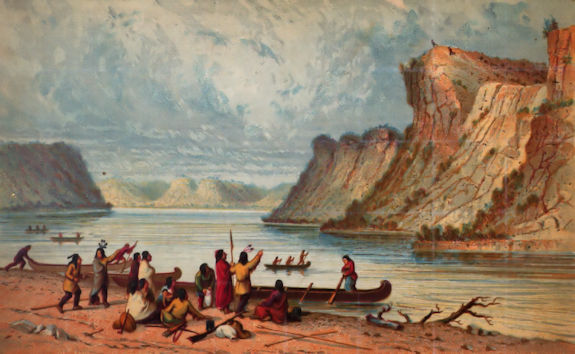
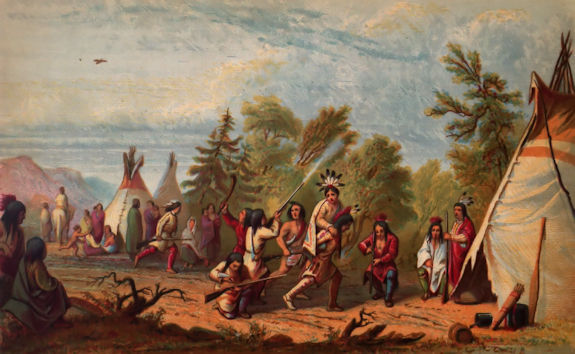
The Sioux4 were in their summer-houses, and the village
stretched along the bank of the river for a quarter of a
mile. It reached back, too, to the foot of a high hill, and
some of the lodges were shaded by the overhanging branches
of the elm and maple. Above the homes of the living
might be seen the burial-place of the dead; for, on the summit
of the hill the enveloped forms of the departed were
receiving the last red beams of the retiring sun, whose rising
and repose were now for ever unnoticed by them.
The long, warm day was closing in, and the Indians were
enjoying themselves in the cool breezes that were stirring the
waves of the river and the wild flowers that swept over its
banks. They were collected in groups in every direction, but
the largest party might be found surrounding a mat, on
which was seated the old war-chief of the band, who had long
dragged a tedious existence, a care to others and a burden
to himself. The mat was placed near the wigwam, so that
the sides of the wigwam supported the back of the aged and
infirm warrior. His hair was cut straight over his forehead,
but behind it hung in long locks over his neck.
Warm as was the season, the buffalo robe was wrapped
around him, the fur side next to him, while on the outside,
in Indian hieroglyphics, might be read many an event of his
life. Around the edge of the robe was a row of hands
painted in different colours, representing the number of enemies
he had killed in battle. In the centre of the robe were
drawn the sun and morning star, objects of worship among
the Sioux, and placed on the robe as a remedy for a severe
sickness which once prostrated his vital powers, but was
conquered by the efficacious charm contained in the representation.
Ornaments of different kinds adorned his person;
but his limbs were shrunken to the bone with age, and the
time had long since come to him when even the grasshopper
was a burden.
The features of the Sioux were still expressive, though the
eyes were closed and the lips thin and compressed; he was
encircled with a dignity, which, in all ages and climes, attaches
itself to an honourable old age.
Close by his side, and contrasting strongly with the war-chief,
was one of his nearest relations. She was his granddaughter,
the orphan girl of his favourite son. She was at
once his companion, attendant, and idol.
They were never separated, that old man and young girl;
for a long time he had been fed by her hands, and now he
never saw the light of the sun he worshipped except when
she raised and held open the eyelids which weakness had
closed over his eyes. She had just assisted his tottering
steps, and seated him on the mat, where he might enjoy
the pleasant evening-time and the society of those who delighted
in the strange stories his memory called up, or who
were willing to receive the advice which the aged are ever
privileged to pour into the hearts of the young.
The evening meal of the warrior had been a light one, for
We-har-ka still held in her small and beautiful hand a bark
dish, which contained venison cut up in small pieces, occasionally
pressing him to eat again. It was evident there was
something unusual agitating his thoughts, for he impatiently
put aside the hand that fed him, and taking his pipe, the
handle of which was elaborately adorned, he held it to have
it lighted, then dreamily and quietly placed it in his mouth.
He had long been an object of reverence to his people;
though superseded as a warrior and a leader, yet his influence
was still acknowledged in the band which he had so long
controlled. He had kept this alive in a great measure by
the oft-repeated stories of his achievements, and above all,
by the many personal encounters he had had, not only with
his enemies, but with the gods, the objects of their devotion
and fear.
The pipe was soon laid aside, and his low and murmuring
words could not be understood by the group, that, attracted
by the unusual excitement that showed itself in the war-chief's
manner, had pressed near him.
After a short communing with himself he placed his hand
upon the head of the girl, who was watching every change in
his expressive face. "My daughter," he said, "you will not
be alone—the Eagle Eye will not again see the form of his
warrior son: he would have charged him to care for his
sister, even as the small birds watch and guard around the
home of the forest god.
"The children of the Great Spirit must submit to his will.
My heart would laugh could I again see the tall form of my
grandson. I would see once more the fleetness of his step
and the strength of his arm; but it is not to be. Before he
shall return, crying, 'It is for my father, the scalp of his
enemy,' I shall be roaming over the hunting-grounds of
the Great Spirit. Do not weep, my daughter; you will be
happy in your husband's wigwam, and you will tell your
children how the Eagle Eye loved you, even till his feet
started on the warrior's journey.
"Your brother will return," he continued, "and it is for
him that I lay aside the pipe, which I shall never smoke
again; the drum that I have used since I have been a medicine-man,
I wish laid near my side when I shall be dead,
and wrapped in the buffalo robe which will cover me.
"You, my braves, shall know whence I obtained this drum.
It has often brought back life to the dying man, and its
sound has secured us success in battle. I have often told
you that I had seen the God of the Great Deep in my dreams,
and from him I obtained power to strike terror to the hearts
of my enemies. Who has shouted the death-cry oftener
than I? Look at the feathers5 of honour in my head! What
enemy ever heard the name of Eagle Eye without trembling?
But I, terrible as I have been to my enemies, must grow
weak like a woman, and die like a child. The waters of
the rivers rush on; you may hear them and trace their way,
but soon they join the waves of the great deep, and we see
them no more—so I am about to join the company in the
house of the Great Spirit, and when your children say,
'Where is Eagle Eye?' you may answer, 'The Great Spirit
has called him, we cannot go where he is.'
"It was from Unk-ta-he, the god of the great deep, that
I received that drum. Before I was born of woman I lived
in the dark waters. Unk-ta-he rose up with his terrible
eyes, and took me to his home. I lived with him and the
other gods of the sea. I cannot to you all repeat the lessons
of wisdom he has taught me; it is a part of the great
medicine words that women should never hear.
"There, in the home of the god of the sea, I saw many
wonders—the large doors through which the water gods
passed when they visited the earth, the giant trees lying in
the water higher than our mountains. They had lightning
too, the weapons of the thunder birds;6 when the winds
arose, and the sea waved, then did Unk-ta-he hurl the
streaked fire to the earth through the waters.
"The god of the great deep gave me this drum, and I
wish it buried with me; he told me when I struck the
drum my will should be obeyed, and it has been so.
"When my son returns, tell him to let his name be terrible
like his grandfather's. Tell him that my arm was like
a child's because of the winters I had seen, but that he
must revenge his brother's death; then will he be like
the brave men who have gone before him, and his deeds will
be remembered as long as the Dacotas hate their enemies.
The shadows grow deeper on the hills, and the long night
will soon rest upon the head of the war-chief. I am old, yet
my death-song shall call back the spirits of the dead. Where
are the Chippeways, my enemies? See their red scalps scorching
in the sun! I am a great warrior; tell me, where is the
enemy who fears me not!"
While the voice of the old man now rose with the excitement
that was influencing, now fell with the exhaustion,
which brought big drops of perspiration on his face, the Indians
were collecting in a crowd around him.
It was, indeed, a glorious evening for the war-chief to
die. The horizon was a mass of crimson clouds, their gorgeous
tints were reflected on the river; the rocky bluffs rose
up like castle walls around the village, while on the opposite
shore the deer were parting the foliage with their graceful
heads and drinking from the low banks.
We-har-ka wiped the forehead and brow of her grandfather.
There was something of more than ordinary interest
about the appearance of this young person: her features
were regularly formed, their expression mild; her figure light
and yielding as a young tree; her hair was neatly parted
and gathered in small braids over her neck; her dress well
calculated to display the grace of her figure; a heavy necklace
of wampum7 covered her throat and neck, and on her
bosom was suspended the holy cross!
Her complexion was lighter than usual for an Indian girl,
owing to the confinement occasioned by the charge of her
infirm relative; a subdued melancholy pervaded her features,
and even the tone of her voice.
There was a pause, for the warrior slept a few moments,
and again his voice was heard. Death was making him
mindful of the glorious achievements of his life. Again he
was brandishing his tomahawk in circles round the head of
his fallen foe; again he taunted his prisoner, whose life he
had spared that he might enjoy his sufferings under the
torment; again, with a voice as strong as in early manhood,
he shouted the death-cry—it was his own, for not another
sound, not even a sigh escaped him.
* * * * *
Gently they moved him into the wigwam. We-har-ka
stood by his head. There was no loud wailing, for he had
outlived almost all who were bound to him by near ties.
Those who stood around heaped their most cherished possessions
on his feet: the knife, the pipe, and the robe were
freely and affectionately offered to the dead.
We-har-ka gazed earnestly upon him: large tears fell on
her bosom and on the old man's brow. Some one drew near
and respectfully covered his venerable face: the drum was
placed, as he requested, at his side.
One of the men said, "Eagle Eye takes proud steps as he
travels towards the land of souls. His heart has long been
where warriors chase the buffalo on the prairies of the Great
Spirit." We-har-ka drew from her belt her knife, and cut
long, deep gashes on her round arms; then, not heeding the
wounds,8 she severed the braids of her glossy hair, and cutting
them off with the knife, red with her own blood, she
threw them at her feet.
How did the holy cross find its way to the wilds of a new
country? A savage, yet powerful nation, idolaters at heart
and in practice, bending to the sun, the forests, and the sea—how
was it that the sign of the disciple of Jesus lay glittering
on the bosom of one of the women of this heathen race?
Did the Christian hymn of praise ever rise with the soft
and silvery vapours of morning to the heavens? Had the
low and earnest Christian's prayer ever sounded among the
bluffs that towered and the islands that slept? Never, and
yet the emblem of their faith was there.
But, to what region did not the Jesuit penetrate? Hardly
were the resources of our country discovered, before they
were upon its shores.
They were there, with their promises and penances, their
soft words and their Latin prayers, with purposes not to be
subdued in accomplishing the mission for which they were
sent. Was it a mission of faith, or of gain? Was it to extend
the hopes and triumphs of the cross, or to aggrandize a
Society always overflowing with means and with power?
Witness the result.
Yet they poured like rain into the rich and beautiful
country of Acadie.9 See them passing through forests where
the dark trees bent to and fro "like giants possessing fearful
secrets," enduring hunger, privation, and fatigue. See
them again in their frail barks bounding over the angry
waters of Huron, riding upon its mountain waves, and often
cast upon its inhospitable rocks.
Follow them as they tread the paths where the moccasin-step
alone had ever been heard, regardless of danger and of
death, planting the cross even in the midst of a Dacota
village. Could this be for aught save the love of the Saviour?
Those who know the history of the Society founded by
Loyola, best can tell.
Among the ranks of the Jesuit were found the Christian
and the martyr, as, among the priesthood of Rome, in her
darkest days, were here and there those whose robes have,
no doubt, been washed in the blood of the Lamb.
Those hearts that were really touched with the truth
divine, drew nearer to the path of duty by the solemn spectacle
of man, standing on the earth, gay and beautiful as if
light had just been created, yet not even knowing of the
existence of his great Creator.
Not far from the wigwam of the dead chief, Father Blanc
knelt before the altar which he had erected. He wore the
black robe of his order, and as he knelt, the strange words
he uttered sounded stranger still here. On the altar were
the crucifix and many of the usual ornaments carried by
the wandering Romish priests.
Flowers too were strewn on the altar, flowers large and
beautiful, such as he had never seen even in la belle France.
He chaunted the vespers alone, and had but just risen from
his devotions when the dying cry of the war-chief rung
through the village.
The priest walked slowly to the scene of death. Why was
he not there before with the cross and the holy oil? Ah! the
war-chief was no subject for the Jesuit faith—he had worshipped
too long Wakinyan-Unk-ta-he to listen to the words
of the black robe. There were no baptisms, no chauntings
of the mass here; there was no interest at stake to induce
the haughty Sioux to the necessity of yielding up his household
gods. They were not a weaker party warring with
the French, and obliged from motives of policy to taste the
consecrated wafer. Contrasted with the Indian's ignorance
was his native dignity. When Father Blanc told them there
was but one religion and that was the Roman Catholic, and
that the time would come when all would be subject to the
man who was in God's place upon the earth, who lived at
Rome, then would the Sioux laugh, and say, "As long as
the sun shines, the Dacotas will keep the medicine feast."
In vain were the pictured prayer-book and the holy relics
exhibited. What were they to the tracks of Haokah the
giant, or the gods' house, under the hill which reared itself
even to the clouds, under which the gods rested themselves
from their battles.
The priest wept when he thought of the useless sacrifice
he had made: he could not even gain the love of the strange
beings for whose sake he had endured so much. They were
not like the Abnakis, "those men of the east," who so loved
and obeyed the fathers who sojourned among them.
And the useless life he was leading, how long might it
last? Restrained, as the Sioux were, only by the laws of
hospitality and the promise they had made to the Indians
who conducted him hither, how soon might these influences
cease to affect them?
We-har-ka alone spoke gently and kindly to him. She
knew that his heart, like hers, vibrated beneath a load of
care; she found too a strange interest in his stories,—the
woman's love of the marvellous was roused; the miracles of
the saints delighted her as did the feats of the gods.
But only so far was she a Christian; though she wore a
gift from the Jesuit, the consecrated sign. Perhaps in the
after accounts of his converts she was reckoned among them.
We are told by one of the Jesuit fathers of the true conversion
and Christian death of a Canada Indian. "While I
related to him," said he, "the scene of the crucifixion, 'Oh!
that I had been there,' exclaimed the Indian, 'I would have
brought away the scalps of those Jews.'"
The war-chief was arrayed in his choicest clothing; and,
but for the silence in the wigwam, and the desolate appearance
of the young person who was alone with her dead, one
would have supposed that he slept as usual. The charms
were still to be left about his person for protection. The
body was wrapped in skins: they were as yet laid but
loosely about him, ready for their final arrangement, when,
with the face towards the rising sun, the warrior should be
laid upon the scaffolding, to enjoy undisturbed repose.
But a few hours had elapsed since he sat and talked
among them; but now each of the group had returned to
his usual occupation. Even his daughter sat with her face
drooping over her hands, forgetting for the moment her
grief at his loss, and endeavouring to anticipate her own
fate. The twilight had not yet given way to night, but the
sudden death that had occurred had hushed all their usual
noisy amusements. Nothing was heard but the subdued
voices of the warriors as they dwelt on the exploits of Eagle
Eye, or speculated on the employments that engaged him,
now that their tie with him was sundered. Sometimes the
subject was changed for another of more exciting interest.
A party that had gone in search of the Chippeways,10 who
had been hovering near their village, was expected to return,
and there was some little anxiety occasioned by their prolonged
stay. Among the most noted of the party was the
brother of We-har-ka and a young brave called the Beaver.
These two young men, aspirants for glory and the preference
which, among the Indians, is awarded to bravery, cunning,
and the virtues, so considered among them, belonged to different
clans. The rivalry and hatred between these clans raged
high, more so at this time than for some years previous.
The Indian lives only for revenge; he has neither arts
nor learning to occupy his mind, and his religion encourages
rather than condemns this passion.
The daring showed by the Chippeways had only stimulated
them to greater acts of bravery; they were determined
that the tree of peace, now torn up by the roots, should never
be planted again on the boundaries of the two countries.
We-har-ka had arisen from her recumbent attitude, and
stood by the side of her dead relative. She had not time
to reflect on the loneliness of her position.
She had only laid her hand on the cold forehead where
Death had so recently set his seal, when the well-known triumphant
voice of her brother echoed through the village.
Hardly had she turned towards the door when another
yell of triumph, sounding even louder than the first, was
heard. She knew that voice too, for the colour mounted to
her cheeks, and her breath came short and quickly.
A chorus of yells now rent the air, answered by the Indians
who had joyfully started up to meet the party. How
every eye shone with delight, every feature working with
convulsive excitement; all the fierce passions of their nature
were aroused. Those prolonged and triumphant shouts had
prepared them for what was to come. Already they longed
to see the blood-dyed scalps, and, it might be, the face of
some prisoner in whose sufferings they were to revel.
The figures of the successful war-party soon made themselves
visible in the moonlight. One by one they turned the
winding trail that led to the village. Over their heads they
bore the fresh scalps; and as they came in view, a piercing
universal shout arose from all. The eagerness of the women
induced them to press forward, and when it was impossible
to gain a view, from the great crowd in advance, they ascended
the nearest rock, where they could distinctly see the
approaching procession.
After the scalps and their bearers were recognised, another
deafening shout arose. The prisoners were descried as they
neared: it was seen there were two men and a woman. The
arms of the men were pinioned back between their shoulders.
Nearer still they come, but the shouting is over: intense
curiosity and anxiety have succeeded this eager delight.
The prisoners and scalps were their enemies, but over
every heart the question passed, Have they all returned?
Has each husband been restored to his family, each child to
the parent? But not long did these softer feelings influence
the conduct of the Sioux. They had now nearly met, and
the war-party, with the prisoners, had reached the outskirts
of the village. Here the confusion had returned and attained
its greatest height; welcomes had been said, and the
crowd pressed around the scalps to feast their eyes on the
precious sight. There were but four, and they had been
taken in the hurry of flight: they were round pieces, torn
from the top of the head, and from one of them fell the long,
glossy hair of a woman.
There was nothing in the carriage of the prisoners to denote
their condition, their attitude and demeanour proclaiming
the conqueror instead of the conquered—the
haughty determination of their looks, the bold freedom of
their steps, their gait as erect as possible, with their hands
bound behind them. Even the insolence of their language,
in reply to the taunts of their victors, showed they were prepared
for what was inevitable.
The calm, pale face of the young Chippeway girl showed
that she had determined to brave the blood-loving Sioux,
and let them see that a woman could meet death as well as
a warrior.
The procession stopped, and one of the Sioux women
called for her husband. "Where is he, warriors? give me
back my husband."
"You will not weep," said one of the men; "here is the
Chippeway who killed him," pointing to the younger of the
male prisoners. "You may stone him, and then you may
sing while the fire is burning under his feet."
A loud laugh of defiance was heard from the prisoner.
"The Sioux are dogs," he said; "let them hurry; I am in
haste to go to the land of souls." The words were not uttered
ere a dozen spears pricked his body. There was no
cry of pain; he only laughed at the anger he had excited.
The attention of the Indians was now withdrawn from
their prisoners, for We-har-ka was rapidly walking towards
them. Even the arrangement of her dress was distinctly
visible as she approached them: her long and glossy hair
disarranged purposely, to mark the intensity of her grief;
the blood was still trickling from her arms; her pale face
looking even paler than it was, by the moonlight and its
broad shadows.
She was hastening to meet her brother, yet she did not
offer him one congratulation on his safe return. "My
brother," she cried, "your grandfather is dead. He lies
cold and still, as the large buffalo when he has ceased to
struggle with our hunters. Go to his lodge and tell him of
your prisoners, and your scalps. For me, I will go myself to
shed tears. I will follow the fresh tracks of the deer, and
by the wakeen-stone,11 in the prairie, I will sit and weep
where no eye can see me but the Great Spirit's. While the
moon walks through the sky, the spirits shall hear my voice."
She was listened to in silence, for the Indians always
showed respect to We-har-ka; her being constantly with
the war-chief had made them look upon her almost with
reverence, as if she might have obtained from him some
supernatural power.
"The Sioux listen to the words of a woman," said the old
prisoner, as We-har-ka turned towards the prairie. "Why
do they not make her a war-chief, and let her take them to
battle?"
"We will," answered her brother, "when we go again to
bring home old men. I would not have been troubled with
your old carrion, but I thought to let my father return the
kind treatment you once gave him; and I would kill you
now, but that I would rather the women would do it."
"The Sioux are brave when their prisoners are bound,"
again taunted the prisoner; "let them do their will: the
Chippeway fears neither fire nor death."
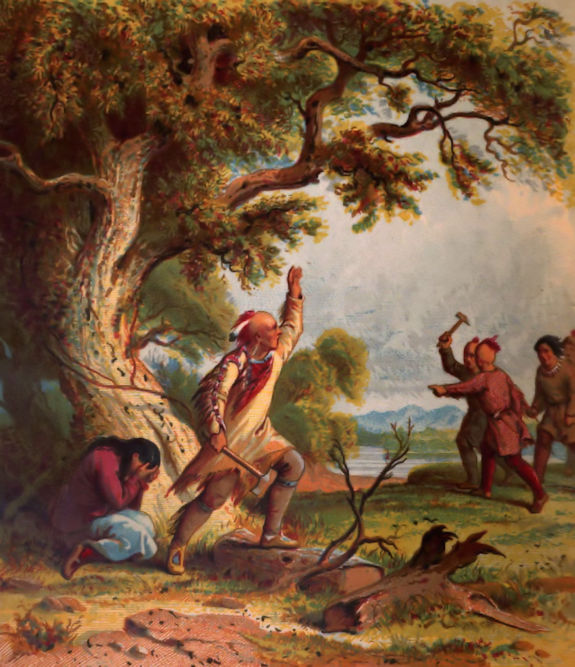
The rage of the Sioux was unbounded; the cold unconcern
of their prisoner almost destroyed the pleasure of victory.
The women clamorously demanded that he might be
delivered over to them. They seized him, and moved forward
to a large tree, whose massive trunk indicated its
strength. Here they bound him with strong sinews and
pieces of skin. His hands were tied in front, and a strong
cord was passed about his waist, and with it he was fastened
to the tree.
This was all the work of the women, and they evinced
by their expedition and hideous laughs the pleasure they
found in their employment.
The Sioux then went to see the body of their venerated
chief; on their return they found their victim firmly secured
to the tree. The son was bound at some little distance from
the father, while the daughter was sitting, hiding her face
between her hands, weeping for her father's situation. Pride
had all gone, only affection occupied her heart. The old
Chippeway was convinced now of his immediate sufferings;
he had been tranquil and unmoved until the return of the
warriors. Suddenly he shouted, in a loud voice, the wild
notes of his death-song.
There was no failing in his voice; even his daughter turned
towards him with satisfaction as he extolled his life, and
expressed pleasure at the prospect of seeing the hunting-grounds
of the Great Spirit.
As he ceased, Chashé told him he must rest from his
journey ere he commenced his long way to the land of souls.
"A great many winters ago," said the young Sioux, "my
father was in your country; you took him prisoner, you
bound him, and you told him what a good warm fire he
was to have to die by.
"You said you loved him too well to let him be cold;
but while you were binding him he was too strong for you.
Unk-ta-he had made him brave; he bounded from your
grasp in sight of your warriors. He flew; your bravest men
chased him in vain. He came home and lived to an age
greater than yours.
"The old war-chief is gone, or he would tell you how
welcome you are to his village. He was always hospitable
and loved to treat brave men well. But we must eat first,
or we cannot enjoy ourselves while you are so comfortable
with your old limbs burning."
Expressions of approbation followed this speech on the
part of the Sioux, but there was no notice taken of it by the
Chippeway, who was now occupied in contemplating his
daughter. He had before seemed to be unconscious of her
presence.
No bodily torture could equal the pang of the father, who
saw the utterly helpless and unhappy situation of his child.
His own fate was fixed—that caused him no uneasiness.
There was even a feeling of enthusiasm in the prospect of
showing his enemies how slight was their power over him;
how little he cared for any tortures they might inflict.
But his young daughter, who would have been safe now
among her own people, but for her affection for him, which
induced her to remain by his side, refusing the opportunity
of escape.
The Sioux saw his concern and rejoiced that this pang
was added to the torture: not only his own fate to bear, but
the consciousness that he had caused the destruction of both
his children. His son was surrounded while endeavouring
to protect his father.
Thus will nature assert her right in the hearts of all her
children; but the Chippeway closed his eyes to all, save the
effort of appearing indifferent to his sufferings. Again he
sung his death-song, while the Sioux stretched themselves
upon the grass, eating the tender venison which had been
prepared for them, occasionally offering some to the Chippeway,
advising him to eat and be strong, that he might
bravely walk on his journey to the land of souls.
While the Dacotas were eating and resting themselves,
the Chippeway chaunted his death-song; his son, apparently,
was unmoved by his own and his father's desperate
situation, but the daughter no longer endeavoured to restrain
her grief. Exhausted from fatigue and fasting, she
would gladly have known her own fate, even if death were
to be her mode of release from her distressing position.
The Indians frequently offered her food. Chashé tried to
persuade her to eat: she indignantly rejected the attention,
her whole soul absorbed in her father's painful situation.
She saw there was no hope: even had she not understood
their language, she could have read all in the fierce glaring
eyes of her enemies, the impatient gestures of the men, and
the eager, energetic movements of the women. The latter
were not idle: they were making arrangements for the burning
of the prisoner. Under his feet they piled small round
pieces of wood, with brush conveniently placed, so as to
kindle it at a moment's warning when all should be ready.
To their frequent taunts their victim paid no attention: this
only increased their anxiety to hasten his sufferings, young
and old uniting their strength.
One woman struck him with the wood she was about to
lay at his feet, another pierced him with the large thorn she
had taken from the branch she held; but the loudest cries
of merriment and applause greeted the appearance of an old
creature, almost bowed together with the weight of a load
she was carrying, large pieces of fat and skin, which she was
to throw in the blaze at different times when it should be
kindled.
The glare of day could not have made more perceptible
the horrid faces of the savages than did the brilliant moonlight.
Every sound that was uttered was more distinct,
from the intense quiet that pervaded all nature. The face
of the victim, now turned to the sky, now bent in scorn over
his enemies; that of his son, pale, proud, and indifferent;
the unrestrained grief of the girl, who only raised her head
to gaze at her father, then trembling, with sobs, hid it deeper
in her bosom; the malignant triumph of the Sioux men, the
excitement and delight of the women;—all these were distinctly
visible in the glowing brightness of the night.
Was there no hope for the aged and weary old man? no
chance that these stern, revengeful spirits might relent?
Will not woman, with her kind heart and gentle voice, ask
that his life may be spared? Alas! it is woman's work that
we are witnessing: they bound his limbs, they have beaten
him, and even now are they disputing for the privilege of
lighting the fire which is to consume him. Loud cries arise,
but the contention is soon quelled, for the deep bass voice
of the medicine-man is heard above theirs, and he says that
the newly made widow, and she alone, shall start the blaze,
and then all may join in adding fuel to the fire, and insult
to the present disgrace of the Chippeway warrior.
And now the brush is piled round the wood and touches
the victim's feet, and the men lie still on the grass, knowing
their work will be well done, and the women who are
crowded together make a way for the widow to advance.
See her! the tears are on her cheek, yet there is a smile of
exultation too—the blood is streaming from her bosom and
her arms.
With her left hand she leads her young son forward. In
her right she holds a large and flaming torch of pine. The
red light of the burning wood contrasts strangely with the
white light of the moon; the black smoke rises and is lost
in the fleecy clouds that are flying through the air.
The silence is broken only by the heart-breaking sobs of
the Chippeway girl. The Sioux woman kneels, and carefully
holds the torch under the brush and kindling-wood.
She withdraws her hand, and soon there is something beside
sobs breaking the stillness. The dry branches snap, and
the women shout and laugh as they hear the crackling
sound. The men join in a derisive laugh; but above all is
heard the loud, full voice of the victim. His death-chaunt
drowns all other sounds, yet there is not a tone of pain or
impatience in the voice; it is solemn and dignified; there is
even a note of rapture as he shouts defiance to his enemies
and their cruelty.
The dry twigs snap apart, and the smoke curls around
the limbs of the prisoner: now the bright red flames embrace
his form.
The warrior is still; he is collecting his energies and challenging
his powers of endurance.
Chashé stood up. "My father," said he, "fled from the
fire of the Chippeways; but you like the fire of the Dacotas,
for you stand still."
"The Sioux are great warriors," replied the Chippeway,
"when they fight old men and children," looking at the
same time towards his daughter.
"But, is he an old man or a girl?" asked Chashé, pointing
to the younger Chippeway.
"He is a great warrior," said the father, "but he was one
against many. He could not see his father and sister scalped
before his eyes. Had he fought man to man he would have
showed you the sharp edge of his tomahawk; but he is a
Chippeway, and knows how to suffer and to die."
The noise of the fire drowned the old man's words, for
the women were amusing themselves by throwing on small
pieces of dry wood and portions of deer-fat, which, crackling
as it burned, rapidly consumed the body of the unfortunate
man.
No suffering had, as yet, forced from him any cry of pain;
it was evident that nature would soon relieve him of his
agony. His heart had nigh ceased "beating its funeral
march." Even he, an untutored savage, felt that
"Dust thou art, to dust returnest,
Was not spoken of the soul."
His fortitude to endure was increased by the thought that
soon the brilliant but mysterious future would be opened to
him.
The Sioux were disappointed at his courage, and longed
to have their gratification completed by some acknowledgment
of his agony. An old and fierce-looking woman drew
her knife from her belt, and springing upon the high roots
of the tree, cut a deep gash between the shoulders of the
prisoner, then stooping, she raised in her hand a flaming
torch, which she applied to the fresh wound she had just
made. This agony was unendurable: a deathlike struggle
convulsed the heroic countenance of the sufferer; he uttered
a sharp and piercing cry; then, as if apologizing for his want
of firmness, exclaimed, "Fire is strong!"
This sufficed for his enemies, and shouts of joy echoed
through the village, while the agonized daughter, unable
longer to endure the dreadful sight, sunk insensible on the
grass at her brother's feet.
It was not long ere another shout announced the relief of
the Chippeway. The sweet hours of night had passed away
while they watched his noble firmness, and awaited his last
breath. During the last hour, long, low, black clouds had
been deepening in the far west; now and then a distant
murmur was heard, and faint flashes gleamed athwart the
water. A slight murmuring of the waves witnessed the
rising of the wind, and the Sioux separated to take a rest,
which they all needed.
Seeing that their other prisoner was securely bound, they
left him to face the storm and the hideous spectacle of his
father's remains. Chashé raised the lifeless form of the girl
and carried her to his sister's wigwam.
We-har-ka had taken no interest in the scene that had
been enacting; she slept soundly, fatigued with her wanderings
on the prairie and the indulgence of her grief. Chashé
laid his unconscious burden by the side of his sister. Enemies
as they were, the looker-on might observe a strong
bond of sympathy between them. Their young faces were
shadowed by grief,—that link which should unite, heart to
heart, every child of earth.
* * * * *
The low sigh with which the Chippeway girl awoke from
her deathlike trance, did not awaken We-har-ka. Starting
up, she in a moment recalled the sad tragedy which had
just been enacted before her eyes, yet she could not account
for her being where she was. The wigwam was dark, except
when illuminated by vivid flashes of lightning, which
showed her the few articles of furniture and comfort that
adorned an Indian woman's home.
The occasional pealing of the thunder, and We-har-ka's
breathing, were the only sounds she heard. A thousand
painful thoughts drove slumber from her eyelids. Her
father she knew was gone: she pressed her hand before her
eyes to recall, and then to chase away, the dreadful memory
that tortured her. She was spared; it might be for a slave,
or to be the wife of some one of her enemies. Her brother,
she had no doubt, was still living: he had been reserved for
protracted tortures. Overcome by these thoughts she sank
again upon the ground, but not to sleep.
Could nothing be suggested to give her comfort? She
cautiously raised the door of the wigwam, and by the red
lightning she saw her brother bound as she had left him.
Despair had nearly overpowered her once more, but the
natural energy of her mind returning, she looked again to
her own heart, to see if there was any hope. Should she
never see again the home so dear to her! Were she and
her bold brother to die by the hands of her father's murderers!
Oh! that she possessed a sharp knife, to sever the
thongs that bound him, how soon would they flee away as
the birds do when winter's winds are heard from the north!
The idea once prominent in her mind, there was hope.
Another flash showed her the most minute objects in the
wigwam. Another directed her to the knife of We-har-ka,
which lay glittering by her breast. A few moments of intense
thought decided her: nerved by a sense of her own
and her brother's danger, she no longer hesitated. What
horrors could be greater than those by which she was surrounded!
What if she were detected and murdered at once!
Far better than to witness her brother's fate, and endure
her own.
She placed herself near We-har-ka, then gently endeavoured
to remove the knife she coveted. The young heart
throbbed against her hand. Again she endeavoured to slide
the knife from its place. We-har-ka turned upon her side
as if disturbed. After a few moments had elapsed she once
more made the effort; and now, as it is clasped in her hand,
her senses have well-nigh left her, for this time she is successful.
But, well she knew there was no time for delay, nor even
for consideration. The deepest darkness of night was now
upon them; before long the morning twilight would be again
resting over the earth.
The perfect and unusual repose of the Sioux was in her
favour; and, excited even to desperation, she determined to
endeavour to free her brother, and secure his and her own
escape.
She first endeavoured to recall the situation of the principal
objects in the village. She did not, however, require
any effort of memory, for she could see distinctly where her
brother was bound, and the path that led to this point. The
storm's spirits were her friends: without the lightning she
could have accomplished nothing.
There was a turn in the path that led through the village,
and once or twice she was at a loss how to proceed. She
would not be dismayed, though at times she feared her enemies
would hear the loud beatings of her heart. Guided by
the lightning, and resting for a moment when she feared her
footfall would give the alarm, she at length reached the spot.
There had been no rest for the younger Chippeway. With
the heart-crushing spectacle before his eyes, he had only
given way to a horror at his father's sufferings, far more
dreadful to witness than to endure. There was, besides,
the anticipation of his own.
Again and again he looked at the strong cords that bound
him. Could he for a short time possess the knife his enemies
had wrested from him!
Useless, indeed, to him, without assistance!
Softer feelings, too, came in turn. His wife had been
murdered before his eyes, his young son crushed under the
feet of those who now lay sleeping tranquilly around him.
The weary night was wearing on. There would be no
breaking of the day to him. There was no hope, but that
which pointed to the unknown future; no light but that
which glimmered from the silent land.
A slight noise arouses his acute senses, and he turns his
head to that part of the village where were the greatest
number of lodges. It might be that the footstep was that
of some one of his foes, determined alone to enjoy the sight
of his death. Oh! what joy thus to be saved the reproaches
of his enemies, the laughing of the women, the sneers of all.
Eagerly he peers through the darkness, and the first brilliant
flash shows him the pale face of his sister, as she advances
towards him.
Very near him slept, in a wigwam, two warriors who had
the charge of him. They might awake: this thought made
the very pulses of his life stand still.
For at once he understood his sister's intention. He
knew her courage; he also knew that without an object she
would not be thus incurring the risk of arousing their enemies.
Another flash, and she stood close by his side—her hand
was upon his, as she felt for the thongs that bound him.
One by one they were cautiously severed—slowly, for the
slightest noise might be fatal.
It was hard work, too, for the maiden, for the sinews
were like iron, and her strength failed her under the repeated
efforts she was obliged to make. There was no word
uttered,—their hearts silently conversed with each other.
Time passed, and he was almost free; he was himself severing
the last bond that detained him.
It yielded. Once more he could stretch out his muscular
arm. Grasping his sister to his side, covered by the darkness
and the thunder, and the heavily commencing rain,
they made their way under the edges of the bluffs. The
young Chippeway knew the route: a short peace had existed
between the tribes, and he had more than once passed
through the village.
At first their progress was slow and deliberate. There
was no faltering, though. They were without weapons,
with the exception of We-har-ka's knife. Hunger and
faintness were oppressing them, but the danger they were
in braced their hearts. As they began to leave the Sioux
village in the distance, hope gave vigour to their frames.
After the day broke, the clouds were scattering, and the
sunbeams were dotting the hills that lay between them and
their foes. Still they could not rest. The wild plum was
their only nourishment; nor was it until night had again
shrouded the earth, and the young man laid his sister
in the hospitable lodge of a Chippeway village, that he
realized that he had been a prisoner and was again free.
It were impossible to describe the rage of the Sioux on
ascertaining the escape of their prisoners. Chashé went
soon after their flight to his sister's wigwam. His sleep
had been restless, he thought of his dead relative, but he
thought more of the Chippeway girl, whom he had resolved to
adopt12 in place of his young wife, who had died recently.
Seeing his sister alone, he anxiously inquired of her what had
become of the girl. What was his surprise when she told him
there had been no one there; that when she arose, the storm
was passing over, but it was still dark, but that no one had
been in the lodge since then. Her brother, much irritated,
contradicted her, using the most violent language; yet it was
evident to him that his sister was unconscious of his having
laid the girl by her side.
He turned away, and sought the scene of the last night's
torture. There were the burnt fagots, and the ghastly
remains. The smoke still curled and slowly rose from the
ashes, but neither of the prisoners was to be seen. The
thongs with which he had been bound lay on the ground.
There was no room for doubt: brother and sister had fled;
and they lived so near the borders of the Chippeway country
that there was every reason to believe they were beyond
the reach of recovery.
Disappointment and rage overspread his features. He
threw up the door of the lodge where the sentinels still
slept calmly. Pushing the foremost over with his foot,
"Where is your prisoner?" said he. "You are brave men,
that cannot take care of one Chippeway!"
Starting to their feet, the sentinels at once became aware
of what had occurred. "Where is the girl?" they asked of
Chashé.
"They are both gone," said he, "and they must both
have passed near you."
"And where were you when the girl went?" replied one
of the sentinels. "You took her off with you, and if we
could not keep the man, you could not keep the woman."
The inmates of the different lodges came forward to learn
what had happened. Here advances a brave, followed by
his young sons. The women throw down their bundles of
sticks, to feast themselves with a sight of the Chippeways
ere they commenced their usual avocations; but they only
expressed their sorrow by groans of disappointment. It was
decided that the fugitives should be pursued. A party of
the younger men set out without delay; they were warned,
however, not to go too near their enemy's country.
Glowing with the expectation of recapturing the prisoners,
and, it might be, of bringing home more scalps, they were
anxious to set out. The old medicine-men reminded them
of their duty, gave them advice suitable to the occasion, and
then, with uplifted hands, called upon Wakeen Tonca,
Great Spirit, Father, to help them against their enemies.
The close of another evening found the Sioux quiet, and
busy in drying venison, and the usual occupations of the
season. With the day, however, were closing their labours.
Often a cry of lamentation was heard from the lodge of the
Sioux who had recently been killed in battle.
The body of Eagle Eye was deposited upon a high scaffolding.
His two children were still engaged at the burial-ground.
All cries of sorrow, usual at such times, were
hushed. The sides of the high hills were tinged with gold
and crimson. Some of these "mountains rose high, high
up, until they could look into the heavens and hear God in
the storm." The river was as calm as if no scene of cruelty
had ever been enacted on its banks.
Round the frame where Eagle Eye's form was laid hung
his medicine-bag. Chashé placed a vessel of water near the
body. We-har-ka lightly lifted the bark dish of buffalo-meat13
and wild rice, where the soul of the departed warrior could
take it, and be refreshed when tired and hungry. Very
near him was buried his wife. Her bones had been gathered
and buried under the ground; branches of trees and
solid pieces of wood had been placed crosswise over her
grave, to protect it from the wolves.
The graves and scaffolds were continued to the very edge
of the bluff, while flowers of the most brilliant hue sprung
up at the feet of the mourners, and clung to the low small
bushes that grew on the hilltop. The brother and sister
were preparing to come down, when We-har-ka perceived
the priest seated by one of the graves, apparently unconscious
of all that was passing around him. She approached
him, and softly laid her hand upon his shoulder. He
turned to her slowly, as if aroused from a dream of long
past years, and followed them to the village.
His lodge was near hers, and she listened to his full rich
voice as he chaunted the vespers. Totally ignorant of what
he said, she was yet soothed by the sweet sounds, and after
they had ceased, unobserved by others, she sought him in
his lodge, and night was closing over the earth as the
voices of the two mingled in earnest conversation.
* * * * *
The Jesuit had long been anxious to take advantage of
the first opportunity that offered to return to Canada.
Here, his time was wasted and his health impaired to no
purpose. He had succeeded in learning the language of the
savages, so as to converse with them tolerably; but his mission
was as useless here as it would have been among the
wild beasts of Africa.
Constantly exposed to danger, without the means of
living, except what he received from We-har-ka, and occasionally
from others, his time unoccupied, his life was a
burden. His health was not strong enough to enable him
to join in the hardy exercises and sports of the red men.
How anxiously, then, did he await the means of deliverance.
There was an occasional intercourse with the tribes that
lived in the region of the great lakes: in this way he had
come among the Sioux, and he hoped thus to return to
Acadie. He passed hour after hour watching the approach
of canoes, hoping to recognise the tall, gaunt forms of the
Hurons, or some of those with whom the Sioux were on
friendly terms. Over but one human being, We-har-ka,
had he acquired the slightest influence. We have before
alluded to the rivalry of the two young men, Chashé and
the Beaver, for the disputed honour of being the war-chief of
the band. They belonged to opposite clans, which were
almost equally divided. It appeared evident that it could
only be decided by some act of bravery performed by one
of the parties.
The aspirants had equal claims. They were each daring
in the greatest degree. Young, athletic, inured to fatigue
and hardships, thirsting like the war-horse for the battle.
Chashé owed his reputation in some degree to the reputation
of his grandfather, while on the other hand the Beaver's
courage made him feared by his own and the opposite clan.
The long-continued feud between the two clans had been
more violent than ever since the death of the younger brother
of Chashé. His sickness was attributed to a spell
having been cast upon him by some one of the other clan.
Eagle Eye attributed his death to the family of the Beaver;
and so great was the hatred of the two clans14 that murder
after murder occurred, and every sickness and disaster was
charged upon some individual, and thus revenge was constantly
sought.
Especially was Eagle Eye dreaded; his powers as a medicine-man
were rated so high, that in passing by him many
avoided his observation—they dreaded lest he should, by an
undefined power, bring upon them the wrath of an evil
spirit. And each warrior wore beneath his richly embroidered
hunting-dress a charm, to protect him from a machination
that he feared.
Yet did the Beaver love the sister of his rival, and he
had induced her to defy her brother's hot temper, and promise
him all her young affection. Love had made him eloquent,
and he persuaded her out of all the opinions she had
imbibed from the time she was capable of forming one; while
he, blind to the attractions of all others, could only see
grace in her person.
It was not likely his life would be safe should he marry
her, and remain among his own people; and could he yield
the chances of his high position among the braves with
whom he had grown up to the love of woman? He knew
that We-har-ka would leave all for him. The only question
was, could he make the sacrifice?
They had closely kept their secret. We-har-ka had been
promised to a young man of her grandfather's clan. She
had from time to time delayed the marriage, by her influence
over the old man. The husband they had chosen for her
was the tried friend of her brother, styled among the Indians,
a comrade. Well did We-har-ka know how determined
was her brother's temper, and that he would force
her into the marriage after her grandfather's death, and
that, unless by some great effort, there was no hope.
On the night of the return of the party, and the burning
of the prisoner, she had, indeed, gone to the prairies to weep;
but it was as much over the difficulties of her position as
the death of her relative. It was not without an object that
she had come forward to meet the war-party, and told them
her intention. When the excitement of the burning of the
Chippeway was at its height, her lover had left the group
of young men, and a short time brought him to We-har-ka's
side. After a few moments passed in the joy of reunion,
We-har-ka told him that her fate must soon be decided, and
implored him to take her away from their home, as their
only chance of happiness. They could go, she said, among
the Sioux who lived on the Missouri, and there live free
from care.
The young man did not answer her at first, and We-har-ka,
startled with the boldness of her own proposal, awaited his
answer, standing. Her arms were clasped over her breast,
and her eyes bent to the ground: the moonlight glittered
on the wampum which lay on her bosom, and flashed from
the silver cross suspended from her neck.
At length the Indian broke out into angry abuse of her
brother and all connected with her. The colour varied in
her cheek, and her lips were more firmly compressed when
he charged them with cowardice, but still she spoke not.
She had counted the cost of his love, and knew, that to retain
it, she must resign even the natural impulses of her heart.
She waited until the torrent of his passion had ceased,
then pointing to the dark clouds that were gathering in the
west, reminded him that they would be missed. The shout
that came from the village warned them too of the necessity
of separation. He then marked the agitation of her manner,
bade her return home, telling her that, after her father was
buried, he would come to the lodge of the Jesuit: at what
time he could not say, but not until some amusements should
engage the Sioux: then he would tell her his determination.
We-har-ka, overpowered with fatigue on her return to her
lodge, slept soundly, even with the Chippeway girl by her
side.
* * * * *
We-har-ka sat in the wigwam of the Jesuit, listening to
the accounts of the grandeur of the churches and the magnificence
of the altars in the country where Father Blanc
had passed his youth. He pointed to the small figure of
Christ, on the altar of cedar wood, which he had constructed,
then told her of the large one of gold which he
had often knelt before in assisting in the ceremonies of the
church. We-har-ka, whose thoughts had been wandering
in quest of her lover, asked him again of the ever interesting
story of the death and sufferings of the Saviour. Like
those who witnessed the crucifixion, she wondered that that
Great Being should submit to such indignities. Her religion
would have justified resenting them. Yet she did not believe
it was true, loving still to hear it told over and over again;
especially was it agreeable to her now to while away the
hour until her lover, under pretence of speaking to the
priest, should find a chance of acquainting her with the
plans he had formed. She looked again at the familiar
objects on the altar. Again, as ever, she told the priest he
was good and kind, but that she knew the Great Spirit was
the father of all. Father Blanc's insinuating eloquence
touched her feelings, but her heart was unaffected: yet the
father, glad of a listener, even in the untutored Indian girl,
dwelt on scenes long past, and it might be forgotten by all
but him.
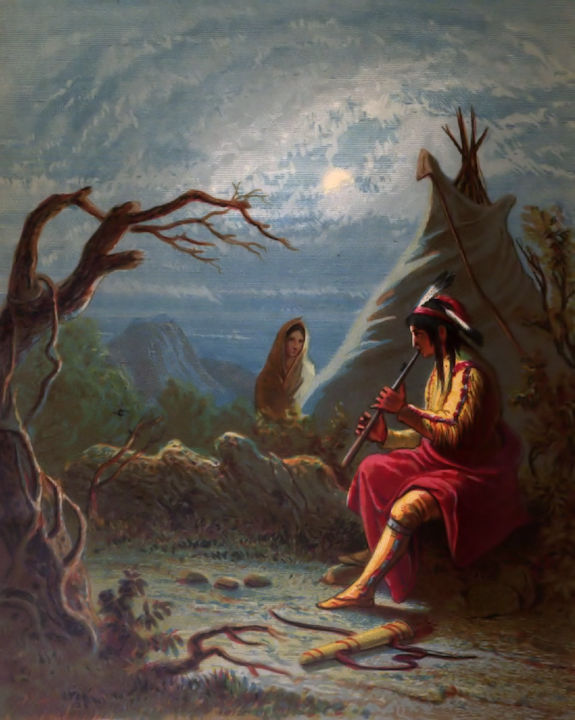
When the moon rose they sat outside the lodge on a mat.
They were now both silent. The thoughts of the Jesuit
wandered far and wide: memory transported him to the
forests of Languedoc.
There he pursued his studies, full of high hope and youthful
happiness. He wandered through the most beautiful
scenes of nature, and there was one by his side; her smile
was bent upon him, as she parted the long ringlets from her
brow. He gazed again as he was wont when he bade her
good night, and wondered if angels smiled so sweetly when
they bore the dead to the regions of Paradise. Memory
changes the scene. Death and desolation are met; darkness
and beauty are blended strangely. Those angel eyes
are closed, but the sweet smile is there.
Hushed lips bend over the bier where roses are lavishly
strewed. Echoes of grief are heard along the halls, as they
pass on with their beautiful burden to the house of death.
Then come the long nights of sorrow, the vigils of despair,
the renouncing of the hopes and pleasures of life: then the
morbid restlessness, the wish for death and forgetfulness.
Afterwards, the solitary life of the student, then the seclusion
of the cloister, and the longing to wear out life under a
different sky. He traced again his course, until he sat here,
a wanderer, by the side of the Indian girl.
Her eyes were wandering over the brilliant scenes. The
stars seemed almost to rest on the body of her relative, as
she looked towards the burial-ground where she had passed
the day.
The branches of the large trees were in perfect repose:
there was no wind to disturb them; and the gorgeous reflection
of the moon on the river seemed almost to illuminate
the village.
Richly endowed with the poetry of nature, the anxious
girl felt calmed by the beauty and tranquillity of the scene.
The evening was passing away, and he had not come. Confident
of his affection, she determined to be patient. Sometimes
her friends would pass along and converse with her;
but they knew her heart was sad, deprived of the affectionate
caresses of her relative. Her brother she had not seen since
they had returned together from the burial-ground, but she
supposed he was in one of the groups which were enjoying
the lovely quiet of the evening.
Suddenly a wild and piercing cry arrests her attention.
Starting to her feet, almost frantic for a moment, she recognised
her brother's voice. Again it fell in one long, rich,
full cry on her ear.
There was something unusual in that sound. There was
no defiance, no fear, no excitement in the voice. It was as
if the bald eagle, long watching and hovering over its prey,
had at length planted her talons in its side, and was fleeing
away far from human hope or protection. So clear was the
sound, so long its echo, that some doubted if it were indeed
a human voice.
Not so with We-har-ka: pressing her clasped hands
tightly over her heart, turning her marble face to the
heavens, she knew it all. That was not the cry indicating
the presence of enemies; her heart would not have quailed
before it as it did now: it was the announcement of the
gratification of a long-cherished revenge. Her lover's absence
was explained. Only a moment, however, was given
to conflicting thoughts. The young girl moved forward, and,
as it were, pioneered the others to the quarter from whence
the sound proceeded. There was no shrinking in her slight
form: she might have been taken for some spirit returned
to earth to accomplish some high purpose, unconscious of
aught save its own mission.
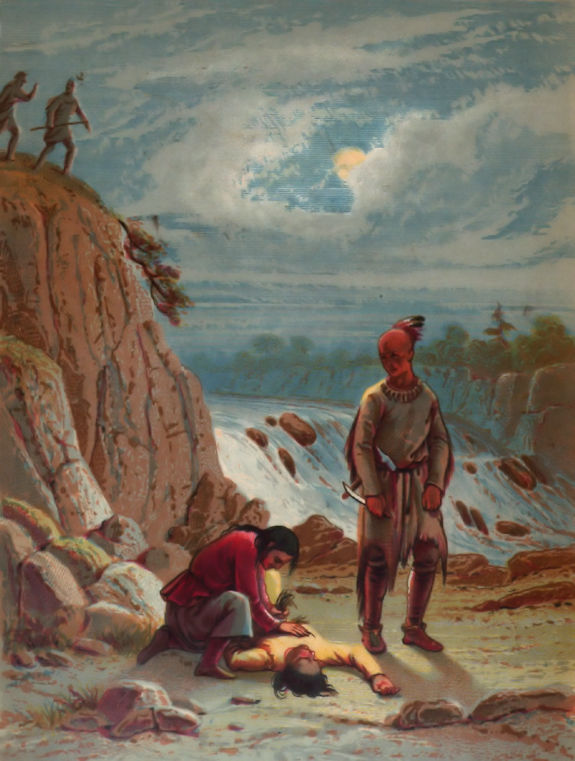
Passing on to a rock, whence you could see the beautiful
valley that spread out before them, the whole story was told
in a moment.
Chashé stood as if expecting witnesses; in his bearing
there was a frightful exultation that ill accorded with the
other circumstances of his position. In his hand he held the
knife, from which drops of blood were slowly falling on his
dress. He watched them with a savage laugh of delight.
His figure seemed taller, by half, in the moonlight, its long
shadow fell so darkly over the grass. He was not alone,
for easily could all recognise the manly and noble form of
the man he hated, at his feet. Well they know that it was
death alone that could keep him there. The blood was
oozing from his heart: and they could, even at the distance
from whence they first saw him, distinguish the marble
paleness of his features.
A loud shout now arose from the Indians as they pressed
forward. They were divided as to the interest in this scene.
The friends of Chashé exulted with him, and those of the
other clan called for revenge. It seemed uncertain how the
excitement of the crowd would show itself, when it was
diverted for a moment by the appearance of We-har-ka.
She rapidly slid down the rocks, which it was necessary to
pass, in order to reach the two young men. None of them
could keep up with her, so quick and shadowy were her
movements.
Throwing herself on the ground beside her lover, she made
the most frantic efforts to staunch the flowing of the wound.
She tore up the grass, and pressing it together, placed it
against the wound; but the blood continued to flow in spite
of all her efforts. Her bearing, calm and collected at first,
now changed with the evident hopelessness of the case; her
wild and frantic screams pierced the air as she threw herself
upon his body. Her brother seized her roughly by the arm,
indignant at this show of affection; but she shrank from his
touch, and again springing to his side, before he could divine
her purpose, she had wrested the knife from his grasp and
pierced it deep in her own breast. Chashé caught it from
her ere she could a second time bury it in her bosom; but
she glided from him and ascended the bluff over which she
had passed to reach the dreadful spot. A stream of blood
follows in her path. Now she has reached the edge of the
precipice: she springs, and the noise of the dashing waves
mingles with the cry of horror that arises from the witnesses
of her self-destruction.
The Indians were obliged to return to their village in
order to arrive at the place where were their canoes. Every
effort was made, but in vain, to recover the body of the unfortunate
girl. She was never seen again.
Father Blanc soon after returned to Acadie with a party
who were going that route. He was thankful to leave the
scene of such accumulated horrors. He had become warmly
attached to the young Sioux maiden, whose early sorrows
had been impressed on his memory. The horrors of that
night were written in characters of blood: nor did he ever
relate the incident without trembling at the recollection.
He found in the Canada Indians more tractable scholars,—at
least, when they feared the cannon of the French.
There is reason to conclude that the efforts of the Jesuits
among the aborigines of our country left no abiding impression
of good: but, like the waters which the tall ships have
passed over, they were agitated for a while from their usual
course, then returned to their restless surging as before.
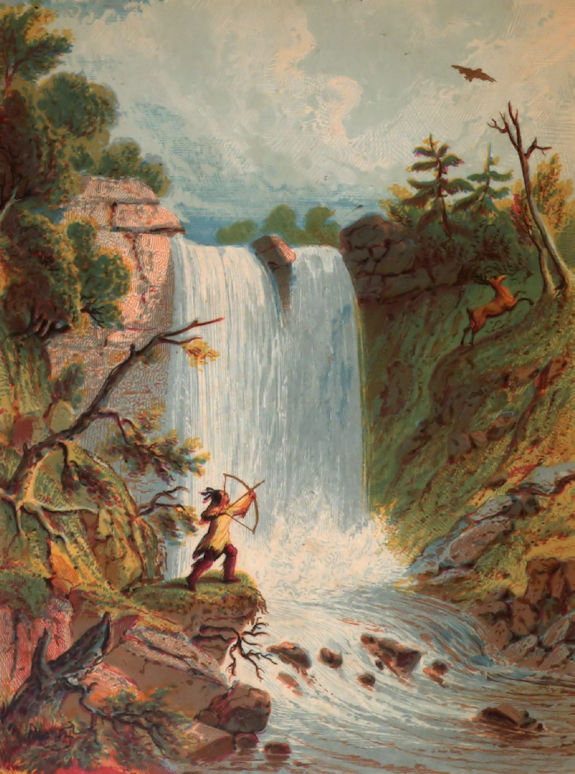
C. Schuessele del. Drawn by Capt. S. Eastman. Chromolith of P. S. Duval Ph.
THE LAUGHING WATERS,
Three miles below The Falls of St. Anthony.